/




Text
                    в

OT37
Operator Theory: Advances and Applications
Vol. 37
Editor:
I. Gohberg
Tel Aviv University
Ramat Aviv, Israel
Editorial Office:
School of Mathematical Sciences
Tel Aviv University
Ramat Aviv, Israel
Editorial Board:
A. Atzmon (Tel Aviv)
J.A.Ball(Blacksburg)
L. de Branges (West Lafayette)
K. Clancey (Athens, USA)
L. A. Coburn (Buffalo)
R. G. Douglas (Stony Brook)
H. Dym (Rehovot)
A. Dynin (Columbus)
P. A. Fillmore (Halifax)
С Foias (Bloomington)
P. A. Fuhrmann (Beer Sheva)
S. Goldberg (College Park)
B. Gramsch (Mainz)
J. A. Helton (La Jolla)
D. Herrero (Tempe)
Honorary and Advisory
Editorial Board:
P. R. Halmos (Santa Clara)
T. Kato (Berkeley)
P. D. Lax (NewYork)
M. S. Livsic (Beer Sheva)
M. A. Kaashoek (Amsterdam)
Τ Kailath (Stanford)
H. G. Kaper (Argonne)
S.TKuroda (Tokyo)
P. Lancaster (Calgary)
L. E. Lerer (Haifa)
E. Meister (Darmstadt)
B. Mityagin (Columbus)
J. D. Pincus (Stony Brook)
M. Rosenblum (Charlottesville)
J. Rovnyak (Charlottesville)
D. E. Sarason (Berkeley)
H. Widom (Santa Cruz)
D.Xia (Nashville)
S. G. Mikhlin (Leningrad)
R. Phillips (Stanford)
B.Sz.-Nagy (Szeged)
Springer Basel AG

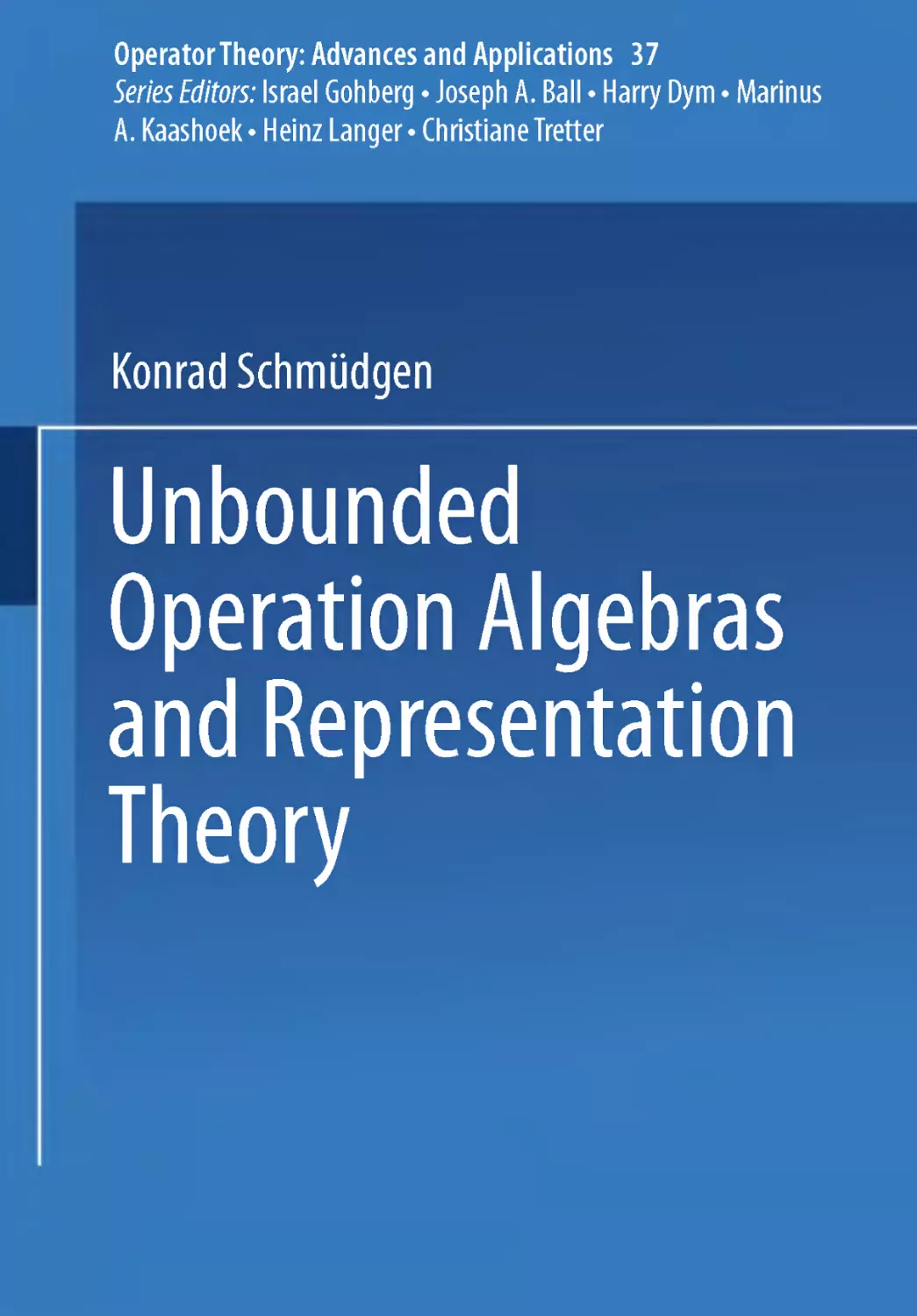
Konrad Schmudgen
Unbounded Operator
Algebras and
Representation Theory
1990
Springer Basel AG

Author's address:
Prof. Konrad Schmudgen
Sektion Mathematik
Karl-Marx Universitat
Karl-Marx Platz
Leipzig 7010-DDR
Library of Congress Cataloging in Publication Data
Schmudgen, Konrad:
Unbounded operator algebras and representation theory / Konrad Schmudgen.
p. cm. - - (Operator theory, advances and applications ; vol. 37)
Bibliography: p.
Includes index.
1. Operator algebras. 2. Representations of algebras. I. Title.
II. Series: Operator theory, advances and applications ; v. 37.
QA326.S35 1990
512'.55 - - dc20 89-32477 CIP
CIP-Titelaufnahme der Deutschen Bibliothek
Schmudgen, Konrad:
Unbounded operator algebras and representation theory /
Konrad Schmudgen. — Basel ; Boston ; Berlin : Birkhauser, 1990
(Operator theory ; Vol. 37)
NE: GT
ISBN 978-3-0348-7471-7 ISBN 978-3-0348-7469-4 (eBook)
DOI 10.1007/978-3-0348-7469-4
This work is subject to copyright. All rights are reserved, whether the whole or part
of the material is concerned, specifically those of translation, reprinting, re-use of
illustrations, broadcasting, reproduction by photocopying machine or similar means,
and storage in data banks. Under § 54 of the German Copyright Law where copies are
made for other than private use a fee is payable to »Verwertungsgesellschaft Wort«, Munich.
© 1990 Springer Basel AG
Originally published by Akademie Verlag, Berlin in 1990.
Softcover reprint of the hardcover 1st edition 1990

To Katja and Alexander

Les theories ont leurs commencements: des allusions vagues, des
essais inacheves, des problemes particuliers; et тёте lorsque ces
commencements importent peu dans Vetat actuel de la Science, on
am ait tort de les passer sous silence.
F. Riesz,
Les systemes d'equations
lineaires a une infinite
d'inconnues,
Paris, 1913, p. 1.
Scientific subjects do not progress necessarily on the lines of direct
usefulness. Very many applications of the theories of pure
mathematics have come many years, sometimes centuries, after the actual
discoveries themselves. The weapons were at hand, but the men
were not able to use them.
A. H. Forsyth,
Perry's Teaching of Mathematics,
London, 1902, p. 35.

Preface
^-algebras of unbounded operators in Hubert space, or more generally algebraic systems
of unbounded operators, occur in a natural way in unitary representation theory of Lie
groups and in the Wightman formulation of quantum field theory. In representation
theory they appear as the images of the associated representations of the Lie algebras
or of the enveloping algebras on the Garding domain and in quantum field theory they
occur as the vector space of field operators or the *-algebra generated by them. Some
of the basic tools for the general theory were first introduced and used in these fields.
For instance, the notion of the weak (bounded) commutant which plays a fundamental
role in the general theory had already appeared in quantum field theory early in the
sixties. Nevertheless, a systematic study of unbounded operator algebras began only at the
beginning of the seventies. It was initiated by (in alphabetic order) Bouchers, Lassner,
Powers, Uiilmann and Vasiliev. From the very beginning, and still today,
representation theory of Lie groups and Lie algebras and quantum field theory have been primary
sources of motivation and also of examples. However, the general theory of unbounded
operator algebras has also had points of contact with several other disciplines. In
particular, the theory of locally convex spaces, the theory of von Neumann algebras,
distribution theory, single operator theory, the moment problem and its non-commutative
generalizations and noncommutative probability theory, all have interacted with our
subject.
This book is an attempt to provide a treatmant of * -algebras of unbounded operators
in Hilbert space (the so-called 0*-algebras) and of (unbounded) * -representations of
general *-algebras. Roughly speaking, an 0*-algebra is a *-algebra JL of linear operators
defined on a common dense linear subspace 2) of a Hilbert space and leaving 2)
invariant. The multiplication in Л is the composition of operators, which makes sense
because of the in variance of the domain 2), and the involution a -> a+ in Л is defined
by letting a+ be the restriction to 2) of the usual Hilbert space adjoint a*. We always
assume that an 0*-algebra on 2) contains the identity map of 2). A -^-representation of
a general *-algebra with unit is a *-homomorphism of the *-algebra onto some O*-
algebra. Moreover, we also consider some more general families of closable linear
operators (O-families, O-vector spaces, O-algebras, 0*-families and 0*-vector spaces) which
are always defined on a common dense domain 2).
Our objective is threefold. First, the book gives a thorough treatment of certain of
the basic concepts involved in the theory of 0*-algebras and ^representations. These
mainly concern notions like the graph topology, closed and self-adjoint *-representations,
closed and self-adjoint 0*-algebras, weak and strong (bounded) commutants, strongly

8 Preface
positive and completely strongly positive *-representations, to name the most important,
which have proved to be useful and fundamental in the theory. We also develop
concepts like directed O-families, commutatively dominated 0*-algebras, weak and strong
unbounded commutants, form commutants, induced extensions and strongly тг-positive
*-representations with the anticipation that these will be useful in future research.
Secondly, we aim to prove some of the more involved results of the existing theory. As
a sample, results in Sections 2.4, 4.3, 5.3, 5.4, 6.2, 7.3, 9.2, 9.4, 10.2, 10.4, 10.5, 11.2, 12.3
and 12.4 could be mentioned in this respect. Thirdly, the book presents many examples
and counter-examples that help to delimit the general theory. These sometimes require
more involved constructions and arguments than many of the positive results in the
theory. For instance, we construct a self-adjoint ^--representation of the polynomial
algebra in two variables, the bounded commutant of which is a given properly infinite
von Neumann algebra in separable Hubert space.
The scope of this book is, of course, dictated by the stage of the existing theory. Thus,
for instance, the topological theory of 0*-algebras occupies a relatively large space in
this monograph, simply because it is much more developed than other parts of the
theory. The choice of the material contained in this book also depends on the author's
personal view of the existing theory and on his particular research interests. Some
topics such as GB*-algebras, Hubert algebras, tensor algebras and applications in
physics are not included. Often the original proofs of the results have been improved,
errors have been corrected or the result has been generalized. Frequently the terminology
and the notation have been changed, we hope for the better. Also several new concepts
are introduced.
Apart from the preliminary chapter, the book consists of two parts which are
independent to a large extent (see also the introduction to Part II). In Part I 0*-algebras
and topologies on the domains and the algebras are studied, while Part II is concerned
with ^representations of general *-algebras. Those topics in the theory of
♦-representations that primarily involve the study of topologies or the structure of 0*-algebras
are treated in part I. Such topics are the continuity of ^representations, the realization
of the generalized Calkin algebra and the abstract characterization of the *-algebras
¥+(2>ι: г £ /). Chapter 10 gives a rather thorough treatment of integrable
representations of Lie algebras resp. enveloping algebras. This chapter stands almost entirely
by itself; it requires only a few general definitions and facts from earlier sections.
Almost no bibliographical comments are given in the body of the text; they are
gathered in a section entitled "Notes" at the end of each chapter. There, the sources of the
main results, basic concepts and some examples are cited (of course, as far as the author
is aware), but no attempt has been made to be encyclopaedic. Some of these sections
contain a list of references dealing with problems similar to those in the text.
The first two digits in the number of a theorem, proposition, lemma, definition or
example refer to the section and the third digit to the position of the item. Remarks
and formulas are numbered and quoted consecutively within the sections. When a
reference to a formula in another section is made, the number of the section is added; for
instance, 3.2/(1) means formula (1) in Section 3.2. The end of a proof is marked by Π
and of an example by O· The reader should also note that we often fix assumptions or
notations at the beginning of a chapter, section or subsection which keep in force
throughout the whole chapter, section or subsection. Further, the proofs of facts stated in the
examples are frequently merely sketched and sometimes they are omitted altogether.

Preface
9
I am grateful to Dr. Jurgen Friedrich and Dr. Klaus-Detlef Kursten for their
critical reading of large parts of the manuscript and for many valuable suggestions. I am
also very indebted to Professor Paul S. Muhly for his help in writing this book. Last
but not least, I wish to thank R. Helle, Dr. R. Hoppner and G. Reiher of the Aka-
demie-Verlag for their patience and help in preparing this book.
Leipzig, Fall 1987
K. SCHMUDGEN

Contents
1. Preliminaries 13
1.1. Locally Convex Spaces 13
1.2. Spaces of Linear Mappings and Spaces of Sesquilinear Forms 16
1.3. Ordered *-Vector Spaces 19
1.4. *-Algebras and Topological *-Algebras 21
1.5. The Topologies rF, τη, τ0 and tf, τ", τ° 22
1.6. Operators on Hubert Space 27
1.7. Lie Groups, Lie Algebras and Enveloping Algebras 31
Notes 32
Part I. 0*-Algebras and Topologies 33
2. O-Families and Their Graph Topologies 35
2.1. O-Families, 0*-Families and 0*-Algebras 35
2.2. The Graph Topology 39
2.3. The Locally Convex Space Ъл 44
2.4. Bounded Sets in Quasi-Frechet Domains 50
2.5. Examples and Counter-Examples 54
2.6. The Positive Cone of an 0*-Algebra 59
Notes 63
3. Spaces of Linear Mappings Associated with O-Families and Their Topologization 64
3.1. The Algebras B(5)2, 3>x) and 2(3)#, 3>j) 64
3.2. The Vector Space 2(2)л, 3>%) 70
3.3. Topologies Generalizing the Operator Norm Topology 75
3.4. Some Density Results 86
3.5. The Weak- and Strong-Operator Topologies and the Ultraweak and Ultrastrong
Topologies 91
3.6. Continuity of «-Representations 95
Notes 100
4. Topologies for O-Families with Metrizable Graph Topologies 101
4.1. 0-Neighbourhood Bases for the Topologies r$, rjy, xq and r®, τ^, xG 101
4.2. Bounded Sets for the Topologies rb and rin 106
4.3. Commutatively Dominated Frechet Domains 108
4.4. General Results about the Topologies r^>, xjy, το 114
4.5. Topologies on Countably Generated 0*-Algebras 118
Notes 122

Contents
11
5. Ultraweakly Continuous Linear Functional and Duality Theory 123
5.1. ThePredual 123
5.2. The Generalized Trace 133
5.3. Representation of Linear Functional by Density Matrices 138
5.4. The Duality Theorem 143
5.5. Characterizations of Montel Domains 149
Notes 153
6. The Generalized Calkin Algebra and the *- Algebra £+(5)) 155
6.1. Completely Continuous Linear Mappings 155
6.2. Faithful *-Representations of the Generalized Calkin Algebra 161
6.3. Derivations and *-Automorphisms of £+(2)) 166
6.4. Atomic *-Algebras 170
Notes 174
7. Commutants 175
7.1. Some Results on Strongly Commuting Self-Adjoint Operators 175
7.2. Unbounded and Bounded Commutants of 0*-Algebras 178
7.3. Commutants of Strictly Self-Adjoint 0*-Algebras 187
7.4. A Class of Subspaces of 2(2) a, 2> J) 193
Notes 198
Part II: ^Representations 199
8. Basics of ^-Representations 201
8.1. Representations and *-Representations 201
8.2. Intertwining Operators 210
8.3. Invariant and Reducing Subspaces 213
8.4. Similarity, Unitary Equivalence and Disjointness of Representations 219
8.5. Induced Extensions 222
8.6. The Gelfand-Neumark-Segal Construction 227
Notes 234
9. Self-Adjoint Representations of Commutative *-Algebras 236
9.1. Integrable Representations of Commutative *-Algebras 236
9.2. Decomposition of Integrable Representations as Direct Sums of Cyclic
Representations 242
9.3. Two Classes of Couples of Self-Adjoint Operators 244
9.4. Construction of Non-Integrable Self-Adjoint Representations of C[xb x2] .... 252
Notes 258
10. Integrable Representations of Enveloping Algebras 260
10.1. The Infinitesimal Representation of a Unitary Representation 261
10.2. Elliptic Elements in the Enveloping Algebra 267
10.3. Analytic Vectors and Analytic Domination of Families of Operators 274
10.4. Analytic Vectors for *-Representations of Enveloping Algebras 282
10.5. Exponentiation of *-Representations of Enveloping Algebras 290
10.6. Decomposition of (τ-Integrable Representations as Direct Sums of Cyclic
Representations 296
298

12 Contents
11. n-Positivity and Complete Positivity of ^Representations 300
11.1. тг-Positive and Completely Positive Maps of Matrix Ordered Spaces 301
11.2. η-Positive and Completely Positive Maps of *-Algebras 305
11.3. A First Application: Integrable Extensions of *-Representations of Commutative
♦ -Algebras 310
11.4. A Second Application: Integrable Extensions of *-Representations of Enveloping
Algebras 315
11.5. A Third Application: Completely Centrally Positive Operators 318
11.6. Strongly 1-Positive *-Representations which are not Strongly 2-Positive 324
Notes 329
12. Integral Decompositions of *-Representations and States 330
12.1. Decomposable Closed Operators 331
12.2. Localization of Decomposable Operators 336
12.3. Decomposition of * -Representations 340
12.4. Integral Representation of Positive Linear Functionals 345
12.5. The Moment Problem over Nuclear Spaces 354
Notes 360
Bibliography 362
Symbol Index 374
Subject Index 378

1. Preliminaries
In this chapter we summarize some basic definitions, notation and results that will be
required in this monograph. Some, but not all, of them are standard or well known.
General terminology which is used essentially in one chapter, section or subsection will be
introduced therein.
First we collect some general notation. Throughout, С denotes the complex numbers,
Τ the complex numbers of modulus one, IR the real numbers, TL the integers, N the
positive integers and No the non-negative integers. For t = {tx, ..., td) 6 IRd and
η = (ηλ, ...,nd) 6 No, tn is the usual multi-index notation, i.e., tn := ψ ... t%a, where
t°k := 1 for к = 1, ..., d. The abbreviations l.h. and c.l.h. mean the linear hull and the
closed linear hull, respectively. Sequences and nets are written as (xn: η 6 Ν) resp.
(Xi'. i € I) or simply as (xn) resp. (х{). In general, sets are denoted by braces such as
{xn: η еЩ. For an open or closed subset Μ of IRd, Lp(M) is the I>-space with respect
to the Lebesgue measure on M. If Μ is a O^-manifold (with or without boundary) and
η € Ν υ {σο}, then Cn(M) is the set of all complex functions of class О on M. We denote
by C™(M) the set of all functions in C°°(M) whose support is a compact subset of Μ.
The continuous complex functions on a topological space Μ are denoted by C{M).
For a and Ь in R, we shall write C°°[a, b] for C°°([a, Ъ]), С[а, Ъ] for С ([a, 6]), GJ°(a, Ъ) for
С^°((а, Ь)) and LP(a, Ъ) for I/p((a, 6)). As usual, dnm is the Kronecker symbol. The closed
unit ball of a normed space Ε is denoted by ΊΙΕ.
1.1. Locally Convex Spaces
As general references for the theory of locally convex spaces we shall use the textbooks
Schafer [1], Kothe [1], [2] and Jarciiow [1].
All considered vector spaces are either over the real field IR or over the complex field
<C. When we speak about a vector space or a locally convex space without specifying
the field, we always mean spaces over C. Let U and Μ be subsets of a vector space Ε
over К. Then U absorbs Μ if there is an <x > 0 such that Μ <ΞΞ λϋ for all λ e Κ, \λ\ ^ α,
and U is absorbing if it absorbs every singleton {φ}, φ ζ Ε. The absolutely convex hull
of U is denoted by aco U.
If τ is a topology on a set E, then we write Ε[τ] for the corresponding topological
space. The induced topology on a subset F of Ε is denoted by τ [ F or simply again by τ
if no confusion can arise. If τ1 and τ2 are topologies on E, then τ1 £ τ2 means that τλ
is coarser (weaker) than τ2.

14 1. Preliminaries
A locally convex space is a (not necessarily Hausdorff) topological vector space over
К = IR or over К = С which has a O-neighbourhood base U satisfying the following
conditions:
(i) For UuU2e U, there is a U € U such that U Q U1 η C72.
(ii) If U € I/, then λϋ e U for all A € Κ, Α φ 0.
(iii) Each U ζ U is absolutely convex and absorbing.
If U is a non-empty family of subsets of a real or complex vector space which f ulfills (i),
(ii) and (iii), then there is a unique topology τ on 22 such that Ε[τ] is a locally convex
space and U is a O-neighbourhood base for τ. By a locally convex topology on a vector
space Ε we mean a topology τ on Ε for which Ε[τ] is a locally convex space. Let Γ be a
non-empty family of seminorms on a vector space E. The collection U of all sets
[φ € Ε:ρη(φ) ^ ε for η = 1, ..., &}, where j^, ..., p* € Γ, & £ N and ε > 0,
satisfies (i) —(iii); so f/ is a O-neighbourhood base for a unique locally convex topology τ
on 22. We then say that τ is generated (or defined or determined) by .Γ. The family Z7 is
directed if, given pi, p2 £ JT, there is a jp € J1 such that ρλ ^L ρ and jp2 ^ jp.
In what follows we suppose that Ε is a locally convex Hausdorff space.
Let E* denote the dual of E. The weak topology ο = σ(2£, Ε]) is the locally convex
topology on Ε defined by the seminorms φ -> \φι(φ)\, φ1 € El. A sequence (φη: η β Ν)
in i£ converges weakly to 99 € 22 if it converges in the locally convex space Ε[σ] to 9?, i.e.
if lim ψι{φη) = ^'(«p) for all 9?' € 2£'. The weak*-topology σι ξξ <x(22', 22) on El is generated
by the seminorms φ1 -> \φι(φ)\, φ € Ε. The strong topology on 22' is denoted by /?; it
is generated by the family of seminorms
rM(<p]) :=supfo%>)l, p«€ #',
where ikf ranges over the bounded subsets of E. The vector space £7 becomes a linear
subspace of (Ει[β]){ by identifying 99 € Ε with the linear functional φ1 ->φι(φ) on 221.
£7 is semireflexive if 22 = (221 [/?])' under this identification, and Ε is reflexive ii Ε is
semireflexive and if the topology of Ε coincides with the strong topology on (Ει[β])1.
A Frechet space is a complete metrizable locally convex space. The locally convex
space Ε is said to be a quasi-Frechet space (or briefly, a QF-space) if for every bounded
set Μ in Ε there is a subspace G of Ε which is a Frechet space in the induced topology
of Ε and which contains M. It is obvious that each Frechet space is a QF-space.
The space Ε is barrelled if every barrel in Ε (i.e., every closed absolutely convex
absorbing subset of E) is a O-neighbourhood in Ε. Ε is a semi-Montel space if each bounded
subset of Ε is relatively compact. A Montel space is a barrelled semi-Montel space.
The space Ε is hornological if every absolutely convex set in Ε that absorbs each bounded
set in Ε is a O-neighbourhood of £7. The hornological topology associated with the topology
of Ε is the coarsest bornological topology on Ε which is finer than the topology of E.
A fundamental system of bounded sets in Ε is a family 8 of bounded sets such that
every bounded subset of Ε is contained in some set of 8. The space Ε is a DF-space
if it admits a countable fundamental system of bounded sets and if it has the following
property: If the intersection of a sequence of closed absolutely convex 0-neighbourhoods
in Ε absorbs all bounded sets, then it is itself a O-neighbourhood in E.
A precompact set in Ε is a set which is relatively compact in the completion of E.
(Often these sets are called totally bounded.)

1.1. Locally Convex Spaces
15
Lemma 1.1.1. Let Γ be a directed family of seminorms which generates the topology of E,
and let Μ be a subset of E. Suppose that, given ρ € Γ and ε > 0, there exists a bounded set
Мр>е contained in a finite dimensional subspace of Ε such that for each φ € Μ there is a
ψ 6 MPiE satisfying ρ(φ — ψ) 5g ε. Then Μ is a precompact set in E.
Proof. Without loss of generality we can assume that Ε is already complete and Μρε
is closed. We have to show that the closure Μ of Ж is compact. For let W be an ultra-
filter on M. Fix ρ € Γ and ε > 0. Set V := {φ € Ε:ρ(φ) <J ε). The set Mp>t is compact,
so there exists a finite set N in Ε such that MPtE £ N + 7. By assumption,
Μ Q MPiE + 7. The set Mpt + 7 is closed in Ε (because Mpe is compact). Hence
Μ g MPiE +Vg,{N+V)+V = N + 2V = U(y> + 27). Because W is an ultra-
filter, this implies that (ψ + 27) € W for some v € N. Since (y> + 27) - (ψ + 27) = 47
and the sets 47 form a 0-neighbourhood base on E, this shows that Τ7 is a Cauchy filter
on E. Hence W is convergent and Μ is compact. Π
The locally convex space Ε admits the approximation property if the identity map of
Ε can be approximated, uniformly on every precompact subset of E, by continuous
linear mappings of finite rank.
Suppose that the topology of Ε is generated by a directed family, say Γ, of norms
on E. Then Ε is called a Schwartz space if for every ρ ζ Γ there is a q € Γ such that the
set {φ 6 Ε: q((p) g 1} is precompact in the normedlinear space (E,p).
Let Ε and F be locally convex Hausdorff spaces. We define the two main topologies
on the algebraic tensor product Ε (χ) F of Ε and F. For seminorms ρ and q on Ε and
F, respectively, let ρ (х)л q denote the seminorm on Ε (χ) F which is defined by
V ®n q(z) = inf | Σ vWn) q(Wn)\, ζ £ F 0 F,
к
where the infimum is taken over all representations ζ = Σ Ψ η ® Ψη ш Ε ® F- Suppose
η = 1
ΓΕ and Γρ are directed families of seminorms which generate the topologies of Ε and F,
respectively. The projective tensor topology on Ε (χ) F is defined by the family of semi-
norms {p ®nq\ ρ 6 ΓΕ and q 6 FF]. Equipped with it, the space Ε (χ) F is called the
projective tensor product and denoted by Ε (х)л J7. Let Ε ®π F be the completion of
F ®л F. We denote by G(F) and ©(F) the equicontinuous subsets of F1 and F[,
respectively. For Μ <E ©(F) and 2V € ©(F), let
fiAf..v(z) ".= SUp Slip
A:
Σ φ]{ψη) ψι{ψη)
-1
к
Σ<Ρη®ψη^Ε-
н=1
The infective tensor topology is generated by the family of seminorms {εΜιΝ: Μ 6 ©(F)
and iV € ©(F)}. The injective tensor product Ε (x)c F is the vector space Ε (x) F endowed
with this topology. The completion of Ε (x)c F is denoted by F (g)e F.
The following result is occasionally called the Mittag-Leffler theorem.
Lemma 1.1.2. Let (En: η € Mo) oe a sequence of Banach spaces. Suppose that for each
η € M0) Εί!+1 is a dense linear subspace of En and the embedding map of En+1 into En is
continuous. Then Eco := C\En is dense in each space Eki к 6 Μ0·
Proof. There is no loss of generality to assume that к = 0. Suppose φ € E0 and ε > 0
Let ||·||„, η d M0) denote the norm of En. Since the embedding of En+1 into En is con

16 1. Preliminaries
tinuous, there exists a constant an > 0 such that ||·||η fg αη||·|Ιη+ι on Bn+1 for η € Ν0·
Upon replacing || · ||n by αλα2 ... ocn_i || · ||n for ?г £ N, we can assume without loss of
generality that ||·||η 5j ||·||η+ι for ?г € Ν0· Set φ0 := 99. Since £/n+1 is dense in En, we can
construct inductively a sequence (φη:η e N0) of elements <pn € £/n such that ||<pn+1 — φη\\η+ι
5j ε2_η_1 for ?г € No· Then we have
r
\\<Pm+n+r — <Pm+n\\m ^ 27 \\<Pm+n+l ~ ψτη+n+l-lL· ^
/ = 1
r r
2; H9Wn - 9Wb/-ill»+»+z ^ Γ e2-»-«-' < e2"« (1)
i = l / = 1
for m,n ζ No and r € N. From this we conclude that the sequence (9?m+n: η € N0)
is a Cauchy sequence in the Banach space Em, m € N0- Let ψ denote the limit of the
sequence {φ0+η: η € No) in EQ. Then, of course, ψ is also the limit of (9?m+n: η € No) in
Em for all m € Ν0· Hence ψ € E^. Setting m = η = 0 and letting r -> + 00 in (1),
we obtain ||y — 9?||0 fg ε which shows that E^ is dense in EQ. Π
1.2. Spaces of Linear Mappings and Spaces of Sesquilinear Forms
First let Ε and F be vector spaces. We denote by E~ the complex conjugate vector space
of E. That is, E~ is equal to Ε as a set, the addition in E~ is the same as in E, but the
multiplication by scalars is replaced in E~ by the mapping (λ, φ) -> λφ, λ € С and φ e Ε.
Let L(2£, jF) be the vector space of all linear mappings of Ε into F, and let B(E, F) denote
the vector space of all sesquilinear forms on Ex F. We set L(E) := L(E, E) and B(E)
:= B(E, E). A sesquilinear form on Ε χ F is & mapping of Ex F into С which is linear
in the first and conjugate linear in the second variable. For с € B(E, F), define c+(ip, φ)
:= c(<p, ψ), φ e Ε and ψ € F; then c+ € B{F, E). If с € B{E, E) and φ,ψ e E, then we
have the so-called polarization identity
4c(<p, y) = c(p + ψ,φ'+ ψ) — c(<p — ψ, φ — у) + ic(<p + iy, 9? + ίψ)
— ίθ(ςρ — iy, φ — iy). (1)
It is proved by computing the right-hand side of (1).
From now on we assume in this section that Ε and F are locally convex spaces. Since
the vector spaces Ε and E~ have the same convex sets, they have the same locally convex
topologies. We also denote by E~ the vector space E~ equipped with the topology of E.
We shall write E+ for the conjugate vector space (E)~ of the dual JS?1 of E. Let &(E, F)
denote the vector space of continuous linear mappings of Ε into F. Set Z{E) := 2{E, E).
A sesquilinear form с on ExF is said to be separately continuous if с(9?,■) € jF1 for each
φ € Ε and c( ·, ψ) € El for each ψ £ F; с is called continuous if it is a continuous mapping
of Ex F into <C, when 2£x jF carries the product topology. We denote the vector spaces
of all separately continuous sesquilinear forms and of all continuous sesquilinear forms
by ЩЕ, F) and 3>(E, F), respectively. From the theory of locally convex spaces (see
Schafer [1], III, 5.1) it is known that ЩЕ, F) = JB(E, F) if Ε and F are Frechet spaces
or if Ε and F are barrelled (DF)-spaces.

1.2. Spaces of Linear Mappings and Spaces of Sesquilinear Forms
17
For χ e L(E, F+) and у £ L(F+, E), we define
Cx(<P, ψ) = {x<p) M> φ(ί Ε ζηάψ (ί F (2)
and
ьу(^', У) = рЧуу'Ь <p] £ ях and v1 € ^' · (3)
Then, obviously, c, ζ Б(^, 2*1) and by € i?(#>, jF1).
Lemma 1.2.1. For χ £ L(E, F+) and у <E L(F+, 22), w;e fcave:
(i) χ e &(E, i^t*1]) if and only if zx e ЩЕ, F).
(ii) у € &{F+[a% Ε[σ]) if and only if bv £ Щ&[а% ^'[σ1]).
The mappings χ -» cx cmd у -> by are linear bisections of 2(22, 2^+[σ']) on 23(22, F) and of
&(F+Wl Ε[σ]) on ЩЩа*], ^'[σ1]), respectively.
Proof. We prove (i). Suppose χ <E 2(22, 2^+[σ']) and let 9? € 2£. Since χφ € jP+, cx(^, ·)
ξ (χφ) (·) e F]. (Recall that F+ is equal to 2?1 as a set.) From χ <Ε 2(S, 2^[σ>]) it follows
that ζχ(·,ψ) =ξξ (χ·) (ψ) e E^ for each ψ e F. Thus c£ € SB(22, 2^)· Conversely, assume that
Cx € ЩЕ, F). Then (s?) (·) = ζχ{φ, ·) € ,Ρ1 for each <pd E,so that s(J?) g ,P+. Further,
(χ.) (у) = cA.(·,^) £ jS/1 for all ψ £ F which means that χ maps Ε continuously into
F+[a4i.e.,xe 2[E,F+[a*]).
It is clear that the mapping χ -> zx is linear and injective. To prove that it is surjec-
tive, let с <E 93(22, F). If 9? € E, then c(^, ·) <E jF1. That is, there is a unique y· € jP1 such
that ^' (y) = c(<p, y) for all ψ ζ F. Define χφ :~ ψ1 . We then obtain a linear mapping χ
of Ε into jF+ which satisfies cx = с by construction. From (i), χ € 2(22, F+[o]]).
The assertions concerning ?/ and by follow in a similar way. □
Lemma 1.2.2. If χ <E L(E, F+) and cx € JB(Ey F), then χ € 2(#, 2^+[β]).
Proof. Since cx £ c#(22, F), there are continuous seminorms ρ and q on Ε and jF,
respectively, such that |cx(<£, ψ)\ t=L 25(9?) <?(^), 9? £ 22 and ψ e F. Let if be a bounded subset
of jF. Then λ := sup {#(y): ψ ζ M} < 00 and sup |(z9?)MI = SUP |cx(^, yOl S λρ(φ)
for <p € Я. This shows that χ <E &(E, F+Ιβ]). Π ν€Λί v€itf
Suppose that xe &(E,F+[a*]) and ye £(F+[a]], Ε[σ]). By Lemma 1.2.1 we have
cxe ®(E,F) andb,€ »(#'[*'], J?V]); so (c,)+ € ffl(i\ Я) and (b,)+ € ffl^'fa1], «'[σ1]).
Applying the reversed directions in Lemma 1.2.1, there are elements x+ e Z(F, Ε+[σ]])
and y+ e Q(E'[ai], F[a]) such that (cx)+ = Cx+ and (b„)+ = by+.
Now we define some locally convex topologies on certain spaces of linear
mappings. They are needed in Sections 3.1 and 3.3.
I. The Eijuicontinuous Topology те on 2(-Fl+[ffl], Ε[σ])
If Μ is an equicontinuous subset of El and N is an equicontinuous subset of F*, we define
Pm.n(v) '·= SUP SUP \<Р1(УУ>1)\> У € ^(F^a1], Ε[σ]). It can be shown (see e.g. Schafer [1],
φ'ζΛί ψιζΝ
111,5.5) that Pm,n{') is finite on 2{F+[a]], Ε[σ]), so that pMtN is a seminorm. Let те
denote the locally convex topology on 2(2^+[σι], Ε[σ]) generated by the family of all
such seminorms pM N. The topology те is called the equicontinuous topology on the space

18 1. Preliminaries
II. The Bounded Topology ть on £(E, F+tf])
Let S and Τ be non-empty families of bounded subsets of Ε and F, respectively. For
Μ € S and N € T, let
Pm.nM '-= SUP SUP IM Ml> « £ S(^, F+tf]).
φζΜ ψζΝ
Since Pm,n(x) = SUP τν(χψ) and s € 2(^> ^+[/?])> Pitf.ivl·) is finite and hence a seminorm
φζΜ
on 2(23, 2^+[/?]). The family of seminorms {pMtN: Μ € S and N e T} gives rise to a locally
convex topology on 2(2£, 2^+[/?]) which we denote by ts>t. If <S and Τ are the families
of all bounded subsets of Ε and F, respectively, then the corresponding topology τ8 Τ
is called the bounded topology on 2(2£, F+Ιβ]) and denoted by ть.
III. The Inductive Topology τίη
Assume that L is a linear subspace of L(E, F+) such that cx e 3t(E, F) for all χ ζ L.
Let /Έ and rF be directed families of seminorms which generate the locally convex
topologies of Ε and F, respectively. Suppose ρ € ΓΕ and q € ΓΕ. Let Lp>i denote the set
of all χ € L for which there exists a non-negative number A such that
\Qx(cp, ψ)\ = \{χφ) (ψ)\ ^ λρ{φ) q(ip) for all φ ζ Ε and у € F. (4)
For χ € LPtQ, let 1р>(7(:г) be the infimum over all /1^0 satisfying (4). It is easily seen that
LPiQ is a linear subspace of L and Ip#(7 is a norm on Lp>(7. Since cx € c#(22, jP) for all χ € 2>
by assumption and the families ГЕ and /V are directed, we have L = \J \J LPiQ. Further,
perEqtrF
if p, px € ГЕ and {7, q1 € /V satisfy ρ ^ ρλ on Ε and g ^ ^ on 2^, then (Lp>(7, \Ptq) is a
linear subspace of {LPiiQi, lPl,Ql), and the corresponding embedding map is continuous.
Therefore, the topology of the inductive limit of the family of normed spaces
{(Lp>q,lp>q):p e rEandqe TF} is well-defined on L (cf. Sciiafer [1], II, 6.3). This
topology is denoted by τιη and called the inductive topology on L, It is not difficult to
check that this topology does not depend on the families TE and Гг.
If φ € Ε and ψ € F, then the set {x € L: \cx(<p, ψ)\ ^ 1} contains a 0-neighbourhood
in the normed linear space {Lp>q, lp>q) for any ρ £ ΓΕ and q £ ΓΕ; hence it is a 0-neigh-
bourhood in Ε[τ·ιη]. This implies that Σ[τιη] is a Hausdorff space. Being the inductive
limit of normed spaces and Hausdorff, £[τίη] is a bornological space.
Since L £ S,(E, Ε+[β]) by Lemma 1.2.2, the topology ть is also defined on L. We show
that ть gj τίη on L. For let i¥ and N be bounded sets in Ε and JF, respectively. Then
lPtq := sup 29(9?) sup q(w) < 00 and рлгл(я) t=* ^.pWH for x £ L, ρ e ΓΕ and # € />.
фб-М" ψζ,Ν
Thus ρ^ν is continuous on each normed space (LPiq, iv>q) and hence on L[rin] which
proves that ть £ τίη.
Since in particular L £ 2(2?, 2^+[У]), L+ := {x+: a; 6 £} also satisfies the above
assumptions, so that τίη is defined on L+. From {LPtQ)+ = [LJr)q>p and \p>q(x) = ί^.ρί^)
for χ ζ LPtq, ρ ζ ΓΕ and g € /V ^ follows that χ -> x+ is a continuous mapping of £[τίη]
onto L+[rin]. We denote by ^p>(7 the unit ball of (Lpq, lp>q).

1.3. Ordered *-Vector Spaces
19
Remark 1. The three topologies defined above are closely related to various standard topologies
from the theory of locally convex spaces. If we identify у and by, then те is the topology of bi-
equicontinuous convergence on ίβ(Ει[σι], F][g1]); see e.g. Schafer [1], III, 5.5. The topology ть
is precisely the topology of uniform convergence on bounded sets on the space 2(E, F+Ιβ]): see
e.g. Schafer [1], III, § 3. Under the isomorphism χ ->■ cx, tb goes into the topology of bi-bounded
convergence on $(E,F); see e.g. Schafer [1], IV, 9.7. If we identify an element χ eL(E,F+)
with the linear functional on Ε ® F~ defined by Σ Ψη Θ Ψη ~> Σ £χ(φη> Ψη)>then the topology
η η
τ·ιη on the maximal space Lmax := {χ € L(E, F+): cx € S(E, F)} coincides with Beresanskii's
topology η on the dual (Ε ®π F~)1; see e.g. Beresanskii [1] or Jarchow [1], 10.3.
1.3. Ordered *-Vector Spaces
For ordered vector spaces we refer to Chapter V of Schafer [1] and also to Peressini [1].
*-Vector Spaces
An involution on a (complex) vector space Lis a mapping χ -> x+ of L into L satisfying
{(xx + βνΥ = ocx^ + βν+ and (x+)+ = χ for all x, у € L and α, β € <C. A *-vector space
is a (complex) vector space equipped with an involution. The involution of *-vector
spaces (and so, in particular, of *-algebras) is always denoted by χ -> x+. If χ is a Hubert
space operator, then ar~ should not be confused with the adjoint operator of χ which we
shall denote by x*.
Suppose L is a *- vector space. A * -vector subspace of L is a linear subspace of L which
is invariant under the involution. An element χ of Lis called hermitian ii χ = x+. The
real vector space Lh := {x £ L: χ = x+} is called the hermitian part of L. Each element
χ € L can be expressed uniquely of the form χ = xx + ix2 with xl3 x2 € Lh. (Indeed,
xx := — (x+ + x) and x2 := — i(x+ — x) have the desired properties. If x[ and a;2 are
elements of Lh such that χ = x\ -\- \x2, then x+ = xj — \x2 and hence a^ = x[ and
a^ = x'2.) Thus we have L = Lh -f- iLh. The vector space of all (complex) linear
functional on the vector space L is denoted by L*. For / e L*, define f+(x) := f(x+), χ € L.
Then the map / -> /+ is an involution on the vector space L*. Hence L* is also a *-
vector space, and the terminology of the preceding paragraph applies to L* as well.
That is, a linear functional / on L is said to be hermitian if / = /+, i.e., if f{x) = f(x+) for
all a: 6 L or equivalently if / is real-valued on Lh. Further, L* is the real vector space of
hermitian linear functionals on L.
The following simple lemma is temporarily used in the text.
Lemma 1.3.1. // g is a (real) linear junctional on the real vector space Lh, then there is a
unique (complex) linear functional f on L such that g = f \ Lh.
Proof. Let χ € L. We write χ as χ = xx -f ia;2 with unique elements xl3 x3 £ Lh and
define /(a;) := g(x1) + ig(a:2). Suppose A = A2 + U2 € С with Д1г λ2 € 1R. By the real
linearity of g and the definition of /, we have {(λχ) = /(λ^ — λ2χ2 + i^a^ + ^ι))
= g{Xxxx — λ2χ2) + ig(lxx2 + A^) = A^fo) — λ$(χ2) + i%(a;2) + ιλ$(χλ) =
(Лх + i^H^fo) + i^fe)) = ^/(s)· Clearly, g = f \ Lh. The uniqueness of / is obvious. □

20 1. Preliminaries
Ordered Vector Spaces
A wedge in a (real or complex) vector space Ε is a non-void subset К of Ε such that
К + К S Ζ and λΚ Я К for all λ > 0. A wedge Ζ is called a cone if if η (-if) = {0}.
An ordered vector space is a real vector space i£ equipped with a reflexive transitive
relation ">" satisfying the following two conditions:
(i) χ > у implies χ + г > у + г for all ζ ζ Ε,
(ii) χ > у implies Ax > Αί/ for all λ > 0.
We shall denote the ordered vector space by (E, >;). The set if := {x € i£: χ > 0} is
then a wedge in Ε which is called the positive wedge of the ordered vector space (E, >).
Conversely, if if is a wedge in a real vector space E, then the definition "x*^>y if and
only if χ — i/ € X" yields a relation ">" such that (E, >) is an ordered vector space
with positive wedge K.
Suppose (E, >) is an ordered vector space with positive wedge if. By definition
2/^x means that χ >> г/. The sets [x, i/] := {г € i£: χ < г <C у} are called the order
intervals of (i£, >). A subset U of Ε is said to be K-saturated if C/ = U [χ, ?/] or equi-
x.yeu
valently if U = (U -{■ Κ) η (U — K). The wedge К is said to be normal for a locally
convex topology τ on £/ if τ admits a 0-neighbourhood base of if-saturated sets. The
finest locally convex on Ε for which every order interval of (E, >) is bounded is called
the order topology of (E, >).
Ordered *-Vector Spaces
Let L be a *-vector space and let if be a wedge in Lh. A linear functional / on L is called
K-positive if f{x) ^ 0 for all a; € if. We denote the set of all if-positive linear f unctionals
by if*. Obviously, if* is a wedge in the vector space £*. We say that a *-vector subspace
Lx of L is cofinal in L with respect to К if for every χ € Lh there is а у £ (L^ such that
у £ К and у — χ £ К.
An ordered ^-vector space L is a *-vector space £ together with a wedge if in the real
vector space Lh. By the canonical one-to-one correspondence between orderings and
wedges in real vector spaces mentioned in the preceding subsection, one can also say
that an ordered *-vector space is a *-vector space for which the hermitian part is an
ordered vector space. Suppose L is an ordered *-vector space with positive wedge K.
A *-vector subspace Lx of L is called cofinal in L if Lx is cofinal in L with respect to if.
A subset О of if is called order-dominating for L if for each χ € Lh there exist у € С and
λ > 0 such that Xy — χ € if.
Let if be a convex set in a real or complex vector space. A point χ in if is called an
extreme point of if if χ = λχ1 + (1 — λ) x2 with xlf x2 £ if and 0 < λ < 1 always implies
that χλ = x2. The set of extreme points of if is denoted by ex if. If if is a wedge, then
the following concept is of more interest. An extremal point of a wedge if is a point χ in
if such that у £ if and χ — у £ К imply that у = λχ for some λ € [0, 1].
Le.mm.a 1.3.2. Suppose that L is an ordered ^-vector space with positive wedge К and L0 is a
cofinal *-vector subspace of L. Set K0 := Κ η L0. If /0 is a K0-positive linear functional
on L0, then there exists a K-positive linear functional f on L which extends /0. // /0 is an
extremal point of if*, then f can be chosen to be an extremal point of if*.

1.4. * -Algebras and Topological «-Algebras
21
Proof. It is^sufficient to prove the assertion in case where LQ has codimension 1 in L.
A standard application of Zorn's lemma then gives the result in the general case. If /0
is an extremal point of K%, then we apply Zorn's lemma to the set of all extremal
extensions of /.
Since LQ has codimension 1 in L, there is an element χ £ Lh \ L0such that Lis spanned
by χ and L0. Let ">" denote the ordering of L. Because LQ is cofinal in L, there are
У\-> У2 £ (A))h sucn that yi < ж <С У2· Hence δ :— inf {f0{v): ν € (L0)h and ν >; χ} is well-
defined. By /0 £ K%, we have <5 ^ /o(?/i) and so (5 £ IR. Each 2 € L is uniquely expressable
as ζ — αχ + у with ос £ (С and ?/ € L0. Therefore, /(2) :=«<$ + /0(?/) defines
unambiguously a linear functional on L which extends /0.
We show that / is if-positive. Suppose ζ — ax -\- у ζ Κ. Since К g Lh and χ € Lh,
we have 0 = 2 — z+ = (oc — <5c) χ + ί/ — ί/+. Since χ $ L0, this implies that a is real.
If # = 0, then у £ K0 and so /(2) — f0(y) ^ 0. Now suppose a > 0. Then χ J> —ос~гу.
If г; € (L0)h and ν > χ, then ν J> —α-1?/ and hence /0(u) ^ /0( —oc~ly). This yields <5 = /(x)
^ fci-oc^y) and "/(г) ^ 0. If α < 0, the proof is similar. Thus / £ X*.
Now suppose that /0 is an extremal point of K*. We prove that / is an extremal point
of K*. Let g £ Κ* be such that g(z) fg /(2) for all ζ £ Ar. Since /0 = / I4 L0 is an extremal
point of A'o, there exists a Α ζ [0, 1] such that g(y) = Xf(y) for all у £ LQ. The proof is
complete if we have shown that g(x) = λ/(χ). If ν € (L0)h and ν > χ, then А/(г;) = Я/0(г;)
= 9(v) ^ 0(з) and 0 ^ f(v — χ) — g(v — χ) = (I — λ) f0(v) — δ + g{x), hence λδ ^ g(x)
and 0 <L (1 - Α) δ — <5 + flf(ic). Therefore, g(x) = A<$ == A/(s). Q
Remark 1. The preceding proof showed that the assertions of the lemma remain valid if the above
definition of cofinality is replaced by the weaker requirement that for given χ £ Lh there is a
У € (^o)h such that у — χ e K.
1.4. *« Algebras and Topological *-Algebras
An algebra is a vector space A in which a mapping (a, b) ~> ab of A X A into A is defined
that satisfies the following axioms:
(i) a(bc) = (ab) с,
(ii) (a + b) с = ас + be and a(b + c) = ab + ac,
(iii) л(аб) = (ла) b = a(ob)
for all a, £>, с € A and a 6 <C. The element ab is called the product of α and b. Suppose A
is an algebra. An element 1 6 A is called a unit element of A if it satisfies \a = a\ = a
for all α ζ A. The unit elements of abstract algebras are always denoted by the symbol 1.
If 1 is a unit element of A, then we set a0 := 1 for each a £ A and we frequently write а
instead of a ■ 1 for л € С. A character on A is a linear functional / on A such that / φ 0
and f(ab) = f(a) f(b) for all a, b <E A.
A *-algebra is an algebra A with an involution а -> a+ on A that also satisfies (aby
= d+a+ for a, b € A. Since a *-algebra is in particular a *-vector space, the terminology
from Section 1.3 also applies to *-algebras. A *-algebra A is said to be symmetric if A
has a unit and for every α £ Ah and α ζ (С \ IR the element a — a is invertible in A.
Suppose A is a *-algebra. An ideal J of A is called a *-ideal if x+ с J when χ € J.
it-
Let c?(A) denote the set of all finite sums 27 αίΧ( with ^, ..., tf/£ € A and к £ Ν· Α

22 1. Preliminaries
linear functional / on A is called positive if f(a+a) ^ 0 for all α € A. It is obvious that
c^(A) is a wedge in Ah and that the positive linear functionals on A are precisely the
3*(A)-positive linear functionals or equivalently the functionals in ^(A)*. If A has a
unit, then a state of A is a positive linear functional / on A which satisfies /(1) = 1. The
set of all states of A is denoted by <%(A). An m-admissible wedge in a *-algebra A is
a wedge Ж in the hermitian part Ah such that ^(A) gj Ж and a+xa € Ж for all α € A
and χ e Ж. It is easy to verify that c^(A) is the smallest m-admissible wedge in A. If
the *-algebra A has a unit, then a wedge Ж in Ah is m-admissible if and only if 1 € Ж
and a+xa £ Ж for all α € A and χ £ Ж. (Indeed, the necessity is clear, since 1=1+1
6 ^(A). For the sufficiency, we note that a+a = α+1α € Ж for every α € A and
hence cP(A) S Ж.)
The inequality occuring in the following lemma is called the Cauchy-Schwarz inequality.
It will be often used in the sequel.
Lemma 1.4.1. Suppose that f is a positive linear functional on a *-algebra A. Then
\f(b+a)2\ fj f(a^a) f{b+b) for all а, b € A. If A has a unit, then the functional f is hermitian
and so c?>(A)* g A*.
Proof. For arbitrary oc, β 6 <D, we have f({oca -\- /?&)+ (αα -f /56)) =
*ocf{a+a) + *fif{a+b) + aj3f(b+a) + ββί$+ο) ^ 0. (1)
From this we see that <%/?/(a+&) -j- αβ}φ+α) is real for cc, β £ <£, so
Wh) = f{b+a). (2)
The expression in (1) is a positive semi-definite quadratic form, hence its principal
minors are non-negative. Combined with (2), this gives f(a+a) f{b+b) — |/(6+α)|2 ^ 0.
If A admits a unit, then (2) in case 6 = 1 shows that / is hermitian. □
A topological algebra is an algebra A equipped with a locally convex topology τ such
that the multiplication in A is separately continuous, i.e., for each α € A the mappings
χ -> xa and χ -> ax are continuous in Α[τ]. If even the map (a, h) -> ab of Α[τ] Χ Α[τ]
into Α[τ] is continuous, then we shall say that the multiplication is jointly continuous
in Α[τ]. If Α[τ] is a topological algebra for which Α[τ] is a Frechet space or a barrelled
DF-space, then the multiplication is automatically jointly continuous in А[т]. This
follows at once from the general continuity theorems for bilinear mappings mentioned
in Section 1.2. By a topological isomorphism of two topological algebras we mean an
algebraic isomorphism which is also a homeomorphism.
A topological *-algebra is a *-algebra with a locally convex topology τ such that Α[τ]
is a topological algebra and the involution of A is continuous in Α[τ]. In fact, it suffices
to assume the continuity of the involution and of all left (or right) multiplications;
the continuity of the right (or left) multiplications follows then from the identity
ab = (&+α+)+,α, b € A.
1.5. The Topologies τ>, rn, r0 and tf, τ", r°
In this section we develop some locally convex topologies on ordered *-vector spaces
resp. on *-algebras which are related to order properties. These topologies are used in
Section 3.3.

1.5. The Topologies tf, τη, τ0 and tf, τ", τ°
23
The Topologies τ>, rn, r0 on an Ordered * -Vector Space
In this subsection L denotes an ordered *-vector space. Let К be the corresponding
wedge in Lh and ">" the associated order relation.
Lemma 1.5.1. Suppose U is an absolutely convex subset of the real vector space Lh, and let
aco U denote its absolutely convex hull in the complex vector space L. Then (aco U) η Lh = U.
If U is absorbing in Lh, then aco U is absorbing in L.
Proof. Let χ £ (aco U) η Lh. Then there are λΐ3 ..., λη £ (С and zl3 ...,xjc £ C/such that
А: А: к
x = Σ Κχη and Σ W = 1· From χ = χ+ and U ξΞ Lh, x = Σ (^e ^n) жя· Since
A· n = l n = l 7» = 1
27 |Re Ли| 5g 1 and C/ is absolutely convex in Lh, this yields χ ζ. U. Since trivially
U g (aco £7) η Lh, (aco £7) η Lh = £7.
Now suppose that £7 is absorbing in Lh. Let χ £ L. We write χ as χ = жх + ix2 with
^, χ·2 ^ Αι· F°r & = 1,2, there is a number a* > 0 such that xk £ λ^ϋ for all Afc € IR,
\h\ ^ #*· Set a :== 2(oc1 -f a2)· И Я € С and |Д| ^> л, then 2xk € cell for k = 1, 2 and so
a; = Xj + ix2 £ aco (#£7) = л aco [/ gl aco £7. Hence aco £7 is absorbing in L. □
Let £/hn be the collection of all absolutely convex absorbing subsets of Lh which
are UL-saturated, and let Uht0 denote the family of all absolutely convex subsets of Lh
that absorb all order intervals of (Lh, >>). Each £7 £ Uhi0 is also absorbing in Lh, since
χ £ [x, x] for χ £ Lh. Obviously, Uh>n and UhiQ satisfy the conditions (i) —(iii) in Section
1.1; hence there are locally convex topologies ThtJl and rhi0 on the real vector space Lh
such that UhtTi and C7ht0 are O-neighbourhood bases for rhn and rht0, respectively. From
these definitions it is clear that rh>n is the finest locally convex topology on Lh for which
К is normal and that rht0 is the order topology of (Lh> )>).
We denote by Un resp. U0 the family of all absolutely convex sets £7 in L for which
U η Lh belongs to UhiTl resp. UhiQ. Let £7 be a set from Uh>n or Uh>0. Since £7 η Lh is
absorbing in Lh, E/ is absorbing in L by Lemma 1.5.1. Therefore, the families Un and U0
also satisfy the conditions (i) —(iii) in 1.1. Hence there exist locally convex topologies
τη and τ0 on the complex vector space L such that Un is a O-neighbourhood base for τη
and U0 is a O-neighbourhood base for τ0· We call τ0 the order topology of the ordered *-
vector space L. Some basic properties of these topologies are collected in
Proposition 1.5.2. (i) τη Q τ0·
(ii) rn [ Lh = Th<n and τ0 [ Lh = Thi0.
(iii) Т/ге involution of L is continuous in L[tn] and in L[t0].
(iv) τη is the finest locally convex topology t on L for which К is normal in Lh[r].
(v) r0is the finest locally convex topology τ on L such that each order interval of (Lh, )>)
is bounded in L[t].
(vi) // the topology τ0 is Hausdorff, then L[t0] is a bornological locally convex space.
Proof, (i) Suppose £7 £ UhiTl. Let x,y £ L. Since £7 is absorbing on Lh, there is a λ > 0
such that χ € )JJ and у € AC/. Hence [x, y] g /£7, since £7 is X-saturated. Therefore,
U ζ Uht0 and so τη g τ0.
(ii) Let U € £7h.n- Since (aco U) η Lh = U by Lemma 1.5.1, aco U ζ ZJn and so Th#7l
uj τη [ Lh. From the definition it is obvious that τη [ Lh £ Thi„; hence rh,n = тЛ |" Lh. The
proof for τ0 is the same.

24 1. Preliminaries
(iii) follows from the fact that the sets in Un and UQ are invariant under the involution
of L.
(iv) Since τη [ Lh = zh>n by (ii),K is normal in Lh[rn]. Let τ be a locally convex topology
on L for which К is normal in £h[-r], and let V be an absolutely convex O-neighbour-
hood for τ. Since К is normal in Lh[r], there is a set U £ Uht1l such that F η Lh 2 C/.
Since aco U £ t7„ by Lemma 1.5.1 and V Ξ? aco (V η Lh) Ξ2 aco 17, F is a 0-neigh-
bourhood for τη.
(ν) follows directly from the definition.
(vi) Let U be an absolutely convex subset of L which absorbs each r0-bounded subset
of L. By definition all order intervals of (Lh, >) are r0-bounded, so U η Lh absorbs all
order intervals. Hence U η Lh £ Uht0 and U £ UQ. If τ0 is Hausdorff, then the
preceding shows that L[tq] is bornological. □
Next we give another description of the topology τη and we define the topologies rF.
Let Fmax denote the collection of all weakly bounded subsets of K*, i.e., Fm3LX is the
family of all sets Μ of linear functionals on L which are non-negative on К satisfying
sup {\f(x)\: / € M) < oo for all χ € L. For Μ € Fmax, we define a seminorm on L by
rM(x) := sup |/(s)|, χ € £.
Let JF be a non-empty subset of Fm3LX, and let tf denote the locally convex topology on
L which is generated by the family of seminorms {rM: Μ € F).
Lemma 1.5.3. К is normal in Lh[TF].
Proof. Without loss of generality we can assume that Mx η M2 € F and λΜλ € F for
Mly M2e F and λ > 0. Then the sets WM := {x € Lh : rM(s) ^ 1}, if € F, form a 0-
neighbourhood base for the topology rF [ Lh. It suffices to check that each set WM is
if-saturated. We suppose x, i/ € WM and ζ € [χ, у]. Then 2 — χ 6 if and у — z£ К.
Since Ж д #*,/(ζ — χ) ^ 0and/(y - ζ) ^ 0 which leads to Re f(x) ^ Re/(ζ) ^ Re/(y)
and Im /(ж) = Im f{z) = Im /(*/) for / € if. Therefore, \f{z)\ g max (|/(x)|, \f{y)\) ^ 1,
i.e., ζ € TFjtf and PTM is if-saturated. □
Proposition 1.5.4. Suppose that τ is a locally convex topology on L such that К is normal in
Lh[r] and the involution of L is continuous in L[t].
(i) Then there exists a subset F of Fm3LX such that τ = tf on L.
(ii) If f is a continuous linear functional on L[t], then there are K-positive continuous
linear functionals fu /2, /3, /4 on L[t] such that f = (/x — /2) + i(/3 — /4).
Proof, (i) From Schafer's duality theorem (see e.g. Scuafer [1], V, 3.3) it follows that
there exists a family 2?ж of equicontinuous sets of real linear functionals on the real
locally convex space Lh[r] with non-negative values on К such that the family of
seminorms frN(x) = SUP \д(я)\ : N € ^r\ on Lh generates the topology τ [ Lh. Let
I geN J
N 6 jFja- By Lemma 1.3.1, each g € N extends to a linear functional fg on the complex
vector space L. The set M(N) : = {fg: g e N) is weakly bounded, since we have
sup {\fg{xi + Ь>)|: g € N) = sup flgrfo) + ig{x2)\ : g € N) ^ rN(Xl) + rN{x2) < oo for
xly x2 e Lh. Setting F := {M(N): N € jPjr}, we have F g jFmax and τ [ Lh = tf [ Lh.
Since the functionals g ξξξ fg \ Lh are real on Lh, we have rM(N)(x) = гЛ/(^)(ж+) for χ € L

1.5. The Topologies tf, τ„, τ0 and rF, τη, r°
25
and Μ e F. Hence the involution is continuous in L[tf]. By assumption the
involution is also continuous in L[t] ; so we obtain τ = τρ on L.
(ii) By the continuity of the involution in L[t], it suffices to assume that / is hermitian.
Since К is normal inLh[r], g := / \ Lh can be written as g = ^ — g2> where gx and g2 are
(real) continuous linear functionals on Lh[r] with non-negative values on К (Schafer
[1], V, 3.3, Corollary 3). Then the extension fk of gk to L (by Lemma 1.3.1) is continuous
on L[t] and i£-positive for к = 1, 2. By the uniqueness of this extension, / = f1— /2. Π
Corollary 1.5.5. τη = тРтлх on L.
Proof. Since τη satisfies the assumptions of Proposition 1.5.4, τη Q TFmax. By Lemma 1.5.3
and the characterization of τ„ given in Proposition 1.5.2, (iv), TFmax Q τη. Π
The Topologies tf, τη9 τ0 and tf, τ'% τ° on a *- Algebra
In this subsection we assume that A is a *-algebra with unit and К is a fixed wedge in
Ah which contains ^(A). Let">" denote the order relation on Ah associated with the
wedge K. We retain the notation from the preceding subsection.
Since c^(A) S К and A has a unit element, the functionals of K* are hermitian by
Lemma 1.4.1. Hence rM(x) = rM(x+) for all χ € A and Μ € Fm3LX. Therefore, if F is a
non-empty subset of Fmax, the involution of A is continuous in A[tf].
Lemma 1.5.6. Suppose that τ is a locally convex topology on A such that for every α € A the
mapping χ -> a+xa is continuous in Α[τ]. Then Α[τ] is a topological algebra.
Proof. Let α € A. The continuity of the mappings χ -> ax and χ -> χα in Α[τ] follows
from the identities
ax = — {{a + 1) x(a + 1)+ — (a - 1) x(a — 1)+ + i(a + i · 1) x(a + i · 1)+
4
-i(a - i-1)x(a - i-1)+}
— {{a + 1)+ s(a + 1) - (a - 1)+ x(a - 1) + i (a + i · 1)+ s(a + i · 1)
4
-i(a - i-1)+x(a -i-1)}
which hold for arbitrary a and χ in A. □
A subset F of Fmax is said to be Α-invariant if the set Ma := {fa( ·) := /(a+ -a): / € i^}
belongs to F for each Μ € F and α € A.
Lemma 1.5.7. // F zs а?г Α-invariant non-empty subset of Fmax, гДе?г A[tf] гз а topological
*-algebra.
Proof. From the definition of Ma it is clear that rM(a+xa) = rMa(x) for all α, .τ € A
and Μ € F. Since i1 is assumed to be Α-invariant, this shows that the mapping χ -> a+xa
is continuous in A[tf] for each а € A. By Lemma 1.5.6, A[tf] is a topological algebra.
The continuity of the involution in A[tf] has been already mentioned above. □
and
xa

26 1. Preliminaries
Proposition 1.5.8. Suppose that the wedge К in Ah is m,-admissible. Then Α[τη] and Α[τ0]
are topological ^-algebras.
Proof. We first prove the assertion for τη. By Corollary 1.5.5, τη = TFmax on A.
Therefore, by Lemma 1.5.7, it suffices to show that JFmax is Α-invariant. Take Μ € Fmax and
α € A. Since К is га-admissible by assumption, /c(·) = f(a+ -a) is also in K* for each
/ € M. Thus Ma g K*. From fa(x) = f(a+xa) for я € A it is clear that Ma is weakly
bounded. Hence Ma € jFmax and ^тах is A-invariant.
Now we show that Α[τ0] is a topological *-algebra. From Proposition 1.5.2, (iii), the
involution of A is continuous in Α[τ0]. Suppose that U € U0 and α € A. Put
V := {x € A : α+χα € С/}. Obviously, V is absolutely convex in A. We prove that V η 7>h
absorbs all order intervals of (Ah, >-). Let x,y £ Ah and let 2 € [ζ, ?/]. Then 2 — χ € iT.
Since К is га-admissible, a+(z — x) a € iT and hence a+za > α+χα. Similarly, α+ζα
<^a+ya. This shows that a+[x,y]a g [a+xa, a+ya]. Since U η Lh absorbs the order
intervals, [a+xa, a+ya] g A(C/ η Lh) for some A > 0. Hence α+[χ, ?/] a g Λ(£7 η Lh),
so that [x, y] g /(F η Lh) according to the definition of V. Therefore, V € U0. Further,
the preceding shows that the mapping χ -> a+xa is continuous in Α[τ0]. By Lemma 1.5.6,
Α[τ0] is a topological algebra. □
Now we turn to the topologies tf, τη and τ°. Suppose Μ € Fm3iX. From <^(Α) g K,
we have f(x+x) ^ 0 for ж € A and f e M. We define
г*'(ж) := ^(ж+ж)1/2 == sup f(x+xyl2, χ € A. (1)
Since c^(A) g i£, the functionals / in Μ satisfy the Cauchy-Schwarz inequality. This
implies that
rM{x+y) ^ rM(x) rM(y) for x, у е A. (2)
We show that rM is a seminorm on A. It clearly suffices to verify the triangle inequality.
Let x, у ζ A. Using (1) and (2), we have
rM(x + yf = rM((x + y)+ (x + у)) ^ rM{x+x) + rM(x+y) + τ·Μ(?/+χ) + гм(Г*/)
^ rM(x)2 + 2r^(a;) /·*%) + rM(yf = (rM(x) + rM(y)f;
so rM is a seminoma on A.
If F is a non-empty subset of Fmax, let tf denote the locally convex topology on A
which is defined by the family of seminorms {rM: Μ € F). We write τη for TFmax.
Proposition 1.5.9. Suppose that F is a non-empty subset of Fmax.
(i) tf g tf, τη g τ* and tf g τΛ.
(ii) The multiplication of A is jointly continuous on A[tf] if and only if τρ = τ*.
Proof, (i) SupposeMeF. By (2), rM{x) = τ·Μ(1+α;) ^ /·Μ(1) гм(ж) for а; € A. This shows
that tf g tf. In case F = Fmax we get τη g τ". tf g τη is trivial.
(ii) Without loss of generality we assume that the family of seminorms {rM: Μ € F}
is directed. First suppose that the multiplication is jointly continuous in Α[τρ].
Suppose Μ € F. Since the family {rN} is directed, there are an N € F and a λ > 0 such
that rM(xy) fg Агл,(х) />(?/) for all ж, ?/ € A. Letting χ = y+ and using (1), we obtain
rM(2/)2 = rM{y+y) ^ Д^(у+) r^fo) = ;^(2/)2. Therefore, tf g tf. Since tf g tf by (i),
we have τΈ = tf.

1.6. Operators on Hubert Space
27
Conversely, suppose that tf = tf. Let Μ € F. From τρ = τ¥ and from the continuity
of the involution in A[tf] it follows that rM and r+(x) :— rM(x+), χ € A, are continuous
seminorms on A[tf]. By (2), we have rM(xy) <J r+(x) rM(y) for all x, у € A. This shows
that the multiplication is jointly continuous in A[tf]. □
In case JF = Fmax Proposition 1.5.9, (ii), and Corollary 1.5.5 give
Corollary 1.5.10. The multiplication of A is jointly continuous in Α[τη] if and only if
τη = τ*.
Now we define the topology τ°. Let U° denote the collection of all absolutely convex
subsets of A which absorb each set Ra := {x € A : a+a — x+x € Κ}, α € A. The sets in
U° are absorbing, since a € Ra for α € A. Obviously, £7° satisfies the conditions (i) —(iii)
in 1.1; so 17° is a 0-neighbourhood base for a locally convex topology on A which we
denote by τ°. By definition, τ° is the finest locally convex topology on A for which each
set Ra, a £ A, is bounded. If the topology τ° is Hausdorff, then the locally convex space
Α[τ°] is bomological. This follows exactly in the same way as assertion (vi) of
Proposition 1.5.2 if we replace the order intervals by the set Ra, a 6 A.
Proposition 1.5.11. τη ξΐ τ° and r0 £ τ° on A.
Proof. By definition, a 0-neighbourhood base for the topology τη is given by the
absolutely convex sets WM := {x € A: rM(x) ^ 1}, Me Fmax. Fix Μ € Fmax. Let α € A.
Since c^(A) £ К by assumption, we have rM(x) <J rM(a) for all χ € Ra. This implies that
WM absorbs Ra; so WM <E CP. This proves that τη S τ°.
In order to show that τ0 £ τ°, we first prove that
4Ra Я [—a+a — 4-1, α+α + 4-1] + i[—α+α — 4-1, α+α + 4-1] for each α € A. (3)
Let χ ζ Ra. We write χ as χ — x-^ _ρ 13^2
with xl3 x2 € Ah. For arbitrary ?/( A we have the
identity
4</ = (2/ + 1)+ (У + 1) - (У - 1)+ (2/ - 1) + i(y + i-1)+ (y + i-1)
-i(2/-i-1)+(2/-i-1)· W
Setting у = α: — 1 in (4) and comparing the real parts on both sides, we get 4,(x1 — 1)
- x+x - {x - 2-1)+ (ж - 2-1). Since c^(A) ^ Капах e Ra, this yields 4χλ < x+x + 4 · 1
<C α+α + 4-1. Similarly we obtain 4x2 >> —a+a — 4-1 if we put г/ = χ + 1 into (4).
Thus 4x: ζ [— a+a — 4-1, a+a + 4-1]. From χ £ Ra, —ix £ j?a. Replacing χ by —ix in
the preceding, it follows that £x2 € [— a+a — 4-1, α+α + 4-1]. This gives (3).
Now let U £ f/0. Since U absorbs all order intervals, it follows from (3) that U absorbs
the sets Ra, a <E A. Thus U 6 U°. This shows that τ0 g τ°. Π
1.6. Operators on Hilbert Space
The theory of Hilbert space operators is developed in many textbooks such as Birman/
Solomjak [1], Kato [1], Reed/Simon [1], [2], Riesz/Sz.-Nagy [1] and Weidmann [1].
For von Neumann algebras we refer to Dixmier [1], Kadison/Ringeose [1], [2],
Stratila/Zsido [1] and Takesaki [1].
In this book all Hilbert spaces are complex. In general, they are denoted by Ж, Ж1} Ж2
or Ж. If not stated otherwise, scalar product and norm of the underlying Hilbert space

28 1. Preliminaries
are denoted by (·, ·) and || ·||, respectively. We assume the scalar product to be linear in
the first variable and conjugate-linear in the second.
Throughout the following we assume that Ж is a Hubert space. The vector space of
all bounded linear operators of Ж into another Hubert space Ж is denoted by В(сЗ^, Ж),
and ЩЖ, Ж) is abbreviated by ЩЖ). For linear subspaces 2)x and 2)2 of Ж, F(2)2, 3>i)
is the set of all finite rank operators χ in B(c9£) satisfying хЖ Я= 2)λ and χ*Ж gj 2)2.
We write ¥(3>x) for F(2)l3 2)λ). In particular, ¥(Ж) is the set of finite rank operators in
Ш{Ж). If ψ and φ are vectors in Ж, then ψ (χ) 99 is the operator (·, ψ) φ on сЯ?, and ψ J_ 99
means that (y, 9?) = 0. If Μ is a subset of Ж, then с/Я1 := {^y £ Ж: ψ _\_ φ for all 99 £сЖ}
is the orthogonal complement of M. A 'projection on с#? is a self-adjoint idempotent in
B^). If cTT is a closed linear subspace of Ж and χ 6 B(<9£), then Px denotes the
projection on Ж with range Ж and pr#. χ denotes the restriction Pxx \ Ж of P^x to Ж. We
frequently omit the subscript Ж and write pr χ when no confusion is possible. For
χ <E JS(S6)y Rex := — (ж* + χ) and Im ж := — i(x* — x). The identity map of Ж
Δ Δ
is denoted by I or by Ix. If λ £ (С, we often write simply λ instead of λ · I. Further, we
set(C-7 := {λ-Ι: λ <Ε <C}.
By an operator in <9£ we mean a linear mapping α of a linear subspace of Ж, called
the domain of a and denoted by 5)(a), into <7l . Suppose a is an operator on Ж. If 6 is
another operator on Ж, then а Я^Ъ means that 6 is an extension of a, i.e., 5)(a) £ ^(6)
and 6Z9? = 69? for 9? ζ 5)(α). We write ||·||α for the seminorm ||α·|| on 2)(a), ker a for the
null space of α, σ(α) for the spectrum of a and α f 2) for the restriction of α to 5). We set
5)°°(α) := Π 2)(an). The expression a0 is always interpreted to be the identity map.
neN
The graph of a is the linear subspace gr a := {(φ, αφ): φ € 2>(a)} of the Hubert direct
sum Ж φ Ж equipped with scalar product and norm of Ж φ Ж. The operator a is
called closed when gr a is closed in c7£ φ Ж. Note that we do not assume closed operators
to be densely defined. If a admits a closable extension, then a is said to be closable.
In this case there exists a minimal closed extension of a which is called the closure of a
and denoted by a. The adjoint a* of a densely defined operator a is defined on the domain
2)(a*) of all vectors φ £ Ж for which there exists a vector ψ £ Ж such that (αη, φ) = (η, ψ)
for all η £ 2)(α); for such vectors ψ, α*φ := ψ. A core for a closable operator α is a linear
subspace 2) of 2){a) such that α £ a \ 2). Equivalent conditions for the latter are that 2)
is dense in 2)(a) relative to the norm || · ||fl + || · || or that the graph of α [ 2) is dense in the
graph of a.
A densely defined operator a is called symmetric if a gj a* (or equivalently, if (αφ, γ)
= (φ, αψ) for all φ, ψ £ 2)(a)) and skew-symmetric if α <Ξ —α*. A symmetric operator α
is said to be positive if (αφ, φ) ^ 0 for all 99 € 5)(a). We then write a ^ 0. A self-adjoint
operator is a densely defined operator a such that a = a*. The positive square root of
a positive self-ad joint operator α is denoted by a112. An operator is called essentially
self-adjoint if it is closable and its closure is self-adjoint. By a formally normal operator
we mean a densely defined operator a such that 2)(a) £Ξ «2)(α*) and ||α9?|| = \\α*φ\\ for all
φ € 5)(α). A normal operator is a formally normal operator a such that 2)(a) = 2)(a*). A
densely defined closed operator a is normal if and only if αα* = α*α (see e.g. Weidmann
[1], 5.6).
Let α be a densely defined closed operator on Ж. We set \a\ := (α*α)1/2. There exists a
unique partial isometry и on Ж such that a = τι \a\ and ker и = ker \a\. The formula

ί .6. Operators on Hilbert Space
29
a = и \a\ is called the polar decomposition of a. The following properties of this
decomposition (cf. Kato [1], VI, § 2.7.) are used later. We have \a\ = u*a = a*u, \a*\ = и \a\ и*,
3)(\a\) = 3>(a) and \\αφ\\ = || \a\ <p\\ for φ £ 3>(a) = 3){\a\).
Let a be a symmetric operator on Ж. The closed linear subspaces Э6+ := ker (a* — i)
ξ ((a -f i) 2){a)y and <?£_ := ker (a* — i) = ((a — i) ^(a))1 are called the deficiency
spaces of a. The dimensions d+ and d_ of these spaces or the couple (d+, d_) are said to
be the deficiency indices of a. If α is closed, then the Cayley transform of a is the isometric
linear mapping и of (a + i) 3)(a) = Ж Q Ж+ onto (a — i) 5)(a) = Ж Q Ж_ which is
defined by u(a + i) 9? := (a — i) φ, φ € 5)(α).
We state some well-known facts (cf. Weidmann [1], 5.3) which are frequently used
in the sequel. Suppose α is a symmetric operator on Ж and ocx and a2 are complex numbers
with Im oci > 0 and Im a2 < 0. Then a is essentially self-ad joint if and only if
(a — ocx) 2)(a) and (a — oc2) 2>(a) are both dense in Ж. Other equivalent conditions
are that a has deficiency indices (0, 0) or that a = a*. If a is closed, then a is self-adjoint
if and only if (a — αλ) 3)(a) = (a — a2) -2)(a) = Ж. A linear subspace 3) of 5)(a) is a core
for a if and only if (a — ос) Ъ is dense in (a — a) 2>(a) in the norm of Ж for some (and
then for all) a € (C \ 1R. If a is self-adjoint, then Ъ is a core for a if and only if (a — oc) 3)
is dense in c?£ for some (all) α ξ. <Ε\ σ(α).
Proposition 1.6.1. Let a be a closed symmetric operator on a Hilbert space Ж. Suppose that
at least one of the deficiency indices is finite. Then 2)°°(a) is a core for each power ak, к € ]N0}
of a. In particular, 3)°°(a) is dense in Ж.
Proof. There is no loss of generality to assume that Ж+ ξξ ker (a* — i) is finite
dimensional. (Otherwise we replace α by —a.) Let и be the Cayley transform of a. We extend и
to the whole Ж by defining it to be the zero operator on Ж+. By a slight abuse of notation,
we denote this operator again by u. For η € ]N0, let qn+1 be the projection of Ж onto
the finite dimensional linear subspace $n+l :== Ж+ + u*H+ + ··· + {u*)n Ж+} and
let ||.||я denote the norm \\(a + i)»-|| on 2)(an).
Our first objective is to show that 2)(an) = (I — u)n (I — qn) Ж for η 6 N. We prove
this by induction on n. For η = 1 the assertion follows at once from the definition of
the Cayley transform. Assume that this is true for some η € IN. Let φ e 3)(an+1). Then
φ <E 5)(α»), so that φ = (7 — u)n ζ for some ζ e (I — qn) Ж. Further, (2i)" ζ = (a + i)M φ
£ 3>{a) and so ζ = (I — u) η with η e (I — qx) Ж. Since η _]_ qx36 = Ж+ and
С = {I - u) η ± Ж+,и*Ж+,..., (u*)»"1 Ж+, it follows that ту J_ Ж+,и*Ж+, ..., {u*)n Ж+,
i.e., Ve(I-qM)X and φ = (I - u)« £ - (7 - tt)»+1 η e (I - u)"+1 (I - qn+l) Ж.
Conversely, it is easy to check that the latter set is contained in 2){an+1); so jD(an+1)
= (I — u)n+1 (I — qn+1) Ж and the induction proof is complete.
We want to apply Lemma 1.1.2 in case En := (2)(an), \\-\\n), n € ]N0· From 2){an)
= (7 _ tt)» (/ _ gn) ^ and H^IU = 2" ||(7 - <?η) yi|| for φ = (/ - u)» (/ - in) у € 5)(α»)
we conclude that the normed space En is complete for n € M- Further, 2£0 is the Hilbert
space Ж itself and so complete. We have ||·||η ^ ||·||η+ι οη ^n+i> hence the embedding
of En+1 into En is continuous. We check that En+1 is dense in En for each n € INo- First
note that 12n is a Hilbert space relative to the scalar product (·, · )n : = ((a + i)n ·, (a + i)n ·)
on En. Thus it is sufficient to show that the orthogonal complement of En+1 in (En,(·, ·)„)
consists only of the zero vector. We suppose that φ 6 3)(an) satisfies {φ, η)η = 0 for all
η € 5)(aw+1). Writing φ as φ = (I — u)n ψ with ψ e {I — qn) Ж, this gives 0 =
<?, (7 - u)"+i (I-qn+l) ζ)Η = 4»(y, (7 -u) (7 - ?n+1) ζ) = 4·<(/ - u*) y, (7 - ?n+1)C)

30 1. Preliminaries
for all ζ e Ж, so that (/ — u*) ψ 6 qn+\3C ξξξ &n+i- From the definition of the spaces &k,
к e N, it is clear that the vector (/ — u*) ψ of дп+1Ж is of the form (/ — u*) ξ + f+
with | € ^ and ξ+ e Ж+. Then (ψ - f, (J - и) (7-^)0= <(/ - u*) (ψ - ξ), (Ι - qx) 0
= (ξ+, (Ι - qi) 0 = 0 for aU ζ € c7£, so that {ψ - ξ) ± {I - u) {I - qx) Ж = 2>(α).
By the definition of a symmetric operator (see above), 3)(a) is dense in Ж.
Therefore, ψ — ξ = 0. Since ^y J_ £ by ^y € (I — qn) Ж, ψ = 0 and so 99 = 0. Thus we
have shown that the sequence (En: η € Mo) of normed spaces satisfies the assumptions
of Lemma 1.1.2. By Lemma 1.1.2, 3>°°{a) = Π En is dense in each normed space Ek ;=
neKo
у2)(ак), \\-\\ic)· Hence 2>°°(a) is a core for each operator ак, к £ Mo· I11 case & = 0 this
means that JZ)°°(a) is dense in Ж. П
Remark 1. Actually the preceding proof yields the following stronger statement. If α is a closed
symmetric operator on Ж such that the space #n := Ж+ -j- и*Ж+ + ··■ + (и*)п~1Ж+ is closed in
Ж for all η 6 Ν, then 5)°°(α) is a core for any ak, к 6 N0.
Let a be an arbitrary operator on Ж and let χ be in JR(J6). We say that χ commutes
with a if xa g αχ, i.e., if #99 € 5)(a) and χαφ = αχ<ρ for all 99 € 2)(a). Suppose that a is
self-adjoint. Then χα g αχ if and only if χ commutes with all spectral projections of a.
Further, if xa g ax, then χ also commutes with all measurable functions (with respect
to the spectral measure) of a.
We say that two normal operators α and Ь on Ж strongly commute provided that the
spectral projections of α and Ъ mutually commute. (Recall that each normal operator
has a unique spectral resolution, cf. Rudin [1], 13.33.)
Lemma 1.6.2. Let a and Ь be normal operators on Ж. Suppose а [а) Ф (С, and let α € (С \ σ(α).
Then the operators a and Ъ strongly commute if and only if (a — а)'1 Ъ g Ь(a — a)-1.
Proof. Let e( ·) and /(·) denote the spectral projections of the normal operators (a — a)'1
and 6, respectively. From the properties of the spectral resolution (see Rudin [1],
Theorem 13.33) it is well-known that (a — а)'1 Ъ g Ъ(а — a)'1 if and only if (a — a)-1/(<5)
= f(6) (a — a)'1 for all δ £ (С. By the same result applied to the normal operator (a — α)~λ,
the latter is equivalent to e(y) f(d) = f(d) e(y) for all γ, δ 6 (С. Since e((A — α)-1) is
obviously the spectral projection of α at λ for A € <C and Α φ a, the last statement
means that a and Ь strongly commute. Π
Let JV be a von Neumann algebra on <7£ and let α be a closed operator on c9£. We
say that α is affiliated with JV when χα g ax for all χ in the commutant JV' of JV. We
denote by А(сЖ) the set of all densely defined closed operators on Ж which are
affiliated with JV. If α = и \a\ is the polar decomposition of a, then a 6 А(сЖ) if and only
if и € сЖ and |α| € А(сЖ) (Dixmier [1], p. 16).
If a is self-adjoint, then α € А(сЖ) if and only if all spectral projections of α are in JV
or equivalently if (a — ос)'1 £ JV for some (and then for all) a € (С \ cr(a).
Lemm.a 1.6.3. Suppose that Jbr is an abelian von Neumann algebra.
(i) Each operator a € A(c/K) г$ normal and each symmetric operator a € A(c/K) гз seZ/-
(ii) For arbitrary operators a, a1? ..., an € А^7") атго7 η € IN, 2)(a) η 2){αλ) η ··· π 5)(aff)
г*5 a core for a.

1.7. Lie Groups, Lie Algebras and Enveloping Algebras
31
(iii) A(c/K) forms a commutative *-algebra with unit I under the operations a + Ь :— a -\- Ъ
for addition, а*Ъ := ab for multiplication and the usual scalar multiplication.
Proof. Kadison/Ringrose [1], Theorem 5.6.15. □
1.7. Lie Groups, Lie Algebras and Enveloping Algebras
This section is mainly a preliminary section for Chapter 10. Proofs of the facts stated
here and further details can be found (for instance) in Varadarajan [1].
Suppose that G is a real (finite dimensional) Lie group. Let e be the identity element
of G, GQ the connected component of e in G and μ a left Haar measure on G.
We denote by g the Lie algebra of G. That is, g is the tangent space to G at e endowed
with the Lie bracket [ ·, · ] defined by formula (2) below. Let χ -> exp χ denote the
exponential map of g into G. For χ £ g, let χ be the right-invariant vector field on G defined
by
, feC°°{G). (l)
'i = 0
The Lie bracket in g is defined such that
[x, y] = xy —yx, x,y<Eq, (2)
where the multiplication on the right hand side is the composition of operators. If
x, у e g, set ad x(y) : = [x, y]. For g € G, Ad g(-) is defined as the differential of the
inner automorphism h -> ghg'1 of G. We have
exp Ad g{x) = g exp χ g'1, x€q,g€G, (3)
and
Adexps(y) = f (Bnx)*(y), x,yeq, (4)
n = 0 П\
where the series in (4) converges in any locally convex topology on the finite dimensional
real vector space g.
Let <£(g) denote the universal enveloping algebra of the complexification g^ of the
Lie algebra g. We simply refer to £(g) as the enveloping algebra of g. The algebra £(g)
is defined as the quotient algebra of the tensor algebra over g<£ by the two-sided ideal
generated by the elements χ (χ) у — у (χ) χ — [χ, у], where χ, у ξ. д. As usual, we
consider д as a linear subspace of g(g) by identifying д with its image under the quotient
map.
Let [xly ...,xj} be a basis for д. For a multi-index η = (nl9 ...,nd) € No, we set
\n\ := nx -j- · · · + nd and xn := xfl ... xy, where x°k is the unit element 1 of the algebra
<£(g). The Poincare-Birkhoff-Witt theorem asserts that the elements xn, η € ]Nq, form a
basis for the vector space <i(g). For m € Ν0, let <iro(g) denote the linear span of the
elements xn, where η € Ν*, Η ^ m- The element Δ := x\ + ··· + x\ of S(g) is called
the Nelson Laplacian relative to the basis {xlt ..., xd}.
Let A be an (associative complex) algebra. By a homomorphism of the Lie algebra д
into A we mean a map Θ of д into A such that Θ(αχ + βy) = αθ(χ) + ββ($) and θ ([χ, у])
= θ (χ) θ (у) — θ (у) θ (χ) for χ, у € д and α, β 6 IR. The enveloping algebra £(д) has the

32 1. Preliminaries
following important universal property: If A is any algebra with unit and θ is any homo-
morphism of g into A, then there exists a unique identity preserving homomorphism of
the algebra £(g) into the algebra A which extends Θ. For notational simplicity this
homomorphism will also be denoted by Θ. A similar remark applies to antihomorphisms
of g into A.
The following facts are based on this universal property. Let ^{G) denote the algebra
of all right-invariant differential operators on G defined on C°° (G). By (2), the map
x->x is a homomorphism of g into ^(G). It extends to an isomorphism χ -> χ of
the algebras <£(g) and ^)(G). For g € G, Ad g( ·) is an automorphism of the Lie algebra g,
so it has a unique extension to an automorphism of <£(g). The map χ -> x+ : = — χ is
an antiisomorphism of g. Its unique extension to an antiisomorphism of #(g) is an
involution for the algebra ^(g). We equip £(g) with this involution, so #(g) becomes a
*-algebra with unit.
A unitary representation U of G on a Hubert space 3€(U) is a homomorphism g -> U(g)
of G into the group of unitaries of 36(U) such that U(e) = I and such that the map
g -> U(g) φ of G into 36(17) is continuous for each vector φ € 3C(U).
Notes
1.1. The notion of a QF-space was introduced by Kursten [2].
1.4. The concept of an m-admissible wedge is due to Powers [2].
1.5. The assertion concerning the topology r0 in Proposition 1.5.8 was obtained independently by
Kunze [1] and for operator algebras by Jurzak [2].
1.6. Proposition 1.6.1 is due to Schmudgen [14].

Part I.
О*-Algebras and Topologies

The first part of this monograph is devoted to a study of * -algebras of unbounded
operators in Hubert space (0*-algebras) with the emphasis on related topologies on
the domain as well on the algebra itself.
In Chapter 2 basic notions on O-families and 0*-algebras are introduced and the
graph topology on the domain is investigated. In Chapter 3 and 4 we study topologies
on 0*-algebras or more generally on spaces of sesquilinear forms associated with them.
Chapter 5 deals with linear functionals which are defined by trace class operators in
the predual. In Chapter 6 we consider two special types of *-algebras, the generalized
Calkin algebra and the maximal 0*-algebra I+(fD) on a domain 2). Chapter 7 is
concerned with commutants of 0*-algebras, a subject which is also important for the study
of *-representations in Part II.

2. O-Families and Their Graph Topologies
In this chapter, some basic concepts of O-families are developed, and the graph
topologies of O-families are studied in detail. An O-family is a set of closable linear operators
defined on a common (dense) domain in a Hubert space which contains the identity
map. By means of the graph seminorms, each O-family A gives rise to a locally convex
topology on its domain, the graph topology of A. The corresponding locally convex space
is denoted by 3)^. Most of the material in this chapter is directly related to the graph
topology.
Section 2.1 introduces basic notions like O-families, 0-vector spaces, O-algebras,
0*-families, 0*-vector spaces, 0*-algebras and 2'+(2)). Section 2.2 is concerned with
directed O-families, closed O-families and commutatively dominated O-families. In
Section 2.3 we take up a more detailed study of the locally convex space 2)^. In case where
2)л is a quasi-Frechet space, the structure of the bounded sets in 2)^ can be described
in a rather explicit way. This is done in Section 2.4. In Section 2.6 we deal with the
order relation defined by the positive cone of an 0*-algebra. In Section 2.5 we discuss
a number of examples and counter-examples of O-families and especially of 0*-algebras.
2.1. O-Families, 0*-Families and 0*-Algebras
Throughout this section 2) is a dense linear subspace of a Hubert space DC. We call such
a space 2) a domain in DC or simply a domain. The identity map of 2) is denoted by 1Ъ
or by I if no confusion can arise.
Definition 2.1.1. An O-family on 2) is a set of closable linear operators with domain 2)
which contains the identity map 1Ъ. We call 2) the domain of the O-family.
If A is an O-family, we write 2){A) for the domain of A. Thus, by definition, 2){a)
= 2)(A) when a is in A. It is obvious that the set of all closable linear operators with
domain 2) is the largest O-family on 2). This set is denoted by К(2), DC).
Definition 2.1.2. An O-vector space is an O-family A such that the operator oca + fib is in
A for arbitrary operators a,b in A and complex numbers α, β.
Recall that ah denotes the composition of operators a and b. That is, if a and b are
operators on 2) and b2> £ 2), then ah is the operator with domain 2) defined by abop
= αΦ<ρ), φ £ 2).
Definition 2.1.3. An O-algebra is an O-vector space A such that b2)(A) Q 2)(A) and
ah e Aior all a, b in A.

36 2. O-Families and Their Graph Topologies
With the addition and scalar multiplication of operators, each O-vector space is a
(complex) vector space. An O-algebra is an algebra with the product defined by the
composition of operators. Note that the identity map I (which is contained in any 0-family
by the above definition) is the unit element of this algebra.
Definition 2.1.4. An 0*-family on 2) is a set Л of linear operators with domain 2) such that
1Ъ € cA, 2) g 2)(a*) and a+ := a* [2) belongs to JL whenever a is in JL.
Let Л be an 0*-family on 2). Then Λ is an O-family on the domain 2)(A) = 2).
(Indeed, since 2) g 2)(a*) and 2) is dense in Ж, each operator a £ Л is closable.)
Further, if a £ A, then
(αφ, ψ) = (φ, α+ψ) for all φ, ψ € 5) (1)
and hence α = (a+)+. From the latter we see in particular that a ->- a+ is a bijective
mapping of X
Definition 2.1.5. An 0*-vector space is an O-vector space which is also an 0*-family.
If Λ is an 0*-vector space, then it is clear from the preceding remarks that the map
a -> a+ is an involution on the vector space JL. With the involution a -> a+, each 0*-
vector space is a *-vector space. The set %+(2), 36): = {a <E if(5), Ж): 2) g 5)(a*)}
is obviously the largest 0*-family on the domain 2). It is even an 0*-vector space. (That
a + ba%+(2), Ж) when a, b e %+ (2), Ж) follows from 2){ (a + &)*) g 5)(a*)n5)(b*) g 5).)
Definition 2.1.6. An 0*-algebra is an O-algebra that is also an 0*-family.
A slight reformulation of the preceding three definitions is given in
Lemma 2.1.7. An O-family [resp. O-vector space, O-algebra] Л is an 0*-family [resp.
O*-vector space, O*-algebra] if and only if for each a 6 JL there exists a b £ Л (depending,
of course, on a) such that
(αφ, ψ) = (φ, Ь\р) for all φ, ψ € 2)(Λ). (2)
Moreover, if (2) is fulfilled, then a — b+ and b = a+.
Proof. The only if part is clear, since if b := a+, (1) gives (2). We verify the if part.
From (2) we conclude that 2)(<A) = 2)(b) g 2)(a*) and b g a*, that is, a+ = a* [ 2)(<A) = 6.
Since b € cA by assumption, a+ £ <A, and the if part is proved. Since a+ — b, a = (a+)+
= ь+. π
Let ¥+(2)) denote the set of all linear operators a in the Hubert space Ж with domain
2) for which a2> g 2), 2) g 2>(a*) and a*2) g 2).
Proposition 2.1.8. ¥+(2)) is the largest 0*-algebra on the domain 2).
Proof. We first check that f+(2)) is an 0*-family. Let a € X+(2)). We have to show
that a+ = a* \ 2) belongs to ¥+(2>) as well. But this is true, because a+2) = a*2) g 2),
(a+)* = (a* [ 3))* 2 a** g a and hence (a+)*2) = аЪ g 2). We next prove that
X+(2>) is an O-algebra. Suppose a, b € ¥+(2)). It is clear that λα € ¥+(2)) if λ <E С From
2>((a + 6)*) g Я(а*) η 2>(Ь*) g 2) and (α + 6)* 2) = (α* + Ь*) .2) <= .2) we see that
α + Ь € -?+(.2)). We show that ab € J+(i)). Let <p € 5) and ye5). By (1), (αόφ, ψ)
= φφ, α+ψ). Since a+2) g JZ) as just shown, (1) applies once more and yields (abq>, ψ)
= (φ} Ъ+α+ψ). Therefore, b+a+ g (ab)* which gives 2) g 2>((db)*) and (ab)* 2) = b+a+2>

2.1. O-Families, 0*-Families and 0*-Algebras
37
§i 5). Thus аЬ € £+(2)). By the preceding, we have shown that Jf+(2)) is an 0*-algebra.
Moreover, Ъ+а+ = (ah)* [ 2) = (ah)+.
In order to prove that £+(2)) is the largest 0*-algebra with domain 2), let Л be any
0*-algebra on 2)(A) = 2). Let aCci. Since Λ is an O-algebra, a2> Я= 2) by Definition
2.1.3. Since c/£ is an 0*-family, we have a+ € Λ by Definition 2.1.5. Hence α*2) = <2+JZ)
S 5). This proves Λ Я £+(2)). Q
Corollary 2.1.9. Let Л be an 0*-algebra. With the addition, scalar multiplication and product
of linear operators on 2)(A) and ivith the involution a -> a+, Λ is a *-algebra with unit
subalgebra of £+(2)(<A)).
Proof. We already noted above that Λ is an algebra and a *-vector space. In the proof
of Proposition 2.1.8 it was shown that (ab)+ = Ъ+а+ for а,Ъ € Λ. Therefore, a -> a+
is an algebra involution on A, so that A is a *-algebra. The last statement is obvious. Π
By Corollary 2.1.9, the 0*-algebras with domain 3) are precisely the *-subalgebras
of £+(2)) that contain 1%. This characterization could be also taken as the definition of
an 0*-algebra.
Remark 1. Let us add a few words concerning our terminology. By an O-family in a Hubert space
Ж we mean an O-family whose domain is a dense linear subspace of Ж. In general, the letter 3)
is used to denote dense linear subspaces of a Hubert space; for instance, we shall speak about O-
families on a domain 2). But the symbol 2) can be also considered as an assignment which
associates with every O-family A the domain 2)(<A) of A (or, in the notation of Definition 2.2.1, the
locally convex space 2)j).
Remark 2. If Ais an O-family in the Hubert space Ж with 3)(A) = Ж, then it follows immediately
from the closed graph theorem that each operator in A is bounded. This implies that %(Ж, Ж)
= %+W, Ж) = Х+(Ж) = ЩЖ).
Next we prove a few general results about O-families and O^-algebras.
Proposition 2.1.10. // there exists an operator a € £+{2)) which is closed on 2), then 2) — Ж
and hence ϊ+(2)) = ЩЖ).
Proof. Let Ж1 be the domain 2) equipped with the scalar product (φ,ψ)ι := (φ, ψ)
+ (αφ, αψ), φ, ψ £ 2), Since we assumed that the operator a is closed, Жх is a Hubert
space. From the definition of Ж1} it is clear that (a ·, η) is a continuous linear functional
on the Hubert space Ж1 for each η € Ж. By the Riesz theorem, there exists a vector
ζη € Ж1 such that (αφ, η) == (φ, ζη)ΐ9 φ € Жг. Using the fact that a 6 £+(2)), we obtain
(αφ, η) = (φ, ζη) + (αφ, αζ7) = {φ, (Ι + α+α) ζη) for all φ € 2). This implies η € 5)(α*).
Thus 2)(α*) = Ж. From the closed graph theorem, a* and hence a are bounded
operators. Because a is also closed, the latter gives 2) = Ж. By Remark 2, £+(Ж)
= ЩЭ6). D
A result in a similar spirit is
Proposition 2.1.11. Let a be a symmetric operator in £+(2)). Suppose that there exists a
norm Ц-Ц! on 2) which is stronger than the norm of Ж (i.e., ||·|| ^ Ц·^ on 2)) such that a
is bounded relative to this norm (i.e., there is ana > 0 such that Ца^^ £Ξ (χ\\φ\\ι for φ € 2)).
Then a is a bounded operator on 2) with respect to the norm of Ж.
Proof. Let φ e 2). Since a2) Q 2), it follows from the assumptions that \\α1ιφ\\ ^ \\αηφ\\ι
= ^ΊΜΙι f°r all ^ € N. This shows that each φ € 2) is an analytic vector for the symme-

38 2. O-Families and Their Graph Topologies
trie operator a. From Nelson's lemma (see Proposition 10.3.4), a is essentially self-
adjoint. Let a = jA de(A) be the spectral decomposition of the self-adjoint operator ά.
Fix ψ € Ъ and к € Ν, к > a. From the spectral theorem, &я||(/ — e(—k,k)\ <ρ|| 5g
\\an(l — e(—k, Щ φ\\ ^ \\αηφ\\ ^ ||αηρ||ι fg αηΙΜΙι for ?г € JN. Since к > α, the latter can
only be true for all η € N if (/ — e{—k, Щ φ = 0. Since 2) is dense in <9£, this yields
/ = e(—k, k). Hence a is a bounded operator on Ж. П
Recall that a division algebra is an algebra with unit in which each non-zero element
is invertible. From elementary algebra we know that it suffices to assume that each
non-zero element has a left inverse. (Indeed, let b be a left inverse of a. Since b has
also a left inverse, say c, we have ab = \ab = (cb)ab = c(ba)b = cb = 1, so a is
invertible.)
Proposition 2.1.12. Suppose Л is a *-subalgebra of 1^(3)) which is a division algebra. Then
Л consists only of scalar multiples of the unit, i.e., Л = {A -1 : A € (С}.
Proof. Upon replacing 3) by 5)x := 1(5)), we can assume without loss of generality
that 1 =12 = 1, that is, Л is an 0*-algebra on 3). Suppose a = a+ £ A. For A € <C,
let α^ denote the inverse of a — A/ in JL (of course, provided that a —λΐ φ 0). Since
(a — A/) 5) Ξ2 (a — Л/) αλ3) = 3) for any A € С\ IR and since 5) is dense in 36, the
operator a is self-adjoint. Let e(t), t £ IR, denote the spectral projections of this operator. To
prove the assertion, it is sufficient to show that a = λΐ for some A € IR. Assume the
contrary, i.e., a — XI Φ 0 for all A € IR. Let A € IR and φ e 2). If ψ € ker (a — λΐ), then
(ту, у) = ((a — A7) a^, ψ) = (αλη, (α — λΐ) ψ) = 0 for all η € 2); hence ?/; = 0 and the
operator α — A/ is invertible. From (a — λΐ) αλ = (α — A/) (a — A/)-1 f* 5) and from
ker (a— XI) = {0} we conclude that αλ == (ά — A/)"1 f 5). Hence 93 € 5)((a —A/)"-1).
From the spectral theorem, we have
+ 00 λ + ε
||(ά - Α/)"1 φ\\* = / (< - A)"2 d||e(i) 9>||2 ^ / ε"2 d||e(f) ?||2
-00 ;.
= ε-*(Μλ + ε) φ\\* - ||e(A) 9>||2)
and similarly
||(ά - λΐ)-1 φ\\2 ^ £-2(||e(A)^||2 - ||e(A - ε) φ\\2) for all ε > 0.
From these inequalities it follows at once that the function t -> \\e(t) φ\\2 is differentiable
on IR and its derivative vanishes identically on IR, so that the function is constant.
Since e( —oo) = 0, e(t) φ = 0 and so e(t) = 0 for all t € IR. Hence a = 0 which is a
contradiction. Thus a = A/ for some A € IR. Π
Though *-representations are the main subject of Part II of this monograph, at least
the definition is already needed in Part I.
Definition 2.1.13. Suppose A is an (abstract) *-algebra with unit. A * -representation of
A on 2) is a *-homomorphism π of A into I+(2)) such that π(1) = /. We then call 2)
the domain of π and write 2)(π) for 2). A ^-representation π of A is called faithful or a
realization of A if π (a) = 0 for α € A implies a = 0.
Equivalently, a *-representation of a *-algebra A with unit on 3) is a *-homomorphism
л: of А отгго an 0*-algebra on 2). In order to see that this is equivalent to Definition 2.1.13,
it suffices to check that the latter implies that π(1) = /. Indeed, since π maps A onto
an 0*-algebra, there exists α € A such that π(α) = /. Then / = π(α) = π[α\) = π(α) π(1)
= /π(1) = π(1).

2.2. The Graph Topology
39
2.2. The Graph Topology
Suppose A is an O-family in a Hubert space Ж.
Definition 2.1.1. The graph topology of A is the locally convex topology t^on the domain
2>(A) defined by the family of seminorms {|| · ||a := \\a· ||: a € A}. The locally convex space
2)(A) [tu] is denoted by 2)A. In the cases A = if (2), Ж) andc/Z = jf+(2>) we write tc and t+,
respectively, in place of t^.
Remark 1. Since/ € <A9 the graph topology t^ is always finer than the topology on 2)(A)
determined by the norm of the Hubert space Ж. It is clear that the graph topology is generated by the
Hubert space norm on 2)(A) if and only if each operator in Л is bounded.
Remark 2. The graph topology t^ is the weakest locally convex topology on 3)(A) relative to which
each operator in A is a continuous mapping of 2)(A) into the Hubert space Ж. Another slight
reformulation is the following. The graph topology t^ is the weakest locally convex topology on 2)(A)
which makes the embedding of 2)(A) into the normed space (2)(A), \\-\\a -j- ||.||) continuous for
each a £ A. The latter means that t^ is a projective topology in the sense of the theory of locally
convex spaces (see e.g. Schafer [1], II, § 5).
Lemma 2.2.2. If A is an O-algebra, then Α g £(-2)^), i.e., each a £ A is a continuous
mapping of the locally convex space 2) л into itself.
Proof. We have \\<кр\\ь = \\baq?\\ = \\у>\\ьа ^ Ψ € 2)(A) and a,b £ A. Since A is an
O-algebra, ah £ A] so the preceding proves that a € 2(2)^). □
If A is an 0*-algebra, we denote by!Jr{2)(A) the set of all operators in I+(2)) for which
x € 2{2)j) and x+ £ £(5)^)· From the next proposition we see in particular that 2'+(2)сЛ)
= X+{2)a)for<3:=X43)A).
Proposition 2.2.3. For any 0*-algebra A, ¥+(2)^) is an 0*'-algebra on the domain 2)(A).
It is the largest 0*-algebra on 2)(A) whose graph topology coincides with the graph topology
of A. In particular, A g 2'+(2)сЛ).
Proof. It follows immediately from the above definition that 2>+(2)(A) is an O-algebra
and that 2>+(2)(Л) is invariant under the involution a ->- a+; that is, 2'+(2)сЛ) is an 0*-
algebra. From Lemma 2.2.2, A g ¥+(Ъл). If $ is an 0*-algebra on 3>(J9) = 2){A)
with ts = tA, then $ g £+(&<%) = %*№a)· It remains to check that the graph topologies
of Ϊ+{2)(Α) andc/£ are equal. The graph topology of l+(2)tA) is finer than ϊΛ, since A g
$+(2>л). It is coarser than t^, because each operator χ € 2>+(2)(Л) maps 2)л continuously
into 2)л and hence into Ж. П
Definition 2.2.4. An O-family A is called directed if the family of seminorms {|| · ||a: a £ A)
on 2)(A) is directed, that is, given two operators а,Ъ € A, there is an operator с 6 A such
that ||. ||e ^11-He and ||.|lu ^||-He on 5)(oi).
Remark 3. One advantage of this notion is the following fact. If A is a directed O-family, then a
linear mapping, say T, of 2)л into a locally convex space Ε is continuous if and only if for each
continuous seminorm^ on Ε there are an operator a £ A and a constant λ such that ρ(Τφ) ^ A||ag>||
for all φ £ ЩА).
Example 2.2.5. Let 2) := C£°(IR), considered as a domain in the Hubert space Ж = £2(IR).
Let A he ά subset of L20C(1R) containing the function that is identically 1. We let the
functions in A act as multiplication operators with domain 2) in Ж; so A becomes an

40 2. O-Families and Their Graph Topologies
O-family on 2). The O-family A is directed if and only if for arbitrary /, g 6 A there is an
h e A such that \f(t)\ < \h(t)\ and \g(t)\ fg \h(t)\ a.e. on 1R relative to the Lebesgue
measure on R. For instance, Ц0С(Щ, is a directed 0*-vector space with domain 2). O
Proposition 2.2.6. Each 0*-algebra A is a directed O-family. More precisely, we have
II · \\ak ^ II · \\1+о+а1+...+а+ап on 2)(A) for all al9 ..., an <E A.
Proof. Ήαΐ9 ...,an e A and φ e 2)(A), then
ΙΜΙ/+4α1+···+αΧ = ||(/ + αί«ι Η l· «>n) 9?ll2
= 11(^4 + -+аХ)И12 + 1У2
+ 2 Re ((α+α! Η h <ая) 9?, 9?)
^ IkHI2 + ··· + \K<p\\2 - IMIl + - + IMIl
which gives the assertion. □
Lemma 2.2.7. Let Abe an 0*-algebra such that the locally convex space 2)jiis metrizable.
Let (δη: η £ ]N) be a given sequence of positive numbers. Then there is a sequence (an: η 6 Μ)
of symmetric operators in A such that αλ = δχΙ, <5;;||<2η9?|| = ^nll^n^ll = ΙΙαη+ι9?ΙΙ for a^
φ £ 2)(A) and η £ N and such that the graph topology t^ on 2)(A) is generated by the family
of seminorms {||·||α : η £ Ν}.
Proof. Since 2)^is metrizable, there is a sequence (Ъп:п е N) of operators in A such
that the graph topology ϊΛ is determined by the family of seminorms {||-|1ьп: n € 3N}·
The sequence (an) will be defined inductively. Set ax := δλΙ. If the operators a1}..., an^A
are chosen, then we define an+1 :— I + ^2 + i^ + ^lan + °t°n· From the inequality in
Proposition 2.2.6 we conclude that the sequence (an) has the desired properties. Π
One of the fundamental concepts about O-families is that of a closed O-family. We
next define and study this notion.
Definition 2.2.8. An O-family A is said to be closed if the locally convex space 2)л is
complete. A domain 2) is called closed if the 0*-algebra f+(2)) on 2) is closed.
Lemma 2.2.9. Suppose A is an O-family such that 2)(A) = Π 2)(a). Then the locally convex
space 2)л is complete and A is closed. aecA
Proof. Let (φι: i € /) be a Cauchy net in the locally convex space 2)^. Then, for each
a € Α, (αψι) is a Cauchy net in the Hubert space Ж, so that there exists a vector φα € Ж
such that φα = lim αφ{ίτ\ Ж. Put φ := <pz. Let a £ A. Since the operator a is closable,
φ = lim φ{ and φα = lim αψί in Ж imply that φ e 2)(a) and φα = αφ. Thus φ 6 Π %>(&)
= 2)(Α). From lim ||a(9?j — 93)|| = 0 for each a £ A it follows that φ = lim φ{ in the locally
convex space Ъл. П
Suppose A is an O-family. Define 3(A) := Π ·2>(ά) and ci := {α f 3(A): a 6 Λ}.
_ _ aeU
Then c^ is also an O-family with domain 2)(A) which obviously satisfies the
assumptions of Lemma 2.2.9. Therefore, by Lemma 2.2.9, A is a closed O-family.
~Let2)(A) denote the closure of 2)(A) in the locally convex space 2)~i and let A : =
{a := a [ 2)(A): a £ A}. Since 2)^ is complete by Lemma 2.2.9, 2)j is complete as well
and hence A is a closed O-family. From the definition of A it is clear that 2)J is the
completion of the locally convex space 2)^. Moreover, for each a € A the operator
a £ &(2)j, Ж) is the.continuous extension to 2)(A) of the operator a € &(2)л, Ж).

2.2. The Graph Topology
41
Definition 2.2.10. The O-family A on the domain 2>{A) is called the closure of the 0-
family A.
Proposition 2.2.11. Suppose that A is an O-vector space [resp. 0*-vector space, O-algebra,
0*-algebra]. Then A is also an O-vector space [resp. 0*-vector space, O-algebra, 0*-algebra].
The map a -> a is a bijective linear mapping [resp. bijective involution preserving linear
mapping, an isomorphism, a *-isomorphism] of A onto A.
Proof. Since a £ 2{2)j, 36) is the continuous extension of a £ &(2)л, 36) for a £ A as
noted above, A is an O-vector space and the map a -> a preserves the linear structure.
It is obvious that this map is bijective and that it preserves the involution when A is
an 0*-family. Thus it suffices to prove the assertion when A is an O-algebra. Suppose
а,Ъ € A. Let φ £ 2)(A). Then there exists a net (cpi'- i € /) of vectors in 2)(A) such that
φ = lim ψι in 2)j. In particular, this gives lim \\<p — cp^ = lim \\bcp — Ъ<рД\ = 0 and
lim \\<p — ψί\\^β = lim \\(ώφ — abcpiW = 0. Since the operator a is closable, it follows that
bcp € 2)(d) and abcp = abcp. Since a € A was arbitrary, bcp € Π 2)(a) = 2)(A). For a € A,
we have lim \\b(p — b(pi\\s = lim \\a(b<p — Ъ<р{)\\ = lim \\<ώφ — (ώφ^\ — 0. From this we
conclude that the vector bcp belongs to the closure of the set {Ъср{: i € /} in the locally
convex space 2)j. Since A is an O-algebra, ЪЗ)(А) ϋ 2)(A), so that bcpi € 2){A) for each
i e L Therefore, bcp € 3){A). That is, Ь2){А) £ $(Л) for all Ъ € A. Further, from the
preceding proof, abcp = αδ<ρ — abcp = a?xp for 99 € $(c/£) and а,Ъ ζ A. Since сЛ is an 0-
vector space and the map a -> α is linear as noted above, we have shown that A is an
O-algebra and that the map a -> α provides an isomorphism of the algebras c/£ and Α. Π
For general O-families A it may happen that 2)(A) Φ 5>Μ), that is, 2)(A) is not dense
in 2)^; see Example 2.5.10. The next proposition shows that there is no difference
between A and A (or equivalently, between 2)(A) and 2>(A)) if the O-family A is
directed, in particular, if A is an 0*-algebra.
Proposition 2.2.12. Suppose that A is a directed O-family. Let A0 be a subset of A such that
the family of seminorms {||·||α: a € A0} is directed and generates the graph topology of A.
Then 2)(A) = 2)(A) = f) 2){a) and A = A. The O-family A is closed if and only if
2)(A) = Π 2>(ά). α^0
αξ.<Λ0
Proof. The final assertion follows immediately from the first one. Since always 2)(A)
ϋ 2)(A) £ Π 2)(a) by definition, the proof of the proposition will be complete if we
have shown that Π 2)(α) ϋ 2)(A). We suppose φ € Π 2)(a). Let a € A and let ε > 0.
a£cA0 ae<A0
Since φ € 2)(a), there is a vector <paj£ € JZ)(c/£) such that \\φ — φα,ε\\ζ = \\α(φ — φσ,ε)\\ < £♦
Since {||·||5;α € c/£0} is a directed (!) family of seminorms which generates the graph
topology ij, the preceding shows that φ belongs to the closure of 2)(A) in 2)j. By the
definition of 2){A), this means that φ € ί){Α). Thus Π ·2)(δ) g ^(^). Π
абс40
Proposition 2.2.13. -For ever?/ O-family A there exists a directed 0*-vector space AX on the
domain 2)(A1) = 2)(A) such that the graph topologies of A and of Ax on 2)(A) coincide,
i.e., 2>л = ЪЛх.
Proof. Suppose 3ϊ = {bl} ..., bn} is a finite subset of A containing /. Then J£ is an O-
family on the domain 2)(J3) = 2){A). Let 3 = {bly ..., bn} be its closure. Define a
positive sesquilinear form h$ on 2)($) by h$(cp, ψ) = φλφ, b^) + ··· + φηφ, ηψ),

42 2. O-Families and Their Graph Topologies
φ, ψ e i>(JS). Clearly, the norm Ηα(Ψ, ψ)1'2 = (\\οιΨ\\2 + ··· + IIMI2)1/2> ψ € $>{$)>
generates the graph topology of 3Ϊ. Therefore, because JZ)j is complete, the form h$
is closed. From the form representation theorem (Kato [1], VI, § 2, Theorem 2.23),
there is a self-adjoint operator A$ with domain 2)(A$) — 2)(J}) such that h$(·, ·)
= (Α^-,Α^·). The linear span AL of all operators a$ := A$ \ 2) (A), where c# is a finite
subset of A with / € <%, is an 0*-vector space on 2>{A). By construction, we have
Ι|α*-Ι12= IIMI2 Η l· IIMI2 on 2){A). From this we see that tu = ϊΛχ. From this
formula it follows also that ||αΛι·|| ^ IK^-Ц when $λ Q J£2, so that the family of all
such seminorms || · ||fl is directed. This implies that the 0*-vector spaced is directed. □
<J3
Remark 4. If Λ and Ax are O-families on the same domain 2)(A) ξξ .2)Mi) such that t^ = t^,
then 2)(cA) = 2)(^χ) and tj = t^. We prove this assertion. Having shown that 2>(<A) = 2>(A^)9
the equality tj = tj1 follows by continuity from t^ = tj,x. Thus it suffices to prove that 2)(<A)
= ^(c^i). We let φ 6 3)(c/4). Then φ is the limit of a net (9^: г 6 J) of vectors 9?,· 6 3>(ο£) in 5)^.
Since tji = t^, (9?,·: г 6 i) is a Cauchy net in 2>лх. Hence there exists a vector ψ 6 2){AX) such that
V = lim φι in 2)^. Since the topologies tj, and t^ are stronger than the norm topology of Э€,
φ and ψ are also the limits of (9?,·) in <9if. Thus φ = ψ 6 S(^i); so S(c^) g $(^χ). The reversed
inclusion follows by symmetry.
By an O-svbfamily, resp. 0*-subalgebra, of an O-family, resp. 0*-algebra, A we mean
an O-family, resp. 0*-algebra, on 2) (A) which is contained in A.
We now introduce an important class of 0*-algebras.
Definition 2.2.14. We say that an 0*-algebra A in the Hubert space Ж is commutatively
dominated if there exist a directed O-subfamily A0 of A and a commutative von
Neumann algebra JV in Ж such that the graph topologies t^ and t^ coincide and such that
the operator a is affiliated with JV for each a in AQ.
The following lemma shows that there is no loss of generality to assume in Definition
2.2.14 that AQ is an 0*-subalgebra of A.
Lemma 2.2.15. Let Abe a commutatively dominated 0*-algebra, and let A0 and JV be as in
Definition 2.2.14. Then the closure of each operator in the 0*-algebra generated by A0 is
affiliated with JV.
Proof. Let b be an operator in the 0*-algebra which is generated by A0. Then there are
numbers n, к£]Ы, к ^ n, a polynomial ρ £ С[х1г ..., xn] and operators al3 ..., an £ A0
such that b = p(ax, ..., ak, a£+1, ..., a*). Note that al3 ..., ak, a£+1, ..., a* commute in
¥+(2)(A)\y since aly...,an belong to the commutative *-algebra A.(JV); see Lemma 1.6.3.
Let b be the polynomial p(al9 ..., a*, aj+1, ..., a*) formed in the commutative *-algebra
А(сЖ). Obviously, b g b. Since A0 is a directed O-family and 1л = t^o, there exist an
operator a £ A0 and a constant A such that Ц699Ц ^ Λ||α<ρ||, φ £ 2)(A). From this and the
fact that 6 <Ξ 5 we conclude that 5)(a) S 5)(6) and that 2) is a core for b [ 2>(d)
(=b [ 2>(a)). Since a € А(Л0 by definition and b e A(JV) by construction, Lemma
1.6.3, (iii), says that 2>{a) η 2){b) = 2)(a) is a core for b. These two facts imply that Ъ
is a core for b. Hence b = b, and b is affiliated with JV. □
Example 2.2.16. Suppose Л is a (bounded or unbounded) self-adjoint operator in a
Hubert space Ж. Let A = f λ άΕ(λ) be the spectral resolution of A. Suppose (hn: η € Ν)
is a sequence of measurable and a.e. finite real functions on the real line satisfying
hx{t) ^ 1 and hn{t)2 ^ hn+1(t) a.e. on R for all η € N. (1)

2.2. The Graph Topology
43
Here and throughout the further investigations based on this example (in Sections
2.4, 3.4, 4.3 and 6.2) we assume that measure theoretic notions always refer to the
spectral measure of A. For instance, a function is called measurable if it is (Ε(·) φ,φ)-
measurable for all φ £ Ж, and a.e. means (E( ·) φ, <p)-almost everywhere for all φ £ Ж.
By the functional calculus of self-adjoint operators (see Riesz/Sz.-Nagy [1], IX, 128.),
hn{A) is a self-adjoint operator in Ж for each η £ N. Define
2){A) = f\ 2){hn(A))- (2)
From the properties of the functional calculus of self-adjoint operators it is easily seen
that 2)(hn+1(A)} is a dense linear subspace of the normed space l3)(hn(A)Y |Н1лпи))»
η £ N. (This follows also from Lemma 1.6.3.) Therefore, by Lemma 1.1.2, Ъ[А) is dense
in l2){hn(A)\, \\-\\hn(A)) aRd hence a core for hn(A), тг £ N. In particular, 3)(A) is dense
in Ж.
From (1) it follows that kn(A) ЩА) Q ЩА) for η <E Ν; so hn(A) [ ЩА) is in I+(fD(A)).
Suppose A is an 0*-algebra on the domain 3){ot) defined by (2) such that
an : = hn(A) [ ЩА) is in A for all η <E N. (3)
Then Λ is a commutatively dominated O*-algebra and 2)л is a Frechet space.
Proof. From (1) we conclude that A0 := {/, an\ η € Ν} is a directed O-subfamily of A.
Since, as noted above,3)(A) isa core for each operatorhn(A), we have o^ = hn(A), η £ Ν·
Hence o~is affiliated with the commutative von Neumann algebra JV := {Ε(λ): λ £ IR}"
and 3)(A) = Π 2){α^). From the latter, A0 is closed, so that ЪЛ is a Frechet space.
Therefore, ϊΛ = tUo = t+ on ЩА). Π Ο
Proposition 2.2.17. // A is a commutatively dominated 0*-algebra in the Hilbert space Ж
such that3)jiis a Frechet space, then A is of the form described in Example 2.2.16. That is,
there, are a self-adjoint operator A in Ж and measurable a.e. finite real functions hn, η £ Ν,
on IR such that (1), (2) and (3) are valid.
Proof. By Lemma 2.2.15 there is an 0*-subalgebra A0 oiA having the properties stated
in Definition 2.2.14. Since ϊΛ = t^0 is metrizable, it follows from Lemma 2.2.7 that
there exists a sequence (an: η £ Ν) of symmetric operators in A0 such that αλ = /,
\\αψ\\ ^ \\α2ηφ\\ ^ IK;+i9?|| for φ € 2>(A) and η £ Ν and such that t^ is generated by the
directed family of seminorms {|| ·||βη: η ζ Ν}. By assumption, the closed symmetric
operators α~, η С Ν, are affiliated with the commutative von Neumann algebra JV'.
Hence (by Lemma 1.6.3) these operators are self-adjoint and their spectral projections
mutually commute. Therefore, there are a self-ad joint operator A in Ж and measurable
a.e. finite real functions hn, η <E N, such that a~n = hn(A) (Riesz/Sz.-Nagy [1], IX, 130.).
Since A is closed, we conclude from Proposition 2.2.12 that 3)(A) = Π 3)(a~) =
neN"
Π 2)[hn(A)\, so (2) is proved. (3) is obvious from the construction. We verify (1). Put
Tn\t) := MO2 on R tornCH. From \\α2ηφ\\ ^ \\ая+1<р\\, we have \\fn(A) <p\\ ^ IIW-4) <p\\
for φ e Ъ(А). Because an+1 = hn+1(A), 2)(A) is a core for hn+1(A), so that the latter
extends to all vectors φ € JZ)(un+1(^4)) Q 3)(fn(A)). But then the properties of the
functional calculus (as discussed in Riesz/Sz.-Nagy [1], IX) yield fn(t) = hn{t)2 <^ hn+1(t)
a.e. on IR. Since ax = /, we can take hx{t) := 1, and (1) is shown. □

44 2. O-Families and Their Graph Topologies
2.3. The Locally Convex Space 2)л
If A is an O-family, A(I) will denote the set of all operators a in A which satisfy || · || 5j|| · ||a
on 2)(A).
First we show that 2)J; is the projective limit of a family of Hubert spaces. We refer to
Jarchow [1], 2.6, or to Schafer [1], II, § 5, for the facts about projective limits used
in the following discussion.
Suppose that A is a directed O-family. We equip the set cA(I) with the following
relation: a < Ъ if and only if || ·||α 5j || -\\b. Since I e A and A is a directed O-family, A(I)
is a non-empty directed set. For a € A(I), the domain 2)(a) endowed with the scalar
product (·, · )5 : = (a~ ·, a ■} is a Hubert space. This space will be denoted by Жа. Suppose
a,b e A(I) and a < b. Then Жь £ Жа and ||.||ff ^ ||.||Б on Жь; hence the embedding
таР9а.ь °f <%ъ into Жa is a continuous linear map. It is obvious that ga>a, a € A(I), is the
identity map and gcc = да>ьдь,с if a,b,c e A(I), а<Ъ, Ъ < с. Therefore, the family of
Hubert spaces {Жа: a € A(I)} and the family of linear mappings {gaib'- а,Ъ € с^(/) and
α < 6} form a projective system. Let lim proj Жа denote the projective limit of this
system. As a linear space, lim proj Жа consists of all elements (φα) of the product Y[ Жа
aeMD αζ<Α(Ι)
which satisfy gatb(pb — ψα whenever а, Ъ £ A(I) and а <Ь. From the definitions of the
mappings gab it is clear that (φα) -> φΙ is an isomorphism of the vector spaces lim proj Жа
ае<А(Г)
and Π Жа — Π 2){a). Since A is directed, Proposition 2.2.12 shows that the latter
ας.(Α(ΐ) a^JL
space is$)(A). For notational simplicity, we identify the vector spaces lim proj <?£aand
αζΜΐ) Α
2)(A) via this isomorphism. The topology of the projective limit lim proj Жа (= 2>{A)}
is defined as the weakest locally convex topology for which all embedding maps of
ί)(Α) into Жа, a 6 A(I), are continuous. But this is, of course, the graph topology of A
(see Remark 2 in 2.2). Thus 2)j — lim proj Жа as locally convex spaces. This proves the
first statement in аЫш
Proposition 2.3.1. // A is a directed O-family, then 2)j = lim proj Жа. If A is an arbitrary
aa<A(I)
O-family, then the locally convex space 2)j is the projective limit of a family of Hilbert
spaces.
Proof. We prove the second assertion. By Proposition 2.2.13, there is a directed O-
family опЗ)^) = 2){A) such that ϊΛ = ϊΛχ. By Remark 4 in 2.2, 2)j = 3>jx and the
first assertion applies. Π
Corollary 2.3.2. (i) For each O-family A, the locally convex space 2)л has the approximation
property.
(ii) Suppose A is a closed O-family. Then the locally convex space 2) л is semireflexive.
The space 2)л is reflexive if and only if it is barrelled. If 2)л is a Frechet space, then
2>л is reflexive.
Proof, (i): From Proposition 2.3.1, 2)j is the projective limit of a family of Hilbert
spaces. Therefore, its subspace 2)л has the approximation property (Schafer [1], III,
9.2).

2.3. The Locally Convex Space 3>л
45
(ii): Because Л is closed, 2)Λ itself is the projective limit of a family of Hubert spaces.
Using this fact, all assertions follow directly from standard results about locally
convex spaces (Schafer [1], IV, 5.8 and 5.5, II, 7.1). □
Proposition 2.3.3. Let Λ be an O-family in a separable Hilbert space Ж. If the graph topology
of Λ is metrizable, then the locally convex space 3>л is separable.
Proof. Because of Proposition 2.2.13, we can assume that the O-family <A is directed.
Then, since 3)^ is metrizable, there exists a sequence (an: η £ Ν) of operators in Λ such
that || · || ^ || · ||ая fg || · ||βη+ι for η € BSf and such that the graph topology of Λ is determined
by the family of seminorms {|| · ||a : η € Ν}· Fix η € Μ. Then |a~| is a self-adjoint operator
in the separable Hilbert space Ж. From the spectral theorem it follows easily that the
Hilbert space [ЩаГп\), ||-||j-|) is separable. Since 3)(a~n) = ЩоГп\) and ||ά>|| = \\\a~n\ φ\\
for ψ e 3){a^), (5)(o^), II* Ifc) and so its dense linear subspace (3)(cA), || ·||αη) are separable.
The union of countable dense subsets of the spaces (2)(c/£), || · || ) is, of course, a countable
dense subset of 3)^· Π
Remark 1. The 0*-algebra c/£in Example 2.5.8 is closed and 3>л is not reflexive. There even exists
a domain 3) in a separable Hilbert space for which the locally convex space 2)[t+] is complete
(i.e., Jf+(2)) is closed), but neither reflexive nor separable; cf. Example 2.5.7. The latter shows (for
instance) that Proposition 2.3.3 is no longer valid if the assumption that tj. is metrizable is
omitted.
Now we investigate the continuous linear functionals on the locally convex space 3)л
and the dual 5)^ of 3)^. More correctly, we shall prefer to work with the conjugate vector
space 3>λ of the dual 3)^ rather than the dual itself. This is due to the fact that, in
contrast to the space 3)^, the canonical embedding of the Hilbert space Ж into Ъ\ is linear,
and we can identify Ж with a linear subspace of 3)^·
Before turning to the space 3)^, we develop some general facts and notation needed
later. Let α be a closable linear operator with domain 3) in a Hilbert space Ж. Suppose
that ||.|| ^ ||.||e on 3). Then Жа == (Ща), \\-\\δ) is a Hilbert space with scalar product
{·, ·)-ξξ (α·, α·). Let Жа be the conjugate space of the dual of the normed space
{3), \\-\\a). We denote by \\φ]\\α the norm of a functional «p1 e Жа. Then we have by
definition \φ\{φ)\ ^ \\φψ ΙΜΙα for all φ* € Жа and all φ € 3). Let Va and V°a be the unit
balls of the normed spaces (3), |]·||α) and (Жа, ||·||α), respectively. Since 3) is dense in
Жа, Жа is canonically isomorphic to the conjugate space of the dual of the Hilbert space
Жа. Therefore, by the Riesz representation theorem of continuous linear functionals
on a Hilbert space, the mapping ξ -> (·, ξ)5 is an isometric isomorphism of the normed
spaces Жа and Жа. From this we see in particular that (Жа, || · ||a) is a Hilbert space.
Since || ·|| ^ ||·||α and 3) is dense in Ж, ψ ->(·, ψ) is an injective linear mapping of Ж
into Жа. For notational simplicity, we identify Ж with its image under this mapping.
Retaining the above notation, we have
Lemma 2.3.4. (i) V% = {<·, f>ff: f € UXa) = {<α·, ζ): ζ € Ux].
(ii) Ъ« = {(., ξ)-: £еЖа} = {(α-, ζ): ζ € Ж}.
(iii) 3) is dense in (Жа, ||·||α).
Proof, (i): From the isometric isomorphism of c^and Жаmentioned above, we obtain
the first equality. We check the second equality. It is obvious that (α·, ζ) € V°a if ζ € *MX.
Conversely, let <?>(·) = (-, ξ)δ € V°a with ξ € 1iXa. Putting ζ = αξ, we have ψ\·)
= (α·,ζ) and ζ e Ίίχ·

46 2. O-Families and Their Graph Topologies
(ii) follows immediately from (i).
(iii): Suppose φ1 e Жа. By (ii), there is a ζ f Ж such that φ\·) = (α·, ζ). Let ε > 0 be
given. Since the operator a is closable, the domain 3)(a*) is dense in Ж. Hence we can
find a vector η € 3)(a*) such that ||J — 77Ц < ε. Because 3) is dense in Ж, there exists
ψ € 2) such that ||a*^ — y|| < ε. For φ € 5), we have
Ip'fa) - <<?> v>l = \(™p, 0 - (φ, ψ)\
= Ι(α(?> 0 — (αφ* n) + (<?> α*^> — (<p> ψ)\
^\\φ\\α\\ζ-ν\\ + \\ψ\\\\α*η-ψ\\^2ε\\φ\\α.
Here we also used that ||·|| ^ ||·||α. Hence Ц9?1 — ψ\\α fg 2ε. This proves that 2) is dense
in Жа. П
Now \etcA be an O-family in a Hubert space Ж. From the above definitions it is clear
that for each a£<A(I) Жа is a linear subspace of the vector space 3)^ and V% is the polar
of Va in the dual JZ)'^. As explained before Lemma 2.3.4, we always consider the Hubert
space Ж as a linear subspace of 3)a for any a € <^(/) and hence of the vector space 3)^
by identifying the vector ψ € Ж with the functional (·, ψ) on 5)(c^). In other words, if a
functional φ1 6 5)^ belongs to Ж, then for each 99 € JZ>(c/£) the value 9?'(9?) is simply the
scalar product (99, φ]) and 9?'(φ) equals (991, 99). This suggests the following notational
convention which extends these equalities by definition to general functionals in JZ>jj.
We define
(φ9 «pi) := ^,ΐ(^) and (9?1, 99) := ςρ^ςρ) for φ € 5)(c^) and 991 € 2)^. (1)
This notation, which strongly resembles the scalar product notation, will be frequently
used throughout the next four chapters. Its advantages will be seen later (see Remark 5
in 3.2). Some basic properties of the space 3)^ are collected in
Proposition 2.3.5. Suppose A is a directed O-family in the Hilbert space Ж.
(i) The vector space 3)^ is the union of the directed family {Жа: а € <Л(1)} of vector sub-
spaces.
(ii) 5>i = {< ·, ξ)α ' a € cA(I) and ξ € Жа]
= {{α-, ζ): α € <A(I) and ζ € Ж].
(iii) 3)(Λ) is dense ιη3)^[β]. More precisely, for each φ] £ 3)^ there is a sequence of vectors
in 3>{сЛ) which converges to φ] in 3)^[β].
Proof, (i): As already noted, Жа is a linear subspace of 3)% for a € <A(I). Obviously,
Жа £ Жь if α, Ь € <A(I) and a < b. Hence the family {Жа: а € <A(I)} is directed. Since
Λ is directed, {||·||α: a € cA(I)} is a directed family of seminorms generating t^; hence
each φ] € 3)% is contained in ^a for some α ζ <A(I).
(ii): The set JDjjis the union of all sets c9£a, a € <Λ(/), by (i). Thus both equalities follow
directly from Lemma 2.3.4, (ii).
(iii): Suppose ψ1 € 3)^. By (i), 9?1 € <2£a for some a € </£(/). From Lemma 2.3.4, (iii), there
is a sequence (ψη: n € N) of vectors in 3)(<A) such that 9?' = lim ψη in <7£a. Let Jbea
bounded subset of 5)^. Then λ := sup {|M|a: φ € Л} < oo. From
^(«P1 - V«) = SUP l<P> ?' ~ Wn)\ ^ sup ||p||e ||pl - γη\\α ^ ЛЦ9?1 - Уя||«
we see that 9?1 = lim ^n in 3)^[β]. Π

2.3. The Locally Convex Space 3>л
47
Remark 2. Let Л be an arbitrary O-family in Э€. As just discussed, Ж is a linear subspace of
2>Л- Thus we have the following chain of locally convex spaces
where the two embedding maps are continuous and each space is a dense linear subspace of its
successor. (Indeed, the continuity of the embeddings is an immediate consequence of the fact that
the graph topology tj, is finer than the topology determined by the norm of Ж. To prove the density
of Ж in 2)^[β], there is no loss of generality by Proposition 2.2.13 to assume that Λ is a directed
O-family. But then it follows from Proposition 2.3.5, (Hi).). Therefore, the triplet {2>л, Ж, 3>^[β]}
is what is commonly called a Gelfand triplet or a rigged Hilbert space.
Next we use some properties of the dual space of 2) л in order to give another
characterization of the domain 2)(A) for O-families A with metrizable graph topologies. It
will be derived from the following proposition.
Proposition 2.3.6. Let A be an O-family. Suppose (φη : m € ]N) is a bounded sequence in
the locally convex space 2) л and φ is a vector in 36. If lim (φη, ψ) = (φ, ψ) for αΙΙψ £ 2){Α),
then ψ € 2){Α) and φ is the limit of the sequence (φη: η £ Ν) in the weak topology of the
Ъса11у convex space 2)j.
Proof. By Proposition 2.2.13 and Remark 4 in 2.2 we can assume without loss of
generality that the O-family^ is directed. Suppose a £ A(I). Since {ψη: η £ Ν} is bounded
in 2)л, λα := sup {||α<ρη||: η <E Ν} < oo. Let φ^ e 36a and let ε > 0. Since 2)(<A) is dense
in 36ahy Lemma 2.3.4, (iii), there is a ψ ζ 2)(A) such that Ц991 — ^||α ?g ε. Then we have
\<Pl{<Pn — <Pm) — (ψη — <Pm, ψ)\ ^ \\ψη — <Pm\\a \W ~ ψ\\° ^ 2/U fOr ?l, Ш <E N- Since the
sequence ((<pn, yi): η £ Ν) converges, we conclude from the preceding that (φη: η £ IN)
is a weakCauchy sequence in the Hilbert space 36 a. Let φα £ 36 a be its limit in the weak
topology of 36a. Since lim (ψ, φη) = (ψ, φ) = (ψ, φα) for ψ £ 2) (A), we obtain φ = φα,
η
so that φ £ 2)(ά). Thus φ <Ε Π 3>{α) = 2){Α) by Proposition 2.2.12, since A is directed.
ae<A(I)
By the definition of φα ξξ φ, we have φ1 (φ) = Km ψ](φη) for all 9?1 £ 36a and a £ A(I).
η
Since 2)j is the union of all 36d = 36a, α £ cA(I), by Proposition 2.3.5, (i), this means
that φ = lim <pn in the topology o(2)j, «2)^)· Π
Corollary 2.3.7. Suppose that A is an O-family on 36 with metrizable graph topology. "For
each vector φ in 36, the following three statements are equivalent:
(i) φ ί 2)(A).
(ii) There is a bounded sequence (φη: η £ Ν) in 2)л which converges weakly in the Hilbert
space 36 to φ.
(iii) There is a bounded sequence (φη :n(N) in 2>л such that lim (φη, ψ) = (φ, ψ) for all
ψ <E 2)(A).
Proof. We verif}' (i) -> (ii). We let φ £ 2)(A). Since t^ is metrizable and hence is tj,
there exists a sequence (!) of vectors in 2)(A) which converges to φ in 2) J,- Clearly, this
sequence has the properties stated in (ii). (ii) -> (iii) is trivial, and (iii) -> (i) has been shown
in Proposition 2.3.6. □

48 2. O-Families and Their Graph Topologies
Remark 3. A by-product of the preceding results is the following fact. Let A be an O-family,
(φη: η 6 Ν) a sequence of vectors in 2)(A) and φ a vector in 2)(A). Then we have φ = lim φη
η
in the weak topology of 2) л if and only if the sequence (φη) is bounded in 2) л and lim (φη, ψ) = (φ, ψ)
η
for all ψ 6 2)(Α). The sufficiency of the latter condition follows from Proposition 2.3.6. We verify
its necessity. Let a6i. Since (<pn) converges weakly to φ in 2)л, we have lim (αφη, η) = (αφ, η)
n
for all η 6 Э€. This implies that {αφη: n € Щ is bounded in 3€; so {φη: n 6 Щ is bounded in 2) л-
The second condition is obvious.
Now we compare the graph topologies and the corresponding bounded sets of different
O-families acting on the same domain.
Lemma 2.3.8. Let Л be an O-family in Ж, and let Ь be a closable linear operator on the
domain 2)(A). Then the set Vb :== {ψ 6 2)(A): \\<p\\b ^ 1} is a barrel in the locally convex
space 2) л-
Proof. We abbreviate U := {ψ € 3>(b*): \\y>\\ ^ 1}. Since Ъ is closable, 2)(Ъ*) is dense in
Ж. Therefore,
Vb = Π {φ ί 2)(Λ): \φφ, ψ)\ ^ 1} = Π {φ € 2){Λ): \(ψ, Ь*у>| ^ 1}.
It is clear that for each^y 6 1£ the set {φ 6 2)(A): \(φ, Ъ*гр)\ ^ 1} is closed in 2)л- Hence
Vb is closed in 2>л- Since Vb is obviously absolutely convex and absorbing, this proves
that Vb is a barrel in 2>л- D
Proposition 2.3.9. Suppose that Λ is an O-fantily which satisfies at least one of the following
three conditions'.
(i) 2>л is barrelled.
(ii) Λ is closed and 2) л is bornological.
(iii) Λ is closed and 2)л is reflexive.
Then t^ = tc on 3)(сЛ). If $ is another O-family on the domain 2)(A), then t$ £ t^. //, in
addition, Λ is an 0*-algebra, then t^ = t+ on 2)(<A).
Proof. Since each complete bornological space is barrelled (Schafer [1], II, 8.4),
(ii) implies (i). From Corollary 2.3.2, (iii) implies (i). Thus it suffices to prove the
assertions in case where (i) is fulfilled. Let <Ή be an O-family on 2>{β) = 2)(A). In order to
prove that t^ £ t^, we can assume without loss of generality by Proposition 2.2.13 that
c# is a directed 0-vector space. Suppose Ъ 6 c#. From Lemma 2.3.8, Vb is a barrel in 2>л-
Because2)л is barrelled by assumption (i), Vb is a O-neighbourhood in 2>л· Since $ is a
directed O-vector space, the collection of sets Vb, where Ъ 6 JS, forms a O-neighbourhood
base in 2)$. Thus we have shown that ta Q ϊΛ οη 2)(A).
Next we prove that t^ = tc. Applying the preceding in case c# :— %[2){<A), Ж} we
obtain tc £ 1л- Since ЦЩА), Ж) is the largest O-family on 2>{A), we trivially have that
1л ξ= tc. Thus 1л = tc. If c^ is an 0*-algebra, then a similar reasoning proves that t^ = t+. Π
Remark 4. If A is an O-family [resp. 0*-algebra] such that 2)л *s a Prechet space then all three
conditions in Proposition 2.3.9 are fulfilled and hence \л = tc [resp. t^ = t+] on 2)(A). This also
follows at once from the closed graph theorem.

2.3. The Locally Convex Space 3)л
49
If Л and c# are closed O-families on the same domain, then the graph topologies t^
and t^ may be different; see Example 2.5.8. Nevertheless, the locally convex spaces
Ъл and Ъ$ have the same bounded sets as we show now. This fact is important for the
topologization of 0-vector spaces (see Proposition 3.3.1).
Proposition 2.3.10. Let Л and 3 be O-families on the domain Ъ(<А) = Ъ($). If the O-family
Л is closed, then each hounded set in Ъл is bounded in Ъ $ as well.
Proof. By Proposition 2.2.13, there is no loss of generality to assume that 3 is a
directed O-vector space. Let Jbea bounded subset of Ъл- Our aim is to prove that JH is
bounded in Ъ$. Therefore, we can assume without loss of generality that Μ is absolutely
convex and closed in Ъл- (Otherwise we replaced by the closure of its absolutely convex
hull in ,2)^; this set is also bounded in Ъл·) Since Л is closed, Ъл is complete. Hence Ж
is complete in the induced topology of Ъл- By the Banach-Mackey theorem (see e.g.
Schafer [1], II, 8.5), each barrel in a locally convex space absorbs the absolutely
convex complete bounded subsets of the space. For each b 6 3, Vb is a barrel in the
locally convex space Ъл by Lemma 2.3.8. Therefore, Vb absorbs Ji. Since the family
of sets {Vb: b 6 3} is a O-neighbourhood base in 3)# (recall that 3 is assumed to be a
directed O-vector space), this means that the set Μ is bounded in Ъ $. □
An immediate consequence of Proposition 2.3.10 is
Corollary 2.3.11. // Λ and 3 are closed O-families on the same domain 3)(cA) = Ъ($), then
the locally convex spaces 3)л and Ъ$ have the same families of bounded sets.
Proposition 2.3.12. Suppose Λ is an O-family. If the locally convex space Ъл is a QF-space,
then it is semireflexive.
Proof. First of all, note that a locally convex Hausdorff space F is semireflexive if and
only if each bounded subset of F is relatively a(F, jF')-compact (Schafer [1], IV, 5.5).
Suppose ihsutcM is a bounded subset of Ъл- Because Ъл is a QF-space, there is a Frechet
linear subspace <? of Ъл which contains Jli. Obviously, the graph topology t^ is also
generated by the directed family of Hubert norms (1К-Ц2 + ··■ + ||αη·||2)1/2, where
au ..., an € A, ax = I and η € N. This implies that % is the projective limit of Hubert
spaces and hence semireflexive (Schafer [1], IV, 5.8). Therefore,^ is relatively σ(%, <§')-
compact. Since the topologies a{W, P) and а(Ъл, &л) coincide on % (by the Hahn-
Banach theorem), Μ is relatively о(Ъл, .Z^-compact. This proves that Ъл is
semireflexive. Π
Before stating the next proposition, we prove an auxiliary lemma.
Lemma 2.3.13. Suppose Ъ is a closable linear operator in the Hilbert space Ж satisfying
||2>9?|| ^ ||9?||, φ £ Ъ{Ъ). Then the embedding map of the Hilbert space Жь ξξξ (Ъ(Ь), \\-\\b)
into Ж is compact if and only if there exists a compact operator с on Ж such that ker с = {0}
and Ъ £ с-1.
Proof. The if part is obvious. We verify the only if part. Suppose that the embedding
of Hb into Ж is compact. We can assume that b, and so \b\, is an unbounded operator,
since otherwise Ж is finite dimensional and then the assertion is trivial. By means of the
spectral theorem, we write the unbounded self-adjoint operator \b\ as a direct sum of
unbounded self-ad joint operators bn, η € Ν, in mutually orthogonal closed subspaces
Жп, η £ IN, of Ж. Then Ъ(Ьп) Ф Жп, so that we can take a vector <pn € Жп such that

50 2. O-Families and Their Graph Topologies
<pn $ 3>(bn) for η € N. Let ^ := c.l.h. {<pn: ?г € Μ}. It is easy to check that Sx η 3>(b)
= &X η 2)(\b\) = {0}. On the other hand, the Hubert space Ж is separable, since its
dense subset 2)(b) is the range of the compact embedding map of Жь into Ж. Hence
#0 := (l)2)(b)\L is separable. Thus there exists a compact operator c0 of the Hubert
space #0into $x with trivial kernel. Define сфер + ψ) := φ + c0y> for φ e 2)(b) and ^ € $Q-
Note that fc«2)(&) is a closed subspace of с9£, since \\b<p\\ ^ ||9?||, 99 € 5)(?>). Using the
compactness of the embedding map, we conclude easily that с is a compact operator on Ж.
From #! η 2)(b) = {0} and ker c0 = {0} we obtain that ker с — {0}. By construction,
Ъ g c"1. Π
Proposition 2.3.14. Suppose that Λ is a directed O-family. Consider the following assertions:
(i) 2>л is a Schwartz space.
(ii) For each a £ Ά(Ι) there exists b € <A{I) satisfying a <b such that the embedding map
of the Hilbert space Жь into the Hilbert space Жа is compact.
(in) There exist an operator b € Л and a compact operator с on Ж such that ker с = {0}
and b g c"1.
Then (i) ч-> (ii) -> (iii). If in addition Л is an O-algebra [in particular if Л is an 0*-algebra),
then all three statements are equivalent.
Proof. Since JL is a directed O-family, {||·||α: a £ cA(I)} is a directed family of norms
which generates the topology t^. We apply the definition of a Schwartz space (cf. p. 15)
to this family. For a, b € <A(I), it is clear that Vb := {φ € 2)(cA): \\<p\\b 5g 1} is precompact
in (3)(сЛ), \\·\\α) if and only if the embedding of Жь into Жа is compact. By the definition
of a Schwartz space this gives the equivalence of (i) and (ii).
(ii) -> (iii): Set a = I in (ii) and apply Lemma 2.3.13 to the corresponding operator b.
Suppose now that Λ is an O-algebra and also that Λ is a directed O-family. It remains
to prove (iii) -> (i). Let a € <A(I), and let b and с be as in (iii). There is no loss of generality
to assume that ||c|| ^ 1. Then b € oi(I) and so ba € cA(I). Since baVba g Ίίχ and с is a
compact operator, c(baVba) = aVba is relatively compact in Ж. Since a € cA(I), Vba is
relatively compact in Жа&па hence precompact in(2)(cA), \\ -\\a). This shows that 2) л is a
Schwartz space. □
Proposition 2.3.15. // the graph topology t^ of an 0*-algebra Λ is normable, then every
operator in Λ is bounded.
Proof. Suppose t^ is generated by a norm Ц·^ on 2)(A). Then, by Lemma 2.2.2, each
operator in Λ is continuous in the normed space (2)(cA), \\-\\i). Therefore, by Proposition
2.1.11, every symmetric operator and hence every operator in JL is bounded. □
2.4. Bounded Sets in Quasi-Frechet Domains
For a linear subspace 2) of a Hilbert space Ж, let ΊΆ(2))+ denote the set of all positive
self-adjoint operators т]В{Ж) which map Ж into 2). (In Section 3.1 this set is studied
in detail.) Recall that a QF-space is a locally convex space in which every bounded set is
contained in some Frechet subspace.
The following theorem is the central result in this section. It will be seen later (see
e.g. Sections 3.4 and 5.4) that it is a powerful tool in studying topological questions.

2.4. Bounded Sets in Quasi-Frechet Domains
5ί
Theorem 2.4.1. Let Λ be an O-family in the Hilbert space Ж. Suppose that Ъл is a QF-space.
Then for each bounded subset Μ of 3)^ there exists an operator с € H&(fD(<A))+ such that
cM Q cl/x. If Ъд is a Frechet space and Ж is separable, then с can be chosen such that in
addition ker с = {0}.
The crucial step in the proof of the theorem is contained in the following lemma. It
will be used in Section 5.4 as well.
Lemma 2.4.2. Suppose Л is an O-family in the Hilbert space Ж and <? is a Frechet subspace
of the locally convex space 3)^. Let (an: η € Ν) be a sequence of operators in Λ with αλ = I
such that the induced topology on % of the graph topology \д is generated by the family of
seminorms {||·||α : η 6 Ν}· Let δ = (δη: η € IN) be a sequence of positive numbers. Define
2)δ := L· € S: l)b{cp) := Σ δη\Κψ\\2 < °°\· Let Жд be the closure of Ъь in Ж. Then there
exists an operator с on Ж such that the following is satisfied.
(i) с € Щ2)д)+, сЖ = 2)δ and ker с = (Жоу.
оо
(π) Σ <У«пс?|Р = |И2 for all ψ € Ж,.
n = l
оо
(iii) Suppose in addition that an € ¥+[3)(А)\ for η € N. // φ € 2)ό and the series Σ δηαηαηψ
n = l
оо
converges in Ж, then c2 Σ δηα*αηφ = φ.
Proof. Since \\αη(φ + ^)||2 ^ 2(||αη<ρ||2 + ||«n^||2) for φ, ψ € <§ and η € Ν, 2>δ is a vector
оо
space. Define ΐ)(φ, ψ) := Σ δη(αηφ, αηψ) for φ, у) £ 2)δ. From the inequality \(αηφ, αηψ)\
η = 1
fg ||αη9?||2 + ΙΙ^η^ΙΙ2 we see tnat fy{<P> ψ) is finite for all φ, ψ € Ъь. Therefore, ΐ) is a positive
sesquilinear form with domain Ъь in the Hilbert space Жь. We prove that this form is
closed. Since ΐ)(<ρ, φ) ^ ^Ца^Ц2 = ^ill9?||2 for φ £ 3)δ, we have to show that the domain
3)δ is complete in the norm ||·||^ := ΐ)(·, ·)1/2· Let (φη: η e M) be a Cauchy sequence
in the normed space {2)δ, ||·|!ί))· From \\<pk — ψι\\αη ^ <5~1/2||<эд. — φ^ for к, I, n € N and
from the assumptions concerning (an) and <? it follows that (φη:ηζ Ν) is a Cauchy
sequence in the Frechet space <ί. (Recall that <? carries the induced topology of Ъ^.)
Hence there is a vector φ € <ί such that 99 = lim φη in <?. We check that φ ζ 2)6 and
99 = lim φη in (5)й, || · ||^). Let ε > 0 be given. Since (φη) is a Cauchy sequence in {3)δ, \\ · ||^),
00
there is a w(e) € N such that \\(ph — ??|||§ = ή(ρ* — ?,, 9^ — 9^/) = 27 дп\К(<Рк — ψιψ < ε
оо п = 1
if & ^ ?ζ(ε) and I ^ ?ζ(ε). Letting Ζ -> оо, we get 27 дп\\ап{<Рк — ψ)\\2 ^ ε if к ^ η(ε). This
n = l 00
gives cpk — φ ζ 3)& for fc ^ ?ζ(ε) and hence φ € JZ)^. Because \\(ръ — φ\§ ξξ 27 <5п||ал(^ — ^)||2
η = 1
^ ε for & ^ ?t(e), the preceding shows that φ = lim φη in (JZ)^, ||-||f,). Thus ΐ) is closed.
From the representation theorem of closed positive sesquilinear forms (in the
formulation given in Kato [1], VI, § 2, Theorem 2.23), there is a positive self-adjoint operator
Τ on the Hilbert space Ж& such that ЩТ1'2) = Щ) = Ъь and Щ, ψ) = (Τ^2φ, Τ1/»
for all φ, ψ е Ъь. Since ί)(φ, φ) ^ ^ι||φ||2 for ψ € 2)δ, Τ1/2 has a bounded inverse on the
Hilbert space Жд. We define с := (T1/2)_1 @ 0 relative to the decomposition Ж =
<%δ 0 (Жд)1. Then с is a bounded operator on Ж which obviously satisfies (i).
To prove (ii), fix ψ e Жь. Letting φ := сгр, we have by definition φ e 2>(ΤχΙ2), ψ = Τ1ΐ2φ

52 2. O-Families and Their Graph Topologies
and
ZK\KcVf = Ц*р, су) = t)(<p, φ) = (Τ^φ, Τ^φ) = \\ψ\\*.
7» = 1
Finally, we verify (iii). Suppose that the assumptions in (iii) are fulfilled. Suppose
oo oo
that ζ = Σ δηαηαηψ m Ж- Then, for all ψ £ 3)δ, ί)(φ, ψ) = Σ ^η(^ηαηψ, ψ) = (£ > ψ)- But
ΐ)(ςρ, у) = (Τ^φ, Τ1'» for all ψ e 3)ό = 3){Τ^2). Combining both formulas we
conclude that Τ^2φ <E ^((T1/2)*) == ЩТ1!2) and hence ί)(φ, ψ) = (Τφ, ψ) for ψ <E 3>δ.
Combined with ΐ),(<ρ, ψ) — (ζ, ψ), this gives Τφ = P^f, since T<p 6 <9£ό. By definition,
οΡχδζ = cf and so c2C = φΤ1/2) Τ^2φ = cT^tp = φ which proves (iii). Π
Proof of Theorem 2.4.1. ~ЬеЬЖЪе a bounded subset οϊ3)^. Since 5)^ is a QF-space,
it follows immediately from the definition of a QF-space that there exist a sequence
(an: η 6 Ν) and a space <i satisfying the assumptions of Lemma 2.4.2 such that Ж is
contained in <?. Because ^ is bounded in 3)^, there are positive numbers δη such that
<5n/sup ||ад||2\ ^ 2"» for η <E N. Put (5 := (<5Я: ?i 6 IN). Then we have
\φζο/ίί I
00
U?) = Σ »*\\α.ψ\? ^ 1 forallpCe*. (1)
n = l
If 3)л is a Frechet space and Ж is separable, then we can set <? :== 3)^ and there exists
a countable subset {y*: & € N} of 3)(A) which is dense in Ж. In this case we choose δη
such that in addition (5я||аяу*||2 fg 2~n for all k, η € Ν, & < тг. Then
ЫЫ ^ Ζ «Ук^Н2 + ^ 2-« < oo for к e N. (2)
n=l n = A:-f-l
Now let с be the operator of Lemma 2.4.2. Since 3)δ Q 2){A), с £ ]R(3)(<A))+. We show
that Ж £ c1£x. Suppose φ <E Ж. Since %δ(φ) ^ 1 by (1), φ e 3)δ, so that φ e сЖ by
Lemma 2.4.2, (i). That is, φ — c\p with ψ e Жд. By (1) and Lemma 2.4.2, (ii), ί)δ{φ)
oo
— Σ δη\\αη°ψ\\2 = IMI2 ^ 1> that is, ^ ζ 2^.. If JZ)^ is a Frechet space and Ж is separable,
then (2) shows that the dense set {щ:к ζ Щ in Ж is contained in 3)δ; so ker с = (Жд)1
= {0} by Lemma 2.4.2, (i). Π
Theorem 2.4.3. Let Л be an O-family in the Hilbert space Ж such that 3)^ is a Frechet space.
Suppose that there exists a sequence (an: η £ IN) in Λ with αλ = I such that {|| ·||α : η £ Ν}
is a directed family of seminorms which generates the graph topology t^ on 2)(Ji). Suppose
that JV is a von Neumann algebra on Ж such that each operator a^, η £ ]N, is affiliated with
JV'. Then the operator с in Theorem 2.4.1 can be chosen in the von Neumann algebra JV.
That is, for each bounded subset Ж of 3)д there is an operator с in JV η H&[3){A)\+ such
that JV g c1ix.
Proof. Since 3) л is a Frechet space, we can take W = 3)д in the proof of Theorem 2.4.1
and so in Lemma 2.4.2. From the preceding proof of Theorem 2.4.1, it suffices to show
that under the above assumption the operator с constructed in the proof of Lemma 2.4.2
belongs to JV.
Suppose U is a unitary operator in the commutant JV'. Since a~ is affiliated with JV,

2.4. Bounded Sets in Quasi-Frechet Domains
53
Uan Q anU for each η £ Ν· In particular, this gives U2)(cA) g Π ·2>(α„)· Because of the
above assumptions about the sequence (an), Proposition 2.2.12 applies with cA0 : =
{an:n <E Щ and yields СЪ(Л) = Π 2>(cQ- Since 2)^ is a Frechet space, 2>M) = i){<A).
Hence U3)(cA) ξΞ 2){A). Let φ € 2)δ. (Throughout this proof, we freely use the notation
of the proof of Lemma 2.4.2.) The unitary U commutes with ΈΓη, η £ Ν, and leaves 3)(A)
invariant; thus U<p £ 2){A) and \\αηϋφ\\ = ||ϊ7α„9>|! = \\αηφ\\, η £ Ν. This implies U<p £ 2)^,
so that U3)6 g 2)^. Similarly, if <p, ^ £ 5)й, then {αηϋφ, αηϋψ) = {αηφ, αηψ) for ?г € ]Ν
and hence ί)(ϋφ, ϋψ) = ΐ)(φ, ^y). Since с/К' is a von Neumann algebra, we can replace U
by U* and obtain £7*#ό g 3>δ. Fix v € 3)(T). Let φ 6 ^ Then we have U*cp <E 2),
== 2){T^) and
Since <ρ <Ε ^(Τ1/2) = ^ was arbitrary, this implies that Τ^ϋψ <E 2){{Τ^ψ) ξξ D(T^)
and ϋΤψ =■ Τ^Τ^ϋψ = TEty. That is, we have shown that UD(T) g 5)(T) and
ϋΤψ = TEty for y€ 2>(T). By definition, c2 = T'1 © 0 with respect to the orthogonal
decomposition Ж = Жь 0 (J^)1. Therefore, it follows from the latter that Uc2 = c2£7.
Since с is a positive self-adjoint operator on Ж, this yields £7c = c£7. Hence с € (vK7)'
Remark 1. It is easily seen (and stated in Corollary 3.1.3) that for any O-family Л and operator
с 6 &(2)(сА)) the set c2£^ is bounded in 3>л· From this and Theorem 2.4.1 we conclude that
IcHtf·. с 6 Ull2)(<A)\+\ is a fundamental system of bounded sets in 2)л provided that 2)л is a QF-space.
The same holds for the family of sets ΙοΊΧχ: с £ JV л ΊΒί 2>(сЛ))+> under the assumptions of Theorem
2.4.3.
Example 2.4.4. Suppose that Л is a commutatively dominated 0*-algebra and 3>л is a
Frechet space. In that case the assertion of Theorem 2.4.1 and the preceding remark
take a more explicit form which we will describe now. By Proposition 2.2.17, we can
assume that Λ is as set out in Example 2.2.16. We shall retain the notation from this
example. Let g^ denote the collection of all measurable non-negative functions h on 1R
for which the functions h(t) hn(t), η € Ν, are essentially bounded on IR. Then the family
of sets {h(A) l£x: h £ gr^} is a fundamental system of bounded sets in 3)^.
Proof. If h 6 Згоо, then h(A)7£x is a bounded subset of 3)^, since hhn is essentially
bounded for all η £ IN, 2> = Π 3)(hn(A)) and the topology tj_ is generated by the seminorms
(II'\\an: n € N}. In order to prove that each bounded set Jliin 3)л is contained in h(A) Мж
for some h £ g^, we proceed as in the proof of Theorem 2.4.1. We only explain the
(°° \l/2
Σ offing)2] &nd h(t) := ρ(ή~τ
n = l f
for t <E R, where (+00)1/2 := +00 and (+00)-1 := 0. Then, obviously, h € g^. If
φ eJi, then, by (1),
00 00
Ы<р) = Σ^η \Κ(Λ) и2 = Σ*η[ Κ(λγ d ця(Я) <# - f ^(Я)2 d \щх) Ψ\\* ^ ι;
η=1 η=1 J
so 95 ζ 5)(δΉ)) and ||дг(4) 93Ц ^ 1. Putting у := g(A) φ, we have φ = й(Л) y and у 6K^.

54 2. О-Families and Their Graph Topologies
This proves that Μ S h[A)fU3C. (Note that in general the function g is not a.e. finite,
and 2)[д(А)\ is not dense in Ж.) □
If the underlying Hubert space Ж is separable, then the last assertion can be also
derived from Theorem 2.4.3 applied to the von Neumann algebra JV := {Ε(λ) :λ £ Ж}".
We sketch this proof. By Theorem 2.4.3, Μ £ cl£x for some c(/n Щ2>(сЛ))+. Since
Ж is separable, a result due to J. v. Neumann (see Riesz/Sz.-Nagy [1], IX, 129.) says
that each operator inJV is a (measurable) function of A. Thus с = h(A) for some
measurable function h on IR. Since с ^ 0, we can take h to be non-negative. Since
сЖ £ 2){hn(A)}, it follows from Lemma 2.4.2, (ii), or from the closed graph theorem
that hn(A) с = hn(A) h(A) is a bounded operator for each η £ N. From this we conclude
that hn(A) h{A) = (hnh) {A) and hence h <E g^. О
2.5. Examples and Counter-Examples
First we shall discuss a few typical examples of 0*-algebras.
Example 2.5.1. The 0*-algehra (Цхх, ..., xn]
Suppose η £ N. Let <D[xl5 ..., xn] denote the abstract commutative polynomial algebra,
that is, (CfXi, ..., xn] is the free commutative «-algebra with unit element of η hermitian
generators x1? ..., xn. As a vector space <С[х1? ..., xn] has a canonical algebraic basis
{Xfc := x^ ... x^; к = (kl9 ..., kn) <E NJ}, where x° := 1 for I = 1, ..., n. The
multiplication in <С[х1? ..., xn] is the usual multiplication of polynomials, and the involution
is uniquely determined by the requirement xz+ = xh I = 1, ..., n.
Now let Ъ be a dense linear subspace of a Hubert space Ж. Suppose that хъ ..., xn
are operators in I+(fD) satisfying
xf = Χι and XiXm = xmxi f°r £, ш = 1, ..., ?i. (1)
We denote by (Cf^, ..., xn] the 0*-algebra on Ъ which is generated by the set {χλ,.. .,xn}.
Moreover, the definition π(χι) := xh 1=1, ...,n, uniquely determines a *-represen-
tation π of the *-algebra С[хх, ..., xn] on 2) such that (С^, ..., xn] = π((Ε[Χι, ..., хя]).
It is clear that any «-representation of (C[Xi, ..., хл] arises in that way.
We illustrate the preceding by taking multiplication operators for x1} ...,xn. Let μ
be a positive regular Borel measure on Rn, and let Ъ be the domain {φ 6 L2(JRn; μ):
tk<p(t) <E L2(R"; μ) for all к <Е Щ} in the Hubert space Ж := L2(IR*; μ). Define (ж,?) (0
:= ^9?(/) for ί = (tl3 ..., tn) £ R", φ £ 2) and Ζ = 1, ..., ?г. Then the operators ж1г ...,хп
are in Jf+(2)), and they satisfy (1). In this case, <£[xly ..., xn] is a closed 0*-algebra. O
Example 2.5.2. ТДе 0*-algebra A(ply qx, ...,pn, qn)
Suppose η £ N. We let A(p1? q1? ..., pn, qn) denote the abstract *-algebra with unit
which is generated by 2n hermitian generators р1г q1? ..., pn,qn satisfying the
commutation relations
P*q* — 4i?k = —idki, Pk?i = ?i?k and qfcqt = qtqfc for k, I = 1, ..., n. (2)
We call the *-algebra A(p1? q1? ..., p„, qj the Weyl algebra. The set
{pf'qi· ... ρϋ-qj,-; (fcx, i1} .... fe., i.) € N|»} (3)
is a basis of the vector space A(pb q1? ..., pn, qn).

2.5. Examples and Counter-Examples
55
Let Ъ be the Schwartz space cf(R") of rapidly decreasing 0°°-functions on IR". We
consider Ъ = сТ(Жп) as a domain in the Hubert space Ж = L2(IRn). For I = 1, ..., n,
ψ € Ъ and ί = (ib ..., tn) <E IRn, define (ριψ) (t) = — i — (0 and (^<p) (ί) = t^{t).
dtl
Obviously, pl9 ql9 ...,pn, qn are operators in f+(2)). Let Α{ρχ, qlt ..., pn, qn) be the
0*-algebra on 3) generated by these operators. It is easily seen that А(^1? ql3 ..., pn, qn)
is the 0*-algebra of all differential operators with polynomial coefficients on 2) = cf(JR.n).
Similarly as in case of the polynomial algebra, the 0*-algebra А(^1? ql9 ...,#„, qn) can
be considered as the image of the abstract Weyl algebra by a *-representation. Indeed,
since pl3 ql9 ..., pn, qn are symmetric operators in jt+(3)) which satisfy (2) (of course with
pm, qm in place of pm, qm, m — 1, ...,w), the definition n(pt) '= Pi and n{qi) := qh
I = 1, ..., n, extends uniquely to a * -representation π of the Weyl algebra. Then we
have A(pltqu ...,pn,qn) = π[ΜΡι> 4ι> --^Ρι» 4η))· Moreover, π is faithful.
The operators ΨΙ and gj are self-adjoint. These operators are of great importance in
quantum physics. In the non-relativistic quantum mechanics, "q ..., q^ are the position
operators and p~, ---,ρ^ are the momentum operators of a free particle. The operators
Pi> Qi> ···» :Pn> Я.п form the so-called Schrodinger representation of abstract canonical
commutation relations (2). We shall call π the Schrodinger representation of the Weyl
algebra A(p1? q1? ..., p„, qn). Recall that the "usual locally convex topology" of the
space cf(lRn) is generated by the directed family of seminorms
Λ(φ) :-sup sup(l + μ|2)'
\k\^m te№n
where μ| := [t\ + ... + г\)Ч\ 1 — 1 := f —1 ... J—j and |fc| := ^ + ... + kn for
/ == (ij, ..., tn) <E Жп and к = (ifcj, ..., JfeJ € No· Equipped with this topology, <?(Жп)
is aFrechet space. The graph topology of the 0*-algebra А(^, qly ..., pn, qn) coincides
with this topology. It is already generated by the family of seminorms {|| -\\am: m 6 N},
where a is the operator / + p\ + q\ + · · · + p\ + q\. (These facts follow at once from
Reed/Simon [1], Appendix to V.3.) Further, the operator A : = a is self-adjoint, and
we have Ъ = cf(JKn) = Π 3){Am). From this we see that Ъ is of the form described in
Example 2.2.16, and that each 0*-algebra on Ъ that contains A(pl5 qx, ..·, pn, qn) is a
commutatively dominated 0*-algebra. O
Example 2.5.3. Differential Operators on C£°(IR)
Let Ъ := C£°(IR), considered as a dense linear subspace of the Hilbert space
Ж := L2(IR). Suppose F is a linear subspace of C°°(IR) which contains the constant
functions and which has the property that f{k) £ F for all fc € IN when / € F. By AF we
denote the set of all differential operators
n = 0
d\"
Tt)
acting on 2), where к £ ]N0 and /0, ..., Д £ F. For m £ N, let ητη be a fixed function in
C°°(R) such that 7/m(/) = 0 if |*| < m — 1 and ηη(ί) = 1 ii \t\^m. Let c# be the set
of all differential operators
km
a = Σ nJJ) Σ /m«(0
(*)■

56 2. O-Families and Their Graph Topologies
on 2), where all /mn are in C°°(1R) and (km:m £ N) is an arbitrary sequence of non-
negative integers. Then AF and 31 are 0*-algebras and AF g S. For instance, if F
is the polynomial, then^ is the restriction to 2) = C£°(IR) of the 0*-algebra A.(pl9q1)
considered in the preceding example.
It can be shown (with some work) that the graph topology t^ coincides with the
topology of the inductive limit on C?(R) of the family {C™(-k, k):keH} of Frechet
spaces, where the topology of C™(—k,k) is generated by the seminorms ^,„(92) : =
вщ> {\<p{n)(t)\-1 € (—k,k)}, η £ No· Thus, 2)$ is barrelled (as the inductive limit of
Frechet spaces) and so t^ = t+ by Proposition 2.3.9.
Suppose that F = (7°°(IR). Then AF is a closed 0*-algebra and \Λ φ t^on 2). That
is, AF and $ are closed 0*-algebras on the same domain with different graph
topologies. О
Example 2.5.4. Sequence Spaces
Let A be a subset of (CN, the vector space of all complex sequences. Suppose that A
contains the sequence 1 : = (1, 1, ...)· Define 2)(A) := {{φη) <E €w: (αηφη) <Ε l2(N) for
all (an) £ A]. Then 2)(A) is a dense linear subspace of the Hubert space £2(N). Note
that 2)(A) is a "gestufter Raum" of order 2 in the sense of Kothe [1], § 30,8.
LetcA8 be the set of all (bn) € <C^ for which there exist finitely many sequences, say
(aln), ..., (a/n), in A such that \bn\ ^ |aln| + ··· + |ain| for aU n £ IN· Then A8 is the
smallest solid linear subspace of (CN which contains A. Moreover, 2)(A) = 2)(A8). (We
say that a subset Я of €N is solid if (Ья) € c#, (ся) € <CN and \cn\ ^ |6Я| for all η <E N
imply that (cn) € c#.) Each α = (an) £ </£* defines a diagonal operator on the domain
2)(A) by a(<pn) := (an<pn), (<pn) € 2)(A). We also denote by ^ and A8 the corresponding
sets of diagonal operators on the domain 2)(A) = 2)(A8). Then ^ and </£* are closed 0-
families. For any such set A, A8 is a directed 0*-vector space. It is obvious that A8 is
an 0*-algebra if, given two sequences (an) and (bn) in A, there is a sequence (cn) € A
such that |αη6η| ^ \cn\ for all ?г € UST- If A8 is an 0*-algebra, then A8 is commutatively
dominated.
We mention two important special cases.
First let A := {{kn: η <E Ν): & e Ν}. Then 2){A) is the space
s := {ы € <CN: ?*(Ы) := Ζ ^n 19.1 < °° ** all A; £ nJ
of so-called rapidly decreasing sequences. The graph topology t^ = f^s coincides with
the "usual topology" of s, i.e., with the locally convex topology on s generated by the
family of seminorms {qh: к £ Ν}. Clearly, cA8 is an 0*-algebra. Moreover, the vector
space A8 coincides with the sequence space s', the dual of s. Let A := {(ekn: η 6 Μ):
к € Μ}. Then </£* is also an 0*-algebra, and 2)(A) is nothing else than the space of
all sequences which occur in the power series expansion of holomorphic functions on
the complex plane. О
Example 2.5.5. The Arens Algebra £ω(0, 1)
Let Z/»(0, 1) := Π Щ0, 1). In this example let ||-||p denote the norm of Z>(0, 1).
p>l
By the Holder inequality we have ||/gr||p ^ ||/||2p ||gr||2p for /, g <E £ω(0, 1) and ρ > 1. From
this we conclude that fg € I/°(0, 1) whenever /, g <E £ω(0, 1). Thus I/°(0, 1) is a *-algebra
with the pointwise algebraic operations and with the involution defined by (/+) (t) := f(t),

2.5. Examples and Counter-Examples
57
t £ (0, 1). We equip LOJ(0, 1) with the locally convex topology defined by the semi-
norms || · ||p, ρ > 1. Then, again by the Holder inequality, the multiplication is
continuous in I>(0, 1), so £ω(0, 1) is a commutative Frechet topological *-algebra with
unit. It is usually called the Arens algebra. We prove that I/°(0, 1) has no characters.
Assume the contrary, that is, there exists a character, say #, on 1/°(0, 1). Its restriction
to O[0, 1] is a character on C[0, 1]. Hence there exists tQ £ [0, 1] such that #(/) = f(tQ)
for all / £ O[0, 1]. Set g(t) := log 2 \t - t0\ on (0, 1), h(t) := (log 2 \t - tQ\)~x if te [0, 1],
t φ *0, and Λ(ί0) := 0. Then g <E Z>(0, 1), Λ € C[0, 1] and gh = \ in L»(0, 1), so that
1 = #(1) = #(gru) = &(g) &{h) = &(g) h(t0) = 0 which is the desired contradiction.
Let Ъ be the domain {φ <E L2(0, 1): /p € £2(0, 1) for all / <E Z>(0, 1)} in the Hubert
space Ж := £2(0, 1). Then π(/) φ := /<?, / € Ζ/ω(0, 1) and ςρ € 5>, defines a faithful
♦-representation of the *-algebra Σω(0, 1) on 5). О
Example 2.5.6. ^-Algebras of Continuous Functions
Suppose X is a locally compact Hausdorff space and μ is a regular Borel measure on
X. By the regularity of the measure μ, the linear space 2) : = {φ £ L2(X; μ): /9? € Ώ2(Χ;μ.)
for /6 C(X)} is dense in the Hubert space Ж := Σ2{Χ;μ). Define n{f) ψ := /9? for
/ € C(X) and φ £ 3). Then π is a faithful ^representation of the *-algebra G(X) (with
the usual algebraic operations) on the domain Ъ in the Hubert space Ж. О
Without carrying out the details we mention some other methods which can be
used for the construction of 0*-algebras. They occur in unitary representation theory
of Lie groups as the images (Ш($(д)) of the enveloping algebras £(g) under the
infinitesimal representations aU; see Section 10.1 for details. The 0*-algebras generated by
the field operators in quantum field theory give other important examples. Rather
general sources are obtained if we use (linear) differential operators with O00-
coefficients on open subsets of lRn or more generally on O00-manifolds, or unbounded
operators which are affiliated with von Neumann algebras.
The following examples are mainly intended as counter-examples. We begin with a
somewhat more involved example which is stated without proof.
Example 2.5.7. A Non-Reflexive Non-Separable Domain in a Separable Hilbert Space
There exists a dense linear subspace Ъ of a separable Hilbert space such that:
(i) 5)[t+] is complete and semi-reflexive.
(ii) Each bounded set in 3)[t+] is contained in a finite dimensional linear subspace of
Ъ. In particular, fD[t+] is a QF-space.
(iii) 2)[t+] is not separable,
(iv) JZ)[t+] is not reflexive.
The construction of 3) and the proofs of these facts can be found in Kursten [1]. О
Example 2.5.8. A Closed 0*-Algehra Л such that ϊΛ Φ t+
Suppose that J#is an 0*-algebra in the Hilbert space Ж for which 3)$ is a non-norm-
able Frechet space. For instance, we may take the 0*-algebra in Example 2.5.2.
Let Ж := Σ Θ жп, where Жп := Ж for n <Е N. Let 2)Ц) be the set of all vectors
(<Pn) € Ж such that φη <E 3){JS) for all η € N and such that the set {n <E Ν: ψη φ 0}
is finite. If (bn: η ζ ]N) is a sequence of operators in 3Ϊ, then we denote by (bn) the
operator on 3>(cA) defined by (bn) {<pn) := (Ъп(рп), (<pn) £ 2)(A). Let Л be the set of all oper-

58 2. O-Families and Their Graph Topologies
ators (An?)), where (λη: η £ Ν) is an arbitrary complex sequence and Ъ £ 3$. Clearly, A
is an 0*-algebra with domain 2){A). We show that A is closed. Let (φη) be a vector in
2){A) = Π 2)(a). Let к <E Ν· Taking α = (dknb) with & <E J£, we get ^ € П ^>(Ь) = 5)(Л),
since Л is closed. We still have to show that the set N' := {n £ BSf: φη φ 0} is finite.
If not, then (<pn) $ 3)((An/)), where An := ||9?η||_1 if w € Ν' and An := 0 otherwise. This
shows that (φη) ζ 2)(A) and A is closed.
Next we prove that t^ φ t+ on 2){A). Let (bn :n ζ BSf) be a sequence in c# such that
the topology of the Frechet space 2)$ is generated by the family of seminorms {|| · ||& :
»Ш|. If we had ϊΛ = t+, then there would exist an operator b e $ and a complex
sequence (λη: η £ Μ) such that ||(<ρ„)||(6η) ^ 11(^)11(^6) for aU (ψη) £ 2)(сЛ). This obviously
implies that the graph topology t^ is generated by the single norm || · \\b which contradicts
the above assumption. Thus we have t^ φ t+ on 2)(A). О
Example 2.5.9. A Frechet-Montel Space 2)л which is not a Schwartz Space
For ^N, let ik denote the MxM-matrix [sJ£j]n>TO€M· defined by x{n% := mk if
η = 1, ..., к and x^ := nk ii η £ W, η ^: к -\- 1. We denote the corresponding diagonal
operator in the Hubert space Z2(N2) by xk, that is, xk((pnm) := (^im^nm)· Let 2) be the
intersection of the domains of all finite products of the operators xk, к £ Μ· Letting
ak := χΑ I4 5), we clearly have ak e 2>+{2)) iork <E N. Let A be the 0*-algebra on 2)(A)
:= 2) which is generated by the set {ak: к £ Ν}· It is obvious that 2) л is a Frechet space.
Let a be an operator of the form ank\ ... anki, where Z, щ, ..., nh kl3 ...,kt £ Ν· Since
a = xll ... xnki, it follows immediately from the special form of the operators xk, к 6 Ν,
that the embedding map oiJ6a = (5)(ά), ||·||5) into Ж is not compact. Since the graph
topology 1д is generated by the directed family of seminorms ||·||α, where α is of the
above form, this implies that condition (ii) in Proposition 2.3.14 is not fulfilled; hence
3)ji is not a Schwartz space.
But the Frechet space 2) л is a Montel space. This follows directly from the criterion
as stated in Kothe [1], § 30, 9. Another possibility to check this goes as follows. Let
ε > 0, and let Μ be a bounded set in 2) л· From the special form of the operators xk it
is not difficult to show that for any a £ A there is a bounded subset сМа>£ of 2)л
contained in a finite dimensional subspace оИ&л such that for each ψ £ <M there is a ψ € cMatt
satisfying \\φ — ip\\a 5^ ε. By Lemma 1.1.1, Ji is precompact and hence relatively
compact, since 2)л is complete. Since 2)л is a Frechet space, this proves that 2>л is a Montel
space. О
Example 2.5.10. An O-Family A with 2)(A) φ 2)[A)
Let A and В be the multiplication operators on the Hubert space Ж := L2(l, +oo)
by the functions f(t) = t and g(t) = t{t — 1)_1, respectively. Then А, В and A + В
are positive self-adjoint operators with bounded inverses. Let Q denote the rank one
projection ζ (χ) ζ on Ж, where ζ(ί) := Г1. Define 2){A) := ^Б"1^ — (?) <?£,
а := ^4 f 2){A) and Ь := Б \ 2){А). Let Л be the O-family {/, а, 6} on 2)(А).
Since С $ В~*Ж, we have ker (J - Q) Б"1 = ker [B~\I - Q))* - {0}, so that A2)(A)
= Б_1(/ — Q) ^ is dense in Ж. Because A'1 e ЩЖ), this implies that 2)(<A) is a core
for ^4. Thus a = A. A similar reasoning, based on ζ $ А~гЖу shows that b = B.
Therefore, 2)(A) = 3>(d) η 5)(6) = 3>(A) η 5)(JB) = ЩА + B), where the last equality follows
from the special form of the functions / and g.

2.6. The Positive Cone of an 0*-Algebra
59
On the other hand, from the inequality ||(a + b)-|| ^SIHIa + IHIb it follows that 2>{A)
Q3)(a + b). Since (A +B) 3>(A) = {A + B)A-1B~1(I-<Э)Ж = (B^ + A'1) (1-Я)Ж
= (I — Q) Ж is not dense in Ж and (A + В)~г € ЩЖ), ЩА) is not a core for the self-
adjoint operator A + B. Hence a + b 5 A + B; so 2)(A) g 3>(a + b) 5 3>(A + B).
Combined with the preceding, this proves that Ъ(А) §Ξ 3){A).
2.6. The Positive Cone of an 0*-Algebra
In this section, A denotes an 0*-algebra.
Definition 2.6.1. The set A+ := {a € Ah: (αφ, φ) ^ 0 for φ € 2)(A)} is the positive cone
of the 0*-algebra^. A linear functional / on A is called strongly positive if f(a) ^ 0 for
all α ζ A+. A *-representation π of the *-algebra A is said to be strongly positive if π(Α+)
Я π(Α)+.
The terminology "cone" for the set A+ is justified by the first statement in
Lemma 2.6.2. (i) A+ is an m-admissible cone in the real vector space Ah. In particular,
<7>(A) g A+.
(ii) Ah = A+ — A+.
Proof, (i): Straightforward, (ii) follows from the identity 4a = (a + I)2 — (a — I)2,
aeAh.\J
We define an order relation "^>" on the hermitian part Ah of A by a ^ b if and only
if a — b £ A+i a,b € с^ь·
Since c/£+ is a cone, the relation "^>" is reflexive, antisymmetric and transitive. Thus
Мь» 2Ю is an ordered vector space with positive coneA+, and the 0*-algebra A becomes
an ordered *-vector space.
Remark 1. A very useful property of the cone <A+ is that S+ = <58 η Α+ for any 0*-subalgebra $
of <A. A similar assertion for the cone 3*(<A) is not true in general as simple examples show.
Remark 2. An important fact in C*-algebra theory is the equality <P(cA) = <A+ which holds for
every <7*-aIgebra A. The following example shows that for 0*-algebras (or even for incomplete
*-subalgebras of Ш(Э€)) this is no longer true in general.
Example 2.6.3. Let A be the *-subalgebra <C[x] of ЩЖ), where Ж := L2(0, 1)
and (χφ) (t) := ίφ(ί), t <E (0, 1), for φ € Ж. Obviously, f(p) := p(2), p(x) eA = <C|>],
defines a positive linear functional / on the *-algebra A. Since 1 — χ 6 A+ and 1 — χ $ dP(A),
<P(A) Φ A+. From /(1 — a;) = —1 we conclude that the linear functional / is not strongly
positive on the 0*-algebra Α. Ο
The following two easy lemmas indicate the close link between order-domination in
A and generation of the graph topology t^.
Lemma 2.6.4. For any subset aft of A, the following three conditions are equivalent:
(i) The family of seminorms {|| · ||ft: 6 € 3t\ generates the graph topology tj,.
(ii) The set Ss := {b^b1 + ··· + b~£bk: b1} ..., Ьк € 3 and к € Ν} is order-dominating
for A.
(iii) The vector space Bc spanned by the operators b+b, where b € S, is cofinal in A.

60 2. O-Families and Their Graph Topologies
Proof, (i) -> (ii): Suppose α € Ah. Since t^ is generated by the seminorms ||·||&, b € c#,
there are operators bl3 ..., bk € $ and α λ > 0 such that
IM| + |M| ^ A(||bl9,|| + ··· + Hb^ll) for φ e 2>И).
Hence
(α^, φ) g (1Ы1 + IMI)2 ^ A2*(IIMI2 + ··· + 11ЗД12)
for all φ € 5)(οί) which gives a ^ Λ2^^ Η + ЩЬк).
(ii) -» (iii) is trivial.
(iii) -> (i): Suppose a £ A. That c#c is cofinal in A, implies that there is a b € (c#c)h such
that α+α fg 6. The operator b is of the form b = A^J"^ + h hK-h with^, ..., Xk € Ж
and bj, ..., 6A € 3. Taking λ > Osuch that λη ^ A for all ?г = 1, ...,£, we have
IM» = <a+^, ^> ^ A<(^i + ..· + ЫЬк) φ, φ) ^ Л(\\ЪМ\ + '" + IMI)2
for φ € 2)(A).
From this (i) follows. Π
Lemma 2.6.5. // $ is a subset of Ah such that the (complex) linear span of $ is cofinal in A,
then the graph topology t^ is already generated by the family of seminorms {\\-\\b: b € $}.
Proof. Suppose α ζ A. The assumption implies that we can find real numbers A2, ..., Хп+ъ
and operators b1} ..., bn+k e 3ϊ, n,k £ N, such that / fg λ^ι + ··· + АЛ and a+a
S^i^+i Η + K+kbn+k- Set A := max {\λι\ ·ι= 1, ..., rc + &}. Then
<fy, φ) ^ ((АЛ + ..· + ял) ρ, р> ^ ^(кь^, ?>| + ··· + \(Κφ, ψ)\)
^λ{\ν>ιφ\\ + - + \ν>ηφ\\)\\φ\\,
so that \\φ\\ ^ λ(\Αφ\\ + · · · + \\Ъп<р\\) for <p € .2)(Λ). From the latter and a+a ^ Αη+Λ+1 +
• · · + Λη+Λ+* it follows that
Ml2 = (α+αφ, φ) ^ A(||WII + - + IIWII) IMI S A2(IIMI + - + IIWII)2
for 99 € .2)(c/£) which yields the assertion. Π
The next two corollaries follow directly from these lemmas.
Corollary 2.6.6. // S is an 0*-subalgebra of A, then the graph topologies t^and {^coincide
if and only if 33 is cofinal in A.
Corollary 2.6.7. The following three conditions are equivalent:
(i) The locally convex space 2)^ is metrizable.
(ii) There exists a countable subset of A+ which is order-dominating for A.
(iii) There exists a countable subset ofAh such that its (complex) linear span is cofinal in A.
Corollary 2.6.8. Suppose that π is a strongly positive *-representation of A. If S is a subset
of A such that the seminorms \\ · \\bi b € <Ή, generate the graph topology t^, then the family of
seminorms {||·||π(δ): b £ 3) determines the graph topology i4JiY
Proof. By Lemma 2.6.4, (i) -> (ii), J#s is order-dominating for A. Since π is strongly
positive, n(Ss) is order-dominating ίονπ(Α). Because π is a * -representation, Lemma
2.6.4, (ii) -> (i), gives the assertion. Π

2.6. The Positive Cone of an 0*-Algebra
61
Corollary 2.6.9. Suppose $ is an 0*-subalgebra of the (9*-algebra Λ such that 1$ = t^.
Then every strongly positive linear functional on $ can he extended to a strongly positive
linear functional on A.
Proof. Combine Corollary 2.6.6 with Lemma 1.3.2. □
Corollary 2.6.10. // $ is anO*-algebra on 2) = 2)(3)) such that the locally convex space
3)$ is barrelled, then each strongly positive linear functional on <%) has an extension to a
strongly positive linear functional on Jf+(2)).
Proof. By Proposition 2.3.9 we have t^ = t+ on 2); so Corollary 2.6.9 applies with
A := ¥+(3). Π
In the next example we consider the cones 3*(<A) and A+ in case of the polynomial
algebra<Е[х1У ..., xn] and we indicate the relation to the тг-dimensional classical moment
problem.
Example 2.6.11. Suppose?! € N. Let ^denote the 0*-algebraC[x1? ..., xn] on the domain
Ъ : = {φ € L2(R"): t*<p{t) € L2(R") for к <E NJ} in the Hilbert space L2(R"), where
xh I = 1, ...,n, is the multiplication operator with domain 2) defined by (χιψ) (t)
: =tt<p(t) for φ € 3) and t = (tly ...,tn) € Rw; see also Example 2.5.1. In this case,
**+ = {?€ Cfo, ..., XnY.pfa,..., tn) ^ 0 for all {tl9 ..., tn) € R«}. (1)
We denote by М+(Жп) the set of all positive regular Borel measures μ on Rn which have
moments of all order. By definition, the latter means that the function <pk(t) := tk,
t e Rn, is in L^R»; μ) for all к € N3· bet if(Rn) be the set of all complex Borel
measures μ on IRn which are of the form μ = (μλ — μ2) + i(,a3 — μ4) with ,ub μ2, μ3, μΑ
€ M+(JRn). A standard result from the theory of the moment problem (see Shohat/
Tamakkin [1], ch. I, Theorem 1.1) reformulates in the present context as follows.
Statement 1: Λ linear functional f on A is strongly positive if and only if there is a measure
μ € М+{Жп) such that f(p) = Гцпр(0 d/*(i) for all p € <С[х1г ..., xn].
In other words, the strongly positive linear functional on the 0*-algebra A are precisely
the solutions of the Hamburger moment problem on Rn. We next discuss the relation
between 3*(A) and A+. From the fundamental theorem of algebra we easily conclude
that each polynomial ρ € <C[x] which is non-negative on R can be written as ρ — q+q
with q € C[x]. (It suffices to note that real roots of ρ have an even multiplicity and
complex roots of ρ appear in conjugate pairs.) Therefore, if η = 1, then J* (A) = A+,
and positive linear functionals are always strongly positive. This is no longer true if
η ^ 2. From now on assume that η 6 Ν, η ^ 2.
Statement 2: The polynomial ρ0(χχ, .··, xn) : = x\x\(x\ + x\ — 1) + 1 is in A+, but not
in 3>{A).
Proof. Let t = (tlf ...,tn) € R». If t\ + t\ ^ 1, then obviously p0{t) ^ 0. If t\ + t\ g 1,
then $2 ^ ! an(j hence po(^ = ! „ φ2μ _ t2 _ φ ^ 0 Thus ^ e л^ к
In order to prove that p0 (J <P{A), we assume the contrary, that is, p0 = Σ Ял Я.ι f°r
1=1
some ql9 ...,qk € €[χ1? ..., sn]. Since p0(0, ί2, ί3, ...,У = jp(ils 0, ί3, ..., tn) = 1 for all
ij, £>, ..., £„ € R, it follows that each qt is of the form A/ -(- а^азд^ where Af € С and pt
к
is a linear polynomial from <E[xl9 ...,o;n]. Comparing coefficients in p0 = Σ <7/+#ь we
/-1

62 2. O-Families and Their Graph Topologies
к
obtain the equality Σ ΦΙ \Pi(t)\2 = ФК*\ + *l ~ *) for t = (h> к, ···, tn) € К» which
1=1
is impossible. This proves that p0 is not in <P(cA). Π
The assertion that p0 (J J* (Λ) follows from Statement 3 as well. We define a bijection
m(·,·) of No onto N by setting m(0, 0) = 1, m(l,2) = 2, ?тг(2, 1) = 3, m(l, 1) = 4,
m(l, 0) = 5, m(0, 1) = 6, m(2, 0) = 7, m(0, 2) = 8, m(3, 0) - 9, m(0, 3) - 10 and
m{k, l) = (k + l)(k + l+ l)[2 + l+l for (ifc, Z) € N5, & + Ζ ^ 4. Let /0 be the linear
functional on cA defined by f0(p{xi, .··, xn)) = h{p(x\, x<^ 0, ..., 0)) for ρ € <С[#1, ...,#„],
/0(xJ^) = 0 if fc or Ζ is an odd number and f0(xkxl2) = <7т(*/2,//2) otherwise, where gr = 1
if r = 1, 2, 3, g4 = 4 and grr = r!<r+1)! if r € N, r ^ 5.
Statement 3: /0 гз α positive linear functional on Λ which is not strongly positive.
Proof. Since p0 £ cA+ (by Statement 2) and f0(p0) = -1 we see that /0 is not strongly
positive. We prove that /0 is a positive linear functional on A. By the definition of /0
there is no loss of generality to assume that η = 2. Put Am(i,/),„,(,-,*) := /ο(^ί+Γχ2+5) ^0Γ
(A:, Z), (r, 5) € Mq- Suppose ρ € <C[£i, x2]· Writing pasa finite sum 27 ^,ιχιχ2^ we nave
fo(P+P) = Σ a*.I«^m(*.I).m(r.*)·
<*./>.(r,*)
Therefore, it is sufficient to prove that the matrix Aj := [^]c,i\k,i^\,-,j ^s positive
definite for each j e N. We show by induction that det Aj ^ 1 for all j € N. A direct
calculation proves that det Л;- ^ 1 for r = 1, 2, 3, 4. Now suppose j € N, ? ^ 5.
Assume that det/t^^l. A simple computation shows that max (m(fc, Ϊ), m(r, 5))
> ra((fc + r)/2, (Z + s)/2) for (k, I), (r, 5) € Nq provided that the right hand side is
defined and (k, Ι) Φ (r, s). This implies that |AipZ| fg ^7_x if & <^ j, I 5g /, (fc, Ζ) Φ (/, ;)
and 7, A;, Z € N. Developing the determinant det Aj by the 7-th row and using these
inequalities and the induction hypothesis det Aj_x ^ 1, we obtain
det Aj ^ (det Aj_,) 9j - [j - 1) (j - 1)! ^ > 9j - j\ g)_x + 1
^jM+i)i _j\(j__1yj\ + 1 ^ 1. □ О
Example 2.6.12. Let Л be the 0*-algebra A(pl9 qx) from Example 2.5.2. Set N : =
(pi + q\ —1)/2. Then N is a self-adjoint operator with spectrum N0 (cf. Reed/Simon [1],
Appendix to V.3). Hence (N — 1) (N — 2) € c/Z+.
On the other hand, if ρ € <C[x], then the operator ;p(iV) belongs to 3*(A) if and only
if there are polynomials q0, qY, ..., qn_x e <C[x], η 6 Ν, such that p(N) = q0{N)+ q0(N)
+ Nq1(N)+q1(N) + ... + N(N-l)...(N-n + 2)qH_1(Nyqn_1(N). (A proof of
this statement can be found in Friedrich/Schmudgen [1].) From this it follows easily
that (N — kx) ··· (N — kT) is not in 3>(A) when &1г ..., kr are pairwise different positive
integers. In particular, (N — 1) (N — 2) $ ^(Л). Thus с7>И) φ o4+. О
Remark 3. Let ^ be either the 0*-algebra of Example 2.6.11, with η ^ 2, or the 0*-algebra of
Example 2.6.12. Since д*{Ж) Φ cA+, the existence of a positive linear functional on Λ which is
not strongly positive follows easily from Corollary 11.6.4 by using a separation theorem for
convex sets (see the proof of Corollary 11.6.2). The functional /0 in Statement 3 above is an explicit
example of this kind.

Notes
63
Notes
A pioneering paper for the systematic study of unbounded operator algebras and their topologiza-
tion is Lassner [1] which appeared already in 1969 as a preprint. From the beginning the general
theory of these algebras was developed parallel to and strongly interacting with the theory of
(unbounded) *-representations; so one should also compare the historical comments in the notes
after Chapter 8.
2.1. 0*-algebras and the maximal 0*-algebra f+(2)) were introduced and investigated by Lassner
[1] who used the name "Op*-algebras". Propositions 2.1.10 and 2.1.11 can be found in Lassner
[1]. Proposition 2.1.12 seems to be new.
2.2. The graph topology was introduced independently by Lassner [1] and Powers [1]. Also the
closure of an О *-algebra resp. a *-representation was defined by these authors, and Proposition
2.2.12 (in these cases) was established. Commutatively dominated 0*-algebras have been first
studied (without mentioning this name) by Schmudgen [9].
2.3. Some of the basic properties of the locally convex spaces 3)^ follow immediately from standard
theory on locally convex spaces combined with the fact that 3)J is the projective limit of a family
of Hubert spaces. The latter fact was observed in Schmudgen [4] and in Friedrich/Lassner [1].
Proposition 2.3.6 (in a somewhat weaker version) is in Schmudgen [20]. Proposition 2.3.10 is
from Schmudgen [4] and Proposition 2.3.12 from Kursten [2]. The main part of Proposition 2.3.14
is implicit in Schmudgen [5].
It is still an open problem whether or not there exists an 0*-algebra c^such that 2)^ is a nuclear
Frechet space without basis; cf. Mitjagin [1], p. 228. Note that there exist nuclear Frechet spaces
without basis, see Mitjagin/Zobin [1].
2.4. In the case where Л is an 0*-algebra Theorem 2.4.1 was proved by Kursten [2], [5]. Theorem
2.4.3 is due to the author.
2.5. The Examples 2.5.1—2.5.6 are more or less standard. The Arene algebra Σω{0, 1) was
introduced by Arens [1]. A generalization of this algebra has been defined and studied by Inoue [1],
[2].
Example 2.5.7 is due to Kursten [1]. Examples with the properties of Example 2.5.8 appeared
in Friedrich/Lassner [1] and in Schmudgen [4]. Example 2.5.9 is an adaption of an example in
Kothe [1], § 30.
2.6. The assertions of Statements 2 and 3 in Example 2.6.11 have a long history. Hubert proved
in 1888 that there exists a nonnegative polynomial in two variables which is not a sum of squares;
cf. Hilbert [1] or Gelfand/Wilenkin [1], II, § 7.2. The simple example in Statement 2 is taken
from Berg/Christensen/Jensen [1]. That there exist positive linear functionals on <C[xlf x2]
which are not strongly positive was shown independently by Schmudgen [6] and
Berg/Christensen/Jensen [1]. The example in Statement 3 is from Friedrich [1].
Additional References:
2.1. Ascoli/Efifanio/Revisto [1].
2.3. Lassner/Timmermann [2].
2.4. Junek [2].
2.5. Brooks [1].

3. Spaces of Linear Mappings Associated
with O-Families and Their Topologization
This chapter is concerned with some fundamental spaces of linear mappings which are
associated with O-families (in a sense defined below) and with some methods of their
topologization. Though the case we are mainly interested in is when the O-families are
0*-algebras, we give most of the basic definitions and facts in the more general context
of O-families. Suppose that Λ and 31 are O-families in the Hubert space Ж.
The most important object in this and in the following chapters is the vector space
¥(3)^, 3)^) of all linear mappings χ of the domain 2)(<A) into 3)$, the conjugate vector
space of the dual of the locally convex space 3)^, for which the associated sesquilinear
form (x·,·) is continuous on 3)сЛх 3)$. In Section 3.2 we begin the study of this space.
Two algebras, denoted by f(2>#, 3)л) and Щ2)(<Я), 2){Α)), of linear mappings of Ъ#
resp. Ж into the domain 2)(<A) are considered in Section 3.1. They are very useful tools
for many topological problems concerning the space Ϊ{3)Λ) 2)$).
Sections 3.3 and 3.5 are devoted to the topologization of linear subspaces of ¥(3)^, 3)#)
and more generally of 0*-algebras. Section 3.3 deals with various possible methods of
defining locally convex topologies which can all be considered as generalizations of the
operator norm topology in C*-algebra theory. There are two basic general topological
concepts (the bounded topology and the inductive topology) and some locally convex
topologies related to the order structure. In Section 3.5 we briefly consider the weak
and strong-operator topologies and the ultraweak and ultrastrong topologies.
Several kinds of density results are contained in Section 3.4. They are used later for
different purposes. For instance, it is shown that the algebra B(JZ)(c#), 3)(<A)} is dense
in %{2)ji, 3)^) relative to the bounded topology provided that Λ and Л are 0*-algebras
for which 3)д and 3)$ are QF-spaces. The continuity of ^representations and of positive
linear functionals on topological *-algebras are investigated in Section 3.6.
If not specified further by additional assumptions we assume throughout this chapter
that Л and J# are O-families on the same Hubert space Ж.
3.1. The Algebras B(2>2, 2>x) and ?(2)%,2)л)
In the first subsection we consider bounded linear operators which, together with their
adjoints, map the whole Hubert space into given dense domains. The second subsection
deals with linear mappings of 2)$ into the domain 2)(cA).

3.1. The Algebras Щ2)2, 3>λ) and X(3>% 3)л)
65
The Algebra Щ3)2, Λ)
Definition 3.1.1. If 2>u 3)2 and 5) are dense linear subspaces of a Hilbert space Ж, we
define
Щ3)2, 3)λ) := {с € B(^): с^ g ^ and с*Ж g 3)2),
В(Я) :=В(#,2» and В(5))+ := {с € В(#): с ^ 0}.
From this definition it is obvious that B(«2)2> 2>i) is a subalgebra of B(<5£) and that
B(2>2, 5)0* = Щ&1, ·2>2)« Thus B(2>) is a *-subalgebra of B(#). Moreover, Щ3)2, 3)λ)
= щз>29 ж) п щэе, fD,).
Lemma 3.1.2. Let a be a closdble linear operator on Ж. Suppose that с £ B(<3£) and сЖ
g 5>(a). ТЛетг ас € B(<3£), c*a* is bounded on 3>{a*) and c*a* <E ЩЖ). If a £ f+(3))
for 3) := 2)(a), then c*a+ is bounded on 3) and c*a+ £ Ш(Ж).
Proof. We have that (ac)* Ώ. c*a*. Since a is closable, 3)(a*) is dense in Ж. Hence the
adjoint of the operator ac is densely defined. Therefore, ac is a closed linear operator
defined on the whole Hilbert space Ж. By the closed graph theorem, ac t ТВ(Ж). Thus
(ac)* £ B(<5£) which implies that c*a* is bounded on 2>(d*). The other assertions are
clear. Π
Corollary 3.1.3. Let Λ be an 0-family on 3) and let с € Т&(Ж). Suppose that сЖ g 3).
Then с £ &(Ж, 3)л) and с!/ж is a bounded subset of the locally convex space 3)^.
Proof. Let a £ A. Since a is closable by Definition 2.1.1, Lemma 3.1.2 yields ас £ 1В(Ж).
Since \\ac<p\\ ^ \\ac\\ \\<p\\ for φ d 3), с £ 2(Ж, 3)л). Since sup {\\φ\\α: φ £ c7£x) ^ \\ac\\, cllx
is bounded in 3)^. Π
Proposition 3.1.4. Let Λ he anO*-algebra on the domain 3)(A) of the Hilbert space Ж such
that the locally convex space 3)л is sequentially complete. Let с and d be operators of JS(3€).
Suppose that there exist positive numbers oc and δ such that \\d*cp\\ 5£ a \\ \c*\6 <p\\ for all
φ in Ж. Suppose that сЖ g Ъ(Л). Then аЖ g 3)(Л). In particular, \c*\e Ж g 3)(A)
for all ε > 0.
Proof. Fix χ £ A. Our first step is to show that |c*|c Ж g 3)(χ) for each positive number
ε. If we write ε as ε = ε' + η with η £ Ν0 and 0 < ε' ^ 1, we have \с*\Е Ж g |с*|£' Ж.
Therefore, it suffices to prove |c*|e Ж g 3)(x) for all ε £ R, 0 < ε ^ 1. Fix such an ε
and take a fc(]N such that (2ε)_1 <^ fc. Let ?/ denote the positive self-adjoint operator
x*x.Puta := (y+ I)1'2*. Fromx+x g 2/ weget2)(o4) = 5)((x+x)fc) g%k) = 3)((y + /)k)
£ 3)(a). Thus c<2£ g 5)(a). Since a = a*, Lemma 3.1.2 shows that c*a is bounded on
3)(a), i.e., ||c*a<p|| 5g ||c*a|| Ц99Ц for 99 £ 2)(a). Since a has a bounded inverse and hence
a3)(a) = Ж, the latter gives \\ο*ψ\\ ^ ||c*a|| IKVII for ally; <E <5£. Hence |c*|2 ^ ||c*a||2 a"2.
Because 0 < ε ^ 1, the Kato-Heinz inequality (see e.g. Reed/Simon [1], VIII,
Exercise 51) applies and yields \c*\2e ^ ||c*a||2e a"2e, i.e., || |c*|e <p\\ ^ ||c*a||e ||a->|| for φ e Ж.
Therefore, if ζ а Ж, then |(|c*|e f, αεψ)\ ^ ||f|| || \c*\£ aey>\\ ^ ||f|| ||c*a||e ||y;|| for all
у € 5)(ae). Hence |c*|£ С € 5)((αε)*) = 3)(αε) = 3)((y + 7)l/2) = 3)(yl12) = 3)(\x\) = 3)(x).
Thus |c*|£ ^ S #(z).

66 3. Spaces of Linear Mappings Associated with O-Families
Next we prove that |c*|fi Ж g 2)(A) for ε > 0. Let en, η £ Ν, denote the spectral
projection of the positive self-adjoint operator |c*| associated to the interval [0, 1/n].
Suppose φ <E Ж. Define <pn := |c*|e (7 - en) φ, η <E Μ. Since |c*|e (7 - ея) <7£ g |c*|2 Ж
= сс*Ж g .2) (Л), we have φη <E 2>(<Л) for η <E Μ. Let χ € Λ. By Lemma 3.1.2, the
operator χ |c*|e is bounded, since |c*|£ Ж g 5)(5c) as shown above. Therefore,
Ibn - ?JL = N?» - P«)ll = II* Ic*l£ (ей - e») φ\\ ^ Ρ |c*|£|| ||(en - ете) ?|| -* 0
if η -> oo and ra -> oo.
This shows that the sequence {φη:η£ Ν) is a Cauchy sequence in 3)^. Since 2)д is
assumed to be sequentially complete, this sequence has a limit, say φ0, in 3)^. From
lim <pn = |c*|e <p in <Я? we obtain |c*|e φ = φ0 £ 2){Λ). This proves that |c*|e ^ g 2)(<A).
η
Finally, we show that аЖ g 3)(A). From the assumptions concerning с and d it follows
that there exists an operator b <E ЩЖ) such that J* = b \c*\6. Hence d<2£ ξ \c*\6 Ъ*Ж
g |с*|5 jif g 5>и). п
Corollary 3.1.5. Let 3)ly 3)2 and 3) be dense linear subspaces of the Hilbert space Ж. Suppose
that there are 0*-algebras <Alf <A2 and Л on 3)λ = 2>(cAx)y 3)2 = 3)(<A2) and 3) = 3)(<A),
respectively, such that the locally convex spaces 3)^ , 3)^ and 3>л are sequentially complete.
(i) Ifce B(5)2, 2>i)> then \c\e € Β(·2)2)+ and lc*le € Щ2>х)+ for each ε > 0.
(ii) Let с,аеЩЖ). Suppose that \\d<p\\ ^ \\c<p\\ and \\d*<p\\ ^ \\c*cp\\ /or <p <E c?£. 7/
с € Β(·2)2, ·2>ι)ι ^етг d <E B(3)2, 2>i).
(iii) Suppose c,dd ЩЖ) and 0 ^ d ^ с 7/ с <E B(5))+, ifcerc d € В(5))+.
(iv) Suppose с = с* £ ΊΆ(3)). Let f be a bounded function on Ж which is measurable with
respect to the spectral measure of c. Suppose that there are positive numbers a and δ
such that |/(Я)| ^ α \λ\δ for λ <E R. Then /(c) <E Щ3>).
Proof, (i) is already contained in Proposition 3.1.4. Using that ||bg?|| = || |6| φ\\ for
b £ Ц$(Ж) and φ £ Ж, (ii) follows from Proposition 3.1.4 applied in case a = δ = 1.
We verify (iii). The assumptions of Proposition 3.1.4 are fulfilled with d112 in place of d
and δ = 1/2, α = 1. Therefore, dl/2 € B(2>), so that d € B(2>). (iv) follows by letting
d = /(с). П
Corollary 3.1.6. Suppose 3)λ and 3)2 satisfy the assumptions of Corollary 3.1.5. For each
operator с <E B(2>2, 2)λ), there exist operators c1 <E Щ3)2, 3)l)J c2 <E JR(3)2)+, c3 еЩЗ)1)+
and c4 £ B(.2)2, -®i) ^uc/г- that с = cxc2 = с3с^.
Proof. Let с = и \c\ be the polar decomposition of с € JB(3)2, 3>х). Set cx := и \c\li2
and c2:=\c\1l2. By Corollary 3.1.5, (i), c2 e Щ3>2)+. This gives c^ = |c|l/2 м*сЯ?
= с2и*Ж g 5)2. We prove that схЖ g ^, We have cxc\ = и \с\ и* = с*, where the
last equality follows from the properties of the polar decomposition (see p. 29). Thus
II lc?l <?ll2 = (cicfo, ψ) = II |c*|1/2 <p\\2 for φ e Ж. Therefore, Proposition 3.1.4 applies with
d = clf δ == 1/2, ос = 1 and yields сгЖ g 5>j. This proves cx £ Β(5)2> ·®ι)· Tne assertions
concerning c3 and c4 follow if we apply the preceding with c* in place of с (Of course,
one can also define c3 = jc*!1^2 and c4 = |c*|1;'2 и and verify the above properties
directly.) □

3.1. The Algebras B(2>2, 3>x) and 2(3)^, 3>jl)
67
Corollary 3.1.7. Let 2)l3 2)2 &nd 2) be as in Corollary 3.1.5.
(i) If с е Щ2>2, 2>i), then a\cai <E Щ2)2, &i) for all αλ <E Х+(3>г) and a2 <E I+(2)2).
(ii) ]B(.2)) [ 2) is a, two-sided * -ideal of the * -algebra 2>+(2)).
Proof, (i): Let с <E Щ2)2, &i), ai £ 2>+{2)1) and a2 <E J?+(2>2). By Corollary 3.1.6, there
are operators cY £ B(.2)2, -2M and c2 £ IB(«2)2)+ such that с = с^г- From Lemma 3.1.2,
o^ € B(<9£) and c2a2 £ B(J£). From б^саг = a1c1c2a2 on JZ)2 we ge^ »ica2 = a^-c^o
€ ЩЖ), axca23t g ajc^ S a^ S 5>!, (α^α2)* = (c2a2)* (a^)* = ^(a^J* and
(axca2)* Ж g α2 c2c^ £ 5)2. This proves that o^ <E B(5)2, ^J.
(ii) follows immediately from (i) by letting 2) = 2)λ = 2)2. □
Remark 1. If 2)x and 2)2 are arbitrary dense linear subspaces of the Hubert space 36, then the
operator axca2 is bounded on its domain 3>2 for each с € B(5)2, 5>i), aL € ^+(2)χ) and a2 6 Jf+(2)2)·
This follows at once from Corollary 3.1.7 applied to the linear subspaces S)x :— 2)(Ai) and
2>2 := 2)(A2), where Ax := Jf+(2>i) and Λ2 := Jf+(5)2).
The Algebra jT(5>i, Д*)
We shall use the symbols σ and σ1 to denote the weak-topology а(2)сЛу 2)^) and the weak*-
topology σ(2)ι$, 2)$), respectively, for arbitrary O-families Λ and S.
Befinition 3.1.8. Let 2(2) д, 2)Λ) be the vector space Ά(2)%[σι]} 2)(A) [σ]) of all continuous
Ипеаг mappings of 2)%[σι] into 2){<Α)[σ]. We write ϊ(2)2,2)λ) for 2(2)%i2)J) if
Λ - -Τ+(2>ι), ^ = 2>(Λ) and J? = ^+(5)2), 2>2 = 2)(JB).
We recall some facts which have been stated in Section 1.2 for general locally convex
spaces in the special case ¥(2)$, 2)л). Let у be a linear mapping of JZ)^ into 5)(c^). By
1.2/(3) and 2.3/(1), the associated sesquilinear form by on 2)^ χ JZ)[# is defined by
by(9l,vl) = <V^l>^l^^lc and V'€5)|,. (1)
By Lemma 1.2.1, (ii), у € ■?(#£, 5)^) if and only if bv € »(^[σ·], ^[σ1]), i.e., if <уу,',.>
£ (^icb1])1 = 5>И) for each v" € Ъ\ and (*/·, <p>> € (^[σ1])1 == 2>{S) for each p1 € 2)^.
The mapping y-^by is a vector space isomorphism of 2(2)%, 2)л) and S(5)^IV]> -^!#[σΙ])·
For each у € 2(2)%, 2)d), there is a unique element y+ € 2(2>\, 2>Λ) such that (by)+
— by+. By (1) and 2.3/(1), y+ is characterized by the relation
<yvl^l> = <VliyV>i^l€5)Lc and У'€Я|». (2)
The map у -> y+ is a conjugate-linear bijection of 2(2)%, 2)д) on 2(2)^, 2)$).
Lemma 3.1.9. J/ у € -ПЯд, -2>л), then у [ Ж € B(.2)(c#), 5>И)) а^й (у [^ Ж)* = у+ [ Ж.
Proof. Setting с := у [ Ж and d := у+ [ Ж, (2) yields (c<p, ψ) = (φ, άψ) for φ, ψ £ J(f.
Here on both sides (·, ·) means the scalar product of Ж, since уЖ g 2)(A) and у+Ж
£ 5)(c»). Consequently, (y f J^)* ξ с* = d = y+ [ Ж. Since c* is defined on the whole
Ж, с е ЩЖ) by the closed graph theorem. Since сЖ = уЖ S 2>(Л) and с*Ж = у+Ж
g 5)(J9), с ζ В(2>(сЯ), 5)(α€)). Π

68 3. Spaces of Linear Mappings Associated with O-Families
Suppose у and ζ are elements of ¥(2)%, 2)j). The composition yz of у and ζ is a linear
mapping of 2)% into Ъ[Л). We show that yz 6 ^(5)^, 5)^). Indeed, since 2){<3l·) Я 2>\,
we have σ1 [ 2)(A) g a. From?/, г € £{2)$[σ]], 2>И) [σ]) it therefore follows that у ϊ 3)(c/i)
£ £(3>M) [σ], 2>(Λ) [σ]) and so yz € β(^[σ·], 2>{<A) [a]) = 1(2%, 2)л). With the
product just defined, £(2)%, 2>л) is an algebra. Moreover, we have (yz)* = z~vy+ for y, ζ
e ¥(2)'$, 2)j), where z+y+ is the product of z+ and y+ in f(2)^ ,2)$). In particular, we
conclude that £ijb% 2) л) with the involution у -> ί/+ is a *-algebra.
Proposition 3.1.10. Suppose that Л and 3 are 0*-algebras in Ж such that the locally convex
spaces 2)л and 2)$ are sequentially complete. Then the mapping у -> у [ Ж is an
isomorphism of the algebras 2(2) д, 2)Λ) and Щ2)(<Я), 2)(Λ)). Moreover, y+ [ Ж = (у [ Ж)*
for ally €.?(3>i, 3>u)·
Proof. From Lemma 3.1.9 we know already that у [ Ж € ЩЗ)(<Я), 2)(Λ)) and y+ [ Ж
= (у [ Ж)* for у € 2(2%, 2)д). Thus it is clear that the map у -> у \ Ж is an algebra
homomorphism of ϊ(2%, 2Λ) into ТЯ(2)(<Я), 2)(A)). Since Ж is dense in 2)%[σ*] by
Proposition 2.3.5, this map is injective. It remains to show that it is also surjective. Let
с € ЩЗ)(<Я), 3)(<А)). By Corollary 3.1.6, there are operators cx € Щ2)(<Я), 2(A)) and
c2 € ЩЗ)(<Я))+ such that с = Clc2. Since сг € &(Ж, 2>Λ) by Corollary 3.1.3, for any
φ] £ 2>lt the map φ~>φ](^φ) is a continuous linear functional on Ж, so that
cx € й(Ж[а], 2(A) [a]). Similarly, c2 € 2(Ж[а], 3>(J9) [a]). For the Hubert space Ж it is
obvious that Ж[а] = Эе+[а*], so c2 € £(^[σ'], 3>(JS) [<r]) = JT(^+, 3)д). Therefore,
4 € JT(5)i, Я?) = £(JZ)^ [σ1], Ща]) and hence у := Clc+ € δ(^[σ>], 2>(Λ) [σ])
= 2(2)%, 2>л). By Lemma 3.1.9, c£ f ^ = c| = c2. Hence у [^ ^ = c^J f ^ = cxc2 = с
which proves that the map is surjective. □
Corollary 3.1.11. Suppose Λ is an 0*-algebra on 2)(A) such that 2 л is sequentially complete.
Then the mapping у -> у [ Ж is a ^-isomorphism of the ^-algebras 2(2% 2)j) and B(.2)(c/£)).
Proof. Set A = J£ in Proposition 3.1.10. Q
Corollary 3.1.12. Let A and <% be as in Proposition 3.1.10. Then for each у € ¥(2)%, 2)J)
there are yl9yAe f(2%, 2Λ), y2 = y\ € ϊ(2%, 3)я) and y3 = y$ € $(2% 2Λ) such thai
У = У1У2 = УъУ*-
Proof. Combine Proposition 3.1.10 and Corollary 3.1.6. □
Corollary г.1.13. Let <Л and <% be as in Proposition 3.1.10. Then Ϊ\2%, 2)Λ) g й(2%Щ,2л)
and Щ2>№],Я№])й<Я(Яи№1&лШ For *™h у£*(3>я>ЯЛ Ьу is in
<%(2)UW, &α[β]).
Proof. Let у € 2(2%, 2)л). By Corollary 3.1.12, there are yx € X(2)% ,2)Λ) and y2
= У2 € ^i&js, & я) sucn tnat У = 2/i2/2· Put Cj := ?/! [ Ж and c2 := y2 [ Ж. By Lemma
3.1.2, acx is bounded for a € <A. If r/?1 € 5)^ and ^y1 € 5)[^, we have
\W\\a = Н^угу'И ^ ll«cill sup КУ2У, v>l = Kill гСак#(У)
and
|Ь>',У)| = Κ^',^Ι = KW^iV>l ^ IIWII НУ1>Ч1
= suP K2/2V1, v>l · SUP KyiV^>l =^,^(νι)^1κΛ-(931)·

3.1. The Algebras B(2>2, 3>г) and 2(3)%, 5)^)
69
Since cx € В(.2)(<#), 5>И)) and c2 € B(.2)(c#)), c^^ and c2l£x are bounded sets in 3)л
and 5)^, respectively, by Corollary 3.1.3. Therefore, the preceding inequalities show that
У € 2(3)%[β], %U) and by € J9(2>UW, 2>Ш)· Since each b € »(5>U[^], Я!*И) is of the
form b = by with i/ € 2(3)%, Дл) by Lemma 1.2.1, the proof is complete. Π
Corollary 3.1.14. Suppose Λ and $ are 0*-algebras in Ж such that the spaces 3)л and 3)$
are semireflexive. Then 2(3)%, 2)j) = Ά(3)%[β], 3)Λ) = £(3)%[β], 3)(<Α) Μ) and
Proof. Since each semireflexive locally convex space is sequentially complete (Schafer
[1], IV, 5.5), the assumptions of Corollary 3.1.13 are fulfilled, so that 2(3)%, 3)Λ) S
Ά(3)%[β],3)Λ) and Щ£и№1&а[а>])ЯЯ(Яи№,ЯШ])- Combining the latter with
the obvious relations Ά(5)%[β], 3)Λ) fi Ά(3)%[β], 2>(<*)[σ]) and 3(3)^[β], &Λ\β\)
Я ЩЗ)^], 3>]α[β]) we see that it is sufficient to show that 2(3)%[β], 3)(<A) [a])
<Ξ,2(3)%,3)Λ)&ηά Ъ(3)^Щ,3)дЩ) £ 93[ЪХЛИ, 3)$[σ1]). Both inclusions follow
immediately from the semireflexivity of 2)л and 3)$. We verify the first one. Suppose
У € &(2>α\β]> &№) Η)- From the continuity of y, we have (y -, <?') € {2){#[β]Υ for
p1 € 5>tt. Since 3>я is semireflexive, (З)^])1 = 3)(J3), so (*/-, <p") € 3)(3). From у(5>л)
S 2>(*€), (yy>], ·) € 5>И) for ψ] e 3)$. This proves that у € Л#5?, Ял)· D
Unter the assumptions of Proposition 3.1.10, for each operator с € В(.2)(сЯ), JZ)(c/£))
there is a unique i/ 6 2(3)%, 3)j) such that с = у [Ж. We shall denote this element
У bye.
Since Jf (5)^, JZ)^) = &(3)%[σ% 3)(A) [σ]), the equicontinuous topology те (cf. p. 17)
is defined on 2(3)%, 3)Л).
Suppose Л and 3) are 0*-algebras. Let a ^ Л and b ζ 3. By Remark 1 and Lemma 3.1.9,
the operator ayb is bounded on 3)(<Ή) for each у in 2(3)%, 3)Л). Hence ||·||α,& := \\о>-Щ
is a seminorm on 2(3)%, 3)д).
Proposition 3.1.15. Let Л and 3 be 0*-algebras in the Hilhert space Ж.
(i) The equicontinuous topology те on 2(3)%, 3)j) is generated by the directed family of
seminorms {||·||α,&: a = a+ € <A(I) and b = b+ € 3(1)}
(ii) 2(3)%, 3)j) [те] is a topological algebra with jointly continuous multiplication. The
mapping у -> y+ is a homeomorphism of 2(3)%, 3)j) [те] on 2(3)^, 3)$) [те].
2(3)% 3)j) [те] is a topological *-a!gebra.
Proof, (i): Suppose a € <A(I) and b € c#(7). Let Μ := ?/° be the polar of the 0-neigh-
bourhood Va = {φ ί 3)(Λ): \\Ψ\\α fg 1} in JZ)^ By Lemma 2.3.4, (i), V°a = «α-, ζ):ζ£ lix].
Similarly, the polar JV :== V® is the set {(b- ,η): η € 2^}. Using this description and (2),
we have for у <E 2(2)# ,3)Л)
VM.Ay) = sup sup \(yy\qt)\ = sup sup Κα^',ΟΙ
= sup sup \(ψ], y+a+C)\ = sup sup \(η, by+a+C)\
- sup sup \(ayb+v, ζ)\ = \\ayb+\\ = \\y\\oM, (3)
where ^(c4) and ^(^) are the unit balls of the normed spaces [3)(Л), \\ · ||) and [3)($), || · ||),
respectively. Since {V°a: a = a+ € c^(/)} and {77g: 6 = 6+ € <^(/)} are fundamental systems

70 3. Spaces of Linear Mappings Associated with O-Families
f or the equicontinuous subsets of 2^д and 2)^, respectively, it follows from (3) that the
family of seminorms {|| ·||α.δ: a = a+ £ A(I) and Ъ = Ъ+ <E J3(I)} is directed and generates
the topology те.
(ii): For a e A, b <E <% and yl9 y2 <E 2(2)%, 2)д), we па^е
Ilyi2fclla.b = \\аУ1УгЧ ^ \\ayx \ X\\ \\yjb\\ = ||yi||ef/ ||y2||/fb.
Combined with (i), this proves that the multiplication is jointly continuous in
1(2)%, 2)д) [те]. By (2), рл^(у) = Р(Аг,АУ+) for у <E Х(Ъ% 2)д) and for equicontinuous
subsets с/Я and JV of «2)J^ and 5)J^, respectively. Therefore, у -> y+ is a homeomorphism
of JT(5>i, JZ>^) [те] onto *(% #л) [те]. П
Remark 2. For any O-family Л in <7<f, we have f(W+, 5)^) = B(<9if, 3>(Л)).
Remark 3. The main assumption for most of the results in this section is that the locally convex
spaces 3)д and 3)$ are sequentially complete. There are at least two important classes of O-families
Л for which the space 3)д is sequentially complete. This is the case if the O-family Λ is closed or
if 3)д is a QF-space.
3.2. The Vector Space 2(2)и, 2)%)
Recall from Section 1.2 that with each linear mapping χ of 2)(A) into 2)% we associated
a sesquilinear form cv on 2)(A) X 2)(β). Combining the formulas 1.2/(2) and 2.3/(1),
we obtain
ΐχ(ψ, ψ) = (x<P> ψ) for φ e 2)(Α) and ψ £ 3>(J9). (1)
Definition 3.2.1. 2>(2)д, 2)%) : = {χ <Ε L(2)(cA), 2)%): cx <E <Я(3>д, 3)я)}. In the case where
Α = -f+(#i), 5>! = 5>И) and J? = ^+(5)2), 5)2 = 3>(J9) we write ^(^, 2)£) in place
of ^(^,5)^).
By Lemma 1.2.1, the mapping χ -> cz provides an isomorphism of the vector spaces
2(2) д, 2)%) and <%(2)д, 2)$). Let χ be a linear mapping of 2)(A) into 2)%. By the above
definition χ is in Ϊ\2>д, 3)#) if and only if there are continuous seminorms ρ and q on
J) л and 2)$, respectively, such that 1(3:99, ψ)\ ξξξ \βχ(φ, ψ)\ ^ ρ (φ) q(\p) for all φ 6 2)(A)
and ψ б 2)(Л). If A and J£ are directed O-vector spaces, then χ £ 2(2)л, 2)%) if and only
if there are operators a £ A and Ъ ζ & such that |(x^, ^)| <J \\a<p\\ \\byj\\ for 99 ζ 2)(A) and
7/; € 2)(c#).
Remark 1. There is one case where a confusion between the spaces £(3)$, 2)л) and $(2)д^ 3)%J
would be possible, namely, when 2)$ = 3)(ЛХ) and 3)(Л) = 2>%x. But in this case 3)(Л) = 3)(ЛХ)
= <Я? and both £(2)#, 2)л) and ^(3)д1, 3)%J are equal to ΊΆ(3€), so that no ambiguity can arise.
Remark 2. If 3i consists of bounded operators only, then 3)% = Ж. In this case f(3)д, 3)+$)
— 1(3)д, 3€) is simply the space 2(2)д, Э€) of all continuous linear mappings of 3)д into Э€. If
in addition 3)(Л) = Ж, the operators of Л are also bounded (see Remark 2 in 2.1) and hence
*(3>m 3>a) = ЩЖ)·
RemarkB. From the definition it is clear that 2(3)д, Э€) is a linear subspace of 2(3)ду 3)^) for
any O-family in Ж. In particular, Л £Ξ Х(3)д, 3)%) for every O-family Л in Ж.
Remark 4. Let us adopt two notational conventions which will be often used in the sequel. First
note that χ \ 3)(Л) is in 2(3) д, 3)%) for each χ € ЩЖ). By abuse of notation, we simply write
χ € 2(2)д, 2)%) Их е ЩЖ) and we consider ЩЖ) as a linear subspace of 2(2)д, 2)%) (although,

3.2. The Vector Space X(2)M 2)%)
71
strictly speaking, we mean χ [ ЩЛ) £ 2(2)л, 2>$) and Ш{Ж) [ 3)(A)). Similar notation is used for
2+(®jl) if <& is an 0*-algebra. That is, if a; € ЩЖ) and χ [ 3)(<A) is in JT+(5)^), then we shall write
simply x € ¥+(%л). In this way, №(2)(<A)\ becomes a *-subalgebra of ¥+(2>л).
Before studying the structure of the vector space ¥[2)Λ, 2)$), we briefly discuss the
relation between ¥(2)^, 2)%) апс* 2(2)^, &α[β])· By Lemma 1.2.2, we always have
У(2>л>2>я) £ &(2>u> 2>α[β]) = ЖД*» ^М0"1])· From Example 2.5.8 we know that
there is a closed 0*-algebra <Л with t^ Φ t+. Combined with assertion (ii) of the next
lemma, this shows that ¥{2)Λ, 2)%) φ 2(2)^, ·2>£[0]) in general.
Lemma 3.2.2. (i) If ЩВ^, 2>я) = <%(2)м &я) (in Varticular> if $<a and 2>я are Frechet
spaces), then ¥{2)Л, 2)%) = 2(2)^, 2>W\) = Ж^, 2>лШ)-
(ii) Suppose Л is an 0*-algebra. If Λ is closed, then ¥+{2>(<A)) £ 2(2)^, 3)%[β]). If tA φ t+
on 2){A), then ¥-{2)(Λ)) £ ¥(2)Λ, 2)%).
Proof, (i): As already noted on p. 16, we have Щ2}л,2)я) = <%(2)л,2)я) if Ъл and 2>я
are Frechet spaces. Suppose now that Щ2)л, 2>я) = Щ2)л, 2)я). Then ¥{2)л,2)+я)
= {х е ЦЩсА), 2)£): сх <Е Щ2)и, 2>я)} = 2(2) ^, 2)%[,σ1]), where the last equality comes
from Lemma 1.2.1, (i). Combined with the inclusions ¥(2)л,2)+я) Я 2(2)^, 2)'^[β])
g 2(2) л, 2)я[а1]), the assertion follows.
(ii): First suppose Л is closed. Let χ £ ¥+ (2)(c/£)), and let Jbea bounded subset of Ъл,
By Proposition 2.3.10, Μ is bounded in 2)(cA)[t+], so that λ :== sup {||z+^}||: ψ £ Μ) < oo.
From the inequality
^сл(^) = SUP Κ*?* ψ)\ ^ * IMI for Ψ £ ^M)
we see that χ £ 2(2) Λ, 2)^[β])· Suppose now that ϊΛ Φ t+ on 2)(A). In order to prove
that X+[2)(JL)) <T ¥(2)л, 2)+л), we assume the contrary, that is, ¥+{2)(A)) g ¥(2)л, 2)%).
Let ж € ¥+(2)(cA)y Then ж+а; 6 ¥(2)л, 2)j), so that there exists an operator a £ Л such
that |(x+x(p, y)| ^ Ца^Ц ||ау|| for all φ, ψ £ 2)(c/£). In case φ = ψ this gives ЦгарЦ 5g Ца^Ц,
<p € 2)(<A). Therefore, ϊΛ — t+ which is the desired contradiction. □
As explained in Section 1.2 for each a; ζ 2(2)^, 2)я[о1]) there is a unique mapping
rcf € 2(5)л, ^[σ1]) such that (cx)+ = сл.+. By (1) and 2.3/(1), we have
(χφ, ψ) = <<p, ж» for 9 € 2)(Л) and у € 2)(c#). (2)
Now let χ £ J(2U ад. Since J?(ад 2)^) g 2(2)^, 2)^[σ>]), ж+ is well-defined by the
preceding formula. Since cx £ $(ЪЛ, 2)^) obviously implies cx+ ξξξ (cc)+ € <%(2)я, 2)л),
we have x+ £ ¥(2)я, 2)'^). Thus a; -> a:+ is a conjugate-linear mapping of ¥{2)Λ, 2)%)
onto ¥{2)я, ад. Moreover, (x+)+ = a; for all a; € ¥(2)M 2)%).
Of course, the two special cases $ = B(<9i?) and <^ = J^ of the spaces ¥(Ъл, 2)~$)
are of particular interest. The first one was mentioned in Remark 2. We now briefly
specialize to the second case which is even more important. That is, we consider the
space ¥{2)ji, 2)j). In this case, the map χ -> x+ is an involution of the vector space
¥(2)л, 2)к)· With this involution, ¥{2)M 2)^) is a ^-vector space. When χ € ¥{2)A, 2)^),
we have the polarization identity
4(2:99, ψ) = {ζ(9? + у), φ -f у) — {^(ζΡ — γΟ, 9^ — V)
+ ΐ(χ(φ + iy), ζΡ + ψ) — i(a?(^ — iy)» ^ ~ ^) (3)

72 3. Spaces of Linear Mappings Associated with O-Families
for φ,ψ e 2){A). It is merely formula 1.2/(1) applied in case с = cx. If χ € ¥{2)Λ, 2)j)h,
it follows from 2.3/(1) and (2) that (χφ, φ) is real for all φ e 2){A). Therefore, if x, у
€ ¥{2)л, 2>л)ь> we can define
χ ^ у if and only if (χφ, φ) ^ (j/φ, φ) for all φ £ 2){Λ). (4)
Suppose that ¥ is a *-vector subspace of ¥{2)л, 2)j). Then j?+ := {x e ¥h: χ ^ 0} is a
cone in the real vector space ¥h. (The property Jf+ η (—¥+) = {0} is an immediate
consequence of (3).) The order relation on ¥h associated with the cone ¥+ is nothing
but the relation "^>" defined by (4), i.e., χ ^ у is equivalent to у — χ £ ¥+ for χ, у £¥h.
Thus (¥h, ^) is an ordered vector space, and ¥ is an ordered *-vector space. Following the
terminology of Section 2.6, we call linear functionals on ¥ with non-negative values
on ¥+ strongly positive.
Remark 5. The advantage of the notational convention 2.3/(1) is that basic formulas for elements
of ¥(Э)л, Ъ%) (for instance, (2), (3) and (4)) are quite similar to the corresponding formulas for
operators in 0*-vector spaces. That is, we can consider these formulas or parts of it in the Hubert
space language (with (·, ·) denoting the scalar product) if, roughly speaking, all ingredients make
sense in the Hubert space. We illustrate this remark by two simple examples. If χ is an operator
of £(2>„|, Э€) such that 3)(<Я) Ε 3>{x*)9 then the mapping x+ 6 2{3)я, 3)j) in (2) is the restriction
to 2)(S) of the Hubert space adjoint я* of x. Let a be an unbounded operator in <A, let ξ € Ж
with ξ $ 2)(a*) and let η 6 2)(Λ), η Ц= 0. Define χφ = (αφ, ξ) η for φ 6 2)(Λ). Then x is a Hubert
space operator contained in ¥{3>л, 2У%) for which x+ (6 ¥(2)$, 2)£)) is not a Hubert space operator.
That is, x+l %>($)) cj: Э€, and the expression (φ, χ+ψ) on the right-hand side of (2) does not mean
the scalar product of Э€. Moreover, 3)(x*) = {η}l, so that a* is an operator in 2(2><A, Э€) which ia not
closable.
Let us return to the general space ¥(2)^,2)%). We denote by ^{2) л, 2)^) ^пе set of finite
rank mappings in 2(2) ^, 2)$[β]), i-e., the set of those χ € 2(2)л, 2)$[β]) for which the
a-
vector space χ[2)(Α)\ is finite dimensional. For ζ = Σ <Pn ® Ψη m tne algebraic tensor
к w = l
product 2)^ (x) 2)%, we define χ(ζ) φ = Σ (<P> <Pn) ψ[> ψ € 2)(A). By standard arguments
n = l
from the theory of locally convex spaces (see e.g. Jarciiow [1], p. 330) it follows that
χ( ·) is an isomorphism of the vector spaces 2)]^ (x) 2)$ and сГ(5)^, 2) J). Since, of course,
χ(ζ) <E ¥(2)л, 5)д) for ζ <E 3)χΛ (χ) 2)%, we conclude that <¥(2)м 2)%) is also the set of finite
rank mappings in ¥(2)^, 2)%). For simplicity of notation, we identify ζ £ 2)]^ ® 2)я with
χ(ζ) e &(2)Λ, 2)%); that is, we let φ1 (χ) ψ1 denote the mapping (·, φ1) ψ1 of ¥(2)Λ, 2)%)
for φ1 £ 3>\л and ψ1 € 5>'д. Then <^(2)Λ, 2)%) isthehnear span of φ1 (χ) ψ1, where 9?1 <E 2)^
and ^' ζ 2)^. Following the corresponding notation for ¥(2)^, 2)$), we write Jr(2)1, 2)^)
for ^(Ъл, 2)%) if cA = ¥+(2)1), 2)λ = 2)(сЛ) and J? = ¥+(2)2), 2)2 = 2)(<%).
Remark 6. From the definitions it is clear that the spaces ¥(2)$, 2)j), ¥(3>л, 3)'д) andcT(2)^, 3>%)
introduced so far in this and the previous section and the space V{2>j,, 3)%) which will be defined
in Section 6.1 depend only on the graph topologies t^ and tjj rather than on the O-families <A and
c#. Therefore, by Proposition 2.2.13, when dealing with one of these spaces, we can assume without
loss of generality that Л and J5* are directed 0*-vector spaces.
We introduce some more notation which will be frequently used. Let ¥ be a linear
subspace of ¥(2)Л, 3)д). Suppose a. e Л and Ъ 6 S. We write {¥Gib, la>b) for the normed
space (^Ί|.||αΐ|.|ΐ6> ϊ|ΐ·ιιβ||·ϋ defined in Section 1.2. That is, ¥atb is the set of all x in ¥ for

3.2. The Vector Space 2(3)a, 2)%)
73
which there exists a λ ^ 0 such that \(χφ, ψ)\ ^ λ \\φ\\α \\ip\\b for all φ £ 2)(A) and ^y ζ 2){$),
and ia,b(x) is the smallest number λ ^ 0 which has this property. We then have
\{χφ, ψ)\ ^ la,b(x) \\αφ\\ \\bp\\ for χ € ΧαΛ, ψ £ 2>(**) and У€5)(Л). (5)
Further, let Иа#ь := %цв.ц.ць, i.e.,
^β.6={α:€^(^>^):|(α^,νι>|^||ΗΙΙΙΜ for φ e 2>(сЛ) and ^£JZ)(c#)}.
In other words, Uab is the unit ball in the normed space [ϊ{3)Λ, 2)~$)a>b, 1α,&)· Recall
that 3>a = (Я(Л), И* ||β) and Жа ξ (2>(δ), ||.||«).
Proposition 3.2.3. Suppose a £ сД(7) a?zd 6 € c#(7). For each χ £ Ua>b there exists an operator
у £ TB(36) with \\y\\ gZ 1 such that (χφ, ψ) = (у<мр, by) for φ £ 2>{Λ) and ψ £ 2){$).
Proof. Since χ £ 2/α.&> сл.(-, ·) = (ж·, ·) is a continuous sesquilinear form on Ъа X 2)6.
Let cr denote its continuous extension to Жа χ Жь. There exists a bounded operator ζ
of the Hubert space Жа into Жь such that cx(^, ^) = (ζφ, γ)ι for 99 £ ^α and ^y € Жь.
Since K299, y)g| ^ ||9?||5 ||y||g because of χ € 2£α.& for 99 € Жа and ^ € c7£b, we have \\ζφ\\ι
~ IMIj> Ψ € Жа. Therefore, the equation y(aq>) := ΐζφ, φ £ Жа, defines an operator of
the closed subspace άϊΰ(ά~) into Ж satisfying \\yip\\ fg \\ψ\\ for ψ £ a3)(a). Set угр = 0 if
^y € (ά^ά))1. Then we have \\y\\ ^ 1 and (yacp, Ьгр) = (6299, 6y) = δχ(φ, ψ) = (χφ, ψ) for
φ <Ε 5)(c^) and ψ <E 3)(<Я). П
Let α £ c/£(7) and 6 ζ 3t(I).liy 6 B(c9£), then(ya·, &■) is a continuous sesquilinear form
on Ъл X 5)^; hence there exists an element^ of Jf (2)^, 2)%) such that (ζνφ,ψ) ~ (уаср,Ъ\р)
for 99 € ,Z)(c/€) and ψ £ 2)($). Let Qa and Q& denote the projections on Ж whose ranges
are the closures of a3)(<A) and ЪЪ{Л) in Ж, respectively. It is clear that xy £ ¥(2>л, 2)%)
and latb(Xl/) = \\QbyQa\\. We define a mapping Ra,b of QJB(^) Qa into f(2)M 3>+л)аЛ by
jRa>b(y) := xy, у € (ЭьЩЖ) Qa. We show that Ra>b is surjective. Let χ <E ϊ(β)Λ, 2)д)а,ь,
χ φ 0. Then ία.6(χ)_1 χ € Wa.b, so that (1а,ь(хУ1х'^ ·) = (У\а'>^') f°r some ^ € В(<7£)
by Proposition 3.2.3. Letting у := ία,&(χ) Qby\Qai we obviously have Ra,b{y) = x- Wc
summarize this discussion in
Corollary 3.2.4. If a £ A{I) and b £ c#(7), £Де?г ^Ле mapping RUib defined above is an
isometric isomorphism of the normed space ($Ь]&(Ж) Qa, \\-\\) onto (Jf(2)^, 3)%)а,ь> U.bj-
Remark 7. Proposition 3.2.3 and the map Rab are useful tools which allow us to transform problems
of f(2)л, Э)%) into problems in ~St{3€); see the Theorems 4.4.2 and 4.4.5 for some typical
applications. In case Л = Л and a = b the mapping Ra := Ra a also preserves the involution (that is,
Ва(У*) = Ва(У)+ for У € ЯаЩЖ) Qa) and the order relation (that is, Ra{y) ^ 0 for у € (QJb{X)Qa)ii
if and only if у ^ 0 on 36). An application of this remark is given in the next corollary.
Corollary 3.2.5. Each element χ € ¥(2>л, 2>^)h can be written as χ = Χι — x2 with xif x2
Proof. By Remark 6, we can assume without loss of generality that Λ is a directed
O-vector space. Then χ e Wa,b for some α ζ cA(I) and b <E <$(I). By Corollary 3.2.4
and Remark 7, χ = Ra,a(y) for some у € (ζ?αΒ(<7£) Qa)h- Writing у as у = yx — y2 with
У ι ? У 2 £ Β(^)+ and letting xk := Ra,b(QaykQa) ίοτ к = 1,2, the proof is complete. □
The next lemma gives another perspective on the normed space (jf(2)^, 3)$)α,ΰ> Ια.&)·
Lemjna 3.2.6. 7/ α € o^(7) атгй Ъ d J9(I), then X(3jm 2>д)а.ь = £{2>a> Жь), and la,b{x) is
the operator norm of ζ £ 2(#G, Жь), i.e., la,b(x) = sup {||^||&: φ £ 2){Λ) and ||<ρ||α = 1}.

74 3. Spaces of Linear Mappings Associated with O-Families
Proof. Suppose χ e 2 (2) а, 2>я)- From (5) we see that χφ € Э6Ь and \\xcp\\b g 1а,ъ(х) \\<Р\\а
for φ e 2)(Jl), i.e., χ e &(2)a, Жь) and \\x\\aib ^ laAx)- Here \\x\\aib denotes the operator
norm of я € &(2)a, Жь), Conversely, if χ € Ά(2)α, Жь), then \(χφ, ψ)\ ^ \\x<p\\b \\ψ\\ΰ
^ IWL.b \\φ\\α 1М1ь Ьг φ € 2)(Λ) and у € 2>(сЯ). Hence a; € Ϊ(2)Λ, 2)^)a,b and 1а>ь(:г)
^ ||s||e,&. Thus \а,ь(х) = \\φχ\\αΛ. Π
In the remainder of this section, we assume that Л and $ are 0*-algebras in the
Hubert space Ж. Our next aim is to define a "multiplication" on ¥(2>л, 2)$) by operators
of ¥+(2>a) from the right and by operators of ¥+{2)$) from the left.
Suppose that χ e Ϊ(2)Λ, 2)%), и € 2>+(2>a) and ν € 2>+(2)s). Then there are
operators a, ax € <A(I) and Ъ, Ьх € <Я(1) such that χ € ¥(2>a, 2)%)a>b, и € £(·2>βι, 5)α) and
г;+ € й(5)&1, 2>ft).
By Lemma 3.2.6, χ € £(·2)α> c5^b). Therefore, xu, the composition of χ and u, is in
£(5)fli, c9^b). Applying Lemma 3.2.6 once more, we get xu € 2>(2>a, 2)%)aiib.
By (2), x+ e 2(2>д, 2>л)ъ.а- Therefore, by the preceding, x+v+ € 2(3)д, 2)^)bi,a. Hence
(а:+г;+)+ ζ ^(5)^, 2)%)aibi. We define г? о ж := (x+v+)+. Applying (2) twice, we get
((г? ο χ) φ, ψ) = (χφ, ν+ψ) for φ € 2)(Λ) and ψ € 3>(JS). (6)
This formula characterizes the mapping г; о a: of ¥(2) a, 2)$); it could be taken also
as a definition of г; о a:. Moreover, (6) shows that vox does not depend on the operators
а, Ъ, Ъх as chosen above. Further, since xu and vox are both in ¥(2) a, 2)%), ν ο (xu) and
(г; о a;) u are again well-defined elements of 2>(2>a, 2)^). As stated in Lemma 3.2.7, (i),
below, ν ο (xu) = (vox) u. We call the elements xu, vox and ν ο xu := г; о (xu) of
£(2)л, 2)$) partial products, and we refer to the corresponding operations as partial
multiplication in £(2>л, 2)%).
Eemark 8. If χ € £(3>a, 2)+$) maps 3)(<A) into 3>(ά8) (Я 2)~$), then we see from (6) that ν ο χ is
simply the composition vx of ν and x. In particular, if u, ν and χ are in ^+(2)^), then the partial
product ν ο xu in 2(3)a, 2)л) is nothing but the usual product г;:ш in X+(2)a)·
Remark 9. We show by two examples how earlier considerations can be reformulated in terms of
the partial products. Since ЩХ) g 2(2)л, 2>%) (see Remark 4) b+ о ya is well-defined in 2(3>a,3)%)
for у б ЩЭе), а € <A(I) and b € c#(J). Then Proposition 3.2.3 states that l£a>b = b+ ο #Β(#>α, and
the mapping ita& defined above takes the form Bab(y) = δ+ ο ί/α, t/ ζ (^JS^) Φα· Moreover,
£(2>A> 2)"$)аЪ = 6+ ο ]B(<9£) α. In order to explain the second example, we recall from Section 3.1
that for с еВ(2>(с#)), с denotes the unique extension of с to an element of £( 3)$, 2)$) if the
assumptions of Proposition 3.1.10 are valid. Thus the composition ex of с and χ £ I(2)л, 2)$) is well-
defined. Since с € <?+(2)(%) (see again Remark 4), it follows from (c*) = (c)+ by Proposition 3.1.10
and from (6) that ex = с о х. However, we shall prefer the notation ex in this case; see, for instance,
Section 3.4.
Lemma 3.2.7. If χ e 2{2)a, 2)%), и € Ϊ+(2)Λ) and ν, vx, v2 € Х+(2)д), then
(i) ν ο (xu) = (ν ο χ) и,
(ϋ) νλ ο (ν2 ο χ) = (νλν2) ο χ and Ι ο χ = χ,
(ίϋ) (ν ο xu)+ — u+ ο χ+ν+.
Proof. The assertion follows by straightforward computations based on (2) and (6). □
The partial multiplication in 2>(2>л, 2)%) fits into the general context of A-modules.
We recall the necessary definitions.

3.3. Topologies Generalizing the Operator Norm Topology
75
Definition 3.2.8. Suppose that A is an algebra. A linear space X is said to be a left A-
module if a bilinear mapping (a, x) ~> a -x of Α χ Χ into A is specified which satisfies
(1) α1·(α2·α;) = (αλα2)·χ for a1}a2 € A and a: € X.
X is called a right Α-module if a bilinear mapping (α, χ) -> χ ·α of Α χ Χ into X is specified
such that
(r) (x-a1)-a2 = x-(axa2) for α1? α2 € A and χ € X.
X is called a A-bimodule if it is both a left Α-module and a right Α-module and the module
operations satisfy the following axiom:
(b) a1-(x-a2) = (αι·χ)·α2 for α1? α2 € A and χζΧ.
Then the linear space 2(2)^, 5)^) becomes a right 2+(2) л)-module and a left 2+(2)^)-
module with the module operations defined by x· a :— xa and Ъ -χ := box, respectively.
(Indeed, (1) and (b) follow from Lemma 3.2.7, (ii) and (i); (r) is obvious.) In particular,
*(3>M -2)Jc) ^ a ^+(^)-bimodule.
Remark 10. Formula (i) in Lemma 3.2.7 can be considered as an associative law for the partial
product. One might ask about the following more general version of the associative law. Suppose
ae 2+{2)j) and z, у € 2(2)л, 2)j,)- If the operators χα and α о у of 2(2)л, 2)^) are even in 2+(2)сЛ),
then the partial products (xa) о у and x(a о у) make sense and are elements of 2(2л, 2)j). Is
(xa) о у = χ(α ο y)t The following example shows that the answer is negative in general.
Example 3.2.9. Suppose that there exists a symmetric operator Ъ in the 0*-algebra Λ
which is not essentially self-adjoint. Upon replacing Ь by —Ь if necessary, we can assume
that ker (Ъ* + i) Φ {0}. Take a non-zero vector ξ £ ker (b* + i). Put a :== Ъ + i and
у := ξ (χ) ξ. Define a bounded operator χ on Ж by x(b + i) ψ = ψ f°r ψ € 3)φ) and
жу = 0 for ψ € ((5 + i) ЩЪ))1. Then xa = I е 2+(2)Λ) and hence (sa) о у = у ф 0.
But ((α ο ί/) 9?, ψ) = (до, α+^) = (<Ρ> f) (?» (Ь —- i) у) = 0 for φ, ψ € 2)(с/£) which gives
α о у = 0 € 2+(2)Λ) and so ζ(α ο ι/) = 0. О
3.3. Topologies Generalizing the Operator Norm Topology
In the present section we develop various processes for topologizing linear subspaces
of 2(2)Λ, 2)%). They all have in common the feature that the corresponding topologies
are generated by the operator norm whenever the O-families Λ and Л consist of
bounded operators only. The topological concepts discussed in this section are closely related
to standard procedures of topologizing spaces of linear mappings and spaces of ses-
quilinear forms in the theory of locally convex spaces or to standard notions in the theory
of ordered vector spaces. The first two subsections are concerned with two fundamental
topological concepts, the bounded topology ть and the inductive topology τ·χη, for general
spaces 2(2)^, 2)#). In Section 1.2 we defined these topologies in case of general locally
convex spaces. In the third and the fourth subsection we specialize to ^-invariant linear
subspaces of 2(2)л, 2)j) and to 0*-algebras, and we investigate the topologies τ^, т^,
τ0 and τ2*, τ^, τ°, r*, respectively. Except for τ*, these topologies are special cases of
the topologies τΓ, τη, τ0, τρ, τ", τ° which we have studied in Section 1.5 in a more general
setting.

76 3. Spaces of Linear Mappings Associated with 0-Families
The Bounded Topology ть
Since ¥{3)л, 2>#) £ й{3)л, 3)$[β]) by Lemma 1.2.2, the topologies rs/r and ть from
Section 1.2 are defined on £(3)^, 2)^). We recall their definitions in the present setting.
Let S and Τ be nonempty families of bounded subsets of 2>л and 2)$, respectively. Then
zST is the locally convex topology defined by the seminorms
ΐ>Μ,Αχ) = SUP SUP \(ΧΨ> Ψ>\> χί £(&<A> ®я) >
where <M € S and JV e T. The bounded topology ть is the topology tst if S and Τ
contain all bounded subsets of 2)д and 2)$, respectively.
Remark 1. In addition to the topology ть there are other topologies т^д- which are important. If
S and Τ are the families of all finite subsets, then τ^τ is the weak operator topology; see also
Section 3.5. The topology т^т, where S and Τ are the families of all precompact subsets, is used in
Section 5.3.
The bounded topology ть always refers to a fixed space ¥(2)^, 2)%)· Now let Ax and
c#! be two other O-families such that 2)(A±) = 2>{A) and $(βλ) = 2){<Я). It is natural
to ask when the bounded topologies of Ϊ{2)(Λ, 3)д) and of 2>(2)(Ai, 2)$^ coincide on the
intersection Ϊ{2)Λ, 2)+$) η ϊ{2)Λι, 2>дх). As shown by Example 3.3.2 below, this is not
true in general. A rather general sufficient condition is given in
Proposition 3.3.1. // Α, Αλ, $ and 3}x are closed O-families on domains 3>(A1) = 2>(A)
and 2)($l) = JZ)(c#), respectively, in the Hilbert space Ж, then the bounded topologies of
Х(2)л, 3>i) and of ϊ{2)Λχ, 2)%J induce the same topology on Х(2)м Ъ%) η *(3)Αχ9 3>%χ).
Proof. By the definition of the bounded topology it clearly suffices to show that the
spaces 2)д and 3)^ and the spaces 2)$ and 3)a have the same families of bounded sets.
But this follows from Corollary 2.3.11. □
Example 3.3.2. LetA be the closed 0 *-algebra С (R) on 2){A) := {φ € L2(R): ^-<p€L2(R)
for all ψ € C(R)} in the Hilbert space L2(R), where the functions of 0(R) act as multi-
plication operators on 2)(A). Let Ax := С · I and 2)(AL) := 2)(A). Fix a function
ζ e C(R), ζ φ 0, and define ζη(ί) := Ш — n), t € R and η € Μ. Then the bounded
topology oi¥(3)ji, 3)^) onA is generated by the seminorms ρ**(ψ) : = sup {\ip(t)\:te(—k,k)},
к e N. Hence 0 = lim ζη in ¥(2)л, 2)%) [ть]. But the sequence (ζη: η € Ν) does not
η
converge in ϊ{2)(Λι, B^J [ть], since the topology ть of ϊ{2)(Λχ, 2)^) is determined by the
operator norm. О
Lemma 3.3.3. // 2)^ and 2)$ are Frechet spaces, then the locally convex space 2'(2)(Л, 2)#)[тъ]
is ccnnplete.
Proof. Since ¥(2)Λ, 2)%) = й{2)л, 2)$ [β]) under the above assumptions by Lemma
3.2.2, (i), the assertion follows at once from general results in the theory of locally convex
spaces (Кбтнв [2], § 39, 6.). Π
Now we turn to the continuity of the algebraic operations.
Proposition 3.3.4. (i) The involution χ -» x+ is a continuous mapping of 2'(2>сЛ, 2)%) [ть]
огиоХ{3>я,3>Ь)[тъ].

3.3. Topologies Generalizing the Operator Norm Topology
77
(ii) Suppose Л and $ are O*'-algebras. If a e Ϊ+(2)Λ) and b € ¥+(2)$), then χ -> 6 ο χα
is a continuous mapping of ¥(2)л, 2)$) [rb] into itself.
Proof, (i) follows immediately from the equation pjt,jv(x) — Pjv,<m(x+)> x € ^(2>м 2)^).
(ii): Let Μ and JV be bounded sets in 2) л and 2)$, respectively. Since a € 2(2)д) and
b+ e 2(2)$), the sets a<M and bVK are also bounded. We have pjt.jv^ ° xa) = PaJt,b+jr(x)
for χ e 2(2)ж 2)%), from which the assertion follows. Π
Proposition 3.3.5. Suppose у € $(2)% 2)Λ) and ζ € $(2>% 2)s). Then zxy € 2(3)%, 3)Λ)
and zxy [ Ж е ЩЗ)(сА), 3)(Щ for all χ € ¥(2)Λ, 2)%), and \\z-y [ Ж\\ is a continuous
seminorm on ¥(2)Λ, 2)^) [rb]- // <A and <% are 0*-algebras, then χ -> zxy is a continuous
mapping of Ϊ(2)Λ, 2)%) [Ч] into Ϊ(2)+Λ, 3)я) [τβ].
Proof. Let χ € Ϊ(2)Λ, 2)+$). We have (гаэде1, ψ]) = (φ] ,ί/+χ+ζ+ψ^)ίοτφ^ £ 3)]и and ψ\ € Ъ\.
Since zxy(2)%) £ 3){<Я) and y+x+z+(2)%) g 2)(Λ), this gives hzxy € Щ&я[а*]9 ^[σ1]).
Thus we have zxy € X(2)%, 2)я). By Lemma 3.1.9, zxy [ Ж is in Щ2)(сА), 2)(Щ. Put
с := у [ Ж and d := z+ [ Ж. From Lemma 3.1.9 and Corollary 3.1.3, c1£x and dUx
are bounded subsets of 2)д and 5)^, respectively. Hence Рси^аиЛ') — \\Z'V [ Ж\\ is a
continuous seminorm on ϊ(2)^, 2)^) [tb]·
Suppose now that Λ and $ are 0*-algebras. We prove the continuity of the mapping
x->zxy. Let Μ and c/K be equicontinuous subsets of 2)^ and 2)^, respectively. Since
(ζχτ/φ1, у1) = {xy<p\ ζ+ψ\) for φ] £ cM and ^y1 € c/T, the proof is complete if we have shown
that у Ж and zVK are bounded subsets of 2) ^ and JZ)^, respectively. Since JV is
equicontinuous, there exists an operator αλ € cA(I) such that Kg?1, 99)1 ^ ЦоздЦ for all φ1 £ Ж
and 9? € 5)(c^). If α € c/Z, then
sup||a^4| = sup sup \(<p\ y+a+C)\ ^ sup Ца^+а+СЦ.
The latter is finite, since y+ [ Η € B(5)(c^)) and the operator aYy+a = aY(y+ \ Ж) a is
bounded by Remark 1 in 3.1. This shows that у Μ is bounded in 2)^. The proof for z+JV
is similar. □
Corollary 3.3.6. Suppose Λ and 3 are 0*-algebras such that 2)л and 2)$ are sequentially
complete spaces. If с € Щ2)(сЛ)) and d € Щ2)(Щ, then dxc € Щ2)(А), 2)(S)) for all
χ 6 %(Ъд, 3)%) and \\d-c\\ is a continuous seminorm on 2'(2)(Л, 2)$) [ть].
Proof. Set у := с and ζ := d in Proposition 3.3.5. □
We briefly discuss the two special cases Ϊ(2)Λ, 2)j) and ¥(2)^, Ж) of the spaces
2(2)л, 2)$) separately, since they are of particular interest.
Special Case 1: ¥(2)Λ, 2)%)
We denote the bounded topology ть of Ϊ(2)Λ, 2)%) by t#. Suppose J is a bounded
subset of 2)Λ. We define seminomas*^ and p'M on £(ЪЛ, 2)j) by
Vm(x) '·= Рм,ж(х) = sup \{xcp, y>)\ and рж(х) := sup \(χφ, φ)\.
φ,ψζ.<Μ φξ,ο/Κ
Obviously, p[CQ(M ^ p&coJi = pM on Ϊ(2)Λ, 2)+Λ). From the polarization formula 3.2/(3)
we conclude that рж ^ ^P&coji· That is, we have
ή*οΑχ) ^ ΡΑχ) ^ 4р;со<л(х) for all χ e Ϊ(2)Λ, 2)+Λ). (Ι)

78 3. Spaces of Linear Mappings Associated with O-Families
Let S be a non-empty family of bounded sets of 2)^. We write τ8 for the topology tss.
Suppose that the family S is directed, i.e., given Mx, M2 € S, there is an M2 € S such
that Jix и сМ2 Я= сМ0. Then the topology τ8 is generated by the (directed) family of
seminomas {рж: Μ € S}. From (1) we see that τ8 is also generated by {р'&СОс/ц :<M € S).
In particular this shows that the topology τ^ is generated by each of the families {рл\
and {pji), where Μ ranges over the bounded sets in 2)^.
Proposition 3.3.7. For any non-empty family S of bounded sets in 2>д the positive cone
£{2>л, 2)%)+ is normal in £[2)л, 2)^)h [ts]. In particular, £{2)Λ, 2)%)+ is normal in
Proof. There is no loss of generality to assume that 8 is directed. (Otherwise we replace
S by the family S of all finite unions of sets from S. Then S is directed and τ8 = τ£.)
Then, by the preceding, ts is generated by the directed family of seminorms {р[со ji'.cM^S).
Therefore, the sets {x € £{2)A, 2)j)h:p2iCQ(M{x) <^ ε), where Ж € S and ε > 0, form a 0-
neighbourhood base for the topology ts, and these sets are obviously absolutely convex
and £{2)л, 5)^)+-saturated. Π
Special Case 2: £{2)л, Ж)
We shall denote the topology rb of £{2)л, Ж) by тъ. (Recall that £{2)л, Ж)
= £{2)л, 2)$) for any O-family $ of bounded operators.) For any bounded subset Μ
of 2)л we define a seminorm рж on £{2)Л, Ж) by p<M{x) := РлрЛх) = sup \\χφ\\.
φζο4ί
Suppose 8 is a non-empty family of bounded subsets of 2)^. We write ts for the
topology tst, where Τ is the singleton {!£%}. Then the topology ts is determined by the
family of seminorms {рж :Μ € S}. In particular, the topology хъ on £(2)^, Ж) is
generated by the family of all seminorms рж, where Μ is a bounded subset of 2)^.
The Inductive Topology τιη
Suppose that £ is a linear subspace of £{2)Λ, -2^)· According to Definition 3.2.1, we
have cx € ^{2)Л, 2)$) for all χ € £. Therefore, the inductive topology τ,·η (see Section 1.2,
III) is defined on £. Recall from Section 1.2 that rb £ rin on £.
As noted in Remark 6 in 3.2, there is no loss of generality to assume that Λ and 3?
are directed O-families. Then {|| ·||α: a € A) and {|| ·||δ: Ъ € <Ή) are directed families of
seminorms, so that £[τίη] is the inductive limit of the family of normed spaces
Proposition 3.3.8. (i) The mapping χ -> x+ of ^[τιη] into £+[т-т] is continuous.
(ii) Supjoosc that Л and Л are 0*-algebras, a € £+(2>j) and Ъ € £+(2)$). Then χ -> Ъ о χα
maps £{2>л, 2)^) [τ-ιη] continuously into itself.
Proof, (i) was already shown in Section 1.2. (ii): Suppose αλ e Λ and hY € c#. If χ € £йх,ь^
then, by 3.2/(5) and 3.2/(6), \(b ο χαφ, ψ)\ = \(χαφ, Ь»| g Ιβι.6ι(χ) \\αλαφ\\ \\Ъ1Ъ+гр\\ for
φ € 2){Λ) and ψ e 2)(β)\ so 6 ο χα € £αια^+ and Ι а.а.ь.ь+Ф ° ха) ^ ^.ьДя)· This shows
that χ -> Ь о ха maps the normed space £Ul,b1 continuously into the normed space
^аа.ъ^· By general properties of the inductive limit (see e.g. Schafer [1], II, § 6) the
assertion follows. □
We now consider the two special cases £{2)л, 2)j) and £{2)Л, Ж).

3.3. Topologies Generalizing the Operator lNorrn Topology
79
Special Case 1: Ϊ(3>Λ, 2)%)
Suppose a € A. We abbreviate Ϊa := ϊα>α, 2ία : — 7£aa, \a : — Ια>α, and l'a(x)
: = inf {A ^ 0: \(χφ, φ)\ <£ λ \\χφ\\2 for all φ (Ε 3){A)} if χ € Jfa. For notational simplicity
we set la(x) = Ya(x) : — -\-oo if χ (J Ia and χ £ ϊ. The following lemma shows that la
and i^ are equivalent norms on $a.
Lemma 3.3.9. For arbitrary a £ A and χ € ϊ, ία(χ) g 4:l'a(x) 5j ^(x).
Proof. It is trivial that ζ g ία on .? and ία(χ) g 4ζ(χ) if χ $ Ja. Suppose ж € ϊα. Then
|(χ<ρ, 9>| ^ Va{x) |M2 for all ρ € Я(Л). Therefore, by 3.2/(3), \(χφ, ψ)\ < ±ta(x)\\a<p\\\\aw\\
for all φ, ψ 6 5>И). This gives Ια(α;) g 4ζ(χ). Π
From Lemma 3.3.9 we conclude easily that J?[Tin] is the inductive limit of the family
of normed spaces {{J£a, Va): a € A} if A is a directed O-family.
Remark 2. The main advantage of the norms ί^ is that they are better related to the order
structure, as the following simple observation shows. If Λ is an 0*-algebra, a 6 A, and χ = x+ £ ϊ,
then Va(x) ^ 1 is equivalent to χ ^ a+a and — χ g α+α.

80 3. Spaces of Linear Mappings Associated with O-Families
As indicated in Remark 2, there is a link between the topology τ·ιη and the order
structure. We now make this more precise by showing that τ·χη = xG on Ϊ under certain
assumptions. For а, Ъ € ¥(2)^, -2U)h> let [a, &]r denote the set {z € jfh: a ^ ζ fg 6}.
Recall that, as usual, [x, y] is the order interval {z £ =f n: # fg ζ 5g y) if #, г/ € Jfh.
Proposition 3.3.11. Suppose Л is an 0*-algebra and ¥ is a ^-vector subspace of 2'(2)сЛ, &л)·
Then the topology x0 is finer than rin on Ϊ. // /or еасД operator a £ A+ there exist elements
x> У € -^ь ^гбсД £^α£ [—α, a]y £ [а:, у], £/&е?г the topologies τ·ιη cmd t^ of ϊ coincide. In
particular, we have τ-ιη = τ0 on I if ¥ is со final in the ordered ^-vector space 2>(2)<χ} 2)j)
or if A g/.
Proof. We first show that τ·ιη g τ0 on ϊ. Let 4 be an absolutely convex 0-neighbour-
hood for Tjn and let #, у € =f n. There is an operator a € A such that # € Ί£αα and г/ € ^α,α·
If ζ € [#, ί/], then
|<zp, p>| ^ |<sg>, ψ)\ + ](W, p>| ^ 2 ||a?]]2 for <p € 3>(J.),
i.e., 2 € Jfa and ζ(ζ) ^ 2. Since U absorbs the set {z € ¥a: Va(z) < 2}, it absorbs the
order interval [x, y]. Hence It € U°, and τ·ϊη Q tg.
Now assume that the above condition concerning the order intervals is satisfied. Let
It € U° and let a £ A. By assumption, there are x, у € ϊη such that [—a+a, α+α]χ
ξξ [χ> у]- Since U absorbs order intervals, 2δ[χ, у] <Ξ=4 for some δ > 0. Suppose ζ € J?α
and ί^(ζ) 5g (5. Since =f is a *-vector space, we can write ζ as 2 = z1 + iz2 with ζχ, 22 € J? h·
Froml^(^) :g I^(z) ^ (5 we obtain^ <^ όα+α and —z* ^ δα+α, so that 2ζ* € 2(5[— a+a,a+a]r
g 2<5[я, у] S W for Jfc = 1, 2. Hence 2 € It. This proves that ^ η ¥α contains a 0-neigh-
bourhood of the normed space {fai l'a). Since J?[Tjn] is the inductive limit of the normed
spaces (jfa, l'a), a € A, It is a 0-neighbourhood for τίη. Thus t^ g τίη on Jf. Together
with the preceding, we have shown that τ·ϊη = xG on ϊ.
It is clear that the above assumption concerning the order intervals is fulfilled, if ϊ
is cofinal in ¥{2)Λ, 2)j), and thus, in particular, if ϊ contains Α. Π
We illustrate the previous proposition by a simple example.
Example 3.3.12. Let A be the 0*-algebra <C[z] on 3>(A) := {φ € L2(IR): t*<p{t) € £2(1R)
for all η € Ν} in the Hubert space L2(IR), where the polynomials act as multiplication
operators on 2)(A). We consider ϊ := L°°(R) as a subspace of Ϊ{2)(Α, 2)j) by identifying
elements of jL°°(IR) and the corresponding multiplication operators on the domain 2)(A).
Then x0 Φ Tin on £> since τ0 is obviously generated by the norm Ц-Ц^ of jL°°(1R), but
the norm is not continuous on of[-rin]. (Otherwise Ц-Ц^ would be continuous on (Jfa, ία),
where a is the polynomial 1 + t2; that is, there would be a λ > 0 such that
ll/lloo S λ ||/(0 (1 + г2)-1!^ for all / € L°°(IR). This is impossible.) Let ϊχ be the set of all
/ € ϊ ξ L°°(IR) which are supported in [0, 1]. Clearly, ϊλ satisfies the condition in
Proposition 3.3.11, so that τ0 — r-in on ϊχ. Note that ϊ and ϊχ are both not cofinal in
X&a> 3>u)- О
Remark 3. The topology τ^> on ϊ is one of the topologies τ ρ defined in Section 1.5. Since Jt+ is
normal in ^h[T5>] and the involution is continuous in ^[r^], this follows at once from Proposition
1.5.4. We verify this directly. Suppose <M is a bounded subset of 2)^. Let Ji := {ωφ: φ € Αί}9
where ω is the linear functional on ϊ defined by ω (·) = (·φ>ψ)· We check that <M €-Fmax.
(We use the notation of 1.5.) Suppose χ 6 f. Then there is a continuous seminorm ρ on 2)ji such
that \(χφ, φ)\ ^ ί?(φ)2, φ € 2)(Λ). Then sup {|ω (ж)|: 9? € с/Я} ^ sup {^(φ)2: 9? € At\ < 00, since c^i

3.3. Topologies Generalizing the Operator Norm Topology
81
is bounded in 3)^. Therefore, Μ is weakly bounded on ¥. (This also follows from Jfi2( 2)^, 2)^[β]);
cf. Lemma 1.2.2.) Since obviously Μ <Ξ J?*, we have Ж 6 jFmax. Further, p'jn(x) = sup |ω (s)|
= rjl(x) for я € J?. Let jF& denote the family of all <M, where JH is a bounded subset of 3)^. Since
the topologies τ% and tj^ are generated by the seminomas ρ л and rjjf, respectively, we see that
τ2) — TFb on % -
The Topologies r55, r^ x°, τ*
Suppose that A is an 0*-algebra. We denote by x^ and τ° the topologies τη and τ°,
respectively, on A as defined in Section 1.5 in case A := A and К := с/£+.
Remark 4. In Remark 3 (applied with X = Λ) we have seen that τ^> = τρ& on су£. (We retain the
notation of Remark 3 and Section 1.5.) If Ж is a bounded subset of 2)л, then
pjH(x) = sup \\χφ\\ = sup ω (x+x)1!'2 = г*(х), χ e Λ.
φζ,ί/Η. φζ.ο41
This shows that the topology τ·® on cyZ coincides with the topology tf*.
Using the fact that т%> = tf and хъ = rFb on A, we restate some facts from Section 1.5
in the present setting. From (2) and from Propositions 1.5.9 and 1.5.11 we obtain the
following diagram which describes the relations between the various topologies on A:
ТЗ) = Tjy Я= If)
ПН fill fill
т^/ς τ° (3)
Proposition 1.5.9 and Corollary 1.5.10 yield
Proposition 3.3.13. Let Λ be an 0*-algebra.
(i) The multiplication is jointly continuous in A\x%\ if and only if т% — тъ\
(ii) The multiplication is jointly continuous in Α[τ^τ] if and only if tjy = τ^.
Jn case the graph topology t^ is metrizable, a similar assertion for the topologies τ0
and τ° wi]l be proven in Section 4.2.
Proposition 3.3.14. For each 0*-algebra Λ the topology τ° coincides with the inductive
topology τ-ιη on Λ when Λ is considered as a subspace of ϊ(β)Λ, Ж).
Proof. By definition the collection U° of all absolutely convex subsets of Λ that absorb
each set Ra = {x € A: x+x ^ a+a}, a € A, is a 0-neighbourhood base for τ°. The set Ra
is nothing but the unit ball of the normed space (¥a, \a) in case £ := A. Therefore, U°
is also a 0-neighbourhood base for the topology τ·ιη (which is the topology of the
inductive limit of the normed spaces (¥a, ία), a £ A, with Ϊ = A) on Α. Π
Next we introduce one more topology. Again we suppose that A is an 0*-algebra.
For α in c/£ and a bounded set Μ in 3)^, we define seminorms pa,cM and p^ on ¥+(2)j)
by
ρα·Μ(χ) = sup \\αχφ\\ and pa;M(x) = sup ||aa;+9?||. (4)
φζ.<Μ φζ,οΗ
Note that these quantities are finite and hence are seminorms on ¥+(3)^), since ^+(2)^)
= £(2>л). The topology on Ι+(3)^) that is induced by the topology of uniform conver-

82 3. Spaces of Linear Mappings Associated with O-Families
gence of bounded sets on 2(3)^) is determined by the family of all seminorms ра-ж.
Endowed with this topology, f+(3)j) becomes a topological algebra, but the involution
of 3>+(3)сЛ) is not continuous in general. Let τ* denote the locally convex topology on
¥+(3)д) which is defined by the family of seminorms ρ^Μ and p0^, where a £ Л and Ji
is a bounded subset of Ъд. From this definition it is clear that τ* is the coarsest locally
convex topology on 3>+(3)сЛ) that is finer than the topology of uniform convergence on
bounded sets of Ά(3)^) and that makes the involution of 3>+(3)сЛ) continuous. Since
pM = ρι·Μ for each bounded set Ji, we have хъ S τ* on 1+(3)сЛ).
Now assume that the 0*-algebra Λ is closed. Set 3) := 3)(Л). Then the definition of
τ* can be extended to the whole space ¥*(3)). Indeed, let Ji be a bounded set in 3)^.
By Proposition 2.3.10, JL is bounded in 5)[t+], so that sup {||аж9?||: ψ £ Ji) < oo for a 6 Λ
and for all χ £ 2>+(2)). Therefore, the above formulas in (4) define seminorms pa,<M and
ра.л on j*-(2>). We denote by х*(Л) the locally convex topology on 3>+(3)) generated
by the family of seminorms ра,ж and ра^ж, where, as above, a £ Λ and Ji is a bounded
subset of 3)^.
Proposition 3.3.15. Suppose J is an 0*-algebra on 3) := 3)(Л).
(i) ¥+(3)j) [τ*] and Л[х*] are topological *-algebras.
(ii) The topology τ* on Λ is the coarsest among all locally convex topologies χ on Л for which
хъ ξΞ r on Л and Л[х] is a topological *-algebra.
(iii) If x% = хъ on Лу then x% = τ* on Л.
(iv) If the О*-algebra Л is closed, then the locally convex space 3'+(3)) [т*(с/£)] is complete.
Proof, (i): The continuity of the involution in f+(2)j) [τ*] is obvious. Let а,Ъ ζ Л
and let Ji be a bounded subset of 3)д. Since h+ £ Ά(3)^} 3)д), b+Ji is also bounded
in 2)Λ. Thus the continuity of the left multiplication χ -> Ьх in 3>+(3)сЛ) [τ*] follows
from the identities p^tyx) = раЬ-ж[х) and ра;ж(Ъх) = ра+'ь+м(х), χ <E Χ+(3)Λ).
Therefore, ¥+(3)Λ) [τ*] and so с/£[т*] are topological *-algebras.
(ii): As noted above or shown by (i), хъ ϋ τ* and <^[τ*] is a topological *-algebra. Now
let χ be a locally convex topology on Л such that хъ g τ* and Л\х*\ is a topological
♦-algebra. Let α ζ Л, and let Ji be a bounded subset of 2)^. From τ3 ϋ τ*, ρ** is
a continuous seminorm on Л\х\. Since left multiplications and involution are
continuous in Л\х\ pa,cM(-) = ρΜ[α·) and £>+,с/й(·) are continuous seminorms on Л\х\
This proves τ* g τ.
(iii): By Proposition 3.3.10, Л\хъ~\ is a topological *-algebra; so if τ^ = хъ on c/£, then
(ii) yields хъ t= τ5* = τ* on c/£.
(iv): Suppose (av. г € 7) is a Cauchy net in f+(3)) [х*{Л)]. Then, for each φ £ 3)y (аэдр:г€7)
and (xf^: г ζ 7) are Cauchy nets in 3)^. Since ^ is closed, 2)^ is complete, and there
are vectors ζφ ζ 2) and ζ* £. 3) such that fv = lim χ{ψ and £ + == lim χ\ψ in i)^.
i t
From (χιψ, ψ) = (φ, χϊψ) for г £ 7 we conclude that (ζφ, ψ) = (φ, ζ+) for all φ, ψ £ 2).
Therefore, the equation χφ := ζφ> φ £ 3), defines an operator x in f+(3)). We
have χ+φ = ζ* for φ £ 3). It is straightforward to verify that χ — lim xx in
¥ЦЗ))[х*(Л)]. Π г
For 0*-algebras on QF-domains there is an interesting and very useful description of
the topologies xbf τ^} хъ\ τ* and of the strong topology on 3)'^.

3.3. Topologies Generalizing the Operator Norm Topology
83
Theorem 3.3.16. Suppose that Λ and Л are 0*-algebras in the Hilbert space Ж such that
jOji and 2)$ are QF-spaces. Then the following families of seminorms are directed and
generating for the corresponding topologies.
(i) {qc,d(x) '·= \\dxc\\: с <E Щ2)(сА))+ and d <E В(3)(с#))+} for the bounded topology ть on
Фл> 3>д).
(ii) {qc{x) := \\cxc\\: с £ Щ2)(<А))+} for the topology хъ on 2(2)^, 2)+л).
(iii) {qc(x) := \\xc\\: с <E TB(3)(<A))+} for the topology тъ on 2(2) л, Ж).
(iv) {qa'c(x) := \\axc\\ + ||сза||: a <E cAh and с <Е Щ2)(сА))+} for the topology τ* on 2*(2)j).
(ν) {sc(9>') '·= IIVII: c € B(-2>M))+) /or i/ie s/rongf topology β on Ъхл.
Recall that с and d are the extensions of с £ B(.2)(c/€))+ and d £ JB(2)(c3Q)V to elements of
2(2)^, 2)л) and 2(2) $, 2)д), respectively; see Section 3.1.
Proof. By Theorem 2.4.1 and Corollary 3.1.3, the families {сп2х:с <E В(5>И))+} and
{а1!!^: d £ B(.2)(c#))+} are fundamental systems of bounded sets in 2) л and 2)^y
respectively. All assertions are derived from this fact. Set Mc := сЧж and JVa :— dll^ for
с 6 B(2>M))+ and d <E B(2)(c#))+. Using the fact that d = (d)+ by Proposition 3.1.10,
we obtain
Pmc,jvM) = sup \(χοζ,άη)\ = sup |(ажсС,77)| - ||(te|| = qCid(x)
for χ £ 2(2)^,2)%)· Since the family of seminorms {pMc,jvd'-c^ ЩЗ){<А))+ and d£ B(2)(c#))+}
is directed and generates the topology ть on 2(2)Λ, 2)~$), this proves the assertion of (i).
(ii) and (iii) follow similarly, since pMc == ;p^c(C^c = ?CiC = qc on jf(5)^, ^) and pM<(x)
= ||яс|| = 2C(*) for χ € ^(^, Ж). We prove (iv). If a <E c^ and с <E В(2>И))+, then
pa^c(a;) = \\axc\\ and p^Or) = ρα·Μ<(χ+) = ||ax+c|| = ||(ax+c)*|| = ||cxa+|| for χ £ ^+(5)^).
This gives (iv), because the topology τ* is generated by the directed family of seminorms
ра.м _|_ ра,л^ wnere a £ cAh and Jli ranges over a fundamental system of bounded sets
in 2)Λ. Finally, we verify (v). By с — (c)+, we get
гже(<Р1) = sup \(<Pl,cO\ = sup \(6<ρ*,ζ)\ = \\c<p*\\ = sc(<p')
for φ\ <E 2>li and с <E В(-2>И))+. This yields, (ν). Π
Remark 5. The preceding proof actually shows the following slightly stronger statement which
can be useful in concrete cases. Suppose B^, resp. Β<#, is a subset of Bi 2)(o4)J+, resp. В(.2)(с#))+,
such that the family [c1£jgi с 6 B^}, resp. {dl£j^: d 6 B^}, is a fundamental system of bounded
sets in 3)ji, resp. Ъ$. Let </20 be a subset of <^h such that the family of seminorms [||·||α: a 6 cAQ\ is
directed and generates the graph topology t^. Then the assertions of Theorem 3.3.16 remain valid
if we replace in (i) —(v) the sets В(2)(сЛ))+, B(.2)(c#))+ and <Ah by B^, B^ and AQy respectively.
We shall use this remark in the next example.
Example 3.3.17. We continue the investigations of Examples 2.2.16 and 2.4.4, and we
retain the notation introduced in these examples. Assume that Λ is an 0*-algebra as
set out in Example 2.2.16. Recall that by Proposition 2.2.17 each commutatively
dominated 0*-algebra Λ for which 2)^ is a Frechet space is of this form. We have shown in
Example 2.4.4 that {h(A) Иж: h £ g^} is a fundamental system of bounded sets in 2>Λ.
Therefore, it follows from Theorem 3.3.16 and from the preceding remark that the
topologies τ^,τ5*, τ* and β on 2(2)Λ, 2)%), 2(2)Λ, Ж), 2+(2)Λ) and 2>1Я9 respectively, are

84 3. Spaces of Linear Mappings Associated with O-Families
generated by the following directed families of seminorms:
тз>: {qhU)(x) = \\h{A)xh(A)\\:he ^J,
T2>:{qh^(x) = \\xh(A)\\:he^00},
τ*: {q^A)MA)(x) = \\hn(A) *h(A)\\ + ||A(^) xhn(A)\\-h € g^ and η € IN},
β'Α8Μ)(φ1) = \\ΗΑ)φψΛ^^0ΰ}.0
We state a by-product of Theorem 3.3.16, (v), as
Corollary 3.3.18. // <A is an 0*-algebra and Ъл is a QF-space, then the locally convex space
Ъ^л [β] has the approximation property.
Proof. It suffices to show that each seminorm sc, с 6 Л$(ЩсА))+, on 2)^ is a Hilbertian
seminorm (Kothe [2], § 43, 1., (4)). If с € ЩЗ>(<Л))+9 then cl/2 6 ЩЗ>(сЛ))+ by Corollary
3.1.5 and sc is the seminorm associated with the semi-scalar product (cl/2 ·, cl12 ■) on
2>U-D
We gather a few general remarks concerning the topologies defined in this section.
Remark 6. The topology τίη of a linear subspace ¥ of Х(2>л, 2)^%) does not coincide in general
with the topology which is induced by the topology τ·ιη of ¥(2>л, &^&)> see also Remark 4 in 4.5.
Note that the latter topology is always coarser.
Remark 7. The topologies zb, rin, τ%, τ·®, τ* depend, in general, on the underlying space $(3>л, 2)~$),
£(2>л, &jl)> %(&<A, <%) resp. *-algebra X+(3>j) where these topologies are defined. For instance,
if an 0*-algebra Al is contained in different spaces Jf(2)^, 2)j)> then the corresponding topologies
τ3) do not coincide on Ax in general, see Example 3.3.2 and Proposition 3.3.1. Therefore, if
confusion can arise, we write т%{А), ^(A) and τ*(Α) for the topologies τ^), τ® and τ* on ¥{3)<α, 2)j,)>
¥(2)^y Ж) and X+(3)j), respectively. (For τ*(Α) this is in accordance with the above notation.)
Note that if A is an 0*-algebra and Ax ·.=. £+(2)^), then t^ = t^ on 3)(A) and hence τ%{<Α)
= τ^) on jr(^, 3>U) = ПЗ>Аг, 3>X), **(A) = хъ{Ах) on Х{2>м Ж) = 2(3)Λι, Ж) and τ*(οί)
= τ*{Α^) on Jf+(2)^) = Jf+f-Z)^). Further, we shall adopt the following notational convention.
Whenever we speak about the topology τ% (resp. г®, τ*) on an 0*-algebra AX without specifying
the space Ϊ(2)Λ, 3>л) (resP· ¥(2>M Ж), ¥+(2>a))> we always mean the topology τ% (resp. τ^, τ*)
relative to 2{3>Λχ, 3)\) (resp. 2(3>Λι, Ж), ^+(5)^)).
Remark 8. In contrast to the topologies mentioned in the preceding remark, the topologies τ^,
τΟ, τ^> zG on a *-vector subspace $ of ¥(3>л, 5)^), resp. an 0*-algebra су£х, are intrinsic topologies
in the sense that they depend only on £, resp. Aly and the corresponding positive cones Jf+ and
Mi)+.
Recall that for each 0*-algebra^ the topologies r#, r^, r^, τ^, r^, τ67 and r* are well-
defined on A. Some basic relations are described by (3). It is natural to ask when some
of these topologies coincide. Results about the equality of the topologies r^, r^ and x0
are established in the next chapter. Here we only show that except for bounded
(^-algebras Λ the topologies r#, хъ and r* on £+(3>л) are different.
Proposition 3.3.19. Suppose Λ is an 0*-algebra which contains at least one unbounded
operator.
(i) In none of the topologies t^, тъ and τ* of the O*-algebra £+(3)д) is the multiplication
of £+(3)сЛ) jointly continuous.
(ii) On Х+{ЪЛ), тъ φ хъ and тъ φ τ*,
(iii) £+{2)j) [is] and Ϊ+(2)Λ) [τ5*] are not complete.

3.3. Topologies Generalizing the Operator Norm Topology
85
Proof, (i): We first prove the assertion concerning τ*. Assume to the contrary that the
multiplication is jointly continuous in £{(2>j) [τ*]. Fix a unit vector ψ in 3)(A) and
put JV := {ψ}. Then there exist an operator a £ A and a bounded subset Jll of Ъл
such that, in particular,
ρΙ^(χ(ψ ® φ)) = \\χφ\\ ^ pa^(x) ρα^(ψ ®φ) = p*.<*(x) гж{гр) \\αφ\\
for all χ € ^"(fDji) and φ £ 3)(A). This shows that the graph topology t^ on 2)(<A)
is generated by the single norm ||·||0. Therefore, by Proposition 2.3.15, all operators
of A must be bounded which contradicts our assumption and completes the proof
for τ*. Setting a = I m the preceding, the proof for the topology тъ is the same.
If the multiplication were jointly continuous in ¥>+(3)сЛ) [τ^], then тъ = тъ on
Ϊf(5)^) by Proposition 3.3.13, and the multiplication would be jointly continuous
in ¥+(3)сЛ) [r2*]. As we have just seen, this is not true.
(ii): Since the multiplication is not jointly continuous in ¥+(2)^) [τ^] by (i), Proposition
3.3.13 ensures that хъ 4= тъ on ¥+(ldj). The proof of the second assertion in (ii)
will be indirect. Suppose to the contrary that тъ = τ* on Jf+(2)^). Suppose a £ A,
and let -ψ and JV be as in (i). From тъ = τ* it follows that there exists a bounded
subset At of Ъл such that for all φ £ 2)(A),
Ρα·^(ψ ® φ) - \\αφ\\ ^ ρ*"{ψ ® φ) = τΜ{ψ) \\φ\\.
Hence α is bounded on 2)(A). Since α ζ A is arbitrary, this contradicts the
assumption.
(iii): Since there is an unbounded operator in A, 2)(A) Φ Ж, and there exists a sequence
(<Pn:n € Ν) of vectors in 2>(A) which converges in Ж to a vector ψ $ 2)(A).
Then (φη (χ) <ри: η £ ]Ν) is a sequence which is Cauchy in both ¥+(3)^) [τ^] and
¥+(2)сЛ) [τ®] but has no limit in either space. □
From Proposition 3.3.19,(iii), if the maximal 0*-algebra ¥+(2)) on a domain Ъ
contains unbounded operators, then ¥+(2)) [τ#] is not complete. This shows that the
completion of an 0*-algebra А\т%\ is not necessarily an 0*-algebra. A sufficient condition
is given in the next proposition.
Proposition 3.3.20. Suppose that A is a closed 0*-algebra for which the multiplication is
jointly continuous in Α\τ^\. Then there exists an 0*-algehraA on 3)(A) == 2)(A) such thai
Α [τΆ{Α )] is the completion of Α[τ$(Α)].
The proof requires a simple lemma.
Lemma 3.3.21. Let A be a subalgebra of an algebra B. Suppose that τ is a locally convex
topology on В such that the multiplication of A is jointly continuous in Α[τ]. Then the closure
A of A in Β[τ] is an algebra.
Proof. Lot ρ be a continuous seminoma on Β[τ]. The assumption implies that there
exists a continuous seminorm q on Β[τ] such that p(xy) fg g(x) q(y) for all x, у £ A.
By continuity, this inequality extends to arbitrary elements χ and у of A. If a, b £ A
and ε > 0, then there exist elements a,Q £ A and b0 £ В such that q(a — a0) q(b) < ε
and q(aQ) q(b — b0) < ε. Then we obtain p(ab — aQbQ) ?g p[(a — σ0) /;) 4- ρ(α>οΦ — h0))
f£ q{a — «o) q(b) + q(a0) q(b — b0) < 2ε. This proves that ab £ A. □

86 3. Spaces of Linear Mappings Associated with O-Families
Proof of Proposition 3.3.20.
Set 2) := 2){A). Since the multiplication is jointly continuous in Α\τ^\, we have тъ(А)
= τ*{Α) on A by combining Propositions 3.3.13 and 3.3.19, (iii). Therefore, A := A and
Β[τ] := ¥+{2)) [t*(c^)] satisfy the assumption of Lemma 3.3.21; hence the closure Л
of A in ¥+(2)) [τ* [Λ)] is a subalgebra of ¥+(2)). Because the involution is continuous
in ¥+(2>) [τ* (А)], Л is *-invariant and hence an 0*-algebra on 2){A) == 2). From
Proposition 3.3.19, (iv), ¥+(2)) [τ*(Α)] is complete and hence is Л[т*{А)]. Therefore Л[т*(А)]
is the completion of Α[τ*(Α)] = А\тъ{А)\. Thus our proof will be complete once we
have shown that тъ[Л) = τ*(Α) on Л.
We first note that тъ{Л) £ τ*(Α) on Л. Indeed, since each bounded subset of 2)j[
is trivially bounded in 2)^, we have хъ(Л) g τ*(Α) and hence τ%(Α) ξΞ τ*(Α) oni?. Since
A and Л are closed 0*-algebras on 2), тъ{А) = тъ{Л) on A by Proposition 3.3.1. As stated
above, τ*(Α) = тъ(А) onA\ so τ* (Α) = тъ(Л) on A. Since тъ(Л) £Ξ т*(сЛ) on ii as just
shown, Л is dense in Л relative to both topologies τ*(Α) and т^Л). Therefore, the equality
τ*(Α) = тъ[Л) extends to ο?. Π
3.4 Some Density Results
For a linear subspace 2) of the Hubert space Э€, let Ρ\2)) denote the set of all projections
on Ж whose range is contained in 2).
Theorem 3.4.1. Suppose that A and $ are O*-algebras in the same Hubert space Ж such
that 2)л and 2)$ are QF-spaces.
(i) Suppose Л is a bounded subset of ϊ(2)^ 2)Λ$) [ть]. Then for any continuous seminorm
ρ on 2(2)a, 2)^] [ть] there exist projections e € TP(2)(A)) and f € ТР(3)(<Я)) such that
p(x — fxe) 5g 1 for all χ in Ji. In case A = $ we can take e = f. Moreover, fjle is a
bounded subset of Щ2)(А), 3>(JS)) [ть].
(ii) Suppose a <E A(I) and b <E <Я(1). Then the set l£aib is the closure of Ча>ъ о Щ2)(А), 2>(<Я))
in ¥{2)л, 2)%) [ть].
Proof, (i): By Theorem 3.3.16, (i), the topology ть on 2(2>л,2)д) is generated
by the directed family of seminorms {qCid: с € Щ2){А))+ and d € ЩЗ)(<Я))+}. This
implies that there are operators с £ 1Ά(2)(Α)}+ and d € B(.2)(c#))+ such that ρ ^ qCtd.
oo oo
Let с -— f λ de(X) and d = f λ df(?,) be the spectral resolutions of с and d.
о о
Set e := e((e, +°o)) and / := /((ε, +oo)), where ε > 0 will be chosen later. Since
c1/2 € Щ2>(А))+ and d1'2 € TS(3>(J9))+ by Corollary 3.1.5 and Л is bounded in
X(2>M 2)%) [ть], a := sup q^M*) = SUP II<^1/2|| < oo. Further, И2(/ - e)||
хеЛ x^Ji
^ ε1/2 and ||dl/2(/ — /)|| ^ ει/2 by the spectral theorem. Using these facts and
Proposition 3.1.10, we get for χ £ Jt and sufficiently small ε,
p{x - fxe) ^ qCfd{x - fxe) = \\d{x - fxe) c\\ = \\dxc(I — e) + d{I - f) xce\\
= sup \(0βχ^2^2{1 - e) φ, άιΐ2ψ) + (<£ϊ2χ^2βφ, d^2{I - /) ψ)\
φ,ψζ.Ί£χ>
^ αε112 \\dlj2\\ + ос ||с1/2е|| ει/2 < 1.

3.4. Some Density Results
87
If Л = J#, we can take с = d by Theorem 3.3.16, (ii); then we obtain e = /.
Corollary 3.3.6 shows that fJie £ JS(3){cA), 2>(<%)\. Since ζ -> f о ze is a continuous map
of Л-2>л> -2)л) [ть] onto itself by Proposition 3.3.4, the image f о Jie = fJie \ 2)(A)
of the bounded set Л is again bounded in the topology ть.
(ii): Let χ <E Ма,ь· &У Proposition 3.2.3 there is an operator у 6 Ш(3£) such that \\y\\ fg 1
and χ = b+ о ya. Applying (i) to the singleton Jt = {?/}, it follows that у is in the
closure of the set {fye: e € ψ[2)(Α)) and f e ТР(2)(<Я))} in ^(5)^, 5)^) [ть]. By the
continuity of the mapping z->b+oza in 2>{2)сЛ, 2)д) [ть] (again by Proposition
3.3.4), x = b+ oya belongs to the closure of {6+ о /г/еа: е <E Р(.2)(еЛ)) and /бР(5)(Л))|
in ¥(2)л, 3)#) [ть]. The proof of (ii) is complete once we have shown that the latter
set is contained in lla>b η Щ2)(А), 2)(Щ. Suppose e <E Р(5>И)) and / <E TP(3>(JS)). Then
5+ о {yea = b+fyea is in Wa>6, since
\(b+fyea(p, ψ)\ = \{yeacp, fb\p)\ g ||a<p|| \\Ъу\\ for ^ € .2)(Л) and ψ € 2>(c#).
As noted above fye еЩ2)(сА), 2>(J9)). By Corollary 3.1.7, (i), we have b+fyea <E
ЩЩсА), 2){Щ. D '
Corollary 3.4.2. Let A and $ be as in Theorem 3.4.1. Then the algebra ЩЗ>(<Л), 3>(JS))
= Χ[β>% 3>Λ) Г Ж is dense in X(2)A, 3>+д) [тъ].
Proof. By Proposition 3.1.10, Щ2)(<А),2){<Я)) = 2(2)%, 2)я) [ Ж. Since each
χ <E 3'(2)cA, 2) ·Λ) is contained in UQtb for some a <E A and Ъ <E c#, B(5)(oi), .2)(c#)) is dense
in ^(^, 2)%) [ть] by Theorem 3.4.1, (ii). □
Remark 1. Note that the first statement in Theorem 3.4.1 is actually much stronger than the
density of ЩЗ)(сА), 3)(<Я)) in 2(3)ду 2)+д) [rb] means. It asserts that, given a bounded set Л in
2(3)^, 3>+я) [rb], there exist nets (et·: г € /) and (/,·: г € J) of projections in P(2>(^)) andP(3)(oi)),
respectively, such that (jре^: г € /) converges to χ in ϊ{3>^ 3)$) [ть] uniformly on <#.
Remark 2. Roughly speaking, if more about the structure of the 0*-algebras A and $ is known,
then it can be said more about the projections e £ Ш?(3)(А)) and / 6 P(2)(J9)) which can be taken
in Theorem 3.4.1, (i). We give a sample for this remark. Suppose that A is a commutatively
dominated 0*-algebra and 2)л is a Frechet space. We assume without loss of generality by Proposition
2.2.17 that A is as in Example 2.2.16. We also keep the notation used therein. Then the projection
e € P(2>(oi)) in Theorem 3.4.1, (i), can be chosen of the form E(Q), where 3 г5 а measurable subset of
IR.
Proof. As shown in Example 2.4.4, (h(A) li%; h £ Зг^} is a fundamental system of bounded sets
in 2)ji. Therefore, by Remark 5 in 3.3, Ave can assume in the proof of Theorem 3.4.1, (i), that
с = h(A) for some function h £ gfoo· Since A = f λ άΕ(λ), the spectral projection e = β((ε, +°°))
of с = h(A) is #(3), where 3 := {t £ R: ε < ВД < oo}. Π
The same reasoning shows that if A satisfies the assumptions of Theorem 2.4.3, then we can take β
in the von Neumann algebra JV. Similar assertions hold for the 0*-algebra c2l·.
Remark 3. The following fact is needed in Remark 1 in Section 4.3. Set Λ = X+(2)) and 2) = 3)(A)
in Example 2.2.16. Then the identity map I is the limit in 2(3), 2)+) [тд>] of a net (Е(^): ъ (L I) of
projections in H1'(3)), where 3i> г € /, are measurable subsets of IR. Indeed, by Theorem 3.4.1 applied
with Л = {1} and A = Л = Jf+(2>), / is the limit of a net (е{1ех = β,·: г € /), where e{ € P(5))
for г 6 /. By the preceding remark, et· can be chosen of the form i£(3i)·

88 3. Spaces of Linear Mappings Associated with O-Families
Remark 4. Suppose Л is an 0*-algebra such that 2)^ is a QF-space. Since 1&l2)(<A)\ <Ξ X+(2)j) (by
the notational convention of Remark 4 in 3.2), Corollary 3.4.2 shows that in particular l+(2)j) is
dense in Х(2)л, 3)$) [тд>].
Corollary 3.4.3. Suppose that Л is an 0*-algebra for which 2)л is a QF-space.
(i) The positive cone Ϊ (2)^ 2)j)+ is the closure of the cone generated bylP(2)(cA)) (that is,
the set of all linear combinations of operators in 1P{2)(<A)\ with positive coefficients) in
(ii) The real linear span of TP(2)(cA)) is dense in ¥(2)^, 2)j)h [τ%].
(iii) The complex linear span of TP(2)(cA)) is dense in ¥(2)^, 2)j) [τ#].
Proof, (i): It is trivial that Ϊ[2)Λ, 2)j)+ contains the closure of the cone generated by
ЩЩ<Л)). Conversely, suppose χ (E 2>(2)c^, 2)j)+. By Theorem 3.4.1, χ is in the closure
of {exe: е € P(5)(oi))} in Ϊ(2)Λ, 2)%) [тд>]. Therefore, it suffices to show that each
operator exe belongs to the closure of the cone generated by 1Ρ(2)(Λ)Υ Fix
e 6 TP(2)(cA)). Because χ ^ 0, exe is a positive self-adjoint operator in B(c?£). Let
oo
exe = \ λ df(X) be the spectral resolution of this operator. Approximating the inte-
o
gral by Riemann-Stieltjes sums, it follows that exe is the norm limit of bounded
к
operators of the form у = Σ K[f{K+\) ~ f{An))> where λη+1 > λη > 0 for η = 1,
n = l
...,1c. Since the convergence in the operator norm always implies the convergence
in jf(2)jri 2)j) [τ^], it only remains to check that the operators у belong to the cone
generated by ~JP^2)(cA)). For this it is sufficient to know that (/(An+1) — /(AJ)
€ TP(2)(cA)) for η = 1, ..., к. But, since λη+1 > λη > 0 and exe e Щ2>{<Л)) (as stated
in Theorem 3.4.1), this follows immediately from Corollary 3.1.5, (iv).
(ii): By Corollary 3.2.5, each χ <E Ϊ(2)Λ, 2)^)h is of the form X — Χγ X<£ with zlt x2
6 ¥(2)^ 2)j)+; so the assertion follows at once from (i).
(iii) follows from (ii), since 2{2)Λ, 2)+Λ) = Х(2)л, 2)^)h + ΪΪ(2)Λ) 3>%)h. D
The next two theorems are concerned with the density of W(2)(cA), 2)(3))Y the set
of finite rank operators inj&(2)(c4), 2)(S)), in Jf(2)ji, 2)%). We first prove an auxiliary
lemma.
Lemma 3.4.4. Suppose Λ and Л are О-families in the Hilbert space DC.
(i) For any a 6 A(I) and b 6 <%(I), Щ2>(Л), 3)(сЯ)) is dense in the normed linear space
(^{Bj,, 2)^)aib, la>bj.
(ii) S{2)ji, 2)%) is contained in the closure of Щ2)(сЛ), 2)(сЯ)) in the locally convex space
*(3>λ, 3>+Λ) [τίη].
(iii) ¥(ЩсЛ), 2){Щ is dense in &(2)Λ, 2)%) [ть].
к
Proof, (i): Let ζ <E <Т{2)Л, 2)%)a>b. As noted in 3.2, ζ is of the form ζ = Σ <Ρη ® Ψη·
n = l
We can assume the φ[ and the ψ[ to be linearly independent. From elementary linear
algebra we know that there are vectors φΐ9 ...,φ^€ 2)(Λ) such that (φη, φ^) = дпт,
7i, m = 1, ..., к. From \(ζφη, ψ)\ = \(ψ[, ψ)\ < Ια,6(ζ) \\αφη\\ ||ЬУ||, ψ <Ε 2){<Я), we conclude
that ψ[ e Жь, п = 1, ..., к. Similarly, φιη € J€a for η = 1, ..., к. Therefore it suffices to

3.4. Some Density Results
89
show that each rank one operator ql· ® ψ*, where φ] € 3€a and у 6 Жь, is in the closure
of F(3)(<A), ЩЩ in [&(2)л, 2>+я)а,ъ, 1а.ь). Fix <p* <E Жа and у <E ЯГ* and let ε > 0. By
Lemma 2.3.4, there are vectors ζ e 3)(A) and η e 3>(J9) such that \\φ] — ζ\\α <* ε and
llv1 - >?11ь ^ ε· Then ||£||α ^ ||<ρ'||β + ε. If φ (Ε 2>(Λ) and ψ <E 5)(с»), then
\((φ\ (χ) у - С (х) ??) ςρ, V>I = \(<Ρ, <Ρ] - 0 (у1, ψ) + (φ, О (у1 - η, ψ)\
^ У - ζ\\α \\φ\\α \\ψΨ ΙΙΛ + Ιΐαΐβ ΙΜΙα ΙΙν' - v\\b ΙΜΙ>
^ε(\\ψψ + ε + \\φψ)\\αφ\\\\^\9
i-e. ία,δί^1 ®Ψ1 — ζ®ν) ^ const, ε.
Since ζ®η e F(3)(cA), 3)(Щ, this yields the assertion.
(ii): We can assume without loss of generality by Proposition 2.2.13 that Л and $
are directed O-families. But then ¥(3)д, 3)$) [τ\η] is the inductive limit of the family
of normed spaces {{1(3)^ 2)%)а,ь> ^а,ь): а € <A(I) and b £ <%(I)}, so that the assertion
follows immediately from (i).
(iii) is an obvious consequence of (ii), since ть £ τ·ια on ${3)д, 3)%). D
Theorem 3.4.5. Let Л and 3Ϊ be O-families in the Hilbert space Ж. Suppose that at least one
of the locally convex spaces 3)^ and 3)$ is a semi-Montel space. Then F[3)(A), 3){S)\ is
dense in ¥(3)Λ, 3)^) [ть].
Proof. By the continuity of the involution, F(3){cA), 2>(Щ is dense in ¥{3)л, 3)%) [тъ]
if and only if ЩЗ)(Я), 3>{Л)) is dense in Х{2)л, 3)j) [ть]. Thus we can assume without
loss of generality that 3)^ is a semi-Montel space. By Corollary 2.3.2, (i), the space 3)^
has the approximation property. From this it follows in particular (see e.g. Schaper [1],
III, 9.1) that the finite rank operators in £(2)^, 3)^[β]) are dense in 2(2)^, 3)$[β]) in
the topology of uniform convergence on precompact subsets of 3)^. Since 3)^ is a semi-
Montel space, each bounded subset of 3)^ is precompact. Moreover, as already noted in
3.2, <F(2>M 3)^) is the set of finite rank operators in 2(2)^, 3)^[β]). Therefore, cF(2)^, 3)^)
is dense in 2(3)Λ, 3)^[β]) [ть]. Since 1(3)^ 2>£) Я й(5)^, 3)^[β}) and F(3)(<A), 3>Щ
is dense in сГ(5)^, 3)$) [ть] by Lemma 3.4.4, the assertion follows. □
Remark 5. If, in addition, Л and 3} are O*-algebras and 3>л and 2)$ are QF-spaces, then the
assertion of Theorem 3.4.5 follows directly from Theorem 3.4.1 without appealing to the
approximation property of 3)ji. We sketch this argument. Suppose again that Ъл is a semi-Montel space.
If β бР(3)(«4)), then the bounded set еУ.х in 3)^ (by Corollary 3.1.3) is relatively compact, so that
e has finite rank. Therefore, for any χ € Jf(2)^, 2)^$) and / € Ш?(2)(Л)\, fxe is a finite rank operator
in Ш[3)(сЛ), 2>(<Я)) and hence contained in Щ2)(<А), 3)(<%)). Thus Theorem 3.4.1, (i), implies
that ЩЗ)(Л), 3)(Щ is dense in Χ(3)Λ, 3>%) [ть].
Theorem 3.4.6. Let Λ and $ be O-families in the Hilbert space Dt, and let Ϊ be a linear
subspace of £(3)Λ, 3)%) which contains F(3)(cA), ,2)(J#)). If at least one of the spaces Ъл
and 3)$ is a Schwartz space, then F(3)(cA), 3){3))} is dense in Jf[rin].
Proof. As in the proof of Theorem 3.4.5 it suffices to consider the case where 3)^ is a
Schwartz space. By Proposition 2.2.13, there is no loss of generality to assume that Λ
and S are directed 0*-vector spaces. Suppose x e ¥. Then χ £ Ча>ь for some α £ <Α(Ι)
and b <E Л (I). By Proposition 3.2.3, there is an operator у <E TR(36), \\y\\ g 1, such that
(£·,·) = {ya ·,?>■). From Proposition 2.3.14 it follows that there is an ax £ oi(I) such that

90 3. Spaces of Linear Mappings Associated with O-Families
the embedding map of the Hubert space J6Qi into the Hubert space J6a is compact. We
denote this map by j. Thus, if ε > 0, then there is a bounded finite rank operator jt
of J60i into Жa satisfying ||(j — \ε) φ\\3 fg ε \\φ\\αχ, ψ € 3€αχ. Writing \ε in the form
к
h = Σ('>Ψη)διΨη with φι,'.*,φΐοί2>{α>ι) and ψΐ7 ..., щ <Ε Ща)
м = 1
we have
к
(уа\е(р, Ъц>) = Σ (<Ρ> Ψη)α, (уйу>п, Ъгр) for φ <Е 3>{Л) and у; ζ 2){<Я).
η = 1
From this we see that there is an xE 6 <¥(2)д, 2)+β) such that (же-, ■) = (yaj£·, &·).
Then
|<(ж - se) ψ, ψ)\ = \(уа(\ - U) φ, Ъу>)\ ^ \\у\\ \\а{\ - \ε) φ\\ \\Ъу>\\
^ ε ΙΚ<?|| ΙΙΜΙ f°r ψ € ·2>Μ) and у € Я)(сЯ),
ί· е-> Ια^δί^ — %ε) ^ £· This implies that x = lim χε in -f[Tjn]. Hence J^JZ)^, 3)#) is dense
ε->+0
in Jf[Tin]. Combined with Lemma 3.4.4, (ii), the assertion follows. □
Some investigations in this chapter can be reformulated in terms of the notion of a
topological quasi *-algebra. We briefly discuss this concept which has also independent
interest.
Definition 3.4.7. A topological quasi *-algebra is a couple (X, A) of a locally convex space
X and a *-algebra A which is a linear subspace of X such that:
(i) X is an A-bimodule (cf. Definition 3.2.8). The module operations (a, x) ->a-x and
(x, a) ->x-a extend the multiplication of A, and they are separately continuous
bilinear mappings of A X X resp. Χ χ A into X, where A carries the induced
topology of X.
(ii) There is a continuous involution χ -> x+ of X which extends the involution of A
and satisfies (α·χ)+ = x+ -a+ and (x-a)+ = a+ ·χ+ for all a £ A and χ £ Χ.
(iii) A is dense in X.
One reason for introducing this concept is the following simple observation. If A
is a topological *-algebra, then it is not possible in general to extend the algebraic
operations of A to the completion A of A such that A is a topological *-algebra. (An example
showing this is the *-algebra A := O[0, 1] equipped with the Z>-norm on [0, 1] for some
ρ £ Ж, 1 ^ ρ < +oo.) But it is easily seen that the multiplication and the involution
of A extend by continuity to A X A and A X A resp. A such that the couple (A, A)
becomes a topological quasi *-algebra.
Now suppose that JL is an 0*-algebra, A is a *-subalgebra of f+{3)j) and
X: = %{2>ж, &j) W> where τ is either the topology тъ (= rb) or the topology τ0 (= τίη).
We define α-χ := α ο χ and χ-a := χα for a £ A and χ ζ Χ. As involution of X we take
the involution of the *-vector space %{3>л, 2>j)· Then the conditions (i) and (ii) in
Definition 3.4.7 are satisfied. Indeed, the algebraic parts of these axioms follow from Lemma
3.2.7 and the continuity assertions are contained in Propositions 3.3.4 and 3.3.8.
Therefore, if A is dense in X, then the couple (X, A) as just defined is a topological quasi
*-algebra. The density results of this section (Corollary 3.4.3 and Theorems 3.4.5 and

3.5. The Weak- and Strong-Operator Topologies
91
3.4.6) show that (X, A) is a topological quasi *-algebra when one of the following three
groups of assumptions are satisfied :
1. τ = тд>, Ъл is a QF-space and A => ΤΡ[3>{Λ)).
2. τ = τ2), Ъл is a semi-Montel space and A Ξ> F(^M)).
3. τ = τ0, Ъл is a Schwartz space and A 3 F(2)(c/£)).
In particular, the couple [Х(2)Л, ЭД [тд>], ^+(^)) is a topological quasi *-algebra if Л
is an 0*-algebra such that ЪЛ is a QF-space.
3.5. The Weak- and Strong-Operator Topologies and the Ultraweak
and Ultrastrong Topologies
The Weak-Operator and the Ultraweak Topologies
Throughout the following, we assume that Л and $ are O-families in a Hubert space Ж
and ¥ is a fixed linear subspace of ¥(3)д, 3)%)· The weak-operator topology on ¥ is the
locally convex topology on ¥ which is defined by the family of seminorms
¥ Ъ x-+ \(χφ, ψ)\, φ <Ε 3>{Λ) and ψ € 3>(J9).
Of course, the weak-operator topology is a Hausdorff topology. It is the coarsest locally
convex topology on ¥ for which the map ¥ Ъ χ -> χφ £ 2)$ is continuous for each
φ e 3J(A) if 3>% is endowed with the topology σ(2)%, 3>(Λ)).
For φ e 2>(сЛ) and ψ € JZ)(c#), let ωψιψ denote the linear functional on ¥ defined by
к
ωψ>ψ(χ): = (χφ,ψ),χ £ ¥. Let ¥ ^ be the vector space of all linear functionals ω = Σ ωφη.ψη
on ¥, where к € N and <pn € 5>И) and ^n € .2)(c#) for η == 1, ..., ifc. я=1
Proposition 3.5.1. ^L linear functional ω on ¥ is weak-operator continuous if and only if
ы £ %~-> that is, there are vectors φλ, ..., φ^ € 2)(Λ) and yjly ...,ψ^ € JZ)(c#), A: € IN, зш;й
к
that ω = Σ ωφη.ψη·
n = l
Proof. Endowed with the bilinear form (ω, χ) -> ω(χ) on ¥^ X ¥, the vector spaces
¥^ and ¥ form a dual pairing, and the weak-operator topology coincides with the
topology σ{¥, of_). Thus the assertion is a special case of the well-known fact (Sciiafer
[1], IV, 1.2) that J_ is precisely the set of σ(¥, Jf_)-continuous linear functionals on
■?. D
The ultraweak topology (or σ-weak topology) on Jf is the locally convex topology on ¥
which is determined by the family of seminorms
1 oo
Σ (χ<Ρη> ψη)
71 = 1
ΈΞΞ
oo
Σ ωΨη,ψη(χ)
n = \
where (φη: η € Ν) and (ψη: η £ Ν) are sequences of vectors in Ъ[Л) and 2)(S),
respectively, satisfying
oo oo
Σ \\αφη\\2 < oo and Σ №ψη\\2 < °° for all a <E oi and Ъ € c#. (2)

92 3. Spaces of Linear Mappings Associated with O-Families
It is clear that (2) is fulfilled if and only if
oo oo
Σρ(φη)2 < °° and Σ ?(ν*)2 < σο
(3)
for arbitrary continuous seminorms ρ and q on Ъл and Ъ$, respectively. In particular,
this shows that the ultra weak topology on ¥(2)^, 2)$) depends only on the graph
topologies t^ and t^ rather than on Λ and c#.
We have to check that the series in (1) converges. Indeed, fix an χ € ¥. Since
¥ £Ξ ¥(2)^, 2)$), there are continuous seminorms ;p and q on 2) л and 2)$, respectively, such
that \{χφ, ψ)\ ^ ^9(9?) q(\p) for all φ € 2)(A) and ψ € 2)(<Ή). By the Cauchy-Schwarz
inequality and by (3), we have
Σ (X(Pn, ψη)
<
Ι Σήψη) q(4>n)J = (|>Ы2) (f q(v>n)2)
< 00.
Let ¥^ denote the vector space of all linear functionals ω = Σ ωφ .ψ οη ¥, where
η = 1
(φη: η € Ν) and (ψη: η £ Ν) are sequences in 2)(<Α) and JZ)(c#), respectively, for which
(2) hold. Replacing ¥'_ by ¥^ in the proof of Proposition 3.5.1, we obtain
Proposition 3.5.2. A linear junctional ω on ¥ is ultraweakly continuous if and only if
oj € ¥^, that is, there are vectors φη € 2)(A) and ψη € 2)(<Ή) for η € N such that (2) is
00
satisfied and ω = Σ ωφη,ψη·
Proposition 3.5.3. Let ρ and q be continuous seminorms on 2)д and 2)$, respectively. Then
the weak-operator topology and the ultraweak topology coincide on ¥ η W>p>q· In particular,
both topologies coincide on ¥ η ЧаЬ for all a € Л and b £ c#.
Proof. Fix ze ¥ ηΊίρς. Let
x) be a neighbourhood of χ in the ultraweak topology
on ¥ η WVtq· Then there exist sequences (<pln: η € Ν) in 2)(A) and (ψ1η: η £ USf) in
2>(β), I = 1, ..., к and к е М, satisfying (2) such that
(*)2b€ ¥ nl£p>q:
Σ (ix — У) <Pin> Wm)
^ 1 for 1=1,
I
1,
Since (2) implies (3), there is а к € Μ such that Σ ρ{ψΐη) (Αψΐη) ^S — for I
Let Wx{x) be the neighbourhood of χ in the weak-operator topology defined by Wx(x)
-Λ
ye¥ nl/piQ:
Σ ({x —у) ψΐη,ψΐη)
< — for I
~ 2
l,...,k\. If
у € ^ι(χ), then
у — χ e 21£pq and hence y^W(x) by the preceding. Thus Wx(x) S W{x). Since the
weak-operator topology is trivially weaker than the ultraweak topology, both topologies
coincide on ¥ η 1£ρ q. □
Remark 1. If a given linear space $ can be embedded into different spaces ¥(2) л, -2)j&), then the
corresponding weak-operator resp. ultraweak topologies on ¥ are, of course, different in general;
see Example 3.5.4 below. Therefore, if we speak about the weak-operator topology or the ultra-
weak topology, we always refer to a fixed underlying space ¥(2)д, %>'$); cf. Remark 7 in 3.3.

3.5. The Weak- and Strong-Operator Topologies
93
Example 3.5.4. For η € Ν, let φη be the function in Ж := Z/2(R) defined by cpn(t) := exp t2
if t e (η, η + 1) and <pn(t) := 0 otherwise. Let 2) : = (7J°(IR). Then the sequence
{ψη ® ψη:η €№) converges to zero in the weak-operator topology of ¥{2), 2)+), but
certainly not in the weak-operator topology of ТВ(Ж). О
For a € cA(I) and b € <%{I), we defined in Section 3.2 a mapping Ratb of Qbl&(№) Qa
into ¥{2)u, 2)^)а,ь by (Ra,b{y) φ, ψ) = (yap, Ьу>), <? € 2>(*€) and ψ € 2>(сЯ). By Corollary
3.2.4, R0ib is bijective. Let Taib denote the inverse of Rab.
Proposition 3.5.5. Suppose a € A(I) and b € <%(I).
(i) The mapping Ra>b of QJS(36) Qa onto ¥(2)^, 2)+^)а>ь ™ continuous in the corresponding
weak-operator topologies resp. ultra weak topologies.
(ii) Taib maps 2ta>b into Qb!&(3€) Qa continuously in the corresponding weak-operator
topologies resp. ultraweak topologies.
Proof. The proof of (i) is straightforward; so we omit the details.
(ii): Suppose (a^: г ζ. I) is a net in Hab which converges to χ € Uab in the weak-operator
topology (relative to ¥{2)л, 2)+s)). Then, for ψ € 2){A), ψ € 2)(<Я), ζ € (I — Qa) Ж and
V £ i1 —Qb) Ж, we have
(Ta.bfri) {μφ + ζ), Ιψ + η) = {Ta,b{Xi) αφ, by) = {χίΨ, ψ)
-> (χφ, ψ) = (ΤαΛ(χ) (αφ + ζ), bW + η). (4)
Since Xi e Ua>b, \\Taib[x^\\ <£ 1 for г € / by Corollary 3.2.4. Therefore, since a2)(A)
+ (/ — Qa) Ж and ЪЩсЯ) + (7 - Qb) Ж are both dense in Ж, it follows from (4)
that (Tdib(xi): i £ I) converges to Ta>b(x) in the weak-operator topology relative to
И&(Ж). This proves the assertion of (ii) for the weak-operator topology. By
Proposition 3.5.3, the weak-operator and the ultraweak topologies (of ¥(2)^, 2)~$) resp.
Ш(Ж)) coincide on Ua>b resp. on Ί£-&{Χν Since T0ib maps l£a>b into lJt^{X)i the assertion
for the ultraweak topology follows. Π
An immediate consequence of Proposition 3.5.5 is
Corollary 3.5.6. Let a e A(I) and b € S(I). For each subset Л of ΊίαΛ the following assertions
are equivalent:
(i) Л is weak-operator closed in ¥(2)л, 3)#).
(ii) Л is ultraweakly closed in ¥(2)^, 3)д).
(iii) Tab(Ji) is weak-operator closed in М(Ж).
We specialize to the space ¥{2)л, 2)j).
A net (x-t: г € /) in ¥[Ъд, 2>j)h is called monotone increasing if xx ^ Xj is equivalent to
г ^ j for i, j in the directed index set /. Such a net (xt\ г € /) is said to be bounded (or
more precisely bounded from above) if there is а у € ¥{2)Λ, 2)^)+ such that χ ι 5j у for
i€/.
Lemma 3.5.7. Eachbounded monotone increasing net (x^. г ζΐ) in ¥{2>л, 2)^)h has a least
upper bound, denoted by supxj, in the ordered vector space (¥{2)^, 2)^)h, ^). Moreover,
i
sup х^ is the limit of the net (xt: г £ /) in the ultraweak topology in ¥(2)^, 2)j).
i

94 3. Spaces of Linear Mappings Associated with O-Families
Proof. By Remark 6 in 3.2, there is no loss of generality to assume that Λ is a directed
0-vector space. Let у € £(ЪЛ, 3)j)+ be such that xx g у for i € /. Since the net (х{: г € /)
is monotone increasing and bounded, sup (xi<p, φ) = lim (χιψ, φ) < σο for φ € 3)(<A).
i i
From the polarization formula 3.2/(3) we conclude that lim (χιψ, ψ) exists for all φ, ψ
i
€ 5b(cA). Therefore, c(<p, ψ) := lim (χιψ, ψ), φ, ψ € 3)(cA), defines a sesquilinear form с on
i
3)(Λ) χ 3)(<A). We take an operator a € Л such that у € 7/a (= 2£α>α). From the fact
that Xi ^ у and the polarization formula we obtain that x{ £ 2ί2α for г € /. Therefore,
|c(<?, ψ)\ ^ ||2ap|| ||2ay|| for φ, ψ € 2)(Λ). By Lemma 1.2.1, there is an χ in jf(5)^, ·2>£)
such that с — cx. From the construction it is clear that χ € £{3)j,, 2>j)h is ^пе least upper
bound of the set {xx-: г € /} and that χ = lim χ·χ in the weak-operator topology of
i
£(3)^, 2>ji)· Since χ and xx, г € /, are in ?/2a, Proposition 3.5.3 ensures that χ = lim Xj
in the ultraweak topology. Π *
A strongly positive linear functional / on an ultraweakly closed *-vector subspace £
of ¥{2)д, 3)j) is said to be normal if lim f(x{) = / /sup хЛ for each bounded monotone
increasing net (x{: г € /) in £h. Note that //sup хЛ is well-defined, since sup x, is the
ultraweak limit of (x{: г 6 I) by Lemma 3.5.7, and £ is ultraweakly closed on £(2)^,2)%).
The final statement in Lemma 3.5.7 yields
Corollary 3.5.8. // £ is an ultraweakly closed ^-vector subspace of £(2)л, 2)'j), then each
ultraweakly continuous strongly positive linear functional on £ is normal.
Remark 2. Further results concerning ultraweakly continuous linear functionals will be obtained
in Chapter 5, cf. Propositions 5.2.11 and 5.2.12.
The Strong-Operator and the Ultrastrong Topologies
In this subsection, Л denotes an O-family in a Hubert space Ж and £ is a linear subspace
of %{ЪЛ, Ж) eee ϊ(β>Λ, Χ).
The strong-operator topology on £ is the locally convex topology on £ which is
determined by the family of seminorms
£ э x-+\\xq>\\, <?€ 2){A).
It will be denoted by оъ.
Proposition 3.5.9. A linear functional ω on £ is continuous on £[σ2>] if and only if there
к
are vectors ψΐ3 ..., cpk 6 2)(<A) and ψ1} ..., грк € Ж, к € Μ, such that ω = Σ ωψη,ψη·
η = \
Proof. The sufficiency part is trivial. To prove the necessity, let ω be a continuous
linear functional on £[оъ]. Then there are vectors <pl9 ...,φ^ € 2)(A) such that
\ω(χ) £ {\\χφχ + ■■■ + \\χφ„\\ψ* for all χ € Ϊ. (5)
For χ € £, let χφ be the vector (χψι, ..., χφ^) in the Hubert space Ж^ := Ж 0 · · · 0 Ж
(к times). (5) shows that the map £9? —> ω(χ) defines a continuous linear functional on the
linear subspace 2>φ :=■ {χφ: χ € £} of Ж^. By the Riesz theorem there exists a vector

3.6. Continuity of *-Representations
95
ψ — (\plt т..,щ) contained in the closure of 3)φ in Ж^ such that ω(χ) = (χφ,ψ)
к
Σ (χΨη, ψη) for χ € Χ. Thus ω = Σ ωΨη.ψη- □
η = \
The ultrastrong topology (or σ-strong topology) is the locally convex topology on X
defined by the family of seminorms
X Э
χι oo \l/2
ll(,n,:=iZH^nll2j ,
where (φη: η £ ]N) is an arbitrary sequence in 2)(A) which satisfies ||α||( , < oo for all
a € A. Since X £ S(5)^, <5£), || ·\\{ψη) is finite and hence a seminorm on Jf. Note that the
family of all seminorms || ·||(9η) is directed.
Proposition 3.5.10. A linear junctional ω on X is ultrastrongly continuous if and only if
there are vectors φη £ fD(A) and ψη € Ж, η € Ν, satisfying \\α\\(Ψη) < °° for all α ζ A and
oo οο
Σ IWI2 < °° such ^αΛ ω = Σ ω?ννν
n = l 11 = 1
Proof. The sufficiency follows immediately from the Cauchy-Schwarz inequality. We
verify the necessity. Suppose that ω is an ultrastrongly continuous linear functional on X.
Since the family of seminorms {||-||(9, }} is directed, there exists a sequence (φη: η € Ν)
in Ъ[А) such that ||α|[( j < σο for a £ A and such that \ω(χ)\ ^ \\χ\\(Ψη) f°r a^ x £ X-
We now slightly modify the proof of Proposition 3.5.9. Let Ж^ be the Hubert space
oo
^co := Σ ® Ж- Since \\a\\{ } < oo for a € Α, χφ := {χφη: η € Ν) is a vector in ^^
n = l
for each χ ζ X. Then the map £99 -> ω (χ) is a continuous linear functional on the linear
subspace 2)φ := {χφ:χζ Χ} of Ж^. Again by the Riesz theorem there is a vector
ψ = (ψη) in Жж such that ω(χ) = (χφ, ψ) for χ £ Χ. From this the assertion follows. Π
3.6· Continuity of *-Representations
Suppose Ε is a locally convex space and A is an O-family. A linear mapping π of Ε into
Х(2)л, %)j) is sa,id to be weakly continuous if (π(·) φ, ψ) is a continuous linear functional
on Ε for arbitrary vectors φ, ψ € 2){A). In other words, π is weakly continuous if it
is a continuous mapping of Ε into Χ{2)^, 2)j) if the latter carries the weak-operator
topology. It follows at once from the polarization formula 3.2/(3) that π is weakly continuous
provided that all linear functionals ωφ(·) :~ (π(·) φ, φ), φ € 2){Α), are continuous on
Ε.
Assume that π is a ^representation of a topological *-algebra A with unit. We
consider π as a mapping into Х{2>л, 2>j)i where A := π(Α). The results in this section are
related, directly or indirectly, to the following basic question. Under what circumstances
is π continuous as a mapping of A on я(А) [τ^] (or more generally on π(Α) [τ], where τ
denotes one of the topologies from Section 3.3)? We shall divide this problem into the
following two subproblems.
(i) When is π weakly continuous?
(ii) Suppose that π is weakly continuous. When is π a continuous mapping of A on
π(Α) [тя] (or on „(A) [τ])?

96 3. Spaces of Linear Mappings Associated with 0-Families
We briefly discuss problem (i). First note that the weak continuity of π is, of course,
necessary for the continuity of the map π: Α -> π(Α) [τ^], but it is not sufficient; cf.
Theorem 6.2.7. Let φ £ Ъ[Л). Since π is a ^representation of Α, ωφ{α+α) = (π(α+α) φ, φ)
— \\π(α) φ\\2 ^ 0 for α € A, i.e., ωφ is a positive linear functional on A. That is, π is weakly
continuous if and only if the positive linear functionals ωφ, where φ € 2>{<Л), are
continuous on A. In particular, we see that π is weakly continuous provided that all positive
linear functionals are continuous on A. Conversely, suppose that there exists a
discontinuous positive linear functional, say ω, on A. Then the *-representation πω obtained
from ω by the GNS construction (see Section 8.6) is not weakly continuous. (The latter
follows from the formula ω(α) = (πω(α) φω, φω), α € Α.) Summing up, this discussion
shows that the continuity of positive linear functionals on A is the central question for
problem (i).
Theorem 3.6.1. Suppose that A is a Frechet topological *-algebra with unit element. Then
each positive linear functional on A is continuous.
Proof. Since A is a Frechet space, every separately continuous bilinear mapping of
A X A into A is continuous (Schafer [1], III, 5.1). Hence the multiplication is jointly
continuous in A. Let ϋ· be a metric which defines the topology of A. Assume to the
contrary that there exists a positive linear functional ω on A which is not continuous. Since
ω(1) = 0 would imply ω = 0, we can suppose that ω(1) = 1. Since ω is discontinuous,
we can find a sequence (an: η £ Ν) in A which converges to zero such that (ω(αη): η £ Ν)
does not converge to zero. By passing to a subsequence if necessary, we can assume that
|ω(α„)| ^ ε, η £ Ν, for some ε > 0. Then ω(α^αη) ^ ε2 by the Cauchy-Schwarz inequality
and by the fact that ω(1) = 1. Set hn := o^a^an)"1 α+αη, η £ Ν. From the continuity
of the involution and the joint continuity of the multiplication in A it follows that
lim bn = 0 in A. Moreover, co(bn) = 1 for η € N.
71
We shall define inductively a subsequence (cn: η £ Ν) of (Ъп: η £ Ν). Let cx := Ъг.
Supposen> 1 andcly...}cn_i are chosen. Define Tkn(x) :=ck-{~ (ck+l( f- (cn-1 + x2)2) --·)2
for fc£N, 1 ^ к ^ η — 1, and for χ £ A. Again by the joint continuity of the
multiplication, each Tkn( ·) is a continuous mapping of A into itself. Therefore, since lim bn = 0
η
and Tkn(0) = jTjfc.n—i(cn-i) f°r & = 1, ..., 7г — 2, we can choose a sufficiently large number
n' £ N such that cn := Ъп> satisfies
fi(Tkn(cn),Tk,n_1(cn_1))^2-» for *=1,...,тг-2.
Let к e N. Then (Tkik+n(ck+n): η 6 Ν) is a Cauchy sequence in A, since
m
&(Тц.к+п+тп{Ск+п+т)> Тк.к+п(ск+п)) ^ Σ ${?к,k+n+l{ck+n+l)> Tk.k+,t+l-l(ck+n+l-l))
1 = 1
m
<: £ 2~(k+n + l) < 2-я
1 = 1
for n, m £ N. Since A is complete, there is an xk € A such that xk = lim Tktk+n{ck+n).
η
By construction, Tktk+n(ck+n) = ck + (Tk+lik+1+v{ck+1+n))2 for k, η € Ν; so xk = ck + xf+1.
Because xA € Ah and co(ck) = 1, we obtain co{xk) = 1 -f- ω(χ|+1) ^ 1 for A: € N. By the

3.6. Continuity of *-Representations
97
Cauchy-Schwarz inequality, this gives
ω(χ1) = ю(сг) + ω{χ\) ^ 1 + ω(χ2) = 1 + ш(с2) + ω(χ\) ^> ■ · · ^ к + ш(ж*+1) > А;
for any к е IN. This is a contradiction. [Ί
A seminorm ρ on an algebra A is called submultiplicative if p(ab) ^ jp(a) p(b) for all
а,Ъ ζ A. By an lmc *-algebra we mean a topological *-algebra the topology of which can
be given by a family of submultiplicative seminorms.
Proposition 3.6.2. // A is a complete lmc *-algehra with unit element, then each positive
linear functional ω on A is bounded [that is, the image co(R) of every bounded subset R of A
is bounded).
Proof. If ρ is a continuous submultiplicative seminorm on A, then p+ is, where p+(a)
:= max {p(a)} p(a+)}, α € A. From this it follows that the topology of the lmc *-algebra
A can be generated by a family Γ of submultiplicative seminorms which are invariant
under the involution. Let Гк denote the set of all ρ € Γ for which p(x) £j к for all χ e R.
Set A0 := (a £ A: supp(a) < oo for all к £ ]Nl and pk(a) '·= supp(a) for a £ A0 and
\ ptrk J perk
к £ N. From the properties of the seminorms in Γ it follows easily that A0 is a ^sub-
algebra of A and that each pk, к £ Ν, is a submultiplicative seminorm on A0 which is
invariant under the involution. We equip A0 with the locally convex topology defined
by the seminorms pkf к e N. If ρ € Γ, then λρ := supp(x) < oo, so that ρ £ Гк and
χζΚ
V ^ Pk on A0 if к > λρ, к £ Ν. From this we see that the topology of A0 is a Hausdorff
topology and that it is stronger than the induced topology of A. Moreover, 1 € A0,
since p(1) <^ 1 for ρ £ Г. Therefore, A0 is a metrizable lmc *-algebra with unit element.
Suppose for a moment we have shown that A0 is complete. Then the positive linear
functional ω0 := ω \ A0 is continuous on A0 by Theorem 3.6.1. From the construction
it is clear that R £ A0 and pk(x) ^ к for χ € R and έ(Ν. Hence R is a bounded subset
in A0; so co0(R) ξξξ o>(R) is bounded by the continuity of coQy and the proof would be
complete.
It remains to show that A0 is complete. We let (xn:n e N) be a Cauchy sequence in
A0. Since the topology of A0 is stronger than the induced topology of A, (xn) is also a
Cauchy sequence in A. Since we assumed A to be complete, there is an χ € A such that
χ = lim xn in A. Let fc € N and ε > 0 be given. Then there is an n0 £ N such
η
that pk{xn — xm) fg ε ii η, m > n0. Hence p(xn — xm) <C ε for each ρ £ Гк, if η, m > щ.
Taking the limit in A, the latter gives p(xn — x) sg ε if η > n0 and ρ ζ Гк. Since xn € A0
for any η e N, this yields χ £ A0. Moreover, we get pk(xn — x) ^ ε ii η > n0. Since
{pk: к £ Μ} is a directed family of seminorms defining the topology of A0, this shows
that χ = lim xn in A0. □
η
Corollary 3.6.3. Each positive linear functional on a complete bomological lmc ^-algebra
with unit element is continuous.
Example 3.6.4. Let W denote the sat of all ordinals less than the first uncountable
ordinal, endowed with the order topology. (We refer to Gillman/Jerison [1], § 5, 12.,
for the topological facts used in this example.) We equip the *-algebra A := C(W)
with the topology of uniform convergence on compact subsets of the topological space
W. Then A is a complete lmc *-algebra with unit. Every function f e C(W) is constant

98 3. Spaces of Linear Mappings Associated with O-Families
on some set W{<xx) = {oc € W: a ^ oc^ with <χλ £ W depending upon /. Let ω(/) be that
constant value. Then ω(·) is a discontinuous positive linear functional on A. Note that
ω is even a character, i.e., co(fg) = <o(f) co(g) for /, g € A and ω(1) = 1. О
We now turn to subproblem (ii).
Proposition 3.6.5. Suppose that Ε is a barrelled locally convex space. Let Λ be an O-famity,
and let π be a weakly continuous linear mapping of Ε into ¥{2>л, 2)j). Then π maps Ε
continuously into ¥(3>л, 2)j) [т#]. // π{Ε) ^Ξ ¥(2>л, 36), then π is a continuous mapping
of Ε into 2(2>л, Ж) [τ5*]. If A is an 0*-algebra and π(Ε) g j?+(.Z)^), then the mapping π
of Ε into £+(2)^) [τ*] is continuous.
Proof. Supposed is a bounded subset of 2>Λ. Then the set W := {x € E: Рл(л(х)) ^ l|
is obviously absolutely convex and absorbing in E. Since π is weakly continuous, each
set Ψψιψ := {χ € Ε: \(π(χ)φ,ψ)\ 5^ 1}> where φ, ψ 6 2){Л)У is closed in E. Therefore,
W = Γ) Ψψιψ is closed and hence a barrel in E. Since Ε is assumed to be a barrelled
φ,ψζ_<Λί
space, W is a O-neighbourhood in E. This proves that π is a continuous mapping of Ε
into Х{2)м 2>л) [тд].
The two other assertions will be proved by similar reasoning.
First suppose that π{Ε) £ Х(2>л, Э6). Let Μ be a bounded set in 2)л. Set
W :={xeE: ρΜ(π(χ)) ^ l}. From W = П Π И^ it follows that W is closed in E.
Since Ж is absolutely convex and absorbing in E, it is a barrel and hence a
O-neighbourhood in E. Thus π maps Ε continuously into ¥(2)^, Ж) \тъ\
Finally, suppose Л is an 0*-algebra and π(Ε) g ¥>+(2)ζΑ). Let a € Λ and let Jbea
bounded subset of 2) д. Now we define
W := {x <E Ε: ρα""(π{χ)) < 1} and TF+ = {x € Я: Κ'^(πΜ ^ *}·
We have
W = Π Π {ж € Ε: |(π(χ) φ, α»| ^ 1}
and
Using these formulas and the fact that α+ψ € 2>{Λ) for ψ € JZ) (</£), the same argument
as above shows that W and W+ are O-neighbourhoods. This proves the continuity of
the map π: Ε -> ¥+(2)сЛ) [τ*]. Π
An immediate consequence of Proposition 3.6.5 is the following corollary which gives
a sufficient condition for an affirmative answer to question (ii) in case τ = τ*.
Corollary 3.6.6. Each weakly continuous ^-representation π of a barrelled topological
*-algebra A with unit is a continuous mapping of A onto π(Α) [τ*].
Corollary 3.6.7. // Λ is an 0*-algebra and Л\т^\ is barrelled, then тъ = тъ = τ* on Λ.
Proof. Letting π be the identity map in Corollary 3.6.6, we get τ* Qt3 on Λ. Since
always тъ Q τ® g т* on ci, the assertion follows. Π
The following theorem summarizes our main results concerning the question
formulated at the beginning of this section.

3.6. Continuity of * -Representations
99
Theorem 3.6.8. Suppose that A is a Frechet topological ^-algebra or that А is a complete
hornological Imc *-algebra. Let A have a unit element. Then every *-representation π of A
is a continuous mapping of A onto π(Α) [τ*]. In particular, each ^-representation π maps
A continuously onto π(Α) [т#].
Proof. From Theorem 3.6.1 and Corollary 3.6.3 it follows that each *-representation of
A is weakly continuous. Frechet spaces and complete bornological spaces are both
barrelled (Schafer [1], II, 7 and 8). Thus Corollary 3.6.6 applies and yields the assertion. Π
Proposition 3.6.9. Suppose that A is a complete bornological topological *-algebra with
unit. Let dP denote the closure of the wedge <^(A) in A. Let Λ be an O-family. Suppose that
π is a linear mapping of A into ¥(2)^, 2)j) which satisfies π(<Ρ) £ ¥(2)^, 2)j)+. Then
π(Α) is a *-vector subspace of ¥(2)^, 2)j) an^ ^ie mapping π of A onto π(Α) [τ#] is
continuous. If in addition Λ is an 0*'-algebra and π(Α) ξΞ ¥+ (2)(A), then π is a continuous
mapping of A into ¥'[2)j) [τ*].
In the proof we use the following simple lemma.
Lemma 3.6.10. Suppose A is a barrelled topological *-algebra with unit. Then, for every
bounded subset R of A, there are bounded sets R1? R2, R3, and R4 contained in <P(A) such that
R£(Ri- R2) + i(R3 - R4)·
Proof. First we show that the set N2 = {xy: x,y e N} is bounded provided that N
is bounded in A. Let TyX := xy, x, у € A. Since N is bounded, the subset {Ty: у 6 Ν}
of fi(A) is pointwise bounded and hence equicontinuous by the Banach-Steinhaus
theorem. (Note that this theorem applies, since A is barrelled.) This implies that N2 is
bounded.
If R is a bounded set in Ah, then it follows from the identity 4x = (x + 1 )2 — (x — 1 )2,
χ e Ah, that R g Ri — R2, where Rx := {(x + 1)2: χ € R} and R2 := {(x — 1)2: χ € R}.
By the preceding, R! and R2 are bounded sets. Obviously, Rx g ^(A) and R2 £ ^(A).
The assertion for a general set R follows at once from the continuity of the involution
in Α. Π
Proof of Proposition 3.6.9
From Ah = J> - J> (by Lemma 3.6.10) and π(Ρ) S ${2)л, 2>%)+, we conclude that
π(α+) = π(α)+ for a £ A; so π(Α) is a *-vector subspace of ¥(2)^, 2)^). We prove that π
is a continuous mapping of A onto π(Α) [τ0]. Let ΊΙ be an absolutely convex 0-neigh-
bourhood in π(Α) [τ#], and let U := {a 6 A: π(α) 6 Щ. Since A is bornological by
assumption, it is sufficient to prove that U absorbs every bounded subset R in A. Assume to
the contrary that there is a bounded set R in A which is not absorbed by U. Since
complete bornological spaces are barrelled (Schafer [1], II, 8), A is barrelled. Therefore,
by Lemma 3.6.10, we can assume without loss of generality that R g ^(A). Since U
does not absorb R, for each έ(Ν there is an element xk € R such that к~гхк (J U. Then
the sequence lyn = Σ k~2xk: & € N) is a Cauchy sequence, since {xk: к £ Μ} is a subset
\ *=i /
of the bounded set R. Because A is complete, there is а у € A such that у = lim yn in
A. Let к € N. Since V2x{ <E c?>(A), yn - k~2xk € c?>(A) if η ^ k; so у - k~2xk <E P.
Because π(^) g ¥(2)^, 2)j)+ by assumption, this implies that л(к~2хк) belongs to the
order interval [0, n(y)] in n(A)h. But the 0-neighbourhood U for the topology τ0 on π(Α)

100 3. Spaces of Linear Mappings Associated with O-Families
absorbs the order interval [0, n(y)]; hence there is an ш Ш such that [0, л(у)] Q mU.
This gives я(т_1^~2^) € V. and ?n_1a:~2^ € U for к e N. In case к = mwe have a
contradiction. Thus the first statement in the proposition is proved.
Now we assume in addition that JL is an 0*-algebra and that π(Α) Q I+(2)j). Let ω
be a c^-positive linear functional on A. Applying the first statement in the one
dimensional case (that is in case in which 2)(A) = <C and ω = π), it follows that ω is
continuous on A. Since π(Ρ) £Ξ £(3)^, 3)j)+ by assumption, the linear functionals ωφ(·)
= (π(·) φ, φ), φ € 2)(cA), on A are c^-positive and hence continuous on A. This shows
that π is weakly continuous. As already noted in this proof, A is barrelled. Therefore,
by Proposition 3.6.5, π is a continuous mapping of A into £+{2)сЛ) [τ*]. □
Corollary 3.6.11. // Λ is an 0*-algebra and Λ\τ^ is a complete bomological space, then we
have t_9) = тъ = τ* = tG on A.
Proof. Applying Proposition 3.6.9 with π being the identity map, we get x0 g τ% and
τ* g тъ. This yields the assertion, since тъ Q τ0 and r# gj хъ Q τ* on any 0*-algebra. Π
Notes
3.1. In the case where f+(2)) is self-adjoint the ideal JB(2)) was investigated by Timmermann [2].
3.2. Continuous linear mappings of a Frechet domain 2)[t+] into the conjugate space of its strong
dual were studied by Lassner [6] and Kursten [2]. The concepts of spaces Χ(2>~$, 2)j) and
X(3)jl, 2)^%) appear for the first time in this monograph.
Various kinds of "partial products" have been defined by Araki/Jurzak [1], Antoine/Kar-
wowski [1], Lassner [8] and Kursten [2], [5]. The latter paper contains a rather general concept
which covers also the one we have used in the text.
Proposition 3.2.3 can be found in Kursten [2], [5].
3.3. The topologization of unbounded operator algebras was initiated by Lassner [1] who
introduced and studied the topologies τ.2), τ5* and τ*(Α) (in our notation) on an 0*-algebra A; cf. also
Lassner [4]. Later Jurzak [1] and Arnal/Jurzak [1] proposed the topologies zG and τ° (which
were called the ρ- and Λ-topologies in these papers) and established their basic properties. In the
text we have given a more unified approach to these topologies which is based on the topologies τ&
and rin. Proposition 3.3.1 is due to Schmudgen [4], and Proposition 3.3.7 can be found in Schmttd-
gen [2]. Propositions 3.3.13, (i), and 3.3.15 are due to Lassner [4]. Theorem 3.3.16 and Corollary
3.3.18 are from Kursten [2], [5]. Proposition 3.3.19 appears here for the first time.
3.4. Theorem 3.4.1 and its subsequent corollaries are due to Kursten [2], [5]. In a special case
Theorem 3.4.1 was previously shown by Lassner [6]. Theorem 3.4.6 has been shown in the proof
of Theorem 2 in Schmudgen [5]. The concept of a topological quasi *-algebra was introduced by
Lassner [8].
3.5. The basic properties of the weak-operator, strong-operator, ultra weak and ultrastrong
topologies developed in the text can be found in Arnal/Jurzak [1] and in Araki/Jurzak [1].
3.6. Theorem 3.6.1 and its ingenious proof are due to Xia [1]. But Xia treated only the case of
lmc «-algebras. Using his method Ng/Warner [1] obtained a rather general result which covers
Theorem 3.6.1. Proposition 3.6.2 is from Dixon/Fremlin [1]. Proposition 3.6.5, its two corollaries
and Theorem 3.6.8 are due to Lassner [1], [4]. In the proof of Proposition 3.6.9 we have combined
the proof of a result on the continuity of positive linear functionals on ordered topological vector
spaces (cf. Schafer [1], V, 5.5) with some algebra technique.
Additional References:
3.3. Lassner [2], [3], [5], [6], [7], Kunze [1], [2], Schmudgen [1], [3], [11], Junek [2].

4. Topologies for O-Families with Metrizable
Graph Topologies
In the previous chapter some basic topologies on linear subspaces of ¥(2)^, 3)%)
were introduced and general properties of these topologies were established. Assuming
throughout that the graph topologies of the O-families resp. 0*-algebras are metrizable,
the present chapter continues the study of the topologies τ^, t^, tg, тъ\ τ^ and τ°.
There are a number of results which can be obtained under this additional assumption.
In Section 4.1 we describe O-neighbourhood bases for the topologies т%, τ^, xG and
τ-0, τ**, τ° which are convenient for many purposes and which will be used later on.
Section 4.2 contains a few general results which are all based on a characterization of
the bounded sets in the topologies ть and τ·ια.
The remaining three sections in this chapter are related, directly or indirectly, to the
following question. Under what condition do the topologies τ^, Tjy and xG on a cofinal
*-vector subspace ¥ of ¥(3)^, 2)j) coincide? Each positive result towards this end
yields important information about these topologies. Thus the equalities хъ — τ0 and
Tjy = %G are valid if and only if the topologies τ^ and τ^, respectively, are bornological
(cf. Corollary 4.2.3). From each of these two equalities it follows that the positive cone
¥+ is normal in the order topology τ0* The latter implies that each linear functional on ¥
which is bounded on order intervals (or equivalently, each τ^-continuous linear
functional) is a linear combination of strongly positive linear functionals on ¥ (cf.
Proposition 1.5.4). If τ % = Tjy, then every strongly positive linear functional on ¥ is
continuous in the topology τ^.
In Section 4.3 the above question is investigated for commutatively dominated closed
0*-algebras. Section 4.4 provides some general results which give affirmative answers
to this question under certain assumptions. In these two sections we restrict ourselves
to the topologies τ^, τ^, t0> though similar results for the topologies r2*, τ^, τ° on O*-
algebras could be obtained only by some slight modifications of the proofs. Section 4.5
contains some results about the topologies τ^, τ^, τ0 and τ®, τ^, τ° on *-vector spaces
¥ and О*-algebras Л, respectively, which have an at most countable basis. Finally,
some illuminating examples are discussed.
4.1. O-Neighbourhood Bases for the Topologies хъ, τ^, χ0 and τ3, τ^ν τ°
In this section we assume that Λ is an O-family with metrizable graph topology t^
and (an: η € IN) is a sequence of operators in Λ such that the family of seminomas
{|ΙΊΙαη:^ € Μ} generates the graph topology t^. Later additional assumptions
concerning Λ and (an: η € Ν) will be added.

102 4. Topologies for O-Families
Proposition 4.1.1. If ¥ is a linear subspace of ¥{2>л, 2>j), then a Q-neighbourhood base
for the topology τ^ on ¥ is given by the family of sets
V{tn) := {x € ¥: \(χφ, φ)\ ^Σεη \\αηφ\\* for all φ € 3>(Λ)},
71 = 1
where (εη: η € Ν) varies over all positive sequences.
oo
Proof. In this proof, we abbreviate ΐ)ε(φ) '= Σ εη \\αηψ\\2 ϊ°1'ψ € 2)(сЛ) &η.<1ε=(εη :ηζ Ν);
η = 1
see also the proof of Theorem 2.4.1. Suppose Μ is a bounded subset of 2)и. We choose
positive numbers εη such that εη /sup ||αη<ρ||2\ ^ 2~n for all rc € N. Letting ε :== (εη : η € Ν),
W«* J
we then have ί)ε(φ) 5j 1 for all φ € <M. If χ € #(£я), then ((ζφ, <p)| ^ f)£(<p) ^ 1 for φ € Λ£,
that is, р'ж{х) g 1. Hence И(,я) Q {* € ¥: p'M(x) ^ 1}.
Conversely, let ε = (εη: ?г € Ν) be a positive sequence. Define ^ := {ί)ε(φ)~ιΐ2φ:
φ e 3){cA)}, where we set (-f-oo)~1/2 : = 0. Then we have sup ||an9?||2 fg ε~ι sup ί)ε(φ)
^ ε"1 for η € N which proves that JH is bounded in 2)Λ. ϊί χ ^ ¥ and р'л{х) ^ 1, then
\(χφ, φ)\ ^ ί)ε{φ) by the definition of Ж Thus {x € ¥:pcM{x) ^ 1} £ #(£j. Q
If J? is a *-vector space and Jf+ admits a countable order-dominating subset, then we
have a similar result for the topologies τ^ and τ0.
Proposition 4.1.2. Suppose $ is an O-family and ¥ is a *-vector subspace of £(%)#, %>%)· Let
{yn: η e N} be a subset of ¥+. For each positive sequence (εη: η £ Ν), we define
Kn) '·= U U € ¥: \(ζφ, φ)\ :g Σ £п(Уп<Р, φ) for φ € 3>{S)\
and
W[tn) := aco {x € ¥: \(χφ, φ)\ ^ £fc(yk<p, φ) for φ € 3)(<Я)}.
(i) Suppose that {y1 -\- · · · + yn: η € Ν} is an order-dominating set for the ordered
^-vector space ¥. Then the collection of all sets V[e ) is a 0-neighbourhood base for the
topology tjy on ¥.
(ii) Suppose that the set {yn: η € Ν} is order-dominating for the ordered *-vector space ¥.
Then the family of all sets W^ ) forms a ^-neighbourhood base for the topology zG on X.
Proof, (i): We first show that each V'{£ > is a 0-neighbourhood for τ^. It is easily seen
that V[t } is absolutely convex and that V[t ) η ¥h is j?+-saturated. Suppose χ € ¥h.
Since the set {yx -\- ··· + yn: η € Ν} is order-dominating for ¥, there are numbers
& € N and λ > 0 such that χ ^ A(y1 + ··· + yk) and —x ^ X(yx + ··· + Ук)· Hence
\{χφ, φ)\ 5g Х((уг + ··· + y^ φ, φ) for φ € Ъ($). We choose <x > 0 such that Xoc ^ εη
for η = 1, ..., к. Then ccx € V[tny This shows that V[Cn) η ¥h is absorbing in ¥h. The
preceding proves that V[t ) belongs to Un (cf. p. 23); so it is a 0-neighbourhood for τ^.
Conversely, suppose that V is a set from Un. Then 7/ is absorbing for ¥ by Lemma
1.5.1, so there are positive numbers δη such that 6nyn € V, η € N. Put εη :— 2-(я+1) δη,
к
η € N. Since V is absolutely convex, zk := Σ 2£пУп € ^ for eacn ^ € N. Suppose that
ж € jf is in V[tn). Then |<χςρ, ^>| g — (Zt^, φ) for some к € N and for all φ € 5)(с»).

4.1. 0-Neighbourhood Bases for the Topologies
103
Writing χ as χ = xl + ix2 with xl9 x2 £ ¥h, the preceding gives \(2xt<p, φ)\ 5g (ζ^φ, φ)
for all φ £ 3)(3t), so that 2xt £ [— 2b з*] for I = 1, 2. Because 7/ η Jfh is j?+-saturated,
2xz € 7/ for I = 1,2. Using once more that 7/ is absolutely convex, we get χ £ V. Thus we
have proved that V[Cn) Q V.
(ii): Arguing similarly as above, it follows that the absolutely convex set ^('ej π ¥h
absorbs the order intervals of (Jfh, ^). Hence 2^('с > belongs to (70 and is a 0-neighbour-
hood for T0. Conversely, let W be a set in C70. Since W η ¥h absorbs order intervals,
there are numbers εη > 0 such that 2εη [—yn,yn] S ^· We show that W^n) ϋ ^.
Since ^ is absolutely convex, it suffices to check that each set Wn := {x £ ¥: \(%φ, <ρ)\
^ £п{Уп<Р, ψ) for φ £ 2)(09)} is a subset of W. Fix η £ N and let χ £ Wn. We write
x = xx -\- ix2 with xl5 x2 € °^V From a: € ^„ it follows that xz £ sn[—yn, yn] for Ζ = 1, 2.
Hence 2xi £ W for I = 1, 2 which yields a; € ^. This proves ?^('£я) g W. Q
Proposition 4.1.3. Suppose that Л is an 0*-algebra and ¥ is a cofinal ^-vector subspace of
¥{%)д, 2)j)- F°r every positive sequence (εη: η £ Ν), we define
VM '·= U \x e ¥: \{χφ9 φ)\ rg f εη \\αηφ\\* for φ £ 3>{Λ
km ι η=ι J
and
W(En) := aco {x £ ¥: \(χφ, φ)\ ^ ek \\akcpf fSr φ £ ЩЛ)}.
km
(i) The family of sets V(Sn) is a ^-neighbourhood base for the topology τ^ on ¥.
(ii) Suppose in addition to the above assumption that \\αηφ\\ 5j ||<Vn<p|| for all φ £ 2)(A)
and η £ Ν· Then the sets W^ ) form a ^-neighbourhood base for the topology xG on¥.
Proof, (i): Set xn := a„an for η £ Ν· Since ¥ is assumed to be cofinal in ¥{ЪЛ, 3)j),
for each η £ N there exists a yn £ ¥+ such that xn ^ yn. First we verify that the
sets {yx + · · · + yn: η £ Ν} and {xx + · · · + xn: η £ Ν} are both order-dominating for
¥(3)^, 3)j). Indeed, let χ £ ¥(2)^, 3)j)h. Since, by the above assumption, t^ is generated
by the family of seminorms {||·||α : η £ Ν}, there are numbers η £ N and λ > 0 such
that \(x<p, <p)\ ^ A(|K<p||2 Η h |kV||2) for all φ £ ЩсЛ). Then χ ^ λ{α^α1 -\ h a>„)
= λ(χλ + ·■· + яя) = Х(ух + ··· + yn) which proves that these sets are
order-dominating for ¥(2>л> &а)ъ- Since the set {yY + · · · + yn: η £ Ν} is in particular
order-dominating for ¥, Proposition 4.1.2, (i), applies (with Λ = 3) and shows that the sets V[Sn)
form a 0-neighbourhood base for τ^. (We retain the notation from Proposition 4.1.2.).
Since xn g yn for η £ Ν, it is obvious that V{£n) £ V[ej for each positive sequence
(εη: η £ ]N). Let (εη: η £ ]N) be a given positive sequence. Our proof is complete once we
have shown that V'{6) £ V{£) for a certain positive sequence (δη:η£]Ν). Since
{хг + ··· + xn: η £ Ν} is order-dominating for ¥(ЪЛ, 3)ά)> there are numbers mn £ IN
and λη > 0 such that yn ^ λη(χ1 + ··· + xmf) for η £ N. There is no loss of generality
to assume that mn+1 > mn for η £ N. For η £ Ν, we take positive numbers δη such that
δΗλη ^ 2~ner for all r £ N; r ^ mn. Put 7?г0 := 0. For к £ N} we have
A: fc k— 1 mi+1 — m£ f к \
n = l и = 1 Z=0 r-1 \n=Z + l /
k~l mi+1 —mz I к \ wfc
^ Σ Σ ( Z" 2~Пет1+т) Xmi+r ^ Ζ «л»»·
/=o r=i \7i = /;-i / n = i
This implies that V[0 ) £ ^(ε„\·
mt+r

104 4. Topologies for O-Families
(ii): The proof is similar to the proof of (i). Because we have assumed in addition that
lkvp|| 5g IK+iHI for ψ € 2>(<Л) and η € Ν, the sets {yn: η € Ν} and {xn: η € Ν} are both
order-dominating for <¥(2)j,, 3)j)- By Proposition 4.1.2, (ii), the sets ^('e > constitute
a 0-neighbourhood base for τ0 on jf. Since хл ^ yn for all η € Ν, we have always that
Suppose (εη: ?г € Ν) is a positive sequence. Since {xn: η € Ν} is order-dominating for
Jf, there are numbers rn € N and an > 0 such that ?/n fg awxr for η € N. We choose a
positive sequence (<5.л: η € Ν) such that <5яяя fg еГя for ?г £ N. Then 2^('όη) g ^{εηγ D
Remark 1. In the notation established above, we obviously have W^^ ϋ V{£n) g ^(ся) f°r each
positive sequence (εη: η 6 Ν). In particular, we thus see again from Propositions 4.1.1 and 4.1.3
that T2) <Ξ τ^ Qt# on .f if Jf is a cofinal *-vector subspace of Jf(5)^, 2)^) and c/£ is an 0*-algebra
with metrizable graph topology. (Recall that this relation holds also without the latter assumptions,
cf. 3.3/(2).)
Remark 2. Suppose Λ is an 0*-algebra. For a positive sequence (εη: η £ N), let
У(еп) := U асо
— Σ епапапу Σ εηα~ηαη
П = 1 71=1
and
W(tn) := aco [-ekakak, ека£ак].
kdN
Clearly, 7/(cj cz ?/(Cn) cz ^(2ся) and ^(ся) ϋ ^(ε«) = ^(2«я)· Therefore, under the assumptions of
Proposition 4.1.3, (i) and (ii), the families {V(en)} and {^(Crl)} are 0-neighbourhood bases for the
topologies Tjy and xq on X, respectively.
The next proposition will be used in Sections 4.3 and 4.4.
Proposition 4.1.4. Let Abe an 0*-algebra and let ¥bea cofinal *-vector subspace of %(3)j,, 2>j).
Suppose (an: η € Ν) is a sequence of symmetric operators in ol(I) such that \\α\φ\\ 5j ||ая+19?||
for all φ 6 3)(cA) and η £ N and such that the topology t^ is generated by the family of
seminorms {||-|1ап:?г € Ν}. Assume that for each positive sequence (ocn: η € Ν) there is
a positive sequence (δη: η 6 Ν) with аг ^ 2<5Х ,шсД £Да£ /or every к e Μ the following is
true: If χ €i? satisfies
\(x<p, y>)\
<
II k II
27^»afo
|π=ι Π
II k 1
27*Xv
||«=i 1
for all φ,ψ £ ЩсЛ),
then there exist elements xim of Ϊ for l,m = 1, ..., к such that
and
\(xim<P, <P>\ ^ Wm \Κψ\\ \\a2m(p\\ for φ e 2>(<A) and I, m = 1,
; Σ χ1τη·
l,m = \
(i)
(2)
(3)
Then we have Xjy = xG on $.
Proof. Let (εη: η £ Ν) be a given positive sequence. By induction we choose a positive
sequence (an: η £ Ν) satisfying
2^m+*ay1oii<xm ^ et+m for all I, m € N.
(4)

4.1. O-Neighbourhood Bases for the Topologies
105
For this sequence (ocn: η £ Ν) we take a positive sequence (δη: η £ Ν) which has the
property stated above. Our assumptions concerning (an: η 6 IN) imply that ||αη<ρ||
= ΙΙαπ+ι9?ΙΙ for φ e 3){A) and η £ Ν, so that Proposition 4.1.3 applies. Since always
Tjy ξΞί τ$, it therefore suffices to show that V{Sn) g ^(c,,)*
Suppose у £ ^(<5n). Then there is a & € IN such that
|<W, ζρ)| ^ <%>, 9?) for 9? £ 2>(o€), (5)
where b* :=Σ^αΙ By ax € oC(7), ^ |MI2 ^ ^ ||a^||2 ^ <b^, φ) ^ \\Ък<р\\ \\φ\\ and
π = 1
hence ^ Ц99Ц ^ \\Ък(р\\ for 99 € jD(c/£). Therefore, (5) implies that \{δ^ψ, φ)\ fg ||Ь^||2 for
φ <E ЩА). By the polarization formula 3.2/(3), \(δ^φ, ψ)\ ^ 4 ||%>|| ||Ь*у;|| for <p, ψ € Я>(Л),
i.e., a: := (5^/4 satisfies (1). Let xlm be the corresponding elements of X. From #! ^ 2<$и
(2) and (4), we have \(2ι+^δ^χ1τηφ, φ)\ rg V^oc^*^ ца^ц ца^ц <с £/+т ца^||2
for 99 ζ 2)(с^) and l,m — 1, ..., fc. Combined with the equation у = 4^ *a;
= 27 2-i-^(2,+"l+2^1x/w) by (3), this proves that у е W(K). Q
l.m = \
We now describe 0-neighbourhood bases for the topologies τ3*, тл and τ°. We retain
the assumption that (an:n £ N) is a sequence in A such that the seminorms ||·||β ,
η £ Μ, determine the graph topology t^·
A similar reasoning as in the proof of Proposition 4.1.1 gives the following
proposition.
Proposition 4.1.5. Suppose that A is an O-vector space. Then the family of sets
11Ы := L € oC: ||эф|| g Σ *» \Κφ\\ for φ d Z(A)X,
where (εη:η £ ]Ν) is an arbitrary positive sequence, constitutes a 0-neighbourhood base for
the topology тъ on A.
Proposition 4.1.6. Suppose A is an 0*-algebra. For a positive sequence (εη: η £ N), define
V^ : = U \x e A: \\x<p\\ g f εη \\αηφ\\ for φ £ Я(А)\
к& { л = 1 J
and
W^ := aco {x 6 A: \\χφ\\ ^ ek \\ak<p\\ for ψ <E 2){A)}.
kOS
(i) The collection of all sets V(En) is a 0-neighbourhood base for the topology τ^ on A.
(ii) Assume in addition that \\αηφ\\ fg ||an+19?|| for all φ £ 3){A) and η £ N. Then the family
of all sets W(En) is a 0-neighbourhood base for the topology τ° on A.
Proof, (i): We set X := A and yn := a„an, η £ Ν, in Proposition 4.1.2. As noted in
the proof of Proposition 4.1.3, (i), the set {yx + ··· + yn: η £ Μ} is order-dominating
for the ordered *-vector space X = A. Thus, by Proposition 4.1.2, the sets V[tn)
form a 0-neighbourhood base for the topology τ^ on A. From the definition of x^
it is clear that a 0-neighbourhood base for τ^ is given by the sets V^t )
:= {xeA:x+xe V'^J. Since obviously V^n) £ V&'2) and V^ S V(Uj) for each
positive sequence (εη: η € Μ), the assertion follows.

106 4. Topologies for O-Families
(ii): It is straightforward to check that each set W{tJ absorbs all sets
Ra = {x € <A:x+x ^ a+a} = {x <E <A\ \\χφ\\ ^ \\αφ\\ for φ <E 2){<A)},
a e cA, and that each absolutely convex set in Л which absorbs all Eat, к £ Μ,
contains some W{En). This gives the assertion. (One could also use Proposition 3.3.14,
since the sets W(8n) form a 0-neighbourhood base for the inductive limit topology
of the family of normed spaces {{Λα*, Ια*): к <E Ν}.) Π
4.2. Bounded Sets for the Topologies rb and rin
Proposition 4.2.1. Suppose that Λ and 3 are directed O-vector spaces in the Hilbert space Ж.
Suppose that the locally convex spaces 2) л and 2) $ are metrizahle. Let (an: η € Ν) resp.
(bn: η £ Ν) be a sequence of operators in Λ resp. 3 such that ||ang?|| fg H^n+i^lL ψ € Щ<Ж)>
resp. \\bnyj\\ ig ||&η+ιΛ ψ € &{<%)·> for all η € № and such that the family of seminorms
(II' ILn: n £ N} resp. {|| · |[b : η £ Ν} generates the graph topology t^ resp. t^. Let £ be a linear
subspace of £{2)^, 2)$). For each subset Л of £ the folloioing statements are equivalent:
(i) Л is a bounded subset of £[тъ~\.
(ii) Л is a bounded subset of £[τ·ιη\.
(iii) There are operators α ζ A and b ζ 3) such that Л ^Ξ У.а>ь.
(iv) There is an η £ N such that Л g ^Пап,ьп-
If in addition the O-vector spaces Λ and 3 are closed {i.e., if 2) л and 2)$ are Frechet
spaces), then (i) is also equivalent to
(v) Л is bounded in the weak-operator topology, i.e., sup \(χφ, ψ)\ < oo for arbitrary
vectors φ <E 2)(<A) and ψ <E 3>(J9). x^
Proof, (i)-^(iv): Assume that (iv) is not true. Then for every η 6 N there are
<pn £ 2>{Λ), ψη e 2)[β) and xn £ Л such that \(χηφη, ψη)\ > η \\αηφη\\ \\Κψη\\. Upon
multiplying the vectors by some constants if necessary, we can assume that ||ая9зя||
= \\°ηψη\\ = 1 for η e Μ. Since ||α„·|| ^ ΙΚ,+1·||, η € Ν, by assumption, we have
sup ||α*9?η|| = max (Цад^Ц, ..., ||α*9?*_ι||, 1) < oo for any к £ N. This shows that
леи"
the set Ж := {<pn: η £ M} is bounded in Ъл. Similarly, сЖ := {ψη:η £ Μ} is
bounded in 2)$. Since pjttJy{xn) ^ \{χηψηι ψη)\ > n f°r n € N, we see that the set Л
is not bounded in ^[rb]. That is, (i) is not satisfied.
(iii) -> (ii): By (iii), Л is a bounded subset of the normed space {£а,ь, ία.&)· Since the
embedding of this space into o5f[rin] is continuous, Л is bounded in £\τ-χΐ\.
(ii) -> (i) is obvious, since xb g τ·ιη on £. (iv) ->■ (iii) is trivial; so the equivalence of the
first four conditions is proved.
Assume now that <A and $ are closed, (i) -> (v) is trivial. We prove (v) -> (iii). (v)
means that the family of continuous bilinear mappings {(x ·, ·): χ £ Л} on 2)л X 2У$
is weakly bounded. Since 2)л and 2)s are Frechet spaces, this family is equiconti-
nuous (Schafer [1], III, 5.1, Corollary 2). Because Λ and $ are directed O-vector
spaces, the latter implies that there are α £ Λ and b £ 3 such that \(χφ, ψ)\ ^ \\αφ\\ ||Ьу||
for all φ <E 2){A), ψ <E 2)(<Я) and χ <E Л. Thus Л S Ί£αΛ. Π

4.2. Bounded Sets for the Topologies rb and rln
107
There are several easy, but important consequences of this proposition. We state
some of them as corollaries.
Corollary 4.2.2. Let Λ and <% be 0-families in the Hilbert space 36, and let £be a linear
subspace of £(2) л, 2)~$). Suppose that the graph topologies t^ and t^ are metrizable. Then the
locally convex space £[хъ] has a fundamental sequence of bounded sets. The topologies xb
and τίη on £ have the same families of bounded sets, and the topology x-in is the bornological
topology associated with xb.
Proof. By Proposition 2.2.13, there is no loss of generality to assume that Л and 31
are directed O-vector spaces. Then there are sequences (an) and (bn) as in Proposition
4.2.1. By (i) <-* (iv) in this proposition, {ΊΙηαη^η η £: η £ Ν} is a fundamental sequence of
bounded sets in £[xb]· For the last assertion it suffices to recall that £[x-m] is bornological
as noted in Section 1.2. Π
Corollary 4.2.3. Suppose Λ is an О-family with metrizable graph topology ϊΛ.
(i) If £ is a cofinal *-vector subspace of £(Ъд, 2)^), then the bornological spaces associated
with £[xz>] and with £\Xjy\ coincide with £[tG].
(ii) If in addition A is an O*''-algebra, then the topology x° on Л coincides with the
bornological topologies associated with хъ and with хл.
Proof, (i): Since хъ = ть by definition and x0 = τ·ιη in £ by Proposition 3.3.11, the
assertion for хъ follows at once from Corollary 4.2.2 applied with Л = Л. Since
τ3) S т<ж S το on £, τ0 is also the bornological topology associated with хл. (ii)
follows quite similarly if we use Proposition 3.3.14 and Corollary 4.2.2 in case
Я = Щ36). Π
Remark 1. We mention another fact of similar nature which follows immediately from the Banach-
Steinhaus theorem. Suppose Λ is an O-vector space such that the locally convex space 3)^ is
barrelled. If 31 is a subset of Л which is bounded in the strong-operator topology, then R is bounded
in Л\тъ\
The following example shows that the equivalence of (i) and (iii) in Proposition 4.2.1
is no longer true if the assumption that the graph topologies are metrizable is omitted.
Example 4.2.4. Let 2) be the domain of all finite sequences in the Hilbert space Ж : = Z2(N).
Let χ = (xn: η £ Μ) be a complex sequence. We define ak(x) :== 1/fc card{n£ Ν: η ig к
and xn Φ 0}, к £ Ν· We also denote by χ the diagonal operator on 2) defined by the
sequence χ = (xn: η £ IN), i.e., χ(φη) := (χηψη) f°r (ψη) € 2). Let Λ be the set of all
operators λΐ + χ, where λ € (С and χ is a complex sequence satisfying lim ock(x) = 0.
к—>оо
Since ock(x + y) ig ock(x) + ock(y) and ock(xy) fg ock(x) for к £ IN and arbitrary sequences
χ and y, cA is an 0*-algebra. It is easy to check that Л is closed. Let ek := (Skn: η £ Μ)
for к £ N and Ji := {kek: к £ Ν}· Corollary 2.3.11 implies that each bounded set in
2)л is contained in some 2)k := {(<pn) £ 2): φη = 0 for all η ^ к), к e IN. Therefore, Ji
is bounded in A\x%\. From the definition of Λ it is clear that Ji is not contained in one
of the sets Ua>b with a,b 6 <A. Moreover, we have ϊΛ Φ t+ in this example. О
For 0*-algebras with metrizable graph topologies, a similar result as Proposition
3.3.13 is valid for the topologies x0 and x° as weD.

108 4. Topologies for O-Families
Proposition 4.2.5. Suppose Λ is an 0*-algebra and 3)^ is metrizable. Then the multiplication
is jointly continuous in <A\tq\ if and only if the topologies τ ο and τ on Λ coincide.
Proof. Suppose first that the multiplication is jointly continuous in Λ\τ0\ Let c^bea
bounded subset of <A\t0\ Since the multiplication is jointly continuous and the involution
is continuous in Л\х0\ the set %λ := {x+x: χ € Л} is also bounded in <A\x0\ Recall that
x0 is the topology t\n on Λ when Л is considered as a linear subspace of ϊ(βΛ, 2)j).
Therefore, by Proposition 4.2.1, there is an α € Л such that 31λ g Μα.σ· But x+x 6 UaM
clearly implies that χ 6 2/α>/. Hence Л g 2£α>/, and Л is bounded in the topology τ°.
Because τ0 g τ° and Л[т0] is a bornological space (by Proposition 1.5.2, (vi)), the
preceding implies that xG = x° on Л.
Now we prove the converse direction. Suppose that τ0 = τ° on Л. Then, it is
sufficient to show that the bilinear mapping T: (x, y) -> xy of Л[т°] Χ Λ\τ°\ into Л[т°] is
continuous. The topology τ° is the topology τ·ιη on Л if we consider ciasa linear subspace
oif{2)ji, Ж). Thus, because Ъ^ is metrizable, the locally convex space Л[т°] is the
inductive limit of a sequence of normed spaces. Hence Л\х°\ is a DF-space (Kothe [1],
§ 29, 5., (4)). It therefore suffices to prove that Τ is hypocontinuous (Kothe [2], § 40, 2.,
(10)). That is, we have to show that for each bounded subset Л of Л\т°\ the families of
mappings {XT: у ->xy; χ € Л) and {Tx: у -> ух; χ ζ Л} of Л\т°\ into Λ[τ°] are equi-
continuous. Since the involution is continuous in Л\т°\ (because of τ0 = τ°) and Tx
can be decomposed as у -> y+ -> x+y+ -> (x+y+)+ = yz, it is enough to prove this for
the family {xT:x£ Л).
Because the set Л is bounded in Л[т°], there is а Ъ € Л by Proposition 4.2.1, (ii) -> (iv),
such that Л g cUbiI. Since Л[т#] is a topological algebra by Proposition 3.3.10 and τ0 = τ6*
by assumption, the left multiplication is continuous in Л\х°\ Therefore, if a 6 Л, then
UaI and hence also brUaI is bounded in Л\т°\ Applying once more Proposition 4.2.1,
there is an operator a1 6 Л such that brUaA g ΊίαιιΙ. The latter and Л g 2^, z give \\xy<p\\
^ \\Ъу<р\\ < \\aM\ for all φ e 2)(Л), у e 4αΛ and χ e Л. Hence lai(xy) ^ ia(y) for у d Aa
and for all χ e Л. This shows that {XT f Ла: χ 6 c#} is an equicontinuous family of
mappings of the normed space (Ла, la) into the normed space (Ла\ ίαή. Recall that Α[τ°]
was the inductive limit of the family of normed spaces {(Ла, ία): аЫ). Therefore, by
the properties of the inductive limit, the preceding implies that {XT: χ e Л] is an
equicontinuous family on Л[т°] which completes the proof. Π
Corollary 4.2.6. Let Л be an 0*-algebra with metrizable graph topology. If the space Л[т#]
is complete, then we have τ0 = τ° on Л.
Proof. Since t^ is metrizable, Л\т0\ is the inductive limit of a sequence of normed spaces
and hence a DF-space (Kothe [1], § 29, 5., (4)). Being complete and bornological, Л\х0~\
is barrelled. The bilinear mapping (x, y) -> xy of Л[т0] χ Л[т#] in Л[т#] is separately
continuous (by Proposition 3.3.10); hence it is continuous, since Л[т0] is a barrelled DF-
space (Kothe [2], § 40, 2., (11)). By Proposition 4.2.5 this implies τ0 = τ° on Л. П
4.3. Commutatively Dominated Frechet Domains
By a commutatively dominated Frechet domain we mean a dense linear subspace 2) of a
Hilbert space Ж such that %)[t+] is a Frechet space and such that the 0*-algebra ¥+(2))
is commutatively dominated.

4.3. Commutatively Dominated Frechet Domains
109
In this section we assume that 2) is a commutatively dominated Frechet domain in
the Hilbert space Ж.
By applying Proposition 2.2.17 to Л := £+(3)) it follows that Ъ is of the form set
out in Example 2.2.16. This means that there exist a self-adjoint operator A = J λ άΕ(λ)
on Ж and a sequence (hn: η 6 IN) of measurable a.e. finite real functions hn on R
satisfying
M·) ^ 1 andfr„(·)2 ^fcn+1(·) a.e. on R for all η e IN (1)
and Ъ = Π 2>(ДЯ(Л)). Then the operators a„ := АЙ(Л) f 2), η € Ν, belong to £+{2)),
neN
and the graph topology t+ of ¥+(2)) is generated by the directed family of seminorms
{Ihllo : n € №}. We shall keep these notations and assumptions fixed throughout this
section.
For a convenient formulation of our results, the following conditions concerning
the sequence (hn: η € IN) are useful:
(*) For each positive sequence γ = (γη: η 6 Ν), there is a number r = r 6 N such
that all functions hn, η 6 IN, are essentially bounded on the set Ж(у, г)
:={f €R:|M0I ^y4for* = 1,...,*■}.
(**) For each positive sequence δ = {δη:η ζ Ν), there is a number s = s6 e IN such
that all functions hn, η e IN, are essentially bounded on the set ?)(<5, s)
:=|ί€Κ:Γί4|Λ4(0Ι2^ΐ}.
Since obviously 9)(<5, г) д 3Ε(((5~1/2), r) and Ж(у, r) g 2)((2-ny~2), r) for arbitrary r <E N
and positive sequences <5 = {δη: η ζ ]N) and у = (γη: η £ IN), (*) and (**) are equivalent
for each sequence {hn: η £ IN).
Proposition 4.3.1. Xei £ be a cojinal *-vector subspace of £(3), 2)+). Suppose that the
sequence (hn: η £ ]N) satisfies condition (*). Then τ% — τ^ о?г £.
Proof. In this proof we use the notation of Section 4.1. Let (εη: η 6 ]N) be a given
positive sequence. By Propositions 4.1.1 and 4.1.3 it is sufficient to show that there is
a positive sequence (δΗ: η £ Ν) such that №{δη) <ΞΞ ^(ьепу
Fix а к <E IN and consider the set ^km := it <E R: Σ ^A№2 ^ 4^(*)2[ for m <E IN,
га > к. By (1), we have hk+l(t) hk(t)2 ^ hk+l(t)2 a.e. on IR for Ζ € N and hence
Skm Я {te R: ε4+ιΛω(02 ^ 4*At(02 for Ζ = 1, ..., m - *}
S {i € R: eMhM{t) ^ 4* for Ζ = 1, ..., m - *} S Ж((уя), m),
where yn := 4^|х for η £ Ν, w ^ к, and yn := 4*ε~* for rc € IN, rc ^ fc + 1. From
condition (*), there is a number rA £ IN such that all functions hn,n € IN, are essentially
bounded on 3*r · There is no loss of generality to assume that гк ^> к. Let
Жк := £(3trJ <3i£\ Then ^дп5) (М4)) = # and an [ Жк = hn{A) [ Жк is bounded
for each η 6 IN. ne^
We now choose a positive sequence (δη:η £ IN) such that
δη^εη for ?г<Е№ and δη \\an { Жк\\2 g £l2"w for n, & € Ν, η > r*. (2)

110 4. Topologies for O-Families
(Since rk ^ к for к £ Ν, the latter is possible.) Our aim is to show that Ίί{όη) g ^(Sej·
For this suppose χ £ ^j·
Since the topology t+ is determined by the directed family of seminorms {|| · ||fln itiCN),
there are an m 6 N and an <x > 0 such that \(χζ, η)\ £j ос ||am£|| \\αηη\\ for ζ, η £ Ъ. We
choose а к е N such that k^m and 2k ^ Αε^1/2. Then, for ζ, η £ 2),
|<я<:, 77>| ^ (^^ ΙΙα«ίΙΙ2)1/2 2* ll^wll- (3)
Suppose φ £ 2). Then ^ := ^(Зь-J ψ € <%*. Using ж ζ ^(<5л) and (2), we obtain
OO Tk
\{*fu Ψι)\ ^Σ^η ΙΙ«η9Ίΐ|2 < Σ δη \ΚΨι\\2 + Σδη \Κ t Xkf IMP
η = 1 η = 1 я > г*
^ Σ «η ΙΚ?ί!Ι2 + Σ 2-е! Ы\2 ^ Σ 2еи \Κψ\\2. (4)
η = 1 я>гл η = 1
Let φ2 := φ — φλ. Since <ρ2 — £7(R \ 3irJ <Ρ> ^ follows from (3) combined with the
definition of Qkr that
\{χΨι,φ2)\ ^ (£ ε. \\аЛ1\А1П (4:%(AY ψ2, φ2Υ>*
(Tt \l/2 I Tt \ 1/2 Tk
Σ ** ΙΚψΛ2) {Σ^αΙψ2,ψΐ) <Σε.\Κφ\\'· (5)
n=l / \n=l / n=l
Similar inequalities hold for \(χφ2, ψι}\ and for \(x<p2, φ·ζ)\· Since
(χφ, φ) = (χφΐ9 φλ) + (χφΐ9 φ2) + (ζφ2, ψ ι) + (*<ρ2, <?2>,
(4), (5) and these estimations give
Κ^ι^Ι ^ Г бе„ КИ2 for р€#.
n = l
This proves that χ £ V(bEny Π
The next proposition gives some converse of the previous proposition.
Proposition 4.3.2. Suppose that the sequence (hn: η 6 Ν) does not fulfill condition (*).
Then there exists a strongly "positive linear functional f φ 0 on ¥(2), 2)+) such that f [ 1B(2))
= 0. If ¥ is a ^-vector subspace of ¥(2), 3)+) which contains the operator £7(3) for zwh
measurable subset 3 of IR, then f [ ¥ is not continuous on «^[τ^]. In particular, τ% Φ tjr
on¥.
Proof. Since (hn:n € N) does not satisfy (*) by assumption, there exist a positive
sequence γ = (γη: η £ Ν) and a sequence (mk: к 6 Ν) of natural numbers such that the
function hm is not essentially bounded on #(y, k) for each к £ ]Ν· For notational
simplicity, let us assume that mk = к for ί;(Ν· Then, for arbitrary k, η € Ν, there
are measurable subsets $kn g 3E(y, &) such that 22 (Зь) =F 0, 3*,n+i = Зь and
(6)

4.3. Commutatively Dominated Frechet Domains
111
Let ykn be a unit vector in E($jkn) 2). Of course, ykn £ 2). Since ^kn £ Ж(у, к), we have
h^t) ^ γι on $jfcn and hence
ИедьЛ^У/ for all I, k,n d №, I ^ k. (7)
We take an ultrafilter U in Ν Χ Ν which contains all sets
Ni.« := {(&, m) <E N X N: к ^ Ζ and m ^ afc}
for each positive sequence oc = (ak: к £ Ν) and for each Ζ € IN. Suppose χ € «^(2), 2)+).
Then there are numbers Ζ € IN and λ > 0 such that 1(0:9?, #>)l = ^ II^Wll2 ^ог ψ ^ 2).
By (7), Каздь,, ^n)| ^ Ay? if I, k, η <E N, I <; &. Therefore, |<^ь> Пп)1 ^ >ty* if (*> *0
€ ΙΝί,α for any positive sequence oc. Hence /^(я) := lim (x<pkn, <Pkn) is finite. Clearly,
и
fu{·) is a strongly positive linear functional on ¥(2),2)+) and f^{I) = 1. We prove
that /ш f Щ2)) ξξ 0. Suppose с € B(5)). Let £ > 0 be given. By Lemma 3.1.2, the
operator can is bounded for each η £ IN. Let к £ N. We choose пк £ N such that ||са^+1||
^ етг*. Recall that hk+1(A) has a bounded inverse (because hk+1(·) ^ 1 a.e. by (1)) and
h+МУ1 (pkn € 2). From (6), ||^+ιμ)_1 рАя|| ^ т^1 and so \(аркп, ^п)| ^ ||с^я||
= ||c^jt+i^A+i(^)_1 9Pjfcn|| = llcai+ill %* ^ £ f°r aU ^ = nk- Since ε > 0 was arbitrary
and Ni,(„fc) £ U, this yields fv(c) = 0.
Now let ¥ be as above. We show that /^ f ¥ is not continuous on ¥\τ%\. Let ^ be
a bounded subset of 5)[t+]. Then Xk := sup \\α^φ\\ < σο for к £ BSf. It suffices to show
that /ш is unbounded on the 0-neighbourhood 4'Μ := {α; € Jf: р'л{х) = 1} in -Πτ2>]· Let ^
be a given positive number. For к £ Ν, we take a number тг^ € IN such that δλΙ+1η~^2
^ 2-*.Put3 := U&,nfcand χ := SE(^). By assumption, χ <E jf. If η ^ тг* and k, nt N,
then %kn g ^.nfc and hence <^„ € Я(&п) 5) g £7(3) 5), so that (x^n, <pkn) = <5. Applying
once more that Ni,(n.) £ HJ, it follows that /^(x) = δ. Our proof is complete once we have
shown that χ <E U'^ By (6),
for φ ζ Jit. Therefore,
00 00 00
p'M(x) = sup δ \\E(S) φ\\2 ^ sup 2: ί \\E(3tt.nt) <p\\2 ^ Ζ" ί»ϊ24+ι ^Σ 2"* = 1
which means that χ € 2Γ^. Being a strongly positive linear functional on ¥, /-ц \ ¥ is
continuous on ¥\xjy\ Therefore, ts Φ r^ on ¥. □
Remark 1. There is a very short argument (which is, however, not so explicit as the one given
above) which proves that the functional /^ [ £ in the previous proof is not continuous on ¥\x^\.
From Remark 3 in 3.4 we know that there exists a net (E(Qi): г 6 /) of projections in IP(5)), where
3{, i € 1, are measurable subsets of R, which converges to / in Jf[τ#]. Since /ΐί(^(8ί)) = 0 f°r
*^ I (by /u |" 18(2)) ξ 0) and /^(7) = 1, /ю \ ¥ is not continuous on ¥\тъ\
Proposition 4.3.3. Suppose ¥ is a cofinal ^-vector subspace of ¥(2), 2)+). If E(ty) о хЕ($)
€ ¥ for each χ € ¥ and arbitrary measurable subsets *?) and 3 of IR, then Tjy = tg on ¥.
Proof. We apply Proposition 4.1.4. Thus it is enough to verify the condition occuring
thereii). We let (μη: η € Ν) be a given positive sequence. Put δη := 2~nan, η € 3Ν·
Suppose that χ ζ ¥ satisfies 4.1/(1) for some (fixed) & £ N. We then choose mutually

112 4. Topologies for O-Families
к
disjoint measurable subsets 3ι>···>8* °f ^ such that R = \J %jn an<^ such that
max 2ndnhn(t)2 = 2ιδΜή2 a.e. on &, 1= 1, ..., Jfc. Then n==1
n = l....,k
Σ ЙА(0» ^ Γ ^-"ί,ΛΚΟ* ^ 2'<5(A((<)2 a.e. on 3,. (8)
n = l n = l
By assumption, xlm := E(^t) о xE($m) e Ϊ for Z, m = 1, ...,&. From 4.1/(1) and (8)
we conclude easily that \(xim(p, φ)\ ^ ociocm \\α]ψ\\ \\ο^ηψ\\ for φ ζ 3) and l,m = 1, ..., fc.
Since obviously # = Σ xim-> tne assumptions of Proposition 4.1.4 are satisfied; so that
τл = τ^ on jf. Π ''^
Remark 2. The three propositions proved so far in this section apply (for instance) to $ = Jf (2),2)+),
.? = f+(3)) and more generally to any 0*-algebra $ which contains all operators αη, η £ Ν,
and j^(3)> 8 a measurable subset of IR. Note also that the equality xj/· = xg on J? (.2), 3)+) holds
for each (not necessarily commutatively dominated) Frechet domain 3); see Theorem 4.4.2.
The following theorem is the main result in this section. It summarizes some of the
preceding investigations.
Theorem 4.3.4. Suppose that 3) is a commutatively dominated Frechet domain. Let (hn:n£ N)
be the sequence of functions set out at the beginning of this section. Then the following six
assertions are equivalent:
(i) The sequence (hn: η £ Ν) satisfies condition (*).
(ii) τΛ = τ^οη^(3>93>+).
(iii) тъ = τ^ on X+{3)).
(iv) Each strongly positive linear functional on f(3), 3)+) is continuous on ¥{3), 3)+) [τ^].
(ν) Щ3>) is dense in X{2), 3)+) \тл\
(vi) Each strongly positive linear functional on f(3), 3)+) which vanishes on TR(3)) is
identically zero.
Proof. It suffices to prove the chains of implications (i) —> (ii) -» (v) -> (vi) -> (i),
(i) -e> (iii) and (ii) -» (iv) —> (vi). (i) —> (ii) and (i) -> (iii) have been shown in Proposition
4.3.1, (iii) -> (i) and (vi) -> (i) follow from Proposition 4.3.2. Since B(2)) is dense in
1(2), 3)+) [тя] by Corollary 3.4.2, we have (ii) -> (v) and (iv) -> (vi). (ii) -> (iv) and
(v) -> (vi) are immediate consequences of the fact that strongly positive linear functionals
are always continuous in the topology τ^. Π
Remark 3. Since always Xjy = zG on 2(3), 2)+) by Proposition 4.3.3, Theorem 4.3.4 remains true
if we replace in (ii) and in (iv) the topology x^ by the topology xG. Moreover, the theorem is also
valid with X+{2>) in place of f(3), 2)+). Further equivalent statements will be given in Theorem
6.2.7.
We close this section by some examples. For this it is convenient to allow a more
general (but equivalent) situation than the one described at the beginning of this section.
As above, let 2) be a dense linear subspace of a Hubert space Э€, and let A be a self-
adjoint operator on Ж. Suppose that [gn:n 6 IN) is a sequence of measurable functions
(with respect to the spectral measure of A) on R such that
3) = Г1 3)(gn(A)) and Ъп :== gn(A) [ 2) is in f+(2)) for η 6 N. (9)

4.3. Commutatively Dominated Frechet Domains
113
We define inductively a sequence (hn: η ζ Ν) of functions on R by hx(t) := 1 -f |<7i(0l2
and hn+1(t) := 1 + hn(t)2 + \gn+1(t)\2 for η <E N. Then the sequence (hn: η e N) fulfills
the assumptions set out at the beginning of this section. Indeed, (1) is obvious; so it
only remains to show that Ъ = Π ·2)(^η(^4)). Since Ъп £ Χ+(2)) by assumption,
|<7n(^4)|2 [ 3) = Ъ„Ъп is in X+(3)) for rc € N. Using this, it follows easily by induction
that Ъ g 3>(K(A)) and hn(A) Ъ £ Ъ for all w € N. Combined with 2)(hn(A)) Я2)(gn(A))
(by the definition of hn) and (9), this yields 3> = Π 5)(^ПИ)).
Retaining these assumptions and notations, we have
Lemma 4.3.5. The sequence (gn: η 6 Ν) satisfies condition (*) (?#г7Д gn in place of hn) if
and only if the sequence (hn: η 6 Ν) does it.
Proof. We denote by £(γ, r)g, 36(y, r)h, ryg and rYth the corresponding subsets and
numbers occuring in (*), respectively. Assume that (*) is true for (hn: η £ Ν). Let
у=(уп:к(М) be a given positive sequence. Define a sequence <x = (an: η £ Ν) by
αχ := 1 + γ\ and ocn+1 := 1 + #„ + y^+1 for тг £ N. From the definitions of hn, η £ Ν,
we see that X(y, A:)^ g Э£(я, &)л for & € N. Since |gn(-)l = ^n(') f°r ^ € N, this implies
that all functions gn, η £ Ν, are essentially bounded on 3E(y, τ% if τ* := ra h.
Conversely, suppose (gn:n€N) satisfies (*). Since obviously £(γ, k)h g= %(γ, k)g
for к € Ν, all functions gn, η £ Ν, are essentially bounded on 3E(y, г)л, where r := rYg.
From the definition of the functions hn it follows immediately that each function hn,
η £ Ν, is also essentially bounded on £(y, r)h. That is, (hn: η £ Ν) fulfills (*). □
Example 4.3.6. Let gn(t) := Γ for ί € 3R and η € N. Then 5) = Π 2){Αη). In that case (*)
is obviously true for (gn: ?г € Ν) and hence for (hn: η £ Ν) by Lemma 4.3.5. Therefore,
by Proposition 4.3.1, we have τ^ = tjy on each cofinal *-vector subspace of X(2), 2)+).
Moreover, тъ = τ> = τ^ on Jf+(2)) and on Jf (5), 5)+) from Proposition 4.3.3. О
Example 4.3.7. Let (ocn: η £ Ν) be a fixed complex sequence which will be specified later.
Let £Ь к £ Ν, be the Ν Χ Ν -matrix
where the column vectors y\k) and en are defined by yj*} := (1, 2k, 3k, ...) for I = 1, ..., к
and en : = (лп, лп, лп, ...) for w € Ν, w ^ fc + 1. (Here the infinite sequences will be
written as columns.) Let j be a bijection of N onto N X N. We denote Ъу хк, к £ Ή,
the diagonal operator on the Hubert space Ж := Z2(N) which corresponds to the
matrix £A via the bijection /, i.e., χ^φη) '·= 04fi)<Pn)· Set -2) ·"= Π Π 3){χη)> where
xn :== xn\ ··· χίΖ ^or arbitrary multiindices к = (kly ..., km) and ?г = (п1У ..., ?гт) in
Nm. Let A be the diagonal operator on Z2(N) defined by Α(φη) := (ηφη). We consider
each сс,„ as a function gn]c of ^4 by assigning to the r-th diagonal entry of A the
corresponding entry of the diagonal operator xk. Writing the functions gn]c as a sequence
{gn: η £ Ν), (9) is fulfilled, so that Ъ is of the form described above. We discuss two
cases separately.
Case 1: lim \ocn\ = +°°·
n—нэо
Then the sequence (<7n:w£N) satisfies condition (*); so, by Lemma 4.3.5 and
Proposition 4.3.1, тъ = тл on X^(Ъ) and also on X(2), 2)+). Let (*)' denote the

114 4. Topologies for O-Families
condition which is obtained if we replace in (*) the set £(y, r) by the set i(y, r)'
:— [t £ R: \hr(t)\ ^ γτ). It is easily seen that (*)' is not valid for the sequence (gn: η £ Ν)
in this case. Hence (*)' is sufficient, but not necessary for the equality of the topologies
тъ and τ^ on ¥(2), 3)+) or equivalently on ¥+(2)).
Case 2: The sequence (an: η £ BSf) is bounded.
Then condition (*) is not true for the sequence (gn: η £ Ν), so that the topologies τ^
and %jy do not coincide on ¥(3), 3)+) and on ¥+(3)). О
4.4. General Results about the Topologies τ^, τ^, χΌ
Theorem 4.4.1. Suppose that Λ is an 0*'-algebra and ¥ is a cofinal *-vector subspace of
¥{2>л, 2>j). If 3)ji is a Frechet-Montel space, then we have τ% = τ^ ση, ¥.
Proof. Since 3)л is metrizable, we can find a sequence (an: η € Μ) in Λ such that the
seminorms || · ||α , η £ IN, determine the topology t^ on 3)(<A). Let (εη: η € Ν) be a given
positive sequence. Because of Propositions 4.1.1 and 4.1.3, it suffices to show that
2^(£я) g 7/(2ε ). (Here and in the proofs of the following theorems in this section we freely
use the notation established in Section 4.1.) Assume to the contrary that there exists an
χ € ¥ such that χ € ^(Cn) and χ (J V(2en). That # is in 2/(Cn) means that
|<*9>, <p)\ ^Σεη К«ИР for all φ <i2){A). (1)
n = l
Since χ is not in V(2e )? for each A: £ BSf there exists a vector cpk € JZ)(c/£) such that
К^ь ?*>| > Γ 2*n КЫ12 for *€N. (2)
n=l
After norming the vectors we can assume that \{xq>k, q>k)\ = 2 for к £ ]N. Then we
conclude from (2) that for each η € N
sup \\an<pk\\ ^ max (К^Ц, ..., ||аяря||, ε~1/2} < oo.
This shows that (срк: к 6 Ν) is a bounded sequence in JZ)^. Because 3)л is a Frechet-
Montel space, there is a subsequence (φ^ : r € N) of this sequence which converges to
m
some vector φ0 € JZ)(c/£) in 3)Λ. Fix m € IN. If кт ^ ?тг, then Σ εη llan<Pitrll2 < 1 by (2).
m 11 — 1
Letting r -> oo, we get Σ εη ll^n^oll2 = 1· Since m € N is arbitrary,
f e„||an9>oll2^l. (3)
n = l
On the other hand, the sesquilinear form (x·,·) is continuous on 3)^ χ 3)^ since
χ € ¥{3)A, 2>jf). Therefore, \{xq>k, φ£)\ = 2 for к e N implies that |(^0, <?o)l = 2. Setting
φ = 9?0 in (1), the latter and (1) contradict (3). Π
Remark 1. Let Λ be as in Theorem 4.4.1, and let 3) := 3)(A). Then JT(5), 2>+) = ¥(3)Λ, 3)'j)
and Jf+(5)) = ¥+(3)j), since 5)^ is a Frechet space. Each *-vector subspace of ¥(3), 3)+) that
contains Л is cofinal in ¥(3), 3)+); so Theorem 4.4.1 shows that хъ = x^ on A, ¥+(3)) and on ¥(3), 3>+).

4.4. General Results about the Topologies τ#, xj/-, τ$
115
Theorem 4.4.2. If Л is an 0*-algebra with metrizable graph topology, then we have %jy = τ0
οηΧ(2)Μ2>%.
Proof. By Lemma 2.2.7 we can choose a sequence (an: η £ ]N) of symmetric operators
in A(I) such that \\a\cp\\ ^ ||an+19?|| for φ € 2)(A), η € Ν, and such that the seminorms
II ·||α , η € Ν, generate the graph topology t^. We verify the conditions stated in
Proposition 4.1.4 in case ¥ := Х(2>л, 2>ji)· Given a positive sequence (ocn: η € Ν), we set
δη := ocn for η € IN. Assume that χ € ¥{2)л, 2)j) satisfies 4.1/(1) for some к ζ Μ. Put
it
bk := Σ δηα2η. Then, by Proposition 3.2.3, there exists an operator у е ΤΆ{3€) with
n = l
\\y\\ ^ 1 such that χ = Ъ^ о уЪ^. Defining xlm :— <5j<5ma2 о ya2m for Z, m = 1, ..., к, we
have xlm € ^(5)^, 5)^) because a\ € c/€ for all η € N. Further,
IfamP» <?>l = Ь&т \(ya2m<P> al<P)\ ^ *i*m 1ЙИ1 llafall
it
for 99 € 5)(c^) and χ = Σ xim- This shows that the assumptions of Proposition 4.1.4 are
/,ro = l
fulfilled; hence τ^ = τ0 on ϊ[ΐ>Λ, 3>j). □
Combining the two preceding theorems, we obtain the following
Corollary 4.4.3. If Λ is an 0*'-algebra such that 3)^ is a Frechet-Montel space, then τ% — τ^
= τσ on Х(3)л, 2>Ь).
The following lemma is the key ingredient for our next result concerning the equality
of the topologies τ^ and τ0. Since it will also be used in Section 7.4, we shall prove it
in a more general version than needed here.
Lemma 4.4.4. Suppose % is a *-subalgebra of B(^) (without unit element in general).
Let с and d be positive operators contained in &, and let γ, δ ζ Ж, 0<у<1,0<<3<1.
Suppose that ζ is an operator in £ which satisfies
\(z<p,w)\2SA(c + y)<P><P)((d + t)V>>V>) for all φ,φϊΧ. (4)
Then there are operators zlt z2 £ # such that ζ = ζλ + ζ2 and
\(ζιΨ, γ)\2 g {αφ, φ) (άψ, ψ) (5)
and
\{ζΐΨ, γ)\ g 2((yd)i/« + (γ \\d\\yl* + (δ ||c||)^) \\φ\\ \\ψ\\ (6)
for all φ, ψ £ Ж. Moreover, there is an operator yx^^ such that zY = dyxc.
Proof. Let λ := (max {1, ||c||, ||^||})-1· Upon replacing z, c, d, γ, δ by λζ, Xc, Id, λγ, λδ,
respectively, we can assume without loss of generality that ||c|| ^ 1 and \\d\\ ^ 1.
Fix α £ R, 0 < a < 1. Let / be the function on the interval [0, 1] defined by f(t)
:= (t(t + oc))~112 if t <E [ε, 1] and f(t) := (ε(ε + α))"ι/2 if t € [0, ε), where ε is a positive
number satisfying 4ε :g ocl12 and ε ^ a. We approximate the continuous real function
\t) — ε on [0, 1] by a real polynomial p(t) such that \p(t) — (/(£) — ε)| fg ε for all
/€ [0, 1]. Put qa(t) := ijp(i). We check that for t <E [0, 1]
0 g ?β(ί) ^ /i/2(i + oc)-^2 (7)
and
0^(i + ^)l/2(l -?e(0)^2«^. (8)

116 4. Topologies for O-Families
Since 2ε ^ 1/2 ^ (1 + я)~1/2, we have f(t) - 2ε ^ /(1) - 2ε ^ 0 and hence
0 ^ *(/(*) - 2ε) ^ ^« - ffe(0 ^ */(*) ^ ^2(* + oc)-^
for J € [0, 1] which proves (7). Since obviously f(t) <S Γ1, we have 1 — ge(0 ^ 1 — tf{t)
^ 0 on [0, 1]. If t e [ε, 1], then
(* + α)ΐ/2 (χ _ qM) <:(t + a)i/2 (i _ *(/(*) _ 2e))
= (i + л)1/2 - t1'2 + 2εί(ί + л)1/2 g л1/2 + 4ε ^ 2αι/2,
because 4ε 5^ αι/2. If t € [0, ε), then
{t + a)112 (1 - qa(t)) ^{t + a)l/2 < (ε + л)1'2 ^ 2л1'2,
since ε 5g ос. This proves (8).
We now define zx : = ^(d) гдДс) and z2 := 2 — zx. Since g<j and qy are polynomials
with vanishing constant coefficients, zx = dyxc for some y1 € #. Further, zx and z2 are
in IS. From (4) and (7) it follows that
\{ζχφ, ψ)\2 = |(^(с) 9?, дй(й) у;)I
^ ((с + у) qy(c) φ, qy{c) φ) ((d + δ) q5(d) ψ, q5{d) ψ) ^ {αφ, φ) (άψ, ψ)
for φ, ψ € Ж which proves (5). Applying (4), (7) and (8), we get
K*W> ψ)\ ^ \(Щ{с) φ, {Ι - ЧьЩ ψ)\ + \(z(l - qy(c)) φ, ψ)\
^ ((С + Υ) qy{c) φ, qy(c) φ)^2 ((d + δ) (I - qd(d)) ψ, (Ι - q6(d)) ψ)1'2
+ ((с + γ)(Ι- qy(c)) φ, (I - qy(c)) ψ)^ ((d + δ) ψ, ψ)*'2
<£ (*ρ, ψ)^2 2δ«2 \\ψ\\ + 2yi/2 ||ρ|| [\\d\\li2 + <51/2) ΙΜΙ
for φ, ψ € Ж. From this (6) follows. Π
Theorem 4.4.5. Let Λ be an О*-algebra in the Hilbert space Ж. Suppose that there exists a
sequence (an:n£ N) of operators in <A(I) such that an3)(cA) is dense in Ж and \\an-\\
= \\an+i *|| for each η £ N and such that the family of seminorms {\\-\\a : η £ Ν} generates
the graph topology t^ on 3)(A). Suj^pose that % is a *-svhalgebra of ~$&(Ж) with I € % and
$ := (J a<n ° %an is a linear subspace of £(3)j,, 3)j) such that £Un g а* о %ап for every
η € N. Then I is а со final *-vector subspace of £{3>л, 3)^) and the topologies τ^ and x0
of Ϊ coincide.
Proof. From the equality (a„ ο #αη)+ = a„ о %an for η e Μ we conclude that £ is a
* -vector subspace of £{2>л, 2)j). Since / € # by assumption, α^ ο Ian = a+an e £ for
?i € BSf. By the assumptions concerning (an:n e M), the set {a„an:n € N} is order-
dominating for 1{2>л, 2>j). Hence £ is cofinal in £(ЪЛ, 2)j), and Proposition 4.1.3
applies. Let (εη: η € Ν) be a given positive sequence. We choose a positive sequence
00 ι
{δη: η e Ν) satisfying J^ δη 5^ — and 2η+4(51/2 g εη for all η € N. In order to prove that
n=i 4
τ^ = τ^ on Jf, it suffices to prove according to Proposition 4.1.3 that V(dn) = ^(εη)·
a-
Define ^ := Σ δηαΙαη> к 6 N. Fix an element ж € V{5n). Then there is а к € N
71 = 1
such that 1(0:93, φ)\ f£ (^.95, ψ) for all 95 € 3){JL). If A; = 1, then obviously χ € ^(εη)·

4.4. General Results about the Topologies τ^>, τ^, τ$
117
Suppose now that к ^ 2. From 3.2/(3) we obtain
\{χψ, ψ)\2 ^ ЩЪк(р, у») <Ь*у;, v> for φ, ν € 2>(Л). (9)
Since ||α„·|| ^ ||α*·|| if η ^ & and 16(0! + ··· + бк)2 ?g 1, (9) implies that χ is in 2£α .
The same argument with bk_x in place of χ shows that bk_x £ Ί£α . Moreover, bk_1 € £,
since α*αη € «^ for ?г € N as noted above. By the assumption £a g α£ ο £ab there exist
operators г and ck in if such that χ = ak о zak and ^_! = α£ о c^. From the density of
акЪ(Л) in <2£ and 0 ^ ^_х 5j a\ak we get 0 ^ ck fg 7. Putting χ = ak о zajt and
Ък = bjfc_! + (^a^cty = α J о (с* + SkI) ak into (9) and using once more the density of
акЪ(Л) in 3€, it follows that assumption (4) in Lemma 4.4.4 is fulfilled in case с == d := \ck
and у = (5 : = 4гдк. Therefore, by this lemma, there exist operators zl9 z2 € £ such that
Z = Ζλ + 22,
|(zip, ^)l2 ^ 16<W» <P> (C*V> V> (10)
and
1<г2ср, v>f ^ Юбр |MI llvll (ii)
for φ, ψ 6 Ж, where we used that \\ck\\ ^ 1. Define хк_г := a\ о zxak and yk := 2kal oz2ak.
By (И), \(yk<p, ?>| ^ 10 · 2*<5f ||W||2 g г, ||W||2 for φ € 2>(Λ). That is, yk € Ж>ь where
^n := (2/ € £: |<де>, ?>| ^ εη \\αηφ\\* for all 9) € 2)(A)}, η € N.
From (10) we obtain
I(afc_i9>, ^)l2 ^ 16(с4а*р, ад) (ckaky, akip) = Ιβφ^φ, φ) (bk-iy>, ψ)
for φ, γ € Ъ(<А). This shows that (9) is valid with 6^ replaced by bk_1 and χ by xk_i
Moreover, χ = хк_г + %~кУк- Proceeding by induction we find elements yl3 ...,yke£
such that χ = 2~1i/1 + ··· + 2~kyk and yn € Wn for тг = 1, ..., к. Hence χ € aco Wn
Corollary 4.4.6. Lei c/£, c5f and (an: тг € IN) be as гтг Theorem 4.4.5. Suppose in addition that
a"1 (which exists because of an € ^(Л) belongs to £+(3)(cA)} for each η € IN- Lei £ Ъе а
linear subspace of £(3)^, 3)j) such that % := Jf η B(c5^) гз a *-suhalgebra of B(c2£) г#г£Д
7 € £. Suppose that a+ o^„gi and (а~*)+ о JTa^1 £ £ for all η € IN- Т&етг, Jf г* а
со final ^-vector space in £(Ъ ^, JZ)^) cmcZ τ^ = τ0 on £.
Proof. The assertion follows immediately from Theorem 4.4.5 once we have shown
that £ = U α* ο ΰαη and that Jf^n £ a+ ο Ι^αη. The inclusion а* о ^ап g Jf is one of
the above assumptions. Conversely, let χ ζ £. Since {||·||α : η € IN} is a directed family
of seminorms which generates the topology t^, there exists η € N such that χ € £Gn.
By Proposition 3.2.3 there is an operator у € B(c7£) such that χ = α„ ο ί/αη. Then
2/ = (а^)+ ° ^^^ΐ1 anc^ hence у e £, since (a~l)+ о Jfa"1 g jf by assumption. (Here we
used again the notational convention from Remark 4 in 3.2.) Since an € <A(I), a~l € 1&(Э€)
and so у = (a"1)* x(a~l). Therefore, у € £ η Β(<2£) = ^· This proves that £„η £ а+о^ая
and £ S U < о ^а„. Q
Corollary 4.4.7. Let Л be an О*'-algebra with metrizable graph topology t^. If Л is a symmetric
* -algebra, then τ^ = τ0 on Λ.

118 4. Topologies for O-Families
Proof. Since t^ is metrizable, there is a sequence (Ъп: η 6 ]N) of symmetric operators
in cA(I) such that 2 ||bn · || ^ ||Ья+1 · || for η e N and the family of seminorms {|| · ||&n: η € ]Ν}
generates the topology t^· Setting an := bn + i, we have a~l e A Q £+(2)(A)), since A
is symmetric. Hence the assumptions of Corollary 4.4.6 are satisfied when we set £ := A,
so Tjy = τ0 on £ = Α. Π
Remark 2. Linear subspaces of £(2)л, 2)j) which are closely related to the one occuring in
Theorem 4.4.5 will be investigated in Section 7.4.
4.5. Topologies on Countably Generated 0*-Algebras
Theorem 4.5.1. Let A be an 0*'-algebra. Suppose that £ is a cofinal ^-vector subspace of
£{3>л, 2)j) which has an at most countable Hamel basis. Then we have τ^ = τ^ on £.
Proof. Since the assertion is trivial when £ is finite dimensional we can assume that the
vector space £ has a countable basis, say {xn: η 6 Μ}. Then for each η € Μ we can find
an operator an 6 A such that \(χηφ, φ)\ ^ ||αη<ρ||2 for ψ € ЩА). Suppose a 6 A. Since £ is
cofinal in £(3)^, 2)j), there is an χ 6 £+ such that a+a ^ x. Writing я as a linear
combination of z1} ..., xk, we get ||α·|| ^ A(||<vll + ··· + IkHI) witn some λ > 0. This shows
that the graph topology t^ is metrizable and generated by the family of seminorms
{\\'\\ап'.п€Щ.
We apply Propositions 4.1.1 and 4.1.3. Let (εη: η 6 Μ) be a given positive sequence.
Since £ has a countable basis, there is a countable subset Л = {yk: к 6 Ν} of £ which
is dense in £[τ^]. (It suffices to take all elements of £ whose coordinates w.r.t. the basis
have rational real and imaginary parts.) Let Ж := {к ζ Μ: yk $ ^\εη)}- If & € Ν',
к
then there is a vector (pk 6 JZ)(c/£) such that \(ук<Рк><Рк)\ > Σ £n \\an<Pk\\2- We choose a
я = 1 fc
positive sequence (δη:ηζ№) such that <5n fg εη/2 and <5n ||αη^||2 ig 2~n JT εζ ||л^||2
for all η e N, A: € N', к < n. If к е N', then i==1
oo * 1 °° *
i; <S„ ||a„^|p ^ Г - «« 1КЫ2 + Ζ 2- Γ ε( ||olWb||*
я = 1 n = l л n = Jt-fl / = 1
ur
^ 27 «η K<p*ll2 < Кзлдоь p*>l ·
This proves that yk $ lt(K) if yk $ VM for & 6 N; so Jin Τ/{δη) Я <%> η ?/(£я). Since
тд> £ Tjy on j? and eft is dense in £\гл\ — UM Я {Я п tf (<u)- Q (^ η 2/(eJ)- £ 22/(£n),
where the bar denotes the closure in £\τ^\ Thus Ίί{δη) Q V(un)> апс*tne equality тъ — Tjy
on Jf is proved. Π
Remark 1. The main part of the preceding proof gives the following more general statement. If A
is an 0*-algebra with metrizable graph topology and £ is a cofinal *-vector subspace of £(2>j,, 2>j)
such that £[Tjy] is separable, then the topologies τ% and Tjy of £ coincide.
Corollary 4.5.2. // an O*'-algebra A is countably generated (as a ^-algebra), then we Jmve
τ2) = tjV on Λ--
Proof. Apply Theorem 4.5.1 to £ := Α. Π

4.5. Topologies on Countably Generated 0*-Algebras
119
Corollary 4.5.3. Suppose A is an 0*-algebra with metrizable graph topology and £ is a
cofinal *-vector subspace of £{Ъ^ 2)j). Then the topologies Tjy of £ and тъ of £(2) л, 2)'j)
induce the same topology on each ^-vector subspace £ λ of £ which has an at most countable
Hamel basis.
Proof. We write τ^(£) for the topology τ^ of a *-vector space £ g £{2>л, 2>j)- Take
a sequence (an: η € Ν) in A such that the seminorms || · ||α , тг € IN, generate the topology
ϊΛ. Since £ is cofinal in £{2)л, 3)j), for each η e IN there is an xn e £+ such that a*an ^ xn.
Then the linear span £2 of £λ and {xn: η £ ]N} is a cofinal *-vector space in £(2)л> 2)j)
which has an at most countable Hamel basis. Hence т<ж(£2) = t% [ £2 by Theorem 4.5.1.
Since £ and £2 are both cofinal in £(3)л> 2) л), it follows from Proposition 4.1.3 that
rA*) Г ^2 = τ^(^2). Thus тАЛ Г ^i = тя Г £,. D
Remark 2, Let A and £ be as in Corollary 4.5.3. This corollary shows that a sequence, converges
in £\τ$\ if and only if it converges in £\tjy\ (of course, to the same limit). From this we conclude
that each strongly positive linear functional / on £ is sequentially continuous on £\jo^\. Recall
from Section 4.3 that in general the topologies x% and Tjy do not coincide on £ and / is not continuous
on £\тъ\
In the following two theorems we characterize the countably generated 0*-algebras A
for which the topologies тъ or тъ coincide with the finest locally convex topology (always
denoted by rst) on A.
Theorem 4.5.4. Supposed is an 0*-algebra and £ is a cofinal ^-vector subspace of £(2)л, 2)j)
which admits an at most countable Hamel basis. The following three statements are
equivalent :
(i) тъ = Tst on £.
(ii) т0 = rst on £.
(iii) For every a € A, the vector space
<?a = U {x e £: \(ζφ, ψ)\ ^ λ \\αφ\\ \\αψ\\ for all φ, ψ £ 2)(Α)}
Д>0
is finite dimensional.
Proof, (i) -» (ii) is trivial, since тъ g τ0 g Tsfc.
(ii) -> (iii): By Proposition 3.3.11 and by (ii), τ\η = rst on £. Hence the unit ball of the
normed space (£a, \a) is bounded in J?[Tsfc]. Of course, this is only possible if £a is
finite dimensional (Schafer [1], II, Exercise 7, (b)).
(iii) -> (i): As shown in the first paragraph of the proof of Theorem 4.5.1, the graph
topology ϊΛ is metrizable. Hence there exists a sequence (an: η € Ν) in A such that
||α„·|| ^ ||αη+1·|| for η 6 Μ and such that the topology {Λ is generated by the semi-
norms || .||вя, η € N. Then we have £Qn g £Λη+ι for η € N and U £Gn = £.
From Theorem 4.5.1, τ^ = Tjy on £; hence it suffices to prove that rst g Tjy on £.
Let 4 be an open O-neighbourhood in £[тъЬ]. By Proposition 4.1.3 we have to show that
there exists a positive sequence (εη: η € Ν) such that V{£n) Q 2ί. Let к 6 N. Suppose
that positive numbers ε1? ..., ε*, are chosen such that
V{,x .k) :={*€*: \(χφ, φ)\ ^Σεη \K<p\\2 for φ € 2)(Α)}
η = 1

120 4. Topologies for O-Families
is contained in Uk := 4 η ϊα . Set SC6 := V{£i ε^ό) for δ > 0. Let SC denote the one
point compaсtification of the finite dimensional (by (iii)) normed space (¥ak+i, Ifl )·
Since obviously Π %ь = ^^ and ^ejL> = ЭДь the sets 24 anc* 5"" \ 5Γδ, δ > 0,
<5>0
form an open cover of 5C. Since У is compact, there is a finite subcover, say
{5Γ \ 3^, ..., 5"" \ 3^γ, 24}. Setting εΑ+1 := min {δ}· :j= 1, ... r}, we have 5""4.+1
ξξ ?/(££ j Q l£k g 24+1. It is clear that there exists a positive number εχ such that
V{Ci) g 2/j. Therefore, by induction, we obtain a positive sequence (εη) such that ?/(e }
-Ui/,tl «,,£UKfc = K. D
Remark 3. Theorem 4.5.4 applies in particular to Ϊ := Λ if Λ is a countably generated 0*-algebra.
Theorem 4.5.5. Suppose Λ is a countably generated 0*-algebra. Then хъ — т^ о?г <^.
Further, the following three assertions are equivalent:
(i) хъ = rst on A.
/ii) τ67 = r8t о?г c/£.
(iii) For every (i(d, гДе vector space
cAa={J{x£<A: \\χφ\\ ^ λ \\αφ\\ for φ <E Ъ(Л)\
is finite dimensional.
Proof. The proof is similar to the proofs of Theorems 4.5.1 and 4.5.4 if we replace
Propositions 4.1.1, 4.1.3, 3.3.11 by Propositions 4.1.5, 4.1.6, 3.3.14, respectively. Π
Recall from Section 3.5 that оъ denotes the strong-operator topology.
Remark 4. Actually a stronger result is valid. In Theorem 4.5.5, each of the conditions (i) —(iii)
is equivalent to the following statement:
(iv) аъ = rst on Л .
We shall not prove this here and refer to the paper Schmtjdgen [24] where a more general result
is proved. We mention an obvious consequence of this strengthened version of Theorem 4.5.5:
Suppose Л is a closed countably generated 0*-algebra. If x% = rst on <A, then, of course, x® = rst
and hence σ3* = rst by the implication (i) —> (iv).
Remark 5. We state (without giving proofs) two additional facts. First we note that the converse
of the final statement in Remark 4 is not true in general. That is, there exists a closed countably
generated О * -algebra <A for which σ® = τ·® = rst, butr^ φ rst on Λ. Secondly, it may happen, again
for closed countably generated 0*-algebras <A, that the topology x% (= xjf by Corollary 4.5.2) on
Λ does not coincide with the order topology xq of <A. Combined with Theorem 4.4.2 (which shows
that та = xq on £(3)л, 2)~л))> ^ follows from the latter that the topology xq of Λ is different from
the topology on Λ which is induced by the order topology χ ο of Jf(2)^, 3)j).
We close this section by a number of examples. The assertion хъ = xst in these examples
follows always from Theorem 4.5.4 by verifying condition (iii) occuring therein. We
omit some or all details of these proofs. Except from Example 4.5.9 which requires some
more work it is easy to fill these gaps.
Example 4.5.6. Let a: be a symmetric operator in some J?+(JZ)), and let <A := С [ж] be the
0*-algebra of all polynomials in x. If the operator x is unbounded on 2), then хъ = τ&
on <D[#].

4.5. Topologies on Countably Generated 0*-Algebras
121
Sketch of proof. First we note that for each η £ N
sup {\\χηψ\\·ψ € 3> and \\<р\\я: = \\φ\\ + \\χφ\\ + ··· + \\χη~'ψ\\ ^ 1} - oo. (1)
Otherwise, χ would be a bounded operator on the normed space (3), \\·\\η). Since ||·||η
is stronger than the Hubert space norm and χ is unbounded, this contradicts Proposition
2.1.11. By treating the cases η odd and η even separately, it follows from (1) that for
η <E Μ
sup {\(χηφ, φ)\: φ <Ε Ъ and |(afy, φ)\ <: 1 for к <E N0, ^ < ?г} = oo. (2)
Let α £ (C[a;] be a polynomial in χ of degree ?г. From (2) we conclude that Aa consists
only of polynomials of degree less or equal 2n. Hence Aa is finite dimensional, and the
assertion follows from Theorem 4.5.4, (iii) -> (i). □ О
Example 4.5.7. Suppose η £ N. Let A be the 0*-algebra A(p1} qlt ..., pn, qn) generated
by the position operators qk and momentum operators pk, к = 1, ..., η, on the domain
ЩА) := cf (Rn); cf. Example 2.5.2. Then we have тъ = rst on Л.
Sketch of proof in case η = 1. Take a vector 99 ζ JZ)(c/£) such that φ Φ 0 and
sup φ g [0, 1]. Setting <p^(0 := ftp(£(* — л)) for ί,χ,βζ Ж, we have <χψ \\ριφ\\
^ II^V^II ^ (« + l)kβι\\Ριψ\\ for Μ € N0 and for arbitrary <χ,β € R. From this
we conclude easily that each space c/£a, a € <Λ, is finite dimensional. □ О
Example 4.5.8. Suppose η £ N. Let A be the 0*-algebra (Cf^, ..., xn] on the domain
ЩА) := {<? € £2(Кл):р(·) <?(·) € L2(Rn) for all polynomials ρ e <C[xl9 ..., xn]} in the
Hubert space L2(Rn), where the polynomials act as multiplication operators; cf.
Example 2.6.11. Then τъ = rst on A.
As an illustration we give an application of this result to the тг-dimensional classical
moment problem by proving the following statement:
For each complex multi-sequence {ak: к £ NJ) there exists a complex measure μ € М(Жп)
such that ак = J tk άμ(ί) for all к £ Ν£· (We use the notation from Example 2.6.11.)
Proof. Define a linear functional / on the 0*-algebra A = <Ε[χχ, ..., xn] by f(xk) := a*,
к £ Nq. Since τ% = Tst on A, f is continuous on Α\τ^\, By Proposition 3.3.7, the cone A+
is normal in Α\τ%\. From Proposition 1.5.4, (ii), we conclude that there are strongly
positive linear functionals /1? /2, /3, /4 on A such that / = (Д — /2) + i(/3 — /4). By
Statement 1 in Example 2.6.11, there are positive measures μχ £ M+(IRn), I = 1, ..., 4, such
that /,(р) = J>(£) d,^(i) for # € €[α;1? ..., жя]. Setting μ := (^ — /л2) + i(/^ - μ4),
the proof is complete. □ О
Example 4.5.9. Suppose G is a real Lie group with left Haar measure μ and Lie algebra g.
Let <£(g) be the universal enveloping algebra of g. For χ £ <£(g), let ж denote the
associated right invariant differential operator on G. (See also Section 1.7.)
Let A be the 0*-algebra on ЩА) := C™(G) in the Hilbert space £2(<3; /г) which is
formed by the operators χ \ C™(G), where χ £ <£(g). (In the notation of Example 10.1.8,
A is the 0*-algebra d£7Zr(<£(g)) [ C™(G).) Then we have хъ = rst on A. (A proof is given
in Schmudgen [8].) О
Remark 6. From the preceding and the assertion in Remark 4 we conclude that в® = rst on A
in Examples 4.5.7 and 4.5.8 and a® = rst on c/6 in Examples 4.5.6 and 4.5.9.

122 4. Topologies for O-Families
Notes
4.1. The description of O-neighbourhood bases for the topologies τ% and Tjy given in Propositions
4.1.1 and 4.1.3, (i), are from Kroger [3].
4.2. Proposition 4.2.5 and the equivalence of (ii) and (iii) in Proposition 4.2.1 occur in Arnal/
Jurzak [1]. The equivalence of (i) and (iii) in Proposition 4.2.1 and Corollary 4.2.3 were observed
in Schmudgen [9]. Proposition 4.2.5 and Corollary 4.2.6 are due to Arnal/Jurzak [1].
4.3. Most of the results in this section are due to Schmudgen [9]. That conditions (v) and (vi) are
equivalent to (i) in Theorem 4.3.4 was added by Kursten.
4.4. The assertion of Theorem 4.4.1 (without mentioning the topology xjf explicitly) was proved
by Schmudgen [7]. Theorem 4.4.2 is due to Kursten [2], [3]. Theorem 4.4.5 generalizes a result
of Araki/Jurzak [1].
4.5. Corollaries 4.5.2 and 4.5.3 are from Kroger [3]. Theorems 4.5.4 and 4.5.5 (also in the stronger
version stated in Remark 4) have been proved by Schmudgen [10] without using Theorem 4.5.1
and the results from Section 4.1. The elegant compactness argument in the proof of Theorem 4.5.4
was found by J. Friedrich. The result on the moment problem derived in Example 4.5.8 was
proved by Boas [1] for η = 1 and by Sherman [2] in general (of course, without using unbounded
operator algebras).
It should be noted that some of the topological results occuring in Part I of this monograph are
consequences or even special cases of general facts from the theory of locally convex spaces or
from the theory of ordered vector spaces. For instance, some results in Section 2.3 (such as
Propositions 2.3.1 and 2.3.10 and Corollary 2.3.2) could be mentioned in this respect. Assertion (i)
in Proposition 4.1.3 is a general fact on ordered vector spaces stated here in a special case. Theorem
4.5.1 is closely related to Theorem 4 in Grothendieck [3]. Further examples of this kind will
be indicated in the notes after Chapters 5 and 6.

5. Ultraweakly Continuous Linear Functionals
and Duality Theory
This chapter is devoted to a study of linear functionals on linear subspaces of ¥(3)^, 3)^)
which are defined by means of a "generalized trace" and a "density matrix".
To be somewhat more precise, let A and 3 be directed 0*-families in a Hubert space Ж
and let ¥ be a linear subspace of ¥(3)^, 3)$). We are concerned with linear functionals
on ¥ of the form ft(x) := trtx, χ ζ ¥. Here t belongs to a set IBi(c#, A) of trace class
operators on Ж which have the property that for a in A and b in <% the operator atb
is also of trace class. This set Bi(^, A) and its projective topology are investigated in
Section 5.1. The symbol "tr" refers to a generalization of the usual trace of trace class
operators on Hubert space. This concept is developed in Section 5.2. If A and 3 are
0*-algebras, then the functionals ft, where t £ Bi(c^, ci), are ultraweakly continuous.
The goal of Section 5.3 is to characterize the functionals ft(-) = tvt·. Among others
it is shown that all strongly positive linear functionals on ¥{3)^, 3)^) are of the form ft
with t £ Bi(wi)+ provided that A is a closed 0*-algebra for which 3)^ is a Frechet-Montel
space or 3)^ is a Schwartz space.
In Sections 5.4 and 5.5 we restrict ourselves to 0*-algebras A and 3. Section 5.4 is
devoted to a duality theorem which can be considered as a generalization of the classical
fact that the norm dual of the space 181(Ж) of trace class operators on Ж is the space
~ЯЬ(Ж) of bounded operators on Ж. This theorem states that if 3)^ and 3) $ are QF-spaces,
then the space ¥(3)^, 3)#), equipped with the bounded topology, is the strong dual of the
space Τ&^Ή,Α) endowed with the projective topology. This is the reason we call the
latter space the predual. In Section 5.5 we give a number of conditions which are
equivalent to the Montel property of the space 3)^.
5.1. The Predual
We begin with some terminology. Suppose Ж is a Hubert space. Let IBi(^) denote the
set of all trace class operators on Ж. For t 6 B^c^), Tr t is the trace of t and v(t) = Tr |£|
is the trace norm of t. We sometimes write Tr^ t when confusion is possible. In order
to simplify the notation we shall write Tr t for Tr t and v(t) for v(t) when t is a closable
operator on Ж with i € B^c^). By an absolutely convergent series on Ж we mean a series
CO
Σ ψη® ψη such that φη and ψη are vectors in Ж for η £ BSf and Σ \\ψη\\ \\ψη\\ < °°· Such
71 = 1 71
a series converges in particular in the operator norm on Ж, so it defines a bounded
operator t on Ж. We shall say that t is represented by the series Σ Wn® ψη-
η

124 5. Linear Functional and Duality Theory-
Let t 6 Bi(<9^). Then t can be represented as t = У λη{-, ψη) φη, where (λη: η 6 IN)
ΟΟ 71 = 1
is a complex sequence such that Σ \K\ < °° ап(* {ψη· η € Ν') and (ψη: η 6 Μ') are
η = \
orthonormalsets in Ж with EST :={w(]N:ln + 0). Moreover, v(t) — Σ \K\· I11 case i = **
η
we can have in addition that A„ € 1R and φη = ^n for all ?г € N. (For a proof of these
facts, see e.g. Birman/Solomjak [1], ch. 11, § 1, or Kothe [2], §42,6., (1).) Further, we
set φη = ψη = 0 for η € Μ \ Ν'. If the preceding conditions are fulfilled, then we call the
sum Σ λη{ψη (χ) φη) a canonical representation for t.
η
We state two well-known facts from operator theory as a reference.
Lemma 5.1.1. Suppose that ΣΨ η ® ψ η г'5 ап absolutely convergent series on Ж. Then
η
t := Σ Ψη ® ψη is a trace class operator on Ж and Tr t = Σ (ψη> ψη)- Further,
η η
where the infimum is taken over all absolutely convergent series Σ Wn ® ψη on Ж which
represent the operator t. n
Proof. Kothe [2], §42, 5., (7), (8), and 7., (6); see also Weidmann [1], 7.12. Q
Lemma 5.1.2. An operator t € ЛШ(Ж) is in B^c^) if and only if Σ !(*£«> Vi)\ < °° for
arbitrary orthonormal sets {£;: г 6 /} and {щ\ г 6 /} in Ж. te/
Proof. Birman/Solomjak [1], ch. 11, § 2. Π
The Algebra В^сЯ, Л) for 0*-Families
Throughout this subsection, Л and 3 denote 0*-families on the Hubert space Ж.
Definition 5.1.3. We define Bi(c#, A) := {i € В(сЗ£): ЬЯ? S 3>{Λ), t+Ж g 2>(c#) and
αϊδ € Bi(c3£) for all α € c^ and 6 € J£} and Βι((3£,Λ) := {t <E ЩЖ)'АЖ £ 2)(Л) and
etf € Bj((Sif) for all a € Л}. Set ЪМ) ·"= Βι(«ί,Λ) and BiH)+ := {* 6 BiH): t ^ 0}.
In case A = -T^), 5>И) = 5)x and c# = .f+(2>2), 2)(c#) = 5)2 we write Βι(2)2, #i)
for В^-Я, oi), Bi(2>!) for BjM) and Βχ(5)ι)+ for BiM)+.
Remark 1. The operator atb in Definition 5.1.3 is always closable, since (atb)* Ξ2 b+t*a+ and this
operator is densely defined because oit*3€ g 2)(S).
Remark 2. Setting δ = I or α = I we see that a* 6 Bi(<5P) and to 6 B^) for ί € В^сЯ, A),
a e A and δ 6 <%. In particular, B^, Λ) g B^). It is not difficult to check that B^, A)
is the space В^сЯ, A), where <# is the 0*-family ЩЖ) on 3)(S) = <5£.
Remark 3. Let JT λη(ψη ® Ψη) be a canonical representation for t 6 ΊΆτ(<%, A). Then 9?n 6 3>(A)
η
and^n €5)(c^)foralln 6 N. Indeed, if Яп φ 0, then<pn = λ~Ηψη 6 2)(Α)Άηάψη = Я~^*9?я € 2)(<#).
If Λη = 0, then φη = ψη = 0 by the definition of a canonical representation.
Lemma 5.1.4. (i) Bp, oi)* = B^c^, c#).
(ii) Bi(c5, c^) 㫧 a subalgebra of ЩЖ).
(iii) В1И) г5 α ^-subalgebra of ЩЖ).

5.1. The Predual
125
Proof, (i): Let t € ЪХ(<Я,<А), α € A and 6 € OS. Then a+tf>+ € ЪХ(Ж) and so (a+tf>+)*
€ Βχί^). Since (a+tf>+)* 3 Ь**а, this yields to*a € B^), so ΊΆ^,Α)* S ВХИ, c#),
and the assertion follows by symmetry. For (ii) it suffices to note that atxtjb = atjjb
and atl9 ϊφ € ТЯг(Ж) (cf. Remark 2) for tl912 e ТЯг(<Я, A), a e A and Ь € JB. (iii) follows
at once from (i) and (ii). Π
Definition 5.1.5. An 0*-family A is said to be self-adjoint if 2)(A) = 3)*(A) :== Π 3)(a*).
Note that 2)(A) is always contained in 2)*(A), since A is an 0*-family. a(-Ji
For self-adjoint 0*-families A and J(? the next proposition gives a characterization
of Bi(c#, Λ) where the domain conditions ^ £ 5)(c^) and t*3e Q 3>(J9) do not occur.
For this we need a lemma.
Lemma 5.1.6. Suppose t € ЩЖ). ThenJa e ТВг(Ж) for alia e A if and only if Ь*Ж g 2)*(A)
and a*t* € B^^) /or all a € A.
Proof. Assume that ta € Л$г(Ж) for all α ζ A. Since, in particular, ta is bounded, we
have {αφ, t*\p) = {ίαφ, ψ) = {φ, (ta)* ψ) for ψ € Ж and φ € Ъ(А), This yields ί*γ; € 3>(a*)
and so ^дпЖ)-5)*(4 Since taeH^X), (ta)* еТЯг(Ж). Because (Τα)*
ae<A
2 &*£*, we get α*ί* € Bi(^). Now we verify the opposite direction. Let a € A. Since
α*ί* € ЪХ(Ж), (α***)* € B^^). But ία g (α*ί*)*, so that to € ТВг(Ж). П
Proposition 5.1.7. ΤΛβ 0*-families A and Л are both self-adjoint if and only if Bi(c#, A)
= {t € ЩЖ): (tb)* a* is closable and (tb)* a* € ТИ^Ж) for all a € A and b € <»}.
Proof. Throughout this proof let jB(J9, A) denote the set on the right-hand side of the
equality sign. First we note that TR^Jt, A) £ JB(^,A). Suppose t e ΤΆ^Ή,Α). Then
(αϊδ)* € Шг(Ж) and so, since (jrib)* g (*)* α*, (Λ)* α* € Вх(^) for α € ^ and b e <%,
i.e.', ί € jBt^ci).
Suppose that A and J? are self-adjoint. Let t £ ΧΒ(^, c/£). Setting 6 = / we conclude
that t*a* = t*a+ € Л&г(Ж) for all a e A. Therefore, by Lemma 5.1.6 (applied to t*),
(t*)* Ж = ЬЖ g 2)*(А) = 2)(<A). Letting α = I we see that (tf>)* and so ЙГ= (tf>)** is
in ТИг(Ж) for 6 € c#. Hence **<?£ g 3>*(S) = 3>(JB) again by Lemma 5.1.6. Let α € A
and 6 € J£. Since the closure of (tb+)* (a+)* is in ТВ^Ж) by the definition of №(<339<A)
and bt*a g (#>+)* (α+)*, we obtain that fo*a € Bi(<9£). The preceding facts together prove
that t*eTSi(A, JB), so KB^,^) by Lemma 5.1.4, (i). Since always Bi(c#,c4)
g χΒ(^, o4), we have shown that Bi(c#, A) = xB(c#, c/Z).
Conversely, assume that ΤΆ^άΒ,Λ) = χΒΟ^,^). Let ζ € 5)*(c^) and η € 2)*(сЯ) be
unit vectors. Put t := η (χ) ζ. It is not difficult to check that (tb)* α*φ = (φ, (α+)* С) &*??
for <р € 5)(οί) and hence (tb)* a* = (α+)* ζ (χ) 6*?; € ТЯ^Ж) for a € Л and Ь € c#; so
ί € ХЩ$,А). By the equality Β^^,^) = jB^,^), t € ВДс^,^) and hence ζ = tr\
€ ЩА) and ту = 1*ζ e 3)(JB). This implies that 2)*(A) g 5)(c>i) and .2)*(c#) S 5)(c^).
Since the converse inclusions are always true, this shows that the 0*-families A and $
are self-adjoint. □
Lemma 5.1.8. IfA,A0, JJ, c#0 are directed 0*-families on domains 2)(AQ) = 2)(A) resp.
3>(JB0) = 3>(S) such that tu = ϊιΑ and ϊΛ = ϊΛ, then Bi(c^, A) = Bi(c^0, Λ).

126 5. Linear Functional and Duality Theory
Proof. Suppose t€ Bi(^0^o)j a eA and b € S, Since t^0 = tj, and tSo = t^, it follows
that there are operators a0 € ^0> b0 € c#0 and x, у € B(<?£) such that a = xa0 and b+ = 2/b0.
Then 6 g (6+)* - b*y* and so atb Q x(a0tb*)y*. Since a0tb£ € В^сЯ?) because of
ί € Bi(c^,c^) and α0&ο Q a0tb*, we have α0ώ£ = a0tb* and atf> = xa0th*y* = ха^Ь^у*
€ Bi(<9£), so ί € Bi(c3, o€). By symmetry, Βι(Λ, Λ) = Bi(c20, Λ)· D
The following terminology will be frequently used. Let (φη: η e Ν) and (ψη: η € Ν)
be sequences of vectors in 2) (A) and 3)(<%), respectively. Suppose a € <^(7) and б € J?(/).
We shall say that the series Σ ψη ® ψη converges absolutely with respect to a and b if
η
Σ \\°ψη\\ \\αΨη\\ < °°· Because of α € Α(Ι) and Ь € c#(/) this implies that the series
η
Σ ψη® ψη converges absolutely on Ж, so it defines an operator t in Bi(c9£). We say
η
that the series Σ Ψη® ψη converges absolutely with respect to A and Л if Σ №ψη\\ \\αψη\\
η η
< οο for all a € A and b € с#. It is clear that the latter notion depends only on the graph
topologies \л and t^ rather than on A and c#.
Proposition 5.1.9. Suppose that the 0*-famities A and Л are directed, and let t £ B(<9£).
Consider the following condition:
(*) jPor arbitrary a £ <^(7) and Ъ € с#(7) гДеге exesi a sequence (φη: η € Μ) г?г 5)(^) and
a sequence (ψη: ?г- € IN) г?ь Ъ($) such that the series Σ Ψη® ψη converges absolutely
with respect to a and b and represents the operator t. n
(i) If A and 31 are closed and t satisfies (*), then t € Bi(c#, A). Moreover, then atb+
= Σ ^Ψη ® αψη and Tr atb+ = Σ {αΨη, Ъгрп).
η η
(ii) If ί € Bi(J?, A), then (*) гз fulfilled.
Proof, (i): Suppose a £ A(I) and 6 £ 3t(I). Let ^Γ ^η ® ψη be a series which exists by
η
(*). Since Σ \\°ψη\\ \\αΨη\\ < °°> Lemma 5.1.1 shows that the operator z: = Σ tyn ® αψη
η η
is in Βι(^) and Tr ζ = Σ (αΨη, ύψ„). Suppose for a moment we know already that
я
№ S 5)(i). Then we have
(ζψ, φ) = Σ (ψ> tyn) (αψη, ψ) = Σ (Ρ+Ψ> Ψ») (Ψη, α+ψ)
η η
= (ώ^ψ, α+φ) = (αώ+ψ, φ)
for φ e 2>{Α) and ψ £ 3){<Я)9 so atb+ = ζ [ 3>{J3). Therefore, atb17'= ζ e Ъг(Ж) and the
above formulas for the operator atb+ follow.
We show that t3€ S Ъ(A). Let φ € Ж. We retain the notation from the preceding
paragraph. Since Σ IWI lla^nll < °°> the series 27 (ψ> Ψη) ψη converges in the Hubert
η η
space Жа ξ (5)(α), ||·|Ιο)· ^ converges to ty in c^, so tq> e 2){a) for all a € c^(7). Since A
is directed and closed, Proposition 2.2.12 yields 2)(A) = Π 5)(ά). Hence ί^ £ 2>(A) and
aec4(/)
ί^ £ 3)(A). A similar argument proves that ^Ж £ 2)(3t). Thus we have shown that
t £ B^c^o, A0), where c^0 := A(I) and c^0 := JS(I). Since c^ and c^ are directed, A, A0,
$ and c#0 satisfy the assumptions of Lemma 5.1.8; hence t £ Bi(c#, A).

5.1. The Predual
127
(ii): Fix a 6 A(T) and b € c#(I). Since the operators atb+, tb'r, bt*a+ and £*a+ are bounded
(because of t £ B^J^, A)), we conclude easily that atb+ = citb+ and bt*a+ = bt*a^·
Since ί 6 Bifc^, c^), a#>+ £ Bi(c5^). Let Σ K{?n ® δη) be a canonical representation
η
for atb+. Set N': = (^elN: Я„4=0}. Define ζη:= λ~ι tb+ γη and ??„: = Α"1 £*α+ δη
for r&£N' and ζη = ^я:= 0 for η£Ν\Ν'· Since atb+ = atb+, ζη ζ 2)(a) and αζη
= λ~ιαώ+γη = δη for η € IN'. Similarly, ηη € 5)(6) and brjn = yn for % € N'· Also,
afn = δη = 0 and Ьт^ = y„ = 0 for η <E N\N'. Thus а7б+ = аЖ+ - JT λη(γη ® <5n)
η
= Σ Уп® ΰ(ληζη). Since а € A(I), the latter implies that tb+ = Σ Yn ® (ληζη)> and this
η η _
series converges absolutely on Ж. Hence bt* = (tb+)* = 27 (K Cn) ® У η = 2Л^п£п) ® δ?;η.
η η
By Ъ <E Я (I), this gives t* = Σ №n) ® Vn and so t = 27 *?« ® UntJ· Since Ιηη ® а(Яп£п)
η _ и
= λη(Υη ® δη) by construction, Σ INJI Ш№п)\\ < oo.
η
In order to get the desired representation for t (with vectors <pn 6 2)(A) and ^n € 2) (<%)),
we proceed as follows. Let η € N. Since 2)(A) is dense in the Hubert space J6a, there is
a sequence (£,.*: λ € Ν) in 3>(Λ) such that ζηΛ = 0 and ||£n - ζηΛ\\3 ^ 2—* ||Cn|!a
for к e N, & ^ 2. Likewise, there exists a sequence (?уп.*: & € N) in 2)(J5) such that
VnA = 0 and H^ - Vnik\\-b ^ 2~·-* H^IIj for fc € N, fc ^ 2'. Then fn = Σ (f..t+ι - fn.it)
in c5^a and ηη = Σ (Vn.k+i ~~ Vn.k) ш ^ь- From the preceding it follows easily that
к
Σ WvnMi — VnA Wn(Zn.i+i — fn.i)lla < °°
nXl
and
1 = Σγ)η® [Κζη) = Σ Σ (Vn.k+l — Vn.lc) ® (Ы£п.1+1 — fn.l))·
η η fr.i
Writing the last threefold sum as one sum, we obtain the required series. Π
Remark 4. If Σ λη{ψη ® φη) is a canonical representation of an operator t £ ΙΒχί^, JV), then one
η
might think that the series Σ Wn® (^-ηΨη) converges absolutely w.r.t. Л and S. This is indeed
η
true for 0*-algebras Л and Л (cf. Proposition 5.1.12), but not for general directed 0*-fami!jVs
even not if Л = $ and t = £*. However, if £ 6 ΙΒχ(^)+ and Σ λη(φη ® g?n) is a canonical represen-
n
tation for t, then the series Σψη ® (Κψη) converges absolutely w.r,t. <A and A. This follows imme-
n
diately from Lemma 5.2.9 below.
The Algebra B2(c#, c^) for O*-Algebras
In this subsection A and J£ denote 0*-algebras on the Hilbert space Ж.
Lemma 5.1.10. Suppose that t is an operator of 1Si(36) such that t3€ <Ξ 2)(A) and
1*Ж Q 2){J&). Let Σ KiWn ® ψη) be a canonical representation for t. If at ζ Βι(^) for
η
all a £ A and bt* ζ JR^JC) for all b € $, then the series Σ Ψη® (Κψη) converges absolutely
with respect to A and <Ή. η
Proof. First note that ληφη e 2)(A) and ψη 6 2)(Я) for η 6 N by the definition of
a canonical representation. Let a £ A and b € S. Set N7 := {n € Ν: λη Φ 0}. Recall

128 5. Linear Functional and Duality Theory
that {φη: η 6 Ν'} and {ψη: η 6 Μ'} are orthonormal sets in Ж. Therefore, since a+at
and b+bt* are in ТВ^Ж) by assumption, Lemma 5.1.2 yields
Σ \(a+aty>n, Ψη)\ = Σ \(α+Φη<Ρη)> Ψη)\ = Σ 141 ΙΚηΙΙ2 < οο (1)
пе$Г ηζ18' пеК
and
Σ \Ф+ы*срп, Ψη)\ = ς \Φ+ΗΤηΨη), ψη)\ = Σ Μ \Ηη\\2 < οο. (2)
пен* neW neM"
By the Cauchy-Schwarz inequality,
Σ 11ЫЦ ||α(Α.9».)|| =£ (Γ μ,| UfyJI2)1'2 (Γ |An| IKJI2)1'2 < οο. Π
Lemma 5.1.11. Let (φη: η € Ν) cmd (уя: ?г 6 Ν) 6e sequences of vectors in 2){A) and 3)($)>
respectively, such that the series Σψη® ψη converges absolutely w.r.t. A and 3. Suppose
η
that the operator t := Σ Ψη ® ψη maps Ж into 2){A). Then, for all a 6 A and Ъ £ υθ,
я
atb+ is in Βι(<9£) and Tr atf>+ = Σ (αψη, °ψη)-
η
Proof. Since ЬЖ £ .2) (Л) by assumption, the assertion follows by the same arguments
as used in the first paragraph of the proof of Proposition 5.1.9. □
Proposition 5.1.12. (i) Let t 6 Bi(c#, A) and let Σ λη(ψη ® Ψη) be a canonical represen-
n
tation for t. Then the scries Σ Ψη® {ληψη) converges absolutely w.r.t. A and $.
η
(ii) Assume that the spaces 2)л and Ъ$ are sequentially complete. Let (φη:η ζ Ν) and
(γη: η 6 Μ) be sequences in 3)(A) and 2>(<5&), respectively, such that the series Σψη ®ψη
η
converges absolutely w.r.t. A and S. Then the operator t := Σ Ψη ® ψη belongs to
Bi(c#, A) and cube Bi(c#, A) for all a € A and b € <Я. "
Proof, (i): Since t <E Bi(c#,oi), at <E Bi(<9£) and bt* = (ft+)* <E Bi(<5£) for a <E A and
b 6 c^, so the assertion follows from Lemma 5.1.10.
(ii): We first check that гЖ £ 5)(c^). Let ср^Ж. Since 27 ||^n|| ||a<pn|| < oo by assump-
n
tion,the series Σ (ψ> ψη) ψη converges in the sequentially complete locally convex space
η
ЪЛ. Since its sum in Ж is t(p, this gives tq> € 3)(A) and so tffi £ 5)(c^). Similarly,
i*<5if £ 2)(<%). The operator ί satisfies the assumptions of Lemma 5.1.11, hence
ΌΈ e Bi(^) for a e A and b € OS. This shows that t € В^сЯ, Л). Let a e A and 6 € сЯ.
Since c^ and c# are 0*-algebras, the series JT b+tpn ® a<pn also converges absolutely w.r.t.
η
c/£ and c#. It represents the operator atb. Therefore, applying the preceding with atb in
place of t, we obtain atb 6 Bi(c#, A). □
We derive a number of corollaries.
Corollary 5.1.13. (i): Bi(c#,oi)
— {* € ЩЖ): ^ g 3)(Λ), t*M £ 2>(c#), αί € Bi(^) arcd fa* € Bi(<3£) for aeAandbe^}
= {i€B(c^): i<9£ ЯЩА), t+Ж £5)(сЯ), ib€Bi(c5i?) and ϊ*α€Βι((3£) for ad A andbe $}.
(ii): Suppose that the 0*-algebras A and Л are self-adjoint. Then we have Вх(с#, <^) =
{i € B(c^): Й a^d i*a are closable, Έ € Bi(^) and i*a € Βχ(^) for a d A and b e <%}.

5.1. The Predual
129
Proof, (i): We have already noted that t e B^^i) implies that at € B^) and
bt* = (tfF)* € B^) for a <E A and b <E с». Conversely, let ί € B(c3£) be such that
tX Я ЩА), t*3e g 2)(c#), αί € Βϊ(^) and Ы* <E Bi(c9£) for α € ^ and b e Ή. Then
£ € E&!(<?£), and £ satisfies the assumptions of Lemma 5.1.10 and so of Lemma 5.1.11.
Therefore, atb € Bi(c9£) for α Ы and b € c#; hence ί € Bj^, </£). The second equality
follows by applying the adjoint operation.
(ii) follows by combining (i) with Lemma 5.1.6. □
Corollary 5.1.14. (i) If t e B^) and a,b e A, then Tr atb = Tr tba = Tr bat.
(ii) Each operator t 6 JB^A) са?г 6e written as t — (^ — i2) + ife — ^4) w#& *u *2> *з> *4
Proof, (i): Proposition 5.1.12, (i), shows that t satisfies the assumptions of Lemma
5.1.11; so the assertion follows immediately from the last formula in Lemma 5.1.11.
(ii): Since ΊΒλ(Α) is *-invariant (cf. Lemma 5.1.4), it suffices to assume that t = t* ζΊΆ^Α).
Then t has a canonical representation Σ Κ(ψη ® ψη) with λη 6 IR for η £ N. Define
η
ti := Σ Κ{ψη ® ψη), where N+ := {n 6 N: λη > 0}. Letting e be the projection whose
range is spanned by the set {φη: η 6 N+}, we have tx3t ξΞ teBC g 3)(A). Since the
series Σ Ψη® (Κψη) (by Proposition 5.1.12,(i)) and so Σ Ψη ® (Κψη) converges abso-
lutely w.r.t. A and </£, Lemma 5.1.11 shows that atxb € В^сЯ?) for all a,b 6 A. Hence
/j € BjH)^ Obviously, t2 :=tx —t^Q. Since * and tx are in Βϊ(Λ), *2 € ВДЛ)*· D
Corollary 5.1.15. Suppose that 2)л and 3)$ are sequentially complete.
(i) If* <E В!(с#,Л),а d$+(bj)andb <E ¥+{2)д),Мепа1Ь <E В^сЯ, A)andbt*a~el&1(A><%).
(ii) Bi(ci) гз α two-sided *-ideal in the ^-algebra f+(2)ji).
Proof, (i): Seto^ : = ^+(2)J and J^ : = £+{2)χ). Since t^ = U and t^ = t^ and
hence B^c^, A) = Βι№,^) by Lemma 5.1.8, we can assume without loss of
generality that A = f+(2)j) and J£ = ¥+(2)$). But then the first assertion is stated
in Proposition 5.1.12, (ii); the second one follows from Lemma 5.1.4, (i).
(ii) follows at once from (i). □
The Projective Topology on В1(сй, А)
In this subsection, A and c# are directed 0*-families on the Hilbert space Ж.
First we introduce some seminorms. For α ζ A and b 6 c#, we define
Vb(0 := v(atb), t e Bi(ci,c^).
Further, we define for a € A(I), b € JS(I) and г € B^J, c^)
Н-11ь®лН-11а(0 :=inf|ilWlft|Wla}, (3)
where the infimum is extended over all absolutely convergent series Σ Ψη ® ψη with
respect to a and b which represent the operator t. n

130 5. Linear Functionals and Duality Theory-
Let τπ denote the locally convex topology on Bi(c#, A) which is generated by the
family of seminomas {vatb: a 6 JL and b € <%}. We call τπ the projective topology of Bx (c#, Λ).
The vector space of all finite rank operators in B^c^, <A) is equal to F(.2)(c#), 2){Α)\.
к
Clearly, each operator in F(.2)(c#), 2){<A)} is of the form JT ψη ® φη, where cplf ..., щ
η = 1
£ JZ)(c/£), ^j, ..., ipk £ 5)(с^) and έ^Ν. То be somewhat more precise, this means that
к
we have identified the element ζ = Σ ψη ® ^n ш the algebraic tensor product 2)~^ ® iZ)^
A· n = l
with the operator χ(ζ) : = V (·, ^уя) <ря on <%\ That is, in our notation the vector spaces
n = l
&& ®&<A andF(.2)(c#), 5)(c^)) coincide via the identifying map χ. The projective tensor
topology on 3)~^ ® Ъл is generated by the family of seminorms {|| · ||& ®π || · ||α: α £ Λ and
Ь £ c#}; cf. p. 15. Recall that by definition
IHIft®*IHIa(0 = infJi IWUWIaj, (4)
where the infimum is taken over all representations of the operator t £ fD~^ ® 3>л
к
= W[3){$), &(<Л>)\ as a finite sum Σ Ψη ® ψη with 9?b ..., yk £ JZ)(c/£) and ψ1} ...,щ
€ 2>(JB). n=1
Lemma 5.1.16. Suppose that a £ A(I) and Ь £ ${I). Then we have
*«.*№= IHI* ®я IHI«(0 for ί€Β!(Λ,θί) (5)
and
"..*(0 = ΙΙ·ΙΙ»®»ΙΗΙ«(0 for teF{2>(c%),2)(<A)). (6)
Proof. We first verify that for t <E ВДсЯ, Л)
VaM{t)^\\-\\b®A-Ut)- (?)
Let ε > 0. Then there exists a representation of t as an absolutely convergent series
Σ Ψη ® 9>» w-r·*·α and Ь such that Σ Ы\ь Hf.ll. ^ II · Ho ®* II · \№ + e. Since tX £ 3>(Λ),
Я Я
the absolutely convergent series Σ °ψη ® G(Pn οη <% represents the operator atb^; see
η
the proof of Proposition 5.1.9, (i). Therefore, by Lemma 5.1.1, va>b+(t) = v(atlr)
^ Σ \Hn\\ \\αφη\\ and so vaM(t) ^ || · ||& ®π || · ||β(ί) + ε. Since ε > 0 is arbitrary, (7) follows.
η
Next we show that for t € ¥{2)(S), Щ<А))
\\-\\ъ®ЛА\аЦ)Г±*аЛ*)· (8)
We argue similarly as in the proof of Proposition 5.1.9, (ii). Let ^Дя(уя ® δη) be a cation-
η
ical representation for the operator atb+ <E Βι(^). Since t e ¥(2>(<Я), ЩЛ)),
ath+ <E F(36), so that the set N' := {n <E Μ: λη φ 0} is finite, and also aib+ = a(b+
and TtJaF = btJa. Hence <pn := Έ+γη <E «2)(^) and ψη := λ'1 t*a+dn <E 3>(J9) for % € ]N'.
Then αφη = ληδη and bipn = γη for ?г £ Μ, so αί6+ = atb+ = Σ Уп ® ^я· Since
ne$$'
ker a = {0}, this yields tb+ = Σ У η ® ψη '·> bence 6ί* = (tb^)* = Σ Ψη® Уп = Σψη ®Ьчр~.
new new neW

5.1. The Predual
131
By ker Ъ = {0}, t = Σ ψη ® ψη· From the latter and (4), we obtain
neJS'
||-||ft <&, ll-ll. (t) ^ Σ Ы\ь llf.ll. = Σ НУ.Н РАН = Σ Μ = "И>+) = ν..ί+(ί)
which proves (8).
Since trivially ||.||& §π ||.||β ^ ΙΗΙ» ®я ||·||β on F(S>(c»), Я(Л)), (7) and (8) imply (6).
Now suppose t £ Bj^,^). Let Σ ψη ® ψη be an absolutely convergent series w.r.t.
η
α and b which represents t. Let ε > 0. There exists а Л € N such that JT ||^n||b ||9?„||u < ε.
Set ^ := 2Γ ψη ® 9V Then
II-lb ®» ll-ll. (< - h) ^ Σ llv.ll» llv.ll. < ε· (9)
Since *4 £ F(#(c»), 2>(Λ)), we have vaM(tk) = \\-\\ь (х)л || ·||e (tk) by (6). Therefore,
|| · ||& ®π || · ||β (0 ^ ||. ||& ®π II. ||β (t - 4) + II · ||& ®π II - ||β (tk)
^ ε + Vb+(i*) ^ ε + ναΑ1) + ναΜ* — h)
^ ε + vaM(t) + Н\ь ®π II-lie (* - h) ^ 2ε + v«,*+(0,
where we used once more (7). Letting ε J, 0, we get ||·||, (χ)π ||·||α (<) 5g να,&+(0· Together
with (7), this gives (5). Π
Corollary 5.1.17. LetA0 g A(I) and <%Q g JS(I) be such that {|| · ||a: a <E AQ} and {|| · ||,: 6 € c#0}
are directed families of seminorms which generate the graph topologies t^ and t$} respectively.
Then the family of seminorms {|| · \\b (х)л || · ||a: α £ AQ and Ъ € c#0} г5 directed and determines
the projective topology τπ on Bi(c#, A).
Proof. From the definition it is obvious that ||·||&ι (χ)π ||·||αι ^ ||-||ь2 ®π ||·||α2 when
IHk ^ II-Ik and ||.||βι g ||.||βι. Hence the family {||.||& ®n ||·|Ι«: a € Λ and 6 € c#0} is
directed. By (5) these seminorms are continuous on Bi(<#, c/£) [τπ]. Let a £ A and Ъ ζ $.
The above assumptions imply that there are operators aQ 6 c/£0, 60 6 c#0 and χ, ί/ € B(^)
such that a = xa0 and 6+ = i/60. As shown in the proof of Lemma 5.1.8 we then have
αΈ= xa~jbjy* for t e Bi(c»,c4). Hence va>b ^ ||z|| ||i/*|| 4>&+ - ||z|| ||y*|| (||·||&0 ®л ||·||«,)
by (5). Thus the above family generates the topology тл on B^J, A). □
The first assertion of the next corollary is the reason we call the topology τπ on Ι&^Ή,Α)
the projective topology.
Corollary 5.1.18. (i) The projective tensor topology on 3^ (x) Ъл = F(2)(c#), 2)(A))
coincides with the induced topology of τπ.
(ii) F(2)(J&), 3(A)) is dense in Bi(c», Α) [τπ].
Proof, (i) follows easily from Corollary 5.1.17 and Lemma 5.1.16. We verify (ii). By
Corollary 5.1.17, the topology τπ is generated by the directed family of seminorms
(II ΊΙδ ®π ΙΙΊΙα'· α € <Λ(Ι) and Ъ e <%(I)}. (Recall that we assumed that the 0*-families А
and Jt are directed!) Hence the formula (9) above shows that F(.2)(c#), 2)(A)\ is dense
ΐηΒι(Λ,ο*)[τ„]. Π
The following lemma is an auxiliary result which is also used in the proof of Corollary
5.4.7.

132 5. Linear Functionals and Duality Theory
Lemma 5.1.19. Let band's be subspaces of the locally convex spaces 2) л and 2)$,
respectively, and let Bi(c#, A\ $, S) := {t <E Bj^, Л)'ЛЖ g £ and Ь*Ж g= #}. Suppose that
% and $ are complete (in the corresponding graph topologies). Then Bi(J5, A; $, <§) [τπ]
is complete. If Sand $ areFrechet spaces, teBi(<3,ci; $, S) [τπ] is also a Frechet space.
Proof. First we prove that Bi№^; $,%) [τπ] is complete. Let (t{: г 6 7) be a Cauchy
net in Bi(^,ci; #, <f) [τ„]. Suppose a£A and Ъ е$. Then (а^Ь: г € 7) is a Cauchy net
in the Banach space (Bi(<3i?), v). Hence there exists an operator ία#δ € Bi(c9£) such that
lim ν(α^2) — £α,δ) = 0. Let t := i7 7.
We show that t3e Q $ and **J£ g #. Let <p € Ж. For i,j e I, a€A and Ъ е c%, we
have
Haft? - *#>)ll ^ l№ - ^|| IMI ^ vatI(U - *,·) IMI
and
\№<p - *,V)II ^ llb(C - φ\\ IMI = lift - *,-)Ь-Ц IMI "/.*♦& - 4) IMI·
Since ^ € 1Bi(c^3 c/£; #, <?) and hence ЬХЖ <Ξ <? and t*3€ Q $, the preceding implies
that (txy: i £ I) and (t*(p: г € 7) are Cauchy nets in the complete locally convex spaces
<? and $, respectively. Therefore, top = lim ^9? in <? and t*q> = lim 2*90 in #. Hence
^9? € £ and **<p e $, so that ^ £ % and i*^ <= #. Suppose α £ c/Z and 6 £ J£. Since also
lim \\atfi — ία#δ|| = 0, we conclude from (αύ^ψ, φ) = (^Ц>, α+^) that (ίαΛψ>φ) = (^, α4"^)
i
= (oJby, 9?) for 99 € 2)(A) and ^y € 2>(<5S), where we used that ЬЖ ξΞ 2)(Λ). Consequently,
aib = tafbe Bi(e9£). Thusi € Bi(c#, «4). From ^ Я $&nd t+Ж g $, t <E ^{Ή,Α; $, S).
From limv{attb — tab) = lim v[a{tt- — J) b) = 0 for a e A and Ъ е 3ϊ we see that
t = lim ij in ВДс/ί; #, £) [τπ]. Thus we have shown that Bi(c#, c/Z; #, g) [τπ] is
t
complete.
Assume now that <? and # are Frechet spaces. Then the topologies of <? and # are
generated by directed families of seminorms {||·||βη: η 6 Ν} and {||-||& : η 6 N},
respectively, where an 6 A and Ъп £ $ for ?г € N. Fix α ζ Л and б € JS. There are numbers
η ζ. Μ and λ >■ 0 such that Ца^Ц ^ Л ||я„дз||, φ £ %· Hence we can find an
operator χ e ЩЖ) such that αφ = χαηφ, φ e $. Let t e ^Х{$,Л', $', g). Since t36 Q S,
aib = χαηί?), so that alb = #antf). Similarly, there exist an m € Μ and ay( Ш(Ж) such
that b+i*c£ = yhj*a~l for all <6Bi(c»,^; ^, S). Then
ra.bW = K^b) 5S ||x|| ,(an^) = ||x|| v((antb)*) = ||x|| ν(6+ί*αί)
^ INI |Ы| v(bmi*ai) = IMI \\y\\ v(antb+m) = ||x|| ||ι/|| vem.ftl(0.
This proves that the family of seminorms {vantb+: n, m € IN} determines the topology
τπ on Bi(c3,c4; ^, <?). Hence Bi(c^, c^; ^, <?) [τπ] is metrizable. Since it is complete as
just shown, Bi(<$, c^; ^, <?) [τπ] is a Frechet space. Π
Proposition5.1.20. Supposed and 31 are closed {directed) 0*-famities on the Hilbert space
Ж. Then the locally convex space Bi(c#, Λ) [τπ] is complete. The identifying map χ of
2)~^ (χ)π 2)л and F(5)(c^), 2)(A)\ [τπ] extends by continuity to a topological isomorphism of
the completed projective tensor product 2)~^ (χ)π 2)^ and Bi(c3, Λ) [τπ]. If 2)л and 2)$ are
Frechet spaces, then B^c^, Λ) [τπ] is also a Frechet space.

5.2. The Generalized Trace
133
Proof. The special case£ — 2>ж$ = &$т Lemma 5.1.19 gives the first and the third
assertion of the proposition. We verify the second statement. In terms of the identifying
map χ Corollary 5.1.18, (ii), means that χ is a topological isomorphism of 3)~^ ®n&A on
F(.2)(c#), 2>{<Л)) [τπ]. Therefore, χ extends by continuity to the completions of both
spaces. By definition, the completion of 2)~^ (х)л Ъл is Ъ^ ®п Ъл. By Corollary 5.1.18, (ii),
F(2)(c#), 3>(Л)) is dense in Ί&^άΒ,Α) [τ„]. Since Βι(Λ,^) [τ„] is also complete, it is a
completion of F(2)(JS), 2>{Л)) [тя]. П
5.2. The Generalized Trace
Throughout this section </£ and <3S denote directed 0*-families on the Hilbert space Ж.
Let a be a fixed operator mA(I). We let N(a) denote the set of all operators ζ on 3>(Λ)
which have the following property: For each b 6 Λ(Ι) there exist a sequence (q)n: η 6 Ν)
in Жа and a sequence (<pn: ?г € Ν) in 2)(<A) such that
oo
Σ УпТ Ы\ь < °° (!)
n = l
and
oo
*φ = Σ(φ>4>.)φ. f°r 9>е5)И). (2)
n = l
Lemma 5.2.1. Suppose that ζ 6 ίΫ(α). ТДетг г is a continuous linear mapping of
5>0ξε [2)(cA), \\'\\а) into3)J. Let za denote its continuous extension to a mapping of Жа
ΞΞ (3)(a), \\-\\5)into 3)j;. Thenza is a trace class operator on the Hilbert space Жа. If (φ^η)
and (<pn) are sequences as above which satisfy (1) in case a = b and (2), then
oo
ТгЖ(,г0 = Г(9'п.9'1„)· (3)
71 = 1
Proof. Suppose Ъ 6 Λ(Ι), and let (qfn) and (φη) be as above. Let φ € 2)(Λ). We have
||<ςρ, <ftn) <pn\\b ^ \\φ\\α \\qfn\\a \\<pn\\b for η € N. Combining this with (1) it follows that the
series in (2) converges in the Hilbert space Жъ. Hence ζφ 6 Жь = 3)(b) for all b € A(I).
By Proposition 2.2.12, ί>(Λ) = Π 2>ijb) ;soz<p£ i>(A). Applying the preceding inequality
once more, we obtain ьыи)
Шъ ^ Σ \\{φ> Λ) ч>п\\ъ ^ (Σ Ша \Ы\ь) I
η \ η J
for φ e Ъ{A). Since the sum in the parentheses is finite by (1), this estimate shows that
ζ maps 3)a continuously into 2)j. Since 2)(<A) g 2>(a), it is obvious that zamaps Жа into
itself. Now let (g)n) and (φη) be sequences as above which satisfy (1) with a — b and (2).
Since the mapping £->(·, f)5 is an isometric isomorphism of Жа onto Жа (see the
discussion before Lemma 2.3.4), there exist vectors ξη € Жа, η 6 Ν, such that ||£п||д = |1^'η||α
and (·, φιη)= (., ξη)- опЩ<А). Then 27 \Ыа I Wis < σο by (l). Therefore, we conclude
η
from Lemma 5.1.1 that the operator у defined by yep : = 27 (99, fn)- φη, φ 6 Жа, belongs
to »!(%) and that Tr у = Σ (<Ρη, ξη)-α = 27 <?», ^)· Since (·, ξη)-α =(-,&) by defi-
η η
nition, we have ζφ — 2/99 for 99 € 2){Λ). Hence ζα = у. □

134 5. Linear Functionals and Duality Theory
Lemma 5.2.2. Suppose that а, с € A(I) and \\-\\a ^ ||-|[c. Then N(a) Q N(c) and ΎτΧαζα
= TrXezcforzeN{a).
Proof. Since ||.||e ^ ||.||c, Жа g Жс and ||.||c ^ ||.||«. This yields Ща) g Щс). Let
ζ € N (a). Then there exist a sequence (qfn) in Жа and a sequence (<pn) in 2)(A) such that
Σ \Ш\а ЬХ < °° and (2) is fulfilled. Because ||.||e ^ ||-||c and ||.||c ^ IHIa> this gives
Σ \Ш\а Ш\а < oo and 2; Шс Ш\с < oo. Therefore, by (3), Tr^a za and Tr^c zc are
η η
both equal to Σ {ψη, <Pln)· □
η
Let 2У(с/€) denote the union of all N(a), where a £ A(I). Obviously, each N(a) is a
vector space. Since theO*-family^ is assumed to be directed, Lemma 5.2.2 shows that
{N(a): a £ A(I)} is a directed family of vector spaces. In particular, we see that N(A)
is a vector space.
Now we define a4'generalized trace" on N(A). Suppose ζ € N(A). Then ζ € N(a) for
some a £ A(I), and we define
tr^S:=Tr^2a. (4)
In other words, if (q)n: η € Ν) and (φη: η £ Ν) are sequences in Жа and 2)(A),
respectively, such that (1) in case a = b and (2) are fulfilled, then, by (3), we have defined
oo
**<Л* = Σ&η,^η)- (5)
n = l
We have to check that the number tr^ ζ depends only on the operator z, but not on a.
Indeed, let a be another operator in A(I) such that ζ € Ν(ά). Since A is directed, there
exists с € A(I) such that ||.||e ^ ||.||c and ||.||s rg ||-||c, so TrXaza = TrXezc = Tr^ z5
by Lemma 5.2.2.
We call the number tr^ ζ defined by (5) the generalized trace of the operator ζ in N(A).
When no confusion is possible we write simply tr ζ instead of tr^ z.
Remark 1. If Λ = ЩЖ), then ЩЛ) = ШХ(Э€) and tr^ ζ = Tr^ ζ for ζ € ЩЛ) = Шг(Ж).
Lemma 5.2.3. Suppose that t € B^c^, A). Then there exists a unique linear mapping t of
2)% into cJb(A) such that t is an extension of t and for arbitrary a € A(I) and b € 3ϊ(Ι), t
maps Жь continuously into Жа. More 'precisely, if a € A(I), b € $(I) and if Σ Ψη ® ψη
η
is an absolutely convergent series with respect to a and b which represents the operator t, then
¥ = Σ (V1. Ψ.) Ψη for all γ € Э€\ (6)
Proof. Let us assume for a moment we have shown that for arbitrary a £ A(I) and
b e <%{I) there exists a continuous linear mapping tQib of Жь into ^such that ta>b \ Ж
= t. Let a, ax € A(I) and Ъ, Ъг € 3(1) be such that ||·||α g ||.||βι and ||.||6 ^ ||-||bi. Since
Жъ g Ж01 and Жа g Жа and the corresponding inclusions are continuous, we conclude
that the restriction ta b [ Жь maps Жь continuously into Жа. Since tai>bi and ta>b are
both extensions of t and Ж is dense in Жь by Lemma 2.3.4, (iii), this implies that
taibi f Жь = taib. Now let ψ] € 5) J. Since c# is directed, there is a 6 € OS {I) such that
ψ] € c7£b. Define ϊψ^ := ία.&ν', where a is some element of A(I). Since the 0*-families ^
and c# are directed, it follows from the preceding discussion that this definition is
independent of the particular choices of a and b. Further, since tab maps Жь into Жа,

5.2. The Generalized Trace
135
we have ϊψι € Π Жа = Π 2) (α). By Proposition 2.2.12, the latter is equal to ί)(Λ),
so ty;1 € .2)(c/£) and the map t has the required properties. The uniqueness of t follows
again from the density of Ж in the Hilbert space Жь.
To complete the proof, it suffices to define mappings ta>b which have the above
properties. Suppose a € <Л(1) and b € J3(I). By Proposition 5.1.9, (i), there exists a series
Σ Ψη ® <Pn as stated above. We define tatb\p\ ψ] e Жь, by (6). Since Σ IWI& \\ψη\\α < °°
η η
by assumption and \\(ψ], ψη) <pn\\a ^ \\w]\\b IWI& \\<Pn\\a f°r ^ £ N, we conclude that the
series in (6) converges in the Hilbert space Жа; so t0iby)] € Жа for all ψ1 6 Жъ. The same
inequalities show that the mapping ta>b defined in this way is continuous from Жь into
Жа. Since the series Σ ψη ® ψη represents the operator t, we have ta>b [ Ж = t by (6). Π
η
Proposition 5.2.4. Suppose that t € Bi(c#, Λ). Then for all χ in 1(2)д, 3)д) the operator ix,
i.e., the composition of the mappings t (defined by Lemma 5.2.3) and x, belongs to N(<A).
If a € cA(I) and b € <%{I) and if Σ ψη ® ψη 'IS an absolutely convergent series with respect
η
to a and b which represents the operator t, then
oo
t-uix = E{*<P*>V>,) f°ral1 * * *{2>A> 2>Ъ)а.ь. (7)
я = 1
Proof. Fix χ e %{2)л, 2)д)а,ь· Let с € Λ(Ι). For a moment let Σ ψη®ψη denote an ab-
n
solutely convergent series w.r.t. с and Ъ which represents t. (Such a series exists
by Proposition 5.1.9.) Put φιη := χ+ψη, η € Ν· For φ € 2)(Α), \(φ, φ]η)\ = \(χψ, ψη)\
^ h,b(x) \\φ\\α Ш\ь and hence фп € Жа and ||^J|e ^ \а>ь(х) \\грп\\ь for η € Ν· Since
Σ Ьп\\ь \Ы\с < oo, (1) follows. By (6),
η
ϊχφ = Σ (χφ> ψη) φη = Σ (φ> ψ\) ψη for <? £ -2>И) ·
Μ П
This shows that £r € 2V(a). Setting a — с in the preceding, (7) follows from (5). Π
Corollary 5.2.5. Let t e Bi(^, <A) and let ¥ be a linear subspace of ¥(2>л> &&)· Define
ft(x) := Ьтл tx for χ € $. Then ft is a continuous linear functional on ϊ\τιν\.
Proof. It is obvious that ft is linear. If а, Ъ and Σ ψη ®ψη are as in Proposition 5.2.4,
then, by (7) and 3.2/(5),
\ft(x)\ ^ Ση \(Χψη, Ψη)\ < (Σ llft.Ha Ш\ь) UW
for all χ € $а.ъ- Since the sum in the parentheses is finite, this proves that ft [ £\tb
is continuous on (¥а>ь, ϊα,&)· Hence /f is continuous on Jf[Tjn]. □
Corollary 5.2.6. Let t € ΊΆ^άί,Α) and let χ e 2(2>л> 2)%). Suppose that (x-, ·) = (ya-,b·)
(cf. Proposition 3.2.3), where a € <A(I), b € άί{1) and у € ЩЖ). Then tr^ tx = Tr yatb+.
Proof. First note that yatb+ € Шг(Ж), since t € Bi(c#,c/C) and so atb+ € Ш±(Ж). By
Proposition 5.1.9, (ii), there exists a series Σ Ψη® ψη which converges absolutely w.r.t.
a and b and which represents the operator t. Then yatb+ is represented by the absolutely
convergent series JT Ьгрп ® yacpn on Ж. Clearly, χ € 2 {2) л, 2>з)а.ъ- Therefore, by Lemma
7»
5.1.1 and (7), we have Tr yatb+ = Σ (Уа<Рп, Ьгрп) = Σ (*<Ρη, ψη) = ^Λ tx- D

136 5. Linear Functional and Duality Theory
Corollary 5.2.7. // t € ЪХ(Ж,Л) and χ <E S(-2)^, Ж), then xt € B^) and tr^ tx = Tr xt.
Proof. Recall that 2(2)м Ж) = Ϊ[3)Λ, 3)%) and Ц&^Ж, Л) = TB^JS, Л) when
$ := B(c7£) on 3)(c#) = Ж. Since each χ € fi(5)^, Ж) is of the form χ = ya for some
a e cA(I) and 3/ e 1В(Ж), the assertion follows from Corollary 5.2.6 applied in case
Ъ = 1, Я= ЩЖ). Π
Remark 2. In the notation of Corollary 5.2.7, the operator tx on 2)(cA) is not closable in general.
An example showing this can be obtained by setting χ = a and t = ζ ® η, where α, ζ and 77 are
chosen as in Remark 5 of 3.2.
Before we state the next corollary, we prove two auxiliary lemmas.
Lemma 5.2.8. Let 2) be a dense linear subspace of an infinite dimensional Hilbert space Ж
and let Ж be a separable closed linear subspace of Ж. Then there exists an orthonormal
sequence in Ъ such that their closed linear span contains Ж.
Proof. Let Jl be a countable dense subset of Ж. Since Ъ is dense in Ж, there is a
countable subset 3ΐλ of Ъ such that Jl is contained in the closure of Jlx in Ж. We write
Jl1 as a sequence and apply the Gram-Schmidt procedure. □
Lemma 5.2.9. Suppose t € 1Βι(ο4,)+, and let Σ λη(ζη (χ) ζη) be a canonical representation
for t. Then we have n
Σ K\Hn\? < 00 for all at A. (8)
η
Proof. We can assume that Ж is infinite dimensional. Fix a € Л. Since t 6 B1(c^)+,
s := ata+ £ ТВ^Ж) and 5^0. By Lemma 5.2.8. there exists an orthonormal sequence
(y>k: к € Ν) of vectors in Ъ{Л) such that their closed linear span contains all vectors
a£n> n € N. Then
\\sll2Wkf = <*Vb Wk) = (ata+yki щ) = (ta+\ph, a+yh)
= Σ К^+Щ, ί„> <ί„, α+γ*> = Σ l<Vb λ)!2αζη)\2 for к d Ν.
η и
Recall that λ„ ^ 0 for η € Ν, because £ I> 0. Since 5 € Л&^Ж), s1/2 is a Hilbert-Schmidt
operator on Ж and so Σ 1к1/2Ы12 < °° (cf· Birman/Solomjak [1], ch. 11, § 3). By the
к
preceding and the Parseval identity, we have
Σ lk1/2wll2 = Σ Σ Ы, W->|2 = Σ l№i„li2 < ~
к п к η
which gives (8). Π
Corollary 5.2.10. (i) // t = t* € ΊΆι(οί), then ft(·) ξ tr^ i- is a hermitian linear functional
on X(2)u, 3>%.
(ii) //1 e BiM)+, i^ew £fte linear functional ft(·) = tr^ ί · on ¥(2)д, 2)j) is strongly positive.
Proof, (i): Let χ<ίϊ{2>Λ, 2>j). Since Λ is directed, χ € Ϊ[3)Λ, 2)%)а for some a € Л(/).
By Proposition 5.1.9, (ii), t is represented by a series Σ Ψη ® 9>n which converges
η
absolutely w.r.t. α and a. Since ί = t*, the series Σ Ψη ® Ψη has the same property.
η
Therefore, by (7), ft(x) = tr^ £z = Σ (χΨη> ψη) = Σ (Χ+Ψη, ψη) = tr^ £ζ+ = ff(x+).
Hence /( = (/()+.

5.2. The Generalized Trace 137
(ii): If t € Βχ(^)+ and Σ Κ(ζη ® tn) is a canonical representation for t, then Lemma 5.2.9
η
shows that the series Σ tn ® (Λϊ£η) converges absolutely w.r.t. c^ and </£. Further,
η
An ^ 0 for all η € Ν, so the assertion follows from (7). □
We close this section by characterizing the ultraweakly continuous linear functionals
in terms of the generalized trace; see also Remark 3 in 5.3.
Proposition 5.2.11. (i) // the 0*-families Λ and 3 are closed, and f is an ultraweakly
continuous linear functional on ϊ{β)^ 2)^), then there is a t € Bi(c#, Л) such that f(x)
= Ьтл tx for all χ α 2(2>л,2>+л).
(ii) If Л andJ} are 0*-algebras and t € ВДсу^, Л), then the linear functional ft(·) == tr^ t ·
on ¥(3)^, 3)$) is ultraweakly continuous.
(iii) If t ζ TSi(cA)+, then ft(-) = tr^ t · is an ultraweakly continuous linear functional on
Proof, (i): By Proposition 3.5.2, there exist a sequence {φη:η € Ν) in Ъ{<А) and a
sequence (t^n:?z€N) in 2)(3?) such that 3.5/(2) is satisfied and f = Σ ωΨη,Ψη-
η
Combining 3.5/(2) with the Cauchy-Schwarz inequality we conclude that the series
Σ ψη® ψη converges absolutely w.r.t. a and Ъ for all a € <Л(1) and b € 3(1). Therefore,
η
since Λ and 3 are closed (and directed by the assumption stated at the beginning
of this section), Proposition 5.1.9, (i), ensures that this series represents an operator
t e ВЛсЯ, Л). For χ e 2(2>я, # J), f(x) = Σ *Vn,,» = Σ fa*», Ψη) = tr^ tx by (7).
η η
(ii): Let Σ K(jln ® tn) be a canonical representation for the operator t 6 Βχ(<#, Л).
η
For η e Ν, we set <pn := An|A„|_:l/2Cn> Vn : = \K\lj2nn if 4 Φ 0 and <pn = ψη = 0
otherwise. The inequalities 5.1/(1) and 5.1/(2) show that the sequences (φη) and {ψη) satisfy
3.5/(2). Further, t = Σ Ψη ® ψη and hence tr^ tx = Σ (X(Pn, ψη) = Σ ωφη.ψη(χ)> so ft
я и к
is ultraweakly continuous by Proposition 3.5.2.
(iii) follows in the same way as (ii) when we use the inequality (8) instead of 5.1./(1)
and 5.1/(2). Π
Proposition 5.2.12. If Λ is a closed [directed) 0*-family, then the following three conditions
on a strongly positive linear functional f on ϊ{2)^ 3)j) are equivalent:
(i) There is a t € ВХИ)+ such that f(x) = tr^ tx for χ € 2(3)л> &U)-
(ii) / is ultraweakly continuous.
(iii) / is normal.
Proof. The implications (i) ->(ii) ->(iii) are already shown by Proposition5.2.11, (iii),
and Corollary 3.5.8. We prove that (iii) implies (i).
Fix a <E <A(I). Define ga(y) := f(Ra(QayQa)),y € ЩЖ). Recall from Section 3.2 that
Qa\8 the projection onto the closure of аЪ(<Л) and (Ra(QayQa) ■> ■) = (Ζ/α*> α") °У
definition. We show that the linear functional ga on B(<9£) is normal. Suppose (у{: г 6 /)
is a bounded monotone increasing net in B(c5^)h- Let у := sup^. Then [RaiQaViQa)', i € I)
i
is clearly a bounded monotone increasing net in ϊ{3)^ 2)^\. Since у is the ultraweak
limit of {yi\ г e I) in ЩЭ6), Ra(QayQa) is the ultraweak limit of (Ra(Qai/iQa)'· * £ I) by

138 5. Linear Functionals and Duality Theory
Proposition 3.5.5. Hence Ra{QayQa) = SUP RaiQaViQa) by Lemma 3.5.7. Since / is normal
i
by (iii), this yields ga(y) = lim ga{yi); so ga is a normal positive linear functional on B(c9£).
i
Thus there is an operator sa 6 Bi(c9£)+ such that ga(y) = Tr say (see e.g. Kadison/Ring-
rosb [2], 7.1.12).
Set t := Sj. Suppose a 6 A{I). We define an operator ca 6 B(c9£) by ca(acp) := φ if
<? € 5)(ά) and ca^ := 0 if ψ € (сЩа))1 = (/ — Qa) 36. It is not difficult to check that
c*ayca e QJB{X) Qa and Ra(c*ayca) = у for у <E B(c7£). This gives ga(c£yca) = /(y) - £7(y)
and so Tr sa(c*yca) = Tr ty for all у € Ш(Ж). Consequently, casacl = ί for all α € сД(7).
Since саЖ == 3)(a) for a € ^(/),the latter yields tX £ Π #(«) = 3)(Λ), where the last
equality follows from Proposition 2.2.12 and the assumptions that Л is closed and
directed. From the relation Tr say(I - Qa) = ga(y(I - Qa)) = f(Ra(Qay(I - Qa) Qa)) = 0
for у e ΊΆ(36) we see that (I — Qa) sa = 0; so V-7£ £ Φα^· Combined with casac* = t
and tJ6 £ 5)(c^), this gives sac* = ai. Therefore, casa = (sac*)* = (a*)* 2 t*a+ = *Λ+·
Using once more that sa3€ £ Qa^> this yields sa = ata+. Since sa 6 Bi(^), it follows
that ata+ = sa 6 Βι(^). Now let ax and a2 be arbitrary elements of Λ. Since ^ is
directed, there are operators a 6 <A{I) and x,y £ B(<5i?) such that ax = xa and α£ = ДО.
Repeating the arguments from the proof of Lemma 5.1.8 we conclude from the
latter and the fact ata+ 6 Ш^Ж) shown above that axta2 — χ ata+ y* 6 JSi(X). Since
tdf€ £ 2)(cA) and t ^ 0, this proves that t £ BiH)+.
Now let χ e ¥{2)л, 2>+л). Then χ e Ua for some a € <A(I). By Proposition 3.2.3, there is
ay € B(c3£) such that (ж·, ·> == (ya·, a·) on 3>{Λ) X 2)(Λ), i.e., Ra(QayQa) = x- We have
/(ж) = f(Ba(QayQa)) = ga(y) = Tr say = Tr ysa = Tr yata+ = \>τΛ tx, where the last
equality is true by Corollary 5.2.6. Π
5.3. Representation of Linear Functionals by Density Matrices
Throughout this section we suppose that Λ and 3} are directed 0*-families acting on the
Hubert space Ж.
Proposition 5.3.1. Suppose that the 0*-families Λ and 3 are closed. Let ¥ be a linear
subspace of¥(2)cA, 2)#) that contains ¥{Ж). Let Wdenote the closure of ¥(Ж) in ¥[τιη].
Suppose { is a continuous linear functional on ¥[τιη]. Then there exists a unique operator
t € Bi(c#, A) such that f(x) = tr^ tx for all χ € F. In particular, f(x) = tr^ tx for all
xefn р(3)и, з>+я).
Before proving the proposition, we derive two corollaries.
Corollary 5.3.2. Let Л and 3} be as in Proposition 5.3.1, and let ¥ be an arbitrary linear
subspace of ¥(2)^, 3)%)· If f is a continuous linear functional on ¥[тъ]у then there is an
operator t e B^J, Л) such that f(x) = tr^ tx for all χ € Ι η &{2)Λ, 2)#).
Proof. The Hahn-Banach theorem allows us to extend / to a continuous linear
functional / on ¥(3)^, ЪУ) [rb]. Since rb £ т-т, f is continuous on ¥[ЪЛ, 2)+$) [τχη\, and the
last statement in Proposition 5.3.1 applies to /. Π
Corollary 5.3.3. Suppose that Λ is a closed 0^-algebra and ¥ is a cofinal *-vector sub-
space of ¥(3)^,2) j). For each strongly positive linear functional f there exists an operator
t € ΒχΜ)+ such that f(x) = tru tx for χ € ¥ η сГ(5)^, 3)^).

5.3. Representation of Linear Functional
139
Proof. By Lemma 1.3.2, / can be extended to a strongly positive linear functional / on
^(•2)^,-2)^). Since τ0 = rin on ^(fD^fDj) by Proposition 3.3.11, / is continuous on
%№jl> ®j) Ып]· From Proposition 5.3.1, f{x) = Ьтл ix, .τ^η cF(5)^, 2)%), for some
t e BiH). Since /(9? (χ) φ) = tv ΐ{φ (χ) φ) = (t<p, ψ) ^ 0 for all φ e 36, t^O and hence
/ € Βι(Λ)+. Π
Proof of Proposition 5.3.1. Since / is continuous on -f[Ti„], its restriction to each
normed space (¥а>ь, 1а,ъ) is continuous. That is, for arbitrary a € Л and Ъ € $ there is a
constant Aa>& > 0 such that
|/(*)| ^Я«.ь1«.ь(*) foralla:€^a>6. (1)
Suppose а е<А,Ъ e J9, η e 3>(a*) and £ € 5)(b*). For <p € 3>{Λ) and у € .2)(c#), we have
\((α*η ® b*f) φ, Ψ)\ = \(φ, α*η) <b*f, V>| ^ IMI IICII \\a<p\\ ||by,||,
i.e.,
le.6(^®b*i)^M||i||.
Hence, by (1),
|/(a*97 <g) b*C)| ^ Aa^lWI ПСИ- (2)
In case a = I, Ъ = I the preceding shows that (φ, ψ) -> /(у ® <p) is a continuous ses-
quilinear form on c5^ X <7£, so there exists an operator t € Ί&(36) such that
/(V ®<p) = <^> V> for a11 φ, ψ £ 36. (3)
We prove that i<7£ £ 5)(c^). Let С £ <Э£ and α € <Л. Applying (2) in case Ь = I and (1), we
obtain \(ίζ, α*η)\ = |/(α*?7 (χ) ζ)\ ^ Aa>/y| ||£|| for all η € 2)(α*). Therefore, ίζ € #((α*)*)
= JZ)(a). By assumption,^ is closed and directed, so that Ъ{Л) = П Щ&) by Proposition
2.2.12. Thus t£ € 2>(c/C) and t36 S 5>И). A similar argument shows that t*36 £ 3)(сЯ).
Fix α € Λ and 6 € c#. By (3) and (2),
|<ай>4,77)| = |<ft*f, a^>| = \f(a*v ® b*f)| ^ Яа.ь||^|| IICII
for 77 € 5)(c^) and ζ € fD(3t). This shows that the operator a$+ is bounded on %)(<%).
We prove that atb+ e Βι(^). Let {ζ^: г e 1} and {77^: г € /} be orthonormal sets in 36.
Suppose {г\, ..., ik} is a finite subset of /. Since the domains Ъ{Л) and Ъ($) are dense in
<9£, for each n e {1, ..., &} there exist vectors yn € .2)(c/£) and <5n € .2)(c#) such that
(l + |jS54|) (Цуя - ^j| + p. - c*JI) ^ 2~w. W
Further, we take a number a„ € (С, |ая| = 1, such that |($+(5n, а+у„)| = (£(апЬ+<5„), а+уп).
к
Define χ := Σ а+Уп ® (Λη&+<5η). By (4) and the Bessel inequality, we have for φ € 3>(<Л)
71 = 1
and ψ € 5)(сЯ)
к
\(χφ, ψ)\ < Σ \(α<ρ> у η) (<5η, Ъгр)\
η = 1
Α-
= Σ \(а<Ру Υη — νΟ (δη, Η) + (α<Ρ> ηΟ (δ« " ^U' ЬУ) + ^J ^ΰ) ^i«> ^>l
n = l
g Z" (1Ы12-" · 2||bv|| + |Ы| 2--ЦИ1) + IMIIIMI ^ 4*p\\ IIM»
я=1

140 5. Linear Functionals and Duality Theory
i.e., \a>b(x) ^ 3 and so \f(x)\ ^ 3Aa>6 by (1). Using (4) and (2), we obtain
n = l
= Σ К^ЧЬ. - <U VO + (δ., (a0>+)* fa. ~ y.)> + {αΛ+δΛ, γ.)\
к к
rg Σ (2-· + 2 · 2"» + |{<Ь+<5Я, а+у„>|) ^ 3 + 27 <*(«„Ь+<5„), а+у„>
= 3 + Σ f{a+Vn Θ Μ>+<5„)) = 3 + f(x) ^ 3 + ЗЛа.„.
» = 1
Therefore, 27 |<ай+^, ^)| ^ 3 + ЗАа>ь. By Lemma 5.1.2 this yields otf^e Βι(<9£).
«с/
The preceding proves that t € Bi(c#, c/€).
From (3) we see that f(x) = tr^ tx (= Tr ία;) for all rank one operators χ in ЩЖ).
By linearity this holds for all χ in Ψ(3β). From Corollary 5.2.5, ft(-)= tr^ £· is a
continuous linear functional on J?[Tin]. Since / is continuous on J?[Tin] by assumption, the
equality / = ft on Ψ{36) extends by continuity to the closure F of ψ{3β) in ¥[τ·ιη].
That is,/(ж) = tvA to for all χ € F. By Lemma 3.4.4, each χ € ¥ η сГ(5)^, 5)^) belongs
to F.
It only remains to verify the uniqueness assertion. If «5 is another operator in Bi(c#, <A)
such that f(x) = tr^ sx on F, then, in particular, f(\p (χ) φ) = tr^ s(y (x) 9?) = (599, y)
for all φ, ψ e Ж. Combined with (3), this gives s = t. Π
Our next objective is to characterize (under certain assumptions) the linear
functionals of the form ft(·) == tr ί·, t € Bi(c^,ci), as those linear functionals which are
continuous in the topology тс defined now. The precompact topology тс is the locally
convex topology on ¥(2)Λ, 2)$) which is determined by the family of seminorms
Vm.Ax) = SUP SUP \(X(P> ψ)\> χ(ί 2{2)<л> ®я) >
where M and JV range over the precompact subsets of 2)л and 2)$, respectively. Note
that the family of these seminorms Pjk.jv is directed, since the union of finitely many
precompact sets is again precompact.
Remark 1. In a complete semi-Montel space a set is precompact if and only if it is bounded.
Therefore, if the 0*-families Л and Л are closed and 2>л and 2)$ are semi-Montel spaces, then the
precompact topology xc on f(5[)ji, 3)^) coincides with the bounded topology rb.
Proposition 5.3.4. Suppose that the (directed) O*-families Λ and $ are closed and ¥ is a
linear subspace of ¥'(2) ^, 2)+$). If f is a continuous linear functional on J?[rc], then there
exists an operator t € Bi(c#, A) such that f(x) = tr^ tx for all χ € ¥.
Proof. By the Hahn-Banach theorem, / extends to a continuous linear functional on
¥(2)(Лу2)^8)[тс]. Therefore,it is sufficient to prove the assertion in case J? = ¥(2)M 2)^).
Since the family of seminormsp^^ of the above form is directed, there are precompact
subsets Μ and JV of 2)^ and 2)$, respectively, such that
l/(*)l ^ Vm,Ax) = SUP {\(X(P> ψ)\: φ ί Μ and ψ е сЖ} ίοτ χ € ¥. (5)
Without loss of generality we assume that с/Я and JV are closed in 2)^ and 2)^, respec-

5.3. Representation of Linear Functional
141
tively. Then Ж and JV are compact in the corresponding graph topologies, since 2)л
and Ъ$ are complete by assumption. For χ € ¥, let hx denote the continuous function
on the compact Hausdorff space Μ XJV which is defined by ϊιχ(φ} ψ) := {χφ, ψ), (φ} ψ)
€ <Μ Χ c/K. From (5) we see that the mapping hx -> f(x) is a continuous linear functional
on the linear subspace {hx: χ £ ¥} of the Banach space C(Jil XJV) relative to the supre-
mum norm. Let g denote a Hahn-Banach extension of this functional to C(cMXJV).
We can write g as g = (дг — g2) + 1(^3 — £4), where g1} g2y g3 and g4 are positive linear
functionals on the C*-algebra G{JH XJV). Let к £ {1, 2, 3, 4}. Define a linear functional
fk on Ϊ by fk(x) := gk(hx)> χ € ¥. Since the positive linear functional gk on C{Jli XJV)
is continuous, we have \fk{-)\ ^^kpM.jvi') f°r some constant Aj.>0. Hence fk is
continuous on ¥[τΰ]. From Corollary 5.3.2, there is an operator tk € B^c^, Л) such that
fk(x) = trtkx for all χ^ϊ ^^[Ъ^Ъ\)=^[ЪЛ,Ъ%). (6)
We shall prove below that/j.(:r) = tr tkx for all χ in Jf. Suppose for a moment that this
is done. Setting t := (tx — t2) + i(J;1 — £4) and using that / = (/1 — /2) + ίί/з ~ /J by
construction, we then have f(x) = tr tx for all χ £ Jf, and the proof is complete. Now we
fix χ e $ and к e {1, 2, 3, 4} and we prove fk{x) = tr tkx.
By the Riesz representation theorem there exists a positive regular Borel measure
μι0 on Jli X JV such that
gk(h) = j %>, ψ) άμ^φ, ψ) for h <E С{Ж Х сЖ).
In case h = hz this gives
/*0O = £*№,) = / (ζφ, ψ) fyk(<P, ψ) for all ζ <E J?. (7)
Since ж€ ЛА^ 5)д), there are α € Λ(/) and 6 € J9(I) such that χ € jt(2>ai, 2>#)а,ь· Let
ж be the extension of χ € £(2)α, ^b) (by Lemma 3.2.6) to a bounded operator of Жа
into Жъ. Further, there exists a bounded operator у of ^5 into Жа such that
(£<?, ψ) = (<?, yy)ff for φ (Ε 2>(a) and y <E 2>(c#). (8)
From the proof of Proposition 5.2.4 we know that ikx 6 N(a). Obviously, {ikx)a = **£.
By 5.2/(3), we have tr tkx = Tr^ (^ζ)α. Since Jii is compact in 2)^JH is also compact in
the Hubert space Жа. By the same reason JV and so y(JV) is compact in ^a. Hence there
is a separable subspace Ж of the Hubert space Жа which contains (tkx)a3ta,Jll and y(JV).
Further, 3)(&*a) == 3)(|ά|2) is dense in (2>(|α|), ||·|||5|) = (·2>(ά), ||·||«) = ^α· Therefore,
by Lemma 5.2.8, we can find an orthonormal sequence (φη: η 6 Μ) in the Hubert space
Жа of vectors φη € 2)(a*a) such that their closed linear span contains Ж. (Of course, we
exclude the trivial case where Ж is finite dimensional.) Using the previous facts, the
definition of the trace, (6) and (7), the Parseval identity and finally (8) and again (7),
we get
tr tkx = Тг^я (tkx)a = Σ (h&<Pn, <Pn)a = Σ {h%<Pn, α*αφη)
η η
= Σ tr h{a*a<Pn ® £<Pn) = Σ J ((ΰ*αφη ® x<Pn) ψ, ψ) tyk{<P, ψ)
η η
= j Σ (<Ρ> α*α<ρη) (χφη, ψ) άμ]ί(φ, ψ)
η
= j Σ (<ρ> ψη)α (<Ρη, νψ)α άμάφ, ψ) = f (φ, νψ)α άμάφ,ψ) = /*(«)-

142 5. Linear Functional and Duality Theory
The interchange of the summation and integration is justified, since
Σ \(φ, φη), {ψη, yw)s\ S НА Ш\-а ^ \\у\\ Ы\а Ы\ь =: Ηψ, ψ)
η
for {φ, ψ) £ сМХсЖ and the function h is continuous on Jli χ с/К. □
Proposition 5.3.5. Suppose that the locally convex spaces 2) л and Ъ$ are metrizable. If
t 6 Bi(c^, A), then the linear functional /*( ·) = tr^ t · is continuous on ¥(2)Λ, 3)%) [rc].
Proof. From Corollary 5.1.18 we conclude that the operator t of Bi(c^,i) belongs to
the completion of the projective tensor product 2Г$ ®л2>л- Therefore, since 2) л and Ъ$
are metrizable, a classical result of Grothendieck (see e.g. Kothe [2], § 41, 4., (6)) says
that t admits a representation t = JT K(vn ® Cn)> where (λη: η 6 Μ) is a sequence in
^i(N), (Cn: η £ Ν) is a null sequence in 2)л and (ηη: η e Μ) is a null sequence in 2)s.
Then Σ Vn® (Κζη) is an absolutely convergent series w.r.t. A and c# which represents t,
η
so that for χ € ^(5)^, 5)^)
|/f(*)| = |tr^ i*| = 12; <*(**£.), ъ>| ^ (27141) VM.A*),
where Μ := {ζη: η 6 Ν} and сЖ : = {??„: ?г € Ν}. Since M and с/К are obviously pre-
compact in 2)л and JZ)^, respectively, this shows that the functional ft is continuous on
Remark 2. Proposition 5.3.5 remains valid if the metrizability assumption is replaced by a weaker
requirement. It is sufficient to assume that every bounded subset of the space 3>л resp. 3)$ is
contained in a metrizable linear subspace.
Remark 3. Under the assumptions of Proposition 5.3.5, the functional ft is ultraweakly continuous
on ¥(3) л, 3)'$). Indeed, we define sequences (φη) and (ψη) as in the proof of Proposition 5.2.11, (ii).
They satisfy 3.5/(2) and we have ft = Σωφη,Ψη> s0 the ultra weak continuity follows from
Proposition 3.5.2. n
Combining Propositions 5.3.4 and 5.3.5 we obtain the following theorem.
Theorem 5.3.6. Suppose that Λ and $ are [directed) 0*-families on the Hilbert space Ж
such that 3)л and 3)$ are Frechet spaces. Let ¥ he a linear subspace of ¥(3)л, 3)%), and
let f be a linear functional on $. Then f is continuous on J?[tc] if and only if there is an
operator t £ B^c^, A) such that f(x) = tr^ tx for all χ € £'.
Remark 4. Assume in Theorem 5.3.6 that in addition 2)л and 2)$ are Montel spaces. Then we have
rb = rc on £(2>л, 3)$); cf. Remark 1. Therefore, in this case the continuous linear functionals on
¥[гь] are precisely the functionals of the form ft(·) = Ьтл i· with t £ 1Bi(c#, <Л).
We give some applications of the results obtained so far.
Theorem 5.3.7. Suppose that A and 3 are closed [directed) 0*-families on the Hilbert
space Ж, and f is a linear functional on a linear subspace ¥ of ¥(2) л, 2)%). Suppose that
at least one of the following three groups of assumptions is satisfied:
(i) 3>л or 3)$ is a Schwartz space, Ψ(Χ) £ ¥, and f is continuous on ¥\τχν\.
(ii) 2)л and 2)$ are semi-Montel spaces and f is continuous on ¥[ть~\.
(iii) 2)л or 2) $ is a semi-Montel space, 3)л and 2)$ are both metrizable, and f is continuous
on ¥[ть].
Then there exists a t 6 H&^S, A) such that f(x) = ίτΛ ϊχ for x € %-

5.4. The Duality Theorem
143
Proof. If (i) is fulfilled, then Theorem 3.4.6 shows that F = £, so that Proposition
5.3.1 gives the assertion. If (ii) is valid, then тс = ть by Remark 1, and the assertion
follows from Proposition 5.3.4. Assume finally that (iii) is satisfied. Upon extending /
to a continuous linear functional on £(2>л, 2)^) [ть] by the Hahn-Banach theorem, we
can assume that £ = £(2)A, 3)%). Then, by Corollary 5.3.2, there is a t € Bi(c#, A)
such that f(x) = tr txfor all χ £ ^(2) л, 2)$). Because at least one of the spaces 2)л and
2)s is a semi-Montel space, ^(2>л, 2)%) is dense in £(2>л, 2)%) [rb] by Theorem 3.4.5.
Since 2)л and 2)$ are metrizable, Proposition 5.3.5 shows that the functional tr i- is
continuous on £ (2)Л, 2)'$) [tb]. Hence the equality/(·) = trt- extends from <^(2)Λ, 2)#)
to the whole £(2>л, 2)%). Π
Theorem 5.3.8. Let A be a closed 0*-algebra, and let I be a cofinal *-vector subspace of
£(2>л, 2)j). Suppose that 2)л is a Frechet-Montel space or that 2)л is a Schwartz space. If f
is a strongly positive linear functional on£', then there is an operator t £ BiM)+ such that
f(x) = Ьтл tx for all χ € £.]
Proof. The proof repeats some arguments from the proof of Corollary 5.3.3. There is no
loss of generality to assume that £ = £(2)л, 2)л), since / can be extended to a strongly
positive linear functional on £(2)^, 2)j) by Lemma 1.3.2. Since t0 = τ·ιη on ¥(2)л, 2)j)
by Proposition 3.3.11, it follows that the strongly positive linear functional / is
continuous on £{2>л, 2)л) [tin]. If 2)л is a Frechet-Montel space, then Theorem 4.4.1 shows
that хъ = Tjy on £{2>л, 2>j)y so that / is continuous on £(2>л, 2)j) [tz>] in this case.
Hence the assumptions of Theorem 5.3.7 ((i) if 2)л is a Schwartz space and (ii) if 2)л
is a Frechet-Montel space) are fulfilled. Therefore, /(·) = tr/· for some t € TSi(A).
From /(<p (χ) φ) = tr t(<p (χ) φ) = (fy>, φ) ^ 0 for ψ e Ж we conclude that t ^> 0; so
t € Ш<А)+. D
Example 5.3.9. Letc^ be the 0*-algebra A(plf qlf ..., pn, qn) of Example 2.5.2. Since ϊΛ
is the usual topology of the spaced (Rn),2)c4is a Frechet-Montel space. Further, we have
ΪΛ = t+on2) := 2){A), so that £{2)Λ, 2)^) = £(2), 2)+) and BiM) = В^Я). Suppose
£ is a *-vector subspace of £(2)} 2)+) which contains A. Then £ is cofinal in 1(2), 2)+).
By Theorem 5.3.7, case (ii), the dual of «^[τ^] is precisely the vector space of all func-
tionals ft{') = tr t-, t 6 Bi(.2)), on £. If / is a strongly positive linear functional on £,
then Theorem 5.3.8 shows that / is of the form /(·) = tri- with t € Bi(5))+. Finally,
we consider the special case £ = A. Then, by Example 4.5.7, the topology τ% is the
finest locally convex topology rst on A. Therefore, every linear functional / on A is
continuous on Α\τ^\ and hence of the form /(·) = tr t · with t 6 13i{2)). Q
5.4. The Duality Theorem
In this section A and $ are 0*-algebras acting on the Hubert space Ж.
For a: e £(2)л, 2)%), let gx denote the linear functional on Bi(c#, A) defined by gx(t)
= ЬглЬх^е Bi(ci,4
Proposition5.4.1. The map \: χ ->gxis a bijective linear mapping of £(2>л, 2)%) onto the
dual space o/B^,^) [τπ]. The inverse of I maps the strong dual of Bi(c#,c/£) [τπ]
continuously on £(2>л, 2)%] [ть].

144 5. Linear Functional and Duality Theory
Proof. First we show that each functional gx is continuous on B^J^, Α) [τπ]. Fix
χ € %(2>л, 2)#). There are operators a € A(I) and b e <%(I) such that χ is in l£a>b.
Suppose 2 € B^c^, c/£). Let Σ Ψη ® Ψη be an arbitrary absolutely convergent series w.r.t. a
η
and b which represents the operator t. By 5.2/(7),
1^(01 = ltrc* N = 127 <^n, ψη)\ ^ 27 ll^nlla IWI&·
Ι η |n
This implies \gx(t)\ fj ||·||6 ®π ||·||α (t). Since ||-||6 ®я ||·||α is a continuous seminorm on
Bi(c#, сЛ) [гл] by 5.1/(5), this proves the continuity of gx.
It is clear that I is linear. If φ e 2)(A) and ψ e 2>(β), then ψ (χ) φ £ Bi(c#, A) and so
9χ(ψ ® ψ) ^ (Χ(Ρ> ψ) by 5.2/(7) for # € %{2)л, &%)- From this we see that I is injective.
To prove that I is surjective, let / € Bi(^,i) [τπ]'. From Corollary 5.1.17 and Lemma
5.1.16, the family of seminorms {va>b: a £ A and Ь € c#} is directed. Hence we can find
operators a € A and 6 € <% such that |/(J)| <g va>b(t) for all £ € Bi(c#, Л). Let 99 € 5)(c^)
and ^y € 2)(c%). Setting t = ψ (g) φ, we obtain |/(y (x) 99)1 fg ?а,ь(у (8) 9?) = ll^+^ll \\αφ\\-
This shows that the mapping (99, y) -> /(y (x) 99) is a continuous sesquilinear form on
&<a X -®i· From Lemma 1.2.1, there is an χ e Ϊ(2)Μ 2)#) such that /(ψ (χ) φ) = (χφ, ψ)
for all φ е 2){Α) and ψ € 2)(<%). Now let / € Bi(c#, Λ) and let Σ Ψη ® ψη be an absolutely
7»
convergent series w.r.t. A and $ which represents t. From Corollary 5.1.17 it follows
immediately that this series converges to t in the locally convex space Βχ(^, А) [гл].
Since / is continuous on Βχ(^, А) [гл], we obtain f(t) = Σ ίίψη ® Ψη) = Σ {χΨη> ψ η)
η η
= Ьтд tx = gx(t), where we used once more formula 5.2/(7). Thus / = gx and I is
surjective.
It remains to prove the continuity of I-1. Let Μ and JV be bounded subsets of 2>л
and 2)$} respectively. Then Jl := {ψ (χ) φ: φ £ Jli and ψ € JV) is obviously a bounded
subset of Bi(c#, Α) [τπ] and we have
sup \gx(t)\ = sup sup \(χφ, ψ)\ = <p<м,А*)
for χ € -¥(2)л, 2)#). This shows that I-1 is a continuous mapping of the strong dual of
ВЛсЯ, А) [тя] on 2{3)л, 2)%] [ть]. D
The main result in this section is
Theorem 5.4.2. Let Л and 31 be 0*-algebras in the Hilbert space Ж. Suppose that 2)л and
2)$ are QF'-spaces. Then the mapping I: χ -> gxis a topological isomorphism of the locally
convex spaceΪ\2)^, 2)#) [rb]onto the strong dual of the locally convex space Bi(c#, Α) [τπ].
We state two important special cases of this theorem separately as
Corollary 5.4.3. Suppose A is an 0*'-algebra on the Hilbert space Ж such that 2)л is a QF-
space.
(i) The map I: χ -> gx is a topological isomorphism of 2>(2)сЛ) 2)j) [^ъ\ onio ^e strong
dual of Bi(i) [τπ].
(ii) The map I: χ -> gx{·) ^ Tr x· is a topological isomorphism of &{2>л, Ж) \тъ\ onto
the strong dual of ^Х{Ж,А) [τπ].
Proof, (i) is the special case A = J} of Theorem 5.4.2. (ii): By Corollary 5.2.7, gx(t)
= tr tx = Tr xt for t e Bi(c3£, cA) and χ € 2(2)^, Ж). The other assertions follow from

5.4. The Duality Theorem
145
Theorem 5.4.2 applied in case $ = ЩЖ). Recall that &{2)и, Ж) = Х(3)л, 2)%) and
Bi(c#, A) = Ъ^Ж.А) in this case. Π
The crucial step in the proof of the theorem is the following lemma.
Lemma 5.4.4. Keep the assumptions of Theorem 5.4.2. Let Л be a bounded subset of the
locally convex space ΊΆ\(<%, Α)[τπ]. Then there are operators с £ B(3)(c/€))+ and
d <E B(5)(c»))+ such that Л g cU^^d, where 2/Bl(#> := {f € ТИ^Эб): v(t) ^ 1}.
Proof. For a £ Ay Ъ £ Л and φ e 7/x we have
sup \\at(p\\ ^ sup \\at\\ £j sup va,i(t) < oo
ίζΛ ί6Λ /бЛ
and
sup \\bt*<p\\ ^ sup \\(Ы*)*\\ = sup ΙΙΪ6+ΙΙ ^ sup vItb(t) < oo.
геЛ t<iJi taJi taJi
This shows that Μ := (J ^# and c/K := (J J*^# are bounded subsets of 2)^ and .2)^,
respectively. Since 2)д and 2)^ are QF-spaces, there are Frechet subspaces <? and # of
JZ)^ and 2)$, respectively, such that Jli Q % and /Q^. Then there exists a sequence
(an: n € N) resp. (6Л : ?г € Ν) of symmetric operators in A resp. $ such that the topology
iji on <£ resp. tjj on # is generated by the seminorms {|| · ||βη: η £ Щ resp. {|| · \\bn: η £ Ν}.
Of course, we can assume that ai = I a>ndbi = I. Since c#is bounded inBi(c^,ci) [τπ],
Ят.п := SUP v(ttm^n) < °° ^0r all m, ?г € Ν· By induction, we choose a positive se-
teJt
quence {δη: η £ Ν) satisfying
<5m<Wn ^ 2-<m+n) for m, η d N. (1)
(Indeed, let c^ := — (max {1, я1Л})~1/2. If the positive numbers <51? ..., <5„ are chosen, it
Δ
suffices to take <5n+1 > 0 such that <5п+1<5ш(яш>п+1 + <xn+ltTn) < 2_<™+"+1> for m = 1, ...,
w + 1.) For £ £ c#, we define an operator tx on c5^ by
oo
<l9» = 27*A4«&». φζΧ. (2)
oo oo oo oo
From Σ ό,ΑΙΙαϊ,ΛϋΙΙ ^ Γ «U^K**) ^ 27 M„«m.„ =S Z^"^ = 1 we conclude that
m,n = l m,n — l m,n — l m,n = l
1г is a well-defined bounded operator on Ж and that tx 6 М-щ^ж).
Next we apply Lemma 2.4.2 to Α, £, (αη: тг € Ν) and to J#, #, (bn:n £ IN) with the
sequence (<5n:?z£]N). Let с and d be the corresponding operators of B(2)M))+ and
B(^)(c^))+, respectively. Suppose t £ c# and ζ £ Ж. Using (1) and bx = I, we have for
η <E N
<5ηΐ№*αι ^ a.i№*ii iicii - ^ιιδϊΐι ιιαι ^.w*i) ιιαι ^ «Wniifii ^ 2-<*+i>(5l-4iai
and
<5„l|b„<*ai2 = ая<ь2<*с,ι*ζ) < dn\\b\t4\\ ГСП ^ 2rw^\u \\ι*ζ\\·
oo oo
Therefore, Σ dn\\bnt*C\\2 < oo and the series Σ ^η°1^ζ converges in Ж. Moreover, by
n=l n=l
construction, ί*ζ £ $. This shows that the vector ί*ζ satisfies the assumptions of Lemma

146 5. Linear Functionals and Duality Theory
2.4.2, (iii), in case of {Ъп:п € Ν) and d. Replacing bn by an and t* by t, a similar reasoning
shows that each vector ίζ, where t e eft and ζ € Ж, fulfills the assumptions of Lemma
2.4.2, (iii), in case (an:n € M), c. Applying (2) and Lemma 2.4.2, (iii), we get
(ΖΗ^φ,ψ) = Σδη[ο* Σ дта*т(Л2я&<р), ψ)
n = \ \ m = \ J
oo / oo \
= Σ ».φ>&φ> ψ)=(φ>Ζ2Σ Wv, ψ) = (φ, t*v>) = (*?>, ψ)
n=l \ n=l J
for all t € eft and φ, ψ € Ж. This proves that c\d2 = t for each t € eft. That is,
eft g c2UMi{3€)d2. The proof of the lemma is complete if we set с := с2 and d := <52. Π
The following corollary is of interest in itself.
Corollary 5.4.5. Let A and $ he as in Theorem 5.4.2. Then Bi(J5, A) is precisely the set
of operators ctxd, where с € ЩЗ){А))+, d € Щ2){<Я))+ and tx € Βχ(^). The sets cl£Mi{X)d,
where с <Е ЩЩА))+ and d € ЩЗ)(<Я))+, f orm a fundamental system of bounded sets of the
locally convex space Bi(c^,^) [τπ].
Proof. If t € Bi№^), then Lemma 5.4.4 apphed to the singleton eft = {t} shows that
t = ctxd for some с £ ЩЩА))+ and d € B(.2)(c#))+. Conversely, let t = ctxd with
с € Β(5)(οί))+, d € B(2)(c#))+ and t а ТИ^Ж). Then tX Я сЭб Q ЩА) and /*c^ g аЖ
£Ξ 2)(J&). If α € A and 6 € c^, then the operators ac and fed are bounded by Lemma 3.1.2
and hence at = (ac) txd and Ы* = (bd) t*c are in Ίϋχ(36). This proves t € Bi(c8,^).
Let eft := cV.Mu3€)d, where с € В(5>И))+ and d € В(5)(сЯ))+. Suppose a € A and 6 € <j$.
Since ac and db are bounded again by Lemma 3.1.2, va>b{ti) = v(act1db) ^ ||ac|| v(ix) ||db||
5g ||ac|| \\db\\ for each ^ € W^xy Hence eft is bounded in Bi(c#, c/tf) [τπ]. By Lemma
5.4.4, each bounded subset of Bi(c#, <^) [τπ] is contained in a set eft of that kind. Thus
these sets form a fundamental system of bounded sets of Bi(c#, Α) [τπ]. □
Remark 1. Keep the assumptions of Theorem 5.4.2. We mention two additional facts concerning
the final assertion in Corollary 5.4.5.
(i) The family (cT/j^^^c: с € ]В(.2)(су£))+> is a fundamental system of bounded sets in ΊΆΧ(Α) [τπ].
(To prove this, it suffices to show that in case Λ = $ we can take с = d in Lemma 5.4.4.
Replacing in the proof of this lemma Ж and JV by Ж и JV and letting <£ = $, an = bn for η € Ν,
we obtain с = d.)
(ii) Suppose Ъд and 2)$ are Frechet spaces. If the 0*-algebras Λ and $ satisfy the
assumptions of Theorem 2.4.3 with von Neumann algebras Ж and JV, respectively, then
l(X)d: с € Ж η В(2)(с/4))+ and d € JV η В(2)(с#))+} is α fundamental system of bounded sets
in Bx(e#, JL) [τπ]. (Indeed, it was shown in the proof of Theorem 2.4.3 that the operators с and
d occuring in the proof of Lemma 5.4.4 can be chosen in Ж and JV, respectively.)
The following lemma is a second step in the proof of Theorem 5.4.2; it holds for
arbitrary 0*-algebras A and Л on Ж.
Lemma 5.4.6. For с 6 ЩЗ>(сЛ))+9 d € Щ2)(<Я))+ and χ € ${βΛ, 2)%), we have
sup \дМ = \\***\\· (3)
Proof. Fix χ € X(2>a, 3)д). Let tx € ^bi(#>, and let Σ λη{ψη ® 0>n) be a canonical re-
n
presentation for t. Then ί := c^d is inB(.2)(c#), 5)(c^)). Since ac and 6cZ are bounded for
{c^b

5.4. The Duality Theorem
147
a € Л and Ъ € c%, the series Σ άψη (χ) (ληβφη) converges absolutely w.r.t. Λ and S.
η
Obviously, this series represents the operator t; hence atb £ B^c?^) for all a € Λ and
Ь € c# bv Lemma 5.1.11. Thus ί € IBjJJ,^). Further, rfxc^ is represented by the
absolutely convergent series JT ψη (χ) (ληάχοφη) on J£. By Proposition 5.2.4 and Lemma 5.1.1,
η
gx(t) := tr^ to = 27 (z(AnC9?n), c%t) = 27 (ληάχοφη, ψη) --= Tr (te^.
η η
Since sup |Tr άχοίλ\ = \\dxc\\, (3) follows. Π
Proof of Theorem 5.4.2. Because of Proposition 5.4.1, it is sufficient to prove that
I is continuous. But this follows immediately from Lemmas 5.4.4 and 5.4.6 if we take
into account that (by Corollary 3.3.6) each seminorm χ -> \\dxc\\, where с £ ΤΆ(2>{Α))+
and d € Щ2)(Я))+, is continuous on 2(βΛ, 2)д) [rb]. Π
We give some applications of the preceding results.
Corollary 5.4.7. // Λ and $ are as in Theorem 5.4.2, then Bi(c#, <A) [τπ] is a QF-space.
Proof. Let ЛЪе я bounded subset of B^c^, Α) [τπ]. As shown in the proof of Lemma
5.4.4 there are Frechet subspaces e> and $ of 2)^ and 2)s, respectively, such that t36 Q £
and t*36 S $ for all te 31. In the terminology of Lemma 5.1.19, Л g В^сЯ, Л; &, Щ-
From Lemma 5.1.19, B^c^, JL\ $, %) [τπ] is a Frechet space. This proves that
Bi(c#, cA) [tn] is a QF-space. Π
By a Frechet domain in the Hilbert space 36 we mean a dense linear subspace 2> of Ж
for which the locally convex space %)[t+] is a Frechet space.
In the remaining part of this section we consider only Frechet domains. Let 2)x and
2)2 be Frechet domains in a Hilbert space 36. Recall that, by definition, Βι(·2)2> 2)λ)
= JB^SM) and X(3)l9 2)t) = 2 (2) a, 2)^) for Λ := jf4-^) and c# := I+(2)2). Thus
Theorem 5.4.2 states that 1 is a topological isomorphism of 2'(2)1, 2>2) [ть] on the strong
dual of Βι(2>2>·2>ι)|>π].
Corollary 5.4.8. Suppose that2)l and 2)2 are Frechet domains in the Hilbert space 36. Then
2'(2)1, 2)2) [rb] is a complete DF-space. If $ is a linear subspace of 2'(2)1,2)2) which
contains 1S(2>19 2)2), then Jf[rb] is a DF-space. In particular, ΊΒ(2)1, 2)2) [тъ] is a DF-space.
Proof. By Proposition 5.1.20, applied vi\t\vA = f+{2)l) andJ? = 2+(2>2),Ш1{2>2,2>1)[тя]
is a Frechet space. Being topologically isomorphic to the strong dual of the Frechet
space Щ2>2, 2>i) Ы, %(β>ι, 2>2] Ьь\ is a complete DF-space (Jarchow [1], 12.4.5).
Now we prove the second assertion. Let (l/n: η € IN) be a sequence of closed absolutely
oo
convex 0-neighbourhoods in Jf[rb] such that 4 := Π ^n absorbs all bounded sets in
n = l
jt[Tb]. We have to show that ΊΙ is a 0-neighbourhood in Jf[rb]. Let 2£n, n £ Ν, denote the
oo
closure of 2^ in ^(З^ЭДЕть], and let # := Π Wn. Since B(.2)i, 2>2) Я 2 by assumption,
7i = l
Corollary 3.4.2 implies that $ is dense in 2(2>lf 2)2) |>b]. From this it follows that 7£n,
the closure of a 0-neighbourhood in Jf[rb], is an (absolutely convex) 0-neighbourhood in
Х(2)ХЩ) [ть]. Let α <Ε .?+(·Ζ>ι) and 6 <E ¥+{2)2). Since 2* absorbs bounded sets, there is a
δ > 0 such that <5'(Иа.ь п/)д?/дЙ when 0 < <5' ^ (5. From Theorem 3.4.1, Ua>b is
the closure of 7£atb η I in Jf(2>!, 5)2+) [rb]. Because Й is closed in 2(2>l9 2)2) [ть], we

148 5. Linear Functionals and Duality Theory
conclude that d'T£a,b g U. By Proposition 4.2.1, {UGib\ a <E ^+(5>i) and b <E X+(2)2)} is a
fundamental system of bounded sets in X(2)1} 2)2) [ть]· Therefore, the preceding shows
that ϋ absorbs each bounded subset of jt(3>l9 2)2) [ть]. Since X(fD1} 3>2)[tb] is a IMF-
space as already proved, it follows from these properties of % and l£n that U is a 0-neigh-
bourhood in j?(2>19 3>2) [rb]. Because Un, тг ^ BST, is closed in X[xb], V. η Χ = Ί£, so that
U is a O-neighbourhood in Jf[rb]. Combined with the fact that X[tb] has a countable
fundamental system of bounded sets by Corollary 4.2.2 this proves that ¥[ть] is a DF-
space. □
Corollary 5.4.9. If Ъ is a Frechet domain in a Hilbert space, thenX+(3)) [t#] is a DF-
space.
Proof. Since Щ3>) Я £+Щ, Corollary 5.4.8 applies with X = X+(2)) and 3> = Ъх
= 3)2. Π
Proposition 5.4.10. Suppose 2)x and 2)2 are Frechet domains in the same Hilbert space.
If Ж is a convex subset of X(3)l3 3)2), then the following three assertions are equivalent:
(i) cM is ultraweakly closed in X(3)1, 3)2).
(ii) For each a € X+(2>i) and b € X+(2>2), cM η ΜαΛ is ultraweakly closed in X(2)1} #2+).
(iii) For arbitrary a € X+{fD1) and b £ X+(3)2), u1i η l£aib is weak-operator closed in
Proof. Since l£a>b is always ultraweakly closed, (i) -» (ii) is obvious. Conditions (ii)
and (iii) are equivalent, because the ultraweak topology and the weak-operator topology
coincide on !£a>b· It suffices to prove the implication (ii) -> (i). From Proposition 5.1.20,
Ε := ΤΒχ(2)2, 2)χ) [τπ] is a Frechet space, since «2>i[t+] and «2)2[t+] are Frechet spaces.
Our proof is essentially based on the Krein-Smulian theorem applied to this space E.
Let us identify Jf(2)l5 fD2 )[гь] with the strong dual Ε'[β] of Ε by means of the topological
isomorphism I. By Proposition 5.2.11 the ultraweakly continuous linear functionals on
Χ{2)λ,2)2) are precisely the functionals /*(·) = tr £·, te Βι(·2>2> «2>i)· Therefore, the
ultraweak topology on E' = X(2)1}3)2) equals the weak topology a' on Ef. Let U be a
O-neighbourhood inE. Then the polar U°of U in E' is bounded in Ε'[β] = L(2)1} 2)2) [rb].
By Proposition 4.2.1 there are operators a 6 X+(2>i) and b 6 X+(3)2) sucn that U° g l£a>b.
Therefore, by (ii), JinU0is closed in Ε'[σ']. The preceding facts show that the
assumptions of the Krein-Smulian theorem (Schafer [1], IV, 6.4) are satisfied; so cM is closed
in Ε'[σ']. But this is only a reformulation of (i). Π
Corollary 5.4.11. Let 2)λ and 3)2 be Frechet domains in the same Hilbert space. If X is an
ultraweakly closed linear subspace ofX(3)1, 2)2) and f is a linear functional on X, then the
following statements are equivalent:
(i) / is ultraweakly continuous on X.
(ii) The restriction to Χ η 1£агЬ of f is ultraweakly continuous for each a € X+(3)1) and
b € X+(32).
(iii) The restriction to X nl/0tb of f is weak-operator continuous for all a € X+(2)1) and
b € X+(£2).
Proof, (i) --> (ii) is trivial. Proposition 3.5.3 gives (ii) -> (iii). We prove (iii) -» (i). Set
Μ := ker /. Since X is ultraweakly closed in Х(ЪХ, 2)2), it follows from (iii) and Propo-

5.5. Characterizations of Montel Domains
149
sition 5.4.10 that Ж is ultra weakly closed in £(Z)l, 3)£). Hence / is ultraweakly
continuous. □
Remark 2. In Sections 5.4 and 5.5 only 0*-algebras are considered. But the duality theorem and
so some of its applications hold more generally. Kursten [6] proved that the conclusion of
Theorem 5.4.2 is true for directed 0*-families Л and $ on the same Hubert space such that Ъл and 2)$
are QF-spaces.
5.5. Characterizations of Montel Domains
Proposition 5.5.1. Suppose that Л is a closed 0^-algebra on the Hilbert space Ж and £
is a ^-vector subspace of £(2)^, 3)j) which contains Л and Ψ(2)(<Α)\. Then the following
statements are equivalent:
(i) Ъл is a semi-Montel space.
(ii) Each continuous linear functional f οη£[τ%\ is of the form f(x) = tr^ tx, χ € £, for
some t € B^c^).
(iii) Each continuous strongly positive linear functional f on £\τ%\ is of the form f(x) = tr^ tx,
χ € £, for some t € B^c/2).
Proof, (i) -> (ii) is a special case of Theorem 5.3.7. (ii) -> (iii) is trivial. We prove the
implication (iii) -> (i).
To prove (i), it suffices to show that each closed bounded subsets of 3)^ is compact
in the graph topology t^. Fix such a setc^£, and letU be an ultrafilter on M. There is a
λ > 0 such that <M g λΊίχ. Since U is an ultrafilter basis in λΊ£χ&ηά ?Мд€ is compact
in the weak topology of the Hilbert space Ж, there exists a vector Co € Ж such that
\ϊιη(ζ,η) = (ζ0,η) for all η € Ж. (1)
ели
(We refer to Bourbaki [1],I, § 6 and 7, for the facts and the notation concerning ultra-
filter limits we use.) Define fix) := lim (xt, ζ). Then we have \f(x)\ ^рж(х) for all
c.v
x € £. From this we see that f(x) is finite for χ £ £. Hence / is a strongly positive linear
functional on„f. Further, this inequality shows that / is continuous οτι£\τ2)\. By (iii),
there exists an operator t e И&г(сА) such that f(x) = tr ix, χ € £. Letting χ = ψ (χ) φ
with φ, ψ е 3)(сА), we obtain
(Ιφ, ψ) = tr ί(ψ (χ) φ) = f(ip ® φ) = lim (ζ, ψ) (φ, ζ) = (f0, ψ) (φ, Co)·
ί.Ίί
Because 2){Λ) is dense in Ж, this gives t = ζ0 (χ) Co· From t e 1&ι(<Α) we conclude that
Co € 2>(<Л).
Suppose a € <A. We next prove, that lim \\α(ζ — C0)ll2 = 0. By (1), lim (α+αζ0, С)
= (α+αζ0, Co)· Moreover, W W
lim (α+aC, C) = /(a+a) = tr (Co® Co) a+a = (a+aC0, Co)·
cm
Using both facts, we get
lim ||a(C - Co)ll2 = lim {α+αζ, ζ) - 2 Re lim <a+aC0, C) + Koll2
MJ CU {.U
= <a+aCo, Co) - 2 Re (α+αζ0, Co) + Koll2 = 0.

150 5. Linear Functional and Duality Theory
From lim \\α(ζ — ζ0)\\2 = 0 for all a 6 Λ it follows that ζ0 € Μ (because Μ is closed in
3)j) and that the ultrafilter UonJ converges to Co· This proves that Μ is a compact
subset of 2)Λ. П
Corollary 5.5.2. Suppose Λ is a closed O*-algebra such that 2) л is a QF-space. Then 2) л
is a semi-Montel space if and only if ΒιΗ) [τπ] is semireflexive.
Proof. Because of Corollary 5.4.3, (i), the semireflexivity of B^) [τ„] means that each
continuous linear functional on J? (2)^, 2)j) [τ^] is of the form ft(-) == tr^ t- for some
t € JSi(cA). By Proposition 5.5.1, (i) <-> (ii), this is the case if and only if 2)Λ is a semi-
Montel space. Π
Corollary 5.5.3. // 2) is a Frechet domain in a Hilbert space, then the following assertions
are equivalent:
(i) 2>[t+] is a Montel space.
(ϋ) ΊΒι(2>) [τπ] is reflexive.
(iii) 2(2), 2)+) [τ^] is reflexive.
Proof. First recall that IB^-Z)) [τπ] is a Frechet space by Proposition 5.1.20, since
2)[t+] is a Frechet space by assumption. Further, note that a Frechet space is
semireflexive [resp. a semi-Montel space] if and only if it is reflexive [resp. a Montel space].
Therefore, Corollary 5.5.2 (applied with Λ = ¥+(2))) yields the equivalence of (i) and
(ii). Since J(5), 2)+) [τ^] is topologically isomorphic to the strong dual of Βι(.2)) [τπ],
(ii) <r* (iii) follows at once from the fact that a Frechet space is reflexive if and only if its
strong dual has this property (Schafer [1] IV, 5.6). Π
Proposition 5.5.4. // Λ is an O*'-algebra on the Hilbert space Ж such that 2) л is a QF-space,
then the following assertions are equivalent:
(i) 2)л is a semi-Montel space.
(ii) Each closed linear subspace of Ж which is contained in 2)(JL) is finite dimensional.
(ii)' Each projection in ]P(jZ)(c/£)) has finite rank.
iii) Each operator in JB(2)(cA)\ is compact.
(iv) ¥{2){A)) is dense in Ϊ(2)Λ, 2)%) [тд>].
(iv)' ¥(2>(<Л)) is dense in ¥+(2)сЛ) [тд>].
(iv)" Р(3>и, ОД is dense in 2(3)u, 3>J) [тя].
We first prove an auxiliary lemma.
Lemma 5.5.5. Let Л be as in Proposition 5.5.4 and let g be a linear functional on ¥(Ж).
If g is continuous in the topology хъ of ¥(2)^,2) j), Ihen there exists ate Bi(<^) such that
g(x) = Tr tx for x(i ¥{Ж).
Proof. We consider ¥{Ж) as a linear subspace of ¥(2>J9 2>£). Since g is obviously
continuous in the bounded topology of¥{2)j, 2)~%), it follows from Corollary 5.3.2 (applied
to ¥ = ¥{Ж) and Л) that there is an operator t <E Bi(ci) such that g(x) = tvj; tx,
χ d ¥(Ж). This gives g(x) = Tr tx for χ e ¥(36). It remains to prove that t d ВХИ).
By the continuity assumption there exists a bounded subset с/Я of 2)Л such that \g(x)\

5.5. Characterizations of Montel Domains
151
^ P<m(x) f°r a^ x € F(<9£). Letting χ = ψ (χ) 9?, we get
|<ty, V>| = |Tr t(W (x) p)| = |дг(у, (χ) p)| ^ ^(y, (g) p) = r^fo) r*(y,) (2)
for9, ψ £ Ж, whereгм{-) = sup |(·, η)\. Because 2)л is a QF-space,c/0£ is contained in
a Freehet linear subspaceii о1Ъл. We prove that 1Ж g <?. Assume the contrary, that
is, t<p $ g for some φ ζ Ж. Since ίφ € 5)(ϋ€) because of £ £ Βι(ο£) and <? is a closed linear
subspaceof 5)^, the separation theorems for convex sets ensure the existence of a linear
functional h £ 2)]j satisfying Η(ίφ) = 1 and h(ip) = 0 for ψ £ <£. By Proposition 2.3.5,
there are a(i and ξ £ <9K# such that &(·)== (a ·, a£) on 5)^. Let ε > 0. We choose а
vector ξε £ 3>{Λ) such that \\α(ξε — f )|| < ε. Then
\(αίφ, αξε)\ - |<aty>, α{ξε - ξ)) + h(Up)\ ^ 1 - ε ||ά*ρ||.
On the other hand, by (2) and h(-) = (a ■, af ) = 0 on <M, we have
\(at<p, αξε)\ == |<^ςρ, α+α&)| ^ r^(p) τ^α+αξ,) = r^(p) sup |(α?7, afe)|
= г«лЫ sup |<ш?, ά(& - ξ))\ < ετΜ{φ) sup ||α??||.
Since ε > 0 was arbitrary, we arrived at a contradiction. Thus we have shown that
tc76 g % Я ЩсА). A similar reasoning yields t*36 Я % Я 2>(<A). Combined with t £ Bx(ci),
this proves that t £ Bi(^). □
Proof of Proposition 5.5.4.
We prove that (i) -> (ii)' -> (iv) -> (iv)" -> (i), (iii) ++ (ii)' -«-> (ii) and (iv) <-> (iv)'. (iii) ->
(ii)'-*-»(ii) and (iv) ->(iv)" are trivial. Since Χ+(ϋΰΛ) is dense in $(ЪЛ, 2)j) [τ%\ as noted
in Remark 4 in 3.4, we have (iv) <-> (iv)'. (ii)' -> (iv) follows immediately from Corollary
3.4.3, (iii).
(i) -> (ii)': Suppose e <E ТР(3>(сЛ)). By Corollary 3.1.3, e1£x is a bounded set in Ъл. By (i),
this set is relatively compact in JZ)^. But this is only possible if the projection e has finite
rank.
(ii)' -> (iii): Since B(3)(c/£)) is a *-vector space, it suffices to show that self-adjoint
operators in B(5)(c/4)) are compact. Let с = с* £ B(2)(c/£)). Let et be the spectral projection
of с associated with the set (—00, —ε) υ (ε, +οο)^1ιβΓβε > 0. Fronted gj сЖ Я 2){<Л),
ее € 1Р[2)(сЛ)у By (ii)', ec has finite rank for every ε > 0. This implies that с is compact,
(iv)" -> (i): We slightly modify the argument used in the proof of implication (iii) -> (i)
in Proposition 5.5.1. Note that the assumption that Λ is closed was not needed in this
proof. Let M, TLT and Co be as in this proof. We define a continuous linear functional /
on ^{3>и93>^)[тл] by Кх) = 1]т(з£Л),хеХ(2>я,3)Ь). Applying Lemma 5.5.5 to
c.u
У '·= f [ Ψ{36), there is an operator t € В1И) such that f(x) = g(x) = Tr tx for all
χ € ψ(36). In the same way as in the proof of Proposition 5.5.1 we obtain t = Co (χ) Co
and Co € 2)(A). Therefore, f{x) = Tr tx = (χζ0, ζ0) for χ € ¥{Ж). Since ЩЖ) is dense
in J-(SbU93>^) [тя] by Lemma 3.4.4 and ^(2)^, 2)ji) is dense inJT(5)^ 5)^) [тя] by (iv)",
the latter implies that /(χ) = (χζ0, f0) for all ж € ^[Ъл, 2)j). Arguing now as in the proof
of Proposition 5.5.1 it follows that the ultrafilter JD converges to Co an<^ ^nat ^ Js
compact in the graph topology t^· This proves (i). □

152 5. Linear Functionals and Duality Theory
Proposition 5.5.6. Let A and Л be 0*-algebras on the Hilbert space 36, and let I he a linear
subspace of £(2)^, 2)$) which contains Jr(2)д, 2)%). Suppose that Ъл and 2)$ are QF-
spaces. Then the following assertions are equivalent:
(i) 3)ji and 2) $ are semi-Montel spaces.
(ϋ) Bi(c#, Α) [τπ] is a semi-Montel space.
(iii) Each bounded subset of ^[rb] is precompact.
Proof, (i) -> (ii): We have to show that each bounded subset of Bi(c#, Α) [τπ] is
relatively compact. Since Bi(c#, Α) [τπ] is again a QF-space by Corollary 5.4.7, the closure
of a bounded set is complete. Thus it is enough to show that bounded subsets of
Bi(c^, Α) [τπ] are precompact. By Corollary 5.4.5, it suffices to prove this for bounded
setscft of the form Ж = cTt^^d, where с € ЩЩА)^ and d € Щ2)(<%))+. Fix с and d.
If ε > 0, let e£ and f£ denote the spectral projections of с and d, respectively, associated
with the interval [ε, +°°)· Put Д, := e£Jlf£. Since 2)^ and 2)$ are semi-Montel spaces
by (i), e£ and f£ have finite rank by Proposition 5.5.4, (i) *-> (iii). We have Jl£ = e£cU^(3€)df£
with e£c e Щ2)(А))+ and df£ € Щ2)(<%))+. Therefore, Ji£ is a bounded subset (by
Corollary 5.4.5) of a finite dimensional subspace of Bi(c#, Α) [τπ]. Suppose a € A and b € <%.
Let t-L € ^ш^зеу Set t = ctYd and t£ = e£ct1df£. Then we have
va,b{t — Ιε) = v(act1db — ace£tj£db)
^ v{ac^2c^2{I - e£) txdb + v{aceet1(I - /,) &*2¥Щ
^^(lloc^iiw + iiociiiiS^ii).
Here we used that c1/2 € Щ2)(А)) and d1'2 € ЩЗ>(Щ by Corollary 3.1.5 and that the
operators ac1'2, db, ac and dll2b are bounded by Lemma 3.1.2. Since the topology τπ
is generated by the directed family (by Lemma 5.1.16 and Corollary 5.1.17) of seminomas
{va.b: a £ A and b € c#}, it follows from the preceding estimate and Lemma 1.1.1 that Ji
is precompact in Bj^, Α) [τπ].
(i) -» (iii): Suppose Ji is a bounded subset of ^[rb]. Let ρ be a continuous seminorm on
Д-2>л> 3>%) [ть]. From Theorem 3.4.1, there are projections e € P(5)(oi)) and / € TP(3>(J9))
such that ^p(a; — fxe) ^ 1 for all χ £ c#. By (i) and Proposition 5.5.4, e and / have finite
rank. This implies that file is a bounded subset of a finite dimensional subspace of
&{2)ji, 2)д)[тъ] and hence of J[rb], since^{2)^, 2)$) g Jf by assumption. By Lemma
1.1.1 this proves that Ji is precompact in ^[rb].
(ii) -> (i): Fix a non-zero vector ζ e 2>(J9) and define Τφ = ζ (χ) φ for φ ζ 2)(Α). From
"а,ь(С ® 9?) = lla<p|l l|fr+C|| for a e A, b e 3Ϊ and 99 € 5)(c^) we see that Τ is a topological
isomorphism of .2)^ onto a subspace of Bi(c#, </£) [τπ]. Let Jbea bounded set in 2)^.
By (ii), the bounded subset T{M) of B^c^, ^) [τπ] is relatively compact and hence
precompact. Therefore,^ is precompact in 2)^. Since 2)^ is a QF-space, the closure of Μ
\ъ2>л is complete, so thatch is relatively compact in 2)д. This proves that 2)^ is a semi-
Montel space. The proof for 2)$ is similar.
(iii) -> (i): The proof is based on a similar idea as the previous proof. Suppose β €]P(3)(c/£)).
Take a fixed unit vector ζ € 3>{JS) and define Τφ = ζ ® φ for φ e e9€. Then T(e<5i?)
S cF(^, 5)1^) g J. If <p € e<#, с € В(3>И))+ and d € TS(2){JB))+, then we have
&.«(£ ®φ)= \\ά(ζ (χ) ^) c|| ^ ||<Z|| ||cf || |M| and
IWI= МС<%<р)(С®0\\=ЯсыЛС®<Р)·

Notes
153
By Theorem 3.3.16 this shows that еЖ (endowed with the norm topology of Ж) and
Т(еЖ) (equipped with the topology rb) are homeomorphic. Therefore, the set T{eU3€)
is a bounded and hence a precompact subset of Jf[rb] by (iii). Thus el£x is precompact
in the norm topology which implies that e is of finite rank. From Proposition 5.5.4,
(i) <r> (ii)', Ъл is a semi-Montel space. A similar reasoning proves that Ъ$ is a semi-Montel
space. □
Corollary 5.5.7. // Ъх and 3)2 are Frechet domains in the same Hilbert space, then the
following assertions are equivalent:
(i) 5>i[t+] and 2)2[U] are Montel spaces.
(ϋ) Ί&ι(2)2, ·2>ι) [τπ] is a Montel space.
(iii) ϊ[β)λ, Ъ1) [ть] is a Montel space.
Proof. First we recall that 1β1(2)2, ·®ι) [τπ] is a Frechet space by Proposition 5.1.20.
Note also that a semi-Montel space which is a Frechet space is Montel space. Therefore,
Proposition 5.5.6 applied with <A = £+(Ъх), $ = ^+(2)2) and X = ^(2>л, 3>+л) gives
(iii) -> (ii) <-> (i). Since ¥{2>i, 3)2) [ть] is topologically isomorphic to the strong dual of
H&1(2)2, 2>ι) [τπ] by Theorem 5.4.2, (ii) -> (iii) follows at once from the fact that the
strong dual of a Montel space is again a Montel space (Schafer [1], IV, 5.9). Π
Notes
5.1. The space Ιί^-Ζ)) was introduced by Lassner and Timmermann [1]. It was further
investigated in Schmudgen [5]. The material developed in the third subsection is mostly taken from
Kursten [2], [5]. The case of general 0*-families is treated here for the first time.
5.2. The equivalence of (ii) and (iii) in Proposition 5.2.12 is from Araki/Jurzak [1].
5.3. The starting point for the investigations in this section was the following question: under
what conditions to an 0*-algebra Λ is every strongly positive linear function / on <A of the form
/ = ft = Tr t · with some t £ ΜΣ(ο4,)+Ί This problem was first studied by Sherman [1] who gave
an affirmative answer for a countably generated 0*-algebra which contains the restriction to
2)(cA) of the inverse of some compact operator. Woronowicz [1], [2] proved this for the 0*-algebras
A.(Pi, </i) and ¥+(<У(Щ\. His idea of proof combined with Corollary 5.3.3 was used by Schmtjdgen
[5] to show that this is true for any self-adjoint 0*-algebra which contains the restriction of the
inverse of a compact operator. (This result is included in the second half of Theorem 5.3.8).
Lassner and Timmermann [1] studied the continuity of the functionals ft in the topology τ^). In
Schmtjdgen [5], [7] it was proved, that the above question has an affirmative answer if 2)^ is a
Frechet-Montel space. (This result is contained in the first half of Theorem 5.3.8.) The linear
functionals ft with general t in -BjM) were characterized by Schmtjdgen [5]; the corresponding result
is covered by Theorem 5.3.7.
5.4. Let Ε and F be locally convex Hausdorff spaces. It is wellknown that the dual of the completed
projective tensor product Ε (χ)π F is (canonically isomorphic to) the space 3[E, F) of continuous
sesquilinear forms on Ε χ F and that the strong topology on (Ε ®π F)' is finer than the bi-bounded
topology on d&(E, F). (Proposition 5.4.1 expresses this general fact in a concrete setting.) A
natural question is: under what conditions do these two topologies coincide? The question whether or
not this is true for Frechet spaces Ε and F was first raised by Grothendieck [1], ch. I, § 1,
pp. 33 — 34. It is equivalent to his "probleme de topologies"; cf. Grothendieck [1], questions
non resolues, 2. This problem was open for many years; it was solved by Taskinen [1] who gave
a counter-example. Theorem 5.4.2 says, in particular, that the answer to the above question is
affirmative in case where Ε = 2)л and F — 3)$ when Л and 3} satisfy the assumptions of the

154 Notes
theorem. Further affirmative results concerning this question can be found in Kursten [6] and
Taskinen [2].
The central result of this section, Theorem 5.4.2, and its important consequences, Corollaries
5.4.5, 5.4.7 and 5.4.8, are due to Kursten [2], [5]. Kursten considered only the case Λ = 3,
but the general case uses the same idea of proof.
5.5. Proposition 5.5.1 and Proposition 5.5.4, (i)«-»(ii), under some additional assumptions are
from Schmudgen [5]. Proposition 5.5.6 and the other statements of Proposition 5.5.4 are due to
Kursten [2].
Additional References :
Lassner/Lassner [1], Loffler/Timmermann [2], [3], Timmermann [1].

6. The Generalized Calkin Algebra
and the *-Algebra <g+(S£>)
In this chapter we develop various results concerning completely continuous operators
in 2(2)л, 3)#) and in ¥+{3)л), the generalized Calkin algebra of 2) л and the maximal
0*-algebra 2+(2)). Some of them (but not all) can be considered as generalizations of
classical facts about compact operators in Hubert space, the Calkin algebra and the
*-algebra Т&(Щ, respectively.
In Section 6.1 we study the vector space У(2)л, 3)%), which is defined as the closure
of the finite rank mappings ^{2>Λ, 2)#) in 2{2>л, 2)#) [ть], and the closed two-sided
♦-ideal 2/(2)^) οί¥+(2)Λ)· ΙϊΛ and $ are 0*-algebras for which 2)л and 2>л are Frechet
spaces, then the strong dual of У(2)л, 2)^) [ть] is topologically isomorphic in canonical
way to the space IBi(c#, Α) [τπ] considered in the previous chapter. If Λ is an 0*-algebra
and 2)л is a quasi-Frechet space, then the quotient *-algebra 2+(2>л)1У(2)л)} endowed
with the quotient topology of ?#, is called the (generalized) Calkin algebra of 2>л- In
Section 6.2 for this topological *-algebra a class of faithful *-representations with
continuous inverse is constructed and the problem of the existence of continuous faithful
♦-representations is investigated. In Section 6.3 it is shown that *-automorphisms and
derivations of the * -algebra 2'+(2)) are always inner. In Section 6.4 two classes of
♦-algebras, called atomic *-algebras and maximal atomic *-algebras, are analyzed, and
their structure is described up to *-isomorphisms. The maximal atomic *-algebras are
unbounded generalizations in some sense of atomic }F*-algebras.
6.1. Completely Continuous Linear Mappings
The Vector Space V(2>M 2>+a)
Suppose Λ and $ are O-families in the Hubert space 36.
Definition 6.1.1. Let У(2>л, 2)%) be the closure of &(2)Л, 2)%) in $(2>л, 2)%) [ть]. If
<A = £+(2)1), 2)1 = 2)(A) and <% = 2+(2)2), 2)2 = 3)(<Я), then we write V(2)u 3)+)
for V(3>A9 2> J).
Remark 1. An element χ of 2{2>л, 3>д) is in У(3>л, 2)+з) if and only if x+ is in V(3)$, 3)~U). This
is an immediate consequence of the fact that χ -> x+ is a homeomorphism of ¥(2)л, 2)^%) [ть]
onto 2(2>д, 2)+Л) [ть] which maps &{3>л, 2)%) onto J(2)% 2>л)·
Remark 2. If at least one of the spaces 2)л and 2)$ is a semi-Montel space, then &(2)л> 2>%)
is dense in Х{2>л> 2)+я) l>tJ by Theorem 3.4.5 and hence У(3>л, 2)~я) = 2(2>A, 2)%).

156 6. The Generalized Calkin Algebra and the «-Algebra X+(3>)
The following simple fact is used in the proofs of Propositions 6.1.3 and 6.1.10 and
Theorem 6.2.4.
Lemma 6.1.2. Let A be an O-family in the Hubert space Ж. Suppose (ψη: η £ Ν) is a
sequence in Ж which converges weakly in the Hubert space Ж to ψ £ Ж. If с £ ΊΒ(2)(Α)),
then (c\pn: η £ Ν) converges weakly in 2) л to cyj.
Proof. Since с £ £(Ж, 2) J) by Corollary 3.1.3, the assumption implies that сгрп -> cip
weakly in 2)Λ. Π
Proposition 6.1.3. Suppose A and $ are 0*-algebras in the Hilbert space Ж such that 2) л
and 2)$ are QF-spaces. Then for each χ in ¥{2)^ 2)~$) the following three statements are
equivalent:
(i) χ € У(3Л, 2)%).
(ii) χ maps every bounded subset of 2)л into a relatively compact subset of 2)$[β].
(iii) χ maps every weak null sequence in 2)л into a null sequence in 2)$[β].
Proof. (i) -> (ii): Fix a bounded set^ in ЪЛ. There is no loss of generality to assume
that Μ is closed in 2) (Α) [σ]. Let t#bea bounded subset of 2)$. By the definition of
Щ2>л> 2>д) there is a У £ <?{2><A> 2>я) such that ρΜυν (χ — у) ξξξ sup гл(хц> — у φ) < 1.
φζο4ί
Since у £ ^(2)л, 2)%) and у е %{2>л, 2)$) Щ,у{М) is a bounded subset of a finite
dimensional linear subspace of 2)$[β]. Therefore, by Lemma 1.1.1, х(Ж) is precompact in
2)%[β]. To prove th&tx(cM) is relatively compact in 2)#[β], it suffices to show that x(M)
is /^-complete. Since Μ is closed in 2)(Α) [σ] and the QF-space 2)^ is semireflexive by
Proposition 2.3.12, Μ is σ-compact (Schafer [1], IV, 5.5). Because ¥{2)Л, 2)%)
g Ά(2)(Α)[σ],2)β[σΐ]), χ{Μ) is a'-compact and hence σ'-complete. Since the topology β
on 2)% has a 0-neighbourhood basis of cr'-closed sets, x(<M) is ^-complete (Jarchow [1],
3.2.4).
(ii) -> (iii): Let (<pn: η <E N) be a null sequence in 2)(A) [σ]. Since χ <E 2(2){A) [σ],2)%[σ1]),
{χφη: η £ Ν) is a null sequence in 2)$[σ*]. On the other hand, since {φη: η € Μ} is a
bounded set in 2)Λ, {χφη : η £ Ν} is relatively compact in 2)#[β] by (ii). These two facts
imply that (χφη: η 6 Ν) converges to 0 in 2)#[β].
(iii) -» (i): Let Ίί be a given open neighbourhood of χ in ¥(2)^, 2)$) [τ6]. By Theorem
3.4.1, (i), there exist projections eeTF(2>(A)) and / € TP(2>(J9)) such that fxe 6 U. We
check that the operator с := fxe of ИВ(Ж) is compact. Let {ζη:η £ Μ) be a weak
null sequence in the Hilbert space Ж. Combining Lemma 6.1.2 with (iii), it follows that
(xeCn: η £ Μ) is a null sequence in 2)#[β]. Since Щж is bounded in 2)$ by Corollary 3.1.3,
this gives
lim ||cfn|| = lim sup \(}χβζη, η)\ = Km τί4χ{χβζη) = 0.
Hence the operator c is compact, so с is the limit in the operator norm of a sequence
{cn: n £ N) of operators cn € F(<3£). Then, of course, с = lim cn in ¥(2)д, ЪУ) [ть].
Since с £ Ί£ and 2^ is open, cn ζ U for sufficiently large n. Since cn € &{2)Λ, 2)%), this
shows that ζ belongs to the closure of^T(2)cA, 2)$) in Х(2)Л, 2)%) [ть], i.e., .τ <E V[2)л, 2)^). Π
Remark 3. As the preceding proof shows, the implications (i) -> (ii) -> (iii) are already valid if Λ
and c# are arbitrary О-families in Ж and if the space 2) л is semireflexive.

6.1. Completely Continuous Linear Mappings
157
Remark 4. Let Ε and F be locally convex spaces. Let us say that a continuous linear mapping
of Ε into F is completely continuous if it maps a weak null sequence in Ε into a null sequence of F.
In this terminology, condition (iii) of Proposition 6.1.3 means that a; € Х{2>л, 2>s) (ϋ Zi^U, 3>%[β]))
is a completely continuous mapping of 3>л into 3>%[β].
Recall from Section 3.2 that the algebraic tensor product 3)^ ® 3)д was identified
with the vector space <^(3)^, 3)$) and the identifying map χ was defined by χ(ζ)
= Σ(-,ή)ύ for ζ = |y„ <g> y)n e aU ® a>i.
n=i n=l
Proposition 6.1.4. Let <A and 3 be O-families in the Hilbert space 36. If the locally convex
spaces 3)л and 3) $ are semireflexive, then the identifying map χ is a topological isomorphism
of the infective tensor product 3)^[β] (x)e &%[β] and ^{2>л^ &я) [гь]· If 2>jl and Ъ$ are
Frechet spaces, then the map χ has a continuous extension to a topological isomorphism of
the completed injective tensor product 3)^[β] (x)e 3)$[β] onto V(3)^, 3)%) [rb].
Proof. We prove the first assertion. Since 3)^ and 3)$ are semireflexive, (3)^[β]Υ
= {(·><Ρ): Ψ £ 3>И)} and №яШУ = {(ψ> -):Ψ € -2)(^)}· Further, the equicontinuous
subsets of (3)^[β]Υ and (3)#[β])] correspond to the bounded subsets of 3)A and 3)д,
respectively. Therefore, the injective tensor topology on 3)^[β] ®£ 3)$[β] is defined by
the familv of seminomas
к
Σ (<p> <pln) (V«> ψ)
n = l
= ШИ (!)
ε<Μ,Αζ) = SUP SUP
φξ.<Μ ψξ.(/ν\
к
for ζ = Σ Λ® Λ £ $Α ® &&> s0 (1) giyes tne first assertion.
n = l
Now suppose that 3>л and 5)^ are Frechet spaces. Then 3)^ and 3)$ are semireflexive
by Corollary 2.3.2, so that the preceding applies. The homeomorphism χ extends by
continuity to the completions of 3)ι^[β] ®£ 3)%[β] and J\3>Л, 3)%) [ть]. By Lemma 3.3.3,
of(2)^,5)^)[Tb] is complete. Hence V{3)^, 3)$) [ть] is complete and so a completion of
Remark 5. Suppose 3)г and JZ)2 are Frechet domains in the same Hilbert space both endowed with
the graph topologies t+. Then 3)[[β] and 2)£[β] are complete locally convex spaces which have the
approximation property (by Corollary 3.3.18). From this it follows that 3)[[β] ®ε 32+[j5] coincides
with L. Schwartz' ε-product 3)[[β] ε3)+[β] (Kothe [2], § 43, 3., (7); see also Jarchow [1], 18.1.8).
Thus, by Proposition 6.1.4, 3>[[β] ε2)£[β] is topologically isomorphic to V(3>l9 2)£)[тъ]; so the
equivalence of conditions (i) and (ii) in Proposition 6.1.3 is a well-known property of e-products
(see Kothe [2], § 43, 3., (2)).
The next proposition generalizes the classical result that the Banach space of trace
class operators on a Hilbert space is the norm dual of the Banach space of compact
operators on the space.
Proposition 6.1.5. Let3)l and 3)2 be Frechet domains (c/. p. 147) in a Hilbert space Ж. For
t € J&1(3)2, 3)λ), let ft be the linear functional on V(3)1, 3)^) which is defined by ft(x) : = tr tx}
x € V(3)1, 3>l). Then the mapping J: i-> ft is a topological isomorphism of the Frechet
space В^г, 3>x) [τπ] onto the strong dual of V{3)ls 3)%) [tb].
Proof. First recall that BJ-Z^, 3)λ) [τπ] is a Frechet space by Proposition 5.1.20. By
Proposition 5.3.5, each functional ft is continuous on V(3)1} Щ) [rc]. Therefore, ft

158 6. The Generalized Calkin Algebra and the *-Algebra Jt+(3>)
e V{2>i, 2)2) [ть]|> sinceTc £ rb. It is obvious that J is injective. To show that J is sur-
jective, let / e V(3>l9 3)2) [ть]>. By Corollary 5.3.2, there is a t € Bi(3)2, 2>i) such that
f{x) = tr ix for all χ € ^(2)1? 2)2+). That is, / = ft on cF^, 2)2+). Since both / and ft
are continuous on V(3>l9 2)£) [ть] and сТЩ, 2)2+) is dense in V^, 2)2) [ть], the latter
implies that / = ft on 7/(5>ΐ5 5)^ )· Thus we have shown that J is a bijective mapping of
BiCZ>2> 5>i) onto 7/(2)!, 3>2) [ть]1.
Next we prove that J and J-1 are cotinuous. In view of Corollary 6.1.6 below, we
begin with more generality than is needed for this. Let Ϊ be a subset of V{2)ls 2)2)
which contains ¥(3>l9 2)2)· Suppose a € ¥+(Z>i) and b € £+{2)2). From Proposition 3.2.3,
each χ € 2£α#δ is of the form χ = b+ о ya with 2/ £ Мщдеу Recall that 2£щХ) denotes the
unit ball of Bt^) in the operator norm. If у € Ψ(3)19 2>2) n ^B(<#)> tnen obviously
Ъ+ о ya e F(5>i, 5)2) n ^α,&· From these two facts it follows that there exists a subset eft
of #B(#) such that J η 2*a,b = Ъ+ о Jla andF(5>i, 2>2) n ^в(#) £ #. If * € Βι(2>2, ·2>ι)>
we then have
sup I/Да;)I = sup |tr ί(Ь+ ог/а)| = sup |Tr yatb+\ — sup |Tr yatb+\
= v(aW) = va,b+(t). (2)
Here the second equality follows from Corollary 5.2.6, and the third equality is true
since Ψ(36) η Мщх) is ultraweakly dense in №&{Χ) by the Kaplansky density theorem.
Now we specialize to the case X = V(3>19 2)2+). By Proposition 4.2.1, {1iatb η V(3>l9 2)2):
a € =f+(^>i) and b € X+{3>2)} is a fundamental system of bounded sets in V(3>l9 2)2) [rb].
We therefore conclude from (2) that J is a topological isomorphism of Βι(.2)2, 3>χ) [τπ]
onto the strong dual of V(3>l9 2)£) [ть]. П
Corollary 6.1.6. Keep the assumptions of Proposition 6.1.5. If a e Х+(3)г) and b € X+(2)2),
i^ew Uaib η F(5>i, 5)2) гз dense in Ί£αΛ η Т/^, 2)2) in the bounded topology ть.
Proof. From (2), applied in case X = ¥(3>l9 2>2) and in case X = V(3>l9 2)'2V), we
see that the absolutely convex sets l£a>b η Ψ{2>19 3)2) and l£aib η V(3)l9 2)2) have the
same polar (namely, {ft:t € Bi(.2>2, 5>i) and va>&+(£) < 1}) in Т/^, 5)2) [ть]' and hence
the same bipolar in V(2>l9 fD2). By the bipolar theorem (see e.g. Schafer [1], IV, 1.5),
the bipolar is equal to the closure of each of these two sets in V(2)l9 3)2) [ть]. □
Corollary 6.1.7. Let2)1 and 2)2 be as in Proposition 6.1.5. Then V(3)l9 3)2) [ть] is a complete
barrelled DF-space. If X is a linear subspace of V(3)l9 3)2) which contains F(2>i, JZ)2),
then X[ть] is a DF-space.
Proof. The space V(3)l9 2)2) [ть] is complete, since X{3>19 2)2) [ть] is complete by Lemma
3.3.3. We prove that V(3>l9 2){) [rb] is barrelled. Let W be a barrel in V(2>l9 2)2+) [ть],
that is, W is a closed, absorbing and absolutely convex subset of V(2)1} 3)2) [ть]. We
have to show that W is a 0-neighbourhood in V(2)l9 2)2) [ть]. We denote by Ji° the polar
and by eft00 the bipolar of a set Л taken in the dual pairing [V(3>l9 Ъ^), Bi(2>2, 3)x))
with respect to the bilinear form (x, t) -> ft(x) = tr tx. Since V(2>l9 Ъ2) [ть]'
= {ft't € Bi(5)2, 2>i)} by Proposition 6.1.5 and 2^ is absolutely convex and closed, it
follows from the bipolar theorem that W = W00.
Suppose aeX+ifiJ and b € =f +(5)2). The set Uaib nV{2)u CD1>) is bounded in
7/(5)!, 5)J) [ть] and rb-complete, since У{2)19 2)2) [ть] is complete. By the Banach-
Mackey theorem (Schafer [1], II, 8.5), the barrel W absorbs l£a>b η V(3>l9 2)£). Thus

6.1. Completely Continuous Linear Mappings
159
there is a δ > 0 such that d{Ua>b η У(3)1} D2b)) Я W. Therefore, Ht^W°, then St
€ (К.ь nV{2>l9 2>i)f and hence va.b+(0 = sup {|/f(x)|: χ € tfe.b π ΐ/^, 5)2+)} ^ Г1 by
(2). This proves that W° is bounded in Ί&χ{3)2, 3)^ [τπ]. By Lemma 5.4.4, there are
с € B(A)+ and d € B(2>2)+ such that W* g cU^^d. Hence W = W00 ^ (c!£Mi{X)d)°.
Lemma5.4.6 (notethat#χ(0ξξε/ζ(:ζ))shows that {<MmX)df = {x € V(3)1,3)i):\\dxc\\ ^ 1}.
By Corollary 3.3.6, the latter set is a O-neighbourhood in ^З^, JZ)+) [ть] and hence is
$\ Thus we have proved that V(3>19 3)^) [ть] is barrelled.
Being a barrelled space which has a fundamental sequence of bounded sets (by
Corollary 4.2.2), V(3>19 2>2+) Ы is a DF-space (Kothe [1], § 29, 3).
That 1[ть] is a DF-space can be proved by the same arguments as used in the proof
of the second assertion in Corollary 5.4.8. We replace only £(2)l9 3)%) by V(3)l9 3)%) and
apply Corollary 6.1.6 in place of Theorem 3.4.1. □
The Ideal V(3)j)
In this subsection Л is an 0*-algebra in a Hubert space 36 Φ {0}.
Definition 6.1.8. Let V{3)(A) be the closure of F(3)(<A)) in ¥+{2)л) [тд>].
Remark 6. Suppose that 2)^ is a QF-space. Then Proposition 5.5.4, (i) ++ (iv)', states that V(3)j)
= Jf+(2)^) if and only if 3)л is a semi-Montel space.
Remark 7. We have V(3>j) = V(3>a, 2>%) η X+(2)j). Indeed, Lemma 3.4.4, (iii), implies that the
closures of Wl2)(cA)\ and &(3>л, 3)^) in, $(2>л, 2)^) [τ%\ coincide. Intersecting these closures
with Ϊ+(2)Λ), we obtain V(2)cA) = V(3>M 2)^) η JT+(^).
Lemma 6.1.9. (i) ЩЗ)(сА)) and V{3)JL) are two-sided *-ideals in the *-algebra ¥+(2)Λ).
(ii) F[2){A)\ is the smallest non-zero two-sided ideal in2>+(3)cA), and V{3)j) is the smallest
non-zero closed two-sided ideal in Ϊ"Γ{3)(Α) [τ©].
Proof, (i): It is obvious that F(3)(<A)) is a two-sided *-ideal in $+(Ъл). Since ^+(2)J [тд>]
is a topological *-algebra, its closure is again a two-sided *-ideal. (ii): Let / be a
nonzero two-sided ideal in Ϊ+{3)Λ). Let χ € /, χ φ 0. Then there are vectors £, η € 3){A)
such that (χζ, η) φ 0. For φ, ψ € 3){Α), we have ψ ® φ = (χζ, η)~λ (η 0 φ) χ{ψ® £)>
so it follows that ψ (χ) φ € /. This yields / =g F(.2>(c/£)). The assertion concerning
V{2>j) follows immediately from the latter. □
Proposition 6.1.10. Suppose A is an 0*-algebra such that 2)^ is a QF-space. For each
χ € 2'+(2)j) the following three statements are equivalent:
(i) xeV(3>A).
(ii) χ maps each weak null sequence in 3)л into a null sequence in 3)^.
(iii) χ maps every bounded set in 3)^ into a relatively compact set in 3)^
Proof, (i) -^ (ii): Suppose (<pn:?z€N) is a weak null sequence in 3)^. Then
lim 11(77 (χ) ζ) φη\\ = lim \\(φη, η) ζ\\ == 0 for arbitrary vectors η, ζ € 3)(A), Since these
η η
operators ту (χ) С span F(3)(A)), lim \\y<pn\\ = 0 for all у € F(3)(A)).
π
Suppose a € A. The set {φη: n € N} is bounded in 3)Λ. Since χ € ¥+{3)Λ), the set
Ж := {α+αχφη, φη: n € Ν} is also bounded in 3)^. Let ε > 0. By (i), χ belongs to the

160 6. The Generalized Calkin Algebra and the *-Algebra £+(2>)
closure of F(2)(cA)) in 2+(2>л) {тъ\ Thus there is а у € ¥{2)(A)) such that pM(x - y) ^ ε.
For η e M, we have ||α^η||2 = ((χ - у) <pn, α+α^η) + (де?я, α+αχφη) ^ε + λ \\y<pn\\,
where A := sup \\ψ\\. Since lim \\y<pn\\ = 0 as noted above, this proves that lim ||аж9?я|| = О.
ψζ.<Μ η η
Hence lim χφη = 0 in 2)Λ.
η
(ii) -> (iii): Let Jbea bounded subset of 2)д. Since 5)^ is a QF-space by assumption,
Theorem 2.4.1 applies and shows that there is а с € Β(2)(Λ))+ such that ^ £ c?^.
Further, the setcV!x is bounded in 5)^ by Corollary 3.1.3 and hence is contained in a
Frechet subspace of 2) д. Therefore, it suffices to prove that each sequence (χοζη :n € N),
where ζη € Ux for η £ BSf, possesses a convergent subsequence in 2)^. Fix such a
sequence. We choose a subsequence (Jnfc: Щ e M) of (Jn: η € Ν) which converges weakly
in the Hubert space Ж to some vector ζ e Ж. By Lemma 6.1.2, (c(fnjfc -f):UN)
is a weak null sequence in 2)^. Thus, by (ii), (хс(СПк — ζ): η 6 Ν) is a null sequence in
2)Λ, i.e., χοζ = lim :гс£Пк in 2)Λ.
к
(iii) -> (i): ~LetcMbe a bounded set in Ъл* By (iii), the closure of x{M) in 5)^ is a compact
subset of 2)Λ and hence also of 2)'^[β], since on 2)(c/£) the strong topology of 2)^ is weaker
than the graph topology t^. That is, х(Ж) is relatively compact in 2)^[β]. Therefore,
by Proposition 6.1.3, (i) «-» (ii), χ 6 У(2)л, 2)^). Combined with Remark 7, this gives
* € V(2>.c). D
Remark 8. In the terminology of Remark 4, condition (ii) in Proposition 6.1.10 says that я is a
completely continuous linear mapping of the locally convex space 2)д into itself.
The following lemma contains the main part of the proof of the next proposition.
Lemma 6.1.11. Supposed is an 0*-algebra in theHilbert space Ж and 2)л is a QF-space.
Then each two-sided ideal J of2>+(2)cA) is contained in the closure of the left ideal generated
Proof. Suppose χ 6 /. Let^> be a continuous seminorm on ^{2>Λ, 2)^) [τ^]. By Theorem
3.4.1, there is a projection e 6 TP(2)(cA)) such that p(x — exe) 5j 1. As noted therein
(and is easy to verify), с := exe 6 JB(2)(<A)\. Let с = и \с\ be the polar decomposition
of c. By Corollary 3.1.5, \c\ 6 JB(2)(cA)). Recall that и is a partial isometry with initial
space \c\ Ж and range cut. Since с*сЖ £ еЖ and \c\ = (c*c)1/2 is a norm limit of
polynomials without constant terms in c*c, \c\ Ж £Ξ еЖ. Combined with сЖ g еЖ, this
oo
yields и 6 B(.2)(c/£)). Let \c\ = ί λ ae(X) be the spectral decomposition of \c\. For ε > 0,
oo 0
define ct := Γ λ'1 de(A) and et := e([e, +oo)). Again by Corollary 3.1.5, ct and et are in
ε
Щ2)(<Л)). The operators e, u* and c£ are in ЩЩсЛ)) and hence in ¥+{2)Λ). Therefore,
since χ belongs to the ideal /, et = ct \c\ = ceu*c = ceu*exe belongs to 7 η ТР(ЩсА))
for any ε > 0. Since с = гг |с| = lim и \c\ e£ in the operator norm on Ж, there is an ε > 0
«-►+0
such that p(c — г* |c| e£) ^ 1. By p(:r — c) = p(x — exe) ^ 1, p(# — м \c\ ee) 5g 2.
From и, \с\ <E ЩЗ>(сЛ)) Qf+{2)cA) and ee <E / η Ρ(2)(Λ)) it follows that м \c\e£ belongs to
the left ideal in 2'+(2)сЛ) generated by / η Щ2)(<А)). This gives the assertion. Π
Proposition 6.1.12. Suppose that Λ is an 0^-algebra in the Hilbert space Ж such that 2)л
is a QF-space. Suppose that the Hubert space еЖ is separable for every projection

6.2. *-Representations of the Generalized Calkin Algebra
161
e € ΤΡ(3)(<Α)). Then{0}, V(3>j) and Х+(3)л) are the only closed two-sided Ideals in
Proof. Suppose/ is a closed two-sided ideal in¥+{2)Λ) [τ^] which is different from {0}
and V(3>u). We want to prove that / = Ϊ+{3)Λ). By Lemma 6.1.9, V(3)A) g /. Because
of Corollary 3.4.3, (Hi), it suffices to show that all projections of ΤΡ(3)(<Λ)) are in /· Fix
e 6 TP(2>(cA)). If e is a finite rank projection, then e 6 Ψ[2)(Α)} g /; so we can assume
that еЖ is infinite dimensional. From Lemma 6.1.11 it follows that there exists an
f £ 7 η P(jZ)(c/€)) with infinite dimensional range, since otherwise / g Ч)(2)л). By
assumption, еЖ and {Ж are separable. Thus there exists a partial isometry и on Ж
with initial space еЖ and range {Ж. Since e and / are in P(5)(c^)), и is in B(5)(c^)) and
hence in 2+{2)Λ). From / € / and e = u*fu, e £ /. Π
Remark 9. The separability assumption in Proposition 6.1.12 is of course fulfilled if the Hubert
space d№ is separable, but there are also 0*-algebras in non-separable Hubert spaces which satisfy
the assumptions of Proposition 6.1.12.
6.2. Faithful *-Representations of the Generalized Calkin Algebra
Throughout this section we assume that JL is an 0*-algebra in a Hubert space Ж Ф {0}
and that 3)Λ is a QF-space.
Let(5(5)^) :=1+{3)еЛ)1У(3)сЛ) be the quotient *-algebra, and let ι\$+(3)Λ) -> 0{3)Λ)
be the quotient mapping. Let τ denote the quotient topology of Jf+(2)c4)[T2)] on 0(3)^).
Since V{3)(A) is closed in f+(3)cA) [τ#], 6(2)^) [τ] is a locally convex Hausdorff space.
The topology τ on 0(3) Λ) is determined by the directed family of seminorms
νΜ[ι{χ)) := inf Vji(x + y), xe X+(2)A),
where cM runs through the bounded subsets of 3)^. Since Ϊ+(3)(Λ) [τ^] is a topological
♦-algebra, 0(3) л) [τ] is a topological *-algebra as well.
Definition 6.2.1. The topological *-algebra 0(3) j) [τ] is called the Calkin algebra of JZ)^.
In the case where Λ == Jf+(2)) and 5)[t+] is a QF-space we omit the subscript Λ and
we call Й (5)) [τ] the Calkin algebra of the domain 3). Note that if 3)Λ is a semi-Montel
space, then V(3)A) = Ϊ+($Λ) and hence 0(3)Λ) = {0}.
Our next objective is to define the generalized Calkin representations πθ of the *-algebra
<2(Я<).
Suppose that θ is a singular state of the W*-algebra l°° = Z°°(N). This means that θ
is a positive linear functional on the *-algebra Z°° satisfying 0(1) = 1 which annihilates
the vector space c0 of all null sequences. A typical example is the following one: If U
is a free ultrafilter on M, then θ^((χη)) : = lim xn, (xn) € l°°, defines a singular state O^j
on Z°°. (Recall that an ultrafilter on N is said to be free if the intersection of all its
members is empty.)
Let 3)^ be the set of all weak null sequences of the locally convex space 3)^, and let
Ж^ denote the set of all weak null sequences of the Hubert space Ж. With point wise
addition and scalar multiplication of sequences, 3)^ and Ж^ are vector spaces. Letc/K0
be the vector space of all (<pn) e Ж^ for which 0((||9?n||)) = 0. Define the quotient spaces

162 6. The Generalized Calkin Algebra and the *-Algebra I+(3>)
2)в := 5)00/(5)00 ПсЖв) and Жв := Ж^\ЛЬ. Since 3>^ <= Ж^, 3>θ is a linear subspace
of Жθ in a canonical way. The image of a sequence (φη) in Ъ^ or in 36 w under the quotient
map will be denoted by {φη)θ. For (φη) and (ψη) in Ж^, we define ((9^)0, (^я)в)
:= 0(((φη,ψη))). It is straightforward to check that (·, ·) is a scalar product on 36e.
(We verify (for instance) the positive definiteness. Suppose that ({φη)θ, (φη)θ) = $((IWI2))
= 0 for some (<pn) € Жю. By the Cauchy-Schwarz inequality, θ({\\φη\\))2 ^ 0((IWI2)) = 0,
so that (φη) есЖв and (φη)θ = 0.) Endowed with the scalar product (·,·), Жв and 2)Q
are unitary spaces.
Remark 1. In general, 3)θ is not dense in 36 q. For instance, if 2)^ is a semi-Montel space, then
2)Q = {0}, but <Я?е φ {0} if <5if is infinite dimensional.
Lemma 6.2.2. Suppose χ € ¥+(2)Λ).
(i) // (φη) € .2)oo> Лето (χζΡη) € 3>οο·
(ii) 7/ (<ρη) € #00 ПсЖ0, Лето (ждО € #оо ПсЖ,.
(iii) а: € У^д) if and only if {χφη) € c/K0 /от* all (<pn) € «2>οο·
Proof, (i): Since xe ¥>+(fDcA), χ € 2(-2>л)· Hence χ maps the weak null sequences of 2)л
into itself.
(ii): Let (φη) € fD^ η JVQ. Since a weakly convergent sequence of a locally convex space
is always bounded, λ := sup Цх+х^Ц < oo. Thus ||£9?η||2 = (χ+χφη, φη) ^ λ \\φη\\ for
то € ]Ν. Using this and the Cauchy-Schwarz inequality for Θ, we get θ((||χ^η||))2
f£ 0((||s rf)) <S Αβ((||^||)) = 0, i.e., (χφη) € <Жб. By (i), (χΨη) € ^ π сЖб.
(iii): First suppose χ € V(2)A). Let (<pn) € 5)00· By Proposition 6.1.10, (i) <-> (ii), lim||x^||
= 0. Thus 0[(\\xcpn\\)) = 0, since 0(co) = {0}. That is, (x<pn) € JVb.
Now suppose that χ (f 7/(5)^). Applying once more Proposition 6.1.10, there exists a
weak null sequence (ψη) in 2)^ such that the sequence (χψη) does not converge to zero in
Ъд. Then there is an α Ы such that {αχψη) is not convergent to zero in the Hilbert space
Ж. Hence we can find a subsequence (φη) of (ψη) satisfying δ := inf Цах^Ц > 0. Ob-
viously, (<pn) € 5)^. We have λ := sup ||а+аж9?я|| < oo, since {<pn: то € N} is bounded in
naN
Ъл. From δ2 5^ ЦсшрЛ2 = (α+αχφη, χφη) ^ λ \\χψη\\ for all η £ Ν we conclude that
<52 ^ λθ((\\χφη\\)). This implies that (χ<ρη) $ сЖ0. Q
Let χ € ¥+(2)л). We define ρβ(ζ) (ря)е = (spje for (?ϋβ € #β· From Lemma 6.2.2, (i)
and (ii), we see that ρθ(χ) is a well-defined linear operator on 3)Q that maps 3)Q into itself.
Lemma 6.2.3. The mapping χ -> ρβ(χ) is a weakly continuous * -representation of the
topological *-algebra¥+(3)(A)[t2)] on the unitary space 3){ρβ) := 3)θ- The kernel of ρθ is
the idealV(2)A). The map ρθ: ¥+{2)Λ) ->¥+{2)θ) is strongly positive, i.e., if χ € ¥+{2)Λ)
and χ ^ 0, then ρθ(χ) ^ 0.
Proof. For χ e ¥+{2>j) and (φη), {ψη) € 2)^, we have
(Qe(x) (ψη)θ, (ψη)θ) = 0({(χφη, ψη))) = θ({(φη, Χ+ψη))) = ((φη)θ, ρθ{χ+) {ψη)θ}·
From this it follows that ρθ is a *-preserving map in ¥+(2)л) into ¥+(3)θ). Since ρθ
is obviously a homomorphism of the algebra Jf+(3)^) in ¥+{2)Q), it is a ^-representation
of ^+(5)^). The weak continuity of ρθ follows from
\Ых) (ψη)θ, (ψη)θ)\ = \θ(((ζφη, ψη)))\ ^ SUp |(iC^„, ψη)\ ^ Р^(Ж)

6.2. *-Representations of the Generalized Calkin Algebra
163
for χ € f+(2)cA) and (φη), (ψη) € 2)^, where Jli denotes the bounded set {φη, ψη: η € Ν}
in 2)^. The second assertion is only a reformulation of Lemma 6.2.2, (iii), and the final
assertion is obvious. □
Since ker ρθ = V(2)cA)i there exists a unique faithful *-representation πθ of the *-
algebra &{2>л) on 2)(πθ) := 3)θ such that ρθ = πθ ο ι, that is, πθ(ι(χ)) = ρβ(%) f°r aM
χ ζ ¥+(2)j). The ^representation πθ of 0(2)^) [τ] is weakly continuous, because ρ,;
is weakly continuous on ¥+(2)^) [τ©].
Theorem 6.2.4. Suppose Λ is an 0*-algebra and 2)^ is a QF-space. Let Θ be a singular
state on the W*-algebra Z°°(N). Then the inverse of the faithful * -representation πθ is a
continuous mapping ofne[6l(2)cA)^ [τ^] onto О (2)ji) [τ]. If the topologies τ % and Tjy on ^+{2)сЛ)
coincide, then щ is a topological ^-isomorphism of the Calkin algebra й(2>л) [τ] onto
*»(<2(2Ы) [τΛ].
Proof. Suppose Jli is a bounded subset of 2)^. To prove the continuity of the inverse
of щ, we have to show that there is a setc/K g 2)θ which is bounded in the graph topology
of nQ[G.{2)ji)\ such that Рл(г) 5g Р^Щ^)) for all ζ € 0.(2)j) or, equivalently,
i>M{i{x)) 2S р^{ее(х)) for all ^Γ(3,). (1)
Since we assumed that 2)Λ is a QF-space, there exists с € B(.2)(^))+ by Theorem 2.4.1
such that Jli Q cllx. Using the density of ¥[2)(<Л)) in 4)(2)Λ) [τ^], we obtain
Vm[^)) = inf Рл(х + У) ^ inf SUP l<(* + 2/) ^, cy>)\
у<=ЩЯ(сА)) уеЩЗ)(сА)) φ.ψζΊί3€
= inf \\cxc + cyc\\ for x€^+(5)^).
#<EF(JZ>(c4))
If # is the closure of c.2)(c/C) in #?, then {eye: у € F(5)(oi))} = F(c2)(oi))
is norm dense
in F(#). Therefore,
ρΜ(ι(ζ)) ^ inf \\cxc + y\\ = inf ||cxc + y\\ for χ € 2+{2)Λ). (2)
i/eF(#) yeFt^)
Next we apply some results of the preceding discussion with 2>+(2)сЛ) replaced by 1В(Ж).
The equation юв(Ь) (φη)θ := (b<pn)e, b € 1В(Ж) and (<pn)0 € Жθ, defines a
♦-representation ωθ of Β($?) on the unitary space Же- Since obviously ||а>б(Ь)|| ^ ||6|| for b £ IB(<7£),
ωθ extends to a ^representation ώθ of IB(^) on the completion 3tQ of J6e. Since ker ωθ
ξξ ker ώθ is the ideal 'ВЛ(Ж) (= 1/(Ж) in the above terminology) of compact operators
on c7£, there is a faithful ^representation v9 of the quotient C*-algebra Β(^)/Κ(^)
on <9cfl such that ώθ = νθ ο ι. Since νθ is faithful, it is isometric. In particular, this yields
inf \\cxc + y\\ = inf Цехе + 2/|| = \\ve{i(cxc))\\ = \\cbe(cxc)\\ for χ € ^+(Я*).
(3)
Recall that exc € Β(^) by Lemma 3.1.2, since с € Щ2){<А))+.
Define сЖ := со0(с) 2/^. Suppose (<pn) € Ж^ and (9?„)0 € 2/^. By Lemma 6.1.2,
(ccpn) e 2)^, so that ωθ{ο) (φη)θ = {βφη)θ € 2)θ. This proves that JV g 2)0. Suppose
χ € «^+(5)^). Recall that xc € B(<?£) by Lemma 3.1.2. By the definition of ρθ and ωθ,
we have
ρθ(χ) ωθ(ο) (φη)θ = (зери)в = ωβ(χ·ο) (y„)e. (4)

164 6. The Generalized Calkin Algebra and the *-Algebra Jf+(2))
From (4) and
\\(xc<pn)e\\2 = 0((||^n||2)) fg \\xc\\* θ((\\φη\\η) = \\xc\\* \\(<pn)e\\2 ^ IMI2
we conclude that JV is bounded in the graph topology of ρΘ^£+(3)(Α)) = πθ[ρ.(2)Λ)).
From (2), (3) and (4), we obtain
£«*('(*)) ^ \\ыв{схс)\\ = sup \(a>e(xc) φ, we{c) y>)\
= sup |(ρβ(χ) ωβ(β) 9?, a>e(c) ψ)\ = ^(ρβφ) for χ € £+(2)сЛ)
which proves (1).
Now assume that хъ = τ^ on £+(5)^). As stated in Lemma 6.2.3, ρθ is strongly positive.
Therefore, by Lemma 6.2.5 below applied with Л : = Jf^JZ)^), ρθ is a continuous
mapping of £+(3)сЛ) [тз)]опЬодв[£'+(3)сЛ)^ [r^]. Because ρθ = πθ о с and τ is the quotient
topology of ^+(5)^) [τ^] on G(2)j), this means that πθ maps &(2)j) [τ] continuously onto
π6(6(5)^)) [τ^]. Together with the preceding, this proves that щ is a topological
isomorphism. □
Lemma 6.2.5. Suppose 3 is an 0^-algebra for which хъ = τ^ on 3. If ρ is a strongly
positive *-representation of $, then ρ is a continuous mapping of ^[τ^] onto ρ($) [τ©].
Proof. Since^ is strongly positive, it is clear that ρ is a continuous mapping of с#[т^]
onto q{<%)[tjt\ and hence on ρ(^)[^], because тъ gi^ on ρ(β). Combined with the
equality т3 = τ/ on J, the assertion follows. □
Lemma 6.2.6. Suppose Λ is an O*'-algebra such that Ъл is a QF-space. If ρ is a weakly
continuous *-representation of £,+(3)(/ί) [τ^], then ρ is strongly positive.
Proof. Supposes €-?+(·®«<)+· Let<p<E 2) (ρ). By Corollary 3.4.3, (i), there is a net (х{: i£l)
of operators in]B(jZ)(c/£))+ that converges to χ in£+(3)(A) [гд>]. Since ρ is weakly continuous
by assumption, (ρ(χ) φ, φ) = lim (ρ(ж») φ, φ). Because χ}12 <Ε Щ2>(сЛ))+ ξΞ £+(^)сл)+
i
by Corollary 3.1.5, we have (ρ(χι) ψ, φ) = \\ρ{χ}12) φ\\2 ^ 0 for any i £ I and so (ρ(χ) φ, φ)
^ 0. Thus ρ(χ) ^ 0. □
Let us say that a *-representation π of a topological *-algebra A with unit is
continuous if π is a continuous mapping of A onto π(Α) [τ©]. The next theorem completely
characterizes those commutatively dominated Frechet domains for which the generalized
Calkin algebra has a continuous faithful ^representation. Among others, it also
contains a converse to the final assertion in Theorem 6.2.4.
Theorem 6.2.7. Suppose that 3) is a commutatively dominated Frechet domain (cf. p. 108).
Then the following six statements are equivalent:
(i) *я = *jr on 1ЦЯ).
(ii) There exists a faithful * -representation π of G{2)) which is a topological isomorphism
of G(3>) [τ] onto n[Q{2))) [rs].
(iii) There exists a continuous faithful *-representation of Q. (3)) [τ].
(iv) There exists a continuous ^-representation π of £+(3)) [τ^] such that ker π = V(2)).
(v) Each weakly continuous ^-representation of J?+(JZ)) [r^] is continuous.
(vi) Each weakly continuous strongly positive ^-representation o/J?+(JZ)) [τ^] is continuous.

6.2. *-Representations of the Generalized Calkin Algebra
165
Proof. We prove the implications (i)-> (ii) -> (iii) -> (iv) -> (i) and (i) -> (v) -> (vi)
-> (iv). Take a singular state on Ζ°°(]Ν). Theorem 6.2.4 shows that (i) -> (ii) by setting
π := πθ. By Lemma 6.2.3, ρθ is a weakly continuous strongly positive * -re presentation
of ¥+(2)) [τ^] such that ker ρθ = V(2>); so if (vi) is satisfied, then (iv) follows by setting
л := ρθ. (ii)-> (iii) and (v) -> (vi) are trivial, and (iii) -> (iv) follows at once from the
definition of Q{2)) [τ], (i) -> (v) is a consequence of Lemmas 6.2.5 and 6.2.6. Thus the
proof of the theorem will be complete once we have shown that (iv) implies (i).
Suppose that there exists a continuous *-representation π of J?+(JZ)) [τ^] such that
ker π = V{3)). To prove (i), suppose, on the contrary, that тъ Φ τ^ on ¥+(2)). The com-
mutatively dominated Frechet domain 3) must be of the form described at the beginning
of Section 4.3. We use the notation established therein. By Theorem 4.3.4, condition (*)
is not satisfied, since тъ Φ τ^ on ¥+(2)). Then, similarly as in the proof of Proposition
4.3.2, we may assume (without loss of generality) that there exist a sequence γ =
{yn: ft € Ν) satisfying γ„+1 > γη ^ η for η £ Μ and measurable subsets ^„, к, η £ Ν,
of %(γ, к) such that E($kn) φ 0 and
W ·) ^ У η on Зь for all к, η £ Ν. (5)
Take a unit vector φίη of E(^hl)3), k, η £ N. Since ^kn £ Ж(у, &), we have
ht(·) ^yion%kn for all Z, fc, ndWJ^k. (6)
We denote b}^ Г the collection of all sequences η = (щ: к € Ν) of natural numbers
satisfying щ ^ к + 2 for к £ N. Fix η e Г. We verify that
||π(α<) π(^υ+3*.ι.»)) И| ^ У* IMI (7)
for I £ ]N and 99 ζ 5)(π). Let ^ be the characteristic function of the set 3i :^ U 3fc.»fc·
k^l + l
By (6), we have ДД-) χι(·) 5g y; a.e. on IR. Define a function// on Ж by /j := (y2 — hfxi)1!2.
Clearly, yl := /,(4) f 5) € J+(2)). If φ <E #(π), then
Ш) ψ, Ψ) = Νϊ/ι) HI2 ^ 0
and hence
У? IMI2 = <я(у?/) ρ, φ) S Ца?Ы4)) V. 9») = ЬЫ Ami)) qf
which proves (7).
Let cn denote the orthogonal projection onto the closure of 3)n := l.h. {<pk,nk: к £ Ν}.
We show that cn £ P(5)). Fix a number Ζ ζ Μ· Each vector φ £ 3)n can be written as a
5
finite sum φ = Σ h<Pk.nk with Ях, ..., Я5 € <C and 5 € Ν, 5 > Ζ. Let fc, 7^г € Ν, where
fc = l
ra> fc. Since Λ4+1(·) ^ y*+1 on Зт>Пт, by (6), and hk+1{·) > уПк ^ yk+2 > y*+1 on ^>njfc,
by (5), it follows that #(3m>nJ #(&.„к) = 0, so that
^.nm _L деь.пй and а^тЛт J_ а,9?4,Як for fc, m = 1, ..., 5, к ф т.
Therefore,
ΙΙ«(9ΊΙ2 = ΓΙ4Ι2 IK^,„JP + Σ \h\2 \Ык,п,}\2 =S ««f I4I2 = */ IMI2.

166 6. The Generalized Calkin Algebra and the *-Algebra Jf+(JZ))
whereщ := max {|[a^i,nJ|, ·.., Ikw^JI, γ{\- Since this holds for all φ 6 2)n, we conclude
that cn3€ Я 3>(αΙ) ξξ 2)(ЫА)). By 3) = Π 2>(ht(A))9 спЖ g 2), that is, cn <Е TF(3>).
Next we prove that JV := (J л{сп)И2)(л) is a bounded subset of 3)(π) in the graph topo-
ηζΓ
logy of π(^+(5))). We suppose / 6 N and ?i € Γ. Let r/>n be the projection on Ж with
range l.h. {(pk,nk: к = 1, ···, £)· Clearly, cLn £ I+{3)) and cLn £ V(2)) = кет я.
Moreover, we have c„ — riirt = El \J ^k.nA (<% — ci.n)- Using these facts and (7), we get
uiz + i ' /
\\π{βί) л(сп) φ\\ = \\n(at) л(сп — с,,я) φ\\
= \\л(аг) π/Εΐ U 3*.ϋ) π(<·Λ — с,,л) <ρ|| ^ yj ||я(сп — с,,д) φ\\ ^ у,
for all φ e V-zw By Corollary 2.6.8, the family of seminorms {|| ·\\π(αι) · ^ € M} generates
the graph topology of π(¥+(3))). Therefore, the preceding estimates prove the bounded-
ness of the set JV.
Since π is a continuous *-representation of</+(.Z>) [τ©], there is a bounded subset Jil
of 2)\t+] such that
^M)<^W for all *€.Sf+(i>). (8)
Because с/Я is bounded, «fc := sup ||<вд>|| < σο for & £ N- We choose natural numbers щ
φζ.Μ
such that щ 7± к -{- 2 and yn ^ ал-ц2* for к € N. This is possible because γη ^ η for
w € N. Define 3 := U %,nk and s := E(Q). If <p <E Μ and к € Ν, then by (5)
Therefore,
oo oo oo
^(z) = sup \(E(S) φ, Ψ)\ =S sup Σ P(3t..J И12 =S Γ «ϊ+ι У^2 ^ Z" 2"» < 1 · (9)
φ,ψ€ο4ί φζ<Μ k=\ /c=l k=\
On the other hand, as noted above, ((pk,7ik'· к £ Ν) is an orthonormal sequence of
vectors contained in the range of the projection cn of TP(3)). This clearly implies that
cn $V(2>); so cn (£ ker π. Consequently, the closure of n(cn) is a non-zero projection.
This gives
1= sup \\л(сп)<р\\2 = sup \(π(ζ) л{сп) φ, я(сп) φ)\ <ρ^[π(ζ)). (10)
Comparing (9) and (10) with (8), we obtain the desired contradiction. Π
Remark 2. The preceding proof should be compared with the final part in the proof of Proposition
4.3.2.
6.3. Derivations and *- Automorphisms of I+{2>)
Definition 6.3.1. A derivation on an algebra A is a linear mapping δ of A into itself such
that
d(ab) = αδφ) + δ{α) Ъ for all α, be A. (1)
A ^-derivation on a *-algebra A is a derivation δ on A which satisfies δ(α+) = δ(α)+
for all a e A.

6.3. Derivations and *-Automorphisms of f+(3))
167
Suppose A is an algebra and χ € A. Define δχ(α) := χα — ax for a £ A. Then δχ is
a derivation on A. Each derivation of this form is called an inner derivation on A. If
A is a * -algebra and if x+ = — x, then Sx is obviously a *-derivation on A.
Proposition 6.3.2. Suppose that 2) is a unitary space and A is a subalgebra of L(2)) which
contai?isW(2)) [ 2). Suppose δ is a derivation on A. Then there exists an operator χ € L(3))
such that δ(α) = χα — ax for all a € A. If A is contained in £+(2)), then χ can be chosen in
I+(2)). If Λ £ f+(2)) and if δ(α+) = δ (ay for all a € ¥(3>), then we can choose the
operator χ such that χ € f+(2)) and x+ = — x.
Proof. Clearly, we can assume that 2) 4= {0}. Take a fixed unit vector ξ of 2). We
define a linear mapping of 3) into .2) by χφ := δ (ξ ® φ) ξ, φ € 2), This definition makes
sense, since F(2)) [ 2> Q A. By (1), we have that
χαφ = δ(ξ ® αφ) ξ = δ(α(ξ ® φ)) ξ = αδ(ξ (χ) φ) ξ + δ(α) (ξ (χ) φ) ξ
= αχφ + δ (α) φ
for α € A and φ € 2). That is,
д(а) = χα — αχ for a € Α. (2)
Now suppose in addition that A cijf+(£>). We prove that χ £ £+(2)). The definition
of χ and (2) applied with a := ξ (χ) ξ yield
<sf, ξ) = (δ(ξ ® f) ?, f) = <*(£ ® ξ) ξ, ξ) - ((ξ® ξ) χξ, ξ) = 0.
Since c/£ ξΞ Jf+(2)), the equation yep := (δ{φ (χ) f))+ ξ, φ ζ 2), defines a linear mapping у
of 5) into 2). Suppose φ, ψ € 2). From (2) and since (χξ, ξ) = 0, we have
(y<p, ψ) = <(% ® f))+ f, V> = (ξ, δ(φ ® f) y>
= (ξ,ζ(φ® ξ)ψ) - (ξ,(<Ρ® £)*ψ)
= (?> *?> (<Ρ> V> - <?> f> <?> Χψ) = -(?> ^) ·
Since x2) Я 2) and г/5) £ 5), this shows that χ € Jf+(2>) and x+ = — y.
Finally, suppose that AQ¥+(2)) and δ(α+) = δ(α)+ for α € F(2>). Then
w = [δ(φ ® f))+ f = δ((φ ® ?)+) f = δ(ξ ® φ) f = χφ for <p € 2), so that x+ = —χ. Π
Corollary 6.3.3. 7/5) is a unitary space, then each derivation of the algebra f+(2)) is inner.
Proof. Apply Proposition 6.3.2 to A : = £+(2>). Π
Definition 6.3.4. Let 3)x and 2)2 be dense linear subspaces of Hubert spaces 3βλ and Ж2,
and let Ax and A2 be *-subalgebras of £ +(2>i) and £+(2)2), respectively. A *-isomorphism
π of A1 onto A2 is called spatial if there exists an isometry U of ^ onto Ж2 such that
£7.2)! = 2)2 and π(α) 99 = ϋαϋ'^-φ, φ € -2)2> for all α € c/^. Then we say that π is
implemented by £/. A *-automorphism of Αλ is said to be inner if it is spatial and it can be
implemented by a unitary operator U on Жх such that U [ 2)г is in c/£j.
We shall prove that *-automorphisms of 0*-algebras I+(2)) are always inner. This
will be obtained as a corollary from a more general result (Theorem 6.3.6) which will be
used in the next section as well. For this we need some preliminaries.
Suppose A is an abstract *-algebra with or without unit element. By a projection in A
we mean a hermitian idempotent of A. If ex and e2 are projections in A, we write eY ^ e2

168 6. The Generalized Calkin Algebra and the *-Algebra £+(2>)
if and only if exe2 = e1. It is easy to check that "<g" is a reflexive, antisymmetric and
transitive relation in the set of all projections of A. (We verify, for instance, the
transitivity. If eY :g e2 and e2 ^ e3, then exe2 = ex and e2e3 = e2 and hence e^g = (exe2) e3
= ех(е2е^) = exe2 = е1г so that ex fg e3.) This terminology is justified by the following
fact. If there exists a *-isomorphism π of A onto a *-subalgebra of some J?+(JZ)), and if
ел and e2are projections in A, then n{ex) and n(e2) are Hubert space projections and the
relation e1 ^ e2 is equivalent to the usual relation π(βλ) ^ n(e2) for the projections n{ex)
and π(β2).
A projection e Φ 0 in A is said to be minimal if the relation ex £j e for a projection
ex Φ 0 in A always implies that ex = e. We denote the set of all minimal projections in
A byM(A). For elt e2 € M(A), we write ex ъ e2 if elAe2 φ {0}. Of course, it may happen
that the set M(A) is empty.
Suppose that /is an index set. For every г € 7, let Ъх be a dense linear subspace of a
Hubert space Э6Х. J^etDCj be theHilbertspaceJTQt^and let 5)7 denote the dense linear
subspace of Ж1 formed by the vectors (φ^) which have only a finite number of non-zero
components φ·χα Ъх. We consider each Ж%· as a subspace of ЭС1 in the obvious way. Each
element (аг) of the product f| ϊ+(3)χ) acts as an operator on JZ)7 by the definition (ax) (φχ)
ш
:= (atyi), (φχ) € 3)r The set of all these operators (αχ) forms an 0*-algebra on the
domain 2)j which we will denote by the symbol ^+(2)^ г 6 7).
Retaining this notation, we have
Lemma 6.3.5. Suppose Л is a *-subalgebra of Jf+(5)7).
(i) М(£+(3)х: г 6 7)) is the set of all rank one projections of the form φχ (χ) φχ, where г € I,
ψ·χ € Ъг and ||9?4|| = 1. If φ·% (χ) φ·% and ψ^ (χ) ψ γ are two such projections, then
ψ%® <Pi ^ ψ? ® ψί' if and only if г = Ϊ.
(ii) МИ) = tA(£+(2)i: i e I)) if and only if Л g £+(3>г. г € I) and F(2)j) £ Л for all
iei.
(iii) If ЩсЛ) = М(^?+(.2^: г £ 7)), then the relation "яа" relative to the *-algebra Л
coincides with the relation "«2" relative to the *-algebra Jf+(5>έ: г € 7) on the set ЬА(Л)
= М(^+(5)4:г€ /)).
Proof. The proofs of (i) and of the if part in (ii) are straightforward, so we omit the
details. We prove the only if part of (ii). Suppose that M(c^) = М(^+(.2^: г € 7)).
First we show that Л g £+(2>ι: г € 7). Let г € 7 and φ £ Ъ%. It clearly suffices
to verify that αφ € Ъ% for each a € <A, Without loss of generality we assume that \\φ\\ = 1
and αφ ф 0. Set ψ := Ца^Ц"1 <p. By (i), φ (χ) φ £ М(^+(5)^ г € 7)) = МИ). Since Л is a
♦-algebra, the rank one projection Ца^Ц-2 α(φ ® φ) α+ = αψ ® αψ is in Λ and so in
M(c/£). By M(ci) = M(jf+(5)j: г € 7)) and (i), a^y and hence αφ is in 5)r for some i' € 7.
Assume that г Ф г'. Then (а + φ (χ) φ) <ρ Φ 0. Since a -{- φ ® φ ζ cA, the preceding
argument applied with a replaced by a + φ ® φ shows that αφ + φ ξξ (α + φ ® <р) ^ € «®»"
for some г" € 7. Since 99 € Ъ% and а^ 6 5)j', this is impossible. Thus г = Ϊ and a^ € 5){;
so we have proved that Л £ £+(2>i'· г € 7).
Let г € 7. We show that F(5>i) £ c^. It is sufficient to check that φ (χ) ψ e Λ for
arbitrary unit vectors φ, ψ in Ъг. Set f := 2~1ΐ2(φ -\- ψ) ϋ φ ±. ψ and ξ := φ otherwise.
Again by M(<A) = М(^+(5)^ г € 7)), the operators φ 0 φ, ψ ® ψ anc^ I ® ? are in c^

6.3. Derivations and *-Automorphisms of Jf+(2))
169
and so
φ®ψ = (φ, ξ)-1 (ψ, ξ)'1 (ψ® ψ) (ξ® ξ) (φΘ ψ) € л.
Finally, we prove (iii). Suppose ЩА) = М(^+(2>{: г € 7)). Then Л <Ξ jr+(5)s: г € 7) by
(ii). Hence, by (i), it suffices to show that (y (χ) ψ) Λ(φ ® φ) Φ {0} for arbitrary unit
vectors φ, ψ € 3)ι. But this follows from
(ψΘψ) (ξ Θξ)(φ®φ) = (φ, ξ) (γ, ξ) φ (χ) ψ φ ο
and ξ (g) ξ e cA, where ξ is as in the preceding proof. □
Theorem 6.3.6. Let {2)x: i € 1} and {2)j·. j € J) be indexed families of non-zero unitary
spaces. Suppose Jland$ are *-subalgebras of Jf+(5)z) and f+(3)j), respectively, satisfying
ЩЛ) = Μ(^+(5>έ: г € 7)) and M(c#) == М(У+(5);·: 7 € J)). Suppose that there exists a
^-isomorphism π of Л onto $. Then π is a spatial *-isomorphism. More precisely, there
exist a bijective map κ of I onto J and an isometry U of Ж1 onto 3Cj such that U implements
π and U2>i = 3)хц) for i € 7.
Proof. From the definitions it is clear that the set M(<A) and the relation "я^" are
preserved under *-isomorphisms. Therefore, π(Μ(<Α)\ = M(j$). Combined with the
assumptions, this yields that
π(Μ(^+(5>4: i € I))) = М(У+(2>,·: j e J)). (3)
For every i £ I we take a fixed unit vector φχ of 3)x. This is possible, since 3)x Φ {0} by
assumption. By Lemma 6.3.5, (i), φχ (χ) φχ € М(¥+(2)х: г € 7)), and hence, by (3), there
exist an index κ(ι) € J and a unit vector ^x(i) € -2)x(i) such that 71(9?$ (x) 9?$) = ух(4> (х) ^«(0·
From (3) and Lemma 6.3.5, (i) and (iii), we conclude easily that the map г -> κ(ί) is a
bijection of 7 onto J.
Suppose that φ € Ъх and ^y € 5)· are unit vectors such that π(φ (χ) φ) = ψ (χ) ψ. We
show that
\\χφ\\ == ||π(ζ) y|| for all x € c/€. (4)
Fix χ £ Л. Lemma 6.3.5, (ii), yields χφ £ Ъх and so χφ ® χφ ζ Λ. We have π(χφ (χ) χ^)
= π(χ(ς? (χ) 9?) χ+) = π(χ) (ψ (χ) ^) π(χ)+ = π(χ) ψ (χ) π(:τ) y. In case where π(χ) ψ = 0
this implies already (4). Taking the square in the preceding equality, we obtain
π(χφ (χ) χφ)2 = π[(χφ (χ) χφ)2) = π(\\χφ\\2 Щ ® Щ) — ΙΙ^ΙΙ2 π(χ) Ψ ® π(χ) Ψ
at the left-hand side and
\\π(χ) ψ\\2 π(χ) ψ (χ) π(χ) ψ
at the right-hand side. This gives (4) also in case π(χ) ψ Φ 0.
Let г € 7. From (4) we conclude that the equation U ι(χφχ) := π(χ) ψ^α), χ € Λ, defines,
unambiguously, a norm-preserving linear mapping of Λφχ onto π(Α) грх(х) = ^^χ(ί).
Since F(2)j) gi ^iS ^+(5>i) by Lemma 6.3.5, (ii), we have ΛΨχ = 5)έ. Similarly,
3}ipxii) = -2)χ(ο· That is, iJ^ maps 3)x onto 2)x(i). Consequently, there is a unique isometry
Ό of c9£z onto ^ such that U [ 2)t = Ut- [ Ъ-% for г € 7. By construction, E/^ = 5)x(i)
for г € 7 and ΌΊ)ι = 2)j. Suppose a € <A. From the preceding definitions, we have
π(α) (π(χ) ψκα)) = π{αχ) гр.^х) = ϋαχφχ = UaU'^-fax) ψχ(χ)) for all χ € ^ and г € 7.
From this it follows that π (α) φ = ΌαΌ~\ for all φ € JZ)^; so π is spatial and
implemented by U. Π

170 6. The Generalized Calkin Algebra and the *-Algebra f+(2))
Corollary 6.3.7. Let {3){: г 6 1} and {JZ);·: j € J] be indexed families of unitary spaces.
If π is a ^-isomorphism of ¥>+(3)i:i^ I) onto a *-subalgebra of ¥+(3)j) such that
М(л{2+(2)й: г <E /))) = M(jf+(2);·: j <E J)), then π is a spatial * -isomorphism of I+(2) {: i <E I)
ontoX+lfyije J).
Proof. There is no loss of generality to assume that the unitary spaces are non-zero.
Then the assumptions of Theorem 6.3.6 are satisfied when we set Л := £+(3)i: г 6 /)
and 3 := π(<Α); so π is spatial by Theorem 6.3.6. From the properties of the isometry U
in Theorem 6.3.6 it is clear that a -> UaU'1 maps ^+(5>έ: г <Е I) onto ¥+{2>j'.j € J).
Since π(α) = UaXJ-1 for a <E <A, this gives π(Α) = $+(Ъ.\ j <E J). Π
Corollary 6.3.8. Suppose that Ъ is a unitary space. Then each * -automorphism ofjt+(3))
is inner.
Proof. Obviously, we can assume that Ъ Ф {0}. We apply Theorem 6.3.6 in case where
both families are the singleton {3)} and Λ = $ := ¥+(2)). Thus every *-automorphism
π of 2+(3)) is spatial. If π is implemented by U, then U3) = 2) and hence U*2> = 3),
so that U f 3) is in ¥+{3)) and π is inner. Π
6.4. Atomic *- Algebras
Throughout this section A denotes an abstract *-algebra such that Α Φ {0}. We do not
assume that A has a unit element.
A left ideal of A is called minimal if it is different from {0} and if it does not contain
properly any other non-zero left ideal.
Definition 6.4.1. The *-algebra A is called *-semisimple if it is *-isomorphic to a *-sub-
algebra of some £+ {3)). We say that A is atomic if A is *-semisimple and every non-zero
left ideal of A contains a minimal left ideal. We say that A is maximal atomic if A is
atomic and if each atomic *-algebra В which contains A as a *-subalgebra and satisfies
M(B) = M(A) is equal to A.
Remark 1. Clearly, each *-subalgebra of f+(2)) and hence each *-semisimple *-algebra A possesses
к
the following property: if Σ anan = 0 for some alf ..., ak € A and A; € IN, then аг = ·· · = ak = 0.
n=l
In particular, a+a = 0 always implies a = 0 for α € A. The latter fact will be frequently used in
the sequel.
Remark 2. The three notions defined in Definition 6.4.1 are, of course, preserved under
♦-isomorphisms.
The following two theorems describe the structure of atomic and maximal atomic
♦-algebras up to *-isomorphisms.
Theorem 6.4.2. A *-algebra A is atomic if and only if there exist a family {5){: г £ 1} of
unitary spaces and a *-ismorphism of A onto a *-svbalgebraoi of 3>+(3)i: г € /) such that
M(c/) = M(j?+(3>i: i <E I)). If A is atomic, then the ^-algebras Л and ¥+{3){: г <E 7) are
both uniquely determined up to spatial ^-isomorphisms by the above properties.
Theorem 6.4.3. A *-algebra A is maximal atomic if and only if there exists a family {3){: i £ I)
of unitary spaces such that A is ^-isomorphic to 3>+{3)i: г € /). The 0*-algebra 3>+(3)i: г С I)
is then uniquely determined up to spatial * -isomorphisms by A.

6.4. Atomic *-Algebras
171
Remark 3. The *-subalgebras Λ of £+(2){: i e I) that satisfy ЩЛ) = M(j?+(2>t· : i € I)) are
characterized in Lemma 6.3.5, (ii).
Remark 4. From Theorem 6.4.2 and Lemma 6.3.5 or from Corollary 6.4.8 it can be seen that a
TF*-algebra is atomic in the sense of classification theory of TF*-algebras (see e.g. Takesaki
[1], III, Definition 5.9) if and only if it is atomic according to Definition 6.4.1. This is the reason
we used the name atomic. From Theorem 6.4.3 it is clear that the maximal atomic *-algebras can
be considered as unbounded generalizations of atomic TF*-algebras. Let us note that an atomic
TF*-algebra (for instance, ?°°(N)) is, in general, not maximal atomic.
Remark 5. In this and the preceding section we did not assume that the *-algebras have unit
elements. However, a maximal atomic *-algebra has always a unit as Theorem 6.4.3 shows.
The proof of Theorem 6.4.2 will be completed at the end of this section. First we
derive Theorem 6.4.3 from Theorem 6.4.2.
Proof of Theorem 6.4.3 (granted Theorem 6.4.2). Suppose A is maximal
atomic. By Theorem 6.4.2, there is a *-isomorphism π of A on a *-subalgebra A of some
оГ+(2>- г <E 7) such that ЩЛ) = М(^+(2^: i <E /)). Since the *-algebras Л = π(Α) and
J£ := ¥+(2){-Л <E I) (by Theorem 6.4.2) are atomic and ЩЛ) = M($), the maximality
of A yields Л = <Ή. Hence π is a *-isomorphism of A on ¥+(3)i: г £ I). The uniqueness
statement follows directly from the corresponding statement in Theorem 6.4.2.
To prove the converse direction, it suffices to show that A := ¥+(3)i: г € J) is
maximal atomic. By Theorem 6.4.2, this *-algebra is atomic. Let В be an atomic *-algebra
which contains A and satisfies M(B) = M(A). Applying once more Theorem 6.4.2, there
is a *-isomorphism π of В on a *-subalgebra of some ^+(2);·: j £ J) such that Μ(π(Β))
= M(f+(2)j:je 7)).ТЬепМ(я(А)) = я(М(А)) = π(Μ(Β)) =- Μ(π(Β)) = Μ(^+(5),·:/€ J)),
so that π(Α) = ¥+(3)μ j <E J) by Corrollary 6.3.7. This obviously implies that A = B. □
A consequence of Theorem 6.4.3 is the following inner characterization of ¥+(2)).
Corollary 6.4.4. For any *-algebra A, the following three conditions are equivalent:
(i) There is a unitary space 2) such that A is ^-isomorphic to f+(3)).
(ii) A is maximal atomic and eA/ Φ {0} for all e, f £ M(A).
(iii) A is maximal atomic and the centre of A consists of scalar multiples of the unit of A
(which exists by Theorem 6.4.3).
Proof. It is easy to check (by Theorem 6.4.3 and Lemma 6.3.5, (i)) that f+(fD) and so
each *-isomorphic *-algebra A satisfies (ii) and (iii). For the implications (ii) -> (i) and
(iii) -> (i), we apply Theorem 6.4.3 and note that the additional requirements imply
that the family {2)^: г € 1} reduces to a singleton. □
Now we begin with the preliminaries of the proof of Theorem 6.4.2. Some of these
investigations are of interest in itself, and not all results are needed in full strength to
prove Theorem 6.4.2.
Lemma 6.4.5. Suppose that A is *-semisimple.
(i) Suppose J is a minimal left ideal of A. Then there is a unique projection e in A such
that J = Ac. Further, e € M(A) and eke = С · e.
(ii) If e Φ 0 is a projection in A such that eAe = (C · e, then Ae is a minimal left ideal of A.
Proof, (i): Since J Φ {0}, there is an element χ Φ 0 in J. Since A is *-semisimple,
у := x+x Φ 0 and y2 φ 0. Because y2 € }y, ly is a non-zero left ideal contained in J, so

172 6. The Generalized Calkin Algebra and the *-Algebra £+(2>)
that Sy = J by the minimality of J. We next check that ζ £ J and zy — 0 imply ζ = 0.
Otherwise, Az Φ {0} (because of z+z Φ 0) and so Az is a non-zero left ideal contained in
J; hence J = Az and J = \y = Azy = {0} which is the desired contradiction. From
J = \y, there is и £ J such that uy = y. This gives (u2 — и) у = 0. Since гг2 — и £ J,
we have u2 = w = 0 by the preceding. Since it2 = и Φ 0 (by ш/ = ι/ Φ 0), the
minimality of J yields J = hi. From у £ J and the latter, there is г; € J such that у = г>г*.
Thus 2/г£ — vu2 = vu = y. By у = y+, this gives u+y = y. Set e := w+w. We have e £ J
and ei/ — u+uy = w+i/ = i/, so that (e2 — e) у = 0. As shown above, this implies e2 — e
= 0. Hence e is a projection. Since e2 = e Φ 0 and e 6 J it follows again from the
minimality of J that J = Ae.
We prove the uniqueness of c. Suppose e is another projection in A such that J = Ae.
Then e = (e)2 € J and there are α, α € J such that e = ae and e = ae. Hence ее = aee
— ae = e and ее = (ee)+ = (aee)+ = (άβ)+ = (e)+ = e, so that e = e.
We show that e € M(A). We let / φ 0 be a projection in A such that / ^ e, i.e., /e = /.
Using once more the minimality of J, this gives J = A/. Therefore, by the uniqueness
assertion just shown, / — e and so e € M(A).
We verify that eAe is a division algebra with unit. Since e2 = e, e is the unit element
of the algebra eAe. Let a; 6 A be such that exe Φ 0. Then Aexe is a non-zero left ideal
of A contained in J = Ae, hence Aexe = Ae and there is у € A such that yexe = ее.
Then (eye) (exe) = e which shows that exe has a left inverse, so e^4e is a division algebra
(see 2.1). Since A and hence eAe is *-semisimple, we conclude from Proposition 2.1.12
that eAe = € · e.
(ii): Since e Φ 0, Ae is a non-zero left ideal of A. Let J be another non-zero left ideal of
A contained in Ae. Then there is χ € A such that xe € J and xe Φ 0. Since A is ♦-semi-
simple, (xe)+ xe = ex+xe Φ 0. From eAe = С · e, ex+xe = Xe for some λ € С, λ Φ 0.
Since xe € J, e = X~xex"xe e J. This yields J = Ae and proves that Ae is minimal. Π
Corollary 6.4.6. Suppose A is atomic. If e is a projection in A, then e € M(A) if and only
if Ae is a minimal left ideal (or equivalently, if e Φ 0 and eAe = С · e).
Proof. Because of Lemma 6.4.5, it suffices to show that the left ideal Ae is minimal
when e € M(A). Since e Φ 0 by e € M(A), Ae Φ {0}. Let J be a non-zero left ideal of A
with J gj Ae. Since A is atomic, there is a minimal left ideal J0 such that J0 £ J. By
Lemma 6.4.5, (i), J0 = A/ for some projection / Φ 0 in A. Then A/ £ Ae and there exists
a £ A such that / ξξξ // = ae. Then /e = (ae) e = ae = /, so / ^ e and hence / = e,
since e € M(A). Consequently, A/ = J0 = J ;= Ae which shows that Ae is minimal. □
Lemma 6.4.7. Suppose that A is atomic and e € M(A).
(i) There exists a unique positive linear functional ge on A such that exe = ge(x) e for all
χ € A. For x} у € A, we define (xe, ye)e := ge(y+x) and Qe(x) ye := xye. Then 2)e
:= (Ae, (·, -)e) is a unitary space, and qe is a *-homomorphism of A into f+(3)e).
(ii) If a £ A and \\ae\\e = 1, then aea+ € M(A), aea+ я& e and Qe(aea+) — ae (x) ae.
Conversely, if f € M(A) and f я& e, then there exists α € A such that \\ae\\e = 1 and
f = aea+. If f € M(A) and / φ e, then ρβ(/) = 0.
Proof, (i): By Corollary 6.4.6, eAe = С · e. Since e φ 0, this means that for each χ € A
there is a unique complex number ge(x) such that exe = ge(x) e. Obviously, ge(·) is a
hermitian linear functional on A. If there were an χ € A such that ge(x+x) < 0, then

6.4. Atomic *-Algebras
173
(xe)+xe + (Ae)2 = 0 with A:= (—ge(x+x)yi2. Since Ae Φ 0, this contradicts the ^semi-
simplicity of A. Hence ge is a positive linear functional on A.
Since el(ye)+xe)e = ey+xe, we obtain ge((ye)+xe) = ge(y^x) for x, у € A. From this
we see that(·, -)e is well-defined on Ae. Clearly, (xe, xe)e — ge(x+x) 2> 0 for # £ A. If
{xe, xe)e = 0, then (xe)+xe = ge(x+x) e = {xe, xe)e e = 0 and so xe = 0. Therefore,
(·, · )e is a scalar product on Ae, and 3)e is a unitary space. Clearly, qe is a homomorphism
of A into L(5)e). That ρβ is a *-homomorphism of A into f+(2)e) follows from (ρβ(α) xe, г/е)е
= (axe, ye)e = ge{y+ax) = 0e((a+2/)+*) = («β, a+i/e)e = (xe, ρ6(α+) i/e)e, a,x,y e A.
(ii): Suppose a € A and ||ae||e = 1. Since ge(a+a) = (ae, ae)e — 1, aea+aea+ = a(ea+ae) a+
= ge{a+a) aea+ = aea+, so that aea+ is a projection. We have aea+xaea+ = a(eaJrxae) a+
= ge(a+xa) aea+ for χ € A. Therefore, aea+Aaea+ = С · aea+ and so aea+ € M(A) by
Corollary 6.4.6. Since (aea+)ae = ge(a+a) ae Φ 0, aea+ ^ e. From (Qe(aea+) xe, ye)e
= {aea+xe, ye)e = ge(a+x) (ae, ye)e = {xe, ae)e (ae, ye)e for χ, ί/ € A we conclude that
£e(aea+) = ae (x) ae.
Conversely, suppose that / € M(A) and / ^ e. Then /be Φ 0 for some b € A and so
jbe(fbe)+ = fbeb+f = д}(ЬеЬ+) / φ 0, since A is *-semisimple. Thus gf(beb+) = ge(be(be)+)
> 0. Setting a := gc(beb^)~li2 fb, we have f = aea+. From / = // = aea+aea+ =
ge{a+a) aea+ = ||ae||2 / we get ||ae||e = 1.
Finally, if f € M(A) and / φ e, then qe(f) ae = fae = 0 for α € A and so ρβ(/) = 0. Π
Remark 6. In Lemma 6.4.7 we also have that ρ6(Α) e — 2)e and ge(·) = (ρ6(·) e, e)e on A. From
this and Theorem 8.6.2 it follows that if A has a unit, then ge is (unitarily equivalent to) the *-
representation ng of A obtained from the positive linear functional ge by the GNS construction;
cf. Section 8.6.
Corollary 6.4.8. Suppose that A г-s an atomic *-algebra. Then ea+ae = 0 (or equivalently,
ge(a+a) ξξ \\ae\\2e = 0) for all e £ M(A) implies a = 0 for arbitrary a in A.
Proof. Suppose α € Α, α Φ 0. Since the * -algebra A is atomic, the non-zero left ideal
Aa contains a minimal left ideal J. By Lemma 6.4.5, (i), J = Ae for some e 6 M(A).
Thus Aa Ξ2 Ae, and there exists Ъ € A such that Ъа = ее. Then bae = eee = e Φ 0 and
so ae Φ 0. Since A is *-semisimple, (ae)+ ae ξ ea+ae φ 0. Π
Corollary 6.4.9. If the *-algebra A is atomic, then the relation "^" is an equivalence relation
in M(A).
Proof. Reflexivity and symmetry are obvious. We prove the transitivity. Suppose that
eY xz e2 and e2 ъ e3 for eY, e2, e3 € M(A). Then there are a, b £ A such that exae2 φ 0 and
e2be3 Ф 0. Since A is *-semisimple, e^e^e^e^ = е1ае2а+е1 = аб1(ае2а+) ех Ф 0 and so
£/6l(ae2a+) Φ 0. Similarly, дв2{Ьеф+) φ 0. Thus е1ае2Ьез(е1ае2Ьвз)+ = elae2be3b+e2a+ el
— <7е..№езв+) е1ае2а+е1 = g6i(be3b+) <76i(ae2a+) e! φ 0. Therefore, e^e^eg φ 0, so that
Proof of Theorem 6.4.2. First suppose A is atomic. The equivalence relation "я^"
partitions the non-empty set M(A) (by Corollaries 6.4.8. and 6.4.9) into equivalence
classes. Let {e-t: г € /} be an indexed subset of M(A) obtained by choosing precisely one
element from each of these equivalence classes. Setting Ъх\ = 2)e for г 6 /, the family
{5);! г € /} of unitary spaces has the desired properties. Define π(χ) (ψι) := (ρβ (χ) φ{)
for χ € A and (ψι) € 3)r Since each ρ6. is a *-homomorphism of A into ¥+(2)j) by Lemma
6.4.7, (i), π is a *-homomorphism of A into Jf+(2>7). We verify that π is injective. We

174 6. The Generalized Calkin Algebra and the *-Algebra £+(2>)
suppose α € Α, α Φ 0. By Corollary 6.4.8. there is a projection e 6 M(A) such that
ge(a+a) = \\ae\\* Φ 0. Putting Ъ : = ЦаеН^ае, we have ||be||e = 1 and hence beb+ 6 M(A)
by Lemma 6.4.7, (ii). There exists г € 7 such that beb^ ^ ex. Lemma 6.4.7, (ii), shows that
Qei(beb+) Φ 0. Since Qet(beb+) = \\ae\\~2 Qei{a) Qet(ea+), this gives ρβ(α) φ 0, so that π(α)
Φ 0. Therefore, π is a *-isomorphism of A on Л := π(Α). It remains to show that
ЩЛ) = М(¥+(2)х: г e I)). Let / € M(A). We can find an index г € 7 such that / ^ ef.
By Lemma 6.4.7, (ii), ρβ<(/) = φι® Ψί for some unit vector 9^ € «2)j and ρβί'(/) = 0 if
г £ 1, г Ф г'; so π(/) = <ρ» (χ) ^i· The first assertion in Lemma 6.4.7, (ii), implies that
each rank one projection ψι®φχ with φχ € Ъх is of the form π(/) for some / 6 M(A).
Combined with Lemma 6.3.5, (i), the preceding shows that Μ(π(Α)) = M(^) = π(Μ(Α))
= М(^+(5)-.г€7)).
Conversely, suppose Λ is a *-subalgebra of some J?+(.2){: г € 7) satisfying M(c/2)
= М(^+(5){: г € 7)). Suppose J is a non-zero left ideal of A. Let α € J, α Φ 0. There
exists a vector φχ 6 5),· such that ||α+<ρ;|| = 1. Since φχ ® φχ ζ Л by Lemma 6.3.5, (ii),
e := α+(φι (χ) φ^ a 6 J. Clearly, e = α"Γφχ· (χ) а+<рг· is a rank one projection and еЛе = С · e,
so c/£e is a minimal left ideal of ^ by Lemma 6.4.5, (ii). Since e 6 J, <Ae g J. This proves
that o€ is atomic. Hence each image of Λ under *-isomorphisms is atomic.
The uniqueness assertion follows immediately from Theorem 6.3.6. □
Notes
6.1. Operator ideals associated with bounded operator ideals have been systematically
investigated by Timmermann [1], [2]. The ideals 18(2)), JBj(2)) and V(2)ji) occuring in this monograph
are examples of such operator ideals. Propositions 6.1.3 and 6.1.5 and Corollary 6.1.7 can be
found in Kursten [2], [4]. However, parts of these assertions reformulate known results from the
theory of locally convex spaces; see e.g. Remark 5 in 6.1. Further, the algebraic part of Proposition
6.1.5 also follows from Theorem 2.1 in Collins/Ruess [1]. Propositions 6.1.10 and 6.1.12 appeared
in Kursten [2], [4].
6.2. The main results in this section were proved by Schmudgen [20]. We have given a somewhat
more general version of Theorem 6.2.4 than in Schmudgen [20] by incorporating some
modifications of the construction given by Kursten [2]. For a special class of domains (covered by our
Theorem 6.2.4) a realization of the generalized Calkin algebra was obtained independently and
simultaneously by Loffler/Timmermann [1].
6.3. Corollary 6.3.3 is due to Kroger [1]. Our proof follows Uhlmann [3]. Theorem 6.3.6 and its
two corollaries were obtained by Uhlmann [3]. In contrast to Uhlmann [3], our proof of this
theorem avoids the use of the Wigner theorem.
6.4. The main ideas and results occuring in this section are due to Uhlmann [3]. We have chosen
a slightly different approach which is essentially based on Proposition 2.1.12. Note also that our
terminology differs from the one in Uhlmann [3].
Additional References :
6.1. Junek [1].
6.2. Kursten/Milde [1].
6.3. Inoue/Ota [1].

7. Commutants
In a broad sense this chapter deals with the commutativity of both single unbounded
operators and families of operators. In particular, various notions of commutants of
0*-algebras are investigated. Section 7.1 contains some general results on strongly
commuting self-adjoint operators. Apart from being of interest in itself, they are used
in Sections 7.3, 9.1 and 10.2. In Section 7.2 we define six (in general different) concepts
of unbounded and bounded commutants for an 0*-algebra, and we discuss the relations
between them. The self-adjointness of the 0*-algebra implies that the weak and the
strong unbounded commutants coincide, but it is not sufficient to ensure a close
connection between unbounded and bounded commutants. For this further restrictions
are needed. Such a class of 0*-algebras which we call strictly self-adjoint 0*-algebras
is considered in Section 7.3.
Commutativity for unbounded operators is a rather delicate matter. As a consequence,
the attempt to generalize results which are based on commutation properties from the
bounded to the unbounded case often meets serious difficulties. We illustrate this for
the bicommutant theorem by a simple example: Let JL be the self-adjoint 0*-algebra
generated by the multiplication operator by the independent variable on the Hubert
space Ж = L2(IR). Then the strong-operator topology of JL coincides with the finest
locally convex topology on A. (See Remark 4 in 4.5.) Hence JL is strong-operator closed
in $1(3) л, Э6). But the bicommutant of Л (in any reasonable definition) certainly contains
all multiplication operators by L°°-functions, so Л is different from its bicommutant.
In Section 7.4 we study a class of subspaces of the space £(3>л, 3)#) which are built
around a * -algebra of bounded operators (in a way defined therein), and we prove some
results which can be interpreted as generalizations of the bicommutant theorem and
Kaplansky density theorem, respectively.
7.1. Some Results on Strongly Commuting Self-Adjoint Operators
In this section 3) is a dense linear subspace of the Hubert space Ж.
Lemma 7.1.1. Suppose ax and a2 are symmetric operators in ¥+(3)) and a = ax + ia2.
The operator a is formally normal if and only if αλα2 = α2αλ.
Proof. That a is formally normal means that 3)(a) g 3)(a*) and \\αφ\\ = \\α*φ\\ for
φ £ 3)(a). Thus the assertion follows at once from the identity [|<Z9?||2 — ||a*9?||2
= 2i((a1a2 — α2αλ) φ, φ), φ € 3). Π

176 7. Commutants
Lemma 7.1.2. If a e £+(3)) and aa+ is essentially self-adjoint, then a+ = a*.
Proof. It is clear that α+ <Ξ a*. Therefore, it is sufficient to show that each element in
the graph of a* which is orthogonal to the graph of a+ is zero. Suppose that (£, α*ζ) is
orthogonal in Ж 0 Ж to the graph of a+. Then (ζ, φ) + (α*ζ, α+φ) = 0 for all φ <E 3).
Since α+φ e 3) ίοτ φ e 3), this gives (С, (I + αα+) 99) = 0 for φ € 2). Since aa+ is
essentially self-adjoint, (/ + aa+) 3) is dense in Ж, so that ζ = 0. Π
Recall that the strong commutativity of two normal (in particular, self-adjoint)
operators means by definition that the spectral projections of both operators mutually
commute.
Proposition 7.1.3. Suppose that αλ and a2 are symmetric operators in £+(3)) such that
a\a2 — α2αι· £>et a — ai ~l· шг-
(i) The operator a is normal if and only if a+ = a*. If this is true, then o^ and ~a~2 are
strongly commuting self-adjoint operators.
(ii) // the operator a+a is essentially self-adjoint, then a is normal and a+a = aa~* = a~*a.
Proof, (i): By Lemma 7.1.1, a is formally normal. Hence ||α<ρ|| = ||α+<ρ|| for φ € 3). This
implies that 3)(a) = JZ)(a+). Further, it follows that a is formally normal.
First suppose that a is normal. Then 3)(a~) = JZ)((a)*) ξξ JZ)(a*). Since a+ g a* and
3)(a) = 3)(a+) as just shown, we obtain that a+ = a*. Further, since a is normal, A!
:= — [a + (ά)*) and A2 : = — (a — (a)*) are strongly commuting self-adjoint oper-
ators (Dunford/Schwartz [2], XII, 9.11). Fix Ζ € {1, 2}. We show that ά; = Ax.
Obviously, ax Q Ax [ 3) and soaj ϋ ^4j. From the inequality ||<Z9?||2 = \\a^\\2 + \\а>2<р\\2
^ ||a^||2 for <p <E 5) it follows that 3)(a) <Ξ 5>(aJ). By definition 5)(a) = 5)((a)*) is а
core for Ah so that Ax \ 3)(a~) = Ax. Combined with the preceding, this yields Ax \ 3){at)
— A1. Since ty ξΞ: Ah the latter gives Ax = cTr
Conversely, suppose that a+ = a*. As noted above, 3)(a~) = JZ)(a+). Therefore, 5)(a)
= JZ)((a)*). Because ά is formally normal, this means that a is normal,
(ii): Suppose that a+a is essentially self-adjoint. Since axa2 = α2αλ by assumption,
a+a = aa+ and α is formally normal by Lemma 7.1.1. By Lemma 7.1.2 and (i), a is
normal; so ά*α = άά*. Since ά*ά is a symmetric extension of the self-adjoint
operator a+a, a+a = a*a~. □
Remark 1. By applying the adjoint operation it follows that the equality a+ = a* is equivalent
to a = (a+)* for any a € Jf+(3)). Therefore, by Lemma 7.1.1 and Proposition 7.1.3, (i), for arbitrary
a 6 f+(3)) the operator a is normal if and only if a+ is.
For a and с in £+(3)), the operator с is said to be α-bounded if there exists a constant
λ > 0 such that ||<φ|| ^ λ(\\φ\\ + ||αρ||) for all φ € 3).
Proposition 7.1.4. Let a be an operator in Ι+(3)) such that \\α·\\ ^ ||·||. Suppose that the
operator a is normal. Let cx and c2 be α-bounded symmetric operators in Jf+(2)) such that
acx = cxay ac2 = c2a and cxc2 = c2c1. Then F± and c~2 are strongly commuting self-adjoint
operators.
The key step in the proof of Proposition 7.1.4 is contained in the following lemma.

7.1. Some Results on Strongly Commuting Self-Adjoint Operators
177
Lemma 7.1.5. Let a be as in Proposition 7.1.4 and let I e {1, 2}. Suppose that cl is an a-
bounded symmetric operator in ¥+(3)) such that acx = cxa. Then c~t is a self-adjoint operator
which commutes strongly with the normal operator a.
Proof. Since cx is α-bounded and || ·|| ^ ||α·|Ι> ||<v|| fj Α||α·|| for some λ > 0. Hence there
exists an operator xx € B(c9£) such that cx = xxa. Then cf = a*xf. Let a = u\a\ be the
polar decomposition of a. Set yL :== u*xf. From a* = \a\ u* (by the properties of the
polar decomposition) and cf = a*xf we get cf = \a\ yx. Since cx = cx+ by assumption,
the latter gives that cxy = \a\ yxy for φ 6 Ъ. Therefore, by acx = cxay we have
cxacp = \a\ yxaop = acxy = a\a\ yxy = \a\ ayi<p for all φ € 2), (1)
where the relation α|ά| £Ξ \α\ a follows from the normality of the operator a. Since
||α·|| ^ ||·|| by assumption, \a\ ^ /. Thus (1) yields yxay = a?/^ for φ e 2). This implies
that yxa g сед.
Next we prove that ?//|ά| ϋ |a| yx. Since ||α·|| ^ ||·||, ά~3)(α~) is closed in <%\ We show
that a~2)(a) = 3t. Indeed, if ψ € 3C is orthogonal to α.2)(α), then α*ψ = 0 and hence
\a\2 ψ = α*ά^ = ά,ά*ψ = 0. By |ά| Ξ> 7, this gives γ> = 0, so that afD(a) = Ж. Since
II»· II ^ II -|| and a is normal, it follows easily that a-1 is a bounded normal operator on Ж.
From yxa g a?// we obtain 2/га-1 = a~xyx. By Fuglede's theorem (see e.g. Douglas [1],
4.76), ?/j commutes with the operator (ά-1)* = (ά*)_1. This in turn yields ί/^α* g ά*^;
so ?/*|а|2 = yfi*u Q ti*ayx = |α|2 ^ and hence ?/ζ|ά| §Ξ |ά| yx.
We prove that yx — yf. If 9? € JZ), then; by the preceding, cxy = \a\ yxy = yx\a\ φ
= χχαφ = xxu\a\ ψ = yf\a\ φ. Since \a\ ^ I and Ъ is a core for a and hence for \a~\, \a\ 3)
is dense in Ж, and so ?/г = yf·
We show that c~t is self-adjoint. We let ζ € (С \ 1R and suppose that φ £ 3){cf) satisfies
cfcp = ζφ. Since cf ~ \a\yx and |a|_1 € IB(c?£), we have yxy = z|a|_1 99, so that (y#>, 9?)
= 2|||a|-l/i9?|j2. By yx = yf, (2/190, 9?) is real. Consequently, \α~\~^2φ = 0 and so φ = 0.
This shows cx has zero deficiency indices. Hence cj is self-adjoint. Since Tt = cf as
just shown, we have c~t = \a\ yx. Using again the normality of a~ and the fact that yx
commutes with a-1, we conclude that a'1^ = a_1|aj yx £ |aj ci~1yl --= \a\ yfi'1 = c^a-1.
By Lemma 1.6.2, c~L and a strongly commute. □
Remark 2. Suppose in Lemma 7.1.5 that in addition a is self-adjoint and a^> I. Then the assertion
that c/ is self-adjoint follows also from the commutator theorem (see e.g. Reed/Simon [2], Theorem
X.37).
Proof of Proposition 7.1.4. Because of Lemma 7.1.5, the operators ζ and c~2 are
self-adjoint. It remains to show that these operators commute strongly. In order to
prove this, we use some notation and some facts from the proof of Lemma 7.1.5. Since
yx \a\ ϋ |α| yx it follows that схсгор = \a~\ yx \a~\ y2y = \a^ yYy^cp for φ € Ъ. Similarly,
с2сх(р = |а|2 y2yi<p for φ € Ъ. Since cYc2 = c2c1 by assumption and |a| ^ /, we obtain
У1У2 = У2У1 on Ъ and hence on Ж. Therefore, y{c~2 = уг \a\ y2 £ |a| yxy2 = \a\ y2yx
= c~y1. Since c~2 is a self-adjoint operator, yx commutes with (c~2 + i)_1. From Lemma
7.1.5, c~2 and a and hence c~2 and \a\ strongly commute; so (c~2 + i)_1 |ά| £ |ά| (c~2 + i)_1
by Lemma 1.6.2. From these two facts we obtain (c~2 + i)_1 c^ = (c~2 + i)_1 |ά| yx
g |ά| (c~2 + i)-1 i/j = |α| ^(ζ + i)"1 = с~х(Г2 + i)_1. By Lemma 1.6.2, c^ and c^ strongly
commute. □

178 7. Commutants
The next proposition is of similar nature as Proposition 7.1.4. The main difference is
that the assumption ac2 = c2a of Proposition 7.1.4 is omitted and a stronger assumption
concerning a is required.
Proposition 7.1.6. Let a be a formally normal operator in ϊ+(3)) such that ||·|| ^ ||α·||.
Suppose that the operator a+a is essentially self-adjoint. Let cx and c2 be α-bounded operators
in ϊ+(2)) satisfying ac1 — cxa and cxc2 — c2cx. Suppose that cY is a symmetric operator.
Then с'is a self-adjoint operator and (c~ + i)_1 ~c ^(^(c^ + i)_1. In particular, if in
addition c~2 is self-adjoint, then c^ and c~2 strongly commute.
Proof. By Proposition 7.1.3, (ii), the above assumptions concerning a imply that a is
a normal operator. Therefore, by Lemma 7.1.5, с~г is self-ad joint, and c^ and a strongly
commute. Since c2 is α-bounded and ||·|| 5g ||α·||, there is an operator x2 € H$(36) such
that c2 = x2a.
Suppose that φ £ 3)(a*a). Since a+a is essentially self-adjoint, a+a = a*a by
Proposition 7.1.3, (ii). Hence there exists a sequence (9?η:π€Ν) in Ъ such that
α+αφ = lim α+αφη and φ = lim φη in 36. By the assumptions cxc2 = c2c1 and ac1 = cxa,
we have for η € Μ
c2(cx + ι)φη = x2a(cx + i) φη = x2(cx + i) αφη = (сг + i) c2cpn = (сг + i) χ2αφη. (2)
Since Cj is α-bounded and || · || fg \\a · || ξξξ ||a+ · ||, we have \\a · || <ί \\a+a · || and \\(c1 + i) a· ||
^ λ ||α+α·|| with some constant λ > 0. From this it follows that the sequences (αφη),
((Cj + i) αφΛ, (x2(ci + i) αψη) and (^2αψη) converge in 36. Therefore, letting η -> oo
in (2), we obtain x2(^ + i) ΰφ = (c[ + i) a^^ f°r 9? € .Ζ)(α*α). Since α*ά2)(α*α)
= |α|2 5)(|ά|2) = c5if because of |a| ^ /, we have a2)(a*a) = 3)(ά*). From this fact and
the preceding we get x2(c^ + i) ψ = (c^ + i) x2^ ^or a^ V ^ -2)(<&*). As noted above, q
is essentially self-adjoint, so that (c^ + i) 2)(a*) (Ξ2 (сг + i) 2)) is dense in 36 and the
latter gives that (c^ + i)_1 x2 == x2((\ + i)"1· Hence (c^ + i)_1 c2 = (c^ + i)_1 z2a
= z2(c^ + i)_1a <Ξ x2a(c^ + i)_1 gj c^ + i)"1, where we used the strong commutati-
vity of 7Г and a. Therefore, (c^ + i)_1 c^ g c^(c^ + i)_1. If in addition c~2 is self-adjoint,
then it follows from the latter and Lemma 1.6.2 that c^ and c~2 strongly commute. Π
7.2. Unbounded and Bounded Commutants of 0*-Algebras
First we recall the notion of a self-adjoint 0*-family which occured already in Section
5.1. Let Λ be an 0*-family in the Hubert space 36. Set 2)*{<A) := Π 3>(a*). Since Λ
Οζοι
is an 0*-family, 2>*(сА) Я 2>И), so that 2)*(<A) is dense in 36. Thus Л* : = {α* [ 2)*(<A):
a € A) is an O-family with domain 3)(<A*) := 2)*(<A) in the Hubert space 36 which is
called the adjoint O-family to A. It is easily seen that <A* [ 5Ь(А) = Л and that <A* is
a closed O-family. According to Definition 5.1.5, the 0*-family Λ is said to be self-
adjoint if 3)(cA) = 3)*{i/l) or equivalently if Л is equal to its adjoint O-family A*.
Remark 1. This definition is quite similar to the definition of a self-adjoint operator. But is should
be noted that the self-adjointness (and also the closedness) of an 0*-family is a "collective notion"
which cannot be reduced to the self-adjointness of single operators in general.
We now define unbounded commutants of 0*-algebras.

7.2. Unbounded and Bounded Commutants of 0*-Algebras
179
Definition 7.2.1. Suppose Л is an 0*-algebra in the Hubert space Ж. The set
Л\ := {x € $(2)л, 2)jt): za = α ο χ for all <z £ Л] is called the form commutant of Л. The
weak unbounded commutant of Л is the set Л^ := {x € 2(2) ^, c?£): (ζ<ζφ, ψ) = (χφ, α+ψ)
for all α € o4 and φ,ψ £ 2)(Л)}, and the strong unbounded commutant of c/£ is the set
^ := {x e 2(3)я, Ж):х(2){Л)) д #И) and χαφ = αχφ for all α € Л and 99 € .2)(c/£)}.
Remark 2. Note that all expressions in the preceding definition are well-defined, since Λ is an
0*-algebra. If one tries to generalize these definitions to general 0*-families, additional domain
problems occur, since then αφ is not in 2)(A) in general. However, these problems do not appear if
we take only bounded operators for x; see Definition 7.2.7 below.
The name "form commutant" stems from assertion (i) in the following proposition.
Proposition 7.2.2. Suppose Л is an 0*-algebra in the Hilbert space Ж.
(i) The bisection χ -> cx of £(2)^, 2)j) onto $(2)^, 2) J) maps Л\ onto the set of all
continuous sesquilinear forms с on 2)^ χ 2) л which satisfy с (αφ, ψ) = с (φ, α+ψ) for all
a € Л and φ, ψ € 2)(Л).
(ii) <А1= {хе2(2)сЛ,Ж):х(2){Л)) Я 2)*(Л) and χαφ = (а+)*х(р(огаеЛапа(р£2){Л)}.
(iii) Л1 = Лс1п 2(2)л, Ж) and <A\ = Лс„ η ЦЩЛ)).
(iv) If Л is self-adjoint, then Лс^ = Л\,
Proof, (i): If χ € Л], then ΐχ(αφ, ψ) = (χαφ, ψ) = (α ο χφ, ψ) = (χφ, α+ψ) = Ζχ(φ, α+ψ)
for α € Л and φ, ψ € 2)(Л). Conversely, suppose that с € ^(2)^, 2)^) has the
property stated above. By Lemma 1.2.1, с = с* for some χ € £(2)^, 2)'^). If a € Л and
φ, ψ € 2)(Л), then (χαφ, ψ) = ζ(αφ, ψ) = ζ(φ, α+ψ) = (χφ, α+ψ) = (α ο χφ, ψ) by 3.2/(6)
and hence χαφ = α ο χφ, so that χ £ Л^.
(ii): Suppose χ € ЛсуГ Let a e Л and 99 € 2)(c^). From (χαφ, у) = (χφ, α+ψ) for all
ψ € JZ)(c/£) we conclude that χφ € JZ>((a+)*) and χαφ = (α+)* χφ. Hence we get
wpZD ·2>((α+)*) = 2)*{Л); so ζ(2>(«4)) g #*(c/Z). The converse direction is
straight-forage
ward.
(iii): Using again 3.2/(6), the equality Л^ =^n 2(2)^, <?£) follows directly from the
definitions. <A\ = ^ η L(5)(c^)) follows from (ii), since (a+)* ^ 2)(*€) = a for a € c/L
(iv) is an immediate consequence of (ii). □
Proposition 7.2.3. Let Л be an 0*-algebra in the Hilbert space Ж.
(i) Л\ is a weak-operator closed *-vector subspace of £(2)^, 3)j).
(ii) Л^ is a weak-operator closed linear subspace of 2(2)^, Ж).ЛС„ iscontained in 2(2)^, 2)^*).
(iii) Лс& is a subalgebra of 2(2)j).
(iv) Л1 Г 2>И) = Л1 and Л\ \ 2)(Л) 2 Л\.
Proof, (i): We verify the invariance of <Act under the involution. The other statements in
(i) are obvious. Let χ € Лс{. Then (χ+αφ, ψ) = (αφ, χψ) = (φ, α+ ο χψ) = (φ, χα+ψ)
= (χ+φ, α+ψ) = (α ο χ+φ, ψ) for α € Л and φ, ψ € 2)(Л). Hence x+ € c^J.
(ii) and (iii): We prove that Лс„ g 2(2)^, 2)Λ*). Let χ € oZcw. Since χ € 2{2)Λ, Ж), there
is an operator a £ Л such that ||ж-|| ^ ||α·|| on 5)(c^). If b e Л, then ||6*χφ|| = ||^+φ||
^ ||α6+φ||, φ e 2)(Л), by Proposition 7.2.2, (ii). Since ab+ € o4 because Л is an 0*-

180 7. Commutants
algebra, this proves that χ € £(2)^, «2)^*)· A similar reasoning shows that A\ ξΞ£(.2)^).
The remaining statements in (ii) and (iii) are clear.
(iv): A% \ 2) (A) g A\ is trivial. If χ € Acw, then it is easily seen that the continuous
extension of χ € 2(5)^, Ж) to an operator in £(.2)^, Ж) belongs to Acw; so A^ [ 2){A)
= Acw. Let χ € A\. By (iii), χ € £(2)^), so that χ has a continuous extension to a
mapping of £(.2)^). By continuity, this operator is in A\. Π
If A\ = ΑΙ = Aca, then we write Ac for A\ = <A%, = ^.
Corollary 7.2.4. Suppose A is an 0^-algebra such that A\ = Acw = Acs. Then Ac is also an
0*-algebra on the domain 2){A).
Proof. Let χ e Ac. Because Ac = Act, x+ € Ac by Proposition 7.2.3, (i). Since Ac = <A\,
χ and x+ are Hubert space operators. Therefore, in the formula (χφ, ψ) = (φ, χ^ψ),
φ, ψ ζ fD(A), the expression (·, ·) refers on both sides to the scalar product of the Hubert
space. Consequently, χ is closable and x+ = x* [ Ъ(А). This shows that Ac is an 0*-
family on Ъ(А). Since Ac = Ac%, Ac is a subalgebra of L(3)cA) and hence an 0*-algebra. Π
Remark 3. In general, the sets сЛ^ and cA^ are not invariant under the involution of ϊ(3)^ 3)j)
(or equivalently, under the restriction to 2)(<A) of the adjoint operation in the Hubert space) even
not if Λ is a self-adjoint 0*-algebra. A counter-example is provided by Example 9.4.6. Moreover,
the sets Λ^ and A^ contain also nonclosable operators in general.
The three commutants defined above satisfy the relation A\ £ Acw £ A\, where the
inclusions are proper in general; cf. Examples 7.2.14 and 9.4.6. It is quite natural to
ask for necessary and/or sufficient conditions for the equality of two of these commutants.
By Proposition 7.2.2, (iv), the self-adjointness of the 0*-algebra A is sufficient to ensure
that Acw = Acs. Example 7.2.15 below shows that the self-adjointness of A is not
necessary for the equality A^ = A\. By Example 9.4.6, the self-adjointness of A does not
imply that A\ = Acw. A simple sufficient condition for A\ = Acw (which also applies to
certain non-self-adjoint 0*-algebras; cf. Example 7.2.6) is given by
Proposition 7.2.5. Let A be an 0*-algebra in the Hilbert space Ж. Suppose that there exists
a subset {α7·: / 6 J) of operators in A(I) such that aj3)(A) is dense in Ж for each j £ J and
such that {|| ·||β : j £ J} is a directed family of seminorms generating the graph topology t^.
Then Acf = a{.
Proof. Since always Α% ϋ A\, it remains to show that A\ £ Acv. We suppose χ e A\.
Since χ € ¥(2)л, 3)j), there are an index j € J and a positive constant λ such that
\(χφ, ψ)\ ^ λ \\aj(p\\ \\α^ψ\\ for <p, ψ € fD(A). From Proposition 3.2.3 it follows that there is
an operator у £ B(^) such that (χ-, ·) ξξξ (yaj-, ay). Since aj £ A and χ € A\, we have
for φ, ψ € 2>(A)
{ya^cp, a^) = (xaf<p, ψ) = (χφ, α,·γ>> = (yaj(p, afy). (1)
From aj € A(I) it follows that there is an operator z € ТВ(Ж) such that ζ(α^η) = η for
η e 2)(cA). Setting ζ = <ήψ in (1), we obtain (ya^cp, ζζ) = (ya^, ζ) for all С € aj3)(A).
Since a^2)(A) is assumed to be dense in Ж, we get z*ya^a^ = ya^cp for φ € 3){A). Thus
(χφ,ψ) = (уа^,а,у>) = (z*yaja^J α,ψ) = (yapftp, zapp) = (ya^cp, ψ) for all φ, ψί2)(Α)
which gives χ = ya^. Since the Hubert space operator ya*u is obviously contained in
&{3)Λ, Ж), we have χ € A\ η &(3)Λ, Ж) = A*s. Π

7.2. Unbounded and Bounded Commutants of 0*-Algebras
181
Example 7.2.6. Suppose that A is a closed symmetric operator in the Hubert space Ж
such that ker (A* — i) = {0}. Then the Cayley transform U of A is an isometry on Ж,
and 2)(An) = {I — U)n Ж for η € N. By Proposition 1.6.1, 2) := 5)°°(Л) is dense in
Ж. Let Л be an 0*-algebra on 3> which contains the operator a := A [ 2). Then 2)л
is a Frechet space, and the graph topology t^ is generated by the directed family of
seminorms {||·||αη: n € N}, where an := (a + i)n- From Proposition 1.6.1, 3> = 3>°°(Α)
is a core for each operator Ak', A; € N. This imphes that a^5) = (Л + i)2n 5) is dense in
{A + i)2n 3>(A2a) ={A + i)2n{I - U)2n Ж = Ж for every η € Ν, so the assumptions
of the preceding proposition are satisfied and we have Лс{ = Acw. Note that if ^ = <C[&]
and if the operator A is not self-adjoint, then the 0*-algebra Л is not self-adjoint. In
fact, ker {A* + i) S 2>*И) in this case. О
Next we turn to bounded commutants. They will be defined for more general sets of
operators.
Definition 7.2.7. Suppose that Λ is a set of closable operators in the Hubert space Ж.
Let c/£gS := {x e ТЯ{Ж): χα Q ax and x*a g ax* for all α € Λ]. If Λ is an O-family,
then Л'ъ :== {x € B(<?£): z(2)(<A)) £ 2)(c/€) and жар = «^ for α € Λ and 99 £ 5)(c4)} is
the strong commutant oiA. For an 0*-family Α, Л'^ :=(χί Ц$(Ж): (χαφ, у)) = (χφ, α+ψ)
for a € Л and 9? € 5)(Л)} is called the г^еоЖ commutant of <^.
Often it is convenient to work with the corresponding sets for single operators. The
set («2)3 := {x £ Т&(Ж): xa £ ax} is called the strong commutant of an operator α in the
Hilbert space Ж. If the operator a is symmetric, then the set (α)^ := {χ € ΙΒ(^):
(ccaa?, ψ) = (χφ, αψ) for φ, ψ € .2)(a)} is said to be the weak commutant of a. It is easy to
check (cf. Proposition 7.2.10, (i)) that {a)'w = {x e ЩЖ): xa Я a*x}. Therefore, if
the operator a is self-adjoint, then (a)g = (a)^,. In the latter case we shall write simply
(a)' for the set (a)'s = (a)'w.
Lemma 7.2.8. Suppose a is a closable linear operator in the Hilbert space Ж. Then the weak-
operator closure of (a)'s in B(c7£) is contained in (a)'s. In particular, (a)'s is weak-operator
closed in Ш{Ж) if a is a closed operator.
Proof. First we show that (a)'8 ϋ (a)'s. We let χ £ (a)'s and φ £ 2){a). There is a sequence
(φη '· η € Ν) in Ъ(a) such that φ — lim φη and άφ = lim αφη in <%\ Then χφ — lim a^
and lim αχφη = lim жад?я = χάφ. From the latter we conclude that χφ € 2){a) and ^99
= άχ99. Thus χ € (a)g and (a)'5 Q (a)g.
To complete the proof, it suffices to verify that (a)'s is weak-operator closed in 1&(Ж).
Since (a)s is a convex subset of 1В(Ж), its weak-operator closure and its strong-operator
closure in Ц$(Ж) coincide (see e.g. Kadison/Ringrose [1], 5.1.2). Let JV denote this
set, and let χ с <Ж. Then there exists a net (x{: г € /) in (a)[ such that χψ = lim xx\p
in Ж for any ψ e Ж. If 9? € D(a), then it follows from £99 = lim ^9? and χαφ = lim a^ap
= lim αχιφ that 0:9? £ 5)(a) and arap = αχφ. This yields ж € (a)'s, so (o~)g is weak-operator
closed in ЩЖ). □
Proposition 7.2.9. Suppose Л is a family of closable linear operators in the Hilbert space Ж.
(i) A'^ is a von Neumann algebra in Ж. For every a £ A, the operator a is affiliated with
{A'ss)', and (Л'^У is the smallest von Neumann algebra in Ж which admits this property.
(ii) Suppose Л is an O-family. Then A's is a subalgebra of Т&(Ж), and A's η (A's)* Q A^.
If the O-family Л is directed, then A's £ A[. If Л is closed and directed, then A's is
weak-operator closed гпШ(Ж) and A'ss = A's η (A's)*.

182 7. Commutants
(iii) Suppose A is an 0*-family. Then A'w is a ^--invariant linear subspace of TB(36) which
is closed in the weak-operator topology of TB{J6) and spanned by its positive elements.
Proof, (i): By definition A'ss is the intersection of the sets (a)'s η ((a)g)*, where a € A.
By Lemma 7.2.8, these sets are weak-operator closed in TB(3£). Since obviously A'ss
is a *-algebra and I £ Afss, A'sa is a von Neumann algebra. From the definition of
A'ss it is clear that the operators a, where a € A, are affiliated with (A'ss)'. Let JV be
another von Neumann algebra which has this property. Suppose у 6 JV'. Then ya £ ay
for a € A, since a is affiliated with JV. From y* € JV' we obtain y*a £ ay* for α ξ. A\
so У £ A'ss. Hence ^' £ ^s and (c/Q' £ сЖ" = с/К.
(ii): It is clear that A's is a subalgebra of B(c9£). Let χ e A's η (A's)*. Then, by definition,
χ and a:* are in (a)'s and hence in (a)'s by Lemma 7.2.8 for each a € A. Thus a; € A'ss.
Suppose that A is directed. Let χ be in the weak-operator closure of A's in ТВ(36).
Suppose a € A. Since c/ζ £ (a)g, we have χ € (a)g by Lemma 7.2.8. Thus x[i>(A))
£ Π 5)(α). Because c/£ is directed, Proposition 2.2.12 shows that the latter set is
equal to ί>(Α), so that x[2)(A)} £ 2)(A). Therefore, χ £ A's. In particular this proves that
^s = ^s· Suppose now that o4 is closed and directed. Then the preceding argument
shows that A's is weak-operator closed in TB{3€). Suppose χ € A'ss. Then χ € (а)'а and
x* € (^)s f°r every a £ A. Combined with the equality ί)(Α) = Π -2)(α), this gives
ας,Λ
χ £ A's and a:* £ c/£g. Thus ^s £ A's η (c/Q*. Since the reversed inclusion is already
proved, we get A'ss = A's η (A'sf.
(iii): To verify the *-invariance of A'w, we repeat the argument of Proposition 7.2.3, (i).
Suppose χ € A'w. Then (χ*αφ, ψ) = (αφ, χψ) = (φ, χα+ψ) = (χ*φ, α+ψ) for α 6 A and
φ, ψ € fD(A), where the second equality holds because of a; £ A'w. This yields x* € A'w.
Since 7 € c^Vy, χ + |ja;|| · 7 and \\x\\ -1-х are in A'w for any a: = x* € c/£^. Hence ^ is
spanned by its positive elements. The remaining statements in (iii) are clear. Π
Proposition 7.2.10. Suppose that A is an O*-family in the Hilbert space Э£.
(i) A'w = {x e ЩХ): х(ЩА)) £ 3>*(A) and χα £ (α+)* χ for all at A}.
(ii) A's = {x e A'w:x(2)(A)) £ 3)(A)}.
(iii) If A is self-adjoint, then A'w — A's.
(iv) // A'w = A's, then A'w == A's = A'ss, and this set is a von Neumann algebra.
(v) A'w = A'w, and A'ss £ A'w.
(vi) If A is an 0*-algebra, then A'S = {x € ЩЭ6): ж f 5)(c^) € ^} and ^ = {x € В(<Я?):
а: [ JZ)(c/Z) € <}.
Proof. The proof of (i) is the same as the proof of Proposition 7.2.2, (ii). Since (a+)* £ a
for α ζ A, (ii), (iii) and A'%% £ A'w follow immediately from (i). (vi) and the equality
A'w = A'w follow easily from the corresponding definitions. We verify (iv). Suppose
A'w = A's. Let χ € A'w = A's. Since A'w is ^-invariant, x* € c/£^ ξ c/£g. Thus χ ζ A's η (A'a)*.
By Proposition 7.2.9, (ii), χ € c^gS. This proves that A'w £ A'ss. Since ^s £ ^ by (v),
we get A'w = A'ss. As stated in Proposition 7.2.9, (i), A'ss is a von Neumann algebra. □
If A is an 0*-family such that A'W = A'S (in particular, if A is a self-adjoint 0*-family),
then we write simply c/Г for A'w = A[ and we called' the commutant oiA. By Propositions

7.2. Unbounded and Bounded Commutants of 0*-Algebras
183
7.2.9, (i), and 7.2.10, (iv), in this case Jl' is a von Neumann algebra, and for any a £ JL,
the operator a is affiliated with the von Neumann algebra <A".
Now we consider the relations between bounded and unbounded commutants of 0*-
algebras.
Proposition 7.2.11. Suppose that A is a closed 0*-algebra in the Hilbert space Ж, and JV
is a von Neumann algebra contained in the strong commutant Afs. Let χ be a closed linear
operator on Ж such that 3)(A) g 2)(x) and χ [ Ъ(А) is in &{3)j,, Ж). If χ is affiliated with
JV, then χ Γ 3>{Α) belongs to A\.
oo
Proof. Let χ = и \x\ be the polar decomposition of x, and let \x\ = J λ de(A) be the
о
spectral decomposition of the positive self-adjoint operator \x\. Since χ is affiliated with
JV, и € JV and \x\ is also affiliated with JV'. Therefore, \x\ e((0, ri)\ £ JV and hence xn
:= зе((0, η)) = и \x\ e((0, η)) <E JV for any η <E M. Since JV £ A's, we have xn[2)(A))
S 2)(A) and χηαφ = αχηφ for a € Α, φ € 3)(A) and η € N. Suppose φ € 2)(A) and a € A.
From χφ = и \x\ φ = lim w \x\ e((0, ?г)) 99 and χαφ = lim ax^ in Ж we conclude that
η η
£<£> € JZ)(a) and χαφ = αχφ. Because A is a closed 0*-algebra, we have 2){A) = Π 5)(ά).
Therefore, the preceding implies χφ £ 3)(cA) and хскр = αχφ. Since 99 € 2)(A) and α ζ A
are arbitrary, this proves that χ f 2)(ci) is in cig. □
Proposition 7.2.12. Suppose that A is an 0*-algebra in the Hilbert space Ж and JV is a
von Neumann algebra contained in the weak commutant A'w. Suppose that χ is a closed
linear operator on Ж which satisfies 3)(A) £ 2)(x) and χ [ 3)(A) € S(5)^, Ж). If χ is
affiliated with JV, then χ [ &(Α) is in Acw.
Proof. Up to the following modification, the proof follows the lines of the preceding
proof. From хД /g A'w we have χηαφ = (α+)* χηφ for a 6 Α, φ € 3)(A) and η £ N.
Since 3)*{Л) = Π Ща*), it follows that x(2)(A)) g 2)*(Л). П
A consequence of each of the previous propositions is the following corollary.
Corollary 7.2.13. Let Λ be a self-adjoint O*-algebra in the Hilbert space Ж, and let χ be
a closed linear operator on Ж such that 3)(A) Q 2>(x) and χ [ 2)[Λ) € Ζ(2>^, Ж). If the
operator χ is affiliated with the von Neumann algebra A', then χ \ 3)(Jl) belongs to ΑΙ = Α^.
Remark 4. If the locally convex space 3>л is barrelled, then t^ = tc by Proposition 2.3.9; so the
assumption χ \ 3){A) 6 %(2>jt, 3€) in Propositions 7.2.11 and 7.2.12 is automatically fulfilled in
this case.
Remark 5. We state a remarkable property of the strong commutant. (At the end of Example
7.2.14 we shall show that a similar statement for the weak commutant is not true in general.)
// Λ is an 0*-algebra and χ is a positive operator in <A'S, then xa ^ 0 for any a £ cA+.
Proof. By Proposition 7.2.9, χ belongs to the von Neumann algebra cA'ss. Hence x1^2 € oi'ss which
gives (χαφ, φ) = (χχΙ2αφ, χ^2φ) = (μχιΙ2φ, χ^2φ) ^ 0 for φ 6 3)(Λ). □
We next discuss two examples more in detail.
Example 7.2.14. Let S be the shift operator on the Hardy space Ж := IP(T), and let A
be the closed symmetric operator on Ж the Cayley transform of which is S. That is,

184 7. Commutants
3>(A) = (/ - S) Ж and A is defined by {Αψ) (ζ) = i(l + ζ) φ{ζ) for ψ{ζ) := (1 -ζ)φ{ζ),
where φ еЖ and г € Т. Since ker (A* — i) = {0}, we are in a special case of Example
7.2.6. For ν € L°°(T), let Tv denote the Toeplitz operator on Я2(ТГ) with symbol v.
(All operator-theoretic notions and facts used in this example can be found, for instance,
in Halmos [2].)
Statement 1: {A)[v = {Τυ: ν <E L°°(T)} and (A)'& = {Τυ: ν d Я°°(ТГ)}.
Proof. Suppose χ e ТВ{Ж). Then a; £ (^4)^ if and only if (x(A + i) φ, ψ) = (χφ, (Α —ΐ)ψ)
for all φ, ψ <E 3>(A). Setting φ = (I — S) ζ and ψ = (/ — S) η with ζ,η £ Ж, it follows
that the latter is equivalent to χ = S*xS. But this relation is true if and only if # is a
Toeplitz operator with symbol in L°°(T) (Halmos [2], ch. 20).
We verify the assertion concerning (A)'a. It is plain that Τυ £ (A)'s if ν £ Я00(Т).
Conversely, let χ e (A)'s. Then χ <E (A)'w and hence χ = Tv with ν <E L°°(T). Since a;€ (4)g,
ж(^4 — i) 5)(Л) = х8Ж Q{A —i) ЩА) ~ ЗЖ. This implies that the negative Fourier
coefficients of ν are zero, i.e., υ 6 Я00 (Τ). Π
Let A be the 0*-algebra of all polynomials in a : = A [ 2) on the domain 2) : = 3)°° (A)
in Ж. It is easily seen that A'w = (A)'w and A[ = (A)'s, so that Statement 1 gives an
explicit description of these commutants. In particular we see that A'w is not an algebra
and that A[ is not *-invariant.
We check that A[s = <C · /. Suppose χ = χ* e A'ss. Then χ £ A[. By Statement 1,
x = Tv with ν £ Я°°(Т). But each hermitian Toeplitz operator with analytic symbol
is a multiple of the identity; so χ = λΐ for some λ £ IR. Since A'ss is a von
Neumann algebra, this yields o4'ss = (C · /.
We now determine the unbounded commutants of A.
Statement 2: A\ = c^v - {Τυ6: г> € £°°(T) and Ь € Л} and A\ = {Tvb: ν £ Я°°(Т) and
Proof .As already noted in Example 7.2.6, A\ = Acw. Suppose с £ c^. Since с € 2{2)МЖ),
there are an n £ M0 and an operator χ £ B(c7<?) such that с = x(a + i)n. From с 6 ^
we obtain (c(a + i) φ, ψ) = (αφ, (a — i) ψ) for φ,ψ ζ 3). Hence (x(A + i)n+1 φ, ψ)
= (x{A + i)n φ, (A — i) ψ) for all 99, ψ £ 5). Since 5) = 2)°°(Α) is a core for any power
Ak, к € Μ, the latter is true for all 97 € 2)(An+1) and for all у € 2)(4). Setting
φ = (I — S)n+1 ζ and y = (/ - S) η with ζ,η e Ж it follows that ж = S*xS. Therefore,
as in the proof of Statement 1, χ = Τυ for some ν £ L°°(T).
Now suppose that с e A\. Then с £ ^, so that с = Tv(a + i)w for some n € Μ and
ν € L°°(T) by the preceding. By с e A% c(a — i) φ = (a — i) αφ and hence
TV(A + i)B (^ — i) φ = (Л — i) Т„(4 + i)n 99 for φ e 2). Using once more the core
property of 3>°°(Α)9 it follows that the last equality holds for all φ <Ε 2){An+1). Hence
TV(A + i)w (A - i) 2){An+1) ~ TJSSe Я (A- i) 5)(4) = 8Ж. As in the proof of
Statement 1 we obtain ν 6 Я00(Τ). The converse inclusions in Statement 2 follow by
straightforward computations. Π
The next statement shows that the commutant of A within <?+(2)) is very small. It
consists only of A itself.
Statement 3: A\ η 2+(3>) .= A.
Proof. Suppose с € A\ η =f+(2)). Since 5)u is a Frechetspace, c+ € £(#л, <9£). Further,
с+Ъ = (b+c)+ = (сЪ+)+ = Ъс+ for Ъ £ A. Hence c+ e A\, There exists n € N0 such that

7.2. Unbounded and Bounded Commutants of 0*-Algebras
185
с and c+ are both (a + i)"-bounded, so that, by the proof of Statement 2, с = Τν(α-\-Ί)η
and c+ = Τθ(α + i)« for some υ, θ € Я00 (Т). For ρ, у € 5), we have
<T> + i)" φ, ψ) = (ctp, ψ) = (у, с» - <р, Τθ(α + i)» y> = <<p, (α + i)» 2»
= ((a - i)» ρ, ΤβΨ) = (TjS»(a + i)» φ, ψ),
where we used that TQ € o<!. Since 2) is a core for An, (a + i)n 5) is dense in (A + i )n 2>(ЛЯ)
= <2£; so the preceding yields Tv = T^S". Hence v(z) = 0(z) zn, ζ € Т. Since ν and θ
are both in H°°(T), ν must be a polynomial in г of degree at most n. Writing v(z) as
η
Σ ось(1 — z)k, we have
c<p= (a + i)n νφ = Σ №)k <*к(а + i)n~* <P for <P € 5).
k = 0
Thus с € X The reversed inclusion is trivial. Π
Let 3 be the 0*-algebra on 2) generated by α2. Let e denote the rank one projection
onto the space of constant functions on T, i.e., e = z° (x) z°. Since (Л — i) 5)(^4)
= £c?£ _L z°, e(a2 + I) = e(A — i) (A + i) Γ 2) = 0. From this we see easily that
e e <2t'w and that ea2 = — e [ 2) is not positive, though e ^> 0 and a2 € c#+. О
Example 7.2.15. Suppose Ж is the Hubert space L2((0, 1), Г * d*). Let Л be the symmetric
operator —-i/ — on Ж with boundary condition <p(l) = 0 for 9? in 2)(A), and let5 denote
d/
the multiplication operator by the independent variable t on Ж. Then A has deficiency
indices (0, 1), so that we are again in a special case of Example 7.2.6 when we
set 2) := 2)°°(A) and a := A \ 2). Obviously, Ь := В [ 2) is in ϊ+(2)). Let сЛ be the
0*-algebra on 3) generated by a and b. The function ξ+(ί) := 11ζ ker (A* -\- i)\ is
contained in 2)* (A), but not in 2) (A). Hence A is not self-adjoint. Nevertheless we have
A\ = ^ = c^g and A'w = c^s as the following statement shows.
Statement :Α° = <Ε·Ι.
Proof. Suppose с € A\. As shown in Example 7.2.6, A\ = A%; so с е A%. The graph
topology iji is generated by the directed family of seminorms {|H|(a+i)«: η € Ν}· By
с € S(2)^, <9£), there exist an η € 3N0 and an operator ж € lB(<5if) such that с = x(a + i)w.
Set О :— ж(^4 + i)n. From с € ^ we obtain ca Q a*c and cfr g 6*c. Since 5) is a core
for any power Ak, к £ Ν, and В is bounded, it follows from the latter that
CAcp = A*Ccp for all φ € 2)(A«+1) (2)
and
CB<p = BC<p for all φ € 2)(An). (3)
Set ζ(ί) :== (1 — ί)η, ί € (0, 1), and η := (7f. It is clear that 4* acts as —it — in the
at
distributional sense. Since f (i) € 2)(An) and (1 — ί) ζ{ί) € 5)(ЛЛ+1), we obtain from (2)
and (3) that
C(A(1 - 0 ζ) = C(it(n + 1) ζ) = i(n + 1) ί CC = i(n + 1) i>? - A*(C(1 - t) ζ)
= ^4*((1 - 0 77) = +ϋη - i/(l - 0 η'

186 7. Commutants
and hence
(1 - ή η'(ρ) = -n>](t) for t e (0, 1).
By the uniqueness of the solution of the differential equation (1 — t) f'(t) = —nf(t),
there is a λ € € such that η(ί) ξξξ (Οζ) (t) = λζ{ή on (0, 1). By (3), this gives Ccp = λφ
for all φ € 3>0 : = l.h. {tk£(t):k € N0}.
We show that JZ)0 is a core for (A + i)n. It is easily seen that θ£°(0, 1) is a core for
any Ак, к £ N. Hence it suffices to approximate a given function ψ £ Ο£°(0, 1) in the
graph norm ||(^L + i)n-||. We have ψζ~ι e Ο£°(0, 1). Thus there exists a sequence
(Pk- & € N) of polynomials in t such that (γ£_1)(ί>№ == HmpJtKO uniformly on (0, 1)
for Ζ = 0, ...,n. Then
И + i)" (p£ -ψ)=(Α+ i)n ((pt ~ ψζ'1) ζ) -+ 0 in Ж as A: -^ oo
which proves that JZ)0 is a core for (^4 + i)n. Therefore, the equality C<p = x(A + i)n φ
= λφ is valid for all φ € 2){An), so that ceC^ = 1LD
We give another perspective on the 0*-algebra A. Let g be the Lie algebra of the affine
group of the real line. There is a basis {χλ, x2) of g satisfying the relation [xl} x2] = x2-
Since ha — ah = i6, there exists a unique *-representation π of the universal enveloping
algebra £(g) of g such that π(χλ) = ia and π(χ2) = ib; cf. Sections 1.7 and 10.1. Then A
is the image of £(g) under π. Ο
For the next proposition we recall a notation from Section 1.6. If Ж is a closed linear
subspace of a Hubert space Жх and χ £ ТВ(Ж\), then the operator Ρ xx [ Ж is denoted
by pr^ χ or simply by pr x.
Proposition 7.2.16. Let 3 be an O^-family in a Hilbert space Ж17 and let Ж be a closed
linear subspace of Ж1. Suppose that A is an O*-family in the Hilbert space Ж such that
ЩА) <Ξ 3>{JS) and $ [ ЩА) = A. Then we have pr^ y*x <E A'w for all χ e <S'W and у <Е <5В'Ь.
In particular, pr^ χ £ A'w when χ £ $'w.
Proof. Suppose a £ A. By assumption, there is a h £ c# such that a = b [ 3){A). For
φ, ψ ζ Ъ(А), we have
φφ, ψ) = (αφ, ψ) = (φ, b+ψ) = (φ, α».
Hence РХЬ+ [ Ъ[А) = α+. Since b+ [ Ъ{А) is in A, b+ maps 3(A) into Ж and so
(7 — Px) b+ = 0. Therefore, b+ [ 2)(A) = a+. Using this and the assumptions, we obtain
((pr y*x) αφ, ψ) = (y*xa<p, ψ) = (xb<pt угр) = (χφ, Ь+угр) = (χφ, yb+y)
= ^*χφ, α+ψ) = ((pr y*x) φ, α+ψ)
for χ £ <%'w, у £ c%'s and φ, ψ £ 3)(A). This shows that pr y*x £ A'w. □
Remark 6. Exactly the same argument as above, yields the corresponding result for single
operators. Suppose that a and b are symmetric operators in Hilbert spaces Ж and 3€l9 respectively,
such that ЭС is a subspace of 3€x and a gj b. Then we have pr^ y*x £ (a)'w for χ £ (b)'w and у 6 (b)'s.
If in addition Ж = 3tl9 then y*x 6 (a)^ for χ € (δ)^ and у € (6)g.
Remark 7. Suppose that b is a self-adjoint extension of the symmetric operator a in the same
Hilbert space. Then all bounded measurable functions of b are obviously in (b)'w and hence in (a)'w
by Remark 6, but they are not in (a)'s in general.

7.3. Commutants of Strictly Self-Adjoint 0*-Algebras
187
7.3. Commutants of Strictly Self-Adjoint 0*-Algebras
In the first subsection we develop some auxiliary results which are of some interest in
its own right. They will be applied in the proof of the main theorem in the second
subsection.
Preliminary Results on Operators Affiliated with von Neumann Algebras
We introduce some notation which will be used throughout this section. Suppose a
and b are closable linear operators in a Hilbert space Ж. We write a < b if 3)(b) ξΞ 2)(α)
and \\αφ\\ ^ \\Ъср\\ for all φ £ 3)(Ъ). (This corresponds to the notation of Section 2.3.) If a
and b are symmetric operators on Ж such that fD(b) g 2)(a) and (αφ, φ) ^ φφ, φ) for
φ £ 2)(Ъ), then we say that a ^ b. If a and b are positive self-adjoint operators on Ж,
then a<b means that 2){W2) g 2){a^2) and \\αι12φ\\ ^ \\¥'2φ\\ for all φ <Ε ЩЪ1'2).
(Note that "<?' is the order relation induced by the associated sesquilinear forms;
see e.g. Kato [1], VI, § 2, 6.)
Lemma 7.3.1. // a and b are densely defined closed operators in a Hilbert space Ж, then
the following conditions are equivalent:
(i) a<b,(ii) H<|b|,(iii) M2<|&|2.
Proof, (i) «-> (ii) follows from the fact that 2)(c) = Щс\) and ||c-|| = || |c|-|| for any
densely defined closed operator c. (ii) <-> (iii) is only a reformulation of the definitions. Π
Recall that A.(JV) denotes the set of all densely defined closed operators which are
affiliated with a von Neumann algebra JV.
Lemma 7.3.2. // JV is an abelian von Neumann algebra and if a,b £ A{JV), then the
following four statements are equivalent:
(i) a < b, (ii) ak < bk for all fccN, (Hi) |a| < \b\, (iv) \a\ ^ \b\.
Proof, (i) -> (ii) and (i) -> (iii): Let en, η £ ]N, be the spectral projection of the positive
self-adjoint operator b associated with the interval [0, n]. Fix η € Μ. Since a < b,
\a\ 5S 1^1 by Lemma 7.3.1. This implies that an := \a\ en and bn := \b\ en are bounded
operators on Ж satisfying an <. bn. From a, b € А(Л0 we obtain en, an, bn € JV'. Hence
an = anen = enan = en \a\ en ^ 0 and similarly bn ^ 0. By an<.bn, a\ ^ b2n. By
realizing the commutative von Neumann algebra JV as a *-algebra of continuous functions
on a compact Hausdorff space, it follows that a£ ^ ban for any <x > 0. In order to prove
(ii), we set a = 2k, where к e N. Since JV is abelian, the operators in A(c/T) are normal.
(In this proof we freely use the properties of А(сЖ) for abelian JV stated in Lemma 1.6.3.)
This yields (a*a)k = (a*)* ak. Therefore, af = (\a\ en)2k = \a\2k en = (a*a)k en = (a*)fcaken
and so a2nk = ena2nk = en(a*)fc aken. Similarly, b2k = en(b*)k bken. Combined with a*n ^ban,
the latter gives \\α*βηφ\\ ^ \\bke^\\ for φ € Ж. Suppose φ € 3>(ak) о ЩЪк). Then ||enafc<p||
= \\α*βηφ\\ ^ \\№βηφ\\ = \\βη№φ\\. Letting η -> oo, we get ||a*p|| < \\&φ\\. Since 2)(ak)
η 2)(bk) is a core for bk, this implies that ak < bk, thus proving (ii). Now we set α = 1.
Since en \a\ en = an^bn = en \b\ en, it follows that || {α]1'2 βηφ\\ ^ || |6|1/2 βηφ\\ for φ € Ж.
Proceeding as in the proof of (ii) just given, we conclude that |a|1/2 < |6|1/2. By Lemma
7.3.1, \a\ <C \b\ and (iii) is proved.

188 7. Commutants
(ϋ) -> (i) is trivial.
(iii) -> (i): From \a\ < \Ъ\, \a\^2 < I&I1'2. Therefore, by the implication (i) ^ (ii), \a\ < \b\,
so that a<b.
(iii) -> (iv): Since (iii) -> (i) as just shown, \a\ < \b\ implies that 2){\Ь\) £ 2){\a\). By
the assumption \a\ <C \Ъ\ we have
(\a\ φ, φ) = || \a\^ φ\\2 ^ \\ \b\^ φ\\2 = (\Ъ\ φ, φ) for
φ € 3>(\b\) (Я 2>(\Ц112) п ^(М1/2)), i.e., \а\ g |Ь|.
(iv)-»(iii): From \а\ ^ \Ь\,\\\а\^ φ\\ ^ || \Ъ\Ч* φ\\ for φ е Щ\Ь\) (я Щ\а\^2) η Щ^2)).
Since 5)(|Ь|) is a core for l^1'2, this implies that |a|^2 < l^1'2, that is, \a\ <\Ъ\. П
Proposition 7.3.3. Let JV he a von Neumann algebra with center 3. acting on a Hilbert space
Ж. Suppose that a is a positive self-adjoint operator affiliated with JV'.
(i) There is a largest (relative to the relation "<C') positive self-adjoint operator Ъ affiliated
with 3i such that Ъ <^a. This operator is uniquely determined by a and denoted by [a]^
or simply by [a] if no confusion can arise.
(ii) If cis a positive self-adjoint operator affiliated with JV' such that c<^a, then с <С [&],?·
(iii) [0*1, = \a\\.
Proof, (i): Fix η € Μ. Let en denote the spectral projection of a associated with the
interval [0, n]. Since a € A(c/K), en € JV and aen € JV. Let dl n := {x € <%+: xen ^ aen}.
Suppose xly x2 € Лп. Since dJ is an abelian von Neumann algebra, there exists a
projection e € 3i such that xxe 5j x2e and xx(I — e) Ξ> #2(/ — e). Then rr3 :== ^(7 — e) + x2e€ dln,
x3 ^ xx and rr3 ^ rr2 which proves that Лп is upward directed. Thus <%nen is a non-empty
upward directed subset of dJen which is closed in the weak-operator topology. Hence
there exists an operator xn € dJn such that xnen = sup 3, nen.
We define a positive sesquilinear form ΐ) with domain 3)^ := (φ€ <Э£ :sup(a;nen99,99) < oo)
1 ngM J
by ίΚ^ ψ) :== nm (χηβη<Ρ, ψ) f°r 9?> V ^ -^V Since dJnen g ^n+ien+i and hence 0 £j a:nen
η
tS: #n+ien+i f°r ^ € N, i)(9?, 9?) = lim (xnen(p, φ) = sup (xnenq), φ) exists and is finite for
all 99 € Ъ^. From the polarization formula it follows that ί)(φ, ψ) exists for all φ and ψ
in jDjj. It is straightforward to check that fj is closed. By the representation theorem of
forms (cf. Kato [1], VI, § 2, Theorem 2.23), there exists a positive self-adjoint operator
[a] on Ж such that Щ = 3){[a\1'2) and Щ, ψ) = ([α]1!2 φ, [α]1'2 χρ) for all φ,ψ€ %
Suppose φ € 2)(a1'2). From sup (xnen(p, φ) 5g sup (aen(p, φ) 5g ||&1/29?ll2 it follows that
ρ € 3>$ == 5)([a]1/2) and {{[α]1'2 φ\\2 = ί)(ςρ, ρ) ^ Ца1/2 φ||2. This proves that [а] < а.
We show that [a] is affiliated with 3.. Let fc € N and χ € JV' и e^c/Ke^.. If # 6 с^с/Ге*,
then a: commutes with xnen ii η ^ k, since a:n 6 ^ and е^еп = e*. for ?г ^ A;. If χ € с/К',
then χ obviously commutes with xnen. Combined with the definition of i), this implies
that χ and also x* map 3)^ into itself and ί](χφ,ψ) = ΐ)(9?,α;*^) for 9?,^ € 5)^. Let^y€ 2)([a]).
Then у € 2){[αγΐ2) = Ъ^ and (φ, χ*[ά\ ψ) = ([α]"2 χφ, [α]1'2 ψ) = ί)(^, у) - ΐ){φ, χ*ψ)
= ([α]112 ψ, W1/2 χ*ψ) for all φ € ^([α]1/2). From this we conclude that
[a]1'2 x*y> € ^(([а]1/2)*) = 5) ([α]1/2) and x*[a] ψ = [а]1/2 [а]1/2 Л/;, i.e., ж*[а] у = [α]χ*ψ.
Hence χ* е {[a])'s and JV' и е^с/Ке^ £ ([а])д· Since the operator [α] is self-adjoint, ([а])д
is a von Neumann algebra. Therefore, by letting к -> oo, we get c/K' u/i (W)s an<^
so (с/Г' и с/К)" — Si' £ ([a])s· The latter means that [a] is affiliated with di'.

7.3. Commutants of Strictly Self-Adjoint 0*-Algebras
189
Let Ъ be another positive self-adjoint operator on 36 such that Ъ € A(<2T) and Ъ<^а.
Let к € ]N and η € IN- Let fk denote the spectral projection of 6 associated with [0, k].
Then bfk € 3i and fk € <2T. If φ e 36, then we have jkeny = enfk(p € Ъ(a) n 3) (Ъ) and
(Ь/*еяр, 9?) = (bfken<p, fkencp) ^ (аДея^, fkentp) = (fkaen<p, fkencp)
= ШаО1'2 ?ll2 ^ ll(^n)1/2 ?ll2 = (aen^, p>,
where the first inequality follows from the relation Ь -< a. That is, 6Деп ^ аея and
b/t € Zn. This leads to en% = bfken g znen. If ςρ € 5)([α]1/2), then
Ι|δ1/2/*ρΙΙ2 = lim (e»b/*p> <?> ^ lim (*n W <?>
я я
= Ijfo>> ψ) = IIM1/2 HI2 for aU λ: € Μ.
Therefore, φ € ^(b1/2) and \\&Ι2φ\\ ^ Ufa]1/2 <p||, i.e., Ь < [а].
The uniqueness of the operator [a] follows from the antisymmetry of the relation
(ii): Let JVX, JV2 and c/K3 denote the von Neumann algebras generated by the spectral
projections of α and [а], с and [a] and a and c, respectively. Since а € A(c/K), [a] € Α(<3Γ)
and с € А(сЖ'), these three algebras are abelian. Moreover, a € A(c/K1), [a] € Aic/TJ,
с € А(с/Г2), [а] € А{сЖ2), а € А(сЖ3) and с € А(с/Г3). In the rest of this proof we freely
use the properties of operators which are affiliated with an abelian von Neumann algebra
as stated in Lemma 1.6.3. Further, we use Lemma 7.3.2 without mention. From Lemma
1.6.3, the operators a — [a] and [a] — с are self-adjoint. Since [a] < a, we have [а] ^ а
which implies that a — [a] ^ 0. Let ε and δ be positive numbers such that ε < δ. Let
νε and u0 be the spectral projections of a — [a] and [a] — с associated with the
intervals [0, ε] and (—oo, — δ], respectively. We show that the central carrier ζ(νε) of νε is /.
From the inequalities a — [a] ^ ε(Ι — νε) ^ ε(/ — ζ(νε)) we see that the positive
self-adjoint operator Ъ := [a] + ε(/ — ζ(νε)) in A(<2") satisfies Ъ ^ a. Hence Ъ<^а.
Therefore, by (i), Ъ -< [a] and so 6 ^ [a]. But this is only possible if ζ(νε) = I.
Recall that c<aby assumption. Hence с ^ a. By construction we have νε £ JVX <Ξ с/К
and щ ζ сЖ2 ^JV', so that vEub = гбйг;£. Suppose that 99 € JZ)(a). Since -2)([a]) Ξ2 5)(a),
9? € -2)([a])· Since [a] € A(<5T), vE^JV and г*0 € c/K', this gives νεηδφ <E 2) ([α]). By the
definition of νε, νεηδγ £ 5)(а — [α]). Combined with the relation Ъ{a — [α]) η 5)([α])
i i)(a), the preceding yields νεηδφ £ 5) (a). Since с 5g a and hence JZ)(c) Ξ2 5)(a), ^59?
£ 5)(c). Using these facts, the spectral theorem and the relation с tu a, we have
{αυεΊΐδφ, υε4δφ) = ((a — [a]) v£w099, ?;£w09?) + (([a] — c) 1^,9?, w0u£9?)
+ (cv£ud<p, νεηδφ) ^ ε \\νεηδφ\\2 — ό Ц^г^^Ц2 + (ανεηδφ, νεΐίδφ).
Since ε < (5, this yields #£г^ — 0 on Ъ (a) and so on c5^. Since v£ € JV and ^ € e/K', it
follows from the equality vEub ^= 0 that ζ(νε) ζ(ηδ) = 0 (Kadison/Ringrose [1], 5.5.4).
As shown above, ζ(νε) = /. Therefore, z(u5) = 0 and hence щ = 0. This shows that the
operator [a] — с is positive. Therefore, if φ £ 2)([α]) η 2)(с), then
(W ψ, φ) = ΙΙΜ1/2 ?ΙΙ2 ^ И2 ?||2 - (^, φ).
Since 5)([α]) η 5)(c) is a core for [а]1/2, the latter implies that с < [а].

190 7. Commutants
(iii): By (i), [a] < a. Recall that a and [a] are affiliated with the abelian von Neumann
algebra JVX. Therefore, by Lemma 7.3.2, [a] < a, [a]2 < a2 and so [a]2<^a2. By the
characterization given in (i) this implies [a]2 < [a2]. By Lemma 7.3.1, [a2] < a2 yields
[a2]1/2<a. Hence [a2]1'2 < a by Lemma 7.3.2 and [a2]1'2 < [a] by (i). Applying
Lemma 7.3.2 once more, [a2] < [a]2. By the antisymmetry of the relation "<?',
[α]2 = [α2]. Π
Remark 1. If J\f is a factor, then, of course, [a] = λΐ for some Λ j^r 0 for any positive self-adjoint
operator a £ А(сЖ).
Corollary 7.3.4. Lei c/K be as in Proposition 7.3.3. Suppose a, ab a2 аж2 с are closed operators
on Ж such that a, ax and a2 are affiliated with JV and с is affiliated with JV'.
W [H]<a-
(ii) If c<. a, then с < [Μ].
(iii) If ax < a2, then [\аг\] < [|a2|].
Proof, (i): By Proposition 7.3.3, (i), [|a|]<C |a|. Since \a\ and [\a\] are affiliated with
a common abelian von Neumann algebra, Lemma 7.3.2 gives [\a\] < a.
(ii): Since a € A.(JV) and с € А(сЖ'), a and с are affiliated with a common abelian
von Neumann algebra and Lemma 7.3.2 applies. Since с < а, |с| ■< |а| and hence
И < l\a\] by Proposition 7.3.3, (ii). Thus с < [|а|].
(iii): From ax < a2 we get |ax|2^ |a2|2 by Lemma 7.3.1. This implies [I^J2]^ [|a2|2].
Combined with Proposition 7.3.3, (iii), the latter yields [laj2] <C [|a2|2]> s0 tnat
[ΙαιΠ ^ [la2l] again by Lemma 7.3.1. □
Commutants of Strictly Self-Adjoint 0*-Algebras
Definition 7.3.5. A closed 0*-algebra Λ is said to be strictly self-adjoint if there exists
a subset {at-: i ζ 1} of Λ such that:
(i) For every г £ I the operator α ι is formally normal and the operator а±а{ is
essentially self-adjoint,
(ii) The family of seminorms {|| ·\\α : i e 1} is directed and generates the graph topology
u-
Remark 2. Of course, condition (i) is fulfilled if ai = fy -f <5t/, where δ{ £ <C and b{ is a symmetric
operator in Л such that bf is essentially self-adjoint. From this it follows in particular that a closed
0*-algebra Λ is strictly self-adjoint provided that there exists an 0*-subalgebra AQ of Л with
^Л — tcAQ such that each symmetric operator in <A0 is essentially self-adjoint.
Remark 3. Each closed commutatively dominated 0*-algebra is strictly self-adjoint.
Proof. By Lemma 2.2.15, the O-family A0 in Definition 2.2.14 can be chosen to be an 0*-algebra.
Since the closures of symmetric operators in <A0 are affiliated with an abelian von Neumann
algebra, they are self-adjoint, and the 0*-algebra is strictly self-adjoint by Remark 2. □
Thus in particular the 0*-algebras in Examples 2.2.16 and 2.5.2 are strictly self-adjoint. All
examples of strictly self-adjoint 0*-algebras occuring in the monograph are commutatively
dominated 0*-algebras.
Remark 4. In this remark we use the terminology and some results of Chapters 9 and 10. If π is a
6r-integrable *-representation of the enveloping algebra £(g) of the Lie algebra g of a Lie group G

7.3. Commutants of Strictly Self-Adjoint 0*-Algebras
191
(see Chapter 10), then the 0*-algebra πΙ&{§)) is strictly self-adjoint. This follows immediately from
the Corollaries 10.2.3, 10.2.4 and 10.2.5. Fuither, if A is a commutative «-algebra with unit and π
is a *-representation of A, then the 0*-algebra π(Α) is strictly self-adjoint if and only if π is inte-
grable. This will be stated in Corollary 9.1.3. In this way a large class of examples of strictly self-
adjoint 0*-algebras will be obtained by taking integrable representations for π. On the other hand,
this shows that the non-integrable self-adjoint *-representations π of the polynomial algebra
C[xx, x2] constructed in Section 9.4 give rise to examples of self-adjoint 0*-algebras л(С[хх, х2])
which are not strictly self-adjoint.
Remark 5. Suppose that ai is an operator as in condition (i). Then, by Proposition 7.1.3, a] is a
normal operator. In particular, if at- is symmetric, then Щ is self-adjoint.
The following theorem is our first main result in this section.
Theorem 7.3.6. Suppose that Л is a strictly self-adjoint O*-algebra.
(i) Л is a self-adjoint 0*-algebra which satisfies A\ = Acw = Acs and A'w = A's = Α'Ά5.
Ac is an 0*-algebra on 3)(A) and A' is a von 'Neumann algebra,
(ii) Suppose с is a symmetric operator in Ac. Then с is a self-adjoint operator which is
affiliated with the von Neumann algebra A'. If χ is an essentially self-adjoint operator
in 1+{3>л) such that xccp = cxcp for φ 6 3)(cA), then the self-adjoint operators χ and с
strongly commute.
Proof. Throughout this proof, let {a^: г £ 7} be as in Definition 7.3.5.
(i): For i € 7, a~{ is a normal operator by Remark 5 and hence 2)(a~i) = 2)(a*).
Therefore, 2>*(A) S Π 2>Ю = Π 3) (Щ) = ЩА), where the last equality follows from
«6/ iei
condition (ii) in Definition 7.3.5 and Proposition 2.2.12. Since A is closed, 2)* (A) Q 2) (A),
and A is self-adjoint. From Definition 7.3.5, (ii), there are i0 € 7 and λ > 0 such that
ΙΙΊΙ ^ A||aie-||. Upon replacing {ах: г € 7} by the set {λαχ: i e I and ||aio-|| ^ ||ar||},
we can assume without loss of generality that all operators ah г € 7, are contained
in <A(I). Fix г € 7. By a± € A(I), afax ^ 7. Hence а\аф is dense in Ж, since а±ах- is
essentially self-adjoint by Definition 7.3.5, (i). From the functional calculus for the normal
operator h~{ we conclude that wx := а*\Щ\~2 is a unitary operator on Ж. Therefore,
у)-х{(ца-хЪ) ~ а\Ъ is dense in Ж. Thus the assumptions of Proposition 7.2.5 are
satisfied and hence A\ — cAcw.
Using the self-adjointness of A and the equality A\ — Acw, the other statements of (i)
are contained in Propositions 7.2.2 and 7.2.10 and in Corollary 7.2.4.
(ii): Suppose χ £ A. From с £ Ac Q £(-2>^> Щ апс* condition (ii) in Definition 7.3.5 it
follows that there exists an г € 7 such that χ and с are both arbounded. Therefore,
Proposition 7.1.6 applies (with a := ax, c1 \~ c, c2 := x) and shows that с is self-
adjoint and that (c + i)"1 χ Я Щ + i)_1. Hence (с + i)"1 χ £ (*+)* (c + i)_1 for all
χ e cA which yields (c + i)"1 € A'w = A', so с is affiliated with A'.
Suppose that χ £ ¥+(2)j) and xc = ex. Then the same proof gives (c + i)_1 χ
£ x(c + i)"1. Therefore, if χ is self-adjoint, then χ and с strongly commute by Lemma
1.6.2. Π
Now we use the results obtained in the preceding subsection in order to give a much
more explicit description of the unbounded commutants Ac and (Ac)e.
Assume thatch is a strictly self-ad joint 0*-algebra. Let {ax: г € 7} be the corresponding

192 7. Commutants
set in Definition 7.3.5. Since A' = A'%% by Theorem 7.3.6, each operator a~{, г € /, is
affiliated with the von Neumann algebra A"'; cf. Proposition 7.2.9. Therefore, by
Proposition 7.3.3, the operators [^Цу are well-defined if we let JV := A" and if 3i denotes
the center of A". In what follows we omit the subscript 3ί. Set cx := [\α]\] Ϊ 2>(A) and
ζ := [Щ] l ^Ис) for i Ζ I- (Note that ί>[Α?) £ Щ\Щ\]), since С; е Ac as we shall
show below.)
Under these assumptions and notations, we have
Theorem 7.3.7. (i) Ac = {хс{: χ € A' and г е I}.
(ii) [АСУ = {xc{: χ € A" and г € 1} and [Ac)' = A",
(iii) Ae and \ACJC are strictly self-adjoint 0*-algebras on the same domain fD(Ae) = Π 2)([|α^|]).
More precisely, {c{: г € /} is a subset of Ae and of \Ae)e which satisfies conditions (i)
and (ii) in Definition 7.3.5 for both 0*-algebras Ae and \AC)Q.
Proof. First we prove (i). Let i e I. Since [Щ] < a{ by Corollary 7.3.4, (i), c-% € 2(2) ^ Ж).
By construction, [|oj|] € Α(^) and hence [|a].|] € A(X). From Proposition 7.2.11 it
therefore follows that c{ = [\a{\] [ 2)(A) is in Ac. Since Ac is an 0*-algebra and A' \ 2)(A)
£ c/£c, a:Ci € Ac for each a: € A'. Conversely, let с € Ae. Since с € S(5)^, Ж), it follows from
Definition 7.3.5, (ii), that there exists an г € / such that ab € A(I) and ||c-|| ^ДЦа^Ц
for some λ > 0. Thus λ~4 < α\ By Corollary 7.3.4, (ii), λ~4 < [|oj.|]. Since I < a) by
ai € oi(7), CoroUary 7.3.4, (iii), yields I < [|oj|]; so [ЩУ1 € B(<5i?). From λ~4 < [\a{\]
we conclude that χ := c[|a^|]_1 is a bounded operator on <5if. Since [\аЦ] € Α(όΓ), [|^|]_1
€ <# £ X. Consequently, [|6ζ·|]-1 f JZ)(c/£) is in Ac. Since c^c is an algebra and с € c^c, the
latter implies that χ [ 2)(<A) is in Ac. Thus χ e A'. Clearly, с = х([\Щ\] [ 3){A)) == хсг.
This completes the proof of (i). ^
Next we show that the closure Ae of the 0*-algebra Ac is strictly self-ad joint. From
Ac = {xc{: χ ζ. A' and г € /} we obviously get ^c == {χζ: χ € A' and г € /}. Hence the
graph topology of Ac is generated by the family of seminorms {|| ·||* : г € /}. In order to
prove that this family is directed, let i, i' ζ I and ||αΓ|| <^ ||α^·||. Then a~{ < a~>, so that
||ζ.·|| 5j ||ζΗ| by Corollary 7.3.4, (iii). Suppose г е I. As noted above, сг 6 AQ. Hence
c\ e Ac. By Theorem 7.3.6, (ii), c\ = cf is essentially self-adjoint. This shows that
Definition 7.3.5 is satisfied with Ae and cj in place of A and ab respectively; so Ac is strictly
self-adjoint. Further, since Ъ~{ is self-adjoint (again by Theorem 7.3.6, (ii)), we have
Ъ~{ = [\Щ\] for г € /. Therefore, by Proposition 2.2.12,
Now we verify that \AC)' — A". First note that the notation [ACJ' makes sense, since
Ac is self-adjoint. Suppose у € A". Since [Щ] € A(<2T), i/[|^|] ^ [|aj|] i/ for г € /. Thus,
if χ € A' and г € /, we have ί/(χ^) g 2/^[|^|] = ^2/[|»il] £ #[|*il] 2/ £ (χζ·) 2/· Since the
operators xc{ exhaust Ac, it follows that у € \AC)'W = \AC)''. Conversely, if у € \AC)'',
then i/ commutes with the subset A' \ 2)(AC) of Ac; hence i/ € A". Thus (^γ = o^".
Since Ъ~- = [\Щ] for г £ /, it is obvious from the characterization of [\Щ\] given in
Proposition 7.3.3, (i), that [|ζ|] = [\а^\]. Therefore, since Ac is strictly self-adjoint and

7.4. A Class of Subspaces of 2(3)л, 2)%)
193
\сАсУ = A", the remaining assertion in the theorem follows if we replace in the preceding
A by Ac and a% by ζ. Π
Corollary 7.3.8. // A is a strictly self-adjoint 0*-algebra, then Ac and [ACJC are commutatively
dominated O*-algebras.
Proof. Let AQ be the O-family on 5b(AQ) := Х)(АС) formed by the operators / and c^,
г e L By the preceding proof, this O-family is directed and the operators c] = [|aj|],
г е I, are affiliated with the abelian von Neumann algebra <5T, so Definition 2.2.14 is
satisfied. □
Corollary 7.3.9. // A is a strictly self-adjoint 0*-algebra for which the von Neumann algebra
A' is a factor, then Ac — A' \ 2)(A), i.e., Ac only consists of bounded operators.
Proof. In this case £ is trivial, so each [|aj|] € А.(£) and hence c-x is a multiple of the
identity. Theorem 7.3.7, (i), gives the assertion. □
An obvious consequence of Corollary 7.3.9 is
Corollary 7.3.10. // A is a strictly self-adjoint 0*-algebra such that Α' — <£·Ι,
then AG = € · /.
7.4. A Class of Subspaces of 2(3) ^ 3>%)
Throughout this section we assume that A and Л are closed 0*-algebras in a ffilbert
space Ж, JV is a von Neumann algebra acting on Ж and if is a non-degenerate ♦-sub-
algebra of JV such that if" = JV. (Recall that if is said to be non-degenerate if the linear
span of vectors ccp, where с € if and φ £ Ж, is dense in Ж.)
In order to formulate our first result, we need some more types of commutants. For
a subsets of £[ЪЛ, %jd and a subset Ji οίϊ+(2)Λ), we define Γ := {a € r(DJ:aox
= xa for all χ € ϊ\, Щ := {χ € 2(Ъл, %j)'a ο χ = χα for all a € Щ and Jlcw
:= {x £ S>{3)j,, Ж): а о χ = χα for all a £ Ji). Further, let 2* denote the set of all
bounded operators in JfD.
Remark 1. If f g 2+(2>л), then JfD is simply the commutant of f within the algebra I+{3)j)^
If Л is an 0*-algebra on 2)(Jl) = .2)(c>2) such that tji = t^, then <#£ is the form commutant Jl.
and Sic is the weak unbounded commutant <#£,; cf. Definition 7.2.1.
Proposition 7.4.1. Suppose that there exists an indexed subset {a ·: у ζ J} of A(I) such that
α}3)(Α) is dense in Ж for every j € J and such that {|| · ||e : j"6 J) is a directed family of semi-
norms which generates the graph topology t^. Suppose that JV contains the operators ay1,
j £ J. Let £ be the linear span of af о if<2;-, j £ J, in 2(3)^, 2)^)·
Then [2°)^ = (°^b)f = U Яу" о JVa-v and this vector space is equal to the ultraweak closure
Lemma 7.4.2. Let a and b be operators of A such that a3)(A) and b3)(A) are dense in Ж.
Let с £ ]&(Ж). Suppose that с (that is, с [ 3)(A)) is in 2+(3)j), асу = cay and bc*y = c*bq?
for φ £ 3)(A). Let ζ :— b+ ο χα, where χ £ ]В(Ж). Then с о ζ = zc if and only if ex = xc.

194 7. Commutants
Proof. For φ, ψ e 2)(A), we have by definition
(c ο ζφ, ψ) = (ζφ, c*ip) = (χαφ, Ъс*гр) = (αφ, x*c*btp)
and
(zccp, ψ) = (хасср, Ьгр) = (αφ, с*х*Ъгр).
Here we essentially used the commutativity assumptions concerning а, с and Ь, с*.
Since аЗ)(сЛ) and Ъ2)(А) are assumed to be dense in Ж, we conclude from the preceding
equalities that с о ζ = zc is equivalent to x*c* = c*x* and so to ex = xc. Π
Proof of Proposition 7.4.1. First we check that Г g £+(2)cA). Fix с € £'. Since
aj1 £ c/K = if" by assumption, we have caj1 = ajlc and hence ca: g a~.c for / £ J. From
the assumptions and Proposition 2.2.12 we obtain that 2)(A) = Π 2>(сГ.). Therefore,
the preceding yields c2)(A) g JZ)(c/£). Since the topology t^ is generated by the seminorms
II'IL^ j € J·> tne preceding also shows that с \ 2)(A) is in 2(2)^). Since if' is a *-algebra,
we can replace с by c* and obtain that c* f 2)(A) is in S(2)^). Thus с [ 2)(A) is in £+(2)сЛ)~
By the convention formulated in Remark 4 of Section 3.2, с £ £+(2)Λ) and so if' g £^(2)^).
Suppose с ζ if'. As just noted, с and c* commute both with a", and so with a,· on 2)(A)
for each / £ J, since с € £+(2)сЛ). Therefore, by Lemma 7.4.2, we have со ζ = zc for
every element ζ £ £ of the form ζ = aj о xa^ where χ £ if and 7' € J. Combined with
if' g -?+(Яс)> this gives if' g ^.
Now suppose that 2 € (-^jj)?* -^У definition, 2 € £(2)^, 2)^). From the assumptions and
Proposition 3.2.3 (cf. Remark 8 in 3.2) there are an index / € J and an operator χ £ В(сЯ?)
such that ζ = aj о a%/;·. Since 2 € (^)γ > c ° 2 = zc ^or eacn c £ °^ь an<^ so *n particular for
each с £ if'. Lemma 7.4.2, now applied in reversed order, yields ex = xc for all с € if',
i.e., χ € К" —Л.
Let χ be an arbitrary element oiJV. Since if is a non-degenerate *-subalgebra of ΤΆ(β€),
the von Neumann density theorem (see e.g. Takesaki [1], II, Theorem 3.9) applies and
there exists a net (xt: г € /) of operators in if which converges to the operator χ of
if" ΞΞ JV in the ultraweak topology of ]Ц(Эб). Then the net (aj ο χ^·: г € /) converges to
<2y" о sea,- in the ultraweak topology of £(2)^, 2)j). Since aj о x{a^ £ J? for г € /, aj о жа,·
is in the ultraweak closure £uw of £ within £(2)u, 2)%). Thus we have shown that (£ζ)*
g U aj oJVaj g £™. Since J g (JT)fc and (£°)cf is obviously ultra weakly closed in
ieJ
£(2)л, 2)'ГЛ), we have J™ g (fj, Clearly, (Г)\ g (JfJ)J. Combining these relations, we
get (^)J = (-П? = U α/ ОЛЬ, = fuw. α
The next proposition gives a similar result for the ultrastrong topology.
Proposition 7.4.3. Let {α;·: j £ J} а?гс2 с/К satisfy the assumptions of Proposition 7.4.1,
and lei £ he the linear span of the spaces if ay, / £ J.
Then (c2"jj)w = (^D)w ~ U c/Ttty, tmd Шз vector space is the ultrastrong closure of £ within
2(2) л, Ж). " *J
Proof. The proof is similar to the previous proof, so we sketch only the necessary
modifications. As shown in the first paragraph of the proof of Proposition 7.4.1,
if' g £+(2)Λ) and cafp =-- αρφ for с £ ΰ', j £ J and φ <E 2)(A). Lemma 7.4.2 (applied with
a = aj and Ь = /) yields if' g J^. Suppose that ζ e (JfJ)^. Since 2 € S(^, c5f), there are
j e J and a; € B(c9£) such that s = xa^ From Lemma 7.4.2 and the relation if' g £ζ

7.4. A Class of Subspaces of 2(2)a, 2)%)
195
we obtain that χ £ £". By the von Neumann density theorem each operator χ 6 %"
is also in the ultrastrong closure of tf. The rest follows similarly as above. Π
It is clear that the two preceding propositions can be considered as generalizations
of the von Neumann bicommutant theorem. Our next proposition and also Proposition
7.4.9 below could be interpreted as generalized versions of the Kaplansky density
theorem. (In order to see this, it suffices to recall that in case Λ = $ = B(c5^) the space
¥{2)Λ) 2)%) is equal to ЩЖ) and UJtI is the unit ball of ЩЖ).)
Let J denote a fixed index set. For a convenient formulation of the results, the
following two conditions are useful:
(I) There exist a subset {af. j £ J) οίΛ(Ι) and a subset {bj: j £ J) of <3B(I) such that for
each j £ J the operators a~- and b} are normal and their inverses djl and bj1 belong to JV %
(II) The families of seminorms {||·||α : j £ J} and {||·||δ.: / £ J} are directed, and they
generate the graph topologies of Λ and JS, respectively.
Remark 2. Since α?· € <Л(1), bj € ά9(Ι) and aj and bj are normal, the operators djl and bj1 are bounded
and everywhere defined on 3€ (by Lemma 7.4.5), so the requirements ajl £ JV and bj1 (iJf m (I)
make sense.
Proposition 7.4.4. Suppose that the conditions (I) and (II) are satisfied. Let ¥ be the vector
space spanned by bf ο #α7·, / £ J, and Ze£ J?! be another linear subspace of ¥(2)^ 3)#) which
contains ¥. If ¥ is weak-operator dense in ¥λ, then ¥ η Ίία >b. is ultraweakly dense in
%\ n r^ai,bi for every j £ J.
Before proving this proposition, we require two auxiliary lemmas.
Lemma 7.4.5. Suppose that a is a closable operator on Ж such that ||α·|| ^ ||-|| and a is
normal. Then a-1 is a bounded everywhere defined (normal) operator on Ж and
Цо-VII2 ^ ε2|Μ|2 + ε"1^-3^2 for all ψ £ Ж and ε > 0.
Proof. The first assertion was already shown in the second paragraph of the proof of
Lemma 7.1.5. To prove the second assertion, we fix an ε > 0 and let e denote the spectral
projection of the normal operator a associated with the set {λ £ С: \λ\2 ^ ε-1}. From the
spectral theorem we have for φ £ Ж
p-VII2 = p-2e?||2 + ||o-*(7 - e) φψ
£ s*\\ap\\* + ε-ΐ||α-»(/ - e) φ\\* ^ ε2|ΜΙ2 + ε^β-'φΙΙ'· □
Lemma 7.4.6. Assume that condition (I) is satisfied. Let ¥ denote the linear subspace of
¥(2)^, 3)д) generated by the spaces bf oJVa^ j £ J. Then JV is a dense subset of -?[τ1η].
Proof. \lxiJV and j £ J, then {bj1)* xaj1 £ JV and so x = Ц о ((Ь^1)* χα^1) a,- € f.
Thus c/K is indeed a subset of ¥. We fix an index j in J and an operator а; Ф 0 in JV. Set
2/ := bj о жау·. Since »f is the linear span of such elements y, it suffices to show that у is
in the closure oiJV in -?[rin]. For simplicity we omit the index j throughout the rest of
this proof. Let ε be a positive number such that ε2||χ|| < 1. From Lemma 7.4.5 applied
to α and to b we have that
\({1-ψ ш-ζφ, y)|2 ^ \\xf iis-VII* 1Г>||2
й INI2 (е>||2 + e-i||a-V||») (β>||* + ^H^ll2)

196 7. Commutants
for ψ, ψ 6 Ж. This shows that the assumptions of Lemma 4.4.4 are fulfilled when we set
ζ := (b~2)* xa~2, с := \\z\\ ε-^ά'ψ α"3, d := \\x\\ ε"1^"3)*^3 and γ = δ := е2||ж||.
From Lemma 4.4.4 it follows that there exist operators ζ2, z2 and ί/j in c/f* such that
Zj = (5~3)* У\й~ъ and
K^, yi>| ^ «e^lMI |M| for φ,ψϊΜ, (1)
where a is a certain constant depending only on the norms of x, a'1 and b'1. (The
inequality (5) in Lemma 4.4.4 is not needed here.) Setting y2 := (b+)3 о z2a3, we have
2/i + 2/2 = (δ+)3 ο {(b-ψ y^-3) a3 + y2 = (b+)3 ο ζλα3 + (b+)3 ο ζ2α3
= (6+)3 ο ζα» = (b+f о ((Ь"2)* χα"2) α3 = b+ ο χα = у.
From this and (1),
\((У - Уг) Ψ, Ψ)\ = \<Jt2<P> Ψ)\ = \(*α?φ, Ь3гр)\ ^ *έΙ*\\α*φ\\ ψψ\\
for all φ £ 2)(cA) and ψ e Ъ($). Since t/^/by construction and a depends only on
x, a and b, this implies that у belongs to the closure of JV in -f [τίη]. Π
Remark 3. The assumption that uY is a von Neumann algebra was not used in the preceding proof.
In fact, Lemma 7.4.6 is valid if condition (I) is fulfilled and if JV is a *-subalgebra of Ш(3€) which
contains the operators djl and bjl, j € J,
Proof of Proposition 7.4.4. Suppose that / 6 J. By condition (I) and the first
assertion of Lemma 7.4.5, a~-2)(aj.) = Ж. Hence а}3)(а{) == af2)(cA) is dense in Ж. For the
same reason it follows that Ъ}2){<!%) is dense in Ж. Let Ul be the unit ball of ТЯ(Ж). By
Proposition 3.2.3 (cf. Remark 8 in 3.2.), for each χ 6 (%\)а,ъ. there exists an operator
у 6 B(<$f) such that χ = Ы ο ?/α7. Let if7· denote the set of all such operators у if χ runs
through (ϊλ)α >ь - From the density of the spaces а^Ъ{Л) and Ь}2)($) in <9£ we conclude
easily that if S= if,- and 6/ о (£y η 2^) α7· = ^ η 2^,&/
Next we prove that if7- gc/Γ. We let i/ € if7- By Lemma 7.4.6, JV is dense in -?[τίη].
Hence JV and so ^ is dense in ¥ in the weak-operator topology of Ϊ{2)Λ, 2)%). Since £
is weak-operator dense in ϊλ by assumption, if is weak-operator dense in ϊλ. Hence there
exists a net (yt: г 6 7) from if which converges to the element bf о ya,j of £x in the weak-
operator topology. Suppose that с € if'. Arguing in the same way as in the first paragraph
of the proof of Proposition 7.4.1 (recall that condition (II) is valid), it follows that
c2)(<A) £ 2)(<A), caj(p = afcp for φ <E 3)(<A), с*ЩЯ) £ 3>(JS) and c*bfip = Ь,с*у) for
^y 6 2)(c#). Further, с?/£ = да for г € 7, since yi € £ and с € ^'. From these facts we have
(*/са7<р, Ъф) = <ya7-C9?, Ь;-у) = ((&/" ο ί/α7·) c<p, у)
= lim (у,е<р, ψ) = lim (y^, с*» = ((&/" о ya;·) <p, с*»
г i
= (i/a79?, ?>7с*у/> = {суаф, Ь}гр) for all 99 £ 5)(c/£) and у € 3)(<Я).
Since dj3)(cA) and b}2)($) are dense in <7if, the latter implies that yc = cy. Since с € ^'
is arbitrary, this shows that у € if" and so #7 £ if" = c/K.
The Kaplansky density theorem (see e.g. Kadison/Ringrose [1], 5.3.5.) states that
if η Ί/1 is weak-operator and so ultraweakly dense in JV η Ux. Since if £ if7 £ c/K as
just shown, if η 1£1 is ultraweakly dense in if 7 η rUl. From this it follows that Ц o(€ ηΊ£χ) α7·
is ultraweakly dense (i.e., dense in the ultraweak topology of ¥(3)^, 2)%)) in

7.4. A Class of Subspaces of ¥(3)M 3)%)
197
bto^nKjjo,. Since obviously Щ о (if η 1£λ) a} Q ¥ η Uajibj and bt о (£,· η ftj a,-
= J?! η 7^a fb as noted above, this gives the assertion. □
A by-product of the preceding proof is
Corollary 7.4.7. Let JV, ¥, {α·\ j £ J} and {bf. j 6 J) be as in Proposition 7.4.4. Then
the weak-operator closure and the ultraweak closure of ¥ within ¥(3)^, 3)#) coincide, and
they are equal to ¥0 := U &/" oJVa^ Moreover, ¥0 η l£a ibm = bj о (JV η 11 x) a^ for j € J,
where 1ίλ is the unit ball of B(c5^).
Proof. Let ¥x denote the weak-operator closure of ¥0 in ¥(ЪЛ, 2)д), and letJVj, j 6 J,
be the corresponding subsets of ТВ(Ж) for ¥x as defined in the preceding proof. The proof
of Proposition 7.4.4 (with ¥ and if replaced by ¥0 and JV, respectively) showed that
of" £Ξ c/K7- Q JV" for j e J, so that JV ^ = JV. Therefore, ¥λ = ¥0, and ¥0 is
weak-operator and so ultraweakly closed in ¥(3)^, 2)%). Since Ы о (JV ^ η 1£λ) α7· = ¥λ η 2^α b
(by the above proof), JV ^ = JV and ¥λ = ¥0, we obtain the final assertion. Since if is
ultraweakly dense in JV by the von Neumann density theorem, it follows that ¥ is
ultraweakly and so weak-operator dense in ¥0. Combined with the preceding, this
yields the first assertion. Π
An immediate consequence of Corollary 7.4.7 is
Corollary 7.4.8. Under the assumptions and the notation of Proposition 7.4.4., the following
three conditions are equivalent:
(i) ¥ is weak-operator closed in ¥(3)д, 2)%).
(ii) ¥ is ultraweakly closed in ¥(3)^, 3)~$).
(iii) % is a von Neumann algebra on Ж.
There are similar results for the ultrastrong topology on &(3>л, Ж). Let us recall that
the weak-operator topology on S(2)^, Ж) is defined by the family of seminorms \(·φ, ψ)\,
where φ 6 3)(A) and ψ 6 Ж; cf. Remark 1 in 3.5.
Proposition 7.4.9. Suppose that the 0*-algebra Λ satisfies the parts of conditions (I) and
(II) that apply to A. Let ¥ be the linear subspace of £(2)^, Ж) spanned by the operators cap
where с € if and j € J, and let ¥λ be another linear subspace of 2(3), Ж) such that ¥ gj ¥λ.
If ¥ is dense in ¥x in the weak-operator topology of &(2)д, Ж), then for each j € J the set
¥ η 1£ai is dense in ¥λ η 11α* in the ultrastrong topology of &(2)^, Ж).
Proof. The proof is similar to the proof of Proposition 7.4.4 when we set $ := Т&(Ж),
3)(J}) := Ж and bj := /. It suffices to replace the ultraweak density of if η 1ί1 in if,- η lix
by the ultrastrong density. □
The following two corollaries can be derived in a similar way as Corollaries 7.4.7 and
7.4.8. We retain the assumptions and notations of Proposition 7.4.9.
Corollary 7.4.10. The closure of ¥ in any one of the weak-operator, ultraweak, strong-
operator or ultrastrong topologies within Ά(2)^, Ж) coincides with U JVar
Corollary 7.4.11. The following three statements are equivalent:
(i) ¥ is weak-operator closed in £,(2)^, Ж).
(ii) ¥ is ultraweakly closed in 2(2) л, Ж).
(iii) ^ is a von Neumann algebra on Ж.

198 7. Commutants
Remark 4. The assumption d^1 £JV in Propositions 7.4.1 and 7.4.3 and in condition (I) is obviously-
equivalent to the requirement Oj 6 А(сЖ).
Remark 5. Concrete examples of spaces £ satisfying the above assumptions are easily obtained by-
means of operators which are affiliated with a fixed von Neumann algebra JV. For instance, let
Л, (an:n 6 N) and E(-) be as in Example 2.2.16. Set 3 := Л and bn := an for η 6 Ν, and let с/К
be a von Neumann algebra such that Ε(λ) € <JV for Я € IR. Then <A, <%, (an: η 6 Ν), (όπ: η 6 Ν) and
c/K satisfy the conditions (I) and (II).
Remark 6. Suppose that Л is a closed 0*-algebra which is a symmetric *-algebra. Then Л is self-
adjoint, and all results of this section apply to $ := Л (with Λ = ά8 in Proposition 7.4.4 and
Corollary 7.4.7) and to each von Neumann algebra JV which contains Ж"'; cf. the proof of
Corollary 4.4.7.
Notes
7.1. Lemma 7.1.2 is from Nelson/Stinespring [1]. Proposition 7.1.3, (ii), is Corollary 9.2 in
Nelson [1]. In the case where a is self adjoint Proposition 7.1.4 was proved by Poulsen [2] who
used an analytic domination result of Nelson [1]. The operator-theoretic proof in the text is taken
from Schmudgen [22]. Proposition 7.1.6 is also from Schmudgen [22].
7.2. The various types of commutants have different sources. The strong commutant expresses
the way in which commutativity of a bounded and an unbounded operator is defined in the
standard text books on functional analysis (see e.g. Riesz/Sz.-Nagy [1], Nr. 116). The weak
commutant first appeared in papers on quantum field theory; cf. Ruelle [1], p. 162. Intertwining
sesquilinear forms (and so in fact form commutants) have been studied in representation theory
of Lie groups by Bruhat [1] and Poulsen [1]. In the context of unbounded operator algebras or
*-representations weak commutants were first studied by Vasiliev [1], Powers [1] and Uhl-
mann [2], and form commutants first appeared in Araki/Jurzak [1].
The unbounded commutants <Λ^, Λ^ and <Л^ occuring in the text were introduced and studied by
Schmudgen [22]. Other types of unbounded commutants can be found e.g. in Gudder/Hudson
[1], Inoue [3], Antoine/Karwowski [1] and in Mathot [1]. The idea of the proof of Proposition
7.2.δ has been adapted from Poulsen [1], p. 98; cf. Araki/Jurzak [1]. Propositions 7.2.11 and
7.2.12 are taken from Schmudgen [22]. Examples 7.2.14 and 7.2.15 are in Schmudgen [21].
7.3. The main reference for this section is Araki/Jctrzak [1], though our proofs are different in
many respects. The central result of this section, Theorem 7.3.7, can be found in Araki/Jurzak
[1] under more restrictive assumptions. Our main intention for introducing strictly self-adjoint
0*-algebras was to find a rather general class of 0*-algebras for which the assertions of Theorems
7.3.6 and 7.3.7 can be proved.
7.4. This section follows the paper of Schmudgen [23].
Additional References:
7.1. Frohlich [1], Nussbaum [3], [4].
7.2. Borchers/Yngvason [1], Inoue/Ueda/Yamauchi [1], Voronin/Sushko/Horuzhy [1],
Antoine/Mathot/Trapani [1], Nguyen [1], van Daele/Kasparek [1].
7.3. Bhatt [1].

Part II.
^-Representations

200
The main theme of the second part of this monograph are *-representations of general
♦-algebras by unbounded operators on Hubert space.
Part II is organized as follows. Chapter 8 provides a detailed study of general *-
representations. In Chapters 9 and 10 we specialize to particular classes of
♦-representations and *-algebras. In Chapter 9 integrable representations of commutative *-
algebras are investigated and non-integrable self-adjoint representations of the
polynomial algebra <C[Xi, x2] are constructed. Chapter 10 deals mainly with integrable
representations of enveloping algebras. Especially, the infinitesimal representation dU
associated with a unitary representation U of a Lie group and the exponentiation
problem for *-representations of enveloping algebras are studied. Chapters 11 and 12 are
devoted to two special topics. In Chapter 11 тг-positive and completely positive *-
representations and mappings of *-algebras are considered. Chapter 12 is concerned
with the decomposition theory of closed operators, *-representations and states.
As already mentioned in the preface, this part is to a large extent independent of
Part I. There are only two earlier sections from which concepts and facts are frequently
used. These are Section 2.2 with notions like graph topology, closed O-algebras and
closure of an O-algebra, and Section 7.2 with the three types of bounded commutants
oi's, cA'w andcA'ss. Sometimes only a single result is applied (for instance, Proposition 2.3.3
or Proposition 7.1.3 in the proof of Theorem 12.3.5. or Theorem 9.1.2). Often results or
remarks which use terminology or facts from Part I indicate links to earlier sections, but
they are not needed later (for instance, Corollaries 9.1.3 and 9.1.10).

8. Basics of ^-Representations
In this chapter we develop fundamental concepts and constructs of *-representations
of general *-algebras. Suppose A is a *-algebra with unit element. A representation of
A is a homomorphism π of the algebra A onto an O-algebra which maps the unit of A
into the identity map. If the image π(Α) is an 0*-algebra and π preserves the involution,
then π is called a *-representation of A. Though our main intention is the study of *-
representations, we need to consider also representations, since, for instance, the adjoint
of a *-representation is a representation, but not a *-representation in general.
In Section 8.1 representations, *-representations and special subclasses such as closed,
adjoint and self-adjoint representations are defined and some of their basic properties
are established. In Section 8.2 we consider the space Ίί(πΐ3 π2) of intertwining operators
for two representations щ and π2 of A. The strong commutant π(Α)^ and the weak corn-
mutant π(Α)^ appear as the special cases Ι(π, π) and Ι(π, π*), respectively, of these
spaces. Section 8.3 is concerned with various basic notions in representation theory
like direct sums, subrepresentations, invariant or reducing subspaces, irreducibility and
cyclic vectors of representations. It is shown that the self-adjoint subrepresentations of
a given self-adjoint representation π of A are in one-to-one correspondence with the
projections in the commutant π(Α)'. In Section 8.4 we deal with the similarity, unitary
equivalence and disjointness of representations. In Section 8.5 we investigate a general
procedure of constructing extensions of a *-representation π of A in a possibly larger
Hubert space by means of certain subsets of the weak commutant n(A)'w.
The main subject of Section 8.6 is the so-called Gelfand-Neu mark-Segal construction
which allows to produce a cyclic * -representation πω from a positive linear functional ω
on A. This procedure is also an extremely useful tool to study properties of positive
linear functionals. For instance, the order relation, the purity and the orthogonality of
positive linear functionals can be characterized in terms of the *-representations πω.
8.1. Representations and *-Representations
Representations
Suppose A is an algebra with unit.
Definition 8.1.1. Let Ъ be a dense linear subspace of a Hubert space 36. A representation
of A on 2) is a mapping π of A into the set of linear operators defined on 3) such that:
(i) nfaa,! + «2°^) ψ — «ιπ(α1) φ + а2л(а2) φ and π(1) φ = φ,

202 8. Basics of *-Representations
(ii) π(α2) φ € 2) and π{αια2) φ = π(αλ) π(α2) φ,
(iii) π(α) is a closable operator on 2)
for all a, a1? a2 € A, ocu a2 £ (C and φ £ 2). We call 5) the domain of jc and we write 2)(π)
:= .2) and <9ί?(π) := <9ί?.
In other words, a representation of A is an identity preserving homomorphism of
A into an O-algebra.
Suppose щ and π2 are two representations of A. We say π2 is an extension of щ and
щ is a subrepresentation of π2 and write πχ g π2 if Э6(щ) ξ= Ж(п2), 2)(π1) ξΞ <2)(π2)
and πχ(α) = π2(α) f 5)(^) for all α € A. By the relation ^(πχ) g <2£(π2) we always mean
that Ж(щ) is a closed subspace of the Hubert space Ж(л2); that is, this also means that
the scalar product of Ж(щ) is the restriction to Ж(щ) of the scalar product of Ж(л2).
Let π be a representation of A. Then π(Α) is an O-algebra on 2>(π). We recall some
notions and facts from Section 2.2 and we reformulate them in the present context.
The graph topology tMA) of π(Α) is the locally convex topology on ίΖ)(π) which is
generated by the family of seminorms {|| ·||π(α): a £ A}. If no confusion is possible, we shall
write t„ for ίπ(Α)· Further, .2)(π(Α)) is the domain of the closure π(Α) of the O-algebra
π(Α), and л (A) consists of the operators π(α) := π(α) [ .2)(π(Α)), α £ A. By Proposition
2.2.11, π(Α) is an O-algebra and π(α) -> π(α) is a homomorphism of л(А) onto π(Α).
Therefore, ή(α) := π(α), a £ A, defines a representation of A on 2)(π) := Χ>(π(Α)).
Definition 8.1.2. The representation π is called the closure of π. π is said to be closed if
π = π.
Remark 1. We mention some simple facts which follow immediately from the preceding definitions
and from the results in Section 2-2. The representation π is always closed; it is the smallest
(relative to the relation "cj" defined above) closed extension of π. A representation π of A is closed
if and only if the O-algebra π(Α) is closed or equivalently if the locally convex space 2)(π)[1π] is
complete.
From now on we assume that A is a *-algebra with unit.
Proposition 8.1.3. Suppose η is a representation of the *-algebra A. Let 2)(π*) := Π 2)(π(α)*)),
andlet Ж(п*) be the closure of 3)(π*) in Ж (π). Define π*(α) := π(α+)* \ 2) (π*) for a £ A.
(i) π* is a closed representation of A on 2)(π*) in the Hilbert space Ж(л*). We have (π)*
= л .
(ii) π* is the largest among the representations πλ of A on the Hilbert space Ж(щ) = Ж(л*)
which satisfy (π(α) φ, ψ) = (φ, щ(а+) ψ) for all α ζ Α, φ £ 2)(π) and ψ £ 2)(щ).
/iii) // щ is another representation of Aon 36 (π0) = Ж (π) such that π £ π0, then π% g π*.
Proof, (ii) and (iii) follow in a rather straightforward way from the corresponding
definitions. We carry out the proof of (i). Suppose aly a2 6 A and aly a2 £ (C. Let φ 6 2)(π)
and let ψ e 3>(π*). From
{π*{α1α1 + α2α2) ψ, φ) = (π(α~α^ + oT2at)* ψ, ψ)
= (χ^ψ, π(α£) ψ) + <χ2(ψ, π(α£) φ)
= ((<*Μαΐ)* + <x2n(d£)*) ψ, ψ) = ((^*K) + ос2л*(а2)) ψ, φ)

8.1. Representations and *-Representations
203
we conclude that π* is linear. It is trivial that π*(1) ψ = ψ. Since π(α^) φ € 3)(π), we have
(π«) φ, π*(α2) ψ) = (π(α+) φ, π(α+)* ψ) = (π(<4) π(α+) φ, ψ)
= <π((α1α2)+) φ, ψ) = (φ, π[{αλα2γγ ψ) = (9?, π*^^) у).
Since φ ζ 2)(π) is arbitrary, this gives π*^) γ; € 5)(π(α]1')*) and π(α^)* π*(α2) ^
= π^α^) y. Because α! € A is arbitrary, it follows that π*(α2) ψ £ 2)(π*); so, by the
definition of π*, π*(αχ) π*(α2) γ; = π*^^) у. Since π*(α) £ π(α+)* by definition, each
operator π*(α), α € A, is closable. Further, 5)(π*) is a dense linear subspace of the Hubert
space 36(π*). All this together proves that π* is a representation of A on 2>(π*) in the
Hubert space 36(π*). It is obvious that 3)(π*) = Π 5)(π*(α)), where the bar means the
agA
closure of the operator in the Hubert space 36(π*). Therefore, by Lemma 2.2.9, the 0-
family π* (A) is closed. Hence π* is closed. From л(а) £ ft (a) £ π (a) for a € A it follows
immediately that (π)* = π*. Π
Definition 8.1.4. Let π be a representation of A. We call π* the adjoint representation to
π, and π** := (π*)* the biadjoint representation to π. π is said to be adjointable if 36(π)
= 36(π*). π is called biclosed if π — π**.
Remark 2. Since an adjoint representation is always closed, each biclosed representation is closed.
The converse is not true; see Example 8.1.14 below.
Proposition 8.1.5. Suppose π is an adjointable representation of A.
(i) π £ ft £ π** and π* = π***.
(ii) π** го* biclosed. It is the smallest biclosed extension of π.
Proof, (i): By the definition of π*, we have
(π(α) φ, ψ) = (φ, π*{α+) ψ) for α € Α, φ <Ε 3>(π) and ψ 6 5)(π*). (1)
Since 36(π) = 36(π*) by assumption, this shows that 3>(π) £ 5)(π*(α+)*) for α € Α.
Consequently, 5)(π) £ 5)((π*)*) == 5)(π**). Further, we conclude from (1) that
π(α) = π*(α+)* f 5)(π) = π**(α) [ 2)(π). Thus π £ π**. Since π** is closed, ή £ π**.
We verify that π* = π***. (Note that π*** and π**** are only abbreviations for
(л**)* and (π***)*, respectively.) By Proposition 8.1.3, (iii), π £ π** yields π* £ π***.
From π £ π** we see that π* is again an adjointable representation. Therefore,
replacing π by π* in я £ π**, we obtain π* £ π***. Hence π* = π***.
(ii): Replacing π by π* in π* = π***, we get π** = π****. This means that π** is
biclosed. Let π! be a biclosed extension of π. Applying Proposition 8.1.3, (iii), twice,
we obtain π** £ π** = щ. П
The following simple results are useful for an explicit determination of 3)(π*) and
of π*.
Lemma 8.1.6. Suppose that the *-algebra A is the linear span of a certain set
{α;·χ ··· α;· : (/l5 ..., /r) € J}, г<;Деге J гз an index set and α;· are elements of A. If π is a
representation of A, J&e?i 5)(π*) = Π 5)(π(α;·Γ)* · · · π(α}ι)*\.
(h jMJ

204 8. Basics of *-Representations
Proof. Let JZ>! denote the set on the right-hand side of the equality sign. Suppose
ψ e 3>(π*) and (jl9 ..., ?r) € J. Then ψ € 5)(π(αΛ)*). By Proposition 8.1.3, (i), n(ah)* ψ
is again in 3)(π*) and hence in 2)(π(α;)*). Continuing this reasoning we get ψ £
5)(π(α;·Γ)* ··· π(α;ι)*). Hence ψ € Ъх and 2)(π*) Q fDl. Let а € A. From the assumption
it follows that π(α) is equal to a certain finite sum Σ Λ;\ ΐΓ)π(αΐ) ''' π(α/Γ) w^n complex
coefficients ?4ji ;V). Then π(α)* 2 Γ V jrAajr)* '" πΚ)*· This gives ^ g 5)(π*). Π
An immediate consequence of this lemma is
Corollary 8.1.7. Suppose that there exist d elements аг, ...,ad in A such that A =
l.h. {a*1 · · · and*: (nl, ..., nd) £ Mq}, where d € N. ТДе?г for any representation π of К we have
3>(π*) = Π D((^(fld)*)"- · · · (яМ*)**).
(«ι »d)e^i
Remark 3. The Weyl algebra Α(ρ1? ql9 ..., pn, qn), the polynomial algebra <С[хх, ..., xn], and more
generally the enveloping algebra £(g) of a finite dimensional Lie algebra g satisfy the assumption of
Corollary 8.1.7.
Corollary 8.1.8. Suppose that В is a subset of A such that В и {1} generates A as an algebra.
Suppose щ and π2 are representations of the *-algebra A in the same Hubert space Ж{пх)
= Ж(п2). If щ(Ь) = n2(b) for all b € B, then π* = π* and π** = π%*.
Proof. Since щ(Ь) = л2{Ъ) by assumption, we have ^(6)* = π2(6)* for all b € B. By
Lemma 8.1.6, this gives 3>(π*) = 5)(π*). Further, we have n*(b+) = щ(Ь)* [ 2)(π*) =
щ(Ь)* Ι 2){π\) = π*(δ+), Ь € Β. Since π* and π* are representations of A and B+ и {1}
also generates the algebra A, this implies that π* = π*. Hence π** = π2*. □
* - Representations
In this subsection we assume that A is a *-algebra with unit.
Definition 8.1.9. Suppose Ъ is a dense linear subspace of a Hubert space Ж. A mapping
π of A into the set of linear operators defined on Ъ is said to be a -^-representation of A
on Ъ if the following conditions are fulfilled:
(i) π(μλαλ + α2α2) φ = α1π(αι) φ -\- α2π(α2) φ and π(1) φ = φ,
(ii) π(α2) φ € 3) and π(αλα2) φ = π^) π^) <ρ>
(iii) (π(α) 99, γι) = (ρ, π(α+) ψ)
for all α, αλ, α2 € А, а1г ос2 е С and φ,ψ e 2).
It is clear that an equivalent definition is obtained if (iii) is replaced by
(iii)' π(α) € ^+(5)) and π(α+) = π(α)+.
Therefore, by another slight reformulation of Definition 8.1.9, a ^-representation of A
on Ъ is a *-homomorphism π of A into the 0*-algebra Jf+(2)) which satisfies π(1) = /.
In that way *-representations were defined in Definition 2.1.13; that is, Definitions
2.1.13 and 8.1.9 are equivalent.
Each ^representation π of A is, of course, an adjointable representation of A, since
condition (iii)' above implies that π(α), α € A, is closable and 2)(π) £Ξ 5)(π*). Thus the
terminology and all results of the preceding subsection apply in particular for *-repre-
sentations.

8.1. Representations and *-Representations
205
Of course, concepts like closed representations or adjoint representations are suggested
by the corresponding notions in single operator theory. Some more concepts in a similar
spirit are contained in the next definition.
Definition 8.1.10. Let π be a representation of the *-algebra A. We say that л is self-
adjoint if π = π*, π is called essentially self-adjoint if ή is self-adjoint, i. е., if π = π*.
We say that π is hermitian if π is a *-representation of A.
Lemma 8.1.11. Suppose π is a representation of A.
(i) π is hermitian if and only if π Q π*.
(ii) π is self-adjoint if and only if π is biclosed and π* is self-adjoint.
Proof, (i): Suppose π is hermitian. Then, by condition (iii)' above, 2){π) g 2)(π*) and
π*(α) f 2)(π) = π(α+)* \ 2)(π) = π(α+)+ = π(α) for α € A. That is, π £ π*.
Conversely, π g π* obviously implies that Definition 8.1.9, (iii), is satisfied, so that π is
hermitian.
(ii): If π = π*, then π = π* = π**, so that π is biclosed and π* is self-adjoint.
Conversely, if π is biclosed and π* is self-adjoint, then π = π** and π* = π**; hence
π = π*. □
Some basic properties of *-representations are collected in
Proposition 8.1.12. Suppose that π is a * -representation of the *-algebra A.
(i) π and π** are ^-representations, and π ξΞ π £ π** ξΞ π*. Moreover, 2)(ή)
= Π 2)(φ)).
(η) π is self-adjoint if and only if 2)(π*) £ 2){π).
(iii) π* г$ self-adjoint if and only if π* is hermitian.
(iv) // π г5 self-adjoint and щ is a hermitian extension of π in the Hubert space 36(π)
= Ж(щ), then πχ — π.
(ν) Suppose that В is a subset of A such that В и {1} generates A as an algebra. If п(Ъ+)
= л(Ъ)* for all Ъ ζ Β, then π* is self-adjoint.
Proof. First note that π g π* by Lemma 8.1.11, (i), since π is a *-representation.
(i): Since π* is closed, π gj π* yields Λ £ π* ;= (π)*. But Λ £ (ft)* means (again by
Lemma 8.1.11) that π is a * -representation. Applying Proposition 8.1.3, (iii), twice
to π £Ξ π* we get π** £Ξ π*** which shows that π** is hermitian. Combined with
π* = π***, the latter gives π** £ π*. The other inclusions have been already
stated in Proposition 8.1.5. Since π is a *-representation, π(Α) is an 0*-algebra,
and the equality 2)(ή) = $(π(Α)) = Π ·Ζ)(π(α)) follows therefore from Proposition
2.2.12. a^A
(ii): Since π g π*, the equality π = π* is obviously equivalent to 2)(π*) £ 5)(π).
(iii): Since π** g π*, both statements are equivalent to π* £ π**.
(iv): From π £ ^, ^J 5 π*. Since π is self-adjoint and π! is hermitian, π* = π and
πχ £Ξ jrf, so that щ ϋ π. Hence πχ = π.

206 8. Basics of *- Representations
(v): Let &!,..., bn € B. For ψ, ψ £ ·2)(π*), we have
<**((&! ·· αγ) ?, v> = <**(*>:) · ·· **(&ί) 9, v>
= (л(Ъч)* · · · π(Μ* <P, V> = Ж) * - Ж <P> V>
= <<?, *(&+)* · · · π(6„+)* ν> = (φ, π*(Μ · · · π*(&„) ψ)
= {ψ^*Φ\ '"Ьп)гр).
Since an arbitral α € A is a linear combination of 1 and of elements of the form
&! ···?)„ where blt ..., bn € B, this gives (π*(α+) φ>, ψ) = (φ>, π*(α) у) for α € A and
φ,ψ £ 3)(π*). Therefore, the representation π* is hermitian. By (iii), this shows that
π* is self-adjoint. □
An important special case of Proposition 8.1.12, (v), will be stated separately as
Corollary 8.1.13. Let {zly ..., xd}, where d £ IN, be a basis of a Lie algebra g. // π is a *-
representation of the enveloping algebra <?(g) of g such that all operators π(ία^), к — 1, ..., d,
are essentially self-adjoint, then π* is a self-adjoint representation.
Remark 4. Let π be a *-representation of a *-algebra A. Then we clearly have that π*(Α) = π(Α)*,
where π*(Α) is the image of A under the adjoint representation to π, and π(Α)* is the adjoint
O-family of the 0*-algebra π(Α) as defined in Section 7.2. From this it follows that π is self-adjoint
if and only if the 0*-algebra π(Α) is self-adjoint in the sense of Definition 5.1.5.
Among others the following example shows that if π is a ^-representation, then all
inclusions ίηπίπ g π** £ π* are proper in general.
Example 8.1.14. Let A := C[x]. We define two *-representations щ and π2 of A in the
Hilbert space Щщ) = Ж(л2) := L2(0, 1) by щ(р(х)) = pl-i—\ [ 3>(щ) for I = 1, 2
and p(x) <E <C[x], where \ di'
Щщ) := [φ £ C°°[0, 1]: 9(0) = <p(l) and φ^η)(0) = φ™{1) = 0 for η € Μ}
and
3>(щ) := {φ ί Ο°°[0, 1]: supp φ Я (0, 1)}.
Then it is easily seen that tlx = ήλ =$-- π J* = π* and π2 Φ Λ2 = тг£* Φ π** Hence τι\
is not hermitian, and π* is hermitian and so self-adjoint. The operator щ(х) is self-
adjoint, but πχ(χ2 -fax) is not self-ad joint for all a £ IR. The latter fact will be used
in Examples 8.1.18 and 9.1.15. О
We discuss the concepts introduced above in case of the polynomial algebra in one
variable. Let π be a representation of A = <C[x]. By Corollary 8.1.7, 2)(π*) = :Ζ)°°(π(χ)*);
so π is adjointable if and only if 5)°°(π(χ)*) is dense in Ж[п). It is obvious that π is
hermitian if and only if the operator π(χ) is symmetric.
Proposition 8.1.15. Suppose π is a *-representation of A = C[x].
(i) 3(π**) = 2>°°(π(χ)) and π**(χ) = π(χ) [ 2>(π**).
(и) π г*5 biclosed if and only if 3>(π) = 5)°°(π(χ)).
(iii) π* г5 self-adjoint if and only if π(χ) is essentially self-adjoint.
(iv) π г$ essentially self-adjoint if and only if π(χ)η is essentially self-adjoint for all η ζ Ν.
/ν) π is self-ad-joint if and only if π(χ) is essentially self-adjoint and 2)(π) = 5)°°(π(χ)).

8.1. Representations and *-Representations
207
In the proof we need the following simple lemma.
Lemma 8.1.16. Let щ and π2 be *-representations of A = <C[x] acting on the same Hilbert
space such that щ(х) g π2(χ). Then щ(х) = π2(χ) if and only if π* = π*·
Proof. First suppose that π^χ) = π2(χ). Then π^χ)* = π2(χ)* and so 2){π*)
= 5)00(π1(χ)*) = ·2>°°(π2(χ)*) = 5)(π?) by Corollary 8.1.7. Since π?(χ) and я£(х) are both
restriction of π^χ)* ξξξ π2(χ)*, this yields π* = π%.
Now suppose that π^χ) φ π2(χ). Then ^ + D€2_ ^ Ж\ + Ж1_, where ^*± and Ж\
are the deficiency spaces of the closed symmetric operators πχ(χ) and π2(χ), respectively.
If ψ e (Ж\ + Ж1_) \ (Ж\ + ^i), then obviously ψ e 2>°°(щ(х)*) = 2)(π*), but
φ i 2)(щ(х)*), since π2(χ)* g щ(х)*. Therefore, 2>(π\) φ 2)(π*2). Π
Proof of Proposition 8.1.15
(i): Let щ be the *-representation of A = (C[x] defined by 2>(лг) := ·2)°°(π(χ))
and π^χ) := π(χ) f 5)(^). Since obviously π(χ) = π^χ), Lemma 8.1.16 gives π*
= π*. Hence π** = π**. Further, we have π(χ) g π**(χ) and π* — (π**)*. Therefore,
Lemma 8.1.16, applied in reversed order with щ = π and π2 = π**, yields π(χ) =
π**(χ). Because π** is closed, this gives
Щл**) = Π 3>(л**(х)п) g П 2)(p^)*) - 2>°°(^(x)) = 5)(^).
Thus
#(π**) = 3>(π**) g 3>(щ) g Щл**)
which implies that πλ = π**. Combined with π** = π**, we obtain π** = щ.
(ii) follows from (i) and the inclusion π g π**.
(iii): If π(χ) is essentially self-adjoint, then the operator π*(χ) (g π(χ)* = π(χ)) is
symmetric; so π* is hermitian and hence self-adjoint. Conversely, suppose that π(χ)
is not essentially self-adjoint. Then both deficiency spaces for π(χ) are contained in
5)°°(π(χ)*) = -2)(π*), so the operator π*(χ) is not symmetric, and π* is not self-
adjoint.
(iv): If π{χ)Η is essentially self-adjoint for all η € Ν, then we have
3>{fi) = Π #(^Ф<Г) = Π 2>((*(x)»)*) = 5)(я*)
which gives Л = π*. Conversely, assume that π = π*. Then π* is hermitian and hence
self-adjoint. By (iii), π(χ) is essentially self-adjoint. Therefore,
3){π) = 2){π*) = 3>°°(π(χ)*) = 2>°°(π(χ)) ■
By definition 3>(jt) is a core for π(χ)η. Since π(χ) is self-adjoint, 5)°°(π(χ)) is a core for
(π(χ))\ Therefore, π(χ)η = (π(χ))" and, this operator is self-adjoint, so that π{χ)η is
essentially self-adjoint,
(v) follows at once from (ii), (iii) and Lemma 8.1.11, (ii). Π
Now let π be a *-representation of A and let В be a subset of the *-algebra A such that
В и {1} generates A as an algebra. We consider the family of all closed ^representations

208 8. Basics of *-Representations
ρ of A on Ж (л) = Ж (ρ) which are extensions of л and which have the property that
2){л) is a core for each operator ρ(&), Ь 6 B. In case В = A there is only one
^representation of this kind, the closure of π. In general there are many different representations
in this family. For instance in the case where A = C[x] and В = {χ} we have л(Ь)
= л**{Ъ) for b <Е В (by Proposition 8.1.15, (i)),but л φ π** in general (cf. Example 8.1.14).
However, this family contains always a largest representation which we describe now.
Proposition 8.1.17. Suppose that π is a * -representation of the *-algebra A and В is a subset
of A such that В и {1} generates A as an algebra.
(i) Define
ЬеЫ &i MB
Then 3)0 is a linear subspace of 2) (л*) which is invariant under π*(α), a € A, and
щ := тс* [ 3)Q is a closed ^-representation of A which extends тс. Moreover, π* = л*
and щ{Ъ) = ~πφ) Γ 3>0 for b € В.
(ii) л0 is the largest among the closed ^-representations ρ of A on Ж (ρ) ξ Ж [л) which
satisfy л g ρ and л(Ь) = ρ(b) for all b € B.
(iii) If л(Ь) = n(b+)* for allb € B, then щ is self-adjoint and щ = тс*.
Proof, (i): From the inclusions
for bl3 ..., bk e В we conclude easily that 2)0 g 3)(π*). It is plain from the definition
of 3)0 that JZ)0 is invariant under л(Ь), b € B. Since л{Ь) £ π(6+)* and hence π(6) f JZ)0
= π*(δ) \ 2)0, 1)Q is invariant under л*(Ь) for all 6 € B. Because В и {1} generates the
algebra A and π* is a homomorphism, the latter is true for all b € A. Being the
restriction of the representation π* to the invariant domain JZ)0, щ is a representation of A.
We show that щ preserves the involution. It suffices to prove this for the elements
b+, where Ъ e B. Fix b e В and let у e 2)Q. Since 5)0 £Ξ 2>{π*), we have
(π(6) 9?, ψ) = (φ, тг(Ь)* у) = (φ, π*(6+) у) for φ € 5)(π)
and hence
(л(Ь) φ, ψ) = (φ, л*(Ь+) ψ) for φ € 2)0.
Because л(Ь) [ 2)0 = л*(Ь) [ 2>0 = щ(Ъ) and π*(6+) [ 2>Q = π0(6+), this shows that
π0(6)+ = π0(6+). Thus π0 is a ^representation of A. The equality щ{Ь) = л{Ь) [ 2)Q,
b € B, was just mentioned. It implies щ(Ь) = л(Ь) for b € B. Therefore, by Corollary
8.1.8, tcJ = π*.
Next we prove that щ is closed. Let (<рг: i € 7) be a Cauchy net in 2)0[t„0]· Since
щ S= π*, (9?j: г € 7) is also a Cauchy net in JZ)(jr*) relative to the graph topology of π*(A).
Because π* is closed, this net has a limit, say φ, in 2)(π*) [1π*]. The proof that л0 is closed
is complete once we have shown that φ 6 2)0. In order to prove this we verify by
induction on к that φ € ^(π^) ··· л(Ък)) and π*(6χ ··· Ь*) φ = лфх) ··· л{Ьк) φ for arbitrary

8.1. Representations and *-Representations
209
elements bl9 ...,bk in B. In case к = 1 this has been already noted above. Suppose that
this is shown for fc € N. Take blt ..., bk+1 € B. Since φ = lim φ·% in the graph topology of
i
π* (A), the nets (л;*^ ··· bk+1) ψ{: г € /) and (n*{b2-·-bk+1) (pt: г е 1} converge to
л*(Ъ1 - · · Ък+1) φ and л*(Ъ2 · · · fyt+i) φ in DC [π), respectively. By л*(Ьг) [ 3)0 = л{рх) [ JZ)0,
we have
π*(&ι ··· Ък+1)<р1 =л*(Ъ1)л*(Ъ2 ··· Ък+1) φι = πφλ) л*{Ъ2 ··· Ък+1) <pif г € /.
Therefore, it follows that л*(Ъ2 ··· bk+1) φ € ^(π^)) and л(Ь1)л*(Ъ2 ■■· fyt+i) <р =
?£*(&! · · · Ък+1) φ. From the induction hypothesis, л*(Ъ2 · · · Ък+1) φ = л(Ъ2) · · · л(Ьк+1) φ,
so φ € 5)(π(61) ··· π(&*+1)) and л*(Ъх ··· Ь*+1) 95 = π(?>ι) ··· π(^+1) φ which completes the
induction proof.
(ii): It is clear that л g π0 and щ(Ъ) = л(Ъ) for 6 6 В. Let ρ be a *-representation of A
on <2£(ρ) = DC (π) such that π g ρ and π(δ) = ρ(&) for b € В. Suppose 9? € 5)(ρ), and
let Ъ13 ..., Ь4 € В. We have <р € 5)(ρ(&0) = 3>(π(64)) and л(Ък) φ = g{bk) φ = д{Ък) φ € 2)(ρ).
Replacing φ by д(Ък) φ and Ък by ^_1? we get φ € «2>(π(^_ι) π(6λ)) and лфь-г) яфк) ψ
— Q{bk-i) Qfik) ψ = яФк-Фк) ψ € ·®(ρ)· Proceeding along this line, we obtain φ e
2>[π$λ) · · · л(Ък)) and л(Ьг) · · · п{Ък) φ = д(Ъг · · · Ък) φ. Hence ψ € 3>0 and ρ g π0, since
π0(6) = лЩ \ 2>0 for Ь е В.
(iii): Suppose π(δ) = π(6+)* for 6 € В. From the definition of 3)Q and the formula for
3(л*) in Lemma 8.1.6 we see that JZ)0 = 2>(л0) — .2)(π*). Thus π0 = π*, since л0 §Ξ π*
by definition. Assertion (v) (or (iii)) of Proposition 8.1.12 shows that π* = π0 is self-
adjoint. □
The *-representation π0 in the preceding proposition satisfies π J = π* and hence
^0 ~ πο* ~ π**· From the following example we see that π0 is not biclosed and hence
different from π** in general. Moreover, this example shows that л0 really depends on
the set B.
Example 8.1.18. Let A := <C[x] and let л be the *-representation лх from Example 8.1.14.
Since π(χ) = лг(х) is essentially self-adjoint, π* is self-adjoint by Proposition 8.1.15,
(iii). Applying Proposition 8.1.15, (iv), to π*, it follows that π*(χ2) is essentially self-
adjoint. Setting Β := {χ, χ2}, we have π0(χ2) = π(χ2) = πχ(χ2). By Example 8.1.14, this
operator is not self-adjoint. Hence π0 4= π* = π** = π£*. However, in case Β : = {χ}
we clearly have π0 = π*. Ο
The next proposition is only a reformulation of a well-known criterion for the essential
self-adjointness of a symmetric operator in the context of *-representations.
Proposition 8.1.19. Suppose л is a * -representation of the *-algebra A and a is a hermitian
element of A. Let αλ and a2 be complex numbers with Im αλ > 0 and Im a2 < 0. Suppose
that there are linear operators χλ and x2 defined on 3)(л) and leaving 3)(π) invariant such
that {л{а) — <χλ χλφ = \л(а) — а2) χ2φ = φ for φ ζ 3)(л). (In particular, the latter is
fulfilled if there are elements bl9 b2 € A such that (a — <χχ)\ = (a — a2)b2 = \.)
Then the operator л(а) is self-adjoint. Moreover, the operators xl and x2 are bounded and
we have that х~г = (л(а) — aA'1 and ~x~2 = [71(a) — ос2\~г.

210 8. Basics of *-Representations
Proof. Since (π(α) — ось) 3){π) g (π(α) — ак) хкЪ{п) = 2)(π), (π(α) — αλ) 5)(π) is
dense in Ж (π) for & = 1,2, and the operator π(α) is essentially self-adjoint (cf. p. 29).
From the relations (π(α) — ak) xkcp = φ = (π(α) — αΔ (π(α) — (χΔ'^-φ and ker Ιπ(α) — ak)
= {0} (because of Im ak Φ 0) we obtain xkcp = (π(α) — я*)-1 ψ for & = 1,2 and 99 € 5)(π).
This yields the second assertion. □
Corollary 8.1.20. // A is a symmetric *-algebra and π is a *-representation of A, then π(α)
is self-adjoint and π((α — a)'1) = (π(α) — a)'1 for all a = a+ 6 A and a € <C \ 1R.
Proof. Apply Proposition 8.1.19 with xx :== π((α — α)-1) and x2 := π((α — α)-1)
when Im α > 0; otherwise we interchange χλ and x2. Recall that a — α is invertible in
A, since A is a symmetric *-algebra. □
8.2. Intertwining Operators
In this section A will denote an algebra with unit.
Definition 8.2.1. Let πλ and π2 be representations of A. A bounded operator χ from
Ж(щ) into Ж(л2) is called an intertwining operator for πλ and n2 if x[b{n^\ g 2)(π2)
and χπ^α) 99 = π2(α) χφ for α € A and 99 £ JZ)^). The vector space of these operators χ
is called the intertwining space for щ and π2 and denoted by 1(я1? π2).
The intertwining space of two representations is an important tool in representation
theory. Concepts like unitary equivalence, similarity and disjointness of representations
will be defined in terms of this space; see Section 8.4. There are two special cases of
these spaces which are of particular interest. For any representation π of A, the
intertwining space Ι (π, π) is equal to the strong commutant π(Α)'& of the O-algebra π(Α).
If A is a *-algebra and π is a *-representation of A, then Ι (π, π*) coincides with the
weak commutant n(A)'w of the 0*-algebra π(Α). The first of these two statements follows
at once from Definition 7.2.7, and the second one from Proposition 7.2.10, (i), combined
with the definition of π*. (Recall that 2)*(π(Α)) = 3>{π*) and (π(α)+)* [ 3){ττ*)
= π(α+)* [ 2)(π*) = π*(a) for α € A by definition.)
Some simple properties of the intertwining spaces are collected in the following
propositions. They will be often used in the sequel.
Proposition 8.2.2. Suppose щ, π2 and π3 are representations of A.
(i) Each operator χ of Щщ, π2) is a continuous mapping of 3)(щ) [tni] into 3)(π2) [tnt].
(ii) // щ g щ and Ж(л3) — Ж(щ), then Ι(π1? π2) g Ε(π3, π2). // π2 g π3 and Ж(л2)
= Ж(л3), then ϊ(πΐ9 π2) g Ίί(πΐ9 π3).
(iii) // χλ € Ι(π!, π2) and χ2 € Ι(π2, π3), then χ2χλ € Ε(^ι, щ).
(iv) Ι(πΐ9 π2) g ΐ(ίζ, ίζ).
(ν) The closure of И(л1,л2) in the weak-operator topology in ^1Ж{щ), Ж(л2)) is
contained in Τί\πλ,π^. If π2 is a closed representation, then Ι(πΐ5π2) is weak-operator
closed in ЩЖ(щ), Ж(л2)).

8.2. Intertwining Operators
2L1
Proof, (i), (ii) and (iii) follow immediately from the definition.
(iv): Suppose χ 6 Ι(π1? π2). Let φ € -2)(π1)· Then there is a net [ψί'.ίζ. I) in 2}{πλ) such
that φ = lim φι in the graph topology of ^(A). By (i), (χφ^: г £ /) is a Cauchy net in
3)(π2) [t„J. Since χ is bounded, this implies that χφ = lim χφ{ in the locally convex
space ·2)(π2) [t~]. Thus χφ € -2>(^2). From хщ(а) φι = π2(α) χφχ it follows that χπ^α) φ
= π2(α) £<ρ for α € A. Hence χ € I^, ^2)·
(v): Set $ := Ж{щ) ® Ж(п2). For χ € B^fo), ^(π2)), let ж be the operator in
in B($) defined by χ{φλ,φ2) '-= {^^ψ\),ψι € 36 (щ) and ^2 € Ж{п2). Let χ be in
the weak-operator closure of TL(nl} π2) in B^fo), с7£(я2)). Since I := {ζ: ζ € Щщ, π2)}
is a linear subspace of TR(36), χ belongs to the strong-operator closure of I in Т&(Ж).
Then there is a net (х{: г £ /) in Ι(π1? π2) such that ж = lim x-x in the strong-operator
topology. Fix φ € ^(π^. For each α € А, (ж»я1(а) 99 = π2(α) x^: г € /) is a net in c5^
which converges to хщ(а) φ. From this we conclude that (χιψ: г € /) is a Cauchy net in
■^(^2) [^J? ΧΨ — ^т χιΨ λη tne graph topology of π2{Α) and хщ(а) φ = π2(α) χφ.
Therefore, x € Ι^,π^. (The two preceding proofs are based on similar arguments
as the proof of Lemma 7.2.8.) Π
Proposition 8.2.3. Suppose that A is a *-algebra and щ and π2 are adjointable representations
of A.
(i) Ifo,*2)*gl(*£,*i).
(ii) 1(^,?Г2)д1«*,яГ).
(iii) Ifo, π*2) = ΐ(ίζ, π*) = Ι(πί*, π*),
(iv) Ι(π1,π2")* = 1(^2, π?).
i?ere 1(^1г π2)* and Щщ, π2)* denote the sets of all operators x*, where χ € Ι(πχ, π2) and
χ € Ι(π1? π^), respectively.
Proof. First note that ^(^) = Ж(п\) = ^(π?*) and ^(π2) = <9£(π£) = ^(π|*),
since щ and π2 are assumed to be adjointable.
(i): Supposes € E^, π2). Let<p2 € 2)(π2). Then we have (χ*φ2, щ(а) φι) — (φ2,χπ1{α)φ1)
= (<Рг> π2(α) χ^ι) = (ζ*π*(α+) 9^2> <Ρι) f°r all <Ρι € ·2)(^ι) and а € Α. This implies that
я*£>2 £ П 5>(^!(а)*) = 5)(πί) and πί(α+) χ*φ2 = πχ(α)* χ*<ρ2 = χ*π*(α+) <ρ2 for α € Α.
agA
This proves that rr* 6 Ι (π*, я*).
(ii): Applying (i) twice gives Ι(π1? π2) g Ι(π**, π£*). Replacing πζ by nt and using
that πζ** = (ίζ)** for Ζ = 1, 2, we obtain ΐ(ίζ, ίζ) g Ι(π?*, π|*).
(iii): Applying again (i) twice it follows that Ι(π1? π*) Qli(n**, π***) = Щл**,л*).
On the other hand, since πλ g π g π^* by Proposition 8.1.5, we have Ι(πί*, π?)
g 1(7^, π*) g Ι(^ι, π£). Both together give the assertion.
(iv): From (i) we obtain Ι(πΐ5 π*)* g 1.(π2*,π*) g Ι(π2,π*). By symmetry, Ι(π2,π*)*
g Щщ, ?4) and so Ι(πχ, π^)* ^= Ι(π2, π?). Π
Corollary 8.2.4. Let щ, π2 and A be as in Proposition 8.2.3. Suppose that χ € Щщ, π2).
(i) If π2 is a *-representation of A, then x*x ζ Ι(π1? π*),
(ii) If щ is a self-adjoint representation, then xx* ζ Ι(π2, π2).

212 8. Basics of *-Representations
Proof. We freely use the properties established in the two previous propositions. First
note that x* € Ι(π|, π*), since χ € Щщ, π2).
(i): Since π2 is a *-representation, π2 ξΞ π* by Lemma 8.1.11 and so χ* € Ίί(π2,π*).
Hence x*x € 1(я1? π*).
(ii): Since πχ = π* by assumption, x* € Ι(π£, πχ). Thus χα;* € Ε(π*, π2). □
Corollary 8.2.5. Suppose that А г$ α *-algebra.
(i) 7/ jt гз an adjointable representation of A, then л(А)'5 £ 7r**(A)g.
(ii) If π is a * -representation of А, /Де?г π(Α)^. = π**(Α)'ν.
Proof, (i): л(А)'а = Ε(π, я) g Ι(π**, π**) = π**(Α)5' by Proposition 8.2.3, (ii).
(ii): Since π* = π***, Proposition 8.2.3, (iii), gives π(Α)[ν = Ι(π, π*) = Ι(π**, π***)
- я**(А);. D
Of course, the notion of an intertwining space can also be defined for single operators.
Suppose that a and Ъ are closable linear operators in Hilbert spaces Ж and Ж,
respectively. Then the vector space S(a, h) : ={x £ B(c7£, <2Γ): χα £Ξ 6а;} is called the mter-
twining space for α and 6. Obviously, I (a, a) = (a)s\ If the operator a is symmetric,
then I (a, a*) = (a)^. The following properties are proved quite similarly as in case of
representations. We omit the details.
Lemma 8.2.6. (i) ϊ(α, b) S Ι(ά, δ),
(ii) Ι (α, 6)* gl(b*,a*).
(iii) 7/ /Де operator b is closed, then I (a, b) is a closed vector space of Ш(Ж, Ж) in the
weak-operator topology.
Proposition 8.2.7. Let В be a subset of the *-algebra A such that В и {1} generates A as an
algebra. Suppose πλ and π2 are representations of A and π2 is adjointable. Then we have
ЬбВ
Proof. If χ £ Щл1з π*), then
χ € Щщ(Ъ), nt(b)) S Щщ(Ь), щ(Ъ+)*) g Ъ(тф), π2(6+)*) for Ζ) € В,
where the last inclusion follows from Lemma 8.2.6, (i). Conversely, suppose that χ is in
Щщ(Ъ), л2(Ъ+)*\ for all b 6 B. Let φ £ JZ)^). By induction on η it follows easily that
χφ 6 2)(π2(^)* ... л2(Ь„)*} and x^(62 ... 6„) φ = x^^) ... π^^) 9? = π2(&ί")* ·.·
π2(6„ )* χ<ρ for arbitrary 61? ..., bn € В and тг € IN. Since A is the linear span of 1 and of
elements of the form b^ ... b'„, where bl3 ..., bn € B, Lemma 8.1.6 yields χφ € 2){π*).
Then the preceding gives xn1{bl ... bn) φ = π*^) ... n*{bn) χφ ·= π*^ ... Ъп) χφ for
φ € 2>{щ) and &!,..., bn <ί Β. By linearity, хщ(а) φ = π*(α) χφ for all α € A, so
a; € ϊ^,π*). Π
An immediate consequence of this proposition is
Corollary 8.2.8. Suppose that В is a subset of Ah such that В и {1} generates A as an algebra.
For any ^representation π of A, we have n(A)'w = Π (πΦ))^·

8.3. Invariant and Reducing Subspaces
213
Remark 1. The assertion of the preceding corollary is not true in general if we replace the weak
commutants by the strong commutants. In order to see this, let π be the representation πχ of
A = <C[x] defined in Example 8.1.14 and let J# := {x}. If u(t) denotes the left translation in L2(0, 1)
by t modulo 1, we clearly have u(t) 6 (π(χ)Υ5 and u(t) (£ n(A)'s for all t in (0, 1).
8·3· Invariant and Reducing Subspaces
In this section A denotes an algebra with unit. When we speak about ^representations
of A, we always assume that A is a «-algebra with unit.
First we define the direct sum of representations. Suppose that {n-x\i € /} is a family
of representations of A. Let 36(π) := Σ ® 36{π{) be the direct sum of the family of
Hubert spaces {36{πχ)\ г £ /}. Let 3)(π) denote the set of all vectors φ = (φχ) in 36(π)
for which (pi 6 3)(щ) for all г 6 / and π(α) φ : = (πχ(α) φχ) is a vector in 36{π) for all
a 6 A. Of course, 2) (π) is a dense linear subspace of Ж [π). It is easily seen that π is a
representation of A on the domain Ъ(π) in the Hubert space 36(π). We call π the direct
sum of the family {щ: i € /} of representations of A and write π = Σ ® πΐ·
Ш
We mention some properties of direct sums. The (easy) proofs of these assertions will
be omitted. Suppose that π = Σ ® πΊ· Then π — Σ ® ^»· Therefore, π is closed if and
only if all щ, г € I, are closed. For each г € I, the projection Ρχ{3ί) of 36 (π) onto its sub-
space 36(π·χ) belongs to the strong commutant n{A)'s and satisfies РЖ(щ)2)(л) = 2)(πχ).
Assume now that A is a *-algebra. Then π* = Σ ® πΐ · The representation л: is adjoint-
able resp. biclosed, hermitian, self-adjoint if and only if πχ is adjointable resp. biclosed,
hermitian, self-adjoint for each i 6 /.
Next we consider subrepresentations of representations. We shall use the following
notation. If & is a linear subspace of a Hubert space 36, then g means the closure of
<? in 36 relative to the Hubert space norm.
Suppose that π is a representation of A.
Definition 8.3.1. A linear subspace <i of 3>(π) is said to be invariant for π if π(α) φ € %
for all a € A and φ € £. A closed linear subspace 36 of 36(π) is called invariant for π if
there exists a linear subspace % of 3)(π) which is dense in 36 and invariant for π.
Remark 1. Suppose Ж is a closed linear subspace of 36(π) which is contained in 2)(π). We check that
in this case the above definition is not ambiguous, that is, both parts of this definition are
equivalent. Suppose that DC satisfies the second part of Definition 8.3.1. Then there is a dense linear
subspace £ of 3€ such that <£ g 3)(π) and n(a) Уь £Ξ % for all α 6 A. Since each operator π(α),
α € A, is closable and DC is closed in the Hubert space norm in D6(n), the closed graph theorem
shows that π(α) \ DC is a bounded operator of DC into 3€(π) for every α € A. Therefore, π(α) % ϋ <£
implies that π(α) DC Q DC for a € A. That is, DC satisfies the first part of Definition 8.3.1. The
opposite direction is trivial.
Let W be a linear subspace of 3)(π) which is invariant for π. Then the mapping
a -> л(а) [ Ή defines a representation of A on % in the Hubert space jf. We denote this
representation by π \ %. Moreover, the closed linear subspace % of 36(n) is invariant for
π in the sense of the second part of Definition 8.3.1.

214 8. Bascics of *-Representations
Now let Ж be a closed linear subspace of Ж (π) which is invariant for π. We denote by
2){π)χ the set of all vectors φ 6 2)(π) η Ж for which π(α) φ € Ж for all α € A. It is not
difficult to see that 2)(π)χ is the largest linear subspace of 2>{π) η Ж which is invariant
for л;. Since Ж is assumed to be invariant for π, Definition 8.3.1 ensures that 2)(π)χ is
dense in Ж. Therefore, nx := π [ 2)(π)χ is a representation of A on 2)(π)χ in the Hubert
space Ж.
In general, the orthogonal complement Ж1 of Ж in Ж(п) is not invariant for π, and
2)(π) η Ж is not invariant for π and hence different from 2)(π)χ. A counter-example
where π is even a self-adjoint representation is provided by Example 8.3.8 below.
Moreover, in this example the projection Px onto the invariant closed linear subspace Ж
for π is not contained in the weak commutant of the 0*-algebra π(Α).
The pathologies j ust mentioned do not occur if the subspace Ж is reducing in the sense
of the following definition.
Definition 8.3.2. Let % be a linear subspace of 2)(π) and let Ж be a closed linear subspace
of Ж (π). We say that £ [resp. Ж] is reducing for π if there exist representations щ and
π2 of the algebra A such that π = щ 0 π2 and & = 2){щ) [resp. Ж = Эб(щ)].
Remark 2. It is obvious that for a closed linear subspace DC of Э€(п) contained in 2>(π) both parts
of Definition 8.3.2 are equivalent, cf. Remark 1 above.
We note some immediate consequences of the above definitions. Let <? be a linear sub-
space of 2){π). Then W is reducing for π if and only if 2)(π) η Ε = % and if the closed linear
subspace Ε of Ж(л) is reducing for π. If <? is reducing for π, then <? is invariant for π and
<? = 2)(π)β. If a closed linear subspace <?£ of ^(π) is reducing for π, then Ж is invariant
for π, Ъ(пж) = ΡжЪ(п) = 2)(л) η <?£ and this space is reducing for π.
Lemma 8.3.3. For each closed linear subspace Ж of Ж (π), the following conditions are
equivalent:
(i) Ж is reducing for π.
(ii) The linear subspaces 2)(π) η Ж and 3){π) η Ж1 of ID [π) are invariant for π and
PxJ>(n) Я 2>(π).
(iii) Рж 6 π(Α)ί.
Proof. The proof is straightforward. We sketch e.g. the proof of the implication (ii)
-> (i). Since 2)(π) η Ж is invariant for π and Рж2)(л) Q 2)(π), we have Ρχ2)(π) = 2){πχ).
Similarly, Ρχ±3)(π) = 2)(ππι). This implies π = пж 0 πχι and Ж = Ж{лж). Π
Definition 8.3.4. A representation π of A is called irreducible if the only linear subspaces
of 2)(π) which are reducing for π are {0} and 2){n) itself.
Lemxna 8.3.5. For every representation π of A, the following statements are equivalent:
(i) π is irreducible.
(ii) Each decomposition π = щ 0 π2 of π as a direct sum of representations щ and π2
of A implies that Ж{щ) = {0} or Ж{щ) — {О}.
(iii) The only closed linear subspaces of Ж (π) which are reducing for л are {0} and Ж (π).

8.3. Invariant and Reducing Subspaces
215
(iv) The only projections contained in π(Α)^ are 0 and I.
If A is a *-algebra and π is a closed * -representation, then (i) is also equivalent to
(v) Я(А)'„ = С1.
Proof. The equivalence of (i) — (iv) follows immediately from Lemma 8.3.3 combined
with the corresponding definitions. Suppose that A is a *-algebra and π is a closed
^representation of A. Then π(Α) is a closed 0*-algebra. By Proposition 7.2.10, (ii), we have
n(A)'ss = 7t(A)g η (тг(А)д)*, and this set is a von Neumann algebra on 3€{π). From this
the equivalence of (iv) and (v) follows. □
Remark 3. The irreducibility in the sense of the above definition means that the representation
is not decomposable as a direct sum of two representations in a non-trivial way. Probably it would
be better to call these representations "indecomposable". There exist several other possible (in
general much stronger) definitions of irreducibility for * -representations. One could define
irreducibility by the requirement that the whole strong commutant π(Α)'Β, the weak commutant
π(Α)4 or some of the unbounded commutants of π(Α) are trivial. We briefly discuss the relations
between these concepts.
Suppose π is a closed * -representation of a «-algebra A. If π is irreducible (in the sense of
Definition 8.3.4), then it follows from Lemma 8.3.5., (i) -> (v), that the hermitian part of n(A)'s is
trivial; the whole strong commutantπ{Α)'Β is not trivial in general as Example 8.3.6 shows. However,
if π is self-adjoint, then π(Α)' = π(Α)$ ξξξ π(Α)^ is a von Neumann algebra, so that π is irreducible
if and only if π(Α)' is trivial. This justifies to some extent, at least for self-adjoint representations,
the above definition of irreducibility. If π is self-ad joint and irreducible, then we cannot conclude
in general that n(A)cs is trivial; see Example 9.4.6.
Suppose now that π is a *-representation of a *-algebra A such that π(Α) is a strictly self-
adjoint 0*-algebra (cf. Definition 7.3.5). Then π is self-adjoint by Theorem 7.3.6. Corollary 7.3.10
(applied with Л := π(Α)) states that if π is irreducible, then π(Α)° ( = π(Α)° = π(Α)£, = π(Α)£
by Theorem 7.3.6) is trivial.
We illustrate the preceding by four examples.
Example 8.3.6. Let a, 2) and Λ be as in Example 7.2.14. Define a *-representation π of
A := (C[x] on 2) (π) := Ъ by π(ρ) := ρ (α), ρ{χ) € <C[x]. η is closed, but not self-adjoint.
As shown in Example 7.2.14, π(Α)^ ξξξ Ж'^ = <C/. Therefore, by Lemma 8.3.5, π is
irreducible. As discussed in Example 7.2.14, the strong commutant π(Α)'5 = A's consists
of all Toeplitz operators with symbols in ^°°(T). In particular, π(Α)[ Φ С·/. О
Example 8.3.7. Let π be the *-representation of the Weyl algebra A := A(p1? q1? ..., pn,q„)
on 2){n) = <f(JRn) defined in Example 2.5.2. Recall that the operators pL = π(ρ,) and qt
= n(ql), I = 1, ..., n, form the Schrodinger representation of the canonical commutation
relations 2.5/(2). That is, (pt<p) (t) = — i — (t) and (qt<p) (t) = tt<p(t) for φ € 2){π),
I = 1, ..., η and t = (tx, ..., tn) € IR". The operators pt and <^, I = 1, ..., n} are self-
adjoint, and we have
*(A); = η (PiYs n fe); с η (wx π (ψχ
1=1 /=1
<Ξ {exp \XpL, exp iA<^: λ € R and I = 1, ..., η}'.
It is well-known that the latter is trivial (cf. Barut/Raczka [1], ch. 20, § 2). Hence
π is irreducible. Let a := I + p\ + q\ + · · · + p2n + q2n. Since all powers am, ra 6 N,

216 8. Basics of *-Representations
of a are essentially self-ad joint and the graph topology of π(Α) = A(#i, <h, ..., pn, qn)
is generated by the directed family of seminorms {||·||α™: m € М0Ь it follows that the
(closed) 0*-algebra π(Α) is strictly self-adjoint (cf. Remark 2 in 7.3). Thus, by Corollary
7.3.10,,t(A)c = <C·/.
Now we set η = 1. Let Ж := {φ € (9ί?(π) = L2(R): ςρ(^) = 0 а.е. on (0, 1)}. Clearly,
Ж and Ж1 are closed linear subspaces of Ж [π) which are invariant for π. But Ж is not
reducing for π, since Ρχψ $ 2)(π) if φ ζ 2) (π) and φ(1) Φ 0. In fact, we have
%0я,1) - {ρ€#(π):ρ<Μ>(0) = р<,и>(1) = 0 for m € N0} S Λ(π).
Since π(Α)^ ξξ π(Α)^ = (С ·/ as noted above, Рж $ π(Α)(ν. Ο
Example 8.3.8. Suppose that A is an unbounded self-adjoint operator on a Hubert space
Ж. We define a *-representation of the *-algebra A := (C[x] on 2)(π) :.= 2)°°(A) in
the Hubert space Ж (π) := Ж by π(χ) := A [ 2) (π). By Proposition 8.1.15, π is self-
adjoint. Since the operator A is unbounded, we can find a vector ξ € Ж with ξ (f 5)(Л).
Let <7Г := {<p €<?<?:<? J_ £} and ^ := {φ € <%": <? _L U*£], where 17 := (4 - i)(A -j-i)-1
denotes the Cayley transform of ^4. It is not difficult to check that U maps Ж1 into Ж and
that (/ — U) Жх is dense in Ж. From this it follows that Ax : = A [ (I — U) Жх is a densely
defined closed symmetric operator in the Hubert space Ж with deficiency indices (1,1).
Therefore, by Proposition 1.6.1, % := Я)00^) is dense in Ж. If φ e $, then π(χ) φ
= Αφ = Αλφ € <£. Hence the linear subspace £ of 2)(π) and the closed linear subspace
<7f of Ж(л) are invariant for π. Since £ $ .2)(π), we have Px $ π(Α)'& = π(Α)^ and Χ1
η 2) (π) = {0}; so Χ1 is not an invariant subspace for π. Further, 2)(π) η Ж Φ 2)(π)χ.
We prove the latter. Let e(A), λ € IR, be the spectral projections of A. We choose
numbers γ, δ € R such that у + 2 ^ δ, e((y, у + 1)) ξ φ 0 and e((<5 - 1, δ)) ίφΟ. From
the spectral theorem we easily conclude that there is a vector φ € el (γ, δ)) Ж which is
orthogonal to ξ such that Αφ is not orthogonal to ξ. Then φ 6 2)(π) η <7Γ and φ (J 2>(π)χ,
since π(χ) 9? = ^4<ρ ί Ж. О
Example 8.3.9. As in Example 8.3.8, we let A be an unbounded self-adjoint operator in
a Hubert space with spectral projections e(A), λ € IR. We take a number л € IR and
non-zero vectors ξ1 and ξ2 in J(f such that ξ1 £ e((«, л -f- 1)) <?<?, e((«, <x + 1)) £2 = 0
and £2 ^ 5)(^4). Set f := ^ + f2 and ^ := {φ e Ж: φ ± ξ}. Since ξ $ ίΰ(Α), it follows
that Ax := A |^ (^4 -f- i)_1 Жх is a densely defined closed symmetric operator on Ж
with deficiency indices (1, 1). By Proposition 1.6.1, 2)co(A1) is dense in Ж. We define
♦-representations π and щ of A := <C[x] by π(χ) := A \ 2)°°(A), 2>{n) := 2)°°{A)
and πχ(χ) := ^ [ 2)°°{A1), 3>(щ) := .2)°°(A) in the Hubert space c5T. Set Ж
:= β((α, л + 1)) <%\ We have Рж € ^(-4)^, since πχ £ π and so Рж £ π(Α)^ §Ξ π^Α)^.
But the closed linear subspace X of <?£ is not invariant for щ. In order to prove this we
show that 2){щ) η Jf is not dense in Ж. More precisely, we prove that the non-zero
vector (A — i) ξ1 == e((a, л + 1)) (A — i) ξχ of ^ is orthogonal to 2>(щ) η ^Γ.
We let φ e 2){щ) η Ж. Since <р € ^(π^, φ = (А + i)"1 у with у J_ f- Since φ e Ж,
ψ € e((a, oc + 1)) <%\ Therefore,
(φ, (A - i) fx> = ((A + i)-1 y, (A - i) О - (ψ, ξ,) = (v, f! + f2> = 0
where we used the assumption el (a, a + 1)) ξ2 = 0. О
As we have seen in the preceding examples invariant subspaces for self-adjoint repre-

8.3. Invariant and Reducing Subspaces
217
sentations are not reducing in general. The next proposition shows that there is a one-to-
one correspondence between self-ad joint subrepresentations and reducing subspaces of
self-adjoint representations.
Proposition 8.3.10. Suppose π is a ^-representation of A and Ε is a linear subspace of 2){n).
(i) // о is invariant for π and π \ & is self-adjoint, then £ is reducing for π. Moreover,
$ = Pj3)(n), π [S = π# and P# € π(Α)^.
(ii) // <i is reducing for π and π is self-ad joint, then π [ & is self-adjoint.
Proof, (i): Since <i is invariant for π, Ж : = § is invariant for π and π \ W £Ξ πχ. Hence
τι [ % = пж, since πχ is a hermitian extension of the self-ad joint representation
тс \ % in the Hubert space Ж. Obviously, Px \ Ж € Ή-(πχ, π). Because πχ = π [ &
is self-adjoint, Corollary 8.2.4, (ii), yields Px = (Px [ Ж) {Px f <#")* € Ι(π*, π)
£ Ι(π, π) = π(Α)'8. Therefore, by Lemma 8.3.3, Ж is reducing for π. Because of
τι f g = π^? g is reducing for π and hence <ί = Ρχ5ϋ(π).
(ii): Again let Ж := %. By jP^ we mean Px considered as an operator of Ж into Ж-
Since W is reducing by assumption, Ж is reducing for π. Hence π \ % = nx and π
= π^· 071^1. Consequently, Px £ Ι(π,π#·). Since π is self-ad joint, Corollary 8.2.4, (ii),
implies that Ix = PX{PX)* € ^{лх, πχ) which gives πχ ξΞ πχ. Thus пж = π [ <£
is self-adjoint. □
Remark 4. A shorter proof of part (ii) in the preceding proposition which avoids the use of
intertwining spaces goes as follows. Since Ж is reducing for π, π = πχ © πχ ι. By π = π*, it follows that
^<7f ® nXL = (π#)* © (π^±)* and hence π#· = (π#)*.
We give a reformulation of Proposition 8.3.10 in terms of the strong commutant
which is more convenient for later applications.
Proposition 8.3.11. Lei π be a * -representation of the *-algebra A.
(i) // πλ is a self-adjoint subrepresentation of π, then the projection Ρ = Ρχ(πχ) °f <%(π)
onto Ж^) is in π(Α)δ' and πλ — π \ РЪ(п).
(ii) If π is self-adjoint and Ρ is a projection contained in π(Α)' = Ji(A)g, then π [ Ρ2)(π)
is a self-adjoint subrepresentation of π.
Proof, (i): Apply Proposition 8.3.10, (i), with g := 3)(щ).
(ii): Apply Proposition 8.3.10, (ii), with Ш := Ρ2)(π). Π
We mention two interesting corollaries which follow immediately from Proposition
8.3.10. By the trivial subrepresentations of a representation π we mean the representation
π itself and the restriction of π to {0}.
Corollary 8.3.12. A self-adjoint representation π of A is irreducible if and only if the only
self-adjoint subrepresentations of π are the trivial subrepresentations.
Corollary 8.3.13. Suppose π is a self-adjoint representation of A. If щ is a * -representation
of Kin a possibly larger Hilbert space such that π ξΞ щ, then there exists a * -representation
7cQ of A on the Hilbert space Ж{пх) © Ж(п) such that щ = π0 π0.
We give another application of Proposition 8.3.11. First however we introduce some
more terminology.

218 8. Basics of *-Representations
Definition 8.3Л4. Let π be a *-representation of A and с/Я a subset of 2)(π). We say that
Ж is generating or cyclic [resp. weakly generating] for π if π(Α) Ж := l.h. {π(α) φ: a € A
and 99 € c/0£} is dense in 2)(π) [tj [resp. Ж(п)], A vector 99 € 2)(π) is said to be cyclic
[resp. weakly cyclic] for π if {φ} is generating [resp. weakly generating] for π. The set Ж
is called separating for a linear subspace Л of n{IK)\ if 6 € 31 is equal to 0 when 69? = 0
for all φ e Ж.
Lemma 8.3.15. Suppose π is a * -representation of A and Ж g <2)(π).
(i) If Ж is weakly generating for π, £Ае?г Ж is separating for π(Α)^.
(ii) If Μ is generating for π, then Ж is separating for π(Α)%.
Proof, (i): Suppose χ € π(Α)'„ satisfies χφ = 0 for all 99 € с/Я. Then #π(α) 99 = π(α+)*Χ95
= 0 for all β € A and φ e Ж. Hence χ \ π(Α) Μ = 0. Since π(Α) Ж is dense in Ж(п)
and rr is bounded, χ = 0.
(ii): The proof is similar to the proof of (i). Let χ € π(Α)£ be such that χφ = 0 for φ € c/#.
For α € Α, φ £ Ж and ^y € 2)(π), we have (#π(α) 99, у) = ((π(α) ο χ) φ, ψ)
= (χφ, π(α)+ ψ) = 0, so that (χζ, ψ) — 0 for ζ € π(Α) <^£ and у € 2)(π). Since (х-, ψ),
ψ € 5)(π), is continuous on 2)(π) [t„] and π(Α) <J£ is dense in 5)(π) [tj, the latter
implies that χ = 0. Π
The converses of the assertions in Lemma 8.3.15 are not true in general; see Example
8.3.17 below. However, we have
Proposition 8.3.16. Let π be a ^-representation of A. If Ж is a subset of 2)(π) such that the
representation π [ π(Α) Ж is essentially self-adjoint, then the following statements are
equivalent :
(i) Ж is generating for π.
(ii) Ж is weakly generating for π.
(iii) Ж is separating for π(Α)£.
(iv) Ж is separating for π{Α)[.
Proof. First note that Λ(Α)8' g Jt(A)'w = n(A)'w g n{A)cr Thus (i) -> (ii) and (iii) -> (iv)
are trivial, and (i) -> (iii) and (ii) -> (iv) follow from Lemma 8.3.15. Therefore, our proof
will be complete once we have shown that (iv) implies (i). Letting <£ be the closure of л{А)Ж
in 2>(jt) [t-], then щ :== π [ % is the closure of the *-representation π \ π{Α) Ж. By
assumption, щ is self-adjoint. Therefore, Pg € ft{A)[ and щ = π [ Ρ#3){π) by
Proposition 8.3.11, (i). From Λ(1) = / we obtain that Ж Q g and hence (/ — Pg) φ = 0 for
all φ e Ж. Since Ж is separating for π(Α)8 by (iv), we get / — Pg = 0. Thus πχ = π,
that is, g = 2){n) which gives (i). Π
Example 8.3.17. Let A and π be as in Example 8.3.7. Since π( A)J = С ·/ as shown therein,
each non-zero vector φ € 3>(π) = ef (IR7*) is separating for π(Α)° and also for n(A)'w.
But if 9) has compact support, then φ is certainly not weakly cyclic for π and hence not
cyclic. О
The next example illustrates the difference between weakly cyclic vectors and cyclic
vectors. The terminology and the results from the theory of the moment problem used
in this example can be found in the monograph of Akhibzer [1].

8.4. Similarity, Unitary Equivalence and Disjointness
219
Example 8.3.18. Suppose that μ is an iV-extremal indeterminate measure of М+(Ш)
(cf. Example 2.2.16). (The existence of such measures is well-known in the theory of the
moment problem.) We define a (self-ad joint) *-representation π of the *-algebra A :=<C[x]
on 3>(π) := {φ € L2(R; μ): tkcp(t) € L2(R; μ) for all к € Ν} in the Hubert space Ж{л)
:= L2(R; μ) by (π(ρ(χ)) φ) (t) :== jp(i) ςρ(^), ρ € (C[x] and φ € 5)(π). Let φ0 be the function
in 3)(π) which is constant equal to 1. Then π(Α) φ0 are the polynomials in the independent
variable t considered as a subspace of 2)(π). Therefore, since μ is I^-extremal, π(Α) φ0
is dense in Ж(л) = L2(WL; μ), and the vector φ0 € 2)(π) is weakly cyclic for π. Because μ
is indeterminate, the restriction to π(Α) φ0 of π(χ) is not essentially self-adjoint. Since
π(χ) is essentially self-adjoint, π(Α) φ0 cannot be dense in 2)(π) [t„]; so ψ0 is not cyclic
for π. Ο
8.4. Similarity, Unitary Equivalence and Disjointness of
Representations
Definition 8.4.1. Suppose A is an algebra with unit and щ and n2 are representations of
A.
(i) щ and n2 are said to be similar if there exists an operator Τ f ϋ{πι,π2) with bounded
inverse T'1 contained in Ι(π2, щ). We then write щ ^ n2.
(ii) щ and π2 are unitarily equivalent and we write щ ^ n2 if there exists an isometry Ό
of Ж{щ) onto Ж(п2) such that U € Щщ, π2) and U^1 € Ι(π2, щ).
(iii) We write π! ^ π2 if there exists a subrepresentation π20 of π2 such that 7ti ^20*
(iv) щ and π2 are said to be disjoint if Ι(π1? π2) = {0} and Ί(π2, щ) = {0}. We denote
this fact by π2 6 π2.
By a slight reformulation of the preceding definition, щ and π2 are unitarily equivalent
if and only if there is a unitary operator U of Ж(щ) onto Ж(п2) such that UfD^)
= 2)(π2) and Ε7_1π2(α) Ε7<ρ = π^α) 99 for all α € A and φ £ 3)(щ).
It is clear that "^" and "^" are both equivalence relations.
Definition 8.4.2. Suppose A is a *-algebra with unit and π is a self-ad joint representation
of Α. π is called a factor representation if the von Neumann algebra π(Α)' is a factor, and
π is said to be multiplicity-free if the von Neumann algebra π(Α)' is commutative. By
the type of π we mean the type of the von Neumann algebra π(Α)".
Proposition 8.4.3. Suppose щ and π2 are representations of the *-algebra A with unit.
If щ is self-adjoint and if щ and π2 are similar, then щ and π2 are unitarily equivalent and
π2 is self-adjoint.
Proof. Since щ ~ π2, there is a T € Ι(π1? π2) such that Τ"1 € Ι(π2, щ). Let Τ = U \T\
be the polar decomposition of T. Since Τ has a bounded inverse defined on the whole
Ж(л2), U is an isometry of Ж(щ) onto Ж(л2) and |T| has a bounded inverse in Л$(Ж(щ)).
By Corollary 8.2.4, (i), \T\2 = T*T € 1{щ, π*) = π^Α);. Because щ is self-adjoint,
π^Α)^ = щ(А)'5 is a von Neumann algebra and hence \Т\~г ^ щ(К)^ = И(щущ).
From Proposition 8.2.2, (iii), U=T l^"1 € Ifo,^) and C/"1 = \T\ T"1 € I(^,^),
so that щ ^ π2. Since the unitary equivalence obviously preserves self-adjointness,
π2 is self-adjoint. □

220 8. Basics of * -Representations
Proposition 8.4.3 and also Proposition 8.3.10 show how results from the
representation theory by bounded operators carry over to the unbounded case if we assume the
self-adjointness of the corresponding representation or subrepresentation. The next
two propositions are in the same spirit. The proofs of the results use the same technique
as in the bounded case (see e.g. Dixmier [2], ch. 5), of course with the necessary
modifications for the unbounded situation. We collect some basic properties of the above
notions in the following proposition.
Proposition 8.4.4. Suppose that щ and n2 are self-adjoint representations of the *-algebra A
with unit such that Ж(щ) Φ {0} and Ж(л2) Φ {0}.
(i) If щ 5^ π2 and π2 ^ Щ, then щ ~ π2.
(ii) щ 6 π2 if and only if there are no self-adjoint suhrepresentations π10 and π20 of щ and
π2, respectively, with Ж(л10) Φ {0} and π10 _< π20·
(iii) If there is an operator Τ € Щщ, π2) such that ker Τ = {0} and Т(Ж{п1)) is dense in
Ж(л2), then щ c±l π2.
(iv) If щ and n2 are factor representations, then one of the following relations hold: щ Ь π2,
Щ ^ Щ ог Щ ^ πι·
(γ) If πλ and π2 are irreducible, then either πλ ^ π2 or πλ 6 π2.
Proof. Let π := πλ 0 π2 and Ж := Ж(щ)@ Ж(л2). Then π is a self-adjoint
representation of A and oY := π(Α)' is a von Neumann algebra on Ж. Let 3ί be the center oiJV,
and let z(e) denote the central carrier of a projection e in J\f. In this proof e ^ / and
e < / denote the equivalence and ordering, respectively, of projections e and / in <Af
(see e.g. Kadison/Ringrose [2], ch. 6). For I = 1, 2, Pz is the projection of Ж onto
Ж(щ).
Statement 1: 1{щ, π2) = {Τ € ЩЖ{щ), Ж(л2)): ТРХ € Л\.
Proof. If Τ € 1(щ, π2), then ΤΡλπ(α) φ = Тщ(а) ΡιΨ = π2(α) ΤΡιΨ = π{α) ΤΡιΨ
for α € A and φ € 2)(π). Hence ΤΡλ € π(Α)' = JV. Conversely, if ΤΡλ € JV, then Тщ(а) φ
= ΤΡλπ(α) φ = π{α) ΤΡλφ = π2(α) Τφ for α € A and φ € 3>(щ), so that Τ € Щщ, π2). Π
Let Ι ζ {1, 2} and let et be a projection in JV such that et ^ Pt. Then et [ Ж{щ) is
in щ{А)'. By Proposition 8.3.11, (ii), щ \ βζ5)(πζ) is a self-adjoint subrepresentation of
щ.
Statement 2: щ [ е13)(л1) _< π2 \ е23)(л2) if and only if eY ~ e2.
Proof. We abbreviate πι := щ [ et3)(ni), I = 1, 2. Suppose ηλ ^ π2. Let U be an iso-
metry of е1Ж(л1) onto е2Ж(п2) that establishes this unitary equivalence. Setting V : — 0
on (7 — ex) Ж and V := U on ехЖ, V becomes a partial isometry on Ж with initial
space е1Ж and range е2Ж. Using that e1 [ Ж(щ) is in щ(АУ5, we have νπ1(α)φ= ϋβ1πι(α)φ
= ϋπ^α) eY φ = π2(α) Ue^ = π2(α) Υ φ for α € A and φ € 2)(щ). Therefore, V [ Ж(щ)
€ Τί(πΐ9 π2). By Statement 1,7= ΥΡλ € ΛΛ Thus e1 ~ e2.
Conversely, assume that ex ^ e2. Then there is a partial isometry ViaJY with initial
space ехЖ and range е2Ж. Statement 1 yields that V [ Ж(щ) € 1ί(πι,π2). Combined
with ex \ Ж(щ) € щ(А)'в this implies that the isometry U := V [ ехЖ of ехЖ огаое^Ж
belongs to Ι(π1,π2). From this it follows that и~гп2{·) U is a * -representation of A
on the Hilbert space е1Ж which is an extension of the self-ad joint representation %λ

8.4. Similarity, Unitary Equivalence and Disjointness
221
on е1Ж. Therefore, ί/_1π2(·) U = я^·) and hence U establishes the unitary equivalence
of щ and π2. Π
Statement 3: The relations π1ς^.π2, πλ ^ π2 and π2 ^πλ are equivalent to Px ^ P2,
Ρλ <C Ρ2 and Ρ2<ζΡΐ3 respectively.
Proof. We show that щ ^ π2 implies P1<iP2. The other assertions follow similarly
or directly from Statement 2. Suppose щ ^ π2. Then there is a subrepresentation π20
of π2 such that щ ^ π20. Since n2 g π and π! is self-adjoint, ti2q is a self-adjoint
subrepresentation of π. Therefore, by Proposition 8.3.11, there is a projection e2 € ^(A)g = JV
such that^0 = π \ е23)(л) = π |" е22)(л2). By π20 ϋ π2, e2 ^ ^V Since ^ = π f Р^^щ)
^π2 \ е22)(л2), Statement 2 gives P1 ~ e2. Thus Pi < P2· D
After these preliminaries we turn to the proof of the assertions stated in Proposition
8.4.4. (i) follows from Statement 3 combined with the fact that for any von Neumann
algebra the relations e <C / and / <C e imply that e ~ f.
We prove (ii). For later applications (in the proofs of (iii) and of Proposition 8.4.5
below) we prove in addition that щ 6 π2 is equivalent to ζ(Ρλ) ζ(Ρ2) = 0.
First we show the necessity part of (ii). Suppose that щ Ь π2. Let π10 and π20 be uni-
tarily equivalent self-ad joint subrepresentations of щ and π2, respectively, and let U
be an isometry which gives the unitary equivalence. As noted already above, π/0
= πι [ ei2f'{ni) for some projection et £ JV', I = 1,2. Let V be as in the proof of
Statement 2. Then V l Ж(щ) € ϊ(πΐ9 π2) = {0}, since щ Ь π2. This yields Ж(л10) = {0}.
Next we show that the condition formulated in (ii) implies that ζ(Ρλ) ζ(Ρ2) — 0.
Assume to the contrary that ζ(Ρλ) ζ(Ρ2) φ 0. Then there exist non-zero projections e1
and e2 in Jf such that eY ^ P1? e2 ^ P2 and ex ~ e2 (Kadiso^t/Ringrose [2], 6.1.8).
By Statement 2 and the remark before, щ [ e^fa) and π2 [ e22)(n2) are unitarily
equivalent self-adjoint subrepresentations of щ and π2, respectively. Since ex Φ 0, this
contradicts the condition in (ii).
Finally, we prove that z{Pl)z{P2) = 0 implies щ 6 π2. We let Τ £ Щл1Уп2). By
Statement 1, TPX € JV, Let ex and e2 be the projections onto the closures of (TPJ* Ж
and ТРХЖ, respectively. Then e1} e2 € c/T and ex ^ e2 (Kadison/Ringrose [2], 6.1.6).
Hence z(ej) = z(e2). Since obviously ex ^ PY and e2 fg P2, we have ex ^ 2(eJ = z{eY) z(e2)
^ 2(PJ z(P2) = 0. Thus 6l = 0 which yields ТЛ = 0 and Τ = 0 on ^fo). Hence 1(щ,щ)
= {0}. By symmetry, ϊ(π2} щ) = {0}, so that щ 6 π2. This completes the proof of (ii).
We verify (iii). Retaining the notation of the final part of the preceding proof of (ii),
the assumptions concerning Τ 6 Ι(π1? π2) imply that ex = Px and e2 = P2. Since ex ~ e2,
Statement 2 gives nx ~ щ.
Now we prove (iv). By assumption, the von Neumann algebras π^Α)' and π2(Α)'
are factors. We first show that either z{Px) z(P2) = 0 or z{Px) = z(P2). Assume that
e := z(PY) z(P2) Φ 0. Since JV'p = ^(A)" is a factor isomorphic to o/V"z{P), JV'z(pj is
a factor with centre dlz(Pi). Therefore, e = z(P1), since e is a non-zero projection in 3i.
Changing the role of Px and P2, we get e = z(P2), so that ζ(Ρλ) ~ z(P2).
If z(P1) z(P2) = 0, then щ i n2 by the above proof of (ii). If z{Pl) z(P2) φ 0, then
z(Pj) = z(P2) as just shown. Since JV'z{Pl) is a factor, c/K2(Pi) = (<Л^(Л>)' ^s a^so a factor·
Therefore, the projections Рх and P2 satisfy Pi ^ P2 or P2 ^ Pi (Kadison/Ringrose
[2], 6.2.6). Hence, in virtue of Statement 3, щ ^ π2 or π2 ^ щ. This completes the proof
of (iv).
(v) follows easily from (iv) and (i). □

222 8. Basics of *-Representations
Proposition 8.4.5. Suppose π is a self-adjoint representation of the *-algebra A with unit.
(i) π is a factor representation [i.e., π(Α)' is a factor) if and only if π cannot he decomposed
into a direct sum of two nontrivial disjoint subrepresentations of π.
(ii) π is multiplicity-free {i.e., π(Α)' is commutative) if and only if for each decomposition
π = Tij 0 π2 ο/ π as a direct sum of subrepresentations, щ and n2 are disjoint.
Proof. We first prove both necessity parts. Suppose that л = щ 0 π2, where щ and
π2 are representations of A. Since π is self-ad joint by assumption, щ and n2 are
self-adjoint, so that we are in the setup of the proof of Proposition 8.4.4. As shown therein,
щ Ь π2 is equivalent to z{Pl) z(P2) = 0. Since P2 = I — Pl3 the latter is equivalent to
PY 6 di; so щ Ь π2 if and only HP1eS. Therefore, if JV = π(Α)' is a factor, then Px = 0
or Px = I which means that щ and n2 are trivial subrepresentations of n. If JV is
commutative, then always Px 6 Si = JV and hence πλ i n2. Now we verify the sufficiency
parts. Let e be a projection in the von Neumann algebra JV = π(Α)'. By Proposition
8.3.11, щ : = л l еЪ{п) and n2 := π [ (7 — e) 2)(π) are self-adjoint subrepresentations
of π. It is obvious that π = πλ@ π2, so that we are again in the situation of the proof of
Proposition 8.4.4. Recall that щ i π2 is equivalent to Px = e € 3i. Therefore, if the
condition of (i) is fulfilled, and if we take e € %, then e = 0 or e = I; that is, 3, is trivial,
and JV is a factor. In case of (ii) we have щ 6 π2 and hence e 6 3i. This shows that <2f
and JV have the same projections; so JV is commutative. □
8.5. Induced Extensions
In this section A denotes a *-algebra with unit.
We begin with two examples from single operator theory which contain the basic idea
and serve as a motivation for the construction given below.
Example 8.5.1. Suppose that A is a (densely defined) closed symmetric operator on a
Hubert space Ж. Let Q+ and Q_ denote the projections of Ж onto the deficiency spaces
ker (A* — i) and ker (A* -f- i), respectively. Recall that the Caley transform U of A
is defined by U(A + i) φ = {A — i) φ, φ £ 2)(A). By a slight abuse of notation, we let
CI also denote the partial isornetry on Ж which acts as U on (7 — Q+) Ж = (A + i)2)(A)
and which is zero on Q+Ж.
Being a contraction, the operator U has a minimal unitary dilation V (see Sz.-Nagy/
Foais [1], I, § 4). That is, V is a unitary operator on a Hubert space Жх which contains
Ж as a subspace such that pr^ Vn =- Un for η € M0 and Жх = c.l.h. {УпЖ\ η e Έ}.
We first check that ker (V - I) = {0}. Let φ € ker (V - I). Then
(φ, V«(V -I) (I - Q+) ψ) = (V-* + »<p - ν-»φ, (7 - Q+) ψ)
= (φ-φ>(ΐ - Q+) ψ) = ο
for all ψ e Ж and η € Έ. Since ЩА) = {U- I) (7 - Q+) Ж = {V - 7) (7 - Q+) Ж
is dense in Ж, this yields <p J_ УпЖ for η € TL. Because Ж1 = c.l.h. {Fn^: η € Ζ},
this implies φ = 0.
Since ker (F - 7) = {0} as just shown, В := i(F + 7) (7 - F)"1 is a weU-defined
self-adjoint operator on the Hubert space Жх. It is clear that А Я= В, since 3)(A)
= (U-I)(I-Q+) Ж and U [(I-Q+)X=V [ (I - Q+) Ж. Let Ъх :=l.h. {Vn2)(A):

8.5. Induced Extensions
223
η <E Ж]. Since 2>{A) S 2)(B), 3)x is contained in 3>(B). We prove that 3>г is a core for
the self-ad joint operator J5.
First we note that (/ - Q+) Ж + (I - Q_) Ж is dense in Ж, Indeed, if ζ <E Ж is
orthogonal to (J - Q+) Ж and to (/ - Q_) Ж, then ζ <E Q+Ж η Я_Ж; hence Α* ζ .= if
= -i£ and so ζ = 0. Now let у € <%Ί be such that ψ J_ (J3 + i) 2>λ. Then
0 = <Vj (B + i) FV> = <y, 7»μ + i) 9> = <V> F»-i(l7(4 + i) ?)>
for aU φ e 3>(A) and ?г d Έ. Since (4 + i) 3(A) = (7 - <?+) ^ and E7(4 + i) #(4)
= (7 - Q_) Ж, this shows that ψ ± Vn(I - Q+) Ж and ψ J_ Fn(J - Q_) Ж for all
neZ. But (I -Q+) Ж + (I -0_)Ж is dense in Ж. Thus y _L УпЖ ίοτ η (ί Έ which
implies ^y = 0. Hence (B -f- i) Ъх is dense in Жх. Since J5 is a self-adjoint operator, it
follows that Β [ 2)λ is essentially self-adjoint, so that jD1 is a core for B.
In view of Definition 8.5.3 and the investigations below, we state the following facts
which follow easily from the preceding. The operator В on Жх is a self-ad joint extension
of the closed symmetric operator A on Ж and 3)λ ξξξ l.h. {Vn3)(A): η £ TL) is dense in
3>(B) relative to the norm (|·|| + ||·||β. We have Vn <E (B)'s and hence Un = yTxVn<i(A)'„
for %Ш by Remark 6 in 7.2. Moreover, the operators Vn [ Ж, η ζ Έ, belong to the
intertwining space ЩА,В). (This follows immediately from ΒΎηψ = VnBcp = VnA(p}
φ £ 3)(A).) О
Example 8.5.2. Suppose that A is a (densely defined) closed symmetric operator in the
Hubert space Ж with equal deficiency indices. Let В be a self-adjoint extension of A
in the same Hubert space Ж. Then the subspace 2)λ := (В + i)_1 5)(Л) of 2)(B) is a
core for the operator B, since (Б + i) 3>λ = Z)(A) is dense in Ж. Therefore, 2)λ is dense
in 3>(B) relative to the norm || -|| + \\-\\B. Further, (B + i)"1 <E {B)'s g (^4); and (-B + i)"1
€l(4,B).0
Definition 8.5.3. Let π be a *-representation of A. An induced extension of π is a pair
(щ9 Ж), where щ is a *-representation of A and Μ is a subset of π^Α)^ such that πξ^πλ
and сМЪ[п) = l.h. {χφ: χ £ Ж and 9? € .2)(π)} is a dense linear subspace of 2>(nx) [t„ ].
Let πχ be an extension of a ^representation π of A. We call щ an induced extension
of π if there is a set <M such that the pair (π1} Μ) is an induced extension of π in the sense
of Definition 8.5.3.
Remark 1. If (πΐ9ο4ί) is an induced extension of π and Jix is the algebra generated by Jit and /,
then (πΐ7 cMj) is, of course, again an induced extension of π. That is, we can assume without loss of
generality in Definition 8.5.3 that Ж is an algebra which contains I.
In the two above examples we have seen how (essentially self-adjoint) extensions of
a closed symmetric operator can be defined with the aid of certain elements (Un and
(B + i)_1) in the weak commutant of the operator. We now describe a similar extension
procedure for ^representations.
Proposition 8.5.4. Let π be a ^-representation of A, and let Жх be a Hilbert space which
contains Ж (π) as a subspace. Suppose that Jii is a subset of 1&(Ж1) with Ι ζ cM for which
Μ3)(π) is dense in J61 and pr^(Jt) y*x € n(A)'w for all x,y £ M.
(i) Then there exists a closed *-representation пж of A on Ж (π л) : = Жх such that π £Ξ πΜ,
Ж \ Ж(п) Q Ε(π, njf) and <Μ2)(π) is a dense linear subspace of 5)(π^) relative to

224 8. Basics of «-Representations
the graph topology of πΜ(Α). These conditions determine the (closed) ^-representation
пл uniquely.
(ii) An operator ζ in ^(Жх) belongs to π^(Α)^ if and only if ρι^(π) y*zx £ π(Α)^ for all
x,y £ cM.
(in) If xy is in Jli when χ and у are in <M, then Μ £ я^(А)д and so (π^, Ж) is an induced
extension of π.
Proof, (i): Suppose that φ and ψ are in МЪ(п). We can write ψ and ψ as φ = χ1φ1 +
• · · + Χηψη and ψ = ylVl + · · · + утгрт with zk, yx <E Μ and <pk, Ψι <E 3>(π) for к = 1, .. .,n
and I = 1, ..., m. Suppose a £ A.
Then we have
(Σ хк™(а) <Рь ψ\ = Σ (ζ*π(α) <pk, yty>i) = Σ ((Pr У*хк) π(α) <?ь У/>
\ Λ / k,l k,l
= Σ ((Pr У***) <Рь π(α+) ψι) = Σ (ЗДь УМ^) Ψι)
k.l k,l
= /<Ρ>Σνιπ(α>+)ψι\, (!)
where we used that pr yfxk £ n(A)'w by assumption. We define
π0(α) φ ξξξ π0(α) /27 здЛ : = Σ ζ*π(α) ςρ* · (2)
Since сМЪ(η) is dense in Ж1У we conclude from (1) that π0(α) is a well-defined linear
operator on 3)(щ) := МЪ(п), i.e., 99 ^= 0 implies that щ(а) φ = 0. Further, since
π(α) maps 5)(π) into itself, π0(α) leaves 2>(щ) invariant. It is not difficult to check
that a-> π0(α) is a homomorphism of A into L(2)(n0)\. Putting the definition (2)
into (1) we obtain that (π0(α) φ, ψ) = (φ, π0(α+) ψ) for α £ A and 9?, ψ £ 3)(π0).
Therefore the preceding shows that π0 is a ^representation of A on the Hubert space
Ж(я0) := Ж1. Setting χλ = I (recall that Ι ξ. Μ by assumption) and η = 1 in
(2) we see that π £ π0. Letting π^ := π , it is clear that π £Ξ π^ and Л1Ъ(п)
ξξ 5)(π0) is dense in 5)(π^) Γίπ 1. From (2) we conclude that Jli \ Ж (π) is contained
in Ι(π, π0). Proposition 8.2.2, (ii), yields Jli \ Ж (π) £ Ι (π, πΜ).
We prove the uniqueness assertion. Let щ be another closed ^representation of A
on Ж1 having the properties ascribed to nJt in (i). If a € A and φ € 3)(π0) is as
above, then we have
π<Λΐ(α) Ψ = πο(α) Ψ = Σ Хкл(а) срк = Σ πι(α) χ№ = щ{а) φ,
к к
where we first used (2) and then xk [ Ж(п) € Ι(π, πχ). Thus пж \ 2)(щ) = щ [ 3)(щ).
Since пж and щ are closed and 3)(щ) = Л1Ъ(п) is dense in ^(π^) \t„ 1 and in
■2)(πι) [ίπι], this implies that пж = щ.
(ii): Let ζ € ΙΒ(<5£Ί). Suppose α € A. Letting 9? and ^y be as in the proof of (i), we have
(ζπ0(α) φ, ψ) = 27 <23*π(α) <?ь Ут) = Σ ((Рг У*2»*) π(α) <Рк, ψι)
к, I к,I
and similarly
(ζφ, π0(α+) ψ) = 27 ((Pr У*2Я:*) 9^*» π(α+) Vi> ·

8.5. Induced Extensions
225
Comparing these two formulas, we conclude that ζ € π0(Α)^ if and only if pr y*zx
€ n{A)'w for all z, у e Jll. Since пж = nQ and hence π0(Α)^ = π^(Α)ν'ν, this gives the
assertion.
(iii): Suppose that xy £ Μ for all x, у £ Jll. Suppose α € A and χ £ Jll. Letting ψ be
as in the proof of (i), we have χφ = Σ ххкУь € 3)(π0), since xxk 6 Jll for к = 1, ..., п.
By (2), *
π0(α) χφ = Σ ОДь^(а) Щ = Σ хщ(а) хк<Рк — ζπ0(α) ψ-
к к
Hence χ € щ(А)'5. Proposition 7.2.9, (ii), gives χ € π0{Α)'δ = ^л(А)'5; so MQn^Ws'
Together with (i), this shows that [πΜ, Jll) is an induced extension of π. Π
Remark 2. A slight reformulation of the uniqueness assertion in Proposition 8.5.4, (i), says that
nji is the smallest among the closed *-representations щ of A such that π Q πχ and Jll \ Ж (π)
g Ι(π, щ).
Proposition 8.5.5. Let π be a ^-representation of A. Suppose that Ж(я) is a subspace of a
possibly larger Hubert space Ж1 and Ж is a subalgebra of Β(<!#Ί) with I 6 Jll such that
сЖЗ)(я) is dense in Жх. Then there exists a ^-representation щ on Ж{щ) := Жх such that
(щ,сМ) is an induced extension of π if and only if рг#(я) y*x is in n(A)'w for all χ and у
in M. If the latter is satisfied, then we can take nM for щ.
Proof. The if part is stated in Proposition 8.5.4, (iii). Conversely, suppose that (щ,М)
is an induced extension. Then Jll Q щ{А)'8 g ^(A)^ and π(Α) = щ{А) [ 2)(π); so
Proposition 7.2.16 (applied with Л := π(Α) and $ : = щ{А)) gives pr y*x € n{A)'w for
x, у e сМ, п
We derive two corollaries in which the Hubert space Ж(пж) coincides with Ж {π).
Corollary 8.5.6. Suppose that π is a * -representation of A and Jit is a *-algebra with Ι ξ. Jit
contained in n(A)'w. Then the ^-representation пж is well-defined and (я^, Jll) is an induced
extension of π. Moreover, пж is the smallest among the closed ^-representations щ of A
which are extensions of π and satisfy Jll g ^(A)^.
Proof. We have y*x € n(A)'w for x, у € Jll, since J is a *-algebra and Jll £Ξ π(Α)^.
Thus the first assertion follows from Proposition 8.5.5 applied with Ж1 = Ж {π). Since
π £ щ and Jll ξΞ щ(А)'5 obviously imply that JPI g Ι(π, ^), Remark 2 above yields the
second assertion. □
Corollary 8.5.7. Suppose that π is a ^-representation of A for which Jll := π(Α)^ is an
algebra. Then we have n(A)'w = лл(А)'5 = ηΜ(Α)'^ and π л is the smallest of the closed
^-representations щ of A which satisfy π g щ and n(A)'w £Ξ ^(A)^.
Proof. Since π(Α),ν is always *-invariant and Jll = π(Α)[ν is an algebra, Μ is a *-algebra
with I £ cM; so Corollary 8.5.6 applies. Therefore, Jll ξξ n(A)'w £ лж{А)'5. On the other
hand, by π Я πΜ, we have пм{А)'в Я πΜ{Α)'ψ Я π(Α)^; hence n{A)'w = лж(А)'5 = π^(Α);.
The final assertion is a special case of the corresponding statement in Corollary 8.5.6. □
Remark 3. Suppose Ρ is a projection contained in π(Α)^ for a *-representation π of A. Then
Corollary 8.5.6 applies in case <M := l.h. {/, P]. Hence Ρ 6 ^^(A)g, and Ρ provides a decomposition of
пл into a direct sum according to Lemma 8.3.3.

226 8. Basics of *-Representations
We now discuss some examples. In the first two examples we use some standard
constructions from dilation theory (see, e.g., the Appendix of Riesz/Sz.-Nagy [1]).
Throughout these examples we assume that π is a *-representation of A.
Example 8.5.8. Suppose that и is an operator in π(Α)^ such that ||w|| rg 1 and un € π(Α)^.
for all η € Μ. (E.g., if π and A are as in Example 8.3.6 and θ is a function in Я°°(Т)
of norm less or equal to one in #°°(T), then the Toeplitz operator и := TQ with symbol Θ
has these properties. In this case we even have un € n(P\)'s for η € Μ). Let ν be the
minimal unitary dilation of the contraction и on the Hubert space Ж1 and let <M := {νη:ηζ Έ).
Since Жх = c.l.h. {νη36(π): η € Щ and pr vn = un for η € N0, it follows easily that the
assumptions of Proposition 8.5.4 are fulfilled. Hence (π^, Ж) is an induced extension of
π. Ο
Example 8.5.9. Suppose that и is a self-adjoint operator in π(Α)^ with 0 ^ и fg /. Let
χ be the self-adjoint operator on Ж0 := Ж (π)® Ж(л) which is given by the matrix
и w
w I — и
where w :— (u — u2)1^2.
It is easy to calculate that x2 = x; so χ is a projection on Ж0. Let <%Ί be the closure of
Ж(л) + хЖ(п) in c9£O> where <9£(π) is identified with the linear subspace Ж{п) © {0}
of Ж0. Then ν := χ f <%Ί is a projection on the Hubert space ^ and pr ν = w. Setting
c^ : = {/, ?;}, the assumptions of Proposition 8.5.4 are again satisfied; so (π^,Μ) is an
induced extension of π. In particular, the projection ν is in лж(А)'5.
Let α € A. For <p, ^ € 5)(π), we have
{πΜ(α) (νφ + (Ι —ν) ψ), νφ + (I — ν) ψ)
= (νπ(α) φ + (/ — ν) π(α) -ψ, νφ + (Ι — ν) ψ)
= (νπ(α) φ, φ) + ((Ι — ν) π(α) ψ, ψ)
= (ил(а) ψ, ψ) + ((/ — и) π{α) ψ, ψ).
This implies that τί^(α) ^ 0 if and only if τΐπ(α) ^ 0 and (I — u) π(α) ^ 0. О
Example 8.5.10. Suppose that и is an operator on Ж(л) such that и and u*u are both in
π(Α)^. We define an operator ν on Ж1 := Ж (л)© Ж(я) by the matrix
и 0
I 0
Set Μ := {I, v}. Then cM2)(n) is dense in Жх, and pr υ = и and pr v*v = u*u + / are
in n(A)'w; so the ^representation пж is well-defined by Proposition 8.5.4, (i). Since
prv*v2 = u*u2 + и and pr v2 = u2, Proposition 8.5.4, (ii), shows that ν € π^(Α)^ν if
and only if u*u2 and u2 are in π(Α)^.
In order to describe an example where these conditions are satisfied, let π and A be
as in Example 8.3.6. Suppose that θ is a function in #°°(T) and let и := Τθ be the
Toeplitz operator with symbol Θ. The operators u*u, u*u2 and u2 are Toeplitz operators
with symbols βθ, ΘΘ2 and 02, respectively, and so contained in π(Α)^ν. Hence we have
ν € JtjiW^ in this case. О

10.3. Analytic Vectors and Analytic Domination
277
for η € Ν, so that ЩТ) := U Щ—k, к)) Ж Я 2)ω(Τ). The spectral theorem shows that
ЩТ) is dense in Ж. П *бВГ
Remark 2. Each vector φ € 3)Ь(Т) satisfies a much stronger growth condition than is needed to
prove that φ € 2)ω(Τ): There is a constant if such that \\Τηφ\\ ^ Mn for all η € N. Such vectors
are called bounded vectors for T.
For non-negative self-adjoint operators A there is a strong link between the spaces
2>?(A) and the domains 2)(etA) and between ЗУ»(A) and Я)^1'2), < € JR.
Proposition 10.3.6. Suppose A is a non-negative self-adjoint operator on Ж. Let В := ^41/2
аш^ Zei £, £' € 1R be such that 0 < t' < t. Then
(i) 3)?(A) Q2)(etA) Q3)?,(A),
(ii) 3)»(B) Я 2)*ω{Α) Я ЩВ).
The embedding maps in (i) and (ii) are continuous if 3)?(A), 2)(etA), 3)%(A), 2)f(B),
ЦШ(А) and 2)%(B) carry the norms eA( ·), ||eM · ||, ef,{ ·), ef(·), $f( ·) and e£( ·), respectively.
Proof, (i): By Lemma 10.3.3, 3)?(A) Я &(etA) and
OO jn
WM < Σ -γ Un<P\\ = *t(<p) for <pe3>?(A).
To prove that 3>(etA) Я 2>?>{A), we make use of the assumption ^4^0. For φ £ 2)(eM)
and η € Μ, we have
\\Α»φ\\ = ||Л»е-мем9>|| ^ ||eMp|| sup {Я»е-": A ^ 0}
= ||ем9?|! ппе~пГп <: ||ем<р|| Г"?г!,
so that
OO j'ff OO
eft?) = Σ — Un<p\\ =S Г С'*"1)· ΙΙβ'^Ι = Φ - ίΤΊΙβΜ9»ΙΙ·
(ii): From the definitions it is obvious that $f(·) ^ ef(·) and 2>у(£) g 5)f(^i). From
the spectral theorem, we have
HJS^Vil ^ w«fp\\ + \\β*«+*ψ\\ = И^|| + M«+vil (6)
forne N and <p € 2>~(4) = 5)°°(B). Put (5 := /'r1. Since (5 < 1, а := sup {ηδ«\ η£ Ν}
< oo. From (6),
oo /'2w oo t'2n + 1
»=o (2тг)! n=o (2тг +1)!
ί2η ί'ό2» ί2η+2 (2η + 2) ό2"4"2
^ 3?(φ) + Σ [jfrr -^— \\Α*φ\\ + ('л_' V^-r;^·· ||^V||\
„=ο \(2w)! 2η +1 (2тг + 2)! ί /
^ (1 + V + at'-1) &f((p) for φ € Я00 (4).
Hence 5)^(4) Я ЩВ). Π
Corollary 10.3.7. For any self-adjoint operator A on Ж we have 3)ω(Α) = U 2)(еад) and

228 8. Basics of «-Representations
It is obvious that the map a -> πω(α) of A into Ь{2)ш) is linear and that πω(1) = I. Thus
we have shown that πω is a *-representation of A on 2)(πω) := 2)ω in the Hubert space
<Щяш) ξξ Жш which is, by definition, the completion of the unitary space 2)ω.
Set φω := t(1). Clearly, πω(Α) φω = 3)ω. Hence φω is an algebraically cyclic vector for
πω. We have (πω{α) φω, <ρω) = (t(a · 1), a(1 )) = ω(α) for α € A.
Now we prove the uniqueness assertion. For α € A, we have
\\π(α) φ\\2 = (π(α) φ, π(α) φ) = (π(α+α) φ, φ) ;= ω(α+α)
= (πω(α+α) φω, ψω) — (πω(α) φω, πω(α) φω) = \\πω(α) φωψ.
From this we conclude that the equation U(n(a) φ) = πω(α) <ρω, α € A, defines a norm-
preserving linear map of π(Α) φ onto πω(Α) φω. Since φ and φω are algebraically cyclic
vectors for π and πω, respectively, 2)(π) = π(Α) φ and 2){πω) = πω(Α) <ρω. Therefore, U
extends by continuity to a unitary operator, again denoted by U, of Ж (π) onto Ж(яш).
By construction, C/ maps 2)(π) onto 2){πω). For а,Ъ е A, we have
ί7_1πω(α) и(л{Ъ) φ) = /7_1πω(α) πω(δ) <ρω = £/_1πω(α?)) <ρω = π(αδ) φ
= π(α) (π(6) <ρ) ·
Hence π ^ πω. Π
Theorem 8.6.4. Xei ω be a positive linear functional on A. Then there exists a closed cyclic
*-representation πω of A and a cyclic vector φω for πω such that ω(α) = (πω(α) φω, φω) for
α ζ Α. If π is a closed cyclic * -representation of A with a cyclic vector φ such that ω(α)
= (π(α) φ, φ) for α € A, then π is unitarily equivalent to πω.
Proof. Let πω and φω be as in Theorem 8.6.2 and let πω be the closure of πω. From
Theorem 8.6.2 it follows that πω has the stated properties. We verify the uniqueness
assertion. Set щ := π [ π(Α) φ. By the uniqueness part of Theorem 8.6.2, π0 ^ πω; so
there is an isometry U of Ж(л) onto Ж(лш) such that U € 2(π0, πω) and U~L £ Ίί(πω, щ).
Since π = nQ, Proposition 8.2.2, (iv), gives U € 5(π, πω) and U'1 € 5(πω, π) which proves
that π^ πω. Π
The method used in the preceding proofs is called the Gelfand-Neumark-Segal
construction or briefly the GNS construction. It is one of the fundamental tools in
representation theory of *-algebras. We shall retain the notation introduced in the GNS
construction and we shall use it sometimes without comment. That is, if ω is a positive linear
functional on A, then πω, πω, 2)ω, Жш and φω have the meaning attached to them in the
preceding proof.
Remark 1. Let π be a *-representation of A. As above, let ω(α) := (π(ά) φ, φ), α € A, when φ 6 3)(л).
From the uniqueness assertion in Theorem 8.6.2 if follows immediately that the *-representation
π \ π(Α) φ is unitarily equivalent to πω. Moreover, the proof given above shows that the unitary
equivalence is implemented by an isometry U which satisfies ϋ(π(α) φ) = πω(α) φω, a 6 Α.
Remark 2. Recall that dC(A) denotes the states of A. The «-representation nunT : = Σ © πω is called
ωζ£{Α)
the universal representation of the «-algebra A. It has the important property that each state on A
is a vector state of the «-representation παητ. It is easily seen that παηΓ is faithful if and only if
3i(A) separates the elements of A, i.e., given α Φ 0 in A there is a state ω on A such that ω(α) Φ 0.

8.6. The Gelfand-Neumark-Segal Construction
229
In what follows we use the GNS construction as a tool in studying positive linear
functionals on the *-algebra A.
We need some more notation. Recall that ^(A)* is the set of all positive linear
functionals on A. For ω, ν € &{A)*, we define
ν <C ω if and only if ν(α+α) <J ω{α+α) for all α € A. (1)
Let [0, ω] denote the set {v € ^(A)*: ν<ω} equipped with the order relation "-<".
(This notation stems from the following fact. If we equip the real vector space AJ of all
hermitian linear functionals on A with the order relation defined by (1), then [0, ω] is
an order interval in the ordered vector space (A*, >).) By [0, I] we mean the set
{x 6 №{3£): 0 ^ χ fg 1} endowed with the usual order relation of self-adjoint operators
on the Hubert space Ж.
Definition 8.6.5. A positive linear functional ω on A is said to be pure if it is an extremal
point of the wedge <P(A)*, i.e., if [0, ω] = {λω: 0 ^ λ ^ 1}.
Proposition 8.6.6. Suppose that ω is a positive linear junctional on A. If ζ€πω(Α)(ν π [0, /],
then ωχ(α) := (χπω(α) φω, φω), α € A, defines a positive linear functional on A which
satisfies ωχ<^ ω. The mapping χ -> ωχ is an order isomorphism of πω(Α)^ η [0, 7] onto [0, ω],
i.e., the map χ -> ωχ is bijective, and χ g у is equivalent to ο)χ-Κωυ for arbitrary
3,?€πω(Α);η[0,7].
Proof. Suppose χ € πω(Α)^ η [0,1]. For α € A, we have
ojx(a+a) = (χπω(α+) πω(α) φω, φω) = (χπω(α) φω, πω(α) φω) ^ 0. (2)
Hence ωχ € ^(Α)*. Since χ ^1, (2) gives that
ωχ(α+α) <^ (πω(α) φω, πω(α) φω) = ω(α+α) for α € Α;
so сОд.<С ω. Further, because 3)ω ξξ πω(Α) φω is dense in Ж(лш), it follows from (2) that
x ^ У if and only if ωχ<^ wy for x, у £ яш(А)^ η [0,1]. It is clear that the mapping
χ -> ωχ is injective. We prove that this mapping is surjective. Suppose ν 6 ^(A)* and
ν <C ω. We show that
(πω(α) <ρω, πω(δ) φω\ := v(fr+a), α, 6 € Α, (3)
defines a bounded sesquilinear form on the unitary space 5)ω ξξξ πω(Α) φω. First we
check that the definition (3) is correct, that is, the definition of (ψ, ψ)ν does not depend
on the representations φ = πω(α) φω and ψ = лш(Ь) φω for φ, ψ ζ. 2>ω. Suppose that
^ω(α) φω = π^α^ φω with α, α! € Α. Then ω((α — αχ)+ (α — α^) = ||πω(α — α^ φω\\2 = 0
and hence ν((α — α^ (α — aj) = 0, since v < ω. The Cauchy-Schwarz inequality gives
v(b+(a — aj) = 0 for each b € A, so that v(6+a) = y(fr+a!). The same argument works
for the second variable in (·,·)„ as well. This shows that the definition (3) makes sense.
From
\\πω{α) φω\\2ν = v{a+a) ^ ω{α+α.) = \\πω(α) <ρω\\2, α € A,
we see that the sesquilinear form (■, -)y is bounded on 2)ω. Hence there exists an operator
χ € ЩЭ€(лш)) such that for a, b € A
v{b+a) = (πω(α) φω, лш(Ь) φω)ν = (χπω{α) φω, πωφ) φω). (4)

230 8. Basics of *-Representations
Since ν € c^(A)* and ν < ω, it follows from (4) that 0 ^ χ ^ /. If а, Ъ, с € A, then
(χπω{α) лш(Ъ) φω, πω{ο) φω) = v(c+ab)
= v(a+c)+& = (χπωφ) <ρω, πω{α+) πω(ο) φω)
by (4). This shows that χ € πω(Α)(ν. Since πω is the closure of πω, χ 6 πω(Α)^ η [0, /] and
the mapping χ -> ωχ is onto. Π
Corollary 8.6.7. If ω is a positive linear functional on A, then ω is pure if and only if the
weak commutant of πω(Α) is trivial, i.e., πω(Α)^ = С · I.
Proof. Recall that ω is pure means that [0, ω] = [λω: 0 ^ λ 5g 1}. Therefore, by
Proposition 8.6.6, ω is pure if and only if πω(Α)^ η [Ο, Ι] = [λΙ\ 0 < λ < 1}. Since πω(Α)^
is a *-in variant vector subspace of Β(<?£(πω)), the latter is clearly equivalent to πω(Α)^
Since πω(Α)'8 <= πω(Α)^ £ πω(Α)^ = πω(Α)^, Corollary 8.6.7 and Lemma 8.3.5 imply
Corollary 8.6.8. // ω is a pure positive linear functional on A, then the representations πω
and πω are irreducible.
Remark 3. Since πω(Α)^ = πω(Α)^, Proposition 8.6.6 and Corollary 8.6.7 remain valid if we replace
πω by πω.
Remark 4. If πω or πω is irreducible, then ω is not pure in general.
If ν and ω are positive linear functionals on A, we say that ν is dominated by ω if there
is a λ > 0 such that ν <C λω, i.e., v(a+a) ^ λω(α+α) for all α € A. We next investigate the
relation between πν and πω if ν is dominated by ω.
Let πω(Α)^#+ denote the set of positive self-adjoint operators in πω(Α)^. If χ € πω(Α)^+,
then ωχ(α) :— (χπω(α) φω, φω), α € A, is a positive linear functional on A, and χ -> ωχ
is a bijective mapping of πω(Α)^#+ onto the positive linear functionals on A which are
dominated by ω. (This follows at once from Proposition 8.6.6; it suffices to replace χ
by some multiple of x.)
Suppose ν and ω are positive linear functionals on A and ν is dominated by ω. Then
ν <C λω for some λ > 0. If a € A, we have
IK,(α) φν\\2 = v{aJra) 5g λω(α+α) = Α||πω(α) <ρω||2.
Therefore, the equation Κω>ν(πω(α) φω) : = πν(α) φν, α € A, defines a bounded linear
mapping of the unitary space Ъш onto the unitary space 3)v. Let Κω>ν also denote the
continuous extension of this mapping to a bounded operator of Жш into 3€v. The
operator Κω>ν is a useful tool in order to compare nv and πω. Some simple properties of this
operator are collected in
Lemma 8.6.9. (i) Κω>ν € Ι(πω, πν), Κω>ν e Ι(πω, πν) and Κω>νψω = ςΡν·
(η) χ : = (Κω>ν)* Κω>ν e πω(Α)^ and ν = ωχ.
(Hi) Ifv<w, then (Κω,9)* Κω,ν + (Κω>ω_ν)* Κω>ω_ν = Ι.
(iv) // ω is also dominated by ν, then Κω>ν = K~^.
Proof, (i): By definition, Κω>ν maps 3>(πω) onto 2>{nv). If а,Ъ € A, then
Κω,νηω(α) (лш(Ъ) φω) = Κω>νπω(αδ) φω = nv(ab) φν
= πν(α) πνφ) φν = πν{α) Κω>ν(πωφ) φω);

8.6. The Gelfand-Neumark-Segal Construction
231
so Κω>ν € Ι(πω,π„). Since πω and πν are the closures of πω and π,, respectively,
Proposition 8.2.2, (iv), yields Κω>ν € Ι(πω,πν).
(ii): From Propositions 8.2.3, (i),and 8.2.2, (iii), χ = {Κω,ν)* Κω>ν € Ι(πω, π*) = πω(Α)'ψ·
If α € A, then
ωχ(α) = <(^ω,ν)* Κω>νπω(ά) φω, φω) = (Κω>νπω(α) φω, Κω>νψω)
= {πν(α)φν, φν) = ν(α).
(iii): Suppose ν < ω. Set ж := (2Γω.,)* #ω,ν and у := {Κω>ω_ν)* Κω>ω_ν. By (ii), r = ωχ
and ω — ν = coy. Hence ω = ωχ + соу which implies ω7 ;= сОд.+2/ and I = χ -\- y.
(iv) follows immediately from the definitions of 7£ω>ν and Κν>ω. □
Corollary 8.6.10. Lei ν and ω be positive linear functionals on A. Then ν is dominated by ω
if and only if there exists an operator χ € Ι(πω, πν) such that χφω = φν.
Proof. If ν is dominated by ω, then Lemma 8.6.9, (i), shows that χ := Κωι> has the
desired properties. Conversely, assume that there exists such an operator x. Then
v{a+a) = \\πν{α) ψν\\2 = \\πν{α) χφω\\2 = \\χπω(α) φω\\2
^ \\χ\\2 \\πω(α) φω\\2 = \\χ\\* ω(α+α)
for α € Α. Hence ν < ||χ||2 ω. Π
Proposition 8.6.11. Suppose that ω is a positive linear functional on A such that πω(Α)'5
= лш(А)'„. ТДе?г πν ^ πω /or αΖΖ positive linear functionals v on A which are dominated by
ω. More precisely, ny is unitarily equivalent to the closure of the subrepresentation
Ли> Г πω(Α) \Κω>ν\ φω of πω.
Proof. Suppose that ν 6 ^(A)* is dominated by ω. By Lemma 8.6.9, (ii), χ =
(Κωιν)* ΚωΛ £ лш(А)[у. Since πω(Α)'δ = πω(Α)^ =: <Ж by assumption, <Ж is a von
Neumann algebra on Ж ш. Therefore, |Α'ω>ν| = xlj2 e JV = яш(А)д. Hence ^ω>ν := |-ΚΓω#ν| <ρω
€ 3)(πω). Let ρω „ denote the closure of πω \ πω(Α) γω,ν. If α € A, then
(ρωΛα) ψω.„ ψω.ν) = (πω(ά) \Κω>ν\ ψω, \Κω>ν\ ψω)
= (\Κω>ν\2πω{α) φω, φω) = ωχ(α) = ν{α),
where we used the fact that \Κω,ν\ £ πω(Α)'3 and Lemma 8.6.9, (ii). Since ρω<ν is a closed
cyclic *-representation of A with cyclic vector ψω>ν, the uniqueness assertion of Theorem
8.6.4 yields πν ^ ρω>ν. Since ρων g πω, this gives πν 5j πω. □
In the case where A is commutative we have the following characterization of the
equality πω(Α)5 = πω(Α)[ν.
Proposition 8.6.12. Suppose that the *-algebra A is commutative. For each positive linear
functional ω on A, the following three statements are equivalent:
(i) πω(Α)'5 = πω(Α);.
(ii) If ν e <?(A)* and ν < ω, then πγ f^ πω.
(iii) // ν 6 oP(A)* tmd ν <C ω, then there exists a vector φ € 2>{τιω) such that v(a) = (πω(α) φ, φ)
for all a £ A.

232 8. Basics of *-Representations
Proof. Proposition 8.6.11 shows that (i) implies (ii). (ii) -> (iii) is clear. We now prove
that (iii) implies (i). We let χ be in πω(Α)^ η [0, /]. Since πω(Α)^ is the linear span of
operators χ of this form, our proof is complete once we have shown that χ is in πω(Α)'5.
By Proposition 8.6.6, ωχ(·) = (χπω(·) <ρω,φω) is a positive linear functional on A
which satisfies ωχ<^ω. Thus, by (iii), there is a vector φ £ 3)(πω) such that ωχ(α)
= (лш(а) φ, φ) for a £ A. Since ||πω(α) φ\\2 = ωχ(α+α) fg ω(α+α) = ||πω(α) ψω\\2 for α € Α,
the equation Β(πω(α) <ρω) = πω(α) φ, α £ A, defines a bounded linear mapping of 3)ш into
3)(лш). Let R also denote the continuous extension of this mapping to an operator of
Ш(3€ш). It is straightforward (see the proof of Lemma 8.6.9, (i)) to check that
R <Ε Ι(πω, πω). By Proposition 8.2.2, (iv), R <E Ι(πω, πω) = πω(Α)'5. If a, b € A, then
(χπω(α) φω, лш(Ъ) φω) = (хлш(Ъ+а) <ρω, φω) = сох(Ъ+а)
= (лш(Ъ+а) φ, φ) ~ (πω(α) φ, лш(Ь) φ)
= (βπω(α) <рш, Елш(Ъ) <ρω) = (R*RnUJ(a) φω, лш(Ь) φω).
Since 3)ω is dense in 3€ω, this gives x = R*R.
The main step of the proof is to show that R* is in лш(А)'5. Since the vector лш is
cyclic for лш, there exists a net [лш{а{) φω: г £ /), where a{ £ A for г € I, which converges
to φ in the graph topology of πω(Α). Since A is commutative, we have
ΙΚ(αέ) φω — πω(η)φω\\2 = ω[(αι — α;·)+ (α{ — α;·))
= ω(«-<)+«-^))
= ΙΚΛ^Γ) 9^ω — πω(α;+) ψω\\2 for г, / € /.
From this we see that {лш(а^) φω: г £ /) is a Cauchy net in the locally convex space
2>{лш) [ϊπ ]. Since лш is closed, the latter space is complete and hence this net has a limit
φ+ £ 3){лш). Using once more that A is commutative, we obtain for а, Ъ £ Α
(#πω(α) φω, лш(Ъ) φω) = (πω(α) φ, лш(Ъ) φω) = lim (лш(а) лш{а{) φω, лш(Ъ) φω)
i
= lim (лш(а) <ρω, лш(Ъ) πω{α^) φω) = (лш(а) φω, лш(Ъ) φ+).
i
Hence В*лш(Ъ) φω = лш{Ь) φ+ for Ъ ζ Α. Similarly as above (with R* and φ^ in place of R
and φ, respectively) this implies that R* £ лш(А)'5. Because R £ лш(А)'5 and πω(Α)'δ is an
algebra, we get χ = R*R £ лш(А)'в. П
We turn to another application of Propositions 8.6.6 and 8.6.11.
Definition 8.6.13. If ωλ and oj2 are positive linear functionals on A, we say that ωι and
ω2 are orthogonal and write ωλ _|_ ω2 if for each ν £ &( A)* the relations ν <C ωλ and υ <J ω2
imply that г; = 0.
Proposition 8.6.14. Suppose that ν and ω are positive linear junctionals on A such that
ν<^ω and лш{А)'в = πω(Α)^. Then ν is orthogonal to ω — ν if and only if \Κωιν\ is a
projection. In this case we have лу © πω_ν c^ лш.
Proof. In this proof we freely use the notation and the facts established in the proofs
of Lemma 8.6.9 and Proposition 8.6.11.
Suppose first \Κω>ν\ is a projection. Then χ ξξξ (Κω>ν)* Κων ξξ |^ω,ν|2 and у = I — χ

8.6. The Gelfand-Neumark-Segal Construction
233
are both projections. Let υ £ ^(A)* be such that ν <ί ν and ν <C ω —v. Proposition 8.6.6
ensures that there is an operator ζ £ πω(Α)^ η [0, /] such that v = ωζ. From ωζ = υ
< ν = ωχ and ωζ = ν < ω — ν = ων we conclude that 2 ^ χ and ζ ^ у = Ι ~ χ.
Since # = χ2 and у — у2, the latter implies that |[z1/2:r<p||2 = (ζχφ, χφ) fg ((/ — χ) χφ, χφ)
= 0 and similarly ||ζ1/2ί/?||2 = 0 for φ € ^(πω). Thus z^x = ζ1'2*/ = 0 which leads to
z = 0 and ν = 0. This proves that ν J_ ω — v. Next we show that πν0 πω_„ ^ πω.
Since πω(Α)'δ = πω(Α)^ by assumption, the projection χ = |^ω>ν|2 belongs to the strong
commutant πω(Α)'δ. Therefore, we have πω = (лш)ж 0 {nU})DCL (in the notation of
Section 8.3), where Ж :— χ(3€{πω)}. Since φω is a cyclic vector for πω, χπω(Α) φω ξξ πω(Α)χφω
is dense in χ(5ΰ{πω)\ = 2>((^ω)χ) relative to the graph topology for (πω)χ. Hence ψω>ν
= χφω is a cyclic vector for (лш)ж. This implies that (π^,)^ = ρω>ν. Similarly, ψω,ω_ν
= (I — χ) φω = у(ры is cyclic for (π^^ι, so that (лш)Ж1 = ρω>ω_ν. As shown in the proof of
Proposition 8.6.11 (applied to ν and to ω — ν) we have πν ^ ρω>„ and πω_ν ^ ρω>ω_,, so
πν©πω_ν^ ρω,ν©ί?ω,ω-ν = (πω)^Θ (πω)#ι = πω.
Now assume that v J_ ω — v. Set 2 := x(/ — x). From χ £ [0, /] we have that
0 ^ ζ 5g ж and 0^2^i/ = 7— x. Since яш(А)д -— πω(Α)^, πω(Α)^ is an algebra.
Therefore, since χ £ πω(Α)^, ζ £ πω(Α)^; so ζ £ πω(Α)^, η [0,1]. By Proposition 8.6.6,
ωζ is a positive linear functional on A which satisfies ωζ <^ ωχ = ν and ωζ<^ων~ ω — v.
Therefore, by ν J_ ω — ν, ωζ — 0 and hence ζ = χ(Ι — χ) = 0. Therefore, χ = |^ω,ν|2
and so |/νω,ν| is a projection. □
Remark 5. The assumption яш(А)д = πω(Α)^ was not used in the proof of the if part of Proposition
8.6.14. Further, some simple operator-theoretic arguments show that \КШ J is a projection if and
only if Κω v is a partial isometry of 36 ω into 3€v.
Remark 6. A slight reformulation of the previous proposition is as follows. Suppose ω is a positive
linear functional on A such that πω(Α)'Β = πω(Α)^,. If χ 6 πω(Α)^ л [0,1], then ωχ 1 ω — ωχ if
and only if я is a projection. In order to prove this, we set χ := (Κω ω )* Κω>ω . By Lemma 8.6.9,
(η), ωχ = ω^; hence .τ = χ = |#ω,ω3.|2 and the assertion follows from Proposition 8.6.14.
We close this section with the following example.
Example 8.6.15. Let A be the *-algebra A(p1? q^ of Example 2.5.2 and let π be the
♦-representation of A defined there. Recall that ρλ = π(ρ2) is the differential operator
—i— and qx = jriqj is the multiplication operator by the independent variable t
at
on the domain 3)(π) = J>(R) in the Hubert space L2(R). Set p0(i) := exp (—t2j2),
t € 1R, and ω0(α) := (π(α) <ρ0, 9?0)> α € A. It is obvious that π(Α) φ0 is equal to the linear
span of the Hermite functions. Since the Hermite functions form a basis of the space
c^(lR) in its "usual" topology (Reed/Simon [1], Theorem V.13) and this topology
coincides with the graph topology ϊπ (cf. Example 2.5.2), we conclude that φ0 is a cyclic
vector for π. Therefore, by the uniqueness part of Theorem 8.6.4 (cf. Remark 1), πωο is
unitarily equivalent to π. Because π(Α)^ = (С · I as noted in Example 8.3.7, the latter
implies that ω0 is pure by Corollary 8.6.7.
Now suppose φ is a fixed function from 0°°(ΒΙ) such that supp φ ξΞ [0, 2] and cp{t) Φ 0
for all t e (0, 1) и (1, 2). Define ω{α) := (π(α) φ, φ), α € Α. Then πω is unitarily equivalent
to the closure of the *-representation π [ π(Α) φ of A. For notational simplicity we shall
identify πω with the latter throughout the following discussion. Then 3€{πω) is the Hubert

234 8. Basics of *-Representations
space L2(0, 2) considered as a subspace of L2(1R) in the obvious way. Let e be the
multiplication operator on L2(0, 2) by the characteristic function of the interval (0, 1).
Case 1: p(*>(l) = 0 for all к <E Μ.
In this case we have πω(Α)^ = {a · e + λ · /: α,λ 6 <C}. Indeed, suppose χ 6 πω(Α)^.
Then χ commutes with πω(^) and hence with πω(£λ) which is the multiplication operator
by t on L2(0, 2). Therefore, χ is the multiplication operator by some L°°-function η
on (0, 2). Further, let a denote the symmetric operator —i — with domain 3){a)
at
:= C~(0, 1) + G~(l, 2) in the Hubert space L2(0, 2). We check that Ъ(πω) is a core for a.
We let ψ e 2)(a). Then ψφ^1 6 2)(a), and we can find a sequence of polynomials (rn :тг € Ν))
in * such that (w0"1)(° (0 = lim rL°(0 uniformly on (0, 2) for Ζ = 0, 1. Then ψ — г.л<р0
η
= (Wo_1 - rn) 9^o -> 0 and a(y - rn<p0) = -i(w0_1 — rj' ^0 — UWo"1 ~ rn) <Po -> ° ш
jL2(0, 2) as n -> oo. Since τηφ0 6 π(Α) ^0 £Ξ 3)(πω) for ?г € Μ, this shows that 2)(πω) is a
core for a. Therefore, (\(^))^ £Ξ (a)^,, so that χ € (α)^, i.e., яа g а*я. Since α* acts as
d
—i — in the distribution sense on (0, 1) η (1, 2), the latter implies that the function η
at
is constant on (0, 1) and on (1, 2) and so of the form oc - e -\- λ · I for some а, Л € С
Conversely, since (p(k)(l) = 0, β is in [πω{ρλ))^ η (π^))^. Hence β € πω(Α)'„ by Corollary
8.2.8, and the above description of πω(Α)^ is proved.
In particular, ω is not pure, since πω(Α)^ φ С · /. Because e is a projection, we have
(■oe _L со — ωβ by Remark 6.
Case 2: ρ<*>(1) φ 0 for some Jfc 6 N.
A similar reasoning as in case 1 shows that πω(Α)^ = (С ·/, so ω is pure in this case. О
Notes
*-Representations of *-algebras by unbounded operators first appeared in representation theory
of Lie algebras and in quantum field theory. Some history in the former case is discussed in the
notes after Chapter 10. The pioneering papers in the latter case are Bouchers [1] and Uhlmann
[1]. After an algebraic reformulation of the Wightman axioms had been given by these papers
tensor algebras and their representations have gained some interest. They were studied by Lass-
ner/Uhlmann [1], Wyss [1] and Borchers [2] and later in many other papers.
A systematic investigation of (unbounded) *-representations of general *-algebras was initiated
independently and almost simultaneously by Vasiliev [1], [2], Powers [1], [2] and Uhlmann
[2]. A major step towards to a general theory were the two papers Powers [1], [2] which contain
both new concepts (i.e., standard representations and completely strongly positive maps) and
important non-trivial results; cf. Sections 9.1 and 9.2 and Chapter 11.
8.1. Most of the basic notions and properties of *-representations discussed here are from the
pioneering papers Vasiliev [1], [2], Powers [1] and Uhlmann [2] and from Gudder/Scruggs [1].
Lemma 8.1.6 and its subsequent applications (e.g., Proposition 8.1.12, (v)) are (in a special case)
from Schmudgen [13]. The assertion (v) of Proposition 8.1.15 was obtained by Borisov/Reichert
[1], and the assertions (iii) and (iv) of this proposition are in Richter [1]. Proposition 8.1.17
appears to be new.
8.2. Propositions 8.2.2 and 8.2.3 are from Richter [1].
8.3. The most useful result in this section is Proposition 8.3.11 which was discovered by Powers
[1]. It should be noted that (in contrast to our Definition 8.3.4) Powers and other authors define

Notes
235
the irreducibility of a *-representation by the requirement that the weak (bounded) commutant
is trivial; cf. Remark 3 in 8.3.
8.4. Proposition 8.4.3 was proved (independently) by Ota [1] and Voronin/Sushko/Horuzhy
[1]. The rest of Section 8.4 (and also parts of Sections 8.2 and 8.3) follow the paper Schmudgen
[12].
8.5. Induced extensions (with another definition!) were studied by Borchers/Yngavson [1] in
their approach to the decomposition theory. Corollary 8.5.6 is due to Schmudgen [21]. The special
case stated in Corollary 8.5.7 was obtained independently by Inoue/Ueda/Yamauohi [1].
Propositions 8.5.4 and 8.5.5 and the examples appear here for the first time.
8.6. The GNS construction for normed *-algebras and bounded *-representations is known since
the fourties by the work of Gelfand, Neumark and Segal. It has been adapted for tensor algebras
by Borohers [1] and Uhlmann [1]. For general *-algebras this construction and also Proposition
8.6.6 appeared (again independently and almost simultaneously) in Powers [1], Vasiliev [2]
and Uhlmann [2].
The embedding map Κων occurs in Inoue [8] and in Todorov [1]. A result like Proposition 8.6.11
is in Todorov [1]. Proposition 8.6.12 seems to be new. Proposition 8.6.14 is the unbounded version
of a known result for C*-algebras.
Additional References:
Dixon [1], Inoue [7], [9], Inoue/Takesue [1], Jorgensen [1], [3], Lassner [2], Schmudgen [4].
8.2. Voronin/Sushko/Horuzhy [1].
8.3. Bhatt [2].
8.4. Schmudgen [15].
8.6. Gudder [1], Gudder/Hudson [1], Inoue [8], [10], Takesue [1],
Voronin/Sushko/Horuzhy [1].

9· Self-Adjoint Representations
of Commutative *-Algebras
The results obtained in Section 8.4 have shown that a part of the representation theory
of C*-algebras can be generalized to unbounded *-representations if, roughly speaking,
the self-adjointness of certain ^representations is assumed. Thus self-adjoint
representations are basic objects in the theory of ^representations of general *-algebras. In
this chapter we are concerned with self-adjoint representations of commutative *-algebras.
In Section 9.1 we investigate a class of well-behaved self-adjoint representations of a
commutative * -algebra A which we call integrable (or standard) representations. By
one of several characterizations, they are precisely those self-adjoint representations
π of A for which the von Neumann algebra π(Α)" is abelian. In Section 9.2 we
investigate cyclic integrable representations and we show that an integrable representation
with metrizable graph topology can be decomposed as a direct sum of cyclic
representations.
The remaining two sections in this chapter are devoted to the construction of non-
integrable self-adjoint representations of the polynomial algebra C[xl3 x2]. In Section
9.3 we study two classes of pairs of self-adjoint operators which give rise to (certain)
self-adjoint representations of <C[xl3 x2]. They are used in Section 9.4 to construct non-
integrable self-ad joint representations of <C[xl3 x2] which have some additional
properties. To mention the most striking result, we prove that for each properly infinite von
Neumann algebra c/fina separable Hubert space there exists a self-adjoint (of course,
non-integrable) representation ττ of С[х1? х2] such that n(<C[x1} x2])" = c#.
9.1. Integrable Representations of Commutative *- Algebras
Throughout this section, A will denote a commutative *-algebra with unit.
Definition 9.1.1. A representation π of A is called integrable (or standard) if π is closed
and π(α+) = π(α)* for all α € A.
Remark 1. We shall prefer the word "integrable" rather than "standard". The reason for the name
"integrable" stems from the terminology used in representation theory of enveloping algebras, cf.
Section 10.1. It is motivated and justified to some extent by the following fact. Let us identify
the *-algebra A := C[Xj, ..., x„], η £ Ν, with the enveloping algebra of the complexified Lie
algebra of the Lie group Rn in the usual way. Then a representation of A is integrable in the
sense of Definition 9.1.1 (applied to the commutative *-algebra A) if and only if it is integrable
according to Definition 10.1.7 (applied to the enveloping algebra A). Since in both cases inte-

9.1. Integrable Representations of Commutative * -Algebras
237
grability implies self-adjointness (by Remark 2 or by Corollary 10.2.3), this assertion follows if we
compare Theorem 9.1.2, (i) «-» (iv), with Corollary 10.2.10 and Theorem 10.5.8, (iii)" -> (i).
Remark 2. Each integrable representation π of A is self-adjoint. Indeed, the second condition in
Definition 9.1.1 shows that π is a * -representation. Therefore, by Proposition 2.2.12, 3){π) = 3)(n)
= Π 2)[π(ά)) = Π 3)(π{α+)*) = 2>(я*), so π is self-adjoint.
α€Α αζΑ
Our main objective in this section is to characterize those ^representations π of A
for which π or π* is integrable. If we assume in addition that π is closed or self-ad joint,
then these results give us criteria for the integrability of π itself.
Theorem 9.1.2. For every * -representation π of A, the following statements are equivalent:
(i) A is integrable.
(ii) π(α) is a normal operator for each α € A.
(iii) π(αλ) and π(α2) are strongly commuting self-adjoint operators for arbitrary ax and a2
in Ah.
(iv) π(α) is a self-adjoint operator for each a € Ah.
Proof. There is no loss of generality to assume that π is closed, since π(α) = π(α),
α € A, for any representation π. Let α € A. We write a = ax + ia2 with a1} a2 € Ah, and
we apply Proposition 7.1.3 to the operators π(α), π{αλ) and π(α2) in Ι+(2)(π)).
Proposition 7.1.3, (i), gives (i) <-> (ii) -> (iii), and Proposition 7.1.3, (ii), shows that (iv) -> (i).
(iii) -> (iv) is trivial. Π
Corollary 9.1.3. A ^-representation π of A is integrable if and only if the 0*'-algebra π(Α)
is strictly self-adjoint (in the sense of Definition 7.3.5).
Proof. If π is integrable, then, by Theorem 9.1.2, each operator π(α), a € Ah, is self-
adjoint, so n(Ah) can be taken for the set {a{: г € 1} in Definition 7.3.5. Conversely,
suppose π(Α) is strictly self-adjoint, and let α ζ Ah. Since obviously π(α) € π(Α)° (recall
that A is commutative), we conclude from Theorem 7.3.6., (ii), that π(α) is self-adjoint.
(This can be also derived from Proposition 7.1.6 (or from Lemma 7.1.5) which was built
into the proof of Theorem 7.3.6.) Hence π is integrable by Theorem 9.1.2. □
Corollary 9.1.4. // A is a symmetric *-algebra, then each closed ^-representation of A is
integrable.
Proof. By Corollary 8.1.20, condition (iv) in Theorem 9.1.2 is valid. Π
Corollary 9.1.5. // π is an integrable representation of A, then \π(α) — л)-1 6 л(А)г for
any a in Ah and a in the resolvent set of π(α).
Proof. Suppose b € Ah. By Theorem 9.1.2, π(α) and n(b) are strongly commuting self-
adjoint operators, so Aa := (π(α) — a)'1 commutes with n(b) by Lemma 1.6.2. From
this it follows that Aa maps 2>(π) into Π 2>(п(Ъ)) = 3){π) = 3>(π) and Aa 6 л(А)'а. □
b<£Ah
Our next theorem contains some characterizations of integrable representations in
terms of commutants. First, however, we prove an auxiliary lemma.

238 9. Self-Adjoint Representations of Commutative *-Algebras
Lemma 9.1.6. Suppose В is a subset of Ah such that В и {1} generates the ^-algebra A.
Suppose that π is a ^-representation of A such that πφλ) and л(Ъ2) are strongly commuting
self-adjoint operators for all blfb2 € B. Then n(A)'w is a von Neumann algebra with abelian
commutant.
Proof. Let e(X\ b), λ £ IR, be the spectral projections of the self-adjoint operator π(6),
Ь е В. Since В is a subset of Ah, A is also generated, as an algebra, by В и {1}. Therefore,
by Corollary 8.2.8, π(Α)(ν = Π (π(£>))^. Because n(b) is a self-adjoint operator, (n(b)Yw
= {e(A; b): λ € IR}'. Thus n(A)'w = {e(X\ b): λ € IR and b € B}',and this set is, of course,
a von Neumann algebra. Since n{bx) and n(b2) strongly commute, e(^; &J and e(X2\ b2)
commute for all λ1} λ2 6 IR and bl3 b2 € B, so that π(Α)'ή is commutative. □
Theorem 9.1.7. For any * -representation π of A, the following six statements are equivalent:
(i) ft is integrable.
(ii) ft is self-adjoint, and the von Neumann algebra π(Α)'^ is abelian.
(iii) π(Α)ή = ft(A)'s, and the von Neumann algebra л(А)'^ is abelian.
(iv) The von Neumann algebra (л(А)'вУ is abelian.
(v) There is an abelian von Neumann algebra J\f such that π(α) is affiliated with JV for
all α € A.
(vi) There is an abelian von Neumann algebra J\f such that π(α) is affiliated with JV for
all a € Ah.
Proof. First note that π(Α)^ is always a von Neumann algebra, since π(Α)'ψ is
♦-invariant.
(i) -> (ii): From Theorem 9.1.2, (i) -> (iii), ft satisfies the assumptions of Lemma 9.1.6
with В := Ah. Hence ft(A)'n = π(Α)^ is abelian. By Remark 2, ft is self-adjoint.
(ii) -> (iii): Since ft is self-adjoint, π(Α)'„ == π(Α)^ = ft(A)[.
(iii) -> (iv) follows from Proposition 7.2.10, (iv), combined with π(Α)^ = ft(A)'w and
π(Α)'Μ = ft(A)'ss.
(iv) -> (v): By Proposition 7.2.9, (i), it suffices to set <Ж := (rc(A)ga)'.
(v) -> (vi) is trivial.
(vi) -> (i) follows from Theorem 9.1.2, (iv) -> (i), and Lemma 1.6.3, (i).D
The next two corollaries are nothing but special cases of the preceding theorem.
Corollary 9.1.8. A closed * representation π of A is integrable if and only if the von Neumann
algebra [π(Α)'^' is abelian.
Corollary 9.1.9. A self-adjoint representation η of A is integrable if and only if the von
Neumann algebra π(Α)'ή is abelian.
Corollary 9.1.10. A closed * -representation π of A is integrable if and only if the 0* -algebra
π(Α) is commutatively dominated (in the sense of Definition 2.2.14).
Proof. Suppose π(Α) is commutatively dominated. Since π is closed, Remark 3 in 7.3
shows that the 0*-algebra π(Α) is then strictly self-adjoint, so π is integrable by Corollary
9.1.3. The opposite inclusion follows at once from Theorem 9.1.7, (i) -> (v). □

9.1. Integrable Representations of Commutative *-Algebras
239
Corollary 9.1.11. // π is an irreducible integrable representation of к on a Hilbert space
3£(π) Φ {0}, then Ж(л) is one-dimensional.
Proof. Since π is integrable, π(Α)" is abelian by Theorem 9.1.7. Because π is irreducible
and self-adjoint, π(Α)' = <C · I by Lemma 8.3.5, (i) -> (iv), and so π(Α)" = Β(<2£(π))-
Hence dim Ж(я) = 1. □
Remark 3. Let π be an integrable representation of A. By Theorem 9.1.7, there is an abelian von
Neumann algebra JV such that each operator π(α), a 6 A, is affiliated withc/K. Keep JVfixed
throughout this remark. Recall from Lemma 1.6.3 that the family A(c/K) of operators affiliated with JV
forms a commutative *-algebra with unit element / under the operations χ -f- у := χ -f- У for
addition, χ * у :—xy for multiplication, and χ -> χ* for involution.
Then the map 0 defined by Θ (α) := π(α), α € A, is a *-homomorphism of the * -algebra A into the
*-algebra A.(jV).
Proof. Let а, Ъ £ A. Prom
0(a) + θ(δ) = π(α) + π(δ) = π(α+)* + π(δ+)* S (π(α+) + π(δ+))* = π((ο + 6)+)*
= π(α + δ) = 0(α + 6)
and
θ(α) 0(6) = π(ο)^(δ) = π(ο+)*π(δ+)* Q (π(δ+)π(ο+))* = π((οδ)+)* = π(αδ) = 0(οδ)
it follows that
0(α) 4- θ(δ) £ θ{α + δ) and 0(α) · 0(6) £ 0(αδ).
Since the reversed inclusions are obviously true, we have
0(a + b) = θ(α) + 0(δ) and 0(οδ) = θ (α) · 0(6).
Further, 0(o+) = π(α+) = π(ο)* = 0(a)*. Of course, θ(λα) = Λ0(α) for Д € С. □
This *-homomorphism 0 could be a useful tool for a detailed study of the integrable
representation π, because the *-algebra A(c/K) has many nice properties (see Kadison/Ringrose [1],
Section 5.6, or Kadison [1]). For instance, А(сЖ) is ^-isomorphic to a *-algebra of functions (in
general, not bounded and not every-where defined) on an extremely disconnected compact Haus-
dorff space, the spectrum of JV.
Proposition 9.1.12. Let η be a -^-representation of A. There exists an integrable extension
щ of η acting in the same Hilbert space as π if and only if there is a *-algebra (or equivalently',
a von Neumann algebra) Jli contained in n(A)'w with abelian commutant Jli'. If this is true,
then the *-representation π л (as defined by Proposition 8.5.4) can be taken for πχ.
Proof. First suppose that there exists an integrable extension щ of π on Ж(щ) = Ж (π).
Set Μ := щ(А)'. Since πλ is self-adjoint, Jli is a von Neumann algebra. From Theorem
9.1.7, (i) —> (ii), Ж is abelian. Moreover, Jli = ϊ(πΐ9 щ) Я Ι (π, π*) = π(Α)^.
Conversely, assume that there is a *-subalgebra Jli of В(Щтг)) contained in n(A)'w
for which Ж is abelian. There is no loss of generality to assume that Μ contains the
identity map /. By Corollary 8.5.6, πΜ is a closed *-representation of A, and we have
that π g πM and Μ Q πΜ(Α)^ Since Jli is *-invariant, Jli £ π^Α)^ η (π^Α)^)*
= ^«^(А)^» so (nM(A)'ssy QM' and (^(A)^,)' is abelian. Because πΜ is closed, we
conclude from Theorem 9.1.7, (iv) -> (i), that πΜ is integrable. □

240 9. Self-Adjoint Representations of Commutative *-Algebras
Remark 4. Proposition 9.1.12 gives a necessary and sufficient condition for a *-representation to
have an integrable extension acting in the same Hubert space. Though being certainly of
theoretical importance, this condition is not very explicit. It seems to be of some interest to have more
useful necessary and/or sufficient criteria (in case A = C[x1? x2], for instance, in terms of the Cay-
ley transforms of the closed symmetric operators n(xY) and π(χ2)).
In order to verify that a concrete *-representation is integrable, it is often better
to have conditions in terms of generating subsets of the *-algebra A.
Theorem 9.1.13. Let ЪЪеа subset of Ah such that В и {1} generates the *-algebra A. Suppose
π is a * -representation of A such that nip·^) and n(b2) are strongly commuting self-adjoint
operators for arbitrary \ and Ъ2 in B. Then π* is an integrable representation of A, and
3)(π*) = Π Π 3)([πφ))). Further, we have that π* = πΜ with Μ := n(A)'w and π*(Α)'
= η ШУ-
beB
Proof. From Lemma 9.1.6, Μ := π(Α)^ is a von Neumann algebra with abelian coin-
mutant. Therefore, by Proposition 9.1.12, пж is integrable. We show that π* — пж.
Because В £ Ah, A is generated, as an algebra, by В и {1}. By assumption, n(b) is self-
adjoint for every b 6 B. From these two facts and Proposition 8.1.12, (v), we conclude
that π* is self-adjoint. Since π £ пж, we have (π^)* £Ξ π*. Since πΜ is integrable and
hence self-adjoint, the preceding implies that π* = nM by Proposition 8.1.12, (iv). For
6 6 B, the symmetric operator π* (b) is an extension of the self-ad joint operator π (b).
Hence n*(b) = n(b) and (n*(b))'w = (n(b))' for b 6 B, so that the above description of
π* (A)' follows immediately from Corollary 8.2.8 applied to the self-ad joint
representation π*.
It remains to prove the formula for 3)(π*). First note that
3>(π*)= Π Π %(&!)*... π(^)*)
melS &i,...,6m6B
by Lemma 8.1.6. Fix m e Μ and bl3 ..., bm € B. By assumption, n(bk) and n(bt) are
strongly commuting self-adjoint operators for Jc3l = 1, ...,m. Hence the self-adjoint
operators π^), ..., n(bm) have a common spectral resolution. From the corresponding
functional calculus we conclude that
з>(я(б,)* ...лфт)*) = з>^фГ)...ф^\ э з>(йм)") η ··· η 2>{(rtK)Y)
provided that η £ IN is sufficiently large. Thus
5)(π*)^Π П2>(ЙЬ))").
The opposite inclusion follows immediately from 5)(π*) §Ξ щ(л(Ь)*)п) = 2)y[n(b))f,
b e В and η e N. D
Remark 5. Let Β ϋ Ah be such that В и {1} generates the *-algebra A. Suppose π is a *-represen-
tation of A such that n(bY — ib2) = ^(^i + й2)* (or equivalently, by Proposition 7.1.3, л(Ьг — ib2)
is a normal operator) for all bl9 b2 £ B. Then π* is integrable. Indeed, from Proposition 7.1.3, (i),
n(bY) and n(b2) are strongly commuting self-adjoint operators for blf b2 6 B, and so Theorem 9.1.13
applies.

9.1. Integrable Representations of Commutative *-Algebras
241
Corollary 9.1.14. Let В and A be as in Theorem 9.1.13. For any self-adjoint representation
π of A, the following three conditions are equivalent:
(i) π is integrable.
(ii) я(Ъг — ib2) = л(Ь1 + ib2)* for all bl9 b2 6 В.
(iii) n{bx) and n(b2) are strongly commuting self-adjoint operators for all blyb2 € B.
Proof, (i) -> (ii) is clear by the definition of integrability. Proposition 7.1.3, (i), shows
that (ii) -> (iii). (iii) -> (i) follows from Theorem 9.1.13 if we take into account that
π = π* by assumption. □
Remark 6. We state some of the previous results separately in the case where A = C[xx, ..., x„]
and В = {xL, ..., x„}, η 6 N. Let π be a *-representation of A. First suppose η = 1. Then π is
integrable if and only if π is self-adjoint. From Theorem 9.1.13 (or from Proposition 8.1.15) this is the
case if and only if the operator π(χ{) is self-adjoint and 2)(π) = -Ζ)00^^)). Now let π € N be
arbitrary. Then π* is integrable if n(xk — ix/) = n(xk + ix/)* (or equivalently, if the operator
n(xk — ix/) is normal) for all k,l= 1, ..., n. (If η ^ 2, it suffices to assume this for all k, I = 1, ...,
n, к Ф I.) If the representation π is self-adjoint or if 2)(π) — Π ^°°(π(χλ:))> then π is integrable if
k=i
and only if n(xk — ix/) = n(xk + ix/)* for all k,l = 1, ..., n.
Remark 7. By a (slight) reformulation of Definition 9.1.1, a *-representation π of A is integrable if
and only if the 0*-algebra π(Α) is self-adjoint and x+ = x* for all x 6 π(Α). From this we see that
the integrability of π depends only on the 0*-algebra π(Α) rather than on π and A. That is, if πλ
and π2 are *-representations of commutative *-algebras Ax and A2 with units, respectively, such
that ^(Ai) = π2(Α2), then щ is integrable if and only if π2 is.
Remark 8. Let π be a *-representation of A := <C[x1? ..., xn], η £ К, such that π* is integrable. In
case η = 1 this implies that the operator π(χχ) is self-adjoint (see Proposition 8.1.15, (iii)). Example
9.1.15 below shows that a similar assertion is no longer true if η ^ 2. Moreover, this example
also shows that the sufficient condition in Theorem 9.1.13 for the integrability of π* is not a
necessary one.
Example 9.1.15. Let щ be a *-representation of C[x] such that the operator щ(х) is
self-adjoint and such that the operators πχ(χ2 -j- x) and πχ(χ2) are both not self-adjoint.
(The ^representation πλ in Example 8.1.14 has these properties.) Define a
♦-representation π of A = (C[x1? x2] by π(χχ) := πχ(χ2 + χ) and π(χ2) : = щ(х2). Since π^Χχ) is
self-adjoint, π* is integrable by Theorem 9.1.13. From this and π((0[χ1? χ2]) = ^(C[x])
we conclude that π* is a ^representation and n*(<E[xu x2]) = ^((Cfx]). By Remark 8,
π* is an integrable representation of <C[x1? x2], though the operators π(χχ) and π(χ2) are
both not self-ad joint. О
Example 9.1.16. Let μ be a positive regular Borel measure on 1R". Define
Z):= {φ£Σ2{1&η;μ):ρ{ήφ{ή a L2(Rn; μ) for all ρ € (С[х1? ..., xn]}. Let A0 be the *-
algebra of all polynomially bounded measurable functions on IRn with the usual point-
wise algebraic operations, and let A be a *-subalgebra of A0 which contains all
polynomials. For a £ A and φ £ 5), we define π(α) φ := αφ. Then π is an integrable
representation of A on 2>{π) = Ъ in the Hubert space L2(R.n; μ). Q

242 9. Self-Adjoint Representations of Commutative *-Algebras
Proposition 9.1.17. (i) Let π be a representation of A which is the direct sum of a family
{я-г: г £ 1} of representations of A. Then π is integrable if and only if all nif
г ζ I, are integrable.
(ii) Every self-ad joint subrepresentation π of an integrable representation π0 is itself
integrable.
Proof. The proof of (i) is straightforward, so we omit the details, (ii): Since π is self-
adjoint, it follows from Corollary 8.3.13 that there exists a ^representation щ of A
such that π0 = π @ πλ. By (i), π is integrable, since π0 is integrable. Π
9.2. Decomposition of Integrable Representations as Direct Sums
of Cyclic Representations
In this section A is a commutative *-algebra with unit.
Our first theorem contains the main step in the proof of the decomposition theorem,
but it is also of interest in itself.
Theorem 9.2.1. Suppose that π is an integrable representation of A such that the graph
topology of π (A) is metrizable. Then the following three assertions are equivalent:
(i) π is cyclic.
(ii) π admits a weakly cyclic vector.
(iii) The von Neumann algebra π(Α)" has a cyclic vector.
Proof. (i) -> (ii) is trivial. We prove (ii) -> (iii). Let φ0 £ 2)(π) be a weakly cyclic vector
for π. By Lemma 8.3.15, (i), φ0 is a separating vector for the von Neumann algebra n(A)'w
ΞΞΞ π(Α)'. Hence the vector φ0 is cyclic for π(Α)".
In the rest of this proof we show that (iii) implies (i). Since the graph topology of
π(Α) is metrizable, we know from Lemma 2.2.7 that there is a sequence (an: η 6 Ν) in
Ah such that the family of seminorms {|| ·\\π(αη): η £ Ν} is directed and generates the
graph topology of л(А). Set An := τι(αη), η e N. Because л is integrable, it follows from
Theorem 9.1.2 that Ak and Am are strongly commuting self-adjoint operators for all k,
m e N. Put Τη(λ) := exp (— λΑ\) for λ > 0 and η € N. By (iii), there exists a vector
φ0 € Ж(п) which is cyclic for the von Neumann algebra π(Α)". Without loss of generality
we assume that Ц^Ц = 1. Since Τη(λ) converges strongly to / as λ -> +0, there is a
number λη > 0 such that
\\{Τη(λη) - Ι) φ0\\ ^2- for^N. (1)
Set En :== Τχ{λχ) ... Τη(λη), η € N. Since the operators Ak and Am, k,m € N, strongly
commute, (Rn: η € Ν) is a decreasing sequence of positive bounded operators on Ж(я),
so it converges in the strong-operator topology to some operator R. Define ψ0 := jR^q-
We show that ψ0 is in Ъ(я). We have
lim Tk+1(Xk+1) ... Tk+n(Xk+n) φ0 = lim Β^Εί+ηφ0 = R^Rcpo = 1ζ>ο for к e N-
η η
Thus ψ0 € Ъ (ехрЯ*4|) g 2)(Ak) for к <Е Ν, so ψ0 <Ε П 3>{Лк). From Proposition 2.2.12
km

9.2. Decomposition of Integrable Representations
243
and the properties of the seminorms || ·||π(αη), we have
Hence ψ0 £ 2)(л), since π is closed.
Let Ж0 be the closure of π(Α) ψ0 in Ж(п), and let π0 be the closure of the
*-representation π \ π(Α) ψ0 ш the Hubert space Зб{щ) := J60. We next prove that щ is self-
adjoint. Let a £ A, and let m € N. Since the family of seminorms {||·||π(αη): η 6 Ν} is
directed and generates the graph topology of π(Α), there are numbers к £ ]N and a > 0
such that \\π(α) φ\\ rg а\\я(ак) <ρ|| and \\n(am) φ\\ fg ||π(α*) <p|| for all φ £ .2)(π). The second
estimate implies that 2>(Ak) £ 2>(Am) and ||^4m9?|| g IIApll for all 99 <E 2)(-4*). Since the
strongly commuting self-adjoint operators Ak and Am are affiliated with a common
abelian von Neumann algebra, it follows from the latter and Lemma 7.3.2 that
||πΚ)>|| = \\A*m<p\\ ^ \\Α\φ\\ = \\π(α,)ηφ\\
for all φ £ 3)(π) and η £ N. Therefore,
INoKJ" π0(α) уо|| ^ Ыак)п π(α) ψ0\\ = \\π(α) я{ак)п ψ0\\ ^ <х\\л(ак)я+1 ψ0\\
= «иг1 Уоц = ^nr^^Voll ^ «||4г+1ЗД*)Н ||^>0ц
_< alli^Voll SUP {|<я+1 ехр (-Αμ2)|: ί € Κ.} ^ ufjrc!
for all тг £ N with some constant iffc > 0. This shows that all vectors in π0(Α) ψ0
are analytic vectors for the symmetric operator щ{ат) in the Hubert space 36 0.
By Nelson's lemma (cf. Proposition 10.3.4), я0(ат) is essentially self-adjoint. Hence
3)(π0) = Π &(щ(ат)) = Π 3)(л0(ат)*) Ξ2 ^(^J), where the first equality follows again
from Proposition 2.2.12. Therefore, π0 is self-adjoint.
Since π0 is self-adjoint and π0 Q π, it follows from Proposition 8.3.11 that P0 £ π(Α)'
and 2>(π0) = Ρ03)(π), where P0 is the projection of Э€(р) onto <2£0. By definition π0 is a
cyclic ^representation of A. Therefore our proof is complete once we have shown
that Suppose ε > 0. Using (1), we obtain
\\RitlV>o - Poll = lim \\Tk+i(h+i) ··. Tk+n(h+n) Ψο - Poll
n—*oo
5g lim "i; |T,+1(4+i) ... Tk+j(Xh+j) (Th+j+l(Xt+i+l) - J) f0\\
+ ||(Ti+1(Al+1) - /) 9>0||
00 00
=ϊ Σ ||(*W4m) - i) Po|| ^ Ζ7 2-(*+'> = 2-*
for к £ N. Hence ||uVVo — Poll < £ f°r some fc € IN. Let 2£й be the spectral projection
of the positive self-adjoint operator Rk associated with the interval [0, δ]. There is a
δ > 0 such that ||i2£"Vo ~~ Щ1ЕьУй\\ < ε· Then we have ||9?0 — В^1Еьщ\\ < 2ε. Since π
is self-adjoint, Am = n(am) is affiliated with π(Α)" ( = (^(A)s's)') for m £ ]N. Hence
Ek e π(Α)" and so R^lE6 £ π(Α)". Thus we have proved that <p0 is in the closure of the
set:zr(A)" ψ0 in Ж(я). BecauseP0 <E π(Α)' and ψ0 e Р0Ж(л), we obtain π{Α)" ψ0 g Ρ0^(π).
Therefore, <p0 ζ Р0Ж(я) and sott^A)" 9?0 £ P0J6(n). By construction, <p0 is cyclic for the
von Neumann algebra π(Α)//. Hence the latter implies P0 = /, so that щ = π. Π

244 9. Self-Adjoint Representations of Commutative *-Algebras
The main assertion in Theorem 9.2.1 (that is, the implication (iii) ->- (i)) is no longer
true in general if the graph topology of π(Α) is not metrizable. This is shown by the
following
Example 9.2.2. Let A = C(R) and let 2)(π) be the linear subspace of all functions in
Ж(я) := L2(IR) with compact support. Define π(α) φ = αφ, α € A and φ £ 2)(π). Then
π is an integrable representation of A which has obviously no cyclic vector. Clearly,
π(Α)" = L°°(IR), where the functions of L°°(IR) act as multiplication operators on
L2(1R). The vector <p0(t) := exp (— t2), t 6 IR, is cyclic for the von Neumann algebra
π(Α)". Ο
Theorem 9.2.3. Suppose that π is an integrable representation of A such that the graph
topology of π(Α) is metrizable. Then π is a direct sum of cyclic integrable representations
of A.
Proof. The identity representation of the von Neumann algebra π(Α)" can be expressed
as a direct sum of cyclic representations of π(Α)". Hence there exists a set {φ^: г £ /}
of vectors from Ж (π) such that Ж-х is orthogonal to Ж^ for i, j £ I, г Φ j, and Ж{п)
— Σ® <%x, where Ж{ denotes the closure of π(Α)" φ·τ in Ж(я). Let i £ I, and let Pj be the
projection of Ж(п) onto Ж{. Since Ж{ reduces π(Α)", Pf £ π(Α)'. By Proposition 8.3.11,
щ := π \ Р-хЪ{п) is a self-adjoint representation of A. It is straightforward to check
that π = Σ® πί- Since π is integrable, each πχ is integrable as well. Since π,(Α)"
= π(Α)" I" <9£{, πί(Α)// <ρ{ = π(Α)" φ{ is dense in <95?4 and so the von Neumann algebra
πχ(Α)" admits a cyclic vector. By Theorem 9.2.1, n{ is cyclic for each г € /. □
Remark 1. As shown later (cf. Corollary 11.6.8), there exists a closed «-representation of the *-
algebra C[Xj, x2] which cannot be decomposed as a direct sum of cyclic representations.
9.3. Two Classes of Couples of Self-Adjoint Operators
In this section we develop some technical tools which are used for the construction of
non-integrable self-adjoint representations of the polynomial algebra <C[x1? x2]. Concrete
applications will be considered in the next section.
Definitions and Basic Properties of the Classes N^ and N™
Throughout this subsection A and В denote self-ad joint operators in the Hilbert space Ж.
Definition 0.3.1. We say that the couple {A, B) belongs to the class N^ if there exists
a linear subspace 2) of Ж such that:
(i) 2) S 3>(A) η 3)(B), A2) ^2) and B3> g 2),
(ii) ΑΒφ = ΒΑφ for φ e 2),
(iii)! A [ 2) and В [ 2) are both essentially self-adjoint.
We say that {A, B] is in the class N™ if there is a linear subspace 2) of Ж satisfying
(i), (ii) and
iii)2 An \ 2) and Bn \ 2) are essentially self-ad joint for all η € N.

9.3. Two Classes of Couples of Self-Adjoint Operators
245
Our first objective is to give sufficient conditions in terms of the resolvents of A and В
for a couple {A, B) to be in N^ or in N™. For this we need some preliminaries.
First we fix some notation which will be kept throughout this subsection. We let &
and β be complex numbers in the resolvent sets (С \ o(A) and (С \ a(B), respectively, and
we set Xa := (A — a)'1 and Υβ := (В — β)-1. Suppose r, s <E Μ. Let &r,s{oc, β) be the
linear span of the ranges of the commutators [ZJ, Υ™] ξ XnaYJ — ΤβΧηα, n = 1, ..., r
and m = 1, ..., s. Let Qr,s(oc, β) denote the projection onto the closure of GTlS(oc, β) in J6.
Lemma 9.3.2. Suppose n, m, r, s £ Ν, η ^ r and m ^ s.
(i) ®TiS(x, β) = l.h. {Xf Υιβ[Χα, Υβ] Ж: к = 0, ..., г - 1 and I = О, ..., s - 1}
= l.h. {1ДО[Хв, Г,] с^: & = 0, ..., г - 1 and I = О, ..., s - 1}.
(ii) XjjrjV = η^Η? /or αΖί φ € (/ - Сг.,(«, /?)) <Я?.
Proof, (i): We prove the first equality. The second one follows by symmetry. Since
χ"αγιβ[χα, γβ] = [x*+\ y1;1] - [xi y1;*] xa - [x*+\ rt\ γβ + [xl r< ] хлт„,
we have
flr>, β) Я Lh. {Χ*ΛΥιβ[ΧΛ9 Υβ] Ж; к = 0, ..., г - 1 and I = 0, ..., 5 - 1}.
The opposite inclusion follows from the identity
[XI 7<] = 27 Jiw-»fw-»[I„, 7,] YfX:, k,UM.
(ii): By definition,
[X'a, Yf]ae я (i-OrA«,β)) x-
Hence
Τ :=(/-&.,(«,/»)) [X;, 7?] = 0
and so
Γ* = -[XI, Y%] {I - Qr,,(«, β)) = 0
which gives the assertion. □
For r, s € N, define
-2>r.5 = 2)r,8(A,B): = {<раЖ:сра2){АпВт) η 3){BmAn) and ,4ПБ> = ВтАпср
for all n=l,...,r and s=l,...,m}.
Set Ζ^Α,Β) := Π 2>Г.,(^,Д).
Lemma 9.3.3. (i) Suppose r,s 6 N. // Πχ, ...,%, m1; ...,mk are non-negative integers
such that η := n1 + ··· + щ ^ r and m := mj -f- ··· + m^ 5j 5, £Де?г 2)r>5 £
ЩА^Вт* ...An*Bm*) and A^Bm* ...An*Bm*(p = BnAm(p for all φ 6 5)r>5.
(ii) ^5)^,5) ς5)Μ(4,Β) and Β&^Α,Β) ^Β^Α,Β). Thus 2) := 2)„(A, B) is
the largest linear subspace of Ж which satisfies the conditions (i) and (ii) in Definition
9.3.1.

246 9. Self-Adjoint Representations of Commutative «-Algebras
Proof. Using the definition of 5)r>5, (i) follows easily by induction on h. To verify (ii),
let φ e 2) „(А, В) and r, s € N. Then, by definition, φ e Z)r+liS. Thus, by (i), φ € 2>(AnBmA)
η 3>(BmAnA) and ΑηΒ7ηΑφ = ВтАпАц> for all тг, m € Ν, η ^ r and m g s. This shows
that Αφ € #Г>5. Hence ,4<p € Я)^, Б). Similarly, ВЯ^А, В) g 2)„(А, В). Π
Lemma 9.3.4. For r, s € Μ, 2>Γ.θ - ^Γ|(7 ~ &.*("> £)) <Я?.
Proof. Suppose that φ e 2>fiS. Let n,m € ]N, ?г <Ξ r and m <. s. Lemma 9.3.3, (i),
implies that
φ € 3>((A - a)n (B - βΓ (A - 5c)r-n (B - β)*-"1) η 3>((Β - β)"1 (Α - ar) (B - βγ~7η)
and
(A - 5i)n (B - β)™ (Α - *γ-η (Β - βγ-™ φ
= (Β- j8)" (A - «)r (JB - «Г <P = (B- β)8 (Λ -*)τφ= : f.
Thus
= y^mx:-n7^z^ = 75-mx:r?f = xly%.
papa ρ a 3 a p
Since ker X. = ker 7- = {0}, [X£, Yf] ξ = 0, so that f _L [X£, 7™] Ж. Consequently,
ξ _L ^r.sl^j β) and hence
ν = ζ^ = ζΐΓ|(/-θΓ>,/ϊ))ί,
which proves that 2)TiS £ -Х1У|(/ - <?Γ,θ(α, /?)) <%\
We now prove the reversed inclusion. Let φ € Х^У|(/ — QT,s{oc, β)) Ж, i.e.,
9? = ^Υψ with f € (/ — QriS((x, β)) Ж. Suppose ?1,т(М,?^г and m ^ s. Since
ξ _L #Д(*, β), we have that 'ξ ± YymYlpXka[Xa, Υβ] Ж by Lemma 9.3.2, (i), and so
ys-m^ ^ Y^Xka[Xa, Υβ] Ж for all Jfc, Ζ € N0, & ^ r - 1 and Ζ ^ m - 1. Employing
Lemma 9.3.2, (i), once more, this gives Υ8~™ξ € (/ — Qr 3(<χ, β)) Ж. Hence, by Lemma
9.3.2, (ii),
ω __ vn jr-n ym Vi-m t __ vn γηι ντ—η vs^-mμ vn γτη ys-m Τζτ — nt
' α α β β α β α β α β β α '
where we used again ξ 6 (/ — Qr,e(a, β)) Ж. A similar argument shows that
φ = 7^X^7|-mZL-^.
Thus
and
φ € 3>((A - *)n (J5 - β)") η 5)((Β - β)"1 (Α - 5c)n)
7f mXL-»e = (A - *)n (JB -β)πιφ = (Β- β)η (A - *)"
Since ^4Я and I?m are polynomials in (A —a) resp. (B — β) with degree η resp. m, it
follows that φ € 2)r>5. Q
For a convenient formulation of the next results we introduce some conditions
denoted by (I)^ and (II);;J,. First we extend the definitions of QTi8(oc, β) and 2)TiS to the cases
r = 0 and's = 0 by setting QTi0{oc, β) = ео>5(а, 0) - 0, 2)r.o = 2>(Ar) and 5)0>s - 5)(Б*)
when r and 5 in N0- For a € € \ <y(4), /5 € <C \ ст(Б) and ?г, m € N, we consider the
following conditions:
(I);;i If Za^ € 0я.т(«, /Ϊ) Ж for some ρ € Ж, then ^ € Qn.!^^, β) Ж.
(II)*/m If 7^ € Qn>7>, /Ϊ) ^ for some φ € Ж, then φ € Оя^.^а, /Ϊ) Ж.

9.3. Two Classes of Couples of Self-Adjoint Operators
247
Lemma 9.3.5. Suppose n,m, r, s € Ν, η ^ r and m ^s.
(i) An \ 2)TiS is essentially self-adjoint if and only if YspXT~n3e η Qr>s(<x, β) Ж = {0}.
This is true if for some ex € <C \ σ(Α) and β € С \ σ(Β) the conditions (II)"ff are
satisfied for I = 1, ..., s.
(ii) Bm I 2)TiS is essentially self-adjoint if and only if Х\1утЖ nQrt8(oc,fi) Ж = {0}.
This is the case if for some a € <C \ σ(Α) and β € <C \ σ(Β) the conditions {1)к'% are
fulfilled for к = t, ..., r.
Proof. Again, by symmetry, it suffices to prove the assertion of (i). First note that
3)r,a = YT-YS-J[I — Qr,s(*> β)) Ж by Lemma 9.3.4. From the spectral theorem for self-
adjoint operators it follows that the operator Τ := (An — i) (A — dc)~n is an
isomorphism of the Hubert space Ж. Since An is self-ad joint, An \ Ъг>8 is essentially self-
adjoint if and only if
(4" - i) 2)r.s == (A' -i)(A- «)"» Xr-~nYp - Qr,M, β)) Ж
= τχ<--ηγρ-ςι,Α«,β))3€
is dense in X or equivalently, if Xl-T|(/ — Q,-,s{oc, β)) Χ is dense in X. But this is
equivalent to
кег(^-"У|(/-&..(«,/?)))* ={0}
and so to
γμ'-ηχ η α.5(Λ, β)χ = {0}.
To prove the second assertion of (i), assume that (II)r>i is true for I = 1, ..., s. Suppose
that Υ8βΧγ~ηφ e Qr.sfa* β) <% ^or some φ € Ж. A repeated application of (II)r>£, I = 1, .. .,5,
yields Χτ~ηψ € Qr 0(α, β) Ж. By definition, the latter is {0}; so ^Хг~пЖ η QTt8(a, β) Ж
= {0}. D
Lemma 9.3.6. Suppose n, m, r, s € HSf0, η 5j r and m 5g s. If for some ос £ <£>\σ(Α) and
β € <C \ σ(Β) the conditions (1)$+к8¥к and {Н)"'Лк_18+к are satisfied for all к € Ν, then
fD^A, B) is a core for the (not necessarily densely defined) operator AnBm [ 2)TiS.
Proof. We fix n, m, r, s, oc and β . For к, I £ IN^let^,/ be the linear space 2)T+kiS+i
equipped with the inner product <·, -)кл := ({B -/?)5+z {A -5c)r+fc·, (Β -β)8+ι (A -x)r+k·).
Let \\-\\k,i be the corresponding norm. Since
&r+k.s+i = XT-+kY^l(l — Qr+kiS+i(oc, β)) Ж
by Lemma 9.3.4, Жкл is a Hubert space.
Fix к e N. We prove that (l)r+k.s+k implies that Жкгк is dense in the Hubert space
Жк-i.k- We suppose that ψ £ Жк_1гк is orthogonal to Збк,к ш tne Hubert space Жк-i.k-
We can write ψ as ψ = Xi+k-lYi+k ξ with ξ e (I — QT+k-i.8+k(<x, β)) Ж. From Lemmas
9.3.4 and 9.3.2, (ii),
&r+k,s+k = ^r-+k~1Y^+k^[^ — Qr+k.s+kfa, β)) Ж.
Hence if ψ € (/ - Qr+k.e+k(a, β)) Ж,
0 = (ψ, Χγ^Υγ*Χ-φ\_1ιΙζ = (ξ, Χ-φ) = <*.£, φ),

248 9. Self-Adjoint Representations of Commutative *-AIgebras
i.e., XJ € <?r+fc>e+jfc(a, β) Ж. By {l)"^kt8+k, ξ € QT+k-i,s+k{<x, β) Ж. Since, by construction,
ξ € (/ — Qr+fc-i.a+fc(a> /?)) <^> we get ί — 0 and so ψ = 0. This proves that Ж^.к is dense
in 36k-i.k· By a similar reasoning it follows from (U)^k_1 s L/c that 3€ъ-\.к is dense in the
Hubert space Жк-\,ъ-\'
We consider the following chain of Hilbert spaces:
^o.o 2 «5^o.i 2 Ж1Л 2 Жхл 2 Ж\t2 2 ····
Obviously, each Hilbert space is continuously embedded in the preceding one. Further,
as just shown, each space is dense in its predecessor. Thus Lemma 1.1.2 applies and shows
that Π (<%*.* η 3€hMl) = Π 2>г+*.*+* = ^«,Η,-Β) is ||-||0>0-dense in Ж0,0 = #r>5. Since
AreKe _ *eN _
α $ σ(4) and /3 $ σ(£), we have ||,4яБт-|| + ΙΙΊΙ ^ const. ||(J3 - βΥ [A - <x)4l
ξ const. || .||0#0 on 3>Тш89 so 5)^,5) is a core for ^Ln5m [ 3>Tt8. Π
Proposition 9.3.7. Suppose n,m € N0.
(i) J.n I" 5)^(^4, J5) гз essentially self-adjoint if there exist r, s € M, ?г fg г, л € С \ σ(^4)
and /? € <Ε\σ(Β) such that for all к £ Μ awd Ζ = 1, ..., s £ue conditions (i)"'J*k8ьb
{Щг'+k-isik an^ №-)τ'ί are satisfied.
(ii) Bm \ 5)0O(^4, J5) г5 essentially self-adjoint if there are r} s € M, ?n ^ s, ос € С \ 0"(^4)
and /? € С \ ст(Б) smcu £/W /or αΖΖ к £ Μ awe? Z = 1, ..., r the conditions (Ц?+к8+к-13
{Щг+k.s+k and №?,/ are satisfied.
Proof. Since (ii) follows from (i) by symmetry, it is sufficient to prove (i). Because we
assumed (II)";f for I = 1, . ..,<s, Lemma 9.3.5, (i), ensures that An \ 3)TiS is essentially
self-adjoint. Applying Lemma 9.3.6 in case m ~ 0, it follows that Ώ^Α,Β) is a core
for An \ 3)TiS. Combining both statements, we obtain the assertion. Π
An immediate consequence of Proposition 9.3.7 is
Corollary 9.3.8. If there are numbers a € <£\σ{Α) and β € <C\a{B) such that (1)^
and (11)^2, are valid for all n, m € N, then {A} B} € iV~.
Corollary 9.3.9. Let a € €\σ(^4) and β € <Ε\σ(Β) be such that the conditions (I)J'{,
(Π)ίΐ> (!)««' (Ч"/»-!* №'» awi (Π)«Λ η *™ satisfied for arbitrary η € Ν, ?г ^ 2. ΤΑβ*
Proof. Apply Proposition 9.3.7 with n = m = r = s= 1. □
For the applications given in the next section it is more convenient to work with the
Cayley transforms of A and B. Recall that the Cayley transforms of A and В are defined
by U := (A — i) {A + i)_1 and V : = (B — i) (B + i)"1, respectively. We abbreviate
Qn.m :z= Qn,m(—h — i)3 п,т ζ Μ0· Suppose that ?г and ??г are in N. Since U = I — 2iX_i
and 7 = 7 — 2iF_,·, it follows at once from Lemma 9.3.2, (i), that
Qn>m3f€ = c.l.h. {U*Vl[U, V]je:h = 0, ..., η - 1 and Ζ = 0, ..., τη - 1}
= c.l.h. {7<Ε7*[Ϊ7, F]c9i?:fc = 0, ...,?г - 1 and Ζ = 0, ...,m - 1}.
Further, condition (I)"™-1 resp. (II)~l^~l is equivalent to the following condition (1)я>те
resp. (II)n.m:
(1)я.т If (I - U) φ € QnMX for some φ € Ж, then ^ € Qn.ltfnX.
(П)я#те If (7 - 7) <p € Qn,mc7^ for some φ e Ж, then <p € Qn.m-i^-

9.3. Two Classes of Couples of Self-Adjoint Operators
249
The special case a = β = —i of Corollary 9.3.8 is
Corollary 9.3.10. // (I)n#7n and (II)„,W are fulfilled for all η and m in M, then {A, B) € JV~.
Remark 1. If the self-adjoint operators .4 and В strongly commute, then, of course, {A, B) 6 N™.
This follows at once from Corollary 9.Я.10 (note that QUtin = 0 for n, m 6 N0 in this case) or also
from the functional calculus based on the joint spectral resolution of A and B.
Lemma 9.3.11. // <x, ol' e <C \ σ(Α) and β,β' e<C\ σ(Β), then dim Qlpl((x, β) Ж
= άίπιρΐΛ(κ',β')36.
Proof. By Lemma 9.3.4,
з>1Л = ΧΛψ - е1Л(«,β)) ж = χ-υτ(ι - д1Л(«, я) ж.
Since kerXa = {0},
(В - Л Υ-β(Ι - 01Л(«, /?)) Ж = (/ - &.,(*, Л) Ж.
Since (Б — β') Y- is an isomorphism of Ж (by the spectral theorem), the preceding gives
codim (7 - Qltl(x, β)) Ж = codim (I - Qltl(oc, β')) Ж,
i.e.,
dim Qltl{a, β) Ж = dim д1Л(«, Я <Я?.
Since also
s>lfl = γψχτ[ι - д1Л(«, Я) * = ϊ^Μ/ - «ι.ι(*'. Л) ж>
the same reasoning shows that dim Qltl(a, β') Ж = dim Qi,i(oc', β') Ж. □
Since, by Lemma 9.3.11, dim Qltl(oc, β) Ж does not depend on the numbers л €<C\cr(^4).
and β e С \ o-(J5), the following definition is justified.
Definition 9.3.12. The dimension of the space Qi.i{<x, β) Ж, where ос € €\σ(^4) and
β € С \ а(Б), is called the defect number of the couple {A, B) and denoted by d(A, B)
Remark 2. The following fact indicates that d(A, B) measures the distance to the strong commu-
tativity in some sense: A and В strongly commute if and only if d(A, B) = 0. (Indeed, the latter is
equivalent to ΧαΥβ = ΥβΧα for all a € С \ a (A) and β 6 <C \ σ(5).)
The next proposition establishes a one-to-one correspondence between couples in
N^ and certain self-adjoint representations of the polynomial algebra <С[х1г х2]·
Proposition 9.3.13. (i) Suppose that {A,B)iN00. Then π(χχ) := Α [Ώ^Α,Β) and
π(χ2) :=B [ Ώ^Α,Β) defines a self-adjoint representation of <С[х1г x2] on2)(π):— Ώ^Α,Β)
for which the operators π(χχ) and π(χ2) are self-adjoint. The representation π is integrable
if and only if d(A, B) = 0. Moreover, we have that π(<Ε.[χΐ3 x2])' = (Α)' η (Β)'.
(ii) Suppose π is a self-adjoint representation of <С[х1г x2] $ш:7& iuai тфО аж? π(χ2) are
self-adjoint operators. Then {л:(хх), л:(х2)} 6 N^, and 2)(π) = .Ζ^πίΧι), π(χ2)).
Proof, (i): From Lemma 9.3.3, (ii), we see immediately that π defines indeed a
♦-representation of <С[х1? x2]. The operators π(χχ) and π(χ2) are self-adjoint, since {A, B) 6 N^
and hence π(χχ) = ^4 and π(χ2) = Β by Definition 9.3.1, (iii). We show that π is self-

250 9. Self-Adjoint Representations of Commutative *-Algebras
adjoint. From π^)* = A and π(χ2)* = В we conclude that the domain 2) := 2)(π*)
satisfies the conditions (i) and (ii) in Definition 9.3.1. Therefore, by Lemma 9.3.3, (ii),
2)(π*) <Ξ «2>οο(^4, Β) = 2)(π), so π is self-adjoint. From Corollary 9.1.14, π is integrable
if and only if the self-adjoint operators n(x^ = A and π(χ2) = В strongly commute.
As noted in Remark 2, the latter is equivalent to the equality d(A,B) = 0. Since
(π(Χι)); = (ίφθ); = (A)' and also (π(χ2)); = {В)', Corollary 8.2.8 yields jr(C[xlf x2])'
= (A)' n (B)f,
(ii): Letting 2) := 3>(π), A : = π(χ2) and Β := π(χ2) in Definition 9.3.1, we see that
{A,B} € iV^. Using once more the characterization of Ώ^Α,Β) given in Lemma 9.3.3, (ii),
we obtain that 3>(π) Я ^^(Α,Β). On the other hand, π0(Χι) := A [ Ώ^Α,Β) and
π0(χ2) := Β [ ίΰ^Α,Β) define a --^-representation of (C[xl5 x2] with π Q π0. Since π
is self-adjoint by assumption, this implies that π = π0 and so 5) (π) = «2)^(^4, В). □
We illustrate the preceding investigations by an example.
Example 9.3.14. Let S be the unilateral shift on the Hardy space Ж = Я2(Т). That is,
(Sq>) (z) = ζφ(ζ) for φ € #2(ΤΓ). Put X0 := fif + #* and 70 := -i(£ ~ £*)· Since
ker X0 = ker Y0 = {0}, A := X^1 and Б := Y^1 are well-defined self-adjoint operators
on Ж. Clearly, 0 $ σ(Α) and 0 $ σ(Β). It is easy to check that Qlt,m(0,0) Ж = l.h.
{zfc:fc — 0, ..., η + га — 2} for n, m € Μ and that the assumptions of Corollary 9.3.9 are
fulfilled in case a = β = 0. Hence {^4,5} € iV^. Since [Z0, 70] Ж is one-dimensional,
d(4,JB) - 1. By Proposition 9.3.13, π(χ,) := A [ Ώ^Α,Β) and π(χ2) := Β \ 5b^(A,В)
defines a non-integrable self-ad joint representation π of C[x1? x2]. Since ζ € У0Ж
η 62.i(0>0)<3£, Lemma 9.3.5, (i), shows that A2 [ 2)2Λ and hence π(χ^2 = ,42 f Ά^Α,Β)
is not essentially self-adjoint. Similarly, π(χ2)2 is not essentially self-adjoint. О
An Auxiliary Construction
A useful method for the construction of couples {A,B} in N^ with non-zero defect
numbers and so of non-integrable self-adjoint representations of <C[Xi,x2] is obtained by
the following general setup. We let the Cayley transforms of A and В be the vector-
valued bilateral shift operator and a diagonal operator with unitary diagonal entries,
respectively. By specifying these entries, we can produce couples in N^ which have special
additional properties. The proof of Theorem 9.4.1 will be based on this method. In this
subsection we develop some preliminaries for the proof of this theorem.
Let Ж be a Hubert space. Set Ж% := Σ® <%n, where each 36 n is 36. Vectors of Ж%
will be written as sequences (φη) or as (..., φ0, φλ, φ2, ...), where the component with
index 1 is underlined. For φ € Ж% and η £ Έ, φη denotes the ?i-th component of φ.
If M2, ...,c//4 are subsets of 36, then (...,0,M2, ...,cMk,Q, ...) means the set of all
φ € 36% such that φη € cMn if η = 2, ..., к and φη = 0 otherwise. The symbol (..., 0, 0,
Ж3, ...,cMk,0, ...) has a similar meaning. Let U be the vector-valued bilateral shift
on Ж%, i.e., U is defined by U(..., φ0, φχ, φ2, ...) = (..., φ0, φλ, φ2, ...). Let νχ, v2 and v3
be unitary operators on 36 which will be specified later. Suppose that ker (vn ~ I)
= {0} for η = 1,2, 3. Set vn = vx if η € TL, η < 1, and vn = v3 if η € Έ, η > 3. Define
a unitary operator V on Ж% by V(cpn) = (υηφη) for (φη) € 36%. Then ker (U — I)
= ker (V -!)■■= {0}, so that A := i(*7 + /) (C/ - I)'1 and Б := i(F +1) {V - 7)"1

9.3. Two Classes of Couples of Self-Adjoint Operators
251
define self-adjoint operators on Ж%. Let Ж12 and Ж23 denote the closures of [vx — v2) Ж
and (v2 — v2) Ж in Ж, respectively. For m € Ν, ζ € B(<9£) and ^ £ <3£, $m(z\cM)
denotes the linear span of znM, η = 0, ..., m — 1.
Lemma 9.3.15. Suppose that the operators vu v2 and vz satisfy the following conditions:
(i) The linear spaces $m(v2; Ж12), $m{v3; Ж23) and $m(v3; Ж12 + Ж23) are closed in Ж
for each ra(N.
(ii) (7 - v2) Ж η Ж12 = (7 - v3) Ж η {Ж12 + Ж23) = {0}.
(iii) Sm(v2; Ж12) η $m(v3; Ж23) = {0} for m € N.
Then, {A,B} €iV~.
Proof. From (i) and from the concrete form of the operators U and V we obtain for
η and m in N
Qn,m№ = (···> Q> ^mfe; <3£l2)> ^mfej ^12 + <?^2з)> ···> ^mfe; ^12 + <^2з)>
#>з;^23),о,...), (i)
where the space $m(v3; Ж23) stands at the place with index η + 2. By Corollary 9.3.10,
it suffices to show that the conditions (I)n,m and (II)„,W are fulfilled for all n, m € N.
Fix η € N and m € N. Suppose that (7 — U) φ € Q„.m^ for some φ £ Ж. First let
w=l. From (1) it then follows that φ2 £ $m{v2; Ж12) η ^m(v3; с5^2з) an(i 9^ = 0 if
к e Έ, к Φ 2. By (iii), 92 = 0 and (I)1>m is proved. Now suppose that η = 2. Then, by (1),
<?2 € ^m(^2; ^12), деь — 9*-i £ ^mfe; ^12 + ^23) if & = 3, ..., rc + 1 and y]c = 0 if
A; = 1 and if к = rc + 2. Hence ^ € #m(v3; <9i?12 + <3£23) if к € Ν, 2 = A; = w, so that,
again by (1), 99 € Qn-i,m^· This proves (I)n>m.
Now suppose (7 — F) 99 € Qrt.m^ for φ ζ Ж. We treat only the case where
m ^ 2. A slight modification of this argument also applies in case m = 1. By (1),
(7 - v2) φ2 € #m(t;a; ^12), (7 - v3) cpk € $m(v3; Ж12 + ^23) if к € Ν, 3 g к ^ л + 1, and
(7 — v3) φη+2 € $m(v3; Ж23). Further, <pk = 0 if & = 1 and if fc ^ η + 3. Let & € N,
3 ^ & <^ ?г + 1. Since πι _ 2, it follows from the definitions of the spaces #m(· ; ·)
that (7 — v3) ерь can be written as (7 — v3) \pk -f- ί* with \pk € £m-i(v3; Ж12 + <3^2з) and
u € <^12 + ^23. Thus (7 - г>3) (pfc - y*) = Ck € c^12 + <5£23. By (ii), срк - грк = 0, so
φι- € $m-i(v3; Ж12 + c5^23). A similar reasoning shows that φ2 £ $m-i(v2; Ж12) and 9?n+2
€ #m-i(03; ^23)· Therefore, again by (1), 99 € Qn,m-i^ which proves (П)п.те. П
The following example illustrates how the preceding lemma can be used for the
construction of couples {A, B) in N™ with non-zero d(A, B).
Example 9.3.16. Let vY be a unitary on Ж, and let ex and e2 be projections on Ж such that
ker [vx —I) = {0} and (ехЖ + e2<7£) η (7 - vx) Ж — {0}. Suppose that for each m € N
<^ro(vi; e1{5£) and <^m(v2; e2^) are closed linear subspaces of Ж which intersect only in
{0}. (For instance, all these assumptions are certainly fulfilled if vY is the Cayley
transform of an unbounded self-ad joint operator a, ex = 0 and e2 is a finite rank projection
such that е2Ж η 3>{α) = {0}.) Set v2 := (7 — 2eJ ^ and v3 := (7 — 2e2) (7 — 2ex) vY.
Then the assumptions of Lemma 9.3.15 are satisfied, so that {A,B} € iV~. Clearly,
d(A, Β) φ 0 if ex φ 0 or if e2 φ 0. Q

252 9. Self-Adjoint Representations of Commutative * -Algebras
9.4. Construction of Non-Integrable Self-Adjoint Representations
of C[x19 x2]
Self-Adjoint Representations of Types 11^ and III
If тг is a self-ad joint representation of a commutative *-algebra A with unit such that
the von Neumann algebra π(Α)" is finite, then π is integrable and hence π(Α)" is abelian.
(Indeed, since π is self-adjoint, each operator π(α), α € A, is affiliated with π(Α)"
= (rc(A)gS)'. Since the von Neumann algebra π(Α)" is finite, this implies that π(α) is
a self-adjoint operator for each a € Ah (Kadison/RingPwOSE [2], 6.9.53). By Theorem
9.1.2, π is integrable.)
In sharp contrast to this fact we now prove that each properly infinite von Neumann
algebra on a separable Hubert space is equal to the bicommutant л((С[х19 x2])" for some
self-adjoint (of course, non-integrable) representation π of the polynomial algebra
(С[х1? х2]. Since the type of π was defined to be the type of the von Neumann algebra
я((С[х1? x2])" (cf. Definition 8.4.2), this shows that the polynomial algebra C[x1? x2]
has self-adjoint representations of types 1^, 11^ and III. (In case of 1^ much simpler
examples can be constructed, see Example 9.4.6 below.)
Theorem 9.4.1. Suppose that JV is a properly infinite von Neumann algebra on a separable
Hilbert space Ж. Then there exists a self-adjoint representation π of the *-algebra(C[xl} x2]
such that л((С[х1? x2])" = JV and such that the operators π^)" and π(χ2)η are
essentially self-adjoint for all η € N.
Throughout this subsection, we retain the assumptions of Theorem 9.4.1. For an
index set 7, we set Ж1 : = Σ® <%b where Ж{ := Ж for г € 7, and we let M^JV) denote
the von Neumann algebra of all matrices [αηπι]η>τηζΙ over JV which act boundedly on Ж1.
In the proof of Theorem 9.4.1 we require some auxiliary lemmas.
Lemma 9.4.2. If the index set I is finite or countable, then the von Neumann algebras JV
and M[(JV) are spatially isornorphic.
Proof. Topping [1], § 7, Corollary 14. Π
Lemma 9.4.3. The properly infinite von Neumann algebra JV on the separable Hilbert space
Ж is generated (as a von Neumann algebra) by a self-adjoint operator a and a projection q,
i.e., {a, q)" = JV.
Proof. Since the von Neumann algebras JV and M^(JV) are spatially isomorphic by
Lemma 9.4.2, it is sufficient to prove the assertion withMN(c/K) in place of JV. By
assumption the Hilbert space Ж is separable. Hence there exists a countable subset {an: η ζ Ν}
of JV which generates JV as a von Neumann algebra. Obviously, we can assume without
loss of generality that the operators an are self-ad joint and satisfy 7 fg an ^ 21. We
define a and q by the infinite matrices
"7 0 0 ...Ί
0 0 0 ...
0 0 0 ... J
J
α ι-
Ο ax
ax 0
0 <2o
0
and

9.4. Non-Integrable Self-Adjoint Representations of €[χ1? χ2]
253
For r € N, let qr denote the matrix [dnrdmr]niTn^. Let Jpl be the von Neumann algebra
{a, q}". We prove by induction on r that qr £ Jli for every r £ N. In case τ* = 1 this is
clear, since q1 = q. Suppose that ql3 ...,gr ζ cM for some r £ N. Then we have br : =
(I — qx — · · · — qT) aqr £ M. The only non-vanishing matrix entry of br is ar in the
(r + 1, r)-th position. Hence brb* has a2 in the (r + 1, r + l)-th position and zeros
elsewhere. Take a sequence (pk: к 6 Ν) of polynomials in one variable such that pk(t)
-> Γ1 uniformly on [1, 2]. Then a%pk(a%) -> I on Ж and so brb*pk(brb*) -> qr+1 on c9£w as
к -> oo in the corresponding operator norms. Since 67. £ c^ and so brb*pk(brb*) € сЖ,
this gives gr+1 £ e^£, and the induction proof is complete.
Now let с = с* € c^' = {α, <?}'. We write с as a matrix [cnm]ntTn^ over IB(c^). Since
qr € c^ as just shown, we have cgr ^= gyc for all τ* € IN■ This yields cnm = 0 for ?г, m € N,
?г Φ m. Set сл := cnn for ?г € Μ. From the equality ca = ca we obtain cnan = ancn+1
for ?г € N. Fix тг € N. Recall that the operators an (by construction) and cn, cn+1
(because of с = с*) are self- ad joint. Taking the adjoints in cnan — ancn+1, we get ancn
= cn+1an. Hence cna2n = ancn+1an = a\cn. Since an ^ 7, it follows that cn also commutes
with an ξξ (α2)1/2 and so ancH+1 = cnan = ancn which yields cn+1 = cn, Thus cx = cn
for all η € N. Using the equality cnan = ancn+1 once more, we obtain cx € {an: η e N}'
ξ с/К'. Therefore, с € M^{JV)f and so ЛГ £ Мм(сЖ)\ Since a, # € Mw(«yT) by construction,
Мя(Л0' Q {a, ?}' ξ Ж. Thus ^ = {a, ?}" - М^(сЖ). П
Lemma 9.4.4. There exist a unitary operator w € <JV and a projection e £ JY such that
Жю η еЖ = {0}, Жю + ec9^w = ^ arid {w, е\" = <Ж, where Ж„ denotes the closure of
(w-ЦЖ in Ж.
Proof. For the index set I := {1, 2}, we set Ж2 := 3tI and M2(c/K) := Мг{сЖ). By
Lemma 9.4.2, c/K is spatially isomorphic to the von Neumann algebra М2(сЖ) of all 2 χ 2
matrices over JV acting on Ж2 = Ж@Ж. Thus it suffices to prove the assertion for
the von Neumann algebra М2{<Ж) on Ж2. By Lemma 9.4.3, there are a self-adjoint
operator a € JV and a projection q £ JV such that {a, <?}" = c/K. Obviously, we can
1 3
assume that — · I fg α £j — · 7. We define the unitary operator w £ M2{JV) and the
projection e € М2(сЖ) by the matrices
a b ]
Ь 7 - a J'
where 6 := (a - a2)1/2. Obviously, (Ж2)и}=Ж®{0} and ec?£2= {(<?, ba^cp): φ € <9£},
so (Ж2)„ η e^2 - {0} and (X2)w + e^^ - Ж2.
It remains to prove that {w, e\" = M2(JV). Suppose с € {w, е}л. We write с as a 2 χ 2
matrix [сП7И]п,ш=1,2 over IB(c7£). The equality ii;c = cm gives gcn = cnq, i(I — 2q) c12
= c12 and c21 = i(/ — 2q) c21. Since i(/ — 2q) has a bounded inverse on Ж, c12 = c21 = 0.
The relation ec = ce yields acn = cna and bc22 = cnb. Therefore, cn € {a, q}'. Since
{a, #}" = JV by Lemma 9.4.3, we have cn € c/Kr. Thus bc22 — cnb = bcn. Since b has a
bounded inverse on Ж, c22 = cn and hence с ζΜ2(/)'. This shows that {г^,е}' ξΞ М2(сЖ)'.
The opposite inclusion is trivial, so {w, e}A/ = М2(сЖ). □
For Lemma 9.4.5 and for the proof of Theorem 9.4.1 we shall retain the notation
introduced in the second subsection of 9.3.
0
2?) 0
I
and
e : =

254 9. Self-Adjoint Representations of Commutative *-Algebras
Lemma 9.4.5. (i) // l.h. {у\Ж12, у3Ж12: к £ Έ) is dense in Ж and {υλ, v2, vz)" = JV, then
{U,V}"=Mz(Jf).
(ii) Let xx and x2 be operators from JV such that хгЖ + х2Ж is dense in Ж. Define operators
yx and y2 on Ж% by ух(<рп) = (Χιδ1ηφη) and y2(<pn) = (χ2δ2ηφη) for (<pn) £ Ж%. If the von
Neumann algebra JV is generated by χλ and x2, then Mn^(JV) is generated by U', y1 and y2.
Proof, (i): Suppose с = c* € {U, V}'. As above, we write с as an infinite matrix \cnin\n>m^
over ЩЖ). Since U, V e M%(JV) and so {U, V)" gi¥z(/)5 it is sufficient to show
that с £ M^(JV)', that is, с is diagonal, and the entries cnn do not depend on η £ Έ and
belong to JV'.
Because of Uc = cU, we have cnm = cn_lfm_! for all n} m £ Έ. The relation Vc = cV
yields cnmvm = vncnm for all n,m £ Έ.
Fix n,m £ Έ. We first check that cnm £ {v1} v3}'. We choose r(N such that η — r rg 1
and m — r fg 1. Then vY = vn_r = vm_r and hence
CnmVi — Cn-r,m-rvm-r ~ vn-r^n-r,m-r = ^l^nm ·
Similarly, cnmv3 = v3cnm. Now suppose n,m ζ Έ, η < т. Then
cnmv2 == cn-(m-2),2v2 ~ vn-(m-2)cn-(m-2) .2 = vlcnm ~ cnmvl ·
This yields cnm(v1— v2) = 0 and so сптЖ12 = 0. Since cnm commutes with υλ and v3
as just shown, it follows from our first assumption that cnm = 0. Since с = с*, стп — c*m.
Thus cmn = 0. This proves that с is diagonal. Since cnn = cn_Xn_x as noted above, the
diagonal entries do not depend on η £ Έ. As mentioned above, c22v2 = v2c22.
Therefore, c22 € {vl9 v2, v3}'. By assumption, the latter is equal to JV'. Hence c22 £ JV' and
с £ M%(jV)'.
(ii): The proof is similar to the proof of (i). Take а с = [cnm] from {U, ylt y2, y*, y2}f.
As in (i), Uc = cU yields cnm = сп_1>т_х for n,m £ Έ. Combined with ykc = cyk, this
implies that cnmxk = 0 for к = 1, 2 and n,m ζ Έ, η Φ m. Since α;^ + x2J£ is dense
in Ж, cnm = 0 for all n, m £ Έ, η Φ га. Hence с is diagonal with diagnonals not
depending on n. Since с е {yi,y2>yi>y*}'> we obtain cn 6 {o^, x2, x*,x%}'. By assumption the
latter is JV', so с <Е Мж(еЖ)'. П
Proof of Theorem 9.4.1. Since JV and M^MO are spatially isomorphic by Lemma
9.4.2, it suffices to prove the theorem for the von Neumann algebra M%(JV) on Ж%.
By Proposition 9.3.13,(i), the proof is complete once we have shown that there exists
a couple {A,B} <E N£ on the Hubert space Ж% such that {(Α)' η (Β)'}' = M%(JV).
(Recall that we prove the theorem with JV replaced by M%(JV).) To do this we
construct A and В of the form A = A and В = В, where A and В are as in the second
subsection of 9.3. We also use the notation introduced therein. Obviously, (A)' = (U)'
and (B)' = (V)\ Therefore, it is sufficient to show that there are unitaries vl3 v2} v3 ζ JV
such that ker (v^ — I) = {0} for к = 1, 2, 3 and such that the assumptions of Lemma
9.3.15 and of Lemma 9.4.5, (i), are satisfied. Using once more the fact that JV and
Mrj^JV) are spatially isomorphic, we conclude that it suffices to prove the latter assertion
with JV replaced by M%(JV) and Ж by Ж%. Let w € JV and e € JV be as in Lemma 9.4.4.
We define νλ := U.
V2(··; ψθ> <?1> <P2> '··) := ('··> <Ρθ> W\<P\, <P2> ·-·)

9.4. Non-Integrable Self-Adjoint Representations of <C[x1? x2]
255
and
«3(·.., ψο, <Ρι> ςΡ2, - ··) :r= (···> <Po> Щ<Р1, u>2(P2, <Рз, ···)
for (..., φ0, <pl3 φ2, ...) € Ж%, where wx := w and г#2 := I — 2e. Then, obviously,
ker (г>* — I) = {0} for A; = 1, 2, 3. Further, we have Ж12 = (..., 0, <9£w, 0, ...) an d^23 =
(..., 0, 0, еЖ, 0, ...). Since Ж10 + еЖги = Ж by Lemma 9.4.4, we have for m € Μ
&m(v2 5 ^12) = (· · ·> Q> ^w> ^"wj · · ·> ^ij/j 0? · · ·) >
#т(г>з; ^23) =(..·, 0, 0, еЖ, еЖ, ..., еЖ, 0, ...) and
*m(*3; ^12 + ^23) = (.-, 0, Ж№, Ж, ...,Ж, еЖ, 0, ...),
where in case m = 1 the last formula has to be interpreted as (..., 0, Ж10, еЖ, 0, ...).
From these formulas, assumption (i) of Lemma 9.3.15 is obvious, and (ii) and (iii)
follow easily from the fact that Жи} η еЖ = {0} by Lemma 9.4.4. We verify the
assumptions of Lemma 9.4.5, (i). Since Жю + еЖ = Ж, Ж12 + у^1у3Ж12 = (..., 0, Ж, 0, ...),
so that l.h. {vffl12, у*Ж12: к € Щ is dense in Ж%. (Recall that we have to replace Ж
by Жг^ and сЖ Ъу М%(сЖ) in the assumptions of Lemma 9.4.5, (i).) In order to prove that
{щ> ^2> ^з)" = М%(сЖ), we apply Lemma 9.4.5, (ii). Letting χλ := w1 — / and x2 :=w2—I,
v^lv2 — / and v~[lv2 — / are precisely the operators yx and y2, respectively, as defined
in Lemma 9.4.5, (ii). We have ххЖ + х2Ж = (w - I) Ж + еЖ Ώ {w - I) Ж + еЖи.
Hence ххЖ + х2Ж is dense in Ж, since Жи, -f- e^^ = J£. Since JV is generated by w
and e and so by χλ and x2, Lemma 9.4.5, (ii), applies and shows thatMz(c/K) is generated
by U, yx and уо and so by vl3 v2 and v3. Thus the proof of the theorem is complete. Π
Further Examples
The following example has been already quoted in Section 7.2.
Example 9.4.6. Let π be the (non-integrable) self-adjoint representation of the *-algebra
*Ε[χι> хг] defined in Example 9.3.14. Then Л := я((С[х1? х2]) is a self-adjoint 0*-algebra
on Ъ(π). The main objective of this example is to prove the following
Statement'. There exists an operator χ £οί^ such that 2)(π) is not contained in 2)(x*).
In particular, Acw 4= ^н ·
Proof. We freely use the notation from the preceding section. We write Χ, Υ and Qn>m
for X0, Y0 and Qn,m(0, 0), respectively. Recall that π{χλ) = A = X"1 = (8 + З*)"1,
фг~) = B^ Y-1 = i(tf - /S*)-1 and Qn>m^ = l.h. {zk: к = 0, ..., η + m - 2}. Define
χ := (£*)2AB f 2>(π).
We first show that χ e Λ%. It is obvious that χ e 2(2>ж <%)- To prove that χ € Acwi
it clearly suffices to show that for к = 1,2
(хл(хк) φ, ψ) = (χφ, п{хк) ψ), φ, ψ € 5)(π). (1)
We let <ρ, у € 3>(π). Since 5)(π) S 2)2.ι>there is a f € (/ — Q2<1) Ж such that φ = Χ2Υζ.
Further, ψ = Χξ for some ξ e Ж.' From Q2a<3£ - l.h. {z°, z}, <? = X7X£ = ΥΧ2ζ

256 9. Self-Adjoint Representations of Commutative *-Algebras
and (S*)2 Χζ = X(S*)2 ζ. Therefore,
{χπ{χλ) φ, ψ) = ((β*)* ΑΒΑφ, ψ) = <(£*)2 ΑΒΑΧΥΧζ, Χξ) = (X(S*)2 ζ, ξ)
= ((S*)2 Χζ, ξ) = <(£*)2 ,4Б7Х2С, Ι) = <(£*)2 ^Б^3 Αψ)
A similar reasoning proves (1) in case Ζ: = 2.
Next we prove that Ъ(π) is not contained in Ъ(х*). Assume to the contrary that
3>(π) Q 2>(x*). Since the operator у := χ* [ 2)(π) is closable and Ъл = 5)(π) [ίπ] is a
Freehet space, it follows from the closed graph theorem that у maps JZ)^ continuously
into Ж. We have И'Б^Н ^ И Pr+1J5Vll and Pr#VII ^ ΙΙ*ΊΙ Mr-£3+Vll for <p £ 2>(π)
and r, s £ N0. Hence there are λ > 0 and η € N such that ||y-|| <:λ \\AnBn-\\ on 2)(π),
so that there exists a bounded operator Ζ on Ж satisfying у = ZAnBn [ 3)(π). From
у = χ* \ 2){π) we have
<(£*)2 ΑΒφ, ψ) = (φ, ΖΑηΒηψ) for ψ, ψ £ 2){π). (2)
From Lemma 9.3.6 it follows that, 2)(π) = ЗУ^А, В) is a core for ^4Б \ 2)1Л and also
for AnBn [ 2)n,n. Hence (2) is valid for arbitrary φ £ 3)λΛ and ψ £ 2)n,n· Since 2)ΙΛ
= 7X(/ - Qltl) Ж and 2)n>n = XnYn{I - Qntn) Ж, this gives
<(£*)2 (/ - <2i.i) С ^"У«(/ - On.n) ξ) = (TX(I - Qui) C> ^(J - вя.я) f>
for all ζ, ξ еЖ, i.e., (J - Qltl) (£2Х«7* - X7£) (I - Qn,n) = 0.
In particular the latter yields S2X"Yn{I - QUiU) Ж g ХУЖ + <Э1Л^· For fc, 1= Ι,.,.,η,
X* and 7Z commute on (/ — Qn>n) Ж by Lemma 9.3.2, (ii), hence also Sk and (£*)'.
Therefore, by the preceding,
S2(S + £*) (flf - S*) (S2 - (Я*)2)*"1 (I - QntU) Ж
S (S + £*) (£ - £*) Ж + <?1ЛсЗ£. (3)
We have
(S + 8*) Ж п QulX = {0} (by (I)»;»), ker (<S + 3*) = {0}
and
S2(S + S*) (S - S*) = (8 + S*) (S - 8*) {82 + Qltl) + (8 + £*) Qi.i^*·
From these facts and (3) we get
QltlS*(S2 - (S*)2)»-1 (I - Qn,n) Ж Q(8 - 8*)Ж = УЖ.
But
QltlS*(S* - (S*)2)""1 (I - Qnt1l) z2*"1 = (-1)""1 z° ί 7c7£
by (1)55.
This is a contradiction, so we have proved that 2){n) $ 5)(ж*).
We verify that Л% Ф Л\. Since c^fc is *-invariant, χ £ cA*v Q <A\ implies x+ £ Λ\. If
x+ were in A\, then the Hubert space operator x+ would be a restriction of x* and
so 2){π) g 5)(ж*). Since the latter is not true, x+ $ d,cw and hence d,cw Φ <Α\. Π
Since the shift operator S is irreducible, it follows from Proposition 9.3.13 that
Λ' = 7r(C[xl3 x2])' is trivial; so the self-adjoint representation π is of type 7OT. Moreover,

9.4. Non-Integrable Self-Adjoint Representations of €[χ±, χ2]
257
the operator π(χχ) is obviously in cAc} but π(χχ) = Λ is not affiliated with A' \ compare
also with Corollary 7.2.13 and Theorem 7.3.6, (ii). О
Example 9.4.7. Let $ft be the C°°-manifold with boundary obtained by cutting 1R2\ {(0,0)}
along the positive i/-axis and adding two copies 2)+ and 2)_ of the positive ?/-axis as the
boundary of 9ft The points of $)+ and $)_ are written as ( + 0, y) and (—0, y), respectively,
with у > 0. Let <x be a complex number with \oc\ = 1 and <x φ 1 which will be fixed for
дп дт
the moment. Let 2)(π) be the set of all functions φ 6 C°°(9ft) satisfying φ
e L2(R2) for щ m € Nq and ^w fy"
_21(+0,у) = « —^(-0,y) for aline No and y>0. (4)
дхп dx"
Then 5)(π) is a dense linear subspace of the Hubert space Ж [π) := L2(R2). We define
π^) 9? := —i —— and π(χ2) 9? := —i , φ € 3)(π).
дх ду
Since π(χχ) and π(χ2) are symmetric operators which leave Ъ(π) invariant and which
commute pointwise on 2) (π), π defines a *-representation of the *-algebra <C[xl3 x2].
Statement 1: π is a self-ad joint representation.
Proof. Suppose ψ € 2)(π*). Since ψ £ ^(π^)*)71 (я(х2)*)'т) for all n,m e N0, у nas
distributive derivatives in L2(IR2) of arbitrary high order. Therefore, by the Sobolev lemma
(see e.g. Wloka [1]), ψ e 0°°(3ΐ). To prove that ψ £ 2){n), it suffices to verify the
boundary conditions (4). Since
π*(χ?) ψ = (_i)n -Hi- e 3>(π*) for η (Ε IN,
dx*
it is sufficient to treat the case η = 0. Using integration by parts and condition (4) for
φ 6 2)(π), we obtain
oo
0 = {π{χλ) ψ, ψ) — (φ, π{χλ)* ψ) = — i J φ(-0, у) {γ{-0, у) - αψ(+0} у)) ay
о
for arbitrary φ 6 2>(π) with compact support. Hence ψ(+0, у) = (χψ(—0, у) for у >0
and so ψ € 5)(π) which shows that л is self-adjoint. □
We define two strongly continuous one-parameter unitary groups £7ι(·) and U2{·)
on 36(π) by
αφ(χ + t}y) if у > 0 and —£ < χ < 0,
#9?(a; + /, у) if ?/ > 0 and 0 < χ < — £,
9(s + *, y) if 2/^0 or s(a; + t) ^ 0
(i/i(^)fe!/) =
and
(#г(0 ?) (*> 2/) = <P(X> У + 0 for <P £ ^(π) and * € R.
Statement 2: π(χ^)η г$ essentially self-adjoint and U^t) = exp ΐ£π(χλ) /or & ;= 1, 2, η € N
ажЯ t e R.

258 9. Self-Adjoint Representations of Commutative *-Algebras
Proof. Let Ajc be the infinitesimal generator of Uk(·), к = 1, 2. From the definition of
Uk it is clear that π(χ^) S — iAk. Let Ъ2 be the set of all φ € 2)(π) which vanish in some
neighbourhood of the y-axis (more precisely, of ?)+ и 9)_ и {{χ, у) 6 1R2 : χ = 0, у ^ 0}).
Clearly, we have U2(t) 2)2 <Ξ 2)2 for ί € IR, and 2)2 is dense in 3€{π). Therefore, by
Corollary 10.1.15, 2)2 and so the larger set 3)(π) is a core for each power A\, η 6 USf. This
implies that π(χ2)η is essentially self-adjoint. The proof in case к = 1 is similar. □
Statement 3: π is irreducible.
Proof. Let tx ^ 0 and U ^ 0. From the definitions of U1 and U2 we conclude that
W(tu /2) := J - Щ-tJ U2(-t2) uxih) UM = (1 - *) *,,. (5)
where χί t denotes the multiphcation operator by the characteristic function of the
rectangle {(x, y) 6 IR2: 0 ^ x 5g tl3 0g?/^l2}. Similar formulas are true in the other
cases for tx and t2. Suppose ζ 6 n(<L[xly x2])'. Then ζ commutes with n(xk) and hence with
Uk(t) for к = 1, 2 and ί € !R. Consequently, ζ commutes with W(tl312) for all tl3t2 € IR.
Since ос 4= 1, it follows from the formulas for Щ£1з £2) that ζ commutes with the whole
maximal abelian von Neumann algebra L°°(IR2) on Ж{п). (Here the functions of L°°(IR2)
act as multiplication operators on L2(IR2).) Hence there is a ψ 6 L°°(IR2) such that
ζφ = yj · φ, φ e £2(1R2). Since ζ commutes with Uk(t) for к = 1, 2 and all t 6 IR, the
latter implies that ψ is constant a.e. on IR2. Thus ζ = λ > I for some λ 6 <C, and π is
irreducible by Lemma 8.3.5. □
From Statement 2 we see that the operators π^) and π(χ2) are self-adjoint and that
the couple ^(xj, π(χ2)} belongs to N£. A little computation shows that the commutator
[(π(χι) — i)~\ \π(χ2) — ч\ *s a rank one operator with range spanned by the function
x(x,y) e~x~v, where χ is the characteristic function of {(x, y) 6 IR2: x ^ 0, у ^ 0}.
Thus d(7r(Xj), π(χ2)) = 1, and the self-adjoint representation π is not integrable. (The
latter fact can be also seen as follows. If π were integrable, then π{γ.λ) and π(χ2) would
strongly commute. But then the unitary groups Ux and U2 would commute which
contradicts (5).)
Finally, we consider the dependence of π on the number a. Two different numbers <χλ
and oc2 of the set {a 6 C: \a\ = 1 and α Φ 1} give rise to inequivalent representations.
(Indeed, otherwise the corresponding operators W(·, ·) would be unitarily equivalent.
By (5), this is only possible if αλ = a2.) Thus, even this rather simple example produces
a continuum of inequivalent irreducible non-integrable self-adjoint representations of
the polynomial algebra <C[xl3 x2].
Notes
9.1. Integrable representations of commutative *-algebras have been introduced by Powers [1]
who called them standard representations. The characterizations given in Theorem 9.1.2 and in
Corollary 9.1.9 are due to Powers [1]. Some assertions stated in Remark 6 are due to Inoue/
Takesue [1]. Several results in this section such as Proposition 9.1.12 and Theorem 9.1.13 seem
to be new.
9.2. Theorem 9.2.1 and Theorem 9.2.3 are both due to Powers [1].

Notes
259
9.3. Couples of self-adjoint operators which commute on a common core for both operators are
extensively studied by Schmudgen [16], [17, [18], [19] and by Schmudgen/Friedrich [1]. The
resolvent approach used in the text was invented by Schmudgen [16] and developed further by
Schmudgen/Friedrich [1]. The first subsection of 9.3 mainly follows the latter paper. Proposition
9.3.13 is from Schmudgen [18].
9.4. Theorem 9.4.1 is due to Schmudgen [19]. Lemma 9.4.3 was proved by Behncke [1]. It
strengthens a theorem of Wogen [1] which states that properly infinite von Neumann algebras on
separable Hubert spaces are singly generated.
Example 9.4.7 has a longer history. Nelson [1] discovered the first example of two self-adjoint
operators which commute on a common core and for which the spectral projections do not
commute. Another interesting example of this kind was published by Fuglede [1]. A somewhat simpler
example (also due to Nelson) can be found in Reed/Simon [1], VIII. 6. Our Example 9.4.7 (which
is reproduced from Schmudgen [17]) is very much in the spirit of Nelson's example and the
example in Powers [1]. The elegant proof of Statement 3 is from Powers [1]. Example 9.4.6 is in
Schmudgen [22].
Additional Keferences:
9.1. Fuglede [3], Inoue [6], [7], Kadison [1], Samoilenko [1], [2], Slinker [1], Takesue [2].
9.3. Friedrich [2].
9.4. Friedrich [3], Fuglede [2], Jorgensen/Moore [1], ch. 11, Nguyen [1].

10· Integrable Representations
of Enveloping Algebras
This chapter deals with ^representations of enveloping algebras. Though some of the
considerations and of the main results (e.g., Theorem 10.4.4) are valid for general *-
representations, we aim to present a detailed study of integrable representations.
To be more precise, let G be a Lie group with Lie algebra g, and let #(g) be the universal
enveloping algebra of the complexifi cation of g. A representation of the *-algebra #(g)
is said to be G-integrable if it is equal to the infinitesimal representation dC/ of some
unitary representation U of G. When G is connected and simply connected, the G-
integrable representations are called simply integrable.
Sections 10.1 and 10.2 provide a systematic study of the infinitesimal representation
dC/ associated with a unitary representation U of the Lie group G. The representation
dC/ is defined on the space 3)°°(U) of O^-vectors for U which is the principal tool in
these two sections. Several characterizations of O^-vectors are given. The basic
properties of these notions are developed in Section 10.1. It is shown that any dense linear
subspace of 3)°°(U) which is invariant under the action of U is a core for each operator
dU(x), χ € £(g). Section 10.2 is concerned with conditions on a hermitian element a
of £ (g) which ensure that the operator dU(a) is essentially self-adjoint. Among others,
we prove that hermitian elements which commute with an elliptic element of #(g)
have this property. As an application, the continuous group invariant sesquilinear forms
on JZ>°°(E7)X 2)°°{U) are characterized.
The main technical tool in the remaining four sections of this chapter are analytic
vectors. Section 10.3 deals with analytic and semi-analytic vectors for symmetric
operators in Hubert space and with the analytic domination of families of operators. In Section
10.4 analytic vectors for *-representations of the enveloping algebra £(g), for unitary
representations of the Lie group G and for the image of single elements of the Lie algebra
g under ^representations are studied in detail. The main result (Theorem 10.4.4) states
that, for each ^representation π of #(g), the space of analytic vectors for π is precisely
the space of semi-analytic vectors for the operator π(1 —Δ), where Δ is the Nelson
Laplacian relative to a basis of g. Section 10.5 is concerned with the following question:
When is a *-representation of the enveloping algebra exponentiable? Here we say that
a *-representation я of #(g) is exponentiable if there exists a basis {xly ...,xd] for g
and a unitary representation U of the universal covering group G of G such that п(хъ)
= dU(xk), к = 1, ..., d. The two main results in this section (Theorems 10.5.4 and 10.5.6)
establish criteria for a *-representation to be exponentiable. The first one (due to Flato,
Simon, SnellmainT and SternheimePw) shows that it suffices that there exists a dense
linear subspace consisting of analytic vectors for the operators 7t{x]c), к = 1,..., d.

10.1. The Infinitesimal Representation of a Unitary Representation
261
The second result (due to Nelson) assumes that the image of the Nelson Laplacian
relative to some basis is essentially self-adjoint. These results are used to characterize
the integrable representations by various equivalent conditions. In Section 10.6 it is
shown that each ^-integrable representation is a direct sum of cyclic ^-integrable
representations when the Lie group G is connected.
Throughout this chapter we assume that G is a real Lie group with Lie algebra g
and £(g) is the universal enveloping algebra of g. Further, we shall use the notation and
the facts collected in Section 1.7.
10.1. The Infinitesimal Representation of a Unitary Representation
In this section we assume that U is a unitary representation of the Lie group G in the
Hubert space Ж(Щ.
Definition 10.1.1. A vector φ in Ж( U) is called a C°°-vector for U if the mapping g -> U(g) φ
from the O^-manifold G into the Hubert space Ж(С1) is a O^-mapping.
We denote the set of C°°-vectors for U by 2)°°(С7). Obviously, 3)°°(U) is a linear sub-
space of Ж(11). Since translations by group elements are 0°°-mappings of G, 3)°°(U)
is invariant under U(g), g € G.
The next proposition is the heart of the "scalar" characterization of C°°-vectors given
in Corollary 10.1.3 below.
Proposition 10.1.2. Suppose that £) is an open subset of IRd and φ{·) is a mapping of D
into a Hilhert space Ж. Define fw(t) := (ψ, φ(ί)) for ψ € Ж and t £ £).
(i) If ίΨ € 02(£)) for each ψ € Ж, then φ is a ^-mapping of О into Ж.
(ii) // /v € C°°(£)) for each ψ € Ж, then φ is a C^-mapping of £) into Ж.
Proof, (i): Let {alt ..., ad} be a basis of IRA We write Dh for the directional derivative
in the direction ak, к = 1, ..., d. Fix к 6 {1, ..., d]. Let t € £). The continuous linear
functionals ψ -> (ψ, X~x(cp(t + Хак) — 9?(£))} on Ж converge pointwise to the linear
functional ψ ~> ДьД,(0 on Ж as λ -> 0. By the Banach-Steinhaus theorem, ψ ->
ДьД,(£) is a continuous linear functional on Ж. Hence there is a vector £*(£) € Ж such
that
£>kfv(t) = (ψ, Ш) ίοτψϊ Ж senate O. (1)
Fix t 6 £). We next show that the map s -> 99(5) of О into Ж is continuous at t.
Take a compact convex neighbourhood f of ί in £>. By assumption, Dkfxp{') is
continuous on D; so the map s -> Ck(s) of £) into Ж is continuous relative to the weak
topology on Ж. Therefore, Cjt(^) is weakly compact and hence norm bounded in Ж.
Thus there exists a γ > 0 such that ||tjt(<s)|| ^ γ for all s € ® and к = 1, ..., d.
d
There is a number ε > 0 such that t + Ъ e ® for all 6 = Σ h&k with (Al5 ..., Xd)
k=l n-l
€ Rd5 \λλ\ 5j ε, ..., |Ad| 5g ε. Fix such a vector Ъ. Put ^ = 0 and bn = Σ h^k for

262 10. Integrable Representations of Enveloping Algebras
n = 2,...,d. Then
\(ψ, <p{t + b) - <p(t))\ = \fv(t + b) - /,(ί)| ^ Σ \M* + Κ + ληαη) - fv(t + bn)\
n = l
d
^ Σ 141 sup {\Dnfw{t + ЬЯ + aan)\:\oc\ ^ \λη\}
n = l
^27WylMI for y€*.
n = l
where we used the mean value theorem and (1). This implies that
\\<p{t + b)-cp{t)\\^Z\K\V,
n = l
so φ is continuous at t.
Since Д, € C2(D) for each ψ £ c7£, the same argument applies to the map t -> Ck(t)
of D into Ж and shows that this map is continuous for h = 1, ..., d. Thus the proof
of (i) is complete once we have shown that fA(£) = D^{i) for t € £) and & = 1, ..., d.
Using (1) once more, we have for ψ € Ж and sufficiently small \λ\ Φ Ο
|<y, ^(ί + λα,) - φ(ή) - Ck(t))\ = |A-i(/,(i + Αα,) - /,,(ί)) - 2^/„(ί)|
Ι λ Ι
= Д-1 / [Dkfv{t + «at) - А/ДО) d«|
=S IMI sup {||ft(i + «^) - &(f)||: |*| ^ |Л|}.
By the continuity of ?*(·) it follows that lim X~4(p{t + /α*) — <p(£)) = Cjt(0 Ш 3t,
that is, f4(i) = Dt(p{t). ^
(ii): Using induction with respect to the order of the partial derivatives, the following
assertion can be immediately derived from (i) :
If Д, <E O+1(0) for each ψ <E Ж, then φ is a O-mapping of £> into Ж for η £ N. This
gives (ii). □
Corollary 10.1.3. i^or each vector φ in Ж(17) the following conditions are equivalent:
(i) <p€3)">{U).
(ii) The function g ~> (U(g) φ, ψ) is in C°°(G) for each ψ £ Ж(Х1).
(iii) The function g -> (U(g) ψ, ψ) is in C°°(G) for each ψ £ ЩЕ7).
Proof, (i) -> (ii) is obvious, (ii) <->> (iii) follows from (U(g) φ, ψ) = {U{g~x) -ψ, φ) and
the fact that g -> g'1 is a O^-map of G. To prove (ii) -> (i), we choose a diffeomorphism
t -> g(t) of an open subset £) of IRd onto a neighbourhood of a given point g0 ζ. G and we
apply Proposition 10.1.2, (ii), to the map φ defined by cp{t) = U(g(t)} φ, t e §D. [J
For / ζ C™(G) and <p € ЩЕ7), we define ϋΓ;ψ = j f(g) ϋ(ρ)φάμ(ρ), where the integral
G
is to be understood as an c?^(C/)-valued Bochner integral. (Note that the integrand is a
continuous mapping of G into Ж(17).) The linear span 3)G(U) of the vectors Ujcp, where
/ e C™(G) and φ £ Ж(11), is called the Gdrding subspace of 2>(U) for U. Some simple
properties of this space are collected in
Lemma 10.1.4. (i) 3>G(U) is dense in Ж(17).
(ii) Forg(iG,fe C™(G) and ψ d Ж(Щ, U(g) 6> = U^.tf.

10.1. The Infinitesimal Representation of a Unitary Representation
263
(iii) 2)G(U) is invariant under U(g) for g £ G.
(iv) 3>G{U) S 3>°°(U).
Proof, (i): Suppose φ 6 3β(ϋ). Let / be a non-negative function of C™(G) such that
Jf(g)dμ(g) = l.Then
\\ϋ/φ - <p\\ = II//(g) (U(g) - υ(β))φάμ^)\\ ^ sup \\(U(g) - U(e)) <p\\.
\\G II ?€3upp/
Therefore, if supp / shrinks to {e}, then Ujcp tends to φ in 3€{U) by the continuity of U.
Thus 99 is in the closure of 2>G(U).
(ii) follows immediately from the left-invariance of the Haar measure μ and (iii) is a
consequence of (ii).
(iv): Let φ <E X(U) and / <E C™(G). The function gr -> (U(g) TJfp, ψ) is in G°°(G) for all
у € 3€{U), since (C/(g) £>, y) = / Кд~Щ (U(h) φ, γ) άμ(Κ) by (ii). From Corollary 10.1.3,
G
TJjcp d 2>°°(U), so 3>G(U) g 3>°°(U). Π
Definition 10.1.5. Let 2) be a dense linear subspace of a Hubert space Ж. A *-represen-
tation of the Lie algebra g on 5) is a mapping π of g into 2/(5)) such that
(i) л(осх + /fy) == ал(х) + βπ(*/)>
(ii) π([χ, у]) = π(χ) π(#) — π(ί/) π(χ),
(iii) (π(ζ) φ, ψ) = —(99, π(ζ) y>,
whenever χ, ?/ € g, α, /? € 1R and φ, ψ £ <2).
We call 5) the domain of π and we write 3)(π) := 2). Condition (iii) means that the
operator π(χ) is skew-symmetric for each χ in g. Since also π(χ) £ L{2)), (iii) implies that
π(χ) € Jf+(5)) for χ £ g. By a slight reformulation of the preceding definition, a *-
representation of the Lie algebra g on 2) is a homomorphism π of g into the algebra
I+{3)) satisfying π(χ)+ = —π{χ) for all χ in д.
For χ in g, we define an operator dU(x) with domain fD°°(U) by
dU(x) φ = — £7(exp to) p|/=0 = Urn Г^Щехр to) — 7) 9?, 9 € 2>°°(J7).
d* i_o
Proposition 10.1.6. The map χ ->dU(x) is a * -representation of the Lie algebra g on the
dense linear subspace 2)(dU) := JD°°(i7) of the Hilbert space 3€(TJ).
Proof. Since 3>G{U) Я 2)°°(U) and 3)G(U) is dense in 3e(U) by Lemma 10.1.4, 3>°°(U)
is dense in 3€(U). The vector dC/(x) 99 is, by definition, the value of the derivative in the
direction of χ of the function g -> U(g) φ at e. Therefore, since φ € 2)°°(U), dU(x) φ
€ 3)°°(υ) for χ € д. It is obvious that the map χ -> dU(x) is (real-) linear. We show that
dU(-) preserves the Lie bracket. We suppose x, у € g and у € 2)°°(U). For ψ € 3€{U),
we have
{[Αυ(χ)Αυ(ν)-άϋ[ν)άυ(χ))φ,·ψ)
= ^ l·^ (U(exp (-to) exp (-sy)) φ, у>)\8=0\
ds~ ( df ^(eXp (~52/) exp (-/a:)) φ' У>Ь=оУ

264 10. Integrable Representations of Enveloping Algebras
= {(yx - xy) (Щ ·) φ, ψ)) (β) = ([уТх] (U(.) φ, ψ)) (β)
= "^ <^(exp (-t[y, χ])) φ, ψ)\ι=0 = (dU(-[y, χ]) φ, ψ)
= (dU{[z,y])<p,tp),
where we used the formulas 1.7/(1) and 1.7/(2). Thus dU{[x,y\) = dU(x)dU(y)
— dU(y) dU(x) for x, у € g which proves condition (ii) in Definition 10.1.5. Condition (iii)
rests on the assumption that the representation U is unitary. If φ, ψ € 2)°°(ϋ) and
xe g,
(dU(x) φ,ψ)^ — <E7(exp te)p, y)|<=0 = — (E7(exp (-to))-y γ>)|<=ο
= ^ <?> ^(exp (-te)) y>|i,o = -<?> dC7(*) Ψ)· □
From the universal property of the enveloping algebra <i(g) it follows that the *-
representation dU of the Lie algebra g on 3)°°(U) has a unique extension to an identity
preserving *-homomorphism, also denoted bydC/, of the *-algebra £(g) into the*-algebra
£+(2>°°(U)). Then dU is a * -representation of the *-algebra Щ) on 2)(dU) := 5>°°(C7)
in the sense of Definition 8.1.9.
Definition 10.1.7. The *-representation dU of £(g) (or of g) on ·2>°°(Ε7) is called the
infinitesimal representation or the differential of the unitary representation U of G. A
representation π of the *-algebra £(g) is called G-integrable if there exists a unitary
representation C/ of the Lie group G on the Hubert space Ж (π) such that π = dU. We
say that π is integrable if π is (5-integrable.
Recall that G is the connected and simply connected Lie group which has g as its Lie
algebra. Note that the equality π = dU means that π(χ) ϋ dU(x) for all χ € £(g) (or
equivalent^, for all χ € g) and that 3>(π) = 3)(dE7) ξξ 2)°°{U).
Example 10.1.8. For g £ G, let C/Zr(g) denote the operator in the Hubert space
Ж(и1г) := £2(£; μ) defined by (UlT(g) φ) (h) = pfe^), <? € £2(<3; μ) and Λ 6 £. Then
the mapping g -> Ulr(g) is a unitary representation of ^, the left regular representation
of G. By the definition of Uir, we have
dUlr(x) φ = — Ulr(ex$tx) cp\t=0 = — ?(exp {~tx).)\t=0
for χ e g an d<? € 5)°°(C7). Thus C~(G) g 5>°°(C/) and dt/ir(x) <p = % for all χ € <%)
and φ € Cj°(6r). Recall that ж is the right-invariant differential operator on G
associated with χ e <£(g). It is well-known that the map ж -> ж f C™(G) is an isomorphism.
Hence dUir is faithful. In particular, this shows that £(g) is ^-isomorphic to an 0*-
algebra. О
Next we describe the space 3)°°(U) of C°°-vectors in terms of domains of certain
operators. Another result in this direction is proved in Section 10.2, cf. Corollary 10.2.4.
Suppose χ € g. Let 3U(x) denote the infinitesimal generator of the strongly
continuous one-parameter unitary group t -> C/(exp tx) on 3€(U). Then idU(x) is a self-
adjoint operator on 3€(U) and C7(exp tx) = exp t 8U(x), t € 1R. The domain of 8U(x)

10.1. The Infinitesimal Representation of a Unitary Representation
265
consists of all vectors φ in Ж(U) for which limit lim t~1^U(exp tx) — Ι) φ exists in 3€(U)
and U(x) φ = lim Г1(С/(ехр tx) — Ι) φ for φ 6 2)(dU(x)). (These well-known facts can
be found, e.g., in Reed/Simon [1], VIII. 4.) In particular, the latter implies that 2>°°(U)
S 3>(dU(x)) and dU(x) g dU(x). (We show by Corollary 10.2.11 that аЩх) = дЩх).)
Since dC/(a:) leaves 3>°°(U) invariant, 3>°°(U) Q 2)(dU(x)n) for all η <E N.
d
Theorem 10.1.9. // {xu ..., xrf} is a basis of the Lie algebra q,then 2)°°(U) = Π 2)°°(0ϊ7(ζ*)).
Proof. One inclusion has been already mentioned above. To prove the non-trivial
part, let φ £ 2)[dU(xk)n) for all к = 1, ..., d and η € N. For .τ € g, let Z(x) denote the
left-invariant vector field on G defined by (l(x) f) (g) — — f(g exp tx)\t=Q9 f € C°°(G).
1 at
Further, let μτ be the right-invariant Haar measure on G. Fix ψ 6 X(U). Let
к <E {1, ..., d}, η <E N and / € G~(G). We have
ίΜ(ϋ^)άϋ(χι)»φ9ψ)άμΜ
G
= ш ί^ ^g) ^^exp te** ^' ^ d/*r^)
= (ζ*)" (/ ^exp (~te4))(C7(g) ^v> d//r(g))|
= (-1)» j (l{xk)« f) (g) (U(g) ψ, ψ) dar(g).
Consider the differential operator Lm := l(xx)2m + ··· + Z(#d)2TO, ra € N, on G. The
above formula shows that the function h(g) := (J7(gr) 9?, y) is a distribution solution to
d
the equation Lmh = Лт, where hm(g) := JT (^(<7) d^(#i)2wl 99, y). Since Z7 is assumed to
be strongly continuous, the function hm(g) is continuous on G. The differential operator
Lm on G is an elliptic operator of order 2m with C°°-coefficients relative to local
coordinates on G. By the local regularity theorem for weak solutions of elliptic equations
(see e.g. Bers/John/Schechtek [1], p. 190), h has derivatives of order 5g 2m which are
locally in L2(G; μτ). This is true for all m e N, so that, by the classical Sobolev lemma
(see e.g. Wloka [1], p. 115), h(g) == (U(g) φ, ψ) is in C°°(G). Since this holds for all
ψ € ЩЕ7), we conclude from Corollary 10.1.3 that φ <Ε 3>°°(ϋ). Π
From Theorem 10.1.9 we obtain a corollary which sharpens Corollary 10.1.3.
Corollary 10.1.10. Let {χλ, ..., xd} be a basis of cj. A vector φ (Ε 3€{Ό) is in 2)°°{U) if and
only if for each ψ 6 Ж{Х1) and к = 1, ...,d,the function t -> (£7(exp txk) φ, ψ) is in C°°(1R).
Proof. The necessity is obvious. We verify the sufficiency. Suppose that the above
condition is satisfied. From Corollary 10.1.3 (applied to the unitary representation t ->
C/(exp txk) of the Lie group JR.) it follows that the map t -> C/(exp txk) ψ of R into 3€(U)
d
is C°° for к = 1, ..., d. Hence φ <E П 3>°°(дЩхк)). By Theorem 10.1.9, φ € 2>°°(U). Π
k=i

266 10. Integrable Representations of Enveloping Algebras
Proposition 10.1.11. For any vector φ e 3)°°(U), g -> U(g) φ is a G™-mapping of G into
the locally convex space 3)°°(U) [td{/].
Proof. Fix φ 6 «2>°°(E7).Let {xlt ..., xd) be a basis of g, and set g(t) : = exp t1z1 ... exp tdxd
for t = (t1} ..., td) 6 IRA The map g(t) -> t is an analytic coordinate system in a certain
neighbourhood of e in 6r. Therefore, being the composition of the two C°°-mappings
g -> U(g) cpoiG into 3€(U) and (5, t) -> i/(s) g(j) of R2d into β, (5, i) -> E7(g(s) gr(0) <? is a
C°°-mapping of R2rf into J^(C7). If t = (^, ..., irf) € Rrf and 72, = (щ, ..., wd) € NJ{, we
/ д \ηι Ι д \п*
write Ζλη for ι — | ... (— ) . We have
1 W W
<H7(*) %(*)) 9 = ЩЩяЩ U{g(t)) φ\,_0 = D»U(g(s) g(t)) cp\s==0
for η £ Njf and 5, ί 6 IRA Since the ж», η 6 N^, span £(g), this shows that the map t ->
dU(x) U(g(t)) φ of Rd into <3£(Ϊ7) is C°° for each χ € Щ). Because the operators dU(x),
χ € <£(g), are closable, this implies that D™U(g(t)) φ relative to the Hubert space norm is
equal to D™U(g(t)\ φ relative to the graph topology tdU. Hence the map g -> U(g) φ of G
into 3>°°(U) [taU] is O00 in a neighbourhood of e. Replacing φ by U(g) 9?, g € £, we see that
it is C°° on the whole G. \J
Lemma 10.1.12. For χ <E Щ), g e G, φ e 2)°°(U), ψ <E X(U) and f € G™(Q), we have
dU{Ad g(x)) φ = U(g) dU{x) Щд-η φ (2)
and
dU(x)Ufy,= Us/y,. (3)
Proof. The mappings χ -» dU(x), χ -» Ad g(x) and χ -> χ are homomorphisms of the
algebra Щ) into I+(3>°°(U))9 g(g) and ®(£), respectively. From the Poincare-Birkhoff-
Witt theorem we therefore conclude that it suffices to prove both formulas in the case
where χ is in g. Fix χ € g. By formula 1.7/(3),
C/(exp tAd g(x)} φ = U(g exp tx g'1) ψ = U(g) C/(exp tx) U{g~1) ψ.
Differentiation of this identity at t = 0 yields (2). From Lemma 10.1.4, C/(exp tx) U/φ
= Uf/exv{_tx).\rp, t € IR. Differentiating at t — 0, (3) follows. □
Corollary 10.1.13. Each operator U(g), g 6 G, maps 2>°°(ϋ) [tdU] continuously into itself.
Proof. By (2), dU(x) U(g) φ = U(g) dU(Adg-1(x)) φ and so \\dU(x) U(g) <p\\
= \\dU(Adg-i{x)) φ\\ for χ € S(g), £ <E β and <? € 3>°°(U). Q
Theorem 10.1.14. Lei 3) be a dense linear subspace of 3€(U), which is contained in ·2>°°(£7)
and invariant under U(g) for all g in the connected component G0 of the unit element of G.
Then Ъ is dense in 2)°°(U) [tdu] and Ъ is a core for each operator dU(x), χ € <£(g).
Proof. By Corollary 10.1.13, each U(g), g e GQ, is a continuous mapping of 2>°°{U) [tdU]
into itself. Thus we can assume without loss of generality that 3) is tdf7-closed in 2)°°(C7).
Let φ € Ъ and/ e C™(G0). Since dU(x), χ € <£(g), is closable in 36(U) and continuous on
3°°(U) [tdU], we have dU(x) Uf(p = f fig) dU(x) U(g)(pdn(g). This implies that U,q>
is the tdf7-limit of Riemann sums for the integral f f(g) U(g) φ dμ(g). Since U(g) φ f 2)
for g € GQ and since 2) is tdf7-closed in 2)°°(U), this yields Όίψ € Ъ.

10.2. Elliptic Elements in the Enveloping Algebra
267
Suppose that ψ € 2>°°(U). We next check that ϋ/ψ € 3> for / € C™(GQ). Since fD is
dense in Ж{0), there is a sequence (ψη:η ζ BSf) in 2) such that ψ = lim y;n in df£(U). If
a: € g(g), then, by (3),
lim dU(x) Ujipn = lim ϋ^ψη = Us/ip = dU(x) U}y in 3>(U);
η η
SO
]imUfWn= Ό/ψ in 3>°°(U)[tdU].
η
Since ϋ/ψη € Ъ as proved above, £7^ € 5).
Now we prove that ψ € 2)°°(E7) is the tdf7-limit of vectors ϋ/ψ, f € C™(G0). Take a
sequence (fn: η € Ν) of non-negative functions of C™(GQ) such that Γ /n(g) d/^gr) = 1
for η € N and such that supp fn shrinks to {e} as η -> oo. For # € <£(cj) and ?г € N, we
have
||dD» (UuW - w)\\ = ||/ fn(g) dU(x) (U(g) -Ι) ψ άμ(9)\\
<Ξ sup \\dU(x)(U(g)~I)W\\^ sup \\{U(g) - Ι) у\\йЩх).
0€supp/n 0€supp/n
Using once more that U(g), g € Сг0, is continuous relative to the graph topology taU, it
follows from the latter that lim dU(x) ϋ/ηψ = dU(x) ψ in JC(U), i.e., lim Ufny> = ψ in
7» П
«2>°°(Ϊ7) [tdi7]. Since £7^ € 5) as shown above, this proves that 2) is dense in 2)°°(U) [tdf/].
By the definition of the graph topology tdU, this means that 2) is a core for dU(x),
χ e »(8). D
The special case of Theorem 10.1.14 where U is a one-parameter unitary group is
stated separately as
Corollary 10.1.15. Let A be a self-adjoint operator in a Hilbert space Ж and lei U(t) := elM,
t € 1R. Suppose 2) is a dense linear subspace of Ж contained in 2)°°(A). If 2) is invariant
under U(t) for all t € IR, then 2) is a core for each operator A11, n € N.
In the last part of the above proof of Theorem 10.1.14 the following corollary was
shown. (It is also a direct consequence of the theorem, because 2)G(U) is dense in JC(U)
and invariant under U(g), g € GQ, by Lemma 10.1.4.)
Corollary 10.1.16. The Garding subspace 2)G(U) of 36(U) for U is dense in 2)°°(U) [tdU]
and hence a core for each operator dU(x), χ £ £(g).
Remark 1. In fact a much stronger result is true. It was proved by Dixmier/Malliavln [1], p. 313,
Theorem 3.3, that the Garding space 2)G(U) is equal to 2)°°(U), i.e., each vector in 3>°°{U) can be
represented as a finite sum of vectors U/ψ, where / € 0^(0) and ψ £ 3€(U). Moreover, the
functions / can be chosen such that their supports are contained in a given neighbourhood of the
identity in O.
10o2. Elliptic Elements in the Enveloping Algebra
Throughout this section, U denotes a unitary representation of the Lie group G on the
Hilbert space 3€{JJ).
Definition 10.2.1. An element a in £(g) is called elliptic if α is an elliptic partial differential
operator on G and if ο Φ λ · 1 for all Я € С

268 10. Integrable Representations of Enveloping Algebras
Remark 1. The last requirement in Definition 10.2.1 is only included for a convenient formulation
of the results. Some results such as Lemma 10.2.2 and Theorem 10.2.6 are certainly not true in
general when a = λ · 1, λ 6 С
Remark 2. Let {xY, ..., xd] be a basis for g. Recall that, by the Poincare-Birkhoff-Witt theorem,
each element a 6 <£(g) can be written as
a = Σ Σ «nxn (1)
Аг=0 пШо
\n\ = k
with m6N0 and complex coefficients ocn. Here we set \n\ := nx -f ··· -f wd for η = (пь ..., nd)
6 Nj*. If α 6 <£(g) is of the form (1), then a is an elliptic element if m 4= 0 and if Σ (*rt,n 4= 6 for all
non-zero vectors t 6 IRA Important examples of elliptic elements in <£(g) are the Nelson Laplacian
Δ — x\ + ··· + ж| relative to the basis {a^, ..., zd} of g and (1 — A)k for every к 6 N.
The following preliminary lemma is the key for most of the results in this section.
Lemma 10.2.2. // a is an elliptic element of Щ), then П 2>((dU(a)n)*) S 3>°°(U).
Proof. Suppose that φ € Π 2>((dU(a)n)*). Let ψ e 36(JJ). By Lemma 10.1.12, 10.1/(3),
we have for each / € C™(G) and ?г € N
G
= <сШ(а)» C7/V,, φ) = (ϋ,ψ, (άϋ(α)ή* φ) = / /(g) <E/(g) v, (cU7(a)«)* φ) άμ{9).
G
This shows that the function h(g) :— (U(g) ψ, φ) on G is a weak solution of the elliptic
equation (a)" h —- Дя on (r, where Дя is defined by hn(g) = (C/(g) y, (d£7(a)n)* φ), g € G.
Arguing in a similar way as in the proof of Theorem 10.1.9 it follows from the elliptic
regularity theorem and from the Sobolev lemma that h(-) = (U(-) ψ, φ) is in C°°(G).
Since ψ <E 3€{U) is arbitrary, φ € 3>°°{U) by Corollary 10.1.3. Q
Corollary 10.2.3. The representation dU is self-adjoint. Thus each G-integrable
representation of %(q) is self-adjoint.
Proof. Let a be any elliptic element of £(g); see e.g. Remark 2. By definition, JZ)((dE7)*)
S Π 2>((dU(a)«)*), so 2)((dU)*) £ 3>°°(U) == 2)(dE7) by Lemma 10.2.2. Since dU is a
*-representation, di7 is self-adjoint. □
Remark 3. Since self-adjoint representations are always closed (cf. 8.1), dU is closed and hence
3)°°(U) [td£7] is complete. The graph topology tdu is generated by a countable family of seminorms,
so 3)°°(U) [tdf7J is a Frechet space. This fact could be also derived from Theorem 10.1.9.
Corollary 10.2.4. Let a be an elliptic element of Щ). Then 2)°°(U) = 3>°°(dU(a)) and the
graph topology tdU on 3>°°(U) is generated by the family of seminorms |Hldt/(a)n> n € No-
Proof . If a is elliptic, then so is a+. Therefore, by Lemma 10.2.2,
Π 2)((dU(a+)n)*) Q2>°°(U).

10.2. Elliptic Elements in the Enveloping Algebra
269
Since dU(a) £ du\a+)*, we have
(Ща))п Я (dU(a+)*)n Я (dU{a+)»)*
for η € ]N. Hence
5)°°(аЩа)) Я Π 5)((dC7(a+ )»)*) £ 3>°°(U).
neN
Since triviaUy 5>°°(t/) g 2>°°(dU(a)), we get 2>°°(i7) = 2>°°(dU(a)). Let t denote the
locally convex topology on 3)°°(U) which is generated by the seminorms |Н1<ш(а)я>
η € M0. Because of 2)°°(U) = 3>°°(dU(a)), t is a Frechet topology. Each dU(x), χ € Щ),
considered as an operator of fD°°(U) [t] into Ж(U) is closed and hence continuous by the
closed graph theorem. This yields tdU <Ξ t. Since obviously t ϋ tdu, t — tdu. Π
Corollary 10.2.5. For each hermitian elliptic element a of <£(g), the operator dU(a) is
essentially self-adjoint.
Proof. Let ξ €ker(dC/(a)* - oc) for some a e € / R. Then f € 5)((dC/(a)*)«)
S 5)((dC/(a)«)* for η <E N, so that ξ <E 3>°°(U) by Lemma 10.2.2. From a = a+, d£7(a)*£
= dC/(a) f = αξ. Since d£7(a) is a symmetric operator, f = 0. Π
Remark 4. Let α be a hermitian elliptic element of £(g) and let π be the *-representation of the
polynomial algebra C[x] defined by π(χ) = dU(a). Lemma 10.2.2 shows that π is self-adjoint.
Therefore, the assertions 5)°°(C7) = 2)°°(dU(a)) in Corollary 10.2.4 (in the case where α is hermitian)
and of Corollary 10.2.5 follow also from Proposition 8.1.15, (v).
Corollary 10.2.5 is the starting point for a number of results which give (among others)
sufficient conditions for the image dU(x) of a hermitian element χ of <£(g) to be
essentially self-adjoint. Our main result in this direction is
Theorem 10.2.6. Let a be an elliptic element of <£(g). // Τ is an operator of I+[2)°°(TJ))
such that TT+ commutes with dU(a) on 3)°°(U), then TT+ is essentially self-adjoint and
rp+ _ rp* jn грагцси1аг^ each symmetric operator on 2)°°(U) which leaves 2)°°(U) invariant
and which commutes with dU(a) is essentially self-adjoint.
Proof. From the closed graph theorem it follows that the operator TT+ maps the
Frechet space 3)°°(U) [tdD·] continuously into the Hubert space 3€(U). Since a is elliptic,
so is b := a+a + 1. By Corollary 10.2.4, the graph topology tdU is generated by the
seminorms || · ||di/(b)n, η £ Ν0· Moreover, this family of seminorms is directed. Hence there
are numbers η <E M0 and λ > 0 such that \\TT+<p\\ ^ А||сШ(Ь)"р|| for φ € 3>°°{U). Since
the symmetric operator TT+ commutes with dU(a) on 2)°°(C/), it commutes with
dU(a)+ and so with dU(b)n = (dC/(a)+ dU(a) + l)n. Since bn is elliptic and hermitian,
Corollary 10.2.5 says that dU(bn) = dU(b)n is essentially self-adjoint. Thus we have
shown that the assumptions of Lemma 7.1.5 are satisfied in case ct := TT+,a := dU(b)n.
Therefore, by this lemma, TT+ is essentially self-adjoint. Lemma 7.1.2 gives T+ = Τ*. Π
Now we derive some corollaries from Theorem 10.2.6. The first one generalizes
Corollary 10.2.5 to general elliptic elements.
Corollary 10.2.7. For each elliptic element a of g(g), dU(a+) = d£7(a)*.
Proof. Apply Theorem 10.2.6 to Τ := dU(a) and the elliptic element aa+. □

270 10. Integrable Representations of Enveloping Algebras
Corollary 10.2.8. Let a he an elliptic element of <£(g), and let χ be an element of <£(g) which
satisfies dU{x) dU(a) = dU{a) dU{x) and dU{x) dU{a)+ = dU(a)+ dU(x). Then dU(x+)
= dU{x)*.
Proof. Apply Theorem 10.2.6 to Τ : = dU(x) and the elliptic element α. Π
Corollary 10.2.9. Let <% be the center of <?(g). For each ζ e <Z, dU(z+) = dU(z)*. If zx and z2
are hermitian elements of <%, then dU(z1) and dU(z2) are strongly commuting self-adjoint
operators.
Proof. Let a be any elliptic element of <?(g). Applying Corollary 10.2.8 in case χ := ζ,
wegetd£7(z+) = dU(z)*. Letting ζ := zx + iz2, this yields dU(z1 — iz2) = dU(z1 + iz2)*.
From Proposition 7.1.3, (i), applied with αλ := dU(z1), a2 := dU(z2), the second
assertion follows. Π
Corollary 10.2.10. Suppose that the Lie group G is abelian or compact. Then d U(x+) = d U(x)*
for all χ in <?(g).
Proof. By Corollary 10.2.8 it suffices to check that the center of <?(g) contains a
hermitian elliptic element. In the case where G is abelian this is trivial, since then <£(g) is
abelian. Suppose now G is compact. Then G is the direct product of an abelian Lie
group G1 and a semi-simple Lie group G2 (Barut/Raczka [1], ch. 3, § 8). Let gfc be the
Lie algebra of G^, к = 1, 2. Let A2 be the Nelson Laplacian relative to an orthonormal
basis with respect to the Killing form of g2, and \etA1 be the Nelson Laplacian relative
to a basis of gx. Then A2 is in the center of <?(g2) (VaPwAdakajan [1], 3.11.1), so
Δ := Δλ + Δ ο is obviously a hermitian elliptic element in the center of #(g). Π
Corollary 10.2.11. Let χ be an element of g. // ρ is a complex polynomial, then dU(p(ix)+)
= dUlp(ix))*. If ρ is a polynomial with real coefficients, then dU(p(ix)) is essentially
self-adjoint. In particular, dU(ix)n is essentially self-adjoint and dU(x)n = dU(x)n for
every η 6 IN.
Proof. Define a unitary representation U1 of the Lie group Gx := IR by Ux(t)
:= tf(expte), t <E IR. Then dUx{s) = dU(x), Я™(Ux) 3 3)°°(E7)and dU^qis)) 2 dU(q(x))
for any polynomial q, where s is a basis element of the Lie algebra of IR. Corollary
10.2.10 applied to the representation Vx of IR yields dC/1(^(i5)+) = dU^pfis))*. From
the equality U^t) ϋ}ψ = Uf^m_tx).^ for t € IR, / € C™{G) and φ € 3€(U) we see that U1
leaves the Garding domain 2)G{U) invariant. Moreover, fDG(U) g З)00^). Therefore, by
Theorem 10.1.14, 3)G(U) and so 3)°°{U) is a core for dU^is)), that is,
dU(q(ix)) eee di/^i*)) Г S°°(E0 = dt/^is))
for each polynomial q. Combined with the preceding, we get dU(p(ix)+)) = dUfaix)}*.
The next two assertions are only reformulations of the first one. We verify the last
statement. Let η 6 N. The operator idU(x) is self-adjoint, and [\dU(x)y Ξ> (idt/(#))w
ξξξ dU(ix)n. Since dE7(ix)w is essentially self-adjoint, this gives (i^C/(x))n = (idC/(x))«. Π
Combining the last assertion of Corollary 10.2.11 with Theorem 10.1.9, we obtain

10.2. Elliptic Elements in the Enveloping Algebra
271
Corollary 10.2.12. // {xl9 ..., xd) is a basis for g, then 2)°°{U) = П 2)°°(dU{xk)).
k=l
Corollary 10.2.13. For each χ in g, dU(x) is the infinitesimal generator of the one-parameter
unitary group t -> E7(exp tx), i.e., C/(exp tx) = exp t dU(x) for t 6 R.
Proof. Combine the definition of 3U(x) with the equality dU(x) = 3U(x). □
Example 10.2.14. Let G be the Heisenberg group, that is, the three dimensional Lie group
of all matrices
д{а,Ъ,с) = |0 1 Ь I, α, Ь, fcR.
ΓΙ
0
L°
α
1
0
c~]
ь
lj
The Lie algebra g of G is spanned by basis elements x, y, ζ satisfying the relations
\x, y] = z, [x, z] = [у, г] = 0. The corresponding one-parameter groups in G are given
by exp tx = gr(i, 0, 0), exp ty = g(0, t, 0) and exp tz = gr(0, 0, ί), ί € R.
For each λ e R \ {0}, the formula
(Ux(g(a, Ь, с)) φ) (t) : = exp (it λ(ώ + с)) q>{t + a), t e R and 95 e ЩЩ,
defines an irreducible unitary representation Uλ of G on the Hubert space 3£{TJx)
л
= L2(R). By differentiation we obtain that dϋλ(x) = —, 3Ux{y) = Ш and 0*7Дз) = U.
d£
Therefore, it follows from Theorem 10.1.9 that 3)°°(U) is equal to the Schwartz space
cf (R). In fact, Theorem 10.1.9 gives an appearently weaker (but equivalent) condition:
A function φ e (7°°(R) is in <f (R) if (and only if) for all η 6 N0 and all polynomials
Ρ € <C[x] the functions φ^(1) and ^(0 9?(0 are in L2(R). Moreover, it is obvious that
dE7(g(g)) coincides with the 0*-algebra A{p1} qx) of Example 2.5.2.
Set Δ :=x2 + yz + z2. By Corollary 10.2.5, άϋλ(-Δ) = -ί —) + X2t2 + A2 is
an essentially self-ad joint operator on cf(R). Combined with Theorem 10.1.14 it
follows that its restriction to Cq°(R) is essentially self-adjoint. (Both facts are well-
known in quantum physics.) On the other hand, the image Τ := dU^iyxy) = —t2 —
dt
— it of the hermitian element iyxy of <f(g) is not essentially self-adjoint. The symmetric
operator Τ has deficiency indices (1, 1). (In fact, кег (Т* + i) is spanned by the function
<p+ and ker (T* — i) by φ_, where φ+(ί) = Γ1 exp (— Г1) if t > 0, φ+(ί) = 0 if t ^ 0,
tp_(t) = r1 exp Г1 if t < 0 and cp_{t) = 0 if f ^ 0.) О
Example 10.2.15. Let G be the affine group of the real line, that is, G = {(a, b): a > 0, Ъ е R}
with the multiplication rule (al3 bx) (a2,b2) = {αλα2, агЪ2 + Ьх). The Lie algebra g of G
has a basis {x, y) which satisfies the relation [x, y] = y. We have exp tx = (el, 0) and
exp ty = (1, t) for t € R. The formula (U(a, Ъ) φ) (t) = exp (ie'b) <?(£ + log α), φ € £2(R),
defines an irreducible unitary representation of G on 3€{U) = L2(R). Clearly, dU(x)
= — and at7(y) = ie<. By Theorem 10.1.9, 5)°°(C7) consists of the C°°-functions on
dt
R for which <p(">(£) and enttp(t) are in L2(R) for all η e 3N0· From Corollary 10.2.5 and

272 10. Integrable Representations of Enveloping Algebras
Theorem 10.1.14, the restriction of the operator dU( —x2 — y2) = — I— J + e2i to
Hf
C™(1R) is essentially self-adjoint. The image dU{xy + yx) = 2ie' |- ie' of the
hermitian element xy + yx of <£(g) has deficiency indices (0, 1). О
Next we consider group invariant continuous sesquilinear forms. Let с be a sesqui-
linear form on 2)°°(U) χ fD°°(U). We say с is group invariant if c(U(g)<p, U(g)yj\
= c(<p, ψ) for all φ, ψ € 2)°°(U) andg £ GQ. Note that this definition makes sense since U(g)
leaves 3>°°(ϋ) invariant. (The connected componentGQ of the unit in G is used only for a
convenient formulation of the results.) Let <5&(3)°°(υ)) denote the vector space of all
continuous sesquilinear forms on 3°°{U) χ 3)°°(U) relative to the graph topology tdU
on 3>°°(U).
We summarize our results concerning group invariant sesquilinear forms in the
following theorem. In the proof of this theorem we shall use Theorem 7.3.6.
Theorem 10.2.16. Let ζ be a sesquilinear form of aS[2>co(U)Y
The following are equivalent:
(i) с is group invariant.
(ii) There exists a linear operator Τ on JZ)°°(E7) such that c(·, ·) = (T ·, ·) and U(g) Τ
S TU{g) for all g in GQ.
{iii) c(dU(x) φ, ψ) = c(<p, dU(x)+ ψ) for all φ and ψ in 5)°°(C/) and χ in <?(g).
(iv) There exists a linear operator Τ on 2)°°(U) such that c(·, ·) = (T·, ·), Τ2)°°(υ)
g 2>°°(U) and Τ dU(x) ψ = dU{x) Τφ for all φ in 3>°°(U) and χ in Щ).
Further, if Τ is a linear operator on 2)°°{U) as in (ii) or in (iv), then Τ € Ι+(2)°°(ϋ)) and
*p+ — /ρ*φ
Remark 5. Theorem 10.2.16 remains valid if we only take χ from g in (iii) and in (iv).
Proof of Theorem 10.2.16:
(i) -> (iii): Suppose φ, -ψ € fD°°(U) and χ £ g. From the group invariance of c, we have
that c(U(exj)tx) φ, гр) — ζ[ψ, E7(exp (— tx)) ψ) =: /(/) for t € R. Since с is continuous
relative to the graph topology ϊάυ and since the map t -> £/(exp tx) φ of 1R into fD°°(U) [tau]
is O00 by Proposition 10.1.11, / is a complex-valued differentiable function on 1R and
we have
/'(0) = c(dU(x) φ, ψ) = ζ(φ, -dU(x) ψ) = ζ(φ, dU(x)+ ψ)
which proves (iii) in case where χ £ д. Because of the Poincare-Birkhoff-Witt theorem,
a repeated application of the last equation yields (iii) for general elements χ in $(g).
(iii) -> (i): Fix φ and ψ in 2)°°(U) and χ in g. Define f(t, s) := c(J7(exp tx) φ, U(exj) sx) ψ),
t, s € IR. Similarly as in the preceding proof of (i) -> (iii), we conclude that / is
differentiable on IRA By the chain rule,
— f(t, t) = z[dU(x) U(exptx)(p, E7(expto)^) + c(E7(exp tx) φ, dU{x) U(exj>tx)tp)
= c(C/(exp tx) φ, —dU(x) C/(exp tx) ψ\
-(- c(E7(exp tx) φ, dU(x) C/(exp tx) ψ) = 0

10.2. Elliptic Elements in the Enveloping Algebra
273
for all t € R, where we used (Hi) and that fact that £7(exp tx) 2)™{ϋ) <Ξ 2)°°(U). Therefore,
f(t, t) is constant on R. Hence
c(E7(exp tx) φ, E7(exp tx) ψ) = f(t, t) = /(0, 0) = с (φ, ψ)
for t € R. Since each g € GQ is a product of elements exp χ, χ € g, this yields the group
invariance of c.
(iii) -> (iv): Let Δ be the Nelson Laplacian relative to a basis of g. By Corollary 10.2.5,
the operator (d£7(1 — zl)n)2 = d£7((1 — zl)2n) is essentially self-adjoint for each η t N.
From Corollary 10.2.4, the graph topology tdu is generated by the (directed) family of
seminorms {(| ·\\άυ^-Δ)η'· n € 3N0} · Further, the ^representation dC/ and so the 0*-algebra
di/i#(g)) is closed. These facts show that the 0*-algebra JL := dE7(#(g)) is strictly self-
ad joint (cf. Definition 7.3.5). By Proposition 7.2.2, (i), it follows from condition (iii)
that there is a T € A\ such that c(·, ·) = (Τ ·, ·). By Theorem 7.3.6, (i), <A\ = <AC, and
A* is an 0*-algebra on 3>°°(U). Hence T € A* g X+(2)°°{U)). Since TtA\ = A*,
TT+ € Ac. Therefore, by Theorem 7.3.6, (ii), TT+ is essentially self-adjoint. From Lemma
7.1.2, T+"= T*.
(i) -> (ii): Since (i) -> (iii) as shown above, it follows from the preceding proof that there
is an operator Τ € ^+(3)°°(U)) such that c(·, ·) = (T·, ·). Let g € GQ and φ € 2>°°{U).
By the group invariance of c, (Τφ, ψ) = (TU(g) φ, U(g) ψ) for all ψ € 3)°°{ϋ). Hence
Τφ = U(g)* TU{g) φ which yields U{g) Τ g TU{g).
(ii)^(i): Since U(g)T^TU(g), we have c(U(g) φ, U(g) ψ) = (TU(g) φ, U(g) ψ)
= (U(g) Τφ, U(g) ψ) = (Τφ, ψ) = ζ(φ, ψ) for φ, ψ € 3>°°(U) and g € G0.
A similar reasoning proves (iv) -> (iii). Thus the four statements are equivalent.
Finally, suppose that Τ is as in (ii) or in (iv). Since (ii) -> (iii) and (iv) -> (iii), we
have, by the above proof of the implication (iii) -> (iv), Τ € X+(3>°°(U)) and T+" = Τ*. Π
Corollary 10.2.17. // Τ is a formally normal operator on 3)°°(U) such that U{g) Τ g TU(g)
for all g in GQ, then Τ is normal.
Proof. It follows from the closed graph theorem that Τ maps 2)°°(U) [Uu] continuously
into df€(U). Hence the sesquilinear form c(·, ·) := (Τ ·, ·) is in с^(5>°°(С7)), and the result
follows from the last assertion in Theorem 10.2.16 and Proposition 7.1.3, (i). Π
Corollary 10.2.18. аЩЩ))' = {U(g): g € G0}'.
Proof. For each С € В(Щ£7)), the sesquilinear form c(·, ·) := (G-, ·) is, of course, in
J^JZ)00 (£/)); so the equivalence of (ii) and (iv) in Theorem 10.2.16 gives the assertion. □
We sketch a direct proof of Corollary 10.2.18 which does not use Theorem 10.2.16.
Second proof of Corollary 10.2.18. Let χ e g. An operator С € B(Ji?(i7)) commutes
with the self-adjoint operator idU(x) if and only if it commutes with £7(exp tx)
= exp t dU(x) for all t € R. (Here we used Corollaries 10.2.11 and 10.2.13.) Since U(GQ)'
= {£7(exp χ): χ e g}', this implies d£7(<£(g))' Q U(GQ)'. Since the algebra <£(g) is generated
by 9 u П}» the opposite inclusion also follows from the above fact once we have shown
that each operator С € U(GQ)' leaves fD°°(U) invariant. But С € U(GQ)' commutes with
dU(x), χ e g, so that С leaves 2>°°(άϋ(χ)) invariant. By Corollary 10.2.12, we obtain
τ(3>°°{ϋ)) g 3>°°(ϋ). π

274 10. Integrable Representations of Enveloping Algebras
Proposition 10.2.19. // the Lie group G is connected, then each self-adjoint subrepresentation
of a G-integrable representation is again G-integrable.
Proof. Let щ be a self-adjoint representation of £(g) such that π0 ϋ dU, and let Ρ be
the projection of 3€(U) onto Ж(щ). Since π0 is self-adjoint, Proposition 8.3.11 yields
Ρ € d£7(£(g))'. By Corollary 10.2.18, d£7(£(g))' = U{G0)\ Since G is connected, G = GQ
and hence Ρ € U(G)'. Therefore, the map g -> E70(<7) := C/(g) [ Ж{щ) is a unitary
representation of G on Ж(щ). From π0 £Ξ dC/ it follows that π0 g dC/0, so that the *-
representation dUQ is an extension of the self-adjoint representation π0 in the same
Hilbert space 3€(pQ). This implies that щ = dUQ. Π
10.3. Analytic Vectors and Analytic Domination of Families of
Operators
Suppose that Ε is a linear space equipped with a seminorm ||·||. The word "operator"
and the notation 2){A) and 3)°°(A) = (~) 3)(An) will be used in the same way as in the
neN
case where (Ε, || ·||) is a ffilbert space, cf. 1.6.
Definition 10.3.1. Let A be a linear operator in E. A vector φ in Ε is called an analytic
vector [resp. semi-analytic vector] for A if φ € 3)(An) for all η € N and if there exists a
constant Μ (depending on φ) such that \\Αηφ\\ ^ Mnn! [resp. \\Αηφ\\ ^ Mn(2n)!] for all
ne N.
We let 2)ω(Α) and 2)sa)(A) denote the sets of all analytic vectors and semi-analytic
vectors for A, respectively. Obviously, 2)ω(Α) and fDS0)(A) are linear subspaces of 3)°°(Α),
and 2)™{A) Я 2)*"{Α).
We introduce some quantities which measure the growth of the sequence (||^4"9?||: η €]Κ)
for a vector φ € 2)°°(A). If t > 0 and φ € ίύ°°(Α), we define
OO pi
ε?(<ρ)=Σ —\\Α»φ\\ (Ι)
n = 0 Ή ·'
and
n=o (2w)
Let 3)f (A) and 2)*»(A) be the linear subspaces of 3>°°(A) defined by Щ(A) = {φ € 3>°°(Α):
tf((p) < oo} and 2)\ω{Α) = {φ £ 3)°°(A): $f(q>) < oo} and equipped with the seminorms
ef(-) and<^4(-)> respectively. From the above definitions it is easily seen that 3)ω(Α)
= U 3>f(A)sxia3>sto(A) == (J ЩШ(А). I. e. a vector <p € 2)°°(^4) is an analytic vector [resp.
semi-analytic vector] for A if and only if there is a t > 0 such that the power series in (1)
[resp. (2)] converges.
Definition 10.3.2. Let 3C be a set of linear mappings of Ε into itself. A vector φ in Ε is
called an analytic vector for the family 5C if there exists a constant Μ such that Ц^.. .Χηφ\\
fg Mnn ! for arbitrary elements Х1г ..., Xn € JT and for all η £ Μ.
Let 2)ω(Τ) be the set of analytic vectors for У. Clearly, 2)ω(Τ) is a linear subspace of E.
We now define similar quantities and spaces as in case of a single operator. For η £ Μ,
let i>^( ·) be defined by
νξ(φ) = sup {ЦХ, ... Χηφ\\: Xu ...,Xne3T}, φ d Ε.

10.3. Analytic Vectors and Analytic Domination
275
Putvf(.): =
cf (?) = Σ
. Further, if t > 0 and φ <Ε E, set
tn
"?(?)■
(3)
Let 2)™(5Γ) be the linear subspace of £7 defined by 2>ΐ(5Γ) = {φ e Ε: tf(<p) < σο} and
endowed with the seminorm tf(-). Then a vector φ 6 £7 is an analytic vector for 3C if
and only if there is a constant Μ such that v^(φ) fg iifnn! for all η € N0 or equivalent-
ly if there is a t > 0 such that the series in (3) converges. Thus we have that 2)°\5C)
= U 3%(ЗГ).
ί>0
Remark 1. The above quantities and the notion of an analytic vector depend, of course, on the
seminorm ||·||. If confusion can arise, we speak about analytic vectors relative to ||·||.
Analytic Vectors and Semi-Analytic Vectors for Symmetric Operators in Hubert Space
In this subsection Ж is a Hubert space with norm || ·||.
Lemma 10.3.3. Suppose that A is a self-adjoint operator on Ж and φ € 3)™(A) for some
t > 0. Then φ <E 2){ezA) and
βζΑφ = Σ — Αηψ
(4)
for ζ £ (С, \z\ rg t, where the series in (4) converges absolutely. The map ζ -> eizAcp is a holo-
morphic function in the strip {z £ (C: |Im z\ < t) with values in Ж.
Proof. Let A = f λ άΕ(λ) be the spectral decomposition of A. Fix ζ € (C, \z\ ?g i. From
the properties of the spectral decomposition, we have for & € ]N,
* \ 1/2
e^|2 d \\Ε(λ) φ\\* Ι -
/
е2Д άΕ(λ) φ
J n=0 П\
< У
п = 0 П\
Iх"
άΕ(λ) φ\
оо μι
^Σ — μ^||<οο.
η = 0 П\
Letting к -> σο, this shows that φ 6 JZ)(eZi4)
Because of tf(<p) < oo, we have
J n=~ti + l П\
άΕ(λ) φ\
= lim
к—э-оо
glim χ ϋ.
к—>оо n = m-fl 71!
J я = т + 1 W!
к
άΕ(λ) φ
άΕ{λ) φ\
= 2^ —IHW(Pli "^ 0 as m->oo,
n = m+in\

276 10. Integrable Representations of Enveloping Algebras
so that
/m η Γ Γ οο [ζχ\η
e=' άΕ(λ) φ= Σ — λ» άΕ(λ) φ + Σ ~- АЩ) Ψ
τ» = 0 Π\ J J п = т + 1 П\
m 2η °° 2Β
= lim Σ — ΑηΨ = Σ — ΑηΨ·
m->oo τ» = 0 УЬ\ п = 0 П\
This proves (4).
Let s <E Ж. From ||^4"ei5^|| = \\Αηφ\\ we see that eisA(p <E 2)f(A). Applying (4) with
°o luz s\\n
ζ replaced by i(z — s) and φ by eizAcp, we have βίζΑφ = β^ζ~8)Αβί8Αφ = Σ — — AnelsA<P
for all ζ £ (С, \z — s| < £. This implies that the map ζ -> eiz^9? is holomorphic in the strip
{;; 6 <C:|Imz| < t). Q
Proposition 10.3.4. Suppose that Τ is a symmetric linear operator on Ж such that 2)ω(Τ)
is dense in Ж. Then Τ is essentially self-adjoint.
Proof. We first prove the assertion under the additional assumption that Τ has equal
deficiency indices. Then there exists a self-adjoint extension, say A, of Τ on the Hubert
space Ж. Fix a vector ξ of ker (T* - i). Let φ € 2)ω(Τ). Then φ € Щ(Т) for some
t > 0. Since Τ Q Α, ψ e 2)?(A). From Lemma 10.3.3 it follows that f(z) := (eizAcp, ξ)
defines a holomorphic function in the strip {z € <C: |Im z\ < /}, and
/(«) = Σ^Τ <АП(Р> *> for * € C, |z|< *.
n = o w!
From the latter and from ξ € ker (T* — i), we obtain that
/<»>(0) = i*(4«ty, f) = i"(T*<p, ξ) = ϊη(φ, {Τ*)η ξ)
= ίη(φ, ϊηξ) = (9?, ξ) for тг € Ν.
Moreover, /(0) = (φ, ξ). By the uniqueness theorem for holomorphic functions, we have
/00 = Σ-Λ<Ρ>ξ) = (<P> f > e* f°r all ζ £ <C, |Im z\< t. (5)
п=оп\
On the other hand, if ζ is real, then eizA is unitary and hence |/(z)| ^ ||9?|| \\ξ\\. That is,
/ is bounded on R. Combined with (5), this yields {φ, ξ) = 0. Since this holds for all φ
in the dense set 2)"{T) in Ж, ξ = 0. Thus ker (T* — i) = {0}. Similarly, ker (T* + i)
= {0}. Hence Τ is essentially self-adjoint.
To prove the assertion in the general case, consider the symmetric operator
Τι ·=Τ@ (-Τ) in the Hubert space Ж, := Ж®Ж. Then 3>ω{Τλ) = 2)ω{Τ) ® 3)°>(Τ)
is dense in Ж1 and Tx has equal deficiency indices. Therefore, by the preceding, Tx and
so Τ is essentially self-adjoint. □
Corollary 10.3.5. A closed symmetric linear operator Τ on a Hilbert space Ж is self-adjoint
if and only if 2>ω(Τ) is dense in Ж.
Proof. The sufficiency follows from Proposition 10.3.4. Suppose that Τ is self-adjoint.
Let Ε{λ), λ e R, be the spectral projections of ΤΛίφΖ E((-1c, к)) Ж, then \\Τ»φ\\ ^ fc" \\<p\\

10.3. Analytic Vectors and Analytic Domination
277
for η e N, so that ЩТ) := U E[{-k, к)) Ж g 3>ω(Τ). The spectral theorem shows that
ЩТ) is dense in Ж. □ Ae]*T
Remark 2. Each vector ψ € 3)Ь(Т) satisfies a much stronger growth condition than is needed to
prove that φ € 2)ω(Τ): There is a constant Μ such that \\Τηφ\\ <Z Mn for all η € N. Such vectors
are called bounded vectors for T.
For non-negative self-ad joint operators A there is a strong link between the spaces
2)?(A) and the domains 2){etA) and between ЗУ"{A) and ^(Л1'2), t € 1R.
Proposition 10.3.6. Suppose A is a non-negative self-adjoint operator on Ж. Let В := A1/2
and let t, t' € IR be smc/& £ua£ 0 < /' < t. Then
(i) Я»(4) Я2){еи) ЯЩА),
(ii) 2>?(J3) g 2)*ω(Α) g ^(Б).
ТЛе embedding maps in (i) шга7 (ii) are continuous if 3)?(A), 5)(ем), 2)",(4), 2>у(Б),
2)f (.4) a?id .2)£(Б) carry the norms ef{·), \\etA-\\, ef,(·), ef(·), ^(0 and e*(0, respectively.
Proof, (i): By Lemma 10.3.3, JZ)^(^) g 5)(eM) and
№Μ^Σ ^rUn<p\\ = *t(<p) f°r у€^(Л).
To prove that 2)(etA) g 3)"(Л), we make use of the assumption A ^ 0. For φ € 2)(eM)
and ?г £ N, we have
so that
\\A»<p\\ = \\A«e-tAetA<p\\ ^ ||e^|| sup {Я»е"": А ^ 0}
= ||ем<р|| ппе-Ч~п g ||ем<р|| Г"?г!,
e#y) = Σ ~ M"pll ^ f (^"1)n lle'^ll - *(* - 0-ΊΙβ"νΐΙ·
n = 0 №! n=--0
(ii): From the definitions it is obvious that Zf(-) g ef(-) and 5>у(Б) g 5)^(-4). From
the spectral theorem, we have
W«+hp\\ ^ ||JB>II + HB^+VII = \\Α"φ\\ + Pn+VII (6)
for тг € IN and φ e 2)°"{Α) = 2>°°{B). Put δ : = /Τ1. Since <5 < 1, α := sup {ηδ»: η£ Ν}
< oo. From (6),
ei(9») = Σ 7^-7 l|B*Vll + Σ" .- , „, Ι!5*·+19»ΪΙ
„=ο (2и)! η=0 (2и+ 1)!
~ / t2n t'd2n ί2«+2 (2re + 2) δ"-η+2
S §,» + Γ —- —— \\Α·φ\\ + ——— Κ—±-1 ||4·
,4=ο \(2?г)! 2?ι + 1 (2?г +2)! ί
g (1 + t' + o^'-1) $f(<p) for <p € 2>°°(^).
Hence ЦШ(А) g #£(£). D
+Vll)
Corollary 10.3.7. For any self-adjoint operator A on Ж, we have 2)ω(Α) = U 2){et]M) and
3)5ω{Α) = U 5)(е^|1/2). ί>0

278 10. Integrable Representations of Enveloping Algebras
Proof. Since Λ is self -ad joint, 2)ω{Α) = Ζ)ω(\Α\) and 2)*»(Α) = 2)5ω(\Α\), so the assertions
follow from Proposition 10.3.6 applied to \A\. □
Proposition 10.3.8. Let Τ be a non-negative symmetric linear operator on Ж. If 2)sa)(T) is
dense in 36, then Τ is essentially self-ad joint.
Proof. The proof is similar to the proof of Proposition 10.3.4. Being non-negative and
symmetric, Τ has a non-negative self-adjoint extension A in ЭС, Let В := A1!2. Suppose
ξ € ker (T* - i). Let φ € 2)*ω(Τ). Then there is a t > 0 such that φ € 2)]ω{Τ). Fix t' € R,
0 < t' < t. Since Τ S A, we have φ € ^ω{Α); so φ € Щ{В) by Proposition 10.3.6, (ii).
From Lemma 10.3.3 we conclude that for ζ € <C, |Im z\ < t', φ € 2)(eizB + e~izB)
£Ξ 5)(cos zJ3) and that the function
f(z) : = -1 <(e** + e--^) ъ ξ) = (cos d3<p, f>
Δ
is holomorphic in the strip {z e C: |Im z| < £'}· Formula (4) in Lemma 10.3.3 yields
/00 = 27 Κ ,Д, (Β*Ψ,ξ).
я=о (2w)!
Hence
/(2»)(0) = (-1)» (Β*»φ, ξ) = (-1)" <4«ty, ξ)
= (-1)" (3>, |> = (-1)" (ρ, (Τ*)» |> = ί»(φ, ξ) for га € Μ.
Also/(0) =(<?,£). Thus
οο ζ2η 1
/00 = Γ γζ-7 in(<P> f > = <P, ί> cos — (1 - i) * (7)
for ζ € (С, |z| < t'. The uniqueness theorem for holomorphic functions shows that (7)
holds for all ζ € С, |Im z\ < t', and so in particular on R. But since f(z) = (cos ζΒφ, ξ)
is obviously bounded on IR, this is only possible if (φ, ξ) = 0. Because fDSUJ(T) is dense
in <%*, | = 0 and so ker (T* — i) = {0}. The same reasoning shows that ker (T* + i)
= {0}. Thus Τ is essentially self-adjoint. Π
Analytic Domination of Families of Operators
As at the beginning of this section, we assume in this subsection that Ε is a linear space
endowed with a (fixed) seminorm (|·||.
Let A e L(E) and let 3C Q L(E). (Recall that L(E) denotes the algebra of all linear
mappings of Ε into itself.) We say that A analytically dominates 5C if 3)ω{Α) g 3)ω(5Γ),
that is, if every analytic vector for the operator A is an analytic vector for the family 5Γ.
The purpose of this subsection is to prove two general results about analytic
domination of an operator family. The second one (Proposition 10.3.11) is an essential step in
the proof of Theorem 10.4.4. First we verify a preliminary lemma.
If X, 7 € ЦЕ), we shall write ad X{Y) for the commutator XY - YX.
Lemma 10.3.9. For η € N and к = 0, 1, ..., η, let PHtk denote the set of all j J permutations
ν of 1, ..., η such that * '
v{n) > v(n — 1) > --· > v(k + 1) and v(k) > v{k — 1) > ·· · > v(l)

10.3. Analytic Vectors and Analytic Domination
279
(with the obvious interpretation that the first resp. the second inequalities are always true
if к = η resp. к = 0). Let A, Xl9 ..., Xn and X be in L(E). Then
η
Xn ... XXA = Σ Σ (ad xv(k) ··· ad Χν(1)(Α)) Xv(n) ... XvUc+1).
k = 0 v£Pn.k
(The summands for к — 0 and к — η are interpreted as AXv^n) ... Xv(d and ad Xv(n) ...
ad XV^(A)} respectively.) In particular, we have
X»A = Σ 17')(ьаХ)*(А)Х»-ь.
k=o \k/
Proof. We proceed by induction on n. For η = 1 the assertion says ΧλΑ = AXX
+ ad XX(A), so it is true by definition. Suppose that the assertion holds for η £ ]N,
and let Xn+1 £ L(E). Then, by the induction assumption,
η
^л+i^n ··· ^i-4 = Σ Σ ^n+i(ad Xv(k) ··· ad Χυ(1)(^)) Xvin) ... Χυα+ι)
k-=o vePntk
η
= Σ Σ {(ad xv{k) ··· ad Xv(1)(A)) Xn+1Xvbl) ... Xv(k+D
k=o vePn.k
+ (ad Xn+1 ad Xv(k) ... ad Xvil)(A)) Xv{n) ... Χυ(*+η}·
Let к £ {1, ..., η} and let ν be a permutation in Рп+1,ь We consider the term (ad X^t) · · ·
ad Xv(l)(A)\ Xv(n+i) ··· Xv(k+D- From the definition of PrH-i.jt it follows that either
v(n + 1) = η + 1 or v(fc) — η + 1. In the first case, the term occurs in the sum before
the + sign and it corresponds to a permutation in РП(*. In the second case, it appears
in the sum after the + sign and it corresponds to a permutation in Pn,k-i- Since j J
ln\ 1 η \ \ k I
= ||-f| J, the correspondence between the terms (ad Xu(jt) ... ad Χυ(1)(^))
Χυ(η+1) ... Xv(k+i)> ν € Ρ,,+ι,ι-, and the corresponding terms in the above sum is one-to-
one. This is also true for к = 0 and к = η + 1, so that the assertion for η + 1 follows. Π
Proposition 10.3.10. Let A be an operator of L(E) and let 5C be a subset of L(E). Suppose
that
\\Χφ\\ < \\ΑΨ\\ (8)
and
\\*άΧι...*άΧη(Α)φ\\ ^η\\\Αφ\\ (9)
for arbitrary X, Х1г ..., Xn of SC, η £ Ν and φ £ Ε.
Then A analytically dominatesSC. More precisely, for every t > 0, there exists an s(t) > 0
such that 3)™(А) g 2)™U)(3C), the inclusion being continuous in the corresponding seminorms.
Proof. Let φ £ 3)ω(Α). Then there exists a constant Μ such that
\\A«q>\\ = Mnn\ for all η e N0. (Щ
For η <E N and m € N0, define αΗιΤη := sup {||ЛХП ... Х^^Ц: Zl5 ..., Xn € 5"} and

280 10. Integrable Representations of Enveloping Algebras
ao,m :~ ll^,n: VII· We verify the recursive inequalities
П ak т
*w+l.m ^ «n.m+1 + Σ (7l + 1)!"-7Γ f°r ?l'm^0 (П)
A: = 0 ΛI
and
aQ>m ^ Ж«+1(т + 1)! for m € N0. (12)
(12) is nothing but (10). To prove (11), let η, πι € M0 and let Xl9 ..., Xn+1 € 5Γ.
From Lemma 10.3.9,
Хя+1 ... X.4-+V = {Χ.+ι ...ХгА)А'9
n + 1
= <4ZI1+1 ...Z^> +2; Г (adZw(t)...adZw(1)(^))Zw(lI+1) ...Χυ(*+ιν4>.
fr=i vepn+ltk
Because of the assumptions (8) and (9), we therefore obtain
< \\xn+lxn... xxA^vi| +ς Σ *! И* υ(η+ΐ) ··· ^v(k+l)Am(P\\
k=i vePn+lfk
^\\AXn...X1A«+hp\\ + njr;1 Σ *!«»-*u.«
fc=l и€Ря+ьк
-£+1 ,m >
where we used that Pn+i,jt consists of [ J permutations. This gives (11).
On the other hand, if и and ν are in a sufficiently small neighbourhood W of zero in
IR, then the function
f(u, v) := M(l - u)
- 2u) (ί
1 1/4V2-
(l-2u)[l—Mv Mu + Μ log (1 - 2v) )
(13)
has a power series expansion
f(u, ν) = Σ -^ unvm
which converges absolutely in ΡΓ. In particular,
oo о
f(u,0) = Z ^T^n
converges in a neighbourhood of zero; so there is a constant Μx ^ 1 (depending on Μ
only) such that
0lliO^iH>! for rc€N0. (14)
A direct calculation shows that
fu(u, v) = /„(и, г;) + (гг(1 - и)'1 f(u, v))u (15)

10.3. Analytic Vectors and Analytic Domination
281
and
/(0, v) = if (1 - Mv)~2 (16)
for и and ν near zero, where subscripts denote partial differentiation with respect to
the indicated variable. Putting the power series expansion of / into (15) and (16) and
comparing coefficients, we obtain
Ан-1.« = A..m+l+Z>+ I)'·
k=0
for n, m e No
and
β0,η = Mm+1(m + 1)! for m€N0.
(11)'
(12)'
That is, the numbers βΗιΐη are recursively defined by replacing the inequalities in (11)
and (12) by equalities. Consequently, ocniTn 5g βΗιΤη for n, m € Ν0· Combining the latter
with (14), (8) and (9), we get ||Χη+1Χ„ ..'.ΧιΨ\\ к \\АХЯ ... ΧιΨ\\ ^ «».о ^ Л .о ^ А*>!
^ Ж^+1(?г + 1)! and similarly ЦХ^Ц ^ Мх for arbitrary elements Xl5 ..., Xn+1 of Υ"
and η e N0. Hence v;f (9?) ^ if"?z! for ?г € Μ and φ is an analytic vector for 3C.
Given t > 0, we let if := t'1 in the preceding. We assert that
e?it)(<p) ^ (l - s(t) Mj-i ef(<p) for all ? € 3>r(A)
(17)
if s(i) is any positive number such that s(t) Ml < 1. Upon multiplying φ by a constant
if necessary, it suffices to prove this in case where tf(cp) :Sj 1. But then ||^4п9э|[ 5ί Μηη\
for η € No and hence by ν*(φ) £ί 1 and the above estimate for ν*(φ), we have
s(t)«
«(0"
е,Т„Ы = Σ -*r ν*{φ) < Σ -^г Mln\ = (1 - β«) if,)
=0 rc
which proves the second assertion of the proposition. □
Remark 3. The constant Mx occuring in the preceding proof depends only on the function / defined
by (13) and so only on the constant Μ satisfying (10).
Proposition 10.3.11. Let A e ЦЕ) and let 5C \
η e N and φ € Ε
L(E). Suppose that for Χ, Υ, Χλ,..., Χη € 5Γ,
and
\\Χφ\\^\\Αφ\\ and \\ΥΧφ\\^\\Αφ\\
\\ъЛХу ...ΆάΧη{Α)φ\\ ^η\ \\Αφ\\.
(18)
(19)
Then every semi-analytic vector for A is an analytic vector for 5C. More precisely, for each
t > 0, there is an s(t) > 0 such that 3)stw{A) g 2)™(t)(5t) and the inclusion is continuous in
the corresponding seminorms.
Proof. Let Ё be the linear space ЕфЕ (direct sum) endowed with the semi-
norm \\(φ, ψ)\\~ := SUP \\X(P\\ + IMI, ψ,ψ£ E- Because of (18), ||
~Xe3r ~ ~ Γ0 I
operators A and X, X € 3C, of L(E) by the matrices A =
(18), we have for φ, γ 6 Е
А 0
is finite on Ε. Define
10"
0 XI
and X
From
\\Χ(φ,ψ)\\~ = sup||7Z^|| + \\Χγ\\ ^ \\Αφ\\ + \\Χψ\\ <L, ||(y,^)lf = \\Μφ,ψ)ί
YeST

282 10. Integrable Representations of Enveloping Algebras
0 0
adXx ...zdXn{A) 0
From (19) and
adli ...adln(A) =
we obtain that
||ad Xx ... ad Xn(A) (φ, ψ)\\~ = ||ad Xx ... ad Xn(A) <p\\
^η\\\Αφ\\^η\\\Α(φ,ψ)\\~
for all Xlt ..., Xn e ¥,n € N and φ, ψ € Ε. This shows that the operator A and the set
% := {X: X € 5C) satisfy the assumptions of Proposition 10.3.10 with Ё in place of E.
For η e M,
(A)2
A» 0
0 A»
and (,4)2я+1 =
0 A*'
An+1 0
so that
НИ)2» (φ, 0)|f = sup HZ4-PH :g |И»+19
and ||(4)*·+%,0)|Γ = lHn+VII·
(20)
From (20), if 99 is a semi-analytic vector for A, then (99, 0) is an analytic vector for A
and so for JS by Proposition 10.3.10. This implies that φ is an analytic vector for 5C.
Let t > 0 be given. Take i' e 1R, 0 < i' < i. By Proposition 10.3.10 applied to A, $
and V', there are s > 0 and 1 > 0 such that
ef ((φ, 0)) g Ae£(fo, 0)) for (<р,0)еЩА). (21)
Put θ(ί) := s. Using ef ((9?, 0)) = ef (9?), (20) and (21), a simple calculation shows that
e;jf0(9?) ^ №f((p) for some constant A and for all φ e ЩШ{А). П
10.4. Analytic Vectors for *-Representations of Enveloping Algebras
Analytic Vectors for General *-Representations of Enveloping Algebras
Suppose that π is a representation of the enveloping algebra #(g).
Definition 10.4.1. Let {x1} ..., xd) be a basis of g. A vector φ in 3)(π) is called an analytic
vector for π if φ is an analytic vector for the family of operators 5C := {π(χλ), ..., π(χά)}
of L{2)(n)) relative to the Hubert space norm of Ж (π).
We denote the set of analytic vectors for π by 3)ω(π). According to the above
definition, a vector φ € 2>(π) is in 3)ω(π) if and only if there is a constant Μ such that
\\n(xki) ... n(xkn) <p\\ fg Mnn\ for arbitrary indices kx, ..., kn from {1, ..., d} and for all
ne N.
Keep the notation of Definition 10.4.1. We shall write νπη, 2)™{π) and e*(·) for νξ,
2)™(9C) and ef (·), respectively. Of course, then the seminorms v*n and the normed linear
spaces (.2)"(π), e"(·)) depend on the basis {xx, ..., xd) of g. However, by Lemma 10.4.2
below, the linear space 2)ω(π) as defined above is independent of the special basis for g.
Let I · I denote the Z^norm on g relative to the basis {xly ..., xd) of g. It follows imme-

10.4. Analytic Vectors for *-Representations
283
diately from the triangle inequality that
ν£(π(νι) ••·π(ί/η)<ρ) g \yx\ ... \yn\ v?+m(<p) (!)
for arbitrary elements yx, ..., yn e g, η € IN, m € M0 and 99 € 5)(π). The next two lemmas
are easy consequences of the inequality (1).
Lemma 10.4.2. Let {χλ, ..., xd) and {χλ, ..., xd) be bases of g. Then a vector φ € 2){π) is an
analytic vector for the family 5C := {π(χλ), ..., n{xd)} if and only if it is an analytic vector
for the family $ := {π{χλ), ..., n{xd)}. More precisely, there are positive constants α, β
{independent of π) such that 2)wat{5C) S 3)?(£) and 2>»t{JE) Я 2)?{5C) for all t > 0, and
the embedding maps are continuous in the corresponding norms.
Proof. Put a : = max {1, \xk\: к = 1, ..., d}. Let φ 6 2)(π). Applying (1) in case m = 0,
we get ||π(χ^) ... π(£* ) φ\\ ^ &nvf(<p)\\ for arbitrary indices kl3 ...,kn of {1, ,.., d} and
η e N. Hence νξ{φ) <£ <χηνξ(φ) for η € N which gives ef{tp) ^ eft(<p). Thus 5)^(5^)
£ 2)"{j£). The other assertions follow by symmetry. Π
Lemma 10.4.3. For arbitrary elements χ in q and у in <£(g) we have 2)^{π) £ 2)"(π{χ)) and
n{y) 2)?(π) £ 5)"(π) г/ ί, ί' € R, 0 < ί' < t. In particular, 2)<°{π) gj 2)ω(π(χ)) and
л(у) 2)"{π) £ 2)ω(π).
Proof. From (1), ||π(α;)Π <p|| fg |ж|п v^(φ) for η € N and φ € 5)(π) which implies that
2>^(π) g «2)"(π(#)). Since <?(g) is generated, as an algebra, by g и {1}, it suffices to prove
the second assertion for elements у in g. But then the assertion follows easily from the
inequality vf(n(y) φ) ^ \y\ νξ+1(φ) which holds by (1). □
The following theorem is the main result in this section. It gives a precise description
of the space 3)ω(π) in terms of one operator.
Theorem 10.4.4. Let {xu ..., xd) be a basis of the Lie algebra g and let A := x\ + · · · + x\
be the Nelson Laplacian relative to this basis. Suppose that π is a ^-representation of the
enveloping algebra <?(g).
Then 5)δω(π(1 — A)) = 2)ω{π). For every t > 0 there, exist positive numbers sx = s^t)
and s2 = s2(t) such that 2)? (π) S 2>^(π(1 —A)) and 2)\ω[π{λ —Α)) £ 3)£(π) and the
inclusion maps are continuous in the corresponding norms.
The proof of Theorem 10.4.4 essentially rests on Proposition 10.3.11. In order to show-
that the assumptions of this proposition are fulfilled, we prove two preliminary lemmas.
In the rest of this subsection we keep the assumptions and the notation of Theorem 10.4.4.
Further, we abbreviate A : = π(1 — A).
Lemma 10.4.5. For each element χ £ <?2(g) there exists a number λχ > 0 {independent of π)
such that \\π{χ) φ\\ ^ λχ \\Αφ\\ for all φ € 2){π).
Proof. It suffices to prove the assertion for the elements 1, xn and xnxm, n,m = 1, .. .,d,
because these elements span <£2(9)· Since x+ = — xn for η = 1, ..., d and π is a
♦-representation, π(Δ) ^ 0. This in turn implies that for φ € 2>{π)
\\π(1)φ\\ = \\φ\\^\\Αφ\\ and \\π{Α) ψ\\ ^ \\Αφ\\. (2)
Using this, we have for φ € 2)(π)
\\π{χη) φ\\* = (π{χ:χη) φ)Ψ)^Σ <*(*ί**) Ψ, ψ) = (*(~Δ) Ψ> ψ) ^ IMWI2· (3)
Thus we have proved the assertion for the elements 1 and xn, η = 1, ..., d.

284 10. Integrable Representations of Enveloping Algebras
For n,m € {1, ..., d), let ynm := x\x2m + x2mx2n- By the commutation relations of the
Lie algebra, we can write ynm in the form
Упт = ^n^m-^n l %m%n%m I ^nm·) χ*-)
where znm € <£3. Here £3 denotes the real linear span of xn, η € Mq and 0 < \n\ 5j 3.
Let cF be the real span of xkl := хкхг + Xixk, k,l= 1, ..., d, and let $ be the real span
of xk and x7Jfc/ := хрскХх + xfCiXk + a^X/ + ^Χ/χ7· + XiXjXjt + %i%kxj> where 7, &, Ζ
= 1, ...9d. Since obviously <ί3 = <У + #, we can write znm = wnm + vMm with itnm
and vnm € #. We have znm = z*m, since this is true for the other terms in (4). Because all
elements of cF are hermitian, unm = u^m. Hence vnm = v„m. But the element vnm of &
is skew-hermitian, since xk and xjkl are also. Thus, vnm = 0, so that znm € cF. Since cF
is spanned by the elements xkl, it follows from (3) that there is a λητη > 0 such that
Ы*пт)<р,<р)\ ^ληπι\\Αφ\\\ φ(ί2)(π) and n,m=l,...,d. (5)
We have for φ e 3)(π)
\\π(Δ) φ\\* = (π(^) ρ, ρ> = Ζ <*(« Ρ, ?>
n,m = l
= Ζ — (^(ЖпЖ^п + Smiej[sm + Znm) <?> <?>
n.m £
) И12 + Ν^α) <# — K^(znm) <ρ> φ)\
Combined with (5) and (2), this gives
ЫхпХт) ψ\\2 ^ (1 + Σ Km) \\Αψψ for φ € 3>(π) and η, m = 1, ..., d. Π
Lemma 10.4.6. There exists a positive number oc such that
\\n(xk) <p\\ ^ oc \\A<p\\ and \\л(хк) n(xm) φ\\ ^ oc2 \\A<p\\ (6)
and
||ad n(xki)... ad л(х4ж) (-4) φ\\ ^ «- IMMI (7)
for all indices k, m, kl9 ..., kd from {1, ..., d}, η € N and φ € 5)(π).
Proof. For χ € £2(g), define |||x||| := sup {\\π(χ) φ\\: φ € 5)(π) and ||4р|| ^ 1}. If Ял is
the constant from Lemma 10.4.5, then |||x||| ^ λχ for all χ € <£2(g). Thus ||| -||| is finite
and hence a seminorm on £2(g). If я € g, ?/ -> ad x(i/) is a linear mapping of the finite
dimensional vector space #2(g) mt° itself, so it is continuous with respect to any semi-
norm on £2(g). Hence there is a number oc > 0 such that |||ad жя(у)||| ^ oc \\\y\\\ for all
У € ^2(9) and n = 1, —, c?- Therefore |||ad xiti ... ad ^я(у)||| ^ αΛ |||ι/||| for all kly ...,kn
€{1,..., d], η eW and у € <£2(g). The preceding gives in terms of the Hubert space norm
on Ж (л)
|^(ad xki...sA xkn(l -A)) <p\\ = ||ad n(xkJ ... ad π(χκ) (A) <p\\ ^ ccn \\Acp\\
for all kl9 ...,kne{l,...,d},ne~№ and φ e 2)(π). Here we used also that π is a
representation. This proves (7). Without loss of generality we can assume that a ^ |||^||| and
a2 ^ IllsjfcSmlll f°r k,m = 1, ...,d. This in turn implies (6). □

10.4. Analytic Vectors for *-Representations
285
For a later application given in Section 10.5 (in the proof of Lemma 10.5.7) we state
a corollary which follows immediately from the formulas (6) and (7) in Lemma 10.4.6.
Recall that A = n(l — Δ) and Δ is the Nelson Laplacian relative to the basis {x1} ..., xd}
of g.
Corollary 10.4.7. For arbitrary numbers k, kl} ...,kn of {1, ..., d} and η 6 Ν, we have
3(A) Я 3{n(xh)) and 3(A) Я 2>(ad n(xki) ... ad я(хкп) (А)).
Proof of Theorem 10.4.4. First suppose φ € 3ω(π). Then there is an Μ ^ 1 such that
\\n(xki) ... n(xkn) φ\\ £j Mnn\ for arbitrary indices kl9 ...,kn from {1, ...,d} and η £ BSf.
Since An = n[(l — Δ)η) is a sum of (d + l)n terms of the form ± n(xk) ... n(xkJ with
kl3 ..., km € {1, ..., d] and m ^ 2n, it follows that
\\A«<p\\ ^(d + l)n M2n(2n)\ ^ {(d + 1) M)2n (2n)\ for η € N. (8)
Thus φ e 3sa>(A).
If t > Ois given, put il/ := max {1, Γ1} and take an 5X > 0 such that s1M(d + 1) < 1.
We verify that
$» ^ (1 - 8xM(d + I))"1 e?(p) for all 9€3)«(π). (9)
To prove this, we assume without loss of generality that e?((p) :g 1. Then ν*(φ) fg Jfnn!
oo
for η <E M, so that, by (8), §£(p) g Σ (*i(d + 1) ^)2n ^ (1 — *iM(d + l))"1. This proves
(9). By (9), 3^(π) is continuously embedded in 3sSi(A).
Now we turn to the opposite inclusion. From Lemma 10.4.6 we see that the
assumptions of Proposition 10.3.11 are fulfilled in case Ε = 3(π)} 5C — {я^а"1^),..., ^(дг1:*^)}.
Therefore, by Proposition 10.3.11, 3*«(A) g 5)ω(Γ) ξ 3»(π).
Let ί > 0 be given. Take s(t) as in Proposition 10.3.11 and put s2 := s(£) a-1. From
Proposition 10.3.11, there is а Я > 0 such that e* (<p) = e^fo?) ^ Aeftp) for aU ^€5)|ω(^1).
This shows that 3\ω(Α) Я 3"χ(π), and the embedding map is continuous in the
respective norms. □
Remark 1. Since 2)ω(π(1 — Δ)) Я 2>Suj{n(l — Δ)), Theorem 10.4.4 shows in particular that each
analytic vector for the operator π(1 — Δ) is an analytic vector for the *-representation π.
Analytic Vectors for Unitary Representations of Lie groups
In this subsection, U denotes a unitary representation of the Lie group О in the Hubert
space Щ11).
In the previous Sections 10.1 and 10.2 we only needed the C°°-structure of the Lie
group G. Now we essentially use the (real) analytic structure of G.
A map и of the Lie group G into the Hubert space Ж is said to be analytic at a point
gQ € G if there exists a neighbourhood V of gQ> an analytic coordinate system t^g), ...,
td(g) on V such that tx(g) = ... = td(g) = 0 and coefficients ψη £ Э€, п £ ]Nq, siich that
Σ IWI 1*я(0)1 < °° and u(9) = Σ Ψη Ηΰ) for all g e V. Here, t"(g) : = Ш"1 ... id(gr)»-
with the interpretation 0° = 1 if t = (tl9 ..., td) € IRd and η = (η1? ..., nd) <E No- The
map и is said to be analytic on G if и is analytic at each point g0 in 6r.

286 10. Integrable Representations of Enveloping Algebras
Definition 10.4.8. A vector φ in Э€( U) is called an analytic vector for U if the map g -> U(g) φ
of G into JC(U) is analytic on G in the sense just defined.
Let 2)ω( U) denote the set of analytic vectors for U. Since translations by group
elements are analytic isomorphisms of the Lie group G, the linear space 2)0>{U) is invariant
under U(g) for g € G. For the same reason it follows that a vector ψ € Ж(U) is analytic
jor U if the map g -> U(g) φ is analytic at the identity element e of G.
Lemma 10.4.9. 3>ω(άϋ) £ 2)ω(ϋ).
Proof. Fix a basis {xl3 ..., xrf} for g and let | · | be the ^-norm on g relative to this basis.
Fori = (tl9 ..., td) e lRd, put x(t) := tYxx + ··· + td%d and git) '·= exP ΧΨ)- The mapping
gr(J) -> / is an analytic coordinate system in a neighbourhood of e in 6r. Suppose
that φ 6 3)ω((1ϊ7). Then there is an s > 0 such that ψ € 3)£(dU) with respect to the basis
{χλ, ..., xd}. Let t — (^, ..., td) be a vector of Rd such that |^| ^ s2~d for Ζ = 1, ..., d.
Then |ж(0| ^ s and hence <p € 3)f(dU(x(t))) by Lemma 10.4.3. From Corollary 10.2.11,
the operator —idC/(x(i)) is self-adjoint. Since φ € 2)"(—idU(x(t))), Lemma 10.3.3 shows
that
άυ(χ(ί))Χφ
U(g(t)) ψ = E/(exp x(t)) φ = exp i(-idU(x(t))) φ = Σ
We write —dU(x(t)Y φ =— dU((tlxl + ··· + tdxd)k} ψ as Σ Wntn w^h vectors
k\ x ' Ы
\n\ = k
ψη € 36(U), where |w| := Wj Η \-nd for η = (τ^,..., nd) e Mq- Then U(g(t)) ψ = Σ Ψη*η·
η{Νξ
We show that this series converges absolutely. Let η = (щ, ..., nd) € Mq and \n\ = k.
k\
From the definition it follows that ψη is a sum of terms of the form
1
dU(xm ) ... dU(xm ) φ, where mlJ ..., m^ are (certain) numbers of {1, ..., d}. Hence
k\ "
\\ψη\\ ^ νίυ(φ). Since φ € 2>?(dU), ν^υ(φ) ^ Xs~m for some λ > 0 and all
щ 1 ... nd \
k\
A: € N. Therefore, \\ψη\\ |ί«| ^ : As"* |ί»|. Since |ίζ| ^ 52~d for Ζ = 1, ..., d,
щ! ... wd!
5-1с j^n | <; 2~fcd. Hence the preceding estimate implies that the series Σ Ψη tn converges
absolutely. This proves that the map g -> U(g) φ is analytic at the point e. Thus
φ € 2)«>(U). Π
Remark 2. The reversed inclusion 2)ω(ϋ) £Ξ 3)ω(άϋ) is also true, but the proof of this fact is longer;
cf. Nelson [1], p. 590, Lemma 7.1.
In the case where the * -representation π is G- integrable, Theorem 10.4.4 allows a more
elegant formulation. Let {xlf ..., xd) be a basis for g, and let Δ = x\ + ··· + x\ be the
associated Nelson Laplacian. From Corollary 10.2.5, A := dU(l — A) is a self-adjoint
operator in je(U). Obviously, ^4^0. Set B: = A1!2.
Theorem 10.4.10. Keep the above notation. Then 2)"(dU) = 2)ω(Β) = U 2)(etB). For
t>o
every t > 0 there exist positive numbers rx = r^t) and r2 = r2(t) such that 3)"(dU) g 2>^{B)
g 2)(er*B) and 2){ег'в) Q 2)»(B) S ЗЭДсШ), if t' € R, 0 < t < t', where the inclusion
maps are continuous in the corresponding norms efu(·), e,?(-)> lleri£*ll> lle<B*IL ^F(')
and trU(·), respectively.

10.4. Analytic Vectors for *-Representations
287
Proof. By Corollary 10.2.4, 2>(dU) = 3)°°{0) = 3>°°{A). Hence 3>{dU) = 2)°°{B) and
<Df°(A) = 3>f°(dU(l —Δ)) for alii > 0. The assertions now follow by combining Theorem
10.4.4 with Proposition 10.3.6. D
Corollary 10.4.11. There exists a positive number t such that 3)*(dU) is dense in 2)co( U) [tdC/].
Proof. We retain the above notation. Let Ε(λ),λ e 1R, be the spectral projections of the
positive self-adjoint operator A, and let t denote the locally convex topology on 3)°°(A)
defined by the seminorms ||-||Лп, η € N0. From the spectral theorem we conclude that
2>ь := у E([0,n]) 3€(U) is dense in 2>°°(A) [t]. By Corollary 10.2.4, 3>°°(A) = 3>°°(U)
and t = tdf7. Thus 2)b is dense in 3>°°(U) [tdU]. Since obviously Ъь £ П ЩезВ), Theorem
10.4.10 shows that 3>b £ 2>°>(dU) for some t > 0. Π 5>0
Corollary 10.4.12. The linear space 2)ω(ϋ) is dense in the Hilbert space 3€(U).
Proof. By Lemma 10.4.9, 2)"(dU) Я 2)°>(U); hence the space 2)f(dU) of Corollary
10.4.11 is contained in 3)ω(ϋ). Π
We close this subsection with a result which shows the usefulness of the concept of
analytic vectors. Suppose that 3) is a linear subspace of 2)°°(U) which is invariant under
dU(x) for all χ € <£(g). Then the closure 3) of 3) in 3C(U) is not invariant under U(g) for
g e G0 in general. However, if 3> £ 5)ω(άί7), then we have U(g) 3 £ 5 for g 6 G0.
These two facts follow from Example 10.4.13 and Proposition 10.4.14.
Example 10.4.13. Let U be the unitary representation of G := Ж defined by
(U(t) φ) (s) = <p(t + s), t, s € R, on the Hilbert space B€(U) := L2(R). The infinitesimal
generator of U(-) is the differential operator A :— —. Let χ := A [ 3)co(U). Then
dt
Ъ := c~(0, 1) £ 3)°°(U) is invariant under du(S(q)) = C[s], but Ъ is not invariant
under 17(0, te R, t φ 0. О
Proposition 10.4.14. £e£ {rrl3 ..., xd} be a basis for g. Suppose that Ъ is a linear subspace of
d
Π 3)<°{dU{xk)) which is invariant under dU(x) for χ £ <£(g). ТДе?г гДе closure of 3) in Ж\U)
k = l
is invariant under U(g) for all g € G0.
m £n
Proof. Suppose φ € 2) and & € {1, ..., d}. Put щ m{i) ;= Σ ~ <*#(**)" ψ for t € R
and m e N. By Corollary 10.2.11, —idt/^) is a self-adjoint operator. Since
φ € JZ>a,(dC/(xi.)), there is an s > 0 such that φ £ 2)»(—idU(xk)). Let t € R, |*| ^ β. From
Lemma 10.3.3 it follows that 9?*,т(£) converges to £7(exp toj.) 9? = exp itl—idU(xk)\ ψ
as m -> σο. Since ^,m(0 € 5) for m € N, £/(exp to*) φ e 3. Hence we have that
£7(exp txk) Ъ £ 2) for t e R, |J| ^ 5, and so for all real t. Each element g in the connected
component GQ of e in ^ is a finite product of elements of the form exp txk) where t e R
and ke {1, ...,d}. Thus i7(g)S£Sforg€ G0. Q
Analytic Vectors for Single Elements of the Lie Algebra
In the two preceding subsections the space 2)ω(π) of analytic vectors for a
♦-representation π of <£(g) was investigated. In this subsection we are concerned with the space
3)ω{π(χ)} of analytic vectors for the single operator π(χ), where χ is a fixed element of g.

288 10. Integrable Representations of Enveloping Algebras
Proposition 10.4.15. Suppose that π is a * -representation of <£(g). Let χ be an element of g.
Then the space 5ϋω[π(χ)\ is invariant under n{y) for all у in <£(g).
First we verify a simple lemma which is also used in the proof of Theorem 10.5.4.
Lemma 10.4.16. For χ and у in g and φ in 3)(π), we have
oo l
π(Αά exp x(y)) φ = Σ — (ad π(χ))* (л{у)) φ,
where the series converges absolutely in Ж {π).
OO J
Proof. By 1.7/(4), Ad exp x(y) = Σ — (adz)" (у), and the series converges in any
locally convex topology on the finite dimensional real vector space g. The convergence
00 1
relative to the seminorm ||π(·)9?|| on g means that the series Σ —rc((a,d χ)η (y)\ φ
converges absolutely in Ж (π) and its sum is π(Αά exp x(y)) φ. Since π is a homomorphism
of <£(g) into L[2)(n)}, rc((ad x)n (?/)) = (ad π(χ))η (π(ί/)) for η € Μ, and the assertion
follows. □
Proof of Proposition 10.4.15. Since π is a homomorphism of <f(g) into L{2)(n}),
it suffices to prove the assertion for у in g. Fix χ £ g and φ £ 2)ω(π(χ)). By the last
formula in Lemma 10.3.9, we have
2n /2n\
π{χ)2η n{y) = Σ ( (ad Φ))* И*/)) π(χ)2η^ for η 6 Ν.
Α:=0 \ к J
Hence
\\n(xfn{y) φ\\2 = (~1)п (л(х)2»л(у) φ, л(у) φ)
= (-ΨΣ ( к J Ых)2п~к Ψ, -(ad n{x)f [n{y)) n(y) φ) (10)
for η £ Μ, where we used that π is a *-representation. By Lemma 10.4.16, the series
OO J
Σ — (ad n{x))k (л(у)) n(y) φ converges absolutely in 3C{U), so that there exists a con-
stant λ >Ό such that
||(ad π(χ)Υ (л(у)) л(у) φ\\ ^ λ4\ for к £ Ν. (11)
Since φ € 2)ω1π(χ)) by assumption, there is a constant Μ ^ λ such that
\\π(χ)* φ\\ ^ МЧ\ for ^N. (12)
Putting (11) and (12) into (10), we obtain for η <Ε Ν
2w /2n\
\\π(χ)η л{у) φ\\2 ^ ΣΙ Μ2»-*(2η - к) I Х*к\ < М**{2п +1)1-
к=о\к/
Using the Stirling formula it follows that there is an Μx > 0 such that \\л(х)п л(у) φ\\2
^ M\n{n\)2 for π <E Μ, that is, π(#) φ <Ε 2)ω(π(χ)). Π
Let π be a *-representation of g(g) and let a; be in g. Since 2)ω[π{χ)} is invariant under
я(у)> У € %{$)> by Proposition 10.4.15, the restriction of π to 2)ω(π(χ)^ is a *-represen-

10.4. Analytic Vectors for *-Representations
289
tation of £(g). We shall denote this *-representation by Θχ. Further, if we assume that
2)ω(π(χ)\ is dense in Ж(л), then the symmetric operator bt(x) is essentially self-adjoint,
so π(χ) is the infinitesimal generator of a strongly continuous one-parameter unitary
group t -> Ux(t) : — exp tn(x), t £ IR.
The following proposition is needed in proving Theorem 10.5.4 in the next section,
but it is also of interest in itself.
Proposition 10.4.17. Let π be a * -representation of £(g). Suppose that χ is an element of g
such that 3)4π(χ)\ is dense in Ж(п). Then the unitary group t -> Ux(t) maps 3)(π) into
2)(θ*) and we have
π{Αά exp tx(y)) φ = Ux(t) вх(у) Ux(-t) φ, φ ί 3>(π), (13)
for all y in £ь(д) and t in R.
Proof. Let φ ζ 2)(π), ψ £ 2)ω(π{χ)} and у ζ <£(g). We consider the functions
f(t) :— (Ux(t) л(у+) ψ, φ) and g(t) := (Ux{t) -ψ, π[Κά exp tx{y)\ <p) on R. Since -ψ and
n(y+) γ are in 2)ω(π(χ)Υ there is an s > 0 such that both vectors are in 3)"[m(x)\. From
Lemma 10.3.3 applied with A := Ы(х) it follows that the mappings t -> Ux(t) л(у+) ψ
and t -> Ux(t) ψ of IR into Ж{п) are restrictions to R of c5^^)-valued holomorphic
functions in the strip Rs := {z £ (С: |Imz| < s}. Lemma 10.4.16 applied with tx in
place of χ shows that the map t -> rc(Ad exp tx(y)\ φ is also the restriction to R of a
сЯ? (π)-valued holomorphic function in Rs. Hence / and g have holomorphic extensions
to the strip Rs. For η £ Ν, we have
Ρ»Η0) = (π(ζ)*π(ν+)ψ,φ)
and
<7<n)(0) = Σ h <»(*)»-* ψ, (ad π(χ))« {n{y)) φ)
= Σο (™) <(ad »(*))* (π(ί/+)) »(*)"-* ψ, φ),
where we used again Lemma 10.4.16 and the formula
((ad n{x)f (n{y))Y = (ad ф))* (л(у+)).
From the last formula in Lemma 10.3.9 we see that /(n)(0) = g{n){0) for η e N.
Obviously, /(0) = g(0). Therefore, the analytic functions / and g coincide on the whole
real line. Hence
<W) Ψ, Ux(-t) φ) = (Ux(t) n(y+) ψ, φ) = f(t) = g(t)
= (Ux(t) ψ, π(Αά exp tx(y)} <p)
= (ψ> Ux( — t) ^(Ad exp tx(y)) φ) for t <E R.
Since this is true for all у e <£{$) and ψ e 2)ω[π(χ)) = 2)(θχ), we have
Ux(-t)<pe Π Я(0я(у+)*) = 2>Ю

290 10. Integrable Representations of Enveloping Algebras
and
0*x(y) Ux(~t) φ = Ux(-t) π(Αά exp tx(y)) φ
which gives (13). Π
Corollary 10.4.18. Keep the assumptions of Proposition 10.4.17. If, in addition, the unitary
group t -> Ux(t) leaves 3)(π) invariant, then
π(Αά exp tx(y)) φ = Ux(t) n(y) ϋx{-t) φ, φ £ Щл), (14)
for all у in $(g) and t in IR.
Proof. ¥тотвх §Ξ π,θ* Ξ2 π* Ξ> π. Since Ux(—t) φ £ 2){π) by assumption, θχ (у) Ux(—t) φ
= л{у) Ux{—t) φ, and (14) follows from (13). Π
Remark 3. If U is a unitary representation of G and π = dU, then the assumptions of Corollary
10.4.18 are fulfilled for each χ in g. In this case Ur(t) = U (exp tx) for χ e g and £ € IR, and (14)
is already known from Lemma 10.1.12.
10.5. Exponentiation of *- Representations of Enveloping Algebras
Let π be a given * -representation of the enveloping algebra <£(g). An important and
natural question is: When is π integrable? In other words, when does there exist a
unitary representation U of the connected and simply connected Lie group G which has g
as its Lie algebra such that π = dC/?
By definition the equality π = dU requires also that the domains 3){n) and 2){άϋ)
= 2)°°(U) are equal, that is, the domain Ъ(π) has to be maximal in some sense. In
concrete applications this is often too strong. For a convenient formulation of the main
results in this section we introduce the following notion which is weaker than the concept
of integrable representations.
Definition 10.5.1. A representation π of the enveloping algebra £(g) is called exponen-
tiable if there exist a unitary representation U of the Lie group G on Ж (π) and a basis
{xl9 ..., xd) for g such that π(χ^) = dU(xk), к = 1, ..., d.
Each exponentiable representation is a *-representation, because dU is. Integrable
representations are always exponentiable, the converse is not true in general. But the
concept of exponentiable representations is still sufficient to ensure a strong connection
between π and dC/ as the next proposition shows.
Proposition 10.5.2. Suppose that π is an exponentiable representation of <£(g), that is, there
are a unitary representation U of G in Ж [π) and a basis {χλ, ..., xd) for g such that π(χ^)
= dU(xk), к = 1, ..., d. Then the unitary representation U is uniquely determined by this
property and we have π Q dU and π* = dU. If, in addition, π is self-adjoint (or equiva-
lently, if 3)(π) = 2)°°(U)), then π = dU and so π is integrable.
Proof. Let U1 be another unitary representation of G in Ж(л) such that n(xk) = dU^x^),
к = 1, ..., d. Then dU(xk) = dU^X],) and we obtain C/(exp txk) = exp t dU(xk) =
exiptdU^Xk) = С/Х(ехр txk) for к = 1, ..., d and t € IR by Corollary 10.2.13. Since G is
connected, this implies that U = Ul on the whole group 6.

10.5. Exponentiation of *-Representations
291
d d
From n{xk) = dU(xk) for к = 1, ..., d, we have 3>{π) g Π 2>°°^fe)) = Π 5)°°((ϋ7(^))
k = \ fc=l
= 5)°°(C/) = 2)(dU) by Corollary 10.2.12. Hence n(xk) Я, dU(xk) for ib = 1, ...,d.
Since the algebra $(g) is generated by {xx, ..., xd, 1}, π g dU. By Corollary 10.2.11,
the operators idU(xk) = n(ixk) are self-adjoint, so π* is self-adjoint by Proposition 8.1.12,
(v). The relation π ϋ dC/ leads to (dC/)* g π*. Since dU and π* are both self-adjoint,
the latter yields dU = π*. If π is self-adjoint, then π = π* = dU, that is, π is inte-
grable. □
The following simple lemma is essentially used in the proofs of the two main theorems
of this section.
Lemma 10.5.3. Suppose π is a * -representation of <£(g). Let {xl7 ..., xd) be a basis of g and
let 3)0 denote the intersection of the domains 2)1л(хк) ... n(xkJ\ for arbitrary indices kly ...,kn
of {1, ..., d} and w^N. Then there is a (unique) ^-representation щ of <£(g) on JZ)0 such
that щ(хк) = n(xk) \ JZ)0 for к — 1, ..., d and π £Ξ π0.
Remark 1. Lemma 10.5.3 follows at once from Proposition 8.1.17. We give another proof of
Lemma 10.5.3 which is more transparent in this special case.
/ d \ d
Proof of Lemma 10.5.3. Define щ ( Σ ^k^k) '= Σ <*кл(хк) [ 2>o for а1г..., ad € IR.
From the definition it is obvious that JZ)0 is invariant under the operators л(хк)\ so щ
is a linear mapping of g into L(3)0). Since the n(xk) are skew-symmetric, each щ(х),
d d
χ € g, is skew-symmetric. Let χ = Σ akxk and У = Σ hxk be elements of g. Using the
k=\ k=i
skew-symmetry of л(хк), к = 1, ..., d, and of щ([х, у]), it follows that for φ € 2)0 and
ψ € 3>(π)
((щ(х) щ(у) — щ(у) щ{х)) φ, ψ)
d
= Σ ^βι([π(4) η{χι) — π(χ{) n(xk)) ψ, ψ)
k,l=\
d
= Σ ^βι(ψ, (π(χι) л{хк) — л(хк) π(χι)\ ψ)
k,l=\
= <9>> (π(ν) π(χ) — π(χ) n(y)) ψ) = (φ, — π([χ, у]) ψ) = (φ, — щ([х, у]) ψ)
= (πο(|>, у]) φ, ψ), i.e. [π0{χ), щ(у)] = π0([χ, у]).
This shows that π0 is a *-representation of the Lie algebra g. By the universal property
of £(g), щ extends to a *-representation, again denoted by π0, of £(g). From the
construction it is clear that π £Ξ π0. □
Our first main result in this section is
Theorem 10.5.4. Let {xl9 ..., xd) be a basis for the Lie algebra g and let π be a
-^-representation of the enveloping algebra <$(q). Suppose that there exists a subset 2)λ of 5ΰ(π) consisting
of analytic vectors for every operator л(хк), к == 1, ..., d, such that thesubspace я(<£(д)) 3)г =
l.h. {π(χ) φ:χ ζ <£(g) and φ 6 2)λ) is dense in Ж (π). Then π is exponentiable. If in addition
π is self-adjoint, then π is integrable.

292 10. Integrable Representations of Enveloping Algebras
An immediate consequence of Theorem 10.5.4 is
Corollary 10.5.5. If π is a *-representation of <f(g) such that 3)ω(π) is dense in 2){π), then π
is exponentiable.
Proof. Put 2)λ := 3>ω(π) and use that 2)ω{π) <Ξ 2)ш[п(хк)), к == 1, ..., d. Π
Proof of Theorem 10.5.4. Letjr0 be the ^representation of <?(g) which is associated
d
with π according to Lemma 10.5.3. Since 2)^0 ·2>ω(π(^)) by assumption, it follows
k=\ d
from Proposition 10.4.15 that 3>a := rc(g(g)) ^gfl 5)ω(π(^)). Since
2)Й^П «2)ω(π0(^)). Suppose η € {1, ..., d}. Let 0Я denote the restriction to 2)ω(π0(χη))
of π0. We first show that 2)(0*) g 5)(π0). From Corollary 8.1.7 we know that 2)(d*n) is
the intersection of all domains 2)[6n(xk)* ... 0я(#*т)*) with &1г ..., km € {1, ..., d) and
m € N. Since 0n £ щ and 2)fl.g Π ^0Ы), we have that Sfl g Π ^(^(^))·
Therefore, since Ъа is dense in Ж (π), Proposition 10.3.4 shows that the symmetric
operators \dn(xk), k= 1, ..., d, are essentially self-adjoint. Hence dn(xk)* = — Θ„(χ^)
ϋ — π0(χ^) = —π (ж*) for & = 1, ..., d. By the definition of JZ)0, this implies that 3)(θ*)
g5)0 = 5)(π0). Since 3>a ϋ 5)ω(ΐπ0(χί;)) and 2)a is dense in <9£(π), Proposition 10.3.4 also
shows that ϊπ0(χη) is essentially self-adjoint. Thus π0(χη) is the infinitesimal generator of
a one-parameter unitary group t -> Un(t) := exp tn0(xn). By Proposition 10.4.17 applied
to the ^-representation π0, Un( ·) maps 3)(π0) into <2)(0* J and hence into 5)(π0). Therefore,
by Corollary 10.4.18, we have
π0(Αά exp ta„(y)) 9 = Un(t) щ(у) Un(—t) φ (1)
for η = l,...,d,d6 £(g), * € IR and <p € 3)(π0).
In order to continue the proof, we need some general facts from the theory of Lie
groups. We can choose an open neighbourhood W of e in G such that the map s = (s1,...,sd)
_> g(s) = exp s1x1 ... exp sdxd is an analytic diffeomorphism of some open
neighbourhood V of the origin in Rd onto W. (The numbers sx, ...,sd are then the canonical
coordinates of the second kind of g(s).) Further, we choose a δ > 0 and a neighbourhood W
of e in 5 such that exp s^ ... exp sdxd · g € Ж if |s*| < (5 for & = 1, ..., d and if g € W.
For g(s) = exp s^ ... exp sdxd with 5 = (s1} ..., sd) € 7 we define
%(*)) := ЕМ*)···^)· (2)
Our aim is to show that U extends to a unitary representation of G. Suppose that
η f {1, ..., d) and g € W such that exp txn · g e W for ί € (—(5, (5). The next important
step is to prove that
t/(exp txn · gr) = C7(exp txn) U{g) for all t e (~δ,δ). (3)
Because exp txn - g e W if |J| < (5, there are analytic functions oti(t), ..., ad(J) on (—(5, δ)
such that
exp txn-g = exp a^ (J) Xj ... exp ocd(t) xd, ί € (— δ, δ). (4)

10.5. Exponentiation of * -Representations
293
By Ado's theorem we can assume that all elements of g and W are matrices. Then,
differentiation of (4) yields
xn exp txn · g
d
= Σ (exP «ι(0 xi · · · exP <4-i(0 xk-i) ot'k(t) xk exp ak(t) xk ... exp ocd(t) xd
d
Σ «*(0 (exP «i(0 xi ··· exp «/..ДО ar^) a* exp (—oc^t) хк_г) .··
Jt=l
... exp ( — ссг {t) ajj) exp txn · g
= Σ #*№ Ad exP Λι W xi · · · Ad exp tf*-iM Xk-\(xn) exP ^« * <7
and hence
d
** = Σ **(0 Ad exP *i(0 «i ... Ad exp ^_i(/) жь-1(жп) (5)
k=l
with the obvious interpretations of the term for к = 1. In (5), this term is a[(t) xx by
definition.
Recall that Uk(t) = ехрЫ0{хк) for к = 1, ...,d. Therefore, if φ £ 2)0, the mapping
ί -> Ϊ7*(0 95 of IR into <3£(π) is differentiable. Fix φ <E 3>0. Since Uk(t) 2>0 g 5)0 for & = 1,
..., d and £ £ R, the <2£ (π)-valued function
/(0 := C/(exp txn)-i U(exVtxn · g) φ = Un(-t) U^t)) ... Ud(ad(t)) φ,
t £ {—δ, δ), is differentiable. Applying the product rule and using the formulas (1) and
(5), we obtain for t e {—δ, δ)
Jt f(t) = Un(-t) (-щ(хп)) #,(«,(0) .·. Ud{xd(t)) φ
+ Σ U.i-t) *M«.(0) ·· · fi_,(«n(0) *i(0 *„(**) I7t(*t(f)) · · · Ud{*d(t)) φ
k=l
= Uni — t) (~ЩМ) Щехр txn · g) φ
+ un(-t) \ς «ί(0 tfi(«i(0) ··· Pm(«m(^oW ^-i(-^-iW) ···
··· ^i(-^iW)| C/(expton -gr)p
= *7„(-θ{-^ο(*η)
(i) I
+ Σ ak^) ^0(Ad exp oc^t) xx ... Ad exp ock-i(t) xk-i(xk))\ Щехр txn · g) φ
= ^.(-0 {0} Щехр *rn · gr) ρ = 0.
(5)
(In case к = 1 we interpret terms like E/i^^)) ... ί7*_ι(α*_ι(0) as ^° be the identity.)
Thus the function f(t) is constant on the interval (—<5, δ). Since obviously /(0) = U(g) φ,
we have £7(exp fcr„)_1 J7(exp fcrrt . g) φ = Щд) φ on (—<5, (5) for all φ € 2)0 and hence for

294 10. Integrable Representations of Enveloping Algebras
all φ e 36(π). Consequently, E7(exp txn · g) = E7(exp txn) U(g) for t € {—δ, δ), and (3)
is proved.
Now let sn с {—δ, δ) for η = 1, ...,d and let h € W. By the above assumptions, the
elements exp tkxk ... exp tdxd · h, where к = 1, ..., d and tk, ...,td € (—δ, δ), are all in
W. Hence (3) applies with t = sk, η = к and g = exp sk+1xk+1... exp sdxd - h.lik = d,
we set g = h. Applying (3) d times and using (2), we get
C/(exp s1x1 ... exp sdxd · h) = C/(exp s^) C/(exp 52x2 · · · exP sdxd · A)
== ... = [/(exps^) C/(exp52x2) ··· U{exj) sdxd) U(h)
= σ1(β1)...^ωσ(Λ)
= C/(exp 5^! ... exp 5rfxrf) U(h).
This shows that C/ is a local homomorphism of a neighbourhood of the identity in G
into the group of unitaries on 36{π). From the definition (2) it is clear that || C/(exp χ)φ —φ\\
-> 0 as χ -> 0 in g for each vector φ € 36[π); so the map g -> U(g) is strongly continuous
at the identity of G. Since G is connected and simply connected, there is a unique
extension of U to a unitary representation, again denoted by U, of G on 36(π).
Let к € {1, ..., d]. By Lemma 10.5.3, л(хк) — щ(хк). As noted above, щ(хк) is the
infinitesimal generator of the unitary group t -> Uk(t) = C/(exp fa;*), ί € 1R. Therefore,
я(х^) = dU(xk) which proves that π is exponentiable. If π is self-adjoint, then π is
integrable by Proposition 10.5.2. Π
The second main result in this section is
Theorem 10.5.6. Let {χλ, ..., xd) be a basis for the Lie algebra g, and let Δ : = x\ + ... + x\
be the corresponding Nelson Laplacian. Suppose π is a ^-representation of £(g) such that
the operator π(Δ) is essentially self-adjoint.
Then the representation π is exponentiable. If in addition π is self-ad joint, then π is
integrable.
The proof of Theorem 10.5.6 requires a lemma.
Lemma 10.5.7. Keep the assumptions and the notation of Theorem 10.5.6. Let JZ)0 be the
domain defined in Lemma 10.5.3. Then -2)°°(π(1 — Δ)) £Ξ 2)0.
Proof. In this proof we abbreviate A := π(1 — Δ) and Xk := n{xk), k= 1, ...,d.
By Corollary 10.4.7, we have for k, klt ...,kn e {1, ...,d) and йШ
3>(A) £ 3)(Tk) (6)
and
3)(A) £ 2)(adX4i...adXtn(^)). (7)
We prove by induction on η that for arbitrary numbers kx, ..., kn_x 6 {1, ..., d}
3((ί)»)2 3(Ιΐ^..Λ) (8)
with the interpretation that in case η = 1, (8) means that 3>(A) £ 5)(Ζ). Combined with
(6), (8) leads to 3>°°(A) £ ЩА Хкя_х... ZjT) £ #№~ ^я_, · · · ^O which gives the
assertion.
Let η € N. Assume that (8) is true for arbitrary numbers kly ...,&„'_! 6 {1, ..., d)

10.5. Exponentiation of *-Representations
295
and all η e N, n' ^ n. Fix kly ..., hn € {1, ..., d] and 99 € 5)((Z)n+1). The operators Xk,
k = l,...,d, and ad Xt ... ad Xti(A), llf ...,lm e {1, ..., d}, are skew-symmetric and
symmetric, respectively. Therefore, applying the involution to the first formula in
Lemma 10.3.9, we see that Xk ... Xk A is a finite sum of AXki ... Xk (the term к = 0
in the sum) and of terms of the form YZ, where Υ = Xin... Xik+X and Ζ = ± ad Xlk ...
ad Xi^A) for some lu ...,ln € {1, ...,d} and к e {1, ..., n). (In case к = η we set F = /.)
Suppose у € 2)(π). From the induction hypothesis and (6), we have
Αφ € 3>((Λ)ή g ^(ZX^ ... 5*J S -2)^^ ..· *ϋ
and so
<4Zti ... ΧΚΨ, φ) = <Ztl ... ΧΚΨ, Ιφ)=(-1)Τ(ν,ΤΓΛ...ΧΓιΑφ), (9)
where we again used the skew-symmetry of Xk and the symmetry of A. Applying once
more the induction hypothesis and (7), we get Xik+l... Χιηψ € 2) (Α) ξΞ 2)(Ζ). Thus, by
the symmetry of Z,
(ΥΖψ,φ)=(-1^{Ζψ,Χ^ι...ΎΓΛφ)={-1)^{ψ,ΖΎ^ι...Ζ;Λφ). (10)
From (9) and (10) it follows that the linear functional ψ -> (Xkn ··· ХкгАу), ψ) is
continuous on (2)(π), ΙΙΊΙ). Similarly as above, we have φ € 2)[{A)n) <Ξ 2){Xki... XkJ and
hence (Xkn... Χ,Αψ,φ) = (-1)" (Αψ,^...^). Therefore, Z^ ... Χ^φ e_2)(A*).
Since π(Δ) and hence A = π(1 — Δ) is essentially self-adjoint by assumption, A = -4*,
so that φ € «2)(^4 Χλι ... Xkn)· This proves (8) in case η + 1. Π
Proof of Theorem 10.5.6: Let щ be the *-representation from Lemma 10.5.3.
We first show that 2)ω(π0) is dense in Эб(щ) = <7£(π). Since π <Ξ π0, ^4 : = π(1 — Ζΐ)
ξΞ π0(1 — /I). By assumption, the operator A is self-adjoint. Hence A = π0(1 —Δ).
Let Z£(A), Я € IR, be the spectral projections of the positive self-adjoint operator A,
and let 2)b := U ^([0, η]) Ж (π). From Lemma 10.5.7, 2)°°(J) g 2>0, so that #b £ 2)0.
Since the vectors in 2)b are, of course, semi-analytic vectors for the operator A [ 2)0
= π0(1 —Δ), Theorem 10.4.4 shows that 2)b <= 2)ω(π0). Since 2)b is dense in Ж (π) by
the spectral theorem, 2)ω(π0) is dense in Ж [π). By Corollary 10.5.5, щ is exponentiable.
Since л(хк) = щ(хк) for к = 1, ..., d by the definition of π0, this implies that the
representation π is exponentiable. Π
Remark 2. The preceding proof of Theorem 10.5.6 consists of two independent parts. The first one
is to prove that 2)ω(π0) is dense in 3€(π). This is done by combining Theorem 10.4.4 and Lemma
10.5.7. The second part uses Corollary 10.5.5 which was derived from Theorem 10.5.4. However,
we have not used the full generality of Theorem 10.5.4. Moreover, the proof of Theorem 10.5.4
was rather long. Thus it seems to be worth to indicate an alternative proof of Theorem 10.5.6
which avoids Theorem 10.5.4. From the analytic domination theorem 10.4.4 and the technical
Lemma 10.5.7 it follows as in the above proof of Theorem 10.5.6 that 3)™(щ) is dense in 3€(π) for
some 5 > 0. (Indeed, since 2)b g 2)|ω(π0(1 — A)) for all t > 0, 2)b g 2)%(щ) for some 5 > 0 by
Theorem 10.4.4.) Therefore, the Campbell-Hausdorff formula can be used instead of Corollary
10.5.5; see Nelson [1], p. 601-602, Goodman [1], p. 60, or Warner [1], p. 289—299, for details.
In this approach, Corollary 10.5.5 then follows from Theorem 10.5.6. (Indeed, assume that 2)ω(π)
is dense in Щп). Since 2)ω(π) = 2)δω(π(1 —A)) by Theorem 10.4.4, 2>8ω(π(1 —A)) is dense in

296 10. Integrable Representations of Enveloping Algebras
Χ(π). From Proposition 10.3.8, π(1 —Δ) and hence π(Δ) is essentially self-adjoint, so that the
assumptions of Theorem 10.5.6 are fulfilled.)
The next theorem summarizes some of the results obtained so far in this chapter.
Theorem 10.5.8. Let Δ = x\ + ... + x\ be the Nelson Laplacian relative to a basis {zl3.. .,zd}
for the Lie algebra g. For any ^representation π of the enveloping algebra <?(g), the following
statements are equivalent:
(i) π is integrable.
d
(ii) 3>ω(π) is dense in Ж (π), and 3>(π) = Π 5)°°(π(^)).
k=\
(ϋ)' 2)ω(π) is dense in Ж (π), and 3>(π) = 2)°°(π(Δ)).
(ii)" 3)ω(π) is dense in Ж (π), and π is self-adjoint.
d
(iii) π(Δ) is essentially self-adjoint, and 3)(π) = Π 5)°°(π(^)).
k = l
(iii)' π(Δ) is essentially self-adjoint, and 2){π) = 2)°°Ιπ(Δ)\.
(iii)" π(Δ) is essentially self-adjoint, and π is self-adjoint.
Proof. The implications (i) -> (ii), (i) -> (ii)' and (i) -> (ii)" follow from the Corollaries
10.4.12, 10.2.12, 10.2.4 and 10.2.3, respectively. Suppose that 2)ω(π) is dense in Ж{п).
Since 2)ω(π) = 5)5ω(π(1 — Δ)) by Theorem 10.4.4, this implies that π(1 —Δ) and hence
π{Δ) is essentially self-adjoint by Proposition 10.3.8. This proves that (ii) -> (iii),
(ii)' -> (iii)' and (ii)" -> (iii)". If π(Δ) is essentially self-adjoint, then
3>°°(π(1 -Δ)) ЯЯоЯГ) 5)°°(^Ы)
k = l
by Lemma 10.5.7. Since 5)°°(π(1 —Δ)) = 2)°°(π(Δ)), this shows that (iii) -> (iii)'. If
(iii)' is satisfied, then
00 OO
2>(π*) S Π 2>((π(Α)*)ή = П 2)((π(Δ))ή = Щп),
η=1 и=1
so that π is self-adjoint. Hence (iii)' -> (iii)". If (iii)" is true, then Theorem 10.5.6 shows
that π is exponentiable. Since π is self-adjoint, π is integrable by Proposition 10.5.2. □
10.6. Decomposition of G-Integrable Representations as Direct Sums
of Cyclic Representations
In this section, U denotes a unitary representation of the Lie group G in the Hubert
space Χ(ϋ).
The two theorems proved in this section are analogous to those obtained in Section 9.2
for integrable representations of commutative *-algebras. We begin with an auxiliary
result. It should be compared with Proposition 10.4.14.

10.6. Decomposition of (У-Integrable Representations
297
Proposition 10.6.1. Suppose that Ъ is a linear subspace of 3)ω(άϋ) which is invariant
under dU{x) for all χ in %(q).Leti> denote the closure of Ъ in 2)°°{U) [tdu]. Then U(g)3)
Q ί) for all g in G0.
Proof. Let φ £ Ъ. Fix a basis {xl3 ..., xd) for g. Since Ъ Q 2)ω(άϋ), there exists an s > 0
such that φ € 2)"{dU) relative to the basis {xx, ..., xd). Suppose к £ {1, ..., d) and t £ R,
\t\ < s. Define q>h m(t) = Σ — dU(xk)n φ, m £ N. From Lemma 10.3.3, applied to the
self-adjoint operator — idU(xk), we conclude that (pk,m(t) converges to C/(exp tx^) φ
ξξξ exp it^—idU [xh)\ φ in 3C(U) as m —> oo. For I = {1, ..., d) and r £ N0, we have
Σ
ΑΌ^Υ^άΌΙ&τΑ
^Σ1\ν%Αφ)- (ί)
~ zn
The power series Σ ~~ v<T+r(<p) nas tne same radius of convergence as Σ ~ ν^ϋ(ψ)-
η n\ n n\
Since ψ £ 3)"(dU), the latter converges for ζ = s. Therefore, since |£| < s, the series in
(1) converges. Because the seminorms H'lldi/to)^ ^ ~ 1, ..., iZ and r £ No, generate the
tn
graph topology tdu, this shows that the series Σ— d£7(xA)n ψ converges absolutely in
the locally convex space 2)°°{U) [tdU]. Hence n n'
J7(exp^)^ = Um^im(0 in &»(U) [tdU].
m->oo
Since 2) is invariant under dU(x) for χ in £(g), ψκ.τηΨ) € & f°r ^ € N and hence
£7(exp txk) φ € ί). Thus t/(exp te*) Ъ Я ί). By Corollary 10.1.13, the operator £7(exp tet)
maps 2)°°(U) \tdu\ continuously into itself. Therefore, the preceding implies that
(7(exp txk) ί) £j i> for all t £ Ж, \t\ < 5, and к = 1, ..., d. Every element in GQ is a finite
product of such elements exp txk. Thus U(g) ί) Q ί) for all g in ^q. □
Theorem 10.6.2. The following three conditions are equivalent:
(i) dU is cyclic.
(ii) dU is weakly cyclic.
(iii) The von Neumann algebra dU(%(§))" has a cyclic vector.
Proof, (i) -> (ii) is trivial. The proof of (ii) -> (iii) is precisely the same as the proof of
the corresponding assertion in Theorem 9.2.1. We prove that (iii) implies (i).
Suppose that φ0 is a cyclic vector for the von Neumann algebra dU(£(g))". We choose
a basis {xl9 ..., xd] for the Lie algebra g. Let Δ = x\ + ··· + x\ be the corresponding
Nelson Laplacian. By Corollary 10.2.5, the operator A := d£7(1 — A) is self-adjoint.
Define ψ0 := exp (-.42) φ0. Let Д, be the closure of3>0 := d*7(g(g)) ^0 in 2>°°(l7) [W],
and let c7^0 be the closure of 2)0 in 36{U). Since, of course, ψ0 £ 2)(exp ^41/2), Theorem
10.4.10 shows that Vo € 2)"{dU). From Lemma 10.4.3, 5)0 = аЩЩ)) ψ0 <E 5)w(dC7).
Therefore, by Proposition 10.6.1, we have U(g) 2)0 £ .2)0 for all g in Cr0. In particular,
this implies that U{g) J60 £ <9£0 for g in Cr0. On the other hand, since the sequence
\я=о w!
exp (—£2); & € NI converges monotonically to 1 for all real t, we conclude from

298 10. Integrable Representations of Enveloping Algebras
the spectral theorem that φ0 is in the closure of the set 3)λ : — {p(A) exp (— Α2) ψο'.ρζ <C[x]}
in 3€{U). But 3>x is contained in JZ>0, so that φ0 £ Ж0. Since J60 is invariant under 17(g),
g £ G0, we have E7(£0) <%Ό £ ^o- Hence E7(£0)" <5P0 £ <^o· By Corollary 10.2.18,
dU($(q))' = E7(£0)'; so d £/(<%))" Ж0 Q Ж0. Since the cyclic vector ψ0 for dt/(£(g))"
is in Жо, the latter implies that <^0 = 3€(U). This means that 3)0 is dense in 36(U).
Being invariant under U(g) for all g £ G0 as noted above, 2)0 is dense in 2>°°(U) [tdU] by
Theorem 10.1.14. Since, by definition, ί)0 is tdirclosed in 3)°°(U), we get 2)0 = 2)°°(U)
which proves that ψ0 is a cyclic vector for the representation dU. Π
Theorem 10.6.3. Suppose that the Lie group G is connected. Then each G-integrable
representation of <§(q) is a direct sum of cyclic G-integrable representations.
Proof. Let 7ζ be a (2-integrable representation of <£(g). Arguing precisely in the same way
as in the proof of Theorem 9.2.3 with <i(g) in place of A, we conclude that there is a family
{π,·: i € /} of self-ad joint representations щ of <?(g) such that π — Σ ®π% an(^ such that
for each г € / the von Neumann algebra л^ё(о)\" has a cyclic vector. By Proposition
10.2.19, щ is ^-integrable for i £ I, that is, there exists a unitary representation £/,·
of G with щ = dU{. Applying Theorem 10.6.2 to Ui3 it follows that щ = d£7t· is cyclic. □
Notes
10.1. A corner-stone for the theory of infinitesimal representations was the paper [1] of Garding
who showed that the operators dU(x), χ € g, have a common dense invariant domain of
definition, the so-called Garding subspace. Proposition 10.1.2 is the Hubert space version of a result due
to Grothendieck [2], p. 134, which is valid for general quasi-complete locally convex spaces.
Theorem 10.1.9 is from Goodman [1], and Proposition 10.1.11 and Theorem 10.1.14 are due to
Potjlsen [1]. Most of the results in this section have generalizations to Banach space
representations of the Lie group G; cf. Poulsetst [1].
10.2. The importance of elliptic elements in the enveloping algebra was pointed out by Nelson/
Stinespring [1] who proved the fundamental result stated as Corollary 10.2.8. We have given
an alternative proof based on Lemma 7.1.5. Some of the applications (e.g., the essential self-ad-
jointness of idU(x), χ 6 g) were much earlier known by the pioneering work of Segal [1], [2].
Theorems 10.2.6 and 10.2.16 and Corollaries 10.2.4 and 10.2.18 are due to Potjlsen [1]. Proposition
10.2.19 is in Powers [2].
10.3. Analytic vectors were introduced by Harish-Chandra [1] who called them well-behaved
vectors. Proposition 10.3.4 and Corollary 10.3.5 are now classical results obtained by Nelson [1].
The concept of semi-analytic vectors is due to Simon [1] who proved Proposition 10.3.8. The notion
of analytic domination of operator families and Proposition 10.3.10 are from Nelson [1].
Proposition 10.3.11 can be found in Goodman [2].
10.4. Corollary 10.4.12 is the Hubert space version of a general result which states that any
(strongly continuous) representation of the Lie group G in Banach space has a dense set of analytic
vectors. This theorem was proved in special cases by Harish-Chandra [1], Cartier/Dixmier [1],
and in full generality by Nelson [1]; see also GArding [2]. In case of a unitary representation U
of G in Hubert space Nelson showed that every analytic vector for the (self-adjoint) operator
dU(A) is an analytic vector for dU and so for U. The more precise description of the space 3)0i(dU)
given in Theorem 10.4.10 is due to Goodman [2], but the proof relies heavily on the fundamental
work of Nelson [1]. The analytic domination theorem 10.4.4 for general «-representations of

Notes
299
enveloping algebras appears here for the first time. Proposition 10.4.14 is a slight generalization of
a result in Harish-Chandra [1], and Proposition 10.4.15 was proved by Flato/Simon [1].
10.5. The second basic exponentiation theorem 10.5.6 was discovered by Nelson [1]. The first
exponentiation theorem 10.5.4 is due to Flato/Simon/Snellman/Sternheimer [1] combined with
a result from Flato/Simon [1]. As shown by Simon [1], Theorem 10.5.4 remains valid if we replace
the basis of g by a set of Lie generators for the Lie algebra g.
10.6. The results in this section are due to the author.
Additional References:
Barut/Raczka [1], Jorgensen/Moore [1], Kirillov [1], Warner [1], Jorgensen [3], Knapp [1].
10.1. and 10.2. Brtjhat [1], Goodman [3], Segal [3], [4].
10.3. Chernoff [1], Nussbaum [4].
10.5. Frohlich [1], Jorgensen [1], [2].

11. ra-Positivity and Complete Positivity
of * -Representations
This chapter is concerned with * -representations of a *-algebra A (or more generally
with linear maps of A into the space of sesquilinear forms on a vector space) which map
a distinguished wedge of "positive" matrices over A into the positive matrices of
operators (or sesquilinear forms). The general study of such order properties leads to
applications which are all formulated according to the following pattern: The *-represen-
tation admits an extension to a ' Veil-behaved" *-representation in a larger Hubert
space if and only if it satisfies a certain additional positivity condition of the above form.
In order to explain this idea by a simple pertinent example, let ω be a positive linear
functional on the polynomial algebra (C[x1? x2]. Then ω is non-negative on non-negative
polynomials if and only if it can be represented by a positive measure (see Example
2.6.11), or equivalently, if πω has an integrable extension.
Section 11.1 deals with ^-positive and completely positive maps of general matrix
ordered vector spaces. An extension theorem for completely positive mappings is proved
in this rather general setting. In Section 11.2 we specialize to *-algebras, and we prove
a generalized Stinespring dilation theorem for completely positive maps. By combining
these two results, we obtain an extension theorem for ^-representations from which
all three applications are derived.
Sections 11.3, 11.4 and 11.5 are devoted to applications of the general theory. In
Section 11.3 we characterize the ^representations of a commutative *-algebra with unit
which have an integrable extension in a larger Hubert space as those which are
completely positive with respect to a certain cone of matrices. Section 11.4 contains a similar
result for enveloping algebras. In Section 11.6 we prove the existence of a
♦-representation of the polynomial algebra C[x1? x2] which is 1-positive, but not 2-positive with
respect to the corresponding cones of matrices. This shows that in the unbounded case
matrix ordering is indespensable even for *-representations.
11.1. rc-Positive and Completely Positive Maps of Matrix Ordered Spaces
We begin with some notation which will be frequently used in this chapter.
Suppose that Ε is a *-vector space with involution χ -> x+. We let Mn>m(E), n,m 6 N,
denote the vector space of all™ X m matrices with entries in E. Set Mn(E) := Мпл(Е).
By a finite matrix over Ewe mean a matrix [xki]k,ie^ over Ε whose entries xki are all
zero but a finite number. ~LetM(E) denote the vector space of all finite matrices over E.
Matrices in MUiin(E) or in M(E) will be often written as [xkl]. We equip M(E) with the

11.1. Maps of Matrix Ordered Spaces
301
involution defined by [xkiY := [яД], so M(E) becomes a *-vector space. If A = [Akl]
<E M(<C) and X = [xkl] <E M(E), then XA denotes the matrix in M(E) with (k, l)-th entry
yjt.jiXjcj. (Note that the sum is finite and ХЛ £ M(E), since A and X are finite matrices.)
j
The product AX is defined in the usual way. In order to simplify the notation we shall
use the following conventions. We identify a matrix [a;^i]A:=1 n;Z=1 m of Mn>m(E) with
the matrix [xki]k.ie^ °^ M(E) obtained by setting xkl = 0 when к > η or I > 7?г.
Further, we identify an element χ of Ε with the matrix of M(E) which has χ in the
(1, l)-th position and zeros elsewhere. In this way, each space MniTn{E), n, m £ N,
and the space Ε itself are linear subspaces of M(E). Moreover, we then have Ε ξξ Μλ(Ε)
and Μ (Ε) = U Mn(E). Let Φ be a mapping of E into another *-vector space F. For
лек
rc € IN, let Φ(η) denote the mapping of Mn(E) into Mn(F) defined by Ф{П){[хы\) := [Ф(^ы)]·
Likewise, let Ф(оо) be the mapping of M(E) into M(F) defined by the same formula.
Definition 11.1.1. Supposed is a *-vector space. An admissible wedge in M(E) is a wedge
Я in M(E)h (i.e., a subset Я of M(#)h for which λλΧχ + A2X2 € К when Zl5 X2 <E Я
and Aj :> 0, A2 ^ 0) such that Л+ХЛ € К for all X <E Я and Л <E M((C). A raairis ordered
space Ε is a *-vector space 2£ together with an admissible wedge in M(E).
Suppose Ε is a matrix ordered space. We denote the corresponding admissible wedge
by K(E). For each η <E N, Яп(#) := Я(#) η Mn(JB) is a wedge in Mn(#)h. Moreover,
we obviously have K(E) = U Kn(E) and
η€ΐϊ
Л+ХЛ <E Kn{E) for all Ζ <E Яп(#), Л € Mn.m((C) and т,п(ЦЫ. (1)
Conversely, if Ε is a *-vector space and (Kn: ?г £ N) is a sequence of wedges Kn in
Mn(E)h satisfying (1), then Я :— U Яп is an admissible wedge in M(E).
Let J£0be a *-invariant linear subspace of a matrix ordered space E. If not stated
explicitly otherwise, we also consider E0 as a matrix ordered vector space by letting
K{E0) := Я(#) η Μ(Ε0) be the admissible wedge in M{E0).
We now describe our standard example of a matrix ordered space.
Example 11.1.2. Suppose that 3c is a vector space. Recall that the vector space Ε := J3(£)
of all sesquilinear forms on 3b' X Ж is a *-vector space with involution £ -> £+, where £+
is defined by £+(<p, ^) := j(y, ψ), φ, ψ £ ϊ. For η € Ν, let Яп ξξ Мя(Б(Ж))+ be the
wedge of all matrices [£*/] in Mn(j5(3£))n which satisfy
ГЫ^У^О (2)
k,l = l
for arbitrary vectors <pl3 ..., φη in £.
We show that the compatibility condition (1) is fulfilled. Let X == [£H] £ Κη,
A = [Xrs] e Mn>m(<C) and g^, ..., <pw 6 3£ be given. Then the matrix [г)ы] := A+XA has
η
the entries t)^ = 27 /Wisj£rs, hence
r,s = l
m η Ι то m \
IT t)jti(^«, Ы = Σ id Σλ8ΐψι, ΣλΛ<ρΑ.
k,l=l r.s^l \l = l k^l J
The last expression is non-negative by (2), since X £ Яп. Thus (1) is proved, so

302 11. Positivity of * -Representations
Κ ξξξ М(В(Щ+ := U Kn is an admissible wedge in M(2?(X)). Endowed with this wedge
К, the *-vector space Ε ξξξ J3(3£) becomes a matrix ordered space. О
Definition 11.1.3. Supposed and F are matrix ordered spaces and Φ is a linear mapping
of Ε into F. Let η € N. We say that Φ is η-positive if φ(ιι) maps ЛГП(Я) into Kn(F). The
map Φ is called completely positive if Φ(οο) maps K(2£) into K(F) or equivalently if Φ
is n-positive for all η € N.
Definition 11.1.4. Suppose Ε is a matrix ordered space and Ж is a vector space. Let
йШ. An η-positive [resp. completely positive] mapping of Ε on 3E is an ^-positive [reap.
completely positive] mapping of the matrix ordered vector space Ε into the matrix
ordered vector space В(Ж) of Example 11.1.2.
That is, an ^-positive map of Ε on Ж is a linear map Φ of Ε into В(Ж) which has the
property that
Σ фШ (φι, <Pk) ^ 0
k,l=i
for all matrices [£ы] € Kn(E) and for all vectors 9^, ..., <pn € 3£. If the latter is true for
all η € Ν, then Φ is completely positive.
Though the concept of complete positivity as defined above is rather general, it allows
to prove an extension theorem for completely positive mappings which generalizes Arve-
son's theorem on extensions of completely positive maps on (7*-algebras.
Theorem 11.1.5. Suppose Ε is a matrix ordered vector space. Let E0 be a ^-invariant linear
subspace of Ε which is cofinal in Ε with respect to the wedge Кг(Е) (i.e., for every χ € Eh
there is ay € (Ε0)^ such that у € KX(E) and у — χ € KX(E)). Suppose that Φ0 is a completely
positive mapping of the matrix ordered space E0 on a vector space Ж. Then there exists a
completely positive linear mapping Φ of Ε on Ж such that Φ [ E0 = Φ0.
The proof of this theorem requires the following lemma.
Lemma 11.1.6. If E0and Ε are as in Theorem 11.1.5, then M(E0) is cofinal in M(E) with
respect to the wedge K{E).
Proof. We have to show that for each X = [xkl] € M(E)h there is a 7 € M(EQ)h such
that 7 £ ЩЕ) and 7 — X £ ЩЕ). Every matrix in M(E)h is a finite sum of matrices
inM(E)h which have only vanishing entries except possibly at (r, r), (r, s), (s, r) and (s, s)
for some r, s € N. Because K(E) is a wedge it suffices to prove the assertion for these
matrices. For notational simplicity, let r = 1 and s = 2. We write x12 = χλ + ix2 with
Xi,x2 € Eh. Take an η € Ν, η ^ 2. Let Л == [Лы] be the matrix in M((C) with entries
λη = λ12 = λ21 = ληΛ = Λ„+ι,2 = 1, л22 = —i and ?.kl = 0 otherwise. For m € N,
set Am : = [4Am]jUe3i· Putting xn := xn ~ χλ — x2 and xn+1 := x22 — x1 — x2, we
then have
X = ААг{А^х1А1 + A\x2A, + A„xnAn + Л^а^Ля+хМ,
where we used the identification of χ ζ Ε with the matrix [я^лДг] € M(E). Since £70 is
cofinal in Ε w.r.t. Кг(Е), there are elements ?/m € (#0)h sucn tnat 2/m £ ^(1?) and ym—xm
€ Κλ(Ε) form= 1, 2, η, η + 1. Then the matrix
7 := АЦА^у.А, + Л2+?/2Л2 + Л+*/пЛп + Л;+1уя+1Ля+1) Л
is in K(Z£) (because /Щ£) is an admissible wedge in M(E)) and it has the desired
properties. □

11.1. Maps of Matrix Ordered Spaces
303
Proof of Theorem 11.1.5. Without loss of generality we assume that Φ0 φ 0.
Because of Zorn's lemma it is sufficient to prove the theorem in case where E0 has codimen-
sion 1 in E. We shall assume this and take an element x0 = x£ € Ε which is not in E0.
Then Ε is the linear span of E0 and x0 and it suffices to find a form Ф{х0) € В(Ж) such
that
η
Σ Ы&Ы (ψι, ψύ + ФоШ (φι, <Ы) ^ 0 (3)
k,l = l
for all vectors φΐ9 ..., <pn € X, matrices [ockix0 + xki] € Kn(E) with ocki € С and xkl € E0
for k,l = 1, ..., η and all η € N. Note that [ocklx0 + xkl] € Kn(E) implies that ockl — α/Α
for &, I = 1, ..., 7i, since я0 = α;^ ^ i£0.
The existence of Φ(χ0) with these properties will be derived from the separation
theorem for convex sets. To apply this theorem, we still need some preliminaries. The vector
space X (x) X~ becomes a *-vector space by the definition (φ (χ) ψ)+ := ψ (χ) φ, φ £ Χ
and ^ 6 Χ~. Its hermitian part (36 (χ) X~)h is a real vector space. Let С denote the
convex hull of all elements
(У, A) == ( Σ *hi<Pi ® <Ph, Σ фо{*и) [φι, Ы ) (4)
\Ar,/ = J. k,l = \ J
in the real vector space G := (X (x) X~)h φ 1R, where 9^, ..., g?n € X, [ocklx0 + #ы] €
Kn(E) with ajfci € С and xkl £ 2£0, ?i € N. (Note that the above assumptions imply indeed
that г/е (X® 3E")h and A € R.)
We first show that (0, 1) is an internal point of С Since Ф0ф0 and E0 is cofinal in Ε
w.r.t. Κλ(Ε), there are χ € Κλ{Ε) π 2£0 and 99 6 X such that Φ0(ζ) (φ, φ) > 0. This implies
that (0, γ) € С for 7 > 0. Now let (t/, A) € G. Then у € (X <g) X")h is of the form
η
у — Σ tx-ktyi ® Wb f°r some vectors 9^, ..., φη £ X, a hermitian matrix [ockl] € Mn((C)
u=i
and η € N. By Lemma 11.1.6 there exists a matrix [xki] € Mn(E0) such that [я^о + ж*«]
η ι
eKn{E). Set λ, :=ΣΦο(4ι)(<Ρι,<Ρί)&ηάγι := — (\λ — Лж| + Ι)"1. Suppose 0 < 7 < >ν
k,l=i 2
Then a := (y(A -λ,) + 1) (1 - у)"1 > 0 and у(у, λ) + (0, 1) = y(y, λλ) + (1 -у)(0,й).
From (у, AJ е С and (0, (5) € О it follows that y(y, λ) + (0, 1) 6 О which proves that
(0, 1) is an internal point of С
Next we prove that (0, 0) is not an internal point of C. Assume the contrary. Then
we have (0, ~e) 6 G for some ε > 0. Hence there are vectors <ρ^ 6 X, k = 1, ...,rij
and 7 = 1, ...,m, hermitian matrices [yj$] € Mn ((C), [ж$] € Mn (Z£0) and numbers
/l7· e [0, 1], 7 = 1, ..., m, such that
[уЙЧ + а^екда, (5)
τη я^
ГЛ,Гу^®^ = о (β)
m Tij
j = l k,l=l
Put Y(kj)ur) := AjdJTy{k^ and X(jt/)(ir) := λ$ίτ%Ψι- After combining pairs of indices
(&/), (Zr) to single indices, say ϊ, ί, we obtain hermitian matrices Γ = [y^] € Mn(C) and
_X ξξ [xH] ^ Mn(E0) for a certain тг € N. Let у1г ..., yd be a basis of the linear span of
and

304 11. Positivity of *-Representations
all vectors φυ ί= Ι,.,.,η. Then there is a matrix Λ == [λϊτ] € Mn#d((C) such that
d η
Ψϊ = Σ hiWt f°r ϊ = 1, ..., w. From (6) we obtain 27 ^fr/fAs = 0 for г, £ = 1, ..., d.
r=i U=i
Hence Л+ГЛ = 0. By (3), [y^o + xn] £ Kn(E). Therefore, since К(2£) is an admissible
wedge in M(E) and Л+ГЛ - 0, [zn] := Л+ХЛ = Л+[уна;0 + жи] Л € Kd(E) η Md(#0)
= Kd(E0). But
d d w я
Г #оЫ (vt> ν*) = 27 27 ^Λι^ο(^) (w, yf) = Ζ Фо(жй) (%, ζΡτ) = -£
U=i ϊ,ΐ=ι r,3=i r,3=i
by (7), and this contradicts the complete positivity of the mapping Ф0. Thus (0, 0)
is not an internal point of C.
Since (0,0) is not an internal point of the convex set С in G and С admits an internal
point, we conclude from the separation theorem for convex sets (see e.g. Kothe[1],
§ 17, 1., (3)) that there exists a real linear functional F φ 0 on the real vector space G
such that 0 = F((0, 0)) ^ inf {F(x):x dC}. By F φ 0, there is a z € G such that
F(z) Φ 0. Since (0,1) is an internal point of C, there exists ocx > 0 such that az + (0, 1)
€ О whenever л € (—<xl9 aj. Thusai\z) + F((0, 1)) ^0ifa£ (—«ι,^ι). Because jF(z) φ 0,
this gives jF((0, 1)) > 0. Upon multiplying F by some positive constant, we can assume
that F((0, 1)) = 1. Set; fh(x) := ^((s, 0)) for χ € (Ж (х) 3E")h. We extend /h to a complex
linear functional / on Ж (x) 3£~ (by Lemma 1.3.1) and define the sesquilinear form
Ф(х0) e B(X) by Φ(χ0) (φ, ψ) := /(φ (χ) у), ρ, у; € Χ. If (у, Я) is as in (4), then /(?/) + Я
= F((y, 0)) + AjP((0, 1)) = F((y, λ)) ^ 0. Therefore, by the definition of Φ(ζ0), (3) is
satisfied. Π
The following proposition shows that complete positivity and n-positivity of mappings
are the same if the vector space 3E has finite dimension n.
Proposition 11.1.7. Suppose that X is a finite dimensional vector space and {ψ1} ..., ψη} is a
basis of X. Let Φ be a linear mapping of a matrix ordered space Ε into B(X). Define a
η
linear functional f on Mn(E) by f{[xki]) '-= Σ &ixki) (ψι>ψΐο)> [xki] € Mn(E). Then the
following three conditions are equivalent: k,i==l
(i) Φ is completely positive.
(ii) Φ is n-positive.
(iii) / is non-negative on Kn(E).
Proof. The implications (i) -> (ii) and (ii) -» (iii) are trivial. To prove (iii) -> (i), we use
the same calculation as in Example 11.1.2, but in reversed order. Suppose m € N,
X = [xkl] £ Km(E) and ψλ, ..., (pm € Ж. Then there are complex numbers λΤ8, r = 1, ..., m
я т
and 5=1, ..., n, such that φτ = JT Kwic· Set Λ := [λΤ8] and уы := Σ ^rk^six?s f°r
k=l r,8 = l
Jc,l = 1, ..., n. Then we have [ykl] = Λ+ΧΛ € Kn(E) by (1). Therefore, by (iii), we have
m я
Σ Ф(Хге) (<Ps, φτ) = Σ ЩУЫ) (VI. Vt) = /(Μ ^ 0.
r.8 = l k,t = l
This proves that Φ is m-positive for each m € Μ. Π
Remark 1. In the case where the vector space Ж is finite dimensional, Theorem 11.1.5 can be easily
derived from Lemma 1.3.2. Indeed, let /0 be the linear functional defined in Proposition 11.1.7 in
case of Ф0 and E0. By Lemma 1.3.2, /0 can be extended to a linear functional / on Mn(E) which is
non-negative on Kn{E). Define Φ by Φ(χ) (ψ3, ψΓ) := /([>(5Лг(5/в]), χ € Ε and r, s = 1, ..., τι. Then
Φ is completely positive by Proposition 11.1.7, and Φ0 ϋ Φ.

11.2. ri-Positive and Completely Positive Maps of *-Algebras
305
11.2. n-Positiye and Completely Positive Maps of *- Algebras
In this section A is a *-algebra with unit element.
With the usual algebraic operations of (finite) matrices over A, M(A) is a *-algebra.
Recall that <ΡΐΜ(Α)) is the wedge in M(A)h of all finite sums of elements X+X, where
X € M(A). By carrying out the matrix multiplication we see that <7>(Μ(Α)) coincides
with the set of all finite sums of matrices [a^] in M(A) of the form a^ = a^ah for k, I £ N,
where (ak: к € Ν) is a finite sequence in A. From the identity Л+(Х+Х) Л = {ХЛ)+ (XЛ)
for X € M(A) and Λ € M((C) we conclude that <7>(М(А)) is an admissible wedge in M(A).
With this wedge, A becomes a matrix ordered space in the sense of Definition 11.1.1.
By an η-positive or a completely positive mapping of A on a vector space 3£ we mean the
corresponding notions for this matrix ordered space according to Definition 11.1.4. From
the description of the wedge &(M(A)\ given above it follows that a linear map Φ of A
into B(X) is тг-positive if and only if
Σ φ№*ι) i<Pi> <Ph) ^ 0 (!)
к,1 = 1
for arbitrary elements al3 ..., an € A and vectors φλ, ..., φη € X. If this holds for all
η € Ν, then Φ is completely positive.
Example 11.2.1. Let X be a vector space. Suppose that π is a *-representation of A and V
is a linear mapping of X into ^(π). Define Φ(α) (φ, ψ) := (π(α) F<p, Fy) for α € A and
φ, ψ € Э£. ТДе?г Φ is a completely positive linear mapping of A on di. Indeed, it is clear
that Φ (α) € -В(Ж) for α € A and that the map Φ of A into B(dc) is linear. For al9 ..., an € A
and 9?1г ..., 9?n € Ж we have
η η
Ζ7 Φ(α* αι) (φι, <Pk) = Σ" (π(α£α/) 7<ρζ, 7^)
= ( Σ Φι) ν<ρι> Σ ™(ak) νφΑ ^ ο.
Therefore, Φ is ^-positive for every η € Μ and so completely positive. О
The following theorem shows that all completely positive mappings of A on a vector
space X are of the form set out in Example 11.2.1.
Theorem 11.2.2. Sicppose that Φ is a completely positive linear map of A on a vector space
26. Then there exists a closed ^-representation π of A and a linear map V of 36 into 2)(π)
such that:
(i) Φ(α) (φ, ψ) = (π(α) Υ op, Vxp) for all a € A and φ, ψ € 36,
(ii) π(Α) 7(36) = l.h. {π(α) Vcp: α € A and φ € 36} is dense in 3)(n) [t„].
The couple {π, V) is uniquely determined by the above requirements up to unitary
equivalence, i.e., if {π, V} is another such couple satisfying (i) and (ii), then there exists a unitary
operator U of Ж(п) onto Ж(п) such that UV=V, ϋ(3>(π)) = 3>(n) and π(α) = ϋ-Ща) U
for α € A.
Proof. We define a sesquilinear form (·, ·)λ on the vector space tensor product A® £
η m
as follows: if η = Σ ak ® <pk and ζ = Σ &/ ® ψι with ak, bt € A and <pb ψι € 36, then we
k = l 1=1
n m
set (ζ, η\ = Σ Σ <P(«*bi) (ψι, ft)·
k = l1=1

306 11. Positivity of ^Representations
Since Φ is a completely positive map on Ж, we conclude from (1) that (·, ·\ is a semi-
definite inner product on A (x) Ж. Set Ν := {η € A (x) Ж: (->y, 17)2 = 0}. For a e A, we
define a linear mapping ρ (a) of A (x) 36 into itself by ρ (a) \ Σ ak® ψΛ= Σ aak®<Pk·
\к=\ j к=1
It is clear that ρ is a homomorphism of the algebra A in L(A (x) Ж) which satisfies
qO) V = V anc* (ρ(α) η, ζ\ = (η, ρ(α+) ζ\ for α € A and η, ζ £ Α (χ) Χ. Suppose η ζ Ν.
The complete positivity of Φ implies that ρη(α) :-— (ρ(α) ^, η\, α £ A, is a positive linear
functional on A. Since |^(α)|2 5ΞΞ «^(1) ςη{α+α) for a € A by the Cauchy-Schwarz inequality
and ρη(1) = (ту, ^ = 0 by η € Ν, we get ρη = 0. Therefore, gv(a+a) = (ρ(a) ?/, ρ(α) 77)1 = 0
and hence ρ (α) η € 2V for α € A; so 2V is invariant under ρ(α).
Let 2) be the quotient vector space (A (x) 3£)/iV and let ι be the corresponding quotient
map. The equation (ι{ζ), ι(η)) := (ζ, η\, ζ, η € Α (χ) 3£, defines a scalar product on 2).
Let α € A. Since ρ(α) Ν Q Ν, π0(α) ι(η) := ι(ρ(α) η), η € Α (χ) Ж, is a well-defined linear
mapping of <2) into itself. From the properties of ρ stated above we conclude immediately
that щ is a * -representation of Aon 2) (л0) :— 2). Let π be the closure of π0. We define a
linear mapping V of 3c into 5) £Ξ 5)(π) by F9? := ι(\ ® φ), 9? € Ж. From π{α)Υφ
= ί(α (χ) 99) for α € A and 9? € Ж we see that π(Α) F(3t) = 5), and this set is dense in
2)(π) [t„], since π is the closure of щ = π \ 3). For α € A and φ, ψ € Ж, we have
(π(α) F9?, Fy) = (ι{α (χ) 9?), ι(1 (χ) ^)) = (α ® 9?, 1 (χ) ^ = Φ(α) (99, y). The proof of
the first part of the theorem is complete.
Now we prove the uniqueness. For this let {π, V} be another such couple. We define
a linear mapping of 2) = π{Α) V{%) onto 2) := π(Α) F(3t) by £/( J; π(α*) F<^ J
n \k=l )
= Σ й(ак) Vcpk, where ak e A and 9?A € 3£. Applying (i) twice, we then have
и(£фк) V<pk)
Σ n(ak) Vcpk\
Σ (n{akai) V<phV<pk)
k,l =
Σ φ(αίαι) (φι, <Рк) = Σ (^Καί) V(pi> Vq>k)
к.1 = \ к.1=\
Σ п(ак) Ycpk
From this we see that U is well-defined and isometric. Since 2) and 2) are dense in the
Hubert spaces Ж (π) and Ж (π), respectively, by (ii), U has a unique extension to a
unitary operator, again denoted by U, of 3t(n) onto 3€(π). From the definition of U it is
clear that ϋπ{α) η = л(а) ϋη for α € A and η £ 5), i.e., U <E Ι (π Ϊ 2), π \ 2>). By (ii),
π and π are the closures of π \ 2) and π [ 2), respectively. Hence U £ Ε(π, π) by
Proposition 8.2.2, (iv). Similarly, U'1 <E Ι (π, π); so π(α) = £7_1π(α) С/ for α € A and C7
implements the unitary equivalence of π and π. By definition of £7 we have ΌΎψ
= ί/π(1) νΨ = Й(1) F<? = F^p for ζρ α X; hence UV = V. Π
We denote by {πφ, F0} the couple {π, F} of Theorem 11.2.2. The *-representation πΦ
of A (or more precisely, the couple {πφ, V0}) is called the Stinespring dilation of the
completely positive map Φ.
Remark 1. Theorem 8.6.4 can be considered as the one dimensional version of Theorem 11.2.2.
Indeed, for a linear functional ω on A, let Φω be the linear map of A into -B(C) defined by Φω(α) (φ,ψ)
= ω(α) φψ, α € A and φ, ψ 6 С If ω is a positive linear functional on A, then Φω is a completely

11.2. η-Positive and Completely Positive Maps of *-Algebras
307
positive map of A on С by Proposition 11.1.7. In this case the Stinespring dilation πΦωϊ$ nothing
but the *-representation πω produced from ω by the GNS construction.
In the applications given in the next four sections other (that is, larger) wedges than
c?(M(A)) play a central role. It is therefore necessary to extend our definitions to general
wedges.
Definition 11.2.3. Let η £ N. Suppose Kn and К are wedges in Mn(A) and Μ (A),
respectively. Let Ж be a vector space and let Φ be a linear mapping of A into J5(3c). We say
that Φ is η-positive with respect to Kn if Φ(η) maps Kn into Mn(J3(£))+ and that Φ is
completely positive with respect to К if Ф(от) niaps К into M(B(X))+.
Remark 2. If π is a «-representation of A, we always consider π as a mapping of A into Βΐ2)(π)\ by
identifying π(α) with the sesquilinear form (π(α)·, ·) on 2)(π)χ 3>{π) for α 6 A. Thus Definition
11.2.3 and the preceding investigations apply, in particular, to *-representations of A. For instance,
Example 11.2.1 (with 36 = 3)(π) and V the identity map) shows that every * -representation π of
A is completely positive (w.r.t. <WiVJ(A))).
Remark 3. Suppose that if is an inadmissible wedge in the * -algebra M(A). Recall from 1.4 that
this means we have <7>(М(А)) c/ig M(A)h and A+XA € К for all X 6 К and A 6 M(A). Then К
is an admissible wedge in M(A) in the sense of Definition 11.1.1. (Indeed, if Л = [ΛΑ.Ζ] 6M(C)
and X eK, then ^4 : = [ЛА, ·1] 6 M(A) and hence Л+ХЛ ξ ,4+ХЛ € if.) Further, if Φ is a linear
mapping of A into B(£) which is completely positive with respect to K, then Φ is completely
positive (because <Р(М(А)\ ^Ξ Κ) and so the Stinespring dilation πφ is well-defined.
The following easy calculations are essential for the proofs of the next two
propositions. Suppose π is a *-representation of A. Let m, η € Ν, -3Γ = [xki] £ Mm(A), Α ξξ [akJ]
£ Mm>n{A) and y1? ..., yn £ 2)(π). We define vectors φ1, ...,<pm € 2>(π) by
<^ :=л(а11)у1 Η + π{α1η)γη, Ι = 1, ..., m. (2)
Letting Б = [bj.z] := A+XA, we then have
m m η
Σ Ыхп) φι, <Pk) = Σ Σ (π(χπ) Aais) Ys> n(akr) γτ)
к, 1=1 k,l = l r,s = l
= Σ \π\ Σ йкгЧМа) 7 s,7r) = Σ (Φ™) γ8> У г)- (3)
г,а = 1\ \J5r,/ = l / / r,s = l
Proposition 11.2.4. Lei Ж be a vector space and let Φ be a linear mapping of A into B(3c).
SupposeKis an m-admissible wedge in Μ (A). Then the Stinespring dilation πΦ is completely
positive with respect to К if and only if Φ is completely positive with respect to K.
Proof. The only if part follows at once from formula (i) in Theorem 11.2.2 (without
using that К is ?/i-admissible). We prove the if part. We let m £ N and X = [xki]
€ Я η Mm(A). We have to show that
m
Σ fafrkl) <Pl, <Pk) ^ 0 (4)
k,l = l
for arbitrary vectors φ1} ..., <pm 6 3)(πΦ). Since πφ(Α) УФЖ is dense in 3)(πφ)[ί ], it
suffices to prove this for vectors^, ...,φτηίηπφ(Α) V0di. But then the vectors φ1} ..., 9?m
are of the form (2) with y1? ..., yn £ 7Φ3Ε and η £ N. We can write γτ as yr = V0ipr
with \pr £ X, r = 1, ..., n. By (3), we have
m η η
Σ faixki) φι, <рь) = Σ (лф(°г8) νΦψ8, νφψΓ) = ς Ф(ЪГ8) {ψ8, ψτ) · (5)
к,1 = 1 r,s = l r,s = l

308 11. Positivity of *-Representations
Since К is ??z-admissible, В = [bki] = AVXA is in K. Therefore, the right-hand side in
(5) is non-negative, since Φ is completely positive with respect to K. This proves (4). □
A *-representation π of A is said to be η-cyclic if there exists a subset Γ = {γΐ9 ..., γη}
of 2>(π) which is cyclic for π (cf. Definition 8.3.14), i.e., π(Α) Γ is dense in 3)(π) [tn].
Remark 4. The 1-cyclic *-representations are precisely the cyclic * -representations in the sense of
Definition 8.6.1.
Remark 5. Suppose Φ is a completely positive mapping of A on a vector space £ which has finite
dimension n. Then the Stinespring dilation πφ is η-cyclic. When {ψΐ9 ..., ψη} is a basis of £, then
the set Г := {УфЦ>г, ..., Уфхрп) is, of course, cyclic for πφ.
Next we briefly discuss the concepts introduced above in case of ra-cyclic *-represen-
tations. In order to state the results, we need further notations.
If π is a *-representation of A and Γ = {у1? ..., γη} is a subset of 3)(π), we define a
η
linear functional fn>r on Mn(A) by f„,r{[^ki]) '·= Σ (Фи) Υι, Yk), [*и] € МЯ(А).
k,l=\
Let m, η £ BSf. If Km is a wedge in Mm(A), let Kn(m) denote the set of all finite sums
of matrices A+XA, where X £ Km and A £ Mm n(A). Clearly, Kn(m) is again a wedge in
Mn(A).
Proposition 11.2.5. Suppose η € BSf and ra(R Let Km be a wedge in Mm(A). Suppose
that π is an η-cyclic ^-representation of A and Γ = {γ1, ..., γη} is a cyclic set for π. Then π is
m-positive with respect to Km if and only if the functional fn>r is non-negative on Kn(m).
Proof. Suppose /^^is non-negative on Kn(m). Since J1 is a cyclic set for π, it suffices
to prove (4) for all X = [xkl] ζ Km and all <pl} ..., <pm € π(Α) Γ. Then the vectors ψλ, ..., φτη
are of the form (2) with some A = [aki] e Mm#n(A). Because В = A+XA € Kn(m) by
definition, we have fn,r(B) ^0. Since {л,г(В) is equal to the right-hand side in (3), we
see from (3) that (4) is valid. Hence π is m-positive w.r.t. Km. The opposite direction
follows by a similar reasoning in reversed order. □
Corollary 11.2.6. Suppose К is an m-admissible wedge inM(A) and π is an η-cyclic
^-representation of A. Let Γ = {γι,..., γη} be a cyclic set for π. Then the following conditions are
equivalent:
(i) π is completely positive with respect to K.
(ii) π is η-positive with respect to Κ η Μ71(Α).
(in) fn>r is non-negative on Κ η Μη(Α).
Proof, (i) -> (ii) ->(iii) is obvious. In order to prove the implication (iii) -> (i), we set
Km := Κ η Mm(A) for m € N in Proposition 11.2.5. By assumption, К is m-admissible.
Hence Kn(m) g Κ η Mm(A). Therefore, by (iii), Proposition 11.2.5 shows that π is
m-positive w.r.t. Km for all m e IN. This gives (i). □
It is not difficult to see that each functional /я>г defined by (6) is a positive linear
functional on the *-algebraMn(A). The next proposition shows that all positive linear
functional on Mn(A) arise in that way.
Proposition 11.2.7. Let ?г € BSf and let f be a positive linear functional on the *-algebra
Mn(A). There exists a closed η-cyclic ^-representation π of A and a subset Γ -— {γ1} ..., γη}
of 2)(π) which is cyclic for π such that f = /л>г-

11.2. w-Positive and Completely Positive Maps of *-Algebras
309
Proof. We define a linear mapping of A into J5(Cn) by Φ(α) {ψ,·,ψ3) '·= f([adrkdsi\),
where α € A and y>r is the basis vector (d,.j :j= 1, ..., n) of d>, r, s = 1, ..., n. Then /
coincides with the linear functional / defined in Proposition 11.1.7. Since <P(M(A)\
nMn(A) = c^(Mn(A)) by the characterization of ^(Μ(Α)) given at the beginning of
this section,/ is non-negative on <P(M(A)\ η Mn(A). Therefore, by Proposition 11.1.7
applied with К = c?(M(A)), Φ is a completely positive map of A on d> with respect to
r?(M(Aj); so Theorem 11.2.2 applies. Then π := πφ and Г := [Уфгр1, ..., νφψη] have
the desired properties. Π
The following theorem combines Theorem 11.1.5, Theorem 11.2.2 and Proposition
11.2.4. It will be the crucial result for the applications given in the next three sections.
Theorem 11.2.8. Suppose that & is a *-algebra with unit element 1 and К is an m-admissible
wedge mM(B). Let A he a *-subalgebra of В with 1 € A. Suppose that A is cofinal in В
with respect to the wedge Κ η В (г. е., given Ь € Bh there is an α ζ Ah such that α ζ Κ and
a — Ъ € К). Let π be a * -representation of A ivhich is completely positive with respect to
KnM(A).
Τ hen there exists a closed *-representation щ of В which is completely positive with respect
to К such that2)(n) Q 3){щ), π(α) = щ{а) \ 3)(π) for all α ζ A and such that π^Β) 2){π)
is dense in 3)(щ) [ίπι].
Proof. First we apply Theorem 11.1.5 with Ε = В, E0 = А, ЩЕ) = К and Ф0 = π.
Then there is a linear map Φ of В into Β(3)(π)) which is completely positive with respect
to К and satisfies Φ [ A = π. In particular, the map Φ is completely positive (w.r.t.
c^(M(B))); so the Stinesprmg dilation {πφ, V0} is well-defined according to Theorem
11.2.2. From the equality
(φ, ψ) = <π(1 )φ,ψ) = Φ(1) (φ, ψ) = (πφ(1) V0<p, Уфгр) = (V0<p, Уфу)
for φ,ψ(ί 2)(π) we see that Yф is an infective linear mapping of 2){π) into 3){πφ) which
preserves the scalar product. For notational simplicity, we consider Ъ(π) as a subspace
of 2>(πφ) by identifying φ with V0(p, φ € 2)(π). Then, of course, πφ(Β) 3){π) is dense in
3>M [t„J by Theorem 11.2.2.
We prove thatrc(a) = πΦ(α) [ 3>(π) for all a 6 A. Fix a e A. Let Ρ be the projection
of Ж[пф) onto <7ι?(π). We have(^(a) 9?, y) = Φ(α) (φ, ψ) = (πΦ{α) φ, ψ) for φ, ψ € 2)(π);
soΡπΦ(α) [ 3)(π) = π(α). Combining the latter with the fact that π and πφ are
^-representations, we obtain
||(/ - Ρ) πΦ(α) φ\\* = ||πφ(α) φ\\* - \\ΡπΦ(α) <ρ\\*
= (πφ(α+α) φ, φ) — (ΡπΦ(α) φ, ΡπΦ{α) φ)
= (π{α+α) φ, φ) — (π(α) φ, π(α) φ) = 0 for φ 6 3)(π).
Thus π(α) = πΦ{α) [ 2)(π).
By Proposition 11.2.4, πφ is completely positive with respect to K, since К is m-admis-
sible. Setting щ :=πφ, the proof is complete. Π
In concrete applications the wedge К is often of the following form: Suppose 31 is a
distinguished family of ^representations of A. Define
Mn(A; SR)+ := {[atl] € Mn(A)h: £ (n(akl) <ph щ) ^ 0
Ar,/=1
for all π € 9ft and all vectors 9^, ...,<?„ € 5)(π)} (6)

310 11. Positivity of «-Representations
for η € Ν, and M(A; ξβ)+ := U Mn(A; 3ΐ)+. Roughly speaking, M(A; $R)+ is the set of
all matrices ίηΜ(Α)Λ which are mapped into positive matrices by the representations in
3i. From the calculations before Proposition 11.2.4 we see immediately that M(A; 3t)+
is an m-admissible wedge in M(A).
An important special form of wedgesM(А; Щ+ is used in Section 11.4. In this case A
is the enveloping algebra £(g) of a finite dimensional Lie algebra g and 5R is the family
of all (9-integrable ^representations of Α ξξξ i£(g), where G is a Lie group which has g
as its Lie algebra.
We now describe another special form of wedges M(A; Ж)+ which is needed later (see
e.g. Theorem 11.4.4 and Corollary 11.6.2). Suppose that A is an 0*-algebra Λ and 3ft
consists of the identity representation of A = Л only (i.e., the representation π with
3)(π) := 2>(сЛ) and π(α) := a, a € <A). In this case we write Mn(cA)+ for Mn(A; 3fl)+ and
M(<A)+ for M(A; 8ΐ)+. That is, we have
Мп(Л)+ - {[аы] € Μη{Λ)^Σ («ы<Ръ <Pk) ^ 0
for all vectors φΐ9 ..., φ„ € 3)(сЛ)} (7)
for тг € Μ and Μ(«4)+ = U Mn{A)+.
The wedge Mn(c/£)+ can also be interpreted as follows. Let 2)n(ot) be the set of all
vectors ((plt ..., φη) in the Hubert space Ж@ · · · 0 Ж [η times) with φλ, ..., φη 6 3){Λ).
We consider Mn(<A) as an 0*-algebra on the domain 2)n(<A) by identifying the matrix
[akl] e Mn(cA) with the operator on 2)n{<A) defined by
(π η \
Σ а\к<Рк, -·, Σ апк<Рк),
к=1 к=1 /
<Ρι, · ··> <Р» £ 3)(<А). Then the wedge Mn(c/Z)+ defined by (7) is nothing but the cone Mn(A)+
(in the sense of Definition 2.6.1) of the 0*-algebraMn(o4). From this we see in particular
that Mn(cA)+ and M(A)+ are cones.
Let Φ be a linear mapping of the 0*-algebra Λ into B(%), where 3c is a vector space.
We say that Φ is strongly η-positive if Φ is strongly positive with respect to Mn{A)+
and that Φ is completely strongly positive if Φ is completely positive with respect to
M(cA)+. By this definition, a ^representation οϊοίοτ a linear functional on Λ is strongly
1-positive if and only if it is strongly positive according to Definition 2.6.1.
Remark 6. The general wedge M(A; di)+ defined above can be reduced to the preceding special
case, since obviously M(A; ЗД+ = {[akl] €M(A)h: [ρ^Κί)! € Μ(ρκ(Α))+}, where ρ^ denotes the
direct sum of all representations in 9ft.
11.3. A First Application: Integrable Extensions of *-Representations
of Commutative * -Algebras
Throughout this section A will denote a commutative *-algebra with unit.
A matrix [pkl] €M(<C[xb ..., xn]) is said to be positive definite if for each (λχ, ..., λη)
oo
e IRn the matrix [ры№и ..·, λη)] is positive semi-definite, i.e., Σ Vki№i> ···> Ю <*i<4 = 0
k,l = l

11.3. *-Representations of Commutative *-Algebras
311
for arbitrary complex numbers ah I € N· (Note that the sum is in fact a finite sum, since
[p/d] is a finite matrix.)
Definition 11.3.1. Suppose that Υ ξξξ {t/?·: j ζ J} is a subset of Ah such that Υ υ {1}
generates the *-algebra A. Let M(A; int)+ be the set of all matrices in M(A)h of the form
[Pkitifjs ···> 2//m)]> where m e N, [pu] 1S a positive definite matrix of М((С[х1? ..., xm])
and ju ..., fm € J. Let Mn(A; int)+ := M(A; int)+ η Mn(A) for η € N and Α*+*
:= M(A; int)+ η A = M^A; int)+.
Lemma 11.3.2. (i) M(A; int)+ гз independent of the special set Υ occurring in Definition
11.3.1.
(ii) M(A; int)+ г<§ cm m-admissible cone in M(A).
(iii) A1^ г<§ а?г m-admissible cone in A.
Proof, (i): Let Υ = {y~: ) € J] be another subset of Ah such that Υ υ {1} generates the
*-algebra A. We denote the corresponding sets from Definition 11.3.1 by M(A; int)+#Y
and M(A;int)+fy. Suppose [pkiiy^, ···, 2//J] € M(A; int)+iY, where [^] is a positive
definite matrix of M(C[x1? ..., xm]) and jl3 ..., ?m € J. Since YQAh and Υ υ {1} generates
the *-algebra A, there are r € N, indices Jb ...,JreJ and polynomials #i, ..., #TO
€ <C[xx, ..., xr] with real coefficients such that y^ = qs(y^, ..., yjr), s = 1, ..., m. Define
i>fcz :=Pki{(li> ···> #m) £ *Ε[χι> ···> xr]· The matrix [j^] is obviously positive definite and
hence [phi(yjx,. ·., yjm)] = [pkiivj,, · · ·> Уг,)] € M(A; int)+fY, so M(A; int)+,Y g M(A; mt)+iY.
By symmetry, M(A; int)+tY = M(A; int)+jY.
The simple proofs of (ii) and (iii) are omitted. □
Remark 1. By Lemma 11.3.2, (i), we could have taken Υ = Ah in Definition 11.3.1 and а1зо in the
proof of Theorem 11.3.3 below. (This would simplify the notation in this proof.) We prefered not
to do this, since for concrete algebras such as C[xx,..., xn] it seems to be better to work with a fixed
(small) set of hermitian generators.
Remark 2. By the above definition, C[x1? ..., хй]*+п* = [ρ € С[хь ..., xn]: p(tlf ···, tn) ^ 0 for all
(*!,...,«„) €lRn}.
Example 11.3.3. Let В be the *-algebra C[0, 1] and let A be the *-subalgebra of В formed
by the functions р(е1), where ρ € C[x]. Since e' = p(etl2) with p(x) = x2, we have
e< € B^. Obviously, e< is not in A1^. Hence A1^ φ Β1^ η Α. Ο
The abbreviation "int" (for "integrable") is suggested by the following theorem
which is the main result in this section.
Theorem 11.3.4. For every * -representation π of A, the following two statements are
equivalent:
(i) π is completely positive with respect to the cone M(A; int)+.
(ii) There exists an integrable ^-representation щ of A in a possibly larger Hubert space such
that π Як щ.
If (i) is satisfied, then the ^-representation щ in (ii) can be chosen such that (щ; Ж) is
an induced extension of π {in the sense of Definition 8.5.3), where <M is the commutative von
Neumann algebra ηλ{Α)" on 3€(щ).
Remark 3. In Theorem 11.3.4, Ж ξξ π^Α)" is also the von Neumann algebra which is generated
by the spectral projections of the self-adjoint operators πχ(α), a £ Ah.

312 11. Positivity of «-Representations
Corollary 11.3.5. A self-adjoint representation of A is integrable if and only if it is completely
positive with respect to the cone M(/\; int)+.
Proof. By Proposition 9.1.17, a self-adjoint subrepresentation of an integrable
representation of A is itself integrable. Using this fact the assertion follows at once from Theorem
11.3.4. Π
Proof ofTheorem 11.3.4. We first prove the implication (i) -> (ii) which is the main
assertion of the theorem.
Suppose that π is completely positive w.r.t. M(A; int)+, and let Υ = {yf. j £ J] be
as in Definition 11.3.1. Let F be the * -algebra of all functions from RJ into <C with the
usual pointwise algebraic operations. Let Ρ be the set of all / in F for which there exist
an η € Ν, a polynomial ρ £ (C[x1? ..., xr,] and indices jx, ..., jn £ J such that /(A)
= p(kji3 .... A;-J for all λ ξξ (Я?.: j e J) € 1RJ. We shall simply write ρ = ρ{λ^, ..., A;-J
for such a function. Let R be the *-subalgebra of F generated by Ρ and the elements
(p ± i)_1 £ F for ρ = p+ € P. We define a «-representation ρ of Ρ by
ρ^;.,.,...,^)) :=n{V{yh,...,yjn)) (1)
for η € Ν, ρ £ <C[Xi, ···, χ*] anc^ ?i> ···>//! € J- Since π is completely positive w.r.t.
M(A; int)+, it is obvious that ρ is completely positive w.r.t. M(P; int)+. From the special
form of the algebras Ρ and R we see easily that M(P; int)+ = M(R; int)+ η Μ(Ρ), so ρ is
completely positive w.r.t. M(R; int)+ nM(P). Further, Ρ is cofinal in R w.r.t the cone
RV11. Thus ρ satisfies the assumptions of Theorem 11.2.8 in case A := Ρ, Β := R and
К :— M(R; int)4. Let ρχ be the corresponding *-representation of R which exists by
Theorem 11.2.8.
For η e M, p € <C[Xi, · ·., xw] and 7Ί, ..., jn 6 J, we define
щ(р(Уп> ···> У/J) := eiM*/i> ···»■%„)). (2)
We check that this definition is unambiguously, that is, we show that p(yjx, · ·., у}-я) = 0
in A implies that ρλ[ρ(λ^ . ..,/l;-j) = 0 on 2){Qi)- Indeed, if / € R and φ € 3){q), then
ei(p(*u> ••·>λ3'η)) ei(/) <? = ei(/) eib^v ···> λϋ) ψ
= Q\U)q[p№u> -·-, *·;„)) φ = Qi(J)3t(p{yh,...,yjn)) φ = О,
where the second equality follows from the fact that ρ <Ξ ρχ f Ρ (by Theorem 11.2.8)
and the third follows from (1). Since Qi{R)2){q) is dense inJZ)^) [teJ by Theorem 11.2.8,
this gives ρι(ρ(λ;, . ..,/lyj) = 0. Hence π0 is a well-defined «-representation of A on
3)(щ)==3>(д1). Combining (1) and (2) with the relation ρ Я ρ1 Ι4 Ρ (by Theorem 11.2.8)
we conclude that π g π0. Set щ := щ. Of course, π £Ξ щ.
We prove that π2 is integrable. Let a £ Ah. Then a is of the form a = 2?^, ..., yjj
with jp = p+ e (С[х1г ..., xn] and 7Ί, ..., ?„ € «7. Since (39 ± i)"1 € R, Proposition 8.1.19
shows that the operator
Qi(p) = щ[р(Уз19 · · ·> У,'я)) = πο(α) (3)
is essentially self-adjoint and
Qi((p ± i)"1) = № ± i)"1 = $Φ) ± i)"1 = № ± i)"1· (4)
Therefore, by Theorem 9.1.2, щ ξξξ π^ is integrable, and the implication (i) -» (ii) is
proved.

11.3. *-Representations of Commutative *-Algebras
313
From Theorem 9.1.7, Μ = π^Α)" is abelian. We show that (щ, Ж) is an induced
extension of π. For this it remains only to prove that Μ2){π) is dense in 3)(щ) [tj. Suppose
that Pi = Pi, p2 — pi and^3 are elements of P. Let al9 a2 and a3 denote the
corresponding elements of A which are obtained when we replace Xj by yj, j £ J. Let k, I £ H-
Set / := (ρλ + i)-* (p2 — i)-< p3. By (3) and (4), we have for φ € 3>(ρ) = Щп)
Qi(f) ψ = Qi{(Pi + i)"1)* Qi{(P2 - i)"1)' Qi(p*) Ψ
= {щМ + i)~* (ъМ - i)_/ щМ <Ρ· (5)
Since щ is integrable, for each a £ Ah the self-adjoint operator щ(а) (by Theorem 9.1.2)
is affiliated with the von Neumann algebra Ж = щ{к)" = (^(A)^)', cf. Proposition
7.2.10. Hence (щ^) + i)~fc and (щ(а2) — i)_/ are in Ж. Further, n^a^) φ = π(αζ) φ,
since π Q щ. Because of these facts, (5) shows that ρ^/) 3)(ρ) g Ж3){п). The *-algebra
R is the linear span of elements / of the above form, so ρλ(Κ) 2){ρ) g Ж2)(я). By Theorem
11.2.8, Qx(R)3){q) is dense in 3){ρλ) [tj and hence in Щщ) [t„J, since π0(Α) g^fR).
Because of щ = π^, this implies that Ж2)(я) is dense in 2)(щ) [t„J.
Now we prove that (ii) implies (i). We suppose η £ Μ and [ак1] £ Μη(Α; int)+. Then
there exist m € N, a positive definite matrix [pki] € Mn(C[x1? ..., xm]) and indices
/i> --->jm € J such that %г = Pki{yjx, ···, 2/7m) for all &, I. Since π! is integrable by (ii),
we know from Theorem 9.1.2 that the operators щ(у^), ..., щ(у^т) are self-adjoint and
that their spectral projections mutually commute. Let {er{X): λ £ IR} be the spectrae
resolution of nY{yA, r= 1, ...,m. From the spectral calculus of strongly commuting
self-adjoint operators and from the fact that π g π1 we obtain
η
Σ Ыаы) φι, φι)
к,1=1
η
= ί EVhi(h, ..-,Am)d(e1(A1) ...ет(Ят)д?|,<р*> (6)
^ *,/ = 1
η
for 991? ..., φη £ 5)(π). The expression in (6) is the limit of sums of terms JT <Xki(e(Pi> <Pk)>
к,1=1
where e is a certain projection on Э€{щ) and [ocki] is a positive semi-definite matrix of
Mn((C). From the finite dimensional version of the spectral theorem there are a unitary
η
matrix [ykl] £ M„((C) and non-negative numbers^, . ..,<5„ such that (Хк1= Σ уТкУп^г-
Then r=1
η η η
Σ <*ki(e<pi, q>k) = Σ δτ(εψτ, ψτ)=%0> where ψτ '== Σ Ύηψι -
k.l=\ r = l / = 1
Therefore, the expression in (6) is non-negative. This shows that π is тг-positive w.r.t.
Mn(A; int)+ for each η e N, so π is completely positive w.r.t. M(A; int)+. □
Remark 4.. If the *-representation π of A is η-cyclic, then it suffices (by Corollary 11.2.6) to assum.
in Theorem 11.3.4, (i), that π is η-positive with respect to Mn(A; int)+.
We now derive some further corollaries.
Corollary 11.3.6. A positive linear functional ω on A is A^-positive if and only if there
exists an integrable ^-representation щ of A which extends πω. // πω is self-adjoint, then ω
is A1^-positive if and only if πω is integrable.

314 11. Positivity of *-Representations
Proof. By Corollary 11.2.6, ω is A^-positive if and only if πω is completely positive
w.r.t.M(A; int)+; so the assertions follow immediately from Theorem 11.3.4 and
Corollary 11.3.5. Π
Remark 5. Let £ be a vector space, and let Φ be a linear mapping of the polynomial algebra
A := €[x] into Β(2ί). If Φ is completely positive (w.r.t. cWM(A)), then Φ is also completely positive
w.r.t. M(A; int)+. In particular, this means that each «-representation of A = <C[x] is completely
positive w.r.t. M(A; int)+. We sketch a proof of this assertion. From the fact that a symmetric
operator has always a self-adjoint extension in a larger Hubert space it follows easily that each
♦-representation of A = <C[x] and so πφ has an integrable extension. From Theorem 11.3.4, πφ
is completely positive w.r.t. M(A; int)+. Hence Φ is completely positive w.r.t. M(A; int)+ by
Proposition 11.2.4. □
Remark 6. Let A := C[Xi, ..., xn] with η ^ 2, and let Л : = <E[x19 ..., xn] be the 0*-algebra from
Example 2.6.11. That is, Λ is the image of A under the faithful *-representation π of A defined by
π(χ,) := xl9 I = 1, ..., n. From Remark 2 and 2.6/(1), we have ^(A^) = <A+. Therefore, Example
2.6.11 also describes the A1^-positive linear functionals on A (by Statement 1) and it gives an
explicit example (in Statement 3) of a positive linear functional on A which is not A^-positive.
Corollary 11.3.7. Suppose Ж is a vector space. If the ^-algebra A is symmetric, then each
completely positive linear mapping Φ of A into B(X) is completely positive with respect to
M(A;int)+. In particular, each positive linear functional on A is A™1-positive when A is
symmetric.
Proof. From Corollary 9.1.4, πφ is integrable. By Theorem 11.3.4 and Proposition 11.2.4,
Φ is completely positive w.r.t. M(A; int)+. Π
Corollary 11.3.8. Every hermitian character (cf. p. 21) ω on A is A™1-positive and a pure
state of A, i.e., ω £ ex dt(A).
Proof. Since ω is a hermitian character, ω is a state of A and dim 36(πω) = 1. By the
latter, πω(Α)^ is trivial, so that ω is pure by Corollary 8.6.7. Since all operators πω(α),
α £ A, are bounded, πω is integrable. By Corollary 11.3.6, ω is A^-positive. □
We give a second "elementary" proof of this corollary.
Second proof of Corollary 11.3.8.
Let α £ A+. By Definition 11.3.1 applied with Υ ξξ Ah, a is of the form a = p(al} ..., an),
where a1} ..., an £ Ah and ρ is a polynomial from C[x1? ..., xn] which is non-negative on
IRn. Since ω is a hermitian character, ω(1) = 1 and (ω^), ...,ω(αη)) € 1RW, so ω(α)
= ^(ω^), ..., ω(αη)) ^> 0. Hence ω is A^-positive. In order to prove that ω £ ex <5T(A),
suppose ω = λωλ + (1 — λ) ω2 with ωλ, ω2 € £{Α) and 0 < λ < 1. Let a € Ah. Then we
have
λω^α)2 + (1 - λ) ω2(α)2 < λω,(α2) + (1 - λ) ω2(α2) = ω(α2) = ω(α)2
= λ2ω,(α)2 + (1 - λ)2 ω2(α)2 + 2Α(1 - λ) ω1(α)ω2(α),
where we used the Cauchy-Schwarz inequality. Therefore,
A(l — λ) (ω^α) — ω2(&))2 ^ 0 which gives ωλ{α) = ω2(α). Hence ωλ = ω2 and
ω <E ex^(A). Π
The next proposition is needed in Chapter 12.
Proposition 11.3.9. // ω is an extreme point of the convex set of all A+1-positive states of A,

11.4. «-Representations of Enveloping Algebras
315
then ω is a character and an extreme point of the set of all stales of A, that is,
ex ((A1^)* η <ЭГ(А)) S ex <*(A).
Proof. We use some notation from the proof of Theorem 11.3.4, (i) -> (ii). Let Ρ and R
be as defined there. Define
vofattjs ···> *;»)) := <°(р(У}г> ···' У;»))' where Ρ e ^i' ···' xnL ^ ^ N and ?\, ..., ?n € J.
From the assumption со € ex ((A1^)* η ^(A)) we conclude that v0 € ex ((P+1)* η <?(P)).
Recall that Ρ is cofinal in R with respect to the wedge R™1. From Lemma 1.3.2 it follows
that there is an R^-positive state ν on R such that ν extends v0 and ν is an extremal
point of (R^)*.
We show that the restriction πυ f Ρ is an irreducible integrable representation of P.
Proposition 8.1.19 shows that for any ρ € Ph the operator πν(ρ) is self-ad joint and
«.((Pii)"1) = №) ± i)"1· (?)
Further recall that the *-algebra R is generated by Ph and by the elements (ρ ± i)"1,
ρ £ Ph. Since the operators πυ((ρ 4: i)_1) are bounded by (7), the graph topologies of πυ(Ρ)
and nv(R) coincide. Thus πυ [ Ρ is closed, since πν is, too. By Theorem 9.1.2, πυ [ Ρ
is integrable. Let e be a projection in πυ(Ρ)£. Then β commutes with πυ(ρ) for any ρ 6 Ph
and so with πυ[[ρ ± i)"1) by (7). Consequently, β 6 ^(R)g. Hence ve(a) = (βπυ(α)φυ,φυ)
= (πυ(α) e<pv, e<pv) ^ 0 for all a € R+1, since ν is R^-positive. Thus ue € (R+1)*. Similarly,
г» — ve == Vj_e 6 (R+1)*. Since υ is an extremal point of (R+1)*, it follows that ve = λν
and so β = λ · I for some λ 6 [0, 1]. Because e was a projection, e = 0 or β = /. This shows
that πυ Ι" Ρ is irreducible.
Being integrable and irreducible, πυ \ Ρ must act on a one-dimensional Hilbert space
by Corollary 9.1.11. Therefore, ν and so ω is a character. From Corollary 11.3.8,
ω € ex <5Γ(Α). Π
11.4. A Second Application: Integrable Extensions of * -Representations
of Enveloping Algebras
Throughout this section, G is a Lie group with Lie algebra g and <£(g) is the enveloping
algebra of g, cf. Section 1.7. We shall use some notation and facts from Sections 10.1
and 10.2.
Definition 11.4.1. For η e N, let Mn(c£(g); G)+ be the set of all matrices [аы] € Mn(S(q))h
such that for each unitary representation U of G the following condition is fulfilled:
η
Σ (dU(akl) <ph φύ ^ 0 for all vectors Ψι, ..., φη <E 2)°°(U). (1)
k,l=l
Set М(Щ); Q)+ := U М.{Щ); G)+.
It is clear that М[Щ); θ)+ coincides with the wedge M(A;3t)+ defined by 11.2/(6)
when A := #(g) and $R is the family of all (τ-integrable representations of <£(g). Hence
M{%(q);G)+ is an га-admissible wedge in M(g(g)). Letting U := Ulr (cf. Example
10.1.8), we conclude that M(<i(g); (?)+ is a cone.

316 11. Positivity of * -Representations
Remark 1. In Proposition 12.3.6 we show that the same wedge will be obtained if we require (1)
only for irreducible unitary representations of G.
Remark 2. When G = JRd, <£(g) coincides with the polynomial algebra C[xx,..., xd] in the usual way.
In this case M(%(q); GV is equal to the coneM(C[x!, ...,xd]; int).H from Definition 11.3.1. To verify
this, we set Υ = [xlf ..., xd] in Definition 11.3.1. Then the equality of both wedges follows from
Remark 1 and the following well-known fact: The irreducible unitary representations of G = Rd
are precisely those of the form ϋλ with Я = (λχ, ...,λα) € Rd, where άϋλ(ρ) = ρ(λχ, ...,λά) for
ρ € C[xlf ...,xd] and 3€(ϋλ) = С.
We now state the main result of this section.
Theorem 11.4.2. Suppose that π is a *-representation of £(g) which is completely positive
with respect to the wedge Mi#(g); G)+. Then there exists a unitary representation V of G on
a possibly larger Hubert space such that π gdF.
From this theorem we obtain the following corollary.
Corollary 11.4.3. Suppose that the Lie group G is connected. Then a self-adjoint
^-representation of &(q) is G-integrable if and only if it is completely positive with respect to
Proof. By definition each 6r-integrable *-representation of £(g) is trivially completely
positive w.r.t.M(#(g); 6r)+. In order to prove the sufficiency, we recall from Proposition
10.2.19 that a self-adjoint subrepresentation of a Cr-integrable representation is itself
6r-integrable, since G is connected; hence the assertion follows at once from Theorem
11.4.2. Π
We will derive Theorem 11.4.2 from the following theorem which states the main
result in a slightly different form.
Theorem 11.4.4. Let U be a unitary representation of the Lie group G. Suppose that π is a
*-representation of the 0*-algebra dE/(#(g)) which is completely positive with respect to
the wedgeMldUl$(Q)\)+. Then there exists a unitary representation V of G such that π ο dU
S dV. If G is connected· and π is self-adjoint, then π ο dU is G-integrable.
Proof of Theorem 11.4.2 (granted Theorem 11.4.4). Recall from Example 10.1.8
that the differential dl//r of the left regular representation Uir of G is a faithful *-repre-
sentation of^(g). Thus7z0: = π ο (dt//r)_1 is a*-representation of theO*-algebradC/i,(^(g)).
From the definition of M(£(g); G}+ it is obvious that a matrix [dUlr(akl)] is in
M(dE7ir(£(g)))+ when [akl] is in M(<?(g); G)+; so π0 is completely positive with respect to
Md(C/ir(^(g)))+ and Theorem 11.4.4 applies to π0 and Uir. Letting V be the corresponding
unitary representation of G, we have тс ξξξ щ о dUlr g dV which is the assertion of
Theorem 11.4.2. Π
The rest of this section is devoted to the proof of Theorem 11.4.4. Since some steps
of this proof are of interest in itself, they are stated separately as lemmas and proved in
a somewhat stronger form than is really needed.
Lemma 11.4.5. Let [xlt ..., xd) be a basis of g and let V be a homomorphism of G into the
unitaries of a Hubert space Ж such that V(e) — I. Suppose that lim F(exp txk) φ = φ in Ж
ί-»0
for all φ ζ Ж and к — 1, ..., d. Then V is continuous relative to the strong-operator topology
on Ж and thus a unitary representation of G.
Proof. Put g(t) :== exp ^χλ ... exp tdxd for t — {tx, ..., td) ζ Rd and Vk(s) := F(exp sxk)

11.4. * -Representations of Enveloping Algebras
317
for к = 1, ..., d and s € 1R. The estimate
\\(V{g(t))-V(e))<p\\
= \\VAh) ··· F„-,(<*-i) (W -/)»>+ Ρχ(<,)... Fd_2fe_2) (F^ft^) - I) ^ + ···
+ {VM ~ I) 4 =£ \\{ГМ -1)4 + - + \\(Vd(td) - Ι) Ψ\\
shows that for any φ £ Ж the map g -> V(g) φ of G into Ж is continuous at е. П
Suppose U is a unitary representation of G. As noted at the beginning of Section 10.1,
the operators U(g), g € G, leave 2)°°{и) invariant. Let <A : = d£/(£(g)) and let 3ϊ denote
the 0*-algebra on fD°°(U) which is generated by the operators dU(x), χ € <£(g), and
lJ(g) := U(g) [ 5)°°(I7), g € G. We keep this notation in the next two lemmas.
Lemma 11.4.6. Λ is cofinal in $ with respect to the cone 3*(3l).
Proof. We have to show that for each b € c#h there is an α € <Ah such that a € 3>(β)
and a - Ъ € F(JB). Since U{g) dU{x) φ = dU(Adg {x)) U{g) φ for χ € Щ), g € G and
99 € fD°°(U) by Lemma 10.1.12, c# is the linear span of elements с = dU(x) U(g), where
χ € #(g) and g £ G. It therefore suffices to prove the assertion for elements b of the form
6 — с + c+, since J#h is the real linear span of these elements and <P(3l·) is a wedge. Set
a := dU(x) dU{x)+ + J. Obviously, a € cP(c#). We have
(dC7(x+) - %))+ (dU(x+) - U(g)) = dC7(x) dU(x)+ - %)+ dC7(x)+ - dU(x) U(g)
+ V{gY V{g) = dU{x) dU{x)+ - c+ - с + /
= α - Ь € c?(c#). Π
The heart of the proof of Theorem 11.4.4 is contained in
Lemma 11.4.7. Suppose that πχ is a * -representation of $ such that щ(Ъ) ^ 0 when b £ c#+.
Define ρ(χ) := щ(аи(х)) for χ £ <£(g). Then there is a unitary representation V of G on the
Hilbert space Ж(щ) such that dV — ρ.
Proof. Define V(g) := ^i{U{g)), g € G. Since πγ is a -^-representation of c#, we have
V(gV V{u) = V(9) V{g)+ = I for g £ G; so F(</) extends by continuity to a unitary
operator on Ж(пх) which we denote by the same symbol. Using once more that щ is a
^representation we conclude that g -> V(g) is a homomorphism of G into the unitaries of
Щщ) and 7(e) = I.
Fix χ € g. Set α(ί) := #(exp tx) - I — t dU(x), t e 1R. By Corollary 10.2.11, di7(ia;)
is a self-adjoint operator on Ж(и). Let е(Я), A 6 IR, denote the spectral projections of
this operator. Recall that U(exptx) = exj)tdU(x), t e IR, by Corollary 10.2.13. Since
|е~ш — 1 + ϊίλ\ ^ λ42 for all real λ and t, it follows from the functional calculus for
self-ad joint operators that
(a(tr a{t) φ, φ) = \\a{t) ?# = / \e~itl - 1 + Щ* d ||e(A) φ\\* ^ t* j λ* d ||e(A) <p\\*
= t* \\{Щ^))2 φ\\2 = <ί« dU(x*) φ, φ)
for φ ζ 2)°°(£7) and ί e R. That is, ί4 άϋ(χ*) — α(ί)+ α(ί) € c#+ for all ί е Ж. Therefore,
by assumption, πι(ί4 dt7(a;4) — α(ί)+ α(<)) S 0, i.e.,
<Я1(а(<)+ α(ί)) V, Ψ) = ||я,(а(0) HI' = ll(F(exP tx) ~ I ~ W) ψψ
^ (πι(ί4 dJ7(r«)) y, V> = ί4(ρ(χ4) φ, ψ) = (<2 ||о(сс2) У||)«

318 11. Positivity of *-Representations
for ψ € 3>(щ) = 2){ρ). Thus, for ψ € 3>{ρ) and t € IR, we have
||ri(F(exp tx) -Ι)Ψ- ρ(χ) ψ\\ -£ t \\q{t*) Ψ\\. (1)
In particular, (1) implies that lim V(exp tx) ψ = ψ in 3€(ρ) for all ψ € 3){ρ)- Since 2)(ρ)
is dense in 36(ρ), the latter is true for all ψ £ 36{ρ). Then, by Lemma 11.4.5, the map
g -> V(g) is a unitary representation of G on Ж (ρ).
We prove that dV = ρ. Again let χ e g. By definition, 8V(x) is the infinitesimal
generator of the one-parameter unitary group t -> F(exp tx). Therefore, we conclude
from (1) that each vector ψ € «2)(ρ) is in 2>(dF(o;)) and ρ(χ) ψ = dV(x)\p. Since ρ(χ)
d
leaves 2)(ρ) invariant, this leads to 2)(ρ) ξ^Γ\ f} 2)[dV(xk)n}, when {zl9 ....xd) is a basis
k=\ neN
of g. Theorem 10.1.9 says that the latter set is equal to 2)°°{V); so 3>(ρ) g 3>°°(V).
Since ρ(χ) ψ — dV(x) ψ = dF(x) ψ for a; € g and ψ £ 5)(ρ), we have ρ ^dF. By
construction the operators V(g), g € G, leave the domain 2){ρ) invariant. Therefore, by Theorem
10.1.14, 3>(ρ) is dense in 2)°°{V) [tdV]. This gives dV = ρ. Q
Proof of Theorem 11.4.4. Let A and 3 be as defined above. First we note that
A := А, В : = S, К := M(c#)+, and π satisfy the assumptions of Theorem 11.2.8.
Indeed, by Lemma 11.4.6, Ais cofinal in <% with respect to £Ρ(β) and hence with respect
to c#+ = Я η Β. From the definitions it is clear that Μ(ύ9)+ η Μ (A) = M(c4)+
= M(dE7(£(g)))+. Hence, by the assumptions of Theorem 11.4.4, π is completely positive
with respect to Κ η Μ (A), and the assumptions of Theorem 11.2.8 are fulfilled. Let щ
be the representation of Β ξ J from Theorem 11.2.8. Since щ is completely positive
with respect to M(<%)+, we have щ{Ь) ^ 0 when Ь € c#+. Thus, by Lemma 11.4.7, there
is a unitary representation V of G on Э€(щ) such that ο £Ξ dF, where 5)(ρ) := ·2>(πι)
and ρ (ж) := ^(dU^s)), χ € £(g). Since π(α) ξΞ πχ(α) for α € c/£ by Theorem 11.2.8, we
obtain я о dU §Ξ dF, and the proof of the main assertion of Theorem 11.4.4 is complete.
If in addition π is self-adjoint and G is connected, then, of course, π ο dF is also self-
adjoint and hence 6r-integrable by Proposition 10.2.19. □
Remark 3. In the notation of the preceding proof, the linear space spanned by the vectorsπΑϋ(g)\ φ,
where g 6 G and φ 6 3>(π), is dense in 3){nx) relative to the graph topology of nAdU{^(^))\.
11.5. A Third Application: Completely Centrally Positive Operators
Throughout this section, A denotes a *-algebra with unit and α denotes a fixed element
of A.
Let л: be a *-representation of A. If α is a hermitian element of the center of A, then
there is, in general, no *-representation щ of A such that π gj щ and such that щ(а)
is affiliated with the von Neumann algebra ^(A)^, see Example 11.5.8 below. In this
section we give a necessary and sufficient condition in terms of complete positivity with
respect to a certain wedge in Μ (A) that such an extension exists.
If χ € A and A = [аы] € Μ (A), we let χ A denote the matrix [xakl].
Definition 11.5.1. Let Ji(A; a) be the set of all matrices A e M(A) of the form A = A0
+ αΑλ + · · · + amAm, where m € BSf0 and AQ, Au ..., Am are matrices in Μ (A) such that
A0 + λΑ1 + ··· + ЛтАт е P(M(Aj) for all real numbers λ. For η € Μ, let Kn(A; a)
:=E(A;s)nM,(A).

11.5. Completely Centrally Positive Operators
319
Remark 1. If A = A0 -\~ aAx + ··· + ainAm is as in Definition 11.5.1, then we conclude easily
that A0, ...,Am €M(A)h.
Remark 2. Obviously, ЩA; a) is a wedge in the vector spaceiH(A). However, K(A; a) is not
contained in M(A)h in general. If α is a hermitian element in the center of A, then it follows
immediately (using Remark 1) that K(A; a) is an ттг-admissible wedge in M(A).
Definition 11.5.2. Let 3£ be a vector space and let Φ be a linear map of Λ into B{H). Let
η € Μ. We say that Φ(α) is centrally η-positive if Φ is тг-positive with respect to Kn(A; a)
(i.e., Φ(η) maps Kn(A; a) into /£П(Б(£))) and that Ф(а) is completely centrally positive if
Φ is completely positive with respect to ЩА; a) (i.e., Φ(οο) maps K(A; a) into ЩВ(Ж))).
In other words, Ф(а) is centrally ^-positive if and only if
η Ι m
ςΜς
k,l = l \r = 0
for arbitrary vectors 9^, ..., <pn € Ж and matrices Лг = [afy] € M(A), /* = 0, ..., m,
m € No, for which i0 + Μ, Η 1- XmAm € <P(M{A)) for any λ (Ε 1R. If this holds for
all η £ Ν, then Φ(α) is completely centrally positive.
Remark 3. It should be noted that the central n-positivity depends not only on the element Φ(α)
itself, but also on the map Φ.
Before we state the main theorem, we prove two preliminary lemmas. The first one
justifies the word "centrally" in Definition 11.5.2.
Lemma 11.5.3. Suppose π is a ^-representation of A. If π(α) is centrally 1-positive, then
π(α) is a symmetric operator contained in the center of the 0*-algebra π(Α).
Proof. Suppose χ € Ah. Since λ2χ2 ± 2λχ + 1 = (λχ ± 1)+ (λχ ± 1) € c?(A) for all
λ € 1R and π(α) is centrally 1-positive, we have π(α2χ2 -j- 2ax + 1)^0 and
π(α2χ2 — 2ax + 1) ^ 0 on 3)(π). Hence π(αχ) is a symmetric operator. Putting χ = 1
we see that π(α) is a symmetric operator. For general χ € Ah, we have
π(α) π{χ) = л{ах) = π(αχ)+ = (π(α) π(χ))+ = π(χ)+ π(α)+ = π(χ) π(α).
This yields π(α) π(χ) = π(χ) л(а) for all a: € A; so π(α) belongs to the center of π(Α). □
Lemma 11.5.4. Let π be a *-representation of A. If π(α) is a symmetric operator such that
π(α) is affiliated with the von Neumann algebra п(А)'ъ^ then π(α) is a self-adjoint operator.
Proof. Upon replacing π by π if necessary, we can assume without loss of generality
that π is closed. Then n(A)'ss <= 7i{A)'s by Proposition 7.2.9, (ii). Let Q+ and Q_ be the
projection of Ж{л) onto the deficiency spaces of the symmetric operator π(α) for ζ = i
and ζ = —i, respectively. Since π(α) is affiliated with π(Α)'&β, Q+ and Q_ are in π{ΑΥ^
and so in л(А)д. In particular, Q+ and Q_ leave 3)(π) invariant. Let φ € 3)(π). Since π(α)
ξΞ π(α)*, Ave have π(α) Q± φ = π(α)* Q± φ = +iQ±q). Because π(α) is symmetric, Q±q> = 0.
Thus Q+ = Q_ = 0, and π(α) is self-adjoint. □
Theorem 11.5.5. Suppose π is a ^-representation of A and a is a hermitian element of A.
Then the following two statements are equivalent:
(i) π(α) is completely centrally positive.
(ψι, <Pk) ^ 0

320 11. Positivity of *-Representations
(ii) There exists a ^-representation πλ of A such that π i^ and such that the operator
щ(а) is affiliated with the von Neumann algebra ^(A)^.
If (i) is valid, then the ^-representation щ in (ii) can be chosen such that πχ is closed and
(щ,сМ) is an induced extension of π (in the sense of Definition 8.5.3), where Jli is the
commutative von Neumann algebra (^(a))".
Remark 4. If щ(а) is affiliated with π^Α)^, then πλ(α) is self-adjoint by Lemma 11.5.4 and so
\π\(α))" is equal to the commutative von Neumann algebra which is generated by the spectral
projections of πλ(α).
Proof of Theorem 11.5.5. We first prove that (i) implies (ii).
Let A! [resp. B2] be the *-algebra of all mappings λ -> χ(λ) of the real line into A of the
form
xW = EQtWxt (i)
k=\
with η 6 Μ, ж* € A and qk(X) a complex polynomial in λ [resp. a poly normally bounded
continuous function in λ] for к = 1, ..., п. The algebraic operations of Ax and Bx are
defined to be the pointwise operations. Then A! is a *-subalgebra of B! which contains
the unit element of B^
We check that Aj is cofinal in B! w.r.t. the wedge ^(BJ. We let χ(λ) = χ(λ)+ € Bx.
We can express χ(λ) as in (1) with xk = x\ € A and qk real polynomially bounded
continuous functions. We take a real polynomial pk(X) such that \qkW\ ^ pk(A) for all
η ι
λ (Ε IR. Set y(X) := Σ — PtW (4 + 1)· It is easy to see that у (λ) — χ(λ) <E ^(BJ.
A:=l 2
Since obviously y(X) 6 ^(BJ, this shows that A! is cofinal in B! w.r.t. ^(Bj).
We define
q[xW) = Σ n(qk(a) xk) (2)
when χ(λ) e Ax is as in (1). Since π(α) is in particular centrally 1-positive, Lemma 11.5.4
says that π (a) is a symmetric operator in the center of π(Α). Using this fact it is
straightforward to verify that ρ is a well-defined ^-representation of A! on 2)(ρ) := 3)(π). Since
π(α) is completely centrally positive by (i), it follows immediately from Definition 11.5.2
that ρ is completely positive (with respect to c?(M(B1)) η Μ^)). Therefore, by Theorem
11.2.8, there is a closed * -representation ^ of E^ such that
2)(ρ) <Ξ 2)(ρι) and ρ(χ) = Ql(x) [ 3>(ρ) for χ e A, (3)
and such that ρ1(Β1) 3)(ρ) is dense in 5)^) [tQi].
We consider A as a *-subalgebra of A! by identifying a: € A with the "constant"
mapping χ(λ) = χ, λ € IR. Let πλ be the ^-representation of A defined by 2)(щ) := 2>(ρλ)
and πλ(χ) := ρι(χ), χ € A. By the above definition of ρ, we have π(χ) = ρ{χ) for χ € A.
Combined with (3), this gives π £ π^
Next we show that π! (α) is a self-adjoint operator which is affiliated with the von
Neumann algebra ^(A)^. First we check that щ(а) = ρλ(λ · 1). Suppose q(X) is a
polynomially bounded continuous function on IR, χ 6 A and φ 6 5)(ρ). From (2) and (3),

11.5. Completely Centrally Positive Operators
321
we have
(щ(а) — ρ^Α-1)) Qi(qW ζ) φ = ρι((α - Λ·1) g(A) ж) <ρ
= 6ι(ί(λ)1)ρι((α-λ-1)χ)^
= βι(ί(Λ)1)ρ((α—Λ-1)α:)^
— ρι(ζ?(Α) 1) π(αχ — α.τ) 9? = 0.
Since Β! is the linear span of such elements q(X) x, we get щ(α) ψ = ρι(λ·'ί)ψ for
Ψ € Qi№\) 2>{q)- Because the latter is dense in <2)((?i) [teJ, this implies that щ(α) = ρι(Α -1).
Recall that (A — ζ)_1·1 € В! for any ζ € <C\R. Therefore, it follows from Proposition
8.1.19 that the operator ρ^Α-1 ) ξ π^α) is self-ad joint and
-4* :=<?,((A-z)-M) = (^ГТУ - z)-i = (^) - 2)-i (4)
for ζ € C\R. Since (A — z)_l-1 belongs to the center of B1? we have ^42€ρ1(Β1)^
S ^(A^.Since^* = ^45by(4),we also have A* € яДА)д. Thus, by Proposition 7.2.9, (ii),
Az 6 ^i(A)gS. Again by (4), this implies that щ(а) is affiliated with the von Neumann
algebra π^Α)^. Thus (ii) is proved.
It remains to show that щ has the other properties stated in the theorem.
Since A! is cofinal in B! w.r.t. «^>(B1) as shown above, ρ^Α^ is cofinal in ρ^Β^ w.r.t.
<P[qi№i)) and hence w.r.t. ρ^Β^. Thus ίρι(Αι) = ίρι(Βι) by Corollary 2.6.6. Since ρ^Α^
= щ(А) because of ρ2(Α ·1) = щ(а) and ρ! is a closed representation of B1? it follows that
щ is also closed.
Finally we prove that (πλ, Ж) is an induced extension of π. This means we have to
show that Μ £ щ(А)'Б and that Μ2>(π) is dense in 3)(щ) [t„J.
Let Mq be the *-algebra generated by / and A~, where ζ € (C\R. It is well-known
that an operator in B^^)) commutes with the self-adjoint operator πλ{α) if and
only if it commutes with Az for all ζ € <C\R. That is, (щ(а)у& = Ж0 which gives
<M = cM'0'; so Μ is the weak-operator closure of Ж0 in В^Щт^)). Since Az € Ла(А)£
for ζ € <C\IR as noted above, we have M0 £ ^(A)^. By Proposition 7.2.9, щ{А)^ is
weak-operator closed in Л$(3б(щ)), because щ is a closed *-representation. Therefore,
we getc^ £ ^i(A)g.
Let O(R) be the C*-algebra of all continuous functions / on R for which lim /(/)
exists, endowed with the usual supremum norm. Let C0 be the *-subalgebra of O(R)
which is generated by the functions (A — ζ)-1, ζ € <C\IR, and by the constant function 1.
From the Stone-WeierstraB theorem (applied to the Alexandroff compactification of R)
we conclude that C0 is dense in O(R). The map / ->ρ2(/) :=ρι(/(^) 1) is> of course, a
♦-representation of the C*-algebra O(R) on №(ρι). Consequently, ρ2(Ο0) is norm dense
in q2[C(R)). Since cM0 = ρ2(Ο0) by (4), this implies that ρ2((7(ΠΙ)) £ Μ. We use this
fact in order to prove that <Μ2)(π) is dense in 2){щ) [t„J. Because ρ2(^(^)) £ <M and
ρι(Βι) 2>(ρ) = ρι(Βι) 1>(π) is dense in 2)^) [tj ξξξ 2>(щ) [t„J, it is sufficient to prove
that ρι(Βχ) 3)(π) ξΞ: д2(С(Щ) %)(π). Let q(X) be a polynomially bounded continuous
function on R, a: € A and 99 € 2)(π). There are a polynomial jp(A) and a function / € C'(R)

322 11. Positivity of *-Representations
such that ς(λ) = /(A)^(A), A € R. Then
QifaW ήψ = Qi[fW 1) Qi[pW x)<p = ρ2(/) ρ(#(Α) χ) 99 = ρ2(/) π(^(α) ж) <р
€ρ2(/)2>(π),
where we used (2) and (3). Since ρ1(Β1) 5)(π) is the linear hull of such vectors ρι(<?(Α) χ) gp,
we have shown that^BJ 2>(π) £ρ2(θ(ΒΙ)) 2>(л). Together with the preceding, we have
proved that (щ,<М) is an induced extension of π.
Now we prove the implication (ii) -> (i). Let щ be as stated in (ii). There is no loss
of generality to assume that щ is closed. Then we have π^Α)^ <Ξ щ(А)'^ By Lemma
11.5.4, щ{а) is a self-adjoint operator. Let e(A), A € IR, be the spectral projections of this
operator. Since щ{а) is affiliated with ^(A)gS, we have e(A) € ^i(A)gS and so e(A) € Ла(А)£
for all real A. Suppose ?г € M, ^4 € Kn(A; a) and 9^, ..., φη € 5)(π). We can write A as
^L = A0 + а^! + ··· + amAm, where m € N0 and ^40, ..., ^4m € M(A) are such that
A0 + λΑλ-\ + XmAm € <P(M(A)) for any real A. Let Ar = [a$], r = 0, ..., m. From
π ϋ πχ and from the spectral theorem we obtain
ΣΗΣ «4? 19»ι, 9>*} = Γ Ζ" / Я' d<e(A) πι(ο£>) ?„ ?>*>. (5)
iU=l \ V=0 / / fr,Wr=o
Approximating the integrals in (5) by Riemann sums, the above expression is the limit
of sums of the form
η m s
Σ Σ Σ Щ*М - <Щ πι«') ?<> w>
=2: г WjN<W?4> (6)
where 9?^ : = (e(A7+1) — e(A7·)) 9^ for 9 = 1, ..., s and к = 1, ...,n. Here we used that
e(A) € ^(A)i for A € R. Recall that ,40 + λΑχ -\ + AMm
I^S
isin^(M(A))
for real A. Therefore, since щ is a *-representation of A and hence completely positive
(see Remark 2 in 11.2), the sums in (6) are non-negative. Consequently, the expression
in (5) is non-negative. This proves that π(α) is completely centrally positive. Π
Corollary 11.5.6. Suppose that π is a self-adjoint representation of A and a is a hermitian
element of A. Then π(α) is completely centrally positive if and only if the operator π(α) is
affiliated with the von Neumann algebra π(Α)'. // the latter is true, then π(α) is a self-adjoint
operator.
Proof. Since π is self-adjoint, we have π(Α)' = π(Α)'5& by Proposition 7.2.10. Thus the
if part follows at once from Theorem 11.5.5 ,(ii) -> (i), by letting щ := π. Now suppose
that π(α) is completely centrally positive. Let щ be the *-representation which exists
by Theorem 11.5.5, (ii). We have shown in the proof of Theorem 11.5.5 that the operator
Az = [щ(а) — z}~1 is in щ(А)'& for ζ € <C\IR. Since π £ щ, we have A~ := рг#>(я) Az
€ n(A)'w = π(Α)' by Proposition 7.2.16. Using this fact and π(α) <Ξ πλ(α), we obtain
(π(α) - ζ) Αζφ = Αζ[π(α) — ζ) ψ = РХ{я)[щ{а) - ζ) г (π(α) — ζ) φ
= Ρΰ€(η)ψ = ψ

11.5. Completely Centrally Positive Operators
323
for ζ € <C\IR and φ € 3){π). By Proposition 8.1.19 this implies that π(α) is a self-adjoint
operator and A, = (π(α) — ζ)-1 when ζ € <C\1R. Because Az € π(Α)', π(α) is affiliated
with the von Neumann algebra π(Α)'. Π
Remark 5. Suppose that the *-algebra A is commutative. Then it is not difficult to see that ЩА; а)
<^=M(A; int)+for every a € Ah, cf. Definition 11.3.1. Therefore, if a linear map Φ of A into some
B(£) is η-positive w.r.t. Mn(A; int)+, then Φ(α) is centrally n-positive for each a € Ah.
Lemma 11.5.7. For any positive linear functional ω on the *-algebra A — <0[χχ, х2], the
following assertions arc equivalent:
(i) πω(χλ) is completely centrally positive.
(ii) πω(χλ) is centrally 1-positive.
(iii) ω is (C[x1? х2]+1-positive.
Proof, (i) -> (ii) is trivial. We prove that (ii) implies (iii). Let ρ € <С[хь Хг]^· ^х
λ € IR. It is clear thatp(A, x2) € <С[х2]+', cf. Remark 2 in 11.3. Since <С[х2]^ = <Р(С[х2])
(cf. Example 2.6.11), it follows that ρ(λ, x2) € P(<C[x2]) g ^(€[χ1? χ2]). Since we
m
can write ρ as jp(xx, x2) = Σ xi:Pr(x2) with ;p0, . ..,£>m € <C[x2], this shows that
2? € ^((CtXi, x2]; X!). Because π(χχ) is centrally 1-positive, (πω(ρ) ψω, <ρω) = ω(^) ^ 0
which proves that ω is <C[x1? x2 ^-positive.
Finally we verify (iii) ->(i). From Corollary 11.2.6 (applied withK = M(C[x1,x2];int)+)
we conclude that πω is completely positive w.r.t. М((С[х1? х2]; int)+, so πω(Χχ) is
completely centrally positive by Remark 5. Π
Remark 6. Lemma 11.5.7 allows to construct *-representations π of <С[х1? х2] for which π(χχ) is
completely centrally positive as well as those for which π(χχ) is not centrally positive. Indeed, it
suffices to set π = πω, where ω is a positive linear functional on С^, x2] which is C[xx, Хг]1^1-
positive in the former case and which is not C[xx, х2]г+Ь-positive in the latter case; see also Remark
6 in 11.3.
We close this section with another example where A = <C[xb x2].
Example 11.5.8. Suppose that π is a non-integrable self-adjoint representation of
A ^C[xl5 x2] such that the operators π(χχ) and π(χ2) are self-adjoint. (Such examples
have been constructed in Section9.4.) Then the operator π(χχ) is not affiliated with the
von Neumann algebra π(Α)'. (Indeed, otherwise, (π(χχ) — i)-1 € π(Α)' and hence
(π(χχ) — i)_1 commutes with π(χ2). By Lemma 1.6.2, the self-adjoint operators π(Χι) and
π(χ2) strongly commute, so π would be integrable by Corollary 9.1.14.)
Therefore, by Corollary 11.5.6, π(χχ) is not completely centrally positive. By Theorem
11.5.5, there is no *-representation щ of A such that π g щ and ^(xx) is affiliated with
the von Neumann algebra ^(A)gS. (By Corollary 8.3.13 each extension щ of the self-
adjoint *-representation π splits into a direct sum щ = π 0 π0. Using this fact the latter
assertion can also be obtained directly without appealing to Theorem 11.5.5.) О

324 11. Positivity of *-Representations
11.6. Strongly 1-Positive *-Representations which are not Strongly
2-Positive
In the first subsection we prove some auxiliary results. They are needed for the
construction of some special ^-representations of the polynomial algebra <С[х1г х2].
Closedness of the Wedges M2(A; 1)+ and <?(A) for Certain 0*-Algebras
Throughout this subsection we assume thatch is an 0*-algebra which is the union of
an increasing sequence (cAk: к € Μ) of finite dimensional linear subspaces Ak, к € N.
(Of course, this implies that the *-algebra A is countably generated.)
Consider the following two conditions:
(I) If a e А, с e A+ and a+ca = 0, then a = 0 or с = 0.
m
(II) If JT afCjCLj € Ak with k, m € N and α у € A, Cj £ A+ for j = 1, ..., m, then we have
afcjdj = 0or clj € Ak and Cj € ^A for all j = 1, ..., m.
Let M2(c/£; 1)+ be the wedge of all finite sums of terms A+cA, where с 6 A+ and
A € M1#2(c/£). Recall that rst denotes the finest locally convex topology on a vector
space.
Theorem 11.6.1. Suppose that the 0*-algebra A and the sequence (Ак: к £ M) satisfy the
conditions (I) and (II). Then the set M2(A; 1)+ is closed in the locally convex space M2(A)[rst].
Proof. The proof will be divided into four steps. Suppose к £ N. To avoid trivial cases,
we can assume that Ak Φ {0}.
Statement 1: There is a finite subset 3)k of 3)(A) such that \\-\\k : = sup {\(-φ, φ)\: ψ € 3)k]
is a norm on Ak.
Proof. Let^ be the unit sphere with respect to any norm onAk. If α € W, then there
is a vector <pa 6 3){A) such that (αφα, φα) φ 0. The sets W[a) := {b € W: (bq>a, φα) φ 0},
a ^W, form an open cover of W. By the compactness of W there is a finite subcover,
say {^(aj, ..., 2^(am)}. Then JZ)* : = {φ0ι, ..., 9?a } has the desired property. □
From now on we equip Ak with the norm || · \\k. Let 2^ be the unit sphere of the normed
space Ak.
Statement 2: There are numbers sk € M, sk ^ k, and dk > 0 such that (a, b, c) -> a+cb
is a continuous mapping of Ak χ Ak χ Ak into ASk and such that \\a+ca\\Sk ^ <5*||a||£ \\c\\k
for a € Ak and с € Ak η A+.
Proof. The first assertion follows immediately from the fact that (An: η € Ν) is an
increasing sequence of finite dimensional spaces that exhaust A. For the second
assertion, we can assume that 2^ nA+ is non-empty, since otherwise the assertion is trivial.
The set 0k := {{a, c, a): a € <Шк and с e Wk ncij in Ak χ Ak χ Ak is compact, so
is their image under the continuous mapping (a, b, c) -> a+cfr. Hence there are a0 € ^t
and c0 € <#^fc η <Λ+ such that ||<x^c0<x0||Sjt = inf {||a+ca||Sjfc: (a, c, a) € flA}. Since a0 Φ 0
and c0 φ 0, a0c0a0 φ 0 by (I). The assertion follows by setting ok := ||ajc0a0||Sjfc. Π

11.6. Strongly 1-Positive *-Representations
325
Let Ek be the vector space of all matrices in M2(A) whose entries are inAk, equipped
2
with the norm defined by ||[α,·β]||* := Σ \\ars\\k· The main step in this proof is
r,s = 1
Statement 3: M2(A; 1)+ η Ek is closed in Ek.
Proof. Let dk be the dimension of Ek. First we note that each element X of M2(A; 1)+
η Ekis a sum of dk terms of the form A+cA, where с € A+ and A € Mlt2(A). Indeed, let
m
X = Σ AJCjAj. If m < dh, then we add zeros. Suppose m > dk. Then there is a non-zero
; = 1 m
(Л1? ...,Лт) € Жт such that Σ^ί^°ί^ί = 0· Without loss of generality, Лто ^ |Λ;·| for
; = 1
m-l
? = 1, ..., ?ra — 1. Then X = Σ Ajc^Aj, where c. : = (1 — Л;-/Лт)с;- for j = 1, ...,
ra — 1. Continuing this reasoning, we arrive at dk terms.
Now let Χ ξξξ [xrs] e Ekhe in the closure of M2(A; 1)+ η Ek in Ek. Then there is a
sequence (Xn: η e N) in M2(A; 1)+ η Ek which converges to X. By the preceding, we can
write Xn = [^lr.^1,2 = Σ ^nfnjAnj with cn, € ^4,- and 4Я,· = (anj, bnj) € МЬ2(Л) for
У = 1, ..., djfc. Then all elements αη?·, 6η?· and cn?- are in Ak. Indeed, since Xn (E Ek, we have
for η € Μ
4;> = Σ atfnjdnj £<Ak- (!)
7 = 1
If a*jCnjanj = 0, then αη?· = 0 and cnj = 0 by (I). If a^jCnjanj Φ 0, then αη?· € Ak and
cn7 ^ ^ by (1) and (II). The same argument with x{22] in place of x{$ shows that bnj € Ak.
Without loss of generality we can assume that either cnj = 0 and Anj = (0, 0) or
||сп;-||^ = 1 for all η and 1c. (Otherwise we replace cnj by 0 and Anj by (0, 0) when A^cnjAnj
= 0 and cnj by cnj \\CniWj-1 and Anj by Anj \\cnj\\l12 when A^cnjAnj φ 0.) We have su
= lim x{$ in ^ and hence in As . Let 7 £ {1, ..., dk}. From (1) and from the definition
η
of the norm \\-\\Sk it follows that \\atfnjanj\\Sk = H^lls* f°r ?г € №, so {a„jCnj(inj: ?г € Μ}
is a bounded set in the space o4e . By Statement 2 and the assumption stated at the
beginning of this paragraph, this implies that the set {anji η € Ν} is bounded in Ak.
Similarly, {bnj: η € Ν} is bounded in ^. By construction the set {cnj: ?г € Μ} is bounded
in c/£j.. Thus there exists a subsequence (mn: ?г € N) of the sequence of natural numbers
such that the sequences {ат^: η € Ν), (Ътп}: ^ € Ν) and (cmnj: n € ]ΝΓ) converge in
c/tffc. Let α7·, δ7· and Cj denote their limits. Using (1), we get xn — lim x[™n) = Σ ^jcjaj in
η 7"=1
A. For x12, x21 and x22 we obtain the corresponding expressions which show that
dk
X = Σ AjcjAj> where^7 := (a,, bj) for j = 1, ..., dk. Since Cj £ c/£+ for 9 = 1, ..., dk,
7=1
this shows that 1Ш2(^;1)+.П
Statement 4: M2(A\ 1)+ г5 dosed in M2(A) [rst].
Proof. It is clear that Ε := M2(A) [rst] is the strict inductive limit of the increasing
sequence (Ek: к e N) of finite dimensional normed spaces Ek, A: € N. Hence the strong
dual E' of ,δ/ is a reflexive Frechet space. We apply the Krein-Smulian theorem to this
space. Let U be a 0-neighbourhood in E'. Then the polar U° oi U in Ε is bounded and

326 11. Positivity of *-Representations
hence contained in some Ek, lc £ N, by a property of the strict inductive limit. From
Statement 3 we conclude thatM2(^; 1)+ η U° is closed in Ek and so is σ{Ε, E')-c\osed in
E. Therefore, the Krein-Smulian theorem (Schafer [1],IV, 6.4) shows that M2(A; 1)+
is σ(Ε, E')-c\osed in Ε which gives the assertion of the theorem. Π
Corollary 11.6.2. Let A be as in Theorem 11.6.1. // M2(A; 1)+ Φ M2(A)+, then there exists
a closed 2-cy'die^-representation ofAwhich is strongly 1-positive, but not strongly 2-positive.
Pro of. Since M2(cA; 1)+ φ M2(A)+, there is a matrix В € M2{A)+ which is not in M2{A; 1)+.
From Theorem 11.6.1, M2(A; 1)+ is closed in M2(A) [rst] and so is in the real locally
convex space M2(A)h [r£t], where i/6t is the induced topology on M2(A)h of the topology
rstfrom M2(cA). Obviously, M2(A; 1)+ is a convex set in M2(A)h. By the separation
theorem for convex sets (see e.g. Schafee [1], II, 9.2) there is a real linear functional g on
M2(A)h such that g(B) < inf {g(A): A € M2(A; 1)+} = 0, where the latter equality follows
from the fact that M2(A; 1)+ is a wedge. By Lemma 1.3.1, f(Xx + iX2) := g{Xi) + ig{X2),
Xi,X2 £M2(A)h, defines a linear functional on the complex vector space M2(A). Since
3*(M2(A)} <^M2(A; 1)+, / is a positive linear functional on the *-algebra M2(A). Let π
be the closed 2-cyclic * -representation of A which exists by Proposition 11.2.7. If Кг
:= A+, then M2{A; 1)+ is the wedge K2(l) defined before Proposition 11.2.5. Since / is
non-negative on M2(A; 1)+, it follows therefore from Proposition 11.2.5 that π is strongly
1-positive. Since Б € M2(A)+ and f (B) < 0, Proposition 11.2.5 applied with K2 :=M2(A)+
shows that π is not strongly 2-positive. □
Some arguments of the two preceding proofs can be used to obtain (under some weaker
assumptions) similar results for the cone <P(A). Recall we assumed that (Ak: k ζ ]Ν)
is an increasing sequence of finite dimensional linear subspaces of the 0*-algebra A whose
union is A. Now we need the following condition:
TO
(III) If 27 tfa<j € Ak with k, m £ N and α?· € A, then α?· € Ak for all / = 1, ..., m.
; = 1
Theorem 11.6.3. Suppose that the 0*-algebra A, and the sequence (Ak: k € N) satisfy
condition (III). Then the cone <P(A) is closed in the locally convex space ^[rst]. //, in addition,
<P(A) φΑ+, then there exists a (closed cyclic) ^-representation of A which is not strongly
positive.
A proof of this theorem can be given by appropriate modifications in the proofs of
Theorem 11.6.1 and of Corollary 11.6.2; we omit the details. Of course, for the second
assertion we can use directly the GNS construction instead of Proposition 11.2.7.
Corollary 11.6.4. Suppose that A is one of the following ^-algebras:
(i) the polynomial algebra (С[х1г ..., xn], η € Ν,
(ii) the enveloping algebra <£(g) of a finite dimensional Lie algebra g,
(iii) the Weyl algebra A(p1? ql5 ..., p„, qn), η e N.
Then <?(A) is a closed cone in A[rst].
Proof. First suppose A = A(p1? q1? ..., pM, qn). Let Ak, k £ N, be the vector space of
all elements in A whose degree with respect to the basis in 2.5/(3) is at most k. Recall
that the Schrodinger representation π provides a -^-isomorphism of A on an 0*-algebra
A := π(Α). Using the commutation relations 2.5/(2) it is easy to check that A and
(<Ak:= n(Ak): k € N) satisfy (III). Thus ?(A) is closed inA[rst] by Theorem 11.6.3. Since

11.6. Strongly 1-Positive *-Representations
327
π is a *-isomorphism and hence π(3*(Α)\ — <Ρ(π(Α)\, c?(A) is a cone and closed in
A[rrt].
The proof for^(g) is similar when we use the ^-isomorphism dUlr of Example 10.1.8
and the basis {xn: η € Nq} obtained from the Poincare-Birkhoff-Witt theorem, cf. 1.7.
(i) is the special case g = IRn of (ii). □
A Strange *-Representation of the Polynomial Algebra (C[xx ,X2]
We begin with two algebraic auxiliary lemmas.
Lemma 11.6.5. Let p, q 6 С[х1г x2], ρ Φ 0, q φ 0. Suppose that
0 ^ p(tl9 t2) \q{tl9 t2)\2 ^ 1 + t\t\ for all (tl9 t2) € IR2. (2)
Then we have
(i) ρ(Χχ, x2) ζ?(Χι, x2) = ocx^xi, with oc € <C and k, I € M, к ^ 2,
or
(ii) i/^re are polynomials pl9 qx € <E[x] s?zc& that p{Xi,Xo) — Pi(x\x2) an^ #(xi> хг)
= ?l(XlX2)·
Proof. By (2), there are polynomials r0, rl9 r2, sQ, $! € <C[x] such that jp(Xi,x2)
= ro(xi) + ri(xi) x2 + r2(xi) x2 and <Z(xi> хг) = $ο(χι) + $ι(χι) χ2· Setting ί2 = 0 in
(2), we conclude that r0 = 0 (case 1), s0 ξ 0 (case 2) or r0 and s0 are constant (case 3).
Case 3 is divided into case 3.1: r2 φ 0 and case 3.2: r2 = 0.
Case 1: Since ^(^, £2) ^ 0 for all (tl9 U) belonging to the dense subset {(tl912): q(tl312) Φ 0}
of IR2 and so for all (tl912) e IR2, we conclude that rx = 0. Since ρ φ 0, r2 φ 0. Thus
$! = 0 because of the degree of 1 + х*х2 with respect to x2. For large t2 it follows from
(2) that 0 5j r2(^) |s0(*i)|2 ~ А ^ог *i € IR- which leads to case (i) of our assertion.
Case 2: Since g φ 0, ^ φ 0. Thus rx ξξ r2 = 0 because of the degree of 1 + x^x^ with
respect to x2. A similar reasoning as in case 1 leads to case (i) of the assertion.
Case 3.1: Similarly as in case 1 we obtain sx = 0 and 0 5j r2(tl) |s0|2 £j t\ for tx с IR.
Since ζ? Φ 0, the constant s0 is non-zero. Therefore, г2(хг) = #2xJ for some α2 ^ 0.
From (2) and s0 φ 0 we have pfo, *2) >- 0 on IR2. This yields 4 M^)]2 ^ г0г2(^) = r0a2t\
for ^ £ IR. Hence ^(xj = ос{х\ for some a2 2> 0, and we are in case (ii) of the assertion.
Case 3.2: Combined with (2), r2 ξξξ 0 imphes that rx ξξξ 0. Hence ρ = r0 is a non-zero
constant. Taking large U € IR in (2), we get r0 l*^)!2 g ij for all tx € IR. Thus ^(xj
= д^х2 with some a^ £ (C, and we are again in case (ii) of the assertion. Π
Let M2(<C[x!, x2]; int; 1)+ denote the set of all finite sums of terms^4+jp^4 with
ρ € C[xlf x2]f and A € Mlf2(C[Xl, x2]).
Lemma 11.6.6. The matrix
7Э . ' X1X2 X1X2
I X1X2 1 I" X1X2
is in M2(<E[xl9 x2]; int)+, but not in M2(C[x!, x2]; int; 1)4.
Proof. To prove that В € M2(<E[x19 х2]; int)+, it suffices to check that for all (tl912) € R2

328 11. Positivity of *-Representations
the principal minors D1 = 1 + t\tl&ndD2 = (1 + t\t\) (1 -j- t\t\) — φ2 are non-negative.
For Όλ this is clear. For D2 we have D2 ^ t\t\(t\ -f- /| — 1) -f- 1 and the latter
polynomial is non-negative on R2 by Statement 2 in Example 2.6.11.
We show that В is not in M2(<C[x!, x2]; int; 1)+. Assume the contrary. Then there are
matrices Aj = (a,·, bj) 6 Mli2(<D[xlJ x2]) and polynomials pj e <C[x1? X2]+fc sucn that
m
В = Σ A^pjAj. Comparing the entries in this identity, we obtain
7 = 1
m m
i + v\A = Epp>tai> 1+ χϊχ2 = 27Μ4· (3)
and
m
xix2 = Eviatbi- W
;=1
Let / be such that р^Ъ,} ф 0. Then, by (3), the assumptions of Lemma 11.6.5 are
fulfilled in case ρ = pj, q = af and in case ρ = pjy q — bj when we change the roles
of Xj and x2. From this lemma we conclude that the term XjX2 occurs in PfO^bj only with
vanishing coefficient. This contradicts (4). □
Now we can state and prove the main result in this subsection.
Theorem 11.6.7. There exists a * -representation π of the polynomial algebra (С[х1? х2]
which is 1-positive with respect to М1((Цх1, х2]; int)+ = <C[x1? X2]+fc> but not 2-positive
with respect to М2(<С[х!, x2]; int)+. π can be chosen to be 2-cyclic and closed.
Proof. Let щ be the -^-representation of A := <С[х1г х2] on the domain 2)(π0)
:= {φ € L2(R2): ί*φ(ί) <E L2(R2) for all к e N2.} in the Hubert space £2(IR2) which is
defined by (π0(ρ) φ) (t) := p(t) <p(t), where ρ € (С[х1? x2], φ 6 3>{щ) and t £ R2. Set
cA : = π0(Α). Let cAk be the set of all π0(ρ), where ρ £ C[x1? x2] has degree at most к. It
is not difficult to check that the 0*-algebra Λ and the sequence (<Ак: к € Ν) satisfy
conditions (I) and (II). From the corresponding definitions we conclude easily that a
matrix [akl] is in MX(A; int)+ == A^ [resp. M2(A; int; 1)+, M2(A; int)+] if and only if
the matrix [щ(ак1)] is in Мг{<А)+==А+ [resp. M2 (<A; 1)+, М2(<Л)+]. Hence M2(<A; 1)+
Φ M2(cA)+ by Lemma 11.6.6 and so Corollary 11.6.2 applies. If πχ denotes the
♦-representation of JL which exists by Corollary 11.6.2, then the *-representation π := πλ о щ
of Α ξξξ (С[х1? х2] has the required properties. □
A by-product of the preceding theorem is
Corollary 11.6.8. The *-representation π from Theorem 11.6.7 cannot be decomposed as a
direct sum of cyclic *-representations.
Proof. Assume to the contrary that π is the direct sum of cyclic ^representations щ,
г ξ. I. Since π and so each щ is 1-positive w.r.t. <C[x1? ХгТ+S Corollary 11.2.6 implies that
each щ is 2-positive w.r.t. Μ2((0[χ1? χ2]; int)+. But then π would be 2-positive w.r.t.
M2(<E[x1, χ2]; int)+ which contradicts Theorem 11.6.7. □
Kemark 1. There is a similar result as Theorem 11.6.7 for the 0*-algebra Λ := A(plf q±) of Example
2.5.2. In this case it can be shown (see Friedrich/Schmudgen [1]) that the matrix
UN - 1) (N - 2) З-1/2^)3]
I З-1/^3 N + 1 J

Notes 329
belongs to M2(cA)+, but not to M2(cA; 1)+. Here we set α := 2-1/2(g1 + ipj and N := a+a. From
this fact and Corollary 11.6.2 (note that Λ also satisfies the assumptions of this corollary) it follows
that there exists a strongly 1-positive *-representation of Λ which is not strongly 2-positive.
Notes
The pioneering work for this chapter is Powers [2]. The concept of complete positivity with respect
to a general wedge, the extension Theorem 11.1.5, the dilation Theorem 11.2.2 and the three
applications developed in Section 11.3 — 11.5 are due to Powers [2]. However, our presentation
differs from the one of Powers, some results have been generalized, and additional material has
been included. For instance, all three applications are formulated as results on the existence of
certain extensions, and they are derived from Theorem 11.2.8. (Powers [2] gives only the
versions for self-adjoint representations which are stated as Corollaries 11.3.5, 11.4.3 and 11.5.6).
Integrable extensions of representations of commutative *-algebras were also studied by
Borchers/Yngvason [2]. The results on ?z-positive representations such as Proposition 11.2.5
and the whole of Section 11.6 are taken from Friedrich/Schmudgen [1]. In case of C*-algebras
the extension theorem for completely positive mappings is due to Arveson [1] and the (Stinespring)
dilation theorem appeared in Stinespring [1].

12. Integral Decompositions
of ^-Representations and States
The principal goal of this final chapter is to contribute to the following two problems:
to decompose a ^-representation as a direct integral of irreducible ^representations and
to decompose a positive linear functional as an integral over pure states. Loosely
speaking, for most of our results concerning these problems some nuclearity assumptions play
a crucial role. We briefly explain our approach to the first problem. Let л: be a
♦-representation of a *-algebra A on a separable Hubert space. We decompose the Hubert space
θ
Ж(л) into a direct integral I Жх άμ(λ) of Hubert spaces relative to a maximal abelian
л
subalgebra of the von Neumann algebra n(A)'ss. Then all operators π(α), α € A, are
decomposable, and the families of components in Ж χ, λ € Л, will be irreducible a.e. The
main difficulty that arises now lies in the definition of the corresponding
♦-representation πχ of A on Ж χ. For this we apply a technique which is usually known under the
name "nuclear spectral theorem". To be more precise, we assume that there exists another
scalar product on the domain 2){n) such that the canonical embedding map \ of the
associated Hilbert space Ж into Ж(п) is a Hilbert-Schmidt mapping. Then there are
Hilbert-Schmidt mappings \λ of Ж into Ж χ for each λ € A such that \<p coincides with
the field λ —> \λφ for any vector ψ in Ъ (π). We then define π χ by πχ(α) }λψ = \χ(αφ) for
α € A and φ € 2){π).
The first three sections of this chapter are concerned with direct integrals of measurable
fields of closed operators and ^-representations. In Section 12.1 we give a rather detailed
study of decomposable closed linear operators relative to a direct integral of Hilbert
spaces. The localization technique indicated above is developed in Section 12.2. Direct
integral decompositions of *-representations are defined and investigated in Section
12.3.
The second problem is studied in Section 12.4. Our approach is based on Choquet
theory of boundary integrals on compact convex sets. Since the state space of the *-
algebra A is not weakly compact in general, we apply this theory to a cap of the cone of
(all or some) positive linear functionals on A. Thus the essence of the proofs is to show
that the positive linear functional is contained in some cap. In the last subsection of
Section 12.4 integrals over states are considered and the orthogonality of the measure
is characterized. In Section 12.5 the moment problem over a real nuclear locally convex
Hausdorff space is treated. We present two proofs for the existence of a solution, the
first one uses the main result of Section 12.4 and the second is based on the Bochner-
Minlos theorem.

12.1. Decomposable Closed Operators
331
12.1. Decomposable Closed Operators
e
In the next three sections we frequently use the direct integral J Ж χ άμ(λ) of a measurable
л
field λ -> Ж χ of Hubert spaces over a measure space (Λ, μ). We refer to part II of Dix-
mier [1] (or to Kae-ison/Ringrose [2], ch. 14) for the definition and basic properties
of this notion and of other related concepts such as decomposable or diagonalizable
(bounded) operators. In order to avoid all possible difficulties which can occur when
dealing with general measure spaces, we always assume in these three sections that A
is a locally compact ст-compact Hausdorff space and μ is the completion of a positive
regular Borel measure on A. At a certain stage (see Section 12.2) we assume in addition
that Л is a metric space.
Θ
Let Ж = f Жх άμ(λ) be a direct integral of Hubert spaces which will be fixed in
л
what follows.
Recall that by definition all spaces Жх, λ ζ. A, are separable and Ж is also separable
(Dixmier [1], p. 164 and 172). We mention some general notation and terminology
we use. The scalar product of Ж χ is denoted by (.,.); and Ix is the identity map of Ж χ.
If no confusion can arise, we omit the lower subscript under the integral sign. By a state-
Θ
ment like К = f Κλ άμ(λ) we always mean that the field λ -> Κλ of (bounded or closed)
operators or of closed subspaces is measurable (relative to the field λ -> Ж χ) and that the
®
equality Κ = ί Κχ άμ(λ) it true. The elements of Ж are considered as vector fields
(although, they are, of course, equivalence classes of those) and we write φ(λ) for the
value of φ £ Ж at λ £ A. If φ {λ) is defined on A up to a μ -null set N, then by saying that
φ is in Ж we mean that the field λ -> φ(λ) obtained by setting φ(λ) = 0 on N is in Ж.
For φ <E Ж and / € L°°(A; μ), let /<p be the element of Ж defined by (f<p) {λ) := /(A), φ(λ),
λ € A. A subset of a Hubert space is called total if its linear span is dense in the space.
Next we restate some results from Dixmier [1] as a reference.
Lemma 12.1.1. If <Af is an abelian von Neumann algebra acting on a separable Hilbert
θ
space, then there is a direct integral j Ж χ άμ(λ) of non-zero Hilbert spaces Ж χ, λ ζ A, such
л
that сЖ is unitarily equivalent to the algebra of all diagonalizable operators relative to this
direct integral. Here A can be chosen to be a compact metric space and μ to be the completion
of a regular Borel measure with support A.
Proof. Dixmier [1], part II, ch. 6, Theorem 2. □
Θ
Lemma 12.1.2. Let (φη: η € Ν) be a sequence in Ж = f Жх άμ(λ).
л
(i) If {φη(λ): η € К} is total in Ж χ α.е., then the set {fcpn: f € L°°(A; μ) and η € Ν} is
total in Ж.
(ii) // {φη: η € Ν} is total in Ж, then {φη(λ): η € Ν} is total in Ж χ a.e.
Proof. Dixmier [1], part II, ch. 1, Propositions 7 and 8. □

332 12. Integral Decompositions of *-Representations
Lemma 12.1.3. For λ £ Λ, let $\ be a closed linear subspace of Ж χ. The following statements
are equivalent:
(i) There is a sequence (φη : η 6 Μ) of measurable vector fields {relative to the field λ -> DC χ)
such that {φη(λ): η € IN} is total in $χ a.e.
(ii) λ -> $ι is a measurable field of closed linear subspaces.
(iii) λ -> Ρ$χ is a measurable field of operators.
Θ Θ
// one of these conditions is valid and $ := J $λ άμ(λ), then P$ = f Ρ$χ άμ(λ).
Proof. Dixmier [1], part II, ch. 1, Proposition 9; in fact, (i) is taken as a definition for
(ii) there. The proof of the last assertion is straightforward and therefore omitted. □
The following simple lemma is often needed in the sequel.
Lemma 12.1.4. Let λ -> $λ and λ -> Жх be measurable fields of closed linear subspaces of
θ Θ
Ж. SetcS = j $λ άμ(λ) and Ж = f Жх άμ(λ). Then:
φ
(i) ^=/^d^).
Θ
(ii) ^vl= f^v Жх άμ(λ), where, as usual, "v" denotes the closed linear span of the
subspaces.
Θ
(iii) # η Ж = J $λ η Жх άμ(λ).
(iv) $ £ Ж if and only if $χ £ Ж χ a.e.
(ν) $ = {0} if and only if $χ = {0} a.e.
Proof, (i) follows immediately from Lemma 12.1.3 and the relation I — P$
Θ
= \{Ιχ- Ρ9χ) άμ(λ).
(ii): Suppose {φη: η € Щ and {ψη: η € Ν} are total subsets of $ and Ж, respectively.
From Lemma 12.1.2, (ii), it follows that {φη(λ), ψη(λ): η e Μ} is total in $λ ν Жх a.e.;
Θ
so the field λ -> $χ ν Ж χ is measurable by Lemma 12.1.3. Set ЭС := \ $χ ν DC χ άμ(λ).
Applying Lemma 12.1.2, (i), we see that {f<pn, ftpn: / € L°°(A] μ) and ne Щ is total in ЭС.
But this set is also total in $ ν Ж; hence ЭС = $ ν Ж.
(iii) follows at once from (i), (ii), and the identities $ η Ж = ($L ν Ж1)1 and &χ η Ж χ
= (^ν<?Γ/Κ.
(iv): Suppose $ ЯЖ. Take a total set {φη: η € Μ} in #. Then {ря(Л): тг € Ν} is total
in $χ a.e. which yields #; £ ^ a.e. The opposite direction is trivial.
(v): Set Жх := {0} for aU λ € A and apply (iv). Π
Corollary 12.1.5. Let λ-> $χ be a measurable field of closed linear subspaces of Ж 0 DC
θ θ
= f <%x 0 Ж χ άμ(λ) and let $ = Γ #; d^(A). ТДе?г # is iAe graph of a closed linear operator
a in Ж if and only if a.e. $χ is the graph of a closed linear operator ax in Ж χ.
θ
Proof. From Lemma 12.1.4, (iii), # η ({0} 0 DC) = J $χ η ({0} 0 Жх) άμ(λ).
Therefore, by Lemma 12.1.4, (v), # η ({0} 0 Ж) = {(0, 0)} if and only if #2 η ({0} 0 Жх)
= {(0, 0)} a.e. This gives the assertion, ρ

12.1. Decomposable Closed Operators
333
For the next definition we recall that the graph gr α of a closed operator α on a Hubert
space (S is a closed linear subspace of $ @ $.
Definition 12.1.6. For every λ 6 A let a% be a closed linear operator in the Hubert space
Ж χ. The field λ -> αχ is said to be measurable if the field λ -> gr αχ of closed linear sub-
Θ
spaces of Ж 0 Ж = ( DCx@ Жх άμ(λ) is measurable. If the field Я -> α; is measurable,
then, by Corollary 12.1.5, there is a (unique) closed operator a in the Hubert space Ж
Θ
such that gr a = J gr αλ άμ(λ). The operator α is said to be decomposable and is denoted
by a = Γα^ άμ(Α). If the field Я -> а^ is measurable and all operators αλ, λ ζ A, are
J Θ Θ
scalars (i.e., αλ = /(Я) /^ with /(Я) € <C), then the operator а = j αλ άμ(λ) = j /(Я) Ιχάμ(λ)
is called diagonalizable.
®
Suppose a = ] αλ άμ(λ) is a decomposable closed operator. By the preceding
definition, jD(a) is the set of all φ £ Ж such that φ(λ) £ 5)(ал) a.e. and the field λ->ψ(λ)
:— α^(Λ) is square integrable (or equivalently, belongs to DC), and the operator α acts
by αφ := ψ.
Remark 1. From Dixmier, [1], p. 179, it is clear that the above definition of measurability of the
field Я -> αλ is equivalent to the usual one when all operators ax are bounded and everywhere
defined on 3€λ. Further, a bounded operator a is decomposable or diagonalizable in the usual sense
(i.e., as defined in Dixmier [1]) if and only if it has this property according to Definition 12.1.6.
One way to see this is to compare Proposition 12.1.7 with the corresponding results for bounded
operators.
Remark 2. Let 6 be a closed operator in a Hubert space $. The projection Q(b) of $ ® $ onto gr b
can be written as a 2 χ 2 matrix [Qki(b)~ik,i-i,2 with entries in B(#). This matrix is called the
characteristic matrix of the operator b.
From Lemma 12.1.3 and Definition 12.1.5, a field λ -> αλ of closed operators is measurable if
and only if the field Я -> Q(ax) of projections is measurable (relative to the direct integral 3C © 3t
Θ
= f ЭСλ ® 3€λ άμ(λ)). Obviously, this is equivalent to the measurability of the four fields Я —>
J θ
°kaax)> ifc, 2 = 1, 2 (relative to 3t = j 36г άμ(λ)). The latter has been frequently taken as
definition in place of the one given in Definition 12.1.6 (for instance, in Nussbaum [1]).
Proposition 12.1.7. Let JV be the abelian von Neumann algebra of bounded diagonalizable
operators and Л the von Neumann algebra of bounded decomposable operators on
Θ
DC = j Жх άμ(2). Suppose a is a closed operator in Ж.
(i) a is decomposable if and only if JV g (a)'s (or equivalently, if a is affiliated with Ji).
(ii) α is diagonalizable if and only if Л g (a)'s (or equivalently, if a is affiliated with JV).
Proof, (i): It is obvious from the above definition that JV g (a)'s when JV is
decomposable. Suppose now that JV g (a)'s. We take a subset {φη: η € JN} of Ъ(a) such that
{(φη,αφη):η £ И} is dense in gr a. Let $λ denote the closed linear span of the set
{(φη(λ), (αφη) (λ)): η еЩ in DCX 0 Жх. From Lemma 12.1.3, the field A -> ^ of
closed linear subspaces of Жх @ Жх is measurable. Since, of course, (φη,αφη) £ $

334 12. Integral Decompositions of ^Representations
:— \ $χ άμ(λ) for η £ BSf, we have gr а g #. Suppose / € £°°(/1;μ). Upon changing
θ
/ on a μ-null set we can assume that /(·) is finite on A. Then xf :== f f(X)Ix άμ(λ)
£ c/V g (a)g and hence /жрп = a^a^ = arr^ — afcpn for ?г £ N. From this it follows
that Г := {(fq?n, faq?n): f ζ L°°(A; μ) and η £ Μ} is contained in gr a. Since Γ is
also total in & by Lemma 12.1.2, (i), we get & g gr a. Thus gr a = $. By Corollary
12.1.5, there are a μ-null set N and closed operators αλ,λ ζ Λ\Ν, such that $λ = gvax.
Upon replacing ^ by {0} and setting αλ = 0 if λ £ Ν, we can assume the latter for
all λ £ Λ. Then, by Definition 12.1.6, α is decomposable.
(ii): It is clear that Л g (a)g if the operator a is diagonalizable. To prove the converse,
assume that Ji g {a)'s. Since c/K g eft, part (i) implies that α is decomposable, i.e.,
Θ
a is of the form a = j αλ άμ(?,). We have to show that αλ = f(X) Ιλ for some f(X) £ С
a.e. By a well-known technique in direct integral theory (see e.g. Dixmier [1], part
II, ch. 2) it suffices to prove the latter in case where λ -> Ж χ is the constant field
corresponding to a (fixed) Hubert space Ж. That is, we can assume without loss of
generality that Ж is the Hubert space L2X(A\ μ) of all <?T-valued square integrable
mappings of A into Ж. Since Ж is separable (because Ж is), 1В(Ж) admits a countable
dense subset 3C in the weak-operator topology. For x ζ 5Γ, let x denote the operator
in JI defined by (χφ) (λ) := χφ{λ), φ £ Ж and λ £ A. Let Γ = {(φη, αφη): η £ Μ} be
a total set in gr α. Since 5Γ and Γ are countable, there is a μ -null set N such that
χαλφη{λ) = (χαφη) (λ) = (αχφη) (λ) = a^JA)
for all λ £ Λ\ N and ?г € EST. Since {(<PnW> ai<PnW)'· n € Щ is total in gr αλ a.e. by
Lemma 12.1.2, (ii), the preceding implies that χαλ g αλχ for all χ £ 5C a.e. By
Lemma 7.2.8, {αλ)'Β is weak-operator closed in ΙΒ(<?Γ). Hence we get za^ g αλχ for
all a; £ IB(<?£), i.e., the operator αλ is affiliated with IB(<?£)' a.e. Therefore, αλ = f{X) Ιλ
with /(A) ζ (С a.e., and a is diagonalizable.
The statements in the parentheses are equivalent to JV g (a)'s and eft g (a)g,
respectively, since Ji' = сЖ and c/K' = eft (Kadison/Ringrose [1], 14.1.10). □
Remark 3. Suppose that Я -> αλ is a measurable field of closed operators and α is a closed operator
in Ж such that (αφ) (λ) = αλφ(λ) a.e. for all φ £ 2)(a). From this we cannot conclude that a is
θ
decomposable. (For instance, let α be a restriction of j αλ άμ(λ) such that 2)(a) is not invariant under
JV'.) However, if in addition 3)(a) is invariant under the operators in Ji, then we have Ji g (a)'s
and hence a is decomposable.
Θ Θ
Proposition 12.1.8. Suppose a = f αλ άμ(λ) and Ъ = f Ьх άμ(λ). Then:
(i) ago if and only if αλ g Ъх a.e.
(ii) a = b if and only if αλ = Ъх a.e.
Θ θ θ
(iii) ker a = f ker αλ άμ(λ), аЖ = f а}Жх άμ(λ), 2>(α) = ί 2)(αλ) άμ(λ). 3>(α) is dense
in Ж if and only if 2){αλ) is dense in Жх a.e. θ
(iv) a-1 exists if and only if a"1 exists a.e., and then a-1 = j α"1 άμ(λ).
(v) a* exists if and only if a* exists a.e., and then a* = fa* άμ(λ).

12.1. Decomposable Closed Operators
335
(In (iv) and (v) we set αλ l = 0 and a* = 0 on the null set where αλ ι and a* are not
defined.)
Θ Θ
Proof, (i): Clearly, α ξΞ= b if and only if gr α ξξ j gr αλ άμ(λ) Q gr b = Г gr 6^ d//(A).
By Lemma 12.1.4, (iv), the latter is equivalent to αλ ξΞ bx а.е.
(ii) follows at once from (i). θ
(iii): From Lemma 12.1.4, (iii), kera0{O}=gran(t8f©{O})= ( gra^ п(Жх 0 {0})άμ{λ)
Θ J
— Γ (ker α,ι © {0}) d^(2) which gives the first equality. Let {(φη,αφη): η £ Ν} be a total
^ Θ
subset of gr a. Since gr a = ί gr ax άμ(λ) by definition, Lemma 12.1.2,(ii), ensures
that {(φη{λ), αλψη(λ)γ. η £ JSf} is total in gr αλ а.е. Hence {φη(λ):η £ Щ is total in
2)(ax) а.е. By Lemma 12.1.3, the field λ -> ^(α^) is measurable. Set ST
θ
:== f X)(ax) άμ(λ). Since the set {f<pn: f e Σ°°(Λ; μ) and n(N| is total in both
2)(a) and 5" by construction or by Lemma 12.1.2,(i), we have 2)(a) = 5C. A similar
reasoning yields the assertion for the range. The final statement in (iii) follows from
Θ
Lemma 12.1.4,(i), and the equality 2)(a) = ί Ζ)(αλ) άμ(λ).
(iv): By (iii) and Lemma 12.1.4,(v), ker a = {0} if and only if ker αλ = {0} а.е., i.e., а~г
exists if and only if αγι exists a.e. For a Hubert space Ж, define Τ(φ,ψ) := (ψ, φ),
/Θ \ Θ
(р,у>еЖ. Then we have gr α"1 = T(gr a) = Τ [ f gr αλάμ(λ)) = [ T(gr αλ)άμ(λ) =
θ θ
Γ gr α~ιάμ(λ), so that а~г = j a~l άμ(λ).
(ν): By (iii), α* exists (i.e., 3)(a) is dense in Ж) if and only if a* exists (i.e., 3)(ax) is
dense in Жх) a.e. The desired equality follows in the same way as for the inverses
if we replace the mapping Τ by S, where S(cp, ψ) := (ψ, —φ), φ, ψ £ Ж. □
The last proposition in this section will show that each set of closed linear operators
in a separable Hubert space can be decomposed into irreducible components.
A set Л of closed linear operators in a Hubert space $ is said to be irreducible if there
exists no closed subspace Ж of $ other than $ and {0} such that every operator a £ JL
can be written as a direct sum a = ax 0 a2, where αλ and a2 are linear operators on Ж
and $ © Ж, respectively. It is easy to see that Л is irreducible if and only if there are no
projections other than / and 0 in A'ss or equivalently if the von Neumann algebra cA'ss
consists of scalars only.
Now suppose that J? is a (non-empty) set of closed linear operators in a separable
Hubert space Ж and JV is an abelian von Neumann algebra on Ж contained in $'ss.
Θ
By Lemma 12.1.1, there is a unitary isomorphism U of Ж onto a direct integral f Жх άμ(λ)
of Hubert spaces Ж χ, λ £ Л, such that TJJVTJ'1 coincides with the algebra of all bounded
θ
diagonalizable operators on / Жх άμ(λ). Suppose b <E <%. Since Ό'JVO'1 <Ξ (UbU'1)^
by the assumption JV £ 3?'ss, we conclude from Proposition 12.1.7,(i), that the operator
θ
UbU'1 is decomposable and hence of the form / bx άμ(λ). Clearly, the operators bx are
determined by b £ 3Ϊ up to a null set only. We fix one choice of bX) λ e Λ, for each b £ $
and let 3)x denote the set of all bx when b ranges over S. The following proposition shows

336 12. Integral Decompositions of *-Representations
that the components $λ will be irreducible a.e. if we choose JV to be maximal abelian
in the von Neumann algebra c#gS.
Proposition 12.1.9. Retain the above assumptions and notation.
(i) // JV is maximal abelian in <%l'ss, then $λ is irreducible a.e.
(ii) // the set $ is countable and $λ is irreducible a.e., then JV is maximal abelian in a3'ss·
Θ
Proof. In order to simplify the notation we identify Ж and j Ж χ άμ(λ) via the unitary
mapping U. Further, we use the notation Q(b) = [#ы(?))] introduced in Remark 2 above.
Let b £ c#. It is not difficult to check that an operator x = x* £ 1В(Ж) is in (b)'s if and
only if a; 0 a; commutes with the projection Q(b) on Ж 0 Ж. Carrying out the matrix
multiplication we see that x £ (b)'s is equivalent to x £ {qki(b): k,l = 1, 2}'. From this
we obtain that <%'ss = {qkl(b) : b <E $ and k, I = 1, 2}'. Similarly, we get (άίι)'^
Θ
= {д.к№хУ- Ь e Ή and к, I = 1, 2}'. Since Q(b) = [ Q(bx) άμ(λ) by Lemma 12.1.3 and Defi-
θ J
nition 12.1.6, we have qti(b) = f дыфх) άμ{λ) forbe^l· and к, 1= 1,2. Thus the
assumptions of Corollary 1 in Dixmier [1], p. 196, are satisfied. Part (i) of this result states that
(K^Oss) = B(^) a.e. provided that JV is maximal abelian in $'ss. Part (ii) asserts that
the converse is true if Л is countable. From this the assertions follow. □
12.2. Localization of Decomposable Operators
e
In this section we suppose that Ж = j Жх άμ(λ) is a fixed direct integral of non-zero
л
Hubert spaces Жх, λ £ Л, Ж is a Hilbert space with scalar product (·, ·) and norm ||| · |||
and j is a Hilbert-Schmidt mapping of Ж into Ж. For Propositions 12.2.2 and 12.2.3
we also assume that Л is a metric space.
We refer to Gelfand/Wilenkin [1], I, § 2, or to Weidmann [1], ch. 6, for the facts
about Hilbert-Schmidt mappings we use in this section.
Proposition 12.2.1. For each λ £ Λ there exists a Hilbert-Schmidt operator \x of Ж into Жх
such that for every φ ζ. Ж the vector field λ -> \χψ belongs to Ж and (\φ) (λ) = \χφ a.e. on A.
Furthermore, we have
llilll = / lliilli <W)> (i)
Λ
where || -||2 denotes the Hilbert-Schmidt norm.
Proof. For notational simplicity we assume that Ж is infinite dimensional. Since j is
a Hilbert-Schmidt operator of Ж into Ж, there exists an orthonormal sequence
oo
(φη · η € Μ) of Ж and a sequence (ψη: η € Ν) of vectors in Ж such that Σ I Wl2 < °° anc*
OO 72 = 1
\ψ = Σ (φ> ψη) ψη for φ £ Ж. Let <ρ{, г € I, be vectors in Ж such that the set {φη, ψ;} is

12.2. Localization of Decomposable Operators
337
an orthonormal basis of Ж. Then,
llilli = Σ1Ы12 + Σ llj^-il2 = Σ1Ы12 = Σ J \\v>«W\\l MV
η i η η=1Λ
= {(Σ\\ψη(λ)\\ί\άμ(λ)<οο. (2)
Л \и = 1 /
оо
Hence there is а μ-null set N such that Ολ := Σ \[ψη(λ)\\1 < °° f°r all λ € Λ \ Ν. We set
JU = 0 if λ € Ν. Now let λ € Λ \ Ν. From n=1
271(9, φη)\ \WnW\U £ {Σ \(φ, <Pn)\J12 [Σ \\ψη(λ)\\ψ2 < ΙΜΙ σγ2, ? € ж,
οο
we conclude that ^ := Σ (*> 9η) ^η(^) is a well-defined bounded linear operator from
Ж into ^. We have n=1
Г llb^HI + Σ11Ы12 = Γ Ы*)1Й = σ, < «>.
η t η
From this it follows that ^ is a Hilbert-Schmidt operator and \\\λ\\1 = Ολ for Я € Л \ 2V.
Putting the latter into (2) and using the fact that μ(Ν) = 0 we obtain (1).
к
Let φ e Ж. We show that (\φ) (λ) = \λφ a.e. Set Skcp := JT (<p, <pn) ^nj & € Ν- Since the
n = l
sequence (#£<ρ: к £ IN) converges to \φ in <%*, there exists a subsequence (#^9?: m € M)
such that ((Skjp) Щ:т € Ν) converges to (j<p) (A) in ^ a.e. (Dixmier [1], part II. ch. 1,
Proposition 5). But, by the definition of \λ, the sequence {(Skjp) (Я): га € N) converges
to \λφ a.e. Hence (\φ) (λ) = \λφ a.e. □
We define a positive Borel measure as follows. For a Borel subset Μ of Л we set
v(M) := f \\\χ\\1άμ{λ), where \λ are the Hilbert-Schmidt operators from Propo-
M
sition 12.2.1.
For A € Л and ε > 0, let WДА) denote the closed ball in the metric space Л with radius
Θ
ε centered at λ. If Μ is a Borel set in Л, we \etE(M) := J Ιλάμ{λ).
Μ
Proposition 12.2.2. Suppose that the Hubert space Ж is separable and \Ж is dense in Ж.
Then we have:
(i) The measure ν on Л is finite and equivalent to μ.
(ii) There is a μ-null set N such that v(Wε(λ)} > 0 for ε > 0 and
lim Ы\1г[\УЩ-1{Е[\¥Щ \φ, \ψ) = {\ιψ, Uv), (3)
for all λ € Л \ N and φ, ψ ζ Ж.
Proof, (i): By (1), ν(Λ) = jWUWltyW = WJWl < <*>■ Let Μ be a v-null set. Since
л
|| ·||2 is a norm, we get \λ = 0 a.e. on Μ and hence E(M) \Ж = {0}. Because \Ж is dense
in Ж, E(M) = 0. Since all Hubert spaces Ж are non-zero by assumption, this leads to
μ{Μ) = 0; so μ is absolutely continuous with respect to v. By the above definition, ν
is absolutely continuous with respect to μ. Thus ν and μ are equivalent.

338 12. Integral Decompositions of *-Representations
(ii): Since Ж is separable, there is a countable dense subset {ξη: η £ IN} of
Ж. Let As denote the support of ν and let λ € As. Then we have v(Wε(λ)) > 0
for any ε > 0. The equality (3) for all φ,ψ e Ж is equivalent to the fact that
Тел ^WUWl^WeW^i^WM))} converges weakly to Τλ := \*\λ in the Hubert
space Ж as ε -> +0. For any 99 any ^> in cTT, we have
viWM))-1 \(i*E(wtw) \φ, Ψ)\ = viWM))-11 / (i^, hw\ Mr)
WE(X)
<
viWM))'1 J lyillHIl lllvlll d^(y) = IIWIIIIMII ·
This shows that the set {Τε>λ: ε > 0} is uniformly bounded in B(<2f). То prove (3), it
therefore suffices to show that lim (TEiX£ky ξη) = (T&, ξη) for all k, η € Μ. Fix к, η ζ Κ.
Define /ь(у):=0 if 7 € AV = {<% € Л: je = 0} and fkn(y) := fl„fb !„£„>„ 11У2"2 *
7 € Л \ JV0. The function fkn is in L\A\ v) because
/ 1/ь(у)1 My) ^ J \\Ш\у \Ш\у Mr) ^ J llblli III&III lllfi.111 My)
Л
^llilli lllitlll lllf.lll
by (1). Therefore, by a general measure-theoretic result (cf. Federer [1], Theorem 2.9.8),
there exists a v-null set Nkn such that for all λ € As \ (2Vfcn и 2V0)
y2-2
(Τ.,Α,ί.) = '(^.(A))"1 (ί*«(ΤΓ,(Α)) j&, ξ.)
= ЦТГДД))"1 / /ь(у) dv(y)
converges to Д.Я(Д) == |у~* (Т,£ь f„) as ε -> +0. Set iff := (Л \ Л8) и N0 и U ^ь- By
k,n = \
construction we have ν(Λ \ As) = v(N0) = v(Nkn) = 0 for k} η € N. Thus N is a, μ-
null set, since 7' and μ are equivalent. By the preceding proof we have shown that
*(W,W) > 0 for ε > 0 and (3) is valid for all A € Л \ Ν. Π
Now we shall apply Proposition 12.2.2,(ii), in order to "localize" decomposable
operators in a direct integral of Hubert spaces. For this we need the following condition on
a linear subspace Ъ of a Hubert space Ж.
(HS) There exists a Hubert space Ж that contains Ъ as a linear subspace and is itself
a linear subspace of the vector space Ж such that the canonical embedding \
of Ж into Ж is a Hilbert-Schmidt mapping of the Hubert space Ж into the Hubert
space Ж.
Remark 1. Let 3) be a dense linear subspace of a Hubert space 3€. (For this remark we do not
assume that Ж is of the form set out at the beginning of this section.) Suppose that (HS) is satisfied.
Then Ж is separable, since j* is a Hilbert-Schmidt operator of Ж into Ж and the range of j* is
dense in Ж because of (j*^)1 = ker \ = {0}. Since } is a continuous map of Ж into Ж, Ж is also
separable relative to the norm of Ж. Since 2) £ Ж and 2) is dense in Ж, it follows that Ж is
separable and \Ж is dense in Ж.

12.2. Localization of Decomposable Operators
339
θ
Proposition 12.2.3. Let 2) be a dense linear subspace of the Hubert space Ж = j Μχάμ(λ),
л
and let A be an 0*-family on 2). Suppose (HS) is satisfied and a2) g Ж for all α ζ A.
Suppose that the von Neumann algebra JV of bounded diagonalizable operators is contained
in the commutant A'ss.
There exists a μ-null set N such that the following statements are true when we define
J fa) W := Ιχαφ, $λ := \x{3>) if λ € Л \ Ν, a € A and ψ € 3), J λ(α) := О, 2)λ := {0} if
λ 6 N and a € A and Αλ := Jx(A) if λ € Λ. Here \λ, λ € Л, are the operators from
Proposition 12.2 Л.
(i) Suppose λ € Л. For each a € A, Jχ(α) is a well-defined linear operator on 2) χ. Further,
Αλ is an 0*-family on 2)χ} and J χ is a ^-preserving map of A onto Αχ. If A is an
0*-algebra} then J χ is a * -representation of A on 3)χ. 2) χ is dense in Ж χ if λ € Л \ N.
(ii) If a e A and a ^ 0 on 2>, then Jλ(α) I> 0 on 2)λ for λ € Л.
Θ
(iii) Foreachae Α, λ -> Jx(a) is a measurable field of closed operators and a = j Jχ(a)dμ(λ).
Proof. Recall that φ(λ) = (\φ) (λ) = \λφ a.e. for any φ £ 3) by Proposition 12.2Л. Since
2) is dense in Ж and Ж is separable, there exists a countable subset of 2) that is dense
in Ж. From these facts and Lemma 12.1.2,(ii), it follows that ju(JZ)) is dense in Жх a.e.
As noted in Remark 1, condition (HS) implies that the assumptions of Proposition 12.2.2
are fulfilled. Thus there exists a //-null set N for which the statement of Proposition
12.2.2, (ii), holds and such that 2)λ := \λ(2>) is dense in Жх if λ <E Л \ N.
(i): We can assume that A € /1 \ N, since otherwise the assertions are trivial. Let α ζ A,
and let φ,ψ^2). Since E(Wε{λ)) <E JV g A'ss and A'SSQA'W by Proposition 7.2.10,
we have E[W ε{λ)\ £ A'w for any ε > 0. From this and formula (3) we obtain
(JM) W, Uvh = (\>.{αψ), ίιψ)ι = l™ v[W,W)-i ЦЫЦ (E[W.W) αφ, ψ)
= lim r(T7.(A))-i ||j;||| (E(W,W) φ, α»
£-* + 0
= (U<P> Ы«»)л = (U<P, Ji(a+) \χψ)λ · (4)
Since 2) χ is dense in Ж χ because of λ £ Л \ Ν, we conclude from (4) that J x(a) \χψ—0
provided that \λφ = 0; so Jχ{α) is a well-defined linear operator on 2)λ. Further, we
see from (4) that Αχ = Jχ(Α) is an 0*-family on 2)χ and that Jx(a)+ = </Да+) for
each α ζ A. It is clear that J χ is a ^.-representation when A is an 0*-algebra.
(ii): Again we can assume that λ e Λ\ N. Let φ <E 2). From 2£(ТРС(Я)) (lg ^5,
we have Ε(Ψε(λ)) a g ajS?(TFe(A)) and hence
<В(ЖДЯ)) α?, φ) = (Ε(Ψε(λ)) αφ, Ε(ψε(λ)) φ)
= {αΕ(Ψε(λ))φ9Ε(πε(λ))φ)^0 for ε>0.
Combined with (3), this gives
Vilfl) ϊχψ, \*p)i = lim v{Wt(k))-i \U\l (Ε(Ψε(λ)) αΨ) φ)>0.
e-^ + 0
Thus Jx(a) ^ 0.

340 12. Integral Decompositions of *-Representations
(iii): Fix a £ A. From the assumptions, JV g (a)'s. Therefore, by Proposition 12.1.7,
Θ
the operator α is decomposable, i.e., we have a = Ι αλ άμ(λ) for some measurable
field λ ->αλ of closed operators. The proof will be complete once we have shown
that αλ = Jx(a) a.e.
Let gr#. a and gr^ a denote the graphs of a and a equipped with the norms of Ж 0 Ж
and Ж ф Ж, respectively. Since Ж is separable (see Remark 1) and so is gr#. a, there is
a countable subset {ζη: η £ Μ} of 5) such that Γ := {{ζη, αζη) :пШ} is dense in gr#- a
and hence in gr^ a. For each η £ Μ, we have
<Wit = (fl^n) (A) = j^a^ = </Д1) 1^я а.е. (5)
Let λ £ Л\ N. Since ^: Ж -> ^ is a ffilbert-Schmidt mapping, \λ maps (5), ||| · |||)
continuously into (2)λ, \\-\\χ). From the density of Γ in grx a it follows that the set
{(frfn,frafn): w € M} = {(ix£n>Jx{a) \χζη)'η € Ν} is dense in gr /Да) (in the norm of
c5^ 0 Ж). Therefore, by (5), we get </Да) £Ξ α^ and hence Jx(a) £ a^ a.e. Since /'is dense
in gr^a, we conclude from Lemma 12.1.2,(ii), that {{\λζη, αλ\λζη): η £ Щ is dense in
gr α χ (again in the norm of Жх 0 Ж χ) a.e. Applying (5) once again we obtain ax £ Jλ(α)
a.e. Thus αχ = Jχ(α) a.e. Π
Remark 2. The preceding proof shows that part (i) of Proposition 12.2.3 is valid if we only assume
that JV ϋ Λ'^ instead of JV g A'ss.
Remark 3. Retain the assumptions and the notation of Proposition 12.2.3. The following simple
continuity result might be useful sometimes. Suppose that £ -> a^ is a mapping of a topological
space Ж into the 0*-family Λ such that for arbitrary φ 6 3) and ψ 6 3€ the function £ -> (agp, ψ)
is continuous on £. Then the function £ ->- (^;(«Ε) j^, i^)^ *s continuous on Ж for any λ ζ Λ»
φ 6 3) and ψ £ Ж. The proof of this statement follows at once from the identity (Jx{a^) \λφ, \λψ)χ
— (\χαιΨι \χψ)χ — (αιΨί ϊχίχψ) which holds for each Я 6 Л \ N.
12.3. Decomposition of *-Representations
In this section A will denote a * -algebra with unit. First we define the direct integral of
θ
♦-representations. Let Ж = j Жх άμ(λ) be a (fixed) direct integral of Hilbert spaces.
For each Я £ Λ, let πλ be a *-representation of A on a linear subspace 2)(πλ) of Ж χ. We
say that the mapping Я -> πλ is a measurable field of * -representations if 2)(πλ) is dense in
Жх a.e. and if Я -> яДа) is a measurable field of closed operators for each α £ A.
Suppose Я -> tzj is a measurable field of ^representations of A. Let Ъ(π) be the set
of all vectors φ in Ж such that <ρ(λ) £ 5)(^) a.e. and the field Я -> πλ{α) φ(λ) belongs to Ж
(i.e., the field is square integrable with respect to μ) for all a £ A, and let Ж{п) be the
closure of 3){π) in Ж. We define (π(α) 99)) (Я) := гсДа) <р(Я) for a £ A and 95 € .2)(π).
Using the assumption that each πλ is a *-representation of A it follows easily that π
is a *-representation of A in the Hilbert space Ж (π). We verify (for instance) that π
preserves the multiplication and the involution. Let a, b 6 A and let φ, ψ £ 2)(π). From
the above definition, we have
(π(α) πφ) φ) (Я) = πλ{α) (πφ) φ) (Я) = πλ(α) πλφ) φ(λ) = πλ{<ώ) φ(λ)
= (π(αδ) φ) (λ) a.e.,

12.3. Decomposition of *-Representations
341
i.e., π(α) л(Ь) = n(ab), and
(π{α) φ, ψ) = j (πχ(α) φ(λ), ψ{λ))χ άμ(λ) = j (φ{λ), щ(а+) ψ{λ))λ άμ{λ)
л л
= (φ,π(α+)ψ).
Definition 12.3.1. The ^representation π defined above is called the direct integral of the
θ
field λ -> πχ. We write π = j π χ άμ(λ).
From Definition 12.1.6 we obtain the following slight reformulation of the above
definition. The space 2)(π) consists precisely of all φ £ Ж for which φ(λ) £ 3>(πλ) a.e. and
θ
φ is in the domain of the operator f πλ(α) άμ(λ) for all a £ A. For each a £ Α, π(α) is
J Θ
the restriction to 2)(π) of the operator f πλ(α) άμ(λ).
The following simple example shows that the linear space 2)(π) is not dense in Ж in
general even not if all operators πλ(α), a £ A, are bounded and 3)(πλ) = Ж χ for λ £ Α.
Example 12.3.2. Suppose A is the *-algebra of all measurable functions on the interval
[0, 1] (under equality everywhere) with the usual pointwise algebraic operations. We
consider the Hubert space Ж :— L2(0, 1) as a direct integral of one-dimensional Hubert
spaces Ж χ : = (С with respect to the Lebesgue measure μ on A : = [0, 1]. Let πχ, λ £ A,
be the -^-representation of A on 2) (π χ) := Ж χ = <C defined by яД/) := ((λ), / € A. It is
θ
clear that λ -> πχ is a measurable field of *-representations. The operator j πλ{{) άμ(λ)
is obviously the multiplication operator by the function / £ A. It is not difficult to see
that the intersection of the domaius of these operators is {0}. But 3)(π) is contained in
this intersection by definition; so we get Ъ(π) = {0}. О
Θ
Remark 1. If π = f πλ άμ(λ) and Ъ(л) is dense in 3€, then it follows immediately from the above
definition that the algebra JV of bounded diagonalizable operators is contained in the strong corn-
mutant n{A)'s.
Theorem 12.3.3. Let π be a *-representation of A. Suppose there is a subrepresentation
ρ of π with π g ρ such that 3) : — Ъ (ρ) and Ж := Ж (π) = Ж (ρ) satisfy condition (HS).
Then there exist a compact metric space Л, a 'positive measure μ {which is the completion
of a regular Borel measure) on A with support Л, a measurable field λ —> Ж χ on non-zero
Hubert spaces Ж χ, a measurable field λ -> πλ of closed ^-representations of A and an iso-
θ
metry U of Ж (π) onto the Hilbert space f Ж χ άμ(λ) such that:
(i) πχ is irreducible a.e.
θ
(ii) ϋπ(α) U'1 = j πλ(μ) άμ(λ) for all a <E A.
θ
(iii) ϋρϋ-1 g ^ πλ άμ(λ) g ϋπϋ-\
If π is closed and the graph topology of π(Α) is metrizable, then we have in addition that
θ
(iv) ϋπϋ~1 = Ιπχάμ(λ).

342 12. Integral Decompositions of * -Representations
Proof. We choose a maximal abelian von Neumann subalgebra JV of the von Neumann
algebra ρ(Α)^. As noted in Remark 1 in 12.2, condition (HS) implies that Ж = Ж(п)
is separable. Thus, by Lemma 12.1.1, there exist Л, μ, λ —> 3€λ and U as stated in the
above theorem such that UJVU'1 is the algebra of bounded diagonalizable operators in
Θ
the direct integral j 3βλ άμ(λ). For notational simplicity we shall identify Ж(п) and
θ J
J 36λ άμ(λ) via the unitary mapping U. Since 3) = 3)(ρ) satisfies (HS) and jV g ρ{Α)'88,
Proposition 12.2.3 applies to the 0*-algebra Λ := ρ(Α). Define ρλ(α) := Ji(g(a)) and
3){qx) := 2)χ for a £ A and λ £ Л, where Jx and 2)λ are as in Proposition 12.2.3. Since
ρ g π g ρ, we have π(α) = ρ(α) for a £ A. From this fact and the properties stated in
Proposition 12.2.3 we see immediately that λ -> ρ^ and so λ —.> πλ := ρ^ is a measurable
field of *-representations and (ii) is satisfied. From the preceding definitions it is clear
θ θ
that ρ = π \ 3>{ρ) g ί πλ άμ(λ). Suppose φ is in the domain of / πλ άμ(λ). Then, for
J Θ _
all a e Α, φ belongs to the domain of the operator ί πλ(α) άμ(λ) = π(α) by (ii). From this
Θ J
we conclude that φ £ 2){π) and f πλ άμ(λ) g π. This gives (iii). To prove (i), we apply
Proposition 12.1.9 with $ := {π(α): a £ A}. Since JV is maximal abelian in J9'ss = n(A)'ss
= q{A)'ss, it follows then that <3&x ξξ {πλ(α): a £ A} (by (ii)) is irreducible and hence (<%x)'ss
= ni(A)'ss consists only of scalar multiples of the identity a.e. This implies (i) (see Lemma
8.3.5,(i) ^ (iv)).
Suppose now in addition that π is closed and that the graph topolog}' tn is metriz-
able. Then tQ is metrizable and there is a sequence (an \n £ N) in A with ax — 1 such
that {||·||ρ(α у η £ Ν} is a directed family of seminorms which generates the topology
te. Let λ £ Л. By Proposition 12.2.3,(i) and (ii), Jx is a strongly positive *-representation
of the 0*-algebra Λ = ρ(Α). Therefore, since πλ = $λ = 3λ ο ρ, {|| · ||яд(ап): η £ Ν} is also
a directed family of seminorms which generates the graph topology of π;(A). Thus
2>{πλ) = 2) (ήλ) = Π 3>(πχ(αη)) by Proposition 2.2.12. Suppose <p <E 3)(n).Then<p e 3>(π(αη))
for all η e N. By (ii), there is a //-null set Nn such that φ(λ) € 2)(πλ(αη)) if λ € Л \iVn.
Setting N:= U Nn, we have μ(Ν) = 0 and φ(λ) <E Π 3>(Man)) = #fo) if Я € Л \J^.
Since φ is, of course, in the domain of π(α) — f πλ(α) άμ(λ) for any a £ A, this shows (by
J Θ
the second definition above) that φ is in the domain of \ πλάμ(λ). Combined with
Θ J Θ
Γ π,ί d/i(A) g π (by (iii) and by the assumption that π is closed), we get π = J πλ άμ(λ). □
The next proposition describes a class of ^representations for which Theorem 12.3.3
applies.
Proposition 12.3.4. Let π be a * -representation of A. Suppose that there are a countable
subset Γ of 3)(π) that is cyclic for π and a nuclear locally convex topology τ on A such that for
each φ £ Γ the map Τ : a-> π(α) φ of Α[τ] into Ж(п) is continuous. Then the
^representation π satisfies the assumption of Theorem 12.3.3 with ρ := π \ π(Α) Γ.
We refer to Schafer [1], III, 7, or to Pietsch [1] for the concept of nuclear locally
convex spaces. Recall that π(Α) Γ means l.h. {π(α) φ: α € A and φ € Γ}.

12.3. Decomposition of «-Representations
343
Proof. Let Γ = {φη : η £ Ν}. We write 1ц.ц for the topology of the Hubert space norm
of Ж (π). Put 2)n := π(Α) <ρη for ?г € EST. Since the map Τψη is continuous, the quotient
topology τη of Α[τ] on 2)n ^ A/ker Τφη is finer than the topology 1ц.ц on 2>n, η € N.
Hence Τ: (ψη) -> Σ Ψη is a continuous map of 5)^ into (5)(ρ), || · ||), where 2)Σ is the direct
η
sum of the locally convex spaces 2)η[τη], η 6 Μ. (Note that JT ψη is in fact a finite sum,
η
because for any (ψη) £ 2)Σ we have ψη = 0 if η is sufficiently large.) By definition, 5)(ρ)
is the range of T. The continuity of Τ implies that the quotient topology r0 on 2)(ρ)
^ 2>Lfk.ev Τ is finer than the topology 1ц.ц. The class of nuclear locally convex spaces
is stabil under quotients by closed subspaces and under countable direct sums (Schafer
[1], III, 7.4). Therefore, 3)(ρ) [τ0] is nuclear, because A[r] was assumed to be nuclear.
Since the norm ||·|| (from Ж (π)) is continuous on the nuclear locally convex space
3)(ρ) [τ0], there is a Hilbertian norm ||| ·||| on 2)(ρ) satisfying ||·|| fg ||| ·||| such that the
canonical embedding \ of the Hubert space Ж which is the completion of (2) (ρ), ||| · |||)
into Ж(л), the completion of (5)(ρ), || ·||), is nuclear. This follows directly from the
definition of nuclearity applied to the space 2)(ρ) [τ0]. Since \ is in particular a Hilbert-
Schmidt mapping, this shows that 2) := 2)(ρ) and Ж := Ж (π) satisfy condition (HS).
Since Γ is cyclic for π, we have π ξΞ ρ. □
Some of the results obtained so far are summarized in the following theorem.
Theorem 12.3.5. Suppose π is a closed * -representation of A on a separable Hilbert space
Ж (π) such that the graph topology of π(Α) is metrizahle. Suppose that there is a nuclear
locally convex Hausdorff topology τ on A such that for each vector φ € 3)(π) the шар α->π(α)φ
θ
of A[r] into Ж(л) is continuous. Thenn is unitarily equivalent to the direct integral \ πχάμ(λ)
of a measurable field λ —> πλ of closed ^-representations of A such that πλ is irreducible
a.e.
Proof. Since Λ := π(Α) is an 0*-algebra on a separable Hilbert space with metrizable
graph topology, Proposition 2.3.3 says that the locally convex space 2)^ = 2)(π) [ίπ]
is separable. Hence there exists a countable subset of 2)(π) that is cyclic for π; so
Proposition 12.3.4 applies. The assertion now follows from Theorem 12.3.3 (see statements
(i) and (iv) there). □
Remark 2. The preceding theorem applies (for instance) to each closed «-representation π in
separable Hilbert space Ж (π) of a countably generated *-algebra A with unit. In this case we let
r be the finest locally convex topology on A. Then the continuity of the maps a ->■ π(α) φ is
obvious. Further, Α[τ] is nuclear and the graph topology of π(Α) is metrizable, since A is countably
generated.
Remark 3. We briefly consider the assumption of Theorem 12.3.5 that the mapping a -> π(α) φ
of Α[τ] into 3t(n) is continuous for all φ € 3)(π). If Α[τ] is barrelled and the *-representation π is
weakly continuous (i.e., all functionals ω (·) :~ (π(·) φ, φ), ψ € 2)(π), are continuous on Α[τ]),
then it follows from the second statement in Proposition 3.6.5 that this assumption is satisfied.
Theorem 3.6.8 shows that this assumption holds for every *-representation π when Α[τ] is a
Prechet topological *-algebra.
We conclude this section by proving a result which was already noted in Remark 1
of 11.4.

344 12. Integral Decompositions of *-Representations
Proposition 12.3.6. Let G be a Lie group with Lie algebra g and let #(g) be the enveloping
algebra of g (cf. Section 1.7). Let η £ №. If a matrix [akl] 6 Mn(<£(g)) satisfies the condition
stated in 11.4/(1) for all irreducible unitary representations U of G, then it satisfies the same
condition for every unitary representation U of G.
Proof. Suppose U is an arbitrary unitary representation of G. By writing U as a direct
sum of cyclic representations E7t·, г 6 /, and using the equality dC/ = Σ ®^ ^ι> & follows
that it suffices to assume that U is cyclic. Since the infinitesimal representation dC/
depends only on the restriction of U to the connected component of the unit of G, there
is no loss of generality in supposing that G is connected. Then the Lie group G is separable-
Therefore, since U is cyclic, the Hilbert space 36(U) is separable, and the decomposition
theory of unitary representations of separable locally compact groups (see e.g. Dixmier
[2], 18.7.6, or Kirellov [1], 8.4) applies to U. By this theory, J6(U) can be written as a
θ
direct integral of Hilbert spaces ί 3€λ άμ (λ), and there are irreducible unitary represen-
л е
tations Uif Λ <E Л, of £ in 3€{JJ λ) :== 3βλ such that U(g) = J Ux(g) άμ(λ) for each g <E G.
Next we note that if V is a unitary representation of G, then we have for each χ 6 g
and φ <E Ж[У)
oo
(I - dVix))-1 φ = J F(exp tx) e"< φ at. (1)
о
Indeed, since F(exp tx) = exp t 3V(x) by definition, (1) is a well-known formula which,
relates a unitary group to the resolvent of its generator (Kato [1], IX, § 1,3.).
Fix χ 6 д. Since each operator U(g), g 6 G, is decomposable and (/ — 3U(x))j~1
6 U(G)" by (1), (I — dU(x))j~1 is decomposable. Combining the equality U(exp tx)
θ
= j С/Дехр tx) άμ(λ) with (1), we obtain
(I - dU(x))~i = j (Ιλ -δϋλ(χ))-ΐάμ(λ) for xeq. (2)
Let φ e 2)°°(E7). We prove that φ(λ) € 2)°°(ϋλ) a.e. Let {xl9 ...,xd} be a basis for g,
η (Ε Ν and k <E {1, ..., d). Then φ = [Ιλ - dU(xk))~n ψ for some ψ <E ЩЕ7). By (2) there
is a μ-null set Nkn such that ^(A) = (I - dUk{xk))~n ψ(λ) e 2){dUx{xk)n) if λ $ Nы. Hence
d
ψ(λ) e Π Π 5)(аС/Д^)п) and so р(Л) € 5)°°(г7л) by Theorem 10.1.9 for A € Л \ i^, where
k=l ngK
iV is the μ-null set \J Nkn.
k,n
From (2) and Proposition 12.1.8,(iv), we have
θ
dU(x) = | 8Ux(x) άμ(λ) for χ <E g. (3>
Recall that by definition dU(x) = 3Ε7(ζ) f 5)°°(C7) and άϋλ(χ) = δϋλ(χ) [ fD°°(U,) for
χ e g. Therefore, it follows from (3) and the preceding paragraph that for each φ 6 ·2>°°(Ε7)
and χ e <£(g) there is a μ-null set 2V (depending on φ and ж) such that φ (λ) 6 .2)°°(£Λ)
and (di7(a;) <p) (A) = dt/Дгг) φ(λ) for allA € Л \ N. Thus we have
η η
£ (d!7(aH) ?>„ n) = J Σ @их(ак1) Ψι(λ), W(A)>, άμ(λ)

12.4. Integral Representation of Positive Linear Functional
345
for φ1} ..., g?„ £ 2)°°(υ). Since, by assumption, the matrix [akl\ satisfies 11.4/(1) for
irreducible representations, the right-hand side of this equality is non-negative, so is
the left-hand side, and 11.4/(1) is proved for U. Π
12.4. Integral Representation of Positive Linear Functionals
In the first subsection we collect the results from Choquet theory which are needed for
the extremal decomposition of positive linear functionals in the second subsection. In
a third subsection some general properties of integrals of states are studied.
Preliminaries on Choquet Theory
In this subsection Ε denotes a real locally convex Hausdorff space.
We recall some standard terminology. Suppose X is a compact Hausdorff space. A
Baire subset of 1 is a set in the σ-algebra generated by the compact ^-subsets of X.
G^-sets are defined as the countable intersections of open sets. Note that the compact
G^-subsets of X are precisely the zero sets {χ £ X: f(x) = 0} of the continuous functions
/ on X. Each Baire set is obviously a Borel set. Recall that ex К is the set of extreme
points of a convex set K.
Now we state the two fundamental results from Choquet theory which we shall apply
in the next subsection.
Lemma 12.4.1. (Choquet) Suppose that К is a metrizahle compact convex subset of
E. Then ex К is a Gs-set (hence a Borel set) of К and for every point χ £ Κ there exists
a positive regular Borel measure vx on К such that vx is concentrated on ex К (i.e., vx(K \ ex K)
= 0) and f{x) = J f(y) dvz(y) for all / € #'.
к
Proof. Alfsen [1], p. 36, Corollary 1.4.9, or Choquet [1], p. 140, Theorem 27.6, and
p. 138, Corollary 27.3, or the original paper of Choquet [2]; cf. also Phelps [1], § 3. □
Lemma 12.4.2. (Bishop-de Leeuw) Suppose К is a compact convex subset of E. For every
point χ £ К there is a positive measure vx on the σ-algebra generated by ex К and by the
Baire subsets of К such that vx is concentrated on ex К and f(x) = j f(y) dvx(y) for all
fern. к
Proof. Phelps [1], p. §4, Theorem, or the original paper of Bishop/de Leeuw [1];
cf. also Alfsen [1], p. 39, Theorem 1.4.14. □
Remark 1. Lemma 12.4.1 is no longer true if the metrizibility assumption is omitted. There exist
a compact convex set К and a point x0 6 К such that ex К is a Borel set and v(ex К) = О for any
positive regular Borel measure that represents x0 (i.e., for which f{x0) = f f(y) dv{y) for all
к
f € El). Such an example is given in Bishop/de Leeuw [1]; see also Phelps [1], p. § 4 or Alfsen
[111.4.
The preceding results do not apply directly to the state space of topological *-algebras
because this space is not weakly compact in general. To overcome this difficulty, it is

346 12. Integral Decompositions of *-Representations
common to use the concept of a cap (see e.g. Choquet [1], § 30). A cap of a wedge С
in Ε is a non-empty compact convex subset К of С such that С \ if is also convex.
The following two simple lemmas are needed later on.
Lemma 12.4.3. Let К be a non-empty compact subset of a wedge С in E. The set К is a cap
of С if and only if there is a positively homogeneous additive map h: С -> [0, +σο] such that
К = {χ € С: h(x) ^ 1}. Moreover, if К is a cap of C, then 0 € if.
Proof. First suppose there exists an h as stated above. Let x,y e С \ if. Then h(x) > 1
and h{y) > 1, so that h I— {x + y) J == — h(x) Η h{y) > 1, i.e., — (x + y)€C\K.
\ Δ J Δ Δ Δ
This shows that С \ К is convex. Similarly К is convex. Thus К is a cap of С
Suppose now that К is a cap of C. We first check that 0 € if. Assume the contrary,
that is, 0 € С \ К. Then there is a non-zero # € K. Since if is compact, λχ € C\ К for
some Л > 1. This implies χ € О \ К, because С \ if is convex. This contradiction proves
that 0 € if. Define h by Д(х) := inf {A € (0, +oo]: A_1a; € if} for χ £ C, where we set,
of course, (+oo)_1 := 0. Since if is a closed convex set containing 0, it is well-known
(see e.g. Schafer [1], II, 1.4) that К = {χ e С: h(x) fg 1} and h is positively
homogeneous and subadditive. It remains to prove that h(x) + h(y) ^ h(x + y) for x,y € C.
Since h(z) = 0 implies ζ = 0, we can assume that h(x) > 0 and h(y) > 0. Suppose 0 < oc
<h(x) and 0 < β < h(y). Then α-χχ€θ\Κ and β~^<ίΟ\Κ and hence χ + у
e (oc + /?)C \ if, because С \ if is convex. Therefore, (л + /?)_1 (ж + у) (f if which gives
oc + /? 5^ Λ (α; + ί/). Letting л f Д(х) and /? f h(y), we get Д(#) + h(y) ^ 7i(x + y). □
Lemma 12.4.4. Let К be a cap of the wedge С in E. Suppose f is a linear functional on Ε
such that leer f η Κ = {0} and f(x) ^ 0 for x^C.Ifyisa non-zero extreme point of K,
then {(у)~гу is an extreme point of the convex set Β :— {χ € С: f(x) — 1}.
Proof. Let h be as in Lemma 12.4.3. First we note that h(x) Φ 0 for all non-zero χ € if,
since otherwise Κ ^ {λχ: Α ^ 0} which contradicts the compactness of if. In particular,
%)Φ0. We have Цу^уеК, 0 € if (by Lemma 12.4.3) and у = h(y) [h(y)~x у)
+ (l — h(y)) 0 with 0 < h(y) ^ 1 (by у € if). Since i/ € ex if and ?/ Φ 0, the latter is
only possible if h(y) = 1.
We show that f(y)~x i/ € ex B. Let /(i/)_1 i/ = lyx + (1 — A) y2 with y1}y2 e В and
0 < Я < 1. Since Λ is additive and positively homogeneous, 1 = h(y) = А/(у) h(yx)
+ (1 — A) /(?/) Д(2/2)· Hence Д^) < -f-oo and h(y2) < +oo, since A e (0, 1). From уь^В,
we have ί/^φΟ and so h(yk) Φ 0 for k = 1, 2 as noted above. Put zk := Цук)'1 yk for
fc = 1, 2. Then ζλ, z2 € if and i/ = A/(?/) Λ(^) ζ2 + (1 — А) /(г/) h(y2) z2. The latter is a
convex combination with Xf(y)h(yl) € (0, 1). Hence we conclude from у € ex if that
*! = ^ = 2/. Therefore, /(y) = /fo) = %A)-i f(yk) - Д(^)"1 (by yt € JB) for A = 1, 2
which in turn yields that yi = y2. Thus we have proved that /(i/)_1 у € ex J3. □
Extremal Decomposition of Positive Linear Functionals
In this and the following subsection A will denote a *-algebra with unit.
In what follows we briefly write σ for the weak topology σ(Α*, A) on the algebraic
dual A* of A or on a subset of A*, and we equip the set dt(h) of all states of A with the

12.4. Integral Representation of Positive Linear Functionals
347
topology σ. For a topology τ on A, <#r(A) is the subspace of ^Γ(Α) formed by the r-con-
tinuous states. Recall that A* is the real vector space of the hermitian linear functionals
on A.
Theorem 12.4.5. Let τ be a nuclear locally convex Hausdorff topology on the *-algebra A
and let U be a wedge in Ah which contains <P(A). For every linear functional coQ φ 0 on
A, the following two statements are equivalent:
(i) ω0 is Q-positive and the seminorm r defined by r(a) := ω0(α+α)^2, α ζ A, is
continuous on Α[τ].
(ii) There exist a metrizable compact subspace Ω of 3ίτ (A), a positive regular Borel measure
μ on Ω and a Borel subset Ω0 of Ω such that:
(ii.l) ω0(α) = f ω(α) άμ(ω) for all atA.
(ii.2) Ω0 gex(62*n^(A)).
(ii.3) There are a function ξ € Σ/2(Ω0; μ) and a continuous seminorm q on Α[τ] such that
ω{α+α)^2 ^ |f (ω)| q(a) for a € A and ω € Ω0.
The crucial step in the proof of this theorem is contained in
Lemma 12.4.6. Suppose statement (i) of Theorem 12.4.5 is fulfilled. Then there exists a
metrizable cap К of the wedge 62* in the real locally convex space Α,*[σ] such that co0 € К
and К д Α[τ]'.
Proof. For a seminorm ρ on A, we let Ap denote the completion of the normed space
A^ := A/ker ρ endowed with the factor norm of p. Because r is a continuous seminorm
on the nuclear space Α[τ], there exists a continuous Hilbertian seminorm q on Α[τ]
such that r ^ q on A and the canonical embedding j of Aq into Ar is nuclear. Since r
and q are Hilbertian seminorms, Ar and Aq are Hubert spaces. Let (·, · )r and (·>')? denote
the corresponding scalar products. Set V := {ω € 61*: ω{α+α) fg r(a)2 for all a € A}.
By the assumption <^(A) g 0, each ω € &* is a positive linear functional on A. Hence,
by the Cauchy-Schwarz inequality, we have |ω(α)|2 ^ ω(α+α) ω(1) ^ r(a)2 r(1 )2 for
a € A and ω € V. Therefore, V is a σ-closed convex subset of the equicontinuous set
{со € Α[τ]': \ω(α)\ ^ r(1) r(a) for α € A} and hence σ-compact.
Let W be the real linear span of V in A* and let W+ :— U %V. Let a -> a denote the
quotient map of A into Aq = A/ker q. Suppose ω 6 W. Since V is convex, there are
ωΐ9 ω2 € V and λΐ3 λ2 € С such that ω — λ1ω1 -f- Α2ω2· For α, 6 € A, we have
|ω(6+α)| ^ |^| aj^b+b)1!* ωι{α+αγΙ2 + |Д2| ω2(6+6)χ/2 ω2(α+α)1/2
<£ (|ЯХ| + |Я2|)г(Ь)т*(а) ^ (μ,| + |А2|)д(6)^(а).
From this we deduce that the map Aq X Aq э (а, 5) -> ωφ+α) defines, unambiguously,
a continuous sesquilinear form on the normed space Ag. Hence there exists a bounded
linear operator Τω on the Hubert space AQ such that w(b+a) = (Τωα, 6)^, а, 6 € A. In
particular, ω0 belongs to if. From (Τωβα, Ь)7 = ω0(&+α) = (α, 6)r = (\d, \b)q for α, b € A
we conclude that j*j = Τωο. Since \: A9 -> Ar is nuclear, Τωο is a nuclear operator of
B(AJ. By the definition of V, we have 0 ^ Τω ^ Τωο for ω € V. From this and

348 12. Integral Decompositions of *-Representations
ТШое В! (Aq) it follows that Τω € Β^/ζ) for ω € ΤΓ. From ω0 φ 0, (Τω/Ϊ, ί )„ = ω0(1) φ 0.
Since Τωο^Ο, this gives Tr Τ„ο φ 0. We define a map Λ: 62* -> [0, +oo] by
Λ(ω) : = (Tr TcJ"1 Tr Τω if ω € W+'and Λ(ω) := +oo if ω € 62* \ Tf+. From the
definition of V we see immediately that h is additive and positively homogeneous. Define
К := {ω € 62*: Α(ω) ^ 1}. It is clear that ω0 € X. In order to prove that К is a cap for
62* in Α£[σ], it is sufficient to show by Lemma 12.4.3 that К is σ-compact. By definition,
К = {ω € V: Tr Τω ^ Tr Τωο}; so {Τω: ω € F} is bounded in Β(/ζ). Hence the weak-
operator topology of B^) coincides on the set {Τω: ω € F} with the locally convex
topology which is generated by the family of seminorms |(·α, 6)^1, where a and Ъ range
over the dense subset Aq of Aq. Since ω(6+α) = (Τωα, Ъ)я, a, b € A, it follows that the
map ω -> Τω of 7[σ] into ΒίΑ^) is continuous if В(А9) carries the weak-operator
topology. Therefore, К = {ω € F: Tr Τω ^ Tr Τωο} is σ-closed in F. Since F is σ-compact
as stated above, К is also σ-compact; so К is a cap of 62* in AJ.
It remains to verify that Κ[σ] is metrizable. Since Α[τ] is nuclear, the Hubert space
A^ is separable (Pietsch [1], 4.4.9). Hence, by Lemma 5.2.8, there is a countable subset
{an: η € Ν} of A such that {dn: η € Μ} is dense in A^. Let σ0 denote the locally convex
topology on W defined by the seminorms ω -> \ω(α*αηι)\, η, m € Μ. If ω € W satisfies
a>(a'„am) = (Τωάηη dn)q = 0 for all n, ra € IN, then ίΓω ξξ 0 and so ω = 0. That is, σ0
is a Hausdorff topology on ΡΓ. Since σ0 £ σ on W, σ0 and σ coincide on the σ-compact
set K. Thus Κ[σ] = Κ[σ0] is metrizable. Π
Proof of Theorem 12.4.5.
(i) -> (ii): We apply Choquet's theorem (Lemma 12.4.1) to the (compact convex)
set К from Lemma 12.4.6 with χ : = ω0 and £7 := Α*[σ]. By this result there exists a
positive regular Borel measure ν on К such that v(K \ ex K) — 0 and
ωο(α) — ί ω(α) dv(c*>) (1)
for a € Ah. Here we used the fact that for each a € Ah the map ω -> ω(α) is a continuous
(real) linear functional on Α*[σ]. By linearity, (1) extends to all α € A. The preceding
proof that the cap К is σ-compact also shows that the set Kx := {ω € 62* := h(co) = 1}
is σ-compact. Define a map Τ of К \ {0} onto a subspace Ώ of <ZX(A) by Τ(ω) = ω1 : =
ω(1)_1 ω. Then Τ provides a homeomorphism of K1 onto Ω = T(if \ {0}). Hence Ω is
compact and metrizable, since K1 is also. We define a Borel measure μ οηΩ by μ(·) :=
^(ίΡ-^.)). From (1) and v(K\exK) = 0, we obtain ω0(α) = J ώ(α) ω(1) dv(co)
ехХ\{0}
= J ώ(α) d/j(co) for all α € A, where Ω0 := {ώ: ω € ex К and ω Φ 0}. This proves (ii. 1).
л„
Note that Ω0 is a Borel subset of Ω, since ex if is a Borel set of X by Lemma 12.4.1.
To verify (ii.2), we essentially use that К is a cap of 62*. Let / be the linear functional
on Ε = Αζ[σ] defined by /(ω) := ω(1). From Lemma 12.4.4, if ω is a non-zero extreme
point of K, then /(ω)-1 ω = ώ is an extreme point of 62* η <5Γ(Α); so Ω0 £ ex (62* η <3Γ(Α)).
Define f (ώ) := ω(1 У1'2 if ω φ 0 and ω € ex Κ. From
J \ξ(ώ)\2 άμ(ώ) = v(ex К \ {0}) ^ ν(^) < oo
ω0

12.4. Integral Representation of Positive Linear Functional
349
we see that ξ € L2(Q0; μ). By the proof of Lemma 12.4.6, ω(α+α) <J r(a)2 for α € A and
ω € К. Hence ω(α+α) = ω(Ι)"1 ω(α+α) ^ \ξ(ώ)\2 r(a)2 for α € A and ώ € ί20. Thus (ii.3)
is proved.
(ii) -> (i): (ii.l) and (ii.2) imply that ω0 is #*-positive. The continuity of the seminorm
r follows easily from (ii.l) and (ii.3). Π
Theorem 12.4.7. Let Gbea wedge in Ah such that 62* g A*. Suppose there exists a countable
subset {an: η € Ν} ο/ 0. such that for every a € Ah iAere are numbers η € N and л > 0 «sate-
fying ocan — a € 6.
Then for each Q-positive linear functional ω0 φ 0 on A iuere ezzsi a topological sub-
space Ω of <%(A), a subset Ω0 of Ω and a positive measure μ on the α-algebra generated
by Ω0 and by the Baire subsets of Ω such that Ω0 g ex (#* η <%(A)) and ω0(α) = ί ω(α) άμ(ω)
for all a € Α. в*
The proof of this theorem is similar to the above proof of Theorem 12.4.5,(i) -> (ii),
when we use Lemma 12.4.2 and Lemma 12.4.8 below instead of Lemmas 12.4.1 and
12.4.6, respectively. We do not carry out these details.
Lemma 12.4.8. Retaining the assumptions of Theorem 12.4.7, ω0 is contained in some cap
К of the wedge 62* in the space Α*[σ].
oo
Proof. We choose positive numbers <5n, η 6 Ν, such that Σ ^^Ы ^ 1· We then
n = l
define an additive and positively homogeneous map h: 62* -> [0, +oo] by h(w)
oo
:= Σ δηω{αη), ω € 62*, and set Κ := {ω 6 62*: h(w) ^ 1}. Suppose a 6 Ah. By assump-
я==1
tion, there are numbers n, m 6 M, oc > 0 and β > 0 such that #an — a 6 62 and /?am -f- a
€ 62. Then \ω(α)\ = max (ω(α), ω(—α)} fg max (αω(αη), /?co(am)} 5g maxjao"1, βό"1} for
any ω £ K. Since A = Ah + iAh, this shows that К is bounded in Α*[σ]. Hence the polar
K° of К in the dual pairing of A and A* is a 0-neighbourhood for the finest locally
convex topology Tst on the vector space A. Therefore, by the Alaoglu-Bourbaki theorem
(Schafer [1], III, 4.3), the bipolar K°° is cr-compact in A* = A[rst]'. Since К g K°°
and К is obviously σ-closed in A*, it follows that К is cr-compact. Thus К is a cap of 62*
in Α£[σ] by Lemma 12.4.3. By construction, h(wQ) ^ 1 and so ω0 6 К. □
Remark 2. Let ω0, μ, Ω and Ω0 be as in Theorem 12.4.5,(ii), or in Theorem 12.4.7. For the
statement of these results we can assume without loss of generality that μ(Ω \ Ω0) = 0. Since μ{Ω)
= j Ω0ω(\) άμ(ω) = ω0(1) < oo, then the measure μ is finite on Ω.
Remark 3. In case G. = ^(A) the statement (ii) in Theorem 12.4.5 provides a decomposition of the
positive linear functional ω0 as an integral over pure states, since then Ω0 Q ex ^(A).
Remark4. There is an important and rather general situation in which Theorem 12.4.7 applies:
if A is an 0*-algebra Л with metrizable graph topology t^ and G is the cone A+. (The second
assumption follows then from Corollary 2.6.7.)
Remark 5. It should be noted that the states in the set Ω0 (g ex (62* η <^(Α))) in Theorems 12.4.5
and 12.4.7 are only extreme points of the set of й-positive states in general. It is therefore natural
to ask for conditions which ensure that they are also extreme points of the set <Z(A) of all states.
Proposition 11.3.9 is a result of this kind.

350 12. Integral Decompositions of «-Representations
Remark 6. Let A := C[x1? ..., xn] with η ^ 2. Theorem 12.4.5 can be used to conclude that there
are pure states on A which are not characters. Indeed, let ω0 be a positive linear functional on A
which is not A™1 -positive. (Such functionals exist by Example 2.6.11; see e.g. Remark 6 in 11.3.)
We apply Theorem 12.4.5 with Q. = ^(A) and τ the finest locally convex topology on A. Since
characters are strongly positive (by Corollary 11.3.8), not all ω in Ω0 (g ex <?(A)) can be characters.
Remark 7. Example 12.4.9 below shows that the conclusions of Theorems 12.4.5 or 12.4.7 are not
true in general, if A is an 0*-algebra A, G = A+ and ω0 is a strongly positive linear functional
on A. This means that additional assumptions as in these theorems or as the metrizibility of the
graph topology t^ (cf. Remark 4) are indeed needed.
Example 12.4.9. Let A be the Arens algebra £ω(0, 1); cf. Example 2.5.5. We identify
each / 6 £ω(0, 1) with the corresponding multiplication operator on the domain
{φ <E L2(0, 1): / · φ (Ε L2(0, 1) for all / <E £ω(0, 1)} in the Hubert space L2(0, 1). Thus A
becomes an 0*-algebra. Let U := A+ and let ω0 be an arbitrary vector state on A. Since
obviously A+ = A™1, Proposition 11.3.9 says that each element of ex (£2* n<5T(A))
must be a character on A. But A has no characters as shown in Example 2.5.5. Hence
ex (£2* η ^Γ(Α)) is empty, and ω0 cannot be an integral over a subset of ex (62* η <3Γ(Α)). Ο
Integrals of States and Orthogonal Measures
Recall that A denotes a *-algebra with unit.
In this subsection we suppose that Ω is a subset of <5T(A), © is a tf-algebra in Ω and
μ is a positive finite measure on © such that the function ω -> ω (a) on Ω is in Ι/\Ω\ μ)
for each α € A. We define a positive linear functional ϋ on A by &(a) := J ω (α) άμ(ω),
Ω
α € A. (Note that this covers the situations described by Theorem 12.4.5,(ii), or by the
assertion of Theorem 12.4.7, since we can assume therein that μ(Ω\Ω0) = 0; see
Remark 2. But we do not assume that Ω is contained in ex<5T(A).)
Proposition 12.4.10. There exists a unique * -preserving contractive positive linear map
{ -> T(f) of the W*-algehra L°°(i2; μ) into n#(A)'w satisfying
(T(f) πϋ(α) φϋ, пд(Ъ) φϋ) = J /(ω) а>(Ъ+а) άμ(ω) (2)
Ω
for all а, Ъ 6 A and f 6 Σ°°(Ω; μ). Moreover, the map f -> T(f) is continuous if Ι/°°(Ω\ μ)
carries the weak topology σ(Ζ/°°(£?; μ), ΙΛ(Ω\ μ)) and n#(A)'w the weak-operator topology.
Proof. Suppose / 6 £°°(ί2; μ). Define a sesquilinear form C/ on 2)$ X 2)d by
С/(лд(а) <ρϋ, πΰφ) φϋ) := j /(ω) w(b+a) άμ{ω), а, Ь € Α.
Ω
For α, Ь € A, we have
\\ί{ω)ω{^α)άμ{ο>)\ 5ί ||/!L / |ω(δ+α)| άμ(ω) й Μ\„ J о>{Ь+Ь)Ч* ω(α+α)4*άμ{ω)
£ ll/IL(/ ~(6+6) Μ"))11* (/ ω(«+«) Μω)γΐ*
= П/Ноо^СЬ-Ь)1'* *(α+α)*'» = ΙΙ/ΙΙοο \ЫЬ) φ»\\ \\πβ(α) <Pt\U
where ||-||TO is the norm of i°°(i3; μ). This shows that C/ is well-defined and bounded in
the Hubert space norm of 3)$. Hence C/ is represented by a unique bounded operator

12.4. Integral Representation of Positive Linear Functionals
351
T(f) on Ж$\ so (2) is fulfilled by definition. From the previous inequality we see that the
map / -> T(f) is contractive. From (2) it is clear that Τ is linear, ^-preserving and positive.
When a, b, с 6 A and / € L°°(Q\ μ), we have
(T{f) л#(с) πϋ{α) φϋ, πϋφ) φϋ) = J /(ω) w{b+ca) άμ{ω) = J /(ω) ю({с+Ъ)+а) άμ(ω)
= (T(f) πϋ{α) φϋ, пд{с+) πϋφ) φ9).
Therefore, T(f) 6 π#(Α)^ and hence T{f) 6 π#(Α)[ν, since π$ is the closure of π#; cf. 8.6.
It remains to prove the continuity assertion. Since the function ω -> co(b+a) is in Ιλ(Ω\ μ)
for any a, b 6 A, we conclude from (2) that for arbitrary vectors φ,ψ £ 2)$ the linear
functional / -> (T(f) φ, ψ) on L°°(Q; μ) is continuous in the topology o{L°°, L1). Now let
φ, гр 6 U€fi. Since JZ)# is dense in 3C# and Τ is contractive, the preceding implies that
/ -> (T(f) <p, ψ) is a(L°°, X1)-continuous on the unit ball of L°°(D; μ). Because the measure
μ is finite, L°°(Q; μ) is the dual of L^Q; μ). Hence the continuity of / -> (T(f) φ, ψ) on
the whole of Σ°°(Ω;μ) follows from the Krein-Smulian theorem (Schafer [1], IV,
6.4). Π
Definition 12.4.11. We say that μ is an orthogonal measure on (Ω, <S) if for
every set Me © the positive linear functionals ωΜ(·) := f ω(·)άμ(ω) and
Μ
<*>ω\μ{') '■= j ω(") άμ(ω) on A are orthogonal in the sense of Definition 8.6.13.
Ω\Μ
Proposition 12.4.12. Suppose that n#{A)'s — n#(A)'w. Then the following conditions are
equivalent:
(i) μ is an orthogonal measure on (Ω, ©).
(ii) Τ is a ^-isomorphism of L°°(i2; μ) onto a *-subalgebra of π#(Α)^,.
(iii) T(fg) = T{f) T{g) for all f, g € ΙΤψ-,μ).
Proof. Let χΜ denote the characteristic function of a set M.
(i) -> (ii): Suppose Μ 6 ©. We have
%(') = / %&ά<») ω( ·) άμ(ω) = (Τ(χΜ) πϋ( ·) φϋ, φ9) = $т{хм)
Ω
and similarly ωΩχΜ = & — #т{Хм)- Since μ is orthogonal by (i), ωΜ J_ ωΓΛΜ. Therefore,
by Remark 6 in 8.6, Τ(χΜ) is a projection on Э€д.
If / and g are the characteristic functions of disjoint sets in ©, then /(·) fg (1 — g) (·)
on Ω and so T(f) ^ T(l - g) = I — T(g). Hence T(f) T{g) = 0, since T(/) and T(g)
are projections. Now let / and g be characteristic functions of arbitrary sets in ©. From
/ = fg + /(1 — У)> 9 "= fg + U — f) 9 and the preceding, we obtain
T(/) T(<7) = T(/gf + T(fg) T((l - f) g) + T(f(l - g)) T(fg)
+ T(f(l - g)) T((l -f)g) = T{fgf + 0 + 0 + 0 = T(fg),
where the latter is true because T(fg) is a projection. The relation T(f) T(g) = T(fg)
clearly extends to functions / and g in the linear span of characteristic functions of sets
in ©. From the continuity assertion in Proposition 12.4.10 it follows that T(f) T(g)
= T(fg) for all /, g 6 Σ°°(Ω·, μ). Using this fact we have
WW) <P»\\2 = (Ш* T{f) Ψ*, <?*> = (T(\f\2) φ*, φ*) = f |/(ω)|2 ά,,(ω)
Ω

-352 12. Integral Decompositions of *-Representations
for / <E L°°(Q; μ). Thus T{f) φ 0 if / φ 0 which shows that Τ is injective. We stated
already in Proposition 12.4.10 that Τ is linear and *-preserving, so Τ is a *-isomorphism.
(ii) -> (iii) is trivial.
(iii) -> (i): Let Me<S. By (iii), we have Τ{χΜ) (Ι - Τ(χΜ)) = Τ(χΜ) Τ(χΩχΜ)
— Τ(ΧμΧω\μ) = 0. Since Τ(χΜ) is self-adjoint, Τ(χΜ) is a projection. From Remark 6
in 8.6, the functionals #Γ(ΖΜ) = ωΜ and & — &т{Хм) — ωΩ\Μ are orthogonal. Hence /г is
an orthogonal measure on (Ω, О). П
Corollary 12.4.13. // n#(A)'s = π#(Α)^ tmd /г is an orthogonal measure on (Ω, ©), i/iew
{T(f): { 6 L°°(Q; μ)} is an abelian von Neumann subalgebra of π^(Α)^.
Proof. Being *-isomorphic to L°°(Q; μ) by Proposition 12.4.12, (i) -> (ii),
JV := {T(f): f e £°°(ί2; μ)} is an abelian <7*-algebra. By the continuity of T, the unit
ball of J\f is compact and hence closed in JR(36#) in the weak-operator topology. The
Kaplansky density theorem implies that JV is weak-operator closed in ΊΆ(36#) and hence
a von Neumann algebra. Π
Remark 8. If we keep the positive linear functional # fixed, then the map Τ depends, of course,
essentially on μ and on Ω. We have avoided this dependence in the notation.
The next result gives (under additional assumptions) a criterion for the orthogonality
of the measure μ in terms of the representations π& and πω, ω 6 Ω. For this we let the
measure space be of the form set out in the first paragraph of Section 12.1. Besides
from this technical assumption, we suppose that there exists a locally convex topology τ
on A such that the following three conditions are valid:
(oc) Α[τ] is separable.
(β) For all α ζ A, the map x -> ax is continuous on Α[τ].
(γ) For all ω 6 Ω, the seminorm гш(а) := ω(α+α)^2, α ξ A, is continuous on Α[τ].
We need some preliminary constructions. From (a), there exists a countable subset
{bn: η e N} of A that is dense in Α[τ]. For а, Ъ 6 Α, ω 6 Ω and η 6 Ν, we have
ΙΚ(α) [πωφ)φω - πωφη)φω)\\ = гш(а(Ъ-Ьп)). Hence by (β) and (γ), Γω := {πωψη)<ρω :п£]Ы}
is a dense subset of 2)ω and so of 3)(πω) in the graph topology of πω(Α). Let ψη, η 6 Μ,
denote the vector field on Ω defined by ψη(ω) := πωφη) φω, ω 6 Ω. It is clear that the
functions ω ->- (^„(ω), ψτη(ω)) = ωφ^)η) are //-measurable on Ω for all n, m 6 N
and that the set Γω = {ψη(ω):η e Щ is dense in Жш for all ω 6 Ω. From this we
conclude that ω -> Жш = 3£(πω) is a measurable field of Hubert spaces over Ω with respect
to the fundamental sequence (ψη: η 6 Ν) of μ-measurable vector fields. Let
Θ
Χμ := J Жш άμ(ω).
Ω
Suppose that α € A. Since Γω is dense in 3)ω[ί„ω] as noted above, the set $ω : =
{[ψη(ω), πω(α) уя(ш)): ?г € Ν} is dense in gr πω(α) for ω € Ω. Therefore, by Lemma 12.1.3
and Definition 12.1.6, ω -> πω(α) is a measurable field of closed operators. Hence
ω -> πω is a measurable field of *-representations. Let ρμ denote the direct integral of
this field.
It is obvious that Γ := {fipn: η e N and / e Σ°°(Ω; μ)} is a subset of 2)(ρμ). Since

12.4. Integral Representation of Positive Linear Functional
353
$ω is dense in gr πω(α) for ω 6 Ω and ρμ{α) Q j πω(α) άμ(ω) by definition, Lemma 12.1.2,
(i), shows that {(/yn, ρμ(α) fipn): η £ N and / £ L°°(i2; μ)} is total in gr ρ^α). This implies
that the linear span of Γ is dense in 2)(ρμ) relative to the graph topology of ρ^( A). (More-
θ
over, it follows that ρμ(α) = J πω(α) άμ(ω) for a € A.) In particular, we see that
2>(ρμ) is dense in Жμ, since Γ is also total in Β€μ by Lemma 12.1.2,(i).
Let ψμ denote the vector in 2)(ρμ) with ψμ(ω) := φω, ω 6 Ω.
Proposition 12.4.14. Suppose that n#(A)'s = π#(Α)(ν. Retaining also the above assumptions
{i.e., conditions (α), (β) and (γ)) and notations, the following three statements are equivalent:
(i) The measure μ is orthogonal on (Ω, ©).
(ii) The vector ψμ is cyclic for φμ.
(iii) The vector ψμ is гиеаЫу cyclic for φμ.
Proof. Let / 6 Σ°°(Ω; μ) and a, b 6 A. We abbreviate the bounded diagonalizable opera-
Θ
tor f /(ω) Ιω άμ(ω) by xf. By (2), we have that
(T(f) πϋ(α) ψΰ, лд{Ъ) φΰ) = J /(ω) ωφ+α) άμ(ω)
Ω
= / /(ω) (πω(α) ψω, πω(δ) φω) άμ(ω) \ (3)
Ω
= (Χ/9μ(α)ψμ> 9μΦ)ψμ)·
Setting а = Ъ and /(·) = 1 in (3), we get \\π#(α) φ#\\2 = \\ρμ(α) ψμ\\2, so the map U defined
by υ{τΐΰ(α) φ$} := ρμ(α) ψμ, α € A, extends by continuity to an isometry, again denoted
by U, of Жд into 3βμ.
(i) ->- (ii): As shown in the discussion preceding Proposition 12.4.14, the linear span of
the set Γ is dense in 3>{ρμ) [te ]. Therefore, in order to prove that ψμ is cyclic for ρμ, it
is sufficient to show that for any g € -L°°(i2; μ), η € IN, χ 6 A and ε > 0 there exists a
2/ € A such that ЦрДж) (д^я — ρμΙ$) ψμ)\\ > ε. We fix g, η, ε, χ and y. Clearly,
(ρμ(χ) gipn) (ω) = πω(χ) д(ю) πωφη) φω = [χ9ρμ(χΚ) ψμ) (ω) а.е.
By (3), we have
ИМ*) (9Ψη — 9μ(ν) ΨμΨ = \\Χβ9μ№η) ψμ ~ ρμ№) ψ μ\?
= (Χ\9Γ- 9μ(Χ°η) ψμ, 9μ№α) ψμ) — (Χ9ρμ(χΚ) ψμ, Qli(xy) ψμ)
— (х^^ху) ψμ, ρμ(χΚ) ψμ) + {ρμ{χν) ψμ, ρμ(χρ) ψμ)
= (Τ(\9\2) n#{xbn) φ*, лд{хЪп) φϋ)
— (Т(д) л#(хЪп) φϋ, лд(ху) φϋ)
— (Tig) ^d{xy) φ*, п9(хЪп) φϋ) + (Мху) φ*> πΑχν) φ*) ·
Since μ is orthogonal by (i) and πϋ(Α)'5 — π^Α)^ by assumption, Proposition 12.4.12
gives T{\g\2) = T(g)* T(g). Moreover, T(g) = T{g)*. Putting these two facts into the

354 12. Integral Decompositions of *-Representations
last calculation, we get
ΙΜχ) (9Ψη - 9μ(ν) ψμψ = \\T(g) nd{xbn) φϋ — лд(ху) φ9\\2
= \\π*(χ) (Т(д) πΰφη) щ — л#{у) <^)||2, (4)
where the last equality is true because T(g) 6 π#(Α)^ — n#(A)'s. Since T(g) лд(Ьп) φ#
6 3){π^) and φ# is cyclic for π$ (by definition), there is а у 6 A such that the
expression in (4) is less than ε2.
(ii) -> (iii) is trivial.
(iii) -> (i): Since the range of U contains ρμ(Α) ψμ and ρμ(Α) ψμ is dense in 3βμ by (iii),.
U is an isometry of Ж$ onto 3βμ. Let / € L°°(Q\ μ). From (3), we have
(χ/ρμ(α) ψμ, ρμφ) ψμ) = (T(f) πϋ(α) φ#, л#(Ь) φϋ)
= (ϋΤν)υ-ΐρμ(α)ψμ,ρμφ)ψμ)
for а, Ъ 6 Α. Hence xf = UT(f) U'1, since ρμ(Α) ψμ is dense in 9€μ. As xig = xfxg we
therefore have T(fg) = T(f) T(g) for /, g € £°°(ί2; μ), so μ is orthogonal by
Proposition 12.4.12. Π
12.5. The Moment Problem over Nuclear Spaces
Throughout this section V will denote a real nuclear locally convex Hausdorff space.
First we briefly describe the construction of the completed symmetric tensor algebra
S(V) over V.
Let Fc be the complexification of the real locally convex space V, equipped with the
continuous involution defined by (v + \wY := ν — \w for v, w 6 V. Thus Fc is a
*-vector space. For kN, let Vk be the completion of the fc-fold projective tensor
product Vk := F€ (χ)π ■·· (χ)π Fc, where Vx := V€. We denote by Sk(V) the subset of
symmetric tensors in Vk and by Sk(V) the closure of Sk(V) in Fb endowed with the
topology induced from Vk. Set 80(V) == S0(V) := €. LetS(F) and £(F) be the direct sums
of the locally convex spaces #n(F), η 6 N0, and Sn(V), η 6 N0, respectively. Since
nuclearity is preserved under countable direct sums and projective tensor products
(Schafer [1] III, 7.4 and 7.5), S(V), 8{V) and each Sn(V), η e N, are nuclear locally
convex spaces. We shall identify vk 6 Sk(V) with the vector (dnkvk) in S(V); so Sk(V)
and Sk(V) are linear subspaces of S(V) and §(F), respectively. Set Sn(V):= S0(V)
+ ··· + Я„(Р) and S»(F) := S0(F) + ··· + Sn(V), η € N. For ν = 2>/i ® - ® ^
1 '
€ Ft, let «(г;) denote the element —Σ Σ νΐΰ(ι) ® '" ® vid(k) of Sk(V), where Pk
is the set of all permutations of {1, ..., Ц. We define the product of two elements v = (vn)
and w= (wn) of S(V) by v-w := Σ s(vn ® Щ71) w^h the obvious interpretations
n,m
vo ® wm — W^m? vn ® ^'o = ^№ and s(v0 (x) г#0) = ν0^ο· With this product, S(V)
becomes a commutative algebra with unit element 1 := (1, 0, ...), The involution of Fc
extends in a unique way to an algebra involution ofS(V); so S(V) is a *-algebra. (Of
course, for the latter no topology on V is needed.)

12.5. The Moment Problem over Nuclear Spaces
355
Let q be a continuous seminorm on Fc. For к £ Μ, let qk denote the continuous
extension of the seminorm q (у)л ·■ · (х)л q (к times) on V^ to Vk. We set q° := \ ·|. It is
well-known that qk, к ^ 2, has the cross-property, i.e., gk(wl (x) · · · (x) ^) = ^(г^) ... q{wk)
for all wly ..., wjc 6 Fc. From the definitions of the seminorms qk and of the
multiplication in S(V) it follows easily that for all vn 6 Sn(V), wm 6 Sm(V), n, m 6 ]N,
This implies that the multiplication of S(V) is continuous as a map of Sn(V) X S(V)
into $(F) for any n(N· From this we conclude immediately that the multiplication
of S(V) extends by continuity to S(V) such that S(V) becomes a topological algebra.
Moreover, (1) remains valid for vn 6 Sn(V) and wm t Sm(V), and the map (v, ги) ->vw
of S1l(V) X S(V) into S(V) is continuous for η £ N. Note that the multiplication of
S(V) is not jointly continuous in general. The continuity of the involution of Fc gives
the continuity of the involution of S(V). Thus the involution of S(V) also extends by
continuity to S(V), and S(V) will be a topological *-algebra. Summing up, S(V) and S(V)
are both nuclear topological *-algebras with unit.
The following simple lemma is needed later.
Lemma 12.5.1. (i) // ω0 is a continuous positive linear functional on S( V), then the seminorm
r(a) :~ ω0(α4α)1/2, a £ S(V), is continuous on S(V).
(ii) The map ω —> ω1 := <o { V is a bijection of the continuous hermitian characters on
S(V) onto V[, the dual of the (real!) locally convex space V.
(in) 8(УУ™ is dense in S{Vf^· relative to the topology of S(V).
Proof, (i): Since ω0 is continuous on S(V), there are continuous seminorms qn, η £ Ν0,
on Fc such that |ш0(г;2л)| ^ a2nn(v2n) f°r аИ Щп £ S2n(V)· By the continuity of the
involution in Fc, there is no loss of generality if we assume that the seminorms qn are invariant
under the involution. Now the assertion follows from
r(v) :£ Σ Φη) - Σ ωοΚΧ)1'2 £ Σ <ΐΙ»η?>2 =£ Σ Й(»„)
η η η η
for all ν = (νη) £ S(V), where the last inequality is true by (1) and by the in variance of
qn under the involution.
(ii): We verify (for instance) that the map is surjective. Let ω1 € F1. Then ω1 extends
uniquely to a homomorphism ω of S(V) into С satisfying ω(1) = 1. Clearly, ω is
continuous on S(V), since ω1 £ F1. Because ω1 is real on V by assumption, the character ω
is hermitian.
(iii): We use Definition 11.3.1 with Υ =-- S(V)h. Suppose ad S(Vf^. Then there are
elements yly ...,yn £ S(V)h and a polynomial ρ £ C[xl5 ..., xn] with non-negative values
on JRn such that a — p(yi, ·.·, yn)· Let d be the degree of p, and let к £ Ν be such that
Уи --;Уп € Sk(V). It is clear that p(zl} ...,zn) £ Skd(V) for all zl9 ...,zn e Sk(V). From
this and the fact that the multiplication of S(V) is jointly continuous when restricted
to a fixed space Sm(F), we conclude that a = p(yu ..., yn) can be approximated
arbitrarily close by elements ρ(ζλ, ..., zn) with z1} ..., zn e Sk(V). Since ρ(ζλ, ..., zn) £ S(V)1^,
the assertion follows. □

356 12. Integral Decompositions of «-Representations
By a measure on F1 we mean in the following a measure on the σ-algebra generated
by the cylinder sets of F1. Recall that a cylinder set of F1 is a set of the form
{ω1 £ F':(Wl(v1), ...,ω'(ν»))€ Μ},
where vl9 ...,vn £ V and Μ is a Borel set in R71.
The main implication in the next theorem (or in the next corollary) is what is usually
called the solution of the moment problem over the nuclear space V.
Theorem 12.5.2. Suppose V is a real nuclear locally convex Hausdorff space. For every
linear functional ω0 on S(V), the following two assertions are equivalent:
(i) ω0 is 8(У)™1-positive, and ω0 is continuous on S(V).
(ii) There exists a positive measure ν on F1 such that the following is true:
(ii.l) For arbitrary η £ JSf, vl3 ...,vn ζ V and ρ € (С[х1г ..., x„], the function ω1
~>ρ(ω\νλ), ..., ω\νη)\ on F1 is in LX(F' ;v) and
<*>o(p(Vi, ···»«„)) = jρ[ω\υι), ..., ω\υη)) άν(ω'). (2)
к1
(ii.2) ТДегв are a function ζ £ L2(F'; ν), a v-null set N, and continuous seminorms qn,
η £№, such that ζ(·) is finite on Jn \ N and \ω* (v)\ < |£(ω>)|1/Λ qn(v) for all ω1 <E Vl\N,
ν £ F and йШ·
Proof, (i) -> (ii): We apply Theorem 12.4.5,(i) -> (ii), to the nuclear topological *-
algebra S(V) with й := S(V)f. Since c7>(£(F)j £ Я(7)*\ ω0 is a positive linear
functional. Lemma 12.5.l,(i), combined with the continuity of ω0 ensures that assumption
(i) of Theorem 12.4.5 is satisfied. It is clear that the map Τ: ω -> ω1 := ω [ V of Ω
into F1 is continuous in the corresponding weak topologies alS(V)], #(F)) and a(F', F).
Let Jf be a set in the σ-algebra generated by the cyclinder set of F1. From the
definition of Τ it follows that T~\M) is a Borel set of Ω; so we get a positive measure ν on
F1 when we define v(M) := ^T"1^))·
We prove (ii.l). Let vly ...,vn £ V and 39 € (С[х1? ..., xn]. By Proposition 11.3.9 and
Theorem 12.4.5,(ii), each ω £ Ω0 is a character on S(V) and hence ω^^, ...,?;„))
= ρ[οο\νλ), ..., ω{(νη)). Therefore, the function ω1 -^ί>(ω'(^ι)> ••·>ω'(^η)) is ш ^(F1;^),
since ω -хЦр^, ..., νη)) is inL1^; A*).· By Theorem 12.4.5,(ii.l),
ω0(ί?(νι, ...,v„)) = J ω(ρ(υΐ9 ...,г?я)) (Ιμ(ω) = jρ[ω\νλ), ..., ω>(νη)) dv(co').
Д„ κ'
We verify (ii.2). Let f and я be as in Theorem 12.4.5,(ii.3). There is no loss of generality
to assume in Theorem 12.4.5,(ii), that μ(Ω \Ω0) == 0 and that ξ is everywhere finite on
Ω0. We shall do this. Define N := F1 \ Τ(ί20), £(ω") := |(ω) for ω e Ω0 and ί(ω'): = 0
otherwise. Then v{N) = 0 by μ(£ \ Ц,) = 0, and С <E L2(F'; v) by ξ <E La(fi0; ν). Since g
is continuous on S(V), there are continuous seminorms qn, η € N, on F€ such that
?(^n) ^ g!W for all i>„ <E £n(F). Using Theorem 12.4.5, (ii.3), and (1), we get
|ω'(ι>)|2η = |ω((ν»)+ν»)| ^ |£(ω)|2 q(vn)2 ^ |£(ω)|2 g>»)2
^ Κ(ω')|2 qn(v)2n for ω1 € F1 \ Ν, ν € F and тг € N.
(ii) -> (i): From (2) we see at once that ω0 is ^(F^-positive. We show the continuity
of ω0 on S(V). First we recall from Lemma 12.5.1,(ii), that for any ω1 £ F1 there is a

12.5. The Moment Problem over Nuclear Spaces
357
unique character ω on S(V) such that ω1 = ω [ V. Suppose for a moment we have proved
that
|ω(υ*)| ^ \ζ{ω{)\ 2*qkk(vk) for aU ω1 £ F1 \ N, vk £ Sk(V) and A; € N. (3)
Since ω is a character and v(J№) = 0, it follows from (2) and (3) that
\<*>оЫ
j <o(vk) άν(ω')| ^ / / |ί(ω>)| сЦсо'Л Wqkk(vk)
Vх I \Vl I
for vfc <E £*(F) and jfc € N. Since ζ € L2(F>; v) by (ii.2), and since ω0(1) = v(F') < oo by
(2), it follows that ζ £ ^(F1; v). Therefore, the preceding inequality yields the
continuity of ω0 on S(V).
We prove (3). Since F€ is the complexification of V, we can assume without
restriction of generality that qk(u) 5g qk(u + iw) and qk{w) 5g <^(ΐ£ + iw) for u,w ζ V. Let
ε > 0 be given. From the definition of qk{vk) = (qk (χ)π · · · (χ)π qk) (vk) we can find a
representation г;* = У xn (χ) · · · (χ) x^ with x/n £ Fc such that
/
ι
From ^ € Sk(V), we have
«fc = s(vk) = Σ s(xn ® * * * ® *i*) = £ su ... xlk.
We write xln as x/n = uln -f- iwin with uin, wln € F. From the preceding and (ii.2), we get
1«>оЫ| = ΙΖίω'^ι) + ΐω'(^ι)) ··· (™](uik) + i^(wlk))
^ Σ Κ(ω')| (&Κι) + &-Κι)) ... (як(Щк) + Чк(Щк))
ι
< |ί(ω')| 2*£Ы*п) -..«*(а:«) ^ |ί(ω')| V{q"M) + ε),
ι
Letting ε -> +0, this gives (3). Π
Corollary 12.5.3. Let V be as above. A continuous linear functional ω0 on S(V) is S(F)+l-
positive if and only if there is a positive measure ν on F1 such that condition (ii.l) in
Theorem 12.5.2 is satisfied.
Proof. The necessity follows at once from Theorem 12.5.2,(i) -> (ii). We verify the
sufficiency. By (2) the restriction ω0 [ S(V) is ^(F^-positive on S(V). From the
continuity of ω0 and Lemma 12.5.1,(iii), we conclude that ω0 is ^(F^-positive itself. Q
Remark 1. The τι-dimensional classical Hamburger moment problem can be considered as the
special case V = IR" of the nuclear moment problem. In this case S(V) is «-isomorphic to the
polynomial algebra (C[xx, ..., xn], and the topology of S(V) corresponds to the finest locally convex
topology on C[Xi, ..., xn].
The preceding approach to the nuclear moment problem was essentially based on
Theorem 12.4.5 and so on Choquet theory (i.e., on Lemma 12.4.1). We conclude this
section by presenting another (and simpler) approach which uses the Bochner-Minlos
theorem in place of Theorem 12.4.5.

358 12. Integral Decompositions of «-Representations
A function F on V is called positive definite if for arbitrary η € И and elements vl9 ...7
vn € V the matrix [F(vk — vl)]kl=li n of Mn((C) is positive semi-definite, i.e.?
η
Σ F{vk — v{) оГръ ^ 0 for all ос1У ..., ocn € <C.
The following result is the Bochner-Minlos theorem.
Lemma 12.5.4. Let V be a real nuclear locally convex Ηausdorff space. For every complex-
valued continuous positive definite function F on V there exists a finite positive measure
ν on F1 such that F{v) = j elc°i{v) dv(co') for all ν € F.
Vх
Proof. Gelfand/Wilenkin [1], p. 322, Proposition 2, or Maurin [1], p. 302,
Theorem 13. Π
Lemma 12.5.5. For η € Ν, vu ..., vn € V and ρ € <C[Xi, ..., xn], let J[p(v1, ..., vn)) denote
the function on F1 defined by J(p(v1} ...,vn)) (ω1) :=^(ωι(ϋ1), ..., ω'(ϋη)), ω1 € F1. Т&е
se£ P(F') of such functions is a *-algebra with the usual pointwise algebraic operations and
J is a ^-isomorphism of S(V) onto P(F'). Further, if P(F')+ is the cone of all non-negative
functions in P{V]), then we have J(S(V)^) = P(V%.
Proof. That P(F') is a *-algebra and J is a *-homomorphism of S(V) onto P{Vl), is
clear. Suppose a € S(V), α Φ 0. There are elements υλ, ...,νη € V and a polynomial
V € ^[xb · · ·> xn] such that a = p(v1} ..., vn). There is no loss of generality to assume the
elements vl9 ..., vn to be linearly independent in V. Then each (λΐ9 ..., λη) € IRn is of the
form (λ1} ..., An) = (ω1^), ..., ω'(ϋη)) for some ω1 € F1 and hence 2?(Ai, ..., A„)
= ^(ω1^), ···, ω](νη)) = J(a) (ω1). Since α Φ 0 and so ρ φ 0, this shows that J(a) Φ 0.
Thus J is injective. Further, if J (α) (ω1) = ^(ω1^), ..., ω](νη)) ^ 0 for all ω1 € F1, then,
by the preceding, ρ is non-negative on lRn and hence a = p(vx, ..., vn) is in 5(7)+*;
so P{V^) Q J(S(Vy+t]). The opposite inclusion is trivially true by the definition of
Now we can give a second proof for the existence of a solution of the moment problem
over a real nuclear space. More precisely, we will prove the following statement which
is the main assertion of Theorem 12.5.2:
As above, let V be a real nuclear locally convex Hausdorff space. If ω0 is а 8(У)™1-
positive continuous linear functional on S(V), then there exists a positive measure ν on F1
such that condition (ii.l) of Theorem 12.5.2 is valid.
Proof. Let P(F') be the «-algebra of all a(V\ F)-continuous functions / on F1 for which
there is a function g € P{V]) such that |/(ω')| ^ с/(со>) for all ω1 € F1. Let P(F')+ be the
functions in P(F') that are non-negative on F1. From Lemma 12.5.5 it follows that
&o(J(a)) := ω0(α), a € S(V), defines unambiguously a linear functional #0 on P(F')
which is non-negative on P(F')+ = P(F') η P(F')+. Since P{V]) is cofinal in P(F')
with respect to the coneF(V^)+, we can extend #0 (by Lemma 1.3.2) to an P(F')+-positive
linear functional on P(F') which we denote again by #0.
Define F(v) :== $0{eicoi(v)), ν € F. If vl9 ..., vn € F and otl9 ..., <xn € <C, then we have
η
27 ^fa* — vi) *№ = &0
k,l = l
Σ "k eW(l'*,
)*

12.5. The Moment Problem over Nuclear Spaces
359
This shows that F is a positive definite function on F. We prove that F is continuous.
Let r(a) := ω0(α+α)1/2, a € S(V). Since ω0 is continuous on S(V), the seminoma r is
continuous on S(V) by Lemma 12.5.l,(i). If a, v £ F and ω1 € F1, we have
|eW(u) __βίω·(»)| g |wl(w _^)|
and so
\F(u) - F{v)\2 = |^0(еи';,(и) - eiw,(y))|2 ^ #o(l) #o(|eictJ'(u) - eie'<e,|a)
^ 0O(1) 0ο(ω'(* - ^)2) = 0O(1) ω0((η - u)2) = tf0(l) r(u - u)2,
where we used the Cauchy-Schwarz inequality and the jF(F')+-positivity of #0. Combined
with the continuity of r, this proves that F is continuous on F. By Lemma 12.5.4, there
is a positive measure ν on F1 such that
Meia>4v}) = F{v) = J eia)l{v) άν(ω*) for ν € F. (4)
vl
Roughly speaking, the assertion will be obtained by differentiation from (4). To be
precise, we shall prove that for arbitrary η € N and v, vly ..., vn € F the function
J(vly ..., νη) (ω1) = ω1^) ... co](vn) is in L1(Fi; v) and
^ο(ω'Κ) ... ω'Κ) eW(»>) - j ω'(^) ... ω'(ϋη) βίω'<»> άν(ω'). (5)
к'
Let (£fc: к £ Ν) be a fixed positive sequence which converges to zero. Suppose vl9 ..., vn
e V. We first show that the function J(vly ..., vn) is in Ll(V^; v). We abbreviate Λ,Γλ.(ω')
:== £-1(eio,,(e*^) — 1) for ω1 € F1, r = 1, ...,тг and A: € N. Then we have |Μω')|
^ |ω'(ϋΓ)| on F1, and the function ^^(ω1) ... /int(co')|2 is a linear combination of terms
of the form eictjl(u) with и € F. Therefore, it follows from (4) and the i^F'^-positivity of
#0 that for к £ N
/lW^l)^W^')P^l) = Wli...U2)
^^μκ^.-.ω'Μ2)· (β)
Obviously, the sequence (\hllc... hnli\2: к € Ν) converges pointwise on F1 to the function
\J(vlt ..., vn)\2. Hence we conclude from (6) and Fatou's lemma that
j\J{vlt...,νη)(ω>)\*<1ν(ω>) ^#0(ω>(ν1)ΐ...ω>(νη)ή<οο.
ThusJ(vli...,vn) e L2(Fl;v).Sincer(Fl) = ^(0)< oo, this gives J{v1} ...,г>„) € L1^ ;v).
(5) will be proved by induction on n. Assume that (5) is true for some η € IN and
arbitrary u,^, ...,vne F. Now let v, «!,...,vB+1 € F. Wesethk(aj]) :=■ ^(e^*^1^ — eictJ,(c))
for ω1 € F1 and & £ N. It is clear that
|ω'Κ)...ω'Κ)Μωι)-ω'(^)...ω'Κ+1)ΐβ1ω,(0)|
^ £jt Ιω'^ι) ...ωι(νη)ωι(?;η+1)2| for ω1 € F1 and к € N.

360 12. Integral Decompositions of «-Representations
Employing once more the Cauchy-Schwarz inequality and the i^F'^-positivity of
#0, this implies that
|*ο(ω'(«ι) - ω'(«.) W)) - *β(ω'(«ι) ··· ω'(««-ι) ieWiv))\2
S #0(1) ^(ΐω'Κ) -. ω'(«.) **(<*>') - ω1 («ι) ··· ω'(«.+ι) iei<ul(c)|2)
^#β(1)ε|*β(ω'(ϋ1)»...ω'(«,)*ω'(β11+Ι)«),
so
lim^'fa) ... ωιΚ) ^(ο,ΐ)) = 0,(ω'(»χ) ... ω'Κ+1) ie1"'(,,))
On the other hand, we have
ИЫ ...ω'Κ)Μω')| < |ω'Κ) ... ω>η) ω>Κ+ι)Ι = Ι^ι, ...,*„+ι) (ω')|
for ω1 6 F1 and к 6 Ν. Since the latter function is in L^F1; v), Lebesgue's dominated
convergence theorem applies and yields
lim j ω\νχ) ... ω]{νη) Α*(ω') άν{ω]) = j ω*Μ ... ω'Μ ω'(νη+1) iei<u,(u) άν(ω').
Since
^0(ω'(^)...ωιΚ)^(ω1)) - / ω1 («ι) ... α>4νη) Α4(ω') άν(ω')
κ1
by the induction hypothesis, the equality of the two previous limits gives (5) in case
η + 1. Using (4) instead of the induction hypothesis, the same reasoning proves (5) in
case η = 1. Thus the induction proof is complete.
From (5) applied with ν = 0 and from the definition of #0, we obtain ω0(ν1, ..., vn) =
#o(wVi) ··· ω1 (νη)} = ϊ ω\νλ) ... ω](νη) άν{ωι) for all vl9 ...yvn ζ V. Setting ν = 0 in
F' г
(4), we obtain ω0(1) = &0(1) = / άν(ω'). Condition (ii.l) in Theorem 12.5.2 follows now
by linearity. □ к1
Notes
12.1. Decomposition theory for unbounded closed operators was treated by Nussbaum [1] who
obtained the main results of this section. Nussbaum defined the measurability of a field of closed
operators by the measurability of the field of characteristic matrices. As in Richter [1], our
definition is based on the measurability of the field of graphs.
12.2. The so-called "nuclear spectral theorem" is an important technical tool in order to construct
expansions in eigenfunctions of self-adjoint operators, see Maurin [1], ch. II, or Gelfand/
Wilenkin [1], ch. 1, § 4. The version of this theorem we need is stated as Proposition 12.2.1.
Propositions 12.2.2 and 12.2.3 are from Richter [3].
12.3. A decomposition theory for (strongly continuous) *-representations of nuclear separable
topological *-algebras was developed by Borchers/Yngvason [1]. They also used the nuclear
spectral theorem combined with an extension theory which is of interest in itself. The
decomposition of *-representations of countably generated *-algebras was previously studied by Borisov
[1]. Our approach follows largely the paper Richter [3]. It uses the localization technique of
Section 12.2. Note that there is no unique terminology in the literature what a decomposition of
a *-representation into irreducible components means. Our Definition 12.3.1 which differs from

Notes
361
the ones used by the above mentioned authors requires a closer connection between the
♦-representation and its components.
12.4. Borchers and Yngvason also applied their decomposition theory of *-representations to the
extremal decomposition of states. Hegerfeldt [1] was the first who used the Choquet theory.
However, lie applied this theory to a proper, metrizable and weakly complete cone. A result
closely to the main assertion of our Theorem 12.4.5 can also be derived from Theorem 20 in
Thomas [1]. Our approach presented in the second subsection is taken from Richter [2]. It is based
on the concept of a cap. The material in the third subsection appears to be new in the unbounded
case. For C*-algebras these results are known and can be found in Skau [1]; cf. also Takesaiq [1],
eh. IV, § 6.
12.5. The solution of the nuclear moment problem was given simultaneously and by different
methods in Borcfers/Yngvason [2] and in Challifour/Slinker [1], see also Hegerfeldt [1].
Additional Preferences:
12.1. Dixon [2].
12.3. Debacker-Mathot [1].
12.4. Nussbaum [2].
12.5. DuBm/HENNDiGS [1].

Bibliography
Books, Monographs and Lecture Notes
Akhiezer, N. I.
[1] The Classical Moment Problem. Oliver and Boyd, Edinburgh, 1965.
Alfsen, E.
[1] Compact Convex Sets and Boundary Integrals. Springer-Verlag, Berlin, 1971.
Barut, A. 0. and Raczka, R.
[1] Theory of Group Representations and Applications. PWN, Warsaw, 1977.
BERESANSKir, J. M. (Березанский, ΙΟ. Μ.)
[1] Самосопряженные операторы в пространствах функций бесконечного числа
переменных. Наукова думка, Киев, 1978.
Bers, J., John, F., and Schechter, M.
[1] Partial Differential Equations. Interscience, New York, 1964.
Birman, M. S. and Solomjak, M. Z. (Бирман, Μ. Ш. и Соломяк, Μ. 3.)
[1] Спектральная теория самосопряженных операторов в Гильбертовом пространстве.
Ленингр. университет, Ленинград, 1980.
Bourbaki, N.
[1] Topologie generale. Hermann, Paris, 1951.
Choquet, G.
[1] Lectures on Analysis. Vol. II, Benjamin Inc., New York, 1969.
Dixmier, J.
[1] Von Neumann Algebras. North-Holland Publ. Сотр., Amsterdam, 1981.
[2] C*-Algebras. North-Holland Publ. Сотр., Amsterdam, 1977.
[3] Enveloping Algebras. Akademie-Verlag, Berlin, 1977.
Douglas, R. G.
[1] Banach Algebra Techniques in Operator Theory. Academic Press, New York, 1972.
Dunford, N. and Schwartz, J. T.
[1] Linear Operators. Vol. II, Interscience, New York, 1963.
Federer, H.
[1] Geometric Measure Theory. Springer-Verlag, Berlin, 1969.
Gelfand, I. M. and Wilenkin, N. J.
[1] Verallgemeinerte Funktionen. Vol. IV, DVW, Berlin, 1964.
GttJjMAn, L. and Jerison, M.
[1] Rings of Continuous Functions. Van Nostrand, Princeton, 1960.

Bibliography
363
Grothendieck, A.
[1] Produits tensoriels topologiques et espaces nucleaires. Mem. Amer. Math. Soc. 16, Providence,
1955.
[2] Topological Vector Spaces. Gordon and Breach, New York, 1973.
Halmos, P. R.
[1] Measure Theory. Van Nostrand, Princeton, 1950.
[2] A Hubert Space Problem Book. Van Nostrand, Princeton, 1967.
Jarchow, H.
[1] Locally Convex Spaces. B. G. Teubner, Stuttgart, 1981.
Jorgensen, P. E. T. and Moore, R. T.
[1] Operator Commutation Relations. D. Reidel Publ. Сотр., Dordrecht, 1984.
Jitnek, H.
[1] Locally Convex Spaces and Operator Ideals. Teubner-Texte. Vol. 56, B. G. Teubner, Leipzig,
1983.
JlJRZAK, J. P.
[1] Unbounded Non-commutative Integration. D. Reidel Publ. Сотр., Dordrecht, 1986.
Kadison, R. V. and Ringrose, J. R.
[1] Fundamentals of the Theory of Operator Algebras. Vol. I, Academic Press, New York, 1983.
[2] Fundamentals of the Theory of Operator Algebras. Vol. II, Academic Press, New York, 1986.
Kato, T.
[1] Perturbation Theory for Linear Operators. Springer-Verlag, Berlin, 1966.
Kirillov, A. A.
[1] Elements of the Theory of Representations. Springer-Verlag, Berlin, 1976.
Kothe, G.
[1] Topologische lineare Raume. Vol. I, Springer-Verlag, Berlin, 1960.
[2] Topological vector spaces. Vol. II, Springer-Verlag, Berlin, 1979.
Maurin, K.
[1] General Eigenfunction Expansions and Unitary Representations of Topological Groups.
PWN, Warsaw, 1968.
Michael, E. A.
[1] Locally MuItiplicatnrely-convex Topological Algebras. Mem. Amer. Math. Soc. 11, Providence,
1953.
Neumark, M. A.
[1] Normierte Algebren. DVW, Berlin, 1959.
Peressini, A. L.
[1] Ordered Topological Vector Spaces. Harper and Row, New York, 1967.
Phelfs, R. R.
[1] Lectures on Choquet's Theorem. Van Nostrand, Princeton, 1966.
Pietsch, A.
[1] Nuclear Locally Convex Spaces. Springer-Verlag, Berlin, 1966.
R-еел, M. and Simon, B.
[ί] Methods of Modern Mathematical Physics. Vol. I, Academic Press, New York, 1972.
[2] Methods of Modern Mathematical Physics. Vol. II, Academic Press, New York, 1975.
Riesz, F. and Sz.-Nagy, B.
[1] Vorlesungen iiber Funktionalanalysis. DVW, Berlin, 1956.
Rudin, W.
[1] Functional Analysis. McGraw-Hill, New York, 1973.

364 Bibliography
Samoilenko, J. S. (Самойленко, Ю. С.)
[1] Спектральная теория наборов самосопряженных операторов. Наукова думка, Киев,
1984.
SCHAFER, Η.
[1] Topological Vector Spaces. Springer-Verlag, Berlin, 1972.
Shohat, J. A. and Tamarkin, J. D.
[1] The Problem of Moments. Amer. Math. Soc, Providence, 1943.
Stratila, S. and Zsido, L.
[1] Lectures on von Neumann Algebras. Abacus Press, Tunbridge Wells, 1979.
Sz.-Nagy, B. and Foias, С
[1] Analyse harmonique des operateurs de l'espace de Hubert. Academiai Kiado, Budapest,
1970.
Takesaki, M.
[1] Theory of Operator Algebras I. Springer-Verlag, New York, 1979.
Topping, D. M.
[1] Lectures on von Neumann Algebras. Van Nostrand, New York, 1971.
Varadarajan, V. S.
[1] Lie Groups, Lie Algebras, and their Representations. Springer-Verlag, New York, 1964.
Warner, G.
[1] Harmonic Analysis on Semi-simple Lie Groups I. Springer-Verlag, Berlin, 1972.
Weidmann, J.
[1] Lineare Operatoren in Hilbertraumen. B. G. Teubner, Stuttgart, 1976.
Wloka, J.
[1] Partielle Differentialgleichungen. B. G. Teubner, Stuttgart, 1982.
Zelazko, W.
[1] Selected Topics in Topological Algebras. Lecture Notes, Aarhus University, 1971.
Articles
Alcantara, J. and Dubin, D. A.
[1] /*-algebras and their applications. Publ. RIMS Kyoto Univ. 17 (1981), 179-199.
[2] States on the current algebra. Rep. Math. Phys. 19 (1984), 13 — 26.
Allan, G. R.
[1] On a class of locally convex algebras. Proc. London Math. Soc. (3) 17 (1967), 91 — 114.
x\ntoine, J.-P. and Karwowski, W.
[1] Partial *-algebras of closed linear operators in Hubert space. Publ. RIMS Kyoto Univ. 21
(1985), 205-236. Addendum, ibid., 22 (1986), 507-509.
Araki, H. and Jurzak, J.-P.
[1] On a certain class of *-algebras of unbounded operators. Publ. RIMS Kyoto Univ. 18 (1982),
1013-1044.
Arens, R.
[1] The space Σω and convex topological rings. Bull. Amer. Math. Soc. 52 (1946), 931—935.
Arnal, D. and Jurzak, J.-P.
[1] Topological aspects of algebras of unbounded operators. J. Funct. Analysis 24 (1977), 397 to
425.
Arveson, W. B.
[1] Subalgebras of 0*-algebras. Acta Math. 123 (1969), 141-224.

Bibliography
365
Ascoli, R., Epifanio, G., and Restivo, A.
[1] On the mathematical description of quantized fields. Commun. Math. Phys. 18 (1970), 291 to
300.
Behncke, EL
[1] Topics in C*- and von Neumann algebras. In: Lecture Notes in Math. No. 247,1 —54, Springer-
Verlag, Berlin, 1972.
Beresanskii, I. А. (Березанский, И. А.)
[1] Индуктивно рефлексивные локально выпуклые пространства. Докл. АН СССР 182
(1968), 20-22.
Berg, С, Christensen, J. P. R., and Jensen, С U.
[1] A remark on the multidimensional moment problem. Math. Ann. 243 (1979), 163 — 169.
Bhatt, S. J.
[1] Structure of normal homomorphisms on a class of unbounded operator algebras. Technical
Report No. 13, 1-12, Sardar Patel Univ., 1985.
Bishop, E. and de Leeuw, K.
[1] The representation of linear fimctionals by measures on sets of extreme points. Ann. Inst.
Fourier (Grenoble) 9 (1959), 305-331.
Boas, R. P.
[1] The Stieltjes moment problem for functions of bounded variation. Bull. Amer. Math. Soc. 45
(1939), 399-404.
BORCHERS, H. J.
[1] On the structure of the algebra of field operators. Nuovo Cimento 24 (1962), 214—236.
[2] Algebraic aspects of Wightman field theory. In: Statistical Mechanics and Field Theory,
R. N. Sen and C. Weil (Editors), Halsted Press, New York, 1972.
Borchers, H. J. and Yngvason, J.
[1] On the algebra of field operators. The weak commutant and integral decomposition of states.
Commun. Math. Phys. 42 (1975), 231-252.
[2] Integral representations for Schwinger functionals and the moment problem over nuclear
spaces. Commun. Math. Phys. 43 (1975), 255—271.
[3] Necessary and sufficient conditions for integral representations of Wightman functionals at
Schwinger points. Commun. Math. Phys. 47 (1976), 197-214.
Borisov, N. V. (Борисов, Η. Β.)
[1] Структура канонических переменных в теории квантовых систем с конечным и
бесконечным числом степеней свободы. ТМФ 19 (1974), 27 — 36.
Borisov, N. V. and Reichert, Α. Μ. (Борисов, Η. В. и Рсихерт, Α. Μ.)
[1] Самосопряженные представления универсальной обертывающей алгебры и алгебры
Ли. Вестник ЛГУ 22 (1974), 43-50.
Brooks, R. Μ.
[1] Some algebras of unbounded operators. Math. Nachr. 56 (1973), 47 — 62.
Bruhat, F.
[1] Sur le representations induites des groupes de Lie. Bull. Soc. Math. Prance 84 (1956), 97 —205.
Cartier, P. and Dixmier, J.
[1] Vecteurs analytiques dans les representations des groupes de Lie. Amer. J. Math. 80 (1958),
131-145.
Challifour, J. L. and Slinker, S. P.
[1] Euclidean field theory I. The moment problem. Commun. Math. Phys. 43 (1975), 41—58.

366 Bibliography
Chernoff, P. R.
[1] Quasi-analytic vectors and quasi-analytic functions. Bull. Amer. Math. Soc. 81 (1975),
637-646.
Collins, H. S. and Rijess, W.
[1] Duals of spaces of compact operators. Studia Math. 74 (1982), 213—245.
Debacker-Mathot, F.
[1] Integral decomposition of unbounded operator families. Commun. Math. Phys. 71 (1980),
47-58.
Dixmier, J. and Malliavin, P.
[1] Factorisations de functions et de vecteurs indefiniment differentiables. Bull. Sci. Math. (2)
102 (1978), 305-330.
Dixon, P. G.
[1] Generalized £*-algebras. Proc. London Math. Soc. (3) 21 (1970), 693-715.
[2] Unbounded operator algebras. Proc. London Math. Soc. (3) 23 (1971), 53-69.
Dixon, P. G. and Fremlin, D. H.
[1] A remark concerning multiplicative functionals on LMC algebras. J. London Math. Soc. (2)
5 (1972), 231-232.
Dubin, D. A. and Hennings, M. A.
[1] Regular tensor algebras. Preprint, Open University, Milton Keynes, 1986.
Flato, M. and Simon, J.
[1] Separate and joint analyticity in Lie group representations. J. Funct. Analysis 13 (1973),
268-276.
Flato, M., Simon, J., Snellman, H., and Sternheimer, D.
[1] Simple facts about analytic vectors and integrability. Ann. Scient. de l'Ecole Norm. Sup. 5
(1972), 423-434.
Friedrich, J.
[1] A note on the two-dimensional moment problem. Math. Nachr. 121 (1985), 285—286.
[2] Uber Eigenschaften von Paaren kommutierender selbstadjungierter Operatoren. Dissertation
A, Leipzig, 1984.
[3] On first order partial differential operators on bounded regions of the plane. Math. Nachr. 131
(1987), 33-47.
Friedrich, J. and Schmudgen, K.
[1] n-Positivity of unbounded *-representations. Math. Nachr. 141 (1989), 233 — 250.
Friedrich, M. and Lassner, G.
[1] Angereicherte Hilbertraume, die zu Operatorenalgebren assoziiert sind. Wiss. Z. KMU
Leipzig, Math.-Naturw. R. 27 (1978), 245-251.
Fbohlich, J.
[1] Application of commutator theorems to the integration of representations of Lie algebras
and commutation relations. Commun. Math. Phys. 51 (1977), 135 — 150.
Fuglede, B.
[1] On the relation PQ - QP = -il. Math. Scand. 20 (1967), 79-88.
[2] Conditions for two self-adjoint operators to commute or to satisfy the Weyl relation. Math.
Scand. 51 (1982), 163-178.
[3] Commuting self-adjoint partial differential operators and a group theoretic problem. J. Funct.
Analysis 16 (1974), 101-121.
GAbding, L.
[1] Note on continuous representations of Lie groups. Proc. Nat. Acad. Sci. U.S.A. 33 (1947),
331-332.

Bibliography
367
[2] Vecteurs analytiques dans les representations des groupes de Lie. Bull. Soc. Math. France 88
(I960), 73-93.
Goodman, R.
[1] Analytic and entire vectors for representations of Lie groups. Trans. Amer. Math. Soc. 143
(1969), 55-76.
[2] Analytic domination by fractional powers of a positive operator. J. Funct. Analysis 3 (1969),
246-264.
[3] One parameter groups generated by operators in an enveloping algebra. J. Funct. Analysis 6
(1970), 218-236.
Grothendieck, A.
[3] Sur les espaces (F) et (DF). Summa Brasil. Math. 3 (1954), 57-123.
GUDDER, S. P.
[1] A Radon-Nikodym theorem for *-aIgebras. Pacific J. Math. 70 (1979), 141-149.
Gudder, S. P. and Hudson, R. L.
[1] A noncommutative probability theory. Trans. Amer. Math. Soc. 245 (1978), 1 — 41.
Gudder, S. P. and Scruggs, W.
[1] Unbounded representations of *-algebras. Pacific J. Math. 80 (1977), 369—382.
Harish-Chandra
[1] Representations of semi-simple Lie groups I. Trans. Amer. Math. Soc. 75 (1953), 185 — 243.
Hegerfeldt, G. C.
[1] Extremal decomposition of Wightman functions and of states on nuclear *-algebras by Cho-
quet theory. Commun. Math. Phys. 45 (1975), 133-135.
HlLBERT, D.
[1] Uber die Darstellung definiter Formen als Summe von Formenquadraten. Math. Ann. 32
(1888), 342-350.
Inoue, A.
[1] On a class of unbounded operator algebras. Pacific J. Math. 65 (1976), 77—95.
[2] On a class of unbounded operator algebras II. Pacific J. Math. 66 (1976), 411—431.
[3] A commutant of an unbounded operator algebra. Proc. Amer. Math. Soc. 69 (1978), 97 — 102.
[4] Unbounded generalizations of left Hubert algebras. J. Funct. Analysis 34 (1979), 339 — 362.
[5] Unbounded generalizations of left Hubert algebras. II. J. Funct. Analysis 35 (1980), 230—250.
[6] Standard representations of commutative *-algebras. Fukuoka Univ. Sci. Reports 14 (1984),
61-66.
[7] Self-adjointness of unbounded * -representations. Preprint, Fukuoka, 1984.
[8] Self-adjointness of «-representations generated by positive linear functionals. Proc. Amer.
Math. Soc. 93 (1985), 643-647.
Inoue, A. and Ota, S.
[1] Derivations on algebras of unbounded operators. Trans. Amer. Math. Soc. 261 (1980), 567 to
577.
Inoue, A. and Takesue, K.
[1] Self-adjoint representations of polynomial algebras. Trans. Amer. Math. Soc. 280 (1983),
393-400.
Inoue, Α., Ueda, H. and Yamauchi, T.
[1] Commutants and bicommutants of algebras of unbounded operators. J. Math. Phys. 28 (1987),
1-7.
JORGENSEN, P. Ε. Τ.
[1] Representations of differential operators on a Lie group, and conditions for a Lie algebra to
generate a representation of the group. J. d'Analyse Math. 43 (1983/84), 251—288.

368 Bibliography
[2] The integrability problem for infinite-dimensional representations of finite-dimensional Lie
algebras. Expo. Math. 4 (1983), 289-306.
Jurzak, J.-P.
[2] Simple facts about algebras of unbounded operators. J. Funct. Analysis 21 (1976), 469—482.
Kadison, R. V.
[1] Algebras of unbounded functions and operators. Expo. Math. 4 (1986), 3 — 33.
Kroger, P.
[1] Derivationen in L+(D). Wiss. Z. KMU Leipzig, Math.-Naturw. R. 24 (1975), 525-528.
[2] On j£0*-algebras. Preprint, Leipzig, 1977.
[3] Uber die Ordnungstopologie auf Op*-Algebren. Preprint, Leipzig, 1978.
Kunze, W.
[1] Zur algebraischen und topologischen Struktur der (?C*-Algebren. Dissertation A, Leipzig,
1975.
[2] Halbordnung und Topologie in 6rC*-Algebren. Wiss. Z. KMU Leipzig, Math.-Naturw. R. 31
(1982), 55-62.
Kursten, K.-D.
[1] Ein Gegenbeispiel zum Reflexivitatsproblem fur gemeinsame Definitionsbereiche von Opera-
torenalgebren im separablen Hilbert-Raum. Wiss. Z. KMU Leipzig, Math.-Naturw. R. 31
(1982), 49-54.
[2] Lokalkonvexe *-Algebren und andere lokalkonvexe Raume von auf einem unitaren Raum
definierten linearen Operatoren. Dissertation B, Leipzig, 1985.
[3] The completion of the maximal Op*-algebra on a Frechet domain. Publ. RIMS Kyoto Univ.
22 (1986), 151-175.
[4] Two-sided closed ideals of certain algebras of unbounded operators. Math. Nachr. 129 (1986),
157-166.
[5] Duality for maximal Op*-algebras on Frechet domains. Publ. RIMS Kyoto Univ. 24 (1988),
585-620.
Lassner, G.
[1] Topological algebras of operators. Rep. Math. Phys. 3 (1972), 279-293.
[2] Mathematische Beschreibung von Observablen-Zustandssystemen. Wiss. Z. KMU Leipzig,
Math.-Naturw. R. 22 (1973), 103-138.
[3] Uber die Realisierbarkeit topologischer Tensoralgebren. Math. Nachr. 62 (1974), 89 — 101.
[4] Topologien auf Op*-Algebren. Wiss. Z. KMU Leipzig, Math.-Naturw. R. 24 (1975), 465-471.
[5] The β-topology on operator algebras. Coll. Intern. CNRS No. 274, Marseille, 1979.
[6] Quasi-uniform topologies on local observables. Math. Aspects of Quantum Field Theory I.
Acta Univ. Wratislaviensis No. 519, Wroclav, 1979.
[7] Topological algebras and their applications in quantum statistics. Wiss. Z. KMU Leipzig,
Math.-Naturw. R. 30 (1981), 572-595.
[8] Algebras of unbounded operators and quantum dynamics. Physica A 124 (1984), 471—479.
Lassner, G. and Lassner, G. A.
[1] On the continuity of entropy. Rep. Math. Phys. 15 (1980), 41-46.
Lassner, G. and Timmermann, W.
[1] Normal states on algebras of unbounded operators. Rep. Math. Phys. 3 (1972), 295 — 305.
[2] Classification of domains of operator algebras. Rep. Math. Phys. 9 (1976), 205 — 217.
Lassner, G. and Uhlmann, A.
[1] On positive functionals on algebras of test functions for quantum fields. Commun. Math.
Phys. 7 (1968), 152-159.

Bibliography
369
LoFFLER, F. and TlMMERMANN, W.
[1] The Calkin representation for a certain class of algebras of unbounded operators. Rev. Roum.
Pur. et Appl. 31 (1986), 891-903.
[2] Singular states on maximal Op*-algebras. Publ. RIMS Kyoto Univ. 22 (1986), 671-687.
Mathot, F.
[1] Topological properties of unbounded bicommutants. J. Math. Phys. 26 (1985), 1118 — 1124.
Mitjagin, B. S. (Митягин, B.C.)
[1] Геометрия линейных пространств и линейных операторов. В кн.: Теория операторов
в функциональных пространствах, с. 213—239, Наука, Новосибирск, 1977.
Mitjagin, В. S. and Zobin, Ν. Μ.
[1] Contre-exemple a l'existence d'une base dans un espace de Frechet nucleare. C. R. Acad.
Sci. Paris 279 (1974), 255-256 and 325-327.
Nelson, E.
[1] Analytic vectors. Ann. Math. 70 (1959), 572-615.
Nelson, E. and Stinespring, W. F.
[1] Representation of elliptic operators in an enveloping algebra. Amer. J. Math. 81 (1959),
547-560.
Ng, Shu-bun and Warner, S.
[1] Continuity of positive and multiplicative functionals. Duke Math. J. 39 (1972), 281—284.
Nussbaum, A. E.
[1] Reduction theory for unbounded closed operators in Hubert space. Duke Math. J. 31 (1964),
33-44.
[2] On the integral representation of positive linear functionals. Trans. Amer. Math. Soc. 128
(1967), 460-473.
[3] A commutativity theorem for unbounded operators. Trans. Amer. Math. Soc. 140 (1969),
485-493.
[4] Quasi-analytic vectors. Ark. Math. 6 (1967), 179-191.
Ota, S.
[1] Unbounded representations of a *-algebra on indefinite metric space. Preprint, Fukuoka,
1985.
POULSEN, N. S.
[1] On C°°-vectors and intertwining bilinear forms for representations of Lie groups. J. Funct.
Analysis 9 (1972), 87-120.
[2] On the canonical commutation relations. Math. Scand. 32 (1973) 1J 2 —122.
Powers, R. T.
[1] Self-adjoint algebras of unbounded operators. Commun. Math. Phys. 21 (1971), 85 — 124.
[2] Self-adjoint algebras of unbounded operators. II. Trans. Amer. Math. Soc. 187 (1974), 261 to
293.
RlCHTER, P.
[1] Zur Reduktionstheorie von Operatorenalgebren. Dissertation A, Leipzig, 1979.
[2] Zerlegung positiver definiter Kerne und Entwicklung nach gemeinsamen verallgemeinerten
Eigenfunktionen fur Familien streng kommutierender symmetrischer Operatoren. Wiss. Z.
KMU Leipzig, Math.-Naturw. R. 31 (1982), 63-68.
[3] Zur Zerlegung von Darstellungen nuklearer Algebren. Wiss. Z. KMU Leipzig, Math.-Naturw.
R. 33 (1984), 63-65.
RUELLE, D.
[1] On the asymptotic condition in quantum field theory. Helv. Phys. Acta 35 (1962), 147 — 163.

370 Bibliography
Samohjenko, J. S. (Самойленко, Ю. С.)
[2] Локально зависимые представления семейств нормальных операторов. В кн.:
Операторы математической физики и бесконечномерный анализ, с. 110—114, Киев, 1979.
Schmudgen, К.
[1] Beitrage zur Theorie topologischer *-Algebren und ihrer Realisierungen als Operatoren-
algebren. Dissertation A, KMU, Leipzig, 1973.
[2] The order structure of topological * -algebras of unbounded operators. Rep. Math. Phys. 7
(1975), 215-227.
[3] Der beschrankte Teil in Operatorenalgebren. Wiss. Z. KMU Leipzig, Math.-Naturw. R. 24
(1975), 473-490.
[4] Lokal multiplikativ konvexe Op*-Algebren. Math. Nachr. 85 (1978), 161 — 170.
[5] On trace representation of linear functionals on unbounded operator algebras. Commun.
Math. Phys. 63 (1978), 113-130.
[6] An example of a positive polynomial which is not a sum of squares of polynomials. A positive,
but not strongly positive functional. Math. Nachr. 88 (1979), 385—390.
[7] A proof of a theorem on trace representation of strongly positive linear functionals on Op*-
algebras. J. Operator Theory 2 (1979), 39-47.
[8] Uniform topologies on enveloping algebras. J. Funct. Analysis 80 (1980), 57 — 66.
[9] On topologization of unbounded operator algebras. Rep. Math. Phys. 17 (1980), 359 — 371.
[10] Two theorems about topologies on countably generated Op*-algebras. Acta Math. Acad. Sci.
Hungar. 35 (1980), 139-150.
[11] Graded and filtrated *-algebras I. Graded normal topologies. Rep. Math. Phys. 18 (1980),
211-229.
[12] Unbounded ^representations. Unpublished manuscript, Leipzig, 1979/80.
[13] On the Heisenberg commutation relation II. Publ. RIMS Kyoto Univ. 19 (1983), 601—671.
[14] On domains of powers of closed symmetric operators. J. Operator Theory 9 (1983), 53 — 75.
Correction: ibid, 12 (1984), 199.
[15] On restrictions of unbounded symmetric operators. J. Operator Theory 11 (1984), 379—393.
[16] On commuting unbounded self-adjoint operators. Acta Sci. Math. Szeged 47 (1984), 131 — 146.
[17] On commuting unbounded self-adjoint operators. III. Manuscripta Math. 54 (1985), 221 —247.
[18] On commuting unbounded self-adjoint operators. IV. Math. Nachr. 125 (1986), 83 — 102.
[19] A note on commuting unbounded self-adjoint operators affiliated to properly infinite von
Neumann algebras. Bull. London Math. Soc. 16 (1986), 287—292.
[20] Topological realizations of Calkin algebras on Frechet domains of unbounded operator
algebras. Z. Anal. Anw. 5 (1986), 481-490.
[21] Unbounded commutants and intertwining spaces of unbounded symmetric operators and
♦ -representations. J. Funct. Analysis 71 (1987), 47 — 68.
[22] Strongly commuting self-adjoint operators and commutants of unbounded operator algebras.
Proc. Amer. Math. Soc. 102 (1988), 365-372.
[23] Spaces of continuous sesquilinear forms associated with unbounded operator algebras.
Z. Anal. Anw. 7 (1988), 309-319.
[24] A note on the strong operator topology of countably generated 0*-vector spaces. Z. Anal. Anw.
8 (1989), 425-430.
Schmudgen, K. and Fkiedrich, J.
[1] On commuting unbounded self-adjoint operators. II. J. Integral Equ. and Operator Theory 7
(1984), 815-867.
Segal, I. E.
[1] A class of operator algebras which are determined by groups. Duke Math. J. 18 (1951),
221-265.

Bibliography
371
[2] Hypermaximality of certain operators on Lie groups. Proc. AmerMath. Soc. 3 (1952), 13 — 15.
[3] A theorem on the measurability of group-invariant operators. Duke Math. J. 26 (1959),
549-552.
[4] An extension of a theorem of L. O'Raifeartaigh. J. Funct. Analysis 1 (1967), 1 — 21.
Sherman, T.
[1] Positive linear functional on «-algebras of unbounded operators. J. Math. Anal. Appl. 22
(1968), 285-318.
[2] A moment problem on Rn. Rend. Cir. Mat. Palermo 13 (1964), 273—278.
Simon, B.
[1] The theory of semi-analytic vectors: a new proof of a theorem of Masson and McClary.
Indiana Univ. Math. J. 20 (1971), 1145-1151.
Simon, J.
[1] On the integrability of finite-dimensional Lie algebras. Commun. Math. Phys. 28 (1972),
39-42.
Skau, С
[1] Orthogonal measures on the state space of G*-algebra. In: Algebras in Analysis, pp. 272 — 303,
J. H. Williamson (Editor), Academic Press, New York, 1975.
Slinker, S. P.
[1] On commuting self-adjoint extensions of unbounded operators. Indiana Univ. Math. J. 27
(1978), 629-636.
Stinespring, W. F.
[1] Positive functions on C*-aIgebras. Proc. Amer. Math. Soc. 6 (1955), 211—216.
Takesue, K.
[1] Spatial theory for algebras of unbounded operators. Rep. Math. Phys. 21 (1985), 347—355
Taskinen, J.
[1] Counterexamples to "probleme des topologies" of Grothendieck. Ann. Acad. Sci. Fenn. Ser.
A I Math. Diss. 63 (1986), 1-25.
[2] (FBa)- and (FBB)-spaces. Preprint, Helsinki, 1987.
Thomas, E.
[1] Integral representations in convex cones. Preprint, Groningen, 1977.
Timmermann, W.
[1] On an ideal in algebras of unbounded operators. Math. Nachr. 91 (1979), 347 — 355.
[2] Ideals of algebras of unbounded operators. Math. Nachr. 92 (1979), 99 — 100.
Todorov, T. S.
[1] On an explicit connection between representations whose generating functionals satisfy a
dominance relation. In: Proceedings of the Conference on Complex Analysis and
Applications, Varna, 1985.
Uhlmann, A.
[1] Uber die Definition der Quantenfelder nach Wightman und Haag. Wiss. Z. KMU Leipzig,
Math.-Naturw. R. 11 (1962), 213-217.
[2] Some general properties of * -algebra representations. Preprint, Leipzig, 1971.
[3] Properties of the algebra L+(D). Preprint E2-8149, Dubna, 1974.
Vaseliev, A. N. (Васильев, А. Н.)
[1] К теории представлений топологической (не-банаховой) алгебры с инволюцией.
ТМФ 2 (1970), 153-168.
[2] Алгебраические аспекты аксиоматики Вайтмана. ТМФ 3 (1970), 24—56.

372 Bibliography
Voronin, A. V., Sushko, V. N., and Horuzhy, S. S. (Воронин, А. В., Сушко, В. Η. и Хору-
жий, С. С.)
[1] Алгебра неограниченных операторов и вакуумный суперотбор в квантовой теории
поля. ТМФ 59 (1984), 28-48.
Waelbroeck, L.
[1] Le calcul symbolique dans les algebras commutatives. J. Math. Pures Appl. (9) 33 (1954),
147-186.
WOGEN, W.
[1] On generators for von Neumann algebras. Bull. Amer. Math. Soc. 75 (1969), 95—99.
Woronowicz, S. L.
[1] The quantum problem of moments I. Rep. Math. Phys. 1 (1970), 135 — 145.
[2] The quantum problem of moments II. Rep. Math. Phys. 1 (1971), 175-183.
Wyss, W.
[1] On Wightman's theory of quantized fields. In: Lectures in theoretical physics. Boulder, 1968r
Gordon and Breach, New York, 1969.
Xia, Dao-xing (Ся, До-Шин)
[1] О полунормированных кольцах с инволюцией. Изв. АН СССР 23 (1959), 509 — 523.
Yngvason, J.
[1] On the algebra of test functions for field operators. Commun. Math. Phys. 34 (1973), 315—333.
Added in Proof:
Antoine, J.-P. and Mathot, F.
[1] Partial *-algebras of closed operators and their commutants. — I. General structure. Ann.
Inst. H. Poincare 46 (1987), 299-324.
Antoine, J.-P., Mathot, F. and Trapani, C.
[1] Partial *-algebras of closed operators and their commutants. — II. Commutants and bi-
commutants. Ann. Inst. H. Poincare 46 (1987), 325—351.
Bhatt, S. J.
[2] An irreducible representation of a symmetric star algebra is bounded. Trans. Amer. Math.
Soc. 292 (1985), 645-652.
Dubin, D. A. and Hennings, M. A.
[2] Symmetric tensor algebras and integral decompositions. Preprint, Open University, Milton
Keynes, 1988.
Dubin, D. A. and Sotelo-Campos, J.
[1] A theory of quantum measurement based on the CCR algebra L+(W). Z. Anal. Anw. 5 (1986),
1-26.
Horuzhy, S. S. (Хоружий, С. С.)
[1] Введение в алгебраическую квантовую теорию поля. Наука, Москва, 1986.
Inoue, А.
[9] An unbounded generalization of the Tomita-Takesaki theory II. Publ. RIMS Kyoto Univ.
23 (1987), 673-726.
[10] Self-adjointness of the *-representation generated by the sum of two positive linear func-
tionals. Proc. Amer. Math. Soc, to appear.
JORGENSEN, P. Ε. Τ.
[3] Operators and Representations Theory. North-Holland, Amsterdam, 1988.

Bibliography
373
JUNEK, Η.
[2] Maximal Op*-algebras on DF-domains. Z. Anal. Anw. 9 (1990), to appear.
Katavolos, K. and Koch, I.
[1] Extension of Tomita-Takesaki theory to the unbounded algebra of the canonical
commutation relations. Rep. Math. Phys. 16 (1979), 335-352.
Knapp, A.
[1] Representation Theory of Semisimple Groups — An Overview Based on Examples.
Princeton University Press, Princeton, 1986.
Kursten, K.-D.
[6] On Hilbertizable quasi-Frechet spaces I. Preprint, Leipzig, 1988.
[7] On commutativeiy dominated Op*-algebras with Frechet domains. Preprint, Leipzig, 1988.
Kursten, K.-D. and Milde, M.
[1] Calkin representations of unbounded operator algebras acting on non-separable domains.
Preprint, Leipzig, 1989.
Loffler, F. and Timmermann, W.
[3] On the structure of the state space of maximal Op*-algebras. Publ. RIMS Kyoto Univ. 2*2
(1986), 1063-1078.
Mallios, A.
[1] Topological iUgebras: Selected Topics. North-Holland, Amsterdam, 19S6.
Nguyen, N.
[1] Commutants of self-adjoint «-representations of the polynomial algebra in two variables.
Math. Nachr., to appear.
Takesue, K.
[2] Standard representations induced by positive linear functionals. Mem. Fac. Sci. Kyushu
Univ. 37 (1983), 211-225.
Timmermann, W.
[3] On commutators in algebras of unbounded operators. Z. Anal. Anw. 7 (1988), 1 — 14.
van Daele, A. and Kasparek, A.
[1] On the strong unbounded commutant of an 0*-algebra. Proc. Amer. Math. Soc. 105 (1989),
111-116.

Symbol Index
Locally Convex Spaces and Related Constructs
E[r] 13
τ [F 13
тг Q r2 13
σ = σ(Ε,Ε]) 14
σ1 = σ(Ε\Ε) 14
/5 14
Tst 119
rM 14
?®Л 15
£M,JV I5
aco £7 13
ЩЕ) 15
i&l 14
Е-, Е+
Ε ®„F,
Ε ®ε F,
ЦЕ, F),
B(E, F),
&{E, F),
ЩЕ, F)..
$(E, F)
c+ 16
cT 17, r
16
Е®л
Ε®ε.
ЦЕ)
B(E)
£(Я)
, ЩЕ)
, <Ά(Ε)
70
i^ 15
F 15
16
16
16
16
16
17, 67
Ordered *-Vector Spaces
χ -> x+ 19
/+ 19
Lh 19
L* 19
Lt 19
>,< 20
(E, >) 20
\x,y] 20
K* 20
ex ^ 20
Operators on Hilbert Space
<·,·>, 11-11 28
II-He 28
<·>·>« 44
a g b 28
3>(a), 2)°°{a) 28
ker α 28
ψ ® φ 28
γ ±<ρ 28
сЖ1 28
Рл· 28
Χ., Υβ 245
d(,4,5) 249
σ{α) 28
gra 28
a 28
α* 28
α1/2 28
\α\ 28
αϊ δ, α" δ 31
[ά\ζΛ*\ 188
α ^ Ь 59
α < 6 44
α<6 187
рг#· χ, рг ж 28
Re χ, Im ζ 28
v(t) 123

Symbol Index
375
Tri 123 Щ2>2> 2>i)> ЩЯ) 28
эе+, эе_ 29 в^) 123
с^я 250 JV" 30
с^7,М7(сЖ) 252 А(сЖ) 30
5)^(4, Б), 5)Γρθ 245 iV^.JVS 244
Хт(г;М) 251 (Ι)ί,Ι (Π)^ 246
#r>,/?), <?г>, Д) 245 (ίη,.ΐΠ)^ 248
В(<9Р, <7Т), В(<3£) 28
*- Algebras and Positive Linear Functionals
1 21
cP(A) 21
c?(A)* 22
«*(Α) 22
<?r(A) 347
M(A) 168
^χ,,.,.,χ^ 54
Cfri, ...,3„] 54
A(px, q1? ..., pn,q,
A(plyqi,...,Pn,qn
t) 54
) 55
O-Families and Graph Topologies
I,Ia> 35
a+ 36
ЩА) 35
5"(^), л 40
2>(Л), ci 40
2>*(oi), Л* 178
#Л 39
5>i 45
U,te,t+ 39
Л(7) 44
Л+ 59
Spaces of Operators Associated with O-Families
Щ3>)+ 50, 65
B(2>2, 2)^, B(2>),
B(2>)+ 65
Вх(с#, Л), В^Л), B1(^)+ 124
B^Jif, A) 124
^(2)2) 2>!), Вх(2))
,Bi(2»+ 124
В^сЯ, Л;#, g) 132
JP(2>) 86
^(Di, 2>u), JT(5>2+
JT(5)^,5)i), Л^,
сГ(5)^, 5)^), cF(5)1;
V(3U 5)3,), Vf^,
^(5)^) 159
G(2)j), G(3>) 161
.?+ 72
2~ 91
jf* 92
, 5)i) 67
5)J) 70
, #2 ) 72
2>2) 155
σ = σ(Α*, A) 346
ωφ 80, 95
ωψιψ 91
ω, 229
νΚω 229
ωχ _L ω2 232
ϋΓω>ν 230
<5Χ '167
ег ^ е2 167
ег ъ е2 168
К(2),Ж) 35
£+(2>,<3ί?) 36
JT+(5)) 36
2+{3>л) 39
jf+(#,·: г" € 7) 168
#«.<■>·>« 44
Ve. *>2 45
||.||α, 5)β, ^β 45
5)j, ЖТ 168
5)*, <?^, ί)δ 51
δοο 53
ζ+ 17, 67, 71
с 69
νο χ, ν ο χίί 74
ί 134
(φ,φ*),(φ\φ) 46
φ1®^' 72
* ^2/ 72
Ζ(·) 72
tr„< ζ, tr z 134
ζα 133
/ί 136
g* 143
Φα> ^ο,&> Βα 73
П,& 93
#(α) 133
Ν (Λ) 134

376 Symbol Index
Topologies on Spaces of Operators and Related Matters
re 17, 69 piUN 17, 76
*b 18,76 VjK.VJL 77
rin 18,78 p<* 78
Tn;rh>n 23 pa,Jijpa,Ji 81
*o>*h,o 23 ρ л 161
*f 24 qc,d,qc,qc,qa'c 83
rF 26 5C 83
τη 26 rM 26
r° 27 va>b 129
τ*τ 18'76 11-11ь®»11-11в 129
Ts 78 ΙΙ·ΙΙ* ®*ΙΙ·ΙΙβ 130
τ1 ΊΊ Uh>n,Un 23
τ* 78 ^h,o^o 23
ts 78 J70 27
τ^ 79 ΑμΛ,^ρ,* 18
T* 79 ^.U^ 72-73
T^ 81 *«,Ι«Χ^« 79
T 81 ^o? ja 1/a 79
**> т*(<Х) 82 ^ ' 102
ff2> 94 ^<C>^> 102
T* 13° V(iJ> W{tn) 103
rc 140 #<*»>, V<««)> ^UJ 105
τ 161 i?a 27
Commutants
Λ?, <, A% 179 (α)ί, (α);, (α)' 181
<AC 180 jfD, JTg 193
K, A> <* 181 Jlc{, 3tl 193
Λ' 182
Representations
5)(π) 38, 202 ^ £Ξ π2 202
3>(π)χ 214 πχ~ π2 219
<3Ρ(π) 202 πχ^π2 219
tT 202 πχ^π2 219
π 202 πι i π2 219
π* 202 Ι(πΐ5π2) 210
π** 203 (я1>еЛ) 223
πχ 214 «Λ2)(π) 223
π f £ 213 27®л4 213
π^ 223 ia
π π 3) W m 228 π(Α) c^ 218
πθ9ρθ93>θ,Χθ 162-163 ηφ, Vφ oOb
Representations of Enveloping Algebras
Go
G
e
31
260,
31
264
μ 31
x 31
[·,·] 3i

Symbol Index
377
xn 31
Δ 31
ads(y) 31,278
Adgr(x) 31
9 31
*(fl).*m<9) 31
Щ&) 32
^(C7) 32,261
5)°°(ur) 261
dU(x) 263
d*7 264
dU(x) 264
i/y9 262
г/1г 264
W 266
Matrix Spaces and Wedges
M{E),Mn(E),Mntm(E) 300
Φ(η),Φ(βο) 301
ЩЕ), Kn(E) 301
K(A;a),Kn(A;a) 318
K„(m) 308
Μ2(Λ; 1) 324
U,r 308
Decomposition Theory
θ
\3€λάμ(λ) 331-332
θ
fax άμ(λ) 333
fnxMV 341
W),?^) ззз
E(M) 337
И^(Л) 337
(HS) 338
J8n{V), Sn(F), S(P) 354
Further Notations
<C, T, R, Ζ, Ν, N0 13
l.h., c.l.h. 13
dnm 13
liE 13
T„ 184
i¥(Rn), M+(1Rn) 61
cP(Rn) 55
2)ω(,4), 3>f(A) 274
2)δω(,4), 5)fw(il) 274
2)<°(ЭГ), 3>»(3Γ) 274
2)ω(π), 2)^(я) 282
£Ь(Т) 277
е^(·) 274
ν* Π 274
е*(·) 275
5)β(ϊ7) 262
3)ω(ί7) 286
c#(2>°°(i7)) 272
<(·) 282
е5(·) 282
0Х 289
M(i?(X))+,Mn(i?(2)) + 301
М(А;$Я)+?МП(А;ЭД+ 309-310
М(Л)+, Мя(«€)+ 310
М(А; int)+, Mn(A; int)+ 311
А1,01 311
М(Щ);0)+,Мп(Щ);а)+ 315
M2(C[xlf x2];int; 1)+ 327
Sn(V),Sn(V),S(V) 354
<-,·>; 331
Ιλ 331
?(Λ) 331
i,b ззб
(·,·), Ill-Ill ззб
HI, ззб
Jb 3>it Ax 339
T(/) 350
(Ω9σ) 350
ZP(j»f), £p(a, 6) 13
C*{M), C°°{M), C°°[a, b] 13
C™(M), C?(a, b) 13
G(M), C[a, b] 13
£ω(0, 1) 56
Я2(Т) 183
Я°°(Т) 184

Subject Index
absolutely convergent series 123, 126
absorbing set 13
affiliated operator 30
algebra 21
—, topological 22
♦ -algebra 21
—, atomic, maximal atomic 170
—, *-semisimple 170
—, symmetric 21
—, topological 22
—, — quasi 90
analytic domination 278
— vector for a family of operators 274
— — for one operator 274
— — for a representation of the enveloping
algebra 282
— — for a unitary representation of a Lie
group 286
approximation property 15
Arens algebra 56
Baire set 345
A-bimodule 75
Bochner-Minlos theorem 358
Calkin algebra, generalized 161
canonical representation of a trace class
operator 124
cap 346
Cauchy-Schwarz inequality 22
Cayley transform 29
centrally n-positive operator 319
character 21
characteristic matrix of an operator 333
closure of an O-family 40
— of an operator 28
— of a representation 202
cofinal *-vector subs'pace 20
commutant, form 179
—, strong 181
—, — unbounded 179
—, weak 181
—, — unbounded 179
completely continuous linear mapping 157
— centrally positive operator 319
— positive map of a *-algebra 305
of a matrix ordered space 302
with respect to a wedge 307
— strongly positive map 310
cone 20, see also wedge
—, positive, of an 0*-algebra 59
conjugate vector space 16
C°°-vector 261
defect number 249
deficiency indices, deficiency spaces 29
derivation, *-derivation 166
DF-space 14
direct integral of Hubert spaces 331
— — of *-representations 341
— sum of representations 213
division algebra 38
domain, closed 40
— of an O-family 35
— of an operator 28
— of a representation 38, 202
elliptic element 267
enveloping algebra 31
extremal point of a wedge 20
extreme point of a convex set 20
finite matrix 300
Frechet domain 147
, commutatively dominated 108
— space, F-space 14

Subject Index
379
functional, linear hermitian 19
—, — normal positive 94
—, — positive 22
—, — If-positive 20
—, — strongly positive 59, 72
fundamental system of bounded sets 14
Garding subspace 262
Gelfand triplet 47
Gelfand-Neumark-Segal construction, GNS
construction 228
generalized Calkin algebra 161
— trace 134
generating set 218
graph of an operator 28
— topology 39
hermitian element 19
*-ideal 21
induced extension 223
inner *-automorphism 167
intertwining operator 210
— space 210
invariant subspace 213
involution 19
irreducible set of closed operators 335
jointly continuous multiplication 22
left A-module 75
Lie algebra 31
lmc *-algebra 97
locally convex space 14
— , barrelled 14
— — —, bornological 14
— — —, reflexive 14
— — —, semireflexive 14
matrix ordered space 301
measurable field of closed operators 332
of closed linear subspaces 332
— — of ^representations 340
minima) left ideal 170
moment problem 61
Montel space 14
Nelson Laplacian 31
nuclear moment problem 356
O-algebra 35
0*-algebra 36
—, commutatively dominated 42
—, strictly self-adjoint 190
O-family 35
—, adjoint 178
—, closed 40
—, directed 39
0*-family 36
-, self-adjoint 125, 178
O-vector space 35
0*-vector space 36
operator 28
—, adjoint 28
—, affiliated 30
—, α-bounded 176
—, closable, closed 28
—, —, irreducible set of 335
—, core of 28
—, decomposable 333
—, diagonalizable 333
—, essentially self-adjoint 28
—, formally normal 28
—, normal 28
—, self-adjoint 28
—, skew-symmetric 28
—, symmetric 28
order interval 20
order-dominating set 20
ordered vector space 20
— *-vector space 20
orthogonal measure 351
partial multiplication 74
— product 74
Poincare-Birkhoff-Witt theorem 31
polar decomposition 29
polarization identity 16, 71
polynomial algebra 54
positive linear functional on a *-algebra 22
— — —, dominated by 230
— —, normal 94
— , orthogonal 232
, pure 229
— — — —- — —, strongly positive 59
— — — on an ordered *-vector space 20
?i-positive map of a *-algebra 305
of a matrix ordered space 302
— — with respect to a wedge 307
, strongly 310
precompact set 14

380 Subject Index
projection 28
— in a *-algebra 167
—, minimal 168
quasi-Frechet space, QF-space 14
reducing subspace 214
representation 201, see also *-representation
—, adjoint, adjointable 203
—, algebraically cyclic 227
— ,biadjoint 203
— ,biclosed203
—, closed 202
—, cyclic 227
—, n-cyclic 308
—, direct sum 213
—, disjoint 219
—, essentially self-adjoint 205
—, exponentiable, of an enveloping algebra 290
—, extension of 202
—, hermitian 205
—, infinitesimal, of a unitary representation
264
—, integrable, of a commutative *-algebra
236
—, integrable (Cr-integrable), of an enveloping
algebra 264
—, irreducible 214
—, self-adjoint 205
—, —factor 219
—, — multiplicity-free 219
—, —,type of 219
—, similar 219
—, standard 236
—, unitarily equivalent 219
—, unitary, of a Lie group 32
♦-representation 38, 204
—, completely strongly positive 310
—, continuous 95
—, direct integral 341
-, faithful 38
—, induced extension of 223
— of a Lie algebra 263
—, strongly positive 59
—, — n-positive 310
—, weakly continuous 95
rigged Hubert space 47
right-invariant vector field 31
— A-module 75
iT-Saturated set 20
Schrodinger representation 55
Schwartz space 15
semi-analytic vector 274
semi-Montel space 14
sesquilinear form 16
, continuous 16
, group invariant 272
, separately continuous 16
spatial «-isomorphism 167
state 22, see also positive linear functional
Stinespring dilation 306
strongly commuting normal (self-adjoint)
operators 30
subrepresentation 202
symmetrized tensor algebra 354
trace class operator 123 — 124
topological algebra, *-algebra 22
— isomorphism 22
— quasi *-algebra 90
topology, bornological, associated with 14
—, bounded 18, 76
—, equicontinuous 17, 69
—, inductive 18, 78
—, injective tensor 15
—, locally convex 14
—, order 20, 23, 79
—, precompact 140
—, projective 130
—, — tensor 15
—, strong 14
—, strong-operator 94
—, ultrastrong 94
—, ultraweak 91
—, weak, weak*- 14
—, weak-operator 91
unit element 21
unitary representation of a Lie group 32
vector, algebraically cyclic 227
—, analytic 274, 282, 286
-, cyclic 218, 227
—, semi-analytic 274
—, state 227
—, weakly cyclic 218
♦-vector space 19
wedge 20, see also cone
—, admissible, of a matrix space 301
—, m-admissible, of a *-algebra 22
—, normal 20
—, positive, of an ordered vector space 20