/






























































































Text
C* -ALGEBRAS
AND
OPERATOR
THEORY
Gerard J. Murphy
C*-ALGEBRAS
AND
OPERATOR
1HEORY
@
C*-ALGEBRAS
AND
OPERATOR
THEORY
Gerard J. Murphy
Mathematics Deportment
University College
Cork, Ireland
ACADEMIC PRESS, INC.
Harcourt Brace Jovanovich, Publishers
Boston San Diego New York
London Sydney Tokyo Toronto
This book is printed on acid-free paper. @
Copyright @ 1990 by Academic Press, Inc.
All rights reserved.
No part of this publication may be reproduced or
transmitted in any form or by any means, electronic
or mechanical, including photocopy, recording, or
any information storage and retrieval system, without
permission in writing from the publisher.
ACADEMIC PRESS, INC.
1250 Sixth Avenue, San Diego, CA 92101
United Kingdom Edition published by
ACADEMIC PRESS LIMITED
24-28 Oval Road, London NW1 7DX
Library of Congress Cataloging-in-Publication Data
Murphy, Gerard J.
C. -algebras and operator theory / Gerard J. Murphy.
p. cm.
Includes bibliographical references.
ISBN 0-12-511360-9 (alk. paper)
1. C. -algebras. 2. Operator theory. I. Title.
QA326.M87 1990
512' .55-dc20 90-524
CIP
Printed in the United States of America
90 91 92 93 9 8 7 6 5 4 3 2 1
For my family
Mary, Alison, Adele, Neil
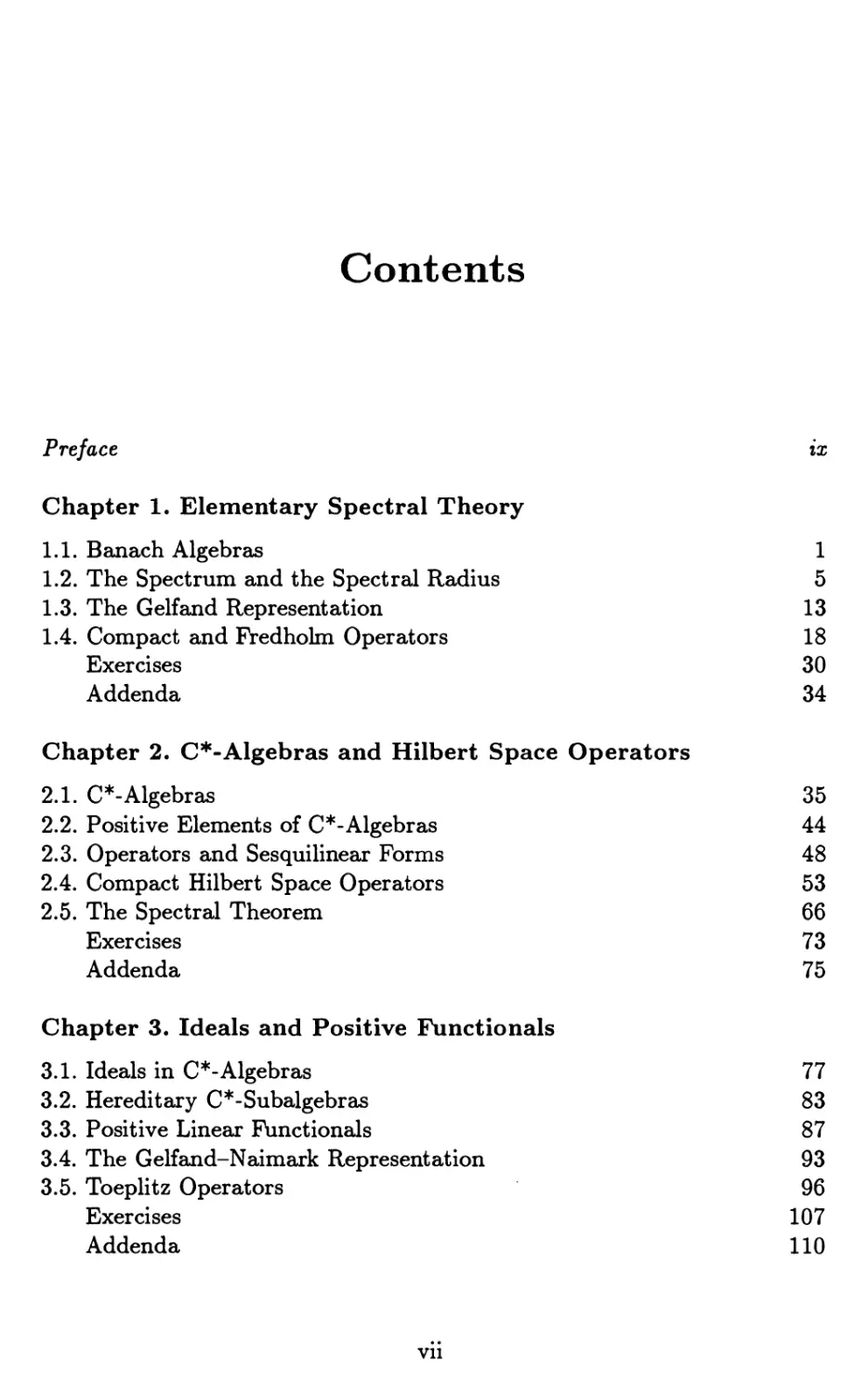
Contents
Preface 9
Chapter 1. Elementary Spectral Theory
1.1. Banach Algebras 1
1.2. The Spectrum and the Spectral Radius 5
1.3. The Gelfand Representation 13
1.4. Compact and Fredholm Operators 18
Exercises 30
Addenda 34
Chapter 2. C*-Algebras and Hilbert Space Operators
2.1. C*-Algebras 35
2.2. Positive Elements of C*-Algebras 44
2.3. Operators and Sesquilinear Forms 48
2.4. Compact Hilbert Space Operators 53
2.5. The Spectral Theorem 66
Exercises 73
Addenda 75
Chapter 3. Ideals and Positive Functionals
3.1. Ideals in C*-Algebras 77
3.2. Hereditary C*-Subalgebras 83
3.3. Positive Linear Functionals 87
3.4. The Gelfand-Naimark Representation 93
3.5. Toeplitz Operators 96
Exercises 107
Addenda 110
vn
Vlll
Contents
Chapter 4. Von Neumann Algebras
4.1. The Double Commutant Theorem 112
4.2. The Weak and Ultraweak Topologies 124
4.3. The Kaplansky Density Theorem 129
4.4. Abelian Von Neumann Algebras 133
Exercises 136
Addenda 138
Chapter 5. Representations of C*-Algebras
5.1. Irreducible Representations and Pure States 140
5.2. The Transitivity Theorem 149
5.3. Left Ideals of C*-Algebras 153
5.4. Primitive Ideals 156
5.5. Extensions and Restrictions of Representations 162
5.6. Liminal and Postliminal C*-Algebras 167
Exercises 171
Addenda 172
Chapter 6. Direct Limits and Tensor Products
6.1. Direct Limits of C*-Algebras 173
6.2. Uniformly Hyperfinite Algebras 178
6.3. Tensor Products of C*-Algebras 184
6.4. Minimality of the Spatial C*-Norm 196
6.5. Nuclear C*-Algebras and Short Exact Sequences 210
Exercises 213
Addenda 216
Chapter 7. K-Theory of C*-Algebras
7.1. Elements of K-Theory 217
7.2. The K-Theory of AF-Algebras 221
7.3. Three Fundamental Results in K-Theory 229
7.4. Stability 241
7.5. Bott Periodicity 245
Exercises 262
Addenda 264
Appendix 267
Notes 277
References 279
Notation Index 281
Subject Index 283
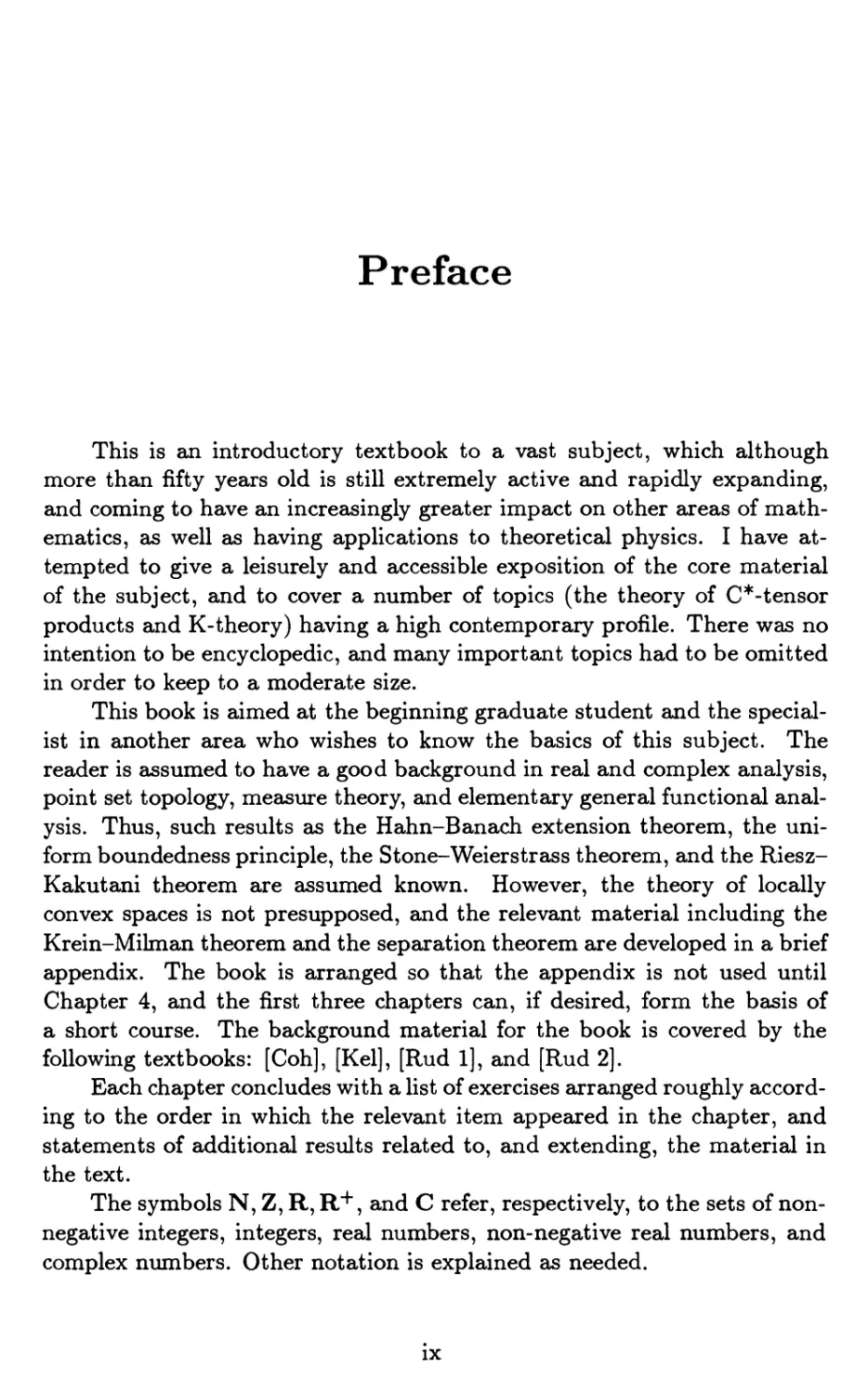
Preface
This is an introductory textbook to a vast subject, which although
more than fifty years old is still extremely active and rapidly expanding,
and coming to have an increasingly greater impact on other areas of math-
ematics, as well as having applications to theoretical physics. I have at-
tempted to give a leisurely and accessible exposition of the core material
of the subject, and to cover a number of topics (the theory of C*-tensor
products and K-theory) having a high contemporary profile. There was no
intention to be encyclopedic, and many important topics had to be omitted
in order to keep to a moderate size.
This book is aimed at the beginning graduate student and the special-
ist in another area who wishes to know the basics of this subject. The
reader is assumed to have a good background in real and complex analysis,
point set topology, measure theory, and elementary general functional anal-
ysis. Thus, such results as the Hahn-Banach extension theorem, the uni-
form boundedness principle, the Stone-Weierstrass theorem, and the Riesz-
Kakutani theorem are assumed known. However, the theory of locally
convex spaces is not presupposed, and the relevant material including the
Krein-Milman theorem and the separation theorem are developed in a brief
appendix. The book is arranged so that the appendix is not used until
Chapter 4, and the first three chapters can, if desired, form the basis of
a short course. The background material for the book is covered by the
following textbooks: [Coh], [Kel], [Rud 1], and [Rud 2].
Each chapter concludes with a list of exercises arranged roughly accord-
ing to the order in which the relevant item appeared in the chapter, and
statements of additional results related to, and extending, the material in
the text.
The symbols N, Z, R, R+, and C refer, respectively, to the sets of non-
negative integers, integers, real numbers, non-negative real numbers, and
complex ntUl1bers. Other notation is explained as needed.
.
IX
x
Preface
The reader who has finished this book and wants direction for further
study may refer to the Notes section where some books are recommended.
I am indebted to many authors of books on operator theory and oper-
ator algebras. Section 7.5 of this book is based on the approach of J. Cuntz
to K-theory. I should like to thank my colleagues Trevor West and Martin
Mathieu for reading preliminary drafts of some of the earlier chapters.
Gerard J. Murphy
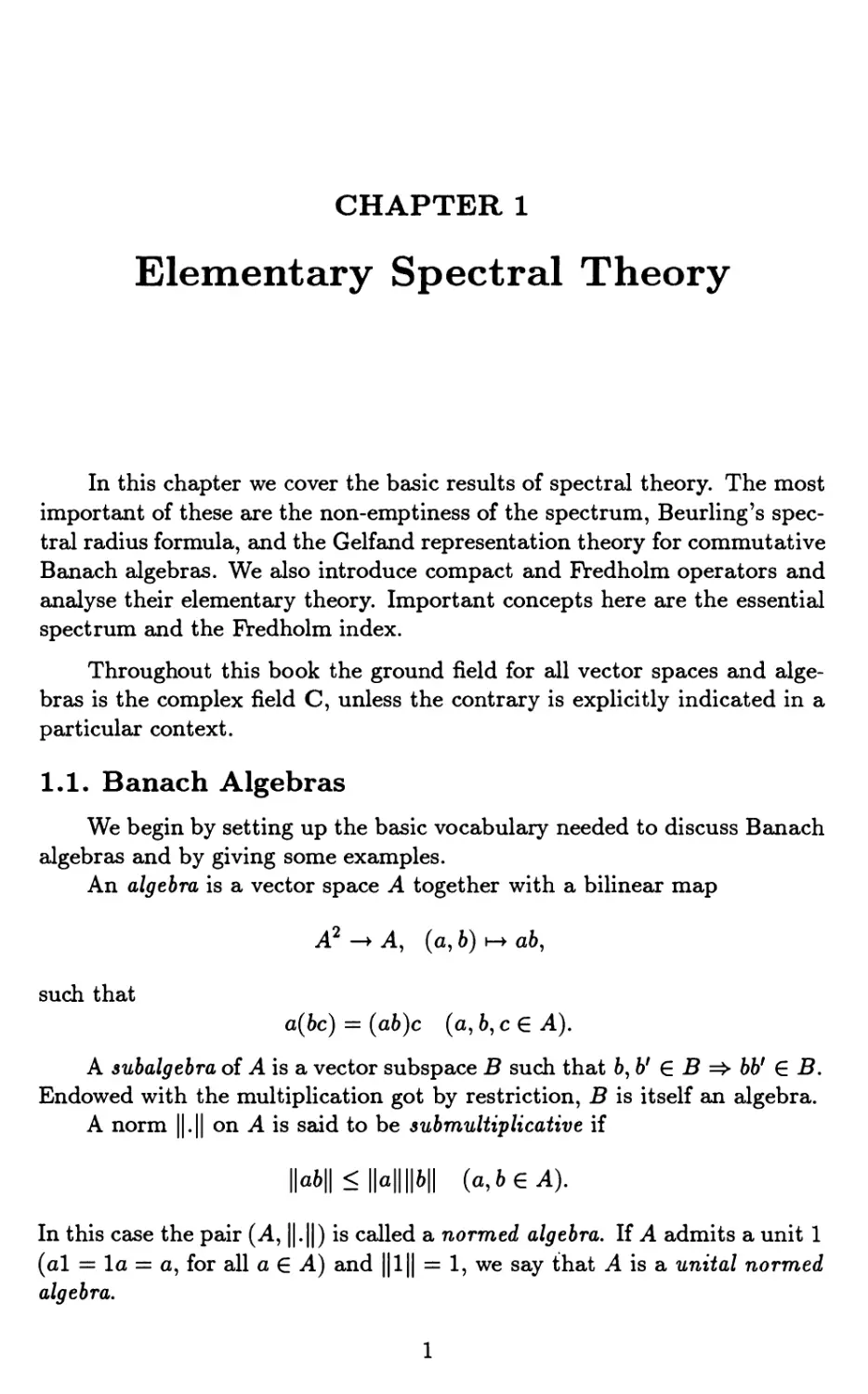
CHAPTER 1
Elementary Spectral Theory
In this chapter we cover the basic results of spectral theory. The most
important of these are the non-emptiness of the spectrum, Beurling's spec-
tral radius formula, and the Gelfand representation theory for commutative
Banach algebras. We also introduce compact and Fredholm operators and
analyse their elementary theory. Important concepts here are the essential
spectrum and the Fredholm index.
Throughout this book the ground field for all vector spaces and alge-
bras is the complex field C, unless the contrary is explicitly indicated in a
particular context.
1.1. Banach Algebras
We begin by setting up the basic vocabulary needed to discuss Banach
algebras and by giving some examples.
An algebra is a vector space A together with a bilinear map
A 2 -+ A, (a, b) ab,
such that
a( be) = (ab)e ( a, b, e E A).
A subalgebra of A is a vector subspace B such that b, b' E B => bb' E B.
Endowed with the multiplication got by restriction, B is itself an algebra.
A norm 11.11 on A is said to be submultiplicative if
lIabll < lIalillbll (a, b E A).
In this case the pair (A, 11.11) is called a normed algebra. If A admits a unit 1
(a1 = 1a = a, for all a E A) and 11111 = 1, we say that A is a unital normed
algebra.
1
2
1. Elementary Spectral Theory
If A is a normed algebra, then it is evident from the inequality
lIab - a'b'lI < lIalillb - b'lI + lIa - a'lllIb'lI
that the multiplication operation ( a, b) ab is jointly continuous.
A complete normed algebra is called a Banach algebra. A complete
unital normed algebra is called a unital Banach algebra.
A subalgebra of a normed algebra is obviously itself a normed alge-
bra with the norm got by restriction. The closure of a subalgebra is a
subalgebra. A closed subalgebra of a Banach algebra is a Banach algebra.
1.1.1. Ezample. If 5 is a set, /,00(5), the set of all bounded complex-
valued functions on 5, is a unital Banach algebra where the operations are
defined pointwise:
(f + g) (x) = f(x) + g(x)
(fg)(x) = f(x)g(x)
(Af)(x) = Af(x),
and the norm is the sup-norm
Ilfll oo = sup If(x)l.
xES
1.1.2. Ezample. If f! is a topological space, the set Cb(f!) of all bounded
continuous complex-valued functions on f! is a closed subalgebra of /,oo(f!).
Thus, Cb(f!) is a unital Banach algebra.
If f! is compact, C(f!), the set of continuous functions from f! to C, is
of course equal to Cb(f!).
1.1.3. Ezample. If f! is a locally compact Hausdorff space, we say that a
continuous functionf from f! to C vanishes at infinity, if for each positive
number £ the set {w E f! Ilf(w)1 > £} is compact. We denote the set of
such functions by C o ( f!). It is a closed subalgebra of Cb(f!), and therefore,
a Banach algebra. It is unital if and only if f! is compact, and in this case
Co(f!) = C(f!). The algebra Co(f!) is one of the most important examples
of a Banach algebra, and we shall see it used constantly in C*-algebra
theory (the functional calculus).
1.1.4. Ezample. If (f!, Jl) is a measure space, the set L 00 (f2, Jl) of ( classes
of) essentially bounded complex-valued measurable functions on f! is a
unital Banach algebra with the usual (pointwise-defined) operations and
the essential supremum norm f Ilflloo.
1.1. Banach Algebras
3
1.1.5. E ample. If f! is a measurable space, let Boc>(f!) denote the set of
all bounded complex-valued measurable functions on f!. Then Boc>(f!) is a
closed subalgebra of fOC>(f!), so it is a unital Banach algebra. This example
will be used in connection with the spectral theorem in Chapter 2.
1.1.6. E ample. The set A of all continuous functions on the closed
unit disc D in the plane which are analytic on the interior of D is a closed
subalgebra of C(D), so A is a unital Banach algebra, called the di3c algebra.
This is the motivating example in the theory of function algebras, where
many aspects of the theory of analytic functions are extended to a Banach
algebraic setting.
All of the above examples are of course abelian-that is, ab = ba for
all elements a and b-but the following examples are not, in general.
1.1.7. E ample. If X is a normed vector space, denote by B(X) the set
of all bounded linear maps from X to itself (the operator3 on X). It is
routine to show that B(X) is a normed algebra with the pointwise-defined
operations for addition and scalar multiplication, multiplication given by
( u, v) u 0 v, and norm the operator norm:
lIu II = sup lIu( x )11 = sup lIu( x )11.
x#O IIxll IIxll l
If X is a Banach space, B(X) is complete and is therefore a Banach
algebra.
1.1.8. E ample. The algebra Mn(e) of n x n-matrices with entries in e
is identified with B( en). It is therefore a unital Banach algebra. Recall
that an upper triangular matrix is one of the form
All Al2 Al n
o A22 A2n
o 0 A33 A3n
o 0 0 Ann
(all entries below the main diagonal are zero). These matrices form a
sub algebra of Mn(e).
We shall be seeing many more examples of Banach algebras as we
proceed. Most often these will be non-abelian, but in the first three sections
of this chapter we shall be principally concerned with the abelian case.
If (B).)).EA is a family of subalgebras of an algebra A, then n).EAB). is
a subalgebra, also. Hence, for any subset S of A, there is a smallest subal-
gebra B of A containing S (namely, the intersection of all the subalgebras
4
1. Elementary Spectral Theory
containing S). This algebra is called the sub algebra of A generated by S.
If S is the singleton set {a}, then B is the linear span of all powers an
(n = 1,2,...) of a. If A is a normed algebra, the closed algebra G g ated
by a set S is the smallest closed subalgebra containing S. It is plain that
G = B, where B is the sub algebra generated by S.
If A = G(T), where T is the unit circle, and if z: T -+ C is the inclusion
function, then the closed algebra generated by z and its conjugate z is G(T)
itself (immediate from the Stone-Weierstrass theorem).
A left (respectively, right) ideal in an algebra A is a vector subspace I
of A such that
a E A and bEl => ab E I (respectively, ba E I).
An ideal in A is a vector subspace that is simultaneously a left and a right
ideal in A. Obviously, 0 and A are ideals in A, called the trivial ideals.
A maximal ideal in A is a proper ideal (that is, it is not A) that is not
contained in any other proper ideal in A. Maximal left ideals are defined
similarly.
An ideal I is modular if there is an element u in A such that a - au
and a - ua are in I for all a E A. It follows easily from Zorn's lemma that
every proper modular ideal is contained in a maximal ideal.
If w is an element of a locally compact Hausdorff space n, and Mw =
{f E Co(n) I f(w) = OJ, then Mw is a modular ideal in the algebra Co(n).
This is so because there is an element u E Co(n) such that u(w) = 1, and
hence, f - uf E MWJ for all f E Go(n). Since MWJ is of co dimension one in
Co(n) (as M EB eu = Co(n)), it is a maximal ideal.
If I is an ideal of A, then AI I is an algebra with the multiplication
given by
(a + 1)( b + I) = ab + I.
If I is modular, then AI I is unital (if a - au, a - ua E I for all a E A, then
u + I is the unit). Conversely, if AI I is unital then I is modular.
If A is unital, then obviously all its ideals are modular, and therefore,
A posesses maximal ideals.
If (I..\)..\EA is a family of ideals of an algebra A, then n..\EAI..\ is an
ideal of A. Hence, if S C A, there is a smallest ideal I of A containing
S. We call I the ideal generated by S. If A is a normed algebra, then the
closure of an ideal is an ideal. The closed ideal J generated by a set S is
the smallest closed ideal containing S. It is clear that J is the closure of
the ideal generated by S.
1.2. The Spectrum and the Spectral Radius
5
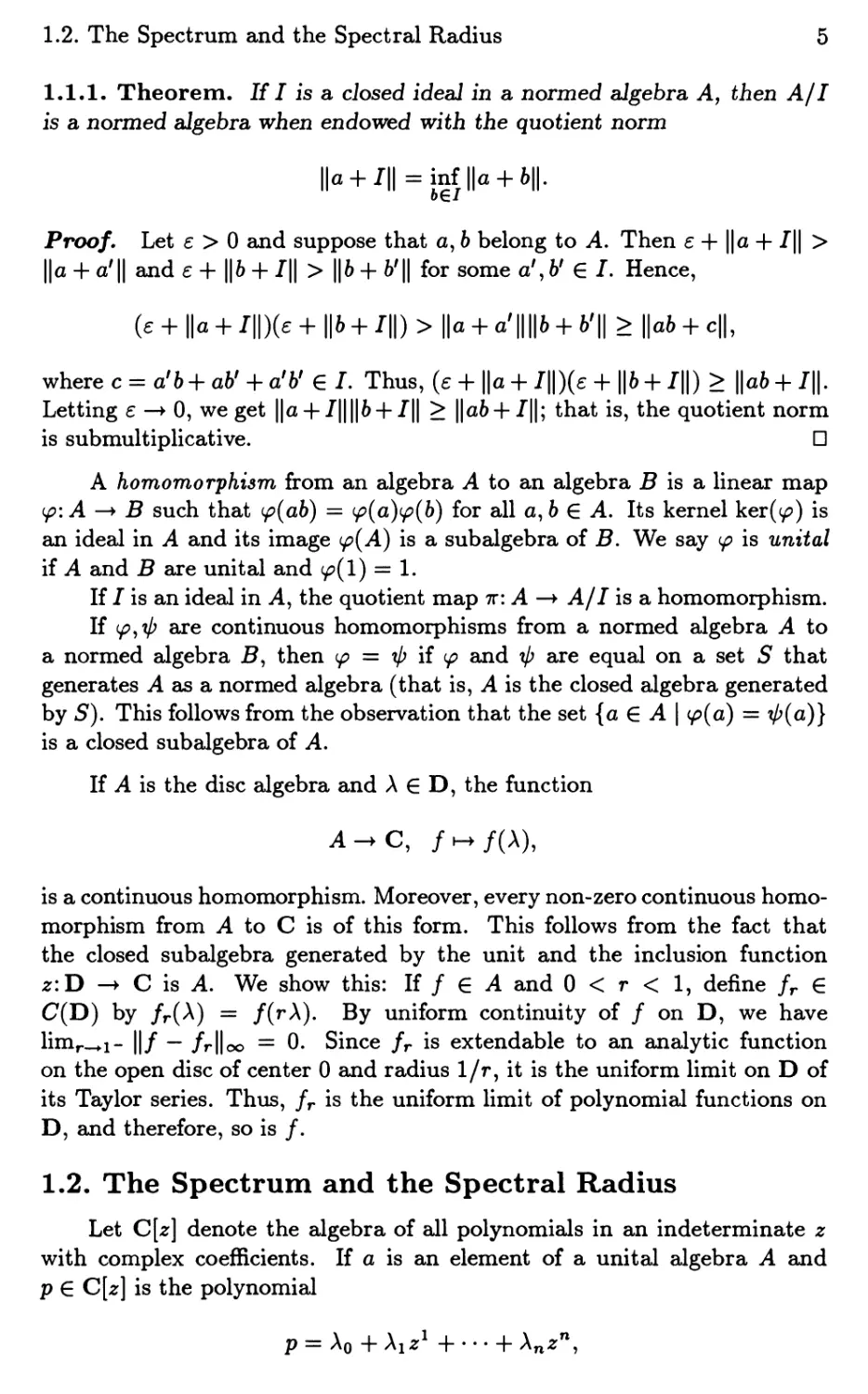
1.1.1. Theorem. If I is a closed ideal in a normed algebra A, then AI I
is a normed algebra when endowed with the quotient norm
lIa + III = inf lIa + bll.
bEl
Proof. Let £ > 0 and suppose that a, b belong to A. Then £ + lIa + III >
lIa + a'il and £ + lib + III > lib + b'lI for some a', b' E I. Hence,
(£ + lIa + 111)(£ + lib + III) > lIa + a'lIlIb + b'lI > lIab + ell,
where e = a'b+ ab' + a'b' E I. Thus, (e + lIa + 111)(£ + IIb+ III) > lIab + III.
Letting £ -+ 0, we get lIa + III lib + III > Ilab + III; that is, the quotient norm
is submultiplicative. 0
A homomorphi3m from an algebra A to an algebra B is a linear map
I.p: A -+ B such that <pC ab) = I.p( a )I.p( b) for all a, b E A. Its kernel ker( <p) is
an ideal in A and its image <p(A) is a subalgebra of B. We say I.p is unital
if A and B are unital and <p(1) = 1.
If I is an ideal in A, the quotient map 7r: A -+ AI I is a homomorphism.
If <p,,,p are continuous homomorphisms from a normed algebra A to
a normed algebra B, then <p = "p if <p and "p are equal on a set S that
generates A as a normed algebra (that is, A is the closed algebra generated
by S). This follows from the observation that the set {a E A I <pC a) = "p( a)}
is a closed subalgebra of A.
If A is the disc algebra and A ED, the function
A -+ e, f f(A),
is a continuous homomorphism. Moreover, every non-zero continuous homo-
morphism from A to C is of this form. This follows from the fact that
the closed subalgebra generated by the unit and the inclusion function
z:D -+ e is A. We show this: If f E A and 0 < r < 1, define fr E
C(D) by fr(A) = f(rA). By uniform continuity of I on D, we have
limr l- III - Irlloo = o. Since Ir is extendable to an analytic function
on the open disc of center 0 and radius 1/r, it is the uniform limit on D of
its Taylor series. Thus, fr is the uniform limit of polynomial functions on
D, and therefore, so is f.
1.2. The Spectrum and the Spectral Radius
Let e[z] denote the algebra of all polynomials in an indeterminate z
with complex coefficients. If a is an element of a unital algebra A and
p E C[z] is the polynomial
p = Ao + AIZ1 + ... + AnZ n ,
6
1. Elementary Spectral Theory
we set
p(a) = Ao1 + AlaI +... + Ana n .
The map
C[z] -+ A, p p(a),
is a unital homomorphism.
We say that a E A is invertible if there is an element b in A such that
ab = ba = 1. In this case b is unique and written a-I. The set
Inv(A) = {a E A I a is invertible}
is a group under multiplication.
We define the 3pectrum of an element a to be the set
a(a) = a A(a) = {A Eel Al - a ft: Inv(A)}.
We shall henceforth find it convenient to write Al simply as A.
1.2.1. Ezample. Let A = C(f2), where f! is a compact Hausdorff space.
Then a(f) = f(f!) for all f E A.
1.2.2. Ezample. Let A = £oo(S), where S is a non-empty set. Then
a(f) = (f(S))- (the closure in C) for all f E A.
1.2.3. Ezample. Let A be the algebra of upper triangular n x n-matrices.
If a E A, say
All A 1 2 Al n
o A22 A2n
o 0 Ann
a=
it is elementary that
a(a) = {All, A22'...' Ann}.
Similarly, if A = Mn(C) and a E A, then a(a) is the set of eigenvalues
of a.
Thus, one thinks of the spectrum as simultaneously a generalisation of
the range of a function and the set of eigenvalues of a finite square matrix.
1.2.1. Remark. If a, b are elements of a unital algebra A, then 1 - ab is
invertible if and only if 1-ba is invertible. This follows from the observation
that if 1 - ab has inverse c, then 1 - ba has inverse 1 + bca.
A consequence of this equivalence is that a(ab) \ {O} = a(ba) \ {O} for
all a, b E A.
1.2. The Spectrum and the Spectral Radius
7
1.2.1. Theorem. Let a be an element of a unital algebra A. If O'(a) is
non-empty and p E C[z], then
O'(p( a)) = p( 0'( a)).
Proof. We may suppose that p is not constant. If f.-l E e, there are
elements Ao, . . . , An in C, where Ao =I- 0, such that
p - f.-l = Ao(z - AI)... (z - An),
and therefore,
p( a) - f.-l = Ao (a - AI) . . . (a - An).
It is clear that p( a) - f.-l is invertible if and only if a - AI, . . . , a - An are.
It follows that f.-l E O'(p( a)) if and only if f.-l = p( A) for some A E 0'( a), and
therefore, O'(p( a)) = p( 0'( a)). 0
The spectral mapping property for polynomials is generalised to con-
tinuous functions in Chapter 2, but only for certain elements in certain
algebras. There is a version of Theorem 1.2.1 for analytic functions and
Banach algebras (see [Tak, Proposition 2.8], for example). We shall not
need this, however.
1.2.2. Theorem. Let A be a unital Banach algebra and a an element of
A such that "all < 1. Then 1 - a E Inv(A) and
00
(1- a)-1 = Lan.
n=O
Proof. Since E =o Ilanll < E =o lIall n = (1 - Il a ll)-1 < +00, the series
E =o an is convergent, to b say, in A, and since (1 - a)(l + . . . + an) =
1 - a n + 1 converges to (1 - a)b = b(l - a) and to 1 as n 00, the element
b is the inverse of 1 - a. 0
The series in Theorem 1.2.2 is called the Neumann series for (1- a)-I.
1.2.3. Theorem. If A is a unital Banach algebra, then Inv(A) is open in
A, and the map
Inv(A) A,
a a-I
,
is differentiable.
Proof. Suppose that a E Inv(A) and lib-ail < "a-III-I. Then Ilba- 1 -111
< lib - alllla- 1 " < 1, so ba- 1 E Inv(A), and therefore, b E Inv(A). Thus,
Inv(A) is open in A.
8
1. Elementary Spectral Theory
If b E A and Ilbll < 1, then 1 + b E Inv(A) and
00
00
11(1 + b)-1 -1 + bll = II L(-l)nb n -1 + bll = II L(-l) nbn ll
n=O n=2
00
< L IIbli n = IIbIl 2 /(1 -lIbll)-1 .
n=2
Let a E Inv(A) and suppose that Ilell < !lIa- 1 11- 1 . Then lIa- 1 ell <
1/2 < 1, so ( with b = a-I e),
11(1 + a- 1 e)-1 - 1 + a- 1 ell < lIa-1eIl2/(1 -lIa-1ell)-1 < 21Ia- 1e Il 2 ,
since 1 -lIa-1ell > 1/2. Now define u to be the linear operator on A given
by u(b) = -a- 1 ba- 1 . Then,
II (a + e) -1 - a-I - u ( e) II = II (1 + a-I e) -1 a-I - a-I + a-I ea -111
< 11(1 + a- 1 e)-1 -1 + a- 1 elllla- 1 11 < 2(lIa- 1 1131IeIl 2 ).
Consequently,
lim Ilea + C)-I - a-I - ue c)1I = 0,
c--+O " e"
and therefore, the map a: b b- 1 is differentiable at b = a with derivative
a'(a) = u. 0
The algebra e[z] is a normed algebra where the norm is defined by
setting
Ilpll = sup Ip(A)I.
1 1 1
Observe that Inv(C[z]) = e \ {OJ, so the polynomials Pn = 1 + z/n are not
invertible. But limn--+ooPn = 1, which shows that Inv(e[z]) is not open in
C[z]. Thus, the norm on C[z] is not complete.
1.2.4. Lemma. Let A be a unital Banach algebra and let a E A. The
spectrum a( a) of a is a closed subset of the disc in the plane of centre the
origin and radius lIall, and the map
C\a(a)-+A, A (a-A)-I,
is differentiable.
Proof. If IAI > lIall, then IIA- 1 all < 1, so 1 - A- 1 a is invertible, and
therefore, so is A-a. Hence, A rt. a(a). Thus, A E a(a) => IAI < Iiali. The
set a(a) is closed, that is, C \ a(a) is open, because Inv(A) is open in A.
Differentiability of the map A (a - A)-1 follows from Theorem 1.2.3. 0
The following result can be thought of as the fundamental theorem of
Banach algebras.
1.2. The Spectrum and the Spectral Radius
9
1.2.5. Theorem (Gelfand). If a is an element of a unital Banach algebra
A, then the spectrum 0'( a) of a is non-empty.
Proof. Suppose that a( a) = 0 and we shall obtain a contradiction. If
IAI > 211all, then IIA- 1a ll < t, and therefore, l-IIA- 1a ll > t. Hence,
00
11(1- A- 1 a)-1 -111 = II L(A- 1 a)nll
n=1
IIA -lall 1
< 1 _ 11,\ -lall < 211,\ - all < 1.
Consequently, 11(1 - A -la)-111 < 2, and therefore,
II(a - A)-III = IIA- 1 (1- A- 1 a)-111 < 2/IAI < lIall- 1
(a i= 0 since a(a) = 0). Moreover, since the map A (a - A)-1 is contin-
uous, it is bounded on the (compact) disc 211a1lD. Thus, we have shown
that this map is bounded on all of C; that is, there is a positive number M
such that II( a - A)-III < M (A E C).
If TEA *, the function A T( (a - A) -1) is entire, and bounded by
MIITII, so by Liouville's theorem in complex analysis, it is constant. In
particular, T( a-I) = T( (a - 1) -1). Because this is true for all TEA *, we
have a-I = (a - 1)-1, so a = a-I, which is a contradiction. 0
It is easy to see that there are algebras in which not all elements have
non-empty spectrum. For example, if e( z) denotes the field of quotients
of e[z], then C(z) is an algebra, and the spectrum of z in this algebra is
empty.
1.2.6. Theorem (Gelfand-Mazur). If A is a unital Banach algebra in
which every non-zero element is invertible, then A = Cl.
Proof. This is immediate from Theorem 1.2.5. 0
If a is an element of a unital Banach algebra A, its spectral radius is
defined to be
r(a) = sup IAI.
.;\EO'( a)
By Remark 1.2.1, r(ab) = r(ba) for all a,b EA.
1.2.4. E ample. If A = C(n), where n is a compact Hausdorff space,
then r(f) = Ilflloo (f E A).
1.2.5. E ample. Let A = M 2 (C) and
a=( ).
Then lIall = 1, but r( a) = 0, since a 2 = o.
10
1. Elementary Spectral Theory
1.2.7. Theorem (Beurling). lfa is an element afa unital Banach algebra
A, then
r( a) == inf lIa n IIl/n == lim lIa n Ill/n.
n>l n-+oo
Proof. If A E a(a), then An E a(a n ), so IAnl < lIanll, and therefore,
rea) < infn l lIanll l / n < liminf n -+ oo Ilanll l / n .
Let be the open disc in e centered at 0 and of radius 1/ r( a) (we
use the usual convention that 1/0 == +00). If A E , then 1 - Aa E Inv(A).
If r E A*, then the map
f: C, A r((l - Aa)-l),
is analytic, so there are unique complex numbers An such that
00
f(A) == L An An (A E ).
n=O
However, if IAI < l/llall( < l/r( a)), then IIAal1 < 1, so
00
(1 - Aa) -1 == LAn an ,
n=O
and therefore,
00
f(A) == L Anr(a n ).
n=O
It follows that An == r( an) for all n > o. Hence, the sequence (r( an)A n)
converges to 0 for each A E , and therefore a fortiori, it is bounded.
Since this is true for each r E A*, it follows from the principle of uniform
boundedness that (A na n ) is a bounded sequence. Hence, there is a positive
number M (depending on A, of course) such that II A n an II < M for all
n > 0, and therefore, Ilanll l / n < Ml/n/IAI (if A f= 0). Consequently,
lim SUPn-+oo lIanll l / n < l/IAI. We have thus shown that if r( a) < IA -11, then
lim SUPn-+oo lIanll l / n < IA -11. It follows that lim SUPn-+oo Ilanll l / n < r( a),
and since r(a) < liminf n -+ oo Ilanll l / n , therefore rea) == lim n -+ oo Ilanll l / n . 0
1.2.6. Ezample. Let A be the set of Cl-functions on the interval [0,1].
This is an algebra when endowed with the pointwise-defined operations,
and a submultiplicative norm on A is given by
Ilfll == II fll 00 + Ilf' II 00
(f E A).
It is elementary that A is complete under this norm, and therefore, A is
a Banach algebra. Let x: [0, 1] e be the inclusion, so x E A. Clearly,
IIxnll == 1 + n for all n, so r(x) == lim(l + n)l/n == 1 < 2 = Ilxll.
Recall that if 1< is a non-empty compact set in C, its complement
C \ 1< admits exactly one unbounded component, and that the bounded
components of e \ 1< are called the holes of I{.
1.2. The Spectrum and the Spectral Radius
11
1.2.8. Theorem. Let B be a closed subalgebra of a unital Banach algebra
A, containing the unit of A.
(1) The set Inv(B) is a clopen subset of B n Inv(A).
(2) For each b E B,
O'A(b) C O'B(b) and 80'B(b) C 80'A(b).
(3) lfb E B and O"A(b) has no holes, then O"A(b) = O"B(b).
Proof. Clearly Inv(B) is an open set in B n Inv(A). To see that it is
also closed, let (b n ) be a sequence in Inv(B) converging to a point b E
B n Inv(A). Then (b;;l) converges to b- 1 in A, so b- 1 E B, which implies
that b E Inv(B). Hence, Inv(B) is clop en in B n Inv(A).
If b E B, the inclusion 0" A ( b) C 0" B( b) is immediate from the inclusion
Inv(B) C Inv(A).
If A E 80" B (b), then there is a sequence (An) in e \ 0" B (b) converging
to A. Hence, b - An E Inv( B), and b - A Inv( B), so b - A Inv( A),
by Condition (1). Also, b - An E Inv(A), so An E C \ O'A(b). Therefore,
A E 80" A ( b). This proves Condition (2).
If b E Band 0" A (b) has no holes, then C \ 0" A (b) is connected. Since
C \ O'B(b) is a clop en subset of C \ O"A(b) by Conditions (1) and (2), it
follows that C \ 0" A(b) = C \ O"B(b), and therefore, 0" A(b) = O"B(b). 0
1.2.7. Ezample. Let G = G(T) and let A be the disc algebra. If f E A,
let c.p(f) be its restriction to T. One easily checks that the map
c.p: A G, f c.p(f),
is an isometric homomorphism onto the closed subalgebra B of C generated
by the unit and the inclusion z:T C (the equation 1Ic.p(f)lloo = Ilflioo is
given by the maximum modulus principle). Clearly, O"B(Z) = O"A(Z) = D,
and O"c(z) = T.
Let a be an element of a unital Banach algebra A. Since
00
00
L Ila n In!!1 < L lIalln In! < 00,
n=O n=O
the series 2::'=0 an In! is convergent in A. We denote its sum by ea.
In proving the next theorem, we shall use some elementary results
concerning differentiation. Suppose that f, 9 are differentiable maps from
R to A with derivatives f', g', respectively. Then f 9 is differentiable and
(fg)' = fg' + f'g. (To prove this, just mimic the proof of the scalar-valued
case.) If f' = 0, then f is constant. We prove this: If rEA *, then the
function R C, t r(f(t)), is differentiable with zero derivative, and
therefore, r(f(t)) = r(f(O)) for all t. Since r was arbitrary, this implies
that f(t) = f(O).
12
1. Elementary Spectral Theory
1.2.9. Theorem. Let A be a unital Banach algebra.
(1) If a E A and f: R -+ A is differentiable, f(O) = 1, and f'(t) = af(t)
for all t E R, then J(t) = eta for all t E R.
(2) If a E A, then e a is invertible with inverse e- a , and if a, b are commut-
ing elements of A, then e a + b = eae b .
Proof. First we observe that if f: R -+ A is defined by f(t) = eta, then
J(t) = E 0 tnan/nI, so differentiating term by term we get f'(t) = af(t).
Now suppose J, 9 are any pair of differentiable maps from R to A such
that f'(t) = af(t) and g'(t) = ag(t) and J(O) = g(O) = 1. Then the map
h: R -+ A, t J(t)g( -t), is differentiable with zero derivative (apply the
product rule for differentiation). Hence, h(t) = 1 for all t E R. Applying
this to the map t eta, we get etae- ta = 1; in particular, eae- a = 1.
It follows that if f: R -+ A is differentiable, f(O) = 1, and J'(t) = aJ(t)
for all t, then f(t) = eta (set g(t) = eta and get f(t)e- ta = 1, so f(t) = eta).
Now suppose that a and b are commuting elements of A and set f(t) =
etae tb . Then f(O) = 1 and f'(t) = etabe tb + aetae tb (by the product rule)
= (a + b )f(t). Hence, J(t) = et(a+b) for all t E R, so, in particular,
e a + b = f(l) = eae b . 0
We shall see later that not every invertible element is of the form ea.
If an algebra is non-unital we can adjoin a unit to it. This is very helpful
in many cases, and we shall frequently make use of it, but it does not reduce
the theory to the unital case. There are situations where adjoining a unit
is unnatural, such as when one is studying the group algebra £1 (G) of a
locally compact group G (see the addenda section of this chapter for the
definition of this algebra).
If A is an alg«:bra, we set A = A E8 e as a vector space. We define a
multiplication on A making it a unital algebra by setting
(a, A)( b, j-t) = (ab + Ab + j-ta, Aj-t).
The unit is (0,1). The algebra A is called the unitization of A. The map
A -+ A, a (a, 0),
is an injective homomorphism, which we use to identify A as an ideal of A.
We then write a + A for (a, A). The map
A -+ C, a + A A,
is a unital homomorphism with kernel A, called the canonical homomor-
phism.
If A is abelian, so is A.
1.3. The Gelfand Representation
13
If A is a normed algebra, we make A into a normed algebra by setting
lIa + All = lIall + I A I.
Observe that A is a closed subalgebra of A, and that A is a Banach algebra
if A is one.
If A is a non-unital Banach algebra, then for a E A we set 0' A (a) =
0' A(a), and r(a) = sUPAEO'A(a) IAI. Note that 0 is an element of O'A(a) in
this case.
1.3. The Gelfand Representation
The idea of this section is to represent an abelian Banach algebra as an
algebra of continuous functions on a locally compact Hausdorff space. This
is an extremely useful way of looking at these algebras, but in the case of
the more "complicated" algebras, the picture it presents may be of limited
accuracy.
We begin by proving some results on ideals and multiplicative linear
functionals.
1.3.1. Theorem. Let I be a modular ideal of a Banach algebra A. If I is
proper, so is its closure I. If I is maximal, then it is closed.
Proof. Let u be an element of A such that a - au and a - ua are in I
for all a E A. If b E I and lIu - bll < 1, then the element v = 1 - u + b is
invertible in A. If a E A, then av = a - au + ab E I, so A = Av C I. This
contradicts the assumption that I is proper, and shows that lIu - bll > 1
for all b E I. It follows that u fI. I, so I is proper.
If I is maximal, then I = I, as 1 is a proper ideal containing I. 0
1.3.1. Remark. If L is a left ideal of a Banach algebra A, it is modular if
there is an element u in A such that a - au E L for all a E A, and in this
case its closure is a proper left ideal. Moreover, if L is a modular maximal
left ideal, it is closed. The proofs are the same as for Theorem 1.3.1.
1.3.2. Lemma. If I is a modular maximal ideal of a unital abelian algebra
A, then AI I is a field.
Proof. The algebra AI I is unital and abelian, with unit u + I say. If J
is an ideal of AI I and 7r is the quotient map from A to AI I, then 7r- 1 (J)
is an ideal of A containing I. Hence, 7r- 1 (J) = A or I, by maximality of I.
Therefore, J = AI I or o. Thus, AI I and 0 are the only ideals of AI I. Now
suppose that 7r( a) is a non-zero element of AI I. Then J = 7r( a)( AI I) is a
non-zero ideal of AI I, and therefore, J = AI I. Hence, there is an element
b of A such that (a + I)(b + I) = u + I, so a + I is invertible. This shows
that AI I is a field. 0
14
1. Elementary Spectral Theory
Note that if cp: A -+ B is a homomorphism between algebras A and B
and B is unital, then cp: A -+ B, a + ,,\ cp( a) +"\, (a E A, ,,\ E C) is the
unique unital homomorphism extending cp.
If cp: A -+ B is a unital homomorphism between unital algebras, then
cp(Inv(A)) C Inv(B), so a(cp(a)) C a(a) (a E A).
A character on an abelian algebra A is a non-zero homomorphism
T: A -+ e. We denote by n(A) the set of characters on A.
1.3.3. Theorem. Let A be a unital abelian Banach algebra.
(1) If T E n( A), then IITII = 1.
(2) The set n(A) is non-empty, and the map
T ker(T)
defines a bijection from n(A) onto the set of all maximal ideals of A.
Proof. If T E n(A) and a E A, then T(a) E a(a), so IT(a)1 < r(a) < Iiali.
Hence, IITU < 1. Also, T(l) = 1, since T(l) = T(I)2 and T(l) f= o. Hence,
liT II = 1.
Let I denote the closed ideal ker( T). This is proper, since T f= 0, and
I + C1 = A, since a - T( a) E I for all a E A. It follows that I is a maximal
ideal of A.
If Tl, T2 E n( A) and ker( Tl) = ker( T2), then for each a E A we have
Tl(a - T2(a)) = 0, so Tl(a) = T2(a). Thus, Tl = T2.
If I is an arbitrary maximal ideal of A, then I is closed by Theorem 1.3.1
and AI I is a unital Banach algebra in which every non-zero element is in-
vertible, by Lemma 1.3.2. Hence, by Theorem 1.2.6 AI I = C(l + I). It
follows that A = IE8C1. Define T:A -+ C by T(a+"\) ="\, (a E I, ,,\ E C).
Then T is a character and ker( T) = I.
Thus, we have shown that the map T ker( T) is a bijection from the
characters onto the maximal ideals of A.
We have seen already that A admits maximal ideals (since it is unital).
Therefore, n(A) i= 0. 0
1.3.4. Theorem. Let A be an abelian Banach algebra.
(1) If A is unital, then
a(a) = {T(a) IT E n(A)} (a E A).
(2) If A is non-tmital, then
a(a) = {T(a) IT E n(A)} U {OJ (a E A).
Proof. If A is unital and a is an element of A whose spectrum contains "\,
then the ideal I = (a - "\)A is proper, so I is contained in a maximal ideal
1.3. The Gelfand Representation
15
ker(r), where r E O(A). Hence, r(a) = A. This shows that the inclusion
a( a) C {r( a) IrE O( A)} holds, and the reverse inc!usion is clear.
Now suppose that A is non-unital, and let roo: A --+ e be the canonical
homomorphism. Then O(A) = {f IrE O(A)}U{r oo }, where f is the unique
character on A extending the character r on A. Hence, by Condition (1),
a(a) = aA(a) = {r(a) IrE O(A)} = {r(a) IrE n(A)} U {OJ for each
a E A. 0
If A is an abelian Banach algebra, it follows from Theorem 1.3.4 that
O(A) is contained in the closed unit ball of A*. We endow O(A) with the
relative weak* topology, and call the topological space O(A) the character
space, or spectrum, of A.
1.3.5. Theorem. If A is an abelian Banach algebra, then O(A) is a locally
compact Hausdorff space. If A is unital, then O(A) is compact.
Proof. It is easily checked that O(A) U {OJ is weak* closed in the closed
unit ball S of A*. Since S is weak* compact (Banach-Alaoglu theorem),
O(A) U {OJ is weak* compact, and therefore, O(A) is locally compact.
If A is unital, then O(A) is weak* closed in S and thus compact. 0
Note that O(A) may be empty. This is the case for A = 0, for example.
Suppose that A is an abelian Banach algebra for which the space O(A)
is non-empty. If a E A, we define the function a. by
a.: O(A) --+ C, r t-+ r(a).
Clearly the topology on O(A) is the smallest one making all of the functions
a continuous. The set {r E O(A) Ilr(a)1 > £} is weak* closed in the closed
unit ball of A* for each £ > 0, and weak* compact by the Banach-Alaoglu
theorem. Hence, a E C o (f2(A)).
We call a the Gelfand transform of a.
Although the following result is very important, its proof is easy, be-
cause we have already done most of the work needed to demonstrate it.
1.3.6. Theorem (Gelfand Representation). Suppose that A is an
abelian Banach algebra and that O( A) is non-empty. Then the map
A --+ Co(O(A)), a t-+ a,
is a norm-decreasing homomorphism, and
r(a) = lIali oo
(a E A).
If A is unital, a(a) = a(O(A)), and if A is non-unital, u(a) = a(O(A))U{O},
for each a E A.
16
1. Elementary Spectral Theory
Proof. By Theorem 1.3.4 the spectrum 0-( a) is the range of a, together
with {OJ if A is non-unital. Hence, r(a) = lIall oo , which implies that the
map a a is norm-decreasing. That this map is a homomorphism is easily
checked. 0
The kernel of the Gelfand representation is called the radical of the
algebra A. It consists of the elements a such that r( a) = o. It therefore
contains the nilpotent elements. If the radical is zero, A is said to be
3emi3imple.
In a general algebra an element whose spectrum consists of the set {OJ
is said to be qua3inilpotent.
Let a, b be commuting elements of an arbitrary Banach algebra A.
Then r(a + b) < r(a) + r(b), and r(ab) < r(a)r(b). To see this, we
may suppose that A is unital and abelian (if necessary, adjoin a unit
and restrict to the closed subalgebra generated by 1, a, and b). Then
r(a + b) = lI(a + b)"lIoo < lIali ce + IIbli oo = rea) + r(b) by Theorem 1.3.6.
Similarly, r(ab) = lI(ab)"lIoo < lIalloollblloo = r(a)r(b). Direct proofs of the
first of these inequalities (that is, where the Gelfand representation is not
invoked) tend to be messy.
The spectral radius is neither subadditive nor submultiplicative in gen-
eral: Let A = M 2 (C) and suppose
a = ( )
and
b=( ).
Then rea) = r(b) = 0, since a and b have square zero, but r(a + b)
r(ab) = 1.
The interpretation of the character space as a sort of generalised spec-
trum is motivated by the following result.
1.3.7. Theorem. Let A be a unital Banach algebra generated by 1 and
an element a. Then A is abelian and the map
a: f2(A) o-(a), T T(a),
is a homeomorphism.
Proof. It is clear that A is abelian and that a is a continuous bijection,
and because f2( A) and 0-( a) are compact Hausdorff spaces, a is therefore a
homeomorphism. 0
To illustrate this, consider the disc algebra A. If z is its canonical
generator, then since o-(z) = D, we have f2(A) = D by Theorem 1.3.7.
In this case if f E A, then j(A) = f(A), so the Gelfand transform is the
identity map.
We now present an interesting application of the preceding results to
a problem in classical analysis.
1.3. The Gelfand Representation
17
1.3.1. Ezample. We denote by f 1 (Z) the set of all complex-valued func-
tions f on Z such that E =-oo If(n)1 is finite. This is a Banach space when
endowed with the pointwise-defined operations and the norm
00
IIfllt = 2: If(n)l.
n=-oo
If f, 9 E /,1 (Z) we define their convolution f * g: Z C by the formula
00
(f * g)(m) = 2: f(m - n)g(n).
(1)
n=-oo
If f E ll(Z), it is bounded, so the sum in Eq. 1 exists. To see that f * 9 E
ll(Z) observe that
00 00 00
2: I(f * g)(n)1 = 2: I 2: fen - m)g(m)1
n=-oo
n=-oo m=-oo
00 00
< 2: 2: If(n - m)llg(m)1
n=-oo m=-oo
00 00
= 2: 2: If(n - m)llg(m)1
m=-oo n=-oo
mf;oo (lg(m)1 n oo If(n - m)l)
00
2: Ig(m)llIfllt = IIf1l111g111.
m=-oo
Thus, f * 9 E ll(Z) and IIf * gilt < IIfllt IIg1l1. It is now a straightforward
exercise to show that /,l(Z) is an abelian unital Banach algebra with mul-
tiplication given by (f, g) f * g. The characteristic function of the set
{O} is the unit, and if w is the characteristic function of the set {I}, then
f = E _ -oo f(n)w n for all f E ll(Z).
For z E T, define a character Tz on f 1 (Z) by setting
00
Tz(f) = 2: f(n)zn.
n=-oo
We then have a map
T n(f 1 (Z)), z Tz,
18
1. Elementary Spectral Theory
which, it is easy to check, is a bijection. In fact, this is a homeomorphism,
and to see this we need only show continuity, since the domain and range
are compact and Hausdorff. Continuity is shown if we show the function
T e, z Tz(f), is continuous when f E £l(Z), and this follows from the
observation that Tz(f) is the uniform limit in z of the continuous functions
Elnl N f(n )zn (N = 1,2,. · .), since E -00 If(n)znl = IIfll1 < 00.
We identify Q(i 1 (Z)) with T using the above homeomorphism. Thus,
the Gelfand transform j of f E £l(Z) is a continuous function on T such
that
00
j(z) = L f(n)zn.
n=-oo
It is readily verified that the numbers f( n) are the Fourier coefficients of j,
f ( n) = {21f j ( e it)e -i nt dt.
27r Jo
Thus £1 (Z)", the set of all Gelfand transforms, is the set of all functions
h E G(T) whose Fourier series is absolutely convergent. One can show
that not every function in C(T) has such a Fourier series. A well-known
theorem of Wiener states that if a continuous function on T has an absoluely
convergent Fourier series and never vanishes, then its reciprocal has such
a Fourier series. The proof of this is easy, using what we know about the
algebra £1 (Z):
Let h be a continuous function that never vanishes and that has ab-
solutely convergent Fourier series, so h = j for some f E £l(Z). Because
j(z) i= 0 for all z E T, it follows from Theorem 1.3.4 that 0 rt. a(f). Thus,
f is invertible in £1 (Z), with inverse 9 say. Then 9 = 1/ h, so 1/ h has
absolutely convergent Fourier series.
This proof is due to Gelfand.
We shall resume our study of Banach algebras in Chapter 2, but now
we turn to single operator theory.
1.4. Compact and Fredholm Operators
This section is concerned with the elementary spectral theory of oper-
ators. We begin with the simplest non-trivial class of operators, the com-
pact ones, a class that plays an important and fundamental role in operator
theory. These operators behave much like operators on finite-dimensional
vector spaces, and for this reason they are relatively easy to analyse.
A linear map u: X Y between Banach spaces X and Y is compact
if u( S) is relatively compact in Y, where S is the closed unit ball of X.
Equivalently, u( S) is totally bounded. In this case u( S) is bounded, and
therefore, u is bounded.
1.4. Compact and Fredholm Operators
19
1.4.1. Remark. Note that the range of a compact operator is separable.
This is immediate from the fact that a compact metric space is separable,
and that the closure of the image of the ball under a compact operator is
compact.
The theory of compact operators arose out of the analysis of linear
integral equations. The following example illustrates the connection.
1.4.1. Ezample. Let [ = [0,1] and let X be the Banach space C(I),
where the norm is the supremum norm. If k E C(I 2 ), define u E B(X) by
setting
u(f)(s) = 1 1 k(s, t)f(t) dt (f E x, s E I).
We show that u(f) EX. Observe first that
lu(f)( s) - u(f)( s')1 = III (k( s, t) - k( s', t))f(t) dtl
< 1 1 I k ( s, t) - k( s' , t) II f ( t ) I dt
< sup Ik(s, t) - k(s', t)llIfllooo
tEl
Now k is uniformly continuous because [2 is compact, so if c > 0, there
exists 8 > 0 such that max{ls - s'l, It - t'l} < 8 => Ik(s, t) - k(s', t')1 < c.
Hence,
Is - s'l < 8 => lu(f)(s) - u(f)(s')1 < £11/1100.
(1)
Thus, u(f) is continuous, that is, u(f) EX, but more is true, for it
is immediate from Inequality (1) that u(S) is equicontinuous, where S
is the closed unit ball of X. Also, u( S) is pointwise-bounded, that is,
sUPfES lu(f)(s)1 < 00, since
I u (f) ( s ) I < 1 1 I k ( s, t) f ( t ) 1 dt < II k II 00 II f II 00 .
By the Arzela-Ascoli theorem [Rud 2, Theorem A5] the set u(S) is totally
bounded. Therefore, u is a compact operator on X. The function k is
called the kernel of the operator u, and u is called an integral operator.
A similar example is obtained if we define v E B(X) by v(f)(s) =
s s'
10 f(t)dt. If s,s' E I and f E X, then Iv(f)(s)-v(f)(s')1 = I Is f(t)dtl <
Is - s'lllflloo. Hence, v(S) is equicontinuous and pointwise-bounded, so
by the Arzela-Ascoli theorem again, v(S) is totally bounded; that is, v is
compact.
Observe that v has no eigenvalues (it will follow from Theorem 1.4.11
that v is quasi nilpotent ). That v(f) = 0 => f = 0 is elementary. Suppose
20
1. Elementary Spectral Theory
then that A E e \ {OJ and f E X and v(f) = Af. Then f(O) = 0 and
(by differentiation) f'(t) = Jlf(t), where Jl = 1/ A. Consequently, f(t) =
f(O)e llt = 0 for all t, so f = o.
The operator v is called the Volterra integral operator on X.
If X, Yare Banach spaces, we denote by B(X, Y) the vector space
of all bounded linear maps from X to Y. This is a Banach space when
endowed with the operator norm. The set of all compact operators from X
to Y is denoted by K(X, Y).
The proof of the following is a routine exercise.
1.4.1. Theorem. Let X and Y be Banach spaces and U E B(X, Y). Then
the following conditions are equivalent:
(1) U is compact;
(2) For each bounded set S in X, the set u( S) is relatively compact in Y;
(3) For each bounded sequence (xn) in X, the sequence (u(xn)) admits a
subsequence that converges in Y.
It follows easily from Theorem 1.4.1 that [{(X, Y) is a vector subspace
of B(X, Y). Also, if X' X Y Y' are bounded linear maps between
Banach spaces and u is compact, then wu and uv are compact. Hence
K(X) = K(X, X) is an ideal in B(X).
1.4.2. Theorem. If X is a Banach space, then K(X) = B(X) if and only
if X is finite-dimensional.
Proof. If S denotes the closed unit ball of X, then K(X) = B(X) <=> id x
is compact <=> S is compact <=> X is finite-dimensional. 0
1.4.3. Theorem. If X, Y are Banach spaces, then K(X, Y) is a closed
vector space of B(X, Y).
Proof. We show that if a sequence (un) in K(X, Y) converges to an
operator u in B(X, Y), then u is compact. Let S denote the closed unit
ball of X and let c > o. Choose an integer N such that IluN - ull < £/3.
Since UN(S) is totally bounded, there are elements Xl,. .., X n E S, such
that for each X in S, the inequality IluN(X) - UN(X j)1I < £/3 holds for some
index j. Hence,
lIu(X) - u(Xj)1I < lIu(x) - uN(x)1I + IIUN(X) - uN(xj)1I + lIuN(Xj) - u(xj)1I
< c/3 + c/3 + c/3 = c.
Thus, u(S) is totally bounded, and therefore, u E K(X, Y). 0
Recall that a linear map u: X Y is of finite rank if u(X) is finite-
dimensional and that rank(u) = dim(u(X)).
1.4. Compact and Fredholm Operators
21
If X and Y are Banach spaces and u E B(X, Y) is of finite rank, then
u E K(X, Y). This is immediate from the fact that the closed unit ball of
the finite-dimensional space u(X) is compact.
It follows from this remark and Theorem 1.4.3 that norm-limits of
finite-rank operators are compact, and it is natural to ask whether the con-
verse is true. This is the case for Hilbert spaces, as we shall see in the next
chapter, but it is not true for arbitrary Banach spaces. P. Enflo [Enf] has
given an example of a Banach space for which there are compact operators
that are not norm-limits of finite-rank operators.
If u: X -+ Y is a bounded linear map between Banach spaces, we define
its transpose u* E B(Y*,X*) by u*(r) = r 0 u.
1.4.4. Theorem. Let X, Y be Banach spaces and let u E K(X, Y). Then
u* E K(Y*,X*).
Proof. Let S be the closed unit ball of X and let e > O. Since u( S) is
totally bounded, there exist elements x I, . . . , X n in S, such that if xES,
then lIu(x )-u(xi)1I < e/3 for some index i. Define v E B(Y*, C n ) by setting
v( r) = (ru( Xl), . . . , ru( x n )). Since the rank of v is finite, v is compact, and
therefore v(T) is totally bounded, where T is the closed unit ball of Y*.
Hence, there exist functionals rl,..., r m in T, such that if r E T, then
IIv( r) - v( rj )11 < e/3 for some index j. Observe that
Ilv(r)-v(rj)lI= m!iX lu*(r)(xi)-u*(rj)(xi)l.
1 I n
Now suppose that xES. Then lIu(x) - u(xi)1I < e/3 for some index i, and
lu*(r)(xi) - u*(rj)(xi)1 < e/3. Hence,
lu*(r)(x) - u*(rj)(x)1 < lu*(r)(x) - u*(r)(xi)1 + lu*(r)(xi) - u*(rj)(xi)1
+ lu*(rj)(xi) - u*(rj)(x)1
< e/3 + e/3 + e/3 = e.
It follows that lIu*(r) - u*(rj)1I < e, so u*(T) is totally bounded and there-
fore u* is compact. 0
A linear map u: X -+ Y between Banach spaces is bounded below if
there is a positive number 8 such that lIu(x)1I > 811xll (x E X). Note that
in this case u(X) is necessarily closed, for if (u(x n )) is a Cauchy sequence
in u(X), then (x n ) is a Cauchy sequence in X and therefore converges to
some element x EX, because X is complete. Hence, the sequence (u( X n))
converges to u(x) by continuity of u. Thus, u(X) is complete and therefore
closed in Y.
Observe that every invertible linear map is bounded below, as is every
isometric linear map.
It is easily checked that u: X -+ Y is not bounded below if and only if
there is a sequence of unit vectors (x n ) in X such that lim n -. oo u(x n ) = o.
These remarks will be used in the following theorem.
22
1. Elementary Spectral Theory
1.4.5. Theorem. Let u be a compact operator on a Banach space X and
suppose that A E e \ {O}.
(1) The space ker( u - A) is nni te-dimensional.
(2) The space (u - A)(X) is closed and nnite-codimensional in X. (In fact,
the codimension of (u - A)(X) in X is the dimension of ker( u* - A).)
Proof. Let Z = ker(u - A). Then u(Z) C Z, and the restriction Uz of
u to Z is in K( Z). Since Uz = A idz and A i= 0, the map id z is compact.
Hence, Z is finite-dimensional by Theorem 1.4.2.
Because Z is finite-dimensional, there is a closed vector space Y in
X such that Z EB Y = X. Observe that (u - A)X = (u - A)Y, so to
show that (u - A)X is closed in X it suffices to show that the restriction
( u - A)y: Y ---+ X is bounded below. Suppose otherwise, and we shall obtain
a contradiction. There is a sequence (x n ) of unit vectors in Y such that
limn-+oc> Ilu(x n ) - AX n II = O. Using the compactness of u and going to a
subsequence if necessary, we may suppose that (u( x n)) is convergent. It
follows from the equation x n = A -1 ( u( X n) - ( u - A)( x n)) that the sequence
(xn) is convergent, to x say, and, since Y is closed in X, it contains x.
Obviously, u( x) = Ax, so x E Y n ker( u - A) and therefore x = o. How-
ever, x is the limit of unit vectors and is therefore itself a unit vector, a
contradiction. This shows that (u - A)y is bounded below.
Now let W = X/(u - A)(X). To show that (u - A)(X) is finite-
co dimensional in X, we have to show W is finite-dimensional, and we do
this by showing W* is finite-dimensional. Let 7r: X ---+ W be the quo-
tient map. It is clear that the image of 7r* is contained in the kernel of
u* - A. In fact these spaces are equal. For suppose that ()" E ker( u* - A).
Then ()" annihilates (u - A)( X) and therefore induces a bounded linear
functional r: W ---+ e such that ()" = r 0 7r = 7r*( r). Since u* is com-
pact by Theorem 1.4.4, ker( u* - A) is finite-dimensional by the first part
of this proof. Thus, 7r* has finite-dimensional range, and clearly 7r* is in-
jective, so W* is finite-dimensional, and therefore dim(W) = dim(W*) =
dim(7r*(W*)) = dim(ker(u* - A)). 0
If u: X ---+ X is a linear map on a vector space X, then the sequence of
spaces (ker( un)) is clearly increasing. If ker( un) i= ker( u n+ 1 ) for all n EN,
we say that u has infinite a3cent and set ascent( u) = +00. Otherwise we
say u has finite a3cent and we define ascent ( u) to be the least p such that
ker( uP) = ker( u P + 1 ). In this case, ker( uP) = ker( un) for all n > p.
The sequence of spaces (un(X)) is decreasing. We say that u has
infinite de3cent, and we set descent ( u) = +00, if un(X) i= u n + 1 (X) for
all n E N. Otherwise, we say that u has finite de3cent and we define
descent(u) to be the least pEN such that uP(X) = u p + 1 (X). In this case
uP(X) = un(X) for all n > p.
We recall now a theorem of F. Riesz from elementary functional anal-
1.4. Compact and Fredholm Operators
23
ysis [Rud 2, Lemma 4.22]: If Y is a proper closed vector subspace of a
normed vector space X and c > 0, then there exists a unit vector x E X
such that Ilx + YII > 1 - c. This simple result plays a key role in the theory
of compact operators. (The result as stated here is a slight reformulation
of Lemma 4.22 of [Rud 2].)
1.4.6. Theorem. Let u be a compact operator on a Banach space X and
suppose that ,,\ E e \ {O}. Then u - ,,\ has finite ascent and descent.
Proof. Suppose the ascent is infinite, and we deduce a contradiction. If
N n = ker( u - ,,\)n, then N n-1 is a proper subspace of N n, and therefore, by
the theorem of Riesz discussed earlier, there is a unit vector X n E N n such
that IIxn + N n - 1 11 > 1/2. If m < n, then
U(Xn) - u(xm) = "\xn + (u - "\)(xn) - (u - "\)(xm) - "\xm = "\xn - z,
where z E N n - 1 . Hence, lIu(xn) - u(xm)1I = lI"\x n - zll = 1,,\llIx n -,,\ -1 zll >
1,,\1/2 > o. It follows that (u(xn)) has no convergent subsequence, contra-
dicting the compactness of u. Consequently, ascent ( u) < +00.
The proof that u - ,,\ has finite descent is completely analogous and is
left as an exercise. 0
We shall have more to say about compact operators presently. One
can give direct proofs of these later results, but the details are tedious and
a little messy, whereas when one uses the homomorphism property of the
Fredholm index, which we are now going to introduce, they drop out very
nicely.
The index and the essential spectrum, which we shall also introduce,
are indispensible items in the operator theorist's tool-kit. Nevertheless,
many of the proofs in Fredholm theory are elementary (although often
neither trivial nor obvious).
Let X, Y be Banach spaces and u E B(X, V). We say u is Fredholm
if ker( u) is finite-dimensional and u( X) is finite-codimensional in Y. We
define the nullity of u to be dim(ker( u)) and denote it by nul( u). The defect
of u is the co dimension of u(X) in Y, and is denoted by def(u). The index
of u is defined to be
ind(u) = nul(u) - def(u).
The index is a very simple prototype of the application of algebraic
topological methods to this subject. The connecting homomorphism in
the K-theory of Banach algebras (to be introduced in Chapter 7) can be
thought of as a generalised Fredholm index.
Note that because there is a finite-dimensional (and therefore closed)
vector subspace Z of Y, such that u(X) EB Z = Y, it is a consequence of
the following theorem that u(X) is closed in Y.
24
1. Elementary Spectral Theory
1.4.7. Theorem. Let X, Y be Banach spaces and u E B(X, Y). Suppose
that there is a closed vector subspace Z of Y such that u(X) EB Z = Y.
Then u(X) is closed in Y.
Proof. The bounded linear map
X/ker(u) Y, x +ker(u) u(x),
has the same range as u and is injective, so we may suppose without loss
of generality that u is injective.
The map
v:XEBZ Y, (x,z) u(x)+z,
is a continuous linear isomorphism between Banach spaces, so by the open
mapping theorem, v-I is also continuous. If x E X, then IIxll = IIv-Iu(x)11
< IIv-Illllu(x)lI, so Ilu(x)11 > IIv- I II-1I1 x ll. Thus, u is bounded below, and
therefore u(X) is closed in Y. 0
The following theorem is a fundamental result of Fredholm theory.
1.4.8. Theorem. Let X Y Z be Fredholm linear maps between
Banach spaces X, Y, Z. Then vu is Fredholm and
ind(vu) = ind(v) + ind(u).
Proof. Set Y 2 = ker( v) nu( X) and choose suitable closed vector subspaces
Y I , Y 3 , Y 4 of Y, such that u(X) = Y 2 EB Y 3 , ker(v) = Y 1 EB Y 2 , and Y =
Y I EB u(X) EB Y 4 . Note that Y I , Y 2 , Y 4 are finite-dimensional.
The map
ker(vu) Y 2 , X u(x),
is surjective and it has the same kernel as u, so the kernel of vu is finite-
dimensional and nul(vu) = nul(u) + dim(Y 2 ).
Since v(Y) = v(Y 3 ) EB v(Y 4 ) and v(Y 3 ) = vu(X), therefore v(Y) =
vu(X) EB V(Y4). Choose a finite-dimensional vector subspace Z' of Z such
that v(Y) EB Z' = Z, so Z = vu(X) EB v(Y 4 ) EB Z'. Because v(Y 4 ) EB z' is
finite-dimensional, vu(X) is finite-codimensional in Z. Therefore, vu is a
Fredholm operator.
The map
Y4 v(Y 4 ), y v(y),
is a linear isomorphism, so dim(Y 4 ) = dim(v(Y 4 )). Hence, def(vu) =
dim(Y 4 ) + dim(Z') = dim(Y 4 ) + def(v). Consequently, nul(vu) + def(u) +
def(v) = nul(u) +dim(Y 4 ) +nul(v)+def(v) = nul(u) +nul(v) +def(vu), and
therefore, ind( vu) = nul( vu) - def( vu) = nul( u) + nul( v) - def( u) - def( v) =
ind( u) + ind( v). 0
We give an immediate easy application of the index:
1.4. Compact and Fredholm Operators
25
1.4.9. Theorem. Let u be a compact operator on a Banach space X, and
let -X E C \ {o}.
(1) The operator u - -X is Fredholm of index zero.
(2) H p denotes the (finite) ascent of u - -X, then
X = ker(u - -X)P E8 (u - -X)P(X).
Proof. That u--X is Fredholm follows from Theorem 1.4.5, and the ascent
and descent of u - -X are finite by Theorem 1.4.6. If we suppose that
m,n are integers greater than max{ascent(u - -X),descent(u - A)}, then
we have nul(u - -X)m = nul(u - -x)n and def(u - -x)m = def(u - -x)n, so
ind((u - -x)m) = ind((u - -x)n), and therefore m ind(u - -X) = n ind(u --X)
by Theorem 1.4.8. It follows that ind( u - -X) = o. Thus, Condition (1) is
proved.
If x E ker(u - -X)P n (u - -X)P(X), then there is an element y E X
such that x = (u - -X)P(y) and (u - -X)2p(y) = O. Since ker(u - -X)P =
ker(u - -X)2 p , it follows that (u - -X)P(y) = 0; that is, x = O. Moreover,
since nul( u - -X)P = def( u - -X)P, because ind( u - -X)P = 0, it follows that
X = ker(u - -X)P E8 (u - -X)P(X). 0
1.4.10. Corollary (Fredholm Alternative). The operator u - -X is
injective if and only if it is surjective.
Proof. Since the index of u - -X is zero, the nullity is zero if and only if
the defect is zero; that is, u - -X is injective if and only if it is surjective. 0
1.4.2. Remark. If Y, Z are complementary vector subspaces of a vector
space X, and u, v are linear maps on Y, Z, respectively, we denote by u EB v
the linear map on X given by
(u E8 v)(y + z) = u(y) + v(z) (y E Y, z E Z).
Clearly, u E8 v is invertible if and only if u and v are invertible.
If X is a Banach space and w E B(X), we write a(w) for aB(X)(w).
If Y, Z are closed complementary vector subspaces of X, and if u E B(Y),
v E B(Z), w E B(X), and w = u EB v, then a(w) = a(u) U a(v), by the
preceding observation.
1.4.11. Theorem. Let u be a compact operator on a Banach space X.
Then a( u) is countable, and each non-zero point of a( u) is an eigenvalue of
u and an isolated point of a( u).
Proof. If -X is a non-zero point of a( u), then by the Fredholm alternative,
Corollary 1.4.10, u - -X is not injective, and therefore -X is an eigenvalue
of u. The operator u - -X has finite ascent, p say, and by Theorem 1.4.9
26
1. Elementary Spectral Theory
we can write X = Y EI1 Z, where Y = ker(u - A)P and Z = (u - A)P(X).
The spaces Y, Z are closed and invariant for u (that is, u(Y) C Y and
u( Z) C Z). Hence, u - A = (uy - A idy) EI1 (uz - A idz), where Uy, Uz
are the restrictions of u to Y, Z, respectively. Since (uy - A idy)P = 0, the
spectrum 0'( u y) is the singleton set {A}. Also, the operator u z is compact
and ker( u z - A idz)P = 0, so (u Z - A idz)P is invertible (as it is injective
and Fredholm of index zero), and therefore Uz - A id z is invertible. Hence,
A ft 0'( U z). This implies that 0'( u) \ {A} = 0'( u z), so A is an isolated point
of 0'( u) because 0'( u z) is closed in 0'( u).
Countability of 0'( u) follows by elementary topology. 0
1.4.2. E ample. Let us interpret our resullts now in terms of integral
equations. Let I = [0,1] and suppose k E G(I 2 ). Consider the integral
equation
1
1 k( 8, t)f(t) dt - >.f(8) = g( 8).
Here A is a non-zero scalar, 9 E G(l) is a known function, and f E G(l)
is the unknown. If u is the compact integral operator corresponding to the
kernel k, as in Example 1.4.1, then we can rewrite our equation as
(u - A)(f) = g.
The non-zero spectrum of u is of the form {An I 1 < n < N}, where N
is an integer or 00. If A i= An for all n, then the integral equation has a
unique solution: f = (u - A )-1 (g). If on the other hand A = An say, then
the homogeneous equation
1 1 k( 8, t) f ( t) dt - >.J ( 8) = 0
has a non-zero solution by the Fredholm alternative (Corollary 1.4.10), and
by Theorem 1.4.5 the solution set is finite-dimensional.
Observe that if N = 00, then lim n ..... oo An = 0 by Theorem 1.4.11.
1.4.3. E ample. One should not be misled by Theorem 1.4.11-the spec-
tral behaviour of compact operators is not typical of all operators. To
illustrate this, let H be a separable Hilbert space with an orthonormal
basis (en) =l. If (An) is a bounded sequence of scalars, define u E B(H)
by setting u(x) = 2: :'- 1 AnGnen when x = 2::'=1 Gne n . We call u the
diagonal operator with diagonal (An) with respect to the basis (en). It is
readily verified that II u II = sUPn I An I, and that u is invertible if and only if
inf n IAnl > 0, and in this case u- 1 is the diagonal operator with respect to
(en) with diagonal (A;;l). These observations imply that O'(u) is the closure
of the set {An In = 1,2,.. .}.
1.4. Compact and Fredholm Operators
27
Suppose that a non-empty compact set K in C is given and choose a
dense sequence (An) in K. If u is the corresponding diagonal operator, then
o-(u) = K. Thus, the spectrum is an arbitrary non-empty compact set in
general.
We need to consider now a few elementary results (some of which
extend what we said in Remark 1.4.2). These will be used immediately for
the proof of Theorem 1.4.15.
A linear map p: X -+ X on a vector space X is idempotent if p2 = p.
In this case X = p(X) EI1 ker(p), since ker(p) = (1 - p)(X). In the reverse
direction, if X = y EI1 Z, where Y and Z are vector subspaces of X, then
there is a unique idempotent p on X such that p(X) = Y and ker(p) = Z.
We call p the projection of X on Y along Z.
1.4.12. Theorem. Let Y, Z be closed complementary vector subspaces of
a Banach space X. Tben tbe projection p of X on Y along Z is bounded.
Proof. Let (xn) be a sequence in X converging to 0 and suppose that
(p(x n )) converges to a point y of X. By the closed graph theorem, p will
have been shown to be bounded if we show that y = O. Now y E Y, since
p(xn) E Y and Y is closed in X, and -y E Z, since X n - p(xn) E Z and
-y = limn--+oo(x n - p(x n )). Hence, y E Y n Z, and therefore y = o. 0
1.4.13. Corollary. Let v E B(Y) and w E B(Z), and suppose that
u = v EB w. Then u E B(X).
Proof. We have to show u is continuous. Let p be the projection of X
onto Y along Z. Suppose that (Xn) is a sequence in X converging to a
point x. Then (u(xn)) = (vp(x n ) + w(l - p)(xn)) converges to u(x)
vp(x) + w(l - p)(x) by continuity of v, w, and p. 0
1.4.14. Theorem. Let u: X -+ Y be a linear map between normed vec-
tor spaces X and Y and suppose that X is finite-dimensional. Then u is
bounded.
Proof. Define a new norm on X by setting
IIX II' = max( Ilx II, Ilu( x) II).
Then 11.11' is equivalent to the original norm on X (because all norms
on finite-dimensional vector spaces are equivalent). This shows that u is
bounded. 0
If u is a linear map between vector spaces, a pseudo-inverse of u is
a linear map v: Y -+ X such that uvu = u. Observe that uv and vu are
idempotents, that ker(vu) = ker(u), and that uv(Y) = u(X).
28
1. Elementary Spectral Theory
1.4.15. Theorem. Let X, Y be Banach spaces and let u E B(X, Y) be a
Fredholm operator. Then u admits a pseudo-inverse v that is Fredholm and
is such that 1 - uv and 1 - vu are of finite rank. Moreover, if ind( u) = 0,
we may choose v to be invertible.
Proof. Choose a closed vector subspace Xl of X such that ker(u)E8X I =
X and a finite-dimensional vector subspace Y I of Y such that u(X) E8 Y I =
Y. The restriction
UI:X I -+ u(X), X u(x),
is a continuous linear isomorphism, so by the open mapping theorem its
inverse VI: u(X) -+ Xl is also continuous. Let v: Y -+ X be the linear map
defined as follows: On u(X), v = VI; and on Y I
v= { O, ifind(u)#0
w, if ind( u) = 0,
where W is a linear isomorphism of Y 1 onto ker( u) (such an isomorphism
exists if ind( u) = 0). It is easily checked that v is continuous and that
uvu = u. Now ker(v) C Y I and Xl C v(Y), so v has finite nullity and
defect and is therefore a Fredholm operator.
Because (1 - vu)( X) = ker( vu) = ker( u), the idempotent 1 - vu is
of finite rank. Also, uv(Y) = u(X), so (1 - uv)(Y) C (1 - uv)(Y I ), and
therefore 1 - uv is of finite rank.
If we now suppose that ind(u) = 0, then v(Y) = X, and ker(v) C Y I ,
so ker( v) = o. Hence, v is invertible. 0
The following characterisation of Fredholm operators is extremely use-
ful. Note incidentally that all operators on a finite-dimensional vector space
are Fredholm, so that in this case Fredholm theory is degenerate. Thus, we
shall be interested only in infinite-dimensional spaces for these operators.
1.4.16. Theorem (Atkinson). Let X be an infinite-dimensional Banach
space and let u E B(X). Then u is Fredholm if and only if u + K(X) is
invertible in the quotient algebra B(X)/ K(X).
Proof. Let 7r be the quotient homomorphism from B(X) to B(X)/ K(X).
If u is Fredholm, then by Theorem 1.4.15 there is a Fredholm operator v in
B(X) such that 1 - vu and 1- uv are of finite rank and therefore compact.
Hence, 0 = 7r(1- uv) = 1- 7r(u)7r(v) and 0 = 7r(1- vu) = 1- 7r(v)7r(u), so
7r( u) is invertible in B(X)/ K(X).
Conversely, suppose 7r( u) is invertible, with inverse 7r( v). Then uv =
l+WI andvu = 1+w2, wherewI,w2 E K(X). Clearlyker(u) C ker(1+w2)'
and ker(l + W2) is finite-dimensional by Theorem 1.4.5, so nul(u) < +00.
Also, (l+WI)(X) = uv(X) C u(X), and (l+WI)(X) has finite codimension
in X by Theorem 1.4.5. Consequently, def(u) < 00. Thus, u is Fredholm.D
1.4. Compact and Fredholm Operators
29
1.4.17. Theorem. Let X be an infinite-dimensional Banach space and
let cl) denote the set of Fredholm operators on X. Then q> is open in B(X)
and the index function
ind: cl) Z, u ind( u),
is continuous.
Proof. If, as usual, 7r denotes the quotient homomorphism from B(X) to
B(X)/K(X), then cl) = 7r- I (Inv(B(X)/K(X))) by the Atkinson character-
isation, Theorem 1.4.16. By Theorem 1.2.3, the set of invertible elements in
B(X)/ K(X) is open, and therefore cl) is open in B(X) by continuity of 7r.
Let u E cl) and choose v E cl), a pseudo-inverse of u, such that 1-vu and
1 - uv E K(X) (this is possible by Theorem 1.4.15). Suppose that w E <P
and Ilu - wI! < IIvll- I . Then lIuv - wv II < 1, so s = 1 + wv - uv is invertible
in B(X) by Theorem 1.2.2. Now u + wvu = uvu + su, so wvu = su (as
u = uvu) and therefore ind(w) + ind(v) + ind(u) = ind(s) + ind(u). But
ind( s) = 0, because s is invertible, so ind( w) = - ind( v). Thus, the index
map is locally constant and therefore continuous. 0
1.4.18. Theorem. Let X be an infinite-dimensional Banach space, and
suppose that w E K(X), that u E B(X), and that u is Fredbolm. Then
ind(u + w) = ind(u).
Proof. By Theorem 1.4.17, the function
a: [0, 1] Z, t ind(u + tw),
is continuous, and therefore 0[0, 1] is connected in the discrete space Z.
Hence, 0[0,1] is a singleton set, so ind(u) = 0(0) = 0(1) = ind(u + w). 0
1.4.3. Remark. Let u be a Fredholm operator on an infinite-dimensional
Banach space X. If u is the sum of an invertible operator and a compact
operator, then by Theorem 1.4.18 ind( u) = 0, since invertible operators are
of course of index zero. The converse is also true; that is, if ind( u) = 0,
then u is the sum of an invertible operator and a compact operator. For
by Theorem 1.4.15 there is an invertible pseudo-inverse v for u, and if we
denote by 7r the quotient map from B(X) to B(X)/ K(X), the equation
u = uvu implies that 7r( u) = 7r( U )7r( V )7r( u), and since 7r( u) is invertible by
Theorem 1.4.16, it follows that 7r( u) = 7r( v-I). Hence, u - V-I is compact,
so u is the sum of an invertible and a compact operator. Incidentally, it is
easy to give examples of operators that are of index zero and not invertible
(for instance, if p is a finite-rank non-zero idempotent, then 1-p is Fredholm
of index zero, and non-invertible).
30
1. Elementary Spectral Theory
Again suppose X to be an infinite-dimensional Banach space and sup-
pose that u E B(X). We define the e33ential 3pectrum of u to be
O"e(u) = {-X Eel u - -X is not Fredholm}.
Let C denote the quotient algebra B(X)/ K(X). This algebra is called the
Calkin algebra on X. If 7r is the quotient map from B(X) to C, it is clear
from the Atkinson characterisation (Theorem 1.4.16) that O"e( u) = O"c( 7ru).
Thus, 0" e (u) is a non-empty compact set. Obviously, 0" e (u) C 0"( u).
1.4.4. Ezample. Suppose that H is a Hilbert space with an orthonormal
basis (en) 1. The unilateral 3hift on this basis is the operator u in B(H)
such that u(e n ) = e n +l for all n. Observe that nul(u) = 0 and def(u) = 1,
so u is a Fredholm operator and ind( u) = -1.
If instead we suppose that (fn)nEZ is an orthonormal basis for H, the
bilateral 3hift on this basis is the operator v such that v(f n) = f n+l for
all n E Z. This operator is invertible, so ind( v) = o. Hence, u and v are
not similar (two elements a, b of a unital algebra are 3imilar if there is an
invertible element c such that a = c- 1 bc).
It follows from Theorem 1.4.16 that if 7r: B(H) -+ B(H)/ K(H) is the
quotient homomorphism, then 7r( u) is invertible. It is natural to ask if one
can write 7r( u) = 7r( w) for some invertible operator w in B( H). If this were
the case, then ind( u) = ind( w), since u - w E I«H). This is, however,
impossible, since ind(u) = -1, and ind(w) = o. An interesting consequence
is that 7r( u) provides an example of an invertible element that cannot be
written as an exponential, for if 7r( u) = e W for some w in the Calkin algebra,
then w = 7r(w') for some w' E B(H), and therefore 7r(u) = e 7r (w') = 7r(e W ').
But e W ' is invertible in B(H), which contradicts what we have just shown.
Thus, 7r( u) has no logarithm in the Calkin algebra.
We shall have more to say about shifts in the next chapter.
We shall see further examples and applications concerning compact
and Fredholm operators in later chapters. We turn in Chapter 2 to the
case where the algebras have involutions and the operators have adjoints.
This is the self-adjoint theory, and it is in this setting that some of the
deepest results concerning algebras and operators have been proved.
1. Exercises
1. Let (AA).xEA denote a family of Banach algebras. The direct 3um A =
ffi,\A,\ is the set of all (a A ) E I1.xAA such that lI(a.x)11 = sup'\lIaAII is finite.
Show that this is a Banach algebra under the pointwise-defined operations
(a,\) + (b A ) = (a,\ + b,\)
Il( a,\) = (Ila,\)
(a,\)(b,\) = (a,\b,\),
1. Exercises
31
and norm given by (a.\) lI(a.\)II. Show that A is unital or abelian if this
is the case for all of the algebras A.\.
The re3tricted 3um B = EB o AA is the set of all elements (a A ) E A such
that for each £ > 0 there exists a finite subset F of A for which lIaAIl < c if
A E A \ F. Show that B is a closed ideal in A.
2. Let A be a Banach algebra and f! a non-empty set. Denote by .eOO(f!, A)
the set of all bounded maps f from f! to A. Show that .eOO(f!, A) is a
Banach algebra with the pointwise-defined operations and the sup-norm
IIfll = sup{lIf(w)1I I w E f!}. If f! is a compact Hausdorff space, show
that the set C(f!, A) of all continuous functions from f! to A is a closed
subalgebra of .eOO(f!, A).
3. Give an example of a unital non-abelian Banach algebra A in which 0
and A are the only closed ideals.
4. Give an example of a non-modular maximal ideal in an abelian Banach
algebra. (If A is the disc algebra, let Ao = {f E A I f(O) = OJ. Then Ao is
a closed subalgebra of A and admits an ideal of the type required.)
5. Let A be a unital abelian Banach algebra.
( a) Show that a( a + b) C a( a) + a( b) and a( ab) C a( a )a( b) for all a, b E A.
Show that this is not true for all Banach algebras.
(b) Show that if A contains an idempotent e (that is, e = e 2 ) other than 0
and 1, then f!(A) is disconnected.
( c) Let al,..., an generate A as a Banach algebra. Show that f!( A)
is homeomorphic to a compact subset of c n . More precisely, set
O'(al,... ,an) = {(r(al)'... ,r(a n )) IrE f!(A)}. Show that the canon-
ical map from f!( A) to a( aI, . . . , an) is a homeomorphism.
6. Let A be a unital Banach algebra.
(a) If a is invertible in A, show that a(a- l ) = {A- l I A E a(a)}.
(b) For any element a E A, show that r(a n ) = (r(a))n.
( c) If A is abelian, show that the Gelfand representation is isometric if and
only if lIa 2 11 = lIal1 2 for all a E A.
7. Let A be a Banach algebra. Show that the spectral radius function
r: A R is upper semi-continuous. (One can show that r is not in general
continuous [Hal, Problem 104].)
8. Show that if B is a maximal abelian sub algebra of a unital Banach
algebra A, then B is closed and contains the unit. Show that a A(b) = aB(b)
for all b E B.
32
1. Elementary Spectral Theory
9. Let (f!, J.L) be a measure space. Show that the linear span of the idem-
potents is dense in LOO(f!, J.L). Show that the spectrum of the Banach alge-
bra LOO(O" J.L) is totally disconnected, by showing that if A is an arbitrary
abelian Banach algebra in which the idempotents have dense linear span,
its spectrum f!(A) is totally disconnected.
10. Let A = C 1 [0, 1], as in Example 1.2.6. Let x: [0, 1] --+ C be the
inclusion. Show that x generates A as a Banach algebra. If t E [0,1],
show that Tt belongs to f!(A), where Tt is defined by Tt(f) = f(t), and
show that the map [0,1] --+ f!(A), t t-+ Tt, is a homeomorphism. Deduce
that r(f) = IIflloo (f E A). Show that the Gelfand representation is not
surjective for this example.
11. Let A be a unital Banach algebra and set
(( a) = inf Ilabli
IIbll=l
(a E A).
We say that an element a of A is a left topological zero divisor if there is a
sequence of unit vectors (an) of A such that lim n --+ oo aa n = o. Equivalently,
((a) = o.
(a) Show that left topological zero divisors are not invertible.
(b) Show that I((a) - (b)1 < Iia - bll for all a, b E A. Hence, ( is a
continuous function.
( c) If a is a boundary point of the set Inv( A) in A, show that there
is a sequence of invertible elements (v n ) converging to a such that
lim n --+ oo IIV n -111- 1 = O. Using the continuity of (, deduce that ((a) =
o. Thus, boundary points of Inv( A) are left topological zero divisors.
In particular, if ,,\ is a boundary point of the spectrum of an element
a of A, then ,,\ - a is a left topological zero divisor.
(d) Let f! be a compact Hausdorff space and let A = C(f!). Show that in
this case the topological zero divisors are precisely the non-invertible
elements (if f is non-invertible, then 0 is a boundary point of the
spectrum of f f).
( e) Give an example of a unital Banach algebra and a non-invertible ele-
ment that is not a left topological zero divisor.
12. A derivation on an algebra A is a linear map d: A --+ A such that
d( ab) = adb + d( a )b. Show that the Leibnitz formula,
dn(ab) = (;)dr(a)dn-r(b)
(n = 1, 2, . . .),
holds.
1. Exercises
33
13. Suppose that d is a bounded derivation on a unital Banach algebra A
and A E C \ {OJ such that da = Aa. Show that a is nilpotent, that is, that
an = 0 for some positive integer n (use the boundedness of o:(d)).
14. Suppose that d is a bounded derivation on a unital Banach algebra
A, and that a E A and a:-a = o. Show that da is quasinilpotent. (Hint:
Show that d n + 1 (an) = 0 and hence, d n ( an) = n!( da)n.) For a E A, the map
b t-+ [a, b] = ab-ba is a bounded derivation on A. Therefore, the Kleinecke-
Shirokov theorem holds: If [a, [a, b]] = 0, then [a, b] is quasinilpotent.
15. Let H be a Hilbert space with an orthonormal basis (en) =l' and let
u be an operator in B(H) diagonal with respect to (en) with diagonal the
sequence (An). Show that u is compact if and only if lim n --+ oo An = O.
16. Let X be a Banach space. If p E B(X) is a compact idempotent, show
that its rank is finite.
17. Let u: X -+ Y be a compact operator between Banach spaces. Show
that if the range of u is closed, then it is finite-dimensional. (Hint: Show
that the well-defined operator
X/ker(u) -+ u(X), x + ker(u)...... u(x),
is an invertible compact operator.)
18. Let X, Y be Banach spaces and suppose that u E B(X, Y) has compact
transpose u*. Show that u is compact using the fact that u** is compact.
19. Let u: X -+ Y and u': X' -+ Y' be bounded operators between Banach
spaces. Show that the linear map
u EB u': X EB X' -+ Y EB Y', (x, x') ...... (u(x), u'(x')),
is bounded with norm max{llull, Ilu'II}. Show that if u and u' are Fredholm
operators, so is u EB u', and ind( u EI1 u') = ind( u) + ind( u').
20. If X is an infinite-dimensional Banach space and u E B(X), show that
n 0' (u + v) = 0"( u) \ {A Eel u - A is Fredholm of index zero}.
vEK(X)
34
1. Elementary Spectral Theory
1. Addenda
Let G be a locally compact abelian group. If J.L is Haar measure on
G, we write L1(G) for L1(G,J.L). If I,g E L1(G), then there is an element
1 * 9 E £l(G) such that
(f*g)(x) = J f(x-y)g(y)dp,(y)
for almost all x in G. The product 1 * 9 is the convolution of f and g.
Under the multiplication operation given by (f, g) f * g, £1 (G) is an
abelian Banach algebra, called the group algebra of G. It has a unit if and
only if G is discrete.
Let G be the dual group of G, that is, the set of continuous homo-
morphisms, from G to T. This is endowed with a suitable topology making
it a locally compact group. For fELl (G) and, E G, define
J('Y) = J f(x h(x) dp,(x).
Then the function
1 A
T--y: L (G) -+ C, f f(,),
is a character on L 1 (G), and all characters on L 1 (G) are of this form. The
map
G-+f2(L 1 (G)), , T--y,
is a homeomorphism.
Reference: [Cnw 2].
Suppose u is a non-zero compact operator on an infinite-dimensional
Banach space X. Then there is a non-trivial closed vector subspace Y of
X such that v(Y) C Y for all operators v E B(X) commuting with u. This
is a special case of a theorem of Lomonosov [TL, Theorem 7.15].
Let X be an infinite-dimensional Banach space. An operator u E B(X)
is a Rie3zoperator if its essential spectrum is the zeroset, O'e(u) = {OJ. The
spectral theory of these operators is similar to that of compact operators.
Obviously, the sum of a quasinilpotent operator and a compact operator is
a Riesz operator. The converse is true for Hilbert spaces and is also known
for some other Banach spaces.
For certain Banach algebras and certain of their closed ideals, one
can develop a Fredholm theory that is analogous to the classical Fredholm
theory relative to B(X) and ]{(X) for Banach spaces X.
References: [BMSW], [Wes].
CHAPTER 2
C*-Algebras and
Hilbert Space Operators
In this chapter we commence our study of C*-algebras and of opera-
tors on Hilbert spaces. Hilbert spaces are very well-behaved compared with
general Banach spaces, and the same is even more true of C*-algebras as
compared with general Banach algebras. The main results of this chapter
are a theorem of Gelfand, which asserts that (up to isomorphism) all abelian
C*-algebras are of the form Co(n), where n is a locally compact Hausdorff
space, and the spectral theorem. This theorem enables us to "synthesize"
a normal operator from linear combinations of projections where the coef-
ficients lie in the spect rum. It is a very powerlul result.
2.1. C*-Algebras
We begin by defining a number of concepts that make sense in any
algebra with an involution.
An involution on an algebra A is a conjugate-linear map a a* on
A, such that a** = a and (ab)* = b*a* for all a,b E A. The pair (A,*) is
called an involutive algebra, or a *-algebra. If S is a subset of A, we set
S* = {a* I a E S}, and if S* = S we say S is 3 elf-adjoint. A self-adjoint
subalgebra B of A is a *-3ubalgebra of A and is a *-algebra when endowed
with the involution got by restriction. Because the intersection of a family
of *-subalgebras of A is itself one, there is for every subset S of A a smallest
*-algebra B of A containing S, called the *-algebra generated by S.
If I is self-adjoint ideal of A, then the quotient algebra AI I is a
*-algebra with the involution given by (a + 1)* = a* + I (a E A).
We define an involution on A extending that of A by setting (a, ,,\)* =
(a* , .x). Thus, A is a *-algebra, and A is a self-adjoint ideal in A.
35
36
2. C*-Algebras and Hilbert Space Operators
An element a in A is self-adjoint or hermitian if a = a*. For each
a E A there exist unique hermitian elements b, c E A such that a = b + ic
(b = t (a + a*) and c = ii (a - a*)). The elements a* a and aa* are hermitian.
The set of hermitian elements of A is denoted by A..a.
We say a is normal if a* a = aa*. In this case the *-algebra it generates
is abelian and is in fact the linear span of all am a*n, where m, n E Nand
n + m > o.
An element p is a projection if p = p* = p2 .
If A is unital, then 1* = 1 (1* = (11*)* 1). If a E Inv(A), then
(a*)-I = (a- I )*. Hence, for any a E A,
a(a*) = a(a)* = { E C I A E a(a)}.
An element u in A is a unitary if u*u = uu* = 1. If u*u = 1, then u is
an isometry, and if uu* = 1, then u is a co-isometry.
If c.p: A -+ B is a homomorphism of *-algebras A and Band c.p preserves
adjoints, that is, c.p(a*) = (c.p(a))* (a E A), then c.p is a *-homomorphism.
If in addition c.p is a bijection, it is a *-isomorphism. If c.p: A -+ B is a
*- homomorphism, then ker( c.p) is a self-adjoint ideal in A and c.p( A) is a
*-subalgebra of B.
An automorphism of a *-algebra A is a *-isomorphism c.p: A -+ A. If A
is unital and u is a unitary in A, then
Ad u: A -+ A,
*
a uau ,
is an automorphism of A. Such automorphisms are called inner. We say
elements a, b of A are unitarily equivalent if there exists a unitary u of A
such that b = uau*. Since the unitaries form a group, this is an equivalence
relation on A. Note that a(a) = a(b) if a and b are unitarily equivalent.
A Banach *-algebra is a *-algebra A together with a complete submul-
tiplicative norm such that Ila* II = lIall (a E A). If, in addition, A has a unit
such that 11111 = 1, we call A a unital Banach *-algebra.
A C*-algebra is a Banach *-algebra such that
Ila*all = lI a ll 2
(a E A).
(1)
A closed *-subalgebra of a C*-algebra is obviously also a C*-algebra. We
shall therefore call a closed *-subalgebra of a C*-algebra a C*-subalgebra.
If a C*-algebra has a unit 1, then automatically 11111 = 1, because
11111 = 111*111 = 11 1 11 2 . Similarly, if p is a non-zero projection, then Ilpll = 1.
If u is a unitary of A, then Ilull = 1, since IIull 2 = lIu*ull = 11111 = 1.
Hence, a(u) C T, for if A E a(u), then A-I E a(u- I ) = a(u*), so IAI and
lA-II < 1; that is, IAI = 1.
The seemingly mild requirement on a C*-algebra in Eq. (1) is in fact
very strong-far more is known about the nature and structure of these
2.1. C*-Algebras
37
algebras than perhaps of any other non-trivial class of algebras. Because
of the existence of the involution, C*-algebra theory can be thought of as
"infinite-dimensional real analysis." For instance, the study of linear func-
tionals on C*-algebras (and of traces, cf. Section 6.2) is "non-commutative
measure theory."
2.1.1. Ezample. The scalar field C is a unital C*-algebra with involution
given by complex conjugation A ....-..+ A.
2.1.2. Ezample. If 0 is a locally ompact Hausdorff space, then Co(O) is
a C* -algebra with involution f ....-..+ f.
Similarly, all of the following algebras are C*-algebras with involution
given by f f:
(a) £00(5) where 5 is a set;
(b) Loo(n, J.L) where (n, 1") is a measure space;
(c) Cb(O) where 0 is a topological space;
(d) Boo(O) where 0 is a measurable space.
2.1.3. Ezample. If H is a Hilbert space, then B(H) is a C*-algebra. We
shall see that every C*-algebra can be thought of as a C*-subalgebra of
some B(H) (Gelfand-Naimark theorem). We defer to Section 2.3 a fuller
consideration of this example.
2.1.4. Ezample. If (AA)AEA is a family of C*-algebras, then the direct
sum EBAA.x is a C*-algebra with the pointwise-defined involution, and the
restricted sum EB o A.x is a closed self-adjoint ideal (cf. Exercise 1.1).
2.1.5. Ezample. If 0 is a non-empty set and A is a C*-algebra, then
£00(0, A) is a C*-algebra with the pointwise-defined involution. This of
course generalises Example 2.1.2 ( a). If 0 is a locally compact Hausdorff
space, we say a continuous function f: 0 A vanishes at infinity if, for
each £ > 0, the set {w E 0 Illf(w)11 > £} is compact. Denote by Co(n, A)
the set of all such functions. This is a C*-subalgebra of £00(0, A).
The following easy result has a surprising and important corollary:
2.1.1. Theorem. If a is a self-adjoint element of a C*-algebra A, then
r(a) = lIali.
Proof. Clearly, lIa 2 11 = lIall 2 , and therefore by induction lIa 2n II = lI a ll 2n ,
so r(a) = lim n --+ oo lIa n ll 1 / n = lim n --+ oo lIa 2n IIl/2n = lIali. 0
2.1.2. Corollary. There is at most one norm on a *-algebra making it a
C*-algebra.
38
2. C*-Algebras and Hilbert Space Operators
Proof. If 11.111 and 11.112 are norms on a *-algebra A making it a C*-algebra,
then
lIall; = Ila*allj = r(a*a) = sup IAI
AEO'(a* a)
so II a I It = II a 112 .
(j = 1, 2),
o
2.1.3. Lemma. Let A be a Banach algebra endowed with an involution
such that IIal1 2 < Ila*all (a E A). Then A is a C*-algebra.
Proof. The inequalities II a l1 2 < Ila* all < Ila* II II all imply that lIall < Ila* II
for all a. Hence, lIall = Ila*lI, and therefore lIall 2 = lIa*all. 0
We associate to each C*-algebra A a certain unital C*-algebra M(A)
which contains A as an ideal. This algebra is of great importance in more
advanced aspects of the theory, especially in certain approaches to K-theory.
A double centraliser for a C*-algebra A is a pair (L, R) of bounded
linear maps on A, such that for all a, b E A
L(ab) = L(a)b, R(ab) = aR(b) and R(a)b = aL(b).
For example, if c E A and Le, Re are the linear maps on A defined by
Le(a) = ea and Re(a) = ae, then (Le, Re) is a double centraliser on A. It
is easily checked that for all e E A
lIeli = sup Ilebll = sup Ilbell,
IIbll l IIbll l
and therefore IILell = liRe II = lIeli.
2.1.4. Lemma. If (L, R) is a double centraliser on a C*-algebra A, then
IILII = IIRII.
Proof. Since IlaL(b)11 = IIR(a)bll < IIRlillallllbll, we have
IIL(b)11 = sup IlaL(b)11 < IIRlillbll,
lIall l
and therefore II L II < II RII. Also, II R( a )bll = II aLe b) II < II Lilli a 1111 bll implies
IIR(a)11 = sup IIR(a)bll < IILllllall,
IIbll l
and therefore IIRII < IILII. Thus, IILII = IIRII.
o
If A is a C* -algebra, we denote the set of its double centralisers by
M(A). We define the norm of the double centraliser (L, R) to be IILII =
IIRII. It is easy to check M(A) is a closed vector subs pace of B(A) EB B(A).
2.1. C*-Algebras
39
If (L1' R 1 ) and (L 2 , R 2 ) E M( A), we define their product to be
(L 1 ,R 1 )(L 2 ,R 2 ) = (L 1 L 2 ,R 2 R 1 ).
Straightforward computations show that this product is again a double
centraliser of A and that M(A) is an algebra under this multiplication.
If L:A A, define L*:A A by setting L*(a) = (L(a*))*. Then L*
is linear and the map L L* is an isometric conjugate-linear map from
B(A) to itself such that L** = Land (L 1 L 2 )* = LiLi. If (L, R) is a double
centraliser on A, so is (L, R)* = (R*, L*). It is easily verified that the map
(L, R) (L, R)* is an involution on M(A).
2.1.5. Theorem. If A is a C*-algebra, then M(A) is a C*-algebra under
the multiplication, involution, and norm defined above.
Proof. The only thing that is not completely straightforward that has to
be checked is that if T = (L, R) is a double centraliser, then IIT*TII
IITII2. If II all < 1, then IIL(a)1I2 = II(L(a))* L(a)11 = IIL*(a*)L(a)11
Ila* R* L(a)11 < IIR* LII = IIT*TII, so
IITII2 = sup IIL(a)1I2 < IIT*TII < IITII2,
lIall l
and therefore IIT*TII = IIT112.
o
The algebra M(A) is called multiplier algebra of A.
The map
A M(A), a (La, Ra),
is an isometric *-homomorphism, and therefore we can, and do, identify A
as a C*-subalgebra of M(A). In fact A is an ideal of M(A). Note that
M(A) is unital (the double centraliser (idA,id A ) is the unit), so A = M(A)
if and only if A is unital.
We have already seen in Chapter 1 that for every Banach algebra A,
its unitisation A is a Banach algebra with the norm II( a, "\)11 = lIall + 1"\1.
If A is a Banach *-algebra, then so is A with this norm. However, if A is
a C*-algebra, there is a problem here, since this norm does not make A a
C*-algebra in general. For instance, if A = C and (a,"\) = (-2, 1), we have
lI(a, "\)11 2 = 9, but lI(a, "\)*(a, "\)11 = 1.
We can, however, endow A with a norm making it a C*-algebra:
2.1.6. Theorem. If A i a C*-algebra, then there is a (necessarily unique)
norm on its unitisation A making it into a C*-algebra, and extending the
norm of A.
40
2. C*-Algebras and Hilbert Space Operators
Proof. Uniqueness of the norm is given by Corollary 2.1.2. The proof
of existence falls into two cases, depending on whether A is unital or non-
uni tal.
Suppose first that A has a unit e. Then the map <p from A to the
direct sum of the C* -algebras A and C defined by <p( a, ,\) = (a + '\e, ,\) is
a *-isomorphism. Hence, one gets a norm on A making it a C*-algebra by
setting lI(a, '\)11 = 1I<p(a, '\)11.
Now suppose A has no unit. If 1 is the unit of M(A), then AnC1 = O.
The map <p from A onto the C*-subalgebra A EB C1 of M(A) defined by
setting <p( a, ,\) = a + ,\ 1 is a *-isomorphism, so we get a norm on A making
it a C*-algebra by setting lI(a, '\)11 = 1I<p(a, '\)11. 0
If A is a C*-algebra, we shall always understand the norm of A to be
the one making it a C*-algebra.
Note that when A is non-unital, M(A) is in general very much bigger
than A. For instance, it is shown in Section 3.1 that if A = C o (f2), where
f2 is a locally compact Hausdorff space, then M(A) = Cb(f2).
If <p: A B is a *-homomorphism between *-algebras A and B, then
it extends uniquely to a unital *-homomorphism cj;: A B.
2.1.7. Theorem. A *-homomorphism <p: A B from a Banach *-algebra
A to a C*-algebra B is necessarily norm-decreasing.
Proof. We may suppose that A, B, and <p are unital (by going to A, B, and
cj; if necessary). If a E A, then a(<pa) C a(a), so lI<pa11 2 = 11<p(a)*<p(a)1I =
II <p ( a * a) II = r ( <p ( a * a )) < r ( a * a) < II a * a II < II a 11 2 . Hence, II <p ( a ) II < II a II. 0
2.1.8. Theorem. If a is a hermitian element of a C*-algebra A, then
a( a) C R.
Proof. We may suppose that A is unital. Since e ia is unitary, a( e ia ) C T.
If,\ E a(a) and b = 2::'=1 in(a_,\)n-1 In! then eia_e iA = (e i (a-A)_l)e i '\ =
(a - ,\ )be iA . Since b commutes with a, and since a - ,\ is non-invertible,
e ia - e iA is non-invertible. Hence, e iA E T, and therefore ,\ E R. Thus,
a(a) C R. 0
2.1.9. Theorem. If r is a character on a C*-algebra A, then it preserves
adjoints.
Proof. If a E A, then a = b + ic where b, c are hermitian elements of
A. The numbers r(b) and Tee) are real because they are in a(b) and a(e)
respectively, so r(a*) = r(b - ic) = r(b) - ir(e) = (r(b) + ir(e))-= r(a)-.O
The character space of a unital abelian Banach algebra is non-empty,
so this is true in particular for unital abelian C* -algebras. However, there
are non-unital, non-zero, abelian Banach algebras for which the character
2.1. C*-Algebras
41
space is empty. Fortunately, this cannot happen in the case of C*-algebras.
Let A be a non-unital, non-zero, abelian C*-algebra. Then A contains a
non-zero hermitian element, a say. Since r(a) = lIall by Theorem 2.1.1, it
follows that there is a character r on A such that Ir(a)1 = Iiall f= o. Hence,
the restriction of r to A is a non-zero homomorphism from A to C, that is,
a character on A.
We shall now completely determine the abelian C*-algebras. This re-
sult can be thought of as a preliminary form of the spectral theorem. It
allows us to construct the functional calculus, a very useful tool in the
analysis of non-abelian C*-algebras.
2.1.10. Theorem (Gelfand). If A is a non-zero abelian C *-alge bra, then
the Gelfand representation
c.p: A Co(n(A)),
"
a a,
is an isometric *-isomorphism.
Proof. That c.p is a norm-decreasing homomorphism, such that 11c.p(a)1I =
r( a), is given by Theorem 1.3.6. If r E n( A), then <pC a*)( r) = r( a*) =
r( a)- = c.p( a )*( r), so c.p is a *-homomorphism. Moreover, <p is isomet-
ric, since 1Ic.p(a)1I2 = 1I<p(a)*c.p(a)11 = 1I<p(a*a)1I = r(a*a) = Ila*all = Il a 11 2 .
Clearly, then, <peA) is a closed *-subalgebra of C o (!1) separating the points
of n(A), and having the property that for any r E !1(A) there is an element
a E A such that c.p(a)(r) f= O. The Stone-Weierstrass theorem implies,
therefore, that <p(A) = C o (f2(A)). 0
Let S be a subset of a C*-algebra A. The C*-algebra generated by S
is the smallest C*-subalgebra of A containing S. If S = {a}, we denote
by C*(a) the C*-subalgebra generated by S. If a is a normal, then C*(a)
is abelian. Similarly, if A is unital and a normal, then the C*-subalgebra
generated by 1 and a is abelian.
Observe that r( a) = lIall if a is a normal element of a C*-algebra (apply
Theorem 2.1.10 to C*(a)).
The following result is important.
2.1.11. Theorem. Let B be a C*-subalgebra of a unital C*-algebra A
containing the unit of A. Then
O'B(b) = O'A(b)
(b E B).
Proof. First suppose that b is a hermitian element of B. Since in this case
0' A(b) is contained in R, it has no holes, and therefore by Theorem 1.2.8,
O'A(b) = O'B(b). Therefore, b is invertible in B if and only if it is invertible
in A.
42
2. C*-Algebras and Hilbert Space Operators
Now suppose that b is an arbitrary element of B, that is invertible in A,
so there is an element a E A such that ba = ab = 1. Then a*b* = b*a* = 1,
so bb*a*a = 1 => bb* is invertible in A and therefore in B. Hence, there is an
element c E B such that bb*c = 1. Consequently, b*c = a, so a E B, which
implies that b is invertible in B. Thus, for any element of B, its invertibility
in A is equivalent to its invertibility in B. The theorem follows. 0
If A is a unital C*-algebra and a E Asa, then e ia is a unitary, but not
all unitaries are of this form-it will be seen later that the Calkin algebra
on a Hilbert space is a C*-algebra and the image of the unilateral shift in
this algebra provides an example of a unitary that has no logarithm (cf. Ex-
ample 1.4.4). Using Theorem 2.1.10, we can give some useful conditions
that ensure a unitary doe3 have a logarithm.
2.1.12. Theorem. Let u be a unitary in a unital C*-algebra A. If 0'( u) =I
T, then there exists a E Asa such that u = e ia .
(If 111 - ull < 2, then O'(u) =I T.)
Proof. By replacing u by Au for some A E T if necessary, we may sup-
pose that -1 ft O'(u). Since u is normal, we may also suppose that A is
abelian (replacing A by the C*-subalgebra generated by 1 and u if need
be). Let cp: A C(n) be the Gelfand representation, let f = cp(u), and as
usual denote by In: C \ (-00, 0] C the principal branch of the logarithm
function. Then 9 = In 0 f is a well-defined element of Co(n), and e 9 = f.
Since If(w)1 = 1 for all w E f2, the real part of 9 vanishes, so 9 = ih where
h = Ii E Co(n). Let a = cp-l(h). Then a E Asa and u = e ia because
cp( u) = e ih = eC;?( ia) = cp( e ia ).
The parenthetical observation in the statement of the theorem follows
from the equations
111 - ull = r(l - u) = sup{11 - All A E O'(u)},
which imply that -1 ft 0'( u) when 111 - u" < 2.
o
We are now going to set up the functional calculus, for which we need
to make two easy observations:
If (): n f2' is a continuous map between compact Hausdorff spaces n
and n', then the tran3po3e map
()t: C(n') C(f2), f fB,
is a unital *-homomorphism. Moreover, if () is a homeomorphism, then B t
is a *-isomorphism.
Our second observation is that a *-isomorphism of C*-algebras is nec-
essarily isometric. This is an immediate consequence of Theorem 2.1.7.
2.1. C*-Algebras
43
2.1.13. Theorem. Let a be a normal element of a unital C*-algebra A,
and suppose that z is the inclusion map of 0'( a) in C. Then there is a unique
unital *-homomorphism c.p: C(O'(a)) A such that c.p(z) = a. Moreover, c.p
is isometric and im( c.p) is the C*-subalgebra of A generated by 1 and a.
Proof. Denote by B the (abelian) C*-algebra generated by 1 and a,
and let 1/J: B C(f2(B)) be the Gelfand representation. Then 1/J is a
*-isomorphism by Theorem 2.1.10, and so is at: C(a(a)) C(f2(B)), since
a:f2(B) --+ a(a) is a homeomorphism. Let c.p:C(a(a)) A be the com-
position 1/J-l at, so c.p is a *-homomorphism. Then c.p( z) = a, since c.p( z) =
1/J- 1 (a t (z)) = 1/J- 1 (a) = a, and obviously c.p is unital. From the Stone-
Weierstrass theorem, we know that C(a(a)) is generated by 1 and z; c.p is
therefore the unique unital *-homomorphism from C(a(a)) to A such that
c.p(z) = 1.
It is clear that c.p is isometric and im( c.p) = B. 0
As in Theorem 2.1.13, let a be a normal element of a unital C*-algebra
A, and let z be the inclusion map of C(a(a)) in C. We call the unique
unital *-homomorphism c.p: C(a(a)) A such that c.p(z) = a the functional
calculu3 at a. If p is a polynomial, then c.p(p) = p( a), so for f E C( a( a)) we
may write f( a) for c.p( a). Note that f( a) is normal.
Let B be the image of c.p, so B is the C*-algebra generated by 1 and
a. If r E f2(B), then f(r(a)) = r(f(a)), since the maps f f(r(a)) and
f r(f(a)) from C(a(a)) to Care *-homomorphisms agreeing on the
generators 1 and z and hence are equal.
2.1.14. Theorem (Spectral Mapping). Let a be a normal element of
a unital C*-algebra A, and let f E C(O'(a)). Then
a(f(a)) = f(a(a)).
Moreover, if 9 E C( a(f( a))), then
(g 0 f)(a) = g(f(a)).
Proof. Let B be the C* -subalgebra generated by 1 and a. Then a(f( a)) =
{r(f(a)) IrE f2(B)} = {f(r(a)) IrE f2(B)} = f(a(a)).
If C denotes the C*-subalgebra generated by 1 and f(a), then C C B
and for any r E f2(B) its restriction rc is a character on C. We therefore
have r((g 0 f)(a)) = g(f(r(a))) = g(rc(f(a))) = rc(g(f(a))) = r(g(f(a))).
Hence, (g 0 f)(a) = g(f(a)). 0
We close this section by showing that if f2 is a compact Hausdorff
space, then the character space of C(f2) is f2.
44
2. C*-Algebras and Hilbert Space Operators
2.1.15. Theorem. Let n be a compact Hausdorff space, and for each
w E 0 let 6w be the character on C(O) given by evalution at w; that is,
6w(f) = few). Then the map
o -+ O(C(f2)), w 6w,
is a homeomorphism.
Proof. This map is continuous because if (W.x).xEA is a net in 0 converging
to a point w, then lim.xEA f(w A ) = f(w) for all f E C(O), so the net (6 w .\)
is weak* convergent to 6 w . The map is also injective, because if w,w' are
distinct points of f2, then by Urysohn's lemma there is a function f E 0(0)
such that f(w) = 0 and f(w') = 1, and therefore 6w -:F 6 W '.
Now we show surjectivity of the map. Let r E f2(C(O)). Then M =
ker(r) is a proper C*-algebra of C(f2). Also, M separates the points of f2,
for if w, w' are distinct points of Q, then as we have just seen there is a
function f E C(f2) such that f(w) -:F few'), so 9 = f - r(f) is a function in
M such that g(w) -:F g(w'). It follows from the Stone-Weierstrass theorem
that there is a point w E f2 such that f(w) = 0 for all f E M. Hence,
(f - r(f))(w) = 0, so f(w) = r(f), for all f E C(f2). Therefore, r = 6 w .
Thus, the map is a continuous bijection between compact Hausdorff spaces
and therefore is a homeomorphism. 0
2.2. Positive Elements of C*-Algebras
In this section we introduce a partial order relation on the hermitian
elements of a C*-algebra. The principal results are the existence of a unique
positive square root for each positive element and Theorem 2.2.4, which
asserts that elements of the form a* a are positive.
2.2.1. Remark. Let A = C o (f2), where f2 is a locally compact Hausdorff
space. Then Asa is the set of real-Valued functions in A and there is a
natural partial order on Asa given by f < 9 if and only if f( w) < g( w) for
all w E f2. An element f E A is positive, that is, f > 0, if and only if f is
of the form f = 99 for some 9 E A, and in this case f has a unique positive
square root in A, namely the function w t-+ J f( w ) . Note that if f = J we
can also express the positivity condition in terms of the norm: If t E R,
then f is positive if Ilf - tll < t, and in the reverse direction if IIfll < t
and f > 0, then IIf - tll < t. We shall presently define a partial order on
an arbitrary C*-algebra that generalises that of C o (f2), and we shall obtain
similar, and many other, results.
Let A be a unital algebra and B a subalgebra such that B + C1 = A.
Then O'B(b) U {O} = 0' A(b) U {O} for all b E B. If B is non-unital, this is seen
by observing that the map iJ -+ A, (b, A) b + AI, is an isomorphism.
2.2. Positive Elements of C*-Algebras
45
If B has a unit e not equal to the unit 1 of A, then for any b E B and
,,\ E C \ {O} invertibility of b + ,,\ in A is equivalent to invertibility of b + "\e
in B, so 0' A ( b) = 0' B (b) U {O}.
From these observations and Theorem 2.1.11, it is clear that for any
C*-subalgebra B of a C*-algebra A we have lYB(b) U {OJ = O'A(b) U {OJ for
all b E B.
An element a of a C*-algebra A is positive if a is hermitian and 0'( a) C
R +. We write a > 0 to mean that a is positive, and denote by A + the set
of positive elements of A. By the preceding observation B+ = B n A+ for
any C*-subalgebra B of A.
If 5 is a non...empty set, then an element f E £00(5) is positive in the
C*-algebra sense if and only if f( x) > 0 for all xES, because a(f) is the
closure of the range of f. Hence, if f! is any locally compact Hausdorff
space, then f E Co(f!) is positive if and only if f(w) > 0 for all w E f!.
If a is a hermitian element of a C*-algebra A observe that C*( a) is the
closure of the set of polynomials in a with zero constant term.
2.2.1. Theorem. Let A be a C*-algebra and a E A+. Then there exists
a unique element b E A+ such that b 2 = a.
Proof. That there exists b E C* ( a) such that b > 0 and b 2 = a follows
from the Gelfand representation, since we may use it to identify C*(a)
with Co(n), where n is the character space of C*(a), and then apply Re-
mark 2.2.1.
Suppose that e is another element of A + such that e 2 = a. As e
commutes with a it must commute with b, since b is the limit of a sequence
of polynomials in a. Let B be the (necessarily abelian) C*-subalgebra of A
generated by band c, and let c.p: B Co(f!) be the Gelfand representation
of B. Then c.p(b) and c.p(e) are positive square roots of c.p(a) in Co(f!), so by
another application of Remark 2.2.1, c.p(b) = c.p(e), and therefore b = e. 0
If A is a C*-algebra and a is a positive element, we denote by a 1 / 2 the
unique positive element b such that b 2 = a.
If e is a hermitian element, then e 2 is positive, and we set lei = (e 2 )1/2,
e+ = !(Iel + e), and e- = !(Iel- e). Using the Gelfand representation of
C*(e), it is easy to check that lel,e+ and e- are positive elements of A such
that e = c+ - e- and e+e- = o.
2.2.2. Remark. If a is a hermitian element of the closed unit ball of a
unital C*-algebra A, then 1 - a 2 E A+ and the elements
u = a + i v 1 - a 2
and
v = a - i V 1 - a 2
are unitaries such that a = !( u + v). Therefore, the unitaries linearly span
A, a result that is frequently useful.
46
2. C*-Algebras and Hilbert Space Operators
2.2.2. Lemma. Suppose that A is a unital C *-alge bra, a is a hermitian
element of A and t E R. Then, a > 0 if lIa- tll < t. In the reverse direction,
if lIall < t and a > 0, then lIa - tll < t.
Proof. We may suppose that A is the (abelian) C*-subalgebra generated
by 1 and a, so by the Gelfand representation A = C( a( a)). The result now
follows from Remark 2.1.1. 0
It is immediate from Lemma 2.2.2 that A + is closed in A.
2.2.3. Lemma. The sum of two positive elements in a C*-algebra is a
positive element.
Proof. Let A be a C*-algebra and a, b positive elements. To show that
a+b > 0 we may suppose that A is unital. By Lemma 2.2.2, Ila-llalill < lIall
and IIb-lIblill < IIbll, so lIa+b-llall-llbllll < Ila-lIallll+llb-lIbllli < lIall+llbli.
By Lemma 2.2.2 again, a + b > o. 0
2.2.4. Theorem. If a is an arbitrary element of a C*-algebra A, then a*a
is posi ti ve.
Proof. First we show that a = 0 if -a* a E A +. Since a( -aa*) \ {O} =
a( -a*a) \ {OJ by Remark 1.2.1, -aa* E A+ because -a*a E A+. Write
a = b + ie, where b, e E ABa. Then a*a + aa* = 2b 2 + 2e 2 , so a*a =
2b 2 + 2c 2 - aa* E A+. Hence, O'(a*a) = R+ n (-R+) = {O}, and therefore
lIall 2 = lIa*all = r(a*a) = o.
Now suppose a is an arbitrary element of A, and we shall show that
a * a is posi ti ve. If b = a * a, then b is hermitian, and therefore we can write
b = b+ - b-. If e = ab-, then -e*e = -b-a*ab- = -b-(b+ - b-)b- =
(b-)3 E A +, so e = 0 by the first part of this proof. Hence, b- = 0, so
a*a=b+EA+. 0
If A is a C*-algebra, we make ABa a poset by defining a < b to mean
b - a E A +. The relation < is translation-invariant; that is, a < b =>
a + e < b + e for all a, b, e E ABa. Also, a < b => ta < tb for all t E R +, and
a < b <=> -a > -b.
Using Theorem 2.2.4 we can extend our definition of lal: for arbitrary
a set I a I = (a * a) 1/2 .
We summarise some elementary facts about A+ in the following result.
2.2.5. Theorem. Let A be a C*-algebra.
(1) The set A+ is equal to {a*a I a E A}.
(2) If a, b E ABa and e E A, then a < b => e*ae < e*be.
(3) If 0 < a < b, then lIali < IIbli.
(4) If A is unital and a, b are positive invertible elements, then a < b =>
o < b- I < a-I.
2.2. Positive Elements of C*-Algebras
47
Proof. Conditions (1) and (2) are implied by Theorem 2.2.4 and the exist-
ence of positive square roots for positive elements. To prove Condition (3)
we may suppose that A is unital. The inequality b < IIbll is given by the
Gelfand representation applied to the C*-algebra generated by 1 and b.
Hence, a < II bll. Applying the Gelfand representation again, this time to
the C*-algebra generated by 1 and a, we obtain the inequality lIall < IIbll.
To prove Condition (4) we first observe that if c > 1, then c is invertible
and c- I < 1. This is given by the Gelfand representation applied to the
C*-subalgebra generated by 1 and c. Now a < b => 1 = a- I / 2 aa- I / 2 <
a- I / 2 ba- I / 2 => (a- I / 2 ba- I / 2 )-1 < 1, that is, al/2b-Ial/2 < 1. Hence,
b- I < (a l / 2 )-I(a l / 2 )-1 = a-I. 0
2.2.6. Theorem. If a, b are positive elements of a C*-algebra A, then the
inequality a < b implies the inequality a l / 2 < b l / 2 .
Proof. We show a 2 < b 2 => a < b and this will prove the theorem. We
may suppose that A is unital. Let t > 0 and let c, d be the real and
imaginary hermitian parts of the element (t + b + a)( t + b - a). Then
c = t((t + b + a)(t + b - a)) + (t + b - a)(t + b + a))
= t 2 + 2tb + b 2 - a 2
> t 2 .
Consequently, c is both invertible and positive. Since 1 + ic- I / 2 dc- I / 2 =
c- I / 2 ( c + id)c- I / 2 is invertible, therefore c + id is invertible. It follows that
t + b - a is left invertible, and therefore invertible, because it is hermitian.
Consequently, -t ft O'(b - a). Hence, O'(b - a) C R+, so b - a is positive,
that is, a < b. 0
It is not true that 0 < a < b => a 2 < b 2 in arbitrary C*-algebras. For
example, take A = M 2 (C). This is a C*-algebra where the involution is
given by
( a (3 ) * ( a 1 )
, 6 = P "$ .
Let p and q be the projections
p = ( ) and q = t ( ).
Then p < p + q, but p2 = p 1:. (p + q)2 = P + q + pq + qp, since the matrix
q + pq + qp = t ( )
has a negative eigenvalue.
It can be shown that the implication 0 < a < b => a 2 < b 2 holds only
in abelian C*-algebras [Ped, Proposition 1.3.9].
48
2. C*-Algebras and Hilbert Space Operators
2.3. Operators and Sesquilinear Forms
In this section (and the next) we shall interpret and apply many of the
ideas of Chapter 1 and the first two sections of this chapter in the context
of operators on Hilbert spaces. We shall also prove the invaluable polar
decomposition theorem. An important concern in the present section is the
correspondence of operators and sesquilinear forms. This is interesting in
its own right, but it also has wide applicability-for example, we shall use
it in the proof of the spectral theorem.
We begin by showing that operators on Hilbert spaces have adjoints.
2.3.1. Theorem. Let HI and H 2 be Hilbert spaces.
(1) lEu E B(HI,H2)' then there is a unique element u* E B(H 2 ,H I ) such
that
(U(XI),X2) = (XI,U*(X2))
(Xl E HI, X2 E H 2 ).
(2) The map u r-+ u* is conjugate-linear and u** = u. Also
lIull = lIu*1I = lIu*ull l / 2 .
Proof If u E B(HI' H 2 ) and X2 E H 2 , then the function
HI -+ C, xl (U(XI)' X2),
is continuous and linear, so by the Riesz representation theorem for linear
functionals on Hilbert spaces there is a unique element U*(X2) E HI such
that (U(XI),X2) = (XI,U*(X2)) (Xl E HI). Moreover,
IIU*(X2)1I = sup I(U(XI),X2)1 < lIu1l1lX211.
IIxdl l
The map u*: H 2 -+ HI, x2 U*(X2), is linear and lIu*1I < lIuli. Thus, u*
satisfies Condition (1) (uniqueness of u is obvious).
If Xl E HI and IIXIII < 1, then (u( Xl), u( Xl)) = (Xl, u*u( Xl)) < lIu*ulI,
so
lIull 2 = sup IIU(XI)1I2 < lIu*ull < lIull 2 .
Uxtll l
Hence, lIuli = lIu*ull l / 2 . The other assertions in Condition (2) of the
theorem have routine verifications. 0
If u: HI -+ H 2 is a continuous linear map between Hilbert spaces, we
call the map u*:H 2 --+ HI the adjointofu. Note that ker(u*) = (im(u))l.,
where im(u) is the range of u, and hence, (im(u*))- = ker(u)l..
If HI H 2 H3 are continuous linear maps between Hilbert spaces,
then (vu)* = u*v*.
2.3. Operators and Sesquilinear Forms
49
If H is a Hilbert space, then B(H) is a C*-algebra under the involution
u t-+ u*, where u* is the adjoint of u.
It follows in particular that Mn(C) = B(cn) is a C*-algebra. Observe
that the involution on Mn(C) is given by (Aij)ij = ('xji)ij.
If H is a vector space, a map 0': H 2 -+ C is a sesquilinear form if it is
linear in the first variable and conjugate-linear in the second. For such a
form the polarisation identity
3
O'(x, y) = i L ikO'(x + iky, x + iky)
k=O
holds. Thus, sesquilinear forms 0' and 0" on H are equal if and only if
0'( x, x) = 0" (x, x) for all x E H. Sesquilinear forms are taken up in more
detail later in this section.
If H is a Hilbert space and u E B(H), then (x, y) t-+ (u(x), y) is a
sesquilinear form on H. Hence, if u, v E B (H), then u = v if and only if
(u(x), x) = (v(x), x) for all x E H.
If u*u = id and uu* = id, we say u is a unitary operator. This is
equivalent to u being isometric and surjective. Observe that u is isometric
{:} u*u = ide
2.3.1. Ezample. Let (en) =l be an orthonormal basis for a Hilbert space
H, and suppose that u is an operator diagonal with respect to (en), with
diagonal sequence (A n ). Then u * is also diagonal with respect to (en)
and its diagonal sequence is ('xn). This follows from the observation that
(u*(en),e m ) = (en,u(e m )} = (en, Am em) = .xmb nm , where b nm is the Kro-
necker delta symbol, which implies that u*( en) = 'xnen. Since all operators
diagonal with respect to the same basis commute, uu* = u*u; that is, u is
normal.
2.3.2. Ezample. Let (en) and H be as in the preceding example, but
this time let u denote the unilateral shift on this basis, so u( en) = e n +1
for all n > 1. The adjoint u* is the backward shift: u*( en) = e n -1 if
n > 1 and u*( e1) = o. It follows that u*u = 1. It is easily seen that
u has no eigenvalues. In contrast, u* has very many, for if IAI < 1, then
A is an eigenvalue: Set x = 2::=1 Ane n and observe that x E H because
2: =1 IA/ 2n < 00, and that x :F 0 and u*(x) = Ax. It follows from this, and
the fact that IIu* II = I/ull = 1, that 0'( u) = 0'( u*) = D.
Incidentally, if (fn) =l is an orthononnal basis for another Hilbert
space K and v is the unilateral shift on (fn), so v(fn) = fn+1, then v =
wuw*, where w: H -+ K is the unitary operator such that w( en) = fn for
all n > 1. From the abstract point of view, the operators u and v are
therefore the same, so one can speak of "the" unilateral shift.
50
2. C*-Algebras and Hilbert Space Operators
If K is a closed vector subspace of a Hilbert space H, we call the
projection p of H on K along K.L the (orthogonal) projection on K. This
is self-adjoint. If u E B(H), then 1< is invariant for u (that is, u(K) C K)
if and only if pup = up. We say that K is reducing for u if both K and K.L
are invariant for u. This is equivalent to p commuting with u, because K.L
is invariant for u if and only if K is invariant for u * .
The following result on projections will be used frequently and tacitly.
2.3.2. Theorem. Let p, q be projections on a Hilbert space H. Then the
following conditions are equivalent:
(1) p < q.
(2) pq = p.
(3) qp = p.
(4) p(H) C q(H).
( 5 ) II p( x ) II < II q ( x ) II (x E H).
(6) q - p is a projection.
Proof. Equivalence of Conditions (2),(3), and (4) is clear, as are the
implications (2) => (6) => (1). We show (1) => (5) => (2), and this will
prove the theorem.
If we assume Condition (1) holds, IIq(x)112-lIp(x)1I2 = ((q - p)(x),x) =
II(q - p)I/2(x)112 > 0, so Condition (5) holds.
If now we assume Condition (5) holds, IIp(l-q)(x)1I < lI(q - q2)(x)1I =
0, and therefore p = pq; that is, Condition (2) holds. 0
Let u: HI H 2 be a continuous linear map between Hilbert spaces.
Since (U(HI )).L = ker( u*), the operator u is Fredholm if and only if u(H I )
is closed in H 2 and the spaces ker( u) and ker( u*) are finite-dimensional.
In this case ind( u) = dim(ker( u)) - dim(ker( u *)), and the adjoint of u
is also Fredholm and such that ind( u*) = - ind( u). (To see that u* has
closed range, recall from Theorem 1.4.15 that there is a continuous linear
map v: H 2 HI such that u = uvu. Hence, u* = u*v*u*, so u*v* is an
idempotent and u*(H 2 ) = u*v*(H I ). Thus, u*(H 2 ) is closed in HI.)
An operator u on a Hilbert space H is normal if and only if lIu(x)1I =
lIu*(x)1I (x E H), since ((uu* - u*u)(x),x) = lIu*(x)1I2 -lIu(x)1I2. Thus,
ker( u) = ker( u *) if u is normal, and therefore a normal Fredholm operator
has index zero.
A continuous linear map u:H I H 2 between Hilbert spaces H I ,H 2
is a partial i30metry if u is isometric on ker( u).L, that is, II u( x) II = II x II for
all x E ker( u ).L .
2.3.3. Theorem. Let HI, H 2 be Hilbert spaces and u E B(HI' H 2 ). Then
the following conditions are equivalent:
(1) u = uu*u.
2.3. Operators and Sesquilinear Forms
51
(2) u*u is a projection.
(3) u u * is a projection.
( 4 ) u is a partial isometry.
Proof. The implication (1) => (2) is obvious. To show the converse sup-
pose that u*u is a projection. Then lIu( x )11 2 = (u(x), u( x)} = (u*u(x), x) =
lIu*u(x )11 2 for all x E HI, so u(l - u*u) = 0, and therefore u = uu*u.
To show that (2) => (3), suppose again that u*u is a projection. Then
(uu*)3 = (uu*)2, so O'(uu*) C {O, I}. Hence, uu* is a projection by the
functional calculus. Thus, (2) => (3), and clearly, then, (3) => (2) by
symmetry.
To show that (1) => (4), suppose that u = uu*u. Then u*u is the
projection onto ker(u)-L, since u* = u*uu*, and ker(u)-L = (u*(H 2 ))- -
u*u(H I ). Hence, if x E ker(u)-L, then lIu(x)112 = (u*u(x),x) = (x, x) =
"x" 2 . Thus, u is a partial isometry, so (1) => (4).
Finally, we show (4) => (2) (and this will prove the theorem). Suppose
that u is a partial isometry. If p is the projection of HI on ker( u)-L and
x E ker( u ) -L, then (u * u ( x ), x) = II u ( x ) 11 2 = (x, x) = (p( x ), x). If x E ker( u ),
then (u*u(x), x) = 0 = (p(x), x). Thus, (u*u(x), x) = (p(x), x} for all
x E HI. Hence, u*u = p, so (4) => (2). 0
Just as we can write a complex number as the product of a unitary (=
number of modulus one) times a non-negative number, the following result
asserts that we can write an operator as the product of a partial isometry
times a positive operator.
2.3.4. Theorem (Polar Decomposition). Let v be a continuous linear
operator on a Hilbert space H. Then there is a unique partial isometry
u E B(H) such that
v = ulvl and ker(u) = ker(v).
Moreover, u*v = Ivl.
Proof. If x E H, "I v 1 ( x ) II 2 = (I v 1 ( x ), I v 1 ( x ) ) = (I V 1 2 ( X ), x) = (v * v ( x ), x)
= (v( x), v( x)} = IIv( x) 11 2 . Hence, the map
uo: Ivl(H) H, Ivl(x) vex),
is well-defined and isometric. It is also linear. Therefore, it has a unique
linear isometric extension (also denoted uo) to (Ivl(H)) Define u in B(H)
by setting
u = { Uo, on Ivl(H) .1
0, on Ivl(H) .
Then ulvl = v, and u is isometric on ker( u)-L, because ker( u) = 1'l)I(H).l.
Thus, u is a partial isometry and ker(u) = ker(lvl). Now (u*v(x), Ivl(y)) =
52
2. C*-Algebras and Hilbert Space Operators
(v( x), v (y)) = (v*v( x), y) (Ivl( x), Ivl(y)) => (u*v( x), z) = (Ivl( x), z) for
all z E Ivl(H), and therefore for all z E H. Thus, u*v = Ivl. It follows that
ker( Ivl) = ker( v), so ker( u) = ker( v).
Now suppose that w E B(H) is another partial isom etry su ch that
v = wlvl and ker(w) = ker(v). Then w is equal to u on Ivl(H) and on
.1
Ivl(H) = ker(v) = ker(w) = ker(u). Thus, w = u. 0
Before we turn to the correspondence between sesquilinear forms and
operators, we present a very brief survey of the basic definitions and facts
pertaining to sesquilinear forms, since these are not always covered in books
on general functional analysis.
The sesquilinear form u on a vector space H is said to be hermitian if
O'(y, x) = u(x, y)- for all x, y E H. It follows from the polarisation identity
that a sesquilinear form O' is hermitian if and only if O'( x, x) E R (x E H).
A sesquilinear form O' is positive if O'( x, x) > 0 for all x E H. Thus, positive
sesquilinear forms are hermitian.
The inequality
lu(x,y)1 < vl O'(x,x) vl u(y,y)
(x, Y E H),
which holds for any positive sesquilinear form O', is called t he Cau chy-
Schwarz inequality. It implies that the function p: x vi O'( x, x) is a
semi-norm on H; that is, p satisfies the axioms of a norm except that
the implication p( x) = 0 => x = 0 may not hold.
A sesquilinear form O' on a normed vector space H is bounded if there
is a positive ntUl1ber M such that
100(x, y)1 < Mllxllilyll
(x,y E H).
The norm IIO'II of O' is the infimum of all such numbers M. Obviously,
100(x, y)1 < 1I001I1Ixllllyli. A sesquilinear form is continuous if and only if it is
bounded.
The proofs of these facts are elementary and are the same as for the
corresponding results on inner products.
2.3.5. Theorem. If u is an operator on a Hilbert space H, then the
sesquilinear form
O'u: H 2 C, (x, y) (u(x), y),
is hermitian if and only if u is hermitian, and positive if and only if u is
positive.
2.4. Compact Hilbert Space Operators
53
Proof. We show only the implication, au is positive => u is positive, since
the other assertions are easy exercises (if u is positive, use the existence of
a positive square root for u to show the converse of the result we are now
going to prove).
Suppose that au is positive. Then it is hermitian and therefore u is
hermitian. To see that a( u) C R +, we show that u - A is invertible if A < o.
In this case if x E H, then
lI(u - A)(x)112 = ((u - A)(X), (u - A)(X))
= lIu(x)1I2 + IAI211xll 2 - 2A(U(X),x)
> IA1211 x 1l 2 .
Thus, lI(u - A)(x)11 > IAlllxll, so u - A is bounded below. Hence, (u - A)(H)
is closed in Hand ker(u - A) = o. Therefore, (u - A)(H) = ker(u* _ ).1 =
ker( u - A).1 = 0.1 = H. Hence, u - A is invertible. 0
By the preceding theorem, if u is a operator on a Hilbert space H,
then u is hermitian if and only if (u(x), x) E R (x E H), and u is positive
if and only if (u(x), x) > 0 (x E H).
2.3.6. Theorem. Let a be a bounded sesquilinear form on a Hilbert space
H. Then there is a unique operator u on H such that
a(x,y) = (u(x),y)
Moreover, Ilull = lIali.
(x,y E H).
Proof. Uniqueness of u is obvious.
For each y E H, the function H C, x a(x, y), is continuous and
linear, so by the Riesz representation theorem there is a unique element
v(y) E H such that a(x, y) = (x, v(y)) (x E H). Also,
IIv(y)1I = sup la(x, y)1 < Ilallllyli.
IIxll l
The map v: H H, y v(y), is linear and Ilvll < lIali. If u = v*, then
a(x,y) = (u(x),y) (x,y E H), and also the inequality la(x,y)1 < lIullllxlllly11
which holds for all x,y, implies that lIall < lIuli. Hence, lIall = lIuli. 0
2.4. Compact Hilbert Space Operators
In this section we analyse two closely related classes of compact oper-
ators, the Hilbert-Schmidt and the trace-class operators. Some of the de-
tails are a little technical, but the results are useful to us for the analysis
of von Neumann algebras, as well as being important in applications and
having intrinsic interest. We begin by looking at general compact operators
54
2. C*-Algebras and Hilbert Space Operators
on a Hilbert space and we strengthen some of the results of Section 1.4 in
this case.
We shall need to view Hilbert spaces as dual spaces. Let H be a
Hilbert space and H* = H as an additive group, but define a new scalar
multiplication on H* by setting A.x = x, and a new inner product by
setting (x, y)* = (y, x). Then H* is a Hilbert space, and obviously the
norm induced by the new inner product is the same as that induced by the
old one. If x E H, define v(x) E (H*)* by setting v(x)(y) = (y,x)* = (x, y).
It is a direct consequence of the Riesz representation theorem that the map
v:H (H*)*, x vex),
is an isometric linear isomorphism, which we use to identify these Banach
spaces. The weak* topology on H is called the weak topology. A net
(XA)AEA converges to a point x in H in the weak topology if and only if
(x, y) = limA(x.\, y) (y E H). Consequently, the weak topology is weaker
than the norm topology, and a bounded linear map between Hilbert spaces
is necessarily weakly continuous. The importance to us of the weak topology
is the fact that the closed unit ball of H is weakly compact (Banach-Alaoglu
theorem).
2.4.1. Theorem. Let u: HI H 2 be a compact linear map between
Hilbert spaces HI and H 2 . Then the image of the closed unit ball of HI
under u is compact.
Proof. Let S be the closed unit ball of HI. It is weakly compact, and
u is weakly continuous, so u(S) is weakly compact and therefore weakly
closed. Hence, u(S) is norm-closed, since the weak topology is weaker than
the norm topology. Since u is a compact operator, this implies that u(S)
is norm-compact. 0
2.4.2. Theorem. Let u be a compact operator on a Hilbert space H.
Then both lul and u* are compact.
Proof. Suppose that u has polar decomposition u = wlul say. Then
lul = w*u, so lul is compact, and u* = lulw*, so u* is compact. 0
2.4.3. Corollary. If H is any Hilbert space, then K(H) is self-adjoint.
Thus, ]{(H) is a C*-algebra, since (as we saw in Chapter 1) K(H) is
a closed ideal in B(H).
An operator u on a Hilbert space H is diagonalisabZe if H admits an
orthonormal basis consisting of eigenvectors of u. Diagonalisable operators
are necessarily normal, but not all normal operators are diagonalisable.
For instance, the bilateral shift is normal (it is a unitary), but it has no
eigenvalues.
2.4. Compact Hilbert Space Operators
55
2.4.4. Theorem. If u is a compact normal operator on a Hilbert space
H, then it is diagonalisable.
Proof. By Zorn's lemma there is a maximal orthonormal set E of eigen-
vectors of u. If [{ is the closed linear span of E, then H = K EB K.l, and
K reduces u. The restriction UK.L: I{.l [{.l is compact and normal. An
eigenvector of UK.L is one for u also, so by maximality of E, the operator
UK.l has no eigenvectors, and therefore 0'( UK.L) = {o} by Theorem 1.4.11.
Hence, IIUK.L II = r(uK.L) (by normality) = 0, so K.l = o. Thus, I{ = H
and E is an orthonormal basis of eigenvectors of u, so U is diagonalisable.D
If H is a Hilbert space, we denote by F(H) the set of finite-rank
operators on H. It is easy to check that F(H) is a self-adjoint ideal of
B(H).
2.4.5. Theorem. If H is a Hilbert space, then F(H) is dense in [«H).
Proof. Since F(H)- and ]{(H) are both self-adjoint, it suffices to show
that if u is a hermitian element of [{(H), then U E F(H)-. Let E be an
orthonormal basis of H consisting of eigenvectors of u, and let c > O. By
Theorem 1.4.11 the set S of eigenvalues ,,\ of U such that 1,,\1 > c is finite.
From Theorem 1.4.5 it is therefore clear that the set S' of elements of E
corresponding to elements of S is finite. Now define a finite-rank diagonal
operator v on H by setting v(x) = "\x if xES' and ,,\ is the eigenvalue
corresponding to x, and setting v(x) = 0 if x E E \ S'. It is easily checked
that Ilv - ull < sUP-XEu(u)\S 1,,\1 < c. This shows that U E F(H)-. 0
If x, yare elements of a Hilbert space H we define the operator x 0 y
on H by
(x 0 y)(z) = (z, y)x.
Clearly, IIx0yli = IIxlillyll. The rank of x0y is one if x and yare non-zero.
If x, x', y, y' E Hand U E B(H), then the following equalities are readily
verified:
(x 0 x')(y 0 y') = (y, x')(x 0 y')
(x0Y)*=Y0 x
u(x0y)=u(x)0Y
(x 0 y)u = x 0 u*(y).
The operator x 0 x is a rank-one projection if and only if (x, x) = 1,
that is, x is a unit vector. Conversely, every rank-one projection is of the
form x 0 x for some unit vector x. Indeed, if el,. . . , en is an orthonormal
set, in H, then the operator 2::j=1 ej 0 ej is the orthogonal projection of H
onto the vector subspace Cel + . . . + Ce n .
56
2. C*-Algebras and Hilbert Space Operators
If u E B(H) is a rank-one operator and x a non-zero element of its
range, then u = x 0 y for some y E H. For if z E H, then u(z) = r(z)x
for some scalar r(z) E C. It is readily verified that the map z r(z) is a
bounded linear functional on H, and therefore, by the Riesz representation
theorem, there exists y E H such that r( z) = (z, y) for all z E H. Therefore,
u = x 0 y.
2.4.6. Theorem. If H is a Hilbert space, then F(H) is linearly spanned
by the rank-one projections.
Proof. Let u E F( H) and we shall show it is a linear combination of rank-
one projections. The real and imaginary parts of u are in F(H), since F(H)
is self-adjoint, so we may suppose that u is hermitian. Now u = u+ - u-,
and by the polar decomposition lul E F(H), so u+ and u- belong to F(H).
Hence, we may assume that u > O. The range u(H) is finite-dimensional,
and therefore it is a Hilbert space with an orthonormal basis, el,..., en
say. Let P = E j 1 ei 0 ei, so P is the projection of H onto u(H). Then
u = pu = u 1 / 2 pu 1 / 2 => u = Ej=l xi 0 xi' where xi = u 1 / 2 (ei). Now
xi = Aifj for some unit vector fi and scalar Ai, so u = Ej=l I A il 2 fi 0 fi,
and since the operators fi 0 fi are rank-one projections we are done. 0
2.4.7. Theorem. If H is a Hilbert space and I a non-zero ideal in B(H),
then I contains F(H).
Proof. Let u be a non-zero operator in I. Then for some x E H we have
u( x) i= o. If p is a rank-one projection, then p = y 0 y for some unit
vector y E H, and clearly there exists v E B(H) such that vu(x) = y (take
v = (y 0 u(x))/lIu(x)1I2, for instance). Hence, p = vu(x 0 x)u*v*, so P E I
as u E I. Thus, I contains all the rank-one projections and therefore by
Theorem 2.4.6 it contains F(H). 0
If u: H -+ H' is a unitary between Hilbert spaces Hand H', then the
map
Ad u: J«H) K(H'), v uvu*,
is a *-isomorphism. In fact, all *-isomorphisms between I«H) and I«H')
are obtained in this way:
2.4.8. Theorem. Let Hand H' be Hilbert spaces and suppose that the
map cp: K(H) -+ K(H') is a *-isomorphism. Then there exists a unitary
u: H -+ H' such that c.p = Ad u.
Proof. Let E be an orthonormal basis for H, and for e E E let Pe = e 0 e.
Then Pe is a rank-one projection and peI«H)pe = Cpe. Hence, qe = CP(Pe)
is a projection on H' such that qeI«H')qe = c.p(PeI«H)Pe) = c.p(Cpe) =
Cqe. It is easily inferred from this that qe is also of rank one. Thus, we
2.4. Compact Hilbert Space Operators
57
may write qe = e Q9 e for a unit vector e in H'. If e, 1 are distinct elements
of E, then (}, e)e Q9} = qeqf = CP(PePf) = (I, e)ep( e Q9 I) = 0, and therefore
e and ! are orthogonal. Thus, E = {e leE E} is an orthonormal set in
H'. We claim it is maximal; that is, it is an orthonormal basis for H'. For
if we suppose the contrary, then there is a unit vector x of H' orthogonal
to E. Reasoning as above, but this time using ep-l instead of ep, there is
an element y of H such that ep-l(x Q9 x) = y Q9 y, and the set E U {y}
is orthonormal in H. This contradicts the fact that E is an orthonormal
basis. This argument therefore shows that E is an orthonormal basis for
H' as claimed.
For e, 1 E E let qef = ep( e Q9 I). Then qee = qe, and
qefqgh = (g, f)qeh
(e,f,g,hEE),
sInce
(e Q9 f)(g Q9 h) = (g, f)e Q9 h.
Because qef = qeqef, the range of qef is Ceo Hence, qef can be written in
the form e Q9 y for some unit vector y E H'. Since qfe = q:f = y Q9 e, and
qfe has range C}, w have y = XefJ for some scalar Aef of modulus one.
Thus, qef = Aefe Q9 f. Since qeg = qefqfg,
Aege Q9 9 = Aef( e Q9 })Afg(} Q9 g)
= AefA fge Q9 g.
Therefore, Aeg = AefAfg. Observe also that X eg = Age, since q:g = qge.
Thus, if we fix an element, f say, in E and set J-Le = Aef for all e E E, we
get Aeg = J-Lefi,g.
Let u: H H' be the unitary such that u( e) = J-Le e for all e E E.
Then Adu(e Q9 g) = u(e) Q9 u(g) = J-Lee Q9 J-Lg9 = Aege Q9 9 = ep(e Q9 g). From
this it follows that Ad u and ep are equal at x Q9 y for x, y in the linear span
of E, and hence for all x,y in H, since E has closed linear span H. Thus,
Ad u and ep are equal on all the rank-one operators on H, and since these
have closed linear span K(H), we have Adu = cpo 0
We make a few observations now which we shall need in the proof of
the next theorem, and which are also of independent interest.
Let 0 be a locally compact Hausdorff space. For W E 0, denote by
Tw the character on CoCO) given by evaluation at w: Tw(f) = f(w). If
WI, . . . , W n are distinct points of 0, then T WI , . . . , T W n are linearly indepen-
dent. For if Al T Wl + . . . + An T W n = 0 and we fix i, then by Urysohn's lemma
we may choose f E CoCO) such that f(Wi) = 1 and f(wj) = 0 for j :F i.
Hence, 0 = Ej=1 Ajf(wj) = Ai.
It follows that if CoCO) is finite-dimensional, then 0 is finite.
58
2. C*-Algebras and Hilbert Space Operators
From this observation we show that the projections linearly span an
abelian finite-dimensional C*-algebra. We may suppose the algebra is of the
form Co(r!) by the Gelfand representation. Then r! is finite and therefore
discrete, so the characteristic functions of the singleton sets span Co(r!).
Suppose now that A is an arbitrary finite-dimensional C*-algebra. It
is linearly spanned by its self-adjoint elements, and they in turn are linear
combinations of projections by what we have just shown, so it follows that
A is the linear span of its projections.
If p is a finite-rank projection on a Hilbert space H, then the C* -algebra
A = pB(H)p is finite-dimensional. To see this, write p = Ej=l ej 0 ej,
where el,..., en E H. If u E B(H), then
n
n
pup = L (ej 0 ej)u(ek 0 ek) = L (u(ek), ej)ej 0 eke
j,k=l j,k=l
Hence, A is in the linear span of the operators ej 0 ek (j, k = 1, . . . , n), and
therefore dim(A) < 00.
A closed vector subspace !{ of H is invariant for a subset A C B(H) if
it is invariant for every operator in A. If A is a C*-subalgebra of B(H), it
is said to be irreducible, or to act irreducibly on H, if the only closed vector
subspaces of H that are invariant for A are 0 and H. The concept of irre-
ducibility is of great importance in the representation theory of C*-algebras
which we shall be taking up in Chapter 5. The following theorem gives a
nice connection between irreducibility and the ideal of compact operators,
and will be needed in succeeding chapters.
2.4.9. Theorem. Let A be a C*-algebra acting irreducibly on a Hilbert
space H and having non-zero intersection with I«H). Then K(H) C A.
Proof. The intersection A n !{(H) is a non-zero self-adjoint set, so it
contains a non-zero self-adjoint element, u say. Now r( u) = II u II > 0, so
a( u) contains non-zero elements. Hence, by Theorem 1.4.11 u admits a
non-zero eigenvalue, A say. By the same theorem, the non-zero points of
a( u) are isolated, so if f is the characteristic function of {A} on a( u), then
f is continuous, and p = f( u) is a projection in A. Moreover, p is non-zero
because f is non-zero. If z is the inclusion function of a( u) in C, then
(z - A)f = 0, so (u - A)p = 0, and therefore p(H) C ker(u - A). By
Theorem 1.4.5 the space ker( u - A) is finite-dimensional, so p is therefore
of finite rank.
Let q be a non-zero projection in A of minimal finite rank. Then the
C*-algebra qAq is finite-dimensional; therefore, it is the linear span of its
projections, by the remarks preceding this theorem. However, the minimal
rank assumption on q implies that the only projections in qAq can be 0
2.4. Compact Hilbert Space Operators
59
and q, so qAq = Cq. Now let y be a non-zero element of q(H). If K is the
closure of the set of vectors u(y) (u E A), then K is a vector subspace of H
invariant for A, and is non-zero since it contains y = q(y). It follows from
the irreducibility of A that K = H. Hence, if x is an arbitrary element
of q(H), then x = lim n -+ oo un(y) for some sequence (un) in A. Therefore,
x = lim n -+ oo qunq(y), because x = q( x) and y = q(y). But qunq = Anq for
some An E C, because qAq = Cq, so x E Cy. This shows that q(H) = Cy,
and therefore q = y 0 y.
Now suppose that x is an arbitrary unit vector of H. As before, there
are operators Un E A such that x = lim n -+ oo un(y), so
x 0 x = lim un(y) 0 un(y) = lim un(y 0 y)u = lim unqu .
n-+oo n-+oo n-+oo
Hence, x0x E A. Therefore, all rank-one projections are in A, so F(H) C A
by Theorem 2.4.6, and therefore I«(H) C A, by Theorem 2.4.5. 0
Before we introduce the Hilbert-Schmidt operators, it is convenient to
make a few observations about summable families. Let (X..\)..\EA be a family
of elements of a Banach space X. Let A' denote the set of all non-empty
finite subsets of A, and for each F E A', set x F = E..\EF X..\. Then (x F )FEA'
is a net where F < G in A' if F C G. We say (X..\)..\EA is 3ummable to an
element x E X if the net (XF )FEA' converges to x, and in this case we write
x = E..\EA X..\.
If all x..\ are in R+, then the family (X..\)..\EA is summable if and only
if sup F E..\EF x..\ < +00, and in this case
L x..\ = sup L X..\.
..\EA FEA' ..\EF
We thus can use the right-hand side of this expression to define E..\EA x..\
whether (X..\)..\EA is summable or not, provided all x..\ are in R+.
Let u be an operator on a Hilbert space H, and suppose that E is an
orthonormal basis for H. We define the Hilbert-Schmidt norm of u to be
IIul12 = (L Ilu(x)112)1/2.
xEE
This definition is independent of the choice of basis. To see this let E'
be another orthonormal basis for H. Then for each finite non-empty set
F of E,
L Ilu(x)112 = L L l(u(x),y}12
xEF xEF yEE'
= L L l(u(x),y}12
yEE' xEF
< L lIu*(y )/1 2 ,
yEE'
60
2. C*-Algebras and Hilbert Space Operators
so
L lIu(x)1I2 < L lIu*(y)1I2.
xEE yEE'
By symmetry, therefore,
L lIu(x)1I2 = L lIu*(x)1I2 = L lIu(y)1I2.
xEE xEE yEE'
This shows not only that the expression for lIull2 is independent of the
choice of basis, but also that II u * 112 = II U 112 .
An operator u is a Hilbert-Schmidt operator if lIull2 < +00. We denote
the class of all Hilbert-Schmidt operators on H by L 2 (H).
2.4.1. Ezample. Let (en) =l be an orthonormal basis for a Hilbert space
H and let u be an operator on H diagonal with respect to (en), with
diagonal sequence (An). Then u is a Hilbert-S chmidt operator if and only
if E llAnl 2 < 00, since lI u ll2 = v E - l I A nI 2 .
More generally, if u is an arbitrary operator in B(H) and (an,m) is
its matrix with respect to the basis (en), so that an,m = (u( em), en), then
from the definition
00 00
lIull2 = L L la n ,mI 2 ,
m=l n=l
and, therefore, u is Hilbert-Schmidt if and only if Em En la n ,ml 2 < 00.
2.4.2. Ezample. Let L 2 (T) and L2(T2) denote the Lebesgue L 2 -spaces
of T and T 2 with the usual measures, normalised arc length m (that is,
m is the Haar measure of T), and the corresponding product measure
m x m. By elementary measure theory, C(T) and G(T 2 ) are L2-dense in
L 2 (T) and L 2 (T 2 ), respectively. Define en E G(T) by en(A) = An, and
e nm E G(T 2 ) by enm(A,J.L) = AnJ.Lm. These sequences are orthonormal in
the corresponding L 2 -spaces. By the Stone-Weierstrass theorem, the sup-
norm closed linear span of (en) in G(T) is G(T) itself, since this closed span
is a C*-subalgebra separating the points of T and containing the constants.
By similar reasoning the sup-norm closed linear span of (e nm ) is G(T 2 ).
Thus, (en) and (e nm ) have L 2 -norm dense linear span in, and are therefore
orthonormal bases of, L 2 (T) and L 2 (T 2 ), respectively.
Let k be an element of L 2 (T 2 ). Then for almost all A E T,
Ik(A, )f( )ldn1 < 00,
2.4. Compact Hilbert Space Operators
61
SInce
J J Ik(A,Jl)f(Jl)\ d(m x m)(A,Jl)
< (J J Ik( A, JlW d(m x m )(A, Jl ))1/2( J J If(Jl W d(m x m )(A, Jl ))1/2
= IIk1l 2 11f1l2.
Define the integral operator u = Uk on L 2 (T) by
(Uf)(A) = J k(A,Jl)f(Jl)dmJl
for almost all A. That u(f) E L 2 (T) follows by another application of the
Cauchy-Schwarz inequality,
J I(Uf)(A)12 dmA = J I J k(A,Jl)f(Jl) dmJll 2 dmA
< J(J Ik(A, JlW dmJl)(J If(Jl)1 2 dmJl) dmA
= IIkll llfll .
Hence, u is bounded with norm lIull < II k 1l 2 .
Now we compute lIull2. From the definition,
Ilull = L lIu(e n )1I2
nEZ
= L I(u(e n ), e m )1 2
n,mEZ
= L I J(U(en))(A)em(A) dmAI 2
n,mEZ
= L I J J k(A, Jl)en(Jl)em(A) dmJl dmAI 2
n,mEZ
= L l(k,e m ,-n}12.
n,mEZ
Thus, lIull2 = II k 1l 2 , and therefore u is a Hilbert-Schmidt operator.
2.4.10. Theorem. Let u, v be operators on a Hilbert space H, and A E C.
Then
(1) lIu + Vll2 < IIul12 + II v ll2 and IIAul12 = IAlllul12;
(2) Ilull < lI u ll2;
(3) IIuvl12 < lIullllvl12 and IIuvll2 < lIul12l1vll.
62 2. C*-Algebras and Hilbert Space Operators
Proof. If F is is any finite set of orthonormal vectors of H, then
II: I/u(x) + v(x)1/2 < 1I:(l/u(x)1/ + I/v(x)I/)2
V xEF V xEF
< I I: 1/ u( x ) 1/2 + I I: 1/ v( x ) 1/2.
V xEF V xEF
It follows that lIu + Vll2 < lIull2 + IIVI/2. The equality IIAull2 = IAII/ull2 is
trivial.
If x is a unit vector of H, there is an orthonormal basis E containing
x. Hence, lIu(x)1I2 < EyEE l/u(y)1/2 = I/ul/ , so I/ul/ < I/UI/2.
If E is an arbitrary orthonormal basis of H, then
I/uvll = I: lIuv( X )1/2 < lIu 1/2 I: I/v( X )11 2 = lIu 112I1vll .
xEE xEE
Hence, IIuvll2 < IIullllvl/2. Therefore, IIuvll2 = IIv*u*II2 < IIv*IIIIu*II2 -
lIull2l1vll. 0
2.4.11. Corollary. The set L 2 (H) is a self-adjoint ideal of B(H), and a
normed *-algebra (that is, a normed algebra with an isometric involution),
where the norm is given by u I/UIl2.
Note that if x, y E H, then I/x 0 yl/2 = I/xl/I/yll, so x 0 Y E L 2 (H).
Hence, F(H) C L 2 (H).
2.4.12. Lemma. Let Ul, U2 be Hilbert-Schmidt operators on a Hilbert
space H. If E is an orthonormal basis of H and v = U;U2, then the family
((v(x), X))xEE is absolutely summable, that is, EXEE I{v(x), x)1 < +00, and
3
I: (v(x), x) = t I: i k llu2 + ikull/ .
xEE k=O
Proof. If F is a finite non-empty subset of E, then
I: I{v(x), x)1 = I: I{U2(X), Ul(X)) I
xEF xEF
< I: IIU2(X)I/I/ U l(X)1I
xEF
< II: I/ U 2(X)1/2 II: I/ U l(X)1/2.
V xEF V xEF
2.4. Compact Hilbert Space Operators
63
Hence, ({v( x), x) )xEE is absolutely summable. Also,
3
(v(x), x) = (U2(X), U1(X)) = t L i k llu2(X) + iku1(x)1I2
k=O
by the polarisation identity, so
3 3
L (v(x), x) = t L i k L lIe u2 + iku1)(X )11 2 = t L i k llU2 + iku111 ,
xEE k=O xEE k=O
which is the required result.
o
If u is an operator on a Hilbert space H, we define its trace-cla33 norm
to be lIulh = l"uI1/211 . If E is an orthonormal basis of H, then
Ilulh = L (Iul(x), x).
xEE
If IIul11 < +00, we call u a trace-cla33 operator. The connection between
trace-class operators and Hilbert-Schmidt operators is given in the follow-
ing result.
2.4.13. Theorem. Let v be an operator on a Hilbert space H. The
following conditions are equivalent:
(1) v is trace-class.
(2) Ivl is trace-class.
(3) Iv1 1 / 2 is a Hilbert-Schmidt operator.
(4) There exist Hilbert-Schmidt operators Ul, U2 on H such that v = U1 U2.
Proof. The implications (1) => (2) => (3) => (4) are easy (for (3) => (4)
use the polar decomposition of v), so we prove (4) => (1) only.
Assume that v = U1 U2, where U1, U2 E L 2 (H). If v = wlv I is the polar
decomposition of v, then Ivl = w*v = (W*U1)U2. If E is any orthonormal
basis of H, then by the "polarisation identity" of the preceding lemma,
Ex E E { I v I ( x ), x) < + 00, so II vIII < + 00. 0
It is clear from Theorem 2.4.13 that if v is a trace-class operator and u
is an arbitrary operator on H, then uv and vu are also trace-class operators.
We define the trace of a trace-class operator v to be
tr(v) = L(v(x),x),
xEE
where E is any orthonormal basis of H. By Lemma 2.4.12 the definition of
tr is independent of the choice of orthonormal basis.
64
2. C*-Algebras and Hilbert Space Operators
2.4.14. Theorem. Let u and v be operators on a Hilbert space H. Then
tr(uv) = tr(vu)
if either
(1) u and v are both Hilbert-Schmidt operators,
or
(2) v is trace-class.
Proof. In Case (1),
3
tr(uv) = t L ikllv + iku*lI
k=O
3
= t L ikll(v + iku*)*II
k=O
3
= t L ikllu + ikv*ll
k=O
= tr(vu).
In Case (2) v = UI U2 for some U1, U2 E L 2 (H), so tr( uv) = tr(( UU1 )U2)
= tr(u2(uuI)) (by Case (1)) = tr(uI(u2U)) (same reason) = tr(vu). 0
There are similar results for the trace-class norm as for the Hilbert-
Sclunidt norm, but the proofs require more work:
2.4.15. Theorem. Let u, v be operators on a Hilbert space H and A E C.
(1) lIu + VIII < lIulh + Ilvlh and IIAulh = IAlli u lll.
(2) lIull < Ilulh = lIu*III.
(3) Iluvlh < Ilullllvlll and lIuvlll < Ilulhllvll.
Proof. BeginningwithCondition(2)wehavellulh = Illull/211 > Illul l / 2 112
= Illulll = lIull. If u = wlul is the polar decomposition of u, then uu* =
wluI 2 w*, so lu*1 2 = (wlulw*)2, and therefore lu*1 = wlulw*. Hence,
lIu*lh = tr(lu*1) = tr(wlulw*) = tr(w*u) = tr(lul) = Ilulh. This proves
Condition (2).
Next, we show that Condition (3) holds. Let vu = w'lvul be the
polar decomposition of vu and w" = w'*vw. Then Ivul = w'*vu = w"lul.
Hence, Ivul 2 = lulw"*w"lul < lu1 2 11w"112 < lu1 2 11v1l 2 , so Ivul < lulllvil by
Theorem 2.2.6. Consequently, if E is an orthonormal basis for H,
Ilvulll = L (Ivul(x), x)
xEE
< L (Iul(x), x)llvll
xEE
= Il u llll1 v ll.
2.4. Compact Hilbert Space Operators
65
Also, Iluvlh = l'v*u*lIl < IIvllllulh. This proves Condition (3).
Finally, we show Condition (1). The equality II-Xulh = I-Xillulh follows
from the corresponding statement for the norm 11.112. Suppose that u and v
are trace-class operators, and let u = wlul, v = w'lvl, and u + v = wIt lu + vi
be the respective polar decompositions. Then
lu + vi = w"*(u + v) = w"*wlul + w"*w'lvl.
If E is an orthonormal basis of H,
Ilu+vlll = L(lu+vl(x),x)
xEE
= I L (w"*wlul(x), x) + L (w"*w'lvl(x), x)1
xEE xEE
< L 1(l u l l / 2 (x), luI 1 / 2 W*W"(x))1 + L 1(l v I 1 / 2 (X), IvI 1 / 2 W'*W"(x))
xEE xEE
< (L Ill u l l / 2 (x)1I 2 )1/2(L II' u l l / 2 w*w"(x)1I2)1/2
xEE xEE
+ (L Ill v I 1 / 2 (x)1I 2 )1/2(L II'vI I / 2 w'*w"(x)1I2)1/2
xEE xEE
= lIull /211IuI1/2w*w"112 + IIvll /211Ivll/2w'*w"1I2
< lIull /21Iull /2 + IIvll /2I1vll /2
= lIulh + IIvlll'
so lIu + vlh < Ilulh + Il v lll.
o
If H is a Hilbert space, we denote the set of trace-class operators on
H by L 1 (H). From the preceding theorem it is clear that Ll(H) is a self-
adjoint ideal of B(H), and the function u lIulh is a norm on L 1 (H)
making it a normed *-algebra.
2.4.16. Theorem. Let H be a Hilbert space. The function
tr: L 1 ( H) --+ C, u....... tr( u ),
is linear, and
I tr( vu)1 < IIvllllu Ih
(v E B(H), u E L 1 (H)).
Proof. Linearity of the trace is clear. To show the inequality let u = wfuf
be the polar decomposition of u and let E be an orthonormal basis of H.
66
2. C*-Algebras and Hilbert Space Operators
Then
I tr(vu)1 = I L (vu(x), x)1
xEE
= 1 L(l u l l / 2 (x), lul l / 2 W*v*(x))1
xEE
< L IIlul l / 2 (x)llllIul l / 2 w*v*(x)11
xEE
< (L IIl u l l / 2 (X)1I 2 )1/2(L IIlul l / 2 w*v*(x)1I2)1/2
xEE xEE
= lIull /211Iull/2w*v* 112
< II u II /2111 U 11 /211211 V II
= lIulhllvll,
so 1 tr(vu)1 < lIulllllvll. 0
If x,y E H, then IIx 0 ylh = Ilxllllyll and tr(x 0 y) - (x,y). The
inclusions F(H) C L l (H) C L 2 (H) hold.
2.4.17. Theorem. Let H be a Hilbert space. Then for i = 1,2, the ideal
Li(H) is contained in K(H), and F(H) is dense in Li(H) in the norm 1I.lli.
Proof. An easy exercise. 0
2.5. The Spectral Theorem
The normal operators form one of the best understood and most tract-
able of classes of operators. The principal reason for this is the spectral
theorem, a powerful structure theorem that answers many (not all) ques-
tions about these operators. In this section we actually prove a more general
result than the spectral theorem for normal operators (Theorem 2.5.6), and
we get this extra useful generality without any increase in difficulty of the
proofs. Indeed, the more general situation illustrates nicely the connection
between spectral measures and representations of abelian C*-algebras.
Let n be a compact Hausdorff space and H a Hilbert space. A spectral
measure E relative to (n, H) is a map from the a-algebra of all Borel sets
of n to the set of projections in B(H) such that
(1) E(0) = 0, E(O) = 1;
(2) E(5 1 n 52) = E(5 1 )E(5 2 ) for all Borel sets 5 1 ,5 2 of n;
(3) for all x, y E H, the function Ex,,: 5 (E(5)x, y), is a regular
Borel complex measure on O.
Denote by M(O) the Banach space of all regular Borel complex mea-
sures on n, and by Bex>(O) the C*-algebra of all bounded Borel-measurable
complex-valued functions on O.
2.5. The Spectral Theorem
67
2.5.1. Ezample. Let n be a compact Hausdorff space and let j.L be a
positive regular Borel measure on n. Define Mcp E B(L 2 (n,j.L)) by
Mcp(/) = c.p 1
(I E L 2 (n,j.L)).
That Mcp is bounded is given by
IIM'P(f)II = f Icp(w)f(wW dJlw < Ilcpll;" f If(w)12 dJlw,
which implies that IIMcpl1 < 11c.p1100. The operator Mcp is called a multiplica-
tion operator. The map
Loo(n, j.L) -t B(L 2 (n, j.L)), c.p Mcp,
is a *-homomorphism of C*-algebras. In particular, the adjoint of Mcp is
MtjJ, and Mcp is normal. In fact, these operators are typical of all normal
operators (see Section 4.4).
If S is a Borel set of n, then X s (the characteristic function of S) is a
projection in Loo(n, j.L), so E(S) = M xs is a projection in B(L2(n, j.L)). The
map E:S E(S) is a spectral measure relative to the pair (n,L 2 (n,j.L)).
Since the multiplication operators are a very important class we linger
with this example a little longer to show that if c.p E Loo(n, j.L}, then IIMcp II =
11c.p1100. For if this is false, then there exists a positive ntUl1ber £ such that
IIc.plloo - £ > IIMcpl1 and, therefore, there is a Borel set S of n such that
j.L(S) > 0 and 1<p(w)1 > IIMcpli + £ for all w E S. Since j.L is regular,
j.L(S) = sup{j.L(I<) I I{ is compact and K C S},
so we may suppose that S is compact. Then j.L(S) < 00, again by regularity
of J-l. However,
IIMcpIl2J-l(S) > IIMcp(xs)ll
= f Icp(w)xs(wW dJlw
> f(IIM'P1l +€?Xs(w)dJlw
= (liMcpli + £)2 J-l(S),
and therefore after dividing by j.L(S), we get IIMcpl1 > IIMcpl1 + €, a contra-
diction. This shows that IIMcpl1 = 11c.p1100 as claimed.
This result means that the map c.p Mcp, is in fact an isometric
*-isomorphism of Loo(n, J-l) onto a C*-subalgebra of B(L 2 (n, J-l)). We there-
fore have a(Mcp) = a(c.p) (the spectrum of c.p in Loo(o., J-l)).
68
2. C*-Algebras and Hilbert Space Operators
2.5.1. Lemma. Let f! be a compact Hausdorff space, let H be a Hilbert
space, and suppose that JLx,y E M(f!) for all x, y E H. Suppose also that
for each Borel set S of f! the function
as: H 2 -+ C, (x, y) JLx,,1(S),
is a sesquilinear form. Then for each f E Boo(f!) the function
U f: H 2 ..... C, (x, y) 1-+ J f dJ.Lx,1/,
is a sesquilinear form.
Proof. Suppose first that I is simple, so we can write I = Ej=l AjXSj'
where Sl,. . . , Sn are pairwise disjoint Borel sets of f!, and AI,..., An are
complex numbers. Then
n n
J f dJ.Lx,1/ = L Aj J XS j dJ.Lx,1/ = L AjJ.Lx,1/( Sj).
j=l j=l
The set of sesquilinear forms on H is a vector space with the pointwise-
defined operations, and we have just shown that a/is a linear combination
of the a Sj , so a/is a sesquilinear form.
Now suppose that I is an arbitrary element of Boo(f!). Then I is the
uniform limit of a sequence (In), where each In is a simple function in
Boo(f!). Hence, J Iin - II dIJLx,,11 < IIIn - IllooIJLx,,1I(f!), so J I dJLx,'1 =
limn-+ooJ IndJLx,'1 for each x,y E H. It follows immediately that a/ is a
sesquilinear form on H. 0
2.5.2. Theorem. Let f! be a compact Hausdorff space, H a Hilbert space,
and E a spectral measure relative to (n, H). Then for each I E Boo(f!) the
function
Uf:H 2 ..... C, (x,y) 1-+ J f dE x,1/'
is a bounded sesquilinear form on H, and lIa/11 < 1111100.
Proof. That a/is a sesquilinear form follows from the preceding lemma,
so we need only show Iia / II < 1111100. Suppose that f! = Sl u. . . USn, where
Sl, . . . , Sn are pairwise disjoint Borel sets of f!. Then
n n
L I{E(Sj)(x), y)1 = L I{E(Sj)(x), E(Sj)(y))1
j=l j=l
n n
< (L IIE(Sj)(x)11 2 )1/2(L IIE(Sj)(y)112)1/2
j=l j=l
= IIE(f!)(x)IIIIE(f!)(y)11
= Ilxlillyll.
2.5. The Spectral Theorem
69
Hence, IIEx,,1I < Ilxlillyli. Therefore,
Iff dE.", I < IIflloollE.",1I < IIflloollxllllyll.
so II (1 f II < II f II 00 ·
o
2.5.3. Theorem. Let n be a compact Hausdorff space, H a Hilbert space,
and E a spectral measure relative to (n, H). Then for each f E Boo(n)
there is a unique bounded operator u on H such that
(u(x), y) = J f dE.",
(x, Y E H).
Proof. Immediate from the preceding theorem and Theorem 2.3.6. 0
We write J f dE for u and call it the integral of f with respect to E.
Note that J Xs dE = E(S) for each Borel set S.
2.5.4. Theorem. With the same asswnptions on n, H, and E as in the
preceding theorem, the map
tp: Boo(f2) -+ B(H), f 1-+ J f dE,
is a unital *-homomorphism.
Proof. Linearity is routine and boundedness follows from Theorems 2.5.2
and 2.3.6. To show that cp(f g) = cp(f)cp(g) and cp(l) = (cp(f))-, we need
only show these results when f, 9 are simple, because the simple elements
of Boo(n) are dense. Hence, we may reduce further and suppose that
f = Xs and 9 = Xs' by linearity of cp and the fact that all simple elements
of Boo(n) are linear combinations of such characteristic functions. Then
cp(fg) = J XsXs' dE = E(S n S') = E(S)E(S') J XS dE J XS' dE =
cp(f)cp(g). Also, cp(l) = cp(f) = E( S) = (cp(f)) - . 0
2.5.5. Theorem. Let n be a compact Hausdorff space and H a Hilbert
space, and suppose that cp: C(n) B(H) is a unital *-homomorpmsm.
Then there is a unique spectral measure E relative to (n, H) such that
tp(J) = J f dE
(f E C(n)).
Moreover, if u E B(H), then u commutes with cp(f) for all f E C(n) if and
only ifu commutes with E(S) for all Borel sets S ofn.
70 2. C*-Algebras and Hilbert Space Operators
Proof. If x, y E H, then the function
Tx,y: C(n) c, f (cp(f)(x), y),
is linear and II T x ,y II < II x 1111 y II. By the Riesz- Kakutani theorem, there is a
unique measure J.Lx,y in M(n) such that Tx,y(f) = J f dJ.Lx,y for all f E C(n).
Also, lIJ.Lx,yll = IITx,yll. Since the function
H 2 C, (x,y) (cp(f)(x),y),
is sesquilinear, the maps from H to M(n) given by
x J.Lx,y
and
y J.Lx,y
are, respectively, linear and conjugate-linear. Hence, for each f E Bex>(n)
the function
H 2 -+ C, (x, y) 1-+ J f dJ1.x,y,
is a sesquilinear form, by Lemma 2.5.1. Also,
Iff dJ1.x,yl < IIflloollJ1.x,yll < IIflloollxllllyll,
so this sesquilinear form is bounded and its norm is not greater than Ilfllex>.
By Theorem 2.3.6, there is a unique operator, 1/;(f) say, in B(H) such that
(tjJ(f)(x), y} = J f dJ1.x,y
Moreover, 111/J(f)1I < Ilfllex>.
Now suppose that f E C(n). Then
(x, Y E H).
(tjJ(f)(x), y} = J f dJ1.x,y = TX,y(f) = (tp(f)(x), y}
so 1/;(f) = <p(f).
It is straightforward to check that the map
(x, Y E H),
1/;: Bex>(n) B(H), f 1/;(f),
is linear and we already know it is norm-decreasing. We show now that 1/;
is a *-homomorphism.
If f E C(n) and 1 = f, then cp(f) is hermitian, so J f dJ.Lx,x =
(cp(f)( x), x) is a real number. Thus, the measure J.Lx,x is real, that is,
flx,x = J.Lx,x, and therefore if f is an arbitrary function in Bex>(n) such that
2.5. The Spectral Theorem
71
1 = f, then (1/;(f)( x), x) = J f dJLx ,x is real. Since x is arbitrary, this shows
that 1/;(f) is hermitian. Therefore, 1/; preserves the involutions.
Let f E Boo(n) and x E H.
Assertion: If the equation
(1/;(fg)(x),x) = (1/;(f)1/;(g)(x),x)
(1)
holds for all 9 E C(n), then it also holds for all 9 E Boo(n).
Observe that Eq. (1) is equivalent to
J gl dJ.Lz,z = J 9 dJ.Lz,,p(/)(z) "
To prove the assertion, note that if Eq. (1) holds for all 9 E C(n), then the
regular measures fd/-lx,x and /-lx,1/J(J)(x) are equal because Eq. (2) holds for
all 9 E C(O). Hence, Eq. (2) holds for all 9 E Boo(O); that is, Eq. (1) holds
for all such g, as claimed.
Since c.p is a *-homomorphism, Eq. (1) holds for all f, 9 E C(n). Hence,
by the assertion, Eq. (1) holds if f E C(n) and 9 E Boo(n). Replacing
f, 9 with their conjugates, we get (1/;(19)( x), x) == (1/;(1)1/;(9)( x), x). Taking
conjugates of both sides of this equation and using the fact that 1/; preserves
the involutions, we get
(2)
(1/;(g f)( x), x) = (1/;(g )1/;(f)( x ), x),
(3)
for all 9 E Boo(n) and all f E C(n). Using the assertion again (with the
roles of f and 9 interchanged), we get Eq. (3) holds for all f, 9 E Boo (0).
Since x was an arbitrary element of H, this implies that 1/;(g f) == 1/;(g )1/;(f),
so 1/; is a homomorphism.
If S is a Borel set of 0, we put E(S) == 1/;(xs). Obviously, E(S) is a
projection on H, and it is easily verified that the map E: S E( S) from
the a-algebra of Borel sets of 0 to B(H) is a spectral measure relative to
(0, H)-we have Ex,y = /-lx,y E M(n), since Ex,y(S) == (E(S)(x), y) ==
(1/;(Xs )(x), y) == J XS d/-lx,y.
If f E Boo(n), then
((J 1 dE)(x), y) = J 1 dEz,y = J 1 dJ.Lz,y = (1jJ(f)(x), y),
so 1/;(f) = J f dE. In particular, c.p(f) == J f dE for all f E C(n).
To see uniqueness of E, suppose that E' is another spectral mea-
sure relative to (n, H) such that 'P(f) == J f dE' for all f E C(O). Then
J f dE ,y = (c.p(f)(x), y) == J f dEx,y. Hence, E ,y = Ex,y, and therefore
(E'(S)(x),y) = (E(S)(x),y), so E = E'.
Now suppose u is an operator on H commuting with all of the elements
of the range of c.p. Then if f E C(O), J f d/-lu(x),y == (1/;(f)u( x), y) ==
72
2. C*-Algebras and Hilbert Space Operators
(u1jJ(f)(x), y) = (1jJ(f)(x), u*(y)) = J f dllx,u.(y). Hence Eu(x),y = Ex,u.(y),
so E(S)u = uE(S) for all Borel sets S.
Conversely, suppose now that u commutes with all the projections
E(S). Then
(E(S)u(x),y) = (uE(S)(x),y) = (E(S)(x),u*(y)),
so Eu(x),y = Ex,u.(y). Hence, for every f E C(f2),
J J dEu(x),y = J J dEx,u.(y) j
that is, (cp(f)u(x), y) = (cp(f)(x), u*(y)), so cp(f)u = ucp(f). 0
The next result (which is a special case of Theorem 2.5.5) is one of the
most important in single operator theory, and is called the spectral theorem.
2.5.6. Theorem. Let u be a normal operator on a Hilbert space H.
Then there is a unique spectral measure E relative to (O'( U ), H) such that
u = J z dE, where z is the inclusion map of 0'( u) in C.
Proof. Let cp: C(O'(u)) B(H) be the functional calculus at u. By the
preceding theorem, there exists a unique spectral measure E relative to
(O'(u), H) such that cp(f) = J f dE for all f E C(O'(u)). In particular,
u = cp( z) = J z dE. If E' is another spectral measure such that u = J z dE',
then J f dE' = J f dE = cp(f) for all f E C( 0'( u)), since 1 and z generate
C( 0'( u)). Therefore, E = E'. 0
The spectral measure E in Theorem 2.5.6 is called the resolution of
the identity for u. Since f(u) = J f dE for all f E C(O'(u)), we can
unambiguously define feu) = J f dE for all f E Bex>(O'(u)). The unital
*- homomorphism
Bex>(O'(u)) B(H), f f(u),
is called the Borel functional calculus at u.
If v E B( H) commutes with both u and u*, then v commutes with f( u)
for all f E B ex> ( 0'( U ) ). For in this case v commutes with all polynomials
in u and u *, and since 1 and z generate C( 0'( U )) by the Stone-Weierstrass
theorem, v commutes with f(u) for all f E C(O'(u)). By Theorem 2.5.5,
therefore, v commutes with E(S) for all Borel sets S of 0'( u). It follows
that Ex,v.(y) = Ev(x),y for all x, y E H. Hence, if f E Bex>(O'(u)),
((vJ(u))(x),y) = J JdEx,v.(y)
= J J dEv(x),y
= (f(u)v(x),y).
Therefore, v f( u) = f( u )v.
Incidentally, if S is a Borel set of u( u), then X s( u) = E( S).
2. Exercises
73
2.5.7. Theorem. Let u be a normal operator on a Hilbert space H, and
suppose that g: C --+ C is a continuous function. Then (g 0 f)( u) = g(f( u))
for all f E Boo( a( u)).
Proof. The result is easily seen by first showing it for 9 a polynomial in z
and z, and then observing that an arbitrary continuous function g: C --+ C
is a uniform limit of such polynomials on the compact disc = {,,\ Eel
1,,\1 < IIflloo}, using the Stone-Weierstrass theorem applied to C( ). 0
We give an application of this to writing a unitary as an exponential.
2.5.8. Theorem. Let u be a unitary operator in B(H), where H is a
Hilbert space. Then there exists a hermitian operator v in B(H) such that
u = e iv and IIvll < 27r.
Proof. The function
f: [0, 27r) --+ T, t e it ,
is a continuous bijection with Borel measurable inverse g. Since a( u) C T,
we can set v = g( u). The operator v is self-adjoint because 9 is real-valued.
Moreover, Ilvll < IIglloo < 27r. By Theorem 2.5.7, (f 0 g)(u) = f(g(u)) =
f( v) = e iv . But (f 0 g)("\) = ,,\ for all ,,\ E T, so (f 0 g)( u) = u. Therefore,
u=e iv . 0
2. Exercises
1. Let A be a Banach algebra such that for all a E A the implication
Aa = 0 or aA = 0 =} a = 0
holds. Let L, R be linear mappings from A to itself such that for all a, b E A,
L(ab) = L(a)b, R(ab) = aR(b), and R(a)b = aL(b).
Show that Land R are necessarily continuous.
2. Let A be a unital C*-algebra.
( a) If a, b are positive elements of A, show that a( ab) C R + .
(b) If a is an invertible element of A, show that a = ulal for a unique
unitary u of A. Give an example of an element of B(H) for some
Hilbert space H that cannot be written as a product of a unitary
times a posi ti ve operator.
(c) Show that if a E Inv(A), then Iiall = Ila- 1 11 = 1 if and only if a is a
uni tary.
74
2. C*-Algebras and Hilbert Space Operators
3. Let 0 be a locally compact Hausdorff space, and suppose that the
C*-algebra Co(O) is generated by a sequence of projections (Pn) =I. Show
that the hermitian element h = E =1 Pn/3n generates Co(O).
4. We shall see in the next chapter that all closed ideals in C*-algebras
are necessarily self-adjoint. Give an example of an ideal in the C*-algebra
C(D) that is not self-adjoint.
5. Let cp: A B be an isometric linear map between unital C*-algebras
A and B such that cp(a*) = cp(a)* (a E A) and cp(l) = 1. Show that
cp(A+) C B+.
6. Let A be a unital C*-algebra.
(a) If r( a) < 1 and b = (E =o a*na n )1/2, show that b > 1 and Ilbab- 1 11 < 1.
(b) For all a E A, show that
r(a) = inf IIbab- 1 II = inf Ilebae-bil.
bElnv(A) bEA.a
7. Let A be a unital C*-algebra.
( a) If a, b E A, show that the map
f: C A,
A eiAbae-iAb
,
is differentible and that f'(O) = i(ba - ab).
(b) Let X be a closed vector subspace of A which is unitarily invariant in
the sense that uXu* C X for all unitaries u of A. Show that ba-ab E X
if a E X and b E A.
( c) Deduce that the closed linear span X of the projections in A has the
property that a E X and b E A implies that ba - ab EX.
8. Let a be a normal element of a C*-algebra A, and b an element commut-
ing with a. Show that b* also commutes with a (Fuglede's theorem). (Hint:
Define f( A) = e iAa * be- 1Aa * in A and deduce from Exercise 2.7 that this
map is differentiable and f'(O) = i( a* b - ba*). Since e lXa and b commute,
f(A) = e2ic(A)be-2ic(A), where c(A) = Re(Aa*). Hence, IIf(A)11 = IIbll, so by
Liouville's theorem, f( A) is constant.)
In the following exercises H is a Hilbert space:
9. If I is an ideal of B( H), show that it is self-adjoint.
2. Addenda
75
10. Let u E B(H).
( a) Show that u is a left topological zero divisor in B ( H) if and only if it
is not bounded below (cf Exercise 1.11).
(b) Define
0- ape u) = {,,\ E C I u - ,,\ is not bounded below}.
This set is called the approximate point spectrum of u because ,,\ E
0- ape u) if and only if there is a sequence (x n) of unit vectors of H such
that lim n --+ oo lI(u - "\)(xn)1I = o. Show that O'ap(u) is a closed subset
of 0-( u) containing 80-( u).
(c) Show that u is bounded below if and only if it is left-invertible in B(H).
( d) Show that 0-( u) = 0- ape u) if u is normal.
11. Let u E B(H) be a normal operator with spectral resolution of the
identity E.
(a) Show that u admits an invariant closed vector subspace other than 0
and H if dim(H) > 1.
(b) If,,\ is an isolated point of 0-( u), show that E("\) = ker( u - ,,\) and that
,,\ is an eigenvalue of u.
12. An operator u on H is subnormal if there is a Hilbert space K con-
taining H as a closed vector subspace and there exists a normal operator v
on K such that H is invariant for v, and u is the restriction of v. We call
v a normal extension of u.
(a) Show that the unilateral shift is a non-normal subnormal operator.
(b) Show that if u is subnormal, then u*u > uu*.
(c) A normal extension v E B(K) of a subnormal operator u E B(H)
is a minimal normal extension if the only closed vector subspace of K
reducing v and containing H is K itself. Show that u admits a minimal
normal extension. In the case that v is a minimal normal extension,
show that I{ is the closed linear span of all v* n ( x) (n EN, x E H).
(d) Show that if v E B(I{) and v' E B(K') are minimal normal extensions
of u, then there exists a unitary operator w: I{ I{' such that Vi =
wvw* (so there is only one minimal normal extension).
2. Addenda
In the following, H is an infinite-dimensional separable Hilbert space.
If u is a self-adjoint operator on H, then there exists a self-adjoint
diagonalisable operator v and a self-adjoint compact operator w on H, such
that u = v + w (Weyl-von Neumann). Similarly, if u is a normal operator
on H, there exists a diagonalisable operator v and a compact operator w
on H, such that u = v + w (I. D. Berg).
An operator u E B(H) is essentially normal if u*u - uu* is a compact
operator. If u is the sum of a normal and a compact operator, then ob-
viously it is essentially normal. The unilateral shift is essentially normal,
76
2. C*-Algebras and Hilbert Space Operators
but it is not the sum of a normal and a compact operator, since it has non-
zero Fredholm index. It turns out that the index is the only obstruction to
an essentially normal operator being the sum of a normal and a compact
operator. More precisely, for u an essentially normal operator on H, the
following conditions are equivalent:
(a) u is the sum of a normal operator and a compact operator.
(b) u is the sum of a diagonalisable operator and a compact operator.
( c) For all ,\ E C \ a e ( U ), the operator u - ,\ has zero Fredholm index.
An operator u is e33entially unitary if u*u -1 and uu* -1 are compact
operators.
If v is the unilateral shift and u is an essentially unitary operator on
H of Fredholm index n, then there exists a compact operator w such that
(a) u - w is unitary if n = 0;
(b) u - w = v- n if n is negative;
(c) u - w = v*n if n is positive.
Let u, v be essentially normal operators on H. The following conditions
are equivalent:
(a) There exists a compact operator w on H such that v - w is unitarily
equivalent to u.
(b) The esssential spectra of u and v are the same set, K say, and for each
,\ E C \ K the operators u -,\ and v - ,\ have the same Fredholm index.
These surprising and elegant results on essentially normal operators
are due to L. Brown, R. G. Douglas, and P. Fillmore:
We shall see in the next chapter that B(H)/K(H) is a C*-algebra. If
7r: B(H) --+ B(H)/ ]«H) is the quotient homomorphism, then for u E B(H)
the image 7r( u) is normal if and only if u is essentially normal, and 7r( u) is
unitary if and only if u is essentially unitary.
Although the BDF results are expressed purely in terms of single oper-
ator theory, the proofs involve C*-algebras and homological algebraic tech-
niques. The introduction of the latter into the subject of operator algebras
has given a revolutionary impetus to its development.
Reference: [BDF].
Let u be a subnormal operator on H. If v is the minimal normal
extension of u, then a( v) C a( u) (P. Halmos). Hence, r( u) = II u II. A much
deeper result is that u necessarily has an invariant closed vector subspace
other than 0 and H (Scott Brown).
For the theory of subnormal operators see [Cnw 1].
CHAPTER 3
Ideals and Positive Functionals
In this chapter we show that every C*-algebra can be realised as a
C*-subalgebra of B(H) for some Hilbert space H. This is the Gelfand-
Naimark theorem, and it is one of the fundamental results of the theory
of C*-algebras. A key step in its proof is the GNS construction which sets
up a correspondence between the positive linear functionals and some of
the representations of the algebra. This correspondence will be exploited
in many situations in the sequel. There are also deep connections between
the positive linear functionals and the closed ideals and closed left ideals of
the algebra.
We also look at hereditary C*-subalgebras. These are a sort of gener-
alisation of ideals and are of great importance in the theory.
In the final section of this chapter we apply some of the results we have
developed so far to an interesting and highly non-trivial class of operators,
the Toepli tz operators.
3.1. Ideals in C*-Algebras
In this section we prove basic results on ideals and homomorphisms.
First, we show the existence of approximate units in C*-algebras. Of course,
if a C*-algebra is non-unital, one can simply adjoin a unit, as we have
frequently done. This is not always appropriate, however-consider the
problem of showing that closed ideals are self-adjoint (this is shown by
using approximate units).
An approximate unit for a C*-algebra A is an increasing net (U..x)..xEA
of positive elements in the closed unit ball of A such that a = lim..x au.,\ for
all a E A. Equivalently, a = lim..x U..xa for all a E A.
77
78
3. Ideals and Positive Functionals
3.1.1. Ezample. Let H be a Hilbert space with an orthonormal basis
(en) 1. The C*-algebra K(H) is of course non-unital, since dim(H) = 00.
If Pn is the projection onto Cel + . . · + Ce n , then the increasing sequence
(Pn) is an approximate unit for K(H). To see this we need only show that
U = limn oo Pn u if u E F( H), since F( H) is dense in K( H). Now if u E
F(H), there exist Xl,. . . , X m , YI,. . . , Ym in H such that u = E =I Xk 0 Yk.
Hence, pnU = E 1 Pn(Xk) 0 Yk. Since limn ooPn(x) = X for all x E H,
therefore for each k,
lim IIPn(xk) 0 Yk - Xk 0 Ykll = lim IIPn(Xk) - xkllllYkll = O.
n-.oo n-.oo
Hence, limn ooPnu = u.
Let A be an arbitrary C*-algebra and denote by A the set of all positive
elements a in A such that II a II < 1. This set is a poset under the partial
order of Asa. In fact, A is also upwards-directed; that is, if a, b E A, then
there exists c E A such that a, b < c. We show this: If a E A +, then 1 + a
is of course invertible in A, and a(l + a)-l = 1 - (1 + a)-I. We claim
a, b E A+ and a < b =} a(l + a)-l < b(l + b)-I.
(1)
Indeed, if 0 < a < b, then 1 + a < 1 + b implies (1 + a)-I > (1 + b)-I,
by Theorem 2.2.5, and therefore 1 - (1 + a)-I < 1 - (1 + b)-I; that is,
a(l + a)-I < b(l + b)-I, proving the claim. Observe that if a E A+,
then a(l + a)-I belongs to A (use the Gelfand representation applied to
the C*-subalgebra generated by 1 and a). Suppose then that a, b are an
arbitrary pair of elements of A. Put a' = a(l - a)-I, b' = b(l - b)-l
and c = (a' + b')(l + a' + b')-I. Then c E A, and since a' < a' + b', we
have a = a'(l + a')-l < c, by (1). Similarly, b < c, and therefore A is
upwards-directed, as asserted.
3.1.1. Theorem. Every C*-algebra A admits an approximate unit. In-
deed, if A is the upwards-directed set of all a E A+ such that lIall < 1 and
u A = A for all A E A, then (u A) AEA is an approximate unit for A (called the
canonical approximate unit).
Proof. From the remarks preceding this theorem, (UA)AEA is an increasing
net of positive elements in the closed unit ball of A. Therefore, we need
only show that a = limA uAa for each a E A. Since A linearly spans A, we
can reduce to the case where a E A.
Suppose then that a E A and that c > o. Let c.p: C*(a) Co(r!) be
the Gelfand representation. If f = <p(a), then K = {w E r! Ilf(w)1 > c} is
compact, and therefore by Urysohn's lemma there is a continuous function
g: r! [0,1] of compact support such that g(w) = 1 for all w E K. Choose
6 > 0 such that 6 < 1 and 1 - 6 < c. Then Ilf - 6gfll < c. If Ao =
3.1. Ideals in C*-Algebras
79
c.p-l( 8g), then Ao E A and /la - u'\oa/l < £. Now suppose that A E A
and A > Ao. Then 1 - u,\ < 1 - u'\o, so a(l - u,\)a < a(l - u..\o)a. Hence,
Ila-u,\aI1 2 = /1(1- u..\)1/2(1_u,\)1/2a/l 2 < /I(1-u,\)1/2aIl 2 = lIa(l-u..\)all <
Ila(l - u'\o)all < 11(1 - u'\o)all < £. This shows that a = lim,\ u..\a. 0
3.1.1. Remark. If a C*-algebra A is separable, then it admits an ap-
proximate unit which is a sequence. For in this case there exist finite sets
F 1 C F 2 C ... C Fn C ... such that F = U _ 1 Fn is dense in A. Let
(U'\)'\EA be any approximate unit for A. If £ > 0, and Fn = {al,...,a m }
say, then there exist AI'...' Am E A such that lIaj - aju'\l1 < £ if A > Aj.
Choose A E A such that A > AI'...' Am. Then lIa - au..\1/ < £ for all
a E Fn and all A > A . Hence, if n is a positive integer and £ = l/n, then
there exists An = A E A such that Ila-aAnll < l/n for all a E Fn. Also, we
may obviously choose the An such that An < An+l for all n. Consequently,
lim n -. oo lIa - aU..\n II = 0, for all a E F, and since F is dense in A, this also
holds for all a E A. Therefore, (u'\n ) =1 is an approximate unit for A.
3.1.2. Theorem. If L is a closed left ideal in a C*-algebra A, then there
is an increasing net (U'\)..\EA of positive elements in the closed unit ball of
L such that a = lim..\ au,\ for all a E L.
Proof. Set B = LnL*. Since B is a C*-algebra, it admits an approximate
unit, (U'\)'\EA say, by Theorem 3.1.1. If a E L, then a*a E B, so 0 =
lim,\a*a(l- u,\). Hence, lim,\ lIa - au..\11 2 = lim,\ 11(1 - u,\)a*a(l - u,\)11 <
lim,\ Ila*a(l - u,\)11 = 0, and therefore lim..\ Iia - auAII = o. 0
In the preceding proof we worked in the unitisation A of A. We shall
frequently do this tacitly.
3.1.3. Theorem. If I is a closed ideal in a C*-algebra A, then I is self-
adjoint and therefore a C*-subalgebra of A. If (U'\)'\EA is an approximate
uni t for I, then for each a E A
Iia + III = lim Iia - uAal1 = lim Iia - au'\ll.
,\ ,\
Proof. By Theorem 3.1.2 there is an increasing net (U'\)'\EA of positive
elements in the closed unit ball of I such that a = lim..\ au..\ for all a E I.
Hence, a* = lim,\ u,\a*, so a* E I, because all of the elements u,\ belong to
I. Therefore, I is self-adjoint.
Suppose that (U'\)'\EA is an arbitrary approximate unit of I, that a E A,
and that £ > O. There is an element b of I such that lIa + bll < Ila+ III +£/2.
Since b = lim,\ u,\b, there exists Ao E A such that lib - u,\bll < £/2 for all
A > Ao, and therefore
Iia - u,\all < 11(1 - uA)(a + b)11 + lib - u,\bll
< Iia + bll + lib - u,\bll
< Iia + III + £/2 + £/2.
80
3. Ideals and Positive Functionals
It follows that lIa + III = limA Iia - uAall, and therefore also lIa + III
lIa* + III = limA lIa* - uAa*11 = limA Iia - auAII. 0
3.1.2. Remark. Let I be a closed ideal in a C*-algebra A, and J a closed
ideal in I. Then J is also an ideal in A. To show this we need only show
that ab and ba are in J if a E A and b is a positive element of J (since J is
a C*-algebra, J+ linearly spans J). If (U"\)AEA is an approximate unit for
I, then b 1 / 2 = limA u A b 1 / 2 because b 1 / 2 E I. Hence, ab = limA aUAbl/2bl/2,
so ab E J because b 1 / 2 E J, au A b 1 / 2 E I, and J is an ideal in I. Therefore,
a* b E J also, so ba E J, since J is self-adjoint.
3.1.4. Theorem. If I is a closed ideal of a C*-algebra A, then the quotient
AI I is a C*-algebra under its usual operations and the quotient norm.
Proof. Let (UA)..\EA be a approximate unit for I. If a E A and bEl, then
lIa + 111 2 = lim lIa - au A II 2 (by Theorem 3.1.3)
A
= lim 11(1 - u A )a*a(l - uA)11
A
< s p 11(1 - uA)(a*a + b)(l - u A )1I + lirn 11(1 - u A )b(l - u A )1I
< lIa*a + bll + lim lib - uAbl1
- A
= lIa*a + bll.
Therefore, Iia + 111 2 < lIa*a + III. By Lemma 2.1.3, AI I is a C*-algebra. 0
3.1.5. Theorem. If c.p: A B is an injective *-homomorpmsm between
C*-algebras A and B, then c.p is necessarily isometric.
Proof. It suffices to show that 1Ic.p(a)112 = Ilall2, that is, 1Ic.p(a*a)11 = Ila*all.
Thus, we may suppose that A is abelian (restrict to C(a*a) if necessary),
and that B is abelian (replace B by c.p(A)- if required). Moreover, by
extending c.p: A B to cp: A iJ if necessary, we may further assume that
A, B, and c.p are unital.
If r is a character on B, then r 0 c.p is one on A. Clearly the map
c.p': f2(B) f2(A), r r 0 c.p,
is continuous. Hence, c.p'(f2(B)) is compact, because f2(A) is compact,
and therefore c.p'(f2(B)) is closed in f2(A). If c.p'(f2(B)) =I f2(A), then by
Urysohn's lemma there is a non-zero continuous function f: f2(A) C
such that f vanishes on c.p'(f2(B)). By the Gelfand representation, f = a
for some element a E A. Hence, for each r E f2( B), r( c.p( a)) = a( r 0 c.p) = o.
3.1. Ideals in C*-Algebras
81
Therefore, c.p( a) = 0, so a = O. But this implies that f is zero, a contradic-
tion. The only way to avoid this is to have c.p'(f2(B)) = f2(A). Hence, for
each a E A,
II all = lIali oo = sup Ir(a)1 = sup Ir(c.p(a))1 = 1Ic.p(a)lI.
TEO(A) TEO(B)
Thus, c.p is isometric.
o
3.1.6. Theorem. Ifc.p: A -+ B is a *-homomorpmsm between C*-algebras,
then c.p(A) is a C*-subalgebra of B.
Proof. The map
AI ker( c.p) -+ B, a + ker( c.p) c.p( a),
is an injective *-homomorphism between C*-algebras and is therefore iso-
metric. Its image is c.p(A), so this space is necessarily complete and therefore
closed in B. 0
3.1.7. Theorem. Let B and I be respectively a C*-subalgebra and a
closed ideal in a C*-algebra A. Then B + I is a C*-subalgebra of A.
Proof. We show only that B + I is complete, because the rest is trivial.
Since I is complete we need only prove that the quotient (B + 1)11 is
complete. The intersection B n I is a closed ideal in B and the map c.p from
B I(B n I) to AI I defined by setting c.p(b + B n I) = b + I (b E B) is a
*-homomorphism with range (B + 1)11. By Theorem 3.1.6, (B + 1)11 is
complete, because it is a C* -algebra. 0
3.1.3. Remark. The map
c.p: B I (B n I) -+ (B + I) I I, b + B n I b + I,
in the preceding proof is in fact clearly a *-isomorphism.
We return to the topic of multiplier algebras, because we can now say
a little more about them using the results of this section.
Suppose that I is a closed ideal in a C*-algebra A. If a E A, define La
and Ra in B(I) by setting La(b) = ab and Ra(b) = ba. It is a straightfor-
ward exercise to verify that (La, Ra) is a double centraliser on I and that
the map
c.p: A -+ M(I), a (La, Ra),
is a *-homomorphism. Recall that we identified I as a closed ideal in M(I)
by identifying a with (La, Ra) if a E I. Hence, c.p is an extension of the
inclusion map I -+ M(I).
82
3. Ideals and Positive Functionals
If 1 1 ,1 2 , . . . , In are sets in A, we define 1 1 1 2 . . . In to be the closed linear
span of all products al a2 . . . an, where aj E Ij. If I, J are closed ideals in
A, then I n J = I J. The inclusion I J C In J is obvious. To show the
reverse inclusion we need only show that if a is a positive element of In J,
then a E IJ. Suppose then that a E (I n J)+. Hence, a 1 / 2 E In J. If
(UA)AEA is an approximate unit for I, then a = lim A ( uAal/2)al/2, and since
u A a 1 / 2 E I for all ,,\ E A, we get a E I J, as required.
Let I be a closed ideal I in A. We say I is e33ential in A if aI = 0 :::}
a = 0 (equivalently, Ia = 0 :::} a = 0). From the preceding observations
it is easy to check that I is essential in A if and only if I n J i= 0 for all
non-zero closed ideals J in A.
Every C*-algebra I is an essential ideal in its multiplier algebra M(I).
3.1.8. Theorem. Let I be a closed ideal in a C*-algebra A. Then there is a
unique *-homomorphism c.p: A M(I) extending the inclusion I M(I).
Moreover, c.p is injective if I is essential in A.
Proof. We have seen above that the inclusion map I M(I) admits a
*-homomorphic extension <p: A M(I). Suppose that "p: A M(I) is
another such extension. If a E A and bEl, then c.p( a)b = <p( ab) = ab =
1/;( ab) = 1/;( a )b. Hence, (c.p( a) - "p( a))I = 0, so c.p( a) = "p( a), since I is
essential in M(I). Thus, c.p = "p.
Suppose now that I is essential in A and let a E ker( c.p). Then aI =
La(I) = 0, so a = o. Thus, <p is injective. 0
Theorem 3.1.8 tells us that the multiplier algebra M(I) of I is the
largest unital C*-algebra containing I as an essential closed ideal.
3.1.2. Ezample. If H is a Hilbert space, then I{(H) is an essential ideal
in B(H). For if u is an operator in B(H) such that uK(H) = 0, then for
all x E H we have u(x) 0x = u(x 0x) = 0, so u(x) = O. By Theorem 3.1.8,
the inclusion map K(H) M(I«H)) extends uniquely to an injective
*-homomorphism <p: B(H) M(I{(H)). We show that <p is surjective,
that is, a *-isomorphism. Suppose that (L, R) E M(K(H)), and fix a unit
vector e in H. The linear map
u:H H, x (L(x 0 e))(e),
is bounded, since lIu(x)1I < IIL(x 0 e)11 < IILllllx 0 ell = IILllllxll. If x, y, z E
H, then
(Lu (x 0 y))( z) = (u( x) 0 y)( z)
= (z, y)(L(x 0 e ))( e)
= (L(x 0 e))((z,y)e)
= (L( x 0 e))( e 0 y)( z).
3.2. Hereditary C*-Subalgebras
83
Hence, Lu(x 0 y) = L(x 0 e)(e 0 y) = L(x 0 y) for all x, y E H. Therefore,
( 'P ( u) - (L, R) )I< ( H) = 0, so 'P ( u) = (L, R).
Thus, we may regard B(H) as the multiplier algebra of I«H). This ex-
ample is the motivating one for the use of the multiplier algebra in K-theory.
3.1.3. Ezample. If n is a locally compact Hausdorff space, then it is
easy to check that C o (f2) is an essential ideal in the C*-algebra C b (f2).
Therefore, by Theorem 3.1.8 there is a unique injective *-homomorphism
'P: Cb(n) M(C o (f2)) extending the inclusion Co(n) M(Co(n)). We
show that 'P is surjective, that is, a *-isomorphism. To see this, it suffices to
show that if 9 E M(Co(n)) is positive, then it is the range of 'P. If (UA)AEA
is an approximate unit for Co(n), then for each wEn the net of real
numbers (guA(w)) is increasing and bounded above by IIgll, and therefore
it converges to a number, h( w) say. The function
h:f2 C, w h(w),
is bounded. Moreover, if f E Co(n), then hf = gf, since f = limA fu)..
To see that h is continuous, let (WJl)JlEM be a net in f2 converging to a
point w. Let 1< be a compact neighbourhood of W in n. To show that
h(w) = limJl h(wJl)' we may suppose WJl E 1< for all indices J.L (there exists
J-lo such that W Jl E 1< for all indices J-l > J-lo, so, if neccessary, replace the net
(w Jl) JlEM by the net (w Jl) Jl Jlo). Use U rysohn's lemma to choose a function
f E Co(n) such that f = 1 on I<. Since fh E Co(n),
h(w) = fh(w) = limfh(wJl) = limh(wJl).
Jl Jl
Therefore, h is continuous, so h E Cb(n). For f an arbitrary function
in Co(n) we have 'P(h)f = 'P(hf) = hf = gf, so ('P(h) - g)Co(n) = o.
Consequently, 9 = 'P( h).
3.2. Hereditary C*-Subalgebras
This section introduces a new class of C*-subalgebras, namely the
hereditary ones. These are particularly well-behaved, especially with re-
spect to extending positive linear functionals, an important topic to be
taken up in the next section. We illustrate the nice behaviour of hereditary
C*-subalgebras in connection with the concept of simplicity of an algebra.
A C*-subalgebra B of a C*-algebra A is said to be hereditary if for
a E A+ and b E B+ the inequality a < b implies a E B. Obviously, 0 and
A are hereditary C*-subalgebras of A, and any intersection of hereditary
C*-subalgebras is one also. The hereditary C*-subalgebra generated by a
subset S of A is the smallest hereditary C*-subalgebra of A containing S.
84
3. Ideals and Positive Functionals
3.2.1. Ezample. If p is a projection in a C*-algebra A, the C*-subalgebra
pAp is hereditary. For, assuming 0 < b < pap, then 0 < (1 - p)b(l - p) <
(1 - p)pap(l - p) = 0, so (1 - p)b(l - p) = o. Hence, IIb 1 / 2 (1 _ p)1I 2 =
11(1 - p)b(l - p)1I = 0, so b(l - p) = o. Therefore, b = pbp E pAp.
The correspondence between hereditary C*-subalgebras and closed left
ideals in the following theorem is very useful.
3.2.1. Theorem. Let A be a C*-algebra.
(1) If L is a closed left ideal in A, then LnL* is a hereditary C*-subalgebra
of A. The map L L n L * is a bijection from the set of closed left
ideals of A onto the set of hereditary C*-subalgebras of A.
(2) If L 1 , L 2 are closed left ideals of A, then L 1 C L 2 if and only if L 1 nL c
L 2 n L .
(3) If B is a hereditary C*-subalgebra of A, then the set
L(B) = {a E A I a*a E B}
is the unique closed left ideal of A corresponding to B.
Proof. If L is a closed left ideal of A, then clearly B = L n L* is a
C*-subalgebra of A. Suppose that a E A+ and b E B+ and a < b. By
Theorem 3.1.2 there is an increasing net (U'\)'\EA in the closed unit ball of
L+ such that lim,\ bu,\ = b. Now 0 < (1- u,\)a(l - u,\) < (1- u,\)b(l- u,\),
so lIa 1 / 2 -a 1 / 2 u'\1I2 = II(l-u,\)a(l-u'\)11 < lI(l-u,\)b(l-u'\)11 < IIb-bu'\lI.
Hence, a 1 / 2 = lim,\ a 1 / 2 u,\, so a 1 / 2 E L, since u,\ E L (,,\ E A). Therefore,
a E B, so B is hereditary in A.
Suppose now that L 1 , L 2 are closed left ideals of A. It is evident
that L 1 C L 2 => L 1 n L C L 2 n L . To show the reverse implication,
suppose that L 1 n Lr c L 2 n L; and let (u.\),\EA be an approximate unit for
L 1 n L , and a ELI. Then lim,\ Iia - au,\11 2 = lim,\ 11(1- u,\)a*a(l- u,\)11 <
lim,\ lIa*a(l - u,\)11 = 0, since a*a E L 1 n L . It follows that lim,\ au.\ = a.
Therefore, a E L 2 , since u,\ E L 1 n L c L 2 . This proves Condition (2).
Now let B be a hereditary C*-subalgebra of A and let L = L(B). If
a,b E L, (a+b)*(a+b) < (a+b)*(a+b)+(a-b)*(a-b) = 2a*a+2b*b E B,
so a + bEL. If a E A and bEL, then (ab)*(ab) = b*a*ab < Ilall 2 b*b E B,
so ab E L. Similarly, L is closed under scalar multiplication. Thus, L is
a left ideal, and it is obviously closed, since B is closed. If b E B, then
b* b E B, so bEL. Hence, B C L n L *. If 0 < bEL n L *, then b 2 E B,
so b E B, and therefore L n L* C B. Hence, L n L* = B. This proves
Condi tion (3), and Condition (1) follows directly. 0
3.2.2. Theorem. Let B be a C*-subalgebra of a C*-algebra A. Then B
is hereditary in A if and only if bab' E B for all b, b' E B and a E A.
3.2. Hereditary C*-Subalgebras
85
Proof. If B is hereditary, then by Theorem 3.2.1 B = L n L * for some
closed left ideal L of A. Hence, if b, b' E B and a E A, we have b( ab') E L
and b'*(a*b*) E L, so bab' E B.
Conversely, suppose B has the property that bab' E B for all b, b' E B
and a E A. If (U'\)'\EA is an approximate unit for B and a E A+, b E B+,
and a < b, then 0 < (1 - u.\)a(l - u,\) < (1 - u.\)b(l - u.\), and therefore
lIa 1 / 2 - a 1 / 2 u'\l1 < IIb 1 / 2 - b 1 / 2 u,\ll. Since b 1 / 2 = lim.\ b 1 / 2 u,\, therefore,
a 1 / 2 = lim,\ a 1 / 2 u,\, so a = lim..\ u,\au,\ E B. Thus, B is hereditary. 0
The following corollary is obvious.
3.2.3. Corollary. Every closed ideal of a C*-algebra is a hereditary
C*-subalgebra.
3.2.4. Corollary. If A is a C*-algebra and a E A+, then (aAa)- is the
hereditary C*-subalgebra of A generated bya.
Proof. The only thing we show is that a E (aAa) -, because the rest is
routine. If (U'\)'\EA is an approximate unit for A, then a 2 = lim,\ au,\a, so
a 2 E (aAa) -. Since (aAa) - is a C* -algebra, a = Vdi E (aAa) - also. 0
In the separable case, every hereditary C*-subalgebra is of the form in
the preceding corollary:
3.2.5. Theorem. Suppose that B is a separable hereditary C*-subalgebra
of a C*-algebra A. Then there is a positive element a E B such that
B = (aAa) - .
Proof. Since B is a separable C*-algebra, it admits a sequential ap-
proximate unit, (un) =l say (cf. Remark 3.1.1). Set a = E =l u n /2n.
Then a E B+, so B contains (aAa) -. Since u n /2n < a, and (aAa)-
is hereditary by Corollary 3.2.4, therefore Un E (aAa)-. If b E B, then
b = lim n -. oo Un bUn, and unbu n E (aAa) -, so b E (aAa) -. This shows that
B = (aAa) - . 0
If the separability condition is dropped in Theorem 3.2.5, the result
may fail. To see this let H be a Hilbert space, and suppose that U is
a positive element of B(H) such that K(H) = (uB(H)u)-. If x E H,
then x 0 x = limn-.oouvnu for a sequence (v n ) in B(H), and therefore x
is in the closure of the range of u. This shows that H = (u(H))-, and
therefore H is separable, since the range of a compact operator is separable
(cf. Remark 1.4.1). Thus, if H is a non-separable Hilbert space, then the
hereditary C*-subalgebra K( H) of B( H) is not of the form (uB( H)u)- for
any u E B(H)+.
86
3. Ideals and Positive Functionals
3.2.6. Theorem. Suppose that B is a hereditary C*-subalgebra of a unital
C*-algebra A, and let a E A+. If for each c > 0 there exists b E B+ such
that a < b + c, then a E B.
Proof. Let £ > O. By the hypothesis there exists b E B+ such that
a < b + €2, so a < (be + € t. Hence, (be + € )-1 a(b e + €) -1 < 1, and there-
fore lI(b + £ )-1 a(b + £)- II < 1. Using the fact that 1 - b (b + c )-1 =
£(b + £)-1 , we get
lIa 1 / 2 _ a1/2bE(b + £)-111 2 = £21Ia1/2(b + £)-111 2
= £2 II (bE + £)-1a(b + £)-1"
< £2.
Hence,
a 1 / 2 = lim a 1 / 2 bEe bE + £) -1 ,
E-+O
and therefore also
a 1 / 2 = lim (bE + £)-1 b a1/2,
-+O
by taking adjoints. Thus,
a = lim (bE + £ ) -1 bE ab E (bE + £) -1 .
E-+O
Now bE(b E + £)-1 E B, and therefore (bE + £)-1bEabE(bE + £)-1 E B, since
B is hereditary in A. It follows that a E B. 0
We briefly indicate the connection between the ideal structure of a
C*-algebra and its hereditary C*-subalgebras in the following results, but
we shall defer to Chapter 5 a fuller consideration of this matter.
3.2.7. Theorem. Let B be a hereditary C*-subalgebra of a C*-algebra
A, and let J be a closed ideal of B. Then there exists a closed ideal I of A
such that J = B n I.
Proof. Let I = AJ A. Then I is a closed ideal of A. Since J is a
C*-algebra, J = J3, and since B is hereditary in A, we have B n I = BIB
(both of these assertions follow easily from the existence of approximate
units). Therefore, BnI = BIB = B(AJ A)B = BAJ 3 AB C BJB, because
B AJ and JAB are contained in B by Theorem 3.2.2. Since B J B = J, be-
cause J is a closed ideal in B, we have B n I C J, and the reverse inclusion
is obvious, so B n I = J. 0
A C*-algebra A is said to be simple if 0 and A are its only closedjdeals.
These algebras are (loosely) thought of as the building blocks of the theory
of C*-algebras, and it is important to compile a large stock of examples.
We shall be presenting some as we proceed, but for the present we content
ourselves with one class of examples:
3.3. Positive Linear Functionals
87
3.2.2. E ample. If H is a Hilbert space, then the C*-algebra K(H) is
simple. For if I is a closed non-zero ideal of K(H), it is also an ideal of
B(H) (cf. Remark 3.1.2), so I contains the ideal F(H) by Theorem 2.4.7,
and therefore I = I{(H).
It is not true that C*-subalgebras of simple C*-algebras are necessarily
simple. For instance, if p, q are finite-rank non-zero projections on a Hilbert
space H such that pq = 0, then A = Cp+Cq is a non-simple C*-subalgebra
of the simple C*-algebra I{(H) (the closed ideal Ap = Cp of A is non-
trivial ).
3.2.8. Theorem. Every hereditary C*-subalgebra of a simple C*-algebra
is simple.
Proof. Let B be a hereditary C*-subalgebra of a simple C*-algebra A.
If J is a closed ideal of B, then J = B n I for some closed ideal I of A
by Theorem 3.2.7. Simplicity of A implies that I = 0 or A, and therefore
J = 0 or B. 0
3.3. Positive Linear Functionals
For abelian C*-algebras we were able completely to determine the
structure of the algebra in terms of the character space, that is, in terms of
the one-dimensional representations. For the non-abelian case this is quite
inadequate, and we have to look at representations of arbitrary dimension.
There is a deep inter-relationship between the representations and the pos-
itive linear functionals of a C*-algebra. Representations will be defined and
some aspects of this inter-relationship investigated in the next section. In
this section we establish the basic properties of positive linear functionals.
If <p: A B is a linear map between C*-algebras, it is said to be
positive if <p( A +) C <p( B+). In this case <p( Asa) C B sa, and the restriction
map c.p: Asa B sa is increasing.
Every *-homomorphism is positive.
3.3.1. E ample. Let A = C(T) and let m be normalised arc length
measure on T. Then the linear functional
G(T) c, f J f dm,
is positive (and not a homomorphism).
3.3.2. E ample. Let A = Mn(C). The linear functional
n
tr: A C, (Aij) L Aii,
i=l
88
3. Ideals and Positive Functionals
is positive. It is called the trace. Observe that there are no non-zero
*-homomorphisms from Mn(C) to C if n > 1.
Let A be a C*-algebra and r a positive linear functional on A. Then
the function
A 2 -+ C, (a, b) r(b*a),
is a positive sesquilinear form on A. Hence, r(b*a) = r(a*b)- and Ir(b*a)1 <
r(a*a)1/2r(b*b)1/2. Moreover, the function a r(a*a)1/2 is a semi-norm
on A.
Suppose now only that r is a linear functional on A and that M is
an element of R+ such that Ir(a)1 < M for all positive elements of t e
closed unit ball of A. Then r is bounded with norm Ilrll < 4M. We show
this: First suppose that a is a hermitian element of A such that Iiall < 1.
Then a+, a- are positive elements of the closed unit ball of A, and therefore
Ir(a)1 = Ir(a+)-r(a-)I < 2M. Now suppose that a is an arbitrary element
of the closed unit ball of A, so a = b+ic where b, c are its real and imaginary
parts, and IIbll, lIell < 1. Then Ir(a)1 = Ir(b) + ir(c)1 < 4M.
3.3.1. Theorem. If r is a positive linear functional on a C*-algebra A,
then it is bounded.
Proof. If r is not bounded, then by the preceding remarks sUPaES r( a) =
+00, where S is the set of all positive elements of A of norm not greater
then 1. Hence, there is a sequence (an) in S such that 2 n < r( an) for all
n E N. Set a = E':=oa n /2 n , so a E A+. Now 1 < r(a n /2n) and therefore
N < E :Ol r(a n /2n) = r(E :ol a n /2 n ) < rea). Hence, rea) is an upper
bound for the set N, which is impossible. This shows that r is bounded. 0
3.3.2. Theorem. If r is a positive linear functional on a C*-algebra A,
then r(a*) = r(a)- and Ir(a)12 < IIrllr(a*a) for all a E A.
Proof. Let (UA)AEA be an approximate unit for A. Then
r( a*) = lim r( a*u A ) = lim r( uAa)- = r( a)-.
A A
Also, Ir(a)12 = limA Ir(u A a)12 < SUPA r(u )r(a*a) < Ilrllr(a*a). 0
3.3.3. Theorem. Let r be a bounded linear functional on a C*-algebra
A. The following conditions are equivalent:
(1) r is positive.
(2) For each approximate unit (UA)AEA of A, Ilrll = limA r(u A ).
(3) For some approximate unit (UA)AEA of A, IIrli = limA r( u A ).
3.3. Positive Linear Functionals
89
Proof. We may suppose that IITII = 1. First we show the implication
(1) =} (2) holds. Suppose that T is positive, and let (U.x)..\EA be an ap-
proximate unit of A. Then (T( u..\) .x).xEA is an increasing net in R, so it
converges to its supremum, which is obviously not greater than 1. Thus,
lim.x T(U.x) < 1. Now suppose that a E A and lIall < 1. Then IT(u.xa)12 <
T(ui)T(a*a) < T(u.x)T(a*a) < lim.x T(U.x), so IT(a)12 < lim.x T(U.x). Hence,
1 < lim.x T( u.x). Therefore, 1 = lim.x T( u.x), so (1) =} (2).
That (2) => (3) is obvious.
Now we show that (3) => (1). Suppose that (U.x).xEA is an approximate
unit such that 1 = lim.x r( u.x). Let a be a self-adjoint element of A such
that lIall < 1 and write T(a) = a+i/3 where a,/3 are real numbers. To show
that T( a) E R, we may suppose that /3 < o. If n is a positive integer, then
Iia - inu.x112 = II(a + inu.x)(a - inu.x)1I
= IIa 2 + n 2 ui - in( au.x - u.xa)1I
< 1 + n 2 + nllau.x - u.xall,
so
IT( a - inu).) 1 2 < 1 + n 2 + nllau.x - u.xall.
However, lim.x T(a - inu.x) = T(a) - in, and lim.x au.x - U.xa = 0, so in the
limi t as ,,\ --+ 00 we get
la + i/3 - inl 2 < 1 + n 2 .
The left-hand side of this inequality is a 2 + /32 - 2n /3 + n 2 , so if we cancel
and rearrange we get
-2n/3 < 1 - /32 - a 2 .
Since /3 is not positive and this inequality holds for all positive integers n,
(3 must be zero. Therefore, r( a) is real if a is hermitian.
Now suppose that a is positive and lIall < 1. Then U.x - a is hermitian
and Ilu.x-all < 1, so T(U.x-a) < 1. But then 1-T(a) = lim.x T(u..\-a) < 1,
and therefore T(a) > o. Thus, T is positive and we have shown (3) => (1).0
3.3.4. Corollary. 1fT is a bounded linear functional on a unital C*-algebra,
then T is positive if and only if T(l) = IITII.
Proof. The sequence which is constantly 1 is an approximate unit for the
C*-algebra. Apply Theorem 3.3.3. 0
3.3.5. Corollary. If T, T' are positive linear functionals on a C*-algebra,
then liT + T'II ____ IITII + IIT'II.
Proof. If (U.x).xEA is an approximate unit for the algebra, then liT + T' II =
lim.x(T + T')(U.x) = lim.x T(U.x) + lim.x T'(U.x) = IITII + IIT'II. 0
A state on a C*-algebra A is a positive linear functional on A of norm
one. We denote by S(A) the set of states of A.
90
3. Ideals and Positive Functionals
3.3.6. Theorem. H a is a normal element of a non-zero C*-algebra A,
then there is a state r of A such that lIall = Ir(a)l.
Proof. We may assume that a i= o. Let B be the C*-algebra generated
by 1 and a in A. Since B is abelian and a is continuous on the compact
space f2( B), there is a character r2 on B such that II a II = II a II 00 = I r2 ( a ) I..:
By the Hahn-Banach theorem, there is a bounded linear functional rl on A
extending r2 and preserving the norm, so Ilrlll = 1. Since rl (1) = r2(1) = 1,
rl is positive by Corollary 3.3.4. If r denotes the restriction of rl to A,
then r is a positive linear functional on A such that lIall = Ir( a) I. Hence,
IIrllllall > Ir(a)1 = lIall, so IIrll > 1, and the reverse inequality is obvious.
Therefore, r is a state of A. 0
3.3.7. Theorem. Suppose that r is a positive linear functional on a
C*-algebra A.
(1) For each a E A, r(a*a) = 0 if and only if r(ba) = 0 for all b E A.
(2) The inequality
r(b*a*ab) < Ila*allr(b*b)
holds for all a, b E A.
Proof. Condition (1) follows from the Cauchy-Schwarz inequality.
To show Condition (2), we may suppose, using Condition (1), that
r(b*b) > o. The function
p: A C, c r(b*cb)/r(b*b),
is positive and linear, so if (UA)AEA is any approximate unit for A, then
IIpll = limp(u A ) = limr(b*uAb)/r(b*b) = r(b*b)/r(b*b) = 1.
A A
Hence, p(a*a) < Ila*all, and therefore r(b*a*ab) < Ila*allr(b*b). 0
We turn now to the problem of extending positive linear functionals.
3.3.8. Theorem. Let B be a C*-subalgebra of a C*-algebra A, and sup-
pose that r is a positive linear functional on B. Then there is a positive
linear functional r' on A extending r such that II r' II = II r II.
Proof. Suppose first that A = iJ. Define a linear functional r' on A
by setting r'(b + A) = r(b) + Allrll (b E B, A E C). Let (UA)AEA be an
approximate unit for B. By Theorem 3.3.3, Ilrll = limA r( u A ). Now suppose
that b E Band J.L E C. Then Ir'(b + J.L)I = I limA r(bu A ) + J.L limA r( uA)1 =
I limA r((b + J.L)(uA))1 < SUPA IIrllll(b + J.L)uAII < Ilrllllb + J.LII, since IluAIl < 1.
Hence, IIr'lI < IIrll, and the reverse inequality is obvious. Thus, IIr'll =
IIrll = r'(l), so r' is positive by Corollary 3.3.4. This proves the theorem
in the case A = B.
3.3. Positive Linear Functionals
91
Now suppose that I A is an arbitrary _C*-algepra containing B as a
C*-subalgebra. Replacing B and A by B and A if necessary, we may
suppose that A has a unit 1 which lies in B. By the Hahn-Banach theorem,
there is a functional r' E A * extending r and of the same norm. Since
r'(l) = r(l) = IIrll = IIr'lI, it follows as before from Corollary 3.3.4 that r'
is positive. 0
In the case of hereditary C*-subalgebras, we can strengthen the above
result-we can even write down an "expression" for r':
3.3.9. Theorem. Let B be a hereditary C*-subalgebra of a C*-algebra
A. If r is a positive linear functional on B, then there is a unique positive
linear functional r' on A extending r and preserving the norm. Moreover,
if(u).)).EA is an approximate unit for B, then
r' (a) = lim r( u).au).)
).
(a E A).
Proof. Of course we already have existence, so we only prove uniqueness.
Let r' be a positive linear functional on A extending r and preserving the
norm. We may in turn extend r' in a norm-preserving fashion to a positive
functional (also denoted r') on A. Let (U).)).EA be an approximate unit for
B. Then lim). r(u).) = Ilrll = Ilr'll = r'(l), so lim). r'(l - u).) = o. Thus,
for any element a E A,
Ir'(a) - r(u).au.x)1 < Ir'(a - u).a)1 + Ir'(u).a - u).au).)1
< r'((l - u).)2)1/2r'(a*a)1/2
+ r'(a*u a)1/2r'((1 - u).)2)1/2
< (r'(l- u).))1/2r'(a*a)1/2 + r'(a*a)1/2(r'(1- u).))1/2.
Since lim). r'(l- u).) = 0, these inequalities imply lim). r(u).au).) = r'(a).D
Let f! be a compact Hausdorff space and denote by C(f!, R) the real
Banach space of all real-valued continuous functions on f!. The operations
on C(f!, R) are the pointwise-defined ones and the norm is the sup-norm.
The Riesz-Kakutani theorem asserts that if r: C(f!, R) -+ R is a bounded
real-linear functional, then there is a unique real measure J-l E M(f!) such
that r(f) = J f dJ-l for all f E C(f!, R). Moreover, 11J-l11 = Ilrll, and J-l is
positive if and only if r is positive; that is, ref) > 0 for all f E C(f!, R) such
that f > o. The Jordan decomposition for a real measure J-l E M(f!) asserts
that there are positive measures J-l+, J-l- E M(f!) such that J-l = J-l+ - J-l- and
IIJ-lil = IIJ-l+ II + IIJ-l-II. We translate this via the Riesz-Kakutani theorem into
a statement about linear functionals: If r: C(f!, R) -+ R is a bounded real-
linear functional, then there exist positive bounded real-linear functionals
r+,r_:C(f!,R) -+ R such that r = r+ - r_ and IIrll = IIr+11 + IIr-li. We
are now going to prove an analogue of this result for C*-algebras.
92
3. Ideals and Positive Functionals
Let A be a C*-algebra. If r is a bounded linear functional on A, then
IIrll = sup IRe(r(a))I.
lIall l
(1)
For if a E A and II a II < 1, then there is a number ,\ E T such that ,,\ r ( a) E R,
so Ir( a)1 = IRe( r("\a)) I < IIrl!, which implies Eq. (1).
If r E A*, we define r* E A* by setting r*(a) = r(a*)- for all a E A.
Note that r** = r, IIr* II = IIrll, and the map r r* is conjugate-linear.
We say a functional rEA * is self-adjoint if r = r*. For any bounded
linear functional r on A, there are unique self-adjoint bounded linear func-
tionals rl and r2 on A such that r = rl + ir2 (take rl = (r + r*)/2 and
r2 = (r - r*)/2i).
The condition r = r* is equivalent to r(Asa) C R, and therefore if
r is self-adjoint, the restriction r': Asa -+ R of r is a bounded real-linear
functional. Moreover, Ilrll = Ilr'II; that is,
IIrll = sup Ir( a )1.
aEA. a
lIall l
For if a E A, we have Re(r(a)) = r(Re(a)), so
IIrli = sup I Re( r( a))1 < sup Ir(b)1 < Ilrll.
lIall l bEA.a
IIbll l
We denote by A: a the set of self-adjoint functionals in A *, and by A+
the set of positive functionals in A * .
We adopt some temporary notation for the proof of the next theorem:
If X is a real-linear Banach space, we denote its dual (over R) by Xb.
The space Asa is a real-linear Banach space and it is an easy exercise
to verify that .£4: a is a real-linear vector subspace of A * and that the map
A: a -+ A a' r r', is an isometric real-linear isomorphism. We shall use
these observations in the proof of the following result.
3.3.10. Theorem (Jordan Decomposition). Let r be a self-adjoint
bounded linear functional on a C*-algebra A. Then there exist positive
linearfunctionalsr+,T_ on A such thatr = r+-r_ andllrll = Ilr+II+llr-ll.
Proof. Let n denote the set of all r E A+ such that IIrll < 1. Then n is
weak* closed in the unit ball of A*, so by the Banach-Alaoglu theorem n
is a (Hausdorff) weak* compact space. If a E Asa, def¥1e B(a) E C(n, R)
by setting B( a)( r) = r( a). The map
B: Asa -+ C(n, R), a B(a),
3.4. The Gelfand-Naimark Representation
93
is clearly real-linear, and also order-preserving; that is, if a is a positive ele-
ment of A, then (}(a) > 0 on f!. Moreover, (} is isometric by Theorem 3.3.6.
If T E A: a , then T' E A a. By the Hahn-Banach theorem, there exists
a real-linear functional p E C(f!, R)b such that p(} = T' and IIpil = IIT'II.
By the remarks preceding this theorem, there exist positive functionals
p+, p- E C(f!, R)b such that p = p+ - p- and IIpll = IIp+ II + lip_II. Set T =
p+ o(} and T = p_ o(}. Clearly, T , T E A a. We denote the corresponding
self-adjoint functionals in A: a by T + and T _. Then T = T + - T _, and since
IITII = IIT'II = IIpll = IIp+1I + lip-II > IIT II + IIT II = IIT+II + liT_II > IITII, we
have "T" = "T +" + "T _ ". Clearly, T +, T _ E Ai-. 0
One can show that the functionals T + and T _ in the preceding theorem
are unique ([Ped, Theorem 3.2.5]), but we shall have no need of this.
3.4. The Gelfand-Naimark Representation
In this section we introduce the important GNS construction and prove
that every C*-algebra can be regarded as a C*-subalgebra of B(H) for
some Hilbert space H. It is partly due to this concrete realisation of the
C*-algebras that their theory is so accessible in comparison with more gen-
eral Banach algebras.
A representation of a C*-algebra A is a pair (H, <p) where H is a Hilbert
space and <p: A -+ B(H) is a *-homomorphism. We say (H, <p) is faithful if
<p is injective.
If (H,\, <p ,\) '\EA is a family of representations of A, their direct sum is
the representation (H,cp) got by setting H = ffi,\H,\, and cp(a)((x,\),\) =
(cp,\(a)(x,\)),\ for all a E A and all (x,\),\ E H. It is readily verified that
(H, <p) is indeed a representation of A. If for each non-zero element a E A
there is an index ,,\ such that cp,\ ( a) :F 0, then (H, <p) is faithful.
Recall now that if H is an inner product space (that is, a pre-Hilbert
space), then there is a unique inner product on the Banach space completion
II of H extending the inner product of H and having as its associated norm
the norm of II. We call if endowed with this inner product the Hilbert space
completion of H.
With each positive linear functional, there is associated a represent-
ation. Suppose that T is a positive linear functional on a C*-algebra A.
Set ting
NT = {a E A I T(a*a) = OJ,
it is easy to check (using Theorem 3.3.7) that NT is a closed left ideal of A
and that the map
(A/N T )2 -+ C, (a + NT, b + NT) ...... T(b*a),
94
3. Ideals and Positive Functionals
is a well-defined inner product on A/N r . We denote by Hr the Hilbert
completion of A/N r .
If a E A, define an operator cp( a) E B( A/ N r) by setting
cp(a)(b + N r ) = ab + N r .
The inequality I/cp(a)1I < I/al/ holds since we have I/cp(a)(b + N r )1/2 =
r(b*a*ab) < l/aIl 2 r(b*b) = lIall 2 11b + N r ll 2 (the latter inequality is given by
Theorem 3.3.7). The operator cp( a) has a unique extension to a bounded
operator CPr(a) on Hr. The map
CPr: A B(Hr), a CPr(a),
is a *-homomorphism (this is an easy exercise).
The representation (Hr,CPr) of A is the Gelfand-Naimark-Segalrepre-
sentation (or G N S repres entation) associated to r.
If A is non-zero, we define its universal representation to be the direct
sum of all the representations (Hr,CPr), where r ranges over S(A).
3.4.1. Theorem (Gelfand-Naimark). If A is a C*-algebra, then it has a
faithful representation. Specifically, its universal representation is faithful.
Proof. Let (H, cp) be the universal representation of A and suppose that
a is an element of A such that cp( a) = O. By Theorem 3.3.6 there is a state
r on A such that IIa*all = r(a*a). Hence, if b = (a*a)1/4, then l/al/ 2 =
r(a*a) = r(b 4 ) = I/CPr(b)(b + N r )1I2 = 0 (since CPr(b 4 ) = CPr(a*a) = 0, so
CPr(b) = 0). Hence, a = 0, and cP is injective. 0
The Gelfand-Naimark theorem is one of those results that are used all
of the time. For the present we give just two applications.
The first application is to matrix algebras. If A is an algebra, Mn(A)
denotes the algebra of all n x n matrices with entries in A. (The operations
are defined just as for scalar matrices.) If A is a *-algebra, so is M n (A),
where the involution is given by (aij ):,j = (aji )i,j.
If cp: A B is a *-homomorphism between *-algebras, its inflation is
the *- homomorphism (also denoted cp)
cp: Mn(A) Mn(B), (aij) (cp(aiJ)).
If H is a Hilbert space, we write H(n) for the orthogonal sum of n
copies of H. If u E Mn(B(H)), we define cp(u) E B(H(n») by setting
n n
CP(U)(X1'... ,x n ) = (2: U1j(Xj),..., 2: Unj(Xj)),
j=l j=l
3.4. The Gelfand-Naimark Representation
95
for all (Xl'. . . , X n ) E H(n). It is readily verified that the map
c.p: Mn(B(H)) B(H(n»), U c.p( u),
is a *-isomorphism. We call c.p the canonical *-isomorphism of Mn(B(H))
onto B(H(n»), and use it to identify these two algebras. If v is an operator
in B(H(n») such that v = c.p(u) where u E Mn(B(H)), we call u the operator
matrix of v. We define a norm on Mn(B(H)) making it a C*-algebra by
setting lIuli = 1Ic.p(u)lI. The following inequalities for u E Mn(B(H)) are
easy to verify and are often useful:
n
lIuijll < Ilull < L lIuklli
k,l=l
(i,j = l,...,n).
3.4.2. Theorem. If A is a C*-algebra, then there is a unique norm on
Mn(A) making it a C*-algebra.
Proof. Let the pair (H, c.p) be the universal representation of A, so the
*-homomorphism c.p: Mn(A) Mn(B(H)) is injective. We define a norm
on Mn(A) making it a C*-algebra by setting lIall = 1Ic.p(a)II for a E Mn(A)
(completeness can be easily checked using the inequalities preceding this
theorem). Uniqueness is given by Corollary 2.1.2. 0
3.4.1. Remark. If A is a C*-algebra and a E Mn(A), then
n
lIaij II < Iiall < L lIa dl
k,l=l
(i,j = 1,...,n).
These inequalities follow from the corresponding inequalities in Mn(B(H)).
Matrix algebras playa fundamental role in the K-theory of C*-algebras.
The idea is to study not just the algebra A but simultaneously all of the
matrix algebras M n ( A) over A also.
Whereas it seems that the only way known of showing that matrix
algebras over general C* -algebras are themselves normable as C* -algebras
is to use the Gelfand-Naimark representation, for our second application
of this representation alternative proofs exist, but the proof given here has
the virtue of being very "natural."
3.4.3. Theorem. Let a be a self-adjoint element of a C*-algebra A. Then
a E A + if and only if T( a) > 0 for all positive linear functionals T on A.
Proof. The forward implication is plain. Suppose conversely that T( a) >
o for all positive linear functionals T on A. Let (H, c.p) be the universal
representation of A, and let X E H. Then the linear functional
T: A C, b (c.p(b)(x), x),
96
3. Ideals and Positive Functionals
is positive, so rea) > 0; that is, (<p(a)(x),x) > O. Since this is true for all
x E H, and since <p( a) is self-adjoint, therefore <pc a) is a positive operator
on H. Hence, <pea) E <p(A)+, so a E A+, because the map <p: A <peA) is
a *-isomorphism. 0
3.5. Toeplitz Operators
In this section we apply some of the theory we have developed so far.
Our objective is to develop some aspects of the theory of Toeplitz operators.
The literature on these operators is vast, and their theory is deep. We shall
for the most part confine ourselves to Toeplitz operators with continuous
symbol, since their theory is directly accessible to C*-algebraic methods.
Apart from their great intrinsic interest, we are concerned with these op-
erators for another reason-the C*-algebra that they generate (called the
Toeplitz algebra) will play an indispensible role in the proof of Bott Period-
icity in K-theory that we present in Chapter 7. With this application in
mind, we shall develop a number of the properties of this algebra.
Endow the circle group T with its normalised arc length measure
(= Haar measure), denoted by dA, and write LP(T) for LP(T, dA). Thus,
if f E L 1 (T), then f f(A) dA = 211f fo21f f(e it ) dt.
For each integer n, the function en: T T, A An, is of course
continuous. We denote by r the linear span of the en (n E Z). The elements
of r are called trigonometric polynomia13. The set r is a *-subalgebra of
G(T), and as we have observed already (in Example 2.4.2) it follows from
the Stone-Weierstrass theorem that r is norm-dense in G(T). Since G(T)
is LP- norm dense in LP(T) for 1 < p < +00, therefore r is also LP- norm
dense in LP(T). Hence, (cn)nEZ is an orthonormal basis of the Hilbert
space L 2 (T).
If fELl (T), recall that the nth Fourier coefficient of f is defined to
be
j( n) = f f()..)>.. n d)",
and that the function
f:z C, n fen),
is the Fourier tran3form of f.
If j = 0, then f = 0 a.e. For in this case, fg(A)f(A)dA = 0 for all
9 E r, and therefore for all 9 E G(T) by sup-norm density of r in G(T).
Hence, the measure f dA is zero, so f = 0 a.e.
For p E [1, +00] set
HP = {f E-LP(T) I j(n) = 0 (n < O)}.
This is an LP-norm closed vector subspace of LP(T), called a Hardy 3pace.
3.5. Toeplitz Operators
97
We write r + for the linear span of the functions Cn (n EN), and call
the elements of r + the analytic trigonometric polynomials. The set r + is
L 2 -norm dense in H 2 and (cn)nEN is an orthonormal basis {or H 2 .
It is an easy exercise to verify that for <p E LOO(T) the inclusion <pH2 C
H 2 holds if and only if <p E Hoo, and to show from this that HOO is a
subalgebra of LOO(T).
The Hardy spaces have an interpretation in terms of analytic functions
on the open unit disc in the plane satisfying certain growth conditions
approaching the boundary (see Exercise 3.10). This explains the "analytic-
type" behaviour displayed in the following result.
3.5.1. Lemma. If f, f E HI, then there exists a scalar a E C such that
f = a a.e.
Proof. Suppose first that f = f a.e. Set a = J f(A) dA, and observe
that a = f M dA = f f(A ) dA = a. If n ::; 0, then (f - acor(n) =
J(f(A) - a)cn(A) dA = f f(A)cn(A) dA - a f €n(A) dA = 0, and hence, also,
(f - a€o)"( n) = 0 if n > 0, so f - aco has zero Fourier transform, and
therefore f = a a.e.
If we now suppose only that f, f E HI, then Re(f) and Im(f) are in
HI, so by what we have just shown, these functions are constant a.e., and
therefore f is constant a.e. 0
Recall from Example 2.5.1 that if <p E LOO(T), then the multiplication
operator Mcp with symbol <p is defined by Mcp(f) = <pf (f E L 2 (T)); that
M", E B(L 2 (T)); and that the map
LOO(T) B(L 2 (T)), <p...... M""
is an isometric *-homomorphism.
In this context M", is called a Laurent operator.
Set v = M l and observe that v is the bilateral shift on the basis
(cn)nEZ, since V(€n) = €n+l for all n E Z. The restriction u of v to H 2 is
the unilateral shift on the basis (€n)nEN of H 2 .
We are now going to characterise the invariant subspaces of v, and
for this we determine the comffiutant of v, that is, the set of operators
commuting with v.
3.5.2. Theorem. ffw is a bounded operator on L 2 (T), then w commutes
with v if and only if w = M", for some <p E LOO(T).
Proof. We show the forward implication only because the reverse is clear.
Suppose then wv = vw. If"p E r, then Mt/J is in the linear span of all the
powers v n (n E Z), so Mt/J commutes with w. If now "p is an arbitrary
element of LOO(T), then there is a sequence ("pn) in r converging in the
L 2 -norm to"p. Hence, lim n -. oo IIw("pn) - W("p)1I2 = 0, and, by going to
98
3. Ideals and Positive Functionals
subsequences if necessary, we may suppose that (1/Jn) converges to 'l/J a.e. and
(w(1/Jn)) converges to w(1/J) a.e. If c.p = w(co), then w(1/Jn) = wMt/ln(co) =
Mt/ln w( co) = 1/Jnc.p a.e. Hence, w( 1/J) = 1/Jc.p a.e.
Let En = {A E T 11c.p(A)1 > IIwll + l/n}, so En is a measurable set,
and since
IIwll 2 11XEn II > IIw(XEn )II
= j Itp(>')12XEn (>') d>'
> j(/lw ll + 1/n)2XEn(>') d>'
= (lIwll + 1/n)21IXEn II ,
En is of measure zero. Hence, the set of points A E T such that 1c.p(A)1 >
IIwll, which is just the union U =lEn' is a set of measure zero. It follows
that 1c.p(A)1 < IIwll a.e., and therefore c.p E LOO(T). Because w is equal to
Mcp on LOO(T), and therefore on L 2 (T) by L 2 -norm density of LOO(T) in
L 2 (T), the theorem is proved. 0
If E is a Borel set of T, then M XE is a projection on L 2 (T). We call its
range K a Wiener vector subspace of L 2 (T). Note that v(I{) = !{. If c.p is
a unitary of LOO(T), then c.pH 2 is a closed vector subspace of L 2 (T), called
a Beurling vector subspace. Note that c.pH 2 is invariant for v also, but
v(c.pH2) i= c.pH 2 (otherwise, c.pH 2 = vc.pH 2 = c.pvH 2 ; therefore, H2 = u(H 2 ),
so the unilateral shift is surjective and therefore invertible, which is false).
3.5.3. Theorem. The closed vector subspaces of L 2 (T) invariant for the
bilateral shift v = M l are precisely the Wiener and Beurling spaces. If K
is an invariant closed vector subspace for v, then
(1) v(K) = K if and only if I{ is a Wiener space,
and
(2) v(K) i= K if and only if K is a Beurling space.
Proof. Let K be a closed vector subspace of L 2 (T) invariant for v. Sup-
pose first that v(I{) = I{, and let p be the projection of L 2 (T) onto K.
Since K reduces v therefore pv = vp. Hence, by Theorem 3.5.2 there is an
element c.p E LOO(T) such that p = Mcp. Because p is a projection, so is c.p,
and therefore c.p = XE a.e. where E is a measurable set. Hence, p = M XE '
so K is a Wiener space.
Now suppose instead that v(K) i= K. Then there is a unit vector
c.p E K such that c.p is orthogonal to v(I{). Since vn(c.p) E v(I{) for all
n > 0, it follows that 0 = (vn(c.p), c.p) = J cn(A)Ic.p(A)1 2 dA. Therefore, for
any non-zero integer n, we have J €n(A)Ic.p(A)1 2 dA = 0, and so 1c.p12 = a a.e.
for some scalar a. Since 1Ic.p112 = 1, therefore a = 1. Thus, c.p is a unitary
3.5. Toeplitz Operators
99
in LOO(T), and clearly, cpH 2 C I{. Also, (€nCP )nEZ is an orthonormal basis
for L 2 (T), and €nc.p E K.l. for n < 0 (because (€nCP, 'l/;) = (cp, €-n'l/;) = 0
for all 'l/; E K, since €-n'l/; E v(K)). It follows from these observations that
(€nc.p)nEN is an orthonormal basis for K, and therefore K = cpH2. Thus,
K is a Beurling space, and the theorem is proved. 0
We give an interesting application of Theorem 3.5.3 to derive an im-
portant result in function theory.
3.5.4. Theorem (F. and M. Riesz). If f is a function in H 2 that does
not vanish a.e., then the set of points of T where f vanishes is a set of
measure zero.
Proof. Let E = f-l{O}, and let K be the L 2 -norm closed vector subspace
of H 2 consisting of all elements 9 E H 2 such that 9X E = 0 a.e. Obviously,
K is invariant for u, and therefore for v. Observe that n ou n ( K) c
n =oun(H2) = o. Hence, if v(I{) = I{, then K = 0, and therefore since
f E K, f = 0 a.e. This contradicts the hypothesis. Hence, v( K) =f I{,
so by Theorem 3.5.3, [{ = cpH 2 for some unitary element cp E LOO(T).
Consequently, CPXE = 0 a.e., so XE = 0 a.e. Therefore, E is of measure
zero. 0
3.5.5. Theorem. The only closed vector subspaces of H 2 reducing for the
unilateral shift u are the trivially invariant spaces 0 and H 2 .
Proof. Suppose I{ is a non-trivial closed vector subspace of H 2 that re-
duces u. Since n =lun(I{) C n =lun(H2) = 0 and K =f 0, therefore
u(I{) f:. K, so K is a Beurling space by Theorem 3.5.3. Similarly, H 2 8I{
is a Beurling space. Hence, there are unitaries cP, 'l/; E LOO(T) such that
K = cpH 2 and H 2 8 I{ = 'l/;H 2 . For all n > 0, we have €nCP E K and
€n'l/; E H 8 [{, so (CnCP, 'l/;) = (cp, €n'l/;) = O. Hence, cp1f has zero Fourier
transform, so cp;j; = 0 a.e., a contradiction (since c.p, 'l/; are unitaries). Thus,
the only reducing closed vector subspaces for u are the spaces 0 and H 2 . 0
The irreducibility of u is important for the analysis of the Toeplitz
algebra which we undertake below.
Denote by p the projection of L 2 (T) onto H 2 . If c.p E LOO(T), the
operator
T",: H 2 H 2 , cp p( cp f),
(that is, the compression of M", to H2) has norm IIT",II < 11c.plloo. We call
T", the Toeplitz operator with symbol cpo The map
LOO(T) B(H 2 ), cp T""
is linear and preserves adjoints; that is, T; = T cp. The latter is true because
if f, 9 E H 2 , then (T;(f), g) = (f, T",(g)) = (f, p( c.pg)} = (p(f), cpg) =
(<pf,g) = (<pf,p(g)) = (p(<pf),g) = (Tcp(f),g).
100
3. Ideals and Positive Functionals
Therefore, if rp = c.p, then T", is self-adjoint.
If c.p E Loo(T), then the matrix (Aij) of M", with respect to the basis
(tn )nEZ is constant along diagonals; that is, Aij = Ai+1,j+1 for all i, j. This
follows from the fact that M", commutes with v = M l. Conversely, if w is
a bounded operator on L 2 (T) whose matrix with respect to (en) is constant
along the diagonals, then it is easily verified that w commutes with v, and
therefore w is a Laurent operator by Theorem 3.5.2. From these remarks
it is clear that the matrix of a Toeplitz operator with respect to the basis
(en)nEN is also constant along its diagonals. One can show conversely (but
we shall not) that a bounded operator on H 2 whose matrix with respect to
(en) is constant along the diagonals is a Toeplitz operator.
The F. and M. Riesz theorem has a bearing on the spectral theory of
Toeplitz operators: If c.p E HOO and c.p is not a scalar a.e., then T", has no
eigenvalues. For suppose that f E H 2 and A E C and (T", - A )(f) = o.
Then (c.p - A)f = 0 a.e. Since c.p - A E H 2 and is not the zero element, the
set of points where it vanishes is a null set by Theorem 3.5.4. Therefore,
f = 0 a.e.
A complication that arises in the theory of Toeplitz operators and
distinguishes it from the theory of Laurent operators is that although
M",M..p = M",..p for arbitrary c.p, 'ljJ E Loo(T), the corresponding statement
for Toeplitz operators is not in general true. For instance, if c.p = e1 and
'ljJ = t-1, then Tcp = u, the unilateral shift, and Tt/J = u*. As u*(eo) = 0,
uu* =11, but T"'t/J = Teo = 1, so T",Tt/J =I T",t/J.
We can get T",Tt/J = T"'t/J in certain important special cases, as for
instance in the following result.
3.5.6. Theorem. Let c.p E LOO and'ljJ E HOO. Then
T ",t/J = T ",T t/J
and
T1j;", = T1j;T",.
Proof. Since 'ljJ E Hoo, therefore 'ljJH 2 C H 2 . If f E H 2 , then T",Tt/J(f) =
p(c.pp('ljJf)) = p(c.p'ljJf) = T",t/J(f), so T",Tt/J = T",t/J.
To get the second equality in the statement of the theorem, observe that
Tcj)Tt/J = Tcpt/J, so by taking adjoints, T;T = T t/J; that is, T1j;T", == T1j;",. 0
Now we examine some aspects of the elementary spectral theory of
Toepli tz operators.
3.5.7. Theorem (Hartman-Wintner). Let c.p E Loo(T) and let a(c.p)
denote the spectrum of c.p in Loo(T). Then
a( c.p) C a( T", )
and
r(T",) == IIT",II == 1I'P1100.
3.5. Toeplitz Operators
101
Proof. Since T", -,,\ == T",-A if ,,\ E C, in order to show that a( c.p) C a(Tcp),
it suffices to show that if T", is invertible, then c.p is invertible in LOO(T).
Assume then T", is invertible and denote by M the positive number IIT;II1.
For all f E H2, IIT;I(f)1I < Mllfll, so replacing f by Tr.p(f) we get IIfll <
MIIT",(f)lI. If nEZ, then IIM",(cnf)1I == lIc.pcnfll == lIc.pfll > IIT",(f)1I >
IlfiliM == Ilenfll/ M . However, the functions enf are dense in L 2 (T) relative
to the L2-norm, since r is L 2 -norm dense in L 2 (T). Hence, for all 9 E L 2 (T)
we have IIM",(g)1I > IIglll M, and therefore (M;Mr.p(g), g) > (g, g) 1M 2 , so
M;M", > M- 2 > O. It follows that M;M", is invertible, so M", is invertible
(by normality of M",). Since the map
LOO(T) B(L 2 (T)), c.p M""
is an isometric *-homomorphism, c.p is invertible in LOO(T).
Now suppose that c.p is an arbitrary element of LOO(T). Since a( c.p) C
a(T",), we get liT", II < 11c.p1! 00 == r( c.p) < r(T",) < liT", II, so we have liT", II ==
r(T",) == 11c.p1100. 0
3.5.8. Theorem. If c.p E LOO(T), then T", is compact if and only if c.p == o.
Proof. Let u denote the unilateral shift. Then
*n ( ) _ { Cm-n,
U em-
0,
ifm > n
if m < n.
Therefore, if f E H 2 , then
00
00
Ilu*n(f)112 == II L (f,cm)cm-nI1 2 == L l(f,em)12,
m=n
m=n
so the sequence (u*n(f)) converges to zero as n 00. If v E B(H 2 ) is
of finite rank, then by Theorem 2.4.6 there exists fl, . . . , f nand gl, . . . , gn
in H 2 such that v = 2::7=1 fj 0 gj. Therefore, for each positive integer m
we have u*mv = 2::7=1 u*m(fj) 0 gj, so lim m -. oo u*mv == o. Hence, for all
v E K(H 2 ), lim m -. oo u*mv = 0, because the finite-rank operators are norm-
dense in I«H2). Observe that u*T",u == Ttl T",T l == Ttl"' l == T"" so if T", is
compact, then since IIT",II = Ilu*mT",u m II < lIu*mT",1I and lim m -. oo u*mT",
= 0, we have T '" = 0, and therefore c.p == o. 0
3.5.9. Lemma. If c.p E C(T) and 'l/J E LOO(T), then T",Tt/J - T"'t/J and
T1jJT", - Tt/J", are compact operators.
Proof. We show Tt/JT", - Tt/J", E I«H 2 ), and this implies T",Tt/J - Tt/J", ==
(T;jJTtjJ - T-;;;-)* E I{(H2). By density of the set r of trigonometric poly-
nomials in G(T), we may suppose that c.p is a trigonometric polynomial,
102
3. Ideals and Positive Functionals
and by linearity of the map c.p Tcp, we may even suppose that c.p = Cn for
some integer n. If n > 0, then by Theorem 3.5.6 TtPT n = TtP n. Therefore,
we need only show TtPT _1e - TtP _1e E I«H2) for all k positive. We show
this by induction on k.
If f E H 2 , then
T tP T _ 1 (f) = p( 1/; p( € -1 f) )
= p( 1/; ( € -1 f - (f , co) € -1 ) )
= TtP _1 (f) - (f, €o)p( 1/;c-1).
Hence, T tP T -1 - T tP -1 is an operator of rank not greater than one.
Suppose now we have shown that TtPTe_1e - TtP -1e E I«H2) for all
1/; E LOO(T) and some k. Then
T tP T _ Ie _ 1 - T tP _ Ie _ 1 = (T tP T _ Ie - T tP _ Ie ) T _ 1 + T tP _ Ie T _ 1 - T( tP - Ie ) _ 1
is compact. This proves the result.
o
Let A denote the C*-algebra generated by all Toeplitz operators Tcp
with continuous symbol c.p, and call A the Toeplitz algebra. We are going
to use A to analyse these operators. To do this we need to identify the
commutator ideal of A.
If A is a C* -algebra, then its commutator ideal [ is the closed ideal
generated by the commutators [a, b] = ab - ba (a, b E A). It is easily verified
that the commutator ideal is the smallest closed ideal I in A such that AI I
is abelian.
3.5.10. Theorem. The commutator ideal of the Toeplitz algebra A is
K(H 2 ).
Proof. If K is a closed vector subspace of H 2 invariant for A, then 1<
is reducing for the unilateral shift u, so by Theorem 3.5.5 K = 0 or K =
H2. Thus, A is an irreducible subalgebra of B(H 2 ). Now p = 1 - uu*
is a rank-one operator, so pEA n K(H 2 ), and therefore [{(H2) C A
by Theorem 2.4.9. The quotient algebra AI [{(H2) is abelian, since it is
generated by the elements Tcp + K(H 2 ) (c.p E C(T)), which are commuting
and normal by Lemma 3.5.9. Hence, K(H 2 ) contains the commutator ideal
I of A. Since I contains p = [u*, u], it is non-zero. Therefore, I = [«H 2 )
because K(H 2 ) is simple (cf. Example 3.2.2). 0
3.5.11. Theorem. The map
1/;: C(T) -+ AI I«H2), c.p Tcp + J{(H2),
is a *-isomorphism.
3.5. Toeplitz Operators
103
Proof. That 'l/J is linear and preserves adjoints is clear, and by Lemma 3.5.9
it is multiplicative, so it is a *-homomorphism. Since the Toeplitz operators
Tcp (cp E G(T)) generate A, the elements Tcp + I{(H2) (cp E G(T)) generate
AI K( H2), and therefore 'l/J is surjective. Injectivity of 'l/J is immediate from
Theorem 3.5.8. 0
3.5.12. Corollary. If c.p E G(T), then Tcp is a Fredholm operator if and
only if cp vanishes nowhere.
Proof. By the Atkinson characterisation (Theorem 1.4.16), Tcp is Fred-
holm if and only if Tcp + K(H 2 ) is invertible in the quotient B(H 2 )1 K(H2).
Hence, Tcp is Fredholm if and only if Tcp + I{(H2) is invertible in AI K(H2).
By Theorem 3.5.11, therefore, Tcp is Fredholm if and only if c.p is invertible
in G(1r). 0
3.5.13. Corollary. If c.p E C(1r), then ae(Tcp) = c.p(1r). Hence, a Toeplitz
operator with continuous symbol has connected essential spectrum.
Proof. From the Atkinson characterisation of Fredholm operators and
from Theorem 3.5.11, ae(Tcp) = a(Tcp + I{(H2)) = a(c.p) = c.p(1r). 0
A case of particular interest is the unilateral shift u = T l. It follows
from the corollary that a e ( u) = 1r.
If nEZ, then the Fredholm index of TEn is -no To see this, one may
suppose that n > 0, and then observe that in this case ind(T n) = ind( un) =
n ind( u) = n( -1) (u is the unilateral shift). We shall be generalising this
remark shortly and shall need the following elementary result.
3.5.14. Lemma. If c.p is an invertible function in G(T), then there exists
a unique integer n E Z such that c.p = €net/J for some 'l/J E G(T).
Proof. First let us remark that if 111 - c.p II < 1, then c.p == e t/J for some
1/J E C(1r). In fact we can take 'l/J == in 0 c.p, where in: C \ (-00, 0] C is the
principal branch of the logarithmic function (the hypothesis 111 - c.pll < 1
implies that the range of c.p lies in the domain of in). Hence, if c.p, c.p' are
invertible elements of G(1r) such that 1Ic.p - c.p'11 < 11c.p- 1 11- 1 , then cp' = c.pe tP
for some 'l/J E G(T).
Suppose then c.p is an invertible element of G(1r), and we shall show
that c.p = € n e t/J for some n E Z and some 'l/J E C (T). Since r is dense
in G(T), we may suppose that c.p E r, by the observations in the first
paragraph of this proof. Hence, we may write c.p == Elnl N An€n, for some
N > 0 and some An E C. Therefore, c.p = £-Nc.p' for some cp' E r +, so we
may suppose that c.p E r +. In this case c.p is a polynomial in z == €1, and
therefore a product of a constant and factors of the form z - A, where A f/. 1r.
Thus, we may further reduce and suppose that c.p = z - A with IAI =11. If
I A I < 1, then II c.p - z II = I A I < 1 = II Z -1 11-1 , so c.p is of the form z e t/J for some
104
3. Ideals and Positive Functionals
1/J E G(T). Likewise, if IAI > 1, then 11(1 - A-I z) - 111 < 1, so 1 - A-I Z
is of the form e t/J for some 1/J E G (T), and therefore c.p == - A e t/J == e t/J' for
some 1/J' E G(T). Thus, we have shown that if 'P is invertible in G(T), then
c.p == cn e 1/1 for some n E Z and 1/J E G(T).
To show uniqueness of n, we need only show that if Cn is of the form
etP for some 1/J E G(T), then n == o. Suppose then that Cn == et/J, where
n E Z and 'ljJ E G(T). The map
a: [0, 1] -+ Z, t ind(Tet ),
is continuous and has discrete range and connected domain, so it is necessar-
ily constant. Hence, -n == ind(Te ) == 0(1) == 0(0) == ind(T 1 ) == ind(l) == o.
This completes the proof. 0
The integer n in Lemma 3.5.14 is called the winding number of c.p (with
respect to the origin). We denote it by wn( c.p).
3.5.15. Theorem. Let c.p be an invertible element in G(T). Then the
Fredhobn index ofT", is minus the winding number of 'P, that is,
ind(T",) == - wn( 'P).
Moreover, T", is invertible if and only if it is Fredhobn of index zero, if and
only if c.p == e 1/1 for some 1/J E G (T).
Proof. If 1/J is a trigonometric polynomial, say 1/J == 2:lnl N Ancn for
some N > 0 and An E C, write 1/J' == 2::=0 Ancn and 1/J" == 2::=1 A-nc-n.
Then 1/J == 1/J' + 1/J" and 1/J', 1/J" E Hoo. Since Hoo is a closed subalgebra of
I -II
LOO(T), it follows that et/J , et/J E HOO. Hence, Te- I Te 1 == Te- I e ' (by
Theorem 3.5.6), so Te- I Te 1 == T 1 == 1. Likewise, Te 1 Te- I == T 1 == 1.
Thus, Te 1 is invertible. By a similar argument Te 1I is invertible, with
inverse Te- II. If we suppose now that c.p is an arbitrary element of G(T),
then using the density of r in G(T) we may choose a trigonometric poly-
nomial 1/J as above such that 111 - e",-1/1 II < 1. Then Te'P == Te 1I e'P- e ' ==
Te 1I Te'P- Te 1 (by Theorem 3.5.6). Since 111 - Te'P- II == 111 - e",-t/JII < 1,
the operator Te'P - is invertible, and we have already seen that Te 1I and
Te 1 are invertible. Hence, Te'P is a product of invertible operators and is
therefore invertible.
Now suppose that 'P is an arbitrary invertible element of G(T) with
winding number n. We show ind(T",) = -n, and to do this we may suppose
n > 0 (replace 'P by <p if necessary). Now c.p == e1/1cn for some 1/J E G(T),
and T", == T e 1/1 Ten by Theorem 3.5.6. Hence,
ind(T",) == ind(T e 1/1 ) + ind(Te n ) == -n,
since Te 1/1 is of index zero because it is invertible. The theorem follows. 0
3.5. Toeplitz Operators
105
3.5.16. Theorem. The spectrum of a Toeplitz operator with continuous
symbol is connected.
Proof. If c.p E C(T), then by Theorem 3.5.15
u(Tcp) == c.p(T) U {,,\ Eel Tcp - ,,\ is Fredholm of non-zero index}.
Therefore, u(T",) is a compact set consisting of the connected compact set
c.p(T) and some of its holes, and therefore by elementary plane topology
a(Tcp) is connected. 0
The preceding theorem is a simple special case of a deep theorem of
Widom which asserts that all Toeplitz operators have connected spectra
[Dou 1, Corollary 7.46].
If (H>..)>"EA is a family of Hilbert spaces, u>.. E B(H>..) for all ,,\ E A,
and M == sUP.x Ilu.x1l < 00, we define u E B( ffi>..H.x) by
u((x>..)>..) == (u>..(x>..))>..
((x>..)>.. E (fJ>..H>..).
It is easily checked that Ilull == M. We call u the direct sum of the family
(U>")>"EA, and denote it by (fJ>"EAU>... It is straightforward to verify that the
map
ffi>..B(H.x) B(ffi.xH.x), (u.x).x (fJ.x u >..,
is an isometric *-homomorphism of C*-algebras.
If u == T l' then it is easily seen that u generates the C*-algebra A using
the fact that C} generates C(T). As we mentioned in the introduction to
this section, the algebra A plays a role in K-theory. What makes it useful is
that it is the "universal" C*-algebra generated by a non-unitary isometry.
This is made precise in Theorem 3.5.18. To establish that theorem we
shall need the following result, which is an important structure theorem for
isometries.
3.5.17. Theorem (Wold-von Neumann). If v is an isometry on a
Hilbert space H, then v is a unitary, or a direct sum of copies of the
unilateral shift, or a direct sum of a unitary and copies of the unilateral
shift.
Proof. We may suppose that v is neither a unitary nor a sum of copies of
the unilateral shift. Set I{ == n =ovn(H). Then v(K) == K, and therefore
!{ reduces v. Let w be the compression of v to K and w'the compression
of v to I{...L. Since w is an isometry, and the equation v( I{) == K implies
that w is surjective, therefore w is a unitary.
Now set L == (vH)1... For all n > 0, vn(L) C v(H) == L1.., so if
m,n E Nand m =I n, then vn(L) is orthogonal to vm(L). We claim
106
3. Ideals and Positive Functionals
that the internal orthogonal sum EI1 =ovn(L) is equal to K.l.. To see this,
first observe that vn(L) is orthogonal to vn(L.l.) = v n + 1 (H), so vn(L) C
K.l., since K C v n + 1 (H). Consequently, EI1 =ovn(L) C K.l.. To show the
opposite inclusion, it suffices to show that if x E H is orthogonal to vn(L)
for all n E N, then x E K. Suppose then x E n =o(vn(L)).l.. We show
by induction that x E vn(H) for all n. This is trivially true for n = o. If
x E v n ( H), then x = vn(y) for some y E H, and since vn(y) ..1 v n ( L), then
y E L.l. = v(H), and therefore x E v n + 1 (H). This proves our claim.
If E is an orthonormal basis for L, then U =ovn(E) is an orthonormal
basis for K.l.. For each e E E, let Le be the Hilbert subspace of I{.l. having
(vn(e)) 0 as orthonormal basis. Then K.l. is the internal orthogonal sum
tBeEELe, each Le is invariant for v, the compression V e of v to Le is the
unilateral shift, and Wi = EI1eEEV e . 0
An interesting consequence of the Wold-von Neumann decomposition
is that every non-unitary isometry has spectrum the closed unit disc. This
is the case since the unilateral shift has such a spectrum (cf Example 2.3.2),
and is a direct summand of every non-unitary isometry.
3.5.1. Remark. If v is a unitary in a unital C*-algebra B, and z: T C
is the inclusion function, then there is a unique unital *-homomorphism
c.p: G(T) B such that c.p(z) = v. To construct c.p, first observe that
a( v) C T and that the "restriction" map
G(T) G(a(v)), f fu(vb
is a unital *-homomorphism. One gets c.p by composing this map with the
functional calculus G( a( v)) B at v. Since z generates G(T), c.p is unique.
3.5.18. Theorem (Coburn). Suppose that v is an isometry in a unital
C*-algebra B, and let u = T l E A. Then there exists a unique unital
*-homomorphism c.p: A B such that c.p(u) = v. Moreover, if vv* =11,
then c.p is isometric.
Proof. Sinc u generates A, therefore c.p is unique. We use the universal
representation of B to reduce to the case where B is a C*-subalgebra of
B(H) for some Hilbert space H, and idH E B. By Theorem 3.5.17, we can
write H = EI1).. EA H).. and v = tB)..EAV).., where H).. are Hilbert spaces and
each v).. E B( H)..) is a unitary or a unitlateral shift.
If v).. is a unitary, then combining Theorem 3.5.11 and Remark 3.5.1,
there is a unital *-homomorphism c.p)..: A B(H)..) such that 'P'\(u) = v)...
If v).. is a unilateral shift, then there exists a unitary w)..: H 2 H)..
such that v).. = w,\uw (cf. Example 2.3.2). Hence, the map
c.p)..: A B(H)..), a wAaw1,
3. Exercises
107
is an isometric unital *- homomorphism such that cP..\ ( u) = v..\.
Let (H, c.p) be the direct sum of the family of representations (H..\, cP ..\ ) ..\
of A. Then c.p:A B(H) is a unital *-homomorphism such that (u) =
E9..\ V..\ = v. Moreover, since c.p( u) E Band u generates A, therefore c.p( A) is
contained in B.
Now suppose that vv* :F 1. Then some v..\o is a unilateral shift. Hence,
the representation (H..\o, CP"\o) is faithful, so (H, c.p) is faithful. Therefore, c.p
is isometric. 0
3. Exercises
In Exercises 1 to 7, A denotes an arbitrary C*-algebra.
1. Let a, b be normal elements of a C*-algebra A, and c an element of A
such that ac = cb. Show that a*c = cb*, using Fuglede's theorem (Exer-
cise 2.8) and the fact that the element
d= ( )
is normal in M 2 (A) and commutes with
dl=( ).
This more general result is called the Putnam-Fuglede theorem.
2. Let T be a positive linear functional on A.
(a) If I is a closed ideal in A, show that I C ker( T) if and only if I C
ker( CPr ).
(b) We say T is faithful if T( a) = 0 => a = 0 for all a E A +. Show that if T
is faithful, then the GNS representation (Hr, CPr) is faithful.
(c) Suppose that a is an automorphism of A such that T(a(a)) = T(a) for
all a E A. Define a unitary on Hr by setting u(a + N r ) = a(a) + N r
(a E A). Show that CPr(a(a)) = ucp(a)u* (a E A).
3. If cp: A B is a positive linear map between C*-algebras, show that cP
is necessarily bounded.
4. Suppose that A is unital. Let a be an automorphism of A such that
a 2 = id A . Define B to be the set of all matrices
c = C (b) ata)) ,
108
3. Ideals and Positive Functionals
where a, b E A. Show that B is a C*-subalgebra of M 2 (A). Define a map
c.p: A B by setting
( a) = ( a a) ) ·
Show that c.p is an injective *-homomorphism. We can thus identify A as a
C*-subalgebra of B. If we set u = ( ), then u is a self-adjoint unitary
and B = A + Au. If C is any unital C*-algebra with a self-adjoint unitary
element v, and "p: A C is a *-homomorphism such that
"p( a( a )) = v"p( a )v *
(a E A),
show that there is a unique *-homomorphism "p': B C extending "p (that
is, "p' 0 c.p = "p) such that "p' ( u) = v.
(This establishes that B is a (very easy) example of a crossed product,
namely B = A x a Z2, the crossed product of A by the two-element group
Z2 under the action a. The theory of crossed products is a vast area of the
modern theory of C*-algebras. One of its primary uses is to generate new
examples of simple C*-algebras. For an account of this theory, see [Ped].)
5. An element a of A + is strictly positive if the hereditary C*-subalgebra
of A generated by a is A itself, that is, if (aAa)- = A.
(a) Show that if A is unital, then a E A + is strictly positive if and only if
a is invertible.
(b) If H is a Hilbert space, show that a positive compact operator on H
is strictly positive in ]{(H) if and only if it has dense range.
(c) Show that if a is strictly positive in A, then r( a) > 0 for all non-zero
posi ti ve linear functionals r on A.
6. We say that A is a-unital if it admits a sequence (Un) =l which is an
approximate unit for A. It follows from Remark 3.1.1 that every separable
C* -algebra is a-unital.
(a) Let a be a strictly positive element of A, and set Un = a(a + l/n)-l
for each positive integer n. Show that (un) is an approximate unit for
A. (Hint: Define gn: a(a) R by gn(t) = t 2 /(t + l/n). Show that
the sequence (gn) is pointwise-increasing and pointwise-convergent to
the inclusion z:a(a) R, and use Dini's theorem to deduce that (gn)
converges uniformly to z. Hence, a = lim n -+ oo au n. )
(b) If (Un) _ l is an approximate unit for A, show that a = E =l u n /2n
is a strictly positive element of A.
Thus, A is a-unital if and only if it admits a strictly positive element.
3. Exercises
109
7. Let n be a locally compact Hausdorff space. Show that C o (f2) admits an
approximate unit (Pn) =I' where all the Pn are projections, if and only if f2
is the union of a sequence of compact open sets. Deduce that if a C*-algebra
A admits a strictly positive element a such that a(a) \ {OJ is discrete, then
A admits an approximate unit (Pn) =l consisting of projections. (Show
that G*(a) is *-isomorphic to Co(a(a) \ {O}).)
8. Let z: T -+ C be the inclusion map. Let (J E [0, 1]. Show that there
is a unique aptomorphism a of G(T) such that a(z) = e i27rS z. Define the
faithful posit e linear functional T: C(T) -+ C by setting T(f) = J f dm
where m is n malised arc length on T. Show that T(a(f)) = T(f) for all
f E C(T). Ded ce from Exercise 3.2 that there is a unitary v on the Hilbert
space H T such that CPT( a(f)) = v'PT(f)v* for all f E C(T). Let u be the
unitarY'PT(z). Show that vu = e i27rS uv. If (} is irrational, the C*-algebra
As generated by u and v is called an irrational rotation algebra, and As can
be shown to be simple. See [Rie] for more details concerning As. These al-
gebras form a very important class of examples in C*-algebra theory. They
are motivating examples in Connes' development of "non-commutative dif-
ferential geometry," a subject of great future promise [Con 2].
9. Let m be normalised Haar measure on T. If A E C, IAI < 1, define
T,\: HI -+ C by setting
T),(f) = J / w dmw
(f E HI).
Show that T,\ E (H I )*. By expanding (1 - Aw)-I in a power series, show
00 '"
that T,\(f) = En=o f( n)A n. Deduce that the function
f:intD -+ C, A T'\(f),
is analytic, where int D = {A E C I IAI < I}. If f, 9 E H 2 , show that
fg E HI and T,\(fg) = T'\(f)T,\(g). (Hint: There exist sequences (CPn) and
("pn) in r + converging to f and g, respectively, in the L 2 -norm. Show that
the sequence ('Pn1/Jn) converges to fg in the LI-norm, and deduce the result
by first showing it for functions in r +. )
10. If f: int D -+ C is an analytic function and 0 < r < 1, define fr E C(T)
by setting fr(A) = f(rA). Set IIfll2 = sUPO<r<I IIfr112' and let H 2 (D)
denote the set of all analytic functi ons f: int D -+ C such that II f 112 < 00.
If f E H2(D), show that IIfll2 = v E =o I A nI 2 , where f(A) = E 0 An An
is the Taylor series expansion of f. Show that H 2 (D) is a Hilbert space
with inner product {f, g} = E =o Ani1n, where An = f(n)(O)/n! and J-Ln =
110
3. Ideals and Positive Functionals
g(n)(O)fn! (the operations are pointwise-defined), and show also that the
map
H 2 H 2 (D), f j,
is a unitary operator. (Thus, the elements of H 2 can be interpreted as
analytic functions on int D satisfying a growth condition approaching the
boundary. A similar interpretation can be given for the other HP -spaces.)
11. Show that if c.p is a function in LOO(T) not almost everywhere zero,
then either Tcp or T; is injective (Coburn). (Hint: If f E ker(Tcp) and
9 E ker(T;), show that c.pfg and cplg E HI. Deduce that c.pfg = 0 a.e.
and apply Theorem 3.5.4 to show that f or 9 = 0 a.e.) Deduce that Tcp is
invertible if and only if it is a Fredholm operator of index zero.
3. Addenda
An ordered group is a pair (G, < ) consisting of an abelian (discrete)
group G and a partial order < on G such that for all x, y, z E G the
implication x < y => x + z < y + z holds, and either x < y or y < x. If G
is an arbitrary abelian group, then there exists an order < on G such that
(G, < ) is an ordered group if and only if G is torsion-free, if and only if the
Pontryagin dual group G is connected.
Let (G, < ) be an ordered group, and set G+ = {x E G I 0 < x}. If
f E L 1 (G), denote by j: G C its Fourier transform,
j(x) = fa f(-Y h(x) dm"(
(x E G).
Here m is the unique Haar measure on G such that m(G) = 1, and LP(G) =
LP( G, m). The generalised Hardy space HP = HP( G, < ) is defined to be
HP = {f E LP(G) I lex) = 0 (x E G, x < O)}.
This is an LP-closed vector subspace of LP( G) for all p E [1,00].
Denote by q the projection of the Hilbert space L2( G) onto H 2 . If
c.p E Loo(G), define Tcp E B(H 2 ) by setting Tcp(f) = q(c.pf), and call Tcp
a (generalised) Toeplitz operator on H 2 . Much of the classical theory of
Toeplitz operators carries over to this situation.
Denote by T( G) the C*-subalgebra of B(H 2 ) generated by all Tcp where
c.p E C( G), and let I{T( G) be the commutator ideal of T( G). Then T( G)
acts irreducibly on H 2 . Let V x = TEll:' where Cx: G T, , ,(x).
If W: G+ B is a map to a unital C*-algebra B such that all W x
are isometries and W x + y = W x W y (x, Y E G+), then there is a unique
*-homomorphism c.p:T(G) B such that c.p(V x ) = W x (x E G+).
3. Addenda
111
If G is an ordered subgroup of R, that is, G is a subgroup of R with
the order induced from that of R, then KT(G) is a simple C*-algebra (it is
*-isomorphic to some J{(H) for a Hilbert space H if and only if G is order
isomorphic to 0 or Z). Conversely, if I{T( G) is simple, then G is order
isomorphic to an ordered subgroup of R.
References: [Dou 2], [Mur].
CHAPTER 4
Yon Neumann Algebras
A useful way of thinking of the theory of C*-algebras is as "non-
commutative topology." This is justified by the correspondence between
abelian C*-algebras and locally compact Hausdorff spaces given by the
Gelfand representation. The algebras studied in this chapter, von Neumann
algebras, are a class of C*-algebras whose study can be thought of as "non-
commutative measure theory." The reason for the analogy in this case is
that the abelian von Neumann algebras are (up to isomorphism) of the
form Loo(n, J-L), where (n, J-L) is a measure space.
The theory of von Neumann algebras is a vast and very well-developed
area of the theory of operator algebras. We shall be able only to cover some
of the basics. The main results of this chapter are the von Neumann double
commutant theorem and the Kaplansky density theorem.
4.1. The Double Commutant Theorem
There are a number of topologies on B(H) (H a Hilbert space), apart
from the norm topology, that playa crucial role, and each has valuable prop-
erties that the others lack. The two most important are the strong (opera-
tor) topology and the weak (operator) topology. This section is concerned
with the former (we shall introduce the weak topology in the next section).
One of the reasons for the usefulness of the strong topology is the "order
completeness" property asserted in Vigier's theorem (Theorem 4.1.1) which
is analogous to the order completeness property of the real numbers R.
Henceforth, we shall be using some results concerning locally convex
spaces. The relevant definitions and the required results are given in the
appendix.
Let H be a Hilbert space, and x E H. Then the function
Px: B(H) R+, u Ilu(x)lI,
112
4.1. The Double Commutant Theorem
113
is a semi-norm on B(H). The locally convex topology on B(H) generated
by the separating family (Px)xEH is called the 3trong topology on B(H).
Thus, a net (UA)AEA converges strongly to an operator U on H if and only
if u( x) = limA U A (x) for all x E H. It follows that the strong topology is
weaker than the norm topology on B(H).
With respect to the strong topology, B(H) is a topological vector space,
so the operations of addition and scalar multiplication are strongly contin-
uous. This is not the case in general for the multiplication and involution
operations.
4.1.1. Ezample. Let H be an infinite-dimensional Hilbert space with an
orthonormal basis (en) =l. Set Un = el Q9 en. If x E H, then un(x) =
(x, en)el, so lim n -. oo Ilun(x)11 = lim n -. oo I{x, en)1 = o. Thus, the sequence
(un) is strongly convergent to zero in B(H). Now u = enQgel, so Ilu (x)1I =
I(x, el)l. Therefore, lim n -. oo lIu (x)1I = 1 for x = el, so the sequence (u )
does not converge strongly to zero. This shows that the operation U .-...+ U *
on B(H) is not strongly continuous, and therefore the strong and the norm
topologies on B(H) do not coincide.
Observe also that Ilunll = lIelllllenll = 1, so the sequence (1Iunll) is not
convergent to zero, and therefore the norm 11.11: B(H) -+ R+ is not strongly
continuous.
The operation of multiplication B(H) x B(H) -+ B(H), (u,v).-...+ uv,
is not strongly continuous either (cf. Exercise 4.3).
The preceding example shows that the strong topology behaves badly
in some respects, but it also has some very good qualities, as we shall prove
in the next theorem.
Let H be an arbitrary Hilbert space and suppose that (UA)AEA is an
increasing net in B(H)sa that converges strongly to U (so U also belongs to
B(H)sa). Then U = SUPAUA and (u(x),x) = SUPA{UA(X),x) (x E H). The
corresponding statement for decreasing nets in B(H)sa is also true. Both
of these observations follow from the fact that if a net (UA)AEA converges
strongly to an operator u, then (u(x), y) = limA(uA(x), y) (x, y E H).
4.1.1. Theorem (Vigier). Let (UA)AEA be a net of hermitian operators
on a Hilbert space H. Then (UA)AEA is strongly convergent if it is increasing
and bounded above, or if it is decreasing and bounded below.
Proof. We prove only the case where (UA)AEA is increasing, since the
decreasing case can be got from this by multiplying by minus one.
Suppose then that (u A ) is increasing and bounded above. By trun-
cating the net (that is, by choosing a point Ao E A and considering the
truncated net (UA)A AO) we may suppose that (u A ) is also bounded below,
by v say. We may further suppose that all U A are positive (by considering
the net (u A - v) if necessary). Hence, there is a positive number M such
114
4. Yon Neumann Algebras
that II u,\ II < M for indices ,,\ . It follows that the increasing net (( U A ( X), X) )
is bounded above (by MllxII2), so this net is convergent. Using the polari-
sation identity
3
(u'\(x), y) = t L i k (uA(x + iky), x + iky},
k=O
we see that ((uA(x),y}) is a convergent net for all x,y E H. Letting a(x,y)
denote its limit, it is easy to check that the function
a: H 2 C, (x, y) a(x, y),
is a sesquilinear form on H. Moreover, la(x, y)1 = limA l(uA(x), y)1 <
M II x 1111 y II, so a is bounded. Hence, there is an operator U on H such
that (u(x), y) = a(x, y) for all x, y. Clearly, lIull < M, U is hermitian, and
U A < u for all ,,\ E A. Also,
lIu(x) - u A (x)1I 2 = II(u - u A )1/2(u - u A )1/2(x)1I2
< Ilu - uAIIII(u - U A )1/2(x)1I2
< 2M((u - uA)(x),x),
and limA((u - uA)(x), x) = 0, so u(x) = limA uA(x). Thus, (u.x) converges
strongly to u. 0
4.1.1. Remark. If (PA) is a net of projections on a Hilbert space strongly
convergent to an operator u, then u is a projection. For u is self-adjoint and
(u(x), y) = limA(PA(x), y) = limA(PA(x),p.x(y)) = (u(x), u(y)) = (u 2 (x), y),
so U = U 2 .
4.1.2. Theorem. Suppose that (PA)AEA is a net ofprojections on a Hilbert
space H.
(1) If (PA) is increasing, then it is strongly convergent to the projection of
H onto the closed vector subspace (U.xPA(H))-.
(2) If (PA) is decreasing, then it is strongly convergent to the projection of
H onto n.xp.x(H).
Proof. An easy exercise.
o
Just as for normed vector spaces, we say a family (XA)AEA of elements
of a locally convex space is summabZe to a point x if the net (EAEF XA)F
(where F runs over all non-empty finite subsets of A) is convergent to x,
and in this case we write x = EAEA x A .
4.1. The Double Commutant Theorem
115
4.1.3. Theorem. Let (PA)AEA be a family of projections on a Hilbert
space H that are pairwise orthogonal (that is, PAPA' == 0 if A, A' are distinct
indices in A). Then (PA) is summable in the strong topology on B(H) to a
projection, P say, such that
!!p( x)1I == (L I!PA( X )11 2 )1/2
AEA
(x E H).
If P == 1, then the map
H E9 PA(H), x (PA(X)),
A
is a uni tary.
Proof. If F is a finite non-empty subset of A, then PF == LAEF PA is
a projection. Therefore, (PF)F is an increasing net of projections, hence
strongly convergent to a projection P; that is, the family (PA) is strongly
summable to p. Moreover,
IIp( X )11 2 = lijP IlpF( x) 11 2 = lijP L IIp.x(x) 11 2 = L IIp.x( x) 11 2 .
AEF AEA
The observation concerning the case where P == 1 is clear.
o
If C is a subset of an algebra A, we define its commutant C' to be the
set of all elements of A that commute with all the elements of C. Observe
that C' is a subalgebra of A. The double commutant C" of C is (C')'.
Similarly, C'" == (C")'. Always C C C" and C' == C"'. If A is a normed
algebra, then C' is closed. If A is a *-algebra and C is self-adjoint, then C'
is a *-subalgebra of A. All of these facts are elementary with easy proofs.
4.1.4. Lemma. Let H be a Hilbert space and A a *-subalgebra of B(H)
containing idH. Then A is strongly dense in A".
Proof. Let u E A", x E H, and I{ == cl{v(x) ! v E A}. Then I{ is a
closed vector subspace of H which is invariant, and therefore reducing, for
all v E A, since A is self-adjoint. Thus, if P is the projection of H onto
K, then pEA', so pu == up. Hence, u( x) E I{, and therefore there is a
sequence (v n ) in A such that u(x) == limn oo vn(x).
For each positive integer n the map
<p: B(H) B(H(n»), v (c5 ij v),
is a unital *-homomorphism, so <peA) is a *-subalgebra of B(H(n») con-
taining idH(n). Moreover, <p(u) E (<p(A))", for if W E (<p(A))' and v E A
then <p( v)w == w<p( v) => VWij == WijV. Hence, Wij E A', so UWij == WijU.
116
4. Yon Neumann Algebras
Therefore, <.p( u)w == w<.p( u). Suppose now that x == (Xl'...' Xn) E H(n).
Then by the first paragraph of this proof there is a sequence (vm)m in A
such that <.p( u)( x) == limm oo <.p( v m )( x). Hence, u( x j) == limm oo v m ( x j)
for j == 1, . . . , n.
We show that this implies that u is in the strong closure of A. If W
is a strong neighbourhood of u, we must show that W n A is non-empty,
and to do this we may suppose that W - u is a basic neighbourhood of o.
Therefore, there are elements Xl, . . . , X n E H and a positive number £ such
that
W - u == {v E B ( H) I II v( x j ) II < £ (j == 1, . . . , n ) } .
Hence, there is a sequence (vm)m in A such that
u ( x j) == lim v m ( X j )
m oo
(j == 1, . . . , n ).
Consequently, for some N the operator VN E W, so W n A =I 0. 0
Let H be a Hilbert space. If A is a strongly closed *-subalgebra of
B(H), we call A a von Neumann algebra on H. Since the strong topology
is weaker than the norm topology, a strongly closed set is also norm-closed.
Hence, a von Neumann algebra is a C*-algebra.
Obviously, B(H) is a von Neumann algebra on H, as is C1 where 1 is
the identity map on H. If (H>..)..EA is a family of Hilbert spaces and A).. is
a von Neumann algebra on H).. for each index '\, then it is an easy exercise
to show that the direct sum EB)..A).. is a von Neumann algebra on EB)..H)...
If A is a *-algebra on a Hilbert space H, then its commutant A' is
a von Neumann algebra on H (it is straightforward to verify that A' is
strongly closed).
If A is a von Neumann algebra on Hand p is a projection in A, then
pAp is a von Neumann algebra on H. Also, Mn(A) is a von Neumann
algebra on H(n).
If H is infinite-dimensional, then I«H) is not a von Neumann algebra
on H. To see this, let E be an orthonormal basis for H, and for each finite
non-empty subset F of E let PF == EeEF eQge. Then PF is a finite-rank pro-
jection and the net (PF)F (where F runs over all finite non-empty subsets
of E) converges strongly to 1 on H. If I{(H) were a von Neumann algebra,
this would imply that it contains 1, and so dim(H) < 00, contradicting our
assumption on H.
A fundamental result concerning von Neumann algebras is the follow-
ing, known as the double commutant theorem.
4.1.5. Theorem (von Neumann). Let A be a *-algebra on a Hilbert
space H and suppose that id H E A. Then A is a von Neumann algebra on
H if and only if A == A".
4.1. The Double Commutant Theorem
117
Proof. Immediate from Lemma 4.1.4.
o
The intersection of a family of von Neumann algebras on a Hilbert
space H is also a von Neumann algebra. Thus, for any set C C B(H)
there is a smallest "on Neumann algebra A containing C. We call A the
von Neumann algebra generated by C. If C is self-adjoint and contains id H ,
then A. = C". If in addition C consists of commuting elements, then A is
abelian (for in this case C C C' => A = C" C C' => A C A'). This implies
that there are non-trivial examples of abelian von Neumann algebras. We
give an explicit example:
4.1.2. E ample. Let f2 be a compact Hausdorff space, and suppose that
I" is a finite positive regular Borel measure on f2. We saw in Example 2.5.1
that the map
L OO (f2, 1") B(L 2 (f2, 1")), c.p Mcp,
is an isometric *-homomorphism. Its range A is a C*-subalgebra of B(H).
Denote by B the C*-subalgebra of A of all multiplication operators on
L 2 (f2, 1") with continuous symbol. The commutant of B is A (to see this,
mimic the proof of Theorem 3.5.2 using the L2- norm density of C(f2)
in L2(0,,1-")). Hence, A is a von Neumann algebra on the Hilbert space
L2(0" J-L). Since A C A' (because A is abelian) and A' C B' = A, there-
fore A = A'. Consequently, A = B", so B is strongly dense in A by
Lemma 4.1.4.
Let I( be a closed vector subspace of a Hilbert space H and let p be
the projection of H onto I(. If u E B(H), let Up = UK be the compression
of u to K. It is easy to verify that the map
pB(H)p B(I(), u UK,
is a *- isomorphism.
If A is a *-algebraon H andp is in A', set Ap = {up I U E A}.
4.1.6. Lemma. Let A be a *-algebra on a Hilbert space H, and p a projec-
tion in A'. Then pAp and Ap are *-algebras on Hand p( H), respectively,
and the map
pAp Ap, U up,
is a *-isomorphism. Moreover, if also pEA", then (A')p = (A p )'.
Proof. We show only that pEA" =} (A')p = (A p )', because the rest is a
routine exercise.
Suppose that U E (A')p and v E Ap. Then there exist u and v in A'
and A, respectively, such that u = up and v = v p . Hence, for any x E p(H)
we have uv(x) = pupv(x) = pvpu(x) = vu(x). Therefore, U E (.4. p )', so
(A')p C (A p )'.
118
4. Yon Neumann Algebras
Conversely, suppose now that u E (A p )', and write u = up for some
u E pB(H)p. If v E A, then VpU = uV p , so (pvp)pu p = up(pvp)p. Hence,
pvpu = upvp, so vu = uv. Consequently, U E A', and therefore u E (A')p.
This shows that the inclusion (Ap)' C (A')p holds. 0
The reader should be aware that some authors define a von Neumann
algebra on a Hilbert space H to be a *-algebra A on H such that A =
A". This automatically ensures that id H E A. However, proofs appear to
run more smoothly if von Neumann algebras are defined as we have done.
Moreover, we can frequently reduce to the case where A = A", by the trick
explained in Remark 4.1.2. Using our definition von Neumann algebras are
still unital, but the unit may not be the identity map of the underlying
Hilbert space:
4.1.7. Theorem. If A is a non-zero von Neumann algebra, then it is
unital.
Proof. Suppose that A acts on the Hilbert space H, and let (UA)AEA be
an approximate unit for A. By Theorem 4.1.1, (u A ) converges strongly to a
self-adjoint operator, p say, and obviously pEA, since A is strongly closed.
If x E Hand u E A, then pu(x) = limA uAu(x) = u(x), so pu = u. Hence,
p is a unit for A. 0
If p is a projection in a von Neumann algebra A, then pAp is a strongly
closed hereditary C*-subalgebra of A, and if also pEA', then Ap is a
strongly closed ideal of A. We now prove the converse of these statements.
4.1.8. Theorem. Let A be a von Neumann algebra.
(1) If B is a strongly closed hereditary C*-subalgebra of A, then there is
a unique projection p E B such that B = pAp.
(2) If I is a strongly closed ideal in A, then there is a unique projection q
in I such that I = Aq. Moreover, q E A'.
Proof. The existence of p and q follows from the observation that B
and I are von Neumann algebras and therefore unital by Theorem 4.1.7.
Uniqueness is clear in each case. 0
4.1.2. Remark. Let A be a von Neumann algebra on a Hilbert space H
and let p be the unit of A. Of course, p is a projection in A'. The map
A Ap, u up,
is a *-isomorphism (by Lemma 4.1.6), and Ap is a von Neumann algebra on
p( H) containing idp(H), so Ap = (A p )". This device will be frequently used
to reduce to the case where the yon Neumann algebra is its own double
commutant.
4.1. The Double COffimutant Theorem
119
If u is an operator on a Hilbert space H, then its range projection [u] is
...L
the projection of H on (u(H))-. We have [u] = [(uu*)1/2], since u(H) =
ker( u*) = ker( uu*)1/2 (by the polar decomposition of u*) = (uu* )1/2(H)...L.
4.1.9. Theorem. If A is a von Neumann algebra, then it contains the
range projections of all of its elements.
Proof. Let A act on H, and let u E A. Since (uu*)1/2 E A, to show that
the range projection of u is in A, we may suppose that u > O. Obviously,
we may also assume that u < 1. Let Un = u 1 / 2n for n E N. Then (un) is
an increasing sequence of positive elements in the closed unit ball of A, so
by Theorem 4.1.1 (un) is strongly convergent to a positive operator, p say.
If x E H, then
II(p2 - u )( x) II < lI(p2 - unp )(x )11 + lie unp - u )( x)"
< II(p - un)p(x) II + II(p - un)(x )11.
Therefore, (u ,) converges to p2 strongly. But u = Un-l for all n > 0, so
p = p2.
The sequence (un) is in C*(u), so p(H) C (u(H))-. The continuous
functions
O'(u) R, t t 1 + 1 / 2n ,
form an increasing sequence and converge pointwise to the identity function
t t, so by Dini's theorem, they converge uniformly. Therefore, by the
f . I 1 I 1 . 1+1/2n h . I . H
unctlona ca cu us, u = 1m n --+ oo u ; t at IS, u = 1m n -+ oo uu n . ence,
u = up = pU, so (u(H))- C pCB). Therefore, [u] = pEA. 0
4.1.10. Theorem. Let A be a von Neumann algebra on a Hilbert space
H and v an element of A with polar decomposition v = ulvl. Then u E A.
Proof. Let w be a unitary in the unital C*-algebra A'. Then w = w*uw is
a partial isometry on H such that v = w Iv I and ker( w) = ker( v). It follows,
therefore, from the uniqueness of the polar decomposition that w = u, so
u and w commute. But A' is the linear span of its unitaries, so u must
commute with all elements of A', and therefore u E A" = (A + C1)". By
Lemma 4.1.4 there is a net (U.x).xEA in A and a net (a.x).xEA in C such that
the net (u.x + 0.x1) converges strongly to u on H. If p = (lvl], then by
. ...L
Theorem 4.1.9 pEA. SInce (1 - p)(H) = Ivl(H) = ker(lvl) = ker(v) =
ker(u), we have u(l - p) = 0; that is, u = up. Therefore, u is the strong
limit of the net (u.xp + a.xp) which lies in A, so u E A. 0
4.1.11. Theorem. Suppose that A is a von Neumann algebra on a Hilbert
space H.
(1) A is the closed linear span of its projections.
120
4. Yon Neumann Algebras
(2) Ifid H E A and u is a normal element of A, then E(S) E A for every
Borel set S of a( u), where E is the spectral resolution of the identity
for u.
(3) If id H E A and v E B( H), then v E A if and only if v commutes with
all the projections of A'.
Proof. We may suppose in all cases that idH E A. We prove Condition (2)
first. Let u be a normal element of A with spectral resolution of the identity
for u denoted by E. If v E A', then vu = uv and vu* = u*v, so vf(u) =
f(u)v for every f E Bex>(a(u)). In particular, vE(S) = E(S)v for every
Borel set S of a(u). Therefore, E(S) E A" = A.
Condi tion (1) follows directly from Condition (2), using the fact that
the closed linear span of the characteristic functions X s (S a Borel set of
a( u)) is Bex>( a( u)) for each normal element u of A.
Condition (3) follows immediately from Condition (1), since A' is a
von Neumann algebra, and therefore it is the closed linear span of its pro-
jections. 0
We give an immediate and important application of this result in the
next theorem. First we make some observations.
4.1.3. Remark. If H is a Hilbert space, then B(H)' = C1. For it is
obvious that C' = B(H), and since C is a von Neumann algebra containing
id H , Theorem 4.1.5 implies that C = C", so C = B(H)'.
4.1.4. Remark. If A is a C*-algebra acting on a Hilbert space Hand
S C H, denote by AS the linear span of the set {u( x) I u E A, xES}, and
denote by [AS] the closure of AS.
We say A acts non-degenerately on H if [AH] = H. Equivalently, for
each non-zero element x E H there exists u E A such that u( x) =I o.
If A acts non-degenerately on Hand (U..x)..xEA is an approximate unit
for A, then (U..x)..xEA converges to 1 = idH strongly on H. (We have to show
that lim..x U..x ( x) = x, for all x E H. This is clear if x = u( y) for some u E A
and y E H. By taking linear combinations, one gets lim..x u..x( x) = x for
all x in AH. Using density of AH in H, it follows that lim..x u..x(x) = x for
arbitrary x.)
If A acts irreducibly on H and A =I 0, then it acts non-degenerately,
since [AH] is a non-zero closed vector subspace of H invariant for A, and
therefore equals H.
4.1.12. Theorem. Let A be a non-zero C*-algebra acting on a Hilbert
space H. The following conditions are equivalent:
(1) A acts irreducibly on H.
(2) A' = C1.
(3) A is strongly dense in B(H).
4.1. The Double Commutant Theorem
121
Proof. If P is a projection in B(H), then pEA' if and only if the closed
vector subspace p(H) of H is invariant for A. Since A' is a von Neumann
algebra, it is the closed linear span of its projections by Theorem 4.1.11,
so if A acts irreducibly, then A' has no projections except the trivial ones,
and therefore A' = C1. Therefore, (1) => (2). The reverse implication
(2) => (1) is clear.
If we suppose now that A' = C1, then (A + C1)' = C1, and therefore
(A + C1)" = B(H). By Lemma 4.1.4 the C*-algebra A + C1 is strongly
dense in B(H). However, since A acts irreducibly on H, it acts non-
degenerately, and therefore if (UA)AEA is an approximate unit for A, it is
strongly convergent to 1. Therefore, 1 E A- and A- = (A+C1)- = B(H),
where the symbol - denotes strong closure. Hence, (2) => (3).
Finally, if A is strongly dense in B(H), then A' = B(H)' = C, so
(3) => (2). 0
If (cn) =o is the usual orthonormal basis for the Hardy space H 2 and
U is the unilateral shift on this basis, then the C*-algebra A generated by
U acts irreducibly on H 2 , by Theorem 3.5.5. Hence, A is strongly dense in
B(H2) by the preceding theorem, and therefore the von Neumann algebra
generated by U is B(H 2 ).
Yon Neumann algebras have a plentiful supply of projections, as we
saw in Theorem 4.1.11, and this is again illustrated by the following "binary
expansion."
4.1.13. Theorem. If A is a hereditary C*-subalgebra of a von Neumann
algebra and a is a positive element of A such that lIali < 1, then there is a
sequence of projections (Pn) =1 in A such that a = E =I pn/ 2n .
Proof. First suppose that A itself is a von Neumann algebra. We may
suppose that A acts on a Hilbert space H such that id H E A. We con-
struct by induction a sequence of projections (Pn) in A such that 0 <
a - Ej=IPj/2 j < 1/2n, for n > 1, and this will prove the result.
Let X be the Borel function from 0"( a) to C which is defined by
t _ { I, if t > 1/2
X( ) - 0, ift < 1/2.
If z is the inclusion map of O"(a) in C, then 0 < z-!X < !, so 0 < a- !PI <
!, where PI = X( a). We are, of course, using the Borel functional calculus at
a here. Note that PI is a projection and lies in A, since A is a von Neumann
algebra containing idH (use Theorem 4.1.11). Thus, we have started the
inductive construction.
Suppose then that PI, . . . , Pn have been constructed with the required
properties. Then b = a- Ej=I pj/2 j is positive and u(b) C [0,1/2 n ]. Define
122
4. Yon Neumann Algebras
the Borel function x: a(b) C by
{ I if 1 / 2n+l < t < 1 / 2n
X(t) =' . - -
0, otherwIse.
Then if z is the inclusion function of a(b) in C, we have 0 < z - X/2n+l <
1/2n+l, so again by the Borel functional calculus the element Pn+l = X(b)
is a proiection in A, and 0 < b - Pn+1/ 2n +1 < 1/2n+l. Therefore, 0 <
a - E j : pj/2j < 1/2n+l. This completes the induction.
Now let us suppose only that A is a hereditary C*-subalgebra of a
von Neumann algebra, B say. As before, if a is in the closed unit ball of
A+, then a = E:=l pn/2n for a sequence (Pn) of projections in B. Since
a > Pn/2n and A is hereditary in B, therefore Pn E A. This proves the
theorem. 0
It follows from Theorem 4.1.13 that the closed unit ball of A+ is the
closed convex hull of the projections of A. This of course is not true for all
C*-algebras-consider C[O, 1], for instance.
4.1.14. Corollary. If A is a hereditary C*-subalgebra of a von Neumann
algebra, then it is the closed linear span of its projections.
Proof. The algebra A is the linear span of A +, and A + is contained in
the closed linear span of the projections by Theorem 4.1.13. 0
If p, q are projections in a C*-algebra A, we say they are (Murray-
von Neumann) equivalent, and we write P "V q, if there exists u E A such
that P = u*u and q = uu*. It is a straightforward exercise to show that this
is indeed an equivalence relation on the projections of A. The relation "V
is of fundamental importance in the classification theory of von Neumann
algebras (see the Addenda section of this chapter), and in K-theory for
C*-algebras (Chapter 7). However, for the moment we need only one small
result concerning "V:
4.1.5. Remark. If P, q are infinite-rank projections on a separable Hilbert
space H, then P "V q. To see this, choose orthonormal bases (en) =l and
(fn) 1 for p(H) and q(H), respectively. Let v:p(H) q(H) be the uni-
tary such that v(e n ) = In for all n. Define u E B(H) by setting u = v
on p(H) and u = 0 on (1 - p)(H). It is easily verified that p = u*u and
q = uu*.
4.1.15. Theorem. If H is a separable infinite-dimensional Hilbert space,
then K(H) is the unique non-trivial closed ideal of B(H).
4.1. The Double Commutant Theorem
123
Proof. Let I be a non-zero closed ideal of B(H). By Theorems 2.4.5
and 2.4.7, K(H) C I. Now if I Cf:: K(H), then by Corollary 4.1.14 K(H)
does not contain all of the projections of I. Hence, I has an infinite-rank
projection, p say. If q is any other infinite-rank projection on H, then as
we saw in Remark 4.1.5 there is an element u E B(H) such that p = u*u
and q = uu*. Therefore, q = q2 = upu*, so q also belongs to I. Hence, I
contains all the projections of B( H), whether their rank is finite or infinite,
and therefore I = B(H). Thus, we have shown that the only closed ideals
of B(H) are 0, K(H), and B(H). 0
4.1.6. Remark. Let H be a separable infinite-dimensional Hilbert space.
If (Xn) 1 is a dense sequence in H, it is easy to check that K(H) is the
closed linear span of the operators x n Q9 x m (n, m > 1) using the fact that
K(H) is the closed linear span of the rank-one operators (Theorems 2.4.5
and 2.4.6). Hence, I{(H) is separable. However, B(H) is non-separable
(and therefore B(H)/I{(H) is non-separable). To see this, choose an ortho-
normal basis (en ) =1 for H. For each set S of positive integers, let PS be the
projection in B(H) defined by settingps(e n ) = en ifn E S, andps(e n ) = 0
otherwise. Clearly, lips - PS' II = 1 if S =I S'. Hence, the family of operators
(ps)s cannot be in the closure of the range of any sequence in B(H).
4.1.16. Theorem. If H is an infinite-dimensional separable Hilbert space,
then the Calkin algebra B ( H) / I{ ( H) is a simple C* -algebra.
Proof. Let C denote the Calkin algebra and 7r: B(H) C the quotient
map. To see that C is simple, let I be a closed ideal in C. Then?r -1 (I) is a
closed ideal in B(H), and therefore by Theorem 4.1.15, 7r- 1 (I) = 0, K(H),
or B(H). Hence, I = 0 or C. 0
4.1.7. Remark. Let u,v be operators on a Hilbert space H such that
uu* < vv*. Then there is an operator w E B(H) such that u = vw. To
see this, observe that Ilu*(x)1I2 = (uu*(x), x) < (vv*(x), x) = Ilv*(x)112.
Hence, we get a well-defined norm-decreasing linear map Wo: v*(H) H
by setting wov*(x) = u*(x). Clearly, we can extend Wo to a bounded linear
WI on H. Setting w = w , we get the required result, u = vw.
We give an application of Theorem 4.1.13 to single operator theory.
4.1.17. Theorem. Let H be a Hilbert space and u a bounded operator
on H. Then u is compact if and only if its range contains no infinite-
dimensional closed vector subspace.
Proof. Suppose that u is compact. Let I{ be a closed vector subspace of
u(H) and p the projection of H on K. The linear map
v: ker(pu)l. I{, x pu(x),
124
4. Yon Neumann Algebras
is compact, and bijective, therefore invertible by the open mapping theorem.
Hence, idK = vv- 1 is compact, so K is finite-dimensional.
Now suppose conversely that u(H) contains no infinite-dimensional
closed vector subspaces. Observe that the range of u is the same as the
range of I u * I by the polar decom posi tion of u *, and that u is com pact if
and only if lu*1 is compact. Thus, to show that u is compact we may suppose
that it is positive, and by rescaling if necessary we may also suppose that
u < 1. Hence, 0 < u 2 < 1. It follows from Theorem 4.1.13 that there is
a sequence of projections (Pn) 1 on H such that u 2 = E - 1 Pn/2n. Now
pn/2n < u 2 , so by Remark 4.1.7 there exists W n E B(H) such that Pn =
UW n . Hence, Pn(H) is a closed vector subspace of u(H) and is therefore
finite-dimensional by assumption. Consequently, all of the projections Pn
are compact operators, and therefore u is compact also. 0
4.2. The Weak and Ultraweak Topologies
Preparatory to our introduction of the weak and ultraweak topologies,
we show now that L 1 (H) is the dual of K(H), and B(H) is the dual of
L 1 (H).
Let H be a Hilbert space, and suppose that u E L 1 (H). It follows from
Theorem 2.4.16 that the function
tr( u.): I{( H) -+ C, v tr( uv),
is linear and bounded, and II tr( u. ) II < II u lit. We therefore have a map
L 1 (H) -+ I{(H)*, u tr( u.),
which is clearly linear and norm-decreasing. We call this map the canonical
map from L 1 (H) to I{(H)*.
4.2.1. Theorem. If H is a Hilbert space, then the canonical map from
L 1 (H) to I«H)* is an isometric linear isomoIphism.
Proof. Let 8 denote this map. If 8( u) = 0, then tr( u*u) = 0, so u = o.
Thus, (J is injective.
Now suppose that r E I{(H)*. Then the function
a: H 2 -+ C, (x, y) r(x Q9 y),
is a sesquilinear form on Hand lIuli < IIrll. Hence, there is a unique
operator u on H such that (u(x),y) = a(x,y) = r(xQ9Y) (x,y E H). Also,
Ilull = Iiali. Let E be an orthonormal basis for H and let u = vlul be the
4.2. The Weak and Ultraweak Topologies
125
polar decomposition of u. If F is a finite subset of E, set PF = EeEF e Q9 e
(so PF is a projection). Then
L(lul(e),e) = L(u(e),v(e)}
eEF xEF
= L a(e, v(e))
xEF
= Lr(eQ9v(e))
xEF
= r((L e Q9 e)v*)
xEF
= r(PFv*)
< Ilrli.
Hence, lIulh < Il r ll, so u E L 1 (H). If x, y E H, then tr(u(x Q9 y)) -
(u(x), y} = r(x Q9 y), so tr(u.) equals r on F(H) and therefore on K(H);
that is, 8( u) = r. Therefore, 8 is an isometric linear isomorphism. 0
4.2.2. Corollary. L 1 (H) is a Banach *-algebra under the trace-class norm.
Proof. It is a dual space, and is therefore complete.
o
Suppose again that H is a Hilbert space and suppose that v E B(H).
Then the function
tr(.v): L 1 (H) -+ C, u tr( uv),
is linear and bounded, and II tr(.v)1I < Ilvll, by Theorem 2.4.16. We call the
norm-decreasing linear map
B(H) -+ L 1 (H)*, v tr(.v),
the canonical map from B(H) to Ll(H)*.
4.2.3. Theorem. If H is a Hilbert space, then the canonical map from
B(H) to L 1 (H)* is an isometric linear isomorphism.
Proof. Let 8 denote this map. If 8( v) = 0, then 8( v)( x Q9 y) = 0, that is,
tr(x Q9 v*(y)) = 0, so (x, v*(y)) = 0, for all x, y E H. Hence, v = 0, and
therefore 8 is injective.
Now let r E L I (H)*. The map
a:H 2 -+ C, (x,y) r(x Q9y),
is a sesquilinear form on H, and lIali < IIrll. Hence, there is a unique
operator v E B(H) such that (v(x), y} = r(x Q9 y) for all x, y E H. Also,
126
4. Yon Neumann Algebras
IIvll = lIall < Ilrll. Now 8(v)(x @ y) = tr(x @ v*(y)) = (v(x), y) = r(x @ y),
so 8(v) equals r on F(H), and therefore on L 1 (H) (by Theorem 2.4.17,
F(H) is dense in L 1 (H) with respect to the trace-class norm). Therefore,
8 is an isometric linear isomorphism. 0
If H is a Hilbert space, the Hausdorff locally convex topology on B(H)
generated by the separating family of semi-norms
B(H) R+, u I(u(x), y)l,
(x,y E H)
is called the weak (operator) topology on B(H). If (UA)AEA is a net in
B( H), then (u A ) converges weakly to an operator U if and only if (u(x), y) =
limA (u A ( x), y) (x, Y E H).
The ultraweak or a-weak topology on B(H) is the Hausdorff locally
convex topology on B(H) generated by the semi-norms
B(H) R+, U Itr(uv)l,
(v E L 1 (H)).
The weak topology is weaker than the ultraweak topology. For if (UA)AEA
is a net converging ultraweakly to an operator u, then for each x, y E H
the net ((uA(x) - u(x), Y))A = (tr((u A - u)(XQ9Y)))A converges to 0, so (u A )
converges to u weakly. Clearly, the weak topology is also weaker than the
strong topology.
The operations of addition and scalar multiplication are of course
weakly and ultraweakly continuous, and it is easy to see that the invol-
ution operation u u* is also continuous for these topologies. We showed
in Example 4.1.1 that the involution is not strongly continuous in general,
so the weak and strong topologies do not coincide in general.
Continuity of multiplication in the weak topology does not hold in
general: Let H be a Hilbert space with an orthononnal basis (en) =l and
let U be the unilateral shift on this basis. Then the sequences (u *n) and
(un) both converge weakly to zero, but the product sequence (u*nu n ) is the
constant 1.
We have seen that for an arbitrary Hilbert space H the Banach space
B(H) is the dual of L 1 (H). It is clear from this that the ultraweak topology
is just the weak* topology on B(H). Hence, the closed unit ball of B(H)
is ultraweakly compact, by the Banach-Alaoglu theorem.
4.2.4. Theorem. If H is a Hilbert space, then the relative weak and
ultraweak topologies on the closed unit ball of B(H) coincide, and hence
the ball is weakly compact.
Proof. The identity map from the ball with the ultraweak topology to
the ball with the weak topology is a continuous bijection from a compact
space to a Hausdorff space and is therefore a homeomorphism. 0
4.2. The Weak and Ultraweak Topologies
127
4.2.1. Remark. The closed unit ball of B(H) is not strongly compact
in general. For if we suppose the contrary, then the identity map of the
ball with the relative strong topology to the ball with the relative weak
topology is a continuous bijection from a compact space to a Hausdorff
one, and therefore a homeomorphism. This means the relative strong and
weak topologies on the ball coincide. The involution operation U u*
is weakly continuous, but it follows from Example 4.1.1 that in general
this operation is not strongly continuous when restricted to the ball. We
therefore have a contradiction.
If C is a set of operators on a Hilbert space H, then the weak closure of
C is contained in C". For if u is in this weak closure, there is a net (U..x)..xEA
in C converging weakly to u, and therefore if v E C' we have (uv(x), y) ==
lim..x(u..xv(x), y) = lim..x(vu..x(x), y) = lim..x(u..x(x), v*(y)) == (u(x), v*(y))
(vu(x), y), so u and v commute, which implies that u E C".
4.2.5. Tlleorem. Suppose that A is a *-algebra on a Hilbert space H
containing id H .
(1) The weak closure of A is A".
(2) A is a von Neumann algebra if and only if it is weakly closed.
Proof. This is immediate from the preceding remark and Theorem 4.1.5.
In fact, this result is basically just the completion of that theorem. 0
4.2.6. Theorem. Let H be a Hilbert space and r a linear functional on
B(H). The following conditions are equivalent:
( 1) r is weakly contin uous.
(2) r is strongly continuous.
(3) There are vectors Xl, . . . , X n and Yl, . . . , Yn in H such that
n
r(u) == L(u(Xj),Yj}
)=1
(u E B(H)).
Proof. The implications (3) => (1) => (2) are clear. To show that (2) =>
(3), suppose that r is strongly continuous. Then by Theorem A.1 there is
a positive number M and there exist Xl,...,X n E H such that Ir(u)1 <
M maXl j n Ilu(xj)11 for all u E B(H). We may obviously suppose that
M = 1. Then
n
Ir(u)\ < (L Ilu(xj)112)1/2
j=l
(u E B(H)).
Let Ko be the vector subspace of H(n) consisting of all (U(Xl)'...' u(xn))
(u E B(H)), and let !{ be its norm closure. The function
a: I( 0 C, (u ( Xl)' . . . , u ( X n )) r ( u ),
128
4. Yon Neumann Algebras
is well-defined, linear, and bounded, with lIall < 1, so it extends to a linear
norm-decreasing functional on 1< which we also denote by a. By the Riesz
representation theorem for linear functionals on Hilbert spaces, there is a
unique element Y = (Yl,...' Yn) E 1< such that a(z) = (z, y) (z E K).
Hence,
n
T(U) = a(u(xl)'...' u(xn)) = L(u(Xj), Yj)
j=l
(U E B(H)).
This shows that (2) => (3).
o
4.2.7. Theorem. Let H be a Hilbert space and C a convex subset of
B(H). Then C is strongly closed if and only if it is weakly closed.
Proof. Since the weak topology is weaker than the strong topology, a
weakly closed set is strongly closed. Suppose, therefore, that C is strongly
closed, and let u be a point in its weak closure. Then there is a net of
operators (UA)AEA in C converging to U weakly, and hence, for every weakly
continuous linear functional T on B(H), we have r(u) = limA T(U A ). By
Theorem 4.2.6, the weakly continuous linear functionals on B(H) are the
same as the strongly continuous, so by Corollary A.8, U is in the strong
closure of C; that is, u E C. Hence, C is weakly closed. 0
4.2.8. Corollary. If A is a *-algebra on H, then A is a von Neumann
algebra if and only if it is weakly closed.
Proof. Immediate, since A is convex.
o
We show now that a von Neumann algebra is the dual space of a
Banach space. This is not true for arbitrary C* -algebras. In fact, by a
theorem of Sakai every C*-algebra that is a dual space is isomorphic to a
von Neumann algebra ([Sak, Theorem 1.16.7]).
Suppose that A is a von Neumann algebra on a Hilbert space H. We
set
A1. = {v E L1(H) I tr(uv) = 0 (u E A)}.
This is a vector subspace of L 1 (H), closed with respect to the trace-class
norm. Set A* = L 1 (H)/A1.. Then A* is a Banach space when endowed
with the quotient norm (corresponding to the trace-class norm). If U E A,
we have a well-defined bounded linear functional
B( u): A* C, v + A 1. tr( uv).
The map
(J:A (A*)*, u B(u),
is clearly norm-decreasing and linear. We call it the canonical map from A
to (A*)*.
4.3. The Kaplansky Density Theorem
129
4.2.9. Theorem. Let A be a von Neumann algebra on a Hilbert space H.
Then the canonical map from A to (A*)* is an isometric linear isomorphism.
Proof. Let 0: B(H) -+ Ll(H)* and 0': A -+ (A*)* be the canonical maps.
By Theorem 4.2.3, B is an isometric linear isomorphism. If B' ( u) = 0, then
B( u) = 0, so u = o. Thus, 0' is injective. If r E (A*)* and 1r is the quotient
map from Ll(H) to Ll(H)/Al.., then r1r E Ll(H)*, so r1r = B(u) for some
u E B(H). To show that u E A, we need only show that tr(uw) = 0 for
all w E Al.., using the fact that A is strongly closed, the characterisation
of strongly continuous linear functionals on B(H) given in Theorem 4.2.6,
and Corollary A.9. But tr(uw) = O(u)(w) = r1r(w) = reO) = o. Therefore,
u E A. If v E L1(H), then O'(u)(1r(v)) = tr(uv) = O(u)(v) = r(1r(v)), so
0' (u) = r. Therefore, 0' is a bijection. Observe also that if e > 0, then
there exists v E L 1 (H) such that IIvlll < 1 and IB(u)(v)1 > IIB(u)ll- e, so
IIrll > Ir(1r(v))1 > lIull-e. Since e was arbitrary, this shows that IIrll > lIuli.
It follows that 0' is isometric. 0
It is easy to check that the weak* topology on A is just the relative
a-weak topology on A.
4.2.10. Theorem. Let A be a von Neumann algebra on a Hilbert space
H, and let r: A -+ C be a linear functional. Then r is a-weakly continuous
if and only if there exists u E L 1 (H) such that r( v) = tr( uv) for all v E A.
Proof. This follows from the identification A = (A*)*, the remark pre-
ceding this theorem, and Theorem A.2. 0
4.2.2. Remark. Let A be a von Neumann algebra on a Hilbert space H
containing id H . If u is a normal element of A, then for each f E Boo(a(u))
the element f ( u) is in A. This is so because f is in the closed linear span
of the characteristic functions in Boo ( a( u)), and if S is a Borel set of a( u),
then the spectral projection X s( u) = E( S) belongs to A by Theorem 4.1.11.
From this and the proof of Theorem 2.5.8, it follows that if u E A is a
unitary, then u = e iv for some hermitian element v E A.
4.3. The Kaplansky Density Theorem
We prepare the way for the density theorem with some useful results
on strong convergence.
4.3.1. Theorem. If H is a Hilbert space, the involution u u* is strongly
continuous when restricted to the set of normal operators of B(H).
130
4. Yon Neumann Algebras
Proof. Let x E H and suppose that u, v are normal operators in B(H).
Then
lI(v* - u*)(x)1I 2 = (v*(x) - u*(x), v*(x) - u*(x))
= IIv(x)1I2 -lIu(x)1I2 + (uu*(x),x) - (vu*(x), x)
+ (uu*(x), x) - (uv*(x), x)
= IIv(x)1I2 -lIu(x)1I2 + ((u - v)u*(x), x) + (x, (u - v)u*(x))
< IIv(x)1I2 -lIu(x)112 + 211(u - v)u*(x)lIlIxll.
If (v.;\) ..\EA is a net of normal operators strongly convergent to a nonnal
operator u, then the net (1Iv..\( x )11 2 ) is convergent to Ilu( x )11 2 and the net
((u - v..\)u*(x)) is convergent to 0, so (v!(x) - u*(x)) is convergent to o.
Therefore, (v!) is strongly convergent to u*. 0
4.3.1. Remark. If S is a bounded subset of B(H), where H is a Hilbert
space, then the map
S x B(H) B(H), (v, u) VU,
is strongly continuous. The proof of this is the inequality
IIvu(x) - VIU1(X)1I < Ilvllllu(x) - ul(x)1I + II(v - Vl)Ul(X)II.
We say that a continuous function f from R to C is strongly continuous
if for every Hilbert space H and each net (U..\)..\EA of hermitian operators on
H converging strongly to a hermitian operator u, we have (f( u..\)) converges
strongly to f ( u ).
4.3.2. Theorem. If f: R C is a continuous bounded function, then f
is strongly con tin uous.
Proof. Let A denote the set of strongly continuous functions. This is
clearly a vector space (for the pointwise-defined operations), and it follows
from Remark 4.3.1 that if f, 9 belong to A and one of them is bounded,
then fg E A.
We show first that Co(R) C A: Let Ao = A n Co(R). It is easy to
verify that Ao is a closed subalgebra of Co(R), and by Theorem 4.3.1 it is
self-adjoint. If z: R C is the inclusion function, then f = 1/(1 + z2) and
9 = zf belong to Co(R) and Ilflloo,llgl/oo < 1. We show that f, 9 E Ao.
Let H be a Hilbert space and suppose that v, u are hermitian operators on
H. Then
g(u) - g(v) = u(l + u 2 )-1 - v(l + V 2 )-1
= (1 + u 2 )-1 [u(l + v 2 ) - (1 + u 2 )v](1 + V 2 )-1
= (1 + u 2 )-1 [u - v + u( v - u )v](l + V 2 )-1.
4.3. The Kaplansky Density Theorem
131
Therefore, if x E H,
Ilg(u)(x) - g(v)(x)11 < 11(1 + u 2 )-I(u - v)(l + v 2 )-I(x)11
+ 11(1 + u 2 )-I(u(v - u)v)(l + v 2 )-I(x)1I
< II(u - v)(l + v 2 )-I(x)1I + lI(v - u)v(l + v 2 )-I(x)ll,
since 11(1 + u 2 )-111 and 11(1 + u2)-lull < 1. Hence, 9 is strongly continuous,
and therefore 9 E Ao. Since z E A, we have zg E A, so f = 1- zg E A, and
therefore f E Ao. The set {f,g} separates the points of R, and f(t) > 0
for all t, so by the Stone-Weierstrass theorem the C*-subalgebra generated
by f and 9 is Co(R). Hence, Ao = Co(R).
Now suppose that h E Cb(R). Then hf, hg E Co(R), so hf, hg E A,
and therefore zhg E A also. Consequently, h == hf + zhg E A. 0
If C is a convex set of operators on a Hilbert space H, then its strong
and its weak closures coincide, by Theorem 4.2.7. If A is a *-subalgebra of
B(H), then its weak closure is a von Neumann algebra. These observations
are used in the proof of the following theorem, which is known as the density
theorem.
4.3.3. Tlleorem (Kaplansky). Let H be a Hilbert space and A a
C*-subalgebra of B( H) with strong closure B.
(1) Asa is strongly dense in B sa.
(2) The closed unit ball of Asa is strongly dense in the closed unit ball
of Bsa.
(3) The closed unit ball of A is strongly dense in the closed unit ball of B.
(4) If A contains idH, then the unitaries of A are strongly dense in the
uni taries of B.
Proof. If u E Bsa, then there is a net (UA)AEA in A strongly convergent
to u, so (u ) converges weakly to u *, and therefore (Re( u A)) is weakly
convergent to u. Hence, u is in the weak closure of Asa, and therefore in
the strong closure of this set, since its weak and strong closures coincide
(because it is convex). This proves Condition (1).
Suppose now that u is in the closed unit ball of Bsa. Then by Condi-
tion (1) there is a net (UA).xEA in Asa strongly convergent to u. The function
f: R C defined by setting f(t) = t for t E [-1,1] and f(t) = lIt else-
where belongs to Co(R), and therefore by Theorem 4.3.2, it is strongly
continuous. Hence, (f( u A )) is strongly convergent to f( u). But clearly,
f( u) = u, since a( u) C [-1, 1]. Moreover, f( u A ) is in the closed unit ball of
Asa for all indices '\, since 1 = f and Ilflloo < 1. This proves Condition (2).
The algebra M 2 (A) is a C*-subalgebra of M 2 (B(H)) = B(H(2»), and
strongly dense in the von Neumann algebra M 2 (B). If u is in the closed unit
ball of B, then v = ( * ) is a hermitian operator on H(2) lying in the
132
4. Yon Neumann Algebras
strong closure of M 2 (A), and since IIvll < 1, it follows from Condition (2)
that there is a net (V'\)'\EA in the closed unit ball of M2(A)..a that strongly
converges to v. Hence, ((V'\)12) is strongly convergent on H to u, and
(V,\)12 is in the closed unit ball of A for all indices A. Thus, Condition (3)
is proved.
Suppose now that A contains idH and let U(A) and U(B) denote the
sets of unitaries in A and B, respectively. If u E U( B), then by Re-
mark 4.2.2 there is a hermitian element v of B such that u = e iv . By
Condi tion (1) there is a net (v,\) '\EA in Asa strongly convergent to v. How-
ever, the function
f: R C, t e it ,
is strongly continuous by Theorem 4.3.2, so (f( v,\)) converges strongly to
f( v). Since f( v,\) = e iv ). E U(A) and f( v) = u, Condition (4) is proved. 0
4.3.4. Theorem. Let HI and H 2 be Hilbert spaces, A a von Neumann
algebra on HI, and <p: A B(H2) a weakly continuous *-homomorpmsm.
Then <peA) is a von Neumann algebra on H 2 .
Proof. Observe first that <peA) is a C*-algebra on H 2 . By applying Re-
mark 4.1.2, we may suppose that A contains idH l .
Let v E <p(A) and suppose that IIvll < 1, so there is a number a such
that IIvll < a < 1. Write v = <p(u) for some element u E A and let u = wlul
be the polar decomposition of u. By Theorem 4.1.10 w E A. Let E be the
spectral resolution of the identity for lu I and G the set of all points of the
spectrum of lul not less than a. Then E(G) E A, aE(G) < luIE(G), and
lul(l - E(G)) < a(l - E(G)). Hence, 0 < a<p(E(G)) < <p(lul)<p(E(G)), so
all<p(E(G))11 < 1I<p(lul)lIlI<p(E(G))11 < 1I<p(lul)ll = 1I<p(w*wlul)lI < 1I<p(u)11 =
IIvll < a. Therefore, 11<p(E(G))1I < 1, so <p(E(G)) = 0, since <p(E(G)) is a
projection. Consequently, v = <p(u(l - E(G))). Also,
lIu(l- E(G))II < IIlul(l- E(G))II < a111- E(G)II < a < 1.
Set
R= {Ul E A IlIuIIi < I}.
We have shown that <p(R) = {v E <peA) Illvll < I}. The closed unit ball
S of A is weakly compact by Theorem 4.2.4, so <peS) is weakly compact.
Observe that S is the weak closure of R. We claim that <peS) is the closed
unit ball of <peA): Let v be an element of the closed unit ball of <peA) and
take a sequence Cn E (0,1) converging to 1. Now v = <p(u) for some u E A,
so CnV E <p(A) and IIcnvll < 1. Hence, CnV = <p(u n ) for some Un E R.
Thus, CnV is a sequence in <p(S) converging in norm to v, so v E <p(S).
This shows that the closed unit ball of <peA) is contained in <peS), and the
reverse inclusion is obvious.
4.4. Abelian Yon Neumann Algebras
133
Now let u be a non-zero element of the weak closure of <peA) in B(H 2 ).
By the Kaplansky density theorem, uiliull is in the weak closure of the
closed unit ball of <peA), and therefore u/liull E <p(8), so u E <p(A).
This shows that the weak closure of <p(A) is equal to <p(A), so <p(A) IS
a von Neumann algebra. 0
4.4. Abelian Von Neumann Algebras
In this section we represent abelian von Neumann algebras acting on
separable Hilbert spaces in terms of "LOO-algebras." We begin by making
some observations concerning separability.
4.4.1. Remark. Let A be a C*-algebra. If A is separable, then of course
it is countably generated as a C*-algebra. The converse is also true (the
proof is an easy exercise).
If A is abelian and separable, then its character space n = n(A) is
second countable. For if (an) =1 is a dense sequence in A, let r be the
smallest topology on n making all an continuous. The set B of all elements
a E A such that a is continuous with respect to r is a C*-subalgebra of
A containing all the an, so B = A. Since the weak* topology on n is the
smallest one making continuous all of the functions a (a E A), therefore
it is equal to r. If we now choose a countable base E for the topology
of C, it is easily checked that the finite intersections of the sets a;;1 (U)
(n > 1, U E E) form a countable base for the topology of n.
4.4.2. Remark. If H is a separable Hilbert space, then the closed unit
ball S of B(H) is separable in the strong topology. We show this: By
Remark 4.1.6, K(H) is separable for the norm topology. If u E K(H)',
then u(x 0 x) = (x 0 x)u, that is, u(x) 0 x = x 0 u*(x), for all x E H.
Since (x 0 y)(H) = Cx if x, y =I- 0, therefore u(x) = r(x)x for some scalar
rex) E C. If x, yare linearly independent in H, then the equations
u(x + y) = r(x + y)(x + y)
and
u(x + y) = r(x)x + r(y)y
imply that r( x + y) = r( x) = r(y). From this it is immediately seen that
u E C1. Therefore, K(H)' = C1, so K(H) is strongly dense in B(H) by
Theorem 4.1.12. It follows from Theorem 4.3.3 that the closed unit ball of
K(H) is strongly dense in S, and since the ball of K(H) is separable for the
norm topology, S is therefore separable for the strong toplogy as claimed.
The ball S has another useful property in the case that H is separable:
It is metrisable for the relative strong topology. For if (x n) is a dense
134
4. Yon Neumann Algebras
sequence in the ball of H, then the equation
d(u, v) = f= lJ(u - ;1(x n )11
n=l
defines a metric on S inducing the strong topology. The proof is a straight-
forward exercise.
Let A be a C*-algebra acting on an arbitrary Hilbert space H and let
x E H. If [Ax] = H we call x a cyclic vector for A. We say that y E H is a
3eparating vector for A if for all u E A, u(y) = 0 => u = o. If x is cyclic for
A, then it is separating for A'. For suppose v E A' and v( x) = o. If u E A,
then vu(x) = uv(x) = O. Hence, v(H) = v[Ax] = 0, and therefore v = o. If
A acts non-degenerately on H and if x is a separating vector for A', then it
is cyclic for A. To see this, let p denote the projection of H on [Ax]. Then
pEA', since [Ax] is invariant for A. Note that x E [Ax], for if (U.x).xEA is
an approximate unit for A, then x = lim.x u.x(x), and u.x(x) E [Ax]. Hence,
(1 - p)(x) = o. By the separating property, 1 - p = 0, so [Ax] = H; that
is, x is cyclic for A, as claimed.
An abelian von Neumann algebra A on a Hilbert space H is maximal
if it is not contained in any other abelian von Neumann algebra on H. It is
easily verified that A is maximal if and only if A' = A. A simple application
of Zorn's lemma shows that every abelian von Neumann algebra is contained
in a maximal abelian von Neumann algebra.
4.4.1. E ample. Let I" be a finite positive regular Borel measure on
a compact Hausdorff space O. The vector 1 E L 2 (0, J-L) is cyclic for the
C*-algebra A on L 2 (0,1") consisting of all multiplication operators Mcp
with continuous symbol <p (because C(O) is L 2 -norm dense in L 2 (0, I" )).
Recall that A' is the algebra of all multiplication operators on L 2 (0, 1")
(by Example 4.1.2). The vector 1 is separating (and cyclic) for A'. The
von Neumann algebra A' is maximal abelian, since A" = A'.
4.4.1. Len1ma. If A is an abelian von Neumann algebra acting non-
degenerately on a separable Hilbert space H, then A has a separating
vector.
Proof. Let E be a maximal set in H of unit vectors such that the spaces
[Ax] (x E E) are pairwise orthogonal (E exists by Zorn's lemma). If y E H
is a unit vector orthogonal to all [Ax] (x E E), then [Ay] is orthogonal to
all [Ax] also, contradicting the maximality of E. Hence, H is the (inner)
orthogonal sum of the spaces [Ax] (x E E). Since H is separable, the set
E is necessarily countable, so we may write E = {xn In > I}, where (x n )
is a sequence of unit vectors in H. Set x = 2::=1 xn/2n. If u E A and
4.4. Abelian Yon Neumann Algebras
135
u(x) = 0, then u(xn) = 0 for all n, because the sequence (u(xn)) consists of
pairwise orthogonal elements. Hence, if v E A, then UV(xn) = vu(xn) = 0,
so u[Axn] = 0, for all n. It follows that U = 0, so x is a separating vector
for A. 0
4.4.2. Theorem. If A is a maximal abelian von Neumann algebra on a
separable Hilbert space, then A has a cyclic vector.
Proof. By Lemma 4.4.1 A = A' has a separating vector, x say. Hence, x
is cyclic for A. 0
4.4.3. Theorem. Let A be an abelian von Neumann algebra acting on
a separable Hilbert space H, which contains id H and has a cyclic vector.
Then there exists a second countable compact Hausdorff space n, a positive
measure J.L E M(O), and a unitary u: H L 2 (n, 1"), such that uAu* is the
von Neumann algebra of all multiplication operators Mcp on L 2 (n, J.L).
Proof. Let x be a cyclic vector for A. The closed unit ball of B(H)
is metrisable and separable for the strong topology by Remark 4.4.2, so
the same is true for the ball of A. It follows that there is a separable
C* -subalgebra B of A which is strongly dense in A. We may assume 1 =
id H E B. Let cp: B C(n) be the Gelfand representation and note that the
compact Hausdorff space n is second countable by Remark 4.4.1. We define
a positive linear functional r on C(n) by setting ref) = (cp-l(f)(x), x}. By
the Riesz-Kakutani theorem, there exists a positive measure J.L E M(n)
such that r(f) = J f dl" for all f E C(n). The map
7r: B B(L 2 (n, 1")), v Mcp(v),
is an injective *-homomorphism.
If v E B, then
J 1 (vW dIJ = T(I (vW) = ( -l (v*v)(x), x} = IIv(x)112.
Hence, the map u:v(x) cp(v) from Bx = {vex) I v E B} to the L 2 -norm
dense subset C(n) of L 2 (n, 1") is well-defined and isometric, and it is clearly
linear. Since [Ax] = Hand B is strongly dense in A, therefore [Bx] = H.
We may therefore extend u to a unitary (also denoted by u) from H onto
L 2 (n,I"). Ifv,w E B, then 7r(v)uw(x) = cp(vw) = uvw(x). Hence, 7r(v)u =
uv for all v E B. Therefore, the *-isomorphism
Ad u: B( H) B( L 2 (n, 1")), V t---+ uvu* ,
is equal to 7r on B. Denote by C the von Neumann algebra of all multiplica-
tion operators on L 2 (n, 1"). Since B is strongly dense in A, and the algebra
of multiplication operators with continuous symbol is strongly dense in C
(by Example 4.1.2), therefore uAu* = C, because Ad u is a homeomorphism
for the strong topologies. 0
136
4. Von Neumann Algebras
4.4.4. Theorem. Let A be an abelian von Neumann algebra on a separ-
able Hilbert space H. Then there exists a second countable compact Haus-
dorff space f2, and a positive measure I" E M(n) such that A is *-isomorphic
to the C*-algebra LOC>(f2, J.L).
Proof. We may assume that idH E A. By Lemma 4.4.1 there exists a
separating vector x for A. If p is the projection of H onto [Ax], then
pEA'. The map
cp: A Ap, u up,
is a *-homomorphism onto Ap, and since x is separating for A, this map is
injective and therefore a *-isomorphism. Clearly, cp is weakly continuous,
so by Theorem 4.3.4, cp(A) = Ap is a von Neumann algebra on p(H).
Obviously, x is cyclic for Ap. Note also that id p ( H) E Ap.
Thus, to prove the theorem we have shown we may reduce to the case
where A contains idH and has some cyclic vector x. The result now follows
from Theorem 4.4.3. 0
Suppose that v is a normal operator on a separable Hilbert space H.
The von Neumann algebra generated by v is abelian, so there is a max-
imal abelian von Neumann algebra A containing v. By Theorems 4.4.2
and 4.4.3, there is a second countable compact Hausdorff space n and a
positive measure I" E M(f2), and a unitary u: H L 2 (f2, 1"), such that uAu*
is the von Neumann algebra of all multiplication operators on L 2 (f2, 1"). In
particular, v is unitarily equivalent to a multiplication operator.
4. Exercises
1. Let H be a separable Hilbert space with an orthonormal basis (en ) =1 .
Prove that the relative weak topology on the closed unit ball S of B(H) is
metrisable by showing that the equation
d( ) = I{(u - v)(e n ), em)1
u,v 2n+m
n,m=l
defines a metric on S inducing the weak topology.
2. Let H be a Hilbert space.
(a) Show that a weakly convergent sequence of operators on H is neces-
sarily norm-bounded.
(b) Show that if ( un) and (v n ) are sequences of operators on H converging
strongly to the operators u and v, respectively, then (unv n ) converges
strongly to uv.
(c) Show that if (un) is a sequence of operators on H converging strongly
to u, and if v E I{( H), then (un v) converges in norm to uv. Show that
(vu n ) may not converge to vu in norm.
4. Exercises
137
3. Let H be a Hilbert space with an orthonormal basis (en ) - 1.
(a) Denote by A the set of all pairs (n, U) where n is a positive integer, and
U is a neighbourhood of 0 in the strong topology of B(H). For (n, U)
and (n',U') in A, write (n,U) < (n',U') ifn < n' and U' C U. Show
that A is a poset under the relation < , and that it is upwards-directed.
(b) Let u denote the unilateral shift on ( en), and note that (u n*) is strongly
convergent to zero. If ,,\ = (n..x, U..x) E A, then limn-+oo(n..xun*) = 0 in
the strong topology, so for some n we have n..x u n* E U..x. Set U..x =
n..xun* and V..x = LU n . Show that lim..x u.;\ = 0 in the strong topology
n
and lim..x V..x = 0 in the norm topology. (Since U..xV.;\ = 1, this shows
that the operation of multiplication
B(H) x B(H) -+ B(H), (u,v) uv,
is not jointly continuous in either the weak or the strong topologies.)
(c) Show that neither the weak nor the strong topologies on B(H) are
metrisable, using Exercise 4.2 and the nets (u..x) and (v..x) from part (b)
of this exercise.
4. Let A be a von Neumann algebra on a Hilbert space H, and suppose
that T is a bounded linear functional on A. We say that T is normal
if, whenever an increasing net (u..x) ..xEA in Asa converges strongly to an
operator u E Asa, we have lim..x T(U.x) = T(U). Show that every a-weakly
continuous functional T E A* is normal (use Theorem 4.2.10 and show that
if (v..x)..x is a bounded net strongly convergent to v, and if u E L 1 (H), then
lim..x /lv..x u - vu Ih = 0.)
5. The existence and characterisation of extreme points is very important
in many contexts (for example, we shall be concerned with this in the next
chapter in connection with pure states). See the Appendix for the definition
of extreme points.
Let H be a non-zero Hilbert space.
(a) Show that the extreme points of the closed unit ball of H are precisely
the unit vectors.
(b) Deduce that the isometries and co-isometries of B( H) are extreme
points of the closed unit ball of B(H). (It can be shown that these are
all of the extreme points. This follows from [Tak, Theorem 1.10.2].)
6. Let A be a C*-algebra.
(a) Show that if A is unital, then its unit is an extreme point of its closed
unit ball.
(b) If p is a projection of A, show that it is an extreme point of the closed
unit ball of A+ (use the unital algebra pAp and part (a)). The con-
verse of this result is also true, but more difficult. It follows from
[Tak, Lemma 1.10.1].
138
4. Yon Neumann Algebras
(c) Show that if H is an infinite-dimensional Hilbert space, then the closed
unit ball of B(H)+ is not the convex hull of the projections of B(H).
7. Let A be a C*-algebra. Show that if p, q are equivalent projections in
A, and r is a projection orthogonal to both (that is, rp = rq = 0), then the
projections r + p and r + q are equivalent.
If H is a separable Hilbert space and p is a projection not of finite
rank, set rank(p) = 00. If p has finite rank, set rank(p) = dimp(H). Show
that p rv q in B(H) if and only if rank(p) = rank(q).
Thus, the equivalence class of a projection in a C*-algebra can be
thought of as its "generalised rank."
We say a projection p in a C*-algebra A is finite if for any projection
q such that q rv p and q < p we necessarily have q = p. Otherwise, the
projection is said to be infinite. Show that if p, q are projections such that
q < p and p is finite, then q is finite.
A projection p in a von Neumann algebra A is abeZian if the algebra
pAp is abelian. Show that abelian projections are finite.
A von Neumann algebra is said to be finite or infinite according as its
unit is a finite or infinite projection. If H is a Hilbert space, show that the
von Neumann algebra B(H) is finite or infinite according as H is finite- or
infini te- dimensional.
4. Addenda
Let T be a bounded linear functional on a von Neumann algebra A.
The following are equivalent conditions:
(i) T is normal.
(ii) The restriction of T to the closed unit ball of A is weakly continuous.
(iii) T is a-weakly continuous.
Reference: [Ped, Theorem 3.6.4].
A projection in a von Neumann algebra A is central if it commutes
with every element of A.
We say that A is Type I if every non-zero central projection in A
majorises a non-zero abelian projection in A. Thus, abelian von Neumann
algebras are trivially Type I. Just as easy, B(H) is Type I for every Hilbert
space H.
We say that A is Type II if it has no non-zero abelian projections and
every non-zero central projection majorises a non-zero finite projection.
We say that A is Type III if it contains no non-zero finite projections.
We say that A is properly infinite if it has no non-zero finite central
projection.
If A is Type II and properly infinite, it is said to be Type 110c>, and if
it is Type II and finite, it is said to be Type III.
4. Addenda
139
Each von Neumann algebra can be decomposed into a direct sum of
von Neumann algebras of Types I, III, 11 00 , and III (not all types may be
present ).
If A is a von Neumann algebra on the Hilbert space H, it is said to be
a factor if A n A' = C1, where 1 = id H . Of course, B(H) is a factor, but
one has to work harder to get other examples (see Section 6.2). A factor
is one and only one of the Types I, 111, 11 00 , III. A factor of Type I is
isomorphic to B(H) for some Hilbert space H.
Every von Neumann algebra can be "decomposed" into factors, so
these are the building blocks of the theory.
References: [Dix 1], [Tak].
CHAPTER 5
Representations of C*-Algebras
This chapter is concerned with the positive linear functionals, the
representations, and the (left and two-sided) ideals of a C* -algebra, and
with their inter-relationship. Pure states are introduced and shown to be
the extreme points of a certain convex set, and their existence is deduced
from the Krein-Milman theorem (see Appendix). From this the existence
of irreducible representations is proved by establishing a correspondence
between them and the pure states.
We introduce two analogues of the spectrum of an abelian Banach
algebra, the space of primitive ideals and (loosely speaking) the space of
irreducible representations. These spaces are related to the structure theory
of the underlying algebra.
We are also interested in this chapter in the relationship of the repre-
sentations and ideals of an algebra to the corresponding objects of a sub-
algebra and a quotient algebra (for the case of a subalgebra this works out
nicest if it is hereditary).
The chapter concludes with a brief introduction to the important
classes of lirninal and postliminal C*-algebras.
5.1. Irreducible Representations and Pure States
If (H, 'P) is a representation of a C* -algebra A, we say x E H is a cyclic
vector for (H, 'P) if x is cyclic for the C*-algebra 'P(A). If (H, 'P) admits a
cyclic vector, then we say that it is a cyclic representation.
We return now to the GNS construction associated to a state to show
that the representations involved are cyclic.
140
5.1. Irreducible Representations and Pure States
141
5.1.1. Theorem. Let A be a C*-algebra and T E SeA). Then there is a
unique vector X T E H T such that
T(a) = (a + NT,x T )
(a E A).
Moreover, X T is a unit cyclic vector for (HT,'PT) and
'PT(a)XT = a + NT
(a E A).
Proof. The function
po: A / NT --+ C, a + NT t---+ T ( a ),
is well-defined, linear, and norm-decreasing, so we can extend it to a norm-
decreasing linear functional p on H T . By the Riesz representation theorem,
there is a unique vector x T in H T such that p(y) = (y, X T) (y E H T). Thus,
X T is the unique element of H T such that T(a) = (a + NT, X T ) (a E A).
Let a,b E A. Then (b+NT,'PT(a)x T ) = (a*b+NT,x T ) = T(a*b) =
(b + NT, a + NT)' and since this holds for all b, we have 'PT( a )XT = a + NT.
Hence, 'PT(A)XT is dense in H T , since it is the space A/NT. Therefore, X T
is cyclic for (H T , 'PT). Consequently, 'PT(A) acts non-degenerately on H T .
If (UA)AEA is an approximate unit for A, then ('PT(U A )) is one for 'PT(A),
and therefore it converges strongly to id Hr . Hence, IIx T II 2 = (XT,X T ) =
limA('PT(uA)(xT),x T ) = limA T(U A ) = IITII = 1, so X T is a unit vector. 0
We call the vector X T in Theorem 5.1.1 the canonical cyclic vector for
(H T , 'PT).
If p, T are positive linear functionals on a C*-algebra A, we write p < T
if T - P is positive. We say T majorises p, or p is majorised by T, if p < T.
5.1.2. Theorem. Let T be a state and p a positive linear functional on a
C*-algebra A, and suppose that p < T. Then there is a unique operator v
in 'PT( A)' such that
pea) = ('PT(a)vxT,x T )
(a E A).
Moreover, 0 < v < 1
Proof. Define a sesquilinear form a on A/ NT by setting a( a + NT, b + NT )
= p(b*a) (this is well-defined as p < T). Observe that lIall < 1 as Ip(b*a)1 <
p(b*b)1/2p(a*a)1/2 < T(b*b)1/2T(a*a)1/2 = lib + NTlilia + NTII. We can
therefore extend a to a bounded sesquilinear form (also denoted a) on H T
which also has norm not greater than 1. Hence, there is an operator v on
H T such that (v(x), y) = a(x, y) for all x, y E H T , and IIvll < 1. Therefore,
p(b*a) = a(a + NT,b+ NT) = (v(a + NT),b+ NT) = (v'PT(a)xT,'PT(b)x T ).
Consequently, (v( a + NT)' a + NT) > 0 for all a E A, so v is positive.
142
5. Representations of C*-Algebras
Ifa,b,cE A, then (<Pr(a)v(b+Nr),c+N r ) = (v(b+Nr),a*c+N r ) =
p(c*ab) = (v(ab+Nr),c+N r ) = (v<pr(a)(b+Nr),c+N r ). Hence, <Pr(a)v =
vcpr(a) for all a, so v E <f'r(A)'. Also, p(a*b) = (v(b + N r ), a + N r ) =
(v<pr(b)xr,<Pr(a)xr) = (v<pr(a*b)xr,xr), so if (U..\)..\EA is an approximate
unit for A, then p(u..\b) = (vcpr(u..\b)xr, x r ), and therefore in the limit
p(b) = (v<pr(b)xr,xr).
To see uniqueness, suppose that W E <Pr(A)' andp(a) = (<pr(a)wxr,Xr)
(a E A). Then
(W<pr(a*b)x r , x r ) = p(a*b) = (vcpr(a*b)xr, x r ),
and therefore
(w(b+Nr),a+N r ) = (v(b+Nr),a+N r )
for all a, b. Hence, W = v.
o
It is an easy exercise to show that we can go in the opposite direction
also; that is, if v E CPr(A)' and 0 < v < 1, then the equation p( a) =
(<pr(a)VXr, x r ) defines a positive linear functional p on A such that p < T.
A representation (H, cp) of a C*-algebra A is non-degenerate if the
C*-algebra cp(A) acts non-degenerately on H.
It is clear that a direct sum of non-degenerate representations is non-
degenerate, and also that cyclic representations are non-degenerate. There-
fore, the universal representation of A is non-degenerate.
If (H, <p) is a non-degenerate representation for A and (U..\)..\EA an ap-
proximate unit of A, then (cp( u..\))..\ is an approximate unit of cp(A), so the
net (<p(u..\)) converges strongly to id H .
Let (H, <p) be an arbitrary representation of A. If K is a closed vector
subspace of H invariant for cp(A), then the map
<PK: A -+ B(K), a (<p(a))K,
is a *-homomorphism, so the pair (K,cpK) is a representation of A also. If
K = [<p(A)H], then K is invariant for cp(A) and the representation (K,cpK)
is non-degenerate. Moreover, IIcp(a)1I = IIcpK(a)1I (a E A). We shall often
use this device to reduce to the case of a non-degenerate representation.
5.1.3. Theorem. Let (H,<p) be a non-degenerate representation of a
C*-algebra A. Then it is a direct sum of cyclic representations of A.
Proof. For each x E H, set Hz = [cp(A)x]. An easy application of Zorn's
lemma shows that there is a maximal set A of non-zero elements of H such
that the spaces Hz are pairwise orthogonal for x E A. If y E (UzEAHx)..L,
then for all x E A we have (y,<p(a*b)(x)) = 0, so (cp(a)(y),<p(b)(x)) = 0,
5.1. Irreducible Representations and Pure States
143
and therefore the spaces H y, H x are orthogonal. Observe that since (H, 'P )
is non-degenerate, y E Hy. It follows from the maximality of A that y = o.
Therefore, H is the orthogonal direct sum of the family of Hilbert spaces
(H x )xEA. Obviously, these spaces are invariant for 'P( A), and the restriction
representation
<Px: A -+ B(Hx), a <p( a)H:r:'
has x as a cyclic vector. Since (H, 'P) is the direct sum of the representations
( H x, <P x) the theorem is proved. 0
Two representations (HI, 'PI) and (H 2 ,<P2) of a C*-algebra A are uni-
tarily equivalent if there is a unitary u : HI -+ H 2 such that 'P2 ( a ) =
u'PI(a)u* (a E A). It is readily verified that unitary equivalence is indeed
an equivalence relation.
5.1.4. Theorem. Suppose that (HI, 'PI) and (H2' 'P2) are representations
of a C*-algebra A with cyclic vectors Xl and X2, respectively. Then there
is a unitary u: HI -+ H 2 such that X2 = U(Xl) and 'P2(a) = u'PI(a)u* for
all a E A if and only if ('PI(a)(xI), Xl) = ('P2(a)(x2), X2) for all a E A.
Proof. The forward implication is obvious. Suppose, therefore, that we
have ('PI(a)(xI),XI) = ('P2(a)(x2),X2) for all a E A. Define a linear map
Uo: 'PI(A)XI -+ H 2 by setting uO('PI(a)(xI)) = 'P2(a)(x2). That this is
well-defined and isometric follows from the equations
1I'P2(a)(X2)11 2 = ('P2(a*a)(x2),X2) = ('PI(a*a)(xI),XI) = II'PI(a)(xI)1I2.
We extend Uo to an isometric linear map U:HI -+ H 2 , and since U(Hl) =
['P2(A)X2] = H 2 , U is a unitary.
If a, b E A, then u'Pl(a)'PI(b)XI = 'P2(ab)(x2) = 'P2(a)u'PI(b)(XI).
Therefore, u'PI(a) = 'P2(a)u (a E A). Now 'P2(a)u(xI) = u<pI(a)(xI) =
'P2(a)(x2)' so 'P2(a)(u(xl) - X2) = o. By non-degeneracy of c.p2, therefore,
u( Xl) = X2. 0
A representation (H, 'P) of a C* -algebra A is irreducible if the algebra
'P(A) acts irreducibly on H. If two representations are unitarily equivalent,
then irreducibility of one implies irreducibility of the other. If H is a one-
dimensional Hilbert space, then the zero representation of any C*-algebra
on H is irreducible.
5.1.5. Theorem. Let (H, 'P) be a non-zero representation of a C*-algebra
A.
(1) (H,c.p) is irreducible if and only ifc.p(A)' = C1, where 1 = id H .
(2) If (H, 'P) is irreducible, then every non-zero vector of H is cyclic for
(H,'P).
144
5. Representations of C*-Algebras
Proof. Condition (1) is immediate from Theorem 4.1.12.
Suppose that (H, cp) is irreducible, and that x is a non-zero vector of
H. The space [cp(A)x] is invariant for cp(A), and therefore is equal to 0 or
H. Because cP is non-zero, there is some element y of H and some element
a of A such that cp(a)(y) :F o. Hence, [<p(A)y] = H, so <p is non-degenerate.
It follows that cp(A)x is not the zero space, so [cp(A)x] = H; that is, x is a
cyclic vector for (H, cp ). 0
We say a state T on a C*-algebra A is pure if it has the property that
whenever p is a positive linear functional on A such that p < T, necessarily
there is a number t E [0, 1] such that p = tT.
The set of pure states on A is denoted by PS(A).
5.1.6. Theorem. Let T be a state on a C*-algebra A.
(1) T is pure if and only if (H r, CPr) is irreducible.
(2) If A is abelian, then T is pure if and only if it is a character on A.
Proof. Suppose that T is a pure state. Let v be an element of CPr(A)'
such that 0 < v < 1. Then the function
p: A C, a (CPr(a)v(xr), x r ),
is a positive linear functional on A such that p < T. Hence, there exists t E
[0,1] such that p = tT, and therefore (CPr(a)v(xr),xr) = (tcpr(a)(xr),xr)
for all a E A. Consequently,
(V (a + Nr),b + N r ) = (vcpr(a)(xr),CPr(b)(xr))
= (vcpr(b*a)(xr), x r )
= (tcpr(b*a)(x r ), x r )
= (t(a+Nr),b+N r )
for all a, b E A. Therefore, v = t1, since A/N r is dense in Hr. It follows
that CPr(A)' = C1, so (Hr,CPr) is irreducible by Theorem 5.1.5.
Now suppose conversely that (Hr, CPr) is irreducible, and let p be
a positive linear functional on A such that p < T. By Theorem 5.1.2
there is a unique operator v in CPr(A)' such that 0 < v < 1 and p(a) =
(CPr(a)v(xr), x r ) for all a E A. But CPr(A)' = C1, again by Theorem 5.1.5,
so v = t1 for some t E [0,1]. Hence, p = tT, so T is pure. This proves the
equivalence in Condition (1).
Assume now that A is abelian.
If T is pure, then CPr(A)' = C1. But CPr(A) C CPr(A)', so CPr(A) consists
of scalars, and therefore B(Hr) C CPr(A)'. Hence, B(Hr) = Cl. There-
fore, if u, v E B(Hr) they are scalars, and (UV(xr), x r ) = u(V(xr), x r ) =
u(xr,xr)(v(xr),xr) = (u(xr),xr)(v(xr),xr). Hence, T = (CPr(.)xr,xr) is
multiplicative and therefore a character on A.
5.1. Irreducible Representations and Pure States
145
Now suppose conversely that r is a character on A, and let p be a
positive linear functional on A such that p < r. If r( a) = 0, then r( a* a) =
0, so p(a*a) = O. Since Ip(a)1 < p(a*a)1/2, therefore p(a) = o. Hence,
ker( r) C ker(p), and it follows from elementary linear algebra that there
is a scalar t such that p = tr. Choose a E A such that r( a) = 1. Then
r(a*a) = 1, so 0 < p(a*a) = tr(a*a) = t < r(a*a) = 1, and therefore
t E [0,1]. This shows that r is pure, and the equivalence in Condition (2)
is proved. 0
It follows from Theorem 5.1.6 that for an arbitrary abelian C*-algebra
A, PS(A) = f2(A). The only thing not obvious is that a character r on
A must have norm 1. To see this, let (UA)AEA be an approximate unit for
A. Then (ui) is also an approximate unit. Hence, IIrll = limA r(ui)
(limA r( u A ))2 = IIr1l2, so IIrll = II r 11 2 , and therefore IIrll = 1.
5.1.7. Theorem. Let (H,c.p) be a representation of a C*-algebra A, and
let x be a unit cyclic vector for (H, c.p). Then the function
r: A C, a (c.p( a)(x), x),
is a state of A and (H, c.p) is unitarily equivalent to (H T , c.p r ). Moreover, if
(H, c.p) is irreducible, then r is pure.
Proof. Clearly r is a positive linear functional on A. If (U"\)AEA is
an approximate unit for A, then because (H, c.p) is non-degenerate the
net (c.p(UA))A is strongly convergent to id H . Hence, IIrll = limA r(u A ) -
limA (c.p( uA)(x), x) = (x, x) = 1, so r E S(A). For all a E A,
(c.pr(a)(xr),x r ) = r(a) = (c.p(a)(x),x),
so (Hr, c.pr) and (H, c.p) are unitarily equivalent by Theorem 5.1.4.
If (H, cp) is irreducible, so is (Hr, CPr), so by Theorem 5.1.6 r is pure.D
5.1.1. Ezample. Let H be a non-zero Hilbert space, and A = K(H). We
are going to determine the pure states of A. If x E H, then the functional
W x : A C, U (u(x), x),
is positive, and if x is a unit vector, W x is a state.
The pure states of A are precisely the states W x where x is a unit vector
of H.
To prove this, suppose first that x is a unit vector of H, and let
i: A B(H) be the inclusion map. The representation (H, i) is irreduc-
ible, since A' = C (cf. Remark 4.4.2). Hence, x is a cyclic vector for A,
and it follows from Theorem 5.1.7 that the representations (H Wz: , CPwz:) and
(H, i) are unitarily equivalent and W x is pure.
146
5. Representations of C*-Algebras
Now suppose conversely that T is a pure state of A. By Theorem 4.2.1
there is a trace-class operator u on H such that r( v) = tr( uv) for all v E A.
For any unit vector x of H, the operator x0x is a projection and therefore
positive, so 0 < r(x 0 x) = tr( u(x 0 x)) = tr( u(x) 0 x) = (u(x), x). This
shows that the operator u is positive. Since u is a compact normal operator,
it is diagonalisable by Theorem 2.4.4; that is, there is an orthonormal basis
E for H and there is a family of scalars (Ae )eEE such that u( e) = Aee
(e E E). Choose eo E E. If v E A+,
T(V) = tr(vu) = L(vu(e),e) = L Ae(v(e),e) > Aeoweo(v).
eEE eEE
Thus, the pure state T majorises the positive linear functional Aeoweo, so
there exists t E [0, 1] such that Aeoweo = tT. Since both Weo and T are of
norm one, Aeo = t, so Weo = T; that is, T is of the required form.
An interesting consequence of our characterisation of the pure states of
A is that every non-zero irreducible representation (K, 1/J) of A is unitarily
equivalent to the identity representation (H, i) of A. To see this, let y be a
unit vector in K. The function
p: A -+ C, U (1/J( u )(y), y),
is a pure state on A, and (K, 1/J) is unitarily equivalent to (Hp, 'Pp) by
Theorem 5.1.7. Hence, there exists a unit vector x in H such that p = W x .
Thus, (K, 1/J) is unitarily equivalent to (Hw:e' 'Pw:e)' and we have already seen
above that (Hw:e' 'Pw:e) is unitarily equivalent to (H, i).
5.1.8. Theorem. If A is a C*-algebra, then the set S of norm-decreasing
positive linear functionals on A forms a convex weak* compact set. The
extreme points of S are the zero functional and the pure states of A.
Proof. It is easy to check that S is weak* closed in the closed unit ball of
A*, and therefore weak* compact by the Banach-Alaoglu theorem. Con-
vexi ty of S is clear.
Let E be the set of extreme points of S.
First we show 0 E E: Suppose 0 = tT + (1 - t)p, where 0 < t < 1
and T, pES. If a E A, then 0 > -tT(a*a) = (1 - t)p(a*a) > O. Hence,
T = P = 0 on A+, and therefore on A, so 0 is an extreme point of S.
Next we show that PS(A) C E: Suppose that p is a pure state of A,
and that p = tT + (1 - t)T', where 0 < t < 1 and T,T' E S. Then tT is
a positive linear functional on A majorised by p, so there exists t' E [0, 1]
such that tT = t' p, because p is pure. Since 1 = IIpll = tllTIl + (1 - t)IIT'II,
we have IITII = IIT'II = 1. It follows that t = IltTIl = Ilt'pll = t', so T = p.
Hence, (1 - t)T' = (1 - t)p, so T' = p. Therefore, pEE.
Finally, we suppose that p is a non-zero element of E and show that
it is a pure state: Since p = Ilpll(p/llpll) + (1 - Ilpll)O and 0, p/llpil E S, we
5.1. Irreducible Representations and Pure States
147
have IIpll = 1, because pEE. If r is a non-zero positive linear functional
on A majorised by, and not equal to, p, then for t = Ilrll E (0,1) we have
p = t(r/llrll) + (1 - t)(p - r)/lIp - rll, since 1 - t = lip - rll. Hence,
p = r Illrll, since p is an extreme point of S. Therefore, r = IIrlip. This
proves that p is a pure state of A. 0
5.1.9. Corollary. The set S is the weak* closed convex hull of 0 and the
pure states of A.
Proof. Apply Theorem A.14.
o
5.1.10. Corollary. If A is a unital C*-algebra, then S(A) is the weak
closed convex hull of the pure states of A.
Proof. The set SeA) is a non-empty convex weak* compact set, so by
Theorem A.14 it is the weak* closed convex hull of its extreme points. It
is clear that S( A) is a face of S, where S is as in Theorem 5.1.8, so by that
theorem the extreme points of SeA) are the pure states of A. 0
5.1.11. Theorem. Let a be a positive element of a non-zero C*-algebra
A. Then there is a pure state p of A such that II a II = p( a ).
Proof. We may suppose that a =I o. The function
a: A* -+ C, r rea),
is weak* continuous and linear, and by Theorem 3.3.6 lIall = sup{r(a) I
rES}, where S is the weak* compact convex set of all norm-decreasing
positive linear functionals on A. The set F = {r E S I rea) = lIall} is a
weak* compact face of S by Lemma A.13, and therefore has an extreme
point p by Theorem A.14. Since F is a face in S, the functional p is an
extreme point of S also. Now p =I 0, since lIall = p( a), and a =I o. Therefore,
p is a pure state of A by Theorem 5.1.8. 0
It follows from Theorem 5.1.11 that a non-zero C*-algebra has pure
states.
5.1.12. Theorem. Let A be a C*-algebra, and a E A. Then there is an
irreducible representation (H,cp) of A such that lIall = Ilcp(a)lI.
P-.roof. By the preceding theorem, there is a pure state p of A such that
p(a*a) = Ila*all. By Theorem 5.1.6, the representation (Hp, cpp) is ir-
reducible. Since lIal1 2 = p(a*a) = (cpp(a*a)(x p ), x p ) = IIcpp(a)(x p )1I 2 <
Ilcp p( a )11 2 < lIa11 2 , therefore lIall = Ilcp p( a )11. 0
The characterisation given in Theorem 5.1.8 allows us to prove another
extension theorem for positive functionals.
148
5. Representations of C*-Algebras
5.1.13. Theorem. Let B be a C*-subalgebra of a C*-algebra A, and let
p be a pure state on B. Then there is a pure state pi on A extending p.
Moreover, if B is hereditary in A, then pi is unique.
Proof. The set F of all states on A extending p is a weak* compact
face of the set S of norm-decreasing positive linear functionals on A (by
Theorem 3.3.8 F is non-empty). By Theorem A.14 F admits an extreme
point, pi say. Hence, pi is an extreme point of S, and non-zero, so by
Theorem 5.1.8 pi is a pure state of A. Uniqueness of pi when B is hereditary
is given by Theorem 3.3.9. 0
5.1.14. Theorem. Let A be a unital C*-algebra. Suppose that S is a
subset of S(A) such that if a hermitian element a E A satisfies the condition
r( a) > 0 for all rES, then necessarily a E A +. Then the weak* closed
convex hull of S is S(A) and the weak* closure of S contains PS(A).
Proof. Let C denote the weak* closed convex hull of S. It follows from
Theorem 5.1.8 that PS(A) is the set of extreme points of S(A), so by
Theorem A.14 if we show that SeA) = C, then PS(A) is contained in the
weak* closure of S.
Suppose that C i= SeA) and we shall obtain a contradiction. Since
the containment C C SeA) clearly holds, there exists r E SeA) such that
r f/. C. By Theorem A.7 there is a weak* continuous linear functional
8: A * C and there is a real number t such that Re( 8( r)) > t > Re( 8(p))
for all p E C. By Theorem A.2 there is an element a E A such that 8 = a.
If b = Re(a), then Re(8(p)) = Re(p(a)) = pCb) for all p E SeA). Since
pet - b) > 0 for all pES, the hypothesis implies that t - b > O. Therefore,
r(t - b) > 0, so t > r(b). But r(b) = Re(8(r)) > t, a contradiction. 0
If x is a unit vector in a Hilbert space H, we denote by W x the state
B(H) C, u (u(x), x).
5.1.15. Theorem. Let A be a C*-algebra and suppose that (H)..,CP)..)..EA
is a family of representations of A. Suppose also that p is a pure state of
A such that
n)..EA ker( cp)..) C ker(p).
Then p belongs to the weak* closure in A * of the set
S = {wxcp).. I A E A and x E H).., IIxll = I}.
Proof. Replacing (H).., cp)..) by the canonically associated non-degenerate
representation if necessary, we may suppose that each (H).., c.p)..) is non-
degenerate. By passing to the quotient of A by the closed ideal n).. ker( c.p)..)
if necessary, we may suppose also that n).. ker( cp)..) = o. In this case the
5.2. The Transitivity Theorem
149
direct sum (H, c.p) of the representations (H A , c.pA) is faithful. Obse.rve that
Wxc.p>.. is a state if IIxli = 1.
Denote by f the unique state of A extending a state T of A and by c{; A
the unique unital *-homomorphism from A to B(H>..) extending CP>... Then
for T = wxc.p A E S we have f = wxc{; A.
Suppose that A is non-unital and a E A, J.L E C, and a + J.L E
nAEA ker( c{; A). Then for all b E A, we have ab + J.Lb = 0 because ab + J.Lb E
nAEA ker( c.p A) = o. Thus, if J.L were nonzero, then -a/ J.L would be a unit for
A, which contradicts our assumption. Hence, J.L = 0 and therefore a = o.
Thus, if A is non-unital, n A ker( c{; A) = o.
From these considerations it follows that to prove the theorem we may
suppose that A is unital, replacing A by A, cp >.. by c{; A' and p by P if necessary
(p is pure by Theorem 5.1.13).
Suppose then that A is unital and that a is a self-adjoint element
of A such that T( a) > 0 for all T E S. Then for each ,\ E A we have
(cp A (a)( x), x) > 0 for all x E H A' and therefore c.p A( a) > o. Hence, c.p( a) >
0, so a > 0, as cp is an injective *-homomorphism. It now follows from
Theorem 5.1.14 that the weak* closure of S contains PS(A). 0
5.2. The Transitivity Theorem
The theorem of the title of this section enables us to relate some
topological concepts to purely algebraic ones. For instance, we use it to
show that for C*-algebras topological irreducibility of a representation is
equivalent to algebraic irreducibility.
We begin with an elementary result.
5.2.1. Lemma. Let H be a Hilbert space and el, . . . , en, Yl,... , Yn ele-
ments of H, where el, . . . , en are orthonormal. Then there is an operator
u E B(H) such that
u(ej) = Yj
(j = 1, . . . , n )
and
lIuli < max{IIYllI,..., llYn II}.
Moreover, if there is a self-adjoint operator v on H such that v( ej) = Yj for
j = 1, . . . , n, then we may choose u to be self-adjoint also.
Proof. Set u = E7=1 Yj @ej. Clearly, u(ej) = Yj (j = 1,..., n). If x E H
150
5. Representations of C*-Algebras
and M = maxj IIYjll, then
n
Ilu(x)11 = II L(x,ej)yjll
j=l
n
< L I(x, ej)IIIYjll
j=l
n n
< (L I (x, ej) 1 2 L IIYj 112)1/2
j=l j=l
< IlxIlVTiM,
so lIuli < VTiM.
Now suppose that there is a self-adjoint operator v on H such that for
all j we have v(ej) = Yj. Then
n n
U = Lv(ej) 0 ej = v(Lej 0 ej) = vp,
j=l j=l
where p is the projection 2:7=1 ej Q9 ej. Because v is hermitian, so is u' =
vp + pv - pvp, and clearly, u'( ej) = Yj for all j. Moreover,
Ilu'1I 2 = Ilvp( vp)* + pv(l - p )(pv( 1 - p))* II
< IIvpl12 + Ilpv(l _ p )11 2
< IIvpl12 + IIpvll 2
= 211u 11 2 < 2nM 2 ,
so Ilu'll < V2nM.
o
The following important result is called the transitivity theorem.
5.2.2. Theorem (Kadison). Let A be a non-zero C*-algebra acting
irreducibly on a Hilbert space H, and suppose that Xl, . . . , X n and Yl, . . . , Yn
are elements of H and that Xl, . . . , X n are linearly independent. Then there
exists an operator u E A such that u(Xj) = Yj for j = 1,..., n. If there is
a self-adjoint operator v on H such that v(Xj) = Yj for j = 1,..., n, then
we may choose u to be self-adjoint also. If A contains id H and there is a
unitary v on H such that v( X j) = Yj for j = 1, . . . , n, then we may choose u
to be a unitary also-we may even suppose that u = e iw for some element
w E Asa.
Proof. Suppose first that there is a self-adjoint operator v on H such
that v( x j) = Y j for all j, and we shall show that there exists U E Asa such
5.2. The Transitivity Theorem
151
that u( x j) = Y j for all j. We may suppose that Xl, . . . , X n are orthonormal
(because if we have proved the result in this case, and now suppose that
Xl, . . . , X n are merely linearly independent, then we may choose an ortho-
normal basis e1,. . . , en for K = CX1 + . . . + Cx n, and use the fact that
there exists u E Asa such that u( ej) = v( ej) for all j, which implies u = v
on K, to get u(Xj) = v(Xj) = Yj for all j). We may also suppose that
maxj IIYj II < (2n )-1/2.
Suppose that € > 0 and set
Ut; = {u E B(H) I m x Ilu(Xj)11 < c:},
1 1 n
so U e is a neighbourhood of 0 in the strong topology of B(H). Since A is
strongly dense in B(H) by Theorem 4.1.12, it follows from the Kaplansky
density theorem, Theorem 4.3.3, that the closed unit ball of Asa is strongly
dense in the closed unit ball of B(H)sa. Hence, if w E B(H)sa, there is an
element Wi E Asa such that Wi - w E U e and II Wi II < IIwll.
By Lemma 5.2.1 there is an element Vo E B( H)sa such that vo( X j) = Yj
for all j, and Ilvo II < 1. Hence, there is an element Uo E Asa such that
Uo - Vo E U 1 /(2N) (where N = J2;1:) and Iluoll < 1.
We now construct by induction two sequences of self-adjoint operators
( Uk) and (V k) on H, such that Uk E A and II u k II, II v k II < 2 - k, uk - V k E
U 2 -Ie-l N-l, and for j = 1,. . . , n we have
Vk(Xj) = (Vk-l - Uk-l)(Xj)
(k > 0).
Suppose that Uo,..., U r and Vo,..., V r have been constructed as above.
Then, by Lemma 5.2.1 again, there is a self-adjoint operator V r +1 on H
such that
V r + 1 ( X j) = (V r - U r )( X j )
(j = 1, . . . , n )
and
Ilv r +111 < N l !n Ilvr(xj) - ur(Xj)11
_1_
1 1
< N ( ) - -
- 2r+1N - 2 r + 1 '
so Ilv r +111 < 2- r - 1 . Hence, there exists an element U r +1 E Asa such
that U r +1 - V r +1 E U 2 -r-2N-l and lIu r +111 < 2- r - 1 . This completes the
induction.
Since 2::0 Ilurll < 2::0 21r < 00, the series 2:r U r is convergent in
A. Set U = 2::0 U r , so U E Asa. For j = 1, . . . , n we have
r
Y j - U ( X j) = lim (Y j - ""' Uk ( X j )) = lim v r+ 1 ( X j ),
r-oo r-oo
k=O
152
5. Representations of C*-Algebras
since the sum telescopes. Since lim r --+ oo Vr+l (x j) == 0 for each j, we there-
fore have Yj == u( x j).
Now we return to the general case; that is, we drop the assumption that
there is a hermitian operator v on H such that v(Xj) == Yj for j = 1,. .., n.
However, we may retain the assumption that Xl,..., X n are orthonormal.
By Lemma 5.2.1 there is a (possibly non-hermitian) operator v on H such
that v( x j) = Y j for all j. If v' and v" are the real and imaginary parts of v,
then there are hermitian elements u' and u" in A such that u'(Xj) = v'(Xj)
and u" (x j) == v" (x j) for all j, by the first part of this proof. Thus, u ==
u' + iu" E A and u(Xj) = v(Xj) = Yj for all j.
Finally we consider the case where A contains idH and there exists a
unitary v on H such that v( x j) == Yj for all j. As before, we may suppose
that Xl,..., X n are orthonormal. In this case Yl,..., Yn are also ortho-
normal. Let 1< be the linear span of the vectors Xl, . . . , X n, Yl, . . . , Yn. Ex-
tend Xl, . . . , X n (respectively, Yl, . . . , Yn) to an orthonormal basis Xl, . . . , X m
(respectively, Yl,... ,Ym) of I<. Clearly, there is a unitary Vo E B(I{)
such that Vo ( x j) == Y j for j == 1,..., m. Since Vo is diagonalisable (it
is a normal operator on a finite-dimensional Hilbert space), there is an
orthonormal basis el,..., em for 1< such that vo( ej) == Ajej for some
AI'...' Am E C. Now IAjl = 1, so Aj = e itj for some tj E R. The operator
w' == L:j:l tjej 0 ej on H is hermitian, and w'(ej) == tjej. Hence, by
the first part of this proof there exists w E Asa such that w( e j) == t j e j
for j == 1,..., m. Set u == e iw . Then u is a unitary in A such that
u(ej) == e itj ej = Ajej == vo(ej), so u equals Vo on I{, and therefore
u ( x j) = Vo ( x j) == Y j for j == 1,. . . , n. 0
We say a *-algebra A acting on a Hilbert space H is algebraically ir-
reducible if 0 and H are the only vector subspaces (closed or not) of H
that are invariant for A. Obviously, in this case A is topologically irreduc-
ible, that is, irreducible in our previous meaning of this word. We say a
representation (H, 'P) of a C* -algebra A is algebraically irreducible if 'P( A)
is algebraically irreducible. Surprisingly, algebraic and topological irre-
ducibility are the same, an important result in the representation theory of
C* -algebras:
5.2.3. Theorem. Let (H, 'P) be a representation of a C*-algebra A. Then
(H, 'P) is algebraically irreducible if and only if i t is topologically irreducible.
Proof. Suppose that (H, 'P) is non-zero and topologically irreducible, and
let !( be a non-zero vector subspace of H invariant for 'P(A). Let X be a
non-zero element of !{ and Y an element of H. Then by Theorem 5.2.2
there exists u E A such that 'P( u)( x) == Y, so Y E 1<. Therefore, 1< == H 1- so
(H, 'P) is algebraically irreducible. 0
5.2.4. Theorem. If p is a pure state on a C*-algebra A, then A/N p == Hp.
5.3. Left Ideals of C*-Algebras
153
Proof. Of course the point here is that A/ N p is complete. Since (H p, cp p)
is an irreducible representation of A by Theorem 5.1.6, and A/N p is a
vector subspace of Hp invariant for <pp(A), we have A/N p = 0 or Hp, by
the preceding theorem. Since N p =I A, therefore A/N p = Hp. 0
5.3. Left Ideals of C*-Algebras
In this section we show that there is a bijective correspondence between
the pure states and the modular maximal left ideals of a C*-algebra. This
is used in the next section to analyse the primitive ideals of the algebra.
We begin with a result on hereditary C*-algebras which has its own
interest and a nice application in Remark 5.3.1. Moreover, using the cor-
respondence between hereditary C*-subalgebras and closed left ideals, it
translates immediately into a key result of this section concerning left ideals
(Theorem 5.3.2).
5.3.1. Theorem. Let Bl and B 2 be hereditary C*-subalgebras of a
C*-algebra A. Suppose that Bl C B 2 and that every positive linear func-
tional r of A that vanishes on B} also vanishes on B 2 . Then Bl = B 2 .
Proof. We may suppose that A is unital. Let a be a positive element of
B 2 and suppose that e > o. Then the set
F = {r E S(A) I Tea) > e}
is weak* closed in the closed unit ball of A * , and therefore weak* compact by
the Banach-Alaoglu theorem. If rEF, then r does not vanish everywhere
on B 2 , so it does not vanish everywhere on B 1 , either. Choose aT E Bl such
that r( aT) =I O. Then there is a weak* open set U T containing r such that
p( aT) =I 0 for all p E U T. Clearly, the family (U T )TEF forms a weak* open
cover of F, so by weak* compactness of F there are finitely many functionals
rl,..., r n E F such that UTl U . . . U UTn contains F. Set b = E =l a;j a Tj .
Then b E B 1 , and for any element rEF we have r(b) > 0 (since there exists
some element a Tj such that Ir( a Tj ) I > 0, and r( b) > r( a;j a Tj ) > Ir( a Tj ) 1 2 ).
Hence, the weak * continuous linear functional b: A * C, r ....-..+ r ( b), is
positive everywhere on F, so (again using weak* compactness of F) there is
a positive number M such that r(b) > M for all rEF. Put c = (liall/M)b.
Then e is a positive element of Bl and r( e) > lIall > r( a) (r E F).
Now suppose that r is an arbitrary state of A. If r(a) < e, then
r(e + e - a) > r(e - a) > o. If r(a) > £, then rEF and r(e + e - a) >
r( a) + r( e - a) = e > o. This shows that for every positive linear functional
r on A, r(e + e - a) > O. Hence, e + e - a > 0 by Theorem 3.4.3. We
have therefore shown that for each £ > 0 there is an element e of Bt such
that a < e + c. Because B} is hereditary in A, by Theorem 3.2.6 a E Bl.
Consequently, Bt C B 1 , so B 2 C B 1 , and therefore B 2 = Bl. 0
154
5. Representations of C*-Algebras
5.3.1. Remark. Let A be a C*-algebra and let a be a self-adjoint ele-
ment of A such that r( a) > 0 for all non-zero positive linear functionals
T on A. Then a is positive and (aAa)- = A. Positivity of a is given by
Theorem 3.4.3. If the hereditary C*-subalgebra (aAa)- is not equal to A,
then by Theorem 5.3.1 there is a non-zero positive linear functional r of
A which vanishes on (aAa) -, and therefore r( a) = 0, contradicting our
assumption. This shows that (aAa) - = A as asserted (cf. Exercise 3.5).
5.3.2. Theorem. Let L 1 and L 2 be closed left ideals of a C*-algebra A.
Suppose that L 1 C L 2 and that every positive linear functional of A that
vanishes on L 1 vanishes on L 2 . Then L 1 = L 2 .
Proof. By Theorem 3.2.1 B 1 = L 1 n Lt and B 2 = L 2 n L; are hereditary
C*-subalgebras of A. If r is a positive linear functional of A vanishing on
B 1 , then it is clear from the inequality Ir(a)12 < Ilrllr(a*a) that r vanishes
on L 1 . It follows from the hypothesis that r vanishes on L 2 , and therefore
on B 2 . Hence, B 1 = B 2 by Theorem 5.3.1, and therefore L 1 = L 2 by
Theorem 3.2.1 again. 0
5.3.3. Theorem. Let L be a proper closed left ideal in a C*-algebra A.
Then the set
R = {N p I p E PS(A) and L C N p }
is non-empty and L = nR.
Proof. Let S be the set of all norm-decreasing positive linear functionals
on A, and let F be the set of all elements r of S such that L C NT.
The functional 0 belongs to F, since No = A, so F is non-empty. Also,
F is weak* closed, since it is the intersection of the weak* closed sets
{r E S I r(a*a) = OJ, where a ranges over L. It follows from the Banach-
Alaoglu theorem that F is weak* compact. It is easily checked that F is
a face of S. By Theorem A.14 the set E of extreme points of F is non-
empty and F is the weak* closed convex hull of E. By Theorem 5.1.8,
E C {O} U PS(A). If E = {O}, then F = 0, so for all rES that vanish
on L we have r = 0 (since in this case L C NT and therefore rEF). By
Theorem 5.3.2 L equals A, contradicting the assumption that L is proper.
This argument shows that E =I {O} and therefore E intersects PS(A), so R
is non-empty.
Now set L 1 = nR, so L 1 is a closed left ideal of A containing L. If r
is a non-zero element of E, then NT contains L and therefore contains L 1
by the definition of R. Thus, if a ELI, then r(a*a) = 0 for all r E E, so
r( a* a) = 0 for all rEF, as F is the weak* closed convex hull of E. Hence,
every functional in F vanishes on L 1 . Since every functional in S vanishing
on L is an element of F, we conclude from Theorem 5.3.2 that L = L 1 .----O
If r is a positive linear functional on a C* -algebra A, then it is easily
checked that the set NT + N; = {a + b* I a, b E NT} is contained in ker( r).
5.3. Left Ideals of C*-Algebras
155
5.3.4. Theorem. If r is a state on a C*-algebra A, then r is pure if and
only if ker( r) = NT + N: .
Proof. If r is pure, then the representation (H T, CPT) is irreducible. Sup-
pose that a is a hermitian element of ker( r) which is not in NT. Then a + NT
and X T are orthogonal elements of H T (since (a + NT,X T ) = r(a) = 0), so
if p is the projection of H T onto C(a + NT)' we have p(a + NT) = a + NT
and p(x T ) = 0 + NT. By the transitivity theorem, Theorem 5.2.2, there
is a hermitian element b E A such that cp( b)( a + NT) = a + NT and
cp(b)(x T ) = 0 + NT. Hence, the elements c = ba - a and b belong to NT.
Since a is self-adjoint, a = ba - c = a* b - c* E NT + N;. This shows that
the hermitian elements of ker( r) belong to NT + N;, so ker( r) C NT + N:
(since ker( r) is self-adjoint), and therefore ker( r) = NT + N;.
Now suppose conversely that ker(r) = NT + N;. Suppose also that p
is a positive linear functional on A majorised by r. Then NT C N p , and
therefore ker(r) = NT + N; C N p + N; C ker(p). By elementary linear
algebra, there is a scalar t such that p = tr. If p i= 0, then there exists
a E A+ such that pea) > 0, and therefore t is a positive number. Moreover,
if (U.x).xEA is an approximate unit for A, then t = Ilpll = limA p( u.x) <
lim.x r( u.x) = 1, so t E [0,1]. This shows that r is a pure state of A. 0
5.3.5. Theorem. If A is a non-zero C*-algebra, then the correspondence
r NT is a bijection from PS( A) onto the set R of all modular maximal
left ideals of A.
Proof. Suppose that r, p E PS( A) are such that NT C N p. Then by
Theorem 5.3.4 ker(r) = NT + N; C N p + N; = ker(p), so there is a scalar
t such that p = tr. Obviously, t is positive and by equating norms we get
t = 1, so p = r. This shows that the map p N p is injective.
If r E PS(A), then H T = A/NT by Theorem 5.2.4, so there is an
element u E A such that x T = U + NT. Then for all a E A we have
a + NT = 'PT(a)(x T ) = au + NT' so a - au E NT' and therefore NT is
modular. Now suppose that L is a proper left ideal of A containing NT.
Since L is modular (as NT is), L is a proper left ideal of A, by Remark 1.3.1.
Hence, by Theorem 5.3.3 there is a pure state p of A such that L C N p .
Therefore, NT C N p , so r = p by the first part of this proof. Hence,
L = NT, and this shows that NT E R.
Finally, suppose that L is an arbitrary element of R. Since by Re-
mark 1.3.1 L is a proper closed left ideal of A, there is a pure state r of
A such that L C NT' again using Theorem 5.3.3. By maximality of L,
therefore, L = NT. 0
5.3.2. Remark. If A is a non-zero abelian C*-algebra, then for r E
f2(A) = PS(A) we have NT = ker(r), so Theorem 5.3.5 asserts that the
156
5. Representations of C*-Algebras
correspondence T ker( T) is a bijection from f2( A) onto the set of all
modular maximal ideals of A.
5.4. Primitive Ideals
For abelian C* -algebras the ideal structure is investigated in terms of
the modular maximal ideals, that is, the kernels of the characters, and in
terms of the topology of the spectrum. In the non-abelian case, the role
of the modular maximal ideals is taken over by the primitive ideals. There
are a number of candidates for the position of analogue of the character
space. The most obvious of these is set of primitive ideals, which we endow
with a suitable topology. Another analogue is obtained in terms of unitary
equivalence classes of non-zero irreducible representations.
We begin with a simple result from pure algebra that allows us to
define primitive ideals.
5.4.1. Theorem. Let L be a modular left ideal in an algebra A. Then
there is a largest ideal I of A contained in L, namely
I = {a E A I aA C L}.
Proof. It is clear that I = {a E A I aA C L} is an ideal of A. Since L is
modular, there is an element u E A such that a - au E L for all a E A. If
a E I, then au and a - au E L, so a E L. Therefore, I C L. If J is an ideal
of A contained in L, then for all a E J we have aA C J C L, so J C I. 0
If L is a modular maximal left ideal in an algebra A, we call the ideal
I in Theorem 5.4.1 the primitive ideal of A associated to L. We denote by
Prim(A) the set of primitive ideals of A.
5.4.1. Remark. If T is a pure state on a C*-algebra A, then ker( CPT) is the
ideal associated to the modular left ideal NT, as in Theorem 5.4.1, since
ker(CPT) = {a E A I CPT(a)(A/N T ) = O}
= {a E A I aA C NT}.
5.4.2. Theorem. An ideal I of a C*-algebra A is primitive if and only
if there exists a non-zero irreducible representation (H, cp) of A such that
I = ker( cP ).
Proof. If I is primitive, then there is a modular maximal left ideal of A to
which I is associated, and by Theorem 5.3.5 this left ideal is of the form N p
for some p E PS(A). Hence, I = ker(cpp) by Remark 5.4.1. Since (Hp,cpp)
is a non-zero irreducible representation of A, the forward implication of the
theorem is proved.
5.4. Primitive Ideals
157
Now suppose conversely that I = ker(cp), where (H,cp) is some non-
zero irreducible representation of A. By Theorem 5.1.5 (H, c.p) has a unit
cyclic vector, x say. The function
p: A -+ C, a (cp(a)(x), x),
is a pure state on A and the representations (H, cp) and (H p, cp p) are uni-
tarily equivalent by Theorem 5.1.7. Hence, I = ker( c.p p) is the primitive
ideal associated to the modular maximal left ideal N p . 0
If S is a subset of a C*-algebra A, we let hull(S) denote the set of
primitive ideals of A containing S. If R is a non-empty set of primitive
ideals of A, we denote by ker(R) the intersection of the ideals in R. We set
ker(0) = A.
5.4.3. Theorem. If I is a proper modular ideal of a C*-algebra A, then
hull(I) is non-empty. If I is a proper closed ideal in A, then
I = ker(hull(I));
that is, I is the intersection of the primitive ideals that contain it.
Proof. If I is a proper modular ideal of A, an application of Zorn's lemma
shows that there is a modular maximal left ideal L of A containing I. If
J is the associated primitive ideal, then I C J, since I C L. Therefore,
J E hull(I), so hull( I) :F 0.
Now suppose that I is a proper closed ideal of A. By Theorems 5.3.3
and 5.3.5, the set R of modular maximal left ideals of A that contain I is
non-empty and I = nR. If L is a modular maximal left ideal of A with
associated primitive ideal J, then I C J if and only if I C L. Hence,
hull(I) :F 0, and I C ker(hull(I)) C nR = I, so I = ker(hull(I)). 0
It follows from Theorem 5.4.3 that a modular maximal ideal of a
C*-algebra is primitive. For abelian C*-algebras the two concepts coincide.
5.4.4. Theorem. Let A be an abelian C*-algebra and I an ideal of A.
Then I is primitive if and only if it is modular maximal.
Proof. Suppose that I is primitive. By Remark 5.4.1 and Theorem 5.3.5,
there exists p E PS(A) such that I = ker(c.pp). By Theorem 5.1.6 p is a
character on A, so N p = ker(p), and therefore I = ker(p). Hence, I is a
modular maximal ideal of A (cf. Remark 5.3.2). 0
A C* -algebra A is primitive if its zero ideal is primitive, that is, if A has
a faithful non-zero irreducible representation. The primitive C*-algebras,
as with the simple C*-algebras, are thought of as the basic building blocks
158
5. Representations of C*-Algebras
of the theory, and it is important to construct examples of these algebras.
We present a few here. More will be given at various points as we proceed.
If H is a non-zero Hilbert space, then the identity representation of
B(H) on H is irreducible by Theorem 4.1.12, since B(H) is strongly dense
in itself. Therefore, B(H) is primitive.
The Toeplitz algebra A is primitive because it acts irreducibly on the
Hardy space H 2 by Theorem 3.5.5.
Since every non-zero C*-algebra admits a pure state and therefore a
non-zero irreducible representation, it follows that every non-zero simple
C*-algebra is primitive, because the kernel of every non-zero irreducible
representation is the zero ideal in this case.
Not all primitive C*-algebras are simple. An easy counterexample is
provided by B(H), where H is an infinite-dimensional Hilbert space.
An abelian C*-algebra is almost never primitive. To be precise, a
non-zero abelian C*-algebra A is primitive if and only if A = C. The
backward implication is trivial. To see the forward implication, suppose
that A admits a faithful irreducible representation (H, cp). Since A is
abelian, cp(A) C cp(A)', and since (H,cp) is irreducible, cp(A)' = C1 by
Theorem 5.1.5. Therefore, cp(A) = C1, so A = C.
5.4.2. Remark. A closed ideal I in a C*-algebra A is prime if whenever
J 1 and J 2 are closed ideals of A such that J 1 J 2 C I, we necessarily have
J 1 C I or J 2 C I. If I is a prime ideal in A, and S1, S2 are subsets of A
such that S1AS2 is contained in I, then S1 or S2 is contained in I. To see
this, set J 1 = AS 1 A and J 2 = AS 2 A. Then J 1 , J 2 are closed ideals in A
such that J 1 J 2 C I, so J 1 or J 2 is contained in I (because I is prime). But
Sj C ASjA (this follows from the existence of an approximate unit for A),
so S1 or S2 is contained in I.
We say that A is a prime C*-algebra if the zero ideal of A is prime.
Equivalently, every pair of non-zero closed ideals of A has non-zero inter-
section (the equivalence holds because InJ = IJ for all closed ideals I, J of
A). It is immediate from the following theorem that a primitive C*-algebra
. .
IS prIme.
5.4.5. Theorem. If I is a primitive ideal of a C*-algebra A, then I is
prlme.
Proof. First, suppose that p E PS(A), and let L 1 ,L 2 be left ideals of A
such that L 1 L 2 C N p . We claim that L 1 or L 2 is contained in N p . For
suppose that L 2 N p . Then cpp(L 2 )x p is a non-zero vector subspace of
Hp invariant for (Hp, cpp), and therefore by (algebraic) irreducibility of this
representation, cpp(L 2 )x p = Hp. Hence, x p = cpp(a)(xp) for some element
a E L 2 . If b is an arbitrary element of L 1 , then cpp(b)(xp) = cpp(ba)(xp) =
5.4. Primitive Ideals
159
ba + N p = 0 + N p , since L 1 L 2 C N p . Hence, b E N p . This shows that
L 1 C N p .
Now suppose that J 1 and J 2 are ideals of A such that J 1 J 2 C I. There
is a pure state p of A such that I = ker( 'P p), so J 1 J 2 C N p, and therefore,
by what we have just shown, J 1 C N p or J 2 C N p . Hence, J 1 or J 2 is
contained in I. 0
Just as we put a topology on the character space of an abelian Banach
algebra, we now endow the set of primitive ideals of a C*-algebra with a
topology that reflects the ideal structure of the algebra.
5.4.6. Theorem. If A is a C*-algebra, then there is a unique topology on
Prim(A) such that for each subset R the set hull(ker(R)) is the closure R.
Proof. If R C Prim(A), set R' = hull(ker(R)). Clearly, R C R' and
ker(R) = ker(R'), so R' = (R')'. Also, 0' = 0.
If R 1 and R 2 are subsets of Prim(A), then (R 1 U R 2 )' = R U R . To
show this we may suppose that R 1 and R 2 are non-empty. Set II = nR I and
I 2 = nR 2 . Then n(R I UR 2 ) = II nI 2 = 1 1 1 2 , so for any ideal I E Prim(A),
we have I E (R 1 U R 2 )' <=> I 1 I 2 C I <=> II C I or 1 2 C I (since 1 is prime by
Theorem 5.4.5) {:} I E R U R . Thus, (R 1 U R 2 )' = R U m, as asserted.
If (R ) EA is an arbitrary family of subsets of Prim(A), then
(n EAR )' = n EAR .
This is so because for each index I" E A, n EAR C R , so (n EAR )' C R ,
and therefore (n EAR )' C n EAR , and the reverse inclusion is obvious.
Now define T to be the collection of all sets Prim(A) \ R', where R
ranges over all subsets of Prim(A). From what we have just shown, it is
easily checked that T is a topology on Prim(A), for which R' is the closure
of R for each R C Prim(A), and there can be only one such topology. 0
The topology on Prim(A) in Theorem 5.4.6 is called the Jacobson or
hull-kernel topology on Prim( A).
Recall that a To -space is a topological space n such that for every pair
of distinct points of n there is an open set containing one of the points and
not the other.
5.4.7. Theorem. Let A be a C*-algebra.
(1) Prime A) is a To -space.
(2) The correspondence I hull(I) is a bijection from the set of closed
ideals of A onto the set of closed subsets ofPrim(A).
(3) If II, I 2 are closed ideals of A, then II C 1 2 if and only if hull ( 1 2 ) C
hull ( II).
160
5. Representations of C*-Algebras
Proof. If I is a closed ideal of A, then I = ker(hull(I)) by Theorem 5.4.3,
so hull(I) = hull(ker(hull(I))). Hence, hull(I) is closed in Prim(A). Con-
ditions (2) and (3) are immediate from these observations. If II and 1 2
are distinct points of Prim(A), then one is not contained in the other; say
II C1 1 2 . Hence, 1 2 rt hull ( II), and since hull ( II) is closed, this shows that
Prim(A) is a To-space; that is, Condition (1) holds. 0
5.4.8. Theorem. If A is a unital C*-algebra, then Prim(A) is compact.
Proof. Let (CA)AEA be a family of closed sets in Prim(A) with the finite
intersection property, and for each index A, let I A be the closed ideal of A
such that hull(I A ) = CA. For each non-empty finite subset F = {AI, . . . , An}
of A, the ideal IF = IAl + . . . + IAn is proper because C Al n . . . n CAn is
non-empty. Hence, 1 f/. IF and the ideal J = UFI F (where F ranges over
all non-empty finite subsets of A) is proper. It follows from Theorem 5.4.3
that there is a primitive ideal I containing J. Hence, I A C I, so I E C A,
for all A E A. Thus, nAEAC A is non-empty. Therefore, the space Prim(A)
is compact. 0
The converse of the preceding theorem is false. An easy counter-
example is provided by I«H), where H is an infinite-dimensional Hilbert
space. In this case the primitive ideal space is a point space (since K(H)
is simple), but I«H) is non-tUlital.
We introduce now another topological space which is also an analogue
of the character space of an abelian algebra:
If A is a non-zero C*-algebra, we denote by A the set of unitary
equivalence classes of non-zero irreducible representations of A. If (H, cp) is
a non-zero irreducible representation of A, we denote its equivalence class
in A by [H, cp], and we set ker[H, cp] = ker( cp). The surjection
(J: A Prim(A), [H, cp] ker[H, cp],
is the canonical map from A to Prim(A). We endow A with the weakest
topology making () continuous, and call the topological space A the spectrum
of A. By elementary topology () is open and closed. If R is a subset of A,
let hull'(R) = (J-l(hull(R)). Then the correspondence I hull'(I) is a
bijection from the closed ideals of A onto the closed subsets of A.
ote that if A is a unital C*-algebra, then it follows from Theorem 5.4.8
that A is compact.
The proof of the following is a short, easy exercise:
5.4.9. Theorem. Let A be a C*-algebra. The following conditions are
equivalent:
(1) A is a To-space.
5.4. Primitive Ideals
161
(2) Any two non-zero irreducible representations of A with the same kernel
are unitarily equivalent.
(3) The canonical map A Prim(A) is a homeomorphism.
We have seen that the closed ideals of a C*-algebra A correspond to
the closed subsets of the primitive ideal space and of the spectrum. They
also correspond to certain subsets of PS(A), a result that is very useful, as
we shall see in the theory of tensor products (Chapter 6).
Let A be a C*-algebra and p E PS(A). If u is a unitary in A, then the
linear functional
p1t: A C, a p(uau*),
is a pure state of A. We say that a subset S of PS(A) is unitarily invariant
if whenever pES and u is a unitary of A we have pU E S. In this case we
set
S1. = {a E A I pea) = 0 (p E S)}.
If [ is a closed ideal in A, we set
[1. = {p E PS(A) I p(a) = 0 (a E I)}.
It is clear that [1. is a unitarily invariant weak* closed subset of PS(A),
and it follows from the next theorem that S1. is a closed ideal in A.
5.4.10. Theorem. Let A be a C *-alge bra.
(1) If S is a non-empty unitarily invariant subset ofPS(A), then
S1. = npES ker( cp p).
Ifin addition S is relatively weak* closed in PS(A), then S = (S1.)1..
(2) If I is a closed ideal of A, then I = ([1.)1..
(3) The map S S1. from the set of relatively weak* closed unitarily in-
variant subsets S ofPS(A) to the set of closed ideals of A is a bijection.
Proof. Suppose that S is a non-empty unitarily invariant subset of PS( A).
Ifa E npEsker(cpp), thenforeachp E Swehavep(a) = (<pp(a)(xp),xp) = 0,
so a E S1.. Thus, npES ker( cpp) C S1.. If these sets are not equal, then there
is an element a E S1. such that for some pES we have <p p( a) i= o. Hence,
there exists a unit vector x E H p such that (cp p( a)( x), x) i= O. Since p is
pure, (H p, cp p) is an irred uci ble representation, and therefore if cp denotes
the unique unital *-homomorphism from A to B(Hp) extending CPP' the
representation (Hp, cp) of A is also irreducible. It follows from Theorem 5.2.2
that there exists a unitary u in A such that <p(u)x = xp' Now
pU(a) = (cpp(uau*)(xp),x p )
= (cpp(a)cp(u*)(xp),CP(u*)(x p ))
= (cpp(a)x,x)
i= 0,
162
5. Representations of C*-Algebras
so pU ft S, contradicting the unitary invariance of S. We therefore conclude
that npES ker( c.p p) = S.1..
Now suppose that in addition S is relatively weak* closed in PS(A).
It is clear that S C (S.1.).1.. To prove the reverse inclusion, suppose that
T E (S.1.).1.. By applying Theorem 5.1.15 to the family (Hp,c.pp)pES of
representations of A, we see that T is a weak* limit of states of the form
wxc.pp with pES and x a unit vector of Hp-the symbol W x denotes the
state
B(H p ) C, u (u(x),x).
It is clear from the first part of this proof that for any such state Wxc.p p,
there is a unitary u in A such that wxc.pp = pU, and therefore wxc.pp E S by
unitary invariance of S. Hence, T E S, since S is relatively weak* closed in
PS( A). Therefore, S = (S.1.).1..
Let I be a proper closed ideal of A. By Theorem 5.3.3 I = npEsN p ,
where S = {p E PS(A) I I C N p }. The set S is non-empty and clearly
weak* closed in PS( A) and unitarily invariant. Moreover, since ker( c.p p) is
the largest ideal contained in N p (cf. Remark 5.4.1), we have I C N p if and
only if I C ker( c.p p), and therefore I = n pE s ker( c.p p) = S.1. . It follows that
I.1. = (S.1.).L = S, so (I.1.).L = S.L = I. This proves the theorem. 0
5.5. Extensions and Restrictions of Representations
As is indicated by the title, we are concerned in this section with
extending and restricting representations, usually with the aim of getting
representations of the same type as the ones with which we started. We
also investigate the relationships between the primitive ideal space and the
spectrum of a C*-algebra and the corresponding spaces for its hereditary
C*-subalgebras and quotient algebras.
Let (H, c.p) be a representation of a C* -algebra A, and suppose that
B is a C*-subalgebra of A and that I{ is a closed vector subspace of H
invariant for c.p( B). Then the map
1/;: B B(I{), b c.p(b)K,
is a *-homomorphism. We denote the representation (K,1/J) by (H,c.p)B,K.
5.5.1. Theorem. Let B be a C*-subalgebra of a C*-algebra A and sup-
pose that (K, 1/;) is a non-degenerate representation of B. Then there is a
non-degenerate representation (H, c.p) of A and a closed vector subspace
K' of H invariant for c.p( B) such that (K, 1/;) is unitarily equivalent to
(H, c.p )B,KI. If(K, 1/;) is cyclic (respectively irreducible), we may take (H, c.p)
cyclic (respectively irreducible).
5.5. Extensions and Restrictions of Representations
163
Proof. We may assume that 'ljJ is non-zero. First suppose that (K,,,p) is
cyclic, and let y be a unit cyclic vector. The function
TO: B C, b ("p(b)(y), y},
is a state of B, and therefore extends to a state T of A, by Theorem 3.3.8.
Set (H,cp) = (HT,CPT). If (U.x).xEA is an approximate unit for B, then the
net of positive operators (cp( u.x)) is increasing and bounded above, and
therefore by Theorem 4.1.1 it converges strongly to a positive operator, p
say, on H. Clearly, pcp(b) = cp(b)p = cp(b) for all b E B. Let x = p(x T )
and K' = [<p(B)x]. Then K' is a closed vector subspace of H invariant
for cp(B). Set (I<', 'ljJ') = (H, cp )B,KI. Then x is a cyclic vector for the
representation (K' , "p') (x E I{', since x = p( X T) = lim.x cp( u.x)( x)). For each
bE B, we have ('ljJ'(b)(x),x) = (cp(b)(XT),X T ) = T(b) = To(b) = ('ljJ(b)(y), y).
Hence, by Theorem 5.1.4 the representations (K,,,p) and (K', "p') are uni-
tarily equivalent.
Now suppose that (I{,,,p) is irreducible. Then TO is a pure state by
Theorem 5.1.7. Applying Theorem 5.1.13, we may suppose that T is pure
also. It then follows that (H, cp) = (H T, CPT) is irreducible.
Finally, suppose only that (I{,,,p) is non-degenerate. In this case, by
Theorem 5 .1. 3, we can write (I{, "p) as a direct sum of a family (( K .x, "p .x) ) .x
of cyclic representations of B. For each index ,,\ there is a cyclic represent-
ation (H.x, cp.x) of A, and a closed vector subspace K of H.x invariant for
<p.x(B) such that (1{.x,,,p.x) is unitarily equivalent to (H.x,cp.x)B,K . Hence,
if (H, cp) is the direct sum of the representations (H.x, cp .x), it is a non-
degenerate representation of A, and the orthogonal direct sum K' of the
spaces K is a closed vector subspace of H invariant for cp(B). It is easily
checked that (1<,,,p) is unitarily equivalent to (H,cp)B,KI. 0
If (H, <p) is a representation for a C*-algebra A, and B a C*-subalgebra
of A, we denote the representation (H, cp )B,[<p(B)H] by (H, cp )B, and call it
the restriction of the representation (H, cp) to B.
5.5.2. Theorem. Let B be a hereditary C*-subalgebra of a C*-algebra
A, and suppose that (H, cp) is an irreducible representation of A. Then
(H,cp)B is an irreducible representation of B. Moreover, cp(B)H is closed.
Proof. We may suppose that cp # O. Let p be the orthogonal projection
of H onto [<p(B)H], and let (U.x).xEA be an approximate unit for B. Then
it is easily checked that (cp( u.x)) converges strongly to p on H. Suppose
that x and yare elements of p( H) and that x is non-zero. By (algebraic)
irreducibility of (H,cp), there is an element a E A such that cp(a)(x) = y.
Set b.x = U.x au.x, so b.x E B (because B is hereditary in A). Then, since
IIcp(b.x)(x) - yll < Ilcp(u.\au.x)(x) - cp(u.x)(y)1I + IIcp(u.x)(y) - yll
< 11<p( a )<p( u.x)x - yll + 1I<p( u.x)y - yll,
164
5. Representations of C*-Algebras
and limA <p(UA)(X) = x, and limA <p(uA)(y) = Y, therefore limA <p(bA)(x) = y.
Hence, y E [<p(B)x]. This argument shows that (H,<p)B is (topologically)
irreducible. By Theorem 5.2.3 (H, <p) B is therefore algebraically irreducible,
and since <p(B)H is an invariant vector space for (H, <p )B, it is equal to
[<p(B)H]. 0
5.5.3. Corollary. Let B be a non-zero hereditary C*-subalgebra of a
C*-algebra A, and p a pure state of A. Then there exists t E [0,1] and
there is a pure state p' of B such that p B = t p', where p B is the restriction
of p to B.
Proof. We may suppose that PB =I O. Let p be the projection of H onto
<pp(B)H, so p E <pp(B)', since <pp(B)H is invariant for <pp(B). If Y = p(x p ),
then for all b E B we have p(b) = (<pp(b)(xp),x p ) = (p<pp(b)(xp),x p ) =
(<pp(b)(y), y). Hence, the irreducible representation (H, <pp)B is non-zero,
and Y is also non-zero. By Theorem 5.1.7 the function
p': B -+ C, b (<pp(b)y, y) IlIy112,
is a pure state of B, since y I II y II is a unit cyclic vector for (H, <p p) B. Clearly,
PB = tp', where t = Ily112. Since lIyll = IIp(xp)1I < IIxpll = 1, therefore
t E [0, 1]. 0
5.5.4. Lemma. Suppose that B is a non-zero hereditary C*-subalgebra
of a C*-algebra A, and that I is a primitive ideal of A not containing B.
Then I n B is a primitive ideal of B. Moreover, if J is a closed ideal of A
such that J n B C I, then J C I.
Proof. The characterisation of primitive ideals given in Theorem 5.4.2
implies that I = ker( <p) for some non-zero irreducible representation (H, <p)
of A. N ow I n B is the kernel of the representation (H, <p ) B of B, and
this representation is non-zero because B I. Since (H, <p)B is irreducible
(Theorem 5.5.2), we can apply Theorem 5.4.2 again to infer that I n B is
a primitive ideal in B.
Suppose now that J is a closed ideal of A such that J n B C I, and we
shall show that J C I. Because B is hereditary in A, we have BAB C B;
hence, B J B C J n B C I, and therefore (B J)A( J B) C I. Since I is prime
(Theorem 5.4.5), it follows from Remark 5.4.2 that one of the sets BJ or
J B is contained in I. Hence, BAJ or JAB is contained in I, so again
applying Remark 5.4.2, B or J is contained in I. The containment B C I
is ruled out by hypothesis, so J C I. 0
If B is a non-zero hereditary C*-subalgebra of a C*-algebra A, we call
the map
Prim(A) \ hull(B) -+ Prim(B), I In B,
5.5. Extensions and Restrictions of Representations
165
the canonical map from Prim(A) \ hull(B) to Prim(B). Similarly, the map
,
A \ hull (B) -+ B, [H, <p] [(H, 4' )B],
,
is the canonical map from A \ hull (B) to B. (By Theorem 5.4.3, the
intersection of the primitive ideals of A is the zero ideal. Hence, hull ( B) =I
,
Prim(A) and hull (B) =I A.)
5.5.5. Theorem. Suppose that B is a non-zero hereditary C*-subalgebra
of a C*-algebra A. Then the following diagram commutes where the maps
are the canonical ones:
A \ hull'(B)
1
Prim(A) \ hull(B)
-+ B
1
-+ Prim(B).
Moreover, the horizontal maps are homeomorphisms.
Proof. Commutativity of the diagram is clear.
Denote by (J and (J' the upper and lower horizontal maps, respectively.
First we show that 8 is injective. Suppose that 8[HI' <PI] == 8[H 2 ,4'2]' If
(Kj,1/Jj) == (Hj,<pj)B (j == 1,2), then (K I ,1fJI) and (K 2 ,1fJ2) are non-zero
unitarily equivalent irreducible representations of B. Let u: KI -+ K 2 be
a unitary such that 1/J2(b) == u1/JI(b)u* (b E B), and choose unit vectors
XI,X2 of I<I,K 2 , respectively, such that X2 == U(XI). Then <PI(A)XI ==
HI and <P2(A)X2 == H 2 (because <PI and <P2 are algebraically irreducible).
Theorem 5.1.7 implies that the functions
Pj: A -+ C, a (<pj(a)(xj),Xj), (j == 1,2)
are pure states of A such that (Hj, <P j) is unitarily equivalent to (H Pi , <P Pi )
(j == 1,2). Moreover, Pj extends the function
Pj: B -+ C, b (1/Jj(b)(Xj),Xj),
which is a pure state of B, since (I{ j, 1/J j) is irred uci ble. However, for each
b E B we have
p (b) == (1/J2(b)u(XI)' U(X1)) == (1/JI(b)(XI),XI) == p (b),
so P == p;. It follows from Theorem 3.3.9 that P2 == PI, and therefore
(H2, <P2) and (HI, <PI) are unitarily equivalent. Therefore, 8 is injective.
To show surjectivity of (J, suppose that [K,1/J] E E. By Theorem 5.5.1
there is an irreducible representation (H, <p) of A and a closed vector sub-
space K' of H invariant for <p(B) such that (K, 1/J) and (H, <P )B,K' are uni-
tarily equivalent. Since (H, 'P) is clearly non-zero, [H, <p] E A. Choose x in
166
5. Representations of C*-Algebras
K' such that c.p(B)x = K' (this is possible, since (H, c.p )B,K' is irreducible).
Then there is an element b o E B such that x = c.p(bo)(x). Now c.p(A)x = H,
as (H, c.p) is irreducible, so for any y E Hand b E B there exists an element
a E A such that c.p(b)(y) = c.p(b)c.p(a)(x) = c.p(babo)(x) E c.p(B)x. This shows
that c.p(B)H = K'. Therefore, (H, c.p )B,K' = (H, c.p )B, so [H, c.p] hull'(B)
and 8[ H, c.p] = [K, 'l/J]. We have therefore shown that (J is a bijection. It
follows directly from commutativity of the diagram in the statement of
the theorem that 8' is surjective, and injectivity of 8' is immediate from
Lemma 5.5.4.
We now show (J' is a homeomorphism (from which it is an elementary
exercise to show that (J is also a homeomorphism).
Suppose that C is a non-empty closed set of Prim(B). Then C =
hullB(I) for some closed ideal I of B (the subscript indicates we are looking
at the hull relative to B). Now
((J')-l(C) = {J E Prim(A) I I C J n Band B Cl J}
= hullA(I) n (Prim(A) \ hullA(B)),
so (8')-1(C) is closed in Prim(A) \ hullA(B). Therefore, (J' is continuous.
Now we show that 0' is a closed map. Suppose that C is a non-empty
closed set in Prim(A) \ hullA(B), so C = hullA(I) \ hullA(B) for some
proper closed ideal I of A. If J E hullB(I n B), then J = J' n B for
some J' E Prim(A) \ hullA(B), because 8' is surjective. Hence, I n B C
J' . It follows from Lemma 5.5.4 that I C J'. Therefore, J = (J' ( J') E
(J'( C). Hence, hullB(I n B) C (J'( C), and the reverse inclusion is obvious,
so hullB(I n B) = (J'( C). Consequently, (J' is a closed map. 0
5.5.6. Corollary. Suppose that B is a non-zero hereditary C*-subalgebra
of a primitive C*-algebra A. Then B also is primitive.
Proof. It follows immediately from Theorem 5.5.5 that since 0 E Prim(A)\
hull(B), therefore 0 E Prim(B). 0
If the assumption in Corollary 5.5.6 that B is hereditary is dropped,
then the conclusion may fail. For instance, if H is a Hilbert space of
dimension greater than 1, then the primitive C*-algebra B(H) contains
non-trivial, and therefore non-primitive, abelian C*-subalgebras.
Let 'l/J: A B be a surjective *-homomorphism of C*-algebras, and
suppose that I = ker( 'l/J) . If (H, c.p) is a representation of B, then (H, c.p'l/J )
is a representation of A, and clearly (H, c.p'l/J) is irreducible if (H, c.p) is ir-
reducible. If B :F 0, we therefore have a well-defined map
'" ,
B hull (I), [H, c.p] [H, c.p1/J],
5.6. Liminal and Post liminal C* - Algebras
167
which we call the canonical map from iJ to hull' (1). Note that ker( <.p ) =
-l(ker( <.p )). It follows from Theorem 5.4.2 that if J E Prim(B), then
-l(J) E hull(1). The map
Prim(B) hull(I), J -l(J),
is the canonical map from Prim(B) to hull(I). It is an easy exercise to show
that these two canonical maps are bijective.
5.5.7. Theorem. Suppose that the map : A B is a non-zero surjective
*-homomorphism from the C*-algebra A onto the C*-algebra B, and sup-
pose that I = ker( ). Then the following diagram commutes, where all the
maps are canonical:
'"
B
1
Prim(B)
hull'(1)
1
hull ( I).
Moreover, the horizontal maps are homeomorphisms.
Proof. We shall show only that the second horizontal map, which we
denote by 8, is a homeomorphism, because the rest is then routine. To
show that 8 is continuous, let C be a closed set in hull(I). For some closed
ideal 10 of A containing I, we have C = hullA(1o), so
8- 1 (C) = {J E Prim(B) I Io C -I(J)}
= {J E Prim(B) I (Io) C J},
and therefore 8- 1 (C) is closed in Prim(B). Hence, 8 is continuous.
To show that 8 is a closed map, suppose that D is a closed set of
Prim(B). Then there is a closed ideal J o in B such that D = hullB(J o ). If
J E hullA( -l(Jo)), then 1 C J, so J = -l(J') for some primitive ideal
J' of B (because 8 is bijective). Clearly, J o C J', so J = 8(J') E 8(D), and
therefore hull A ( -1 ( J 0)) C 8( D). Since the reverse inclusion also holds, we
have hullA( -l(Jo)) = 8(D), so 8(D) is closed in hull(I), and therefore 8
is a closed map. 0
5.6. Liminal and Post liminal C*-Algebras
The algebras of the title of this section form the best-behaved class of
C*-algebras. Their theory is deep and very well-developed, but we shall
have space here only to touch upon the elements of the subject.
A C*-algebra A is said to be liminal if for every non-zero irreduc-
ible representation (H,<.p) of A we have <.p(A) = 1{(H) (equivalently, in-
voking Theorem 2.4.9, <.p(A) C 1{(H)). Liminal algebras are also called
CCR algebras. CCR is an acronym for completely continuous representa-
tions (an older terminology for a compact operator is a completely contin-
uous operator).
168
5. Representations of C*-Algebras
5.6.1. E ample. If A is an abelian C*-algebra, then it is liminal. For if
(H, cp) is a non-zero irredutible representation of A, then cp(A)' = C1,
and cp(A) C cp(A)', since A is abelian. Hence, cp(A) = C1, so H is
one-dimensional, since cp( A) has no non-trivial invariant vector subspaces.
Therefore, cp(A) = I{(H).
5.6.2. E ample. Every finite-dimensional C*-algebra A is liminal. For
if (H, cp) is a non-zero irreducible representation of A, then H = cp(A)x
for some non-zero vector x E H, so H is finite-dimensional and therefore
cp(A) C I«H) = B(H).
5.6.3. E ample. If H is a Hilbert space, I{(H) is a liminal C*-algebra.
This follows immediately from Example 5.1.1, where it is shown that every
non-zero irreducible representation of I{(H) is unitarily equivalent to the
identity representation of I{(H) on H.
Not every C*-algebra is liminal. The algebra B(H) for H infinite-
dimensional provides an easy counterexample (consider the identity repre-
sentation of B(H) on H).
5.6.1. Theorem. If A is a liminal C *-alge bra, then its C*-subalgebras
and its quotient C*-algebras are li1ninal also.
Proof. Suppose that B is a C* -subalgebra of A. If (I{, 'ljJ) is a non-zero
irreducible representation of B, then by Theorem 5.5.1 there is an irreduc-
ible representation (H,cp) of A and a closed vector subspace 1(' of H such
that (1<, 'ljJ) is unitarily equivalent to (I{', 'ljJ') = (H, cp )B,K'. Clearly, cp =I 0
because 'ljJ =I O. By hypothesis, cp(A) = I{(H), and therefore 'ljJ'(b) is a
compact operator for all b E B (restrictions of compact operators are com-
pact). Therefore, 'ljJ( B) consists of compact operators on I{. Consequently,
B is liminal.
Now let C be a quotient C*-algebra of A, and let 7r: A C be the
quotient *-homomorphism. Let (H, cp) be a non-zero irreducible represent-
ation of C. Then (H, cp7r) is a non-zero irreducible representation of A,
and therefore cp7r(A) = I{(H) from the hypothesis; that is, cp(C) = I«(H).
Therefore, C is liminal. 0
If I is a closed ideal in a liminal C*-algebra A, then it follows from
Theorem 5.6.1 that I and AI I are both liminal. The converse is false. To
see this, let us first observe that a unital liminal C*-algebra A has only
finite-dimensional irreducible representations. For if (H, cp) is a non-zero
irreducible representation of A, then it is non-degenerate, and therefore
cp(l) = id H . Hence, idH is compact, and therefore dim(H) < 00. Now
if H is any infinite-dimensional Hilbert space, then the C*-algebra A =
I«H) + C1 is unital and has an infinite-dimensional non-zero irreducible
5.6. Liminal and Postliminal C*-Algebras
169
representation, namely, the identity representation on H. Hence, A is not
liminal. But [{(H) is a liminal ideal of A such that AI K(H) == C is liminal.
A C* -algebra A is said to be postliminal if for every non-zero irreduc-
ible representation (H,<p) of A we have K(H) C <p(A) (equivalently, by
Theorem 2.4.9, 1{(H) n <peA) =I 0). The postliminal C*-algebras are also
called GCR algebras and Type I C*-algebras. Unfortunately, the Type I
terminology conflicts with the terminology for von Neumann algebras be-
cause Type I von Neumann algebras are not Type I C*-algebras in general.
Every liminal C* -algebra is obviously postliminal.
5.6.2. Theorem. Let I be a closed ideal in a C*-algebra A. Then A is
postliminal if and only if I and AI I are postliminal.
Proof. First suppose that A is postliminal. If ([{,,,p) is a non-zero ir-
reducible representation of I, then by Theorem 5.5.1 there is an irreducible
representation (H, 'P) of A and a closed vector su bspace K' of H invariant
for 'P(I) such that ([{,,,p) is unitarily equivalent to (I<',1/J') == (H,'P)I,KI.
Clearly, 'P =I 0, since"p =I O. Since A is postliminal, I«H) C 'P(A). Observe
that if u is a compact operator on I{I, then it is the restriction of a com-
pact operator v on H (for example, take v == u on I<' and v == 0 on K'J...).
Suppose now that x is a non-zero element of I{' and let u be the projection
of K ' onto Cx. Since (I{I, "p') is algebraically irreducible and "p'(I)x is a
non-zero vector subspace of l{' invariant for "p' (I), we have I{' == "p' (I)x.
Hence, x == 1/;' (b)x for some bEl. Moreover, since v is compact, we
have v == 'P( a) for some a E A, because A is postliminal. Consequently,
u == "p'(b)u == "p'(b)'P(a)K' == 'P(ba)K' == "p'(ba) (as ba E I). Therefore,
"p' (I) contains the rank-one projections of K ' , and therefore the compact
operators on [<'. Since ([{,,,p) and ([{',,,p') are unitarily equivalent, "p( I)
contains the compact operators on [{. This shows that I is postliminal.
The proof that AI I is also postliminal when A is postliminal is completely
straightforward and left as an exercise.
Now we suppose that I and AI [ are postliminal and we show that A
is also. Let (H, 'P) be a non-zero irreducible representation of A. If ker( 'P)
contains I, then there is a *-homomorphism "p: AI I -+ B(H) such that
'P == "p1'(, where 1'( is the quotient map from A to AI I. Clearly, (H, 1/J)
is a non-zero irreducible representation of AI I. Since AI I is postliminal,
[{(H) C "p(AII); that is, 1{(H) C 'P(A). Suppose now that ker('P) does
not contain I. Then the representation (H', 'P') == (H, 'P)I of I is non-zero.
It is also irreducible, by Theorem 5.5.2. Since I is postliminal, this implies
that l{ (H') c 'P' (I). It is easily checked that for b E I the operator 'P( b)
is compact if and only if 'P' (b) is compact. Hence, there is an element b of
I such that 'P( b) is non-zero and compact. Thus, whether ker( 'P) does or
does not contain I, there is an element a of A such that 'P(a) is non-zero
and compact. This shows that A is postliminal. 0
170
5. Representations of C*-Algebras
A consequence of this _result is that a C*-algebra A is postliminal if
and only if its unitisation A is postliminal.
5.6.4. Ezample. Let A denote the Toeplitz algebra (Section 3.5). From
Theorem 3.5.10, its commutator ideal is K(H 2 ), and this is liminal as we
saw in Example 5.6.3. Moreover, the quotient A/K(H2) is *-isomorphic
to G(T) (Theorem 3.5.11), so it is abelian and therefore liminal (cf Ex-
ample 5.6.1). Hence, A is postliminal by Theorem 5.6.2. However, A is
not liminal, as is seen by observing that the identity representation of A
on H2 is irreducible (by Theorem 3.5.5) and not finite-dimensional.
A C*-algebra is said to be elementary if it is *-isomorphic to K(H)
for some Hilbert space H. It is easily checked that a simple postliminal
C*-algebra is elementary. An elementary C*-algebra is unital if and only if
it is finite-dimensional, so an infinite-dimensional unital simple C* -algebra
is not postliminal. In particular, it follows from Theorem 4.1.16 that if
H is a separable infinite-dimensional Hilbert space, then the correspond-
ing Calkin algebra is a simple C*-algebra which is not postliminal. An
application of Theorem 5.6.2 shows that B( H) therefore cannot be postlim-
inal, either.
5.6.3. Theorem. Let (H, cp) and (H', cp') be non-zero irreducible repre-
sentations of a postliminal C*-algebra A. Then they are unitarily equivalent
if and only if their kernels are the same.
Proof. We show only the backward implication because the forward im-
plication is trivial. Suppose then that ker( <p) = ker( cp'). Observe that the
map
1/;:cp(A) cp'(A), cp(a) cp'(a),
is well-defined and a *-isomorphism. Since A is postliminal, I{(H) C <p(A).
We show that 1/;(I«H)) C 1«H'): Let p be a rank-one projection in B(H).
Then pB(H)p = Cp, so if q = 1/;(p), we have ql{(H')q C 1/;(Cp) = Cq,
since K(H') C cp'(A). From this it is easily verified that q is a rank-one
projection on H'. Since the rank-one projections in B( H) have closed linear
span K(H), we have 1/;(K(H)) C K(H'), and the reverse inclusion holds
by symmetry, so the restriction 1/;: 1{(H) I{(H') is a *-isomorphism. It
follows from Theorem 2.4.8 that there exists a unitary u: H H' such that
1/; ( v) = u vu * for all v E I< ( H ).
Let a E A and w E 1«H'). Then there exists v E K(H) such
that w = uvu*, and there exists b E A such that v = cp(b). Since
<p( a)v E K( H), we have 1/;( cp( a) )1/;( v) = 1/;( cp( a)v) = 1/;( cp( ab)) = ucp( ab )u*
= (u<p(a)u*)(ucp(b)u*). Hence, 1/;(<p(a))w = (ucp(a)u*)w. Now I«H') is
an essential ideal in B(H') (Example 3.1.2), so this argument shows that
1/;(cp(a)) = u<p(a)u*; that is, cp'(a) = ucp(a)u*. Thus, u implements a unit-
ary equivalence between the representations (H, cp) and (H', cp'). 0
5. Exercises
171
5.6.4. Theorem. If A is a non-zero postliminal C*-algebra, then the
canonical map A Prim(A) is a homeomorphism.
Proof. This is immediate from Theorems 5.4.9 and 5.6.3. 0
5. Exercises
1. Let T be a pure state on a C*-algebra A, and y a unit vector in H T
such that T( a) = (CPT( a )(y), y) for all a E A. Show that there is a scalar A
of modulus one such that y = Ax T .
2. Let H be a Hilbert space and x a unit vector of H. Show that the
functional
w x : B(H) C, u (u(x), x),
is a pure state of B(H). Show that not all pure states of B(H) are of this
form if H is separable and infinite-dimensional.
3. Give an example to show that a quotient C*-algebra of a primitive
C*-algebra need not be primitive.
4. If I is a primitive ideal of a C* -algebra A, show that M n (I) is a primitive
ideal of Mn(A). (Thus, if A is primitive, so is Mn(A).)
5. Let A be a C*-algebra. Show the following conditions are equivalent:
(a) A is prime.
(b) If aAb = 0, then a or b = 0 (a, b E A).
6. Let S be a set of C*-subalgebras of a C*-algebra A that is upwards-
directed, that is, if B, C E S, then there exists DES such that B, C C D.
Show that (US)- is a C*-subalgebra of A.
Suppose that all the algebras in S are prime and that A = (US)-.
Show that A is prime.
7. If A is a C*-algebra, its centre C is the set of elements of A commuting
with every element of A. Show that C is a C*-subalgebra of A. Show that
if A is simple, then C = 0 if A is non-unital and C = C1 if A is unital.
8. Let S be an upwards-directed set of closed ideals in a C*-algebra A
(cf. Exercise 5.6 for the term upwards-directed). Suppose that A = (US)-,
and that all of the algebras in S are postliminal. Show that A is postliminal.
9. Let A be a C*-algebra. If I, J are postliminal ideals in A (that is, closed
ideals that are postliminal C*-algebras), show that I + J is postliminal also.
Deduce from this and Exercise 5.8 that there is a largest postliminal ideal
I in A (which may, of course, be the zero ideal). Show that A/I has no
non-zero postliminal ideals.
172
5. Representations of C*-Algebras
5. Addenda
If G is an ordered group, then the C* -algebra T( G) generated by
all generalised Toeplitz operators with symbol in C( G) is primitive [Mur]
(cf. Addenda 3).
A representation (H,cp) of a C*-algebra A is said to be Type I if the
von Neumann algebra c.p(A)" is Type I (cf. Addenda 4). We say A itself is
Type I (as a C*-algebra) if all its representations are Type I. A C*-algebra
is Type I if and only if it is postliminal.
If A is a C*-algebra, a composition series for A is a family (lfJ )fJ5:a of
closed ideals I fJ of A indexed by the ordinals (3 less than or equal to a fixed
ordinal a, and such that
(a) 10 = 0, Ia = A;
(b) 11' is contained in 1fJ if 'Y < (3 < a;
(c) if (3 is a limit ordinal, (3 < a, we have If3 = (U1'<f3I-y)- .
The following conditions are equivalent:
(a) A is a postliminal C*-algebra.
(b) A has a composition series (lf3)f3$;a such that 113+1/113 is postliminal
for all (3.
(c) A has a composition series (IfJ)f3<a such that IfJ+l/IfJ is liminal for
all (3.
A C* -subalgebra of a postliminal C* -algebra is postliminal also.
References: [Dix 2], [Ped].
CHAPTER 6
Direct Limits and Tensor Products
This chapter is concerned with a number of techniques for constructing
new C* -algebras from old. In Section 6.1 we introduce direct limits, and in
Section 6.2 we use them to exhibit examples of AF-algebras, particularly
examples of simple AF-algebras. The AF-algebras form a large class, which
is relatively easy to analyse in that it is closely associated with the class of
finite-dimensional C*-algebras, but which is nevertheless highly non-trivial.
Some of these algebras play an important role in mathematical physics.
The second fundamental construction of this chapter is the tensor prod-
uct. Again, this is a device for getting new C*-algebras, but is also a
powerful tool in the general theory.
Finally, we introduce the nuclear C*-algebras, whose distinguishing
feature is that they behave very well with respect to tensor products. A
key result is a theorem of Takesaki, which asserts that abelian C*-algebras
are nuclear.
6.1. Direct Limits of C*-Algebras
Although our principal aim in this section is to construct direct limits
of C*-algebras, we begin with direct limits of groups, because these will be
needed in Chapter 7 in connection with K-theory.
If (Gn) =l is a sequence of groups, and if for each n we have a homo-
morphism Tn: G n G n + 1 , then we call (G n , Tn) =l a direct sequence
of groups. Given such a sequence and positive integers n < m, we set
Tnn = id Gn and we define Tnm: G n G m inductively on m by setting
Tn,m+l = TmTnm. If n < m < k, we have Tnk = TmkTnm.
If G' is a group and we have homomorphisms pn: G' such that the
diagram
G n Tn G n + 1
---+
pn ! pn+l
G'
173
174
6. Direct Limits and Tensor Products
commutes for each n, that is, pn = pn+1Tn' then pn = pmTnm for all m > n.
The product II l Gk is a group with the pointwise-defined operation,
and if we let G' be the set of all elements (Xk)k in II l Gk such that there
exists N for which Xk+1 = Tk(Xk) for all k > N, then G' is a subgroup of
II 1 G k . Let ek be the unit of G k . The set F of all (Xk)k E II l G k such
that there exists N for which Xk = ek for all k > N is a normal subgroup
of G', and we denote the quotient group G' / F by G. We call G the direct
limit of the sequence (Gn,Tn) - l' and where no ambiguity can result we
sometimes write limGn for G.
--+
If x E G n , define fn(x) to be the sequence (Xk) where Xk = ek for
k < n, and Xn+k = Tn,n+k(X) for all k > o. Then fn(x) E G', and the map
Tn: G n -+ G, x'-"'+ f n ( X ) F,
is a homomorphism, called the natural homomorphism from G n to G. It is
straightforward to check that the diagram
G n Tn G n + 1
----+
Tn 1 Tn+1
G
commutes for each n, and that G is the union of the increasing sequence
( T n ( G n ) ) - 1 .
6.1.1. Theorem. Let G be the direct limit of the direct sequence ofgroups
(G n , Tn) 1, and let Tn: G n -+ G be the natural map for each n.
(1) lfx E G n and y E G m and Tn(X) = Tm(y), then there exists k > n,m
such that T nk( x) = T mk(Y).
(2) If G' is a group, and for each n there is a homomorphism pn: G n -+ G'
such that the diagram
G n Tn G n + 1
----+
pn 1 pn+1
G'
commutes, then there is a unique homomorphism p: G -+ G' such that
for each n the diagram
G n Tn G
pn lp
G'
commutes.
6.1. Direct Limits of C*-Algebras
175
Proof. Condition (1) follows directly from the definitions.
Assume we have G' and pn as in Condition (2). If x E G n and y E G m
and T n ( x) = Tm(y), then by Condition (1) there exists k > n, m such that
Tnk(X) = Tmk(Y). Hence, pn(x) = pkTnk(X) = pkTmk(Y) = pm(y). Thus, we
can well-define a map p: G G' by setting p( T n ( x)) = pn( x). It is easily
checked that p is a homomorphism, and by definition pT n = pn for all n.
Uniqueness of p is clear. 0
6.1.1. Remark. From Condition (1) of the preceding theorem, if Tn(X) =
e, then there exists k > n such that Tnk(X) = e, a result we shall be using
frequently. (The symbol e denotes the unit of the relevant group.)
Let A be a *-algebra. A C*-3eminorm on A is a semi norm p on A
such that for all a, b E A we have p(ab) < p(a)p(b), p(a*) = p(a) and
p( a* a) = p( a)2. If in addition p is in fact a norm, we call p a C*-norm.
If cp: A B is a *-homomorphism from a *-algebra into a C*-algebra,
then the function
p: A R+, a IIcp(a)lI,
is a C* -seminorm on A, and if cp is injective, p is a C* -norm.
If p is any C*-seminorm on a *-algebra A, the set N = p-l {OJ is a
self-adjoint ideal of A, and we get a C*-norm on the quotient *-algebra
A/N by setting lIa+NII = pea). If B denotes the Banach space completion
of A/ N with this norm, it is easily checked that the multiplication and
involution operations extend uniquely to operations of the same type on B
so as to make B a C*-algebra. We call B the enveloping C*-algebra of the
pair (A, p), and the map
i:A B, a a+N,
the canonical map from A to B. Of course, i(A) is a dense *-subalgebra
of B.
If p is a C*-nonn, we refer to B more simply as the C*-completion of
A. In this case A is a dense *-subalgebra of B.
Let (An) =l be a sequence of C*-algebras and suppose that for each
n we have a *-homomorphism CPn:An An+1. Then we call (An,<Pn) 1
a direct 3equence of C*-algebra3. The product rr l Ak is a *-algebra with
the pointwise-defined operations, and if A' denotes the set of all elements
a = (ak)k of rr l Ak such that there is an integer N for which ak+l =
<Pk(ak) for all k > N, then A' is a *-subalgebra of rr l Ak. Note that
lIak+lll < Ilak II if k > N (since CPk is norm-decreasing), so the sequence
(1lakll)k is eventually decreasing (and of course bounded below). It therefore
converges, and we set p(a) = limk--+oo Ilakll. It is straightforward to verify
that
p:A' R+, a pea),
176
6. Direct Limits and Tensor Products
is a C*-seminorm on A'. We denote the enveloping C*-algebra of (A' ,p) by
A, and call it the direct limit of the sequence (An, CPn) =l. If no ambiguity
results, we sometimes write limAn for A.
---+
Similar to the group case, if a E An, we define <pn(a) in A'to be the
sequence (ak)k such that a},.. . , an-l are zero and an+k = 4'n,n+k( a) for
all k > o. If i: A' -+ A is the canonical map, then the map
cpn: An A, a i( <p n ( a)),
is a *-homomorphism, called the natural map from An to A. A routine
argument shows that for all n the diagram
An CPn An+l
cpn ! cpn+l
A
commutes, and that the union of the increasing sequence of C*-subalgebras
(cpn(An))n is a dense *-subalgebra of A. Also,
lI<.pn( a) II = lim II4'n,n+k( a) II
k-.oo
(1)
if a E An.
6.1.2. Theorem. Let A be the direct limit of the direct sequence of
C*-algebras (An, CPn) =l' and suppose that cpn: An A is the natural map
for each n.
(1) If a E An' bEAm, £ > 0 and cpn(a) = cpm(b), then there exists
k > n,m such that IICPnk(a) - CPmk(b)11 < c.
(2) If B is a C*-algebra and there is a *-homomorphism 1jJn: An B for
each n such that the diagram
An
cpn
An+l
1jJn 11jJn+l
B
commutes, then there is a unique *-homomorphism 'ljJ: A B such
that for each n the diagram
An
cpn
A
'ljJ n ! 'ljJ
B
commutes.
6.1. Direct Limits of C*-Algebras
177
Proof. Condition (1) follows from Eq. (1) above.
Suppose that Band 1/Jn are as in Condition (2). Let a E An and
bEAm, and suppose that cpn(a) = cpm(b). If £ > 0, then by Condition (1)
there exists k > n, m such that IICPnk(a) - CPmk(b)11 < c. Consequently,
lI n(a) - m(b)1I = II k(CPnk(a) - CPmk(b))11 < IICPnk(a) - CPmk(b)11 < c. Let-
ting £ 0, we therefore have 1/Jn(a) = m(b). This shows that we can well-
define a map 1/J from C = U =lcpn(An) to B by setting 1/J(cpn(a)) = n(a).
If k is any integer, then lI n(a)11 = l11/Jn+kcpn,n+k(a)11 < IICPn,n+k(a)lI, and
therefore 111/J(cpn(a)) II = l11/J n (a)1I < limk--+oo IICPn,n+k(a)1I = IIcpn(a)lI. Thus,
1/J is norm-decreasing, and it is easily seen to be a *-homomorphism. Since
C is a dense *-subalgebra of A, we can extend t/J to a *-homomorphism
: A B, and cpn = n for all n. Uniqueness of follows from density
of C in A. 0
6.1.2. Remark. Retaining the notation of the preceding theorem, if a E
An and cpn(a) = 0 and c > 0, then by Condition (1) there exists k > n such
that IICPnk( a) II < c.
6.1.3. Remark. Let A be a C*-algebra and let (An) - l be an increas-
ing sequence of C*-subalgebras of A whose union is dense in A. Let
CPn: An An+1 be the inclusion map. A straightforward application of
Theorem 6.1.2, Condition (2), shows that A is (*-isomorphic to) the direct
limit of the direct sequence (An, CPn) =l.
6.1.3. Theorem. Let S be a non-empty set of simple C*-subalgebras of
a C*-algebra A. Suppose that S is upwards-directed (that is, if B, C E S,
then there exists DES such that D contains B and C), and uS is dense
in A. Then A is simple also.
Proof. To show that A is simple it suffices to show that if 7r: A B
is a surjective *-homomorphism onto a non-zero C*-algebra B, then it is
injective. If C E S, then the restriction of 7r to C is either zero, or it is
injective, and therefore isometric. Since 7r is not the zero map on US, it
follows easily from the upwards-directed property of S that 7r is not the zero
map on any non-zero C E S. Hence, 7r is isometric on US, and therefore,
by continuity, 7r is isometric on A. 0
6.1.4. Theorem. Suppose that (An, CPn) =l is a direct sequence of simple
C*-algebras. Then the direct limit limAn is simple, also.
--+
Proof. Let cpn: An A be the natural map, where A = limAn. Then
--+
the set S = {cpn(A n ) I n > I} is an upwards-directed family of simple
C*-subalgebras of A whose union is dense in A, so by Theorem 6.1.3 A is
simple. 0
178
6. Direct Limits and Tensor Products
6.2. Uniformly Hyperfinite Algebras
The C* -algebras of the title form an interesting class, since they are
highly non-trivial yet accessible to detailed analysis. Before introducing
them, however, we shall need to consider some preliminary material.
We begin by characterising the finite-dimensional simple C*-algebras,
since uniformly hyperfinite algebras are defined in terms of these algebras.
6.2.1. Remark. A non-zero finite-dimensional C*-algebra is simple if and
only if it is of the form Mn(C) for some n. To see this, suppose that A
is a non-zero simple finite-dimensional C*-algebra. By Example 5.6.2 A
is liminal. Hence, if (H, cp) is any non-zero irreducible representation of
A, then c.p(A) = I{(H) and H is therefore finite-dimensional. Moreover,
since ker( c.p) is a proper closed ideal of A, it is the zero ideal. Therefore,
if n = dim(H), then A is *-isomorphic to K(H) = B(H), which in turn is
*-isomorphic to Mn(C).
We shall need the following lemmas in this section and also at various
points in the sequel.
6.2.1. Lemma. Let p, q be projections in a unital C*-algebra A and
suppose that IIq - pll < 1. Then there exists a unitary u in A such that q =
upu. and 1I1-ull < J2llq-pll, namely, u = vlvl- 1 , where v = 1-p-q+2qp.
Proof. If v = 1 - p - q + 2qp, then v.v = 1 - (q - p)2 by computation.
Because v. = 1 - p - q + 2pq, we have also vv. = 1 - (p - q)2, so vv. = v*v;
that is, v is normal. Now IIq - pll < 1 implies that II( q - p )211 = IIq - pll2 < 1,
so 1 - (q - p)2 = v*v is invertible. Hence, v is invertible by normality.
Consequently, u = vlvl- 1 is a unitary. Now vp = qp = qv, so pv* = v*q,
and pv*v = v.qv = v*vp. It follows that p commutes with Ivl and therefore
with lvi-I. Hence, up = qu; that is, q = upu..
Since Re(v) = 1 - (q - p)2 = Iv1 2 , we have Re(u) = Re(v)lvl- 1 = Ivl.
Therefore, 111 - ull 2 = 11(1 - u*)(l - u)1I = 2111 - Re(u)11 = 2111 - Ivlll
< 2111-lv1 2 11 (because 1-t < 1-t 2 for all t E [0,1]). Since I-Iv 1 2 = (q- p)2,
therefore 111- ull 2 < 211q - p1l2, so 111- ull < J2l1q - pll. 0
If n is a locally c mpact Hausdorff space and I E Co( ), extend I to a
continuous function I on the one-point compactification n of n by setting
j( 00) = 0, where 00 is the "point at infinity." If 6 > I/(w)1 for all wEn,
then 6 > 11/1100, since 11/1100 = lIilloo, and 6 > lIilloo because the continuous
function w .-...+ Ij(w)1 attains its upper bound on the compact space n.
6.2.2. Lemma. Let a be a self-adjoint element of a C*-algebra A such that
Iia - a 2 11 < 1/4. Then there is a projection pEA such that Iia - pll < 1/2.
6.2. Uniformly Hyperfinite Algebras
179
Proof. We may suppose that A is abelian and may therefore suppose
that A = C o (f2) for some locally compact Hausdorff space f2. The hy-
pothesis implies that 1/2 is not in the range of lal, and therefore the set
S = lal- 1 (1/2,00) is open and compact in n (it is compact since it is equal
to {w E n I la(w)1 > 1/2}). Hence, p = Xs is a projection in A. Since
la(w) - xs(w)1 < 1/2 for all wEn, therefore by the observation preceding
this lemma, lIa - piloc> < 1/2. 0
A positive linear functional on a C*-algebra A is tracial if r(a*a) =
r( aa*) for all a E A. Equivalently, r( ab) = r( ba) for all a, b E A. To see the
equivalence, let r be tracial and let b, e be self-adjoint elements of A. Then
if a = b+ie, we have a*a = b 2 +c 2 +i(be-cb) and aa* = b 2 +e 2 +i(eb- be).
Since r(a*a) = r(aa*), we get r(be - eb) = r(eb - be) = -r(be - eb), so
r(bc- cb) = o. Thus, r(be) = r(eb) for all b,e E Asa and, therefore, for all
b, e E A.
A tracial positive linear functional T is faithful if r( a* a) = 0 implies
that a = O.
6.2.1. Ezample. The function
n
tr: Mn(C) C, (Aij) L Aii,
i=l
is a faithful tracial state on Mn(C). In fact, this is the only tracial state
on Mn(C). To show this, we need only show that all tracial states take
the same value on the rank-one projections, since these span Mn(C). But
this will follow easily if we show that all rank-one projections are unitarily
equivalent. Supposing then that p and q are rank-one projections, there
exist unit vectors e and f such that p = e Q9 e and q = f Q9 f. Since there
exists a unitary u E Mn(C) such that u(e) = f, we have q = u(e) Q9u(e) =
u(e Q9 e)u* = upu*.
6.2.2. Remark. If H is an infinite-dimensional Hilbert space, then K(H)
does not admit a tracial state. Suppose the contrary, and let r be a tracial
state on K(H). Observe that all the rank-one projections on H are unitarily
equivalent (same proof as in Example 6.2.1), and therefore r takes on the
same (positive) value, t say, on all rank-one projections. Now let E be
an orthonormal basis for H. If el,..., en E E and p is the projection
l: 1 ei Q9 ei, then r(p) < 1 and r(p) = nt, so n < l/t. Thus, l/t is an
upper bound for the integers, an absurdity. This shows that K(H) has no
tracial state, as claimed.
6.2.3. Remark. If r is a tracial positive linear functional of a C*-algebra
A, then N r is an ideal of A. For, we know that N r is a left ideal, because
180
6. Direct Limits and Tensor Products
r is a positive functional, and the tracial condition implies that N r = N:,
from which N r is an ideal as claimed.
If A is simple, then any non-zero tracial positive linear functional r on
A is faithful, since in this case the proper closed ideal N r of A is the zero
ideal.
6.2.4. Remark. Let (An) =l be an increasing sequence of C*-subalgebras
of a C*-algebra A such that A = (U =l A n )-. Suppose that A is unital and
that all the algebras An contain the unit of A. Then if each algebra An
admits a unique tracial state, r n say, A also admits a unique tracial state.
We show this: The restriction of r n+ 1 to An is a tracial state (r n+ 1 (1) = 1,
so the restriction has norm one). Therefore, by the uniqueness assumption,
r n+l is equal to r n on An. Define r on the *-subalgebra U =l An of A
by setting r( a) == r n (a) if a E An. It is easily checked that this gives a
norm-decreasing linear function from UnAn to C, so we can extend to get a
bounded linear functional r: A C. It is clear that T is a tracial state on
A; that it is the unique such state follows from the uniqueness assumption
on the algebras An.
A uniformly hyperjinite algebra or UHF algebra is a unital C*-algebra
A which has an increasing s'equence (An) l of finite-dimensional simple
C*-subalgebras each containing the unit of A such that U =l An is dense
in A.
Since An is simple and finite-dimensional, it is *-isomorphic to some
Mk( C), so it admits a unique tracial state. It follows from Remark 6.2.4
that A has a unique tracial state, r say. By Theorem 6.1.3 A is simple.
Let n, d be positive integers. We call the unital *-homomorphism
tp:Mn(C) -4 Mdn(C), a (: '. :),
the canonical map from Mn(C) to Mdn(C) (cp(a) has d blocks of a down
the main diagonal, and everywhere else it is zero).
Denote by S the set of all functions s: N \ {OJ --+ N \ {OJ. If s E S,
define s! E S by set ting
s!(n) == s(1)s(2)... s(n)
(n > 1).
Let cpn: Ms!(n)( C) M s !(n+l)( C) be the canonical map (obviously, s!( n)
divides s!( n + 1)). We denote by Ms the direct limit of the direct sequence
(Ms!(n)(C), CPn) =l. Since the C*-algebras Ms!(n)(C) are finite-dimensional
simple C*-algebras, it is clear that Ms is a UHF algebra.
6.2. Uniformly Hyperfinite Algebras
181
Define a function Cs from the set of prime numbers to N U {+oo} by
setting, for each prime r,
cs(r) = sup{m E N I r m divides some s!(n)}.
6.2.3. Theorem. Let s, s' E S and suppose that Ms, Ms' are *-isomoIphic.
Then Cs = £s,.
Proof. Let 7r: Ms Ms' be a *-isomorphism, let T and T' be the unique
tracial states of Ms and Ms" respectively, and let cpn: Ms!(n)(C) Ms and
'ljJn: MS'!(n)(C) Ms' be the natural *-homomorphisms. Clearly, T'7r is a
tracial state on Ms, so by uniqueness of the tracial state, T = r' 7r .
To prove the theorem, it suffices to show that Cs < Cs', since the reverse
inequality will then follow by symmetry. Therefore, it is enough to show
that for each positive integer n there is a positive integer m such that s!( n)
divides s'!(m). (For then if r is a prime and k a positive integer such that
r k divides s!( n), then r k divides s'!( m), and this shows that €s( r) < Cs' (r).)
Suppose then that n is a positive integer. Let p be a rank-one projec-
tion in Ms!(n)(C). Since T'{)n is the unique tracial state on Ms!(n)(C), we
have T( cpn(p)) = 1/ s!( n). Now 7r( cpn(p)) is a projection in Ms" so there is
a positive integer m and a self-adjoint element a E MS'!(m)(C) such that
117r ( '() n (p )) - 'ljJ m ( a ) II < 1/8
and
117r( cpn(p)) - m( a 2 )11 < 1/8
(this uses the density of U l k(Ms'!(k)(C)) in Ms'). Hence,
Iia - a 2 11 = lI m( a) _ m( a 2 )11
< II m ( a) - 7r ( cp n (p ) ) II + 117r ( cp n (p )) - 'ljJ m ( a 2 ) II
< 1/4.
It follows from Lemma 6.2.2 that there is a projection q in MS'!(m)(C) such
that Iia - qll < 1/2. Hence,
117r( cpn(p)) - m( q)1I < 117r( cpn(p)) - m( a)1I + II1/J m ( a) _ m( q )11
< 1/8 + 1/2 < 1.
Applying Lemma 6.2.1, the projections 7r('{)n(p)) and m(q) are unitarily
equivalent in Ms" and therefore T' ( m( q)) = T' (7r( cpn(p))) = T( cpn(p)) =
l/s!(n). But T''ljJm is the unique tracial state on MS'!(m)(C), so T''ljJm(q)
must be of the form d/s'!(m) for some positive integer d. Therefore,
s'!(m) = ds!(n), so s!(n) divides s'!(m). 0
6.2.4. Corollary. There exists an uncountable number of UHF algebras
that are not *-isomorphic.
182
6. Direct Limits and Tensor Products
Proof. Let (Tn) be the sequence of prime numbers. If s E S, let s E S
be defined by s( n) = T n. Then cs( Tn) = Sn. It follows that if s, s' E S
and C8 = Cs' then s = s'. Since the set S is uncountable, therefore by
Theorem 6.2.3, (M 8 )sES is an uncountable family of UHF algebras that are
not *-isomorphic. 0
Now we present an application of these algebras to the theory of
von Neumann algebras.
A factor on the Hilbert space H is a von Neumann algebra A on H
such that A n A' = C id H (cf Addenda 4). If H is a Hilbert space, then
B(H) is a factor. It is harder to give other examples (although examples
exist in abundance). We shall presently exhibit an example of an infinite-
dimensional factor not *-isomorphic to any B(H).
A von Neumann algebra on a Hilbert space H is hyperfinite if it has a
weakly dense C*-subalgebra that is a UHF algebra and whose unit is idH.
6.2.2. Ezample. If H is a separable Hilbert space, then B(H) is hyper-
finite. This is clear if H is finite-dimensional. To prove it for the infinite-
dimensional case, let A be an infinite-dimensional UHF algebra, and let
(H, cp) be a non-zero irreducible representation of A. Since A is simple, cp
is a *-isomorphism of A onto cp(A), so cp(A) is a UHF algebra. Now if x
is any non-zero vector of H, then it is cyclic for (H,cp) (by irreducibility),
so H = [cp(A)x], and since A is separable, this shows that H is separable.
Clearly, H is infinite-dimensional since A is. Because (H, cp) is irreducible,
cp(A)' = C, so cp(A)" = B(H). Therefore, cp(A) is a UHF subalgebra of
B(H) containing the identity map id H and is weakly dense, so B(H) is a
hyperfinite algebra.
6.2.5. Theorem. Let A be a UHF algebra, and let r be its unique tracial
state. Then the von Neumann algebra CPr(A)" is a hyperfinite factor ad-
mitting a faithful tracial state.
Proof. Let B = CPr(A). Since A is unital and the representation (Hr,CPr)
is non-degenerate (it is cyclic), we have cp(l) = idHr. The representation
(H r, CPr) is faithful because A is simple, so B is *-isomorphic to A and is
therefore a UHF algebra. Hence, the von Neumann algebra B" is hyper-
finite.
The tracial condition gives the equation
(UU'(Xr), x r ) = (U'U(Xr), x r )
for all u, u' E B, and weak density of B in B" implies that this equation
holds for all u, U I E B" also. Hence, the function
w: B" ---+ C, U (u(xr), x r ),
6.2. Uniformly Hyperfinite Algebras
183
is a tracial state on B".
To show that w is faithful, we show that the vector X T is separat-
ing for B". Suppose that U E B" and u(x T ) = o. If v E B, then
Iluv(x T )1I 2 = w(v*u*uv) = w(vv*u*u) by the tracial condition, so Iluv(x T )11 2
= (vv*u*u(XT),X T ) = o. Hence, u[Bx T ] = 0, and since X T is cyclic for B,
this shows that U = o. Thus, x T is a separating vector for B", as claimed.
Now let P be a projection in B' n B". The function
w': B" C, U t--+ w(pu),
is a weakly continuous tracial positive linear functional on B". Hence, when
we restrict it to the UHF algebra B, it is a constant t times the unique
tracial state w B of B; that is, w' (v) = tw( v) for all v E B. Therefore, by
weak density of B in B" and weak continuity of w' and w, we have w' = two
Hence, t = w(p), so 0 = w'(l - p) = w(p)w(l - p). Since p and 1 - pare
positive and w is faithful, this implies that either p or 1 - p is zero. We
have therefore shown that the only projections in the von Neumann algebra
B' n B" are the trivial ones. Since a von Neumann algebra is the closed
linear span of its projections, this shows that B' n B" = C, and therefore
B" is a factor. 0
If we suppose in the preceding theorem that A is an infinite-dimensional
UHF algebra, then the yon Neumann algebra cpT(A)" is a factor that is not
*-isomorphic to B(H) for any Hilbert space H. (By Remark 6.2.2 B(H)
has no faithful tracial state if H is infinite-dimensional.)
A more general class than the UHF algebras, but which is similarly
defined in terms of finite-dimensional algebras, is the class of AF -algebras.
An AF-algebra is a C*-algebra that contains an increasing sequence
(An) =l of finite-dimensional C*-subalgebras such that U =l An is dense
in A.
6.2.3. Ezample. If H is a separable Hilbert space, then I{(H) is an
AF-algebra. To show this, we may suppose that H is infinite-dimensional.
Let (en) =l be an orthonormal basis for H, and let Pn be the projection
2:::7=1 ei 0 ei. The sequence (Pn) is an approximate unit for ]{(H) (cf. Ex-
ample 3.1.1), so I{(H) = (U =lPnI{(H)Pn)-. If U E I{(H), then PnUPn =
2::: j=l(ei 0 ei)u(ej 0 ej) = 2::: j=l(u(ej),ei)ei 0 ej, so the C*-algebra
Pn]{(H)pn is finite-dimensional. This shows that I{(H) is an AF-algebra.
6.2.4. Ezample. If A is a direct limit of a direct sequence (An, CPn) =l of
C*-algebras, where the An are finite-dimensional, then A is an AF-algebra.
For in this case the sequence of algebras (cpn(An))n is increasing, its union
is dense in A, and 'P n ( An) is finite-dimensional for each n.
184
6. Direct Limits and Tensor Products
The "converse" is also true. More precisely, if A is an AF -algebra,
then it is *-isomorphic to a direct limit of finite-dimensional C*-algebras
(by Remark 6.1.3).
A finite-dimensional C* -algebra is the linear span of its projections, as
we observed in Section 2.4, so an AF -algebra is the closed linear span of
its projections. A consequence is that an abelian AF-algebra has totally
disconnected spectrum.
6.2.6. Theorem. If I is a closed ideal in an AF-algebra A, then I and
AI I are A F-alge bras.
Proof. Suppose (An) =l is an increasing sequence of finite-dimensional
C*-subalgebras of A whose union is dense in A, and let 7r: A AI I be
the quotient *-homomorphism. Then (7r(An))n is an increasing sequence of
finite-dimensional C*-subalgebras of AI I and the union of these algebras
is dense in AI I, so AI I is an AF-algebra.
Set In = InA n , and let J = (UnIn)-. Then J is a closed ideal of A con-
tained in I, and since (In)n is an increasing sequence of finite-dimensional
C*-subalgebras of I, we shall have shown that I is an AF-algebra if we
show that I = J. To prove this consider the well-defined *-homomorphism
c.p: AI J AI I, a + J t-+ a + I.
We shall prove that I = J by showing that c.p is isometric, and to see this it
suffices to show that c.p is isometric on the C*-subalgebras (An + J)I J, since
these form an increasing sequence whose union is a dense *-subalgebra of
AIJ. Denote by 'ljJ:(An + J)IJ Anl(An n J) and (}:(An + I)II
Anl(An n I) the canonical *-isomorphisms (cf. Remark 3.1.3), and by
i: (An + I)II All the inclusion. Since An n I = An n J, and since
the restriction of c.p to (An + J) I J is the composition i{}-l1/J of isometric
maps, c.p is isometric on (An + J)I J. 0
It is evident from Theorem 6.2.6 that a C*-algebra A is an AF-algebra
if and only if A is an AF -algebra.
We shall have more to say about AF -algebras in later sections.
6.3. Tensor Products of C*-Algebras
If Hand I{ are vector spaces, we denote by H 0 K their algebraic
tensor product. This is linearly spanned by the elements x 0 Y (x E H,
y E [{). (There is a conflict between the tensor notation and our use of
x 0 y to denote a rank-one operator on a Hilbert space, but the context
will always resolve the ambiguity.)
One reason why tensor products are useful is that they turn bilinear
maps into linear maps. More precisely, if c.p: H x I{ L is a bilinear map,
6.3. Tensor Products of C*-Algebras
185
where H, K and L are vector spaces, then there is a unique linear map
c.p/: H fl:) K -+ L such that c.p'(X fl:) y) = c.p(x, y) for all x E Hand y E K.
If T, P are linear functionals on the vector spaces H, K, respectively,
then there is a unique linear functional T fl:) P on H fl:) K such that
(T fl:) p)( x fl:) y) = T( X )p(y)
(x E H, y E K),
since the function
H x l{ -+ C, (x, y) T(X)p(y),
is bilinear.
Suppose that Ej=l x j fl:)Yj = 0, where x j E Hand Yj E K. If YI,. . . , Yn
are linearly independent, then Xl = ... = X n = o. For, in this case,
there exist linear functionals Pj: K -+ C such that Pj(Yi) = 6ij (Kronecker
delta). If T:H -+ C is linear, we have 0 = (T 0 pj)(E =1 Xi 0 Yi) =
E7:1 T(Xi)Pj(Yi) = E7:1 T(Xi)6 ij = T(Xj). Thus, T(Xj) = 0 for arbitrary
T, and this shows that Xl = . . . = X n = O.
Similarly, if Ej=l x j 0 Yj = 0 and Xl,. . . , X n are linearly independent,
then YI = . . . = Yn = o.
If u: H -+ H' and v: I{ -+ l{' are linear maps between vector spaces,
then by elementary linear algebra there exists a unique linear map
u 0 v: H 01{ -+ H' 0 K '
such that (u 0 v)(x fl:) y) = u(x) 0 v(y) for all x E H and all Y E K.
The map (u, v) u fl:) v is bilinear.
If Hand K are normed, then there are in general many possible norms
on H fl:) K which are related in a suitable manner to the norms on Hand
K, and indeed it is this very lack of uniqueness that creates the difficulties
of the theory, as we shall see in the case that Hand K are C*-algebras.
When the spaces are Hilbert spaces, however, matters are simple.
6.3.1. Theorem. Let Hand I{ be Hilbert spaces. Then there is a unique
inner product (. , .) on H 0 K such that
(x 0 Y, x' 0 y') = (x, x') (y, y')
(X, x' E H, y,y' E K).
Proof. If T and P are conjugate-linear maps from Hand K, respectively,
to C, then there is a unique conjugate-linear map T 0 P from H 0 K to C
such that (T fl:) p)(x fl:) y) = T(X)p(y) for x E Hand y E K. (Observe that f
and p are linear, and set T 0 P = (f 0 p)-.)
If x is an element of a Hilbert space, let T x be the conjugate-linear
functional defined by set ting T x (y) = (x, y) .
186
6. Direct Limits and Tensor Products
Let X be the vector space of all conjugate-linear functionals on H 0K.
The map
H x I< X, (x, y) .-...+ Tx 0 Ty,
is bilinear, so there is a unique linear map M: H 0 K X such that
M(x 0 y) = Tx 0 Ty for all x and y. The map
(., .): (H 0 K)2 C, (z, z') .-...+ M(z)(z'),
is a sesquilinear form on H 0 K such that
(x 0 y, x' 0 y') = (x, x')(y, y')
(x, x' E H, y, y' E 1<).
That it is the unique such sesquilinear form is clear.
If z E H 0 1<, then z = L: j = 1 X j 0 Y j for some Xl,. . . , X n E Hand
Yl , . . . , Yn E K. Let e},..., em be an orthonormal basis for the linear
span OfYl,...,Yn. Then z = L:j:1xj 0ej for some x ,...,x E H, and
therefore,
m
(z,z) = L (x 0 ei,xj 0 ej)
i,j=l
m
= L (x , xj)(ei, ej)
i,j=l
m
= Lllxjl12.
j=l
Thus, (.,.) is positive, and if (z, z) = 0, then xj = 0 for j = 1,... , m, so
z = o. Therefore, (. , .) is an inner product. 0
If H and K are as in Theorem 6.3.1, we shall always regard H 0 K
as a pre-Hilbert space with the above inner product. The Hilbert space
completion of H 0 K is denoted by H 0 I{, and called the Hilbert space
tensor product of Hand I<. Note that
IIx 0yII = IlxlIIlYII.
It is an elementary exercise to show that if El and E 2 are orthonormal
bases for Hand K, respectively, then El 0 E 2 = {x 0 Y I x E E 1 , Y E E 2 }
is an orthonormal basis for H 0 K.
If H', K' are closed vector subspaces of H, K, respectively, then the
inclusion map H' 0 I{' H 0 I{ is isometric when H' 0 K' has its canonical
inner product. It follows that we may regard H' 0 I{' as a closed vector
subspace of H 0 I{.
6.3. Tensor Products of C*-Algebras
187
6.3.2. Lemma. Let H, K be Hilbert spaces and suppose that u E B(H)
and v E B(I{). Then there is a unique operator u v E B(H K) such
that
(u v)(x Q9 y) = u(x) Q9 v(y)
Moreover, Ilu 0 vii = Ilullllvll.
Proof. The map (u, v) .-...+ U Q9 v is bilinear, so to show that u Q9 v: H Q9 K
H Q9 K is bounded, we may assume that u and v are unitaries, since the
unitaries span the C*-algebras B( H) and B( K). If z E H Q9 I{, then we
may write z = 2:7=1 X j Q9 Yj, where Y1, . . . , Yn are orthogonal. Hence,
(x E H, Y E I{).
n
II(u Q9 v)(z)11 2 = II L u(Xj) Q9 v(Yj)1I2
j=1
n
= L lIu(x j) Q9 v(Yj )11 2
j=1
(since V(Yl), . . . , V(Yn) are orthogonal)
n
= L Ilu(xj)112I1v(Yj)1I2
j=1
n
= L IIx j 11211Yj 11 2
j=l
= Il z 11 2 .
Consequently, Ilu Q9 vii = 1.
Thus, for all operators u, v on H, I{, respectively, the linear map u Q9 v
is bounded on H Q9 1< and hence has an extension to a bounded linear map
u 0 v on H 0 K.
It is easily verified that the maps
B(H) B(H 0I{), U'-"'+ u 0 idK,
and
B(I<) B(H 0 I{), V'-"'+ idH 0 v,
are injective *-homomorphisms and therefore isometric. Hence, Ilu 0 id II
= lIull and II id vll = IIvll, so Ilu vii = II( u id)(id v )11 < lIu IIlIvll. If c:
is a sufficiently small positive number, and if u, v =I 0, then there are unit
vectors x and Y such that Ilu(x)11 > lIull- £ > 0 and Ilv(Y)11 > IIvll- £ > o.
Hence,
II(u 0 v)(x Q9 y)1I = Ilu(x)llllv(Y)11
> (Ilull - c:)(llvll - c:),
so Ilu 0 vII > (Ilull- £)(llvll- c:). Letting c: 0, we get Ilu 0 vii > Ilullllvll.o
188
6. Direct Limits and Tensor Products
6.3.1. Remark. Let Hand K be Hilbert spaces and suppose that u, u' E
B(H) and v, v' E B(K). It is routine to show that
(u v)(u' v') = UU' VV'
and
( " ) * *" *
uQ)v =u Q)v.
If Ul, . . . , Un are operators on H and VI,. . . , V n are linearly independent
operators on K such that E j- l Uj Vj = 0, then UI = ... = Un = o. For
if x E H, choose orthonormal vectors el,. . . , em in H such that
CUI(X) + ... + Cun(x) C Cel +... + Cem.
Then there are scalars Aij such that Uj(x) = E:I Aijei for 1 < j < n. If
Y E K, we have
n m
m
n
o = I:(I: Aijei) Q) Vj(Y) = I: ei 0 I: AijVj(Y),
j=l i=l i=l j=l
so E j- l AijVj(Y) = O. This shows that Ej=l AijVj = 0, and therefore, by
linear independence of VI, . . . , V n , we get Aij = 0 for all i and j. It follows
that UI (x) = . . . = u n ( x) = o.
If A and B are algebras, there is a unique multiplication on A 0 B such
that
(a 0 b)( a' 0 b') = aa' 0 bb'
for all a, a' E A and b, b' E B. We show this: Let La denote left multipli-
cation by a, and let X be the vector space of all linear maps on A 0 B. If
a E A and b E B, then La Q) Lb EX, and the map
A x B X, (a, b) La 0 Lb,
is bilinear. Hence, there is a unique linear map M: A 0 B X such that
M(a 0 b) = La 0 Lb for all a and b. The bilinear map
(A 0 B)2 A 0 B, (c, d) cd = M(c)(d),
is readily seen to be the required unique multiplication on A 0 B.
We call A 0 B endowed with this multiplication the algebra tensor
product of the algebras A and B.
If A and Bare *-algebras, then there is a unique involution on A 0 B
such that (a 0 b) * = a * Q) b* for all a and b. The existence of such an
involution is easily seen if we show that
n n
I: aj 0 b j = 0 =? I: aj Q) bi = O.
j=l j=l
6.3. Tensor Products of C*-Algebras
189
Choose linearly independent elements C1, . . . , C m in B having the same lin-
ear span as b 1 ,...,b n . Then b j = L l AijCi for unique scalars Aij. Since
L}=l aj 0bj = 0, we have Li,j Aijaj Ci = 0, and therefore L;=l Aijaj = 0
for i = 1,..., m, because C1,..., C m are linearly independent. Hence,
n - *
Lj=l Aijaj = 0, and therefore,
n n m
L aj 0 bj = L L aj 0 Xijci
j=l j=l i=l
m n
= L(L Xijaj) 0 ci
i=l j=l
m
= L 0 0 ci
i=l
= o.
We call A 0 B with the above involution the *-algebra tensor product
of A and B.
If A, Bare *-subalgebras of *-algebras A', B', respectively, we may
clearly regard A 0 B as a *-subalgebra of A' 0 B'.
6.3.2. Remark. Let c.p: A C and 'ljJ: B C be *-homomorphisms from
*-algebras A and B into a *-algebra C such that every element of c.p(A) com-
mutes with every element of 'ljJ( B). Then there is a unique *-homomorphism
7r: A 0 B C such that
7r( a 0 b) = c.p( a )'ljJ( b)
(a E A, b E B).
This follows from the observation that the map
A x B -+ C, (a, b) c.p(a)'ljJ(b),
is bilinear and so induces a linear map 7r: A 0 B C, which is easily seen
to have the required properties.
If A, A', B, B' are *-algebras and c.p: A A' and 'ljJ: B B' are
*-homomorphisms, then c.p 0 'ljJ: A 0 B A' 0 B' is a *-homomorphism.
The proof is a routine exercise.
We shall use the next result to show that there is at least one C*-norm
on A 0 B if A and Bare C*-algebras.
6.3.3. Theorem. Suppose that (H, c.p) and (K, 'ljJ) are representations
of the C*-algebras A and B, respectively. Then there exists a unique
*-homomorphism 7r: A B B(H f<) such that
7r(a 0 b) = c.p(a) @ 'ljJ(b)
(a E A, b E B).
Moreover, if c.p and 'ljJ are injective, so is 7r.
190
6. Direct Limits and Tensor Products
Proof. The maps
<p': A -+ B( H &J K), a...... <p( a) &J id K ,
and
1/;': B -+ B( H &J I{), b...... id H 01/;( b),
are *-homomorphisms, and the elements of <p'(A) commute with the ele-
ments of'ljJ'(B). Hence, by Remark 6.3.2, there is a unique *-homomorphism
11": A 0 B -+ B(H &J K) such that 1r(a 0 b) = <p'(a)'ljJ'(b) = <p(a) 0'ljJ(b)
(a E A, b E B).
N ow suppose that the representations (H, c.p) and (I{, 1/;) are faithful,
and let c E ker( 1r). We can write c in the form c = Ej=I aj 0 b j , where
the elements b I , . . . , b n are linearly independent. Then 1/;( b I ), . . . , 1/;( b n ) are
linearly independent, because 'ljJ is injective, and Ej=I c.p(aj) 0'ljJ(b j ) = O.
Hence, cp( aI) = ... = c.p( an) = 0 (Remark 6.3.1). Since 'P is injective,
al = . . . = an = 0, so c = o. Thus, ker( 7r) = o. 0
We denote 1r in Theorem 6.3.3 by c.p 01/;.
Let A and B be C*-algebras with universal representations (H, 'P)
and (K, 'ljJ), respectively. By Theorem 6.3.3 there is a unique injective
*-homomorphism 1r: A 0 B -+ B(H 0 [<) such that 1r(a 0 b) = c.p(a) 0'ljJ(b)
for all a and b. Hence, the function
11.11.: A 0 B -+ R + , c...... 111r( c) II,
is a C*-norm on A B, called the 3patial C*-norm. Note that IIa bll. =
lIallllbli. We call the C*-completion of A0B with respect to 11.11. the 3patial
ten30r product of A and B, and denote it by A 0. B.
In general, there may be more than one C*-norm on A 0 B.
If , is a C*-nonn on A 0 B, we denote the C*-completion of A 0 B
with respect to , by A 01' B.
6.3.4. Lemma. Let A, B be C*-algebras and let, be a C*-norm on A0B.
Then for a' E A and b' E B the maps
c.p:A-+A01'B, a-+a0b',
and
1/;: B -+ A 0...,. B, b...... a' 0 b,
are continuous.
6.3. Tensor Products of C*-Algebras
191
Proof. Since cp is a linear map between Banach spaces, we may invoke
the closed graph theorem. Thus, to show that <p is continuous we need only
show that if a sequence (an) converges to 0 in A and the sequence (cp(a n ))
converges to C in A 01' B, then c = O. We may suppose that an and b ' are
positive (by replacing an by a an and b ' by b ' * b ' if necessary). Hence, c > o.
If r is a positive linear functional on A 01' B, then the linear functional
p: A --+ C, a r( a 0 b'),
is positive, hence continuous. Consequently, r( c) = lim n -+ oo r( an 0 b ' ) =
lim n -. oo p( an) = 0, since lim n -. oo an = o. Since r is an arbitrary positive
linear functional on A 0...,. B, Theorem 3.3.6 implies that c = O. Therefore,
cp is continuous. Similar reasoning shows that 'ljJ is continuous. 0
6.3.5. Theorem. Let A, B be non-zero C*-algebras and suppose that "Y
is a C*-nonn on A 0 B. Let (H,7r) be a non-degenerate representation
of A 01' B. Then there exist unique *-homomorphisms cp: A --+ B(H) and
'ljJ: B --+ B(H) such that
7r(a 0 b) = cp(a)'ljJ(b) = 1jJ(b)cp(a)
(a E A, b E B).
Moreover, the representations (H, cp) and (H, 1jJ) are non-degenerate.
Proof. Let Ho = 7r(A 0 B)H. If z E Ho, it can be written in the form
n
z = L 7r(a l 0 bi)(xi).
i=l
Suppose we have two such expressions; that is, z can be written
n
m
z = L 7r(ai 0 bi)(Xi) = L 7r(Cj Q9 dj)(Yj),
i=1 j=1
(1)
where ai, Cj E A, b i , d j E B, and Xi, Yj E H. If (Vp,)p,EM is an approximate
unit for B and a E A, then
n
m
7r(a 0 vp,)(z) = L 7r(aai 0 Vp,bi)(Xi) = L 7r(acj 0 vp,dj)(Yj),
i=1 j=1
so in the limit (using Lemma 6.3.4),
n
m
lim7r(a 0 vp,)(z) = L 7r(aai 0 bi)(Xi) = L 7r(acj 0 dj)(Yj).
p, . .
1=1 }=1
192
6. Direct Limits and Tensor Products
We can therefore well-define a map cp(a): Ho -+ Ho by setting cp(a)(z) =
E 1 7r(aai Q9b i )(Xi), if z is as in Eq. (1). Since cp(a)(z) = lim ll 7r(aQ9v ll )(z),
it is clear that cp( a) is linear. By Lemma 6.3.4 there exists a positive
number M (depending on a) such that 117r(a Q9 b)1I < Mllbll (b E B), so
IIcp(a)(z)1I < Mllzil. Hence, cp(a) is bounded. Since Ho is dense in H
(because (H,7r) is non-degenerate), we can therefore extend cp(a) uniquely
to a bounded linear map on H, also denoted by cp(a).
Suppose now that (u A ) is an approximate unit for A. Reasoning as
before, for all b E B we have limA 7r(U A Q9 b)(z) = E - l 7r(ai 0 bbi)(Xi), if
z is as in Eq. (1). We can therefore well-define a map "p(b): Ho -+ Ho by
setting 1jJ(b)(z) = E l 7r(ai Q9bb i )(xi) = limA 7r(U A Q9b)(z). The linear map
1jJ(b) is bounded and extends uniquely to a bounded linear map on H, also
denoted by "p( b).
A routine verification shows that the maps
cp: A -+ B(H), a cp(a),
and
"p: B -+ B(H), b "p(b),
are *-homomorphisrns, and that 7r(a Q9 b) = c.p(a)"p(b) = 'ljJ(b)cp(a).
Now suppose that cp': A -+ B(H) and "p': B -+ B(H) are another pair
of *-homomorphisrns such that 7r(a Q9 b) = cp'(a)"p'(b) = 1jJ'(b)cp'(a) for all
a and b. Suppose that z E H is such that cp'(a)(z) = 0 (a E A). Then
7r( a Q9 b)(z) = 0 for all a E A and b E B, and therefore 7r( c)(z) = 0 for
all c E A Q9-y B. By non-degeneracy of (H, 7r), we have z = O. Thus, cp' is
non-degenerate. Similarly, 1jJ' is non-degenerate.
In particular, c.p and "p are non-degenerate.
If ( U A) and (V II) are approximate units as above, then the nets (cp' ( U A))
and (1jJ'( VII)) converge strongly to id H (by non-degeneracy of cp' and 1/;').
Hence, (7r(aQ9v ll ))1l converges strongly to both cp'(a) and cp(a) for all a E A,
so cp' = cp. Similarly, (7r(u A 0b))A converges strongly to both "p'(b) and "p(b)
for all b E B, so "p' = "p. 0
We denote the maps cp and "p in the preceding theorem by 7rA and 7rB,
respectively.
6.3.6. Corollary. Let A and B be C*-algebras and let, be a C*-seminorm
on A 0 B. Then
,( a 0 b) < lIalill bll
(aEA, bE B).
Proof. Let 6 = max(" 11.11.), so 6 is a C*-norm on A 0 B. Let (H,7r) be
the universal representation of A06 B. This is faithful and non-degenerate,
so Theorem 6.3.5 applies. If a E A and b E B, then 7r(a 0 b) = 7rA(a)7rB(b).
6.3. Tensor Products of C*-Algebras
193
Hence, 6(a 0 b) = 117r(a 0 b)11 < II7rA(a)IIII7rB(b)1I < lIalillbll, so ,(a 0 b) <
6(a0b) < Ilallllbli. 0
Let A and B be C*-algebras. Denote by r the set of all C*-norms
, on A 0 B. We define lIeli max = sUP-yEr ,(e) for each e E A 0 B. If
e = Ej=l aj0 b j with aj E A and b j E B, then for any, E r we have ,(e) <
Ej=l,(aj 0 b j ) < Ej=l lIajllllbjll by Corollary 6.3.6. Hence, IIcll max < 00.
I t is readily verified that
1I.lImax: A 0 B R+, c IIcll max ,
is a C*-norm, called the maximal C*-norm. We denote by A 0max B the
C*-completion of A 0 B under this norm, and call A 0max B the maximal
ten30r product of A and B.
If , is a C*-seminorm, then, < 1I.lImax (because max( ,,11.11.) <
11.11 max, since max(" 11.11.) is a C* -norm).
The maximal tensor product has a very useful universal property:
6.3.7. Theorem. Let A, B, and C be C*-algebras and suppose that
cp: A C and 'ljJ: B Care *-homomorphisms such that every element
of cp(A) commutes with every element of'ljJ(B). Then there is a unique
*-homomorphism 7r: A 0max B C such that
7r(a 0 b) = cp(a)'ljJ(b)
(a E A, b E B).
Proof. Uniqueness is clear. By Remark 6.3.2 there is a *-homomorphism
7r: A0B C satisfying the equation in the statement of the theorem. The
function
,: A 0 B R + , c 117r( c) II,
is a C* -seminorm. Hence, ,(c) < II climax for all c E A 0 B. Therefore, 7r is
a norm-decreasing *-homomorphism, and so extends to a norm-decreasing
*-homomorphism on A 0max B. 0
We say a C*-algebra A is nuclear if, for each C*-algebra B, there is
only one C* -norm on A 0 B.
6.3.3. Remark. If a *-algebra A admits a complete C*-norm 11.11, then
it is the only C*-norm on A. For if , is another C*-norm on A, and
B denotes the C*-completion of A with respect to " then the inclusion
(A, 11.11) (B,,) is an injective *-homomorphism and therefore isometric,
so , = 11.11.
194
6. Direct Limits and Tensor Products
6.3.1. Ezample. For each n > 1, the C*-algebra Mn(C) is nuclear. The
reason is that for each C*-algebra A, the *-algebra Mn(C) Q9 A admits a
complete C*-norm. This is seen by showing that the unique linear map
7r: Mn(C) Q9 A Mn(A), such that 7r((Aij)ij 0 a) = (Aija)ij for (Aij) E
Mn(C) and a E A, is a *-isomorphism (this is a routine exercise).
We are going to show that all finite-dimensional C*-algebras are nuclear
and for this we shall need to determine the structure theory for such alge-
bras. This is given in the following.
6.3.8. Theorem. If A is a non-zero finite-dimensional C*-algebra, it is
*-isomoIphic to M n1 (C) EB... EB Mnlc(C) for some integers nl,...' nk.
Proof. If A is simple, the result is immediate from Remark 6.2.1. We
prove the general result by induction on the dimension m of A. The case
m = 1 is obvious. Suppose the result holds for all dimensions less than m.
We may suppose that A is not simple, and so contains a non-zero proper
closed ideal I, and we may take I to be of mininum dimension. In this case
I has no non-trivial ideals, so I is *-isomorphic to M n1 (C) for some integer
n1. Hence, I has a unit p, so I = Ap and p commutes with all the elementS-
of A. Also, A( 1 - p) is a C* -subalgebra of A and the map
A ApEBA(l- p), a (ap,a(l- p)),
is a *-isomorphism. Since the algebra A(l - p) has dimension less than m,
it is *-isomorphic to M n2 (C) EB. . . EB Mnlc (C) for some n2,. . . , nk (inductive
hypothesis). Hence, A is *-isomorphic to M n1 (C) EB... EB Mnlc(C). 0
6.3.9. Theorem. A finite-dimensional C*-algebra is nuclear.
Proof. Let A be a finite-dimensional C*-algebra, which we may suppose
to be the direct sum A = M n1 (C) EB ... EB Mnlc(C). Let B be an arbitrary
C*-algebra. A routine verification shows that the unique linear map
7r: A B (M n1 (C) Q9 B) EB . . . EB (M nlc (C) Q9 B),
such that
7r((al,...' ak) b) = (al b,..., ak b)
for all aj E M nj (C) and b E B, is a *-isomorphism. Hence, A B admits
a complete C*-norm, so it admits only one C*-norm. This shows that A is
nuclear. 0
The next result suggests that nuclear algebras exist in abundance.
6.3. Tensor Products of C*-Algebras
195
6.3.10. Theorem. Let S be a non-empty set of C*-subalgebras of a
C*-algebra A which is upwards-directed (that is, if B, C E S, then there
exists DES such that B, C C D). Suppose that uS is dense in A and that
all the algebras in S are nuclear. Then A is nuclear.
Proof. Let B be an arbitrary C*-algebra and suppose {3, I are C*-norms
on A 0 B. Set C = U DESD 0 B (we may regard D 0 B as a *-subalgebra of
AQ9B for each DES). Then C is a *-subalgebra of AQ9B and it is clear that
C is dense in the C*-algebras AQ9pB and A0-rB. Now {3 = ,on D0B for
each DES, by nuclearity of D, so (3 = I on C, and therefore the identity
map on C extends to a *-isomorphism 7r: A Q9p B -+ A Q9-r B. If a E A
and b E B, then there is a sequence (an) in uS such that a = lim n -+ oo an
in A, so a 0 b = lim n -+ oo an 0 b in A Q9p B and in A Q9-r B, and therefore
7r( a Q9 b) = lim n -+ oo 7r( an 0 b) = lim n -+ oo an 0 b = a 0 b, where convergence
is with respect to 'Y. Therefore, 7r = id on A 0 B. Hence, for any e E A 0 B,
we have I(e) = I(7r(C)) = (3(e), so I = (3 on A 0 B. Therefore, the algebra
A is nuclear. 0
6.3.2. Ezample. If H is a Hilbert space, K(H) is a nuclear C*-algebra.
To see this, suppose that e1,..., en are orthonormal vectors in H. If p =
Ej=l ej 0 ej, then p is a projection, p E K(H), and the map
n
c.p: Mn(C) -+ pI{(H)p, (Aij) L Aijei 0 ej,
i,j=l
is a *-isomorphism. We show surjectivity only: If u E pI«H)p, then
u = pup
n
= L(ei0 e i)u(ej0 e j)
i,j=l
n
= L (u( ej), ei)ei 0 ej
i,j=l
= c.p(((u(ej), ei))ij).
Since pK(H)p is finite-dimensional, it is nuclear (Theorem 6.3.9).
If E is an orthonormal basis for H, let I be the set of all finite non-
empty subsets of E made into an upwards-directed poset by setting i < i
if i C j. For i E I, let Pi = EXEix 0 x and Ai = PiK(H)Pi. Each Ai is
therefore a nuclear C*-algebra, and the set S = {Ai liE I} is upwards-
directed.
If u is a finite-rank operator on H, we can write u = E l Xk 0 Yk for
some x k , Y k E H. Therefore,
m
UPi = L Xk 0 Pi(Yk),
k=l
196
6. Direct Limits and Tensor Products
so limi UPi = 2: ;;- 1 xk 0 Yk = u, since limi Pi(Y) = Y (y E H). From
this it follows by norm-density of the finite-rank operators in K(H) that
limi UPi = U for all U E K(H). Therefore, limiPiuPi = u. Hence, uS is
dense in K(H). By Theorem 6.3.10 K(H) is a nuclear C*-algebra.
6.3.11. Theorem. All AF-algebras are nuclear.
Proof. If A is an AF-algebra, then it has an increasing sequence (An) =1
of finite-dimensional C*-subalgebras such that UnAn is dense in A. Each
An is nuclear by Theorem 6.3.9, so A is nuclear by Theorem 6.3.10. 0
6.4. Minimality of the Spatial C*-Norm
As the title of the section suggests, we show here that the spatial
C*-norm on a tensor product of C*-algebras is the least C*-norm. Along
the way we shall also show the important result-due to Takesaki-that
abelian C*-algebras are nuclear.
We begin with a result on approximate units that will be used at a
ntUl1ber of points in the sequel.
6.4.1. Lemma. Let A and B be C*-algebras and suppose that "Y is a
C*-norm on A 0 B. Then A 01' B admits an approximate unit of the form
(u..x 0 V..x)..xEA, where (U..x)..xEA and (V..x)..xEA are approximate units for A and
B, respectively.
Proof. Let (U..x)..xEA and (VIl)IlEM be approximate units for A and B,
respectively. Write (A,J.L) < (A',J.L') in A x M if A < A' and J.L < /-l'.
The relation < is reflexive, transitive, and upwards-directed, and if we set
U(..x,Il) = U..x and V(..x,Il) = v ll ' then a routine argument shows that the net
(u' ( ..x ) 0v ( '..x } )(..x Il)EAxM is an approximate unit for A01'B of the required
,Il ,Il'
type. 0
6.4.1. Remark. Suppose that A and Bare C*-algebras and suppose also
that (H..x, cp ..x) ..xEA and (I{ Il' 'l/J Il ) IlE M are families of representations of A and
B, respectively. Set (H,cp) = fB..xEA(H..x,cp..x) and (I{,'l/J) = fBIlEM(I<Il,'l/JIl).
It is readily verified that there is a unique unitary
u:H I{ EBH..x KIl'
..xEA
IlEM
such that for all x = (X..x)..xEA E Hand Y = (YIl)IlEM E 1<,
u(x 0 y) = (x..x 0 YIl)..x,Il.
6.4. Minimality of the Spatial C*-Norm
197
For each element e E A 0 B ,
(cp 1/J)(e) = u.( EB (CPA 1/J#l)(e))u.
AEA
#lEM
(To see this, show it first for e = a 0 b.) It follows that
lI(cp )(e)1I = sup II(CPA #l)(e)lI.
AEA
#lEM
6.4.2. Theorem. If A, B are non-zero C*-algebras and e E A 0 B, then
lie II. = sup II(CPT cpp)(e)lI.
TES(A)
pES(B)
Proof. If (H, cp) and (K, ) are the universal representations of A and B,
respectively, then lie II. = II(cpQ$)1/J)(e)11 by definition of the norm 11.11.. Since
(H, cp) = E1JTES(A)( H T, CPT) and (Ii, ) = E1J pES(B) (H p, c.p p), the theorem
follows from Remark 6.4.1. 0
6.4.3. Corollary. If r, p are states on C*-algebras A, B, respectively, then
r p is continuous on A 0 B with respect to the spatial C*-norm.
Proof. If e E A 0 B, then
(r 0 p)(e) = ((CPT cpp)(e)(xT 0 xp),x T 0 x p )
(1)
(to see this, first show it for e = a 0 b). Since II(CPT Q$) cpp)(e)1I < Ileli. by
Theorem 6.4.2, we have I(r 0 p)(c)1 < Ileli. by Eq. (1). Thus, r 0 p is
continuous with respect to 11.11.. 0
6.4.2. Remark. If (H, cp) and (I{, ) are representations of C*-algebras A
and B that are unitarily equivalent to representations (H', cp') and (K', 1/J'),
respectively, then there exists a unitary u: H K -+ H' K ' such that for
all e E A 0 B we have (cp' /)( e) = u( cp 1/J)( e)u.. (The proof is routine.)
6.4.4. Theorem. If (H, cp) and (J{, 1/J) are arbitrary representations of
C*-algebras A and B, respectively, and e E A 0 B, then
II(cp Q$) )(e)11 < lIell..
Proof. Let H' = [cp(A)H] and J{' = [1/J(B)J<]. Then
H' J{' = [(c.p )(A 0 B)(H I{)],
198
6. Direct Limits and Tensor Products
and a routine verification shows that
(cp 1jJ )( c) H' (sK' = (cp H' 1jJ K' )( C)
for all e E A 0 B. Therefore,
1I(<p 1jJ)(e) II = lI(cp )(e)H'(sK,1I = II(CPH' K' )(e)lI.
Thus to prove the theorem we may suppose that <p and 1jJ are non-degenerate
(replacing them with the non-degenerate representations <PH' and K' if
necessary). Hence, we may write cP and as direct sums of cyclic repre-
sentations. By Theorem 5.1.7 each non-zero cyclic representation of a
C*-algebra is unitarily equivalent to a representation of the form (H T , <PT)
for some state r of the algebra. Replacing (H,cp) and (K, ) by unitar-
ily equivalent representations if necessary, we may suppose that (H, cp) =
ffi )..EA (H T" , CPT" ) for some index set A with r).. E S( A) for all A, and likewise
we may suppose that (I{,1jJ) = ffip,EM(HpJj,cppJj) for an index set M with
pp, E S(B) for all I" (we can do this by Remark 6.4.2). For all e E A 0 B,
II(cp )(e)1I = sup II(CPr" CPPJj )(e)1I
)..EA
p,EM
by Remark 6.4.1, and therefore,
II(cp 1jJ)(e)11 < sup II(CPr cpp)(e)11 = lIell.,
TES(A)
pE S( B)
by Theorem 6.4.2.
o
We shall use the following elementary observation In the proof of
Theorem 6.4.5.
6.4.3. Remark. If p is a rank-one projection of Mn(C), then there exist
scalars AI'...' An such that p = (Ai.x j )ij. To see this, write p = x 0 x
for some x E c n . If el, . . . , en is the canonical orthonormal basis of C n ,
then x = 2: 1 Aiei for some scalars AI, . . . , An. Since ei 0 ej is the matrix
with all entries zero except for the (i,j)-entry, which is 1, and since p =
2: j=1 Ai.xjei 0 ej, we have p = (Ai.xj)ij.
6.4.5. Theorem. Let r, p be positive linear funetionals on C*-algebras
A, B, respectively. Tben tbe linear functional r 0 p on A 0 B is positive.
Proof. If c E A 0 B, then we have to show (r 0 p)(c.c) > O. We write
c = 2: j- 1 aj 0 b j , where a1, . . . , an E A and b 1 , . . . , b n E B. Then
n n
(r 0 p)(c.c) = (r 0 p)( L aiaj 0 bibj) = L r(a;aj)p(bibj).
i,j=l i,j=l
6.4. Minimality of the Spatial C*-Norm
199
Now if AI, . . . , An E C, then
n n n
L p(bibj) iAj = p((L Aibi)*(L Ajb j )) > 0,
i,j=1 i=1 j=1
since p is positive. Hence, the matrix u == (p( bi b j ) )i,j is a positive element
of Mn(C), so it can be diagonalised, and therefore, it can be written in
the form u == E =1 tjpj with t},..., t n E R+ and PI,... ,Pn rank-one
projections in M n ( C). Thus, to show that (r 0 p ) ( c* c) > 0, it is sufficient to
show that E j=1 r(aiaj)Pij > 0 for each rank-one projection P == (Pij)ij in
Mn(C). By Remark 6.4.3 any such projection P is of the form P == ( iAj)ij
for some scalars AI, . . . , An E C. Hence,
n n
L r(aiaj)Pij == L r(aiaj) iAj
i,j=1 i,j=1
n n
== r((L Aiai)*(L Ajaj))
i=1 j=1
> 0,
since r is positive.
o
6.4.6. Theorem. Let A and B be C*-algebras and suppose that, is a
C*-norm on A 0 B. If r, p are states on A, B, respectively, and r p is
continuous with respect to " then r 0 p extends uniquely to a state w on
A 0')' B.
Proof. Since A 0 B is a dense vector subspace of A 0')' B, it is clear that
r 0 p extends uniquely to a continuous linear functional w on A 0')' B-the
point of the theorem is that w is positive and of norm 1.
If c E A 0')' B, then there is a sequence (c n ) of elements of A 0 B
converging in the norm, to c. Hence, c*c = limn oo c;c n , so w(c*c) ==
limn oo(r 0 p)(c;c n ). Since (r 0 p)(c;c n ) > 0 for all n by Theorem 6.4.5,
we have w( c*c) > o. Thus, w is positive.
By Lemma 6.4.1 we may choose an approximate unit for A 0')' B of the
form (u..x 0 V..x)..xEA, where (U..x)..xEA and (V..x)..xEA are approximate units for
A and B, respectively. Applying Theorem 3.3.3, Ilwll = lim..xw(u..x 0v..x) =
lim..x r( u..x)p( v..x) == 1, since lim..x r( u..x) == IIrll = 1 and lim..x p( v..x) == Ilpll = 1.
Therefore, w is a state of A 0')' B. 0
We denote the state w in Theorem 6.4.6 by r 0')' p.
6.4.7. Theorem. Let A, B be C*-algebras and suppose, is a C*-nonn on
A 0 B. Let r, p be states on A, B, respectively, such that r 0 p is continuous
200
6. Direct Limits and Tensor Products
with respect to "y. Then there exists a unitary u: H T 0 Hp -+ HTfg)..,p such
that for all c E A 0 B ,
<PT ..,p(C) = U(<PT 0 <pp)(c)u*.
Proof. Let w = r 01' p and 1r = CPT <pp, and let y be the unit vector
X T 0 X p in H T Hp. We claim that for all c E A 0 B we have
(<Pw(c)(Xw),Xw) = (1r(c)(y),y).
(2)
To show this, we may suppose that c = a 0 b, where a E A and b E B.
Then
(<Pw(c)(Xw), xw) = w(a 0 b)
= r(a)p(b)
= (<PT(a)(xT),XT)(<pp(b)(xp),x p )
= ((<PT(a) 0 <pp(b))(x T 0 x p ), X T 0 x p )
= (1r(c)(y), y).
Let Ho = <Pw(A 0 B)x w and I(o = 7r(A 0 B)y. The map
Uo: I(o -t Ho, 1r(c)(y) <Pw(c)xw,
is well-defined (by Eq. (2)), linear, and isometric (again by Eq. (2)). Hence,
by density of Ko in H T 0 Hp and Ho in Hw, we can extend Uo uniquely
to a unitary u: H T 0 Hp -+ Hw. A routine verification shows that <Pw(c) =
u1r(c)u* for all c E A 0 B. 0
6.4.8. Theorem. Let A and B be non-zero C*-algebras, and suppose that
c E A 0 B. Then
Ilcll = sup sup
rES(A) dEA B
pES(B) (T p)(d d»O
(r 0 p)(d*c*cd)
(r 0 p)( d*d) .
Proof. If w is a state of A 0* B, then
lI<Pw(c)112 =
sup
dEAfg)B
w(d- d»O
w( d*c*cd)
w(d*d) ,
because lid + N w l1 2 = w(d*d) and <Pw(A 0 B)x w is dense in Hw. By
Theorem 6.4.2 we have
IIcll = sup II(<PT 0 <pp)(c*c)II.
TES(A)
pES(B)
6.4. Minimality of the Spatial C*-Norm
201
Applying Corollary 6.4.3 and Theorems 6.4.6 and 6.4.7, we have
IICPr II.II. p(d)11 = II(CPr cpp)(d)lI,
for all T E SeA), p E S(B), and d E A 0 B. Putting these equations
together, we get
2 * (T 0p)(d*e*cd)
lIell* = sup l!'Pr@uu.p(e e)1I = sup sup ( )(d*d) .
rES(A) rES(A) dEA B T 0 P
pES(B) pES(B)
o
6.4.9. Theorem. If A and Bare C*-algebras, the restriction to A 0 B of
the spatial C*-nonn on A 0 iJ is the spatial C*-nonn on A 0 B.
Proof. Let, be the restriction to A 0 B of the spatial C* -norm on A 0 iJ.
Applying Theorem 6.4.8, we get for e E A 0 B,
,(C)2 = sup sup
rES(A) dEA B
pES(B) (r p)(d d»O
(T 0 p)(d*e*ed)
(T 0 p)( d* d) ,
and also,
II 11 2 (T 0 p)( d*e*ed)
e * = sup sup .
rES(A) dEA B (T 0 p)( d*d)
pES(B) (r p)(d d»O
Using the fact that each p E S(B) has a unique extension p in S(B)
(Theorem 3.3.9), we therefore have ,(c) > lIell*"
Now let (H, cp) and (I<,,,p) be the universal representations of A and
iJ, respectively. Let 1/J B denote the restriction of 1/J to B. If c E A 0 B,
then (cp 0 "p )( c) = (cp @ "p B)( c). Since ,(c) = II (<p "p)( c) II (by definition
of the spatial C*-norm on A 0 B), and since II (cp "p B)( c) II < II ell * by
Theorem 6.4.4, we have ,(c) < lIell*. Therefore, , = 11.11*. 0
6.4.10. Theorem. If A and Bare C*-algebras, if B is non-unital, and if
, is a C*-norm on A 0 B, then there is a C*-norm on A 0 B extending ,.
Proof. Let (H, 7r) be a faithful non-degenerate representation of A 01' B.
Since
7r(a 0 b) = 7rA(a)7rB(b) = 7rB(b)7r A(a)
(3)
for all a and b, it is clear that 7r A and 7r B are injective, because 7r is.
Extend 7rB to a unital *-homomorphism 7rB: iJ B(H). We claim that 7rB
is injective. To see this, let b E B and A E C and suppose that 7rn(b + A) =
o. If A i= 0 this implies that 7rB(b') = 1 for b' = -bl A E B. Since
202
6. Direct Limits and Tensor Products
7r B is injective, the element b' is therefore a unit for B, contradicting our
assumption that B is non-unital. Hence, ,,\ = 0 and therefore, b = o. Thus,
7r is injective as claimed.
By Eq. (3), the elements of 7rA(A) commute with the elements of
7r (iJ). It follows from Remark 6.3.2 that we have a *-homomorphism
7r': A 0 B B(H) extending 7r. Since ,(e) = 1/7r(e)1I for all c E A 0')' B
by injectivity of 7r, to prove the theorem we have only to show that 7r' is
injective (since in this case e 117r'(c)1I is a C*-norm on A0B extending ,).
Suppose that d E ker(7r'). If e E A0B, then de E A0B and 7r(dc) = 0,
so dc = 0, since 7r is injective. Let B = 7r A 0 7rB. Then B( d)B( c) = o. This
shows that B( d) is equal to zero on I<o = B( A 0 B)( H H). But it is easily
verified that [<0 is dense in H H (use the non-degeneracy of 7r A and 7rB).
Hence, B( d) = o. Since 7r A and 7r are injective, so is B by Theorem 6.3.3.
Therefore, d = 0, and 7r' is injective. 0
6.4.11. Lemma. Let A and B be C *-alge bras, and suppose that U and v
are unitaries in A and B, respectively. Then the unique *-isomorphism 7r
on A 0 B, such that 7r(a 0 b) = uau* 0 vbv* for all a E A and b E B, is an
isometry for any C*-norm , on A 0 B.
Proof. Since 7r has inverse the unique *-isomorphism 7r' on A 0 B such
that 7r' (a 0 b) = U * au 0 v* bv for all a and b, it suffices by symmetry to
show that 7r is norm-decreasing. Applying Lemma 6.4.1, we may choose an
approximate unit for A 0')' B of the form (u A 0 v A)AEA, where (UA)AEA and
( v A) AEA are approximate units for A and B, respectively. Let W = U 0 v
and W A = U A 0 VA' and observe that 7r(e) = WCw* for all e E A 0 B (we
are regarding A 0 B as a *-subalgebra of A 0 B). If a E A and b E B,
then uau* = limA uuAauAu* in A and vbv* = limA vvAbvAV* in B, so by
continuity of the bilinear map A x B A 0')' B, (a', b') a' 0 b', (this is
given by Corollary 6.3.6), we have
w(a 0 b)w* = uau* 0 vbv*
= lim uuAauAu* 0 vvAbvAv*
A
= lim wwA(a 0 b)wAw*
A
in A 0')' B. It follows that wew* = limA wwAewAw* for all e E A 0 B; that
is, 7r( c) = limA 7r( w A ew A). Hence,
,(7r(e)) = lim,(7r(w A ew A ))
A
= lim,( ww Aew..\ w*)
A
< sup,( ww A),( e),( w AW*)
AEA
< sup lIuuAllllvvAII,(c)lIuAu*IIIlvAv*1I
AEA
< ,(e).
6.4. Minimality of the Spatial C*-Norm
203
This proves the lemma.
o
If A, B are C*-algebras and, is a C*-norm on A 0 B, we denote by
S.., the set of all pairs (T, p) E PS( A) x PS( B) such that T 0 P is continuous
on A 0 B with respect to ,. The set S.., plays a fundamental role in the
proof that abelian C*-algebras are nuclear and that the spatial C*-norm is
minimal.
6.4.12. Theorem. Let A, B be C*-algebras and let, be a C*-norm on
A 0 B. Then S.., is closed in PS(A) x PS(B) (where the sets PS(A), PS(B)
are endowed with the weak* topologies). Moreover, if u, v are unitaries in
A,.8, respectively, and (T, p) E S.." then (T'\ pV) E S..,.
Proof. If 1r: A0B -+ A0B is the unique *-isomorphism such that 1r( a 0 b)
= uau* 0 vbv* for all a and b, then T U 0 pV = (T 0 p)1r, so continuity of
T U 0 pV with respect to , follows from Lemma 6.4.11 and the continuity of
T 0 P with respect to ,.
The proof that S"( is closed is a routine argument (use Theorem 6.4.6
to show that I(T 0 p)(c)1 < ,(c) (c E A 0 B) if (T,p) E S..,). 0
Let A and B be C*-algebras and, a C*-norm on A 0 B. If W is a
state of A 0.., Band 1r = 'Pw, we define states WA and WB on A and B,
respectively, by setting
WA(a) = (1rA(a)(xw), xw) and wB(b) = (1rB(b)(xw), xw).
If (U.x).xEA is an approximate unit for A, then Xw = lim.x1rA(U.x)(Xw) (by
non-degeneracy of (H, 1rA)), so for all b E B,
wB(b) = limw(u 0 b),
.x
sInce
wB(b) = (1rB(b)(xw),xw)
= lim(1rB(b)1r A( u.x)( x w ), xw)
.x
= lim(7r( U.x 0 b)( xw), xw)
.x
= limw( U.x 0 b).
.x
Similarly, if (VP.)P.EM is an approximate unit for B, then for all a E A,
WA(a) = limw(a 0 Vp.).
#l
(In particular, if B is unital, then wA(a) = w(a 01).)
If (T,p) E S.., and w = T 0"( p, then T = WA and p = wB. We prove this
for T (the proof for pis similar): wA(a) = limp.w(a0vll) = lim ll T(a)p(v ll ) =
T( a), because limp. p( v II) = 1, since p is a state on B.
204
6. Direct Limits and Tensor Products
6.4.13. Theorem. Let A and B be C*-algebras and suppose that A or
B is abelian. Suppose that 'Y is a C*-nonn on A Q9 B and let (r, p) E S-y.
Then r -y p is a pure state of A 0-y B.
Proof. We show this in the case that A is abelian. Let W = r Q9-y p,
and (H,7r) = (Hw,CPw). Let I{ = [7rA(A)x w ]. Then K is a closed vector
subspace of H invariant for 7rA(A), the map
'ljJ: A B( K), a....... 7r A (a)K,
is a *-homomorphism, and the vector Xw is a unit cyclic vector for the
representation (K,'ljJ) of A. Since ( (a)(xw),xw) = r(a) = (CPr(a)(xr),xr)
for all a E A, the representations (I{, 'ljJ) and (Hr, CPr) are unitarily equiva-
lent, by Theorem 5.1.4. Because r is a pure state, (H r, CPr) is an irreducible
representation, and therefore (K, ) is also irreducible. Hence, (A)' = C1
(Theorem 5.1.5). Since A is abelian, 'ljJ(A) C 'ljJ(A)', so if a E A, there is a
scalar A such that (a) = AI. Hence, r(a) = ( (a)(xw),xw) = (Axw,xw) =
A. Therefore, (a) = r(a)l.
We claim now that 7rA(a)7rB(b) = r(a)7rB(b), for all a E A and b E B.
To see this it suffices to show that
7rA(a)7rB(b)(x) = r(a)7rB(b)(x),
(4)
for all x E H of the form x = 7r A (a ' )7r B (b ' )( xw) (since the set of such
elements has dense linear span H). However,
7r A ( a ) 7r B ( b ) 7r A ( a I ) 7r B ( b ' ) ( X w) = 7r B ( bb ' ) ( a ) 7r A ( a ') ( X w )
= 7rB(bb ' )r(a)7rA(a ' )(xw)
= r(a)7rB(b)7rA(a / )7rB(b ' )(xw),
so Eq. (4) holds, and the claim is proved. It follows directly that 7r(A 0-y B)
= 7rB(B). Hence, Xw is a cyclic vector for (H,7rB). Since (7rB(b)(x w ), xw)
= pCb) = (cpp(b)(xp),x p ) for all b E B, it follows from Theorem 5.1.4
that (H,7rB) and (Hp, cpp) are unitarily equivalent representations of B.
Since p is pure, (H p, cP p) is irreducible, so (H, 7r B) is irreducible. Hence,
7r(A 0-y B)' = 7rB(B)' = C1, by Theorem 5.1.5, so (H,7r) is an irreducible
representation of A 0-y B. Therefore W = r 0-y p is a pure state of A 0-y B.O
6.4.14. Lemma. Let A and B be C*-algebras and suppose that 'Y is a
C*-norm on A 0 B, that W is a pure state of A 0...,. B, and that W A is a pure
state of A. Then (WA,WB) E S...,. and W = WA 0...,. WB.
Proof. Let (H,7r) = (Hw, CPw) and r = WA, P = WB. Let I{ = [7rA(A)x w ]
and let denote the *-homomorphism
A B(K), a....... 7rA(a)K.
6.4. Minimality of the Spatial C*-Norm
205
The vector Xw is cyclic for the representation (K, 1/;). Since (1jJ(a)(xw), xw} =
r( a) for all a E A, the representations (K, 1jJ) and (H T, CPT) are unitarily
equivalent, and since r is pure by hypothesis, (H T, CPT) is irreducible, and
therefore so is (K,,,p). Let p be the projection of H onto K. Then p E
7r A (A)' as K is invariant for 71'" A (A). If q is a projection in p7r A (A)' p, then
q(H) is a closed vector subspace of K invariant for (K, 1jJ), so q(H) =
o or K by irreducibility of (K, 1jJ ). Hence, q = 0 or p. Thus, the von
Neumann algebra p7rA(A)'p contains only scalar projections, and since a
von Neumann algebra is the closed linear span of its projections, it follows
that p7rA(A)'p = Cpo Now 7rB(B) C 7rA(A)', so if b E B, then there exists
a scalar A such that p7r B (b)p = Ap. Hence,
pCb) == (7rB(b)(x w ),x w )
== (7r B ( b ) p( x w ), p( x w ) )
= (p7r B ( b) p( x w ), x w )
== (Ax w , xw)
== A.
Thus, p7rB(b)p == p(b)p. If a E A, then
w(a 0 b) = (7r(a 0 b)(xw), xw)
== (7r A ( a )7r B (b )p( x w ), p( x w )}
== (7r A (a )p7rB(b )p( xw), xw)
== (7r A( a )p(b )xw, xw)
== p(b)(7rA(a)(xw),xw)
== p(b)r(a)
==(r0p)(a0 b ).
Hence, w extends r 0 p to A 0...,. B, so w == r 0...,. p.
By Theorem 6.4.7 there is a unitary u: H T 0 H p H such that 7r( c) ==
U(CPT cpp)(c)u* for all c E A0B. Suppose that p is not pure (and we shall
get a contradiction). In this case there exists a non-trivial closed vector
subspace L of Hp invariant for cpp(B). Set L' == H T L, so L' is a non-
tri vial closed vector su bspace of H T 0 H p invariant for (cp T 0 cP p) ( c) for all
c E A 0 B. Hence, L" = u(L') is a non-trivial closed vector subspace of H
invariant for 71'"( c) for all c E A 0 B, and therefore for all c E A 0...,. B. This
is impossible, because (H,7r) is irreducible (since w is a pure state). Thus,
to avoid contradiction we conclude that p is pure. Hence, (WA,WB) E 51'.0
6.4.15. Theorem (Takesaki). Everyabelian C*-algebra is nuclear.
Proof. Let A, B be C*-algebras where A is abelian, and suppose that,
is a C*-norm on A0B. Let W E PS(A 1'B) and set (H,7r) = (Hw, CPw) and
206
6. Direct Limits and Tensor Products
r = WA, P = WB. Since A is abelian and (H,7r') is an irreducible representa-
tion of A0..,B, we have 7rA(A) C 7r(A0.., B)' = C1. Hence, if a E A there is
a scalar A such that 7rA(a) = AI. Consequently, r(a) = (7rA(a)(xw),xw) =
(AXw,X w ) = A, so 7rA(a) = r(a)l. Therefore, r is a multiplicative state on
A, so, by Theorem 5.1.6, a pure state. By Lemma 6.4.14 p is a pure state
of Band (r,p) E S.., and W = r 0.., p. By Theorem 6.4.7, if c E A 0 B, we
have 117r(c)II = II(CPr cpp)(c)l/. Since ,(c) = sUPwEPS(A@ B) I/CPw(c)1/ (this
is got by combining Theorems 5.1. 7 and 5.1.12), therefor;
,(c) = sup II(CPr @ cpp)(c)II.
( r,p)ES..,
Thus, if we show that S.., = PS(A) x PS(B), we shall have
,(c) = sup II(CPr @ cpp)(c)II,
rEPS(A)
pEPS( B)
and since the right-hand side of this equation is completely independent of
the norm " we shall have shown that A 0 B has a unique C*-norm.
Suppose then that S, :/= PS(A) x PS(B). We shall derive a con-
tradiction and thus prove the theorem. Since S.., is relatively closed in
PS(A) x PS(B) (Theorem 6.4.12), there exist a pair of non-empty, rela-
tively weak* open sets U and V in PS(A) and PS(B), respectively, such
that S.., n (U x V) = 0. Using Theorem 6.4.12 again, we may and _do sup-
pose that U and V are unitarily invariant (if for each unitary u E A we set
UU = {T U I T E U} and similary define VV for each unitary v E iJ, then
U' = U U UU and V' = U v VV are relatively weak* open unitarily invariant
non-empty sets in PS(A) and PS(B), respectively, such that S.., n (U' x V')
is empty-thus, we may replace U, V by U', V' if necessary). The sets
SA = PS(A) \ U and SB = PS(B) \ V are relatively weak* closed unitarily
invariant sets in PS(A) and PS(B), respectively, and since SA =I PS(A)
and SB # PS(B), it follows from Theorem 5.4.10 that the closed ideals
Si and Sii in A and B, respectively, are non-zero, and therefore con-
tain non-zero positive elements a and b, respectively. If (T, p) E S.." then
(T 0.., p)(a 0 b) = T(a)p(b) = 0, since either T U or p V. How-
ever, by Theorem 5.1.11, there is a pure state W E PS(A 0.., B) such that
,(a 0 b) = w(a 0 b), and by the first part of the proof of this theorem,
W = T 0.., P for some (T,p) E S'Y' so ,(a 0 b) = 0, and therefore a 0 b = o.
Hence, either a or b is zero, a contradiction. 0
We shall need the following elementary topological fact: Suppose that
n is a compact Hausdorff space, and U I ,..., Un are open sets such that
n = U I U. . . U Un. Then there exist continuous functions hI,. . . , h n from n
to [0,1] such that Uj contains the support of h j for allj and hI +.. .+h n = 1
[Rud 1, Theorem 2.13].
6.4. Minimality of the Spatial C*-Norm
207
If n is a locally compact Hausdorff space and X a Banach space,
Co(n, X) denotes the Banach space of all continuous functions 9 from n
to X that vanish at infinity (this means that the function w IIg(w)1I
vanishes at infinity). The operations on Co(n, X) are the pointwise-defined
ones and the norm is the supremum norm.
(We are particularly interested in Co(n, X) when X is a C*-algebra,
in which case Co(n, X) is a C*-algebra also, with the pointwise-defined
multiplication and involution.)
If f E Co(n), and x E X, denote by fx the element of Co(n, X) defined
by setting fx(w) = f(w)x.
6.4.16. Lemma. Let n be a locally compact Hausdorff space and X a
Banach space. Then Co(n,X) is the closed linear span of the functions Ix
(I E Co(n), x EX).
Proof. Let 9 E Co(n, X). Define an extension g of 9 to the one-point
compactification n of n, by setting g( 00) = 0 where 00 is the point at
infinity. Since 9 is continuous and vanishes at infinity, the function 9 is
con tinuous.
Let c > o. The set yen) is compact and therefore totally bounded, so
there exist elements Xl, . . . , X n E g(n) such that if
U j = {w E n IlIg( w) - x j II < £},
then n = U 1 U ... U Un. The sets U 1 ,..., Un are open in n, so, by the ele-
mentary topological fact q,uoted before this lemma, there exist continuous
functions hI, . . . , h n from n to [0, 1] such that the support of h j is contained
in U j for j = 1,. . . , n and hI + . . . + h n = 1. Hence,
n n
Ilg(w) - L hj(w)xjll = II L hj(w)(g(w) - xj)1I
j=l j=l
n
< Lhj(w)llg(w) -Xjll
j=l
n
< L hj(w)c
j=l
= £.
In particular, II Ej=l h j ( oo)x j II < £, since g( 00) = O. Let fj be the restric-
tion to n of hj - hj( 00). Then fj E Co(n) and
n n n
IIg - Lljxjlloo < Ilg - Lhjxjlloo + II Lhj(oo)xjll < 2£.
j=l j=l j=1
208
6. Direct Limits and Tensor Products
This proves the lemma.
o
Let r! be a locally compact Hausdorff space and A a C*-algebra. Since
the map
Co(r!) x A Co(r!, A), (f, a) fa,
is bilinear, it induces a unique linear map 7r: Co(r!) 0 A Co(r!, A) such
that 7r(f 0 a) = fa for all f E Co(r!) and a E A. We call 7r the canonical
map from Co(r!) 0 A to Co(r!, A).
6.4.17. Theorem. If r! is a locally compact Hausdorff space and A a
C*-algebra, then the canonical map from Co(r!) 0 A to Co(r!, A) extends
uniquely to a *-isomorphism from Co(r!) 0* A to Co(r!, A).
Proof. Let 7r be the canonical map. It is readily verified that 7f is a
*-homomorphism. If e E ker( 7r), write e = Ej=1 fj 0 aj, where f1, . . . , f n E
Co (r!) and aI, . . . , an are linearly independent elements of A. Then 7r( e) = 0
implies that Ej=1 fj(w)aj = 0 for all w in r!. By linear independence of
al,... ,an, therefore, f1(W) = ... = fn(w) = o. Hence, f1 = ... = fn = 0,
so e = o. Therefore, 7r is injective.
The function
Co(r!)0A R+, e II7r(e)lI,
is a C*-norm on Co(r!) 0 A, and by Theorem 6.4.15 it is the only C*-norm
on this algebra, so 117r(e)1I = lIell* for all e E Co(r!) 0 A. Hence, 7r extends
uniquely to an isometric *-homomorphism 7r': Co(r!) 0* A Co(r!, A).
Since the range of 7r' contains the elements fa for all f E Co(r!) and a E A,
it follows from Lemma 6.4.16 that 7f' is surjective. 0
If A and Bare *-algebras, then the unique linear map 8: A0B B0A,
such that 8( a 0 b) = b 0 a for all a E A and b E B, is a *-isomorphism.
Hence, if A 0 B admits a unique C*-norm, so does B 0 A. This simple
observation is used in the proof of the following theorem.
6.4.18. Theorem. For any C*-algebras A and B, the spatial C*-nonn is
the least C*-nonn on A 0 B.
Proof. Let "y be a C*-norm on A 0 B. If B is non-unital, then we can ex-
tend"Y to a C*-norm on A0B by Theorem 6.4.10, and the spatial C*-norm
on A 0 iJ extends the spatial C*-norm of A 0 B by Theorem 6.4.9. Thus,
it suffices to prove the theorem in the case that B is unital, and therefore
we assume B is unital.
We show first that S-y = PS(A) x PS(B). Suppose the contrary (and
we shall get a contradiction). As in the proof of Theorem 6.4.15, we can
get relatively weak* closed unitarily invariant proper subsets S A and S B of
PS(A) and PS(B), respectively, such that S-y C SA x PS(B) U PS(A) x SB
6.4. Minimality of the Spatial C*-Norm
209
and the ideals Si and Sj; contain non-zero positive elements ao and b o ,
respectively. Thus, for all (T, p) E S...p
( T 0')' P )( ao 0 b o ) = T( ao )p( b o ) = o.
(5)
Now let C be the C*-subalgebra of B generated by b o and 1. This is abelian,
and therefore nuclear, by Theorem 6.4.15, so A 0 C has a unique C*-norm,
and therefore, = 11.11. on A 0 C. Thus, we may regard A 0. C as a
C* -subalgebra of A 0')' B. Choose pure states T on A and p on C such that
T ( ao) = II ao II > 0 and p( b o ) = II b o II > 0 (this is possible by Theorem 5.1.11 ).
Then T 0 P extends to a pure state Wi on A 0. C, by Corollary 6.4.3 and
Theorem 6.4.13. It follows from Theorem 5.1.13 that Wi can be extended
in turn to a pure state W on A 0...,. B. For each a E A, wA(a) = w(a 0 1),
so wA(a) = T(a)p(l) = T(a), and therefore WA = T is a pure state on A.
It follows from Lemma 6.4.14 that (WA,WB) E S')' and W = WA 0')' WB.
Hence, w(ao 0 b o ) = 0 by Eq. (5), and yet w(ao 0 b o ) = (T 0 p)(ao 0 b o ) =
T(ao)p(b o ) > o. This contradiction shows that S')' = PS(A) x PS(B).
The states of a C* -algebra are weak* limits of nets of convex com-
binations of the zero functional and the pure states (by Theorems 5.1.8
and A.14). Let the positive functionals T, p on A, B, respectively, be con-
vex combinations of the zero functional and pure states. Hence, there exist
T1, . . . , Tn E {OJ U PS(A) and PI,. . . , pm E {OJ U PS(B) and non-negative
numbers t},... , tn, 81,. . . ,8m such that E7:I ti = 1, E I 8j = 1, and
T = E7:I tiTi and p = Ej:1 8jPj. Therefore, the functional
n m
T0p= LL t i 8 j T i0pj
i=1 j=1
is continuous with respect to" because this is the case for each Ti0pj (since
S...,. = PS(A) x PS(B)). Hence, if we suppose now that T, p are arbitrary
states of A, B, respectively, then there exist nets (T).).EA and (PP,)p,EM of
positive linear functionals on A and B, respectively, converging weak* to
T and p, respectively, such that IIT).II,lIpp,11 < 1 and T). 0 PP, is continuous
with respect to , for all ,,\ E A and I" EM. Reasoning as in the proof of
Theorem 6.4.6, T). 0 PP, has a unique extension to A 0')' B which is a positive
linear functional of norm IIT).llllpp,ll. Therefore, for all c E A 0 B,
I( T). 0 pp,)( c)1 < ,( c).
Since (T 0 p)(c) = lim).,p,(T). 0 pp,)(c), therefore I(T 0 p)(c)1 < ,(c) for all
c E A 0 B. Hence, T 0 P is continuous with respect to ,.
Let D be the unitisation of A 0')' B, let T, p be states of A, B, respec-
tively, and let W be the unique state on D extending T 0')' p. If d ED, then
the linear functional
W d : D -+ C, c w(d.cd),
210
6. Direct Limits and Tensor Products
is obviously positive. Since ,(e*e)l-e*e > 0, we havew d (,(e*e)l-e*e) > 0;
that is, ,(e*e)w d (l) > wd(e*e). Hence, if w(d*d) > 0, we have ,(e)2 >
w(d*e*ed)jw(d*d), and therefore, by Theorem 6.4.8, for all e E A Q9 B we
have lIell; < ,(e)2. Thus, 11.11* is the least C*-nonn on A Q9 B. 0
6.4.4. Remark. Let A and B be C*-algebras and let, be a C*-nonn on
A Q9 B. Then ,(a Q9 b) = lIalillbll. This is true, since lIallllbll = lIa Q9 bll* <
,(a Q9 b) (by Theorem 6.4.18) < II all II bll (by Corollary 6.3.6).
6.4.19. Theorem. If (H,c.p) and (I<,'lj;) are faithful representations of
C*-algebras A and B, respectively, then
lI(cp 'lj;)(e) II = lIell*
(e E A Q9 B).
Proof. The function
,: A Q9 B R+, e II(cp 1/J )(e)lI,
is a C*-norm, since cp 'lj;: AQ9B B(H I<) is injective by Theorem 6.3.3.
Hence, ,(c) > Ilell* for all e E A Q9 B by Theorem 6.4.18. However, by
Theorem 6.4.4, the reverse inequality also holds, so , = 11.11*. 0
6.5. Nuclear C*-Algebras and Short Exact Sequences
We continue our investigation of nuclear C*-algebras. The principal
result of this section is Theorem 6.5.3, which asserts that extensions of
nuclear C*-algebras by nuclear C*-algebras are themselves nuclear.
6.5.1. Theorem. Let A, B, A', B' be C*-algebras and let c.p: A A' and
'lj;: B B' be *-homomorpmsms. Then there is a unique *-homomorpmsm
11": A Q9* B A' Q9* B' such that
11"( a Q9 b) = cp( a) Q9 'lj;( b)
(a E A, b E B).
Moreover, if c.p and 'lj; are injective, so is 7r.
Proof. Let (H',cp') and (I{','lj;') be faithful representations of A' and B',
respectively. Then cp' 'lj;' is isometric on A' Q9 B' for the spatial C* -norm
by Theorem 6.4.19. Let 7r = cp Q9 'lj;. Then (cp' 'lj;')7r = cp'cp 'lj;'1/J, so by
Theorem 6.4.4, 1I(c.p' 1/J')7r(e)1I < lIell*. Hence, 117r(e)lI* = 1I(c.p' 1/J')7r(e)1I <
lIell* for all e E A Q9 B.
If the *-homomorphisms cp and 'lj; are injective, so are cp'cp and 'lj;''lj;.
Therefore, by Theorem 6.4.19 II(cp'cp 'lj;''lj;)(e)1I = IIcll* for all e E A Q9 B,
so 7r is isometric for the spatial C*-norms. The theorem now follows, since
we can extend 7r to a *-homomorphism from A Q9* B to A' Q9* B'. 0
We denote the *-homomorphism 7r in Theorem 6.5.1 by cp Q9* 'lj;.
6.5. Nuclear C*-Algebras and Short Exact Sequences
211
6.5.1. Remark. If A and Bare C*-subalgebras of the C*-algebras A' and
B', respectively, and i and j are the inclusion *-homomorphisms, then by
Theorem 6.5.1 the *-homomorphism i 0. j: A 0. B -+ A' 0. B' is injective.
Thus, we may regard A 0. B as a C*-subalgebra of A' 0. B'.
Let J,A, and B be C*-algebras. Suppose that j: J -+ A is an injective
*-homomorphism and 7r: A -+ B is a surjective *-homomorphism, and that
im(j) = ker(7r). Then we say that the sequence
J 7r
O-+J-+A-+B-+O
is a short exact sequence of C* -algebras. In this case we also say that A is
an extension of B by J.
If 7r: A -+ B is a surjective *-homomorphism of C*-algebras, J =
ker( 7r), and j: J -+ A is the inclusion map, then
J 1r
O-+J-+A-+B-+O
is a short exact sequence of C*-algebras.
6.5.2. Theorem. Let J, A, B, and D be C*-algebras and suppose that
J 7r
O-+J-+A-+B-+O
is a short exact sequence of C*-algebras. Suppose also that B D has a
unique C*-norm (this is the case if B or D is nuclear). Then
o -+ J 0. D j id A 0. D 7r id B 0. D -+ 0
is a short exact sequence of C*-algebras.
Proof. Let J = j . id D and 7f = 7r * id D . That J is injective follows from
Theorem 6.5.1. The map 7r is surjective, since im(7r) contains 7f(A 0 D) =
7r( A) 0 D = B 0 D. The C* -subalgebra im(J) = im(j) 0. D of A * D is an
ideal, since im(j) is a closed ideal of A. Let Q be the quotient C* -algebra
(A 0. D)/ im(J), and 'l/J the quotient map from A 0* D to Q. Clearly,
7r(im(J)) = 0, so there exists a unique *-homomorphism 1r': Q -+ B . D
such that 7r'1/J = 7f. We shall show that 1r' is a *-isomorphism, and this will
imply that ker( 7f) = ker( 'l/J) = im(J), thus proving the theorem.
That 7r' is surjective is immediate from the surjectivity of 7f. We show
injectivity of 7r' by constructing a left inverse. The map
B x D -+ Q, (1r(a), d) a d + im(J),
212
6. Direct Limits and Tensor Products
is well-defined, and it is readily verified that it is bilinear, so it induces a
unique linear map <p: B Q9 D -+ Q such that <p( 7r( a) Q9 d) = a 0 d + im(J)
for all a E A and d E D. It is easily checked that c.p is a *-homomorphism.
The function
B Q9 D -+ R+, e max(II<p(e)lI, lIell.),
is a C*-norm, so, by the assumption that B Q9 D has a unique C*-norm,
we have max(II<p(e)lI, lIell.) = lIell., and therefore, 1I<p(e)1I < lIell., for all
e E B 0 D. Hence, <p extends to a *-homomorphism from B 0. D to Q
which we shall also denote by <po Now <p7r' = id Q , since for all a E A and
d E D we have c.p7r'(aQ9d+im(J)) = <p7f(aQ9d) = <p(7r(a)0d) = aQ9d+im(J).
Therefore, 7r' is injective, and the theorem is proved. 0
6.5.3. Theorem. An extension of a nuclear C*-algebra by a nuclear
C*-algebra is itself nuclear.
Proof. Let J, A, and B be C*-algebras, and suppose that
J 7r
O-+J-+A-+B-+O
is a short exact sequence of C*-algebras, and that J and B are nuclear. We
prove that A also is nuclear.
Let D be an arbitrary C*-algebra. Since B Q9 D has a unique C*-norm,
it follows from Theorem 6.5.2 that the following is a short exact sequence:
j 7f
o -+ J Q9. D -+ A Q9. D -+ B Q9. D -+ o.
We are using j and 7f to denote j Q9.id and 7rQ9.id, respectively. The identity
map on A 0 D extends to a *-homomorphism c.p: A 0max D -+ A 0. D,
since 11.11. < 11.llmax. We shall have proved the theorem if we show that
1I.lImax = 11.11. on A 0 D, since any C*-norm must lie between 11.11. and
1I.llmax (Theorem 6.4.18). Therefore, we need only show that <p is injective.
Let j' denote the unique *-homomorphism from J 0 D to A 0max D
such that j'(a 0 d) = j(a) 0 d for all a E J and d E D. By nuclearity of J,
the C*-norm
J 0 D -+ R+, e max(llj'(e)lImax, Ilcll.),
is the same as the spatial C*-norm 11.11. on J Q9 D. Hence, j' is norm-
decreasing for 11.11. and so extends to a *-homomorphism from J 0. D to
A 0max D which we shall also denote by j'. Clearly, j = c.pj'.
There is a unique *-homomorphism 7r': A 0 D -+ B 0. D such that
7r'(a 0 d) = 7r(a) 0 d for all a E A and d E D. The function
A 0 D -+ R+, e max(II7r'(e)II., lIell max ),
6. Exercises
213
is a C*-nonn and, therefore, it is dominated by the maximal C*-norm
11.11 max. Hence, 7r' is norm-decreasing for 11.11 max, so 7r' can be extended to
a *-homomorphism from A 0max D to B 0* D which we shall also denote
by 7r'.
Let Q be the quotient algebra of A 0max D by the closed ideal im(j'),
and let 1fJ: A 0max D Q be the quotient map. By a construction sim-
ilar to that carried out in the proof of Theorem 6.5.2, there is a unique
*-homomorphism 8: B 0* D Q such that 8(7r(a) ° d) = a ° d + im(j')
for all a E A and d E D (this uses nuclearity of B). We therefore get a
commutative diagram:
J0*D j 0* id A0*D 7r 0* id B0*D
---+ ---+
j' Tep /' 7r' !8
A 0max D 1/; Q.
Now suppose that c E ker( ep). Then 0 = 7fep( c) = 7r' (c), so 0 =
87r'(c) = "p(c). Hence, c = j'(co) for some element Co E J * D, and
therefore j(co) = epj'(co) = ep(e) = O. Since j is injective by Theorem 6.5.1,
we have Co = 0 and therefore c = j'( co) = o. Thus, c.p is injective and the
theorem is proved. 0
6.5.1. Ezample. Let A denote the Toeplitz algebra (the C*-algebra gen-
erated by all Toeplitz operators on the Hardy space H 2 having continu-
ous symbol). This algebra was investigated in Section 3.5, where it was
shown that its commutator ideal is I«H2) (Theorem 3.5.10). The algebras
K(H 2 ) and A/I{(H2) are nuclear (by Example 6.3.2 and Theorem 6.4.15,
respectively), so by Theorem 6.5.3, A is nuclear.
6. Exercises
1. Let (An, epn) =l and (Bn, "pn) =l be direct sequences of C*-algebras
with direct limits A and B, respectively. Let epn: An A and "pn: Bn B
be the natural maps. Suppose there are *-homomorphisms 7r n : An Bn
such that for each n the following diagram commutes:
An epn An+l
---+
! 7r n ! 7r n+ 1
Bn 1fJn Bn+l.
---+
214
6. Direct Limits and Tensor Products
Show that there exists a unique *-homomorphism 7r: A -+ B such that for
each n the following diagram commutes:
An cpn A
----+
! 7r n !7r
Bn 'ljJn B.
----+
Show that if all the 7r n are *-isomorphisms, then 7r is a *-isomorphism.
2. Show that every non-zero finite-dimensional C*-algebra admits a faithful
tracial state. Give an example of a unital simple C*-algebra not having a
tracial state.
3. Let A be a C*-algebra. A trace on A is a function r: A+ -+ [0, +00]
such that
r(a + b) = Tea) + r(b)
r(ta) = tr(a)
r(c*c) = r(cc*)
for all a, b E A +, c E A, and all t E R + . We use the convention that
0.( +00) = O.
The motivating example is the usual trace function on B(H). Another
example is got on Co(R) by setting r(f) = J f dm where f E Co(R)+ and
m is ordinary Lebesgue measure on R.
Traces (and their generalisation, weights) play a fundamental role,
especially in von Neumann algebra theory ([Ped], [Tak]).
Let
A; = {a E A I r(a*a) < oo}.
Show that
(a + b)*(a + b) < 2a*a + 2b*b
and
(ab)* ab < IIal12 b* b,
and deduce that A; is a self-adjoint ideal of A.
Let AT be the linear span of all products ab, where a, b E A;. Show
that AT is a self-adjoint ideal of A.
Show that for arbitrary a, b E A,
3
a*b= t 2: ik (b+i k a)*(b+i k a),
k=O
6. Exercises
215
and if a* b is self-adjoint,
a*b == [(b + a)*(b + a) - (b - a)*(b - a)].
Let
A == {a E A+ I rea) < oo}.
Show that Ar is the linear span of A; and A; == Ar n A + .
Show that there is a unique positive linear extension (also denoted r)
of r to Ar. Show that
r ( ab) == r ( ba )
for all a, b E A;, and deduce that this equation also holds for all a E A and
bEAr.
4. Show that an AF-algebra admits a sequential approximate unit consist-
ing of projections.
5. Let u be a normal operator on a Hilbert space H. Show that there is
a commuting sequence of projections on H such that the C*-algebra that
they generate contains u.
Use this to construct an example of a C*-subalgebra of an AF-algebra
which is not an AF -algebra.
6. If A is an AF-algebra, show that Mn(A) is one also.
7. Show that if A and Bare AF-algebras, then A 0* B is an AF-algebra.
8. Show that if A, B, and Care *-algebras, then the unique linear map
<.p: (A 0 B) 0 C B 0 (A Q9 C), such that <.p((a 0 b) 0 c) == b 0 (a 0 c) for
all a E A, b E B, and c E C, is a *-isomorphism.
Deduce that if A is a nuclear C*-algebra, so is Mn(A).
9. If HI, H 2 , and H3 are Hilbert spaces, show that there exists a unique
unitary u: (HI 0 H 2 ) 0 H3 HI 0 (H 2 0 H 3 ) such that
U((XI 0 X 2)Q9 X 3) == Xl Q9(X2 Q9 X 3)
Show that
(X j E Hj, j == 1,2,3).
"'" "'" * " "
u( (VI Q9 V2) Q9 V3)U == VI 0 (V2 Q9 V3)
(Vj E B(Hj), j == 1,2,3).
Deduce that if A I ,A 2 , and A3 are C*-algebras, then there exists a unique
*-isomorphism 8: (AI 0* A 2 ) 0* A3 Al 0* (A 2 0* A 3 ) such that
8( (al 0 a2) 0 a3) == al Q9 (a2 Q9 a3)
(aj E Aj, j == 1,2,3).
10. If A, Bare C*-algebras, show that there exists a unique *-isomorphism
(): A 0. B B Q9* A such that ()( a Q9 b) == b 0 a (a E A, b E B).
216
6. Direct Limits and Tensor Products
6. Addenda
The hyperfinite factor exhibited in Theorem 6.2.5 is of Type 111 if the
UHF algebra A is infinite-dimensional.
If A is a separable C* -algebra, then A is an AF -algebra if and only if for
any aI, . . . , an in A and £ > 0 there is a finite-dimensional C* -subalgebra B
of A and there exist b l ,..., b n in B such that Ilaj - bjll < £ for 1 < j < n.
A hereditary C*-subalgebra of an AF-algebra is an AF-algebra.
If I is a closed ideal in a C*-algebra A such that I and AI I are
AF-algebras, then A is an AF-algebra. This was first proved by L. Brown
using K-theory.
Reference: [Eff].
If A and B are simple C*-algebras, then A * B is simple.
Postliminal C*-algebras are nuclear.
If I is a closed ideal in a nuclear C*-algebra A, then I and AI I are
nuclear. It follows from this and Theorem 6.3.10 that the direct limit of a
sequence of nuclear C*-algebras is nuclear.
A hereditary C*-subalgebra of a nuclear C*-algebra is nuclear. An
arbitrary C*-subalgebra of a nuclear C*-algebra need not be nuclear.
If H is an infinite-dimensional Hilbert space, then B(H) is non-nuclear.
References: [Lan], [Sak], [Tak].
CHAPTER 7
K-Theory of C*-Algebras
One of the most important recent developments in C*-algebra theory
has been the introduction of homological algebraic methods. Specifically,
the theory we investigate in this chapter, the K-theory of C*-algebras, has
had some spectacular successes in solving long-open problems. The basic
idea of this theory is to associate with each C*-algebra A two abelian groups
I{o(A) and K 1 (A), which reflect some of the properties of A. In the first sec-
tion of this chapter, we present some elementary results concerning Ko(A),
and in the second we use J<o(A) to show how AF-algebras can be classi-
fied. In Sections 3, 4, and 5 we establish the basic properties of K-theory,
including Bott periodicity.
7.1. Elements of K-Theory
Let A be a *-algebra. If a = (aij) and b = (b j k) are, respectively, an
m x n matrix and n x p matrix with entries in A, then the product c = ab
is an m x p matrix with (i,k)-entry given by Cik = 2: j- l aijb jk . Also, the
adjoint a* is the n x m matrix with (j, i)-entry aij.
We shall have frequent need to use block matrices, so we shall state
here a few elementary results concerning them. Let r = (rl,. . . , r m) and
C = (Cl,...' cn) be tuples of positive integers, and suppose that for each
integer i, such that 1 < i < m, and j, such that 1 < j < n, we have an
ri X Cj matrix A ij with entries in A. The r x C block matrix
All A l2 A 1n
A 21 A 22 A 2n
a= (1)
AmI A m2 Amn
217
218
7. K-Theory of C*-Algebras
is regarded in an obvious fashion as an (rl + . .. + r m ) x (Cl + ... + cn)
matrix with entries in A. The matrix a* is the C x r block matrix
Ail A 2l
a* = Ai2 A 22
Ain A 2n
A:nl
A:n2
A:n n
If b is a C x d block matrix, where d = (d l , . . . , d p ), and b is given in block
form by
Bll B 12 Blp
B 2l B 22 B 2p
b=
Bnl B n2 B np
then the product ab is the r x d block matrix
G ll G 12 G lp
G 2l G 22 G 2p
ab =
G ml G m2 G mp
where G ik = 2::.7=1 AijBjk. In words, to multiply two block matrices,
perform the usual matrix multiplication on the corresponding blocks. The
proofs of these results are elementary exercises.
If the block matrix a in Eq. (1) has m = n and zero off-diagonal
entries-that is, A ij is the zero matrix for i =I j-we shall denote a by
All ED A 22 ED... ED Amm.
We denote by On the n x n matrix all of whose entries are 0, and if A
is unital, we denote by In the n x n matrix all of whose entries are zero,
except for those on the main diagonal, all of which equal 1.
Let A be an arbitrary *-algebra, and set
P[A] = U =l {p E Mn(A) I p is a projection}.
If p, q E P[A] we say p and q are equivalent, and write p I'V q, if there is a
rectangular matrix u with entries in A such that p = u*u and q = uu*. If
this is the case, we may suppose that u = uu*u, by replacing u by qup if
necessary. It is a straightforward exercise to check that I'V is an equivalence
relation on P[A]. If p and q are contained in the same algebra Mn(A), then
p I'V q if and only if p and q are Murray-von Neumann equivalent in the
sense that we defined this in Section 4.1.
7.1. Elements of K-Theory
219
7.1.1. Theorem. Let A be a *-algebra, and suppose that p,q,p',q' are
projections in P[A].
(1) If p I'V p' and q I'V q', then p EB q I'V p' EI1 q'.
(2) p EI1 q I'V q EB p.
(3) If p, q E Mn(A) and pq = 0, then p + q I'V P EB q.
Proof. Suppose that p I'V p' and q I'V q'. If p = u.u, p' = uu., q = v.v,
and q' = vv., then p EB q = w.w and p' EI1 q' = ww., where w = u EI1 v.
Therefore, p EI1 q I'V p' EI1 q' .
To see that p EB q I'V q EB p, set
u = ( 6)'
Then p E9 q = u*u and q EB p = uu*.
Observe that if p E Mn(A), then p I'V P EB Om, for if u = (p, Onm) where
Onm is the n x m matrix all of whose entries are zero, then u*u = p EI1 Om
and uu* = p.
Suppose now that p, q E M n (A) and pq = o. Set
u=(t n oqn)'
Then u*u = p EI1 q and uu* = (p + q) EI1 On.
(p + q) EB 0 n I'V P EB q.
Hence, we have p + q I'V
o
Let A be a unital *-algebra. We say elements p, q of P[A] are stably
equivalent, and we write p q, if there is a positive integer n such that
In EB p I'V In EI1 q. It is easy to check that is an equivalence relation on
P[A]. Observe that if p p' and q q', then p EI1 q p' EI1 q'. For p E P[A],
let [P] denote its stable equivalence class, and denote by Ko(A)+ the set of
all these equivalence classes. For [P], [q] E Ko(A)+, define (P] + [q] = [pEI1 q].
If there is a possibility of ambiguity, we write [P]A for the stable equiva-
lence class relative to the algebra A.
7.1.2. Theorem. If A is a unital *-algebra, then Ko(A)+ is a cancellative
abelian semigroup with zero element [0].
Proof. Associativity and commutativity are immediate. It is also clear
that [On] is the zero element of 1(0 (A)+ .
To show that l{o(A)+ is cancellative, suppose that [P] + [q] = [P] + [r],
and we shall show that [q] = [r]. For some integer m, we have p EI1 q EI11 m I'V
p E9 r EB 1m. If we suppose that p E Mn(A), then (In - p) EI1 p EB q EI1 1 m I'V
(I n -p)EBpEBrE91 m . But (I n -p)EI1p "'-J In, by Theorem 7.1.1, Condition (3),
so In EB q EB 1m I'V In E9 r E91m, and therefore 1n+m EB q I'V 1n+m EI1 r. Hence,
[q] = [r]. 0
220
7. K-Theory of C*-Algebras
Let N be a cancellative abelian semigroup with a zero element. We
define an equivalence relation rv on N x N by setting (x, y) rv (z, t) if
x + t = Y + z. Denote by [x, y] the equivalence class of (x, y). The set G(N)
of equivalence classes is an abelian group under the well-defined operation
[x,y] + [z,t] = [x + z,y + t].
(The inverse of [x, y] is [y, x].) We call G(N) the enveloping or Grothendieck
group of N. The map
c.p: N G( N), x...... [x, 0]
is a homomorphism (that is, c.p(x + y) = c.p(x) + c.p(y) for all x, yEN), and
since it is also injective, we can and do identify N as a subsemigroup of
G(N) by identifying x with [x,O]. Hence, G(N) = {x - y I x,y EN}.
If 'ljJ: N G is a homomorphism, where G is an abelian group, then
there is a unique homomorphism ,(f: G(N) G extending "p.
The elementary proofs of these results are left as exercises.
If A is a unital *-algebra, we define J<o(A) to be the Grothendieck
group of I<o(A)+.
If c.p: A B is a *-homomorphism of *-algebras and a = (aij) is
an m X n matrix with entries in A, set c.p( a) = (c.p( aij)), so c.p( a) is an
m x n matrix with entries in B. If b is an n x p matrix with entries
in A, then c.p( ab) = c.p( a )c.p( b). Observe also that c.p( a*) = (c.p( a)) *. If
p rv q, then c.p(p) rv c.p(q) and if c.p:A B is a unital *-homomorphism of
unital *-algebras, then p q =:} c.p(p) c.p( q). Hence, there is a well-
defined map C{)*: J<o(A)+ J<o(B)+ given by setting c.p*[p] = [c.p(p)].
Since c.p(p EB q) = c.p(p) EB c.p(q), we have c.p*([p] + [q]) = c.p*([p]) + c.p*([q]);
that is, c.p* is a homomorphism. Hence, there is a unique homomorphism
c.p*: J<o(A) I<o(B) such that C{)*([p]) = [c.p(p)].
If c.p: A Band 'ljJ: B C are unital *-homomorphisms of unital
*-algebras, then ("pC{))* = "p*C{)*. Also, (id A )* = idKo(A). Thus, we have a
covariant functor
A ...... J< 0 ( A ) ,
C{) ...... c.p * ,
from the category of all unital *-algebras to the category of abelian groups.
7.1.1. E ample. It is easy to check that projections p, q E P[C] are
equivalent if and only if they have the same rank. Also, for any p, q E
P[C], we have rank(p EB q) = rank(p) + rank(q). Thus, we may define a
homomorphism rank:I{o(C)+ Z by setting rank([p]) = rank(p). Hence,
we can extend uniquely to get a homomorphism rank: J<o(C) Z. This
function is an isomorphism: It is surjective, since 1 = rank([1 1 ]), and it is
injective, since if x E ker(rank) we can write x = [P] - [q], where p, q E P[C]
7.2. The K-Theory of AF-Algebras
221
are projections of the same rank, and therefore equivalent, from which
[P] = [q], and x = o.
Motivated by this example, one should think of Ko(A) as a "dimension"
group, and think of [P] as the "generalised dimension" of p.
7.1.2. Ezample. A non-trivial algebra may have trivial Ko-group. For
instance, if H is a separable infinite-dimensional Hilbert space, then for any
pair of infinite-rank projections p, q on H we have p I'V q (cf. Remark 4.1.5).
Since Mn(B(H)) = B(H(n»), it follows that for any p E P[B(H)], we have
11 EB P I'V 11, so [P] = o. Hence, Ko(B(H)) = o.
7.1.1. Remark. It is easy to verify that for any positive integer n and any
p, q E P[Mn(C)], we have p q if and only if p I'V q. From this it follows
easily that for any finite-dimensional C*-algebra A and p,q E P[A], p and
q are stably equivalent if and only if they are equivalent.
7.2. The K-Theory of AF-Algebras
We show in this section that the Ko-group of a unital AF-algebra
A, endowed with some additional structure, is a complete isomorphism
invariant of A (Elliott's theorem). The additional structure on Ko(A) is a
naturally defined partial ordering (together with the "base point" [11]). The
C* -algebraic concept that enables us to get the ordering is stable finiteness:
A unital C* -algebra A is stably finite if, for every positive integer n
and u E Mn(A) such that u*u = 1, we have uu* = 1.
7.2.1. Theorem. If A is a unital AF-algebra, then it is stably finite.
Proof. First observe that if A = Mn(C) and u is an element of A having
a left inverse, that is, there is an element v E A such that vu = 1, then by
elementary linear algebra uv = 1. Since a finite-dimensional C*-algebra A
is a direct sum of a finite number of such matrix algebras Mn(C), it follows
in this case that an element of A that is left invertible is invertible.
Now suppose that A is a unital AF-algebra. To prove the theorem, we
have to show that if u E Mn(A) and u*u = 1, then uu* = 1. Since Mn(A) is
a unital AF-algebra, it suffices to show the result in the case n = 1. Suppose
then u E A and u*u = 1. There is a sequence (un) in A converging to u
such that each Un is contained in a finite-dimensional C*-subalgebra An
of A containing the unit of A. Since 1 = u*u = lim n -+ oo u un' we may
suppose that 111 - u: Un II < 1 (by going to a subsequence if necessary) and
therefore u:u n is invertible in An. It follows that Un is left invertible in An,
and therefore (since An is finite-dimensional), Un is invertible in An. If V n
is the inverse of u , then u = lim n -+ oo vnu un, so u = lim n -. oo v n . Hence,
uu* = lim n -. oo vnu:, and since vnu = 1, therefore uu* = 1. 0
222
7. K-Theory of C*-Algebras
A partially ordered group is a pair (G, < ) consisting of an abelian group
G and a partial order < on G such that if
G+ = {x E G I 0 < x},
then G = G+ - G+, and if x < y, then x + z < y + z, for all x, y, z E G.
If G is an abelian group and N is a subset such that N + N e N,
G = N - N, and N n (-N) = {OJ, we call N a cone on G. If G is a
partially ordered group, then G+ is a cone on G.
If G is an abelian group and N is a cone on G, then we define a partial
order < on G by setting x < y if y - x E N. Clearly, (G, < ) is a partially
ordered group with G+ = N. We say < is the partial order induced by N.
Partially ordered groups exist in great abundance. For instance, every
subgroup of the additive group R is a partially ordered group with the
order induced from R. An important example is given by Zk. This is a
partially ordered group with the partial order induced by the cone N k .
7.2.2. Theorem. If A is a stably finite unital C*-algebra, then Ko(A)+
is a cone on Ko(A).
Proof. The only thing not obvious is that x E Ko(A)+ n (-Ko(A)+) =>
x = o. Suppose that x = [P] = -[q] for some P, q E P[A]. Then [p EB q] = 0,
so if r = P EB q, and r E Mn(A), then [In] = [In - r], and therefore, for
some positive integer m, we have 1m EB (In - r) rv 1m EB In = 1m+n. Thus,
there exists u E Mn+m(A) such that u*u = 1m+n and uu* = 1m EB (In - r).
Since A is stably finite, uu* = 1m+n' so r = O. Hence, P and q are zero
projections, and therefore, x = o. 0
If A is as in Theorem 7.2.2, then Ko(A) is a partially ordered group
with partial order induced by J<o(A)+.
7.2.3. Lemma. Let A be a C*-algebra and PI,... ,Pn projections in P[A],
and q a projection in A such that q rv PI EB. . .EBPn. Then there exist pairwise
orthogonal projections qI, . . . , qn in A such that qi rv Pi (i = 1,. . . , n), and
q = ql + . . . + q n .
Proof. There exists a rectangular matrix W with entries in A such that
w*w = q and ww* = PI EB . . . EB Pn. Write W as a block matrix,
w = (::) ,
where each Wi is an mi x 1 matrix. We have q = w*w = E l W:Wi, and
ww. = (::) (w;,..., w ) =
*
WIW I
*
W2 W I
*
WIW n
*
W2 W n
*
WnWI
*
WnW n
7.2. The K-Theory of AF-Algebras
223
so Wi wi = Pi (i = 1, . . . , n) and Wi W; = 0 for i =I j (i, j = 1, . . . , n ).
Set qi = WiWi. Each element qi is a self-adjoint element of A and q =
q;, so by the functional calculus, qi is a projection. Also, ql + . . . + qn = q
and qi Pi. The qi are pairwise orthogonal, since qiqj = Wi(Wiwj)Wj =
WiOwj=Oifii=j. 0
If 1 < i,j < n, define the element eij E Mn(C) to be the matrix with
all its entries zero except for the (i,j) entry, which is 1. The matrices eij
(i, j = 1,..., n) form a linear basis for M n ( C), called the canonical basis.
We shall make frequent use of the following elementary facts:
eijekl = 6jk e il
and
.
eij = eji.
Since Mn(C) = B(cn), and Mm(Mn(C)) = Mm(B(cn)) = B(c mn ),
it is clear that every projection in Mm(Mn(C)) is unitarily equivalent to
a diagonal matrix with only zeros and ones on the diagonal, so if P E
P[Mn(C)], then [P] = k[ell] for some integer k.
Now suppose that A is the C*-algebra Mn1(C) EB... EB Mnjc(C). We
regard Mn,(C) as a C*-subalgebra of A in an obvious way. We denote by
e j (i,j = 1,..., n,) the canonical basis of Mn,(C), and call the elements
e j (1 = 1,..., k; i,j = 1,..., n,) the canonical basis of A.
The homomorphism
k
T: Zk J<o(A), (ml,..., mk) ....... L m,(e l]'
1=1
is the canonical map from Zk to Ko(A).
If cp: G l G 2 is a group homomorphism between partially ordered
groups Gland G 2 , we say cp is p03i tive if c.p( Gt) C Gt. If, in addition, c.p is
bijective and cp-1 is also positive, we call cp an order i30morphi3m, and we
say G l and G 2 are order i30morphic if such an order isomorphism exis s.
7.2.4. Theorem. If A = M n1 (C) EB... EBMnk(C), then the canonical map
T: Zk Ko(A) is an order isomorphism.
Proof. If P is a projection in P[A], then P = (PI,. .. ,pk) = PI + . . . + Pk,
where each PI is a projection in P[Mn,(C)]. Each PI is equivalent to a direct
sum eil EB ... EB e l in P[Mn,(C)], and therefore in P[A]. This shows that
the elements [etl]'...' [e l] generate the group Ko(A), so T is surjective,
and this also shows that T((Zk)+) = Ko(A)+.
Let 7r/: A Mn,(C) be the projection *-homomorphism. Suppose that
T(ml,.. ., mk) = 0; that is, E =l m,(eil] = o. Then, for each 1', we have
k I I' I' I' ·
( 7r 1 1 ).(L.JI=l m,(el l ]) = mi' [ell] = 0, so ell EB . . . EB ell (1m I' I-summands) IS
equivalent to zero. Hence, mi' = o. Thus, T is injective. 0
224
7. K-Theory of C*-Algebras
7.2.5. Corollary. If A is a non-zero finite-dimensional C*-algebra, then
Ko(A) is a free abelian group with a basis Xl,. . . , Xk such that
I<o(A)+ = NXI +... + NXk.
Proof. This follows from Theorems 6.3.8 and 7.2.4. 0
If A and B are unital C*-algebras and r: Ko(A) -+ Ko(B), we say r is
unital if r([1 1 ]) = [11].
7.2.6. Theorem. Let A and B be non-zero finite-dimensional C*-algebras.
(1) Suppose that r: I<o(A) -+ I<o(B) is a unital positive homomorphism.
Then there is a unital *-homomorphism cp: A -+ B such that cp* = r.
(2) If cp, 1/;: A -+ B are unital *-homomorpmsms, then cp* = 1/;* if and only
if1/;= (Ad u)cp for some unitary U E B.
Proof. Since there exists a *-isomorphism 7r from A to a direct sum of
matrix algebras Mn(C), and this induces the isomorphism 7r* between the
corresponding I<o-groups, we may suppose A = M n1 (C) EB. . . EB M nk (C) for
some positive integers nl, . . . , nk. For I = 1,. . . , k and (i, j = 1, . . . , n,), let
e j denote the canonical basis elements of A. Let e, be the unit of M n, (C)
and let lA, 1B be the units of A, B, respectively. Recall that, over a finite-
dimensional C*-algebra, stable equivalence and equivalence are the same
( Remark 7.1.1).
We have r[e,] = [P,) for some projection PI E P[B], since r is positive.
Hence,
k
[PI EB . . . EB Pk] = r(L:[e,)) = r[lA] = [lB],
1=1
so PI EB . . . EB Pk f'V 1 B. Therefore, by Lemma 7.2.3, there exists pairwise
orthogon,al projections ql,... , q k E B such that ql + . . . + q k = 1 Band
q, f'V PI for I = 1, . . . , k. Note that r[e,] = [q,].
Now r[ei1] = [Pil] for some projection pil in P[B], so
nl(P I] = r(n,[e l]) = r[e,] = [q,].
Hence,
P 1 EB . . . EB P 1 (nl summands) f'V q,.
Since q, is a projection in B, it follows from Lemma 7.2.3 that there exist
.. th I . t . I I I. B h th t "",n, I
paIrWIse or ogona proJec Ions ql1, Q22,. . . , qn"n, In suc a L..Jj=l qjj
= q" and q j f'V pil for j = 1,. . . , n,. Note that r[eil] = [q j].
Since q j f'V q 1 for all j, there exist partial isometries U E B such
th t I - I ( I ) * d I - ( I ) * I S t I - ' ( I ) * £ .. - 1
a qjj - Uj Uj an qll - Uj Uj. e qij - ui Uj or Z,J - ,...,n"
and note that this is consistent with our previous use of the symbols q j.
7.2. The K-Theory of AF-Algebras
225
Elementary computations show that (qL)* = q i and q!jq n = bjmq!n,
where i, j, m, n = 1,..., n,. It is straightforward to show from this that
the unique linear map c.p: A B, such that c.p( e1 j ) = q!j for 1 = 1,..., k
and i, j = 1,..., n" is a unital *-homomorphism. Since the elements
[e l]'. · . , [e l] generate the group Ko(A) (Theorem 7.2.4) and c.p*[e{l] =
[q l] = T[e{l] for 1 = 1,. .., k, we have c.p* = T. This proves Condition (1).
Suppose now that c.p, 'l/J are arbitrary unital *-homomorphisms from A
to B. It is easily checked that if u is a unitary of B, then (Adu)* = ide
Therefore, if 'l/J = (Ad u )c.p, then 'l/J* = c.p*
Suppose conversely that 'l/J* = c.p*. Set p1 j = c.p( e j) and q!j = 'l/J( e j) for
all 1 = 1,..., k and i,j = 1 ..., n,. Then [p j] = c.p*[e1 j ] = 'l/J*[e j] = [qL], so
P j f'V qL. Hence, there exist partial isometries u, E B such that P l = uju,
and qi1 = u'u;. Set
k n,
U = L L q:1 U'P i.
'=1 i=l
A direct computation shows that u is a unitary in B and that UP j = q!jU
for all 1, i, j. Hence, 'l/J( e j) = (Ad U )c.p( e j) for all 1, i, j, so 'l/J = (Ad u )c.p.
Therefore, Condition (2) holds. 0
7.2.7. Lemma. Let p, q be projections in a C*-algebra A and suppose
that there is an element u E A such that lip - u*ull and IIq - uu*11 are less
than one and u = qup. Then p f'V q.
Proof. The inequality lip - u*ull < 1 implies that u*u is invertible in
the C*-algebra pAp and, similarly, the inequality Ilq - uu*1I < 1 implies
that uu* is invertible in qAq. Let z be the inverse of lul in pAp, and put
w = uz. Then w*w = zu*uz = zlul 2 z = p. Also uu*ww* = uu* z2u* =
ulul 2 z 2 u* = uu*, so ww* = q by invertibility of uu* in qAq. Thus, p f'V q.O
7.2.8. Lemma. Suppose that A is a unital C*-algebra and (An) =l is
an increasing sequence of C*-subalgebras of A containing the unit of A.
Suppose also that U =lAn is dense in A.
(1) If p E P[A], then there exists q E P[Ak] for some integer k such that
[P]A = [q]A.
(2) If p, q E P[Ak] for some k and [P]A = [q]A, then there exists an integer
m > k such that [P]A m = [q]Am.
Proof. For each integer 1, the sequence of C*-algebras (M,(An)) =l is
increasing, and the union U =lM,(An) is dense in M,(A). Moreover, each
M,(An) contains the unit of M,(A). Thus, to prove the theorem, it suffices
to show that if p is a projection in A, then it is equivalent to a projection
in some Ak, and to show that if p, q are projections in some Ak equivalent
in A, then they are equivalent in Am for some m > k.
226
7. K-Theory of C*-Algebras
Suppose first that p is a projection in A. Then there is a sequence
(un) of elements in UnAn converging to p, and by replacing Un by Re(u n )
if necessary, we may suppose that the Un are self-adjoint. Since (u;)n also
converges to p, there exists n such that lip - unll < 1/2 and lIu n - u 1I <
1/4. Hence, by Lemma 6.2.2, there exists a projection q in the C*-algebra
generated by Un such that Ilu n -qll < 1/2. Consequently, q belongs to some
Ak, and since lip - qll < 1, there is a unitary U in A such that q = upu*
(Lemma 6.2.1), and therefore, q I'V p.
Now suppose that p, q are projections in some Ak equivalent in A.
There exists u E A such that p = u*u and q = uu* and u = qup. Hence,
there is a sequence (un) in UnAn converging to u, and we may suppose that
Un = qunP for all n (replace Un by qunP if necessary). For sufficiently large
n, we have lip - u unll < 1 and IIq - unu 1I < 1, and we may choose such
an n so that Un belongs to some Am with m > k. By Lemma 7.2.7, p and
q are equivalent in Am. 0
The following elementary lemma will be used in the proof of Elliott's
theorem.
7.2.9. Lemma. Let A, B, and C be unital stably finite C*-algebras.
Suppose that A is finite-dimensional and that r: Ko(A) Ko(C) and
p: Ko(B) Ko(C) are positive homomorphisms such that r(Ko(A)+) C
p(Ko(B)+). Then there is a positive homomorphism r': Ko(A) Ko(B)
such that pr' = r.
Proof. By Corollary 7.2.5, there is a basis Xl,. . . , Xk of Ko(A) as a free
abelian group such that Ko(A)+ = NXI + .. . + NXk. The assumption
that r(Ko(A)+) C p(I<o(B)+) implies that there are elements Y1,... ,Yk
in Ko(B)+ such that r(xj) = p(Yj) for 1 < j < k. Let r' be the unique
homomorphism from Ko(A) to Ko(B) such that r'(xj) = Yj (1 < j < k).
Clearly, pr' = r. Moreover, r'(I<o(A)+) = NYI +... + NYk C Ko(B)+, so
r' is positive. 0
7.2.10. Theorem (Elliott). Let A and B be unital AF-algebras and
r a unital order isomorphism from Ko(A) to Ko(B). Then there is a
*-isomorphism 'P from A to B such that 'P* = r.
Proof. There exist increasing sequences (An) =l and (Bn) =l of finite-
dimensional C*-subalgebras of A and B, respectively, such that (UnAn)- =
A and (UnBn)- = B, and we may suppose that each An and Bn contains
the unit of A and B, respectively. Denote by cpn: An A and 'ljJn: Bn B
the inclusion *-homomorphisms.
Let p be the inverse of r, so p is also a unital order isomorphism.
It is immediate from Lemma 7.2.8 that Ko(A)+ is the union of the in-
creasing sequence (cpZ(([<o(An))+)) =I' so [<o(A) = UncpZ(Ko(An)). Simi-
7.2. The K-Theory of AF-Algebras
227
larly, Ko(B)+ is the union of the increasing sequence (1P:((Ko(Bn))+)) 1,
and Ko(B) = U n 1/1:(K o (B n )).
Set nl = 1. By Corollary 7.2.5, there is a basis Xl, . . . , Xk for the free
abelian group Ko(Anl) such that Ko(Ant)+ = NXI + ... + NXk. Hence,
rcp:l(Ko(Ant)+) = NTcp l(Xl) + ... + Nrcp:l(xk). Since Ko(B)+ is the
increasing union of the sets 1/1;:( Ko (Bm)+) (m = 1,2, . . .), it follows that the
elements rep:l(xl)'...' rcp:l(xk) belong to 1/1':(Ko(Bm)+) for some m >
nl. Hence, rcp:l(Ko(A nl )+) C 1P':(Ko(Bm)+), so by Lemma 7.2.9 there is
a positive homomorphism f: Ko(Anl) -+ Ko(Bm) such that the following
diagram commutes:
Ko(Anl) ep:t Ko(A)
!f !r
I<o(Bm) 1P': [<0 (B).
Now f[lA] = [e]Bm say, and therefore [e]B = 1P,:[e]Bm = r'P: l [lA] = [lB]B.
By Lemma 7.2.8, Condition (2), there exists ml > m such that [e]Bml =
[lB]B ml . Let ,(f: Bm -+ Bml be the inclusion, and set r 1 = ,(f*f. Then r l
is a unital positive homomorphism and the diagram
I<0(A n1 ) ep l Ko(A)
! r l !r
Ko(Bml) 1P;:l Ko(B)
commutes. By a similar argument applied to p1P':l, there exists an integer
n > ml and a positive homomorphism p: 1<0 (Bml ) -+ Ko(An) such that
the diagram
I<o(Bml) 1/1 ;: 1 Ko(B)
!p !p
Ko(An) ep: Ko(A)
commutes.
We can write Xj = [Pj]A nl for projections PI,... ,Pk E P[Anl], and sim-
ilarly, prl(xj) = [qj]An for projections ql,... ,qk E P[An]. We have [Pj]A =
[qj]A, since 'P: pr l = P1P':l r l = prep:l = ep:l. Applying Lemma 7.2.8,
Condition (2), there exists n2 > n such that P[A n2 ] contains PI, . . . , Pk and
ql , · . . , q k, and
[Pj]A n2 = [qj]A n2
(j = 1, . . . , k ) .
(1)
228
7. K-Theory of C*-Algebras
Set pI = *P, where : An A n2 is the inclusion. Then the following
diagram commutes:
I<o(Bml)
!pl
1/J ': 1
---+
Ko(B)
!p
1<0(An2 )
c.p :2
---+
Ko(A).
Moreover, plrl = c.p1*, where c.pl: Anl A n2 is the inclusion, since for
each j, we have plrl(xj) = *pr1(xj) = *[qj]An = [qj]A n2 = [Pj]A n2 (by
Eq. (1)) = c.p 1 * [P j ] An 1 = c.p 1 * ( X j ).
Continuing in the above fashion, we inductively construct two sequences
of integers such that nl < ml < n2 < m2 < ..., and positive homo-
morphisms rk:J<o(A nk ) J<o(B mk ) and pk:I<o(Bmk) Ko(A nk + l ) such
that the diagrams
J<o(A nk ) c.p :k J<o(A)
---+
! r k !r (2)
I<o(Bmle ) 1/J ': k I<o(B)
---+
and
J<o(B mk ) 1/J ': k I<o(B)
---+
!pk !p (3)
c.p:k+l
Ko(Ank+l) ---+ 1<0 (A)
commute, and pkrk = c.pk* and rk+l pk = 1/Jk*, where c.pk: Ank Ank+l and
1/Jk: Bmk Bmk+l are the inclusions. Note that r k and pk are necessarily
unital (because r l is unital and pkrk = c.pk*, and rk+1 pk = 1/Jk* for all k,
so by induction r k and pk are unital for all k).
By Theorem 7.2.6, there are unital *-homomorphisms a l : Anl Bml
and (31: Bml A n2 such that a = r 1 and (3! = pl. We have ((31 a l )* =
plrl = c.pl*, so by Theorem 7.2.6 again, there is a unitary u in A n2 such
that (Adu)(3la l = c.pl. Since (Adu)* = id, we may suppose that (3la l =
c.pl (replacing (31 by (Ad U )(31 if necessary). Continuing in this fashion,
we construct by induction unital *-homomorphisms a k : Anle Bmk and
(3k: Bmk Ank+l such that for all k we have a = r k , (3 = pk, (3ka k = c.pk,
and a k + l (3k = 1/Jk.
If a E A nk , then ak(a) = ak+l(a), because ak(a) = 1/Jkak(a) =
a k + l (3k a k ( a) = a k + 1 c.pk( a) = a k + l (a).
Hence, if A' = UkAnk' we may well-define a map c.p: A' B by set-
ting c.p( a) = a k (a) if a E Anle. Since the maps a k are norm-decreasing
7.3. Three Fundamental Results in K-Theory
229
*-homomorphisms, so is cpo Hence, it extends from the dense *-subalgebra
A' of A to a *-homomorphism on A, again denoted by cpo In like manner we
get a *-homomorphism "p:B -+ A such that if bE B rnle , then "p(b) = {3k(b).
If a E A nle , then "pcp(a) = {3ka k (a) = CPk(a) = a. This shows that"pc.p = id,
and similarly, one shows that c.p"p = ide Thus, cp is a *-isomorphism.
Now suppose that P E P[A nle ]. Then T([P]A) = Tcp Ie([P]Anle) =
"p:n le a ([P]Anle) (the last equality follows from commutativity of Diagram (2)
and the fact that T k = a ). Hence, T([P]A) = 1/J:n Ie ([a k (p)]B mle ) = [c.p(p)]B =
CP.([P]A). This shows that T = cp. on the sets c.p Ie(Ko(Anle)+) for all k, and
since these sets have union [{ 0 ( A ) +, and this generates K 0 ( A ), it follows
that T = cp.. 0
7.2.11. Corollary. Two unital AF-algebras are *-isomorphic if and only
if there is a unital order isomorphism between their Ko-groups.
Proof. If cp is a *-isomorphism of unital AF-algebras, then cp. is a unital
order isomorphism. This gives the forward implication. The reverse impli-
cation is given by Theorem 7.2.10. 0
7.3. Three Fundamental Results in K-Theory
The three results referred to in the title of this section are weak exact-
ness, homotopy invariance, and continuity of the functor Ko, or more pre-
cisely, of i<o. The latte: is the extension of Ko to the class of all C*-algebras.
For technical reasons [{o is defined differently than Ko, but if an algebra A
is unital, then Ko(A) and [{o(A) are isomorphic groups.
Let A be a C*-algebra, which may be unital or non-unital. If T: A -+ C
is the canonical *-homomorphism, we set i<o(A) = ker(T.), so Ko(A) is a
subgroup of Ko(A.). If cp: A -+ B is a *-homomorphism of C*-algebras
and (j;: A -+ iJ is the unique unital *-homomorphism extending cp, then
<p.(I{o(A)) C I{o(B). Hence, we get a homomorphism cp.: I{o(A) -+ Ko(B)
by restricting t{;.. It is straightforward to show that these constructions
give a covariant functor
A -+ Ko(A),
cp cp.
from the category of all C*-algebras and *-homomorphisms to the category
of all abelian groups and homomorphisms.
Suppose now A is a unital C*-algebra, and e denotes its unit. If P E
P[A], then T(p) = 0, so [P]A E J{o(A). Moreover, if P, q E P[A] and P q
relative to A, then for some integer n we have en EB P en EB q relative
to A, and therefore relative to A. Hence, [en]A: + [P]A: = [en EB p]A: =
[en EB q]A: = [en]A: + [q]A' so [P]A = [q]A. Thus, we get a well-defined
map I{o(A)+ -+ Ko(A), [P]A [P]A' which is clearly a homomorphism,
230
7. K-Theory of C*-Algebras
apd which therefore extends uniquely to a homomorphism jA: KolA) -+
Ko(A). We call jA the natural homomorphism from Ko(A) to Ko(A).
In the language of category theory, the following theorem asserts that j A
implements a natural isomorphism between the two functors Ko and Ko on
the category of all unital C*-algebras and unital *-homomorphisms.
7.3.1. Theorem. H A is a unital C *-alge bra, then the natural map
jA: Ko(A) -+ Ko(A) is an isomorphism. Moreover, if <p: A -+ B is a unital
*-homomorphism into a unital C*-algebra B, then the diagram
Ko(A) <p. Ko(B)
---+
!jA !jB
I{o(A) 'P. Ko(B)
---+
commutes.
Proof. If e is the unit of A, then the map
'ljJ: A -+ A, a eae,
is a unital *-homomorphism. If j: Ko(A) -+ Ko(A) is the inclusion, then it
is easily checked that 'l/J.j j A = id and j A 'l/J.j = ide Thus, j A is a bijection.
Commutativity of the diagram is trivial. 0
We now need some elementary results on the unitary group of a unital
C*-algebra. These results will be used in connection with weak exactness,
which we shall be looking at presently.
If A is a unital C*-algebra, we denote by Un (A) the group of unitaries
of Mn(A). We let U (A) denote the connected component of the unit in
Un (A). We shall also write U(A), UO(A) for U1(A), Uf(A), respectively.
7.3.2. Theorem. Let A be a unital C*-algebra. Then UO(A) is a normal
subgroup of U(A). If u E A, then u E UO(A) if and only if there exist
elements aI, . . . , an E Asa such that u = e ia1 . . . e ian .
Proof. Let V be the set of all elements u of A which can be written in
the form u = e ia1 . . . e ian for some n and some al,. . . , an E Asa. Any such
element u belongs to UO(A), since the function
[0, 1] -+ U(A), t e ita1 . . . e itan ,
is a continuous path in U(A) from 1 to u. Obviously, V is a subgroup of
U(A). By Theorem 2.1.12, V is a neighbourhood of 1 in U(A), and therefore
(since V is a subgroup), V is a neighbourhood of all its points; that is, V
is open in U(A). Since this implies that the cosets of V are also open, and
7.3. Three Fundamental Results in K-Theory
231
since the complement of V in U(A) is a union of cosets, it follows that V
is closed in U(A). Thus, V is a non-empty clopen subset of the connected
set UO(A), and therefore V = UO(A). If u E U(A), then uUO(A)u- 1 is a
connected set of unitaries containing 1, so uUO(A)u- 1 C UO(A). Hence,
UO(A) is normal in U(A). 0
7.3.3. Corollary. Suppose that c.p is a unital surjective *-homomorpmsm
from a unital C*-algebra A to a unital C*-algebra B. If v E UO (B), then
there exists u E UO(A) such that v = c.p( u).
Proof. If b E B sa, then b = c.p( a) for some a E A, and therefore b =
c.p(Re(a)); that is, we may suppose that a E Asa. If v E UO(B), then
v = e ib1 · . . e ibn for some bj E B sa. Hence, there exists al,..., an E Asa
such that c.p(aj) = b j for all j, so u = e ia1 ... e ian E UO(A) and c.p(u) = v. 0
7.3.1. Remark. If u is a symmetry, that is, a self-adjoint unitary, in a
C*-algebra A, then u E UO(A). This follows from the computation e i7ru / 2 =
En even (i7r I )n In ! + u En odd (i7r /2)n /n! = cos( 7r /2) + iu sin( 7r /2) = iu.
Thus, u = e l7ra , where a = (u - 1 )/2.
7.3.4. Lemma. Let p, q be equivalent projections in a unital C*-algebra
A. Then there exists u E U (A) such that u(p EB O)u* = q EB 0 in M2(A).
Proof. Let v be a partial isometry in A such that p = v*v and q = vv*,
and set
( V
u-
- 1 - v*v
1 - vv* )
* .
v
Simple computations show that u is a unitary, and that if
w=( ),
then wand wu are symmetries. Hence, u is the product u = w( wu) of
symmetries, and therefore u E U (A) (c/. Remark 7.3.1). That we have
( q 0 ) ( p 0 ) *
o 0 =u 0 0 u
again follows by direct computation.
o
If G .!: G' G" is a sequence of homomorphisms of abelian groups,
it is exact if im( T) = ker(p). The sequence
o G G' G" 0
(1)
232
7. K - Theory of C * - Algebras
is a 3hort exact 3equence of group3 if r is injective, p is surjective, and the
sequence G G' .t G" is exact. The short exact sequence (1) is said to
3plit if there is a homomorphism p': G" G' such that pp' = ide In this
case there is a unique homomorphism r': G' G such that r'r = id and
rr' + p' p = id a ,. Hence, the map
G' G ffi G", x (r'(x), p(x)),
is an isomorphism. The proofs of these observations are elementary exer-
C1ses.
A sequence of homomorphisms between groups
G CPn G CPn+l G
. .. n n+l n+2 . . .
(where the sequence may be finite or extend infinitely in either direction)
is said to be exact if im( CPn) == ker( CPn+l) for all relevant n.
7.3.2. Remark. Let A be a C*-algebra and let x E Ko(A). If 1 is the unit
of A, then there exists an integer n and a projection p E P[A] such that
x == [P] - [In]. To see this, observe that x == [r] - [q] for some projections
r, q, both of which we may suppose to be elements of Mn(A) for some n.
Then x = [r] + [In - q] - [In] = [p] - [In], where p = r E9 (In - q).
The property of the functor J{o asserted in the following theorem is
referred to as weak exactne33.
7.3.5. Theorem. Let
J 'P
O J A B O
be a short exact sequence of C*-algebras and *-homomorphisms. Then the
sequence
,." J *"" CP*""
J<o(J) J<o(A) J<o(B)
is exact.
Proof. We may assume that J is an ideal in A and that j is the inclusion
map. Since cpj = 0, we have cP*j* == 0* = 0, so im(j*) C ker( cP*).
To show the reverse inclusion, let x E ker( CP*). Then we can write
x = [P] - [In] for p a projection in some M m ( A) and for some integer
n < m. (We may suppose the unit of J and that of A are the same and we
shall use 1 to denote the unit for J, A, and B.) Now [cp(p)] = [In] in J<o(B),
so there is an integer k such that 1k EBcp(p) f'V 1k EB In EBOm-n = 1k+n ffiOm-n
in Mk+m(B). It follows from Lemma 7.3.4 that there exists v E U k+2m(B)
such that
1k+n EB Ok+2m-n = v(lk EB cp(p) EB Ok+m)V*.
7.3. Three Fundamental Results in K- Theory
233
By Corollary 7.3.3, there exists u E U k+2m(A) such that_<p(u) = v. Let
r = u(lk EB p EB Ok+m)U*, so r is a projection in M 2k + 2m (A) equivalent to
1k EB P EB Ok+m. Since <p(r) = v(lk EB <p(p) E9 Ok+m)V. = 1k+n EB Ok+2m-n, it
follows that r E M 2k + 2m ( j). It is easily checked that the element [r]-[lk+n]
of Ko( j) actually lies in [(0 ( J). Finally, j.([r] - [lk+n]) = [lk EBp] - [lk+n] =
[P] - [In] = x, so X E im(j.). Hence, ker(<p.) = im(j.). 0
7.3.6. Theorem. If Al and A 2 are C*-algebras, then Ko(AI E9 A 2 ) is
isomorphic to i<o(A I ) EB i<0(A2).
Proof. Let <Pi: Ai Al EB A 2 and 7ri: Al EB A 2 Ai be the inclusion and
projection *-homomorphisms, respectively. The sequence
<PI 7r2
o Al Al EB A 2 A 2 0
is a short exact sequence of C*-algebras, so by Theorem 7.3.5 the sequence
]{o(A I ) ](o(A I EB A 2 ) I{0(A 2 )
is exact. Since 7ri<pz = id, and, therefore, 7ri.<Pi. = id (i = 1,2), the
homomorphism <Pl. is injective, the homomorphism 7r2. is surjective, and
o I{o(AI) I{o(AI E9 A 2 ) !(0(A 2 ) 0
is a split short exact sequence.
](o(A I ) E9 i{0(A 2 ).
Hence, ]<O(AI E9 A 2 ) is isomorphic to
o
If <p,,,p: A Bare *-homomorphisms of C*-algebras A, B, we say <P
and "p are homotopic, and write <P "p, if for each t E [0, 1] there is a
*-homomorphism CPt: A B, where <Po = <P and <PI = "p, and for each
a E A we have continuity of the map
[0, 1] B, t 'Pt(a).
We then call ('Pt)O t I a homotopy from <P to "p. The relation 'P "p is an
equivalence relation on the *-homomorphisms from A to B.
7.3.1. Ezample. Let J be a closed ideal in a unital C*-algebra A, and
let a E Asa. Set U = e ia , and let <p: J J be the restriction to J of Ad u.
Then <p is homotopic to the identity map id J of J. A homotopy (<pt)t from
id J to <P is got by letting CPt be the restriction to J of Ad e ita for all t E [0,1].
7.3.2. Ezample. If H is a Hilbert space and the map <p: I{(H) K(H)
is a *-isomorphism, then <P is homotopic to idK(H). This is immediate from
Theorems 2.4.8 and 2.5.8 and from Example 7.3.1.
234
7. K-Theory of C*-Algebras
7.3.7. Theorem. Ifcp,,,p:A B are homotopic *-homomorphisms be-
tween C*-algebras A, B, then cp. = "p.: Ko(A) -+ Ko(B).
Proof. If (<pt)t is a homotopy from cp to "p, then it is easily checked that
( t)t is a homotopy from to ;p in which all t are unital. We may therefore
suppose that A, B are unital and that there is a homotopy (<pt)t from cp to
"p such that all CPt are unital, and show that cp. = "p.: Ko(A) -+ Ko(B). In
this case, if P E Mn(A) is a projection and Pt = <Pt(p), then the map
[0,1] -+ Mn(B), t t-+ Pt,
is uniformly continuous, so there is a partition 0 = to < t 1 < .. . < t m = 1
of [0,1] such that IIptj - ptj+111 < 1 (0 < j < m). Hence, Ptj and Ptj+1
are unitarily equivalent by Lemma 6.2.1, so Ptj Ptj +1' and therefore,
cp(p) "p(p). Consequently, 'P.([P]) = "p.([P]), and since P was an arbitrary
element of P[A], we have cp. = "p.. 0
The following lemma says if A = An, then Mk(A) = Mk(An).
It is of independent interest, but for us its importance is its application to
proving "continuity" of the Ko-functor (Theorem 7.3.10).
7.3.8. Lemma. Let A be the direct limit of the sequence of C*-algebras
(An,CPn) _ l' and let B be the direct limit of the corresponding sequence
(Mk(An), CPn) =l' where k is a fixed integer. Denote by cpn: An A and
"pn: Mk(An) B the natural maps for each integer n. Then there is a
unique *-isomorphism 7r: B Mk(A) such that for each n the diagram
Mk(An) "pn B
---+
cpn !7r
Mk(A)
commutes.
Proof. Since the diagram
Mk(An) cpn Mk(An+l)
---+
cpn 1 <P n+ 1
Mk(A)
commutes for each n, it follows from Theorem 6.1.2 that there is a unique
*-homomorphism 7r: B Mk(A) such that the diagram
"pn
---+ B
Mk(An)
cpn ! 7r
Mk(A)
7.3. Three Fundamental Results in K-Theory
235
commutes for each n. As Uncpn(An) is dense in A, so Uncpn(Mk(An)) is
dense in Mk(A), and it follows that 7r is surjective.
To show that 7r is injective, it suffices to show that it is injective
when restricted to the C*-subalgebras n(Mk(An)), since it is then iso-
metric on these algebras, and therefore, by continuity of 7r and density of
Un n(Mk(An)) in B, it follows that 7r is isometric on B. Suppose then
that 7r( n(a)) = 0, where a E Mk(An). Let e > o. If bEAn and
<pn(b) = 0, then there exists m > n such that lI<Pnm(b)1I < £ (cf. Re-
mark 6.1.2). Applying this to the entries aij of the matrix a, since <pn( a) =
0, there exists m > n such that lI<Pnm( aij)1I < £ (1 < i, j < k). Hence,
lI<Pnm(a)1I < E j=ll1<Pnm(aij)1I < k2£ (cf. Remark 3.4.1). Consequently,
lI n(a)1I = lI m<pnm(a)11 < IICPnm(a)1I < k 2 e. Letting £ -+ 0 we get
lI n(a)1I = 0, so 7r is injective on n(Mk(An)) as required. This proves
the theorem. 0
If (An' CPn) =l is a direct sequence of C*-algebras, we say it is unital
if the algebras An and the *-homomorphisms CPn are unital. In this case
the algebra A = limAn is unital, as are the natural *-homomorphisms
<pn: An -+ A.
7.3.9. Lemma. Let A be the direct limit of a unital sequence (An,CPn) =l
of C*-algebras, and for each n let cpn: An -+ A be the natural map.
(1) H p is a projection in A, then there is an integer n and a projection
q E An such that p is unitarily equivalent to <pn( q) in A.
(2) If n is given and p, q are projections in An such that cpn(p) rv <pn( q) in
A, then there is an integer m > n such that CPnm(P) rv CPnm(q) in Am.
Proof. Let p be a projection in A. Since A = (U =lcpn(An))- there is a
sequence (cpnk(ak)) l in Uncpn(An) converging to p. As p = p* we may
suppose that each ak is self-adjoint (replace ak by Re( ak) if necessary).
Since p = p2, the sequence (cpnk(ai)) l also converges to p, and therefore
(<pnk(ak - a )) l converges to o. Hence, there exists an integer m and a
self-adjoint element a E Am such that IIp-cpm(a)1I < 1/2 and IIcpm(a - a 2 )11
< 1/4. It follows that there exists n > m such that IICPmn(a - a 2 )11 < 1/4.
Set b = <Pmn ( a). Then b is a self-adjoint element of An such that II b - b 2 11 <
1/4, and therefore, by Lemma 6.2.2, there is a projection q E An such that
lib - qll < 1/2. Using the equality cpm(a) = <pn(b), we have
lip - cpn(q)11 < lip - cpm(a)11 + IIcpn(b) _ <pn(q)11
< lip - cpm(a)1I + lib - qll
< 1/2 + 1/2 = 1,
so by Lemma 6.2.1 the projections p and <pn(q) are unitarily equivalent in
A. This proves Condition (1).
236
7. K-Theory of C*-Algebras
Now suppose that n is a given integer, and that P, q are projections
in An such that c.p n (p) f'V c.p n ( q) in A. Then there is a partial isometry u
in A such that <pn(p) = u*u and c.pn(q) = uu*. Now u is the limit of a
sequence (<pn/c (Vk) ) 1' where Vk E An/c and nk > n, and since u = uu*u =
<pn(q)u = u<pn(p), we may suppose that Vk = <Pnn/c(q)Vk<PnnAl(P) (replace
Vk by c.pnn/c(q)Vk<Pnn/c(P) if necessary). Clearly, <pn(p) = limk--+oo c.pn/c(vkVk)
and <pn(q) = limk--+oo c.pn/c(Vk v k ). Hence, there exists an integer k > n and
v E Ak such that v = c.pnk(q)Vc.pnk(P) and lI<pk(<Pnk(P) - v*v)11 < 1 and
lI<pk( 'Pnk( q) - vv*)11 < 1. It follows that there is an integer m > k such
that lIc.pkm(<Pnk(P) - v*v)1I < 1 and lIc.pkm(<Pnk(q) - vv*)11 < 1. Therefore,
if w = c.pkm(V), then w E Am and we have lI<Pnm(P) - w*wll < 1 and
lI<Pnm(q) - ww*1I < 1 and c.pnm(q)wc.pnm(p) = w. Hence, by Lemma 7.2.7,
the projections c.pnm(P) and c.pnm(q) are equivalent in Am. This proves
Condition (2). 0
The content of the following theorem is the continuity of Ko. It says
that if A = An' where (An, c.pn)n is a unital sequence of C*-algebras,
then Ko(A) = Ko(An).
7.3.10. Theorem. Let A be the direct limit of a unital sequence of
C*-algebras (An, c.pn) =l' and let G be the direct limit of the corresponding
sequence of abelian groups (I<o(An), c.pn*) =l. Denote by c.pn: An A and
Tn: KO(An) G the natural maps. Then there is a unique isomorphism
T: G Ko(A) such that the diagram
) G
[<0 (An --r
c.p: ! T
Ko(A)
commutes for each integer n.
Proof. For each integer n the diagram
I<o(An) Ko(An+l)
<P: ! c.p:+1
Ko(A)
commutes, so there is a unique homomorphism T: G Ko(A) such that for
each n the diagram
J{o(An) Tn G
c.p: !T
J{o(A)
7.3. Three Fundamental Results in K-Theory
237
commutes.
For each integer k, let Bk be the direct limit of the direct sequence
(Mk(An), <Pn) =l' and for each n, let c.pi: Mk(An) -+ Bk be the natural
map. By Lemma 7.3.8, there is a unique *-isomorphism 7rk: Bk -+ Mk(A)
such that for each n the diagram
Mk(An)
c.pk
Bk
c.pn'\, ! 7rk
Mk(A)
commutes.
We show first that r is surjective. Let p E P[A]. Then p E Mk(A)
for some integer k. Hence, p = 7rk(q) for some projection q E Bk. By
Lemma 7.3.9, Condition (1), there is a projection r E Mk(An) for some n
such that q rv c.pk(r) in Bk. Hence, p rv <pn(r) in Mk(A), since 7rk<Pk =
<pn. Consequently, [P]A = <p ([r ]A n ) = rrn([r]A n ), since c.p = rr n . This
shows that Ko(A)+ C im(r), and, since Ko(A)+ generates Ko(A), we have
Ko(A) = im( r); that is, r is surjective.
Now we show that r is injective. Suppose that x E ker(r). Since
G = U =l im(rn), we can write x = rn([p]A n - [q]An) for some projections
p, q in P[An]. We may suppose that p, q E Mk(An). Since r(x) = 0, we
have [c.pn(p )]A = [c.pn( q )]A, as rr n = c.p . Thus, c.pn(p) c.pn( q) relative to A,
so there is an integer 1 such that 1,E8<pn(p) rv 1 , EB<pn(q); that is, c.pn(l,E8p) rv
c.pn(l, E8 q) in the C*-algebra M'+k(A). Applying the *-isomorphism 7rlJk'
we get <p;+k(l, E8 p) rv <p;+k(l, E8 q) in B'+k. Hence, by Lemma 7.3.9,
Condition (2), there is an integer m > n such that <Pnm(l,E8P) rv <Pnm(l,E8q)
in M,+k(Am). Therefore, <Pnm.([P]An) = c.pnm.([q]An)' and if we apply r m
to both sides and observe that rm<pnm. = r n , we get rn([p]A n ) = rn([q]A n ).
Hence, x = rn([p]A n - [q]An) = O. This shows that r is injective and
completes the proof. 0
7.3.3. E ample. Let s: N \ {O} N \ {O}, and define s!, Cs, and Ms as
in Section 6.2. If S/: N \ {O} N \ {O}, we saw in Theorem 6.2.3 that Ms
and Ms' are *-isomorphic implies Cs = Cs'. We shall now use K-theory to
prove that Ms and Ms' are *-isomorphic if Cs = Cs'. It is convenient to
"normalise" the sequences s, S/: If oS is the sequence (1, Sl, S2, . . . ,), then
Ms and Ms are *-isomorphic and c. = Cs. Thus, to prove our result we
may confine ourselves to sequences s such that Sl = 1.
Let An = Ms!(n)(C) and let the map <Pn: An -+ An+1 be the canonical
*- homomorphism.
Denote by Z( s) the additive group of rational numbers r which can
be written in the form r = m/s!(n) for m E Z and n > 1. We make
Z(s) into an ordered group by endowing it with the usual order from R.
238
7. K-Theory of C*-Algebras
If en is the matrix in An such that all its entries are zero except for the
(1, I)-entry, which is 1, then Ko(An)+ = N[en]An' and Ko(An) = Z[en]An
(Theorem 7.2.4). Let pn: Ko(An) -+ Z(s) be the unique positive homo-
morphism such that pn([en]An) = l/s!(n). Since pn = pn+lCPn* for all
n, there is a unique homomorphism p from Ko(An) to Z(s) such that
pn = prn for all n, where the Tn: Ko(An) -+ Ko(An) are the nat-
ural maps. A routine verification shows that p is an isomorphism. By
Theorem 7.3.10, there is a unique isomorphism 0': Ko(An) -+ Ko(MIJ)
such that O'T n = cP for all n, where cpn: An -+ MIJ are the natural maps.
Hence, T = pa- 1 is an isomorphism from Ko(MIJ) to Z(s). An application
of Lemmas 7.3.8 and 7.3.9 shows that Ko(MIJ)+ = U _ ICP:(Ko(An)+). Us-
ing this, it is easily checked that T is in fact an order isomorphism. Also,
r([ll]M.) = 1 (use the fact that pl([e 1 ]Al) = 1).
Now suppose that s' is another function from N \ {o} to itself such that
s = 1. By Corollary 7.2.11, the AF-algebras Ms and MIJI are *-isomorphic
if and only if there is a unital order isomorphism from Ko(Ms) to Ko(MIJ/),
and by our computations above this is equivalent to saying there is an order
isomorphism T: Z(s) -+ Z(s') such that T(l) = 1. It is elementary that the
latter condition is equivalent to Z( s) = Z( s'), which is in turn easily seen
to be equivalent to Cs = Cs'.
We want to extend our continuity result to 1<0. First some technical
details on unitisations and direct limits are needed.
7.3.3. Remark. Let A be the direct limit of the sequence of C*-algebras
(An, CPn) 1. Then A = An. We formulate this more precisely: Let B be
the direct limit of the unital sequence (An, CPn) =I' and let cpn: An -+ A and
"pn: An B be the natural maps. Then there is a unique *-isomorphism
cp: B -+ A such that for each n the diagram
An 'ljJn B
-n !cp
cp
A
commutes. We show only that cp is injective, as the rest is straightforward.
It suffices to show for each n that cp is injective on "pn(A n ). Let a E An and
,,\ E C, and suppose that cp("pn(a+"\)) = O. Let c > o. Now (j;n = cp"pn,
so cpn(a) = -"\, and therefore"\ = O. Hence, there exists m > n such that
IICPnm(a)1I < e, and therefore lI"pn(a+"\)1I = lI"pmcpnm(a+"\)1I < IICPnm(a)1I <
c. Letting c -+ 0, this gives "pn(a +,,\) = 0, so cp is injective on "pn(A n ) as
required.
7.3.11. Lemma. Let A be the direct limit of the sequence of C*-algebras
(An,CPn) _ I' and suppose G is the direct limit of the sequence of abelian
7.3. Three Fundamental Results in K-Theory
239
groups (Ko(An),CPn.) - l. Denote by cpn:An -+- A and rn:Ko(An2 -+- G
the natural maps. Then there is a unique isomorphism r: G -+- Ko(A) such
that the diagram
Ko{li n ) r n G
---+
-n !r
<.p.
Ko(A)
commutes for all n.
Proof. Uniqueness of r is clear. To see existence let B be the direct
limit of the sequence (An, <Pn) =l' and let 'ljJn: An -+- B be !he natural
*-homomorphism. There is a unique *-isomorphism cp: B -+ A such that
for each n the diagram
An 'ljJn B
-n !cp
cp
A
commutes (cf. Remark 7.3.3). Also, by Theorem 7.3.10, there is a unique
isomorphism p: G -+- J<o(B) such that the diagram
K 0 (An)
r n
---+ G
1/J: ! p
Ko(B)
commutes for each n. Set r = 'P.p. Then rr n = 'P.pr n = 'P.tP: = <P: for
all n, and the lemma is proved. 0
7.3.12. Theorem. Let A be the direct limit of a sequence of C*-algebras
(An, c.pn) =l' and G the direct limit of the corresponding sequence of abelian
groups (Ko(An), CPn.) - l. Denote by cpn: An -+ A and rn: Ko{An) -+- G
the natural maps. Then there is a unique isomorphism r: G ---+ Ko(A) such
that the diagram
K 0 (An) r n G
----+
cp: !r
Ko(A)
commutes for each integer n.
Proof. The result follows from earlier results by a diagram chase, so we
begin by setting up the diagrams:
240
7. K-Theory of C*-Algebras
Since the diagram
[<o(An)
CPn.
----+ Ko(An+1)
'P: ! cp:+1
Ko(A)
commutes for each n, there is a unique homomorphism T: G Ko(A) such
that the diagram
[<o(An) Tn G
----+
CP: !T (1)
Ko(A)
commutes for each n.
Let G be the direct limit of the sequence (Ko(An), <.Pn.) =l' and for
each n denote by fn: I<o(An) G the natural map. By Lemma 7.3.11,
there is a unique isomorphism f: G Ko(A) such that the diagram
I<o(An) fn G
----+
-n !f (2)
'P.
Ko(A)
commutes for all n.
With these diagrams in place, we can now show injectivity of T. Sup-
pose that x E ker( T ). For some integer n, and some y E K 0 ( An), we
have x = Tn(y), so 0 = TTn(y) = cp:(y) by commutativity of Diagram (1).
Since <'p:(y) = cp:(y), as y E I<o(An), and <.P: = ffn by commutativ-
ity of Diagram (2), we have ffn(y) = 0, and because f is an isomorph-
ism this implies that fn(y) = O. Hence, there exists m > n such that
'Pnm.(Y) = <.Pnm.(Y) = o. Therefore, x = Tn(y) = Tmcpnm.(y) = o. Thus, T
is injective.
Now we show surjectivity of T. Let Pn: An C and p: A C be the
canonical maps. Suppose that z E I<o(A). Then z E I<o(A), so z = fey)
for some y E G, because f is surjective. Since G = Un im(f n ), there exists
an integer n, and x E I<o(An), such that y = fn(x). Hence, z = ffn(x) =
<'p:(x) by commutativity of Diagram (2). However, x E Ko(An) = ker(Pn.),
since z E I{o(A) = ker(p.) and pn.(x) = P.<.P:(x) = P.(z). Therefore,
z = cp:(x) = TTn(X) by commutativity of Diagram (1), so z E im(T). 0
7.4. Stability
241
7.4. Stability
The most important result of this section asserts that if H is a separable
infinite-dimensional Hilbert space, then Ko(A) = Ko(K(H) 0* A). This is
referred to as 3tability of the functor Ko. It is a fundamental result, and
will be used in the next section to prove Bott periodicity. Our line of attack
is to show firs that Ko(A) = I<o(M 2 (A)), and then derive stability using
continuity of Ko.
If A is a C*-algebra, the map
K: A -+ M 2 (A), a ( ),
is an injective *-homomorphism, which we shall call the inclu3ion of A in
M 2 (A). In cases of ambiguity we shall write K A rather than K.
7.4.1. Remark. If A is a unital C*-algebra, then every element x E
Ko(A) can be written x = [P]A - [q]A' where P, q belong to P[A]. We
may even suppose that q = (lA)n for some integer n, where 1A is the unit
of A. This follows from the natural isomorphism of Ko(A) with Ko(A)
(Theorem 7.3.1), and the same trick we used in Remark 7.3.2.
7.4.1. Theorem. Suppose A is a unital C*-algebra and K: A -+ M2(A) is
the inclusion of A in M 2 (A). Then the map K*: Ko(A) -+ K o (M 2 (A)) is an
isomorphism.
Proof. Let n be a positive integer. If ()" is a permutation of {I,. . . , n},
let U u be the unitary in Mn(A) defined by setting (Uu)ij = bU(i),j. If P is a
projection in Mn(A), a routine verification shows that
K(PII) K(PIn)
( P On )
On On = U u
*
U U ,
K(Pnl) K(pnn)
where ()" is the permutation of {I, . . . , 2n} given by
()" = ( 1 2 3 .. . n n + 1 n + 2 . . . 2n )
1 3 5 ... 2n - 1 2 4 . . . 2n .
Hence, P rv K(p) relative to A.
Suppose now that P is a projection in M m (M 2 (A)). Then P rv K(p)
relative to M 2 (A), so [P]M 2 (Af = [K(p)]M2(Af = K*([P]A). This shows that
K* is surjective.
Now we show injectivity of K*. Suppose that x E ker(K*), so that
for some positive integer n we have x = [P]A - [q]A for projections P, q
in Mn(A). Now [K(p)]M 2 (Af = [K(ql]M 2 (Ar, so [K(p)]M2(A) = [K(q)]M 2 (A)
(using the natural isomorphism of Ko(M2(A)) and Ko(M2(A))). Hence,
K(p) K(q) relative to M 2 (A). Therefore, K(p) K(q) relative to A, so
P rv K(p) K( q) rv q again relative to A, so P q relative to A. Hence,
[P]A = [q]A' so x = o. Thus, K* is injective. 0
242
7. K-Theory of C*-Algebras
7.4_.2. Remark. If A is a C*-algebra and i: A -+ A is the inclusion and
p: A -+ C is the canonical map, then
- z - - p. -
o -+ Ko(A) Ko(A) Ko(C) -+ 0
is a short exact sequence. This is immediate from the natural isomorphism
of Ko and Ko on unital C*-algebras (Theorem 7.3.1) and the fact that
- J - P.
o -+ Ko(A) ---+ I{o(A) ---+ Ko(C) -+ 0
is a short exact sequence (j denotes the inclusion).
7.4.2. Theorem. If A is a C*-algebra and K: A -+ M 2 (A) is the inclusion,
then K.: Ko(A) -+ K o (M 2 (A)) is an isomorphism.
Proof. If i: A -+ A is the inclusion and p: A -+ C is the canonical map,
then we have a commutative diagram
A z A P C
---+ ---+
!K A !K A !K C
M2(A) z - P M 2 (C)
---+ M 2 (A) ---+
and therefore the corresponding diagram on the Ko-level commutes:
Ko(A) z. I{o(A) p. Ko(C)
---+ ---+
!K1 !K1 !K
Ko(M2(A)) J Ko(M2(A)) P.) K o (M 2 (C)).
---+
To avoid ambiguity in the argument to follow, we are denoting the map
i.: Ko(M2(A)) -+ !(0(M 2 (A)) by j. The top row in the second diagram is
a short exact sequence (cf. Remark 7.4.2), so, in particular, i. is injective.
Since K1 is an isomorphism by Theorem 7.4.1, and since jK1 = K1i., it is
clear that K1 is injective.
If we assume that the map j is injective, we can show that K1 is
surjective: If x E K o (M 2 (A)), then j(x) = K1(y) for some y E Ko(A),
by surjectivity of K A . Since K P*(Y) = P*K (Y) = P.j(x) = 0 and K is
injective by Theorem 7.4.1, we have P.(y) = 0, and therefore y E i.(Ko(A)).
Thus, y = i.(z) for some z E Ko(A), and j(x) = K1i.(z) = jK1(z).
Because j is assumed injective, we have, therefore, x = K1( z). Hence, K1
is surjective.
7.4. Stability
243
Thus, to prove the theorem we need only show that j is injective. Let
B = M 2 (A) + C1 2 , and let k: M 2 (A) -+ Band 1fJ: B -+ M 2 (A) be the
inclusion *-homomorphisms. The diagram
M2(A) z M 2 (A)
k i1fJ
B
commutes, so the diagram
K o (M 2 (A)) J Ko(M2(A))
k* i *
i{o(B)
commutes. By Remark 7.4.2, the map k* is injective (identify B with
M 2 (A)). Thus, to show that j is injective, it suffices to show that 1fJ* is
injective.
We need another map: Denote by r the unique unital *-homomorphism
from B to C1 2 having kernel M 2 (A).
If x E ker( *), then by Remark 7.4.1 there exist an integer k and
projections p,q E Mk(B) such that x = [P]jj - [q]jj. We may even suppose
q is of the form q = (1 2 )n ED Or. Hence, r(q) = q. Now p q relative
to M 2 (A), and to prove the theorem we need only show this implies that
p q relative to B. There is an integer m such that (1 2 )m ED p (1 2 )m ED q
in M m + k (M 2 (A)). Thus, replacing p and q by (1 2 )m ED p and (1 2 )m ED q if
necessary, it suffices to show that if p, q are projections in Mk(B) such that
p q in Mk(M 2 (A)) and r(q) = q, then p q in Mk(B). Since p is a
*-homomorphism, we have p(p) p(q) in M k (M 2 (C)). Now p(p) = r(p)
and p(q) = r(q) belong to the subalgebra M k (C1 2 ), and to show that
they are equivalent in this sub algebra we have only to show they have the
same rank (c/. Example 7.1.1). But for projections in Mk(C12) the rank
is the same as the trace, and the normalised trace on Mk(C1 2 ) is just
the restriction of the normalised trace on M k (M 2 (C)), so r(p), r(q) have
the same trace in Mk(C1 2 ) because they are equivalent in M k (M 2 (C)).
Hence, there is a partial isometry w E M k ( C 1 2 ) such that r (p) = w* wand
r(q) = ww*. Since p q in M k (M 2 (A)), there exists v E Mk(M 2 (A)) such
that p = v*v and q = vv*. Set u = wp( v)*v. Then u = Ul + U2, where
Ul = wp(v)*(v - p(v)) and U2 = wp(v)*p(v). Because M k (M 2 (A)) is an
ideal in Mk(M 2 (A)), and v-p(v) E M k (M 2 (A)), we have Ul E Mk(M 2 (A)),
and therefore U1 E Mk(B). As U2 = wp(v*v) = wp(p) = wr(p), so U2 E
Mk(C1 2 ), and therefore, U2 E Mk(B). Hence, U E Mk(B). Finally, u*u =
v*p(v)w*wp(v)*v = v*p(v)p(p)p(v)*v = v*p(vv*vv*)v = v*qv = p and
244
7. K-Theory of C*-Algebras
UU* = wp(v)*vv*p(v)w* = wp(v)*qp(v)w* = wp(v*vv*v)w* = wr(p)w* =
r(q) = q, so p rv q in Mk(B) as required. 0
If A is a C* -algebra, if H is a Hilbert space, and if p is a rank-one
projection in K(H), then the map
'P: A I«H) 0* A, a pO a,
is a *-homomorphism. Write P* = 'P*: 1<0 (A) Ko(I«H) 0* A). If q is
another rank-one projection in I« H), then there is a unitary u E B( H) such
that q = upu*. Hence, by Theorem 2.5.8, there is a self-adjoint operator
v E B(H) such that u = e iv . For t E [0,1], set Ut = e itv , so Ut is a unitary in
B(H). If 'Pt = 'lfJt'P: A I«H)0*A, where'lfJt = Ad ut0*idA: I«H)0*A
K(H) * A, then it is easy to check that ('Pt)t is a homotopy. Hence,
p* = 'Po* = 'PI* = q*.
The homomorphism P* is called the canonical map from I{o(A) to
Ko(K(H) 0* A). ",The following is a key result of K-theory, and is referred
to as stability of 1<0:
7.4.3. Tl1eorem. If A is a C*-algebra and H is a separable infinite-
dimensional Hilbert space the canonical map from I<o(A) to I<0(I«H)0*A)
is an isomorphism.
Proof. Set K = I«H). Let (en) =l be an orthonormal basis of H,
and write eij for the operator in B(H) given by eij(x) = (x, ej}ei. Set
Pn = Ej=l ejj and note that the map
n
'lfJn: Mn(A) PnI<Pn ° A, (aij) L eij ° aij,
i,j=l
is a *- isomorphism.
Set Bn = M 2 n-l(A) for n > 1. The map
7r n : Bn 1< 0* A, a 'lfJ2n-1 (a),
is an isometric *-homomorphism, and 7r n = 7r n + I K n , where Kn: Bn Bn+l
is the inclusion; that is,
Kn(a) = ( ).
Let B be the direct limit of the sequence (Bn, Kn) =l and for each n let
K n : Bn B be the natural map. Then there is a unique *-homomorphism
7r: B K 0* A such that for all n we have 7r n = 7rK n . Since
I{ = (U =IP2n-l I<P2 n - 1 )-,
7.5. Bott Periodicity
245
we have
K @. A = (U =IP2n-1I{P2n-l @ A)- = (U =I7rn(Bn))-'
and therefore 7r is surjective. Moreover, 7r is isometric on each subalgebra
",n(B n ), and therefore, by density of U l",n(Bn) in B, it follows that
7r is isometric on B. Thus, 7r is a *-isomorphism and therefore 7r. is an
isomorphism.
If G is the direct limit of the sequence of abelian groups (Ko(Bn), "'n.),
and if for each n we denote by r n the natural map from Ko(Bn) to G,
then by Theorem 7.3.12, there is a unique isomorphism r: G Ko(B)
such that "' = rr n for all n. It follows from Theorem 7.4.2 that each
map "'n.: Bn Bn+l is an isomorphism, and therefore each map r n is an
isomorphism. Hence, "': = rr n is an isomorphism, and therefore 7r: = 7r ."':
is an isomorphism. Since 7r 1 is the map from A = MI(A) to K @. A given
by 7r 1 (a) = 1/;1(a) = ell @ a, the map 7r is the canonical map from Ko(A)
to Ko(I{ @. A). This proves the theorem. 0
7.4.3. Remark. If cP, 1/;: A Bare *-homomorphisms of C*-algebras, we
say they are orthogonal if cp( a)1/;( a') = 0 (a, a' E A). In this case cp + 1/;
is a *-homomorphism. If p E P[A] then cp(p) and 1/;(p) are orthogonal
projections, so
(cp + 1/;).[P]A = [cp(p) + 1/;(p)] A = [CP(P)]A + [1/;(p)]A = (cp. + 1/;.)[P]A.
If A is unital, the elements of [{o(A) are of the form [P]A - [q]A (p, q E P[A]),
so clearly, (cp + 1/;). = cp. + 1/;*: [{o (A) [{o (B).
7.5. Bott Periodicity
We shall find it convenient to adopt the following notation: If n is
a locally compact Hausdorff space and A is a C*-algebra, we set An =
Co(n, A). If cp: A B is a *-homomorphism between C*-algebras A and
B, the map
<P: An Bn, f....... cp 0 f,
is a *-homomorphism.
7.5.1. Theorem. Let A, B be C*-algebras and let n be a locally compact
Hausdorff space. If(cpt)t is a homotopy of*-homomorphisms from A to B,
then (<pt)t is a homotopy of *-homomorphisms from An to Bn.
Proof. It is easily checked that if C is the set of all 9 E An such that
1/;g: [0, 1] Bn, t....... <Pt(g),
246
7. K-Theory of C*-Algebras
is continuous, then C is a C*-subalgebra of Aft If f E Co(n) and a E A,
then 'Pt(fa) = f'Pt(a), so the map "pg is continuous in the case that 9 is of
the form 9 = fa. Since the elements of An of this form have closed linear
span An by Lemma 6.4.16, it follows that C = An and therefore ('Pt)t is a
homotopy. 0
If A is a C*-algebra, then the C*-algebra
C(A) = {f E A[O, 1] I f(l) = O}
is a closed ideal in A[O, 1], called the cone of A.
A C*-algebra A is said to be contractible if the identity map id: A -+ A
is homotopic to the zero map. In this case I{o(A) = 0, by Theorem 7.3.7.
7.5.2. Theorem. If A is a C*-algebra, then its cone C(A) is contractible.
Proof. Let f E C(A) and for t E [0,1] define 'i't(f) E C(A) by setting
'i't(f)( s) = f( 1 - t + st) (0 < s < 1). It is easily checked that the map
'Pt: C(A) -+ C(A), f 'Pt(f),
is a *-homomorphism. Since the map
h: [0,1]2 -+ A, (s, t) f(l - t + st),
is continuous, and therefore uniformly continuous, it follows that if c > 0
there exists some 6 > 0 such that
max(ls - s'l, It - t'l) < 6 => IIh(s, t) - h(s', t')11 < c/2.
Thus, if It - t'l < 6, then II'Pt(f) - 'Ptl(f)II < c. Hence, the map
[0, 1] -+ C(A), t 'i't(f),
is continuous for all f E C(A), and therefore ('Pt)t is a homotopy on C(A).
Since 'i'o = 0 and 'PI = id, the zero and identity maps on C(A) are homo-
topic; that is, C(A) is contractible. 0
7.5.3. Theorem. If A is a contractible C*-algebra and n is a locally
compact Hausdorff space, then An is also contractible.
Proof. If ('i't)t is a homotopy from the zero map of A to the identity map
of A, then (<Pt)T is a homotopy (by Theorem 7.5.1) from the zero map of
An to the identity map of An. Thus, An is contractible. 0
If A is a C*-algebra, we define its 3u3pen3ion to be the C*-algebra
SeA) = {f E A[O, 1] I f(O) = f(l) = O}.
7.5. Bott Periodicity
247
Thus, S(A) is a closed ideal in C(A). If c.p: A -+ B is a *-homomorphism of
C*-algebras, then r{; maps S(A) into S(B), so if we denote its restriction by
S( c.p): S(A) -+ S(B), then S( c.p) is a *-homomorphism, and it is clear from
Theorem 7.5.1 that if (c.pt)t is a homotopy of *-homomorphisms from A to
B, then (S(c.pt))t is a homotopy of *-homomorphisms from S(A) to S(B).
Hence, if A is contractible, so is its suspension S(A).
If A is an arbitrary C*-algebra, set K 1 (A) = Ko(S(A)). If c.p: A -+ B
is a *-homomorphism of C*-algebras, denote by cp. the homomorphism
(S(<,o)).: K 1 (A) -+ K 1 (B). If there is a possibility of ambiguity, we shall
write Ko(c.p) and K 1 (c.p) for the homomorphisms c.p.:Ko(A) -+ Ko(B) and
c.p.: k 1 ( A) -+ k 1 ( B), respecti vely. It is straightforward to verify that
A K 1 (A),
c.p ....-..+ c.p.,
gives a covariant functor from the category of C*-algebras to the category
of abelian groups.
7.5.4. Lemma. Let A be a unital C*-algebra and a < (3 real numbers. If
p: [a,,8] -+ A is a continuous path of projections, then there is a continuous
path of unitaries u: [a,,8] -+ A such that p(t) = u(t)p(a)u.(t) for all t in
[a,,8] and u( a) = 1.
Proof. Suppose first that IIp(t) - p(a)1I < 1 for all t. Set
v ( t) = 1 - p( a) - p( t) + 2p( t )p( a ) .
It follows from Lemma 6.2.1 that vet) is invertible and u(t) = v(t)lv(t)I- 1
is a unitary such that p(t) = u(t)p(a)u.(t) for all t, and u(a) = 1. It is
easily checked that the function t u(t) is continuous.
We reduce the general case to the preceding case by using the uniform
continuity of p. There ex;ists a partition ao < al < ... < an of [a,,8] such
that IIp(t) - p(s)1I < 1 for all t,s E [ai, ai+l]. Therefore, there is a contin-
uous path of unitaries Ui: [ai, ai+l] -+ A such that p(t) = Ui(t)p(ai)ui(t)
for t E [ai, ai+l], and Ui( ai) = 1. Set u = Uo on [ao, al], and if i > 0 and
t E [ai,ai+l], set u(t) = Ui(t)ui-l(ai)... uO(al). This gives a well-defined
continuous path t u(t) ofunitaries such that pet) = u(t)p(a)u.(t) for all
t E [a,,8] and u ( a) = 1. 0
7.5.1. Remark. Let f2 be a locally compact Hausdorff space and A a
C*-algebra. If f E M n (C o (f2, A)), define 9 = c.p(f) E C o (f2, Mn(A)) by
setting g( w) = (fij (w )) for all w E f2. It is a straightforward exercise to
show that this gives a *-isomorphism f c.p(f) from M n (C o (f2, A)) onto
C o (S1, Mn(A)). We shall call this the canonical *-isomorphism.
248
7. K-Theory of C*-Algebras
7.5.5. Lemma. Let A be a unital C*-algebra such that Un(A) = U (A)
for all n > 1. Then [(I (A) = o.
Proof. The inclusion SeA) 0([0, 1], A) has a unique extension to an
injective unital *-homomorphism <p: S(A)- -+ C([O, 1], A). The inflation
<p: Mn(S(A)-) -+ M n ( C([O, 1], A)) is therefore an injective *-homomorphism
also. Composing this together with the canonical *-isomorphism 8 from
Mn(C([O, 1], A)) to C([O, 1], Mn(A)), we get a *-isomorphism 'l/;n: Mn(S(At)
-+ S1 n (A), where nn(A) = 8epM n (S(A)j = {j E C([O, 1], Mn(A)) I j(O) =
1(1) E Mn(C)}. Moreover, if r: S(A)- C is the canonical map, and c
denotes the *- homomorphism
r!n(A) Mn(C), j j(O),
then the diagram
Mn(S(An On(A)
r'\. ! £
Mn(C)
commutes.
Now suppose that x E KI(A) = j{o(S(A)). Then we may write x =
[P] - [In] for some projection p in M 2n (S(A)-). Since r(p) "-I r(ln EB On) in
M 2n (C), there is a unitary u' in M 2n (C) such that u'r(p)u'* = In EB On.
Hence, replacing p by u'pu'* if necessary, we may suppose that r(p) =
In EB On.
The element q = 'l/;2n(P) E r!2n(A) is a continuous path of projections
in M 2n (A), so by Lemma 7.5.4 there is a continuous path u: [0,1] -+ M 2n (A)
of unitaries such that q(t) = u(t)q(O)u*(t) for all t, and u(O) = 1 2n .
Now q(l) = q(O) = In ED On, so u(l )(In Ef) On)u*(l) = In ED On. This
implies that u(l) can be written in the form UI ED U2, where UI, U2 E
Un(A). Since Un(A) = U (A) by hypothesis, there exist continuous paths
VI, V2: [0,1] -+ Un(A) of unitaries such that Vi(O) = In and vi(l) = ui for
i = 1,2. Set w(t) = U(t)(VI(t) ED V2(t)). Then
w: [0, 1] M 2n (A), t...... w(t),
is a continuous path of unitaries such that w(O) = w(l) = 1 2n , and therefore
w is a unitary in r!2n(A). Moreover,
q(t) = w(t)q(O)w*(t)
for all t,
(1)
since Vt(t) ED V2(t) commutes with q(O) = In ED On. There exists a unitary
w' E M 2n (S(A)-) such that 'l/;2n( w') = w. Since
"p2n (p) = "p2n ( w' )'l/;2n (1 n ED On )"p2n ( w')*
by Eq. (1) we have p = w'(ln ED On)w'*. Hence, [P] = [In], and x -
[P] - [In] = o. Thus, [<0 (S(A) ) = o. 0
7.5. Bott Periodicity
249
7.5.6. Theorem. If A is a unital AF-algebra or a van Neumann algebra,
then Kl(A) = o.
Proof. It suffices to show that Un(A) = U (A) for all n, by Lemma 7.5.5.
If A is a unital AF-algebra, so is Mn(A), and likewise if A is a von Neumann
algebra, Mn(A) is one also. Thus, the theorem is proved if we show that
U(A) = UO(A). The von Neumann algebra case is given by Remark 4.2.2.
That U(A) = UO(A) if A is finite-dimensional is given by Theorem 2.1.12.
If A is a unital AF-algebra and u E U(A), then there is a finite-dimensional
C*-subalgebra B of A containing the unit of A, and a unitary v in B such
that lIu - vII < 1. Hence, 111- uv* II < 1, so uv* E UO(A) by Theorem 2.1.12
again. Since v E U(B) = UO(B) C UO(A), this implies that u E UO(A). 0
It is sometimes the case that the only effective means of showing that
a C*-algebra is not an AF-algebra is to show that its !(l-group is non-zero.
It will be useful in a number of contexts to have an alternative way of
looking at the suspension, and for this reason we introduce a new algebra:
We denote by S the closed ideal of C(T) consisting of all functions 1 such
that 1(1) = O.
7.5.7. Theorem. If A is a C*-algebra and, is the function
[ 0 1 ] T t t-+ e i2 11"t
, , ,
then there is a unique *-isomorphism ,A from A Q9* S to SeA) such that
,A(a 0 I) = (I o,)a for all 1 E S and a E A.
Proof. Uniqueness is obvious, so we show only existence. The map
A x S ...... S(A), (a, f) 1-+ (/ 0 ,)a,
is bilinear, so it induces a unique linear map ,A: A 0 S S(A) such that
,A(a Q9 I) = (/ 0 ,)a for all f E S and a E A. It is easy to check that ,A is
an injective *-homomorphism and therefore the function
p: A Q9 S --+ R + , C 1-+ 111' A (c) II ,
is a C*-nonn. Since S is abelian it is nuclear (Theorem 6.4.15), so p is the
unique C*-nonn on A 0 S. Hence"A is isometric, and can therefore be
extended to an isometric *-homomorphism from A 0* S to S(A) which we
shall also denote by ,A. To show that ,A is surjective, it suffices to show
that S(A) is the closed linear span of the elements of the form fa where
a E A and f E S(C). This follows from the easily verified fact that
SeA) ...... A(O, 1), 9 1-+ gr,
is a *-isomorphism (where gr denotes the restriction of 9 to (0,1)) and from
an application of Lemma 6.4.16 to A(O, 1). 0
250
7. K-Theory of C*-Algebras
7.5.2. Remark. The *-isomorphism in Theorem 7.5.7 is natural in the
sense that if c.p: A -+ B is a *-homomorphism of C*-algebras, then the
diagram
c.p 0. id
A 0. S --+ B 0. S
!,A
!,B
S(A)
S(c.p)
--+
S(B)
commutes.
7.5.8. Theorem. If
J c.p
O-+J-+A-+B-+O
is a short exact sequence of C*-algebras, so is
o -+ S(l) Sjj) SeA) ) S(B) -+ O.
Proof. By Theorem 6.5.2,
O J S j . id A S c.p . id B S 0
-+ 0. --+ . --+ 0.-+
is a short exact sequence. A straightforward diagram chase using this and
Remark 7.5.2 then shows that
o -+ S(l) Sjj) SeA) S(B) -+ 0
is a short exact sequence.
As with Ko, the functor K 1 is weak exact:
o
7.5.9. Theorem. Suppose that
O-+JLA B-+O
is a short exact sequence of C*-algebras. Then the sequence
K 1 (J) K1(A) c.p.) K1(B)
is exact.
7.5. Bott Periodicity
251
Proof. This is immediate from Theorems 7.5.8 and 7.3.5.
o
We are going to derive a connection between [(1 to [(0. This requires
some convoluted constructions.
If <PI: Al -+ B and <P2: A 2 -+ Bare *-homomorphisms of C*-algebras,
then
C = {( a I , a2) E A I EI1 A 2 I <P 1 ( a I) = <P2 ( a2 ) }
is a C*-subalgebra of Al Ef) A 2 , called the pullback of Al and A 2 along <PI
and <P2.
If <p: A -+ B is a *-homomorphism of C*-algebras, we denote by Zcp
the pullback of A and B[O, 1] along the *-homomorphisms <P and
B[O,l] -+ B, 1 J(O).
The surjective *-homomorphism
Zcp -+ A, (a, J) a,
. is called the projection of Zcp onto A, and the injective *-homomorphism
A -+ Zcp, a (a, <pea))
is the inclusion of A in Zcp. The *-homomorphism
e:Zcp-+B, (a,/) /(l),
is the canonical map from Zcp to B. The kernel of c is denoted by Ccp and
is called the mapping cone of <p. Explicitly,
Ccp = {(a, J) E A EI1 B[O, 1] 1/(0) = <p(a), 1(1) = OJ.
The surjective *-homomorphism
Ccp -+ A, (a, J) a,
is the projection from C t,p onto A.
7.5.10. Lemma. Let <p: A -+ B be a *-homomorphism of C*-algebras and
suppose that if: Zt,p -+ A is the projection, and i: A -+ Zt,p is the inclusion,
*-homomorphism. Then ifi = idA, and iif is homotopic to id zcp .
Proof. It is obvious that ifi = ide
For J E B[O,l] and t E [0,1], define Jt E B[O,l] by Jt(s) = I(ts). If
(a,J) belongs to Zcp, so does (a, Jt), and the map
<pt: Zt,p -+ Zt,p, (a, f) (a, Jt),
is a *-homomorphism. It is easily checked that (<pt)t is a homotopy from
iif to idz . 0
cp
252
7. K-Theory of C*-Algebras
7.5.11. Lemma. Let c.p: A -+ B be a *-homomorphism of C*-algebras and
let 7r: Cr.p -+ A be the projection of Cr.p onto A. Then the sequence
,.., 7r *"" c.p*,..,
Ko(CV') ---+ Ko(A) ---+ Ko(B)
is exact.
Proof. Let i: Zr.p -+ A be the projection, i: A -+ Zr.p the inclusion, and
e: Zr.p -+ B the canonical map. If j: Cr.p -+ Zr.p is the inclusion, then ij = 7r
and ei = c.p, so i*j* = 7r* and £*i* = c.p.. By Lemma 7.5.10, 1fi = id A and
ii id zlp , so 7r*i* = id and i.7r. = id by Theorem 7.3.7. Hence, £. = c.p*7r..
Since
J £
o -+ Cr.p -+ Zr.p -+ B -+ 0
is a short exact sequence of C*-algebras, it follows from Theorem 7.3.5 that
the sequence
,.., J*"" £,..,
Ko( Cr.p) ---+ I<o(Zr.p) --:4 Ko(B)
is exact. Hence, 7r*(im(j.)) = i*(ker(£*)). Since 7r.(im(j.)) = im(7r.) and
7r*(ker(£*)) = ker(c.p*), therefore im(7r*) = ker(c.p*). 0
If c.p: A -+ B is a *-homomorphism of C*-algebras, we call the injective
*- homomorphism
k: S(B) -+ Cr.p, f (0, f),
the inclusion of S(B) in Cr.p. It is easily checked that
k 7r
o -+ S(B) -+ Cr.p -+ A -+ 0
is a short exact sequence of C*-algebras, where 7r: Cr.p -+ A is the projection.
Given a short exact sequence of C*-algebras
J c.p
o -+ J -+ A -+ B -+ 0,
we define an injective *-homomorphism
J: J -+ Cr.p, a (j( a), 0),
which we call the inclusion of J in Cr.p. Note that j = 7rJ. The surjective
*- homomorphism
cp: Cr.p -+ C(B), (a, f) f,
is the projection of Cr.p onto C(B). It is readily verified that
'" '"
J c.p
o -+ J Cr.p ---+ C(B) -+ 0
is a short exact sequence.
7.5. Bott Periodicity
253
7.5.12. Lemma. Suppose that
J c.p
O J A B O
is a short exact sequence of C*-algebras, and let j: J Ccp be the inclusion.
Then Ko(C j ) = 0, and the map ].: Ko(J) Ko(Ccp) is an isomorphism.
Proof. Set
D = {f E G(Gcp) I f(O) E j(J)}.
Then D is a C*-subalgebra of G(Gcp), and the map
t/J: G j D, (a, f) f,
is a *-isomorphism. Hence, 'ljJ.: Ko(G j ) Ko(D) is an isomorphism.
Let the map <p: Ccp G(B) be the projection, and denote by <p' the
*- homomorphism
D S(G(B)), f cp 0 f.
Suppose that g E S(C(B)). Then the map
[0, 1] B, t g(t)(O),
belongs to S(B), so by the surjectivity of S( c.p) (Theorem 7.5.8), there exists
a map f' E S(A) such that c.p(f'(t)) = g(t)(O) for all t E [0,1]. The map
f: [0, 1] Gcp, t (f'(t),g(t)),
is continuous, and indeed fED and cp'(f) = cp 0 f = g. Therefore, cp' is
surjective.
The map
j':G(J)-+D, f jof,
is an injective *-homomorphism, and clearly cp' j' = 0, so im(J') C ker( <p').
Suppose f is an arbitrary element of ker( cp'). Then cp 0 f = 0, so for all
t E [0,1] we have f(t) = (f'(t),O) E A EB G(B) for some f'(t) E A. But
cp(f'(t)) = 0, so f'(t) = j(h(t)) for some element h(t) E J. The map
h: [0, 1] J, t h(t),
is continuous, because f is continuous, and moreover, h(l) = 0, so h E
G(J). Also, j'(h)(t) = (] 0 h)(t) = (j(h(t)), 0) = f(t), so j'(h) = f. Hence,
im(j') = ker( <.p').
It follows from what we have just shown that
A'
o -+ G(J) L D S(G(B)) 0
254
7. K-Theory of C*-Algebras
is a short exact sequence. Therefore,
",
Ko(C(J)) Ko(D) J!..!. Ko(S(C(B)))
is exact by Theorem 7.3.5. But Ko(C(J)) = 0 and Ko(S(C(B))) = 0,
since C(J) and S(C(B)) are contractible. Hence, 0 = im(J ) = ker(<p ) =
Ko(D), so Ko(C j ) = o.
Using Theorem 7.3.5 again, since
" "
J 'P
o --+ J C", --+ C(B) -+ 0
is a short exact sequence, it follows that the sequence
" "
"" J. "" 'P.-
Ko(J) --+ Ko(C",) Ko(C(B)) = 0
is exact. Hence, im(J.) = ker( <P.) = Ko(C",), so J. is surjective.
Finally, suppose that 7r: C j J is the projection. Then
"
,., 7r. - J.-
o = Ko(C j ) --+ Ko(J) --+ Ko(C",)
is exact by Lemma 7.5.11, so 0 = im(7r.) = ker(J.). Thus, J. is injective,
and therefore we have shown that it is an isomorphism. 0
If A is a C*-algebra and f E S(A), then the map
KA(f): [0, 1] A, t f(l - t),
also belongs to S(A). It is easily checked that
KA: S(A) S(A), f KA(f),
is a *-isomorphism such that K = ide
7.5.13. Lemma. Suppose that
O-+JLA B-+O
is a short exact sequence of C*-algebras, so
k 7r
o S(B) C", A -+ 0
is also a short exact sequence, where k and 7r are the inclusion and pro-
jection maps. Let k: S(B) C 1r and k': S(A) C 1r be the inclusion maps
associated to this second short exact sequence. Then kS( 'P) and k' KA are
homotopic *-homomorphisms from SeA) to C 1r .
7.5. Bott Periodicity
255
Proof. For f E S(A) and t E [0,1], define ft E C(A) by setting ft(s) =
f(l - t + st). The map
CPt: SeA) -+ C 1r , f.-. ((ft(O),cp 0 (KA(!))l-t),!t),
is a *-homomorphism, cpo = kS( cP )KA, and CPI = k'. It is straightforward to
verify that (cpt)t is a homotopy, and therefore kS( cp )KA k', from which it
follows that kS ( cp) k' K A, using the fact that K = ide 0
Suppose that
J c.p
O-+J-+A-+B-+O
(2)
is a short exact sequence of C*-algebras and ]: J -+ Ccp and k: S(B) -+ Ccp
are the inclusion maps. We denote the composition (].)-lk. by a. Thus,
a is a homomorphism from j{l(B) to j{o(J), called the connecting homo-
morphism (relative to the short exact sequence (2)).
7.5.14. Theorem. If
J cP
O-+J-+A-+B-+O
is a short exact sequence of C*-algebras, then the sequence
K1(A) K1(B) Ko(J) Ko(A)
is exact.
Proof. Let k, 7r, k', and k be as in Lemma 7.5.13. Since 7r j = j, we have
7r .]. = j., and since
k 7r
o -+ S(B) -+ Ccp -+ A -+ 0
is a short exact sequence, the sequence
K1(B) Ko(Ccp) Ko(A)
is exact by Theorem 7.3.5. Hence, im(a) = j;l(ker(7r.)) = ker(j.).
By Lemma 7.5.13 kS(cp) k'KA, so k.S(cp). = k (KA).. If fl is the
connecting homomorphism for the short exact sequence
k 7r
o -+ S(B) -+ Ccp -+ A -+ 0,
then
- a' - k.-
[{leA) ---+ Kl(B) ---+ Ko(Ccp)
is exact, by the first part of this proof. Since a' = k;lk = S(cp).(KA)., we
have ker( a) = ker( k.) = im( a') = im( S( c.p).). 0
256
7. K-Theory of C*-Algebras
7.5.3. Remark. If
O-+JLA B-+O
is a short exact sequence of C*-algebras, we say that it 3plits if there exists a
*-homomorphism 'ljJ: B -+ A such that 'P'ljJ = idB. In this case the sequence
- J. - 'P.-
o -+ Ko(J) -+ Ko(A) -+ Ko(B) -+ 0
is a split short exact sequence also. That the equality im(j.) = ker( 'P.)
holds is a consequence of Theorem 7.3.5, and that cp. is surjective follows
from the fact that CP. 'ljJ. = ide Injectivity of j. follows from the exactness
of the sequence
- CP. - a - j.-
I<l(A) -+ I{l(B) -+ /{o(J) -+ Ko(A)
(Theorem 7.5.14) and the fact that j{l(cp) is surjective (/<1 (cp)K1 ('ljJ) = id).
Recall that A denotes the Toeplitz algebra (see Section 3.5), and that
this algebra is generated by the unilateral shift u. We shall make frequent
use of the universal property of A: If v is an isometry in a unital C*-algebra
B, then there is a unique *-homomorphism cp: A -+ B such that cp( u) = v
(Theorem 3.5.18). We denote I{(H2) by K (H 2 is the Hardy space).
The unique *-homomorphism r: A -+ C such that T( u) = 1 is the
canonical map from A to C.
7.5.15. Theorem (Cuntz). Let D be a unital C*-algebra and T: A -t C
be the canonical map. Then the map
- (r 0. id). -
/(o(A 0. D) -+ I{o(C 0. D)
is an isomorphism.
Proof. If B is a C*-algebra, we shall simplify the notation throughout
this proof by writing B' for B 0. D. If cp: B -+ C is a *-homomorphism
of C* -algebras, we shall write cp' for cp 0. idD. Let j: C -+ A be the
unique unital *-homomorphism. Then rj = id, so r'j' = id, and therefore
T j = ide Thus, we have only to show that j T = ide
Let e = 1 - uu. where u is the unilateral shift on the standard ortho-
normal basis of H 2 , and denote by c the *-homomorphism
A -+ K 0. A, a e ° a.
There is a *-isomorphism ,: (K 0. A) 0. D -+ K 0. (A 0. D) such that
,((b ° a) ° d) = b ° (a ° d) (cf. Exercise 6.9), and (,c').: Ko(A 0. D) -t
Ko(K 0. (A 0. D)) is clearly the canonical isomorphism. Hence, c is an
7.5. Bott Periodicity
257
isomorphism. Since A l = {a ll a E A} is a C*-subalgebra, and K *A
is a closed ideal, of A * A, the set B = A 1 + K * A is a C*-subalgebra
of A . A. Let 7r: B -+ B /(K * A) be the quotient *-homomorphism, and
let (J denote the *- homomorphism
A-+B, a a l.
Denote by C the pullback of B and A along the *-homomorphisms 7r and
7r(J. The maps
i: K * A -+ C, b (b,O),
and
p:C -+ A, (b,a) a,
are, respectively, injective and surjective *-homomorphisms, and
i p
o -+ K * A -+ C -+ A -+ 0
is a short exact sequence which splits (the *-homomorphism
k:A-+C, a (a01,a),
is a right inverse for p). Since A is nuclear (cf. Example 6.5.1), it follows
from Theorem 6.5.2 that
., ,
o -+ (K * A)' c' L A' -+ 0
is a short exact sequence, and this also splits, since p' k' = ide Hence, by
Remark 7.5.3, i is injective. Set 1/J = ie. Then 1/J = i c is injective, since
i and e are. To show that j T = id, it therefore suffices to show that
Itl.' J ., T' = Itl.'
0/* * * 0/*.
Let
Zo = u 2 u*2 0 1 + eu* u + ue u* + e e
and
Zl = u 2 u*2 1 + eu* 1 + ue 0 1.
Then Zo and Zl are symmetries in B, and if for each t E [0,1] we set
Ut = -i exp( i7r(l - t )zo /2) exp( i7rtz 1 /2),
then the map
[0, 1] -+ B, t Ut,
is a continuous path of unitaries such that Uo = Zo and Ul = Zl. Since
7r(Zt) = 1 for t = 0,1 we have 7r(Ut) = 1 for all t E [0,1].
258
7. K-Theory of C*-Algebras
Let CPt: A -+ C be the unique *-homomorphism such that CPt( u) is
the isometry (Ut( U ° 1), u) in C. Then (cpt)t is a homotopy, and therefore
(cp )t is a homotopy. If v = u 2 u., then v is an isometry in the C*-algebra
(1 - e)A(l - e), and (vOl, u) is an isometry in the unital C*-algebra
8((1 - e)A(l - e)) EB A. Hence, there is a unique *-homomorphism cP from
A into this C*-algebra such that cp( u) = (v 01, u), and since (v 01, u) E C,
we may suppose that cp is a *-homomorphism from A to C.
Since 1/;( u) = (e ° u, 0), we have cp( u )1/;( u) = 1/;( u )cp( u) = cp( u )1/;( u.) =
1/;( u .)cp( u) = 0, from which it follows that cp and 1/; are orthogonal. There-
fore, cp' and 1/;' are orthogonal, and cp and "p jT are orthogonal. Moreover,
CPo = cp + 1/; and cp 1 = cp + "p j T, so cp = cp' +"p' and cp = cp' + 1/;' j' T'. Hence,
by Theorem 7.3.7 and Remark 7.4.3, cp + 1/; = (cp' + 1/;'). = CP . = CP . =
(cp' + "p'j'T'). = cp + 1/; j T , and therefore"p = "p j T . This proves the
theorem. 0
Since B is *-isomorphic to B 0. C for any C*-algebra B, the preceding
theorem implies in particular that Ko(A) = J{o(C), so i<o(A) = Z.
If T: A -+ C is the canonical map, we denote its kernel by Ao.
7.5.16. Corollary. If D is an arbitrary C*-algebra, then I{i(A o 0.D) = 0
for i = 0, 1.
Proof. First suppose that D is unital. If j: Ao -+ A is the inclusion map,
then
J T
o -+ Ao -+ A -+ C -+ 0
is a short exact sequence that clearly splits, and therefore the corresponding
sequence
. , ,
o -+ A A' C' -+ 0
is a split short exact sequence (Theorem 6.5.2), where we retain the notation
B' = B 0. D, cp' = cp 0. id, used in the proof of Theorem 7.5.15. It follows
from Remark 7.5.3 that
., ,
o -+ ko(A ) i{o(A') Ko(C') -+ 0
is a short exact sequence, and since T is an isomorphism by Theorem 7.5.15
therefore Ko(Ao 0. D) = o.
Now suppose that D is not necessarily unital. The split canonical short
exact sequence
O-+D-+D-+C-+O
gives rise to a split short exact sequence
o -+ D 0. Ao -+ iJ 0. Ao -+ C 0. Ao -+ 0,
7.5. Bott Periodicity
259
and therefore
o Ko(D 0. Ao) Ko(D 0. Ao) Ko(C 0. Ao) 0
is a short exact sequence. Since (by Exercise 6.10) B 0. Ao is *-isomorphic
to Ao @. B for any C*-algebra B, and Ko(Ao @. D) = 0 by the first part
of this proof, hence Ko(Ao 0* D) = O.
Finally, by Theorem 7.5.7, S(Ao@*D) is *-isomorphic to (Ao0*D) *S
and this algebra in turn is *-isomorphic to A o @* (D@. S) (by Exercise 6.9),
so K 1 (A o O. D) is isomorphic to Ko(Ao O. (D O. S)) = o. 0
Let 7r be the unique *-homomorphism from A to C(T) such that
7r( u) = z, where u is the unilateral shift and z is the inclusion function
of T in C. Clearly, 7r(Ao) C S. We use the same symbol 7r to denote the
*-homomorphism from Ao to S got by restriction. It is easy to check that
K C Ao. If j: K Ao denotes the inclusion *-homomorphism, then
J 7r
o K Ao -+ S -+ 0
is a short exact sequence, by Theorem 3.5.11. Hence, by Theorem 6.5.2,
for each C*-algebra D the sequence
j * id 7r 0* id
o -+ K @* D --+ Ao 0* D --+ S 0* D 0
is a short exact sequence. By Exercise 6.10, there is a unique *-isomorphism
B: S . D -+ D @. S such that B(! d) = d f for all f E Sand d E D.
Denote by 7rD the *-homomorphism from Ao0*D to S(D) got by composing
7r 0* id D , (} and ID (cf. Theorem 7.5.7), so 7rD = ID(}( 7r 0* id D ). Then
j 0* id 7rD
o -+ K @* D --+ Ao 0. D --+ S(D) -+ 0
is short exact, so we get a homomorphism 8:K 1 (S(D)) -+ Ko(K 0. D)
(the connecting homomorphism). We denote by (3D the homomorphism
from K 1 (S(D)) to Ko(D) got by composing the maps
8 -1
- - e. -
[<}(S(D)) -+ [<o(K 0. D) --+ Ko(D),
where e.: Ko(D) -+ Ko(K 0* D) is the canonical isomorphism.
7.5.17. Theorem (Bott Periodicity). For each C*-algebra D, the map
(3D: K 1 (S(D)) -+ Ko(D) is an isomorphism.
260
7. K-Theory of C*-Algebras
Proof. Applying Theorem 7.5.14 to the short exact sequence
j 0. id 7r D
o -+ K 0. D --+ Ao 0. D --+ S(D) -+ 0
gives exactness of the sequence
- 7r D. - a - (j 0. id). -
K 1 (A o 0. D) --+ KI(S(D)) -+ Ko(K 0. D) --+ Ko(Ao 0. D),
and Ki(A o 0. D) = 0 for i = 0,1, by Corollary 7.5.16. Hence, a and
therefore {3D are isomorphisms. 0
Let
0 J J A B 0
-+ --+ -+
!1' !o !{j
. , cp'
0 J' J A' B' 0
-+ --+ --+ -+
be a commutative diagram of *-homomorphisms of C*-algebras and suppose
the top and bottom rows are short exact sequences with corresponding
connecting homomorphisms a and a'. Then the diagram
KI(B)
!a
j{o( J)
K1(B')
!a'
1'.) Ko(J')
commutes. The proof is a simple diagram chase.
If <p: D -+ D' is a *-homomorphism between C*-algebras, then the
diagram
o -+
K0.D j 0. id Ao0.D 7rD S(D) 0
--+ --+ -+
! id 0.cp ! id 0.<p ! S( <p)
j 0. id 7f'
K 0. D' Ao 0. D' D S(D') 0
--+ --+ -+
o -+
commutes (this uses Remark 7.5.2), and the top and bottom rows are
short exact sequences. If a and a' are the corresponding connecting homo-
morphisms, then by the preceding observation the diagram
KI(S(D)) Kl CP)) KI(S(D'))
!a !a'
Ko(K 0. D) (id 0.cp). Ko(K 0. D')
--+
7.5. Bott Periodicity
261
commutes. Also,
Ko(D)
!e
cp.
Ko(D')
! e'
- (id 0.cp). -
Ko(K 0. D) Ko(K 0. D')
commutes, where e and e' are the canonical isomorphisms. Since (3D = e- 1 a
and f3 D' = (e') -18', the diagram
K1(S(D» Kl <P» K1(S(D'»
! (3 D ! (3 D' ( 1 )
i<o(D)
cp.
Ko(D')
commutes.
7.5.18. Theorem. If
O JLA B O
is a short exact sequence of C*-algebras, the following sequence is exact:
i<o( J)
r8
I<o(A) Ko(B)
!8
Kl(B) Kl(A) K 1 (J).
The map a: Ko( B) [(1 (J) is defined to be the composition of the
homomorphisms
a-I a ,
- fJB'" -
Ko(B) -+ I<I(S(B)) K 1 (J),
where a' is the connecting homomorphism from the short exact sequence
o S(J) SJj) S(A) S(B) O.
Proof. By Theorems 7.3.5, 7.5.9, and 7.5.14, we have only to show exact-
ness at Ko(B) and K 1 (J).
Now ker(a) = f3B(ker(8')) = f3B(im(K 1 (S(cp)))), by exactness of
K1(S(A» Kl cp» K1(S(B» L K1(J).
But f3B(im(K 1 (S(cp)))) = im(Ko(cp)), by commutativity of Diagram (1)
preceding this theorem. Thus, we have exactness at Ko(B).
Since im( a) = im( a') = ker( i< 1 (j ) ), by exactness of
K1(S(B» L k1(J) k ) K1(A),
the theorem is proved.
o
262
7. K-Theory of C*-Algebras
7.5.4. Remark. If
O-+JLA B-+O
is a split short exact sequence of C*-algebras, then it follows easily from
Theorem 7.5.18 that
o -+ KI(J) KI(A) 'P.) KI(B) -+ 0
is a split short exact sequence of groups. We have already seen the corre-
sponding result for Ko in Remark 7.5.3.
7.5.1. E ample. If c denotes the *-homomorphism
C(T) -+ C, f f(l),
then
o -+ S L C(T) C -+ 0
is a split short exact sequence of C* -algebras, where j is the inclusion.
Hence, if A is an arbitrary C*-algebra,
o -+ S 0. A j id C(T) 0. A e id C 0. A -+ 0
is a split short exact sequence, by Theorem 6.5.2. It follows from Re-
marks 7.5.3 and 7.5.4 that for i = 0, 1 the sequence
- (j Q9. id). - (e 0. id). -
o -+ Ki(S Q9. A) --+ I<i(C(T) 0. A) --+ Ki(C Q9. A) -+ 0
is split short exact, and therefore, if "" denotes the relation "is isomorphic
to," we have
Ki(C(T) 0. A) Ki(S Q9. A) E9 i<i(C 0. A)
J(i(S(A)) E9 Ki(A)
"" I(I-i(A) E9 Ki(A)
J{o(A) E9 J<I(A)
(the third is given by Theorem 7.5.17).
In particular, Ki(C(T)) Ko(C) EB KI(C) z.
7. Exercises
1. Let Al and A 2 be C*-algebras. Show that
(a) KI(AI EB A 2 ) = Kl(A I ) EB I(I(A 2 );
(b) K I (A 1 ) = J{I(AI). Hence, extend Theorem 7.5.6 by showing that
KI(A I ) = 0 if Al is an AF-algebra (unital or not).
7. Exercises
263
2. Let C be the Calkin algebra on an infinite-dimensional separable Hilbert
space H. Calculate Ki(K(H)) and Ki(C) for i = 0,1.
3. Show that if 'P,,,p: A -+ B are homotopic *-homomorphisms between
C*-algebras, then [(1 ('P) = [(1 ("p).
4. Show that the functor K I is "continuous," that is, K I ( An) -
liIIl- KI(An). More precisely, suppose that A is the direct limit of a sequence
of C*-algebras (An, CPn2 - 1' and that G is the direct limit of the cor-
responding sequence (K I (An), CPn.) 1. Suppose that cpn: An -+ A and
Tn: KI(A n ) -+ G are the natural maps. Show that there is a unique iso-
morphism T: G -+ K}(A) such that the diagram
[(I (An) Tn G
----+
c.p: !T
KI(A)
commutes for all n.
5. Let H be a separable infinite-dimensional Hilbert space and e a rank-one
projection in K(H). If A is a C*-algebra, the *-homomorphism
c.p: A -+ [{(H) Q9. A, a e Q9 a,
is independent of the choice of e up to homotopy. The map
e. = c.p.: K I (A) -+ [(1 (K(H) Q9. A)
is called the canonical map. Show that it is an isomorphism.
6. Let A be the Toeplitz algebra, and let T: A -+ C be the canonical
*-homomorphism. Extend Theorem 7.5.15 by showing that for an arbitrary
C*-algebra D, the map
- (T Q9. id). -
Ki(A Q9. D) ---+ Ki(C 0. D)
is an isomorphism for i = 0, 1 (use Corollary 7.5.16).
7. Let T be a tracial state on a C*-algebra A. Define Tn: Mn(A) -+ C by
setting Tn(a) = L: I T(aii) if a = (aij). Show that Tn/n is a tracial state
on the C*-algebra Mn(A).
264
7. K-Theory of C*-Algebras
8. Let T be a tracial state on a C*-algebra A, and denote by the same
symbol the unique (tracial) state on A extending A, and the tracial posi-
tive linear functionals Tn on the C*-algebras Mn(A) obtained from T as in
Exercise 7.7. If p, q E P[A] and p q, show that T(p) = T(q). Show there
is a well-defined homomorphism T*: Ko(A) -+ C such that T*([P] - [q]) =
T(p) - T(q) for all x = [P] - [q] E Ko(A).
9. Let s: N \ {OJ -+ N \ {OJ and let M$ be the corresponding UHF algebra
as in Sections 6.2 and 7.3. Denote by T the unique tracial state of Ma.
Calculate the range T*(Ko(M a )).
7. Addenda
Let A be a unital C*-algebra and let 'Pn: Un(A) -+ U n + 1 (A) be the
group homomorphism defined by setting
4?n(a)=( ).
Since CPn(U (A)) is contained in U +l(A), we obtain an induced homo-
morphism 1/ln: Un(A)/U (A) -+ Un+1(A)/U +1(A). Denote by KI(A) the
direct limit of the direct sequence of groups (Un(A)/U (A), 1/ln) =l. There
is an isomorphism from K 1 (A) onto K1(A).
An order unit for a partially ordered group G is an element u E G+
such that for each x E G+ there exists n > 1 such that x < nu.
A countable partially ordered group G is a dimen3ion group if
(a) whenever nx E G+ and n > 1, then x E G+; .
(b) whenever Xl, X2, Yl, Y2 E G satisfy Xi < Yj for all i and j, there exists
z E G such that Xi < z < Yj for all i andj.
Condition (b) is called the Rie3z interpolation property.
If A is a unital AF-algebra, then Ko(A) is a dimension group with an
order unit, and in the reverse direction, if G is a dimension group with
an order unit, there is a unital AF-algebra A such that Ko(A) is order
isomorphic to G (Effros-Handelman-Shen).
We say that C*-algebras A and Bare 3tably i30morphic if there is a
separable infinite-dimensional Hilbert space H such that K(H) 0* A and
K(H) 0* Bare *-isomorphic.
If A is an AF-algebra, one can make Ko(A) into a partially ordered
group in all cases, whether A is unital or not. AF-algebras A, B are stably
isomorphic if and only if 1<0 (A) and Ko(B) are order isomorphic as partially
ordered groups (Elliott). There is an analogue of Theorem 7.2.10 (also due
to Elliott) for non-unital AF-algebras, where Ko(A) has to be endowed with
additional structure (a "scale").
References: [Eff], [Goo], [Bla].
7. Addenda
265
Let n > 1 and let On be the C*-algebra generated by n isometries
VI,. . . , V n such that VI vi + . · . + V n V: = 1. This algebra is called the Cuntz
algebra. It is simple, and independent of the choice of VI,. . . , V n up to
*-isomorphism. The Ko-group has torsion in the case of these algebras:
Ko(On) = Z/(n - 1). One also has KI(On) = O.
Let (} be an irrational number in [0,1], and let As denote the ir-
rational rotation algebra (Exercise 3.8). The K-theory is given by Ko (As) =
KI(As) = Z2. There is a unique tracial state T on As, and T.CKo(As)) =
Z + Z(}.
References: [Bla], [Cun].
Appendix
In this appendix all vector spaces are relative to the field K, which
may be R or C.
Let r be a non-empty family of semi norms on a vector space X. The
smallest topology on X for which the operations of addition and scalar
multiplication and all of the seminorms in r are continuous is called the
topology generated by r. If £ > 0 and PI, . . . , pn E r, let
U ( €; PI , . . . , Pn) = {x E X I P j ( x) < € (j = 1, . . . , n ) } .
These sets form a basic system of neighbourhoods of 0 in X. If (XA);\EA
is a net in X, then (XA)AEA converges to a point x of X if and only if
limA p( x,\ - x) = 0 for all pEr. A pair (X, r) consisiting of a vector space
X and a topology r generated by a family of semi norms on X is called a
locally convex (topological vector) space. There are other more geometric
characterisations of these spaces but these will be irrelevant to us. It is
easy to check that if r generates the topology on a locally convex space X,
then X is Hausdorff if and only if r is separating, that is, for each non-zero
element x E X there is a seminorm pEr such that p( x) > o.
A.l. Theorem. Let r be a family of seminorms generating the topology
on a locally convex space X, and suppose that r is a linear functional on
X. The following conditions are equivalent:
(1) r is continuous.
(2) There are a finite number of elements PI, . . . , Pn of r and there is a
positive number M such that
Ir(x)1 < M m x pj(x)
1 $J :5 n
(x EX).
Proof. The implication (2) => (1) is clear. To show the reverse impli-
cation, suppose that Condition (1) holds; that is, r is continuous. Then
267
268
Appendix
the set S = {x E X I Ir(x)1 < I} is a O-neighbourhood in X, so there
is a positive number £ and there are semi norms PI, . . . , Pn E r such that
U(e;PI,... ,Pn) C S. If P = maxl j nPj, then p(x) < c => Ir(x)1 < 1. Set
M = 2/e. If p(x) > 0, we have p( M;(x» ) = £/2 < e, so Ir( M;(x» )1 < 1.
Consequently, Ir(x)1 < Mp(x) for all x E X. 0
Let X be a normed vector space. The weak* topology on X* is gener-
ated by the family of semi norms Px: r t-+ Ir(x)1 (x E X). For x E X, denote
by x the linear functional on X* defined by setting x( r) = r( x ).
A.2. Theorem. Let X be a normed vector space. Then a linear functional
(}: X* -+ K is weak* continuous if and only if (} = x for some x EX.
Proof. We show the forward implication only, because the reverse impli-
cation is trivial. Suppose that (J is weak* continuous. By Theorem A.1,
there exist vectors XI,..., X n E X and there is a number M E R+ such
that
18( r)1 < M max{ Ir(xi )1, . . . , Ir( xn)l}
(r E X*).
Hence, (} equals 0 on ker( XI) n. . . n ker( x n ). It follows by elementary linear
algebra that (} = Alxl +.. .+Anxn for some scalars AI'...' An. Thus, (} = X,
where x = Al xI + . . . + Anxn. 0
A.3. Theorem. Let r be a linear functional on a locally convex space X.
Then r is continuous if and only ifker(r) is closed in X.
Proof. The forward implication is obvious. Suppose then that Y = ker( r)
is closed. To show that r is continuous, we may suppose it is non-zero. If
C = r- l (l), there is a vector Xo in C, so C = Xo + Y. Hence, C is closed,
and X \ C is an open neighbourhood of o. Let r be a generating family of
seminorms for the topology of X. Then there is a positive ntUl1ber £ and
there are elements PI,... ,Pn E r such that U = U(£;PI,... ,Pn) C X \ c.
For any point x E U, choose, E K such that 1,1 = 1 and ,r(x) = Ir(x)l.
Then ,x E U and I" = r(,x) E R+ \ {I}. If I" > 1, then ,x/I" E U, so
r( ,x / 1") =I 1; that is, 1 =11, a contradiction. This argument proves that
I" < 1. Hence, x E U => Ir(x)1 < 1, and therefore, for all x EX,
Ir(x)1 < (2/£)I nPj(x).
_1_
By Theorem A.1, r is therefore continuous.
o
If Y is a vector subspace of a locally convex space X of codimension
1 in X, then there is a linear functional r on X with kernel Y, so if Y is
closed in X, then r is continuous.
Let x,y E X. The set [x,y] = {tx + (1- t)y 10 < t < I} is connected
in X, since it is the continuous image of the unit interval [0,1] in R. If x, y
are linearly independent, then [x, y] C X \ {O}.
Appendix
269
If X is not one-dimensional, X \ {OJ is connected. For if x, y E X \ {OJ
are linearly independent, then they are connected by a continuous path in
X \ {OJ, as we have just observed, and if they are linearly dependent, there
is a point z E X \ {O} such that z, x are linearly independent, and likewise
for z, y, so we have a continuous path in X \ {OJ from x to z and then from
z to y.
This observation is used in the following result.
A.4. Lemma. Let X be a real locally convex space of dimension greater
than one and uppose that C is a non-empty open convex set in X not
containing o. Then there is a non-zero element x of X such that CnRx = 0.
Proof. The set S = Ut>otC is open in X. If x and -x are both in S, then
there are positive numbers t l , t2 and there are elements Xl, x2 E C such that
x = tixi = -t2X2. Convexity of C implies that 0 = (tixi +t2 X 2)/(t l +t2) E
C, which is impossible by hypothesis. Hence, S n (-S) = 0. Since X \ {OJ
is connected, it cannot be the union of the disjoint non-empty open sets S
and -S, so there is a non-zero vector x of X such that neither x nor -x
belongs to S. Hence, en Rx = 0. 0
Let p be a seminorm on a vector space X, and let Y be a vector
subspace of X. Define a seminorm p' on X/V by setting
p'(x + Y) = inf p(x + y).
yeY
If X is a locally convex space, so is X/V when endowed with the largest
topology making the quotient map 7r: X X/V continuous. For we may
take a generating family r of semi norms for the topology of X such that
maxl j nPj E r if PI,...,Pn E r, and then r' = {p' I pEr} is a
generating family of seminorms for the topology of X/V. To see this, it
suffices to show that 7r is continuous and open when X/V is endowed with
the topology generated by r'. Continuity of 7r is clear, and to show that 7r
is open it suffices to observe that the image of a basic set U (c; p) under 7r
is the basic set U(c; p') in X/Yo
A.5. Theorem. If T is a non-zero continuous linear functional on a locally
convex space X, then it is open.
Proof. If Y = ker( T), then X / Y is a one-dimensional locally convex
space, and the linear functional T': X/V -+ K, x + Y .-...+ T(X), is a continu-
ous linear isomorphism. Hence, X/V is Hausdorff, as K is. Thus, if r is a
generating family of seminorms of X / Y, then one of them, P say, must be
non-zero. Using the fact that X/V is one-dimensional, every element of r
must therefore be of the form o:p for some 0: E R+. Hence, X/V is in fact
a normed vector space with norm P inducing its topology. Since p 0 T,-l
270
Appendix
is a norm on K, it is equivalent to the usual norm, and therefore r' is a
homeomorphism. Hence, r is open, since it is the composition of r' and the
quotient map from X to X/Y, and both of these maps are open. 0
A.I. Remark. If X is a complex vector space, then for each real-linear
functional p: X -+ R there is a unique complex-linear functional r: X -+ C
such that Re( r) = p (set r(x) = p(x) - ip( ix)). We shall use this to reduce
some arguments to the "real" case.
A.6. Theorem. Let X be a locally convex space and C a non-empty
open convex set of X not containing o. Then there is a continuous linear
functional r on X such that Re( r( x)) > 0 (x E C).
Proof. By Remark A.1 we may suppose that the ground field is R. Let A
be the set of all closed vector subspaces Y of X disjoint from C, and make
it into a poset using the partial ordering given by set inclusion. Observe
that A is non-empty, since the closure of the zero space is an element. If
S is any totally ordered set of elements of A, then (US)- is an element
of A majorising all elements of S. By Zorn's lemma, A admits a maximal
element, Y say.
Suppose now that X/Y is not one-dimensional (and we shall deduce
a contradiction). Let 7r: X -+ X / Y be the quotient map. Then 7r( C) is a
non-empty open convex subset of X/Y not containing 0, so by Lemma A.4
there is an element x E X such that 7r(x) is non-zero and 7r(C)nR7r(x) = 0.
Put Y I = Y + Rx. Then Y 1 - E A and contains Y, so Y 1 - = Y by maximality
of Y. Hence, x E Y, so 7r( x) = 0, a contradiction.
Therefore, X/Y must be one-dimensional; that is, Y is of codimension
one in X. It follows that there is a linear functional r on X with kernel
Y, and r is necessarily continuous by Theorem A.3. Since r( C) is convex,
it is an interval of R, and because it does not contain 0, it is contained in
(0, +(0) or (-00,0). By replacing r with -r if necessary, we can suppose
that r( C) C (0, +00), and this proves the result. 0
There are a number of closely related results in the literature that are
called separation theorems. The following is one of them.
A. 7. Theorem. Let C be a non-empty closed convex set in a locally convex
space X and x E X \ C. Then there is a continuous linear functional r on
X and a real number t such that Re(r(y)) < t < Re(r(x)) for all y E c.
Proof. We may suppose that K = R. Let r be a generating family of
semi norms for X. Since -x + C is a closed set not containing 0, there is
a positive number c and there are elements PI,... ,pn of r such that the
set U = U(C;PI,... ,Pn) is disjoint from -x + C. Hence, W = x + U is
open and disjoint from C. The set W - C = UyECW - Y is open, and it
is convex because Wand C are convex. Moreover, it does not contain o.
Appendix
271
By Theorem A.6, there is a continuous linear functional r on X such that
r(y) > 0 for all yEW - C. Now U ker(r), since X = U ImU, so
there exists z E U such that r(z) < o. Setting t = r(x + z) and observing
that x + z E W, we get the inequality r(x + z - y) > 0 for all y E C, so
r(x) > t > r(y). 0
A.8. Corollary. Let C be a convex set in a locally convex space X. Then
for any point x E X, x E C if and only if there is a net (XA)AEA in C such
that (r(x A )) converges to r(x) for all continuous linear functionals r on X.
Proof. Observe that C is convex, and apply Theorem A.7.
o
A.9. Corollary. Let Y be a closed vector subspace of a locally convex
space X and x E X \ Y. Then there is a continuous linear functional r on
X such that r(y) = 0 (y E Y) and rex) = 1.
Proof. By Theorem A.7, there is a continuous linear functional p on X
and a real number t such that Re(p(y)) < t < Re(p(x)) (y E V). Since
o E Y, therefore t > 0, and p(x) =I- O. For each n E Nand y E Y, we have
In Re(p(y))1 < t. Hence, Re(p(y)) = 0 (y E V). It follows p = 0 on Y. Set
r = p/p(x). 0
A.I0. Corollary. Let x, y be distinct points of a Hausdorff locally convex
space X. Then there is a continuous linear functional r on X such that
rex) =I- r(y).
Proof. Observe that x - y rf- Y = {O}, and apply Corollary A.9. 0
The usual form of the Hahn-Banach theorem asserts that if r is a
bounded linear functional on a vector subspace Y of a normed vector space
X, then there is a bounded linear functional r' on X extending r and of
the same norm. We prove an analogue of this for locally convex spaces.
If Y is a vector subspace of a locally convex space X, then Y is also a
locally convex space when endowed with the relative topology. For if r is a
generating family of seminorms for the topology of X, it is readily verified
that r' = {p' I pEr} is a generating family of seminorms for the topology
of Y, where p' is the restriction to Y of the seminorm p on X.
A.ll. Theorem. Let r be a continuous linear functional on a vector
subspace Y of a locally convex space X. Then there is a continuous linear
functional r' on X extending r.
Proof. Let r be a generating family of semi norms for the topology of
X. Since r is continuous, it follows from Theorem A.1 that there are
semi norms PI,... ,Pn E r and a positive number M such that Ir(y)1 <
p(y) for all y E Y, where p is the continuous seminorm on X defined
272
Appendix
by p(x) = Mmaxl j nPj(x). If Z = p-I{O}, then Z is a closed vector
subspace of X, and X/Z is a normed vector space under the well-defined
norm IIx + ZII = p(x). Let 7r:X -+ X/Z be the quotient map. Then
p: 7r(Y) K, 7r(Y) r(y),
is a well-defined norm-decreasing linear functional. By the Hahn-Banach
theorem, there is a linear functional p' on X/Z extending p and also norm-
decreasing. It follows that the function
T':X -+ K, x p'(x + Z),
is linear and 'T'(x)' < p(x) (x E X). Using Theorem A.1 again, T' IS
continuous, and it clearly extends T. 0
The intersection of a family of convex subsets of a locally convex space
X is itself convex. Hence, if S is a subset of X, there is a smallest convex
subset co(S) containing S. We call co(S) the convex hull of S. It is easily
verified that
n n
co( S) = {L t i x i I n > 1, t I , . · . , t n E R +, L t i = 1, X I , . · . , X n E S}.
i=l i=l
We write co (S) for the closure of co(S), and we observe that co (S) is the
smallest closed convex set of X containing S. We call co (S) the cl03ed
convex hull of S.
A.2. Remark. If C I , . . . , C n are non-empty convex sets of X, then the
convex hull co(C I U.. .UC n ) is the set of all elements tlxl +.. .+tnx n , where
t l , . . . , t n are non-negative numbers such that t l +. . .+t n = 1 and Xl, . . . , x n
are in C I , . . . , C n, respectively (the proof of this is an easy exercise).
A.12. Theorem. Let C t ,..., C n be convex compact sets in a locally
convex space X. Then CO(CI U ... U Cn) is compact.
Proof. We may suppose that C 1 , . . . , C n are all non-empty. Let denote
the set of all non-negative numbers tl,. . . , t n such that t l + . . . + t n = 1.
Clearly, is compact in R n and the map
n
XCI X . . . x C n -+ co( C I U . . . U C n), (t I , . . . , tn, X I , . . · , X n) ....... L t j x j ,
j=l
is a continuous surjection. Hence, co( C I U . . . U Cn) is compact, since the
product x C I . . . X C n is compact. 0
Appendix
273
A point x of a convex set C in a vector space X is an extreme point
of C, if the condition x = ty + (1 - t)z, where y, z E C and 0 < t < 1,
implies that x = y = z. Equivalently, x is an extreme point of C if and
only if, whenever y, z E C are such that x = (y + z)/2, we necessarily have
x = y = z.
A non-empty convex subset F of C is a face of C if, whenever x E F
and y, z E C and x = ty + (1 - t)z for some t E (0,1), we must have
y,z E F. If C is non-empty, it is a face of C, and a non-empty intersection
of a family of faces of C is a face of C. A point x E C is an extreme point
of C if and only if {x} is a face of C. An extreme point of a face of C is an
extreme point of C itself.
A.13. Lemma. Let C be a non-empty convex compact set in a locally
convex space X and suppose that r is a continuous linear functional on X.
Let M be the supremum of all Re( r( x )) where x ranges over C. Then the
set F of all x E C such that Re( r( x)) = M is a compact face of C.
Proof. The set F is non-empty, since compactness of C implies that there
is a point Xo of C such that M = Re( r( xo)). It is clear that F is convex.
It is also closed in C and therefore compact. Suppose that x E F, and
y,z E C and x = ty + (1 - t)z for some t E (0,1). Then
M = Re( r(x)) = t Re( r(y)) + (1 - t) Re( r(z)).
If y or z is not in F, then Re(r(y)) or Re(r(z)) is less than M, so
tRe(r(y)) + (1- t)Re(r(z)) < tM + (1- t)M,
and therefore M < M, a contradiction. This argument shows that y, z are
in F and consequently F is a face of C. 0
The equation C = co (E) in the following is the Krein-Milman theorem,
one of the great results of functional analysis with a vast range of applica-
tions.
A.14. Theorem. Let C be a non-empty convex compact set in a Hausdorff
locally convex space X. Then the set E of extreme points of C is non-empty
and
C = co (E).
Moreover, if S is a closed set ofC such that co (S) = C, then S contains E.
Proof. Let A denote the set of all compact faces of C. This is non-empty,
because C E A. We make A into a poset by setting F < F ' in A if F ' C F.
A totally ordered family of elements of A has the finite intersection property,
so by compactness of C its intersection is non-empty, and is therefore a face
274
Appendix
of C. Hence, every totally ordered family of A is majorised by an element
of A, so by Zorn's lemma there is a maximal element, F say, in A.
We claim that F is a singleton set. For suppose otherwise and let x, y
be distinct elements of F. Then by Corollary A.10 there is a continuous
linear functional r on X such that Re( r( x)) i: Re( r(y)). Set
M = sup{Re(r(z)) I z E F}.
Then the set
Fo = {z E F I Re(r(z)) = M}
is a compact face of F by Lemma A.13. Hence, Fo is a face of C, so Fo E A,
and therefore, by maximality of F, we have Fo = F. Consequently, M is
equal to Re( r( x)) and Re( r(y)), a contradiction, since these two numbers
are distinct. Thus, F has to be a singleton, {x} say. Hence, x E E, so E is
non-empty.
Suppose now that co ( E) =I c, so there is a point z E C \ co ( E). By
Theorem A. 7, there is a continuous linear functional r on X and a number
t E R such that Re(r(y)) < t < Re(r(z)) for all y E co (E). Set
M' = sup{Re( r(y)) lyE C}
and
F' = {y E C I Re( r(y)) = M'}.
By Lemma A.13 again, F' is a compact face of C. It follows from the
earlier part of this proof that F' has an extreme point, y say. Hence, y is an
extreme point of C, and so y E E. But Y E F' implies that M' = Re(r(y)),
so M' < t < Re( r( z)) < M', a contradiction. This argument, therefore,
proves that co (E) = C.
To show that an extreme point z of C lies in the set S, it suffices to
show that for each neighbourhood U of 0 in X the intersection (z + U) n S
is non-empty. If r is a family of semi norms generating the topology of X,
then it is clear that we may suppose that U = U( €; PI, . . . , Pm) for some
positive number € and for some seminorms PI,... ,Pm E r. Set W = tu,
and observe that W is open. Now S C UxES(X+ W), so by compactness of S
there exist elements Yl, . . . , Yn E S such that S C (Yl + W) U. . . U (Yn + W).
For j = 1, . . . , n, set
Sj = (Yj + W-) n C.
Since U is convex, so is Yj + W-, and therefore, by convexity of C, the
set Sj is also convex. It is clear that Sj is also compact and non-empty.
Observe also that S C SI U . . . uSn. The set K = CO(SI U . . . USn) is
compact by Theorem A.12, and since each set Sj C I<, we have S C K.
Hence, C C 1<, since co (S) = C. In particular, z E I<. By Remark A.2, we
can write z in the form z = tlXl + ... +tnx n , where t l ,...,t n E R+ and
Appendix
275
t 1 + ... +t n = 1, and Xj E Sj for j = 1,... ,n. Since Xl,...,X n E C, and
since z is an extreme point of C, it follows that z = Xj for some index j
(take any j such that tj > 0). Hence, z E Sj, and therefore, z - Yj E W-.
Consequently, the set (z - Yj + W) n W is non-empty. If x is an element,
then Pi ( x) < £ / 2 and Pi ( z - Y j - x) < c /2, so Pi ( z - Y j) < c for i = 1, . . . , m.
Hence, Yj - z E U, and therefore, (z + U) n S is non-empty. This proves
the theorem. 0
Notes
These notes are very incomplete, and concerned only with those aspects
of the theory most relevant to the material covered in this book.
FUnctional analysis began to evolve at the turn of the century out of
the work of Fredholm, Frechet, Hilbert, F. Riesz, and Volterra on integral
equations, eigenvalue problems, and orthogonal expansions. The spectral
theorem is due to Hilbert. The first abstract treatment of normed vector
spaces is due to Banach in his 1920 thesis.
The theory of von Neumann algebras originated in a paper published
in 1929 by von Neumann [vN], where he introduced these algebras under
the name "rings of operators," and in which he proved his famous double
commutant theorem. Applications to theoretical physics provided a moti-
vation for von Neumann's interest. He treated the foundations of quantum
mechanics from the point of view of operator algebras.
Gelfand and Naimark introduced the class of C*-algebras in 1943 [GN].
They proved one of the most fundamental results of the theory by showing
that C*-algebras can be faithfully represented as closed self-adjoint algebras
of operators on Hilbert spaces. The principal results of the early theory
of C*-algebras are due to Fell, Glimm, Kadison, Kaplansky, Mackey, and
Segal, among others.
The uniformly hyperfinite algebras (UHF algebras) form an important
class of C*-algebras, and were first studied by Glimm in the early 1960s.
The more general class of AF -algebras was introduced by Bratteli (early
1970s), who initiated their classification. This classification was completed
by Elliott, whose formulation was not originally stated in K-theoretic terms
(as it is in the present text).
The study of tensor products of C*-algebras was initiated by Turumaru
in 1952, but major progress in the theory did not commence until the mid
1960s. Some important contributors to this area are Effros, Guichardet,
Lance, and Takesaki.
277
278
Notes
Homological algebraic methods made a very significant impact on oper-
ator theory in the early 1970s with the work of Brown, Douglas, and
Fillmore on the classification of essentially normal operators [BDF]. The
K-theory of C*-algebras, and a powerful generalisation called KK-theory
and due to Kasparov, have had profound applications to both C*-algebra
theory, and to other areas, such as differential geometry. Two early and
fundamental results are the Pimsner- Voiculescu six-term exact sequence
for computing the K-theory of the crossed product of a C*-algebra with
Z [PV], and Connes' theorem for computing the K-theory of crossed prod-
ucts of C*-algebras with R [Con 1].
Single operator theory and operator algebra theory are vastly more
extensive then an introductory volume such as this can indicate. For a
deeper understanding of the subject the reader is referred to [Bla], [Dix 1],
[Dix 2], [KR 1], [KR 2], [Ped], [Sak], and [Tak].
References
[BDF] L. Brown, R. Douglas, and P. Fillmore, Unitary equivalence modulo
the compact operators and extensions of C*-algebras, Proc. Conf. on Oper-
ator Theory, Springer Lecture Notes in Math. 345 (1973), 58-128.
[Bla] B. Blackadar, K- Theory for Operator Algebras. MSRI publications no. 5,
Springer- Verlag, New York, 1986.
[BMSW] B. A. Barnes, G. J. Murphy, M. R. Smyth, and T. T. West, Riesz and
Fredholm Theory in Banach Algebras. Research Notes in Mathematics 67,
Pitman, London, 1982.
[Cnw 1] J. B. Conway, Subnormal Operators. Pitman, Boston, 1981.
[Cnw 2] J. B. Conway, A Course in Functional Analysis. Graduate Texts in
Mathematics 96, Springer-Verlag, New York, 1985.
[Coh] D.L. Cohn, Measure Theory. Birkhauser, Boston, 1980.
[Con 1] A. Connes, An analogue of the Thom isomorphism for crossed prod-
ucts of a C*-algebra by an action of R, Advances in Math. 39 (1981),
31-55.
[Con 2] A. Connes, Non Commutative Differential Geometry. Chapter I: The
Chern Character in K Homology. Chapter II: De Rham Homology and
Non Commutative Algebra. Publ. Math. I.H.E.B. 62 (1986),257-360.
[Cun] J. Cuntz, K-Theory for certain C*-algebras, Ann of Math. 113 (1981),
181-197.
[Dix 1] J. Dixmier, Von Neumann Algebras. North-Holland, Amsterdam,
1981.
[Dix 2] J. Dixmier, C*-Algebras. North-Holland, Amsterdam, 1982.
[Dou 1] R. G. Douglas, Banach Algebra Techniques in Operator Theory. Aca-
demic Press, New York, 1972.
[Dou 2] R. G. Douglas, On the C*-algebra of a one-parameter semigroup of
isometries, Acta Math. 128 (1972), 143-152.
[Eff] E. Effros, Dimensions and C*-Algebra3. CBMS Regional Conf. Sere in
Math., no. 46, Amer. Math. Soc., Providence, 1981.
279
280
References
[Enf] P. Enflo, A counterexample to the approximation problem in Banach
spaces, Acta Math. 130 (1973), 309-317.
[GN] I. Gelfand and M. Naimark, On the embedding of normed rings into
the ring of operators in Hilbert space, Mat. Sb. 12 (1943), 197-213.
[Goo] K. Goodearl, Note3 on Real and Complex C*-Algebra3. Shiva Publish-
ing Ltd., Nantwich, 1982.
[Hal] P. R. Halmos, A Hilbert Space Problem Book. Springer-Verlag, New York,
1982.
[Kel] J. L. Kelley, General Topology. Springer-Verlag, New York, 1975.
[KR 1] R. V. Kadison and J. R. Ringrose, Fundamental3 of the Theory of
Operator Algebra3 I. Academic Press, New York, 1983.
[KR 2] R. V. Kadison and J. R. Ringrose, Fundamental3 of the Theory of
Operator Algebra3 II. Academic Press, New York, 1986.
[Lan] E. C. Lance, Tensor products and nuclear C*-algebras, Operator Alge-
bra3 and Application3 (ed. R. V. Kadison), Proc. Symp. Pure Math. Pt 1
38 (1982), 379-399.
[Mur] G. J. Murphy, Ordered Groups and Toeplitz Algebras, J. Operator
Theory 18 (1987), 303-326.
[Ped] G. K. Pedersen, C*-Algebra3 and their A utomorphi3m Group3. Aca-
demic Press, London, 1979.
[PV] M. Pimsner and D. Voicule cu, Exact sequences for K-groups and
Ext-groups of certain cross-products of C*-algebras, J. Operator Theory 4
(1980), 93-118.
[Rie] M. Rieffel, C*-algebras associated with irrational rotations, Pacific J.
Math. 93 (1981),415-429.
[Rud 1] W. Rudin, Real and Complex AnalY3i3. McGraw-Hill, New York,
1966.
[Rud 2] W. Rudin, Functional AnalY3i3. Tata McGraw-Hill, New Delhi, 1977.
[Sak] S. Sakai, C*-Algebra3 and W*-Algebra3. Springer-Verlag, New York,
1971.
[Tak] M. Takesaki, Theory of Operator Algebra3 I. Springer-Verlag, New York,
1979.
[TL] A. E. Taylor and D. C. Lay, Introduction to Functional AnalY3i3. Wiley,
New York, 1980.
[Top] D. M. Topping, Lecture3 on Yon Neumann Algebra3. Van Nostrand,
London, 1971.
[vN] J. von Neumann, Zur Algebra der Funktionaloperationen und Theorie
der normalen Operatoren, Math. Ann. 102 (1929),370-427.
[Wes] T. T. West, The decomposition of Riesz operators, Proc. London Math.
Soc. (9) 16 (1966),737-752.
Notation Index
a , 15 , 268
|a| , 45 , 46
a1/2 , 45
a+ , a~ , 45
A , 102
A , 12 , 39
A+ , 45
A» , 128
A , 160
Ap , 117
Asa , 36
Adw , 36 , 56
AH , 245
A5 , [A5] , 120
A <g>* B , 190
. 4 <g>7 B , 190
A ®ma« B , 193
fo , 259
Boo(fi) , 3 , 37 , 66
B(X) , B(X , Y) , 3 , 20
IMU , 190
\\c\\max , 193
co(5) , 272
C , C" , 115
Cv , 251
C*{a) , 41
C(A) , 246
C»(ft) , 2
Co(fi) , 2 , 37
Co(n , A) , 37
9 , 255
def(u) , 23
D , 3
~ , 122 , 218
ss , 219 , 233
¥>„ , 220 , 247
<£ , 40 , 229
<p®il> , 190
¥>®*^ , 210
fx (f e c0(Q) ,
x e X) , 207
F(H) , 55
1a , 249
hull(5) , 157
hull'(S) , 160
HT , (Hr , <pT) , 94
[H , <p] , 160
(fr , ^)B , if , 162
(ff , V>)u , 163
# ® if , 186
im(u) , 48
ind(u) , 23 , 50
Jx (J ideal) , 161
k , ka , 241
Kyi , 254
ker(iJ) , 157
K , 256
K(X) , K(X , Y) , 20
K0(A) , 220
K0(A)+ , 219
tf , (A) , 229 , 247
Ki(tp) , 247
limA„ , 176
l]mGn , 174
!*(#) , 65
L2(#) , 60
L°°(fi , /i) , 2 , 37
Mv , 67
M(^) , 38
M(ft) , 66
Mn(A) , 94
nul(u) , 23
NT , 93
Q(A) , 14 , 15
T/i , ""B , 192
[p] , \pU , 219
P[i4] , 218
Prim(A) , 156 , 159
PS(A) , 144
r(a) , 9 , 10
a(a) , (JA(a) , 6 , 13
S (algebra) , 249
S (sequences) , 180
5X (S C PS(A)) , 161
S(A) (states) , 89
S(A) (suspension) , 246
S(v>) , 247
©AA (algebras) , 30 , 37
©A"A (operators) , 105
®x(Hx , V\) , 93
tr , 63 , 65 , 179
r ®7 p , 199
T , 4
T„ , 99
u* (adjoint) , 48
u* (transpose) , 21
Up , 117
u ® t ; (operator) , 187
*7(A) , 17°(A) , 230
Un(A) , U°n(A) , 230
x (8) y (as operator) , 55
Zv , 251
281
This page is intentionally left blank
Subject Index
A
Adjoint , 48
AF - algebra , 183 , 196
Algebra , 1
normed , 1
* - algebra , 35
Approximate unit , 77
Ascent of an operator , 22 , 23
Atkinson theorem , 28
Automorphism , 36
B
Banach algebra , 2
abelian , 15
Banach * - algebra , 36
Beurling spectral radius
formula , 10
Beurling space , 98
Borel functional calculus , 72
Bott periodicity , 259
C
C* - algebra , 36
abelian , 41 , 205
irreducible , 58 , 120
non - degenerate , 120
primitive , 157
simple , 86
Calkin algebra , 30 , 123
Cauchy - Schwarz inequality , 52
C* - completion , 175
CCR algebra , 167
Character , 14 , 40 , 144
Character space , 14 , 15
C* - norm , 175
Coburn theorem , 106
Commutant , 115
double , 115
Commutator ideal , 102
Compact operator , 18 , 25 , 54 , 123
Cone of a C* - algebra , 246
Cone in a group , 222
Connecting homomorphism , 255
Continuity of K0 , 236
Continuity of K0 , 239
Contractible C* - algebra , 246
Convex hull , 272
closed , 272
C* - seminorm , 175
C* - subalgebra , 36
hereditary , 83 , 166
Cuntz theorem , 256
Cyclic representation , 140
Cyclic vector , 134
D
Defect of an operator , 23
Density theorem , 131
Descent of an operator , 22
Diagonal(isable) operator , 26 , 54 , 55
Direct limit
of C* - algebras , 176
283
284
Index
of groups , 174
Direct sequence
of C* - algebras , 175
of groups , 173
Direct sum
of Banach algebras , 30
of C* - algebras , 37
of representations , 93
Disc algebra , 3 , 5 , 16
Double centraliser , 38
Double commutant theorem , 116
E
Elliott theorem , 226
Equivalence of projections , 122 , 218
stable , 219
Essential ideal , 82
Essential spectrum , 30
Exact sequence , 231 , 232
Extension of C* - algebras , 211
Extreme point , 273
F
Face , 273
Factor , 182
Faithful representation , 93
Finite - dimensional C* - algebra , 194
Fredholm alternative , 25 , 26
Fredholm operator , 23 , 103
Functional calculus , 43
Borel , 72
G
GCR algebra , 169
Gelfand - Mazur theorem , 9
Gelfand - Naimark - Segal
representation , 94 , 140
Gelfand - Naimark theorem , 94
Gelfand representation , 15
Gelfand theorem , 9
Gelfand transform , 15
Generating set for a(n)
C* - algebra , 41
hereditary C* - algebra , 83
ideal , 4
von Neumann algebra , 117
GNS representation , 94 , 140
H
Hardy space , 96
Hartman - Wintner theorem , 100
Hereditary C* - subalgebra , 83 , 166
Hermitian element , 36 , 37 , 40
Hilbert - Schmidt norm , 59 , 61
Hilbert - Schmidt operator , 60
Homomorphism , 5
* - homomorphism , 36
Homotopic , 233
Homotopy , 233
Hull - kernel topology , 159
Hyperfmite algebra , 182
I
Ideal , 4 , 79
essential , 82
maximal , 4
modular , 4 , 13
Idempotent operator , 27
Index of an operator , 23 , 24 , 29 , 104
Inflation , 94
Integral operator , 19 , 26 , 61
Invariant subspace , 58
Involution , 35
Irreducibility , 58 , 120 , 143
algebraic , 152
Isometry , 36
♦ - isomorphism , 36
J
Jacobson topology , 159
Jordan decomposition , 92
K
Kadison transitivity theorem , 150
Kaplansky density theorem , 131
Krein - Milman theorem , 273
L
Left ideal , 4
maximal , 4 , 155
modular , 13 , 155
Liminal C* - algebra , 167
Index
Locally convex (topological
vector) space , 267
M
Mapping cone , 251
Matrix algebra , 94
Maximal abelian von Neumann
algebra , 134
Maximal C* - norm , 193
Maximal ideal , 4
Maximal tensor product , 193
Modular ideal , 4 , 13
Multiplication operator , 67
Multiplier algebra , 39 , 82
Murray - von Neumann
equivalence , 122
N
Natural map , 174 , 176
Non - degenerate C* - algebra , 120
Non - degenerate representation , 142
Normal element , 36 , 90
Normed algebra , 1
Nuclear C* - algebra , 193 , 205 , 212
Nullity of an operator , 23
O
Operator , 3
bounded below , 21
compact , 18 , 25 , 54 , 123
multiplication , 67
normal , 36 , 72 , 136
Operator matrix , 95
Order isomorphism , 223
Ordered group , 110
Orthogonal * - homomorphisms , 245
P
Partial isometry , 50
Partially ordered group , 222
Polar decomposition , 51 , 119
Polarisation identity , 49
Positive element , 45
Positive group homomorphism , 223
Positive linear functional , 87
Postliminal C* - algebra , 169
285
Prime ideal , 158
Primitive C* - algebra , 157
Primitive ideal , 156
Projection
Banach space , 27
self - adjoint , 36 , 50
Pseudo - inverse , 27
Pullback , 251
Pure state , 144
Q
Quasinilpotent element , 16
Quotient algebra , 4
Quotient C* - algebra , 80
R
Range projection , 119
Reducing subspace , 50
Representation , 93
cyclic , 140
direct sum , 93
equivalent , 143
faithful , 93
GNS , 94 , 140
irreducible , 143
non - degenerate , 142
restriction , 163
universal , 94
Resolution of the identity , 72
Riesz theorem , 99
S
Self - adjoint element , 36 , 37 , 40
Self - adjoint functional , 92
Self - adjoint set , 35
Separating family of
seminorms , 267
Separating vector , 134
Separation theorem , 270
Sesquilinear form , 49
bounded , 52 , 53
hermitian , 52
norm of a , 52
positive , 52
Short exact sequence
286
Index
of C* - algebras , 211
of groups , 232
Simple C* - algebra , 86
Spatial C* - norm , 190 , 208
Spatial tensor product , 190
Spectral mapping theorem , 43
Spectral measure , 66
Spectral radius , 9 , 13
Spectral theorem , 72
Spectrum (of an algebra) , 15 , 160
Spectrum (of an element) , 6 , 9 , 13
Split short exact
sequence , 232 , 256
Square root in a C* - algebra , 45
Stability of K0 , 244
Stable equivalence , 219
Stably finite C* - algebra , 221
State , 89
pure , 144
tracial , 179
Strongly continuous function , 130
Strong (operator) topology , 113
Subalgebra , 1
* - subalgebra , 35
Suspension C* - algebra , 246
Symbol (of Toeplitz operator) , 99
Symmetry , 231
T
Takesaki theorem , 205
Tensor product
of C* - algebras , 190
of Hilbert spaces , 186
Toeplitz algebra , 102
Toeplitz operator , 99
Topology
generated by seminorms , 267
strong (operator) , 113
cr - weak = ultraweak , 126
weak (operator) , 126
Trace - class norm , 63 , 64
Trace - class operator , 63
Trace (of an operator) , 63
Tracial positive functional , 179
Transitivity theorem , 150
Transpose , 21
Trigonometric polynomial , 96
Type I C* - algebra , 169
U
UHF algebra , 180
Ultraweak topology , 126
Uniformly hyperfinite algebra , 180
Unilateral shift , 30 , 99 , 106
Unital homomorphism , 5
Unital normed algebra , 1
Unitarily invariant set , 161
Unitary element , 36 , 42
Unitary equivalence
of elements , 36
of representations , 143
Unitary operator , 49 , 73
Unitisation , 12 , 35 , 39
Universal representation , 94
V
Vigier theorem , 113
Volterra integral operator , 20
von Neumann algebra , 116 , 128
abelian , 136
von Neumann double
commutant theorem , 116
W
Weak exactness , 232 , 250
Weak (operator) topology , 126
Weak* topology , 268
Wiener space , 98
Wiener theorem , 18
Wold - von Neumann
decomposition , 105
This book introduces the reader , graduate student , and non - specialist
alike to a lively and important area of mathematics . By its careful
and detailed presentation , the book enables the reader to approach
the contemporary literature with confidence . A plentiful number
of exercises and the choice of topics , which reflect current research
interests , distinguish this book from other texts . In addition to the
basic theorems of operator theory , including the spectral theorem , the
Gelfand - Naimark theorem , the double commutant theorem , and the
Kaplanski density theorem , some major topics covered by this text are :
K - theory , tensor products , and representation theory of C* - algebras .
ISBN 0 - 12 - 511360 - 9