/
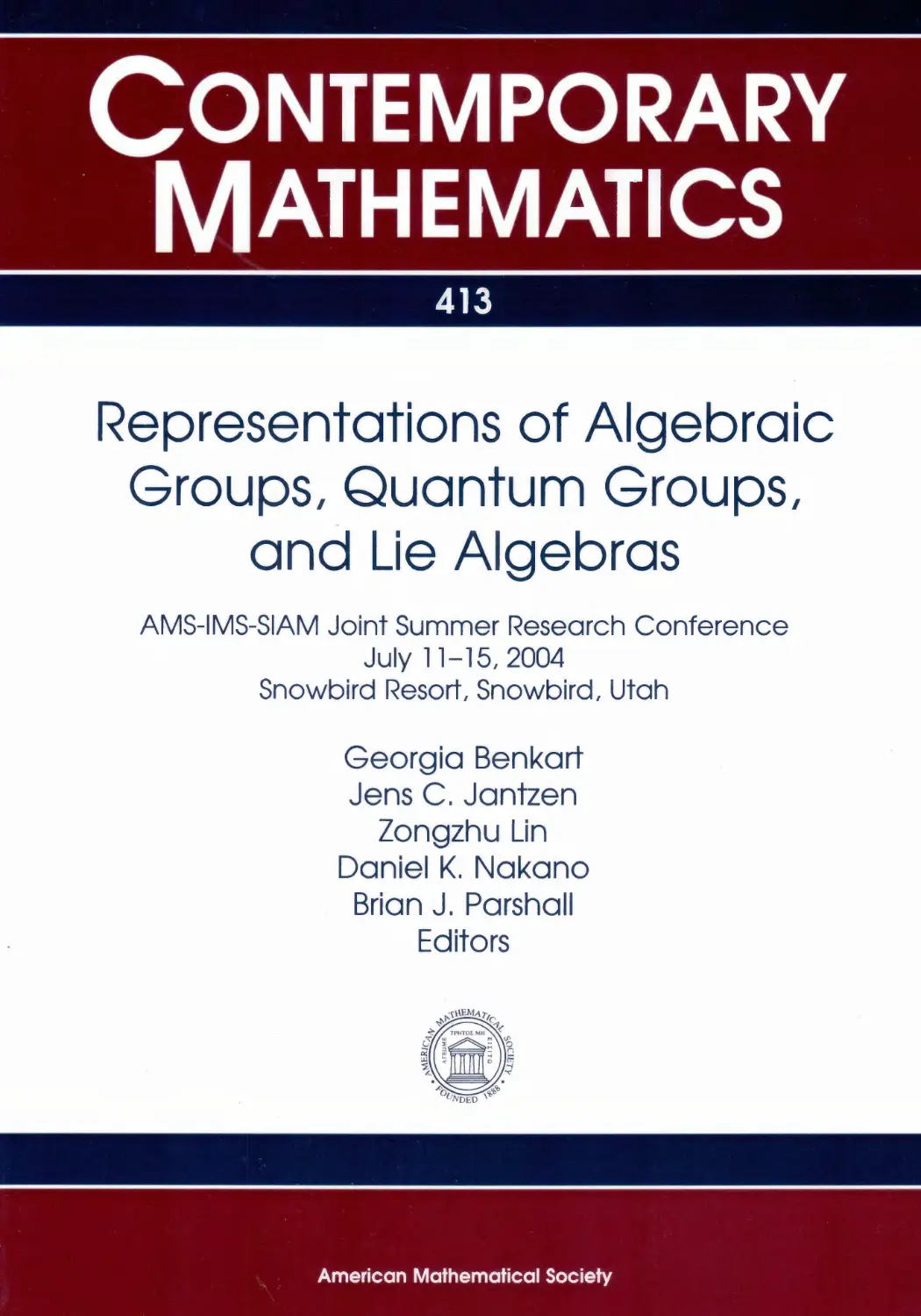


Author: Parshall B.J. Benkart G. Jantzen J.C. Lin Z. Nakano D.K.
Tags: mathematics algebra group theory lie algebra
ISBN: 0-8218-3924-1
Year: 2006


Text
                    T •
T H
413
Representations of Algebraic
Groups, Quantum Groups,
and Lie Algebras
AMS-IMS-SIAM Joint Summer Research Conference
July 11-15,2004
Snowbird Resort, Snowbird, Utah
Georgia Benkart
Jens C. Jantzen
Zongzhu Lin
Daniel K. Nakano
Brian J. Parshall
Editors
American Mathematical Society

Representations of Algebraic
Groups, Quantum Groups,
and Lie Algebras

r\
.V-
.. 1-4
£V -
Conference Group Photo
Snowbird Resort
July 2004

Contemporary
Mathematics
413
Representations of Algebraic
Groups, Quantum Groups,
and Lie Algebras
AMS-IMS-SIAM Joint Summer Research Conference
July 11-15,2004
Snowbird Resort, Snowbird, Utah
Georgia Benkart
Jens C. Jantzen
Zongzhu Lin
Daniel K. Nakano
Brian J. Parshall
Editors
American Mathematical Society
Providence, Rhode Island

Editorial Board
Dennis DeTurck, managing editor
George Andrews Carlos Berenstein Andreas Blass Abel Klein
This volume contains the proceedings of an AMS-IMS-SIAM Joint Summer Research
Conference on Representations of Algebraic Groups, Quantum Groups, and Lie Algebras,
held at the Snowbird Resort, Snowbird, UT, from July 11-15, 2004, with support from
the National Science Foundation, grant DMS-9973450.
2000 Mathematics Subject Classification. Primary 05E10, 14L17, 16G20, 17Bxx, 20C08,
20Gxx.
Any opinions, findings, and conclusions or recommendations expressed in this material
are those of the authors and do not necessarily reflect the views of the National Science
Foundation.
Library of Congress Cataloging-in-Publication Data
AMS-IMS-SIAM Joint Summer Research Conference, Representations of Algebraic Groups,
Quantum Groups, and Lie Algebras (2004 : Snowbird, Utah)
Representations of algebraic groups, quantum groups, and Lie algebras : AMS-IMS-SIAM
Joint Summer Research Conference, Representations of Algebraic Groups, Quantum Groups, and
Lie Algebras, July 11-15, 2004, Snowbird, Utah / Georgia M. Benkart... [et al.], editors,
p. cm. — (Contemporary mathematics, ISSN 0271-4132 ; v. 413)
ISBN 0-8218-3924-1 (alk. paper)
1. Representations of groups—Congresses. 2. Affine algebraic groups—Congresses. 3.
Quantum groups—Congresses. 4. Lie algebras—Congresses. I. Benkart, Georgia, 1949- II. Title.
III. Series: Contemporary mathematics (American Mathematical Society) ; v. 413.
QA176.A47 2004
512/.22—dc22 2006045952
Copying and reprinting. Material in this book may be reproduced by any means for
educational and scientific purposes without fee or permission with the exception of reproduction by
services that collect fees for delivery of documents and provided that the customary
acknowledgment of the source is given. This consent does not extend to other kinds of copying for general
distribution, for advertising or promotional purposes, or for resale. Requests for permission for
commercial use of material should be addressed to the Acquisitions Department, American
Mathematical Society, 201 Charles Street, Providence, Rhode Island 02904-2294, USA. Requests can
also be made by e-mail to reprint-permissionQams. org.
Excluded from these provisions is material in articles for which the author holds copyright. In
such cases, requests for permission to use or reprint should be addressed directly to the author(s).
(Copyright ownership is indicated in the notice in the lower right-hand corner of the first page of
each article.)
© 2006 by the American Mathematical Society. All rights reserved.
The American Mathematical Society retains all rights
except those granted to the United States Government.
Copyright of individual articles may revert to the public domain 28 years
after publication. Contact the AMS for copyright status of individual articles.
Printed in the United States of America.
@ The paper used in this book is acid-free and falls within the guidelines
established to ensure permanence and durability.
Visit the AMS home page at http://www.ams.org/
10 9 8 7 6 5 4 3 2 1 11 10 09 08 07 06

Contents
Preface vii
List of Talks ix
List of Participants xi
Extensions for finite groups of Lie type II: Filtering the truncated induction
functor
Christopher P. Bendel, Daniel K. Nakano,
and Cornelius Pillen 1
Algebras, representations and their derived categories over finite fields
Bangming Deng and Jie Du 25
On localization of D-modules
Yoshitake Hashimoto, Masaharu Kaneda,
and Dmitriy Rumynin 43
Representations of reduced enveloping algebras and cells in the affine Weyl
group
J. E. Humphreys 63
Nakajima's monomials and crystal bases
Seok-Jin Kang, Jeong-Ah Kim, and Dong-Uy Shin 73
A new Lie bialgebra structure on s/(2,1)
Gizem Karaali 101
The Steinberg tensor product theorem for GL(m\n)
Jonathan Kujawa 123
Cyclotomic g-Schur algebras and Schur-Weyl duality
Zongzhu Lin and Hebing Rui 133
Geometric crystals and affine crystals
Toshiki Nakashima 157
Self-extensions for finite symplectic groups via algebraic groups
Cornelius Pillen 173

vi CONTENTS
Classification of finite dimensional simple Lie algebras in prime
characteristics
Alexander Premet and Helmut Strade 185
Prom quantum groups to unitary modular tensor categories
Eric C. Rowell 215
A trip from representations of the Kronecker quiver to canonical bases of
quantum affine algebras
Jie Xiao and Guanglian Zhang 231

Preface
Representation theory has played a central role in mathematics through its
rich interplay with, and applications to, many other fields. The 2004 AMS-
IMS-SIAM Joint Summer Research Conference, Representations of
Algebraic Groups, Quantum Groups, and Lie Algebras, focused on the geometric and
combinatorial aspects of the subject. New developments involving quiver
representations were presented in connection with important constructions for quantum
groups. Another major theme was use of methods from algebraic geometry, via
derived categories, to study the representation theory of algebraic groups and Lie
algebras, including Kac-Moody Lie algebras, modular restricted Lie algebras (or,
more generally, finite group schemes), and Lie superalgebras.
Each morning session featured principal speakers on the designated major
themes. Each afternoon, two parallel sessions allowed attendees to present talks
on current research, providing a forum for junior mathematicians to communicate
new developments in the area, followed by ample time for informal discussions and
interaction.
The present volume brings together papers from the principal speakers and
other participants on a wide variety of topics in modern representation theory.
Several contributions are surveys that aim to introduce the topics to a wider
audience of researchers. All of the papers were carefully refereed, and the editors
express their gratitude to the anonymous referees for the high standards employed
in preparing their reports.
During the conference, a banquet was held to celebrate the achievements of
James E. Humphreys on the occasion of his 65th birthday. Over the last 40 years,
Jim's contributions have inspired many deep insights and new developments in
the representations of algebraic groups and finite groups of Lie type. In addition,
his well-known books in the area have brought vast, intertwined research topics
together in a concise and coherent manner. Jim has also encouraged many of us
by taking a genuine interest in our work. Several months before the conference, he
formally retired from the University of Massachusetts, Amherst, to devote himself
to research and to book writing. We are delighted to include here one of his recent
articles, which poses an interesting conjecture relating irreducible representations of
semisimple Lie algebras in positive characteristics to left cells in affine Weyl groups.
Financial support for the conference was provided by a grant from the National
Science Foundation, and the staff of the American Mathematical Society provided
considerable logistical support. In particular, the organizers acknowledge Wayne
Drady for his professional dedication to managing the conference and Christine
M. Thivierge for her patience and help in editing this volume. We also thank the
participants for making the conference a success: the speakers during the conference
vii

viii PREFACE
and at the banquet and the afternoon session chairs for their work in keeping the
conference on schedule. Special thanks go to Leonard Scott, whose toastmastery
during the banquet provided many humorous and wonderful memories.
Georgia Benkart
Jens C. Jantzen
Zongzhu Lin
Daniel K. Nakano
Brian J. Parshall
January 2006

List of Talks
Talks by Principal Speakers
Henning H. Andersen,
Cohomology of line bundles
Jie Du,
Strong monomial basis property and canonical basis for a cyclic quiver
Eric M. Priedlander,
7r-points for finite group schemes
Seok-Jin Kang,
Crystal bases for quantum affine algebras and combinatorics of Young
walls
Alexander Kleshchev,
On the structure of finite W-algebras of type A
Ivan Mirkovic,
Beilinson-Bernstein localization for quantum groups at roots of unity
Hiraku Nakajima,
Instanton counting
Alexander Premet,
Minimal nilpotent representations, quantizations of Slodowy slices, and
the Joseph ideal
Eric Vasserot,
Representations of double affine Hecke algebras
Jie Xiao,
Representations of tame quivers and affine canonical bases
Contributed Talks
Susumu Ariki,
Representation type of Hecke algebras and the Poincare polynomial
Christopher P. Bendel,
Cohomology for Frobenius kernels
Brian D. Boe,
Varieties of nilpotent matrixes for simple Lie algebras: Restricted null-
cones and support varieties
Jon F. Carlson,
Endotrivial modules for finite groups of Lie type
Joseph Chuang,
Derived equivalence between blocks of GL(n)
Stephen Doty,
Generators and relations for generalized q- Schur algebras
ix

LIST OF TALKS
David J. Hemmer,
Fixed point functors for symmetric groups and Schur algebras
Terrell L. Hodge,
Nilpotent orbits in restricted symmetric spaces
James E. Humphreys,
Representations of reduced enveloping algebras and cells in the affine Weyl
group
Dijana Jakelic,
Crystal and tensor products in category O
Joel Kamnitzer,
Mirkovic- Vilonen cycles and polytopes
Masaharu Kaneda,
Localization of D-modules in positive characteristic
Gizem Karaali,
How to construct an r-matrix on a Lie superalgebra
Sergei Krutelevich,
Exceptional groups, Jordan algebras, and higher composition laws
Jonathan Kujawa,
Crystal structures arising from representations of GL(m\n)
Yiqiang Li,
Affine quivers of type An and canonical bases
George J. McNinch,
Optimal SL(2)-homomorphisms
Kailash C. Misra,
Affine Lie algebra representations and multisum identities
of Rogers-Ramanujan type
Toshiki Nakashima,
Geometric crystals and crystal bases
Alison Parker,
Higher extensions for SL^fc)
Aaron Phillips,
On 2-modular representations of the symmetric groups
Cornelius Pillen,
Extensions for finite groups of Lie type and the truncated induction functor
Eric C. Rowell,
Towards a classification of modular tensor categories
Travis Schedler,
Quantization of necklace Lie algebras
Toshiyuki Tanisaki,
The Beilinson-correspondence for quantized enveloping algebras
Monica Vazirani,
Vanishing integrals of Macdonald polynomials
Weiqiang Wang,
A super duality and Kazhdan-Lusztig polynomials

List of Participants
Henning H. Andersen,
Aarhus University, DENMARK
Susumu Ariki,
Kyoto University, JAPAN
Christopher P. Bendel,
University of Wisconsin-Stout, USA
Georgia Benkart,
University of Wisconsin Madison, USA
Matthew Beswick,
Kansas State University, USA
Brian D. Boe,
University of Georgia, USA
Jonathan Brundan,
University of Oregon, USA
Jon F. Carlson,
University of Georgia, USA
Joseph Chuang,
University of Bristol, UNITED
KINGDOM
Wesley Cramer,
University of Virginia, USA
Stephen Doty,
Loyola University Chicago, USA
Jie Du,
University of New South Wales,
AUSTRALIA
Eric M. Priedlander,
Northwestern University, USA
Fredrick Goodman,
University of Iowa, USA
Holly Hauschild,
University of Iowa, USA
Xuhua He,
Massachusetts Institute of Technology,
USA
David J. Hemmer,
University of Toledo, USA
Anthony Henderson,
University of Sydney, AUSTRALIA
Terrell L. Hodge,
Western Michigan University, USA
James E. Humphreys,
University of Massachusetts-Amherst,
USA
Dijana Jakelic,
University of California-Riverside, USA
Jens C. Jantzen,
Aarhus University, DENMARK
Joel Kamnitzer,
University of California-Berkeley, USA
Masaharu Kaneda,
Osaka City University, JAPAN
Seok-Jin Kang,
Korea Institute for Advanced Study,
SOUTH KOREA
Gizem Karaali,
University of California-Berkeley, USA
Jeon-Ah Kim,
Korea Institute of Advanced Study,
SOUTH KOREA
Alexander Kleshchev,
University of Oregon, USA

Xll
LIST OF PARTICIPANTS
Sergei Krutelevich,
University of Ottawa, CANADA
Jonathan Kujawa,
University of Georgia, USA
Weiping Li,
Walsh University, USA
Yiqiang Li,
Kansas State University, USA
Zongzhu Lin,
Kansas State University, USA
Jill E. McCarthy,
University of Virginia, USA
Kevin McGerty,
Institute for Advanced Study, USA
George J. McNinch,
Tufts University, USA
Ivan Mirkovic,
University of Massachusetts-Amherst,
USA
Kailash C. Misra,
North Carolina State University, USA
Hiraku Nakajima,
Kyoto University, JAPAN
Daniel K. Nakano,
University of Georgia, USA
Toshiki Nakashima,
Sophia University, JAPAN
Alison Parker,
University of Sydney, A USTRALIA
Brian J. Parshall,
University of Virginia, USA
Julia Pevtsova,
University of Oregon, USA
Aaron M. Phillips,
University of Virginia, USA
Alexander Premet,
University of Manchester, UNITED
KINGDOM
Zhenbo Qin,
University of Missouri, USA
Eric Rowell,
Indiana University, USA
Oliver Ruff,
University of Oregon, USA
Yoshihisa Saito,
University of Tokyo, JAPAN
Travis Schedler,
University of Chicago, USA
Leonard Scott,
University of Virginia, USA
Dong-Uy Shin,
Korea Institute for Advanced Study,
SOUTH KOREA
Eric Sommers,
University of Massachusetts-Amherst,
USA
Anna Stokke,
University of Winnipeg, CANADA
Toshiyuki Tanisaki,
Osaka City University, JAPAN
Nathaniel Thiem,
University of Wisconsin, USA
Michela Varagnolo,
University of Cergy-Pontoise, FRANCE
Eric Vasserot,
University of Cergy-Pontoise, FRANCE
Monica Vazirani,
University of California at Davis, USA
Weiqiang Wang,
University of Virginia, USA
Jie Xiao,
Tsinghua University, CHINA
Cornelius Pillen,
University of South Alabama, USA

Contemporary Mathematics
Volume 413, 2006
Extensions for finite groups of Lie type II:
Filtering the truncated induction functor
Christopher P. Bendel, Daniel K. Nakano,
and Cornelius Pillen
Dedicated to James E. Humphreys on the occasion of his 65th birthday
Abstract. In [BNP5] the authors relate the extensions between two simple
modules for a finite group of Lie type Ga($q) (where q = pr) to certain
extensions for the corresponding reductive group and its Probenius kernels. Several
of these results require the characteristic p of the underlying field to be
sufficiently large (p > 3(h — 1), with h being the Coxeter number of the root
system). In this paper we will generalize these results to all primes p assuming
instead lower bounds on the prime powers pr (approximately of the order of
1. Introduction
1.1. Let G be a connected reductive algebraic group scheme defined over ¥p
and let F : G —> G be the Probenius map. Let Gr be the r-th Probenius kernel
which is the scheme theoretic kernel of Fr (F composed with itself r times) and
let G{¥q) be the fixed points under Fr. We will assume that k is an algebraically
closed field of characteristic p > 0. The finite groups G(¥q) are called the finite
Chevalley groups. There has been much effort in the last thirty years aimed at
understanding the interrelationships between the representation theory of these
three algebraic objects. For a comprehesive treatment of this subject we refer the
reader to Humphreys' book [Hum2].
In a series of papers [BNP1, BNP2, BNP3, BNP5] the authors investigated the
deep connections between the cohomology theories of G, Gr and G(¥q). The
philosophy behind our approach involved using certain truncated categories of rational
G-modules which approximate the categories of Gr and G(¥q)-modules. These
truncated categories are highest weight categories and contain enough projective
modules so one can directly compare these categories to the categories of Gr and
2000 Mathematics Subject Classification. Primary 20C, 20G; Secondary 20J06, 20G10.
Research of the first author was supported in part by NSF grant DMS-0400558.
Research of the second author was supported in part by NSF grant DMS-0400548.
©2006 American Mathematical Society

2 CHRISTOPHER P. BENDEL, DANIEL K. NAKANO, AND CORNELIUS PILLEN
G(Fg)-modules through the use of Grothendieck spectral sequences. In the
construction of these spectral sequences, we study certain families of finite
dimensional submodules of the infinite dimensional induced module indG^F ^(N) where
N G mod(kG(¥q)). These modules can be described as the maximal submodules of
ind^ )(JV) whose highest weights are contained in specified finite saturated sets
of weights. An important example occurs when we let N be the trivial module.
For large primes (p > 3(h — 1)) and truncation at approximately twice the
Steinberg weight, it was shown that this module (when N = k) is completely reducible
([BNP1, BNP5]). This fact led to explicit formulas describing extensions of simple
modules over G(¥q) via extensions of modules for G [BNP2, BNP3, BNP5]. As an
application, we were able to use our formulation to answer many of the questions
posed in Humphreys' 1985 article on self-extensions [Huml].
In this paper, we will use the same setup as in [BNP5] and consider the more
general family of finite groups of Lie type. We denote these groups by Ga(¥q)
where a is the corresponding automorphism of G. For small primes these truncated
induction functors are no longer semisimple. Our goal is to study the resulting
modules for small primes p, but large prime powers pr.
The precise definitions and some basic properties of these truncated categories
and associated functors are given in Section 2. Then some useful cohomology facts
will be noted in Section 3. Section 4 is devoted to demonstrating that under suitable
conditions on pr these truncated induced modules admit a filtration with sections
of the form H°(-w0(Tfi) ® #°(/x)(r) (Theorem 4.7).
In Section 5, we apply this filtration to make some cohomological computations.
For example, the existence of this filtration allows us to show that for r > 2 and
sufficiently large q = pr the finite group Ga(¥q) does not allow self-extensions
between simple modules (Theorem 5.4). Tiep and Zalesskii [TZ, Prop. 1.4] have
shown that the existence of self-extensions are an important factor in the ability to
lift irreducible representations from characteristic p to characteristic zero.
Finally, in Section 5.6, it is shown that for all primes but r > 3 and q sufficiently
large the group of extensions between two simple Ga(¥q)-modules is isomorphic to
the G-extensions between a suitable pair of g-restricted simple G-modules. Roughly
speaking one can say that Ext^(F ^ for pairs of simple Ga(¥q)-modules mirrors the
theory of Ext^ between g-restricted simple modules, provided that r > 3 and q is
at least of the order of the Coxeter number squared. No restriction on the prime is
necessary.
1.2. Notation. Let G be a connected simply connected almost simple
algebraic group defined and split over the finite field ¥p with p elements and k be the
algebraic closure of Fp. We will also consider G as an algebraic group scheme over
Fp.
Let $ be a root system associated to the pair (G, T) where T is a maximal split
torus. Moreover, let 3>+ (resp. $~) be the positive (resp. negative) roots and A be
a base consisting of simple roots.
Let X(T) be the integral weight lattice obtained from <£ contained in the
Euclidean space E with the inner product denoted by ( , ). The set X(T) has a partial
ordering given by A > \i if and only if A — \i e ]Ca€A^a f°r ^A* e X(T). The
set of dominant integral weights is denoted by X(T)+ and the set of pr-restricted
weights by Xr(T).

EXTENSIONS FOR FINITE GROUPS OF LIE TYPE II
3
Let W be the Weyl group. The group W acts on X(T) via the "dot action"
given by w • A = w(X + p) — p where p is the half sum of the positive roots. Let
av = 2a/(a,a) be the coroot corresponding to a G <£. The longest element in W
is w0 and the Coxeter number for $ is h = (p, 0$) + 1 where ao is the maximal
short root.
Let B be a Borel subgroup containing T corresponding to the negative roots.
For A G X(T)+ set H°(X) = ind#A. The simple G-module corresponding to A is
denoted by L(A) and the Weyl module is V(A). The injective hull of L(A) as a G-
module will be denoted /(A). For more details about the definitions and properties
of these objects we refer the reader to [Janl].
Let F : G —> G be the Frobenius map and Fr the composition of the Frobenius
map with itself r-times. Now suppose that a is an automorphism of the Dynkin
diagram of <£. The automorphism a can be extended to the weight lattice X(T)
and under this extension a permutes the fundamental weights and preserves the
inner product ( , ) as well as the partial order on X(T). Moreover, cr(ao) — ao-
The graph automorphism a also induces an automorphism on G which will also be
denoted by a. The automorphism a commutes with F and is compatible with the
action of a on X(T). Set Ga(¥q) as the group of fixed points of Fr o a = a o Fr,
where q = pr. The groups Ga(¥q) can be either (i) untwisted (Chevalley) groups,
(ii) Steinberg groups, or (in) Suzuki-Ree groups. For more information about these
groups see [Car] [GLS]. For simplicity we will exclude the Suzuki-Ree groups from
our discussion. With some exceptions for the Ree groups of type F4, the extensions
for these groups are known due to [Sinl, Sin2, Sin3].
Thoughout this paper, for v G X(T), set v = —w0(ru.
2. Induction and Truncation.
2.1. Induction. For a finite dimensional Ga(¥q)-module M and a finite
dimensional Gr-module N, we define
G{M) = md%A¥q)(M) and H(N) = indgr(JV).
In particular for the trivial module k we set Q(k) = ind§CT(Fg)(fc) and H(k) =
indGr(k). If M and N are G-modules, the tensor identity implies
G(M) = M® md%A¥q)(k) and H(N) = N® indgr(fc).
Our first result shows that Q(k) (resp. H(k)) is injective upon restriction to Gr
(resp. Ga(Fq)).
Proposition .
(i) H(k) is injective as a Ga(¥q)-module.
(ii) Q(k) is injective as a Gr-module.
Proof, (i) It is well-known that
H(k) * k[G/Gr] ^ k[G]{r) * 0 (/(^WjdimLM
vex(T)+
as a G-module where I(v) is the injective hull of the simple module L(v). Moreover,
I(y) = I(y)(r) as a G<j(Fg)-module and is injective since G/G(T(¥q) is affine.
(ii) As a Ga(¥q)-module, the Steinberg module Str is both projective and
injective. Furthermore, Str = St^.r^ as G(T(¥q)-modules. The functor Q sends injective

4 CHRISTOPHER P. BENDEL, DANIEL K. NAKANO, AND CORNELIUS PILLEN
Ga(¥q)-modules to injective G-modules. Therefore, from the tensor identity we
obtain the following sequence of isomorphisms of injective G-modules:
£(str) ^ g{stir)) * st^.r) ® g(k).
Restriction from G-modules to Gr-modules sends injectives to injectives (because
G/Gr is affine) and the r-th Probenius twist of Str, viewed as a module for G>, is
a direct sum of trivial modules. Hence, as G>-modules, (?(Str) = Q(k)dimStr and
the assertion follows.
□
2.2. Saturated sets of weights. For any finite set of weights ir C X(T)+
we define Q^M) (resp. H^(N)) to be the maximal G-submodule of Q{M) (resp.
H{N)) having composition factors with highest weights in 7r. The following three
sets of weights will play an important role in the upcoming results:
r = {A6I(T)+|(A,^)<2(ft-l)}
n = {\eX(T)+\{\,al>)<2pr(h-l)}
A = {A 6 X(T)+ | (A, ctf) < 3(pr - l)(h - 1)}.
Our goal is to understand the structure of the module Gn(k) for arbitrary (especially
small) primes p and large pr. We begin by constructing an ascending chain of
submodules for Gn(k). Fix an order Ai, A2, A3,..., An of the elements in F such
that i < j whenever (pr — woa)Xi < (pr — wo&)Xj. Notice that i < j whenever
A; < Xj. Clearly Ai = 0. Then we define subsets of T as follows, for i = 1,2,..., n,
set
Ti = {Xj e r I j < i} and r0 = 0.
Let 70,71 e T. Then (71,^) < 2(h~l)-l and <7o+Pr7i,^> < 2pr(h- 1) -pr +
2(h — 1). If pr > 2(h — 1), then 70 +pTn/i G O. For the remainder of this section we
assume that pr > 2(h— 1). We define subsets of ft:
Qi = {7 e X(T)+ I 7 < (pr - w0a)u for some v e Ti}.
The subsets Ti and Cti together with their W-conjugates are saturated, Fq = Oo = 0,
and ri = Oi = {0}. We have the following series of inclusions
(2.2.1) k = gQo(k) cgUl(k) cgQ2(k) c-c^tjcgQ(k).
Later we will show that Gnn(k) = Gn(k) for sufficiently large pr.
Remark . In [BNP2, BNP5] the notation Q{k) is used for a truncated submod-
ule of ind§ /F \(k). Here Q{k) will always denote the infinite-dimensional module
ind§CT(Fg)(fc) itself. Any finite-dimensional truncated submodule will be denoted by
G7r(k) with 7r being the corresponding finite set of weights.
2.3. Injectives and projectives in the truncated categories. Let ir be
a finite set of dominant weights such that n together with its ^-conjugates is
saturated. Let Mod(7r) denote the full subcategory of Mod(G) with objects having
composition factors whose highest weights lie in n. Such a truncated category
has both injective and projective modules. For a weight A G 7r, we denote the
injective hull and the projective cover of the simple module L(A) by 7^ (A) and Ptt(A),
respectively. The module 1^ (A) can be described as the maximal G-submodule of
the injective hull /(A) of L(A) in Mod(G) whose composition factors have weights
in 7r. In particular, the module /^(A) is finite dimensional and has a good filtration.

EXTENSIONS FOR FINITE GROUPS OF LIE TYPE II 5
Moreover, for any 7 e n, the multiplicity of the factor H0^) in a good nitration
of /tt(A), denoted by [/^(A) : H°(j)]g, equals the multiplicity of the the simple
module L(A) as a composition factor in H°(j), denoted by [-ff°(7) : L(7)]g- For a
general treatment of truncated categories we refer to [Donl, Don2] or [Janl, II.A].
Next consider the automorphism a on G and Ga(¥q). One obtains for G-
modules M and N
(2.3.1) Ext2G(M, N) ^ Ext2G(MCT_1, AT-1) for i > 0.
The Frobenius morphism Fr is also an automorphism on Ga(¥q) with Frocr = croFr
being the identity. Hence
(2.3.2)
Ext^(Fg)(M, AT) - Ext^^M*-1,^-1) - ExfGff(rJ(tfW,JVW) for i > 0.
Moreover, from [Jan2, 1.3] one concludes for A G X(T)+ that
L(A)CT_1 ^ L(aX) as a G-module,
and
L(A)CT_1 ^ L(crA) ^ L(A)(r) as a G^F^)-module.
It follows that
(2.3.3) P.(A)^"1 * PffW(aA) and [PaM(aX) : L(a7)]c = [P*(A) : L(7)]o.
Also
(2.3.4) P7r(A)(r) ^ ^(A)*7"1 ^ Pct(tt)(^A) as a Gff(F,)-module.
Finally, note that the projective module Ptt(A) is isomorphic to the dual module of
I-wo^i-WoX).
3. Cohomological Facts
In this section, we record several cohomological results which will be used a
number of times later in the paper.
3.1. The following gives a condition under which homomorphisms over Gr may
be identified with those over G.
Proposition . Assume A,/x e Xr(T) and M is a finite dimensional rational
G-module such that all its weights v satisfy (v,oiq) < pr. Then
HomGr (L(A), L(/x) ® M) = HomG(L(A), L(/x) ® M).
Proof. Without loss of generality (by dualizing if necessary), we may assume
that (/x,olq) < (A,Qq). All G-composition factors of HomGr(L(A),L(/x) ® M) are
Gr-trivial so must be of the form L("y)^r\ For such a factor, A + £>r7 is a weight of
L(/x) <g) M and hence
(A + pr7, ctf) < </x + 1/, c#> < (A, 0%) + (i/, ajf)
for a weight 1/ of M. Hence, pr(7, Oq ) < (1/, 0$) < pr and so we must have 7 = 0.
Therefore Hom<3r (£(A), L(/x) ® M) has a trivial G-structure and the claim follows
since
HomG(L(A),L(/x) ® M) = HomG/Gr(/c,HomGr(L(A),L(/x) ® M)).
D

6 CHRISTOPHER P. BENDEL, DANIEL K. NAKANO, AND CORNELIUS PILLEN
3.2. Ext1 for modules with small highest weights. Here we give an upper
bound on the size of of the weights of a G-module M to insure
H^G.M).
Lemma . Assume that the root system $ of G is not of type A\. Let M be
a finite dimensional rational G-module whose highest weights A satisfy (A,ao) <
(a) Ifp^2or$ is not of type Cn, then YLl{Gr, M) ^ H^G, M).
(b) If p = 2, <£ is of type Cn, and k is not a composition factor of M, then
K1(Gr,M)^K1(G,M).
(c) If p = 2, $ is of type Cn, and k is a composition factor of M, then
T3}{Gr,M) ^ B}(G,M) 0 (0jL(u;i))(r\ where l > 0 and ui denotes the
first fundamental weight of $.
Proof. Consider the Lyndon-Hochschild-Serre (LHS) spectral sequence
E%j = I?(G/Gr,H.j(Gr,M) =» Hi+J'(G,M).
If M has a composition factor of the form L("y)^r\ the assumption that (pr7, (*$) <
pr implies that 7 = 0. Hence, Home, (A;, M) = Horned, M). Therefore,
E1/ = YLl(G/Gr, HomGr (fc, M)) ^ ftl{G/Gr, k) ® HomG(fc, M) = 0
and so
tffCM) = E1 * E°2A = Homc/c^H^M)).
Thus the isomorphisms in parts (a) and (b) hold if the highest weight of H1(Gr, M)
is zero. Since the weight u\ is not contained in the root lattice, part (c) follows if
the highest weights of H1(Gr, M) are zero or u)\.
By induction on a composition series for M it now suffices to prove the assertion
for a simple module L(X). If A = 0, then it follows from [Andl] that
xii/^ / \ / L(^i)(r) if P = 2 and * is of type cn
H<G" *> = {(, else.
For A ^ 0 define the quotient Q via the short exact sequence
0 -> L(A) -> #°(A) -> Q -> 0
and consider a portion of the associated long exact sequence
HomGr(fc, L(A)) -+ HomGr(fc, tf°(A)) -+ HomGr(fc, Q)
->H1(Gr,L(A))^H1(Gr,i7°(A)).
The size of A forces all composition factors of Q and H°(X) to be ^-restricted. This
implies that all Hom<3r in the above sequence can be replaced by Home giving
HomG(fc, L(A)) -+ HomG(fc, ff°(A)) -> HomG(fc, Q)
^^(G^LiX^^R'iG^H^X)).
The first map is an isomorphism and Horned, Q) = H1(G, L(A)) by [Janl, II.2.14].
It is therefore sufficient to show that H1(Gr,i7°(A)) = 0. It follows from [BNP4,
3.2] that H1(Gr,i7°(A)) = 0 unless A = prv -pla with v e X(T), a e A, and
0 < i < r. Since A is dominant and not zero, we have (u,a^) > 1. For all root
systems other than A\ and C2, one has {ol,olq) < 1. Hence, (A,0$) < pr — pr~1
implies H1(Gr,iif0(A)) = 0. If $ is of type C2, the above argument fails in the

EXTENSIONS FOR FINITE GROUPS OF LIE TYPE II
7
case A = prv — pr 1a with a being the long simple root. However this case is not
of interest because A being dominant forces (i/, 0$) > 2 and (pru — pr_1a,a^) >
2pr-2pr-1>pr-1(p-l). □
Remark . Direct computation shows that the Proposition also holds for type
A\ and p = 2. For type A\ and odd primes, one obtains H1(Gr,M) = H1(G, M)
for all finite dimensional G-modules with highest weights A satisfying (A, 0$) <
f-l{p-2).
3.3. Vanishing of certain Ext^-groups. It is well-known that a finite-
dimensional G-module admits a good nitration if and only if ExtJ?(Vr(/x), M) = 0 for
all ji G X(T)+. Our goal in Section 4 is to show that certain modules have nitrations
with factors of the form H°(j20) <S> H°(fii)^ where /x0, pi € T. In order to establish
these results, we need the following proposition. Here we set 1^ = —woa(Ti).
Proposition . Let pr~1(p — 1) > 4ft —6 and 70,11,^0,^1 £ IV Assume that
the root system <£ of G is not of type A\. If p = 2 and $ 25 of type Cn, then we
assume in addition that 70 — 71 and fiQ — fii are contained in the root lattice. Then
the following hold:
(i) ExtG(V(£0) ® VWr), tf°(7o) ® ff°(7i)(r)) = 0.
(ii) ExtG(L(£0) ® £(Mi)(r), ^(7o) ® /r<(7i)(r)) = 0.
(iii) ExtG(PPi(£o) ® Pr,(Mi)(r), L(%) ® L(7i)(r)) = 0.
Proof. We apply the LHS spectral sequence
(3.3.1) E? = EXtjJ/Gr(VO*i)(r),EXtir(V(/io),^0(7o))®H0(7l)(r))
(3.3.2) =» Ext^'(y(Mo)®^(Mi)(r),^0(7o)®ff°(7i)(r))-
All weights involved are pr restricted. Therefore,
EomGr(V(iL0),H°(%)) S HomG(y(Mo),^°(7o))
is either the trivial module or zero. It follows from [Janl, II.4.13] that the E2y -term
vanishes.
For any composition factor L(X) of V(/zo)* ® i/°(7o), we have (A, Oq) < 2(ft —
1) - 1 + 2(ft - 1) - 1 = 4ft - 6. Hence, by Lemma 3.2, Ext^r(VX/io),#0(7o)) =
Ext^(Vr(/xo)5 H°(lo)) unless p = 2, $ is of type Cn, and A; is a composition factor
of V(/Io)* ® -ff°(7o)- If we exclude this case, it follows from [Janl, II.4.13] that the
E2 -term also vanishes.
If p = 2, <£ is of type Cn, and fc is a composition factor of V(/Io)* ®#°(7o) then
/jio—wolo is in the root lattice. Therefore, /xi—^o7i = (^o7o_woli) + (no —^o7o)_
(/xo — /xi) is also in the root lattice. Prom Lemma 3.2, Ext^ (V(/Io)j#0(7o)) —
Exto(Vr(/Io), #o(7o))e(0zL(wi)(r)). By [Janl, II.4.13], the first summand vanishes
and so
E°/ S* eiHomG/G^V^OW.L^OW ® H°(7i)(r)).
Furthermore, this vanishes because
HomG/Gr(y(Mi)(r),L(a;i)W ® #°(7i)(r))
S HomG(L(-™0u;i),tf0(-™oMi) ® #°(7i))
and all weights of H°(—wofJ-i)^ ® i/°(7i) are contained in the root lattice. The
assertion (i) follows. Statements (ii) and (iii) follow along the same lines. n

8 CHRISTOPHER P. BENDEL, DANIEL K. NAKANO, AND CORNELIUS PILLEN
Remark . We assume that the conditions of Proposition 3.3 are satisfied and
have a closer look at (3.3.1). It follows from [Janl, II.4.13] and Lemma 3.2 that
££° = 0 for i > 0 and E^1 = 0 for i > 0. Hence E2 ^ £7°'2. If /i0 = 7o = 7i = 0,
then E%2 = HomG/G!r(Vr(/xi)r, Ext Qr(k, k)). The group Ext^r(fc, A;) does not vanish
[BNP6] and for appropriate choices of /xi neither does the i?2-term. We conclude
that neither
Ext&VCpo) ® V(pn)<r\ H°(%) ® ^°(7i)(r))
nor
Ext2G(L(flo) ® L(Mi)(r),/Fi(7o) ® /ri(7i)(r))
vanish in general.
3.4. Important submodules for injectives. It follows from the Remark
in Section 3.3 that /p. (70) ® ii\(7i)^ is not injective for the full subcategory of
modules whose composition factors are of the form L(Vq + prvi) with i/q, ^1 € IV
Perhaps this is not surprising since the set of weights {Vq + prv\ \ uq, v\ <E I\}
together with its H^-conjugates is in general not saturated. However, under the
conditions of Proposition 3.3, the module /p. (70) <g) ii\(7i)^ can be characterized
as the maximal submodule of /(Pq + Pr7i) whose composition factors are of the
form L{pQ + prv\) with v$, 1/1 G IV This will be shown in the following lemma.
Assume that pr > 2(h — 1) and 70,71 € T. Then all composition factors of
ir(7o) have ^-restricted highest weight. Therefore, soc<3r(ir(7o)) — £(70) and
socGr(/F(7o)®ir(7i)(r)) = £(70)® ir(7i)(r). It follows from [Janl, 11.3.16(2)] that
socG(/F(7o) ® /r(7i)(r)) = £(70) ® socG(/F(7i)(r)) = L(7o +Pr7i).
Therefore,
(3.4.1) /r(7o)^/r(7i)(r) ^ i(7o+Pr7i), and Pn(7o+pr7i) -* i¥(7o)®iM7i)(r).
Lemma . Assume that the root system $ of G is not of type A\. Let pr~1(p —
1) > Ah — 6 and Ze£ M 6e a finite dimensional rational G-module whose composition
factors are of the form £(70 +pr7i) with 70,7i E IV If P — 2 and $ 25 0/ fype Cn,
we assume in addition that 70 — 71 is contained in the root lattice. Then
[M : L(7o +pr7i)]c = dim HomG (M, if. (70) ® ii\(7i)(r))
= dimHomG(Ppi(7o)®Pri(7i)(r),M).
Proof. The second equality follows easily by using duality. We will proceed to
prove the first equality. Clearly, [M : I/(7o+pr7i)]c = dimHomc(M, i(7o+pr7i))-
It suffices to prove that
dimHomG(M, I(% + pr7i)) = dim HomG (Af, ip.(70) ® iri(7i)(r))-
Clearly, for p = 2 and $ of type Cn both Horn-groups vanish unless 70 — 71 is
contained in the root lattice. We use induction on the number of composition
factors of M. The module ip.(7o) ® ii\(7i)^ is a submodule of /(70 + prJi)
(by (3.4.1)) and their socles are simple. The assertion holds therefore for simple
modules. Next assume that L(V0 + prvi) is a simple quotient of M. This implies
for the case p = 2 and $ of type Cn that vq — v\ is in the root lattice. Define S via

EXTENSIONS FOR FINITE GROUPS OF LIE TYPE II
9
the exact sequence 0 —> S —> M —> L(u0 + prv{) —> 0. One obtains the long exact
sequences
0 -> HomG(L(P0 + prvi)J(% + Pr7i)) -> HomG(M,/(70 + pr7i))
-> HomG(S, /(7o + Pr7i)) -> Ext^(L(P0 + pr*>i), I(% + Pr7i))
and
0 - HomG(L(P0 +Pr^i),/Pi(7o) ® /r,(7i)(r)) - HomG(M,/fi(70) ® /ri(7i)(r))
-> HamcOS, JPi(7o) ® /ri(7i)(r)) - Ext^(L(P0 +Pr^),/Pi(7o) ® /r,(7i)(r)).
Obviously, Ext^(L(P0 +^r^)5^(7o + Pr7i)) = 0- Moreover, Proposition 3.3 shows
that Ext^(L(Po + Prv),If . (7o) ® ^i\(7i)^) = 0- From the induction hypotheses
one concludes that
dimRomG(L(V0+pri/), I(%+pr7i)) = dim Home (L(V0+prv), 7p. (70)® 7^(71 )(r))
and
dimHomG(S', /(70 +Pr7i)) = dimHomG(S', 7p.(7o) ® /ri(7i)(r))-
Hence, dimHomcCM, /(7o+pr7i)) = dimHomcCM, /f .(7o)®^ri(7i)^) as claimed.
□
4. A Filtration of Gn(k)
The tensor identity says that Q(Str) = Str <8>G(k). Once we pass to truncated
categories, such an identity no longer holds in general. However, for pr > 4(ft—1) we
will show that (?A(Str) = Str <8>Gn(k) (Proposition 4.4). Furthermore, a complete
description of the module £/A(Str) will be given (Theorem 4.3). This will allow us
to determine the character of Gn(k). The ultimate goal of this section is to study
the nitration of Gnn(k) given in (2.2.1) in order to identify the factors and show
that Gnn(k) = Gn(k) for sufficiently large pr (Theorem 4.7).
4.1. Composition factors of Gn(k). Since — wq and a permute the
fundamental weights, any weight 7 G X(T)+ can be expressed uniquely in the form
7 = — woa^o + pr7i = 70 + £>r7i with 70 G Xr(T) and 71 G X(T)+. One can now
use the methods in [BNP5, Prop. 2.5] to prove the following result.
Proposition . IfL(%+prji) is a composition factor ofGn(k) then^o^li £ r.
4.2. The following results will help us relate Gn(k) to (?A(Str) and understand
(?A(Str).
Proposition (A). Let pr > 4(ft - 1) and i/0, v\ e r.
(a) Str ®L(i>b) ® L(^i)(r) G Mod(A);
(b) Str(g)L(i/0)(8)/rK)(r) GMod(A);
(c) Str ®Gn(k) is a submodule o/£/A(Str).
Proof, (a) From i^eT one concludes that (i'i, 0$) < 2(ft— 1) — 1. Therefore,
<(pr-l)/»+H)+pri/i,a£> < (pr -l)(h-l) + 2(h-l) +pr2(h-l)- pr
= 3(pr-l)(h-l) + 4(h-l)-pr
< 3(pr-l)(h-l).

10 CHRISTOPHER P. BENDEL, DANIEL K. NAKANO, AND CORNELIUS PILLEN
Part (b) follows immediately from above. Proposition 4.1 and part (a) imply that
Str <g> Gn(k) e Mod(A). Part (c) now follows from Str <g> GQ(k) C (Str <g> G(k))A =
f?A(Str). □
Proposition (B). Let pr > 4(ft - 1) and i/0, v\ e I\ Then
(a) Str (8)L(i/q) ® Ir(vi)^ is an injective module in Mod(A).
(b) socG(Str (g)L(i/0) ® /r(^i)(r)) = socG(Str <g>L(i/0)) ® £K)(r)
Proof, (a) Let 7 = 70 + prji be a weight in A. It suffices to show that
Ext^(L(7), Str ® L(i/0) ® /r(^i)(r)) = 0 for all such 7. Consider the LHS spectral
sequence
E? = ExtG/Gr(L(7i)(r), ExtGr(L(7o), Str ® L{vQ)) ® /r(^i)(r))
=► Ext*t'(L(7o) ® L(7i)(r), Str ® L{v0) ® IT{yi){r)).
All i?*'-'-terms with j > 0 vanish because Str is injective as a Gr-module. Thus
^i ^ si,o ^ ExtG/Gr(L(7i)(r),HomGr(L(7o), Str ® Lfo)) ® Jr>i)(r))
s ExtG/Gr(L(7i)(r), /r(^i)(r)) ® HomG(L(7o), Str ® Lfo)).
The last isomorphism is a consequence of Proposition 3.1. For Home (L(70), Str <g)
L(i/o)) to be non-zero, it is necessary that (70 — wo^o,&o) ^ 0?r ~~ 1)(^ ~~ !)• This
forces (70, c#) > (pr - l)(ft - 1) - 2(ft - 1) and
(pr - l)(fc - 1) - 2(^-1) + pr(7i,c#> < <7lc#> < 3(pr - l)(fc-l).
One concludes that pr(7i,a:o) < 2pr(h — 1) and 71 e I\ Hence, by the injectivity
of /r(i/i), Ext^/Gr(L(7i)(r),/r(^i)(r)) vanishes.
(b) Let 7 = 70 + pr7i be a weight in A. Prom Proposition 3.1, one concludes
that
HomG(L(7), Str ® L(v0) ® /r(^i)(r))
^ HomG/Gr(L(7i)(r), HomGr(L(7o), Str ® L(i/0)) ® Jr(i>i)(r))
^ HomG/Gr(L(7i)(r), /r(^i)(r)) ® HomG(L(7o), Str ® L(v0))-
The assertion follows. □
4.3. We can now provide a description of £/A(Str) for pr sufficiently large.
Theorem . Let pr > 4(ft - 1). Then
gA(Str) ^0Str®L(P)®/F(i/)(r).
Proof. Both modules are injective in Mod(A). (The left-side since Str is
injective over G(¥q) and the right-side by Proposition 4.2(B) part (a).) It suffices
therefore to show that both modules have the same G-socle. Let 7 = 70 -f prji be
a weight in A.
dimHomG(L(7), SA(Str)) = dim Homo (L(7o) ® £(7i)(r), Str ® G(k))
= dimHomG(Fg)(L(7o) ® L(aji), Str) (by adjointness)
= [L(7o) ® L((Tji) : Str]G(F,)
A*€A-(T) +

EXTENSIONS FOR FINITE GROUPS OF LIE TYPE II
11
where the last equality follows from [Jan2, Satz 1.5]. The above expression is zero
unless
(4.3.1) <7o +7i,<#> > (Pr ~ !)(&- 1) + (Pr ~ l)(M,«oV)-
Moreover,
3(pr-l)(fe-l) > (7o+pr7i,a0V) > (pr-l)(ft-l) + br-l)(M,a0v) + (p'--l)(7i,a0v).
The last inequality implies that (71,0$) < 2(ft — 1). Hence, any weight 7 that
appears in the socle of (?A(Str) has 71 contained in I\
It follows now from (4.3.1) that 2(ft - 1) > (pr - l)(/i,c#). Together with
pr > 4(ft — 1) this forces \i — 0. One concludes that, if L(j) is a composition factor
of £A(Str), then dimHomG(L(7), £A(Str)) = [L(7o) ® L(a7l) : Str]G.
Using Proposition 3.1 and the fact that Str is injective as a Gr-module, one
observes that
dimHomG(L(7o) ® L(<ryi) : Str) < [L(j0) ® £(<ryi) • Str]G
< [L(7o)0L(a7i):Str]Gr
= dimHomGr(L(7o) ® L(aji) : Str)
= dim Home(L(7o) ® L(aji) : Str).
Therefore,
dimHomG(L(7),^A(Str)) = dim Home(L(70), Str ® L(-w0a^i))
= dimHomG(L(7o), Str ® L(7i))
and
socG(£A(Str)) * 0 HomG(L(7o), Str ® Lfyi)) ® L(7o) ® £(7i)(r)
7o€Xr(T),7i€r
^ 0 socG(Str ® L(fi)) ® L(7i)(r)
71 er
= 0socG(Str ® L(P) ® /i»(r))
by Proposition 4.2(B) part (b). □
4.4. A "tensor identity" and the character of Qn(k).
Proposition . Letpr > 4(ft- 1). Then
GA(Str) * Str®gn(k) and chgQ(k) = ]Tch(tf°(A) ® H°(X)^).
xer
Proof. Prom Proposition 4.2(A), we know that Str®(/n(fc) C <?A(Str). We
will show here that equality holds. Prom Theorem 4.3, we know that the formal
character of Qn(k) is a summand of ch(0I/€F L(p) <g) Ir(v)^) and, by Proposition
4.1, all composition factors of Gn(k) are of the form L(7b)®L(7i)^ with 70,71 G T.

12 CHRISTOPHER P. BENDEL, DANIEL K. NAKANO, AND CORNELIUS PILLEN
Note that since cr(ao) — ao and — Wo(oto) = ao, o-(T) = T = — wq(T). We have
[Gn(k):L(f0+pr^i)]G
= dim HomG (Pq (70 + Prli),Gn{k))
> dimHomG(Pr(fo)®Pr('n)ir\Gn(k)) (by 3.4.1)
= dimHomG<T(Fg)(Pr(fo) ® Pr(7i)(r\ *) (by adjointness)
= dimHomGCT(Fg)(Pr(7o) ® ft(^71), *) (by 2.3.4)
= dimHomG(ft(7b) ® ft(^7i), &) (by [CPSvdK, Thm. 7.4])
= dimHomG(ft(cr7i), 7r(^"7o)) (by duality)
= dimHomG(PF(7i), /r(7o)) (by 2.3.3)
= [M7o) • L(li)h
= [(L(fo) ® M7o)(r)) : L(fo) ® L(7i)(r)]c
= [(©i(5) ® /rW(r)) : L(fo +Pr7i)]o-
It follows that £A(Str) ^ Str (g) Gn(k). Finally,
ch(0L(P)®Jr(i/)(r)) - ]Tch(L(P)®/r(i/)(r))
= £ Dw: #°(A)] ch(m ® fl°(A)W)
= £ £#° w: L^ ch(L(p) ® #°(A)(r))
= ^ch(i7°(A)0i7°(A)^).
D
We immediately get the following where f is the ordering on X(T) as given in
[Janl, II.6.4].
Corollary . Let pr > 4(ft — 1). // L(70 + pr7i) 25 a composition factor of
Gn{k), then there exists AeT such that 70 T ^ and 7i T A.
Remark . An easy computation shows for pr > 4(ft — 1) that Hn(k) =
©i,€X(T)+(/r(^)(r))dimL(l/) and WA(Str) ^ Str ® Wn(Jfc). One concludes from
Theorem 4.3 and Proposition 4.4 that
dimftA(Str) = dimSa(Str) and dimHn(k) = dimGQ(k).
4.5. Good £>r-filtrations and Donkin's conjecture. Let M be a finite
dimensional G-module. We say that M has a good pr-filtration if and only if there
exists a sequence of submodules 0 = Mo C Mi C M2 C • • • C Ms = M such that
Mi/Mi+1 * L{i4) ® fr°0*J)<r> where ^ = $ + pr»] e X{T)+ with /x? e Xr(T)
for all i
The definition for the case when r = 1 was first introduced by Donkin in
1990 (i.e. the notion of a good ^-filtration). Donkin conjectured that if M is a
finite dimensional rational G-module, then M has a good ^-filtration if and only if
M <g) Sti has a good nitration. Andersen [And2, Cor. 2.8] proved one direction of

EXTENSIONS FOR FINITE GROUPS OF LIE TYPE II
13
a generalization of this conjecture for large primes (p > 2 (ft — 1)), namely, given
a finite-dimensional rational G-module M with a good pr-filtration then M ® Str
has a good nitration. In the same paper, it is also shown that the other direction
holds for G = SL2(k).
Since Str is injective over Ga(¥q) and A is saturated, £/A(Str) has a good
nitration. For pr > 4(ft — 1), from Proposition 4.4, it follows that Str <g) Gn(k) has
a good nitration. The validity of the generalized version of Donkin's conjecture
would imply that Gn(k) has a good pr-filtration. One can see some indication
of this in Proposition 4.4. Indeed, this provides the motivation for formulating
and proving Theorem 4.7 which demonstrates in the case when M = Gn(k) and
pr~1(p — 1) > 4ft — 6 that the generalized version of Donkin's conjecture holds.
4.6. The G-socle of Gn^k). We now determine the socle of each Gn^k) for
pr sufficiently large.
Proposition . Let pr > 2(ft - 1) and i/0, v\ G Xr(T). Then
u /T/z-NoT// \(r) r n,\\~jk if vo = "i and vie Tu
Proof. Set N = V(V0) ® V(vi)M. Then
HomG(N,gni(k)) C HomG(iV,indgCT(Fg)(A;))
= HomG<T(Fg)(A/r, k) (by adjointness)
= HomGa(Fq)(Vr(Po) ® ^(tn/i), k)
= HomG<T(Fg)(Vr(ai/i), iJ°(<n/0))
= HomG(V(wi), H°(ai/0)) (since pr > 2(ft - 1))
■!
A; if i/o = ^i
0 else.
If 1/0 = 1/1, then a non-trival homomorphism will exist precisely if (pr — wqg)u\ =
Po + prv\ G f^i. That occurs if and only if i/q = v\ G T^. □
Corollary . Le£pr > 2(ft - 1). Tften
socGGni(k)=@L(V + pri/).
^gi\
Proof. Any simple G-module L(v + pri/) in the socle of £7^ (A;) gives rise to a
non-trivial homomorphism from V(j£) <S> V(i/)^ to (7^ (A;). The result now follows
from the proposition. □
Remark . Prom Proposition 4.4, Corollary 4.6 (for pr > 4) and our earlier
results in [BNP2] (for p = 3) we conclude the following:
(4.6.1) If G is of type Ax and pr > 2, then Gn(k) ^ k 0 L(pr + 1).

14 CHRISTOPHER P. BENDEL, DANIEL K. NAKANO, AND CORNELIUS PILLEN
4.7. Filtrations of GnAk) and Gn(k). In this section, we show that Gn(k)
admits a natural nitration.
Theorem . Let pr~1(p - 1) > 4ft - 6. Then Gn(k) has a filtration
0 = Gn0(k) c gQl(k) c GnM Q • • • c Snn(*) = Sn(*)
with factors Gnj(k)/Gnj_1(k) = H°(\j) ® H°(Xj)(r\ each Xj G T appearing exactly
once.
Proof. The submodules GnAk) were denned in (2.2.1). Using induction on
i, we will show that GnAk)/^n^Ak) - H°fti) ® H°(\i)(r\ For i = 1 one has
nx = Ti = {0} and GnAk) ~k = H°lo)®H°(0)(r\ Assume i > 1. By Proposition
4.1 and Corollary 4.4, all composition factors of GnAk) C Gn(k) are of the form
L(Vo+pri/i) with i/o5 ^i £ T and v§ — v\ in the root lattice. We first show inductively
on i that in fact i/q, v\ G IV Note that this clearly holds for i = 0.
The Theorem holds for type A\ by (4.6.1). For the remainder of the proof
we may therefore assume that G is not of type A\. We apply Proposition 3.3
to conclude that Ext^VXPo) ® V[yx)^,H°(\j) ® H°(Xj)^) = 0 for i/0,i/i, A, G
T. The induction hypothesis implies that Ext^V^Po) ® V^ijW,^.^!!;)) = 0.
Therefore the short exact sequence
0 - Gn^Ak) - 0n<(*) - 0n,(*)/Sn,-i(*) - 0
gives rise to the exact sequence
0 -> HomG(V(P0) ® V(,t>1)<-r\gni_l(k)) - HomG(y(P0) ® V(i>i)(r),0n,(*))
-> HomG(V(P0) ® V(i^)W, Sni(*)/Sni_1(*)) -» 0.
One concludes from Proposition 4.6 that
HomG(F(P0) ® lWr^n,(*0/Sn,-i(*)) =
The module V(Ai) ® V(Ai)^ has simple G-head L(A; + prA;) and one concludes
that the G-socle of Gni(k)/GQi_1(k) is isomorphic to L(A; + prA;). Next we embed
GnAk)/^i-i(k) m the injective hull /(Ai + prA;). The module /(A; +prA;) has a
good nitration with factors H°(^y) with (pr — iuo0")Ai f 7. Here f is the ordering
on X(T) as given in [Janl, II.6.4]. Clearly the only such 7 that is contained in f^
is (pr — w0o-)Xi. One obtains an embedding GnAk)/^^i-i(k) ^ H°((pr — wo<r)Xi).
Therefore all weights 7 in GnAk)/^i-i(k) satisfy 7 | (pr — wo0")A;.
From above, the multiplicity [^(A;) : L(Xi+prXi)]G is one. We apply Lemma
3.4 and conclude that Gni(k)/Gni_1(k) also embeds in If(Xi)<S>Ir(Xi)(r\ The
module fy(Xi) ® 7r(Ai)(r) has a filtration with modules of the form H°(%) ® #°(7i)(r)
such that Ai f 70,71. Each of these factors has simple socle with highest weight
7o + Pr7i > (pr — WQ(r)Xi. The only such weight in Fli is (pr — woo~)Xi. It follows
that
(4.7.1) GnAk)/Gn^Ak) ^ H°(%) ® H°(X^rK
From the induction hypothesis we conclude that all composition factors of
GnAk) are of tne form ^(7o + Pr7i) with 70,71 G IV
I A; if uq = v\
10 else.
Ai,

EXTENSIONS FOR FINITE GROUPS OF LIE TYPE II 15
For the remainder of the proof we set P = Pp (70) ® Pr^Ti)^- The module
P has a nitration
P = Pm 2 Pm-i 2 • • • 2 Pi 2 Po = 0
with factors of the form V(V0) ® V(i'i)^. Consider the LHS spectral sequence:
El2'j =E^h/Gr(V(u1)^,ExtiJr(y(p0),V(jio))<8> V(/i!)W) =*
Extjt'(V(%) ® ^(^i)(r), V(/io) ® V(/n)(r)).
Note that £,2' =0 unless uq < //o> and from Lemma 3.2, i?2' =0 unless v\ < fi\.
Hence
Ext^V^Po) ® V(ui)^\ V(j20) ® V(/Jii)(r)) = 0 unless i/0 < /i0 and vx < /ii.
We can rearrange the above nitration such that, for a certain 1 < I < m, Pi G
Mod(f^) while the kernel S of the projection P -» Pi has all its factors V(90) <g>
V(ui)^ outside of Mod(f^). Observe that
HomGCT(Fg)(F(Po)0^i)(r),A;)
HomG<T(Fg)(Vr(P0) ® ^(tn/i), &)
HomGCT(Fg)(F(P0),^°(Pi))
HomG(y(P0),ff°(Pi)) = 0,
unless i/o — ^i G IV This implies that P0 + Prv\ = (pr — wqg)v\ G fV One
concludes that Rome(S, Qn^k)) <-+ HomoiS, indgCT(Fg) fc) = 0. Prom the two long
exact sequences for Hoihg(-,Gsii(k)) and Homc(—,indGff^F ) k) associated to 0 —>
5 -> P -> P^ -> 0, this forces
(4.7.2) HomG(P,^W) ^ Hom^, &,,(*))
(4.7.3) ^ HomG(P,, indgCT(Fg) *) ^ HomG(P, indgCT(Fg) *).
Let L(7o +pr7i) be an arbitrary composition factor of Qo,i{k). Recall from
above that 70,7i G I\ and 70 — 71 is in the root lattice. The preceding observations
HomG(F(P0) ® m)(r\ mdgCT(Fg) *) ^
rs^

16 CHRISTOPHER P. BENDEL, DANIEL K. NAKANO, AND CORNELIUS PILLEN
allow us to argue as follows:
[an,(*):£(70+Pr7i)]G
= dimHomG(P, Ga^k)) (by Lemma 3.4)
= dimRomG(P,md%A¥q)(k)) (by 4.7.2-4.7.3)
= dim Hom^ (f )(P, k) (by adjointness)
= dimHomGCT(Fij)(Pp.(7o), Jf.(7i)) (by duality and 2.3.4)
= dimHomG(PPi(70), 1^(70) (by [CPSvdK, Thm 7.4])
= [/rv(7i):£(7o))]G (by 2.3.3)
= £ ([#» : L(7l)]G • [#» : L(7o)]g) (see Section 2.3)
= £ ([tf»(r) : L(7i)(r)]G • \H\u) : L(%)]G)
= ]T [tf°(P) ® fl»M : L(7o + pr7i)]G-
For the last equality one makes use of the fact that all composition factors of H°(v)
are ^-restricted. One concludes that
chGntik) = ]T ch(H°(V)®H°(v)^)
and
chgnt(k)/Gnt_Ak) = M&fo) ® ^(A,)^).
The embedding (4.7.1) is therefore an isomorphism and the assertion follows.
Finally, Proposition 4.4 implies that Qn(k) = Gnn(k). □
5. Ga(¥q)-Extensions
In this section, we apply the nitration of Qn(k) obtained in Theorem 4.7 to
make computations about extensions between simple GCT(Fg)-modules.
5.1. The following theorem involves a minor modification of results proved in
[BNP2, Thm. 2.2] and [BNP5, Thm. 2.3]. The proof can be easily adapted to our
situation.
Theorem . Let A,/xe Xr(T). Then
Ext^(Fg)(L(A), L(fj)) * Ext^(L(A), L(/x) ® gn(k)).
5.2. Theorem 4.7 implies that Qn(k) has a nitration with factors of the form
H°(V) <S)H°(u)^ for v e I\ In order to apply Theorem 5.1 and obtain information
about Ext^/F n(L(A),L(/x)), we investigate the Ext-groups
Ext^(L(A), L(/x) ® H°(rj) ® ^°(^)(r)) = Ext^(L(A) ® F(-™077)(r), L(/x) ® H°(f}))
* Ext^(L(A) ® V{v){r\ L(/x) ® tf0^)),
where i/ = —worj. The following lemma says that for these groups to be non-zero,
we must in fact have v e Th = {y e X(T)+ | (i/, o%) < h}.

EXTENSIONS FOR FINITE GROUPS OF LIE TYPE II
17
Lemma . Let A,/i e Xr(T) and v e X(T)+ with {v,o%) < pr. If p = 2,
assume further that pr > 4. // Ext^(L(A) <g> V{v)^r\ L(/x) <g> H°(au)) ^ 0, then
(^, &o) < (h — 1). (In the excluded cases for p = 2, one can replace h — 1 by h.)
Proof. Consider the LHS spectral seqeuence
E? = Exth/Gr(V(^r\Extir(L(X),L(/i) ® H°{av)))
=> Ext^+J'(L(A) ® V{v)(r\ L(ji) ® H°{av)).
Notice that, by Proposition 3.1,
E\fi = ExtG/Gr(l»(r), Jfc) ® HomG(L(A), L(p) ® H°(av)).
Hence, E^'0 = 0 by [Janl, II.4.13] and so
E2 S E"'1 S HomG/Gr(y(i/)W,ExtGr(L(A),L(M) ® ff°(<n/))).
Let pr7 be a weight of ExtGr(L(A),L(/x) ® H°(a(v))). It follows from the
argument in [BNP4, 5.2]) that
(5.2.1) pr(1, c%) < (A, c%) + (n, a0v) + {au, a%) + 3pr~\
Consider the short exact sequence 0 —> L(/x) —> Str (g) L((pr — l)p + wo/x) —► -R —> 0.
Using the long exact sequence in cohomology and the fact that Str is injective as a
Gr-module one obtains a surjection
HomGr(L(A), R ® H°(o~(v)) -» Ext^r(L(A), L(/x) 0 ff°(cr(i/))).
Hence, any weight pr^ of Ext^r (L(A), L(/x) (g i7°(cr(i/))) also satisfies
(5.2.2) pr(j, a0v) < 2(pr - l)(h - 1) - (A, <#> - (M, ^) + <<«/, <#>.
Adding equations (5.2.1) and (5.2.2) and dividing by two yields
(5.2.3) pr(7,a0v) < (pr-l)(ft-l) + (<«',c#> + fpr~1
(5.2.4) = (au, a0v) + (pr - l)h + 1 - pr (l - A) .
Replacing 7 by 1/ results in
0/ - 1)<„, c#> < (pr -l)h+l-pr(l-^)< (pr - l)h
and the assertion follows. □
5.3. We can now use Theorem 5.1 to show that Ext^F )(L(A), L(/x)) embeds
as a submodule of a certain direct sum of G-extensions. The conclusion is not
as strong as in [BNP2, 2.5,3.2] (where equality was shown to hold), however the
assumption on the prime is much less restrictive here. Moreover, this result is
sufficient to obtain several nice applications which will follow.
Let M be a G-module with a filtration 0 = M0 C Mi C M2 C • • • C Mi = M.
Then one can argue inductively that for all N e Mod(G) and i > 0
1
(5.3.1) dimExt2G(iV,M) < ^dimExt^A^Mi/M^i).
2=1

18 CHRISTOPHER P. BENDEL, DANIEL K. NAKANO, AND CORNELIUS PILLEN
Proposition . Let pr~1(p - 1) > 4ft - 6, A, \i e Xr{T), and T'h = Th- {0}.
(a) Assume r > 1, then
Ext^(Fq)(L(A),L(/i)) - ExtG(L(A),L(M)) efl,
w/iere
i? ^ 0 Ext^(L(A) ® V{v){r\ L(/x) ® ff0(cri/)).
* 0 HomG/Gr(FH(r),Ext^(L(A),L(/x) ® H°(av))).
(b) Assume r > 2 and Ze£ s = [§]. Assume further that ps > h. Set A = Ao +ps\i
and ji = no + psH\ with Ao,/xo £ ATS(T) ana? Ai,//i G Xr_s(T). T/ien we ma?/
reidentify R as
0 (Ext^(L(Ai) ® F(i/)(r"s), L(^i)) ® HomG(L(A0), L(/x0) ® #°(<n/))) =
0 (HomG(F(i/)(r-s), Ext^r_a (L(Ai), L(^))) ® HomG(L(A0), L(/x0) ® H°(cri/))).
Proof. Prom Theorem 4.7, (fo(A;) has a nitration with factors of the form
H°(V) ® H°(u)^ where each v G T appears exactly once. By Theorem 5.1, Lemma
5.2 (and the remarks), and (5.3.1), we have
dimExt^(Fg)(L(A),L(/x))
= dimExt^(L(A),L(/x) ® gn(k))
< J2 dimExt^(L(A)®y(i/)W,L(^)®fr°(cr(i/)))
»erh
= dim Exto(L( A), L(/i))
+ ]T dimExt^(L(A) ® F(i/)(r), L(/x) ® H°(a(v))).
^€i\-{o}
Since all modules involved are trivial as G-modules, the claimed embedding follows.
Consider the LHS spectral sequence
B? = Exth/Gr(V(v)(r\Ext^r(L(\),Lfa) ® H°(au)))
=» Ext2ctj(L(A) ® F(i/)^,L(/x) ® H°(av)).
As in the proof of Lemma 5.2, it follows that E^° = 0 and hence E2 = E^'1, which
gives part (a).
Now assume r > 2. Without loss of generality (by dualizing if necessary), we
may assume that (/xi, a^) < (Ai, Oq ). We use the LHS spectral sequence
E? = Extb/c.^CAOW ® V»(r), ExtGs(L(A0), L(Mo) ® HX*))) ® £(/*i)w)
=► Ext^'(L(A) ® y(t/)(r),L(/x) ® fl°(<r(i/))).
It follows from (5.2.4) that any weight psj of ExtGa(L(A0),L(/io) ® H°(a{y)))
satisfies p'fr.Oo) < (p» - \)h + 1 - £ + <i/,c#> < pr - fp» + 1 + <i/,<#) <
pr - 1 + (i/,a^>. On the other hand, if i/ ^ 0, the module L(Xi)^ ® F(t/)<r) has
simple head with weight ps\i +prv. Comparison of weights forces E0'1 = 0.

EXTENSIONS FOR FINITE GROUPS OF LIE TYPE II
19
Therefore, by Proposition 3.1,
Ext^(L(A) ® V{v){r\ L(/x) ® H°(av)) ** E1/
= Ext^/Ga(L(Ai)W ® y(i/)W,HomGa(L(A0),L(M) ® ^°H) ® £(^i)W)
^ Ext^/Gs (L(Ai)W ® K(i/)<r\ L(/xi)(s)) ® HomG(L(A0), L(w) ® # V*))
^ Ext^(L(Ai) ® F(i/)(r"s), L(w))W ® HomG(L(A0), L(/x0) ® ff°(<">)),
which gives the first reidentification.
To investigate ExtG(L(Ai) <g) Vr(i/)^r~s\ L(/xi)), consider the LHS spectral
sequence
E? = Extj,/Gr_.(V(i/)('-),Ext^_j(L(A1),L(/i1))
=*- Ext^'(L(Ai) ® V(i/)(r->,L(Aii)).
As before, using Proposition 3.1 (with M = fc), we see that E2y = 0 which gives
the result. □
Remark . Note that the condition on the prime given in part (b) is almost
always stronger than the initial assumption of the proposition. If r is odd and
greater than one, then the assumption that ps > h implies pr~1(p — 1) > 4ft — 6.
Indeed, we have
4ft - 6 < 4ft - 6 + (ft - 2)2 = ft2 - 2 < ft2 < (ps)2 = p1"-1 < pr-\p - 1).
For r even, it is a bit more involved but straightforward exercise to show that the
condition ps > ft implies pr~1(p — 1) > 4ft — 6 as long as p > 3. If p = 3, the
implication fails only when r = 2 and ft = 3. If p = 2, the implication fails only
when ft = 2,3,4,5, or 6.
Corollary . Assume r > 2 and Ze£ s = [§]. Assume that ps > ft and
Pr_1(p "~ 1) > 4ft — 6. Given A, /x G ATr(T), Ze£ A = Ao + psX\ and /x = /xo + ps/^i
W2*£ft Ao,/xo £ XS(T) and Ai,/xi G Xr_s(T). // either of the following conditions
hold:
(a) Ext^_s(L(A1),L(/x1))=0
(b) HomG(L(A0), L(/x0) ® H°(av)) = 0,
then Ext^(Fg)(L(A), L(/x)) ^ Ext^(L(A), L(/x)).
Proof. If either condition holds, then it follows from part (b) of the
proposition that the remainder term R is zero and hence ExtG/F n(L(A),L(/x)) embeds in
ExtG(L(A), L(fi)). On the other hand, from [CPSvdK], we know that the restriction
map ExtG(L(A),L(/x)) —> ExtG(F )(L(A),L(/x)) is an embedding. Hence it must be
an isomorphism. □
5.4. Self-extensions for small primes. The following theorem improves on
[BNP2, Thm. 3.4] because it can be applied to primes which are smaller than
3(ft — 1). First, we need an observation to deal with the special case of type Cn
when p = 2.
Lemma . Letp = 2, $ be of type Cn, and A G Xr(T). Then Ext^r(L(A),L(A))
is either zero or isomorphic to N^, where N is a G-module whose weights are not
contained in the root lattice.

20 CHRISTOPHER P. BENDEL, DANIEL K. NAKANO, AND CORNELIUS PILLEN
Proof. Ext^r(L(A),L(A)) embeds in Ext^r(L(A),#°(A)). By [Janl, II.12.8],
Ext;^(L(A), H°(X)) ^ indg(Ext^r (L(A), A)). Assume that Ext^r (L(A), A)) + 0. It
follows from [Andl] (see also [Janl, II.12.1 -12.5]) that the J3-socle of Ext£r(L(A), A)
is isomorphic to \otn where an denotes the unique last simple root of <£. Hence,
the weights of Ext^r(L(A), L(X)) are not in the root lattice. □
Theorem . Assume r > 2 and let s = [§]. Assume ps > h and pr~1(p — 1) >
4/i-6. Then
Ext^(Fg)(L(A),L(A)) = 0
forallXeXr(T).
Proof. Let A = A0 +psAi with A0 G XS(T) and Ai G Xr-S(T). If p + 2 or
$ is not of type Cn, since ExtGr_s(£(Ai), £(Ai)) = 0, it follows from Corollary 5.3
that Ext^(Fg)(L(A),L(A)) ^ Ext^(L(A),L(A)) = 0 as claimed.
lip = 2 and $ is of type Cn, by Proposition 5.3, it suffices to show that for all
v e Th - {0}
HomG(V(v)(r-s\ Ext^r_s (L(Ai), L(Ai))) ® HomG(L(A0), L(A0) ® H°(av)) = 0.
HomG(-t/(Ao),L(Ao) ® H°(au))) ^ 0 implies that cri/ and hence i/ are contained in
the root lattice. On the other hand, HomG(Vr(i/)(r-s),Ext^rs(L(Ai),L(Ai)) ^ 0
forces v to be outside the root lattice by the above lemma. □
5.5. Cohomology for small primes. The following shows that the first
GCT(Fg)-cohomology with coefficients in a simple module can be described in terms
of the first G-cohomology with coefficients in a simple ^-restricted module,
provided r is sufficiently large. No condition on the prime is necessary.
Theorem . Assume r > 2 and let s = [§]. Assume ps~1(p — 1) > h. Given
X G Xr(T), let X = A0 +psAi with A0 G XS(T) and X1 G Xr-S(T). Define
X = aXi+pr-sX0. Then
H(G.(Fg),L(A)) = |Hl(^L(A)) dse
Proof. Note that if ps~1(p - 1) > h, then ps > h and pr~1(p - 1) > Ah - 6
so the results in 5.3 may be applied. The Probenius map is an automorphism on
GCT(Fg) and L(A)(r-^ s L(A) as a GCT(F,)-module. Therefore, H1(GCT(Fg),L(A)) ^
H1(Gff(F,),L(A)<r-*>) ^H1(GCT(Fg),L(A)). Since
tfidiA)) ^ H1(GCT(Fg),L(A)) and tffdiA)) ^ H^G^F,),!^)),
one concludes that H1(GCT(Fg),L(A)) = 0 implies H^G^A)) = H^G^A)) = 0.
Assume that H1(G,L(A)) ^ 0. If A0 £ Th - {0}, then HomG(fc,L(A0) ®
H°(au)) S Homo(V(i/),L(Ao)) = 0, for all i/ e I\ - {0}. Corollary 5.3 (part
(b)) now implies that
H1(G<T(Fg),L(A))^H1(G,L(A)).
If A0 e Tft - {0}, then we apply Proposition 5.3 to H1(G„(F9),L(A)). Notice
that r — s>s and the same argument as in the proof of Proposition 5.3 yields that
H^G^F,), L(A)) — H^G, L(A)) e A

EXTENSIONS FOR FINITE GROUPS OF LIE TYPE II
21
where
R= 0 RomG(V(v)(s\ R\GS, L(A0))) ® HomG(fc, L(crAi) ® # °M))-
i^erh-{o}
It follows from Lemma 3.2 that H^G^L^o)) = H^G,!,^)). Hence,
HomGlVMf'U1!^,^)) = 0
for all i/ e I\ - {0} and H^G* (Fg), L(A)) =* H^G, L(A)), as claimed. n
5.6. Extensions between simple modules for small primes. The
following theorem generalizes [BNP5, Thm 3.2(a)] to arbitrary primes but large prime
powers.
Theorem . Assume r > 3 and let s = f11^]. Assume ps > h. Given A,/x e
Xr(T) such that let X = X^i=o P%^i and I1 — E[=o P%^ w^ ^/^ ^ -^lCO- Then
there exists an integer 0 < n < r such that
Ext^(Fq)(L(A),L(M)) <* ExtJ,(L(A), £(£)),
where
n—l 1—1
A = ^pV(Ai+r_n)+^A_n6lr(T),
i=0 i=n
n—l i—1
2=0 i=n
Proof. Note that that ps > h implies pr~1(p — 1) > 4/i — 6. Indeed, we have
4/i - 6 < 4/i - 6 + (h - 2)2 = h2 - 2 < h2 < (ps)2 = p2s < p*-1 < pr~1{p - 1).
Thus the results in 5.3 and 5.4 may be applied. If A = \i the claim follows from
Theorem 5.4. Assume A ^ /x. Then there exists 0 < I < r with Xi ^ in. If I < s we
set n = s — I and for I > s we set n = r + s — Z. As before we note that L(A)(n) =
L{X) and L(/x)(n) = L(/x) as GCT(Fg)-modules. Therefore, Ext^(Fg)(L(A),L(/x)) ^
Ext^(Fg)(L(A)W,L(/x)W) ^ Ext^(Fg)(L(A),L(/x)). Moreover Xs = Xt ^ & = Jis.
Set A' = YZoP^ A" = EZl+if-8-1^, and // = ££oVft> //' =
A = A' +paA« + ps+1A" and Ji = // + pafJLl +ps+V".
Since s = l11^] implies r — s — 1 > 5, we can use the same arguments as in
5.3 to conclude that Ext^(F )(L(A),L(//)) ^-> Ext^(L(A),L(/x)) ® i?, where i? is
isomorphic to
0 (Ext^(L(A,,)0F(i/)(r"s-1\ L(/x,,))0HomG(L(A,+^AO, L(//+p>)®#°M))
with T^ = I\ — {0}. Prom Proposition 3.1, one obtains
HomG(L(A' + psXt), L(// + p'^) ® H°(au)))
<= HomG/Gs(L(AO(s),HomGs(L(A,),L(/x,) ®H°(av)) ® L(/xO(s))
<= HomG(L(A0, L(/xO) 0 HomG(L(A'), L(//) 0 ff°(cri/)).
Now A; ^ /x* forces i? = 0 and the assertion follows. □

22 CHRISTOPHER P. BENDEL, DANIEL K. NAKANO, AND CORNELIUS PILLEN
As a corollary we can show that for sufficiently large r the dimension of Ga(¥q)-
extensions between simple modules is bounded by the dimension of G-extensions
between simple ^-restricted modules.
Corollary . Assume r > 3 and let s = i11^]. Assume ps > h. Then
max{dimfcExt^(Fg)(L(A),L(/x)) | A,/x e Xr(T)}
= max{dimfcExt^(L(A),L(/x)) | A,/x e Xr(T)}.
References
[Andl] H.H. Andersen, Extensions of modules for algebraic groups, Amer. J. Math., 106,
(1984), 498-504.
[And2] H.H. Andersen, p-Filtrations and the Steinberg module, J. Algebra, 244, (2001), 664-
683.
[BNP1] C.P. Bendel, D.K. Nakano, C. Pillen, On comparing the cohomology of algebraic
groups, finite Chevalley groups, and Frobenius kernels, J. Pure & Appl. Algebra, 163,
no. 2, (2001), 119-146.
[BNP2] C.P. Bendel, D.K. Nakano, C. Pillen, Extensions for finite Chevalley groups I, Adv.
Math., 183, (2004), 380-408.
[BNP3] C.P. Bendel, D.K. Nakano, C. Pillen, Extensions for finite Chevalley groups II, Trans.
Amer. Math. Soc, 354, no. 11, (2002), 4421-4454.
[BNP4] C.P. Bendel, D.K. Nakano, C. Pillen, Extensions for Frobenius kernels, J. Algebra,
272, (2004), 476-511.
[BNP5] C.P. Bendel, D.K. Nakano, C. Pillen, Extensions for finite groups of Lie type: twisted
groups, in Finite Groups 2003, eds. Ho et al, de Gruyter, New York, 2004, pp. 29-46.
[BNP6] C.P. Bendel, D.K. Nakano, C. Pillen, Second cohomology groups for Frobenius kernels
and related structures, preprint, 2004.
[Car] R. W. Carter, Finite Groups of Lie Type: Conjugacy Classes and Complex
Characters, John Wiley and Sons, New York, 1985.
[CPSvdK] E. Cline, B. Parshall, L. Scott, W. van der Kallen, Rational and generic cohomology,
Invent. Math., 39, (1977), 143-163.
[Donl] S. Donkin, On Schur algebras and related algebras I, J. Algebra, 104, (1986), 310-328.
[Don2] S. Donkin, On Schur algebras and related algebras II, J. Algebra, 111, (1987), 354-
364.
[GLS] D. Gorenstein, R. Lyons, R. Solomon, The Classification of the Finite Simple Groups,
Mathematical Surveys and Monographs, 40, No. 3, AMS, Providence, RI, 1998.
[Huml] J.E. Humphreys, Non-zero Ext1 for Chevalley groups (via algebraic groups), J.
London Math. Soc, 31, (1985), 463-467.
[Hum2] J.E. Humphreys, Modular representations of finite groups of Lie type, London Math.
Soc. Lecture Note Series, 326, Cambridge Univ. Press, 2006.
[Janl] J. C. Jantzen, Representations of Algebraic Groups, Second Edition, Mathematical
Surveys and Monographs, 107, AMS, Providence, RI, 2003.
[Jan2] J. C. Jantzen, Zur Reduktion modulo p der Charaktere von Deligne und Lusztig, J.
Algebra, 70, (1981), 452-474.
[Sinl] P. Sin, Extensions of simple modules for Sp4(2n) and Suz(2m), Bull. London Math.
Soc. , 24, (1992), 159 -164.
[Sin2] P. Sin, Extensions of simple modules for G2(Sn) and 2G2(3m), Proc. London Math.
Soc. (3), 66, (1993), 327 - 357.
[Sin3] P. Sin, The cohomology in degree 1 of the group F4 in characteristic 2 with coefficients
in a simple module, J. Algebra , 164, (1994), 695 - 717.
[TZ] P.H. Tiep, A.E. Zalesskii, Mod p reducibility of unramified representations of finite
groups of Lie type, Proc. London Math. Soc, 84, (2002), 439-472.

EXTENSIONS FOR FINITE GROUPS OF LIE TYPE II 23
Department of Mathematics, Statistics and Computer Science, University of Wisconsin-
Stout, Menomonie, WI 54751, USA
E-mail address: bendelcQuwstout.edu
Department of Mathematics, University of Georgia, Athens, GA 30602, USA
E-mail address: nakainoQmath.uga.edu
Department of Mathematics and Statistics, University of South Alabama, Mobile,
AL 36688, USA
E-mail address: pillenQjaguarl.usouthal.edu

This page intentionally left blank

Contemporary Mathematics
Volume 413, 2006
Algebras, representations and their derived categories over
finite fields
Bangming Deng and Jie Du
Abstract. We present a survey on the latest development in the
representation theory of algebras with Frobenius morphisms. This includes a
generalization of the graph and root system folding relation to folding relations at the
representation level, at the category level, and further at the derived category
level. As an application, we use it to approach Kac's theory for Kac-Moody
algebras with symmetrizable Cartan matrices.
Introduction
Let ¥q be the finite field of q elements and let k — ¥q be its algebraic closure.
A Frobenius map on a vector space over k is an abelian automorphism F : V —► V
satisfying
(Fl) F(Xv) = \<*F(v) for all v e V and A e fc;
(F2) for any v eV, Fn(v) = v for some n > 0.
In case V is finite dimensional, by Lang-Steinberg's theorem [29, 10.1], (F2) follows
from (Fl) ( see, e.g., [7, Lemma 2.2] for a proof). Note that the existence of a
Frobenius map F on V implies that VF = {v e V \ F(v) = v} is an F^-structure
of V, i.e., V = VF ®Fg fc, and vice versa (see [9, 3.5]). This special case of Galois
Descent Theory plays a fundamental role in our consideration.
A Frobenius morphism on a fc-algebra A (with 1) is a Frobenius map F = Fa
on the underlying vector space satisfying F(ab) = F(a)F(b) for all a,b e A. If M is
an A-module, then we call a Frobenius map Fm on the space M a module Frobenius
map (relative to Fa) if FM(am) = F(a)FM(m) for all a e A and m e M. In this
case, the fixed point space AF = {a e A \ F(a) = a} is an Fg-algebra; while MFm
is naturally an AF-module.
The notion of Frobenious morphisms on fc-algebras is a natural extension of
Fronbenius morphisms on algebraic varieties/groups over k. The latter is
fundamental in the theory of algebraic groups and their representations. In [25], G.
2000 Mathematics Subject Classification. 16G10, 16G70, 18E30.
Key words and phrases, finite dimensional algebra, representation, Frobenius morphism,
quiver with automorphism, A us lander- Reiten quiver, derived category.
Supported partially by the NSF of China, the Doctoral Program of Higher Education, and
the Australian Research Council.
©2006 American Mathematical Society
25

26
BANGMING DENG AND JIE DU
Lusztig investigated Probenius maps on representation varieties of a quiver with
automorphism in connection with the geometric construction of quantized
enveloping algebras of symmetrizable Kac-Moody algebras. Inspired by this work, we
obtain in [6, 7] a general theory which relates representation theories of fc-algebras
with Probenius morphisms and their fixed point algebras. One of the highlights of
the theory is to generalize the folding relation between quivers and valued quivers,
which induces a folding relation on their root systems, to a "folding" relation
between the representations of quivers and Fg-species. As further applications of the
theory and partially built on the work of Hubery [20, 21], connections between
Kac's theories including Kac's polynomials and Kac's theorem for symmetric Kac-
Moody algebras and symmetrizable ones have been established. Moreover, such a
folding relation has also been extended nicely to the derived/root category level in
[7]-
This is a going-down approach in which the study of representations of a k-
algebra A with a Probenius morphism F completely determines the representations
of the fixed-point Fq-algebra AF. Since every F^-algebra is isomorphic to such a
fixed-point algebra, this approach becomes a powerful approach to representations
of Fq-algebras. Moreover, going-down from A to AF = B and from (F-stable)
>l-module M to >lF-module MF\ one sees easily which properties or theories that
hold for A continue to hold for B (see [7, §9]).
It should be pointed out that Probenius maps on representations of quivers over
finite fields have often been used in the context of Galois group actions; see [22,
§3] and [24, §5]. In this approach, one starts with an F^-algebra B and considers
A = B <S>Yq K where K is a finite Galois extension of ¥q. Then one studies those
^-modules X<S>^q K arising from J5-modules X. This has been a standard approach
used in the literature (see for example [5, 24, 20, 21]). We call it the going-up
approach. In this approach, there is a natural Probenius morphism F on A = B<g>K
taking b <S> A i—> b <S> Xq. Then B = AF and for each J5-module X, the A-module
X (g)Fg K admits a natural Probenius map F on X (&^q K taking m^Anm^A9
such that (X (g) K)F = X. Thus, results similar to 1.5, 2.1 and 3.2 have been
obtained in this going-up approach.
This paper presents a brief account of the main achievements on representations
of algebras with Probenius morphisms. In §1, we define the Probenius (twist)
functor in two versions. We then give a criterion for the existence of a module
Probenius map on an A-module and embed naturally the category of >lF-modules as
the subcategory of F-stable ^-modules. In §2, we apply the theory to quivers with
automorphisms and prove that every Fq-species is isomorphic to some AF where A
is the path algebra of a quiver Q and F is the Probenius morphism on A induced
from an automorphism of Q. We further show that we may realize every finite
dimensional basic fc-algebra in terms of a quiver with automorphism and certain
relations. Several important topics in representations of algebras are discussed in
§3. They include Morita equivalence, representation type, hereditary algebras and
the Auslander-Reiten theory. In §4, we look at some applications to Lie Theory,
especially to Kac's theory. Thus, we prove that counting number of representations
or indecomposable ones of any F^-species results in certain polynomials. We also
present a generalization of Kac's theorem. Finally, we discuss Probenius functors on
the associated homotopy, derived and root categories and establish a triangulated

ALGEBRAS, REPRESENTATIONS AND THEIR DERIVED CATEGORIES 27
category equivalence between the bounded derived categories S>b{AF) of AF-mod
and @b(A)F of F-stable objects in @b(A).
Our theory has provided a simple and convenient approach to representations
of finite dimensional algebras over finite fields, and has been used in three recent
PhD theses [3, 31, 32] to study a certain elliptic Lie algebra and the structure of
Hall algebras of valued quivers; see §5 for more details.
Throughout we assume that all k-algebras A and A-modules are finite
dimensional, and all modules are left modules.
1. Frobenius (twist) functors
We first define the Frobenius twist of an A-module. The definition has two
versions: the absolute version and the relative version.
• The absolute version
Let f : fc —► fc be the field automorphism sending A to A9. For each fc-space V
and r > 1, let V^ be the new vector space obtained from V by base change via
f:
V^ = Vr®rfc.
Thus, for v G V and A G fc, we have Xv <g) 1 = v <g) Xq . In other words, putting
y(r) = y (g) l5 we have
(u + u)(r) = u^r) + */r), (Au)(r) = A«Vr>.
Note that V^ may be identified as V with a twisted scalar multiplication
A. v = qy/\v.
Further, for a fc-linear map <\> : U —► V, the map (f)^ := 0 <g) 1 : [/(r) —► V^r) is
again a fc-linear map. In this way, we obtain an exact additive functor ( )(r) from
the category of fc-vector spaces onto itself (see [12]).
Let 7v,r : V —► V^ be the Fq-linear isomorphism sending v to v^ and let
rv = Ty,\. If A is a fc-algebra, then A^ is also a fc-algebra, and ta • -A —► -A^)
becomes an Fq-algebra isomorphism. Clearly, a map F : A —► >1 is a Frobenius
morphism if and only if F o r^1 : A^1) —► >1 is a fc-algebra isomorphism.
Definition 1.1. Let A be a fc-algebra with Frobenius morphism F and let M
be an Amodule defined by the fc-algebra homomorphism 7r : A —► EikU(M). This
gives a fc-algebra homomorphism 7r^^ : A^1) —► Endjt(M)^1^. Thus, the composition
of the following maps
A £^ A I±> A<X> Z^ Endk(M)W s End^M*1))
defines an Amodule structure on M^ with the following new action
(1.1.1) a . (m(1)) = (F-^aJmjW, VoeAmeM.
We denote this module by M^ and call it the Frobenius twist of M. If 7rW denotes
the corresponding representation of M'1', then
(1.1.2) 7r[1](a) = rM oTr^-^a)) o r^1 for all a G A

28 BANGMING DENG AND JIE DU
If / : M —> N is an A-module homomorphism, then the ^-linear map f^ :
j\/f(i) _> jy(i) becomes an A-module homomorphism AfW —► JVM which is denoted
by /M in the sequel.
Inductively, we can define the 5-fold Probenius twist AfW := (M^'1^ of M
and /W = (/[s_1I)[11 for O 1, where M™ = M and /M = / by convention. Thus,
the corresponding representations 7r[s] : A —► Endfc(M[s]) of M^ is given by
(1.1.3) <K[s]{a) = rM,s o 7r(F"s(a)) o r^)s for all o G A
Further, we can define M'-1! to be the ^-module N such that M = iVM and
similarly for /I"1!. Thus, AfW and /I8! are well-defined for all sgZ.
• The relative version
We now define a Probenius twist relative to a given Probenius map.
Let M be an A-module and let Fm • M —► M be any given Probenius map (not
necessarily a module Probenius map). We define M^Fm^ to be the A-module such
that mIFm1 = M as a vector space with F-twisted action
(1.1.4) a*m := F^(F'^aJF^^m)) for all a e A,m e M.
In other words, if n : A -> Endfc(M) and tt^I : ,4 -+ End^M^l) denote the
corresponding representations, then
(1.1.5) ^Fm\o) = FM o7r(F_1(a)) oF^1 for all a e A.
The A-module mIFm1 is called the FM-twist of M. Similarly, for each sgZ,
we define the 5-fold FM-twist 71-^' : A —► End^M^I) by
(1.1.6) tt™(o) = FSM o 7r(F"s(a)) o F^s for all aeA
Lemma 1.2. For eac/i s eZ, we have JlfW = M^I. /n particular, the s-fold
Fm-twist mIfm] of M is independent of the selection of Fm, up to isomorphism.
Proof. By (1.1.3) and (1.1.6), the fc-linear isomorphism ipM = tm,s ° F^s :
MIfmI _> MM satisfies 7rls] = <^>M o -jtIfm] o <Pm, that is, <pm is an A-module
homomorphism. D
Note that, if Fm happens to be a module Probenius map, then a*m = am for
all a e A and m e M. Thus, in this case, M\Fm\ = M as ^-modules.
Let M and N be two A-modules with Probenius maps Fm and F/v, respectively.
If / : M —► A/" is an A-module homomorphism, then
(1.2.1) f^ := Fiv o / o F^1 : M^ —♦ iV^
is also an A-module homomorphism.
• Module Frobenius maps and F-periods
Recall that a module Probenius map on an ^-module M is a Probenius map
Fm on M satisfying Fm{o>'^) = F(o)Fm(™)' Not every A-module M admits a
module Probenius map, as seen from the following criterion (see [7, Prop. 2.8]).

ALGEBRAS, REPRESENTATIONS AND THEIR DERIVED CATEGORIES 29
Lemma 1.3. Let M be an A-module. Then M = AfM if and only if there exists
a Frobenius map Fm on M such that
FrM(am) = Fr{a)FrM{m), \/aeA,meM
(or equivalently, M^I — M as A-modules by (1.1.6)). Moreover, M admits a
module Frobenius map (relative to F) if and only if M = AfW.
Proof. By (1.1.3) and (1.1.6), we observe that a Frobenius map Fm on M
satisfies F^am) = Fr(a)F^(m) for all a e A, m e M if and only if F^ o r^r :
is an A-module isomorphism. This clearly implies the sufficiency of the
first assertion. For the necessity, take an A-module isomorphism <j> : AfM ^ M.
Then the composition F' := <j> o tm,t is a Frobenius map on M with respect to
qr or ¥qr. By choosing a basis for the ¥qr-structure MF of M, we may define a
Frobenius map Fm : M —> M such that Fjj^ = F' = 4>otm,d that is, FJ^or^ = <j>
is an A-module isomorphism AfM —► M. D
Let p(M) = Pf(M) be the minimal number r satisfying M = M'rL We call
it the F-period of M and call M F-stable if pf(M) = 1. The lemma above shows
that if pF(M) > 1 then M does not admit a module Frobenius map relative to F.
However, we have the following.
Corollary 1.4. Let M be an A-module with F-period r. Then M := M 0
AfW 0 • • • 0 M^-1! admits a module Frobenius map Fm defined by
, X\, . . . , Xj—\
) = (Fjvf (xr_i), Fm(#o)5 • • • 5 i^Af(av-2))j
w/iere Fm is a Frobenius map on M satisfying M^F^\ = M as A-modules..
• The Frobenius functor ( )Uod
Let 4-mod denote the category of finite dimensional (left) A-modules. Then,
Frobenius twisting induces a functor, the Frobenius functor
(1.4.1) ( )W = ( )Wod : .4-mod -+ A-mod.
This functor will be called the Frobenius (twist) functor on A-mod. Clearly, it is a
category equivalence.
The Frobenius functor determines a new category AmodF whose objects are
F-stable A-modules M with a fixed isomorphism 4>m • M'1' ^ M and whose
morphisms are compatible with the isomorphisms 4>m, i.e.,
HomA.modF(M, N) = {fe HomA(M, N) \ <j)N o /M = f o </>M}.
Clearly, a selection of different isomorphisms 4>m results in an equivalent category.
Some version of the following category equivalence has already been obtained
by Hubery [20, Prop. 17] in the going-up approach.
Theorem 1.5. There is a category equivalence
AF-mod ^ A-modF.
Proof. The base change functor sending an AF-module N to Nk = N<g> k has
an "inverse" which takes an F-stable module (M,Fm) to its fixed point module
MFm. D

30
BANGMING DENG AND JIE DU
2. Representations of quivers with automorphisms
Let Q = (Qo,Qi) be a finite quiver, where Q0 (resp. Q\) denotes the set of
vertices (resp. arrows) of Q. For each arrow p in Qi, we denote by pf -^ p" to
indicate the tail p' and the head p" of p. Let a be an automorphism of Q, that
is, a is a permutation on the vertices of Q and on the arrows of Q satisfying the
compatibility conditions: cr(p') = &(p)f and &{p") = &(p)ff for any p G Q\.
Let >1 := &Q be the path algebra of Q over fc = ¥q which has the identity
1 = YlieQo ei wnere ei is the idempotent (as a length zero path) corresponding to
the vertex i. Then a induces a Frobenius morphism
(2.0.1) FQ^ = FQ^q :A->A; ^xsPs ^ JTx^fo),
where ^s #sPs is a fc-linear combination of paths ps, and o~(ps) = &(pt)' * * &(Pi) if
Ps = Pt - ' Pi for arrows pi,..., pt in Qi.
We now construct an F^-species1 (see [14, 27, 10, 11]) from a quiver Q with
automorphism a. First, associated to (Q, cr), there is a valued quiver T = T(Q, a) =
(r0, Ti) whose vertex set r0 (resp. arrow set Ti) is the set of cr-orbits in Q0 (resp.
in Qi), and whose valuation is denned as follows: we associate to each k e r0 the
number e^ = #k, and to each arrow p : p' —> p" in V the pair (df^dfp) of the
numbers denned by
(2.0.2) ep = #p, d"p = ePlepn and d'p = ep/ep>.
Second, using the Frobenius morphism F = Fq^ on A denned above, we can attach
naturally to T an ¥q-modulation as follows: for each vertex i e T0 and each arrow
p e I\, we fix i0 G i, po G P-> and consider the F-stable subspaces of A
£i-l ep-\
Ai = 0 kei = 0 ke*3(io) and AP = 0 kP = 0 ***(P0).
zGi s=0 pep t=0
Then we have
(2.0.3)
ei-l eP-l
Af = {]P x^e^s^) | x G k,xq£i = x} and ^ = { ^ x9V*(p0) I £ € /c,xq£p = x}.
Further, the algebra structure of A induces an ^,,-^,-bimodule structure on Ap
for each arrow p : p' —> p" in P. Thus, we obtain an F^-modulation M =
M(Q, a) := ({A[}{, {A^}p) over the valued quiver I\ The F^-species (r, M) denned
above will be denoted by DJIq^ = 9Kq,<7# = (I\M).
The following result given in [7, 9.3] shows that every F^-species may arise in
this way. Thus, by Theorem 1.5, we may regard representations of Fq-species as
F-stable representations of the corresponding quiver.
Theorem 2.1. Let (Q, a) be a finite quiver with automorphism a, and let OJIq^
be the ¥q-species associated to (Q,cr).
(1) If A = kQ is the path algebra of Q, and F = Fq^ is the Frobenius
morphism on A induced by a, then the fixed point algebra AF is isomorphic
to the tensor (or path) algebra T(DJIqi(T) ofDJlQi(T.
We used the term ¥q-modulated quivers [1] for Fq-species in [6, 7].

ALGEBRAS, REPRESENTATIONS AND THEIR DERIVED CATEGORIES 31
(2) For any given ¥q-species DJl, there is a quiver Q and an automorphism a
of Q such that the tensor algebra T(97t) of$Jl is isomorphic to (kQ)FQ>a.
Remark 2.2. If an F^-species SOT involves only natural bimodules Fgr (Fqn)FgS in
the sense that the bimodule structure is induced from the subfield structure, where
r,s,n ^ 1, r\n and s\n, then the corresponding quiver Q and its automorphism a
have been constructed in [20, Lemma 21] (see also [18]). In fact, Hubery further
observed that the Probenius map on KQ, where K is a finite extension of ¥q,
considered in the going-up approach (§1) decomposes into the product of a quiver
automorphism and a field automorphism (see the discussion prior to [20, Prop. 22]).
This decomposition is similar to Steinberg's decomposition for an automorphism of
a finite Chevalley group (see [2, 12.5.1]).
Our next result deals with a more general case and shows that every Probenius
morphism on a basic k-algebra is induced from the path algebra of a quiver with
automorphism.
Theorem 2.3 ([7, 9.5]). If A is a finite dimensional basic k-algebra with a
Probenius morphism F, then there are a quiver Q with automorphism a and an
algebra epimorphism <p : kQ —> A such that the following diagram is commutative
kQ - A
FQ,o
V
kQ
In particular, every finite dimensional basic ¥q-algebra B is isomorphic to
(kQ/I)FQ'a for some quiver Q with automorphism a and some Fq^-stable
admissible ideal I of kQ.
3. Folding representations with Probenius morphisms
We now look at several important topics in the representation theory of finite
dimensional algebras.
• Morita equivalence
Up to Morita equivalence, the study of representations of algebras may be
reduced to that of basic algebras. By Theorem 2.3, a Probenius morphism on a
basic algebra arises from a quiver with automorphism. Thus, it would be interesting
to know if a Morita equivalence is invariant under a Probenius morphism. The
following result is given in [7, 9.5(2)].
Theorem 3.1. If A is a finite dimensional k-algebra with a Probenius morphism
F. Then there exists a basic algebra A' with a Probenius morphism F' such that
both pairs (A, A') and (AF,Af ) are Morita equivalent.
• Representation type

32
BANGMING DENG AND JIE DU
A (finite dimensional) algebra A is said to be of finite representation type if, up
to isomorphism, it has only finitefy many indecomposable representations. Other
representation types including tame type and wild type can be also denned. The
following result has been proved in [6, 5.1]; compare [22, Lemma 3.4], [24, 5.3] and
[20, Prop. 17].
Theorem 3.2. Let M be an indecomposable A-module with F-period r. Then
there exists a Frobenius map Fm on M such that the pair (M,Fm) defined in 1.4
is indecomposable in A-modF and
EndAF(MF)/R&d(EndAF(MF)) ^ ¥qr (F = FM).
Moreover, every indecomposable AF-module is isomorphic to a module of the form
MF for some indecomposable A-module M and Frobenius map Fm-
Corollary 3.3. Let A be a k-algebra with a Frobenius morphism F. Then A
is of finite representation type if and only if so is AF.
It is natural to expect that this result continues to hold for tame and wild
types.
• Finite dimensional hereditary algebras
A quiver automorphism a is called admissible if there are no arrows connecting
vertices in the same cr-orbit. Call a quiver with an admissible automorphism an ad-
quiver (see [6, 3.5]). The following characterization of finite dimensional hereditary
algebras is an easy consequence of Theorem 2.1.
Theorem 3.4. An algebra B is a finite dimensional hereditary basic algebra
overFq if and only if B is isomorphic to (kQ)FQ^ for some ad-quiver (Q, a) without
oriented cycles.
• The Auslander-Reiten quiver (or AR-quiver) of a fc-algebra
Since the algebra A is denned over the algebraically close field k = Fg, we may
regard the AR-quiver Q = Qa of A as an ordinary quiver. We first observe that Q
admits an admissible automorphism s. For each vertex [M] e Q, s([M]) is defined
to be [MM]. If M and N are indecomposable A-modules, then there are nst arrows
iff from [AfW] to [N^] in Q, where 0 < s < p(M) - 1, 0 < t < p(N) - 1,
nst = dimfclrr^AfM, N^) and 1 ^; m < nst. Note that nst = ns+i^+i for all s,£,
where subscripts are considered as integers modulo the F-periods p(M) and p(N),
respectively. We now define
8(-yff) = 7i+i,t+i for all 0 < 5 < p(M) - 1 and 0 < * < p(N) - 1.
Clearly, s is an admissible quiver automorphism and (Q,s) is an ad-quiver.
Associated to (Q,s), we may define an Fq-species 971q,s as in Section 3: let
A = kQ denote the path algebra of Q and F = Fq,s be the Probenius morphism on
A induced by the automorphism s. For each vertex i(M) (i.e., the s-orbit of [M])

ALGEBRAS, REPRESENTATIONS AND THEIR DERIVED CATEGORIES 33
and each arrow p (i.e., an s-orbit of arrows in Q) in T(Q, s), we define subspaces
p(M)-l
*4i(M) = @ *e[Af[-i] and ,4p = @/cp,
s=o pep
of *4, which are obviously F-stable. By definition, the ¥q-modulation M(Q,s) is
given by (*4i(M))F and (*4P)F for all vertices i(M) and arrows p in T(Q,s).
Recall from [6, 6.2] the definition of isomorphisms for Fq-species. Two species
are isomorphic if their associated "simple" ones (obtained by summing up the
valuations and bimodules over parallel edges) are isomorphic. We now can state the
following result.
Theorem 3.5. The ¥q-species WIq,s associated to the AR-quiver (Q,s) of A
defined above is isomorphic to the AR-quiver Q^f of AF. Moreovery the Auslander-
Reiten translation of A naturally induces that of the fixed-point algebra AF.
• Other topics
Properties like global dimension, self-injectivity and preprojectivity of a k-
algebra A are also F-invariant. In other words, A has such a property if and only
if so does AF. However, not every property which A possesses is F-invariant. For
example, the number of irreducible modules is not F-invariant. It seems true that
quasi-heredity is not F-invariant.
4. Applications to Lie theory
The characterization of hereditary algebras (Theorem 3.4) in terms of quivers
with automorphisms establishes direct links between representations of hereditary
algebras and Kac-Moody Lie algebras. We now look at them at several levels.
• Symmetrizable generalized Cartan matrices and their root systems
Let Q be a finite quiver without oriented cycles. Then Q defines a symmetric
generalized Cartan matrix Cq = (aij)ijeQo ky
a■■- I 2 if *=jf
^ I — |{arrows between i and j}\ if i ^ j.
If Q is equipped with an admissible automorphism cr, then the associated valued
quiver T (§3) defines a symmetrizable generalized Cartan matrix C? = (fry)ijG/ by
ifi=j
6°"\ -Ep£p/£i if i#J
where the sum is taken over all arrows p between i and j. Since the definition is
regardless of the orientation, it is easy to see that all symmetrizable generalized
Cartan matrices can be obtained in this way.'
Let A(Q) c NQo (resp. A(T) c NTq) be the root system associated with
the quiver Q (resp. the valued quiver T), or equivalently, the root system of the
Kac-Moody algebra associated with the Cartan matrix Cq (resp. Cr) (see [22] or
[23] for its definition).

34
BANGMING DENG AND JIE DU
The quiver automorphism a extends linearly to a group automorphism a on
ZQo denned by
0-(]P aii) = ]P a,i<r(i).
ieQo ieQo
Let (ZQo)a denote the subset of cr-fixed points in ZQo- This set can be identified
with the group Z/ via the canonical bijection
a : (ZQo)*7 — Z/; ]T M ^ ]T a'^
ieQo iei
where a\ := bi = bj for all i,j G i.
For (3 G A(Q), let t ^ 1 be the minimal integer satisfying cr*(/3) = /?. We call t
the a-period of /?, denoted by p(/3) = p<r((3). We have the folding relation between
the root systems of Q and T (see [30, Prop. 2] and [20, Prop. 4]).
Proposition 4.1. Let (3 e A(Q) and set
0 := /? + *(/?) + • • • + cr^W) G (ZQoV,
w/iere £ = pCT(/3). T/ien /? i—> <r(/3) defines a surjective map A(Q) —► A(r).
Moreover, 2/ <r(/3) 25 reaZ, £/ien /? 25 reaZ and is unique up to a-orbit.
Thus, to an ad-quiver (Q, a) (without oriented cycles), we may associate a
finite dimensional hereditary ¥q-algebra (see 3.4) and a Kac-Moody algebra with the
generalized Cartan matrix Cp. The connection between the two algebraic
structures has been investigated since 1970s. Gabriel's theorem [13], Kac's theorem
[22] and Ringel-Hall algebra approach to quantum groups [28] are the milestone
contributions to this investigation.
• Counting F-stable representations
Let Q be a finite quiver with an admissible automorphism cr, and let WIq^ be
the associated Fg-species with underlying valued quiver T = T(Q, a). Put / = r0.
Given a matrix x = (xij) G fcmxn and an integer r > 0, we define
XM = (xfj) e kmxn.
For each /? = Y,ieQ0 ^ e (NQ'o)CT5 let V% = kbi for each i G Qo- We consider
the affine variety
R(P) = R(Q,0) = n Homfc(fcV,fcV') * ]J fcV'*V.
peQi peQi
Then a point x = (xp)p of R((3) determines a representation V(x) = (Vi,xp) of Q.
The algebraic group
<?(/?)= Yl GLbi(k) C GL(V)
ieQo
acts on R((3) by conjugation
(9i)i ' (xP)p = (9p"Xpg~})pi
and the G(/3)-orbits Ox in R((3) correspond bijectively to the isoclasses [V(x)] of
representations of Q with dimension vector /?.

ALGEBRAS, REPRESENTATIONS AND THEIR DERIVED CATEGORIES 35
Further, we define a Probenius map F on the Qo-graded vector space V =
®ieQ0Vi sucn tnat5 f°r v e Vi, vW := F(v) e V„(i) for all i e Qo- Then the
Probenius map F on V induces a Probenius map on the variety R{@) such that, for
x = (xp) e R(/3), F(x) = (yp) is denned by
yp(F(v)) = F{xa-i{p){v)) for all peQi,ve Va-i(pf),
and a Probenius map on the group G((3) given by
F(gv) = F(g)(F(v)) for all g e G(/3), v e V.
The action of G{f3) on R(0) restricts to an action of G{f3)F on R{f3)F. Then,
the G(/?)F-orbits in R((3)F correspond bijectively to the isoclasses of F-stable
representations of Q with dimension vector /?, or equivalently, to the isoclasses of
T(97lQ,CT)-modules with dimension vector <r(/3) =: a.
Now let
Mg)<T(a, q) = # of isoclasses of T(97lQ,CT)-modules of dimension vector a,
/Q,CT(a, ^) = # of isoclasses of indecomposable T(SDtQ)CT)-modules
of dimension vector a.
The following result is proved in [6, 9.1-2]. See [18] for some natural Fg-species
in which the Fgr-Fgs-bimodule structure on ¥qm in the modulation is given naturally
as subfields.
Theorem 4.2. Both MQi(T(a,q) and lQ^a(a,q) are polynomials in q with
rational coefficients and are independent of the a-admissible orientation of Q.
The proof uses some standard counting formulas for GL(n,q) given in [26,
p.272] together with Burnside's counting formula:
M geG 9ecc\(G) ^
where G = G(/3)F, X = R((3)F, and ccl(G) is a set of representatives of conjugacy
classes of G.
Remark 4.3. In [20], the so-called isomorphically invariant representations
(ii-representations for short) of Q have been studied. This generalizes some
results in [30]. Given a representation V = (Vi,Va) of Q over fc, we define a new
representation aV = (Wi,Wa) of Q by Wi = Va-i^) and Wa = V^-i(Q) for all
i e Qo and a e Q\. The representation V is called isomorphically invariant if
V = aV. It is said to be ii-indecomposable if it is not a direct sum of two non-zero
ii-representations. In case k is an algebraically closed field of characteristic not
dividing the order of cr, the dimension vectors of ii-indecomposable representations of
Q over k have been described (see [20, Thm 1]). Further, the polynomials for
counting the number of isoclasses of ii-indecomposable and absolutely ii-indecomposable
representations of Q over finite fields have been investigated. In the affine case
these polynomials are explicitly calculated. We refer to [19, Chapter 4] for details.
• A generalization of Kac's theorem

36
BANGMING DENG AND JIE DU
Let Q be a finite quiver without oriented cycles and a an admissible
automorphism of Q. Let 971q,ct be the associated Fg-species with the underlying valued
quiver V and vertex set / = To.
The following theorem is known as Kac's theorem when a = 1 and is proved in
[6, 10.3].
Theorem 4.4. (1) The polynomial lQ,a(a, q) is non-zero «<=> a G A(r)+.
(2) a G A(r)+ is real => IQl(T(a, q) = 1.
Note that our proof requires Kac's theorem together with a result of Hubery
[20, Thml]. It should be interesting to find an independent proof of the theorem
in the species case. See the conjecture [6, 10.5].
Remarks 4.5. (a) This theorem is a generalization of Kac's theorem for quivers
over a finite field to a result for all Fg-species. This result has been proved by Hua
and Hubery for the natural Fg-species.
(b) By using Ringel's Hall algebra approach, Deng and Xiao proved in [8] that,
for any prime power q and dimension vector a, the number Iq CT(a, q) =fi 0 4=> a G
A(iy.
• Kac conjectures
For each a G A(r)+ and each r ^ 1, let
lQ,a(a, q'lr) — # °f isoclasses of indecomposable T(9JIqi(T)-modules
of dimension vector a arising from indecomposable
fcQ-modules of F-period r.
Clearly, lQ,a(a, q) = Ylr>i ^Q^(a^ #5 r)> and lQ,a{&, <751) is the number of isoclasses
of absolutely indecomposable representations of Q over ¥q.
For a = 1, we put Iq(a,q) = IQ^(a,q) and IQ(a,q;r) = IQ^(a,q,r). Thus,
since the constant term of 7g(a,^;r), r > 2, is zero (see [17, 2.3]), it follows that
the constant terms of Iq(ol, q) and Iq(&, q; 1) coincide.
Kac proves that Iq(ol, q\ 1) G Z\q] and makes the following two conjectures:
Kac Conjecture for Positivity: Iq(a,q; 1) G N[#].
Kac Conjecture for Multiplicity: /q(q:,0; 1) = multfl(a).
Here g is the Kac-Moody algebra associated to Cq and multfl (a) = dim ga.
These two conjectures have been proved by Crawley-Boevey and Van den Bergh
[4] for indivisible roots a, but are still open in general.
It would be interesting to study the polynomials lQ,a(a,q;r) for an arbitrary
a.
• Some other applications
Applications of this theory to Hall algebras, Lie algebras and quantum groups
can be found in [3, 31, 32]. More precisely, in [3], by studying the Probenius
morphism of the tubular algebra of type T(3,3,3) and the root category of its fixed
point algebra, the author obtains a realization of the elliptic Lie algebra of type
F4 ' ;. In [31], based on the folding relation between quivers and valued quivers
in §3, the author studies representations of (arbitrary) Fg-species with oriented

ALGEBRAS, REPRESENTATIONS AND THEIR DERIVED CATEGORIES 37
cycles and their associated Ringel-Hall algebras. Finally, in [32], by describing
instable representations of affine quivers with automorphisms, the PBW type bases
of composition algebras of affine valued quivers (thus of the corresponding quantum
groups) have been constructed. Moreover, the minimal generating system for the
Ringel-Hall algebra of an affine valued quiver is obtained. The author also presents
a ^-analogue of the Weyl-Kac denominator identity for affine valued quivers of type
Bn, DDn, F4i, and G2i-
5. Folding derived/root categories with Probenius functors
The Probenius functor ( )"Jod : A-mod —► A-mod and the category equivalence
AF-mod —> A-modF can be naturally lifted to the derived and root category levels.
• The derived category level
Let ^(A) := ^(A-mod) denote the category of (cochain) complexes of A-
modules
M = (Mi,di) = ► M*-1 ^ Mi -^ Mi+1 *—> • • •
where d2 = 0. Let Jff(A) := J(f(A-mod) be the homotopy category defined by
, n / Ob(jr(A)) = Ob(V(A)), and for M,N e Ob(JT(A)),
(5'U-ij \ Homjr(A)(M,N) = Homv(A)(M,N)/Ht(M,N),
where Ht(M, N) denotes the subspace of Hom<^(^)(M, N) consisting of morphisms
homotopic to zero. Further we let 3>(A) be the derived category of A, i.e., $>{A)
is the localization of J(f(A) at the class S of all quasi-isomorphisms. (A morphism
/ : M —► N in Jff{A) is called a quasi-isomorphism if Hl(f) is an isomorphism
for each ieZ, where H% : J(f(A) —► A-mod is the 2-th cohomological functor.)
We shall denote the full subcategory of C(A), where C = <€, <# or ^, consisting of
bounded complexes (resp. complexes bounded below, complexes bounded above)
by Cb(A) (resp. C+(A), C~{A), etc.).
Applying the Probenius functor to each M% in (5.0.1), we obtain a new complex
MW = •••-> {M^p ^T (^)W {dX] (M*+i)W ^ ....
This will be called the Probenius twist of M. Thus, the Probenius functor on A-mod
defined in (1.4.1) induces a functor
()[11 = ()SU:*(^*m
which we still call the Frobenius (twist) functor (on complexes). Since a morphism
/ : M —► N is homotopic to zero (resp. a quasi-isomorphism) if and only if so is
/M, the Probenius functor ( )W on ^(A) induces functors
{)W = {)[c\A)--C{A)^C{A){C = X,&),
which clearly preserve distinguished triangles. Thus, the Frobenius functors on
J(f(A) and ${A) are equivalences of triangulated categories.
For C e {*£, Jf, &}, let Cb(A)F be the category whose objects consist of
rn ^
bounded complexes M satisfying ML J = M and whose morphisms are compatible

38
BANGMING DENG AND JIE DU
with these isomorphisms:
Homcw(M,N) = {/ e Homcb(A)(M,N) | ^ o/M = /°<^J-
Clearly, a different selection of the isomorphisms results in an equivalent category.
The following results are proved in [7, 4.1-2, 5.2-4] (cf. 1.5).
Theorem 5.1. The embedding tfb(AF) -+ tfb(A) sending X to Xk = X <g>
k induces a category equivalence ffb(AF) = ^b(A)F and faithful functors $c :
Cb(AF) —> Cb(A) for C = Jf, $>. Moreover, these embeddings result in triangulated
category equivalences
Xb{AF)^Jfb{A)F and @b(AF) * @b(A)F.
• The root category level
Following [15, 5.1], the root category &(A) of A is the quotient (or orbit)
category @b(A)/(T2) of @b(A) by the automorphism T2, where T is the shift
functor on @b(A) induced from the one on ^(A)2 Thus, by definition, the objects
m&(A) are T2-orbits of objects in ®b(A), i. e., Om = {T2iM \ i e Z}, M G @b(A).
A morphism / = (fji) : Ojvi —> 0^ is given by morphisms fji : T2lM —> T2jN in
3>b(A) satisfying
(1) Tifji) = /i+i,i+i for all ij e Z,
(2) For each fixed iGZ, all but finitely many fji are zero.
The composition of the morphisms / : O^l —* ^N and g • On ~~> ®L ls the
morphism h = (hji) = gh with hji =
Ylsezdjsfsilt is easy to check that the Frobenius functor ( )J(A\ commutes with the shift
functor T and induces a functor
Note that (CM)[1] = ^mI1' for each M in @b(A) and /[l1 = (/ji1) for a morphism
/ = (fr) in #(4).
Let 8£(A)F be the category consisting of
Mi ^M
Objects: Om such that C?£[ ^ Om in ^(A),
Morphisms: Hom^(A)F (M, N) = {£ G Hom^(A)(M, N) | ^ o f M = £ o 0fj.
Theorem 5.2. Le£ ,4 be of finite global dimension. Then §® : @b(AF) —►
@b(A) induces a faithful functor &(AF) -^> &(A) and a category equivalence
&(AF)^&(A)F.
Let >1 be a hereditary (basic) /^-algebra with a Frobenius map F. Then >1 and
AF are related by an ad-quiver (Q, <j) (Thm 3.4). So >1 can be identified as the path
algebra of Q and AF as the path (or tensor) algebra of the associated F^-species
(r, M) of Q via a. Now, using the notation introduced in the previous section, the
theorem above together with Theorem 4.4 and [15, 4.7] implies immediately the
following.
2The shift functor on <*f is defined by (TM)* = Mi+1, d^M = -d1^ and T(/)* = fi+1 if
/ is a morphism in ^(A).

ALGEBRAS, REPRESENTATIONS AND THEIR DERIVED CATEGORIES 39
Corollary 5.3. Suppose that A is hereditary (and basic). If O^ is an
indecomposable object in &(A), then <j(dim(9^) = dimOx, where X G S>b{AF) with
M = Xk in @b(A), and the root system
A(r) = {(j(dimO^) | M indecomposable in @b(A)}.
We remark that it is known that the results given in [15, 4.7], [16] are over
an algebraically closed field and continue to hold for a species over a finite field.
However, the argument in the latter case is not given there. Using Probenius mor-
phisms, the argument to the theory is now complete and elegant.
• Frobenius maps on complexes
Let M = (M\ dl) be a complex in <tf(A) and let 7 := {F* : Mi -> Mi \ i G Z}
be a family of Probenius maps. We shall call 5F a Frobenius map on M. For each
i G Z, let (AP)[F*] denote the F.-twist of M\ Then each d{ : Mi -> Mi+1 gives an
A-module homomorphism (see (1.2.1) for the notation)
d^ = Fm o dlM o F'1 : (M*)W -+ (Afi+1)[F*+1l.
Thus we obtain a complex ((M2)^, cHFJ), which is called the CF-twist of M and is
denoted by
There is a complex version of 1.3.
Lemma 5.4. Let M = (M2,d2) be a complex in ^(A). Then M = MM if and
only if there exists a Frobenius map 5F = {Fi : M2 —> M% \ i G Z} on M s^c/i £/m£
= M as complexes of A-modules.
If M S M[1] then M is called an F-stable complex. The method of constructing
F-stable modules from F-periodic modules given at the end of §2 can be generalized
to complexes. Let M be an F-periodic complex in ff(A) with F-period r, i.e.,
M = Mr' in ^(A) with r minimal. By Lemma 5.4, there is a Probenius map
5 = {Fi : M2 —> M2 | i G Z} such that M = M'^ as complexes. For each i, let
at = m2 e (M2)[Fi] e • • • e (Af*)^*"1'
and define a Probenius map F; : M% —> Af2 by
(5.4.1) Fi(x0, xi,..., av_i) = (Fi(xr_i), Fi(x0),..., Fi(xr_2)).
Further, let & = diag(d2, (d2)[F],..., (d*)1^"1') : M2' -> Mi+1. Then we obtain an
F-stable complex M = (Af2, d2) satisfying ML = M, where 7 = {F{ \ i G Z}. This
gives a complex M in ^(AF). Since every bounded complex has a finite F-period,
this construction applies to every object in ^b(A). Moreover, every complex is
isomorphic to one containing no non-zero contractible summands in the homotopy
category J(f(A), the same construction applies to every object in J(fb(A) which
contains no non-zero contractible summands. Thus the first part of the following
theorem generalizes Theorem 3.2 (see [6, 5.1] and [7, 4.4]), while the second part
is given in [7, 5.1,5.6].
Theorem 5.5. Maintain the notation above. Let M be an indecomposable
complex in Cb(A) with Fq -period r, where C G {^, Jf, &}.

40
BANGMING DENG AND JIE DU
(1) IfC = CS> or Jff, M is indecomposable in Cb(AF) and
Endcb(AF)(M )/Rad(Endcb(AF)(M' )) ^ Endcb(A)F(M)/Rad(Endcb(A)F(M)) ^¥qr.
Moreover, every indecomposable complex in Cb(AF) is isomorphic to a complex of
the form M for some F-periodic indecomposable complex M in Cb(A).
(2) Suppose in addition that A has a finite global dimension. Then there exists
X e @b(AF) such that M^Xk in @b(A) and
End^b(AF)(X)/Rad(End^b(AF)(X)) ^ End^b(A)F(M)/Rad(End^(A)F(M)) ^ ¥qr.
Hence X is indecomposable. Moreover, every indecomposable object in 3>b{AF) can
be obtained in this way.
Acknowledgment
We are grateful to the referee for a careful reading and some helpful comments,
especially for pointing out the explicit relation (1.1.2) in a comparison with (1.1.5)
and comments on the existence of the going-up approach.
References
[1] D. Benson, Representations and Cohomology, Vol I, Cambridge Studies in Advanced
Mathematics: 30. Cambridge University Press, Cambridge, 1995.
[2] R.W. Carter, Simple groups of Lie type, A Wiley-Interscience Publication. John Wiley &;
Sons, Inc., New York, 1989.
[3] Z. Chen, Hall algebras of tubular algebras and Lie algebras, Ph.D. thesis, Xiamen University,
2005.
[4] W. Crawley-Boevey and M. Van den Bergh, Absolutely indecomposable representations and
Kac-Moody Lie algebras, Invent. Math. 155 (2004), 537-559.
[5] C.W. Curtis and I. Reiner, Methods of representation theory. With applications to finite
groups and orders, Vol. I. A Wiley-Interscience Publication, New York, 1981.
[6] B. Deng and J. Du, Frobenius morphisms and representations of algebras, Trans. Amer.
Math. Soc, in press.
[7] B. Deng and J. Du, Folding derived categories with Frobenius functors, to appear.
[8] B. Deng and J. Xiao, A new approach to Kac's theorem on representations of valued quivers,
Math. Z. 245 (2003), 183-199.
[9] F. Digne and J. Michel, Representations of finite groups of Lie type, London Math. Soc.
Student Texts, 21. Cambridge University Press, Cambridge, 1991.
[10] V. Dlab and CM. Ringel, On algebras of finite representation type, J. Algebra 33, (1975),
306-394.
[11] V. Dlab and CM. Ringel, Indecomposable representations of graphs and algebras, Memoirs
Amer. Math. Soc. 173, 1976.
[12] E.M. Friedlander and A. Suslin, Cohomology of finite group schemes over a field, Invent.
Math. 127 (1997), 209-270.
[13] P. Gabriel, Unzerlegbare Darstellungen I, Manuscripta Math. 6 (1972), 71-103.
[14] P. Gabriel, Indecomposable representations II, Istit. Naz. Atta Mat., Symp. Math. XI (1973),
81-104.
[15] D. Happel, On the derived category of a finite-dimensional algebra, Comment. Math. Helvetici
62 (1987), 339-389.
[16] D. Happel, Triangulated Categories in the Representation Theory of Finite-dimensional
Algebras, London Math. Soc. Lecture Note Series, 119. Cambridge University Press, Cambridge,
1988.
[17] J. Hua, Representations of quivers over finite fields, Ph.D. thesis, University of New South
Wales, 1998.

ALGEBRAS, REPRESENTATIONS AND THEIR DERIVED CATEGORIES 41
[18] J. Hua, Numbers of representations of valued quivers over finite fields, preprint, Universitat
Bielefeld, 2000 (www.mathematik.uni-bielefeld.de/~sfbll/vquiver.ps).
[19] A. Hubery, Representations of quivers respecting a quiver automorphism and a theorem of
Kac, Ph.D. thesis, University of Leeds, August 2002.
[20] A. Hubery, Quiver representations respecting a quiver automorphism: a generalisation of a
theorem of Kac, J. London Math. Soc. (2) 69(2004), 79-96.
[21] A. Hubery, Representations of a quiver with automorphism: generalising a theorem of Kac,
Fields Inst. Commun., 45, Amer. Math. Soc, Providence, RI, 2005, 187-200.
[22] V. Kac, Infinite root systems, representations of graphs and invariant theory, Invent. Math.
56 (1980), 57-92.
[23] V. Kac, Infinite dimensional Lie algebras, Third edition, Cambridge University Press, 1990.
[24] H. Kraft and C. Riedtmann, Geometry of representations of quivers, London Mathematical
Society Lecture Note Series 116 (ed. P. Webb, Cambridge University Press, Cambridge, 1986)
109-145.
[25] G. Lusztig, Canonical bases and Hall algebras, Representation theories and algebraic
geometry (Montreal, PQ, 1997), NATO Adv. Sci. Inst. Ser. C. Math. Phys. Sci., 514, Kluwer Acad.
Publ., Dordrecht, 1998, 365-399.
[26] I.G. Macdonald, Symmetric functions and Hall polynomials, 2nd edition, Clarendon Press,
Oxford, 1995.
[27] C. M. Ringel, Representations of K-species and bimodules, J. Algebra 41 (1976), 269-302.
[28] C. M. Ringel, Hall algebras and quantum groups, Invent. Math. 101 (1990), 583-592.
[29] R. Steinberg, Endomorphisms of linear algebraic groups, Memoirs of the American
Mathematical Society, 80, 1968.
[30] T. Tanisaki, Foldings of root systems and Gabriel's theorem, Tsukuba J. Math. 4(1980),
89-97.
[31] Y. Wang, Representations of valued graphs with cycles and double Ringel-Hall algebras, Ph.D.
thesis, Tsinghua University, 2005.
[32] A. Wufu, Ringel-Hall algebras of affine valued quivers, Ph.D. thesis, Beijing Normal
University, 2005.
School of Mathematical Sciences, Beijing Normal University, Beijing 100875, China.
E-mail address: dengbmQQbnu.edu.cn
School of Mathematics, University of New South Wales, Sydney 2052, Australia.
Web-page: http: //www. maths. unsw. edu. au/~j ied
E-mail address: j . duQQunsw. edu. au

This page intentionally left blank

Contemporary Mathematics
Volume 413, 2006
On Localization of D-modules
Yoshitake Hashimoto, Masaharu Kaneda, and Dmitriy Rumynin
To Professor Jim Humphreys on the occasion of his 65th birthday
The localization theorem of A. Beilinson and J. Bernstein [BB] has played a
prominent role in the representation theory of complex semisimple Lie algebras,
leading to the solution of the Kazhdan-Lusztig conjecture [KL] by J. L. Brylinski
and Kashiwara M. [BK] and Beilinson and Bernstein [loc. cit.]. The theorem
consists of two parts; the first gives an isomorphism between a central reduction
U° of the universal enveloping algebra U of the Lie algebra and the algebra Diff
of global differential operators on the corresponding flag variety, and the second,
called the D-affinity, establishes an equivalence of the category of Diff'-modules of
finite type and the category of coherent modules over the sheaf Viff of differential
operators on the flag variety.
In trying to carry over the theorem to the representation theory of simple
algebraic group G in positive characteristic, the first part was found false by S.
P. Smith [Sm] in SL2 replacing U by the algebra of distributions on G. For the
second part, after B. Haastert [Haa87] showed the D-affinity of the projective
spaces and of the flag variety in case G = SL3, Kashiwara and N. Lauritzen [KLa]
found its failure in SL5. In positive characteristic Viff admits, in addition to the
filtration by order, another filtration by V^ = Mode {rn+1)(Ox,Ox), rn e N,
where X^m+1^ is the (m + l)-st Probenius twist of X. Each V^ is a central
reduction of Berthelot's ring £>(m) of arithmetic differential operators of level m
[B96]. In particular, V^ used to be called the sheaf of PD-differential operators
[B74] and is without divided powers, more like the universal enveloping algebra U
than like the algebra of distributions Dist(G) [BB93]. Replacing Viff by V^\ R.
Bezrukavnikov, I. Mirkovic and D. Rumynin have now successfully recovered the
localization theorem with the second part surviving as a derived equivalence, where
V^ is called the sheaf of crystalline differential operators.
The Lie algebra q of G in positive characteristic p admits a p-th power map
x \-> x^\ x e Q, where x^ is the p-th power of x in Dist(G) which stays in g.
The subalgebra 3pt of U generated by xp — x^\ x G g, is central in U, called
2000 Mathematics Subject Classification. 14F10, 16S32, 17B50, 20G10.
supported in part by JSPS Grant in Aid for Scientific Research.
©2006 American Mathematical Society
43

44 YOSHITAKE HASHIMOTO, MASAHARU KANEDA, AND DMITRIY RUMYNIN
the Probenius center of U. If m is a maximal ideal of 3pt generated by xp — x&\
x e g, the derived equivalence of Bezrukavnikov, Mirkovic and Rumynin refines to
an equivalence between the bounded derived categories of coherent V^-modules
that are annihilated by a power of m and of U°-modules of finite type that are
likewise annihilated by a power of m. Now V^ is the central reduction of V^
by m while the central reduction U (g)3Fr (3pr/tn) of U is Dist(Gi) the algebra of
distributions of the Probenius kernel G\ of G. The representation theory of G\ is
intimately related to, and is often more accessible than that of G. We thus start in
this paper an investigation of the localization theorem for p(m) on the flag variety B
of G. Unfortunately, the natural k-algebra homomorphism Dist(Gi) —> T(B,V^)
is, due to Bezrukavnikov, not surjective in general, which we will explain in §2. On
the positive side we will find in §§4 and 5 that the derived equivalence holds for
P(m)-modules on the projective space Fn iff n < pm+1, and also for V^ on the flag
variety in SL3 iff p > 3. We will show in §3 that the derived equivalence for p(m) on
smooth projective variety X follows from Beilinson's lemma [Be], [Ba] if the dual
(F™+1Ox)y °f the direct image of the structure sheaf of X under the (m + l)-st
Probenius endomorphism Fm+1 on X is tilting. On the projective space the direct
image of an invertible sheaf under the Probenius endomorphism splits into a direct
sum of invertible sheaves as found by Hartshorne [HASV]. We will describe in §4
the multiplicity of each direct summand to find when (F™+10x)v is tilting. On
the flag variety of SL3 a close analysis of the Humphreys-Verma module associated
to {F™+lOxY wil1 yield in §5 that (F*Ofi)v is tilting iff p > 3.
Notations: If C is a category, C(A, B) will denote the set of morphisms in C from
object A to object B. If X is a variety, Modx (resp. coh(X) ) will denote the
category of (resp. coherent) Ox-modules; if R is a ring, Rmod (resp. mo&R) will
denote the category of left (resp. right) R-modules of finite type. For all the other
unexplained notations refer to [J].
Acknowledgements: The project was started while the second author visited the
third in February of 2004; the second author wishes to thank University of Warwick
for the hospitality. He is also grateful to Asashiba H. for consultation in ring theory,
to Gyoja A. for encouragement, and to American Mathematical Society for financial
assistance during the stay of the Humphreys conference. We are much indebted to
Roman Bezrukavnikov for allowing us to include a result of his yet to be published.
1° Arithmetic differential operators
Let X be a smooth variety over an algebraically closed field k of characteristic
p > 0, and Viff = Viffx = Viffx/k the sheaf of k-algebras of differential operators
on X. In positive characteristic, in addition to the filtration by orders, there is
another filtration on Viff
p(°) < pt1) < ... < pW = Modoxirn+1) (Ox, Ox)<"-< Viff = hmf>^\
m

ON LOCALIZATION OF D-MODULES
45
called the p-filtration, where if Fx (resp. F™) is the ra-th absolute Probenius
endomorphism on X (resp. Spec(k)),
structure
Spec(k)
structure
Spec(k).
Each V^ admits a lift £><m\ which is denned over Z(p)
p J( b} when X is denned over Z(p) [B96]:
£>(m)
{f GQ I a,be Z with
TO// with Viff-limV^l
£>(m)
Berthelot calls £>(m) the sheaf of arithmetic differential operators of level m on
X/k. While p(m) is by definition Morita equivalent to 0X(m+i), Berthelot's specific
local description of £>(m) yields that p(m) is a central reduction of V^m\ that
2)(m) is Azumaya [BMR]/[K], and allows us to write down a simple presentation;
Berthelot's construction [B96, 2.2] of £>(m) is very intricate and elaborate. In fact,
Bezrukavnikov et al. [BMR] define their sheaf of crystalline differential operators
by the following presentation for m = 0 and prove directly that it is Azumaya; their
work is entirely independent of Berthelot's construction.
Proposition: IfViff71, n e N, is the sheaf of differential operators of order < n
and ifrT^{Viff2prn~1) is the tensor algebra ofViff2?™"1 overk,
V{m) „ TiCDiff2*7"-1)/^ - Xl0x ,5®5'-5'®5-[5,5'],5®5" - 55" \
A e k, 5" e Vifr™-1; 5,5' e Viff*m).
Proof: By [B96, 2.2.3.2]
£>(m)
■Biff
2>£2-i-------2X//2*m-1,
where V^l _ i is the sheaf of differential operators of level m and of order < 2pm — 1.
If 'p(™) = Tk(X>i//2Pm-i)/(A - \l0x, 6 ®6' -6' ®6-[6,6'}, 6 ® 5" - 66" | A e
k,6" e Viffrm-l;8,6' e Vifpm), one therefore obtains, as [vim)Mm)] < !>£>_!

46 YOSHITAKE HASHIMOTO, MASAHARU KANEDA, AND DMITRIY RUMYNIN
Vr, s by [B96, 2.2.4(iv)], a commutative diagram
Tfc(2X//»--i) q"°tient > 'P<">
I
"-^ ITT
"^ ^ Y
Viff2Pm-K ^ £>(m).
To see that ir is an isomorphism, the question being local, we may assume X
admits a coordinate. By [B96, 2.2.4.1 and 2.2.5.1], as Viff2^'1 ~ V^i_^ any
element of ;£>(m) can be written as an Ox-linear combination of
dimX m—1
n«n (9f]rj)(dr])ai}, ^ e m,* e n.
2=1 J=0
But [B96, 2.2.4.1, 2.2.5.1 and 2.2.3] together assert that those elements form an
Ox-linear basis of V^m\ It follows that 7r is invertible.
2° Localization on the flag variety
(2.1) Let X = G/B be a flag variet}/-, which we will denote by S, with G a simply
connected simple algebraic group over k and B a Borel subgroup of G. In
characteristic 0 a basic result in the representation theory of G is the localization theorem
of Beilinson and Bernstein [BB]: there is a natural isomorphism of k-algebras, k
being momentarily of characteristic 0,
(Ll) \J°~Diff:=r(B,Viff),
where U° = U ®3HC ko is a central reduction of the universal enveloping algebra
U of the Lie algebra of G, and there is a categorical equivalence
r(B,?)
(L2) coh(Viff) - Diffmod
T>iff®Diff ?
such that the functors T(S, ?) and Viff<S)Diff ? are quasi-inverse to each other.
Back to positive characteristic, however, Kashiwara and Lauritzen [KLa] have
crushed a hope of carrying the localization theorem over to positive characteristic
by showing in SL& that
IT(B, Viff) ^ 0 for some i > 1.
It follows, in particular, that H2(S, 2>(m)) ^ 0 for some m. Nevertheless, for m = 0,
if gr(£>(°)) is the graded algebra of 2>(°) with respect to the order filtration,
IT (B, gr(£>(0))) ~ ff(B, £(S(g/b))) with g (resp. b) the Lie algebra of G
(resp. J5)
= 0 \/i > 1 by [Haa87, 4.1.1],
so that IP(S,£>(0)) = 0 Vi > 1, and Bezrukavnikov, Mirkovic and Rumynin [BMR]
show for p = ch (k) > h the Coxeter number of G that there is a natural
isomorphism of k-algebras
U°-D<°>:=r(B,P<°>),

ON LOCALIZATION OF D-MODULES
47
and that (L2) survives as a derived equivalence
Kr(#,?)
D6(coh(P(°))) *~ D6(L>(°)mod),
^®D(0))'
which further induces a derived equivalence
D6(coh0(P(0))) ~ D6(U°mod0),
where coh0(£>(0)) = {M e coh(P(°>) | mn.M = 0 3n e N}, m = (x*-xM | x e g) <
3pt = k[xP -xW\xe g], and U°mod0 = {M e U°mod | mnM = 0 3n e N}.
Consider now the central reductions Z>(°> (g)z(p(o)) (Z(P(°))/mZ(I>(0))) ~ p(°)
and U (g)3Fr (3pr/m) ~ Dist(Gi) with Gx = ker(FG/k : G -> G*1*) the Probenius
kernel of G. If Dist(Gi)0 is the central reduction of Dist(Gi) with respect to the
Harish-Chandra center corresponding to U°, the determination of the irreducible
Dist(G?i)°-T characters, T a maximal torus of J3, will solve Lusztig's conjecture for
the irreducible characters of G.
Could the Bezrukavnikov-Mirkovic-Rumynin (BMR for short) localization
theorem be further cut down to a derived equivalence D6(coh(2M°))) ~
D6(Dist(Gi)°mod)? The following result of Bezrukavnikov answers negatively on
(LI), while (L2) may have a chance as we demonstrate in §§4 and 5.
(2.2) Theorem (Bezrukavnikov): Assume rkG > 2 and p > 2(h — 1). Then
Vra G N, the natural homomorphism of k-algebras
is not surjective.
Proof: Vra e N+, let F = F^/k : B -> S(m) be the ra-th Probenius morphism
relative to k, and consider the commutative diagram
G/B = B >- B^m\
G/GmB
By [J, Rmk.I.5.19] there is an isomorphism of G-equivariant 0G/GrnB-modules
q+0B*CG/GmB(wd%"Bk).
As F is invertible, one obtains an action of Dist(Gm) on £<3/<3m#(ind£mBk)) via
Dist(Gm) ^ Mod (m) (Ob, Ob)
I
l o
Y
ModG/GmB(£G/GmB(ind^Bk),£G/GmB(indg-Bk)) ^— ModG/GmB(q*OB,q*0B).
If x0 = GmB in G/GmB, there is an isomorphism of GmJ5-modules
eve : CG/GrnB(md<j>™Bk)(x0) - ind^Bk,

48 YOSHITAKE HASHIMOTO, MASAHARU KANEDA, AND DMITRIY RUMYNIN
and hence going to the residue field at x0 yields a commutative diagram
Dist(Gm) ^ T(B, V^-V)
Y Y
Modk(indg-Bk,ind^Bk)^ ModG/GmB(£G/GmB(ind^Bk),£G/GmB(ind^Bk)).
Just suppose the homomorphism Dist(Gm) —> r(S, p(m-1)) is surjective.
Recall that the Mehta-Ramanan-Ramanathan Probenius splitting of B yields a
decomposition of 0<3/<3mB-modules [K95, 3.2]
£G/GmB(ind<rBk) ~ 0G/GmB e£G/GmB((ind|'"Bk)/k).
Let £ e ModG/GmB(£G/GmB(ind^mBk),£G/GmB(indf'"Bk)) be the idempotent
inducing the projection onto Oo/GmB- Suppose \x € Dist(Gm) is mapped to e.
Then
1 = rk(e(so)) = rk(MlindG™Bk)
= rk Hndg~k) as (indg-Bk)|Gra ~ indg-k by [J, II.9.1.3]
> [ind^k : k] as p\k = ^\oG/GrnB(Xo) = idoG/GmB(*o)-
Now let A be the character group of maximal torus T, and for each A G A
let Lm(X) be the simple GmT-module of highest weight A. We choose a positive
system of roots i?+ such that the roots of B are negative. If ao is the highest short
root, then by [J, II.9.1.3 and 4]
[indg-k : k]Gm > [ind^k : k]GmT + [indg-?k : Lm(-p™a0)]cmT
= l + [indg-?k:Lm(-pma0)]OmT.
Moreover,
HKk : Wi(-Pm+1ao)]Gm+1r
= Eiind^:?k : ^m(pm»7)]GmT[ind|^(r?) : Li(-pao)]Glr
rjeA
by [DS, 3.2]
> [indg-Jk : k]GmT[ind%£k : Li(-pa0)]GlT
= [ind^k : Li(-JK*o)]giT.
Now let *4 denote the set of alcoves and for each A G A let Oa be the image of
0 G A in A under the •-action of the affine Weyl group of G. For each v G pA let
n~ = {A G A | (A + p, aV) G [(i/, aV) -p, (i/, aV)] Vz G /} with {a, | i G /} the set of
simple roots, and let Wv be the Weyl group around the special point v — p. Then
by [Ye]
{AeA\ [ind£g(0,0 : ii(0AlpQo)]GlT ? 0} =
{.4 e ^ | ^ c n:pQO+pp}w_pao+pp,
where At.pao is the translation of the bottom dominant alcove A+ by — pao- Thus
[indggk : ii(-pa0)]GlT = [indf,g(<U+) : Li(0A+ )]GlT ^ 0

ON LOCALIZATION OF D-MODULES
49
if thre is w G W-pOi0+pp such that A+w C II_pao+p/9, i.e., w x • 0 G II_pao+p/9,
leading to a contradiction. To obtain such w, we have only to find w e W such
that Vz G /,
(1) [-p(a0,a2v),-p(a0,a2v) + p] 3
p((a0 - p, w'1^) + 1 - (a0, a2v)) + (p, w-1a2v).
If In = {i e I \ (ao5 aV) = n}, n G N, one checks by inspection that I = I0 U I\.
Then (1) reads as
vn . / -l v\ r- J °>P if * e/0
[ -p,0 lfzG/i,
p((a0-p,w 1a2v) + l-(a0,
i.e., Vz G /, p(ao — p5 w-1^) + (p, iu-1^) g] —p, 0[. But one can find by inspection
w eW such that Vz G /, either (ao—p, wa^) = — 1 with wo:; > 0 or (ao — P, wctf) =
0 with woti < 0, as desired.
(2.3) Remarks: (i) In case G = SX2, due to [Sm], one has a commutative diagram
-^. /^v,n not surjective „,—. ^ „„x
Dist(G) * » r(B, Pi//)
limDist(GTO+i) r(£,limP<ro))
limr(B,P(m)).
ra
As lim is exact, there must be some m G N such that Dist(C?m+i) A ^(S, f>^).
Now recall the short exact sequence
(1) 0 -> /C0 -> £>(0) -> P(0) -> 0.
As 2M°) = Viffp-i in 5L2, one has a commutative diagram of Og-modules
P(°)
A
■p<°>.
p.
(0)
■p-1
It follows that the sequence (1) splits over Ob- As W(B,V^) = 0 Vi > 1, we
obtain
Hi(B,/Co) = 0 Vt>l,
and hence a commutative diagram
(2)
r(B,x>(°>)—-r(B,p(°>)
u
Dist(Gi).

50 YOSHITAKE HASHIMOTO, MASAHARU KANEDA, AND DMITRIY RUMYNIN
Consequently, the surjectivity of Dist(Gi) —► T(B,V^) follows from that of U —>
r(£,X>(°)). We claim:
Ifp = 2, Dist(Gi) > r(£,Z>(°)), hence abo U > T(B,V^). On the other
hand, ifp > 3, Dist(Gi) -» T(B,f>^).
To see that, assume first p = 2. By [Haa86, 5.12.3] if t is a local coordinate of
U+B/B and if d{i} = % with d=^-,
' i\ dt'
p—l i+1 p
(3) r(B,f>^) = kie]]L{(]]Lktjd^)e ]J k(tkd^-
i=l j=0 fc=i+2
/c-(i+2)
fy - fc + i + 1 + f\ f-p + fc - 1
= kl 0 kd 0 k£<9 0 k£2<9.
^=0 ^ % ' ^
If *(a,6,c), (a,6,c) e {0,1}3, is the image of e(a)rj/(c) in r(B,P<°>) with e,h,f
the standard basis of g, one has from [Haa86, 5.12.4]
(4) <w*»)=(-1)^(7) ("2(;+c)) (T>n+c-a-
Consequently,
$(o,o,o) = 1;
*(o,o,i) (*n) = ntn+1, so *(o,o,i) = ^
$(o,i,o) (tn) = -2ntn = 0, so $(o,i,o) = 0;
*(i,o,o)(*n) = -n*n"1, so *(1,0,o) = d.
It follows that the image of Dist(Gi) in T(B, P(0)) is kl 0 kd 0 kt2d < T(B, P(0)).
Assume next p>S_>h. Then U -» r(S,£>(0)) by [BMR, 3.3.1.U], and hence
also Dist(Gi) -» r(B,P(°)) by (2).
(ii) Back to the general set up, let W be the Weyl group of G. For each w eW
we have constructed in [K04]/[K] a T-equivariant f>^ -module Zw^m) to yield an
isomorphism of Gm+iT-modules
r(6,£ty,(m)) ~ Dist(Gm+i) <8>Dist(™Bm+i) kw;#0-(p^+1-l)(p+«;p)5
which is a Humphreys-Verma module of character
/ „x tt l-e(-pm+1a)
±x 1 —e(—a)
While T(S, ZW)(m)) is not irreducible as Gm+iT-module, Zw^m^ is as P(m)-module.
3° Tilting sheaves
Let X be a smooth projective variety over k.

ON LOCALIZATION OF D-MODULES 51
(3.1) As X is projective, any M G coh(X) admits a resolution by locally free
sheaves of finite rank, and of length < dimX as X is smooth. In particular, if
C -» M for some locally free C of finite rank,
Modx(.M, M) < Modx(£, M) ~ T(X, £v ®x M),
so that lS/lodx(M, M) is finite dimensional over k by Serre's theorem. Then by
a result of Auslander [Rot, 9.23] the left and the right global dimensions of ring
ModxOM, M) coincide, which we will denote by gldimModx(.M,M).
After [Ba] we say T G coh(X) is tilting iff (Tl) Exfx(T,T) = 0 Vi > 1;
(T2) T Karoubian (K- for short) generates D6(coh(X)), i.e., D6(coh(X)) coincides
with the smallest full triangulated subcategory of D6(coh(X)) containing T which
is closed under taking direct summands; (T3) gldim Modx (T, T) < oo.
(3.2) Beilinson's lemma [Be], [Ba]: Let T G coh(X) and T = Mod* (T,T).
The following are equivalent:
(i) T is tilting.
(ii) There is a triangulated equivalence
MModx(T,?)
D6(coh(X)) c D6(modT),
whereT acts onModx(T,M), M G coh(X), viaf-b = /(6-?), / eModx(T,M),
beT.
(iii) T/iere is a triangulated equivalence $ : D6(coh(X)) —> D6(modT) s^c/i
that $(T) ~ T.
(3.3) Variations on (T3): (i) [Ba, 3.2.1] (T3j ma?/ 6e replaced by the existence of
some tilting sheaf on X.
(ii) [Bo] Let Mi,...,Mn G coh(X) with Modx(Mi,Mi) ~ k Vi. Define a
graph by letting the Mi be the vertices and assigning an arrow from Mi to Mj,
i ¥" h iffModx(Mi, Mj) ^ 0. If the graph does not contain a circuit, then
gldimModx([[Mi,]J[Mi) < n.
i i
For completeness let us sketch a proof of each statement: (i) Let T be a tilting
sheaf on X and put C = MLodx(Jr, T). By Beilinson's lemma
MModx(.F,?) : D6(coh(X)) -> D6(modC)
gives a triangulated equivalence. Put $ = RModx(^, ?) and M = $(T).
Recall from [II, Cor. II.2.2.1] that D6(coh(X)) ~ D*oh(X) the full
subcategory of the bounded derived category Db(X) of Ox-modules consisting of the
complexes whose cohomologies are all coherent. As C is finite dimensional over
k, D6(modC) ~ D|n(ModC) the full subcategory of D6(ModC) consisting of
the complexes whose cohomologies are all of finite type over C [Mi, 10.14]. Then

52 YOSHITAKE HASHIMOTO, MASAHARU KANEDA, AND DMITRIY RUMYNIN
\/ieZ,
Bb(ModC)(M,M\i]) ~ Db(modC)(M,M\i]) ~ Db (coh(X)) (T,T\i])
^D6(I)(r,TH)^E4(T,T)
_ f T if i = 0,
[0 otherwise by (Tl).
Also M K-generates D6(modC) by (T2). But D6(modC) ~ K6(projC) as
gldimC < oo [Hap, p.29]. It follows that M forms a tilting complex over C [KZ,
Def. 1.3.2.1]. Then D6(ModC) ~ D6(ModT°P) by Rickard [KZ, Th. 1.3.2.1],
consequently oo > gldimTop = gldimT [Hap, Lem., p. 101], and hence (T3).
The following argument for (ii) is provided by Asashiba H. Put M = ]\i Mi,
E = Modx(M,M), and e* G E the idempotent such that eiM = Mi \/i. As
Modx(Mi, Mi) ~ k, each Mi is indecomposable. Thus 1 = e\ + • • • + en is a
decomposition into primitive idempotents. Mi ^ j, by the hypothesis either eiEej ~
Modx(ejM,eiM) ~ Modx(Mj,Mi) = 0 or ejEei ~ Modx(Mi,Mj) = 0. It
follows that Eej qk Eei as E'-modules. Thus E forms a basic finite dimensional
k-algebra. After [ARS] define the quiver Q of E by enumerating the set of vertices
as 1,... ,n and inserting as many as dime~j(J/J2)e~i arrows from i to j for e* =
ei + JeE/J. Vi^j,
dimej(J'/J2)e~i < e^Eei = dimModx(Mi,Mj)
while dime~i(J/J2)ei < dimeiJe; with
ti Jei = eiEei n J by [NT, 1.3.9]
= ke* D J as eiEei ~ Modx(Mi, Mi) ~ k
= 0 as ei £ J.
It follows from the hypothesis that Q has neither any circuits nor any cycles.
We now claim pd(£'ei) < n — 1 Vz, which will force gldimE1 < n — 1. Start with
an exact sequence of E'-modules 0 —► Jei —> Ee^ —> l^e* —> 0. If Je* ^ 0, there is
A ^ [1, ri] and aij G N+, j e h, to form an exact sequence
0 ^ II (Jej)eaii -► II (£e*)0ai'" -> ^/J2e, -+ 0.
Then by NAK there is ifi < \ljeIl(Jej)®aij to yield an exact sequence
j€/i
If i^i ^ 0, there is 72 S [1? ft] and a^- G N+, j G ^ to form an exact sequence
0 -> II (^)ea2j -> U (Eej)®0** -> /fi/J/fi -> 0.
Then there will be K2 < Hjei2(Jej)®a2j to yield an exact sequence
0 -> /f2 -> ]J (Ee,-)0"1' -> /fi -> 0.
jeh

ON LOCALIZATION OF D-MODULES
53
Repeat to obtain a projective resolution
]J iEe,)®*™* -> > H {Eej)®a^ -> Eei -> £e; -> 0.
j€/m jeh
By construction for each j G 7m there is k G /m-i such that 0 ^
ElSA.o&{Eej,Jek/J2ek) — ej(J/J2)ek, and hence there is an arrow from fc to j
in Q. It follows that Q has a sequence of arrows
jm <- jfm-1 < <~ jl <~ * With jfc G Ik-
As Q does not have a circuit, however, we must have m + 1 < n, and hence
pd(2£ei) < n — 1, as desired.
(3.4) Proposition: Let m G N. T/ie following are equivalent:
(i) Afodx(^xtlox,£M is a ftftm^ sfcea/.
(ii) The derived localization theorem of Beilinson and Bernstein
Rr(x,?)
D6(coh(P(m))) c D6(£>(m)mod)
^(m)®c(m)7
fco/cb and W(X, f>^) = 0 for alii > 1.
Proof: We have by definition a Morita equivalence, called the Cartier-Chase-Smith
categorical equivalence,
Modx(rn+1)(Ox,Ox(rn+1))<g)t>(rn) ?
(1) coh(P(m)) *" coh(X(m+1)).
Put F = FX,T= {F^OxY = ModxiF^OxiOx), and T = Modx(T,T).
Assume first T is a tilting sheaf, so by Beilinson's lemma there is an equivalence
KModx(T,?)
(2) D6(coh(X)) *" D6(modT).
On the other hand, as F™+1Ox is locally free of finite rank over Ox, one has
natural isomorphisms of rings
T°p ~ ModxiF^OxiF^Ox) ^ Modx(m+1)(Ox,Ox) = D^\

54 YOSHITAKE HASHIMOTO, MASAHARU KANEDA, AND DMITRIY RUMYNIN
which induces an equivalence of categories modT ~ D^mod. Thus together with
(1) and (2) one has a derived equivalence
°* ®°x(m+l) V ®T (^X/t1.
i
V®k(FZfc\Ox)v
1
V <8>jT
,
\
\
r
oxy
Db(coh(P(m)))
\
Db(coh(X(m+1>))
V
Db(coh(X))
\
Db(modT)
Db(D(m>mod)
V
I
Xodx(m+i)(Ox,C)x(m+l)) (S)^(m) V
I
A^odx(F„m+1Ox,Ox)(8)^(m) V
I
KModx(T,T(g>^(m) V),
where (F™/+1^Ox)v = M^i^D^'.Ox.Ojf^+i)). We must now check that
RModx(T,T ®e(m) V) ~ KT(X,V) and Ox ®ox(m+1) (V 8% (F^+\Ox)v) ~
^(m) ®^(ra) V- As D6(cohpf(TO+1>)) ~ D*oh(X(m+1)), it follows from the Morita
equivalence of V^ and 0X(m+i) that D6(coh(p(TO))) ~ D*oh(P(TO)) and that W €
D6(coh(P<TO))), if V -► £ is an injective resolution in Dfc(2?(m)), T ®f,im) V ->
T ®f)(m) £ remains an injective resolution in Db(X). Then
RModx(T,T®p(m) V) ~ Modx(T,T ®f,(m) S)
~ Modx(0x,^odx(Fr+1Ox,Fr+1Ox) ®C(m) 5)
~ Modx(0x, *T+1£) * r(X, Ff+15) ~ r(X, S)
~ RT(X, V) as £ is flasque [KS, 2.4.6(vii), p. 99].
In turn,
Ox®ox(m+1) (V ®fc (FZfcOxY) c Ox ®ox(m+1) mfcOxY «fe(ra) V)
* {Ox ®ox(m+1) {F^OxY) ®hD(m) V
* Modx^MF^+ktOx,F^+klOx) ®fc(ra) V
~ P(m) ®fc(m) V.
One also checks the compatibility of the T- and the £>(m)-actions. For each i > 1
0 = Extx (T,T)
~ Extx(Ox, (F™+1Ox) ®x T) ~ Extx(Ox,Modx(F?+1Ox,F™+1Ox))
~ Extx(Ox, F,m+1P<m)) ~ H*(X, F™+1P(m>)
~ rP(X, X)(TO)) by the degeneracy of the Leray spectral sequence .
Conversely, if the derived localization theorem holds, then with
T = Modx(m+1)((FZ+\Oxy, (FZ+iOxV)

ON LOCALIZATION OF D-MODULES
55
there will be an equivalence
Ox ®ox(rn+1) M D6(coh(P(m))) Rr(X>?) > D^ODWmod)
M D6(coh(X(m+1))) O D6(modT)
Dfc(modT'),
such that
*&*xj*\OxY) = mX,Ox 0ox(m+1) {F^\OxY)
~ RTiX^Modx.m^iF^Ox.Ox)) ~ RT(X,f>^)
~ T(X,V^) as H^(X,V^) = 0 for all t > 1
= D^m\
The structure of right T'-module on D^ is given by
5.b' = (bf)v • S = (bf)v oS, Se D^\b' e T'.
One then has an isomorphism of right T'-modules D^ —> T' via S i—► Sw. It will
now follow from (3.2) that (F%j£OxY must be tilting on X<m+1), so therefore
should be {F™+1OxY on X.
4° Projective spaces
Let X = P£ and F = Fx the absolute Probenius endomorphim on X. We
will abbreviate Ox(i) as 0(i), i G Z. Although the localization theorem holds for
Vi//-modules on the projective spaces by Haastert [Haa87], it is not automatic
that it carries oyer to P(m)-modules: 0(-pm+1) ~ 0®0im+i) (0(m+1)(-l)) admits
a structure of 2Mm)-module with no global section.
(4.1) Proposition: Let m G N+ = N \ 0, r G Z, and write r = vq + pmri witt
ro G [0,pm[ and r\ G Z. T/ien we /mue a decomposition of O-modules
n
Fr{0{r)) = ]]L0{r1-i)®6> with 0i = {je[0,p7n[n+1\\j\=ro+prni},
2=0
where \j\ = jo + ji + — - + jn- In particular, all 9i > 0 iffpm > n + ro.
Proof: Proof: As F™(0(r)) ~ (F*m(0(^o))) ®x O(ri) by the projection formula,
we may assume r = ro G [0,pm[.
Let A = k[xo, x\,..., xn] be the polynomial Ik-algebra in xq, #i, ..., xn graded
such that each Xk has degree 1, so Proj(A) = FQ. Using an equivalence of categories
between the category of quasi-finitely generated graded A-modules and that of
coherent Ox-modules [H, Ex. II.5.9], we will argue with graded A-modules. The

56 YOSHITAKE HASHIMOTO, MASAHARU KANEDA, AND DMITRIY RUMYNIN
graded >l-module associated to F™(0(r)) is
r.(FT(0(r))) = Hr(x,(FT(o(r)))(e))
£ez
~ JJ T(X, F™(C*(r + pm£))) by the projection formula again
£ez
= H T(X, 0{r + pmi)) = JJ T(X, 0(r + pm£))
eez £eN
~ Y^Ar+prnt,
£
where At denotes the ^-th homogeneous part of A and the structure of graded
>l-module on ]J^ Ar+pm£ is given by
m
Xk - a = x\ a Vfc G [0, n\.
On the other hand, Wi G N, the graded >l-module associated to 0(—i) is
r.(O(-0) = ]Jr(x,(0H))W) = ]Jr(x,o(*-o) * II ^-*
£ez £ez £eN
with the natural structure of graded >l-module: Xk • a = x^a.
Now put q = pm and let V% = TT kxj for each i G N. We have then an
\j\=r+qi
isomorphism of k-linear spaces
Ar+q£ - JJ(V* 0k A-i) via abq <-\ a ® 6 Va G V*, 6 G At-i.
It follows that there is an isomorphism of graded ^-modules
II^+^-II^®^!!^^)},
££N i€N £eN
where the structure of graded A-module on the RHS is given by the one on ]J^ Ai-i.
Thus 0i = dim V*.
Finally, (q — l)(n + 1) > qn + r iff g > n + 1 + r iff q > n + r, and hence the
assertion holds.
(4.2) Theorem: Vra G N+, (F™0)v 25 a taftm# sheaf on P£ iffn<pm.
Proof: While 0(-pm) - Fm*(C7(-l)) admits a structure of P^"1)-module, if
n > pm, Rr(X, 0(— p171)) = 0, so that there cannot be a derived equivalence
Rr(x,?)
D^con^™"1))) c D^D^-^mod).
^(m"1)®5f>(m-.i) ?
Thus (F™0)v is not tilting for n>pm.
Now put T = (FJJnO)v. In the case of the projective space for T to be
tilting, (Tl) is immediate from (4.1) and the condition (T3) is superfluous by (3.3.i);
lir=o°W is a tiltinS sheaf [Be]/[Ba, 4.1.1]. Assume that if n < pm. Then by
(4.1) with r = 0, all 0(—i), 2 G [0,n], appear as direct summands of F™0. Let

ON LOCALIZATION OF D-MODULES 57
(T) be the full triangulated subcategory of D6(coh(X)) generated by T. For each
M e coh(X) there is k e N such that O(-k) <g)k T(X,M) -» M. It thus suffices
to show that each 0(—k) e (T), k e N+. Recall the Koszul resolution of X: if
V = T(X, 0(1)), which is of dimension n + 1,
(1) 0 -► 0(-n - 1) <g)k A£+1F -► O(-n) <g)k A£F -► ...
-► O(-l) 0k Aj^ -► Ox -► 0.
As the sequence locally splits, taking the dual and tensoring with 0(—k) yields
another exact sequence
(2) 0 <- 0(-k + n + 1) ®k A£+1V <- 0(-fc + n) <g)k A£F <- ...
<- 0(-k + 1) ®k a£V <- O(-fc) <- 0.
It follows by induction that O(-k) e (T).
5° The flag variety in SL3
In case G is of type A2 (resp. B2) we know by Haastert [Haa87] (resp. [AKOO])
that
IT(B,P(o)) = 0 Vt>l.
We will verify in this section that the BMR localization theorem carries over to
P<°> inSL3 iff p > 3.
(5.1) Let A be the character group of the maximal torus T and A+ the set of
dominant weights such that the roots of B are negative. If A G A+ we let A (A)
(resp. L(A)) denote the Weyl (resp. simple) G-module of highest weight A, and put
V(A) = r(S, £(A)) with £(A) the invertible 0#-module induced by the J9-module
A.
Let A e A+. Recall from [J, II.8.5] that there is a morphism j\: B —► P(V(A))
such that £(A) ~ ,7'£(0p(v(A))(l))- Therefore, putting n + 1 = dim V(A), tensoring
with 0(n + 1) and taking ft, the exact sequence (4.2.1) yields an exact sequence
(1) o - Ob - C(Xf(n^) - £(2A)<-i) - • • • - £(fcA)<#-*) -
► C(nX)<^) -+ C((n + 1)A) -+ 0.
Now let cji and u>2 be the fundamental weights for our SL3 corresponding to
the simple roots ai and a2. Put p = u)\ + u2. Taking A = Ui, i e {1,2}, the exact
sequence (1) reads as
(2) 0 -► Ob -► £(^)03 -+ £(2c^)03 -► >C(3^) -+ 0.
If S is a collection of the objects of coh(S), let (S) be the subcategory of D6(coh(S))
K-generated by S.
Lemma: (0B,£(a;i),£(2a;i)i Ap) I * = 1,2) = D6(coh(S)).
Proof: Put S = {Ob, C{uoi), £(2^), C{p) \ i = 1,2}. If M € coh(B),
Ob ®b r(B, A4 <8>s £(np)) -» A4 ®s £(np) Vn » 0,

58 YOSHITAKE HASHIMOTO, MASAHARU KANEDA, AND DMITRIY RUMYNIN
and hence C(—np) <8>b T(B, M ®& £(np)) -» M. It is therefore enough to show that
£(A) G (S) VA G A. For that we have with the help of the exact sequence (2) only
to show
(3) C(M + ku2)e(S) Vj,ke[0,2].
As Ob, C(uj{), C(2uji) G (5), one obtains using (2) all C{pw{) G (S), n G Z. By
symmetry C(nu2) G (5) Vn G Z. One has (S) 3 £(p)(g)kV(wi) ~ £(p®kV(wi)). As
chV(u;i) = e(uj\)+e{—uj\+(jo2)+e{—uj2), £(p)®kV(u;i) admits a nitration with the
subquotients £(pH-u;i) = £(2u;i + uj2),C(p — w\ +^2) = C(2u2),C(p — uj2) = C(ui).
It follows that C(2ui +(jo2) G (5). By symmetry C(u)\ + 2a;2) G (5). Then using
(2) again yields
C(nui + cj2), C(ui + nw2) G (5) Vn G Z.
Likewise from C(2ui +w2) ®k V^) one obtains C(2p) G (5). Then C(2ui +nuj2) G
(5) Vn G Z by (2), and (3) holds.
(5.2) Before we go on, let us take care of the case p = 2. If F&/k : B —► B^ is the
relative Probenius morphism on S, C(—2uj{) ~ F^k(C(—uJi)^) is equipped with
a structure of p(°)-module while H*(S,£(-2wi)) = 0, and hence RT(B,?) cannot
be an equivalence.
(5.3) Assume from now on throughout the rest of the paper that p > 3. Let
F = F& : B —> B be the absolute Probenius morphism on S.
Lemma: (F*06)v K-generatesDb(coh(B)).
Proof: We will show that (F*OsY decomposes in Mod^ as
(1) {F*0B)y ~ Ob 0 {C(p) 0k L((p - 2)p)} 0 {£(0;!) 0k L(wi + (p - 2)w2))}
e {£(w2) ®k ^((p - 2)wi + w2))} e c(p)
0 {£(Mi) 0k L((p - 3)a;i)} 0 {£(M2) 0k L((p - 3)w2)},
where M\ and M2 are J3-modules fitting into nonsplit exact sequences of J3-modules
0 —> cj2 —> Mi —> 2u>i —► 0, 0 —> cji —> M2 —> 2cj2 —> 0.
Then the assertion will follow from (5.1).
Recall a commutative diagram of schemes
Fb „ structure
G/GiB ^ gU) ^ Spec(k),
where 0 is invertible as morphism of schemes. We will often identify G/G\B with
B through 0. Thus for each /x G A if L(/x) is the simple GiJ3-module of highest
weight p, and if /x = /x° + p/x1 with /x° G A+ such that (/x°, a;) < p\/i,
(L(fi))^C(fi1)®kL(fi°).

ON LOCALIZATION OF D-MODULES
59
Recall also isomorphisms of Oq/Gi b-modules
{F*OsY ~ {q*0By ~ £G/GlB(V(k))v ~ £G/GlB((V(k))*)
-£G/GlB(V(2(p-l)p)),
where V = ind^1 is the Humphreys-Verma induction functor.
For p > 3 we know from [K89, 4.5.i and 4.15] and [AK89] the GiT-socle series
soc7 of V(2(p — l)p): if soc^ = soc^/soc7-1, suppressing k from (gfc,
(2) soc = soci = L(2(p — l)p),
2
soc2 = L(pp) 0 JJ{L((p - 3)ui) <g> GiMod(L((p - 3)^), soc2)}
2=1
0 L((p + l)ui + (p - 2)u2) 0 L((p - 2)ui + (p + l)w2),
soc3 = L((p + l)ui + (p - 2)u2) 0 L((p - 2)ui + (p + l)w2),
SOC4 = k,
each of which is equipped with a structure of G\B-module and the decomposition
is the one as GiJ3-modules; GiMod(L((p — 3)^),soc2) fit into exact sequences of
J3-modules
(3) 0 -> pun ^GiMod(L((p - 3)^2), soc2) -> 2pw2 -► 0,
(4) 0 -► pu2 ^GiMod(L((p - 3)a;i), soc2) -> 2p^i -► 0.
Put T = (F*0e)v. The Probenius splitting of B splits off Ob ~ CG/GlB{k)
from T to yield a decomposition of Og-modules
T~Ob(BCg/GiB(soc3).
Also the inclusion £g/Gib(soc) ^ £g/Gib(soc3) splits in ModG/dB to yield
£g/Gib(soc3) ^ CG/GlB(soc)eCG/GlB(soc3/soc)
- {£(p) ® L((p - 2)p)} 0 £G/GlB(soc3/soc);
using Kempf's vanishing theorem one checks
ExtG/G1B(£G/G1B(sOC3/sOc),£G/GlB(sOc)) = 0.
Likewise the exact sequence
0 -► CG/GlB(soc2) -> £G/GlB(soc3/soc) -> CG/GlB(soc3) -► 0
splits over Og/GiB.
Consider finally CG/GlB(soc2). By (2) one has a decomposition
2
2=1
0 {£(u>i) <8> L(wi + (p - 2)u2)} 0 {C{uj2) <8> L((p - 2)ui + u2)}.
Note that Ext1B(C(2u1), C{uo2)) ^ H1^, £(w2 - 2wi)) ~ r(B, Ob) + 0 by [J, II.5.5]
while Extg(T,T) ~ H^S, V^) = 0. We must therefore have exact sequences (3)
and (4) both nonsplit; take M2- = GiMod(L((p - 3)a;i),soc2)'~1', i = 1,2.

60 YOSHITAKE HASHIMOTO, MASAHARU KANEDA, AND DMITRIY RUMYNIN
(5.4) At this point we have verified conditions (Tl) and (T2) for T = (F*Ob)v. In
order to see (T3) also holding, we may instead show by (3.3.i) that
2 2
T = 0B 0 C(p) 0 H C(ui) 0 ]J £(GiMod(L((p - 3)o;i), soc2)I-1])
2=1
2=1
forms a tilting sheaf on B. As Tf is a direct summand of T, (Tl) holds on T
while (T2) follows from (5.2). To check (T3) holding, we have only to show that
Ob, £(p), £(wi), £(w2), >C(GiMod(L((p-3)u;1),soc2)[-1]), and £(GiMod(L((p-
3)a;2),soc2)[-1^) form a strong exceptional collection, i.e., verifying the condition
(3.3.ii).
Put Mi = GiMod(L((p - 3)w;),soc2)[~1], i = 1,2. One has
Mods(00,00) ~ ModB(£(wi),£(a;i)) ~ ModB(£(w2),£(w2))
~ ModB(£(p), £(p)) ~ r(B, Ob) c^ k.
As Extg (Tf,Tf) = 0, one has an exact diagram
Mods(£(2u;i),£(u;2))
MocIb(£(2u;i),£(2u;i))
0 >■ Modfi(£(Afi), £(w2)) >■ Modfi(£(Afi), £(Afi)) ^ Modfi(£(Afi), £(2wi)) 5- 0
ModB(£(u2), C(u2))
Ext^(£(2u;i),>C(u;2))
Mods(£(w2),£(2u;i))
with
ModB(£(2u;i), C(u2)) ^ r(B, £(w2 - 2wi)) = 0,
Mod6(£(2u;i), £(2wi)) ~ T(S, Ob) - k,
ModB(C(u2), C(u2)) ^ r(B, Ob) ~ k,
ModB(£(^2), £(2wi)) - r(B, £(2wi - w2)) = 0,
Ext^(£(2a;i),£(cja)) - H1^,^ - 2wi))
^r(B,0B) by[J,II.5.5]
It follows that ModB(£(Mi),£(Mi)) - k, and hence ModB (C(M2),C(M2)) ^ k
as well by symmetry.

ON LOCALIZATION OF D-MODULES
61
Likewise, noting that Extg(T',T') = 0, one finds the graph for the direct
summands of Tf to be
(1)
£(wi)
C{u2)
having no circuit, completing the verification of (T3) for T'.
We have thus obtained
(5.5) Proposition: If G — SL3, the BMR derived localization theorem for f>^
holds on the flag variety iff p > 3, induced by the the tilting sheaf (Fb*0&)w =
Aiodj3(Fj3*Oj3,Oj3). In particular, for p > 3 the global dimension of D^ =
Mode> {1){Ob,Ob) is finite.
A proof of Jantzen conjecture, Advances in Soviet
References
[AK89] Andersen, H.H. and Kaneda M., Loewy series of modules for the first Probenius kernel
in a reductive algebraic group, Proc. LMS (3) 59 (1989), 74-98
[AK00] Andersen, H.H. and Kaneda M., On the D-affinity of the flag variety in type B<2,
Manuscripta Math. 103 (2000), no. 3, 393-399
[ARS] Auslander, M., Reiten, I. and Smal0, S., Representation Theory of Artin Algebras,
Cambridge studies in adv. math. 36, Cambridge U. Press 1995
[Ba] Baer, D., Tilting sheaves in representation theory of algebras, Manus. Math. 60 (1988),
323-347
[Be] Beilinson, A. A., Coherent sheaves on Pn and problems of linear algebra, Punc. Anal.
Appl. 12 (1979), 214-216.
[BB] Beilinson, A. and Bernstein, J., Localisation de g-modules, C. R. Acad. Sci. Paris 292
(1981), 15-18
[BB93] Beilinson, A. and Bernstein, J.,
Math. 16(part 1)(1993), 1-49.
[B74] Berthelot, P., Cohomologie Cristalline des Schemas de Caracteristique p > 0, Lecture
Notes in Math. 407, Berline/Heidelberg 1974 (Springer-Verlag)
[B96] Berthelot, P., V-modules arithmetiques I. Operateurs differentiels de niveau fini, Ann.
scient. Ec. Norm. Sup. 29 (1996), 185-272.
[BMR] Bezrukavnikov, R., Mirkovic, I. and Rumynin, D., Localization of modules for a
semisimple Lie algebra in prime characteristic, to appear in Ann. Math.
[Bo] Bondal, A. I., Representation of associative algebras and coherent sheaves, Math. USSR
Izv. 34(1) (1990), 23-42
[BA] Bourbaki, N., Algebre X, Hermann 1980
[BK] Brylinsky, J. L. and Kashiwara M., Kazhdan-Lusztig conjecture and holonomic
systems, Inv. Math. 64 (1981), 387-410.
[DS] Doty, S. and Sullivan, J.B., Filtration patterns for representations of algebraic groups
and their Probenius kernels, Math. Z. 195 (1987), 391-407.
[EGAI] Grothendieck, A. and Dieudonne, J., Elements de Geometrie Algebrique I, Springer-
Verlag, Berlin 1971

62 YOSHITAKE HASHIMOTO, MASAHARU KANEDA, AND DMITRIY RUMYNIN
[Haa86] Haastert, B., Uber Differentialoperatoren und D)-Moduln in positiver Charakteristik,
Dissertation, Univ. Hamburg, 1986
[Haa87] Haastert, B., Uber Differentialoperatoren und D)-Moduln in positiver Charakteristik,
Manusc. Math. 58 (1987), 385-415
[Hap] Happel, R., Triangulated Categories in the Representations Theory of Finite
Dimensional Algebras, LMS Lecture Notes 119, Cambridge U. Press 1988
[H] Hartshorne, R., Algebraic Geometry, Springer-Verlag, New York 1977
[HASV] Hartshorne, R., Ample Subvarieties of Algebraic Varieties, Springer LNM, 156 (1970).
[II] Illusie, B., Existence de resolutions globales, SGA6, LNM 225, Springer, Berlin 1971
[J] Jantzen, J. C, Representations of algebraic groups, Orlando 1987 (Academic Press)
[K89] Kaneda M., Extensions of modules for infinitesimal algebraic groups, J. Alg. 122
(1989), 188-210.
[K95] Kaneda M., The Frobenius morphism of Schubert schemes, J. Alg. 174 (1995), 473-
488.
[K04] Kaneda M., On Kashiwara's equivalence in positive characteristic, Manusc. Math. 114
(2004), 457-468
[K] Kaneda M., Direct images of T>-modules in prime characteristic, RIMS kokyuroku
1382 (2004), 154-170
[KLa] Kashiwara M. and Lauritzen, N., Local cohomology and V-affinity in positive
characteristic, C. R. Acad. Sci. Paris, Ser I 335 (2002), 993-996.
[KS] Kashiwara M. and Schapira, P., Sheaves on Manifolds, Springer-Verlag, Berlin 1990.
[KL] Kazhdan, D. and Lusztig, G., Representations of Coxeter groups and Hecke algebras,
Inv. Math. 53 (1979), 165-184
[KZ] Konig, S. and Zimmermann, A., Derived equivalences for Group Rings, Springer LNM
1685, Berlin 1998
[L80] Lusztig, G., Hecke algebras and Jantzen's generic decomposition patterns, Adv. Math.
37 (1980), 121-164
[Mat] Matsumura H., Commutative Ring Theory, Cambridge Univ. Press, Cambridge 1986
[Mi] Miyachi J., Derived Categories with Applications to Representations of Algebras,
Seminar Note at Chiba Univ., 2000
[NT] Nagao H. and Tsushima Y., Representations of finite groups, Orlando 1989 (Academic
Press)
[Rot] Rotman, J. J., An Introduction to Homological Algebra, Academic Press, Orlando 1979
[Sm] Smith, S. P., Differential operators on the affine and projective lines in characteristic
p > 0, in Seminaire d'algebre Paul Dubreil et Marie-Paule Malliavin, 37eme annee
(Paris, 1985), 157-177, Lecture Notes in Math., 1220, Springer, Berlin-New York, 1986
[Ye] Ye J.-c, Filtrations of principal indecomposable modules of Frobenius kernels of
reductive groups, Math. Z. 189 (1985), 515-527
558-8585 Osaka City University Department of Mathematics, Japan
E-mail address: hashimotQsci.osaka-cu.ac.jp
558-8585 Osaka City University Department of Mathematics, Japan
E-mail address: kanedaQsci.osaka-cu.ac.jp
Mathematics Institute, University of Warwick, Coventry, CV4 7AL, England
E-mail address: rumyninQmaths.warwick.ac.uk

Contemporary Mathematics
Volume 413, 2006
Representations of reduced enveloping algebras and cells in
the affine Weyl group
J.E. Humphreys
Abstract. Let G be a semisimple algebraic group over an algebraically closed
field of characteristic p > 0, and let g be its Lie algebra. The crucial Lie
algebra representations to understand are those associated with the reduced
enveloping algebra Ux(g) for a "nilpotent" x £ 0*- We conjecture that there
is a natural assignment of simple modules in a regular block to left cells in the
affine Weyl group Wa (for the dual root system) lying in the two-sided cell
which corresponds to the orbit of x m Lusztig's bijection. This should respect
the action of the component group of Cq{x) and fit naturally into Lusztig's
enriched bijection involving the characters of Cq(x)- Some evidence will be
described in special cases.
In order to explain the conjecture, we have to review some facts about three
logically independent topics:
(A) cells in affine Weyl groups,
(B) nilpotent orbits,
(C) Lie algebra representations in characteristic p > 0.
Subtle connections between (A) and (B) have been discovered by Lusztig, while
connections between (B) and (C) have emerged over several decades (notably in
the work of Kac-Weisfeiler, Priedlander-Parshall, Premet, and others cited below).
We hope to build further links between (A) and (C), with the goal of finding a
representation-theoretic model for Lusztig's formal conjecture in [22, §10].
Notation varies considerably in the literature (and sometimes clashes). Our
conventions here start with a simple, simply connected algebraic group G over an
algebraically closed field K of characteristic p > 0. Let T be a maximal torus and
W the Weyl group. Denote by $ the root system, with positive system 3>+ relative
to a simple system A. The character group X = X(T) is the full weight lattice for
<£. Let Q = Z$ be the root lattice.
1. Cells in affine Weyl groups
1.1. First we recall some basic results about cells. These arise in the work of
Kazhdan and Lusztig on arbitrary Coxeter groups and their Hecke algebras, but
2000 Mathematics Subject Classification. Primary 17B05; Secondary 20F55 20G05.
For helpful advice I am grateful to Roman Bezrukavnikov, Paul Gunnells, Jens C. Jantzen,
Victor Ostrik, Jian-yi Shi, and Eric Sommers.
©2006 Americzm Mathematical Society
63

64
J.E. HUMPHREYS
here we focus just on the case of affine Weyl groups. (See Lusztig's papers [18]-[22]
as well as Shi [31], Xi [35, 36].) _
Define Wa := W k Q (the affine Weyl group) and Wa := W k X (the extended
affine Weyl group). The latter is not usually a Coxeter group, but is important for
Lusztig's p-adic group program; here we focus just on Wa. We say Wa is of type
Xn if $ is of type Xn. It is important to note that Wa is a dual version of the usual
affine Weyl group constructed by Bourbaki via the coroot lattice; this reflects the
influence of Langlands duality in Lusztig's program.
As in the case of an arbitrary Coxeter group, the group Wa is partitioned into
two-sided cells (here denoted 0). Each of these is in turn partitioned into left cells
(here denoted T) or equally well into right cells, each of which is the set of inverses
of elements in some left cell. These partitions arise (together with Kazhdan-Lusztig
polynomials) from comparison of the Kazhdan-Lusztig basis for the Hecke algebra
with the standard basis.
The definition of cells yields a natural partial ordering on the collection of two-
sided cells. The highest cell in this ordering contains just the identity element 1 of
Wa.
Since Wa acts simply transitively on the alcoves in the affine space E := M<g)zX,
the various cells can be identified with sets of alcoves. In this picture W labels the
family of alcoves around the special point 0. (Conventions differ in the literature;
for example, some authors work with right actions rather than left actions in this
context.)
1.2. Beyond these generalities, Lusztig develops more special features of cells
for Wa. Generalizing the case of a Weyl group, he defines in [19] an a-invariant
a(w) for each w e Wa, constant on each two-sided cell and denoted a(Q). This is
an integer between 0 and N := |$+|, defined combinatorially in terms of the Hecke
algebra. The a-invariant respects (inversely) the partial ordering of two-sided cells.
For example, a(O) = 0 precisely when O = {1}. At the other extreme, it turns out
that there is a unique cell Q with a(Q) = N; this is the lowest two-sided cell [32].
1.3. With the help of the a-invariant, Lusztig shows that Wa has only finitely
many two-sided cells, each partitioned into finitely many left (or right) cells. It
is then natural to ask how many two-sided and one-sided cells there are. These
questions are extremely difficult to approach in a purely combinatorial way, though
they have been answered for type An by Shi [31] and in some isolated low rank cases.
To formulate and prove general conjectures, some connection with the geometry of
the nilpotent variety and flag variety seems to be essential.
1.4. The lowest two-sided cell Q has been explored thoroughly by Shi [32]. It
contains \W\ left cells, each obtained by intersecting Q with a Weyl chamber. The
entire antidominant chamber is one left cell. On the other hand, the intersection T
of O with the dominant chamber is a shifted version of this chamber: Taking 0 as
the origin in E, consider the special point p (the sum of fundamental weights) at
which translates of all root hyperplanes meet. Then T consists of the alcoves lying
on the positive sides of all these hyperplanes.
1.5. In [20], Lusztig defines a set V of distinguished involutions in Wa, as
follows. For w e Wa, let £(w) be its length and let S(w) be the degree of the
Kazhdan-Lusztig polynomial PiiW(q). Then w G V iff a(w) = £(w) — 25(w), in

REDUCED ENVELOPING ALGEBRAS AND CELLS IN THE AFFINE WEYL GROUP 65
which case w is shown to be an involution. Each left cell contains a unique
distinguished involution. For example, in the dominant left cell of the lowest two-sided
cell D, described above, the distinguished involution belongs to the lowest of the
\W\ alcoves around the special point 2p. The distinguished involution in the an-
tidominant left cell of Q is the longest element of W (if 1 corresponds to the lowest
dominant alcove).
1.6. Lusztig and Xi [28] show that each two-sided cell of Wa contains a
canonical left cell, whose corresponding alcoves all lie in the dominant Weyl chamber
C C E. In this way, C is partitioned into canonical left cells belonging to the
two-sided cells.
Chmutova-Ostrik [9] develop an algorithm to compute the distinguished
involutions in all canonical left cells, with explicit tables given in low ranks. But it
seems to be more difficult to locate these involutions in arbitrary left cells.
1.7. Pictures of the cells for the affine Weyl groups of types A2,B2, G2 are given
by Lusztig [19, §11]. Paul Gunnells has used computer graphics to investigate all
three-dimensional cells as well.
Jian-yi Shi [31] has worked out the combinatorics in considerable detail for
type An, while developing general tools such as "sign types" for the study of cells.
Other affine Weyl groups of low rank have been studied in a similar spirit by him
and a number of other people, including Robert Bedard, Cheng Dong Chen, Jie Du,
Gregory Lawton, Feng Li, Jia Chun Liu, He Bing Rui, Nanhua Xi, Xin Fa Zhang.
2. Nilpotent orbits and cells
2.1. Denote by AT the set of nilpotent elements in q := LieG. This is the
nilpotent variety (or nullcone). It consists of finitely many orbits under the adjoint
action of G, partially ordered by inclusion of one orbit in the closure of another. The
orbits range from {0} to the regular orbit, which is dense in Af and therefore has
dimension 2N = |3>|. Whenever p is a "good" prime (as in 3.1 below), there is a G-
equivariant isomorphism between Af and the unipotent variety of G. Moreover, the
partially ordered set of G-orbits in Af is isomorphic to the corresponding set for the
Lie algebra over C of the same type. Although Lusztig's use of unipotent classes
is based in characteristic 0, the ideas therefore transfer readily to our situation.
(Jantzen [17] gives a helpful account with emphasis on characteristic p.)
Various other varieties and groups are associated with Af. The flag variety B
of G may be identified with the collection of Borel subalgebras of g. If e e Af, the
set of Borel subalgebras containing e is denoted by Be. It plays an essential role in
the Springer resolution of singularities of Af, where it is referred to as a Springer
fiber.
Let Cc(e) be the centralizer of e in G, and denote by A(e) the finite component
group Cg{^)/Cg{^)°'. The cohomology of Be with suitable coefficients (complex
or Z-adic) vanishes in odd degrees and has commuting actions by the finite groups
W and A(e). We write simply Hl(Be). This is the framework for the Springer
Correspondence (see for example [17, §13]).
2.2. Soon after the Kazhdan-Lusztig theory was developed, Lusztig [18, 3.6]
conjectured the existence of a bijection between the collection of two-sided cells of
Wa (based as above on the root lattice rather than coroot lattice) and the collection

66
J.E. HUMPHREYS
of unipotent classes in G (or equivalently, the collection of nilpotent orbits in g).
This bijection should respect the natural partial orderings, with the cell {1}
corresponding to the regular nilpotent orbit and the lowest two-sided cell corresponding
to the zero orbit. (His ideas were formulated in characteristic 0 but adapt to our
setting when p is good.)
By combining a number of deep techniques, Lusztig was able to construct a
suitable bijection in [22]. Under his bijection, if the two-sided cell Q corresponds
to the orbit of some e G A/*, then a(Q) = dimSe. But the order-preserving property
remained elusive except in low ranks. This was later proved combinatorially for
type An by Shi, while the general case follows from recent work of Bezrukavnikov
[5, Thm. 4].
2.3. In [18, 3.6], Lusztig formulated a further conjecture on left cells in terms
of the fixed points of A(e) on the cohomology of Be:
(LC) The number of left cells in the two-sided cell corresponding
to a nilpotent e should be equal to J2i(~l)2dimiiP(Se)A(e).
Due to the vanishing of cohomology in odd degrees, the contributions here are all
nonnegative.
While (LC) has not yet been proved in general, it agrees with direct
calculations in low ranks and with the results of Shi for type An [31, 14.4.5,15.1,17.4].
Here all component groups are trivial, while on the other hand the representation
of W on the cohomology is known to be induced from the trivial character of a
parabolic subgroup Wi generated by reflections relative to a set / of simple roots.
(See the discussion in [17, p. 203]). When translated into the language of
partitions, the number |W|/| W/| agrees with the number of left cells found by Shi for a
corresponding two-sided cell.
2.4. As part of his more refined study of the "asymptotic Hecke algebra" in
connection with p-adic representations, Lusztig [22, §10] formulated more detailed
conjectures relating the cells with geometry. Fix a two-sided cell Q corresponding
in his bijection to the orbit of e G N, and let Tq be its canonical left cell. Denote
by F a maximal reductive subgroup of Cc(e), so F/F° = A(e). Write F for the
set of isomorphism classes of irreducible representations of F.
Lusztig's conjectural set-up involves a finite set F, acted on by A(e), with
cardinality equal to the Euler characteristic of Be. The orbits of A(e) in Y should
be in bijection with the left cells in O, with a singleton orbit expected to correspond
to the canonical left cell. In general, the isotropy group in A(e) of an element y EY
corresponds to an intermediate subgroup F D Fy D F°. The representations of F
or Fy enter via a notion of "F-vector bundle" on Y or Y x Y.
This formalism is then subject to several requirements in [22, 10.5]. For
example, the representation of A(e) on H*(Be) should be equivalent to the permutation
representation of A(e) on Y. (This recovers the statement (LC) above.) As a
consequence, one should have a natural bijection between T^ nT^1 and F. For an
arbitrary left cell V corresponding to the orbit of y G Y, the group F should be
replaced by the group Fy.
Out of this abstract framework emerges a conjectural bijection between pairs
(Oe, <p) and X+, where Oe is a nilpotent orbit and <p an irreducible representation
of Co(e). (Such a bijection was conjectured independently by Vogan.) Note that
when we work with Wa rather than Wa, the root lattice Q replaces X.

REDUCED ENVELOPING ALGEBRAS AND CELLS IN THE AFFINE WEYL GROUP 67
Bezrukavnikov has found suitable bijections in [4] and [3]; these are shown in [5,
Remark 6] to coincide. For other work related to Lusztig's conjectures (especially
in this last formulation), see the individual and joint papers by Achar and Sommers
[33, 2, 1], Bezrukavnikov and Ostrik [30, 7], Lusztig [23], Xi [34, 35, 36].
3. Lie algebra representations in characteristic p > 0
3.1. The representation theory of g has been studied over a long period of
time: for surveys of earlier work, see [10] and [11]. In a series of papers, Jantzen
[13]-[16] has extended the theory considerably. Here we focus on just the simple
modules for the universal enveloping algebra U(q). These all occur as modules for
reduced enveloping algebras Ux(g), which are finite-dimensional quotients of U(q)
parametrized by \ G g*. Those Ux(g) for \ in a single orbit under the coadjoint
action of G are isomorphic, so one looks for a well-chosen orbit representative \.
In order to obtain uniform results, Jantzen imposes several relatively weak
hypotheses (H1)-(H3) on g and p, which we also assume. For a simply connected
group, he requires the prime p to be good for $, which eliminates some root systems
when p = 2,3,5. Moreover, the algebras s[(n, K) with p\n should be omitted (or
replaced by the Lie algebras of corresponding general linear groups). Then there is
always a G-equivariant isomorphism between g and g*, which transports the Jordan
decomposition in g to g*.
Earlier work of Kac-Weisfeiler shows that the crucial case to study is that of
a nilpotent \ G g* (corresponding to some nilpotent e G g). Here one begins to
make connections with the results on nilpotent orbits summarized above and with
related conjectures arising in Lusztig's work [24, 25, 26, 27]. Prom now on we
consider only the nilpotent case, subject to the above restrictions on p and $.
3.2. The blocks of Ux(g) have been determined by Brown and Gordon [8]. As
summarized by Jantzen [16, C.5], there is a natural bijection between the blocks
and the "central characters", which in turn are parametrized by the W-orbits in
X/pX under the dot action w • A := w(X + p) — p. This is a Lie algebra version of
the Linkage Principle.
If e is the nilpotent element corresponding to x-> the component group A(e)
permutes the simple modules in a block. This action is understood only in some
special cases.
In general the simple modules in a given block are not easy to parametrize by
weights, though each can be obtained as a quotient of one or more "baby Verma
modules": these are induced from one-dimensional modules for a Borel subalgebra
b satisfying x(&) = 0. The choice of b affects this construction when x 7^ 0 if #e
has more than one irreducible component.
3.3. To make contact with the geometry of A/*, we look only at regular blocks:
those for which the weight parameters attached to simple modules lie inside alcoves.
This requires p > h (where h is the Coxeter number). Jantzen's translation functors
then furnish information about other blocks.
For a regular block of Ux(g), the work of Bezrukavnikov, Mirkovic, and Rumynin
provides a geometric interpretation. Under the assumption that p > h, they prove
that the number of nonisomorphic simple modules in the block is equal to the Euler
characteristic of the Springer fiber Be: see [6, 5.4.3, 7.1.1].

68
J.E. HUMPHREYS
3.4. The best understood case involves a nilpotent orbit in g* containing some
X in standard Levi form, which means that the corresponding nilpotent element e
is regular in some Levi subalgebra of a parabolic subalgebra p/ of g (determined by
a set / of simple roots). All nilpotent orbits satisfy this condition for q = ${(n, K),
but in general things get more complicated. (See [13, §10], [15, §2], [16, D.l].)
Jantzen has studied simple Ux(g)-modules (and their projective covers) in
considerable detail when \ has standard Levi form. In particular, each simple module
can be labelled as LX(X) for one or more X e X. Here LX(X) = Lx(p) if and only
if fi G Wi - X + pX, where Wj is the subgroup of W generated by simple reflections
for a e I and w • A := w(X + p) — p.
This can be pictured in terms of the alcove geometry of Wa, with the origin
of the affine space E taken to be — p and the translations all multiplied by p.
Jantzen calls the group Wp in this setting. Fixing a weight A inside the lowest
dominant alcove, the orbit Wp • A under the natural dot action contains (with
periodic repetitions) all weights needed to parametrize the simple modules in a
single regular block. In fact, it suffices to work with the \W\ alcoves surrounding
a single special point such as —p. Then the induced action of Wi on these alcoves
identifies those which correspond to the same simple module.
3.5. In [14, 16], Jantzen has also studied in depth the case of a subregular x-
its G-orbit has dimension 2N — 2, where N = |$+|. Only in types An and Bn
does such an orbit have a representative in standard Levi form. But the simple
modules in a regular block of Ux(fl) can be correlated closely with the irreducible
components of Be (here a Dynkin curve), which helps to bypass the problem of
labelling by weights.
4. Simple modules and left cells
4.1. Here we suggest closer connections between the representation theory
discussed in §3 and the cells in Wp. While our ideas are speculative, they have some
support from computations in special cases (including unpublished work of Jantzen
as well as [12]).
Fix a regular block of Ux(g), with \ nilpotent, and denote by S a complete set
of nonisomorphic simple modules in this block. As suggested by Bezrukavnikov,
this is a candidate for the finite set Y in Lusztig's formulation discussed in §2. If x
corresponds to e e g, denote by C the collection of left cells of the two-sided cell Ct
corresponding in Lusztig's bijection to the orbit of e. In case the component group
A(e) is trivial, the cardinalities of S and C are expected to be the same: compare
the theorem of [6] cited in §3 with the conjecture (LC) in §2.
Conjecture. Fix notation as above.
(a) There is a natural map <p from S onto C, whose fibers are the orbits of
A(e) in S.
(b) A simple module fixed by A(e) maps under <p to the canonical left cell F
in ft. (We call this module (icanonical'\)
4.2. The meaning of "natural" in part (a) of the conjecture has to be clarified.
What we have in mind is a simple recipe for assigning modules to left cells, but it
has only been made rigorous in special cases. Consider for example the case when
X has standard Levi form, so the modules in S can be parametrized by weights in a
Wp-orbit which lie in alcoves surrounding any given special point v G E. Suppose

REDUCED ENVELOPING ALGEBRAS AND CELLS IN THE AFFINE WEYL GROUP 69
v can be chosen inside the dominant Weyl chamber in such a way that weights in
those surrounding alcoves which lie in the canonical left cell F suffice to parametrize
S. If w e Wp = Wa labels one of these alcoves, assign the corresponding simple
module to the left cell in Q, containing the alcove labelled by w~l. (It would still
have to be shown that this assignment is independent of the choice of the special
point.)
In particular, when w labels the distinguished involution in T, then w = w~1',
so the simple module in S corresponding to this alcove is assigned to V. That this
"canonical" simple module should be fixed by A(e) is suggested by the parallel
discussion in [22, 10.7].
In rank 2 cases all of this can be observed directly. But in general there are
serious combinatorial difficulties in working with the geometry of the cells even in
the good case when \ has standard Levi form. The first problem is to locate a
suitable special point v. One might look at the alcove containing the distinguished
involution in the canonical left cell T: this will be the lowest alcove in T attached to
some special point v. Do the surrounding alcoves which lie in F suffice to account
for all simple modules in 5? In rank 3, where Gunnells has constructed pictures
of the cells, the evidence about the number of available alcoves is encouraging.
(But there is one nilpotent orbit of type C3 which seems to require an alternate
choice of special point. This orbit has an element in standard Levi form, while the
component group A(e) has order 2.)
4.3. The highest two-sided cell corresponds to the regular nilpotent orbit. Here
the related representation theory is quite transparent, since a regular block has only
one simple module (of dimension pN).
At the other extreme, one can say quite a bit about the lowest two-sided cell
fj, which corresponds to the zero orbit. Here the canonical left cell is just a shifted
version of the dominant chamber, whose geometry is transparent. The associated
representation theory comes from the group G, with simple modules parametrized
in the usual way by highest weights.
Using suggestions of Shi, we can argue as follows. Start with a special point
for Wp lying in Q such as v = 2(p — l)p; the surrounding \W\ alcoves lie inside
the canonical left cell I\ If we write v = x • (—p) (with x a translation from pQ),
these alcoves are obtained by applying x to the alcoves around — p labelled by the
elements w e W, and thus are labelled by elements xw. Now x~l • p lies inside
the antidominant chamber, which is a single left cell of O. Since W acts simply
transitively on the Weyl chambers, we see that the alcoves labelled by the various
(xw)-1 = w~1x~1 all lie in distinct Weyl chambers and thus in distinct left cells of
n.
It is easy to see that the resulting bijection between S and C is independent of
the choice of v, since the role of W is independent of translations by elements of
pQ.
4.4. Jantzen's study of the subregular case makes it possible to say something,
even though \ can be chosen to have standard Levi form only for root systems of
type An and Bn. In a regular block there is always an isolated simple module,
denoted L0 in [14, D.6] and associated with the longest element wq of W. This
module is characterized in terms of its "/s-invariant" and has a projective cover of
smallest possible dimension.

70
J.E. HUMPHREYS
The dominant alcove A obtained by reflecting the lowest alcove across its upper
wall H contains the distinguished involution in the canonical left cell T; it is the
lowest alcove in T among those sharing the vertex obtained by reflecting — p in the
hyperplane H. In our framework it is natural to assign the simple module Lq to A
and thus to the left cell T. (This is motivated in part by the approach to computing
dimensions in [12], where H plays a key role.) Low rank evidence indicates that
the translate of A attached to the special point — p is in the same W/-orbit as the
alcove labelled by wq in types An and Bn. Here / is the set of simple roots involved
in Jantzen's choice of subregular nilpotent element.
For type G2, there are five simple modules in a regular block, three of equal
dimension being permuted by A(e) = S3. Here the two-sided cell is finite, with
three left cells: the canonical left cell (to which Lq should be assigned) has 8
elements, while the others have respectively 8 and 7. Comparison with Lusztig's
model, as developed by Xi [35, 11.2], shows that the triple of simple modules should
be assigned to the cell with 7 elements: here the isotropy group in S'3 has order
2. However, it is unclear for root systems other than An,Bn, G2 how to assign the
simple modules other than Lq to left cells.
4.5. For a fixed nilpotent orbit, our broader hope is to model Lusztig's
conjectural set-up in full detail. Besides taking for the finite set Y the set S above, one
needs to bring in the action of Cc(e). Still missing is a construction (presumably
based on Be) of suitable modules which carry compatible actions of q and F.
But there is a reasonable prototype in the case \ = 0. Here one starts with Weyl
modules V(X) with A G X+. Their duals are realized as spaces of global sections of
line bundles on B (the Springer fiber in this case). With these modules one has a
Kazhdan-Lusztig theory, conjectured by Lusztig (for p not too small) to determine
simple modules L(A) via an alternating sum formalism with coefficients depending
on Kazhdan-Lusztig polynomials for Wp. In turn L(A) factors (by Steinberg's
theorem) into a tensor product of a simple Ux(g)-module and the Frobenius twist
of a simple module for G (which looks like the characteristic 0 version if A is suitably
bounded relative to p).
One would like to find a similar construction for all \. A geometric construction
of g-modules using the Springer fiber has been proposed by Mirkovic-Rumynin [29],
but without the additional features indicated above.
4.6. When \ is fixed, motivation for correlating simple modules with left cells
comes indirectly from the experimental calculations reported in [12]. These are
reinforced by Jantzen's unpublished calculations in higher rank cases. The idea here
is that the geometry of lower boundaries of canonical left cells, together with the
placement of weights in alcoves, should play a key role in predicting the dimensions
(and formal characters) of simple modules. The experimental evidence also
reinforces the suggestion above about the existence of a tensor product decomposition
of Steinberg type.
4.7. Lusztig's conjectural framework works with a fixed nilpotent orbit or two-
sided cell. But there is additional motivation for assigning simple modules to left
cells when we compare one orbit with an orbit in its closure. When \j) is in the
closure of the G-orbit of x-> one expects that a simple Ux(g)-module will "deform"
into a not necessarily simple [/^(gji-module.

REDUCED ENVELOPING ALGEBRAS AND CELLS IN THE AFFINE WEYL GROUP 71
On the level of Grothendieck groups, this would imply a recipe for writing
the dimension of the given simple Ux(g)-module as a sum of dimensions of simple
L^(g)-modules. In all known cases these dimension formulas are given uniformly
by polynomials in p and the weight coordinates (compare [6, §6]). Experimentation
in low ranks by Jantzen and the author suggests that such decompositions may be
possible in a unique way.
Ostrik proposes that deformation should be studied in the context of projective
covers of simple modules. He suggests an interpretation of the process in terms of
comparison of Lusztig's equivariant if-theory bases for the two Springer fibers:
these bases may be comparable even when the Springer fibers themselves are not.
Using this viewpoint he recovers for example our dimension comparisons in the case
of type G2.
In low ranks, the cell pictures related to our hypothetical assignment of simple
modules to left cells show an intriguing correlation with the computed degeneration
in dimension formulas. But all of this remains to be placed in a rigorous theoretical
setting, beginning with the process of deformation.
References
1. P.N. Achar, On the equivariant K-theory of the nil-potent cone in the general linear group,
Represent. Theory 8 (2004), 180-211.
2. P.N. Achar and E.N. Sommers, Local systems of nilpotent orbits and weighted Dynkin
diagrams, Represent. Theory 6 (2002), 190-201.
3. R. Bezrukavnikov, On tensor categories attached to cells in affine Weyl groups,
Representation Theory of Algebraic Groups and Quantum Groups, 69-90, Adv. Stud. Pure Math.,
40, Math. Soc. Japan, Tokyo, 2004.
4. , Quasi-exceptional sets and equivariant coherent sheaves on the nilpotent cone,
Represent. Theory 7 (2003), 1-18.
5. , Perverse sheaves on affine flags and nilpotent cone of the Langlands dual group,
arXiv:math.RT/0201256.
6. R. Bezrukavnikov, I. Mirkovic, D. Rumynin, Localization of modules for a semisimple Lie
algebra in prime characteristic, arXiv:math.RT/0205144, to appear in Ann. of Math.
7. R. Bezrukavnikov and V. Ostrik, On tensor categories attached to cells in affine Weyl
groups II, Representation Theory of Algebraic Groups and Quantum Groups, 101-119,
Adv. Stud. Pure Math., 40, Math. Soc. Japan, Tokyo, 2004.
8. K.A. Brown and I. Gordon, The ramification of centres: Lie algebras in positive
characteristic and quantised enveloping algebras, Math. Z. 238 (2001), 733-779.
9. T. Chmutova and V. Ostrik, Calculating canonical distinguished involutions in the affine
Weyl groups, Experiment. Math. 11 (2002), 99-117.
10. I. Gordon, Representations of semisimple Lie algebras in positive characteristic and
quantum groups at roots of unity, pp. 149-167, Quantum Groups and Lie Theory, ed. A. Press-
ley, Proc. Durham 1999, London Math. Soc. Lecture Note Ser., 290, Cambridge Univ.
Press, Cambridge, 2001.
11. J.E. Humphreys, Modular representations of simple Lie algebras, Bull. Amer. Math. Soc.
(N.S.) 35 (1998), 105-122.
12. , Analogues of WeyVs formula for reduced enveloping algebras, Experiment. Math.
11 (2002), 567-573.
13. J.C. Jantzen, Representations of Lie algebras in prime characteristic, Notes by Iain
Gordon, pp. 185-235, NATO Adv. Sci. Inst. Ser. C Math. Phys. Sci., 514, Representation
theories and algebraic geometry (Montreal, 1997), Kluwer Acad. Publ., Dordrecht, 1998.
14. , Subregular nilpotent representations of Lie algebras in prime characteristic,
Represent. Theory 3 (1999), 153-222.
15. , Modular representations of reductive Lie algebras, J. Pure Appl. Algebra 152
(2000), 133-185.

72
J.E. HUMPHREYS
16. , Representations of Lie algebras in positive characteristic, Representation Theory
of Algebraic Groups and Quantum Groups, 175-218, Adv. Stud. Pure Math., 40, Math.
Soc. Japan, Tokyo, 2004.
17. , Nilpotent orbits in representation theory, pp. 1-211, Lie Theory, ed. J.-P. Anker
and B. Orsted, Progr. Math., vol. 228, Birkhauser, Boston, 2004.
18. G. Lusztig, Some examples of square integrable representations of semisimple p-adic
groups, Trans. Amer. Math. Soc. 277 (1983), 623-653.
19. , Cells in affine Weyl groups, Algebraic Groups and Related Topics (Ky-
oto/Nagoya, 1983), 255-287, Adv. Stud. Pure Math., 6, Math. Soc. Japan, Tokyo, 1985.
20. , Cells in affine Weyl groups II, J. Algebra 109 (1987), 536-548.
21. , Cells in affine Weyl groups HI, J. Fac. Sci. Univ. Tokyo Sect IA Math. 34 (1987),
223-243.
22. , Cells in affine Weyl groups IV, J. Fac. Sci. Univ. Tokyo Sect IA Math. 36 (1989),
297-328.
23. , Cells in affine Weyl groups and tensor categories, Adv. Math. 129 (1997), 85-98.
24. , Periodic W-graphs, Represent. Theory 1 (1997), 207-279.
25. , Bases in equivariant K-theory, Represent. Theory 2 (1998), 298-369.
26. , Subregular nilpotent elements and bases in K-theory, Canad. J. Math. 51 (1999),
1194-1225.
27. — , Bases in equivariant K-theory, II, Represent. Theory 3 (1999), 281-353.
28. G. Lusztig and N. Xi, Canonical left cells in affine Weyl groups, Adv. Math. 72 (1988),
284-288.
29. I. Mirkovic and D. Rumynin, Geometric representation theory of restricted Lie algebras,
Transform. Groups 6 (2001), 175-191.
30. V. Ostrik, On the equivariant K-theory of the nilpotent cone, Represent. Theory 4 (2000),
296-305.
31. Jian Yi Shi, The Kazhdan-Lusztig cells in certain affine Weyl groups, Lect. Notes in
Math. 1179, Springer-Verlag, Berlin, 1986.
32. ^ , A two-sided cell in an affine Weyl group, II, J. London Math. Soc. (2) 37 (1988),
253-264.
33. E. Sommers, Lusztig's canonical quotient and generalized duality, J. Algebra 243 (2001),
790-812.
34. N. Xi, The based ring of the lowest two-sided cell of an affine Weyl group. II, Ann. Sci.
Ecole Norm. Sup. (4) 27 (1994), 47-61.
35. , Representations of affine Hecke algebras, Lect. Notes in Math. 1587, Springer-
Verlag, Berlin, 1994.
36. , The based ring of two-sided cells of affine Weyl groups of type An-\, Mem.
Amer. Math. Soc. 157 (2002), no. 749.
Dept. of Mathematics k Statistics, U. Massachusetts, Amherst, MA 01003
E-mail address: jehOmath.umass.edu

Contemporary Mathematics
Volume 413, 2006
Nakajima's monomials and Crystal bases
Seok-Jin Kang, Jeong-Ah Kim, and Dong-Uy Shin
Abstract. In this paper, we give a survey of the recent results for the realize
tion of crystal bases using Nakajima's monomials. In particular, we introduce
a new realization of crystal bases for quantum classical algebras which gives
a natural bijection between the set of Nakajima's monomials and the set of
Kashiwara and Nakashima tableaux.
Introduction
The crystal basis theory introduced by Kashiwara yields a nice combinatorial
tool to understand the structure of integrable modules over quantum groups [8].
Hence one of the most important problems in crystal basis theory is to realize
the crystal bases explicitly. For this, there are several well-known descriptions,
e.g., Young tableaux realization for classical Lie algebras [11, 14], path realization
using perfect crystals for quantum affine algebras [2, 3, 4], Young wall realization
for quantum affine algebras [1], Littlemann's path realization for symmetrizable
Kac-Moody algebras [15, 16], and polyhedral realization [17, 18].
Let q be a finite simple Lie algebra of type ADE, and let Uq(Lo) be its quantum
loop algebra. The Grothendieck group Rep t/9(Lg) of the category of finite
dimensional representations of Uq(Lg) has two bases, the set of simple modules L(P)
and the set of standard modules M(P), introduced by Nakajima in [19], where P
is the Drinfel'd polynomial. In [19, 21], Nakajima defined a polynomial ZpQ(t),
and showed that the multiplicity of simple module L(P) in the standard module
M(Q) is given by ZpQ(t) at t = 1. These polynomials ZpQ(t) are the Poincare
1991 Mathematics Subject Classification. 17B37, 81R50.
Key words and phrases. Monomial, crystal bases.
The first author was supported in part by KRF Grant # 2005-070-C00004 and Seoul National
University Grant 2004.
The second and third authors were supported in part by KOSEF Grant # R01-2003-000-
10012-0.
©2006 American Mathematical Society
73

74
SEOK-JIN KANG, JEONG-AH KIM, AND DONG-UY SHIN
polynomials of intersection cohomology of certain graded quiver varieties and are
determined by a bar involution on the ^-analogue of Rep Uq(Lq). In [21], Nakajima
introduced the t-analogues of g-characters Xq,t-> and he computed this bar
involution using Xq,t- Moreover, he discovered that the set of monomials appearing in
^-analogues of g-character of standard module has a crystal structure [20].
In [10, 22], motivated by this work, Kashiwara and Nakajima independently
denned a crystal structure on the set Ai of all Nakajima monomials, where the
action of Kashiwara operators is interpreted as multiplication by certain
monomials. Moreover, they showed that the connected component M.(M) containing a
maximal vector M of a dominant integral weight A is isomorphic to the irreducible
highest weight crystal B(X). The explicit description of this connected component
M(M) was given for Uq(o) (q = An,Bn,Cn,Dn,G2 and An') by Kang-Kim-Shin,
Shin, and Kim [5, 6, 12, 23]. They also gave a crystal isomorphism between the
monomial realization and the tableaux realization or the path realization.
Recently, in [7], Kang, Kim and Shin gave a realization of the crystal J5(oo)
for symmmetrizable Kac-Moody algebras. In their work, they introduced the
notion of modified Nakajima monomials by adding a new variable 1 and define a
crystal structure on the set of all modified Nakajima monomials. Moreover, they
showed that the connected component M(M) containing a maximal vector M of
an integral weight A is isomorphic to the crystal J5(oo) <g) T\. For the type An'
and An, they gave an explicit description of the connected component Ai(M) and
constructed a natural isomorphism between the path realization and monomial
realization. However, it is still an open problem to give explicit characterizations of
connected components of the Nakajima monomials and modified Nakajima
monomials for general symmetrizable Kac-Moody algebras.
In this paper, we give a survey of the recent results in [5, 6, 7, 12] and we
obtain characterization of another connected component M(M) for Uq(q) (q =
An,Cn,Bn,Dn). Moreover, we construct a natural crystal isomorphism between
the monomial realization and the tableau realization of B(X) given by Kashiwara
and Nakashima.
1. Quantum groups and Crystal bases
In this section, we recall the basic notion of the quantum groups and crystal
bases. Let / be a finite index set and let A = (a^)^/ be a generalized Cartan
matrix. A Cartan datum (of A) consists of
• generalized Cartan matrix A = (a^-)^/,
• dual weight lattice Pv = (0i€/ Zh{) e (®fl^nkA ZdX
• weight lattice P = {A e J)* | A(PV) C Z}, where J) = Q <g>z Pv,
• the set of simple coroots IIv = {hi \ i G /},

NAKAJIMA'S MONOMIALS AND CRYSTAL BASES
75
• the set of simple roots U= {cti\i e I}.
Here, the simple roots are linearly independent and satisfy otj{hi) = a,ij for all
i,j el.
We denote by P+ = {A G P | X(hi) > 0 for all i G 1} the set of
dominant integral weights. For instance, the fundamental weights A* (i G /) denned by
Ai(hj) = 5ij, Ai(dj) = 0 are dominant integral weights.
In this paper, we assume that A is symmetrizable, i.e., there is a diagonal
matrix D = diag(si G Z>o | i G /) such that DA is symmetric and Si are relatively
prime. Let qi = qSi and define
[k]i =
Qki~Q^
Qi-Qi
-l '
[n]i\
nw«>
k=i
[n]i\ [m-n]iV
Definition 1.1. The quantum group Uq(o) associated with a Cartan datum
(A, PV,P, IIV,II) is the associative algebra with 1 over Q(q) generated by e^, /;
(i G /) and qh (h G Pv) with the following denning relations:
<Z° = 1, qhqh' =qh+h' (h,hf G Pv),
^e^"^ = q"*™*, qhfiq~h = q~aiW fi (h ePw,ie /),
1-CLij
fc=0
l-ai:7-
fc=0
1 — a>i
Qi-Qi
l — dij—k k n
1 — a<
'*7
DJ^2
/l —a^j — k r rfc
i JjJi
0
(W),
(^i).
The category Oint consists of C/g(g)-modules M satisfying the following
properties:
• M = 0A€P MA, where Mx = {v G M \ qhv = qx^v for all h G Pv} is
finite dimensional,
• there exist finitely many elements Ai,...,As G P such that wt(M) C
U*=i(Ai -Q+)i where wt(M) = {A G P|MA ^ 0} and Q+ = ZieI Z>o^,
• ei and /^ (i G /) are locally nilpotent on M.
It is known that the category Oint is semisimple and every simple object in Oint is
isomorphic to the irreducible highest weight module V(X) with a dominant integral
highest weight A G P+.
Fix an index i G / and set ejn) = e?/[n]i!, /^n) = /f/[n]*!. Let M be a
C/g(g)-module in Oint. Then every weight vector v G MA can be written uniquely
as
«= £/,<%,
k>0

76
SEOK-JIN KANG, JEONG-AH KIM, AND DONG-UY SHIN
with Vk G ker e^ D M\+fcai. The Kashiwara operators ii and fi on M are denned by
fc>l fc>0
Let A0 = {f/g G Q(q) \f,ge Q[q], g(0) ^ 0} be the localization of Q(q) at
(9).
Definition 1.2. A crystal basis of M is a pair (L, J5) such that
(i) L is a free Ao-submodule of M such that M = Q(q) <S>a0 L,
(ii) B is a Q-basis of L/qL = Q (g)Ao L,
(iii) L = 0A€PLA, where Lx = LnMx,
(iv) J5 = \JxeP B*> where J5A = J5 n (Lx/qLx),
(v) e;L C L, /iL C L for all 2 G /,
(vi) eiB CBU {0}, frB cBU {0} for all i G /,
(vii) for all b,bf G B and i G /, fib = bf if and only if 6 = e$.
Prom the above conditions, we get a colored oriented graph with the arrows
denned by
b —^-> b' if and only if fib = b'.
We call B the crystal graph of M.
Let V(A) be the integrable highest weight module with the highest weight
A G P+ and the highest weight vector v\. In [8], Kashiwara proved that there is a
unique crystal basis (L(A), B(X)) of V(A), where L(A) is the free Ao-submodule of
V(X) spanned by the vectors of the form
fh --firv\ (ik el,re Z>0)
and
B(X) = {fh ■ ■ ■ firvx + qL(X) e L(X)/qL(X)} \ {0}.
Fix i e I. For any P G U~(q), there are uniquely determined Q,R G U~(q)
such that
e*P - Pe.
fc ~ % *
We define the endomorphisms e^, e" : f7g (g) —> Uq (q) by
eUP)=il, eJ'(P) = Q.
Then every u G f/~ (q) can be written uniquely as
u = 22 fi uk, where e^Uk = 0 for all k > 0,
k>0
and we define the Kashiwara operators ii, fi on U~(g) by
e> = ^ fik~1}uk, fiU = ]T /i*+1 W
k>l k>0

NAKAJIMA'S MONOMIALS AND CRYSTAL BASES
77
Definition 1.3. A crystal basis of U~(g) is a pair (L, J5), where
(i) L is a free Ao-submodule of U~(q) such that U~(g) = Q(q) <8>a0 L,
(ii) B is a Q-basis of L/qL = Q (g)Ao £,
(iii) iiL C L, /;L C L for all 2 G /,
(iv) iiB CBU {0}, fiB CBU {0} for all 2 G /,
(v) for all b,bf e B and 2 G /, fib = bf if and only if b = e$.
In [8], Kashiwara also showed that there is a unique crystal basis (L(oo), J5(oo))
of U~(q), where L(oo) is the free Ao-submodule of U~(g) spanned by the vectors
of the form
h • • • fir -1 (*fc e J, r e Z>0)
and
£(oo) = {4 • • • fir • 1 + gL(oo) G L(oo)/<?L(oo)} \ {0}.
2. Abstract crystals
Let (A, Pv, P, IIV, II) be a Cartan datum and f7g(g) be the associated quantum
group.
Definition 2.1. An abstract crystal for Uq(g) or a Uq(o)-crystal is a set J5
together with the maps wt : B —> P, £*, ^ : B —> Z U {—oo}, e*, /i : J5 —> J5 U {0}
(i G /) such that for alH G / and b G J5,
(i)^(6) = ei(6) + (/ii,wt(6)),
(ii) wt(e;6) = wt(6) + a*, wt(/;6) = wt(b) - a;,
(iii) £;(e;6) = €i(b) - 1, £,(£6) = e*(6) + 1,
(iv) <£>;(e;6) = ^(6) + 1, <pi(fib) = <pi(b) - 1,
(v) /^ = 6; if and only if e;6' = b for 6,6' G J5,
(vi) e;6 = fib = 0 if £;(6) = -oo.
Definition 2.2. (a) A morphism \j) : B\ —> J52 of crystals is a map ^ : J5i U
{0} —> J?2 U {0} satisfying the following conditions:
(i) tf(0) = 0,
(ii) wt(V>(&)) = wt(6), £i{i>{b)) = ei(b) and <Pi(tp(b)) = tpi(b) if b e JBi and
iW) e JB2)
(iii) /^(6) = V(/«fc) if b, fib e Bx, V(&), W<&) e B2.
(b) A morphism is said to be strict if it commutes with the Kashiwara operators
e*,/i (i e I).
(c) An injective crystal morphism from J5i U {0} to B2 U {0} is called an
embedding.
Definition 2.3. The tensor product J5i <g> B2 of £/g(g)-crystals J5i and J52 is
again a C/g(g)-crystal such that

78
SEOK-JIN KANG, JEONG-AH KIM, AND DONG-UY SHIN
(i) wt(6i <g> 62) = wt(6i) + wt(62),
(ii) ^(61 <g>62) = max(ei(bi),ei(b2) - (fti,wt(6i))),
(iii) (fi(bi <g> b2) = max(<^(62), ¥>i(&i) ~ {K, wt(62))),
/. x - /. ^ . x J g<fti ® 62 if <^(&i) > Ci(62),
(iv) ei(6i<g>62) = <
[61 0 iib2 if ^i(6i) < £i(62),
/a //1. ^^ //<6i®62 if^(6i)>ei(62),
(v) /i(6i <8)62) = <
(M/A if ^i(fti) <ei(62).
Example 2.4. (a) For AeP+, the crystal graph B(X) of the irreducible highest
weight module V(A) is a C/g(g)-crystal, called the irreducible highest weight crystal
with
6i(b) = max{k > 0 | e\b ^ 0} and ^(6) = max{fc > 0 | fj°b ^ 0} for b G J3(A).
(b) The crystal graph J5(oo) of U~(q) is a C/g(g)-crystal with
6i(b) = max{fc > 0 | e\b ^ 0} and <^(6) = €i(b) + (hu wt(6)) for 6 G J5(oo).
(c) The singleton TA = {£A} (A G P) is a C/g(g)-crystal with
wt(£A) = A, £;(£A) = <fi(t\) = -00, e^A = /itA = 0 (ie /).
(d) For each i G /, we define the elementary crystal Bi = {bi(n) \ n G Z} by
wt (6i(n)) = no:*, £i(6i(n)) = -n, (fi(bi(n)) = n,
e»(6i(n)) = bi(n + 1), fi(bi(n)) = bi(n ~ 1)>
Sj(bi(n)) = <Pj(bi(n)) = -00, ej(bi(n)) = fj(bi(n)) =0 (j^ i).
Proposition 2.5. [9] (a) For AeP+, there is a crystal embedding B(X) <-^
J3(oo) <g) TA sending u\ to u^ <g) tA.
(b) For eac/i i e I, there exists a unique strict embedding of crystals $i :
J5(oo) <-^ J5(oo) <g) ^ sending u^ to u^ <g) &i(0).
Remark 2.6. Proposition 2.5 (b) yields a strict embedding of crystals J5(oo) ^->
•••(g) Bik (g) • • • <g) J3;2 (g) J5^, where (&fc)j&i is a sequence in / such that every i e I
appears infinitely many times.
For a subset J of /, we denote by Uq(gj) be the quantum group associated with
the generalized Cartan matrix Aj = (a^)^/. Similarly, we denote by J3j(oo) the
crystal graph of U~(qj). For a Uq(g)-crystal J3, we define ^j(B) to be the Uq(gj)-
crystal obtained from B by forgetting the maps e%, (fi, e^, fi for i £ J. Thus the
crystal graph ^fj(B) is obtained by removing all the 2-arrows for i £ J,
The following recognition theorems play a crucial role in proving the main
results.
Theorem 2.7. [13, Theorem 2.1, Theorem 2.2] (a) Suppose that a Uq(g)-
crystal B satisfies the following condition: for any subset J of I with \J\ < 2,

NAKAJIMA'S MONOMIALS AND CRYSTAL BASES
79
every connected component of^j(B) containing a maximal vector b is isomorphic
to the crystal associated with an integrable highest weight Uq(gj)-module. Then
every connected component of B containing a maximal vector b is isomorphic to
B(wt(b)).
(b) Suppose that a Uq(o)-crystal B satisfies the following condition: for any
subset J of I with \J\ < 2, every connected component of ^fj(B) containing a
maximal vector b is isomorphic to Bj(oo)<S>Twt^. Then every connected component
of B containing a maximal vector b is isomorphic to J5(oo) (g) Twt(6)-
3. Perfect crystal and Paths
Let (A, Pv, P, IIV, II) be an affine Cartan datum and Uq(g) be the associated
quantum group. The subalgebra Uq(g) of Uq(g) generated by ei, /i, Kf1 (i G I)
is also called the quantum affine algebra. Let P = Zho 0 Zh\ 0 • • • 0 Z/in, J) =
C ®z P and P = ZA0 0 ZAi 0 • • • 0 ZAn. The elements of P are called the
classical weights. Let P = {A G P\ X(hi) > 0 for alH G /} be the set of classical
dominant integral weights, and Pt = {A G P \{c, A) = /}, where c is the canonical
central element. The algebra U'q(g) can be regarded as the quantum affine algebra
associated with the classical Cartan datum (A, II, IIV, P,P ).
We now define the notion of perfect crystals. Let B be a classical crystal. For
b G J3, we define
<*>) = E£i^Ai> v(b) = J2 ^At and wtw = vw - £(6)-
i i
Definition 3.1. For I G Z>0, a finite classical crystal B is called a perfect
crystal of level I for Uq(o) if
(i) there is a finite dimensional Ufq(g)-module whose crystal graph is
isomorphic to B,
(ii) B <g) B is connected,
(iii) there exists some Aq G P such that
wt(B) c A0 + ^ J2 Z<0ai, | BAo |= 1,
where do is the coefficient of ao in the null root 5,
(iv) for any b G B, we have (c,e(b)) > /,
(v) for each A G Pt , there exist unique bx, b\ G B such that e(bx) = A, (p(b\) =
A.
Example 3.2. Let Uq(g) be the quantum affine algebra of type An and let
B = {b = (xo, xi,..., xn) | a?i G Z>0, Si ^t = '}• For b = (xo, a?i, • • •, xn) G B,
define
(fi(b) = Xi, 6i(b) = Xi+i and wt(6) = ^(^»(6) - e»(6))Ai,

80
SEOK-JIN KANG, JEONG-AH KIM, AND DONG-UY SHIN
and
(xo, • • •, %i - 1, #2+i + 1, £i+2,..., xn) for i ^ n,
(x0 + 1, xi,..., xn - 1) for i = n,
(xq, ...,Xi + 1, a?i+i - 1, £i+2, • • •, xn) for z ^ n,
(x0 - 1, xi,..., xn + 1) for i = n.
Then B is a perfect crystal of level I for Uq(An '). For a dominant integral weight
A = aoAo H h anAn of level I, we have
bX = K, clq,..., an_i), 6a = («o, ai, • • •, «n)-
Fix a positive integer I > 0 and let B be a perfect crystal of level /. By
definition, for any classical dominant integral weight A € Pt , there exists a unique
element b\ € B such that p(b\) = A. Set /i = A — wt(&A) = £(&a), and denote by
Up the highest weight vector of the crystal graph J5(/i). Then, using the fact that
B is perfect, we have
Theorem 3.3. [3] Let B be a perfect crystal of level I > 0. Then for any
dominant integral weight A € Pt , there exists a crystal isomorphism
# : B(X) -Z+ B(e(bx)) ® B given by ux >—+ ue{bx) ® 6A,
wftere b\ is the unique vector in B such that (p(b\) = A.
Set A0 = A, Afc+i = e(&Afc)j and b0 = bXl bk+i = b\k+1. By taking the
composition of crystal isomorphism \I> in Theorem 3.3 repeatedly, we get a crystal
isomorphism
Vk(k>l):B(\)-^B(\k)®B®k
given by
u\ i—y u\k <g) 6fc_i (g) • • • (g) 6i (g) 6o-
Since B is perfect, there is a positive integer N > 0 such that Aj+w = A^, bj+N = bj
for all j = 0,1,... ,fc.
Definition 3.4. (a) The sequence pA = (MfcLo = * * -®&JH-i®&fc®- * -®&i®&o
is called the ground-state path of weight A.
(b) A X-path in B is a sequence p = (pfc)^=o = * * * ® P/c ® * * * ® Pi ® Po such
that p/c = 6^ for all k > 0.
Let P(A) = P(A,B) be the set of all A-paths in B. We define a £^(g>crystal
structure on V(X) as follows: Let p = (Pk)^=o be a A-path in V{\) and let N > 0
/i&=
iib =

NAKAJIMA'S MONOMIALS AND CRYSTAL BASES
81
be a positive integer such that pk = bk for all k > N. For each i e /, we define
N-l
wt(p) =
e*p =
fiP =
e»(p) =
Vt(p) =
: XN + ^ 1
fc=0
= ' ' ' <g> PN+1
: "-^PiV+l
: max(ei(p/)
*t(Pfc)>
®h{PN ® -
<8>fi(PN®"
-(Pi(bN),0),
= y>i(p/)+max(y>i(6jV) -<
•®Po),
•®Po),
£;(p'),0),
where wt denote the classical weight and p' = Pn-i ® • • • ® Pi ® Po- Then we have
the path realization of the classical crystal B(X).
Theorem 3.5. [3] There exists an isomorphism of classical crystals
V : J5(A) -^ V(X) given by ux '—► pA.
Let {Bi}i>i be a family of perfect crystals B\ of level I and jBjmin = {b e
Bi\{c,e{b) = I}}. We take the index set J = {(l,b)\l € N,6 € J3™n}.
Definition 3.6. (a) A classical crystal B^ with an element b^ is called a /zm^
of {B/}/>iif
(i) wt^) = 0, £(&oo) = ^(6oo) = 0,
(ii) for any (I, b) € J, there is an embedding of crystals
/(i,6) : rc(6) (g) Si (g) T_^(6) -+ Boc
(iii) B00 = |J(/,6)€JIm/(W-
(b) If a limit exists for the family {i?i}i>i, {J3j}j>i is called a coherent family
of perfect crystals.
Remark 3.7. A limit (J3oo,&oo) of a coherent family {Bi} is unique up to
isomorphism.
By the properties of the perfect crystal Bi, the following is immediate.
Proposition 3.8. [2] (a) B^ ® B^ is connected.
(b) For any b e B^, (c,e(b)) > 0.
(c) The maps e and <p give bisections from B™in = {b G J3oo|(c, e(b) = 0)} to

82 SEOK-JIN KANG, JEONG-AH KIM, AND DONG-UY SHIN
Example 3.9. Let Uq(g) be the quantum affine algebra of type An\ B^ =
{b = (60,61,..., bn) e Z-+1 I Zto bi = °}> and 600 = (0,..., 0). Define
wt(6) = (b0 - 61)A0 + (61 - 62)Ai + • • • + (bn - b0)K,
6i(b) = bi+i (i^n), en(b) = b0, <p»(6) = 6*,
lb = < ^°' ■ ■ •'ft* " 1' ft*+1 + 1' *'''bn^ i ^ n'
I (60 + l,6i,...,6n-1), i = n,
~, J (b0,...,bi + l,b;+i - l,...,6n), ^ rc,
e^o = <
[ (b0- l,6i,...,6n + l), z = n,
then J5oo is a limit of {BJ/>i for Uq(A^).
Theorem 3.10. [2] There is a crystal isomorphism
J5(oo) ^ J5(oo) <g> Boo
sending u^ to u^ (g) 600.
By applying Theorem 3.10 repeatedly, we obtain a crystal isomorphism
fa (k > 1) : J5(oo) -^> J5(oo) ® B®*
given by
(8)600 <8) ••• 0 6oo-
Definition 3.11. (a) The sequence poo = (600)^=0 = * * * ® &<*> ® • • • 0 600 0 600
is called the ground-state path.
(b) A pa#i in JBqo is a sequence p = (pk)^=o = • • • ®Pfc 0 • • • ®Pi <8>Po such that
Pfc = 6oo for all k > 0.
We denote by P(oo) be the set of all paths in B^. Then we have
Theorem 3.12. [2] There is a crystal isomorphism from B(oo) to V(cx>) given
by Uoo 1—► poo.
4. Nakajima monomials and crystals
In this section, we recall the crystal structures on the sets of monomials
discovered by Nakajima [19, 20] and modified monomials given by Kang, Kim and Shin
[7]-
Let M be the set of monomials in the variables Yi(n) for i e I and n e Z.
Choose a set C = (cij)i^j of integers such that Cij + Cji = 1, and define
Mn) = Yi(n)Yi(n + 1) J] Yj(n + Cji)ai^\
Then we define a C/g(g)-crystal structure on Ai as follows:

NAKAJIMA'S MONOMIALS AND CRYSTAL BASES 83
For a monomial M = YlieI neZ Yi{n)yi^n\
wt(M) = £(5>(«))Ai,
iei nez
(fi(M) = max { ^T yi(k) |neZ},
k<n
(4.1)
6i(M) = max { - 53 Vi(k) | n € Z}
/«(M) =
£<(M) =
/c>n
0 i£ <pi(M) = 0,
Aiinf^M ify>«(M)>0,
0 if£i(Af) = 0,
Ai(ne)M itei(M)>0.
Here,
nf = min{n | <fi(M) = ^ Vi(k)} = min{n | 6i(M) = - ]P S/»(fe)},
/c<n /c>n
ne = max{n | ^(M) = ^ Jfc(fc)} = max{n | 6i(M) = - ^ jfc(fc)}.
/c<n /c>n
Theorem 4.1. [10, 20] Let M be a monomial of weight A such that eiM = 0
for all iei, and let Ai(M) be the connected component of Ai containing M. Then
there exists an isomorphism of crystal
M(M)-^->B(\) given by M \—► v\.
Now, in order to give a new realization of the crystal J5(oo), we introduce a
new variable 1 which commutes with all Fi(n)'s, and choose a set C = (cij)i^j of
nonnegative integers such that Cij + Cji = 1. Let M. be the set of all monomials of
the form
(4.2) M = JJJJyi(n)^n>l
iein>0
such that yi(n) G Z and yi(n) = 0 for all but finitely many n's. We will call the
monomials in M the modified Nakajima monomials.

84
SEOK-JIN KANG, JEONG-AH KIM, AND DONG-UY SHIN
For a modified Nakajima monomial M of the form (4.2), we define
wt(M) = ^£yi(n))Ai,
iel n>0
<Pi(M) = max{ ^T yi(k) \ n > 0},
0<k<n
(4.3) Si(M) = ip^M) - (hi, wt(M)>,
- ^ fo if £i(M) = 0,
[^(riejM if ^(M)>0,
fiM = Aifaf) M,
where
nf = nf(M) = min{n > 0 | ^(M) = Eo<k<nVi(k)}^
ne = ne(M) = max{n > 0 | ^(M) = £o<fc<n &(*)}•
Then it is straightforward to verify that the set M. of all modified Nakajima
monomials forms a C/g(g)-crystal with the maps wt, 6i,<pi, ei, fi (iel). Moreover, we
have
Theorem 4.2. [8, Theorem 3.1] For any maximal vector M e M, the
connected component Ai(M) of Ai containing M is isomorphic to the Uq(g)-crystal
J3(oo) ®Twt(M). In particular, we have A4(l) —* J5(oo).
5. Characterization: An type
Let I = {1,..., n} and let A = (aij)ijei be the generalized Cartan matrix of
type An. We take the set C = (cij)i^j to be Cij = 0 if i > j, 1 if i < j and set
yb(^)±1 = ^n+i(^)±1 = 1 for all m e Z. Then for i € / and m e Z, we have
i4i(m) = ^(ro^ro + l)y<_i(m + l)"1^^™)-1.
For a monomial M = Ylt ^at(mt)_1^6t(nt) with a>t+™<t = bt+nt, define M(fc)+
(k = -n,..., -1) and M(fc)~ (k = -n + 1,..., 0) by
M(k)+= JJ yflt(mt)-1nt(nt) = nirat(mt)-1nt(fc)>
t:nt=k t
M(k)~= H Yat(mt)-1Ybt(nt) = l[Yat(ky1Ybt(nt)-
t:mt=k t
For M(fc)+ = ]lt^K)"1^(*) and M(fc)~ = lit 1^(*)-%("*), we set the
sequence A+(M(fc)) = (6^,6^,... ,6ir), and A~(M(fc)) = (ah,aj2,... ,aja), where
&ii < &i2 < * * * < bir < n + 1 and a^ < aj2 < • • • < aJs < n + 1.
Theorem 5.1. Le£ A = aiAi + • • • + anAn be a dominant integral weight and
let
M0 = Fi(-l)air2(-2)a2 • • • Yn(-n)a«

NAKAJIMA'S MONOMIALS AND CRYSTAL BASES 85
be a maximal vector of weight A in M.. The connected component A4a{Mq) in Ai
containing Mo is characterized as the set of monomials of the form
X]Yat{mt)-lYbt{nt)
t
with at + mt = bt + nt satisfying the following conditions:
for\+(M(k)) = (bil,bi2,...,bir) and\-(M(k)) = (ah , aj2,..., ajs) with k —
-n + l,...,-l,
(i) r-s = ak,
(ii) bip < ajp for all p = 1,..., s.
Proof. Our claim can be proved by the same argument in the proof of
Theorem 2.8 in [5]. □
Example 5.2. Let M be a monomial
M = Y.ior^i-lfYsi-iy^i^Ysi^)-1.
It can be expressed as
M = (Fo(o)-1y2(-2))(Fi(o)-1y2(-i))2(y3(-i)-1i4(-2))(i3(-2)-1y4(-3)).
Then we have
M(-3)+ = y3(-2)-1F4(-3),
m(-2)+ = (y0(o)-1i2(-2))(F3(-i)-1n(-2)),
M(-i)+ = y!(o)-2y2(-i)2,
and
m(-2)- = y3(-2)-1yr4(-3),
M(-l)- = ^(-l)-1^^),
M(0)" = ^(O)-1^^)^^)-2^^!)2.
Moreover, the sequences A+(M(-3)) = (4), A+(M(-2)) = (2,4), A+(M(-1)) =
(2,2), A"(M(-2)) = (3), A"(M(-1)) = (3), and A"(M(0)) = (0,1,1). Therefore,
M belongs to M(Ai + A2 + A3).
For i € I and m € Z, we introduce new variables
Xi(m) = Yi-i(m + l)_1yi(m).
Then Ai(m) = Xi(m)Xi+\(m)~l and we have:
Corollary 5.3. Let A = aiAi + • • • + a„A„. Then the connected component
M.{\) containing the maximal vector
M0 = Y1(-l)air2(-2)a2 •••Fn(-n)a"
= X1(-l)^(X1(-l)X2(-2)r ■ • • (*!(-!) • • • Xn(-n))a»

86
SEOK-JIN KANG, JEONG-AH KIM, AND DONG-UY SHIN
is characterized as the set of monomials
M = XtlA (-1) • • • XKai (-1) • • • XtnA {-n) ■ ■ ■ Xtn<an (-n)
satisfying the following conditions :
(i) ak = ak H (- an for k = 1,..., n,
(ii) tkli ^ tfc,2 ^ • • • ^ tk^k fork = l,...,n,
(iii) tj^ -< tj+^/c /or eac/i j = 1,..., n — 1 and k = 1,..., ctj+i.
Let A be a dominant integral weight and let T(A) be the set of all semistan-
dard tableaux of shape A with entries from {1,2,..., n + 1}. Recall that T(A) has
a C/g(>ln)-crystal structure which is isomorphic to the crystal graph of the finite
dimensional irreducible module V^A) [11].
Theorem 5.4. Let A = aiAi H hanAn be a dominant integral weight. Then
there is a Uq(An)-crystal isomorphism iJ)a '• jM^Mq) —> T^(A).
Proof. Let M be a monomial in A4(A), which can be expressed as
M = XtlA (-1) • • • Xtliai (-1) • • • XtnA (-„) • • • Xtnian (-n).
We define ^(M) to be a tableau with entries t^i,..., tk^k in the A>th row (from
top to bottom) for k = 1,..., n. By the characterization of A4(A), it is clear that
^(M) is a semistandard tableau.
Conversely, let S be a tableau in T(A), then we define ^X(T) to be the
monomial Y\Xi(—p), where Xi(— p) corresponds to the entry i in the p-th row of T.
Then it is easy to see that i/ja and i/j^1 are inverses to each other and that i/ja is a
crystal isomorphism. □
We close this section with the characterization of the C/g(>ln)-crystal J5(oo) in
terms of modified Nakajima monomials.
Theorem 5.5. [8, Corollary 4.4] The Uq(An)-crystal J5(oo) can be
characterized as the crystal consisting of the modified Nakajima monomials of the form
n
m = Y[Y[Xi(k)a^i
k>0i=0
satisfying the following conditions:
(i) ai(k) = 0 fork^>0,
(ii) E?=oai(k) = °forallk>°>
(iii) a0(k) > 0 and Y7i=i ai(k) < 0 for all p = 1,..., n.

NAKAJIMA'S MONOMIALS AND CRYSTAL BASES
87
6. Characterization: Cn type
Let / and C = (cij)i^j be the sets given in section 5. Let A = (aij)ijej be the
generalized Cart an matrix of type Cn. For i e I and m e Z, we have
A(m) = i yn-i(m + l)-2yn(m)yn(m+l) for % = n,
\ y»_i(m + l^Yi^Yiim + 1)^+1 (ra)"1 otherwise.
Let B = {1,2,..., n, n,..., 1} and define a total ordering on B by
1 ^ 2 ^ <n -<n -< • • • -< T.
For ie/ and ra G Z, we introduce new variables
Xi(m)=yi_i(m + l)-1yi(m),
Xjim) = yi_i(m + (n - t + l))y*(m + (n - 2 + l))'1.
Then it is straightforward to verify that for i = 1,..., n — 1
(6.1) Xi(p)XM = Xi+i(p)Xj+T(<z) ifp-9 = n-t.
Proposition 6.1. Lei A = aiAi H 1- anAn. 77ien the connected component
M(X) containing the maximal vector
M0 = Y1(-l)aiF2(-2)a' • • -Yn(-n)a"
= X.i-ir (X1(-l)X2(-2)r ■ ■ ■ (*i(-l) • • -Xn(-n)r-
is characterized as the set of monomials
(6.2) M = Xtlil (-1) • • • Xtl,ai (-1) • • • XtnA (-n) • • • Xtn^ (-n)
satisfying the following conditions :
(i) otk = ak H h an /or fc = 1,..., n,
(ii) *fc,i ^ tk,2 ^ • • • ^ *fc,afe /or fc = 1,..., n,
(iii) /or eac/i j = 1,..., n — 1 and k = 1,..., aj+i, £j,fc -< £j+i,/c-
Proof. Our claim can be proved by the same argument in the proof of
Proposition 2.4 in [6]. □
Let M be a monomial of M(M0) given in Proposition 6.1. Then M can be
expressed as (6.2) satisfying the conditions (i)-(iii). Unfortunately, by (6.1), this
expression is not unique. However, one can find a canonical expression as is described
in the following.
Step 1. Given an expression
M = Xtlil (-1) • • • Xtliai (-1) • • • XtnA (-n) • • • Xtn>Qn {-n),
we associate a tableau T(M) with entries ^,i, • • • ^/c,afe in the fc-th row (from top
to bottom) for k = 1,..., n. By the characterization of A4(A), the entries of T(M)

88
SEOK-JIN KANG, JEONG-AH KIM, AND DONG-UY SHIN
in each column are strictly increasing. For simplicity, we will say that there is an
i(p) if there exists an entry i lying in the p-th row of T(M) from top.
Step 2. We define the following equivalence relations on the set of tableaux
T(M):
(al-1) For each a = 1,..., n — 1, if there is a pair (a(p), a(q)) such that q — p=±
n — a, and a(p) and a(q) lie in the same column or a(q) lies in the left hand
side of o(p), then replace (a(p), a(q)) with (a + l(p), a + 1(g)). If there are
several such pairs, then we carry out this process for the pair (a(p),a(q))
consisting of the rightmost a(p) and the leftmost a(q) and continue as is
shown below.
We will apply this rule from a = 1 to a = n — 1.
(al-2) For each b = 2,..., n, if there is a pair (b(p),b(q)) such that q—p = n—6+1,
and b(q) lies in the right hand side of b(p), then we replace (b(p), b(q)) with
(b — l(p),b — l(q)). If there are several pairs (b(p),b(q)), then we carry
out this process for the pair (b(p), b(q)) consisting of the leftmost b(p) and
the rightmost b(q) and continue as is shown below.
We will apply this rule from b = n to b — 2.
From now on, we will denote by [T(M)] the tableau obtained from T(M) by
applying (al-1) and (al-2). The corresponding monomial [M] will be called the
canonical expression of M.
Example 6.2. Let A = Ai + A2 + A3 for C3 and let
Then it can be expressed as
M = X2(-l)2X3(-l)X1(-2)XT(-2)Xr(-S)
and hence M € M(A\ + A2 + A3). Moreover, we have
T(M) =
2
2
T
2
1
3]
(al-1)
2
3
1
3
1
3]
Therefore,
[M] = X2(-1)X3(-1)2X^2)XT(-2)XT(-S).

NAKAJIMA'S MONOMIALS AND CRYSTAL BASES
89
From the above algorithm, we have
Theorem 6.3. Let A = aiAi + • • • + anAn. Then the connected component
Aic(Mo) containing the maximal vector
M0 = ri(-l)aiy2(-2)a2 • • -F„(-n)a"
= X1(-l)a^(X1(-l)X2(-2))^ • • • (Xi(-l) • • • Xn(-n))a»
is characterized as the set of monomials
M = XtlA(-l).-.Xtuai(-l)-.-Xtn,1(-n)...Xtn,aJ-n)
satisfying the following conditions :
(i) otk = ak H (- an for k = 1,..., n,
(ii) *fc,i ^ tka -< ''' -< tky0ck fork = l,...,n,
(iii) for each j = 1,..., n — 1 and k = 1,..., a^+i, tjtk ■< ^+i,fc;
(iv) there is no pair {Xtpk(—p),Xtql{—q)) with k>l,p<q such that
tp,k = Q>, tq,i — o and q — p = n — a,
(v) there is no pair {Xtpk(—p),Xtql{—q)) with k <l, p < q such that
tp,k = Q>, tq,i = fl and q — p = n — a + 1.
Let Tc(A) be the set of Cn-tableaux of shape A given by Kashiwara and
Nakashima in [11]. Then we have
THEOREM 6.4. Let A = aiAi -f • • • + anAn be a dominant integral weight and
let Mo be the monomial given in Theorem 6.3. Then there is a crystal isomorphism
i>c:Mc(Mo)^Tc(\).
Proof. Let M be a monomial in jM(A), which can be expressed as
M = XtlA (-1) • • • Xtltai (-1) • • • Xtn<1(-n) ■ ■ ■ Xtn,an (-n).
Consider the tableau T([M]) associated with [M]. If there is no pair (a(p),a(q))
such that
(6.3)
q —p < n — a, and
a(p) and a(q) lie in the same column or a(q) lies in the left-hand side of a(p),
we define \j)c{M) to be the semistandard tableau T(M) itself.
Secondly, suppose that there is a pair (a(p),a(q)) satisfying the condition (6.3)
in T([M]). Then we define ij){M) to be the tableau obtained from T([M]) by
replacing a with a + 1. If there are several such pairs (a(p), a(q)) such that q—p <
n—a (a = 1,..., n— 1), then ^c(M) is defined by applying the above rule repeatedly
from 1 to n — 1.
Conversely, let S be a tableau in T(A). If there is no pair (a(p), a(q)) satisfying
the condition (6.3), we define ^X(T) to be the monomial Y[Xi(—p), where Xi(— p)

90
SEOK-JIN KANG, JEONG-AH KIM, AND DONG-UY SHIN
corresponds to the entry i in the p-th row of T. Suppose that there is a pair
(a(p),a(q)) satisfying the condition (6.3). Then we have a tableau X" obtained
from T by replacing a in the p-th row and a in the q-th. row with a — 1 and a — 1. If
there are several such pairs, then T' is denned by applying the above rule repeatedly
from a = n to a = 2. Now, we define ^^(T) to be the monomial associated to
X". Then we can see that %j)c and i\)^} are inverses to each other and that \j)c is a
crystal isomorphism. □
Example 6.5. Let A = Ai + A3 for C4 and let M = y^-l^l)"^^),
which can be expressed as
[M]=X1(-l)2X2(-2)XT(-3)
and
T([M})
Since there is a pair (1(-1), l(-3)) in T([M}) such that p - q = -1 - (-3) <
4 — 1 = n — a, they corresponds to (2(—1),2(—3)). Here, 1(—1) is just the one in
the second column from left. Moreover, this changed 2(—3) and 2(—2) also satisfies
p — q = —2 — (—3) <4 — 2 = n — a, which implies that they corresponds to
(3(-2),3(-3)). Therefore,
^c(M) =
7. Characterization: J5n, Dn types
Let / and C = (cij)i^j be the sets given in section 5. Let A = (aij)ijei be the
generalized Cart an matrix of type Bn. For i e I and m G Z, we have
A(m) = i ^-2(m+l)-1Fn_1(m)Fn_1(m+l)Fn(m)-2 fort = n-l,
i[m) \ yi_i(m+l)-1yi(m)yi(m + l)yi+i(m)-1 otherwise.
Let B = {1,2,..., n, 0, n,..., 1}, and define a total ordering on B by
1^:2^; <n^0^n^ <T.
For m e Z, we introduce new variables
X(m) = i ''*-1(m+1) Yi(m) for i = l,...,n-l,
Xi(m) , „ ,„ , ,„,,_ , 1W2
yi_i(m+(n-i + l))yj(m+(n-i + l))_1 for i = l,...,n-1,
Fn_i(m+l)y„(m+l)-2 fori = n,
X0(m) = yn(m)Fn(m + l)-1.
Then Xi(m) (i e J, m € Z) satisfy the relations in [7, Lemma 2.8].

NAKAJIMA'S MONOMIALS AND CRYSTAL BASES
91
Any dominant integral weight A can be expressed as
A = aiui H h anLOn + 6An,
where Ui = A; if i =fi n, 2An if i = n and a; G Z>0 (2 = 1,..., n), 6 = 0 or 1. We
first consider the case An for Bn.
Proposition 7.1. Let Mq = Yn(—n) be a maximal vector of weight An. Then
the connected component Mb {Mq) of M. containing Mq = Yn(—n) is characterized
as the set of monomials of the form
satisfying the following conditions:
(i) 1 ■< i\ -< %2 -< - - - -< in d 1 and ik ^ 0 for all k = 1,..., n,
(ii) there is no pair (ip = a, iq = a) for all a,p,q = 1,..., n with p < q.
Proof. Our claim can be proved by the same argument in the proof of
Proposition 2.11 in [6]. □
For general case, we know that the expression of M in terms of Xi(m) is not
unique. But, by a similar algorithm as in the case of Cn, we have a canonical
expression of M. (Compare with [7, Theorem 2.23]).
Theorem 7.2. Let\ = aiuj\-\ \-anujn (resp. a\u)\-\ hano;n+An). Then
the connected component .Mb(Mo) containing the maximal vector
M0 = Fi(-l)ai • • • Yn{-n)2a" = Xi(-l)ai • • • (Xi(-l) • • • Xn(-ri))a«
(resp. Yi(-l)ai •••Fn(-n)2a"+1 =
X1(-ir^-(X1(-l)^-Xn(-n)r^X1(-l)-'Xn(-n))
is characterized as the set of monomials
M = Xtl<1 (-1) • • • Xtliai (-1) • • • XtnA (-n) • • • Xtnian (-n)
(resp. M =
Xtlll(-!)••• Xtliai (-1) • • • XtnA(-n) • • • XtB>OB(-n)y/Xtl(-l)-~X.n(-n) )
satisfying the following conditions :
(i) ak = ak H h an for k = 1,..., n,
(ii) for each k = 1,..., n, tk,i d U,2 d -• d tk,aj (resp. sk ^ tkA -< tk,2 d
—1 *k,(Xk)j
(iii) for each j = 2,..., n and k = l,...,aj,
tj-itk ~< tj,k or tj-i,k = tj,k = 0
(resp. tj-i^k -< tjik or tj-\ik = tjik = 0 and Sj-\ -< Sj, and Sj
(j = 1,..., n) satisfy the conditions of Proposition 1.1),
(iv) there is no pair (Xtpj(-p),Xtpj+1(-p)) with tpj = tpj+i = 0,
(v) there is no pair (Xtp k(— p),Xtq z(—q)) with k > I, p < q such that

92
SEOK-JIN KANG, JEONG-AH KIM, AND DONG-UY SHIN
tp,k = a> tq,i — fl and q — p = n — a,
(vi) there is no pair (Xtp fc(— p),Xtqa(—q)) with k <l, p < q such that
tp,k = &, tqj = a and q — p = n — a + 1.
Now, consider the Dn type. Let A = (aij)ijej be the generalized Cartan
matrix of type Dn. For i e I and m G Z, Ai(m) is
Vn_3(m + l)-1yn_2(m)yn_2(m + l)Fn_1(m)-1Fn(m)-1 for i = n - 2,
Fn_2(ra+ l)~1Fn_i(ra)Fn_i(ra+ 1) for z = n- 1,
1Fn_2(m + l)-1Fn(m)yn(m + 1) for i = n,
Fi_i(ra + l)-1yi(m)Fi(m+ l)yi+i(m)~1 otherwise.
Let B = {1,2,..., n, n,..., 1}, and define a total ordering on B by
1 -< 2 -< • • • -< n - 1 -< n,n -< n- 1 -< < T.
For m G Z, we introduce new variables
Fi_i(ra + l)_1Fi(m) for i = 1,... , n — 2,n,
*i(ro) =
X?(m) = ^
| Fn_2(m + 1) 1Fn_i(m)Fn(m) for i = n - 1,
f Yi_i(m+ (n — z))Y;(ra + (n — i))_1 for z = 1,... , n — 2,
Fn_2(m + l)yn_i(m + l)"1^™ + 1)_1 for i■ = n - 1,
[ Fn_i(ra)Fn(ra + 1)_1 for i = n.
Then Xi(m) (i G /, m e Z) satisfy the relations in [7, Lemma 2.16].
Set
Ai for 2 = 1,... ,n — 2,
An_i+An for z = n-l,
2An for i = n,
^2An._i for ii = n + 1.
Then any dominant integral weight A can be expressed as one of the following:
• aiUJi H h anwn,
• aiui H h an_iu;n_i + an+iu;n+i,
• aia;i H h ancjn + An,
• ai^i H h an_iu;n_i + an+iu;n+i + An_i,
where a^ G Z>o for all i = 1, • • • , n + 1.
Now, consider the case of u;n, cjn+i, An and An_i for Z)n.
Proposition 7.3. LetM0 = Yn(-n)Yn(-n+l) (resp. Fn_i(-n)Fn_i(-n+l))
be a maximal vector of weight uon = 2An (resp. u>n+i = 2An_i). Then the connected
component M.D (Mo) of Ai containing Mq is characterized as the set of monomials
of the form

NAKAJIMA'S MONOMIALS AND CRYSTAL BASES
93
^(-l^HO.-JU-n)
satisfying the following conditions :
(i) ij -< ij+i, or (ij,ij+i) = (n,n) or (n,n),
(ii) ik = n implies n — k is even (resp. odd) and ik =n implies n — k is odd
(resp. even),
(iii) ip = a and iq = a implies that q — p is neither n — a nor (n— 1) — a.
Proof. Our claim can be proved by the same argument in the proof of
Proposition 2.20 in [6]. □
For a monomial M — ^Yi(k)Yi(k + 1), we denote by \M\ the monomial Yi(k),
which has the same weight as that of M. Then we have
Proposition 7.4. Let Mo = Yn(—n) (resp. Yn-i(—n)) be a maximal vector of
weight An (resp. An_i). Then the connected component A4d(Mq) of Ai containing
Mq is characterized as the set of monomials of the form
\^Xh(-l)Xi2(-2)---Xin(-n)\
satisfying the following conditions :
(i) 1 ^ zi -< i2 -< < in di T,
(ii) there is no pair (ip = a, iq = a) for all p,q = 1,..., n,
(iii) ik = n implies n — k is even (resp. odd),
(iv) ik = n implies n — k is odd (resp. even).
Proof. Our claim can be proved by the same argument in the proof of
Proposition 2.21 in [6]. □
For general case, we know that the expression of M in terms of Xi(m) is not
unique. But, by the similar algorithm as in the case of Cn, we have a canonical
expression of M. (Compare with [7, Theorem 2.25]).
Theorem 7.5. (a) Let A = a\u\ -\ 1- anuon (resp. a\U\ -\ h an-iujn-\ +
cbn+\wn+\). Then the connected component A4d(Mo) containing the maximal
vector
M0 = yi(-l)ai •••(Fn_i(-n)yn(-n))a"-1(F„(-n)y„(-n + l))a-
= X1(-ir-..(X1(-l)---X„(-n))a"
(resp. M0 = yi(-l)ai---(yn-i(-n)yn(-n))a"-1(lrn-i(-n)y„-i(-n + l))a"+1
= *! (-l)«i ...(*! (-1) •• • Xw(-n))a^ )
is characterized as the set of monomials
M = Xtlil (1) • • • Xtltai (1) • • • XtnA (n) • • • Xtnian (n)
satisfying the following conditions :

94
SEOK-JIN KANG, JEONG-AH KIM, AND DONG-UY SHIN
(i) ak = ak H \-anfork = l,...,n,
(ii) for each k = 1,..., n, tk,i •< tk$ d * * * d U,afe,
(iii) /or eac/i j = 2,..., n and k = 1,..., ctj,
tj-i,k -< *j,fc, or (tj-iik,tj,k) = (n,n) or (n,n),
(iv) there is no pair (Xtp k(—p), Xtql(—q)) with k > I, p < q such that
tPyk — a, tqj = a and q — p = (n — 1) — a,
(v) there is no pair (Xtpk(—p),Xtql(—q)) with k <l, p < q such that
tp,k — a, tq,i — fl o>nd q — p = n — a,
(vi) for each j, if every Uj (i = 1,..., n) exists in M, then tij (j = 1,..., n)
satisfy the conditions of Proposition 7.3.
(b) Let A = aiui H h anujn + An {resp. aiui H h an_iu;n_i + an+iujn+i +
An_i). Then the connected component M.d(Mq) containing the maximal vector
M0 = FiC-ir • • • (Yn_1(-n)Yn(-n))a^(Yn(-n)Yn(-n + l))a»Yn(-n)
X1(-l)a*---(X1{-l)---Xn{-n))a"
y/X1(-l)--Xn(-n)
(resp. M0 = yi(-l)ai • • • {Yn^{~n)Yn{-n))a^
x {Yn^{-n)Yn^{-n + l^^l^-n)
= X1(-l)ai-..(X1(-l)...X?r(-n))a^
is characterized as the set of monomials
)
A(-i)--M-n)
y/Xtl(-l)~-X.n(-n)
M = Xtlil (-1) • • • Xtl<ai (-1) • • • Xtntl (-n) • • • Xtn,Qn (-n)
satisfying the following conditions :
(i) ak = ak H h an /or A; = 1,..., rc,
(ii) /or eac/i A; = 1,..., n, sk ^ tk,i •< tk,2 di * * * d £/c,afe,
(iii) /or eac/i j = 2,...,n and k = 1,..., a^,
tj_i,fc ^ tj,fc, or (tj-iik,tjik) = (n,n) or (n,n),
(iv) £/iere zs no pair (Xtpik(—p)^Xtqa(—q)) with k >l, p < q such that
tp,k = aj tq,i — a cmd q — p = (n — 1) — a,
(v) there is no pair {Xtpk(—p),Xtql(—q)) with k <l, p < q such that
tp,k = ^, tq,i — o o>nd q — p = n — a,
(vi) for each j, if every Uj (i = 1,..., n) exists in M, then Uj (j = l
satisfy the condition of Proposition 7.3,
(vii) Sj (j = 1,..., n) satisfy the conditions of Proposition 7.4.
,n)
Let Tb(A) and To (A) be the sets of J3n-tableaux and Z}n-tableaux of shape A
given by Kashiwara and Nakashima, respectively [11]. Then we have

NAKAJIMA'S MONOMIALS AND CRYSTAL BASES
95
Theorem 7.6. Let X be a dominant integral weight and let Mq be the monomial
given in Theorem 7.2 and Theorem 7.5. Then there are crystal isomorphisms \J)b •
Mb(M0) -► TB(X) and </>D : MD(M0) -► TD(X).
Proof. Combining Proposition 3.6 and Proposition 3.9 in [6], and the
argument in Theorem 6.4, we get the desired results. □
Remark 7.7. In [5, 6], for a dominant integral weight A, we gave the
characterization of M(X) containing a maximal vector of weight A which is different from
M0 given in this paper (for example, M0 = Yi(0)ai •••Fn(0)an for Uq(An)) and
discussed the connection of the tableau realization 5(A) given by Kim and Shin
in [13]. Moreover, using insertion scheme introduced [14], we obtained a crystal
isomorphism between M(X) and the tableau realization T(A).
8. Characterization: An' type
In this section, we give the characterization of the irreducible highest weight
crystal B(X) and the crystal J5(oo) over Uq(An ').
Let / = {0,1,..., n) be the index set and identify / with Z/(n + 1)Z so that
—l = n<Q = n + l. Set C = (cij)i^j be the set given in section 5. Then Ai(m)
can be written as
(8.1) Mm) = Yi_1(m+l)-1Yi(m)Yi(m+l)Yi+1(m)-1
for i G I = Z/(n + 1)Z, m G Z>0.
Definition 8.1. For a monomial M expressed as
s
rp(r)nnt(m«+i)-1nt(mt)
with r G Z>o and 0 = ra0 < rrti < • • • < ms < ms+i = r, we say p satisfies the
ground-state condition for A^ if the condition r = ro mod (n +1) implies p = k — r^.
For a monomial M = YP1 (ni)YP2(n2) • • • YPl (m) l\t Yat (mt)_176t (nt) with at +
mt = bt + nt (mod n + 1), we define M(k)+ (k e Z>0) and M(k)~ (k G N) by
M(k)+= n Ybt(nt)=l[Ybt(k),
t:nt=k t
M(k)~= J! Yatimtr^IlY^k)-1.
t:mt=k t
Theorem 8.2. [15, Theorem 4.7] Let X = Ah -\ hAi£ (k < i2 < • • * < U) be
a dominant integral weight of level I and let Mq = Y^ (0) • • • Y^ (0) be the monomial
of weight X such that e^Mo = 0 for all i G /. Then the connected component
Aifi(Mo) in M. containing Mq is characterized as the set of monomials of the form
M = YP1 (ni)YP2 (n2) ■■■YPI (m) fj Yat {mt)-xYbt (nt)
t

96
SEOK-JIN KANG, JEONG-AH KIM, AND DONG-UY SHIN
with ni>0 (1 < i < 1) satisfying the following conditions :
(i) at -f mt = bt + nt (mod n + 1) and 0 < nt < mt for each £,
(ii) deg(M(0)+) = I and deg(M(fc)+ • M(Jfc)-) = 0 for jfc € / \ {0}.
(iii) for each ik (k = 1,..., Z), the element pk satisfies the ground-state
condition for Aik.
Let i = (zo, 2i,..., in) be an (n + l)-tuple of elements in Z>o with Y^=o ^ = '•
For each A; € Z>o, we define new variables
Xi(k) = l[[xt(ky\
t=0
where Xt(k) = Yt-i(k + l)~1Yt(k). Then Theorem 8.2 can be rewritten as follows.
Corollary 8.3. [15, Theorem 4.9] Let A = Ah + • • • + Aiz (h < z? <
• • • < 2*) fre a dominant integral weight of level I and let Mo = ^(O) • • -^(0) be
the monomial of weight A such that e^Mo = 0 for all i € /. Then the connected
component M.(X) of Ai containing Mq is the set of monomials of the form
r-l
YP1(r)YP2(r)---Ypl(r)l[Xik(k)
k=0
with r € Z>o and pk (k = 1,..., I) satisfying the ground-state condition for A^fe.
Let B be a level I perfect crystal and let ^(A) be the set of all A-paths in B.
Then we have
Theorem 8.4. [15, Theorem 5.1] Let A = A^ H hA;, (n < i2 < • • • < U) be
a dominant integral weight of level I and let Mo be the monomial given in Corollary
8.3. Then there is a U'q{An ^-crystal isomorphism i/j£ : M^(Mo) —» V{\).
Let M = nr=o FIn>o Yi(n)Vi^l be a modified Nakajima monomial. For each
k > 0, we define M^\ (resp. M7ks) to be the product of all positive powers (resp.
negative powers) of Fi(fc)'s appearing in M, and set M^) — MX,\M7ky
The modified Nakajima monomials in A4(l) are characterized in the following
theorem.
Theorem 8.5. [8, Theorem 4.1]
(i) munt > 0, mt ^ nt,
{«-n
M(l) = { M-M^K)-1^^)!
(ii) at + mt = bt + n* (mod n + 1),
(iii) deg M(fc) = 0 for all k>0
Example 8.6. Let g = A^ and
m = F0(i)>o(2)-1yi.(o)'2y2(o)y2(i)-1vr2(2)y3(o) 1.

NAKAJIMA'S MONOMIALS AND CRYSTAL BASES 97
Then M can be expressed as
M = (yo(l)^i(0)-1)(r3(2m(0)-1)(Fo(2)-1F2(0))(F2(l)-1i3(0)) 1,
which satisfies the conditions (i)-(iii). Hence M € M(l).
We have another expression of A4(1) using the variables Xi(m).
Corollary 8.7. [8, Corollary 4.3]
(i) Oi(k)=0 for fc>0,
(ii) ]Tai(fc) = 0 for all fc>0 J
(i) Oi(fc) = 0 for fc>0,
(ii) ^diik) = 0 for all k > 0 J '
M(i)=iM=nn^(fc)ai(fe)
fc>o;=o
I fc>Oi=0
ai(fc)-ai+i(fc-l)
z=0
In the following theorem, using the characterization given in Corollary 8.7, we
will construct a natural crystal isomorphism between M(l) and P(oo).
Theorem 8.8. [8, Theorem 5.1] There exists a U'q(An)-crystal isomorphism
$ : M(l) —► P(oo) defined by
M = Y[Y[Xi(k)ai{k)l
fc>Oi=0
OO
>-* P = (p(*))2io = ®M*), ai(*), • • •, «»(*))•
fc=0
Example 8.9. (1) Let g = A^ and
m = y0(o)-2y0(i)-1Ki(o)2Yi(2)y2(i)y2(2)-1 i
be the modified Nakajima monomial given in Example 8.6. Then M can be
expressed as
M = Xo(l)X2(l)-1Xo(0)-2X1(0)21,
which is mapped onto
$(M) = (..., (0,0,0), (1,0, -1), (-2,2,0)) € P(oo).
(2) Conversely, if p = (..., (0,0,0), (-1,1,0), (0, -1,1), (1,0, -1)) e 7>(oo),
then we have
^(p) = Xo(2)-1X1(2)X1(l)-1X2(l)X0(0)X2(0)-11
= Y0(Q)Y0(3)-1Y2(0)-1Y2(3)1.

98 SEOK-JIN KANG, JEONG-AH KIM, AND DONG-UY SHIN
References
[I] S.-J. Kang, Crystal bases for quantum affine algebras and combinatorics of Young walls, Proc.
London Math. Soc. 86 (2003), 29-69.
[2] S.-J. Kang, M. Kashiwara, K. C. Misra, Crystal bases of Verma modules for the quantum
affine Lie algebras, Composito Math. 92 (1994), 299-325.
[3] S.-J. Kang, M. Kashiwara, K. C. Misra, T. Miwa, T. Nakashima, A. Nakayashiki, Affine
crystals and vertex models, Int. J. Mod. Phys. A. Suppl. 1A (1992), 449-484.
[4] S.-J. Kang, M. Kashiwara, K. C. Misra, T. Miwa, T. Nakashima, A. Nakayashiki, Perfect
crystals of quantum affine Lie algebras, Duke Math. J. 68 (1992), 499-607.
[5] S.-J. Kang, J.-A. Kim, D.-U. Shin, Monomial realization of crystal bases for special linear Lie
algebras, J. Algebra 274 (2004), 629-642.
[6] S.-J. Kang, J.-A. Kim, D.-U. Shin, Crystal bases for quantum classical algebras and Nakajima's
monomials, Publ. Res. Inst. Math. Sci. 40 (2004), 758-791
[7] S.-J. Kang, J.-A. Kim, D.-U. Shin, Modified Nakajima Monomials and the Crystal B(oo),
submitted
[8] M. Kashiwara, On crystal bases of the q-analogue of universal enveloping algebras, Duke Math.
J. 63 (1991), 465-516.
[9] M. Kashiwara, The crystal base and Littlemann's refined Demazure character formula, Duke
Math. J. 71 (1993), 839-858.
[10] M. Kashiwara, Realizations of crystals, in Combinatorial and Geometric Representation
Theory (Seoul, 2001), S.-J. Kang, K.-H. Lee (eds.), Contemp. Math. 325 (2003), 133-139, Amer.
Math. Soc.
[II] M. Kashiwara, T. Nakashima, Crystal graphs for representations of the q-analogue of classical
Lie algebras, J. Algebra 165 (1994), 295-345.
[12] J.-A. Kim, Monomial realization of crystal graphs for Uq(A\l)), Math. Ann. 332 (2005),
17-35
[13] J.-A. Kim, D.-U. Shin, Insertion scheme for the classical Lie algebras, Comm. Algebra 32
(2004), 3139-3167
[14] J.-A. Kim, D.-U. Shin, Correspondence between Young walls and Young tableaux and its
application, J. Algebra 282 (2004), 728-757
[15] P. Littlemann, A Littlewood-Rechardson rule for symmetrizable Kac-Moody Lie algebras,
Invent. Math. 116 (1994), 329-346.
[16] P. Littlemann, Paths and root operators in representation theory, Ann. of Math. 142 (1995),
499-525.
[17] T. Nakashima, Polyhedral realizations of crystal bases for integrable highest weight modules,
J. Algebra 219 (1999), 571-597.
[18] T. Nakashima, A. Zelevinsky Polyhedral realizations of crystal bases for quantized Kac-Moody
algebras, Adv. Math. 131 (1997), 253-278.
[19] H. Nakajima, Quiver varieties and finite dimensional representations of quantumn affine
algebras, J. Amer. Math. Soc. 14 (2001), 145-238.
[20] H. Nakajima, Quiver varieties and tensor products, Invent. Math. 146 (2001), 399-449.
[21] H. Nakajima, t-analogue of the q-characters of finite dimensional representations of quantum
affine algebras, in "Physics and Combinatorics", Proceedings of the Nagoya 2000 International
Workshop, World Scientific, (2001), 195-218.
[22] H. Nakajima, t-analogs of q-characters of quantum affine algebras of type An, Dn, Contemp.
Math. 325 (2003), Amer. Math. Soc, 141-160.

NAKAJIMA'S MONOMIALS AND CRYSTAL BASES 99
[23] D.-U. Shin, Crystal Bases and Monomials for Uq(G 2)-modules, Comm. Algebra 34 (2006),
129-142
* Department of Mathematical Sciences and Research Institute of Mathematics,
Seoul National University, Seoul 151-747, Korea
E-mail address: sjkang@math.snu.ac.kr
^Department of Mathematics, University of Seoul, Seoul 130-743, Korea
E-mail address: jakimfluos. ac.kr
* School of Mathematics, Korea Institute for Advanced Study, Seoul 130-722,
Korea
E-mail address: shindongQkias.re.kr

This page intentionally left blank

Contemporary Mathematics
Volume 413, 2006
A New Lie Bialgebra Structure on s/(2,1)
Gizem Karaali
Abstract. Unlike in the Lie algebra case, there are normalized non-skew-
symmetric r—matrices on simple Lie super algebras with non-degenerate Killing
forms that cannot be obtained using Belavin-Drinfeld type data. We explicitly
construct such an r—matrix on the Lie superalgebra 5/(2,1). We describe the
Lie bialgebra structure related to this r—matrix and show that it makes 5/(2,1)
into the Drinfeld double of a four-dimensional subalgebra.
It is well-known that non-skew-symmetric r—matrices (describing quasitriangu-
lar Lie bialgebra structures) on simple Lie algebras are classified by Belavin-Drinfeld
triples, (the original references are [BD1, BD2], more pedagogical presentations
providing ample background can be found in [CP, ES]). A similar construction
using Belavin-Drinfeld type triples is possible for simple Lie superalgebras with
non-degenerate Killing forms, see [Kar]. Surprisingly, though, in the super setting,
there are certain non-skew-symmetric r—matrices that do not fit such a description.
The purpose of this note is to study the super Lie bialgebra structure associated
to such an r—matrix on the simple Lie superalgebra 5/(2,1). We begin in Section
1 with a short overview of the Yang-Baxter equations. In Section 2, we summarize
the Belavin-Drinfeld result for simple Lie algebras. In Section 3, we recall some
basic definitions and results about simple Lie superalgebras, and after developing
the necessary ingredients we state the main theorem of [Kar] in Section 4. This
theorem is very much in the spirit of the Belavin-Drinfeld result. It tells us that
given a Belavin-Drinfeld type triple, one can construct a normalized non-skew-
symmetric r—matrix in a way similar to the construction in the Lie algebra case.
However, unlike in the Lie algebra case, this is not a complete classification result;
in Section 5, we construct a normalized non-skew-symmetric r—matrix that cannot
be obtained by this theorem. After a short interlude (Section 6) providing some
background on super Lie bialgebra structures and some basic constructions related
to them, we describe explicitly in Section 7 the super Lie bialgebra structure on
5/(2,1) determined by the r—matrix of Section 5; this structure makes 5/(2,1)
into the Drinfeld double of a four-dimensional subalgebra. A comparison with
2000 Mathematics Subject Classification. Primary 17B62, 17B20.
Key words and phrases. Classical r-matrices, Lie superalgebras, super Lie bialgebras, Drinfeld
double.
©2006 American Mathematical Society
101

102
GIZEM KARAALI
the standard super Lie bialgebra structure is also provided in this section. We
end in Section 8 with a brief discussion of the results and further directions for
investigation.
Acknowledgments. The author thanks N. Reshetikhin, V. Serganova and
M. Yakimov for their comments and suggestions. Also it is a pleasure to thank the
organizers B. Parshall, G. Benkart, J. Jantzen, Z. Lin, and D. Nakano, of the 2004
AMS-IMS-SIAM Summer Research Conference on Representations of Algebraic
Groups, Quantum Groups and Lie Algebras, where the author had the opportunity
to present her results in [Kar].
1. The Yang-Baxter Equations
1.1. Historical Background. Among all the equations named after Yang
and Baxter, the earliest to be studied was the one which we now call the quantum
Yang-Baxter equation. In its early incarnations, the current form of the quantum
Yang-Baxter equation showed up mostly as a consistency condition under various
names, (e.g. the star-triangle equation, the triangle equation, the factorization
equation).
The main starting points were the commuting transfer matrices in statistical
mechanics and factorizable S'-matrices in field theory. More specifically, each
solution of the quantum Yang-Baxter equation can be treated, on the one hand, as
a vertex weight matrix of an exactly solvable statistical model on a plane lattice,
and on the other hand, as an exact factorized S-matrix in some (1 + l)-dimensional
field theory. The equation also arises as the consistency condition for the Bethe
Ansatz solution of quantum field models and those of one-dimensional magnetics.
For a survey of these early results, along with more on the quantum Yang-Baxter
equation see [Jl]. [J2] collects reprints of several papers related to the topic, and
includes many of the pioneering papers in the area.
These early works, along with the development of soliton theory, helped the
Leningrad school develop the quantum inverse scattering method (QISM) to bring
together classical and quantum integrable systems. The classical Yang-Baxter
equation came into the scene as a result of the correspondence principle in QISM. More
specifically, one can obtain the classical Yang-Baxter equation via a formal limiting
operation (taking the "semiclassical limit") applied to the quantum Yang-Baxter
equation. A complete classification of the non-skew-symmetric solutions of the
classical Yang-Baxter equation exists in the case when the underlying Lie algebra is
simple; see [BD1] and [BD2] for the original proofs, and [ES] for a more
pedagogical exposition. For a geometric interpretation of the solutions of the classical Yang-
Baxter equation (called r-matrices), see [Dl], where Drinfeld relates r-matrices to
Lie bialgebra structures on the associated Lie algebra and subsequently to Poisson-
Lie structures on the corresponding Lie group. [STS] provides a different geometric
interpretation of the solutions.
During the development of QISM, it became clear that under quantization
of a classical system, certain structures (e.g. the Poisson-Lie structure involved)
undergo quantum deformations. While quantizing certain solutions of the classical
Yang-Baxter equation, Kulish and Reshetikhin in [KR] came up with a deformation
of the universal enveloping algebra of 5/(2). This example was later generalized to

A NEW LIE BIALGEBRA STRUCTURE ON sl(2y 1)
103
arbitrary simple and affine Lie algebras, and came to be known as a quantized
enveloping algebra. Eventually these objects came to be known as quantum groups.
In [D2] Drinfeld showed that this new concept could be viewed in the framework of
Hopf algebras. The language of Hopf algebras also turned out to be the appropriate
one for QISM. See [D3] for an overview of this approach. [FRT] provides another
approach to quantum groups that is in spirit closer to QISM.
1.2. The Classical Yang-Baxter Equation. In the literature, the term
classical Yang-Baxter equation is mainly used for the following general functional
equation:
[r12(m - u2), r13(m - u3)] + [r12(ui - u2), r23(u2 - u3)]
+ [r13(ui - u3), r23(u2 - u3)] = 0,
where r(u) is a meromorphic function taking values in g(gg, where g is a Lie algebra.
When we assume that r(u) = r e g <S> g, we get the simpler constant coefficient
equation:
[r12jr13] + [r12jr23] + [r13jf.23j=0!
This is the equation we will be interested in in the present note.
We explain the notation above: If r = ]T\ a{<S>b{ G g<8> g, then:
r12 = ^2 ai ® bi ® 1, r13 = ^2 ai ® 1 ® bu r23 = ^ 1 <g> a{ (g) bu
iii
and:
[r125r13] = ^T[ai,aj]®bi®bj,
i>3
[r12, r23] = ^ o» (g) [6», aj] (g) bj
[r13, r23] = £] a» <g> a,- <g> [6», ^-]
*»j
A solution r(u) to the classical Yang-Baxter equation is called a classical r-
matrix (or simply an r-matrix). r is called non-skew-symmetric if it satisfies:
r + T(r) + 0,
where T : g <8> g -^ g® g is the standard permutation map on g <g) g mapping any
element a (g) 6 to 6 (g) a, for a, 6 G g. Lemmas by Whitehad (see, for instance, [W])
imply that in order to study non-skew-symmetric r—matrices on simple Lie
algebras, it suffices to consider only the normalized non-skew-symmetric r—matrices,
i.e. those r—matrices that satisfy:
r + T(r) = ft,
where Q stands for the element of (g <S> g)9 that corresponds to the quadratic Casimir
element in the universal enveloping algebra iig of g. In [BD1] and [BD2] Belavin
and Drinfeld classified such r—matrices. Their classification is given by a discrete
parameter called an admissible (or a Belavin-Drinfeld) triple, and a continuous
parameter ro which satisfies certain relations depending on the given admissible
triple. We will describe this result in more detail in the next section.

104
GIZEM KARAALI
2. Classification Theorem for Lie Algebras
Here we present the main result of [BD1] and [BD2] for non-skew-symmetric
i—matrices on Lie algebras. Let g be a simple Lie algebra with non-degenerate
Killing form (•,•). Denote by Ct the element of (g <E> g)0 that corresponds to the
quadratic Casimir element in the universal enveloping algebra iigoig. Fix a positive
Borel subalgebra b+ and a Cartan subalgebra J) C b+. Let T = {ai, 0:2> * * * > otr} be
the set of simple roots of g. An admissible triple is a triple (Fi, T2, r) where T^ C T
and r : Ti -^ T2 is a bijection such that
(1) for any a,/3e Tu (r(a),r(/3)) = (a,/?);
(2) for any a G Ti there exists afceN such that rk(a) 0 IY
Fix a system of Weyl-Chevalley generators Xa, Ya, Ha for a G T. Recall that
these elements generate the Lie algebra g with the denning relations: [Xai, Yaj] =
5ijHaj, [Hai,Xa.] = aijXaj and [Hai,Ya.] = -a^Y^. for all a*, a, G T, (where
a*j — aj(H(*i) — (q'^) )? al°ng w^h the well-known Serre relations.
Denote by g^ the subalgebra of g generated by the elements Xa, Fa, i7a for all
a eTi. We define a map <p by:
for all a G Ti. This can then be extended uniquely to an isomorphism <p : gi —► g2
because the relations between Xa,lra, Ha for a G Ti will be the same as the
relations between XT^,YT^, HT^ for a G Ti, (r is an isometry). Next extend r to
a bijection r : Ti —► r2, where T^ is the set of those roots which can be written as
a nonnegative integral linear combination of the elements of T^. In each root space
ga, choose an element ea such that (ea, e_a) = 1 for any a and y>(ea) = e^a) for
all a G Fi
Finally, define a partial order on the set of all positive roots:
a -< (3 if and only if there exists afceN such that /? = rk(a).
Note that if a -< /?, then necessarily a G Ti, /? G r2.
Now we can state the Belavin-Drinfeld theorem ([BD2]; also see [ES]):
Theorem 2.1. (%) //r0Gf|®[) satisfies
ro + T(ro) = n0, (2.1)
(r(a) (8) l)(r0) + (1 (8) a)(r0) = 0 /or all a G Ti, (2.2)
where Oq G J) 0 J) is tte I)—component of ft, then the element r of g ® g defined by:
a>0 a,/3>0,a^/3
25 a solution to the system:
r + T(r) = ft, (2.3)
[f.l2j r13j + [f.l2j r23] + [rl3j r23] = Q {2A)
(2) Any solution to this system can be obtained as above from some admissible triple
(Fi,r2,r) and some ro G J)<g>J) that satisfies Equations (2.1) and (2.2), &?/ choosing
a suitable triangular decomposition of g and a set of Weyl-Chevalley generators.

A NEW LIE BIALGEBRA STRUCTURE ON 5/(2,1)
105
3. Basic Facts About Lie Super algebras
We now wish to study the analogous super structures, and develop a similar
theory for non-skew-symmetric r—matrices on Lie super algebras. A full superization
of [BD1, BD2] was first attempted in [LSe]. However, no proofs were provided
there, and furthermore, there were certain mistakes in the paper due to a gap in
the arguments regarding the classification of trigonometric solutions of the classical
Yang-Baxter equation, and we wish to start afresh.
This section collects together some background information on Lie superalge-
bras. In the next section we will start describing our theory for non-skew-symmetric
r—matrices on Lie superalgebras.
3.1. Definitions and Basic Examples. A super vector space is a Z/2Z-
graded vector space V = Vq 0 Vy. Elements of V that lie completely in Vq,
(respectively in Vy) are called even or homogeneous of parity 0, (respectively odd or
homogeneous of parity 1).
A superalgebra is a Z/2Z-graded algebra A = Aq 0 Aj where the algebra
operation satisfies:
Xa-yp € Aa+p for all xa e Aa, and yp e Ap,
where a, (3 e Z/2Z.
A Lie superalgebra is a superalgebra q = g$ 0 Qj where the algebra operation
is called a super bracket, denoted by [•,•], and satisfies the following conditions:
(1) Graded skew-symmetry:
[51,52] = -(-l)l9lllS2l[<72,si];
(2) Graded Jacobi identity:
(-1)|91||S3|[[<?1,<?2],<?3] + (-l)MMll92,93},9i] + (-l)MM[[93,9i],92] = 0;
where each gi is homogeneous of parity \gi\. The super bracket extends linearly to
non-homogeneous elements of g. Note that we have:
[0a, 0/3] Cga+/3 a,/?eZ/2Z.
The above definition for a Lie superalgebra g = Qq 0 Qj clearly implies that Qq
is a Lie algebra with the restriction of the super bracket and that Qj is a ^q—module.
For more on Lie superalgebras, one can look at [Kac] and [Sc].
We will also need the super twist map Ts : V <8>V —► V <8>V defined on the
homogeneous elements of a given super vector space V = Vq 0 Vy as
T5(a®&) = (-l)|a||6|&<g)a.
In other words, Ts is the permutation map in the category of super vector spaces.1
We can also remark here that in this categorical language, Lie superalgebras are merely the
Lie algebra objects in the category of super vector spaces. We will not be emphasizing this point
of view much though.

106
GIZEM KARAALI
Example 3.1. If V = Vq 0 Vy is a super vector space, then the algebra of
endomorphisms of V has a natural Z/2Z-grading, and with the super bracket
[/,<?]= /<7-(-l)l/llffl<7/,
it becomes a Lie superalgebra, denoted by gl(m,n) where m = dim(Vo) and n =
dim(Vj). Clearly, the even elements of gl(m,n) preserve the parity of any given
homogeneous vector in V, while the odd elements change it. Note also that if we fix
a homogeneous basis for V, we can view gl(m, n) as the space of (m + n) x (m + n)
matrices.
Example 3.2. Consider the following subsuperalgebra of gl(m, n):
sl(m,n) = {Ae gl(m,n) \ str(A) = 0}.
Here the supertrace str of any A e gl(m, n) is denned by
str(A) =tr(a)-tr(d),
where a and d are, respectively, the upper m x m and lower n x n even diagonal
blocks of A written in any homogeneous basis for V. Clearly the supertrace is
independent of the choice of a homogeneous basis for V. sl(m,n) is a simple Lie
superalgebra for m =fi n; in other words, it has no nontrivial graded ideals.
For the rest of this paper, unless otherwise stated, let q be a simple (nonabelian)
Lie superalgebra with non-degenerate Killing form. In fact, most of our results can
be extended to the whole class of classical Lie superalgebras because most of the
statements involving the Killing form may be asserted more generally for a non-
degenerate invariant form.
3.2. The Quadratic Casimir Element: Let {/a} be a homogeneous basis
for q and denote by {/a*} the dual basis of q with respect to the non-degenerate
(Killing) form. Thus we have:
(la, 1(3*) = <W-
Denote the parity of a homogeneous element x G q by \x\; then |/a| = |/a*|, since
the Killing form is consistent. Hence the quadratic Casimir element of q is
11 = £(-1)""l|/a*l/° ® la* = £(-l)|/alIa ® I«*.
a a
For a definition of the Casimir element, one can look at [Kac, Sc].
Example 3.3. Let g = gl(m,n). Fix the basis {e^|l < i, j < m + n}, where
\eij | = 0 if and only if 1 < i, j < m or m + 1 < i, j < m + n. The dual basis is:
where
M = J° {f 3 - m'
m \l if j>m,
and ( , ) is the supertrace form. Then this gives us:
$7 = £(-l)l'«lla ® Ia* = ^(-i)l^ley ® (-l)Wei4 = ^(-1)^^ ® e>i.

A NEW LIE BIALGEBRA STRUCTURE ON 5/(2,1)
107
3.3. Borel subsuperalgebras and Dynkin diagrams: Let J) C Q be a
Cartan subalgebra. By definition, J) C Qq is a Cartan subalgebra of the even part
of g. Let A = Aq + Ay be the set of all roots of q associated with the Cartan
subalgebra J), where Aq and Ay are the even and odd roots respectively. We recall
here that a Lie subsuperalgebra b of a Lie superalgebra g is a Borel subsuperalgebra
if there is some Cartan subsuperalgebra J) of q and some base T for A, such that
b = f>0 0 fla,
aEA+
where A+ is the set of all positive roots.
In the Lie algebra case, subalgebras given by this definition are all maximally
solvable, and all maximally solvable subalgebras of a simple Lie algebra are of
this type. Therefore, this definition agrees with the usual definition of a Borel
subalgebra as a maximally solvable subalgebra. However, Borel subsuperalgebras as
denned above are not necessarily maximally solvable. For instance if a is a positive
isotropic root of the simple Lie superalgebra g, and if b is the sum of all the positive
root spaces, then b is a Borel subsuperalgebra, but it is not maximally solvable.
The (parabolic) subsuperalgebra p = b 0 g_a is also solvable. In fact, maximally
solvable subsuperalgebras may be more complicated than merely parabolic. (See
[Sh] for maximally solvable subsuperalgebras of gl(m,n) and sl(m,n).)
We also note here that different Borel subsuperalgebras may correspond to
different Dynkin diagrams and Cartan matrices. Let us then fix some Borel
subsuperalgebra b, or equivalently some set of simple roots F and the associated Dynkin
diagram D.
4. The Construction Theorem for Lie Superalgebras
4.1. The Data for the Theorem: In this setup, let ri,T2 C T be two
subsets and r : I\ —► T2 be a bijection. The triple (ri,r2,r) will be called admissible
if:
(1) for any a,/3e I\, (r(a),r(/3)) = (a,/?);
(2) for any a e I\ there exists & k eN such that rk(a) 0 Ti;
(3) r preserves the grading of the root space.
Given an admissible triple (ri,r2,r), let I\ for i = 1,2 be the set of those
roots that are nonnegative integral linear combinations of the elements of IV Then
r extends linearly to a bijection f : F\ —► T2, so we can define a partial order on
A+:
a -< (3 if and only if there exists afcGN such that /? = rk(a).
For any a e T, pick a nonzero ea GgQ. Since each ga is one dimensional, and
the Killing form is a non-degenerate pairing of ga with g_a, one can uniquely pick
e_a e Q-a such that (ea,e_a) = 1. Therefore we have:
[6q,6_Q;J ^Cq, 6 — Q; J/l/Q ,

108
GIZEM KARAALI
where ha G J) is defined by (ha, h) = a(h) for all h G J). Since the set {/ia|^ £ T}
is a basis for J), we can write Oo, the J)—part of 0, as follows:
f^o := 2J ^a ® ^a*'
aGr
where the set {/ia*|a £ T} is the basis in J) dual to {ha\a G T}.
Next, for each a G A+\F, choose a nonzero ea G ga- This will uniquely
determine e_a G g_a satisfying (ecne_a) = 1. Then the duals with respect to the
standard (Killing) form will be:
p * — e
for all positive roots a, where |a| is the parity of the root a. Therefore the quadratic
Casimir element of g will be:
i
aGr a€A
= ft0 + 5Z (-l)Hea®e_a+ 5Z e-«^ea.
aGA+ aGA+
Example 4.1. Once again, let g = gl(m, n). We can think of g as the space of
(m + n) x (ra + n) matrices. Let J) and b be the (ra + n) x (m + n) diagonal matrices
and the upper triangular matrices, respectively. Then the positive root spaces are
spanned by {eij\i < j}. If for each positive root a, we let ea be the unique e^ G ga,
then i < j and e_a = (-l)^ej;. We have:
p * _ p. .* _ / in[*]p.. _ p
e_Q* = (-1)I*V = (-l)[il(-l)[ileii = (-l)|Q|ea,
and the above formula for Q agrees with the Casimir element found earlier in
Example 3.3.
4.2. Statement of the Theorem: At this point, we have developed enough
notation and terminology to be able to state a result partially analogous to Theorem
2.1. The following is the main theorem of [Kar] and we refer the reader there for
its proof:
Theorem 4.2. Let r0 G J) ® J) satisfy:
r0 + T5(r0) = fto, (4.1)
(r(a) <g> l)(r0) + (1 <8> a)(r0) = 0 /or a// a G I\. (4.2)
T/ien £/ie element r of g ® g defined by:
r = r0 + ^e_a ®ea + ^ (e_a ® e/3 - (-l)1"^ ® e_a) (*)
a>0 a,/3>0,a^/3
25 a solution to the system:
r + Ts(r) = Q, (4.3)
[r12j r13] + [r12j r23] + [rl3j r23] = Q (4>4)

A NEW LIE BIALGEBRA STRUCTURE ON 5/(2,1)
109
Remark 4.3. If g is a simple Lie algebra, then (*) reduces to the corresponding
equation in Theorem 2.1.
This result provides us with a method to construct many non-skew-symmetric
solutions of the classical Yang-Baxter equation for simple Lie superalgebras with
non-degenerate Killing forms. It clearly tells us that, given a Belavin-Drinfeld type
(admissible) triple, and a continuous parameter ro G J) 0 J), one can construct a non-
skew-symmetric i—matrix in a way similar to the construction in the Lie algebra
case. Using this construction we can obtain the standard r—matrices and some
nonstandard ones. However, we definitely do not have a full analogue of Theorem
2.1. In fact, we will see shortly (in Section 5) that Belavin-Drinfeld type triples are
not sufficient to classify all non-skew-symmetric solutions.
4.3. A Note about the Proof. The following lemma is a basic step in the
proof of Theorem 4.2, (see [Kar]):
Lemma 4.4. Let g be a simple Lie superalgebra with non-degenerate Killing
form. Fix a homogeneous basis {Ia} for g and denote by {/a*} the dual basis of g
with respect to the non-degenerate (Killing) form. Let f : g —► g be an even linear
map, and set r = (f ® l)fi. Then the system of equations:
r + Ts(r) = n, (4.3)
[ri25 ri3] + [ri2j r23] + [f.i3j r23] = 05 (44)
is equivalent to the system:
/ + r = i, (4.5)
(/ - l)[f(x), f(y)} = /([(/ - IX*), (/ - l)(y)]), (4.6)
where /* stands for the adjoint of f with respect to the standard from ( , ).
This lemma allows us to translate the conditions on r to conditions on the
associated linear map / : g —► g. Similarly one can translate the conditions on the
continuous parameter ro in the main theorem to conditions on some linear map
/o : *) —► J). Thus we can restate our problem as follows: Given an admissible triple
(ri,r2,r) with a linear map /o : J) —► J) satisfying those particular conditions,
construct a linear map / : g —► g satisfying Equations (4.5) and (4.6). Prom this
point on, the proof involves linear maps, their kernels and their images.
5. Defining the r—matrix r(f)
Now we introduce our main example. This will be a (normalized) non-skew-
symmetric r—matrix on g = 5/(2,1) which does not correspond to any Belavin-
Drinfeld type classification. In particular, we will define a 2—tensor in g ® g
satisfying Equations (4.3) and (4.4) which cannot be constructed via Theorem 4.2.
Recalling Lemma 4.4, we start by defining a map f on the standard basis for g:
f(En -f £33) = 0, /(^22 + ^33) = ^22 + Es3,
/(£?2i) = 0, f(E12) = E12,
f(E2s) = 0, f(E13) = £7i3,
f(E3i) = —E13, f(Es2) = E23 + £"32-

110
GIZEM KARAALI
We can then extend / to a linear map on g. It is easy to check that for any x and
y in g, this function satisfies:
(/ - l)[/(x), f(y)] = /([(/ - l)(a;), (/ - 1)0,)]), (4.6)
which according to Lemma 4.4 is equivalent to the associated 2—tensor being an
r—matrix.
We write the quadratic Casimir element of g or equivalently the invariant tensor
in g <g> g:
Q = (En + E33) ® (-E22 - E33) + (-E22 - E33) ® (En + E33)
+ (£7i2 ® £?2i + £?2i <g> £?i2) + (-£?i3 <8> £?3i + £31 ® #13)
+ (-E23 <8> #32 + #32 ® £?23).
Denning r(/) to be the 2—tensor (/ ® l)fi, we get:
K/) = ro + E12 ® £72i - £?i3 ® £73i + ^32 ® ^23 ~ ^13 (8) £13 + #23 ® ^23
where ro = (—E22 — £33) ® (En + E33). It is easy to see that r(f) satisfies:
r + Ts(r) = n. (4.3)
Recall here that Ts is the permutation map in the category of super vector spaces.
r(f) does not allow a straightforward Belavin-Drinfeld type description. In
fact, we can prove that the two subsuperalgebras Im(/) and Im(/ — 1) will never be
simultaneously isomorphic to root subsuperalgebras. In other words, whenever we
use the root space decomposition of q to write one as a direct sum of root subspaces
of g, it will no longer be possible to present the other one in a similar form. On the
other hand, it can be shown that the corresponding subsuperalgebras for functions
constructible by Belavin-Drinfeld type data can always be simultaneously presented
as root subsuperalgebras. To see this, one would only need to review the details of
the proof of Theorem 4.2 and follow how the functions / leading to r-matrices of
the form (*) are explicitly constructed.
All r—matrices on a simple Lie algebra satisfying Eqn.(4.3) (which in this case
is equivalent to Eqn.(2.3) as the grading is trivial) are constructible by Belavin-
Drinfeld type data. Thus, the existence in the super case of an 1—matrix satisfying
this equation but not allowing a Belavin-Drinfeld type description provides us with
yet another example when the graded case is more involved than the non-graded
case.
6. Lie Bialgebra Structures on Lie Superalgebras
We will study the r—matrix r(f) from Section 5 in more detail shortly. In
particular we will explicitly describe the Lie bialgebra structure that it gives rise
to. However, for the sake of completeness, we first present a brief summary of facts
about Lie bialgebra structures on Lie superalgebras. Not much of this material is
new, although the presentation (in particular in Subsection 6.3) diverges somewhat
from the standard references.

A NEW LIE BIALGEBRA STRUCTURE ON sl(2, 1) 111
6.1. Cohomology of Lie super algebras. The cohomology theory of Lie
super algebras is more complicated than that of Lie algebras. Even for simple Lie
super algebras and for low dimensions, it is not yet completed. Here we summarize
certain basic facts that we will use. For more on the cohomology theory of Lie
superalgebras one can look at [F, ScZ].
Recall that if g is a Lie algebra, then an n—cochain taking values in a g—module
M is an alternating n—linear map f(x\,X2, • • • , xn) of n variables in g. We can view
each such n—cochain as a linear map / : /\n g —> M. In this case, the coboundary
df of an n—cochain / is the (n + 1)—cochain defined by:
n+l
df(xU • • • , Xn+i) = ^(-l)2+1Xi/(Xi, • • • , £;, • • • , Xn+1)
i=l
i / ^ V -LJ J\[xii xj\i xli ' ' ' ixii''' ixji''' ixn-\~l)
i<i<j<n+i
If g is a Lie super algebra, then the space of n—cochains with values in a
g—module M = Mq 0 My is itself a graded space. Denoting this space by Cn(g, M),
we have:
Cn(g,M)= 0 Homage® S'biiM).
i+j=n
The even part of Cn{g, M) is:
i+j=n
while the odd part is given by:
C?(fl,M)= 0 ^(^85®^,%!).
i+j=n
Equivalently we can view Cn(g, M), for n > 1, as the Z/2Z-graded vector space
of all super alternating n—linear maps f of gn=gxgx-'Xg into M, i.e. maps
/ satisfying:
We set C°(jj,M) = M.
The differential d is then defined as follows: For an n—cochain /, the
coboundary df is an (n + 1)—cochain given by:
n+l
df(X\,-- ,£n+l) = 1^2(Ti(iJ)xif(Xi,'- ,Xi,'" >^n+l)
i=l
+ ^2 a2(hJ)f([XiiXj]iXli'- ,^i,-" i^V 5^n+l)
l<i<.7<n+l
where the signs in the above sums are as follows:
ai(i,j) = (-l)i+1(-i)I^KI/l+lxil+lx2|+-+|xi_i|)5
We note that this formula for d agrees with that of [ScZ] when we use the super
alternating property of /.

112
GIZEM KARAALI
If M = g ® g, then g acts on M on the left by the following extension of the
adjoint representation:
g . (a ® b) = (g • a) ® b + (-l)|p||a|a ® (#•&) = [#, a] ® & + (-l)^l|a|a ® [#, 6].
In this setup, a 0—cochain is a linear map /o : C —► g ® g. Therefore it is determined
uniquely by /o(l) £ £ 0 £ and hence can be identified with an element r of g ® g.
The coboundary dr of r is a 1—cochain defined by:
dr(a) = a* r = [a ® 1 + 1 ® a, r].
A 1—cochain is a linear map / : g --> g ® g. It is a 1—cocycle if df = 0, or in other
words:
0 = df(a,b) = (-iya^a-f(b)-(-iyb^+^b-f(a)-f([a,b})
= (_i)l«H/l[a <8) 1 + 1 ® a, /(6)]
_(_1)IH(I/I+M)[6®l + l®6, /(a)] - /([a, 6])
which we can rewrite as:
f([a, b}) = (-l)laH/l[a®l + l®a,/(6)]
_(_l)l*l(l/l+l«l)[6 ®i + i®6, /(a)]
= [/(a), b ® 1 + 1 ® 6] + (-l)laH/l [a ® 1 + 1 ® a, /(i)]
= (-l)WI/la • /(6) - (-l)l6ll/(a)l& • /(a).
We will call the resulting formula the super cocycle condition:
f([a, b}) = (-lp^a ■ f(b) - (-1)I»H/WI6 • /(a).
6.2. Super Lie bialgebras. A super Lie bialgebra is a triple (g, [• ,-],S) such
that:
(1) g is a Lie superalgebra with the super bracket [• , •];
(2) S : g —► g ® g is a skew-symmetric linear map such that the associated
dual map 5* : g* ® g* —► g* defines a Lie superalgebra structure on g*;
(3) J and [• , •] are compatible in the following sense:
<J([a, b]) = [6(a), 6®H-l®6] + [a®H-l®a, 5(b)],
We will denote such a super Lie bialgebra by (g, S) if the super bracket [• , •] is
unambiguous. Note that the last condition is equivalent to S being a 1—cocycle on g
with values in g® g, for the cohomology theory of Lie superalgebras as summarized
in Subsection 6.1. Since 5* is a super bracket, S is even, and the super cocycle
condition above coincides with the non-graded version.
The Jacobi identity for J* is equivalent to the following coJacobi identity for S
which holds for any x G g:
Alt8{&®Id)-&{x) = 0.
Here Alts :g®g®g—>g®g®gis defined on homogeneous basis vectors by:
Alts(a ®b®c) = a®b®c+ (-l)H(lfeMcD& ®c®a+ (-i)N(lal+l6l)c ® a ® b.

A NEW LIE BIALGEBRA STRUCTURE ON sl(2, 1)
113
A (finite dimensional) super Manin triple2 is a triple (g,g+,g_) of (finite
dimensional) Lie superalgebras such that:
(1) q is equipped with a non-degenerate super-symmetric invariant bilinear
form (•,•);
(2) g+ and g_ are Lie subsuperalgebras of q and q = g+ 0 g_ as vector spaces;
(3) g+ and g_ are isotropic with respect to (•,•).
Since the bilinear form is non-degenerate, g+ and g_ are in fact maximal isotropic
or Lagrangian subsuperalgebras.
These two notions (i.e. super Lie bialgebras and super Manin triples) are related
to one another in a way similar to the Lie algebra case:
Proposition 1. Let (p, [, ], S) be a super Lie bialgebra. Set g+ = p and g_ =
p*. Define q = g+ 0 g_. Then (g,g+,g_) is a super Manin triple. Conversely, any
finite dimensional super Manin triple (g,g+,g_) gives rise to a super Lie bialgebra
structure on g+.
Remark 6.1. This is Proposition 1 of [A] where it was proved modulo certain
calculations left to the reader.
6.3. The Drinfeld double construction. Another related construction is
that of the Drinfeld double. Here we will use a direct analogue of the non-graded
version, in the spirit of [GZB]. Before explicitly presenting this approach, we
should also mention that other superizations of the double construction do exist.
See for instance [V] for a more geometrically motivated development of the double.
Let (g, [• , -]flj^g) be a finite dimensional super Lie bialgebra. Then clearly g*
is also a super Lie bialgebra with the associated structures defined by:
hV = (*«)*. *•• = ([•>•]«)*•
Let us fix a homogeneous basis {e;} for g and define the structure constants
Cfc7, E*k °f tne relevant structures on g as follows:
k i,j
where we use the notation: aAb = a®b— (—l)laH6l&0a for any two homogeneous
elements a, b. Prom these we can determine the structure constants of g*; if we let
{e*} be the homogeneous basis for g* dual to {ei}, then we have:
[e*, e*]r = £ Cije*k, Sg. (ej) = £ D%e* A e*,
k i,j
where:
(_1)I*IWZ>« i?j, ((-l)le'Ne<IC$ i?j,
ID* i = j. ^ ( -2C& i = j.
<% = < J>a
We will be assuming finite dimensionality, as this will be sufficient for our purposes. Infinite
dimensional analogues will be more technically involved; for instance one needs to take into account
the topology on vector spaces. Since we do not need it here, the infinite-dimensional case will not
be discussed any further.

114
GIZEM KARAALI
These will follow directly from the definitions of linear duality:
([x*,y*]f,z) = (x*®y*,5i(z)) (8f(z*),x ® y) = (z*,[x,y}&)
where we assume x,y,z e q and x*,y*,z* G g* are homogeneous. Clearly C^ =
D™ = 0 unless e^ (and hence e|) is odd.
In this setup, the opposite super Lie bialgebra structure on g* can be denned
as follows, (to compare with [GZB], note that Ts(a A b) = —(a A b).):
[e*>ej](0*)°*> = [e^eJV ti(9*)op(e*k) = SQ*(e*k)
or equivalent ly:
K '}(9*)op = (~<y * S(9*)op = V
Note that we are only taking the opposite in terms of the Lie superalgebra structure.
The Drinfeld double D of g will be denned as the super Lie bialgebra with the
underlying graded vector space identified with g0g* = g0 (g*)op. In order to define
a Lie superalgebra structure on D, we first define a non-degenerate inner product
(•, •) on d by asserting super-symmetry:
<s*,y> = (-l)|x*llwl <».**>
and the isotropy of the subspaces g and g*:
<0,fl) = <fl*,fl*> = O.
This choice of notation is intentional, and is meant to agree with that for the
duality. We will require invariance of this form, which in terms of the bracket on d
translates to:
([x*,y]i>,z) = (x*,[y,2:]d) (s*,[yV]t>> = {[x*,y*]x»z).
Then the condition that [•, -]5 restricts to [•, -]0 and [•, -](0*)°p, respectively, on g and
g* yields the following description of [•, •]*> in terms of the structure constants of g
and g*:
k
k
k k
The super Lie bialgebra structure on d is denned to make the natural injections
g —► d and (g*)op —► d embeddings of super Lie bialgebras, and hence is given by:
fa = S9 + S(9*)op = SQ + V '
With the given structures, it can be shown (see [GZB] for details) that d is a
quasitriangular super Lie bialgebra, with the r—matrix:
i
Although the superization of such concepts as Lie bialgebras, Manin triples,
Drinfeld doubles may seem straightforward, it can be shown that several unexpected
situations come up during the process. We refer the interested reader to [LSh].

A NEW LIE BIALGEBRA STRUCTURE ON sl(2,1)
115
7. The Super Lie Bialgebra Structure Associated to r(f)
In the rest of this note, we will concentrate on the Lie bialgebra structure on
g = «s/(2,1) associated to r(f) = (/ ® l)fi, where / is the linear map introduced in
Section 5 above. After explicitly describing this super Lie bialgebra structure we
will compare it with the standard structure.
7.1. The cocommutator Sf. We first describe this structure in terms of a
cocommutator Sf, the coboundary d(r(f)) of the r—matrix r(f). We have:
r(f) = (-E22 - £33) ® (En + £33) + E12 ® £21 - Ei3 ® £31
+ -£32 ® -£23 — E13 ® E\s + -£"23 ® -£23-
To compute Sf we use £/(</) = d(r(f))(g) = g • r(f) = [g ® 1 + 1 ® #, r(/)], and this
gives us:
Sf(Eu + £33) = —£23 A E23,
Sf(E22 + £33) — Eis A £?i3,
Sf(E2i) = E21 A (.£11 + .Ess) — -£"23 A (Eis H- -£31)5
5f(Ei2) = E12 A (—E22 — £33) — (—^13) A (£23 + £32)5
*/(£?23) = 0,
Sf(Ei3)=0,
Sf(Esi) = (Eis + £31) A (£11 + £33) + E21 A £235
5f(Ez2) = (E23 + £32) A (—E22 — Ess) + (—^12) A Eis,
where we once again use the notation: a A b = a (g) b — (—l)laH6l& (g) a for any two
homogeneous elements a, b.
7.2. Two subalgebras of g. Consider the following subspaces denned by /:
Si =Im(/ — 1) = {En + Ess,E2i,E2s,Eis -f £31),
#2 = Im(/) = {E22 + Ess, E12, E13, E2S + Es2) •
The fact that r(f) is an r—matrix satisfying Eqn.(4.3) implies that these image
subspaces are indeed Lie subsuperalgebras of g (see Lemma 4 of [Kar]). In fact
it is not difficult to see that both Si are isomorphic as Lie superalgebras to a
four-dimensional Lie superalgebra:
5 = %©5T; Sq = {H,x} sT= (2/1,2/2)
with the following relations:
[h, x] = -x, [h, 2/1] = -2/1, [s, 2/2] = 2/1,
[2/1,2/2] =s, [2/2,2/2] = 2ft,
(any other commutator will be equal to zero). Therefore we can write:
where the direct sum is the direct sum of graded vector spaces. Note that s is
solvable.

116
GIZEM KARAALI
Next we compute the restriction of Sf to the S;. This is straightforward; on S\
we get:
Sf(Eu + £33) = — E23 A E23,
Sf(E2i) = E21 A (En + -£"33) — -^23 A (E13 + E31),
6f(E23) = 0,
5f(Ei3 + E31) = (Eis + .E^i) A (£11 + -£"33) + E21 A £23,
and the restriction to S2 is given by:
Sf(E22 + ^33) = Eis A £?i3,
Sf(Ei2) = E12 A (—E22 — ^33) — (—^13) A (E23 + £"32)5
*/(£?13)=0,
Sf(E23 + -£"32) = (-£"23 + £'32) A (—E22 — Ess) + (—-E12) A £13.
In fact we can see that this gives Lie bialgebra structures to the S{. Hence (Si, <J/|sJ
are actually Lie subbialgebras of g.
Let us now compute the Lie brackets defined on S* by 5f\si- For simplicity,
we will work with the isomorphic super Lie bialgebras on s. Denote the associated
cocommutators on $ by Sf, in other words, define Si and S2 so that (£1, #/1 s^) is
isomorphic to the super Lie bialgebra (s,Si) and (S2,Sf\s2) is isomorphic to the
super Lie bialgebra (s,S2). Clearly we get:
Si(h) = -yi A 2/1, 62(h) = 2/1 A 2/1,
<Ji(x) = x A ft - 2/1 A 2/2, <fe(a;) = -(a; Ah-yiA y2),
Si(yi) = 0, S2(yi) = 0,
Si(y2) = 2/2 Ah + xAyi, S2(y2) = -(2/2 A h + x A 2/1),
and we have <Ji = —#2- In particular, we see that (S^^/ls-J is (isomorphic to) the
opposite super Lie bialgebra of (Si, Sf\sx)-
Recall that the Lie bracket [• , ]i on the dual s* associated to Si can uniquely
be determined by the following: For any two elements a, (3 G s* and any element
s G s, we have:
([a,0\1,8) = (a®!3Ms)),
where (a, s) = a(s) is the pairing of s with its dual s*. For instance we have:
M, Vi\i,h) = (yi ® yi, 61(h)) = - (yt ® yi, 2/1 A yi) = -2 (yj ® yj, yx ® j/i)
= -2(-l)l«"H'i*l(yI(y1))2 = 2
and ([2/i,2/i]i,s) = 0 for any other basis vectors of s. Therefore we get:
[yi,yi]i = 2h\
Similarly we have:
([vi.ySh.*} = (vi®V2>8i(x)) = (yi®yZ,xAh-yir\y2)
= - (yi ® y^vi ® V2)
= -(-l)\y^\yi(yi)y*2(y2) = l
and ([2/1,2/2)1, 5) = 0 for any other basis vectors of s. Therefore we get:
[2/1,2/2)1 = **•

A NEW LIE BIALGEBRA STRUCTURE ON sf(2,1)
117
Likewise, we compute the other brackets on s*. The nonzero brackets are:
[h*,x*]i = -x\ [h\y*2]i = -y$, \x\vV\x =y*2,
[yi,V2]i=**, b/i,yi]i = 2/i*.
At this point, it is easy to notice that this is actually isomorphic to the Lie super-
algebra $ itself (via the map:
h*^h, x* ^ x, yl^V2, 2/2 ■—^ 2/i)-
Similar computations on (£2, <J/|s2) show that the super Lie bialgebra (s, 82) is
also self-dual. In particular, the Lie bracket [• , -^ on the dual s* associated to 82
is given by:
[h*,x*]2 = x*, [h\y2h = yh [x*,ylh = -yS.
[yl,y2]2 = -s*, [yi,yi]2 = -2ft*,
and this is isomorphic to the Lie superalgebra s itself (via the map:
h* i-> -ft, x* h^ x, y*^ 2/2, 2/2 |-> -yi)-
We have seen earlier that (S2,6f\s2) is (isomorphic to) the opposite super Lie
bialgebra of (S'l, 8f \ sx). Therefore:
^se(s*)op
where the direct sum is that of graded vector spaces. Here we may assume that s
is equipped with the super Lie bialgebra structure given by S\ or 82, as both are
self-dual.
7.3. The Drinfeld double of s. Let d be the Drinfeld double of (s, <J2), (we
can carry out the following using (s,Si) instead, our choice is in fact arbitrary).
The computations in Subsection 7.2 can be used to conclude that d = g as Lie
super algebras. Explicitly, the map i\ : s —> g given on the generators of s as:
h i-> E22 + £33, x^E12,
yi ^ ^13, y2 "-> ^23 + £32,
and the map %2 : (s*)op -^ g given on the generators as:
2/J ^ -£7i3 - £73i, y£ »-► ^23,
are both super Lie bialgebra homomorphisms. We also note that Im(zi) = S'2 and
Im(z2) = Si.
The inner product defined on d is given by:
(si + ai,s2 + a2) =de/ ai(52) + (-l)|a2||si|o2(*i)-
Clearly Si and S2 are both isotropic with respect to this form. We only need to
consider (0:1,52) and (51,0:2) where Si G Im(2i) and O; G Im(22)- Now,
(aus2) = 01 (*2), (si,o2) = (-l)|a2||si|o2(si),
and this form is in fact the super trace form on g. For example we can compute:
(i?23j ^32) = (^235 (^23 + ^32) — ^23) = (^23 5 (^23 + ^32))
= <*2(y2),*i(y2)) = y2(y2) = i-

118
GIZEM KARAALI
(£l3, E3i) — (£13, — (—E13 — £31) — Ei3) — (E13, —( — E13 — E31))
= (ii(vi),-i2(vl)) = -(-i)MWivl(yi) = 1.
We know the Lie superalgebra structure when restricted to Si and £2. From
the invariance of the form we can find the mixed brackets. In other words we use:
([ai, si], s2) = (ai, [si, s2]), ([si, ai], a2) = (si, [ai, a2]),
where a; G Im(i2) = Si and s$ G Im(zi) = S'2. Some more computation shows that
indeed the Lie superalgebra structure on d is the usual one, in other words, we find
that d = g as Lie super algebras.
The super Lie bialgebra structure on d is given by (J|im(s) + #|im(s*)°p or equiv-
alently by (J|im(s) + <J|im(s*)- But this is equal to S/\s1 + Sf\s2 = £/• Hence,
g = 5/(2,1) with the super Lie bialgebra structure Sf is the Drinfeld double of the
four dimensional solvable Lie superalgebra s.
7.4. The standard structure. It may be interesting to compare the above
with the standard Lie bialgebra structure on q. Note that
rs = (-E22 - E33) <g> (En + E33) + Eu <g> E2i - Ei3 <g> E31 + E32 <g> E23
is a 2—tensor satisfying Eqn.(4.3) and is in fact a standard r—matrix constructible
by Belavin-Drinfeld type data (involving a trivial admissible triple, i.e. the isom-
etry r involved is trivial). (4.3) can be obtained by Using 8S = d(rs) to find the
associated cocommutator Ss, we see that:
5a(E11 + E33) = 0,
6S(E22 + E33)=0,
Ss(E2i) = E21 A (Eu + £33) — E23 A E3i,
5s(Ei2) = E12 A (—E22 — E33) — (—Ei3) A E32,
Ss(E2s) = 0,
5s(Ei3)=0,
6s(E3i) = E3iA(Eii + E33),
5S(E32) = E32 A (—E22 — E33).
Restrictions of Ss to Si would not give us well-defined maps on Si. Instead, we will
consider its restrictions to two other solvable subalgebras of q.
Define
Ti = (Eu + E33, E21, E23, E3i),
T2 = (E22 + E33, E12, E13, E32).
Then on Ti we get:
6s(Eu + E33) = 0,
Ss(E2i) = E21 A (En + £33) — E23 A E31,
6S(E23)=0,
Ss(E3i) = E3i A (Eu + E33),

A NEW LIE BIALGEBRA STRUCTURE ON sl(2,1) 119
and the restriction of Ss to T2 is given by:
6S(E22 + E33) = 0,
^(^12) = E12 A (—E22 — E33) — (—E13) A £32,
6S(E13)=0,
83(^32) — -£"32 A {—E22 — E33).
It is easy to see that (Ti, Ss\Ti) is a Lie subbialgebra of (g, Ss) for each i.
It is clear that Ti = t where t is the four dimensional solvable Lie superalgebra
t = %etT; %=(M) %= (2/1,3/2)
with the following relations:
[ft, x] = -x, [ft, 2/1] = -2/1, [2/1,2/2] = a:,
(any other commutator will be equal to zero). Therefore, we can write:
u^tet
where the direct sum is that of graded vector spaces.
Let us now compute the Lie brackets denned on T* by 6s\Ti- For simplicity,
we will work with the isomorphic super Lie bialgebras on t. Denote the associated
cocommutators on t by Jsi; in other words, define <Jsl and Ss2 so that (Ti,5s\ti) is
isomorphic to the super Lie bialgebra (t,<Jsl) and (T2,Ss\t2) 1S isomorphic to the
super Lie bialgebra (t, <Js2)- Clearly we get:
<W0 = O, 5s2(h) = 0,
Ssl(x) =xAh-y1Ay2, Ss2(x) = -(x A ft - 2/1 A 2/2),
*s 1(2/1) = 0, ^2(2/1) = 0,
*« 1(2/2) = 2/2 A ft, ^2(2/2) = -2/2 A ft,
and we have <Jsl = — Js2- In particular, we see that (T2,5s\t2) is (isomorphic to)
the opposite super Lie bialgebra of (Ti, (Js|ti)-
At this point, the Lie bracket [• ,-]i on the dual t* associated to Ssl can be
easily determined. The nonzero brackets are:
[ft*,x*]i = -x\ [ft*, 2/2)1 = -vh [2/1,2/2)1 = x*-
Notice that this is actually isomorphic to the Lie superalgebra t itself (via the map:
ft* k+ ft, x* ^ x, 2/* k+ 2/2, 2/2 ^ 2/1 )•
As (T2,Js|t2) is (isomorphic to) the opposite super Lie bialgebra of (Ti,^!^),
we get:
where the direct sum is that of graded vector spaces, and we are considering t with
the super Lie bialgebra structure given by <Jsl. Of course, we can show that (t, Ss2)
is self-dual as well, and hence the above identity would still hold if we assumed that
the super Lie bialgebra structure on t is the one associated to Js2-

120
GIZEM KARAALI
Now arguments similar to those in Subsections 7.2 and 7.3 can be used to
conclude that q is isomorphic to the double of t as a Lie superalgebra. Explicitly,
the map isl : t —► q given on the generators of t as:
h i-> E22 + £33, xv-*E12,
2/ii->£?i3, V2^E32,
and the map is2 : (t*)op —► g given on the generators as:
^^-(En + Eas), x*^E21,
2/I«->-£?3i, y2^E23
are both super Lie bialgebra homomorphisms. We also notice that Im(2sl) = T2
and Im(2s2) — ^i-
The inner product denned on g by this double structure is given by:
<5i + ai,s2 + a2> =dc/ ai(52) + (-l)MMa2(Sl).
Clearly T\ and T2 are both isotropic with respect to this form. We only need to
consider (ai,£2) and (£1,0:2) where U G Im(zsl) and a^ G Im(zs2), but
(*i,s2) = ai(52), <5i,a2> = (-l)|a2||si|a2(5l),
and we see that this form also coincides with the super trace form on g.
We know the super Lie algebra structure when restricted to T\ and T2. Prom
the invariance of the form we can find the mixed brackets. In other words we use:
([ai,*i],*2> = (otu[tut2]), ([ti,ai],a2) = (tu [ai,a2]),
where a^ G lm(is2) = T\ and U G Im(isl) = T2. Some more computation shows
that indeed the Lie superalgebra structure on q is the usual one.
The super Lie bialgebra structure on q coming from this double construction
is given by (J|im(t) + £|im(t*)°p or equivalently by (J|im(t) + ^|im(t*)- But this is equal
to Ssl^ + Ss\t2 = Ss. Therefore, g = s/(2,1) with the standard super Lie bialgebra
structure is the Drinfeld double of the four dimensional solvable Lie superalgebra t
(equipped with the super Lie bialgebra structure given either by <Jsl or Ss2).
8. Conclusion
Unlike in the non-graded case, there are super r—matrices satisfying Eqn.(4.3)
(in other words, normalized non-skew-symmetric r—matrices) which cannot be
obtained via a simple modification of the Belavin-Drinfeld construction. In this note,
we have studied the Lie bialgebra structure associated to one such r—matrix on
si (2,1), and we have shown that it has a nice description as the double of a four
dimensional subalgebra. In the non-graded case, such structures only arise from
twists of the standard r—matrix. Our r—matrix is not of this form3, but shows
similarities to such. These similarities may lead to an understanding of these special
types of non-skew-symmetric r—matrices that do not fit a Belavin-Drinfeld type
description.
One way to see this would be to note that the subalgebras s and t are not isomorphic; they
have clearly distinct Jordan-Holder decompositions.

A NEW LIE BIALGEBRA STRUCTURE ON sl(2,1)
121
Although our ultimate aim is a full classification result, there are still various
intermediate questions to be answered, and some of them look more tractable than
others. For instance we would like to explicitly determine how r—matrices obtained
from nonisomorphic Dynkin diagrams are related to one another. This should be
reasonably straight-forward, clearly an answer should involve Serganova's odd
reflections ([Se]). There are certain cohomological concerns that need to be addressed
as well, for instance the fact that Whitehead lemmas no longer hold for simple Lie
super algebras; these will most likely prove much more difficult. We hope to pursue
these questions in the near future.
References
[A] Andruskiewitsch, N.; "Lie superbialgebras and Poisson-Lie supergroups11, Abh. Math. Sem.
Univ. Hamburg 63 (1993), pp.147-163.
[BD1] Belavin, A. A., Drinfeld, V. G.; "Solutions of the classical Yang-Baxter equation and simple
Lie algebras", Punct. Anal. Appl. 16 (1982), pp.159-180.
[BD2] Belavin, A. A., Drinfeld, V. G.; "Triangle equation and simple Lie algebras", Soviet
Scientific Reviews Sect. C 4 (1984), pp.93-165.
[CP] Chari, V., Pressley, A.; A Guide to Quantum Groups, Cambridge University Press, 1995.
[Dl] Drinfeld, V.G.; "Hamiltonian Structures on Lie Groups, Lie Bialgebras and the Geometric
Meaning of the Classical Yang-Baxter Equations", Soviet Math. Dokl. 27 (1983), no. 1,
pp.68-71.
[D2] Drinfeld, V. G.; "Hopf Algebras and the Quantum Yang-Baxter Equation", Soviet Math.
Dokl. 32 (1985), pp.254-258.
[D3] Drinfeld, V. G.; "Quantum Groups", Proceedings of the International Congress of
Mathematicians, Berkeley, 1987, pp.798-820.
[ES] Etingof, P., Schiffmann, O.; Lectures on Quantum Groups, International Press, 1998.
[FRT] Fadeev, L., Reshetikhin, N. Yu., Takhtajan, L.; "Quantization of Lie Groups and Lie
Algebras", in: Algebraic Analysis, M. Kashiwara and T. Kawai eds., Academic Press, 1989,
pp. 129-139.
[F] Fuks, D. B.; Cohomology of Infinite-Dimensional Lie Algebras, (Contemporary Soviet
Mathematics), 1986.
[GZB] Gould, M. D., Zhang, R. B., Bracken, A. J.; "Lie bi-superalgebras and the graded classical
Yang-Baxter equation", Rev. Math. Phys. 3 (1991), no. 2, pp.223-240.
Lie no. 1,
[Jl] Jimbo, M.; "Introduction to the Yang-Baxter Equation", International J. Mod. Phys. A 4
(1989), pp.3759-3777.
[J2] Yang-Baxter Equation in Integrable Systems, M. Jimbo ed., Advanced Series in Math. Phys.,
vol. 10, World Scientific, 1990.
[Kac] Kac, V. G.; "Lie Superalgebras", Advances in Mathematics, 26 (1977) pp.8-96.
[Kar] Karaali, G.; "Constructing r-matrices on simple Lie superalgebras", J. Algebra 282 (2004),
no.l, pp.83-102.
[KR] Kulish, P. P., Reshetikhin, N. Yu.; "Quantum Linear Problem for the sine-Gordon Equation
and Higher Representations", J. Soviet Math. 23 (1983), pp.2435-2441.
[LSe] Leites, D., Serganova, V.; " Solutions of the classical Yang-Baxter equation for simple
superalgebras", Theoret. and Math. Phys. 58 (1984), no. 1, pp.16-24.
[LSh] Leites, D., Shapovalov, A.; "Manin-Olshansky triples for Lie superalgebras", J. Nonlinear
Math. Phys. 7 (2000), no. 2, pp.120-125.
[Sc] Scheunert, M.; The Theory of Lie Superalgebras: An Introduction, Lecture Notes in
Mathematics 716, Springer-Verlag, 1979.
[ScZ] Scheunert, M., Zhang, R. B.; "Cohomology of Lie superalgebras and their generalizations",
J. Math. Phys. 39 (1998), pp.5024-5061.
[Sh] Shchepochkina, I. M.; "Maximal Solvable Subalgebras of Lie Superalgebras gl(m\n) and
sl(m\n)", Funct. Anal. Appl. 28 (1994), no. 2, pp.147-149
[STS] Semenov-Tian-Shansky, M. A.; "What is a Classical r-matrix?", Funct. Anal. Appl. 17
(1984), pp.259-272.

122
GIZEM KARAALI
[Se] Serganova, V.; "Oii Generalizations of Root Systems", Comm. Algebra 24 (1996), no. 13,
pp.4281-4299.
[V] Voronov, T.; " Graded manifolds and Drinfeld doubles for Lie bialgebroids", In: Quantization,
Poisson Brackets and Beyond, Contemp. Math. 315, Amer. Math. Soc, Providence, RI, 2002,
pp. 131-168, arXiv:math.DG/0105237.
[W] Weibel, C. A.; An Introduction to Homological Algebra, Cambridge University Press, 1997.
Department of Mathematics, University of California, Santa Barbara, Ca 93106
E-mail address: gizemSmath.ucsb.edu

Contemporary Mathematics
Volume 413, 2006
The Steinberg Tensor Product Theorem for GL(m\n)
Jonathan Kujawa
Dedicated to James E. Humphreys on the occasion of his 65th birthday.
Abstract. We formulate and prove a version of the Steinberg Tensor Product
Theorem for the supergroup GL(m\ri).
1. Introduction
The Steinberg Tensor Product Theorem is a fundamental result in the modular
representation theory of algebraic groups. The purpose of the present article is
to formulate and prove the analogous theorem for the supergroup GL(m\n). This
result was first mentioned without proof in [2]. We emphasize that our approach
closely parallels the analogous result for the supergroup Q(n) proven by Brundan
and Kleshchev [1], which in turn follows the approach of Cline, Parshall, and Scott
[3]. Similar arguments are also used in [10] in the setting of Hopf algebras.
The preliminaries are outlined in section 2. They are an abbreviated form of
what can be found in [2] and [7]. Sections 3 and 4 contain the new results of the
present article with the main theorem being the following version of the Steinberg
Tensor Product Theorem.
Before stating the result, we require some notation. We direct the reader
to section 2 for precise statements of definitions. Throughout, let A; be a fixed
ground field of characteristic p > 0 which is algebraically closed. All objects under
discussion are denned over k. Let T be the maximal torus of GL(m\n) consisting
of diagonal matrices. We identify the character group X(T) = Hom(T, Gm) with
the free abelian group on generators £i,..., £m+n, where e% picks out the 2th entry
of a diagonal matrix. We call the set
{m+n ^
A = Y, A^ e X(T) : Ai > • • • > Am and Am+1 > > \m+n \ ,
the set of dominant weights. The irreducible GL(m|n)-supermodules are
parameterized by highest weight by the set X+(T) and we write L(A) for the irreducible
supermodule of highest weight A e X+(T). A weight is p-restricted if it is dominant
2000 Mathematics Subject Classification. 20G05.
Key words and phrases. Modular representation theory, algebraic groups.
Research supported in part by NSF grant DMS-0402916.
©2006 American Mathematical Society
123

124
JONATHAN KUJAWA
and Xi — A^+i < p for i = 1,..., m — 1 and i = ra+l,...,ra + n — 1. Denote the
set of p-restricted weights by Ar+(T).
Let F : GL(m\n) —► GL(m) x GL(n) be the Frobenius morphism given by
raising entries to the pth power. Given a GL(m) x GL(n)-supermodule M we
can view it as a GL(m\n)-supermodule via inflation through F. We call this the
Frobenius twist of M and denote by F*M.
Theorem 1.1 (Steinberg Tensor Product Theorem). For A G X+(T) and /x G
X+{T),
L(\+pfi)^L(\)®F*L'(fi),
where L'{ji) denotes the irreducible GL(m) x GL(n)-supermodule of highest weight
/i.
Acknowledgements. This work was done as part of the author's PhD thesis at
the University of Oregon [8]. The author is grateful for the guidence and patience
of his advisor, Jonathan Brundan.
2. Definitions and Basic Results
In this section we outline the basic definitions and results we require. For an
account of the basic language of super algebras and supergroups adopted here, we
refer the reader to [1], [2], and [7]; see also [4], [5], [9, ch.I] and [11, ch.3, §§1-2,
ch.4, §1].
2.1. The supergroup GL(m\n). We use the language of supergroup schemes
to define GL{m\n). Our approach parallels that of [4]. Throughout, let k be an
algebraically closed field of characteristic p > 0. All objects (superalgebras,
supergroups, ...) will be defined over k. A super space is a Z2-graded k- vector space.
If V is a superspace and v G V is a homogeneous vector, then we write v G Z2
for the degree of v. A commutative superalgebra is a Z2-graded associative algebra
A = Aq 0 A\ with ab = (—l)abba for all homogeneous a, b G A. If p = 2 we also
assume that a2 = 0 for all a G A\. A morphism of superalgebras is a homomor-
phism of graded algebras; that is, it is an algebra homomorphism which preserves
the Z2-grading.
The supergroup G = GL(m\n) is the functor from the category of commutative
superalgebras to the category of groups defined on a commutative superalgebra A
by letting G(A) be the group of all invertible (m + n) x (m + n) matrices of the
form
' w
Y
X ~
Z
where W is an m x m matrix with entries in Aq, X is an m x n matrix with entries
in Ai, Y is an n x m with entries in A\, and Z is an n x n matrix with entries in
Aq. If / : A —► B is a superalgebra homomorphism, then G(f) : G(A) —► G(B) is
the group homomorphism defined by applying / to the matrix entries.
Let Mat be the affine superscheme with Mat (A) consisting of all (not
necessarily invertible) (m + n)x (m-\-n) matrices of the above form. For 1 < 2, j < m + n,
let Tij be the morphism defined by having Tij : Mat (A) —► A map a matrix to
its ij-entry. Then the coordinate ring k[Mat] is the free commutative superalgebra
on the generators Tij (1 < i,j < m + n) with Tij having parity i + j, where we
write i = 0 for i = 1,..., m and i = I for i = m + 1,..., m + n. By [9, 1.7.2], a

THE STEINBERG TENSOR PRODUCT THEOREM FOR GL(m\n) 125
matrix g G Mat (A) of the form (2.1) is invertible if and only if det W det Z e Ax,
where here det denotes the usual matrix determinant. Hence, G is the principal
open subset of Mat defined by the function det : g i—► det W det Z. In particular,
the coordinate ring k[G] is the localization of k[Mat] at det.
Just as for group schemes [4, 1.2.3], the coordinate ring k[G] has the naturally
induced structure of a Hopf superalgebra. Explicitly, the comultiplication and
counit are the unique superalgebra maps satisfying
ra+n
(2-2) A(3ij)= Y,Tith®Thtj,
(2.3) e(Tij) = 6ij
for all 1 < 2, j < m + n.
By definition a representation of G means a natural transformation p : G —►
GL(M) for some vector superspace M, where GL(M) is the supergroup with
GL(M)(A) being equal to the group of all even automorphisms of the A-supermodule
M0-A, for each commutative superalgebra A. Equivalently, as with group schemes
[4, 1.2.8], M is a right fc[G]-cosupermodule. That is, there is a Z2-grading
preserving structure map rj : M —► M 0 k[G] satisfying the usual comodule axioms. We
will usually refer to such an M as a G-supermodule.
If p : G —> GL(M) and p' : G —> GL{M') are two representations of G, then
a morphism of representations is a linear map / : M —> M' such that for any
commutative superalgebra A we have pf(g)(f(m)) = f(p(g)(m)) for all g G G(A)
and all m G M 0 A. In the language of fc[G]-cosupermodules, if rj : M —> M 0 fc[G]
and r/ : M' —► M' 0 fc[G] are the cosupermodule structure maps, then / : M —> M'
is a morphism if / 0 1 o 77 = 7/ o /.
We denote by G-moD the category of all G-supermodules. We emphasize that
we allow all morphisms and not just graded (i.e. even) morphisms. However, note
that for superspaces M and M' the space Horn*; (M,Mf) is naturally Z2-graded
by declaring / G Homfc(M,Mf)r if f(Ms) C Mfs+r for all 5 G Z2. This gives a
Z2-grading on YiomG(M,M') C Homfc(M,Mr). We remark that G-moD is not an
abelian category. However, the underlying even category of G-moU, consisting of the
same objects as G-moU but only the even morphisms, is an abelian category. This,
along with the parity change functor n, which, roughly speaking, interchanges the
Z2-grading of a supermodule, allows one to make use of the tools of homological
algebra.
The underlying purely even group Gev of G is by definition the functor from
superalgebras to groups given by Gev(A) = G(Aq). Thus, Gev(A) consists of all
invertible matrices of the form (2.1) with X = Y = 0, so Gev — GL(m) x GL(n).
Let T be the usual maximal torus of Gev consisting of diagonal matrices. The
character group X(T) = Hom(T, Gm) as defined in [4, 1.2.4] can then be identified
with the free abelian group on generators £i,... ,£m+n, where ei is the function
which picks out the ith diagonal entry of a diagonal matrix. Let B denote the
subgroup of G given by letting B(A) equal the set of all of all upper triangular
invertible matrices of the form (2.1). We call this the standard Borel subgroup. Note
that the underlying purely even subgroup, Bev, is given by the upper triangular
matrices in Gev-
The root system of G is the set $ = {£; — e3■ : 1 < i, j < m + n, i ^ j}. There
are even and odd roots, the parity of the root ei — Sj being i + j. Our choice of

126
JONATHAN KUJAWA
Borel subgroup, B, defines a set,
(2.4) $+ = {ei - 6j : 1 < i < j < m + n},
of positive roots. The simple roots then are e% — 6i+i where i = l,...,m + n — 1.
The corresponding dominance order on X(T) is denoted <, defined by A < \i if
H — A can be written as the sum of positive roots.
2.2. The Superalgebra of Distributions. Just as for algebraic groups [4,
1.7.7] one can abstractly define the superalgebra of distributions Dist(G) of G. We
sketch how this is done. Let X be the kernel of the counit e : k[G] —► fc, a superideal
oik[G\. For r > 0, let
Distr(G) = {xe k[G]* : x(Jr+1) = 0} ^ (fc[G]/Jr+1)*,
Dist(G) = (J Distr(G).
r>0
There is a multiplication on k[G]* dual to the comultiplication on k[G\, defined by
(xv)(f) — (x®y)(A(f)) for x,t/G fc[G]* and / G fc[G]. Note here (and elsewhere) we
are implicitly using the superalgebra rule of signs: (x<g>y)(f ® g) = (—l)^^x(f)y(g)
where y and / are assumed to be homogeneous. The general case is obtained via
linearity. In fact, Dist(G) is a subsuperalgebra of k[G\* (see [2]).
In the case when G = GL(m\n), however, we can describe Dist(G)
explicitly as the reduction modulo p of the universal enveloping superalgebra of the Lie
superalgebra g[(m|n, C). We now describe how this can be done.
Recall that g[(ra|n,C) is the Lie superalgebra given by letting g[(ra|n,C) be
the set of all (m + n) x (m + n) matricies over C. If for 1 <i,j < m + n we write
eij for the ij matrix unit, then the aj provide a homogeous basis with the degree
of eij defined to be i + j. The bracket is given by
(2.5) . [eij,ekii] = S^e^ - (-if+W^S^j
By the PBW theorem for Lie superalgebras (see [5]) we have that the universal
enveloping superalgebra of g[(ra|n,C), C/c, nas basis consisting of all monomials
n ^ n <?
l^ij^rn+n l<ij<.m-{-n
z+J=0 i+j=l
where a;j e Z>o, dij G {0,1}, and the product is taken in any fixed order. We
shall write hi = e^i for short.
Define the Kostant Z-form Uz to be the Z-subalgebra of Uc generated by
elements eij (1 < i,j < m + n,i + j = I), efj (1 < 2,j < m + n,i =fi j,i + j =
0,r > 1), and (h;) (1 < i < m + n,r > 1). Here, e\rJ := e^/(r!) and (h;) :=
hi(hi — 1) • • • (hi — r + 1)/(H). Following the proof of [12, Th.2], one verifies the
following lemma.
Lemma 2.1. The superalgebra Uz is a free Z-module with basis given by the set
of all monomials of the form
n #j) n C;) n ♦
l^J^m+n l<i<m+n ^ ^ l<i,j<m+n
*^',*+J=0 1+3 = 1
for all aij,ri G Z>o and dij G {0,1}, where the product is taken in any fixed order.

THE STEINBERG TENSOR PRODUCT THEOREM FOR GL(m\n)
127
The enveloping superalgebra U<c is a Hopf superalgebra in a canonical way,
hence Uz is a Hopf superalgebra over Z. Consequently, k <g>z Uz is naturally a Hopf
superalgebra over k. It is known, for example by [2, Thm. 3.2], that
Dist(G) ^k®zUz
as Hopf superalgebras. We identify these Hopf super algebras and will abuse
notation by using the same symbols e\j, (^), etc. for the canonical images of these
elements of Uz in Dist(G). Note that the monomials given in Lemma 2.1 form a
homogeneous basis of Dist(G).
It is also easy to describe the superalgebras of distributions of our various
natural subgroups of G as subalgebras of Dist(G). For example, Dist(T) is the
subalgebra generated by all (^) (1 < i < m + n, r > 1), Dist(Bev) is the subalgebra
generated by Dist(T) and all e\j (1 < i,j < m + n,i < j,i + j = 0,r > 1),
and Dist(B) is the subalgebra generated by Dist(Bev) and all e^j (1 < i,j <
m + n,i + j = l,i < j).
Let us describe the category of Dist(G)-supermodules. The objects are all
left Dist(G)-modules which are Z2-graded: that is, fc-superspaces, M, satisfying
Dist(G)rMs C Mr+S for r,s e Z2. A morphism of Dist(G)-supermodules is a
linear map / : M —> M' satisfying f(xm) = (—l)fxxf(m) for all m e M and all
x G Dist(G). Note that this definition makes sense as stated only for homogeneous
elements; it should be interpreted via linearity in the general case. We emphasize
that morphisms are not necessarily even. However, the Horn-spaces are naturally
Z2-graded and our remarks about the category G-mod made in the previous
subsection apply here as well.
For A = X^Htn ^iei e X{T) and a Dist(G)-supermodule M, define the X-weight
space of M to be
(2.6) Mx = lmeM : (hi\rn= ()m for all 1 < i < m + n,r > l|.
We call a Dist(G)-supermodule M integrable if it is locally finite over Dist(G) and
satisfies M = Yl\ex(T) ^*
If M is a G-supermodule then we can view M as a Dist(G)-supermodule as
follows. Given a G-supermodule M with structure map 77: M —> M <S> k[G], we can
view M as a Dist(G)-supermodule by xm = (l(§)x o rj)(m). In fact, in this way we
obtain a functor from G-mod to the category of Dist(G)-supermodules. Moreover,
the notion of weight space denned above for Dist(G)-supermodules coincides with
the usual notion of weight space of M with respect to the torus T. It is then
straightforward to verify that the G-supermodule M is integrable when viewed as
a Dist(G)-supermodule. We prove the following theorem in [2, Corollary 3.5].
Theorem 2.2. The category G-moX) is isomorphic to the full subcategory of
integrable Dist(G)-supermodules via the aforementioned functor.
In view of this result, we will not distinguish between G-supermodules and
integrable Dist(G)-supermodules in what follows.
2.3. Classification of irreducible GL(ra|n)-supermodules. Now we
describe the classification of the irreducible representations of G by their highest
weights. It seems to be more convenient to work first in the category Op : the
full subcategory of all Dist(G)-supermodules M such that M = (&\eX(T) ^a and

128
JONATHAN KUJAWA
M is locally finite over Dist(J3). This is an analogue of Bernstein, Gelfand and
Gelfand's category O in classical Lie theory. We remark that Theorem 2.2 implies
that G-mod can be viewed as a full subcategory of Op. Prom now on we will assume
all Dist (G)-supermodules under discussion are objects in Op.
For A G X(T), we have the Verma supermodule
M(X) := Dist(G) ®Dist(B) *a,
where k\ denotes k viewed as a Dist(B)-supermodule of weight A concentrated in
degree 0. Note that by Lemma 2.1 it follows that M(A) is an object in Op. We say
that a homogeneous vector v in a Dist (G)-supermodule M is a primitive vector of
weight A if Dist(B)v = k\ as a Dist(B)-supermodule. Familiar arguments show
that M(A) is universal among all supermodules of Op which are generated by a
primitive vector of weight A and M(A) has a unique maximal subsupermodule,
hence an irreducible quotient which we denote by L(A). Taken together these imply
that {L(A) : A G X(T)} gives a complete set of pairwise non-isomorphic irreducibles
in Op. In this way, we get a parametrization of the irreducible objects in Op by
their highest weights with respect to the ordering <.
Now we pass from Op to G-moX). Recall that
{ra+n
A= Y,Xi6ieX(T) : A!>...>Am,Am+1>..->Am+:
2=1
denotes the set of all dominant integral weights. The proof of the following lemma
is due to Kac [6] (see also [2]).
Lemma 2.3. Given any A G X(T), L(A) is finite dimensional if and only if
A G X+(T). In particular, the supermodules {L(X)}\eX+(T) form a complete set of
pairwise non-isomorphic irreducible supermodules in G-raod.
3. Probenius Kernels
For r > 1, we define the Frobenius morphism Fr : G —> Gev by having Fr :
G(A) —> Gev(A) raise each matrix entry to the prth power for any commutative
superalgebra A. Note that for a G Aj, ap = 0 so the morphism makes sense.
Let Gr denote the kernel of Fr, the rth Frobenius kernel, a normal subgroup of G.
Similarly, let Gev,r denote the kernel of Fr|<3ev, Br denote the kernel of Ft\b, etc.
Lemma 3.1. Fr : G —> Gev is a quotient of G by Gr in the category of super-
schemes. That is, for any morphism f : G —> S of superschemes which is constant
on Gr(A)-cosets of G(A) for all commutative superalgebras A, there is a unique
morphism f : Gev —> S such that f = f o Fr.
Proof. Let -k : G —> Gev be the superscheme morphism denned by projection.
That is, if g G G(A) is as in (2.1), then n acts as the identity on the entries of W
and Z, and sends the entries of X and Y to zero. Let / : G —> S be a morphism
of superschemes which is constant on Gr(>l)-cosets. For any element g G G(A)
written as in (2.1) we have
/ im xz-^y1 (w x\ _ (w o\
\YW~l In J \Y Z) \0 ZJ>
where Ik denotes the k x k identity matrix. That is, hg = n(g) for some h € Gr{A).
Thus / = /|Gev ° ""• However from the purely even theory (see [4, 1.9.5]), Fr\cev

THE STEINBERG TENSOR PRODUCT THEOREM FOR GL(m\n)
129
is a quotient of Gev by Gev,r- Consequently, since /|g6V ^s constant on Gev,r-cosets
of Gev, there is a unique morphism / : Gev —► S such that /|g6V — / ° Fr\Gev-
Therefore / = f\Gev on = fo Fr\Gev on = foFr. D
Observe that k[Gr] = k[G]/Ir where Ir is the ideal generated by {Tf-, T%k — 1 :
1 < i,j, k < m+n, i ^ j}. Consequently, a basis for k[Gr] is given by the monomials
inT^jJ for 1 < i,j < ra+n, where aij G {0,1,... ,pr—1} if i+j = 0 and aij G {0,1}
if i + j = 1, with the product taken in any fixed order. In particular, the dimension
of k[Gr] is finite so by definition Gr is a finite algebraic supergroup. Moreover the
pr-th power of any element of X := Ker(e : k[Gr] —> k) lies in Ir so X is nilpotent.
That is, Gr is infinitesimal and, consequently, Dist(G>) can be identified with the
Hopf superalgebra dual of k[Gr]. It follows as in [4,1.8.1-6] that the category of Gr-
supermodules is isomorphic to the category of Dist(G>)-supermodules. Also, under
this identification we can take as our basis for Dist(G>) C Dist(G) the ordered
PBW monomials
p-i) n 4?" n m n
>;,0 TT fhk\ TT e(a*.i)
l<ij<m+n l<k<m+n ^ ' l<ij<m+n
i<j i<j
where a,ij,dk G {0,... ,pr —1} for 1 < z,j, k < m+n when i+j = 0, and a*j G {0,1}
when i + j = T. Similarly we can describe bases for Dist(Br), etc. Prom this we
observe the following lemma.
Lemma 3.2. Dist(G>) is a free right Dist(Br)-supermodule with basis given by
the ordered monomials
n
l<i,j<m-{-n
i<j
where aij G {0,... ,pr — 1} when i + j = 0, and aij G {0,1} when i + j = T.
Having identified the representations of Gr and Br with Dist(G>)-supermodules
and Dist(i?r)-supermodules, respectively, we have the induction functor given by
ind^ M = Dist(Gr) (8)Dist(Br) M-
Prom Lemma 3.2 we see this is an exact functor which is left adjoint to
restriction. Given A G X(T), let k\ denote k viewed as a Tr-supermodule of weight A
concentrated in degree 0. The classical theory [4, II.3.7] gives the following lemma.
Lemma 3.3. The set {k\ : A G X(T)} is a complete family of irreducible Tr-
supermodules. Moreover, k\ = k^ if and only if A — \i G prX(T).
Furthermore, {k\ : A G X(T)} provides a complete set of irreducible Br-
supermodules via inflation. For A G X(T), define
Zr(X) = ind^ /cA.
Let Lr(A) denote the Gr-head of Zr(X).
Proposition 3.4. {Lr(A) : A g X(T)} is a complete set of irreducible Gr-
supermodules. Furthermore, Lr(X) = Lr(fi) if and only if A — /x G prX(T).

130
JONATHAN KUJAWA
Proof. Let U~ denote the unipotent radical of the lower Borel; that is, U~(A)
is the subgroup of G(A) given by lower triangular matricies with ones along the
diagional. Then by definition U~ is the kernel of Fr restricted to U~.
Observe that by Lemma 3.2 we have that Zr(X) = Dist(U~) as £7,7-supermodules.
Consequently we have
dim^ Hom^- (Zr(A), k) = dim^ Hom^- (Dist(f7rT), k) = 1.
Thus Zr(X) has an irreducible f/~-head and it then follows that Zr(X) has an
irreducible G>-head. That is, Lr(A) is irreducible.
Now if L is an irreducible Gr-supermodule then we can choose A e X(T) so that
Hom£r (k\, L) 7^ 0. By Probenius reciprocity L is isomorphic to a quotient of Zr(\),
hence L = Lr(A). Finally, from the classification of the irreducible supermodules
of Br we see that Lr(A) = Lr(/x) if and only if A - \i e prX(T). D
4. The Steinberg Tensor Product Theorem
We are now able to prove the Steinberg Tensor Product Theorem for GL(m\n).
Lemma 4.1. Let L be an irreducible G-supermodule. Then L is completely
reducible as a G\-supermodule.
Proof. Let Li be an irreducible supermodule in the Gi-socle of L. Since
G\ is a normal subgroup of G each translate, gL\, by an element g G G(k) is an
irreducible Gi-subsupermodule of L. Thus
M:= ]T gLx
geG(k)
is a completely reducible Gi-subsupermodule of L. It suffices, then, to prove M =
L. Since L is irreducible it suffices to to show M is Dist(G)-stable. Clearly M
is G(fc)-stable. Since G(k) = Gev(k) is dense in Gev, M is necessarily a Gev-
supermodule by [4, 1.6.16,1.2.12(5)]. That is, M is Dist(Gi) and Dist(Gev)-stable.
However Dist(G) is generated by Dist(Gi) and Dist(Gev), so M is Dist(G)-stable.
□
Lemma 4.2. Let A e X+(T). Then Dist(Gi)L(A)A is a Gi-subsupermodule of
L(X) isomorphic to Li(A).
Proof. As a B-supermodule L(\)\ = k\, so they are isomorphic as B\-
supermodules as well. Thus there is a Bi-supermodule homomorphism k\ —> L(A)
with image L{\)\. By Probenius reciprocity we have a nonzero G\-supermodule
homomorphism Z\(A) —> L(A) with image Dist(Gi)L(A)A. By Lemma 4.1 Dist(Gi)L(A)A
is completely reducible as a Gi-supermodule while Z\(X) has irreducible Gi(A)-
head, Li(A). Consequently Dist(Gi)L(A)A is an irreducible G\-supermodule
isomorphic to Li(A). D
Recall that we say a weight A G X+(T) is p-restricted if it is dominant and
A^ — Ai+i < p for i = 1,..., m — 1 and z = ra+l,...,ra + n— 1 and that we denote
the set of p-restricted weights by X+(T).
Lemma 4.3. For A e X+{T), the irreducible G-supermodule L(X) is irreducible
as a Gi -supermodule and L(A) = Li(A) as G\ -supermodules.

THE STEINBERG TENSOR PRODUCT THEOREM FOR GL(m\n)
131
Proof. Throughout the proof we write ea for eij where e% — £j = a is a root.
Given a monomial of the PBW basis eii • • • eafc for roots ai,..., a^, we define
the total degree of the monomial to be the nonnegative integer s\ -\ + Sk>
Let M = Dist(Gi)L(A)A. By Lemma 4.2 M is isomorphic to Li(A).
Consequently it suffices to show M = L(X). We do this by showing M is Dist(G)
invariant—hence equal to L(A) by irreducibility.
First we make several reductions. Note that Dist(G) is generated by Dist(Gi)
and Dist(Gev) and M is clearly Dist(Gi)-stable, so it suffices to check that it is
Dist(Gev)-stable. Since Dist(Gev) is generated by Dist(J5ev) and
A := < e_a : r G Z>o, ot an even simple root >,
it suffices to show M is invariant under the action of Dist(Bev) and the elements
of A. However, Bew normalizes G\ and L(\)\ is a .Bev-subsupermodule of L(A) so
M is Dist(i?ev)-stable. Therefore we have reduced the problem to proving that M
is invariant under the action of the elements of A.
Fix 0 7^ v\ G L(\)\. By Lemma 3.2 M is spanned by vectors of the form Xv\
where X is a monomial in the e_Vs for /3 a positive root and s G {0,1,... ,p — 1} if
/3 is even and s G {0,1} if /3 is odd. Consequently, it suffices to prove e_aXv\ G M
for e_a G A and such monomials X. We prove this by inducting on the total degree
of e^X. The base case when the total degree is zero is immediate.
Now assume the total degree of e_aX is greater than zero. If the total degree
of X is zero, then we have e_av\. If r < p then e_a G Dist(Gi) by (3.1) and the
result is immediate. Now say a = Si — €i+i and say r > Xi — A^+i, then e_av\ = 0
by SL(2) theory. Since A G X+(T), our two cases cover all possibilities. Thus the
result always holds.
Now assume the total degree of X is greater than zero. We can then write
X = e_lY where /3 is a positive root and s G {1,... ,p — 1} if /3 is even and s = 1 if
/3 is odd, and Y is a monomial of total degree strictly less than the total degree of
X. If a + /3 is not a root, then e_ae_p = e_pe_a and the result holds by induction.
If a + /3 is a root, then using (2.5) we have
e(r) (s) _V-_ (b) (c) (d)
where the sum is over all b,c,d G Z>o with ra + 5/3 = bf3 + ca + d(a + /3) for some
integral coefficients a^,c,d (cf. [12, Lemma 8]). Observe that b + d = s so s>b, d
which implies e_L e_}.^ G Dist(Gi). Also observe that c + d = r < r + s so by
the inductive assumption e_ae_}a+^Yv\ G M. Therefore all terms of the sum lie
in M, proving the desired result.
□
Given a Gev-supermodule, M, we can inflate M to a G-supermodule through
the Frobenius morphism F = F1 : G -^ Gev. We denote the resulting G-supermodule
by F*M and call it the Frobenius twist of M. This defines a functor from the
category of Gev-supermodules to the category of G-supermodules. For example, if we let
Lev(n) be the irreducible Gev-supermodule of highest weight /x, which is simply the
irreducible Gev-module viewed as a supermodule concentrated in degree 0, we have
the G-supermodule F*Lev{ji). Conversely, if N is a G-supermodule, then there is

132
JONATHAN KUJAWA
an induced Gev structure on the fixed point space NGl. Namely, the representation
G —> GL(NGl) is constant on GL-cosets so factors through to give a representation
Gev —> GL(NGl) by Lemma 3.1. Therefore by taking Gi-fixed points we have a
functor from G-supermodules to Gev-supermodules which is right adjoint to F*.
We are now prepared to prove the main result.
Theorem 4.4. For X e X+(T) and \i e X+(T),
L(X + pfi) ^ L(X) ® F*Lev(/x),
where Lev(n) denotes the irreducible Gev-supermodule of highest weight /jl.
Proof. For A e X+(T), L(X) is irreducible as a Gi-supermodule by Lemma 4.3.
By Lemma 4.2 and Proposition 3.4 we know
H := HomGl(L(A),L(A+p/i))o ± 0.
We view H as a G-supermodule by conjugation: the action of u G Dist(G) is given
by (uf)(x) = J2i Uif{a{vi)x) for / G H and x G L(A), where A(u) = £\u>i®Vi and
A and a are the comultiplication and antipode of Dist(G), respectively. Checking
directly one can verify that the map H <S> L(X) —► L(X + p/x) given by / 0 x \-> f(x)
is an even G-supermodule homomorphism. Since H is nonzero, the map must be
nonzero hence, by the irreducibility of L(X + p/x), surjective. On the other hand
by the complete reducibility of L(X + p/x) by Lemma 4.1 and the super version of
Schur's Lemma,
dimfc (H <g> L(A)) = dim* (HomGl (L(A), L(X + p/jl))q (g) L(A))
< (dimfc L(X + p/jl)/ dim/c L(X)) • dim^ L(A)
= dimfcL(A + p/x),
so our map must be an isomorphism. Finally, since the action G\ on H is trivial,
we have H = F*M for some Gev-supermodule M. Since L(X +p/x) is irreducible,
M must be irreducible. Since H has highest weight p/x, M = Lev(/i). □
References
[1] J. Brundan and A. Kleshchev, Modular representations of the supergroup Q(n), I, J. Algebra
260 (2003).
[2] J. Brundan and J. Kujawa, A new proof of the Mullineux conjecture, J. Alg. Comb. 18 (2003).
[3] E. Cline, B. Parshall, and L. Scott, On the tensor product theorem for algebraic groups, J.
Algebra, 63 (1980).
[4] J. C. Jantzen, Representations of algebraic groups, second edition, Math. Surveys 107,
American Math. Soc, 2003.
[5] V. Kac, Lie superalgebras, Advances Math. 26 (1977), 8-96.
[6] V. Kac, Representations of classical Lie superalgebras, in: Lecture Notes in Mathematics,
vol. 676, 597-626, Springer, 1978.
[7] J. Kujawa, Crystal structures arising from representations of GL(m\n), Rep. Theory, (2006).
[8] J. Kujawa, The representation theory of the supergroup GL(m\n), University of Oregon, 2003.
[9] D.A. Leites, Introduction to the theory of supermanifolds, Russian Math. Surveys 35 (1980).
[10] Z. Lin, Induced representations of Hopf algebras: Applications to quantum groups at roots
of 1, J. Algebra, 154 (1993).
[11] Yu I. Manin, Gauge field theory and complex geometry, Grundlehren der mathematischen
Wissenschaften 289, second edition, Springer, 1997.
[12] R. Steinberg, Lectures on Chevalley groups, Yale University, 1967.
Dept. of Mathematics, University of Georgia, Athens, GA 30602
E-mail address: kujawaQmath.uga.edu

Contemporary Mathematics
Volume 413, 2006
Cyclotomic q-Schur algebras and Schur-Weyl duality
Zongzhu Lin and Hebing Rui
Dedicated to James E. Humphreys on the occasion of his 65th birthday
1. Introduction
The representation theory of Hecke algebras plays an important part towards
understanding (ordinary or modular) representation theories of finite groups of Lie
type. Schur algebras, as endomorphism algebras, connect the representation theory
of general linear groups and the representations of symmetric groups via Schur-Weyl
duality. The quantum version of Schur-Weyl duality was established by Jimbo
[J]. Since then, the representation theories of Hecke algebras and g-Schur algebras
have played important roles in relating the representation theories of quantum
groups and finite groups. Another important feature of Hecke algebras is their role
in decomposing representations of algebraic groups in positive characteristics and
quantum groups at roots of unity, via Lusztig's conjectures.
In [VV], Varagnolo and Vasserot reformulated Lusztig's conjecture about
decomposing the Weyl modules for quantum groups at roots of unity using the
geometric description of the representations of affine Hecke algebras and affine g-Schur
algebras. They proved that the Lusztig conjecture is equivalent to the equality
certain canonical bases in the Fock spaces constructed using representations of Hecke
algebras. This formulation enables Schiffmann [Schl] to give a different proof of
the Lusztig conjecture for quantum sin at roots of unity. However this celebrating
approach has been so far limited to type A as the symmetric groups appear as the
Weyl groups on one hand and the permutation group acting on the tensor factors
on the other hand. In this paper, we study the relation between the cyclotomic
Hecke algebras and the corresponding q-Schur algebras in searching for "right"
tensor spaces in this case so that the corresponding representations should reflect the
representations of quantum groups.
The representation theory of cyclotomic Hecke algebras i7m,r has been studied
(see, e.g. [AK, DJM, DR1, DR2, GL], etc.) mostly along the line of representations
of symmetric groups. One of the important features of g-Schur algebras of type
2000 Mathematics Subject Classification. Primary 20G; Secondary 17B50.
Research of the first author was supported in part by NSF grant DMS-0200673.
Research of the second author was supported in part by a grant of NSFC and a Foundation
of Minister of Education in China.
©2006 American Mathematical Society
133

134
ZONGZHU LIN AND HEBING RUI
A is that they are quasi-hereditary [CPS1] and have many important applications
as studied by Cline-Parshall-Scott and many others. Dipper, James, and Mathas
[DJM, Ml] have denned a general version of cyclotomic g-Schur algebra and studied
those which are quasi-hereditary. We are interested in fitting the representations
of Hecke algebras into the picture of [VV] and in making connections with
representations of affine quantum groups. In this paper, we define a different version of
cyclotomic g-Schur algebra Sm(n,r) in Section 5. Although it may not be quasi-
hereditary, it is a finite dimensional quotient of the affine quantum group Uq(g[n).
The definition depends on choosing a suitable tensor space on which both Uq(g[n)
and i/m?r act and the two actions commute to each other.
The paper is organized as follows. We discuss the multi-compositions and the
standard setting in Section 2. In Section 3, we follow the setup of [DJM], and
many others to discuss several cellular bases of i/m,r and other lemmas which will
be needed later on. In Section 4 we discuss quasi-hereditary cyclotomic g-Schur
algebras in the setting of [DJM] corresponding to each saturated set I\ They are
all quasi-hereditary and then we prove a double centralizer property over certain
commutative rings. This generalizes [DPS1, 6.2]. When ujr is in V (then Hm^r acts
faithfully on the "tensor space"), the double centralizer property was proved by
Mathas in [M2]. In our proof, we had to appeal to fact that the cyclotomic g-Schur
algebras satisfy the base change property and then we can follow the argument of
[DPS1]. In Section 5, we construct a cyclotomic g-tensor space and define a special
cyclotomic g-Schur algebra Sm(n,r), which contains a usual g-Schur algebra as a
subalgebra and at the same time is a quotient of the affine g-Schur algebra. Using
results of Ginzburg-Vasserot, Lusztig, and Varagnolo-Vasserot in [GV, Lu, VV], we
establish a quantum Schur-Weyl reciprocity between Uq(gln) and the semi-simple
cyclotomic Hecke algebras.
The result of the paper was presented at the Workshop on Finite Dimensional
Algebras, Algebraic Groups and Lie Theory at Fields Institute in 2002. Since then
there have been new results on double centralizer properties of cyclotomic Hecke
algebras with quantum groups Uq(gin) by Hu and Stoll [HS] as well as by Sawada
and Shoji [SS]. In [HS], based on Ariki's construction of the tensor space V®r with
a graded structure on V in [A3], they proved a double centralizer theorem of a
special type of cyclotomic Hecke algebra with the quantum group U(gi). Our
construction here uses a quotient of the affine tensor spaces and establishes the double
centralizer property of a special cyclotomic Hecke algebra with the affine quantum
group U(gln), at least in the generic situation. Thus the special cyclotomic g-Schur
algebra Sm(n, r) is a quotient of the quantum group U(gln) and its the
representations are finite dimensional representations of U(gin). This establishes the relations
between the cyclotomic g-Schur algebra and affine quantum groups in the same way
as the classical Schur algebras characterize the polynomial representations of GLn.
Acknowledgement. The research was conducted during the second author's
visits to Kansas State University during Spring of 2002 and Spring of 2003 and he
wishes to thank the host department for support.
2. Young tableaux and symmetric groups
2.1. Suppose that r is a positive integer. A composition A of r is a sequence
of nonnegative integers (Ai, A2, • • • , An, • • •) with |A| = ]T\ A^ = r. If the sequence
is weakly decreasing, A is called a partition. Let A(r) (resp. A+(r)) be the set of

CYCLOTOMIC g-SCHUR ALGEBRAS AND SCHUR-WEYL DUALITY 135
all compositions (resp. partitions) of r. The above definitions also makes sense for
r = 0 as we will need this special case in the following definition.
Let m be a positive integer. An m-composition A of r is an m-tuple of
compositions (A*1*, • • • , A<m)) such that J2?=i |A(i)| = r, where A« = (a[°, a£\ • • • ,)
is composition of |AW|. If each AW is a partition, then A is called an m-partition
of r. We denote by Am(r) (resp. A+(r)) the set of all m-compositions (resp.
m-partitions) of r.
It is known that A(r) is a poset with dominance order < such that A < /x for
A, /x e A(r) if X^7=i ^' ^ 1^=1 A^' f°r a^ * • The dominance order on Ai(r) =
A(r) extends to a partial order < on Am(r) as follows. For two compositions
A = (AW,--. ,A(m)) with AW = (A^,A^,... ,) and /x = (/x^, • • • ,/x<m)) with
^(2) = (/4 , /4 , • • • ,), define A < /x if, for any 1 < k < m and /,
Ei^i + E^^Ei^i + E^-
Let A(m, r) = {(ai,..., am) e Nm | Yliai = r}- I*1 this paper, N is the set of all
nonnegative integers. Each element in A(ra, r) can be thought as a composition of
r with ith components being zero for all i > m. Similarly, A+ (m, r) is the set of all
partitions with at most m-parts. Each m-composition A = (A^,..., A^m^) defines
a composition [A] = flA^I,..., |A^|) e A(m, r). It follows from the definition
that A < /x implies [A] < [/x]. For a given m-composition A = (X^\..., A^m^), let
A (A) be the set of all m-compositions obtained by permuting the entries within
each component AW. In A(A) there is a unique maximal m-composition A+ under
the dominance order. A+ is the unique m-partition in the set A(A).
2.2. A Young diagram Y(X) of a composition A of r is the set {(z, j)| i >
1, 1 < j < Ai} in N2 (rotated 90 degrees clockwise). We will think of the Young
diagram of A as r boxes placed at the matrix entries {(i, j)| 1 < j < A2}. Thus we
can talk of rows and columns of a Young diagram. If A2 = 0, then there is no box in
the 2th row. Thus each box is determined by its coordinates (i,j). A A-tableau s is
a bijective map from the set of boxes in F(A) to {1,2,..., r}. Thus a A-tableau can
be thought as colored Young diagram Y(X) by placing the integers 1, 2, • • • , r into
the boxes of the Young diagram without repetition. A A-tableau s is called row-
standard if the entries in s are increasing from left to right in each row. When A is
a partition, a A-tableau s is said to be standard if s is row-standard and the entries
of s are increasing downward in each column. The Young diagram Y(X) of an m-
composition A is an m-tuple of Young diagrams (Y(X^), Y(X^), • • • , F(A^m^)). A
A-tableau t is a bijective map from the set of all boxes in Y(X) to {1,2,..., r}. Thus
t(fc, i,j) is the number at the (i,j)-entry of the k-th component with 1 < j < X\ \
When the A-tableau t is given, for 1 < i < r, we write (comp(2'),row(2),col(2)) for
the box that contains 2 in t. A A-tableau t has m components ti,... ,tm. Note
that each t^ is a A^-tableau with entries in a subset of {1,2, ...,r} instead of
{1,..., |A^^|}. However, the meaning of t^ being row-standard or standard will be
clear. If each t^ is row-standard, we call t row-standard. If A is an m-partition,
t is said to be standard if each component is standard. Let TS(X) be the set of
all standard A-tableaux. We emphasize that standard tableaux are denned for
m-partitions A only.

136 ZONGZHU LIN AND HEBING RUI
2.3. Given a composition A, the dual composition A' is denned by A^ =
10 | <\? > *}l- Note that A' is necessarily a partition. If A is a partition, then
y(A') is matrix transpose of Y(X). In particular, for each nonnegative integer /, we
have
£a; = $>-/).
i>l j=l
If A = (\(x\..., A(m)) is an m-composition, its dual m-composition is A' =
((A^m^);,..., (A^)'). Note also that A' is necessarily an m-partition of r. It follows
from the definition that (A')' = A if and only if A is an m-partition. It is well known
that for two partitions A, /x of r, A <! /x if and only if A' > /x'. The following Lemma
is a generalization of this fact to m-partitions.
Lemma 2.4. For two m-partitions A and /x of r, A < /x if and only if A' > /x'.
Proof. We need only to prove A > /x implies /x' > A' since A" = A for any
m-partition A. By the definition of dual m-partition, (A')^ = (A^™-*^1))'. Thus
for any given pair (fc, /) we have
fc — 1 I m—k
E i(A')(i)i+E(A')5fc)=»•-[£ iA(i)i+E(A(ro~fe+1))i]
2=1 7=1 2=1 j>l
(2-4.1) , fc+n ,
V ' m-k (A(m-fc+i));
= r-E|A«|+ E (Af-^-O]-
2=1 j = l
If A' ^ /x', there exist integers fc > 0 and / > 0 such that
(2.4.2) e k*')wi+E(A')f > E i(^')(i)i+X>o?>•
2 = 1 J = l 2=1 j = l
We can choose fc and / such that
(2.4.3) e ka')wi+E(A')f) < E imwi+i>')?'\
2=1 J=l 2=1 j = l
for any pairs (fc',/') with either fc' < fc or fc' = fc but /' < /. In particular
(A(m-fc+i))/ = (A/)p) > ^/j(fc) = (^(m-fc+i))/# By (2.4.1) and (2.4.2), we have
m-fc (M(m_ fe+1)M
r-[£iA(2)i+ E (*Jm-fc+1) - oi
»=i j=i
m-k (AC"-**1))}
>--[EiaWi+ E (ASm_fc+1)-o]
2=1 j = l
m-fc (M(m_ fe+1))!
>r-[j>wi + E (^"^-o]
2=1 j = l
which implies
m-fc (M(m-fe+1))! m-fc (M(m-fe+1))!
E iA(i)i + E A5m"/C+1) < E i/^i + E /4m_;c+1)
2=1 j = l 2=1 .7=1

CYCLOTOMIC g-SCHUR ALGEBRAS AND SCHUR-WEYL DUALITY 137
contradicting A > \i. D
2.5. Let &r be the symmetric group on the set {1,2, ...,r}. For a given
m-composition A, the group &r acts on the set of all A-tableaux (from right) by
permuting its entries. Given a A-tableau t, the row subgroup of t is denned to be
St = {w G &r | (t(k,ij))w = t(k,i,f) for some 1 < f < \\k}}. Let tA be the
A-tableau obtained by placing {1,2,..., r} in the order of the (total) lexicographic
order on the set of boxes {(fc, i,j)\l<j<\\\i>l,l<k< m} in F(A). The
row subgroup St\ is called the Young subgroup of A and denoted by ©a-
Let D\ be the set of distinguished right coset representatives of &\\&r (of
minimal length). It is known [DJ1] that the map w h+ txw is a bijection from D\
to the set of row-standard A-tableaux. Let Z?a,a' = D\C\ D^1, where D^1 is the
distinguished left coset representatives in &r/&\>.
We remark that the Young subgroup &\ denned for an m-composition A is the
same as 6^ defined in [DR2], where A is the composition of r obtained from A by
concatenation of the nonzero entries of components of A. We will also occasionally
use the notion <5\ for &\.
If A is an m-partition and t is a A-tableau, the transpose of t is the A'-tableau t'
denned by t'(fc, z, j) = t(ra — fc+1, j, i). Define t^ to be the A-tableau obtained from
F(A) by putting the integers 1, 2, • • • , r downward in the first column of Y(X^),
followed by the second column of F(A^m^) and so on and then followed the same
way for the columns of Y^™"1)), columns of Y(X^) etc. Note that tA = (tA')'.
For each A G Am(r), each A-tableau t defines an d\(t) G &r such that t =
txd(t). Then d\ defines a bijection between the set of all A-tableaux and 6r. Set
w\ = ^a^a)- We omit the subscript A in d\ if A is clear from the context. If A is
an m-partition we have w\> = w^1 since (tw)f = t'w for all w e &r and (t;); = t.
2.6. For a sequence a = (0 = ao < ai < a2 < • • • < am = r), an element of
wa G &r is denned in [DR1, 1.6] by
(2.6.1) (o>i-i + l)wa = r — a,i + I for all i with a^_i < a^, 1 < / < a^ — a^_i.
For example, if a = (0 < 4 < 8 < 9), then
_ A 2345678 9\
Wfl"\6 7 8 9 2 3 4 5 1/'
For any A = (Ai, A2, • • • , Am) G A(ra, r), we define a sequence a = (0 < a^ < a2 <
• • • < «m = r) by setting a^ = Y?j=i \^j\- We will write w\ for wa in this case.
Each composition A G A(m, r) also defines an m-partition A with each component
having only one part. Then we have w\ = w^. This fact will be used in Cor 2.8.
Now let A be an m-partition and recall that [A] = (|A^^|,..., |A^|) G A(m, r).
Let V be the 2-th component of the tableau tA and define w(i) G ©r so that it
is identity on all entries of t-7 for j ^ i while it permutes the entries of V such
that Vw{i) is the tableau by rearranging the entries of V in increasing order in the
first column down and then second column and so on. Then w(l),-— , w(m) are
pairwise commutative and
(2.6.2) w\ = w(l)w(2) - - - w(m)w[x\.
Let Si = (i,i + 1) be the basic transposition. Then S = {si, • • • , sr_i} is the
set of Coxeter generators of the symmetric group &r as a Coxeter group. We will

138
ZONGZHU LIN AND HEBING RUI
use the standard notion of reduced expressions of elements in &r and the length
function l(w) for elements w G ©r. Denote by >wk the weak Bruhat order on
6r, i.e., x >wk y if there is a reduced expression y = s^s^ - — s^ of y such that
x = s^s^ -"Sik for some k < I. Note that the weak Bruhat order should not be
confused with the usual Bruhat order. In fact, x >wk y implies that x < y under
the usual Bruhat order >. (We keep the terminology from [DJ1].)
The following result was proved by Dipper, James, and Murphy in [DJ1] and
[DJMu] form =1,2.
Proposition 2.7. Let A be an m-partition ofr.
(a) d\ defines a bijection from TS(X) to {w G ©r | w >wk w\}.
(b) For any t G Ts(\), dA(t)dv(t,)_1 = wx and l(dx(t)) + l(dx,(t')) = l(wx).
Proof, (a) Note that the map w i—► txw defines a one-to-one correspondence
from ©r to the set of all A-tableaux. We only show that txw is standard if and
only if w >wk w\.
Note that ii w = w\, then txwx = t^, which is standard by the definition.
Suppose t = txw ^ t^ is a standard A-tableau. Suppose that w >wk w\. Then
there is an Si G S such that w ^>wk wsi ^_wk
w\. By induction, we assume
that txwsi = t is a standard A-tableau. Since l(wsi) = l(w) + 1, we have j =
(i + l^ius;)-1 < (^(wsi)"1 = I. If i and i + 1 are in a same row (or same column)
of a component of t, then col^') > col(/) (or row^') > row(/) ) in tA which is
impossible. Thus i and 2 + 1 have to be in different rows and columns or in different
components and tsi remains a standard A-tableau exchanging i and 2 + 1 in t.
We claim w >wk w\ if there is a component t; of t which does not contain
all entries of (t\)i. We take i maximal with this property. Thus numbers in the
set A = {|A(z+1)I H (- |A(m)| + 1,..., r} will be the entries of the components of
ti,..., t;. There exists k > \X^| + (- |A^| which appears in t^ while there is a
number / G A such that / < k which is an entry of tj for some j < i. By choosing
such / maximal, we have / in tj for some j < i and / + 1 in t^. Since tA = tiu_1,
it follows from (Z)^"1 G t$ and (/ + l)^"1 G t£ that (Z)^"1 < (/ + l)^"1. Hence
l(wsi) = l(w) + 1 and w >wk wsi. Since / and / + 1 are not in the same row or
column of t, the A-tableau tsi is standard. By induction assumption, wsi >wk w\,
and hence the claim follows.
Now suppose that U and (t\)i have the same entry set for each i; = 1,..., m.
If t 7^ t^, say tj 7^ (t\)j for a j, then there exist k < I such that col(fc) > col(/)
in tj. Since tj is standard, it is necessary that row(fc) < row(/). We can choose
k < I with this property such that I — k is the smallest. If / — k > 1, we note that
k + 1 is an entry of tj and col(fc) < col(k + 1). Then k + 1 < / is also such a pair.
Thus / = k + 1. Thus tsk is standard and (A:)^-1 < (k + l)iu_1. The latter is
equivalent to say l(wsk) = l(w) + 1. By induction assumption, wsk >wk ^a5 and
hence w >wk w\.
(b). It follows from definition that for any A-tableau t
txdx(t) = (t')' = (tA'dv(t'))' = tA<Mt') = t Wv(t')
and w\ = dxfydxtft)-1. If t G TS(A), then (a) implies dx(t) >w wx and (b)
follows. □
Corollary 2.8. (a) For any composition A = (Ai,--- ,Am) of r (with
Xi = 0 for all i > m), A = ((Ax, 0,...), (A2,0, ...),•• • , (Am, 0,...)) 2's an

CYCLOTOMIC g-SCHUR ALGEBRAS AND SCHUR-WEYL DUALITY 139
m-partition. Then w^ is the longest element in Dx = D^ such that for
any x G Dx, x >wk w^, i.e., there is a y e &r such that w^ = xy and
l(xy) = l(x)+l(y).
(b) For any m-partition X, the element W[X] is the longest element in £*[a],[A']-
Proof. There is a bijection between the set of row-standard A-tableaux and
the set of standard A-tableaux. So, (a) follows from Proposition 2.7. In order to
prove (b), we have to verify W[X] G D7~J, for any m-partition A, which has been
proved in [DR1, 1.8]. □
3. Cyclotomic Hecke algebras of type G(m, 1, r)
3.1. Let Rbe a, commutative ring with identity 1. We fix q, ixi, • • • , um G R
such that q is a unit in R. In [AK], Ariki and Koike denned the cyclotomic Hecke
algebra i/m,r of type G(m, l,r) as an associative algebra over R generated by
Ti,0 <i <r — 1 satisfying the following conditions:
( (T0 - Ui)(To - U2) • • • (To - Urn) = 0,
(Ti - q2)(Ti + 1) = 0, for any 1 < i < r - 1,
< Toll Toll = TiToTiTo,
TiTi+iTi = Ti+1TOi+u for 1 < 2 < r - 2,
{ TiTj = TjTu if \j - i\ > 1.
Following [AK], write ti = T0 and U = <?~2T;_i£;_iT;_i if i > 1. Then U and tj
commute with each other.
3.2. Let Si = (z, i +1) be a basic transposition. Set TSi = Ti. Ifw = Si1—- Sik
is a reduced expression of w G 6r, we define Tw := T^T^ -Tik. It is known that
Tw is independent of the reduced expression of w. For any m-composition A of r,
recall from 2.5 that A is a composition and &x is the corresponding Young subgroup
of &r. We set
xx= "£TW and y-x = £ (-q*)-l{w)Tw.
Write A = (A*1),--- ,A<m>). Recall from 2.6, a{ = Y?j=i\*{j)\- Following [DJM]
and [DR1], we define 7r[A] = Yl™^1 7rai(ui+1) and 7r[A] = Yl™^1 7rai(um-i), where
7Ta(x) = n?=ife "~ x) f°r any x ^ R and any positive integer a. Let x\ = tt[X]Xx
and y\ = tt[a]2/a- There is an R-linear anti-involution * on Hmr such that T* =
Ti,0 <i <r — 1. For any standard A-tableaux s, t G TS(A), set
(3.2.1) x*t = T^s)xxTd{t) and y*t = T^s)yxTd{t).
Note that T^ = Tw-i and t* = U. Thus x\ = xx, y\ = yx. By [DR1, Cor. 2.7], xx
and yx commute with n[X] and 7T[a] . Therefore we have
*a = xx, y\ = yx, «t)* = *t,s> (i£t)* = 2/tV
Let $ : i? -^ i? be a ring automorphism, for example., take $ to be the
identity map. Set q = $(g)_1 and Ui = $(um_i+i) for i = 1,2, ...,m. Let
Hm^r = Hm^r(q, ui,..., Um) be the cyclotomic Hecke algebra over R corresponding
to the parameters q, &i,..., um. We will add ~ to any symbols representing objects
related to i/m,r to indicate that they are related to Hmr. We now extend $ to a

140
ZONGZHU LIN AND HEBING RUI
ring isomorphism $ : Hmr —► Hm,r by $(T;) = (—q2)~lrTi for 1 < i < r — 1 and
$(T0) = T0. It follows from the definition, one has $(TW) = (-q2)~l{w)fw and
®(U) — U- We have
*(*a) = #A> *(W) = *A> *(*>]) = *"[A], *(*[A]) = *[A]-
Therefore
*(xa) = y\ and $(?/A) = xx.
Furthermore,
*(*2i) = (-4»)-('«-))+'«*»)^ and *(£) = (-^J-CW-M+iWtMJjA .
Proposition 3.3. Suppose A e A+(r).
(a) [DR2, 2.10] The right Hm^-module Sx = x\TWxy\'Hm,r, called the Specht
module with respect to the m-partition X, is a non-zero free R-module with
a basis {xxTWxyyTd(t) | t e TS(X')}.
(b) The left Hmr-module Hin,rx\TWxy\> is free over R and has an R-basis
{T^t)xxTWxyy\teTs(X)).
Proof. The result (a) is proved in [DR2, 2.10] and thus holds for #m,r.
Applying the ring isomorphism 3>_1 : Hm^ -+ Hm,r to the Specht module Sx for
Hm,r, we have
<f>-\Sx') = ^-\xxtfWxlyxH^r) = yX'TWx,xxHmtr.
Applying the anti-involution * : Hmr —► Hm^ to both sides of the above
equality and using w^,1 = w\, we have
*o$-1(Sx') = HmtrxxTwxyx:
Now, the result (b) follows from (a) immediately. □
3.4. For an m-partition A, an m-tableau S of shape A is a map S : Y(X) —>
{1,..., m} x N. This is equivalent to coloring the boxes of Y(X) by ordered pairs of
numbers (i,j) such that 1 < i < m and j > 1. The type of S is the m-composition
/x = (/x(1),..., /x(m)) such that /x|*° = IS-1^, l)\. In [DJM] S is called a A-tableau
of shape /x. We call S an m-tableau of shape A and type /x to distinguish with the
A-tableaux t defined in 2.2. When m = 1, they are all called A-tableaux although
they are still different from the A-tableaux t.
If S is an m-tableau of shape A and type /x, then S'(fc, i,j) = S(ra — k + 1,^', i)
defines an m-tableau of shape A' and type /x. The lexicographic order on the set
{1,..., m} x N is a total order. For an m-partition A, we call an m-tableau S of
shape A is semi-standard if
(a) S(k,i,j) > S(k,i,jf) if j > f, i.e, weakly increasing in each row;
(b) S(k,i,j) > S(k,i',j) if i > i', i.e., strictly increasing in each column;
(c) If S(k,i,j) = (p, Z), thenp> k.
For A e A+(r) and /x e Am(r), let TSS(A, /x) be the set of all semi-standard
m-tableaux of shape A and type /x. Note that TSS(A, /x) ^ 0 implies A > /x.
An m-tableau T is called column semi-standard [Ml] if T' is semi-standard.
Let TCS(A,/x) be the set of column semi-standard A-tableaux of type /x. Then
Tcs(A,/x) ^ 0 implies A' > /x.

CYCLOTOMIC g-SCHUR ALGEBRAS AND SCHUR-WEYL DUALITY 141
Let uj = ((0),..., (0), (lr)) G A+(r). For any A G A+(r), and any A-tableau
t we can define an m-tableau T(t) by T(t)(k,i,j) = (m,t(k,i,j)) of shape A and
type u. We have T(t) G Tss(X,u) if t G Ts(\).
3.5. Suppose A G A+ (r) and /x G Am(r). For any t G TS(A), let /x(t) be the ra-
tableau of shape A and type /x denned by /x(t)(fc, i,j) = (p, I) if t(fc, z,^) = tM(p, /,/)
for some 1 < f < /x^ . For any m-tableau S of shape A and type /x, let /x-1(S) be
the set of all t G TS(X) such that /x(t) = S. It is known (see [Ml]) that there is a
unique standard A-tableau S G /x_1(S) such that d(S) >wk d(t) for any t G /x_1(S)
[Ml]. The following lemma follows immediately.
Lemma 3.6. Suppose S G Tss(A,/x).
(a) s G /x_1(S) if and only if its conjugate s' G /x~1(S/) C Ts(Xf).
(b) J(d((S)')) > /(d(t)) for any t G /x"1^') with t ^ (S)'.
Proof, (a) follows from the definition of the map \i in 3.5. By Proposition 2.7,
we have ^t^t')"1 = wx with l(d(t)d(t')) = l(d(t)) + /(d(t')-1) for any standard
A-tableau t. Now, (b) follows from the fact d(S) >wk d(t) for any t G /x_1(S). D
The following result will be used repeatedly, we quote it here for convenience.
Lemma 3.7. (a) [Ml] For A,/x G Am(r), x^Hm^yx ^ 0 if and only if
there is a v G A+(r) such that Tcs(v,X) ^ 0 and Tss(i/,/x) ^ 0. in
particular, Xf > n if X e A+(r).
(b) //A,/x G A+(r) and^vtfm,r^svt ^ 0/orsomes,t G f(A'),u,ve Ts(/x),
tten n < A.
(c) //A,/x G A+(r) an^svttfm,r:r£v ^ 0/orsomes,t G Ts(A'),u,v G Ts(/x),
tten /x < A.
Proof, (a) is due to Mathas in [Ml, 6.8]. Under the assumption of (b),
x^Hjn^yy =fi 0. By (a), there is a v G A+ (r) such that i/ > A' and v > /x.
Using Lemma 2.4 we get A > i/. Now (c) follows by applying the anti-involution *
to (b). □
Lemma 3.8. Suppose X G A+ (r).
(a) For any w G &r with l(w) < l(w\), we have x\Twy\> =fi 0 only when
w = w\.
(b) For any x,y G &r with l(x) + l{y) < l(w\), we have
r.r„v - {j;
„ r rp n ) x\TWxy\>, ifxy = wx,
x\±xlyy\> = \„ ^u
otherwise.
Proof, (a) By writing w = w\W2Ws with w\ G &\ and w% G ©a' and i^ G
A\,A'5 we can assume that w G £>a,a' with /(iu) < l(w\). Suppose x\Twy\> ^ 0. By
writing w = W2W1 with w\ G D[a] and W2 G ©[a]5 we have
x\Twy\> =xx7r[A]Ttl,2rtl,17r[v]2/v-
Note that T^2 commute with 7T[a] since 1^2 G ©[a]- Therefore, x\Twy\> ^ 0 implies
TTfAjT^Tqv] ^ 0. By the proof of [DR1, 3.1], ir[X]TWlit[x'] = 0 for w1 G £>[a][A'] unless
wi = W[x\- Note that W[X] is the longest element in -D[a][a;] (Corollary 2.7(b)). Now,

142
ZONGZHU LIN AND HEBING RUI
write W2 = X\X2 • • 'Xm such that Xi G ©|a*| and ®|A*| IS the symmetric group on
the set {Epi Ia0)I H-1, • • • , £j=i |AW|}. By the definition of yx,, we have
?/A(1)/VA(2)/V---VA(^)/^[A] = ^[A]^"''
where the composition A^1) V A^2) V • • • V A^m) is obtained by concatenating the
components A<x> ,A<2> ,••• ,A<m> . We have
x\Tw2n[\]TW[x]7r[x<]yx< = I JJ^a*^.^' J ^M^^IA'] 7^ 0.
We can similarly assume that Xi is a (minimal) double coset representative of
6A(o\©|A(0|/©A(i)/- If Kw) ^ K^a), there is an i such that l(xi) < l(w(i)), the
latter is denned in Section 2.5. Thus, xX{i)TXiyX{i)> ^ 0. This is a contradiction
since [DJ1, 4.1] implies that w(i) is the unique element in DX(i) A(*>/ such that
^0^(1)^(0' ¥" 0- This completes the proof of (a).
(b) For any x,y G 6r, X^X^ is a linear combination of the element Tz with
/(z) < l(x) + /(?/). By (a), we can assume that l(z) = l(wx). This happens only
when z = xy. Now, the result follows from (a) immediately. □
3.9. For any S G Tss(\, /1) and T G TSS(A, 1/), following [DJM] set
™<st = Yl Xst'
sC:M-1(S),t€i/-1(T)
Set TA = A(tA). Then A"X(TA) = {tA}. Therefore, for any T G Tss(A,/x)
(3.9.1) mTXT= ]T x\Tm.
tG/x-MT)
Lemma 3.10. For am/ A G A+(r) and /x G Am(r), suppose T, Ti G Tcs(A',/x)
wiffc /(d(ti)) < /(d(t)) and t G TS(A). Then
(3.10.1) mTAT/^'it = iT^^^A'^t).
Proof. By Lemma 3.6 and Proposition 2.7, we have
(a) l(d(s)) + /(d(t)-1) < Z(wA) for any s G /i-1^') with equality holds only
if d^T)"1 = wA, i.e., s = (T)'.
(b) l(d(s)) + Z(d(f i)"1) < l(wx) and ^(sj^t)-1 ^ wx for any s G /x_1(T'i).
Using (3.9.1), (3.10.1) follows from Lemma 3.8 immediately. □
3.11. (Graham-Lehrer [GL]) An algebra A over a ring # together with the
poset (A, <) is called a cellular algebra if A is free as an R-module of finite rank
and for each A G A, there is an index set /(A) such that
(a) Ua<ea£A is an .R-basis of A, where Bx = {c^ \ i, j G /(A)};
(b) There is an anti-involution a on A such that cr(c^) = cA^;
(c) For each a e A, one has a • c^ = Ylkei(X) /*,a(g> ^)ckj (m°d A>x), where
fi,\(a, k) G R is independent of j, and >1>A is the free .R-submodule of A
spanned by Um>a#m.
Fix an index j G /(A). Let A(A, j) be the free .R-submodule of A/A>x generated
by {c^ = c\- + ,4>A I i G /(A)}. Then A(A,j) is a left ^-module such that
A(A,j) = A(A,j') for any f G /(A). This module, denoted by A(A), is called a cell
module with respect to A.

CYCLOTOMIC g-SCHUR ALGEBRAS AND SCHUR-WEYL DUALITY 143
Theorem 3.12. (a) [DJM] The set {x*t | A g A+(r),s,t g Ts(X)} is a
cellular basis of i/m,r with respect to the dominance order on A+(r).
(b) [DR2] The set {y£t j A G A+(r),s,t G TS(X)} is another cellular basis of
Hm,r with respect to the dominance order on A+(r).
Note that applying the isomorphism $_1 : Hmr —► Hmr (cf. 3.2) to the basis
in (a) for the algebra #m,r, one can get the basis in (b) for Hm^ up to invertible
elements of R.
For any subset T C Am(r), let r+ = {A G A+(r) | A > /x for some /x G T}. We
say that T is saturated [Ml] if T+ C T, i.e., T+ = T D A+ (r) is a coideal in A+ (r)
under the dominance order.
Proposition 3.13. IfTC Am(r) is saturated, then the R-submodule
j(r+) = £ %AtlM^s(A')}
A€A+(r)\r+
25 a two-sided ideal of Hm^.
Proof. Note that T is saturated implies that T+ is a coideal in A+ (r). By
Lemma 2.4, (r+)' is an ideal and A+(r) \ (r+)' is a coideal. Note that 7(r+) =
SAeA+(r)\(r+)' ^{^/st I s5* ^ Ts(\)}, which is a two sided ideal following
Theorem 3.12(b) and the definition of a cellular basis. □
For any saturated subset F C A+ (r), set ff(r) = Hm,r/I(T+).
Corollary 3.14. IfTC. Am(r) is saturated, then H(T) is a cellular algebra
with cellular basis
0&|Ae(r+)')S,te:r(A)}.
4. Quasi-hereditary cyclotomic g-Schur algebras
Definition 4.1. [M2] For a finite subset r of Am(r), set Tr = 0A<Er£A#m,r,
which is a right i7m,r-module and S'(r) = End#mr(Tr). Tr is an S(T)-Hm^r-
bimodule.
Proposition 4.2. [DJM, 6.3] Let /x and v be two m-compositions. Then
^^Hm,r H Hjn^Xy is a free R-module with a basis {?tist | S G TSS(A,/x),T G
Tss{\,v), for some A G A+(r)}.
For any T C Am(r), define f = {A G A+(r) | Tss(A,/x) ^ 0 for some /x G T}.
Note that r = T+ if T is saturated. But they are different when T is not saturated
(see Remark 5.10).
For any /x, v G Am(r), A G A+(r), S G Tss(A,/x) and T G Tss(A,i/), define
$£T G Hom#mr(^#m,r,:rM#m,r) by
(4.2.1) $st(^) = ^st^.
$gT can be regarded as an element in S'(r) by letting $gT(xM/i) = ^vym^^h.
Theorem 4.3. [DJM, 6.6, 6.18] Assume T C Am(r) is finite.
(a) S'(r) 25 a cellular algebra over R with a cellular basis
{$£T | s g rss(A,/x), t g rss(A, i/), /x, v g r, a g f}.

144
ZONGZHU LIN AND HEBING RUI
(b) When F is saturated and R is a field, the cyclotomic q-Schur algebra S(F)
is a quasi-hereditary algebra in the sense of [CPS1], with standard
modules A(A) (X G T+) being the cell modules with R-bases {$jgT I ^ ^
TSS(X, /i), /i G T} for a fixed T G TSS(A, v) and a fixed v G T.
4.4. Suppose T is saturated. For each A G T+ C T, by 3.9, mT\T\ =
x\ and $£,ata £ S'(r) is the identity map in Hom#m r(x\Hmir,x\Hmir). Thus
$st$t*t* = $st for any s e T88(i/,fj) and T G Tss(v,X). This implies A(A) =
S(r)$*XTX for any A G T+.
Lemma 4.5. For any X G T+ C T and t G TS(X), there is an S(T)-module
homomorphism ft : A (A) —► Tp s^c/i £/m£
/t(*r*T*) = x\TWxyx>Td(t).
Proof. We need to show that for any <j> G S'(r) one has cf)(x\TWxy\'Td(t)) = 0
whenever </>$*ATA = 0. Note that $st^t*t* = ® an(* ^ST^A^^A'T^t)) = 0 if
T G Tss(v,fii) with /xi ^ A. By Theorem 4.3(a), we can assume
SGTss(i/,^),TGTss(i/,A)
Since 4>^xTx G £(r)>A, we have i/> A for all i/ with rgT ^ 0 (see 3.11). For i/>A,
Lemma 3.7 and 3.9 imply $sT(x\TWxy\iTd(t)) = msTTWxyx>Td(t) = 0 for all S,T.
This proves our claim. □
Theorem 4.6. Suppose T is saturated. For any X G T+, Homs(r)(A(A),Tr) is
a free R-module and the map x\TWxy\>Td(t) •—> ft ft G TS(X)) defines an
isomorphism of right Hmr -modules
SA^Hom5(r)(A(A),Tr).
Proof. For any / g Homs(r)(A(A),Tr), we compute /($AATA) g Tr. By
[Ml, 5.9], x^H^r is free over R with a basis {x^y^ | S G rcs(i/;, /i), t G Ts(i/), ^ G
A+(r), i/ > /x}. Therefore,
/(*TVT>) = £ r&*M0fc
S<ETcs(i/,^),t€Ts(i/)
where ^ G # . NotinS that $t*t*(xm) = <Wa, we have ^ata/(^ata) =
/(*t*t*) and i$t = ° for any S G ^i^' aO with A* ^ A* Thus we have
(4.6.1) /(*i*T*)= E ^>^It-
A<i/€r+
S<=Tcs(i/,A),t€Ts(i/)
We claim r| = 0 for any v > A and S G Tcs(v', A). Otherwise, take i/o to be
maximal among all v G T+ with i/ D> A and r£. ^ 0 for some S and t. Also, choose
So such that /(d(So)) is maximal among all S 6 Tcs(vf0,X) with r^° ^ 0 for some

CYCLOTOMIC g-SCHUR ALGEBRAS AND SCHUR-WEYL DUALITY 145
t. Since i/0 G T+ C T, we have $t°,oS, G S(r)- Hence ^tW (*t*t*) = ° b^
Theorem 4.3(a). On the other hand, Lemma 3.10 implies
t€T-(i/J)
Now, Proposition 3.3(a) shows that r^° = 0 for any t G Ts(v'0), which contradicts
the choice of v$ and So- Note that xa = mTATA. Applying Lemma 3.10 again we
have
/(*t*t*)= Yl rtxxTWxyx>Tdit),
teT3(\f)
where rt G R. Therefore, by Lemma 4.5,
t€Ts(A')
Using Proposition 3.3 again, one will see immediately that {ft | t € Ts(Xf)} is an
.R-basis of Homs(r)(A(A),Tr) which is therefore a free .R-module. Obviously, the
^-linear isomorphism sending ft to x\TWxy\>Td(t) is a right i7m,r-module
isomorphism. D
Proposition 4.7. For any T C Am(r) (W£ necessarily saturated), the left
S(T)-module Tr has a A-filtration such that the multiplicity of A(X) is #TS(X) for
any X G T.
Proof. By [DJM, 4.12], Tr is a free .R-module with a basis
{mST(t) I S G Tss(A,/x),t G Ts(A),/x G T, A G T}.
Note that T(t) G Tss(A,o;) denned in 3.4. For notational simplicity, we will simply
write t for T(t). Its meaning will be clear from the context. Write T = {Ai, A2 • • • , }
such that Xj < Xi implies j > i. Let Mi be the .R-submodule of Tr generated by
{mst I S G TM(Aj,/i),t G Ts{Xj),ii G T and j < %).
For any A G T,/x, 1/ G T, and S G Tss(A,/x),T G Tss(A,i/), we will show that
$ST(mSi t) G Mi for any Si G Tss(Xj,fii) and t G TS(A^) (j < i) for some /xi G I\
By (4.2.1),
mSlt = ^sit(^)-
If /j,! z£ v, then $gT o $>SJ t = 0. Therefore, we can assume ji\ = v. Since
$st ° *sl,t e HomHmir(iw5m)r,iMffm>r),
we consider the obvious embedding S(T) C S(r U a;), and use cellular basis in
Theorem 4.3(a) (for S(T U {u})) to
(4.7.1) *aT°*£,t= E /5a,.*S
S2,s^S2,s*
Aj<ry€ru{o;}
S2€Tss(r/,M),s€Ts(r/)
Here /g2S G #. In the summation, Tss(rj, /x) ^ 0 implies 7/ G f. Thus 7/ = Aj > Xj
for some I < j < i. Acting on x^ we get $|2 s(xa;) G M*. Therefore $sT(mSit) £
A^ and Mi is an S'(r)-submodule of Tp. In the summation of (4.7.1), If 77 = A^, then
s = t (again by the cellular basis property for S^r U {u}) as in Theorem 4.3(a)).
Thus for each t G TS(A;), the .R-submodule M^ of M;/M;_i generated by {m^ |

146
ZONGZHU LIN AND HEBING RUI
S G Tss(A;,/x),/x G T} is an S(r)-submodule and free over R. Fix T0 G Tss(A;,/x)
for some /x G T. Using Theorem 4.3(a) again, one can verify similarly as above, that
the .R-linear map / : M^ -+ A(Ai) with /(m^) = $St0 is a left S(r)-module
isomorphism. Thus Mi/M.-i = A(A;)#TS(Ai) as 5(r)-modules. □
In [DIR] extended the concept of quasi-hereditary algebra to quasi-hereditary
rings. More generally, in [CPS2], the concept of quasi-hereditary algebras over
commutative rings are also characterized in terms of stratified algebras. In this
case, the class of modules A-modules and V-modules are described. A module is
called tilting in this setting is it has a A-filtration and a V-filtration.
Lemma 4.8. Suppose that ixi, v,2, • • • , um are invertible in R = Z[q, qr1]. // T
is saturated, then
(a) Tr is a tilting S(T) -module.
(b) The R-algebra Ends(r)(Tr) is a free R-module.
Proof. Since 1x1,1x2,-•• ->um are invertible, by [Ml, 5.13], there is a non-
degenerated bilinear from { ,)\ : X\Hm^ x x\Hm^ —> R. It induces a non-
degenerated bilinear from (,) on Tr with
IU h \ - ) ^1, ^A' if hl' h<2 e XA#m,r, A G T,
JO, otherwise.
The bilinear form (,) is associative in the sense (xh, y) = (x, y(h*)) for all h G i/m,r.
Thus Tr is self-dual as a right i7m>r-module. Since * : i/m,r —> Hm,r is an anti-
automorphism, [DJ2, (1.5), (1.6)] implies that Tr is also self-dual as a left S(F)-
module. By Proposition 4.7, Tr has a A-filtration. This implies that Tr also has a
V-filtration as S'(r)-module. Since S'(r) is a quasi-hereditary algebra over any field
k and the cellular basis in Theorem 4.3(a) is independent of k, then A(A)^ = A<S)Rk
and, by [DPS1, 4.2(b)], Ext25(r)(A(A),TF) = 0 for all i > 0. Theorem 4.6 now
implies that Ends(F)(Tr) has a S^-filtration of right i7m,r-module. This implies
that Ends(r)(Tr) is a free .R-module. □
To extend the result to other base rings, we need the following
Lemma 4.9. Suppose u\,U2, — ' ,um are invertible elements in R = Z[g_1,g].
For any commutative R-algebra A and any saturated subset T C Am(r), let S(T)a =
S(T) <S)r A and (Tt)a = ®\erX\Hm,rA. Then
End5(r)Crr) ®R A ** End5(r)®HA((Tr)A).
In particular, if A is a field, then
dimAEnds{r)0RA((Tr)A) = £ #T*(A)2.
Proof. In the proof of Lemma 4.8, we have proved that Tp is a tilting S(T)-
module. By using [DPS1, 4.2c], we see that the base change property holds for
Ends(r)(®A€r#A#m,r)- Now, the formula about the dimension follows from
Theorem 4.6, Proposition 3.3(a), and Proposition 4.7. □
Theorem 4.10. IfT is a finite saturated subset of A+(r), and R is any
commutative Z[q, q~1]-algebra containing invertible elements u\,..., um, then H(T) =
End5(r)(eA<ErZA#m,r) and s(r) - Endtf(r)(eA<ErZA#m,r).

CYCLOTOMIC g-SCHUR ALGEBRAS AND SCHUR-WEYL DUALITY 147
Proof. The natural map Hmr —> Ends(F) (Tr) by right action defines a homo-
morphism of R-algebras. For any \i G A+(r)\r+, by Lemma 3.7(b), y£t annihilates
Tr. Thus the map Hm,r -> End5(r)(Tr) factors through <j>: H(T) -> Ends(r)(Tr).
We claim that the map <\> is injective. Suppose we have
^( Yl rs,t2/s,t) = °> and not a11 rs,t are zero.
A€r+,s,t€Ts(A;)
We can choose v G T+ maximal among all A G T+ with r£t =fi 0 for some s, t G
TS(A'). For such a */, choose so G Ts(v') such that Z(d(so)) is maximal among all
s G Ts(i/) with Tg t ^ 0 for some t. By Proposition 2.7, there is a, y e &r with
i<V = d(so)y and Z(i<v) = /(d(so)) + l(y). Acting on xvT* G xI/i7m>r, we have
(4.10.1) 0= ]T rsvt^r;^'t = ]T ^x^t^^t^).
AGr+ ,s,t€Ts (A') A€r+ ,s,t€T* (A')
Lemma 3.7(b) implies that XvTyT^yx ^ 0 only if v < A. By the choice of */, the
only possible nonzero terms on the right hand side of (4.10.1) are when A = v.
Now, we deal with terms x^T^Tt^/T^t) with s ^ s0. Since Z(d(so)) is
maximal, Lemma 3.8(b) implies that xJT*T^,^yviT^^ = 0 for all s ^ s0.
If s = s0, then xuTyT^B)yv'Td(t) = xvTWuyv,Tm (using wv, = w'1), which
is a basis element of the Specht module S" (see Proposition 3.3(a)). This forces
rs0,t — 0, contradicting the choice of so and v. Hence, all r£t are zero and <\> is
injective.
Note that H(T) is a free .R-module of finite rank. The proof of the injectivity
of (f> works for arbitrary commutative ring R.
To show the surjectivity, we use the assumption on R, which makes R an
Z[g, g_1]-algebra. For any field A and any ring homomorphism R —> A, A is
automatically a Z[q, g_1]-algebra. Now we can apply Proposition 3.13 and
Lemmas 4.8-4.9, to get
dimA(H(T)®RA)= J2 #T°(\')2= Y, *TS(X)2
= dimA(End5(r)(eA€rZA#m,r) ®R A)-
Thus <j> <S>r 1 : H(T) <S>r A —> Ends(r)(®AGr#A#m,r) <8>r A is an isomorphism for
any field S. Now, Nakayama lemma implies that <j> is an isomorphism over R. □
4.11. In [M2, 5.3], Mathas proved the double centralizer property for finite
saturated set T such that u> = ((0),..., (0), (lr)) G T, by using the cyclotomic Schur
functor. In this case, X(jj — 1 and Tr is thus a faithful Hm r-module. In our case,
Tr is not faithful.
We remark that the double centralizer property for the Hecke algebras of type A
plays an important role in the proof of quantum Schur-Weyl reciprocity in [DPS1].
However, we do not know how to realize the permutation modules Tr as a
representation of certain quantum groups. In the next section, we will construct a
special tensor space Tr on which the affine quantum group Uq(gln) acts and the
cyclotomic q-Schur algebra will be a quotient of the affine quantum group Uq(Qln).
This enables us to setup the quantum Schur-Weyl duality in this case.

148
ZONGZHU LIN AND HEBING RUI
4.12. For any quasi-hereditary algebra iona poset A. the isomorphism
classes of indecomposable tilting modules are indexed by A [R]. Ringel [R] calls an
A-module M full tilting if it is a tilting module M and every indecomposable tilting
module is isomorphic to a direct summand of M. If M is a full tilting module, the
endomorphism algebra End^(M) is called a Ringel dual of A. The following result
generalizes [DPS1, 8.4]. Using the Morita equivalent theorem for i7m,r [DM], we
can focus on the case Ui = qCi, i = 1, 2, • • • , m where c; are some integers. This will
enable us to use [A2, 4.3].
Corollary 4.13. Suppose T c Am(r) is finite and saturated, R is a field, and
Ui = qCi. Then H{T) is the Ringel dual of S{T) if and only if all partitions in
{A' | A G T+} are Kleshchev m-partitions.
Proof. By Lemma 4.8, Tr is a tilting S'(r)-module. Tr is a full tilting S(T)-
module if and only if the non-isomorphic indecomposable S'(r)-summands of Tr
are indexed by T+. By [CPS2, 1.1], Tr is full tilting for S(T) if and only if the
isomorphism classes of irreducible Ends(r)(Tr)-modules are indexed by T+. Now
using Theorem 4.10, we further get that Tr is a full tilting S'(r)-module if and only if
the isomorphism classes of irreducible iif(r)-modules are indexed by T+. Therefore
H(T) is a Ringel dual of S'(r) if and only if the irreducible H(T)-modules are indexed
by T+. However, by Corollary 3.14, H(F) is a cellular algebra on the poset (r+)',
which is an ideal of A+ (r). By [A2, 4.3], the isomorphism classes of irreducible
i7(r)-modules are indexed by the set {A | A e (r+)' is a Kleshchev m-partition}.
(In fact, In order to use [A2, 4.3], we need the fact $(a£t) = (-q2)-(i(d(s))+i(d(t)))~\^
where $ : i/m,r —> Hm^r = Hm^r(q, tti,..., um) is a ring isomorphism given in the
proof of Proposition 3.3). By taking $ to be the identity over R, we have q = q_1
and Ui = Ujn-i+i and H satisfies the same conditions as i/m,r does. Therefore,
H(T) is a Ringel dual of S'(r) if and only if all m-partitions in the set {A; | A e T+}
are Kleshchev m-partitions. □
5. Quantum Schur-Weyl duality
5.1. Let A = Z[q, q_1] be the ring of Laurent polynomials in indeterminate q.
The extended affine Hecke algebra Hr of type Ar-\ is a unital associative algebra
with generators T^X^ subject to the following conditions:
(a) (Ti + l)(Ti -q2) = 0, 1 < i < r - 1,
(b) TiTj=TjTu |j-t|>2,
(c) TiTjTi=TjTiTj, it\i-j\ = l,
(a) XiXj = XjXi, XiX^ = 1,
(e) TiXj=XjTi, ifjVM + 1,
(/) TiXiTi = q2Xi+1.
Let p = X\T\ - - -Tr_i. Then pTip~x = TJ+i, where the lower indices should
be read module r. Denote by T0 = pTr_ip_1. Then T0,Ti,--- ,Tr_i generate a
subalgebra Hr, which is isomorphic to the affine Hecke algebra of type Ar-i. The
subalgebra Hr generated by Ti,T2,--- ,Tr_i is isomorphic to the Hecke algebra
associated to the symmetric group ©r. Take invertible elements ui,--- ,um in
Z[q, q~1]. Consider the polynomial / = IIIliP^i ~ui)- Then the cyclotomic Hecke

CYCLOTOMIC g-SCHUR ALGEBRAS AND SCHUR-WEYL DUALITY 149
algebra is the quotient algebra i/m,r = Hr/I, where / is the two-sided ideal of
Hr generated by the polynomial /. We mention that Cherednik [Ch] studied finite
dimensional quotient algebras of affine Hecke algebras.
5.2. Let V be a vector space over the field C(q) with dimension n. All tensor
product is over the field C(q). The tensor space V®r has a basis {v\ | i G [l,n]r},
where v\ = v^ <g) Vi2 <g) • • • <g) vir with i = (h, ^ * * * ,v) £ [1> nY'• The symmetric
group 6r acts on the set [l,n]r by iiu = (^i)w,i(2)iu> • • •jfc(r)w) f°r &U * £ [ljn]r
and w e &r. &r also acts on V®r by permuting the basis elements vf = v-lw.
It is known that the tensor space is a right i7r-module [J] such that the following
conditions hold:
(5.2.1) ViTk = {
qvu Xik = ik+i,
qv*k, ififc>Zfc+i,
[qv?k + (q2 - l)vu if ik<ik+1.
Recall A(n, r) = {A = (Ai,..., An) G Nn | £"=1 Aj = r) an<* A(n, r)+ is the
set of partitions of r with at most n parts. Recall that &\ is the Young subgroup
with respect to the composition A and X\ = Ylwe&x ^wi where TSi := T; for the
basic transposition Si = (i,i + 1). It is known that there is a right i7r-module
isomorphism
AGA(n,r)
Let x = (xi,..., xr) be indeterminates. The affine g-tensor space is defined to
be the C(g)-vector space f(n, r) = V®r <8>c(q) C(g)[xf, • • • , xf] which has a basis
{vix* | i G [l,n]r,a G Zr}, where x& = x^'-x^ with a = (ai,...,ar). For
notational simplicity, we have dropped the tensor product <g) in the basis element
v\ <g) x&. The affine tensor space T(n, r) is a right i7r-module such that the action
of Xi is to multiply x~x and the action of Tk is given by
VixaTk = ViTkx^ + (1 - q-2)ViXi{xl ~Xa)
X{ 3?i+l
The above action can be found in [GV]. In fact, it comes from the formula on the
multiplication of Tk and Xi in Hr.
Lemma 5.3. There is a right Hr-module isomorphism (B\eA(n,r)x\Hr = V®r ®
C(g)[xf,...,x±].
Proof. The weight of i G [l,n]r is A G A(n, r) defined by \k = \{j G
[1, r] | Zj = fc}|. Note that iw and i have the same weight A. For a given A G A(n, r),
set
i(A) = (l,...,l,2,...,2,...,n,...,n)
Ai times A2 times An times
which is an element of [1, n]r of weight A. For any i G [1, n]r of weight A, there is
a unique w G D\ C 6r such that i = (i(A))iu. This defines a bijection between D\
and i(A)6r. Thus we have v\ = vf(X)' Then the linear map V®r —> ©agA^^^a^
defined by ^i »—► x^T^ is the right iJr-module isomorphism mentioned earlier. Now,
the linear map
f{n,r) -> 0AGA(n,r)^A^r

150
ZONGZHU LIN AND HEBING RUI
defined by ^xa |—> xxTwXa if i = i(X)w has weight A and w G D\, is a bijection.
Also, by Bernstein formula
(5.3.1) X&Tk = TkX? + (1 - g-2)*<+'(X» ~/a)
-*2+l "~ -A 2
one will check easily that the map is a right ^-module homomorphism. □
5.4. We now define the cyclotomic g-tensor space
Tm(n,r) = (^r0C(g)[xf,...,x±])^ri7m,r
where i/m,r is the cyclotomic Hecke algebra of type G(ra, l,r) mentioned above.
For each A G A(n, r), we associate an ra-composition X^ with rath component
being A and all other components being 0. Let A(n, r)Iml C Am(r) be the subset
of all such ra-compositions A'ml with A G A(n, r). Then for A G A(n, r), the image
of x\ denned in 5.2 under the quotient map Hr —> i/m,r is xA[m] as denned in 3.2.
Tensoring i7m,r over Hr to the isomorphism in Lemma 5.3, we have the following
isomorphism of right i7m,r-modules
(5.4.1) Tm(n,r)^ 0 xxHm,r
A€A(n,r)[H
In [AK], it is proved that Hmr is a left i7r-module with basis {th | b G Z£j.
Here Zm = {0,l,...,ra— 1}. The following result can be proved easily.
Lemma 5.5. The tensor space Tm(n, r) = V®r ® C(g)[xf, • • • , x±] ®£ #,
ra,r
/ms a C(q)-basis {v{th | i G [l,n]r, b G Z£j.
5.6. We recall the definition of quantum afnne Uq(Qln) introduced by Drinfeld
in [D], called Drinfeld's new realization. Uq(Qin) is an associative algebra over C(q)
with generators
C,C-\Ka,K~\Ha(^,ieZ\{0} ^ndEa(j),Fa(j)J eZ,a = l,2r-^n-l
with relations, which can be found in [GV, Sec.3]. The algebra Uq(Qln) can be
denned over the ring C[q, q_1] and then q can specialized to non-zero elements of
C, which will still denote by q. It is proved in [GV, Lu, VV] that, if q is not a root
of unity, there is a surjective algebra homomorphism [Sch2, 7.2, 7.3]
(5.6.1) E/,(fl\)-*S(n,r)=EndAr( 0 xxHr).
A€A(n,r)
The latter is called afnne g-Schur algebra denned in [Gr]. We now define
5m(n,r) =EndHmir (Tm(n,r)).
By setting V = A(n, r)^m\ we have Sm(n,r) = S(T) denned in Section 4. But
A(n, r)[ml is not saturated.
For any </> G S(n,r), <j> = </> <g) 1 : Tm(n, r) —> Tm(n, r) is a homomorphism of
i7m,r-module. Thus we have a natural algebra homomorphism £(71, r) —> Sm(n, r).
Proposition 5.7. (a,) T/ie natural algebra homomorphism S(n,r) -» Sm(n,r)
is surjective.
(b) If q is not a root of unity, then there is a epimorphism Uq(Qln) -» Sm(n, r).

CYCLOTOMIC g-SCHUR ALGEBRAS AND SCHUR-WEYL DUALITY 151
Proof, (a) For A G A(n, r), we simply drop the superscript [m] from X^
for notational simplicity. For any A, \i G A(n, r) and 1/ G A+(r), S G Tss(v, A)
and T G Tss(v, /x), $gT G Hom#m r (x\Hmir, x^Hm^) is determined uniquely by
^stC^a) = ^st £ x^Hjn^r D Hm,rx\. Since 7r: iJr —> i7m,r is a surjective algebra
homomorphism, one can find rfisT € -Hr obtained from msT by replacing ^ with
Xi for all 2. By the proof of [DJM, 6.3] (which follows from [DJM, 4.10]), mST e
x^Hr D Hrx\. So one can define <j> G Hom^ (xxHr,x^Hr) with </>(£a) = msT- By
Theorem 4.3, the natural algebra homomorphism S(n,r) —> Sm(n,r) is surjective.
(b) follows from (a) and (5.6.1). □
5.8. Recall (cf. 4.3) that for T C Am(r),
r = {A G A+(r) | TSS(A, /x) ^ 0, for some /x G T}.
Theorem 5.9. Suppose i7m,r 25 semisimple over a field R.
(a) For any T C Am(r), tte algebra homomorphism i7m,r —> Ends(r)(Tr) 25
onto.
(b) Suppose R = C(q). Then Uq(gln) acts on 0A€A(n,r)M ^A-Hm.r Ton the
left) commuting with the action of Hm,r and the images of Uq(Qln) and
Hm,r in End#(®A€A/n wm] x\Hm,r) are centralizers each other, i.e., both
maps
(5.9.1)
#m,r->End^(fl-jj( ^ xxHm,r) and
A€A(n,r)M
C/g(g\) - EndHm,r( 0 xAi7m,r)
A€A(n,r)[H
are surjective.
Proof. Let / C iifm,r be the annihilator of the right i7m,r-module Tp. The
natural map
Hm,r —> Ends(r)(Tr)
factors through the quotient Hm,r/I. Moreover, the induced map is injective. We
claim that
(5.9.2) dim#m,r//= dim Ends(r)(Tr).
In fact, by Proposition 4.7 and Schur's lemma (using the semi-simplicity of Hmr,
thus the semi-simplicity of S(T)) we have
(5.9.3) dim End5(r)(Tr) = £*T'(X)2.
xeT
Now, we compute the dimension of the quotient algebra Hmtr/I. For A G T,
there exist /i G T such that Tss(A,/x) ^ 0. Also note that TCS(A, A') ^ 0 (cf. 3.4).
Since y^t = Tt,y\'Td(t), and TJ, v and Td(t) are invertible, Lemma 3.7(a) shows
that xpHjn^T^^yx'T^ =fi 0 and the image of y^t in Ends(r)(Tr) is not zero. We
claim that the image of the set
(5.9.4) {y^lAer.s.tGT'CA')}

152
ZONGZHU LIN AND HEBING RUI
in Ends(r)(Tr) is linearly independent. The claim implies that dimiifm,r// >
EA€r(#TSW)2andhence
dinLffm,r/J = dimEnds(r)(® sMflm,r)-
Suppose
s,teTa(\')
where /*t G R. If not all /*t are zero, take v G f maximal among all A G f with
f£ ^ 0 for some s,t G TS(A'). Then there exists /x G T such that Tss (*/,//) ^ 0.
By [DJM, 4.14], the set
{m^u | S G T"(A, /x), u G T*(A), A G A+(r)}
is a basis of xMiifm,r, where
(5.9.5) m^u= ]T 4eTr.
vG/x-MS)
Since i/ is maximal among all A, Lemma 3.7(b) implies rasu2/st ¥" 0 only if ^ ^ A.
Thus,
(5.9.6) 0 = (mSu) £ /i^= E /s't'msXt-
A€r s,t€Ts(i/;)
s,t€Ta(A')
In order to compute msuVst^ by (5.9.5), we need to calculate x^uy^t. First, take
So G Ts{v') such that Z(d(so)) is maximal among all s with f£ot ^ 0 for some
t G Ts(uf). By Proposition 2.7(b), d(so)dK)-1 = W"1 where s^ G Ts(i/).
Take u = s'0. Then for any s G Ts(i/) with /£' ^ 0, we have J(d(s)) +
l(d((s0Y)) < Kwv)- BY Lemma 3.8, «„)?&' = 0 unless s = s0. Thus (ras,u)2£t = °
for all s ^ So and (5.9.6) becomes
(5.9.7) 0= 53 /s^su^ot = £ f^T^x^y^y
t6Ts(i/;) v€M~1(S),t€Ts(i//)
Take to G Ts(v') such that /(d(to)) is maximal among all t with f£ot ^ 0. By
Proposition 2.7(b) again, we have d(to)d(to)-1 = w^. By the anti-involution *
and Lemma 3.8,
yv'Td(t)T^tiQ)Xv = 0, unless t = t0.
Letting T^,t,^xvTWuyv> G i/m,r act (on the right) on both sides of (5.9.7), we have
0= 2^ fs0t0Td(v)xvTWuyl/'TWu/xl/TWuyl/'.
vG/x-MS)
Using [DR2, 2.2], we can show that the i?-module x^Hrn^y^ is of rank one with
a basis xvTw„yv>. Thus xvTWvyviTw^xvTw„yv> = g{q)xvTWuyv> for some g(q) G i?,
and
£ fsoto9(q)TdM^Tw„yv>=Q-
u6Ts(i/)
By Proposition 3.3(b),
(5-9.8) f£tog(q) = 0.

CYCLOTOMIC g-SCHUR ALGEBRAS AND SCHUR-WEYL DUALITY 153
Suppose that #m,r is semi-simple. Then J2 = J. Moreover, by [DR2, 2.2],
In particular, xvTw^yv,TWij,xvTWuyv> ^ 0. Thus g(q) ^ 0, forcing f£to = 0 by
(5.9.8), a contradiction. This completes the proof of (a).
In (b), we take T = A(n,r)Im' and apply (a) to get the surjectivity of the map,
Hmir -> End5m(n)r)(0M6A(nr)[m] x^Hrns). Now (b) follows from Proposition 5.7.
D
5.10. We remark that (1) if n > r, then (lr, 0, • • • , 0) € A(n, r). In this case
the annihilator / is zero and hence ifm,r = Endsm(n)r)(®A6A(nr)[m] x\Hm,r). This
result was proved by Mathas in [M2, 5.3]. However, (lr, 0, • • • ,0) 0 A(n, r) if n < r.
(2) The set f defined in definition 5.8 is not a co-ideal. For example, let
r = m = 2 and n = 1. Obviously, A = ((11), 0) > (0, (2)) = \i. But A £ f since
T3S(\,\i) = 0 and [x e T. Therefore, Theorem 5.9 are not included in [M2, 5.3] and
Theorem 4.10.
5.11. Relation with g-Schur algebras. Following the settings in 5.2, we
take T{n,r) = V®r for an n-dimensional C(g)-vector space V. On T(n,r) the
Hecke algebra Hr acts from right and Sfo^r) = End#r (T(n,r)) is the g-Schur
algebra. Hr is a subalgebra of i/m,r and
Tm(n,r)^T(n,r)®HrHmir
as iifm)r-modules. Now for any i7r-module map (j) : T{n,r) —► T{n,r), the map
<t>m = 0 ® 1 : Tm(n,r) —> T^n^r) is a homomorphism of i7m)T.-module. Since
Hm,r is free (thus faithfully flat) over Hr, we can regard S(n, r) as a subalgebra of
Sm(n,r). Note that Hr has several different bases such as Kazhdan-Lusztig basis.
Then tensoring over Hr with i/m,r, one can get a basis of i/m,r. Much of the
setting in 5.2 can be done over R = TL\q, q~x\. Thus many results in [DPS2] can be
extended to algebras Smfo, r), which carries a nice stratification although Sm{n, r)
is not necessarily quasi-hereditary in general. More detailed information on the
relations between S^n^r) and S(n,r) will be pursued later elsewhere.
Finally we remark that the surjectivity of the map in (5.6.1) over C[g, q~l]
was proved by Schiffmann in [Sch3]. Thus Proposition 5.7 holds over C[q,q~l).
Therefore Sm(n,r) is a finite dimensional quotient of Uq(gln). In a following up
paper we will study the detailed relation between the representations of Smin^r)
and the finite dimensional representations of Uq(gin).
References
[Al] S. Ariki, Representations of Quantum algebras of type A\,_i and Combinatorics of
Young Tableaux, Univ. Lect. Notes 26, American Mathematical Society, Providence,
RI, 2002.
[A2] S. Ariki, On the classification of simple modules for cyclotomic Hecke algebras of type
<3(ra, 1, n) and Kleshchev multi-partitions. Osaka J. Math. 38 (2001), no. 4, 827-837.
[A3] S. Ariki, Cyclotomic g-Schur algebras as quotients of quantum algebras. J. Reine
Angew. Math. 513 (1999), 53-69.
[AK] S. Ariki and K. Koike, A Hecke algebra of (Z/mZ) I <5r and the construction of its
irreducible representations Adv. Math. 106 (1994) 216-243.
[AM] S. Ariki and A. Mathas, The number of simple modules of the Hecke algebras of type
<3(r,l,n). Math. Z. 233 (2000), no. 3, 601-623.

154 ZONGZHU LIN AND HEBING RUI
[Ch] I.V. Cherednik, A new realization of Gelfand-Tzetlin bases, Duke. Math. J. 54 (1987),
563-577.
[CPS1] E. Cline, B. Parshall and L. Scott, Finite-dimensional algebras and highest weight
categories. J. Reine Angew. Math. 391 (1988), 85-99.
[CPS2] E. Cline, B. Parshall and L. Scott, Stratifying endomorphism algebras, Mem. Amer.
Math. Soc. 124 (1996), No.591.
[D] V. Drinfeld, A new realization of Yangians and of quantum affine algebras. Dokl.
Akad. Nauk SSSR 296, no. 1, 13-17 (1987); translation in Soviet Math. Dokl. 36, no
2, 212-216 (1988).
[DJM] R. Dipper, G. James and A. Mathas, The cyclotomic g-Schur algebra, Math. Zeit.
229 (1998), 385-416.
[DJMu] R. Dipper, G. James and G. Murphy, Hecke algebras of type Bn at roots of unity.
Proc. London Math. Soc. 70 (1995), 505-528.
[DJ1] R. Dipper, G. James, Representations of the Hecke algebra of the general linear
groups, Proc. London Math. Soc. 52 (1986), 20-52.
[DJ2] R. Dipper, G. James, ^-tensor spaces and g-Weyl modules, Trans. Amer. Math. Soc.
327 (1991), 251-282.
[DM] R. Dipper, and A. Mathas, Morita equivalence of Ariki-Koike algebras, Math. Zeit,
240 (2002), no. 3, 579-610.
[DIR] V. Dlab, and C. Ringel, Quasi-hereditary algebras, Illinois J. Math. 33 (1989), no.
2, 280-291.
[DPS1] J. Du, B. Parshall and L. Scott, Quantum Weyl reciprocity and tilting modules.
Comm. Math. Phys. 195 (1998), no. 2, 321-352.
[DPS2] J. Du, B. Parshall and L. Scott, Stratifying endomorphism algebras associated to
Hecke algebras. J. Algebra. 203 (1998), 169-201.
[DR1] J. Du and H. Rui, Ariki-Koike algebras with semisimple bottoms, Math. Zeit. 234
(2000), no. 4, 807-830.
[DR2] J. Du and H. Rui, Specht modules for Ariki-Koike algebras, Comm. Algebra 29
(2001), 4710-4719.
[GV] V. Ginzburg, E. Vasserot, Langlands reciprocity for affine quantum groups of type
An, Intemat. Math. Res. Notices, (1993), 67-85.
[GL] J. Graham and G. Lehrer, Cellular algebras, Invent. Math. 123, (1996), 1-34.
[Gr] R.M. Green, The affine g-Schur algebra. J. Algebra 215 (1999), no. 2, 379-411.
[HS] J. Hu and F. Stoll, On double centralizer properties between quantum groups and
Ariki-Koike algebras. J. Algebra 275 (2004), no. 1, 397-418.
[J] M. Jimbo, A ^-analog of C/(0(n+i), Hecke algebra, and the Yang-Baxter equation,
Lett, in Math. Phys., 11 (1986), 247-252.
[Lu] G. Lusztig, Transfer maps for quantum affine $ln, Representations and quantizations
(Shanghai, 1998), 341-356, China High Educ. Press, Beijing, (2000),
[Ml] A. Mathas, Tilting modules for cyclotomic Schur algebras, J. Reine Angew. Math.
562 (2003) 137-169.
[M2] A. Mathas, The representation theory of the Ariki-Koike and Cyclotomic g-Schur
algebras, Representation theory of algebraic groups and quantum groups, 261-320,
Adv. Stud. Pure Math., 40, Math. Soc. Japan, Tokyo, 2004.
[R] C. Ringel, The category of modules with good filtrations over a quasi-hereditary
algebra has almost split sequences. Math. Z. 208 (1991), no. 2, 209-223.
[SS] N. Sawada and T. Shoji, Modified Ariki-Koike algebras and cyclotomic g-Schur
algebras. Math. Z. 249 (2005), no. 4, 829-867.
[Schl] O. Schiffmann, The Hall algebra of a cyclic quiver and canonical bases of Fock spaces.
Intemat. Math. Res. Notices 8 (2000), 413-440.
[Sch2] O. Schiffmann, Quivers of type A, flag varieties and representation theory,
Representations of finite dimensional algebras and related topics in Lie theory and geometry,
453-479, Fields Inst. Commun., 40, Amer. Math. Soc, Providence, RI, 2004.
[Sch3] O. Schiffmann, Algebres affines quantiques aux racines de l'unite et K-theorie
equivariante, C.R. Acad. Sci. Paris Ser. I Math. 327 (1998) 433-438.
[W] M. Varagnolo, E. Vasserot, On decomposition matrices of the quantized Schur algebra,
Duke Math. J., 100 (1999), 267-297.

CYCLOTOMIC g-SCHUR ALGEBRAS AND SCHUR-WEYL DUALITY 155
Department of Mathematics, Kansas State University,, Manhattan, KS 66506, USA
E-mail address: zlinQmath.ksu.edu
Department of Mathematics, East China Normal University, Shanghai,200062 China
E-mail address: hbruiQmath.ecnu.edu.cn

This page intentionally left blank

Contemporary Mathematics
Volume 413, 2006
Geometric Crystals and Affine Crystals
Toshiki Nakashima
1. Introduction
Theory of crystal base is initiated by Kashiwara, which is now widely applied
to many areas in mathematics and mathematical physics. The notion of geometric
crystals and unipotent crystals has been introduced by Berenstein and Kazhdan([l])
for reductive algebraic groups and it is extended to Kac-Moody setting in [12]. It
seems to be a geometric lifting of the Kashiwara's crystal base theory. They are
related to each other by "tropicalization/ultra-discretization" procedures.
Schubert varieties/cells associated with Kac-Moody groups have a canonical
geometric/unipotent crystal structures ([12]). We shall see that the geometric
crystal on Schubert varieties/cells and tensor product of some crystals are related by
tropicalization/ultra-discretization procedures. One of the most significant results
of geometric crystal theory is that if (X, 7, {e;}) is a geometric crystal, there exists
a rational Weyl group action on X. As a result, we obtain a rational Weyl group
action on Schubert variety/cell (see 5.2).
Perfect crystals([6],[7]) are defined for quantum affine algebras, which play an
important role in studying vertex type solvable lattice models. Certain limit of
perfect crystals (denoted by J3oo) have been treated in [5]. Some affine geometric
crystal can be realized in fundamental representation of affine Lie algebra ([8]). We
shall see that for the affine A type, the crystal -B<x>
is obtained from the above affine
geometric crystal by the ultra-discretization procedure.
In this article, first we review the basic definitions and properties of geometric
crystals following [12] and in the last section we see the explicit relation between the
affine geometric crystal in the fundamental representation V{w\) and the crystal
BooforsU+ias]).
2. Kac-Moody groups and Ind-varieties
We review Kac-Moody groups and ind-varieties following [10],[11],[13].
2.1. Kac-Moody algebras and Kac-Moody groups. Fix a symmetriz-
able generalized Cartan matrix A = (aij)ijej, where / is a finite index set. Let
(t, {ai}iei, {hi}iei) be the associated root data, where t is the vector space over
1991 Mathematics Subject Classification. 17B37, 17B67,46E25, 20C20.
Key words and phrases. Geometric crystal, crystal, tropicalizat ion, ultra-discretization.
The author was supported in part by JSPS Grants in Aid for Scientific Research #16540039.
©2006 American Mathematical Society
157

158
TOSHIKI NAKASHIMA
C with dimension |/|+ corank(^l), and {(*i}iei C t* and {hi}iej C t are linearly
independent indexed sets satisfying ctj(hi) = a^.
The Kac-Moody Lie algebra q = q(A) associated with A is the Lie algebra
over C generated by t, the Chevalley generators e^ and fi (i G /) with the usual
denning relations ([10],[11]). There is the root space decomposition q = 0a€t* &*•
Denote the set of roots by A := {a G t*|a ^ 0, ga ^ (0)}. Set Q = J^Za*,
Q+ = ]T\ Z>oai and A+ := A D Q+. An element of A+ is called a positive root.
Define simple reflections Si G Aut(t) (i G /) by Si(h) := h — ai(h)hi, which
generate the Weyl group W. We also define the action of W on t* by Si(\) :=
A — \(hi)ai. Set Are := {w(ai)\w G W, 2 G /}, whose element is called a real root.
Let gf be the derived Lie algebra of q and G the Kac-Moody group associated
with g'([ll]). Let Ua := expga (a G Are) be an one-parameter subgroup of G.
The group G is generated by Ua (a G Are). Let U*1 be the subgroups generated
by U±a (a G Ar+e = Are n Q+), i.e., U± := (U±a\a G Ar+e).
For any i G /, there exists a unique homomorphism; fa : SL2(C) —> G such
that
fa 11 0 j J J = exptei, fa ( ( t i )) = exp^/i (t G C).
Set Xi(t) := exptei, yi(t) := exptfi, Ti := </>;({diag(£,£_1)|£ G C}) and Ni :=
NGi(Ti). Let T (resp. N) be the subgroup of G generated by T; (resp. Ni), which
is called a maximal torus in G and B± = U±T be the Borel subgroup of G. We
have the isomorphism <j>: W-^N/T defined by (/>(si) = NiT/T. An element S; :=
Xi(-l)2fc(l)xi(-l) is in NG(T), which is a representative of s; G W = NG(T)/T.
Define R(w) for w € W by
R(w) := {(il,22,"" ,*«) e /'|w = S^Sij,- "SiJ,
where I is the length of w. We associate to each w G W its standard representative
w G Nq(T) by w = s^Siz "-sin for any (21,22, ••• >*0 € #(w).
2.2. Ind-variety and Ind-group. Let us recall the notion of ind-varieties
and ind-groups. (see [9]).
Definition 2.1. Let k be an algebraically closed field.
(i) A set X is an ind-variety over k if there exists a filtration Xq C X\ C X2 C
• • • such that
(a)Un>0*™=*-
(b) Each Xn is a finite-dimensional variety over fc such that the inclusion
Xn <-+ Xn+\ is a closed embedding.
(ii) A Zariski topology on an ind-variety X is defined as follows; a set U C X is
open if and only if U D Xn is open in Xn for any n > 0.
(iii) Let X and F be two ind-varieties with nitrations {Xn} and {Yn}
respectively. A map / : X —> Y is a morphism if for any n > 0, there exists m
such that f(Xn) C Fm and /xn : Xn —> Fm is a morphism. A morphism
/ : X —> y is said to be an isomorphism if / is bijective and /_1 : F —> X
is also a morphism.
(iv) Let X and F be two ind-varieties. A rational morphism f : X —> V is an
equivalence class of morphisms /f/ : £/ —> F where U is an open dense subset
of X, and two morphisms fu:U—>Y and fy : V —> F are equivalent if
they coincide on 17 D V.

GEOMETRIC CRYSTALS AND AFFINE CRYSTALS 159
Definition 2.2. An ind-variety H is called an ind {algebraic)-group if the
underlying set H is a group and the maps
HxH —► H H —► H
(x,y) i—> xy x i—> x_1
are morphisms of ind-varieties.
We have the following facts:
(i) A finite dimensional variety over k holds canonically an ind-variety structure,
(ii) If X and Y are ind-varieties, then IxFis canonically an ind-variety by
taking the nitration
(X x Y)n := Xn x Yn.
(iii) Let G be a Kac-Moody group and U±, B± be its subgroups as above. Then
G is an ind-group and U±, B± are its closed ind-subgroups.
(iv) The multiplication maps
TxU —> B U~ xT —> B~
(t,u) i—► tu (vit) •—> vt
are isomorphisms of ind-varieties.
3. Crystals
In this section we review the theory of crystals, which is the notion obtained
by abstracting the combinatorial properties of crystal bases.
Definition 3.1. A crystal B is a set endowed with the following maps:
wt : B —>P,
Si'.B—>ZU{-oo}, (fiiB—>ZU{-oo} for iel,
^ : B U {0} —► B U {0}, /; : B U {0} —► B U {0} for i € /,
e;(0) = fi(0) = 0.
those maps satisfy the following axioms: for all 6, &i, b2 G B, we have
^t(6)=et(6) + (fei,^(6)>,
wt(eib) = wt(b) + a; if iib G J5,
w*(/i6) = wt(b) - oti if fib G B,
e{b2 = bi<=> fibx = b2 (61, b2 G B),
Si(b) = -00 =» ei6 = /;6 = 0.
The following tensor product structure is one of the most crucial properties of
crystals.
Theorem 3.2. Let Bi and B2 be crystals. Set Bi <g) B2 := {bi <g> b2\ bj G
Bj (j = 1,2)}. Then we have
(i) J5i <g) B2 is a crystal.
(ii) For b\ G B\ and b2 G B2, we have
f(h <*h\-l fibl ® b2 if ^bl"> > Si^2^

160
TOSHIKI NAKASHIMA
{ eibi ® b2 if (pi(bi) > ei(b2),
Definition 3.3. Let B\ and B2 be crystals. A strict morphism of crystals
^ : J5i —> B2 is a map ^ : J5i U {0} —► J52 U {0} satisfying: ^(0) = 0, if) commutes
with all e; and fi and if b € B\ and ^(6) G B2, then
Wt(^(b)) = Wt(b), SiWb)) = Si{b), ^(6)) = <pi(b).
In particular, a bijective strict morphism is called an isomorphism of crystals.
Example 3.4. // (L, B) is a crystal base, then B is a crystal. Hence, for the
crystal base (L(oo), J5(oo)) of the nilpotent subalgebra U~(g) of the quantum algebra
Uq(g), J5(oo) is a crystal.
Example 3.5. For i e I, the crystal Bi := {(x)i : x € Z} is defined by:
wt((x)i) = xoti, Si{{x)i) = -x, <Pi((x)i) = x,
ej((x)i) = -°°> Vj((x)i) = -OO for j ^ 2,
€j(x)i = Sij(x + l)i, fj(x)i = 6ij(x - 1);.
Note that as a set Bi is identified with the set of integers Z.
Example 3.6. For A € P, set T\ := {£A}- We define a crystal structure on T\
by
ei(t\) = fi{t\) = 0, ei(t\) = <pi(*A) = -00, wt(t\) = A.
4. Geometric Crystals and Unipotent Crystals
In this section, we define geometric crystals and unipotent crystals associated
with Kac-Moody groups, which is just a generalization of [1] to the Kac-Moody
setting ([12]).
4.1. Geometric Crystals. Let (aij)ijei be a symmetrizable generalized Car-
tan matrix and G be the associated Kac-Moody group with the maximal torus
T. An element in Hom(T,Cx) (resp. Hom(Cx,T)) is called a character (resp.
co-character) of T. We define a simple co-root otf € Hom(Cx,T) (i € /) by
&i(t) := T{. We have a pairing (aV', otj) = a^.
Definition 4.1. (i) Let X be an ind-variety over C, 7 : X —► T be a
rational morphism and {e^}^/ be a family of rational C-actions e* : Cx x
X^X (i€ J);
ei : Cx x X —> X
(c,x) *-+ ef(x).
The triplet x = P^7> {ei}ie/) is a geometric pre-crystal if it satisfies {1} x
X C dom(ei), e1(x) = x and
(4.1) 7(e?(x))=aY(c)7(x).
(ii) Let (X,7x, {e^}iG/) and (V,7y, {ef }zg/) be geometric pre-crystals. A
rational morphism / : X —> V is a morphism of geometric pre-crystals if /
satisfies that
foef= e( o /, 7x = 7y ° /•
In particular, if a morphism / is a birational isomorphism of ind-varieties,
it is called an isomorphism of geometric pre-crystals.

GEOMETRIC CRYSTALS AND AFFINE CRYSTALS 161
Let x = (-X'j 7> {^i}iei) be a geometric pre-crystal. For a word i = (n, 22, • • • , k)
£ R(w) (w e W), set a(z) := ain a^_1) := ^(a^J, •••, a(1) := sit •••5i2(ail).
Now for a word i = (h,i2,"' ,h) € i?(iu) we define a rational morphism ei :
Definition 4.2. (i) A geometric pre-crystal \ is called a geometric crystal
if for any iu € W, and any i, i' € ,R(it;) we have
(4.2) Ci = Ci/.
(ii) Let (X, 7x, {e*}^/) and (V,7y, {ef }i£/) be geometric crystals. A rational
morphism / : X —► Y is called a morphism (resp. an isomorphism) of
geometric crystals if it is a morphism (resp. an isomorphism) of geometric
pre-crystals.
The following lemma is a direct result from [1] [Lemma 2.1] and the fact that
the Weyl group of any Kac-Moody Lie algebra is a Coxeter group [2] [Proposition
3.13].
LEMMA 4.3. The relations (4.2) are equivalent to the following relations:
e^ef =efe? ifaij=aji = 0,
e?efc*e? = efe^ef if ^ = aji = -1,
e?efc *e?*e? = ef^ef^ if ^ = -2, aji = -1,
e?ef*ef*ef*e?<»e? = e?e?c>efch?C2efC2e? if ^ = -3, aj{ = -1,
Remark. If a^a^ > 4, there is no relation between e; and ej.
4.2. Unipotent Crystals. In the sequel, we denote the unipotent subgroup
[/+ by U. We define unipotent crystals (see [1],[12]) associated to Kac-Moody
groups.
DEFINITION 4.4. Let X be an ind-variety over C and a : [/ x I -^ I be a
rational [/-action such that a is denned on {e} x X. Then, the pair X = (X, a)
is called a U-variety. For [/-varieties X = (X, ax) and Y = (V, ay), a rational
morphism / : X —► Y is called a U-morphism if it commutes with the action of U.
Now, we define a [/-variety structure on B~ = U~T. As in Sect.2, B~ is an
ind-subgroup of G and hence an ind-variety over C. The multiplication map in G
induces the open embedding; B~ xU «-* G, which is a birational isomorphism. Let
us denote the inverse birational isomorphism by g\
g:G —> B" x U.
Then we define the rational morphisms n~ : G —► J5~ and 7r : G —► U by 7r~ :=
projB- og and 7r := proj^ og. Now we define the rational [/-action aB- on J5~ by
aB- := 7r~ o m : U x J5~ —> J5~,
where m is the multiplication map in G. Then we get [/-variety B~ = (J5~, aB-).
Definition 4.5. (i) Let X = (X, a) be a [/-variety and / : X —> B~ a
[/-morphism. The pair (X, /) is called a unipotent G-crystal or, for short,
unipotent crystal.

162 TOSHIKI NAKASHIMA
(ii) Let (X, fx) and (Y, /y) be unipotent crystals. A [/-morphism g : X —► V
is called a morphism of unipotent crystals if fx = fy° 9- In particular, if
# is a birational isomorphism of ind-varieties, it is called an isomorphism of
unipotent crystals.
We define a product of unipotent crystals following [1]. For unipotent crystals
(X, fx), (Y, /y), define a morphism axxY :UxXxY^XxYby
(4.3) <*xxY(u,x,y) := (ax(u,x),aY(ir(u> fx(x)),y)).
If there is no confusion, we use abbreviated notation u(x,y) for axxy(w,x,y).
Theorem 4.6 ([1]). (i) The morphism ctxxY defined above is a rational
U-morphism on X xY.
(ii) Let m: B~ x B~ —> B~ be a multiplication morphism and f = fxxY •
X x Y —► B~ be the rational morphism defined by
fxxY :=mo(fx x /y).
Then fxxY is a U-morphism and (X x Y, /xxy) is a unipotent crystal,
which we call a product of unipotent crystals (X, fx) and (Y, /y).
(iii) Product of unipotent crystals is associative.
4.3. From unipotent crystals to geometric crystals. For i e I, set Uf" :=
£/* H SiU+s-1 and Ul± := £7* n s^s"1. Indeed, Uf = U±Cii. Set
Y±ai := (x±ai(t)Uax±ai(-t)\t e C, a e Ar±e \ {±a*}>-
We have the unique decomposition;
U~ = Ur. Y±ai = U-ai ■ UL.
By using this decomposition, we get the canonical projection & : U~ —> I7_a..
Now, we define the function on U" by
Xi:=y2"1o^:C/--^C/_aiJ^C,
and extend this to the function on B~ by %i(^ * t) := Xi(u) f°r u £ ^~ and t ET.
For a unipotent G-crystal (X, fx), we define a function Si := ef : X —► C by
^ :=Xi°fx,
and a rational morphism 7x : X — > T by
(4.4) lx := projT o fx : X -► J5" -> T,
where projT is the canonical projection.
Remark. Note that the function £; is denoted by <pi in [1],[12].
Suppose that the function e% is not identically zero on X. We define a morphism
e* : Cx x X -> X by
(4.5) e?(*):=*«(^)(aO.
Theorem 4.7 ([1]). For a unipotent G-crystal (X, fx), suppose that the
function Si is not identically zero for any i e I. Then the rational morphisms ^x • X —>
T and e* : Cx x X —► X as a&oue de/me a geometric G-crystal (X,jx,{ei}iei),
which is called the induced geometric G-crystals by unipotent G-crystal (X, fx)-

GEOMETRIC CRYSTALS AND AFFINE CRYSTALS 163
Note that in [1], the cases Si = 0 for some i e I are treated by considering Levi
subgroups of G. But here we do not treat such cases.
The following product structure on geometric crystals are most important
results in the sense of comparison with the tensor product theorem in Kashiwara's
crystal theory (Theorem 3.2).
Proposition 4.8. For unipotent G-crystals (X, fx) and (Y, fy), set the
product (Z, fz) := (X, fx) x (Y, fy), where Z = XxY. Let (Z, jz, {^i}) be the induced
geometric G-crystal from (Z, fz)- Then we obtain;
(i) jz = mo(7x x-yy).
(ii) For each i e I, (x, y) e Z,
(4.6) ef(x,y)=e?(x) + ^{y)
OLi{lx{x))'
(iii) For any i e I, the action e; : Cx x Z —> Z is given by: e^(x,y)
(ef 0*0,<2(y)), where
/.7x „ cai(^x(x))ef(x)+eY(y) <Xi(lx{x))e? (x) + ej (y)
(4.7) ci = —-— x —yTT' C2 =
ai(jx(x))ef(x) + el(y) ' ai(7x(x))ef (x) + c^ej(y)
Here note that c\C2 = c. The formula c\ and c2 in [1] seem to be different from
ours.
5. Geometric crystal structure on Schubert varieties
5.1. Highest weight modules and Schubert varieties. As in Sect.2, let
G be a Kac-Moody group, B± = U±T (resp. U±)be the Borel (resp. unipotent)
subgroups in G and W be the associated Weyl group. Here, we have the following
Bruhat decomposition and Birkhoff decomposition;
Proposition 5.1 ([9],[11],[13]). We have
(5.1) G= [j B+wB+ = [j U+wB+ (Bruhat decomposition),
wew wew
(5.2) G = [j B~wB+ = \J U~wB+ (Birkhoff decomposition).
wew wew
Let J C / be a subset of the index set / and Wj := (si\i G J) be the
subgroup of W associated with J. Set Pj := B+WjB+ and call it a (standard)
parabolic subgroup of G associated with J C I. We denote the set of the minimal
coset representatives of W/Wj in W by WJ. There exist the following parabolic
Bruhat/Birkhoff decompositions:
Proposition 5.2 ([9],[11],[13]). Let J be a subset of I and, Wj and WJ be
as above. Then we have
G= [j U+w*Pj, G= [j U~w*Pj.
w*ewJ w*ewJ

164 TOSHIKI NAKASHIMA
5.2. Unipotent crystal structure on Schubert variety. For AeP+ (P+
is the set of dominant integral weights), let us denote an integral highest weight
simple module with the highest weight A by L(A)([2]) and its projective space by
P(A) := (L(A) \ {0})/Cx. Let vA € P(A) be the point corresponding to the line
containing the highest weight vector of L(A) and set
X(A):;=G-^ACP(A).
Set Ja := {i G I\(hi,A) = 0}. By Proposition 5.2 and the fact that PjA is the
stabilizer of v\, we have the isomorphism between X(A) and the flag variety G/PjA:
Proposition 5.3 ([11],[13]). There is the following isomorphism and the
decomposition;
P'-G/PjA=UweWjAU±wPjA/PjA ^ X(A)
9-Pja >-* 9-va
Definition 5.4. We denote the image p(U+wPjA/PjA) (resp.p(U~wPjA/PjA))
by X(A)W (resp. X(A)W) and call it a finite (resp. co-finite) Schubert cell and its
Zariski closure in P(A) by X(A)W (resp. X(A)W) and call it & finite (resp. co-finite)
Schubert variety.
The names "finite" and "co-finite" come from the fact
dimX(A)™ = l(w), codimx(A)X(A)™ = l(w).
Indeed, X(A)W = Cl(w\ There exist the following closure relations;
(5.3) X(A)W = [J X(A)y, X(\r= [J X(A)v.
y<w,y€;WJ& y>w,yeWJ&
Indeed, by [9, 7.1,7.3],
(5.4) X(A)W and X(A)W are ind-varieties.
Let us associate a unipotent crystal structure with X(A)W. Since by the definition
of X(A)W and Proposition 5.3, we have X(A)W = U+w • v\ and
Lemma 5.5. Schubert cell X(A)W is a U-variety.
Next, let us construct a [/-morphism X(A)W —► B~. For that purpose, we
consider the following: let w = s^ Si2 • • • s;fe be a reduced expression and set Uw =
U D wU'w-1 and Uw = U D wUw"1. Define
/?i = a^, 02 = Sti(ai2)> *•• iPk = s^Siz •••5ife_1(aiJ,
then we have
Uw := Upx - Up2 --Upk.
This is a closed subgroup of U and we have an isomorphism of ind (algebraic-
varieties ([13])
(5.5) Uw * Up, x U& x • • • x U0k * C\
by
(5.6) Uw-w = UailSi! • C/ai2si2 • • • • f/aife5ife-^>Ck
Xi^ai)^ 'Xi2(a2)si2 Xik(a>k)Sik h+ (ai,a2,-** ,flfc).

GEOMETRIC CRYSTALS AND AFFINE CRYSTALS 165
Lemma 5.6 ([13, 2.2]). For any w G WJa (A G P+), there exists an
isomorphism of ind (algebraic)-varieties
S:UW ^ X(A)W
U I—► U ' V\
Define an isomorphism of ind (algebraic)-varieties
C: X(A)W -^ Uww
v \-> £(v) := S"1^)™,
where w G WJa and A G P+. Since X(A)W is [/-orbit of p(w • Pja/Pja), U acts
rationally on X(A)W. We denote the action of x G U on v G X(A)W by x(v).
Lemma 5.7. The isomorphism £ : X(A)W —> Uww is a U-morphism.
Define a rational morphism fw : X(A)W —> J5~ by /^ = 7r~ o £. The following is
one of the main results of this article.
Theorem 5.8. For A e P+ and w e WJa, let X(A)W be a finite Schubert
cell and fw : X(A)W —► B~ be as defined above. Then the pair (X(A)W, fw) is a
unipotent G-crystal.
In the sense of Definition 4.5(ii), £ is an isomorphism of unipotent crystals on
X(A)W and Uww.
Since X(A)W <-+ X(A)W is an open embedding, they are birationally equivalent.
Let u) : X(A)W —> X(A)W be the inverse birational isomorphism. Thus, fw :=
fwou :X(A) w —> B is a [/-morphism. Then we have
Corollary 5.9. Let X(A)W be a finite Schubert variety and fw be defined as
above. Then the pair (X(A)W, fw) is a unipotent G-crystal.
Remark. Note that for all w < wf, we have the closed embedding X(A)W <-+
X(A)W' ([13]), and the isomorphism
X(A) -^ lim X(A)W.
wewJA
Nevertheless, in general, we do not obtain a unipotent crystal structure on X(A)
by using this direct limit since for y < w, the rational morphism fw : X(A)W —► B~
is not denned on X(A)y.
5.3. Geometric Crystal structure on X(A)W. As we have seen in 3.3, we
can associate geometric crystal structure with the finite Schubert cell (resp. variety)
X(A)W (resp. X(A)W) since we have seen that they are unipotent G-crystals.
By Theorem 4.7, we have
Theorem 5.10. For w e W, suppose that I = I(w). We can associate the
geometric G-crystal structure with the finite Schubert cell X(A)W (resp. variety
X(A)W ) by setting (see (4.4) and (4.5))
jw := projT o fw (resp.%, := projT o /w), e^x) = x{ ( -—r J (x),
where projT :B~ = U~T^>T.
We denote this induced geometric crystal by (X(A)w,jw, {e;}i€/) (resp.
(X(A)w,yw,{ei}ieI)). This geometric/unipotent crystal (X(A)w^w,{ei}ieI) is
realized in B~ in the following sense.

166 TOSHIKI NAKASHIMA
Proposition 5.11. For w — Si1 ''' Sik, define
B- := {Yw(ci, • • • , cfc) := Y^a) • • • Yik(ck) G B~\a G Cx}.
where Yi(c) = yi(^)a^(c) and U-actions on B~ by
u(Yw(cu • • • , ck)) :=■ tt~(u • yw(ci, • • • , ck)) (u G U).
ThenX(A)w andB~ are birationally equivalent via fw and isomorphic as unipotent
crystals. Moreover, they are isomorphic as induced geometric crystals.
6. Tropicalization of Crystals and Schubert Varieties
6.1. Positive structure and Ultra-discretizations/Tropicalizations.
Let us recall the notion of "positive structure" ([1],[12] ). The setting below is
simpler than the ones in ([1],[12] ), since it is sufficient for our purpose.
Let T = (Cx)1 be an algebraic torus over C and X*(T) = l) (resp. X*(T) = Zz)
be the lattice of characters (resp. co-characters) of T. Set R := C(c) and define
v: R\{0} —► Z
/(c) » deg(/(c)).
Here note that for /i, /2 € R \ {0}, we have
(6.1) v(hf2) = v(h) + v(f2), v(^=v(h)-v(f2)
Let / = (/i, • • • ) fn) '■ T —► T" be a rational morphism between two algebraic tori
T = (Cx)m and T' = (Cx)n. We define a map / : X*(T) -» X^T) by
(/(0)(c):=(c^(«W),...,c^^)))),
where ^ G X*(T). Since v satisfies (6.1), the map / is an additive group ho-
momorphism. Identifying X*(T) (resp. X*(r/))with Zm (resp. Zn) by {(c) =
(cZl,--- ,cz™) 4-> (h,-- ,lm) eZm, we write
/(Jl,-, im) := (V(/1«(C))), ■ ■ • , V(fn(£(c)))).
A rational function /(c) G C(c) (/ ^ 0) is positive if / can be expressed as a
ratio of polynomials with positive coefficients.
Remark. A rational function /(c) G C(c) is positive if and only if /(a) > 0 for any
a>0
If /i, f2 € R are positive, then we have (6.1) and
(6.2) v(h + /2) = max(t;(/i), v(/2)).
Definition 6.1 ([8]). (i) A non-zero rational function on an algebraic
torus T is called positive if it is written as g/h where g and h are a positive
linear combination of characters of T.
(ii) Let /: T —> X" be a rational morphism between two algebraic tori T and X".
We say that / is positive, if \ o / is positive for any character x- T" —> C.
Denote by Mor+(T, T') the set of positive rational morphisms from T to T'.
Lemma 6.2 ([1]). For any positive rational morphisms f G Mor+(Ti,T2) and
g G Mor+(T2, T3), tfie composition g o f is in Mor+(Ti, T3).
By Lemma 6.2, we can define a category T+ whose objects are algebraic tori
over C and arrows are positive rational morphisms.

GEOMETRIC CRYSTALS AND AFFINE CRYSTALS
167
Lemma 6.3 ([1]). For any algebraic tori T\, T2, T3, and positive rational mor-
phisms f e Mor+(Tl5T2), g e Mor+(T2,T3), we have go f — go J.
By this lemma, we obtain a functor
UD: T+ —* 6et
T ^ X*(T)
(f:T^V) ^ (/: X*(T) - X*(T')))
Definition 6.4 ([1]). Let \ = P^7> {ei}iei) be a geometric crystal, V be an
algebraic torus and 6 : V —► X be a birational isomorphism. The isomorphism 9 is
called positive structure on \ if it satisfies
(i) the rational morphism 7 o 6 : V —► T is positive.
(ii) For any i G I, the rational morphism e^ : Cx x T" —> X" denned by
eito(c, t) := 0_1 o e\ o 0(£) is positive.
Let 0 : T —► X be a positive structure on a geometric crystal \ = (X, 7,
{^i}i€/})- Applying the functor UD to positive rational morphisms e^g : Cx x T' —>
T' and 7 o 0 : T" —> T (the notations are as above), we obtain
Ci := W%^):ZxI,(T)^I*(T)
7 := UD{1oe):X*{T')^X*{T).
Now, for given positive structure 6 : X" —► X on a geometric pre-crystal % =
(X, 7, {ei}i€/), we associate the triplet (X*(X"),7, {e;}i€/) with a free pre-crystal
structure (see [1, 2.2]) and denote it by UDe^T'ix)- By Lemma 4.3, we have the
following theorem:
Theorem 6.5. For any geometric crystal \ = (X, 7, {e;};€/) and positive
structure 0 : T' —► X, the associated pre-crystal UDq^'{x) = (-^*(Tr/), -7, {e~i}iei)
is a free W-crystal (see [1, 2.2])
We call the functor UD uultra-discretization" instead of "tropicahzation" unlike
in [1]. And for an object B in 6et, if there exists a geometric crystal x, an algebraic
torus T in T+ and a positive structure 6 on \ such that UDe^ix) — B as crystals,
we call x a tropicahzation of J5.
Now, we define certain positive structure on geometric crystal B~ (I = I(w),
and w e WJa) and see that it turns out to be a tropicahzation of (Langlands dual
of) some Kashiwara's crystal.
Let Bi (i e I) be the crystal defined in Example 3.5. For w = Si1Si2 • • • s;fe e W
and i = (ii, 22, * * * , h) £ -R(w), we define the morphism 6\ : (Cx)fc —► J5~ by
(6.3) <9i(ci,c2,--- ,ck):=Yil(c1)---Yik(ck) = yil(—)<(ci) •• •?/;*(—)<*£(<*)
Proposition 6.6. (i) For an?/ i e R(w) (w e W, I(w) = I), the morphism
6\ defined in (6.3) is a positive structure on the geometric crystal B~.
(ii) Geometric crystal B~ is a tropicalization of the Langlands dual of the crystal
Bix ®Bi2 <g) • • '<8>Bik with respect to the positive structure #i(ci, c2, ••, ck), or
equivalently UD(B~) = Langlands dual(Bi1 ® • • • <g) Bik) as crystals.
Indeed, we have
7(yii(—X(ci)---yife(—X(cfc)) =a2vl(ci)---a2vfe(cfc),

168 TOSHIKI NAKASHIMA
and the explicit action of e\ on Yw(ci, • • • , c^):
e?(Yw(cir- ,cfc)) =Xi ( /v , rr j (K;(ci,--- ,cfc))) — ^(Ci,-" A),
\^t(>w(Cl,--- >c/c))/
where
(6.4) Cj:=Cj
^ /."*!•* ...rairn-1,ir *-* rail,i ...raim'1,ir
l<m<j,im=i cl cm-l c™ j<m<fc,im=i cl Wn-1 c™
2L< ai-i «<m-i.*
l<m<j,im=i Cl Cm-1 cm j<m<ife,im=i cl cm-l c™
Furthermore, we describe the action of e\ on Bix (g> • • • <g> £?ife. Take &i = (fci)^ 0
• • • (g) (6fc)ifc (i = (ii, • • • , 2/c)> bj G Z). Since the action of e* on tensor products is
described explicitly in [3], we obtain
e2c(6i) = (/?i)i10---0(Ak5
where
/
/3j = bj + max
V
(6.5) —max
max (c-bm-^bidi^), max (-bm - ]P btai4l)
1<™<7, /<m j<m<fc, j<m
i<m=i i<m=i j
( \
max (c-bm-^T M;,;*), max (-6m - ]P Mmi)
l<m<j, j<m j<m<k, i<m
Now, we know that (6.4) and (6.5) are related to each other by the tropicaliza-
tion/ ultra-discretization operations:
_ ultra—discretization
tropicahzation
Cj -< >. ft^
X • y *e >- X + y
y •< *» x-y
x + y ■< >■ max(x, y)
CLi^j ■< ' ' >■ Qij,i
Langlands dual
6.2. Rational Weyl group action on Schubert variety. Let (X, {ei},7)
be a geometric crystal. Due to Lemma 4.3, Si(x) — e?^7^" (x) (x e X) defines
a rational Weyl group action on X. Applying this to £?~, the rational Weyl group
action on Schubert cell/variety is given by:
Si(Yw(ci, • • • , Cfc)) =: Yw(du '" ,dk)

GEOMETRIC CRYSTALS AND AFFINE CRYSTALS
169
where
^ raii'i...raim-1'ir ^ ^
cl cra—1 rn
l<m<j, j<m<k,
*«m+l.« ...„a*fe^
(Lj '•— C j «
V 1 + V c caim+1,'...caifc,i
1^ ^ ! *"Cm-l cm
7. Afflne geometric crystal for s[n+i
In this subsection, we see an application of ultra-discretization of affine
geometric crystal of type An (see [8]).
7.1. Perfect crystals and their limit. Perfect crystals are defined for
quantum affine algebras and they play an important role in studying solvable lattice
models([6],[7]). In [5], certain limit of perfect crystals are introduced, which is
denoted by B^.
Let q be an affine Lie algebra and Pci be a classical weight lattice and set
(Pd)t := {A G Pci\(c,\) = I, (hi, A) > 0} (Z G Z>0) where c is a canonical central
element of q.
Definition 7.1. A crystal B is a perfect of level I if
(i) B <g> B is connected.
(ii) There exists \q G Pci such that
wt(B) C A0 + ]T Z<0au tt^Ao = 1
(iii) There exists a finite dimensional U'q(%)-module V with a crystal pseudo-base
Bp3 such that B ^ Bps/±1
(iv) We have e, <p : Bmin := {b G B\(c,e(b)) = l}-^(P^)i (bijective).
Now let us define the limit of perfect crystals. Let {Bi}i>\ be a family of perfect
crystals of level Z and set J := {(/, b)\l > 0, b e B^™}.
Definition 7.2. A crystal B^ with an element b^ is called a limit of {Bi}i>i
if
(i) wt(bao) = eiboo) = tpiboo) = 0.
(ii) For any (Z, b) G J, there exists an embedding of crystals:
^e(fe) ® b ® t-^b) h+ b^
(iii) Boo = U0>6)€JIm/(W-
(As for the crystal T\, see Example 3.6.) If a limit exists for a family {£*}, we say
that {Bi} is a coherent family of perfect crystals.
Let jB(oo) be the crystal of the subalgebra U~(q). Then we have the
isomorphism of crystals:
5(oo)AB(oo)0 5oo.

170
TOSHIKI NAKASHIMA
In the case q = sln+ij the crystal B^ is given as follows ([5]):
Boc := {^ = K ^2, • • • , vn)Wi e Z}(= Zn)
e0H = (i/i - l,i/2, •••)>
^(^) = (•••, I/* + 1, ^i+i - 1, • • •) (i = 1, • • • , n),
/; = e~-\
I Si{v) = Vi+i (i/n+i := -(i/i + • • • + i/n))
[wt(i/) = (-i/i + 2/„+i)A0 + ]Cr=i(2/* ~ ^i+i)Ai5
where A; is a fundamental weight.
7.2. Geometric Crystal in Fundamental Representation. Let w\ =
Ai — Ao be a fundamental weight of level 0 for sln+i and W(tui) be a fundamental
representation of sln+i with a generator iz^ (see [4]). For w* = si • • • sn_isn, set
K,* = {v(xir- ,Xn) ^yi^iJ-'-yn^nJlX^ G W(tx7i) |xi • • • , Xn G CX}.
On Vu;*, we can define the following An -geometric crystal structure:
e^v{x) = v(- - • , cXi, • • •) if i ^ 0,
ec0v(x) = v(—, —,-•-, —) if i = 0,
c c c
e0(v(x)) = xi, 6i(v(x)) = -^1 (1 < i < n),en(v(a;)) = —,
X{ Xji
1 X2
7o(v(s)) = —. 7iM*)) = -1 (7t(v(x)) = ay(7(v(x)))),
£l#n %2
X2 ~2
7i(v(*)) = ! (K * < n), in(v(x)) =
Now, we consider the following positive structure on Vw*:
6: (Cx)n — Vw*
(h, hr" > 'n) ^ v(Zi, Zi/2, * * * ,h • • • in).
Through this 6, on (Cx)n we obtain
ei,e(' "•>'*» '<+i» •••) = (■■•> c'<> c'^t+i, •■• )(* = !>■••, 7i - 1),
6i(l) = Z»+i (0 < 2 < n), en(Z) = Zn+i,
70(0 = ¥1, 7i(0 = 7^-(l<<<n), 7n(0 = 7^--
*1 H+l ln+l
where /n+i = , 1, . On the other hand, on B^ we have
feg(l/i, I/2, * * * , Vn) = {y\ ~ C, l/2, ' ' ' , Vn)
e* (• • • , i/», i/»+i, ••■) = (••• ,v% + c, i/i+i - c, • • •) (i = 1, • • • , n - 1),
,en(l/i,--- ,l/n_i,l/n) = (i/i,-"' ,Vn-l,Vn + c)
£i(i/) = i/i+i (0 < i < n),
^o(^) = -v\ + ^n+i, ^(i/) = I/* - i/i+i (1 < i < n), wtn(i/) = vn - i/n+i,

GEOMETRIC CRYSTALS AND AFFINE CRYSTALS m
where wti(v) = (hi,wt(u)). Therefore, we have
(7.1) W2?e(V^) = *oo.
References
[1] Berenstein A. and Kazhdan D., Geometric crystals and Unipotent crystals, GAFA 2000 (Tel
Aviv,1999), Geom. Funct. Anal. 2000, Special Volume, Part I, 188-236.
Kac V.G., Infinite dimensional Lie algebras 3rd ed., Cambridge University Press.
Kashiwara M., Crystal base and Littelmann's refined Demazure character formula. Duke
Math. J. 71 (3), 839-858 (1993).
Kashiwara M., On level-zero representations of quantized affine algebras, Duke Math.J.,
112(2002), 117-175.
Kang S-J., Kashiwara M. and Misra K.C., Crystal bases of Verma modules for quantum affine
Lie algebras, Compositio Mathematica 92 (1994), 299-345.
Kang S-J., Kashiwara M., Misra K.C., Miwa T., Nakashima T. and Nakayashiki A., Affine
crystals and vertex models, Int.J.Mod.Phys.,A7 Suppl.lA (1992), 449-484.
Kang S-J., Kashiwara M., Misra K.C., Miwa T., Nakashima T. and Nakayashiki A., Perfect
crystals of quantum affine Lie algebras, Duke Math. J., 68(3), (1992), 499-607.
Kashiwara M., Nakashima T. and Okado M., Affine geometric crystals and limit of perfect
crystals, math.QA/0512657.
Kumar S., Kac-Moody groups, their Flag varieties and Representation Theory, Progress in
Mathematics 204, Birkhauser Boston, 2002.
Kac V.G. and Peterson D.H., Defining relations of certain infinite-dimensional groups;
in "Arithmetic and Geometry"(Artin M.,Tate J.,eds), 141-166, Birkhauser, Boston-Basel-
Stuttgart, (1983).
Peterson D.H., and Kac V.G., Infinite flag varieties and conjugacy theorems,
Proc.Nat.Acad.Sci.USA, 80, 1778-1782, (1983).
Nakashima T., Geometric crystals on Schubert varieties, Journal of Geometry and Physics,
53,197-225 (2005).
Slodowy P., On the geometry of Schubert varieties attached to Kac-Moody Lie algebras,
Can.Math.Soc.Conf.Proc. on 'Algebraic geometry' (Vancouver) 6, 405-442, (1986).
Department of Mathematics, Sophia University, Kioicho 7-1, Chiyoda-ku, Tokyo
102-8554, Japan
E-mail address: toshikiQmm.sophia.ac.jp

This page intentionally left blank

Contemporary Mathematics
Volume 413, 2006
Self-extensions for finite symplectic groups via algebraic
groups
Cornelius Pillen
Dedicated to James E. Humphreys on the occasion of his 65th birthday
Abstract. For large primes it was proved in [BNP1, BNP3] that a finite
group of Lie type does not admit self-extensions, i.e. non-trivial extensions of
a simple module with itself, unless the group is one of the symplectic groups
Sp2n(^p), n > 1. In this paper it is shown that self-extensions indeed exist for
these groups for all ranks and odd primes. The method of proof is based on
ideas due to James Humphreys and Henning Andersen. Some of the results in
this paper assume the Lusztig Conjecture.
1. Introduction
1.1. Let G be a connected simply connected almost simple algebraic group
denned and split over the field ¥p with p elements, and k be the algebraic closure
of Fp. Let G(¥q) be the finite Chevalley group consisting of the Fq-rational points
of G where q = pr for a positive integer r. Moreover, let Gr be the rth Probenius
kernel.
In [Huml] J.E. Humphreys constructed examples of self-extensions, i.e. non-
trivial extensions of a simple module with itself, for the finite symplectic groups
Sp4(¥p) with p odd. In the same paper Humphreys conjectured that the root
systems of type Cn, n > 1, might be exceptional for the existence of self-extensions.
Humphreys' conjecture was motivated by a theorem of H.H. Andersen [Andl] that
says that Probenius kernels do not admit self-extensions of simple modules unless
the underlying root system is of type Cn (n > 1) and the prime is two. It is
well-known that the algebraic group does not admit self-extensions.
In [BNP2] the following generalization of Andersen's result was given: Given
a pair of simple G-modules with p-restricted weights A and \i that are "close", i.e.
(A - /x,av) < p/3 for any root a, then Ext^1(L(A),L(/x)) = Ext^(L(A),L(/x)),
unless G is of type Cn. However, the existence of "close" pairs of weights with
ExtQl(L(X),L(fi)) ^ Ext^(L(A),L(/x)) for type Cn has not been established for
n> 2.
2000 Mathematics Subject Classification. Primary 20C, 20G; Secondary 20J06, 20G10.
©2006 American Mathematical Society
173

174
CORNELIUS PILLEN
In [Huml] such pairs of weights also appear in the construction of self-extensions
for Sp4(¥p). The results in [BNP1, BNP3] imply that such pairs of weights with
non-vanishing G\-extensions are necessary in order to find self-extensions for
finite groups of Lie type. In particular, for large primes it was shown that self-
extensions can only exist for the finite symplectic groups Sp2n (Fp), thus confirming
Humphreys' conjecture. The purpose of this paper is to prove the existence of
self-extensions for symplectic groups of arbitrary rank.
The construction involves extensions between certain pairs of simple modules
for an algebraic group G of type Cn of arbitrary rank. One of these modules has
restricted highest weight while the other one is non-restricted. The restrictions of
these extensions to the finite group G(¥p) then contain the desired self-extensions
as submodules, while the restrictions to the first Probenius kernels result in the
aforementioned "close" Gi-extensions (Proposition 2.4 and Corollary 5.1).
One family of self-extensions described in this paper (Corollary 4.3(A)) was
discovered by Tiep and Zalesskii in [TZ] via reduction modulo p of certain ordinary
representations for Sp2n (Fp). Producing these extensions via the algebraic group
Sp2n(k) yields additional new examples of self-extensions for Sp2n(Fp), especially
for large primes (Corollary 4.3(B)).
The nicest and most comprehensive results are obtained when assuming the
Lusztig Conjecture. In Section 5 it is shown that all simple Sp2n (Fp)-modules
whose highest weights are p-regular and adjacent to the hyperplane HaniP/2 =
{xGRn | (x + p, 0%) = p/2} admit self-extensions. Recall that Andersen's theorem
[Andl] says that ExtG1(L(X), L(X)) = 0, unless p = 2, G of type Cn, and A e
#an,p/2-
1.2. Notation: G will always denote a connected simply connected almost
simple algebraic group that is denned and split over the field Fp with p elements.
k denotes the algebraic closure of Fp and Gr is the rth Probenius kernel of G. The
conventions in the paper will follow the ones used in [Janl]. Let T be a maximal
torus in G and $ the associated root system. The positive roots are denoted by
$+ and the negative roots by $~. Let B be a Borel subgroup containing T and
corresponding to the negative roots. X(T) denotes the weight lattice, X{T)+ the
dominant weights, and Xr(T) the pr-restricted weights. For a weight 7 e X(T)+,
iif0(7), V(j), and L(j) denote the induced module, the Weyl module, and the
simple module, respectively.
With the exception of Sections 2.1 and 3.1 we will always assume that G is of
type Cn. We follow [Bou, p.254] and denote the short simple roots by a* = e* — Ci+i,
1 < i < n, while an = 2en is the unique long simple root. The fundamental weights
are uji = Y?k=i e^' with oj\ being the unique minuscule weight. For convenience we
will frequently switch between the {ei}, {u>i}, and {o^} bases. The highest short
root is ao = €1 + £2 and the longest element of the Weyl group W is — 1. The simple
modules are therefore self-dual and H°(j) and V(j) are dual to each other.
The following orders appear: A < /x, if \i — A is a sum of positive roots, \i <q A,
if A — /jl is a linear combination of positive roots with non-negative rational
coefficients, and A | /x if there exist sequences of weights //i,//25 •••^m and reflections
si, 52,..., sm+i such that A < si • A = \i\ < s2 • /xi = /X2 < ••• < sm • /xm_i = /xm <
Sm+i -Hm=V>- (see [Janl, 11.6.4.(1)]).

SELF-EXTENSIONS FOR FINITE SYMPLECTIC GROUPS
175
2. Special G-extensions for algebraic groups of type Cn
It is well-known that Ext^(Vr(/x),i7°(A)) = 0 for any pair of weights A,/x. It
follows from [Andl] that Ext^l(Vr(A),i7°(A)) = 0 unless G is of type Cn, p = 2,
and A is contained in the the hyperplane #an,p/2 = {# G Mn | (x + p, a^) = |}. In
[BNP2, Prop. 5.2(a)] a generalization of Andersen's result for odd primes was found.
It was shown that Ext^ (V(//),-ff°(A)) vanishes for a pair of restricted weights A
and /jl that are "close", i.e. (/x — A, av) < p/3 for any root a, unless G is of type
Cn and the weights are reflections of each other across the hyperplane HaniP/2. In
this section we show that extensions for such "close" pairs of weights indeed exist
for type Cn.
2.1. The following lemma is well-known. It is included for the benefit of the
reader. We will make repeated use of it in later arguments.
Lemma . Let i > 0 be a positive integer, a a simple root, V a rational G-
module, and 7 G I(T) with —p< (7, av) < -1. Then
Proof. Here P{ot) denotes the parabolic subgroup corresponding to the root
a. We apply the spectral sequence [Janl, 1.4.5]
Ext^V, R> ind£(Q) 7) =* Ex^j(V, 7).
If (7)av) = -1 then i# ind£(a) 7 = 0 for all j > 0 [Janl, 11.5.2(b)], which forces
Ext,B(1l/,7) = 0forain>0.
Otherwise it follows from [Janl, 11.5.2(d)] that
ExtB(V, 7) <* ExtJT^V, R1 ind£(a) 7).
Now — p < (7, av) < —2 implies that 0 < (sa • 7, av) < p — 2. It follows from [Janl,
11.5.3(b)] that R1 ind£(a) 7 ^ ind£(a)(sa • 7). Finally, [Janl, 11.4.7(1)] yields
Ext*B(V, 7) = Ext^^V, ind^(a)(5a • 7)) = Extjf ^ sa • 7).
□
2.2. The G-module L(uoi) = H°(uji) is multiplicity free with dimension 2n.
The weights are expressed most conveniently in the form ±Ci with i = 1,..., n.
Lemma . Let G be of type Cn, p odd, and 7 G X\{T) such that (7,a%) =
(p — 2 ± l)/2 and san • (7 — pen) G Xi(T). Then the following hold:
(a) Ext1B(V(san • (7 — pen)), 7 — pe^) 25 isomorphic to
Ext^(L(5an • (7 - pen)), 7 - pe*) ^ j Jj ^= n
(b) If i < n and /x G -X"(T)+ W2#i // < 7, ^en
'* 2/(7,0 <P-2^-l<(7,<) + (7,<+i>,
and fi = sai • (7-pCi),
0 e/se.
(c) Ifi<n, then ExtB(y(sQ„ • (7 - pen)), 7 - pe*) = 0.
Ext^(L(/x),7-p€i)^^

176
CORNELIUS PILLEN
(d) Ifi<n, then
Ext2B(L(san • (7 - pen)), 7 - pei)
[Ext^(L(5an • (7 - pen)), H°(sai • (7 - pei))) if (7, aV> < p - 2, and
p-l<<7,^} + <7,<i>,
0 e/se.
= <
Proof. Let V be a homomorphic image of V(/i) with // e X(T)+ and // < 7.
Since 7 is restricted one has — p < (7 — pe*, c^) < —1 and it follows from Lemma
2.1 that
^HomB(F, 5ai • (7 - pe*)) else.
Since V is a highest weight module, the homomorphism group vanishes unless
^ = s^ ' (7 — P^i) and fi is dominant. Part (a) follows.
Next, assume i < n and // = sQi • (7 — pe*). Then (sa. • (7 — pei)),aj) =
{l-pei + (p-1 - (7, <#))<**> a#) > 0 for all j^i + 1, while (sQi • (7-pe;)), <*i+i) =
(7-^i+(p-l-(7,aV))ai,<1) = (7,0 + (7,aV+1) + l-p.If (7,aV) + (7,aV+1) <
p — 1 then sai - (7 — pe^ fails to be dominant and the expression vanishes. This
implies part (b).
From Lemma 2.1 one obtains
\Extk(V,sai
(7-^i)) else.
We have seen that sai • (7—pe*) is dominant if and only if (7, 0%) + (7, c*/+1) > p — 1.
In this case one obtains Ext#(V, sa. • (7 — pei)) ^ Ext#(V, H°(sai • (7 — pe*))). If
V = V(san • (7 — pen)) the expression vanishes due to [Janl, II.4.13].
Finally assume (7, a/) -f (7, a^+i) < p — 1 and /x = sotn • (7—pen). Then Lemma
2.1 yields
Ext^(V, sai • (7 - pe^) ^ HomB(V; sQi+1sai • (7 - pei))
if san < (7 - pen) = sai+1sai • (7 - pei)
else.
{:
Recall that san • (7 - pen) = 7 ± en. If sQn • (7 - pen) = sat+1sai • (7 - P**) then
5a.+1-(7±en) = sai'(lf-p€i). This implies that 7±en-((7±en,aV+1) + l)ai+i =
7 — pei -h (p — 1 — (7, a^))ai, which forces
n~1 n±l
(p - 1 - (7, o%))ai + ((7 ± en, a,v+1) + l)ai+i = pe* ± en = p(]T afc) + —^<*n
Comparing the coefficients for oti shows that this is impossible. Parts (c) and (d)
follow. □
2.3. Here it is shown that exceptions to [BNP2, Prop. 5.2] indeed exist for
groups of type Cn.
Proposition . Let G be of type Cn, p odd, and A e Xi(T) with (\,o%) =
(p - l)/2, then
(a) Ext^(F(A - |an), H°(X) ® L^)^) * fc,

SELF-EXTENSIONS FOR FINITE SYMPLECTIC GROUPS 177
(b) //Ext^(L(A — \an), A — pti) = 0 for all i < n, then
Ext^(L(A - \an), H°(X) ® L^)^) * k.
Proof. Let V e {V(\-\an), L(X-\an)}. The G-module L{u\) is multiplicity
free with weight spaces ie*, i = 1,..., n. Let S denote the J3-submodule consisting
of the weight spaces — ci,..., — en, R be the J3-submodule consisting of the weight
spaces — ei,..., —en_i, and Q the J3-quotient L(ui)/S. The weight spaces of Q are
^li •••5 ^n*
The short exact sequence 0 —> 5 —> L(tc>i) —> Q —► 0 yields the exact sequence
H6mB(V;A(8)QW) -> Ext^(V, A® 5(1))
-> Ext^(Vi A ® LK)(1)) -> Ext^(V, A ® Q*1*).
The first term in this sequence is zero because A — \oin is not a weight of A ® Q^\
The last term vanishes because the height of a weight of A ® Q^ is greater than
the height of a weight of V [Janl, 11.4.10(b)] . Therefore
Extk(V,A ® i(wi)(1)) = Ext^(V, A ® S(1)).
Next we use the short exact sequence 0 —► R —> 5 —> —en —> 0 to obtain
Extk(V,A<8>#(1)) -> Ext^(V,A®5(1))
-> Ext^(V, A - pen) -> Ext|(V, A ® #(1))
Recall that sotn • (A — pen) = A — en = A — \an. Lemma 2.2(a) implies that the first
term in the above sequence is zero and the last term vanishes by Lemma 2.2(c) and
the assumption in part (b). One concludes from Lemma 2.2(a) and [Janl, 11.4.7(1)]
that
Ext^(V, H°(X) ® L(wi)(1)) = Ext^(V, A ® L(wi)(1)) ^ Ext^(V, A - pen) ^ k.
D
Corollary . Let G be of type Cn, p odd, and A G Xi(T) with (\,a„) =
(p - l)/2, then HomG(Ext^ (V(X - ±an), ff°(A)), L(u>i)W) <* k.
Proof. Consider the Lyndon-Hochschild-Serre spectral sequence
E? =ExfG/Gi(Ext^(F(A- ±o*),H°(\)W<<>i)ll))
=» Ext%j(V(\ - \an), H°(X) ® L^)^).
Since HomGl(L(A - ±an),H°(\)) = 0, we have E^° = E%° = 0 and from the
corresponding five-term sequence E1 = E%yl. n
2.4. We establish the existence of certain non-trivial G-extensions between
simple G-modules, one with restricted highest weight and the other non-restricted.
These will later yield the self-extensions for the finite symplectic groups.
Proposition . Let G be of type Cn, p odd, and X € Xi(T) with (A,c#) =
(p — l)/2. In addition, assume that
(i) (A,aV) + <A,aty+1> < p - 1, for 1 < i < n - 1,
(ii) H°(X) and H°(X — \an) have only p-restricted composition factors,
then Ext^(L(A - \an), L(X) ® L(vi)W) = k.

178 CORNELIUS PILLEN
Proof. It follows from Lemma 2.2(d) and Proposition 2.3(b) that Ext^(L(A-
|an),i7°(A) <g) L(ui)^) = k. Therefore there exists a composition factor L(/x) of
H°(X) such that Ext^(L(A - \an), L(/x) <g> L{u{)^) ^ 0. We make use of the short
exact sequence 0 —> R —> F(A — |an) —> L(A — ^an) —> 0 to obtain the exact
sequence
HomG(fl, L(/x) ® L^1)) - Ext^(L(A - \an)), L(/x) 0 L^1))
- Ext^(F(A-ian)^(/^)^^i)(1))-
The first term vanishes because \i and the composition factors of R are restricted.
The last term is isomorphic to Ext^(L(/x), H°(X-±an)®L(uJi)W) ^ Ext^(L(/i), A-
|an (g) L^i)^1^). This implies that Ext#(L(/x),A — \an ± pe^ =fi 0 for some i.
Hence Ext#(L(/x),A — ^an + pei) =fi 0 is not possible by height comparison. If
Ext#(L(/x), A — \an —pei) ^ 0, Lemma 2.2(b) yields i = n and 2.2(a) forces \i = A
(recall that sQn • (A — \an) = A). □
3. Constructing self-extensions via the algebraic group
Here we use methods due to Andersen to generalize Humphreys' construction
of self-extensions.
3.1. In this section we allow for algebraic groups G other than type Cn. The
associated finite groups of Lie type obtained as fixed points of the r-th Probenius
morphism twisted by an automorphism a coming from an automorphism of the
Dynkin diagram are denoted by Ga(¥q), where q = pr (see [Jan2, 1.3]).
The following is a generalization of work by H.H. Andersen [And2, Prop 2.7].
If p > 2(/i — 1) the set 7T\ can be replaced by the set of pr-bounded weights.
Proposition . Let A,/x e Xr(T) with A jtq /jl. Set tt\ = {v = u0 +prvx \ u0 e
Xr(T) and vx G X(T)+ such that z/0 - A ^ prrj for any rj e X(T)+}. Then
0 HomG(L(/x), L(u0) ® L(pv{)) ® Ext^(L(i/), L(A)) -> Ext^(Fg)(L(/x), L(A)).
i/€tta
Proof. Set A = (pr — l)p + wqX. If prj is a dominant weight of
HomGr (L(i/0), Str ® L(X)) S HomGr (L(i/0) ® L((pr - l)p - A), Str),
then one of the weights appearing in L(v0) ® L((pr — l)p — A) is (pr — l)p + pr7.
This forces i/0 — A > pr7, which is not allowed. Hence
(3.1.1) HomGr(L(i/0), Str ® L(A)) = 0.
Moreover
(3.1.2) HomG(L(i/),Str(g)L(A)) ^HomG(L(i/i)(r\HomGr(L(i/0),Str(g)L(A))) =0.
The Steinberg module is injective as a Gr-module. It follows from the five-term-
exact sequence of the Lyndon-Hochschild-Serre spectral sequence and (3.1.1) that
(3.1.3)
Ext^(L(i/), StP®L(A)) ^ Ext^/Gr(L(i/i)(r), RomGr(L(v0), StP®L(A)) = 0.
Define Q via the exact sequence of G-modules
(3.1.4) 0 -» L(X) -* StP ® 1(A) -» Q -» 0.

SELF-EXTENSIONS FOR FINITE SYMPLECTIC GROUPS 179
Prom the corresponding long exact sequence as well as (3.1.2) and (3.1.3) one
obtains that
(3.1.5) Ext^(L(i/), L(A)) * HomG(L(i/), Q).
Next, we use the injectivity of Str as a Ga(¥q)-module and weight comparison to
argue, by [Jan2, Satz 1.5]),
dimHomGCT(Fg)(L(/x), Str ® L(A)) = [L(jjl) ® L((pr - \)p - A) : Str]GCT(Fg)
= Yl [^)^^((Pr-l)p-A)0L(a7):Str0L(7)(r)]G.
7€X(T) +
The last expression vanishes unless \i > A + (pr — a)j > A. Now A ytq \i forces
7 = 0 and /x = A. One concludes that
(3.1.6) dimHomG<T(Fg)(L(/x),Str(g)L(A) ^
The long exact sequence arising from (3.1.4) together with (3.1.6) and the injectivity
of Str as a GCT(Fg)-module now imply
(3.1.7) Ext^(Fg)(L(M),L(A)) S RomGAFq)(L(»),Q).
Restriction from G to Ga(¥q) induces an embedding of
(3.1.8) HomG(L(/x), L(v0) <g> L(<n/i)) -+ HomG<T(Fg)(L(/x), L(u0) <g> L(^i))
^ HomGff(Fg)(L(/i),LK) ® L(^i)(r)) = HomGff(Fg)(L(/i),L(.)).
The module ®„€7r £(^) 0 Hoiiig(£(^), Q) is a G-submodule of the G-socle of Q.
It is also a GCT(Fg)-submodule of Q. Therefore
0 HomG(L(/x), L(i/0) ® L(<n/i)) 0 Ext^(L(i/), L(A))
^ 0 HomG(L(/x),L(i/o)0L(ai/1))0HomG(L(i/),Q) (by (3.1.5))
— 0 HamG„(F,)(L(/i),L(i/))®HomG(L(i/),Q) (by (3.1.8))
- HomGCT(Fg)(L(/x),Q) - Ext^(Fg)(L(/x),L(A)) (by (3.1.7)).
D
Setting 7 = A = /x and applying Proposition 3.1 yields:
Corollary . Le£ 7, u0 e Xr(T) and vx e X(T)+ such that v0 jt 7. //
(i) Home(1/(7), L(i/0) ® L(avi)) =fi 0, and
(ii) Ext^(L(7),L(i/0) ^ L(i/i)(r)) 7^ 0,
^enExt^(Fg)(L(7),L(7))^0.
4. Self-extensions for Sp2n(¥p) and odd primes.
Here we use the algebraic group to construct families of self-extensions for
Sp2n (¥p) including ones discovered by Tiep and Zalesskii (see [TZ, 3.18]). The
examples exist for all odd primes.
I fc if \i = A
10 else.

180
CORNELIUS PILLEN
4.1. In order to make use of Proposition 3.1 one needs to show that L(X)
appears in the G-socle of L(X — \otn) <g) L(ui).
Lemma . Let p be odd, G be of type Cn, and an be the unique long simple
root. Assume that X € Xi(T) with (A, o^) = (p - l)/2. For all 1 < i < n - 1 with
(A, a/) > 0 we assume in addition that (X + p, (a; + ... + an_i)v) ^ 0 (modp).
Then HomG(L(A), L(X - \an) <g> L(u>i)) ^ 0.
Proof. The tensor product H0(X-^an)<8>H°(uji) = H°(X-±an)<8>L(uji) has a
nitration with factors -ff°(7) where 7 e S = {X±ei-en | 1 < i < n}nX(T)+. Notice
that for 1 < i < n-2, A-(e;+en) = A-(a; + ...+an) € S if and only if (A, a() > 0.
Assume that A—(ai+...+an) is dominant and that A—(a;+...+an) | A. This implies
that a hyperplane of the form i/ai+...+arMmp = {x + p € Mn | (x, (a* + ... + an)v) =
mp} lies between the two weights. One concludes that (A + p, (a^ + ... + an)v) =
1 (modp), which yields (A + p, (a* +... +an_i)v) = 0 (modp). Such weights A have
been excluded. If (A, a^-i) = 0 then (^ + P-> (an-i + an)v) = P + 2. Moreover,
(A + p, o^) = ^^ < p. Therefore neither A — (an_i + an) nor A — an is strongly
linked to A. One concludes that A is minimal in the "j"-order among the weights
in S. As a consequence of [Janl, II.4.18 and II.6.13] the module L(A) C H°(X) is a
submodule of H°(X — |an) (g) L(o;i).
At this point of the proof we know that L(X) is a submodule of H°(X —
^an) <g) L(cji) and we want to prove that it is actually in L(X — ^an) <g) L(o;i).
It is clear that HomG(L(A),L(7) (g) L(c^i)) 7^ 0 for some composition factor £,(7)
of H°(X — ^an)5 so we have to show that 7 = A — \an = A — en. For such 7
wehavedimHomG(Vr(7),i7°(A)(g)i70(cc;i)) = dimHomG(Vr(A),#°(7)(g)#Vi)) >
dim Home(L(A),L(7) (g) L(c^i)) 7^ 0. This together with the fact that 7 | A — en
forces 7 to be either equal to A — en or dominant of the form A — 6i = X — \an —
(oti +... + an-i) for some 1 < i < n — 1. The latter implies that (A — \an + p, (a^ +
... + an_i)v) = 1 (modp), which forces (A + p, (a; + ... + an_i)v) = 0 (modp). Now
the premises of the lemma says that (A, 0%) = 0. Hence 7 = A — e; is not dominant.
This leaves 7 = A — en, as claimed. □
4.2. Here we give sufficient conditions for the existence of self-extensions. Their
usefulness will become apparent in the following sections.
Proposition . Letp be odd, G be of type Cn, and an be the unique long simple
root Assume that X € Xi(T) with (A, a^) = (p — l)/2. In addition, assume that
(i) (A,aV) + (A,aV+1) <p- 1, for 1 < i < n - 1,
(ii) H°(X) and H°(X— \cxn) have only p-restricted composition factors,
(iii) For 1 < i < n - 1, (A, a/) > 0 implies that (X + p, (a; + ... + an_i)v) ^
0 (modp),
then Ext^2n(Fp)(L(A),L(A)) ^ 0 and Ext^n(Fp)(L(A - \an),L{X - \an)) + 0.
Proof. Proposition 2.4 implies that
Ext^(L(A - \an), L(X) ® L^1)) * Ext^(L(A), L(X - \an) ® L{u{)<U) * k.
Lemma 4.1 yields
HomG(L(A - \an), L(X) ® L(wi)) * HomG(L(A), L(A - \an) 0 L(wi)) ^ *.
The assertion follows from Proposition 3.1. □

SELF-EXTENSIONS FOR FINITE SYMPLECTIC GROUPS 181
4.3. The weight ^y^n satisfies the conditions (i) through (iii) of Proposition
4.2 because (£=-^a;n, Oq) = p—1. This yields a family of self-extensions discovered by
Tiep and Zalesskii (see [TZ, 3.18]). Their method of proof is quite different. They
show that in order for certain irreducible p-modular representations to be lifted
to characteristic zero the representation has to admit self-extensions. Corollary
A follows now from a result due to Zalesskii and Suprunenko [ZS] that says that
L(2^LOn — \ocn) and L(2^LOn) are reduction modulo p of irreducible complex
Weil representations for Sp2n(^p)- Using the algebraic group to construct these
extensions, has the advantage that additional families of self-extensions arise.
Corollary (A). Letp be odd, G be of type Cn, an be the unique long simple
root, and un the corresponding fundamental weight. Then
(i) Ext^2n(Fp)(L(^u;n),L(^n)) t^O and
(ii) Ext^n(Fp)(L(V^n - \*n),L{^un - \an)) ± 0.
Assume that p > 2n and that A is p-regular, i. e. (A + p, av) ^ 0 (modp) for
any root a. Clearly any p-regular weight satisfies condition (iii) of Proposition 4.1.
Moreover, the weight A— \an is a reflection of A across the hyperplane {x+p, a^) =
| that bisects the alcove containing A. It follows that A — \an is a p-regular
weight inside the same alcove and the translation principle allows for the following
simplification of condition (ii) in Proposition 4.2. Later we will see that conditions
(i) and (ii) can be dropped if one assumes the Lusztig conjecture.
Corollary (B). Let p >2n, G of type Cn. Assume that A e Xi(T) is a
p-regular weight with (A,a^) = (p— l)/2, where an denotes the unique long simple
root in the root system. Assume further that
(i) (A, a{) + (A, aV+1) < p - 1 for all 1 < i < n - 1, and
(ii) H°(X) has only p-restricted composition factors,
then Ext^2n(Fp)(L(A),L(A)) + 0 and Ext^n(Fp)(L(A - \an),L{\ - \an)) + 0.
5. Self-extensions for Sp2n(^p) via the Lusztig conjecture
5.1. Lusztig conjecture and equivalences. Throughout this section we
assume that G is of type Cn and p > h = 2n. Set T = {7 e X(T)+ | (7 + p, 0%) <
p(p-h + 2)}. If A e Xi(T) with (A + p, av) <p(p-h + l) then the non-restricted
weights A + pu\ and A — \an + pu\ are also contained in T. Furthermore, we
assume throughout this section that the Lusztig conjecture, as stated in [Janl,
II.8.22], holds for G.
For any p-regular weight 7 e X(T) and any a e 3>+ there exists a unique integer
na with nap < (7-i-p, av) < (na + l)p. As in [Janl, II.6.6] we set ^(7) = Ylae^+ n<*'
A result due to Cline, Parshall, and Scott says that the Lusztig conjecture is
equivalent to each of the following statements [CPS, 5.4].
(5.1.1) For 7,77 E r,Ext2G(L(7),#°(77)) ^ 0 implies d(7) - d(rj) = i (mod2).
(5 1 2) For 7,r? G r' the natural maP E^gC^M'^)) -* Exth(L(^)^°(r]))
is surjective.
This will allow us to eliminate conditions (i) and (ii) of Proposition 2.4.

182
CORNELIUS PILLEN
Lemma . Let G be of type Cn and p > 2n. Assume that A e X\(T) is a p-
regular weight with (A, a^) = (p — l)/2, where an denotes the unique long simple
root. Assume further that (A + p, a^) < p(p — fc + 1) and £/m£ tte Lusztig Conjecture
holds for G.
T/ienExt^(L(A-^an),L(A)(g)L(a;i)(1))^Ext^(L(A),L(A-^an)(g)L(cc;i)(1))^0.
Proof. Proposition 2.3 and (5.1.2) reduce the assertion to
Ext^(L(A — -an), A — pci) = 0 for all i < n.
By Lemma 2.2(d) it is sufficient to show that Ext^(L(A— \ctn\ H° (sai- (X—pei))) =
0. We will show that d(X — \cxn) — d(sai • (A — pe^)) is even. The assertion then
follows from the Lusztig Conjecture via (5.1.1).
Observe that sai • (A — pti) = sai • A — pe^+i. The reflection sai permutes
all the positive roots other than a^. Since A is p-restricted, one concludes that
d(sai • A) = d(X) — 1. Next we compare d(sai • A) to d(sai • A — pei+\). For 1 <l <i
one has (ei+i, (e* - ei+i)v) = -1 and (ei+i, (e* + e*+i)v) = 1. For i + 1 < I < n
one has (e^+i,^ — ej)v) = 1 and (e^+i,^ + ej)v) = 1. All other short roots
are perpendicular to ei+i. For the long roots one obtains (e;+i, (2e*)v) = 8i+\,i. It
follows that d{s(Xi'\)—d{s(Xi'\—pei+\) = 2(n— (i+l)) — 1. Recall that A and A — \an
are contained in the same alcove. One concludes that d(\— \ocn)—d(soti • (A—pe;)) =
d(\) - d(sai • A) + d(sai • A) - d(sa. • A - pe^-i) = 2(n - (i + 1)) is even. n
Using the same argument as in the proof of Corollary 2.3 one can show that
exceptions to [BNP2, Thm 5.3(A) part (a)] indeed exist.
Corollary . Let G be of type Cn and p > 2n. Assume that A e X\(T) is a
p-regular weight with (A,a^) = (p— l)/2, where an denotes the unique long simple
root. Assume further that (A + p, 0%) < p(p — h + l) and that the Lusztig Conjecture
holds for G. Then HomG(Ext^(L(A - ±an),L(\)),L(ui)M) ^ Jfc.
5.2. With the help of Corollary 3.1, Lemma 4.1, and Lemma 5.1 we can now
generalize Humphreys' Sp4(¥p) example to higher ranks, at least for p-regular
weights.
Proposition (A). Let G be of type Cn and p > 2n. Assume that A e Xi(T)
is a p-regular weight with (A,a^) = (p — l)/2, where an denotes the unique long
simple root. Assume further that (A + p, a^ ) < p(p — h + 1) and that the Lusztig
Conjecture holds for G.
ThenExt1Sp2n{¥p)(L(X),L(X)) + 0 andExt^n(Fp)(L(A-ian),L(A-ian)) ± 0.
Not all p-singular weights adjacent to the hyperplane Han^p/2 will admit self-
extensions. This can already be observed in the case of Sfp4(Fp), where self-
extensions do not occur when A is contained in a ai-wall (see [And2, Note on p.
402]). Our methods show that self-extensions exist for all p-singular weights that
are adjacent to Han^p/2, as long as they are not contained in any (a^ + ... + an_i)-
wall, with 1 < i < n — 1.
Proposition (B). Let G be of type Cn and p > 2n. Assume that A e Xi(T)
is a p-singular weight with (A + p, (a^ + ... + an_i)v) ^ 0 (modp), for 1 < i < n — 1,
and (A, o^) = (p — l)/2. Assume further that (A + p, Oq) < p(p — h + 1) and that
the Lusztig Conjecture holds for G.
ThenExt1Sp2n{¥p)(L(X),L(X)) ^ 0 andExt\p2n{¥p){L{X-\an),L{X-\an)) + 0.

SELF-EXTENSIONS FOR FINITE SYMPLECTIC GROUPS
183
Proof. For each a e $+ there exists a unique non-negative integer na such
that nap < (A + p, av) < (na + l)p. Then CA = {7 G X(T)+ | nap < (7 + p, av) <
(na + l)p for all a e 3>+} describes the alcove that contains A in its upper closure.
Set Rx = {cx G $+ I (A + p, av) = (na + l)p}. Notice that the conditions on A
imply that no root of the form a; +... + an_i is contained in Rx. At the same time
one observes that the weight A — \an is contained in the upper closure of Cx if and
only if Rx contains no elements of the form a* + ... + an-i with 1 < i < n — 1.
Hence both A and A — \an lie in the upper closure of the same alcove.
The alcove Cx is bisected by the hyperplane Han^p/2 = {x G Mn | (x + p, 0%) =
p/2}. Since p > h there exists a p-regular weight p inside Cx- We denote its
reflection across the hyperplane Han^p/2 by p. We choose a pair (p, p) with minimal
distance p — p. This implies that (p + p, a^) = (p + l)/2. Lemma 5.1 implies that
Ext^(L(/x),L(/i) <g> L(ui)W) = Exto(L(/i),L(/i +po;i)) ^ 0. We define EM via a
non-split sequence 0 —> L(/i + po;i) —> ^ —> L(/x) —> 0. Clearly ^M embeds in
H°(p + puj\). We set Ex = T^E^, where T* denotes the translation functor as
defined in [Janl, II.7.6]. The exactness of the translation functor [Janl, II.7.7.6]
yields an embedding of Ex in T*H°(p + pui) = H°(X - \an + pui). Moreover,
since the weight A — ^an + puo\ is in the upper closure of the alcove containing
p H-po;i, one concludes that E\ has exactly two composition factors, namely L(A)
and L(A — \an +pwi). Therefore,
Ext^(L(A - \an), L{\) 0 L^)^) * Ext^(L(A), L(X - ^an) 0 L^)^) ^ 0.
The assertions follows from Lemma 4.1 and Corollary 3.1. □
References
[Andl] H.H. Andersen, Extensions of modules for algebraic groups, Amer. J. Math., 106,
(1984), 498-504.
[And2] H.H. Andersen, Extensions of simple modules for finite Chevalley groups, J. Algebra,
111, (1987), 388-403.
[Bou] N. Bourbaki, Groupes at algebres de Lie, Chaps 4-6, Hermann, Paris, 1968.
[BNP1] C.P. Bendel, D.K. Nakano, C. Pillen, Extensions for finite Chevalley groups I., Adv.
Math., 183, (2004), 380-408.
[BNP2] C.P. Bendel, D.K. Nakano, C. Pillen, Extensions for finite Chevalley groups II., Trans.
AMS, 354, (2002), 4421 -4454.
[BNP3] C.P. Bendel, D.K. Nakano, C. Pillen, Extensions for finite groups of Lie type: twisted
case, in Finite Groups 2003: Proceedings of the Gainesville Conference on Finite
Groups, March 6-12, 2003, (2004), 29-46.
[CPS] E. Cline, B. Parshall, L. Scott, Abstract Kazhdan-Lusztig theories. Tohoku Math. J.
(2) 45, (1993), no. 4, 511-534.
[Huml] J.E. Humphreys, Non-zero Ext1 for Chevalley groups (via algebraic groups), J.
London Math. Soc, 31, (1985), 463-467.
[Hum2] J.E. Humphreys, Generic Cartan invariants for Frobenius kernels and Chevalley
groups, J. Algebra, 122, (1989), 345-352.
[Janl] J. C. Jantzen, Representations of Algebraic Groups, Second edition, Mathematical
Surveys and Monographs, 107 AMS, Providence, RI, 2003.
[Jan2] J. C. Jantzen, Zur Reduktion modulo p der Charaktere von Deligne und Lusztig, J.
Algebra, 70, (1981), 452-474.
[TZ] P.H. Tiep, A.E. Zalesskii, Mod p reducibility of unramified representations of finite
groups of Lie type, Proc. London Math. Soc, 84, (2002), 439-472.
[ZS] A. E. Zalesskii, I. D. Suprunenko, Representations of dimensions (pn ± l)/2 of the
symplectic group of degree 2n over a field of characteristic p, Vestsi Acad. Navuk
BSSR Ser. Flz.-Mat., no. 6, (1987), 9-15.

184
CORNELIUS PILLEN
Department of Mathematics and Statistics, University of South Alabama, Mobile,
AL 36688, USA
E-mail address: pillenQjaguarl.usouthal.edu

Contemporary Mathematics
Volume 413, 2006
Classification of finite dimensional simple Lie algebras
in prime characteristics
Alexander Premet and Helmut Strade
Abstract. We give a comprehensive survey of the theory of finite dimensional
Lie algebras over an algebraically closed field of prime characteristic and
announce that the classification of all finite dimensional simple Lie algebras over
an algebraically closed field of characteristic p > 3 is now complete. Any such
Lie algebra is up to isomorphism either classical or a filtered Lie algebra of
Cartan type or a Melikian algebra of characteristic 5.
Unless otherwise specified, all Lie algebras in this survey are assumed to be
finite dimensional. In the first two sections, we review some basics of modular Lie
theory including absolute toral rank, generalized Winter exponentials, sandwich
elements, and standard nitrations. In Section 3, we give a systematic description
of all known simple Lie algebras of characteristic p > 3 with emphasis on graded
and filtered Cartan type Lie algebras. We also discuss the Melikian algebras of
characteristic 5 and their analogues in characteristics 3 and 2. Our main result
(Theorem 7) is stated in Section 4 which also contains formulations of several
important theorems frequently used in the course of classifying simple Lie algebras.
The main principles of our proof of Theorem 7, with emphasis on the rank two
case, are outlined in Section 5. As suggested by the referee, we mention in Section
6 some interesting open problems related to the subject.
We would like to thank the referee for careful reading and valuable comments.
1. The beginnings
The theory of Lie algebras over a field F of characteristic p > 0 was initiated
by Jacobson, Witt and Zassenhaus. In [J 37], Jacobson investigated purely
inseparable field extensions E/F of the form E = F(ci,..., cn) where c? e F for all
i < n. Although such field extensions do not possess nontrivial F-automorphisms,
Jacobson developed for them a version of Galois theory. The role of Galois
automorphisms in his theory was played by F-derivations.
The set Der^ E of all F-derivations of E carries the following three structures:
• a natural structure of a vector space over E,
• a natural p-structure given by the pth. power map D i—► Dp,
1991 Mathematics Subject Classification. Primary 17B20, 17B50.
Key words and phrases, finite dimensional simple Lie algebras.
©2006 American Mathematical Society
185

186
ALEXANDER PREMET AND HELMUT STRADE
• a Lie algebra structure given by the commutator product.
Let # denote the set of all subfields of E containing F and £ the set of all E-
subspaces of Der^ E stable under the pth power map and Lie bracket in Der^ E.
Both sets # and £ are partially ordered by inclusion. Given a subset X in Der^ E
we let Ex denote the subfield of E consisting of all a G E satisfying x(a) = 0 for
all x G X.
Theorem 1 ([J 37]). The map £^Lh EL e $ is an order-reversing bisection
between £ and #.
Jacobson singled out the p-structure above as being of major importance for Lie
theory.
Definition 1 ([J 37]). A Lie algebra L over F is called restrictable if for any
x G L the derivation (ad x)p of L is inner.
Any restrictable Lie algebra L carries a p-mapping a; ^ x'p' which enjoys the three
following properties:
1. (Ax)W =\px\p\
2. (adx)p-adx^,
= x^ + yM + Y%=i si(xi 2/)> where Si(x, y) G L are such that
p-i
^isifay)?-1 = (ad(te + y))p"1(x)
2=1
(here x, y G L, A G F, and tisa variable). Such ap-mapping is uniquely determined
up to a p-linear map from L into its center 3(L). It is therefore unique for any
restrictable Lie algebra L with j(L) = (0). Once the mapping [p] is fixed, the
pair (L, [p]) is called a restricted Lie algebra. If / is a restricted ideal of L, that
is an ideal of L such that 1^ C /, then the quotient Lie algebra L/I carries
a natural p-mapping given by (x + 1)^ = x^l + I for all x G L. We mention for
completeness that the Lie algebras of linear algebraic groups over F are all equipped
with canonical p-mappings, hence carry canonical restricted Lie algebra structures.
^From now on we assume that F is algebraically closed. Some time before
1939 Witt discovered (for any p > 3) a p-dimensional simple Lie algebra with no
finite dimensional analogues in characteristic 0. The Witt algebra W(l;l) has basis
{e_i, eo, ei,..., ep_2} over F and the Lie product in W(l;l) is given by
\p pl = l 0"-0et+i if -l<^+J<P-2,
L 2' jl \ 0 otherwise.
As Witt himself never published his example, we have only indirect information
about his discovery. Zassenhaus generalized Witt's example by considering a
subgroup G of order pn in the additive group of F and by giving a pn-dimensional
vector space Wq := 0.eG Feg a Lie algebra structure via [eg, eh] '= (h — g)eg+h
for all ^, h G G. Such Lie algebras are often referred to as Zassenhaus algebras.
In [Z 39], Zassenhaus investigated irreducible representations of nilpotent Lie
algebras over fields of prime characteristics. This paper is the starting point of the
modular representation theory of Lie algebras.
In [Cha 41], Chang described all irreducible representations of the Witt
algebra W(l;l). According to [Cha 41], Witt used the following realization of the Lie
algebra W(l;l): Let 0(1; 1) denote the truncated polynomial algebra F[X]/(XP),

CLASSIFICATION OF FINITE DIMENSIONAL SIMPLE LIE ALGEBRAS 187
and let x be the image of X in 0(1; I). Give 0(1; 1) an algebra structure by setting
{/>#} :— f(dg/dx) — g(df/dx) for all /,g G 0(1; 1). It is readily seen that the map
e; i—> x%+1 extends to an algebra isomorphism W(l;l) -^ (0(1;I),{-, •}). For
i G Fp set Ui — (1 +x)2+1. Then {v,i,Uj} = (j — i)ui+j for all i,j G Fp. This shows
that W(l;l) is isomorphic to the Zassenhaus algebra associated with the additive
subgroup Fp C F.
2. Some basics
This section is a short introduction into the general theory of modular Lie
algebras with emphasis on results and techniques used in Classification Theory.
Most of the results discussed here are valid for any prime p.
2.1. Maximal tori in restricted Lie algebras. Let g be a restricted Lie
algebra over F. An element x G g is called semisimple (respectively, nilpotent) if
x lies in the restricted subalgebra of g generated by x^ (respectively, if x^e = 0
for e ^> 0). For any x G g there exist unique commuting xs and xn in g such that
xs is semisimple, xn is nilpotent, and x = xs + xn. We denote by g% the set of
all y G g such that (adx)dlm0(y) = 0, and define rk(g) := min{dimg° \x e g}. If
dim g% — rk(g) then g% is a Cartan subalgebra of g (this is a standard fact of Lie
theory).
An element t G g is called toral if t^ = t. A restricted subalgebra t of g is
called foraZ (or a fonzs of g) if the p-mapping is invertible on t. Any toral subalgebra
of g is abelian and admits a basis consisting of toral elements. Set
MT(g) := max {dim 111 is a torus in g}.
A torus t of g is called maximal if the inclusion tct' with t' toral implies t = t'.
The centralizer c0(t) of any maximal torus in g is a Cartan subalgebra of g and,
conversely, the semisimple elements of any Cartan subalgebra of g lie in its center
and form a maximal torus in g. The reader should be warned, however, that
maximal tori (and their centralizers) in a restricted Lie algebra may have different
dimensions (see [St 77]). In other words, there may exist maximal tori in g of
dimension less that MT(g).
Let t be a maximal torus of g, J) = c0(t), and let V be a finite dimensional
restricted g-module (this means that py(x^) = pv(x)p fc>r any x G g where py
denotes the corresponding representation). Since py(t) is abelian and consists of
semisimple elements, V decomposes into weight spaces relative to t:
V = 0 Va, Vx = {ve V\t.v = X(t)v V*Gt}.
AGt*
The set of t-weights {A G t* | V\ ^ 0} of V will be denoted by TW(V, t). It is worth
mentioning that if t is a toral element of t then A(£) G ¥p for any A G TW(V, t). Set
r(V, t) - rw(V, t) \ {0}. For Fp-independent linear functions /n,..., pk G r(V, t)
define
VX/ii,...,/!*) := 0 Vi1/il+...+ifc/ifc.
(ii,...,*fc)€Fj
The subspace V(p\,..., pk) is called a k-section of V.
If V is an algebra over F (not necessarily associative or Lie) and g acts on
V as derivations then V(p\,... ,/x/c) is a subalgebra of V. If V = g, the adjoint

188
ALEXANDER PREMET AND HELMUT STRADE
0-module, then r = r(g, t) is nothing but the set of roots of $ relative to t, and
aer
is the root space decomposition. A Cartan subalgebra f) of g is called regular if
[) = c0(t) where t is a torus of maximal dimension in 0. By the main result of
[P 86b], all regular Cartan subalgebras of g have dimension equal to rk($).
Let [) = c0(t) be a regular Cartan subalgebra of q. In [Win 69], Winter proved
that for any x G 07 satisfying x^ = 0 the exponential operator expadx G GL($)
maps the root space decomposition of g relative to [) onto that of another regular
Cartan subalgebra, denoted f)x. To appreciate this result one should keep in mind
that in characteristic p the condition x^ = 0 does not always guarantee that
expadx is an automorphism of g (for example, consider the case where q = W(l;l)
and x = e_i).
In [Wil 83], Wilson assigned a generalized exponential operator to any root
vector x G 07 such that x^ G t. Inspired by Wilson's construction, the first
author assigned generalized exponential operators to all root vectors in $7; see
[P 86b]. Generalized exponential operators and resulting switchings of regular
Cartan subalgebras in $ play an important role in Classification Theory.
Let £ G Homirp (F, F) be such that £p — £ = Id.p. As F is algebraically closed, it
is straightforward to see that £ : F —► F exists and is uniquely determined up to a
linear map from F to Fp. Given x G 07, where 7 G T, we denote by m = m(x) the
least positive integer k with x^ G t (such an integer exists because t is a maximal
torus in g). Set
q(x) - f ZTJi1 xW for m>l,
q[X) ~ \ 0 for m = 1.
Note that q(x) G i). Define the generalized Winter exponential Ex£ G GL($) by
setting
p—1 p—1
Ex,dv) = -E II ((a^r))+j)Idg - ad q(x)) (ad x)*(y)
i=0 j=i+l
for all y G 0a, where a G T U {0}, and extending to $ by linearity (our convention
here is that Qo = *))• Notice that if x^ = 0 then 2?x>£ = expadx. In general, Ex£
is a polynomial in ad x; see [P 89].
According to [P 86b], f)x = Ex^) is a regular Cartan subalgebra of g and
9 = •)*© Y, ExA&cx)
is the root space decomposition of g relative to f)x. For t G t set
tx := t-7(t)(x + g(x)).
The subspace tx = {tx \ t G t} coincides with the unique maximal torus in [)x;
see [P 86b]. The set of roots r($,tx) of q relative to tx has the form r($,tx) =
{ax?£ I a G T} C t* where
<xx,z(tx) = a(t) - C(a(xWm)) 7(0 (Vtx G tx).
If f)7 = j^ft) for some y G U7er £7? we sav that f)7 is obtained from f) by an
elementary switching. By [P 89], any two regular Cartan subalgebras of Q can be

CLASSIFICATION OF FINITE DIMENSIONAL SIMPLE LIE ALGEBRAS 189
obtained each from another by a finite sequence of elementary switchings. This
result has the following important consequence:
PROPOSITION 2 ([P-St 99]). Let ti andt2 be two tori of maximal dimension in
$, V a finite dimensional restricted ^-module, A$ = Fw(V,ti), and Qi the ¥p-span
of Ai in t*, where i = 1,2. Then there exists a linear isomorphism of¥p-spaces
ip : Qi —► Q2 such that ip(Ai) = A2 and dim V^ = dim V^^ for all \i G Ai.
As a consequence one obtains that F* Si C Ai for some Si G i\ if and only if
F* S2 C A2 for some S2 G t£. Also, 0 G Ai if and only if 0 G A2.
2.2. Absolute toral rank. It is often useful to view a Lie algebra as a sub-
algebra of a restricted Lie algebra.
Definition 2 ([St-F 88]). Let L be a Lie algebra. A triple (£,[p],i) where
& is a restricted Lie algebra with p-mapping \p] : £ —► £ and i : L ^> L is an
infective Lie algebra homomorphism, is called ap-envelope of L if the restricted Lie
subalgebra of £ generated by i(L) coincides with £.
The Lie algebra L is often identified with i(L) C £. We list below a few basic
properties of p-envelopes. All proofs can be found in [St-F 88, St 04].
2.2.1. Let (£, \p],i) and (£/, [p]',*') be two p-envelopes of L. Then there exists
an isomorphism of restricted Lie algebras ip : L>/i{L>) —> £'/i{£j') such
that iponoi = n'oi' where n and n' denote the canonical homomorphisms
of restricted Lie algebras & -» £/j(£) and £/ -^ L'/i(L').
2.2.2. Ap-envelope (£, [p],i) of L is called minimal if j(£) is contained inj(i(L)).
Any L admits a minimal p-envelope, and any two minimal p-envelopes of
L are isomorphic as ordinary Lie algebras.
2.2.3. Suppose L is semisimple. Then L has one "obvious" minimal p-envelope,
namely, the restricted Lie subalgebra of Der L generated by ad L. This
p-envelope is semisimple. Any two semisimple p-envelopes of L are
isomorphic as restricted Lie algebras.
Definition 3. Let (£, \p],i) be a p-envelope of L. The absolute toral rank of
L, denoted TR{L), is the maximal dimension of tori in the restricted Lie algebra
£/j(£). In other words,
TR(L) := Mr(£/3(£)).
In view of (2.2.1), this definition is independent of the choice of a p-envelope of
L. For L semisimple, TR(L) = MT(LP) where Lp stands for the restricted Lie
subalgebra of DerL generated by adL (see (2.2.3)). We shall need a few basic
properties of TR(L) all of which can be found in [St 04]:
2.2.4. L is nilpotent if and only if TR(L) = 0.
2.2.5. If / is an ideal of L then TR(L/I) + TR{I) < TR(L).
2.2.6. Let T be a torus of maximal dimension in a finite dimensional p-envelope
of L and let 71,..., 7^ be Fp-independent roots in r(L, T). Then
T/J(L(7i,...,7fc))<fc.
In particular, TR(L(a)) < 1 for any a G T(L,T) and TR(L(a,p)) < 2
for any two a, (3 G T(L, T).

190
ALEXANDER PREMET AND HELMUT STRADE
2.3. Sandwich elements. Given an arbitrary Lie algebra L over a field we
define S(L) := {s G L | (ads)2 = 0}. The set S(L) plays a crucial role in Kostrikin's
work on the restricted Burnside problem (see [Ko 90]). If 2L = L and s G S(L),
then (ad s) (ad x) (ad s) = 0 for any x G L. Because of this property the elements of
S(L) are often referred to as sandwich elements (the term is due to Kostrikin). As
an example, S(W(1;I)) = ©2i>» ^ei- ^n general> S(L) is not closed under vector
addition however. If 2L = L, then S(L) is closed under Lie multiplication (see
[Ko 90] for more detail).
Assume until the end of this subsection that char F = p > 2 and let L be finite
dimensional over F. Let c G S(L) and x G L. Since (adc)(adx)(adc) = 0 we
have ((adc)(adx))2 = 0. This implies that tr(adc)(adx) =0. As a consequence,
S(L) is contained in the radical of the Killing form of L. The Lie algebras over F
containing nonzero sandwich elements are called strongly degenerate (the term is
due to Kostrikin). It follows from the preceding remark that the Killing form of
any strongly degenerate simple Lie algebra over F is identically zero.
By the Engel-Jacobson theorem, the linear span (S) of S = S(L) is a nilpotent
Lie subalgebra of L. Since S(L) is invariant under all automorphisms of L the
same is true for the normalizer of (S) in L. As a consequence, every strongly
degenerate simple Lie algebra L contains a proper nonzero subalgebra invariant
under all automorphisms of L. (This remark also shows that in characteristic 0
the equality S(L) = {0} is equivalent to the semisimplicity of L.) For p > 3, the
Lie algebras L over F with S(L) = {0} are closely related to the Lie algebras of
semisimple algebraic groups over F\ see the discussion in (3.1) for more detail.
In [Ko-S 66], Kostrikin and Shafarevich conjectured that for p > 5 the nor-
maliser of (S) in any strongly degenerate simple Lie algebra L is a maximal
subalgebra of L. In his PhD thesis and a subsequent series of preprints, S. A. Kirillov verified
this conjecture for all known finite dimensional simple Lie algebras of characteristic
p > 3. Unfortunately, all attempts to find an a priori proof of the conjecture failed.
2.4. Standard filtrations. Let L be a simple Lie algebra over F and L(0) a
maximal subalgebra of L. Let £(-i) be a subspace of L such that L(0) C L(_i)
and [L(o),L(_i)] C £(-i), and assume further that L(_!)/L(0) is an irreducible
L(0)-module. Following Weisfeiler [We 68] we define the standard filtration of L
associated with the pair (L(0),Z/(_i)) by setting
£(»+i) = {x£ L{i) | [x, L(_i)] C L(i)}, i > 0,
Z/(_;_i) = [£(_»),£(_!)] + £(_»), i > 0.
Since L(0) is a maximal subalgebra of L this filtration is exhaustive. Since L is
simple, the filtration is separating. So there are si > 0 and 52 > 0 such that
L = £(_5l) D ... I) I/(o) D ...D £(*a+i) = (°)-
By construction, all subspaces L^ of L are invariant under the action of the
restricted subalgebra of DerL generated by adL(o). A standard filtration is called
long if L(i) ^ (0).
Now let G = ®i€Z Gi be a graded Lie algebra, that is [Gi,Gj] C Gi+j for
all i,j G Z. The following four conditions occur very frequently in Classification
Theory:
(gl) G-i is an irreducible and faithful Go-module;
(g2) G.i = [G_i+i,G_i] for all i > 1;

CLASSIFICATION OF FINITE DIMENSIONAL SIMPLE LIE ALGEBRAS 191
(g3) if x G Gi, i > 0, and [x, G_i] = (0), then x = 0;
(g4) if x G G-i, i > 0, and [x, Gfc] = (0) for all k> 0, then x = 0.
The graded Lie algebra grL = ®*=_5 gr^Z/, where g^L = L(i)/L(i+1),
corresponding to the standard filtration above satisfies the conditions (gl), (g2), (g3).
The quotient of grL by its largest ideal contained in ^2i<_1 gr^ L satisfies all four
conditions (gl) - (g4).
3. Classes of simple Lie algebras
The main conjecture on the structure of finite dimensional simple Lie algebras
over algebraically closed fields of characteristic p is known as the generalized
Kostrikin—Shafarevich conjecture. It states the following:
For p > b, any finite dimensional simple Lie algebra over F is either classical or
isomorphic to one of the filtered Lie algebras of Cartan type.
This conjecture is due to Kac [Kac 71, Kac 74] who formulated it for p > 3 (see
also [Ko 71]). Our next goal is to give a detailed description of the Lie algebras
mentioned in the generalized Kostrikin-Shafarevich conjecture.
3.1. Classical Lie algebras. Let $ be a simple Lie algebra over C, f) a Cartan
subalgebra of $, $ = $($, [)) the corresponding root system, and A = {ai,..., on}
a basis of simple roots in <I>. For q;,/3g $ set (/?, av) = 2(/J|a)/(a|a), where, as
usual, (• I •) denotes a scalar product on the M-span of $ invariant under the Weyl
group of $.
Theorem 3 ([Che 56]). The Lie algebra g has a basis
S = {ea I a G $} U {hi | 1 < i < 1}
such that the following conditions hold:
(1) [hi,hj}=0, 1 < t, J < /.
(2) [fti,c/3] = (/3,aV)c/3, 1<*</, /?€*.
(3) [ea,e-a] = ha is a Z-linear combination of hi,... ,hi.
(4) Let a,(3 E &, (3 ^ ±a, and let {(3 — qa,..., /3 + ra} be the a-string through
(3. Then [ea,ep] = 0 ifa+(3 & $ and [ea,ep] = ±(q+l)ea+p ifa+(3 G $.
Moreover, q G {0,1,2} if a + (3 G $.
The Z-span g% of B is a Z-form in g closed under taking Lie brackets. Therefore,
0f '•= Qz <8>z F is a Lie algebra over F with basis B(g)l and structure constants
obtained from those for $% by reducing modulo p. For p > 3, the Lie algebra Qf fails
to be simple if and only if the root system $ = $($, fj) has type A\ where I = mp—1
for some m G N. If $ has type ^4mp_i then Qf — sl(mp) has a one-dimensional
center (consisting of scalar matrices) and the Lie algebra Qf/$(&f) — psl(mp) is
simple. The simple Lie algebras over F thus obtained are called classical.
All classical Lie algebras are restricted withpth power map given by (ea(g)l)^ =
0 and (hi ® 1)^ = hi ® 1 for all a G $ and 1 < i < I. As in characteristic 0, they are
parametrized by Dynkin diagrams of types An, Bn, Cn, Dn, G2, F4, E$, E?, Eg.
We stress that, by abuse of characteristic 0 notation, the classical simple Lie
algebras over F include the Lie algebras of simple algebraic F-groups of exceptional
types. All classical simple Lie algebras are closely related to simple algebraic groups
over F.

192
ALEXANDER PREMET AND HELMUT STRADE
A Lie algebra L of characteristic p > 3 is called almost classical if
adgcLc Derq
where $ is a direct sum of classical simple Lie algebras. One of the examples of
such algebras is the Lie algebra p$l(n) := #l(n)/FIn. When p does not divide n,
we have that p$l(n) = si(n) as Lie algebras. However, pQl(mp) ^ sl(rap), because
for p > 2 the Lie algebra si(mp) is perfect with a 1-dimensional center, while the
Lie algebra pgi(mp) is centerless and [p&l(mp),pQl(mp)] = psi(mp) is an ideal of
codimension 1 in pQl(mp). It is easy to see that the Lie algebra p&l(mp) is almost
classical.
All almost classical Lie algebras are semisimple, but the case of pgi(mp) shows
that they are not always direct sums of classical simple Lie algebras. Kostrikin
conjectured in [Ko 63, Ko 71] that for p > 5 a Lie algebra L over F is almost
classical if and only if S(L) = {0} (a closely related conjecture can be found in the
last section of [Ko-S 66]). Kostrikin's conjecture was proved in [P 86a] for p > 5
and in [P 86c] for p = 5.
3.2. Graded Lie algebras of Cartan type. In [Ko-S 69], Kostrikin and
Shafarevich gave a unified description of a large class of nonclassical simple Lie
algebras over F. Their construction was motivated by classical work of E. Cartan
[C 09] on infinite dimensional, simple transitive pseudogroups of transformations.
To define finite dimensional modular analogues of complex Cartan type Lie algebras
Kostrikin and Shafarevich replaced formal power series algebras over C by divided
power algebras over F.
Let Nq1 denote the additive monoid of all m-tuples of nonnegative integers. For
a,/3 G N^ define («) = (««) • • • («£>) and a\ = UT=i «(0«- For 1 < i < m set
£i = (tin, • • •, Sim) and 1 = ei + ... + em.
Give the polynomial algebra F[Xi,..., Xm] its standard coalgebra structure
(with all Xi being primitive) and denote by 0(ra) the graded dual of F[Xi,..., Xm],
a commutative associative algebra over F. It is well-known (and easily seen) that
0(ra) has basis {xa \ a G N™} and the product in 0(ra) is given by
i)xa+/3 for all a,/?GN£\
We write Xi for x€i G 0(m), 1 < i < m. For each m-tuple n G Nm we denote by
0(ra; n) the F-span of all xa with 0 < a(i) < pUi for i < m. This is a subalgebra of
0(ra) of dimension p'-' where \n\ =n\-\ h nm. Note that 0(ra;l) is isomorphic
to the truncated polynomial algebra F[X\,..., Xm]/(Xf,..., Xm).
Assigning degree |a|=a(l) + --- + a(m) to each xa G 0(m) gives rise to a
grading of the algebra 0(ra), called standard. Each 0(ra;n) is a graded subalgebra
of 0(ra). The A:th graded component of 0(ra) is denoted by 0(ra)fc. The subspaces
0(m)(£) := ©i>fc 0(m)i form a decreasing filtration of 0(m), called the standard
filtration. The completion of 0(ra) relative to its standard filtration is denoted by
0((ra)). The elements of 0((ra)) are the infinite formal sums of the form ^2a ^<* X<X
with Xa G F. The algebra 0((ra)) is linearly compact and 0(m) is canonically
embedded into 0((m)). The subspaces 0((m))^ := {52\a\>k Aaxa | Xa G F} and
0((m))fc := 0(m)k induce a decreasing filtration and topological grading of 0((m)),
respectively. These are, again, called standard.
x xH

CLASSIFICATION OF FINITE DIMENSIONAL SIMPLE LIE ALGEBRAS 193
There is a family of continuous maps {y i—> y^ \s G No} from 0((m))^ into
0((ra)), called divided power maps, such that
x(0) = 1 for all xe 0((m))(i);
(x")(s) = ((5a)!/(a!)s5l)xsa for all a^(0,...,0);
(Ax)(s) = Asx(s) for all A G F, x G 0((m))(1);
s
(x + y)W = ^VV^ for all x,y G 0((m))(1).
2 = 0
A continuous automorphism <f> (respectively, derivation D) of the topological algebra
0((ra)) is called admissible (respectively, special) if (f){x^) = (fix)^ (respectively,
D(x^) = x^-^Dx) for all x G 0((ra))(i) and all 5 G N0. For 1 < i < ra, the ith
partial derivative <92 of 0((ra)) is defined as the special derivation of 0((ra)) with
the property that di(xa) = xa~ei if a(i) > 0 and 0 otherwise. Each admissible
automorphism of 0((ra)) respects the standard filtration of 0((ra)). Each finite
dimensional subalgebra 0(ra; n) is stable under the partial derivatives <9i,..., <9m.
The set W((m)) of all special derivations of 0((ra)) is an infinite dimensional
Lie subalgebra of DerO((ra)) and an 0((m))-module, via (fD)(x) = fDx for all
/ G 0((ra)) and D G W((m)). Since each D G W((m)) is uniquely determined
by its values Dx\,..., £>xm, the Lie algebra W((m)) is a free 0((m))-module with
basis di,..., 9m. The subspaces
ra ra
W((m))fc := ©0((m))k+i9i and W((m))(k) := ©0((m))(H1)ft
2=1 2=1
for A: > —1 form a topological grading and decreasing filtration of W((m)),
respectively. Needless to say, both are called standard. Note that
[W((m)){i), W((m)){j)] C W((m)){i+j) for all t > -1, j > 0.
The group Autc0((ra)) of all admissible automorphisms acts on W((m)) by the
rule D i-> D^ := ^~1D(f), where 0 G Autc0((ra)) and L> G W((m)), and respects
the standard filtration of W((ra)).
The general Cartan type Lie algebra W{m\n) is the O(ra;n)-submodule of
W((m)) generated by the partial derivatives di,... ,9m. The Lie algebra W{m\n)
is a subalgebra DerO(ra;n). When n = I, it is isomorphic to the full
derivation algebra of F[Xi,..., Xrn]/(X^1..., X£J, a truncated polynomial ring in ra
variables. In the literature, W(m;n) is often referred to as a Lie algebra of Witt
type. Since W(m;n) is obviously a free O(ra;n)-module of rank ra, we have that
dim W(m\n) = rap'-L The Lie algebra W{m\n) is simple unless (p,ra) = (2,1).
If XL 7^ 1 and nr ^ 1 then df ^ 0 on 0(ra; n). Since d£ is not a special derivation of
0((ra)) it follows that W(m; n) is restrict able if and only if ra = L
Give the 0((ra))-module
^((ra)) := HomO((m))(w((m)),0((m)))
a W((m))-modu\e structure by setting {Da){Df) := D(a(D')) - a{[D,D'\) for
all D,D' G W(M) and a G ^((ra)), and define d: 0((ra)) —► ^(M) by
the rule (d/)(£>) = £>/ for all D G W((ra)) and / G 0((ra)). Notice that d is

194
ALEXANDER PREMET AND HELMUT STRADE
a homomorphism of W((ra))-modules and n1((m)) is a free O((ra))-module with
basis dx\,..., dxm. Let
n((m))= 0 nk((m))
0<k<m
be the exterior algebra, over 0((ra)), on Q1((m)). Then fi°((ra)) = 0((m)) and
each graded component fifc((ra)), A: > 1, is a free O((ra))-module with basis {dx^ A
... A dxik 11 < i\ < ... < %k < m}. The elements of fi((ra)) are called differential
forms on 0((ra)).
The map d extends (uniquely) to a zero-square linear operator of degree 1 on
Q((m)) such that
d(fu) = (df) Aw + fd(u), d{u)X A u)2) = d{ux) A u2 + (-l)^"1^ A d(u2)
for all / G 0((ra)) and all homogeneous a;,a;i,a;2 G fi((ra)). For L> G W((m)), we
have that D(fcu) = (Df)u + fD(ou). It follows that each £> G W((m)) extends to
a derivation of the F-algebra fi((m)). All such derivations commute with d. The
group Autc 0((ra)) acts on n1((m)) by the rule
(<fiu>)(D) := </>M^))
for all <£ G Autc 0((m)), u G ^((m)), £> G W((m)). Moreover,
4>{f<jo) = c/)(f)(f)(Lj) and (f)o d = do (f)
for all (j) G AutcO((ra)), cj G fi((ra)), / G 0((m)). It follows that the action of
AutcO((ra)) on n1((m)) extends to an embedding AutcO((ra)) *-> Autjrfi((m)).
It can be shown that
D*{«>) = ct>-\D{ct>{u))
for all D G W((m)), <£ G Autc 0((m)), cj G ft((ra)).
Each m-tuple r of nonnegative integers induces a grading of the algebra 0(ra)
defined by assigning deg(arQ!) = r(l)a(l) + ••• + r(m)a(m) to each monomial
xa G 0(m). Such a grading, in turn, induces (topological) gradings and decreasing
filtrations of the algebras 0(ra; n), 0((m)), W(m; n), and W((m)). It also induces a
topological grading of the algebra fi((ra)) which extends that of 0((ra)) = fi°((m)).
The differential d of fi((ra)) preserves all components of this grading. The gradings
and filtrations thus obtained are all said to be of type r. In this new terminology,
the standard gradings and filtrations defined above are all of type I.
As in the characteristic 0 case, the three differential forms below are of
particular interest:
lus := dx\ A ... A dxm, m > 3,
uh := Dl=i dxi A dxi+r, rn = 2r > 2,
uK := dx2r+i + J21i=i(xi+rdxi-Xidxi+r), rn = 2r + 1 > 3.
These forms give rise to the following Lie algebras:
5((m)) := {DeW((m))\D(us) = 0},
special Lie algebra,
H((m)) := {D€W((m))\D(u>H)=0},
Hamiltonian Lie algebra,
K((m)) := {D€W((m))\D(uK)€0((m))LJK},
contact Lie algebra.

CLASSIFICATION OF FINITE DIMENSIONAL SIMPLE LIE ALGEBRAS 195
Define Lie algebras CS((m)) and CH((m)) by setting
CS((m)) := {DeW((m)\D(Lus)eFLUs},
CH((m)) := {D G W((m)) \ D{uH) G FuH}.
Obviously, CX((m))^ C X((m)) for X G {S,H}. For X G {W,S,CS,#,C#},
set r_x = ei H h em = L For X = X, set rx = e\ H h em_i + 2em = 1 + em.
For X G {W, 5, CS, H, CH, K} and n G Nm, define
X(ra;n) = X((m)) Cl W(m; n).
Each X(m;n) is a graded subalgebra of the Lie algebra X((m)) regarded with its
grading of type r_x. The graded components of X(m; n) are denoted by X{m\ n)i,
i G Z. Note that X(m;n)i = (0) for i < -2 if X ^ X. Also, dim K{m\n)-2 = 1
and K(m\n)i = (0) for z < —3.
Suppose p > 3. In [Ko-S 69], it was shown that the Lie algebras 5(m; n)^\
H(m\n)^ and K(m;n)^ are simple for m > 3 and that so is i/(2;n)(2).
Moreover, X(m;n) = X(ra;n)(1) unless p \ (ra + 3). For X G {W, 5, CS, #, C#, K}
any rx-graded Lie subalgebra of X(m;n) containing X(ra;n)(°°) is called a finite
dimensional graded Lie algebra of Cartan type. According to [Ko-S 66] the Lie
algebra X{m\ n)^°°^ is restrictable if and only if n = 1.
The original Kostrikin-Shafarevich conjecture [Ko-S 66] of 1966 states
the following:
For p > b, any finite dimensional restrictable simple Lie algebra over F is either
classical or isomorphic to one of the Lie algebras W(ra;I), m > 1, 5(m;l)^1\
m > 3, H(m; 1)(2>, m > 2, K(m\V){1), m > 3.
3.3. Filtered Lie algebras of Cartan type. In order to give a unified
description of all known finite dimensional simple Lie algebras of characteristic p > 5
Kac [Kac 74] and Wilson [Wil 69, Wil 76] introduced certain filtered
deformations of finite dimensional graded Lie algebras of Cartan type. A streamlined
treatment of these algebras is given in [St 04].
We first outline Wilson's original approach. Let X G {W, 5, if, if}, n G N™,
and let $ be an admissible automorphism of 0((ra)). For X = K assume further
that $ respects the rx-filtration of 0((ra)) (if X ^ K this assumption is fulfilled
automatically). Define
X(m;n;$) := ($"1 o X((m)) o $) n W(m;n).
It is clear from the definition that X(ra;n;Id) = X(m;n) and W{m\n\^) =
W(m\n).
Definition 4 ([Wil 76]). The Lie algebra X(m;n;$)(oo) is called a filtered
Lie algebra of Cartan type if X(m;n;$) satisfies the following two conditions:
1. X(m;n;$) nW(m;n)i2+6x>K),x ^ (0);
2. X(m;n;$) + ($oX((m))o$-1)nW(m;n)(1+(5xK)jX = $oX((m))o$-1.
Here W(m;ri)(k),x denotes the kt\i component of the rx-filtration ofW{m\n).
The embedding of a filtered Cartan type Lie algebra X(ra; n; $)(°°) into the Lie
algebra W{m\n) regarded with its filtration of type rx, induces a natural filtration
of X(ra; n; <J>)(°°). The corresponding graded algebra is isomorphic to a graded
Cartan type Lie algebra (possibly of type CS or CH) containing X(m; r&)(°°) as a

196
ALEXANDER PREMET AND HELMUT STRADE
minimal ideal. The subalgebra L(0) = X(m;n;$)(°°} H W(m;n)(o) is called the
standard maximal subalgebra of L = X(m\ n; <J>)(°°). For p > 3, this subalgebra can
be characterized as the unique proper subalgebra of maximal dimension in L; see
[Kr 71], [Sk 95], [St 04]. As a consequence, L(0) is stable under all automorphisms
of L. For p > 3, each Cartan type Lie algebra L is simple ([Wil 76]).
The following important abstract characterization of filtered Cartan type Lie
algebras is due to Wilson [Wil 76]. Let £ be a Lie algebra over F and let £o be a
subalgebra of £. Then we have a natural representation p : £q —> 0t(*C//Lo) °f the
Lie algebra £0 given by
(p(x))(y + /L0) = [z, y] + £o for all xg£0, y G £.
Theorem 4 (Wilson's Theorem). Let & be a simple Lie algebra over F and
suppose that char F = p > 3. Then ,C is isomorphic to a finite dimensional filtered
Cartan type Lie algebra if and only if £ is strongly degenerate and contains a
maximal subalgebra &o su°h that either £q has codimension 1 in & or else p(£o)
contains a linear transformation Y of rank 1 such that [Y, [Y,p(£0)]] ¥" (0).
Kac's approach [Kac 74] to filtered Cartan type Lie algebras pushed further
by Skryabin in [Sk 86, Sk 90, Sk 91, Sk 93, Sk 95] involved more general
differential forms in fi((ra)). Combined with Wilson's theorem it eventually led to a
complete classification of filtered Lie algebras of Cartan type.
Recall that the algebra 0((ra)) is linearly compact. Given a unital associative
subalgebra B of 0((ra)) we let W(B) and W(B)^ denote the normalizers of B and
B n 0((ra))(o) in W((m)), respectively. We denote by B* the group of invertible
elements of B. Following [Sk 91] we say that B is an admissible subalgebra of
0((ra)) if B is closed in 0((ra)) and W(B)^ has codimension m in W(B). This
definition is inspired by a crucial definition in [Kac 74]. Any finite dimensional
subalgebra of 0((ra)) of the form </>(0(ra;n)) with </> G AutcO((ra)) and n G Nm
is admissible. Conversely, given a finite dimensional admissible subalgebra B C
0((ra)) there are an automorphism <j> G Autc 0((ra)) and a tuple n G Nm such that
B = </>(0(ra;n)); see [Sk 91].
To ease notation we set Q = fi((m)), Qk = Qk((m)) for 0 < k < m, and
put neven := 0i>o n22. Observe that fieven is a commutative algebra over F and
W((m)) acts on f}even as derivations. The subspace n*ven := O((m))(1)00i>1 Q2i
is a maximal ideal of Qeven which intersects trivially with (fieven)^«m)) = ~p\. It
is well-known that the first cohomology group Hl(W((m)), neven) vanishes; see
[Sk 91, Theorem 7.5] for example. According to [Sk 91, Proposition 1.2] this
implies that there exists unique system of divided powers u i—> u^s\ s > 0, on
Qeven yftfa respect to which W((m)) acts on fleven as special derivations. It has
the property that a/*) G Q2is whenever u G Q2z and s > 1.
Recall that a differential form uj G ft is called closed if du = 0. Following
[Kac 74] we say that u G fJm is nondegenerate if m > 2 and u = tp dx\ A ... A dXm
for some tp G 0((m))*. We call u G fi2 nondegenerate if m = 2r > 2, a; is closed,
and the form a;^r^ G nm is nondegenerate (if m = 2 this is consistent with the
previous definition). Finally, we say that u G ft1 is nondegenerate if m = 2r +1 > 3
and (du)(r) Au G fim is nondegenerate.
Given a finite dimensional admissible subalgebra B of 0((ra)) we let Q(B) =
0£LO nfc(^) denote the ^-subalgebra of Q generated (over B) by dB. For / G
^((m))(i) we set exp / := J2i>o /^> an element in 0((m))*. Let s(^) (respectively,

CLASSIFICATION OF FINITE DIMENSIONAL SIMPLE LIE ALGEBRAS 197
h(B)) denote the set of all nondegenerate forms u G fim (respectively, u G Q2) such
that u = (expu)a/ for some a/ G ii(B) and u G 0((ra))(!) satisfying du G Q}{B).
Let k(i?) denote the set of all nondegenerate forms in £ll(B).
For a; G s(B) define the Lie algebras
S(B, u) := {D G W^B) | Do; = 0};
CS(£; a;) := {D G W^B) | Da; G Fa;}.
For a; G h(B) define the Lie algebras
H{B\ u) := {£> G W(B) | Do; = 0};
CH(B; u) := {L> G W(£) | Do; G Fa;}.
For u G k(B) define the Lie algebra
K(B\u>) := {L> G W(£) | Do; G Bo;}.
It is proved in [Kac 74, Sk 93, Sk 95] that except for two cases in characteristic
2 the Lie algebras
W(B\ S(B-lu)^\ H(B\u>)(2\ K(B\u)M
are simple. Dimensions and explicit bases of the Lie algebras X(B;u), X{B\u)^
and X(B-,u)W are found in [Sk 95, Kir 89, Kir 90] (see also [B-K-K 95]). The
most accessible reference, by far, is [St 04, Sect. 6].
Any simple Lie algebra L = X(B',lu)^°°^ is naturally filtered and grL, the
corresponding graded algebra, is isomorphic to a graded Lie algebra of Cartan
type. In view of Wilson's theorem this implies that for p > 3 each X(B',lj)^°°^ is
isomorphic to a filtered Cartan type Lie algebra. The converse is also true: for
p > 3 any filtered Cartan type Lie algebra -X"(m;n;$)(°°) is isomorphic to one
of X(B',lj)(°°) where B = <£(0(ra;n)) for some (f) G AutcO((ra)) (see [Kac 74],
[Ku 89], [Sk 91]).
The p-structure of filtered Cartan type Lie algebras is described by the following
theorem.
Theorem 5 ([Kac 74, Sk 95]). Let B = </>(0(ra;n)) where <\> G AutcO((ra)).
(1) The Lie algebras W(B), CS(B;u), CH(B\u), K(B;u) and K(B',u)W
are restrictable if and only if n=l.
(2) The Lie algebras S(B; u) and H(B; u) are restrictable if and only ifn = \
and Lo G Q(B).
(3) The Lie algebras S(B;u)^\ H(B;v)W and H(B\lj)W are restrictable if
and only if n = 1 and u G dQ(B).
It follows from Theorem 5 that for p > 3 the Lie algebra X(m;n;$)^°°^ is
restrictable if and only if it is isomorphic to one of W(ra;l), 5(m;l)(1\ if (ra;l)(2\
K(ma){1).
The realizations of filtered Cartan type Lie algebras just described are very
useful in view of Kac's Isomorphism Theorem which was later refined by Skryabin;
see [Kac 74, Sk 91, Sk 95]. Let B (respectively, B') be an admissible subalgebra
of 0((m)) (respectively, 0((ra'))), and X,X' G {W,S,H,K}. Slightly abusing
notation we set W{B\u) = W(B) and likewise for W{B'). We call a linear map
a : X(B;u)^ —> X'(B'\u)')^

198
ALEXANDER PREMET AND HELMUT STRADE
standard if a(D) ^^oDof1 for all D G X(B',lj)(°°\ where ip : 0((ra)) -^>
0((m/)) is a continuous isomorphism of divided power algebras satisfying ij){B) = B'
and ip{u) = Cu' with C e F* for u G s(B) U h(B) and C G B'* for cj G k(B).
Clearly, any standard map is a Lie algebra isomorphism. Also, if a : X{B\u)^°°^ —►
X'(B'',lu')(°°} is a standard map then necessarily m = ra' and X = X'.
Theorem 6 (Isomorphism Theorem). Let B,B' and X,X' be as above. Then
with eight exceptions in characteristic 2 and three exceptions in characteristic 3 any
isomorphism between the Lie algebras X{B\u)^°°^ and X'(B'',lu')(°°} is standard.
In our further discussion of the Lie algebras X(B\u) we shall assume (without
loss of generality) that B = 0(ra;n). In this special case, X(B\u) is denoted by
X(ra;n;a;). The corresponding set x(£) of nondegenerate forms will be denoted by
x(ra;n). We shall also assume (as we may) that n is a partition of |n|, that is n\ >
... > nm. Let G{m\n) denote the set-wise stabilizer of 0(ra;n) in AutcO((ra)).
This is a connected algebraic group with a large unipotent radical; see [Wil 71] for
more detail. It follows from Theorem 5 that with a few exceptions in characteristics
2 and 3 the Lie algebras X(ra; n; lu)^°°^ and ^'(ra';??/;^/)^00) are isomorphic if and
only if ra = ra', n = n' and gu = Clo' for some g G G(ra;n), where C G F* for
X G {S, H} and C G 0(m;n)* for X = K. Let e(n) denote the group of all
permutations n of {1,2,..., ra} such that n^i = rii for all i.
The orbits of G(ra;n) on s(ra;n) are described in [T 78] and [Wil 80]. Let
I(n) denote the subset of {1,2,... ,ra} consisting of 1 and all A: with n& < n^-i.
Set SR = (pni - 1,..., Pnm - 1). According to [T 78, Wil 80], each u G s(ra;n) is
conjugate under G(ra; n) to a nonzero scalar multiple of precisely one form in the
set
{(expxi) lus | it I(n)} U {lus, (1 - x6*-) lus}-
As a consequence, for p > 2 and n G Nm fixed, there are only finitely many filtered
Lie algebras of type 5(ra; n; $)(°°) up to isomorphism.
The orbits of G{m\n) on k(ra;n) are described in [K-K 86b] in the simplest
case n = 1 and in [Sk 86] for any n. Let D^ denote the set of all decompositions
of {1,2,..., ra} into a disjoint union of the form
I = {t0}U{ti,ii}U...U{tr,*;}, **<**,
(different orderings of the subsets within the union are not distinguished). The
group 6(n) acts on the set Dk- Given I G Dk define
r
wkj := dxio + ^xikdxi'k,
k=l
an element in k(ra;n). It is proved in [Sk 86] that for p > 2 each u G k(ra;n) is
conjugate under G{m\n) to fcux,! for some / G 0(ra;n)* and I G 2)k- Moreover,
the orbit of fcuK,i under G{m\n) intersects with 0(ra;n)*a;K,i/ for I' G Dk if and
only if there is a 7r G 6(n) such that 7r(I) = F.
Thus for p > 2 any filtered Cartan type Lie algebra K(m\ n; lu)^°°^ is isomorphic
to a graded Cartan type Lie algebra K{m\r]!)^ (here |n7| = \n\ but in general n7
need not be a partition of |n|). It follows that for p > 2 and n G Nm fixed, there
are only finitely many Cartan type Lie algebras K{m\ n; $)(°°) up to isomorphism.
The orbit set h(ra; n)/G(ra; n) is studied in [Kac 74, K-K 86a, B-G-O-S-W,
Sk 86, Sk 90]. In the simplest case n = 1 it is described in [K-K 86a]. For an

CLASSIFICATION OF FINITE DIMENSIONAL SIMPLE LIE ALGEBRAS 199
arbitrary n, a reasonably small set of representatives for each G(ra; n)-orbit in
h(ra;n) is found in [B-G-O-S-W]. A complete description of h(ra;n)/G(ra;n) is
given in [Sk 86, Sk 90].
Set hi(ra;n) := h(m;n)n(l(0(m;n)) and h2(ra;n) := h(ra;n) \ hi(ra;n).
Both hi(m,n) and h2(ra;n) are G(m;n)-stable. The orbit sets h2(ra;n)/G(ra;n)
and k(m + 1; n)/(G(m +1; n) ix 0(ra +1; n)*) are somewhat similar to each other.
Let Dh denote the set of all decompositions
I = {i1,i'1}U...U{ir,ifr}, ik <i
ki
of {1,2,..., m} into a disjoint union of pairs (different orderings of the pairs within
the union are not distinguished). The group &(n) acts on the set Dh- Given
i G {1,2,..., m} and I G Dh define
r
UH,i,i := dfexpx* ^ x^rfx^J,
fc=i
an element in h2(m;n). It is proved in [Sk 86, Sk 90] that for p > 2 each u G
h2(ra; n) is conjugate under G(ra; n) to wh,i,i for some I G 2)h and z G {1,2,..., m}.
Moreover, the G(m; n)-orbit of uiH,i,i intersects with F*ljh,j,v for F G V^ and
j G {l,2,...,ra} if and only if there is a n G 6(n) such that 7r(I) = I7 and
ni = j. As a consequence, for p > 2 and n G Nm fixed, there are only finitely many
isomorphism classes of Lie algebras of the form H(m\ n; u)^°°^ with u G h2(m;n).
The orbit set hi (m;n)/G(m;n) is much more complicated. It is no longer
discrete, for m > 4, and this allows one to exhibit multiparameter families of
pairwise nonisomorphic simple Lie algebras of dimensions p'-' — 2 and p'-' — 1.
This phenomenon was first discovered by Kac who disproved an earlier conjecture
of Kostrikin stating that no such families could exist for p > 3 (see [Ko 71]).
Let Ji (A) denote the Jordan block of order / with eigenvalue A G F. Let 0\
(respectively, E{) denote the zero (respectively, identity) matrix of order /. Let
Cr =
0 1
0 0
1 0
a monomial matrix of order /. Given d, s G N and A G F define
Os Es .. Os
Cdt8(X) =
os os
Js(X) Os
Es
Os
a block-monomial matrix of order ds. Let JCm denote the set of all pairs of block-
diagonal, skew-symmetric matrices
(A, B) = (diag^i,..., Ak), diag(£i,..., £fc))
of order m = 2r = 2r\ + ... + 2rk > 2 such that
Ai
Ori Eri
—Er. Or.

200
ALEXANDER PREMET AND HELMUT STRADE
and Bi is one of
0Ti Jrt(fi)
-Jri(0) Ori
Ori Cdi,ai(X)
-c*,.,(A) ori
On Cri
—Cri Ori
where A ^ 0 and r* = diS{. To each (A, B) = ((a^), (6^)) G IHm one associates a
differential form lua,b £ ^((m)) by setting
va,b = ^2 [aij+bijxi l~ xj 3 JdxiAdxj.
It is straightforward to see that ua,b £ hi(ra;n). One of the main results in
[Sk 86] (see also [Sk 90]) says that any uj G hi (ra;n) is conjugate under G(ra;n)
to one of ua,b with (^4, B) G IHm (this holds in all prime characteristics). Skryabin
also found a necessary and sufficient condition for two forms ua,b and wa',b' to be
conjugate under G{m\n). It involves an equivalence relation on the set of all pairs
of sequences of natural numbers, finite of equal length or periodic; see [Sk 90] for
more detail.
3.4. Melikian algebras and their relatives. In this subsection we assume
that p G {2,3,5}. Around 1980, Melikian (a PhD student of Kostrikin at the
time) discovered a new series of finite dimensional simple Lie algebras M(ra,n) of
characteristic 5 depending on two parameters m, n G N.
Suppose charF = 5. In [M 80, M 82], the algebra M(ra,n) is described as a
graded Lie algebra L = 0^>_2 ^i of dimension 5m+n+1 whose graded subalgebra
L-2 ©L-i is isomorphic to a five dimensional Heisenberg Lie algebra and Lq ' =
W(l;l) as Lie algebras. Moreover, L0 = Lq 0 3(Lo), 3(^0) = Fz, (^Z)\L =
k • IdLfc for all k G Z, and L_i S* 0(1; 1)/F as W{1\ l)-modules. It is shown in
[M 82] that each Melikian algebra is strongly degenerate and the only restrictable
algebra in the family is M(l, 1) (see also [Ku 90] and [St 04] where all derivations
of M(ra, n) are determined).
It is stated in [M 80] that M(l, 1) is neither a classical Lie algebra nor a Lie
algebra of Cartan type. In [M 82], Melikian outlines a proof of this statement
relying on properties of Z-gradings in the contact Lie algebra if (3;I). An alternative
proof will be given below. Melikian's work showed that the assumption that p > 5
in the generalized Kostrikin-Shafarevich conjecture could not be relaxed.
A few years later Ermolaev observed that $ = M(m, n) admits a more natural
Z-grading q = ©i>_3 &(i) that satisfies the conditions (gl), (g2), (g3) of (2.4) and
has the property that 0f<1 (j(i), regarded as a local Lie algebra, is isomorphic to
the local Lie algebra associated with a depth 3 grading of a Lie algebra £ of type
G2- In particular, the nonpositive part 0i<o fl(i) of q is isomorphic to a maximal
parabolic subalgebra of £. This observation enabled Kuznetsov to give in [Ku 91]
an explicit description of M(m,n).
Set n := (m, n) and define
Go := 0 fl(»), Gl ••= 0 fl(0, G-2 := 0 0(i).
i=0(mod3) i=l(mod3) i=2(mod3)
Then g = G§ 0 G\ 0 G5 is a (Z/3Z)-grading of g. According to [Ku 91],
Go0GT0G2 = W(2;n)0O(2;n)0W(2;n)

CLASSIFICATION OF FINITE DIMENSIONAL SIMPLE LIE ALGEBRAS 201
as vector spaces. Moreover, Gq is identified with W(2;n) as Lie algebras, G\
is identified with 0(2; n) as vector spaces, and G^ is identified with W(2',n) —
{D | D G W(2;n)}, a vector space copy of W(2',n). The Lie product in $ is given
by
[£>, E] = \D^E] + 2div(£>) E,
[A/I = £>(/)-2div(L>)/,
[/l#l + /2#2, 9ldl + ^2^2] = /l#2 - /201,
[/J] = fE,
[f,g] = 2(fVg-tfDf), Vh = 8^)82-d2(h)du
for all D,E G W(2;n), /,0,ft,/i,# G 0(2; n). Here div : W(2;n) -> 0(2, n) is the
linear map taking fid\ -\-f2d2 to di(fi) + d2(f2)> It follows from the above formulae
that the Lie subalgebra of M(ra,n) generated by the graded components $(±1) is
isomorphic to a classical Lie algebra of type G2.
Assume for a contradiction that M(l, 1) is either classical or of Cartan type.
Since M(l, 1) is strongly degenerate, simple, and restrictable it must be isomorphic
to one of W(ra;l), S(ro;D(1), #(ra;l)(2), K(m;V)W. Since dimM(l,l) = 125,
there is only one option, namely, M(l, 1) = K(3;l). Using the above multiplication
table one can observe that to := F(l + Xi)d\ 0 F(l + #2)^2 is a torus in M(l, 1)
whose centralizer \) is a five dimensional Cartan subalgebra of M(l, 1) with the
property that [I), [f),f)]] = to (see [P 94] for more detail). However, all Cartan
subalgebras in if(3;l) are abelian, as can be deduced from [Dem 72] and [St 04,
(7.5)]. Thus M(l,l) ^ #(3;1), and so M(l, 1) is neither classical nor of Cartan
type.
Although the Melikian algebras have sporadic nature and can survive as Lie
algebras only at characteristic 5, they have some relatives in characteristics 3 and
2. This was discovered by Skryabin [Sk 92] and Brown [Br 95].
Suppose char F = 3. Each Skryabin algebra g is equipped with a Z-grading
0 — 0i>-4 8* satisfying the conditions (gl), (g2), (g3) of (2.4) and one of the
three conditions below:
1) & = (0) for i < -3 and g0 = &K&-i)i
2) & = (0) for i < -3 and $0 = *K(J-i)>
3) 9i = (0) for i < -5 and g0 = 0l(8-i)> dim 8-4 = 3.
Moreover, dim $_i = 3 and $_2 = A2$_i in all cases, and $-3 = A3$_i in case
3). In cases 1) and 2), each Skryabin algebra admits a natural (Z/2Z)-grading
0 = Gq 0 Gi such that Go is either W(3;n) or 5(3;n;u)W with u G s(3;n) and
Gi is a nice irreducible Go-module. In case 3), each Skryabin algebra admits a
natural (Z/4Z)-grading q = Gq 0 G\ 0 G5 0 G3 such that Gq = W(3; n) and each
G^ with i ^ 0 is a nice Go-module. In all cases, the Lie bracket in $ is given by
explicit formulae involving classical operations with differential forms (see [Sk 92]
for more detail).
Now suppose char F = 2. In [Br 95], Brown constructed three series of simple
Lie algebras over F one of which relates closely with the Melikian series.
Following [Br 95] consider the (Z/3Z)-graded algebra £ = £q ® ^1 ® ^2 sucn
that £q = W(2;n), £2 = 0(2; n), and £T = {fu\f G 0(2; n)}, a second vector
space copy of 0(2; n). The multiplication function [•,•]: £ x £ —> £ satisfies the

202
ALEXANDER PREMET AND HELMUT STRADE
identity [x,x] = 0, agrees with the Lie bracket of W(2;n), and has the following
properties:
[DJu] = div(/D)ti, [D,f\ = D(f), [/tilSti] = 0,
\fu,g] = fVg, [f,g) = <Dg{f)u
(here f,g G 0(2; n), D G W(2;n), and D^ has the same meaning as before). It
is shown in [Br 95] that £ is a Lie algebra carrying a natural Z-grading £ =
©i>-4 ^i sucn tnat £-4 = j(£). The Lie algebra g := (Jd/i(Jd))^ is denoted by
G2(2;n). It is simple, has dimension 2'-l+2 — 2, and inherits from £ a natural Z-
grading $ = 0i>_3 0i satisfying the conditions (gl), (g2), (g3) of (2.4). Moreover,
0o = flKfl-i)» dim fl-i =z dim 0-3 = 2, and g_2 = A2fl_i.
The 14-dimensional Lie algebra G2(2;I) is not restrict able but can be obtained by
reducing modulo 2 a nonstandard Z-form of a complex Lie algebra of type G2 (see
[Br 95] for more detail).
4. Classification theorems
One of the main goals of this survey is to announce the following theorem
which, in particular, confirms the original Kostrikin-Shafarevich conjecture in full
generality; see [P-St 06].
Theorem 7 (Classification Theorem). Let L be a finite dimensional simple Lie
algebra over an algebraically closed field of characteristic p > 3. Then L is either a
classical Lie algebra or a filtered Lie algebra of Cartan type or one of the Melikian
algebras.
Our proof of Theorem 7 relies on several earlier classification results which we
are going to formulate. Prom now on we assume that charF = p > 3.
The following useful characterization of classical Lie algebras is due to Seligman
and Mills:
Theorem 8 ([M-Se 57]). A Lie algebra L over F is a direct sum of classical
simple Lie algebras if and only if the following conditions hold:
(1) L is perfect and j(L) = (0);
(2) L contains an abelian Cartan subalgebra H such that
(a) L = H 0 Y^a^o L<* where La = {x G L \ [h,x] = a(h)x (Vft G H)};
(b) if La ^ (0), then dim [La,L_a] = 1;
(c) if La ^ (0) and Lp ^ (0), then La+kp = (0) for some k G Fp.
A short proof of the Seligman-Mills theorem based on the Kac-Moody theory can
be found in [S 80].
The following important theorem allows one to recognize certain filtered simple
Lie algebras:
Theorem 9 (Recognition Theorem). Let L be a finite dimensional simple Lie
algebra over an algebraically closed field of characteristic p > 3. Let
L = L(_s/) D ... D Z/(o) D ...D L(8) D (0), [L(i),L(j)] C L(i+J-),
be a filtration of L satisfying the following conditions:
(a) 5, s' > 1 and s' < s;

CLASSIFICATION OF FINITE DIMENSIONAL SIMPLE LIE ALGEBRAS 203
(b) L(0)/Z/(i) is a direct sum of ideals each of which is either classical simple
or %i{n), sl(n), pQl(n) with p\n or abelian;
(c) L(_i)/Z/(o) is an irreducible L^-module;
(d) for all j < 0, if x G L^ and [x,L^] C L^+2), then x G £(j+i);
(e) for all j > 0, if x G Ly) and [x, £(-i)] ^ ^{j)y then x G Ly+i).
T/ien L is either classical or is isomorphic as a filtered algebra to a Lie algebra of
Cartan type or a Melikian algebra regarded with their natural filtrations.
The Recognition Theorem incorporates Wilson's theorem [Wil 76] and earlier
results of Kostrikin and Shafarevich [Ko-S 69]. Kac was the first to formulate a
version of this theorem for graded Lie algebras, and he made in [Kac 70] many
deep and important observations towards its proof. One of Kac's original
assumption on the pair (L(_!), £(o)) was relaxed by Benkart-Gregory in [B-G 89]. The
first complete proof of the Recognition Theorem for graded Lie algebras was
obtained only very recently by Benkart-Gregory-Premet; see [B-G-P]. Theorem 9 is
a consequence of this result; see [St 04, Section 5] for more detail.
Theorems 8 and 9 are fundamental, and most of the classification proofs rely
on them at some stage.
Given a nilpotent Lie subalgebra H of L we denote by H£or the unique maximal
torus in the p-envelope of H in Der L. We say that H is triangulable if ad h is a
nilpotent linear operator for any h G H^ (this is the same as to say that ad if
stabilizes a flag of subspaces in L).
We list below a few other classification results which are invoked frequently.
All of them share the assumption that L is a finite dimensional simple Lie algebra
over F.
4.1. Kaplansky [Kap 58]: If p > 3 and L contains a one dimensional Cartan
subalgebra Ft with ad£ toral, then L is either sl(2) or W(l;l).
4.2. Demushkin [Dem 70, Dem 72], Strade [St 04, (7.5)]: If L is a restricted
Lie algebra of Cartan type, then all maximal tori of L have the same
dimension and split into finitely many conjugacy classes under the action
of Aut L.
4.3. Kuznetsov [Ku 76], Weisfeiler [We 84], Skryabin [Sk 97], Strade [St 04]:
If p > 3 and L contains a solvable maximal subalgebra, then either
L^si(2) or L^W(l',n).
4.4. Wilson [Wil 77], Premet [P 94]: If if is a nontriangulable Cartan
subalgebra of L, then p = 5 and there exist Fp-independent a,/3 G r(L, HpOT)
and an ideal R(a, fi) of the 2-section L(a, /?) such that
L(a,^)/%,^)^M(1,1).
4.5. Wilson [Wil 78], Premet [P 94]: If p > 3 and L contains a Cartan
subalgebra H with dim Hlov = 1, then L is one of «[(2), W(l;n), H(2; n; $)<2).
4.6. Block-Wilson [B-W 82], Wilson [Wil 83]: Suppose L is restrictable and
p > 7. If L contains a toral Cartan subalgebra, then either L is classical
orL^ W(n;l).
4.7. Benkart-Osborn [B-O 84]: If L contains a one dimensional Cartan
subalgebra and p > 7, then L is either sl(2) or W(l\n) or L = H(2;n;$)<2)
and dim L = p'-'.

204
ALEXANDER PREMET AND HELMUT STRADE
The following result of Block-Wilson marked the first real breakthrough in solving
the classification problem for p > 7.
Theorem 10 ([B-W 88]). The original Kostrikin-Shafarevich conjecture is
true for p > 7.
Relying heavily on an important intermediate result of [B-W 88] and the
classification techniques of Block-Wilson the second author was able to generalize
Theorem 10, with some support of R.L. Wilson (see [St 89b, St 91, St 92, St 93,
B-O-St 94, St 94, St 98]).
Theorem 11 (Strade 1998). The generalized Kostrikin-Shafarevich conjecture
is true for p > 7.
Large parts of the proof of Theorem 11 go through for p > 3 and are incorporated
into our proof of Theorem 7.
5. Principles of the classification
Let L be a simple Lie algebra over F (recall that charF = p > 3). As in
the characteristic 0 case we hope to get more insight into the structure of L by
looking at the root space decomposition of L relative to its Cartan subalgebra [).
However, most of the classical results are no longer valid in our situation. For
example, a (2m + l)-dimensional Heisenberg Lie algebra over F admits irreducible
representations of dimension pm. This implies that Lie's theorem on solvable Lie
algebras fails in characteristic p. The Killing form of any strongly degenerate simple
Lie algebra over F vanishes (see (2.3)). Since all finite dimensional Cartan type
Lie algebras over F are strongly degenerate, Cartan's criterion is no longer valid
in characteristic p either. Cartan subalgebras of L need not be conjugate under
the automorphism group AutL and, in fact, may have different dimensions (see
our discussion in (2.1)). In characteristic 5, one can even expect L to possess
nontriangulable Cartan subalgebras (see (4.4) and our discussion in (3.4)).
In general, a nonrestrictable Lie algebra does not possess a Jordan-Chevalley
decomposition. To fix that we embed L = ad L into its semisimple p-envelope £
(see (2.2.3)). The Lie algebra £ C DerL is restricted, hence admits a Jordan-
Chevalley decomposition. By construction, £(*) C L (and £ = L if and only if L
is restrictable). We choose a torus T of maximal dimension in £ and take a close
look the root space decomposition
L = He ^2 La
aer(L,T)
of L relative to T. Although the subalgebra H = {x G L \ [t,x] = 0 Vt G T} is
nilpotent it is not always a Cartan subalgebra of L (if L is nonrestrictable, it may
even happen that H = (0)). We wish to gather as much information as we can
on the structure of 1- and 2-sections of L relative to T. In characteristic 0, such
information eventually allows one to determine the global structure of L.
In characteristic p, the local analysis is much more involved. There are a
number of reasons for that. To mention just a few, the 1-sections of L relative
to T are no longer "reductive" and their irreducible representations are hard to
describe. Some tori of maximal dimension in £ are unsuitable for our purposes,
and a lot of effort is spent on optimizing a randomly chosen T by using generalized
Winter exponentials; see (2.1). In the course of the proof one has to make various

CLASSIFICATION OF FINITE DIMENSIONAL SIMPLE LIE ALGEBRAS 205
sophisticated choices of maximal subalgebras, carry out detailed computations in
Lie algebras of small rank, and study central extensions of such algebras and their
irreducible representations.
For any a 6 r(L, T) the semisimple quotient L[a] of the 1-section L(a) is either
zero or sl(2) or W(l;l) or the inclusion
tf(2;l)(2) cL[a]c J?(2;U
holds (this follows from (4.5)). Accordingly we call a solvable, classical, Witt or
Hamiltonian. It is not difficult to show that the radical of L(a) is T-stable. So T
acts as derivations on L[a] and L[a]^2\ Following Block-Wilson we say that a is a
proper root if either L[a] G {(0),sl(2)} or L[a] is of Cartan type and the standard
maximal subalgebra of L[a](2) is T-invariant. If a is not a proper root we say that
a is improper.
The main intermediate result of [B-W 88] is a classification of all simple Lie
algebras of absolute toral rank 2 for p > 7. Combining this classification with a
version of (4.4) for p > 7, Block and Wilson succeeded to describe the semisimple
quotients of all 2-sections in a restricted simple Lie algebra. Having achieved that
they proceed as follows:
The description of the quotients L[a] mentioned above implies that each 1-
section L(a) contains a unique subalgebra Q(a) with H C Q{o<) and dim Q(a) =
dim L(a) — e(a), where
{0 if a is solvable or classical,
1 if a is Witt,
2 if a is Hamiltonian.
The subalgebra Q(a) is solvable if a is solvable or Witt, and Q(a)/rad Q(a) = sl(2)
if a is classical or Hamiltonian. In all cases, Q(a) is T-invariant if and only if a is a
proper root of L. Generalized Winter exponentials are now used to "optimize" T.
A torus T C & is called optimal if dim T = MT(L>) and the number of proper roots
in T(L, T) is maximal possible. Using their description of the semisimple quotients
L(a,/3)/rad L(a,/3) Block and Wilson prove that in the restricted case all roots of
L relative to an optimal torus T C £ are proper. They then look again at the
2-sections of L relative to T to prove that the T-invariant subspace
0 = 0(L,r):= Yl £(<*)
aer(L,T)
is a Lie subalgebra of L. The rest of the proof is straightforward. If Q = L, Block
and Wilson show that the Seligman-Mills theorem applies to L. So L is classical in
this case. If Q ^ L, they show that Q can be embedded into a maximal subalgebra
satisfying the conditions of the Recognition Theorem.
For an arbitrary simple L, the second author used the Block-Wilson
classification of simple Lie algebras of rank 2 to obtain a list of all possible T-semisimple
quotients of the 2-sections of L (this list is longer than in the restricted case).
He then succeeded to optimize T in & and in the joint work with Benkart and
Osborn [B-O-St 94] constructed a large Lie subalgebra Q = Q(L,T) of L.
However, the final parts of the proof in the general case are much more involved; see
[St 91, St 93, St 94, St 98]. Essentially, this is due to the fact that £ is no longer
simple. Since optimal tori may lie outside L some 3-sections have to be thoroughly
investigated.

206
ALEXANDER PREMET AND HELMUT STRADE
It turned out that if all regular Cartan subalgebras of £ are triangulable, then
the final parts of the second author's classification go through for p > 3 after a
proper modification. This modification is carried out in [P-St 04, P-St 06], thus
settling the remaining case p = 7 of the generalized Kostrikin-Shafarevich
conjecture. If & contains a nontriangulable regular Cartan subalgebra, then [P-St 04,
Theorem A] and (4.4) imply that p = 5 and one of the semisimple quotients
L(a,/3)/radL(a,/3) is isomorphic to M(l,l). This situation is investigated in
[P-St 07], the last paper of the series. The main result of [P-St 07] states that L
is then isomorphic to a Melikian algebra M(m,n).
The hardest part of our proof of Theorem 7 is the classification of the simple Lie
algebras of absolute toral rank 2 and the description of the 2-sections of L relative
to T. The former is obtained in [P-St 97, P-St 99, P-St 01] while the latter is
carried out in [P-St 04].
Below we outline our arguments in the rank 2 case.
(A) Prom now on we assume that L is a nonclassical simple Lie algebra of absolute
toral rank 2 and £ is the semisimple p-envelope of L; see (2.2.3) and Definition 3 in
(2.2). In view of (4.4) and (4.5) we may assume that for any maximal torus Tc£
the centralizer H = Cl(T) is triangulable and has the property that dim i/*or = 2
(in particular, it can be assumed that all maximal tori in £ are two dimensional).
Finally, we may assume that all simple Lie algebras g with TR(g) = 2 and dim g <
dim L are known. Our ultimate goal is to prove that L admits a filtration satisfying
the conditions of the Recognition Theorem. However, at the beginning of the
investigation any long filtration invariant under a two dimensional torus in £ would
do. Thus we have to address the following
Problem. Find a long standard filtration in L stable under the action of a maximal
torus in £.
This problem is solved in [P-St 97] by producing a root sandwich in L, that is a
nonzero sandwich element c G L such that [T, c] C Fc for some torus T of maximal
dimension in £. The set of all such sandwiches is denoted by S(L, T). Adopting the
method used in [P 86a, P 86c] for proving Kostrikin's conjecture we first show
that under some mild assumptions on a 1-section of L there exists a nonzero
x eHu (J L7
7^r(L,T)
such that (adx)3 = 0. Then we use some techniques from [B 77, Ko 67] and
the theory of finite dimensional Jordan algebras to find a root sandwich c. More
precisely, we prove
Theorem 12 ([P-St 97]). Let g be a simple Lie algebra of absolute toral rank
2 over F. Then either g is classical or g = f/(2;l;<I>)(2) with dimg = p2 — 1 or
there exists a two dimensional torus t in the semisimple p-envelope of g such that
S(u,t)^0.
Having found a root sandwich c G L we now observe that any maximal sub-
algebra L(o) of L containing H + cl(c) gives rise to a long T-invariant filtration
of L. Indeed, let £(-i) be any L(0)-stable subspace of L such that £(-i) 2 -k(o)
and L(_!)/L(0) is an irreducible L(0)-module. The L(0)-module £(-i) is if-stable,
hence T-stable (for T = H^v). Therefore, so are all components of the standard

CLASSIFICATION OF FINITE DIMENSIONAL SIMPLE LIE ALGEBRAS 207
filtration associated with the pair (£(-i), £(o))*> see (2.4) for more detail. Since
[!/(_!), c] C Cl(c) C L(o) we have that O^cG ^(i)- I*1 [P-St 97] we use our
assumption that H is triangulable to show that maximal subalgebras of L containing
H + cl(c) exist.
(B) Next we investigate the graded Lie algebra G := gr L. Let M(G) denote the
largest ideal of G contained in Xli<-i ^i» an(^ & :~ G/M(G). By a theorem of
Weisfeiler [We 78], the Lie algebra G is semisimple and has a unique minimal ideal,
denoted A(G). Furthermore, G inherits a natural grading from G which satisfies
the conditions (gl) - (g4). Note that finite dimensional semisimple Lie algebras over
F need not be direct sums of simple ideals (in fact, simple ideals may not exist at
all). The structure of semisimple modular Lie algebras was determined by Block in
[B 69]. The following important theorem describes the structure of a semisimple
Lie algebra with a unique minimal ideal:
Theorem 13 (Block's Theorem). Let q be a finite dimensional semisimple Lie
algebra over an algebraically closed field of characteristic p > 0 and suppose that $
contains a unique minimal ideal, I say. Then there exist an r G No and a simple
Lie algebra s such that I = s® 0(r; 1) as Lie algebras. Moreover, $ = ad/ $ and
(ads) ® 0(r; 1) Cad/gC (Ders) ® 0(r; 1) x Id, ® W(r;l).
In a sense, the above-mentioned theorem of Weisfeiler can be regarded as a
graded version of Block's theorem; see [St 04, (3.5)] for more detail. In [P-St 99],
we show that our maximal subalgebra L(0) can be chosen such that
either G2 ^ (0) or [[G_i,Gi],Gi] ^ (0).
In this case, Weisfeiler's theorem says that A(G) = Q)iA(G)i where A(G)i =
A(G) fl Gi and there exist a graded simple Lie algebra S = 0i Si and an integer
m > 0 such that
i4(G)^S®0(m;l) = 0 (S; ® 0(ra; 1))
as graded Lie algebras. In [P-St 99] we show that m < 1. Moreover, we prove that
if m = 1, then the absolute toral rank of S drops. In view of (2.2.4) and (4.5) the
equality ra = 1 implies that S is one of sl(2), W(l; 1), H(2\ V){2)•
We first consider the case where ra = 1. By Block's theorem, we then have an
embedding
G <-► (Der5)®0(l;l) xld5®^(l;l).
In view of a conjugacy theorem proved in [P-St 99] along comes an induced
embedding of tori
T ^ T0 ® 1 + Id5 ® Fzd, z e{x,l + x},
where Tq is a one dimensional torus in Der S. We then show that T and L(0) can be
chosen such that S = H(2;V)^ as graded Lie algebras, where if(2;l)(2) is regarded
with its grading of type 1; see (3.2). In particular, So = si(2) and S-k = (0) for
k > 2. We also show that M(G) = (0). This information enables us to conclude,
eventually, that p = 5 and L = M(l, 1).
(C) Prom now on we may assume that ra = 0. Using the inequality TR(G) <
TR(L), proved in [Sk 98], we show that TR(S) = 2. We now wonder whether S is
listed in the Classification Theorem.

208
ALEXANDER PREMET AND HELMUT STRADE
First we observe that the root sandwich c G L(i) gives rise to a nonzero sandwich
element of G contained in the graded component Gi for some / > 1. Since M(G) C
©$<_! Gi, it follows that the Lie algebra G must be strongly degenerate. Since
5 C G C Der 5, it follows that 5 is not a classical Lie algebra.
Next we observe that the quotient space M := M(G)/M(G)2 is a G-module,
hence an 5-module. Let Sp denote the p-envelope of 5 in Der 5. We show in
[P-St 01] that any composition factor V of the 5-module M can be viewed in a
natural way as a restricted 5p-module and T can be identified with a two
dimensional torus in 5p. Since H C L(0) it must be that
Ogrw(V,T).
On the other hand, we show in [P-St 01] that if 5 is isomorphic to one of 5(3; I)*1),
ff(4;l)(2\ tf(3;l), M(l,l), #(2; (2,1))<2>, then T has weight 0 on any finite
dimensional restricted 5p-module. This implies that M{G) = (0) if 5 is one of these
Lie algebras. A slight modification of the argument shows that M(G) = (0) if 5 is
one of W(2] 1), W(l;2), #(2; 1;$)<2). Since TR(S) = 2 we deduce the following:
if 5 is known, then M(G) = (0).
Suppose 5 is known. Then G == G = gr L, hence L is a filtered deformation of
G c Der 5. So there exists a Lie algebra £ over the polynomial ring F[t] such that
£/(t - A)£ £* L if A ^ 0, and £/t£ ^ G D S.
Suppose 5 is a Melikian algebra. Since TR(S) =2we then have 5 = M(l, 1).
By [Ku 90], all derivations of M(l, 1) are inner (see also [St 04, (7.1)]). So it
must be that G == 5. We already mentioned in (3.4) that M(l, 1) contains a two
dimensional torus to whose centralizer f) is a nontriangulable Cartan subalgebra of
M(l, 1). As TR(S) = 2, the Cartan subalgebra f) is regular in 5. As all regular
Cartan subalgebras of a finite dimensional restricted Lie algebra have the same
dimension (see (2.1)) we can lift f) to a nontriangulable Cartan subalgebra of
minimal dimension in £®F[t] F(t). We then use a deformation argument to show that
L contains a nontriangulable Cartan subalgebra as well. Using (4.4) we finally
conclude that L S* M(l, 1).
Suppose 5 = X(m; n)^ where X G {W, 5, H, K}. Any grading of a Lie algebra
g is induced by the action of a one dimensional torus of the algebraic group Autg.
Each such torus is contained in a maximal torus of Aut g. The conjugacy theorem
for maximal tori of algebraic groups enables us to prove that any grading of 5 is
obtained by assigning certain integral weights to the elements of a generating set of
the divided power algebra 0(m;n). This procedure also describes the gradings of
Der 5 and provides valuable information on gradings of G (for G can be regarded
as a graded subalgebra of Der 5). It turns out that very few gradings of G can
satisfy the conditions (gl), (g2), (g3). Taking graded Cartan type Lie algebras of
rank 2 one at a time we show that our choice of L(0) (and T) forces the grading
of 5 = X(ra;n)(2) to be standard. At this point Wilson's theorem enables us to
conclude that L is a filtered Lie algebra of Cartan type.
If 5 is a filtered Cartan type Lie algebra not considered before, that is one
of type H(2; 1; $)(2\ then 5 is nonrestrictable of dimension p2 — 1 or p2. In this
case, Sp is known to possess a two dimensional toral Cartan subalgebra t with the
property that dim 57 = 1 for all 7 G T(5, t). This information and an intermediate

CLASSIFICATION OF FINITE DIMENSIONAL SIMPLE LIE ALGEBRAS 209
result of [B-W 82] (applicable for p > 3 in view of (4.5)) allow us to show that L
too is of Cart an type.
(D) It remains to consider the case where S == G = gr L is a minimal counterexample
to our theorem. At this stage we may also assume that passing from L to G always
produces unknown simple graded Lie algebras (subject to certain conditions on
T and L(o))- We use this as a technical tool for improving L(0) and obtaining
more information on the structure of r(5^i<0 Gi,T). Given a G T(G, T) we set
Ka := {x e Ga |a([x, G_Q]) = 0} and denote by K'(G,T,a) the Lie subalgebra
of G generated by all Kia with i e F*. It follows from the main result of [P-St 99]
that K'(G, T, a) is a triangulable subalgebra of G.
The most important task for us now is to determine the graded component
Go- Prom [Sk 97] we know that the radical of Go is abelian, while (4.3) entails
that Go is nonsolvable. Thus if radGo ^ (0), then Go := Go/radGo has absolute
toral rank 1. Moreover, it follows from (4.5) that Go is either ${(2) or W(l;l)
or the inclusion if(2;I)(2) C Go C ff(2;l) holds. Combining some representation
theory with the fact that K'(G, T, a) is triangulable (see [P-St 99]), we show after
a detailed analysis that either Go = W(l; I) k 0(1; I) (a natural semidirect product)
or the radical of Go is one dimensional and central, and the extension
0 -> rad Go -► G0 -► G0 -► 0
splits. If Go is semisimple with a unique minimal ideal J, then Block's theorem
says that J = $ ® 0(r;I) for some simple Lie algebra s. If r > 0 we prove that
$ has absolute toral rank 1 and there are a vector space V over F and a linear
isomorphism
G_i -^+ V®0(fc;£)
such that 0(fc,{) = 0(r;I) as algebras and the action of Go on G_i is induced by
a Lie algebra embedding
Go <-* Ql(V) (8) 0(fc;{) >i Idv (8) W(k;Q.
Moreover, 7r(Go), the image of Go under the canonical projection
tt: fllOO®0(fc;{) >i Idv ®W(k;Q —> W(fe;i),
is transitive, that is has the property that 7r(Go) + W(fc;{)(0) = W(k;l). Using
the simplicity of G and Cartan prolongation techniques inspired by earlier work
of Kuznetsov (see e.g. [Ku 76]) we show that 7r(Go) is an O(fc;[)-submodule of
W(fc;{). The transitivity of 7r(Go) now forces 7r(Go) = W(fc;{), while toral rank
considerations yield fc = 1, [ = 1. This enables us to prove that
Go 3 8 (8) 0(1; 1) xi Idfi 0 W(l; 1),
where $ is either s((2) or W(l;l). As a consequence, we obtain that Go belongs to
a short list of known linear Lie algebras.
Considering algebras from this list one at a time we show that T can be chosen
such that all roots in T(G,T) are proper. This allows us to obtain much better
estimates for dim Gin with i < 0 and 7 G T(G,T). We use this new information
to show that either Go is a classical Lie algebra of rank 2 or the p-envelope 9o of
Go in Der G is isomorphic to gl(2) as restricted Lie algebras.
Let G' denote the Lie subalgebra of G generated by G±\ and M{G') the
maximal graded ideal of G' contained in X)i<o G*. If M(G') ^ (0) we combine the
Recognition Theorem with some representation theory of Cartan type Lie algebras

210
ALEXANDER PREMET AND HELMUT STRADE
to show that 90 = fll(2) and G'/M(G') is classical of type A2, C2 or G2- We then
use the representation theory of algebraic groups to show that this cannot happen.
As a result, M(G') = (0). Then the Recognition Theorem applies to G itself,
showing that G is known. This contradiction proves the Classification Theorem in the
rank 2 case.
6. Some open problems
The classification problem in characteristics 2 and 3 is wide open. Since our
knowledge of finite dimensional simple Lie algebras over algebraically closed fields of
characteristics 2 and 3 is very limited, it is not clear at present whether a complete
classification of such algebras can ever be achieved. As indicated in our discussion
at the end of (3.3) the classification of Hamiltonian forms in hi (m,n) was reduced
by Skryabin to a certain problem of linear algebra. Luckily, the problem turned
out to be tame. But if it turned out to be wild, we would never have a complete
classification in characteristic p > 3.
The first three items will address issues in characteristics 2 and 3.
Conjecture 1. The automorphism group of any finite dimensional simple Lie
algebra over an algebraically closed field of characteristic p > 0 is infinite.
For p > 3, one can easily deduce Conjecture 1 from the results in [P 86a, P 86c]
or, alternatively, from Theorem 7. However, the conjecture remains wide open for
Pe{2,3}.
In [Sk 98], Skryabin proved that any finite dimensional simple Lie algebra
of absolute toral rank one over an algebraically closed field of characteristic 3 is
isomorphic to either sl(2) = W(l; 1) or psl(3) = H(2;1)W. He also proved in loc.
cit. that no finite dimensional simple Lie algebras of absolute toral rank 1 exist in
characteristic 2.
Problem 1. Classify all finite dimensional simple Lie algebras of absolute toral
rank two over algebraically closed fields of characteristics 2 and 3.
In characteristic 2, strong results closely related to Problem 1 are obtained by
A. Grishkov and the first author (work in progress). We are unaware of any ongoing
work on the characteristic 3 case of Problem 1.
As mentioned in [B-G-P], it would be very useful to have a version of the
Recognition Theorem for graded Lie algebras of characteristics 2 and 3.
Problem 2. Classify all finite dimensional graded Lie algebras G = ©iGZ Gi over
algebraically closed fields of characteristics 2 and 3 that satisfy the conditions (gl)
- (94) °f (%-4) and have the property that Gq is isomorphic to the Lie algebra of a
reductive group.
The last four items will deal, mainly, with the case where p > 3.
Problem 3. Determine the absolute toral rank of all finite dimensional simple Lie
algebras over algebraically closed fields of characteristic p > 3.
One should stress here that the value of TR(L) is known for many simple Lie
algebras L. In particular, it is known for all restricted Lie algebras of Cartan
type. Some results related to Problem 3 can be found in [B-K-K 95]. The most
interesting open case of Problem 3 is the case where L = H(m;n]UA,B)^ and
ua,b £ hi (ra; n) is such that det .8 = 0.

CLASSIFICATION OF FINITE DIMENSIONAL SIMPLE LIE ALGEBRAS 211
Problem 4. Determine the automorphism groups of all finite dimensional simple
Lie algebras over algebraically closed fields of characteristic p > 3. In particular,
is it true that any finite dimensional simple Lie algebra L admits a Z-grading L =
0iGZ Li with Lq ^ L? Equivalently, is it true that the connected component of the
algebraic group AutL is not unipotent?
There are many examples of simple Lie algebras with solvable automorphism
groups; in fact, such algebras occur in all four Cartan series. Probably, the most
interesting open case of Problem 4 is the case where L = H(m\n;,UA,B)^ and
wa,b £ hi(ra;n) is such that det B ^ 0.
The next problem was suggested to the first author by R. Guralnick.
Question 1 (cf. [G-K-P-S, Question 2.3]). Is it true that any finite dimensional
simple Lie algebra over an algebraically closed field of characteristic p > 0 can be
generated by two elements?
For p G {2,3} Question 1 is out of reach at the moment. However, for p > 3,
finite dimensional simple Lie algebras are likely to enjoy a much stronger property
which is nowadays referred to as "one and a half generation".
Problem 5 (cf. [G-K-P-S, Question 2.4]). Let L be a finite dimensional simple
Lie algebra over an algebraically closed field of characteristic p > 3. Use Theorem 7
to prove that for any nonzero x G L there is y G L such that L = (x, y).
The simplicity assumption on L in Problem 5 is crucial. Indeed, analyzing the
semidirect products
£(8,m) := (ldfl ® V) x (fl®0(m;l)),
where $ is a finite dimensional simple Lie algebra over F and D is the commutative
subalgebra of W(m; 1) spanned by di,..., 9m, one can observe that for any natural
number n there exists a finite dimensional semisimple Lie algebra L over F such
that the set
Sn(L) := {x G L | (x, 2/1,..., yn) is solvable for all yu ..., yn G L}
is nonzero. More precisely, it is not hard to see that for the semisimple Lie algebra
L = £($, n + 1) one has
This is in sharp contrast with the situation for finite groups; see [G-K-P-S,
Theorem 1.1] for more detail.
References
[B 77] G.M. Benkart, On inner ideals and ad -nilpotent elements of Lie algebras, Trans. Amer.
Math. Soc. 232 (1977), 61 - 81.
[B-G 89] G.M. Benkart and T.B. Gregory, Graded Lie algebras with classical reductive null
component, Math. Ann. 285 (1989), 85 - 98.
[B-G-O-S-W] G.M. Benkart, T.B. Gregory, J.M. Osborn, H. Strade and R.L. Wilson,
Isomorphism classes of Hamiltonian Lie algebras, Lect. Notes in Math., Vol. 1373, Springer-Verlag,
Berlin/New York, 1989, pp. 42 - 57.
[B-G-P] G.M. Benkart, T. Gregory and A. Premet, Recognition theorem for graded Lie algebras
in prime characteristic, preprint arXiv:math./RA0508373v2, 154 pp.
[B-K-K 95] G.M. Benkart, A.I. Kostrikin and M.I. Kuznetsov, Finite-dimensional simple Lie
algebras with a nonsingular derivation, J. Algebra 171 (1995), 894 - 916.
[B-O 84] G.M. Benkart and J.M. Osborn, Rank one Lie algebras, Ann. of Math. 119 (1984), 437
- 463.

212
ALEXANDER PREMET AND HELMUT STRADE
[B-O-St 94] G.M. Benkart, J.M. Osborn and H. Strade, Contributions to the classification of
simple modular Lie algebras, Trans. Amer. Math. Soc. 341 (1994), 227 - 252.
[B 69] R.E. Block, Determination of the differentiably simple rings with a minimal ideal, Ann. of
Math. 90 (1969), 433 - 459.
[B-W 82] R.E. Block and R.L. Wilson, The simple Lie p-algebras of rank two, Ann. of Math. 115
(1982), 93 - 186.
[B-W 88] — , Classification of the restricted simple Lie algebras, J. Algebra 114 (1988), 115 -
259.
[Br 95] G. Brown, Families of simple Lie algebras of characteristic two, Comm. Algebra 23
(1995), 941 - 954.
[C 09] E. Cartan, Les groupes de transformations continus, infinis, simples, Ann. Sci. Ecole Norm.
Sup. 26 (1909), 93 - 161; Oeuvres completes, Tome 2, Partie II, Gauthier-Villars, Paris, 1953,
pp. 857 - 925.
[Cha 41] H.J. Chang, Uber Wittsche Lie-Ringe, Abh. Math. Sem. Univ. Hamburg 14 (1941), 151
- 184.
[Che 56] C. Chevalley, Sur certains groupes simples, Tohoku Math. J. 7 (1956), 14 - 66.
[Dem 70] S.P. Demushkin, Cartan subalgebras of the simple Lie p-algebras Wn and Sn, Sibirsk.
Mat. Zh. 11 (1970), 310 - 325 [Russian]; Siberian Math. J. 11 (1970) 233 - 245. [English
transl.]
[Dem 72] — , Cartan subalgebras of simple Lie p-algebras, Izv. Akad. Nauk SSSR Ser. Mat. 36
(1972), 915 - 932 [Russian]; Math. USSR-Izv. 6 (1972), 905 - 924. [English transl.]
[G-K-P-S] R. Guralnick, B. Kunyavskii, E. Plotkin, A. Shalev, Thompson-like characterization
of the solvable radical, J. Algebra (to appear).
[J 37] N. Jacobson, Abstract derivation and Lie algebras, Trans. Amer. Math. Soc. 42 (1937), 206
-224.
[J 41] — , Classes of restricted Lie algebras of characteristic p, Amer. J. Math. 63 (1941), 481 -
515.
[Kac 70] V.G. Kac, The classification of the simple Lie algebras over a field with nonzero
characteristic, Izv. Akad. Nauk SSSR Ser. Mat. 34 (1970), 385 - 408 [Russian]; Math. USSR-Izv.
4 (1970), 391 - 413. [English transl.]
[Kac 71] — , Global Cartan pseudogroups and simple Lie algebras of characteristic p, Uspekhi
Mat. Nauk 26 (1971), 199 - 200. [Russian]
[Kac 74] — , Description of filtered Lie algebras with which graded Lie algebras of Cartan type
are associated, Akad. Nauk SSSR Ser. Mat. 38 (1974), 800 - 834; Errata, 40 (1976), 1415
[Russian]; Math USSR-Izv. 8 (1974), 801 - 835; Errata, 10 (1976), 1339. [English transl.]
[Kap 58] I. Kaplansky, Lie algebras of characteristic p, Trans. Amer. Math. Soc. 89 (1958), 149
- 183.
[Kir 89] S.A. Kirillov, Special Lie algebras of Cartan type, Preprint 247, IPF Acad. Nauk SSSR
(1989). [Russian]
[Kir 90] — , Hamiltonian Lie algebras of Cartan type, Preprint 257, IPF Acad. Nauk SSSR (1990).
[Russian]
[Ko 63] A. I. Kostrikin, Lie algebras and finite groups, Proc. Intern. Cogress Math., Stockholm,
1963, pp. 264 - 269 [Russian]
[Ko 67] — , Squares of adjoint endomorphisms in simple Lie p-algebras, Izv. Acad. Nauk SSSR
Ser. Mat. 31 (1967), 445 - 487 [Russian]; Math. USSR-Izv. 1 (1967) 435 - 473 [English transl.]
[Ko 71] — , Variations modulaires sur un theme de Cartan, Actes Congres Intern. Math., Tome
1, Nice, 1971, pp. 285 - 292.
[Ko 90] — , Around Bumside, Springer-Verlag, Berlin/Heidelberg, 1990.
[Ko-S 66] A.I. Kostrikin and I.R. Shafarevich, Cartan pseudogroups and Lie p-algebras, Dokl.
Akad. Nauk SSSR 168 (1966), 740 - 742 [Russian]; Soviet Math. Dokl. 7 (1966), 715 - 718.
[English transl.]
[Ko-S 69] — , Graded Lie algebras of finite characteristic, Izv. Akad. Nauk SSSR Ser. Mat. 33
(1969), 251 - 322 [Russian]; Math. USSR-Izv. 3 (1969), 237 - 304. [English transl.]
[Kr 71] V.A. Kreknin, The existance of a maximal invariant subalgebra in simple Lie algebras of
Cartan type, Mat. Zametki 9 (1971), 211- 222 [Russian]; Math. Notes 9 (1971), 124 - 130.
[English transl.]
[Ku 76] M.I. Kuznetsov, Simple modular Lie algebras with a solvable maximal subalgebra, Mat
Sb. 101 (1976), 77 - 86 [Russian]; Math. USSR-Sb. 30 (1976) 68 - 76. [English transl.]

CLASSIFICATION OF FINITE DIMENSIONAL SIMPLE LIE ALGEBRAS 213
[Ku 89] —, Truncated induced modules over transitive Lie algebras of characteristic p, Izv. Acad.
Nauk SSSR Ser. Mat. 53 (1989), 557 - 589 [Russian]; Math. USSR-Izv. 34 (1990), 575-608.
[English transl.]
[Ku 90] — , On Lie algebras of contact type, Comm. Algebra 18 (1990), 2943 - 3013.
[Ku 91] — , The Melikyan algebras as Lie algebras of the type G2, Comm. Algebra 19 (1991),
1281 - 1312.
[K-K 86a] M.I. Kuznetsov and S.A. Kirillov, Hamiltonian differential forms over an algebra of
truncated polynomials, Uspekhi Mat. Nauk 41 (1986), 197 - 198 [Russian]; Russian Math.
Surveys 41 (1986), 205 - 206. [English transl.]
[K-K 86b] — , Contact forms over truncated polynomial algebras, Preprint 151, IPF Acad. Nauk
SSSR (1986). [Russian]
[M 80] G.M. Melikian, On simple Lie algebras of characteristic 5, Uspekhi Mat. Nauk 35 (1980),
203 - 204. [Russian]
[M 82] — , Simple irreducible 2-graded Lie algebras with the component £0 — W\ 0 k, Deposit
in VINITI No. 1688-82, 1982. [Russian]
[M-Se 57] W.H. Mills and G.B. Seligman, Lie algebras of classical type, J. Math. Mech. 6 (1957),
519 - 548
[P 86a] A. Premet, Lie algebras without strong degeneration, Mat. Sb. 171 (1986), 140 - 153
[Russian]; Math. USSR-Sb. 57 (1987), 151 - 164. [English transl.]
[P 86b] — , On Cartan subalgebras of Lie p-algebras, Izv. Acad. Nauk SSSR Ser. Mat. (1986) 50,
788 - 800 [Russian]; Math. USSR-Izv. 29 (1987), 145 - 157. [English transl.]
[P 86c] — , Inner ideals of modular Lie algebras, Vesti Acad. Navuk BSSR Ser. Fiz.-Mat. Navuk
(1986) No. 5, 11 - 15. [Russian]
[P 89] — , Regular Cartan subalgebras and nilpotent elements in restricted Lie algebras, Mat. Sb.
(1989) 180, 542 - 557 [Russian]; Math. USSR-Sb. (1990) 66, 555 - 570. [English transl.]
[P 94] — , A generalization of Wilson's theorem on Cartan subalgebras of simple Lie algebras, J.
Algebra 167 (1994), 641 - 703.
[P-St 97] A. Premet and H. Strade, Simple Lie algebras of small characteristic I. Sandwich
elements, J. Algebra 189 (1997), 419 - 480.
[P-St 99] — , Simple Lie algebras of small characteristic II. Exceptional roots, J. Algebra 216
(1999), 190 - 301.
[P-St 01] — , Simple Lie algebras of small characteristic III. The toral rank 2 case, J. Algebra
242 (2001), 236 - 337.
[P-St 04] — , Simple Lie algebras of small characteristic IV. Solvable and classical roots, J.
Algebra 278 (2004), 766 - 833.
[P-St 06] — , Simple Lie algebras of small characteristic V. The non-Melikian case, preprint
arXiv:math./RA0601323vl, 33 pp.
[P-St 07] — , Simple Lie algebras of small characteristic VI. Completion of the classification (in
preparation).
[S 80] S. Serconek, Finite Cartan matrices and Lie algebras of classical type, J. Algebra 66 (1980),
594-599.
[Sk 86] S.M. Skryabin, Canonical form of Hamiltonian and contact forms over divided power
algebras, Deposit in VINITI No. 8594-B86, 1986. [Russian]
[Sk 90] — Classification of Hamiltonian forms over divided power algebras, Mat. Sb. 181 (1990),
114-133 [Russian]; Math. USSR-Sb. 69 (1991), 121 - 141. [English transl.]
[Sk 91] — Modular Lie algebras of Cartan type over algebraically non-closed fields. I, Comm.
Algebra 19 (1991), 1629 -1741.
[Sk 92] — New series of simple Lie algebras of characteristic 3, Ross. Akad. Nauk Mat. Sb. 183
(1992), 3 - 22 [Russian]; Russian Acad. Sci. Sb. Math. 76 (1993), 389 - 406. [English transl.]
[Sk 93] — An algebraic approach to the Lie algebras of Cartan type, Comm. Algebra 21, 1229 -
1336.
[Sk 95] — Modular Lie algebras of Cartan type over algebraically non-closed fields. II, Comm.
Algebra 23 (1995), 1403-1453.
[Sk 97] — , On the structure of the graded Lie algebra associated with a noncontractible filtration,
J. Algebra 197 (1997), 178 - 230.
[Sk 98] — , Toral rank one simple Lie algebras of low characteristics, J. Algebra 200 (1998), 650
- 700.

214
ALEXANDER PREMET AND HELMUT STRADE
[St 77] H. Strade, Cartanalgebren in modularen Lie-Algebren, Comm. Algebra 5 (1977), 1335 -
1359.
[St 89a] —, The absolute toral rank of a Lie algebra, Lect. Notes in Math., Vol. 1373, Springer-
Verlag, Berlin/New York, 1989, pp. 1 - 28.
[St 89b] — , The classification of the simple modular Lie algebras: I. Determination of the two-
sections, Ann. of Math. 130 (1989), 643 - 677.
[St 91] — , The classification of the simple modular Lie algebras: III. Solution of the classical
case, Ann. of Math. 133 (1991), 577 - 604.
[St 92] — , The classification of the simple modular Lie algebras: II. The toral structure, J.
Algebra 151 (1992), 425 - 475.
[St 93] — , The classification of the simple modular Lie algebras: IV. Determining the associated
graded algebra, Ann. of Math. 138 (1993), 1 - 59.
[St 94] — , The classification of the simple modular Lie algebras: V. Algebras with Hamiltonian
two-sections, Abh. Math. Sem. Univ. Hamburg 64 (1994), 167 - 202.
[St 98] — , The classification of the simple modular Lie algebras: VI. Solving the final case,
Trans. Amer. Math. Soc. 350 (1998), 2553 - 2628.
[St 04] — , Simple Lie Algebras over Fields of Positive Characteristic, Volume I: Structure
Theory, DeGruyter Expositions in Math., Vol. 38, Berlin, 2004.
[St-F 88] H. Strade and R. Farnsteiner, Modular Lie Algebras and their Representations, Marcel
Dekker Textbooks and Monographs, Vol. 116, Dekker, New York, 1988.
[St-W 91] H. Strade and R.L. Wilson, Classification of simple Lie algebras over algebraically
closed fields of prime characteristic, Bull. Amer. Math. Soc. 24 (1991), 357 - 362.
[T 78] S.A. Tyurin, The classification of deformations of special Lie algebras of Cartan type, Mat.
Zametki 24 (1978), 847 - 857 [Russian]; Math. Notes 24 (1978), 948 - 954. [English transl.]
[We 68] B. Ju. Weisfeiler, Infinite dimensional filtered Lie algebras and their connection with
graded Lie algebras, Funktsional. Anal, i Prilozhen. 2 (1968), 94 - 95. [Russian]
[We 78] — , On the structure of the minimal ideal of some graded Lie algebras of characteristic
p > 0, J. Algebra 53 (1978), 34 - 361.
[We 84] — , On subalgebras of simple Lie algebras of characteristic p > 0, Trans. Amer. Math.
Soc. 286 (1984), 471 - 503.
[Wil 69] R.L. Wilson, Nonclassical simple Lie algebras, Bull. Amer. Math. Soc. 75 (1969), 987 -
991.
[Wil 71] — , Classification of generalized Witt algebras over algebraically closed fields, Trans.
Amer. Math. Soc. 153 (1971), 191 - 120.
[Wil 76] — , A structural characterization of the simple Lie algebras of generalized Cartan type
over fields of prime characteristic, J. Algebra 40 (1976), 418 - 465.
[Wil 77] — , Cartan subalgebras of simple Lie algebras, Trans. Amer. Math. Soc. 234 (1977), 435
- 446; Correction, 305 (1988), 851 - 855.
[Wil 78] — , Simple Lie algebras of toral rank one, Trans. Amer. Math. Soc. 236 (1978), 287
-295.
[Wil 80] — , Simple Lie algebras of type S, J. Algebra 62 (1980), 292 - 298.
[Wil 83] — , Classification of the restricted simple Lie algebras with toral Cartan subalgebras, J.
Algebra 83 (1983), 531 - 570.
[Win 69] D. J. Winter, On the toral structure of Lie p-algebras, Acta Math. 123 (1969), 69 - 81.
[Z 39] H. Zassenhaus, Uber Liesche Ringe mit Primzahlcharakteristik, Abh. Math. Sem. Hamburg
13, (1939) 1 - 100.
School of Mathematics, The University of Manchester, Oxford Road, M13 9PL,
United Kingdom
E-mail address: sashapQmaths.man.ac.uk
Fachbereich Mathematik, Universitat Hamburg, Bundesstrasse 55, 20146 Hamburg,
Germany
E-mail address: stradeQmath.uni-hamburg.de

Contemporary Mathematics
Volume 413, 2006
From Quantum Groups to Unitary Modular Tensor
Categories
Eric C. Rowell
ABSTRACT. Modular tensor categories are generalizations of the representation
categories of quantum groups at roots of unity axiomatizing the properties
necessary to produce 3-dimensional TQFTs. Although other constructions have
since been found, quantum groups remain the most prolific source. Recently
proposed applications to quantum computing have provided an impetus to
understand and describe these examples as explicitly as possible, especially those
that are "physically feasible." We survey the current status of the problem of
producing unitary modular tensor categories from quantum groups,
emphasizing explicit computations.
1. Introduction
We outline the development of the theory of modular tensor categories from
quantum groups with an eye towards new applications to quantum computing that
motivate our point of view. In this article, we take quantum group to mean the
"classical" g-deformation of the universal enveloping algebra of a simple complex
finite dimensional Lie algebra as in the book by Lusztig [L], rather than the broader
class of Hopf algebras the term sometimes describes.
1.1. Background. The representation theory of quantum groups has proven
to be a useful tool and a fruitful source of examples in many areas of mathematics.
The general definition of a quantum group (as a Hopf algebra) was given around
1985 by Drinfeld [D] and independently Jimbo [Ji] as a method for finding solutions
to the quantum Yang-Baxter equation. These solutions led to new representations
of Artin's braid group Bn and connections to link invariants. In fact,
specializations of the famous polynomial invariants of Jones [J], the six-authored paper
[HOMFLY] and Kauffman [Kf] have been obtained in this way. Reshetikhin and
Turaev [RT] used this connection to derive invariants of 3-manifolds from modular
Hopf algebras, examples of which can be found among quantum groups at roots
of unity (see [RT] and [TWl], much simplified by constructions in [A]). When
Witten [Wi] introduced the notion of a topological quantum field theory (TQFT)
2000 Mathematics Subject Classification. Primary 20G42; Secondary 20F46, 57R56.
Key words and phrases, ribbon category, modular tensor category, quantum groups at roots
of unity.
©2006 American Mathematical Society
215

216
ERIC C. ROWELL
relating ideas from quantum field theory to manifold invariants, non-trivial
examples were immediately available from the constructions in [RT] (after reconciling
notation). Modular Hopf algebras were replaced by the more general framework
of modular tensor categories (MTCs) by Turaev [Tl] (building on definitions in
[Mc] and [JS]), axiomatizing the conditions necessary (and sufficient, see [T2],
Introduction) to construct 3-dimensional TQFTs.
Aside from the quantum group approach to MTCs, there are several other
general constructions. Representation categories of Hopf algebra doubles of finite group
algebras are examples of MTCs that are often included with quantum groups in the
more general discussion of Hopf algebra constructions. A geometric construction
using link invariants and tangle categories was introduced in [T2], advanced by
Turaev and Wenzl in [TW2] and somewhat simplified by Blanchet and Beliakova
in [BB]. However, all examples that have been carried out lead to MTCs also
obtainable from quantum groups. Yet another construction of MTCs from
representations of vertex operator algebras has recently appeared in a paper by Huang
[Hu]. See Subsection 3.2 for further discussion of these approaches.
Although it is expected that there are non-trivial examples of MTCs that do
not arise from Hopf algebras (e. g. quantum groups and finite group algebras), none
have been rigorously produced. This is probably due to the highly advanced state
of the theory of representations of quantum groups at roots of unity provided by the
pioneering work of many including Lusztig ([L]) and Andersen and his co-authors
([A], [AP] [APW]). The description of the MTCs derived from quantum groups
can be understood with little more than a firm grasp on the theory of representations
of simple finite-dimensional Lie algebras found in Humphrey's book [Hm] or any
other introductory text.
The purpose of this paper is two-fold: to survey what is known about the
modularity and unitarity of categories arising from quantum groups at roots of unity,
and to give useful combinatorial tools for explicit computations in these categories.
For more in-depth developments the reader is directed to two references: 1) Bakalov
and Kirillov's text ([BK], Sections 1.3 and 3.3) contains concise constructions and
examples of quantum group MTCs, and 2) Sawin's paper ([S2]) gives a thorough
treatment of the representation theoretic details necessary to construct MTCs from
quantum groups. The modularity results described below partially overlap with
Section 6 of [S2].
1.2. Motivation. There are two fairly well-known motivations for studying
MTCs. They are applications to low-dimensional topology (see [T2]), and confor-
mal field theory (see [Hu] and references therein).
Recently, an application of unitary MTCs to quantum computing has been
proposed by Freedman and Kitaev and advanced in the series of papers ([FKW],
[FKLW], [FLW] and [FNSWW]). Their topological model for quantum
computing has a major advantage over the "classical" qubit model in that errors are
corrected on the physical level and so has a higher error threshold. For a very
readable introduction to topological quantum computing see [FKW]. In this model
unitary MTCs play the role of the software, while the hardware is implemented
via a quantum physical system and the interface between them is achieved by a
3-dimensional TQFT. The MTCs encode the symmetries of the corresponding
physical systems (called topological states, see [FNSWW]), and must be unitary by
physical considerations.

FROM QUANTUM GROUPS TO UNITARY MODULAR TENSOR CATEGORIES 217
Aside from the problem of constructing unitary MTCs, there are several open
problems currently being studied related to the quantum computing applications.
One question is whether the images of the irreducible unitary braid representations
(see Remark 2.1) afforded by a unitary MTC are dense in the unitary group. This is
related to a sine qua non of quantum computation known as universality. Progress
towards answering this question has been made in [FLW] and was extended by
Larsen, Wang, and the author in [LRW]. Another problem is to prove the
conjecture of Z. Wang: There are finitely many MTCs of a fixed rank (see Subsection
2.2), This has been verified for ranks 1,2,3 and 4: see [Ol] and [02] for ranks 2
and 3 respectively, and [BRSW] for both ranks 3 and 4. It is with this conjecture
in mind that we provide generating functions for ranks of categories in Subsection
4.7.
Acknowledgements. The author wishes to thank the referees for especially
careful readings of previous versions of this article and for comments leading to a
much-improved exposition. Special thanks also to Z. Wang for many useful
discussions on topological quantum computation.
2. General Definitions
We give the basic categorical definitions for modular tensor categories, remark
on some consequences and describe the crucial condition of unitarity.
2.1. Axioms. In this subsection we outline the axioms for the categories we
are interested in. We follow the paper [Tl], and refer to that paper or the books
by Turaev [T2] or Kassel [K] for a complete treatment.
Let O be a category defined over a subfield fe C C. A modular tensor category
is a semisimple ribbon ytfr-category O with finitely many isomorphism classes of
simple objects satisfying a non-degeneracy condition. We unravel these adjectives
with the following definitions.
(1) A monoidal category is a category with a tensor product ® and an
identity object 1 satisfying axioms that guarantee that the tensor product
is associative (at least up to isomorphism) and that
1 <8> X * X <8> 1 = X
for any object X. See [Mc] for details.
(2) A monoidal category has duality if there is a dual object X* for each
object X and morphisms
bx : 1 -> X (8) X*, dx : X* (8) X -> 1
satisfying
(Idx<8)dx)(&x<8)Idx) = Idx,
(dx®Idx*)(ldx*®bx) = Idx*.
The duality allows us to define duals of morphisms too: for any
/ G Hom(X,F) we define /* G Hom(F*,X*) by:
/* = (dY (8) Idx*)(I<*Y* <8> / <8> Idx*)(Idy* (8) &x).

218
ERIC C. ROWELL
(3) A braiding in a monoidal category is a natural family of isomorphisms
cx,y :X®Y-+Y®X
satisfying
cx,y®z = (Idy ® cx,z)(cx,y ® Idz),
CX07,Z = (CX,Z ® Idy )(Idx ® Cy,z).
(4) A twist in a braided monoidal category is a natural family of
isomorphisms
9X : X -+ X
satisfying:
Ox®y = cy,xCx,y{0x®0y)-
(5) In the presence of a braiding, a twist and duality these structures are
compatible if
9x- = (9xT.
A braided monoidal category with a twist and a compatible duality is a
ribbon category.
(6) An ^46-category is a monoidal category in which all morphism spaces are
A;-vector spaces and the composition and tensor product of morphisms are
bilinear.
(7) An ^46-category is semisimple if it has the property that every object X
is isomorphic to a finite direct sum of simple objects-that is, objects Xi
with End(Xi) = k satisfying the conclusion of Schur's Lemma:
Hom(Xi,Xj)=0 for i^j.
Turaev [T2] gives a weaker condition for semisimplicity avoiding direct
sums, but we omit it for brevity's sake.
(8) In a ribbon ytfr-category one may define a fc-linear trace of endomor-
phisms. Let / G End(X) for some object X. Set:
tr(f) = dxcx,x*(0xf ® Idx*)bx
where the right hand side is an element of End(l) = k. The value of
tr(Idx) is called the categorical dimension of X and denoted dim(X).
(9) A semisimple ribbon ytfr-category is called a modular tensor category
if it has finitely many isomorphism classes of simple objects enumerated
as {Xq = 1, Xl, ..., Xn-i} and the so called S-matrix with entries
Sij :=tr(cXj,Xi °cXi,xj)
is invertible. Observe that S is a symmetric matrix.
2.2. Notation and Remarks. In a semisimple ribbon ytfr-category O with
finitely many simple classes the set of simple classes generates a semiring over k
under ® and 0. This ring is called the Grothendieck semiring and denoted Gr(0).
If {X0 = 1, Xl, ..., Xn_i} is a set of representatives of these isomorphism classes,
the rank of O is n. The axioms guarantee that we have (using Kirillov's notation
[Ki]):
(2.1) XitoXj^Y*1*****

FROM QUANTUM GROUPS TO UNITARY MODULAR TENSOR CATEGORIES 219
for some N^- G N. These structure coefficients of Gr{0) are called the fusion
coefficients of O and (2.1) is sometimes called a fusion rule. Having fixed an
ordering of simple objects as above, the fusion coefficients give us a representation
of Gr(0) via Xi —► Ni where A^, (Ni)kj = (N*-) is called the fusion matrix
associated to Xi> If we denote by z* the index of the simple object X*, the braiding
and associativity constraints give us:
It also follows from associativity that the fusion matrices pairwise commute, so that
full fusion rules may sometimes be computed just from a single fusion matrix (i.e.
using a Grobner basis algorithm).
The first column (and row) of the 5-matrix consists of the categorical
dimensions of the simple objects, i.e. Si$ = dim(Xi). We denote these dimensions by
di. We also have that Sij = Sj^ = Si*j*. Since the twists 6x G End(X) for any
object X, 6xi is a scalar map (as Xi is simple). We denote this scalar by 0^.
Standard arguments show that the entries of the 5-matrix are determined by
the categorical dimensions, the fusion rules and the twists on these simple classes,
giving the following extremely useful formula (see [BK]):
(2-2) 5^ = iEAr",A^-
Provided O is modular the 5-matrix determines the fusion rules via the Verlinde
formula (see [BK], and [Hu]). To express the formula we must introduce the
quantity D2 = J2id2- Tnen:
k _ ST" Sj,tSj,tSk*,t
(2.3) Kkd = J2
D2So,
This formula corresponds to the following fact: the columns of the 5-matrix are
simultaneous eigenvectors for the fusion matrices A^, and the categorical dimensions
are eigenvalues.
Remark 2.1. The braiding morphisms cx,x induce a representation of the
braid group Bn on End(X®n) for any object X via the operators
Ri = Idf*-1 0 cx,x 0 Idf71"^1 G End(X®n)
and the generators &i of Bn act by left composition by Ri.
Remark 2.2. The term "modular" comes from the following fact: if we set
T = (Sij6i)ij then the map:
o -i\ sJi i
1 0 ) ' \0
defines a projective representation of the modular group SL(2,Z). In fact, by re-
normalizing S and T one gets an honest representation of SL(2,Z).

220
ERIC C. ROWELL
2.3. Unitarity. A Hermitian ribbon ytfr-category has a conjugation:
t:Hom(X,r)-+Hom(y,X)
such that (/t)t = /, (f®g)i = /t(g)^t and (/o#)t = ^Q/t. On k c C, f must also
act as the usual conjugation. Furthermore, f must be compatible with the other
structures present i.e.
(cx,y)f = (cx,y)_1,
(Ox)* = (0x)-\
(6x)f = dxcx,x*(0x®ldx*),
(dx)* = (Idx*®^1)^*,*)"1^.
For Hermitian ribbon ytfr-categories the categorical dimensions di are always real
numbers. If in addition the Hermitian form (f,g) = tr(fg^) is positive definite on
Hom(X,Y) for any two objects X,Y £ O, the category is called unitary, and the
categorical dimensions are positive real numbers. If O is unitary, then the morphism
spaces End(X) are Hilbert spaces with the above form, and the representations
Bn -+ End(X®n)
described in Remark 2.1 are unitary.
3. Constructions
MTCs have been derived in varying degrees of detail from several sources. A
very general approach is through representations of quantum groups at roots of
unity. We give a very broad outline of how these are obtained and mention a few
other sources and constructions.
3.1. MTCs from Quantum Groups. The following construction is now
standard, and can be found in more detail in the books by Turaev [T2] or Bakalov
and Kirillov Jr. [BK] (both of which include examples). The procedure is a
culmination of the work of many, but the major contributions following those of Drinfeld
and Jimbo were from Lusztig (see [L]), Andersen and his collaborators ([APW],[A]
and [AP]) and Turaev with Reshetikhin ([RT]) and Wenzl ([TW1]). Let $ be a
Lie algebra from one of the infinite families ABCD or an exceptional Lie algebra
of type E, F or G and q a complex number such that q2 is a primitive -fth root
of unity, where £ is greater than or equal to the dual Coxeter number of $. Let
U = Uq(&) be Lusztig's [L] "modified form" of the Drinfeld-Jimbo quantum group
specialized at q and denote by T Andersen's [A] subcategory of tilting modules over
U. A module V is called tilting if both V and its dual, V*, admit Weyl filtrations:
i.e. sequences
{0} = V0 C V1 C • • • C Vn = V
with each Vi/Vi-i a Weyl module. The ratio of the square lengths of a long root to a
short root will play an important role in the sequel, so we denote it by the letter m.
Observe that m = 1 for Lie types ADE, m = 2 for Lie types BC and F, and m = 3
for Lie type G. It can be shown that T is a (non-semisimple) ribbon ytfr-category
(see [A] and [TWl]). The ribbon structure on T comes from the (ribbon) Hopf
algebra structure on U (see [ChP]), i.e. the antipode, comultiplication, .R-matrix,
quantum Casimir etc. The set of indecomposable tilting modules with dim(X) =
0 (categorical dimension) generates a tensor ideal X C T, and semisimplicity is

FROM QUANTUM GROUPS TO UNITARY MODULAR TENSOR CATEGORIES 221
recovered by taking the quotient category F = T/X. Moreover, the category J7 has
only finitely many isomorphism classes of simple objects, labelled by the subset of
dominant weights (denoted P+) in the fundamental alcove:
c( v f{A€P+:<A + p,tf0><<} ifm|*
i[9)' |{AGP+:(A + p,^)<f} if mf*
where $o is the highest root and $1 is the highest short root. Here the form (, )
is normalized so that (a, a) = 2 for short roots. While T is always a semisimple
Hermitian ribbon ytfr-category with finitely many isomorphism classes of simple
objects, the further properties (modularity and unitarity) of T depend on 0, the
divisibility of £ by ro, and the specific choice of q. We denote the category T by
C(g,£, q) to emphasize this dependence. The 5-matrices for these categories are
well-known. For A,/i G Cg(g) we have:
where p is the half sum of the positive roots and e(w) denotes the sign of the Weyl
group element w.
Remark 3.1. In practice, Formula (2.2) is often more useful than Formula (3.1)
for computing the entries of the 5-matrix, as computing the twists 6\, g-dimensions
d\ (see below) and fusion coefficients N% (via the quantum Racah formula, see
[AP] and [S2]) is more straightforward than summing over the Weyl group.
The twist coefficients for simple objects are also well known: 8\ = q(x>x+2ti, as
are the categorical g-dimensions:
where [n] = q ~q_t and <£+ is the set of positive roots.
We note that the fusion coefficients of C(g,^, q) only depend on $ and L A
complete description of the braiding and associativity maps is quite difficult in
general; fortunately one is usually content to know they exist, relying on the S-
matrix, fusion matrices and twists for most calculations.
Remark 3.2. An issue has recently come to light regarding the explicit fusion
rules for these categories. While Andersen-Paradowski [AP] showed that for many
cases the fusion rules for the truncated tensor product in the category T are
determined from the classical multiplicities by an anti-symmetrization over the affine
Weyl group, their proof appeared in a paper that restricted attention to the root
lattice. Evidently the first general proof of this "quantum Racah" formula is in the
preprint [S2].
3.2. Other Constructions. The most direct construction of MTCs comes
from the representation category of the semidirect product D(G) := k[G] k ^(G)
of the group algebra of a finite group with its (Hopf algebra) dual and can be found
in the book [BK]. For example, the representation category of the Hopf algebra
D(Ss) is a rank 8 MTC that does not arise from a quantum group construction as
outlined above. These MTCs always have integer g-dimensions.

222
ERIC C. ROWELL
The geometric construction of MTCs alluded to in the introduction is
summarized as follows. One starts with a link invariant satisfying a number of mild (but
technical) conditions and produces a new category from the category of tangles via
an idempotent completion of quotients of endomorphism spaces. This produces a
semisimple braided category, and if there is explicit information available for the
link invariant one can sometimes verify the remaining axioms. This has been carried
out for the Jones polynomial (Chapter XII of [T2]) and the Kauffman polynomial
[TW2]. Blanchet and Beliakova [BB] gave a complete analysis of the modularity
and modularizability of these categories corresponding to BMW algebras-the
algebras supporting the Kauffman polynomial. Although the work in [BB] eliminated
the need to appeal to quantum group characters as in [TW2], these constructions
give rise to essentially the same MTCs as those obtained from quantum groups of
types B, C and D at roots of unity. An advantage of this geometric approach is
that the braid representations are more transparent than in the quantum group
construction, although one pays for this convenience by having a less natural
description of objects.
As we noted in the introduction, MTCs have also been constructed from
representation categories of certain vertex operator algebras (VOAs) by Huang [Hu].
Rigidity and modularity are the most difficult to verify, while the monoidal
structure was previously obtained. The allure of this approach is that it includes a proof
of a very general form of the Verlinde conjecture from conformal field theory.
Although this VOA construction of MTCs is more difficult than other approaches, it
gives credence to the thesis that MTCs describe symmetries in quantum physical
systems.
There are two indirect constructions that should be mentioned. One is the
quantum double technique of Miiger [Mg] (inspired by the double of a Hopf algebra)
by which an MTC is constructed by "doubling" a monoidal category with some
further technical properties. An example of this approach is the finite group algebra
construction mentioned above. Bruguieres [Br] describes conditions under which
one may modularize a category that satisfies all of the axioms of an MTC except the
invertibility of the 5-matrix (called a pre-modular category). This corresponds
essentially to taking a quotient or sub-category that does satisfy the modularity
axiom.
4. Modularity, Unitarity and Ranks for Quantum Groups
There remains a fair amount of work to be done to have a complete theory of
abstract unitary modular tensor categories; however, for quantum groups much is
known. The condition of modularity has been settled for nearly all of the categories
C($,^, g), as well as the question of unitarity.
The modularity condition is often difficult to verify. Recently a modularity
criterion was proved that sometimes simplifies the work (see [Br]):
Theorem 4.1 (Bruguieres). Suppose O is a pre-modular category, and let
{Xq = l,Xi,... ,Xn_i} be a set of representatives of the simple isomorphism
classes. Then O is modular if and only if
N := {Xi : Sij = didj for all X5} = {1}.

FROM QUANTUM GROUPS TO UNITARY MODULAR TENSOR CATEGORIES 223
si.r
d
Ar
r+1
Br, r odd
2
Dr, r even
2
Dr, r odd
4
Eq
3
#7
2
Table 1. Values of d for Lie algebra types with d ^ 1
Observe that one has Soj = dodj = dj. The non-trivial elements of Af are
the obstructions to modularity, i.e. the objects for which the corresponding
columns in the 5-matrix are scalar multiples of the first column.
In the following subsections we describe the modularity and unitarity of the
categories C($,£, q), first for the cases that can be handled uniformly, and then
for those that must be considered individually as well as a few subcategories of
interest. Subsection 4.7 concerns the ranks of the categories C(g,£,q) and can be
safely skipped by those readers not interested in this issue.
4.1. Uniform Cases m | £. For the categories C($,£, q) the cases where £ is
divisible by m have been mainly studied in the literature. The invertibility of S for
Lie types A and C with q = e*1^ was shown in [TW1] using the work of Kac and
Peterson [KP], and a complete treatment (for all Lie types with q = e*1/1) is found
in [Ki]. The invertibility can be extended to other values of q by the following
Galois argument, which is found in [TW2] in a different form. By Formula (3.1)
we see that the entries of the 5-matrix:
Sx» = (const.) J2 e(w)q2^x+^+ri
wew
are polynomials in ql/d where d G N is minimal so that d(\ ji) G Z for all weights
A,/i. Thus det(5) is non-zero for any Galois conjugate of e7™/^, i.e. for any
q = eZ7Tl^ with gcd(z,cW) = 1. Table 1 lists the values of d for all Lie types for
which d ^ 1. Notice that there are sub-cases for types B and D. When d = 1 and
m\£ the uniform case covers all possibilities, since then the condition gcd(z, d£) = 1
is equivalent to the original assumption that q2 is a primitive ^th root of unity. So
when m\£, the cases Br with r even, Cr, Eg, F4, and G2 do not require further
attention. If m = 1 and gcd(^, d) ^ 1 the condition gcd(z, d£) = 1 also degenerates
to the original assumption that q2 is a primitive ^th root of unity so we need not
consider Dr with £ even, Eq with $\£ or E7 with £ even.
Following a conjecture of Kirillov Jr. [Ki], Wenzl [W] showed that the Hermit-
ian form on C(q,£, q) is positive definite for the uniform cases for certain values of
q, and Xu [X] independently showed some of the cases covered by Wenzl. Their
results are summarized in:
Theorem 4.2 (Wenzl/Xu). The categories C(g,£, q) are unitary whenm\£ and
4.2. Type A. For Lie type Ar corresponding to q = 5[r+i we have m = \ and
d = r +1. Bruguieres [Br] shows that one has modularity for q = eZ7ri/e if and only
if gcd(z, (r + 1)£) = 1. Moreover, Masbaum and Wenzl [MW] show that when
gcd(£,r + 1) = 1 the subcategory of C(5[r+i,^, q) generated by the simple objects
labelled by integer weights is a modular subcategory whose rank is l/(r + 1) times
the rank of the full category. There are a number of other proofs of this fact, see
e.g. [Br] Section 5. Denote this subcategory by Z(Ar), and see Subsection 5.1.

224
ERIC C. ROWELL
4.3. Type B, £ odd. The category C($02r+i,£,Q) with £ odd has been
considered to some extent by several authors including Sawin [SI], [S2] and Le-Turaev
[LT]. It is shown in ([TW2], Theorem 9.9) that if £ is odd, the subcategory of
C(s02r+i»^j<z) generated by simple objects labelled by integer weights is modular
and has rank exactly half of that of C(so2r+iA-> o)- Combining the computations in
[Rl] and the modularity criterion of [Br] one has:
Theorem 4.3. The category C(s02r+i» ^» o) w^ t °dd is modular if and only if
q£ = — 1 and r is odd.
Proof. By the modularity criterion we wish to show that there are
obstructions to modularity (i.e. non-trivial objects in the set A/*, see Theorem 4.1) if and
only if the conditions of the theorem are not satisfied. By the modularity of the
subcategory generated by simple objects labelled by integer weights, any
obstructing object must be labelled by a half-integer weight. In [Rl] the object X7 labelled
by the (half-integer) weight that is furthest from the 0 weight in the fundamental
alcove is shown to induce an involution of the fundamental alcove (by tensoring
with Xy) that preserves g-dimension up to a sign. This implies that Xy is the
only potential obstruction to modularity. In [Rl] (Scholium 4.11) the signs of the
g-dimensions are analyzed, and the theorem then follows from the explicit
computations of N" x, d\ and 6\ (also found in [Rl]) together with Formula (2.2) and
the obstruction equation 57?a = dyd\. □
The subject of the author's thesis [R2] (the results of which can be found in
[Rl]) is the question of unitarizability of the family of categories C(so2r+i,^#)
with £ odd. Using an analysis of the characters of the Grothendieck semirings it
is shown that no member of this family of categories is unitary. In fact, there is a
much stronger statement, for which we need the following definition:
Definition 4.4. A pre-modular category O is called unitarizable if O is
tensor equivalent to a unitary pre-modular category O'. By tensor equivalent we
mean there exists a functor preserving the monoidal structure that is bijective on
morphisms and such that every object in the target category is isomorphic to an
object in the image of the functor.
Using a structure theorem of Tuba and Wenzl [TbW] it is shown in [R2] that:
Theorem 4.5. Fix q with q2 a primitive £th root of unity, £ odd, and r satisfying
2(2r + 1) < £. Then no braided tensor category having the same Grothendieck
semiring as C(s02r+i>^<z) is unitarizable.
Remark 4.6. When £ < 2(2r + 1) the rank of C(so2r+i, ^, q) is relatively small
and the fusion rules of the category may coincide with those of another category that
is known to be unitarizable. For example C(s05,7,g) has the same Grothendieck
semiring as C(sl2> 7, q) which is unitary for q = e7™/7.
4.4. Type C, £ odd. For type C one has m = 2, so it remains to analyze
the cases with £ odd. For this, we resort to the "rank-level duality" result of
[Rl] (Corollary 6.6) showing that the categories C(so2r+i > A q) and C($pi_2r-i, £, q)
are tensor equivalent. Theorem 4.5 immediately implies these categories are not
unitarizable for £ odd if 2(2r -f 1) < L Moreover, the technique in the proof of
Theorem 4.3 can be applied to this case using the explicit values of d\ and 6\ and

FROM QUANTUM GROUPS TO UNITARY MODULAR TENSOR CATEGORIES 225
the image of the object Xy under the tensor equivalence afforded by this rank-level
duality. We then have:
Theorem 4.7. If£ is odd, the categories C($p2r,£,q) are not modular and if in
addition 2(2r + 1) < £ they are not unitarizable.
4.5. Remaining Types Z), Eq and E7 Cases. The only remaining
question for the sub-cases not covered by the uniform case is whether the condition
gcd(z, d£) = 1 is necessary for modularity. For Lie types D and E? the sub-cases
correspond to £ odd, and for Lie type Eq the sub-cases correspond to 3 \ £. In our
opinion this question is still open, of limited interest and one probably does not get
modularity.
4.6. Types F4 with £ odd, and G2 with 3 \ £. To our knowledge both the
question of modularity and unitarizability are still open for F4 with £ odd and G2
with 3 \ £. In light of the results in the Lie types B for £ odd (see Theorems 4.3
and 4.5), one might expect to find that these categories are not unitarizable (except
possibly for small £), but sometimes modular.
4.7. Generating Functions for |Cg(fl)|. For applications it is useful to know
the ranks of the categories C($, £, q).
We define an auxiliary label £m — 0 if m \ £ and £m = 1 if m \ £ for notational
convenience. We reduce the problem of determining the cardinalities of the labeling
sets Ct(g) of simple objects to counting partitions of n with parts in a fixed (finite)
multiset <S($, £m) that depends only on the rank and Lie type of q and the divisibility
of £ by m. Fix a simple Lie algebra q of rank r and a positive integer £. Let
A = Y2iai^i De a dominant weight of g written as an N-linear combination of
fundamental weights A*. To determine if A G C^($), we compute:
r
i
where j = 0 or 1 depending on if m \ £ or not. Setting L)?' = (Af,t?j) we see that
the condition that A G Ct{%) becomes:
k
i
Since a^, Vf' G N we have:
Lemma 4.8. The cardinality ofCt(g) is the number of partitions of all natural
numbers n, 0 < n < £ — (p, $7) — 1 into parts from the size r = rank(g) multiset
$b,tm) = [L?)ri.
So it remains only to compute the numbers (p,$j) and L^ (with j — 0,1)
for each Lie algebra q and integer £ > (p,t?j) and to apply standard combinatorics
to count the number of partitions into parts in S(g,£m). The first task is easily
accomplished with the help of the book [Bo]. Table 2 lists the results of these
computations, where £q := min{^ : £ > (p, fij) -f 1} is the minimal non-degenerate
value of L
Let P-r(n) denote the number of partitions of n into parts in a multiset T, and
Pr[s] = Y2n=o ^(n) tne number of partitions of all integers 0 < n < s into parts

226
ERIC C. ROWELL
Table 2. C(g,q,£) Data
xr
J\f
Br, £ odd
Br, £ even
Cr, £ odd
Cr, £ even
Dr
Eq
E7
Eg
F4, £ even
F4, I odd
G2, 3 | *
G2, 3{^
5(0,O
[1,...,1]
[1,2,...,2]
[2,2,4,...,4]
[1,2,...,2]
[2,...,2]
[1,1,1,2,...,2]
[1,1,2,2,2,3]
[1,2,2,2,3,3,4]
[2,2,3,3,4,4,5,6]
[2,4,4,6]
[2,2,3,4]
[3,6]
[2,3]
£0
r + 1
2r + l
4r-2
2r + l
2r + 2
2r-2
12
18
30
18
13
12
7
from the multiset T. Any standard reference on generating functions (see e.g. [Sn])
will provide enough details about generating functions to prove the following:
Lemma 4.9. The number Pr(w<) of partitions of n into parts from the multiset
T has generating function:
1 00
I1t^ = E^w^
teT n=0
while the number Pr [s] of partitions of all n G N with 0 < n < s into parts from
the multiset T has generating function:
teT s=o
Applying this lemma to the sets 5(g,fm) given in Table 2 we obtain:
Theorem 4.10. Define
1 rr 1
*i,U*)
n
X AX 1
keS(9,£m)
Then the rank \Ct(&)\ of the pre-modular category C($,q,£) is the coefficient of
x
.t-to+tm
in the Taylor series expansion of Fg^rn(x).
Proof. It is clear from Lemma 4.9 that the coefficients of generating function
Fgjm(x) counts the appropriate partitions. The coefficient of x that gives the rank
for a specific £ is shifted by the minimal non-degenerate £0, which corresponds to
the x° = 1 term if m \ £ and to the x1 = x term of m \ £, hence the correction
by xirn. With this normalization only the coefficients of those powers of x divisible
(resp. indivisible) by m give ranks corresponding to £ divisible (resp. indivisible)
by m. □
We illustrate the application of this theorem with some examples.

FROM QUANTUM GROUPS TO UNITARY MODULAR TENSOR CATEGORIES 227
Example 4.11. Let $ be of type G2.
(a) Let I = 27. Then £m = 0 and £0 = 12. So the rank of C(fl(G2),g,27) is
given by the (27 - 12 + 0) = 15th coefficient of
1 = (l + x + x2)(l + 2x3 + 4x6 + 6x9 + 9x12 + 12x15 + • • •)
(l-x)(l-x3)(l-x6)
so|C27(8(G2))| = 12.
(b) Let £ = 14. Then im = 1 and £0 = 7. So |Ci4(0(G2))| is the (14 - 7 + l)th
coefficient of
1 = l + x + 2x2 + 3x3 + 4x4 + 5x5 + 7x6 + 8x7 + 10x8 • • •
(l-x)(l-x2)(l-x3)
so the rank of C(g(G2), q, 14) is 10.
5. Examples
We provide examples of two pre-modular categories, one of which is modular
and unitary, while the other is not modular but has a (non-unitary) modular
subcategory. We only give enough information to discuss the modularity and unitarity
of the category.
5.1. TypeZ(^i)at^ = 5. The following MTC is obtained from C(sl2,5, e^/5)
by taking the subcategory of modules with integer highest weights. There are two
simple objects l,and X\ satisfying fusion rules: X\®X\ = 10Xl and l®Xi = Xi.
1+v^ 2 and the twists: 60 = 1, 6X = e4™/5. It is
clear that det(5) ^ 0, and it follows from [W] that the category is unitary (notice
that the categorical dimensions are both positive).
5.2. Type i?2 at 9th Roots of Unity. Consider the pre-modular categories
C(505,9, eJ7™/9) with gcd(18, j) = 1. There are 12 inequivalent isomorphism classes
of simple objects. The simple iso-classes of objects are labelled by (Ai, A2) G ^(N2)
with Ai > A2. The twist coefficients for X\ is g(A+2^'A) where the form is twice
the usual Euclidean form. The obstruction to modularity mentioned in the proof
of Theorem 4.3 is labelled by 7 := |(5,5) The categorical dimension function is:
[2(Ai + A2 + 2)] [2(Ai - A2 + 1)] [2Ai + 3] [2A2 + 1]
A: [4][3][2][1]
One checks that the simple object X1 is indeed the cause of the singularity of the
5-matrix, that is, S1^\ = d7d\ for all A. Thus this category is not modular by
Bruguieres' criterion, Theorem 4.1.
Now let us consider the subcategory of C(505,9,eJ7n/9) with gcd(18,j) = 1
generated by the simple objects labelled by integer weights:
{(0,0), (1,0), (2,0), (1,1), (2,1), (2,2)}.
The braiding and twists from the full category restrict, so the entries of the S-
matrix are computed from Formula (2.2). Taking the ordering of simple objects

228
ERIC C. ROWELL
above, we denote the categorical dimensions by di 0 < i < 5. The fusion matrix
corresponding to (1,0) is:
0 0\
0 0
1 0
10'
1 1
1 V
It is not hard to show that Ni determines the other five fusion matrices by observing
that Ni has six distinct eigenvalues and the fusion matrices commute. There are a
total of six categories corresponding to the six possible values of q. To describe the
5-matrices we let a be a primitive 18th root of unity, and set 7*1 = —a — a2 + a5,
r*2 = ol + ol2 — a4 and r3 = a4 — a5. Then we get the following 5-matrices (for the
6 choices of a):
/ 1 r2 r3 1 -1 n \
r2 1 1 ri -r3 1
r3 1 1 r2 -ri 1
1 n r2 1 -1 r3
-1 -r3 -n -1 1 -r2 I
\n 1 1 r3 -r2 1 /
One checks that det(5) 7^ 0 for any a, so these categories are modular. A bit of
Galois theory shows that there are only three distinct S for the six choices of a.
Notice that it is already clear that the first column of S is never positive, since
both 1 and —1 appear regardless of the choice of a. So none of these categories is
unitary.
References
[A] H.H. Andersen, Tensor products of quantized tilting modules, Comm. Math. Phys. 149 (1991),
149-159.
[AP] H.H. Andersen and J. Paradowski, Fusion categories arising from semisimple Lie algebras,
Comm. Math. Phys. 169 (1995), 563-588.
[APW] H. H. Andersen, P. Polo, K. X. Wen, Representations of quantum algebras. Invent. Math.
104 (1991) no. 1, 1-59.
[BK] B. Bakalov and A. Kirillov Jr., Lectures on tensor categories and modular functors. Amer.
Math. Soc, Providence, 2001.
[BB] A. Beliakova and C. Blanchet, Modular categories of type B, C and D, Comment. Math.
Helv. 76 (2001), 467-500.
[BRSW] S. Belinschi, E. Rowell, R. Stong and Z. Wang, Classification of Modular Tensor
Categories I: Low-rank cases, in preparation.
[Bo] N. Bourbaki, Groupes et algebres de Lie, Chap. 4-6 (1968), Hermann, Paris.
[Br] A. Bruguieres, Categories premodulaires, modularisations et invariants des varietes de
dimension 3, Math. Ann. 316 (2000), 215-236 (French).
[ChP] V. Chari and A. Pressley, A Guide to Quantum Groups. Cambridge University Press,
Cambridge, 1994.
[D] V. G. Drinfeld, Quantum groups, in: Proceedings of the International Congr. Math. Berkeley,
1986.
[FKLW] M. Freedman, A. Kitaev, M. Larsen, Z Wang, Topological quantum computation,
Mathematical challenges of the 21st century. Bull. Amer. Math. Soc. (N.S.) 40 (2003) no. 1, 31-38.
[FKW] M. Freedman, A. Kitaev, and Z. Wang, Simulation of topological field theories by quantum
computers, Comm. Math. Phys. 227 (2002) no. 3, 605-622.
/o
1
0
0
0
V>
1
0
1
1
0
0
0
1
0
0
1
0
0
1
0
1
1
0

FROM QUANTUM GROUPS TO UNITARY MODULAR TENSOR CATEGORIES 229
[FLW] M. Freedman, M. Larsen and Z. Wang, The two-eigenvalue problem and density of Jones
representation of braid groups, Comm. Math. Phys. 228 (2002) no. 1, 177-199.
[FNSWW] M. Freedman, C. Nayak, K. Shtengel, K. Walker and Z. Wang, A class of P,T-
invariant topological phases of interacting electrons, Ann. Physics 310 (2004) no. 2, 428-492.
[HOMFLY] P. Freyd, D. Yetter, J. Hoste, W. Lickorish, K. Millett, A. Ocneanu, A new polynomial
invariant of knots and links. Bull. Amer. Math. Soc. (N.S.) 12 (1985) no. 2, 239-246.
[Hu] Y.-Z. Huang, Vertex operator algebras, the Verlinde conjecture and modular tensor
categories, Proc. Natl. Acad. Sci. USA 102 (2005) no. 15, 5352-5356.
[Hm] J. E. Humphreys, Introduction to Lie algebras and representation theory. Graduate Texts
in Mathematics, Vol. 9. Springer-Verlag, New York-Berlin, 1972.
[Ji] M. Jimbo, A q-difference analogue of U(g) and the Yang-Baxter equation, Lett. Math. Phys.
10 (1985) no. 1, 63-69.
[J] V. F. R. Jones, A polynomial invariant of knots via von Neumann algebras, Bull. Amer.
Math. Soc. 12 (1985), 103-112.
[JS] A. Joyal and R. Street, The geometry of tensor calculus. I. Adv. Math. 88 (1991) no. 1,
55-112.
[KP] V. Kac and D. Peterson, Infinite Dimensional Lie Algebras, theta functions and modular
forms, Adv. Math. 53 (1984), 125-264.
[K] C. Kassel, Quantum Groups. Graduate Texts in Mathematics, Vol. 155. Springer-Verlag, New
York, 1995.
[Kf] L. H. Kaufmann, An invariant of regular isotopy, Trans. Amer. Math. Soc. 318 (1990) no.
2, 417-471.
[Ki] A. Kirillov Jr., On an inner product in modular categories, J. of Amer. Math. Soc. 9 (1996)
no. 4, 1135-1169.
[LRW] M. Larsen, E. Rowell and Z. Wang, The N-eigenvalue problems and two applications, Int.
Math. Res. Not. 2005 (2005) no. 64, 3987-4018.
[LT] T. Le and V. Turaev, Quantum groups and ribbon G-categories, J. Pure Appl. Algebra 178
(2003), 169-185.
[L] G. Lusztig, Introduction to quantum groups. Progress in Mathematics, Vol. 110. Birkhauser
Boston, Inc., Boston, MA, 1993.
[Mc] S. MacLane, Categories for the working mathematician, Graduate Texts in Math. Vol. 5.
Springer-Verlag, 1971.
[MW] G. Masbaum and H. Wenzl, Integral modular categories and integrality of quantum
invariants at roots of unity of prime order. J. Reine Angew. Math. 505 (1998), 209-235.
[Mg] M. Miiger, From subfactors to topology II. The quantum double of tensor categories and
subfactors, J. Pure Appl. Algebra, 180 (2003) no. 1-2, 159-219.
[Ol] V. Ostrik, Fusion categories of rank 2, Math. Res. Lett. 10 (2003), 177-183.
[02] V. Ostrik, Pre-modular categories of rank 3, preprint arXiv, math.QA/0503564.
[RT] N. Reshetikhin and V. Turaev, Invariants of ^-manifolds via link polynomials and quantum
groups, Invent. Math. 103 (1991), no. 3, 547-597.
[Rl] E. C. Rowell, On a family of non-unitarizable ribbon categories, Math. Z. 250 (2005) no. 4,
745-774.
[R2] E. C. Rowell Tensor categories arising from quantum groups and BMW-algebras at odd roots
of unity, thesis, U.C. San Diego, 2003.
[SI] S. Sawin, Jones-Witten invariants for nonsimply connected Lie groups and the geometry of
the Weyl alcove, Adv. Math. 165 (2002), no. 1, 1-34.
[S2] S. Sawin, Quantum groups at roots of unity and modularity, preprint arXiv,
math.Q A/0308281.
[Sn] R. Stanley, Enumerative combinatorics, Vol. 2, Cambridge University Press, Cambridge,
1999.
[Tl] V. Turaev, Modular categories and 3-manifold invariants, Int. J. of Modern Phys. B, 6
(1992) no. 11-12, 1807-1824.
[T2] V. Turaev, Quantum invariants of knots and 3-manifolds, de Gruyter Studies in Math., Vol.
18. Walter de Gruyter & Co., Berlin, 1994.
[TWl] V. Turaev and H. Wenzl, Quantum invariants of 3-manifolds associated with classical
simple Lie algebras, Int. J. of Modern Math. 4 (1993), 323-358.
[TW2] V. Turaev, H. Wenzl, Semisimple and modular categories from link invariants. Math. Ann.
309 (1997) no. 3, 411-461.

230
ERIC C. ROWELL
[TbW] I. Tuba and H. Wenzl, On braided tensor categories of type BCD, J. Reine Angew. Math.
581 (2005), 31-69.
[W] H. Wenzl, C* tensor categories from quantum groups. J. Amer. Math. Soc. 11 (1998) no. 2,
261-282.
[Wi] E. Witten, Topological quantum field theory, Comm. Math. Phys. 117 (1988), 353-386.
[X] F. Xu, Standard X-lattices from quantum groups. Invent. Math. 134 (1998) no. 3, 455-487.
Department of Mathematics, Indiana University, Bloomington, IN 47405
E-mail address: errowellQindiana.edu

Contemporary Mathematics
Volume 413, 2006
A TRIP FROM REPRESENTATIONS OF THE KRONECKER
QUIVER TO CANONICAL BASES OF QUANTUM AFFINE
ALGEBRAS
JIE XIAO AND GUANGLIAN ZHANG
0. Introduction
In [Rl] C.M.Ringel defined the Hall algebras for the representation categories of
hereditary algebras of Dynkin type and pointed out a close relation with the
quantized enveloping algebras of semisimple Lie algebras in the sense of Drinfeld [Drl]
and Jimbo [J]. This opened a new direction for representation theory. Now the Hall
algebra in the sense of Ringel and its relation with Lie algebras and quantum groups
have been intensively studied. In [DX], a survey for an overview of this subject was
given but it emphasized on the explicit connection between the structure of the
whole double Ringel-Hall algebras and that of the quantized enveloping algebras of
generalized Kac-Moody algebras in the sense of Borcherds [B](see[Ka]).
In the present notes, we will demonstrate that the Ringel-Hall algebra approach
can provide an explicit correspondence between representations of tame quivers
and base elements of affine Lie algebras and quantum affine algebras, in particular,
elements in the canonical bases which was defined by Lusztig in [LI]. We use the
Kronecker quiver as a model for easier understanding and the main results presented
here were taken from [LXZ], [DDX] and others. However we should remark here
that an algebraic construction of the canonical bases for a quantum affine algebra
has been given in [BCP] and [BN] (see [N] for a recent survey). Finally we should
mention that Kapronov's work [Kap] on the Hall algebra of coherent sheaves over
the projective line and its very important developments by Schiffmann in [S2] and
by Lin and Peng in [LP], in particular, the canonical bases given in [S4] and [S5].
In the present notes we don't follow this line but in Section 2 we point out the
similar category structure between the representations of Kronecker quiver and the
coherent sheaves over the projective line.
1. Representations of the Kronecker quiver
1.1 A quiver Q is just a directed graph. The Kronecker quiver K is a directed
graph with two vertices 1, 2 and two arrows a, (3 from 2 to 1, i.e,
ex.
(3
Supported in part by the NSF of China (10471071) and by the 973 project of the Ministry of
Science and Technology of China.
2000 Mathematics Subject Classification. Primary 16G10, 17B37; Secondary 16G20, 17B67.
©2006 American Mathematical Society
231

232
JIE XIAO AND GUANGLIAN ZHANG
Let A; be a field ( C or finite field). A representation of K is defined as a collection
of A;-vector spaces Vi for each vertex i G {1,2} and a linear map (fh : V2 —► V\ for
each arrow h G {a, /?} :
When we take Vi = &m, V2 = &n, the representation has the following form:
nXm
A morphism from (Vi,(fh) to (V/, ^) is defined to be a collection of linear maps
fi for each vertex i e {1,2} such that fi<pa = <Paf2ifi<Pp — ^Jg/2, that is, the
following diagram commutes
The same definition holds for representations of a general quiver Q. We can thus
form the abelian category rep(Q, k) whose objects are the representations of the
quiver Q and whose morphisms are as just described.
1.2 We also use K to denote the Kronecker algebra, that is, the path algebra
of the Kronecker quiver. It is well known that the category of finite dimensional
modules of if, denoted by mod-if, is equivalent to rep(if, k). For each if-module
M, we denote by dimM the image of M in the Grothendieck group Kq(K) of the
Kronecker algebra K, which is called the dimension vector of M. Cast in terms of
rep (if, &), the dimension vector of representation V is given by
dimF = (dimVi,dimF2) G Z|0.
The classification of the indecomp>osable if-modules goes back to Kronecker and
Weierstrass [Kr]. Using the language of representations of quivers, the
classification of the indecomposable if-modules can be explained via the Auslander-Reiten
quiver. By [R6], the Auslander-Reiten quiver of if consists of one preprojective
component, one preinjective component and regular components. All
indecomposable representations in the preprojective component, called indecomposable
preprojective representations, have the dimension vectors (n+1, n) and all indecomposable
preinjective representations have the dimension vectors (n, n +1). All other
components, called regular components, consist of one family of separating homogeneous
tubes T(p) = ZAqo/1, for p G F1(A;), where we may understand F1(k) as spec(&[x]) if
k is the finite field ¥q (see the next section). All indecomposable regular if-modules
have the dimension vectors (n, n) for n G N.

A TRIP FROM REPRESENTATIONS OF THE KRONECKER QUIVER 233
The indecomposable preprojective representations of dimension vector (n +1, n)
are isomorphic to the representation given by two maps from kn to &n+1 in
matrices ( ™ 1 and ( T 1 , and the indecomposable preinjective representations
of dimension vector (n, n + 1) are isomorphic to the representation given by two
maps from &n+1 to kn in matrices ( In 0 ) and ( 0 In ). Each homogeneous
tube T(p) is a serial category. The indecomposable object in T(p) has a unique
chain of subobjects belonging to T(p) with all composition factors isomorphic to
the quasi-simple object V = (Vi,V^;<T,r), where V\ = V2 = ¥q[x]/(p(x)) for an
irreducible polynomial p(x) in ¥q[x] and a is the identity map and r is given by
the multiplication by x, except for p = (0,1) G P1(fc) where the quasi-simple object
is V = (¥q,¥q; 0,1). The Auslander-Reiten quiver of the Kronecker quiver looks as
follows.
PR I
Figurel
The Auslander-Reiten quiver provides us much information about the module
category, for instance, the following directing property and the total order we will give
in Section 6 and Section 8 for the dimension vectors of indecomposable modules.
If P, R and I are, respectively, preprojective, regular and preinjective modules,
then we have following properties
(RomA(R, P) = Honu(J, P) = HomA(I, R) = 0
Ext\(P, R) = Ext\(P, I) = Ext\(R, I) = 0.
The dimension vectors of the indecomposable if-modules are given by: dimM =
(n + l,n), or (n,n + 1) (real roots), for nonnegative integers n and dimM =
(n,n) (imaginary roots), for positive integers n. Obviously this set of dimension
vectors of indecomposable if-modules naturally identifies with the set of positive
roots of the affine Lie algebra 5/2 (type A[*).
1.3 This observation is not occasional in the representation theory of quivers. Let
Q be a finite quiver. For the path algebra A of Q, we have the following result :
{A is a finite representation type <=> Q is a Dynkin quiver
A is a tame representation type <=> Q is an affine quiver
All other cases are wild type.
Moreover, the dimension vectors of indecomposable A-modules are exactly the
positive roots of the corresponding Kac-Moody algebras; and the number or parameter

234
JIE XIAO AND GUANGLIAN ZHANG
of the isomorphism classes of indecomposable ^4-modules for a fixed dimension
vector (over finite field and C, respectively) have some deep meaning in geometry and
Lie theory. These results are known due to Gabriel [Ga] for finite type, Dlab-Ringel
[DR] for tame type and Kac [Ka2] for general cases. We may ask the following
question.
Question 1 : Could we use the above observation to find a better way to connect
representations of quivers with Kac-Moody algebras more directly?
2. Coherent sheaves over the projective line F1(k)
2.1 Let X be a projective curve over k (C or finite field). A vector bundle T over
X is a coherent Ox-module, locally free of finite rank. A line bundle C over X is a
vector bundle of rank 1. If X is a projective curve, a coherent Ox -module Q over X
is called a torsion sheaf if the rank of Qx is 0 for any x E X. We only consider the
projective line in this section. Let us consider the homogeneous coordinates (t : u)
on F1(k). The two affine open subsets
{Uf = (t,u)\t ^ 0} and {U" = (t,u)\u ^ 0}
cover F1(k). That is, the formulae z = u/t and z~x = t/u define coordinates on
U' and [/", respectively. The rings k[z] and A;[z_1] are the rings of regular functions
on U' and /7", respectively.
If A is a commutative domain, M an ^4-module and z £ A, then Mz denotes
the localized ^4-module obtained from M by inverting z. An object of the category
Coh(P1 (k)) of coherent sheaves on P1 (k) can ba interpreted as a triple (M', M", (/?),
where M' is a finitely generated k[z]-module, M" is a finitely generated &[z-1]-
module, and ip : M'z —► M"_i is an isomorphism of k[z, z~^-modules. A morphism
in Coh(P1(A;)) from {M'^M",^) to {Nf,N",ip) is a pair of maps (/',/"), where
/' : M' —► M" is a A;[z]-linear map and /" : N' —► N" is a k[z~^-linear map such
that V/^ = /"-!</>•
2.2 By Grothendieck [Gr] and Beilinson [Be] we have
for M G Coh(P1(A;)), where T and T are the vector bundle and the torsion parts
of M, respectively. A more explicit decomposition is
r
i=\
and
T^ 0 % and Tx s O^ ® ■ ■ ■ © £>£'.
x£supp(T)
In the case of P1 (A;), for any n G Z, the sheaf 0(n) = (M7, M7/, tp) defined by letting
M' = k[z], M" = k[z_1] and (p : k[z,z~x) —► k[z, z~l] being the multiplication
by z~n, is indecomposable vector bundle (line bundle) and any vector bundle is
isomorphic to a direct sum of finitely many 0{n)'s. Let x G F1(k) be a closed
point given by an irreducible homogeneous polynomial P G k[X, Y] and O™ =
(M',M",<p), where M' = k[z]/(P(l,z)n), M" = k[z]/(P(z, l)n) and ip is induced

A TRIP FROM REPRESENTATIONS OF THE KRONECKER QUIVER 235
by the identity of k[z, z~1]. The sheaf O™ is an indecomposable torsion sheaf. Note
that supp(T) is always finite for T G Fl(k).
By some standard results of algebraic geometry, we have
(1) Hom(T, F) = Ext1(^r, T) = 0 if T is a locally free sheaf and T is a torsion
sheaf.
(2) Hom(<?i,<?2) = Ext1 (^1,^2) = 0 if Q\ and Q2 are torsion sheaves with
disjoint supports.
(3) Ext2(—, —) = 0 identically, so that the category CohP^A;) is hereditary.
Since the canonical sheaf on F1(k) is 0(—2), the Serre duality theorem has the
following form
Hom(JT £) ^ D(Extl(g,F®0(-2)))
where D = Hom(—,&). In fact, it is known that there exist Auslander-Reiten
sequences in the category Coh(P1(A;)) (see [MZ] and [Jo] for more information).
Prom the above Serre duality, we can see that the functor ®0(—2) plays a role
in Coh(P1(A;)) similar to that played by the Auslander-Reiten translate r in the
module category of a path algebra. So, the Auslander-Reiten quiver of Coh(P1(A;))
looks like:
2)
2.3 There exist the following fundamental exact sequences in Coh(P1(A;)).
(1) 0 -+ 0(m) -A 0(p) 0 0(q) -^ 0(n) -+ 0 for m < min(p, q), max(p, q) < n
and p + q = m + n.
(2) 0 -+ 0(m) 1+ 0(n) A 0*=1 Orx\ -+ 0 for m < n in Z.
We define the rank and the degree of indecomposable sheaf by
rk(0(n)) = l,deg(0(n)) = n,rk(0£) = 0,deg(^) = ndeg(x),
where deg(x) is the degree of the irreducible homogenous polynomial P G k[X, Y].
For.FeCohP1^), define
dim(^r) = (rank?7 + deg.77, deg.77),
hence for any indecomposable T we have
(n+ l,n), n G
dim(JT) = J
(n,n), n G Z+.
Thus the vectors dim(^r), .T7 indecomposable, identify with another half part of the
root system of the affine Lie algebra 5/2 (type A['). The close relation between
our first two examples is also not accidental, because of the equivalence of derived
categories:
Dh(TepK)^Db(CohP1(k))
a special case of the theorem of Geigle-Lenzing [GL].

236
JIE XIAO AND GUANGLIAN ZHANG
3. Convolution multiplication, a geometric setting of Ringel-Hall
algebras
3.1 Let Q = (Qo, Qi, s, t) be a quiver, where Qo and Q\ are the sets of vertices and
arrows, respectively, and s,t : Q\ —> Qo are maps such that any arrow h starts at
s(h) and ends at t(h). We consider representations of Q over C. Let J be the index
set of isomorphism classes of simple representations of Q, then we can identify J
with Qq. Let
M(Q) = {isomorphism classes of representations of Q},
T(Q) = {isomorphism classes of indecomposable representations of Q}
Ma(Q) = {[Af]|[Af] G M(Q)AimM = a)}
Xa(Q) = {[M]\[M] G J(Q),dimM = a}.
For any dimension vector a = Y2ieia^ ^ ^M> we ^x a ^_graded space C^ =
(Ca0*€/-Then
Ea= 0 Homc(Ca^>,Caw)
h:s(h)-+t(h)
is an affine space. Set
Ga=nie/GL(ai,C).
For any (xh) G Ea and g = (#) G Ga, we define the action g- (xh) = (9t(h)Xh9j(h))>
The orbit space is Ea/Ga. There is a natural bijection between Ma(Q) and
Ea/Ga. So we may identify them, and regard Xa(Q) as a topological subspace
of Ma(Q)- For any Q-representation M with dimM = a, let Om C Ea be the
Ga-orbit of M.
For an algebraic variety X over C, a subset A of X is said to be constructible if
it is a finite union of locally closed subsets. A function / : X —► C is constructible
if it is a finite C-linear combination of characteristic functions \q for constructible
subsets O. The space of constructible functions over Ma(Q) is exactly the space
of constructible Ga-invariant functions over Ea.
Let us look at the example in which Q is the Kronecker quiver K. It is known
that
Ia(K) = I pl
one point •, if a is a real root
l(&), if a is an imaginary root.
In fact, the topological space Ta(Q) is clearly known for any tame quiver Q (see
[FMV]).
3.2 We define Ca(Q) to be the space of constructible Ga-invariant functions Ea —►
C, and let C(Q) = 0a€N/ Ca(Q). Let mdEa(Q) to be the topological subspace of
Ea consisting of all points x which correspond to indecomposable Q-representations,
and let ind£a(<2) to be the space of constructible G^-invariant functions over
indEa. We may regard as ind£a(<2) = {/ G Ca(Q)\suppf C indEa}, and ind£(<2) =
(&aeR+mdCa(Q), where, by Kac theorem, R+ is the positive root system of the
Kac-Moody Lie algebra corresponding to Q.
Now we consider the following famous diagram due to Lusztig [LI]:
E^ T? P1 "I?' p2± T?" P3, "I?
a X &(3 <~ & ► ^ ► &a+(3,
where
E" = {{x,W)\x G Ea+/3, W is /-graded subspace of Ca+P such that x(W) C

A TRIP FROM REPRESENTATIONS OF THE KRONECKER QUIVER 237
W, dhnW = a }
and
E' = {(x,wy,r")\(x,W) G E" and isomorphisms r' : Ca -+ W and r" : C^ -+
Ca+P/W}
and the morphisms p2 : E' —► E" by p2(x, W, r', r") = (x, W) and p3 : E" —► Ea+^
by p3(x, W) = x and p\ : E' —► Ea x E^ by pi (x, W, r', r") = (x', x") where (x', x")
is uniquely determined by the equation
xhfs{h) = rt{h)xh and xh,rs(h) = rt(h)Xh
for all h G Q\. We can define the convolution multiplication as follows.
fa*fp = (P3)\(f>2)\>(pi)*(g)
for fa G Ca(Q) and fp G Cp{Q), where g(xux2) = fa(^i)f 13(^2) and the symbols
()i, ()b and ()* are famous Grothendieck operations (see [BBD]).
We may compare this convolution operation with the multiplication of Ringel-
Hall algebras for quivers over finite fields (see Section 5) as follows. If we denote
1qm the characteristic function of the orbit Om, then
where T^N = {V subrepresentation of P\[V] = [N] and [P/V] = [M]}, and x(X)
denotes Euler characteristic of the topological space X. This is a geometric way to
define Ringel-Hall algebras.
We have the following result.
Theorem 3.1 (Ringel) Let Q be a quiver and k = C.
(1) The space C(Q) is an associative N[I] -graded algebra under the convolution
multiplication *.
(2) The subspace mdC{Q) is R+-graded Lie algebra with the bracket operation
[foe, ffi] = fa* f(3~ f(3* fa
where R+ is the positive root system of the Kac-Moody Lie algebra corresponding
toQ.
One may prove further that ind£(<2) is the positive part of a generalized Kac-
Moody Lie algebra and C(Q) contains the enveloping algebra of it (see [DXX] for
a detail).
4. The Affine Kac-Moody Algebra of type A[ ^
4.1 Let Q be a quiver. The Euler form (—, —) is defined on Ko(repQ) = Z[I] by
(aiP) = 5Z aibi ~ ^2 a*(h)bt(h)
ieQo heQi
for a = (di)i€Q0, (3 = (bi)i£Q0 in Z[J]. This is a bilinear form on Z[J]. The formula
(a, p) = dim fcHom(M, N) - dim ^Ext^M, N)
for a = dimM, /3 = dim AT and M, N G repQ provides a homological interpretation.
Now we consider an affine quiver Q. We denote by e(a,/3) = (—l)<a'^; it is
called the Euler cocycle. By using a 2-cocycle as a building block of the structure
constants, one can have a combinatorial way to get the integral form of the affine

238
JIE XIAO AND GUANGLIAN ZHANG
Lie algebra (see [FK]). Let S be the minimal positive imaginary root. We define a
.R+-graded space
as follows.
\rt(n\ — / ^e^' a a rea,l ro°t
C[I]/C5, a = nS an imaginary root.
For h G CI, we denote by h(n) G N^siQ) ^ne image of h under the natural
projection CI -+ CI/CS. The Lie bracket on Me{Q) is given by
{e(a, f3)ea+p, if a + /3 G R+ a real root
e(a, /3)a(l), if a + (3 = 15 an imaginary root
0, if a+ /?£#+;
[ft(n),ea] = -[ea,ft(n)] = e(rcJ,a)(/i,a)ea+n$;
[/i(n),/i(ra)]=0
where (/i, a) = (h, a) + (a, h) is the symmetric Euler form. Then by Frenkel-Kac
[FK], we have
Proposition 4.1 The R+-graded space Me{Q) = @aen+ Na(Q) under the Lie
bracket defined above is the positive part A/*+ of the corresponding affine Kac-Moody
Lie algebra.
For the Kronecker quiver K, the corresponding Lie algebra is sfe (type A[*). We
can write down precisely the basis of Afe(K) and the Lie bracket as follows. The
following ql\ is the simple root corresponding to the dimension vector (1,0).
Example 4.2 The case A\l\ We have
[en,n+i,em?m+i] = 0, [en+ijn,em+ijm] = 0, [ai(n),ai(ra)] = 0;
[ai(n),em+i>m] = 2(—l)n em+n+i>m+n, [ai(n),em>m+i] = 2(—l)nem+n?m_l_n_l_i;
[en,n+i,em+i,m] = (-l)m+nai(m + n + l).
On the other hand, we may consider the category repQ and the Lie algebra
ind£(<2) with the Lie bracket induced by the convolution multiplication *. For the
Kronecker quiver K, it is also not difficult to write down the precise formulae.
Example 4.3 Consider indC(K) with K being Kronecker quiver. For a G R+
being a real root, let Ea be the characteristic function of indEa which corresponds
to the indecomposable representation with dimension vector a, and E^n^ be the
constant function equal to 1 on indE(n?n), here indE(n?n)/G(n?n) = P1(C). We then
have
#(0,1) * ^Wi-ljIindE^j - E(n,n), ^(0,1) * E{n,n) lindE(nin+1) ~ 2£(n,n+l);

A TRIP FROM REPRESENTATIONS OF THE KRONECKER QUIVER 239
£(„,„-!) * £(0,l)lindE(n,n) = °> E{n,n) * ^(0,l)lindE(n,n+1) = °5
#(i,o) * ^(n-i.njIindE^) = °' EW * JW)lindE(n+1,n) = °5
#(n-l,n) * #(1,0) lindE(ri)ri) = ^W), #(n,n) * £?(l,0)lindE(n+1,n) = 2£7(n+l,n).
The elements 25(0jl), £(1,0), -E(n+i,n), #(n-i,n), J^n) sPan a Lie subalgebra A/**(X)
of ind£(if). It is very interesting to compare these two families of formulae.
Obviously the Lie bracket induced from the formulae in Example 4.3 is almost the same
as that in Example 4.2. Precisely we have
Proposition 4.4 Let K be the Kronecker quiver. The linear map <p : Afe(K) —►
J\f*(K) given by (f(ea) = Ea for a G R+ being a real root and ip(ai(n)) =
(—l)^n+1^£'(n?n) for ot\(n) an imaginary root induces an isomorphism of Lie
algebras.
In fact, this is only one example of the result in Prenkel-Malkin-Vybornov [FMV],
which has established a canonical isomorphism Af*(Q) = Ne(Q) when Q is a quiver
of affine type A, D, E. This work generalizes RingePs result in the finite type to the
affine type case.
However, the method used here only gave a realization of the nilpotent part of
a Kac-Moody Lie algebra. One may wonder whether it is possible to use
representations of quivers to recover the whole Lie algebra. In [PX], it has been proved
that the derived categories of hereditary algebras can provide successful models to
realize all symmetrizable Kac-Moody Lie algebras. Actually, in [LP], the precise
formulae for an integral basis of the whole part of an affine algebra were given.
Here we consider representations of Q over the complex numbers C. We may ask
the following question.
Question 2: What will happen for the structure of C(Q) if we replace k = C by a
finite field ¥q?
5. Ringel-Hall algebras
5.1 Let Q be a quiver, A = ¥qQ the path algebra of Q over ¥q : the finite field
with q elements. Set V = {isoclasses of representations of Q}. For any aePwe
choose Va to be a representative in the class a. Given three classes A, a, (3 G V, let
g*p = %{w < V\\W ^ V/3, Vx/W ^ Va}. By taking v = y/q and the integral domain
Q(v), we have the following
Definition 5.1 The Ringel-Hall algebra H(A) of A is a free Q(v)-module with the
basis {ux\X G V} whose multiplication is given by
Ua'Uf3=^2 9a(3uX for al1 OL,f3eV.
xev
The twisted Ringel-Hall algebra H*{A) is a free Q(v)-module with basis {ux\X G V},
and multiplication is given by
ua*up = v<a>0) J2 9a?u\ f°r al1 ^PeV.
xev

240
JIE XIAO AND GUANGLIAN ZHANG
5.2 We may consider the subalgebra of H*(A) generated by Ui = uai, for i G /(=
Qo) and where oti G V is the isoclass of simple ^4-module at vertex i. The subalgebra
is called the composition algebra and it is denoted by C*(A). On the other hand,
for A = ¥qQ, or more generally, for A any finite dimensional hereditary algebra,
(J, (—, —)) is a Cartan datum, where J is the index set of simple ^4-modules and
(—, —) is the symmetric Euler form of A. We note here that the Cartan datum of
any type can be realized from a finite dimensional hereditary algebra in this way
(see [G]).
For a Cartan datum (J, (—, —)), the quantized enveloping algebra Uq defined by
Drinfeld[Drl] and Jimbo[J] is associated with it. The positive part U+ is generated
by Ei, i E I with subject to the quantum Serre relations:
l-2(ei,e:,)/(ei,ei)
Ej^(»j£ ■^(l-2(ei,ej)/(ei,ei)-s) _ q
% 3 %
3=0
for t^-el, where e\s) = £?/[*],!, [*]< = (vf - «r')/(t>i - vf1), [a]i! = IE=iM«
and Vi = v(eiiei)/2. The following fundamental result is due to Ringel and Green
(see [G] and [Ob]).
Theorem 5.2 (Ringel-Green) There exists a canonical isomorphism ip : C*(A) —►
U+ by sending Ui to Ei for i G /, if the Cartan datum ofliq is given by the index
set I of simple A-modules and the symmetric Euler form of A, where A is a finite
dimensional hereditary algebra.
There is a usual way to define the generic form C*(Q) of the composition algebra
C*(A) by considering the representations of Q over infinitely many finite fields.
Then C*(Q) is a Q(v)-algebra where v becomes a transcendental element over Q.
Note that q for C*(A) is merely a power of a prime number. Put t-4 = -^Vj for
i e I and n G N and let C*{Q)z be the integral form of C*(Q), which is generated
by uf , i G /, n G N over the integral domain Z = Z[v,v-1]. Also the quantum
group U+ has the integral form Z/J, which is generated by E\n\ i G /, n G N over
Z. Then the above theorem can be strengthened into the following.
Theorem 5.3 (Ringel-Green) The map i\) : C*(Q)z —► 11% by sending uj to
E\ for i € I and n E N is a Z-algebra isomorphism, if the two algebras share a
common Cartan datum.
There are bar involutions ( ) : U+ —► U+ and U% —► U% defined by v = v_1,
Ei = Ei and E^ = E^ . Of course it can be carried over C* (Q) via the canonical
isomorphism.
In [LI] and [L2] Lusztig defined the canonical basis of ZY+ to be the set B =
Uagnj ba which satisfies the conditions: (1) BAH(-BA) = 0, (2) BAn(-a(BA)) =
0, (3) cr(BA) = BA and (4) BA is a basis of U+ over Z also a basis of U+ over Q(v),
where A G NJ and a : U+ —► U+ is the anti-automorphism given by a(Ei) = Ei, i G
J. In fact Lusztig proved that the basis B can be characterized by the following
property:
B = {x eU% \x = x and (x,x) = 1 + v_1Z[v_1]}

A TRIP FROM REPRESENTATIONS OF THE KRONECKER QUIVER 241
where (—, —) is the usual bilinear inner product on U (see [L5]).
6. Canonical bases for U+(sl2).
6.1 We now go back to Kronecker quiver K. By Theorem 5.3, we have the canonical
isomorphism
i/>:C*(K)z*u£(?h).
Since the positive root system R+ of sl2 is :
i?+ = {(Z + l,Z),(m,ra),(n,n+l)|Z > 0,ra > l,n > 0}.
By the structure of the Auslander-Reiten quiver of K, we can arrange the root
system R+ in the following order
(1,0) -< < (ra + 1, ra) -< (ra + 2, ra + 1) -< < (A;, k) -< (A; + 1, k + 1)
-< < (n + 1,n + 2) -< (n, n + 1) -< < (0,1).
For a preprojective or a preinjective if-module P, let (P) = ^-dimp+aimli/nap^^
We define the root vectors in C*(K)z as follow:
-E(m+l,m) = V~ mW(m+i,m) = (U(m+l,m))> -E(n,n+1) = v~ n,w(n,n+l) = (^(n,n+l))-
c*ev regular
dimvQ=m<5
In particular, we let E\ = 2£(i,o) and #2 = ^(0,1) •
For an n-partition w = (w\,W2, • • • ,wm) G P(n), let
JE^J = EWlS * ^^2(5 * • • • * EwmS-
We have the following result due to P.Zhang (see [Z]) and an improvement due to
X.Chen (see [C]).
Proposition 6.1 The set
{(P) * Ews * (T) ||P G V preprojective, w G P(n), T G V preinjective, n G N}
25 an integral basis ofCg.
Remark 6.2 (1) It is not difficult to see that the root vectors provided here exactly
correspond to the root vectors of Uq(sl2) provided by Damiani in [Da] and by Beck
in [Be].
A function c : R+ —► N is called support-finite if c(a) ^ 0 only for finitely many
a G /2+. The set of all support-finite functions c : R+ —► N is denoted by N^ . For
ceN*+,if
{a G R+\c(a) ^ 0} = {ft -< ft < • • • < ft},
we set
EC = E(*c(Pl)) ^ E(*C(P2)) ^ . . . ^ E(*c(Pk))
where E{£m) is the divided power if ft is a real root and £?J*c(/3fc)) = £^(/?fe) if
ft = ra£. Then Proposition 6.1 says that the set {Ec\c G NR } is a Z-basis of C*.

242 JIE XIAO AND GUANGLIAN ZHANG
For d = (di, d2) G N2, we set
E(d) = E^ * E[*dl).
So, if
{a G R+\c(a) ^ 0} = {ft -< (32 -< • • • < ft},
we set
£(c) = £(c(ft)ft) * £(c(ft)ft) * • •' * E(c(0k)f3k).
It is a monomial on the Chevalley generators 2?i and #2 in the form of divided
powers. Therefore E(c) EC*.
For any cGN$ we assume that Ec = (P)*Eu)s * (T), where P is a preprojective
module and T is a preinjective module. Let V^s be a module such that
dimCV^ = max{dim Ov\Ew5 = EWl5 * EW2s * ••• * EWrn5 = ^2av(V),av 7^ 0}-
v
We choose
VC = P® V^s © /, Oc = Op©Vw6©j.
Let <p : NR+ -+ N2 be defined by <p(c) = T,aeR+ c(a)a- Then for any d G n2>
</?-1(d) is a finite set. We define a (geometric) order in </?-1(d) as follows: d •< c
if and only if c' = c or c' ^ c but dim(9c/ < dimOc. We have the following results
(see [LXZ]).
Proposition 6.3 For any c G N^ , let d = <p(c). Then
which satisfies that (1) hcc, G2, (2) hcc = 1, f5j i//i£/ 7^ 0 and c' ^ c, £/ien c' -< c,
(4) E(c) is bar-invariant
We can set
W= E wc'#c' for any cGN*+,
where a;£, G2, since the set {£c|ceNfi+} is a Z-basis of C*. Then we have
Proposition 6.4 For any c G N^ , wcc = 1 and, if wcd ^ 0 and c' ^ c £/ien c' -< c.
Consider the bar involution ( ) : C* —► C*, we have i£c = Ec for any cGN$ .
Hence
c' d ,c"
Since {£?c|c G N*+} is a Z-basis of C*, if c" = c, we have £c, a£^' = 1; if c" ^ c,
we have $^c, o;£,a;£,/ = 0; that is the orthogonal relation
c'
Therefore, according to a linear algebra method introduced by Lusztig[L6], the
system of equations
c'-sc"-sc

A TRIP FROM REPRESENTATIONS OF THE KRONECKER QUIVER
243
with the unknowns Q, G Z[v 1], c' ■< c and c' , c G tp 1(d) has unique solution such
that
Q = l and Qev-^iv-1] for all c'^ c.
For any c G </?-1(d) and d G N2, we set
ec = J2 &EC'
and
J = {£c\cep-1(d),deN2}.
Then
Proposition 6.5 The set J provides the canonical basis of C*z.
Remark 6.6 Our method used in this section is very close to the method of Lusztig
in [LI] for the canonical bases of finite type.
7. Nilpotent representations of cyclic quiver and canonical bases of type
Sin
7.1 All results presented here are taken from [DDX]. Let A = A(n) be the cyclic
quiver with vertex set Aq = Z/nZ = {1,2.,-•• ,n} and arrow set Ai = {i —►
i + lli GZ/nZ}.
We consider the category T = T(n) of finite dimensional nilpotent
representations of A(n) over Fq. Because of the shape of its Auslander-Reiten quiver, T(n) is
called a tube of rank n. Let Si, i G A0, be the irreducible objects in T(n) and Si[l]
the (unique up to isomorphism) indecomposable object in T(n) with top Si and
length /. Again in this section, we let V be the set of isomorphism classes of objects
in T(n) and H the Ringel-Hall algebra of T(n), H* the twisted Ringel-Hall algebra
of T(n). Since the Hall polynomials always exist in this case, we may regard the
algebras H and W* in their generic form. So they all are defined generically over
Q(v), where v is transcendental. Note that, throughout this section, all properties
we obtain are generic and independent of the base field ¥q.
7.2 Let II be the set of n-tuples of partitions. Each element
defines an object
7r=(7r(l),7r(2),...,7r(n))Gn
M(n) = 0 Si\nf]
i£A0
3>l

244 JIE XIAO AND GUANGLIAN ZHANG
in •) is the partition dual to 7rW. In this way we obtain
a bijection between II and the set V. So we simply denote by un, n G II, the element
u[M(n)] in W*.
An n-tuple n = {^l\^2\ • • -n^) of partitions in II is called aperiodic (in the
sense of Lusztig [L3]), or separated (in the sense of Ringel [R2]), if for each / > 1
there is some i = i(l) G Aq such that itj 7^ / for all j > 1. By IP we denote
the set of aperiodic n-tuples of partitions. An object M in T is called aperiodic if
M ~ M(n) for some n G IIa. For any dimension vector a G Nn(= NJ), we let
Ua = {A G n|dimM(A) = a} and n^nanna.
Given any two modules M, N in T, there exists a unique (up to isomorphism)
extension L of M by N with minimal dimEnd(L). This extension L is called the
generic extension of M by N and we denote it by L = M o N. If we define the
operation in V by [M] o [N] = [M o AT], then (V,o) is a monoid with identity [0].
Let Q be the set of all words on the alphabet Aq. For each w = i\%2 • • • im € ^>
we set
M(w) = Sh oSi2o---oSim.
Then there is a unique n G II such that M(w) ~ M(w), we define p(w) = n. It has
been proved in [DDX] that n = p(w) G IP and p induces a surjection p : Q -» IIa.
We have a partial order in V, or equivalently in II, as follows: for /i, A G II,
/i ^ A if and only if Om(h) £ Om(A)» or equivalently, dimHom(M, M(A)) <
dimHom(M, M(/x)) for all modules M in T.
For each module M in T and integer 5 > 1, we write sM as the direct sum
of s copies of M. For w = Jl1 ffi '" JT ^ ^ with jr_i ^ jr for all r, this is the
tight form of w, and A G II, we take /ir G II such that M{jir) = erSjr. We have
the Hall polynomial gM\ )...m(u ) anc* smiPly denote it by g*. A word w is called
distinguished if the Hall polynomial gS, = 1. This means that M(p(w)) has a
unique reduced filtration of type w, that is, M(p(w)) has a unique filtration of the
form:
M(p(w)) = M0 D Mi D • • • D Mt-i D Mt = 0,
which satisfies Mr-\/Mr ~ erSjr for all r. According to [DDX], we have
Proposition 7.1 For any n G na, there exists a distinguished word
^=jrj2e2---itetennp-1(7r)
in tight form, that is, M(ir) has a unique reduced filtration of type w^.
In H\ let *4*m) = ^i*m) = Q,» G A0,ra > 1. The Z-subalgebra C*z of W*
generated by u\*m\ i G Ao, m > 1 is the composition algebra of T.
7.3 For each w = j^j^2 • • • Jt* G ^ witn ir-i ¥" jr for all r, let
m<™>=i^ci)*...*£(.*ct)
in C*. For each a G Nn and tt G I1J, we now fix a distinguished word wn G
Q fl p-1(7r). In this way, we obtain a set V = {wn\w G na}, which is called in
[DDX] a section of distinguished words.

A TRIP FROM REPRESENTATIONS OF THE KRONECKER QUIVER 245
Let L0 — ej1Sj1,L\ — £j1Sj1 oej2Sj2,L2 — L\ oej35j3, • • • ,Lt-\ — Lt-2<>ejtSjt.
Since Li is the generic extension of Li-\ by £ji+1Sji+1 and thus dimEnd(Li) is
minimal, we have M(w) ~ Lt-\ . Since
1 = 9ln = 9e]YS6x,eHSi29h\,eizS6z ' " 9Lt-2,eJtSJti
we obtain that ofi 0 Q = 1,1 < i < t — 2. Recall that
(M) = ^-dimM+dimEnd(M)^[M],
we have
(Li-1)*(eji+1Sji+1) = (Li)+ J2 a^X)
X,dimOx <dimOhi
with ax G Z. So
m<^> = <M(7r)) + X;&<M(A)>,
where f *w G Z and of course if f *w ^ 0 then dimM(A) = dimM(7r) = a. Then we
can define the vector En inductively by the relation
E7r=m(w^-
\^ v-dimM(7r)+dimEndM(7r)+dimM(A)-dimEndM(A) A (v2\£
A^7r,A€ll£
Therefore we have the relation
E, = (M(tt)) + Y, Vx(M(X))
A€nQ\n^,A^7r
with 77 J G Z.
Proposition 7.2 Let V = {w^ln G IP} be a section of distinguished words of Q
over IP. Then each of the following sets forms a Z-basis ofCz.
(1) {m^)|7TGlP}
(2) {Ev\ic G IP}
Moreover we have relations
m(^) = E„+
sr^ v-dimM(7r)+dimEndM(Tr)+dimM(\)-dimEndM(\) A tv2\jg
for each n G II£, that is, the transition matrix between the two bases is triangular
with diagonal entries equal to 1.
7.4 The definition of the basis {En\7r G IP} is given according to the choice of the
section V of distinguished words, but eventually it has been proved in [DDX] that
it is independent of the choice of the sections of distinguished words.
We may regard {m^^Tr G IP} as a monomial Z-basis of C£ and {En\w G IP}
as a "PBW"-basis of Cz. Since the triangular relation between the two bases, we
can follow Lusztig [LI] by using a standard linear algebra method, as we did in
Section 4, to obtain the canonical basis {S^\k G IP} of C*z
£n= J2 P*«E*> f°r n e n-' <* G N"'
A^7r,A€lI^
with p^ = 1 and p\^ G v~1Z[v~l] for A -< n.

246 JIE XIAO AND GUANGLIAN ZHANG
Theorem 7.3 [DDX] The set {E^ G IP} is the canonical basis of C*z.
8. Afflne canonical bases
8.1 By [R6], the Auslander-Reiten quiver of an affine quiver Q looks as follows.
* * •
* * *
it
* * *
Figure 2:
Now mod A for A = ¥q(Q) has a preprojective component, a preinjective component
and a stable separating tubular P1(Fg)-family, called regular components.
8.1.1 We first consider the integral bases arising from preprojective and preinjective
components. The situation we meet in this subsection is essentially the same as in
the case of finite type.
Let Q = (QoiQi) be a tame quiver and (ZJ, (—, —)) the corresponding Cartan
datum. Let li = liq be the quantized affine enveloping algebra associated to it,
with the Chevalley generators: E^Fi and Ki . Lusztig in [L5] has introduced the
symmetries T"^ : U —► U for i G /, given by
T'i[\{Ei) = —FiKi, T"tl(Fi) = —KiEi
Tl'^Ej)
r+s= — a,i.
r+s= — di.
n[1{K0)=KSi
(#>
where a^ = (i,j) for i,j G /, and (3 G Z/ and Sj(/3) = 0 — (P,i)i. For each i € I,
one may define
U+[i\ = {x eU+\Tl[x{x) e«+}.
Then T-'tl : U+[i\ —> U+[i] is an automorphism. Moreover, let U^[i] = U% nl4+[i],
then T(y.U+\i]-+U+[i].
Let GiQ be the quiver obtained from Q by reversing the direction of all arrows
connected to the vertex i. For i a sink of Q, we have the BGP reflection functor
(see[BGP] or[DR]):
r+ •
mod A
modai^L
where A = ¥q(Q) and a\A = ¥q(aiQ) the path algebras of Q and oiQ respectively.
Therefore we have the homomorphism:
satisfying that
ai:W*(i4)[t]—*W*(aii4)[t]
(Ti(ua) = ucr+(a) for any V<* £ modi4[i],

A TRIP FROM REPRESENTATIONS OF THE KRONECKER QUIVER 247
where mod^4[z] is the subcategory of all representations which do not have Si as
a direct summand and W*(A)[i] is the subalgebra of H*(A) generated by ua with
Va G modi4[i]. We remark that the action of Oi can be restricted on C*(A). It
induces the action on C*{Q)z- Notice here that C*(Q)z is canonically isomorphic
to C*(aiQ)z by fixing the Chevalley generators which correspond to the simple
representations of Q and o~iQ respectively. We can identify the two algebras and
define C*(Q)z[i] = {x e C*(Q)z\°i{x) G C*(Q)2}. We can regard that the functor
af induces the isomorphism:
<Ji:C*(Q)z[i\—+ C*(Q)z\i],
It is known that Oi = T[\ under the identification C*(Q) = ZY+ (for example,
see[XY]) .
Dually, we have the similar results for a source i of Q.
8.1.2 We denote by Prep and Prei the isomorphism classes of indecomposable
preprojective and preinjective ^4-modules respectively. The set
{(v>sm)\M is indecomposable in Prep or Prei and s > 1}
lies in C*z.
Let imi'" ih be an admissible sink sequence of Q, that is, vyh is a sink of Q
and for any 1 < t < m, the vertex it is a sink for the quiver (Tit+1 • • crirnQ. Let
M e Prei. There exists an admissible sink sequence of Q such that
^ = <"-<,($m+1),
where Sim+1 is a simple representation in moda^ • • • a^A.
Lemma 8.1 Let M be an indecomposable preinjective representation. Then
(uM)=n'ul---n'm^Eim+x),
where M = a^- • • a* (Sim+1), for an admissible sink sequence im, • • • , i\ of Q.
This means that in H*(A) the vectors provided by indecomposable preinjective
modules can be obtained by applying the Lusztig symmetries on the Chevalley
generators in an admissible order. However the vectors provided by indecomposable
regular modules can not be obtained in this way. There is a dual statement for
indecomposable preprojective M.
8.1.3 Since Prei is representation-directed, we may give a total ordering of Prei
as follows. Let
{•••,/?3,/?2,/?l}
be all positive real roots appearing in Prei, and
be all indecomposables in Prei with dimM(/3i) = fa. We require that a total
ordering ■< in Prei satisfies the following
Hom(M(ft), M(Pj)) ± 0 implies ft -< fy and i > j.
Then such an ordering has the property
(ft, (3j) > 0 implies ft -< (3j and i > j

248
JIE XIAO AND GUANGLIAN ZHANG
and
(fa, (3j) < 0 implies (3j -< fa and i < j
and
Ext^MC^MC^)) = 0 for i > j.
Therefore $ •< (3j if and only if i > j. There is no harm to denote by Prei =
{•••,&, ft, A}.
8.1.4 Similarly, we can give a total ordering of Prep as follows. Let
{ai,a2,a3,---}
be all positive real roots appearing in Prep, and
{M(a1),M(a2),M(a3)r-}
be all indecomposables in Prep with dimM(a».) = a*. We require that a total
ordering -< in Prep satisfies the following
Hom(M(ai),M(aj)) ^ 0 implies on -< otj and i < j.
Then such an ordering satisfies that
(ai,aj) > 0 implies a* ■< ctj and i < j
and
(a*, otj) < 0 implies ay -< a* and j < i
and
Ext 1(M(ai), M^)) = 0 for i < j.
There is no harm to denote Prep by Prep = {a1? a2,#3, • • • }. Let NPre2 be the set
of all support-finite functions b : Prei —► N. Then
M(b)= 0 b(A)M(A)
ft € Prei
is a preinjective representation and any preinjective representation is isomorphic to
one of this form. We denote by
<M(b)> = (uM{b)) = „-dimM(b)+dimEnd(M(b))UM(b)_
We have
Lemma 8.2 For any b G NPre%
(M(b)> = (b(Am)M(Am)> * • • • * (M&JM(A,)),
w/iere {/3im -< /^ -< < ftj = {/? G Prei | b(/3) ^ 0}.
So (Af (b)) G C*z for all b G NPrei. Therefore we are ready to define C*(Prei) to be
the Z-submodule of Cg spanned by
{(M(b))|bGNprei}.
We have
Lemma 8.3 The Z-submodule C*(Prei) is a subalgebra of Cg and {(M(b))|b G
NPrei} is a Z-basis of C*(Prei).
A similar result holds for Prep.

A TRIP FROM REPRESENTATIONS OF THE KRONECKER QUIVER 249
Lemma 8.4 (1) For any a G NPrep,M(a) = ®aiePrepa(ai)M(ai), then
(M(a)) = (aK)MK)) * • • • * <a(aim)M(airJ),
where {a^ -< on2 -< • • • -< a^m} = {aG Prep | a(a) 7^ 0}.
(2) Let C* (Prep) be the Z-submodule of C*z spanned by
{(M(a))|aeNPrep}.
Then C*(Prep) is a subalgebra of C*z and {(M(a))|a G NPrep} is a Z-basis of
C*(Prep).
8.3 Let {Si,S2,'' * ,Sn} be a complete set of non-isomorphic simple modules of
mod A with an admissible ordering:
Ext1(Si,Sj) = 0iovi >j.
Any module M with dimension vector d = (di, cfo, • • • , dn) has a unique filtration
M = M0 2 Mi D • • • D Mn = 0
with the factors Mi-i/Mi isomorphic to d^, since Ext 1(Si, Sj) = 0 for i > j. This
shows that the Hall polynomial g%[si—dnsn = 1- Then in H*
USi * US2 * *uSn ~~ V / ,"M(a)$M(t)$M(b);
where M(a) is preprojective, M(t) regular and M(b) preinjective such that dimM(a)+
dimAf(t) + dimM(b) = (di, • • • , dn) = d.
8.4 We now come to the construction of the integral bases for the generic
composition algebras.
8.4.1. We first consider the embedding of the representation category of the Kro-
necker quiver into the representation category of a general tame quiver.
Let Q be a tame quiver, e be an extended vertex of Q and A = ¥qQ the path
algebra of Q over ¥q. Let P = P(e) be the corresponding indecomposable projective
module, that is, top(P) = S is the simple module corresponding to the vertex e,
and p = dimP(e). It is known that (p,p) = 1 = (p,6) and there exists a unique
indecomposable preprojective module L with dimL = p + S. Moreover, we have
Honu (L, P) = 0 and Ext ^(L,P) = 0. This means that (P,L) is an exceptional
pair. Let <£(P, L) be the smallest full subcategory of mod A which contains P and L
and is closed under extensions, kernels of epimorphisms and cokernels of monomor-
phisms. Also we have dimFqHom^(P, L) = 2, therefore <£(P, L) is equivalent to
the module category of the Kronecker quiver over Fq. Thus it induces an exact
embedding F : mod K <-^> mod A, where K is the path algebra of the Kronecker
quiver over ¥q. We note here that the embedding functor F is essentially
independent of the field ¥q. This gives rise to an injection of algebras, still denoted by
F : H*(K) <-> H*(A). In H*(K) we have defined the element Em6 for m > 1. We
may still denote by Ems for its image F(Ems). Since Ems is in C*(K), so Ems is in
C*(A), in fact in C*(A)z. Let /C be the subalgebra of C*(A) generated by Ems for
m € N, it is a polynomial ring of infinitely many variables {Ems\m > 1}, and its
integral form is the polynomial ring of variables {Ems\m > 1} over Z.
8.4.2 We may list all non-homogeneous tubes 7^,7^,-•• ,7^ in mod A (in fact,
s < 3). For each 7^, let r* = r(%) be the period of 7^, i.e., the number of quasi-
simple modules in 7i, then r^ > 1. We have the generic composition algebra C*(%)
of % and its integral form C*(Ti)z- For each % we have the set II^1 of aperiodic

250
JIE XIAO AND GUANGLIAN ZHANG
rvtuples of partitions such that for any n G Uf, M{tt) is an aperiodic module in
%. We have constructed in Section 7.3 the element
E* = (M(tt)) + Yl nl{M{\))
A€ni\n^,A^7r
such that {En\n G 11°} is a Z-basis of C*(7^)z. To produce a PBW basis of the
generic composition algebra, a natural idea is to put them together with the vectors
we obtained from indecomposable preprojective and preinjective modules. However
the following known fact ( for example see [CB]) tells us that there still is one
dimension missing. The missing part will be filled up through the embedding of
the module category of Kronecker quiver into that of the tame quiver.
Lemma 8.5 (a) The equation Xli=i(ri — 1) = 1^1 — 2 holds, (b) The dimension of
the root space of m5 in the corresponding Kac-Moody algebra equals \I\ — 1, where
\I\ is the number of vertices of Q.
Now we define a set M by the following rule. Any c G M is given by the data:
(1) a support-finite function ac : Prep —► N,
(2) a support-finite function bc : Prei —► N,
(3) an element 7TiC G Ilf for each 7^, 1 < i < s,
(4) a partition wc = (u>i,u>2> • • • ,wt) for some t > 1, where wi < W2 < • — < wt
areinN\{0}.
Then for each c E M. we may define
Ec = (M(ac)) * EVlo * EV2o * • • • * EVao * EWcS * (M(bc)),
where (M(ac)) and (M(bc)) are defined in Section 8.1, Enic for 1 < i < s are
defined in Section 7.3 and EWcs is defined in Section 6.1. We see that {Ec\c G M}
lies in C*(Q), in fact in C*(Q)z, and are linearly independent over Q(v), since the
corresponding elements in Ringel-Hall algebras are linearly independent.
Proposition 8.6 The set {Ec\c G M} is a Q(v)-basis ofC*(Q).
Its proof is a hard part in the work of [LXZ]. Based on this result, the following
can be obtained by applying the representations of quivers.
Theorem 8.7 The set {Ec\c G M} is a A-basis ofC*(Q)A, where A = Q[v,v-1].
As a consequence, the canonical mapping
<p : C*(Prep) ®A C*(7i) ®A--®A C*{TS) ®A K ®A C*{Prei) -. C*{Q)A
is an isomorphism of free A-modules. This answers the main question in [Z]. We
remark here that a similar result are obtained in [H], too.
8.5 Our varieties still define over C. Let AcEQ and B C E^ be subvarieties, we
define the extension set A • B of A by B as follows.
A • B = {z G E^+^l there exists an exact sequence
0 -+ M(x) -+ M(z) -+ M(y) -+ 0 with x G B, y G A}.
It is known that if both A and B are irreducible algebraic varieties and are stable
under the action of Ga and G^ respectively, then A • B is irreducible and stable
under the action of Ga+^.

A TRIP FROM REPRESENTATIONS OF THE KRONECKER QUIVER 251
For any c G M we define the variety
Oc = 0M(8lc) * °Mnic * ®Mn2c • • • • • 0Mnsc *Mm * ^M(bc)
where Mm = Mm *' " *Mm if ^c = (^i, u>2, • • • >w*) and Mm are *ne uni°n of
orbits of regular modules of £(P, L) with dimension vector WiS.
Proposition 8.8 For any c G .M, £/iere exists a monomialmc on the divided powers
of ust, i G /, s^c/i £/m£
mc = Ec + J2 hc'EC'>
c'eM, dimOc,<dimOc
where h%, G Q[v,v-1].
It is also a hard part of [LXZ] to find a monomial basis {mc||c G M} on the
divided powers of the Chevalley generators such that the transition matrix between
{mc||c e M} and {Ec\c G M} is triangular with diagonal entries equal to 1. In
fact, a precise way was given in [LXZ] to construct the basis {mc||c G M} with
respect to the geometric order induced by dim(9c.
Once we get it, we may use the standard linear algebra method by Lusztig to
obtain the relation:
w = J2 u^E° forany ceM
c'eM
with u°r G A such that u^ = 1 and if luc, ^ 0 and c ^ c then dimCV < dim0c.
Solving the system of equations
c< = E wc"c^
dim oct <dim oc„ <dim oc
to get a unique solution such that
Cc = 1 and <£ ^ ^_1Qk_1] if dim0C' < dimOc.
Let
Ec= J2 &EC' for any c G M.
&eM
Note that this is a finite sum. Then the main result in [LXZ] is the following.
Theorem 8.9 The set {£c\c G M.} provides the canonical bases o/C*(Q)^, which is
characterized by the two properties: (a) £c = £c for all c G M. (b) 7r(£c) = 7r(Ec),
where n : C*(Q)a —> C* {Q) a/ v-1^ {Q) A is the canonical projection.
Finally we still have the following question.
Question 3: Does the basis {£c|c e M} exactly equal to the canonical base B
defined by Lusztig in [L5]?
Acknowledgement: We are very grateful to the referee for his (her) helpful
suggestions for the improvement of the manuscript, both on mathematics and on English
writing.

252
JIE XIAO AND GUANGLIAN ZHANG
References
[BBD] A.A.Beilinson, J.Bernstein and P.Deligne, Faisceaux pervers, Asterisque 100 (1982),
Soc. Math. Prance.
[BK] P.Baumann and C.Kassel, The Hall algebra of the category of coherent sheaves on the
projective line, J.reine angew.Math. Vol. 533 (2001), 207-233.
[Be] J.Beck, Braid group action and quantum affine algebras, Comm.Math.Phys. 165 (1994),
555-568.
[BCP] J.Beck, V.Chari and A.Pressley, An algebraic characterization of the affine canonical basis,
Duke Math. J.99 (1999),455-487.
[BN] J.Beck and H.Nakajima, Crystal bases and two sided cells of quantum affine algebras, Duke
Math. J. 123 (2004), 335-402.
[BGP] I.N.Bernstein, I.M.Gelfand and V.A.Ponomarev, Coxeter functors and Gabriel theorem,
Uspechi Mat. Nauk 28 (1973); Russian Math. Surv. 28 (1973), 17-32.
[Bei] A. Beilinson, Coherent sheaves on P™ and problems of linear algebras, Punct. Anal. Appl.
12 (1978), No.3, 68-69.
[B] R.E.Borcherds, Generalized Kac-Moody algebras, J.Algebra, 115 (1988), 501-512.
[C] X.Chen, Root vectors of the composition algebra of Kronecker algebras, Preprint 2003.
[CX] X.Chen and J.Xiao, Exceptional sequences in Hall algebras and quantum groups, Compositio
Mathematica 117(2) (1999),165-191.
[CB] W.Crawley-Boevey, Lectures on Representations of Quivers, Mathematical Institute, Oxford
University, 1992.
[Da] I.Damiani, A basis of type Poincare-Birkhoff-Witt for the quantum algebra of sfo,
J.Algebra,161(1993),291-310.
[DDX] B.Deng, J.Du and J.Xiao, Generic extensions and canonical bases for cyclic quivers,
preprint (2004).
[DX] B.Deng and J.Xiao, On Ringel-Hall algebras, in Representations of finite dimensional
algebras and related topics in Lie theory and geometry, 319-348 Fields Institute Communications
40, Amer. Math. Soc, Providence, RI,(2004).
[DR] V. Dlab and C. M. Ringel, Indecomposable representations of graphs and algebras, Memoirs
Amer. Math. Soc. 173, 1976.
[Drl] V.G.Drinfeld, Hopf algebras and the quantum Yang-Baxter equation, Dokl. Akad. Nauk
SSSR 283 (1985), 1060-1064.(=Soviet Math. Dokl.32 (1985),254-258).
[Dr2] V.G.Drinfeld, A new realization of Yangians and of quantum affine algebras, Soviet
Math.Dokl.36 (1988), 212-216.
[DXX] M.Ding, J.Xiao and F.Xu, Realizing enveloping algebras via varieties of modules, preprint
(2006).
[FK] I.Frenkel and V.Kac, Basic representations of affine algebras and dual resonance models,
Invent, math. 62(1980), 23-66.
[FMV] I. Frenkel, A. Malkin and M. Vybornov, Affine Lie algebras and tame quivers, Selecta
Math. (N.S) 7 (2001),1-56.
[Ga] P. Gabriel, Unzerlegbare Darstellungen /, Manuscripta Math. 6 (1972), 71-103.
[GL] W.Geigle and H.Lenzing, A class of weighted projective curves arising in the representation
theory of finite-dimensional algebras, Singularities, representation of algebras and vector
bundles, Springer LNM 1273, 265-297, (1987).
[G] J. A. Green, Hall algebras, hereditary algebras and quantum groups, Invent. Math.
120(1995), 361-377.
[Gr] A.Grothendieck, Sur la classification des fibres holomorphes sur la sphere de Riemann,
Amer. J. Math. 79 (1957), 127-138.
[H] A.Hubery, The composition algebra of an affine quiver, Preprint, arXiv:math.RT/0403206.
[J] M. Jimbo, A q-difference analogue ofU(g) and the Yang-Baxter equation, Lett. Math. Phys.
10 (1985),63-69.
[JKK] K.Jeong, S.-J.Kang and M.Kashiwara, Crystal basis for quantum generalized Kac-Moody
algebras, arxiv:math.QA/0305390, May 2003.
[Jo] P. Jorgensen, Auslander-Reiten theory over topological spaces, Comment. Math. Helv. 79
(2004), no. 1, 160-182.
[Ka] S.-J.Kang, Quantum deformations of generalized Kac-Moody algebras and their modules, J.
Algebra, 175 (1995), 1041-1066.

A TRIP FROM REPRESENTATIONS OF THE KRONECKER QUIVER 253
[K] M.Kashiwara, On crystal bases of the q-analogue of universal enveloping algebras, Duke
Math.J. 63(1991),465-516.
[Kal] V.Kac, Infinite dimensional Lie algebras, 3rd ed., Cambridge Univ. Press, Cambridge,
UK,1990.
[Ka2] V.Kac, Infinite root systems, representations of graphs and invariant theory I, Invent.
math.56(1980), 57-92.
[Ka3] V.Kac, Root systems, representations of quivers and invariant theory, in Springer Lee.
Notes 996 (1983), 74-108.
[Kap] M.M.Kapranov, Eisenstein series and quantum affine algebras, Journal of Mathematical
Science 84(5) (1997), 1311-1360.
[Kr] L.Kronecker, Algebraische Reduktion der Scharen bilinearer Formen, Sitzungsber. A kad.
Berlin (1890),1225-1237.
[LP] Y.Lin and L.Peng, Elliptic Lie algebras and tubular algebras, to appear in Adv.Math.
[Lin] Z.Lin, Lusztig's geometric approach to Hall algebras, Representations of finite dimensional
algebras and related topics in Lie theory and geometry, 349-364, Fields Inst. Commun., 40,
Amer. Math. Soc, Providence, RI, 2004.
[LXZ] Z.Lin, J.Xiao and G.Zhang, Representations of tame quivers and affine canonical bases,
preprint, 2004.
[LI] G. Lusztig, Canonical bases arising from quantized enveloping algebras, J. Amer. Math.
Soc. 3 (1990), 447-498.
[L2] G. Lusztig, Quivers, perverse sheaves, and the quantized enveloping algebras, J. Amer.
Math. Soc. 4 (1991), 366-421.
[L3] G. Lusztig, Affine quivers and canonical bases, Inst. Hautes Etudes Sci. Publ. Math. 76
(1992), 111-163.
[L4] G. Lusztig, Canonical bases and Hall algebras, A.Broer and A.Daigneault(eds.),
Representation Theories and Algebraic Geometry, 365-399, 1998 Kluwer Academic Publishers.
[L5] G. Lusztig, Introduction to Quantum Groups, Birkhauser, Boston, 1993.
[L6] G. Lusztig, Left cells in Well groups, in Lie group representations, I, 99-111, Lecture Notes
in Math., 1024, Springer-verlag, 1983.
[MZ] R. Martnez-Villa and D.Zacharia, Approximations with modules having linear resolutions,
J. Algebra 266 (2003), no. 2, 671-697.
[N] H. Nakajima, Crystal, canonical and PBW bases of quantum affine algebras, preprint (2005).
[Ob] Abdukader Obul, The Serre relations in Ringel-Hall algebras, Chinese Ann. Math. Ser. B
23(2002), no. 3, 349-360.
[PX] L.Peng and J.Xiao, Triangulated categories and Kac-Moody algebras, Invent, math. 140
(2000), 563-603.
[Re] M.Reineke, The monoid of familes of quiver representations, Proc. London, Math.
Soc,3(84) (2002) ,663-685.
[Rl] C. M. Ringel, Hall algebras and quantum groups, Invent, math. 101 (1990), 583-592.
[R2] C. M. Ringel, The composition algebra of a cyclic quiver, Proc. London Math. Soc. 66
(1993), 507-537.
[R3] C. M. Ringel, PBW-bases of quantum groups, J.reine angew.Math. Vol. 470 (1996), 51-88.
[R4] C. M. Ringel, The Hall algebra approach to quantum groups, Aportaciones Matematicas
Comunicaciones 15 (1995), 85-114.
[R5] C. M. Ringel, Hall algebras, In: Topics in Algebra, Banach Center Publ. 26 (1990), 433-447.
[R6] C. M. Ringel, Tame algebras and integral quadratic forms, Lect.Notes Math. 66 (1099),
Springer-Verlag,Berlin-New York 1984.
[R7] C. M. Ringel, Hall algebras revisited, Israel Mathematical Conference Proceedings, Vol. 7
(1993), 171-176.
[Sa] Y. Saito, PBW basis of quantized universal enveloping algebras, Publ.RIMS,30 (1994), 209-
232.
[Si] O. Schiffmann, The Hall algebra of a cyclic quiver and canonical bases of Fock spaces,
Internat. Math. Res. Notices (2000), 413-440.
[S2] O. Schiffmann, Noncommutative smooth projective curves and quantum loop algebras, Duke
Math. J. 121 (2004), 113-168.
[S3] O. Schiffmann, Quivers of type A, flag varieties and representation theory, in
Representations of finite dimensional algebras and related topics in Lie theory and geometry, 453-479,
Fields Institute Communications 40, Amer. Math. Soc, Providence, RI,(2004).

254
JIE XIAO AND GUANGLIAN ZHANG
[S4] O. Schiffmann, Canonical bases of loop algebras via quot schemes I, preprint
math.QA/0404032.
[S5] O. Schiffmann, Canonical bases of loop algebras via quot schemes II, preprint
math.QA/0408401.
[SV] B.Sevenhant and M.Van den Bergh, A relation between a conjecture of Kac and the structure
of the Hall algebra, J. Pure and Appl. Algebra 160(2001), 319-332.
[VV] M. Varagnolo and E. Vasserot, On the decomposition matrices of the quantized Schur
algebra, Duke Math. J. 100 (1999), 267-297.
[XY] J. Xiao and S. Yang, BGP-reflection functors and Lusztig's symmetries: a Ringel-Hall
algebra approach to quantum groups, J.Algebra 241 (2001),204-246.
[Z] P.Zhang, PBW-bases of the compostion algebra of the Kronecker algebra, J.reine
angew.Math. Vol. 527 (2000), 97-116,
Department of Mathematics, Tsinghua University, Beijing 100875,P.R.China
E-mail address: jxiaoQmath.tsinghua.edu.cn
Department of Mathematics, Tsinghua University, Beijing 100875,P.R.China
E-mail address: zhangguanglianQmails.tsinghua.edu. en

Titles in This Series
414 Deguang Han, Palle E. T. Jorgensen, and David Royal Larson, Editors, Operator
theory, operator algebras, and applications, 2006
413 Georgia Benkart, Jens C. Jantzen, Zongzhu Lin, Daniel K. Nakano, and Brian
J. Parshall, Editors, Representations of algebraic groups, quantum groups and Lie
algebras, 2006
412 Nikolai Chernov, Yulia Karpeshina, Ian W. Knowles, Roger T. Lewis, and Rudi
Weikard, Editors, Recent advances in differential equations and mathematical physics,
2006
411 J. Marshall Ash and Roger L. Jones, Editors, Harmonic analysis: Calderon-Zygmund
and beyond, 2006
410 Abba Gumel, Carlos Castillo-Chavez, Ronald E. Mickens, and Dominic P.
Clemence, Editors, Mathematical studies on human disease dynamics: Emerging
paradigms and challenges, 2006
409 Juan Luis Vazquez, Xavier Cabre, and Jose Antonio Carrillo, Editors, Recent
trends in partial differential equations, 2006
408 Habib Aramari and Hyeonbae Kang, Editors, Inverse problems, multi-scale analysis
and effective medium theory, 2006
407 Alejandro Adem, Jesus Gonzalez, and Guillermo Pastor, Editors, Recent
developments in algebraic topology, 2006
406 Jose A. de la Pefia and Raymundo Bautista, Editors, Trends in representation
theory of algebras and related topics, 2006
405 Andrew Markoe and Eric Todd Quinto, Editors, Integral geometry and tomography,
2006
404 Alexander Borichev, Hakan Hedenmalm, and Kehe Zhu, Editors, Bergman spaces
and related topics in complex analysis, 2006
403 Tyler J. Jarvis, Takashi Kimura, and Arkady Vaintrob, Editors, Gromov-Witten
theory of spin curves and orbifolds, 2006
402 Zvi Arad, Mariagrazia Bianchi, Wolfgang Herfort, Patrizia Longobardi,
Mercede Maj, and Carlo Scoppola, Editors, Ischia group theory 2004, 2006
401 Katrin Becker, Melanie Becker, Aaron Bertram, Paul S. Green, and Benjamin
McKay, Editors, Snowbird lectures on string geometry, 2006
400 Shiferaw Berhanu, Hua Chen, Jorge Hounie, Xiaojun Huang, Sheng-Li Tan,
and Stephen S.-T. Yau, Editors, Recent progress on some problems in several complex
variables and partial differential equations, 2006
399 Dominique Arlettaz and Kathryn Hess, Editors, An Alpine anthology of homotopy
theory, 2006
398 Jay Jorgenson and Lynne Walling, Editors, The ubiquitous heat kernel, 2006
397 Jose M. Mufioz Porras, Sorin Popescu, and Rubi E. Rodriguez, Editors, The
geometry of Riemann surfaces and Abelian varieties, 2006
396 Robert L. Devaney and Linda Keen, Editors, Complex dynamics: Twenty-five years
after the appearance of the Mandelbrot set, 2006
395 Gary R. Jensen and Steven G. Krantz, Editors, 150 Years of Mathematics at
Washington University in St. Louis, 2006
394 Rostislav Grigorchuk, Michael Mihalik, Mark Sapir, and Zoran Sunik, Editors,
Topological and asymptotic aspects of group theory, 2006
393 Alec L. Matheson, Michael I. Stessin, and Richard M. Timoney, Editors, Recent
advances in operator-related function theory, 2006
392 Stephen Berman, Brian Parshall, Leonard Scott, and Weiqiang Wang, Editors,
Infinite-dimensional aspects of representation theory and applications, 2005

TITLES IN THIS SERIES
391 Jiirgen Fuchs, Jouko Mickelsson, Grigori Rozenblioum, Alexander Stolin,
and Anders Westerberg, Editors, Noncommutative geometry and representation
theory in mathematical physics, 2005
390 Sudhir Ghorpade, Hema Srinivasan, and Jugal Verma, Editors, Commutative
algebra and algebraic geometry, 2005
389 James Eells, Etienne Ghys, Mikhail Lyubich, Jacob Palis, and Jos£ Seade,
Editors, Geometry and dynamics, 2005
388 Ravi Vakil, Editor, Snowbird lectures in algebraic geometry, 2005
387 Michael Entov, Yehuda Pinchover, and Michah Sageev, Editors, Geometry,
spectral theory, groups, and dynamics, 2005
386 Yasuyuki Kachi, S. B. Mulay, and Pavlos Tzermias, Editors, Recent progress in
arithmetic and algebraic geometry, 2005
385 Sergiy Kolyada, Yuri Manin, and Thomas Ward, Editors, Algebraic and topological
dynamics, 2005
384 B. Diarra, A. Escassut, A. K. Katsaras, and L. Narici, Editors, Ultrametric
functional analysis, 2005
383 Z.-C. Shi, Z. Chen, T. Tang, and D. Yu, Editors, Recent advances in adaptive
computation, 2005
382 Mark Agranovsky, Lavi Karp, and David Shoikhet, Editors, Complex analysis and
dynamical systems II, 2005
381 David Evans, Jeffrey J. Holt, Chris Jones, Karen Klintworth, Brian Par shall,
Olivier Pfister, and Harold N. Ward, Editors, Coding theory and quantum
computing, 2005
380 Andreas Blass and Yi Zhang, Editors, Logic and its applications, 2005
379 Dominic P. Clemence and Guoqing Tang, Editors, Mathematical studies in
nonlinear wave propagation, 2005
378 Alexandre V. Borovik, Editor, Groups, languages, algorithms, 2005
377 G. L. Litvinov and V. P. Maslov, Editors, Idempotent mathematics and mathematical
physics, 2005
376 Jose" A. de la Pefia, Ernesto Vallejo, and Natig Atakishiyev, Editors, Algebraic
structures and their representations, 2005
375 Joseph Lipman, Suresh Nayak, and Pramathanath Sastry, Variance and duality for
cousin complexes on formal schemes, 2005
374 Alexander Barvinok, Matthias Beck, Christian Haase, Bruce Reznick,
and Volkmar Welker, Editors, Integer points in polyhedra—geometry, number theory,
algebra, optimization, 2005
373 O. Costin, M. D. Kruskal, and A. Macintyre, Editors, Analyzable functions and
applications, 2005
372 Jose1 Burillo, Sean Cleary, Murray Elder, Jennifer Taback, and Enric Ventura,
Editors, Geometric methods in group theory, 2005
371 Gui-Qiang Chen, George Gasper, and Joseph Jerome, Editors, Nonlinear partial
differential equations and related analysis, 2005
370 Pietro Poggi-Corradini, Editor, The p-harmonic equation and recent advances in
analysis, 2005
369 Jaime Gutierrez, Vladimir Shpilrain, and Jie-Tai Yu, Editors, Affine algebraic
geometry, 2005
For a complete list of titles in this series, visit the
AMS Bookstore at www.ams.org/bookstore/.

This book contains several well-written, accessible survey papers in many interrelated
areas of current research. These areas cover various aspects of the representation theory
of Lie algebras, finite groups of Lie types, Hecke algebras, and Lie superalgebras.
Geometric methods have been instrumental in representation theory, and these
proceedings include surveys on geometric as well as combinatorial constructions of the crystal
basis for representations of quantum groups. Humphreys' paper outlines intricate
connections among irreducible representations of certain blocks of reduced enveloping algebras
of semi-simple Lie algebras in positive characteristic, left cells in two-sided cells of affine
Weyl groups, and the geometry of the nilpotent orbits. All of these papers provide the
reader with a broad picture of the interaction of many different research areas and should
be helpful to those who want to have a glimpse of current research involving
representation theory.
ISBN O-flElfl-B^-l
9l'780821«'839249l
CONM/413
AMS on the Web
www.ams.org