/
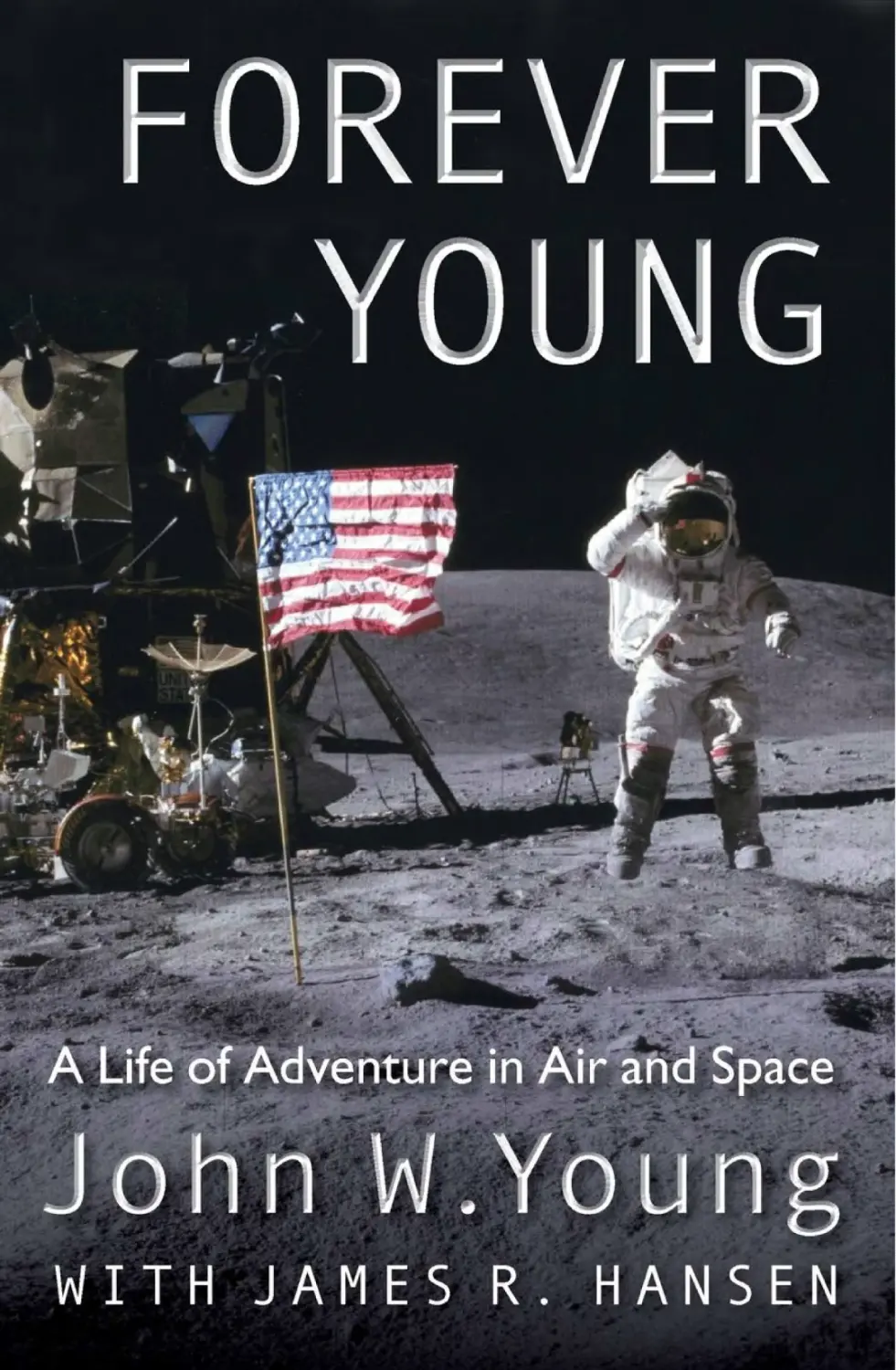


Author: Young J.W. Hansen J.R.
Tags: space astronautics space exploration space flight history of astronautics
ISBN: 978-0-8130-4209-1
Year: 2012


Text
$29.95
He is one of the very few people to have walked on the Moon—
and the only one of those to also pilot the space shuttle. He flew
six missions in three different programs—more than any other
human. His peers called him the “astronaut’s astronaut.”
Recruited at the same time as Neil Armstrong and other
aeronautical pioneers, he served with NASA for more than four
decades. John Young’s career, accomplishments, and longevity
within the space program are simply unmatched.
Enthusiasts of space exploration have long waited for Young to
tell the story of his two Gemini flights, his two Apollo missions,
the first-ever space shuttle flight, and the first Spacelab mission.
Forever Young delivers all that and more: Young’s personal
journey from engineering graduate to fighter pilot, to test pilot,
to astronaut, to high NASA official, to clear-headed predictor of
the fate of Planet Earth.
Young provides an antidote to the typical memoir that
celebrates astronaut bravado and successes while at the same
time contributing to the NASA mystique. With the assistance of
internationally distinguished aerospace historian James Hansen,
he recounts the great episodes of his amazing flying career in
fascinating detail and with wry humor. He portrays astronauts
as ordinary human beings and NASA as an institution with the
same ups and downs as other major bureaucracies.
Young, a consummate engineer, provides insights not only into
his historic lunar walk and storied career as a shuttle pilot but
also into such space events as the Apollo-Soyuz joint mission
and the Challenger and Columbia disasters. In recent years,
Young has become well known for his prognostications about
the future of our planet, believing it is only a matter of time
before a massive asteroid hits Earth, and in this volume he
suggests ways to prevent it.
Long after his compatriots retired from space exploration or
moved on to other occupations, Young remained in Houston as
a senior technical advisor, helping to plan and design future
missions in an effort to make space flight safer for those who
would follow in his illustrious footsteps.
Forever Young is one of the last memoirs produced by an early
American astronaut yet the first written by a chief of the NASA
astronaut corps. Young’s experiences and candor make this
book indispensable to everyone interested in the U.S. space
program.
Forever Young
UNIVERSITY PRESS OF FLORIDA
Florida A&M University, Tallahassee
Florida Atlantic University, Boca Raton
Florida Gulf Coast University, Ft. Myers
Florida International University, Miami
Florida State University, Tallahassee
New College of Florida, Sarasota
University of Central Florida, Orlando
University of Florida, Gainesville
University of North Florida, Jacksonville
University of South Florida, Tampa
University of West Florida, Pensacola
Forever Young
A Life of Adventure
in Air and Space
John W. Young
with James R. Hansen
Foreword by Michael Collins
University Press of Florida
Gainesville | Tallahassee | Tampa | Boca Raton
Pensacola | Orlando | Miami | Jacksonville | Ft. Myers | Sarasota
Copyright 2012 by John W Young
All rights reserved
Printed in the United States of America on acid-free and recycled paper
Frontispiece: Technicians hook up John Young for a weight and balance test at Cape Kennedy in June 1966
prior to the Gemini X launch. NASA photo S66-P-279 (http://johnwyoung.com/gt10/enlarge-gt10/66-p279.htm), courtesy of NASA.
17 16 15 14 13 12
6 5 4 3 2 1
All photos are from the author’s collection unless otherwise noted.
Library of Congress Cataloging-in-Publication Data
Young, John (John Watts), 1930–
Forever Young: a life of adventure in air and space / John W. Young with James R. Hansen; foreword by
Michael Collins.
p. cm.
Includes bibliographical references.
ISBN 978-0-8130-4209-1 (alk. Paper)
1. Young, John (John Watts), 1930– —Biography. 2. Astronauts—United States—Biography.
3. Air pilots—United States—Biography. 4. Space flight to the moon. I. Hansen, James R.
II. Collins, Michael, 1930– III. Title.
TL789.85.Y67A3 2012
629.450092—dc23
[B]
2012018907
The University Press of Florida is the scholarly publishing agency for the State University System
of Florida, comprising Florida A&M University, Florida Atlantic University, Florida Gulf Coast
University, Florida International University, Florida State University, New College of Florida,
University of Central Florida, University of Florida, University of North Florida, University of
South Florida, and University of West Florida.
University Press of Florida
15 Northwest 15th Street
Gainesville, FL 32611-2079
http://www.upf.com
Contents
Foreword 8
Prologue: “Go” or “No-Go” 9
Part I. A Flying Career
1. From Cartersville to Georgia Tech 15
2. Gunnery Officer to Naval Aviator 28
3. Fighter Pilot to Test Pilot 36
4. Pax River 45
Part II. Into Orbit
5. The New Nine and Project Gemini 58
6. Countdown 70
7. Three Orbits 77
8. Dual Rendezvous 83
Part III. Lunar Journeys
9. From a Fire to the Moon 105
10. Call Sign Charlie Brown 117
11. From Tranquility to a Lost Moon 130
12. To the Descartes Highlands 141
13. In the Briar Patch 158
14. The End of Moon Landings 178
Part IV. The Shuttle Era
15. Enterprise 195
16. “The Boldest Test Flight in History” 204
17. Advent of the “Operational” Shuttle 219
18. A Steep Spiral Staircase 231
19. The Challenger Disaster 246
20. A Mountain of Memos 265
21. “The Next Logical Step” 286
22. On a Wing and a Prayer 296
Epilogue: When Worlds Collide 318
Abbreviations 334
Notes 338
Foreword
“Unique” has become such a trite word that I can no longer use it to describe John Young.
But “unusual” certainly fits, even in a group that, if not unique, was at least close to it.
Apparently his bosses also thought him unusual, as he was the first in his group of nine to
be selected to fly in space, with Gus Grissom on Gemini III, the first manned Gemini
flight. On Gemini X John was the first to do an unaided rendezvous with a passive, inert
target satellite. On Apollo 10 he was the first to fly solo around the moon. For him a
second flight to the moon, commanding Apollo 15, must have seemed almost routine.
By that time I had left NASA, but I watched with admiration as John, the consummate
engineer, continued to lead the astronaut group into ever more complex territory. In
addition to having made the most spaceflights, John was also famous as the memo-writing
champion of the Astronaut Office. While often presenting a pessimistic view of future
hazards, the primary focus of his memos was always on improving crew safety.
But if John seemed obsessed with the well-being of his fellow crew members, he
apparently had absolutely no regard for his own safety. For example, consider his fifth
venture into space, the maiden voyage of the space shuttle. Heretofore, new rocket craft
had always been tested unmanned for a couple of flights before putting a crew on board.
(The Russian shuttle’s first and only flight was unmanned). But in 1981, when John and
Bob Crippen climbed on board Columbia, it was with the acute realization that this
immensely complex new machine, powered by both liquid and—for the first time—solid
propellant motors, had never lifted an inch off the ground. Not content with simply
proving the shuttle airworthy, two years later John flew Columbia a second time, his sixth
and final spaceflight. It was a first, of course, the first flight of Spacelab, and a resounding
success, as had been all his previous flights.
Long after his compatriots had been put out to pasture, or discovered other green
fields, John hung in there in Houston, acting as a senior technical advisor. It made sense; it
was where he belonged, helping to plan and design, fretting about the future, trying to
make spaceflight safer for those who would follow in his illustrious footsteps.
Maybe he was even unique.
Michael Collins
Gemini X, Pilot
Apollo 11, Command Module Pilot
Prologue
“Go” or “No-Go”
Undocking the lunar module from the command and service module is a moment that
no Apollo astronaut can ever forget, whether he’s leaving in the LM or staying behind in
the CSM. You have every confidence that, following a successful Moon landing and lunar
orbit rendezvous, you’ll be seeing your mate again—in our case T. K. “Ken” Mattingly, our
command module pilot on Apollo 16—but so many things can happen on the way down,
and back up, that you can’t be sure. After undocking you also get a first good look at your
spacecraft in flight. For T.K. looking out at the LM and for Charlie and me looking back at
the CM, it made us even more respectful of the genius and meticulousness that went into
the design and operation of these extraordinary flying machines.
It was Thursday, the twentieth of April, 1972. We had lifted off from Cape Canaveral
four days earlier. Our goal was to make America’s fifth manned lunar landing. Our
mission: the first exploration of the Moon’s central highlands.
“Okay, Ken,” I said from the left side of Orion, our lunar module. “Go ahead and
undock whenever you want to, and then go ahead and separate.”
From the controls of Casper, the Apollo 16 command module, Mattingly answered:
“Okay, coming up. Give you a countdown for the release: five, four, three, two, one,
release.”
“Hey,” exclaimed Charlie Duke, to my right inside Orion.
Mattingly: We didn’t go very far. [Laughter] Okay. We’ll let it sit here for a second.
Okay, we’re going to back off more now
Young: Very good.
Duke: Is he going?
Young: Yeah.
Mattingly: Right on time to the second. This thing is a dream.
One thing we wanted was a good close-up visual inspection of the lunar module by
T.K., so he could see whether the LM’s entire three-legged landing gear had extended
properly and could confirm that the damage to the surface of the LM, which we suspected
had happened when we saw particles streaming off its exterior back during lunar orbit
insertion, wasn’t too bad.
Mattingly: I see you rolling, or yawing, as you guys do it. I see one, two, ought to see
three legs. Haven’t seen them all yet.
Duke: Okay, you can close. Okay. How’s your window looking, John?
Young: Looks great.
Mattingly: I can see three legs loud and clear. And looks like that one panel up there
that we were watching shred is the only one that I see that is shredded. The rest of it’s
all intact.
Duke: Okay, all your [docking] booms are in.
Mattingly: I see full view. You’ve got three legs down. What more can you ask for?
Young: Okay, Charlie. Helmet and gloves off. Boy, Ken, you look great!
Duke: You really got a pretty spacecraft!
Mattingly: Yours is a damn pretty one, too.
The entire separation had taken place while we were on the far side of the Moon and
out of communication with Earth. But less than a minute after Charlie and I took our
helmets and gloves off, Orion and Casper came around from the back side, separately this
time, and Mission Control in Houston happily received our signals. Because the LM was
having problems with its S-band antenna, T.K. had to make sure that the CSM’s S-band
was pointed toward Earth; other than that, we were in great shape. I couldn’t yet see our
landing site down in the Descartes Highlands, but we had seen it well on a previous orbit.
From that high-altitude view, the site sure looked landable.
But a lot can happen “on the way to the Forum” or … down to a Moon landing.
Flying solo in the command module, T.K. prepared to fire up his Service Propulsion
System (SPS) engine to “circularize” Casper’s orbit. In order to get the LM to a low enough
altitude above the Moon to start its powered descent to the surface, our combined
spacecraft before separation had burned into an orbit that was elliptical, with a high point
of 69 miles and a low point of 9 miles. Now to get back into the parking orbit in which T.K.
would await our return—and from where, if need be, he could try to come to our rescue in
the event of an aborted landing—T.K. alone in the CM had to execute a burn that would
adjust his orbit to circular at the 69-mile altitude. But first he had to test out the control
system for the service module’s steerable rocket engine.
Everything seemed to be going fine. Routing electrical power to the SPS engine, T.K.
activated the GSM’s gyros and began to turn a set of little thumb-wheels that controlled
the gimbal motors for the SPS engine nozzle. To his surprise and chagrin, when he turned
the thumbwheel that controlled yaw, Casper began to shake. That was not good. When he
pulled his hand back off the thumbwheel, the shaking stopped, but it picked right up when
he tried it again, even after changing some switch settings.
“It’s not gonna work,” T.K. reported.
He tried one more time to change some switch settings, to no avail. Nothing that he
did—and kept doing—was any different from what he had done a hundred times in the
Apollo spacecraft simulator. But this time something wasn’t right. T.K. couldn’t be sure
what it was, but he knew it meant trouble for the landing.
“I be a sorry bird,” he told his crewmates.
Mission rules for the Moon landing clearly stipulated that all the systems T.K. needed
for Casper’s circularization maneuver had to be operating satisfactorily or else it was a nogo. Those rules also dictated that, at this point, the two modules should rendezvous in case
it was decided that the LM’s engines would need to be used to get everyone back to Earth.
Houston chose to wave Charlie and me off our landing attempt and told us to
rendezvous with Mattingly. After meeting up, we’d fly in formation until Mission Control
had an answer.
In the LM, we had no choice but to execute the no-go. Charlie and I proceeded into
our lunar module checklist for a powered descent wave-off; in such, all our systems would
be configured for a normal lunar orbit followed by a rendezvous and possible docking with
the CSM. But going through our checklist didn’t mean that Charlie and I weren’t still
committed to making a landing. Inside Orion we remained all powered up and intent on
getting our bird down.
Mattingly: Hey, Orion.
Young: Go ahead, Ken.
Mattingly: I have an unstable yaw gimbal number 2.
Young: Oh, boy.
Mattingly: You got any quick ideas?
Young: No, I sure don’t.
Duke: What do your rules say, Ken?
Mattingly: I have to have four servo loops to do the Circ[ularization burn].
Duke: It’s what?
Mattingly: Every time I put number 2 servo on, it’s okay until I disturb it, and then it
starts to oscillate. You can feel the spacecraft shaking. It’s really doing it.
Young: Okay. You have to have four loops to do Circ, huh?
Mattingly: That’s what the book says. It’s unstable in all SCS [secondary control
system] modes on secondary servo. I can’t believe it, but I’m watching it. Every time I
select the secondary yaw gimbal, make any excursion on the thumbwheel, it goes
unstable.
Young: Okay. Well, just hold what you got, then.
Duke: Hey, Ken, why don’t you just stop it and then start it again.
Mattingly: I’ve done that twice.
Duke: Oh, okay.
Young: Well, let us get pointed at you and do a Verb 83 [a code to be punched into the
onboard computer for a rendezvous parameter display].
Mattingly: Okay, gang. I’m sure sorry about this, but that number 2 servo is just
oscillating like a wild man. And I tried it both in manual and TVC and just with the
thumbwheel, and I get the same response. There could be a switch here somewhere but
I—I swear I’ve checked them all, all I can. I guess I’ll power them down.
Young: Yep, and tell the ground when you go around.
Mattingly: Okay. Brother, what a way to start the day, huh?
I was pretty sure that T.K. hadn’t done anything wrong and that the problem involved
some unknown component in the SPS that had malfunctioned, but it was understandable
that he was worrying that he had somehow screwed up.
Our two spacecraft finding each other fast, even in very nearby lunar orbits, wasn’t
easy. Our onboard computers weren’t programmed for the orbital mechanics necessary to
bring together a command module and lunar module flying less than a mile apart.
Houston told us to make a fuel-saving low-altitude catch-up maneuver that would get
us back into a station-keeping position with Casper, but, man, that was going to require
some really subtle maneuvers! This worried me a lot, as I feared we were too low in Orion
relative to the Moon to do that sort of nuanced flying.
I insisted that Mattingly be allowed to make more of a straight-on “brute force”
rendezvous, one in which T.K. just pointed Casper at Orion and fired his thrusters, getting
us back in the vicinity of one another as directly and quickly as we could. Director Jerry
Griffin in Flight Control became upset with me over this insistence, because to brute-force
it was going to cost the CM some of its maneuvering fuel. But if Griffin had seen how close
we were to the surface on the back side of the Moon, he would have felt differently!
Once we made it into a nice station-keeping position relative to Casper, all we could do
was keep revolving around the Moon until Mission Control gave us a “go” or “no-go” on
power descent initiation (PDI). We were told that simulations had begun in Houston in
the command module simulator, as had some structural tests at the Apollo spacecraft
manufacturer’s plant in Downey, California, plus some other tests at MIT’s Draper Lab and
in high-speed wind tunnels at Tullahoma, Tennessee, all to determine if T.K.’s problem
with the yaw axis of the SPS’s secondary servo system would present any structural hazard
to his spacecraft should the backup secondary control system have to be used in SPS
burns. Overseeing all the troubleshooting was good of Jim McDivitt, the commander of
Gemini IV and Apollo 9, who for the past three years had been serving as the Apollo
spacecraft program manager. Jim had done great work for Apollo 12, 13, and 14, and I had
every confidence his leadership would work the problem to a satisfactory answer, if
anyone’s could.
For nearly six hours we orbited the Moon in tandem … waiting … not so patiently, I
can tell you. We waited on pins and needles for the word whether Charlie and I could try
for our landing—the only one in our life we’d ever be able to try, because the Apollo
program was going away, killed by uninterested politicians and an American public that
had become bored (bored!) with Moon landings, though we’d only done it four times
before.
In the LM Charlie and I stood some, we sat some, and we sweated it out. There was
good reason to doubt that we’d ever get the “go.” We weren’t going to be able to wait
forever. The sun was rising over the Descartes Highlands, and in just a few hours the
lighting conditions for a Moon landing would be pretty bad.
We feared that we, just like the astronauts of Apollo 13 two years to the month earlier,
would have to come home, if we could, without ever setting foot on that blessed Moon.
And instead of coming back as heroes who had managed to save their damaged spacecraft
and their lives from a potentially fatal in-flight accident the way Jim Lovell and his crew
had been able to do, we’d splash down as the lunar-wannabe astronauts who had been
unable to overcome their challenges or, worse, somehow screwed up.
I hadn’t come all this way for that.
I
A Flying Career
1
From Cartersville to Georgia Tech
The bygone era of my youth seems like more than just a different day and time. It seems
like another lifetime, almost as if on another planet. Life—the way everyone lived—was so
very different. But memories of that former existence now come back to me in a rush, and
brighten my eyes.
I was born on 24 September 1930. The previous day the great soul singer Ray Charles
was born. That same month the Blondie comic strip started running. Not until the year of
my birth was sliced bread even available.
I came screaming into the world at St. Luke’s Hospital in San Francisco, in Bernal
Heights just south of the Mission District. My dad, William Hugh Young, who went by
Hugh, was a civil engineer working for the Raymond Concrete Pile Company. The
previous three years he had been in China building bridges. Dad later told me that the
Chinese were “the hardest workers I ever met.” If he was comparing them to himself, they
must have been very hard workers indeed, because Dad burned his candle at both ends.
He always put it all on the line. There was nothing he owned that he didn’t get by the sweat
of his brow.
Returning from China, Dad went to work building the foundations of Park Plaza in St.
Louis, a large complex that eventually included a hotel, apartment tower, movie theater,
and several restaurants and bars. In a whirlwind courtship, he met and married Wanda
Howland, a secretary. Together the couple drove across the Rockies to San Francisco,
where Dad worked on the foundations of a blimp hangar at Moffett Field, the naval air
station on the bay near Sunnyvale. The hangar was humongous; in fact, it still stands today
as one of the world’s largest freestanding structures, covering eight acres. The navy
designated the structure one of its historical monuments, and the National Trust for
Historic Preservation has listed it as one of America’s Most Endangered Places.
While renting a room in San Mateo, Dad and Wanda conceived yours truly, their first
child, John Watts Young. A little over two years after my arrival, in January 1933, another
son was born to them, my baby brother Hugh Howland Young.
In 1932 Dad got laid off. The Depression that so many others had been suffering hit
home. The folks loaded me into their car and we made the cross-country trek to
Cartersville, Georgia, Dad’s original home, to live with relatives.
Cartersville lay about forty miles north of Atlanta. The discovery of gold in North
Georgia in 1828 had generated a rush of European settlement into the area, driving the
proud Cherokee out. Back when “cotton was king,” Cartersville prospered. But as the Civil
War destroyed the plantation economy, Cartersville’s economy collapsed. Dad left the
ailing southern town to seek his fortune elsewhere. Harder times forced him to come back.
The job waiting was in a filling station. It was operated by my grandfather, Griffin
William Young, who went by the name Mank, and by Harry Hebble, who was married to
Grandpa Young’s sister, Sarah. The station was still doing pretty well because Highway 41
going into Atlanta still saw plenty of cars. Today it’s North Cobb Parkway and, naturally, a
far busier road.
Dad made just a few dollars a day. All around us were families like us. Kids ran around
in ragged hand-me-downs, sometimes in pants or shirts made of old scraps of cloth that
had been found on the street. Most everybody was thin as rails because no one ever had
enough to eat.
We lived on Main Street in a large old house that had been used as a schoolhouse.
Some walls had blackboards with pieces of chalk still in the racks. Sometimes in the
evening Dad drew designs of suspension bridges on the boards. I drew formations of stick
soldiers. Times were hard and, even at my age, I could tell that Dad wasn’t happy.
Two houses from us was a livery where a stable of horses was kept. Down a little
farther on Main Street was Grandfather Mank’s home. Next to him lived Uncle Will,
Mank’s brother William Watts Young. On Main Street near where the railroad tracks
crossed that ran on to Atlanta, they operated Young Brothers Drugstore. Years later the
drugstore became noted for the discovery of the oldest Coca-Cola sign ever painted.
Diagonally down the block from us was the Presbyterian Church where we went to
Sunday school. Local lore had it that the church was the only building in town not burned
down by General Sherman when he “marched through Georgia.” The church survived
because Sherman used it as a stable for his horses. We Georgians hated the man, of course,
calling him Burnin’ Sherman.
Often I went to see Mank, usually with my brother in tow. Mank taught me to read
when I was about four. Next door lived my cousin Bill and his mother, Tave. Uncle Will
had a set of books called The Book of Knowledge. Most people today visualize an
encyclopedia as a collection of dry articles used to jump-start a school paper, but The Book
of Knowledge was nothing like that. It was wonderfully readable by children and adults
alike. Uncle Will bought his set in installments, which was okay, because each volume
stood on its own and was broken into chapters—called “books”—with such titles as “The
Book of the Earth,” “The Book of Golden Deeds,” and “The Book of Our Own Life.” As a
collector’s item, a whole set of the books is highly valuable today. I wish I still owned a set.
When I got to be five years old or so, I read Uncle Will’s from cover to cover—and from
them I learned about everything I knew at the time.
We had a lot of different relatives, Mank told me. There was Uncle Jim from Buffalo,
New York, who worked for Dupont. He knew more about hydrogen peroxide than anyone
in the world. We had Aunt Sarah and her husband, Uncle Harry. We also had Aunt Sally,
who was old and tough as nails on us. These were blood relatives. Then there was Aunt
Alice who, before I was five, sat me on her lap and told me about the “birds and bees”—in
graphic detail. There was Aunt Fanny Suber, with a big woodstove in her kitchen on which
she cooked great huge breakfasts for us. I also had an “Uncle Jim Number Two”— Jim
Westmoreland—who I loved for his mule and plow and how he taught me to farm and
plant vegetables. All these “relatives” were African American.
Two of my young friends were also black. They were Rufus Brown and Nathaniel
“Pretty” Green. Nathaniel taught me how to play poker. Both he and Rufus lived on
Summer Hill, where most all the black folks lived. Aunt Alice lived up there, and I went up
there to see her often, partly because she made the best cornbread and grits in Cartersville.
In 2006 a documentary film was produced by Kennesaw State University titled Summer
Hill. It told the inspirational story of the remarkable African American community in
Cartersville. During the segregation era, the Summer Hill community produced Georgia’s
first black Supreme Court justice and a famous Motown songwriter as well as a number of
teachers, ministers, doctors, lawyers, and other professionals. Watching this video made
me feel extraordinarily lucky to have known Rufus, Pretty, Aunt Alice, Aunt Fanny, and
Uncle Jim Number Two.
Dad was not happy in his job at the gas station, so in 1936 he found a job in central
Florida working as manager of the transportation department for a community with the
unusual name Doctor Phillips, named after a Dr. Phillip Phillips, a big citrus grower who
made major innovations in processing and packaging orange juice. The place was
essentially a suburb of Orlando, not too far from what is now Disney World.
For a while my brother and I stayed in Cartersville and lived with Aunt and Uncle
Hebble. Once secure in his new job, Dad and Mom found a house and moved us to
Orlando. Hugh and I battled for elbow space in the backseat of our Ford, the trip taking
two punishing days. The road was mostly one lane and open range for cattle. When a steer
raised its head near the road, Dad slowed down quickly, because there was no telling
which way the steer would go. Back then the state of Florida had so many automobile-cow
collisions that some insurance companies wouldn’t cover them.
We moved into a rental house at 815 West Princeton Avenue in College Park, north of
downtown Orlando. Later we bought a house at 525 West Yale Avenue. The two houses,
located between Ivanhoe Lake and Lake Silver just west of what today is Interstate 4, were
only three blocks apart. In 2005 the state of Florida distinguished our Princeton Avenue
home with a bronze marker, naming it a Florida historical site. Regrettably, the wording of
the caption made it sound like I flew all the Gemini missions, not just two of them. That
caption has since been fixed.
College Park was a boom suburb. The roads were all two-lane and paved in brick.
Sidewalks went around every block, and no block had more than four houses on it. Our
place was next to a boardinghouse operated by Aunt Susie, wife of Uncle Walt Akerman, a
downtown lawyer. Sometimes on Sundays we ate at the boardinghouse, where the food
was really great.
New friends were my cousin Joe Akerman and two neighborhood boys, Paul and Tim
Keating. No one could afford store-bought toys, so we made our own. With old boards and
nails we made our own rifles, using a narrow board for the barrel and a larger board for
the stock. Turning a large board sideways halfway down a smaller board, we made
airplanes—hand-powered, of course. Unlike in the red clay of Georgia, we could easily dig
up the Florida dirt, so we dug trenches and tunnels to play war. One lot in College Park
was full of dry beach sand. We used it as a football field where we played touch and tackle
football.
I was only five when I started Princeton Elementary School in College Park; they let
me in because I could already read so well. The school was located on Princeton Avenue
just a couple of blocks from our house. It was a nice school, and I had a lot of fun. The
work came easily to me. But halfway through the school year, our lives changed
dramatically.
I will forever remember the night my mother was taken away from the house. She was
wearing a white pullover garment that had her arms wrapped in it. What it was, I found
out later, was a straitjacket. Dad told us she was sick. It would have been too difficult to
explain schizophrenia to us. Mom had always seemed normal to me. I’d never noticed she
was mentally ill. The doctors sent her to Florida State Hospital in Chattahoochee,
northwest of Tallahassee, the only state mental hospital at the time. I kept hoping she’d
come back. I later learned it was a pretty horrible place.
Dad had his hands full: a new job with plenty of responsibility, a wife in an asylum,
and two young boys. Fortunately, Aunt Sarah and Uncle Harry lived in Orlando near Rock
Lake, where we sometimes went to swim. Aunt Sarah was already like a second mom to us.
She was very nice, and we staved with them a lot, even though they lived in a trailer with
not much room.
Dad thought it would be better for Hugh and me to go back to Cartersville, so he got
our aunt and uncle to drive there, to continue our schooling. I went to the second half of
the second grade and the entire third grade at Cartersville Elementary School. With the
help of Mank and Aunt Sarah, my grades stayed good. A fine woman by the name of
Dinks Irick was my second-grade teacher. Her memory must have degenerated over the
years, because when she recalled me for a newspaper story at the time of my Gemini III
flight in 1965, she described me as “a brilliant boy, always a pleasure to teach.”
Hugh and I spent the summer before third grade in Chattanooga with Sarah and
Harry, who had moved to a house on Signal Mountain on the Cumberland Trail. It was a
great place to visit. Native Americans had used Signal Point to send fire and smoke signals
across the Tennessee Valley. Later the Union Army used it as a communications station. At
the outbreak of the Civil War, only a few families lived on the mountain. But when
epidemics struck Chattanooga in the 1870s, several wealthy families relocated to the
mountain to find clear air and pure water. A developer in the early twentieth century
purchased land near Signal Point and built more homes. An electric streetcar track linked
it to Chattanooga.
I remember that summer fondly, especially the homegrown tomato sandwiches we ate
for lunch. I also remember the night we went over to Lookout Mountain to peer through a
telescope. It was my first close look at the Moon, an object I would come to know rather
intimately. The telescope showed me that the “man in the Moon” didn’t really have a
smiling face, but large areas of flat terrain and many craters. No one dreamed then that
anyone would ever go there. It still amazes me that I was one of only twelve who did.
Dad decided Hugh and I should return to Orlando. In Cartersville he hired a woman
by the name of Elzo Smith to be our housekeeper. Mrs. Smith was a middle-aged divorcée.
She turned out to be wonderful, a good housekeeper and a great cook. She stayed with us
for seventeen years, serving as third mom to Hugh and me, after Aunt Sarah and Mom.
Having learned how to study well under Mrs. Dinks Trick, my grades at Princeton were
always at or near the top of the class. Apparently some of the teachers* at Princeton, which
is now what they call a magnet school, still show kids my grade card. In the sixth grade I
became captain of the Patrol Boys, who directed traffic and helped the little kids cross the
street and not get hit by car or bicycle traffic.
I turned into a pretty fair athlete, developing both speed of foot and staying power.
Frequently I outran the redheaded bully who chased me home from school. In softball we
would have won the city championship under coach Jerry Cloud if not for a problem with
the ball field. For the big game, the bases themselves were made out of the white lime that
defined the base paths. I got thrown out going into third because I couldn’t find the line
defining third base. It had been erased because it had been slid into too much.
After Princeton Elementary, I went on to Memorial Junior High School. There were
many great teachers there. My big hobby was making model airplanes. After building
them and fooling around with them a bit, I’d attach them to the ceiling. My room was
filled with different sorts of flying machines.
My interest in aviation started when I was about six. The first model I built was a
Waco, a civilian biplane built by Waco Aircraft in Troy, Ohio. My model was of the rugged
little open-cabin single-seater that Waco built in the late 1920s to carry mail across the
country. Airplanes that carried the mail may not sound very exciting to kids today, but
they sparked all sorts of romantic visions in Depression-era children. The greatest
American hero of all, Charles A. Lindbergh, had been a barnstormer and air mail pilot.
Three years prior to the year of my birth, Lindbergh had flown the Atlantic. To this day he
remains one of my greatest heroes.
Remarkably, the year of my birth coincided with the birth years of no fewer than
thirteen other men who would become astronauts: in alphabetical order Buzz Aldrin, Neil
Armstrong, Mike Collins, Pete Conrad, Donn Eisele, Ted Freeman, Ed Givens, Jim Irwin,
Don Lind, Ed Mitchell, Bill Pogue, Tom Stafford, and Ed White. All of us would spend our
childhoods without an inkling that spaceflight could be achieved during our lifetime, or
that we would join a vanguard of pilots and engineers who’d make it happen. Like the
other astronauts-to-be of my generation, as boys we drew our inspiration from the
romance of airplanes flying hither and yon, across the oceans, over the poles, and to the far
corners of the world, not so much from the science fiction of rockets blasting into the
blackness of outer space. We grew up admiring what we perceived to be the chivalry of
pilots—from World War I aces Eddie Rickenbacker and Manfred von Richthofen to
pioneer flyers like Jimmy Doolittle and Wiley Post. We picked up our notions from the
stacks of popular aviation magazines we bought at the local drugstore with our dimes and
nickels.
Aviation magazines and tubes of model airplane glue filled my “wonder years.” It
wasn’t just building the airplanes that fascinated me, it was the flights I imagined taking in
them, at high speed, in near-vertical climbs, in terminal dives, racing around pylons,
zooming my way through extraordinary patterns and maneuvers, sometimes in a dogfight
or attacking an enemy target on the ground. The wonder of it all! To design such airplanes!
To fly them to places and in ways they’d never been flown before! I loved my bicycle and
the speed and turns I could make with it, but my enthusiasm for being in motion didn’t
stop with two dimensions. For me, the romance of the air contrasted with what was the
mundane life. of most people. 1 came to live and breathe the adventure and daring of
being aloft and going places.
We’d lost Mom to the mental hospital; we soon lost Dad’s company to World War II.
Not long after Pearl Harbor, Dad joined the navy. He got into the Seabees as a lieutenant
and was away from us for the rest of the war. He eventually became a commander and flew
numerous patrol missions over the Pacific.
With him absent, I helped Mrs. Smith run the house. I tried to be a daddy to Hugh.
One December, I went into the woods and cut down our Christmas tree, hauled it back,
decorated it, and shopped for presents for my brother and Mrs. Smith. I gave myself
similar duties for other holidays. When the occasional hurricane blew through, I did my
best to caution my brother and Mrs. Smith not to get excited. When I was twelve, in 1942,
I went to work at the local Piggly Wiggly, for which I had to get a Social Security number.
My school grades remained very good, without my doing much work. I played football at
Memorial on a pretty good team. One of our games was against Kissimmee Junior High
School, where the field was a cow pasture. When trying to score, we had to watch where
we put our feet to avoid stepping in manure. We won the game by running fast and
dodging the cow chips.
When Dad returned, he got a good job as plant superintendent for Plymouth Citrus
Products Cooperative. It was a big outfit that at one time processed 12 percent of all the
citrus in the state, amounting to many millions of crates.
Even with Dad back, we usually spent summers away from him in Cartersville.
After Memorial it was on to Orlando Senior High. Mrs. Shaheen taught us social
studies, “Pop” Warner taught us algebra, and Leland Kirst taught physics. I enjoyed all of
them and pretty much got straight As. At 150 pounds, I played right guard on the football
team. During the third quarter in a game in Tampa, I got my bell rung so good I don’t even
remember it happening. The offsetting tackle weighed at least 210 pounds, and my
teammates had to carry me off. We won a lot of games, but the big teams in Tampa and
Miami were hard to beat. My junior year I went out for baseball. I was a catcher. All season
long I was on the second string and only caught batting practice. Because I was doing the
catching, I never got any chance for batting practice. Finally, during a game at the end of
the year, I got my chance to bat. I hit two doubles. The coach said, “You’ve got to come out
next year, son.” I said, “Thanks, Coach, but next year I am going out for track!” I did, and
won several local meets. I finished fifth in the state in the half-mile with a time of 2:03. In
those days that was a pretty good time.
The summer between my junior and senior years I worked as a rod man on Hank
Heath’s surveying team. We surveyed a lot of central Florida, mostly swamps and timber.
When Hank met somebody in that empty land, he’d usually know them by name and stop
and talk with them. He was an amazing surveyor. Often the brush was so thick that, to run
lines, you had to cut your way through a mass of bushes and trees with a machete. By
running levels, we found out that the St. johns River near Titusville was only nine feet
above sea level. It was a lot of fun surveying over to the coast. We stayed in the only motel
in Titusville. Its screen windows didn’t keep out the mosquitoes, so we coated our bodies
with mosquito repellant. That didn’t help much, either. I never dreamed that one day
across the Indian River from where we surveyed I would be sitting on top of a rocket on
the launch pad of what would be the Kennedy Space Center, ready to blast to the Moon.
I graduated from Orlando High School in 1948 as part of a big class of 335 students.
During commencement, Principal William R. Boone named me the most outstanding
scholar at OHS for making nothing but As from the ninth grade on. I was also given the
Guernsey Good Citizenship Cup, the highest award the school presented. What a good
citizen was, I had no idea. I hadn’t been class president or anything. My most interesting
high school job had been as stage manager for the high school auditorium, setting up the
stages for plays and lectures.
I worked again that summer doing surveying. Dad asked me, “Where do you want to
go to college?” I answered, “Where do you think I should go?” “Georgia Tech,” he said. So I
took the NROTC scholarship test and passed it, and asked for Georgia Tech. The NROTC
scholarship paid for my tuition, books, and fees, as well as my room and board—a total of
$6,000. Today, of course, you couldn’t begin go to any college for that amount of money.
But in 1948 that was a lot of cash—no doubt, more than my dad could have ever paid for
me.
So I headed back to Georgia, to enroll in one of the finest engineering schools the
nation had to offer.
I got to Atlanta by bus. It was September 1948. President Harry S. Truman was
campaigning to win a second term against Republican nominee Thomas E. Dewey, which
he did, barely. A few weeks before my arrival at Georgia Tech, the first-ever televised
congressional hearing took place: the House Un-American Activities Committee wanted
to find out if a former federal employee, Alger Hiss, was a closet communist. Much of the
international news involved Korea, a hot spot that would occupy the world’s attention for
many years to come. I started to pay more attention to what was going on in the world
around me, especially in the field of aviation.
During the fall of my senior year in high school, an air force test pilot, Captain Charles
E. “Chuck” Yeager, broke the sound barrier. The revolutionary plane he piloted beyond
Mach 1 was the rocket-powered Bell X-1. Dad and I talked about the feat when stories of
the flight made it into the aviation magazines.
Not that I was all that aware of the many dramatic breakthroughs being made in flight
technology. During the second semester of my senior year at O HS, an army rocket team
under Dr. Wernher von Braun launched a V-2 missile at White Sands, New Mexico. The
rocket streaked to an altitude 470 miles. The year of my high school graduation also
witnessed the first flight of Convair’s XF-92 airplane, with its innovative delta wing; the
flight of the first civilian test pilot, Herbert H. Hoover (not related to the U.S. president),
past Mach 1; the tailless X-4 aircraft’s first test flights; and the publishing of an
aerodynamic theory that proved critical to solving the high-speed problem of “roll
coupling.”
During my freshman year in college, the U.S. Army established its first formal
requirements for a surface-to-air antiballistic missile system; President Truman signed a
bill providing for a 5,000-mile guided-missile test range, subsequently established at Cape
Canaveral; and a single-stage Russian rocket with an instrument payload of some 270
pounds shot to an altitude of 68 miles. The summer between my freshman and sophomore
years in college, a V-2 rocket carried a live monkey to an altitude of 83 miles (the monkey
survived but died on impact); the U.S. military made its first operational use of a pressure
suit during piloted flight to 70,000 feet; and the first American pilot ever to use an ejection
seat escaped his jet-powered Banshee while speeding over coastal Carolina at 500 knots.
Few of these notable aerospace developments drew my attention during my first year
at the Georgia Institute of Technology. I was too immersed in the basic curriculum and
had not yet been exposed to the aeronautical engineering faculty knowledgeable about
these exciting breakthroughs. The world was changing fast, and little did I know that I had
arrived at Georgia Tech to be brought up to speed with that changing world, so I could
help change it even more.
“What kind of a world will we make?” one of my fellow OHS students had asked at our
commencement in June 1948. I was about to find out.
■
The university put me up in Brown Dormitory, on North Avenue. It was the oldest
dorm at the school. My roommate the first year was Jack Murphy. Jack was from the
Northeast—Newport, Rhode Island, I believe—and was a great guy. The first day, he and I
went to get breakfast at the campus cafeteria. The cooks served the usual eggs, bacon,
toast, and grits. Jack took one bite of the grits and spit them out all over his plate. He
thought he was being poisoned. Welcome to the South, I told him.
Back in those days, Georgia high schools did not do a very good job of preparing
students for the rigors of an engineering education. After the first academic quarter, eight
of the thirty-two boys on our dorm floor had to enroll in night school to stay at Georgia
Tech.
No question, Tech was a first-rate engineering school. Established in 1885, it was
referred to into the early twentieth century as the “North Avenue trade school” because the
campus was bordered by North Avenue and because in its early years the school operated
much like a trade school, with students working part of the day in a machine shop and the
other part of the day in the classroom. It was an academic model that the Institute’s
founders had borrowed, not from another Southern school, but from Worcester Free
Institute of Massachusetts (later Worcester Polytechnic Institute). From the beginning, the
school lived in a curious plurality of worlds and cultures: national yet Southern, urban yet
rural, progressive yet conservative, oriented toward the practical yet attracted to the
theoretical, nurturing a purely engineering and technical curriculum as well as a big-time
athletic program.
As I started classes at Tech in 1948, the school of engineering was moving away from
the “shop culture” and more and more toward the “school culture.” The shop culture had
predominated from the time of Tech’s foundation right up to World War II and still had
strong proponents on the faculty when I arrived. But rather than focusing so much on the
technical training that could be applied directly to industrial work, Tech placed more
emphasis on basic studies in mathematics and science. It was the perfect place for me to
study, because my intellectual inclinations placed me smack-dab between the two cultures
of the shop and the classroom.
Besides that, Tech had a great program in aeronautical engineering. In March 1930,
the same year I was born, the school received a $300,000 grant from the Daniel
Guggenheim Fund for the Promotion of Aeronautics to build its aeronautical engineering
program. On the board of directors of the Guggenheim were such aviation luminaries as
Charles Lindbergh and rocket pioneer Robert Goddard. Previous recipients of
Guggenheim grants had been the California Institute of Technology, MIT, Stanford
University, University of Michigan, University of Washington, Harvard University,
University of Akron (near the Goodyear-Zeppelin plant), Syracuse University, and New
York University. The Guggenheim panel considered twenty-seven different colleges in the
South for an award, but only Tech got one. With the money, Tech’s aeronautical
engineering department built a wind tunnel, developed other research and testing
laboratories, and started to attract top-notch students and faculty.
Few schools produced more astronauts than Georgia Tech. Currently the count stands
at fourteen: Richard H. Truly (Class of ’59), L. Blaine Hammond (’74), Jan Davis (’75),
Michael A. Clifford and Scott J. Horowitz (’82), William S. MacArthur (’83), Susan Still
Kilrain (’85), Alan G. Poindexter (’86), Douglas H. Wheelock (’92), Timothy L. Kopra
(’95), Sandra Magnus (’96), Eric A. Boe (’97), and Robert S. Kimbrough (’98). First on the
list chronologically is John W. Young (’52), and I can’t tell you how proud I am to have
begun this Tech tradition. On STS-82 in April 1997 Susan Kilrain flew as only the third
female shuttle pilot. In November 2008 space shuttle Endeavour launched carrying three
Tech graduates: pilot Eric Boe, mission specialist Shane Kimbrough, and mission specialist
Sandy Magnus. Sandy spent three and a half months aboard the International Space
Station, part of the ISS’ eighteenth permanent crew. It seems that Tech’s mixture of shop
culture and school culture was perfect for the training of astronauts, because basically
we’re doers, but doers who need to think through everything very carefully and
systematically.
Freshman-year studies were easy for me. I earned straight As in my engineering
courses and got good grades also in naval science, chemistry, and Spanish. My GPA was
4.45 out of 5.0. Aeronautical engineering was considered the hardest curriculum at Tech,
which didn’t scare me one bit, because that’s what I wanted to study.
The Navy ROTC program kept me very busy. The summer after my freshman year we
made a midshipman cruise on the USS Missouri (BB-63). The ship, nicknamed the Mighty
Mo or Big Mo, was an Iowa-class battleship and was the site of the formal Japanese
surrender on 2 September 1945. The last battleship ever built by the United States, it
fought in the battles of Iwo Jima and Okinawa and shelled the Japanese home islands.
Our cruise on the Missouri took us across the Atlantic to Cherbourg, France. We slept
in four layers of sleeping racks in the aft of the ship. It was there I met future astronaut
Tom Stafford, who slept in the same set of racks I was in. Tom was a Naval Academy
midshipman who ended up joining the air force, commissioned as a second lieutenant.
From Cherbourg we took a train through Caen and Saint-L to Paris for a week’s liberty. I
looked out the window all the way through Normandy, especially at Saint-L. The German
army had occupied the town in June 1940. A strategic crossroads, Saint-L was almost
totally destroyed following the D-Day invasion. Fortunately, the decision was made to
rebuild Saint-L, and it became a center of French gastronomy focusing on the production
of award-winning foie gras (chopped liver to me!). I missed getting any of that delicacy as
our train sped through the French countryside. In places along the route to Paris we could
still see damage. Even the hedgerows were still torn up in places. Paris was great. We
toured the city and saw as much of the Louvre Museum as we could.
From Cherbourg we steamed back across the Atlantic to Guantanamo Bay, where the
ship anchored and gave liberty to the sailors. Many of the guys got fall-down drunk on
Cuban beer. They gave the shore patrol a lot of trouble getting them back onto the ship. It
was a great cruise, but it convinced me beyond all doubt that I did not want to become a
battleship naval officer.
Sophomore year was even more interesting. We had gone to a lot of fraternity rush
parties during freshman year. As the Georgia Tech song goes, “Like all the jolly good
fellows, we drink our whiskey clear.” At several fraternity parties the trick staged by the
upperclassmen was to see which freshmen could drink the most. Myself, I always failed
that challenge, big time.
Sophomore year I pledged Sigma Chi (ΣΧ), one of the largest and oldest Greek-letter
social fraternities, whose stated purpose was to promote the concepts of friendship, justice,
and learning. For me Sigma Chi was a great outfit. They made me Pledge Trainer, as I had
shown myself so completely familiar with the fraternity’s ideals. An old buddy, Bill Dean,
became the Sigma Chi president. We were in a lot of aeronautical engineering classes
together. At least two other Sigs became NASA astronauts: Greg Harbaugh, a 1978 Purdue
graduate who flew on STS-39 and STS-54, and Scott Altman, a 1981 graduate of the
University of Illinois, who flew on STS-90, STS-106, and STS-109.
Ultimately I was picked to be captain of our Navy ROTC. The big event of our final
year was a “pass in review” on Grant Field at which I got to lead more than 3,000 Navy, Air
Force, and Army ROTC troops. I can tell you, marching is not the navy’s strongest
contribution to our nation’s security—not by a long shot!
We all worked very hard at Tech. My study habits allowed me to make fairly good
grades and do a lot of other things as well. For two years I wrote articles for the Georgia
Tech engineering magazine, Engineer. One of my stories was about the operation of my
dad’s Plymouth Citrus Products Cooperative plant. Another dealt with Dr. Wernher von
Braun’s V-2 rocket. No one dreamed in 1950 that we would go to the Moon so quickly.
Although we sometimes discussed rocket engines and the aerodynamics of missiles in
our “aero” classes, most of our focus was still on airplanes. In particular, we got a great
education on the basics of lift and drag. Professor Donnell W. Dutton, the head of the
aeronautical engineering department, told us, “The key to success in aviation is good
design.” Dr. Dutton himself conducted some significant research into rotary wing
aerodynamics, applicable to autogiro and helicopter design. He deserves a lot of credit for
transforming aeronautics at Tech into a higher-level program wherein research played a
paramount role.
One of my favorite classes was Dr. John Joseph Harper’s aircraft design lab. Professor
Harper was something of a legend at Tech. Besides serving as the director of one of the
wind tunnels, he taught aircraft aerodynamics, performance, and stability and control. His
design lab was the culmination of our undergraduate education and included the actual
building and flight demonstration of models we designed. Dr. Harper’s rubric was
“GIVEN nothing; FIND—everything.” His office, which was in the basement of the
Guggenheim Building, was known as Lake Harper because it lay some seven feet below
street level and got a thorough washing and mopping after every rainstorm.
The year I took his class, Professor Harper had every student design a fighter plane. By
then, we all knew that the Bell X-1 flown by Chuck Yeager had gone supersonic back in
1947 and that some new experimental aircraft were assailing Mach 2, so we asked if we
could design a supersonic fighter. “No!” was his adamant answer. “The data for doing that
is not available to you. It’s all classified.” We worked day and night on our designs. One
night very late I was put on report for leaving the aeronautical engineering building at 2:30
A.M. The report read that I left “with a woman.” In truth, the lady in question was my
classmate George Puca, who was wearing his blue Air Force ROTC overcoat. Wonder was,
George bore a very prominent black mustache. I could only conclude that a Georgia Tech
police officer had a serious vision problem.
We learned to work twelve-to-eighteen-hour days at Tech. The regimen helped me
immensely later in life. Shortly after being named an astronaut in 1962, I wrote a letter to
the president of Georgia Tech, Edwin D. Harrison: “I wouldn’t have traded my Tech
education for a million dollars. … One of the finest things that I learned at Tech was how
to work unreasonably long hours for days on end. … If the U.S. Congress can be
persuaded to put a 36-hour day into effect, it will be a Godsend to Tech students.” Even
with my rigorous schedule, I managed to belong to a great many groups and organizations
and was able to help some of them make wise decisions. While I was on the student
council, we voted to allow women to come to Tech to become engineers. If young ladies
wanted to do all the work we were going through, I was all for them. Also, spending 25
cents for a ride to Agnes Scott College—an all-girls school six miles away in Decatur—to
get a date was a lot of money we could have saved had women been at Tech already.
Several of the organizations I joined found me useful for keeping notes and getting
work done. I served as secretary of Sigma Chi; treasurer and vice president of Circle K, an
international collegiate service organization sponsored by Kiwanis; vice president of the
local chapter of the Institute of Aeronautical Science (IAS); on the editorial staff of the
Georgia Tech Engineer; treasurer of Tau Omega aeronautical engineering fraternity; and
secretary of Tau Beta Pi, the oldest engineering honors society and the second oldest
collegiate honor society in America. I was also inducted into and served as an officer of
Phi Kappa Phi, an honor society recognizing academic excellence, as well as Omicron
Delta Kappa, known as The Circle or more commonly as ODK, a national leadership
honor society. And I was selected for the ANAK Society, the oldest secret society and
honor society based at Tech. This was a very high honor *, whose purpose was “to honor
outstanding juniors and seniors who have shown both exemplary leadership and a true
love for Georgia Tech.” One of my fellow students, Teeter Umstead, later said about me:
“John didn’t say much, but when he spoke, everybody listened.” That’s a nice compliment, I
figure. Needless to say, being highly active in all these organizations and schoolwork kept
me busy.
We made two additional NROTC summer cruises. One cruise was on the USS
Newport News (CA-148). The News was a semiautomatic Des Moines-class heavy cruiser
with 8-inch cannon. Launched in March 1948, it was the first air-conditioned surface ship
in the navy. During the blockade of Cuba in the missile crisis of 1962, the News stopped
the Soviet vessel Labinsk.
On the ship in 1951 we went to Halifax, Nova Scotia. It was July, and we actually dared
swimming in the ocean. It was very cold. Prior to diving in, we “lubricated” with bottles of
Canadian ale. We all thought, “If the water in Halifax is this cold in July, what must it be
like in December!?” In my first physical education class at Tech, coach Freddy Lanue had
taught all of us what he called “drown proofing.” It taught us how to stay afloat even with
our arms and legs tied. Some of my buddies considered Coach Lanue the meanest man
alive. A few of them came close to drowning several times, but managed to survive and get
out of the pool. In the cold rough water of the North Atlantic off Nova Scotia, I
appreciated what Coach had taught us. I appreciated it even more as an astronaut, because
70 percent of the Earth I’d be orbiting was covered with water.
Another cruise that summer took us to Norfolk and Pensacola. For a lover of airplanes
and a student of aeronautical engineering, the trip to Pensacola was greatly interesting.
When the cruises were over, I spent the rest of the summer back in Orlando working
at Dad’s Plymouth Citrus Products Cooperative plant as a welder’s helper. I was a good
welder. Mainly I helped put water lines together. Citrus processing used an enormous
amount of water, which had to be contained and properly directed, and not wasted.
Graduating with a Bachelor of Science degree in aeronautical engineering, I earned
“highest honors,” finishing second in my class. I also passed my flight physical and applied
for flight training. I was twenty-one years old.
All my NROTC buddies at Tech who passed their flight physicals got sent directly to
flight training when they got their ensigns’ commissions. The officer in charge of Navy
ROTC, Captain H. J. Martin, must have thought I’d be better as a “black shoe,” as I got
orders at graduation to report to the USS Laws (DD-558), a Fletcher-class destroyer that
had been commissioned in 1943.
“What have I done wrong to get on this tin can?” was my thought on getting those
orders. I wanted to be a “brown shoe,” a naval aviator. The split between brown shoes and
black shoes became particularly acute after World War II when the aircraft carrier became
the centerpiece of naval warfare.
With my orders, I found myself on what I perceived to be the wrong side of that shoe
divide.
2
Gunnery Officer to Naval Aviator
I took a train to California and reported aboard the Laws on 13 June 1952. The ship was
moored in San Diego Bay. My first assignment was to pay respects to my commanding
officer, Commander Willard Young “WY” Howell. Born in Utah, the skipper had
graduated from the Naval Academy in 1939 in the top third of his class.
The executive officer and I took a water taxi to North Island, where Commander
Howell and his wife lived. We stopped off at the docking port and walked to a quaint bar
to wait for the exact time we were supposed to be at his house. The XO ordered a whiskey
sour, so I had one also. Time passed, and we each had another drink. I soon discovered
that the barkeeper’s idea of a whiskey sour was a glass full of whiskey with a dash of
Tabasco sauce. At the skipper’s we had another drink. The commander’s wife was a very
pretty lady. The exec later said that I made a pass at her. After the drinks, I don’t remember
the evening or even going back to the ship.
Maybe not the best start for a new ensign.
My initial job on the Laws was, simply put, to “assist the Gunnery Officer.” The ship
had five 5-inch/38-caliber main batteries. It also had two twin 40 mm and six 20 mm
antiaircraft mounts plus dual mounts for five torpedo tubes. My initial battle station was
PRI-3, between the third and the elevated fourth and fifth 5-inch mounts. Our first
practice firings were at San Clemente. We were good enough to hit the island with our 5inch 38s, but real accuracy eluded us. The noise didn’t. If not for our sound-powered
headphones, we would have blown out our eardrums.
The ship was nearing the end of several months of modernization. After seeing a lot of
action in the Pacific during World War II, including the battles of Leyte Gulf, Iwo Jima,
and Okinawa, the Laws had been decommissioned in December 1946. When the need
arose for additional ships to support the Korean conflict, it was recommissioned in
November 1951. When I arrived, the ship was in the midst of hunter-killer training
operations. These involved a flotilla of different types of ships—destroyers, destroyer
escorts, frigates, all formed around an escort carrier—actively designed to hunt down
submarines and sink them. At sea we learned the tricks of station-keeping—that is, the
maintenance of a ship’s proper position relative to others in a fleet, in our case to protect
our aircraft carrier, the Valley Forge. I got wind of a rumor that the armed and mine-laying
sampans of the Chinese and North Korean navies were “practically unsinkable with
destroyer gunfire” The skipper told me that information was “highly classified.”
I often stood watches as junior officer of the deck, both in port and while under way.
Occasionally I had to relieve our returning liberty sailors of their liquor bottles. Sometimes
I sent them back to the beach to finish their consumption. I was too junior to bail any of
our men out of the jail in Tijuana. Talk about a great liberty town for San Diego sailors!
You could literally get mixed up in, or catch, anything in Tijuana—except AIDS, which
was unknown in those days.
While in San Diego, a lot of us were assigned for quite a bit of additional training. All
around San Diego there were a number of military training schools, both for officers and
enlisted men. We learned a lot more in a short one-to-two-week training school than we
could in the same amount of operational steaming. Being an “aeronautical engineer
ensign” I got assigned to several schools, including the Landing Party “Phase A” School
that prepared men for leading Shore Patrol. I also got Mark 37 and Mark 25 radar training,
part of our ship gun fire-control system that enabled remote and automatic targeting of
our guns against enemy ships, aircraft, and shore targets. The Mark 25 could track
individual targets at 10,000 yards.
In October 1952 we “tested” the Mark 32 Mod 1 homing torpedo. After the end of
World War II, the navy had begun to revise its antisubmarine weapon armory, and one of
the key weapons that had been conceived was this lightweight torpedo. Though first
developed in 1946, it hadn’t been pursued very far until the threat of war in Korea. At that
point the Mark 32 was selected for installation in all of the navy’s cruisers, many of its
frigates, and most of its destroyers. Launched by a pneumatic catapult system, which
wasn’t very effective, one Mark 32 torpedo that we dropped over the side actually bounced
off the submarine that was our sonar contact target. Fortunately, no damage occurred.
On 20 November 1952 we sailed for Pearl Harbor. It took exactly one week to get
there. The sonar conditions at Pearl were great. You could sonar-contact submarines at
2,500 yards.
Before leaving San Diego, we had twenty-two men go “over the hill.” But when they
found out we were going to Hawaii, Japan, and Korea, they all returned to the ship. The
gunnery officer was busy, so I had to go to speak for the men at their courts-martial. “He’s
a good man, Captain,” really gets old after you’ve used it twenty-two times. The deserters
got restricted to the ship while we were in Hawaii, but that was all their punishment. The
ship was short-handed, and we needed everyone we could get to do all the things we’d
need to do when we got to Korea.
After lots of good training at Pearl, we left our station-keeping and headed for the
naval base at Yokosuka (pronounced Yoh-KOH-s’ka) in Japan. The night before we
arrived, we were in a very bad storm. The ship rolled as much as 44 degrees. The waves
wrecked the portside 40 mm gun tubs, sheared locking pins off the midships 20 mm gun,
and damaged many outboard lockers. Before we got to Yokosuka, it was nearly Christmas,
but in three days’ time the tender completed our emergency repairs. On Christmas Day we
left port for the Shimonoseki Straits (also known as the Kanmon Straits), the stretch of
water that separates two of Japan’s four main islands. From Yokosuka it was a distance of
about 500 nautical miles. Passage through the inland sea and the straits meant some very
close quarters and was potentially hazardous, but we made it through okay.
We spent the next month off Korea in the Sea of Japan with Task Force 77. A carrier
battle group of two dozen warships,* it was made up of one carrier, one battleship, two
cruisers, and some fifteen to twenty destroyers. We operated 40 to 60 miles off the eastern
coast of North Korea in the general area of 39° north latitude; on the map that put us about
even with the port city of Wonsan and the capital city of Pyongyang, 100 miles to its west.
Winter weather in the Sea of Japan tends to be rough, and it was especially nasty during
the early winter months of 1953. There were many days when aircraft could not be
launched. The last week in January, temperatures fell to 10°F. With the rough waves, as
much as 250 tons of ice formed on the Laws. Even before all the freezing, our ship wasn’t
in that great a shape. At the end of January we returned to Sasebo, a port south of Nagasaki
near the end of the island of Kyushu, just to repair the damage.
With the damage fixed by mid-February, we sailed for Okinawa in the East China Sea.
A lot of war wreckage was still visible around the island. We returned to Yokosuka and
then left for the “bomb line” in Korea. South of the line were “the good guys”; north of it
were “the bad guys.” Arriving at the bomb line, our ship was called on to provide indirect
fire. We shot rounds while we navigated toward the Chinese and North Koreans’ positions
north of the line.
You would think all our shots were at least in the general direction of the enemy, but
that wasn’t the case. Called on to “fire for effect,” our first rounds landed two miles behind
our own lines! As the fire control officer, I thought I was at fault. Somewhat later a very
irate South Korean colonel came aboard. He gave me a piece of one of our white
phosphorus shells that had landed near his bunker. It turned out the Laws had been
“misnavigated” by the navigator, who at the time was the executive officer. Thanks to that
little error, our firing location was off by several miles. Whoops!
One day the bomb-line duty cruiser went north and the Laws got to fire all day long at
North Korean bunkers. Our spotters ashore reported, “We destroyed thirteen bunkers!”
That was better shooting—or so I thought.
Firing guns from a ship located miles away from the real fighting didn’t do much to
illuminate what it was really like to engage in combat against the North Koreans. Some of
us got a much better idea of the war when we were sent ashore as part of a handpicked
party to observe our shellfire directly.
The South Korean side of the bomb line was damn muddy. To get to our gunfire
spotters’ location, we had to hike through a waist-deep trench in which we sank almost to
our knees. The bemired hill we walked up was Hill 234. Reaching the top, we discovered
that the gunfire could be spotted much better from Hill 298, which was a not-short
additional walk through even more crud. As we neared the hilltop, a sniper bullet hit the
mud between Ensign Roby and me. It took almost no time for the two of us to make it up
that last two hundred yards of mud!
When we got up there, the spotter on top of Hill 298 starting zeroing in on the target
area for the Laws. Looking out at the ridgeline in front of us, he explained the obvious: if
our ships’ guns were pointed up a little too high, the shells would land long; if the aim was
down a little, they’d fall short. Confident that we appreciated his intelligence, the spotter
radioed to the Laws, “Fire for effect!” The Laws did. The spotter reported, “Good work.
You got three bunkers and twenty-five yards of trench.” Looking through my binoculars, I
could see shells from our ship hitting near the top of the ridgeline, but I couldn’t see any
bunkers or trench, destroyed or otherwise. Confused, I asked the spotter what he thought
he was doing. “You have to make them feel good,” he replied with a smile.
When we left the bomb line in March 1953, the total havoc we had wreaked on North
Korea through our firing of 1,500 rounds of 5-inch shells was reported as 19 bunkers
destroyed, 57 bunkers damaged, and hundreds of yards of trenches wiped out. How much
of that destruction was actually in the feel-good category, no one will ever know.
Before leaving the line, we went north to attack a North Korean train that had been
trapped between two mountain tunnels by a squad of navy jets. While still steaming at 18
knots, we commenced direct fire on the target. I was in the plotting room at the time and
began to hear “kerplunk” on the walls. Either the Chinese or the North Koreans, or both,
were shooting back at us—as it turned out, from two coastal gun emplacements. After
what seemed to be a long time, we commenced firing back. Our number 53 mount fired
by far the most rounds: twelve. I couldn’t have been prouder of my 53 gang. It wasn’t long,
however, before I found out they had stowed some extra rounds in the turret instead of in
the ammunition handling room below the turret, where the rounds should have been kept
before firing. If the turret had been hit, the entire ship would have blown up! There went
my pride for the counter-battery fire return!
For weeks on end we had fired shell after shell at the railroad tracks between the
tunnels in North Korea, and we had never been fired back at. Rumor was the North
Koreans and Chinese had enough manual labor at hand to repair railroad tracks in thirty
minutes, so they didn’t need to bother firing at us. They’d only fire back if we were really
hurting them.
On the Laws, our primary objective was to prevent the Chinese and North Koreans
from going south. In reality, we didn’t give them a lot of trouble.
In April 1952, I was made Second Division officer in the Gunnery Department. In my
division were 130 men who helped me take special care of the aft part of the ship.
In May we arrived in Japan for rest and recreation. We also did a little time at sea
defending Formosa from any possible threat from the Chinese. It was kind of a joke: how
could a single destroyer, which supposedly couldn’t even sink a sampan, have prevented
Formosa from being seized? But we were there to do our best if the threat materialized.
On 8 May 1953, I received orders to report to Pensacola for flying school. My joy was
not well concealed! Before leaving the Laws, I had gotten to do a lot of jobs, including
division officer, fire control officer, torpedo control officer, and officer of the deck. It was
good experience, but I was more than ready to move on and get back to my love for flying.
Little did I know at the time that other men who were also experiencing the Korean War—
in their case by flying airplanes—would later become my fellow astronauts. One of them,
Ensign Neil A. Armstrong, was even a member of Task Force 77. Flying off the USS Essex
as part of Fighter Squadron 51, the future first man on the Moon flew seventy-eight
combat missions over Korea, many of them through the early months of 1952. I probably
watched his plane fly over our ship once or twice, wondering why I wasn’t up there.
■
Thinking back on the war now, some sixty years later, what I remember most about
North Korea is not the destruction, or even how much I wanted to be flying, but how
beautiful the country’s coastline looked from the ocean. Its hills and valleys were very
attractive. If I didn’t know better today, I could feel slightly romantic about the place, with
all its fishermen in their little boats, though I’m sure the region is much more densely
populated than it was back in 1952. It’s a curious land, with curious people who somehow
stomach living highly regimented lives controlled by a totalitarian government.
Back then, we wished it could be a different place.
I guess we wish that today even more.
The Laws wasn’t due back in San Diego for a few months, so I had to find
transportation back to the States. A navy patrol plane hauled me to Cubi Point, the naval
air station located at the edge of the Subic Bay naval base in the Philippines. Getting a
detail as a courier hauling classified material, I boarded a navy transport aircraft to San
Francisco. Eventually I found my way to Orlando, where I visited a while with Dad. I
bought his old Ford and drove to Pensacola.
Pensacola was “the Annapolis of the Air.” By the time I got there in June 1953, more
than 55,000 student pilots and engineers had enrolled for basic air training in the beach
town on the Florida panhandle—many of them during the Korean War when the navy’s
demand for pilots had grown considerably. During my time there, the pilot training
program was under the command of Rear Admiral Francis Massie Hughes, a 1923
Academy graduate. I heard on good authority that during the Japanese attack on Pearl
Harbor, then-Lieutenant Hughes had managed to get a PBY Catalina flying boat in the air
while still wearing his pajamas, which he was unable to change for the next forty-eight
hours. I admired him also because he had been the quarterback for the Navy football team
while at Annapolis.
My time in the Naval Basic Air Training Command at Pensacola began with Primary
Flight Training. This included intensive course work in aerial navigation, communication,
engineering, aerology, and principles of flight. We cadets studied lift and drag, stall speeds,
spinning, and spin recovery. We studied the principles of aircraft engines. We learned how
to send Morse code and understand the tenets of weather forecasting. The preflight
training at Pensacola was mostly very easy for a college-educated aeronautical engineer. As
for the flying, which I was so anxious to start, we would have to pass muster in acrobatic
flight, instrument flight, night flight, formation flight, and cross-country flight.
My first flight was in the SNJ-5 airplane, nicknamed the Texan, with retractable
landing gear and a radial engine of 600 horsepower. The SNJ was an ideal training
airplane. It had good finesse and control force and flew a lot like the F6F Hellcat that had
been the predominant navy fighter in World War II.
Our instructors put us through a number of practice engine-failure landings in the
SNJ. There were several grass fields around Pensacola where we could land in a pinch. We
were taught to always be ready to land if our engine failed. The instructor in the backseat
would pull the throttle to idle and say, “Your engine just quit.” We’d have to set up an
approach to the nearest grass field.
After several months of flight training in the SNJ, I soloed from a large grass field
designated 8A. Unfortunately, the left brake on my SNJ wasn’t working properly. As I
rolled out over a bill, the plane ground looped. Lucky for me, the instructor couldn’t see it.
I kept quiet, made five more landings, and returned to base. All the while I had to keep
favoring the left brake’s lack of performance.
Night flying was more fun. One instructor, a marine captain, drank a lot. As we flew at
night in a pattern around Corry Field a few miles northwest of Pensacola, this captain
started flying 1,000 feet above us in the other direction! Whether he knew what he was
doing, we couldn’t be sure.
At Saufley Field, of Perdido Bay, we practiced formation flying. Our gang was called
the Prop Dusters. We won the award for the best formation flying for that month. Our
prize was that we got to take our six SNJs in formation to Jackson, Mississippi, and back.
Upon completion of my carrier qualifications, I wanted to fly jets. But instead of
getting to carrier “quals” I was told that I was heading to helicopter school! Apparently the
navy was doing a study to see how much fixed-wing time was really needed by pilots
before they started helicopter training. As a commissioned officer with about ninety hours
of prop time, I was a good choice for the study. When I finished with the helicopter
training, they told me, I could then go for jet training. They’d make sure I got to do it,
because I was considered a “highly paid officer,” which was news to me.
There was nothing for me to say about the helicopter training but “okay.” In the navy,
you quickly learn it is best not to argue with your superiors. In November 1953, I started
helicopter training at Ellyson Field, a part of NAS Pensacola. After eight flights, I got to
solo.
Flying helicopters turned out to be a lot of fun. I graduated from the HTL-5 * (the navy
designation for the Bell 47) to the HUP-2 (made by Piasecki). Flying forward, backward,
sideways, straight up, and straight down, always near Earth, was interesting.
My closest call when flying helicopters came during a flight in a HUP-2 from Ellyson
Field to Crestview, Florida, sixty miles to the northeast. We were flying over Dismal
Swamp at 800 feet. To stay on airspeed and at altitude *, I had to pull up the “collective
lever” to get manifold pressure to the engine. The higher I pulled the lever, the less
manifold pressure I got. Though it was a cold day for the Florida Panhandle, I knew it
couldn’t be icing. But for some reason I kept descending, barely clearing the hundred-foothigh trees bordering Crestview airport. On landing I did a low-manifold-pressure run. I
couldn’t believe what we found. It was cold enough that day that the bluejacket—navy
slang for anyone E-6 or below wearing the standard dungaree uniform—who tuned up my
engine on preflight had huddled in the engine compartment reading a comic book! When
he left, the comic book remained and got sucked up into the carburetor air intake. I was
lucky. All the “maintainers” were cautioned in no uncertain terms about where they
should read and leave their comic books!
In January 1954, after about sixty hours’ flight time, I was designated Navy Helicopter
Pilot #1870. I was proud of the title and happy for the experience, but more than ready to
go back to flying airplanes. After the holidays I went back to SNJs and completion of the
fixed-wing syllabus.
By June I was practicing slow flight-paddle passes for carrier landings. It was a big
thrill to get my six carrier landings in the SNJ on our Pensacola-located CVL (small
Independence-class carrier). From there we went on to instrument training. We used the
old Link trainer “black box” to develop and practice our instrument scans. By the end of
the month, I’d finished basic training and was moving on to the Navy Advanced Training
School in Corpus Christi, Texas.
In Corpus Christi, the advanced training instructors had just received the T-28, built
by North American. It was a very enjoyable flying machine. With tricycle landing gear,
hydraulically steerable nose wheel, complex systems, armament capability, and a cockpit
design similar to early jets, the T-28 was a major advance over the T-6/SNJ. The A model
that we flew was powered by an 800-horsepower Wright R-1300 piston engine, which
resulted in rather sluggish performance. This was actually a deliberate design feature that
made the aircraft have a takeoff “feel” similar to the early slow-spooling jets. Using the
engine at maximum manifold pressure, the machine would literally shoot up to 20,000
feet. From that altitude we could do penetrations and approaches to a number of nearby
airfields. One thing that I proved to myself during that training: counting on a needle-ball
for your airspeed when you were flying at low altitude with low-level clouds all around you
was downright hazardous!
After instruments at Corpus, we went to Cabaniss Field for advanced training in the
F6F Hellcat. It was a great machine, but the airplane was from World War II, so you
needed to have one eye constantly on the oil pressure and the other eye on the cylinder
head temperature. You also needed to scan the other instruments and look outside a lot.
Again, the six students in my F6F Hellcat flying group won the formation flight, so we
got to fly to NAS Dallas for Saturday overnight liberty in the Big D. Returning from Dallas,
we attempted to do a formation breakup at 300 knots over Cabaniss Field. This we were to
accomplish by making a 60-degree dive from 5,000 feet, thereby picking up enough speed.
We made it, but barely. Fortunately, no other students were flying around the field that day.
Back at NAS Corpus we started our jet training. This was in the TV-2, a two-seater
derivative of the F-80 Shooting Star fighter. To climb out in that jet for the first time at 300
knots was thrilling, I can tell you! After three flights in it, we transitioned to the F9F-2
Panther, which was a great jet. Our formation group again won the prize, and we got to go
to El Toro Marine Corps Air Station near Irvine, California, via El Paso. It was a flight of
800 miles that took us over Tucson and Yuma.
We flew back from El Paso to Corpus at night. In those days we navigated by Morse
code. The radio beacons transmitted a combination of two signals: the letter A (dot dash)
or the letter N (dash dot). When the aircraft was centered on the airway—“on the beam”—
these two opposite Morse-code signals merged into a steady, monotonous, hypnotizing
tone. If the aircraft drifted off course to one side, the code for the A could be faintly heard.
The greater the drift, the stronger the A. Straying to the opposite side produced the N. It
was a fascinating and highly effective way to navigate, but thank goodness for the big
improvements that came later: VOR (VHF omnidirectional radio range), TACAN (tactical
air navigation), and, of course, the Global Positioning System. Flying at night, we also had
ground beacon lights every eight miles on the airways at the surface. Between El Paso and
San Antonio in December 1954, the only lighted town we saw was Fort Stockton. How
things have changed.
In December 1954, “Lieutenant, Junior Grade, John W. Young” got his wings of gold. I
got the orders I wanted: to proceed to NAS Cecil Field near Jacksonville, Florida, to join
Fighter Squadron (VF) 103. I took a few days in Orlando for Christmas, then drove up to
Cecil Field and checked into the bachelor officers’ quarters.
3
Fighter Pilot to Test Pilot
VF-103 was a day-fighter squadron initially commissioned at NAS Cecil Field in May 1952
as a carrier-based, all-weather interceptor unit that was to be part of Carrier Air Group 10.
The squadron’s nickname was the Sluggers. The name derived from the squadron’s first
commanding officer, Lieutenant Commander G. T. Lillich, who was known to carry
around a baseball bat. The squadron patch depicted the baseball bat along with a clover
leaf for good luck. Our skipper was a man from South Dakota, Robert Stark Adams,
whom we called Pappy. A 1942 Academy graduate, he had served two years on destroyers
during the war before getting his wings in 1945. Initially Pappy made me his wingman,
which I thought was quite an honor.
The Cold War was in full swing. All the pilots in our squadron knew we needed good
training fast so we could support the Sixth Fleet in the Mediterranean and defend Europe
against Soviet intrusion. We were told if the Russian army invaded Europe, unless we
attacked fast, the Russians would probably end up in Spain in six weeks.
Our squadron flew the F9F-6 Cougar, a brand-new—and, in some respects,
revolutionary—plane just off the factory floor from Grumman. An updated version of the
F9F Panther jet, the Cougar incorporated a swept-back wing, an advanced aerodynamic
design whose objective was to help the plane maintain stability not only at high speeds but
also at the low speeds required for carrier landings. I found its performance to be darn
good: a maximum speed of 647 miles per hour, a range of more than 1,300 miles, a ceiling
of 42,000 feet, and a rate of climb of 5,750 feet per minute. As for armament, the plane
carried two half-ton bombs and six 5-inch rockets and fired four 20 mm M2 cannon with
190 rounds per gun.
In this brand-new high-speed jet, I had to learn once again what exactly it took to
carry out one of the most difficult tasks in aviation: landing a hurtling piece of machinery
on the deck of a pitching aircraft carrier on a routine basis. The training runs were
basically the same as before, first learning how to get the Cougar back aboard a simulated
carrier deck created on the ground of an airfield and then moving on to attempt the real
thing on a moving ship in the vast ocean. The navy called our training runs “flat paddles
passes.” The landing signal officer, paddles in hand, would, just by the arrangement of the
paddles, tell you whether you were a little high or a little low, a little fast, or needing to turn
a little more. If the LSO deemed you could not make a successful landing, he’d wave his
paddles at you—a “wave-off.” You added full power, did a go-around, and tried again.
One evening while doing touch-and-go landings I blew a tire. Sitting in my cockpit on
the taxiway, I saw a crash truck coming toward me. The truck ran right into my plane,
which rose up and fell on the front of the truck, severely damaging its hood, radiator, and
engine. The underside of my Cougar’s nose was slightly bent in. Obviously the driver of the
crash truck wasn’t paying attention, though he had his headlights on. In those days, the
crash crews were not as professional as they are today.
In the summer of 1955, we spent a month at Cuba’s Guantanamo Bay at Leeward
Point. I flew 114 gunnery practice missions, which were short and fun to do. Back at
Jacksonville’s Cecil Field, we practiced field carrier landings and got carrier qualified on
the straight-deck carrier USS Lake Champlain (CVA-39) with a minimum of six carrier
landings.
During that summer at a beach party on Jacksonville Beach near NAS Mayport, I met
a young lady from Savannah, Georgia, by the name of Barbara Vincent White. We started
dating, and got married on 1 December 1955.
Much of our squadron time was spent flying aboard ship and to Leeward Point to
upgrade our shooting abilities. In September 1955 I landed at Cecil Field in a Cougar
following training runs involving “crash control intercept,” which meant coming as close as
possible to the target banner at which you were aiming without actually hitting it. Coming
back in, the left main landing gear of my plane folded at touchdown. The aircraft veered
left off the runway and stopped, left wing down in the soft dirt. The wing wasn’t damaged
much. I safed the aircraft—that is, shut down the engine, placed pins in the ejection seat to
keep it from being inadvertently fired, and shut off the switches that armed the guns—and
climbed out. This time it was me who was nearly run over by a crash truck, my second
close encounter with one in a couple weeks’ time.
But it was the folding of my left main landing gear at touchdown that really concerned
me. A couple days after the incident I came out ready to fly, only to see my Cougar in the
hangar with its landing gear folded up. The plane was sitting on jacks but with all its
hydraulic systems powered up. As I walked by, the left gear went down and then suddenly
cycled back up. I went up the ladder to look inside the cockpit. The gear handle was down.
Back on the hangar floor I watched the gear once again go down and cycle up all on its
own. This happened several times. I asked the senior hydraulics chief what was happening.
He said it was “normal operation.” I was flabbergasted. What my plane’s left gear was doing
was definitely not normal! I wrote a memo to our squadron’s maintenance officer, Dan
Johnson, asking him to please investigate this “abnormal hydraulic systems activity.”
What the maintenance troops discovered was amazing. They found that when the
aircraft’s other hydraulic systems were activated, the hydraulic pressure for the left gear was
so low that it would stay down and locked. When other hydraulic systems’ activity was
switched off, the accumulator pressure came up and the left gear retracted. Of course, at
touchdown a pilot did not use many of these systems unless coming down in a strong
crosswind. The funny behavior was due to an O-ring seal that was leaking badly—my first
but not my last encounter with the vagaries of O-rings.
All of this was reported to the Air Fleet Atlantic organization in Norfolk. In its wisdom
Air Fleet said my accident had been 100 percent pilot error. Like it or not, I had to live
with the verdict.
A much better memory for me involved a big air show held in October 1955 in Miami.
A lot of different navy air groups flew down for it. We rendezvoused all the planes offshore
below some large thunderclouds that had spawned a big waterspout. It was truly a sight to
behold. But it was the flying that was really amazing. It was extremely hard for a squad of
Cougars cruising at 481 miles per hour to join up with a formation of much slower
Douglas AD Skyraiders, with a cruising speed of 198 mph, but we did it. Getting all the
Cougars to join up with all the ADs was itself worth a Distinguished Flying Cross!
In January 1956 we practiced night carrier landing passes at Cecil Field. We had done
them before in propeller-driven aircraft; now it was time to do them in jets. Though “day
fighters,” we had to be prepared to make landings in the dark. “A controlled crash” is an apt
description of an aircraft landing on a carrier even during daylight. Making a landing on a
carrier at night was much worse. It’s about as scary a proposition as you can have in flying.
Even doing it at night on a regular airfield marked off to simulate the size of a carrier really
got your attention. At the 180-degree point—that is, half-way around the circular traffic
pattern that would bring us onto the “carrier deck” we came in at 250 feet. At the 90degree point, we were down to 125 feet. As we came around to pick up the centerline, both
eyes had to be totally glued on the LSO’s flags. It was tricky. I found the best way to keep
myself in the landing pattern was to fly over a certain big tree at the 180-degree point and
then over a large house at the 90-degree point. People who lived in homes around Cecil
Field had to be mighty brave! Fortunately, we never had to land aboard a ship at night
without the use of radar. What business did a day-fighter squadron like VF-103 have being
out flying at night, anyway? That was our thinking.
Our Cougars fitted for in-flight refueling, we now had to train and get qualified to pull
off that neat little trick. We were to do it in the AJ-2 Savage, a carrier-based bomber built
for the navy by North American. Then in April 1956 came carrier qualifications
themselves with us in the jets on the USS Coral Sea (CVA-43). When I made my first
carrier landing in a jet, the seas were heavy. When I got the LSO’s “cut,” the deck was
pitching pretty badly. I had to go down hard to avoid the barricade. On landing, my left
gear failed. Supposedly it took 22 Gs or more to “fail” that landing gear. For about a month
I had a very sore neck, but I didn’t go to the flight surgeon. The only thing a flight surgeon
ever did was ground you, so, like most pilots, I stayed away from him.
Our squadron included a number of reservists who had been called up for Korea and
were still serving. Their idea of fun was to burn down their fuel and then zoom up to the
Okefenokee Swamp and scream across it at treetop level. Myself, I had no interest in
chancing hitting treetops, so when I went with them I flew “stepped up,” meaning on a
high step/altitude so that I could be assured “them trees” were cleared. Flying around at
high speed was dangerous enough without taking such risks. One day a couple of
Jacksonville-based Air National Guard P-80s flew head-on right into my group. We never
saw them coming and were very lucky to avoid them.
As soon as we were carrier qualified, VF-103 deployed to the Sixth Fleet as part of Air
Group 10. The Sluggers flew our planes onto the USS Coral Sea, a Midway-sized aircraft
carrier. It was August 1956. On 26 July the Egyptian leader Gamel Abdel Nasser had
nationalized the Suez Canal. Immediately, tensions rose as both France and the United
Kingdom prepared for military operations, as did Israel, albeit more secretly. Into the
eastern Mediterranean the United States sent two attack carriers, the Coral Sea that I was
on and the Randolph (CVA-15), as well as an amphibious force.
At the end of August we spent a week in Naples. I got to fly a couple of air shows that
the navy put on for the Italian VIPs. I got to strafe a spar that was being towed close to the
fantail of a ship and also exhibit in-flight refueling techniques at low altitude.
We also operated in the Gulf of Genoa, in the northern Ligurian Sea, and spent a day
ashore in Genoa. Like everybody else, we sailors acted like tourists. Kodak camera in
hand, I took pictures of the city’s ancient lighthouse, ducal palace, cathedral, and
monument to native son Christopher Columbus.
The Coral Sea proceeded to Athens, where we did an air show for who I thought at the
time were the king and queen of Greece. Back on the ship I found out that the monarchs
were actually known as King and Queen of the Hellenes (only the very first king of the
modern nation-state of Greece back in the mid-1800s was actually styled King of Greece).
In the air show for the royals, again I got to strafe the spar and do our low-level in-flight
refueling right near the ship. I never heard from the king and queen whether they liked it.
The ship proceeded to Istanbul. We tied up to a dock where the Bosporus was very
narrow. Leaving our mooring, our skipper, Captain Joseph A. Jaap, got the idea that if we
pointed all the air group’s aircraft in the right direction, we could use the thrust from the
jets plus the thrust from the ADs' propellers to suck the ship into the straits. The props
actually did well, but the thrust from the day-fighter Cougars, attack Cougars, and nightfighter F2H Banshees was a waste of fuel. Captain Jaap later became a rear admiral. I guess
he sometimes had better ideas.
In late October the Suez Crisis heated up. Our Sixth Fleet was placed on alert virtually
the moment the U.S. government learned that Israel was mobilizing to invade the Sinai
Peninsula. Behind the scenes, President Eisenhower was trying hard to dissuade Israel
from invasion, to no avail. On 29 October, Israeli forces began attacks on Egypt. The
following day Britain and France issued an ultimatum calling on the Israelis and Egyptians
to withdraw their forces to a distance of ten miles from the Suez Canal. They also
demanded that Egypt allow British and French forces temporarily to occupy key positions
guarding the canal.
The Sixth Fleet got orders to assist in the evacuation of U.S. nationals from Israel and
Egypt. As for British naval units operating in the area, we were directed to keep clear of
them. Just in case of real trouble, the U.S. Navy was preparing to send another attack
carrier, a heavy cruiser, and a destroyer squadron to join us in the Mediterranean. A
second additional CVA and a division of destroyers were placed on seventy-two-hour
notice.
At dusk on 31 October, English and French planes made a series of air strikes on
Egypt. I later read that on the following day our chief of naval operations, Admiral Arleigh
Burke, signaled Vice Admiral Charles R. “Cat” Brown, Commander Sixth Fleet: “Situation
tense; prepare for imminent hostilities.” Admiral Brown signaled back: “Am prepared for
imminent hostilities, but whose side are we on?” Burke replied, “Keep clear of foreign op
areas but take no guff from anybody.”
During the Suez Crisis, the Sixth Fleet shifted to an operating area southwest of Crete,
improving our readiness posture for a general emergency. Specifically, we operated from a
place called Point Moses about halfway between Cyprus and the Suez Canal. One night we
heard that the Coral Sea was to moor in the harbor at Alexandria and get ready to pick up
U.S. citizens in Egypt. That scared us pretty badly, as we all thought the Egyptian military
had the capacity to sink the Coral Sea. So that night, up forward, our squadron had a party.
Bottles of vodka arrived from somewhere, and we all had too much to drink. The next
morning the intelligence officer pulled a prank by announcing “Man your planes!” I can’t
tell you how many cups of black coffee were quickly swilled in our ready room.
The Egyptian Air Force was no slouch. It had MiG-15s. The Soviet planes flew quite a
bit faster, operated much higher, and had a climb rate far superior to the F9F. The only
advantage our Cougars had on the MiGs was that we could out-dive them. If a MiG dived
too steeply at a speed of 0.92 Mach or above, the pilot lost control because, unlike the
Cougar, the MiG didn’t have a flying tail—an all-moving stabilizer. Fortunately, no
engagements between Cougars and MiGs took place.
One day the British fleet sailed by us. They sent a flag signal asking, “Won’t you join
us?” It seemed like a good idea to me, to join the Brits, but my superiors just laughed at the
signal.
At midnight on 6 November 1956, Britain and France ended their military operations
after all parties agreed to a cease-fire. Soviet military moves continued during the next few
days, however, in part related to the Suez Crisis and in part related to the crisis in Hungary.
In October a revolution had broken out against the pro-Soviet government in Budapest,
and Moscow had quickly sent in the Red Army to put a stop to it. We were told that two
other attack carriers, the Forrestal (CVA-59) and the Franklin D. Roosevelt (CVA-42), were
in fact going to join us, together with a heavy cruiser and three divisions of destroyers.
No doubt about it, it was an interesting time to cruise around the Mediterranean!
Tensions remained high until mid-November, when U.N. forces were brought into
Egypt to provide a buffer. The Soviet threat gradually dissipated as well. Things were
cooling off, but no one could be sure how long they would stay that way.
Throughout this period in the Med, I flew quite a bit. By late November 1956 I topped
100 carrier landings; by January 1957 my count was up to 134.
There were a few notable incidents. During one flight in November 1956 I had to land
with my left wing tanks still full of gas. As a result, the port flap got bent slightly. Then
there was the night of Naples when one of our AJ-2 bomber aircraft jumped the barricade
on the Coral Sea. It landed on the deck forward of the barrier where all the air group
planes were parked. The damage was enormous. The AJ-2 destroyed eleven airplanes and
damaged many others. At the time there were more than 120 people on the forward flight
deck. It was a miracle that not a single person on deck received a scratch. The only people
hurt were in the AJ. They were injured but eventually recovered.
It was common to lose six or seven people off the flight crew of a carrier air group
during a six-month cruise. The navy’s overall aircraft accident rate for ship-based
operations was about 50 per 100,000 flight hours. In recent decades, with standardized
procedures and better airplanes, that rate has decreased to about 1.5 accidents per 100,000
hours. It’s a wonderful improvement for carrier operations.
In early February 1957 the Coral Sea returned to Norfolk; before its arrival at the base,
all of VF-103’s Cougars launched and flew back to Cecil Field. At Jacksonville NAS we all
got instrument re-qualified in the T2V Seastar, a turbojet trainer built by Lockheed that
had just entered service. Also, our squadron got a lot of new aviators who had to be
trained. In February 1957 a young man by the name of Del Nordberg became our
operations officer. From then until I left to become an astronaut in 1962, my career and
Del’s were linked together pretty closely.
In August 1957 the Sluggers transitioned to Vought F8U-1 Crusaders, the first
supersonic jet aircraft in the naval fleet. It was an amazing airplane. Flying to a top speed
of 1,013 miles per hour*, or Mach 1.53, at 35,000 feet, we called the Crusader “the world’s
fastest one-man transport.”
In my first takeoff and climb in a Crusader, up through 14,000 feet, I was doing
between 450 and 500 knots indicated airspeed (517 to 575 mph) when my canopy blew off.
Immediately I slowed down and returned to the field and landed. On my fourth hop in the
F-8, also off Jacksonville, I took the plane up to 35,000 feet and got going as fast as Mach
1.49. At cruising speed, the range of the Crusader was more than 900 nautical miles, with
enough gas for instruments to an alternate field.
With the F-8 we began training for “mirror-landing” patterns. In this landing, the pilot
took the plane in at about 600 feet on final approach, at which point he picked up “the
ball” and drove down the 3.5-degree glide slope to touchdown. (“The ball,” or “meatball,” is
carrier operation jargon for acquiring visual contact with the central red light of the
optical landing system.) With normal carrier landing fuel*, the F-8’s touchdown speed was
about 155 knots (roughly 178 mph).
In January 1958 our squadron again deployed to Cuba’s Leeward Point to shoot
gunnery at towed sleeves. On the Gitmo gunnery range with the Crusader, we found that
even allegedly good gunnery shooters in the Cougars—which we had considered ourselves
to be! could not hit the sleeve. I got seventeen hits while flying at a Mach number of 1.4
indicated at 20,000 feet, and I got sixteen hits at Mach 1.4 and 30,000 feet. Much later we
learned that when we were pulling g-forces, the plane’s forward fuselage would bend. Even
though the gun sights might have been right on target, the 20 mm nose cannon were
behind it! We were learning that supersonic gunnery was a little different. My numbers
were about as good as anyone could get.
We also practiced dogfighting with VF-32, our sister squadron. VF-32 was the first
squadron on the East Coast to receive Crusaders. One day our division jumped them over
central Florida. My wingman got on the tail of one of them but pulled too tight. He
disappeared low to the ground and was gone. What happened was related to a maneuver
known as “the falling leaf.” The maneuver originated during World War I as a flight
training exercise in which pilots intentionally stalled their aircraft, forcing a series of
incipient spins to the right and left. As it rocked back and forth, the aircraft descended
much as a leaf does falling to the ground. With the F-8, an unintentional falling-leaf mode
could develop as a severe out-of-control problem in which the aircraft oscillated so much
that it was very difficult to reduce angle of attack and recover. In early operational use of
the F-8, the falling-leaf mode was rarely encountered. But we found that it could, and did,
happen in aggressive dogfighting maneuvers. To recover, the pilot had to engage in some
pretty handsome tricks.
In the case of my wingman, he was too close to the ground to recover. He ejected too
close to the ground for his parachute to open fully. His death was partly about bad
judgment, but it was also about our not knowing. Our squadron knew nothing about the
falling-leaf potential of the Crusader. We had been given no standard briefings for
dogfights, and we ourselves gave no briefings on dogfight tactics. Dogfighting over central
Florida was not very safe—not for the pilots and not for the innocent folks who lived
below. We were told that VF-32, before it went to sea, lost a full squadron of F-8s.
Fortunately, all their crews had ejected safely.
When we got the F-8s, we also got a new skipper, Lieutenant Commander M. P. “Mike”
South. He had gotten his wings in 1943, serving in the Pacific in World War II and Korea,
and was a great skipper. He took me on a specially assigned mission with him. In April
1958 we flew formation to Leeward Point and on to NAS Roosevelt Roads in Puerto Rico.
Our assignment was to chase cruise missiles from a U.S. cruiser: if a missile started to
deviate from the range, we were to shoot it down. To do that, we had our 20 mm cannon
loaded with real bullets and two Sidewinders.
No missile ever went that far off course, so we didn’t have to use our weapons. Instead
we did a lot of formation acrobatics, including wingovers, rolls, Immelmann turns, and
loops. It was so much fun that I thought for my next tour I would ask for the Blue Angels,
the navy’s flight demonstration squadron, which began flying as an aerobatic team in 1946.
It was a request I never made.
At NAS Roosevelt Roads my Crusader developed a fuel leak, so I had to stay on there
for three days. I returned solo to Cecil Field. Fortunately, the F-8 was a great cross-country
airplane. My flight on my own from Puerto Rico to Jacksonville was pure joy!
In July 1958 VF-103 learned that we were going back to the Mediterranean with the
Sixth Fleet, this time on the USS Forrestal (CVA-59). Now the crisis was not with Suez but
in Lebanon. A political and religious conflict between the pro-Western government of
President Camille Chamoun and Sunni Muslims who supported joining the newly created
United Arab Republic had broken out, and the Lebanese president asked for U.S.
assistance. President Eisenhower deployed Marines to bolster Chamoun’s government. The
troops moved into Lebanon in mid-July 1958 and stayed for thirteen weeks.
We got carrier qualified off Mayport, sailed up the coast to Norfolk, then started across
the Atlantic. My log shows that our F-8s were night qualifying at 37° north latitude 57°
west longitude. That placed us about 530 nautical miles from the nearest landing field,
which was Bermuda NAS.
It was a memorable night. The skipper, executive officer, maintenance officer, and I
(serving as the safety officer) were all scheduled to launch. Before a night flight, it was
highly advisable that a pilot sit in a darkened room for a while, letting his eyes adjust to the
darkness; if not he could not see a thing in the sky. We called it being dark-adapted. Well,
that night it didn’t work. As I walked out of the darkened ready room, I got behind a
blackout curtain and thought I was on the flight deck. “We must be crazy to fly in this
black stuff,” I thought to myself. Thank goodness, when I got out on the deck I could
actually see my aircraft! Moments later, I got shot off into the dark. And, man, was it dark!!
We had no radar altimeters in the F-8. I came around back to the carrier, shot a touchand-go, did a “bolter”—a near landing that does everything but catch the arrestor cable—
and then made a nice arrested landing. When I returned to the ready room, I found that
the other three Crusader pilots had reported their F-8s had problems. They had not even
launched! They thought I was crazy when I told them my aircraft was fine and I had made
the flight. After leaving VF-103, I heard the Sluggers stopped all night flying. That was a
good idea. Flying a day-fighter plane at night with the aid of a single 2,400-yard gun sight,
a lot of planes could have been shot down, for sure, but most of them would have been
ours!
We hadn’t left Norfolk until 2 September. We passed Gibraltar ten days later, doing
aircraft operations all the way. These were operationally risky times, especially when we
got into the eastern Mediterranean, but we had to be ready to fight, whatever the situation.
The cruise on the Forrestal turned out to be wonderfully peaceful. In addition to a lot
of flight operations, both day and night, we visited Naples, Cannes, Marseilles, and
Barcelona. I got to participate in a lot of air shows, including one for Secretary of Defense
Neil H. McElroy in December 1958. As the squadron safety officer, I spent a lot of time
writing accident reports. Fortunately, we didn’t lose any pilots, although we had at least
one hard-landing accident and different troubles with the Crusader’s landing gear.
Into early 1959 we were doing regular carrier flight operations around the Med. It was
heady stuff. Prior to the arrival of our Crusaders, British Canberra aircraft could safely fly
above interception range. But in our supersonic Crusaders we could, and sometimes did,
make vertical passes at the Canberras. We boasted, “We’re ready to fight with our noses
above the horizon!”
On the first of February, I departed VF-103 in Naples on a navy transport aircraft. It
flew me to NAS Port Lyautey in Morocco on the Sebou River near the Atlantic Ocean.
From there I took another naval air transport to the States.
I was headed to test pilot school at the Naval Air Test Center at Patuxent River,
Maryland. That’s where I was going rather than to the Blue Angels. Other big things were
also happening in my life. Back in July 1957 our daughter Sandy had been born, a
wonderful little package of a girl. As was typical in the navy, I had to be gone on cruises,
which meant long absences from my family. Then in January 1959 our son John was born.
It was a great month in many ways, because that was also when my orders to test pilot
school came through.
Back home, Barbara and I had to move fast. We got the kids in the car, drove north,
and bought a house in Town Creek, Maryland, a little peninsula that jutted beautifully into
the Patuxent River. The famous “Pax River,” the nation’s center for testing and evaluating
all new aircraft and other technology relating to American naval aviation, rested only ten
miles from my front door!
I was absolutely delighted that I was on my way to becoming a navy test pilot.
4
Pax River
Pax River will always be hallowed ground. As any of the anointed ones who have been
chosen for the U.S. Naval Test Pilot School at Patuxent River Naval Air Station will tell you,
it required a mountain of hard work, discipline, and concentration. Classes began at 8:10
each morning, and the work never let up. Test flights came one right after another, most
requiring detailed written evaluations neatly composed into polished reports. Often the
analysis and written work lasted well into the evening, even on weekends and holidays.
The schedule was tough even for a single man. It was dastardly for a married man with a
family.
But, oh, what fun! There was nothing to match it in this man’s navy. Already by the end
of my second month at Pax River, I had checked out in ten different airplanes and was
flying in something or other virtually nonstop. It was pilot heaven! I flew as many as three
different aircraft in a single day. Today we’re smart enough not to do that. But back then
we were too smart for our own good!
The education came hard and fast. Among other things, I quickly learned there were
different types of test pilots. One type believed that if they could crank up an airplane, they
could damn well fly it. They were sadly mistaken! Many of the new aircraft in the 1950s
and 1960s entered flight regimes in which aircraft behavior was perverse and unforgiving.
A lot of the pilots with this start-and-fly attitude* ended up wrecking their multimilliondollar machines—or, worse, they ended up dead.
I was determined to be a different sort of test pilot. I was going to be the kind who read
the flight instruction manual of every aircraft before I took it up. I was intent on talking to
as many pilots who had flown the subject airplane as I could before venturing out in the
machine. I was going to learn all there was to know about an airplane’s “funny ways”
before it got funny with me! Careful, engineering-oriented test pilots generated the most
useful flight data—and also tended to live a lot longer. That was the kind of test pilot I
wanted to be: informed, experienced, productive, valued … alive.
In those days aircraft were not all that well instrumented for test flights. Whatever
maneuvers a pilot planned to make, the airplane’s instruments had to he set up so that you
could read the data in real time. We learned all the standard test flight maneuvers: * paced
stalls, service ceiling demonstrations, sawtooth climbs. Whatever the maneuver, I can tell
you that one of the real tricks for the test pilot was writing down the data on a kneeboard
while continuing to fly the airplane correctly and miss all the other traffic.
The test pilot trainees were kept very busy. Our basic education took us about nine
months. In my class, designated Class 23, we lost only one man. He crashed his Grumman
F-11 Tiger into the bay. Word was he suffered from a bad oxygen system, but we never
learned for sure.
I managed to graduate second in my class. Ahead of me was Charles “Tex” Birdwell.
Tex went on to fly a great deal of combat in Vietnam. He was commander of VA-216, the
Black Diamonds, who flew Douglas A4 Skyraiders. The men who fought with Tex
remember him as one of the toughest men they’ve ever known. I am okay being second to
him.
At NAS Pax River there were four test divisions: Service Test, Electronics Test, Flight
Test, and Armament Test. At graduation, my strong first choice was to get into Flight Test.
When asked what exactly I wanted to investigate in Flight Test, I told them I wanted to
look into the problem of the “burble” that went along with carrier operations. Behind the
superstructure of every carrier existed a nasty “burble” of turbulent airflow. The
oscillations affected an aircraft’s handling qualities and pilot workload significantly during
approach and landing—so much so that the burble had killed a lot of naval aviators. One
of my final reports in test pilot school dealt with the problem. I wrote that the “burble” was
made much worse when a skipper of a carrier didn’t keep the wind coming down suitably
across the landing deck. The problem needed to be reckoned with.
But when I asked for pertinent data on the burble, I was told that burbles were
classified information for each ship. Apparently someone didn’t think I needed to be
looking into the problem because, instead of getting sent to Flight Test, I got assigned to
the last choice on my list, Armament Test. To this day, the burble created at the aft ends of
aircraft carriers still plagues the navy.
“You can’t go into Flight Test, but what you can be is the Armament Test pilot for the
F-4 Phantom Project,” I was told upon graduation in November 1959. “When is the F-4
even coming?” I asked. “Later next year,” was the reply. “But the F-4 is an all-weather
aircraft and I’m a day-fighter pilot.” “You’ll need some additional training, then,” they told
me.
In January 1960 I was sent to NAS Key West. Flying the McDonnell-built subsonic
swept-wing strike F3H-2 Demon, I became a radar-trained all-weather pilot. My
assignment was with VF-101. Known as the Grim Reapers, the squadron trained for allweather flying in both the McDonnell F3H-2 Demon and the F4H-2.
It was great flying. In those days the F3H-2 Demon was the only combat-ready allweather fighter in the navy. I was really looking forward to the F-4 Phantom, because
everyone felt it would likely come off the assembly line as a fabulous all-weather fighter.
We were wrong about that.
At Armament Test I flew a wide array of aircraft, including the Douglas F-4D Skyray,
Grumman F9F-6K Cougar, McDonnell F3H-2N Demon, Vought F8U-1, Beech SNB-5,
and Grumman F9F-8B. I got checked out in the Vought F8U-2N Crusader.*
In May 1960, I participated in the navy’s preliminary evaluation of the F4H4 Phantom.
At Armament Test we evaluated the F-4’s central air data computer, autopilot, radar
altimeter, and centerline tank performance. The plane flew great on final approaches.
When simulating carrier landings, the F-4’s speed stability—particularly when compared
to the F-8—was absolutely awesome. It flew so well that I believed we’d never crash one!
Wrong again.
That same month, because all the senior test pilots were busy, I got to ferry an F-4 to
St. Louis, home of McDonnell Aircraft. Little did I know then how much time I would be
spending there a few years later, as part of NASA’s Project Gemini. A technical guy in
Armament Test, Bob Shaw, was a real expert on aircraft wiring. Shaw found that the first
Phantoms coming off the line had totally unsatisfactory wiring. The wiring boxes in the
aircraft were full of aluminum chips. In some cases the boxes even had oil in them! Large
wire bundles were wound around aluminum stringers. At even a few g’s, friction would
chafe the insulation down to bare metal wire. Needless to say, it was not at all good for an
all-weather aircraft to have crappy wiring.
Being the junior man, I got to deliver the “Navy Preliminary Evaluation Report” to the
Bureau of Naval Weapons building on the Mall in Washington, D.C. Besides the wiring,
our report cited a number of other problems that absolutely needed to be fixed—or, as the
report put it, were “mandatory for satisfactory service use” Construction of the Phantoms
would have to be shut down until the wiring and associated wiring boxes were made
“Navy acceptable.” Fortunately, I had the education to understand what that meant in
terms of acceptable packaged wiring and wire bundles for the F-4.
In June 1960 Armament Test was combined with Electronics Test to become Weapons
Test. At this time I was getting checked out in the P2V-5 Ventura, * a patrol bomber and
antisubmarine aircraft made by Lockheed. At Weapons Test, I also got checked out in the
FJ-4B Fury, made by North American. The first jet designed for the navy to carry a nuclear
weapon off a carrier, it was the best subsonic fighter plane the navy had.
I performed many test flights in the F8U-2N, flights that supported the navy’s
evaluation of the plane’s radar systems and its potential uses as a greatly improved F-8. The
initial flight test in the navy’s preliminary evaluation of the F8U-2N was done at ChanceVought in Dallas. One of the project pilots at our final party for the project had just gotten
in that afternoon from Pax River. The next morning after the party, he jumped in the F8U2N and headed back to Maryland. This was in the days of flying VFR “on top”—that is,
visual flight rules above the cloud layer—with little air traffic control. After a while he
turned on the plane’s altitude-hold autopilot; a few minutes later, he fell asleep. When he
woke up,* he was 90 nautical miles east of Norfolk, out over the Atlantic Ocean.
Fortunately, the F8U-2N had great range, so he was able to get back to Pax River without
trouble.
In August 1960, I got to fly the board of inspection and survey trials for the F-4. It was
with a YF4H-1F, an early Phantom II. The wiring in this aircraft was also totally
unsatisfactory. Bob Shaw, the same guy I had consulted with earlier on the F-4 project, did
a complete vehicle wiring check. Together we wrote about four hundred “yellow sheet
reports” detailing the plane’s wiring problems. It had other unsatisfactory features as well:
improperly mounted clamps, the use of weak string ties as cable supports, metal chips and
filings near switch contacts and on wires. But the wiring problems were the worst. It took
several pages of reports* to cover them all. For the F4 to operate, the panoply of wiring
problems simply had to be corrected.
Pete Conrad told me that one night while flying aboard ship one of his F-4 pilot
buddies got some very bad readings from his plane’s radar altimeter. On a dark night with
no horizon, the altimeter, which was being driven by the plane’s air data computer, showed
the plane to be at 4,000 feet. When the pilot looked out the window, what he saw was that
he was abeam the mast lights of a destroyer, only 75 feet or so above the ocean! I always
wondered how many pilots got killed because of problems like that.
Despite its problems, flying the F-4 was a great experience. But the problems could not
be overlooked.
When our Weapons Testing at Pax River got hold of the Phantom, it was to verify that
its weapons systems, end to end, were suitable for navy use. In our division were two very
talented radar operators who had flown F-3D Douglas Skyknights in Korea: Chief Warrant
Officer Wallace and Master Sergeant Kielwein. The program manager for most of the
board of inspection and survey trials was Jim Lovell, the future commander of Apollo 13.
Jim’s call sign at the time was Shaky, given to him by Pete Conrad. I was the project pilot.
There was plenty of F-4 flying for both Lovell and me. What we basically found out
about the Phantom was that its radar in clear weather could lock on targets at long ranges
and high closer rates. However, the amount of work required of the maintenance
technicians to keep the weapons systems up and running was well beyond what normal
humans could do. It required about 240 maintenance man-hours per flight hour to keep
the APQ-72 radar operating! That radar unit was made by Westinghouse. The company’s
slogan was “You can be SURE if it’s Westinghouse.” Well, our maintenance guys changed
that to “You can be SORE if it’s Westinghouse.”
Lovell and I recommended that the navy have a lot of spare APQ-72 radar sets
available because their failure rate was high. Of course, the navy had no money * to supply
so many spares for the radar.
It was important to everybody at Weapons Test that we rapidly complete the board of
inspection and survey trials on the F-4 so the airplane could go out to the fleet where it
could be very helpful, especially in the East China Sea, where the People’s Republic of
China was a constant threat to independent Taiwan. But our testing of the plane * kept
raising red flags.
On Veterans Day 1960, we were scheduled to make co-altitude head-on supersonic
attacks in the F-4 against an F8U-2N target. The advantage of operating in the Chesapeake
Bay warning area was that we could make three runs there instead of two in a single flight.
It was exciting flying, to say the least. In breaking away from formation for a head-on
while pulling g’s at supersonic Mach numbers, your aircraft shot off approximately four
nautical miles in a straight line! Frequently that broke us right into the target, which was
more than a little dangerous. Sensibly, we kept a separation in altitude of 2,000 feet
between the start of our run and the target. That day, in three flights, we made nine highspeed head-on runs. I considered the day a great success.
But then I received a telegram from the chief of naval operations. I wondered why I got
the telegram instead of Lovell, the F-4 program manager, who usually got them. The
reason was, my flying that day had made the newspapers. People on the south shore of
Maryland were complaining that their houses’ windows and other structures had been
damaged by the sonic booms. The telegram told us not to fly over the Chesapeake Bay
anymore, not even within our preset range.
The booms were coming from about 48,000 feet, so from that point on we ran our F-4
tests in our offshore operating area. Problem was, we could only conduct one or two
supersonic runs per flight in the offshore operating area. That meant more total flight time*
for Lovell and me, but it slowed down our supersonic co-altitude radar testing
considerably.
We continued testing the F-4 supersonically in the offshore areas. We also tested the
F-4 on the Chesapeake Bay during loft-bombing runs down the bay at about 550 knots.
Loft bombing involved* using the speed of the airplane to make a bomb behave like an
artillery shell. On my first loft maneuver I released a 25-pound practice smoke bomb. The
range people did not see it. When I came back and landed, they said an AJ3 Vigilante had
just crashed in the traffic pattern. Had my smoke bomb hit the plane?
We found out later that the Vigilante experienced a triple hydraulic failure. The pilot’s
rear ejection seat had ejected fine, but his front ejection seat did not work. It was a very sad
loss, as the man lived in the house next to ours in Town Creek. He was an outstanding test
pilot.
Another evaluation we performed on the F-4 tested the limits of high temperatures
that the plane’s radar-guided AIM-7 Sparrow air-to-air missiles might see when fired
during low-altitude, high-speed intercepts. On one test run I did Mach 1.45, or 902 knots,
at 13,000 feet. It sure was exciting. Of course, the temperature didn’t affect the
temperature-instrumented dud Sparrow, but it did make our F-4 engines’ fire warning
lights come on. That was resolved just by slowing down* a bit.
On 2 February 1961, I had a close call in an F-4. Shortly after takeoff, with Chief
Warrant Officer Wallace aboard, our airspeed indicator instantly fell from 100 knots to
zero. We were supposed to be doing high-speed run-ins on the Pax River range, checking
run-in speeds for what would become our loft-bombing tests. Wallace and I went to
25,000 feet, where we joined up with Lieutenant Commander Sam Ogden, who was flying
a Cougar. We dumped the fuel in our wing tanks and I fired the afterburners to get down
to 3,000 pounds of fuel landing weight. The light-off of the afterburners caused two
explosive jolts, and the starboard fire warning light came on. I retarded the throttle to 90
percent, and the fire warning light went out. The right-hand engine was vibrating, so I shut
it down. Ogden joined up and led me on a three-mile straight-in approach to the runway.
He gave me airspeed information to verify angle of attack, which was functioning
normally. I managed to make it down on just the one engine.
Ogden later told me that my wing fuel dump “was nothing compared to the centerline
fuel dump.” I said, “Sam, there is no centerline fuel dump on the F-4.” What had happened
was the starboard engine had thrown two of its turbine blades through the number 4 fuel
cell, plus another blade through the bottom of the engine. Fortunately, the number 4 fuel
cell was full of fuel, so it had no oxygen to burn. If my airspeed indicator had been
working correctly and I’d been doing the fuel depletion during high-speed low-level runs
when the turbine failed, I would probably not have made it without burning up the F-4
and then crashing or ejecting. Lucky me!
All told, we did 79 loft-bombing runs * with the F-4 and made 167 radar intercepts
checking out the F-4 radar.
We finished the F-4 tests in November 1961. Jim Lovell started writing up the final
report, but then he got orders and left Weapons Test. It was up to me to complete the
report and haul it up to the Bureau. There were so many “mandatory for satisfactory
service use” fixes for the F-4 that the Bureau managers were not pleased. They should have
seen it coming, given the four hundred or so yellow sheets that we had sent them.
The leadership at Pax River selected several pilots to fly the time-to-climb records in
the F-4. An interceptor with great time-to-climb capabilities might make the Russians
think twice about invading Europe. We had already shown at Weapons Test that we had
great capability to shoot down Russia’s high-speed supersonic bomber, the Myasischev
M-52 Bounder. This was backed up by all the head-on supersonic high-altitude test runs
we had done. Naturally, this was all classified, so the Russians may have suspected but
never known for sure. Still, our time-to-climb records were all going to be openly certified.
We were going to attempt to set eight records. The records for 3,000, 6,000, 9,000,
12,000 and 15,000 meters would be set at NAS Brunswick, in Maine. The flights would
come in the middle of the winter when cold weather would greatly improve the F-4 jet
engines’ thrust. The other three records of 20,000, 25,000, and 30,000 meters were to be set
at NAS Point Mugu in Southern California. There, as we accelerated in the high-altitude
jet stream, the extra speed would greatly increase the F-4’s climb rates.
As the junior man, I was assigned to help set up the systems to track the F-4s both at
Point Mugu and at Brunswick. In January 1962 we flew out to Burbank and drove to Point
Mugu. I met with the range tracking operators and we drove over to Edwards. The timeto-climb aircraft had to be identified properly so we couldn’t cheat. (According to the
record-setting verification people, cheating was a problem!) This meant that the tracking
job for our assault on the record had to be handed over to the Edwards tracking people.
We met with them and agreed to the procedures.
In early February we went up to Brunswick. We got permission to set up a tracking
station on one of the downrange farms. The folks there were very supportive, and we
promised to leave their farm just the way we found it.
Back at Pax River I had practiced time-to-climb to 3,000 meters in an F4D-1 Skyray
and in an unmodified F-4. The Phantom we were flying for the record was significantly
modified. Its weapons systems had been removed. Several of the machine’s noncritical
surfaces were made out of balsa wood, including the speed brakes! Several instruments,
including the navigation instruments, were taken off. The thrust on the afterburners had
been beefed up to about 32,500 pounds total thrust! With just the single pilot and trapped
fuel, that F-4 weighed only 25,800 pounds. In the first practice run, I managed to set the
world record speed for an F-4 with its gear down at 340 knots.
I then got to try to set the toughest record, for 3,000 meters, which at the time was held
by the T-38. The flight profile called for the F-4 to be held back on the runway by a
catapult holdback bolt until the fuel burned down. On an 8°F day, I lighted the burners
and burned down to 1,800 pounds of fuel. When the bolt released, the F-4 jumped off the
ground. I raised the gear. At 250 knots I did a 2.5 g pull-up to a 60-degree climb angle. In
that pull-up, the aircraft accelerated to 400 knots! I went through 10,000 feet and did a
roll-back to the field to land. The range trackers told me it must have been a lot easier to fly
the F-4 than to track it correctly. “It’s not like flying as much as it is like riding a rocket,” I
told them. The F-4 had gotten to 3,000 meters in 33.5 seconds. A lot of airliners today are
just getting airborne at 33 seconds! To get the 95 percent confidence factor, the computer
range people made the time 34.52 seconds. I was okay with that. It was a record.*
Back at Point Mugu, to set the high-altitude time-to-climb records, we had to wear
navy Mark IV pressure suits. The initial plan was to accelerate to Mach 1.8 and then pull
up to be helped by the jet stream. But we found that the engines would overspeed,
resulting in high temperatures, so we decided to shut them down as we flashed through
60,000 feet. On my 25,000-meter run I went over the top at about 82,200 feet at Mach 0.74.
The airplane had good control, so I dived back into “real air” at the lower altitudes, relit the
engines, and landed at Edwards. The F-4 beat the F-104’s record, which at the time no one
thought could happen. I did it in 227.6 seconds! The time was bumped up to 230.44
seconds to get the required 95 percent confidence factor.
Setting the two time-to-climb records, I believe to this day, was a major factor in my
consideration for astronaut selection.
A week after returning from Point Mugu, I got orders to report to VF-53, nicknamed
the Pukin’ Dogs. I loaded up the car with the family and belongings and made the crosscountry drive to NAS Miramar, north of San Diego. For several months we lived in a
Quonset hut. It wasn’t too nice for the wife and kids, but it was very convenient for me, as
it was about a hundred yards from the flight line where VF-53’s Phantom jets were kept.
As soon as I got there, they sent me to instrument school, flying the two-seat trainer
F9F-8T Cougar with VA-126 (Navy Attack Squadron 126), nicknamed the Bandits. The
fog at Miramar made for great instrument flying, but it was nice to have an alternate place
to land that was likely to have good weather.
After instrument school the squadron trained to fly the F-4 operationally. Having
tested the F-4 for more than ninety flights at Pax River, I thought I knew a lot about the
F-4, but I got another twenty-five flights working with new navy radar flight officers. That
taught me quite a bit about operations.
In June 1962, I made ten landings in an F-4 aboard the USS Constellation. With its
tremendous speed stability, the Phantoms flew so nicely going aboard ship that I figured
no one would ever crash one. Again, I was wrong.
That same month our squadron was re-designated VF-143, in part because of its
transition to the F-4 Phantom. There were a lot of good people in that squadron. It was
their hard work that kept the F-4s up and maintained for operations. Seven times the
squadron would deploy for action during the Vietnam War. In 1967 one of its pilots would
be credited with the downing of a MiG-21.
Long before that happened, I had become an astronaut. But I never forgot about that
squadron or those men. They’re still with me in my heart and mind today.
I lived my early years in Depression-hit
Cartersville, Georgia, forty miles from
Atlanta, where my grandfather operated
a filling station. I was hungry enough at
age three (left) to always eat an apple
down to its core. With mom going into
the Chattahoochee mental hospital
when I was five, I was growing up
pretty fast by age seven (below),
learning to be responsible and get along
well on my own, but with a lot of help
from Grandfather Mank and Aunt
Sarah.
As an aeronautical engineering
student at Georgia Tech, I had the
honor of being chosen captain of our
Navy ROTC unit.
As an ensign on the destroyer USS Laws in 1951–53, I often ran signal lamps and stood watches
as junior officer of the deck, both in port and while under way,
After earning my “wings of gold” in December 1954, I proceeded as a lieutenant junior grade to
NAS Cecil Field near Jacksonville, Florida, where I and four other pilots of VF-103, the
“Sluggers” won “E” awards for battle effectiveness in our flight training with Grumman’s new
fighter jet, the F9F-6 Cougar.
Flying off the USS Forrestal
in the autumn of 1958, I
participated in a number of air
shows with VF-103 as the
Sixth Fleet cruised the
Mediterranean in case of
trouble involving a crisis in
Lebanon. As you can tell from
my smile, I was having a great
time.
In the spring of 1962 at the
Pacific Missile Range at Point
Mugu, California, I participated
in project High-Jump, which set
high-altitude time-to-climb
world records in the McDonnell
F4H-1. Accelerating at
supersonic speed to an apex of
82,000 feet and them diving
back down into “real air”
required that I wear a Navy
Mark IV pressure suit. Setting
two time-to-climb records was
a major factor, I believe, in my
selection as an astronaut.
With John Jr. and Sandy.
II
Into Orbit
5
The New Nine and Project Gemini
“Hi, John. This is Deke. Are you still interested in the astronaut group?”
“Yes, sir, I am,” came my reply without the slightest hesitation.
“Then you have the job,” said Slayton. “We’re going to get started right away, so adjust
your schedule and get down here by the sixteenth.”
It was early September 1962, and I had just agreed to become a member of the second
group of American astronauts. Deke Slayton, one of the Original Seven, the Mercury
astronauts, and the chief of the astronaut corps, told me I could tell my wife but otherwise
keep the news quiet. I assured my new boss that I never had any problem with that.
In late June I had spent two weeks at Brooks Air Force Base in San Antonio for a series
of medical and psychological tests, some of them pretty crazy. Undergoing the same
tortures were thirty-one other men who had also survived NASA’s preliminary screening.
The physical exam we suffered resulted from the fact that the doctors really didn’t know
what NASA needed, so they looked into everything they could think of. All of us
applicants were instrumented from stem to stern, and it involved every portal in between.
They ran us on treadmills until we couldn’t run any longer. They stopped us only when our
blood pressure got over 200. They gave us barium enemas. They stuck our hands in ice
water until we couldn’t stand it any longer. They ran warm water into our ears until they
caused our eyes to twitch. They gave us inkblots to identify, while psychiatrists asked us
crazy questions like, “Who do you hate worse, your mom or your dad?”
When it was all over, I didn’t know if I had passed the exams or not; no one did.
Following the physical we moved to Houston for a week of astronaut candidate
interviews in an office near Ellington Field. At this point the Manned Spacecraft Center
was still under construction and everyone with NASA was operating out of offices either at
Ellington or in downtown Houston. On the selection board were Alan Shepard, the first
American into space; Max Faget, a brilliant NASA aerodynamicist and aerospace vehicle
designer; Walt Williams, a veteran NASA flight test official who had been deeply involved
in the first assault on the sound barrier back in 1947; another NASA man from the
original Space Task Group by the name of Warren North; and Deke Slayton. Occasionally
Mercury astronauts John Glenn and Wally Schirra drifted in and out of the room.
“What should you study to go to the Moon?” the panel asked. “Geology,” I offered.
“What should you practice flying to land on the Moon?” “Helicopters,” I said, “because
when coming down to a landing on the Moon the last part of the descent would need to be
flown vertically like a chopper.”
At the end of that week, we had a great party. Along with a small contingent of leading
officials from the Manned Spacecraft Center, all thirty-two of the finalists loosened our
neckties and got to know each other better. Thirteen of the finalists came from the navy
and three were marines. Ten came from the air force. Six were civilians, though some of
them like Neil Armstrong had military experience. I didn’t know too many of the guys,
and those I did know I only knew a little. Going in, I had been fairly confident of my
chances to be selected. I felt I could pretty much hold my own against the competition,
strict as it was, if given the chance. But once I had spent some time with all the men, I
wasn’t so sure. It was an incredible pool of talent.
The rest of that summer I spent back with VF-143. I had almost put the astronaut
selection out of my mind when that phone call came from Deke.
I arrived in Houston with my family in tow on 15 September 1962, just as I had been
instructed. No fanfare, nothing, that was NASA’s plan. When I checked into the stately
Rice Hotel in downtown Houston, I did so under the given code name Max Peck. Later we
heard that there really was a manager named Max Peck at the hotel.
The next morning, NASA’s new class of astronauts assembled for the first time.
Alphabetically, our group was comprised of Neil Armstrong, Frank Borman, Pete Conrad,
Jim Lovell, Jim McDivitt, Elliot See, Tom Stafford, Ed White, and myself.
How NASA picked us nine from all the great pilots that came in for the physicals and
interviews, I’ll never know. I counted myself a very lucky man to be part of such an
outstanding group of individuals.
I had gotten to know all four of the air force guys a little bit while in San Antonio, and
even the most prejudiced naval aviator had to admit they were impressive. Major Frank
Borman, besides being a 1950 graduate of the military academy at West Point, had earned
a master’s degree in science from Caltech. In terms of flying time, Frank had accumulated
3,600 hours in jets, more than any of us, and at the time of his selection he was instructing
in the air force’s aerospace research test pilot school at Edwards AFB. Captain Jim
McDivitt had finished first in his engineering class of 1959 at the University of Michigan.
As an experimental flight test officer at Edwards, Jim had logged 2,500 hours of flying
time. Captain Tom Stafford had graduated in engineering from the naval academy at
Annapolis in 1952, but chose to be commissioned in the air force. Tom was a good flyer.
He had been chief of the performance branch of the experimental test pilot division at
Edwards. The last man chosen from the air force, Captain Ed White, had completed a
master’s in aeronautical engineering from the University of Michigan in 1959, seven years
after graduating with distinction from West Point. After earning his test pilot credentials
from the Air Force Test Pilot School at Edwards in 1959, Ed had transferred to WrightPatterson AFB in Ohio, where he served as an experimental test pilot in the Aeronautical
System Division. No question, Ed White was as capable as they came.
One of the New Nine, as the press dubbed us, was a true civilian; that was Elliot See. A
1949 graduate of the U.S. Merchant Marine Academy, Elliot had just finished a master of
science degree at UCLA. As a civilian test pilot for General Electric, he had amassed more
than 3,200 hours of flying time, including 2,300 in jets.
Of course, my fellow navy aviators in the group were no slouches. Lieutenant Pete
Conrad, a 1953 Princeton University graduate, was the astronaut corps’s first Ivy Leaguer
—though you could hardly tell it from Pete’s down-to-earth ways and manner of speaking.
A graduate of the U.S. Navy test pilot school, Conrad had flown more than 2,800 hours,
including 1,500 hours in jets. At Pax River he rose quickly to become a flight instructor
and performance engineer. Lieutenant Commander Jim Lovell had studied engineering
for two years at the University of Wisconsin before moving on to Annapolis, where he
graduated in 1953. With a total of 2,300 hours in the air, Jim was serving as a flight
instructor and flight safety officer at the Oceana Naval Air Station in Virginia when his call
came from Slayton. A 1956 Purdue graduate, Neil Armstrong had everything but his thesis
completed toward a master’s in aerospace engineering at the University of Southern
California. As for piloting different sorts of flying machines under the most extreme
conditions, none of us could touch Armstrong’s record. Not only had he flown seventyeight combat missions in Korea, as a NACA/NASA test pilot at Lewis Research Laboratory
in Cleveland and at Edwards AFB Neil had amassed 2,400 hours, about 900 of it in jets.
Neil was the only one of us who had done any flying in rocket-powered aircraft, including
seven test flights in the X-15, which he had piloted to the fringe of space.
Our average age was thirty-two and a half;* I was just a little under the average, about
to turn thirty-two. Our average weight was 161½ pounds, a little heavier (2½ pounds)
than the Original Seven at the time of their selection. As a group, we averaged two-tenths
of an inch taller than those already in the program. Me? I was five feet nine inches tall and
weighed 173 pounds, bigger than most.
All of us were married, none of us had been divorced, and we all had children. Of the
21 children in all, 13 of them were six years of age or under when we became astronauts—
my two, Sandy and John Jr., were five and three. Sorry to say, over the coming years, none
of our children would see nearly as much of their fathers as they would have liked.
“There’ll be plenty of missions for all of you,” Slayton told us during our first meeting
at Ellington. “We’ve got eleven manned Gemini flights on the schedule, at least four Block
I Apollos, and a still undetermined number of Block II Apollos, including the one that will
make the first lunar landing. So you’ll have all the work you can handle.
“One more thing,” Deke told us, “watch out for the perks! As an astronaut, gifts and
freebies of all sorts are going to be offered to you, especially from companies competing
for NASA contracts. Don’t fall prey to the goodies—of any kind! If you have any questions,
just follow the old test pilot’s creed: Anything you can eat, drink, or screw within twentyfour hours is acceptable, but beyond that, take a pass!” I remember how Dr. Bob Gilruth,
the balding, reedy-voiced director of the Manned Spacecraft Center, and the portly Walt
Williams, both of whom had been working with test pilots for years, flinched at Deke’s
brazen pronouncement. From the experiences of the Mercury astronauts, they knew what
temptations were out there, and that, for some of us, they would be too juicy to pass up.
Our formal introduction to the world came on 17 September 1962 in a jam-packed
1,800-seat auditorium on the campus of the University of Houston. We were prepared for
the circus atmosphere as best we could be, thanks to Shorty Powers, NASA’s chief public
affairs officer, who had briefed us on what to expect, what sorts of things to say, and how
generally to behave.
Except for Conrad, who was dressed in a white linen suit, we were all conservatively
attired in dark business suits. One journalist among the throng of newspapermen,
magazine writers, reporters, photographers, and TV crews said we looked “more like
junior executives on their way home to Scarsdale than spacemen who hope to set foot on
the Moon.” In response to questions from reporters, none of us gave answers worthy of
quotation.
“I like to be on the first team,” Borman declared, to loud applause. “I want to be part of
it,” agreed Conrad, drawing the same clapping and cheers. “I made up my mind years ago
that if I ever had the chance, I’d volunteer for this.” Lovell felt the same way, and so did the
crowd: “I’ll have to agree with my compatriot. I’ve been interested in space work for a
number of years.” Elliot See said, “I feel this is the most interesting and most important
thing I could possibly do.” Tom Stafford added, “It’s a real honor to be a representative of
million American people. I felt I had something to give this program.”
Hell, I had no idea what to say. Speaking last, all I managed to utter was “I agree with
those other eight guys.” To my surprise and embarrassment, my comment drew loud
laughs and the most boisterous cheering. I guess it’s one of my gifts: that people can find
me funny when I’m trying to be perfectly serious.
The fact that our answers at the press conference were mostly raw and unsophisticated
didn’t seem to matter to anyone. In Cold War America of 1962, astronauts were heroes in a
league with Davy Crockett and Daniel Boone. Anything we said seemed worth writing
down. It struck us all as pretty absurd.
Our first weeks with NASA were all about familiarizing ourselves with the program, its
people, the facilities, and the involvement of the major contractors. On 3 October we went
to Cape Canaveral to see Wally Schirra launch in his Mercury spacecraft, Sigma 7, on the
country’s third manned orbital flight. It turned out to be a textbook-perfect mission of
nine hours and six orbits, with a great launch for us novices to witness firsthand.
To me the most fascinating thing about the launch was meeting the people working in
Mission Control. One really impressive young guy was Glynn Lunney. A flight dynamics
officer, Lunney showed me in considerable detail the launch trajectory plots and what he
and his team could do to save a launch or perform an abort. It was all amazing to me. I had
some experience with the difficulty of tracking a vehicle in its time-to-climb, but tracking
and controlling an Atlas launch vehicle to orbit was a much bigger problem that required a
host of extremely sharp and hardworking folks in Mission Control.
In a room adjacent to the Mission Control Center was the Mercury simulator. A pilot
used a handle to fire thrusters manually that controlled the vehicle’s attitude in orbit and
during entry. In future months I would spend several hours in the Mercury simulator on
at least three occasions to get used to firing the pitch, roll, and yaw jets. The yaw jets were
like a rudder on an aircraft. By looking back at Earth or at star patterns and then judging
my yaw, I could line up my vehicle correctly to within five degrees. With the vehicle
traveling so fast over Earth—about four and a half miles per second—yaw was easy to
determine just by eyeballing it.
We flew more than simulators. Out of Ellington Field we made flights in T-33As,
F-102s, TF-102s (the two-seat F-102), and T-38s. The nine of us also got to fly parabolas,
giving us a taste of zero gravity, in the KC-135 at Wright-Patterson AFB in Ohio. Despite
its nickname, the Vomit Comet was a lot of fun. By orienting my head forward and not
moving during the pullout, I found that I could avoid feeling too bad.
We also participated in an extensive program involving the Naval Air Development
Center’s centrifuge in Johnsville, Pennsylvania. We did centrifuge runs at NASA Ames
Research Center in California, too. I can’t say any of that was much fun, but it was
important to understand how high g-forces affected our ability to stay clearheaded under
the most stressful flight conditions.
Our schedule was hectic, with numerous visits to the aerospace contractors. We
received comprehensive briefings on all the Gemini systems. We were told that our Titan
launch vehicles suffered a “pogo” effect, or longitudinal oscillation, of 5½ g’s at around 10
to 11 cycles per second. The atom bombs hauled around by the Titan missile didn’t care
about the pogo, but we astronauts would. Centrifuge runs showed that we could tolerate
only about 1½ g’s if we were going to be able to read our instruments successfully and
manage to operate a launch abort. To remedy the situation, the people at the Martin
Company installed a pogo suppressor in the first stage of the Gemini-Titan launch vehicle.
We also endured a lot of survival training. First we went to Stead AFB for a field
demonstration of desert survival at Carson Sink, Nevada. They gave us a large life raft, a
parachute, signaling gear, and some rations. I was teamed up with Deke Slayton. One idea
we had was to use the raft as a shield against the sun. But Deke accidentally stabbed the
raft with his survival knife. To keep cool, relatively speaking, we used our parachute by
stretching it over some makeshift stakes.
We also did water survival training in Galveston Bay. Towed to 400 feet, we came
down by parachute either into the bay or onto nearby land.
Training for jungle survival took us to Panama, again divided into teams of two. I was
paired with Gus Grissom. Dumped deep inside the Canal Zone, we spent several days
literally “up a creek” that flowed into the Chagres River. From my surveying work in the
Florida swamps, I knew you could do well in the jungle if you boiled the water, cut out
hearts of palm with your machete, and caught fish using worms and safety-pin hooks. So
Gus and I got along well. It rained every afternoon, so we never really got dry. The native
Indians were tough. They ran barefoot, fast, down through our little stream, even though
many of the rocks on the creek bottom were sharp. We used our raft to sail down into the
river to our pickup point. Our native guide told us, “Eat anything that doesn’t eat you first.”
Actually, it was all a lot of fun.
Our “schoolwork” wasn’t. We had so much to learn about space operations. It was a
real crash course, taught to us by some of the best minds in the country. Our flight manual
alone was two inches thick, containing dense sections on the basic principles of rocket
flight, orbital mechanics, reentry mechanics, and rendezvous mechanics. We also studied
computers, guidance and navigation, lunar geology, environmental control systems,
meteorology, aerodynamics, communications, and upper atmosphere and space physics.
Sitting right alongside us in the classroom were Original Seven astronauts; Gordon
Cooper and his backup Al Shepard were part of it even as they trained for the Mercury 9
flight.
Finishing our basic training, we got technical assignments. My first choice was
Guidance, Navigation, and Flight Control. Instead, I got assigned to Environmental
Control Systems and Personal Survival Gear. But things worked out for the best. I had
spent a lot of time in pressure suits in the navy. One suit with which I had experience was
the partial-pressure “get-me-down suit” we had used in the F-8 Crusader fighter plane for
high-altitude decompression. Another was the Mark IV suit that we’d used for highaltitude time-to-climb in the F-4 Phantom and even for flights in my operational squadron
VF-143 for altitudes above 50,000 feet. Already with the navy I had worked on pressure
suits and environmental control systems, and had even helped to develop what became a
worldwide survival pack, one that was eventually distributed and sold widely. The pack
included a small machete, 3.5 pounds of water, a fishing kit with hooks, a lighter, a
signaling mirror, some food rations, and a radio with voice and a beacon.
For NASA’s purposes we initially tested a B. F. Goodrich pressure suit. It proved, um,
unsuitable. A much better suit was produced by the David Clark Company of Worcester,
Massachusetts, a business that started in 1935 as a textile firm specializing in the
development of knitted materials for specialty undergarments. Clark’s suits were formfitted, which was important because no two human shapes are the same.
The specific Clark model we adopted was the G3C suit. Gus Grissom and I came to
wear it on our Gemini III flight. Wally Schirra also wore it on Gemini VI, and Neil
Armstrong wore it on Gemini VIII. Their crewmates, Tom Stafford and Dave Scott
respectively, wore different model suits specially designed for them because they were to
make space walks.
Testing our pressure suit designs proved eventful. During one test in an altitude
chamber in downtown Houston, technician Joe Schmitt over-pressured the suit to 5.5 psi.
The right glove popped off and zipped across the room. Without too much ado, Joe put
another glove on the suit and we proceeded with the run-up to an altitude of 75,000 feet. If
that sort of thing happened today, the suit business would have to be shut down for six
months to study the error!
What that test showed us was that humans could inadvertently bump and depress the
neck rings or locks on the gloves, which were single lock. If that happened, the suits could
instantly depressurize. Then it would be all over! To avoid this fatal event, I recommended
dual locks or what I called “lock-locks.” Jim Edwards of Air-Lock Inc. in Milford,
Connecticut, invented a new double lock and built them successfully for the neck and
wrist rings of the Gemini and Apollo pressure suits. Specialized sealed connectors and
bearings had been critical components of pressure suits worn by pilots of virtually all highaltitude aircraft since the late 1940s. After Apollo, all space suits worn by Skylab and
shuttle astronauts also employed Air-Lock hardware.
As part of my special assignment, I also helped invent the urine collection devices for
our suits as well as the fecal collection bag. The fecal bag had a top opening that was 1¼
inches with a flange of covered surgical tape. Taped to the astronaut’s buttocks, it trapped
feces in the bag. The toilet tissues you pulled free from it for cleaning were then inserted
into the bag. A germicide pouch located inside the bag was then squeezed to open it. By
hand outside the pouch, you mixed the germicide material into the feces. The bag was
then sealed and stowed.
I demonstrated the use of this bag in the KC-135 during a zero-gravity parabola, and I
proved it worked on Gemini III. The experience was not pleasant, but it was necessary for
lengthy flights. Our low-residue diets designed by NASA nutritionists could prevent our
going to the bathroom for up to three days, but not beyond that.
Being an astronaut brought some hardships and took some sacrifices, but we were
ready and eager to pay the price!
■
Before we could ever think of heading off to the Moon, there was so much to learn, so
much to plan, so much to design and build, and so much to figure out how to do. The
framework for doing all of it was Project Gemini. As the critical forerunner of Apollo, its
mission objectives were to demonstrate rendezvous, the duration required for staying in
orbit, extravehicular activity, and use of spacecraft to do all of the things leading up to
rendezvous. By the time we were finished with Gemini, we had to know how to do it all—
and prove it. It cost $1.3 billion, but it was going to be well worth the money.
By mid-1963 Deke was picking the crews for the Gemini flights. He told us that Al
Shepard and Tom Stafford would fly Gemini III. Gus Grissom and Frank Borman would
be the backup crew. That plan quickly changed when Al was grounded * with Ménière’s
syndrome, a disorder of the inner ear that affected hearing and balance.
The commander’s seat for the first manned Gemini flight fell to Grissom. When Frank
Borman told Deke that he did not think he could work with Gus, the pilot’s seat went to
me. Gus and I had done well together on our Panama jungle survival expedition, and that
was enough to clinch it. On 13 April 1964, Dr. Gilruth made it official. He announced us as
the prime crew for Gemini III with Stafford and Schirra as our backup. We were scheduled
to launch in only six months’ time. I asked Gus when he thought we actually would
launch. “March 1965” was his immediate response. Gus knew how long it would take to
build, test, and check out the first manned Gemini spacecraft, and he turned out to be
exactly right: it would be March 1965. We had an incredible amount to learn, and only
eleven months to do it.
As soon as Gus and I were announced for Gemini III, we flew to the McDonnell plant
in St. Louis where our Gemini spacecraft was being built. From there we went on to the
Cape to talk to the test and checkout folks.
At the Cape we worked with a really solid guy by the name of George Page. He had
joined the previous year* as a spacecraft test conductor on the Gemini program after
serving for more than a decade as a launch operations engineer with General Dynamics
and as a flight test engineer with Westinghouse. When I first met him, George Page was
trying to make Gemini II into an unmanned mission that could be used as an all-up test
flight for the manned Gemini spacecraft—“all-up” referring to the bold NASA concept of
testing all of the stages of a booster rocket and all elements of a spacecraft together as a
unit and simultaneously, rather than testing them as separate components.
The task was giving Page fits. He spent a lot of time in St. Louis on Gemini II and III.
Based on what Gus had learned in Mercury and what he contributed to the design of the
Gemini cockpit, my commander believed we had to participate in every aspect of the test
and checkout of Gemini III, and he told Page so.
The Gemini mission simulator in St. Louis became our home away from home. The
machine had a whole mess of analog wires. If one wire came out, the simulator could be
down for a long time. From the start it was clear that many aspects of the Gemini
simulator system were not set up correctly and were far from accurate.
We attended a ton of meetings on systems development and testing at McDonnell’s
plant. Often we discussed the fact that we’d be “pre-breathing” for several hours prior to
liftoff but then, just before liftoff, the air in the cabin would be replaced with 100 percent
oxygen. Over and over again it was emphasized how dangerous a 100 percent oxygen
environment in the spacecraft would be. If anything set off even a tiny spark, the results
would likely be fatal. With us and everybody at McDonnell fully aware of this danger, you
can bet the wiring inside that cockpit was carefully installed, with no breaks in its
insulation and very solid shielding with fireproof materials.
My flight log shows that we made about forty-five trips to St. Louis before we launched
on Gemini III. Most of these flights were in the T-38, our new standard NASA Flight
Readiness aircraft. We spent many hundreds of hours with the spacecraft during its testing
and checkout. We rode in their vibration test machine. They’d load the thing up and shake
it with us sitting in it. I remember one late-night test when the spacecraft telemetry
completely quit on us. We found that the telemetry failed when the techs were using a
vacuum cleaner to clean the floor around the spacecraft, causing electromagnetic
interference. Before everything was over, we participated in a complete run-through of the
whole spacecraft.
One good valid ground test was going to save a lot of grief in flight; we knew that. But
you had to review the intelligence behind all these tests, because sometimes people got a
little carried away with them. Unless you got down to the nuts and bolts, you couldn’t
always tell by looking if it was a valid test or not. Like with the vibration testing, it was one
thing to go out and beat pieces of machinery to death. But if you were not addressing
realistic problems, then what you’re supposedly fixing wasn’t real. If you put the machine
through a truly realistic test and you had problems, then you knew you had something
authentic. That was true of a lot of our vibration tests. Sure enough, if we beat something
hard enough, we could bust it. But if you gave it a realistic test, then it wouldn’t fail you in
the long run. In orbit we never approached some of the challenges we’d faced during the
test program.
For physical exercise during all this, Gus taught me how to play handball at the
Missouri Athletic Club in downtown St. Louis. Many times he beat me 11-0. For
entertainment we went to Gas Light Square where the jazz bands played. A place called the
Roaring Twenties was a speakeasy that included a stage show and mock raids. It also
staged gangster fights, which Gus really enjoyed. A place called the Natchez Queen had
live ragtime music. We hit all the spots and then some. Old Gus was a really hardworking
fellow, but hard playing, too. He was a really good man to work with. In terms of getting a
job done, he knew what it took—even if we had stayed out kind of late the night before.
Before heading for the Cape, we did another altitude chamber run at McDonnell, this
one based on our briefings on the oxygen issue. When the oxygen got pumped rapidly into
our capsule, it made a great hissing noise. In 100 percent oxygen we were testing the total
vehicle for its potential to catch fire when it was fully powered up and all of its wiring hot.
My knees started shaking. This was the first Gemini run ever in McDonnell’s new altitude
chamber. Just as the run was about to end, we opened the hatch. Though I’m only five feet
nine inches tall, with my suit pressurized I had a lot of trouble closing the hatch. We told
them we needed a “hogged out” hatch. I also had McDonnell build a mechanical
advantage grip-fitting device that would allow the commander to pull the hatch down.
Flying in the KC-135, I had run ingress and egress tests in zero gravity. To successfully get
into the seat, you had to shove your knees under the instrument panel. A larger person like
Ed White, our country’s first spacewalker on Gemini IV, would still be in space today if we
hadn’t had the gripping device to pull the hatch down. It was only with the aid of that tool
that Jim McDivitt managed to compress Ed into his seat and close the hatch successfully.
At McDonnell I also worked a lot on our environmental control system, a system I
remained highly concerned about right up to launch. That was partly because ECS was my
assigned area. But even more I was worried that our flight was just too darn short to get a
good hack on things like heat flux. I mean, here we were for the first time using a
spacecraft radiator system both to reject heat and to get heat in. Whichever of the two was
going to be occurring was going to be very much a function of the total heat leaks. We
needed reliable quantitative values on what those were.
Many of the problems we were facing in Gemini were thermal problems of one kind or
another (this would also be true in Apollo): little things like, what would happen if your
heater quit and you had no heating for your water? If you didn’t have in-line heaters on
your water line coming up from the adapters to the spacecraft, those rascals would freeze
on you. And if they froze, you didn’t drink any water. Other little things bothered me, too,
like not having heaters on our OAMS (orbital attitude maneuvering system) or on our
oxidizer lines. Those rascals were going to freeze on you at 12°F, and that temperature was
very easy to get when you were operating in thermal vacuums like those you had in orbit.
In my view, we simply had to put in a thermal vacuum chamber and run a good
vacuum test. But up until the time of flying Gemini III, no one had proposed doing this.
Eventually, some tests of this type were run on the spacecraft at McDonnell. In them they
found out some basic things that would actually have aborted the spacecraft if they hadn’t
fixed them. The thermal loop was dynamically unstable, and without proper orifices in the
back end of that thing, it ended up rotating all the coolant into the back of the spacecraft,
keeping that nice and cool, while the crew up front broiled in temperatures of 120° or
more! The temperature of our inertial measurement unit (IMU) up there with us would
have been above 105°. That would have caused an abort—and might even have done some
real damage to the astronauts.
For one of the thermal vacuum tests a restrictor for the coolant system was
accidentally put in backwards. When this happened, the temperature inside the cabin
soared to 140° while the rear of the spacecraft remained a nice and cool 70°. This situation
obviously had to be corrected.
From observing these tests it was clear that it took about 24 hours for the thermal part
of the ECS to stabilize. So I wrote a memo to get the Gemini III mission lengthened to 24
hours. A NASA public relations guy made the mistake of releasing my memo, which
Aviation Week printed. Manned space program officials Chuck Matthews and John Yardley
knew there was no way to make Gemini III last 24 hours, because the heaters had not been
installed on the reaction control system (RCS) thrusters—and, unfortunately, hydrazine
froze at 35°F!
The final report on Gemini III would indicate that Gus and I spent on the order of 40
hours in spacecraft tests for our flight, but if the truth be told, it was more like 300 or 400
hours. There were plenty of times at McDonnell when we stayed in the spacecraft all day
and all night. The way they checked out the first manned Gemini spacecraft, they’d put in a
system, check it out, take it out again, put in another system, check it out, and take it out
again. Then they’d put a bunch of systems in there all together, play them together, and
take them out again. The attention to detail was truly extraordinary.
Back in those days, that was the key to finding out just how a spacecraft operated. We
had a Gemini mission simulator—but the capabilities of spacecraft simulators during that
era were still progressing slowly. We simply had to go in there and do all the nuts-andbolts stuff.
We spent four to six months doing the separate component testing, which was very
much the same sort of thing we did later during the early Apollo program. Eventually we
needed to get to a point in the space program where we gained confidence that the
contractors were in fact putting all the systems together properly, and into the spacecraft
properly, so we could get away from a lot of that sort of individual component checkout.
We needed to just put them all in there and play them out simultaneously with a good and
reliable test. After that, we could be reasonably confident that we had a good spacecraft.
There was nothing glamorous about any of this work, just plain “get in there and do it.”
The spacecraft itself was, in effect, our simulator. It was the real machine. You learned how
to operate it, what its idiosyncrasies were, by being right there when it was doing it. What
you quickly discovered was that the spacecraft never quite operated the way it was
designed to operate. It would be “normal,” but its normal operation would be a little
different from what was originally predicted. Those were the kinds of things you absolutely
needed to know about your spacecraft! They called them “assurance tests,” which I always
took to mean that you were assuring yourself that it was operating correctly.
As far as Gus and I were concerned, the test program itself represented the most
essential part of the whole Gemini program. The really interesting part of the mission was
the testing that led up to the operational briefings.
A good way to think about a spaceflight mission is that it was like the tip of an iceberg.
A much larger chunk of ice was down below, something most people never saw. You had
to go looking for it well beneath the surface. Hundreds of people put thousands of hours
into a mission. We participated in tests of many, many individual components: electrical,
communication, and all the rest. We participated in a whole battery of prelaunch tests in
which the later astronauts didn’t have to participate.
On many occasions we’d run a test and then couldn’t tell after it was finished how it
would affect our operations. So we’d recommend changes—there wouldn’t be many, but
there were a lot of nuts-and-bolts changes to get these tests operationally oriented. We
spent darn near a year* running spacecraft tests.
We went through numerous dry runs to practice pulling out crews. The altitude
chamber was probably the most risky test we had—especially considering that McDonnell
had never run an altitude chamber test before. Never! At the start, they didn’t even know
what an altitude chamber test consisted of, as near as I could figure. That was pretty darn
hairy.
The vibration test was not much better. They vibrated the whole spacecraft, and we lay
in it while they were doing it. Boy, the actual boost during the real launch was nothing like
that, I’ll tell you! If actual boost had been that way, I’d have gotten into some other line of
work. You could also visualize what would happen to you if a rhythmic vibration
developed while your spacecraft was fully loaded. That would have been pretty doggone
interesting!
Those kinds of tests were traditionally the most hazardous, but they were also the best
tests, because they put the spacecraft in the same environment you expected to be in, and
you were operating all of the spacecraft’s systems, big and little.
Of course, when we started in with the altitude chamber testing, neither McDonnell
nor NASA proposed that we get very deeply involved in checking out the environmental
control system. My real concern on the altitude chamber runs—and my concern remained
into the Apollo program—was that the kinds of things we’d run into in the testing weren’t
the things that were really going to cause trouble for you in space. The real trouble was
going to be some darn interface problem.
The best we could do was set up our flight plan and then try to duplicate each switchthrowing sequence to put in the necessary power to unload the ECS’ cooling system. We’d
try to duplicate the procedures and run that amount of power through that particular
wire, so that if we had any problems we’d uncover them in the altitude chamber, because
that was the place for finding out. You didn’t want to find out after you launched. But try to
tell somebody this so it makes sense from a test standpoint! That’s pretty difficult.
I always felt that one good valid ground test on a system would save you tenfold. You’d
have to be meticulous about it, though. You had to throw every internal switch that you
were going to throw. You had to go through every internal procedure that you were going
to go through, but some person there would always say, “Well, you don’t need to do that.”
And we’d say, “Well, we might!” It might be that very procedure or situation that would get
us into trouble when it really counted. You just didn’t want to take that chance. Not just
where the individual was involved, but the entire dang project was too important not to be
totally meticulous about it. I never worried about crew safety per se. I was more concerned
that, in giving us* what everyone thought was a safe piece of machinery, we’d compromise
some other facet of spacecraft testing, and we’d never be able to determine a system of
performance properly.
When the Gemini III spacecraft was shipped to Cape Canaveral, we moved there
almost immediately to support its checkout, again end to end. The Gemini mission
simulator moved down there also. We divided our training so that one week Gus and I
took the morning session and Schirra and Stafford took the afternoon session, and then
vice versa. In this way we participated in the total test and checkout of Gemini III.
Gus quickly made it clear he wanted to test-fire the spacecraft’s reaction control system
thrusters. Not so sure about that was Scott Simpkinson, a wily veteran of high-speed flight
research who in 1967 took on flight safety for Apollo as assistant program manager and
spacecraft troubleshooter. Scotty answered, “It’s hypergolic, Gus. All you do is mix the
propellants and they’ll fire, believe me. You don’t need to test it.”
Gus needed to test the theory, so we got to do a firing test of Gemini III’s RCS
thrusters. And, yep, Scotty was right: they worked. Gus and I were sealed in our pressure
suits for the test. “If you can smell monomethylhydrazine,” they told us, “you’ll be dead,”
That was probably the first time I thought much about monomethylhydrazine, or
MMH, and I had to look it up. It was a volatile hydrazine compound used as a fuel in
bipropellant rocket engines and frequently in hypergolic mixtures. Later MMH would be
very commonly applied, notably in the OMS engines of the space shuttle. The chemical is
highly toxic* and carcinogenic even in small amounts, but can be rather easily stored in
outer space.
As for smelling MMH in the Gemini III spacecraft test-firing, I swear I did smell it,
and I am not dead yet. Gus told me he thought I was still alive because I had a big nose.
Why he was still alive after the test, he didn’t say.
6
Countdown
The flight plan for GT-3 (GT stood for Gemini-Titan, Titan being the booster rocket) was
laid out for us months before we flew it. When Gus and I were named as the crew in April
1964, we were very sure our flight would be the first manned Gemini and that GT-1 and
GT-2 would stay unmanned. Early on, when we were in St. Louis, we saw the big sled with
all the instrumentation and stuff on it for GT-2. It would have been one heck of a mess to
take to space if the unmanned configuration were simply made manned, because it was
just a load of electronic gear. Both of the seat pallets were crammed with gear, with the
darndest set of electronics hardware in that son-of-a-gun you could imagine. They had
wires running to wires and, man, it was a confused mess. As a matter of fact, they had a
pallet worked up that was supposed to go on GT-4 in the event that GT-2 didn’t work out.
They were going to take GT-4 and put the pallets in it and fly it unmanned before they let
GT-3 launch. So Gemini IV would have come before our III, but unmanned. It would have
been nearly impossible, once we got our mission planning started, to make our spacecraft
unmanned, whereas Gemini IV was coming along a little farther downstream. They might
have gotten away with doing that for Gemini IV, if Gemini II had sunk or done something
disastrous while it was up there.
Of course, we looked at the launches of Gemini I and II carefully and really studied the
potential of launch damage. We were nervous as cats over GT-2, not just for fear that if
something went wrong it would delay our flight, but because there might never be a way to
find out exactly what had happened before it was our time to go. It was hard to instrument
vehicles so completely that you could tell just what caused the trouble when something
went wrong. So we were really happy when the thing went off right.
When GT-2 got back (some nineteen minutes after it launched on 19 January 1965),
we saw the photos of the instrument displays and studied how the spacecraft performed
during the boost and reentry phases. I spent a lot of time looking at those pictures,
especially the movies of the parachute deployment. They were very helpful from a training
standpoint. From a basic piloting stand-point, GT-3 was going to fly just the same way—
the same launch profile—as GT-2, so that was very helpful to us as well. It gave us a lot of
confidence also to know there wasn’t any significant damage to the spacecraft. We studied
pictures over and over again, studying how and why the vehicle performed the way it did.
Not only did we scrutinize the launches, but with GT-2 we looked closely at the
performance of the inertial system. Our system would perform the same way GT-2’s did,
because the program for the vehicles to get thrust out of them in the first stage was all
locked in and wasn’t corrected until a later flight. So watching the films on how GT-2
performed gave us almost a perfect hack on how GT-3 would operate on launch.
The only thing a guy could really do right during launch, it seemed to me, was switch
over to the guidance system. Anything else he did was going to work as an abort, and the
probability of a “hold-kill” in that system was much greater than the probability of the
engines quitting the instant the rocket left the pad.
We did have manual abort switches that could override some abort mechanisms. We
found out when we got back on the ground that those switches were altitude sensitive and
might not have worked. That was discovered in an altitude chamber run for GT-4. On GT3 we didn’t check that out, because we weren’t going to be opening our hatch. We didn’t try
it. It’s not the kind of thing you want to try unless you have to.
We spent a lot of time practicing launches and launch aborts, so we could make damn
sure that we didn’t have to throw a switch on an abort. My big concern was that the launch
vehicle would make some unexpected motion during boost phase. Then either Gus or I,
both of us holding on to an ejection seat D-ring (a metal ring shaped like the letter D),
might inadvertently blow the ring. So I didn’t want to hold on to that cotton-picking Dring. As a matter of fact, Gus had all the information to make the abort decision, and I
really didn’t. He “pulled my chain” on this a couple times! Gus would look over at me and
say his didn’t work, so I would have to pull mine. By that time I had had enough time to
get my hands on it, but I was really concerned that some unanticipated launch vehicle
motion would result in one of us pulling the chain. I’m sure Gus wasn’t as worried about it
as I was.
We had a lot of trouble with our ejection seats. It was a pretty complex ejection system
in that the hatch had to open before the seat went out, and we had cases during testing
where that didn’t occur. You would really get mashed if you pulled that chain to eject and
the hatch didn’t open! That actually happened once and really tore the hell out of a test
dummy, when it impacted on the hatch. The test dummies were life-size, * and it could be
pretty disconcerting to hear the request “Send more dummies; we’ve knocked the heads off
three of them!”
We got curious about lowering the abort altitude to 15,000 feet. We’d always been
concerned about aborting at high altitudes, and originally the plan was to go up and do
some basic R&D aborts as high as 70,000 feet and at speeds as high as Mach 2.8. I could
just see how guys would come out of that experience! We’d really have been doing some
basic R&D if we’d pulled the abort handle on an ejection seat at 70,000 feet, where it had
never been properly qualified!
It was very difficult to qualify at those altitudes and speeds. There was a lot of head
scratching over that, and everybody got together and finally got the abort altitude down to
a reasonable level before you had to use the ejection seat. In fact, I thought we needed to
get it even lower. We sure kicked it around, but they finally settled on a pretty early time to
switch over to mode two, which was just marginal for the crew to be able to save the
spacecraft and still give them the chance to abort.
Fortunately, we never needed it. Nobody was happier than McDonnell, or Weber, the
manufacturer of the ejection seat, because the two of them had to work in conjunction.
The mechanical design of the ejection seat involved an explosive charge that fired the
ejection seat and opened the hatch. You can say what you want to, but that was a poor
design. Ideally, what you needed was an arrangement that opened the hatch first and then
fired the ejection seat. Then there would never be any possibility of inadvertently firing the
seat before you opened the hatch. But that wasn’t the way the thing was designed.
There was also the possibility that one seat would go off before the other, in which case
the guy that was left behind would get roasted to death in the pyrotechnics of the seat that
was going out. I never worried much about that, because it wouldn’t have made a great
deal of difference to the practical outcome. I was more worried about one hatch opening
and the other one not, or one or both opening only partially. That really could have been a
mess! Initially, a couple of television cameras were to be set up on the blockhouses located
right across from the launch pad. We made them move the cameras, because we were a
little concerned that they might get the world’s bloodiest-ever live TV pictures.
We didn’t have the foggiest notion of the liftoff fumes, noises, or tracking associated
with the flight, so the ability to watch the film of the GT-2 mission really was a help in
establishing our ideas about all that. We didn’t know, for instance, if we got into an
oscillation, how that oscillation would feel, but the pictures from GT-2 certainly made it
seem like it would be no problem. In fact, it wasn’t. The ride would be quite smooth.
As for the mission plan itself, Gus and I shared the feeling that it was too conservative.
We were just supposed to do a couple of orbits and come down. We thought, with the
successes of GT-1 and GT-2, why couldn’t our mission be more open-ended? Why did it
have to be so restricted?
After the fact, I never wanted to bad-mouth the big boys for making that decision, to
keep our flight to a few orbits. But it was incomprehensible to me at the time, with what I
knew about the test program, why our flight needed to be so short. Knowing as little as we
did about the thermodynamic characteristics of the environmental control system and the
operation of the cooling system, it didn’t make any sense to me at all to restrict us to such a
short flight. I thought that one of the primary reasons for doing the tests was to find out if
the ECS and the cooling system could in fact keep the crew going for long periods of time.
The crew within the machinery—it’s all one part—represented the real trouble point of the
whole shooting match.
But NASA closed the mission plan at three orbits, saying that it would get data from
GT-3A (a thermal qualification test unit) that would show pretty much what the problems
would be on the ECS. We didn’t get that data until early 1965, but GT-3A’s mission proved
to be no strain at all on the Gemini III mission. As a result of 3A, they did things like add
orifices into our cooling system and put heaters on our water lines, which prevented
thermodynamic instabilities. We didn’t yet get any heaters on the OAMS system, because
we weren’t going to be up there long enough to use it.
We tried to sell a more open-ended mission, but it never had a chance. One of the
things that killed it was that news of our wanting it was leaked by one of the NASA public
affairs officers. This PAO guy gave out a copy of a memorandum that we had written
before our top people had been able to discuss it adequately internally. Well, shoot, that
was the kiss of death! The bosses just flat-out turned it down, because it looked like
somebody was trying to under-cut them. I didn’t blame them, from that standpoint.
As subsequent events showed, keeping our flight short was a wise decision, because of
a failure of a DC/DC converter in our spacecraft—and not knowing exactly what caused it.
We’d have hated to be up there with only one DC/DC converter, thinking, “If that
converter goes out, which it might at any moment, we’ll have to come back down into one
of the contingency landing areas, especially without a full analysis of our reentry
trajectory.”
During the mission planning for Gemini III there was also some talk about the
possibility of some minimal extravehicular activity (EVA)—at the least, popping the hatch.
I don’t think Gus really ever wanted to put it in our flight, though. In support of GT-4, we
did open the hatch of our test spacecraft during a run in the McDonnell altitude chamber.
I couldn’t get the darn thing closed again, but we were only at 40,000 feet, so it wasn’t a
problem. GT-4 had the same hatch problems that we had, and they resulted in a hatch
mechanism redesign—not a very big one.
I’d always been interested in EVA. In fact, even after I was selected for GT-3, I ran a
bunch of zero-g tests to see if we could get in and out of the spacecraft. Well, there was no
question of it in only a three-orbit mission: it was just too short to even try an EVA. But if
it had been a longer mission, I think we could have done a stand-up EVA opening the
hatch, standing up in the capsule, but not getting out—with very little problem. The whole
idea for us was canned fairly early, though. The bosses never had any serious intention to
do an EVA on the first manned mission.
Gus said during a press conference that we could have opened the hatch but he didn’t
know about getting it closed! All the press missed what he was driving at. This was before
the serious EVA problems* on Gemini IV, but Gus still had great insight into the potential
difficulty of the situation—particularly because we ourselves had run into problems during
tests with the mechanism jamming.
Five days before we launched, news came that Soviet cosmonaut Alexei Leonov had
made the world’s first space walk. This was on 18 March 1965, as part of the Voskhod
flight. Leonov was outside the spacecraft for twelve minutes and nine seconds, connected
to his craft by a tether about 17½ feet long. At the end of the space walk, Leonov’s space
suit had inflated in the vacuum of space to the point where he could not reenter the
airlock. He opened a valve to allow some of the suit’s pressure to bleed off, and was barely
able to get back inside the capsule.
We didn’t see the films of Leonov’s flight until after our mission, as we were pretty tied
up in our own preparations by then. We were impressed by what we heard about it, but we
were running full mission sims almost every day, spending tons of time on mission
evaluation. Anyway, I never cared much about keeping up with news about the Russians. I
don’t think any of the astronauts did.
Closing in on the launch date, NASA considered swapping launch vehicles—replacing
our launch vehicle with the GT-2-1, the Titan booster that had been built for an
unmanned test of the Gemini configuration. In some management meetings we were part
of, there were discussions about doing just that. Gus and I definitely were not in favor of it.
Our concern was not based on any valid data; we just didn’t want to end up riding on a
reworked vehicle. We felt that hardware for unmanned tests was more likely to fail.
It was incredible how many things waited until the last possible moment. It wasn’t until
mid-March, only a week before liftoff, that the last ejection seat tests took place, rating
them as satisfactory and declaring them qualified. More incredibly, it took just as long
before we ever made a valid reentry in a simulator! The simulator business always seemed
to follow at a pace behind the actual spacecraft development, and we felt we wouldn’t be
anywhere near well enough trained if the simulators maintained the configuration they
were in without properly factoring in some of the key dynamics such as launch lift.
Furthermore, the specter had been raised that a spacecraft in orbit might not be able to
make it back. Martin Caidin’s book Marooned had just come out around Christmas 1964.
It told the story of an American astronaut who got stranded in space and NASA’s attempt
to rescue him. The book made a big impression upon Texas congressman Olin “Tiger”
Teague, one of NASA’s most vigorous political supporters. Teague walked right into NASA
administrator Jim Webb’s office, as he often did, and asked, “Can this happen?! Can our
astronauts get marooned in space?”
“I don’t know for sure,” answered Webb. “Hang on and I’ll find out.” Webb called his
deputy administrator, Dr. George Mueller, and Mueller didn’t know for sure, either.
The nightmare scenario of marooned astronauts crept all the way down through
NASA’s system until somebody had the nerve to admit, “Well, yes, it can. If we have a
double failure in the retro-rocket system, the spacecraft might not be able to make it back.”
The unsettling answer then traveled its way back to the top. So someone else asked: “Is
there a way we can create yet another backup system, so this can’t happen?” Shortly the
idea of an “OAMS retrofire” sprouted, where the OAMS system could be used to get
Gemini III or some other spacecraft back home from out of orbit.
In the Mission Planning and Analysis Division of the Manned Spacecraft Center in
Houston, a brilliant engineer by the name of Bill Tindall heard about OAMS retrofire.
Tindall, MPAD’s chief of data priority coordination, had become something of a force at
MSC for his “Tindallgrams”—unusually candid and to-the-point memoranda in which he
single-handedly pinpointed and analyzed heretofore unidentified but critical problems
that needed to be addressed to avoid mission failure. In a memo dated 7 January 1964,
Tindall reacted violently against the idea of introducing the OAMS retrofire maneuver
into our Gemini III mission at such an extremely late date in our mission planning. Doing
so would upset absolutely everything, Tindall explained, and introduce a number of
potential inaccuracies into where Gemini III came down.
Tindall was right: there was no way we could really do a very precise burn of the
OAMS. We had to do our burns “over station” so the big radar antennae of the Worldwide
Tracking Network could track us, and there was no way that they could get good enough
data to correct our retrofire in case we got in too much, or too little, burn. At the end of
Gemini III we would actually get in about four feet per second too much burn—that is,
burn the rocket for too long a time and thus overaccelerate by four feet per second—which
helps to explain why we landed so short.
The problem involved our accelerometers. The accelerometers had a bias built into
them so as to make them read properly. But if that number was not right, then it was
counting some erroneous amount of acceleration that would be indicating to the flight
computer that it was receiving either more or less energy more “delta feed”—than it
actually was, leading us to believe that we were going either slower or faster than we
actually were. During burns we went by our instruments, but the numbers coming up
would be wrong. How wrong would depend on how big the bias. We’d time the burn, but
we’d never be able to tell the difference if it was pretty close—say, a difference of four or five
feet per second. We’d just have to go with what was showing on the accelerometer because,
at least in theory, its readings would be much more accurate. Manual timing of a burn just
couldn’t take as many things into account, like variation in nozzles and thrusters and that
kind of stuff. A straight time-burn simply had to assume a certain amount of thrust, and
therefore probably wasn’t very accurate. In the case of Gemini III, our over-burn ended up
accounting for something like 30 miles or a little more.
As late as early February 1965 everyone involved with our trajectory analysis was still
kicking around the possibility of using these OAMS maneuvers, if and when to make them
and at what magnitude, where we’d want to do them, the precise numbers associated with
them, the shape of the orbits we’d want to be in, and so forth. A lot about our mission—at
least the end part of it—was still up in the air, and we were less than a month from launch!
But the concerns were legitimate. I mean, here was a system that we were going to be using
for the first time, and a lot of people still had questions about it—not just how it would
best be used but how would the retros heat up and cool over a long period of time and
how would they perform in worst-case conditions.
Myself, I was kind of for the OAMS retrofire, and I don’t think Gus objected to it too
much. It was going to be better from a test standpoint, plus we could burn more fuel and
get more thruster fire that way. Notwithstanding the Tindallgram, I didn’t realize fully how
it would introduce errors into our trajectory, and nobody else did very well, either.
Things kept changing on us right up to launch. Just one day before, Gus and I went
down to the spacecraft, where we saw that we had a brand-new urine system inside. It was
stowed back of us in a box. Man, we got in that spacecraft and not even with both hands
could I pull that thing loose to get it out. Somebody had stowed it in there with a dustcover
on it, but with the dustcover on, there wasn’t enough clearance for it to go completely into
the box. They must have put it in there with a 20-pound clamp or something, because I
couldn’t budge it. So I removed the dust cover and put the new urine system properly in its
place.
I was mad as the dickens that they’d waited until so late in the game to stick this in
because if we had gotten into orbit and I had turned around to pull that thing out I would
never have budged it. Because our mission was only for three orbits, it was no big thing.
We only had a requirement to demonstrate the urine system, not necessarily use it. But I
knew that it could have caused a big problem on a longer flight.
You expect this kind of thing on a first mission. The big things, they always took care
of them, but the little things could be neglected. What you had to do is go back and do fitchecks on everything a couple of times before you got in to launch. Stowage was always a
critical problem in a spacecraft. You had to fit and refit, especially in Gemini, where
everything had to be stowed so tightly and close, to get all the stuff in there that we had to
carry. There were always some last-minute changes that altered the stowage configuration
considerably.
Fortunately, because our flight was so short, the medical people weren’t too demanding
—not like they would be with the crews making the longer flights. They didn’t worry so
much about us dying up there, just from the weightlessness and whatever. Not for three
orbits. They had us do a bunch of tilt-table tests, but that was about all. Later on, it got be
quite a battle between the astronauts and the medics, but not for us.
Launch day came. It was Tuesday, 23 March 1965, just when Gus said we’d go. It was a
true test mission. We did a lot of vehicle testing on the launch pad, having completed a
“wet mock” launch simulation launch on March 8. It was done with dummy ejection seats,
which was risky, given that both the Titan II booster and the Gemini spacecraft were
tanked up with live propellants. We were hoping we didn’t need the real seats!
Still chafing over his Mercury spacecraft Liberty Bell 7 resting on the bottom of the
Atlantic Ocean, Gus dubbed our spacecraft Molly Brown, after the heroine of a Broadway
musical, The Unsinkable Molly Brown, which had just been made into a Hollywood movie.
NASA Headquarters wanted a more dignified name, so Gus offered an alternative, Titanic.
Molly Brown stuck.
Technicians moved in and out of Molly Brown right up to the last minute, which did
get us a little miffed. A guy came through to deposit our S-3 experiment, which involved a
setup for testing the synergistic effect of zero gravity on sea urchin eggs. This prompted a
rough question from Gus, “Where the hell are you going with that thing?”
“This is the S-3 experiment, and I’m just going to put it in the spacecraft.” the
technician said. “Cri-min-y,” Gus complained, “what am I supposed to do with that?”
“Just turn the handle when the time comes, that’s all.” Gus shook his head.
At T-minus-35 they stopped the countdown because the rocket was leaking some
oxidizer. It was a really minor thing, but it had to be fixed, as they explained to us while we
were sitting up there on top of our Titan II. We were all for their fixing it. We hadn’t been
sitting there very long, maybe ninety minutes. We could wait a little longer.
7
Three Orbits
The cabin purge replacing air with pure O2 made a loud flow noise. My knees started
shaking: the use of pure oxygen always worried me. We could feel the booster engines
gimballing. The ejection tower started down, and it made a definite unexplained snap on
the rocket. I heard the reaction control system and orbital maneuvering system isolation
valves fire. We launched at 9:24 A.M., about twenty-four minutes late. But launch we did,
and it was glorious!
Gus had flown MR-4 and knew what to expect, but I didn’t have the foggiest notion.
Engine ignition was not as loud as the noise in the Gemini mission simulators. The liftoff
was as smooth as glass—so smooth that I had to glance at the mission clock on the
instrument panel to know for sure that liftoff had happened. Launch was also fairly quiet,
with less noise than we’d heard in some of our simulation runs.
The nearest thing to pogo we had came just prior to booster engine shut-down, when
we had a low-amplitude vibration of about 20 cycles per second.
The real surprise came at two and a half minutes into the flight when the explosive
bolts blew for rocket staging and our acceleration plunged us from six g’s to one. When the
second-stage engine ignited, there developed what we came to know as “fire in the hole”: a
disconcerting flash of yellow-orange flame that streaked past the side of the spacecraft,
engulfing it in an awesome glow. It happened so quickly there was really no chance to
think. If the flame had persisted, I would really have been nervous. But I knew what it was.
As the second-stage rocket started us off into the vacuum of space, the flame enveloping
the spacecraft expanded in every direction. The color was stunning.
The view out the window was breathtaking. I could see the horizon and clouds and I
could notice the speed. I’ll never forget that first view back at Mother Earth. By gosh, you
got right up there over the Atlantic before you knew it. Looking back at the land, it
retreated into a distant little spot in a big hurry. The sky was very black, the ocean was very
blue, and the clouds appeared to be cottony down on the water. You’re up about a hundred
miles and everything is starting to haul in on you. It was really something. Twenty minutes
to Africa—you just can’t beat it!
As the forces built up to more than 7 g’s, you realized that you were really just along for
the ride, because that baby was tearing along! You’ve really got a tiger by the tail! There’s
not much you can do at that point except go with the flow. You have a feeling that you’re
going in the right direction and that the vehicle is indeed going to get you there.
But my job was to monitor the trajectory. I had to return to Molly Brown’s instruments.
The Titan II had exceeded its predicted thrust slightly, so Gordon Cooper, our
CAPCOM, the astronaut in Mission Control who relayed advice and instructions to us
through our headphones, told us to prepare for a larger than expected pitch-down when
the second stage took over the steering.
At 7.9 g’s at five and a half minutes into the flight, the second stage shut down. I hit the
spacecraft separation button and heard the pop of multiple pyrotechnics that separated the
spacecraft. It sounded almost like the bark of howitzers. Gus fired the aft thrusters that
were to kick us into orbit, but he kept them going a little too long, sending Molly Brown
racing a bit beyond the optimum velocity for the orbit we wanted to achieve. Still, we got
close enough to it. At seven minutes and thirty seconds elapsed time, Gordo told us we’d
reached an orbit of 122 by 175 kilometers, very close to the intended 122 by 182
kilometers. Having said goodbye to the last remnants of our booster, we saw a white
material like small ping-pong balls shooting out and fanning out in front of our craft.
Cabin pressure was 5.75 psi.
Communicating air-to-ground (and vice versa) was a new feature of our flight. On the
unmanned flights, that sort of direct communication couldn’t happen. On Gemini III we
experienced some unexplained communications troubles, but nothing really serious. We
never got high frequency to work the way we wanted it to, but that wasn’t required. We
never needed it. Range-to-ground-to-air communications, on the whole, were satisfactory.
We did the burn maneuver to change our orbit. We noticed that an acceleration bias
was causing us to overburn. Our out-of-plane maneuver was very small and
straightforward. The deorbit maneuver also overburned due to the acceleration bias. It was
responsible for about 25 nautical miles of our miss at entry. We also found out after the
flight that the Gemini lift-to-drag ratio was 31 percent lower than had been predicted. We
had agreed to hold a 45-degree bank angle until either the cross-range or the downrange
needle moved.
It was during our first pass over the Grand Canaries about two minutes into our first
orbit that we lost our primary DC-DC converter. The cabin pressure said zero, on a gauge I
was assigned to watch. Gus also saw the zero pressure and lowered his pressure suit visor,
as did I. If the cabin pressure had really been zero, lowering the visor would have been too
late and we would have been without any air to breathe. Naturally, at first I assumed
something was wrong with our environmental control system. But a quick glance at some
odd readings on several other meters suggested that the real trouble might be in the
instrument power supply. I switched from the primary to the secondary electrical
converter to power the dials and the problem vanished. Selection of the secondary DC-DC
converter had brought all the instrumentation back on line. The whole episode took only
about forty-five seconds, and silently I thanked our intense preflight training for preparing
us to solve such problems.
In orbit one of our jobs was to “evaluate” the food. We couldn’t eat all the food in each
package, because the food was sticking to the packaging, but we could eat enough. We
were also to demonstrate use of the urine system and defecation bag. Collecting urine in
zero gravity was challenging. Everyone worried that any urine that spilled out would be a
great electrical conductor, and full of germs, too. I tested the defecation bag and it worked,
but it was very messy. The bactericide in the bag and the charcoal in our ECS eliminated
the smell. I filled the bag somewhere between Cameroon and Canton Island (a coral atoll
some 1,660 nautical miles southwest of Honolulu), a span of less than twelve minutes, and
recommended that any future such “trip to the toilet” be allowed at least forty-five
minutes, or half an orbit.
Gus’s attempt to run the cell-growth experiment with the sea urchins didn’t work out
too well. The handle on the experiment broke due to his twisting it too hard, as he later
admitted.
My radiation experiment gave me some trouble, too, but I managed to complete it. The
experiment was designed to explore the synergistic effect of zero gravity and radiation on
human white blood cells. A duplicate series of whole human blood cells were irradiated on
the ground and then aboard the spacecraft during the orbital phase of flight. After the
mission, a cryogenic analysis was to be made to determine the frequency of chromosome
damage. What the biologists learned from the experiment was that space radiation did
seem to have an effect on what aberrations showed up in the chromosomes. What that
effect was, exactly, was inconclusive and was going to take a lot more study.
Both Gus and I sincerely wanted to do our part to help the scientists, but, admittedly,
we weren’t quite as fascinated by sea urchins as by the chance to carry out some real “firsts”
in spaceflight.
Besides being the first two-man crew and the first manned flight of the Gemini
program, we also chalked up a first when we carried out a spacecraft maneuver while in
orbit. This came in the form of an OAMS burn—a carefully timed one lasting precisely 75
seconds—that took place about an hour and a half into our flight. The burn cut our speed
by 15 meters per second and dropped us into a nearly circular orbit.
We made two other maneuvers that prepared us for reentry. At roughly two hours and
fifteen minutes into the flight, during our second orbit, Gus again fired the OAMS. This
time it was to test the ship’s translational capability and shift the plane of our orbit by onefiftieth of a degree. Then, during our third revolution, we made a long, two-and-a-halfminute burn that dropped the perigee of our orbit to 72 kilometers. From that height we
were sure to make our reentry even if our retro-rockets failed to work.
As our three-orbit mission neared its close, we ran through our checklist for retrofire.
When everything was ready, Gus fired the pyros that separated the adapter from our
reentry module. This gave us the biggest jolt so far. Gus then armed the switch for
automatic retrofire. The four little rockets fired one after the other and burned themselves
out. Another set of pyros cut loose the expended rocket package. Molly Brown was now
arcing back toward the home we had left four and a half hours before.
Reentry could have gone a little better. We had gotten our final reentry training tape
only two weeks prior to launch. We had never practiced an approach with a lift-to-drag
ratio as low as we would encounter in Gemini III. If we had practiced it, we could have
landed closer to the ship. But in Gemini III the low lift-to-drag ratio made the pathway of
our entry a brand-new thing. Due to the acceleration bias in our de-orbit burn, to our “hot
retrofire” overburn, and to a few minor errors (involving, among other things, Earth’s
actually rotating more than 360 degrees in one day), we were setting up to land some 192
nautical miles short of our intended splashdown. By going to full lift at about ten minutes
and fifteen seconds after retrofire, Gus managed to make up all but 60 of the nautical
miles, but that was still significantly short.
Throughout entry we could see the horizon. We saw the adapter burn up as it followed
us down. Our entry happened at about 4.5 g’s. From 100,000 feet to 50,000 feet the
spacecraft was very stable. At 50,000, Gus released the drogue parachute. Our spacecraft
oscillated as much as 20 to 30 degrees of swing during that fall. At 28,000 and 27,500 feet
respectively, I opened the inlet valves and cabin vents.
At 10,000 feet Gus deployed the main parachute. It deployed in the reefed
configuration and then opened fully. Gus waited ten seconds and activated the chutelanding attitude. As the single-point release fired, we both fell forward into the spacecraft
windshields. Gus broke his visor on the bracket holding the mounting for the navigational
gun sight. Our instruments showed a 30-foot rate of descent.
At 200 feet indicated, we hit the water. The spacecraft pitched to 30 degrees, nose
down. Bobbing around, we both started feeling pretty nauseated. It was a great spacecraft,
but it was no boat. As an old destroyer sailor, I felt relatively normal, but Gus got sick. The
spacecraft did not leak a drop. The rescue teams got the collar on, and we opened the hatch
and took off our pressure suits. We lost several pounds waiting in that hot spacecraft until
we were picked up.
We were taken aboard the Intrepid and then flown to the Cape. When we arrived, we
got more physicals, which for three orbits we probably didn’t need. We even had a
motorcade through a big crowd down to Cocoa Beach. Then we had to give a press
conference. Of course everyone, including us, wanted to know why we landed 60 miles
short. At the time we didn’t know the complete answer, but overall Gemini III was an
outstanding test flight.
I thought Gus should have gotten the Society of Experimental Test Pilots’ award as the
year’s outstanding test pilot for all the very successful pilot controls and rocket firings he
made during Gemini III. However, SETP gave the award to the Gemini IV crew, no doubt
for Ed White’s EVA, an American first.
It took us about three days to go through our onboard tapes and edit them. There were
plenty of corrections to make. We’d listen and laugh, listen and laugh. You had to listen to
the tapes carefully and understand the situations we were in at the time to appreciate the
humor. Much of the funny stuff was what was not said, so if you weren’t there and didn’t
know what we were actually doing at that precise moment, you couldn’t appreciate it. A
remark like, “Hey, hold this, will you,” or “Look at that over there,” nobody but the two of
us would be able to tell what the dickens we were looking at or holding. We listened to
them in a different context and found a lot of moments pretty hilarious.
One event that the recording captured very well was the big splash when our
spacecraft hit the ocean. On the tape it sounded just like that, just as if someone had
thrown a big rock into a pond—splash!—and then you could hear a considerable amount
of cussing. It was a pretty rough jolt. Later we tested this sort of rough impact in a fixture
up at McDonnell, to identify the best procedure for avoiding it. None of the drops they
gave us came close to the one we got in flight. No subsequent Gemini or Apollo flight ever
hit quite that hard, I don’t think.
Upon our return we did a lot of public relations. I had a great time in Orlando, my
hometown. Gus and I began what the astronauts called our “week in the barrel.” We spent
that week up in Washington with Congress trying to convince the lawmakers how
important the Apollo program was, so they would vote the large funds required for us to
do the lunar landing. We were the first of the astronauts to go to Congress. One
congressman told me, “I will certainly support Apollo, but you don’t have to worry about
getting to the Moon. There is nothing out there in that vacuum of space for the rocket to
push on.” The congressman may have known politics and law, but he certainly didn’t know
physics or engineering.
In short, our mission proved that the Gemini spacecraft was a good one and could be
expected to do everything required of it.
My story of Gemini III would not be complete without some comments on the scandal
surrounding the corned beef sandwich. In my view, the hubbub was completely
unnecessary and blown totally out of proportion. But the press felt otherwise, and
subsequently so did some politicians. And when politicians start asking questions, NASA
has to respond.
The culprit sandwich corned beef on rye was made at Wolfie’s, a deli on North Atlantic
Avenue in Cocoa Beach. Wally Schirra, the ultimate prankster, had bought it and given it
to me the morning of the flight. I smuggled it onto the spacecraft, putting it into a pocket
of my pressure suit. I didn’t think it was any big deal. It was very common to carry
sandwiches—in fact, the corned beef was the third sandwich that had been carried on a
spacecraft. It was not even a first on that score.
As mentioned earlier, one of our assignments on the flight was to evaluate the space
food. When the time for the food came, I brought out the sandwich and handed it to Gus.
Good-naturedly he took a few bites, only a few because he didn’t want any crumbs floating
around the cabin.
But the sandwich hit the fan after the flight when the press got whiff of the corned
beef. A couple congressmen became upset, thinking that, by smuggling in the sandwich
and eating part of it, Gus and I had ignored the actual space food that we were up there to
evaluate, costing the country millions of dollars. The politicians saw it as a symbol of guys
doing something that the big bosses didn’t know they were doing, and they wondered
what else was going on in the space program that they didn’t know about.
A hearing of the House Committee on Appropriations was convened to ask questions
about our sandwich. One committee member called it the “$30 million sandwich.” The
inquiry embarrassed NASA leadership and made it clear that such snacks in space were
“out.” Today the theater that took place inside the meeting room that day strikes me as
totally comic, but I can assure you that those testifying for NASA at the time were not
smiling.
Congressman George E. Shipley (D-Illinois): My thought is that … to have one of the
astronauts slip a sandwich aboard this vehicle, frankly, is just a little bit disgusting.
Dr. George Mueller (Associate Administrator for Manned Space Flight): We have
taken steps … to prevent recurrence of corned beef sandwiches in future flights.
Dr. Robert Gilruth (Director, Manned Spacecraft Center in Houston): These things do
help to break up the strain.
Mr. James Webb (NASA Administrator): I do not agree that you can tolerate this kind
of deviation.
It amazed all the astronauts how warped and way out of proportion the matter of the
corned beef sandwich became. It was such a minor part of our Gemini flight, and it
received immensely more attention than it deserved. We had just flown three orbits. Gus
had done a superb job with a complete test of the spacecraft. There were twelve systems in
Molly Brown and Gus had checked every one of them, every control mode, every
operation of them. We had checked all the systems. It was a truly excellent engineering test
flight of the vehicle.
The sandwich was just a two-minute interval in the whole five hours and fifty-four
minutes. It didn’t even have mustard on it. And no pickle.
To my knowledge, no corned beef sandwich ever flew into space again.
8
Dual Rendezvous
The year 1966 got off to a rotten start. On February 28 astronauts Charlie Bassett and Elliot
See died in a crash as they were trying to land their T-38 airplane in the fog in St. Louis.
They overshot their runway and hit the parking lot outside the McDonnell Aircraft
building. The two men died instantly.
I was given the responsibility of telling Marilyn See about the tragedy. Marilyn and
Elliot had three young children. Just down the street from the Sees lived the Lovells.
Marilyn Lovell, Jim’s wife, was a good friend of Marilyn See, so I decided to call her first.
“Marilyn, it’s John Young calling from the Center.”
“John, how are you?” she tentatively replied.
“Not well. There’s been an accident—not involving Jim,” I added quickly. “Jim’s all
right. But Charlie Bassett and Elliot See aren’t. They were killed this morning flying into St.
Louis in some bad weather.”
After a long pause, she asked, “Has anyone talked to Marilyn yet?”
“No,” I answered. “That’s what I want you to do for us.”
“You want me to tell her that Elliot was killed?” she said, her voice rising.
“No. I want you to do something much harder. I want you not to tell her. Somebody
should be there with her right now, but she can’t be told anything until I can come over
and notify her officially. We don’t want some overeager newspaperman knocking on her
door. You remember what happened when Ted Freeman was killed, don’t you?” Back in
October 1964, Theodore C. “Ted” Freeman had fatally crashed his T-38 trainer near
Houston during a routine proficiency flight. Freeman ran into a flock of geese while
coming in for a landing. A goose shattered his aircraft’s canopy. Pieces of Plexiglass flew
into the engine ducts, causing both engines to flame out. Freeman, a superb test pilot, tried
to eject, but he was too low. He became the first astronaut to lose his life. First on the scene
at the Freeman home was a reporter from one of the Houston papers. Hearing the news
that she had just become a widow, Faith Freeman became inconsolable. Marilyn Lovell
remembered that day and the shock experienced by Faith Freeman all too well. She
understood totally why no one wanted that sort of thing to ever happen again.
“Yes, John. I will do that.”
“Thanks, Marilyn. I know it’s tough. Everybody greatly appreciates your help.”
When I pulled up in my car at the See home twenty minutes later, Marilyn Lovell was
already there, drinking coffee with Elliot’s wife. Looking out the kitchen window, they
could see who it was in the car. Marilyn See knew instantly that something was wrong, as
NASA personnel didn’t visit astronauts’ houses unless there was a reason—a bad reason.
Marilyn Lovell answered the door and led me into the kitchen, where the young woman
who was now a widow was still sitting, bracing herself. When I looked into the eyes of
Marilyn See, she knew immediately that her husband was dead.
I told her the news, giving her just a few of the critical details. Knowing that her friend
had heard all she cared to hear for the moment, Marilyn Lovell escorted me to the door
and said she would take care of everything from here. I told her Jim would be calling her
soon with more information.
The astronauts’ wives had to live through a lot of personal travail. But no one had
bargained on the tragedy that came with that life for some of the wives. It was hardly the
first time it had happened in the community of test pilots and now astronauts, and it was
not going to be the last. But knowing that didn’t make it any easier for anyone when it
happened, not a wit. We astronauts had our missions to go back to, to distract us from the
utter sadness. Our wives had it much harder.
On 25 January 1966, Mike Collins and I had been assigned to Gemini X as copilot and
commander. Our backup crew was Alan Bean and Clifton C. “C.C.” Williams. We were
scheduled to launch on 18 July 1966, and, amazingly enough, that date was precisely when
we did launch. When we got assigned, I asked Paul Kramer, our rendezvous expert, what
we would do on this flight. “You are scheduled to do a dual rendezvous,” Kramer
answered. “What’s a dual rendezvous?” I asked. “You are to rendezvous with an Agena.
Then you’ll use that Agena to catch up with the old Agena left in orbit by Gemini VIII.”
Gemini VIII hadn’t even launched when Kramer briefed us. The way Agenas had been
blowing up, it was hard to believe “dual” rendezvous would be possible.
In March 1966 Gemini VIII didn’t go so well. When commander Neil Armstrong and
copilot Dave Scott rendezvoused and docked with their target Agena, they suddenly
experienced totally unexpected roll and yaw rates. Given all the troubles that had occurred
in the development of the Agena, everyone felt that the problem must be there. Neil got off
the Agena as quickly as he could but, surprise, the problem grew far worse, with roll rates
up to 375 degrees a second.
Now it became clear that the culprit was the Gemini VIII spacecraft, not the Agena.
One of its thrusters had stuck open. Neil’s only real option was to disconnect the primary
attitude control system and trigger the backup reentry control system. The use of that
propellant, according to mission rules, meant they had to come back to Earth NOW!
Gemini VIII de-orbited and landed east of Okinawa. Neil and Dave were safely picked
up by a navy destroyer. Some people second-guessed the choices the crew made during the
emergency. A few astronauts even privately suggested that things might have been handled
differently, not forcing the quick return. I never questioned the crew’s actions. “All’s well
that ends well” was my thought.
When we were training for the Gemini X mission, Chuck Matthews and John Yardley
of the Gemini program said to me, “Before this program is over, either with Gemini Ten,
Eleven, or Twelve, we’re going to need to do an automatic entry.” My instant reply was
“How about thinking of a number between eleven and twelve, because I really don’t want
to try that on Ten.” The potential of having one or more failed thrusters was just too high.
“Look,” I said, “I know which thrusters I’ll fire for a manual entry, but if the entry is on
automatic and a thruster fails ‘on,’ how am I going to know which thruster it is?” Matthews
and Yardley couldn’t answer. It needed to be a manually controlled entry.
We did a lot of tests on Gemini X at Kennedy Space Center. On one test, Mike Collins
was using an encoder to simulate sending commands over to the Agena when the sender
knob broke off Technicians installed a new encoder with a stronger knob. That was good,
because we couldn’t have done Gemini X without the Agena encoder. Mike would use it in
orbit to send 350 commands to our target Agena.
Gemini X was to be the sixteenth manned American flight. NASA officials called it
“the most ambitious of all the Gemini missions to date,” and Mike and I agreed. That’s
exactly what we wanted. We were going to do a little bit of everything. Following what we
hoped would be a standard launch, we’d use our own onboard navigation system rather
than relying on ground calculations to overtake and dock with our Gemini X Agena target
vehicle. Then we’d use its big engine—something never done before—to boost us up to a
higher altitude so that we could hunt down the second Agena, the one left up there by Neil
and Dave. As that Gemini VIII Agena was dead as a doornail, with no battery power and
no lights, we were going to have to find it and rendezvous without the help of an active
transponder on the target Agena for radar. That, too, was something that had never been
done in space before. Most exciting of all, especially for Mike, we were scheduled for two
periods of EVA. In the first, Mike would just stand up in the cockpit and conduct some
experiments without going all the way out. But in the second, he was going to use a
handheld maneuvering unit (HMU) to fly over to the Gemini VIII Agena and retrieve an
experiment package from it. When I explained all that we were going to do to Dr. George
Low, the deputy center director for Johnson Space Center, all he could say was “Just be
careful:”
That sort of warning wouldn’t suffice in today’s spaceflight environment. Today just the
“pilot-to-the-loop” engineering analysis would take six months to complete—and, on
looking into everything Gemini X was supposed to do, the analysis surely would conclude
we couldn’t pull it all off without a major glitch. In particular, I’d bet that analysis would
conclude that I wouldn’t be able to station-keep on the Gemini VIII Agena without
contaminating Mike’s pressure suit with “hits” from Gemini X’s reaction control
propellants while he was on his way to and from the Gemini VIII Agena during his EVA.
I confess that back then I was a little worried about the chances for that myself.
An interesting thing about our launch: it was scheduled for late in the day, 5:20 P.M.
EDT. That meant that during training, right up to launch day itself, we slept till noon! Of
course, it meant we stayed at work until 4:00 A.M., the time that most crews were getting
up. Mike considered ours “a more civilized schedule,” but I didn’t like it much.
On 18 July 1966 we launched precisely when we were supposed to, which was good,
because it needed to be precise to place our Gemini X spacecraft in proper phasing with
both Agena X, which had been launched about two hours earlier, and Agena VIII. NASA
reported our launch as “nominal” (in NASA lingo, when things go as expected), a gross
understatement compared to the actual experience of riding a rather big rocket up
through the wild blue yonder into the blackness of space. Besides the regular excitements
of blasting into space, Mike and I got an unexpected bonus right as our first-stage tanks
emptied and the second stage kicked in. We knew it was going to be jolting when the
staging occurred, because the g-load on us would instantly drop from more than 5 g’s to
zero, flinging us forward in our straps. But we didn’t expect to look out our window and
see the color change from black to red to yellow—evidence of an explosion that was
enveloping our spacecraft.
We found out later that the second-stage engine had blasted the top of the first stage,
causing the first-stage oxidizer tank to explode. There was no damage to us, but the
explosion produced a spectacular light show visible even on the ground. Not knowing
then what had happened, we breathed a quiet sigh of relief as everything again became the
expected and our second stage clearly kept humming along. A final lurch came a few
seconds later. Mike and I looked at each other knowingly as we were now hanging in our
harnesses. We were in space and weightless.
What we faced in the first phase of the flight was navigating to orbit and checking out
all our systems. In orbit, Houston had us add about 25 feet per second to our speed.
Aligning the inertial platform, we completed our insertion checklist. We also loaded our
Module VI software into Gemini X’s main computer. Module VI was the sixth and last * of
the software programs used by our onboard computer, programming that controlled our
orbit-prediction, orbit-navigation, and orbit-determination modes.
Confident that our spacecraft was operating properly, Mike unpacked his Kolisman
sextant, we turned out the cockpit lights, and Mike got busy with his star sightings. It was
the start to an unprecedented experiment in which a crew in a spacecraft tried to navigate
to a target—our Agena—using star sightings and nothing more, with no help from
Mission Control.
It was a great experiment, but it wasn’t going to be easy. We had practiced a lot for it in
the simulator—no less than 100 hours—and we had rarely been successful. More than fifty
pages of procedures had been developed for it, which Mike blessedly had condensed onto
one three-by-eight-inch cue card. What a genius! But our onboard software provided us
with no capability for any checks or fixes. That was scary! Nevertheless, onboard
rendezvous with on-orbit prediction and determination was a great idea, so we agreed to
give it a shot. We had two orbits from liftoff to do the orbit navigation. For the onboard
navigation experiment, our performance of time-critical events had to be perfect, and we
knew it.
The first star to be sighted by Mike—I had taken to calling Mike “Magellan”—was
Schedar. With a magnitude of 2.25, its the second-brightest star in the constellation
Cassiopeia, a star easy to find. The key to navigating by the stars is measuring precisely the
angle between selected stars and the horizon. By sighting on Schedar with his sextant,
Mike determined the altitude of the horizon to be 27,500 yards, a number we entered into
our computer.
The next star Mike tried to align was Hamel, in the constellation Aries, but he couldn’t
quite fix on it—probably because, sextant in hand, he floated up to where the upper part of
the image was being occluded by spacecraft structure situated above the window. At a
distance of 66 light years from us, Hamel shines ninety times more brightly than our sun.
Astronomers calculate its size to be fifteen times the solar diameter. Not being able to sight
that star really put some perspective on the size of our universe!
Struggling to peer correctly through his sextant, Mike hurriedly filled different charts
and graphs with a host of scribbled numbers. After the first night pass, we “ran” his
numbers, using the Module VI orbit-predict mode to determine our rendezvous phaseadjust, our plane change, and our coelliptic maneuver values. Unfortunately, the results
didn’t look right. Our onboard solutions were falling outside the envelope of acceptable
deviations from these solutions arrived at by Mission Control. From the ground
CAPCOM Gordon Cooper passed the word that, for the first bit of navigation to our
Agena, we were going to have to go with the ground data.
Operationally, we discovered the navigation procedures of Module VI to be extremely
tedious, anyway. We were just too busy checking out our spacecraft and making the
normal switch-throws on our new systems. During the first two orbits we were highly
overloaded with tasks to perform. Of course, that’s what you learn when you fly new
machines: you find out what the real problems are. Early crew overload was a big, realtime problem on Gemini X. As commander, I felt responsible for biting off more than both
Mike and I could chew.
Over the next four hours, we made three burns. Orbiting below our Agena by some 15
miles, we needed to thrust into a trajectory that would take us close by. From this point on,
we were on our own, using our onboard radar to home in. Nothing communicated from
the ground was going to help us very much. As we got closer, we made out the Agena’s
cylindrical shape, not just its blinking light. By the time we were only a mile out, we’d
slowed to the crawling speed of 25 miles per hour. We thought we were okay, until …
Somehow we’d gotten to the wrong place, off to the side of the Agena and no longer closing
in on it at all! Our radar attitude indicator showed an out-of-plane error of two and a half
miles. Our polar plot showed we were two miles low at terminal phase initiation. This sort
of thing had happened to us before in the simulator, and we hadn’t liked it even then. Now
we were much less thrilled.
“Whoa, whoa, whoa, you bum!” I yelled.
I was starting to think that the position of my own body was causing the problem.
Mike’s 50-foot-long EVA umbilical was being stored in my foot well, which was awkward
for my legs. Wedged as it was, my own knee might have inadvertently hit the translation
controller. It was going to be removed when we got to the target, but hadn’t been yet. So it
could have been an accidental touch by my leg that added some velocity to our spacecraft.
Damn, I had to fly us through a “whifferdill”—a curlicue maneuver in which I would
spiral Gemini X toward our target rather than taking a nice straight course. Mike and I
had done whifferdills in the simulator, and we knew it was going to take a darn good one
to get us into the right position for our rendezvous. Worse yet, even a perfect whifferdill
was a big waster of fuel. Because we were so out of plane, there was no other choice.
The whifferdill worked. It got us in nicely behind the Agena, and station-keeping on
the target vehicle proved to be no problem. But the fancy maneuvering had cost us a lot of
fuel nearly 400 pounds. Instead of having 60 percent of our fuel left, as we had expected,
we now had only 36 percent. That loss of fuel frustrated me to no end. I could have kicked
myself for not practicing how things were going to work with me having Mike’s 50-footlong umbilical in the bottom of my foot well!
Losing the fuel meant I wasn’t going to get any docking practice—backing away and
returning to the target cone once or twice before actually guiding the snout of our
spacecraft into the Agena’s docking collar. Glynn Lunney, the flight director at Mission
Control, told us to omit the practice. Mike and I even wondered for a moment if the
ground was going to tell us we would have to scrap our second rendezvous, with the
Gemini VIII Agena, entirely. Fortunately, the fuel situation didn’t dictate that.
A successful docking with our Agena made us feel a lot better. It felt great to hear the
docking latch snap into place and feel our spacecraft being brought into a tight embrace by
the motor on the Agena. I reported to Houston that we had a “rigid” dock, as NASA called
it. All that took no more than five seconds. Checking our post-docking alignment, we
found the spacecraft inertial system and the Agena attitude to be within one degree in all
axes. A backup mode check indicated there was no motion—none at all—between the two
vehicles. That was more like it! For roughly the next thirty-nine hours, we were going to
stay docked with our Agena, using its propulsion systems to get us where we needed to go
next.
Having hunted down and corralled our own Agena, we began our pursuit of the
second Agena, the one left over from the Gemini VIII mission. The second rendezvous
was going to be even trickier, as the lifeless Gemini VIII Agena some 100 miles above us
had a dead transponder and therefore couldn’t answer our radar. All we could rely on to
make the right moves was what we could see with our own eyes and the measurements
Mike got with his sextant of the angular relationship between us and our distant target.
Some seven and a half hours into our mission, Houston started giving us the data we
needed to try for the second rendezvous. Like a railroad switch engine imparting motion
to a train, our Agena’s primary propulsion motor was going to add the energy our
spacecraft needed to swing up to a higher orbit. Mike triggered the motor by using a lever,
an encoder, that sent a series of five three-digit messages (041-571-450-521-501) over to
our Agena. When the last number was processed, the Agena main engine was to roar into
life instantaneously. We held our breath, expecting a real kick in the pants.
But that didn’t happen, not immediately. Out of our window what we saw was a “string
of snowballs,” as Mike called it, which shot out into a wider and wider cone. Mike was
about to announce a malfunction when—bam!—the sky turned an orangish white and we
got plastered against our shoulder straps. In less than fifteen seconds, we shot up to 475
miles—a new world altitude record.
In a debriefing after the flight, I described the ride: “At first, the sensation I got was that
there was a pop, then there was a big explosion and a clang. We were thrown forward in
the seats. We had our shoulder harnesses fastened. Fire and sparks started coming out of
the back end of that rascal. The light was something fierce, and the acceleration was pretty
good. The vehicle yawed off—I don’t remember whether it was to the right or to the left—
but it was the kind of response that the Lockheed people had predicted we would get…
The shutdown on the PPS [primary propulsion system] was just unbelievable. It was a
quick jolt … and the tail-off … I never saw anything like that before, sparks and fire and
smoke and lights.”
When all that was actually happening, I had far less to say—nothing at all, in fact, as it’s
pretty damn hard to talk when, for all purposes flying backward, one is experiencing
negative-one g. That means a big shove to the front of the human body, or what is called
“eyeballs out,” rather than a push to the backside or “eyeballs in.” Eyeballs out is a lot
harder to withstand and puts especially severe stress on the blood vessels in the retina. It’s
a stress on the human body that is hard to describe but is always remembered if you ever
go through it.
Mike and I were now viewing Earth from a higher elevation than any human beings
ever had. There wasn’t much time to spend on that wonderment, however, as we had too
much else to think about, and do, within our own little world of the Gemini X spacecraft.
We did manage to take some pictures at the apogee, which showed rather brilliantly the
curvature of Earth. We also took pictures coming “downhill” in our orbit. One of the most
memorable shots showed the area of the Red Sea in the Middle East.
But, without question, both Mike and I had been more affected physically and
emotionally by the firing of that switch engine than we were by the unique vantage point
over Earth—an orbit measuring 475 miles at the top and 182 miles at the bottom. Maybe
we’d have felt differently if our Agena hadn’t been blocking so much of our downward
view. Watching the Agena out of our window was like backing down a railroad track with
a big diesel engine in the way behind you. The view out the window was practically zilch!
Soon it was time to sleep. As Mike later explained, “The first night in space is never a
restful one. Too much has taken place on launch day, the new environment is too strange,
and it’s asking too much for the body to unwind.” Not being bone tired, we slept fitfully
and mostly wondered whether our scheduled second rendezvous would be done.
Over Carnarvon station in Western Australia, a little over eighteen hours into the
flight, Gordo woke us up. The news was good. Our numbers for the next target vehicle
firings were ready and we were a “go” for the first of the two burns.
With the Agena-spacecraft combination pointing so that the engine fired directly into
the flight path, I triggered the first burn, staying with it for 78 seconds. This reduced our
velocity by 235 miles per hour (345 feet per second) and brought our apogee down to 206
nautical miles. The Agena’s propulsion system was like the Gemini’s maneuver system—
not much g’s. Still, I commented at the debriefing following the mission, “It may be only
one g, but it’s the biggest one g we ever saw!” That thing really lit into us and pressed us
forward in our seats.
We then used the Agena’s secondary propulsion system for phase adjust, plane change,
and plane adjustments. These maneuvers brought us down to a low point in our orbit of
203 miles, where we were less than a thousand yards below Agena VIII. Using our Agena’s
thrusters in this way to reach the other Agena was definitely impressive.
Our first stand-up EVA was darn interesting. By “stand-up” I mean exactly that—we
were standing on our seats in the cockpit. It started right at sundown for us. In the pitch
black Mike set up his 70 mm general-purpose camera and aimed it at the Milky Way. I
helped him identify the stars as best I could while at the same time staying in control of
our combo spacecraft.
The plan was for Mike to get ultraviolet signatures UV camera shots involving special
high-speed film—of a number of different stars in the southern Milky Way, from Beta
Crucis to Gamma Velorum. At a magnitude in excess of 1.7, Gamma Velorum in the
constellation Vega is one of the brightest stars in the night sky. Early in the Apollo
program, Gus Grissom would jokingly nickname the star Regor in honor of his fellow
Apollo 1 astronaut Roger Chaffee. After their tragic death in the launch pad fire of 27
January 1967, in which we also lost Ed White, I never referred to that star ever again as
anything but Regor.
Standing there in the black void of space was truly amazing. Everywhere we looked
there were stars, even below us. They were a little brighter than what we saw from Earth,
but what impressed us was that they didn’t twinkle. That was because there was no
intervening atmosphere to cause what the astronomers called scintillation. The planet
Venus was so incredibly bright it appeared almost like it was a UFO. Mike later
commented that it looked like a 50-watt bulb in the sky. We could barely see Earth and the
Moon at all down below us. We saw a couple of meteors flash into Earth’s atmosphere, and
it felt strange to look down on their fiery trails.
Right after starting the EVA, both Mike and I started getting tears in our eyes. “I can’t
see well enough to change the f-stop on my camera,” Mike reported, handing the camera
back to me for help. “I can’t help you, Mike,” I answered. “My eyes are tearing up bad, too. I
can’t see a blasted thing,” not even my cockpit instruments. “Okay, come on back in, Mike.
Let’s close the hatch.” Reluctantly, we terminated the EVA about six minutes early and
ingressed. Hearing the metal clunk of the hatch latch engaging was a very happy and
reassuring sound, I can tell you!
Mike got some great star photographs. We never discovered the problem of our wet,
painful eyes, not with certainty. Our first thought was that the anti-fog compound inside
our faceplates was irritating our eyes. Why that wouldn’t have been discovered long ago in
ground tests, though, was beyond us. Another theory—probably the correct one—was that
both of the compressors for our oxygen supply to our pressure suits were turned on and
somehow that caused our eyes to dampen. Our eyes stayed red and puffy for a while but
gave us no more real problem.
To get us the last bit of the way to Agena VIII, we needed to make a final plane change.
We did that by firing Agena X’s secondary propulsion system. The burn needed to reach
14.8 feet per second precisely. About fifteen minutes before making the burn, I saw that we
had the wrong star pattern in the window for the burn. Our attitude was out of whack by a
full 180 degrees! From the onboard computer Mike sent the appropriate commands over
to the Agena X to fire its SPS for a complete 180-degree turnaround maneuver. It worked
beautifully,* and we were on our way to the rendezvous.
In our flight plan I had arbitrarily moved up the terminal-phase initiation time by
several minutes so that we would arrive at Agena VIII in daylight. If we arrived after dark,
there was going to be no way to see Agena VIII, as it was completely dead—out of battery
life and with no lights whatsoever. Between ourselves and the target, there was about a
half-mile altitude differential. We had no closed-loop guidance and no transponder
operating on the Agena.
We had practiced for this rendezvous many hours in the simulator. One lesson from
the sims had been obvious. Without radar, there was no way to estimate the range to
Agena VIII accurately unless we were very close to it. So we absolutely had to maintain a
high closure rate to get there before sunset.
My first blurry sighting of what I thought was the Gemini VIII Agena actually turned
out to be our own Agena, now undocked and just a little over three miles away. On a
remote line through the Canton station, Houston informed us, “Your range, Gemini Ten,
is ninety-five nautical miles.” Even I had to admit that 95 miles was a pretty long range.
“You have to have real good eyesight for that!” I sheepishly offered.
We didn’t see the Gemini VIII Agena until it was 18 to 22 miles from us, which was
right at terminal-phase initiation. Until the sun rose above our spacecraft’s nose, Agena
VIII looked to be no more than a dim starlike dot. But now we definitely had it in our
sights and could start making the maneuvers that would let us best close in on it. With 80
degrees of orbital travel to cover, it was going to be a high-energy transfer trajectory.
Arriving in the nick of time, I had to brake in order to go above and then to the back
of Agena VIII. It all went pretty smoothly. With our fuel gauge reading 15 percent, which
was pretty good, we commenced station-keeping just as night approached. Turning on our
docking lights to illuminate our target, I held station while Mike went through his EVA
checklist, put on his EVA chest pack, and hooked up his 50-foot-long tether.
I had made the McDonnell rotation controller folks add a topside handle to the
controller because I knew that when my suit was pressurized, I would not be able to
control roll and yaw very well. The handle worked great. We achieved rendezvous with
Agena VIII right on time, meeting up with it at 208.5 nautical miles (apogee) by 205.5
nautical miles (perigee), a perfect circular orbit.
All through the rendezvous Mike kept working on his EVA checklist. Deke Slayton
and the flight controllers in Houston kept wanting us to talk to them, which wasn’t easy for
us. We had to keep reassuring those guys, “Yes, we’re working hard completing the
checklist to get ready to do the EVA.” We couldn’t talk and work a checklist at the same
time. But that was not obvious to the folks on the ground.
The EVA checklist was critical to our safety. The night before we launched, Reginald
M. Machell called me. Reg Machell was a key person in Gemini program control and
management integration at JSC and had a lot of oversight responsibilities related to EVA.
Machell said to me, “By the way, when you have Mike Collins outside with his hatch open,
do not let any sunlight get on the ejection seat. It might heat up the seat and cause it to
fire!”
Well, that was a surprise! I had practiced a lot, in the simulator, keeping station on the
dead Agena VIII and making sure not to fire the thrusters on Mike, but I had practiced not
at all on keeping the sun off Mike’s seat!
A few days before the launch, I had also received a bleak warning from Deke. He called
me into his office and said, “If anything happens to Mike while he is EVA, you have to get
him back inside the cockpit and bring him home” “How can I do that?” I asked. Getting a
crew member with any sort of incapacity whatsoever back into the cockpit while he was in
his pressure suit was impossible! I knew Deke knew that. It was hard enough for an
astronaut to get himself back in the capsule when all his parts were working okay!
Deke didn’t want to hear any of that. In fact, what I said made him pretty angry—and
getting the boss angry before your launch was not good. But the technical truth always has
to be told, and telling it regardless of the consequences was one of my personality traits
that people who knew me well learned to put up with.
During the EVA I always kept Mike and the Agena in sight and had no trouble keeping
the sun off Mike’s seat. Working together, Mike advised me on when to fire the thrusters.
While Mike was back at the rear of our Gemini X spacecraft removing a micrometeorite
detection plate that had been exposed the past two days, Mike cautioned me, “Remember
not to fire number sixteen [thruster] or you’re going to blast me with that little rocket!”
“Okay,” I replied, but then added: “Well, if I don’t translate down soon, we’re going to run
into that buzzard,” meaning Agena VIII. I later learned that my answer didn’t totally
reassure Mike. Again, he felt he needed to warn me not to fire number 16. “Okay, but I’ll
say again, we’re going to hit this thing if I can’t translate down pretty soon.” With that,
Mike got out of the way and I made the necessary maneuver.
Keeping Gemini X flying close to the Agena didn’t prove to be that difficult. The trick
was getting it precisely to where Mike needed it for him to make the gentle leap over to the
Agena. With Mike coaching me into position, because he could see much better than I
could, I got Gemini X to within six feet or so below and behind one end of the Agena.
“Back away just a little,” he told me. Then he was ready to jump. “Take it easy!” was all I
offered. “Jump” was not the right word, really. Mike pushed away from the open cockpit,
shoving as best he could equally with each hand so he came out straight. Floating up and
slightly forward, it took a couple seconds for him to get over there.
It took Mike a while to retrieve the Agena VIII experiment package, because he started
out some distance from where he needed to go. Only later did I learn just how much
trouble Mike had. The experiment package he had to retrieve was near where he needed to
go, but still it was a bad place to land because the docking cone had a smooth, tapered lip
that was hard to grasp with the gloves of his inflated pressure suit. Although I could see
none of this at the time, when Mike grabbed it he realized that he needed to move to his
left to get the package. So he headed that way, going hand over hand. Problem was, as he
moved, he dislodged part of the docking apparatus. Mike suspected that this loose metal
part (it turned out to be an electric discharge ring, dangling from one attach point) was
fragile and could be pulled loose easily, but that it was large enough and sharp enough to
snare his umbilical, which connected him back to Gemini X.
Mike managed to get to the package, but his momentum by this point was about to get
him into some real trouble. As he later described it, “I tried to stop, but the momentum in
my lower body caused me to keep going and peeled my hands right off the Agena! First
my right and then my left slipped free, and then I was turning lazy cartwheels somewhere
above and to the left of everything that matters. All I could see was black sky”
“Where are you, Mike?” I called out, none too happily.
“I’m up above. Don’t sweat it. Only don’t come any closer if you can help it, okay?”
What Mike was worried about was that he could see that a loop of his umbilical was
lying over the docking-collar end of the Agena. That was not something I could see. Mike
was afraid that if I brought Gemini X any closer to the Agena, his umbilical would get
tangled up with the electric discharge ring that he had dislodged.
It got worse for Mike. Having swung out to the very end of his 50-foot umbilical, he
was moving away from the Agena and tangentially to the Gemini. It didn’t take Isaac
Newton to figure out that Mike could wind himself around Gemini X faster and faster like
the string of a top. Splat, he would smash right into it!
Fortunately, Mike was a very quick thinker. Additionally, into his right hand from a
little hose hanging down at his side he could hoist his HMU—handheld maneuvering unit
—a little gun that shot bursts of nitrogen spray to change the direction of his motion.
Using his HMU, he slowed down his motion and started gliding back from the rear toward
our cockpit.
Mike didn’t especially want to be back there again, because that’s where all the
thrusters were on the Gemini spacecraft. “I’m back behind the cockpit, John, so don’t fire
any thrusters:.”
“Okay,” I answered, “but we have to go down some if we want to stay with it,” meaning
the Agena.
Mike didn’t want to hear this. “Don’t go down right now! John, do not go down!”
“Okay, I won’t yet.”
Mike needed more assurance: “John, do not fire that one bad thruster, okay?”
“Which bad one?” I wanted to know.
“You know, the one that squirts up.”
“Oh, sixteen,” I said, perhaps too nonchalantly for Mike’s liking.
The next instant, I heard Mike bang into the hatch. But he was able to get himself only
partway inside and was struggling mightily to reel the long umbilical in after him.
It was clear that we were going to have to try this again, in another position, so I
maneuvered us a bit farther away from the Agena. Mike had to get all the way outside
again and then ingress at a better angle.
Instead of pushing off and risk shooting himself away too far and fast from Gemini X,
Mike pointed his gun at the end of the Agena and pulled the trigger. Off and up he glided,
but again there was a snag, literally. His left boot snagged on something, probably the top
of the instrument panel, and Mike started pitching straight down.
Mike did everything he could to straighten himself out, squirting away with his gun in
what he himself would later call “frantic corrections,” trying to get his motions under
control. At one point it looked certain that he would go cruising right over the top of the
Agena, but he just managed to catch it with his left arm. To get a good hold, however, he
had to let go of his gun and grab with his now-free right hand into a recess behind the
docking cone and the main body of the Agena. But once again there was the danger of his
umbilical getting caught on the dangling hook of that darned electrical discharge ring,
which was now flapping back and forth in response to the twists and turns of Mike’s
flailing body.
“See you don’t get tangled up in that fouled thing,” I warned him.
“Yes, I see it coming,” he answered. “If it starts to look bad, let me know. I’m going to
press on up here.”
After a lot of effort Mike finally got hold of the experiment package, but in the process
of banging into it so many times, the Agena had started to gyrate, making it very difficult
for me to keep the Gemini in a good position relative to it. My bigger worry was Mike still
getting all caught up in his umbilical.
By this time we were running out of station-keeping propellant, and Houston told me
so: “We don’t want you to use any more fuel.”
I replied, “Well, then, he’d better get back in.”
“Come on back in the house. Get out of all that garbage,” I warned. “Just come on
back.”
“Don’t worry. Here I come. Just go easy.”
Hand over hand, Mike used his umbilical to pull himself back to the cockpit, the
Gemini VIII experiment package in tow.
Getting him back in with several feet of cord wrapped around him was no simple
matter, I can tell you! Once he was back inside, I did all I could to help with the
untangling, but the umbilical was a monster, a python that looped around my mate’s legs
and obscured our instrument panel. Houston asked me for a propellant quantity at just the
wrong time. “Get serious,” I growled, my vision of the gauge completely blocked. Mike also
bumped into one or two switches. One of the bumps caused us to lose contact with the
ground for a few seconds. When Houston was heard again, I tried to inject a little humor
into our situation: “He’s down in the seat because there is about thirty feet of hose wrapped
around him. We may have difficulty getting him out.” Mike also tried to make light of the
circumstances: “This place makes the snake house at the zoo look like a Sunday school
picnic.” But finally we got the mess sufficiently in order to close and latch the hatch. What
amounted to one of the most harrowing space walks in all of U.S. space history was
blessedly over.
Back in the cockpit, Mike realized that during the EVA his Hasselblad camera had
somehow worked its way off his chest bracket and been lost. Myself, I lost the S-012
Gemini X Experiment when it came loose in the cockpit while we were untangling the
umbilical. In hindsight, a 25-foot-long umbilical would have been plenty adequate for our
mission and caused a lot less trouble. But hindsight is strictly hindsight.
Finished with the EVA, we had only enough propellant to stay it drifting flight. So we
stayed awake to take pictures of North America, Central America, South America,
Southeast Asia, Indonesia, Africa, Southern Europe, the Arabian Peninsula, and several
atolls in the Pacific, as well as some of the most remarkable features we spotted in the
Atlantic and Caribbean. The world is sure beautiful in full color. And photos never do it
justice—you’ve got to see it!
On our flight we conducted several other experiments, some involving synoptic
weather photography and ion-wake measurements. For the Department of Defense we
performed what was called the Ion-Sensing Attitude Control Experiment. Because our
Gemini spacecraft was moving ten times faster than the orbital ions, the idea was to use
the ion-sensor system to give us a perfect alignment without employing our horizon and
velocity vector information. After ten minutes of platform alignment, we got zero attitude
errors in pitch and yaw, a success.
There was one final, simple EVA to perform: we opened the right hatch and, to reduce
our weight, Mike threw out a large duffel bag into which we had crammed the Extra
Vehicular Chest Pack, the umbilical, empty food packages, and everything else we no
longer needed.
Our three-day mission coming to an end, it was time to return to Earth. Making our
final orbit before retrofire, we thanked all the folks in the various tracking stations as we
passed over. The last station to tell us “Have a good trip home” was the one on the Canary
Islands, off the coast of Africa. “Roger, thank you very much,” I answered. “Enjoyed talking
to you. It’s been a lot of fun. I want to thank everybody down there for all the hard work.”
As Mike would later explain, this was more than a pro forma courtesy. Especially because
of our excessive fuel use, the troops in Mission Control and at all the ground stations had
been put to the test. We owed them a genuine debt of gratitude for all they had done for
us.
Getting down from orbit was serious business, but I looked forward to it because once
again I was going to get to do some real piloting. We loaded the reentry software into the
computer and conducted the reentry math flow test. Mike initiated retrofire manually, and
we got inertial velocity indicators of 303 feet per second aft, 119 feet per second down, and
5 feet per second right. Mike would later comment that I even lectured him on how to
punch a particular row of buttons: “Push them in the center; push them down hard and
hold them down for a good fat one second.”
“Roger,” Mike answered. He knew as well as I did that we had to get everything on our
checklist exactly right.
“Have a little separation between them, though,” I added.
“Yes, I will. About two seconds?”
“No, make it one,” I said.
“Okay.”
By the time the countdown for retrofire came, we were over Canton Island, so they
counted us down: “… three … two … one … RETROFIRE!” Mike and I felt each of the
four rockets, firing one right after another, smacking us on the back. After three days of
weightlessness, even half a g felt like three.
“I count four beautiful ones, John,” Mike exclaimed. To Mission Control, I reported a
“superfine automatic retrofire,” one that reduced our velocity by 303 feet in the aft
direction and 119 feet per second down toward Earth, which was almost perfect.
I flew the Gemini manually in a 10-degree left bank until we reached 400,000 feet. We
then selected the backup bank angle, which we got right despite some guidance error
indications from our needles, and our roll indicator commanded full lift. Since one needlewidth represented more than six miles of error, it was necessary for us to fly without any
parallax. When we got to zero command downrange, I started a full roll. “Fly that thing,
John! You’re doing a beautiful job,” Mike shouted at me.
At roughly 120,000 feet, the cross-range showed a 2.5-mile error, so I did a 90-degree
roll in that direction until reaching 38,000 feet. Then we deployed the drogue parachute.
But instead of it stabilizing us, we started to swing back and forth in a pretty wild arc.
“Shoot!” I said, mad at myself. We were oscillating plus or minus 40 degrees, which was
pretty major. I should have deployed the drogue sooner.
At 10,600 feet we deployed the main chute, which I needed to do a little earlier than
planned to stabilize our swinging. Compared to Gemini III, the single-point parachute
release on Gemini X was very soft. Once the spacecraft got into landing attitude, it spun to
the right, then to the left, slowly began to stop, and then started spinning to the left slowly.
At landing the touchdown velocity turned out to be 29 feet per second. “Boy, we’re going
to hit like a ton of bricks,” Mike announced. But the impact actually turned out to be very
mild, surprising both of us. We plopped gently into the Atlantic.
Parachute jettison was normal. There was so little wind that the ties on the parachute
did not pull free. The helicopters were immediately overhead with swimmers in the water.
“Hey, boys, take your time,” Mike shouted, a big smile on his face—and on mine. “We’re
not in any hurry. We don’t want anyone getting hurt out there.”
The flotation collar was attached and we opened the hatch, making a normal egress to
the raft alongside. We saw that we were pretty close to the recovery ship, the USS
Guadalcanal, but not as close as we’d have liked to have been. The distance was about 3.4
nautical miles—the source of that being a 4.2-nautical-mile yaw misalignment in our
inertial platform. At least we were close enough that the sailors on the Guadalcanal saw us
hit the water.
Twenty-five minutes after splashdown we were on the ship. Twenty-seven minutes
later, the Gemini X spacecraft was hoisted aboard. We headed off immediately for
physicals.
It was a great three-day mission. We had overcome a lot of doubts about being able to
do EVA from the Gemini vehicle. Obviously, to do EVA in zero g, it was clear from Mike’s
experience that suitable crew restraints and positioning aids, such as footpads, were going
to be needed. There was still a lot to “learn how to do” before really effective, and safe,
EVAs could be accomplished.
We also discovered some important matters about radiation in space. In our Gemini
radiation monitoring system we had an active radiation dosimeter, and it indicated some
real dangers for astronauts. Flying at high altitude at 28.5 degrees inclination through the
South Atlantic Anomaly gave Mike and me a big dose of radiation. The dosimeter reading
of my left chest region* showed that, as a result of three days in space (in an orbit of 161 by
400 nautical miles), I had gotten 670 millirads. That dosage was not considered extensive
enough to produce any health risks, but it was enough to elevate the space community’s
general concern over the dangers of space radiation, especially during long-duration
flights. Everyone now realized that traveling in and around this area where Earth’s inner
Van Allen radiation belt came closest to Earth’s surface was going to be dangerous because
of its increased flux of energetic particles. What caused the effect could not be eliminated,
because it was the actual non-concentricity of Earth and its magnetic dipole that did it.
Space travel in this near-Earth region where Earth’s magnetic field was weakest was simply
going to take some extra precaution, at least, if not complete avoidance.
For NASA’s immediate purposes in human spaceflight, we were interested in how our
orbital trajectories might need to be managed. The dosimeter readings on Pete Conrad
during Gemini XI showed that he had gotten only 29 millirads, compared to my 670. The
difference was his orbital path, which at 161 by 750 nautical miles, did not take him and
crewmate Dick Gordon into the South Atlantic Anomaly. So the Gemini XI astronauts got
twenty-three times less radiation than Mike Collins and I did. The scientists and the
doctors informed us that exposure to some low level of radiation was probably good for
us. Mike and I weren’t sure we bought that idea; if true, we certainly hoped that we got
only the right amount! At any rate, the information gained about radiation in space from
ours and later Gemini flights undoubtedly helped the Apollo program handle the
radiation issue even more intelligently.
When Mike and I got back to Houston, we had a big press conference in the main
auditorium at the Manned Spacecraft Center. We explained the mission to a large
gathering of press people. I even drew a picture of Mike’s impressive EVA to show how he
grappled with the Agena when retrieving the micrometeoroid experiment. I too had lost
my camera during the EVA, so my drawing of Mike’s incredible performance was all we
had.
Near the end of our briefing I started noticing that the press people were leaving the
auditorium; in fact, they were rushing out. I didn’t think our briefing was that dull. Soon
we found out the reporters were leaving because a sniper was shooting students and other
people from a tower at the University of Texas in Austin.
In September 1966 I served as the CAPCOM for Gemini XI. It was an outstanding
mission in which Pete Conrad and Dick Gordon managed to accomplish a rendezvous
with their Agena in one orbit! On his EVA Dick demonstrated again the pressing need for
proper restraints: footholds and handholds. A couple months later, in November 1966,
Gemini XII with Jim Lovell and Buzz Aldrin showed that, with proper crew constraints, a
great deal of effective work could be done during a zero-g EVA. In both of these last two
Gemini missions, the crews were able to carefully evaluate tether dynamics, which were
actually quite complicated.
All in all, the Gemini program showed us that we had gained the operational
knowledge needed to get us to the Moon and back. We had accomplished rendezvous and
docking. We had done significant extravehicular activity. We had refined if not mastered
lifting-reentry back to Earth. During a single flight, we had spent as much time in space as
it was going to take to make the total Moon trip.
The astronauts always got too much of the credit for these achievements. It took a huge
team of government people and contractors to put it all together and pull it off
successfully. In particular, I couldn’t have been prouder of the contributions made by the
engineers, technicians, and program officials at the Manned Spacecraft Center in Houston,
later to be renamed the Johnson Space Center.
NASA announced its New Nine astronauts in September 1962. Here we are standing behind the
Original Seven from the Mercury program. Seated (left to right): L Gordon “Gordo” Cooper Jr.,
Virgil “Gus” Grissom, M. Scott Carpenter, Walter M “Wally” Schirra Jr., John H. Glenn Jr.,
Alan B. “Al” Shepard Jr., and Donald K. “Deke” Slayton. Standing (left to right): Edward H.
“Ed” White II, James A. “Jim” McDivitt, myself, Elliot M. See Jr., Charles “Pete” Conrad, Jr.,
Frank Borman, Neil Armstrong, Thomas P. “Tom” Stafford, and James A. “Jim” Lovell, Jr. How
fortunate was I to be one of those sixteen original American astronauts! NASA photo S6300562, courtesy of NASA.
Surviving jungle training
in Panama in 1964
actually turned out to be a
lot of fun, due largely to
being paired with Gus
Grissom, my commander
of Gemini III. NASA
photo S64-14512,
courtesy of NASA.
Part of our preparation for our
Gemini mission was water egress
training in the Gulf of Mexico,
which prepared us for ocean
splashdown. NASA photo S6514454
NASA flight director
Chris Kraft (right)
introduces Gus and me as
the crew of Gemini III at a
press conference in 1964.
NASA photo S65-13904
Gus and I leave the launch pad
following a launch simulation at
Kennedy Space Center. NASA
photo S65-20641
Apollo 10 commander Thomas Stafford and I approach the stairs leading up to the command
module simulator. We spent well over 150 hours inside the CM simulator. NASA photo AP1069-H-786HR, courtesy of of NASA.
The outside of the CM
simulator might have
looked like a train wreck,
but the machine was
highly dynamic and totally
interactive and prepared
us well for our mission.
NASA photo AP10-S6815979, courtesy of NASA.
I got a kick out of our CSM’s nickname, Charlie Brown. Notice the little model (below) of our
CSM on top of Charlie’s head. NASA photo AP10-KSC-369-167, courtesy of NASA.
Mike Collins was a highly professional astronaut, a very quick thinker, and a great guy. I
couldn’t have had a better copilot for Gemini X. Here we are on the deck of USS Guadalcanal
following our splashdown and recovery on 21 July 1966. NASA photo S66-42808, courtesy of
NASA.
About a week after our Apollo 10 returned from the Moon, we met with the crew of Apollo 11
to brief them on our mission. Clockwise from the near left: Mike Collins, Buzz Aldrin, Gene
Cernan, Tom Stafford, Neil Armstrong, and myself. NASA photo AP11-S69-35504, courtesy of
NASA.
III
Lunar Journeys
9
From a Fire to the Moon
NASA’s Black Friday came on the twenty-seventh of January 1967.
I was in California with Tom Stafford and Gene Cernan as part of the backup crew for
what was scheduled to be the second manned Earth-orbital test flight of the Apollo
command and service module (CSM). Designated AS-205—for Apollo Systems—this
second mission was to be flown by Walter Cunningham and Donn Eisele with Wally
Schirra in command. With us was the backup crew for Apollo 1 or AS-204: Dave Scott,
Rusty Schweickart, and Jim McDivitt, the commander. The two backup crews were there
together at North American Aviation’s manufacturing plant in Downey, taking turns
running tests inside the second of the two Apollo Block I command modules that had
been built. I was the command module pilot on our crew.
Because there was still no lunar module ready for testing, Jim and Gene spent as much
time in the CM as I did. All three of us got thoroughly acquainted with the 640 switches,
circuit breakers, event indicators, and computers of the Apollo command module. We
found the cockpit displays and the locations of system switches to be pretty darn arbitrary.
It made for a long and difficult simulation process.
Simultaneously, the first of the Block I spacecraft was sitting on the launch pad at Cape
Kennedy in Florida, on the verge of disaster with the Apollo 1 prime crew: Gus Grissom,
Ed White, and Roger Chaffee.
We had our own accident that day, not catastrophic like the one that occurred at the
Cape that evening, but it could have been.
Several minutes into a test run, I noticed some drops of ethylene glycol dripping onto
the floor and puddling up. Widely used in automobile antifreeze, glycol was part of our
environmental control system (ECS), which adjusted the temperature inside our CSM,
pumping a water/glycol mix through coolant loops to reduce the temperature of our
interior atmosphere and electrical systems. The ECS had been designed by Garrett
AiResearch, a pioneer in numerous aerospace technologies that had done the ECS for the
Gemini spacecraft. In a Los Angeles-area building, the AiResearch team tasked to Apollo
worked just down the hall from the North American team that was busy with the final
detailed design of the Apollo CSMs. I was upset that, after the Gemini ECS worked so well,
these two groups of engineers weren’t talking to one other. Eventually, that obvious
communications problem was fixed when I asked North American to make these
proximately situated but separate groups work together.
The day before Black Friday, Jim McDivitt, Dave Scott, and Rusty Schweickart had
been running tests in our Block I at Downey when Dave, his suit full of oxygen, got a
pretty strong electrical shock. He was very lucky that nothing worse happened; so were Jim
and Rusty.
I was the EVA suit guy for the astronaut office in Houston, so I called the suit
contractor, International Latex of Dover, Delaware, a company that manufactured mostly
brassieres. About 10 percent of the entire ILC workforce worked at a facility near the
Manned Spacecraft Center, and I had interacted regularly with them. I also made many
trips to the Dover plant. I had to get them thinking about individual fittings of the lunarsurface pressure suit and improving the gloves so that normal humans could grip their
surface operation tools. I asked them to task their best suit designer with upgrading the
suit to make it both comfortable and mobile, and that man did his job superbly.
Having good relations with International Latex, I asked their guys to look at lowering
the operating currents of the suits we would be wearing in the command module so that
electric shocks couldn’t trigger a fire in our rich oxygen atmosphere. As I watched glycol
dripping onto the floor on 27 January, I knew we had a problem—one needing to be fixed,
and fast. I mean, there we were—Tom, Gene, and myself—sitting inside the command
module wearing space suits pressured to the full O 2 pressure of 3.75 psi. With the air at
14.7 psi outside our suits but inside our cabin, the virtual pressure working on us inside
our suits was equivalent to about 18 psi. We were a ticking time bomb inside that
spacecraft, one that could go off at any time.
Fortunately, we finished our command module test runs that day without mishap. But
not long after we climbed out of the vehicle, a phone call from the Cape told us that Gus,
Ed, and Roger had been killed in a fire inside their CM while running a routine test on the
launch pad. The cause of their fire was not glycol leaking from their ECS but rather a short
circuit in their electrical system plus a lot of bad wiring. But the problem was similar: the
Block I spacecraft design was highly defective, pure and simple, and the use of 100 percent
oxygen inside that spacecraft during a ground test was a fatal mistake, one that we all
should’ve caught months, if not years, earlier. When Gus Grissom, after one checkout run
at Downey, left a lemon on top of the CM simulator, he wasn’t really joking.
Even today, approaching a half century later, I swallow hard when I think back to the
Apollo 1 fire and the deaths of our buddies Ed, Roger, and that old rascal Gus. What those
good men experienced was horribly unnecessary.
It was between 6:31 and 6:32 EST, right at twilight after a beautiful winter day on
Florida’s Atlantic coast. The crew was going through a dress rehearsal for a launch that was
not scheduled to occur for three more weeks, when a stray spark erupted into an inferno.
A mere few seconds later, all three men were dead.
The immediate cause of the launch pad fire was damn mundane, even trivial. An
electrical wire on the floor of the spacecraft’s lower equipment bay had become frayed,
probably due to the procession of technicians in and out of the spacecraft in the days
before the test. A spark from the frayed wire jumped into some combustible material,
likely foam padding or Velcro patches. In the 100 percent oxygen atmosphere, even a
momentary flicker—which in open air would have ignited only into a small and easily
controllable flame—became a firebomb. In the choking white heat, the three astronauts
died from asphyxiation in a matter of seconds, their respiratory systems not waiting for
their bodies to be incinerated in the 2,500°F furnace.
For Gus and his compadres, there was no chance of escape. For a brief, horrible
moment, the guys must have realized what was happening to them. “Fire in the
spacecraft!” Roger had yelled through his radio. “Fire in the cockpit!” Ed roared. “We’re on
fire! Get us out of here!” Roger again shouted. I truly hate to even write those words. From
Gus, there was nothing.
Fifteen seconds after Roger’s first words, the Apollo 1 command module blew apart
from the pressure of the intense heat. The explosion was so forceful that members of the
launch pad crew who were stationed up on gantry level eight got blasted off their feet.
NASA system technicians, even after donning gas masks and extinguishing parts of the
blaze, could not see through the smoke and flames to make their way through the rippedapart spacecraft to the astronauts. Their only choice was to force open the spacecraft’s
complicated hatch. A terrible design, the Block I hatch amounted to two hatches pressuresealed and attached by several dozen bolts.
It took the technicians several minutes to pry open the bolted-down hatch even
partway. Rescuers initially thought that the astronauts had been cremated, until pad leader
Donald Babbitt shined his flashlight onto the remains of the three men. Two of the guys,
Gus and Ed, were clearly reaching in desperation for the hatch; Roger was still sitting
almost in repose in his couch. To the bitter end this highly trained team of astronauts, all
my friends, had done things by the book. Procedures for the emergency escape drill called
for Roger, the junior crewman, to stay in his seat while the commander and pilot undid
the hatch.
Bob Shaw had taught me a lot about bad wiring when I was doing test pilot work at
Pax River. I knew it when I saw it, and I saw it in spades in the Block I command module.
The wiring in both the capsules that North American had manufactured so far was very
bad. Big wire bundles lay against the aluminum stringers with no support. With the gloading we’d be getting, such unsupported bundles could easily fail. The bundles were far
larger than they should have been. We saw many instances of wiring where insulation was
already frayed. In pure oxygen this was not good.
I had asked Gus just a few weeks before the accident, “Why don’t you say something
about this bad wiring? It’s nothing like the wiring we had in our Gemini spacecraft with
respect to support, bundle amounts, and overall quality of every bundle.”
“If I say anything about it,” Gus replied, “they’ll fire me.”
As someone who knew a lot about proper electrical wiring in a flying machine, I
should have asked NASA managers to look seriously into the bad wiring being tested in a
pure oxygen atmosphere. Even back in the Gemini program, this kind of ground test, in
100 percent oxygen, had caused my knees to shake. Maybe if I had asked the right
engineers at JSC to look into it, Gus, Ed, and Roger would still be here today.
Then again, maybe not. Today it’s hard to comprehend just how ignorant some of our
early spacecraft management teams actually were. Even if the bad wiring and the danger of
testing in 100 percent oxygen had been laid out in front of them plain as day, NASA might
not have changed course, short of a catastrophe.
NASA was allowed to keep its accident investigation entirely in-house, so it did not
turn into the media circus that would come nineteen years later when the space shuttle
Challenger exploded after launch, killing all seven crew members, and the White House
named a special presidential investigation panel under former secretary of state William P.
Rogers to look into the causes of the accident. In 1967 the man who headed up the Apollo
fire investigation panel was Floyd L. “Tommie” Thompson, the sixty-nine-year-old
director of NASA’s Langley Research Center. The only astronaut to serve on Thompson’s
panel was Frank Borman, the assertive commander of Gemini VII and one of the toughest
of NASA’s astronauts.
NASA’s in-house investigation took only ten weeks to finish its work, most of it done at
the Kennedy Space Center, where the tragedy had occurred. In its report the Thompson
board made eleven major recommendations for hardware and operational changes.
One of the problems with the Block I command module that were investigated was the
problem of glycol leaks in the spacecraft’s ECS—the very problem that our backup crew
had witnessed in Downey the same day that the Apollo I fire took place. The analysis
showed that water/glycol spillage (or leakage) from the ECS could cause corrosion of
different electrical connections. Glycol that dried on wiring insulation left a residue that
was electrically conductive and combustible. Of the six confirmed instances where glycol
spilled or leaked inside a Block I capsule, the records indicated that the wetting of
conductors and wiring had occurred on only one occasion. But once might have been
enough. During a test run in Houston involving several ounces of glycol leakage, a
mannequin in a pressure suit (with a backpack on) burned up in a terrible internal fire.
Small quantities of glycol were found in Gus’s command module after the fire. But the
presence of glycol could have been due to water/glycol line breakage, which was known to
have happened during the fire. Though glycol and its residue could have contributed to the
rapid spread of the fire, there was no positive evidence that any glycol spillage caused the
fire in the first place.
In view of the spills that definitely had taken place, NASA directed its spacecraft
contractors North American Aviation, who made the CMs, and Grumman Aircraft
Engineering, who made the lunar modules—to take measures immediately to ensure that
a fire hazard would not exist for the next manned spacecraft. At the same time, NASA
determined that there was no suitable substitute for water/glycol as a coolant and that it
would continue to be used in the Apollo spacecraft.
It took NASA two years to fix all the problems with Apollo. Ultimately, at least 1,341
design changes were made for the command module. A lot of bad wiring got improved for
the Block II command module. And never again would a grounded spacecraft risk the
highly explosive 100 percent oxygen atmosphere. On the launch pad, the cabin would hold
an atmosphere of 60 percent oxygen and 40 percent nitrogen, while the astronauts
breathed 100 percent oxygen through their separate suit loops. The cabin nitrogen would
be bled off as the spacecraft ascended.
As the EVA “suit guy,” I participated in evaluating a new outward-opening side hatch
in the command module. Because the inward-opening hatch of Apollo 1 sealed with
pressure, there had simply been no way for Gus’s crew to relieve the pressure to open the
hatch before it was too late. The new side hatch could be opened by the crew in pressure
suits in about three seconds. Compared to the Gemini outward-opening hatch, you
couldn’t really tell with this new design that the latching “dogs,” as they were called, were
over center properly, not without pressurizing the system. But the design worked okay.
In retrospect, most of the astronauts came to believe that if the Apollo fire had not
happened, the overall goal of landing a man on the Moon wouldn’t have, either—and we
almost certainly would not have been able to do it “before this decade is out,” as President
Kennedy challenged our country to do back in his speech in May 1961. That analysis is
probably right. The Apollo fire made us think twice—and three times—about all our
previous designs, decisions, and strategies. A whole lot of things changed for the better.
But for those of us who knew Gus, Ed, and Roger, that gave us small comfort. A long
string of mistakes and misthinkings caused that accident to happen. No one person or
organization took the whole blame; there was enough blame to go around. But I can’t help
but wonder what would have happened if the awarding of the original prime contract for
the Apollo command and service module had gone differently. The contract went to North
American Aviation on 28 November 1961, almost five months to the day after Kennedy’s
speech. We were told at the time by a lot of the NASA engineers that the Martin Company
had the better design. Just as there still is today, even back then there was a lot of politics in
big expensive government contract awards. Maybe the problems with the command
module would just have been different ones, of a kind that could also have led to disaster
and death. We’ll never know. But I’ll always wonder.
We needed to end our “wake” for our dead comrades. It was Monday morning, 8 April
1967, ten weeks after the tragedy. NASA’s investigation board had issued its formal report
the previous Friday. Some of us astronauts read parts—a few, even all—of the final draft.
But for most of us it wasn’t necessary; we knew what it said. A couple of stupid mistakes
had cost our three friends their lives.
“Gentlemen, we won’t make the same mistake twice,” Deke Slayton told us at the start
of the meeting. All of us wanted to believe him, but we knew, deep down, that mistakes
would continue to happen. There was no way ever to stop them all. All you could do was
be your smartest and try your damndest to prevent really bad errors. That was what
engineering was all about: preventing the mistakes that led to big problems and major
failures.
We were gathered in a small conference room on the third floor of Building 4 of the
Manned Spacecraft Center. NASA had a total of fifty astronauts; only eighteen of us were
there. “The men who will fly the first lunar missions … are the men in this room,” Deke
announced. Looking at the men around the table, I thought to myself, “Who else would be
doing it, flying the first lunar missions, besides us?” Father Slayton, as some of the guys
jokingly called him, sometimes to his face, was being a little melodramatic. But we all
understood why he was saying it the way he was. We needed to get refocused. We needed
our confidence and our bravado back. Deke was psyching us up, like a football coach with
his pep talk before a big game—the big game.
Deke quickly got down to business, laying out the course of the entire Apollo program
as it would now ensue. The first manned Apollo, the one delayed by the fire, would take
place in approximately a year and a half, after a series of major equipment tests. “We’re
calling this new first manned mission Apollo 7,” Deke explained. “In honor of Gus, Ed,
and Roger, there’ll be no other Apollo 1.” We all nodded our heads in strong agreement.
“There’ll also be no Apollo 2 or 3.”
Before us was a medium-sized notebook that we were all told to open. “What we’re
going to do now in our upcoming Apollo flights,” Deke explained, “is proceed from the
type A mission through the type J. The A mission, to be performed by the unmanned
flights of Apollo 4 and Apollo 6, will test the three-stage Saturn V launch rocket as well as
the reentry capabilities of the command module. The B mission, involving Apollo 5, will
be an unmanned test of the lunar module. The C mission—which Apollo 7, the first
manned flight, will satisfy—will test the Apollo command and service modules, the Apollo
crew accommodations, and the Apollo navigation systems in Earth orbit. The D mission
will test the combined operations of the CSM and the LM, also in Earth orbit. The E
mission will test the same combined operations but do it in deep space. The F mission
amounts to a full-dress rehearsal for the lunar landing, while the G mission will be the
landing itself. That’s the big one. Then following the first landing comes the H mission,
with a more complete instrument package aboard the LM for improved lunar surface
exploration, followed by the I mission, which NASA currently conceives as lunar-orbitonly flights with remote sensing inside the CSM and no lander. The J mission repeats the
H mission but with a lander capable of staying on the Moon for a longer period of time.
Beyond the J mission, the plans haven’t been made. But I think that from A to J we have a
big enough challenge for all of us … and all of you are going to get plenty of work, plenty
opportunity to get up there.”
Slayton then named the first three Apollo crews. “The first manned mission, Apollo 7,
will take place next fall, in 1968. It will be eleven days in Earth orbit, and it will be
commanded by Wally [Schirra], piloted by Donn [Eisele] and by Walt [Cunningham].”
Everybody’s eyes turned to the trio, but no one was at all surprised that Schirra, the only
original Mercury astronaut still active and the oldest astronaut in the program at age fortyfour, got the command of the first manned Apollo. “Backing them up will be Tom
[Stafford], John [Young], and Gene [Cernan].”
Gene and I were a little surprised that Tom Stafford was going to be our commander
rather than Jim McDivitt. After Schirra’s crew had been moved out of Apollo 2 to serve as
backup for Apollo 1 back in 1966, Stafford’s crew had become the backup for McDivitt’s
Apollo 2 crew. Now, however, McDivitt was going to be commander for Apollo 8, the
proposed first test of the lunar module. On McDivitt’s Apollo 8 crew would be Dave Scott
and Rusty Schweickart, with Pete Conrad, Dick Gordon, and C. C. Williams as backups.
Ultimately, Al Bean would replace Williams on Conrad’s crew after C.C. died in a plane
crash in December 1967. Comprising the crew for Apollo 9, which was to be a manned
test of the CSM and LM in high Earth orbit, were Frank Borman, Mike Collins, and Bill
Anders. Neil Armstrong, Jim Lovell, and Buzz Aldrin were to serve as the Apollo 9 backup
crew.
Apollo 7 launched on 11 October 1968, right on schedule. The Saturn IB worked great
and got the S-IVB/Apollo stack into orbit in eleven minutes. (The Saturn IVB, in a
confusing piece of rocket numbering, was not the fourth of a series but the second stage of
Saturn IB; later, within Saturn V, it became the third stage.) The crew’s first job, because it
would be an integral part of any manned lunar mission, was to separate the command
module from the S-IVB, fly out and away from it a few yards, and then turn round and go
back—essentially testing the way a CM would dock with a lunar module. There was a
glitch at one point when one of the four adapter panels atop the S-IVB sort of bounced
back after opening wide on its hinges, which might have been a problem if an actual lunar
module had been part of the mission and was trying to slip from its cocoon. But as there
was no LM on this flight, it wasn’t a problem, nor did the panel’s actions in any way
endanger the crew. Most of the day the crew of Apollo 7 test-fired its SPS and performed
rendezvous maneuvers with the S-IVB, and everything they did worked very well.
Just prior to their launch, as the backup crew CM pilot, I was responsible for making
sure that all 640 switches and circuit breakers in the command module were properly
positioned. Along with the “suit techs,”* I helped Wally, Donn, and Walt get all strapped in.
The mission, which lasted for eleven days, turned out to be an outstanding test flight in
almost every respect. The entire crew got colds, though. Not feeling well made Schirra in
particular a little testy, which the commander showed in some of his communications with
the ground when the flight controllers threw some changes in the plan at him. Once while
the communications lines were open, Wally started bitching about the “genius” who had
designed some piece of equipment. This was just one of several arguments Wally had with
the Mission Control folks during Apollo 7—and, following their commander’s lead, Eisele
and Cunningham occasionally got in on the act.
But put Schirra on broadcast television and, man, did he become all charm! “Hello
from the Apollo Room, high above everything,” he crooned into his microphone. Later he
held up a card on which he had written, “Deke Slayton, are you a turtle?” So amusing was
the “Wally, Walt, and Donn Show,” as we came to call it, that the crew won a special Emmy
award.
Throughout the mission, all of the components of the spacecraft were tested, and they
performed superbly. The crew also discovered that the command and service module in
combination would gravity-gradient-stabilize in drifting flight above Earth.
Reentry brought another little tiff between Schirra and Houston, this time with Deke
specifically. Because the crew had head colds, Wally decided that they wouldn’t wear their
helmets with their pressure suits, fearing that their eardrums might rupture. Based on
input from his controllers, Deke worried that a pressure leak during reentry could kill the
crew. Wally and Deke talked it over, over closed communications lines this time, and Wally
had his way. The crew would wear their pressure suits but not the helmets; these remained
stowed.
Fortunately, the reentry went off with no pressure leaks, busted eardrums, or any other
sort of problem. I heard later that Deke, who was out on the carrier USS Essex that picked
up the Apollo 7 crew, had a few quick words with Wally in private. I also heard later that
Chris Kraft, the main flight director, announced that “nobody on the Seven crew is going
to fly again, because we’re going to put a stop to that kind of stuff.”
As things turned out, none of them did ever fly again, but I’m not sure it was because
of any decision by Kraft or anyone else in NASA senior management. As for Wally, he
retired,* having announced his plan to leave the agency following the Apollo 7 flight.
■
I’ve always thought that the best and most succinct comment about the meaning of the
Apollo program was made by my crewmate on Gemini X, the deep-thinking Mike Collins.
“What was Apollo about?” Collins asked rhetorically, looking back at the program with the
wisdom of hindsight. “Apollo was about leaving. It was about leaving our home planet for
the very first time.”
With that simple yet profound answer in mind, there can be no question that the flight
of Apollo 8 in December 1968 deserves to be remembered as a truly historic mission,
because it was the very first time our species ventured away from the safety of Earth’s orbit,
out into the forbidding darkness and vastness of deep space.
I feel like I had some role in getting Apollo 8 off the ground—or, rather, defining where
it was headed, on a half-million-mile flight around the Moon and back. Such a bold flight
was not NASA’s original intent.
In the original schedule that Deke had first outlined to the Apollo astronauts in April
1967, there was no plan for the circumlunar flight. Following the first manned flight, or C
mission, made successfully by Apollo 7, the D mission was supposed to test the combined
operations of the command and service module and the lunar module in Earth orbit. But
Grumman’s LM was not ready to fly. A successful test of an unmanned LM—designated
LM number 1—had been made in low Earth orbit on 22 January 1968, but the manned
version of the LM was still very much overweight and behind schedule. Already by that
spring, two Saturn V tests had launched successfully enough. True, the rocket had
experienced some pogo, a potentially serious vibration caused by combustion instability,
but basically it was sound. Moreover, we knew the Russians were planning to use their
Zond spacecraft to fly their cosmonauts around the Moon. In September 1968 they sent
the unmanned Zond 5 on a lunar flyby, and Zond 6 was being readied for the same sort of
flight in November. To some of us in NASA, it made no sense to wait around and do
nothing until our LM was ready, only to have the Russians beat us to the Moon with a
circumlunar flight, even if they weren’t ready for any attempt at a lunar landing.
In late August 1968, seven weeks before the launch of Apollo 7, I sent a memo to
George Low, the chief of manned spaceflight at NASA Headquarters. Besides pointing out
what Low no doubt knew well about the overweight and behind-schedule LM, I
emphasized the challenge from the Soviets. “If the Russian cosmonauts beat us to the
moon, if only in lunar orbit,” my memo read, “the American public won’t really know the
difference between a lunar orbit and a lunar landing.” Therefore, I continued, “the Russians
will win the moon race,” a race that a much beloved and tragically killed U.S. president had
challenged the nation to win and that Jim Webb, the NASA administrator since the start of
the Kennedy administration, had publicly stated many times the Russians were seriously
pursuing.
In my memo I asked George Low to investigate “a lunar orbital moon shot.” Whether
or not Low thought directly about my memo when he made his decision, he decided to do
exactly as I had proposed: since the LM was not ready, let’s expedite the flight sequence by
flying the CSM around the Moon.
It was a highly risky mission. Bill Anders, one of the three astronauts chosen for what
became Apollo 8—Frank Borman, commander, and Jim Lovell being the two others—told
me years later that his crew had been informed during their training that their chances for
mission success and returning from the Moon safely were only three in five. Joe Shea, head
of the Apollo Spacecraft Program Office in Houston, later remarked that “Apollo 8
horrified him.” No doubt if the LM had been available on schedule, the idea of a
circumlunar flight would never have come up.
The radical redirection of Apollo 8 was, without question, one of the bravest decisions
in the history of the entire American space program, if not the bravest. If it hadn’t worked
—certainly if it had ended in tragedy—it would have been condemned as one of the worst
mistakes, if not the worst.
The circumlunar flight of Apollo 8 turned out to be both extraordinary and
extraordinarily successful. It launched at 7:51 A.M. on 21 December 1968 and took eleven
and a half minutes to get into Earth orbit. The first critical moment came over the Pacific,
west of Hawaii; it was called TLI, translunar injection. The S-IVB engine lit up and stayed
burning for five minutes and eighteen seconds. In those 318 seconds, the velocity of the
Apollo 8 spacecraft increased from 17,500 miles an hour to more than 23,000 miles an
hour, escape velocity. Human beings “slipped the surly bonds of Earth” for the first time
ever. Men with the simple and straightforward names Frank, Jim, and Bill were on their
way to the Moon.
By the time we were Luna-bound, we knew that the Russians weren’t going to trump
us with their Zond spacecraft, but we didn’t know why until much later. Zond 7 was
supposed to have launched on 6 December, but satellite intelligence told us the Soviet fleet
that had been sent out to sea to track the mission had gone back to port. There was no
launch. We all assumed that unmanned Zond 6 had worked in November, just as the
unmanned Zond 5 had back in September, but Zond 6 had crashed—something no one in
the West would know for twenty years. Though it did fly around the Moon, during reentry
to Earth the return module had lost pressure and landed very hard. Either mistake would
have killed a crew of cosmonauts, had they been on board. Alexei Leonov and Oleg
Makarov, who had been in training for a seven-day Soyuz-Zond mission, were willing to
take the risk and make the circumlunar flight, but the big bosses of the Soviet space
program dared not risk it, as much for political reasons as for technological and humane
ones. The way was clear for Apollo 8.
For two days the Apollo 8 spacecraft made the long fall into the Moon’s gravitational
lap. The burn for lunar orbit insertion, or LOI, took place behind the Moon, when the
crew was viewing what no human had ever seen before, the Moon’s far side. “Apollo 8,
Houston,” said CAPCOM Jerry Carr as the communications blackout was about to start.
“One minute to LOS [loss of signal]. All systems go. … Safe journey, guys.” Anders
answered, “Thanks a lot, troops. We’ll see you on the other side.”
The instant LOS started, all of us at Mission Control (I had flown back to Houston
immediately following the launch at the Cape) felt completely helpless, not being able to
talk to or hear from the astronauts. No other manned spaceflight had ever been so
completely out of communication with Earth. If it was an uncomfortable feeling for us, I
found out later, it was even more uncomfortable for those a quarter of a million miles away
slowly coming around the dark side. When that signal returned thirty-eight minutes after
LOS and we heard Lovell announce, “Please be informed there is a Santa Claus,” we all let
out a big sigh of relief, shook hands, and then got right back to business.
People on Earth remember Apollo 8 for two matters above all. One is the famous first
picture of earthrise, which Life magazine touted as one of the “100 Photographs That
Changed the World” and others called “the most influential environmental photograph
ever taken.” Like a lot of other “firsts” associated with space exploration, the matter of who
most deserves the credit for taking the historic photograph has been debated. Bill Anders
took the famous color photograph with his Hasselblad camera on Christmas Eve—about
that there is no question. But before Bill found a suitable 70 mm color film, Frank had
taken a black-and-white photo of virtually the same scene. Not only was Earth’s terminator
touching the lunar horizon in Borman’s picture, the land mass position and cloud patterns
in his image were the same as those of the color earth-rise photo subsequently taken by
Anders. What Borman and Anders said to one another, and to Jim Lovell, before either
took his picture is worth quoting, as all three members of the crew understood the
unprecedented and stunning nature of what they were seeing:
Borman: Oh my God! Look at that picture over there! Here’s the earth coming up.
Wow, is that pretty.
Anders: Hey, don’t take that, it’s not scheduled.
Borman: (laughing) You got a color film, Jim?
Anders: Hand me that roll of color quick, will you.
Anders and Lovell took several pictures, some on Borman’s orders and some not. Mission
audio tapes indicated that Anders took the first color shot, then Lovell took one, followed
by Anders with another two at varying exposures.
When asked who took the famous picture Earthrise, I’ve always thought the best
answer was “the crew of Apollo 8.” All of the pictures taken of this view of our home planet
rising into view a quarter of a million miles away like some rare oasis in the vast emptiness
of outer space were spectacular. It never mattered to me one whit which crew member
took the shot first.
The second major recollection that most people have of Apollo 8, also from Christmas
Eve, is the crew’s reading from the Book of Genesis. “In the beginning God created the
heaven and the earth …” Anders read solemnly to the worldwide audience as the onboard
television camera showed the surface of the Moon rolling past underneath. Then Frank
and Jim took their turns reading portions of the Bible’s first ten verses. For many people, it
was powerful stuff*—especially coming at the end of a terrible and tragic year, one that had
seen the assassinations of Martin Luther King and Bobby Kennedy, violence during the
Democratic National Convention in Chicago, student riots in France, the Soviet invasion
of Czechoslovakia, and the bloody Communist Tet offensive in Vietnam.
As the first crew reentry from the Moon back into Earth’s atmosphere, the command
module made a beautifully performed, automatically controlled entry, which was nicely
backed up by check scans of the entry monitor system. Hitting a narrow entry corridor at
just the right angle and speed was no simple matter, and we were delighted to see that
Apollo 8 accomplished it spot-on. One hundred and forty-seven hours* after launch, the
capsule splashed down safely, landing a mere 1.4 nautical miles from the USS Yorktown,
which readily hoisted the crew aboard.
Apollo 9 came next, a manned test of lunar module number 3 in Earth orbit. (LM
number 2 had been planned for another test in low Earth orbit, but, because LM-1 had
performed so well in its test, its launch was canceled. That kept LM-2 as an intact historical
artifact, later donated to and displayed at the National Air and Space Museum in
Washington, D.C.) The key task for Apollo 9 during its complicated ten-day flight on 3–13
March 1969 was to put men—two of them—into the LM for the first time, separate them
from the CSM, and get them to complete a rendezvous in Earth orbit, one that simulated
the maneuvers required during an actual lunar landing mission. Flying the LM,
nicknamed Spider, would be mission commander Jim McDivitt and lunar module pilot
Rusty Schweickart; at the controls of the CM, call sign Gumdrop, was command module
pilot Dave Scott.
It’s a much neglected mission in the minds of the general public, but it shouldn’t be,
because Apollo 9 was the first all-up working version of the Apollo spacecraft, including
command and service modules, an operational lunar module, and even pressure suits. It
was also the first time astronauts were going to fly in space in a vehicle, the LM, that
couldn’t return them to Earth. The historical and public neglect of this mission comes
from the fact that Apollo 9 wasn’t going to the Moon, so the perception has been that the
mission wasn’t as tricky, when in fact it was every bit as tricky, minus an actual landing on
the Moon.
One of the most interesting aspects of the mission, as far as I was concerned, was that
it involved the development and testing of what became our normal backup procedure for
rendezvous. In case the LM’s propulsion system failed, the CSM and its pilot had to be
ready to perform a “mirror image” maneuver that could result in meeting up and linking
with the failing LM. This mirror image maneuver and all the preparations it involved kept
the lone command module pilot, Dave Scott, very busy. The backup procedure that was
worked out for and performed on Apollo 9 then stood as standard operating procedure for
all subsequent Apollo rendezvous operations.
Another one of Apollo 9’s firsts came when McDivitt and Schweickart fired the ascent
engine on the lunar module. Everyone knew, by God, that the LM’s solitary ascent engine
—the ascent propulsion system (APS) made by Rocketdyne—simply had to work;
otherwise, the astronauts who had been lucky enough to land and walk on the surface of
the Moon were going to end up very unlucky, because they were not going to get off that
rock. To our great satisfaction and relief, the APS performed flawlessly for Apollo 9, just as
it did in the other eleven of its Apollo space firings.
Following the unqualified success of Apollo 9, we were all pretty sure that Apollo 11
would be the first attempt to land on the Moon. If Apollo 10 became riddled with
problems or came to face unexpected unknowns on the way to the Moon or back,
however, the first landing could be pushed back a mission or two. That would make it
awfully tough, if not impossible, to meet President Kennedy’s end-of-the-decade deadline.
The crew of Apollo 10, for which I was to serve as the command module pilot,
definitely felt the pressure.
10
Call Sign Charlie Brown
Imagine being an astronaut who travels in the cramped confines of a spacecraft for three
days and for a distance of a quarter million miles; who arrives exactly as planned in orbit
around another heavenly body; who then transfers into a smaller module specially
designed for flying down into that heavenly body’s unique gravitational environment; who
swoops down in that little shuttle module to within 50,000 feet of a proposed landing site;
for whom absolutely everything about the mission and his flying machine is going right;
and who then has to “take a wave-off,” as us old carrier pilots would describe it, and climb
back up to the orbiting mother ship, not having the chance to actually land on the
destination and having a chance to get out and explore.
That was, not the sorry fate, but the precise and exhilarating mission of Apollo 10.
Perhaps fortunately for me, that was not my own exact situation with the mission. As
command module pilot for Apollo 10, my job, besides functioning as navigator and
performing the initial docking with the LM, was to stay in the CSM and tend to its
operations while my two companions, mission commander Tom Stafford and lunar
module pilot Gene Cernan, took the LM through its paces. So the thought of getting so
close to the lunar surface and then not making it all the way down to a landing never
preyed on my mind like it did with Tom and Gene.
There had been some discussion of having Apollo 10 do the landing. No doubt my
comrades on Apollo 10 would not have objected, nor would I have. But we weren’t ready
for that yet. Apollo 9 had successfully completed the D mission—so well, in fact, that the E
mission, a test of the lunar module in high Earth orbit, was scratched. But the F mission, a
test of the LM in lunar orbit, still was a necessary building block for an actual landing. For
Apollo 10, we’d keep the CSM in orbit around the moon for thirty-one orbits, three times
as long as Apollo 8. NASA called it “a full dress rehearsal” of a lunar landing mission—
everything short of a landing itself. The reality was, the lunar module flying on Apollo 10,
LM number 4, wasn’t capable of landing on the moon anyway, because it had no landing
gear. For a lunar mission LM-4 was overweight; it had been designed for a flight only to
high Earth orbit (the E mission) where there was no need to whack off the extra pounds.
Postponing the launch of Apollo 10 for a couple months until the lighter-weight LM-5 was
ready to go was considered by senior management, but not for long.
Starting in November 1968 when Tom, Gene, and I had first been named for the
mission, we were working six days a week, twelve hours per day. But the really focused
preparation for Apollo 10 began right after the splashdown of Apollo 9 on 13 March 1969,
with a series of both mission simulations and integrated Mission Control Center
simulations. A young man by the name of Dennis Bentley, who later served in Houston as
a guidance and procedures officer (GPO) for the space shuttle program, trained us in the
Dynamic Crew Procedures Simulator for launches and launch aborts.
My personal favorite launch abort was to beat what we called the “down-range tipover.” If two Saturn V engines failed right after liftoff, unless you aborted fast, the launch
escape rocket, which was not guided, would dive the command module into the ocean
before the parachutes would open. So we had to carefully observe those engines and the
liftoff vehicle rates and be ready to move very fast on the manual abort. We trained on a
terminal-docking simulator in Houston and a rendezvous and docking system at NASA
Langley in Virginia, and actively practiced on a centrifuge in Building 29 at the Manned
Spacecraft Center for closed-loop entries. Gordon Cooper, Donn Eisele, and Ed Mitchell
constituted our backup crew. At the start, checkouts in the lunar module regularly lasted
up to ten hours, but as launch date approached, they were cut back to six hours to keep us
all fresh. Two weeks before launch we took a break, moved to the Cape, and devoted our
time to relaxing and concentrating on our physical conditioning.
The crew of Apollo 9 had given their spacecraft memorable, homespun names,
dubbing their command module Gumdrop and their lunar module Spider. We all thought
that was a good idea, because when the CM and LM separated, two spacecraft would be
flying simultaneously and there needed to be an easy way to distinguish between the two
in all our radio communications. Some of the NASA PR guys didn’t especially like our
choice of names because they felt they were too undignified. We made it worse for them
when we announced our names for the Apollo 10 modules: Charlie Brown for the CM and
Snoopy for the LM, from the popular Peanuts comic strip. Charles Schulz, the Peanuts
creator, drew some special mission-related artwork for NASA, and Charlie Brown and
Snoopy became semiofficial mascots for the mission. Still, it was the last time that NASA
officials in their greater wisdom would allow such unstately names to be associated with
their space missions.
We launched right on schedule at 11:49 A.M. EST on Sunday, 18 May 1969. The
countdown was uneventful, and we were able to stay twenty minutes ahead of our
scheduled countdown activities. The final verbal countdown was initiated by the
blockhouse communicator at fifteen seconds prior to liftoff. Launch was very noisy, and
the ride was far from smooth, though the vehicle vibration was less than I and the others
had experienced in our Gemini launches. The yaw maneuver of the big Saturn V rocket
started at two seconds, with only about two-thirds the magnitude we experienced in the
simulators. When the first stage shut down, we almost instantaneously went from about
2.2 g’s to zero g and fired the second, or S-II, stage. NASA had found a way to deal with the
pogo effect in the S-II by shutting down the central engine for the last ninety seconds of
the burn; still, the ride was darn rough. The burning rocket expanded and longitudinally
oscillated for four cycles, which surprised us and moved us up and down rather
dramatically in our seats. Cernan expressed some concern about his LM to the ground:
“Charlie, are you sure we didn’t lose Snoopy on that staging?” To which Charlie Duke, our
CAPCOM, replied, “No, I think Snoopy is still there with you. You’re looking good.” The
rest of its way, the second stage was a smooth hum.
Guidance initiation occurred on time with a smooth response. At seven minutes and
forty seconds we felt the inboard and outboard engines shutting down, right on time. This
shutdown of the rocket’s second stage had, in terms of magnitude, about half as much
oscillation as the first-stage shutdown. But when the S-IVB stage ignited into Earth orbit,
whoa! We heard a noise and felt a vibration considerably stronger than we expected.
Instruments showed the vibrations operating at about 20 hertz that is, at twenty cycles per
second—more than enough to be sensed in all three axes of the spacecraft. So severe was
the vibration that we could barely read our instruments. Tom later admitted * that he came
close to aborting the flight.
Fortunately, the S-IVB shut down at the appointed time, the vibrations stopped, and
Apollo 10 was right where we were supposed to be. When that shutdown occurred, our
onboard computers indicated that we were going 25,565 feet per second—more than
17,430 miles per hour—and that our perigee was 102.6 nautical miles.
We completed our post-insertion checklist prior to picking up communications with
the Canary Islands station off the northwest coast of Africa. In Earth orbit, we completed
all checks for initiating TLI prior to our first pass over Hawaii. At the second S-IVB
ignition we noted a high-frequency, low-amplitude vibration, but were later told by the
ground that it was “normal.” After the mission, Deke told us that TLI had been rough
enough that some thought had been given to cutting it short. But we managed to ride it
out—a burn lasting five minutes and thirty seconds.
One of my jobs as CMP was to perform the initial docking with the LM from its
protective location snug inside the S-IVB. To do this, first I had to swap positions with
Stafford and move from the center to the left-hand seat. Gingerly moving in at a mere 0.2
feet per second, I managed to contact the drogue of the LM. Thank goodness, all the
automatic docking latches engaged successfully. Having captured LM-4, we used the
service propulsion system for a burn that accelerated us by 19 feet per second and moved
us away from the S-IVB with the lunar module in tow. We were then ready to do the
module checks, get ourselves away from the S-IVB and send it packing, and prepare for a
timely TLI.
On the way to the moon, I did a number of star/Earth horizon measurements to get
the horizon bias. That way, in case we lost communications we could return to Earth using
what was called recursive navigation, which had been developed by the people at the
Charles Stark Draper Laboratory at MIT as an element of the larger Apollo guidance,
navigation, and control system.
The design of the Apollo optical system for celestial navigation was really ingenious.
The sextant had been configured with one of its lines of sight fixed along the axis of
penetration of the spacecraft hull. This line was to be associated with the side of the
navigation angle that pointed at either Earth or the Moon. The other line of sight,
associated with the reference star, was split from the first and tipped away by an
articulating mirror in such a fashion that the navigation angle could be measured in any
plane. The angle of tilt of the mirror, in conventional sextant fashion, was the desired
measurement and was encoded for use by the computer navigation and alignment
algorithms. My task was to orient the spacecraft so that either Earth or the Moon was
satisfactorily in the field of view, and then adjust the mirror and the measurement plane to
get the star image superimposed in my view, again, of the selected feature of either Earth
or the Moon. In order to achieve the necessary accuracy of this measurement, the
instrument was provided with a 28-power eyepiece. However, my field of view from inside
the spacecraft was so severely limited that an independent articulating instrument called
the scanning telescope had been provided, which would serve as a finder for the sextant
and to which the sextant’s articulating line of sight could be associated or “slaved.” A lot of
attention had gone into the design of this wide-field scanning telescope so that I and the
other Apollo CMPs would have a good chance of recognizing constellations and
identifying stars.
Because of the light reflected back off Earth into my telescope optics—and it didn’t
take much—seeing any stars while you were still flying in the vicinity of Earth was very
difficult. The problem of scattered light in the instrument washing out the visibility of the
dimmer stars had never been completely solved. A really satisfactory engineering
compromise, such as light traps and sun shields, had not been found. Only with the optics’
objective in the shade and without the sun illuminating Earth, the Moon, or the other
spacecraft module in the field of view could I get a good view of the star I was targeting.
As our experience grew in Apollo, the guys at MIT Draper developed some new
techniques that helped. One early concept for a fix involved turning off the inertial system
for most of the mission time in order to conserve spacecraft power. The system was to be
turned on, aligned, and used only during the guidance and control of our rocket
maneuvers. For a number of reasons the operations policy on this changed so as to leave
the inertial system active throughout the mission. The procedure then became one in
which periodically, perhaps twice a day during the lunar transit, the inertial measurement
unit’s drift in orientation would be corrected to the stars using the sextant, whose small
field of view prevented problems from scattered sunlight. To do this, the onboard
computer had to pick up on the IMU gimbal angles so the astronaut-navigator could then
point the sextant star line approximately on the selected star. There was some gyro drift,
but it was small enough that the star would always appear brightly in the sextant field of
view. I learned how to then center the image, which gave the necessary data to the
computer to realign the inertial unit. In this way, we could maintain accurate inertial
alignment throughout the mission. Similarly, the computer could orient the spacecraft and
point the optics toward any targets I specified. The scanning telescope, in spite of the
scattered light problem with stellar targets, provided a darn good tracking instrument.
Associated with the optics design was the question of the suitability of Earth and the
Moon themselves as navigation targets. The Moon, without an atmosphere, had crisp
visual features and a distinct horizon when illuminated by the sun. Earth, on the other
hand, could have most, if not all, of its suitable land-marks obscured by clouds at the
critical time when we might want to navigate off it. In addition, the sunlit Earth horizon,
owing to intense scattered sunlight in the atmosphere, was invisible from space, so no
distinct visual locator could be identified. At MIT some innovative photometric
equipment had been designed into the sextant but, for reasons of cost and complexity, had
been removed. A simulator with photometric fidelity to a fuzzy horizon situation was
devised, and before each mission, including Apollo 10, the navigator-astronaut came to the
Instrumentation Laboratory to train on this simulator. With practice I got to the point
where I could duplicate my sighting point within a few kilometers over the desired range
of distances to Earth. Early in the actual mission of Apollo 10, I made several sightings to
calibrate my horizon locator in the real situation.
All in all, the navigation part of my assignment was at times highly challenging but
always tremendously interesting.
Some ten and a half hours into our trip to the Moon we started the passive thermal
control (PTC), dubbed by many the “barbecue mode,” in which our spacecraft rotated
slowly about its longitudinal axis like a chicken on a rotisserie spit. The PTC maneuver was
needed to balance the temperature on all sides of the spacecraft. As strong, unfiltered
sunlight with its large infrared component heated one side of the Apollo spacecraft, the
unlighted opposite side chilled as the energy radiated away at infrared wavelengths. As
hard as the designers of the Apollo spacecraft had tried to come up with a heat-shield
material that could withstand both extreme cold and extreme heat, it wasn’t going to take
long for the structure to cool to the point where it would begin to crack and flake.
Similarly, the SPS propellant tanks and the structure, as well as the propellant and battery
systems of the LM, also needed to be evenly heated or cooled. The answer for all of this
was to keep changing the spacecraft’s attitude by rotating it slowly in the sunlight.
One new item on our flight was a color camera, and we gave that thing a workout. We
began by taking some great color pictures of Earth as it became smaller and smaller
behind us. Seeing Mother Earth shrinking in size behind you tends to make a person a bit
nervous, I can tell you! We also took some great shots showing the transposition and
docking between Charlie Brown and Snoopy.
Our coast to the Moon went fine. We spent some six hours a day during the second
and third days of our outbound journey going back over all our upcoming lunar orbit
activities. This included a review of all the lunar orbit rendezvous and landmark tracking
images that were available to us.
Early on day four, we were ready to make the burn into lunar orbit. We performed the
lunar orbit insertion maneuver two minutes after we experienced the sun rising over the
edge of the Moon. I controlled the firing of the service propulsion system, which
accelerated us to 2,960 feet per second and placed us in a lunar orbit of 59.6 by 169.1
nautical miles above the Moon’s surface. We did additional maneuvers to get our orbit to
61.2 by 60 nautical miles. These involved small 140-feet-per-second firings of our SPS
engine.
Due to the pressure decrease from launch at 14.7 psi to 5.5 psi oxygen, the film in our
camera became “pressure jammed.” Consequently, we were not able to photograph some
significant geological features on the back side of the Moon that we saw early in our
orbiting. One feature that we really wanted to capture well photographically was an impact
crater that had a majestic central peak towering above its rim. It was a beautiful peak,
almost like a mountain. I squeezed the camera trigger but got nothing. That was hugely
frustrating, because on the next pass the peak was going to be in full darkness. My gosh,
the Moon is a remarkable sight! You haven’t really seen darkness until you see the side of
the Moon where the sun has set and there is no earthshine. I can tell you that is black!
Our next job was to check out the lunar module. We hadn’t gone aboard earlier,
waiting until we got into lunar orbit. Going from the one module to the other always
proved a little disorienting, as where you passed through the hatch into the LM’s floor was
where you’d normally have expected the ceiling to be. But we were prepared for this new
up-down environment in Snoopy, and it proved to be no problem.
Gene went in first, as he was the LMP. As soon as he took apart the probe and drogue,
a bunch of Mylar pieces—probably little bits of insulation—blew into the command
module. That slowed down his starting the checkout a little bit. It was interesting to watch
him moving around inside the LM. Velcro on his shoes kept his feet on the floor as he
moved between the left and right consoles. The LM-4 cockpit had been laid out by
astronauts Pete Conrad and Fred Haise operating out of the Grumman plant in Bethpage,
New York, and they had done a great job. Gene was totally familiar with the layout. Still, it
took him about two hours to finish the initial checkout and make sure that all the items
transferred over from the CSM were stored properly and all the housekeeping in the LM
was done to his satisfaction.
During the checkout period of the LM, I stayed in Charlie Brown performing a docked
tracking training exercise involving targeted sites on the Moon’s surface. I missed the first
site, called B-1, because I had tracked an adjacent crater. Unfortunately, a lot of small lunar
craters look exactly alike. After the mission, I asked that more easily identifiable
landmarks, such as rills and readily recognized craters, be selected for landmark training.
When Gene was finished and Snoopy was closed out, we made preparations in Charlie
Brown to “stay ahead” of Snoopy work in readiness for its mission. One thing we did was
get our morning breakfast semi-prepared so we could eat fast when the moment came.
On what we had come to call “rendezvous day” as there was to be no “landing day” we
woke up half an hour early. Tom and Gene opened the hatch to the LM and, again,
extruded the probe and drogue. Tom and I put our pressure suits on inside Charlie Brown
while Gene completed his final check-out of Snoopy; when he returned to Charlie Brown,
he too suited up. In such a confined space, we did a lot of switching around. Gene was
quicker than us, taking only ten minutes to put on his suit. I helped him close his suit
zippers. I also checked out the drogue installation done by Tom. After the probe was
preloaded, all twelve docking latches were cocked. The LM’s dump valve was put on “auto”
and the hatch was closed and sealed.
The tunnel did not vent. Undocking always worried me, because that was when serious
leaks could develop if the hatch hadn’t sealed properly. To prove the tunnel vent situation
was not due to an oxygen bleed from Snoopy to the docking tunnel, we increased the
pressure inside Snoopy by 0.3 pounds per square inch. The differential pressure across the
hatch was now less than 1 psi, and when the service module’s roll jets were fired, the CM
slipped slightly with respect to the LM. This meant that Snoopy was now somewhat out of
alignment, because Charlie Brown had moved through a slight roll. The guys in Mission
Control were concerned the latches might be damaged by the undocking, and so were we.
Glynn Lunney, the flight director, asked George Low what he thought should be done, as
Low was in the control room at Mission Control during the event. Low advised to go
ahead with the undocking. That was the decision we wanted, too. It was an especially
nervous moment for all of us, because it was exactly at that point, right on the verge of
undocking, that our spacecraft swung around the Moon and out of communication.
Quickly I disabled the roll jets on Snoopy to prevent further slippage between the two
docking rings. Everything we needed to do pyrotechnically for undocking was handled
correctly. Tom and Gene extended the LM’s landing gear; it was similar to the extensions
experienced with an aircraft. I could hear Snoopy’s thrusters firing, the glycol pump
operating, and the LM’s S-band antenna moving; it all sounded just like what we had heard
in the LM altitude chamber checkout at KSC.
Now flying separately from the CM and under the control of Stafford and Cernan
following a 2.5-feet-per-second separation maneuver, Snoopy pitched up 30 degrees so that
I could see that its landing gear legs were fully extended. I had to reset the power switch of
the rendezvous radar transponder in Charlie Brown to get the LM’s radar to lock on me.
Then we compared the radar ranging in Snoopy to that of Charlie Brown. The separate
radars showed the range difference to be between 60 and 120 feet throughout the Snoopy
separation and rendezvous. Based on the update of the state vector that we received
following the separation burn, the LM’s abort guidance system was updated and aligned to
its primary guidance system.
Snoopy and Charlie Brown had separated during the roughly thirty minutes we were
on the far side and out of communication with the ground. We separated on the far side
because the ideal site chosen for the actual landing to come—hopefully on Apollo 11—was
on the Moon’s eastern limb. When we got back across the visible face of the Moon, and
with our communications live again, we conducted a number of systems checks before
Tom and Gene started down on their first powered descent. After Tom and Gene
performed the descent orbit insertion maneuver, we checked the Snoopy radar for range
and range rate as well as Charlie Brown’s VHF range to verify that the LM maneuver was
correct. I was able to take optic rendezvous marks on Snoopy through the CM telescope to
about 125 nautical miles until the module disappeared from my view against the bright
lunar surface.
Snoopy dropped lower and lower, as if truly heading for a lunar landing. As they got
closer, Tom reported that the Moon looked to him like a big plaster-of-paris cast. They
started seeing mountaintops and even some large boulders from an altitude more suited to
airplane flying than spaceflight. Excited, Gene radioed to Charlie Duke, “We’re down
among ’em, Charlie!” He went on to describe the lunar surface as “very smooth, like wet
clay, like a dry riverbed in New Mexico or Arizona.”
Our setup for communication back to Earth and between the guys in Snoopy and me
in Charlie Brown was not without problems. During too many of our spacecraft
maneuvers, our antennae were pointing the wrong way. The ground could hear Tom and
Gene talking to me, but I, located a hell of a lot closer to them than Houston was, couldn’t
make out much of what they were saying. The telemetry and tracking signals weren’t much
better. The folks in Houston felt it imperative to clear up these problems for Apollo 11,
because they weren’t at all happy with the notion of not knowing pretty precisely where the
LM was when it was trying to make the real-deal landing.
The guiding principle of our LM’s descent on Apollo 10 was to pay close attention to
the proposed Apollo 11 landing site. The approach path to that site we had come to refer to
as “U.S 1.” Along that highway, my crewmates called out distinctive features almost as if
they were reading of road signs and billboards. As the LM passed over what had been
identified by the U.S. Geological Survey at Flagstaff as “landing site number 2,” or the best
alternate location for the landing, Snoopy pitched down to perform a phasing maneuver.
Prior to that phasing, Tom and Gene had no problem turning on the ascent batteries.
Snoopy’s landing radar also locked instantly on the lunar surface, which was great. Overall
the descent engine on Snoopy did a terrific job, and the guidance was also excellent.
Following the phasing maneuver I tracked Snoopy according to a preflight marking
schedule. In darkness I could track Snoopy out to a distance of 230 nautical miles, and in
daylight out to 275 nautical miles. I managed to do radar ranging out to that same 275mile distance and saw some ranges out as far as 320 nautical miles.
The closest the guys got to the lunar surface was 47,000 feet, some 8.9 miles. In the
actual lunar landing missions to come, this would have been the point at which the LM’s
descent propulsion system would have fired again. At this height on Apollo 10, Stafford
did fire the DPS, but only to make a “modified ascent insertion maneuver”; in essence, the
maneuver was to reshape the orbit so Snoopy would, on its way back up to me, make one
more pass over the proposed landing site.
The hairiest part of our entire Apollo 10 mission occurred at the perigee of Snoopy’s
second pass around the Moon when Tom and Gene dropped their descent stage and fired
the LM’s ascent engine. The guys donned their helmets and gloves, by the book, but never
expected anything but a routine rendezvous. At separation they were supposed to give the
reaction control motors a little burst to make sure the ascent stage moved away from the
descent stage cleanly. But before they got that far, a few seconds before separation of the
descent stage, Snoopy started to go into a spin, with small pitch and yaw rates.
“Son of a bitch!” Cernan yelled on the radio for the whole world to hear, as Snoopy
began gyrating wildly, not just spinning but also pitching up and down. “Something is
wrong with the gyro!” Gene felt sure.
Attempting to get the LM under control, Stafford hit the LM reaction control thrusters
in the hope of damping out all the disturbing rates of motion, thereby keeping Snoopy’s
inertial reference unit out of gimbal lock. That was a potentially nasty phenomenon in
which two of the three pivoting gimbals, located between the inertial platform of the LM’s
guidance system and the spacecraft itself, accidentally got into alignment and temporarily
could not move, resulting in the loss of the platform’s stability and the firing of some
attitude jets. But, fortunately, quick action* by Tom and Gene got Snoopy under control.
“Something went wild there, but we’re all set,” reported Stafford, everyone breathing a
sigh of relief. Just in case, I had maneuvered Charlie Brown to what was called a “backup
insertion flying attitude” to rescue Tom and Gene if Snoopy’s ascent engine did not fire.
I could hear some tension in Gene’s voice as he counted down to the ascent burn.
Snoopy didn’t carry a full load of propellant, because it wasn’t going to be taking off from
the lunar surface, but it had enough—we hoped—to get it where it needed to go: into a
reshaped orbit that would enable it to wind up below and behind me. The LM’s ascent
engine fired fine and provided full thrust for fifteen seconds. In Charlie Brown I was
operating the entire vehicle with checklists that allowed me to be able to back up every
rendezvous maneuver in the event that Snoopy’s ascent engine did not fire. Therefore,
twelve minutes before what we called the “coelliptic sequence initiators maneuver,” I
moved Charlie Brown to the backup attitude. To fire the service propulsion system in the
command module, I had to do seventy-two separate actions, checking switch positions
and arm breakers and inputting information into the computer. Many times during Apollo
10, the checklists on our three-by-eight-inch cards saved my bacon!
Snoopy did a great job with the rendezvous. The ascent stage was a super ascent-andrendezvous machine and a lot easier to fly than when the machine was loaded down with
all its fuel. The near-empty ascent stage weighed less than 6,000 pounds and was a totally
different flying machine than when the two stages were together, full of fuel, and weighing
33,000 pounds. Like Jim McDivitt before him on Apollo 9, Tom Stafford was able to whip
the ascent stage around like a racing car!
Tom and Gene performed their post-insertion platform alignment using nothing more
than Snoopy’s low one-power telescope and three pairs of star marks; their alignment was
outstanding. The midcourse corrections that Snoopy needed to make were very small. All
of the LM’s prethrust calculated maneuvers agreed closely (within one foot per second)
with those made by Charlie Brown. The ascent stage’s rendezvous braking maneuvers were
all very normal. All it took was a combined 90-degree pitch and 60-degree yaw maneuver
to align Snoopy and Charlie Brown for docking. Tom did have to perform a 90-degree
rotation of the translation axis, as the upthrust that moved the LM’s nose up would also
move up the docking tunnel. Conversely, the forward thrust that moved the nose forward
would move the docking tunnel down.
All of this meant that I got to do the docking, which proved very easy. There were no
post-contact dynamics, and the automatic firing of the latches verified the probe retraction
sequence. We retracted and removed the probe and drogue with no problem.
With the crew safely back in Charlie Brown, we cleaned house. All the food bags that
we had accumulated over the four days were collected and stowed in Snoopy for jettison.
Reconfiguration of the LM for jettison and for the firing of the ascent stage to what we
called the “completion event” went precisely as planned. After verifying that the S-band
antenna was locked on to Earth, we gave ground control the word that we were ready to
separate from Snoopy, as it was the ground controllers who fired the ascent-stage engine to
fuel depletion and sent it into an orbit around the sun. That separation proved to be the
loudest pyrotechnic noise of the Apollo 10 mission. So loud, in fact, that following the
mission, we advised that future crews be in pressure suits with helmets and gloves on to
guard against any potential of the hatch leaking during the explosion.
During our final day in orbit around the Moon, one of our main tasks was to continue
tracking the major landmarks in anticipation of a lunar landing by Apollo 11. We were
supposed to track four significant landmarks for four consecutive orbits. Landmark
acquisition itself was the toughest task. We used the sextant and could take good tracking
marks on craters that were 120 to 140 feet in diameter.
Early that day one of our spacecraft’s fuel cells failed and we could not reset the
breaker. So we open-circuited that fuel cell and didn’t place it back online until an hour
and a half before our trans-Earth injection (TEI) maneuver. When we passed over Earth’s
horizon to the back side of the Moon, our communications made a whishing noise and
then went silent. Getting back around to the front side, I told Tom and Gene, “I bet when
we get our next loss of signal another fuel cell’s going to fail.”
Wouldn’t you know it, on our thirtieth orbit, again following the whishing noise, a
caution light for fuel cell number 2 came on, followed by a warning light: the fuel cell’s
condenser exhaust temperature was cycling between its high and low limits at about two
cycles per minute. This continued while we were on the dark side of the Moon but would
damp out on the sunlit side. You better believe the three of us had some serious
conversations while we were on the back side. We were discussing how quickly we could
get the service propulsion system going, if we needed it, to get us headed back home.
When we got back to Houston, the guys in Mission Control were able to determine that
the problem was related to cold temperature. Luckily for us, the problem went away after
TEI.
After completing my landmark tracking tasks for the Apollo 11 landing sites, I joined
my crewmates in a short rest period. Then I maneuvered Charlie Brown to the TEI attitude
and we fired the service propulsion system, right on time. The thirty minutes before TEI
were pretty tense, no joking or even any comments. I don’t remember even looking out the
windows for a last look at the cratered lunar surface. The burn went perfectly, which was
great, because if it had somehow gone wrong, we would have been shooting off in the
wrong direction and never would have gotten back home. That firing accelerated our
speed by 3,620 feet per second, and the SPS worked great.
With the trans-Earth firing complete, we finally got to relax a bit, as we watched the
Moon grow smaller and smaller, an object that for thirty-one revolutions was all that we
could see.
On the way back to Earth, I did star-landmark and star-horizon sightings to help give
us a backup state vector in the event that we lost communication with Mission Control.
We didn’t, thank goodness. Furthermore, our figures for the onboard midcourse
correction agreed closely with those determined by Mission Control in their tracking of
us. “You’re coming right down the fairway,” Houston called up. “It’s all downhill from
here.”
What we did next was unprecedented in the history of United States spaceflight: the
crew members of Apollo 10 became the first astronauts—at least American astronauts, as
we were not sure about the Russians—to try to shave in space. To clean up our stubbly
chins, we had been equipped with a little electric razor. The NASA medics had always
thought that a razor blade was a really bad idea in a spacecraft, because if an astronaut cut
himself shaving, zero gravity might cause him to bleed to death. Technicians also worried
that little whiskers floating around might collect in some of our instrumentation and jam
it up. Trouble was, the little electric razor didn’t work worth a darn. So we brought out a
shaving kit that had been approved and lathered up with a thick shaving gel, then carefully
shaved our faces and necks with a special safety razor, and wiped off with a wet cloth.
Clean as a whistle! We also brushed our teeth, which was a lot better than back in the
Gemini days when all we could do was smuggle Dentyne chewing gum on board with us. I
can tell you, when the TV camera got turned on for our final broadcasts from space, we
looked a hell of lot better than that rat pack of Apollo 8 coming home with their dark
stubbly beards!
Three hours before Earth entry, we made a small midcourse correction of 1.6 feet per
second, which put us in the center of our entry corridor. Since reentry proved blessedly
uneventful, we spent a lot of the time reviewing our procedures both for entry and for
post-landing stabilization. If we managed to get “stable I,” we’d be upright in the water; if
we were “stable II,” we’d be upside down in the water and require an emergency egress.
We woke up about a half hour before beginning our entry preparations. We managed
to stow everything in a normal fashion everything but my pressure suit, which I had to
stuff under the right-side sleeping bag and lash to the floor.
When we separated the service module, we had left fuel cell number 1 offline and
open-circuited, just to be safe. On entry in Charlie Brown, about fifteen seconds prior to
0.05 g, we saw a brilliant white plasma flow shimmering across the outside of the
spacecraft. NASA’s heat dynamics guys told us afterward that the boundary of our
returning command module was as hot as the surface of the sun, between 6,000 and 7,000
degrees Fahrenheit!
I was in the commander’s seat operating the entry. We were on automatic and came in
at a speed of 36,315 feet per second—a little over 24,760 miles per hour—which proved to
be the fastest entry of any Apollo spacecraft. That speed converts to Mach 37.52! Later I
asked, “If you come back the fastest, doesn’t that mean you’ve been the furthest away?”
That was a question no one could answer. It was later confirmed that we had, in fact,
accelerated back to Earth at a record speed, making the crew of Apollo 10 the fastest
humans in history.
Our guidance system commanded full “lift-up” through peak acceleration, which was
6.8 g. When the forces backed off to 5.8 g, the spacecraft rolled to 90 degrees. At 5.3 g,
Charlie Brown automatically rolled to 180 degrees, establishing “lift-down.” All the time
the backup entry monitoring system was verifying that the system was performing
correctly. What the EMS indicated was that at 4,000 feet per second (2,727 miles per hour)
we had the range potential of some 20 miles. The final display showed us that we had 0.9
miles to go and that our target latitude and longitude were consistent with our target data.
At 24,000 feet we placed the pressure relief valves in entry position. At 2,500 feet we fired
out all our reentry thrusters completely. All our drogue parachutes deployed normally.
When the main parachutes deployed at 10,000 feet, they extended and opened in light
cushioned jolts.
On Monday, 26 May 1969, at 11:52:23 A.M. CDT, Charlie Brown splashed down softly
in the warm waters of the South Pacific, 395 miles east of Pago Pago in American Samoa
(where it was 6:52 A.M. and just getting light), in the stable I upright position. We landed
only a little over three miles from the recovery carrier USS Princeton. Later we were told
that the crew aboard the carrier had been treated to the spectacular sight of our service
module streaking across the predawn sky in a blazing fireball as it burned up, followed by
the command module silhouetted against the brightening sky under its three big
parachutes.
Very soon the recovery crew had our life raft in place and ready for us. We opened the
hatch against a slight negative pressure. Moving gingerly into the raft, we were taken up in
the helicopter, where we changed into fresh powder-blue NASA coveralls and goldembroidered USS Princeton baseball caps. Quickly delivered onto the deck of the
Princeton, with our clean-shaven faces and new attire, we must have looked pretty good
when we arrived, getting a thunderous welcome from the sailors as we wobbled—the best
we could after eight days in zero g—down a red-and-blue carpet toward a giant cake.
Anyone in close proximity could tell that our outward appearance was a bit of a sham, as
we were pretty ripe, still wearing the same long-john underwear we’d been wearing for
more than a week.
We were ready for some hot chow, and lots of it, but before we could eat we received a
congratulatory phone call from President Nixon, who invited us to the White House. It
was his first Moon shot since becoming president, and he clearly wanted to share some of
the spotlight, which was okay by me. After showering and devouring a plate of over-easy
eggs and a filet mignon, Tom, Gene, and I got back on a helicopter for an hour’s flight to
Pago Pago, where an excited crowd of no fewer than five thousand people greeted us
warmly. As citizens of American Samoa, the local residents could not have been more
excited about what we had done, adorning us with flower leis. We remained there only a
short while before making the long flight to Norton Air Force Base outside Los Angeles,
where we refueled our big C-141 transport before heading on to Ellington AFB in
Houston. We arrived home about eleven o’clock in the morning, Tuesday, 27 May.
Stepping down out of the plane, we heard a military band play “Deep in the Heart of
Texas” while hundreds of civilians cheered from outside the fences. Deke was there to
greet us, as were Wally Schirra and several other astronauts. My family were waiting for
me, as were the wives and children of my crewmates. It felt very good to be back.
Apollo 10 had flown for eight days, three minutes, and twenty-three seconds. Later,
when I entered the basic facts and figures of Apollo 10 into my pilot’s logbook, I wrote
only, “It was a great hop.” I hope the reader doesn’t mind that it has taken me a few more
words to describe the mission for this memoir. We learned a lot from the flight, and it was
now time for NASA to go for the first landing.
Following eleven straight days of technical debriefing, it wasn’t long before Tom, Gene,
and I had to hit the public relations trail—part of the job, if the least desirable part. The
whirlwind tour began in California, where Governor Ronald Reagan declared the Golden
State to be ours for a whole week and Hollywood presented us with a golden Emmy award
for our dramatic color telecast from space. In San Francisco, where I had been born thirtynine years earlier, a blizzard of ticker tape and some 250,000 people along the parade route
saluted us. There were parades for us* all over the United States, including Illinois and
Oklahoma, the home states of Cernan and Stafford.
The goodwill activities would have lasted a lot longer if the NASA PR guys had had
their way. The truth was, there were ten more Apollo missions scheduled. The astronaut
corps had numbers, but not many men with experience. Those of us who had it needed to
be plugged right back into the planning for the next missions. For me the assignment, and
it came quickly, was to command the backup crew for Apollo 13.
I was a never superstitious guy, and I never worried for a minute that the assignment
for my next flight was “13.”
11
From Tranquility to a Lost Moon
I’m not sure anyone could have watched the first landing on the Moon on 20 July 1969
with any deeper interest or personal feeling than Tom Stafford, Gene Cernan, or myself,
excepting the families of the Apollo 11 crew. After all, the three of us had just “been there,
done (most of) that” only two months earlier.
Through much of Apollo 11’s historic flight, I was in Mission Control, watching and
sweating it out with everyone else. Although I did not serve as one of the six CAPCOMs
for the flight, I, like all of the astronauts, had developed specialized knowledge about all
the Apollo systems that could potentially help solve a problem or address an issue during
the flight if any came up, as they surely would.
I knew the Apollo 11 crew very well. Mike Collins, my talented mate on Gemini X,
served as the command module pilot, the same job I had just performed on Apollo 10. So
we spent a lot of time together during my debriefings discussing the performance of the
CM and the rendezvous and docking with the LM. In the third class of astronauts, named
in June 1963, Mike had been given responsibility for the same technical area as I held for
the second astronaut class—pressure suits—so we had that in common as well. His path to
becoming the CM pilot for Apollo 11 had been a little torturous. His first Apollo
assignment had been as backup to Walt Cunningham on what was supposed to be the
second Apollo flight. Then in the shakeup after the launch pad fire, Mike was to be the
CMP for what became Apollo 8. But a dangerous bone spur in his spinal column required
surgery in June 1968, and he was replaced on Apollo 8 by Jim Lovell. Thanks to a very
successful surgery and rapid recovery, he got paired with Neil Armstrong and Buzz Aldrin
for Apollo 11. Mike was a true man of honor, and one of my all-time favorites in the
astronaut office. He was bright, capable, classy, and incredibly funny. We remain great
friends to this day. Neil Armstrong had a different sort of personality altogether, but one I
admired equally. Neil and I both belonged to the second class of NASA astronauts, and I
knew him well—as well as anyone could know Neil, anyway. All the astronauts totally
respected Neil’s abilities as a pilot and engineer. We also admired his intelligence. I never
gave it much thought at the time, but in looking back there is no question that the man
was a neat bundle of some unique personality traits. Most people’s first impression of him
was that he was quiet, reserved, and deeply thoughtful. When Neil did say something,
everyone knew it was worth listening to. Test pilots and astronauts tend to be doers and
not thinkers, but that wasn’t so true of Armstrong—and maybe not so true of me, either. It
could take both of us a while to come to a solution to a problem, but once we had, we
rarely wavered. Armstrong was a total professional and someone you could count on in a
pinch, absolutely no doubt about that. There was nothing preordained about his becoming
the commander of the first landing mission, or his stepping onto the surface of the Moon
first, but, happy accident or not, not one of us astronauts could have done a better job
commanding the mission than Armstrong.
Buzz Aldrin, the lunar module pilot, was another sort of man altogether. A lot of the
guys didn’t care much for Buzz personally. He got on people’s nerves and seemed to have
an inordinate fascination with his own ideas and abilities. Frank Borman had made it clear
to pretty much everyone that he didn’t want Buzz on any of his crews. No doubt Buzz was
a smart guy, with a doctorate in space rendezvous from MIT, but he thought he was
smarter than he really was.
There was a lot of luck maybe some would call it fate—in how all the astronaut
assignments ultimately turned out, but there was, without question, a lot of serendipity in
how Aldrin got to be part of the first lunar landing mission. In fact, Deke himself, who put
all the crews together, wrote in his memoirs that, without the tragic deaths of Charlie
Bassett and Elliot See in February 1966, “it was very unlikely that Buzz would have been in
any position to be lunar module pilot on the first lunar landing.” Several astronauts were
absolutely being groomed for Apollo missions: Borman, Lovell, Armstrong, Conrad,
myself, and some others, but not Aldrin. The crash that killed Charlie and Elliot * changed
the batting order in fundamental ways and ended up having a lot to do with who would
end up landing on the Moon. Otherwise Buzz would probably have been stuck in a deadend slot as backup for Gemini X. Buzz wouldn’t have gotten the Gemini XII flight, and he
wouldn’t have been in any position to be the LM pilot for Apollo 11.
What Armstrong really thought of Buzz no one ever really knew. Neil would work
with him very successfully on Apollo 11, as well as on the Apollo 8 backup crew, so their
relationship was at least effective if not personally friendly. One thing that nobody knew
until Armstrong’s authorized biography was published in 2005 was that Deke, in giving
Neil the command of Apollo 11 during a private conversation right before Christmas
1968, gave Neil the option of taking Lovell rather than Buzz as his LM pilot on Apollo 11,
because Deke knew that “Buzz wasn’t necessarily so easy to work with.” Neil thought about
it overnight and told Deke that Buzz was working out okay and, anyway, Lovell, who was
at that moment circumnavigating the Moon with Apollo 8, deserved his own command as
his next assignment. So Deke kept Buzz with Neil for Apollo 11, because Neil said it was
okay with him.
Wow! That was quite a revelation. And what consequences, especially for Lovell!
Instead of going to the Moon with Neil in July 1969, Lovell became commander of the illfated Apollo 13. Jim never got to land on the Moon, or walk on its surface, and Aldrin did.
If Neil had told Deke that he preferred to have Lovell, Buzz would have been pushed back
to a later crew, possibly to Apollo 13. Such was “the fickle finger of fate,” as the popular TV
comedy show of the late 1960s, Laugh-In, expressed it.
No question the Apollo 11 astronauts constituted a very atypical crew. Mike Collins
would later call them “amiable strangers,” a phrase that could apply to no other Apollo
crew—perhaps no other crew in American spaceflight history. How ironic it was that such
a crew made the historic first landing!
Before it was decided by NASA leadership that Armstrong, not Aldrin, would take the
historic first step on the lunar surface, Buzz came squawking into the offices of some of the
astronauts arguing that he, the LMP, should be the first one down the ladder; after all, on
the Gemini flights, the commander had always stayed at the controls of the spacecraft
while the pilot made the EVA. Luckily he never suggested anything of the sort to me,
because I would have let him have it. Not only did the interior layout of the LM and the
way the hatch worked strongly favor the commander in the left-side position making the
first egress, but what sense did it make for the commander of a spacecraft no longer in
flight not to go out first? And that’s not saying anything about how much better an overall
job Neil would do, at the time and in all the years to come, in the historic role of “first man
on the Moon.”
At the time of the Apollo 11 mission, 16–24 July 1969, I was serving along with Jack
Swigert and Charlie Duke as the backup crew for Apollo 13. I spent most of the time in
Mission Control, watching anxiously with everyone else. All hitched to the same wagon,
every one of us was proud of our teammates’ performance and didn’t begrudge them a
single moment of their place in history.
I had started flying simulations of the lunar landing in helicopters back in August
1966. The practices included many full engine failure autorotations where we recovered
the helicopter just prior to touchdown. At the time, the technical reasoning behind using
helicopters seemed to be sound, so we flew the helicopters in ways that we thought would
match what the lunar module—whose design at Grumman was still incomplete—would
do.
As it turned out, a helicopter wasn’t a very good simulator for piloting the LM—just
the opposite. The natural requirements of helicopter aerodynamics precluded you from
duplicating the LM’s characteristics. After we learned that, we kept flying helicopters but
only to understand the trajectories, visual fields, and rates of motion of the LM. In a
helicopter you could pretty precisely duplicate the flight paths we wanted to make in lunar
descent, but the controls you used to do that were so different from the controls of the LM
that it almost worked against your LM training to be flying helicopters at the same time.
Apollo 11’s return to Earth was more eventful than most people ever knew. A bad
storm was brewing over the Pacific Ocean* with thunderstorms topping as high as 50,000
feet at just the place where Neil, Buzz, and Mike were supposed to be coming down.
Early in the manned space program NASA had rightly determined that a spacecraft
landing in water was safer than it parachuting down to the ground. The Soviet space
program, on the other hand, had concluded that water landings were not for them. While
the water into which a spacecraft landed would cushion it to a degree, the impact could
still be quite violent. There was also the danger of the spacecraft flooding and sinking, as
had been the case in Gus Grissom’s splashdown on Mercury-Redstone 4, when the hatch
of his capsule malfunctioned and blew prematurely, causing the capsule to sink and
Grissom to nearly drown. Another problem with splashdown could develop if a spacecraft
came down far from its recovery ships. That had happened with Scott Carpenter in his
Mercury 7 flight, when he overshot the assigned landing zone by 250 miles. Putting several
vessels on standby for such a recovery was an option, but an expensive one.
The returning Apollo 11, to avoid the Pacific storm, had to change its inbound
trajectory. Inside Columbia, Neil and the guys used a slightly altered skip maneuver for
reentry that moved their splashdown point the necessary distance. They slammed into the
first fringes of air at some 400,000 feet when their spacecraft was northeast of Australia.
The vehicle was scheduled to hit its entry corridor at an angle of 6.5 degrees below the
horizon, at a speed of 36,194 feet per second, nearly 25,000 miles per hour. It aimed at a
spot southwest of Hawaii, and it didn’t miss by much, splashing down 940 nautical miles
southwest of Honolulu. The Hornet, with President Nixon aboard, was only thirteen miles
away, with navy helicopters in the immediate area. An hour and six minutes after
splashdown, which came at 11:51 A.M. CDT on 24 July, the helicopter with the astronauts
on board arrived safely on the Hornet’s flight deck.
The guys made it home safe and sound. But their journey was only beginning. Just
prior to reentry, CAPCOM Jim Lovell had warned the Apollo 11 astronauts, “Backup crew
is still standing by. I just want to remind you that the most difficult part of your mission is
going to be after recovery.” All the reporters and flashing cameras, all the press conferences
and endless questions, all the speeches, all the parades, all the formal dinners … what Neil,
Buzz, and Mike had to face in the coming weeks and months was going to be more hectic
and crazier than anything any group of astronauts had ever experienced.
I was very glad it wasn’t going to be me.
What can be said about the Apollo 11 mission that hasn’t been said? The guys did a
great job. Not just Neil, Buzz, and Mike, but everyone at Mission Control, at the Cape, at
all the tracking stations, at MIT’s Draper Lab, at North American where the CSM was
built, at Grumman where the LM was built, and every other place that had a hand in
Apollo. About 400,000 Americans were busy working for Apollo at its peak, and all of
them deserved credit and a share of the glory. The first Moon landing was the mostwatched event in history, the rare experience shared by the entire world, and the most
memorable moment for at least three generations of human beings. It’s stunning to think
today that well over half of the people who were alive on 20 July 1969 when Neil spoke the
words “The Eagle has landed” and “One small step for man, one giant leap for mankind”
aren’t living anymore. In another fifty years, no one who watched the first Moon landing in
person or on television will be alive, unless they live to be a hundred.
A more depressing thought is that now it looks pretty definite that no other American
will have gone back to the Moon by then, either.
One curious thing about Apollo 11: while it was happening, no one knew for sure
exactly where Eagle had actually landed! We knew it was on the Sea of Tranquility, but
exactly where, no one could figure out until after the mission. Apollo 12 on 14–24
November 1969 meant to fix that, and to land much more precisely on target than Apollo
11 had managed. Specifically, the crew of commander Pete Conrad, LMP Alan Bean, and
CMP Dick Gordon was shooting for the near proximity of where an unmanned American
probe, Surveyor 3, had landed in 1967. That was in the so-called Ocean of Storms,
Oceanus Procellarum, halfway across the face of the Moon from the Sea of Tranquility.
Those guys were a much more congenial and lighthearted crew than the trip that
preceded them lunar-bound. Pete was a humorous and wisecracking guy, Beano a
congenial soul with a soft-spoken intelligence, Dick the perfect counterpart to this crew.
All three were navy guys, and I liked that they came up with all-navy names for their
spacecraft: Yankee Clipper for the command module and Intrepid for the lunar module.
The launch of Apollo 12 was more than a little hairy, as a couple of lightning bolts hit
the Saturn V early on its way up, once at 6,000 feet and then again at 14,000 feet. Though
the strikes didn’t do any significant physical damage to the rocket, the discharges did
overload all the vehicle’s electrical circuits momentarily. For the next twenty-six seconds,
static drowned out all voice communications. When audio was returned, an anxious Pete
could be heard telling Jerry Carr, the CAPCOM, “We just lost the platform, gang,” which
was pretty bad, because “the platform” was part of the guidance system in the command
module that served as a navigational reference point for everything else. Fortunately, the
Saturn’s engines were still firing and its guidance keeping it on track as it knifed ever
upward. But all of the command module’s fuel cells were down and the command module
running only on battery power. It was at that point when Pete said what everybody else
was thinking: “I’m not sure we didn’t get hit by lightning.”
Making it to orbit safely was a step in the right direction, but some very tough
decisions had to be made about what to do next. There was no telling what damage the
lightning strikes might have caused and, for sure, you shouldn’t be sending a manned
spacecraft off toward the Moon unless you were confident it was going to be able to get
where it wanted to go. The quick work that Dick Gordon did with his sextant and star
sightings to realign the guidance platform gave everyone some confidence, but it was still a
tough call for Mission Control to send the spacecraft into translunar injection, which it did
after some real teeth-gnashing.
Surviving that major crisis, the rest of Apollo 12’s four-day voyage to the Moon went
pretty smoothly. Inside Intrepid, Pete and Al made a pinpoint landing only 600 feet from
their target. (Pete had been instructed to land no closer than 500 feet so he wouldn’t blow
dust on the old Surveyor, as part of their job on the surface was to examine the robot craft
and remove some components and retrieve a soil sample it had taken for return to Earth.)
When he jumped down off the last rung of the LM’s ladder onto the lunar surface, Pete, all
five-foot-seven of him, characteristically hooted, “Whoopee! Man, that may have been a
small one for Neil, but that’s a long one for me.” Another factor explaining Pete’s longer
drop was that Intrepid’s legs hadn’t compressed quite as much as Eagle’s had.
Their EVA went well but not perfectly. Unfortunately, their TV camera, which was
going to send back color pictures rather than Apollo 11’s black-and-white ones,
malfunctioned, and Apollo 12’s EVA was conveyed back to Earth as a radio-only event.
That was very disappointing to everyone,* especially to ABC, CBS, and NBC.
By the time Apollo 13 launched on 11 April 1970, the public was no longer watching.
After all, wasn’t the space race over, now that we’d beaten the Russians and landed on the
Moon?! The waning of interest was so great that the TV networks, after showing the
launch, went right back to regularly scheduled programming, stranding commander Jim
Lovell and his comrades, LMP Fred Haise and CMP Jack Swigert, in the broadcast void
without their even knowing it. Less than a year before, a trip to the Moon had been a
religious experience; now it had turned into a rerun.
I served as the backup commander for Apollo 13. On my crew were Charlie Duke as
lunar module pilot and Jack Swigert as command module pilot. About two days before the
launch, Jack replaced T. K. (Thomas Kenneth, called T.K. or Ken) Mattingly as CMP on
the prime crew after T.K. was exposed to German measles. In fact, a week before launch,
all of us on the Apollo 13 crews had been exposed when Charlie Duke contracted the virus
from one of his children. Unfortunately for T.K., he was the only one of us who had not
had German measles as a child and thus was not immune. Three days before launch, based
on a demand by the flight surgeon, Jack was switched to the prime crew, turning it into a
team of Lovell, Haise, and Swigert. I thought this was far too late in the game for such a
switch, and I tried to talk the doctors out of this swap. Doctors ruled, so I lost that
argument. Jack had written the malfunction procedures for the command and service
module, so in hindsight it was a good swap. But wouldn’t you know it, T.K. never got the
German measles, not then or anytime since.
Our training for Apollo 13 required that Charlie Duke and I get very well acquainted
with the lunar module. In the lunar module simulator at MSC, we trained to land the LM
on a model board of the landing site. The target for Apollo 13’s landing was Fra Mauro or
rather its highlands—a widespread, hilly geological area thought to be composed of ejecta
from the impact that had formed the Mare Imbrium, or Sea of Showers, a vast lunar basin.
Some contractor must have pulled a fast one on NASA, because the simulations model
board looked more like the tops of three beer cans placed together than like the Fra Mauro
formation. I asked the model board folks about this bungled job, because the Apollo 11
and Apollo 12 landing sites had been modeled much more correctly. For Apollo 14
through 17, the model boards of all the landing sites were done much better.
In training for Apollo 13, we also used the lunar module simulator to maneuver the
command and service module simulator back to Earth. At the time, I thought these were
totally useless training sessions. I couldn’t have been more wrong about that, as the actual
turn of events in the flight of Apollo 13 soon proved.
At Ellington I also flew the Lunar Landing Training Vehicle. Developed originally out
at NASA Dryden, the LLTV was a highly unique vertical-takeoff vehicle with a single jet
engine mounted on a gimbal that could adjust to cancel five-sixths of the vehicle’s weight,
thereby simulating lunar gravity. With its little hydrogen peroxide rockets, you could fairly
accurately simulate the behavior of a lunar lander. The longest time you could stay
airborne in it before you ran out of fuel was about twelve minutes. If there were any
significant winds, you couldn’t fly it at the altitude where you normally converted to the
lunar module landing phase, which was 300 feet. I got used to flying “the thing”
(nicknamed the Flying Bedstead) at 5:30 A.M. when the wind was calm. As I rode to the
field in the early morning, it was easy to tell from how the smoke was coming out of the
power plant chimney just south of NASA’s main road whether the wind was too bad to
launch the LLTV. Eventually I learned that I could allow the wind to help me figure out the
vector and land okay.
The LLTV had a lot of failure modes—it also possessed a well-built ejection seat. I got
in twelve LLTV missions before Apollo 13 launched. In all, counting our backup training
for Apollo 13, my flying as commander of Apollo 16, and backing up Apollo 17, I got to do
forty-seven flights in the LLTV. Considering its many potential failure modes, I was
probably very fortunate to survive my rides in it, the average flight time for which was
about nine minutes. Neil Armstrong almost killed himself in the vehicle in training for
Apollo 11.
We also had serious field geology training. Dr. Leon T. “Lee” Silver, a professor of
geology at Caltech, set up a special program that taught the crews of Apollo 13, 15, 16, and
17 how to perform field geology on the lunar surface. Silver essentially created the field of
lunar geology, which made a huge difference in the quality and character of the
exploration and research of the later Apollo flights. Assisting him was Dr. Harrison “Jack”
Schmitt, a Harvard-trained geologist who worked for the U.S. Geological Survey’s
Astrogeology Center in Flagstaff before joining NASA as a member of the first group of
“scientist-astronauts” in June 1965.
The training program in geology fieldwork that Silver and Schmitt set up for us was
outstanding. We explored both sides of the San Andreas Fault in California. We took a
close look at Meteor Crater,* an impact crater some forty-three miles east of Flagstaff. We
went to Kilbourne Hole Crater, thirty miles west of El Paso, and to nearby Hunt’s Hole.
Both were examples of volcanic action without a mountainous rim, which was quite rare.
We were told that holes like this formed when a volcanic eruption occurred in the
presence of groundwater. We also visited a site in the Cinder Lakes volcanic field near
Flagstaff, where the ingenious folks from the Geological Survey had used explosives to
build their own impact craters. The idea was to artificially create surfaces similar to our
proposed Apollo landing sites.
Another one of our trips was to Hawaii, which we all naturally enjoyed. The highlight
was our visit to Kilauea, the most active volcano of the Hawaiian Islands and one of the
“shield volcanoes” that together form the Big Island. While we were there, Kilauea
(Hawaiian for “spewing” or “much spreading”) was active. We got very close to where the
lava was hot but cooling. Our guides told us that that some thirty eruptions had taken
place at Kilauea since 1950 and that its erupted material would suffice to pave a road
around the world three times. My intrepid mates Jim Lovell and Fred Haise at one point
got right up to the edge of one of the ocean entries when lava started erupting 500 feet into
the sky. They quickly ran away from it over the rocks and were not hurt. I thought at the
time that hot lava would be a bad way to get promoted from the backup crew to the prime
crew!
We only had two days to get Jack Swigert ready to take over from T. K. Mattingly as
CMP for the Apollo 13 prime crew. In the command and service module simulator at
KSC, we ran a final couple of simulations and Jack did a fine job, so the switch seemed to
be okay. The new backup crew, which now included Mattingly as our CMP, returned to
Houston.
On 11 April 1970, Apollo 13 launched right on schedule at 13:13 military time. How
ironic, all those 13s! What is not generally appreciated about Apollo 13, however, is that
the crew came nearest to dying during their launch, not as a result of their in-flight
accident. This little-known “smaller” incident happened during the Saturn V’s secondstage boost, when the S-2 center engine shut down two minutes prematurely. The four
outboard engines burned longer to compensate, and the vehicle continued to a successful
orbit. But what had occurred with the S-2 could have been catastrophic. Pogo oscillations
grew so severe* on the vehicle that the g-forces could have ripped the center engine off
entirely, sending it hurtling either backward or forward through the command module,
with likely fatal results for the crew.
The better-known in-flight emergency came at 9:07 P.M. CST on Tuesday, 13 April, two
days and eight hours into the mission, when the spacecraft was 199,995 miles from Earth.
The crew of Lovell (aged 43), Haise (36), and Swigert (38, and NASA’s only bachelor) had
just wrapped up a TV broadcast, one taped for later news use rather than shown live,
because the three networks didn’t want to interrupt their popular evening programs—
NBC’s Rowan & Martin’s Laugh-In, CBS’s Here’s Lucy, and ABC’s Monday Night at the
Movies—for “another routine show-and-tell” from space.
But the TV shows were about to be gravely interrupted.
“Houston, we’ve had a problem,” Lovell reported.
I was in Mission Control with the Apollo 13 wives when Jim uttered his masterpiece of
understatement. Initially the crew thought that the loud bang might be a meteoroid hitting
the lunar module. But it was far worse.
Immediately I went down into “the trenches,” the nickname for the four rows of
manned consoles in the Mission Control Center. On alert down on the lowest of the rows
—the real “trench” sat the retrofire officer (called RETRO), flight dynamics officer (FIDO),
and guidance officer (GUIDO). Those guys were the “ground pilots” who tracked the
spacecraft, calculated the maneuvers, and told the astronauts what time to burn, what
maneuvers to do, and where to go. On the second-lowest row of consoles was EECOM, the
electrical, environmental, and consumables manager. On duty that night at EECOM was
Seymour “Sy” Liebergot. He was in the last hour of his eight-hour shift. On Sy’s list of
duties was monitoring electrical distribution, cabin pressure control, vehicle lighting, and
cryogenic levels for fuel cells and cabin cooling.
It was at EECOM that we first saw just how bad the accident was. Moving in over Sy
Liebergot’s shoulder, I saw some pretty squirrely readouts involving the service module’s
two oxygen tanks. One of the tanks already looked to be completely empty, and the
pressure level in the other tank was fading fast. Hoping against hope, Sy offered, “It could
be the instrumentation.” Watching the second tank dissipating so quickly, I countered,
“This doesn’t look like instrumentation to me.”
What we soon learned was very bad news. Some sort of problem—whether it was an
“explosion” or not is still debated—had occurred with one of the SM’s oxygen tanks, which
had caused the second, and only remaining, tank to leak also. Looking out their portals,
the Apollo 13 crew confirmed the seriousness of their situation. An oxygen cloud was
streaming out behind them, the precious O 2 they needed to breathe visibly vanishing into
the void.
It took about an hour for everyone to realize that there wasn’t going to be a lunar
landing. In those sixty minutes, flight director Gene Kranz had his troops trying
everything they could to keep Odyssey, the command module, from dying, but nothing
worked. The only option was to power up Aquarius, the lunar module, and use it as best
could be done as a lifeboat. The complicated job of powering up the LM fell to flight
director Glynn Lunney and his team, which took over from Kranz’s team a little more than
an hour after the accident. I’ve never felt that Lunney and his guys—particularly Lunney—
ever got adequate credit for what they did, especially after the 1995 film Apollo 13 made it
look like Kranz had been in charge of it all. Lunney was (and is) as modest as he was
brilliant, and he never made a fuss over who deserved credit for what. Glynn was always
just happy that he helped to bring Apollo 13 back home safely, but those of us who worked
with the mission knew the truth.
That was only one of many inaccuracies in what was nonetheless an excellent
Hollywood movie, one that created a lot of interest in the history of the Apollo program
and American spaceflight in general. One of the inaccuracies relates to the misquote of the
crew’s famous statement about having a problem.” In the film, actor Tom Hanks, playing
Lovell, reports, “Houston, we have a problem,” when in fact the actual first words from the
crew reporting the accident came from Swigert, “Okay, Houston, we’ve had a problem
here.” Then ground control responded, “This is Houston, say again please,” to which Lovell
uttered, “Ah, Houston, we’ve had a problem.” No doubt the filmmakers changed the line to
make it more dramatic.
Another inaccuracy is the film’s depicting of the SM’s liquid oxygen tank “explosion” as
occurring almost immediately after a tank-stir switch was thrown. This stir—a routine
turning-on of the hydrogen and oxygen fans (by Swigert) so as to destratify the cryogenic
contents and increase the accuracy of the tanks’ quantity readings was done at Mission
Control’s request approximately 93 seconds before the astronauts heard the bang, not a
moment before, as the movie showed it. Such time compression heightened the drama but
made a causal connection between the stir and the “explosion” that didn’t exist.
Another bothersome inaccuracy concerns the film’s tagline “Failure is not an option,”
attributed to flight director Gene Kranz and spoken by the actor playing his part, Ed
Harris. In truth, Kranz never said those words. If anyone deserved credit for the phrase, it
was Jerry Bostick, the FIDO. When the script-writers came to Houston and spoke to
Bostick, one of the questions they asked Jerry was “What are the people in Mission
Control really like? Weren’t there times when some people panicked?” Jerry’s answer was
“No, when bad things happened, we just calmly laid out all the options, and failure was not
one of them. We never panicked, and we never gave up on finding a solution.” Upon
leaving the interview with Bostick, one of the writers, Bill Broyles, exclaimed, “That’s it!
That’s the tagline for the whole movie. ‘Failure is not an option.’” All the writers had to do
then was figure out what character got to say it, and they gave it to the Kranz character. In
fact, they made Kranz so central to the drama that they left out a lot of people who had
major roles in their rescue, like Lunney. The rest is history—Hollywood history. Kranz’s
publication of his autobiography, titled Failure Is Not an Option, in 2000 cemented his
reputation. And so it goes. …
The flight of Apollo 13 in its entirety lasted for 145 hours. About 90 of those came after
the accident. I was awake and either in meetings or in the lunar module simulator for
about 120 of them.
It is hard to believe all the work it took to achieve the crew’s safe return. That work was
done in Mission Control, in the simulators at the Cape and in Houston, and all over the
Manned Spacecraft Center. Doing everything necessary to turn the LM into a proper
lifeboat and make optimum use of its limited supply of oxygen and electricity was a
tremendous technical and human challenge. In terms of a trajectory for getting Apollo 13
home, there wasn’t much choice but to let the crew go around the Moon and head back,
and to do that the crew of Apollo 13 had to rapidly power up the lunar module and fire its
descent stage’s propulsion system, thereby putting the docked vehicles on a free-return
trajectory. Then after the lunar module’s descent propulsion system fired, the command
module had to be powered down. T.K. had to read up to Apollo 13 the complete power-up
checklist for the command module, which took a lot of time. As for reentry, Charlie Duke
and I spent a lot of time in the LM simulator changing the spacecraft’s proposed
maneuvers from a five-maneuver sequence to a three-maneuver sequence, because there
was just no way the crew would have time for five maneuvers before entry back into the
atmosphere. While we were doing that, the Mission Control people were figuring out how
to do the wiring that would enable the astronauts to use the lunar module’s descent
batteries to charge up the command module’s entry batteries. Most of this work, and most
of the people involved,* never showed up in the movie.
On the way back, the crew stayed totally in the lunar module until near the time for
reentry, and the vehicle was mostly unpowered except for occasional communications. It
became very cold in the spacecraft, dipping as low as 38°F. The crew bundled up as best
they could but were still “cold as frogs in a pond,” as Lovell reported. For nearly four days
they hung on, managing to limp home, barely, just before their oxygen ran out.
Four and three-quarters hours before reentry, the crew detached the umbilical
connectors that set the service module free and away from the still-docked CM and LM.
About one hour prior to entry, the LM was undocked and let go. Man, it was truly the “age
of Aquarius,” as Grumman’s LM had done a great job for the guys! Without the LM, the
accident would certainly have been fatal. Jack aligned the command module’s platform
and got ready for the fiery path back into and through Earth’s atmosphere. Odyssey
splashed down about one mile from its target point, and the crew was taken to the USS
Iwo Jima within forty-five minutes of landing.
Apollo 13’s near-tragic accident immediately led to a lengthy investigation, one that
was handled internally within NASA, as had been the case with the earlier Apollo fire
investigation. Heading the board was Dr. Edgar M. Cortright, director of NASA’s Langley
Research Center; the only astronaut on the board was Neil Armstrong. Its report
concluded that the accident was “not the result of a chance malfunction in a statistical
sense but, rather, it was the result of an unusual combination of mistakes coupled with a
somewhat deficient and unforgiving system.” In my view, that was a lot of complicated
wording for what amounted to a stupid and preventable accident. The manufacturer of the
liquid oxygen tanks, Beech Aircraft, was supposed to have replaced a 28-volt thermostat
switch with a 65-volt switch, but had failed to do it. The Apollo Program Office had not
been diligent in cross-checking its own orders, so it overlooked the omission. Adding to
the problems was damaged Teflon insulation on the wires leading to the stirring fan inside
oxygen tank number 2, which had allowed the wires to short-circuit and ignite the
insulation. The fire that resulted had increased pressure beyond its limit (1,000 psi) and the
tank dome failed, filling a sector of the fuel cell with rapidly expanding gaseous oxygen
and combustion products. There was more to it than that, * but that was the source of the
accident in a nutshell.
Like all the rest, I was delighted to see Jim, Jack, and Fred get back alive, because when
I was watching the second oxygen tank leak, I thought for sure we had lost them.
12
To the Descartes Highlands
As soon as Apollo 13 got back safely, I started serious training for Apollo 16, a mission that
I was to command in the spring of 1972 to a landing on the Descartes Highlands. This was
a hilly region of the Moon, next to the big Descartes Crater, with plenty of big boulders
and some of the most ancient rocks to be found anywhere on the lunar surface. Serving
with me on the mission were to be Charlie Duke as LM pilot and T. K. Mattingly as CM
pilot.
I was involved with the two intervening Apollo missions. In command of Apollo 14
was Alan Shepard, the first American in space back in 1961. Al was finally back flying
again as an astronaut after eight long years of being grounded for a chronic inner-ear
problem known as Ménière’s syndrome, which caused episodes of vertigo. With him on
Apollo 14 were LM pilot Edgar Mitchell, a naval aviator like Al, and CM pilot Stuart
Roosa, an air force pilot who had started his professional career as a smoke jumper with
the U.S. Forest Service. For both Ed and Stu, it would be the first (and only) spaceflight.
Commanding Apollo 15 was Dave Scott. With Dave were Jim Irwin, the LM pilot, and Al
Worden, flying overhead, making it an all-air-force crew (though Irwin was an alumnus of
Annapolis).
Both of these missions proved highly successful. Apollo 14, on 31 January–8 February
1971, landed in the hills of Fra Mauro, where Apollo 13 was supposed to go. A new
element for this flight came at DOI, or descent orbit insertion, a burn by the LM descent
engine—always its first during a mission—designed to take the orbit of the LM down to
the vicinity of 50,000 feet over the lunar surface. In Apollo 11 and Apollo 12, the DOI
burn occurred some fifty-six minutes after separation from the command module. It was a
burn lasting precisely 28.5 seconds that had to occur when both spacecraft just happened
to be on the back side of the Moon and out of contact with Earth. Beginning with Apollo
14, the DOI burn was performed by the engine of the CSM (theirs was called Kitty Hawk)
while the LM (Antares) was attached. This change was necessitated by the additional
weight of the Apollo 14-and-after lunar modules; they had lunar rovers on board and
stored more oxygen and dried food for longer stays on the surface. Using command
module fuel for the DOI maneuver also saved some LM fuel, which, thinking back to Neil
and Buzz’s experience in Apollo 11, was a very good thing.
Apollo 14’s “rover” was not the mechanized four-wheel vehicle that people remember
—that came with Apollo 15—but simply a rickshaw-like device good for hauling around
scientific equipment and carrying rock and soil samples; still, the wheeled pull cart,
formally labeled the Modularized Equipment Transporter, or MET, added weight to the
LM payload. Al and Ed used it on both of their Moonwalks. During one of them they
added to the seismic studies that had been conducted by Apollo 11 and 12 by operating an
experiment nicknamed “the thumper.” The astronauts set along a straight line, and then
detonated, thirteen small explosive charges, with the reverberations measured by
geophones.
Though the rickshaw helped in their labors, both of their EVAs lasted more than four
and a half hours; walking two miles in that amount of time was quite a trudge for fully
outfitted Moonwalkers. By the time they came to the end of their second EVA, Shepard
and Mitchell were ready for a less serious activity. “Looked like a slice to me,” joked Ed
when Al took his famous golf shot at the Fra Mauro Hills. An avid golfer who was later a
regular hacker at Pebble Beach, Shepard had told Life magazine back in the heady days of
the Mercury program that it was his ambition to play golf on the Moon. “What I have in
my hands,” he told the TV audience from the Fra Mauro Hills, “is the handle of the
contingency sample return, and it just so happens I have a genuine six-iron on the bottom
of it. In my left hand I have a little white pellet that’s familiar to millions of Americans. I’ll
drop it down. Unfortunately the suit is so stiff I can’t do this with two hands … but I’m
going to try a little trap shot here.” On his first swing Al hit a lot more dirt than ball, so he
dropped a second ball and made better contact. “Straight as a die,” he exuberantly
proclaimed. “Miles and miles …” How far the ball really went, no one knows. Some say
only 200 to 250 yards. But at least one astrophysicist later calculated that, assuming a
golfing astronaut knew how to adjust his approach to take proper advantage of the Moon’s
environment, he could easily hit the ball more than two miles and keep it in the air for
about seventy seconds before it finally came to rest. Knowing Al’s golfing abilities (about a
15 handicap), and that he was striking the ball one-handed from within a stiff Apollo
space suit, his shot likely wasn’t solid enough to make it that far. But maybe he did send it
sailing a mile away, which would make it the longest golf shot in history.
The other curious activity on Apollo 14 was Ed Mitchell’s “experiment” in extrasensory
perception. Ed took with him a pack of cards that had different symbols and shapes on
them; at different times during the mission, he tried to transmit what he was seeing on the
cards to a parapsychologist friend down on Earth. Deke Slayton and NASA leadership as a
whole didn’t think much of Mitchell’s experiment, but they didn’t try to stop him.
Apparently Ed wasn’t discouraged by the results of his Apollo 14 ESP tests (which failed
miserably) because back on Earth, after leaving NASA, he continued research into psychic
areas. A different sort to say the least, Ed also hasn’t been shy about expressing his opinion
that UFOs are real and that extraterrestrials have often visited Earth. Maybe Ed’s really one
of them!
Some six months later, on 26 July 1971, Apollo 15 landed at the feet of the Apennine
Mountains in the northern hemisphere of the Moon, the first time that an Apollo mission
had not landed in a lunar mare. More precisely, the site for commander Dave Scott’s and
LM pilot Jim Irwin’s landing was near the Hadley Rile, a V-shaped gorge that meanders
down from an elongated depression in the Apennines and crosses the Palus Putredinis
(Swamp of Decay) until it merges with a second rille (German for “groove”) about 62 miles
to the north. On the Moon some rilles are hundreds of miles long and several miles wide,
but Hadley is an especially narrow one, averaging a little less than a mile in width and
about 1,300 feet deep. The site was selected for Apollo 15—the first of the J missions,
which were longer-duration stays with a greater focus on science than had been possible
previously—because the geologists were very curious about the origin of the Moon’s rilles.
Some scientists believed that rilles were caused by some type of fluid flow, possibly
volcanic. Photographs taken by Lunar Orbiter* showed that large rocks had rolled down to
the floor of Hadley Rille, possibly indicating fresh exposures of what might amount to
stratified mare beds along the tops of the rille walls.
Given the distance involved with the traverses from the landing spot to the most
interesting geological sites, it was a good thing that Apollo 15 carried the first lunar rover,
a jeeplike dune buggy that could do about 11 miles per hour going downhill. Scott and
Irwin spent three days on the Moon and a total of eighteen and a half hours outside their
spacecraft on lunar EVA, driving the rover more than a dozen miles. In all, they collected
170 pounds of lunar surface material. At the same time, CM pilot Al Worden, while
orbiting the Moon, used a new package of scientific instruments including a panoramic
camera, gamma ray spectrometer, mapping camera, laser altimeter, and mass spectrometer
—to study the lunar surface and environment in greater detail than had been done during
any of the previous Apollo missions.
With Apollo 15 safely home on 7 August 1971, preparations for Apollo 16 took center
stage. Naturally, detailed planning for the mission had been under way for several months,
with Charlie Duke, T. K. Mattingly, and me putting in hundreds of training and education
hours preparing for the flight.
Inside NASA, quite a few meetings occurred to decide where exactly Apollo 16 should
land. One provocative suggestion was inside Crater Alphonsus. Located on the lunar
highlands on the eastern end of the Mare Nubium some 300 miles south of the Moon’s
equator, Alphonsus was an ancient impact crater dating from right after the Nectarian Era.
On the lunar geologic timescale, this was a “short” period of some 70 million years—from
3,920 million years ago to 3,850 million years ago when not only the Nectaris Basin but
also the Moon’s other major basins were formed by large impact events. Some geologists
thought that ejecta from Alphonsus might have formed much of the densely cratered
terrain found in the lunar highlands, while dark halo craters and rilles on its floor might
consist of relatively young volcanic material that might have originated at great depths.
America’s Ranger 9 probe had impacted into Alphonsus in 1965; ten years earlier a
Russian astronomer had reported that one of the small volcanoes within Alphonsus was
venting gas.
No doubt about it, Alphonsus would have made a phenomenal landing site, but
NASA’s mission planners concluded that, even if we were able to land inside it, the ascent
trajectory of the lunar module would be so low that we might not be able to clear the rim
of the crater. If so, we wouldn’t get out. Not a good thing.
A second possibility for landing was the Marius Hills in the western Oceanus
Procellarum, or Ocean of Storms. What the “hills” amounted to was an array of volcanic
domes thought to have been formed from lavas more viscous than those that had formed
the lunar mare—meaning that the volcanic activity was much more recent. In height the
domes averaged about a thousand feet, with some as tall as 1,640 feet. The Marius Hills
took their name from a nearby crater called Marius, whose diameter was about 25 miles.
What the hills represented was the highest concentration of volcanic features on the Moon
as well as some of the youngest volcanic structures. But for various technical reasons
connected to the mission, the Marius Hills were also ruled out.
Ultimately, the choice fell on a third landing spot,* in the Southern Highlands, a region
some 340 miles east-southeast of the Moon’s equator on the near side to Earth. The
landing point itself was to be right at the boundary between some unusually brightcolored, hummocky terrain known as the Descartes formation (after a large crater in the
area) and a rather typical patch of the highland light plains called Cayley formation.
Because we were landing at the boundary between the two, the geologists came to say that
Apollo 16 would be exploring the “Descartes-Cayley site.”
The geologists thought that in the Descartes Highlands we might find material
differing quite a bit in composition from the Fra Mauro samples taken by Apollo 14 and
from the basalts filling the mare. Their consensus was that the Descartes formation
consisted of volcanoes built up from viscous, silica-based lava flows. The Cayley
formation, on the other hand, was thought to be of highland basalt lava flows that had
flooded the hollows in and between the innumerable highland craters. If that judgment
was correct, and photographic evidence seemed to support it, we could expect to find
some new and interesting volcanic rock types at the Descartes-Cayley site.
The geology field trips we made during our Apollo 16 training had supported all our
possible landing spots. Besides the trips we made to Hawaii, we visited the San Juan
Mountains in Colorado and spent time in the Colorado Plateau; we explored the San
Gabriel Mountains, Mono Craters, and Coso Range in California; we took close looks at
Kilbourne Hole, the Taos Plateau, and Capulin Mountain in New Mexico; we inspected
the Flagstaff and Camp Verde regions of Arizona; we visited Medicine Hat, Alberta, and
Sundbury, Ontario (the latter involving the largest impact structure by a big nickel-iron
meteorite); we even went to Boulder City and toured the atomic test sites that had been
impacted by atomic bombs in Nevada. Through it all we saw a lot of damn rocks—so
many that even us ex-fighter pilots felt pretty well trained. It was all fascinating, though I
would have been happy to be spared the Nevada Test Site, where we had to wear specially
lined heavy suits to protect us from the remnants of atomic radiation.
What did the geologists believe we would find in the Descartes Highlands? Some
believed we would find rhyolite, the volcanic equivalent of granite. On Earth, one could
find rhyolite in such minerals as quartz, feldspar, and plagioclase. Native Americans in
prehistoric eastern Pennsylvania had quarried rhyolite in small quarry pits for their
building purposes. Rhyolite had not yet been found on the Moon, but it was a rock worth
finding not just from the point of view of discovering more about the Moon’s history but
also in terms of potential mining and long-term lunar colonization, as rhyolite was highly
rich in silica. There was a lot you could do industrially with silica.
When NASA’s team of scientists determined that the focus of Apollo 16’s lunar geology
was to be on finding volcanic rock, we made additional field trips to Mono Craters and
Long Valley Caldera. At the latter we saw the spectacular volcanic plateau known as the
Bishop Tuff, located in the northern Owens Valley of Inyo and Mono Counties in
California, just west of the Nevada state line. Our geology teacher, Dr. Dave Roddy,
explained that the Bishop Tuff was a volcanic tableland that averaged a thousand feet thick,
that it covered nearly 850 square miles of area (at that average thickness), and that it had
all been created about three-quarters of a million years ago in an event that might have
taken no more than ten to a hundred hours to produce. Incredible! The massive eruption
resulted in a rhyolitic flow similar to what some geologists believed we might find in the
Descartes Highlands.
We also visited the Bandelier Tuff near the Jemez Caldera in northern New Mexico.
This is an area of shale and sandstone that was covered with volcanic ash during a huge
eruption of the Valles Caldera volcano some 1.14 million years ago. From this volcanic
outflow the ancestral Pueblo people hewed the building blocks of which, together with
adobe, they constructed their homes.
Up in far northeastern Minnesota, we also took a good look at the region known to
geologists as the Duluth Complex. This was a massive formation of intrusive rock that had
been created during the volcanic formation of the Midcontinental Rift some 1,100 million
years ago. Under the thick sill of roof rock that formed when the magma cooled, a
significant amount of anorthosite and related granitic rocks were formed. Some geologists
believed that anorthosite—a coarse-grained plutonic igneous rock consisting almost
entirely of plagioclase feldspar—was likely to be an important rock type of the lunar
highlands; others believed it wouldn’t be present there. If it did exist there, and Charlie and
I could find it, that would be great for science, because our samples might say something
important about the formation of the primitive lunar crust. The chance to find anorthosite
became a big deal for us.
This possibility took us on another field trip, this time into the San Gabriel Mountains.
Our teacher was none other than the inimitable Dr. Lee Silver. The doc showed us some
breccias of anorthosite—“breccia” being a mixture of rock fragments and soil particles
welded together by the enormous energy of a meteorite impact. A few of the anorthosite
breccias that he showed us were very white. Only a few of the geologists believed we’d be
able to find anorthosite in the Descartes Highlands, but we were primed by Silver to try.
Prospecting for anorthosite became Apollo 16’s hunt for gold.
Along with the geology, a lot of our training time was spent on getting ready to operate
our lunar rover vehicle (LRV). No question, the “moon buggy” was a very unusual vehicle.
Each of its four wheels, made of a lightweight wire mesh, had its own battery. The machine
weighed only some 450 pounds—a weight that in action on the lunar surface would
increase to about 1,600 pounds with a load of rock samples and its crew of two astronauts.
The design for getting it to the Moon inside the lunar module was as ingenious as the
design of the LRV itself. Stowed flat on the LM’s descent stage, its chassis was hinged so
that the forward and aft sections folded back over the center portion. Each wheel’s
suspension system rotated up so the rover would fit flat in just one quadrant of the LM
descent stage. The LRV’s deployment was designed to be totally automatic. Once safely
down on the Moon, all that the astronaut on EVA had to do was pull a lanyard on the side
of the LM and the rover would plop to the ground, unfolding like a newborn colt.
Or it was supposed to. It hadn’t gone so well when Charlie and I, some months before
our flight, went to Bethpage to the Grumman plant where the rover was loaded on a
descent stage. We pulled the cord to automatically deploy the LRV and it fell in a heap of
wreckage on the floor. So Charlie helped them redesign the system to be semiautomatic, a
system that proved very successful.
Our rover motion base training was done at Marshall Space Flight Center in Alabama.
A team led by a very capable engineer named James M. Sissons simulated a rover cockpit
on what Jim said was an airliner motion base simulator. Given that we were simulating the
Moon’s one-sixth gravity, the training was very bumpy: “one-sixth-gravity bouncy,” as we
came to call it. As with most car sickness, it wasn’t as bad for the driver, which was me.
After many of our bumpy test drives, Charlie wasn’t feeling too good.
To operate the rover, we initially had a standard spacecraft three-axis hand controller
mounted on the center console between Charlie and me. To go forward, we moved the
stick forward proportionally to the speed. To go aft, the hand controller was moved aft. We
braked by moving the hand controller aft about the brake pivot point, but to turn we had
to yaw the hand controller right or left. In a pressure suit, this was very difficult and tiring,
so we got the technicians to put in a center top grip on the stick that we could roll right or
left depending on which way we wanted the vehicle to steer. These motions were more like
normal car driving and were very easy to do even when we were pressurized in our lunar
EVA suits.
There were a lot of things to do to get ready to fly Apollo 16. Starting as early as April
1970, two years before the launch, we had participated in Apollo 15 spacecraft tests as well
as those tests for our vehicles. Most of our time was devoted to the scientific part of the
mission, however, because Charlie, T.K., and I had been very well checked out on the
command module’s and lunar module’s systems while serving as backup for Apollo 13. We
spent many days in Los Angeles at the North American plant in Downey, where the
command and service modules were being assembled. We participated in zero-g tests in
the Air Force KC-135 at Wright-Patterson AFB. We did parabolas lasting twenty to thirty
seconds in zero g, practicing getting in and out through the inward-opening side hatch,
and evaluating the Apollo stowage restraint system.
Charlie and I spent 40 percent of our training time on lunar surface science and
probably another 40 percent on general lunar surface operations. The technicians had
come up with a great simulator board model of our landing site at Descartes. Using the
board and the host of photographs taken by Lunar Orbiter and Apollo, it was very easy for
us to become extremely well acquainted with the detailed features of the Descartes
Highlands. On our approach to landing, upon pitch-over we would clearly see an inverted
V of craters; we named them Stubby, Wreck, Trap, Flag, and Spook. Following that V
would take us to the Double Spot Craters, which were where we were going to land. The
best photography of our site had been taken by Stu Roosa during Apollo 14. We were told
that the resolution in those pictures was highest at a distance of 20 meters. So I was glad
that the larger descent modules of our J-missions had more propellant for landing. We
might need to look around a bit for a good landing site if anything about that picture
resolution had misled us.
T.K. had to do real-time training in flight plan execution much like what Charlie and I
were doing for surface operations. For surface operations we spent many hours at the Cape
behind the simulator building, wearing full pressure suits including mock backpacks,
setting up the lunar surface experiments to get rocks. All kinds of exotic rocks were
scattered about our simulated Moon-landing site at KSC.
Six weeks prior to launch we all went into quarantine; the work continued because we
had all the training simulators with us inside and could still do all the needed integrated
simulations with Mission Control. My wife was able to spend some of the quarantine with
me. I remember one day she drove by me in her car while I was doing EVA training with a
pile of simulated Moon rocks. She was going to see my folks in Orlando. She told my Dad I
was out working on the rock pile. Dad said, “I always suspected he might end up working
on a rock pile.” In those days, that was what prison inmates on a chain gang did.
I was still a suit guy. We had finally gotten the suit to be very mobile and suitable for
working at 3.75 pounds of pressure per square inch. One day I had to go ask Dr. Gilruth,
MSC director, for $110 million to put the many improvements that the International Latex
Corporation had come up with into the new lunar suit, the A7LB. Gilruth was reluctant,
but he finally agreed to provide the money to the contractors. Today it would probably be
like asking for a half billion dollars to do that work.
My records show that, for Apollo 16, I put in 640 hours in the pressure suit. We spent
up to five and a half hours at a time practicing ground operations with our suits and
backpacks pressurized. Needless to say, we didn’t feel like exercising once we’d had suit
workout while pressurized. The suit weighed about fifty pounds and the backpack another
fifty or so. We had a lot of heavy suit/ backpack hauling duty.
■
On Sunday, 16 April 1972, at 12:54 P.M., Apollo 16 launched from pad 39A, with
command module Casper and lunar module Orion. As can be told from looking at our
onboard voice transcription, we could definitely sense the Saturn V’s 1.5-g liftoff.
“Man, we’re on our way!” Charlie shouted. “You go! Go!”
T.K. chimed in, “It sure ain’t what I expected!”
“It’s like a freight train!” yelled Charlie.
“Man, we’re right on!” I answered. Following our going through max q, with
everything looking good, I kept up the enthusiasm. “I believe this baby’s going up!”
The noise levels were the same as I’d heard on Apollo 10. When the S-IC first stage shut
down, we got the same four-cycle unloading of the S-II stage that I remembered having
moved us up and down in our seats on Apollo 10.
The first two to three minutes of the S-II’s engine firing was extremely smooth and
quiet, but then we noticed a high-frequency vibration that continued until about nine
minutes after liftoff. We also felt some vibration during the flight of the S-IVB. The big
rocket’s guidance and control was perfect, and before twelve minutes had elapsed we’d
gotten up to the standard Earth parking orbit of 100 nautical miles. It was also nice to
know that we were fifteen to twenty minutes ahead of our standard timeline.
We wouldn’t have been human if we hadn’t been impressed by what we were seeing out
our windows. It was spectacular! “Hey, it’s blacker than pitch out this window,” remarked
Charlie. “Supposed to be, Charlie,” I answered. “That’s the rule of it. … Just as beautiful as
always in this space business.” We were especially smitten with the sight of what earlier
crews of astronauts had come to call “the fires of Africa,” some of which might have been
brush fires but mostly were the campfires of nomads. Same with the experience of
weightlessness—whether you’d experienced it once or many times, you couldn’t help but
marvel at its effects on your body parts and how they could move in zero g. The voice
transcript of the mission shows me saying: “Isn’t that neat, the way stuff just floats around?
That’s got to be the world’s greatest thing. … Just—just look! Look at that! Just hold your
cotton-picking hand out there in a seventy-pound pressure suit, and you ain’t got nothing
on! There you go, Ken, babe. Look at those torquing angles! [Laughter] Whoa, hoo, hoo!”
Just under an hour into the flight, as we got ready for translunar injection, the firing of
the S-IVB booster to send us toward the Moon, Gordon Fullerton, the CAPCOM in
Mission Control, informed us of a possible problem: “John, this is Houston. We’re
evaluating a need for a possible ICJ [instrument unit] nay update, and also we’re seeing
some overpressure in APS [auxiliary propulsion system] module number 2. We’ll give you
a full story on that over Honeysuckle [Creek Tracking Station in Australia].” What
Houston was referring to was a rate pressure reading on one of the S-IVB’s attitude control
engines, a reading showing that the APS was having some sort of regulator failure that was
causing us to lose some of the system’s helium.
I wasn’t happy to hear about it, saying out loud: “I could have gone all day without
them telling me about that. … That ain’t no problem for us, those dingalings.”
“Oh? Why do you say that, John?” T.K. asked.
“I don’t want to know there’s an APS overpressure rate,” I answered. “What the heck
can I do about it? I don’t have any gauges to be alert for it. If they want me to take some
positive action, like putting on my helmet and gloves, why, they ought to say so, don’t you
reckon?”
Fullerton soon gave us the story on the APS module problem:
Evidently APS module number 2, the one on top of the vehicle that would cause you to
pitch away from the Earth—the primary helium regulator there has failed, and the
backup isn’t regulating properly. Normally, it should hold around 190 psi. This
pressurizes both fuel and oxidizer. It has gradually increased up to around the 320 psi
range. There’s a relief valve which will relieve helium pressure at 325 psi and reset when
the pressure gets down to 225. There should be a gradual loss of helium. We’ll have a
better hack at the States pass as to when you could expect a deplete. But should you
lose control in orbit, go to the procedure on page L2-10 for service module RCS
control of the S-IVB. Over.
What all this meant was, if we in fact lost all of that system’s helium, I was going to
have to control the S-IVB’s inertial reference system manually for a full five and a half
minutes in order to make TLI and get us going on our lunar path. I had done this many
times in the simulator, but I was not exactly looking forward to handling such extensive
manual control. Fortunately, all the helium hadn’t leaked out and we were able to make
TLI just fine.
Flight procedures required that, for our protection during the burn, we put our
helmets and gloves back on, the idea being that if the S-IVB exploded, we might benefit
from some protection inside our sealed pressure suits. We didn’t believe that our suits
would help us much in any explosion big enough to crash our ship’s hull, but rules were
rules and we sat there, helmet and gloves on, as the next decisive step in our trip to the
Moon began.
As in the flight of Apollo 10, firing the S-IVB for translunar injection—at roughly two
and a half hours into the flight—brought with it some noticeable high-frequency
vibrations. These were most pronounced during the second half of the firing. Mission
Control could not directly observe the vibration levels that we were sensing, which were
pretty doggone strong. There was a buzz on the S-IVB all the way to engine cutoff. And it
was a high-frequency buzz—too high a frequency and too low in amplitude to be
characterized as pogo. It didn’t seem that anything was in danger of coming apart. I was
more worried about the engine quitting prematurely. When it didn’t, we were pretty happy.
According to the postflight evaluation report, the burn time on the S-IVB for TLI was
341.9 seconds, or 2.4 seconds less than predicted—not bad, considering that the difference
was primarily due to the slightly higher S-IVB performance and lighter vehicle mass
during what amounted to the engine’s second burn.
Having picked up our speed to a rate of 6 miles per second—faster than a rifle bullet—
there was absolutely no doubt in our minds, or in our bodies, that we were on our way to
the Moon. We were definitely “outward bound.”
The next part of the trip was busier for T.K. than it was for Charlie or me. As
command module pilot, it was T.K.’s job (with our assistance) to separate Casper from the
S-IVB and turn the command and service module around. T.K. would then maneuver the
CSM into a docking with Orion, which, to survive the launch—with its spindly legs,
thrusters, and antennae stuck out at odd angles, and extremely fragile pressure shell of a
body—had flown up to this point tightly secured inside a strong boxlike container atop the
S-IVB. It was a critical maneuver in the flight plan, because if the separation and docking
didn’t work, we’d be returning to Earth. In the acts of this transpositioning, there was also
the possibility of an in-space collision and the subsequent depressurization of our cabin.
So, obeying mission rules, we were all still in our pressurized space suits as T.K. separated
us from the Saturn third stage.
The maneuvers came off perfectly. Explosive bolts blew apart the upper section of the
large container, giving access to the LM in its garage atop the rocket. T.K. controlled small
thrusters that moved the CSM out and some fifty feet away from the landing craft. It
turned out that we were so perfectly oriented that his optical alignment fell directly onto
the Orion’s docking target. Turning the spacecraft around, T.K. inched forward gently to a
successful head-to-head docking at a gentle 0.1 feet per second. Casper and Orion were
now mated; when the time came, Charlie and I would enter the LM through an internal
tunnel-and-hatch arrangement. To complete the separation maneuver, the LM had to be
released from its mounting points and the CSM/LM stack had to be backed away from the
S-IVB. Then all that remained was to slingshot the S-IVB out of the way. A command sent
over to the S-IVB from Apollo 16 caused it to dump all of its leftover fuel, resulting in a
propulsive reaction that sent the rocket tumbling off on a long solar-orbit trajectory that
would keep it far out of Apollo 16’s way. We could clearly delineate its motion away from
us by judging how it moved through different stars and the separation debris. Amidst that
debris were some tiny paint particles that Orion had shed during the docking. So much
surface damage to the LM was not anticipated or desired, and there was lengthy discussion
about it with Mission Control. We felt pretty confident that it wasn’t going to affect how
our landing machine flew, but we couldn’t be sure.
The time was 5:12 P.M. CDT, which was Houston time, only four hours and eighteen
minutes into the flight. Apollo 16 was traveling at 15,272 feet per second and approaching
15,039 nautical miles from Earth. From Gordon Fullerton in Mission Control came word
that our evasive burn of the S-IVB was nearly complete. I answered: “Yep, we can see her
moving away now, Gordo, and she’s just slowly picking up a little speed there. Only way
you can tell it’s moving is against the particles in the background. I don’t think you can see
those on TV, but it looks like there’s a million stars out behind the S-IVB as it moves off.”
“Roger, John,” Fullerton replied, “Now the evasive burn is complete.”
It was a major moment in the flight, and while a national television audience was
watching us on the evening news, I took the time to thank “the booster team” involved
with the building of the Saturn V, a fantastic machine that had gotten us to this critical
point in our journey. “Roger, Houston,” I said. “And as she moves out of sight, the old
Apollo 16 crew would really like to express their thanks and appreciation to the guys at the
Marshall Space Flight Center that give such a phenomenal ride. Not to mention the
Boeing Company on the first stage, North American on the second, McDonnell on the
third, IBM on the IU [instrument unit]. It was superb all the way.”
We now started our translunar coast. This meant a trajectory approximating a wide
elliptical orbit, one with an apogee near the radius of the Moon’s orbit. Inside our
spacecraft we were able to take off our pressure suits and pull on our considerably more
comfortable two-piece white Teflon fabric jumpsuits. We ate and drank a little more often
and got to relax some for the first time on the trip.
Though I had had the experience of traveling through cislunar space before, its
uniqueness was not lost on me the second time around. As Mike Collins, my Gemini X
mate, described so well following his Apollo 11 flight: “Unlike the roller-coaster ride of the
Earth orbit, we are entering a slow-motion domain where time and distance seem to have
more meaning than speed.” The best sense of what’s happening to you comes from seeing
Earth getting smaller and smaller in your window until you can finally see the whole disk
of Spaceship Earth, a fragile little oasis in the blackness of space. For all of us astronauts,
that vision of our home planet getting farther and farther away from us made quite an
impression.
We were not scheduled to make our first foray into the LM until the day before our
landing, but seeing all those tiny particles coming off the surface of the module at TLI got
everyone a little worried and prompted our making an early inspection trip at about eight
and a half hours into the flight. Houston was also interested in looking at the propellant
pressures and temperatures of RCS system A, which was in the section of the LM from
which we saw the particles emanating.
Inside, we powered up the LM and found that all systems were in great condition. We
had no leaks in either the reaction control or propulsion system. Charlie and I made
another ingress into the LM at 33 hours to check out its housekeeping and
communications. We saw a few washers and small screws floating by but nothing worth
worrying about. We did yet another ingress at 55 hours and discovered that docking latch
number 10 was malfunctioning: there was a gap of about 0.01 inches between the latch
and the docking ring. Mission Control told us to leave the latch alone until after we were
ready to undock the LM and head down to the lunar surface.
The major event of day two came at 7:33 P.M. CDT—thirty hours and thirty-nine
minutes into the mission—when we made a two-second burn to refine the course of
Apollo 16 and test the CSM engine, which would be needed to get the spacecraft in and
out of lunar orbit. At the moment of our slight midcourse correction, we were some
120,000 miles from Earth, almost exactly halfway to the Moon, and traveling at a velocity
of more than 4,500 feet per second. From this point on, our speed would steadily decrease
until we got within 40,000 miles of the Moon, at which time the Moon’s gravity would
become dominant and we would speed up again. Most of our time during the midflight
coast was taken up with various minor tasks—purging fuel cells, charging batteries,
dumping waste water, changing carbon dioxide canisters, preparing food, and chlorinating
drinking water—mostly designed to keep the CSM operating properly.
Early on day four, just prior to lunar orbit insertion, we saw quite a sight: almost a half
Moon in earthshine. I reported: “Houston, I just got my head unlocked and wiggled it out
of window number 1, and we have a half Moon in earthshine. It is really pretty. You can
see all the prominent features and little sharp craters. I think I’m looking at Kepler. It’s out
there in the middle of the mare. It’s just beautiful. And that’s all earthshine. It's, like, twothirds of the window. On the dark side, you can see a big dark disk, and I think it’s the
solar corona that’s illuminating around the back side. And I can see a star within—well,
maybe it’s within a degree of the Moon’s disk.”
With the naked eye in earthshine we could see the large ray craters in the Oceanus
Procellarum. Lunar craters Tycho and Copernicus were particularly conspicuous examples
of ray craters, with bright rays extending for hundreds of miles. Besides the ray craters of
the Ocean of Storms, we could also see the outer rings of the Mare Orientale, or Oriental
Basin. This “eastern sea,” located on the lunar nearside’s extreme western edge (as seen
from Earth), is one of the Moon’s most striking large-scale features, resembling a target
ring bull’s-eye. It was totally amazing to discover what more the eye could see of the Moon
from close up in earthshine.
But our trip was not about looking at the Moon, it was about landing on it—and that
would not happen until Apollo 16 was positioned to get into a proper parking orbit from
which the LM could make its descent. The vital first step in that process was making a very
precise burn called LOI-1, the basic lunar orbit insertion. Our LOI came at seventy-four
hours and twenty-eight minutes elapsed time. T.K. did a great job on the SPS firings,
braking Apollo 16 down to a speed that allowed the Moon’s gravity to trap the spacecraft
and reel it into orbit. Casper/Orion was now in a lunar orbit, though Houston couldn’t be
sure until we swung our way around the back side of the Moon and could once again
communicate with it some fifteen minutes later. Specifically, we had made a 2,700-feetper-second retrograde maneuver that put us down to an altitude that ranged from 170 to
58 nautical miles.
From the lower altitudes of the parking orbit, our views of the lunar surface—and of
our landing site were spectacular. “Everybody is looking out their window,” I reported.
“And right now, we’re looking right down at Crater King, and it’s just fantastic. You can see
those little dark spots. They look like volcanic black spots up in the north sector of it. You
can see the very white central peaks covered by lighter gray to gray-brown material, which
sort of looks like somebody painted it on with a paintbrush. Each of us three guys has a
window, and we’re just staring at the ground. Boy, this has got to be the neatest way to
make a living anybody’s ever invented!”
Our geological training now really kicked in. “We’re starting to come up over the
flatlands, over the Smyth Sea,” I reported. “The submerged craters in Smyth remind me a
lot of coral atolls. They have the ridges sticking up. … We’re going to get a close-in picture
of Humboldt here, as we come up, because we’ll probably miss it on the next round. It’s
really a fascinating crater, the way the dark mare has got sort of like a path around the
edges, and there’s a fracture pattern running across it. It has some very prominent central
peaks that are very white. But it has every contrast and color on the Moon. Boy, those
fracture patterns running down through it are white. They look like somebody’s drawn
them on there with a piece of chalk.” A little more than an hour after first achieving lunar
orbit, it was time to make a second very precise firing of the SPS engine. T.K. handled the
burn perfectly, slowing us down once again and moving us down to an altitude of 58 by 11
nautical miles.
Snug in lunar orbit, we began an eight-hour rest period. As soon as we awoke, it was
time to prepare the LM for its designated job. Many times in the simulator Charlie and I
had practiced the LM checkout very carefully from end to end. Powering it up, completing
a long list of communication checks, and presetting a number of switches could take up to
three hours, but if we were going to limit our landing day even to a twenty-two-hour
workday, we had to cut down the time of the LM checkout as much as possible, ideally by
as much as two hours. The plan, after all, was to land and then almost immediately do a
full EVA, one lasting six to seven hours. To get all that done, we couldn’t afford many
delays—not even the extra ten minutes it ended up taking me to strap Charlie into his
pressure suit and seal up his restraint. It was amazing how much both of our bodies had
stretched out spending just four days in zero gravity!
A much more dramatic loss of time occurred because of trouble we had with the LM’s
high-gain communications antenna. Checking out Orion’s S-band, we found that the
antenna wouldn’t move in the yaw axis. Houston wasn’t going to be able to uplink directly
the state vector or any of the other critical numbers that our onboard computer would
need to navigate us down to our landing site; instead, the guys on the ground were going
to have to read all those numbers up to us and we’d have to key them in manually.
This worried me a lot. Each one of the vectors we needed involved eighteen different
five-digit numbers with letters plus a time-tag. But we had no option. Charlie was going to
have to meticulously copy down all those numbers and enter them with no mistakes—not
one! into our computer. This really made me nervous, but Charlie coded in everything
exactly right.
In the meantime, I was pressuring our reaction control systems A and B. Normally the
RCSs were Charlie’s bailiwick. But now, because he had to take care of all those numbers
for the computer, I had to perform the task. Bearing in mind that we had experienced
some sort of internal helium leak early in our mission, Houston told me to transfer some
of our RCS propellant to the LM’s ascent propellant tanks. That transfer would give us a
“blow-down” capability in case we lost all the pressurization helium in system A.
This turned out to be a great call from the troops at Mission Control responsible for
overseeing the LM’s propellant. When Charlie saw me operating his systems, he asked me
what I was doing. “I’m transferring propellant from RCS system A to the ascent tanks,” I
answered. “You’re doing what?!” Charlie exclaimed. Quickly I explained what I had been
told to do, and he went back to coding in the numbers. It was amazing to see how cool
Charlie was while keying in all the numbers critical to our reference matrix and state
vectors. And even having to take great care with this tedious, nerve-wracking, and totally
unexpected task, we managed to complete our lunar module checkout right on time.
“Okay, T.K., go ahead and undock whenever you want to, and then go ahead and
separate,” I said.
The undocking and visual inspection of the LM went flawlessly. Everything looked
perfect, the two spacecraft engaged in a type of aerial ballet that T.K. was enjoying just as
much as Charlie and I were. Making it once again to the Moon’s back side, during what
was our twelfth orbit, Houston gave T.K. the go for the scheduled circularization
maneuver. Readying to make the SPS burn, T.K. first tested the control system for the
steerable rocket engine on the service module.
Seconds later T.K. told us, “It’s not gonna work.” When he got back in communication
with the ground, he told Houston, “I scrubbed the burn.” TVC number 2—the steering
system used to keep his spacecraft oriented during the course of the burn—was unstable.
He tried everything he knew to try to stop the oscillating, but nothing worked. “I be a
sorry bird,” he told us.
It was a malfunction deep in the guts of the CSM engine control system—something
that T.K. was in no way responsible for and could do nothing about. After our return, the
cause of the failure was discovered to be a problem in the rate feedback loop within the
secondary yaw servo system. Neither postflight testing of command module cables and
connectors nor bench-testing of the thrust vector servo assembly revealed any
abnormalities. Analysis concluded that the failure must have occurred in the service
module wiring or connectors, messing up the signals needing to be carried to and from
the gimbal motors. At the time, we pretty much figured there was no way to fix it. Our
only hope was that what the damn thing was doing—or not doing—wasn’t going to
prevent our landing.
The mission rules were not on our side. If thrust vector control was lost during a
maneuver that T.K. might need to make later with Casper to meet up with Orion on its
flight back up from the surface, the mother ship could begin tumbling. The mission rule
was that, in the face of such a possibility, the entire landing phase of the mission would
have be terminated and we would have to head home ASAP. Charlie and I would have to
hook back up with Casper immediately, requiring maneuvers from both modules.
Coupled again, our trans-Earth injection (TEI) maneuver would be performed while still
docked to Orion, to provide a backup engine to return to Earth just like Apollo 13 did.
Charlie, T.K., and I totally hated the idea that we might have to give up and head right
home. All we could do for the time being was wait and see if the control team in Houston
came up with a fix. Or, if there was no fix, reassess our mission rules, or find some escape
clause in those rules, some engineering logic, that would allow Charlie and me to start our
powered descent. By the time two hours passed after the wave-off, Charlie and I had
powered down the LM to the bare essentials. We stayed in close formation with T.K. and
silently kept our fingers crossed. If the engine control problem was resolved, Charlie and I
could immediately swing into another landing attempt without additional LM maneuvers.
Tests quickly got under way at several facilities to determine what we were facing a
quarter of a million miles away: at MSC; at the North American plant in Downey,
California, where the CSM had been designed and built; at MIT’s Draper Lab; and in
Tullahoma, Tennessee.
Four hours passed. In tandem our two spacecraft orbited the Moon while we awaited
our fate. I knew there was a damn good chance there wasn’t going to be any landing. All
that geology education for nought! All that everything. … and no Moondust was ever
going to get onto my space suit!
On our fifteenth orbit, astronaut Jim Irwin, the CAPCOM working with the Gold
Team at Mission Control, finally gave us the news we so wanted to hear: “The mission is
back on. We’re going for the landing at Descartes.”
The consensus from all the analysis on the ground, which was not unanimous, was
that the CSM’s problem was an open circuit, a broken wire somewhere in the control
system. Tests and simulations that had been done as far back as Apollo 9 involving similar
problems indicated that if the issue was in fact in the control circuit, a go could be given
for our separation and landing. Procedures could be radioed to T.K. that would result in
electrically driving the engine nozzle into position for the proper maneuver, and it could
be locked in place with the drive clutch. Charlie and I were ecstatic and T.K. even more so.
We got the go for powered descent about an orbit and a half before we were to fire our
descent engine. Because the S-band antenna was not steering, we yawed Orion 20 degrees
right from the normal initiation attitude, so as to point the LM’s omnidirectional antenna
toward Earth. This gave us a final computer uplink capability that enabled a state vector
update and procedures to be transmitted to us during T.K.’s circularization maneuver.
On the way down, our LM attitude caused our landing radar to get locked up on the
lunar surface, which meant that our landing radar checks were all wrong. While we were
going around the back side of the Moon, radar checked out okay because the landing radar
was pointed up, but that didn’t help us when we most needed the radar to be functioning
properly, during the final stages of the descent.
Just in case we received a new uplink and commenced descent on time, Charlie and I
activated our ascent-stage batteries. We initiated powered descent at 66,000 feet of altitude
over the Moon and at 16,000 feet south of our original ground track. The ignition of our
LM’s descent engine was normal, as was the throttle up. Our altitude and velocity lights,
indicating a solid lock on target for our landing radar, went out at 50,000 feet. Charlie and
I were delighted that we were getting such good returns from the lunar surface at such a
great height. In the four previous landing missions, the radar didn’t lock on until about
40,000 feet.
At 20,000 feet, based on simulator runs that showed that I could see the landing site
prior to pitch-over, I edged forward from my normal strapped-down stand-up position so
that I could see almost parallel to the LM’s vertical descent axis. With no trouble I could
see the western edge of Stone Mountain and South Ray Crater. The descent engine
throttled down right on time, and the LM’s pitch-over came at 7,200 feet. It was obvious to
us that we were tracking nicely right down to our landing site.
The adrenaline was really flowing by this point, as the postflight medical report on my
heart rate would show. During the initial phases of the descent, my heart rate was only in
the low seventies, but now that I could see the landing site, my level of excitement—and
focus—increased to about 105 beats per minute. At touchdown my rate was about 90 beats
per minute. Of all recorded heart rates at landing, mine turned out to be the lowest. I was
either calmer than I thought I was or, as I later noted in the space shuttle, I was too old for
it to go any faster.
At about 14,000 feet the entire landing site of Flag, Spook, and Double Spot Craters
became visible to us. Comparing the landing point designator with the onboard computer
and with Orion’s movement, it looked like we were going to land some 600 meters north
and 400 meters west of the landing site.
CAPCOM Jim Irwin gave us the green flag: “Orion, you’re ‘go’ for landing.”
“Okay.’Go’ for landing,” I answered.
At 3,900 feet, I moved the landing target two “clicks” on the landing point designator,
as it was clear that Orion was going to be north and west of our designated landing spot,
which was 246 feet (75 meters) north of Double Spot Craters. At lower altitude as we
approached those craters, I made five additional “re-designations.” The net result was to
move the landing site up-range (or east) some 620 feet and south 635 feet. When we got
down to 200 feet, I would yaw the vehicle to the right—that is, rotate our vehicle rightward
around the now-vertical thrust axis to straighten us up after the re-designations I had
made to the south, which involved about 30 degrees of left yaw.
At 450 feet Charlie first saw Orion’s shadow out of his window. When I said, “Okay. I’m
going to take over, Charlie,” he replied, “Fuel is good, John: ten percent. There comes the
shadow.” At the present angle of the sun, we could see the rocks—even through the dust
that we stirred up—all the way to the ground, and that was a great help.
At 250 feet I was definitely looking for a nice flat place to land—not an easy task at
Descartes, an area that was nothing but craters. The best flat places were at the bottom of
old craters. If we didn’t land in a flat spot, unstowing all of the equipment off the descent
stage was going to be difficult and time consuming. So at 250 feet I reduced our sink rate
to a mere 5 feet per second.
From 200 feet to touchdown there was never a moment when I wasn’t looking out the
window. I found that it was just like flying the LLTV, as long as I kept my reference to the
ground outside. So I never once looked inside the cockpit.
It was also at 200 feet that I first saw the LM’s shadow. With that shadow getting closer
and closer as we approached the surface, I really didn’t have any doubt in my mind how far
above the ground we were. I had no real scale of reference for the craters, but with the
shadow out there in front of us and corning down, it really took all of the guesswork out of
it. The ten-meter footprint of Orion’s landing pads also allowed me to see what size craters
we were approaching. Charlie kept reading out the numbers:
“Okay, five down at one hundred thirty feet, two forward. … Drifting. Okay, looking
good. Perfect place over here, John, a couple of big boulders. Not too bad.” Given the
favorable sun angle, I don’t think we would have had a bit of trouble in just going right in
and landing like a helicopter, even if our radar had gone out.
At 80 feet we saw a little dust and Charlie kept helping: “Okay, eighty feet, down at
three [feet per second]. Looking super. There’s dust. Okay, down at three. Fifty feet. Down
at four. Give me one click up,” meaning slow down just a bit. “You’re backing up slightly.”
The dust increased all the way to landing, but we touched down before the dust kept me
from seeing the craters and small boulders that were nearby. Even before Charlie told me
that our forward motion had stopped and we were hovering, there wasn’t any doubt in my
mind that I was doing just that. Looking out the window, I could see that we were
hovering just like a helicopter. We were well into the dust, perhaps only 40 or 50 feet off
the ground. We still had to clear a small but quite steep walled crater that was about fifteen
steps in diameter, so I hovered Orion at 20 feet and moved the machine a little forward
and some to the right. Then I “nulled” the vehicle rates and landed. “Okay, two down,” said
Charlie. “Stand by for contact. Come on, let her down. You’re leveled off. Let her on down.
Okay, six … [correcting himself] seven percent [fuel remaining]. Plenty fat.”
When we got the “contact” light, I felt that we were not yet right on the ground, so I
counted the “one-potato” and then shut the engine down. Even so, we fell about three feet.
I sure didn’t want to stroke that gear any harder by shutting down the engine any earlier!
Young: Pro. Engine arm. Descent engine command override.
Duke: Okay, 413. It’s in. Check the APS.
That last bit by Charlie meant that, now that we were down, we actually had to prepare
to leave immediately, just in case there was damage to the spacecraft upon contact.
Young: Well, we don’t have to walk far to pick up rocks, Houston. We’re among them!
Duke: Old Orion is finally here, Houston. Fantastic! … Percy Precision [a nickname
Charlie began to call me] has planted one on the Plains of Descartes!”
Later, when we inspected the probes, it was clear that the LM rested in a very slightly
forward position. There were so many shallow-sloped craters in the landing area, it was
just a very tough surface to judge, even down low. The ground looked darn flat, but it
really wasn’t. If we had landed 25 meters in any direction from where we did set down, we
would have been in a hole. So we were, in fact, quite lucky to have touched down in the
manner we did: with zero in roll (north-south tilt), our nose up (backward tilt) only 2.5
degrees, and with only a slight yaw to the south. I hate to admit it, but most of that was just
plain luck, because I couldn’t really judge the slopes very well. Still, it was nice to find out
later that only Armstrong in Apollo 11 and Conrad in Apollo 12 had landed more upright,
and both had the advantage of descending onto lightly cratered mare sites.
All told, I was overjoyed that flying the LM had proved so remarkably easy. As I told
Houston, “Man, I could see all the way to the ground! Piece of cake.”
Descartes Highlands! We had made it!
Both Charlie and I were really excited. More than excited, we were exuberant! And we
expressed it to each other more than we did to the world.
13
In the Briar Patch
The first thing any astronaut wants to figure out after landing on the Moon is, exactly
where in the hell am I?!
That may sound strange but, no matter how studiously you scoured the photographs of
a landing site going into a mission, the resolution and perspective of those photos never
quite prepared you for what you saw once you were actually on the surface. “Okay. We’re
forward and to the north of Double Spot,” I told Houston. “I would guess about two
hundred meters to the north and maybe a hundred and fifty meters to the west.” My
eyeballing of the situation wasn’t far off, because the numbers I gave put us about 250
meters northwest of our designated landing spot, while post-mission analysis indicated
that we were actually 210 meters north and 50 meters west of it.
Though Charlie and I thought we had a clear idea of what the Moon was going to look
like around us on the highland light plains, our first looks out our windows surprised us in
a number of ways.
“It sure ain’t flat, John. Wow!” Charlie exclaimed.
“It’s not flatlands, Houston,” I reported. “There’s a ridge in front of us, one to the side of
us, and my guess is that we’re in a subdued old crater that’s got a lot more craters in it. …
What a neat place! … It’s not that smooth. We’re in the middle of a block field. … There’s
some biggies out there. We’ve got, right out in front of us, about a hundred meters at my
10:30 position, I’ve got one that must be three meters across. … And just looking at it from
here, I don’t think the rover is going to have any trouble going up the hill. I could be
wrong; slopes tend to fool you.
“We gonna stay, Houston?” I asked, because the first thing you do after landing is
prepare to take back off if everything doesn’t look good.
“Orion, you’re stay for T-minus-1,” came the good word from the CAPCOM about a
minute later.
Because of the delay in starting our powered descent, Charlie and I had been awake
and working for thirteen hours by the time we landed. As originally planned, we were
going to do a full EVA on that first day, but that would have meant staying awake for a
total of twenty-nine hours, given that it would take us four hours to prep for the EVA,
eight to make the EVA, and another four to complete our post-EVA activities. Even though
we really wanted to get right out there, discretion was the better part of valor, and we were
okay with it when Houston told us they wanted us to take a sleep period. But, man, it was
really tempting. It sure looked nice out there!
Instead, we took off our suits, lubricating their rings and tidying them up to make sure
they were in good shape when we next needed them. We ate our first meal in one-sixth
gravity—which, by the way, felt quite comfortable to us—and within two hours we had set
up our hammocks, ready for some shut-eye. My hammock we strung at head height from
the front to the back of the LM cabin, the front half being where we’d stood during
landing. That space was some six feet across and about three deep. The cabin’s aft area was
filled to hip height with the cover of the ascent engine, and on that cover we stacked our
suits and helmets. Charlie strung his hammock close to the floor across the front of the
LM. In this cramped, crisscross, almost bunklike arrangement, both of us somehow
managed to sleep soundly better, apparently, than any LM crew had to date. Charlie used a
tablet of Seconal (a barbiturate) to help him sleep, and it worked fine. I slept like a brick.
In the lunar module when we woke up, it became even more obvious that one-sixth
gravity was delightful. Everything we did, including food preparation, eating, drinking,
and going to the bathroom, was quite easy. The most difficult task was suiting up, but even
there the light lunar gravity helped. First came our liquid-cooled garment (LCG), a suit of
underwear into which a network of thin plastic tubes had been woven. During our EVAs,
water would circulate through the tubes, cooling us. Then came the pressure suits. Putting
them on was definitely a two-man operation. You should have seen me holding up a fiftypound pressure suit with one hand while Charlie was unzipping it with one hand! After
getting his suit unzipped, Charlie chinned himself on an overhead guard rail and extended
both legs into the suit while I held it. Charlie then ducked his head into the neck ring and
put his arms into the sleeves. That was really neat! The only problem came in trying to
close the suit’s zippers, because in the zero gravity of our outbound trip Charlie’s body had
stretched out a bit, and the suits were perfectly tailored for each astronaut. Then it was my
turn for all the contortions. Next we had to put on our backpacks, our portable life support
systems. The PLSS contained a lithium hydroxide canister to remove CO 2, supplies of
oxygen and cooling water, and associated pumps and fans. Finally came our helmets and
gloves. It all took about twenty minutes, but we finally got everything on, depressurized
the cabin, and checked out our suits’ operation at 3.75 psi. That pressure—after being in
our lunar module cabin with 100 percent O 2 at 5 psi worked well so as not to expose us to
the bends.
Fortunately we were standing together inside the LM all pressurized for only a few
minutes before it was time for me to crawl, feet first, out through the hatch. The cabin
really became smaller when we had those inflated suits and backpacks on. We had to be
very careful not to smack up against something like a circuit breaker or valve setting.
Slowly I made my way down Orion’s ladder. “Hey, John, hurry up,” Charlie teased,
anxious himself to get out onto the surface. “I’m hurrying,” I answered. It wasn’t like I
wasn’t ready to become the ninth human being in human history to set foot on another
heavenly body!
It was 11:47 A.M. on 21 April 1972 when the EVA began.
The instant I stepped down, I felt the triumph, not just for myself or my crew but for
all the 400,000 Americans who had contributed to the Apollo program. I lifted both my
fists in the air and made an unrehearsed proclamation: “There you are, our mysterious and
unknown Descartes Highlands plains. Apollo 16 is gonna change your image.” By which I
meant that if our geological work went well, science’s understanding of the Moon would be
advanced significantly.
“I’m glad they got ol’ Brer Rabbit here, back in the briar patch where he belongs.”
A lot of people at the time and over the years have wanted me to explain myself on that
quote: Was “ol’ Brer Rabbit” myself? Was spaceflight the briar patch? Or what?
For those of you who don’t remember your American folklore, Brer Rabbit was a
character in the Uncle Remus stories written by Joel Chandler Harris in the late nineteenth
century. One of the stories was titled “How Mr. Rabbit Was Too Sharp for Mr. Fox.” In the
story, Brer Rabbit became entangled with the Tar Baby and was caught by Brer Fox. Seeing
that Brer Fox might roast him, Brer Rabbit cannily pleaded, “I don’t care what you do with
me, Brer Fox, just so you don’t fling me in that briar patch.” As a boy I was a big fan of the
Brer Rabbit stories, many of them derived from an African American oral tradition that I
was familiar with through my youthful associations in Cartersville with Aunt Alice, Aunt
Fanny, and Uncle Jim Number Two.
In truth, it wasn’t that strange a sensation walking around on the Moon. On Earth my
suit and backpack weighed 194 pounds, but in the Moon’s one-sixth gravity, my body and
the weight it carried felt absolutely normal and manageable—a feeling aided by our
training in the KC-135 Stratotanker and by all of our one-sixth-gravity simulations.
Operating for a short period right around the lunar module was a mission requirement—
as it had been in all the previous Apollo landings—to familiarize ourselves with moving
around safety and operating effectively, but the experience was so like the simulated
operational environment that NASA had created for our training that we recommended
after the flight that the familiarization period for lunar surface operations be deleted from
the timeline.
Charlie joined me on the surface, and we used the familiarization period to closely
inspect under Orion. We saw that the number 4 landing strut and the descent engine bell
had both ended up fairly close to small boulders. The landing gear struts had not “stroked,”
meaning they had not flexed or moved noticeably back, forth, or sideways. What really got
our attention was that the LM’s rear footpad rested no more than three meters from the
rim of the crater that I had overflown during the final seconds of the landing. It was a
crater that was some five meters deep, so it was really good that we had avoided landing in
any way within it.
In less than ten minutes we had our swing-action Modular Equipment Storage
Assembly adjusted to a comfortable height and something we could easily work with. The
MESA, which folded up against the side of the spacecraft to the left of the ladder,
contained tools, equipment, food packages, spare batteries, and other gear. It hinged at the
bottom, and when I pulled on the lanyard to release it, the MESA swung down about 120
degrees to what I thought would be a good working height.
Next came deployment of the rover. It was critical for us to have the rover, as we had a
good distance to travel to our best geological sites. When I inspected the vehicle and saw
that nothing had prematurely deployed—neither its wheels nor its chassis sections—I
breathed a sigh of relief and said to myself a hearty “thank God.” Pulling out reel-mounted
tapes on the left and right, Charlie and I deployed the rover, and it rotated out and away
from the LM. Rotating about 45 degrees, the aft chassis section, which was folded over the
middle chassis section, then sprang into place. The wheels popped open just as they had
done in training, but not all of them locked into place. There was a gold sleeve-collar
arrangement that had a couple of pins in it so that when the wheels were fully out, those
pins locked in to hold the wheels in place. That was what was not locked. All we had to do
to fix it was push on the wheel to extend that mechanism, and it locked right in place.
Using my contingency tool, I also secured two hinge pins that held the chassis in locked
position. Just as happened on Apollo 15 (and later on Apollo 17), we found that the
walking hinges on the outside of the LM supporting the bottom of the rover package had
released, likely as a result of getting jarred during landing, but it was easy enough for us to
reset them.
Compared with Apollo 15, our LRV deployment went very smoothly and quickly. Of
course, we had learned a lot from Apollo 15 and, thanks to having trained as the backup
crew for Apollo 13, we were able to spend about 40 percent of our time training for surface
operation.
Next we offloaded all the other stuff we’d need on EVA, putting some of it in the rover
and some of it out on what would be our lunar surface experiment deployment sites
nearby. We had trained many times off-loading all the stuff we were going to be taking out
on the surface: a Hasselblad camera; the Quad III pallet containing the ultraviolet
camera/spectroscope and an array of tools; the Apollo Lunar Surface Experiments Package
(ALSEP), including a cosmic ray detector, a self-recording penetrometer, a magnetometer,
and a solar wind composition experiment; plus a package known as the Lunar
Communications Relay Unit (LCRU). I was surprised how easy it was * to lift and move
some relatively large and heavy items in one-sixth gravity: “Look at that, Charlie! Look at
me carry it! I’m carrying it over my shoulder!”
I was having a little trouble with the flag. “Never seen it fail,” I mumbled. The bottom
of the flag had detached from its staff, which came in two parts, and I had to reattach it.
Planting the flagstaff into the ground, it took me a few minutes to shape the stiffened flag
properly. Then in the process, the upper section of the flagstaff came out of the lower
section that was sticking in the ground.
“How are you doing with the flag, John?” asked Charlie.
“We really should set the flag up on a hill, Charlie, but there just ain’t one [near the
LM]. I’ll put it right here next to a big rock.”
“Okay, wait a minute,” said Charlie. “I’ll run and come get the camera. Can’t pass that
up. … Wait a minute. You’re not getting away from there without me getting your picture.”
Obviously getting our pictures saluting the American flag was not something NASA,
the country, or we wanted to miss. It had been a downright shame that somehow in Apollo
11 Neil Armstrong had taken all those fantastic pictures of Buzz Aldrin with Old Glory
but, for whatever reason, Buzz did not return the favor. In fact, Buzz took no pictures of
Neil while they were on the surface of the Moon together, except for one taken inside the
LM.
But the Duke took great care of Brer Rabbit. “Hey, John, this is perfect, with the LM
and the rover and you and Stone Mountain and the old flag. Come on out here and give
me a salute, a big navy salute!” Bending my knees slightly, I sprang about a half meter off
the ground and saluted. Postflight analysis showed that I was off the ground about 1.45
seconds, which, in the lunar gravity field, meant that I had launched myself at a velocity of
about 1.17 meters per second and reached a maximum height of 0.42 meters. I have to
admit, it made a great picture. So confident was I about my jumping that, at Charlie’s
coaxing, I tried it again. Charlie later told people that my balance was “really
extraordinary.” And that was something we all want on the Moon!
Naturally I then took pictures of Charlie with the flag. “I’d like to see an air force salute,
Charlie, but I don’t think they salute in the air force,” I teased.
“Yes, sir, we do,” he retorted. “And fly high and straight and land soft.” At this point
while we were still close to the flag, Houston took the opportunity to tell us some good
news: “The House passed the space budget yesterday, 277 to 60, which includes the vote
for the shuttle.”
“Beautiful, wonderful, beautiful,” Charlie and I exclaimed as we started to move our
way back over to the LM. It was legislation that essentially gave birth to the space shuttle, a
program I would be involved with for roughly thirty years. “The country needs that shuttle
mighty bad,” I proclaimed. “You’ll see.” (Oh, man, would all of us see.)
Back at the LM, I removed the radioisotope thermoelectric generator and laid it flat so
it could be serviced. The RTG contained a small plutonium rod * that supplied heat to an
array of thermocouples providing electric power to the ALSEP experiments. Hauling the
RTG and ALSEP out to their deployment site, we had a couple of accidents. To get the stuff
out there, I assembled what we called the ALSEP carry bar. To the ends of that bar I
attached the two ALSEP packages so that Charlie could carry the assembly like a barbell as
he walked out to the deployment site. One of the packages the one holding the RTG fell off
the bar and onto the lunar surface. “Uh-oh,” Charlie said. The surface was pretty soft, but
after it hit, the package rolled into a shallow crater. Both our hearts dropped when that
thing fell off. When we retrieved it, we blessedly saw no damage, and Charlie hauled the
package to about 100 to 150 meters southwest of the lunar module. It was a blocky but
more or less level area typical of the region.
The other accident was my fault, and it was a serious mishap. This time the Moon’s
one-sixth-gravity environment worked against me. In one-sixth gravity I could not see my
lower legs or feet; in one-sixth gravity the cables lying on the ground actually stood off the
surface a bit, making it easy to trip over them. In training I had tripped on cables four or
five times, including the specific cables leading to the heat-flow sensors that were part of
the heat-flow electronics (HFE) package. The technician on the ground had chosen to
ignore the vulnerability of these cables. Working within the deployment site, I tripped over
the HFE cable on the lunar surface just as I had on Earth, pulling it loose from the central
station, the unit that received data from the experiments and transmitted information to
Earth.
The instant I did it, I called to Charlie. “What?” he answered. “Something happened
here.”
“What happened?” he asked.
“I don’t know. Here’s a line that pulled loose. What line is it?”
“That’s the heat flow; you’ve pulled it off,” Charlie said.
“I don’t know how it happened,” I offered. “God almighty. I’m sorry. … Argh, it’s sure
gone. Houston, we’ve had our first catastrophe. I’m sorry, Charlie. Goddamn. I didn’t even
know it.”
“A bunch of spaghetti over there,” Charlie made clear.
We asked, but there was no way to recover from it—the heat flow experiment was
kaput, incapacitated. It was a bitter pill to swallow. It took us a while to recover even
during that EVA, though we did our best by getting back to work. Charlie later called it the
biggest strain of our whole flight, and there’s no question it was. In the technical debrief
following the mission, I offered the following thoughts on what I had done: “My feeling is
that this kind of thing is almost unavoidable. With the cables way up off the ground, you
never knew whether you were stepping on them or not. When you’re standing in one-sixth
gravity with a backpack on, you’re looking about three to four inches in front of your toes,
unless you’re making a real positive effort to look over them. Every one of those cables was
at some distance off the surface. … A guy really couldn’t lift his feet too high around the
central station because, when he did, he kicked dirt all over everything. … Maybe the
cabling and connectors to the equipment and instruments should be such that they can
stand a tangle and trip. That cable, evidently, was really flimsy. Some cables were very
strong and allowed you to do it. But that heat flow didn’t. I didn’t know I’d done it.”
So I achieved another space first. The cable incident was the first to knock out a lunar
surface experiment.
The press coverage of my mess-up was unpleasant, about as bad as my bringing the
corned beef sandwich onto Gemini III. One snotty reporter with the Washington Post
wrote, “What we have been watching up there is not science. Those two klutzes up there
on the Moon, bumping into each other, unable to repair what their clumsiness has
damaged, didn’t look like scientists or lab technicians even. They looked like … a couple of
miscast wahoo military officers.” That criticism went way too far. The klutz description
simply did not apply. The thing was, the journalist wrote the nasty piece not to comment
really on our performance but on the very continuation of Apollo and the amount of time
being devoted to the coverage of the missions by the television networks, neither of which
he liked at all.
My own analysis of the accident came back to the integrity of the simulations we had
performed. It became clear to me once again that when you fail in simulations, you either
need to fix the simulation or correct the situation, because if you can’t do it right in
training, you won’t get it done correctly in the real world, especially not on the Moon. In
the case of cables that would not lie flat, every one of the lunar missions would encounter
similar problems.
The rest of our deployment of the surface experiments went well, with only a few
minor problems. Putting the RTG power cable connector onto the central station proved
to be more difficult than it was in training. Also, it was hard to get the passive seismic
experiment as level as we wanted, placing it as we did on the side of a small subdued crater.
We kept remembering that the PI (principal investigator) for this experiment had told us,
“If you don’t put my experiment out right, don’t bother to come back.” So, of course, we
worked hard to level it perfectly. Nothing like serious coercion. Also, Charlie had a little
trouble* drilling for the deep core sample that the geologists wanted: when he tried to get
the drill head off to add another stem, it didn’t want to unscrew. He was really sweating
over that for a while. After drilling the hole, which was the desired 2.6 meters deep,
Charlie used a jack-and-treadle, which greatly eased the task of extracting the core sample
intact. That tool wasn’t available on the earlier landing missions.
The rover itself was important to setting up the active seismic experiment. An
astronaut trying to walk off a straight path for the geophone cables would have had real
trouble keeping it straight in the rolling terrain. But the rover, steered on a steady heading,
laid down tire tracks easy to follow. I chose a 100-meter-long traverse route headed 290
degrees from the LM. Down that line we placed “thumpers” every fifteen feet. The
thumpers were sort of small pneumatic road hammers driven by shotgun charges.
Walking along the geophone line, we were to fire off those shotgun charges one at a time.
Our active firing of the thumpers for the seismic experiment was pretty much successful
except for one initial attempt that failed. It was nice to get that done without trouble.
We did some preliminary rock sampling in the vicinity of the LM and surface
experiment sites. In our sample collection bags, which were akin to plastic sandwich bags,
we placed a number of the small rocks that were typical of the area, but also some that
were strikingly beautiful or intriguing.
We didn’t collect rocks for long, because we were anxious to make our first traverse in
the rover; after all, we were now three and a half hours into our EVA. When we had first
powered up the rover following its deployment, the rear steering didn’t work. But this
problem cleared up the second time we turned it on.
The traverses we were to make on Apollo 16* reflected the geologists’ primary interest
in exploring the North Ray and South Ray Craters and their ejecta blankets; in fact, it was
the location of those two prominent craters relative to one another that had dictated our
exact landing point. By traversing with the rover, we could sample both formations.
Our first traverse trekked westward away from LM, and directly away from the sun,
out to Flag Crater, and then back. The terrain was hilly and hummocky with a lot of onemeter-size blocks, but we couldn’t see any of this very well. With the sun low in the sky
behind us, we could see virtually no shadows out ahead; it seemed almost as if we were
driving into a featureless land. What we were in fact crossing was the ejecta blanket of
South Ray Crater, a huge feature about six kilometers to the south.
The sun angle made the driving very difficult. Directly down-sun we could not see any
of the blocks or craters, so I chose to drive to the right, then left, then right of our route
until we arrived at Flag Crater. I also drove slowly in order to avoid the numerous rocks
and craters covering the area.
We made it to the rim of Flag Crater, 1,400 meters west of the LM, but set up Geology
Station 1 closer to an adjacent crater. Taking the commander’s prerogative, I named Plum
Crater for my daughter Sandy, whom I called Sugarplum. It was a small dimpled crater.
There we set up our television and had communication to Earth. (Our first TV coverage
from the lunar surface had been delayed one hour by problems with the LM’s steerable
antenna.) A TV camera was mounted on the rover to provide real-time viewing of most of
our activities on the surface. At each stop, we aligned the high-gain antenna to contact
Earth so that the camera could be controlled remotely from Mission Control.
At Station 1 we collected samples and performed panoramic and stereographic
photography. Every rock we sampled was documented. One photo was always taken
down-sun of the rock and another photo of the same rock was taken cross-sun with the
stereographic camera. After collecting the rock, we then took a picture of the area in which
it had been collected and finally a picture of the area with the rover in the background to
show where the sample was located in the geological station area. So, at least four pictures
for every one rock! We also snapped panoramas at every station, to gather information
about the area for our geologists. Many of these panoramas were strikingly beautiful and
showed off Descartes for the great place it was in the highlands.
One rock we picked up was about the size of a football. The scientists working in the
back room at Mission Control said they wanted that rock. In vain I tried to talk those guys
out of our bringing it back, as it weighed more than 26 Earth pounds! But they really
wanted it. It turned out to be the largest rock brought back from the Moon by any mission.
We gave it the name Big Muley for Dr. William “Bill” Muehlberger, a professor at the
University of Texas who had been our trainer for Apollo 16, and one great guy.
On the way back we sampled rocks at Spook and Buster Craters, virtually all of them
turning out to be highland breccias. Buster was named for my son, John, who as a
youngster I called Buster Brown. We collected in a rough circle, getting what was called a
radial sample of rocks. At the crater’s bottom and up its northeast and southwest flanks,
there were lots of boulders that were two to three meters in diameter. Buster became
Geology Station 2. It was located about 550 meters west of the LM on the southern rim of
Buster Crater. During this stop we also took a measurement with the Lunar Portable
Magnetometer and some more panoramic and 500 mm photography.
The rover was a fun ride. It was really some machine. Occasionally the back end broke
loose a bit, steering-wise; but it wasn’t a problem. I remarked, “It’s just like driving on
snow, Houston. By golly!” To which the CAPCOM, now Tony England, a northern boy,
answered, “Gee, I know all about that.”
“I know you do, Tony, but us Florida boys don’t know much about it.” As I pushed it to
nearly ten kilometers per hour, Charlie and I let out hoots and hollers like we were on a
roller coaster ride: “Go, man!” “Yahoo!!” “Ho, ho, ho, ho, ho!” Mostly I kept it at around
seven to eight clicks, because in one-sixth gravity, if we went too fast, the rover would
bounce and slide sideways. Occasionally, coming up over a rise, there would be a boulder
or crater—a “baddie”—that I would have to quickly steer around.
Heading back to the LM after our roughly twenty minutes at Station 2, we performed a
scheduled demonstration of the rover’s versatility, a test nicknamed the Grand Prix. I
remained the driver, and Charlie got out to snap a series of pictures on 16 mm film while I
took the rover through some preplanned maneuvers. The actual course of the Grand Prix
was up to us to determine.
Young: Here’s a flat place right in here, Charlie.
Duke: Yeah, that’s what I was thinking. See, you could go out up that way and then out
over that way towards the LM. Okay?
Young: Right, right.
Duke: Okay. Let me jump off. … Well, wait. Why don’t you just drive towards the LM.
Let me move out here, and you just drive towards the LM, turn around, and then drive
towards Stone [Mountain to the south].
Young: And I’m not going to brake it, to amount to anything. Okay, I’ll take it to max
acceleration.
Duke: Man, you are really bouncing!
CAPCOM (England): Is he on the ground at all … ?
Young: Okay; that’s ten kilometers [per hour].
Duke: [To CAPCOM] He’s got about two wheels on the ground. Dust is being thrown
up and there’s a big rooster tail out of all four wheels. And as he turns, he skids. The
back end breaks loose just like on snow. Come on back, John. Man, I’ll tell you, Indy
has never seen a driver like this!
Not counting the turn I made before coming back on the return leg, I drove about
twenty-five seconds in each direction. My average speed was likely a bit less than ten
kilometers per hour, so the distance I drove in each direction was less than seventy meters.
Listening to what the guys in Houston wanted for the test, Charlie egged me on: “They
want four more minutes’ worth, John. That was a minute and five. Maybe you can do it
twice more. This time turn sharp!”
“I have no desire to turn sharp,” I answered, laughing. “Okay, here’s a sharpie.”
“Hey, that’s great, John! When those wheels really dig in, when you turn is when you
get the rooster tail. The suspension system on that thing is fantastic! Man, all four wheels
look to be off the ground there! Max stop!”
At that point we called the Grand Prix to a halt. I told Houston, “I have a lot of
confidence in the stability of this contraption.” I didn’t really get up to any great speed—
maybe ten clicks or a little over—but the terrain was too rough and rocky for much
foolishness. I was driving around craters, and a couple of times I did a breakout or skid on
the turn to show Charlie and the camera how it looked. Driving the rover when it skidded *
was no problem. I never did have the feeling that we were going to turn over. One time I
had a couple of wheels off the ground and was going sideways. I wasn’t too impressed with
that!
At 6:58 P.M. EST our first EVA ended. It had lasted seven hours and eleven minutes.
Charlie and I looked like we had been playing in a coal bin, we were so covered in dust.
We sure didn’t want all that stuff to get brought into the LM with us, so we did the best we
could to clean ourselves off with a brush before ingressing. But our best wasn’t very good.
Charlie warned me that getting back in the LM was a little tricky, especially carrying a
small box of rock specimens in one hand: “Watch yourself! That’s not as easy as it looks,
John, climbing up there.”
“I know that” was my reply. “I come from a long line of cowards!”
The technique I used was, I stood at the bottom of the ladder, bent down, and sprang
up so I could get up to the second rung of the ladder even with the sample return
container (SRC) in my hand. That was the way to fly! I felt like Superman jumping up off
the ground like that! Charlie even said, “He jumps over buildings with a single bound,
Houston! Faster than a speeding bullet!”
I actually made a few trips up the ladder like that, because I had several SRCs to hand
up to Charlie. Down at the bottom of the ladder, I put one bag of rocks on a lanyard—
called the lunar equipment conveyor (LEC)—and another bag of rocks I kept in my right
hand. Then I leaped up the ladder, handed the bag to Charlie, and then pulled up the LEC
and handed the other bag to him. It was real easy to pull up the LEC.
You can tell by how Charlie had to coax me through the hatch and back into the LM
that it wasn’t easy to ingress: “Okay, enter your humble abode. Okay, you really got to arch
your back, John, and get your stomach low. There you go; you got it. Okay, come towards
me a little bit. Okay. Keep coming towards me. There you go. Okay, now bend over a little
bit. Come forward a little bit. There you go; you got it. Your tool harness is hooking up on
your—There you go.”
“Phew, man!” It was a relief to finally get back into the LM, and even more of a relief
when we latched the hatch successfully.
We learned a lot on that first EVA. For one thing, our impression of the area around
our landing site had changed. Prior to our mission there was speculation by some of the
geologists that the area had been subject to relatively recent volcanism. But Charlie and I
reported how really beat-up this place looked. “It must be the oldest stuff around,” I told
Houston, “because it’s just craters on top of craters on top of craters. There are some really
big old subdued craters that we don’t even have mapped on our photomap, I’m sure of it.”
The fact that virtually all of the rocks that we’d seen were breccias was a clear indication
that there hadn’t been any recent volcanism in the area.
Another important thing we had noticed was that the critical diameter above which
fresh craters tended to have blocky rims was unusually high. The geologists inferred from
this that the highland regolith—that is, the fine-grained lunar surface layer—had to be at
least thirty feet thick. Seismic studies later confirmed this and made it even clearer to the
scientists that the highlands were much older than the mare—and more heavily cratered
than even the oldest mare surfaces.
After some housekeeping, we were ready to eat. When you’re hungry, even
reconstituted dehydrated food tastes delicious. Even more than hungry, we were thirsty.
Our EVA had dehydrated us quite a bit, and we each filled our drink bags several times.
Not to say that we didn’t eat. Our menu that night was shrimp cocktail, turkey and gravy,
chocolate pudding, and graham cracker cubes. Charlie reported to Houston: “First, I’d like
to say that we gorged ourselves, really, and still couldn’t eat everything. I tell you, one of
those meals would fill the whole Roman army on maneuvers for two days. But yesterday
John ate: Day 5 Meal C and Day 6 Meal A. And on Day 5 Meal C, John ate everything, plus
one of our EVA beverages. And the Day 6 Meal A, which was breakfast yesterday, John ate
everything except the ham steak. You can scratch the ham steak. Not even John likes it.”
Already on the way to the Moon all three of our stomachs had been bothered by all the
orange drink. The NASA nutritionists had really pushed it on my crew after Dave Scott
and Jim Irwin had exhibited some heart irregularities on Apollo 15, thought to be caused
by potassium deficiency. So the medics pushed a steady diet of the potassium-enriched
juice. “I’m gonna turn into a citrus product is what I’m gonna do,” I warned for not the first
time in the mission. When Mission Control replied the juice was good for me, I got a little
peeved: “Ever hear of stomach acid?! I think I’ve got a pH factor of about three right now
because of the orange juice.” Turning to Charlie (and totally unaware that I had a hot
mike), I complained, “I got the farts again, Charlie. I don’t know what gives ’e m to me. I
think it’s acid in the stomach, I really do.”
“Prob’ly is,” Charlie said. “I mean, I haven’t eaten this much citrus fruit in twenty years.
But I’ll tell you one thing—in another twelve fucking days, I ain’t never eating any more.
And if they offer to serve me potassium with breakfast, I’m going to throw up. I like an
occasional orange, I really do, but I’ll be damned if I’m going to be buried in oranges.”
Given the controversy over my bringing a corned beef sandwich aboard my Gemini III
flight, I should have known better than to make any comments about the food and drink
available to us, or at least make sure that my mike was not stuck in the on position. “Orion,
Houston,” came the voice of Tony England, our CAPCOM. “Yes, sir,” I crisply answered.
“Okay, John, you have a hot mike.” (Nothing like critical information after the fart.) No
doubt, the orange growers down in my home state of Florida and the company that made
Tang, General Foods, weren’t too happy with my comments, if they heard them. It made us
wish that “the breakfast drink of the astronauts” had never been invented!
Sleep came easily to me again, seven hours and fifteen minutes’ worth, and Charlie,
who again took a sedative, reported on it to Deke Slayton in Mission Control: “Couldn’t
ever believe we’d go to sleep, Deke. But, man, this guy John sleeps like a baby up here. I’ve
never seen anything like it.”
That morning we woke up early, around eight o’clock Houston time. We rapidly ate our
breakfast and suited up. With all the dust on them, putting on our suits, gloves, and
helmets proved a little troublesome. We were anxious to get out there again, and our egress
from the LM went smoothly.
Our second EVA took us southward where we would collect ejecta from South Ray.
Our target was not South Ray itself, because the terrain in its immediate vicinity was just
too rough to traverse. Instead, the idea was for us to stop on one of the very prominent
rays crossing the southern part of the landing area. Specifically, we headed for the smaller
Cinco Crater, a distance of four kilometers away. There on the slopes of Stone Mountain
we were to make three stops—Geology Stations 4, 5, and 6—collecting rocks and soil
samples that might fulfill the fondest hopes of the geologists by finding evidence of
volcanism. However, we would find none. The terrain there was different from what the
geologists had predicted. As they say, that’s what exploration is all about.
On our way to Station 4, the rover’s route crossed several ridges, including Survey
Ridge, and it was exciting. The vehicle’s suspension system handled well going in and out
of a number of small, shallow craters pervading the Moonscape. Strewn across Survey
Ridge were lots and lots of large blocks, the rays we were traversing turning out to be much
blockier than the surface nearer to the LM. It didn’t take a geologist to surmise that these
blocks had in fact been sprayed out by the huge South Ray impact. At the wheel of the
rover, I had to remind Charlie to please “Don’t bump my arm,” because when he did, I
came close to driving into one of the blocks. That needed to be avoided at all costs, or we’d
really tear up the rover and maybe us in the process. I also had to make sure not to go into
the areas where blocks covered 40 to 50 percent of the ground. Most of the blocks were a
meter in diameter, with some as big as three meters. Being careful, I never went over seven
to eight kilometers per hour, not even down Survey Ridge.
On the way up the slope of Stone Mountain, I could readily see the location of Station
4, a spot near the Cinco Crater some 150 meters above where the lunar module had
landed—and the highest point we would reach on Stone Mountain. Going up, it was hard
to determine the hill’s steepness; the pitch meter on the rover, which only went as high as a
20 percent grade, failed off-scale. My guess is we climbed at times at least 22 percent up
that hill; in fact, at one point the pitch indicator actually fell off, so we had to make eyeball
estimates.
After crossing some very sharp secondary craters, probably from South Ray Crater, we
made it to Station 4 on time. Stone Mountain was very steep, and I really didn’t trust the
brakes that much, so I parked the rover in the inner side of a small crater. There was a
tremendous view back down to Orion, and we took an array of 500 mm and panoramic
photos. We had no difficulty at all identifying and tracing the ray that we had just sampled
out over the plain and up onto the rim of South Ray Crater.
On the slopes our big boots sank in about ten centimeters. We moved around on the
hillside otherwise with relative ease and little fear of falling. When we stood facing the
slope, we leaned on our tools. We were confident enough in our ability to get up, even
while on a slope, that we knelt down to pick up many of our samples. Our activities didn’t
prove too strenuous, and our heart rates never went much above ninety beats per minute.
We sampled the blocks and the regolith at Station 4, gathering samples at two locations,
including a double-length core tube sample and a soil trench sample.
Charlie and I were disappointed that we found no signs of volcanic activity, since all
the planetary geologists assured us that’s what we’d find. It started to look to both of us that
the hills in this region were all composed of ejecta from ancient impacts. We took some
comfort in knowing that even the breccias we were collecting would give the scientific
community some detailed information about how impacts, rather than volcanoes, had
shaped the Moon’s central highlands.
We then made a traverse back down the hill about half a kilometer to Station 5.
Heading downhill, we could see that we were going down a steep slope, so I was very slow
and careful in my driving. I parked the rover on the upward edge of a small crater rim.
We got excited about some of the rocks we found. At Station 5 I almost tripped over a
white rock sparkling in the sunlight that was about the size of my shoe. “We’re gonna get
that one,” I announced with excitement. “That’s the first one I’ve seen here that I really
believe is a crystalline rock, not a breccia.” It had tiny crystals in it like sugar and appeared
to be made entirely of plagioclase, a calcium feldspar mineral, much like the so-called
Genesis Rock found by the Apollo 15 crew on the Hadley-Apennine site. The scientists
had really hoped that Apollo 15 could find an anorthosite, a rock composed largely of
calcium feldspar, as they thought it might be the type to tell them most about lunar
origins. Pale fragments of anorthosite had been turning up in soil samples ever since
Apollo 11, but a coherent sample of anorthosite had not. Now I thought we had
something. “Well, this one is four billion years old if it’s a day,” I declared. On closer
inspection, though, it was not such a monumental find. For that to have happened, we
would have needed to find a rock that was volcanic, not just a fragment of anorthosite that
had been kicked around by eons of meteorite impacts.
After sampling around the station and taking more photographs, we drove west to
Station 6, at the base of Stone Mountain. There we looked for rounded rocks rather than
angular ones, working on the hypothesis that angular rocks on the surface were likely to be
fragments of South Ray ejecta, while rounded rocks might be samples of the Descartes
formation. We also collected several rusty-looking rocks with brown stains on their
surfaces. These were exciting finds because the rusty appearance suggested the presence of
hydrated oxides of iron. “Hydrated” meant water, and the scientists had a serious interest
in anything that could mean water had existed, or even still exists, on the Moon.
On Stone Mountain we were struck by how many fewer craters existed on the slopes
than on the supposedly younger plain below. We didn’t know for sure what that signified
geologically, but we felt that the geologists would be interested in our making that
observation, which they were. Apparently the rate at which lunar craters filled up—the
“mass wastage”—was more efficient on steeply sloping surfaces than on the highland light
plains, because the latter were much more heavily cratered.
We had a few glitches. At one point I caught my hammer on the rover’s right rear
fender, tearing part of the dust guard completely off. From then on, we drove in a cloud of
dust that was not only a nuisance but also contributed to a noticeable—and somewhat
worrisome—heating of the rover batteries. Also, on our way north from Stone Mountain,
we momentarily lost power to the rear wheels.
We decided to skip Station 7. It was close enough to Station 8 that we didn’t need to
sample at both places. What we were after was ejecta from South Ray Crater and Station 8
lay right on a prominent ray. Within this streak we found whitish material, just as we had
at Flag Crater during our first EVA. We also got some boulder samples, as well as another
double-length core sample. Station 8 was designated Wreck Crater, but it was actually
located near two craters, both of them fifteen to twenty meters in diameter.
Station 9 was northwest just a bit from Wreck Crater and just south of another goodsize crater. Here we gathered a number of different types of samples, including some taken
from beneath a boulder that we overturned. Fortunately, the boulder was not very large or
deeply embedded in the soil.
Moving back to the rover, we saw that our ride’s navigation system had stopped.
Maybe I had bumped a switch when I tried a number of switch settings to restore the
power to our rear wheels, but the switches looked normal. We figured that that we were
positioned south-southwest of the LM, which lay hidden by an intervening ridge. So I took
a north-northeast heading toward Smoky Mountain, which we could see in the
background, and started driving. About 1500 meters out, we saw Orion and confidently
proceeded to Station 10, the ALSEP site near the LM at which we had concluded our first
EVA.
At Station 10 we conducted a number of soil mechanics tests using the self-recording
penetrometer. This device, part of the rover’s tool rack, tested soil penetration resistance as
a function of depth below the lunar surface. We made five cone penetrations, finding that
penetration was easy for the first 10 to 20 centimeters but increasingly difficult below that
depth. The deepest penetration achieved on a hand-driven core tube by any Apollo
mission was 70 centimeters, which required about fifty blows with a hammer. For
sampling at greater depths, Charlie and I used a battery-powered drill, as did the landing
crews for Apollo 15 and 17. This allowed sampling to depths of 1.5 to 3 meters, which we
managed to get down to much more easily than the other two Apollo missions.
Ingress to Orion was “normal.” The hardest part of all human extravehicular activity on
the Moon was getting back into the lunar module—kind of the way the hardest part of any
mission for a naval aviator is landing back on the deck of an aircraft carrier. We literally
had to bend our backs in and up over the ascent engine cover to get in and stand up. That
always made for the highest heart rates of every mission. Needless to say, we were very
interested in getting into the lunar module safely, especially on our second EVA when we
were just about to run out of oxygen. Charlie and I had been in the vacuum for seven
hours and twenty-three minutes. There was no way we could plug into oxygen or water if
the EVA mobility unit failed. The next time human beings go to the Moon, we need to
make sure crews can access oxygen, lithium hydroxide to remove the CO2, water to service
the cooling unit, batteries, and extra spare communications systems. The suit should be
designed to accommodate all these repairs to prevent the death of the crew person.
While on the Moon, our major problem in the cabin was dust. We had to put a jettison
bag over both our pressure suits and lay them on the engine cover with the neck and
helmet of the suits on top of the oxygen purge system and on the back of our portable life
support systems. We cleaned the dust off the floor as best as we could with a wet rag.
Velcro on the floor also got very dusty. The lower limbs of the liquid-cooled garment were
dusty. Dust in the wrist ring-pull connectors made it very tough to put on our gloves. It
was also difficult to fasten our helmet rings. Dust will be a major problem we’ll have to
think about long and hard (and ahead of time) if we want to be successful operating on the
Moon or Mars. It will be worse on Mars because the stuff will float. On the Moon, dust
when kicked lifted up in a plume. Losing the right rear fender on our rover didn’t help;
that was why the tops and sides of our pressure suits were so covered with dust.
A new design for our gloves also needs to be made, because our fingers and hands got
very tired in them. The gloves themselves induced excessive fatigue. Surely a pressurized
glove that opens and grips with no force can be developed using micro-grips thoughtfully
integrated into the glove.
Because our landing had been delayed, the time for our third EVA was reduced to five
hours and forty minutes. With our LM’s batteries having been fully powered up for six
hours before landing, we couldn’t stay longer. Our final EVA started at 10:25 A.M. EST on
23 April and ended at 4:05 P.M. To save time, several planned stops on our traverse were
omitted, with our work concentrated at three field stations. The traverse covered 11.4
kilometers. From the geologists’ point of view, Stone Mountain was not the prime
sampling for the Descartes formation; that would be on the lower slopes of Smoky
Mountain toward the rim of North Ray Crater, our target for EVA 3.
Leaving on schedule, we headed north. The approach to North Ray Crater was
relatively straightforward. We found the terrain to be less strewn with boulders that
needed to be dodged, as we were now of the South Ray ejecta blanket. About 100 meters
north of the LM we did have to climb a 10-meter-high ridge, which was probably an old
subdued crater. During the drive we passed up and over a number of other ridges that hid
the rim of North Crater from our view. Also, by the time we reached Palmetto Crater,
1,500 meters north, the blocks in the regolith had really disappeared.
Without any trouble, we rapidly passed by End and Dot Craters. From there the
ground slowly sloped up to North Ray. Approaching the big crater, there were scattered
isolated blocks up to five meters in diameter. Two of the boulders were larger than
anything yet sampled by Apollo. The first one we called Shadow Rock, because the regolith
below an overhang was permanently shielded from direct sunlight. The second we called
House Rock because of its immense size, which was some 24 meters (80 feet) across.
We parked at Station 11, some 200 meters from House Rock, on the rim of North Ray
Crater. There we had our first opportunity to investigate a young highland crater at close
quarters. North Ray was a large dimpled crater about 900 meters across and a couple
hundred meters deep into the lower slopes of Smoky Mountain. What was immediately
apparent to Charlie and me was that there were two distinct strata exposed in the walls of
the crater. Uppermost we saw a layer composed of friable breccias with light matrices.
Deeper down we saw dark-matrix breccias of which House Rock was a giant specimen.
This was important information for the geologists, as the light-matrix breccias seemed to
be typical of the Descartes formation, whereas the Cayley consisted of breccias with dark
matrices. From a chemical point of view, there wasn’t much difference between the two
rock types. What the geologists had been hoping for was samples from a single huge
boulder big enough to show multiple igneous or volcanic units. Unfortunately, there was
still no sign of volcanism at North Ray.
The rim terrain was pretty hard and stable, and our boots didn’t sink. We sampled in
the area of Station 11 on the rim and then walked over to House Rock. Wow, that was one
big rock!
One rock next to House Rock had a shatter cone. This was a fractured, conical
fragment of rock with striations radiating outward from the apex. We remembered from
our training that shatter cones were believed to form when rocks were subjected to the
shock waves associated with a meteoric impact. We chopped off samples of the rock in the
vicinity of the shatter cone and retrieved them. The regolith in this area was also thin,
about five to seven centimeters. We could not get a rake sample because we bent the rake.
We did manage to do some far-field polarimetric photography, but we skipped the near
field because of time limitations.
On the drive back we stopped at Shadow Rock. While I stayed at the rover measuring
the lunar magnetic field with a portable magnetometer, Charlie reached as far under the
big boulder as he could and brought out some protected soil, satisfying the geologists’
desire to have some samples protected from the solar wind. “In West Texas, you get a
rattlesnake,” Charlie drawled. “Here you get permanently shadowed soil.” During the drive
we set a world lunar speed record by averaging 10 kilometers per hour. Fortunately the
surface was smooth, so that we had no trouble driving.
Our last stop was close to Orion where we picked up some crystalline rocks and some
breccias. East of the LM we also made a last portable magnetometer measurement. We
parked the rover about 100 meters east of Orion so the world could watch the LM’s ascent
live from the lunar surface the next day using the rover’s television camera.
I also worked to fix the cosmic ray experiment, whose panels were hung up inside its
frame. I used a pair of pliers from my personal preference kit (PPK) to do it. The
experiment’s frame was so long that it wouldn’t fit in Orion. My pliers helped me break it
loose from the frame so I could fold it, saving an important experiment. It was one of
about thirty-five things that would have been anomalies while we were on the Moon. We
were able to fix all of them in real time without bothering Mission Control.
After five and two-thirds hours on the surface, we entered the lunar module and
performed closeout. This included jettisoning all our trash, including our backpacks. We
preserved about a twenty-minute supply of oxygen in case we had to do another EVA over
to T. K. Mattingly’s Casper if we couldn’t dock or remove the docking probe.
We were exhausted but proud of what we’d accomplished. In the three EVAs we had
spent twenty hours and twelve minutes out on the surface and collected a total of 94
kilograms of samples at eleven sites. Including the rover, we had deployed more than half a
metric ton of equipment. Our traverses totaled 26.7 kilometers.
Some of the rocks we brought back dated to 3.92 billion years ago; some clasts in the
rocks were 4.2 to 4.5 billion years old. Though it wasn’t possible to find any evidence of
volcanics, we did discover that the Descartes Highlands were not comprised of rhyolite—
the volcanic equivalent of granite—but rather of norite and anorthosite breccias. What we
found at Descartes-Cayley thus proved to be a major surprise that kept the scientists busy
interpreting the Moon’s geology for years to come. Previous interpretations of how the
lunar highlands were formed were fundamentally revised based on Apollo 16’s evidence
that meteorite impacts were the dominant agent in shaping the Moon’s ancient surfaces.
Some planetary geologists still believe that signs of volcanics might be there on the
Descartes Highland, where Charlie and I walked for three days, and that we just missed
them amidst all the debris from those two large craters. We sure doubt it.
14
The End of Moon Landings
Back in Casper, T.K. had not been sitting idly by, awaiting our return. While we were on
the Moon, it had been his job to take pictures of the surface and operate different
instruments in the command and service module designed to complete a photographic
and geochemical mapping of a wide belt around the lunar equator. Actually he had gotten
most of this required orbital work done during the six hours we had been delayed on our
clearance to land—tasks he had worked for many, many hours to perfect in the CM
simulator at the Cape. So he had plenty of time during his fifty-three orbits without us to
steadily eye-ball everything he could see on the lunar surface, using the acuity of his own
eyesight to focus on and assess the nature of the Moon’s features in ways that photographs
and instruments could not. That was something that the geologists had trained him to do,
and T.K. proved very adept at it.
Overall, T.K. set a new record for duration of stay in lunar orbit: 125 hours, 46
minutes, 50 seconds. I almost envied him, all the time up there looking around.
Meanwhile Charlie and I had not done too badly ourselves. Besides our record for rover
speed, we set a record for “greatest mass landed on the Moon” (18,208 pounds), “duration
of stay on the lunar surface” (71 hours, 2 minutes, 13 seconds), and “total time outside
spacecraft while on lunar surface” (39 hours, 4 minutes, 13 seconds).
Of course, what Charlie and I most wanted from T.K. was to see him again. Following
the closeout on our final EVA, getting back to him safely was about all that we could think
about, so to speak.
It was Mission Control’s decision, not ours, to bring us home a day early. The guys in
Houston had gotten a little nervous. If Orion’s ascent engine didn’t work, or we had some
other problem, an earlier liftoff gave us an extra day of consumables and gave them ample
time to figure out what to do to help us.
In preparing for liftoff, we modified the LM’s normal power-up procedure slightly.
Most significantly we shut off reaction control system A before turning on the ascent
system feeds; after making it into orbit, we would then open the cross-feed so that we
could use both RCSs. We were about twenty minutes ahead with our procedures but then
sat through a fifteen-minute hold.
Because Orion’s ascent engine was non-gimballed (fixed), the RCS thrusters alone
controlled our ascent trajectory. At ignition—which came at 175 hours, 43 minutes, 35
seconds, Ground Elapsed Time—we heard a slight pop and got a smooth liftoff. Pitch-over
came fast and on time. Our flight profile was normal all the way up. The ascent engine
fired for 427.7 seconds, or just over seven minutes. That moved us at 5,573.5 feet per
second and put Orion into a 41-by-9-nautical-mile orbit. Ascent, even in pure oxygen, was
too long to hold our breath, but we tried. At insertion, Orion was some 160 nautical miles
downrange from its Descartes station. We had no trim residual velocity at insertion,
meaning that we were right on, with no significant differences from the planned orbit.
It was a one-orbit rendezvous. When we hit zero g, the lunar module cabin became
totally dusty with thousands of Moondust particles floating throughout the cabin. We were
fully closed up in our suits and in 100 percent oxygen, so we hoped that we weren’t
breathing any of those tiny razor blades of impact dust. By the time we approached
docking, most of the small dust particles had been sucked into the cabin’s environmental
control system. We would not have been able to use the ECS again, but it did its final job of
getting the dust out of the cabin.
The adjustments we had to make for our orbit were slight. At 150 nautical miles out
from Casper, we got automatic radar lock-on, which was outstanding! At that range
Charlie and I could see the command module visually. In all we got twenty-three
rendezvous radar marks, which were directly fed into the LM abort guidance system. All
four computer solutions for our terminal phase initiation firing were in agreement—those
of Mission Control, Casper computer guidance, lunar module abort, and primary
guidance. Our firing of the ascent propulsion system for terminal phase lasted 2.7 seconds.
There were residuals of about five feet per second, but we easily zeroed them out using the
reaction control system. When we got about 3,000 feet from the command module, we
“put on the brakes” and did it as conservatively as possible. This ensured we wouldn’t
exceed Casper’s own ability to brake in case T.K. needed to come to us for the rendezvous.
While we were station-keeping with Casper, Mission Control requested that we do a
360-degree yaw to allow T.K. to photograph the damaged panels on the rear of Orion. The
damage had showed up on the rover’s television camera during our liftoff from the Moon.
Charlie also got some pictures of several bubbles that had been produced by heating of the
thermal coating on Casper.
Our docking was very gentle, with contact made at only 0.2 feet per second. The probe
did not capture the lunar module until some extra velocity was added by T.K. We used the
contingency checklist to transfer items from Orion to Casper.
Back together inside the command module, Charlie and I learned that T.K. had gotten
a little upset with Mission Control while we were gone, as the guys in Houston had, in real
time, completely rewritten his checklist. Prior to launch, he had been promised by at least
one flight director that if we slipped landing they would not change the checklist. Totally
revising his checklist in real time, with no way for T.K. to check and verify everything as he
had done in the CM simulator, was very difficult for him to fathom or accept. He was
understandably upset. T.K. did the best he could with a new timeline on the lunar surface
and expertly operated his scientific instrumentation module in what we called the Sim
Bay. He overcame several anomalies, such as when a Main Bus B warning light for
overvoltage came on when he turned on his panoramic camera. He also had a mass
spectrometer boom that did not fully retract after its first extension, and a mapping
camera that took more than three minutes to retract on its first try. Charlie and I
commiserated with him. It was very difficult for one person to completely redo a timeline
and then execute it. We thought, as T.K. did, that it would have been far more valuable for
T.K. to do his job on the old timeline, only starting six hours later.
Inside Orion, we loaded all our rocks and the experiments we had retrieved from the
lunar surface. We did our best to clean the big rock bags and deep core samples, but
during the equipment transfer some dust and very small bits of rock got into Casper,
enough that its vacuum cleaner failed after twenty minutes.
After a rest period we completed our procedures—somewhat modified from the
original plan—for jettisoning the lunar module. We donned our suits and commenced
final closeout, which we completed on the back side of the Moon. When we jettisoned
Orion, it left in a slow tumble, a maneuver that sent it off purposefully to impact into the
lunar surface for seismographical measurements—something that had been done by every
Apollo landing except for Apollo 11. As soon as Orion was on its way, we launched the
subsatellite it was carrying, which was to measure the gravity fields of lunar mascons, areas
beneath the visible lunar surface (generally in the mares) that, because the interior rock
was of greater density than that of the surrounding area, exerted a slightly higher
gravitational force.
TEI, or trans-Earth injection, worked perfectly, thanks to another great performance
from Casper’s service module engine. It fired us off at 3,370.9 feet per second, an optimum
velocity for us to get back to Earth at the proper entry angle and speed. On the way back
T.K. did an EVA to retrieve the film from the panoramic and mapping camera. It took us
longer than expected to don our three suits, so hatch opening had to be delayed for an
hour. Thanks to our following some excellent procedures, we managed to make up fortyfive minutes of that time. After removing a lot of dust from our helmets and glove rings,
Charlie and I lubricated our entire pressure garment assembly. That made putting on our
suits a lot easier and safer. During depressurization of the cabin we noted that the rate fell
to just below 0.5 psi. We also saw some small rocks and one small screw float out the hatch
pressure-equalization valve. After the flight we recommended that a debris screen be
installed over the open vent of the outflow valve, something that was done for Apollo 17.
T.K. did a great EVA. His extravehicular mobility was as free and easy as it had been
when he tried in the KC-135 aircraft training. He was attached to an oxygen umbilical that
could hold up to 1,200 pounds. With no problem at all he retrieved the panoramic and
mapping camera experiments. While he was out there, he also held out in his hands the
experiment called Microbial Response in UV Sunlight; he held it for ten minutes. When
he got back in, I asked T.K., “How does it feel to put it all on the line for a bunch of
germs?” He laughed. “It’s really black out there!” he said. Needless to say, because of the
lack of light, I don’t think anyone will ever be very comfortable doing an EVA between
Earth and the Moon … or Mars.
With his EVA over, we closed the hatch. We were sure happy that we had a positive
means of determining with certainty that the hatch “dogs” were over center rather than
relying on the gearbox indicator. There simply could not be any mistake about that. The
Boeing 737 aircraft enjoys an inward-opening then outward-opening hatch that seals with
pressure very nicely. So, too, should our next generation of people-flying spacecraft.
We made two small midcourse corrections on the way back, one of 3.4 and the other
of 1.4 feet per second. Those changed our entry flight path angle from -7.44 degrees to -6.5
degrees and then to -6.48 degrees. The exact middle of our entry corridor was just that, so
we were spot on.
It took us less than two hours to get ready for entry. The pyrotechnical vents that
separated the service module from the command module worked exactly as they were
supposed to and fired right on time. As CM pilot, T.K. had no trouble keeping an effective
instrument scan on our initial deceleration into entry, getting us down to subcircular
velocity to ensure that we wouldn’t go skipping back out of the atmosphere, which
wouldn’t have been good, given the limited battery power we were returning with. Our
initial deceleration brought 7.9 g. Once our drogue parachutes deployed, the command
module oscillated pretty seriously a couple times.
All three of our landing parachutes deployed normally. However, the wind in the
parachutes immediately pulled Casper into the stable II position, meaning we were upside
down. We hit the water “flat” and the net effect was a much harder impact than I recalled
from Apollo 10. T.K. and Charlie jettisoned the chutes and started inflating the CM’s
flotation bags to bring us upright. That took about four and a half minutes, and it seemed
like forever before the command module got upright. Even then it didn’t get fully upright
into the stable I position. Postflight inspection showed that the uprighting bag located at
the center-bottom of the capsule had only partially inflated.
We were pretty much right on target, splashing down only three miles from the
designated mark and not far at all from our recovery ship, the USS Ticonderoga. Still, it
took thirty-seven minutes before we got delivered by helicopter onto the Ticonderoga’s
deck. Ten minutes of that time we spent still in Casper trying to tape a temperaturemonitoring device to the CM’s main display console. We didn’t know we had to do this
until after our hatch had been opened and one of the navy frogmen threw a large bag
inside containing the device, telling us what we needed to do with it. We hadn’t seen it
before, nor had we been briefed on it, so we weren’t too happy. All we could think was,
where is the damn duct tape when you really need it?! It took us ten minutes to find it and
get that blasted device up there! Nothing like last-minute minutiae after a brief trip to the
Moon!
Safely aboard ship, the first of several red carpets came out, right up to our helicopter’s
door. Greeting us were an honor guard and a military band as well as Rear Admiral Henry
Morgan and Captain Edward Boyd. The ship’s senior chaplain offered a prayer, thanking
God for our safe return. The admiral introduced us individually to the sailors and asked
me to say a few words on behalf of the crew. I had nothing formally prepared, but once I
got going, I found I had quite a bit to say, especially about T.K. and Charlie:
“It really is great to be back. I think I have to say thank-you to four different groups of
people today. I’m not going to make a long speech, because that isn’t my nature. But I’ve
been working with a couple of guys for about two years, they’ve always demonstrated
they’re clever, intelligent, resourceful, and all the good words, but in the last ten days on a
mission where critical things had to go just right, where we had some rather difficult
problems and rather minor problems, T.K. and Charlie performed [in] an outstanding
manner. Their discipline in situations that required time-critical button punching, stick
throwing, and switch pulling was tremendous, and they exhibited a cool, professional
courage in situations where they were involved in some personal risk, I feel. So to them I
would like to say outstanding, for your performance. For the benefit of you navy guys,
that’s a hearty ‘well done.’
“The second group is the people at the Manned Spacecraft Center in Houston, Texas,
and around the country, who did so much during our mission to make it go. We could tell
by every message that came to us that there had been a lot of people working all over the
country to do their jobs. And, by golly, we appreciate it, because we made that mission go,
thanks to you.
“The third group, which nobody ever talked about much, is the American taxpayer. I
think you taxpayers, we taxpayers, you got your money’s worth on this one. You really did.
You saw an example of goal-oriented teamwork and action—the kind of thing that made
this country great and the kind of thing that’s going to keep it that way.
“You also saw, and sitting right there in Casper right now, a mission of discovery. There
are secrets in that vehicle that nobody knows what is in there. There is some basic
knowledge and understanding in that vehicle right now. We’re going to find those things
out, and one of these days it’s going to benefit us all. It’s pushing back the last real frontier,
the frontier of the unknown. And, by golly, that’s essential to the survival of humanity on
this planet.
“And the fourth group, and maybe the people I feel more at home with than anybody,
is the good old U.S. Navy. Thanks for being here, ’cause I’ll tell you right about now,
Charlie, Ken, and myself aren’t swimming too good.”
Then T.K. said a few words and so did Charlie. Then we headed down below for the
first of what would be several physical examinations, a rest period, and a shower, followed
by some mighty fine grub.
The red carpets continued: in port at Pearl Harbor, where we underwent more medical
exams; at Hickam AFB, where we got loaded into a C-141 Starlifter transport; at Ellington
AFB in Houston, where we arrived to a large crowd of friends, family members, fellow
NASA employees, and reporters; and at the Manned Spacecraft Center, where we
ultimately arrived and in the following days would participate in many hours of technical
debriefing.
Fortunately, we didn’t have to put up with any damn quarantine. Following the Apollo
14 flight, acting NASA administrator George Low had discontinued the crew quarantine—
twenty-one long and tedious days for future Apollo flights. His decision was based on a
recommendation made by some inter-agency panel on “back-contamination,” which
determined from the biological results of the previous landing missions that quarantining
the crew wasn’t necessary; the fear of some “Andromeda strain” being brought back to
infect the world had been dispelled.
We didn’t get many days off before we began the obligatory NASA-sponsored tour of
the United States. We appeared in thirty-six cities and towns. To all the folks who came to
listen, we explained what the Apollo 16 mission achieved. Unfortunately, by that time in
our country’s history,* fewer and fewer people showed much interest in exploring the
Moon. However, it was estimated that we met and spoke to 350,000 people and a huge
percentage of them were outspoken proponents of space exploration. In New York City we
met Mayor John Lindsey and got to speak to several hundred people in Central Park and
outside City Hall. We also went to the United Nations, where we got to meet the U.S.
representative to the U.N., George H. W. Bush, and his wife Barbara. The Bushes invited us
to dinner at their home and then took us to the Broadway play A Funny Thing Happened
on the Way to the Forum. After the play we went backstage to meet the actors, including
Phil Silvers, the popular comic famous for his TV role as Sergeant Bilko in a 1950s sitcom
set on a U.S. Army base. Silvers told us a joke: “I’ve got good news and bad news, Mr.
President.” “Tell me the bad news first,” said the president. “The Chinese have just landed
on the Moon.” “And the good news?” “All of them.” I didn’t think much about the possible
future meaning of the joke at the time, but I sure do now. As smart and industrious as the
Chinese are, they will undoubtedly do it. Their scientists and engineers already realize they
can’t keep going down the road of fossil fuels with their 1.3 billion people. There’s no
question in my mind that the next voices we hear from the lunar surface will be speaking
Chinese.
Chicago had one of the largest parades, thanks to Mayor Richard Daley, whom we
met. We also met a fellow from the Museum of Science and Industry who showed us a
model of the proposed space shuttle. I never dreamed that I would get to fly it.
I also gave talks in St. Louis and in Orlando, one of my three hometowns. In Kalispell,
Montana, I spoke to a group of farmers. I explained to them how NASA’s Landsat satellites,
the first of which would be launched in July 1972, would allow the U.S. Department of
Agriculture to identify precisely all the lands that were being farmed. Many of the farmers
did not appear at all pleased with such a prospect. Hopefully, the American farmer feels
differently about it now. A total of seven Landsats have gone up, the most recent in April
1999, and the instruments on board have acquired millions of images. These images have
been a unique resource for global-change research and applications not just in agriculture
but also in cartography, geology, forestry, education, regional planning, surveillance, and
national security. Maybe if I had been able to tell them that, the Montana farmers would
have been more interested. But I doubt it—not back then.
Though we had to be on the road a lot in the weeks following our flight, Charlie, T.K.,
and I together also had to write the “Pilot’s Report” for the Apollo 16 Mission Report. The
entire report totaled 407 pages; our part of it was 77 pages long. We tried to put in all the
important details about what turned out to be the only exploration mission in the lunar
highlands. In the conclusion to our “Pilot’s Report,” we expressed some of the frustrations
we’d experienced with Mission Control:
“Despite the decision to return a day early and the delay in the lunar landing, most
major objectives were successfully completed. The success was made possible, primarily,
because both the flight crew and Mission Control Center teams were very familiar with the
mission plan. In spite of the delay in landing, all orbital items scheduled for the day of
powered descent were accomplished except tracking of the landed lunar module and a
strip of earthshine photography.
“The first full day of solo operations went quite smoothly until the effects of
rescheduling the plane change maneuver and retaining the lunar module after rendezvous
began to surface. From this point on, the command module pilot never had the full grasp
of the ‘big picture.’ As the mission progressed, the flight crew was backed into a posture of
only responding to the Mission Control Center requests, and had the disturbing sensation
of just hanging on. Changing the lunar module jettison time resulted in getting the crew to
sleep at the same time as the original timeline and created quite a bit of confusion the
following day because of the interdependency of spacecraft stowage, timeline execution
and experiment performance.”
In a mission as complicated as a Moon landing, there was no way that everything was
going to proceed perfectly. Our issues with Mission Control were a little unique, but not
extraordinary in comparison to what was experienced by other Apollo flights.
One thing our “Pilot’s Report” didn’t say was that our going to the Moon—anyone’s
going to the Moon—was risky business. But if you want to make progress in aerospace,
you have to take risks.
Apollo came to what most of us felt was a premature close with the Apollo 17 mission
in December 1972. For a perverse reason, I became the commander of the backup crew
for Apollo 17.
Initially Dave Scott’s flight crew from Apollo 15 was the backup crew for Apollo 17.
But when it was discovered that he, Al Worden, and Jim Irwin had hauled envelopes to the
Moon and had been selling them for some pretty big money—in the thousands of dollars
—NASA had to make a change. Making money off their spaceflights* was a big no-no for
flight crews; that’s what they were already paid to do. As a result of this illegal activity,
Deke Slayton removed the Apollo 15 crew from its backup role on Apollo 17. T.K. wanted
to work on the space shuttle, so in his place Stu Roosa, Al Shepard’s command module
pilot on Apollo 14, joined Charlie Duke and me on the backup crew.
The prime crew for Apollo 17 were Gene Cernan as commander, Ronald Evans as
command module pilot, and Harrison “Jack” Schmitt as lunar module pilot. Originally, Joe
Engle was to have been the LM pilot. But George Low wanted at least one professional
geologist to have the chance to explore the Moon, so Jack Schmitt was put into Apollo 17.
Schmitt had worked at the U.S. Geological Survey’s Astrogeology Center in Flagstaff
developing geological field techniques to be used by the Apollo crews. Following his
selection as an astronaut, Jack spent a year with the Air Force learning to become a jet
pilot. Upon his return to Houston, he played a key role in training Apollo crews to be
geologic observers when they were in lunar orbit and competent geologic field-workers
when they were on the lunar surface. After each landing mission, Jack participated in the
examination and evaluation of the returned lunar samples and helped the crews with the
scientific aspects of their mission reports. He was a really smart guy who helped everyone
involved. But whether Jack should have replaced Joe Engle on the Apollo 17 crew was a
matter of mixed opinion. Many of us astronauts thought Joe had gotten robbed; certainly
Gene Cernan, his commander, was unhappy, and so was Jim McDivitt, a damn good
Apollo spacecraft manager. Jim stayed through Apollo 16 and then quit. As for Engle
himself, privately he was incensed.
Apollo 17 was to land at Taurus-Littrow. Located on the Moon’s near side on the
southeastern edge of the Sea of Tranquility, it was so named because of its proximity to the
Taurus mountain range and the Littrow Crater. Essentially, the place was a lunar valley
ringed by mountains formed nearly four billion years ago when a large object impacted
the Moon, forming the Mare Serenitatis and pushing rock outward and upward. In their
lunar module Challenger (their CM’s nickname was America), it was up to Cernan and
Schmitt to fly over that ring of mountains and land between two large craters known as
Sherlock and Camelot, both of which were 600 meters in diameter and about 150 meters
deep. Thanks to the simulator guys in Houston and the geology guys in Flagstaff, a very
accurate model board of the landing site had been prepared for Gene and Jack that helped
them significantly in training for bringing Challenger down successfully where it was
supposed to go.
When Charlie, Stu, and I got started backing up the Apollo 17 crew, those guys had
already completed eleven geology field trips. We went along with them on six additional
trips, to Stillwater, Montana; the Nevada test site; Tonopah, Nevada; Blackhawk Landslide
on the north side of the San Bernardino Mountains in southern California; the Mohave
Desert; and Flagstaff.
At Tonopah, located approximately midway between Las Vegas and Reno, we had an
unpleasant prospect. We were riding over a ridge when our geologist driver sheared the
right front suspension system on his station wagon; we weren’t going any further, and
sunset was approaching. The Apollo 17 prime crew was more than two miles away in a
different vehicle and about to begin driving back to Tonopah. I ran all that way to get them
to stop by waving my arms. They did stop, picked me up, and went back up the hill to get
Charlie and our geology trainers. We would have had to spend the night miles from
Tonopah with the temperatures in the low 40s and with no camping equipment to speak
of. It would not have been a fun night out of town.
We supported the Apollo 17 crew as best we could. Honestly, Charlie and Stu and I
never wanted anything but the prime crew actually to make the launch; in fact, the three of
us all grew mustaches and vowed not to shave them until those guys got off the launch
pad.
One night during the Apollo 17 mission about 2:30 A.M., Houston learned that the
guys’ rover had lost its right rear fender. So Charlie and I got all suited up and went in the
rover simulator to see how we might suggest fixing their problem. Basically, we used some
duct tape—what wonderful stuff!—to tape lunar maps together and then, using two clips
known to be inside the lunar module, we clipped the maps onto the rover to serve as the
missing fender. Deke didn’t think our fix would work, but I asked him to give it a try
anyway. It did work, on two EVAs, and kept Gene and Jack from getting as dusty as Charlie
and I had gotten on Apollo 16 when our own rover’s right rear fender failed.
Just as with our mission, Apollo 17 struck out when it came to finding evidence of
volcanism.
Lunar model Challenger departed the Moon on 14 December 1972 and rendezvoused
successfully with America. No one has been back on the Moon since. That was four
decades ago. The last footprint made in the lunar dust belonged to Cernan, a legacy he’s
very proud of—though Gene, like the rest of us, would have much preferred for many
other American astronauts to have followed him there. Originally, NASA had planned for
three more Moon landings, but budget cuts and waning enthusiasm for lunar exploration
led to their cancellation. Thus, when Apollo 17 splashed down in the Pacific, it marked a
sad watershed in the history of the American space program. For Charlie, Stu, and me, it
meant we could shave off our mustaches and start thinking about new work.
I had plenty of opportunity to think about the Apollo program as a whole, because
Houston asked me to write the “Flight Crew Summary” of the comprehensive Apollo
Program Summary Report. I wrote sixteen pages summarizing the results from all eleven
Apollo missions. The Lyndon B. Johnson Space Center—as the MSC was called starting in
February 1973—published the report in April 1975 as JSC-09423. The foreword to the
report explained that individual personal recognition would not be given except for the
crewmen who were assigned to the missions. Indeed, “any step beyond this would literally
lead to the naming of thousands of men and women who made significant contributions,
and, unavoidably, the omission of names of many others who played an equally significant
part; however, all of these people must undoubtedly have a feeling of satisfaction in having
been a part of one of man’s most complex and, at the same time, noble undertakings.” I
didn’t write the foreword, but I couldn’t have said it better.
Twenty-two three-man crews primary and backup were assigned to the eleven
manned Apollo missions. Thirty-two different astronauts received assignments to these
teams. Of twenty-nine astronauts who flew Apollo missions, four flew two missions each
(Cernan, Lovell, Scott, and myself). Twenty-four different crew members participated in
the lunar missions, and twelve men walked on the lunar surface. We astronauts were at the
top of a very large pyramid of Americans, and we always got more credit singularly for the
achievement of the Moon landings than we ever should have.
Certainly from the standpoint of flight crew performance, each succeeding Apollo
mission represented a considerable increase in sophistication and complexity. Because
each mission supported the next one with a wealth of pertinent experience, flight crew
performance also improved appreciably from mission to mission. As I wrote in the Apollo
Program Summary Report, the increased complexity in the objectives of each mission was
possible, in large part, because “new operational experience was used where appropriate to
standardize and revise crew operations as each mission was flown, especially in the areas
of preflight training, flight procedures, and equipment operation.” This standardization
“allowed follow-on crews to concentrate on the development and execution of those flight
phases which were new.” Especially crucial to the successes of the flight crews was the
intensive training in the mission simulators.
“In a fundamental way, Apollo was about leaving,” as my good buddy Mike Collins
said shortly after the end of the lunar landing program. “It was our first move outward, off
the home planet.” In July 1969, the month of Apollo 11, Dr. Thomas Paine, the NASA
administrator, predicted that a $5,000 lunar vacation would be available by 1990. A future
president, Ronald Reagan, was one of thousands who joined the waiting list in the summer
of 1969 for the first commercial flight to the Moon. Pan American World Airways actually
booked reservations for lunar flights scheduled in the year 2000—plans that today look
pretty silly, even for an airline that is now defunct.
If Apollo was about leaving, the period after Apollo was going to be more about
staying home. Already just a few months after Apollo 11, an opinion poll showed that 50
percent of Americans thought the country should “do less” in space; only 20 percent
thought the country should “do more.” Mostly, NASA was not able to communicate the
importance of our manned space missions and the importance of the knowledge and
discoveries to the average American. As for President Nixon’s view, only four days after
flying out to the USS Hornet in the middle of the Pacific Ocean to personally welcome
back the crew of Apollo 11 from its lunar sojourn, he hit NASA with the first of several
sharp blows to its ambitious plans for the future. On 28 July 1969, his director of the Office
of Management and Budget, Robert Mayo, sent a letter to Dr. Paine stating that the space
program’s budget would be frozen at $3.5 billion for the remainder of Nixon’s term. A
second blow came shortly before Christmas 1969 when President Nixon rejected NASA’s
appeal for enough additional money to keep production of the Saturn V going. This news
devastated NASA’s long-term plans. A few weeks later, Nixon’s budget director and other
members of the White House staff informed NASA that “there is no commitment, implied
or otherwise, for development starts for either the Space Station or the Space Shuttle in FY
’72.”
Congress agreed with Nixon’s space policy. With opinion polls demonstrating a
declining interest in space, NASA was lucky to win the few political concessions it did in
the early 1970s, including the one in the summer of 1970 ensuring just enough funding to
launch an orbital workshop called Skylab inside the upper stage of an already assembled
Saturn V. By 1971 even NASA leadership was waving a white flag. Dr. James Fletcher, who
took over as NASA administrator in April 1971, understood when he accepted the Nixon
appointment that “there is no way” to do a space station and a space shuttle at the same
time. The best NASA could do was approach its long-term objectives incrementally, by
first requesting a shuttle and not even the fully reusable vehicle it wanted and later asking
for a space station that the shuttle could eventually service. This made much less sense
technologically, but it made sense fiscally and politically, and that was what counted. In
early 1972, the year that saw the last two Apollo flights, Nixon finalized the country’s
retreat from the spaceflight revolution with a key policy decision: the space station was
again to be leapfrogged and postponed until some indeterminate time in the future. For
the time being, the country indeed would have only a shuttle and a scaled-down, partially
reusable version of the vehicle that NASA really wanted. This way, initial development
costs could be minimized. The fact that operational costs for such a shuttle would
eventually skyrocket was something for a future president and NASA administrator to
worry about. Thus NASA and the space program entered a twenty-year period of
incremental politics and the less-than-optimum technologies produced by such politics, in
which the development of a limited shuttle mission sufficed and the fight to build an
affordable—and almost perennially redesigned—space station dragged on. Even though
the space budget would approximately double between the early 1970s and the early 1990s,
the result would be a less than vigorous space exploration program locked in Earth orbit.
Of the 155 U.S. spacecraft launched between 1984 and 1994, only seven would leave Earth
orbit.
As for my own career, I chose to stay committed to NASA and doing whatever I could
to keep flying into space. That meant getting involved with what became the space shuttle
program, whatever it turned out to be.
Geology field trips like this one to Mono Crater, California, in June 1971 were vital to our
preparing for the geological tasks of our Apollo 16 mission. NASA photo AP-16-S7-35588,
courtesy of NASA.
My formal Apollo 16 portrait. NASA photo AP16-S71-51261HR, courtesy of NASA.
Technicians work on my EMU to secure its PLSS connections and straps in early November
1971. NASA photo AP16-KSC-71P-557 courtesy, of NASA.
Charlie Duke (left), T. K. Mattingly,
and I pose in front of the Vehicle
Assembly Building at Kennedy
Space Center during a rollout of
Apollo 16 Saturn V in early
February 1972. NASA photo AP16KSC-72P-22, courtesy of NASA.
My “jumping salute”! I was off the ground for about 1.45 seconds which, in the lunar gravity
field, meant that I launched myself at a velocity of about 3.8 feet per second and reached a
maximum height of 16.5 inches. Although the suit and backpack weighed as much as I did, my
total lunar weight was only about 65 pounds. To jump up to this height, I only had to bend my
knees slightly and push up with my legs. In the background one can see our UV astronomy
camera and LM, as well as the rover with the TV camera on it. Also in the background is Stone
Mountain. NASA photo AS16-113-18339HR, courtesy of NASA.
After configuring the lunar lander for a “stay” I pointed the camera out my window and took a
series of pictures, which were later put into this mosaic view. NASA photo A16-18296-310,
courtesy of NASA.
Charlie took this picture of me while at North Ray Crater during our third EVA. The large
boulder over my right shoulder is House Rock. NASA photo AS16-106-17336HR, courtesy of
NASA.
Charlie Duke and I took a lot of time, I from the point of view of the driver, evaluating the
equipment configuration of our lunar rover mock-up (top). Installation of the rover on the
outside of the lunar module (bottom) was a sight to behold. Notice that Charlie and I (behind the
wheel) are wearing EVA gloves, which made perfect sense, as that was how we were going to
be handling the LRV while on the Moon. NASA photos AP16-KSC-70P-458 and AP16-KSC71P-543, courtesy of NASA.
Driving the rover over the lunar surface was a little risky and a lot of fun, especially during my
so-called Grand Prix. A 16 mm film record of my jaunt provided the rover’s engineers with
detailed data on its performance. Notice how the fenders were very effective in keeping the dust
from being thrown up. NASA photo AP16-S72-37002, courtesy of NASA.
The LRV was a fantastic vehicle that we hated to leave behind. Hopefully someday other U.S.
space explorers will go get it and bring it back for display in museums. I’ll bet it still runs!
NASA photo AS16-116-18578HR, courtesy of NASA.
IV
The Shuttle Era
15
Enterprise
In January 1973 I was named the chief of the Space Shuttle Branch in the Astronaut Office.
In that job I would be under Al Shepard, who was serving as the overall chief of the
Astronaut Office in Houston.
A lot of engineers inside and outside of NASA had been hard at work since 1970
developing the shuttle concept. Key to it was reusability, the idea of flying one vehicle over
and over, thereby significantly cutting the costs of getting into space. I was strongly in
favor of the shuttle from the start. I mean, what aeronautical engineer or test pilot wouldn’t
be? The shuttle would be a veritable aerospace vehicle with wings and wheels that, though
it would take off vertically as a rocket, would fly back to a horizontal landing like a
conventional airplane.
Like most who were already involved in refining the shuttle concept, what I wanted
was a two-stage vehicle that was totally reusable. A piloted first stage would provide the
initial thrust out of the atmosphere, and then it would return to a runway wheels-down,
raring to go again as soon as it could be made ready. The second stage, flown by two pilots
and with up to a dozen passengers on board, would turn on its engines when lifted by the
first stage into space and would head for the space station, an orbital laboratory that, after
all, was (originally) the raison d’être for having a shuttle. The shuttle itself, because it would
have a cargo bay spacious enough to accommodate large modules and other materials and
equipment, would, in fact, be the vital transportation system that enabled the space station
to be built and operated.
Unfortunately, that fully reusable shuttle was going to cost a lot more money—over
$10 billion to develop than the Nixon administration wanted to spend. So the engineers
had to go to work cutting back on their dream machine, ending up with the compromise
Space Transportation System that we’ve now just finished flying after thirty years. Instead
of a manned, fully reusable first stage, STS got two gigantic solid rocket boosters (SRBs)
and a large external tank, both of which were partly reusable. Attached to them and getting
a ride to the edge of space was a fully reusable “orbiter” that would alone make it into
space. No one involved was especially happy with the result, particularly not my wife Susy.
When she was at KSC as a TRW contractor in the late 1960s, she had worked in the
program involving the early Minuteman solid rockets. She wasn’t pleased when she found
out that not only would the Shuttle have a solid rocket motor lifting off, it would have two
of them. Early test flights of the Minuteman had experienced many failures using solid
propellant, at the time all classified, and Susy remembered them.
The modifications to the original concept of the shuttle were going to cut the
development costs in half. The fact that the resulting shuttle system would exact higher
operating costs per flight was something the Office of Management and Budget was okay
with, because future presidential administrations would have to deal with it, not Nixon's.
By the time I became involved in the space shuttle program at the start of 1973, a
number of the most important contracts for building the shuttle had already been
awarded. Rockwell International, formerly known as North American, was to build five
orbiters, all with a payload bay 60 feet long and 15 feet in diameter; Martin Marietta won
the contract for the external tank; and Thiokol (later Morton Thiokol) got the work for the
solid rocket boosters. By then NASA had already pretty much divvied up the shuttle work
among its centers. Johnson Space Center was put in charge of the orbiter; Marshall Space
Flight Center in Alabama got the responsibility for the ET, SRBs, and what would be the
orbiter’s three main engines; and Kennedy Space Center had the jobs of assembling the
components, checking them out, and conducting the launches, at least the first ones.
Eventually the plan was to make a lot of shuttle launches from Vandenberg AFB in
California, where a launch pad would be prepared for military payloads and polar orbits.
This arrangement inside NASA made for some competition, particularly between
MSFC and JSC, after Houston was named the “lead center” for STS matters. Competition
can be a very good thing, but not when lines of authority and communication get regularly
crossed. Under the lead-center arrangement (which was new for NASA), the SRB manager
in Alabama, for example, reported to two bosses: his own center director plus the STS
manager in Texas. For years there had not been much love lost between Huntsville and
Houston. As the shuttle era unfolded, it got worse.
One of my goals when I became chief of the Space Shuttle Branch in the Astronaut
Office was to make sure that the flight crews would have a lot to do with the final design of
the shuttle, and I’m happy to say that happened. The shuttle design had, and still has, a lot
of potential single-point failures that were very worrisome to me as an ex-fighter pilot and
maintenance officer. A single-point failure, to oversimplify it a little, is any single problem
with a piece of equipment that, if that equipment fails, can bring your entire operation to a
halt. Thanks to our experience in spaceflight, we caught and corrected some of them.
There were also occasions when our experience reinforced a design change that was being
proposed, as when the principal designer of the orbiter, aerodynamicist Max Faget, wanted
to take twenty inches off the length of the interior cabin. Max said the shrinking was
needed for weight and center of gravity control. After being in zero gravity for quite a
while, it was obvious to me and the other astronauts that the twenty inches were not
needed. So we said to Max: “You got it.”
We had a lot of input on the orbiter’s reaction control systems. In the design plans, we
saw that the RCS would have big doors that opened outward. The problem was, if those
doors failed to close, the orbiter would be lost as it was coming back through the
atmosphere. I wrote a “review item disposition” (RID) asking NASA to eliminate the
outward-opening doors. Faget’s thermal engineering analysis showed that the RCS
thrusters could be recessed flush with the fuselage, so that analysis, in league with our RID,
led to those unsafe doors being deleted.
I also asked the designers to separate the flow paths of the left and right radiators.
Without them being separated, and with fifty scheduled flights a year, I figured that when
payloads got moved around and out of the orbiter bay, those radiators would inevitably get
dinged, perhaps badly enough to lose them. That too could cost us an orbiter. I urged that
the radiators be isolated from one another, as they had been in all the Gemini spacecraft.
But it wasn’t done. It was going to take $1.1 million to do it and might “slip the program.”
A lot of budget decisions like that prove in the end to be so shortsighted! In the early years
of the new century, the radiators in the orbiter were finally isolated, at a cost of more than
$15 million!
Interestingly, back in the 1970s we weren’t worrying about the damage that different
sorts of debris could do to the orbiter during launch or flight or the damage that could be
caused by micrometeoroid impacts. Following the loss of space shuttle Columbia in
February 2003, we understood how stupid we had been not to think seriously about that.
Actually, some folks had thought about it seriously years before, at least since right after
the Challenger accident in January 1986, but not nearly enough was done about it.
Another design flaw of the orbiter that worried me a lot was its outward-opening side
hatch. An outward-opening hatch on a spaceship is like an inward-opening hatch on a
submarine. Sooner or later it will get you! I asked JSC Engineering to investigate an
inward-opening hatch. Max Faget (some said his last name was an acronym for Flat Ass
Guess Every Time) thought that a lightweight two-piece hatch could be developed with an
inner hatch opening in and sealing with pressure along with a hatch that opened out that
had tight thermal seals. But this was not permitted by management because of concerns
related to the Apollo fire. The hatch of the original Apollo command module had sealed
with the inside pressure. In retrospect, the hatch design we should have been looking to
put in the orbiter was that of the Apollo lunar module. It was a simple airlock side hatch
with a mechanism involving one latch and two hinges. If they failed, the latch and hinges
were removable. In the mid-1990s after several “failure modes”—in common parlance,
specific things going wrong—with the orbiter hatch, I drew up a design based on the LM
hatch showing how its one single hatch could be made for installation in both the shuttle
and on space station Freedom. Of course, it never happened.*
The Astronaut Office also got involved in the design of the orbiter’s “star tracker.” This
device, mounted near the nose of the orbiter, was used to establish its position once in
orbit. (Through its optics, the tracker acquired a known star and then provided data on
that acquisition to the shuffle’s onboard inertial measurement unit and computer, thereby
fixing the orbiter’s position.) Initially, the external door covering the star tracker was
curved, but it was the size of a house door! I asked to have it made into two small doors, so
that if they failed to close, we wouldn’t lose the orbiter.
I also grew very interested in cleaning up the orbiter’s electrical wiring as much as
possible. Following the Apollo 13 accident, we had gotten the guys in Design and
Procedures Standards at JSC to include a specification requiring “the maximum practical
separation of redundant critical components.” Given that wiring had been the source of
the problem for Apollo 13, we wanted this spec to be applied to the critical wire bundles
and hydraulic lines in the orbiter. The Shuttle Program Office said it would be applied to
the wire bundles but not to the hydraulic lines.
I knew that there was a military specification that said the hydraulic lines needed to be
separated to protect aircraft in combat, and I felt that an orbiter living in the debris and
meteoroid shooting-gallery of space was operating in an environment very similar to
combat. As laid out, the orbiter’s hydraulic pressures lines (three of them) and return
pressure lines (also three) were tightly spaced rather than separated. I asked NASA to put
dual hydraulic pressure actuators on each of the orbiter’s elevons, but, after a lot of
arguments, management said the modification added too much weight. So single-powerspool hydraulic actuators were invented for the orbiter. One activator powered each of the
four elevons on the orbiter.
I was very concerned about these actuators, because they had very small secondary
valves that operated to shift the hydraulics to the next loop if one system was lost. These
very small secondary valves could easily fail if the hydraulic fluid was contaminated. As a
former navy maintenance officer, I knew contaminated hydraulic fluid was a frequent
problem with our aircraft. If the small secondary valves failed* to work right, we could lose
the orbiter.
Shuttle program management later waived the requirement to separate the critical
wiring in bundles. Perhaps thousands of KSC technician hours were used in trying—after
manufacturing—to separate these wires. Even as the space shuttle program was being
closed down in 2011, the wiring into the reaction control system’s reactor jet drivers had
not yet been separated. Theoretically, a single failure of one of these jet drivers when an
orbiter happened to be docked to the space station—a failure with the jet “on”—could
produce enough force to shear off the docking system. Such a failure would allow all the
air to escape from both the orbiter and the space station, with obviously disastrous results.
Clearly, good common-sense design* absolutely must be applied to all new spacecraft
systems—and that goes in spades for the proposed crew exploration vehicle, lunar access
module, and launch vehicles that may be our future in space.
At the end of 1973, Al Shepard left the Astronaut Office for a navy assignment with the
United Nations in New York. I’m not sure I was NASA’s first choice, but in January 1974 I
became the new chief of the office, with responsibility for the coordination, scheduling,
and control of the activities of all the astronauts. I stayed in this post until I was forced out
of it in May 1987. During my thirteen-year tenure, astronaut flight crews participated in
the Apollo-Soyuz American-Russian docking mission, the Space Shuttle Orbiter Approach
and Landing Test Program, and twenty-five shuttle missions.
First, I had to get right into the middle of Apollo-Soyuz. Most of our people had been
assigned in one way or another to support the American-Russian docking mission. The
Russians had a lot of security. During one conference in Russia, Bob Overmyer, who
became the pilot for STS-5, moved his chair and a hidden microphone tore loose. No one
said a word, but it was clear the KGB was listening to the talks. We wondered: Who could
possibly be interested in a simple docking mission?
The design of the docking module for Apollo-Soyuz was not just interesting but damn
humorous. Because the diameter of the Apollo command module docking system and the
diameter of the Soyuz docking system were not the same (not to mention cabin
pressurization being different), a special docking module had to be developed—at a cost of
about $100 million! The problem wasn’t just about the different sizes of docking ports; it
was about their different shapes. Conventional docking mechanisms—both American and
Soviet—were comprised of a probe (male) and a drogue (female) arrangement. Neither we
nor the Russians wanted to “get the business” from the other side! So the world’s two
leading space programs and superpowers came up with an androgynous docking
apparatus that combined the male and female roles. In key ways, it was a nice
improvement on what we had with the Apollo spacecraft, in which a probe blocked our
passageway between the LM and the CSM until it was removed.
The American crew for Apollo-Soyuz was Tom Stafford, commander, along with
Vance Brand and Deke Slayton. Overseeing my old boss Deke on his training was a little
strange, probably for both of us. Several times Deke told me he was not interested in
learning the failure modes of the fuel cells in the command and service module because
after Apollo 13 we had put a big battery in the service module. So I gave him a pass on
that.
The joint mission happened in July 1975. The Apollo command module launched with
the special docking module inside the upper stage of the Saturn 1B —a module that, like
the LM on lunar missions, had to be retrieved from the Saturn 1B after reaching orbit for
docking with the CM. Veteran Soviet cosmonauts Aleksei Leonov and Valery Kubasov
were piloting the Soyuz. Following rendezvous, Deke served as the docking module pilot.
His final approach to the Soyuz was pretty fast and the impact of the docking fairly hard.
Nothing was damaged, but several people in Mission Control were nervous.
The docking took place over Italy. The view from space was spectacular, and
worldwide television showed the mating up of the American and Soviet spacecraft in all its
glory. The other big TV moment came when Tom, Vance, and Deke shook hands with
Aleksei and Valery. Deke had waited sixteen years to get into space because the doctors
had grounded him with a minor heart condition—a condition that didn’t keep him from
flying T-38s and other aircraft! When the heart problem disappeared, Deke got his
spaceflight, and we were all happy for him.
The Apollo-Soyuz Test Project probably did improve the relationship between the
space scientists and engineers of the two countries in the tense times of the Cold War. On
one occasion we were having dinner near JSC with a Russian delegation that had come to
see our simulators. I was sitting next to the Russian who was described to me as their chief
engineer. So I asked him, “Aren’t your engineers working on building a shuttle?” “Of
course,” he answered. The man next to him, no doubt a KGB operative, bumped his arm
hard. “Well, maybe we are,” he added.
Compared to America, their society was very secretive about their shuttle and about a
whole lot of other things. The Soviet Union sent many engineers over here for ApolloSoyuz—so many that our mechanical systems engineers in one building at JSC were told
to “lower their blinds” because the Russians were taking pictures through the window of
different blueprints posted on the wall—not just of hatches, landing gear systems, and the
large payload bay doors of the orbiter but also of ordinary run-of-the-mill building
mechanical systems.
With Apollo-Soyuz over, I turned my attention to the shuttle orbiter tests, which were
about to commence. We began the approach and landing test (ALT) program out at
Edwards using Enterprise, the first of the shuttles. Enterprise was constructed without
engines or a functional heat shield and therefore was not capable of flying into space. But it
could fly as a glider, and that’s how it was going to land, anyway.
It took considerable preparation for us to get that orbiter ready for testing. At an
altitude as high as 55,000 feet, it was going to have to make as much as a 360-degree turn
over the landing field, initially at supersonic speed. Then following guidance onto the final
approach, it would have to make a similar big turn while flying at 300 knots and 2,500 feet
and on a 20-degree glide path. The deceleration approach was to be achieved by slowly
pulling the nose of the orbiter up and getting the touchdown air speed (depending on
weight) down between 185 and 205 knots.
For the first test flight, we were told to land at the lower speed of 185 knots. We set up
this approach and simulated it using T-38s by putting their gear down, accelerating to 300
knots, and using the speed brakes and thrust to maintain airspeed on the 20-degree glide
slope. Touchdown at the optimum airspeed was achieved by setting the warning light on
the radar altimeter to 36 feet, which was the orbiter’s touchdown altitude. Human depth
perception is not good past about 20 feet, so using the instruments to judge touchdown
height was necessary.
Flight crews needed a place to practice, so in 1976 we developed a facility in New
Mexico that came to be known as White Sands Space Harbor. It was part of the White
Sands Test Facility, a DoD installation completely sealed off from the public located
approximately 30 miles west of Alamogordo.
We made our first orbiter-simulated low lift-to-drag (L/D) approaches with the T-38 in
November 1976. We could set up pretty well * at the 180-degree position to the field at
28,500 feet and the correct speed by using thrust and speed brakes to control the trajectory
into final approach.
A brilliant guy by the name of John W Kiker showed us how a Boeing 747 could haul
the orbiter. John made a radio-controlled scale model* of the 747 and orbiter fitted
together and showed how such a combination of the two machines could fly. When he first
proposed the piggyback idea, Kiker estimated that this form of transport for the orbiter,
not just for our approach and landing test program but for general transport of the orbiter
from Edwards to the Cape, would be $19 million cheaper than putting the orbiter on an
oceangoing vessel. In March 1982 the wisdom of toting the orbiter in such a way was made
abundantly clear when heavy rains drenched the dry lakebed runways of the Edwards
landing site and space shuttle Columbia was forced to land at White Sands. If we hadn’t
had the 747 as a carrier aircraft, the orbiter might never have gotten out of New Mexico.
To do low lift-to-drag orbiter-like approaches in the T-38, we launched out of El Paso.
White Sands Space Harbor, 65 miles to the north, had four runways accessible to the
orbiter. Those designated 4-22 and 17-35 were both 15,000 feet long and had 2,500-foot
overruns. They were also both equipped with searchlights to practice night landings.
Although the T-38 could be used to simulate approaches to landing, we needed to find
another aircraft that could be modeled to fly exactly like the orbiter. The orbiter had phase
and gain lags due to the slow data processing systems of its computers, which made it
prone to having pilot-induced unstable oscillations in pitch. I went to Boeing in Seattle to
see if its 737 airliner could be used to simulate the orbiter, particularly on its final highaltitude overhead approach to landing. We found that it could be done in the 737
simulator if the pilot could use reverse thrust and all the machine’s drag devices at a speed
of 300 knots.
The real drawback was the expense of the Boeing 737, which we could not afford. So
for our “shuttle training aircraft” (STA), as we called it, NASA chose the Gulfstream II, a
twin-engine business jet built by Gulfstream Aerospace whose U.S. military designation
was C-11. In order to mimic the cockpit configuration and flight characteristics of the
shuttle, the plane needed to be highly modified. The left side of the cockpit was fitted with
orbiter instruments including a hand controller and speed-brake controller. The
Gulfstream was also modified to use reverse thrust in flight and direct-lift flaps so as to
model the drag characteristics and flying qualities of the orbiter very well. All of this was
handled by a high-speed computer in the rear midsection of the plane. We got two of the
C-11s and sent them to Grumman to get their wings modified and strengthened to do
what the orbiter does. Specifically, the aircraft was beefed up to handle all kinds of wind
shears and turbulence going in and out of the jet streams over White Sands, Edwards, and
Kennedy Space Center.
For the ALT pilots of Enterprise, I asked my boss, George Abbey, to select Fred Haise
and Gordon Fullerton as one crew and Joe Engle and Dick Truly as the other, and he
agreed. Because it would never be flying into space and back, Enterprise did not need to
have real ceramic tiles to protect it from the heat of reentry. Nor did it have the real shuttle
main engines or any of the associated propulsion system lines, maneuvering-system
propellant tanks, or reaction control system tanks. As a result, Enterprise was much lighter
than a normal orbiter—closer to what the orbiter had originally been expected to weigh,
about 150,000 pounds, though a bit lighter. If NASA had found a way to keep the orbiter at
that weight, it would have meant it could haul about fourteen additional tons of payload.
I got to be a lead chase pilot in the T-38. I flew several chases, * not only for the first
captive-carry flights on which Enterprise was flown on top of the 747 but also for the first
free flight-release missions where Enterprise was launched to land on the runways at
Edwards, both onto the dry lakebed runways and onto the concrete runway.
One of the veteran test pilots at NASA Dryden, Bill Dana, said he had been working at
Edwards for fifteen years but had never worked on weekends until now; you can bet JSC
was in a hurry to get the approach and landing tests over with. One concern of our testing
involved an explosive potential in Enterprise. The auxiliary power units (APUs) operated
on monomethylhydrazine, so it was a system that could, in fact, blow up. I asked for the
ejection seats in Enterprise to be armed and ready.
Just bringing Enterprise over the roads from Palmdale to Edwards, a distance of 36
miles, was a big highway control job. We had to shut of all other traffic. The wingspan of
Enterprise took up all the highway lanes.
Three taxi tests of Enterprise occurred on 15 February 1977; they verified the taxi
characteristics of the Boeing 747 (shuttle carrier aircraft, or SCA) while mated to the
orbiter. Three days later the first of five “captive-inert” flights took place; these verified the
handling characteristics of the SCA in flight while mated to Enterprise. Then that June and
July came three “captive-active” flights, which determined the best profile for Enterprise to
observe in separating from the SCA during its upcoming free flights.
The first free flight happened on 12 August 1977 and was flown by Haise and
Fullerton. Four additional free-flight tests were staged in September and October. All test
flights of Enterprise were successful and verified the airworthiness of the orbiter design, its
onboard systems, and both manual and automatic landing methods. The final landing—
flown on 26 October 1977, again by Haise and Fullerton—demonstrated that the orbiter’s
control system tended to cause the pilot to bring on a pitch-induced oscillation. As it
happened, right after touchdown on the concrete runway at Edwards, Gordon told Fred to
release the control stick. That turned out to be a great fix for a potentially dangerous
feature. My logbook shows that I was the chase pilot on that final free-flight number of
Enterprise.
On our next-to-last ALT, Joe Engle and Dick Truly were scheduled to fly. The night
before the mission we had a small party in Palmdale. Everyone had a good time, but we
had to knock the party off early to get the flight crew ready to be at Edwards at 5:30. In the
morning George Abbey and I drove to the BOQ to meet Joe and Dick and take them to
Edwards. Outside the BOQ we saw the two of them drive up in one of their cars and pull
to a stop, running over the sidewalk. When they got out, they appeared to be weaving and
slurring their talk. We believed they had partied too long, but they were just playing a joke
on us. We hustled them to Edwards so they could suit up and launch the flight, which was
very nicely flown.
Enterprise had done a great job for us. Originally, NASA had intended to refit it for
orbital flight, which would have made it the second shuttle to fly after Columbia. Details of
the orbiter’s final design changed during the construction of Columbia, particularly with
regard to the weight of the fuselage and wings. Refitting Enterprise for spaceflight would
have required its near-total dismantling and the returning of most sections to
subcontractors across the country, a very expensive proposition. So Enterprise was put out
to pasture.
Though parts of the orbiter were disassembled to allow certain components to be
reused in other shuttles, the shell of the vehicle went on tour, visiting France, Germany,
Italy, Canada, and many parts of the United States. In 1985 it was used to fit-check the new
shuttle launch pad at Vandenberg. Late that same year, Enterprise was ferried by 747 to
D.C., where it became property of the Smithsonian Institution.
Then came the Challenger disaster in January 1986. In its chaotic aftermath, NASA
considered refitting Enterprise as a replacement for Challenger, but chose instead to build a
new shuttle, Endeavour, from some of the structural spares. So Enterprise stayed at the
Smithsonian. Then in February 2003 Columbia broke up during reentry. As part of a
comprehensive test program investigating how much damage even small pieces of
lightweight debris could do to different parts of the orbiter, NASA arranged with the
Smithsonian to remove a fiberglass panel from Enterprise so that a piece of foam block
(from the shuttle’s external tank) would hit it at a speed comparable to what would have hit
the leading edge of Columbia’s wing during launch. The results of this test and others
clearly demonstrated that a foam impact of the type Columbia sustained could seriously
breach the protective panels on the wing’s leading edge.
Stored for years in the Smithsonian’s hangar at Dulles International Airport, Enterprise
was moved to the National Air and Space Museum’s impressive new Udvar-Hazy Center
on the grounds at Dulles, which opened in 2003. In fact, it sits as the centerpiece of the
museum’s entire space collection. Early in 2010 engineers evaluated the vehicle and
determined that it was still safe to fly on the Boeing 747, so when the space shuttle
Discovery comes to Udvar-Hazy, Enterprise may be loaned out to other institutions.
The big bird deserves its place in history.
16
“The Boldest Test Flight in History”
At the time of the first flight of the space shuttle, there were fourteen pilot-astronauts. They
all wanted to fly on the first flight. George Abbey was the deputy director of Flight Crew
Operations. He picked Bob Crippen and me to serve as the STS-1 crew. Backing us up
were Joe Engle and Dick Truly, who were to launch as the STS-2 crew. T. K. Mattingly and
Henry Hartsfleld were to fly on STS-3.
All of us pilot-astronauts were seriously concerned about the possibility of surviving a
problem with the solid rocket boosters or external tank at launch. When the shuttle was
first proposed, it had no “range safety” systems on it. Later a system was installed that
could blow up the two SRBs and the ET, if necessary. To give the two-person crew a chance
of emergency escape, the shuttle program put two ejection seats from the SR-71 Blackbird
into a special cab the size of the orbiter flight deck and then sent it through runs on the
test sleds at Holloman AFB on the White Sands Missile Range. Initially, the escape system
was set up to fire thin rectangular charges to release the overhead hatches at the top of the
simulated orbiter flight deck, followed by the firing of the ejection seats. On the sled, this
arrangement was tested at maximum dynamic pressure. Problem was, the SR-71 seats
involved a lot of safety pins. For a shuttle crew, ejection with them at any altitude would
have been very dangerous. Unlike most emergency scenarios involving the SR-71, shuttle
pilots wore pressure suits and would have only seconds to eject before the range safety
officers blew up our boosters, tank, or both. After STS-2, NASA declared the shuttle
operational and de-armed the ejection seats; however, the range safety systems were not
removed.
Obviously, as far as the range safety community was concerned, as well as what we
knew technically, the shuttle was not operational and should not have been declared as
such. Bob Gilruth, the JSC director, said we really didn’t need ejection seats because the
shuttle was going to be “reliable as the DC-8.” Right after that, Bob Crippen and I visited
the Rocketdyne folks who were building the shuttle’s main engines. They were having
frequent engine turbo-pump failures. When the pumps failed, they threw fan blades that
obliterated the main engines. Crip and I didn’t think of these failures as “DC-8-level
reliability.”
My first flight in the shuttle training aircraft came in February 1977; at the controls of
the C-11 Gulfstream II was an instructor, Ted Mendenhall. Training in the STA was
critically important to successful shuttle piloting, as it came as close as possible to
duplicating the shuttle’s approach profile and handling qualities. Flying it allowed us to get
the feel of a shuttle landing under controlled conditions before attempting the task aboard
the orbiter. What was learned from instructor pilots about landing the shuttle ended up
saving many of us, not just in an actual orbiter but in the STA itself. In really bad weather
involving wind shears, or when the airplane was exceeding its g-limit, the STA “exited” its
shuttle simulation mode automatically. That helped keep its wings on! We started STA
orbiter simulation for STS-1 in February 1978. We could put the orbiter’s weight and
center of gravity into the simulator system to get very accurate landing qualities like the
real orbiter. When I asked, I was told they expected us to launch STS-1 in June 1978. It was
hard to believe it could happen that quickly—and, in fact, it couldn’t.
We made about eight trips to Palmdale to get acquainted with the real orbiter as it was
being built and to participate in the vehicle test and checkout. We also made several trips
to Downey to help in the design of the cockpit in a Rockwell mockup. Meanwhile we were
busy in Houston training in the motion-base and fixed-base simulators at JSC.
On one of the first Palmdale trips I found out that within its structure the orbiter had a
Freon loop-hydraulic system heat exchanger. Both Freon loops and all three hydraulic
systems were in a heat exchanger about the size of my fists together. This was a potential
single-point failure of the entire vehicle if it suffered anything like a big debris hit or an
explosion aft. So I asked to get rid of this heat exchanger. The shuttle program folks said
they needed it in the event of a return-to-launch-site abort to provide a margin to ensure
heat transfer was correct. I never believed this was true, but in the shuttle program the
thermodynamic experts ruled—even when they were wrong.
Transporting Columbia from Palmdale to what was called the Mate-Demate Facility at
Edwards was a big move. The program folks wanted the orbiter at the Cape for major
testing and checkout activities in KSC’s new Orbiter Processing Facility. It was hauled to
the Cape by the shuttle carrier aircraft even though its manufacturing was not complete.
When Columbia arrived on 29 March 1979, many of its tiles and other components were
missing.
The orbiter’s reaction control system had thirty-eight primary thrusters, each
providing 870 pounds of thrust, as well as six 25-pound vernier thrusters, smaller motors
used for fine adjustments to the shuttle’s attitude or velocity. The reason it had so many
RCS primary thrusters was to accommodate what was termed Design Reference Mission
4, with its A and B missions, for the DoD. On these proposed missions the shuttle was to
launch out of Vandenberg, deploy a payload, and land at Vandenberg, in one orbit; that
was called DRM 4A. In DRM 4B the orbiter would again launch out of Vandenberg,
rendezvous with the payload, stow it in the payload bay, and also return to land at
Vandenberg in one orbit. To achieve this mission, a very high rate of closure was needed,
requiring the shuttle’s many high-powered RCS thrusters for the very quick rendezvous
braking.
I always thought that trying to do such a complex end-to-end, one-orbit mission was
destined to fail—so many little things could go wrong. Our program folks agreed. What I
believed then, and still do, was that if ever the crew on one of these DoD missions were to
“drop” an item on their checklists, or even something as seemingly petty as losing their
checkoff pencil, the mission would fail.
The downside of Design Reference Mission 4 for the shuttle program as a whole was
that the orbiter design ended up with a lot more primary thrusters than it needed.
The engineers at White Sands tested the thrusters for the forward RCS as well as the
pods for the orbital maneuvering system. The OMS, whose design was based on the
propulsion system of the Apollo service module, consisted of two small hypergolic engines
designed and manufactured by Aerojet. What the OMS did was provide * the thrust for
orbit insertion, orbit circularization, orbit transfer, rendezvous, de-orbit, abort-to-orbit,
and abort-once-around.
The shuttle’s thrusters made distinctive sounds, but you could hear them only when
they were being tested. When the 25-pound vernier thrusters were fired at White Sands, it
sounded like a shotgun blast; when the primary thrusters fired, it sounded like a small
cannon; and when the OMS engines fired, it sounded like a big cannon. Of course, in the
vacuum of space, we couldn’t hear the firings except for the RCS thrusters that were very
forward on the orbiter, which were just barely audible due to their close mechanical
connection to the crew cabin.
At the Cape, some manufacturing related to the shuttle took place but mostly testing
and checkout. We did one test in the cockpit where the flight control system was subjected
to a 6-decibel gain (a “gain” being a measure of the increase in signal amplitude). The
ailerons started bouncing up and down so much that I thought the orbiter was going to
jump off its hold-down positioning posts. We immediately halted that test. We also
discovered the rate gyros were not installed in the correct place in the orbiter. They had to
be moved so they would perform correctly. A veteran JSC engineer by the name of Kenny
Kleinknecht was put in charge of the effort to complete Columbia. What Kleinknecht said,
folks did.
It was a lot of work. During the two-year period that Columbia was at KSC, more than
24,000 thermal protection tiles had to be removed and “fixed,” as we found in tests that
many of them were failing at 4 to 5 psi—quite a bit less than the dynamic launch pressure
the shuttle might see.
The discussion of the shuttle’s “high-temperature reusable surface insulation” (HRSI)
tiles can get a little complicated. The tiles were made of a low-density, high-purity silica
(99.8 percent amorphous) fiber insulation derived from common sand. This insulation,
one to two millimeters thick, was made rigid by ceramic bonding. Because the tile was 90
percent void and only 10 percent material, it weighed just nine pounds per cubic foot.
HRSI tiles varied in thickness from one to five inches. What determined a tile’s thickness
was the heat load that its specific location on the orbiter would encounter during entry.
Generally, the tiles were thicker at the forward areas of the orbiter and thinner toward the
aft end. Though lightweight, the tiles had to be very tough, as they needed to withstand
on-orbit cold-soak conditions, repeated heating and cooling thermal shock, and extreme
acoustic environments at launch, as high as 165 decibels.
But they weren’t perfect. The tiles could not withstand significant deformations in the
orbiter airframe, for example. To handle those inevitable deformations during launch and
in flight, something called “stress isolation” was necessary between the tiles and the orbiter
structure. This isolation was provided for each tile by a strain isolation pad (SIP), a feltlike
material of varying thickness—again depending on the location—that bonded to each tile.
SIPs isolated the tiles from the orbiter’s structural deflections, expansions and acoustic
excitations, thereby preventing stress failure in the tiles. That was the theory, anyway.
Problem was, SIPs themselves introduced stress concentrations, resulting in localized
failures in the tile just above the SIP/tile bond line. To solve this problem,* the inner
surface of the tile had to be “densified” to distribute the load more uniformly. That was the
“fix” that more than 24,000 thermal protection tiles had to undergo for Columbia during a
two-year period. And every single tile was individually installed by hand, which was
totally labor intensive.
Those tiles worried everybody a lot. Tests of the stress concentrations caused by the
SIPs showed the tiles failing at 20 to 22 psi, which was where the tiles might just shear
apart. That was four to five times higher than launch dynamic pressure and more than
seven times higher than entry air pressure. Densification made us feel better, though
hardly totally comfortable. I attended many meetings on the tiles where someone
expressed the opinion not only that a lot of tiles would come off but that a whole array of
them would come off together in a single zipper effect. If so, the crew would be burned up
during entry.
No question, initially those tiles were not safely attached. Needless to say, before we
flew Columbia, Crip and I asked a lot of questions about whether those tiles were now
safely attached. And we hoped and trusted they were. In all, 340 other modifications were
made to Columbia. The written instructions for the processing of those modifications ran
to more than 250,000 pages.
We also did some very unusual testing in the Orbiter Processing Facility at KSC. In the
OPF, we ran the powered auxiliary power units to check the operation of the hydraulic
systems. We simulated Columbia’s in-flight behavior using the actual flight software, called
HAL-5. These end-to-end tests of flight software were never done again on any of the
orbiters. It was quite a thorough checkout. We also tested the backup flight control system.
That was a good thing to do, because analysis found it would take testing for 10,000 years
at twenty-four hours a day and seven days a week to prove that the primary’s software was
correct.
The end-to-end tests proved to our satisfaction that Columbia would perform well. For
one integrated test in the OPF, Crip and I sat in the cockpit in our pressure suits, strapped
in for launch, for twenty-seven hours. We operated the payload bay doors, the radiators,
the flight control system, and did all the activities we needed to do to fly Columbia on the
first mission.
Back in Houston in the large water tank in JSC’s Building 5, a superb engineer and
astronaut named Jim Buchli developed the EVA techniques that we were to use to close
and latch the payload bay doors. There was an emergency latch tool that allowed us to
latch the doors closed even if the normal electrically-powered mechanical latches failed.
Crip and I were also fully checked out in pressure-suit operation. Late in our training
for STS-1, we went up to the Martin plant outside Denver. There in pressurized suits we
were put into a zero-gravity suspension system that was part of their Manned
Maneuvering Unit (MMU) simulator. On a simulated bottom of the orbiter, we tested
whether we could get into position with the MMU to repair tiles that were damaged or
missing.
The answer was a big NO! In zero gravity, as soon as we touched a tile, we found
ourselves being pushed away. Without a suitably positioned restraint system, we could not
work to fix the damage. We would have damaged more tiles than we fixed. I asked that we
not haul the MMU on the STS-1 mission, because it could not have helped us do tile
repairs.
Our integrated simulator training at JSC came to an end with a full-duration end-toend simulation of the entire STS-1 mission. We wore our pressure suits for launch and
entry. Our suited entry was normal until we hit Mach 12. At that speed (nearly 8,000
mph), we experienced a major malfunction with our primary guidance computers. So we
went to our backup flight system, which meant I got to fly us back manually to the
Edwards model board and land while pressure-suited. That was a good test of me.
Sometimes, though, the guys supervising the Mission Control simulation got carried away,
confronting us with some highly unlikely problems just to challenge us.
On one occasion while employing some of our actual flight software in the simulator,
we discovered a glitch that worried us a lot. Due to a timing problem, the RCS thrusters
could start firing rapidly with no commands. They would use up the RCS propellant at a
rate of 600 pounds per minute. The only thing we could do was turn off the RCS drivers as
fast as we could. The software people said they were sure they could fix the timing problem
before STS-1 launched. Two weeks before our launch, Crip and I were put into quarantine
in Building 5 at JSC. One of the engineers, Dave Gilbert, came over and told us that the
timing problem on the RCS thrusters was not 100 percent corrected. Well, wasn’t that
nice?! It is always fun to hear about a potentially dangerous problem just before you
launch! We absolutely needed to have a good RCS with suitable propellant to control the
vehicle. And we were going to have to use the aft control RCS to control the orbiter’s yaw
all the way down to Mach 1.0.
We headed to KSC on 8 April 1981. The next day I got to fly the STA down to landings
on Shuttle Landing Facility (SLF) runways 15 and 33, making a total of twelve orbiter
approaches. Earlier that month I had done thirty-four approaches to lakebed runways 23
and 15 at Edwards. So I believed that I was ready to land the orbiter, as was Crip. Crip and
I, along with Engle and Truly,* had spent about 150 hours in the testing of Columbia in
Palmdale and in the Orbiter Processing Facility at KSC. Our training was in excess of
2,000 hours—though for some strange reason NASA did not count it as training. We
estimated that our crew training efficiency in that first year of work in the shuttle mission
simulators rarely exceeded 50 percent. The other half of the time the facilities were shut
down either to repair incorrect modeling of shuttle systems or to fix some other problem.
In my first fifty flights in the STA, I had nine aborts; in the last fifty flights, I had only
three. New software was incorporated into the STA that significantly improved the
duplication of the orbiter’s real handling qualities. It was only in the two and a half months
prior to our mission that the shuttle’s final software release was incorporated into our
simulator. So finally we were able to train using the proper techniques for such things as
“contingency aborts”—designed to permit flight crew survival following a severe failure
when an “intact abort” to a planned landing site is not possible, generally resulting in a
ditching operation—and main engine failures. A lot of hard work was done at the last
minute to make sure that onboard tactical air navigation (TACAN) units got loaded into
our orbiter guidance system, which would be critical for our navigation back to a place like
the airfield at Naval Station Rota in Spain, if we ever made a transatlantic abort.
Our first launch attempt came on 19 April. It was scrubbed when the data processing
system computers and backup flight computer experienced a timing problem and wouldn’t
synchronize. For six and a half hours Grip and I lay on our backs. It made us so tired that
we asked that launch holds in the future be limited to six hours. The next day I flew the
STA one more time with eleven approaches. The weather at the Cape was “scattered to
broken” at 2,700 to 3,000 feet. Broken clouds at 3,000 would have meant “no go” for the
first launch.
The next day Grip and I were again suited up and ready to go. An artist by the name of
Henry Casselli did a watercolor sketch of me sitting in the suit-up room in my pressure
suit. He called it When Thoughts Turn Inward. He was certainly correct about that. I was
thinking about the procedures that we would have to use during ascent if our engines quit;
or if we had to make a return-to-launch-site abort; or do an abort-to-orbit; or an abortonce-around; or go across the Atlantic to Rota; or use our ejection seats, if our trajectory
deviated, before Range Safety could blow up the SRBs and the ET. I was also thinking that
with all the main engine and main engine pump problems we’d had, we’d be lucky to avoid
being killed during ascent. I was also thinking about what a grand time it would be if Crip
and I used those ejection seats just to fly through the 5,000°F plumes of the solid rocket
motors! We didn’t get paid to worry about all those dozens of things that could kill you but
you couldn’t do anything about, but it was hard to keep them totally out of mind. I did my
best by focusing my thoughts on the procedures.
The software problem that had scrubbed our launch two days earlier was fixed, we
were told, but we got little comfort from the message relayed to us from the software
people that it was a problem that should happen only once in every sixty-seven start-ups. I
guess we were supposed to feel unlucky about the first launch attempt.
“We have liftoff of America’s first space shuttle, and the shuttle has cleared the tower.”
Those were the words of launch commentator Hugh Harris over the public address system
at Kennedy Space Center when Columbia lifted off successfully at 7:00 A.M. on 12 April
1981. It marked the first time that solid-fuel rockets had ever been used for a U.S. manned
launch. It was also the first time that NASA had ever ventured to launch a manned space
vehicle without a prior unmanned powered test flight involving the same vehicles. Before
liftoff, Shuttle Launch Control director George Page read a message to us from President
Ronald Reagan, who had been in the White House for just three months. It began, “You go
forward this morning in a daring enterprise and you take the hopes and prayers of all
Americans with you.” Originally the president intended to visit Mission Control in
Houston during day two of our mission, but he was still recovering from an assassination
attempt two weeks before launch.
I was every bit as excited as I had been for any of my previous launches, saying after
the flight that “I was just so old my heart wouldn’t go any faster!”
It was an exceptional launch, but two things surprised us. One was the unexpectedly
slow retraction of the gaseous oxygen pressurization “coolie hat” (a shroud similar in
shape to the hat worn traditionally by a Chinese coolie) back over the crew windows at T-9
minutes. The other was the jerky start-and-stop motion of the cabin white-room access
arm at its T-minus-7-minutes retraction. That retraction appeared to take more than two
minutes.
We were more prepared for a sharp increase in noise in the cabin as the shuttle’s main
engines and solid rockets ignited. Liftoff acceleration of 1.5 g’s was pretty obvious.
Vibration frequencies were estimated at ten cycles per second or more. With that level of
vibration, our view of the flight instruments became blurry, but not so bad we couldn’t
interpret them. As we cleared the tower, the cabin vibration decreased.
Outside my windows as the shuttle translated (or rolled), I could see that we cleared
the launch tower and its lightning rod. It seemed that the vibration amplitudes of our
ascending spacecraft increased and decreased in a random manner. Our maximum
dynamic-equivalent airspeed on the Mach tape was 434 knots (421 had been predicted).
Maximum dynamic pressure—“max q”—was about 606 pounds per square foot (586
pounds predicted). Looking at the pitch needle on our instrument panel, we saw the
needle pointing to 5 degrees, which was full scale and as high as we wanted it to get.
The shuttle’s ride up to near 3 g’s was very smooth. Overall the noise in the cabin was
less than predicted. Our helmets with the pressure-suit visors closed shielded us from a lot
of the noise. At one minute and forty seconds after liftoff, the booster noise that we could
hear was essentially zero.
For the first two minutes of flight, the SRBs operated in parallel with the main engines,
providing the additional thrust needed for the orbiter to escape Earth’s gravitational pull.
Thiokol had done a great job making sure that the two solids (and 5.3 million pounds of
thrust) accelerated and tailed off symmetrically. At approximately 24 nautical miles high,
they separated from the orbiter/external tank, descended on parachutes, and landed in the
ocean to be recovered by ships, returned to land, and refurbished for reuse.
After staging, I turned the flash evaporator from “primary A” to “on” and activated the
topping and high-load direct heaters, so as to get the cooling we needed. At five minutes,
Mission Control required us to turn on the O2 and H2 cryo heaters, which we did. After
the mission we learned that we had staged some 10,000 feet high due to some unpredicted
additional “lofting” made by the first stage. We got a steadily increasing g-force until we
reached 3 g’s at about Mach 19. Except for the lofting, our trajectory was normal. The
cutoff velocity of the main engines came at 26,580 feet per second. The PAO confirmed
shutdown,* saying, “Columbia, the gem of this new ocean, not yet in orbit. Standing by
now for external tank separation.”
It felt good to get back to zero gravity. It had been nine years since Apollo 16. We had
some washers, bolts, screws, fillings, and wire floating through the cabin, but the debris
overall wasn’t too bad. Looking down at Earth, I commented, “Well, the view hasn’t
changed much. It’s really something else!” All through the flight I would marvel at Earth’s
fragile beauty. It was especially memorable when we could identify a particular place that
we were flying over, as I mentioned to Houston when I saw the spot for St. Louis’ Lambert
Field, which I had flown into and out of many times over the years.
Our mated coast phase—after burnout of our SRBs while still joined with the ET—was
characterized by about a 5-degree pitch-up just prior to tank separation. This was caused
by the sudden stowing (for orbital operations) of the three 8,000-pound main engine
motors. To stop the pitch-up, the RCS jets fired. At that moment I thought Dave Gilbert’s
prediction of not really having fixed the RCS timing problem was coming true, so as a
precaution I was reaching up to shut off the jet drivers when the thrusters stopped firing.
Thank goodness! The primary RCS thrusters in the orbiter’s nose sounded like muffled
howitzers outside our front windows. The entire crew compartment shook when those
thrusters fired, I can tell you.
It was then time to complete the “dump” of the lines for the main propulsion system;
that amounted to about 5,000 pounds of propellant. Later we found out that gave us about
ten more feet per second.
Accomplishing the ascent and getting into space* with no apparent problems gave Crip
and me a lot of confidence. We believed that orbiting and entry would also be a piece of
cake. The highest risk posed by the mission, everyone thought—and it certainly seemed so
from our training experience—came, due to the unusual orbiter/SRBs/ET ascent
configuration, from liftoff to orbit. Having delivered those goods safely, we felt like we
could kick back just a little. For the first time we got out of our seats (“seat egress”) by
pushing backwards over the center console. Once again, zero-gravity operations were
delightful—something Crip was experiencing for the first time. Even with no restraint
systems, we had no trouble operating the payload bay doors.
Nor did we have any trouble doing anything else inside the cabin. We stowed
equipment, doffed and dried out our pressure suits, prepared meals, and used the waste
management system. Life aboard the shuttle was going to be comfortable and positively
roomy. Crip and I could get down to the lower deck from the cabin—what we called “zerog translation”—very easily and quickly through either of two hatches. Twice we donned
and doffed our pressure suits for zero-g practice. Our suits came with a lot of auxiliary
equipment: a biomedical package, urine collection device, underwear, and a tool kit. To
save time, we needed to have all that equipment available on the mid-deck to put under,
into, or on our suits. It was difficult enough that we asked that future missions do pressuresuit-donning practice in zero gravity.
We carefully inspected all the surfaces of the orbiter that we could see, including the
tiles and flexible reusable surface insulation areas and the carbon-carbon (carbon
reinforced with carbon fiber) leading edges of the wings. When we opened the payload
bay doors, we could see missing and damaged tiles on the front of an OMS pod. “We want
to tell y’all,” I reported to Mission Control, “we do have a few tiles missing off the starboard
pod. Basically, it’s got what appears to be three tiles and some smaller pieces missing; and
off the port pod—looks like—I can see one full square and looks like a few little triangular
shapes that are missing. We are trying to point that on TV right now.”
Using binoculars and our television cameras, we carefully examined the vertical fin
and were happy to see that no tile or flexible reusable surface insulation was missing from
the vertical fin or the wings. (Twenty years later, in 2003, I wondered whether just such an
inspection would have saved STS-107 Columbia and its crew.) Crip and I did see that
portions of one tile on each of our window frames had been gouged out or missing. We
recommended that early inspection and photographs of the visible surface of the orbiter be
part of every early-orbit crew activity.
We did more than thirty automatic maneuvers to different orbiter attitudes for inertial
measurement unit alignment. We found that coasting flight with the orbiter positioned
upside down and tail-first proved to be the safest attitude, because it minimized the hits on
the orbiter from orbital debris. We also did passive thermal control maneuvers, gravity
gradient test maneuvers, and translation maneuvers. All of them turned out very normal.
Most of them we did with very subtle movements using 25-pound-thrust vernier jets.
We found that every time we turned our flight control power on or off, our attitude
and translation thruster would fire five times. If we accidentally bumped the attitude
controller, that meant we might re-maneuver the ship. To prevent that, we recommended
that this design deficiency in the off/on control be corrected and that shuttle crews in zerog always be careful when anywhere near the hand controller. We made twenty-five manual
maneuvers and noted that moving the hand controller always fired a thruster, which was
not always the case in the shuttle mission simulator. We also did two on-orbit maneuver
translations with OMS, both of them single-engine firings. Velocity results from both
maneuvers were negligible. We also did three translations using the manual-control RCS.
Utilizing the cross-feed system, we used propellant from the OMS tanks, thereby saving
the aft RCS tanks for entry propellant. We found that the vernier jets were pretty quiet. We
didn’t think crews could sleep if the big primary forward RCS thrusters were firing, due to
the noise and vibration they brought into the cabin. When we did the gravity-gradient test,
the orbiter had its nose pointing at the center of Earth with its wings canted leftward some
120 degrees. We held this attitude* for more than three hours without using any propellant
at all.
The auxiliary power units operated well throughout the flight except for one dual
heater failure. Our APU propellant consumption was less than predicted. We also ran
APUs number 1 and 3 for a total of 123 minutes each. All three units gave us great 3,000psi hydraulic pressure to operate the orbiter’s control surfaces. Our electrical power
systems functioned correctly, with the fuel cells putting out 28-plus volts. Overall we used
less power than anticipated. We needed 25 kilowatts for ascent, 15 on orbit, and 19 for
entry.
Curiously, our communications in flight were better from Mission Control to
Columbia than they had been from Mission Control (in Building 30) to the shuttle
simulator (in Building 5) at JSC. Our onboard teleprinter had start-up-and-go problems,
but the damn machine made so much noise it shouldn’t be used while the crew were
sleeping, anyway.
The mechanical systems on the orbiter all worked properly. I’ve already mentioned the
ET door-closure motor operations. What made us especially nervous was the payload bay
doors, the world’s largest aerospace doors, but they worked okay. Both port and starboard
doors hesitated in their motions between the closed and 90-degree-open position. What
caused that hesitation we could not figure out. We did note that, on days two and three of
our mission, the aft quarter of the starboard door shifted slightly toward the port door. It
could have been thermal effects, as they played a big part in the capability of that door to
close and latch. The doors on our star tracker were excellent. They opened in eight seconds
and closed in eight seconds, like clockwork.
We checked out our flight control system software end-to-end on all three days.
During our secondary attitude check we did four channel bypasses and felt a jolt for each
in the crew compartment. Using the star tracker, we did ten platform alignments of the
inertial measurement unit, evaluating star tracker operation both day and night. Two
hours and thirty-seven minutes after orbit insertion, the maximum torque angle on our
worst inertial platform was only 0.1 degrees (0.12 was allowable); the worst alignment we
ever had, after many hours, was 0.28 degrees. At any point during our orbits we could have
started to reenter the atmosphere without needing to realign, so solid was our platform
accuracy. We did realign the platforms for entry so as to align the other two inertial
measurement units to our entry reference IMU, which took about six minutes.
Our environmental control system’s flash evaporator performed nominally. Both ECS
radiators also did a good job, with the exception of only a few minor problems that were
easy to correct manually. Naturally there were a few other little issues that needed to be
addressed. The cabin light connected to the fire and smoke detection system sensor came
on intermittently, so we had to ask for that to be corrected. Also, our waste management
system did not have enough flow to separate the feces from our buttocks. Problem was, the
WMS flow continued to degrade during the mission. It also made a loud whining noise
when spinning up that interfered with our sleep.
After two days in space, we had completed our tests of all the orbiter systems and
prepared for entry. To cool off the bottom of the orbiter as much as possible in anticipation
of the superheating conditions of entry, we oriented Columbia with the sun above us (a
“top-sun attitude”). Nineteen minutes before de-orbit, we moved to the de-orbit attitude.
Our burn was set for 297 feet per second. At six and a half minutes before de-orbit, Crip
started APU 2, then just prior to the maneuver he started APU 3. We closed our vent
doors, which Mission Control verified. With a final trim made one minute before de-orbit,
we loaded and checked our de-orbit maneuver targets. The de-orbit burn would last * two
and a half minutes.
Our remote control center on Guam Island verified that no time increment would be
needed for our state vectors coming back. On our attitude direction indicators in the
cockpit, we turned our entry attitude to zero-degree roll, zero-degree yaw, and 39-degree
pitch. At entry interface minus five minutes, Crip started APU 1. He placed all the APUs
in “normal” to supply 3,000 psi hydraulics to our controls. At entry interface minus four
and a half minutes, we went to the entry modes on the autopilot. Before losing Guam’s
signal, we started to get increasing static over the communications system.
At roughly the 330,000-foot mark (62.5 miles high), I had started to take pictures with
our 16 mm camera (at two frames per second) when I saw a light pink airglow outside the
side windows. Crip and I both lowered our pressure-suit visors. The airglow increased to
pinkish red. Soon there were some orange-white streaks coming up over the orbiter’s nose.
It was a real feast for the eyes. The orbiter’s first roll-reversal came at 255,000 feet; that was
where we put the vehicle into a series of S-shaped turns designed to reduce our speed. We
rolled Columbia about 80 degrees right into the sun. After that, we couldn’t see any
airglow.
When we got to a dynamic pressure of about 0.5 psi, we changed the position of the
orbiter’s body flap from manual to automatic. Interactions between the ailerons and body
flaps appeared to be quite normal. Our first roll was done at 6 degrees per second. Our
sideslip needle pegged, indicating a better than 2.5-degree sideslip. We found out later it
was actually up to 4 degrees! We oscillated for about three cycles before damping the
sideslip out. If it had not damped out, I would not be here to write this! In the simulator,
high yaw angles had resulted in a couple of orbiter rolls at high Mach numbers that tore
the wings off. During the remainder of the time we were flying at hypersonic speeds, we
were able to compare our roll angles with roll reference angles on our preflight “cue cards.”
By the time we got to Mach 14, the orbiter’s roll angles were within a degree of the values
on our cards. This showed that the orbiter’s lift-to-drag ratio—at hypersonic speed and a
40-degree angle of attack—was exactly what the aerodynamicists had predicted before the
mission: an L/D of about 1.1. Incorporating our drag updates, the error in our entry was a
mere 2,500 feet! It was during the latter part of our entry that we got the maximum g,
about 1.6.
Columbia passed over Big Sur in a right bank traveling at Mach 6.6. At that point we
got a communication channel lock onto Edwards’s primary channel. “Hello, Houston,” I
exulted. “Columbia’s here! We’re doing Mach 10.3 at 188 [thousand feet].” Crip added:
“What a way to come to California!”
When we were down to Mach 6, Mission Control had us incorporate its TACAN
omnirange into our navigation systems. Descending toward Edwards, we picked up the
UHF radio calls between Mission Control and one of the T-38 chase planes that would
accompany us down to the runway.
At Mach 5, Grip pressurized the engines by flipping the pneumatic helium switch. I
did the Mach 4.8 and Mach 2.8 roll reversals (descending S-shaped turns), using my
control stick steering. Prior to switching over to the terminal area’s flight control system,
which came at Mach 2.5, I controlled all axes of the orbiter so as to minimize any
possibility of vehicle transients throughout this critical flight region.
At Mach 2 the buffeting increased noticeably, reaching a peak at about Mach 0.9. At
65,000 feet, we secured the flash evaporator. I used my hand to shield the sun from my
eyes so I could fly the critical angle of attack from Mach 2 to Mach 0.8. Approaching
Edwards’s lakebed runway 23 on left-heading alignment, I was actively flying the orbiter in
pitch and roll/yaw. Boy, the vehicle’s control was solid!
At 5,000 feet we got radar altimeter lock. At about 2,800 feet * our “equivalent airspeed”
was some 282 knots three knots slow—so I retracted the speed brakes. I started our “preflare” in a 20-degree glide slope at 1,750 feet above the ground. I wanted to find out
Columbia’s lift-to-drag ratio from ground effects when the speed brakes were closed.
At 275 knots equivalent airspeed, we deployed the landing gear. Both radar altimeters
locked on to the gear. From Joe Allen, our CAPCOM at Edwards, we heard, “Nice and
easy does it, John. We are all riding with you.”
From here on in, the clearest word picture of our landing derives from what was said at
the time by the PAO, our CAPCOM, and the pilot of our chase plane:
PAO: This is Shuttle Control, NASA/Dryden. The estimated 75,000 members of the
public to view the shuttle launch at Kennedy Space Center may be more than doubled
during the landing here on Rogers Dry Lake. An estimated 150,000 visitors are
expected at the public viewing site on the west side of the lakebed. This number will be
swelled to approximately 170,000 by those at the other viewing sites. A sonic boom
should be audible to viewers here. Columbia should go subsonic just about the time it
approaches from the west—and consequently the western edge of the lakebed.
Twenty-five thousand feet, Mach 0.6, range 13 miles, 22,000 feet. Control looking very
smooth. We have a television picture now.
CAPCOM (Allen): You’re right on the glide slope, Columbia. … Right on glide slope,
approaching centerline, looking great. Airspeed 271 knots.
FIDO [flight dynamics officer] says it couldn’t be any better.
PAO: Eleven thousand feet. Nine thousand, 280 knots.
CHASE ONE (Jon McBride): They’re almost down, pick up your feet. Five, four, three,
two, one, touchdown. Welcome home, Columbia. Beautiful, beautiful!
I touched down at 1.5 feet per second and 183.5 knots; I was shooting for 185, so I
missed by only a bit. We stopped at the intersection of runways 23 and 15. During our
rollout I used only light braking.
“Do I have to take it to the hangar?” I asked in jest.
“No.” Joe Allen laughed. “We’re going to dust it off first!”
It took about forty-five minutes for us to be allowed to leave the orbiter. At one point I
even asked the ground crew rather grouchily to hurry it up! They did have a job to do.
Besides attaching coolant and purging lines to Columbia’s aft compartment to aircondition the systems and payload bay, the ground crew had to deploy sensitive “sniffer”
devices to verify the absence of toxic and explosive gases. Still, they took a very long time
with it all, and we asked for the wait time in the orbiter to be reduced for all future flight
crews.
When Crip and I finally were able to get out, we were downright ecstatic. My exit was
later described as “bounding down the steps.” Once on the ground, I remember jabbing
the air triumphantly with both fists. After that, the first thing I wanted to do was check out
those damaged tiles for myself, as well as the state of the landing gear. Just for the heck of
it, I also kicked a tire or two. Apparently that worried a few people, because the shuttle’s
tires had 375 psi pressure in them—and the tires had heated up some on landing. But not
for a second did I think that one of those tires was going to explode on me.
We’d done it! We’d pulled it off! It was an outstanding end-to-end test flight of a very
complex aerospace vehicle. As I said while the flight was happening, “She is performing
like a champ, real beautiful!”
Dr. Chris Kraft, the director of Johnson Space Center, said it best when we got back:
“We just got infinitely smarter.” Indeed, all of us at JSC and the rest of NASA and the
American aerospace community had just gotten a lot smarter as the result of the flight of
Columbia.
What had we learned exactly? No question we had learned much about the ascent of a
space shuttle. At liftoff when the solid rocket motors were ignited, their plumes had
bounced off the flame trench floor and back up onto the orbiter, specifically onto its aft
thrust structure. The heat over-pressurized that structure but caused no damage; however,
the force of it bent a forward RCS tank-supporting strut. Crip and I had no idea that this
occurred, as the vehicle felt totally normal to us at the time.
Also, as mentioned earlier, the first-stage trajectory was much steeper than predicted,
so the SRBs staged 10,000 feet higher, at 174,000 feet. That told us that wind tunnel testing
could not predict the aerodynamic forces all that accurately. Everyone now realized that
we needed to know more about the normal forces and plume effects of the solid rocket
motors.
The base aerodynamics increased the shuttle performance by 1,000 pounds, which was
good, but the postflight evaluation of the orbiter’s wing loads showed that we should not
be launching the shuttle into flight at an angle of attack of –3 degrees, because it cost us
some 1,100 pounds of performance. Much better to operate at –5 degrees to off-load the
wings.
We also learned from STS-1 that the normal force coefficients of the shuttle forebody
during ascent were on the edge of the predicted variations. The pitching movements in
particular were outside the predicted variations. What we learned from that helped us
properly stage future ascents and better control wing loading with larger payloads.
We also learned how to make a proper shuttle entry. When we rolled into the entry, we
got a sideslip of almost 4 degrees, which we trimmed out in about three cycles using the
trim integrator. Tests in different hypersonic wind tunnels did not come close enough to
replicating either the Mach numbers or the Reynolds numbers within which the orbiter
operated, down to about Mach 13. STS-1 demonstrated that, at high Mach numbers, there
was a stronger effect on aileron effectiveness than had been predicted. In addition, the
sideslip we had experienced was due to overpredicting the rolling movements of our yaw
jets in that high Mach number regime. We also learned that single jets firing at the initial
roll-in would cause less oscillation.
Postflight analysis also showed that, during the entire entry, the orbiter’s pitching
movement was outside the largest predicted aerodynamic variations. Fortunately our
ailerons, because they were quite large, had no trouble controlling the machine’s pitch. We
also learned that rudder effectiveness was very low below Mach 3.0, which is where the
rudder was due to be operating. The movement of the aileron in roll, from about Mach 5
to Mach 2, was very slight and not very effective. That ineffectiveness in roll was why I
chose to roll very slowly in manual control. At those low Mach numbers, it was better to
maintain vehicle control with our yaw jets.
At Mach 1.6 we entered what felt to us like a “Dutch roll.” That’s the term for an
undesirable oscillatory instability characterized by a combined rolling and yawing
movement. Dutch rolls happen mostly with swept-wing aircraft at lower speed ranges and
typically can be overcome by reducing lateral stability (that is, letting it roll more) and then
using yaw dampers. The experience was similar to what happened when we landed the
KC-135.
One thing was for sure, our entry proved beyond any question that the orbiter was a
great glider. It was in fact a better glider than previously thought, as its L/D coming back
down proved to be 4.9 rather than the 4.45 that had been predicted.
Several malfunctions had to be corrected before the STS-2 mission could be flown.
One was that the ET tumble system had failed to operate. Another was that the ET’s liquid
oxygen system tank had high oscillating loads on the bulkhead and Y-ring. Also, the main
propulsion system’s topping valve closed too slowly after dump. There was an unsafe
concentration of hydrogen in the orbiter’s aft fuselage compartment. Excessive
temperatures had been experienced on the aft skirts of the orbiter during entry. The main
engines had two nozzle-tube leaks, and three of their fuel pre-burners showed baffle
erosion. Columbia also had structural failures of the vent ducts on both wings; a hinge on
its payload bay door had exceeded the thermal limit; the thermal protection on the
landing gear at the nose of the orbiter had fallen off either before or upon landing; and the
door on the right-hand main landing gear had buckled when a misshapen gap filler ducted
hot gas into it on entry.
The highest structure temperatures recorded for STS-1 involved the OMS pods and
registered 230°F. The highest underbody temperature—at the base of the tiles! was 215°F.
As for the tile system itself, we had 247 tiles replaced because of in-flight damage.
Tongue in cheek, I told folks that it was good to find out about all these potentially
dangerous conditions and malfunctions after we landed. Right!
Fortunately, we as the pilots, or the STS systems themselves, had been able to
accommodate these malfunctions well enough in real time. Of course, many of the glitches
and defects were totally hidden from us until after we landed. We were very lucky that we
had only a two-day mission, particularly since we had no heaters for the RCS thrusters’
propellant systems. No doubt we would have had many other failures, some of which
would, in fact, be experienced on future shuttle flights.
At our twenty-five-year anniversary in 2006, the NASA administrator and our great
friend Mike Griffin called STS-1 “the boldest test flight in history.” I have to say, it might
have been just that. We did have a lot of surprises.
Back in the 1970s and early 1980s, wind tunnels could predict neither the real gas
effects of hypersonic flight nor the effects of the SRM plume. We didn’t have figures from
computational fluid dynamics, based on advanced computers and supercomputers capable
of performing at high speed the highly complex calculations required to simulate
hypersonic flows and the interaction of liquids and gases with surfaces defined by
boundary conditions. What we did have was a lot of smart engineers and astronauts who
put their heads together at meeting after meeting trying to address all the aerodynamic
variations and other uncertainties. Folks like Hank Hartsfield—who along with fellow
Auburn University engineering graduate T. K. Mattingly would pilot the fourth and final
orbital test flight of Columbia in June 1982, and who would go on to command STS-41D
in 1984 and STS-61A in 1985—and Joe D. Gamble, a brilliant JSC engineer with
tremendous expertise in 6-degree-of-freedom aerodynamics, were highly familiar with the
aerodynamic uncertainties that had been experienced with the X-15, with the lifting
bodies, and with many other early very fast flying machines.
All in all, considering our limited abilities to estimate and predict the shuttle’s
performance ahead of the flight, given the unknowns we had about the capability of the
shuttle to transverse the total entry flight path, STS-1 was indeed a very bold test flight—
but one that proved itself out.
17
Advent of the “Operational” Shuttle
When we finished STS-1, it was clear we had to make the space shuttle what we hoped it
could be—a routine access-to-space vehicle. As chief of the Astronaut Office within
George Abbey’s Flight Crew Operations Division, I recommended to George the crews to
be selected. We rarely disagreed on the people I chose. For good reasons, George wanted
the shuttle’s two-man crews to be systems capable and operationally oriented. In addition
to administering the training “system” that prepared astronauts to fly the shuttle, which
was not always so systematic, I became an independent check to make sure that the
members were team players on every flight crew.
There was a whole lot for the pilot-astronauts to know. The orbiter had more than two
thousand switches, circuit breakers, event indicators, and more than a hundred pages of
software. What did the In-Open-Out-Closed switch do? You don’t want to know. But all
astronaut-pilots had to.
To check training, I rode in the shuttle simulators many hundreds of hours along with
the crews. If a particular sim was not being used for team training, then I would discuss
with them why and how to fix a problem right on the spot. In my office, speakers allowed
me to listen to Mission Control and to communication with the simulators involved in
integrated training so I could hear how well the crews were performing in real time. I also
rode in the shuttle training aircraft at the end of training to see how the pilots landed our
big glider simulator in real weather. I had countless discussions with the STA instructor
pilots, frequently asking them to fix some of the training problems I had noted.
Flying the shuttle was tricky and highly counterintuitive for a pilot. One funny feature
of flying the orbiter was that, with its big aileron surfaces, the closer you got to touchdown
the less you should move the controls. If you moved the ailerons too much, you got what
we called “reverse altitude control: which slammed the main gear hard into the runway.
This was the opposite of how most airplanes fly at landing.
In retrospect, we had a long series of really great missions right up to January 1986
when we lost Challenger. Too bad we didn’t learn what we needed to stop the tragedy from
happening. As is often the case with new technology, we didn’t know what we didn’t know
—at least not all of us.
■
STS-2, flown by commander Joe Engle and pilot Dick Truly on 12–14 November 1981,
turned out to be another outstanding mission. They had to scrub their first launch at Tminus-31 seconds because the oil pressure in APUs 1 and 3 was high due to clogged filters.
There was an eight-day slip as those two systems were flushed and filters replaced.
A few other minor problems popped up. Before launch a considerable number of tiles
had to be replaced on the orbiter because of N 2O4 being accidentally spilled on them.
When the launch came, it was delayed ten minutes to review the status of the shuttle
systems. At four hours and forty-five minutes mission elapsed time, fuel cell 1 failed,
resulting in the planned five-day mission being cut to two days because of the limited
capacity to produce electricity and drinking water. It was also discovered that the drinking
water was full of gas, and a water-spray boiler iced up, causing elevated APU temperatures.
After SRB splashdown it was found that a field joint on the right-side Solid Rocket Motor
had a gas leak to the primary O-ring, causing erosion; of course, this was a precursor of
the design defect that would take out Challenger—one that we hardly appreciated at the
time for the grave danger it could become.
For the first time we operated the Canadian-built remote manipulator system, a
mechanical arm of the space shuttle; its operation fell to Dick Truly. We were also happy
with STS-2’s entry back into the atmosphere, contributing in major ways to our
understanding of the performance of flight test maneuvers, with fourteen programmed
and pilot-performed flight test inputs. The entry also showed that Columbia’s L/D ratio at
subsonic speeds was, at 4.9, much better than originally predicted.
As the orbiter came down for its landing at Edwards, I was airborne in the STA.
Originally Joe and Dick were scheduled to land on lakebed runway 15. But according to
the Edwards tower, a crosswind was blowing at 10 to 12 knots. As I made the approaches
to runway 15, it became clear that I would need to align the aircraft considerably to the
west. At touchdown, I could also see small rocks being blown across the runway. That
couldn’t happen unless the crosswind was about 20 knots. So in a jiffy we changed the
runway to lakebed runway 23.
The final data showed Joe and Dick had a headwind of 20 knots with a crosswind of 4
knots. They kept Columbia’s nose high and hanging back until the rear landing gear hit—
very smoothly—with the nose of the orbiter then falling down just as gently.
Two more test flights were made before the shuttle was declared operational. For STS3 on 22–30 March 1982, I matched up Jack Lousma as commander and Gordon Fullerton
as pilot. It was a complex mission that required Jack and Gordon to be knowledgeable in
every phase of flight. About 75 percent of their training in the shuttle mission simulators
was devoted to ascent and entry. They each also had about a thousand approaches in the
STA, most of them onto what was called the Northrop Strip on the Alkali Flats at White
Sands Space Harbor. At every opportunity the duo participated in testing and checkout of
the orbiter at KSC.
The primary purpose of the mission was to investigate the spacecraft’s thermal
characteristics while in orbit. They found that both nose-to-sun and tail-to-sun attitudes
produced condensation on the cabin windows. In tail-to-sun, the latches on the aft door of
the payload bay would not go to the completely locked position. As for the tiles, in-flight
inspection showed a number had been lost on ascent. They didn’t know for sure how many
—some fifty underside tiles on the upper forward fuselage and upper surface body flap—
until they got back.
STS-3 was the longest flight in the test series, staying up eight days. The lakebed
runways at Edwards had flooded from heavy spring rains, and we were still evaluating
landings on concrete runways, so the landing of the orbiter was made at White Sands. That
made things a little more exciting than we wanted.
I was flying the STA at the Northrop Strip and, as I shot my approaches, the wind was
very turbulent and sand was blowing all around. On my last approach, the turbulence was
so bad that the STA was thrown out of simulation mode with a big 1.8-g jolt. So I called off
the shuttle’s landing and postponed it. Chris Kraft in Mission Control later asked me,
“Why didn’t you call it off earlier?” Chris and his people at JSC had been watching the
television, displayed to Mission Control by a camera in the Northrop Strip runway tower
located to the east of the shuttle runway, number 17. On TV they could see nothing but
dust. However, I could see the runway just fine, as the tower and its camera were to the
west of where the sand was blowing the hardest.
Getting the go-ahead to come down, Lousma and Fullerton did six programmed test
inputs and one push-over/pull-up manual entry maneuver to get aerodynamic
performance data. Due to an asymmetric boundary layer shift, they had 0.7-degree right
aileron trim, which later decreased at Mach 3.5. The high winds in the east-to-west jet
stream meant they needed to fly a right turn down to runway 17. Severe wind shears
resulted in some considerable airspeed variation, from 295 to 270 knots. Jack was to leave
the orbiter under the control of the auto flight control system until he got onto the inner
glide slope at 143 feet. With its gear lowered at 273 knots, the orbiter came in low and flat.
Touchdown occurred at a ground speed of 233 knots, which put it 1,092 feet over the
threshold of runway 17. The landing gear was down and locked a mere three seconds
before touchdown. The commander should have been allowed to have control of the
vehicle long before that to correct for low-flat approaches. Upon inspection we found out
the brake on the right-hand outboard main landing gear had a cracked rotor.
I flew back to Holloman AFB to land the STA and then drove my rental car over to
where Jack and Gordon were to speak to the recovery team and the White Sands flight
controllers. Parking the car, I ran over to the site where Jack and Gordon were
commencing their talk. As they began, the gypsum dust started blowing and flying all over
the damn place! They were on a stage only ten feet from us, but the dust made them
disappear before our eyes. Jack and Gordon kept on talking. You could tell they were very
glad to be back. When I opened the door on my rental vehicle, the floor was covered with
gypsum dust. After Columbia’s landing, Northrop dust got all into its thrusters and other
places, as no one had thought about sealing up the orbiter properly.
For STS-4 on 27 June-4 July 1982, I paired up Mattingly and Hank Hartsfield, for the
first time making a shuttle crew that had graduated from the same school, Auburn
University. Like STS-3, this mission was designed* to put all of the shuttle systems through
their paces. Naturally there were a few glitches. During launch, both solids were lost
forever after separation when they fell back and hit the ocean at high velocity. In orbit, the
thermal gradient closure of the payload bay doors failed. The port door of the payload bay
jammed the aft latches after partial travel, which had to be thermally corrected.
Like STS-3, it was a complex test mission. The crew had more than seven hundred
hours in the shuttle mission simulator and more than nine hundred STA approaches. T. K.
flew the orbiter manually to landing from Mach 0.9 through rollout. This became the
recommended pilot control procedure that was used right up to the end of the shuttle
program. As T. K. noted at the time, the orbiter was difficult to land because its center of
rotation lay forward of the cockpit instead of close to the center of gravity as in most
aircraft. Its landing was the first time a shuttle had come down on a concrete runway
(runway 22 at Edwards). Columbia alighted 948 feet down the runway at 204 knots and at
a sink rate of 1.1 feet per second—very nicely done. President and Mrs. Reagan met the
crew as they left the vehicle. T. K. and Hank were surprised to see the First Couple, even
though that was actually why we had them land on the concrete runway. Nancy Reagan
would not have been able to walk well in high heels in the sand!
Officially the shuttle was now “operational”—meaning, among other things, that we
were now ready to put in a crew of four and fly without ejection seats. I was okay with just
that label from an engineering perspective, but some leading government bureaucrats and
NASA officials were not. For the shuttle to be “fully operational,” they declared that it
needed to be ready to launch 24 missions a year, thereby becoming the only U.S. launcher
available for commercial payloads. Early on, some yokels in NASA had predicted that we’d
be able to fly as many as 116 missions between 1981 and 1985; in reality, we flew 23 and
had to stretch everybody’s abilities and capacities to the breaking point just to fly those. We
couldn’t have done anywhere near 116 missions even if the business had been there to do
them all—and it wasn’t, not even close. The commercial market for space payloads didn’t
expand as rapidly as anticipated, and the French came out with Ariane, a series of
expendable launch vehicles developed by a consortium of European countries and
launching from French Guiana, where the proximity to the equator gave a significant
advantage for many kinds of payload launches.
I was amazed that we could disconnect the ejection seats and call the shuttle
“operational” after only four missions. Truth was, as NASA would finally recognize
officially following the loss of Columbia in 2003, the shuttle should never have been
considered anything but an experimental vehicle. Neither civilian nor military aircraft have
ever been considered operational until proven over thousands of test flights in their final
operational configurations, whereas the shuttle, even at the end of its life in 2011, still had
fewer than two hundred flights total, with almost continuous modification between 1981
and 2011.
Whether we called it “operational” or “partly operational,” a new phase of the shuttle
program began in November 1982 with STS-5. For that first full crew of four,* I chose
Vance Brand as commander and Bob Overmyer as pilot. Joining the crew as the shuttle’s
first “mission specialists”* were forty-five-year-old Joe Allen and forty-three-year-old Bill
Lenoir. Launch came on 11 November 1982. The mission was to deploy two
communications satellites, one from Satellite Business Systems of McLean, Virginia, and
the other from Telesat Canada of Ottawa. It was the first mission to deploy satellites for
orbit. Both satellites were equipped with a payload assist module D (PAM-D) solid rocket
motor that fired some forty-five minutes after deployment, placing the satellites in a highly
elliptical orbit. In its payload bay Columbia also carried a West German-sponsored
microgravity experiment. A planned EVA, the first for the shuttle program, was supposed
to have been made by Allen and Lenoir. It was postponed for one day when Lenoir became
ill and then canceled when Joe’s suit fan did not work.
The mission lasted a little over five days and landed at Edwards, for the second time on
a concrete runway. It was the first shuttle flight in which the crew did not wear pressure
suits for the launch or for reentry or landing, wearing coveralls instead. During landing
the radar altimeter failed, but Vance touched down gently at a sink rate of a foot per
second and only 1,637 feet past the threshold. The brake on the left-hand inboard main
landing gear did lock up on landing.
Overall the STS-5 crew logged more than 2.1 million miles flight and made eighty-one
orbits.
The year 1982 saw four shuttle flights: STS-6 through STS-9. In command of the first
three of these missions I placed Paul Weitz, Bob Crippen, and Dick Truly. For STS-9 I took
the job myself, a command that ultimately proved to be my last, though I never wanted it
to be.
STS-6 was the first flight by an orbiter * other than Columbia; it was the first by
Challenger, launching on 4 April 1983. Under Weitz’s command were pilot Don Peterson
and mission specialists Story Musgrave and Karol “Bo” Bobko. The mission experienced
some issues in orbit,* but STS-6 basically performed well. The highlight of the mission was
the first spacewalk* of the shuttle program, one lasting nearly four hours and performed by
Don and Story; though it went pretty much as planned, it resulted in a number of
recommendations for improvement on future EVAs.
STS-7 will always be most remembered as the mission when a female U.S. astronaut
first flew into space. Sally Ride became an astronaut in 1978 right after finishing a
doctorate in physics at Stanford University. Crip was commanding STS-7 with Rick Hauck
as his pilot. For the first time there were three mission specialists on board: John Fabian,
Norm Thagard, and Sally. That meant the shuttle was going up for the first time with a
crew of five. I always thought that the crew as a whole was very protective of Sally,
especially Crip. For her part, Sally was insistent that the mission always be thought of as a
crew effort; it wasn’t about her. From my vantage point, the four guys let her shine. I had
nothing to do with that, and had to say nothing to them about it. I did see them sometimes
get frustrated with all the media for her, which was incessant. But, again, they were
protective. In every photo taken, Sally was right in front, usually with Crip by her side.
The shuttle was again Challenger, and it launched the morning of 18 June 1983. The
crew reported their ascent was “nominal in every respect.” Their mission successfully
deployed two communication satellites, Anik C2 for Canada and Palapa B1 for Indonesia.
It also put up what was called the Shuttle Pallet Satellite * (SPAS-1). This was a unique
satellite built by Messerschmitt-Bolkow-Blohm, a West German aerospace firm, which
could operate either while still in the payload bay (“attached”) or as a free-flying satellite
(“detached”) along-side or over the orbiter. However it was maneuvered, it was controlled
by the remote manipulator system.
The plan was for the landing to be the first on the runway at KSC, but poor visibility at
the Cape moved the site back to Edwards. Operationally, the wave-off from KSC was a
pretty close call. Afterwards I asked that we investigate our ability to forecast end-ofmission fog conditions. Such weather was so common at the Cape that there was good
reason just to eliminate KSC as an early-morning landing site for the shuttle.
The landing at Edwards on the fifth day of the mission was good, though Challenger’s
alignment to the runway came off pretty bad because the microwave landing system was
not available for the approach and only TACAN could be used. Crip landed the vehicle
using the heads-up display (HUD)—the transparent display on the facing window that
presented instrument data without requiring the commander (or pilot) to look away from
the target. The result this time was that the orbiter came down 500 feet to the right of the
runway on the lakebed. The bad lineup showed the inaccuracy of TACAN for approaches
in any weather.
STS-8, seven days long, was the third mission of 1983 and again involved Challenger.
After many date changes it came off as a night launch on 30 August. For its commander I
chose Dick Truly, and for his pilot Dan Brandenstein. The three mission specialists were
Dale Gardener, Guion “Guy” Bluford, and Bill Thornton. Bluford was to become the first
African American* to fly in space.
From the start the launch was going to occur at night. Not since Apollo 17 had there
been a night launch of a manned American spacecraft. Dictating the unusual launching
time for STS-8 were the tracking requirements for the primary payload, Insat 1B, an
Indian satellite. To get ready for the darkness, the crew had trained in darkened simulators
by day. Because a night landing was also scheduled, all of their STA training was also in
the dark.
The situation at launch on 30 August turned out to be quite dangerous. Five days
earlier, a tropical storm hit the Florida coastline, making landfall just south of KSC.
Forecasters had seen the storm coming two days beforehand, but there wasn’t the time to
roll Challenger back from the pad. It had to sit there and ride out the storm. Even after the
storm was out of the way, the weather caused trouble. Heavy thunderstorms with lightning
were in the area. The crew was told they could “man” the shuttle if they wanted to—a risky
decision and not one that should ever have been left for the crew to make. At 2:32 EDT,
Challenger finally lifted off. Night vision didn’t prove to be an issue for the astronauts, as
they discovered that light from the SRBs during ascent made it virtually like a daytime
launch. ET separation was even brighter—veritably a “light and fire show” that was
unexpected.
The mission was a good one, with just a few minor glitches. The higher-performance
SRBs being used for the first time did their job well. The satellites got deployed and the
experiments completed, including biofeedback studies of six rats flown in an animal
enclosure module to observe animal reactions in space. At one point Challenger dropped
down to an altitude of 139 miles to perform tests in Earth’s thin atomic oxygen layer,
hoping to identify what makes parts of the orbiter glow at night.
The night approach and landing on concrete runway 22 at Edwards was a comfortable
enough task for the pilots, thanks to the crew’s STA training, an effective night-lighting
system that had been developed for shuttle landings, and the HUD that had been
incorporated into the orbiter. The sink rate at night was 1.2 feet per second, and
touchdown came at 2,793 feet down the runway.
The next command, STS-9, was mine. * I had Brewster Shaw as pilot and Owen
Garriott and Bob Parker as mission specialists. Owen had spent fifty-six days in orbit in
1973 aboard Skylab in the company of Al Bean and Jack Lousma. The first two non-NASA
astronauts completed my crew: Byron Lichtenberg, an MIT scientist, and Ulf Merbold, a
scientist from West Germany, the first foreign citizen to participate in a shuttle flight.
Byron and Ulf were called payload specialists, the first of those to fly in the program. Mine
was also the first six-member crew—a manned spaceflight record at the time.
It was a truly notable flight, as it was the first flight of Spacelab, a joint program of
NASA and the European Space Agency (ESA) designed to demonstrate the ability to
conduct advanced research in space. The flight also ended up lasting ten days, from 28
November to 8 December 1983, a day longer than originally scheduled and the longest
shuttle flight at the time. With a mission that long, the six of us were going to operate
while in space in two twelve-hour shifts. The Red Team included Bob Parker, Ulf Merbold,
and me; Brewster Shaw, Owen Garriott, and Byron Lichtenberg comprised the Blue Team.
When one team slept, the other team worked both the orbiter and Spacelab.
With all the changes, removals, and replacements that had been made to Columbia’s
engine systems, I asked both our JSC management and NASA Headquarters to perform a
flight readiness firing on the main engines as we had done before STS-1. I was told that the
shuttle program was now “operational” and there was no need to do the firing. Bull!
We learned a great deal in training, much of it due to how we set up our shift
operations. During one integrated simulation with Mission Control, we faced how to deal
with a failure of the primary payload bus, Main Bus C. (A “bus” or “bus bar” was the
conductor that collected and distributed electric power through the entire orbiter.) The
shuttle’s electrical power was a three-bus system, one each for the forward, mid, and aft
sections. I was in the simulator* in Houston while the Spacelab crew was at NASA
Marshall in its Payload Crew Training Complex.
The simulation troops in Houston gave me a “green card” that said “Main Bus C has
failed.” That happened early in my shift. The correction procedure was long and
complicated, taking more than 125 steps. When Brewster Shaw came on shift—remember,
it was twelve hours long!—I had just barely managed to complete the procedure. It seemed
to me that, once again, the simulation supervisors were overdoing it.
We also did a three-day-long joint simulation that tied together the Payload Crew
Training Complex at Marshall, shuttle mission simulators at JSC, Spacelab simulator at
JSC, Mission Operations Control Center at JSC, and Payload Operations Control Center at
Marshall. The communications and routing of all the 0s and 1s involved with Spacelab
telemetry to Earth was a really difficult job for the crew members. To set up our sleep
cycle, I discovered that my Red Team was going to have the night shift. So about ten days
before launch, I got my wife Susy to stay up with me all night; we watched television and
read papers and books. Unfortunately, launch of STS-9 came to be scheduled for 9:00 A.M.,
for which I and the rest of the crew had to be at KSC by 2:00 that morning. So for launch I
had to shift my sleep cycle back again!
On 28 November 1983, we put on our flight suits and helmets and climbed on board
the “operational” shuttle. We were supposed to have gone a month earlier, on 29 October,
but that launch was scrubbed because of concerns with the exhaust nozzle on the right
SRB. For the first time in the shuttle program, the entire shuttle stack was rolled back to
the Vehicle Assembly Building and de-stacked. While the suspect booster underwent
repairs, the orbiter was returned to the Orbiter Processing Facility. Restacked, the shuttle
returned to the launch pad on 8 November. It took twenty more days to get another good
launch window, and that’s when we rocketed off.
It was the shuttle’s first use of the high-performance solid rocket motors, so during
ascent we reached the program’s highest-ever maximum thrust at launch: 7.46 million
pounds. On the way up, we experienced a low-frequency vibration that we later found out
was due to our new safety-pinned ejection seats “chattering” on the ejection seat rails. By
one minute and thirty-five seconds after launch, our engine noise levels faded so low that
we could hear the cabin fans running. Main engine cutoff came at eight minutes twentynine seconds. During ascent, by looking out the right-side window upside down, I could
see the east coast of the United States and lots of clouds. Brewster Shaw had done a lot of
good work developing the contingency abort procedures so we could land at one of the
longer runways on many of the airfields up the east coast of the United States and Canada
if we lost two or three main engines.
The orbital inclination that we targeted for our mission was 57 degrees. Inclination
referred to the orientation of the shuttle’s orbit with respect to Earth’s equator. Fifty-seven
degrees was an unusual inclination for a shuttle mission’s orbit. Until our flight, no shuttle
orbit was inclined more than 40.3 degrees. The typical inclination to this point had been
28.5 degrees. A launch into that orbital inclination* saw the shuttle climb to the east of
KSC and directly away from the U.S. coast. Only three times before our flight had the
shuttle’s orbital inclination been other than 28.5 degrees. That happened with STS-1 * (40.3
degrees), STS-2 (38 degrees), and STS-3 (38 degrees), chosen because an inclination
around 39 degrees provided the maximum de-orbit opportunities.
To support the mission on orbit, we had to continually make maneuvers—a record 216
of them in all. To perform those maneuvers we were constantly reconfiguring the digital
autopilot. For attitude management alone we made 15,000 keystrokes. The forward
primary jet thrusters were fired so many times that it could have “awoken the dead.”
For the entire mission Columbia’s cabin atmosphere was controlled by the Spacelab
system. No matter, we still had a lot of food particles, dust, and lint floating throughout the
cabin. We had to clean all the accessible avionics filters, because they were covered by the
lint. Later in the mission, small particles floated up from the waste management system—
designed to serve six—making more than just the odor quite unpleasant. Postflight, we
asked that improvements to cabin air filtering be seriously considered.
We spent fifty-three hours in continual sunlight, so we had to use our window shades a
lot. On day two we started hearing some banging noises in the orbiter’s structure, which
apparently were related to its attitude. Later we found out that Spacelab’s struts where they
attached to the orbiter were making the noise; it happened whenever the orbiter payload
bay expanded or contracted in the various Spacelab thermal attitudes that we were
checking.
In order to sleep three people while the other three were working, three bunks were
positioned on the middle deck, isolated from the noise, where it was possible to get
something like undisturbed sleep—a first in the shuttle program. We had a treadmill
exerciser, which Brewster and I used daily. We used it exclusively during “pre-sleep
activities,” a practice that didn’t work for everyone. As always, I had no trouble sleeping—
not anywhere, not anytime.
During the first part of the mission, life science experiments kept our mission
specialists and payload specialists very busy. We had five sets of cryo tanks for hydrogen
and oxygen and three fuel cells. In general, the power usage of the Spacelab equipment and
the experiments was less than predicted. On one shift Ulf was operating the fluid physics
module. It was made by Fiat and required continual servicing. I thought, “If it’s like my
wife Susy’s Fiat, it will need a lot of oil.”
We had a new Shuttle Portable Onboard Computer, which displayed our ground track
on the world map. One day when the Red Team woke up, we were flying over the Crimea,
and when we handed over to the Blue Team, we were coming down the Kamchatka
Peninsula. Being an aviator with a longtime interest in airfields, I thought I’d try to get
great photographs of every place in Russia that had an airport, including not only those in
and around Moscow but also at their space test center on the Moscow River and at
Kapustin Yar, their rocket launch and development site in Astrakhan Oblast. When we got
back from space, I read in Aviation Week that the CIA had instructed us not to take
pictures of Russia. As far as I know, the CIA never told us to take photos and never saw
them, but we got some great photographs.
In all, the Red and Blue Teams performed sevent y-three Spacelab experiments in the
life sciences and such fields as astronomy, space plasma physics, atmospheric physics, and
material science. It was because the experiments were going so well that the mission was
extended by a day. In addition to his assigned experiments, Owen Garriott, who was an
amateur radio operator, made the first-ever ham radio transmission from space. Interest in
this transmission led to several later shuttle flights incorporating amateur radio as an
educational and backup communications tool.
All in all, Spacelab 1 was highly successful. It proved that complex experiments in
space could be carried out using non-NASA personnel who had been trained as payload
specialists. The training done in collaboration with the Payload Operations Control Center
(POCC) at Marshall Space Flight Center had worked out very well.
Entry of STS-9 turned out to be exciting—too exciting.
Four hours before entry, it was time to orient the orbiter for coming back down from
space. The procedure was to go to our two (dual) general-purpose computers (GPCs) and
bring them to what was called Orbit Operations Mode 201. Getting into the proper
orientation for entry put our attitude control system into a 2.5-degree “dead band.” By this
I mean that our controls had purposely entered into a neutral zone—an area of a signal
range or band where no action occurred, where the system was “dead”—designed to
prevent any oscillation in the control. When our attitude’s dead band was reached, the
primary nose jets on the orbiter fired. When they fired, GPC 1 failed. We then keyed GPC
2 into Orbit Operations Mode 2. About six minutes later, we got another round of deadband firings from our primary nose jets. Then GPC 2 crashed.
When the first computer failed, my knees started shaking. When the second computer
failed, I turned to jelly. It looked like Brewster felt the same way.
As quickly as possible we brought up the rate gyros and brought “freeze-dried” GPC 3
online and set it for Entry Operations Control Mode 3. (Back in those days, we used the
term “freeze drying”* when we isolated a computer and took it out of the control loop so
whatever was going wrong in its programming would not affect the other computers in the
loop when automatically switching over to it.) Basically, I had no choice but to delay the
landing, letting the orbiter drift until we got the problem with the computers resolved. For
about five minutes we stayed in drifting flight with no control. On the flight deck, all six of
us sat there a little stunned, with our eyes wide open, wondering just what had happened.
The postflight mission report explained what happened next with the looped onboard
computers: “A ground review of GPC-2 memory dump indicated some memory
alterations had occurred. However, GPC-2 was reinitialized in OPS 3 and was used in the
redundant set with GPC-3 and GPC-4 for entry and landing. At Orbiter nose wheel
touchdown (342:11:16:45), GPC-2 again failed.”
Changing the rates in OPS 3—the portion of the orbiter’s flight control software that
managed entry and landing—we experienced slowly increasing yaw because the high-load
water evaporator was thrusting out the left side. It appeared to us that it was the primary
jet firings causing the computers to fail. Up until entry, we had been using the small 25pound-thrust vernier jets for control. Mission Control told us to continue our computer
recovery procedures, so we dumped the software from the operating GPC 3 and the failed
GPC 1 and GPC 2. That didn’t solve anything. Then we tried to program-load GPC 1, but
it failed to load. When we reloaded GPC 2, that load took immediately. We then freezedried GPC 2 with GPC 3 and loaded On Orbit Operations load 2 into GPC 3.
To get rid of the thrust, we returned our radiators to flow control, stopping the highload evaporator from requiring coolant and issuing its resulting thrust. Mission Control
told us later that it would take four hours before the computer dump could be analyzed.
Using our vernier jets, we reentered the passive thermal control mode. I had been up for
fifteen straight hours and tried to get some sleep in my bunk. But that was a vain hope,
because as soon as I got into the bunk, it sounded like the crew on the flight deck were
stomping their feet. So I floated up to the flight deck, where I found that the noise was
being caused by inertial measurement unit number 1, which was hard-failing—a “hard
failure” being a malfunction within the electronic circuits or electromechanical
components (tapes, disks) of a computer system. After the analysis, we got into Entry
Operations Mode 3 with available computers 2, 3, and 4, and with the backup flight
control computer 5. For as long as was practical, we stayed in this entry configuration.
In a nutshell, Columbia experienced two failed computers, one of which we restored
only to have it fail again at landing. The cause of one of the failures turned out to be a sliver
of solder eleven-thousandths of an inch thick that became dislodged when the thrusters
were fired, shorting out the CPU board. During the postflight debriefing, I remarked about
this incident, “Had we activated the backup flight software when the problem first
emerged, loss of vehicle and crew would have resulted.”
Seven hours later we successfully managed to de-orbit. At about 230,000 feet—and at
Mach 23.6—we experienced a sudden density change, going from light to moderate
turbulence. Columbia’s nose dug into a 37-degree angle of attack, versus the normal 40degree angle, and the bank angle rolled out to maintain lift during our loss-of-air-density
condition. The rest of entry was normal. While still flying above Mach 7, we took TACAN
navigation and deployed the navigation data probes at Mach 4.7.
On the way down to Edwards runway 17, Brewster gave me continuous calls of
airspeed and altitude. Our speed brakes retracted at 2,500 feet above ground level.
However, Columbia accelerated to only 286 knots equivalent air speed (KEAS) maximum,
versus the expected 295, and we experienced a wind shear on final approach. With the
returning orbiter’s weight now down to 220,000 pounds, I was supposed to land at 205
KEAS, but that would have left us about 350 feet short of our runway, so I held it off until
about 186 KEAS and descending at 1.7 feet per second. Unfortunately, the nose gear fell
through the last foot and we hit hard at 9.9 feet per second. That happened because a new
pitch control mode for nose-gear touchdown control had not been trained on before it was
used! I did a nose gear steering test, and that was when we discovered that GPC 2 had
failed at nose-gear touchdown.
As suggested earlier, postflight investigation found that the computer failures had been
caused by particles in the GPC amplifiers. The general-purpose computers had not been
given the normal zero-gravity “particle impact noise detection” tests. So, again, we were
lucky that the computers did not totally fail. If GPC 2 had failed during entry and we had
used the recommended procedures to fix it, we would have lost flight control of the orbiter.
That would have been very bad for us.
Shortly after landing, our number one APU—providing hydraulic power to move the
elevons, rudder, speed brakes, and body flap—shut down prematurely because of a turbine
“under-speed” condition. Later we found out that, shortly after the first shutdown, APU 2
also shut down because of a turbine not turning fast enough. We landed on a Thursday,
and on Saturday we found out that APU 1 exploded eleven minutes after touchdown and
that APU 2 exploded twenty-five minutes after touchdown. We were told the APUs had
actually caught fire—caused by leaking hydrazine fuel—at 40,000 feet when we had gotten
down to the altitude where oxygen in the air allowed it. Not to mince words, we were on
fire when we landed, though of course we didn’t know it at the time. We didn’t find out
until two days later.
I had worried about the APUs long before. Since these two units were located so close
together, I had asked that they be separated from each other by a Kev lar shield. But
because it would have cost $8.5 million to install, the Space Shuttle Program Office
wouldn’t allow the shield to be incorporated.
After we landed at Edwards, we had a press conference. Brewster and I returned to
Houston in an STA. The other four members of our crew remained at Edwards, where
they participated in several days of physicals and checkouts to see the ten-day effects of
zero gravity. According to the much briefer medical checks done on us, Brewster and I
apparently had no effects.
When Brewster and I landed at Ellington Field, our aircraft was parked and we were
met by three of the line-maintenance troops from Aircraft Operations. This was a new
feature for all of us, one perpetrated on Brewster and me because, again, the shuttle was
now, for better or worse, “operational”
As all of us and the rest of the world would soon find out, it was for the worse. Far
worse.
18
A Steep Spiral Staircase
Following STS-9 I returned to my work in the Astronaut Office. My hands were more than
full getting crews trained and ready for what NASA was still expecting to be twenty-four
missions a year by 1988—a number I never realistically felt we could manage.
Five shuttle missions took place during the year 1984. Supporting even that many
missions posed the chronic, never-ending problem of my needing to be in two or three
places at the same time. In the days before cell phones and the Internet, that was pretty
damn difficult to do.
In 1984 the NASA administrator was James M. Beggs. A Reagan appointee in 1981,
Beggs, a former executive with General Dynamics in St. Louis and head of NASA’s Office
of Advanced Research and Technology, served as NASA administrator until December
1985, when he took an indefinite leave while under federal indictment for contract fraud
alleged by the Department of Defense to have taken place prior to his time at NASA. (The
U.S. attorney general later apologized to Beggs after the indictment was dismissed.)
William Graham, NASA’s deputy administrator, took over as acting administrator until
President Reagan’s appointment of James C. Fletcher to a second turn as administrator
shortly following the Challenger accident. From April 1971 to May 1977 Fletcher had filled
NASA’s top post under Presidents Nixon, Ford, and Carter.
One of the legacies of the Beggs administration that I didn’t much care for was a
strange new numbering system for the shuttle flights. Looking down the road just a bit,
maybe Jim didn’t want to see a shuttle flight numbered STS-13. Hadn’t Apollo 13 shown
that thirteen simply was what everyone always thought it was, an unlucky number? So to
avoid that bad luck, some say, NASA Headquarters changed the numbering system and it
wasn’t going to wait until STS-13 rolled around to do it; that would look too scaredy-cat.
No, by golly, the tenth shuttle flight was not going to be STS-10, it was going to be STS-41.
Correct that, 41A. Why 41A? Only Headquarters knew for sure.
Actually, there was some sense to the new shuttle numbering system. As soon as the
shuttle started being launched from two sites—Kennedy and Vandenberg—NASA and the
DoD felt there needed to be a way to tell when and where a given shuttle mission was
scheduled to launch. After all, the plan called for a launch a month by 1986, and those
would add up. So some guy in an office with too much time on his hands came up with a
“systematic” way to differentiate shuttles by launch site using numbers and letters. Instead
of STS-10, the mission would become STS-41B, with the first digit, 4, being the last digit of
the fiscal year in which that particular mission was scheduled to launch. Already the
inventor of this stupid system had gone haywire, because after ten years they’d be
duplicating digits—and to make matters more complicated, they were using the fiscal year,
which starts on 1 October! The second digit indicated the launch site: 1 for KSC and 2 for
VAFB. Then a third character denoted that launch’s sequential position in the launch
schedule, A being first, B second, and so on.
So there you had it, sports fans: STS-41A scheduled—originally—to be the first launch
of fiscal year 1984 from KSC. Problem for the numerators was, STS-41A didn’t wind up
being first. STS-41B, lifting off on 3 February 1984, did turn out to be the second launch of
the fiscal year, but STS-9, the previous mission, had been delayed long enough that it could
not manage to get off the ground until 28 November 1983; that actually made it the first
launch of FY 1984.
Then in January 1986 came STS-51L, the Challenger disaster. After the accident, NASA
felt a lot of things had to change. The fresh start included abandoning the convoluted new
numbering system and going back to the simple sequential 1-2-3 numbering we had
originally used—and from which we should have never changed. At the same time, the
agency also abandoned the idea of launching from Vandenberg. The tragic Challenger
mission, STS-51L, had been the twenty-fifth shuttle launch of the program, so NASA
designated the return-to-flight launch as STS-26.
You’d think that would have ended this nonsense, but it didn’t. From that point on, the
missions still weren’t numbered in their simple sequence! Problem was, shuttle launches
didn’t always go when they were supposed to. Weather delays, technical glitches, all sorts
of stuff resulted in postponements and shuffled schedules. So lots of flights went “out of
order.” And you thought rocket science was complicated!
As it turned out, STS-10 a/k/a STS-41A never flew anyway, not even after it became
41E, as it was canceled a couple times because of delays with its payload. The crew that was
supposed to go up with it, a top-secret DoD mission led by T. K. Mattingly, eventually
launched as STS-51C in January 1985. So what amounted to the tenth shuttle mission
became STS-41B. In command of STS-41B I put Vance Brand, who had been the
command module pilot for Apollo-Soyuz in 1975. As his pilot I assigned Robert “Hoot”
Gibson, a navy fighter pilot who had flown combat over Vietnam and a Top Gun graduate
who had become an astronaut in 1979. Bruce McCandless, Ron McNair, and Robert
Stewart served as mission specialists.
Theirs was another landmark mission, because it was the first time that the shuttle
(Challenger) was going to land on the specially constructed runway at Cape Canaveral. At
three miles long, the runway was as long as the one at Edwards, but there was no huge dry
lakebed to provide a safety margin. If the shuttle’s brakes failed or the coastal winds shifted
suddenly as they sometimes do, a landing at KSC could prove risky. The Florida weather
was a lot less reliable than in the Mojave. Whereas mornings were usually clear and calm
at Edwards, the Cape often saw heavy fog come rolling in of the ocean. The danger of
critters racing across the runway was maybe about the same between the Cape and
Edwards. Rattlesnakes, jackrabbits, roadrunners, antelope squirrel, and coyotes raced
around the desert floor just as much as deer, alligators, and wild pigs wandered back and
forth across the Kennedy runway.
The biggest difference in danger was the birds. More than three hundred species of
birds visit the Merritt Island National Wildlife Refuge that surrounds KSC. Some of the
birds are pretty large: buzzards, turkey vultures, black vultures, storks, eagles, osprey,
ducks, geese, bats. As STS-41B commander Vance Brand would report, “those big
buzzards hovering between 500 feet and 2,000 feet” can truly be a hazard for a shuttle
coming down to the Kennedy runway. Everyone knew this was the case but perhaps
underestimated the danger. Same was true for the risk the birds posed to the shuttle at
launch and during its early ascent. Eventually NASA installed loudspeakers to blare noise
intended to keep birds from settling near the launch vehicle. Kennedy Space Center even
had to establish a program asking its employees to report road kill around the spaceport,
hoping to reduce the birds’ food supply. A card with a phone number for reporting carrion
read ROAD KILL, IT’S NOT FOR THE BIRDS!
Liftoff of STS-41B occurred at 8 A.M. EST on 3 February 1984. At liftoff the cargo
weight* was 28,252 pounds, which was right in the middle of the payload weights taken
into space in the first ten missions. What Challenger was carrying was two
communications satellites to be deployed some eight hours after launch. One satellite was
Western Union’s Westar and the other Indonesia’s Palapa B2. Both satellites got deployed,
but the payload assist modules (PAMs) experienced nozzle failures, so they went nowhere.
Both satellites had to be retrieved (successfully) the following November by STS-51A,
using the orbiter Discovery.
A highlight of the mission took place on the fourth day when McCandless went out
some 320 feet from Challenger in the first-ever untethered spacewalk. Cradling him was a
gas-powered jetpack known as the manned maneuvering unit (MMU), used for the first
time, which enabled him to thrust his way back to the payload bay. While Bruce was
venturing out, Bob Stewart tested the “work station” foot restraint at the end of the remote
manipulator system. Stewart also tested the MMU. This first EVA lasted nearly six hours.
On the seventh day of the nine-day mission, both astronauts performed another EVA—six
hours and seventeen minutes—to practice the capture procedures that were being planned
for the next mission, STS-41C, to retrieve the damaged Solar Max, a NASA scientific
satellite designed to investigate solar phenomena that had been launched on a Thor-Delta
in February 1980.
Vance Brand was an experienced flyer. I had every confidence he would be able to pull
off the first-ever shuttle landing at KSC, on concrete runway 15. A naval aviator, he had
flown with the U.S. Marine Corps in the mid-1950s, including a fifteen-month tour in
Japan flying jet fighters. He became a civilian test pilot for Lockheed in 1960 and later
graduated from the U.S. Naval Test Pilot School at Pax River. Assigned to Palmdale near
Edwards AFB, Vance served as an experimental test pilot in the Canadian and German
F-104 programs. He led a Lockheed flight test advisory group. He knew what he was doing
and was a superb pilot.
But landing at the KSC runway was not going to be easy, and Vance knew it. Though
he had made approximately three thousand practice landings in the STA and one actual
shuttle landing at Edwards (STS-5), he admitted to me after the mission that it was a bit
strange landing the shuttle at Kennedy. “When I got over central Florida, between St.
Petersburg and Orlando, I wondered how I was going to get down in time. I had a feeling
of great height and speed.”
Not just Vance but a number of shuttle astronauts have compared the shuttle’s
approach to landing as a “steep spiral staircase.” Because it’s not generating much lift at this
stage, the orbiter glides about as well as a falling stone during its final turn. From 90,000
feet of altitude, Challenger was going to drop down to runway 15 within six minutes.
At 7:15 A.M. EST Brand touched the Challenger down at –2 feet per second at 196
KEAS and 1,930 feet down the runway. Operationally, there was ground fog down in the
moat running along the edges of the runway. The potential for some really troublesome
fog was the flight crew’s closest call. When the orbiter coasted to a stop, Vance tried to get
out of his seat but couldn’t. After nearly eight full days in space, he needed about half an
hour to shake out his legs. Only then could he manage to climb down Challenger’s ladder
to the ground.
As always, the mission experienced some malfunctions. Among them were that the
left-hand pod of the orbital maneuvering systems had received damage when ice
accumulating on the waste water dump valve had hit it during entry. Both solid rocket
boosters lost one parachute. Additionally—and most significantly in retrospect—the lefthand SRB’s forward center field joint had experienced a gas leak to the primary O-ring and
showed some erosion. The right-hand SRB also showed* a gas leak and erosion to its
primary O-ring in a nozzle-to-case joint.
Neither SRB field joints nor their O-ring seals were ever center-stage on my radar
screen as a potentially serious shuttle problem—and certainly not a problem that could
lead to catastrophe. The big concern with solid rockets for anyone thinking about them
had always been with the rocket nozzle, which accelerated the exhaust gas out of its
convergent-divergent structure to produce thrust. Nozzles had to be constructed from a
material that could withstand the very high heat of a combustion gas flow. Sometimes the
heat-resistant materials failed, leading to big problems with the nozzles, especially with
those like the shuttle SRBs that were movable (via gimballing) for directional control of the
exhaust. To the extent that I or anyone else in Houston was concerned with the solid
rocket motors, we worried about the nozzles. And we didn’t worry about them much.
Actually, the same was true in Huntsville and in Utah at the Thiokol plant. The issue of the
field joints wouldn’t have made anyone’s top ten list of biggest concerns about the shuttle in
1984 and 1985, unfortunately. And anomalies about SRB field joints certainly didn’t make
their way down to get discussed at the level of the astronauts.
By far the biggest concern for everybody was the space shuttle main engine. The
SSME, built by Rocketdyne, was a very remarkable machine. So much was demanded of it.
It needed to provide a greater ratio of thrust to weight than any previous engine. The main
combustion chamber had to be strong enough to contain an explosion of 970 pounds of
oxygen. It needed to burn internally at 6,000°F, but the outside of the engine nozzle still
needed to remain cool to the touch. The engine had to be incrementally throttleable up
and down depending on the needs of the mission. Its turbo-pumps needed to spin at a
very high rate up to 567 revolutions per second—with each of its turbine blades generating
700 horsepower. A system of ducts had to withstand pressures as high as 7,000 pounds per
square inch. A computer system needed to run a few dozen health checks on the engine
every second using data from two hundred sensors. The rocket nozzle needed to contain
and steer flames hot enough to boil iron. Every second, 162 pounds of hydrogen fuel
needed to burn efficiently—every second for eight and a half minutes. It was the only
heavy-lift booster engine ever designed that had to perform continuously all the way from
launch pad to orbit.
In its development and testing, a lot of things had gone wrong with the SSME. Cracks
were found in many of the turbine blades. Getting the engine start sequence correct alone
took about a year of testing, fixing, and more testing. Rocketdyne kept burning up the
turbine blades, getting temperature spikes. The liquid-oxygen turbo-pump blew up. The
hydrogen turbo-pump blades broke and exploded the whole thing. There were occasional
combustion “instabilities,” which was a polite way of saying the controlled exhaust thrust
vent out of control and blew the engine up.
Those were just some of the flaws and difficulties plaguing the SSME. Originally NASA
wanted the “lifetime” of an SSME to be the equivalent of fifty-five shuttle missions, but it
never came anywhere close to that. Well into the shuttle program, the engine was still
requiring very frequent maintenance and replacement of in parts. The high-pressure fuel
turbo-pump had to be replaced every three or four mission equivalents, and the highpressure oxygen turbo-pump had to be replaced every five or six. That was not even 10
percent of NASA’s original specification.
Compared to the detailed engineering that went into the SSME, the design of an
effective, reliable, and safe SRB was a piece of cake—or so we thought. With so many
worries about the main engine, we never thought much at all about the field joints on the
solids. I don’t remember sitting in a single presentation where the matter of the O-rings
was directly discussed—not once. So anything I write about them here in this memoir
came to me after the fact, after the Challenger accident, when I and everyone else came to
realize that we had missed the danger of a highly defective design involving the SRB case
joint.
Somewhere in the NASA organizational scheme, there was a serious communications
problem resulting, among other things, in the astronauts’ not knowing about the defect in
the SRB design. There was also the related problem of why those in NASA who did learn
about the defect allowed it to continue flying under everyone’s radar.
To this day, I feel guilty because I was part of that scheme.
Only seven weeks after that first landing at Kennedy, we were ready to launch
Challenger again, a very quick turnaround. In command of the mission I placed Bob
Crippen, his third time into space aboard the shuttle. With him would be Dick Scobee as
pilot and Terry Hart, Jim “Ox” van Hoften, and George “Pinky” Nelson as the mission
specialists. So it was another five-man crew.
Originally numbered STS-13, it lifted off on the morning of 6 April 1984 as STS-41C.
Inside the orbiter was one very big piece of hardware: LDEF, NASA’s Long Duration
Exposure Facility. It was a huge school-bus-sized cylinder with experiments inside
designed to expose various materials to the space environment for the next year. But STS41C had a second, equally important objective: to capture, repair, and redeploy NAS A’s
$77 million Solar Maximum Satellite, launched in 1980 only to fail and go into a wobble in
orbit. Solar Max was the first rendezvous satellite repair mission, and much about NASA’s
—and the shuttle’s—reputation rested on whether or not STS-41C could fix it.
The launch was normal (NASA called it “flawless”) from Complex 39’s pad A. It
marked the first “direct ascent” trajectory for the shuttle—sometimes called “direct
insertion”—in which only one burn of the orbiter’s OMS engines needed to be made to
place it in the proper orbit. The technique put the spacecraft into an elliptical orbit with a
high point of about 287 miles. This was the highest orbit yet in the shuttle program and
was done so that Challenger could rendezvous with the damaged Solar Max.
The deployment of the LDEF came first and, using the fifty-foot-long remote
manipulator system, it went well. Inside and along that big cylindrical rack were fiftyseven separate experiments involving more than two hundred investigators from the
United States and eight other countries, which had been furnished by government
laboratories, private companies, and universities. LDEF was supposed to stay in space for
eleven months, but schedules slipped and then the Challenger accident happened, pushing
its retrieval back to STS-32 in January 1990. So LDEF ended up staying in space for the
better part of six years, completing 32,422 Earth orbits. This extended stay considerably increased its scientific and technological value for understanding the space environment and
its effects. It experienced one-half of an entire solar cycle, having been deployed during a
“solar minimum” (the period of least solar activity in the cycle) and retrieved at a “solar
maximum.”
Fixing Solar Max proved to be one of the most remarkable episodes in the entire
history of shuttle operations. For the EVA it was initially Pinky Nelson, in the MMU, who
translated over to Solar Max, but he was unable to slow the rotation of the 15,000-pound
satellite. “Ox” van Hoften, an honest nickname because he was a very strong man, joined
Pinky, and together they grappled with it. It took them two six-hour space walks to do it
all, but they finally managed to hook it onto the RMS, haul it back into the cargo bay,
repair it (by replacing a failed control system and a faulty electronic box), and send it on its
way again, this time stabilized and in a proper orbit. Controlling such a large satellite
during EVA required a highly effective restraint system and considerable strength on the
part of the astronauts, and fortunately we had both.
The repair of Solar Max looked great on TV and enthralled viewers. Each space suit
carried a small color TV camera attached to the astronaut’s EMU helmet, providing great
shots of the repair. It looked even more magnificent * on the large-format IMAX screen, as
41C carried the first IMAX camera into space, to produce what turned out in 1985 to be a
tremendously popular motion picture of shuttle operations from launch to landing, titled
The Dream Is Alive.
Besides the scientific benefits and popular enthusiasm for spaceflight resulting from
fixing Solar Max, NASA also scored points by showing how “routine” operations in space
could save a lot of money. To replace the satellite with a new one would have cost NASA
an estimated $235 million. Fixing it as part of a regular shuttle flight cost considerably less.
Crip was supposed to land Challenger at KSC, but overcast weather forced a very late
wave-off. If the late wave-off had been missed, the orbiter would have landed in rain; that
might have been pretty dicey. Instead, one orbit later, Grip touched down on lakebed
runway 17 at Edwards at –1.5 feet per second, 1,912 feet down the runway at 213 KEAS.
Major malfunctions were minimal but included brake damage similar to STS-7’s on
the left and right sides. Also, one parachute on the right-hand SRB failed to inflate.
Most significantly, there was more evidence of problems with the O-rings in the SRB
field joints. While there was no erosion of the primary O-ring in the aft field joint of the
left-hand SRB on STS-41C Challenger, there was a blowhole through its vacuum putty
showing the effects of heat. Worse, 0.034 inches of erosion was exhibited on the primary
O-ring of Challenger’s right-hand SRB nozzle joint, and soot blowby had occurred in the
igniter-to-case joint of the same booster.
Tragically, as it turned out, a lot of people who should have been informed of the
seriousness of this problem were not. This level of detail was not included in the reviews of
postflight data that were given to the crews, meaning that we were not as well aware of the
risks associated with our continuing to fly under these conditions as we should have been.
Not even all the flight reviews given by Thiokol engineers addressed these issues, though
many of them did. And even in those reviews that did, everything appeared to be
“relative.” As Allan J. McDonald, head of the SRB program for Thiokol, would later testify,
“Not everyone who should have heard about such problems inherent to the solid rocket
motor seals actually ever heard about them.”
The other astronauts and I were among those who didn’t.
So we hummed along our merry way, oblivious to the disaster about to befall us. Talk
about a steep spiral staircase.
The twelfth shuttle flight, STS-41D, launched with Discovery—that orbiter’s very first
mission—on 30 August 1984, only eighteen weeks after the previous mission ended.
Commanding it was Hank Hartsfield, with Mike Coats as pilot, Steve Hawley, Richard
“Mike” Mullane, and Judy Resnik as the mission specialists, and Charlie Walker as the
payload specialist.
They had a lot of delays getting launched. Originally it was scheduled to go up on 26
June, but the backup flight system’s general-purpose computer showed parity errors, and it
was scrubbed. The next day they tried again but aborted at T-minus-4-seconds when the
orbiter’s main engine number three failed a valve position check; this was the shuttle
program’s first launch abort. There had been a hydrogen-fed fire * lasting fourteen minutes
that had not been investigated. Because of the delay, Discovery had to be rolled back to the
VAB to re-manifest its payloads. Then, due to high winds aloft, they scrubbed again,
followed by a third when there was another main engine command processor failure.
Before that shuttle made it up, there was even a delay of seven minutes near the end of the
countdown when two small private planes flew into the launch-restricted area.
This was the first flight to deploy three payloads, all communications satellites. One
was called SBS-D for Satellite Business Systems, another was Telstar 3C for Telesat Canada;
and the third was Syncom IV-2, also known as Leasat F2. This last was a Hughes-built
satellite leased to the navy and the first large communications satellite designed specifically
to be deployed from the shuttle. (“Leasat” stood for Leased Satellite Program.) All three
satellites got deployed successfully and became operational. Also on board was an
experiment involving living cells called the Continuous Flow Electrophesis System
(CFES), which Charlie Walker operated for more than one hundred hours during the sixday flight. An experiment proposed by a high school student to study crystal growth in
microgravity was also carried out. Again, an IMAX motion picture camera took lots of
footage, which got incorporated into what became The Dream Is Alive.
Landing was on lakebed runway 17 at Edwards on the morning of 5 September.
Hartsfield landed Discovery at –1.8 feet per second at 200 KEAS and at a point 2,510 feet
down the runway. The only major in-flight concern had been while in orbit when the
water supply nozzle had ice form some twelve inches in diameter that attached itself to the
orbiter’s fuselage. The crew had to use the RMS to knock the ice free.
The biggest malfunctions and they were big, as we later found out—came again in
relation to the SRBs. The right-hand solid rocket motor experienced forward field joint
erosion and the left-hand solid rocket motor had a gas leak that caused blowby erosion to
the primary O-ring of the nozzle-to-case joint. The latter was really a major concern for
Thiokol. Erosion of the primary O-ring of a nozzle-to-case joint by itself would not have
been of great concern, because it had been observed before. Also, the amount of erosion
fell within previous experience with the solid rocket motors. What was alarming was the
amount of black soot between the nozzle’s primary and secondary O-rings. This was the
first time that this condition had been observed in the area of any O-ring seal within the
solid rocket motor. Finding soot behind a primary O-ring was a much greater concern
than any erosion of the O-ring itself, because it indicated that the primary O-ring had
temporarily failed to accomplish its most essential function, which was to prevent hot
gases from leaking past the seal. Fortunately, the secondary O-ring—a face seal rather than
a bore seal like the primary O-ring—prevented any hot gas from escaping the joint.
Thiokol engineers noted no thermal distress on the secondary O-ring.
All of this that had been discovered on the just-recovered SRB hardware would have
been tremendously disturbing to me and the rest of the astronauts if we had been made
aware of it, which we weren’t. Thiokol and NASA put a task force together to investigate
the problem, hopefully articulating a rationale for recommending whether to launch the
next shuttle or delay flight until further studies or some corrective action could be
completed.
I wish I could confess total ignorance at this point in 1984 about the problems
involving the O-rings, but I can’t. I did know something about them. Did I worry much
about the problem as I knew it? Not really. I believed that the engineers who were working
the problem for Thiokol and NASA had the ear of shuttle program management in
Huntsville and Washington, and that if the design of the SRB field joint really was defective
and could result in a catastrophe, they’d stop us from flying the shuttle and killing a crew.
My confidence was sorely misplaced.
When STS-41G launched on 5 October 1984,* it broke new ground for shuttle crews in
a number of ways: it was the first seven-person crew, the first crew with two women, the
first crew with a woman making an EVA, the first space-flight for a Canadian citizen, and
the first for an Australian-born person. Actually, those were all firsts for the entire
American space program—nay, for space exploration, period.
For the third time I put Crip in command, making him the first person to complete
four flights in the orbiter and earning him the nickname Mr. Shuttle. Some people at
NASA Headquarters and in the shuttle program wondered why I put Crip in command so
many times. After all, other commanders were going to need experience if the shuttle was
to fly as many missions as were being planned—fourteen in 1986 and twenty-four in 1987.
I didn’t really quite say it this way to anyone, but I personally still considered the shuttle
experimental, not operational, and I wanted the very best person in the commander’s role
every time, if we could manage it. I very seriously doubted that forty flights could be made
in a two-year span, but however many there were going to be, I felt that there would be
plenty of opportunities for other astronauts to command.
For Crip’s pilot I selected Jon McBride, a naval aviator and astronaut since 1978 who
would be going into space for the first time. Sally Ride, Kathy Sullivan, and Dave Leestma
were the mission specialists, while Paul Scully-Power, a navy civilian born in Australia
who became a U.S. citizen in 1982, and Marc Garneau, from Quebec, served as the
payload specialists. During training Sally and Kathy became the unofficial spokespersons
for the crew, which was what the media wanted—and was okay with the men because it
kept the reporters from bothering them.
Liftoff occurred at 7:03 A.M. EST on 5 October. The attitude inclination for the mission
was 57 degrees, which was pretty high. After the OMS engine fired, Challenger, on its sixth
mission and its third that year, went into a 192-by-189-nautical-mile orbit. Its apogee
eventually got as high as 243 miles.
Nine hours after liftoff the first big piece of payload 5,000 pounds’ worth—was
deployed with the help of the RMS arm. A NASA scientific research satellite, the Earth
Radiation Budget Satellite, measured the balance between incoming energy from the sun
and the outgoing wave energy reflected back from Earth. Sally deployed it, and in orbit for
the next several years it gathered data on the seasonal movement of energy from the
tropics to the polar regions of Earth. What scientists learned from ERGS about the
presence of aerosol gases in the atmosphere was a key to the international community’s
decision—via the Montreal Protocol Agreement of 1987—to eliminate the production of
chlorofluorocarbons (CFCs) in industrialized countries, due to their damage to the ozone
layer.
One thing I especially remember about that mission was that Dave Leestma and Kathy
Sullivan, during their three-and-a-half-hour EVA, had to transfer hydrazine in space for
the first time, from one spherical tank to another. That was pretty hazardous, as hydrazine
was a highly toxic fuel. It looked and acted a lot like water; the difference was, it blew up if
not handled right! It was vitally important* to be able to transfer the substance, though,
because hydrazine fueled many of our satellites, and satellites ran out of fuel and needed
refueling if their operational life was to continue. Even back in training, Crip and I (and
others) were damn worried about dealing with the stuff. A lot of thinking went into the
procedures Leestma and Sullivan were going to use handling the hydrazine transfer, with
very thorough measures developed for containment and dispersal so the fluid wouldn’t
explode and take off the entire back end of the orbiter.
As an aviator and shuttle commander, I remember all of the shuttle landings most
clearly. The mission entry for STS-41G was normal. The landing was on concrete runway
33 at KSC, the second landing made there. Crip greased it at less than one foot per second
and a KEAS of 208, and touched down 2,265 feet along the runway.
It was a good mission, with only a few malfunctions. The flash evaporation system shut
down, probably due to icing in the flash evaporator core. Post-flight, the thermal
protection system had a “screed” problem (significant tear) caused by the waterproofing
process, resulting in some 4,000 tiles needing to be replaced. The right-hand OMS pod had
a forty-inch strip of surface insulation peel off. The Ku-band antenna had a gimbal failure.
That meant that much of the data on the new shuttle imaging radar (SIR-B) had to be
recorded on the orbiter rather than transmitted to Earth in real time.
One thing really pissed us of during the flight. On the next to last day of the mission,
the Soviets shot a laser at Challenger, tracking it. Though it was a low-powered laser, it was
still enough to cause a malfunction of onboard equipment and temporarily blind the crew.
The U.S. government made a formal diplomatic protest. The message was not as terse as
the one I would have sent.
STS-51A on 8–16 November was the second flight of Discovery. It marked the first
time* a shuttle deployed two communications satellites and retrieved two others.
Operating the RMS “robotic arm” for both space EVAs was Anna Fisher, a mission
specialist and the third American woman in space. The training for the space walks which
were expected to be difficult, but not as hard as they turned out to be—involved no fewer
than fifteen major exercises in JSC’s big water tank and seven simulations on the MMU
simulator at Martin Marietta in Denver.
In command of STS-51A was Rick Hauck; his pilot was Dave Walker. It was the second
shuttle flight for Rick, who had served as Crip’s pilot on STS-7, and the first for Dave. They
brought down Discovery to a nice landing on runway 15 at KSC, with a sink rate of less
than one foot per second at 192 KEAS and 2,724 feet down the runway.
A couple of minor malfunctions popped up with the orbiter, but there was good news
when it came to the solid rocket boosters. Their field joints showed no evidence of any Oring erosion or soot blowby. Unfortunately, that sort of good news from Thiokol led to an
overconfidence that NASA, before long, would regret.
The next mission, STS-51C, was a Department of Defense mission, the first dedicated
entirely to the DoD. The launch was delayed one day, to 24 January 1985, when cold
weather at the Cape threatened ice formation on the external tank. The next day the
temperature rose to 53°F and Discovery was a go. T. K. flew as commander and Loren
Shriver as pilot, with Jim Buchli and Ellison Onizuka as mission specialists. Because it was
a top-secret mission, even now I can’t say anything about its payload or operations in orbit.
The landing at KSC runway 15 was nominal at less than one foot per second, 2,753 feet
down the runway, and 185 KEAS. The crew did a great job.
Two significant malfunctions occurred with the orbiter during the mission. First, the
thermal protection system developed a long gouge under the left wing. Second,
examination of the returned SRBs revealed their most serious problem to date involving
the O-rings. Not only did two field joints—one on the left-hand and one on the right-hand
SRB—exhibit erosion of the primary O-rings, but large quantities of dark black soot sat
between the primary and secondary O-rings in both field joints. This was the first time
Thiokol engineers had observed soot between the two O-rings in the field joint, and it was
the first time the O-ring damage displayed itself on more than one field joint. Fortunately
for Discovery, the primary O-ring managed to maintain a seal after the initial blowby and
with no blowby or serious damage of the secondary seal. However, the secondary O-ring
did show some heat effect. The condition observed by the Thiokol engineers in the field
joints was vastly different from anything they had seen before. Tremendously puzzled, they
methodically went through all of the manufacturing and quality assurance records to
determine if there might be something unique about the hardware or assembly process of
STS-51C that could help explain the observed condition. But they found nothing.
The only conclusion that the engineers at Thiokol could come to and the data
supported it was that the condition was due to the cold weather that STS-51C had been
exposed to in the days preceding the launch. Not only was it the coldest launch to date in
the shuttle program approximately 62°F at launch time, resulting in an O-ring temperature
calculated as 53°F—but the three days prior to the launch had in fact been the coldest days
in recorded Florida history, with nighttime temperatures in the teens.
Thiokol, in the next flight readiness review, made a presentation in which its lead
engineers explained that the cold temperatures leading up to the launch hardened the Orings, making it more difficult for them to seal the joints. No way, if the weather ever got
that cold again, should a launch be tried. Anyway, hadn’t NASA itself specified a 40°F
minimum for the solid rocket motor?
Not to be defensive, I have to say again that the Astronaut Office and our crews did not
know as much as we should have known, deserved to know, about the problems being
experienced with the solids. It was one of those cases of “not knowing what we didn’t
know” and that’s an ignorance of the most dangerous kind.
The shuttle program now entered what turned out to be by far the busiest launch
period in its history. Between 12 April 1985 and 28 January 1986, ten shuttles lifted off.
That was one a month—one every twenty-nine days. Challenger launched four times,
Discovery three times, Columbia once, and the newest orbiter, Atlantis, twice. (The first
flight of Atlantis, STS-51J, was a classified DoD mission.) An average of one launch per
month was more than double the rate that had occurred in any previous nine-month
period. It was an extremely ambitious schedule, but the truth was that NASA would need
to double that rate again within the next two years to meet the planned launch rate of
twenty-four flights per year by 1988.
It took a lot of work and planning to get the crews together and trained for so many
missions in such a short time. As commanders and pilots we selected, in this order, Bo
Bobko and Don Williams, Bob Overmyer and Fred Gregory, Dan Brandenstein and John
Creighton, Gordon Fullerton and Roy Bridges, Joe Engle and Dick Covey, Hank Hartsfield
and Steve Nagel, Brewster Shaw and Bryan O’Connor, and Hoot Gibson and Charlie
Bolden. Bo Bobko got to command two missions: STS-51D Discovery in mid-April 1985
and STS-51J Atlantis five and half months later in early October. For the second his pilot
was Ron Grabe. In support of these crews, I regularly flew in the STA to independently
check the training programs undertaken by the commander and pilot. Some of these guys
were really great aviators* who didn’t need any checking out, but I didn’t want to show
favoritism, so I tried to check them all out.
A lot of great things got accomplished* by the shuttle in those nine and a half months.
Most notably from the point of view of scientific research, the shuttle during 1985
deployed the Spacelab 2 (STS-51F Challenger), Spacelab 2 (a second time, by STS-51B
Challenger), and Spacelab D1 (STS-61A) modules, all major components of the European
Space Agency’s reusable laboratory. In all, Spacelab components would fly on twenty-two
shuttle missions, with Spacelab 1 taken up by STS-9 Columbia in November 1983 and the
last Spacelab module, called Neurolab, arriving on STS-90 Columbia in April 1998. A very
wide array of onboard* experiments were also carried out during this intense schedule of
shuttle missions. Needless to say, during 1985 I wasn’t the only one extremely impressed by
the science we could conduct in space. I was all for developing a fully fledged orbiting
space station as NASA’s next major program. A number of remarkable EVAs* were also
performed during that stretch.
Naturally, all the missions had at least some minor malfunctions along the way. Two of
them involved the stomachs of our two politician-astronauts, as both Senator Jake Garn
(R-Utah) and Congressman Bill Nelson (D-Florida) got and remained green at the gills for
much of their flights. Regular members of the astronaut corps also suffered from “space
sickness,” but Garn’s was pretty severe.
As for the system and component failures, the list was long: an external tank door
motor, RCS system heater, and latches on the payload bay door (STS-51B); the flash
evaporator system and forward RCS thruster (STS-510; the waste management fan
separator (the “slinger”) and the primary left RCS thruster injection heater (STS-61A); fuel
cell degradation (STS-61B); excessive firings of the vernier thrusters and leaking of the
left-hand RCS helium regulator (STS-61C). Of biggest concern to me were the problems
that inevitably popped up with the thermal protection system: tiles slumping on the wing
aileron (STS-51B); debris hits (STS-51G); a hundred damaged tiles needing to be scrapped
on return (STS-51F). Several times I got involved with the folks responsible for these
system components to ensure that they got fixed.
I also tried my best to suggest how some things could be done better and safer. For
example, the morning of a launch I usually did an early weather check over the Cape in a
T-38. For STS-51D on 12 April 1985, I flew a weather check that showed we had light
precipitation from 12,500 feet to 34,500 feet. This was potentially dangerous to the tiles, so
I reported it to Mission Control. But they stayed with their go for launch. I asked, “How do
you know that the light precipitation won’t turn into large raindrops that, as we’ve already
seen in earlier launches, might put some rather large holes in the tiles?” Their answer was
that the meteorologist did not know if this would happen.
Our concern didn’t go away. During the launch of STS-51I on 27 August 1985, pilot
Dick Covey could see pretty big raindrops falling on his window. That really worried me,
so I asked for further investigation into the operational envelope of normal orbiter tile
damage. I also thought that our flight crews themselves needed to be better educated about
rain in the vicinity of the launch site and potential rain affecting the return-to-launch-site
landing strip at KSC. If that rain had been falling when Discovery reached 300 KEAS above
6,000 feet, the reentry tiles would have all been severely damaged.
There were several launch delays, some of them due to cloud cover, thunderstorms, or
other elements of weather. But some of the delays were also mechanical. In the case of
STS-51F Challenger, the mission was first scrubbed on 12 July when the main engine failed
to ramp open adequately, producing a launch abort at T-4.2 seconds. After that mission
did finally manage to lift off seventeen days later, Challenger’s center main engine failed.
Gordon Fullerton and his crew chose to make an abort-to-orbit, which was successful,
putting the orbiter into a 143-by-109-nautical-mile orbit. That engine failure came within
thirty-two seconds of the crew being required to do a night trans-Atlantic abort. I asked
the shuttle management to investigate transatlantic abort site communications, weather
rules, navigation aids for night operations, and Mission Control’s ability to make calls
about shuttle launch capability if operating on a single SSME.
In all, the launch of STS-61C Columbia was scrubbed five times before it finally took
place on 12 January 1986. The first attempt, on 19 December 1985, was ended by an outof-tolerance turbine reading on the right SRB’s hydraulic power system. The next, on 6
January, saw a delay at T-minus-31-seconds followed by a scrub—the delay being due to
the window closing on one of the communications satellites. Actually something unrelated
but far worse was going on: the failure of a replenishing valve to close on the ground
support equipment (GSE), a valve that off-loaded 18,000 pounds of liquid oxygen. At the
time of the delay, this problem was not yet known to the launch team; they discovered it
during the delay in the form of a broken LOX temperature probe in SSME number 2,
which would not allow the pre-valve associated with that engine to close fully. Man, was
that lucky! The third scrub was due to bad weather at the transatlantic landing sites, and
the fourth and fifth scrubs due to bad weather at KSC.
Some problems also persisted with shuttle landings. Upon STS-51D’s touch-down at
KSC on 19 April 1985, Discovery’s brakes locked up and it blew a tire. The brakes, which
we knew were a problem, suffered extensive damage. The Shuttle Program Office decided
to land on the lakebed at Edwards until the tire and brake problems could be fixed. In the
next landing, STS-51B Challenger’s main landing gear brakes were damaged, with the lefthand inboard rotors destroyed.
Of all the missions during that busy stretch that turned out to be very frustrating and
dangerous to support, the worst was STS-61C Columbia, perhaps an omen because it was
the mission right before the Challenger accident.
The launch requirement as imposed by the director of Kennedy Space Center, Richard
G. Smith, was to get Congressman Bill Nelson up and back before 1 January 1986, so that
Nelson could serve as grand marshal of the Tangerine Bowl events in Orlando. I supported
a flight in the STA on 18 December in which I had to abort after four dives because there
was overcast at KSC down to 400 feet. On 19 December I flew a T-38 on a check where the
weather was very bad, and I told Houston about it. Nevertheless, the bosses decided to
load the crew into Columbia. It started raining so hard that you couldn’t see pad 39A from
the pad’s front gate! There was also bad lightning in the area. Unknowingly, Hoot Gibson
and his crew, including Congressman Nelson, were very brave and very lucky. For seven
approaches in the STA I found the cover up to 4,000 and broken. That was no-go weather
for a return-to-launch-site abort. At T-minus-14-seconds, the crew got the auto-hold I
mentioned earlier that was due to the problem with the right SRB’s hydraulic system.
Thank God that launch didn’t try to go in that weather.
Congressman Nelson’s flight had just as much trouble coming down as it had going up,
which it finally did on 12 January. For two days, 16–17 January, I supported the proposed
landing at Kennedy, but the weather was bad, so Columbia’s landing was moved to
Edwards. It was a night landing and took Hoot three attempts to get the shuttle down, but
he managed it well, setting down at –1 feet per second some 1,530 feet down runway 23 at
212 KEAS.
So the question arises: Were NASA and its support meteorologists at the Cape good at
predicting weather for those early shuttle missions or were we just plain lucky? I think the
latter. We could easily have lost an orbiter various times due to weather. By 2011, the
weather monitoring and forecasting facilities had grown far better able to predict the
danger. At the KSC launch pads for the last shuttle missions, engineers and technicians
were able to closely measure the lightning potential at, above, and around the launch site.
The shuttles at the pads were struck many times. In the old days, the weather experts said
that 99.9 percent of all lightning in the area would not hit the shuttle, because of the
lightning protection wires on the pads. How wrong they were!
I’ve been saving the worst for last: the problems with the field joints and O-ring seals
on the solid rocket boosters.
Insidiously, evidence of trouble with the SRBs continued to build practically invisible
to our view in the Astronaut Office, buried deep and without emphasis in the hefty details
of the Problem Assessment System reports. Both launches in April 1985 had issues. STS51D, Senator Garn’s flight, showed evidence of erosion of the primary O-rings in both
rocket nozzles. It was the first time that had occurred. In fact, the magnitude of the erosion
in the right-hand nozzle, 0.068 inches, was one-third more than had ever been observed
previously. While neither of these two observations on STS-51D was particularly alarming
to the Thiokol engineers, a condition observed on STS-51B definitely was. On Overmyer’s
flight not only had the primary O-rings shown erosion but the primary O-ring on the lefthand nozzle had failed to seal at all and had eroded completely through in three locations,
with the worst location showing only one-third of the O-ring’s original cross section still
remaining. A heavy coating of black soot sat between the primary and second O-rings,
which was bad, and 12 percent of the cross section of the secondary O-ring had eroded
away, which was worse.
The next launch, STS-51G in June, also showed evidence of erosion of primary Orings on both rocket nozzles. The depth of the erosion wasn’t too bad—well within
Thiokol’s prior experience base—and even though soot was seen between the primary and
secondary O-rings on both nozzles, the primary O-rings did seal. Also, there wasn’t
evidence of any thermal distress on the secondary rings. Still, the condition observed back
on STS-51B was serious enough that Thiokol informed NASA that it was putting together
a task force to do a thorough investigation and assessment as to whether this condition
could worsen to a point where the shuttle was not safe enough to continue flying. But, as
before, news of these growing concerns about field joints and O-rings never got directly to
the Astronaut Office.
By autumn 1985, indications of O-ring erosion in the nozzle joints had become not an
occasional but a routine occurrence, as eight of the previous nine flights had revealed the
problem. O-ring erosion in the cases’ field joints was much less frequent, and not as severe,
but analysis of the recovered SRBs showed it was still happening, with Thiokol engineers in
October finding soot blow (without erosion of the primary O-ring) in two joints on STS61A and minor erosion in a field joint on STS-61C, the flight previous to Challenger in
January 1986.
Thiokol engineers and their management were really beginning to feel the stress of
their concerns over these problems with their precious booster. Some folks in shuttle
management in Huntsville and in Washington knew about it, the country later discovered,
but they didn’t think the problems were serious enough to make them clearly or directly
known to us in Houston.
We astronauts would have thought differently.
19
The Challenger Disaster
We lost Challenger and its crew. We lost the Challenger Seven.
The commander was forty-six-year-old Francis “Dick” Scobee, who with his wife June
had two children. An air force test pilot before he became as astronaut in 1978, Dick had
been a combat aviator in the Vietnam War, for which he had received the Distinguished
Flying Cross, the Air Medal, and other decorations. Challenger was the second spaceflight
for Dick, who had piloted Challenger mission STS-41C in April 1984 under the command
of Bob Crippen.
The pilot was Michael J. Smith, forty years old. A graduate of the U.S. Naval Academy,
Mike flew in Vietnam as an attack pilot, earning numerous decorations including the
Distinguished Flying Cross. It was his first spaceflight. Mike was survived by his wife Jane
and their three children.
Mission specialist 1 was thirty-nine-year-old Ellison Shoji Onizuka. On STS-51C
Discovery in January 1985 he had become the first Asian American in space. Born and
raised in Hawaii, El had served as a squadron flight test pilot at Edwards AFB before
becoming a NASA astronaut in 1978. With his wife Lorna Leika he had two daughters.
Dr. Judith Arlene Resnick, thirty-six years old, was mission specialist 2. Judy had
earned a Ph.D. in electrical engineering from the University of Maryland and worked as a
design engineer for RCA on a number of NASA projects before joining the astronaut
corps in 1978. Her first spaceflight was made in August 1984 as a mission specialist aboard
STS-41D, Discovery’s maiden voyage, with Hank Hartsfield in command. She was single at
the time of her death and had no children. NASA always noted that Judy was the first
Jewish American in space.
As a boy, thirty-five-year old mission specialist 3 Ronald Ervin McNair, an African
American, had worked in the local cotton and tobacco fields of his native South Carolina,
yet he went on to graduate magna cum laude from North Carolina A&T State University
and earn a Ph.D. in physics from MIT. Ron flew as mission specialist on STS-41B
Challenger in February 1984 under Vance Brand’s command. An accomplished jazz
saxophone player, he also held a fifth-degree black belt in karate. Ron and his wife Cheryl
had two children.
Gregory Bruce Jarvis, forty-one years old, was payload specialist 2. An electrical
engineer and air force officer, Greg had served as a communications payload engineer in
the Satellite Communications Program Office, working on advanced tactical
communications satellites. After leaving military service, he worked for Hughes Aircraft
where, among other things, he helped with the concept formulation, subsequent proposal,
and testing for the Syncon IV/Leasat program. Greg was working on advanced satellite
designs when he was selected as a payload specialist candidate in July 1984. Challenger was
his first mission. He was survived by his wife Marcia.
Finally, there was payload specialist 1, Sharon Christa Corrigan McAuliffe, the “teacher
in space,” who was also making her first flight. A high school social studies teacher from
Concord, New Hampshire, thirty-seven-year-old Christa had been selected as the first
teacher in space from a list of more than 11,000 applicants. She and her husband Steven
McAuliffe had two children.
As my friend Mike Collins later said, “The seven were a microcosm of American
society, and watching their spacecraft being blown to bits was like witnessing a tiny, but
vital, piece of the country being destroyed.” It was a day that none of us who were there
will ever forget, whether you watched it live or over and over again on television.
Their launch had slipped four times. Originally the scheduled launch date was 26
January 1986, which happened to be Super Bowl Sunday. But the weather forecast from
Patrick Air Force Base the day before was for a high probability of rain showers. Most
everybody was happy about that, because delaying the launch meant not missing the
football game (in which the Chicago Bears absolutely annihilated the New England
Patriots). In one of the tragic ironies of the disaster to come, the weather on that Sunday
dawned beautiful; it would have been a perfect morning for the launch.
On Monday the twenty-seventh the weather was good over Kennedy Space Center, but
a latching problem arose involving the door to the orbiter’s crew compartment and the
portable drill that was needed to fix it was not immediately available at the pad. One hour
and twenty minutes later, after the latch was fixed (by using a sophisticated aerospace tool
called a “hacksaw” to cut off the handle to the door), crosswinds on the KSC return-tolaunch-site runway were too high to land, between 18 and 26 knots. So the launch was
rescheduled for the twenty-eighth. When Tuesday came, it was very cold, in the low
twenties Fahrenheit.
On that frigid morning I was flying the STA over the Cape. My biggest worry was that
with the icing taking place up at level 15 of the launch pad, if the crew had to escape, a
quick trip on foot by the seven over to their rescue slide down to the ground might be
impossible. NASA ice teams had visited the pad more than once and reported just how
bad the icing was.
The launch slipped one hour until 10:30 A.M. so conditions could warm up. Even then,
a lot of ice was still frozen to various parts of the pad, with large icicles hanging from the
launch support structure and the shuttle vehicle. An additional one-hour delay was
provided for the ice to melt.
At 11:38 A.M. EST the countdown progressed through ignition of the shuttle’s main
engines. Six seconds later the SRBs ignited and Challenger was on its way up.
“Go for throttle up!” came the word from Mission Control in Houston. “Roger, go at
throttle up!” commander Dick Scobee responded.
The very next instant, seventy-three seconds into the flight, the vehicle exploded.
Challenger was at an altitude of nearly 50,000 feet traveling at a velocity just under Mach 2.
“Uh-oh” was the only thing that we know was said by any of the crew at that moment,
by pilot Mike Smith.
The tragedy began after an O-ring in the right solid rocket booster failed at the
moment of liftoff. The O-ring failure caused a breach* in the SRB joint that it was supposed
to seal, allowing pressurized hot gas from within the solid rocket motor to reach the
outside and impinge upon the adjacent SRB attachment hardware and the external tank.
This led to the separation of the right-hand SRB’s aft attachment and structural failure of
the ET, inside of which was 1.6 million pounds of liquid hydrogen and oxygen.
Aerodynamic forces promptly broke up the orbiter. With the exception of the SRBs
themselves, which flew off in crazy directions, the rest of the shuttle blew to bits—or
seemed to. Only later did we learn that the crew cabin, a very robust structural section,
survived largely intact, only to slam into the Atlantic a whole two minutes and forty-five
seconds later.
So not all of the seven astronauts died immediately—and maybe none of them did. It
was later discovered that three of the four PEAPS (personal egress air packs) on the flight
deck had been activated, giving them emergency oxygen. Investigators also found that
several electrical system switches on pilot Mike Smith’s right-hand panel had been moved
from their usual launch positions. Lever locks protected these switches and couldn’t be
unlocked unless Mike had moved them, presumably in an attempt to restore electrical
power to the cockpit after the cabin detached from the rest of the orbiter.
How long all the astronauts remained conscious after the breakup is not really known;
it was probably only a few seconds. Even those with the PEAPS would only have had a bit
more time of useful consciousness, as PEAPS supplied only unpressurized air that was not
all that helpful at the altitude of the breakup.
It was at a speed of roughly 207 miles per hour that the crew cabin hit the ocean
surface. In terms of g-forces, the estimated deceleration at impact was well over 200 g’s.
That was far, far beyond the structural limits of the crew compartment. There was no way
for any crew member to survive.
Where was I when Challenger blew up? I was flying the STA on station at 20,000 feet
over the runway when I saw it happen. I had a camera and got pictures of the event. When
the Challenger fuselage broke up, I could see it very well and snapped pictures of the cabin
taking a nosedive toward the ocean. We found out later that it trimmed in flight nosedown. If we had had the new crew bailout system that came subsequently on the orbiters, a
strong person on the middeck, like Ron McNair, might have escaped by bailing out.
None of the Challenger crew was ever made aware of the concerns over the O-rings
sealing properly at launch or even the grave observations concerning their own previous
flights. If I had known these things, I would have made them aware, that’s for damn sure.
It was the beginning of a long investigation and redesign of the solid rocket motors. I
was sure sorry for the crew and their families, and I flew in the shuttle training aircraft
with Mike Smith’s family back to Ellington Field that night.
Over several weeks everybody found out that the solid rocket motor O-ring seals were
not resilient in cold weather. Whenever they were not resilient, joint rotation occurred and
the O-rings allowed major gas to blow by and burn through the motor’s joint.
Neither the space shuttle program manager, Arnie Aldrich, nor anyone in the flight
crews realized that Marshall Space Flight Center had known for some time about the
problems of the seals and the potential for joint rotation. In fact, the first memorandum on
the potential for joint rotation had been written by a Marshall engineer, Leon Ray, as far
back as 1977. The folks at Johnson Space Center had been kept in the dark about the
situation, only for us then to discover that about eighteen different instances of improper
joint sealing and O-ring blowby had occurred on the motors either in tests or during
shuttle flights.
No one at JSC knew about this. I was so very upset about it that, as chief of the
Astronaut Office, I wrote a memo to all the astronauts pointing out that, had NAS A’s
shuttle program established proper communications between all the parties involved, the
Challenger accident would not have happened. A Thiokol engineer by the name of Roger
Boisjoly had been recommending for some time that the seal not be flown in cold
temperatures because of its lack of resiliency. But Boisjoly was ignored.
What really angered me, when I found out about it, was a late-night teleconference
between MSFC, Thiokol officials, and a few folks down at the Cape the night before the
launch. I had always thought that everyone in NASA and the aerospace industry knew that
good engineers who really understand the issues are the ones that have to be listened to
when it comes to technical matters. But that didn’t happen in the case of this
teleconference. Initially Boisjoly and the other Thiokol engineers in Utah recommended
that Challenger not launch the next morning in view of the predicted frigid temperatures.
But Lawrence Mulloy, NASA’s manager of the Solid Rocket Booster Project Office in
Huntsville, who was at the Cape for the launch, wasn’t happy with that recommendation.
Mulloy asked, “My God, Thiokol, when do you want me to launch, next April?!” In Utah,
Thiokol top managers were getting worried and called for a caucus offline. We know now
what happened at that meeting, and it wasn’t good. Thiokol management told their guys to
“take off your engineering hat and put on your management hat.” To keep NASA happy
and keep the SRB business flying to their company, Thiokol management shut their
engineers up, came back online, and told Mulloy and NASA that it was okay to launch.
Thiokol’s representative at the Cape, Allan J. McDonald, who hadn’t been part of his
company’s caucus, couldn’t understand the reversal. Knowing all the same scary data
about the O-rings that Boisjoly knew, because he was Boisjoly’s boss, McDonald absolutely
refused to sign the new launch recommendation, making his own boss, a man by the
name of Joe Kilminster, sign and fax the recommendation form to NASA. Virtually right
up to the moment of launch the next morning, Al McDonald argued as vociferously as he
could that the launch of Challenger should not take place in such cold weather because of
poor O-ring performance.
A special panel was quickly formed by President Reagan to investigate the accident.
Chairing the Presidential Commission on the Space Shuttle Challenger Accident was
William P. Rogers, who had been secretary of state under President Nixon. The committee
vice-chair was Neil Armstrong. Other commissioners included Dr. Richard Feynman, a
Nobel Prize winner in physics from Caltech with whom I began a correspondence and
friendship during the investigation; General Donald Kutyna, commander of the U.S. Air
Force Systems Command in Los Angeles; Dr. Sally Ride; Dr. Eugene Covert, head of the
Department of Aeronautics and Astronautics at MIT; Robert Hotz, former publisher of
Aviation Week and Space Technology; Dr. Arthur Walker, a Berkeley physicist; David
Acheson, a Washington, D.C., attorney; Robert Rummell, a former vice president of TWA;
Joseph Sutter, an executive vice president of Boeing; and Dr. Albert Wheelon, a physicist
and executive vice president of Hughes Aircraft. General Chuck Yeager was also a
commission member, but he barely attended any of the meetings. Dr. Alton Keel, an
aerospace engineer-turned-bureaucrat who was working as associate director in the Office
of Management and Budget, served as the commission’s executive assistant.
The Rogers Commission conducted a very thorough investigation that took five
months, issuing its report to President Reagan on 6 June 1986. In the middle of the
process, on 3 April, I testified before the commission. With me that day in front of the
esteemed panel were four other men from Johnson Space Center: my boss George Abbey,
director of Flight Operations; Paul Weitz, deputy chief of the Astronaut Office; and two
veteran shuttle astronauts, Bob Crippen and Hank Hartsfield. Later that same day the
commissioners also heard testimony from Rear Admiral Dick Truly, associate
administrator for spaceflight from NASA Headquarters in Washington; Arnie Aldrich,
manager of the National Space Transportation Systems Program Office, located at JSC; and
Cliff Charlesworth, director of Space Operations at JSC.
“The commission will come to order,* please,” said Chairman Rogers. “Today the
commission will hear presentations by representatives of NASA’s Johnson Space Center.
We are interested in operational aspects of the space shuttle system with particular
emphasis on the methods by which technical and safety concerns are considered.”
George Abbey was first to talk, and explained the organizational structure and
personnel of the Flight Crew Operations Directorate for which he served as director. “We
have two major activities within the Directorate: the Astronaut Office and the Aircraft
Operations Division. The Astronaut Office has ninety-one astronauts currently assigned
along with supporting personnel. In the Aircraft Operations Division we operate thirtyfive aircraft. We have astronauts involved in a variety of activities, participating in nearly
every phase of the program, assigned at KSC doing test and checkout work in support of
the vehicle, and assigned to the Shuttle Avionics Integration Laboratory, also at KSC,
where they are doing the engineering and software verification tests. In Houston we have
astronauts doing design and development work, doing engineering simulations. We also
have astronauts assigned to the flight control team when we fly the flights and as we
prepare to fly the flights as CAPCOMs and in other roles supporting the mission. So we
are involved throughout all phases of the program.
“As far as how issues and problems get identified,” Abbey continued, “the astronauts
are involved all across the program. They bring these issues and we ‘status’ them. John and
Paul status them in pilots’ meetings at least once a week where all the astronauts have
opportunities to raise issues. Of course, during the course of a week, daily they will come
forward with problems. Usually if they can be resolved, John or Paul will resolve them. If I
need to get into it, they will bring them forward to me. I will attempt to resolve them and,
if necessary, if I can’t, I will go forward to the individual I work for, who is head of Space
Operations, or I will go to the program manager, or I will go to the Center director, or in
certain instances I will go to the associate administrator for spaceflight.
“We have a lot of inputs. We are successful on getting a number of those inputs
accepted. Sometimes they get fully accepted. Sometimes they get partially accepted, and
sometimes they don’t get accepted. Usually those are due to some programmatic
considerations where they weigh the inputs that we give them and for other reasons they
decide it is better to do otherwise.”
Chairman Rogers asked, “Mr. Abbey, who do you report to?”
“I report to Cliff Charlesworth, who is the director of Space Operations. We are one of
three elements that make up this Space Operations Directorate. We report through Mr.
Charlesworth to the Center director.”
“Are all of the astronauts in the Astronaut Office under Mr. Young?” asked Rogers.
“Yes, they all are assigned to that office. We do have individuals working in other jobs
as collateral duties, but they still have to keep up with all their astronaut duties and all their
training.”
“So Mr. Crippen and Mr. Hartsfield are both involved in the Astronaut Office, and they
have other assignments too?”
“Yes, they are both actively involved. Mr. Crippen is my deputy, and then I also have
other individuals involved as technical assistants, and we rotate astronauts through that
position. So astronauts are involved in every phase of the Directorate’s operation. That has
been very beneficial to us because they have a direct involvement in the management, and
we can make use of their experience, I think that has been very good for us.”
George then explained that Paul was my deputy and that Hank worked for both Paul
and me in the Astronaut Office as well as handling other assignments. After that, he
turned the JSC presentation over to me. Asked first to introduce myself, I briefly sketched
my educational background, military service, and time with NASA. Paul, Crip, and Hank
did the same. I’m incorporating a great deal of my testimony into this memoir because in
the testimony to the Rogers Commission I discussed many key aspects of my job as chief
of the Astronaut Office, and how that office operated, that I have not yet covered and
probably never covered in any fashion like this, before or since.
“Give me the first chart, please,” I asked. Back in those days an engineer could not give
a presentation without using what were called vugraphs, transparent plastic sheets on
which text and images were printed that were projected onto a viewing screen by means of
an overhead projector. Today, of course, such presentations would be made using
PowerPoint and a laptop with projector.
To start, I felt I needed to explain to the commission just how incredibly much time
the shuttle flight crews spent in flight-planning meetings and in simulators and in testing,
checkout, and training before ever going on a space mission. “The commander will get
about a thousand hours, the pilot five-hundred-plus, and a mission specialist five to seven
hundred depending upon what kind of assignments they have. When the commander is
assigned to a mission, the commander is responsible for getting that mission organized
and getting it going and getting his crew trained and getting everybody ready to fly. When
he is in that machine he is responsible for that part, too, from the time it lifts off to the
time it lands. All the things that he can do he will be responsible for.”
I continued:* “When you talk about participating in design and development, what
you’re really talking about is hours and hours and days and days of meetings, reviews, and
engineering simulations. You talk about operating techniques and procedures, about more
days and more meetings, desktop reviews, engineering simulations, reviews of
malfunction procedures, and so on and so on. The test and checkout, more time on your
back in simulators and places like that, take place in a lot of places around the country. So
the kinds of people we really need in the Astronaut Office are pilots, engineers, and
scientists—the very best people we can get. The qualities we look for are desire, dedication,
determination, drive, and the ability to work with others. That is particularly important in
flight-crew teamwork, because it is critical to the success of every mission. Take a flight
crew with five people in it. Those five people may know the vehicle thoroughly, but it’s
when they learn to work together as a team that they can do things that people couldn’t
even imagine—that they wouldn’t even imagine.
“But most of the work that is done in the Astronaut Office, strangely enough, is desk
work. Eighty to ninety percent of the time is behind a desk somewhere. It is studying and
figuring out how you’re going to do the job right.”
I then moved to discuss our mission support. “The people we have in the Mission
Control Center, they work days and nights in integrated simulations. When we have
missions going on at Kennedy, they work around the clock. We’ll have a full team of
people down there, the ‘Cape crusaders’ who support, test, and check out the vehicle and
payloads twenty-four hours a day for as long as it takes to get everything checked out.
“We also have people supporting the Shuttle Avionics Integration Laboratory at
Johnson Space Center. They work two shifts a day, five days a week, but they work around
the clock when necessary. Our flight data file is a very interesting compilation of
procedures and techniques established over the years for normal shuttle missions; those
files—and there are a lot of them—weigh eighty-five to ninety-five pounds each. For a
mission involving Spacelab or something like that, the flight data file could weigh as much
as 108 pounds. Just to perform ascent or to perform entry involves some 175 separate crew
procedures. Our people have to know all of them and practice them a lot.”
At that point I showed a chart titled “Astronaut Activity in 1985” and said, “Last year
was an incredibly good year for the space program. We flew nine space shuttle missions,
which was four more than we flew in 1984. We almost flew ten, but we had two ‘hold kills’
and one re-manifest.”
“What’s a hold kill and what’s a re-manifest?” asked Dr. Richard Fevnman.
“A hold kill,” I answered the physicist, “is when you’re down there at the launch pad
and you get right up to engine start and the engine doesn’t start, or it starts and then shuts
down because it has a problem. A re-manifest is when you roll back and decide to go with
another payload, so you put a new payload in.
“When you can’t launch, people say, ‘Well, that’s bad luck.’ But I tell you, when you
have a hold kill with a vehicle, the best place to have it is before liftoff. There is no doubt
about it. We had to do that one re-manifest in 1985 and that was good because, if you’re
not ready to fly, that is exactly what you ought to do. So I think those were good luck.
“But in terms of training with respect to crew requirements and almost everybody
else’s requirements, what we did last year was equivalent to about eleven flights, since we
have people all over the agency working in almost every area for all the launches, whether
they go up or not.
“Last year we were working about as hard as this system can work, from what I could
see. We really did some amazing things. We did them because we had such good flight
crew training, some of which required enormous amounts of crew coordination that you
would never have even thought to try.
“Consider our EVA performance. While in orbit in the shuttle, we tried to restart a
communications satellite, the Leasat, which had gone bad. We did another extravehicular
involving a teamwork repair of that same satellite. A third EVA was a space construction
demonstration. All three of those EVAs and others we did last year required all five people
on each mission to work together.
“It was also a very good year from the standpoint of flying. We flew fifty-eight seats
with fifty-four astronauts, and we got fourteen new crew people experienced in spaceflight,
not astronauts or mission or payload specialists, just people that work in our office on a
regular basis. So by the end of 1985 we had a really good effort going. Right now we have
fifty-seven of our ninety-one astronauts who have space shuttle flight experience. So right
at this moment we have a lot of professional flight crews with a lot of experience. They are
ready to deliver and do all the things that we need to do in space with people, but I expect,
until we recover from this accident, it will be a while before they get to try out those skills
again.”
“Excuse me, Captain Young,” interjected Chairman Rogers. “May I ask, did you, at the
end of 1985, feel—or did your office feel—that you had had too much to do in 1985?”
“It was hard for me to see how we could do a lot more with our people” was my
answer. “There are ongoing plans to improve that situation, but we really had some people
that were just working long hours, over long periods of time. I would like to say that we
could do more missions than that, but from an operational standpoint it would be tough
unless we do something different.”
“In other words, you thought the activity in 1985 was about all you could handle, but
that the pressure in 1985 was not too great, is that correct?” Rogers asked.
“I thought 1985 was a really outstanding year for the space program.”
“But that if you had had to do more that year, it might have been too much?” Rogers
continued.
“I think we would have been pushing it, yes, sir.”
Robert Hotz then asked, “John, in view of your statement that 1985 was about as hard
as you could push the system with nine flights, how do you view the fifteen launches
scheduled for this year as far as the load on your system?”
“It is really hard for me to assess it from where I sit, but I think that it would have been
pretty tough.”
At that point George Abbey explained to the commission that JSC’s Flight Operations
Directorate did have systems people working for it at KSC that did test and checkout work
and that our flight control team in Houston before launches would go over each of the
systems in a teleconference, realizing that the crew was in quarantine. That telecon was
done at L-minus-1 (one day to launch), and we went through each of the systems and any
problems were discussed over that telecon directly with the KSC test and checkout
personnel as well as the flight control team in Houston.
I wanted to make sure that the commission understood that the astronauts were
always highly involved in working the problems. “As I have said, the astronauts doing the
mission are heavily involved in the test and checkout operation, and they do the switch list
and support all of the activities before they come out as a crew to the vehicle. They are very
knowledgeable of any problems that our larger team is aware of, and we brief the crew on
any anomalies or any problems during that last day and right on until when the crew goes
out to the vehicle.”
Ever sharp, my old friend Neil Armstrong, the vice-chair, asked a penetrating question:
“It appears as though you are dependent, to some extent, on a conduit of information
leading through all the review processes with information that should be getting all the
way to the mission commander. But a conduit also acts as a filter and cuts down the
amount of information that comes through to what could be considered the most
important points down the line. I think the question that concerns the commissioners is,
how do you assure that the filter doesn’t filter out too much information?”
Crippen took the first stab at Neil’s question. He explained that, although the
astronauts do depend upon the filter, there really was no one group of people generally
more knowledgeable about a flight vehicle or its payload than its crew. Every crew did rely
heavily on systems division personnel who were monitoring each system, but “no one was
bashful about picking up a phone and saying, ‘Hey, come talk to me about this,’ and sit
down and go over any details of any problem.” Everyone associated with the Flight Crew
Operations Directorate closely observed what happened in the previous flights, and there
was an anomaly list from every flight to go through as soon as that flight was over. For
attendance at the many formal reviews, “we do have to depend on other people to handle
it for us,” but “I don’t want to leave the picture that the flight crew is off here and there
training and they don’t know anything about what is going on down in the bowels of the
ship, because that is not correct. As for the orbiter specifically, I think that our flight crews
probably understand it as good as any person possibly could when you have to look at the
overall system.”
Unfortunately, as Grip knew, and I knew, as George and Hank knew, somehow
information about the problem with the SRB field joints and O-rings never got to us. That
was the point that the Rogers Commission was homing in on with us. Without addressing
that problem directly—not yet—I laid some additional foundation for the commission to
understand how the information about the shuttle flowed and did not flow through the
“conduit” that Neil had mentioned:
“In the countdown demonstration tests, the people down at the Cape go through a
complete listing of what’s happened with that particular vehicle, what has gone wrong with
it. Then again, when our people get down there for the flight, the Cape people go through
another listing of what has happened with that vehicle. Each vehicle is very different. We
also get a complete listing of what has happened on the vehicle from the systems people in
the Missions Operation Directorate, which says what components have been changed out,
what are the new problems, what are the old problems, what are the unresolved problems.
It’s usually about a five-page memo of specific things that have happened to that vehicle.
Our folks also participate in the L-minus-1 briefing so they know what’s happened to the
vehicle before it launches.
“It is about as good a job as you can do on this kind of thing. You really want to tell
astronauts what’s going on about the problems that they can do something about. When
one of our people goes to a flight readiness review and they hear what people have to say,
there may be some very interesting things in there, but if the astronauts really can’t do
something about them or be aware of them or take some kind of action, and it’s not a
serious problem that anybody has brought up, then the astronauts probably don’t hear
about it. A flight readiness review lasts all day long, and those people are terribly busy. Fact
is, I don’t recall anything coming up in the flight readiness review on the solid rocket
motor seals.”
Commissioner Rummel wanted to know, “Why wouldn’t what the astronaut can do
something about include discussion, demands, requirements, whatever, for design
improvements, in cases where such appears to be called for?”
“I think that’s exactly what would happen,” I replied. “I think if anybody in the gang
had known about this business with the O-ring, and understood it, we might have said
something. But, really, it should have been taken care of by the process long before it ever
got to a flight readiness review, I believe.”
“Absolutely,” Rummel followed up, “but in cases where it isn’t taken care of by the
process, would that not be a legitimate concern on the part of the astronauts?”
“Yes, sir, and they would talk about it.”
Clearly not just Bob Rummel but also Neil Armstrong and the rest of the commission,
for that matter, were finding it much to their surprise just how little the Johnson Space
Center’s Space Shuttle Program Office and the astronauts knew about the joint problems
with the solid rocket motors that took out Challenger. In his next comments Neil made the
surprise more explicit: “I think I understand that we have a system of very complex
information flow and a system that you’ve devised with checks and balances to make sure
that information flow properly gets to the right people. Nevertheless, we have to face the
fact that somehow it hasn’t.”
Now Bill Rogers was warming up: “To be a little more specific, there was some Mission
Management Team meeting on the twenty-seventh of January, the day before the launch.
The meeting was held at two P.M. after the launch had been scrubbed for that day. At that
time Mr. Aldrich said that there was a concern about the weather the next day, and he
advised everyone at that meeting that if they had any problems with weather or any
concerns about the weather to let him know.
“As the testimony disclosed, he was not advised about the O-ring, the joint problem,
and the weather as it related to that joint. My question is, was there an astronaut at that
meeting or a representative, and who was it?”
Paul Weitz answered Rogers that he was at the MMT meeting that morning. He said
that he also was there at the nine o’clock meeting the morning of the launch and, indeed,
remembered that Arnie Aldrich had advised everyone at both meetings that if there were
any concerns about the weather, he should be told about them.
“I’m speaking about the weather as it relates to the joint, the O-rings, Mr. Weitz,”
explained the chairman.
“We were not aware, no, sir,” Paul answered. “We were not aware of any concern at all
with the O-rings, let alone the effect of weather on the O-rings.”
“So he was not, nor were you, advised of all of the problems that existed in the minds
of the people in Thiokol and the people at Marshall about the weather? Neither you nor
Mr. Aldrich were advised about that?”
“Not that I remember at those meetings, no, sir.”
What we know now, of course, is that the night before the accident “the people at
Marshall” originally had been told by Thiokol not to launch because of the predicted cold
temperatures and their effect on the O-rings, but they didn’t like that recommendation and
essentially got Thiokol management to change it.
Dr. Wheelon asked whether, the day before the launch, we had detected “an unusual
urgency to proceed with the mission” and whether it was in any way “out of the pattern of
prior launches” that we had experienced. It was a question I fielded, telling the
commission that I had not felt any different sense of urgency with the Challenger launch:
“I think there’s an urgency to proceed with every launch once you get a vehicle loaded
and on the launch pad. I don’t see anything wrong with that, but it is there. I think, in the
future, the higher the launch rate, the more that urgency exists. I’m not sure that’s
something we have a whole lot of control over, but I think we ought to watch it very
carefully.”
General Don Kutyna remembered that the shuttle was going to be designed originally
with several crew escape and crew survivability features that were lost along the way, and
he wanted to know what we thought about that now, in the light of the Challenger Seven
not having any way to escape their emergency—or even try.
“I have been at this for a very long time,” I told the general. “Back in the early 1970s,
and this wasn’t an idle situation, we went all over the country and we talked to people
about solid rocket motors. We talked to people about engines. We talked to people about
great numbers of things. They told us there was no way to do all these things and make
them one-hundred-percent reliable.
“So at that time we did try to develop something for emergency crew escape: we had
ejection seats for the shuttle’s vertical flight test phase. We got them put in for that flight
phase, but then they were taken out. Since then, on numerous occasions, we have talked to
people about doing things like putting in bailout systems, something like a tractor rocket
system or just a plain bailout—and those ideas have always seemed to be more than people
could put up with.
“But I really believe that in manned space flight, for manned space vehicles, if we don’t
do it for this vehicle, the space shuttle, for sure the next vehicle we develop needs to have
an escape system.”
“But are there things you would like to see in this one?” Kutyna asked.
“I would, but it is not going to be a cheap-type quick fix, * if we’re going to do it to give
the crews any reasonable chance for escape. It would be touch-and-go to put any escape
system in there before you fly. Again, depending upon how long it takes us to get back up,
which I really don’t have a good feel for, it would be a tough proposition. If you put the
right people on it with the right money and the right effort, you ought to be able to do it
pretty darn quickly. But I’m not sure that we have that kind of capability at NASA.”
“What about building a fourth orbiter?” asked Rogers. “Should that be one of the
things we consider?”
“Yes, sir, I believe that would be a good idea, for other reasons probably too, yes, sir.”
“Do you have views on that, Captain Young? We will be asked as a commission.”
“I’ll tell you, there’s a wide disparity of ideas on that in the Astronaut Office.”
Crip and Hank offered their thoughts, both of them stressing that adding an effective
crew escape system was a “tough problem to solve technically with the vehicle that we
have,” no matter how much money is spent on it. None of us knew of an escape system
that would have saved the Challenger crew from the particular catastrophe we had just
gone through. None of us thought it was possible to build such a system, but there was
more we could try to make some greater degree of crew escape possible from launch
through ascent.
Though it would not have helped in the case of Challenger, Neil Armstrong wanted to
know if we had developed a solid enough understanding in NASA as to whether the
orbiter was “ditchable” or not—that is, whether it could make a crash landing in the ocean
with some chance of crew survival. Crip offered his opinion that whether a ditching could
be made by a shuttle or not was “sort of an unknown in the program,” but I disagreed:
“I don’t think it’s an unknown. There’s just no evidence on hitting the water that fast
with the kind of ultimate crash-loads that are associated with systems in the orbiter. We’ve
got a cockpit designed to stand twenty g. But the stuff in the payload bay is a lot less than
that, and the stuff in the nose is a lot less than that.” Paul agreed with me, stating that he
was very sure that an orbiter could not survive a ditching of any sort—water, land, any
unprepared surface-and that it would frankly be a waste of money to investigate it. Any
sort of contingency abort for a shuttle crew was going to need to mean getting them out of
the vehicle before it contacted anything.
Chairman Rogers then shifted gears, wanting to know how the decision was made as
to which astronaut should fly on a particular launch—to which Hartsfield got a big laugh
by saying, “A lot of us wish we knew that.”
I answered: “It is primarily on a rotation basis, and depending upon what missions are
up and what people are coming due for training. There is really nothing magical about it. It
is pretty straightforward. Once a person flies, they are put back in line and they are
supposed to get to fly again. There may be some reason why they don’t, but it is very rare.”
I explained that there might be special mission requirements on a particular flight due to
an EVA, or special rendezvous, or some other distinct aspect of the flight, such as those
that might happen with Department of Defense missions. “Sometimes people come in and
ask if they can fly a mission, and we try to honor that if we can do it. Nobody believes that,
but it’s true.” This was another comment that brought some laughter.
With so many astronauts preparing for shuttle missions, Bob Rummel wanted to know
how able we were to get involved in the planning of new programs, particularly the space
station. The answer was, candidly, that we were too busy with the shuttle to do more than
put a person or two into defining what the space station would be. I mentioned that
astronaut Dr. Kathy Sullivan* was currently serving on the National Commission on Space
and had been making our inputs into space station design.
Back in session after adjourning for lunch, I was afforded the opportunity to voice
some concerns that we in the Astronaut Office had felt for some time pertaining to the
dangers of landing the shuttle at Kennedy Space Center:
“I’m a Florida boy myself. I have always thought that the program should land the
orbiter at Kennedy. But over the past five or six years I’ve come to a very different
conclusion.
“In Florida it’s difficult to accurately forecast the occurrence of thunderstorms, fogs, or
crosswinds for an end-of-mission landing. You have to do that about an hour and a half
prior to landing the vehicle, and that is a very difficult and complex job because of the
dynamic environment the Kennedy area presents. The orbiter requires much better
weather than you might imagine to make reasonable approaches and landings. We’re
looking for ceilings in excess of 8,000 feet so that the crewmen can make the proper
corrections in case the microwave landing systems are not working properly. We’re looking
at crosswinds that are not very high, because the orbiter has a ‘single string’ to its nosewheel steering and there are numerous failures that can cause you to be ‘no string’ to its
nose-wheel steering. We are pushing to make our nose-wheel steering more than single
string so that failures can’t take the nose-wheel system out.
“We found out also that handling qualities of the nose-wheel steering are very sensitive
to what kind of tire model we use.
“Tires are a big issue, especially for Kennedy. When you land there, with the tires that
we have because of the runway, the vehicle is heavily loaded during rotation. As it pitches
over, the elevons come up and the main tires are heavily loaded. If either one of those tires
has leaked down on you—which you don’t know once you get the vehicle up in the stack
for launch—chances are the next tire will fail. When that happens, if you don’t have solid
nose-wheel steering, in any crosswind in excess of ten knots, you will have trouble keeping
the vehicle on the runway. The runway surface there is very rough in a high crosswind, and
it is difficult to predict what kind of crosswind you’re going to have when you start down
from space. We could limit our end-of-mission crosswind to ten knots, but when the
shuttle arrives there an hour and a half later, the wind could be greater than that. A high
crosswind tends to scrape the cords off the tires, and that is very hard on tires. The runway
at KSC is surrounded by a moat and, depending upon how much rain you’ve had, the
water could be pretty close to the runway. I can tell you it doesn’t meet Air Force runway
standards. With certain failures, it’s going to be very difficult to make the runway.
“As for brakes, we have a system on the orbiter that is very heavily loaded and is sort of
energy limited. It has been very difficult to use precisely right; in fact, we’re finding we
don’t really have a good technique for applying the brakes. On one landing we’re told one
thing, like we put the brakes on for too long at too high an airspeed and kept them on too
long, and then the next landing—one that we thought was perfect as far as we were
concerned—we’re told we put the brakes on too short and put them on too hard.
“Well, that is a very strange thing. We don’t believe that astronauts or pilots should be
able to break the brakes, and that is sort of what has been happening to us.
“Then there’s the chance of the shuttle’s landing gear going down early—a so-called
‘early gear-down failure.’ That requires two failures to get it, but if it happened it could
prove very difficult to get where you wanted to go. We think that would be very bad. On
the lakebed landing complex at Edwards, which is twenty miles long and seven miles wide,
you don’t have that problem. Nor do you at White Sands, where we have two intersecting
runways that are the equivalent of being 29,000 feet long and 900 feet wide.
“We just think it would be more prudent and safer for the program to take this vehicle
and land it at Edwards or White Sands. It would avoid some of the risks associated with
Kennedy and make sure that we get the vehicle back every time:”
Chairman Rogers asked about the dangers of landing in rain at the Cape. “The runway
is highly grooved,” I explained, “so it might be safe. Problem is, predicting weather on
coastal Florida is tough. One day we took Mr. Walt Williams, the founding director of
Dryden Flight Research Center who had just retired from NASA, out to give him a flight
in the STA, and there was one little thunderstorm sitting thirteen miles off the end of the
runway. Thirty minutes later there was a squall line across both ends of the runway. Before
we went out we checked with the weather and they said there wasn’t going to be anything
to worry about.
“That is not unusual, and it wouldn’t hurt a regular airplane. You wouldn’t care at all.
You would just go right ahead and fly. But that weather would be a big worry for the
orbiter coming down to land at Kennedy. Once a shuttle crew has been given the go for
de-orbit, if they lose communications, or if they don’t keep communications right up to
the time they make the de-orbit, which is a little over an hour, then there could be some
real trouble related to changes in the weather. On STS-41C we waved off Bob Crippen just
three minutes prior to de-orbit, when it had been reported to us that the weather was
going to be clear at the time of landing and it wasn’t. At the time of Crip’s landing, there
were rain showers over the end of the runway as high up as 11,500 feet. So this is a difficult
problem. We were just three minutes away from having Grip land in some pretty
interesting rain showers.
“Once de-orbit occurs, there really is no option left. It’s not like an airplane where
anytime you go somewhere in weather you always have an alternate. You are committed to
land on one end of the runway or the other end of the runway. You can swap runways
maybe from about Mach 6, which is twelve minutes prior to landing, but that is about the
extent of your capability in terms of going to an alternate.
“There aren’t any cross-range alternates, either. We have talked about that, but you get
into some big problems there that would be pretty harmful to the program. Suppose you
did have a cross-range alternate for landing and the shuttle ended up in Orlando, for
example. It could be perfectly safe to land on a runway there, but then you’re looking at a
long time to get your machine back to Kennedy. What do you do, close the Beeline
Expressway and tow it back to the Cape?” That was a comment that got some laughter.
“That would really be a tremendous problem* to do that. You would probably have to chop
up some overpasses and stuff. That could be a safety alternative, but I’m not so sure. Would
it be worth the risk? Would it be worth it to the program to slow it down that much? I
don’t think so. I think we would be better off flying it into Edwards and bringing it back in
four days or so, and that way you wouldn’t have to worry about that safety alternate:'
After I made some further remarks on making automatic landings with the shuttle,
Chairman Rogers said, “I assume that part of your job over the years has been to learn
about concerns of astronauts and to express them to the system, and to express your own
concerns. One of the questions I think the commission has and wants to address to you,
do you feel that those concerns have been properly and appropriately handled by the
system?”
“Sometimes yes and sometimes no” was my answer. “The NASA way is an interactive,
argumentative way of doing things. Everybody presents a pretty solid and uniform image
to the public, but when you get in a meeting with engineers, you are in a knockdown,
drag-out discussion about how you want to do things. That is the way we operate, and I
don’t see anything wrong with that. I hate to lose. But we sure don’t win them all.”
“Maybe I didn’t ask the right question, Mr. Young. I don’t mean do they always agree
with you, but did you have a feeling that consideration was given to the questions that you
raised about safety? Are you satisfied that the concerns that you have expressed in the past
and the ones that you may have in your mind today are being properly considered under
[current NASA associate administrator] Admiral Truly and in view of the study that is
now being undertaken?”
“Yes, sir. I don’t know how much they are considering them, though. I am not able to
judge what weight they would put on those kind of things. I think that is going to be an
ongoing process for a long, long time. And I am going to keep an eye on it, yes, sir.”
Commissioner David Acheson, an attorney, then had a question about how the
mission safety function was organized internally within the space agency and whether that
function was set up in a way to make the optimum contribution to flight safety. George
Abbey explained how both he and I had been very much involved in the activities after the
Apollo fire in 1967 and how in the aftermath of that tragedy there had been a considerable
strengthening of the reliability, quality assurance, and safety organization within NASA.
Overall I think George was a little too optimistic in his appraisal of safety matters, but, in
his defense, he talked more about the safety system within our Flight Crew Operations
Directorate than about the shuttle program as a whole.
“This is really the key to the reason that I’m glad to be here today,” I spoke up to say,
“because I have this feeling that the very biggest problem that must be solved before the
space shuttle flies again is one of communications—and that is communications with
respect to the early identification and proper appreciation of program-wide safety issues.
“Some time back I wrote a NASA internal working paper on Space Shuttle Program
flight safety that expressed several different concerns that were safety issues. I don’t know
how this working paper got leaked to the press in the past few weeks, but it did. In that
paper I wrote that some of these safety issues were being worked prior to Challenger and
thus were being examined within the system. But many of them were not being worked
because mainly, as I was told, NASA didn’t have the money to deal with them.
“Now, that is a worrisome condition to me, and it needs to be corrected. It ought to be
worrisome to everybody else. But, by itself, it is kind of a communications problem,
because I didn’t know for sure which ones were in the system and which ones weren’t.
“The space shuttle, after twenty-four missions, is exactly what we should expect from
the first vehicle of its kind. It has certain risks associated with its normal operation if you
can call what it does normal. It is a vehicle that we’re all working very hard to make
operational. Once you get it on orbit and start doing with it what people can really do in
space, then it really will be what you can call an operational system. But not before.
“I wonder sometimes why, if the space shuttle is inherently risky, why should we be
accepting additional avoidable risks in order to meet launch schedules, which we do
sometimes, or to reduce operating costs, which has been proposed. Or why should we risk
flying unsafe payloads? I think sometimes that happens, too.
“The problem that we’ve got right now—and I think everybody in the Astronaut Office
appreciates it we just can’t afford to have another accident. We cannot.
“I maintain if we are very, very careful, we can still have an outstanding space shuttle
program just like we did in 1985—and we can do that without the program having to
accept avoidable risks.
“One of the basic changes we have to make is to build a communications link inside
NASA that properly defines those risks.
“Furthermore, we need a foolproof way to bring very early to the surface—to the top
the safety issues that must be corrected. That way we can prevent another accident.
“There is a great bunch of engineering people at NASA, and I guarantee beyond any
reasonable doubt that all the working troops know exactly what all the issues are facing the
return of the space shuttle to safe flight, and they know them right this minute. What we
have to worry about is five years from now, when Joe Engineer comes in to his boss and
says, ‘Hey, how about this data here that shows the frammis keeps breaking and it’s going
to blow the side off the orbiter?’ and his boss says, ‘That hasn’t failed in sixty flights; get out
of my office!’
“So here’s something that’s bad that could happen, a single point that this guy has
discovered by desk work, or by qualification, or by testing, and it doesn’t get through the
system—even put into the system—because the boss has got a million things on his mind.
He’s worried about something else; he doesn’t have the money to do anything about it, and
so forth.
“One way I think you can prevent this—and I sure hope it isn’t the only way—is to
have an agency-wide flight safety organization, similar to those of many airplane
programs. If such a program were developed by NASA, a main guideline for that program
should be that the safety people in the organization have to be independent of the cost and
schedule concerns of their branches, divisions, directorates, and centers.
“Don’t misunderstand me: the branch, division, directors, and center bosses would still
be responsible for safety, and their responsibility for it should be documented clearly for
everybody to see. But the grass roots and pervasive safety people should report to their
organization heads and pass their word on safety issues right up the line through this
independent safety organization.
“Unless we take very positive steps to open safety communications and identify and fix
safety problems early on, we are asking for another shuttle accident.
“These flight safety people would be continuously involved in design, manufacture,
qualification test, turn-around test, and checkout and inspection. Flight safety people
could have continuous involvement in launch mission entry and landing operations. What
they would do would be to identify and report, if necessary, in real time, any Shuttle
Program flight safety problem directly to their boss in that division and from there right
up their independent chain of command in this safety organization. The sole purpose of
this group would be like any other flight safety group: to prevent program accidents.
“This is offered only as a constructive suggestion. If there is some other way to keep the
lines of communication open and guarantee that they stay open for as long as we run this
program—if there is a better and more foolproof way to do it—then we ought to do that.
“And without responsible people—the right kind of people—who are independent,
safety conscious, and totally safety oriented, such an organization would be useless to
NASA and wouldn’t do anybody any good.”
In response to my soliloquy on safety, David Acheson wanted to know whether the
people working in an independent safety organization would be able to see the technical
work in enough detail to see the safety problems.
“I view this as just the way you would do it in, I hate to say, a military program, but
safety people in military programs are still working for the commanding officer of that
outfit, and they get promoted the same way everybody else does. I’m not sure how much
independence that safety person would have to have. My safety officer is an astronaut and
he’s going to fly spacecraft. I don’t see why a safety person in a division who is a
knowledgeable person at the same working level couldn’t have knowledge of the safety
issues [that are] going on in his division and be reasonably successful.
“One of the things these kinds of people could do for the program is they could
educate everybody else in the division about the importance of safety. There may be people
sitting down there with this problem that is ongoing that they’re working and they may
not know whether it is a safety problem or not. But once attuned to this kind of thing, they
would be more likely to report it.
“It is just as important to have these kinds of people throughout the agency to keep the
lines of communications open. I don’t think you would get points taken off for keeping
open your communication lines in NASA, because that is the way we work. We just want
to make sure that those lines of communication never get closed again for any reason.
“I feel very responsible to the people that fly our machinery, and I sure want that to be
successful. If there is anything that is more risky than it needs to be, it is really important
to get that evaluation up the chain and let people at least look at it.”
■
The day that the Rogers Commission delivered its formal report to President Reagan,
there was a nationally televised press conference. On a TV in the Astronaut Office I
watched the president shake hands with several members of the commission,
congratulating them for a job well done. The newscaster reported that the commission had
concluded that the Challenger accident had been caused by a failure of an O-ring in a joint
of the right solid rocket booster, which had been precipitated by the cold temperatures the
morning of the launch. The process leading to the decision to launch had been “flawed,”
with Morton Thiokol management buckling to pressure from their biggest customer,
NASA.
A number of other theories about what happened to Challenger surfaced immediately
after the accident, most notable among them the notion that the White House had
pressured NASA to launch Challenger on Tuesday, 28 January 1986, so that President
Reagan could tout the teacher-in-space program that had put Christa McAuliffe in orbit.
Theories of various kinds—political, conspiratorial, technical, international—still pop up
from time to time even today. But I believed at the time, and still believe today, that the
Rogers Commission got it essentially right. I also liked that the commission concluded its
report by urging the country to continue to support NASA. As a national resource, the
agency played a critical role in space exploration and development while providing a
symbol of American pride and technological leadership. The commission applauded
NASA’s spectacular achievements of the past and anticipated impressive achievements to
come. The country’s most important objective—and I certainly agreed—was to fix the
problems with the space shuttle as soon as possible so that the shuttle could return to
flight.
I thought our testimonies had gone well. I eventually read through all five volumes of
the commission’s report, and I was cheered to find that several of the ideas we had
presented to the panel that day made it into the report. Notable among them was the
recommendation that NASA establish an Office of Safety, Reliability, and Quality
Assurance very much along the lines I had outlined, with a chief reporting directly to the
NASA administrator, and along with it a thorough hazards analysis and a review of all
“criticality” items. Also as I suggested, qualified astronauts were to be encouraged to move
into management positions. In its review of all the shuttle systems, the commission also
made recommendations about landing safety, identifying (as I had in my testimony) a
need for improving the orbiter’s tires, brakes, and nose-wheel steering. Until those
improvements were made and thoroughly tested, no more landings at Kennedy Space
Center should be made. Even after landings resumed at KSC, NASA should plan on
landing at Edwards during any periods of unpredictable weather. The report also echoed
my thoughts on crew escape systems. Although it could be expensive and technologically
challenging to design effectively, every effort should be made to provide a means of escape
from the orbiter during an emergency at launch, during ascent, and in flight.
It was not easy for any of us to overcome the trauma of the Challenger tragedy, but
there was nothing else for any of us to do but try. We had come back from a horrible
accident before, in 1967, when Gus, Roger, and Ed died in the Apollo fire. After a
thorough review of all of our Apollo systems, we bounced back to land on the moon six
times. Difference then was, the clock was ticking and the country was still committed to
getting to the moon by the end of the decade as President Kennedy had asked. Following
Challenger, which had killed seven, not three, and which was seen by all on national
television over and over again and in slow-motion replay, there was a lot more internal
dissension and backbiting inside NASA, especially between Houston and Huntsville, as the
two centers squabbled over who had done what wrong and about who would be doing
what future work. Challenger was the biggest crisis in NASA’s history, and it was going to
take some folks a while to quit the floundering.
Back in that internal working paper on flight safety I had written well before
Challenger—the one that somehow got leaked to the press following the accident—I had
tried to make it clear to everyone that “space machinery is not airline machinery. By
whatever management method it takes, we must make Flight Safety first. If we do not
consider Flight Safety first all the time at all levels of NASA, this machinery and this
program will NOT make it.”
Even some of my friends in NASA sometimes kidded me for being “doom and gloom.”
I answered, “You know me. I’m more pessimistic than most.” I had been expecting an
accident to occur somewhere along the line, but I thought it would be during landing. But
launching the space shuttle always scared me more than it thrilled me. My stomach sank
every time I saw it lift off.
Did I think that another catastrophic accident would take place at some point in the
future, as it did with space shuttle Columbia seventeen years later in February 2003?
Certainly I always thought the probability was there. The Space Transportation System was
just such an incredibly complex machine.
It wasn’t pessimism. It was just being realistic.
I was going to do everything in my power in the coming years to make sure that the
odds for success and, more important, the odds for the safety of our crews were as good as
they possibly could be.
20
A Mountain of Memos
On 5 May 1987, I was summarily reassigned from being chief of the Astronaut Office to
take on newly created post at Johnson Space Center: Special Assistant [to the Center
Director] for Engineering, Operations, and Safety. My criticisms had been found to be too
newsworthy for NASA to continue to tolerate. I addressed the Astronaut Office,
apologizing to them that I would no longer be able to defend them, but saying I would still
be looking out for them and their safety. The response from the assembled astronauts was
a solemn standing ovation.
Into my post as astronaut chief came Dan Brandenstein, who would not have been my
choice. I moved from the Astronaut Office in Building 4 to the top floor of Building 1. I
was allowed to keep flying the T-38s and even support flight crews by flying the STA. I was
also allowed to do integrated simulations with Mission Control in the shuttle mission
simulators. I had a lot of work to do. At that time Aaron Cohen was the director of JSC, a
good person for the job. Joining NASA in 1962, he had served in key leadership roles for
the Apollo program. More important, he knew the shuttle, especially the orbiter. From
1972 to 1982 he had been manager of the Space Shuttle Orbiter Project Office and then
became JSC’s director of engineering before taking over as center director in 1986. When I
say Aaron Cohen knew the orbiter, I mean he knew all about the orbiter.
One of the first things I did as Cohen’s special assistant for engineering, operations,
and safety was take some time to inspect the chin regions of all three orbiters at Kennedy
Space Center. All the orbiter chin tiles were slumping. On thirteen missions we had to
replace a total of thirty tiles; in fact, KSC technicians reported thirty-five chin tiles
slumping on fifteen flights. This could be a real problem.
Here’s what I found: Shock waves at maximum dynamic pressure during launch were
causing the aluminum structure just forward of the orbiter’s nose wheel to bend inward; I
called it “oil canning.” Then in entry, the tiles that had had their edges cracked of by the oil
canning slumped and began to melt due to hot gas. Because the melting of the tiles would
allow the hot gas into the wheel well of the nose landing gear, that could mean a “criticality
1” failure of the tiles—meaning no backup, possibly resulting in the loss of vehicle and
crew. One of our best thermal engineers, Jim Smith, explained to me that the orbiter’s
forward fuselage was subject to large deflections because verification of the tile bond was
limited to a maximum of 4.5 psi, whereas normal was 9.5 to 10.5. I asked that the shuttle
program install a new carbon-carbon chin panel and beef up the weak forward structure
of the nose’s aluminum wheel-well. That didn’t get done immediately, but the shuttle
program finally did make the changes.
I asked a lot of people a lot of questions; that was my job, as I saw it. To ask all the
questions I had, many of which flowed from answers I got to earlier questions, required
many, many hours of work and attending meetings and having discussions with engineers
and operators at all of NASA’s centers, trying to get the space shuttle folks to think about
their many safety issues.
An odd phenomenon began to occur: I began to get phone calls, many anonymous,
from people all over the agency, asking me to look into various unsafe practices,
equipment, and so forth. I literally flew all over the country trying to ferret out problems
and safety concerns. Susy teased me about becoming the “conscience of the agency.”
Someone had to be.
My responsibility was to find ways to improve the engineering, operations, and safety
not just of the space shuttle but also of the new space station program that was in
development. It amazed me way too many times how people within the various
bureaucratic “systems” inside NASA felt no worry at all about matters that to me (and any
other logical person looking at them) were rather obvious engineering, operational, or
safety concerns that absolutely needed to be corrected or improved.
One committee to which I was assigned oversaw the design of the redesigned solid
rocket motor. Our first three design review meetings were at Marshall Space Flight Center
in Huntsville. We made other trips to Morton Thiokol in Utah. We had great safety
engineers on the team, including Johnson’s John H. Starnes, Kennedy’s Hector Delgado,
and Marshall’s Leon Ray. For ten days we examined safety and quality at Morton Thiokol.
What we found was that the rocket manufacturer had no system of checks and balances in
the job-specific training that certified employees. We also found that in some cases O-ring
seals had been intentionally damaged—a case of internal sabotage. Also, there was no tool
control accountability program in effect. I asked Thiokol management to improve quality
control throughout its organization and develop a policy to ensure that incorrect
connection of ground support equipment and tooling just could not be done.
Our first look at the manufacturing areas inside Morton Thiokol was like being in an
old automobile shop. Oil and waste materials lay spread around on the floor exactly where
the explosive class-B propellants were stored. In December 1987 the company had suffered
a horrific propellant fire that destroyed the Peacekeeper rocket casting building at Thiokol,
which killed five workers. It didn’t take long after the release of our report for the
manufacturing areas at Thiokol to appear like NASA “clean rooms.” Rooms like that were
the best and safest ways to operate with potentially hazardous propellants.
Prior to the Challenger accident, the solid rocket motor’s joint had been talking to us
frequently about its problems, but hardly anyone was listening. We couldn’t let that happen
again. Redesign of the SRM was an activity that took a lot of my time, and I made several
design recommendations. For each day the shuttle was out of flight status, it was costing
NASA $10 million—some $4 billion a year. We needed to make sure the SRM redesign
was accomplished as quickly as possible, but even more important, we needed to have a
reliable rocket motor when it was all over.
The plan was to improve all aspects of the SRM design, not just fix the field joint that
had failed on Challenger. Many elements of the rocket nozzle’s metal parts, sealing areas,
and ablative sections were also going to be redesigned, as were the igniter steel chambers
and insulation, with insulation thicknesses increased throughout the SRM. After a
technical debate inside Thiokol, the decision was made to isolate the hot combustion gases
from the O-rings to-tally rather than designing a field joint that would be vented to allow
hot gas to pressurize the primary O-ring uniformly at ignition. That was the way that most
O-rings had been designed to operate in all previous solid rocket motors, but the talented
head of the SRM redesign at Thiokol, Allan J. McDonald, put all his authority behind
developing a design that absolutely would not allow hot gas to reach the primary O-ring
area. His idea was to add a third O-ring into the new capture-feature joint hardware that
would stop hot gas from ever reaching the primary O-ring behind it. I sided strongly with
Al McDonald on this.
McDonald’s team designed the insulation in the new capture-feature joint with what
was called a J-joint. With a contact adhesive applied to the mating insulation parts, the Jjoint installation would bond during the stacking process. During ignition, an open Jshaped slot in the insulation would pressurize with hot gas, further increasing the
compression load on the insulation, thereby preventing hot gas from entering the O-ring
area. If the seal worked, the other O-rings would not even see motor pressure.
At a meeting of the MSFC Solid Rocket Motor Oversight Committee at Morton
Thiokol in June 1987, I learned that the J-seal was being modified for the full-scale firing
in Demonstration Motor 9, which was to lead an advanced solid rocket motor (ASRM). I
asked that the position of the J-seal be inspected to ensure its sealing and that the stack
have a sealant to hold the J-seal down flat on the other segment. I asked that its position be
inspected via telescope-type optics, by a 90-degree mirror, and by suitable lighting; if it
passed that inspection, we could be very confident that we truly did have tight seals in all
the SRM field joints during liftoff. I also wanted the J-seal feature to be checked after each
segment was stacked at Kennedy Space Center. And I felt that, since KSC had to stack each
SRM segment, their people needed to go to Utah to observe and help in full-scale SRM
assembly, test, and inspection, including postflight teardown inspections.
Interestingly, Marshall Space Flight Center didn’t consider the J-seal to be a seal at all!
Their engineers actively opposed Thiokol’s concept, even though the traditional scheme of
O-rings was what had failed in Challenger and, in fact, had permitted numerous SRM
blowby events to occur before that disaster. As a result, the advanced solid rocket motor
did not get the proven J-seal in its design. The seal that ASRM did get would have been
dangerous and, as I pointed out, would have led to another Challenger. We can be thankful
we never got a chance to build those potentially dangerous motor-sealing designs, as the
ASRM program was eventually killed.
As special assistant to JSC director Cohen, I tried to look at and into everything. For
example, I found that one orbiter had flown all its missions with one of the two output
shafts on its rudder speed brake panel incorrectly attached mechanically. I was told that if
a small buildup of adverse tolerance had been present, the panel shaft could have separated
and failed in flight. If it had, the crew would have thought the speed brakes were still
operating normally when they weren’t. Crews had been trained to handle * this failure by
closing the speed brakes and inhibiting the WRAP-DAP (digital autopilot hardware) upon
reaching Mach 10. But yaw jet firings would not have been effective at Mach 8.5. That
would have been a good clue that the WRAP-DAP was not inhibited.
The speed brakes on the orbiter remained an issue for years to come. In 2003, veteran
shuttle pilot Dominic “Dom” Gorie and I performed entries in the shuttle mission
simulator using the load for STS-112, a mission to the International Space Station in
October 2002. In the simulation, the orbiter weighed 240,000 pounds and the
rudder/speed brake system failed; in fact, we repeatedly lost control of the orbiter at Mach
2.5, and rudder failure was the reason. Dom and I found out later the same day that if we
went back to basic reaction jets by inhibiting the WRAP-DAP, we maintained control. Our
procedures were quickly incorporated into the shuttle checklists to maintain control. I
suggested that suitable* “government mandatory inspection checkpoints” be established
during the reinstallation of the rudder/speed brake actuators at KSC.
On another front, I looked even deeper into how weather could affect shuttle launches
and landings. One thing I did was make a list of sixteen events in the first twenty-five
missions that should have been independently investigated by Safety as “close calls.” The
STS-41C mission, for instance, had a very late wave-off from landing at KSC. If the waveoff communications had not worked, the orbiter would have had to land in rain. The
combination of the orbiter’s airspeed and the rain would have “done in” the tiles. I also got
it clarified that our microwave landing-guidance system did not work well in two
conditions: rain and fog. Landing at KSC, those were two weather conditions that the
shuttle could encounter frequently.
STS-76 in March 1996 demonstrated that we also needed to consider post-landing
weather as part of the landing decision process. The landing at Edwards happened on 31
March but would have occurred the previous day if not for a wave-off due to weather.
Clouds above the Mojave were scattered on the thirtieth, but only a little later severe
thunderstorms hit the area with hail and tornadoes. If orbiter Atlantis and the landing
team had been on the runway at the time, we could have had major tile damage and
maybe even injuries to the landing team.
Landings brought a myriad of serious concerns. Another one was the runway surface.
Back in 1992 I had asked that, for landings at KSC, the touchdown zone be smoothed to
eliminate tire spin-up wear. The smoother surface would also give the shuttle a better shot
at crosswind landings for any return-to-launch-site aborts; the Shuttle Program Office
agreed to make this fix before the next launch. Based on what we learned about orbiter
performance during approach, landing, and rollout in the Ames vertical motion simulator,
I recommended that we limit our crosswind to 15 knots to prevent unnecessary landing
risks and that we keep a close check on the orbiter in strong headwinds and tailwinds.
Winds can often change and become dangerous for the big glider with its low lift-to-drag
ratio.
Sometimes shuttle launches were scrubbed because of crosswinds at the Shuttle
Landing Facility at KSC. The fear was that, if the orbiter needed to abort and return to
launch site, the conditions at Kennedy would be too dangerous for a landing. STS-101
Atlantis would be scrubbed on two consecutive days, 24 and 25 April 2000, because of
crosswinds at the SLF; liftoff did not take place until 19 May. I thought this was
unnecessary. Since other good East Coast runways existed in every mission, scrubbing for
crosswinds at Kennedy did not need to be done. But my recommendation to launch on
such days because of the very low probability of needing to land at the SLF on launch day
was never considered.
Back in the early 1990s I had also pointed out that, for the shuttle, night landings were
never going to be routine. In 1992 the navy’s accident rate for carrier landings was four
times greater at night than during the day. Night landings had worried me since we first
began them on STS-8. It took about 250 recent night approaches to landing in the STA to
certify a flight crew for night landings.
During this period I also asked that a rapid-deployment drag chute be incorporated in
the orbiter. However, it took NASA six years to get that done. Several times I had to
remind the program office that a man named John Kiker with his buddy had put an
emergency drag chute into the B-52 bomber in thirty days! This was the same John Kiker
who got the idea to ferry the shuttle orbiter on the top of a modified Boeing 747. Difficult
things can get done—and they don’t need to take six damn years!
Through all this time I kept flying airplanes. A little misstep back in December 1986
had slowed me a bit. The day before Christmas I tore cartilage in my right knee cutting
down a tree in our backyard and dragging it to the front. I was grounded until the end of
January, when I was well enough to fly T-38s. The doctors wanted me to jump off an eightfoot fence onto the ground to see if my knee was good enough to eject and land in a
parachute. I wasn’t going to volunteer for that test and told them my knee was “just fine,
thank you for asking.” A few years later, I had that knee operated on so I could run on it
again. Once more, I was grounded for a few weeks.
I won’t touch on every last technical issue I explored during my time as special
assistant for engineering, operations, and safety. But focusing on those technical issues—
the ones that were, or could turn into, problems was basically what I did for the last fifteen
years of my career with NASA. And many of them were major.
Although I spent quite a bit of time looking also at matters related to space station
development, most of my energy, both physical and mental, still went into looking after,
inside, under, over, and through the space shuttle. In the years immediately after the
Challenger accident, I looked into leaks in the orbiter’s reaction control system and asked
for improvements. I also asked that the three fluid lines leading to the Freon loop heat
exchanger in the external tank be separated by a practical distance. I asked that a
lightweight,* fire-resistant impact structure be installed between the two auxiliary power
units. But was any of this ever done? No. These were just some of the many safety issues I
found that the shuttle program never got around to working.
I looked into how better to protect the orbiter’s windows from damage caused by
debris, a common occurrence. I also spent many hours at NASA Ames in California using
the vertical motion simulator to train pilots in the best way to handle the orbiter during
approach, landing, and rollout. Based on early tests we ran at NASA Langley, landing
friction data told us that if the orbiter lost two tires on rollout, the pilot should steer his
good tires over to the side of the runway or else the high rollout strut coefficient would
result in a sudden uncontrolled ground loop. If that looping happened on the runway at
KSC, the orbiter would end up wet and badly damaged in the moat running alongside. If a
shuttle’s brakes locked up, double tire failures could easily occur. If we knew there was a
single leaky tire on the orbiter coming down, I wanted us to land at White Sands, with its
300-foot-wide runways level on either side for several hundred feet.
In 1997 we did a KSC landing simulation in which the orbiter’s right main landing
gear collapsed at touchdown. In the sim, the orbiter ran off the runway at the 11,000-foot
marker. If that happened in actual flight, the orbiter would go into the moat very fast. I
asked that astronaut-pilots practice at Ames their response when either the nose gear or
the main gear failed to extend. We had practiced exactly those types of failures in our Early
Orbiter Approach and Landing Test Program simulations. This recommendation, so
obvious to me, did not make it through the bureaucracy.
In March 1988, I asked that we improve orbiter and crew survival capabilities in the
event of contingency aborts. The orbiter software needed to be upgraded to provide crews
with information on the landing site(s) and allow them to safely lower their vehicle’s angle
of attack so as to increase the orbiter’s hypersonic lift-to-drag ratio. That way they could
get down quickly enough to land at Bermuda, the Azores, or the airport at Amilcar Cabral
in the Cape Verde Islands.
I also asked that a Phase II Crew Escape System be installed in the orbiters and that the
modification be a high priority. That “mod” never happened—and it would not have saved
the Columbia crew, even if it had. But it would have been a good system to have, one at
least allowing the possibility of successful ejection during late entry even in uncontrolled
orbiter flight. You never won em all at NASA, but you had to keep at it.
In January 1989, Paul Weitz, then JSC deputy director, sent a list of twenty-six memos
that I had written in just the past few months to the Shuttle Program Office for review. Not
very much was done, I can assure you, because, after all, the space shuttle had been
“operational” since 1983.
Of course, a few of my ideas did get through. For example, one of my memos from the
late 1980s said that JSC needed to start recycling its paper. Earth observations told us that,
in South America, an area the size of Pennsylvania was being deforested every year.
Whoopee! They listened to me, and we started recycling—paper, anyway. I calculated that
the folks at Johnson Space Center were using an average of 103 tons of paper per month!
In March 1989 NASA came out with a new set of “reliability probability numbers” for
the space shuttle. They ranged from a catastrophic failure likely to happen once every 168
missions to once in 28—the latter numbers being the shuttle’s proven record. I thought we
could beat those odds if we paid conservative attention to every engineering detail, just as
we had in Apollo. Even when the flight rate for the shuttle increased again, I thought we
could fly safely if we put every detail of shuttle process control through rigorously
thorough analysis and checking. That was pretty obvious. It was going to take a lot of folks
working right, and working hard, to make those shuttles ready to go flight after flight.
Whenever and wherever I found a potential safety issue, I always did my utmost to
make some noise about it, by memo or whatever means might best bring attention to it.
One issue I took on in the early 1990s was finding a way for astronauts to get back
inside the orbiter (or the space station) if they somehow became untethered during an
EVA and were floating free in space. Back during the days of Gemini and Apollo, we had
the handheld “manned maneuvering unit.” Developed by the Martin Company, the
original MMU had cost $80 million. That was a lot more money than was available to the
shuttle program for this purpose. So I recommended that JSC design and construct—not
via a contractor but in-house—a similar device, one that fired little thrusters so that the
astronaut could jet back to the orbiter or the station. We called it the Simplified Aid for
EVA Rescue. By itself, JSC did do the job, for only a little over $3 million. For an adrift
astronaut, having that SAFER in hand sure beat the alternative. Crip and I had practiced
with the old MMU for STS-1, but neither we nor any other shuttle crew had ever hauled it
to orbit.
During that time span I also* banged a big drum to bring more attention to the
problem of wind shears in shuttle landings. There had been no fewer than four shuttle
landings that had experienced unexpected wind shears. An update of the OMS system
resulting in a better subsonic lift-to-drag ratio helped out a bit with wind shear, but the
best help was to keep the shuttle away from KSC for landings and to upgrade the shuttle
training aircraft to provide better wind data. The latter upgrade was accomplished, but of
course the shuttle program stubbornly persisted in wanting to land at Kennedy to speed
up the launch schedule. I also asked that we program the landing site winds into the
orbiter so the vehicle could maintain the optimum g-force (1.3 g’s) as it headed down in its
spiral to landing. This would have corrected the STS-37 mission and prevented the landing
from coming up so short.
Naturally, this was an upgrade that was never done, either.
It was not just wind shear. At Kennedy, it was also big-time fog. On several occasions
the orbiter had nearly landed in a fog bank, STS-45 in May 1992 being a good example.
The airport in Daytona was reporting five miles of fog. If the wind had died down just a
few knots and the fog bank had formed, not just Atlantis but the entire shuttle program
would have been at risk. Back in 1983 when we waved off Crip’s STS-7 from landing at
KSC, the top of the Vehicle Assembly Building was cloaked in fog. On STS-61B in
December 1985, a fog bank was present during the early morning at Edwards, and
Brewster Shaw and Bryan O’Connor had to come down through the fog bank as it was
lifting. STS-32 with Dan Brandenstein and Jim Wetherbee at the controls landed at
Edwards in very thick air, with nearby George AFB reporting six miles of fog.
Certainly it was not smart to de-orbit to any landing site where the possibility of any
major fog formation existed. New navigation aids, such as GPS, would do much to
alleviate the problem, giving the orbiter good guidance to all our landing-site runways.
You would think a high-tech agency and a high-tech flying machine would be given a
Global Positioning System as soon as one was available. But such was not the case.
Sometime during the First Iraq War in 1994, I read that Operation Desert Storm employed
more than 4,600 GPS units. For the shuttle we were being told that an effective GPS was
going to cost $7.4 million. Several times I was told that a “NASA standard” GPS would
“cost too much” and “take too long.” I snarled back that GPS would be installed in all the
automobiles in the United States before we got one in the orbiter! Unfortunately, that was
no joke.
The strength of the rationale for adding GPS to the orbiter kept growing. In March
1995, I was doing approaches at White Sands in the shuttle training aircraft. The STAs use
of differential GPS gave us excellent navigation to all three of the lakebed runways at the
Northrop Strip as well as to the long Holloman AFB runways. The shuttle came down so
fast that, if the visibility ceiling dropped from 8,000 feet to 6,000 feet, orbiter pilots lost
one-third of the time available to them—specifically, eleven out of thirty-four seconds—to
get the orbiter properly aligned for its pre-flare shallow glide-slope maneuver. Losing those
critical eleven seconds meant that our design for final guidance was seriously flawed,
because typically there were differences between what the orbiter was getting from tactical
air navigation (TACAN) and the microwave landing system—differences that could result
in an accident when cloud ceilings were so reduced. If GPS were incorporated into the
orbiter, these navigation errors on final approach could be mostly eliminated. Other tests
in the STA using GPS showed that the orbiter could land very nicely on twenty-six
different air-fields in the United States and Canada in the event of loss of the shuttle’s main
engines on the way to orbit.
Over and over I complained about not having GPS installed in the orbiter. I told folks
they wouldn’t want the newspaper headline to read SPACE SHUTTLE CREW LOST—
NAVIGATION AIDS FORTY YEARS OLD. My view was that we absolutely should not be
accepting risk for no good reason—even though I knew we did that a lot in NASA.
Finally a little bit of good sense won out over concern for spending. Late in 1995 a fivechannel Global Positioning System receiver was integrated into the space shuttle avionics
system. I’m not sure any of my campaigning* for GPS in the orbiter was what did the trick;
rather, the addition of GPS was due to the anticipated start of TACAN phase-out in the
year 2000.
With GPS working correctly, we would be able to significantly reduce cloud cover
altitudes for ascent and entry, transatlantic aborts, and contingency aborts up the East
Coast to Europe. In October 1996 I participated* in evaluations of a corrected GPS vertical
filter in the STA.
I also asked that handheld GPS locators be provided as part of the crew’s survival
equipment. I ended up making that recommendation several times. In October 2002 I
specifically recommended we put the DRC-149 radio in the survival gear. It had voice
capability with GPS location. Rapid recovery, if they had to bail out, was the only way the
flight crew would be able to survive the cold Atlantic. Air force pilot Scott O’Grady, who
ejected over Bosnia in June 1995 when his F-16C was shot down by a missile while he was
patrolling the no-fly zone, was saved by a GPS locator.
I also recommended that we put GPS in our T-38s to give the crews the experience
they would need to use the GPS in the orbiter. I wanted those units to display the GPS
information so as to allow the T-38N to fly orbiter approaches. Eventually we got the GPS
in the T-38s, but it turned out there was no way to model the shuttle approaches.
I also urged NASA to evaluate the Naval Aircraft Collision Avoidance System for use
in our T-38s. That would cost about $35,000—a small price to prevent midair collisions.
The next year I participated in a Cessna Citation flight test that demonstrated a traffic alert
and collision avoidance system and the GPS in a single box—something called the GNSXLS Flight Management System. The TCAS proved it was great to avoid unseen air traffic.
The obvious safety upgrade was to install TCAS as soon as possible in the STA and the T38s. But it took until the T-38s got upgraded to glass cockpits for a collision avoidance
system to be put in.
That delay could have cost several people their lives, including my own. In November
1999 Jim Reilly, who had just flown as a mission specialist on STS-89 Endeavour in
January 1998, and I were returning to El Paso from the Northrop Strip shortly after sunset.
His area fairly saturated with aircraft, the El Paso approach controller told us, “NASA 956,
turn to 220 degrees and intercept the localizer.” Problem was, it was impossible for us to do
that. We were flying eight miles north of Condron AFB, having been switched over early to
El Paso Approach, and turning 220 degrees would have put us west of El Paso! The
controller was so busy talking to different aircraft that for several minutes we could not ask
him what he really wanted us to do. We managed to stay clear of all the traffic and get
down at El Paso but, clearly, our T-38s needed to have a traffic collision avoidance system.
Such a system needed to be installed* in all NASA aircraft as soon as it was practicable—
and probably still does, even in 2012.
The following year I used the STA equipped with GPS to land at all the runways at the
Northrop Strip. To me, the question was obvious: Could we not reduce weather
minimums with a GPS-equipped orbiter for return-to-launch-site aborts or emergency
transatlantic landings? In September 2006, STS-115 Atlantis would get great GPS
navigation throughout the mission, but weather minimum reductions have never to my
knowledge been evaluated. In June 2000, with the STS-101 load in the shuttle mission
simulator, we performed fifteen approaches and landings using GPS navigation. We varied
the weather conditions from a 1,000-foot ceiling and three-mile visibility to a 100-foot
ceiling and half-mile visibility, and evaluated crosswinds from 12 to 20 knots. With the
GPS navigation, we landed successfully in weather down to 100 feet and half-mile
visibility. But mission rules still required crew bailout if the weather at a contingency field
was below 8,000 feet broken and five miles of visibility. As I repeated innumerable times,
bailout into the cold Atlantic was likely to be fatal for an orbiter’s flight crew.
In January 2000 I again asked that the T-38 Space Flight Readiness Trainer be better
upgraded for safety reasons for the long term. The upgrades should include, my memo
stated, a heads-up display, a voice recognition system, an autopilot, and a serious weight
reduction program including composite materials, as well as more evaluation of why the
new enlarged T-38 inlets performed differently on each T-38 with those inlets. None of my
recommendations was put into our T-38Ns.
On an issue related to global positioning, I knew that there were six types of major
failures (and some double failures) that would require the orbiter to land as soon as
possible. Thus I thought it would be a great idea for the orbiter to have, on its world map, a
moving-entry footprint along with all 8,000-foot runways displayed on that footprint. But
my notion of a moving map came to nought. That was too bad, because what was being
displayed to flight crews about such data was obsolete at best.
Another one of my recommendations was to incorporate digital image generation in
our training simulator so that crews could practice landings at all our regular and
contingency abort landing sites. By then such trainers were being provided even for
commercial business aviators. I continually reminded the training folks to keep upgrading
our simulators. In the shuttle engineering simulator and the shuttle mission simulator, I
did manage to demonstrate a rapid return to KSC in twelve and a half minutes, whereas
the normal return-to-launch-site abort required twenty-two and a half minutes. I
recommended that we look at ways to safely return the shuttle orbiter automatically to
landing. This was never investigated.
In April 1997 I spent two hours in the Boeing 777-200 simulator. The Boeing 777
cockpit automation was very user friendly. A terminal collision avoidance system had been
integrated into the 777 autopilot that would move the 777 automatically if it were selected.
The display of the new airliner’s digital image generation (by CAE Electronics) was so
realistic that it caused sweaty palms for pilots in simulated low-weather landings. I asked
the shuttle program to consider using the Boeing display philosophy for electronic flight
control and systems management of the orbiter, making it more highly automated. In
April 1997 I counted six memoranda that I had written with the subject line “Advanced
Orbiter Cabin Displays and Controls.” These advances, whose potential was obvious, were
for the most part never incorporated because we did not have the money to do them.
Aware of the new technologies that were out there, I also recommended the use of
laptop computers for flight crew management and control. The use of the on-orbit displays
and controls made possible through the laptop, when ultimately instituted, has since paid
for itself many times over. I also recommended we use offline computers such as
ThinkPads to aid the shuttle during ascent and entry so that we could freeze the guidance,
control, and navigation software if necessary. That idea too was rejected. To those who
regularly turned me down, I always asked, “So, do you have a better idea?” This time
around I asked thirty-two folks, none of whom returned a single suggestion.
Acting on ideas, of course, cost money. Research and development in pioneering areas
like aerospace requires a lot of new dollars to provide the future technologies that will be
beneficial to our children and grandchildren. In our government budgets for the past
many years now, we only worry about today. This is sadly shortsighted. Back in June 1993 I
wrote a memo reminding everyone at NASA what a tiny speck of the FY 1993 federal
budget we were getting to do all our work. The speck was less than one percent of federal
spending: $14.2 billion out of a total of $1,663.5 trillion. That just was not good enough to
support everything we were trying to do, let alone what we wanted to do, and should do,
for the country’s benefit.
The money NASA spent didn’t just get loaded into a rocket and blasted into space. It
went into jobs, business, industry, and manufacturing, virtually all of it in the good old
United States of America. One might say NASA’s spending was labor intensive. Eighty-five
percent of NASA spending went directly to production jobs and 15 percent went to the
purchase of materials. Every $100 million NASA spent was equivalent to some 4,000 direct
jobs per year. If you consider the indirect jobs enabled by NASA spending—grocery stores,
filling stations, hardware stores, real estate sales, and so forth—you could add another
10,000 jobs to that total.
Mostly I wrote and circulated memos whenever I thought something could work
better or needed to be fixed. Some of them involved recommendations for training the
flight crew to service and fix the Hubble Space Telescope, which after being deployed by
STS-31 in April 1990 was found to have an improperly ground main mirror that severely
compromised the telescope’s capabilities. I knew that end-to-end training of the flight crew
would be essential if the telescope was really going to be fixed. That meant coordination of
training between Johnson, Marshall, and Goddard Space Flight Center. The best place to
train the EVA crew was at MSFC’s Neutral Buoyancy Facility. I recommended that
astronauts in the shuttle mission simulator at JSC be able to operate the remote
manipulator system at MSFC. Goddard had a high-fidelity engineering simulator of the
Hubble Space Telescope and a zero-gravity pressure suit rig that would allow the crew
person to do removal and replacement tasks on real Hubble hardware. We did not need
JSC and Goddard duplicating the building of EVA tanks for Hubble. I fought against that
well into 1995, well after the first servicing mission to the HST by STS-61 Endeavour in
December 1993.
Many times I had to pester people, reminding them two, three, four times about the
same thing. For example, through the early 1990s I had asked repeatedly that the range
safety system on the external tank be deleted to allow the flight crew to survive even
inadvertent activation. Of course, if necessary, the flight crew could shut down the main
engines so the ET impact point would be out into the ocean and far safer. And no doubt,
with new automated contingency abort software, the crew, when flying up the East Coast,
could land the orbiter after stopping the main engines. The crew could also direct their
trajectory away from land using manual control-stick steering after SRM staging. Finally,
after liquid oxygen/hydrogen explosion tests out at White Sands demonstrated that it had
better be done, we eventually got the range safety system removed from the external tank.
In January 1994 Dr. Carolyn Huntoon, a research physiologist who had worked at JSC
since 1970, became the director of Johnson Space Center, the first-ever female director of a
NASA center. One of the undiluted pleasures of the job for her, I’m sure, is that she saw all
my troublemaking—I always preferred “trouble-arranging”—memoranda. My memos
generally told folks what we ought to be doing to make flying the shuttle safer.
A lot of my memos during this period focused on aborting the shuttle after launch to
somewhere other than back to KSC—the very hazardous return-to-launch-site abort. For
a northerly launch at a 51.6-degree inclination, a much better option, in my view, was
landing downrange on any of the many East Coast abort fields. On the list I put together I
had twenty-six airfields from Long Island to Maine to Greenland to Iceland to Ireland.
Once again, the decision came down against the abort plan I was recommending.
Still, “Never give up” was my motto for fighting the bureaucratic system.
Knowing that up to forty-two space shuttle missions were being programmed for a
rendezvous with Mir, or the International Space Station, I stepped up my campaign to
automate the ability of the orbiter to land at East Coast landing fields, including “adaptive
yaw” that provided the correct heading automatically with two main engine failures on the
shuttle. I asked that we consider using airfields such as Cecil Field, a public joint civilmilitary airport near Jacksonville where one runway was more than 12,500 feet long, and
Hunter Army Airfield in Savannah, with an 11,375-foot-long runway, when the
crosswinds or overhanging clouds become unsatisfactory at KSC.
These suggested changes in operating philosophy did not float. As a result, we aborted
a lot of launches at the Cape when we really need not have done so. Again, I recommended
that we have an “informative system display” of some kind that would show flight crews all
8,000-foot-long runways available to them in case they had to de-orbit immediately or
stretch a glide path to a landing at an airfield. For launches at a 51.6-degree inclination, in
the event of a transatlantic abort, I thought that if we were short, we could land at Fairfield
AFB in England, or at Shannon in Ireland, which was 270 nautical miles closer to the
orbiter’s transatlantic track. If we were short to Zaragoza, Spain, we might land at Santiago
de Compostela, which had a runway 10,500 feet long and 148 feet wide and was more than
330 miles closer than Zaragoza.
Persisting with my campaign on this matter, I listed the worldwide airfields that could
be used to support a shuttle abort landing in what I called the Space Station Era. There
were twenty-six airfields in all whose runways were long enough to accommodate the
orbiter. Later on, following trips to Hawaii and Australia, I added a couple more airfields to
my list. Kona International Air-port, which has an 11,000-foot-long runway, would also
make a fine orbiter abort landing strip. The Royal Australian Air Force operates FA-18s out
of a 10,000-foot-long runway at Avalon Airport southwest of Melbourne. At 11,204 feet,
even Tahiti’s Faa’a International Airport would work. Over and over I would ask that
potential landing field runways and their weather conditions be automatically provided to
shuttle flight crews, on every orbit, including when the orbiter was docked to the ISS.
One of the abort procedures I evaluated myself was the “skip glide” maneuver. In the
shuttle mission simulator, I got young astronaut Kent Rominger to do a transatlantic abort
with me. We started the sims by shutting down the SSMEs when flying at 20,000 feet per
second—that’s a speed of 13,636 mph or Mach 17. At the beginning of g-onset, we then
changed to a 20-degree angle of attack. This higher lift-to-drag ratio produced a major
“skip.” Using a series of skips, we got to Ben Guerir AFB in Morocco. In the simulator we
made no attempt to control aerodynamic heating. It was clear from our simulations that
the shuttle program was neglecting some very significant orbiter ranging capability during
downrange aborts. Tests in the shuttle training aircraft using GPS showed that the orbiter,
in the event of loss of shuttle main engines on the way to orbit, could be precisely landing
on twenty-six airfields in the United States and Canada. So where, I kept asking, was the
GPS for the shuttle?
From any launch inclination, bailing out of the shuttle was highly risky with bad odds
for crew survival. But bailing out from a high-inclination launch would very likely be fatal.
Flight crews parachuting into the North Atlantic would die quickly even in summertime
ocean temperatures. In December 1995 I wrote a memo titled “Space Shuttle Contingency
Abort Landing Fields; Airfields Where You Would Rather Land Than Bail Out Near.” I
listed contingency landing fields and noted that the software supporting STS-79 Atlantis’s
51.6-degree-inclination launch on 16 September 1996 and subsequent missions would
allow the flight crew to use any of these East Coast airfields to avoid bailout. The airfield
could be uplinked to the backup flight system in Ops Mode 3 by Mission Control. No
question, the chances of making a landing during a 51.6-degree abort sure beat the
chances of bailing out.
For 39-degree-inclination missions, I recommended we consider having aborts head
for the long runways at Ben Guerir AFB (the normal transatlantic abort landing [TAL] site
at this inclination), at Mohammed V International Airport outside Casablanca, also in
Morocco, or at Porto Santo in the Madeira Islands or Santa Maria in the Azores. In 1998
when I looked at the landing site table for STS-90 Columbia, which was a 39-degree launch
inclination, I saw that the table contained eighteen runways totally useless for ascent or
first-orbit aborts. So I pointed that out and indicated eighteen other runways that could be
reached during the STS-90 ascent. Wouldn’t you know it: the landing site table was not
upgraded! Granted, Mission Control did have the capabilities to uplink with the fields I
had identified. Problem was, loss of communications during an ascent uplink would not
be an allowable failure—and we had had many interruptions of communications during
ascents.
Focusing so much on aborts didn’t mean we didn’t try to improve the bail-out systems.
In March 1996, in a crash of the X-31 fighter, the pilot suffered major injuries to his back
and leg, having hit at 28.3 feet per second. Orbiter bailouts would be 23.4 feet per second
at KSC, 24.3 at Edwards, and 24.7 at White Sands. With new parachute material producing
lower sink rates, I recommended that the shuttle program pursue lightweight, low-sinkrate, low-operating-cost parachutes for orbiter flight crews. In 1997 I attended a
symposium in Phoenix devoted to improving the safety and survival of people who fly. I
learned that China Lake Naval Weapons Station in conjunction with Sinula Inc., had
developed a 17-pound, thin-to-pack parachute. Our shuttle bailout chute weighed 29.67
pounds. The thin-pack would save more than 88 pounds, and its sink rate of 20 feet per
second—compared to our then-current chute’s 28 feet per second—would help eliminate
flight crew injury on landing.
Our preference was to keep looking for ways to improve the space shuttle abort
envelope even up to the 51.6-degree inclination. Since after many years we had gotten the
range safety system removed from the external tank, the shuttle flight crews needed
information to fly aborts with main engine failures, shutting down the motors to ensure
that the ET would hit the ocean no matter what the launch inclination. External tank
trajectory information in automated form was still not being provided to orbiter flight
crews, which I didn’t like, either.
One possibility that looked good was landing the shuttle, in emergencies after launch,
at airfields in eastern Canada rather than at Pease AFB outside Portsmouth, New
Hampshire. Another possibility was the long runway at Keflavik, Iceland; if all three main
engines failed and the orbiter had gotten to an inertial Mach number of 21, a landing
could still work there. Warm coffee at Naval Air Station Keflavik would be far better than
the fatal consequences of bailout in the North Atlantic. The latter was a scenario that kept
me awake at nights. Later I recommended that France’s Le Tube air base at Istres on the
Mediterranean northwest of Marseilles could be a backup transatlantic abort field for
space station 51.6-degree launch inclinations. In 2006 Istres–Le Tubé, fitted with the
microwave landing systems and other landing aids, got into the shuttle’s landing site table.
My view was that one day Istres could save us an orbiter, flight crew, and payload.
I also suggested that NASA consider establishing a local area network that provided
the crew with a situational awareness display. Such a display would be vital if the shuttle’s
main engines failed, because for every major failure it would show exactly where the crew
could land. This information could be—and is—provided by Mission Control, but if the
crew lost communication, it would not be available.
Six months later I seriously recommended for the first time, as I would recommend
several more times in the coming years, that we launch our 51.6-degree-inclination
missions—the inclination that would take the shuttle to the International Space Station—
right at the closing of our rendezvous window. That was because, at the close of the launch
window, the 51.6-degree inclination meant a launch trajectory that bent closer to the East
Coast of the United States and Canada, which improved our chances for an emergency
abort landing if two of the shuttle’s main engines failed. It was going to take 2,400
additional pounds of propellant to launch at the close of the five-minute 51.6-degreeinclination launch window, but access to the East Coast landing sites would be
significantly improved.
It was simply my view that NASA needed to operate the shuttle conservatively so that
we had a better ability to recover from major ascent and first-orbit system failures. I
believed then, and still do, that we can launch on time or we can wait to launch. Nothing
that breaks on the space shuttle can be fixed in five minutes. We have proved this on
several occasions. I explained that if the primary * contingency landing fields fell short of
the orbiter’s entry energy range, then we should select short-range emergency landing
fields in the United States or Canada.
The following month I recommended that proper digital images of the East Coast
landing site airfields be developed and put in the shuttle mission simulator. The individual
fields were all different, and it would be good for the pilots to recognize them. Many of
these airfields had already been generated digitally for simulators, so they could essentially
be purchased by NASA off the shelf. Later we found out that the shuttle mission simulator
had to have different software to generate an airfield digitally, so guess what has not
happened yet?
Based on work at the Vertical Motion System (VMS) simulator at NASA Ames, we
knew that, with 50 percent speed-brake settings, the orbiter would lose 18 percent of its
touchdown energy; with 100 percent speed-brake settings, the loss would be 30 percent.
So if emergency aborts were necessary, they looked quite feasible—and they could even be
made automatic, saving a lot of time in crew training. It was certainly a better option than
bailing out. Even skidding off the end of a short runway would be safer than doing that.
At the Ames vertical motion simulator, in the summer of 1997, we evaluated the
capability of a simulated 234,000-pound orbiter to stop on short runways by deploying an
optimum-drag parachute and landing slow some 500 feet down the runway. With these
techniques we were able to stop anywhere from 3,300 to 3,600 feet down the runway. I
thought that was pretty damn significant, considering that there were more than nine
thousand runways around the world that were 6,000 feet long or longer! I recommended
that an upgraded adaptive approach and adaptive speed-brake control be developed and
incorporated so the orbiter could prove its capability to make such landings. This all-up
improvement was never made.
Using the shuttle mission simulator, we continued to look for ways that the shuttle
could make an emergency landing even if two or three main engines failed. In December
1999, using the software load from STS-51 in September 1993 with its 51.6-degree launch
inclination, we brought the orbiter back to the Shuttle Landing Facility at KSC for a safe
landing following a simulated failure of all three main engines used on the ascent. Without
going into the technical details of our precise piloting procedures, we basically flew the
shuttle essentially vertically, something that not everyone knows it can do. We found that,
up to the initiation of the roll program, the orbiter will return to the SLF; in fact, with only
two main engines in first stage from liftoff to one minute twenty seconds, the orbiter can
return to the SLF or, with a yaw toward the coast, could be landed 110 nautical miles uprange at Mayport Naval Station in Jacksonville. After the roll program, we could probably
even handle three main engine failures and be able to land 40 miles up-range on the
10,500-foot-long runway at Daytona Beach Airport.
Seeing what an orbiter flight crew could do besides bailing out over the Atlantic
remained one of my causes célèbres. In January 2000 I reported that the orbiter could be
landed successfully with three early main engine failures or with one early main engine
failure and the other two out at two minutes and forty seconds. Yawing toward the coast
after 51.6-degree-inclination launches in the shuttle mission simulator, we made it down
to landing at Daytona Beach, Mayport Naval Station, Glynco Jet Port (north of Brunswick,
Georgia), Savannah Hunter AAF, Elizabeth City CGAS, and Keflavik NAS. All that was
needed was a steering abort algorithm. But wouldn’t you know it, only Keflavik got put
into the orbiter’s landing site table, and no automation was pursued. NASA did not have
the money. The safety numbers, believe it or not, said these engine failures would never
occur.
In a pleasant surprise, given how laggard the thinking on this had been, the shuttle
program did upgrade the software for the landing site table so as to support weather
overlap and entry range coverage for contingency aborts on space station launches.
Beginning in late 2001, the orbiter was able to do contingency abort landings all the way to
Europe, using airfields in the United States, Canada, Iceland, and Ireland.
I thought about safety a lot more than I did about money. I suggested that the orbiter’s
radiator be isolated to allow the coolant loop water boilers and/or ammonia boilers to
generate the required pressures for orbital and entry operations. They told me that my
recommendation would cost about $15 million. Still, they ultimately did it. But here’s
what’s really interesting. My very first memo suggesting radiator isolation was written on
14 September 1974. NASA said they could not do it then because it would make the
program slip six months and would cost $1.1 million!
Sometimes I made suggestions about how to improve the content of certain missions.
From the STS-56 Discovery mission, which launched in April 1993, I thought we should
get data to help with the country’s rapid phase-out of chlorofluorocarbons. The primary
payload of the flight was the Atlas-2 (Atmospheric Laboratory for Applications and
Science 2), which was designed to collect data on the relationship between the sun’s energy
output and Earth’s middle atmosphere and how these factors affect the ozone layer; in
conjunction with the Upper Atmosphere Research Satellite—deployed on STS-48 in 1991
—the purpose of Atlas-2 was to resolve the ozone depletion issue in Earth’s northern
hemisphere. At that time it was estimated that it would cost the United States a trillion
dollars to replace Freon in refrigerators and air conditioners with other refrigerant
chemicals. If that cost estimate was correct, I thought, using Atlas 2 data to study CFCs
could get NASA the Nobel Prize, so we needed to do everything we could to make sure the
STS-56 mission test, checkout, and flight crew preparation were kept on schedule.
Another suggestion involved STS-59 in April 1994. Endeavour was taking up the Space
Radar Laboratory as part of what was then called Mission to Planet Earth, a NASA
research program designed to improve our understanding of Earth’s ecosystem and what
was affecting its climate, weather, and life forms. Ultimately the Space Radar Laboratory
obtained radar images of approximately 25 percent of our planet’s land surfaces, which was
great. But I thought we could have upgraded the mission to include interferometer testing,
which would have allowed us to map Earth in three dimensions, telling scientists a great
deal about such dynamic features as earthquake faults and volcanoes. Maybe some of my
ideas came too late to be considered for inclusion in a mission. But many other times I
think good ideas were simply neglected because of the NIH (not invented here) syndrome,
or because of bureaucratic inertia.
“Once a suit man, always a suit man!” I had been watching over the design of space
suits for thirty years and, I’ll be honest, I didn’t see much progress. By the mid-1990s, the
space suit for shuttle astronauts weighed almost 300 pounds! Our Apollo suit three
decades earlier weighed only 194 pounds. An increase of 106 pounds: was that progress?!
Besides cutting back on the weight, I told folks that changing out oxygen consumables in a
vacuum should be a suit design requirement. And to improve mobility, lower pressures
should be used, like the 3.5 psi we had in Apollo. Later I evaluated the A7LB Lunar Surface
Exploration Pressure Suit. The walking mobility of the suit was far superior to the
International Latex M-Suit Assembly that I had recently evaluated or the Dave Clark “soft
goods” pressure suit. The overall mobility of the shoulders, arms, and waist was excellent,
especially compared to the M-suit, for which the donning of the soft upper torso was
extremely difficult and required the help of two people. Pressure suits for surface
exploration should be custom-fitted to the individual explorer for easy single-person
doffing and donning and continual comfortable wear.
I also told the folks that the lunar exploration suit should have an outer layer that
could be “dusted off ” and that the bearings and fittings needed to be shielded from surface
dust. In the summer of 2000 I asked that we consider getting rid of dust on the exploration
suits by the photoelectric charging of dust particles in a vacuum. If that can be made to
work—charging the dust so that it is electrically rejected—it will really help the explorers
who go back to the moon and eventually to Mars. We know from experience that dust is a
problem for lunar surface operations; we have every reason to think dust will be just as
much of a problem on Mars. But an electrical dust rejection system remains to be proven
out. In fact, dust could be a real deal-breaker on the Red Planet. So I asked that we equip
the thermal vacuum chamber at Johnson Space Center with the capability to test the bestguess dust environment. It has not been done yet.
In August 1995 George Abbey became Johnson Space Center director, succeeding
Carolyn Huntoon, who had been an excellent director and has stayed our close friend.
George had been my boss for a long time, so his becoming the top dog at JSC didn’t
change things for me much. With George as director, I was made the JSC “Associate
Director, Technical.” It was not a promotion, and my job stayed the same, but now more
folks had to hear my engineering, operational, and safety worries.
Occasionally some big issue got in my head and bothered me enough to write it up.
Not long after I became an associate director, I circulated a memo pointing out that in the
next three years (up to the year 2000), Japan was going to spend $14 billion more than the
United States on civilian research and development. Did the Japanese know something we
didn’t?! Japan was a nation of125 million people in 1996 and the United States was a
nation of 260 million. In the memo, I quoted H. G. Wells’s prediction “The future is a race
against education and catastrophe.” In truth, we were still at war; our enemy, pure and
simple, was ignorance. With the amount of money the Japanese were investing in R&D for
the next three years, the U.S. space program could have continued real plans to go back to
the moon and on to Mars.
Sometimes the absurdity of bureaucratic logic was tough to take. Consider the case of
the solid rocket motor igniter. At the flight readiness review for STS-87 in November 1997,
we heard a report saying that the solid rocket motor igniter had undergone twelve
changes. These changes, along with some others involving the manufacturer, had
occasioned the test-firing of six new igniters. Something called Larson’s Binomial
Distribution Nomograph on Reliability and Confidence Levels indicated that the firing of
six igniters with zero failures gave us 89 percent reliability with 50 percent confidence. To
raise that to 95 percent reliability and 50 percent confidence would take fourteen firings,
while raising it to 95 percent reliability with 90 percent confidence would take forty-three
firings. So, stupid me, I asked that we continue firing igniters to upgrade our confidence.
Clearly it was far cheaper, I thought, to gain confidence than to experience a failure of the
SRM igniter in what was only a flight test.
So, what was the response to my suggestion? I was told that the plant that
manufactured the igniters had been moved. Later, I was told that the manufacturing plant
had not been moved and, “therefore,” firing six igniters should be enough. “Therefore?”
It was hard to believe sometimes how NASA’s bureaucracy and the shuttle program
specifically could be so blind or neglectful of ideas that would have improved flight crew
safety. In March 1999 we learned from the STS-99 crew, in training for their February
2000 mission, that the pullout g-forces on the orbiter’s aileron and body flap hinge mounts
were dangerously high for any contingency abort that might be made by the upcoming
STS-93 Columbia mission, to be flown in July 1999 with Eileen Collins as the first female
shuttle commander. We knew that the STS-93 orbiter/payload center of gravity was too far
aft, and that this safety problem was supposed to be rectified for STS-93 and all future
missions. However, nothing was done to change the STS-93’s center of gravity, so they
launched knowing that it was a safety issue that endangered the crew.
Another source of potentially major trouble that was ignored was “hydrogen
embrittlement” in the lines of the orbiter’s main propulsion system. Sometime in late 1999
we learned that the high-pressure fuel turbine in the shuttle main engine had developed
some cracks that were “hydrogen assisted.” Hydrogen was reported as being “under load,”
and the orbiter was not to have a load lasting over one million seconds. So I asked, “Why
aren’t we worried about hydrogen embrittlement in the orbiter’s main propulsion system
lines and valves?” At the time Columbia was at the Palmdale facility where it was 100
percent available for inspection to ensure that this problem did not exist.
Through all this time the shuttle program was operating with a dangerous philosophy
related to launch windows, and I told them so, repeatedly. According to “the Program,” the
most advantageous time to launch a shuttle mission—advantageous for both the vehicle
and the crew—was right “in the middle of the launch window.” But the truth of the matter
was, Mission Operations did not hesitate to launch either at the opening of a launch
window (as it did with STS-91 Discovery in June 1998) or at the very close of a launch
window (as it did with STS-88 Endeavour that December). Did anyone ask the astronaut
pilots and mission specialists what the safest condition was for launch? No. The safest
condition was not subjecting the crews to the possibility of unnecessary bailouts if the
shuttle’s main engines failed, especially when contingency landings could be achieved. I
pointed out several times that the Russians didn’t mess around with launch windows; they
never had a launch window per se. They launched on time, every time. I told people we
should do that, if only because that procedural change would prevent a totally unnecessary
flight crew bailout into the frigid North Atlantic. There were a lot of entry tricks that could
be played by the astronaut-pilots to gain range to East Coast landing fields after two or
three main engine failures.
Also, as related to launch windows, I reminded the shuttle program that from eight
minutes to five minutes into the launch count, the flight crew had to perform twenty-three
“switch throws.” To make the five-minute 51.6-degree-inclination launch window, I
suggested that we evaluate getting several of those twenty-three switch throws done earlier
in the count to provide time for problem discovery, evaluation, and correction.
As for switches in the orbiter, we showed that, during ascent and entry, more than five
hundred switches were involved with software timing. A 1995 study showed that it would
take the Shuttle Avionics Integration Laboratory operating 24/7 for as much as 10,000
years before it could be proved that the primary flight software would have no failures
during ascent and entry. Unlike the primary software, the backup flight software was
“restart protected,” so it, unlike the primary, could survive lightning strikes. I asked that
studies of such money-saving measures as deleting the backup flight software be
discontinued. We needed that backup.
Though I was in favor of doing everything necessary to improve safety, I certainly
understood that, unless we reduced the costs of our technological systems, there would
not be enough dollars on the planet to support the human exploration of space. I had lots
of ideas, big and small, for how to do that.
One idea I had that could have saved some money was to “lose” the orbiter’s vertical
tail. Simulation tests conducted in 1997 on the X-31, an experimental fighter aircraft built
to test thrust vectoring technology, showed that its flight would be quite stable even if the
plane had been designed without a vertical tail, because the thrust-vectoring nozzle
provided sufficient yaw and pitch control. If the X-31 had no vertical tail, I didn’t see why
the next orbiter to be built had to have one; in fact, I thought that the orbiter could be
made to fly more safely and successfully with no vertical tail. It was of no help during
ascent, and split ailerons could control the sideslip; all the orbiter had to do was fly an
entry trajectory. Most significantly, the orbiter’s vertical tail weighed about 23M tons, all of
which had to be hauled to orbit. Eliminating the tail would save a lot of weight and
improve ascent launch probability. A tailless (actually a quasi-tailless) scheme was drawn
up for the new orbiter, but it was never evaluated.
At the end of 2000 I put together a report focused on the fact that the shuttle could
experience any number of unpredictable failures and that we needed to look at new ways
to have 100 percent process control in the shuttle vehicle checkout. Launch vehicle failures
had shown us that the most likely causes of rocket engine failure had nothing to do with
the engines themselves. The engines failed because of supporting equipment failures—
elements such as the auxiliary power units, hydraulic systems, pneumatic systems, main
propulsion system lines and valves, computer systems, and electrical systems. In all, the
orbiter had forty-two systems, and there was no way we could gain 100 percent confidence
in all of them. As I had been saying to anyone who would listen since 1984, the space
shuttle was not an operational vehicle—something the Space Shuttle Independent
Assessment Team had also tried to tell NASA. As United Airlines Flight 232 pilot Dennis
Fitch said after his DC-10 survived crash-landing at Sioux City in July 1989 with no
hydraulic power to control the airplane’s elevators, rudder, or ailerons: “Think of the worst
failure you can imagine, and practice for it.”
NASA Mission Control and all the shuttle flight crews needed to do exactly that in a
wide array of ascent simulations. We needed to learn and be ready to play all the tricks to
improve ascent, orbiter, flight crew, and payload safety. In my report, dated 4 January 2001,
I emphasized (1) launching three and a half minutes after optimum launch time, which
would improve range-landing coverage for two and three main engine failures; (2)
upgrading the landing site table, especially by adding East Coast airfields to increase the
places the orbiter could be safely landed; (3) updating the software loads at Mission
Control so that it could instantly uplink the most suitable runways for emergency landing
to the orbiter; (4) retracting the speed brakes to increase the orbiter’s entry range by about
five nautical miles; (5) employing a 20-degree angle of attack, thereby adding range to the
orbiter, enabling it to stay out of the water on transatlantic aborts; and (6) automating the
adaptive speed-brake control at 3,000 feet to better enable safe landings on the shorter
abort runways. Some of my recommendations would have been easy ones to pursue, but
automation was not one of them. That required verification, time, and a lot of money.
Lack of money and bureaucratic idiocy stopped us from remedying even the
predictable failures. For example, in September 2001 I learned for the first time that the
return-to-launch-site abort mode was “within spec” if the external tank hit the orbiter 7
percent of the time! I mean, how stupid was that? I knew that with the 51.6-degreeinclination launches we could work it out that the external tank after separating never hit
the orbiter during a contingency abort. There was absolutely no need for us to tolerate
such a potentially dangerous abort mode. But we did because, according to NASA
officialdom, it was “certified”!
Another example concerned my desire for better speed brakes for the orbiter. In late
2001 I made eighteen runs in the STA to evaluate new speed-brake settings that the shuttle
program had developed. These settings were supposed to land a heavyweight orbiter 887
feet down the runway at 195 knots equivalent airspeed. Unfortunately, with the new (20degree Delta) setting, the STA landed short on eleven of eighteen approaches. So in real
winds, the new speed-brake setting was potentially quite dangerous. I asked that we
consider incorporating some improved computer code for adaptive speed brakes that
astronaut Steve Swanson had developed. Steve spent a few years working to improve the
STA’s navigation and control systems. One of his improvements involved incorporation of
a real-time wind determination algorithm. But the new code for the brake setting was
never seriously considered. Apparently the thought was, aborts will never happen in the
space shuttle program.
We simply were not making timely progress to improve the shuttle’s safety operations.
Most of the upgrades to make the shuttle safer to operate just involved software, but
reliable software upgrades were proving to take years to get, if ever.
In 2000 something called the Space Launch Initiative came along. It was conceived as a
joint research and technology project between NASA and the DoD and was designed to
determine the requirements that could meet all of the nation’s hypersonic, space launch,
and space technology needs and also reduce the overall costs associated with building,
flying, and maintaining the nation’s next generation of space launch vehicles. The initiative
eventually ended with the cancellation of the X-33 and X-34, which were unmanned
reusable space-plane concepts, and the X-43, an unmanned hypersonic experimental
vehicle powered by a new type of propulsion system known as a scramjet.
I was not a big fan of the Space Launch Initiative, at least not as it was developed. The
main thing that bothered me about it from a piloting perspective was that the SLI was
using the Boeing X-37 (also known as the Orbital Test Vehicle) as its reentry “glider,”
considering its performance as the basis for the subsonic landing LID requirements for all
other reentry gliders. An unmanned (robotic),* vertical-takeoff, horizontal-landing “space
plane,” the X-37 began as a NASA project in 1999, intended to demonstrate reusable space
technologies.
The biggest problem with the X-37, as far as I was concerned, was that it came down
on a 60-degree glide slope! At 4,000 feet, it flared to landing for touchdown at very high
landing speeds. Its subsonic L/D was reported as 4.2. That did not take into consideration
landing-gear extension or speed-brake deployment. I felt that the X-37 would be unsafe
for human rating because of its unforgiving high flare angle, its inability to handle
crosswinds and gusts, and its lack of landing-speed margins due to its small wings.
The “new technology” being developed in association with the Space Launch Initiative
was not so new, in my view, and it didn’t represent the sort of breakthrough technology for
which it was touted. The SLI’s goal of delivering 100 pounds to orbit in a way that was
10,000 times safer was a big dream, in my opinion.
A worse idea arrived in 2001 when technocrats and politicians got the idea that the
entire shuttle program could and should be “privatized.” Shuttle contractors, as an
independent assessment team pointed out, worked to make money; that was their job. The
theory was, to make more money, contractors would do everything related to the shuttle’s
operation more economically than the government would.
Much of the shuttle program had already been privatized. In August 1995, in response
to NASA’s desire to consolidate many shuttle program contracts with one prime
contractor, Boeing and Lockheed Martin came together to form a new spaceflight
operations company by the name of the United Space Alliance, or USA. A limited liability
company (LLC), USA put its headquarters in Houston and came to employ some 8,800
people in Texas, Florida, Alabama, and the Washington, D.C., area. In September 1996
NASA signed a ten-year contract with USA to handle its shuttle operations. For every
dollar that USA was able to save the shuttle program, it was allowed to keep 35 cents (then
the company would lay off 650 people to keep the dollar savings). Conversely, if USA were
to crash the shuttle, and it could be proven to be USA’s fault, it would cost the company
$20 million. Problem was, it would actually cost about $5 billion to build a new orbiter.
Naturally, I was against privatizing the entire shuttle program; in fact, I hadn’t been too
keen on the idea of the USA contract itself. My fear was that, down the road, NASA would
have no real expertise to develop future programs beyond low Earth orbit. From where
would come our next human exploration program, not to mention the advanced
technologies so critical to the progress, and the very survival, of the human race?
Given our current glorious direction, the answer is obvious.
Nowhere.
21
“The Next Logical Step”
I have written mostly about my involvement with the space shuttle, which indeed was
predominant, but I also thought, and wrote numerous memos, about space station
development.
From the beginning, of course, a space station was supposed to be the space shuttle’s
primary destination—the vehicle’s raison d’être, really. A space station had been the central
dream of most of the world’s visionaries of space exploration. In imagining how humans
would voyage to the Moon and the planets, nearly all the pioneers of rocketry—
Tsiolkovsky, Oberth, Goddard, Von Braun—had envisioned the value of a staging base in
Earth orbit. According to an article written by Wernher von Braun for a special issue of the
popular American magazine Collier’s in 1952, “Development of the space station is as
inevitable as the rising sun.” A space station was “the next logical step” in space, the first
real destination of establishing the technologies needed to get up into orbit and stay there.
But Sputnik changed all that. That blasted little Russian satellite turned everything
inside out. The country went crazy. It totally changed what we were going to do in the
aerospace field.
Without the Russian “first,” which so traumatized American society, the first American
astronauts would likely have flown back from space on the wings of a hypersonic glider;
that was what the researchers in the National Advisory Committee for Aeronautics,
NASA’s predecessor, had been working on since the mid-1950s. Yes, instead of plunging
into the ocean in a ballistic capsule, America’s original astronauts would have traveled to
space and back in a landable space plane akin to a small space shuttle. And NASA
probably would not have even come to life; we’d have been happy continuing with the ol’
NACA. Instead of sending me and the other guys to the Moon by the end of the decade as
President Kennedy wanted, an NACA-led program would have focused on construction of
a small manned space station serviced by the shuttle-like vehicle. Such had been the target
project for space exploration at the NACA research laboratories before Sputnik, and it had
remained so until JFK’s extraordinary lunar commitment in May 1961. Even in the years
when the crash Apollo program dominated the scene (and the money), a lot of NASA
folks were working behind the scenes to design the orbiting space station that surely,
surely we would be going to after finishing the “leapfrogging” we were doing by going
straight to the Moon.
By the time Neil and Buzz made the first Moon landing in July 1969, it was already
clear that the type of versatile and long-lasting space station von Braun and many others
wanted would not be possible for a while yet. The budget—which was slashed to one-third
of the NASA request in late 1968—just wasn’t going to be there. The best we were going to
be able to do was a small space station with a limited life that could be culled from the
existing Saturn rocket and Apollo spacecraft technology.
So we got Skylab—a space station of sorts, but hardly what the visionaries had in
mind. Also, we got there using what we had, the Saturn V and the Apollo CSM. We didn’t
need a winged hypersonic vehicle to build, crew, or operate Skylab. As successful as it
proved to be in its three missions from May 1973 to February 1974, Skylab was makeshift
and temporary, designed (some said) chiefly to satisfy the institutional need to do
something after Apollo and to keep the NASA team together long enough to finish the
lunar landing missions. In truth, in designing Skylab, NASA’s space station engineers
deliberately built the station without the thrusters necessary to keep it in orbit for any
significant amount of time. By limiting Skylab’s “lifetime”—as it turned out, to nine
months—they hoped to ensure the construction of a more permanent and sophisticated
station more in keeping with their original plans. When Skylab came down, they would
replace it with the station they had always wanted—that was the idea. In 1979 Skylab did
fall to earth, making more news as a burning hunk of metal than it ever did as an
operating space laboratory. Such was only part of the opening act in the troubled and
convoluted drama that was the history of NASA space station design.
In the early 1980s, with the space shuttle completed, NASA proposed the creation of a
large, permanently manned space station later dubbed Freedom; President Reagan
announced the plan to construct and operate it in his State of the Union address in 1984.
Not surprisingly, James Beggs, the NASA administrator at the time, called space station
Freedom “the next logical step” in space, a familiar refrain. NASA intended it to function
as an orbiting repair shop for satellites, an assembly point for spacecraft, an astronomical
observatory, a scientific laboratory, and a microgravity factory for companies. Reagan
touted it by saying, “We can follow our dreams to distant stars, living and working in space
for peaceful economic and scientific gain.”
Poor Freedom was never constructed, however. Following several budgetary cutbacks,
Freedom died, its remnants becoming part of what would be the International Space
Station (ISS).
Into the 1990s, then well after the Soviets had deployed their tremendously successful
Mir space station, a spacious 1986 follow-up to their more primitive Salyuts of the 1970s—
NASA still did not have a space station even as good as Skylab. Once skipped over, “the
next logical step” of a permanent, full-fledged space station proved increasingly difficult to
justify. And without a space station to go to, the shuttle, whose original purpose was to fly
to a space station on a regular basis, kept looking—successfully, I might add—for other
things to do.
The demise of the Soviet Union made cooperation with the Russians more possible,
and in June 1992 presidents George H. W Bush and Boris Yeltsin agreed to collaborate on
space exploration. At a minimum, one American astronaut would be deployed to the
Russian space station Mir and two Russian cosmonauts would fly on the space shuttle. The
following autumn, the new U.S. vice president, Al Gore, got together with Russian prime
minister Viktor Chernomyrdin and announced plans for a new space station, which
eventually became the International Space Station. In preparation for ISS, the two leaders
also agreed that the United States would be heavily involved in the Mir program, with the
space shuttle eventually docking with Mir.
What this agreement did was combine the proposed space stations of NASA
(Freedom), the Russian Federal Space Agency (Mir-2), and the Japanese space program
(Kibo) and place them in accord with European and Canadian plans. Optimistically—
space explorers always are optimists—the ISS was expected to be completed by 2003. With
any luck, ISS will be complete by the time this book comes out in 2012.
As special assistant to the JSC director and later as the center’s “associate director,
technical,” I spent a fair amount of time reading, listening, sitting in meetings, and
thinking about items related to space station development. Very occasionally, I would offer
an idea about experiments that might be conducted in the space station. For instance, in
February 1992, I recommended that we investigate protein crystal growth in zero gravity
and that, since new crystals might crumble in Earth’s gravity, we should use x-ray
diffraction to do zero-gravity crystal analysis on the station. My idea was never realized
because of the expense of the onboard crystal analysis instrument. But the manufacturing
of crystals and other materials research could and would eventually be done on the space
station. In space, we would find that protein crystals grow better, so their properties can be
readily detected by x-ray defraction. This will allow us to develop new drugs, catalysts, and
disease-curing medicines. I was especially struck by the notion that single-crystal turbine
blades could improve the efficiency and reduce the pollution effects of aircraft turbojets.
I also thought that we should be doing a lot of combustion research in the zero gravity
of the space station, finding ways to improve combustion efficiency—something that in
the following years was in fact done. Little did I know, though, in the early 1990s, that by
2012 the price of oil would be $140 a barrel. So improving combustion efficiency will help
us in the future, as oil will never be cheaper—that was a point I made in 1992 when the
price of a barrel of oil was less than $20.
How plants and other vegetative forms of life could grow in space also interested me
greatly. Doing plant research in zero gravity supports my vision of going back to the Moon
and for our trips to Mars. The weight of packed food to Mars for a crew of six was going to
be many, many tons.
Then there was all the medical research that could be done. We could do tissue
research in zero gravity using a bioreactor to grow 3-D tissues. By learning about the
proper shear forces, we would probably someday be able to grow body parts for human
beings. If we could stay aboard the space station for six months, I felt that would be proof
enough that we could make a six-month trip to Mars. And of course astronauts did stay in
space that long several times in the coming years. Certainly, in their healthy return from
their six-month stay in the International Space Station in May 2003 (expedition 6 to the
International Space Station), astronauts Ken Bowersox and Don Petit (STS-113
Endeavour) would prove that they could get out of their (Soyuz) spacecraft in Earth’s
gravity, even after an 8-g reentry.
A lot of my thinking about space station Freedom early on had to do with the integrity
of its basic structure. I wanted it so that the crew in orbit could repair, replace, or restore
the station’s pressure vessel. If the crew had access to the pressure wall, they could readily
seal it if that wall were designed to leak before bursting. No question, I thought, damage
control should be a major consideration for the station. Unfortunately, the pressure vessel
of the International Space Station in many areas is not readily accessible to the crew. We
should have thought more seriously about crew safety before we built the ISS. In the late
1980s, no one was very worried about orbital debris or meteorites damaging the structure.
I stayed worried. In May 1993 I recommended that we evaluate using “leak pluggers”
made of ball-shaped reinforced vacuum-hardening foam to be located in the vicinity of
the wall pressure vessels. I had read reports stating that 90 percent of the space station
impacts would result from pieces of debris—calculated at 28,000 of them-larger than a
centimeter. Another 70,000 to 150,000 particles would be circulating in elliptical orbits
that passed through the orbit of the station. Obviously, there was an abundance of reason
to be concerned about the integrity of the station’s pressure vessel.
About the same time I asked that we develop an advanced docking system for
Freedom. The type I was interested in was a two-fault-tolerant-equivalent, z-axis-drive,
self-aligning electromechanical magnetic docking system; if you can figure out what that
means, you’re ready for your engineering degree! Not all that long ago, around 2005, such
a system was developed, tested, and checked out in Building 9 at Johnson Space Center. In
1997, I visited with Dr. Ray Weinstein at his laboratory in the physics department at the
University of Houston. Dr. Weinstein showed how superconducting magnets could
magnetically attenuate dockings (or berthings) so that no structural actuators would be
needed. Back at JSC, I asked that we consider such simple and reliable designs in our
docking systems, or at least go back to the single-capture magnets of our Apollo docking
latches. Apparently the idea was too simple to be evaluated. So nothing like that got put
into the ISS.
Back in the late 1980s I had had some ideas about the “extended duration orbiter.” The
EDO was a NASA project to prepare for long-term (months at a time) research aboard
Freedom. The configuration of the space shuttle at the time only provided a week to ten
days of spaceflight, which wasn’t long enough for some of the experiments that scientists
and NASA wanted to conduct. Attached vertically to the rear bulkhead of the orbiter’s
payload bay, the EDO was a 15-foot-diameter pallet with different equipment in it—
cryogenic tanks, associated control panels, avionics equipment—that would allow an
orbiter to stay in space up to a week longer, to about sixteen days’ duration. First flown on
STS-50* in June 1992, the EDO pallet flew on a total of fourteen missions, the last being
the tragic flight of STS-107 Columbia in January 2003.
Whatever type of space station the U.S. government, the international community, or
any private company built, it was going to have to deal with some hard and cold facts
about the human body and how it works.
We humans live within the gravitational field of Earth, and the effects of gravity have
imposed unique loading conditions that have undoubtedly played a major role in the
structure and function of our cardiovascular, muscular, and skeletal systems. In
microgravity, in the absence of our normal gravitational loading, the functional health of
the human body is going to suffer. The only way to counter the damage is by imposing
similar challenges via artificial gravity. The question back in the 1990s remains today: How
do we determine how to use artificial gravity successfully as a countermeasure? Will short
periodic exposures, of several minutes to a few hours, suffice to prevent a loss of function?
Or will much longer exposures to artificial gravity be necessary?
In 1992 I proposed the space shuttle be equipped with artificial gravity using a
pressured wheel shape that would be brought up on the orbiter in a vacuum-packed
inflatable structure. Flight crews could pedal on bicycles inside the wheel and achieve one
g by pedaling rapidly enough. That would create gravity for the crew and give them great
exercise to stay strong. The two and a half hours a day that shuttle crews were devoting to
exercise in zero g wasted their time and did not prevent them from losing large amounts of
calcium in their bones, anyway.
A couple years later I got interested in the Space Cycle, the invention of an orthopedic
surgeon and clinical professor at the University of California-Irvine by the name of Dr.
Arthur Kreitenberg. I got to know Doc Kreitenberg pretty well because he finished as a
semi-finalist in NASA Group 14 and 15 selections. He showed me his device, a humanpowered centrifuge that coupled exercise with artificial gravity. It could load a person’s
torso up to 4 g’s and generate 500 watts of electricity by the same fast pedaling. I agreed
with Art that a device like the Space Cycle was going to be necessary for extending the
presence of humans in space, from the Moon to Mars and someday beyond.
But senior NASA managers in the space station program were not enthusiastic about
the Space Cycle. In fact, the best way to describe the program’s general mentality about this
issue of microgravity’s deleterious effect on human body functions when making longduration space flights is to say that the program had its head in the sand. This pretend-it’snot-such-a-big-problem approach blocked any impulse to supply Kreitenberg’s cycle on a
similar centrifuge for people on the space station. If a six-foot-radius centrifuge could, at
30 revolutions per minute, produce a gradient field of 1 g at the body (or torso) and 2 g at
the feet, I said, we should go for it, because that would eliminate calcium loss in space.
So why didn’t we try it?
■
As an old Apollo astronaut and Moonwalker, I guess my thinking about the future of
the space program often turned away from the space station precisely and back to manned
landings. My longtime (and long-term) interest in pressure suit design often led me in that
direction.
In the early 1990s, I evaluated the Mark III pressure suit for use as a Moon-Mars
exploration suit. The suit’s problem was that it was much too heavy; even without the life
support system, it weighed 160 pounds. The only way to stay alive on the Moon was to be
able to change out your backpack while on the surface. On the Descartes Highlands there
had been no extra suit parts for Charlie and me to attach to replace something that was
malfunctioning. What I recommended was complete redesign of the Mark III suit, using
soft goods for the upper and lower torso and hip joints. That would significantly decrease
the weight, cost, and stowage volume of the lunar-Mars suit. Our old Apollo suit and life
support backpack weighed 196 pounds, whereas the shuttle suit weighed 263 pounds. The
goal needed to be a surface suit combined with a life support system that weighed 100
pounds. In 1992, before composites and other new lightweight materials came along, that
sort of lightweight suit was impossible, but it was something to shoot for. If one allpurpose suit could be designed for both ascent/entry and lunar surface work, that was
going to be many millions of dollars cheaper than developing separate suits.
Unfortunately, my opinion was in the minority. The crew systems folks wanted to build
a rear-entry pressure suit (8.3 psi) with a superhard upper torso. For sure, that suit was
going to be expensive,* and very heavy, and require a major stowage volume; in short, it
would neglect the needs of the crew going back to explore the Moon.
Incidentally, I also recommended back in the early 1990s that, looking ahead, we
needed to incorporate a virtual reality simulator into the helmet of our pressure suits. I
figured that would be a lot cheaper to operate and train with for zero-gravity operations
than the world’s biggest indoor swimming pool: 202 feet long, 102 feet wide, 40 feet deep,
containing 6.2 million gallons of water! Nevertheless, NASA did build the huge Neutral
Buoyancy Laboratory at JSC, which opened for training in 1997.
In October 1992, four months after the accord between Bush and Yeltsin, I spent three
days in Moscow with the Russian Space Agency. We discussed operating with them on
Mir, which was okay with me, as I believed that astronaut crew safety was an even trade. In
some cases working with Mir meant taking more risk and in other cases less risk than in
our own space station program.
I was amazed when we toured Star City, home of the Yuri Gagarin Cosmonaut
Training Center. Since the 1960s, all the cosmonauts have lived there, in what during the
Soviet era was a highly secret and tightly guarded military installation. The place is a
veritable city, with its own post office, schools, shops, cinema, sports and recreation
facilities, railway station, even a nearby airport. Many of the cosmonauts, past as well as
present, live with their families in Star City, which is just outside Moscow. Naturally, the
place also has a museum of space travel and exploration.
But what really amazed me were the facilities and the people. Their Soyuz and Mir
simulators reminded me of our Apollo digital/analog simulators. The Russian EVA water
tank appeared to be identical in size to the Neutral Buoyancy Laboratory at NASA
Marshall. We were told that 30,000 people worked at the NPO Energia rocket
manufacturing plant. We met the engineer, Vladimir Sy romyatnikov, who had worked
with JSC engineering legend Caldwell Johnson on the docking system for Apollo-Soyuz.
The man spoke better English than I did! I believed his docking system would support
velocities of 0.13 to 0.07 feet per second, which was pretty darn good.
We also went to the Soyuz Khrunichev plant, in the environs of Moscow. The place
employed 20,000 people. Proton launch vehicles were being built there on an assembly
line, like automobiles! Maybe that shouldn’t have been such a big surprise, since the facility
dated back to 1916, when an automobile factory was established there. The lead engineer
said the plant could produce twelve Proton rockets a year, and sixteen in a “surge.” It was
an interesting place, especially when I thought about it producing the Ilyushin and
Tupolev bomber airplanes during the Second World War. Shortly after Sputnik, the
company had started building ICBMs and later spacecraft and space launch vehicles. It
had also designed and produced* all Soviet space stations, including Mir. On the trip the
Russians and our folks discussed ways to improve Mir by replacing its solar arrays,
developing a new pressure suit for Mir EVAs, utilizing Mir to test differential GPS
capabilities during rendezvous, improving proximity operations and docking, using the
shuttle orbiter/Mir docking arrangement to evaluate inflatable airlocks and habitat
modules, and evaluating the potential of a new orbiter/MIR magnetic docking system.
Regrettably, during the actual orbiter/Mir missions to come in the following years, none of
these ideas was really evaluated.
Not long after I got back from Russia, I discussed several ways that we could upgrade
flight crew knowledge so that STS-71 would approach Mir in the best possible way and
arrive there for docking at only 0.1 feet per second. STS-71 Atlantis was the third mission
in the U.S.-Russian shuttle/Mir program, but it was to be the first docking. After a lot of
practice in the shuttle engineering simulator, I reported that the orbiter could readily dock
at 0.1 fps. That velocity would provide* the 230,000-pound orbiter with six times less
energy than the normal 16,000-pound Soyuz or Progress. Of course, I suggested that the
onboard ISS crew be provided with suitable approach, proximity, and docking situational
awareness displays to assure safe collision avoidance or successful docking when sensors
failed. The ISS crew had made several successful dockings as backup to erroneous docking
corridor approaches.
A talented JSC engineer named Dr. Bill Schneider came up with a good design for the
magnetic docking aid. By the mid-1990s, however, stronger support materialized for what
was called the Advanced Docking/Berthing System, later known as the Low-Impact
Docking System (developed for the X-38). NASA regarded LIDS as the optimum
spacecraft docking and berthing mechanism to be applied to the next generation of space
exploration vehicles. Interestingly, this system was androgynous, as had been the specially
designed docking mechanism for Apollo-Soyuz back in 1975. Using new low-impact
technology, LIDS was the first system to allow both docking and berthing, and it could
transfer not only crew members but power, data, commands, air, and possibly even water
and fuel. Also, a LIDS docking could be piloted or automatic. I thought LIDS was a pretty
good idea, because with us and the Russians and other ISS partners all needing to access
the space station and its modules, we needed to have a docking standard. We couldn’t be
“berthing” with each other’s modules using all sorts of different probes that just didn’t
sound good, if nothing else!
Orbital mechanics was something I knew a little bit about, so in 1996 I reminded the
space station folks that because rendezvous was taking two or three days, from one-fifth
up to one-third of the time in orbit was being used just to rendezvous. To the year 2000,
that would mean that the seventeen shuttle missions for assembly, test, and checkout of the
space station would spend 34 to 51 days just with the orbiter chasing the space station.
That seemed crazy! I recommended we look at ways to start doing on-time launches and
to rendezvous in four or fewer orbits. We had done that in Gemini and Apollo; we
eventually even did it in one orbit. It should have been easy for the shuttle to do with GPS,
but it never did manage to do it that way.
As early as 1992, I had urged that the space station be equipped with GPS so that we
could use differential GPS involving the station and the shuttle. But never in the lifetime of
the shuttle program would we use that obvious precision method of navigation for
rendezvous. Sure, STS-61 Endeavour managed to rendezvous with the space telescope in
the repair mission of December 1993, but it did so successfully for two reasons unrelated
to our navigation technology: testing and training. With that crew, we did a whole lot of
“test, test, and retest, and train, train, and retrain.”
In all, it took five shuttle servicing missions between December 1993 and May 2009 to
get the Hubble telescope seeing as far and as precisely out into deep space as it was
intended to do. The only telescope ever designed to be serviced in space by astronauts,
Hubble would contribute to our understanding of astronomy, astrophysics, and cosmology
on a scale I could never in 1993 really appreciate. Its discoveries have revolutionized the
way scientists—and the public—look at the universe. A multitude of old theories have
been discarded and a number of bold new theories come to life. Then there’s the rapturous
awe and wonder at the beauty of the Hubble images. Seeing their bursts of color, their
complex spirals and bubbles, and their other magnificent cosmic formations, millions of
people around the world, young and old, have grown more fascinated with the mysteries
of “what’s out there.”
Without the space shuttle, the deployment of Hubble could not have happened.
Later I reported that the shuttle could do an emergency rescue flight to the space
station by launching on time and making a rapid rendezvous in one to three orbits, which
could be done if mission techniques played a few tricks with the orbital mechanics. In
response, the shuttle program people told me that we would never have an event where we
needed a rescue mission! How in the hell could they be so sure about that?!
Take the problem of orbital debris penetration that I mentioned earlier. By 1999 we
knew that between 100,000 and 130,000 pieces of debris would pass through the ISS orbit,
with some of the debris ranging from one to ten centimeters—way too large to be
deflected by radiation shielding and way too small to be tracked by the U.S. Space
Command. I thought each crew module needed to be fitted with a “press-to-test” delta
pressure gauge that was integrated into telemetry. I also thought crew members should
avoid sleeping all in the same compartment and that each module should be provided with
leak repair materials and better ways of handling and repairing leaks.
Emergency or not, the space station’s automated systems for issuing cautions and
warnings were going to take too much time to respond to such seriously dangerous events
as rapid loss of cabin pressure, toxicity in the atmosphere, or fire. I recommended that the
crews* have radio-communication kneeboards or at least better computers to be able to
rapidly respond to potentially fatal events.
Around 1999, I noted also that a scaled-down nuclear power system could supply four
kilowatts for up to ten years to back up the recovery from a space station power failure.
Along with astronaut Ed Lu, I visited Huntsville in early 2001 to see a proposal for a “new
reliable uninterruptible power system” called SAFE. A Ph.D. in applied physics from
Stanford University, Ed Lu had flown STS-84, the sixth shuttle mission that docked with
Mir, and was just coming off STS-106, both on Atlantis. Ed was just as interested in the
potential of this Safe Affordable Fission Engine as I was. What we saw was a proposed 30kilowatt system; with all its shielding, it would weigh only about 4,400 pounds, deployed
on a boom only a little over 30 feet long. The nuclear engine could operate for twenty-plus
years. I agreed with those who urgently* recommended that a fission generator be
developed as one of the primary power sources for long-term human space operations.
What would happen to the crew of the space station if some type of major emergency
did occur? Was there any chance of a quicker rescue than the launch of another shuttle
flight, which, after all, would undoubtedly take at least a couple weeks to be readied for the
mission?
From the late 1980s on, a bunch of folks gave consideration to different designs that
might serve as an emergency crew rescue vehicle. A couple of them made it to test flights,
but no single design had been determined to be the dedicated “crew return vehicle.” In
NASA’s original design for a space station, emergencies were going to be dealt with by
having a “safe area” on the station to which a crew could evacuate pending a rescue by a
shuttle. But the Challenger disaster and subsequent grounding of the shuttle fleet put that
idea to bed. Space station planners started looking elsewhere, to defining a “lifeboat” that
was large enough to provide an escape vehicle for the entire crew in case of a major timecritical emergency or for a partial crew in case of a medical emergency.
Early in 2002 I participated in a meeting whose purpose was to evaluate the potential
of an Apollo-type capsule as a crew return vehicle. In the meeting with me were four
tremendously bright and experienced guys: Ken Szalai, a former director of Dryden Flight
Research who had moved on to become president of IBP Aerospace Group; Dale Myers,
former NASA deputy administrator who had been in charge of the Apollo
command/service module program at North American Rockwell in the 1960s; Aaron
Cohen, who had played a key role in the Apollo program and then served as manager of
the shuttle orbiter program before becoming JSC director from 1986 to 1993; and former
astronaut Vance Brand, who had flown Apollo-Soyuz and later became deputy director for
aerospace projects at NASA Dryden. All five of us had significant experience in the Apollo
program, and we knew that a crew return vehicle developed from the Apollo technology
could be made both simple and reliable. In the months prior to the meeting, the concept
for an Apollo-type CRV had been pursued up through a preliminary design review, and
the analysis had concluded that a viable CRV based on this concept could successfully
return up to six people from the ISS. If given a slightly larger diameter, the capsule could
return up to seven people.
It was my view that, in the succeeding years of the first decade of the twenty-first
century, this Apollo-based technology should rightfully be at the top of the list not just for
the ISS’ CRV but also for the proposed crew exploration vehicle, or CEV, that became part
of NASA’s program. In June 2003 my report “A Triple-Threat Spacecraft” outlined a vehicle
based on the Apollo command and service module that could, one, deliver and return
humans to and from the Moon; two, be a simple and reliable way of transferring up to
seven people to the ISS and potentially serve as a crew escape module for the shuttle
missions; and, three, eventually haul humans to Mars.
I couldn’t have made my point any clearer: NASA needed to consider this vehicle very
seriously for its future and for the future of human space exploration by the United States.
Every big program has its sacrificial victims and scapegoats, and the space station had
its share of both. In February 2001, NASA Headquarters chose to replace George Abbey
with Roy Estess, who had been director of the Stennis Space Center in Mississippi since
1989. We were told the change was made because Headquarters had not been told about
the actual cost of the International Space Station. Of course, Headquarters did know; it
knew very well. But NASA needed a scapegoat, and that fell on George.
Estess served as acting director of JSC just until March 2002, when NASA
administrator Sean O’Keefe appointed Jefferson D. Howell Jr. to take the reins. I thought
General Howell did a good job as director of Johnson Space Center, for someone new to
NASA who in the beginning had to do a lot of “drinking from a fire hose” in order to gain
sufficient knowledge about how the center worked. The job was tough, but so was he. As a
marine aviator, he had flown more than three hundred combat missions in the Vietnam
War. Before corning to NASA, Howell had been in charge of a California-based research
and engineering company, Science Application International Corporation (SAIC), which
had a big contract with NASA for space station and space shuttle safety work. Basically, he
was brought in by the NASA administrator for his executive and financial management
experience and “to reform the facility’s management and costly manned spaceflight
programs.”
Jeff Howell was going to need a lot more than that, though, because it turned out that
he was going to have to lead JSC through its second shuttle tragedy when Columbia went
down.
22
On a Wing and a Prayer
As it turned out, I was concerned about the wrong debris problem. Not that space debris
did not merit a whole lot of serious attention. But it wasn’t a collision with debris in space
that tragically took down the space shuttle Columbia on 1 February 2003, it was a piece of
foam insulation that broke off the external tank and struck the leading edge of the orbiter’s
left wing, damaging the shuttle’s thermal protection system and causing the vehicle to
disintegrate when it tried to come back through Earth’s atmosphere high over Texas.
I understood pretty early that orbital debris, space junk, space waste—whatever you
want to call it—would someday become a big problem for the space shuttle and other
orbital operations. The more the United States, the Soviet Union, and other spacefaring
nations traveled into Earth orbit, the more “stuff ” would be left up there: defunct satellites,
spent rocket stages, slag and dust from rocket motors, coolant released by nuclearpowered satellites, fragments from micrometeoroids and objects from a multitude of
collisions, flakes of paint like those that shed off our lunar module Orion during its
docking with Casper on Apollo 16. As the world’s space operations expanded, the danger
of space debris could only grow worse.
In 1978 a NASA scientist working at Johnson Space Center, Dr. Donald Kessler,
predicted that as the world’s spacefaring nations increased, and those nations stepped up
their orbital activities, the distribution of debris in Earth orbit could become so dense that
it would make space exploration not only quite dangerous but possibly even unfeasible for
many generations.
I gave a lot of thought to Kessler’s prediction, as did a lot of other people around
NASA. In fact, not only NASA but NORAD—the North American Aerospace Defense
Command—began to study the problem of debris more carefully, and every study they
conducted found that the amount of detritus floating around Earth was rapidly mounting.
Already by 1981 the number of debris objects in low orbit where the space shuttle was
soon going to be flying was placed at 5,000. I knew that number because NORAD had
been maintaining a database of all objects in space ever since Sputnik; in fact, NORAD
itself had become so worried about what that junk could do if it smacked into one of the
nation’s military or spy satellites that it began tracking every last one of them, recording
them in a “space object catalog.” As a civilian, I didn’t see much of that information, but I
did see NASA’s version of it, and what I saw really began to worry me. Calculations
showed that a one-kilogram (2.2-pound) object impacting at a speed of only 10 kilometers
per hour (6.2 mph), for example, was capable of catastrophically breaking up a 10,000kilogram (11-ton) spacecraft if it struck a high-density element in that spacecraft. In such
a breakup, numerous fragments larger than one kilogram would be created.
The late 1970s and 1980s saw a number of ambitious plans for large new space
constructions and activities to go along with all the new communications, weather, and
intelligence-gathering satellites that were being put up. There were plans for building large
solar power stations in Earth orbit. In the military arena, the proponents of antisatellite
warfare led to systems being tested by the United States, the USSR, and China. The Reagan
administration backed the Strategic Defense Initiative, which would bring a number of
large assemblies into Earth orbit. Then there was the Russian space station, Mir, and the
U.S. commitment to developing space station Freedom. So much hardware going into
Earth orbit could quickly create a situation in which, along with the threat of
micrometeoroid impact, the likelihood of the orbiter hitting and being seriously damaged
by something was very real.
I became even more concerned when in 1991 Dr. Kessler published a new study called
“Collisional Cascading: The Limits of Population Growth in Low Earth Orbit.” In it Kessler
issued a more dire warning. As soon as the debris up there added up to enough density—
creating a “critical mass zone” there would be so many collisions between objects that a
cascade would start, with each collision generating debris that increased the likelihood of
further collisions producing even more debris. Like a nuclear chain reaction, the cascade
would produce such a multitude of small objects that, even though the majority of them
would be only on the order of a few centimeters in size, their overall density would involve
so much mass that any spacecraft colliding with them would be destroyed on impact,
creating more objects in the critical mass area.
Such a scenario seemed to absolutely ensure* that the space shuttle, the space station,
or anything else orbiting Earth was eventually going to collide with a piece of debris,
ripping holes in it that could prove dangerous or even disastrous. If I had known in the
early 1990s that by 2011 the debris objects larger than ten centimeters would number
approximately 19,000, those in the one-to-ten-centimeter range approximately 500,000,
and smaller particles in the tens of millions, I would have sounded the trumpet about our
need to design protective measures for the space shuttle and space station even louder and
even more often than I did, which was a lot.
In early June 1992 I discovered that STS-50 Columbia was going to fly in space at an
attitude that, according to the most recent Rockwell debris and meteoroid (D&M)
analysis, was seventeen times worse than the optimum. That optimum was when the
orbiter had its payload bay pointed toward Earth and its tail into the velocity vector, not
the reverse. That orbiter attitude sure took its toll on STS-50, with Columbia receiving
forty radiation debris impacts, scattered impacts on eight windows, and three impacts on
the orbiter’s carbon-carbon wing leading edges. Based on those multiple hits, I asked that
we not operate the orbiter in this dangerous attitude and that all future missions give due
consideration to the safest D&M attitude so that orbiters would be less subjected to debris
and meteoroid hits.
In my view, D&M dangers should have long before been a paramount flight crew
safety issue. Weeks prior to STS-61 Endeavour’s launch in December 1993, I notified the
orbiter team that STS-61 had a very high mathematical probability of very serious debris
or meteoroid penetration. This was because STS-61 was going to be orbiting most of the
time at an altitude of 310 nautical miles where the D&M penetration factor was about six
times higher than at 150 nautical miles. It was clear that we needed ways to save the orbiter
if it were hit badly enough, and flight crews needed checklists for rapid de-orbiting in the
event of debris penetrating any of the orbiter’s critical systems.
Given the potential for debris and meteoroid damage, I asked in September 1994 that
we consider putting thermal blankets—specifically, Whipple Bumper Nextel thermal
blankets over the orbiter payload bay, the docking system, the orbital tunnels, and over
Spacelab and SpaceHab, the latter being the integrated cargo-carriers that flew nestled
inside the shuttle’s payload bay. (Named after astronomer Fred Whipple, who first
suggested “meteor bumpers” for man-made satellites in 1946, the Whipple Bumper was a
meteor deflection screen made of a woven ceramic fabric.) At the same time I wanted two
Simplified Aids for EVA Rescue (SAFER) to be carried on every mission along with repair
materials. Eight and a half years later, such thermal blankets at those locations would not
have saved Columbia and its crew, but if we had all been worrying more about the
damaging potential of impacts all kinds of impacts—such advance, proactive thinking
might have avoided or at least redressed the kind of leading-edge impact damage that took
down the shuttle over Texas.
I reported in May 1994 that damage to the tiles and the wings’ leading edges was
indicated by the Space Shuttle Probabilistic Risk Assessment to be 34 percent of the
orbiter’s risk. The automation and robotics program created by NASA’s Office of
Aeronautics and Space Technology (OAST) in 1985 was building Sprint, a camera that
could be located in the orbiter to inspect for space station damage and how well it was
being repaired by the astronauts. The Sprint camera could also be used to inspect the
orbiter’s carbon-carbon nose and wing leading edges or critical tiles for damage. Using
SAFER and the remote manipulator system, an EVA person could repair the inevitable
damage and save the orbiter. The Columbia loss was years in the future, but we already had
ways to prevent it!
The technology for doing so got even better. During the STS-87 Columbia mission in
November 1997, the AERCam (Autonomous Extravehicular Activity Robotic Camera)
Sprint was experimentally deployed for the first time. A free-flying sphere a little larger
than a soccer ball, AERCam Sprint contained two television cameras, an avionics system,
and twelve small nitrogen-powered thrusters. Remotely controlled by the shuttle pilot
from the shuttle’s aft flight deck, AERCam Sprint could be a lifesafer in its ability to make
close-up television inspections of the exterior of the shuttle and International Space
Station.
If the shuttle experienced such significant damage from impact debris that reentry
would be too dangerous, then the space station could be used as a safe haven until another
shuttle could come up on a rescue mission. More and more, a need for such rescue looked
likely to me, so I asked that NASA develop a special flight safety organization to worry
about shuttle flight operations and advocate and support a number of important safety
improvements, including upgrades for all the flight software. Unfortunately, it looked like
that organization was going to be me.
So I regularly reported on ways to protect the shuttle and space station from
meteoroids and debris. In one memo from July 2002, I recommended that the orbiter’s
bulkhead and cryo tanks be better shielded from D&M damage; the orbiter be fitted with
sensors to detect D&M hits; the orbiter bottom always be inspected for damage just prior
to undocking from the space station; orbiter inspection and repair capability be constantly
under review for upgrading; the orbiter’s windows be protected better from debris hits by
adding Whipple-type bumpers made of a new, tough, lightweight, transparent ceramic
material known as ALON; and the ISS’ Russian modules be better shielded to tolerate the
inevitable debris and meteoroid hits.
I was constantly on the lookout for new technologies that could upgrade the orbiters
and make them safer. In September 2002, I saw a list of items drawn up by Stanley
Fishkind, chief engineer for the shuttle program, that included new aerogel materials that
might protect the wing leading edge if it were damaged; silicon carbide—carbon
precursors; adhesives for tile and leading edge repair; and a new and improved hightemperature, low-density durable multilayer thermal protection system for leading-edge
applications. I asked that orbiter and engineering TPS folks work with folks at the Jet
Propulsion Laboratory, Langley Research Center, NASA Goddard, and NASA Ames to
ensure these upgrades could better perform and protect the orbiters.
Needless to say, when Columbia disintegrated on its way down from orbit the morning
of 3 February 2003, I felt the terrible anguish of having known that, sooner or later,
something like this was going to happen.
It was not space debris that took down. Columbia; it was debris from the dynamics of
its launch. Specifically, it was a breach in the thermal protection system on the leading
edge of the orbiter’s left wing, caused by a piece of insulating foam that had separated from
the left bipod ramp section of the external tank at 81.7 seconds after launch and had struck
the wing in the vicinity of the lower half of reinforced carbon-carbon panel number 8.
During reentry this breach allowed superheated air to penetrate through the leading edge
insulation and progressively melt the aluminum structure of the left wing until increasing
aerodynamic forces caused loss of control, failure of the wing, and breakup of the orbiter.
This breakup occurred in a flight regime in which, given the then-current design of the
orbiter, there was no possibility for the crew to survive.
The tragedy upon the tragedy was that, just as NASA knew about the fatal dangers of
space debris and had not been doing enough to protect the orbiter from them, so too did
NASA know that different sources of debris during launch and ascent were a wellestablished problem that needed more careful attention than it had been getting.
Debris liable to hit the orbiter during launch and ascent came from two major sources:
insulation foam that detached from the external tank, and cork insulation that fell off the
two solid rocket motors. Whatever hit the orbiter during launch and ascent, no matter
how small, could do major damage, especially if it impacted the wing or the thermal tiles,
which were particularly sensitive.
STS-26 Discovery in October 1988 should have scared all of us more than it did, as it
came back from space in the worst condition of any orbiter flown in the shuttle program.
Postflight inspection by Rockwell, its manufacturer, revealed that Discovery had
experienced severe damage to its thermal protection tiles and that one area on the orbiter
wing had been so badly damaged during ascent that during reentry the tile eroded down
nearly to the wing’s aluminum structure. This was of great concern because it
compromised the structural integrity of the wing and could have resulted in catastrophic
failure of the orbiter during reentry.
To their own satisfaction Rockwell engineers concluded that the damage to the tiles
had occurred early in the ascent when a relatively large single piece of cork came off in the
area of the forward field joint on the right-hand SRB. According to their analyses a nd
computer simulations, that single piece of cork, in an amazing series of unpredictable
maneuvers, found its way—via tumbling, spinning, bouncing, and ricocheting—from
where it was located on the SRB to its penetrating impact with the orbiter s wing several
feet away, a place it was highly unlikely that the fragment could have ever gotten.
What stunned everyone even more was how such a small piece of a lightweight
material like cork could possibly do such severe damage. The cork fragment was
approximately 2.5 inches wide, 12 inches long, and 0.25 inches thick, and weighed only 2.1
ounces. In those dimensions, it resembled a plastic ruler like the ones kids use in school.
While not being able to determine exactly when the cork came off the right-side SRB
during ascent, Rockwell indicated a maximum impact velocity of the ruler-size cork
fragment at 1,180 feet per second, or nearly 805 miles per hour. At this speed—which is
over Mach 1, the speed of sound—the energy of the impact, assuming a direct hit, would
have been slightly higher than a 30.06 rifle bullet at 100 yards!
So we were downright lucky on STS-26 Discovery. It wouldn’t have taken much more
damage to destroy the vehicle during entry. Rockwell’s analysis also showed that we were
fortunate that it was Discovery that was flying, and not one of the other orbiters in the fleet,
because its wing surface roughness, though significant, was considerably less than that of
one of the other orbiters. That other orbiter turned out to be Columbia, a fact Rockwell did
not mention at the time. But the company’s analysis showed that the coefficient of
roughness for the left wing of this unnamed orbiter was 50 percent higher than on
Discovery. If the vehicle had been Columbia, it most likely would have experienced a
catastrophic burn-through of the left wing on reentry.
Following Rockwell’s analysis, Morton Thiokol, the manufacturer of the boosters,
immediately put together a task force to find out what it was doing wrong with its cork
installation. Confident it had found a fix for the problem, Thiokol sent people down to
KSC to inspect and repair all the cork on the assembled motors of STS-27, which was
already stacked in the Vehicle Assembly Building with the ET attached, ready to launch.
But Thiokol wasn’t so sure the single piece of cork from its solid rocket motor had even
been the real culprit causing the severe damage to Discovery, and I strongly doubted that
as well. Allan McDonald, the head of the SRM program for Thiokol, persuasively argued in
a level III flight readiness review board in Huntsville (for STS-27) that there might very
well be other possibilities for where the damaging debris came from, sources like the
external tank and other SRB components such as the nose cone. McDonald felt these were,
in fact, more likely sources of debris to impact the tile on the orbiter where it did.
McDonald went on to say that Discovery had experienced damage in more than four
hundred different areas in the tile system and, clearly, not all of these could have been
caused by one piece of cork falling off the right-hand SRM. Al wanted to know why
Rockwell* hadn’t looked into the possibility of additional sources of debris instead of
focusing on just the one cork fragment. Rockwell’s own analysis clearly showed that any
debris in the aerodynamic streamlines from the inboard side of the ET’s ogive (curved
nose) would most certainly impact on the orbiter tile, as would debris from the nose cap of
the SRB. But since neither the ET nor the nose cap of the SRB was recovered from the
ocean, how could anyone really say with confidence that it was the cork from the area of
the forward field joint on the right-hand SRB, and that alone, that had done the most
severe damage?
But the shuttle program pressed on. Confident that Thiokol’s repairs to the cork on the
right-hand solid rocket motor should fix the problem and that the motors were safe to fly,
Rockwell recommended proceeding with the next launch.
The biggest fear of an engineer—and an astronaut—lies in not knowing what you don’t
know. That sort of “unknown unknown” can really jump up and bite you. That’s what Al
McDonald feared when he complained about the limits of Rockwell’s STS-26 debris
analysis. As subsequent events demonstrated, in spades, he had every reason to be fearful.
The launch approved by Rockwell, STS-27 Atlantis, came even closer to disaster than
STS-26. Launched on 2 December 1988 with a five-person crew under the command of
Hoot Gibson, it too had its thermal tiles hit by a large piece of debris shortly after it rose
from Launch Complex 39B. The strike came approximately eighty-five seconds into the
flight—within three seconds of the similar impact that would destroy Columbia STS-107
fourteen years and one month later.
On the second day of the flight, Mission Control asked the flight crew to inspect the
orbiter with a camera mounted on the remote manipulator arm (a robotic device not
installed on Columbia for STS-107). Gibson later stated that Atlantis “looked like it had
been blasted by a shotgun.” Concerned that the orbiter’s thermal protection system had
been breached, Hoot ordered that the video be transferred to Mission Control so that
NASA engineers could evaluate the damage.
When Atlantis landed, engineers were surprised by the extent of the damage, deeming
it “the most severe of any mission yet flown.” The orbiter had 707 dings, 298 of which were
greater than an inch in one dimension. Damage was concentrated outboard of a line right
of the bipod attachment to the liquid oxygen umbilical line. Even more worrisome, the
debris had completely knocked off a tile, exposing the orbiter’s skin. Postflight analysis
concluded that structural damage was confined to the exposed cavity left by the missing
tile. By a great stroke of luck, the hole happened to be at the location of a thick aluminum
plate that covered an L-band navigation antenna, “Were it not for the thick aluminum
plate,” Hoot stated afterwards, “a burn-through may have occurred.” Some ablator material
was found embedded ill an insulation blanket on the right OMS pod. This was the
“smoking gun” showing that the ablator on the nose cap of the right-hand SRB was the
most likely source of the debris. The guilty nose cap was precisely one of the sources of
possible shuttle launch debris that had been specified.
In 2003, the Columbia Accident Investigation Board report indicated how severe the
problem had been on STS-27, noting that it was through sheer luck that Atlantis had been
able to reenter Earth’s atmosphere and land safely.
Rockwell and NASA now had to take the launch debris problem more seriously.
Grounding the shuttle until a remedy for the problem could be found, they created a large
Debris Task Force headed by one of NASA Marshall’s best engineers, John Thomas. This
task force confirmed that the principal source of debris causing the severe damage to the
orbiter tiles was insulation on the nose cap of the SRBs. Before the next flight of a shuttle—
which was the repaired Discovery, launched in March 1989—the insulation material for
the nose cap was changed. But Thomas’ task force, doing a very thorough job, did much
more than that. Having investigated all possible sources of launch debris, it urged
implementation of corrective actions in all areas of the shuttle. Everyone came away from
the situation feeling pretty comfortable that the debris problem had been properly resolved
and that it was safe to continue flying the shuttle.
But overconfidence sometimes comes slipping in quietly like a cat. Once NASA and
Rockwell found the debris culprit for STS-27 embedded in the OMS shroud, a type of
tunnel vision set in. The possibility of a large object falling from the ET, which Al
McDonald and others personally believed might be responsible for knocking off the tile,
was never fully investigated. Just like they had focused on the SRM cork on STS-26 and
ignored everything else, now they were focusing for STS-27 only on the nose cap of the
SRB. This gave a false sense of security, because the major problem was the large piece of
ET debris, not the very small pieces that popped off everything on the shuttle to some
degree on every flight. They had recognized this problem very early in the shuttle
program, but really had no good solution to eliminate it. They could only minimize it by
the process improvements and actions they took. Some folks refer to this as suffering from
the “shit happens” syndrome.
The problem of launch debris damaging the orbiter did not go away. In March 1997 I
reported that STS-89 Endeavour the previous month had suffered bottom damage from
the failure of insulation most likely coming from the intertank thrust panels of the external
tank. The bottom of the orbiter showed 95 hits, of which 38 were larger than one inch.
In June 1998 STS-91 Discovery registered 145 hits, all from external tank debris, of
which 45 were greater than one inch. I urgently suggested that we get better ideas as to
how to eliminate debris hits to the orbiter bottom from the external tank and intertank.
The following June I made a trip to KSC to observe the tile damage that had been reported
on STS-96 Discovery (27 May-6 June 1999). The bottom of the orbiter showed deep
gouges, probably caused by ice from the external tank. It was clear that the orbiter did
receive severe damage when pieces of ice hit it during launch and ascent.
Damage to the ET while it was awaiting launch with the shuttle was part of the
problem. There was no large overhead covering to protect the shuttle from weather and
other launch pad damage. I knew that, along with STS-96, STS-4 Columbia in 1982 had
incurred some hail damage prior to flight, and on STS-70 Discovery in July 1995,
inspectors found 181 different holes in the external tank attributed to woodpeckers! It had
gotten to the point where engineers and technicians needed to detect hail and other
impacts on the ET literally by “feeling” for them. So I recommended that we put a large
movable covering, like a tent, over the orbiter and tank to protect them from all sorts of
environmental damage before launch. Some better protection was provided, but it was far
from 100 percent.
Then it happened again. We lost another shuttle—and seven more lives. And launch
debris caused it, debris that came off the external tank.
It was Saturday morning, the first of February 2003. Just minutes before its scheduled
landing at the Cape, STS-107 Columbia came to pieces over north-central Texas following
a sixteen-day science mission. The destruction occurred at an altitude of about 203,000
feet when the orbiter was traveling at a speed of 12,500 miles per hour.
When Mission Control lost all contact and tracking data, I knew it was bad. As soon as
I heard that debris was being found, I knew that the vehicle was lost. There was no chance.
The entire crew was dead: Rick D. Husband, commander; William C. McCool, pilot; David
M. Brown, mission specialist 1; Kalpana Chawla, mission specialist 2; Michael C.
Anderson, payload commander and mission specialist 3; Laurel B. Clark, mission
specialist 4; and Ilan Ramon, payload specialist 1. For four of the crew (McCool, Brown,
Clark, and Ramon) it was the first flight; for the other three, it was only the second. Two
were women (Chawla and Clark), one (Anderson) African American. Ilan Ramon had
been a pilot in the Israeli Air Force and was the first astronaut from Israel. All of the
astronauts were in their forties, the youngest being the two women, who were both fortyone.
Their deaths were absolutely preventable.
We knew that the orbiter was damaged. As Columbia lifted off from Launch Complex
39A on Thursday afternoon, 16 January 2003, cameras caught a piece of insulating foam
on its external tank coming off. It happened at 81.7 seconds into the flight, and it was
pretty clear that the chunk of foam had hit the shuttle’s left wing.
Columbia got into orbit without any trouble, and successfully completed a multidisciplinary microgravity and Earth science research mission lasting more than two weeks.
There was, indeed, serious concern that the bipod foam strike witnessed on the day of the
launch could have severely damaged the thermal protection system on the orbiter’s left
wing, but analysis done both by Rockwell and by NASA concluded that any damage to the
wing was minor and posed no safety hazard. Officials from both organizations, in fact, said
so to reporters several times as the mission proceeded and the time for reentry grew closer.
Some engineers recommended that NASA ask DoD to provide images taken by spy
satellites to assess the damage. Those pictures were never taken, because the request was
never made. In the days prior to Columbia’s return, officials at the space agency had
concluded that if severe damage was revealed, there was nothing they could do about it, so
there was no purpose in requesting such photos.
That turned out be the truly fatal mistake, as the Columbia Accident Investigation
Board, under the leadership of Admiral Harold W. Gehman, would itself conclude. If
satellite images of the orbiter had been authorized and taken, they would have revealed
that the leading edge of Columbia’s left wing was very severely damaged. Compared to the
cork debris impact on Discovery back in 1988, which had been equivalent to a 30.06 rifle
bullet hitting a target from 100 yards, the impact of the foam hitting the left wing of
Columbia was six times as severe. Furthermore, the board concluded, a reasonable chance
had existed for NASA to rescue the crew by extending its stay in orbit—which could have
been done by discontinuing some of its payload experiments—and sending up the next
planned shuttle flight, which was nearly ready for launch.
For days after the disaster, NASA indicated that it did not think the catastrophe was
attributable to ET foam impact on the orbiter, because analysis had indicated that was
okay. Problem was, the analysis was flawed. NASA really could not have analyzed the
threat of the detached foam hitting the orbiter, not realistically, because although it
modeled the possibility, it did not do physical laboratory tests to determine whether foam
at the speeds at which it would be hurtling into the orbiter could indeed do serious
damage. To ignore the obvious cause of the accident in the days after Columbia’s demise
under the pretense that it wanted to be totally open-minded and not eliminate any
possible cause was an illegitimate bit of public posturing on NASA’s part.
In the months following the disaster, NASA conducted those very tests and found just
how much damage even a small piece of foam could do to the body of the orbiter if it were
hitting it at a high enough velocity—which it was, in the free stream aerodynamics of a
shuttle launch.
So now I, along with the rest of the space agency and U.S. aerospace community, had
experienced two disastrous losses, Challenger and Columbia, both of which were
completely preventable and caused by well-known problems that were never fixed.
I sure knew a lot about those sorts of things—and it bothered me to no end that most
of them happened because of lack of money, lack of planning and forethought, and, worst
of all, bureaucratic negligence and stupidity. Not every accident can be avoided, no doubt
about that, but we could sure do better than this—and we had done better, mostly, in
earlier days.
We should hope for the best but always plan for the worst that’s how NASA operated
in the Apollo program and that’s why the Moon landings succeeded as well as they did.
Even Apollo suffered one terrible, life-costing disaster as well as one potentially
catastrophic in-flight emergency (Apollo 13) that could easily have taken more human
lives. Still, that’s how NASA should have kept on operating, into and through the space
shuttle program, into and through the space station program, and into and through
whatever else lies beyond. Any space exploration program in the world that hopes to
succeed—any engineering enterprise that plans to succeed—absolutely needs to plan for
the worst.
In something as innately dangerous as human spaceflight, you are always taking a
highly calculated risk that your people, as a team and as an organization, are smart
enough, experienced enough, careful enough, tough-minded enough, ethical enough, and
managed well enough, to ferret out what all it is that can go wrong, and that actually is
going wrong—some of which you may not know about—so that the major sources of
failure, let alone catastrophe, can be pinpointed, probed, understood, and obviated, to the
greatest extent possible.
I felt I had done my best to promote shuttle safety. Ninety-five percent of the
memoranda I wrote during the years between Challenger and Columbia, my “mountain of
memos,” spoke about safety. They identified unappreciated or underappreciated risks to
safety. They recommended testing, additional tests, new instrumentation, different
instrumentation, new systems, refined systems, more training, better training, anything
and everything I could think of, that I read about, I heard about, and had come to believe
in, that could make shuttle missions safer and more reliable and always give the flight
crews a fighting chance at surviving, no matter what emergency might emerge to blow
them up, splash them into the ocean, or cast them adrift in the empty oblivion of space.
It’s hard for me to imagine how I could have done much more to promote safety, less
risk, or more “escapability” for a shuttle crew than what I came up with and shared from
28 January 1986 to 1 February 2003.
“Shared” is probably not the right word. I wrote my memos to hit people over the
head: with facts, with what-ifs, with contingencies, with options in emergencies, and with
the stupidity and danger of absurd and ludicrous bureaucratic decisions.
Even after saying all that, and pointing fingers in other directions, I confess that I still
feel directly responsible for the loss of our two space shuttles.
After all, they were my crews.
In retrospect, it’s just so damn hard to believe that we hadn’t pinpointed the problem,
figured it out, and fixed it. After the fact, it all seems so obvious. How could it have been
missed, overlooked, neglected, allowed to go on so long?
Following the Columbia disaster, it was back to work, trying to make sure that it didn’t
happen again, once again. A JSC engineer by the name of David Homan, working in the
Virtual Reality Lab, showed us how the bottom of the orbiter could be thoroughly
inspected using the ISS mobile transporter hauling the station’s remote manipulator and
its cameras. I recommended that, for the foreseeable future, orbiter missions, except for
Hubble Space Telescope refurbishment, be docked to the ISS to allow for thorough
inspection of the wings and bottom of the orbiters. When docked to the ISS, a vehicle with
tile damage on the bottom—and possibly even on the wings could be repaired.
In June 2003, six months after the catastrophe, I reported on orbiter bottom damage
protection, on orbiter bottom tile and wing leading-edge carbon-carbon inspection and
repair, and on using the space station as a safe haven. To improve shuttle safety, I once
again urged a whole set of upgrades in the flight software.
By the end of 2003, after attending many, many meetings on proposed fixes to the
external tank, it was clear to me that we would need to prove all the fixes via test flights.
We already knew that an array of materials could better protect the structure of the orbiter.
To strengthen the leading edges of the wings, we should be using an advanced carbon-
carbon that was tougher and a better heat-resistant material. It would take two or three
years to certify the carbon-carbon but, I thought, shouldn’t we start now? For better
protection, we also needed to change to nonshrink TUFI (toughened uni-piece fibrous
insulation) tiles, placing them around wheel-well doors where potentially fatal hot gas
could get in, around ET doors, and in wing leading-edge carrier panels. Opening and
closing the doors would then not crack some of the tiles. In that vein, we also needed
redundant thermal seals on the wheel-well doors for better protection from hot gas. Once
again, I also urged that advanced aerogel material be applied to protect the leading edges
of the wings.
Except for nonshrink TUFI tiles, none of these upgrades was incorporated. Sadly, even
after Columbia, that was par for the course.
Fifteen months after the disaster, in June2004, I attended a meeting of the Space Flight
Leadership Council during which the basis for returning the external tank to flight was
reviewed in detail. Cochairing this council were William Readdy, associate director for
space operations at NASA Headquarters, and Walt Cantrell, deputy chief engineer for the
agency’s Independent Technical Authority, with membership including the directors for
NASA’s four space operations centers, the chief officer for safety and mission assurance
(Bryan O’Connor, a great engineer and good friend), and the deputy associate
administrator for International Space Station and space shuttle programs (Michael
Kostelnik). I believed then, and still believe today, that debris of unknown size and
quantity was going to keep detaching from the ET. Therefore, at the council meeting, I
recommended that we fly the shuttle during ascent at an angle of attack of –2 degrees. This
could cost us 1,500 pounds of performance, but it would sure beat the alternative of once
again suffering catastrophic damage to the orbiter’s tiles from pieces of foam flying off the
tank.
My recommendation was not adopted—not even after JSC aerodynamics and
simulations expert Phil Stuart reported the next month on a “reduced alpha” debris study.
That study found that just two degrees of negative angle of attack during ascent would
produce a significant reduction of hits on the carbon-carbon leading edges of the orbiter’s
wings. Once again, in writing, I urgently recommended that when the space shuttle
returned to flight, it fly at a negative angle of attack.
This suggestion did not even get considered.
In mid-October 2004, the folks at Kennedy Space Center sent me photos and charts
demonstrating the number of hits on the orbiters’ bottoms. In 94 reported missions, the
orbiters’ bottoms had been hit during ascent 8,771 times. Allegedly none of those hits
required repair before entry. I wrote a memo recommending that any sudden increase in
orbiter hits by foam from the ET be the subject of another thorough and detailed
investigation.
Based on what had been seen up to 2004, I was sure that we would eventually see more
hits from ET foam—certainly more than some people expected. “Just you wait.” That was
my warning to anyone who would listen.
At the end of that same month, NASA’s Space Flight Leadership Council met to
consider revising the shuttle’s return-to-flight target launch window from March to May
2005. A series of hurricanes had affected operations at multiple NASA facilities, with JSC,
KSC, Marshall, Stennis Space Center in Mississippi, and Michoud Assembly Facility in
Louisiana all experiencing shutdowns resulting in delays on return-to-flight work. In
August I had gotten a tour of Kennedy, where Hurricane Charley had done a lot of
damage, especially to the VAB. There it was going to take $50 million just to fix the doors
in the high bays. The Space Flight Leadership Council endorsed the shuttle program’s
recommendation to move back to the May window, a date that, even with the delay, I was
not sure was achievable—and not just from a safety standpoint.
Although it had been launch debris that had taken down Columbia, I remained deeply
committed to protecting the shuttle and space station from meteoroids and space debris,
and recommended in July 2004 that the orbiter bulkhead and its cryo tanks specifically be
better shielded from D&M damage. I also kept urging the use of White Sands Space
Harbor for orbiter landings. In early May 2004 I traveled to White Sands with Roger
Zwieg, a senior research pilot at JSC and an outstanding aviator friend, to tour the facilities
and see what work was being done there to support the shuttle’s return to flight. Runways
17 and 23 at the Space Harbor were both having a second microwave landing system
added. I knew that the orbiter mate-demate scaffold—called the Arch—at Boeing’s
Palmdale facility was being dismantled, and felt that it would be a good idea to reinstall it
at White Sands to support orbiter landings and turnarounds. Other facilities supporting
orbiter landings could be set up at White Sands as well. I came back to Houston with a
recommendation that White Sands Space Harbor be upgraded to be able to support all
future orbiter landings. Because the upgrade would cost some $24 million, the
recommendation was ignored. My point that landing at White Sands would cut the cost of
the orbiter’s turnaround time in half fell on deaf ears.
Lack of money kept a lot of helpful things from happening. In the summer of 2004,
Roger Zweig and I also visited the KSC Orbiter Processing Facility. For Bay 1 and Bay 2, *
so many “government mandatory inspection points” had been added and/or reinstated in
the wake of the hurricane damage that it was going to take eleven NASA quality assurance
investigators several weeks to do the work. It was clear to me that the eleven inspectors
were going to need a lot of help. The obvious conclusion was that the shuttle program
needed to take a very careful big-picture look at workload requirements for orbiter
processing at KSC. It also needed to hire and train more inspectors and engineers to
achieve flow processing in the required time. I considered this very much a need-to-do.
But it too was not done, for lack of money.
The shuttle program tried hard but could not make the May 2005 launch window. The
Columbia Accident Investigation Board had made fifteen recommendations that had to be
met for the shuttle to start flying again, but by the start of May we had met only seven of
them. One of the conditions was that during takeoff there must be enough light on the
shuttle for cameras to be able to see if any insulation foam fell off.
It took nearly three more months, until 26 July 2005, to achieve return to flight. That
meant that, as with Challenger, it took two and a half years to recover from the Columbia
accident. That span of 29 months (907 days) involved a significant amount of redesign,
testing, and analysis, but those activities, in truth, were not nearly as extensive as what had
been accomplished over the same time after Challenger—primarily because no one
thought they needed to be.
Then it happened again. During the launch of STS-114 Discovery, another large piece
of ramp foam came off the external tank—the same problem that caused the loss of
Columbia. “Disappointed” does not come close to describing how I felt when I saw it. This
time, in a stroke of great luck, the foam did not impact the orbiter; otherwise, we very well
could have had another catastrophe. In the able hands of commander Eileen Collins and
pilot Jim Kelly, Discovery made it back fourteen days after launch, on 9 August 2005. With
the weather poor at KSC, it landed at Edwards AFB.
The day after the launch, NASA had already postponed all future shuttle flights
“pending modification to the flight hardware.” The shuttle was grounded again, for another
year.
It turned out that NASA had not fixed the foam in the spot that detached from
Discovery. Its rationale was that it was not close to the location on the orbiter where foam
had flown off to hit Columbia. Brilliant “reasoning.” The data about what happened with
the foam on STS-107 Columbia was severely limited, as there was very poor camera
coverage on the body of the orbiter prior to the return to flight. Also, none of the ET
hardware from that launch was ever recovered. To not fix all of the orbiter locations with
foam before risking the return to flight with Discovery was idiotic.
On 4 July 2006, NASA resumed shuttle flights with STS-121, another flight of
Discovery. It was the first shuttle ever launched on Independence Day. The main purposes
of the mission were to deliver supplies, equipment, and a German astronaut to the
International Space Station and, by the way, to test new safety and repair techniques
introduced following the Columbia disaster.
It was supposed to have lifted off sooner. At a flight readiness review three weeks
earlier, Christopher Scolese, NASA’s chief engineer, and Bryan O’Connor, who had become
NASA’s chief safety and mission assurance officer after serving as pilot on STS-61B
Atlantis in November–December 1985 and commander on STS-40 Columbia in June 1991,
decided to recommend that the shuttle not be flown yet. The two engineers felt strongly
that there remained issues with the orbiter, notably the potential for foam to come off at
the time of the launch. The next day NASA issued a press release stating that Scolese and
O’Connor did not feel that this issue was a threat to the safe return of the crew, as there
always was the option for the crew to stay in the ISS and await rescue if the shuttle was
unable to return to Earth—tragically, an option that the Columbia crew was not given. It
was later reported that the press statement was actually written by NASA public affairs
officers and merely agreed to by the two engineers. If so, that would have been typical.
About the FRR, the statement also said, “Open communication is how we work at NASA.
The Flight Readiness Review board and the Administrator have heard all the different
engineering positions, including ours, and have made an informed decision, and the
agency is accepting this risk with its eyes wide open.”
Oh, by the way, I had retired from NASA by then, after forty-two-plus years. My
retirement had begun on 31 December 2004, seven months before the post-Columbia
return to flight.
Top: Crip and I give the signal for success during a power-up simulation in the orbiter
Columbia. Bottom: Launch of STS-1 Columbia on 12 April 1981. NASA photos 80-HC-599
and S81-30498, courtesy of NASA.
The rear wheels of Columbia touch down on Rogers Dry Lake at Edwards Air Force Base at the
end of flight STS-1. NASA photo S81-30498, courtesy of NASA.
I am greeted by my wife, Susy, following the landing of STS-1. NASA photo S81-30851,
courtesy of NASA.
I was honored to receive the Congressional Space Medal of Honor in May 1981 and to have
both president Ronald Reagan and vice president George H. W. Bush sign my copy of the
photograph.
Official portrait on my STS-9 crew. Seated, left to right: Owen Garriott, Brewster Shaw, myself,
and Robert Parker. Standing left to right: Byron Lichtenberg and Ulf Merbold. NASA photo
S83-30517, courtesy of NASA.
I was proud to lead the way with my crew down the stairs of Columbia following our landing at
Edwards on 8 December 1983 after an eleven-day mission. NASA photo S83-45648, courtesy
of NASA.
Crip and I escort Vice President George Bush as we depart the zero level of the mobile launch
platform at Kennedy Space Center in March 1981. NASA photo KSC-81P-0050, courtesy of
NASA.
Susy and I became great friends of George and Barbara Bush, spending nice times with them
that included get-togethers in Houston in 1984 (top) and on vacation in 2009 at Walker’s Point
on the Bush compound in Kennebunkport, Maine (bottom). Photos collection of John Young.
Spending time with my beautiful granddaughters, Kaity and Lindsey, as shown here in 1995, is
one of the joys of my life.
It was a pleasure to pose below Robert McCall’s mural depicting me as a space shuttle
commander, which the artist painted at the Johnson Space Center in 1979. Photo collection of
John Young.
Epilogue
When Worlds Collide
The month of December 2004 was spent saying goodbye to all the fine folks at NASA who
had helped me learn what we needed to do … but too many times didn’t.
First I visited the El Paso base operations support troops. They were the key gang
helping us fly the Shuttle Training Aircraft at Edwards, White Sands, and Kennedy Space
Center. A few days later, the guys at the White Sands Test Facility gave me a nice farewell
lunch; I got to speak to about 150 of the troops, sharing my genuine appreciation for all
the great work they had done with developmental testing for the orbiter’s reaction control
system and orbital maneuvering system rockets over the years. I also had a fine sendoff at
Northrop Strip from the 25 workers at the White Sands Space Harbor, many of whom had
been working at the place for more than twenty years.
It was pretty emotional for me also at KSC, saying goodbye to the working troops in
Bay 1 and Bay 3 of the Orbiter Processing Facility. Some of them had worked back on
Apollo. Without the great work they did, I wouldn’t be here to tell my story. Astronauts are
able to perform safely only because of the great test and checkout work done on our
spacecraft in the Orbiter Processing Facility and Vehicle Assembly Building at KSC.
NASA gave me several very nice retirement parties. There was a great party at the
National Air and Space Museum in Washington, D.C., with about 1,100 people, most of
them old comrades of mine or current NASA civil servants and contractor folks with
whom I had had plenty of dealings. It was great to see everyone.
At a wonderful party held at Space Center Houston, NASA deputy associate
administrator Fred Gregory, a veteran of three shuttle flights, presented me with the NASA
Distinguished Service Medal. Personally, I told myself the award was for all the flightsafety-related issues that I had been raising and regularly bugging everybody about for the
past eighteen years. A lot of the issues got fixed; a lot of them didn’t. As all program office
people know too well, when you don’t have the money, expensive items like safety software
upgrades can’t get done rapidly and sometimes never do. The “non-fixes” I had
recommended that bothered me most were those that didn’t get done for reasons other
than money—stupid bureaucratic reasons that in my opinion stood solidly in the way of
real progress toward our rightful and necessary human future in space and doing things
the right way.
In retirement, I didn’t stop thinking about space exploration. One thing I did
whenever I had the chance was talk in favor of the Bush administration’s Vision for Space
Exploration, which became the official long-term plan of the U.S. civilian human
spaceflight program in 2004.
I thought it was a very well conceived, necessary, and timely plan. Following the tragic
loss of Columbia and its crew, and the completion of the accident investigation, Admiral
Harold W. Gehman Jr., a retired U.S. Navy four-star admiral and former NATO supreme
commander who served as the chairman of the Columbia Accident Investigation Board,
noted that NASA needed a long-term, strategic, and guiding vision. Working with NASA
to develop such a vision, President Bush presented it in a speech in January 2004. The
“vision” was to finish the International Space Station and send astronauts to it, return to
the Moon and establish a permanent presence there by the year 2020, and then venture
onward to Mars and other destinations beyond. “Moon, Mars, and Beyond”: boy oh boy,
was I in favor of that!
A very detailed Exploration Systems Architecture Study led to a program known as
Constellation. A key component of Constellation was the development of the Orion
spacecraft—a tag I liked because the Apollo lunar module that took Charlie Duke and me
down to the surface of the Moon on Apollo 16 was called Orion. According to the plan,
this new Orion would be America’s new crew exploration vehicle (CEV). It was to be ready
for testing by 2008 and for its first manned mission in 2014. Although Orion could also
serve as a crew rescue vehicle (CRV), its ultimate purpose was to carry astronauts beyond
our orbit to other worlds. Constellation was also to develop new booster vehicles to
replace the shuttle. Even before Constellation, NASA had begun designing two boosters.
The proposed Ares I would launch mission crews in a crew launch vehicle (CLV) into orbit
as well as launch the Orion spacecraft; Ares V would be a heavier-lift cargo launch vehicle
(CaLV) primarily intended to launch the lunar surface access module (LSAM), later
renamed Altair, which was planned for Moon landings. Subsequently NASA added plans
for an Ares IV booster, which could launch either the CLV or Altair.
Through 2004, my last year at NASA, and into 2005, a high-level panel of human
spaceflight veterans and a highly experienced independent review team vetted the ESAS
conclusions. Numerous briefings on the study’s results and recommendations were given
to senior administration officials including the Office of Science and Technology Policy
within the Executive Office at the White House, the Office of Management and Budget, the
USAF Air Staff, and the DDR&E (director, defense research and engineering, which in
2011 under the Obama administration became the assistant secretary of defense for
research and engineering, or ASDR&E), the office that leads the development of the
nation’s technical abilities to support the goals and priorities of the Department of
Defense. In addition, briefings on the Constellation program were given to the U.S. Senate
Committee on Commerce, Science, and Transportation, as well as to other congressional
committees and subcommittees. After all this, the country’s political representatives voted,
almost unanimously, to endorse the Constellation program as an appropriate and
advantageous policy for our country’s future in space exploration. Three years later, even
after a change in congressional control, the policy was approved once again, although it
was still not adequately funded.
I was pretty excited by the prospects of the Constellation program. Before retiring, I
was part of several discussions about how our employee and operational capabilities at
Johnson Space Center were best suited for participation in the new Vision. I agreed with
those who felt that JSC in association with the University of Houston could produce
robotically manufactured solar arrays using lunar surface materials for generating power
on the Moon. JSC personnel could continue their development of TransHab as well as an
inflatable Bends Recovery Hyperbaric Chamber. We could build a number of the inflatable
structures that would be required. The biotechnology laboratory at JSC could develop the
robotic systems needed to live and work on the Moon and later on Mars. Researchers at
JSC had already shown how crops could he grown in the lunar dust. JSC’s crew systems
and engineering could build the better pressure suits for surface exploration. We already
knew very well how to build the crew exploration vehicle and the lunar lander, I thought;
we’d been there. I knew that the folks at JSC were well qualified and, in fact, had the best
capabilities in place now of any NASA center to develop the new space exploration Vision.
I did see some problems in how NASA was going about getting the new spacecraft it
would need. By late summer 2004 it looked as if NASA was adopting a “two-prototype flybefore-buy approach” to the CEV. That was the procurement strategy of NASA
administrator Sean O’Keefe: paying for two different crew exploration vehicle designs to
be carried out in parallel by two competing teams, with the winner of the contest being
selected as the builder. I did not care for that strategy. It would be far cheaper to select the
best design and build it once. That’s the way we had done it in Apollo and, as far as I and
many others were concerned, that was a key ingredient in Apollo’s success. So I
recommended we not build two of these vehicles and that NASA follow an updated
version of JSC’s design and procedural standards for the CEV.
Early in 2005, Sean O’Keefe was replaced by Michael D. Griffin as the NASA
administrator. That turned out to be a great change in leadership. During the
administration of the first President Bush, Mike and I had served together as senior
advisors to the Synthesis Group that Vice President Dan Quayle had put together. Back
then Mike was deputy director for technology at the DoD’s Strategic Defense Initiative
Office, the ancestor of today’s Missile Defense Agency. For a while before he was named
head of NASA, Griffin had been coleading a study called Extending Human Presence into
the Solar System. The sponsor of the study was the Planetary Society, a nonprofit
organization with an international membership founded in 1980 by astronomer Carl
Sagan and others to initiate and support research projects related to the future exploration
of Mars and the rest of the Solar System. The Planetary Society was also interested in the
search for “near-Earth objects” (objects whose orbits brings them into close—sometimes
too close—proximity with Earth) and the search for extra-terrestrial life.
The ideas of the Planetary Society study resonated well enough with the Vision for
Space Exploration that Mike Griffin generally supported the Vision’s goals. However, Mike
didn’t like O’Keefe’s procurement strategy of developing two CEV designs in parallel. Mike
favored going ahead with a single design, the one that he and others had conceptualized as
part of the Planetary Society study. That was a very good turn of events, in my view.
Although not budgeted to anything like the level it needed to be, plans for the
Constellation program were moving along fairly nicely through the end of the second
Bush administration and after the election of Barack Obama. I had some issues with some
of what was going on, though. If asked by the Chamber of Commerce types, I would say,
“It’s a very nice vehicle and there are only a couple of problems with it.” A couple big
problems was closer to the truth. Chiefly, I thought that we were going to find that the
Ares I booster wasn’t powerful enough to get the Orion spacecraft into orbit. Orion was
too heavy and too expensive a spacecraft. It wasn’t much like the lightweight six-person
crew exploration vehicle that we had proposed. Some folks asked me if we should shift the
manned flights to an Ares V stack, something resembling the Saturn V. Usually I’d just say,
“I really don’t know for sure. I don’t get invited to those meetings anymore. Anyway, they’d
kick me out when I bring up that stuff.”
As it turned out, all the design and engineering issues were soon to turn moot.
In May 2009, five months into the Obama presidency, a new review of America’s space
programs was requested by the White House’s Office of Science and Technology Policy.
Chaired by Norman Augustine, former CEO of Lockheed Martin who in 1990 had also
chaired an earlier Advisory Committee on the Future of the United States Space Program,
this Review of United States Human Space Flight Plans Committee (also known as the
Augustine Commission) looked again into America’s various human spaceflight options,
including the plans of the Constellation project, in view of the scheduled retirement of the
space shuttle. What the Augustine Commission found was that NASA essentially had the
resources either to build a major new system or to operate one, but not both. In other
words, NASA needed to make a choice: either develop the Constellation program or
continue to operate the shuttle and the International Space Station.
I thought the Augustine Commission was way off base in setting up this either/or. On
the one side, the space shuttle, though a forty-year-old technology, had been operating
well and had a lot of good life in it still. It was costly to operate, yes, but it was versatile and
could continue to carry cargo and crews to orbit, deploy satellites, and perform the many
other services it had provided over its lifetime. In 2002 the Shuttle Life Extension Program
had reported that with proper updates, refinements, and new technologies, the shuttles
could keep operating until 2030 and the T-38s until 2015. By 2009 certain protocols were
limiting the shuttle’s operation to the ISS orbital inclination, which in turn was limiting its
range of missions, but to contemplate the continuation of the shuttle solely on the basis of
it serving as a crew taxi as the Augustine Report proposed—was neither cost effective nor
in the best interest of our country.
Throwing out the baby, which was the shuttle, with the bathwater, which was the new
Vision for space exploration that the Augustine panel supported, was foolish and
shortsighted.
The shuttle program could, in fact, have continued while NASA and American
aerospace moved the Constellation program along, if Congress and the president were just
supporting the space enterprise as they should. Though behind schedule and not without
major engineering and funding hurdles to clear, Constellation showed promise to fulfill
lofty goals—and do it with a high level of safety and flexibility. Like continuing the shuttle,
it was going to be costly, but to claim, as critics did, that Constellation was “unexecutable,”
when adequate funding had never been given to the program to execute it properly, was
illogical, unjust, and just plain wrong.
In looking beyond both the shuttle and the ISS, the Augustine Commission laid out
three basic options for exploration beyond low Earth orbit. One was Mars First, with a
Mars landing happening as soon as possible—hopefully by 2030—perhaps after a brief test
of equipment and procedures on the Moon. Another was Moon First, with lunar surface
exploration focused on developing the capability to explore Mars. Finally there was
Flexible Path,* another way of getting to choice locations in the inner Solar System.
Reading between the lines, it was pretty clear that the Augustine Commission (whose
ten members included former NASA astronauts Sally Ride and Leroy Chiao) preferred the
Flexible Path. I liked some of its possibilities as well, but I was strongly in favor of a
fortified version of Moon First, and by “fortified” I mean not going there mainly for the
sake of developing capabilities of traveling on to Mars, but to settle on the Moon
permanently, for its own sake, and for the tremendous benefits this could bring back to us
on Earth.
In its final report, released in October 2009, the Augustine Commission issued a stern
judgment of the Constellation program: it was so behind schedule, underfunded, and over
budget that meeting any of its goals would be impossible. With that conclusion in hand,
the Obama administration removed Constellation from the 2010 budget, effectively
canceling the program. The Orion crew capsule, a central component of the program, was
added back, not as a CEV but as a smaller CRV—what came to be called Orion Light—to
complement Soyuz in returning ISS crews to Earth in the event of an emergency. There
was merit in having some sort of emergency escape ability, to be sure. But Orion was not
an optimum design for the role. Emergencies on the ISS could come in many types, and
the best crew return vehicle would be highly adaptive. A near-ballistic shape like Orion
wasn’t that. A vehicle with a higher aerodynamic performance was needed. The American
aerospace industry had been making configuration studies of emergency return vehicles
for more than twenty years. In 1995 NASA had selected one of them, the X-38 lifting body,
for development, and it showed a lot of promise. But budgets cuts in 2002 cut short its life.
Orion Light could only bring back crew members from the ISS, it couldn’t take them
there. That seemed ridiculous to me (and many others): to spend a boatload of money on a
CRV that could do only that, when the Russian Soyuz could go either way. And it wasn’t
going to be easy, quick, or cheap to develop the remote-control technologies that would
pilot Orion Light to a rendezvous and docking with the ISS.
President gave the Orion spacecraft new life in a speech he delivered before a nervous
and unsettled audience of NASA employees and contractors at Kennedy Space Center on
15 April 2010. In his speech he essentially announced a new and very limited space policy
for the United States. The president committed to adding $6 billion to NASA’s budget over
five years. He predicted that the nation would send an orbital mission to Mars by the mid2030s, with a mission to an asteroid by 2025. Knowing that there were serious concerns
about job losses, he also promised $40 million to help Space Coast workers who would be
affected by the cancellation of the shuttle and Constellation programs.
Another of Obama’s announcements that day bothered me, this one concerning
further study of heavy-lift vehicles. The president made it sound like his plans for
reformulating the Ares program would be a big improvement over what had been going
on, which he emphasized was behind schedule and over budget. But some members of the
Augustine Committee had concluded that the Ares program was in reasonably good
shape. The delay in Ares 1 development was due not to bad management but rather to
being funded inadequately, as NASA had had to divert funds to meet shuttle return-toflight requirements, ISS requirements, OMB reductions, FY 2010 budget reductions, and
the need to pay for 2004 hurricane damage at NASA facilities. Ares V depended on the
same 5.5-segment SRBs and J-2X rocket engines that were being developed as part of the
canceled Ares 1. As Neil Armstrong and Gene Cernan said when they testified before the
U.S. House Committee on Commerce, Science, and Transportation in May 2010 in
opposition to what the Obama administration was doing to the space program, it was
“disingenuous” to “compare an unknown project in the future with a known project
already under way for some years.” Sure, it was true that Ares was late and over budget, but
the technological reasons for it being so were largely understood. We know a great deal
about what’s needed for heavy-lift rockets. With appropriate funding, Ares was ready to
take significant steps ahead and be a vital part of a cost-effective space transportation
infrastructure that could carry human explorers back to the Moon and then onward to
Mars and other destinations in the Solar System. And why wait five years, until 2015, for a
heavy-lift rocket? A heavy-lift rocket derived from the shuttle could be produced in far less
time, as the systems technology and hardware for an SDHLV was already largely available.
I also did not agree with Obama’s assertion that private commercial development of
launch services into low Earth orbit would be able to move ahead quickly and could
ensure “rigorous safety standards.” But he said nothing, and probably knew nothing, about
exactly how those safety standards would be guaranteed. By contract? By government
oversight or regulation? Our existing rockets have been rigorously analyzed for safety. Will
that be the case also for private company spacecraft? How exactly? To my knowledge, Ares
and shuttle derivatives have earned a much higher safety rating than any of the private
configurations that have been studied. The Augustine Commission certainly did not
recommend that the country hand over its crew transport to and from the ISS totally to
private industry; its final report stressed that there would need to be “a strong independent
mission assurance role for NASA.” That critical NASA role will no doubt turn out to be
substantial. It will add money to the total cost of the operation that the Obama
administration did not begin to take into consideration.
Don’t get me wrong: I’d very much like to see private industry become more involved
in space exploration and develop safe and reliable hardware that can take human crews
and cargoes into space at lower costs. But the engineering of rockets is not easy. It takes
years and years and lots and lots of money to reach the levels of safety and reliability that
we must shoot for. To have any chance of reducing the cost of access to space, we’re likely
to need at least two qualified competitors working on the same task. Right now we don’t
have one in virtually all the areas, because the commercial market is just not there yet.
What are we to do, wait around for five years (and I think it will be many more than
that) for the private aerospace industry to qualify their hardware just now in early stages of
development? God, I hope not. But that’s where the “Obama plan” seems to have left us.
So, like a lot of folks in NASA and around the U.S. aerospace community, I was damn
upset by what President Obama had done to what had amounted to several years of solid
planning for America’s future in space.
Neil Armstrong concluded his remarks to the House committee in May 2010: “I
believe that, so far, our national investment in space exploration, and our sharing of the
knowledge gained with the rest of the world, has been made wisely and has served us very
well. America is respected for the contributions it has made in learning to sail upon this
new ocean. If the leadership we have acquired through our investment is allowed simply to
fade away, other nations will surely step in where we have faltered. I do not believe that
this would be in our best interests.”
I couldn’t have said it better than the guy who took that “one small step.”
My personal mission during my retirement years has been to promote the technologies
that, in my view, are going to be necessary if human civilization is to survive very much
longer on Planet Earth.
I had started to worry about the threat of an asteroid colliding with Earth back in
1969, while orbiting the Moon and descending to only 51,000 feet above the lunar surface.
Then again in 1972 on Apollo 16, I got an even closer look at the large-scale effects of the
Moon’s many large recent impacts. Seventeen years later, in 1989, I heard about something
that scared the daylights out of me.
On Thursday, 23 March 1989, an asteroid bigger than an aircraft carrier and weighing
50 million tons passed through Earth’s orbit less than 400,000 miles away. Only six hours
earlier our planet had been exactly at the point at which the asteroid crossed. Traveling at
46,000 miles per hour, the asteroid was not detected until after it had passed. Had it struck
Earth, the energy released would have been equivalent to 2,500 one-megaton hydrogen
bombs. Almost regardless of where exactly the asteroid had hit, millions of people would
have died instantly. Astonishingly, very few people heard about this near-catacl ysmic
event. One reason was that the very next day, the Exxon Valdez oil spill occurred, dumping
11.3 million gallons of crude into Prince William Sound on the coast of Alaska. The real
horror of the Exxon Valdez oil spill dominated the news for the next weeks, relegating the
story of the close call with the asteroid to the back pages of our newspapers.
But some people did take serious note of the asteroid—subsequently labeled Apollo
Asteroid 1989FC. A man in the Washington, D.C., headquarters of the American Institute
for Aeronautics and Astronautics, Johan Benson, asked the AIAA’s Space Systems
Technical Committee to look into the matter of near-Earth objects (NEOs) and determine
if they really presented a threat to Earth. A year later, in April 1990, the chairman of that
committee, Dr. Edward Tagliaferri, a Ph.D. in physics from UCLA working for E T Space
Systems in Camarillo, California, issued a report, “Dealing with the Threat of an Asteroid
Striking the Earth,” which quickly became the most controversial position paper in AIAA
history.
What did the AIAA paper say? First, the threat was real. “These things are out there;
they have orbits that cross ours, and that means that, ultimately, a significant fraction of
them will hit Earth. A large number of the objects are of such a size that they could trigger
a ‘mass extinction’ should they impact the Earth, with the human race being among the
species annihilated.” Second, we were almost totally ignorant of where these things were.
“The rate of detection and the subsequent orbital determination of the potentially
threatening objects were occurring at a glacial pace. Somehow the rate of detection had to
be dramatically increased.” Third, no one had really done a systematic study of how we
would cope with the threat of an impending impact. NASA had held a workshop at
Snowmass, Colorado, in 1981, putting together a team of scientists to look at the situation,
but “apparently lost courage at the last minute and never published the report.”
Some AIAA board members didn’t want to publish Dr. Tagliaferri’s report. They felt it
was not in the best interest of the AIAA to be involved in such a sensational topic. The
final vote to publish the paper was 11 to 10 in favor. It became the most cited AIAA
position paper ever. In the first six months it was cited more than two thousand times,
whereas the previous record for citation of an AIAA paper in its first year was two
hundred. The AIAA fellow who had first asked for the study, Johan Benson, sent copies of
the paper to every member of the U.S. Congress and Senate. With several high-level
government decision makers, he made personal appointments to present them with the
paper and talk about its contents. Benson and Tagliaferri also gave several briefings to toplevel NASA people, who seemed interested but did not act. For research into near-Earth
objects, NASA was spending only a little bit of money, preferring to devote the agency’s
limited funds to matters “more appropriate” to NASA’s charter.
Another major problem facing the AIAA report and other statements that developed
on the asteroid threat was what Tagliaferri called the “giggle factor.” A seemingly unending
battle was fought by those who took the threat seriously against those who mocked and
ridiculed it as a scientific notion too ridiculous or unlikely to be seriously considered. I
would confront the “giggle factor” constantly over the next twenty years as I attempted to
open up this matter for realistic analysis and cold-sober contemplation.
In 1991 I attended an international conference on NEOs. There I heard Tagliaferri and
other experts explain that an asteroid one kilometer in diameter moving at 20 kilometers
per second, if it hit, say, off the Hawaiian Islands, would produce enough energy to create a
300-foot-tall mega-tsunami that would inundate the U.S. West Coast entirely—and even
create a 100-foot wall of water in the Gulf of Mexico. The catastrophes brought on by that
magnitude of asteroid hit would do infinitely greater damage than what we have seen in
northeast Japan following the tsunami of March 2011.
Okay, but aren’t asteroid impacts very low probability? Yes, they are, but as the AIAA
report underlined, they are also inevitable events. Studies of world climate change indicate
that global warming over the next century may put as much as three feet of extra water
into the Gulf of Mexico; we could probably handle that. But a one-kilometer asteroid
impact would drown 60 to 80 percent of all the people on this planet.
I remember having conversations with Dr. Gene Shoemaker about asteroids that
crossed Earth’s orbit. Gene was the brilliant geologist who helped train me and the other
Apollo astronauts, taking us on field trips to Meteor Crater and Sunset Crater near
Flagstaff. Gene himself would probably have been the first geologist to walk on the Moon
had he not been diagnosed with Addison’s disease, a disorder of the adrenal gland. Gene
had started a systematic search for Earth-orbit-crossing asteroids in 1969, the same year he
started teaching at Caltech. In one paper he warned that “we can no longer assume that
civilization will go on forever.” Too many asteroids were crossing Earth’s path around the
Sun.
Asteroid strikes have, in fact, been common over our geologic history, and have been
primarily responsible for Earth’s sudden geological changes. NASA and the rest of the
world’s space organizations had not only better start scanning the heavens for these
asteroids, Gene advocated, they had also better begin developing the means to deflect
them.
In theory, it is very possible to deflect an asteroid that is coming at us. Five centuries
ago the astronomer Johannes Kepler demonstrated that if we could look up into the
heavens and pick out an Earth-targeted “rock” when it was still far enough out, it would
take only a small amount of energy to deflect it safely away. Gene Shoemaker came to
believe that it would take such a technological capability to save human civilization from
inevitable annihilation. Following the Apollo missions, whenever folks asked me, “What
was the most important thing we learned from the exploration of the Moon?” I came to
answer, “The importance of impact processes. Just go read the papers of Dr. Gene
Shoemaker.”
I kept reading Gene’s papers and talking to him right up to his death in 1997. That
same year I wrote a paper on the “human space related survival issue,” which I titled “Do
We Have Enough TIME?” I presented it at the 28th Lunar and Planetary Science
Conference, held at Johnson Space Center that March. In it I referenced the work of Gene
Shoemaker and his Near-Earth Object Group, which at the time had identified some 250
Earth-orbit crossers that were one kilometer in diameter or larger. That was a pretty scary
number.
In the summer of 1997, several astronauts attended the movie Armageddon at the
Apollo/Saturn V Center at the Kennedy Space Center. The movie was entertaining, but not
realistic. NASA discovers that there is an asteroid roughly the size of Texas heading toward
Earth and, when it does hit, the planet will be obliterated. Worse yet, the asteroid will hit in
eighteen days. NASA’s caught with its pants down that’s realistic, concerning this threat, at
least—and has no plans that can possibly stop the big rock. To the rescue comes the best
deep-core driller in the world, Harry Stamper (played by Bruce Willis), who takes his own
team of roughnecks on a mission to land on the asteroid and blow it up with a nuclear
bomb.
The factual errors in the movie had all of us laughing and shaking our heads. The
moviemakers committed numerous offenses against accuracy in space shuttle procedure
and in their depiction of spaceflight in general, including mistakes in the physics of space
and microgravity and the behavior and characteristics of asteroids. At one point the
Russian space station initiates a rotation to accommodate artificial gravity that in reality
would have badly damaged, if not destroyed, the structural integrity of such a pronged
modular assembly, and spinning the station before a docking would be impractical,
rendering a normally tricky maneuver nearly impossible, since the docking ports were on
the external rotating pods. I could go on. One might hope that Hollywood would do a
little better job making things realistic by employing some good technical consultants. But
the movie did bring attention to the asteroid threat. Unfortunately, by sensationalizing it,
the movie probably left most people thinking it wasn’t really a problem to worry about. It
was just Hollywood fantasy.
But it is hardly that. Asteroid hunters today estimate there are 1,500 to 2,000 Earthorbit crossers of one-kilometer diameter or more. There are another 9,000 that are half a
kilometer in diameter. A table published in the June 1998 issue of Sky and Telescope
magazine predicted how many asteroids of a size between two-tenths of a kilometer and
two kilometers in diameter were likely to hit Earth in the next million years, with the
conclusion that some of the impacts will at least be regional threats to the destruction of
civilization.
What can we do, and what should we do, about this threat? Fifteen years ago, in 1997, I
recommended to NASA that we increase significantly the support for NEO detection and
tracking networks. That could be done by helping beef up the asteroid survey conducted
by the Spaceguard Foundation. Established in Rome in 1996, the Spaceguard Foundation
is a private organization whose purpose is to discover and observe NEOs and protect the
Earth from the possible threat of their collision. The Spaceguard System that has
developed from the organization involves a collection of Earth-based observatories
engaging in NEO observations. Today a website of the foundation called the Spaceguard
Central Node provides these observatories, as well as individual astronomers, with
services that optimize the international coordination of NEO follow-ups. The European
Space Agency (ESA) has been far more supportive of the Spaceguard Foundation than
NASA has, even to the point of sponsoring its activities at the ESA Centre for Earth
Observation (ESRIN) at Frascati, twelve miles southeast of Rome, where several
international scientific laboratories are located.
Furthermore, I started advocating that, so as to enable humankind to survive even if
Earth gets hit hard by an asteroid, we must continue exploring the Solar System.
Specifically, we need to build a permanent human base on the Moon where people from
different nations can live and work. If we can learn how to terraform on the Moon, the
same technology could save Earth inhabitants from the long nuclear winter that would be
caused by an asteroid impact.
We also need experience operating in closed-loop environments such as those that
have been tested in the BIO-Plex (Bioregenerative Planetary Life Support Systems Test
Complex) at Johnson Space Center. This is a multichamber human-rated test facility
whose goal is an advanced life support system to sustain crews that will need to be selfsufficient either on long-duration space missions or on planetary-surface bases or space
colonies, producing their own food, potable water, and a breathable atmosphere. These
technologies will be vital for us here on Earth just as a matter of course. Many regions of
our country and the world are running out of water, so finding a cheap way to recycle
water to make it drinkable is essential.
To live and work on the Moon, we will have to learn how to develop reliable,
uninterruptible, energy-rich power systems—and by doing so we will answer needs on our
planet. A rim of one of the large craters on the Moon’s South Pole sees sunlight all but
seventy hours a year. With solar arrays, we could create a “proto-electric plant” that could
deliver 100 percent reliable and uninterruptible electrical power to rectennas on Earth—a
rectenna, or rectifying antenna, being a special type of antenna used to directly convert
microwave energy into DC electricity. This beamed power will pass through clouds or ash.
The energy from such a lunar-based solar power system would be essentially pollutionfree and could deliver power to support 10 billion humans by 2050. It could, if we had
gotten to work on the technology in 2002, that is.
But in trying to persuade the public why we need to go back to do more human
exploration of the Moon, has NASA chosen to explain that such exploration will provide
us with much of the advanced technologies that are badly needed to ensure the long-term
survival of our threatened and endangered species on Earth? No. Has NASA made a
powerful enough case that the Moon is the very best place to establish the first human
bases for living, working, and supporting Earth’s people in this, the twenty-first, century?
No. It’s no doubt largely because NASA’s bureaucracy sees no political advantage in scaring
people. But I see it differently. The human race is at war. Our biggest enemy, pure and
simple, is ignorance. The bottom line of all human exploration is to preserve our species
over the long haul. We have no idea how much time we have left. The Solar System and
Planet Earth are talking to us. But no one is listening. There are major events that can “do
in” our civilization. And in time they most certainly will.
So I have tried to scare them—and educate them in the process. And it’s not all about
asteroids.
In January 1999 I reported on what I called the BIG Picture: ways to mitigate or
prevent very bad Planet Earth events. In the past twenty-five years, I wrote, we had learned
that our Earth is dynamically evolving, and that normal planetary evolution can produce
bad events on Earth for humans. Volcanic eruptions that produce 1,000 cubic kilometers
of ash occur about twice per 100,000 years. These supervolcanoes will produce enough ash
to shield us from the Sun so that the temperature in the temperate zones could well stay
below freezing year-round. When the Toba volcano today the site of a lake in northern
Sumatra, Indonesia—erupted, it put 2,800 cubic kilometers of ash in the atmosphere. This
super-eruption, in fact, seems to have plunged the planet into a six-to-ten-year volcanic
winter. Some experts say that the globe’s human population fell as a result to about 10,000
people, with a mere 1,000 breeding pairs, creating a bottleneck in human population.
I kept writing memos, most of which people didn’t want to see coming from me. In
March 2002 one of them, “What Statistics Are Telling Us,” reported that some NASAsponsored research had just found that, of the last four major extinctions of life forms on
Earth—from the 250-million-year-old Permian extinction to the Dinosaur Demise at the
Cretaceous-Tertiary Boundary—the first two were most likely caused by impact events.
We already knew that the two more recent extinctions had involved large craters. The
crater that formed the Chesapeake Bay happened only about 35 million years ago. The
impact generated enough energy to wipe out everything between what is now New York
City and Atlanta. The Popigai Crater in Russia, about 100 kilometers in diameter, occurred
about the same time. Yellowstone erupted 640,000 years ago and put eight feet of ash all
across Nebraska, 750 miles away. According to geologists, Yellowstone should erupt about
every 600,000 years. When it does, it could produce the equivalent of a nuclear winter and
wipe out the breadbasket of the United States.
And not only is there Yellowstone, there exist two other supervolcanoes in the United
States alone. One is the Long Valley Caldera near Lake Tahoe; geologist Dave Roddy told
us about its remarkable eruption when we visited it on an Apollo 16 field trip. The third is
the Jemez Valles Caldera in New Mexico, where Los Alamos is located.
Of course, we have no precise clues as to when the next supervolcano will erupt or
when the next impact will occur. Some experts believe that there should be two
supervolcano eruptions every 100,000 years. If Toba erupted 76,000 years ago, are we
living on borrowed time?
If you put the odds of volcanic super-eruptions together with the odds of a killer comet
or asteroid hitting Earth—projected at 1 in 5,000 per 100 years the chance of our planet
experiencing a terrible, civilization-ending event is 1 in 334 per 100 years. You don’t have
to be a rocket scientist to realize this is a sobering statistic. Humans are actually far more
likely to get taken out by an impact event or a supervolcano than we are to get killed in a
crash of a commercial airliner. This is a significant risk to human civilization, to us, to our
children, to our grandchildren. The high-risk consequences are awesome. Hundreds of
millions, and more likely billions, of people will die.
The message is clear. Single-planet species don’t last. The humorist Dave Barry was
right. Our current group of astronomers is hung up on studying the edge of the universe.
The potential for catastrophe is serious—and close to home. Fortunately, for the first time
in history, humans can develop the technologies to keep the human race going. But who in
NASA has been putting the development of these technologies on a high-priority basis?
In 1998 NASA did finally embrace the goal of finding and cataloging 90 percent of all
NEOs with diameters of one kilometer or larger that could represent a collision risk to
Earth, and getting it done by 2008. Though some progress was made, even today in 2012
NASA is nowhere close to achieving this. In April 2002, NASA also issued a “Vision &
Mission Paper” in which it was declared that an important part of the Agency’s mission
was “to understand and protect our planet.” Truth is, however, we understand our home
planet quite well, but protecting it against incipient or sudden catastrophe is as much a
dream today as it was in 2002. Developing the technologies that will help protect the
people on this planet is “real science, by the people, for the people,” but too few people and
too few institutions regard it as such.
At the end of several of the memos I wrote on these subjects, I added, “This is a
complex technical matter which I will be glad to discuss with anyone at any time,” followed
by my office number. I usually got a few calls, but not many. Some folks surely regarded me
as a crackpot.
But that didn’t stop me. In a May 2002 memo, I asked that the Space Infrared
Telescope be used to help establish the number and sizes of asteroids so we could better
locate and track the 1.1 to 1.9 million “cold dark rocks” in the asteroid belt, some of which
can be, or will be, heading for Planet Earth. If the numbers I was seeing in various
astronomical papers were correct, I wrote, then the chances of a civilization-killing
asteroid were even higher than what I earlier calculated.
In February 2004 the AIAA convened a four-day-long Planetary Defense Conference
in Garden Grove, California, which was intended to be the first in a series of international
meetings devoted to defending Earth from asteroids. Cosponsoring the conference was the
Aerospace Corporation, a private, non-profit organization that has operated a federally
funded national-security R&D center for the U.S. Air Force since 1960 and that works
closely with the USAF Space and Missile Center and National Reconnaissance Office. One
of the speakers at the conference was Apollo 9 lunar module pilot Rusty Schweickart, who
was serving as the director of the B612 Foundation. A private foundation dedicated to
protecting Earth from asteroid strikes, the B612 project grew out of a one-day workshop
on asteroid deflection held at Johnson Space Center in October 2001 that had been
organized by shuttle astronaut and physicist Ed Lu and Piet Hut, an accomplished
astrophysicist at the Institute for Advanced Studies at Princeton. The foundation, formally
established in October 2002, was named for the home asteroid of the hero of Antoine de
Saint-Exupéry’s classic novella The Little Prince.
Out of the Planetary Defense Conference of 2004 came six major AIAA
recommendations: (1) create an organization within the U.S. government responsible for
planetary defense; (2) extend the Spaceguard Survey, which at the time was focused on
finding and cataloging 1-kilometer-class objects and larger, to include finding and
cataloging 100-meter-class NEOs and larger; (3) develop and fund ground-based
techniques as well as missions to several asteroids to gather information that contributes to
designing deflecting missions; (4) conduct mission design studies to characterize
requirements for short-, medium-, and long-term missions; (5) conduct flight tests to
demonstrate the ability to change an NEO ’s orbit; and (6) sponsor research to assess the
political, social, legal, and disaster relief consequences of a serious NEO threat, mitigation
effort, or possible impact. These recommendations came as part of a new AIAA position
paper, “Protecting Earth from Asteroids and Comets,” published in October 2004. Soon
thereafter the AIAA sent copies of the report to the U.S. Congress as well as to a number of
federal agencies.
The basic message that Congress needed to pass legislation to provide for a program
that could detect, track, catalog, and characterize potentially threatening asteroids and
comets led in March 2005 to House Resolution 1022, the Near-Earth Object Survey Act.
Introduced by Rep. Dana Rohrabacher (R-Cal.), the bill was eventually rolled into and
passed as part of the NASA Authorization Act of 2005.
It was a start, but only a start, on what we needed to do. Unfortunately, the defense
system recommended by the AIAA was not designed to stop late-discovered comets, and
it was going to be a long time with the funding NASA got for the program before it would
be able to fulfill any of its recommendations.
Even now, seven years after the mandate given to NASA, we are still a long, long way
from the American and global public perceiving the asteroid threat as anything very
credible, needing to be worried about, or something we could do anything about even if
we took it seriously.
There are, in fact, a lot of things we could be doing, and not just about asteroids and
supervolcanoes. I spent a lot of my time in my last years with NASA (and after) laying out
what I thought were the best ideas. The central element of my ideas lay in going back to
the Moon.
What we need is a Planetary Offense System. The Moon will do it for us.
In October 2002, I authored a four-page report titled “The Moon Will Save Us.” In it I
explained that the technologies that we must develop to live and work on the Moon and
Mars are, purely by accident, the same environmental control technologies that will
preserve the human race. I made it even clearer * than I had in my previous reports that
our first lunar base should be set up on a proper site at the Moon’s south pole, where
sunlight is almost nonstop and perfect for a solar electric relay station back to Earth and
where, in the interior of the Moon’s deep rocks, water can be found, according to the
Clementine and Lunar Prospector missions. Other spots at the south pole are in
permanent shadow—and are thus a good place to set up telescopes to detect and track the
cold, dark Earth-crossers coming our way. As the Apollo 16 and Hubble telescopes both
demonstrated, ready access to telescopes for human operation and repair is the key to their
success.
Mineral resources on the surface of the Moon are also plentiful. After explorations by
only twelve people for eighty-plus hours, it is clear that we are still very ignorant of the
Moon and what is there that can benefit us. There is so much more to find out about the
mysterious Moon, and to discover it we need to go back there again to explore via a
permanent base of operations.
Three months later, in January 2003, I circulated “The Moon Will Save Us #2.” Again I
reminded the NASA folks that the Moon can help us save civilization on Earth over the
long or the short haul. Sure, Mars fascinates everyone, but the Moon is the place to start
for the obvious reasons of time and cost. There aren’t enough dollars on the planet to put a
human base on Mars. Clearly, we must establish a lunar base to discover—safely—what we
don’t know about living and working on other places in the Solar System.
Until we learn to live off the land—read, lunar soil—we will need “heavy lift” that can
send equipment and supplies to our Moon settlement; I wrote that in many of my memos
back in the first years of the new millennium. At the time, NASA’s Exploration Blue Print
Team was working on heavy-lift concepts that could put 100 metric tons into a circular
orbit that was 150 nautical miles above Earth. Another task group, known as Synthesis,*
had conceptualized a heavy-lift launch vehicle that would put 120 metric tons into
translunar injection. The uprated Saturn Vs that supported Apollo 15 through Apollo 17
could put 50 metric tons translunar. Needless to say, we will discover that we’ll need more
heavy lift than 100 metric tons (to 150 nautical miles circular) to establish and operate a
permanent lunar base. But at least we won’t need the “fast heavy lift” that would be
required to go to Mars. To haul people and their equipment and food and so on, we will
have to send them on their way at great speed so as to minimize their exposure to
radiation.
My memos also made it clear that on the Moon we will need several hundred acres of
inflatable structures. The inflatables will house the crews’ living quarters, their
environmental control and mission control systems, and their farms. They will all need to
be suitably compartmented to handle potential leaks, and the leaks should be self-sealing.
We will also need pressurized rovers. In future explorations on the lunar surface, the
mission control center should be a boxcar-size or larger inflatable pressurized rover with
an airlock. The mission control team would direct about fifty micro-rovers, which would
explore the surface until areas of interest turned up. Then the lunar explorers could suit up
in the airlock and explore the surface of interest. Long-term operations in a vacuum in a
pressure suit would not be necessary. The pressurized rover would run on nuclear power
and have its own storm shelter. This capability would allow us to explore the lunar terrain
much more thoroughly, discovering water and maybe even lava tubes for future habitats.
The Luddites of the world won’t want to hear it, but we must industrialize the Moon.
As I’ve said over and over again, industrializing the Moon is the only way to get 100
percent reliable, uninterruptible, and pollution-free power on Earth. In “the best of all
possible worlds,” perhaps it wouldn’t be necessary. But for the sake of humankind—our
kind, and perhaps the only kind that exists in the universe (though I doubt it) we must, as
soon as possible, industrialize the Moon and, in the process, develop the advanced
technologies that will save Earth and its people when the inevitable bad events happen on
this planet.
The folks at NASA had to be getting sick of me and my memos. I was relentless on the
issue of Earth’s survival and what we needed to do to ensure it. I immediately followed up
on “The Moon Will Save Us #2” with a new memo, “Valid Reasons for Humans on the
Moon as Soon as Possible and What Will We Need Up There (and Down Here).” I began
by answering the question “Why explore?” All life forms that move, I pleaded, explore. The
obvious reason they do is to preserve their species. Whether exploring in space or on
Earth, the purpose of life is to preserve its species over the long haul. Once again I laid out
the risks of catastrophic impacts and supervolcanoes, this time with even more detailed
explanations. But I added a new section on the risk of using fossil fuels.
“We ain’t seen nothing yet” was my warning. When the developing nations such as
China, India, and those in Africa start using fossil fuels the way we do in the industrialized
West (which by 2012 has certainly become the case for China), our problems with
environmental degradation and global warming will pale in comparison to what we have
been facing for the past half century. By 2050 the planet will be 10 billion strong. If the
billions in China, India, and Africa want two cars in every garage—and why shouldn’t
they?!—the CO2 produced will be stupendous. An estimated 30 trillion watts of power will
be needed annually by the middle of this century. Some of the climate-change experts
estimate that temperatures will rise by four to nine degrees Fahrenheit in “your children’s
lifetime.” Even if global warming is not a serious problem in the next hundred years, our
fossil fuel usage will cause mammoth fundamental problems. We will run out of coal, oil,
and gas.
As cartoonist Walt Kelly’s comic strip character Pogo would say, “We have met the
enemy and he is us.” We simply must look at alternate CO 2-free sources to provide the
energy we will need in the next hundred years and beyond. The Moon’s electrical CO2-free
potential can save us. Unless we tackle alternative energy, we are almost 100 percent
guaranteed not to make it through to the next century.
In October 2004 Scientific American published an article called “Controlling
Hurricanes,” which gave me additional ammunition for why we should go back to the
Moon. Complex computer models showed that by altering temperature and pressure
slightly at various points, the destructive 1992 hurricanes Iniki, which hit Kauai, and
Andrew, which hit Miami, could have been affected so as to change the course of Iniki and
weaken the strength of Andrew “Undoubtedly the energy to do this would be huge,” the
article stated, “but an array of Earth-orbiting solar power stations could eventually be used
to supply sufficient energy.” But right there was a problem with what the author had to say.
Our early studies in the 1970s at JSC had already told us how expensive and difficult the
erection of Earth-orbiting solar power satellites would be. The better solution was energy
that could be readily generated in solar arrays manufactured and placed on the Moon.
Why not modest trials over the next ten to twenty years? If they proved successful, largescale weather control using space-based heating could become a reasonable goal that
nations around the globe could agree to pursue. After the devastation of hurricanes
Katrina and Rita in 2005, this grew in my mind to an even greater idea. Over the long
haul, it would save lives and billions of dollars.
In 2012, fifty years exactly since I became an astronaut, I believe more strongly than
ever before that we must go back to the Moon, and do it very soon, or else.”
It is a message I have been delivering to every audience to which I have spoken since
my retirement in 2004. Some of my audiences have been large, as when I spoke to some
6,000 people in Cologne, Germany, in September 2005, at a European Space Agency
symposium called “From Spacelab to the International Space Station.” Many of my
audiences have been small. Lots of people still want the “old astronaut’s” autograph, and I
give it to them when I have the time or let them take a photo with me, but whenever
there’s the chance, I tell them to read something to inform themselves about the asteroid
threat and how the Moon can save us.
My life has been long, and it has been interesting. It’s also been a lot of fun, and a lot of
hard, challenging work. If I could do it over, I would do it over the very same way. Most of
it has been a marvel to me.
I just want those marvels to continue for the next generations.
If you remember anything from Forever Young, please let it be that John W. Young—as
engineer, as pilot, as astronaut, as explorer, as human being—was forever thinking about
how we could all make that next trip forward and make it the best, most exciting, most
educational, most edifying, yet safest trip that humankind has ever made.
That’s sure the one I want to go on next.
Abbreviations
AAIA
American Institute for Aeronautics and Astronautics
AFB
Air Force Base
ALSEP
Apollo Lunar Surface Experiment Package
ALT
approach and landing test
APS
ascent propulsion system
APU
auxiliary power unit
ARPA
Advanced Research Projects Agency
ASRM
advanced solid rocket motor
ATM
auxiliary tape memory
BOQ
bachelor officers’ quarters
CaLV
cargo launch vehicle (for Constellation)
CAPCOM
capsule communicator
CEV
crew exploration vehicle (for Constellation)
CHAMP
Comet Halley Active Monitoring Program
CLV
crew launch vehicle (for Constellation)
CM
command module
CNES
Centre Nationale d’Étude Spatiale (France)
CPU
central processing unit
CRV
crew return vehicle (for Constellation)
CSM
command and service module
CVA
aircraft carrier, attack
CVL
aircraft carrier, light
D&M
debris and meteoroid
DAP
digital autopilot
DoD
Department of Defense
DOI
descent orbit insertion
DPS
descent propulsion system
DRM
design reference mission
DSCS
Defense Satellite Communication System
ECS
environmental control system
EDO
extended duration orbiter
ERBS
Earth Radiation Budget Satellite
ESA
European Space Agency
ESRIN
European Space Research Institute
ET
external tank
EVA
extravehicular activity (spacewalk)
FIDO
flight dynamics officer
FRR
flight readiness review
GMIP
government mandatory inspection point
GPO
guidance and procedures officer
GPC
general-purpose computer
GPS
Global Positioning System
GSE
ground support equipment
GT
Gemini-Titan
HMU
handheld maneuvering unit
HPTE
High Precision Tracking Experiment
HRSI
high-temperature reusable surface insulation
HST
Hubble Space Telescope
HUD
heads-up display
IFF
Identification Friend or Foe
IFS
inertial reference system
IMU
inertial measurement unit
IU
instrument unit
JSC
Johnson Space Center (Houston)
KSC
Kennedy Space Center (Cape Canaveral)
LAAS
Local Area Augmented Service
LCG
liquid-cooled garment
L/D
lift-to-drag ratio
LDEF
Long Duration Exposure Facility
LEC
lunar equipment conveyor
LIDS
Low-Impact Docking System
LLTV
Lunar Landing Training Vehicle
LM
lunar module
LOI
lunar orbit insertion
LOS
loss of signal
LRV
lunar rover vehicle (moon buggy)
LSAM
lunar surface access module (for Constellation)
LSO
landing signal officer
LNT
lighter-weight [external] tank
MESA
Modular Equipment Storage Assembly
MET
Modularized Equipment Transporter
MSC
Manned Spacecraft Center (later JSC)
MSFC
Marshall Space Flight Center (Huntsville)
MMH
monomethylhydrazine
MMU
manned maneuvering unit
NACA
National Advisory Committee for Aeronautics
NAS
Naval Air Station
NASA
National Aeronautics and Space Administration
NEO
near-Earth object
NORAD
North American Aerospace Defense Command
NROTC
Navy Reserve Officers’ Training Corps
OAMS
orbital attitude maneuvering system
OAST
Office of Aeronautics and Space Technology
OBC
onboard computer
OMS
orbital maneuvering system
OPF
Orbiter Processing Facility (at KSC)
PAM
payload assist module
PAO
Public Affairs Office(r)
PAS
problem assessment report
PDI
power descent initiation
PEAP
personal egress air packs
PLSS
portable life support system
POCC
Payload Operations Control Center (at Marshall)
psi
pounds per square inch
PTC
passive thermal control
RAIM
Receiver Autonomous Integrity Monitoring
RCS
reaction control system
RID
review item disposition
RTG
radioisotope thermoelectric generator
SAFE
Safe Affordable Fission Engine
SAFER
Simplified Aid for EVA Rescue
SCA
shuttle carrier aircraft
SDHLV
shuttle-derived heavy-lift [launch] vehicle
SDI
Strategic Defense Initiative (“Star Wars”)
SIP
strain isolation pad
SIR
shuttle imaging radar
SLF
Shuttle Landing Facility (at KSC)
SLI
Space Launch Initiative
SLWT
super-lightweight [external] tank
SPAS
Shuttle Pallet Satellite
SPS
service propulsion system
SRB
solid rocket booster
SRC
sample return container
SRM
solid rocket motor
SSME
space shuttle main engine
STA
shuttle training aircraft
STS
Space Transportation System (space shuttle)
SWT
standard-weight [external] tank
TACAN
tactical air navigation
TAL
transatlantic abort landing
TCAS
traffic [alert and] collision avoidance system
TDRS
tracking and data relay satellite
TEI
trans-Earth injection
TLI
translunar injection
TPR
thermal protection system
TUFT
toughened uni-piece fibrous insulation
TVC
thrust vector control
USA
United Space Alliance
VAB
Vehicle Assembly Building (at KSC)
VAFB
Vandenberg Air Force Base
VMS
Vertical Motion System
Notes
Chapter 1. From Cartersville to Georgia Tech
Apparently some of the teachers: The last time I visited Princeton Elementary, one
third-grader asked me, “Do you know Gene Shoemaker?” “Wow!” I thought. Gene
Shoemaker was the U.S. Geological Survey geologist in charge of training me and the
other Apollo astronauts for the geology we did on our Moon missions. That little third
grader who knew about Gene Shoemaker really impressed me!
This was a very high honor: The society’s name referred to Anak, a biblical figure said to
be the forefather of a race of giants. Membership in the ANAK Society has long been
considered the highest honor a Georgia Tech student can receive. Some of its activities in
recent times have been the object of suspicion and controversy, but overall I feel its
contributions have been highly positive. During the battle for civil rights in the 1960s, the
ANAK Society got involved in a number of efforts, most notably in peacefully integrating
Tech’s first African American students and preventing the Ku Klux Klan from setting up a
student chapter. A philanthropic organization, ANAK perennially has funded
undergraduate scholarships and recognized distinguished faculty and alumni. Jimmy
Carter, the thirty-ninth president of the United States, who attended Georgia Tech before
graduating from the U.S. Naval Academy, is an honorary member of ANAK.
Chapter 2. Gunnery Offi cer to Naval Aviator
A carrier battle group of two dozen warships: Ever since the creation of the Seventh
Fleet in 1943 as the navy’s “permanent forward projection force,” Task Force 77 had served
as the fleet’s main aircraft carrier battle/strike force. During the Korean War, TF 77 would
perform a number of combat deployments as part of the United Nations forces, notably
providing air support and carrying out interdiction missions. Different ships regularly
came in and out of the task force, so much so that those of us who were part of it described
it as a “circular madhouse.”
I graduated from the HTL-5: The navy had HTL-5s in Helicopter Training Unit 1. The
most common navy version of this Bell helicopter was the HTL-4, which dispensed with
the fabric covering on the tail boom. The HTL-5 was similar to the HTL-4 but powered by
a Lycoming engine rather than a Franklin. Built by the Piasecki Helicopter Corporation of
Morton, Pennsylvania, the HUP-2 (also known as the Piasecki H-25 “Army Mule”) was a
twin overlapping tandem rotor utility helicopter with a single radial engine.
To stay on airspeed and at altitude: A typical helicopter has three separate flight control
inputs: the cyclic stick, the collective lever, and the anti-torque pedals. Depending on the
complexity of the helicopter, the cyclic and collective may be linked together by a “mixing
unit,” a mechanical or hydraulic device that combines the inputs from the two and then
sends along the “mixed” input to the control surfaces to achieve the desired result.
Chapter 3. Fighter Pilot to Test Pilot
Flying to a top speed of 1,013 miles per hour: Mach 1 equates to 761.5 miles per hour, at
sea level. Unusual for a fighter, the F8U had a high-mounted wing, which allowed for short
and quite light landing gear. The most innovative aspect of the design was its variablesweep wing, which gave increased lift due to a greater angle of attack without
compromising the pilot’s forward visibility because the fuselage stayed level. The rest of the
aircraft took advantage of contemporary aerodynamic innovations such as an “area-ruled”
(pinched-waist) fuselage, all-moving stabilators, dogtooth notching at the wing folds for
improved yaw stability, and liberal use of titanium in the airframe. The plane’s armament
consisted of four 20 mm (.79 in) cannon, a retractable tray with thirty-two unguided
Mighty Mouse fin-folding aerial rockets (FFARs), and cheek pylons for two Aim-9
Sidewinder air-to-air missiles. As it turned out, the Crusader was to be the last U.S. fighter
ever designed with guns as its primary weapon.
With normal carrier landing fuel: The problem for the Crusader was that the lift-todrag curve on airborne weight at 155 knots was very flat. Very little throttle movement
could change airspeed. Controlling carrier approach airspeed, until you got used to it,
caused us new guys to move the throttle a lot. Watching us coming in, you’d see the plane
more or less maintaining airspeed with a lot of black smoke coming out the tailpipe and
then no black smoke. Throttling the engine forward and then back to idle was not a good
way to control airspeed. Eventually we learned to stay off the throttle.
Chapter 4. Pax River
A lot of the pilots with this start-and-fly attitude: As a young test pilot at Pax River in
the mid-1950s, my future Apollo astronaut colleague Lieutenant Pete Conrad wore “his
great dark sepulchral bridge coat” to more funerals for fellow Pax River test pilots than
most members of his Princeton graduating class wore their tuxedos to dinner parties.
We learned all the standard test flight maneuvers: The sawtooth climb was a method for
identifying the maximum rate of climb and the speed for the best rate of climb. You flew a
sequence of climbs and dives at different constant airspeeds. The ups and downs of the
flight path during these tests gave rise to its sawtooth name.
I got checked out in the Vought F8U-2N Crusader: The F8U-2N had an APS-67 radar
system designed by Magnavox. What really amazed me about the plane was how its
control system had been upgraded. Coming off the ground in it for the first time, I did my
usual F8U-1 turnout so as to avoid flying over the town of Lexington Park. Whoa! The
aircraft rolled so fast that I was in 120 degrees of bank before I realized what the new
control system was doing for me! Back on the ground, I discovered that the upgrade had
been made by “removing several associated roll control wires and pulley fittings.” Now
they tell me!
At this time I was getting checked out in the P2V-5 Ventura: The P2V-5 first flew in
December 1950 and had an APS-20 radar system. Quite a plane, it was capable of carrying
an 8,000-pound load of mines, torpedoes, bombs (or depth charges), and rockets. The
navy used it as a gunship and patrol airplane into the Vietnam War.
As we were getting ready to take off one day in a P2V-5, we saw an A3J Vigilante make
an approach to the crosswind runway. The big airplane—designed by North American to
be a supersonic all-weather strategic bomber capable of carrier operations—crashed right
before our eyes. It turned out to be another case of a pilot (this time a marine) flying an
aircraft he had no business being in, because he didn’t know how to handle some of its
more advanced features. Apparently this particular accident was caused by the pilot’s not
knowing how to handle the failure mode of the Vigilante’s innovative flying slats.
When he woke up: At Weapons Test we also conducted the Phase II Navy Preliminary
Evaluation on all the electrical features of the F8U-2N. Measuring cockpit noise, we found
it was between 100 and 110 decibels during afterburner takeoffs. That’s darn high and
probably why we jet pilots—even with good helmets—can’t hear very well. We evaluated
the F8U-2N’s autopilot. In banked turns at altitude, the autopilot could stall and spin the
aircraft. In combat operations that was unsafe. We checked the AN/APN-22 radar
altimeter and found it worked much better than the same radar in the Phantom F4H-1.
We evaluated the F8U-2N’s Identification Friend or Foe (IFF) system. This was a system
that kept us from shooting down our own guys in friendly aircraft. We found that the IFF
signal strength checked out okay. Also the plane’s radar, which was an AN/APQ-83 unit,
appeared to operate well. Night lighting of the instrument panel in the F8U-2N was a
considerable improvement over that in F8U-1 and F8U-2.
It took several pages of reports: We also reported that the F-4’s central air data computer
and radar altimeter were not reliable. I had the dubious honor of pointing that out to the
Bureau’s airplane managers. “There is no money to fix this hardware,” they groaned.
Of course, the navy had no money: We specifically called for, first, one radar bench-test
set along with an APQ-72 radar set for every six to seven airplanes; second, one spare “onthe-shelf ” APQ-72 radar set for every six to seven airplanes; and, third, one spare APQ-72
antenna for every three airplanes.
But our testing of the plane: The J-79 jet engines on the F-4 were also a major problem.
Made by General Electric, the J-79 was an axial-flow turbojet engine built for use in a
variety of fighter and bomber aircraft. In our 234 hours of flight experience with the F-4,
we had to change out eight engines. I was sure glad we had two engines (the F-104 used a
single J79 engine), because we never lost a Phantom jet.
That meant more total flight time: What established the number of test runs that we
were required to make in the F-4 program was a “reliability nomograph,” a graphic
representation showing numerical relationships that some really smart Ph.D. in physics
working at Pax River knew all about. It was my first, but unfortunately not my last,
exposure to reliability statistics. What the physicist’s nomograph told us was that, if we
made forty-five runs in the plane, even with several failures, we would achieve a radar testrun reliability of 95 percent, with a confidence level of little better than 90 percent.
We did have those several failures. Of course, when I got involved with human
spacecraft, I learned that the spacecraft business, too, was full of not very good reliability
numbers. But not many of them were proven by actual tests. It takes good design (and a lot
of it) to have real confidence in the reliability statistics in the human spaceflight business.
Loft bombing involved: “Toss bombing” was a technique developed during the Korean
War when pilots of U.S. fighter-bombers released their bombs with an upward flip of the
plane so that the bomb got tossed into caves sheltering enemy troops. In the nuclear age,
toss bombing evolved into loft bombing as a way of dishing out atom bombs safely.
Essentially, it was a technique that addressed the problem of how to drop an A-bomb from
treetop level—and live to file a report.
That was resolved just by slowing down: The weapons tests on the F-4 involved a wide
range of issues. Besides its loft-bombing capability, we also looked into its line-of-sight
TACAN (tactical air navigation) performance. Providing range and bearing to the station,
its TACAN must have been gold-plated, as it worked very well. I found out later that our
fleet F-4 squadron TACANs experienced many failures. Certain UHF radio frequencies
did interfere with TACAN performance. We also determined the antenna patterns of the
aircraft.
All told, we did 79 loft-bombing runs: We checked the central air data computer under
all conditions. What we found was that the computer didn’t work correctly when the
airplane was flying in the transonic mode, and even had failures in the low-speed mode,
where it could hang up on altitude. We also checked the IFF (Identification Friend or Foe)
for maximum range. We checked the F-4 radar altimeter. Too many times, the squawk was
“the AN/APN-22 radar altimeter did not work—as usual.” UHF radio maximum ranges
were essentially line of sight, 240 nautical miles at 40,000 feet. On night-lighting tests, the
cockpit lighting often caused us to read the fuel gauges incorrectly. Interestingly, the F-4
used the same attitude indicator that was later used in the Gemini spacecraft. Attitude
indicator performance was generally outstanding. On many intercepts we noted that the
breakaway dot would direct the pilot to break away toward the intercepted aircraft. This, of
course, was potentially dangerous performance for an all-weather intercept. At transonic
speeds, the autopilot also didn’t work well, because the data from the air data computer
would be oscillating.
It was a record: In March 1962, I ferried the modified time-to-climb F-4 back to St.
Louis. It still had no navigation instruments, so I had to fly wing on a Douglas A3D
Skywarrior. It was a weekend, and the pilot of the A3D, none too happy about the
assignment, had been to a party the night before. When we got over St. Louis, the pilot
kept circling his A3D over the TACAN navigation station north of the field. It was getting
dark. I knew where the field was. None of my instruments had lights, so I put my flashlight
in my mouth to light up the instruments. The radio on the F-4 had only one channel, and I
was rapidly running out of gas because the plane had had an aft fuel compartment
removed. It was a close call, but I managed to get on the ground safely. It nearly cost us a
valuable airplane.
Chapter 5. T he New Nine and Project Gemini
Our average age was thirty-two and a half: This compared to an average of thirty-four
and a half for the seven Mercury astronauts when they were selected in 1959.
After
Apollo, all spacesuits: Besides the locks, the company manufactured the highly
reliable polycarbonate “bubble” pressure helmet and visor assemblies used in the Apollo
spacesuit program. The same general design also has provided environmental protection
for shuttle and International Space Station spacewalking astronauts.
That
plan quickly changed when Al was grounded: Shepard’s episodes of vertigo had
been going on for some time before we heard anything about them. Weeks earlier he had
begun experiencing severe nausea, vomiting, and dizzy spells. Apparently his symptoms
had vanished after the first episode. He felt fine and saw no reason to stop working. Then
the symptoms came back again, again, and again. Al knew that something definitely was
wrong, and he had no choice but for the flight surgeons to check him over. Much to his
dismay, the doctors diagnosed him with Ménière’s disease. No cure was available, and Al
had to be grounded.
He had joined the previous year: Page later became the chief spacecraft test conductor
for Gemini and Apollo launch operations and the chief of the Spacecraft Operations
Division for Apollo, Skylab, and Apollo-Soyuz Test Project launch operations. During his
tenure as director of Shuttle Operations at Kennedy Space Center beginning in 1979, Page
acted as the launch director for the first three space shuttle missions.
We spent darn near a year: Take, for example, back when we ran the first altitude
chamber test. One of our NASA guys remarked, “I wish I had a nickel for every meeting
we went to on the altitude chamber at the contractor facility.” Originally, when McDonnell
proposed to run the tests, it wanted to give every guy a switch to repressurize the altitude
chamber. Well, there was no discipline associated with an operation like that! When you
provided six different switches to repressurize the altitude chamber, the probability of
getting through a test was almost zero, because each one of the guys was looking at a
separate piece of instrumentation and, of course, you always had a problem if
instrumentation went out. What did you do then?
I was more concerned that, in giving us: Take the case of the altitude chamber again. If
you wanted to make that thing real safe, what you did was take the spacecraft hatch off and
bore some big holes in it. You put in a great big fire extinguisher and a great big
repressurizing valve, and then no matter what went wrong, the crew inside could put out
the fire and repressurize. But if the hatch in the spacecraft you test is not the actual
production model, then you’ve got two big holes in your capsule, which destroys your
chance of getting an accurate leak-rate on the spacecraft—and that’s pretty darn important
over the long haul. Just the fact that you’ve got crewmen operating in a vacuum is more of
a hazard. We thought about all these things for Gemini and ended up with a fire-deluge
system in the spacecraft. Fortunately, we never had to use it, but, man oh man, we knew
we better have it.
Don’t get the idea that all these decisions were made by the flight crew alone. They
were made by a lot of engineers. We had to compromise on all sides; we could even see
McDonnell’s points of view. The contractor certainly didn’t want us to take the chance of
bagging a couple astronauts in the altitude chamber. On the other hand, we didn’t want to
undermine the value of the tests. So it was a real compromise situation. The total safety of
the altitude chamber remained a question mark, but McDonnell did a heck of a lot more
than anybody else had ever done to make that testing safe. But, shoot, man, when you
started putting guys in vacuums with nothing to protect them but the little old ladies from
Worcester, Massachusetts, with their glue pots, who made the spacesuit, you could
understand the corporate position on being very careful about what went on inside of one
of those chambers!
The chemical is highly toxic: Monomethylhydrazine, or MMH, was used because it
provided moderate performance for very low fuel/tank system weight. In recent years, the
European Space Agency has tried to find alternatives to MMH in order to avoid the risks
of such a poisonous chemical.
Chapter 6. Countdown
The test dummies were life-size: There were also some pretty disturbing sled tests on
dummies involving simulation of max q abort—the point of maximum dynamic pressure,
at which aerodynamic stress on a spacecraft in atmospheric flight was at its highest. Man,
there were dummy parts sprinkled all over the desert. It was something! You’d see those
dummies lying out there in pieces, and all the technicians could tell us was “The chute
wasn’t supposed to open like that!”
This was before the serious EVA problems: Let’s face it, on the first flight, no one had any
idea of the scope of the extravehicular activity we would subsequently be doing in the later
Gemini flights. It wasn’t that long before Gemini III that we had sat down and come up
with the requirements for an EVA pressure suit: what kind of extraordinary protection we
needed on it, what kind of environmental control system and life support system we
required, what kind of visor protection, and what sort of micrometeorite protection. We
hadn’t been discussing it all that long. We wanted to make it as bare-bones as possible, yet
we wanted it to be adequate. We were somewhat aware that a few NASA technicians like
Harold Johnson had been hard at work for a while in Houston on the micrometeroid
problem—designing chest packs, zip guns, and so forth—but we also knew that there were
a lot of people inside and outside the agency that were highly skeptical about doing an
EVA. We had suit problems all along the way. The first group of suits were always difficult
for the contractor to get fitted right.
Chapter 8. Dual Rendezvous
Module VI was the sixth and last: Stored in the auxiliary tape memory (ATM), and
then transferred to the onboard computer (OBC), the software loaded into the computer
at any one time was some combination of the six modules, but not all six at once. The
capacity of the ATM was something over 85,000 thirteen-bit words. Most of the modules,
including Module VI, took about seven minutes to load.
It worked beautifully: Going into the flight, we had figured it would take three of our
four retro-rockets to get us out of orbit at the higher phasing attitude. Therefore, the day
before launch, I had our flight plan manager, John Rivers, change the flight plan to do the
scheduled training that Mike would need to have under his belt to accomplish the Agena
X undockings and redockings at lower altitude. Today a major flight plan change like the
one John Rivers made during one evening would take about six weeks. Unfortunately, as
I’ve already elaborated, I had already used so much rendezvous gas that we had to scrub
the dockings.
The dosimeter reading of my left chest region: Today the “rad” is virtually obsolete, but
back in the 1960s it was the common unit for measuring the absorbed dose of ionizing
radiation. To gauge biological effects at the time of the Gemini and Apollo programs, the
dose in rads was multiplied by a “quality factor” that was dependent on the type of
ionizing radiation. For many years now, that modified dose has been measured not in rads
but in “rems” (“roentgen equivalent mammal” or “roentgen equivalent man”). A dose of
less than 100 rems is considered “subclinical” because it produces nothing other than
blood changes. A dose of 100 to 200 rems causes radiation illness but rarely proves fatal.
Doses of 200 to 1,000 rems will likely cause serious illness. Doses of more than 1,000 rems
are almost always fatal.
Chapter 9. From a Fire to the Moon
Along with the “suit techs”: As we had discovered that from relatively low altitude we
could actually de-orbit the spacecraft using a pulsing pitch controller to fire the command
module’s pitch-reaction control system thrusters, I said to the guys: “Why don’t you keep
the command and service module at low altitude? Then if the SPS [service propulsion
system] main engine [a 22,500-pound-thrust engine that had been checked out at White
Sands] fails, we can be sure to get you back.” “No,” Wally answered. “This spacecraft’s
designed to go the Moon, so it will work okay.”
As for Wally, he retired: Forty years later, in October 2008, NASA administrator
Michael D. Griffin awarded the crew of Apollo 7 NASA’s Distinguished Service Medal in
recognition of their crucial contribution to the Apollo program. Wally, Donn, and Walter
had been the only Apollo (and Skylab) crew not granted this award. Cunningham was
present to accept the medal, as were representatives of his deceased crew members, plus
other Apollo astronauts including Neil Armstrong, Bill Anders, and Alan Bean. Former
Mission Control flight director Chris Kraft, who had been in conflict with the Apollo 7
crew during the mission, also sent a conciliatory video message of congratulations, saying:
“We gave you a hard time once, but you certainly survived that and have done extremely
well since.”
For many people, it was powerful stuff: A couple of things about the Apollo 8 flight are
not remembered so well, except for us guys thinking about retracing its steps and traveling
to the Moon and back ourselves. The attitude dead bands for Apollo 8’s trans-lunar and
trans-Earth coasts were really large, requiring the use of considerable RCS (reaction
control system) propellant; it was a good idea to do a better job with that. In fact, the
rocket thruster firing sounds were so frequent and loud that they kept the crew from
sleeping well.
One hundred and forty-seven hours: The “firsts” accomplished by Apollo 8 were many:
it was the first time that humans (1) left the immediate environs of planet Earth, (2) saw
the whole planet Earth from space, (3) had not experienced a night having sunset and
sunrise, (4) were exposed to raw solar radiation beyond Earth’s magnetic field, (5)
experienced the full 7.7-million-pound thrust of the big Saturn V rocket, (6) entered
another gravitational field, (7) orbited the Moon, (8) were “occulted” (hidden from view)
behind the Moon, (9) saw the back side of the Moon, (10) saw earthrise from the Moon,
(11) reentered Earth’s atmosphere from the Moon, and (12) traveled so far and so fast. Not
a bad set of firsts—and why many space experts to this day consider Apollo 8 the most
historic of all spaceflights, not just American, but of any nation.
Chapter 10. Call Sign Charlie Brown
Tom later admitted: In describing to Houston what had happened at the time, Stafford
explained: “All the way through even into Earth-orbit boost, the IV-B had just slight lateral
and longitudinal vibrations to it. It felt like it was running rough, at least compared to the
Titan. Then after three minutes superimposed upon the low-frequency vibrations came a
real high frequency vibe; I’d say in the ballpark of twenty cps, something like that. And of
course we were sweating all the way.”
But, fortunately, quick action: An instance of gimbal lock would occur on Apollo 11 the
moment Neil Armstrong and Buzz Aldrin in lunar module Eagle began to dock with their
command module, Columbia, piloted by Mike Collins.
There were parades for us: Our PR tour also took us to Puerto Rico, where we were
treated very nicely. At the time I thought that Puerto Rico surely by the start of the twentyfirst century would be a U.S. state. During our trip we were told that the pro-statehood
group was large, the pro-commonwealth group next largest, and the pro-independence
branch the smallest. I’d still be surprised if Puerto Rico does not become a state at some
point.
Chapter 11. From Tranquility to a Lost Moon
The crash that killed Charlie and Elliot: Bassett and See were working as the GT-9
prime crew. When they were killed, their backups, Stafford and Cernan, got moved up and
took their flight. Mike Collins and I stayed where we were as the prime crew for GT-10,
but all the other backups changed. Al Bean and C. C. Williams, who had been scheduled
as backup pilots for GT-11 and GT-12, became our backup crew for Gemini X. At the
same time, Deke moved Lovell and Aldrin forward from GT-10 backup to backup for GT9. That made Jim and Buzz the prime crew for GT-12, the last Gemini flight. So the deaths
of Charlie and Elliot changed a lot about who would do what, but for no one were the
ramifications greater than for Buzz.
A bad storm was brewing over the Pacific Ocean: We found out later that, behind the
scenes, an air force officer charged with tracking weather systems for the top-secret
National Reconnaissance Office’s ultra-classified Corona spy satellite program, Captain
Hank Brandli, detected the early formation of these deadly “screaming eagle”
thunderstorms. Though his work was strictly classified, Brandli, who worked in a secure
vault at Hickam AFB in Hawaii, arranged to meet with Captain Willard “Sam” Houston Jr.,
the commanding officer of Fleet Weather Control–Pearl Harbor. Brandli showed the
classified satellite pictures to Captain Houston, who convinced Rear Admiral Donald C.
Davis, commander of Task Force 30, in charge of retrieving Apollo 11, that he needed to
get NASA to change the landing site. Early on the morning of Thursday, 23 July, the prime
recovery ship, the USS Hornet, was ordered to move northwesterly a distance of some 250
miles to an area where the forecast was for calmer seas.
That was very disappointing to everyone: Another problem they experienced was with
their radioisotope thermoelectric generator (RTG), the nuclear fuel source that powered
the sophisticated bundle of science that was their ALSEP—Apollo Lunar Surface
Experiment Package—which included a solar wind measurement device, seismometer,
magnetometer, ion detector, laser-ranging reflector, and several other instruments. When
Al attempted to remove the plutonium fuel rod from its safety casing in the EM, he found
that it wouldn’t budge, the tolerances for it having changed during flight. But Pete had a
solution: he started hitting the side of the fuel cask with a hammer. “Hey, that’s doing it!”
Beano exclaimed. “Give it a few more pounds. Got to beat harder than that. Keep going.
It’s coming out. It’s coming out! Pound harder! C’mon, Conrad! That hammer’s a universal
tool. There, you got it.” It was a good thing that the TV camera had failed. The American
public and the rest of the world might not have understood the sense of using a hammer to
bang away at what amounted to a little nuclear reactor!
We took a close look at Meteor Crater: The geologists referred to Meteor Crater as
Barringer Crater in honor of Daniel Barringer, who was the first to suggest that it was
produced by meteorite impact. Believe it or not, the crater is privately owned by the
Barringer family, which proclaims it to be “the first proven, best-preserved meteorite crater
on Earth.” Imagine that, owning a crater!
Pogo oscillations grew so severe: Postflight analysis showed that the engine had
experienced 68-g vibrations at 16 hertz. This flexed the thrust frame by some three inches.
Engine shutdown had been triggered by sensors picking up on the thrust chamber
pressure fluctuations. Smaller pogo oscillations had been experienced on Titan and Saturn
flights, notably Apollo 6, but on Apollo 13 they were amplified by an unexpected
interaction with a turbopump that was cavitating. For future Apollo missions the Saturn V
was given an S-II stage positive pogo, which had been under development for some time.
The anti-pogo measures included adding a helium gas reservoir to the center engine liquid
engine line (which damped pressure oscillations), an automatic cutoff as a backup, and
simplification of the propellant valves of all five second-stage engines. These alterations
pretty much took care of the problem.
Most of this work, and most of the people involved: For example, it was the Crew System
Division, headed by Ed Smiley, that figured out how to use the command module’s lithium
hydroxide canisters in the lunar module to remove the CO, and keep the crew breathing.
There was more to it than that: The investigation of the Apollo 13 cryogenic oxygen
two-tank failure led to big fixes. The initial construction of the cryogenic oxygen tanks was
modified, as was the setup for the electrical power system. A third cryogenic oxygen tank
was added, as was a 400-amp-hour battery. All of the Apollo spacecraft got these fixes.
Chapter 12. To the Descartes Highlands
Photographs taken by Lunar Orbiter: Hadley Rille and several other features in the
region of the Apollo 15 landing site were named for British scientist-mathematician John
Hadley, who in the early eighteenth century made improvements in reflector telescope
design and invented the reflecting quadrant, an ancestor of the mariner’s sextant, an
instrument still proving useful to Apollo astronauts in our celestial navigations.
Ultimately, the choice fell on a third landing spot: At a meeting of the Apollo Site
Selection Board on 3 June 1971, the decision was made in favor of Descartes-Cayley as the
landing site for Apollo 16. With one more mission left to make, Apollo 17, the thought was
that Alphonsus might still be visited.
Chapter 13. In the Briar Patch
I was surprised how easy it was: Because I got preoccupied at the MESA with
assembling the flagstaff for the flourishing of the American flag, Charlie ended up offloading the entire ALSEP experiment package. I should have gotten the message when
Charlie said, “Boy, that’s heavy!” So it dawned on me: “That was what I was supposed to
help do before we do this, huh?” “Yeah, stealing your thunder back here, John. I’m taking
all the ALSEP stuff out.”
The RTG contained a small plutonium rod: Early in the RTG’s development, we
astronauts had been very concerned about its design. There were several hazards for the
guy who had to transfer the radioactive fuel capsule from its crash-proof cask on the LM
descent stage to the RTG’s converter casing. The generator got redesigned to take care of
these concerns, but I still wanted to be very careful with the darn thing.
Also, Charlie had a little trouble: That happened on all three sections. When Charlie
put them stem to stem, they went together real easy, but when he tried to get the drill head
off, it was hard to get off. Once he broke it loose, it unwound easily.
The traverses we were to make on Apollo 16: The same sort of thing had happened with
Apollo 14, which used Cone Crater to sample Fra Mauro.
Driving the rover when it skidded: All you had to do was steer into the slide like you do
in snow when the back end fishtails. The trouble is, when you cut back, you overshot, and
you could end up going the other way. But at least you’d have stopped. You were going
relatively slowly when you skidded back the other way. And as I have said for years, the
only thing that saved us is that there was no one coming from the other side.
Chapter 14. The End of Moon Landings
Unfortunately, by that time in our country’s history: One of our big parades took place
in Bridgeport, Connecticut. It was a great thrill for me there to meet Igor Sikorsky, the
inventor of the helicopter and an aircraft designer who had built several large multi-engine
airplanes before emigrating to the United States from Russia in 1919; only a few months
later Sikorsky died, at age eighty-three.
Making money off their spaceflights: Going to the Moon didn’t result in much
additional pay, not even for hazardous duty. With the government furnishing our room
and meals, I think I got about $32 in travel pay for Apollo 16.
Chapter 15. Enterprise
Of course, it never happened: Whenever the subject of NASA’s future spaceflight
vehicles would come up then or in future years, my thoughts always returned to hatch
design. When discussion began for how to design the Constellation program’s crew
exploration vehicle, I definitely felt that an elliptical hatch should be used—one that pulls
in, rotates, and opens outward. It is not a difficult design, and an elliptical hatch would be
lightweight and safe. Before I retired from NASA, I asked our folks to consider this safer
design not only for the CEV but also for what was called the lunar surface access module;
both needed simple, reliable, safe, and lightweight hatch designs.
If the small secondary valves failed: Over the years the large single-power-spool
actuators were removed and investigated for operation many times by their manufacturer,
Moog Inc., a California-based company that made different kinds of precision motion
control products. One of the serious problems with the orbiter has been its inability over
the long haul to keep the original manufacturers of subsystems and their components, like
Moog, still on line.
Clearly, good common-sense design: I along with other astronauts spent a lot of time at
Rockwell getting the orbiter cockpit design laid out. The computer chosen for the orbiter
was the IBM AP-101. It was first flown in the A-6 Intruder in 1966; later it was in the B-52
and F-15. When it was designed, the AP-101 was a high-performance pipelined processor
with core memory. Today its specifications are exceeded by many micro-processors, but it
continued to be used on the space shuttle because it worked and was flight-certified,
whereas a new certification would be too expensive. The shuttle’s AP-101s were upgraded
several years ago with glass cockpit technology.
Even at the start, the AP-101 had some serious limitations. The operating data rate of
the orbiter’s control surfaces was only 25 cycles per second, which is very slow. The data
rate has a major effect on the way the crew controls the orbiter during landing. The large
ailerons on the orbiter were also a factor. If during landing a pilot pulled back on the hand
controller to flare, he could lose lift and drive the orbiter’s main gear into the landing
surface. Ten feet per second at touchdown was the design limit. We had a crew procedures
simulator at JSC where we learned to do the decelerating approach to touchdown. It was
an approach to a landing that was new to us. At Edwards AFB, the lifting-body and X-15
pilots had used the decelerating approach, so we traveled to the Mojave to discuss the
techniques with Bill Dana, Jerry Gentry, and Milt Thomson, three of the test pilots at
NASA Dryden Flight Research Center. Gentry said we should try to get the lift-to-drag
ratio of the orbiter greater than the 3.5 Rockwell said it had, because the final flare would
need to be abrupt and swift to avoid crashing. Even earlier, based on the control system,
we had tried to get the orbiter’s lift-to-drag ratio at landing speeds up to 5.0. Rockwell said
that 4.5 was the best it could do. Ultimately, wind-tunnel tests showed that 4.45 could be
obtained, but no higher.
Clearly, shuttle pilots were going to have to practice these kinds of decelerating
approaches in other aircraft before any of us ventured a try in the real vehicle. Doing it
without practice, especially after spending several tiring days in space, would be an
impossible task. Together, a low lift-to-drag involving the orbiter’s ailerons in combination
with a mere 25-cycle-per-second control rate for the AP-101 computer could easily lead to
some deadly landings.
We could set up pretty well: In those days we referred to orbiter approaches as “tail cone
on” or “tail cone off,” because the early approach and landing test program drops could be
flown with a much better glide capability with the “tail cone on.” The tail cone was a deltashaped configuration installed at the back end of the orbiter, fitted so the orbiter could be
transported to altitude on top of a modified Boeing 747.
John made a radio-controlled scale model: It was hardly Kiker’s only big contribution to
NASA. An engineer at Johnson Space Center, John had designed the parachute and
descent systems for Mercury, Gemini, and Apollo spacecraft, and he had assisted in
designing the landing and docking systems for the LM and CM.
I flew several chases: As a chase pilot I had to be very careful to avoid Enterprise’s wing
vortices. Such tubes of circulating air left behind a wing as it generates lift could be very
dangerous to a trailing aircraft, and that was particularly true for the double-delta wing of
the shuttle. The cores of its vortices spun at a very high speed and were regions of very low
pressure. Getting into its vortices could really spin you in. So we all flew out to the side of
Enterprise when it was gliding to a landing, and even farther out to the side of the 747
when it was hauling the orbiter.
Chapter 16. “The Boldest Test Flight in History”
What the OMS did was provide: The two engines were housed in independent pods
located on each side of the orbiter’s aft fuselage. Besides the rocket engine, each pod
contained all the hardware to pressurize, store, and distribute the propellants to perform
the velocity maneuvers that adjust the orbital situation. Having two such pods provided
OMS redundancy. Because the two pods also housed the aft RCS, we referred to them as
the OMS/RCS pods.
To solve this problem: The densification process involved an ammonia-stabilized
binder. When mixed with silica slip particles, it became a cement. When mixed with water,
it dried to a finished hard surface. Several coats of the binder would be brush-painted on
the SIP/tile bond interface and allowed to air-dry for twenty-four hours. The idea was for
the densification coating to penetrate the tile to a depth of an eighth of an inch, thereby
increasing the strength and stiffness of the tile and SIP system by a factor of two.
Crip and I, along with Engle and Truly: We had learned a lot in shuttle status briefings
by Astronaut Office support personnel, particularly from the vehicle integration test teams
at Kennedy and from personnel in the support test facilities. We had also picked up a lot of
insight from the people at the Shuttle Avionics Integration Laboratory at JSC, which had
literally developed an electronic orbiter, and from the folks at the Flight Software
Laboratory at Rockwell’s plant in Downey.
The PAO confirmed shutdown: There were no transients at engine shutdown.
“Transient problems,” also called “initial value problems,” are dynamical problems whose
solution determines the state of a system at all times subsequent to a given time at which
the state of the system is specified by given initial conditions. If you understand that,
you’re either an engineer or should go into engineering!
Accomplishing the ascent and getting into space: Our first orbital maneuvering system
translation was completed on time with no residual velocity. But we could feel ourselves
nosing forward just a bit; if you dropped a checklist it would float aft. We closed the
orbiter’s external tank umbilical doors manually. Our door closure times indicated that
both door-closure motors on each door were operating as they should. We activated our
flash evaporator system, used to cool the Freon-21 loops in our environmental control and
life support system, and we also put the “safety” on our ejection seats. We then made our
second OMS translation, doing it in the pulse mode. We experienced a slight roll and yaw
to the left, which we believed was due to thrust from the high-load flash evaporator. We
ended up completing the OMS maneuver with negligible residuals.
We held this attitude: Using our data processing system, we made more than thirty
operational transitions; this included our initial on-orbit configuration involving what we
called Guidance Navigation and Control System 2 and System Monitor System 2. We did
three flight-control-system checkouts: one in Operational System 8, one in Orbital
Maneuvering System 6, and one in an RCS burn configuration using Guidance Navigation
and Control System 3. After ET separation, our backup flight system computer would not
automatically “mode” to Operations Sequence 104; it also failed to mode to Operation 0
Post Roll Out. The first of those transitions we did manually; the second we did after
landing by taking our computer from Halt back to Run.
The de-orbit burn would last: At this point PAO Harris reported: “This is Mission
Control Houston. Dakar [ground station in Senegal in western Africa] has loss of signal.
… The crew is busy donning their pressure suits. The de-orbit ignition time is 3 hours, 29
minutes, 17 seconds from now. That set an elapsed time of 2 days, 5 hours, 21 minutes, 30
seconds. The delta-v, or the change in velocity of that maneuver, will be 297.6 feet per
second. Duration of the burn: 2 minutes, 39.5 seconds. Columbia will be flying tail first.
There will be a retrograde maneuver, burning both the OMS engines. Entry interface
expected to occur at an elapsed time of 2 days, 5 hours, 49 minutes, 1 second at an altitude
of approximately 400,000 feet and at a range from the landing site at Edwards of about
4,400 miles. Blackout will begin at 2 days, 5 hours, 51 minutes, 44 seconds at an altitude of
approximately 330,000 feet and a range of 3,700 miles. Columbia maneuvering to burn
attitude now.”
At about 2,800 feet: “Equivalent airspeed” is the airspeed at sea level in the
International Standard Atmosphere that would produce the same dynamic pressure as the
“true airspeed” at the altitude at which the aircraft is flying.
Chapter 17. Advent of the “Operational” Shuttle
Like STS-3, this mission was designed: Only one major modification came from the
shuttle orbital test sequence, and it involved the launch pad. The exhaust plumes from the
blastoff were creating some significant acoustic shocks that affected the lower parts of the
ascending vehicle. To reduce those shock waves, water needed to be injected into those
plumes as soon as the rocket engines fired.
For that first full crew of four: At fifty-one years old, Brand had been in the astronaut
corps since 1966 and had done a great job as Apollo command pilot for the Apollo-Soyuz
Test Project. Vance’s pilot on STS-5 was Bob Overmyer; it was going to be the first time in
space for the forty-five-year-old marine colonel, but I had spent quite a bit of time with
Bob going back to when he was a support crew member for Apollo-Soyuz. Also Bob had
served as the deputy vehicle manager of OV-102 (what became Columbia) in charge of
finishing the manufacturing and tiling of the first orbiter at KSC, preparing for its first
flight.
Joining the crew as the shuttle’s first “mission specialists”: Joining NASA as a scientistastronaut in 1967, Joe Allen had served as a support crew member for STS-1 as well as the
entry CAPCOM for the mission. In the two years leading up to STS-5, he had been
working as the technical assistant to the director of flight operations at JSC. It would be the
very first spaceflight for Joe, and for Bill Lenoir. Another scientist-astronaut selected by
NASA in 1967, Bill had been the backup science-pilot for Skylab 3 and Skylab 4. He then
became part of the NASA Satellite Power Team, which was formed to investigate the
potential of large-scale satellite power systems for utility consumption here on Earth. At
the same time he also supported the shuttle program in the areas of orbit operations,
training, extravehicular activity, and payload deployment and retrieval.
STS-6 was the first flight by an orbiter: Originally STS-6 was scheduled for 20 January,
but a hydrogen leak discovered in an aft compartment of main engine number 1 during a
flight readiness firing led to a five-day hold during which some cracks in the engine were
found. To be sure of the rest, all three main engines were removed. Following extensive
failure analysis and testing, engines number 2 and 3 were reinstalled, but number 1 had to
be entirely replaced.
The mission experienced some issues in orbit: Once launched, the main engines
performed well, but when the shuttle got into orbit there were other problems, primarily
with one part of the payload, a tracking and data relay satellite whose inertial upper stage
malfunctioned, resulting in the satellite being placed into an improper if stable orbit. It
wasn’t the first problem for the TDRS. While the engine repairs were taking place, a severe
storm at the Cape contaminated the satellite while it was in the payload change-out room
on the rotating service structure at the launch pad. It had to be taken back to its checkout
facility for cleaning and recheck. Also while in orbit, when the crew opened the doors to
the payload bay, a lot of washers and buttons floated out. And general-purpose computer 2
failed. For the first time, the waste management system worked well, except the slinger
failed again, on day five, which it had also done on STS-5. (Very descriptive name, the
“slinger”! What it amounted to was a rotating fan that slung solid wastes against the wall of
the commode, where they were vacuum dried and cleansed out.) After landing we found
out that the nose cap and some aero surfaces had damaged or slumping tiles due to heat
melting them during entry. KSC technicians also discovered that gas had passed through
the putty on the case-to-nozzle joints of both solid rocket motors.
The highlight of the mission was the first spacewalk: STS-6 was also the first mission to
use a new lighter-weight external tank and SRB casings. The original ET, used for STS-1
and STS-2, used what informally came to be known as the standard-weight tank. To
protect it from ultraviolet light during the extended time that the shuttle typically spent on
the pad prior to launch, the SWT was painted white. To reduce the overall weight of the
STS at launch, beginning with STS-3, Lockheed Martin (the ET manufacturer) stopped
painting its tanks, leaving the rust-colored spray-on insulation bare. This saved some 600
pounds. Beginning with STS-6, an even lighter-weight ET was introduced. This LWT tank,
which weighed approximately 66,000 pounds inert, was accomplished by milling portions
of the tank to reduce thickness, eliminating portions of the structural stiffeners that had
been running the length of the tank, using fewer stiffener rings, and modifying the
framing. Further weight reduction was provided by a lighter (yet stronger) titanium alloy
for the ET’s aft attachments to the solid rocket boosters. Starting with STS-91 in 1998, a
super-lightweight tank was flown (with two exceptions: STS-99 and STS-107). Basically
the SLWT was the same design as the LWT except that it used an aluminum-lithium alloy
for most of the tank structure, which saved another 7,000 pounds.
It also put up what was called the Shuttle Pallet Satellite: SPAS-1 carried ten
experiments, some pharmaceutical-related, others designed to study the formation of
metal alloys in microgravity and the operation of heat pipes. It also carried instruments for
remote sensing observations and a mass spectrometer to identify various gases in the
payload bay. The satellite flew detached alongside or over Challenger for several hours.
What was really cool was that there was a camera aboard the SPAS-1 that took pictures of
the orbiter while it was performing various maneuvers. At the end of the mission, Sally
Ride used the RMS to grapple the pallet and return it to the payload bay.
Bluford was to become the first African American: Originally STS-8 had been scheduled
for July 1983 and was planned as a three-day mission with four crew members. But
problems with the booster that was going to deploy a NASA communications relay
satellite, the TDRS-B, proved so difficult to overcome that it had to be replaced in the
manifest by another payload item, one that required the remote manipulator system.
Eventually reassigned to the STS-51L mission, the TDRS-B was lost along with everything
else in the Challenger accident of January 1986.
The next command, STS-9, was mine: Once again I would be flying good of Columbia,
its sixth time into space. After its last mission, STS-5, it had been taken for its “orbiter
maintenance down period” at Palmdale. I had flown out there in a T-38 to check on
Columbia’s progress with Jim Buchli, a marine pilot and astronaut who served on the
support crew for STS-1 and STS-2. In those days, weather forecasting was not very
accurate. Flying south of Phoenix at 45,000 feet, we found ourselves in dark clouds and got
struck by lightning five times. Jim got several small shocks out of it, but me, again being
lucky, I got none.
I was in the simulator: We had a Spacelab simulator in Houston also that was online,
but it was not really up to speed at that point for training.
A launch into that orbital inclination: This was the standard inclination because it
allowed heavy payloads, up to around 29,000 kilograms or 63,800 pounds, to be lifted by
taking advantage of Earth’s eastward rotation. Into such an orbit the Hubble Space
Telescope would be deployed in 1990 (STS-31) and the Compton Gamma Ray
Observatory in 1991 (STS-37).
That happened with STS-1: For space station missions, the first of which was flown by
Endeavour in December 1998, the shuttle would be flown to orbits of 51.6 degrees of
inclination. We launched in STS-9 for a 57-degree inclination because it was the Spacelab
1 mission, which had an Earth observation requirement. The highest-inclination orbit ever
for a space shuttle came with STS-36 in February 1990; for a DoD mission, its inclination
was 62 degrees.
Back in those days, we used the term “freeze drying”: The postflight mission report
explained the technicalities of the situation in these terms: “At 342:11:10:21 Elapsed Time
during computer reconfiguration for entry, GPC-1 (OPS 2) failed. Shortly thereafter, at
342:11:16:45, GPC-2 (OPS 2) also failed. All attempts to bring GPC-1 back on line were
unsuccessful.”
Chapter 18. A Steep Spiral Staircase
At liftoff the cargo weight: The heaviest payload, 46,970 pounds, had been carried aloft
by STS-6; the lightest, 10,822 pounds, not surprisingly by STS-1.
The right-hand SRB also showed: Erosion of a primary O-ring in an SRB field joint had
been observed as early as the shuttle’s second flight, some two and half years earlier, in
November 1981. Then for STS-41B, postflight analysis of the SRB field joints by MortonThiokol, the SRB manufacturer, showed that the primary O-ring in the left forward field
joint had eroded 0.040 inches and that the primary O-ring in the nozzle-to-case joint on
the right-hand booster exhibited 0.039 inches of erosion. Such “discrepancies” or
“anomalies” in the shuffle’s performance—as they would have been called at the time—
were noted in a “problem assessment report.” The PAS was a reporting system used by
NASA to document every anomaly noted on a shuttle flight, in a postflight inspection, or
in a ground inspection of any shuttle propulsion component. It amounted to a large IBM
printout that by 1984 had gotten so thick and so overwhelming that nobody paid any
attention to it. I looked at the PAS reports but obviously not nearly as closely as I should
have. Thumbing through those big reports, I don’t remember noticing any mention of
problems with the SRB field joints.
It looked even more magnificent: The life of Solar Max came to an end in December
1989 when the spacecraft reentered the atmosphere and burned up. But while it was active,
the satellite offered some important discoveries. Contrary to what had been thought, the
sun is actually brighter during the sunspot maximum than during the sunspot minimum.
That’s because bright features called faculae surround sunspots and more than cancel the
darkening effect of the sunspots themselves. Solar Max also discovered ten “sun-grazing
comets.” These are comets that pass extremely close to the sun at perihelion, the point in
the comet’s orbit at which it is nearest to the sun.
There had been a hydrogen-fed fire: If the hydrogen fire had been investigated, they
would have found many of the 173 items not to be discovered until the post-Challengeraccident crew egress tests, such as insufficient slide wires for pad personnel and the need
for fire detection and crew protection at the 195-foot level.
When STS-41G launched on 5 October 1984: It being a new fiscal year, the mission
should have been STS-51A, but by now few people cared about the literal nature of the
mission designations.
It was vitally important: Two satellites that already were running of out fuel were
Landsat 4, in which the DoD was extremely interested, and the Gamma Ray Observatory,
a NASA scientific satellite. At the rear of Challenger’s payload bay was a tank called the
orbital refueling system, which was brimming with hydrazine.
It marked the first time: The new communications satellites put up were the Anik D2
for Telesat Canada and Syncom IV-1 (Leasat Fl) for Hughes Aircraft. The two retrievals,
Palapa B2 and Westar 6, had been deployed earlier in the year by STS-41B but needed
repair because their kick motors had malfunctioned and put them into improper orbits.
Using manned maneuvering units (MMUs) and a new device for capturing satellites called
a “stinger,” mission specialists Joe Allen and Dale Gardner retrieved the two satellites,
wrestling with the Palapa for two hours before getting them both into the payload bay for
return to Earth and repair.
Some of these guys were really great aviators: All but three missions had seven-person
crews. We limited both STS-51I Discovery and STS-51J Atlantis to five-person crews
because fewer tasks needed to be carried out and the payload was heavier. STS-61A, which
turned out to be the last successful mission of Challenger, had a crew of eight, the largest
crew aboard any single spacecraft for the entire period from launch to landing in the
history of space exploration. Four of those crews had women on board: Rhea Seddon
(51D), Shannon Lucid (51G), Bonnie Dunbar (61A), and Mary Cleave (61B). Three crews
had African Americans: Fred Gregory (51B), Guion Bluford (61A), and Charlie Bolden
(61C). Two had politicians: Senator Jake Gam (51D) and Congressman Bill Nelson (61C).
Three of the missions had foreign nationals aboard: STS-6113 had Mexican scientist
Rodolfo Neri; STS-51G had Patrick Baudry, a retired air force pilot and astronaut for
France’s Centre Nationale d’Étude Spatiale (CNES), and Sultan Salinan al-Saud, a Saudi air
force pilot (the first member of any royalty to fly in space); and STS-61A had Ernst
Messerschmid and Reinhard Furrer, both German physicists, and Wubbo Ockels, a Dutch
physicist. The mission with the three European physicists, a scientific Spacelab mission
funded and controlled by West Germany, bore a second designation, D-1. Having the trio
aboard brought the crew to eight, NASA’s largest ever.
A lot of great things got accomplished: A host of different satellites and other major
working payloads got put into space. The list included Syncom IV-3 (Leasat F3), launched
on 12 April 1985 by STS-51D; the satellite failed to begin its programmed maneuver upon
release from Discovery, but during the next flight of that same orbiter on August 27,
besides successfully launching Leasat F4, the crew of STS-51I captured F3, repaired it, and
sent it merrily on its way into geostationary orbit. Also on the list were communications
satellites launched both for American companies (including Satcom K1 and K2, in a
planned series of geosynchronous satellites owned and operated by RCA Americacom,
launched by STS-61C and STS-61B, respectively) and for foreign countries, including
Canada (Telesat’s Anik C1, by STS-51D), Australia (Aussat A1 by STS-51I and Aussat A2
by STS-61C), and Mexico (STS-61C). The shuttle also deployed what were at the time topsecret “spy satellites” for DoD’s National Reconnaissance Office: Magnum 1 (by STS-51C
Discovery) and DSCS III-F2 and DSCS III-F3 (Defense Satellite Communication System,
both by STS-51J Atlantis), which provided U.S. military communications in support of
globally distributed military users.
A very wide array of onboard: On STS-51D Discovery, payload specialist Charlie
Walker carried out the Continuous Flow Electrophoresis experiment, which involved
microgravity separation of proteins and cells from mammalian tissues. Also, two student
experiments were conducted to study how mechanical toys operate in microgravity.
In Spacelab 3 aboard STS-51B Challenger, payload specialists Lodewijk van den Berg
and Taylor Wang carried out fifteen primary experiments involving five basic disciplines:
materials science, life sciences, fluid mechanics, atmospheric physics, and astronomy. All
but one of the experiments provided good scientific data. The conduct of these
experiments was supported around the clock by the Payload Operations Control Center
(POCC) at Marshall Space Flight Center in Alabama. The flight carried two monkeys and
twenty-four rodents in special cages for biomedical experimentation, which was not part
of the Spacelab operation.
STS-51G Discovery deployed a small NASA scientific satellite called Spartan 1, which
carried a series of astronomy experiments. It was the first in a planned series of retrievable
short-duration “free flying” satellites designed to extend the capabilities of soundingrocket-type experiments. On board were also a material furnace experiment and some
French biomedical experiments conducted by payload specialist Patrick Baudry. It couldn’t
be made public at the time, but the mission also conducted a Strategic Defense Initiative
(SDI) experiment called the High Precision Tracking Experiment (HPTE).
On STS-51F Challenger, Spacelab 2’s payload consisted of an igloo and three pallets
containing scientific instruments dedicated to life sciences, plasma physics, astronomy,
high-energy astrophysics, solar physics, atmospheric physics, and technology research.
Spacelab’s D-1 scientific mission flew on STS-61A Challenger. The team of two
German physicists and one Dutch physicist conducted seventy-five separate experiments,
many of which were repeated several times during the mission. Carried out within a
mounting in the cargo bay called the German Unique Support Structure, their work
focused primarily on materials processing science and is still considered the most
comprehensive investigation of materials processing in space ever undertaken. The
European scientists also conducted other experiments related to fluid physics, biology, and
medicine.
On STS-61B Atlantis, Charlie Walker again operated the Continuous Flow
Electrophoresis System experiment, this time to test the potential of commercial
pharmaceutical production in microgravity. Charlie also finished an experiment that was
successful in growing rather large and pure single crystals in the microgravity. The flight’s
other payload specialist, Rodolfo Neri Vela, carried out a number of human physiology
experiments. On board there was also an experiment thought up by Canadian students
whose object of study was the fabricating of mirrors in space.
The last flight before the Challenger accident, STS-61C Columbia, also carried a hefty
package of scientific equipment. The chief element was a Materials Science Laboratory for
experiments involving liquid bubble suspension by sound waves, melting and
resolidification of metal samples, and Hitchhiker G-1, a physics setup for testing a new
heat transfer system and the effects of contamination and atomic oxygen on ultraviolet
optics materials. The mid-January 1986 mission also carried an experiment called the
Comet Halley Active Monitoring Program (CHAMP). It consisted of a special 35 mm
camera to photograph Comet Halley 1 through the overhead window of the orbiter’s aft
flight deck. Wouldn’t you know it, the darn camera had battery problems! So we never got
those pictures of the Halley comet, which could have been fantastic.
A number of remarkable EVAs: STS-51D Discovery did the first-ever contingency EVA,
made necessary by the ornery satellite Leasat 3 (Syncom IV-3), whose motor wouldn’t turn
on to take it into orbit. One possibility was to send out one of the astronauts to hand-flip a
lever that would ignite the rocket motor, but nobody really wanted to send them out there
unprepared for such a task. So some of the smart guys in Houston proposed using the
shuttle’s remote-control arm to reach out and flip the switch, something for which neither
the arm nor the switch had been designed. Adding to the difficulties were two facts: Leasat
3 was spinning slowly, and some sort of extension or hook would have to be jerry-rigged
and—via space walk—installed on the end of the RMS. It took a lot to get this figured out
for Dave Griggs and Jeff Hoffman, the mission specialists who would be doing the job; all
kinds of consultation and test runs were done, including rehearsals in JSC’s big water tank
to simulate the near weightlessness of space. Eventually the solution was found: Griggs and
Hoffman went out into Discovery’s open cargo bay and attached to the end of the RMS
what came to be called “the flyswatter,” an extension about the size and shape of a lacrosse
stick made from a plastic document cover and other miscellaneous loose items found
inside the orbiter. With Dave and Jeff back inside, astronaut Rhea Seddon gingerly
extended the arm toward Leasat 3, snagged the switch, and gave it a little tug. After all that,
the satellite’s motor still wouldn’t work. All that could be done for the time being was leave
the defective satellite where it was, to be repaired four months later during two two-and-ahalf-hour EVAs performed by Bill Fisher and Jim van Hoften during the STS-51I
Discovery mission.
The other really remarkable EVAs were done by Woody Spring and Jerry Ross for STS61B Atlantis. Their task, which was planned, was to test the feasibility of assembling large
structures in space like those that would need to be constructed for the proposed space
station. One of the experimental structures they put together was called ACCESS, a “highrise” tower composed of many small struts and nodes. The other was called EASE, a
geometric structure shaped like an inverted pyramid composed of a few large beams and
nodes. Both took a lot of sweat and determination. Woody and Jerry took both ACCESS
and EASE through several assembly/disassembly cycles, learning what it would take to
build a space station joint by joint. One conclusion from the work—which was shown in
all its meticulousness via an IMAX camera mounted in the cargo bay—was that it would
not be a good idea to assemble the multiple parts of the proposed space station in the
shuttle’s payload bay.
Chapter 19. The Challenger Disaster
The O-ring failure caused a breach: There were 2.2 million pounds of solid propellant in
the SRMs.
“The commission will come to order …”: Because the agenda for the day included the
presentation by our Flight Crew Operations Directorate, Sally Ride, who worked in that
office, felt it would be more appropriate for her not to take part in the questioning of
witnesses, and she did not.
“I would, but it is not going to be a cheap-type quick fix: A few years after Challenger, I
looked into putting ejection seats into the orbiter. The Russians had an ejection seat on
their Buran space shuttle, but it was heavy at 373 pounds. The Martin-Baker ejection seat
was 140 pounds, fully equipped. A heavier version of the Martin-Baker, weighing 164
pounds and certified to Mach 3.1, was to go on Hermes, the French aerospace vehicle. The
McDonnell Douglas Minipac II ejection seat weighed 84 pounds, and with the addition of
leg and arm restraints it could be upgraded to a speed of 500 knots, which was the
maximum speed needed for the shuttle program. In the wake of Challenger, NASA did put
in an escape pole for emergency crew use, but it would prove good only in stabilized
gliding flight. Therefore I asked that we investigate putting a Phase II Ejection Seat Escape
System in the shuttle system and do it on a high-priority basis. It was never done. I wish I
could have told the Rogers Commission that was not going to happen!
I mentioned that astronaut Dr. Kathy Sullivan: Headed by former NASA administrator
Tom Paine—so also known as the Paine Commission as well as the National Commission
on Space—this particular group of experts had been commissioned by President Reagan
and charged by Congress in the spring of 1985 with composing a twenty-year blueprint for
NASA’s future. On the fifteen-person panel, besides Kathy Sullivan, were physicist Dr. Luis
Alvarez, futurist and space activist Dr. Gerard K. O’Neill, former director of the USAF
ballistic missile program General (Ret.) Bernard Schriever, former U.S. ambassador to the
United Nations Jeane Kirkpatrick, former director of the Advanced Research Projects
Agency (ARPA) Dr. Charles Herzfeld, and Brigadier General Chuck Yeager (who didn’t
attend many of these panel meetings, either). Neil Armstrong was also a member. The
two-hundred-page Paine Commission report, Pioneering the Space Frontier, laid out
twelve milestones along the path to an ultimate destination, a manned landing on Mars.
The first milestone was the design and operation of a permanent space station like the one
NASA was already after. I very much liked and supported a lot of what the Paine
Commission recommended. Unfortunately, it was not a good time, just a few months after
the Challenger accident, for an optimistic report on humankind’s pioneering future in
space.
“That would really be a tremendous problem …”: At this point I went into detail on the
problems of trying to do automatic landings, how the interaction of the human beings
with the auto-land systems can prove highly troublesome, and how I believed that
automatic approaches were not the way to fly the orbiter successfully when it was really
going to be up to the pilot to do the actual landing. I explained that the only way
commercial airline pilots were able to operate their auto-land touchdowns safely was with
their airliners’ “go-around capability,” which is provided by throttles. “That is how you get
yourself out of all kinds of jams with airliners,” I said. “And, needless to say, the hundreds
of approaches to touchdown that airliners must make to get FAA-certified to auto-land, we
will never be able to do in an orbiter.”
I continued: “For all those reasons and for many others, we don’t view auto-lands as a
practical solution to any problem in the space shuttle program, and we have stated that to
the program folks. The overall basis for doing them is just not something that is going to
do the program any good. I wish I was wrong about it, because I am not in principle
against auto-lands. But I am sure against not being able to do it right.”
Chapter 20. A Mountain of Memos
Crews had been trained to handle: WRAP-DAP, compared to just plain DAP, optimized
the use of fuel by combining the use of RCS jets and aerodynamic control surfaces during
entry. No such DAP existed in Challenger days.
I suggested that suitable: A lesson learned was, when a pilot lands the shuttle with the
speed brakes failed, he needs to put the landing gear down early and target his heads-up
display short of the normal furthest aim point on the runway.
I asked that a lightweight: A probability risk assessment reported the average frequency
of APU failures would cause loss of vehicle once in about seventy flights.
During that time span I also: As you’ll remember, in STS-3 Jack Lousma and Gordon
Fullerton had problems with wind shears coming down at Edwards. So did I and Brewster
Shaw on final approach on STS-9. Same with Leon Shriver and Charlie Bolden on STS-31
in April 1990. A year later on the STS-37 mission, Atlantis was targeted on dry-lakebed
runway 33 at Edwards and was set to make touchdown at the normal 195 KEAS some
1,820 feet past the runway’s threshold. Due to wind changes and wind shears, if Atlantis
had landed at 195 knots, it would have come in nearly 4,200 feet short of what was
planned—meaning 2,180 feet short of the threshold.
I’m not sure any of my campaigning: In truth, the space shuttle program had selected an
off-the-shelf GPS receiver to eventually replace the three TACAN units on each orbiter in
1993. The idea was that a proven, large-production-base GPS receiver would reduce
integration, certification, and maintenance costs. The first flights of GPS equipment on a
shuttle occurred on STS-50 in April 1993 and on STS-51 in September 1q93, both
involving Discovery. In terms of the GPS, these were really flight tests to demonstrate GPS
on orbit performance in the least expensive way possible. STS-50 was intended to provide
an accurate orbiter state-vector for postflight use by two Earth-pointing experiments: the
Atmospheric Trace Molecule Spectroscopy and the Millimeter-Wave Atmospheric
Sounder. STS-51 tested in real time the state-vector differences between the GPS solutions
from a co-orbiting platform and an orbiter-based GPS solution. Both orbiter missions flew
a low-cost commercial receiver that contained a software upgrade to support satellite
tracking at orbital velocities. GPS antennas were strapped to the orbiter windows during
the on-orbit operations for improved satellite visibility.
The two tests flights of GPS demonstrated that a number of changes in GPS software
and shuttle flight software were necessary. This resulted in a three-year slip in the shuttle
GPS certification date. So the orbiter didn’t fly any actual missions with GPS until 1996.
In October 1996 I participated: Unfortunately, even in incorporating GPS, NASA did
not take full advantage of GPS as the incredibly accurate navigation system that it was.
What they bought and installed was a five-channel receiver. But if you lost three channels,
you lost a 3D solution for the orbiter when it was rapidly changing directions by banking
steeply, as the orbiter does when it spirals down to its landing. The result could be some
pretty hazardous navigation. The FAA noted that one of its systems called Receiver
Autonomous Integrity Monitoring (RAIM) would be useful in such cases. But a twelvechannel GPS receiver in the orbiter would have provided much better navigational support
than either RAIM or Local Area Augmented Service (LAAS) could offer.
Such a system needed to be installed: A few months before my flight with Jim Reilly into
El Paso, I had evaluated the use of GPS in a T-38 (NASA 909) to perform shuttle low-L/D
approaches. This particular T-38 had two independent twelve-channel GPS receivers to
support the flight management system in the front and rear cockpit. The evaluation
showed that vertical auto-glide slope guidance was very precise when providing lineup on
the centerline of the runway to touchdown. I also performed two GPS approaches at El
Paso and another at Ellington.
I explained that if the primary: Those included Hunter Army Airfield near Savannah,
Beaufort Marine Corps Air Station or Charleston AFB in South Carolina, Myrtle Beach
Airport, New Hanover Airport near Wilmington, Cherry Point Marine Corps Air Station,
U.S. Coast Guard Air Station at Elizabeth City in North Carolina, Oceana NAS in Virginia
Beach, NASA’s Wallops Island Flight Center on Virginia’s Eastern Shore, Atlantic City
Airport, Gabreski Air National Guard Base at Westhampton, Otis Air National Guard
Base on Cape Cod, Pease AFB near Portsmouth, and Bangor Air National Guard Base in
Maine.
In November 1998 Ron Epps, the chief of the Flight Design and Dynamics Divisions at
JSC, reported Goose Bay in Labrador and Gander in Newfoundland were also viable
landing sites—and closer than going all the way over to the islands off Africa. Epps’ report
also said there would be no need for the return-to-launch-site abort for 85 percent of all
future shuttle missions. It took a long time to conclude what I had been asking for the last
four or five years.
An unmanned (robotic): In 2004 the X-37 project was transferred to the DoD, where
the vehicle was going to be used by the air force for its proposed orbital spaceflight
missions.
Chapter 21. “The Next Logical Step”
First flown on STS-50: Looking to the future back in the late 1980s—specifically to
return missions to the Moon—I asked NASA to consider adding lightweight inflatable
structures for the extended duration orbiter as “habitat modules.” For an early return to
the Moon, such modules could be used to deliver cargo to the lunar surface. Lawrence
Livermore National Laboratory had been working on these inflatable designs, so I asked
our engineers to look at what the Livermore folks had been coming up with.
One concept for an inflatable space habitat pursued by NASA in the 1990s was
TransHab, a contraction of “transit habitat.” Originally conceived as an interplanetary
vehicle to transfer humans to Mars, it metamorphosed into an alternative—smaller to
pack and thus easier to launch—to the habitation module, the rigid bus-sized structure
intended to serve as the living quarters for the ISS. Thinking about TransHab, if it were in
fact to be located on the ISS, I wondered why it could not be set up with an ergometer that
could be used to allow the crew to generate g-forces on artificial gravity. To do this, I asked
that the TransHab be placed on the ISS as soon as possible.
But delays and growing costs in the ISS program doomed the development of
TransHab. In early November 1999 I attended the independent assessment team’s second
evaluation of TransHab. Going in, I felt that a TransHab inflatable habitat would be a key
leader in the other advanced technologies we would have to have to live and work on the
Moon and Mars. Again, I recommended that a rotating exercise bicycle be incorporated in
TransHab to provide artificial gravity for the crew. I also suggested that a window be
considered for such inflatable structures and that the ability to perform leak detection and
repair be a requirement, using an acoustic sensor with ready access to the pressure walls.
How this happened exactly I don’t know, but the U.S. House of Representatives got
involved with TransHab, passing a law in 2000 banning NASA from any further work on
it; more than that, the bill mandated that if NASA wanted such inflatable structures, it
should lease them from private industry, with NASA selling the rights to its patents on
such inflatables to private industry—at low cost, I might add. A company based in Las
Vegas, Bigelow Aerospace, bought most of these rights and began incorporating major
elements of the TransHab design into a private space station of their own, called the
Bigelow Commercial Space Station, based on expandable modules. By 2010 the founder of
the enterprise, Robert Bigelow, owner of the hotel chain Budget Suites of America, had
invested $180 million in the idea.
For sure, that suit was going to be expensive: In 2001 I would attend an Extra Vehicular
Activity Symposium where it was reported that there was a high probability that
astronauts on EVAs would not be able to reach the slide to deploy the Simplified Aid for
EVA Rescue that allowed them to jet back to their vehicle if they got untethered. The
SAFER was said to weigh 76 pounds. Our more-than-twenty-year-old EVA mobility unit
weighed 300 pounds. Add those two weights together with the weight of the astronaut and
you have a person who might have to start or stop 500 to 560 pounds! To repeat: I wanted
a target weight of 100 pounds for the new planetary surface suit and backpack. Using
composites and other new materials, that lightweight suit was possible and should prove to
be a much safer all-around system. But right into the time of the Constellation program,
Crew Systems still wanted to build their monster suit.
It had also designed and produced: The year following our visit, the Khrunichev Plant
joined with the Salyut Design Bureau to form the Khrunichev State Research and
Production Space Center. By 2010 this establishment possessed more than 30 percent of
the global space-launch market (mostly Protons) with annual revenue of nearly 5600
million.
That velocity would provide: The Russian spacecraft Progress was an automated,
unpiloted version of the Soyuz spacecraft, used to bring supplies and fuel to the
International Space Station. Progress also has the ability to raise the altitude of the ISS as
well as control the ISS’ orientation, using the vehicle’s thrusters.
I recommended that the crews: Although it would not be the cause of any emergency on
the space station, the presence of a lot of noise in the International Space Station was a
factor needing to be addressed for the sake of the crew members’ long-term health and
well-being. In early 1999 I read about a noise-suppression system developed by the Lord
Corporation of Cary, North Carolina, an old and established company that specialized in
the manufacture of systems that managed noise, vibration, and mechanical motions. Lord’s
system, if properly tuned, would actively suppress noise in the ISS. I knew there was still a
lot of ear-affecting noise in it and felt that an active-noise system of some sort needed to be
seriously evaluated and incorporated into the ISS.
I agreed with those who urgently: Ed Lu, flying on ISS Expedition 7 in April to October
of 2003, became the first American to launch and land on a Soyuz spacecraft (Soyuz TMA2). Logging 184 days in space on that mission, Ed knew how critically important it was to
have a reliable power plant for any spacecraft up there for long periods.
Chapter 22. On a Wing and a Prayer
Such a scenario seemed to absolutely ensure: Mir, the Russian space station put into
space in 1986, would be hit by objects large enough to dent the inner wall of the crew
compartment, and it was quite small compared to the International Space Station.
Al wanted to know why Rockwell: The most likely place for debris to come from, if it
was going to impact the underbody of the orbiter, was from the external tank or the nose
cap of the SRB, both of which were covered with an external insulation, and debris coming
from there wouldn’t need the numerous deflections, Frisbee-type aerodynamic maneuvers,
and puffed-wheat action of being shot from guns that the single cork fragment would
have.
For Bay 1 and Bay 2: GMIPs were NASA-mandated “product assurance” actions that
had be performed at, or prior to, a specific point in the product’s life; the quality assurance
work had to be done by NASA or by a delegated agent of NASA. These product assurance
actions included product examination, process witnessing, and record review (often
referred to as “verification”). The delegated agents could include non-NASA government
agency personnel or quality assurance support contractors who were independent of the
contractor under review.
Epilogue: When Worlds Collide
Finally there was Flexible Path: Such locations might include near-Earth objects
(NEOs), lunar orbit, the moons of Mars, or Lagrange points. The last constitute two-body
libration points—calculated, say, between our moon and the sun—that have unique orbital
characteristics that make them a good choice for performing some kinds of missions.
I made it even clearer: Launched in January 1994, the mission of the Clementine
spacecraft—the main part of the Deep Space Program Science Experiment—was to make
scientific observations of the Moon and the near-Earth asteroid known as 1620
Geographos, while at the same testing new sensors (developed at Lawrence Livermore
Laboratory) and spacecraft components under extended exposure to the space
environment. Nine months before Clementine’s launch on a Titan 23G in March 1993, I
visited the Clementine Control Center in Alexandria, Virginia, a joint operation of the
Ballistic Missile Defense Organization, Strategic Defense Initiative (SDI), and NASA.
Following my visit, I asked NASA to consider the Clementine instruments for future
Moon explorations and recommended that the space shuttle and space station be
significantly improved with those same instruments. Due to a malfunction in Clementine,
the observations of the asteroid were not made, and the life of the spacecraft ended
prematurely after only 115 days. However, once all the data from Clementine was
processed, the analysis indicated that there is enough water in the Moon’s polar craters to
support a rocket-fueling station and even a human colony.
Another task group, known as Synthesis: The Synthesis Group first came to life in the
late 1980s under the administration of President George H. W Bush. Folks today may not
remember that the first President Bush also put forth a space policy calling for human
missions to the Moon—as would his son, President George W. Bush. The first President
Bush did so on the twentieth anniversary of the Apollo 11 lunar landing, in a gloriously
memorable speech on the steps of the National Air and Space Museum. But the NASA
leadership of 1989 was notably focused on the space station, and not as responsive as
might have been expected to what ought to have been the mission of their dreams.
Accordingly, the Bush administration convened an independent Synthesis Group headed
by Tom Stafford, my fellow Apollo astronaut, to review NASA’s plans and to spur the
agency forward.
John W. Young retired from NASA on 31 December 2004 following a forty-two-year
career with the U.S. space program. He enjoyed the longest career of any American
astronaut, making six spaceflights including the first manned Gemini mission, the second
circumlunar Apollo mission, the fifth lunar landing, and the first and ninth flights of the
space shuttle. From 1974 to 1987 he served as chief of NASA’s Astronaut Office in
Houston, and from 1987 to retirement he worked as special assistant to the director of
Johnson Space Center. Before joining NASA with the second group of astronauts in 1962,
John served his country as a U.S. Navy officer, aviator, and test pilot.
James R. Hansen is professor of history and former director of the Honors College at
Auburn University. His First Man (2005), an award-winning biography of Neil Armstrong,
spent three weeks on the New York Times best-seller list. He is coauthor with Allan J.
McDonald of Truth, Lies, and O-Rings: Inside the Space Shuttle Challenger Disaster (2009,
University Press of Florida), which has been called “the definitive study” of the Challenger
accident. Jim has authored ten additional books about the history of flight, including a sixvolume NASA-sponsored documentary history of aerodynamics, The Wind and Beyond,
the third volume of which will appear in late 2012.