/







































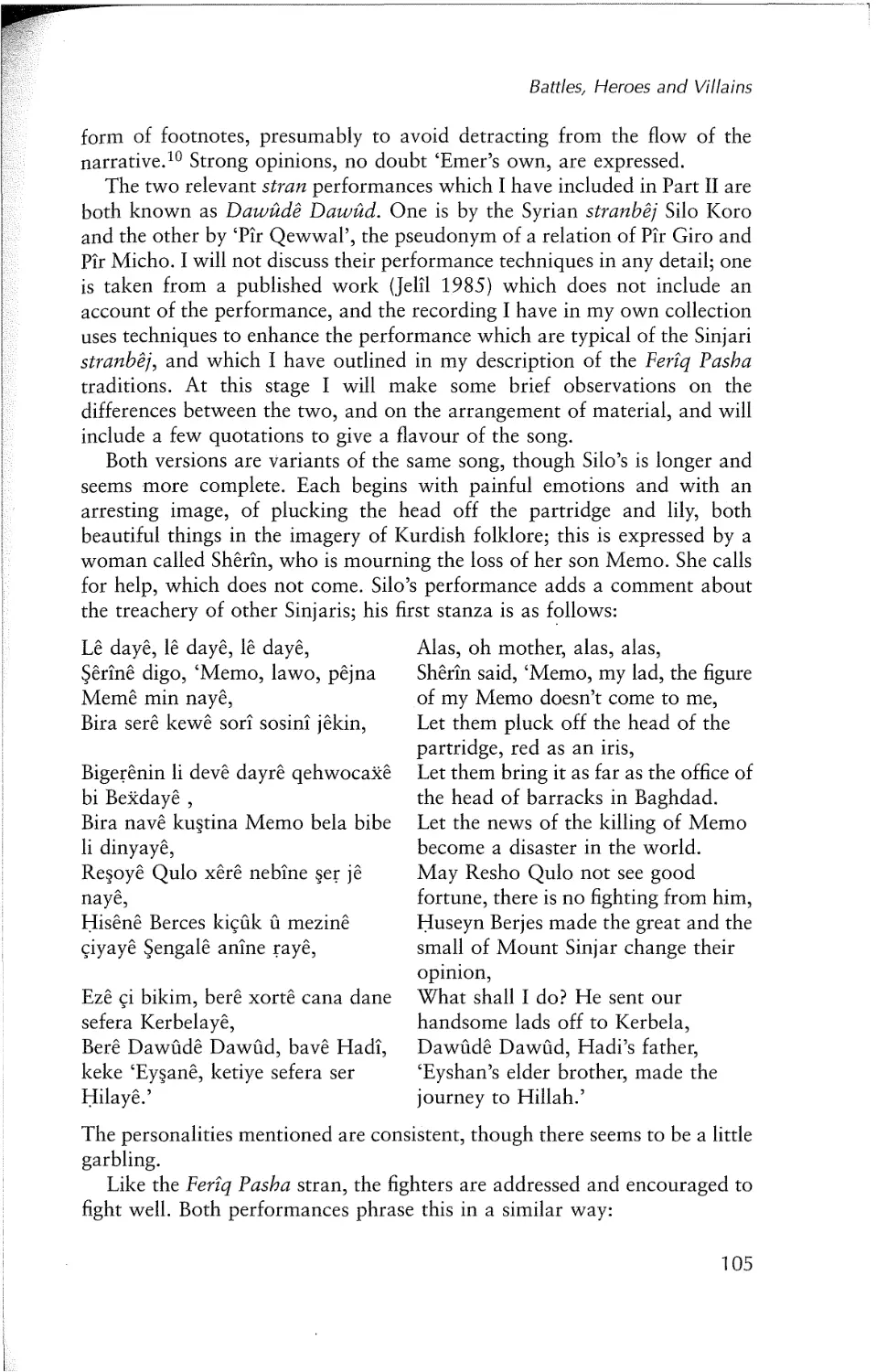


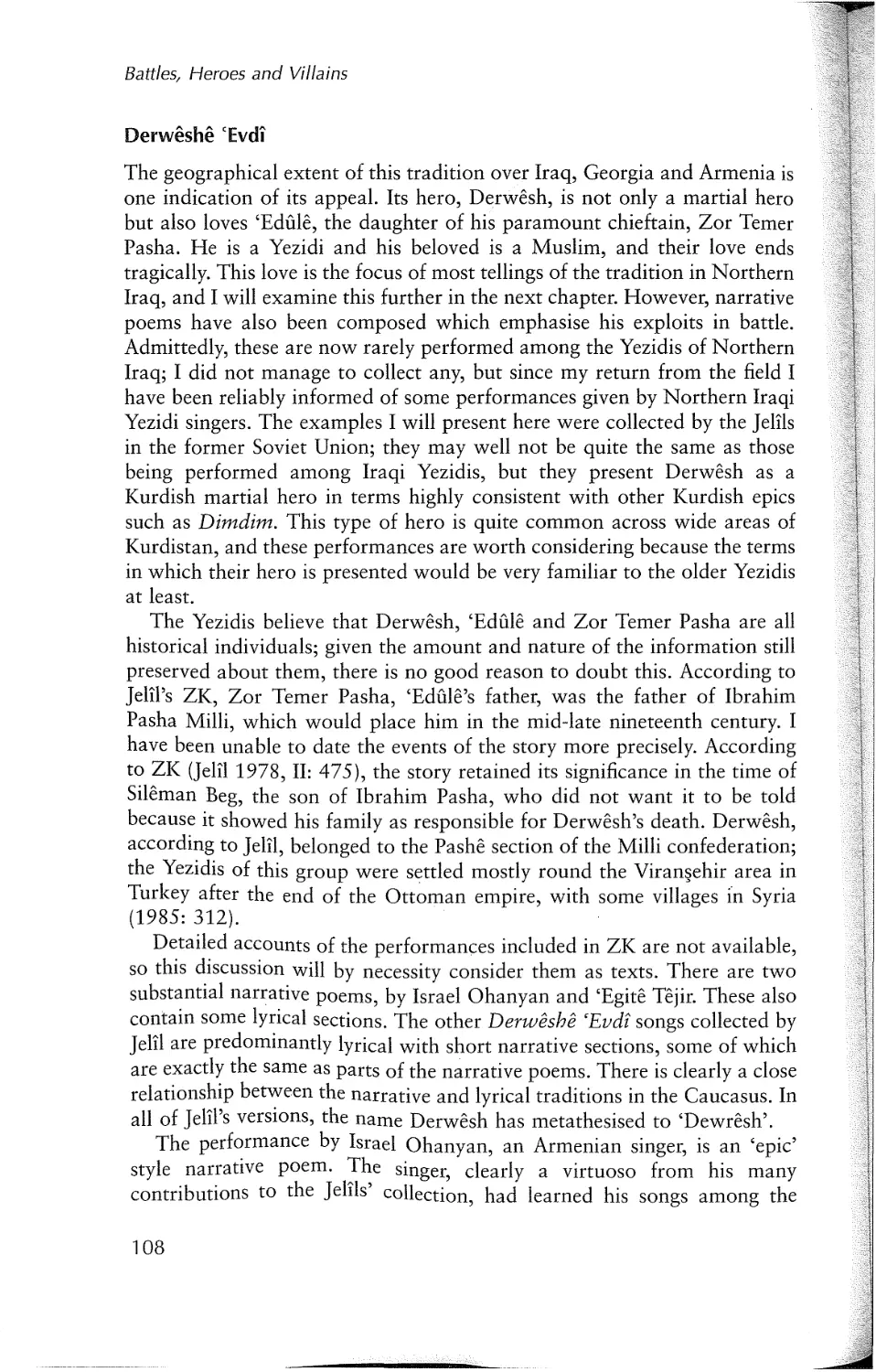


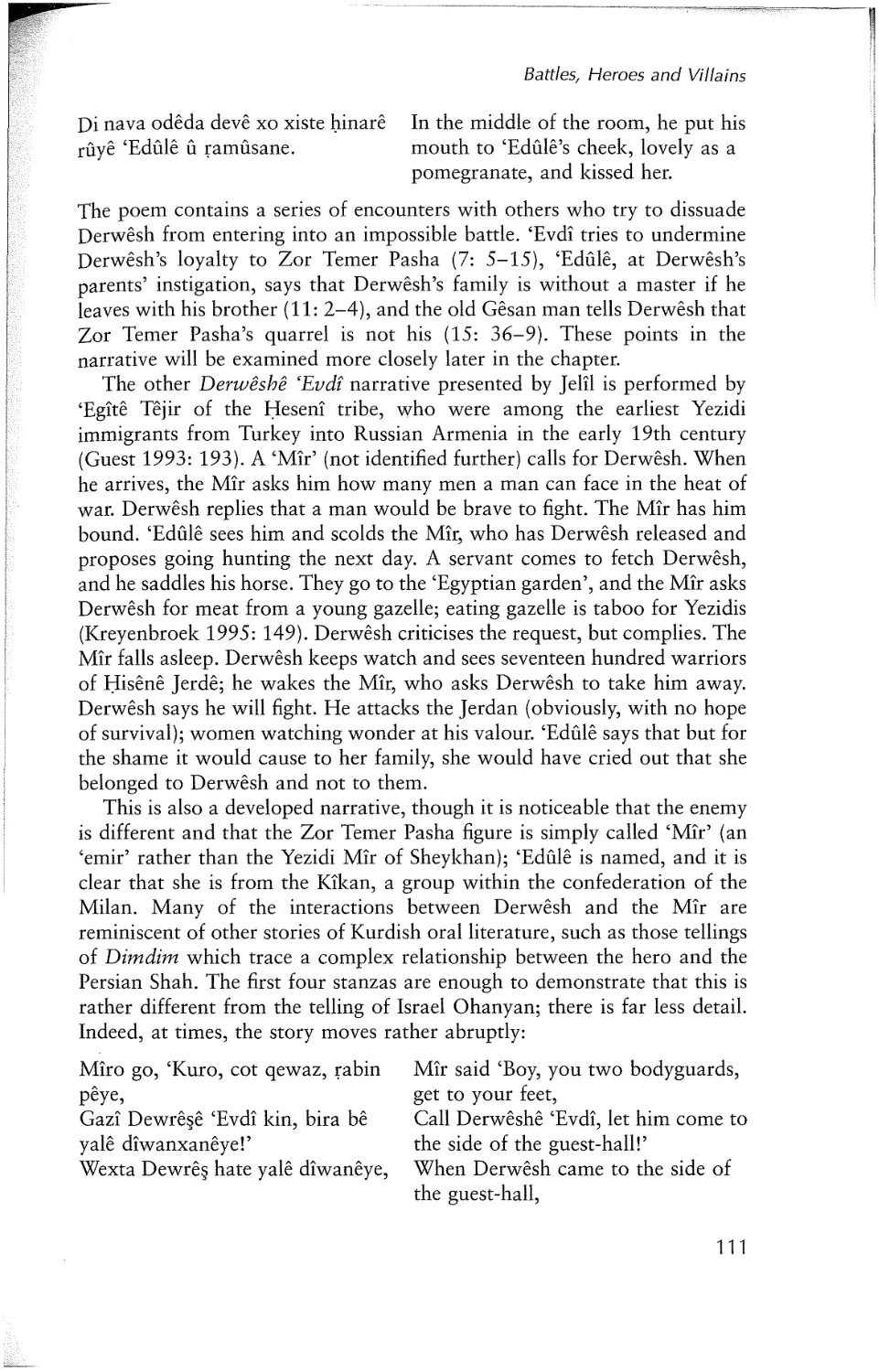


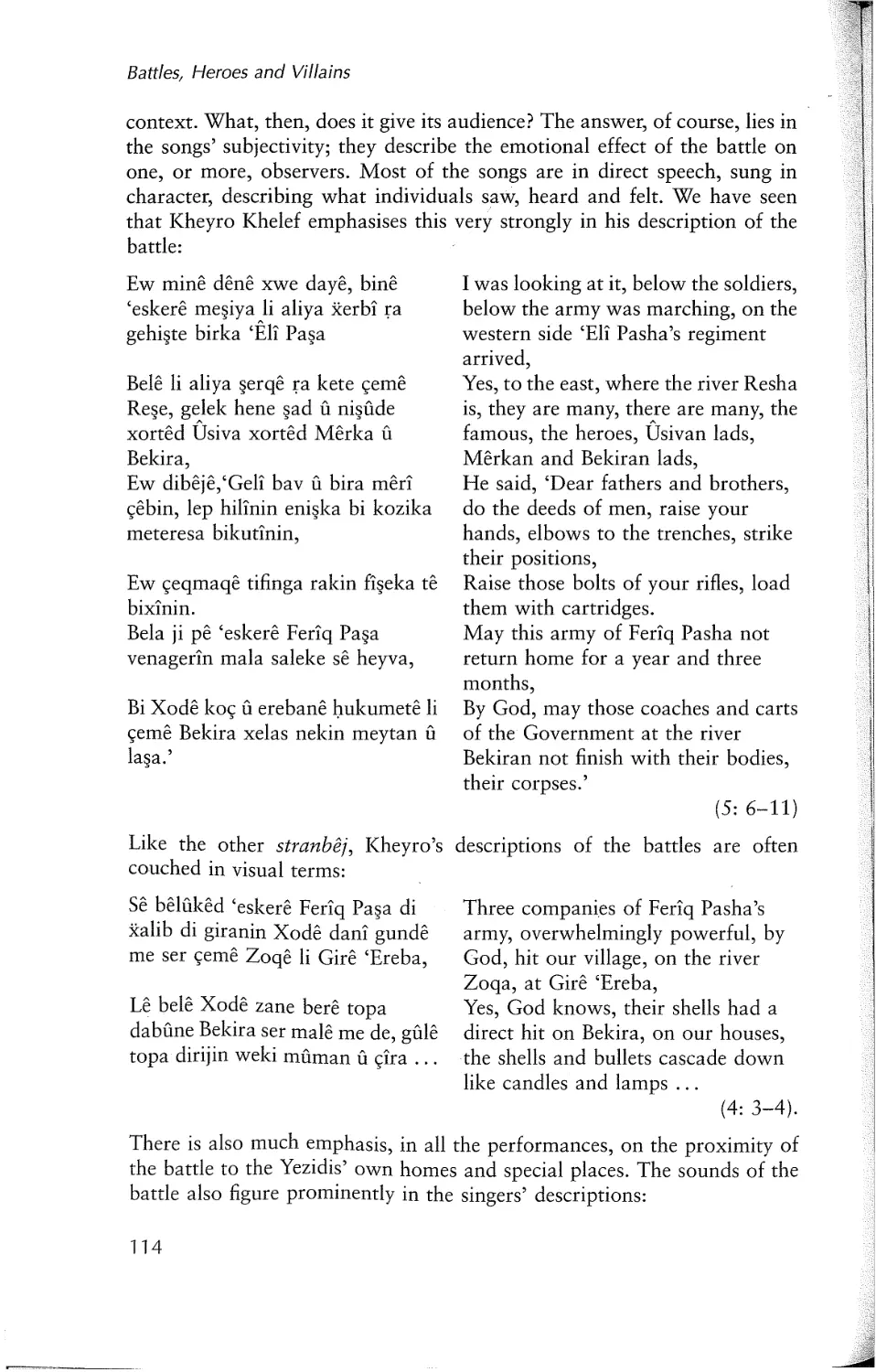





















































Text
                    ~
I

The Yezidi Oral Tradition
in Iraqi Kurdistan

F
r
I

.I .I
•

I

I

I

'

•

•

I

I

lTO

Taquur
Giri~

Christine Allison

0

CURZON

Yth_
Demirba&

11

190041320011

•

I

First Published in 2001
by Curzon Press
Richmond, Surrey
http://www.curzon press.co. uk

© 2001 Christine Allison
Typeset in Sabon by LaserScript Ltd, Mitcham, Surrey
Printed and bound in Great Britain by
TJ International, Padstow, Cornwall
All rights reserved. No part of this book may be reprinted or reproduced or utilised
in any form or by any electronic, mechanical, or other means, now known or
hereafter invented, including photocopying and recording, or in any information
storage or retrieval system, without permission in writing from the publishers.
British Library Cataloguing in Publication Data
A catalogue record of this book is available from the British Library
Library of Congress Cataloguing in Publication Data
A catalogue record for this book has been requested
ISBN 0-7007-1397-2

To David

Preface
Acknowledgements
Abbreviations
Map 1: Areas inhabited by Kurds
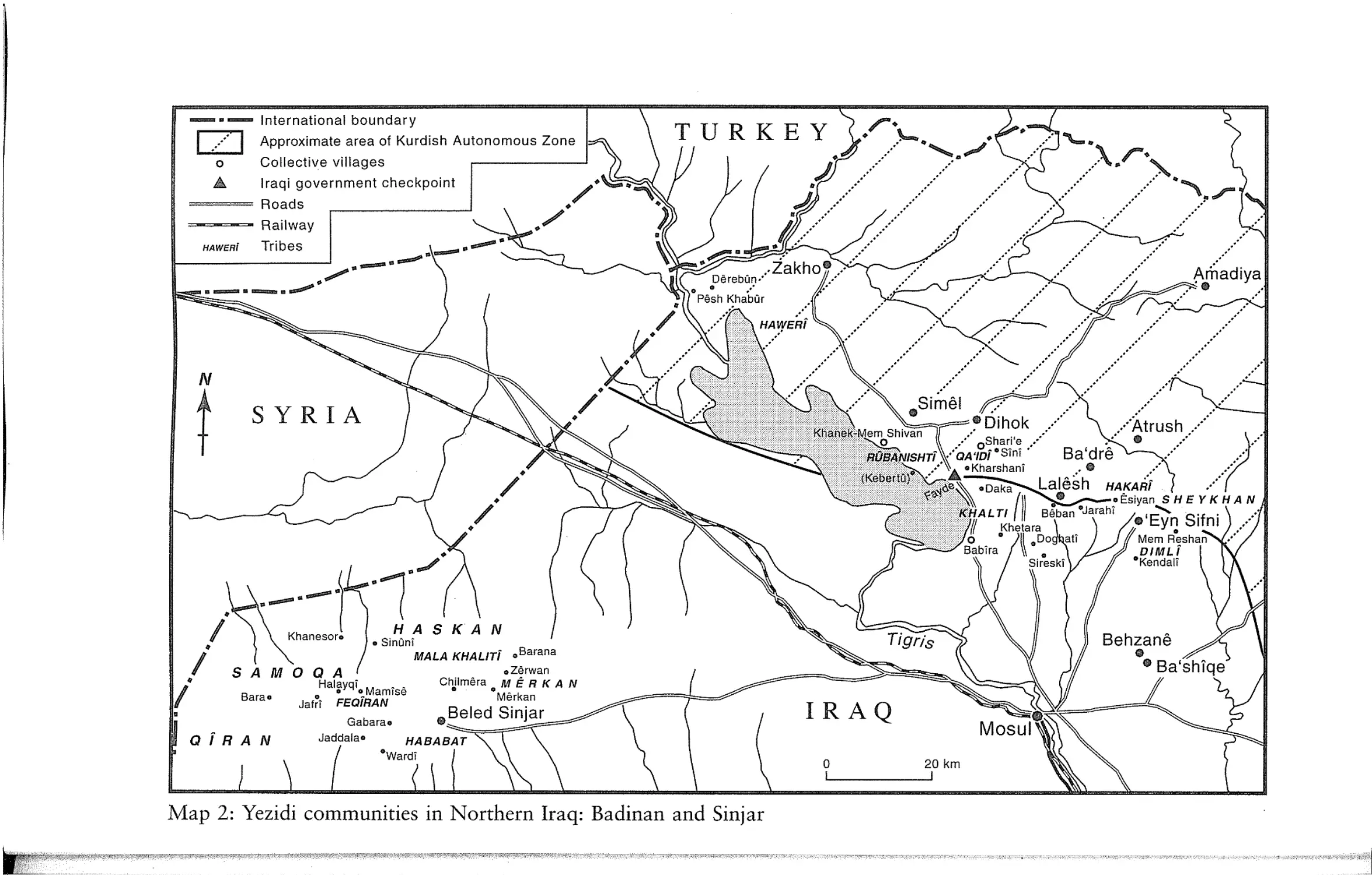
Map 2: Yezidi communities in Northern Iraq: Badinan and Sinjar

1x

xm
xv
xv11
xvm

Part I
1 Interpreting Yezidi Oral Tradition: Orality in Kurmanji and
Fieldwork in Kurdistan
2
3
4
5

The Yezidis of Northern Iraq and the People of the Book
Chronological and Generic Frameworks in Yezidi Oral Tradition
Battles, Heroes and Villains: Portrayals of Conflict
Representations of Romantic Love

6 Death, Loss and Lamentation in Yezidi Verbal Art
7 Conclusions

3
26
53
86
135
167
200

Part 11: Kurdish Texts and Translations
Introduction

213

Section A: Stories and Songs of Battle
Section B: Stories and Songs of Love
Section C: Songs of Grief and Lamentation

259

Notes to Chapters 1-6
Appendix: Informants and Performers
Bibliography
Index

292
297

215
273
281

304

vii

This book is an exercise m 'mapping', in a form comprehensible to
outsiders, the terrain of the oral tradition of the Yezidis, Kurdistan's
misunderstood religious minority. It attempts to identify the major areas
and features of this oral tradition, and to note their relationships with one
another. Like most initial attempts at mapmaking, it is quite possible that as
the territory becomes better known to scholars, many of the contentions
and conclusions of this work will be debated. Nevertheless, the first step has
to be taken. Scholarly attention has so far focused primarily on traditions
associated with the Yezidi religion. Most of the secular material published
so far has been in Kurdish, and even where translations into European
languages have been made, the meanings of the traditions for the Yezidis
have not been explored. They are certainly overdue for academic study; the
oral traditions of the Yezidis, and of Kurds in general, are one part of a
whole field of 'folklore' which is not only full of variety but also very strong
in emotional resonance. Even the discourses of identity of young, ·urban
Kurds make some use of it. Images from oral tradition are found in popular
songs, political speeches, paintings and novels; they are employed with
great enthusiasm by Kurdish nation-builders. The Yezidis are part of this
Kurdish cultural process, but they have their own special concerns.
It is no idle metaphor to use the analogy of cartography for the process of
studying the oral traditions of Yezidis and other Kurds. For many peoples
who recall much of their past orally, there is an intimate relationship between
the topography of the land and the narratives of the people. Oral tradition is
the vehicle for the transmission of most Kurdish history and almost all
specifically Yezidi history. The events recalled in that tradition are very
closely associated with particular locations in the homeland. In Kurdish
discourses, the process of remembering the land also recalls its history,
including both conventionally 'historical' and more 'legendary' events. For
the Yezidis in particular, whose whole way of life is integrated into their
religion, past and present events are closely linked to each other and to their
environment. Locations are not only associated with past events, but may
also be imbued with strong religious meanings. History, especially religious
ix

Preface

history, finds expression in current social structures; Yezidi identity is
expressed in terms of religious purity and of difference from other groups. At
such an early stage in Kurdish oral studies, this book will not venture to
consider the religious dimensions of Yezidi oral culture in detail, but it will
consider some of the most popular kinds of secular oral tradition, set them in
the context of Yezidi discourse, and consider their position in Yezidi life in
Iraqi Kurdistan at the close of the twentieth century.
I have tried to understand some of the most important meanings which
the Yezidis ascribe to their oral traditions by collecting some traditions
myself, comparing them to the relatively few examples already published,
and asking numerous Yezidis, in Northern Iraq and in Europe, about the
meaning and significance of oral traditions in general and specific examples
in particular. I have tried to avoid limiting individual Yezidi voices as
Orientalists have been so wont to do in the past, though some factors have
complicated this. Given the volatility of politics in Iraq, where association
with Westerners can sometimes bring reprisals, acquaintances and friends
still living there will remain anonymous in this book. Even for those Iraqis
now living outside Iraq I think it best to use names sparingly. Thus I have
sometimes referred to 'informants', though I have also tried to give some
sense of individual identity and integrity by using such shorthand as 'Mr H.'
etc. The reader can then gain some idea of the help given by each of these
individuals, and I hope it will be clear that some gave a great deal of their
time and patience. It will certainly be abundantly clear that this book has
been written by an outsider, a non-native speaker, conditioned to think in
Western academic terms, who has had to start from first principles in
attempting to understand very complex forms of communication.
In trying to find a framework in which Yezidi oral traditions could be
analysed and discussed, I discovered that the three broad themes of war,
love and death, apart from being readily understandable to outsiders, were
also used by Yezidi performers themselves to categorise the lyrical songs
which they sing. Analysis of the treatment of these three themes is the core
of this book. However, thematic analysis is not enough without an
understanding of genre and context. Thus a number of introductory
chapters are also necessary; Chapter One sets the current work in its
academic context, of studies of Kurdish 'folklore' and of orality and
literacy. Chapter Two describes the fieldwork environment of the Northern
Iraqi Yezidi community, including some important aspects of Yezidi
identity. Chapter Three gives an overview of the most important generic
and historical frameworks of the oral traditions. In Chapters Four, Five and
Six, a number of Kurdish texts and translations are discussed; some of these
are quite long and, if placed within the main part of the book, they would
break up the argument. Instead I have opted to put them together at the
end, though this admittedly incurs the risk that they will be 'lost', or that
the reader will endlessly be trying to move between text and discussion. I
X

Preface

have attempted to minimise this annoyance by quoting substantially from
the texts during the discussion chapters, so that the argument can be
followed, but the reader will have a much fuller impression of these
compositions if each is read at the point at which it is summarised in the
main part of the book, before the discussion begins. Chapter Seven briefly
brings together some of the conclusions of the preceding chapters and
considers their implications.
I have used the term 'Iraqi Kurdistan' in the full knowledge that it is
unacceptable to many; however, despite this, and despite the many debates
over the exact extent of the territory of Kurdistan, it still seems to me the
most widely understandable term referring to that part of the modern state
of Iraq which is predominantly inhabited by Kurds. Iraqi Kurdistan, in its
traditional sense, comprises the Kurdish provinces of Badinan, north-west
of the Great Zab river, where the northern Kurdish dialect of Kurmanji (the
language of the Yezidis) is spoken, and So ran, to the south, where the other
major dialect, Sorani, is spoken. Since 1991, when much of Iraqi Kurdistan
came under Kurdish control, the term has been used to denote the area
under Kurdish administration (the modern governorates of Dihok, Erbil
and Suleymaniye); however, this 'Kurdish autonomous zone' or 'Kurdish
zone' is smaller than the true extent of Iraqi Kurdistan. This zone stretches
beyond the so-called 'safe havens' originally set up by the Allied military,
extending from Pesh Khabur in the west to the Iranian frontier in the east;
its border follows a line through the 'Saddam Lake', Fayde (near Dihok), to
the south of Ba'dre, north of 'Eyn Sifni, west of 'Aqra, southwards to the
Kelek Bridge (south-west of Erbil), and west of Chemchemal; thus it covers
the large towns of Dihok, Erbil, Suleymaniye and Halabja. It includes some,
but not all, of the sizeable Yezidi settlements of Northern Iraq. The frontier
between Kurdish and Iraqi government-held areas passes through the Yezidi
region of Sheykhan.
Kurdish is usually written in Arabic script in Iraq and Iran and often in
Cyrillic in the former Soviet Union. The transcription system which has been
used for the texts in this work broadly follows the scheme developed by Bedir
Khan for writing Kurmanji in Roman script. The system has been well
explained elsewhere, and it would be superfluous to list it in detail here.
Letters are pronounced as in UK English, with the following exceptions: a is
long as in farmer, c as in jelly, s; as in chip, e is close (in Badinan) to the
English short a of cat, e as in French mere, i either as Turkish 1 or as in
English fish, 1 as in feel, j as in English pleasure, q as pronounced in Arabic, r
as a strongly rolled 'Italian' r, § as in ship, u as in fool, x as in loch. Among
Iraqi Kurds, letters such as 1). (as in the name l:fasan), '('ain, glottal stop) and
x (ghain) are given the Arabic pronunciation. The difference between 1 and e,
and e and a at the end of words, is often very difficult to hear in Badinani
Kurmanji. Double consonants are usually not used by Kurdish authors, and
their convention has been followed here.
xi

Preface

The texts are taken from various sources, with slightly differing
transcription systems; for the sake of consistency, slight modifications have
been made to the way some texts transcribe certain sounds. However, in
those texts which I transcribed myself, I have tried to remain faithful to the
performance by preserving the pronunciation of the speaker; thus some
slight inconsistencies may be detectable in words which are used many
times, and at some points where the words do not seem to conform to
'standard' Kurdish grammar. All the translations, except that of the love
song Kherabo, which is based on an existing French translation by Roger
Lescot, are my own.
For Kurdish words and the proper names in Part I, it is difficult to
achieve consistency. Arabic and Persian names have different transcription
conventions, and the Turkish alphabet is different again. There are certain
very well-known placenames, such as Erbil or Halabja, and words, such as
sheykh, where deviation from norms would simply be distracting, so I have
kept to common English norms. In general, I have attempted to make the
main body of text easily readable by avoiding excessive use of diacritical
marks. For the less familiar Kurdish names, I have used a transcription
system as close to English as possible when they are presented in their
Kurdish context. Thus I have used sh for Kurdish §,eh for Kurdish f, kh for
Kurdish x, and zh for Kurdish j (as in English vision). For the vowels, the
Kurdish system, with its circumflexes, is not counter-intuitive for English
speakers, and I have adopted it. However, there are certain key Kurdish
terms where Kurdish transcription has been retained throughout, such as
stranbej; these are italicised. In general I have avoided the use of the ezafet
in Kurdish names; however some individuals, usually poets or heroes of
oral traditions, are invariably referred to by at least two names, such as
Ehmede Khani or Derweshe 'Evdi, and I have retained it in these cases. For
certain Kurdish tribal and village names I have used standardised Kurdish
forms such as Bekiran, where local usage is more often Bekira. For names
which are well known or are common in this book, such as Tur Abdin,
Sheykh Adi, and Kurmanji, simplified forms are used. Where Kurdish
authors or informants have themselves chosen to transcribe their names in a
specific way, it seems courteous to keep to their preferences.
Many of the conclusions of this book are rather tentative; the 'map' I
have drawn still has many sections marked 'Here be Dragons' or similar.
Certainly the meaning and significance of certain images and concepts
could be explored much further; this will require a detailed consideration of
a wider range of oral traditions. Even those relatively few texts I have
selected for analysis are considered primarily from the standpoint of the
subject-matter, the imagery and the broader patterns of construction. Much
more could be done on the analysis of technical formal details. I hope that
such work will be done in the future, and that the terrain of Kurdish oral
tradition will become much more familiar to scholars.
xii

Many people have helped and advised me during the preparation of this
book, though its weaknesses and errors are all my own. Professor Philip
Kreyenbroek, who supervised the original. doctoral thesis and read the final
drafts, has always managed to combine acute criticism with steadfast
support. Dr Khelil Jindi Rashow supplied a great deal of information and
some hitherto unpublished traditions; he also painstakingly read and
advised on the translations. Professor Jellle Jelil gave permission to
reproduce material from his previous publications. I am particularly
grateful for Mrs Catherine Lawrence's maps, which are not only clear, but
the map of western Badinan is the most up-to-date I have yet seen. Its basis,
which needed many updates, came from Edmonds 1967, with the kind
permission of the Royal Asiatic Society. I would also like to thank Professor
Joyce Blau, Dr Stuart Blackburn, Professor Martin van Bruinessen, Mr
Peter Colvin, Dr Ken Emond, Dr Nelida Fuccaro, Professor Graham
Furniss, the late Mr John Guest, Mr l:feso Nermo, Mrs Mieke Kreyenbroek,
Dr Oric L'vov Basirov, Dr Maria T. O'Shea, Mr Abdila}:lad Hormuz
Khoshaba, Mrs Fawziya Rahman, Mr Ibrahim Sheykh Rashow, Mrs Hayat
Rashow, Dr Shukriya Rasul, Mr Baran Rizgar, the late Mr Kurt Schork, Plr
Khidir Sileman, Mr Qasim Shesho.
Acknowledgements are also due to the British Academy, the Harold Hyam
Wingate Foundation, the School of Oriental and African Studies, and the
University of London Central Research Fund, for generous financial support.
For help during the fieldwork in the 'Safe Haven' I would like to express my
gratitude to both KDP and PUK, and to members of the other parties, for
general encouragement and practical help, and also to M CC personnel;
among the Yezidis, to the family of Mlr Te}:lsin Beg, and to those private
individuals who helped organise transport, accommodation and contacts. In
particular, I wish to thank the many local people, Yezidi, Muslim and
Christian, who welcomed me generously as a guest and gave their time and
expertise to my research. They must remain anonymous here but their help is
certainly not forgotten. Finally, and most importantly of all, I would like to
thank my husband, David Taylor, to whom I dedicate this book.
xiii

JOURNALS
AION
ARA
BMGS
BSOAS
BSOS
]A
]AF
JRAS
I]MES
JMMA
]FR
REMMM
ROC
RSO
Stir

Annali dell'Instituto Orientate di Napoli
Annual Review of Anthropology
Byzantine and Modern Greek Studies
Bulletin of the School of Oriental and African Studies
Bulletin of the School of Oriental Studies
Journal Asiatique
Journal of American Folklore
Journal of the Royal Asiatic Society
International Journal of Middle East Studies
Journal of Muslim Minority Affairs
Journal of Folklore Research
Revue du Monde Musulman et de la Mediterrannee
Revue de /'Orient Chretien
Rivista degli Studi Orientali
Studia Iranica

INfORMANTS AND SOURCES
BR
KJR
PKS
ZK

Kurdish-English English-Kurdish Dictionary (Rizgar 1993)
Dr. Khel!l Jind! Rashow
P!r Khidir Sileman
Zargotina K'urda (Jel!l 1978)

OTHER
Ar.
Kd.
Kurm.
Ps.
Sor.
Tk.

Arabic
Kurdish
Kurmanji
Persian
So rani
Turkish

XV

l

----Boundary of area inhabited by Kurds
Divide between (northern) Kurmanji
1111111111111111
speakers and (southern) Sorani speakers
Area where some communities
~ speak Zaza
ij'~ Southeastern dialects
Main Gurani speaking areas

--·~.\....

'\

11
Ankara

IRAN
N

t

SYRIA
////-

Map 1: Areas inhabited by Kurds

--a-[.Z]

International boundary
Approximate area of Kurdish Autonomous Zone

o

Collective villages

.6.

Iraqi government checkpoint

====Roads
~~=-=~ Railway
HAWERi

Tribes

·-·

~-·,.,.,..

, . / " _ .. ,..,..,..,.

N

t
IRAQ
Q

i

RAN
0

Map 2: Yezidi communities in Northern Iraq: Badinan and Sinjar

20 km

I

CHAPTER ONE

iel
INTRODUCTION

For centuries Orientalists have been fascinated by the Yezidis of Kurdistan
and their curious religion. A great deal has been written, much of it
speculative, about their origins, their beliefs and their more arcane
practices. Both Oriental and Western scholars and travellers of the past,
conditioned by contact with. 'religions of the Book', usually came to the
Yezidis with a preconceived scheme of religious categories in their minds,
into which they sought to fit the Yezidis. The Yezidis' answers were
determined by the researchers' questions, and where entire Yezidi accounts
of events or beliefs were collected, these were not interpreted in the light of
the Yezidis' world-view, but according to the researchers' own preconceptions. Until the recent emergence of an educated younger generation, they
only reached a reading public at second hand, via others' descriptions. As a
result, the Yezidis became one of the more misunderstood groups of the
Middle East, the exotic 'devil-worshippers of Kurdistan'.
Within the last generation there has been a move towards a fuller study
of the Yezidis' own discourses. This has partly been done through
ethnography (al-Jabiri 1981, Murad 1993, Ahmad 1975) but also by
means of considering their religious 'texts' as examples of oral tradition
(Kreyenbroek 1995). Oral tradition is crucially important for the Yezidis, as
amongst their many religious taboos was a traditional ban on literacy. They
communicated with their neighbours, and passed on their community
history, literature, wisdom and religious texts to their descendants, orally.
There is an intimate relationship between the spoken forms and methods of
transmission of this oral material and its content. This book seeks to
analyse the way this community, so often described by outsiders, describes
the key subjects of war, love and death through oral tradition, the only form
of literature available to the entire community. These traditions are
intimately related to the Yezidis' perception of their own identity.
3

Interpreting Yezidi Oral Tradition

This is not the first study of Yezidi oral 'texts'; academic understanding
of the religion has advanced considerably through recent publications on
Yezidi cosmogonies, and on the orally transmitted sacred hymns or qewls
and their place in the religion (Kreyenbroek 1992, 1995). However, it is the
first study of Yezidi, and indeed of Kurdish, secular oral traditions within
their social context. Although this book concentrates on secular oral
tradition, it should be emphasised that, since Yezidism is a religion of
orthopraxy, practising Yezidis are living out their religion in their everyday
life; every aspect of the traditional life is associated with taboos,
observances or devotions. Thus even those secular oral traditions which
will be discussed here contain many allusions to Yezidi religious themes,
and should not be divorced from their religious context. The traditions
under consideration in this book are historical, that is, they are generally
believed to be about real individuals who lived in the past. The
performances of oral literature in which they are couched are not only a
major source of factual knowledge of the past for Yezidis, but for the
outsider their analysis can also yield a great deal of information, not only
about Yezidi aesthetics and poetics, but also about their current
preoccupations. What the Yezidis choose to tell, or to withhold, about
the past, reveals much about their present attitudes.
This study, then, hopes to come closer to the Yezidis' identity than the
approaches of the older Orientalists, though, as the work of an outsider, it
cannot claim to understand the community's comment on itself at every
level. It is fully appreciated that the concept of 'social context' is itself
ethnocentric; which social and cultural elements are emphasised and which
ignored are at the discretion of the researcher. For reasons of space, this
study cannot discuss every single form of oral tradition used by the Yezidis,
and it is a matter of particular regret that the music of the traditions will not
be analysed. Nevertheless, the material presented here has never before
been the subject of academic study, and those few traditions which I will
discuss in detail are certainly considered by the Yezidis to be important.
Since not only the content of the traditions, but also the forms used, the
modes of transmission and, wherever possible, the styles of performance
will be considered, it is hoped that this work will be a starting-point for new
methodologies in Kurdish studies. No study can be fully objective; later in
this chapter I shall declare my own preconceptions as far as possible by
outlining the methodologies to be used.
The Yezidi community in Northern Iraq lends itself particularly to this
type of study. They are a discrete community among other groups, but their
religious and social structure ensures a degree of social and cultural
uniformity which, given the variety of cultures found in Kurdistan, is
greater than might be expected from a group spread over an area stretching
from Jebel Sinjar to cAqra in Iraq. During fieldwork, done between March
and mid-October 1992 in the area of Northern Iraq controlled by the
4

Interpreting Yezidi Oral Tradition

Kurds, Yezidi informants claimed that the important stories were uniform
throughout the community as they represented the 'true' and distinctive
Yezidi history. However, this book will not only present material collected
during fieldwork. Published collections of Kurdish 'folklore' have included
Yezidi material collected in Armenia and Syria earlier this century and in
Badinan and Jezire Botan at the end of the nineteenth century; these offer
opportunity for comparative study, and have been used accordingly.
The Yezidis of Northern Iraq, with the exception of a few Arabicspeaking villages, have Kurmanji Kurdish as their mother-tongue, and their
oral traditions include a great deal of material describing past events in
what is now Eastern Turkey. Despite their notions of separateness, they
have never been a community in isolation from the rest of Kurdish tribal
politics. Some of the observations one can make about Yezidi discourses
also hold good for those of other Kurdish groups, and before we can
describe the special nature of Yezidi orality (which will be discussed in the
next chapter), we must place the Yezidis in sociolinguistic context, by
discussing what 'orality' and 'literacy' mean, and how they apply, in the
context of Kurmanji. It will then be necessary to contextualise this work, by
outlining its relationship to past studies of Kurmanji material, its theoretical
stance within the multidisciplinary field of oral studies, and the fieldwork
environment which influenced the methodologies used.

THE KURMANJI CONTEXT
It is unfortunate that despite a number of very useful studies of Near and
Middle Eastern oral poetry and folktales (e.g. Slyomovics 1987, Muhawi
1989, Reynolds 1995), and a few outstanding accounts of the role of oral
traditions within certain groups (e.g. Abu Lughod 1988, Grima 1992, Mills
1990, Shryock 1997), oral traditions remain irrevocably associated in many
academic minds with 'folklore' in its most pejorative sense, with
picturesque but obsolete customs and spurious accounts of the past. This
is a narrow and outmoded view of both oral tradition and folklore, of
which oral tradition forms a part. With some honourable exceptions,
scholars of the Near and Middle East lag behind those working on other
regions, notably Africa, in their appreciation of the political dimensions of
oral tradition. Orientalists in general seem to show a reluctance to move on
from their perception of 'folklore studies' as merely a matter of classically
inspired oral-formulaic analyses of reassuringly obscure and irrelevant
genres. Yet in the authoritarian states of the Near and Middle East, where
written material is rigorously censored, points of view which contradict the
government are usually by necessity expressed orally. Oral communication
is often the vehicle of minority discourses, of tendencies deemed to be
subversive; oral tradition, with its hallowed accounts of the people's past,
provides a whole fund of folkloric examples which can be used to justify
5

Interpreting Yezidi Oral Tradition

political courses of action, to rouse a rabble, or to fuel a revolution. During
the 1990s, the Newroz myth of the Iranian New Year (as told in Kurdish
tradition rather than the Persian version of the Shah-name) was used as a
symbol of Kurdish liberation in Turkey, sparking widespread unrest in
towns and cities every March. Governments also use folklore in their own
propaganda; Turkey, for instance, claims Nasruddin Hoca as its own,
though he is found in the traditions of many countries in the region
(Marzolph 1998). Oral tradition, along with other aspects of folklore, is an
important element in discourses of nationalism and of identity all over the
modern Middle East; Kurdistan is not exceptional in this respect, though
circumstances have conspired to make Kurmanji in particular more 'oral'
and less 'literary' than many other languages of the region.
Despite the long tradition of Kurdish scholars and authors, many of
whom used Arabic, Persian or Turkish as well as Kurdish in their writings,
the great majority of Kurds in the past have not been literate enough to be
able to read 'literature'. Kurmanji, the northern dialect of Kurdish, is
spoken by Kurds living in Eastern Turkey, Northern Iraq, Northern Syria,
Iran, and Transcaucasia. It is the dialect of the first Kurdish written
literature, the works of Melaye Jezlrl and Ehmede Khan!, 1 and is spoken by
more people than the other major dialect, Sorani. However, its influence has
been lessened in the twentieth century by government repression of the
language in those states where Kurds live. In the last years of the Ottoman
empire, literacy overall must have been relatively low among the Kurmanji
speakers of Eastern Anatolia by comparison with other provinces. 2 Kurdish
had not hitherto been proscribed, but in the new Republic of Turkey it was
outlawed in the 1920s, beginning with its prohibition for all official
purposes in 1924. Even education in Turkish was out of the question for
most Kurds at this time; only 215 of the 4,875 schools in Turkey were
located in Kurdish areas (MacDowall 1996: 192). Educational opportunities in Eastern Anatolia grew far more slowly than those elsewhere in
Turkey as the century passed, but what State education was available was in
Turkish. Education in Kurmanji was never officially permitted; this
situation continues today. Not only were publication and broadcast in
Kurmanji forbidden for most of the ·twentieth century, but at times of
greatest repression Kurds could be fined, or otherwise punished, for
speaking the language. Along with the renaming of Kurds as 'mountain
Turks' came spurious classification of Kurmanji as a deviant Turkish
language (e.g. Firat 1961). With the exception of a few years during the
1960s, and the years since 1991 when Kurmanji was once more legalised,
no Kurdish publications have been produced at all in Turkey. Social
mobility and progress required Turkish, usually learned at school or during
military service. Men, of course, had more access to these forms of
education than women. The development of Kurmanji suffered enormously
during the whole period; by the 1970s it was a household language only,
6

r
Interpreting Yezidi Oral Tradition

and could hardly be used for serious political debate. Since then, the efforts
of Kurdish intellectuals, politicians, journalists and broadcasters, mainly
based in the diaspora, have improved the situation to some extent (van
Bruinessen 1998: 46), but Kurmanji remains at a serious disadvantage, with
many Kurds from Turkey still perceiving it as primitive. The position in
Syria, where Kurmanji has no official status, has been little better (e.g.
Nazdar 1980). The situation in Iraq was rather different; when the vilayet
of Mosul was awarded to the new state, the League of Nations stipulated
that Kurdish should be the official language of administration, justice and
education in the Kurdish areas (MacDowall1996: 145-6). However, it was
the southern dialect of Kurdish, Sorani, the majority language of the Iraqi
Kurds, which received sanction as an official language of Iraq. The
Kurmanji speakers of Badinan province, north of the Great Zab, amongst
whom were many Yezidis, did not receive the same range of language
rights. Nevertheless, publication and broadcasting of Kurmanji was
permitted (though censored), and Kurmanji literature could be studied at
university level. But Sorani, with its burgeoning written literature, became
culturally dominant over Kurmanji. In Iran, where, as in Iraq, Kurmanji is a
minority dialect, the Kurdish language was banned at times during the
twentieth century. Only within the Soviet Union, and in the Kurdish
diaspora, did extensive study and development of Kurmanji take place. In
Soviet Georgia and Armenia, though subject to political censorship, Kurds
have been able to publish and broadcast in Kurmanji throughout this
century.
Native speakers of Kurmanji living in Turkey, Iraq, Iran and Syria did
not receive their education in Kurmanji but in Turkish, Arabic or Persian,
and consequently, though some living in Southern Iraqi Kurdistan might
have learned to read Sorani, few learned to read Kurmanji. The scope for
literary contact between Iraq and Turkey has been lessened by the fact that
in Iraq (as in Iran) a modified Arabic script has been used to write Kurdish,
whereas the Kurds of Turkey who published clandestinely or in the diaspora
used a modified Roman alphabet similar to that used for Turkish. In the
rural Kurmanji-speaking areas of both Turkey and Iraq the lack of access to
state schooling has meant that, despite the growth of mass literacy in these
countries during the twentieth century, Kurmanji in the homeland remains a
language used primarily for speaking rather than writing.

Definitions: 'Oralities' and 'literacies' in Kurmanji
It is legitimate to say that Kurmanji is a primarily 'oral' as opposed to
literary language, notwithstanding the considerable number of new writers
and works (Blau 1996); to investigate what this implies for Kurdish culture,
we must consider our terms carefully. Although the term 'oral' can be
liberating, opening up whole new areas of literature for academic
7

Interpreting Yezidi Oral Tradition

consideration, it can also be problematic; by applying it to a whole people
or culture one may imply that some uniform 'oral' world-view prevails in
all areas, over all those who lack sophisticated reading skills. Even in
Turkey where Kurmanji is least developed, many Kurds read Turkish, and
some older people read some Arabic, learned in the village medrese or
Koranic school. (Such schools were outlawed by the secularist Turkish state
but some continued to exist clandestinely.) 3 Worse still, the universalist
view of 'orality' or 'preliteracy' as a general condition, a stage through
which all societies must pass on their way to literacy and consequent
civilisation, has become influential in the studies of Middle Eastern
literatures, as a result of the work of Ong (1982) in particular, which
draws heavily on the work of Eric Havelock and Albert Lord. These
somewhat romantic views can encourage the idea that oral genres are
unsophisticated because of their contention that literacy is necessary for
higher cultural forms. 4 Trenchant and convincing criticism of such work
has been made by Finnegan (1990: 143-6) and Thomas, whose summing
up of the issues is particularly clear and perceptive (1992: 15-20); it is
unnecessary to reproduce the arguments here. However, outdated ideas are
often taken up in propaganda wars; Kurmanji is sometimes portrayed in the
Turkish context as pre-literate and therefore primitive, just as its
marvellously rich range of subdialects and lack of a standardised form
are said to prevent it from being a 'proper language'. Such ideas do not
stand up to scrutiny and would be laughable if they were not believed by
some Kurds.
Because of the universalist associations of 'orality' as a term, some
scholars are justifiably reluctant to use it; however, it seems to me to be
permissible if its meaning is carefully qualified, because it implies a
legitimate range of modes of communication; it dignifies and assigns a
status to non-literate messages, and, by extension, to the study of these
messages. Orality is not just a negative, a lack of literacy, nor is it such a
dominant characteristic that it determines all the features of a group's oral
culture and cognitive processes. It is only one of a number of important
factors, and it is culture-specific. To describe a group's orality in a
meaningful way one must understandits uses of language and the major
genres used for communication. Certain features, such as repetition and the
use of mnemonics, are found in most types of oral tradition throughout the
world, but one cannot generalise about the nature of 'oral' forms of
communication or the thought processes of those who produce and listen to
them. One can merely identify common tendencies.
The question of 'literacy', a term whose meaning is questioned far less
often than that of orality, is similarly complex. The work of Scribner and
Cole among the Vai of Liberia is illuminating, as, like Kurdistan, their
fieldwork area was a milieu where various languages were used; they
compared the literacy of the Qur'anic schools with that of the state schools
8

Interpreting Yezidi Oral Tradition

teaching English and that of the Vai syllabic script, taught outside these
institutional environments. Their definition of literacy was as a 'recurrent,
goal-directed sequence of activities using a particular technology and
particular systems of knowledge' (1981: 237). Street (1984) has convincingly argued for an 'ideological' rather than an 'autonomous' definition of
literacy - for him, as for Scribner and Cole, literacy is not a neutral, easily
defined skill, but there are many types of literacy, and its impact on those
who learn it will vary considerably according to its usages in that society.
He demonstrates that notions of 'functional literacy' are often flawed
because they take no account of this ideological dimension of literacy
teaching. It is extremely difficult to separate 'literacy' from the ideological
dimension. It follows from this that such experiments as those of Luria in
the Soviet Union (1976, discussed in Ong 1982: 49-57) which purported to
find general cognitive change in peasants who had been taught to read,
become less convincing as a general paradigm of the result of literacy,
because it is very difficult to prove that it was in fact the literacy, not the
ideology of the education received, which made the changes. Literacy has
undoubted effects on human communication, but it is more reasonable to
see it as one of several major factors in the development of a society rather
than a defining condition. If Lord was right in ascribing the decline in
educated Yugoslav bards' abilities to literacy itself rather than to the
ideology of the education they received (Lord 1960: 20), it is not at all clear
whether one can apply this elsewhere. Literacy per se cannot be safely
regarded as the primary factor in the decline of 'folkloric' oral traditions
among the educated in Kurmanji-speaking areas, given that in all these
areas the official forms of education place a higher value on concepts of
'modernity' and 'science' than on 'folklore'. There are also other obvious
factors in the decline of Kurmanji oral tradition, such as population
movements (both forced and voluntary), the clearing of villages, and
modern forms of broadcasting, particularly television.
Thus the term 'literacy' proves as elusive as the term 'orality'. Although
it would be methodologically tidy if the two could be used as simple
opposites, this is not really possible - societies tend to be oral, whether or
not they are literate as well. Nevertheless, we should have working
definitions of both terms. Although the two terms are not true parallels,
'orality' when applied to a group such as the Yezidis may be defined as the
extent and nature of the use of spoken communications, and 'literacy' the
extent and nature of the use of writing. Clearly there are a great many
variables which must be known before one can make a meaningful
statement about a group's 'orality' or 'literacy.'
An important dimension of the orality or literacy of any group is the
relationship between oral or literate forms of communication, and power.
Oral traditions, particularly those which are seen as embodying ancient
religious or historical knowledge, may well confer religious status or
9

Interpreting Yezidi Oral Tradition

political power, and access to such traditions may be strictly controlled or
kept within an elite group. In the Kurdish context, examples of this include
traditions retained by sheykhs and passed on to disciples (van Bruinessen
1992: 205-259), or the learning and recitation of genealogies to confer
legitimacy. However, not all oral traditions are prestigious enough to give
power to those who know them. Literacy also confers status, but again this
is complex and depends on the type of literacy. Street's fieldwork in a village
in North-East Iran may have parallels in Kurdistan: young people often
opted for (city-based) continued education, at secondary school level and
beyond, in contrast to the maktab (village school) literacy of their village
elders, who, for their part, were ambivalent about state education; they
respected their children's ability to read advanced texts which they
themselves could not understand, and regarded them as progressive and
modern, but they also made clear their reservations about the ideology on
which the state education was based (1984: 174-177). This dimension of
power is essential for understanding Kurdish 'orality' and 'literacy'.
Kurdistan has not been what Goody defines as a truly 'oral' society
(1996: 14), that is, a society where writing is unknown, for many centuries;
like the rest of the Near and Middle East, it is dominated by the three
'religions of the Book', namely, Judaism, Christianity and Islam. Throughout the entire region there has been a long-standing complex relationship
between the oralities of the masses and the literacies of religious and
political elites. It is important to note that even in the scriptural religions,
where holy texts are fixed and their recitations governed by strict rules, oral
tradition, often in the form of interpretation and teaching, goes hand in
hand with studies of holy writ. Learning was controlled by this
combination; in many religious traditions of the region, aspiring scholars
had to study with a known and accepted teacher and hear and learn his oral
teachings as well as learning written texts (Nasr 1995). The scriptural
nature of the three religions, all of which were present in Kurdistan until the
second half of the twentieth century, also affected the illiterate. Members of
most communities would have. had some degree of access, even at a
distance, to someone, often a mullah, who had some reading and writing
skills; the prestige of religious literacy was and still is considerable, with the
clergy and other literate holy men in some demand for the writing of
amulets and other apotropaic texts, signs and symbols, and also for
divination. 5
Apart from its association with religion, the existence of literacy for the
purpose of what might be termed 'written literature' was well known
amongst the Kurds, a people in contact with Persians, Arabs and Turks,
whose nobility occasionally received a cosmopolitan education in Persian
or Arabic. Many of the Kurdish emirs, who flourished up to the midnineteenth century, were patrons of the arts, whose courts hosted
performances of both literary and oral material, and it is possible that
10

Interpreting Yezidi Oral Tradition

many of the performers of oral traditions were literate and multi-lingual.6
Tribal leaders, both settled and nomadic, also provided venues for
performance and had their own court poets to sing their praises, as befitted
their status. 7 Thus one would expect episodes or characters originating in
written Persian and Arabic literature in particular to influence oral material.
The Yezidis, less literate than other Kurdish groups, shared many legends
with other Kurds which had their origins in written literature. Much of the
variety of Kurdistan's oral traditions comes, not only from the free
exchange of stories and songs and their components between Kurds and
their neighbours, but also from the influence of literary tradition. It is also
now more than a century since Kurdish oral traditions began to be collected
and published, becoming written texts, which in turn now influence
audience conceptions of folklore and the small but increasing number of
literate performers who learn some of their material from books. Thus the
relationship between the written and the oral becomes ever more complex.
The Kurmanji-speaking part of Kurdistan, ·of course, is not only
inhabited by Kurds; many other languages are spoken there in addition
to the major state languages of Turkish, Persian and Arabic. Some
communities in the North speak Caucasian languages; there are also
groups of Turkomen speaking minority Turkic dialects. The Iranian
language Dimli, or Zaza, though linguistically not a form of Kurmanji, is
spoken by people who claim Kurdish identity; thus it may be described as
Kurdish in a social and political sense. 8 Even after the massacres and
deportations of Armenians and .other Christians, communities of Christian
Neo-Aramaic speakers remain, notably the Syrian Orthodox (so-called
'Jacobites') living in the Tur Abdin area around Mardin and Midyat in
Turkey, and 'Assyrians' of the Church of the East (so-called 'Nestorians'),
as well as their Catholic counterparts, the Chaldaeans, in Hakkari province
in Turkey and in various communities in Badinan. The Jews of Kurdistan
also spoke Aramaic, but few if any remain; most live in Israel. Members of
other religious communities in rural areas often shared important features
of material culture with Muslim and Yezidi Kurds, and there is anecdotal
evidence for a number of common religious practices, such as the
veneration of local saints. Not only did these languages share many oral
traditions with Kurdish, but many members of minority groups speak
impeccable Kurdish; some have contributed to collections of Kurdish oral
traditions. 9
The proportion of Kurds living in traditional villages is constantly
declining. More and more Kurds live in cities, either the predominantly
Kurdish cities such as Diyarbakir, Erbil or Suleymaniye, or larger
multicultural cities, such as Istanbul, Baghdad and Tehran. Kurdish culture
and forms of communication are so diverse that it is more accurate to speak
of 'oralities' in Kurmanji than one single 'orality'; for instance, an urban
Muslim Kurd who can read Turkish novels is likely to have very different
11

Interpreting Yezidi Oral Tradition

attitudes to history, the supernatural and aesthetics from, say, a Yezidi
villager in Northern Iraq who has never been to school. Kurmanji may be
an oral language for both, and they may both make use of Kurdish oral
tradition, by listening to it or performing it themselves, but their
interpretations of the traditions are likely to be very different.
Thus there is a complex interplay of oral and literate forms of
communication in Kurmanji. Although there has been, and continues to
be, some fascinating research on language contact and its effects (e.g.
Dorleijn 1996), language use and meaning have been little studied, and it is
difficult to venture beyond preliminary remarks on general oralities in
Kurmanji. The sheer variety of language, religion, and social structure in
Kurdistan should prompt us to avoid thinking in terms of one type of 'oral'
mind-set existing over the whole area. The Kurmanji-speaking area
contains many speech communities, or groups which share 'both linguistic
resources and rules for interaction and interpretation' (Coulthard 1985:
35). To delineate the effects of orality on Kurdish culture, more detailed
work focusing on specific areas and communities is needed.

Oral Traditions in Kurmanji
Defining a text as 'oral' may not always be straightforward; this broad term
may mean either a 'spoken' (as opposed to written) or 'verbal' (as opposed
to non-verbal) means of communication (Finnegan 1992: 5). For oral
literature, sometimes called verbal art, the shadows of Parry and Lord loom
large over the study of oral traditions in the Near and Middle East. This is
reasonable in many cases, since Parry (1971) showed brilliantly the oral
nature of the Homeric poems, and Lord (1960) demonstrated the
application of oral formulaic analysis to Yugoslav poetry and to Homer.
This form of analysis has also been applied, with positive results, to poetry
from many other periods and regions. However, it has also led to difficulties
in terminology, and debate as to whether all truly 'oral' poetry involves
constant improvisation during the performance, and constant composition
without any writing at all. Finnegan (1976, 1977) cited examples of African
oral literature which did not fit this description. Similarly, the approach is
of little use in studying many Kurmanji genres, including much of the
secular prose and poetry of the Yezidis, since the structure of the material
does not suit rigid metrical and formulaic analysis. For instance, the
Kurmanji lyrical song, which is called stran or lawik and is one of the most
popular forms of Yezidi oral tradition, is not composed in performance but
sung from memory. Given the composition of the material and its
transmission and performance by illiterate singers, its 'oral' status can
hardly be in doubt.
A song, or story, or poem, may be composed, or transmitted, or
performed, or all three, without the use of writing. To understand the
12

Interpreting Yezidi Oral Tradition

development of a given oral tradition, rather than aiming for a purely 'oral'
text, which can only be said to be oral in that a written literary element
cannot be decisively proved, it is surely justifiable to include such elements
of demonstrably literary origin as have found their way into orally
transmitted stories. During my own fieldwork, many performers of
traditions had never encountered the literary versions of their stories, and
may even have been unaware of them, but had learned them orally.
The term 'tradition' implies something which is handed down from one
person to another, either old, or believed to be old. Kurmanji has vast
amounts of such material, a 'hypertrophe of folldore' 10 in the words of one
Russian scholar. Most of the material which has been collected by
folklorists is 'traditional' in the sense that its exponents claim to have
received it in toto from someone else. They have also denied any
contribution to composition. A notable exception to this is the women's
lament, found all over Kurdistan, which is composed extempore, but which
is traditional in that it follows long-established conventions of form and
motif. In this case, it is the process of lamentation rather than the product
which is traditional, though the content itself often includes well-known
and well-used images and vocabulary. An entire tradition can last for many
hundreds of years; certain elements or 'motifemes' within a narrative may
be replaced with others which better serve the social context within which
the tale is told, and these elements may also be very ancient (Allison 1996:
30-31). This is also true of much of the material presented here.
It is not the aim of this chapter to describe Kurmanji oral tradition in
full, but it is worth characterising some of the major themes and forms very
briefly. They form part of the Iranophone pool of common traditions; thus
such narratives as Yusif and Zuleikha, Leyla and Majnun, and Koroglf, are
widely attested. These are found in the form of long narrative poems,
spoken prose alternating with sung verse, and prose narratives. Naturally
the Kurds place their own emphases on the material, often placing alien
stories in the setting of Kurdish society, or stressing the role of local
characters. There are also long Kurdish narratives, such as Mem and
Zin!Meme Alan, Dimdim!Khane Lepzerin, and Khej and Siyabend.
Folktales include many common Iranian, Turkic and Islamic elements,
such as the div or demon, the mythical bird the Sfmurg, the jinn and
immortals such as Khidir Elias. Kurmanji has a wealth of fables about
animals, proverbs (called 'the sayings of the ancestors' and considered a
repository of folk wisdom), amusing stories of the Mullah Nasruddin type,
and riddles. The figure of Alexander has accumulated a large volume of
tales, as has Shah 'Abbas; most of these owe little to written histories.
Rustam is particularly popular, and many Kurdish tribes believed that
Rustam was a Kurd (e.g. Jelil1978 II: 108-10). Stories about the Prophets,
not only Muhammad but also Solomon, Abraham, and others, are
common. Diverse elements from various sources, some ancient and others
13

Interpreting Yezidi Oral Tradition

modern, can often be found in a single narrative. There are also many prose·
narratives and lyrical songs about historical events and .people.

Studies of Kurmanji Oral Tradition
The early collectors of Kurdish oral traditions were primarily interested in
language, though some also sought to give information on other aspects of
Kurdish culture. Jaba, a former Russian consul at Erzurum, presented his
collection in 1860 as 'servant a la connaissance de la langue, de la
litterature et des tribus du Kourdistan,' and the collection accordingly not
only includes resumes of the great Kurdish romances such as Dimdim, but
also humorous anecdotes and accounts of tribal feuds. Other important
linguistic collections include those of Oskar Mann (1906, 1909), on the
dialect of the Mukri Kurds of Persia, 11 Piyotr Lerch (1857-8), who used
prisoners from the Crimean war as sources, and Hugo Makas (1926).
Naturally, many of these early collections lacked detailed performance data
or accounts of the role of the individual traditions and their performances
in community life.
The development of folklore as a field of study had a profound influence
on Kurdish scholarship. Early Kurdish journals such as Hawar 12 published
many oral traditions as examples of folklore, sometimes with explanatory
notes for non-Kurds. Oral literature was perceived as an important part of
Kurdish folklore, which is also considered to include many other items of
material culture, music, etc. The pervasive idea that folklore reflects the
'national character' of the people producing it in a uniquely intimate way
has found expression amongst both Kurdish and foreign folklorists. 13
Kurdish scholars in particular have seen folklore as a fund of information
about the past, an expression of the people's feelings, and a repository of
popular wisdom - a national treasure, in fact. 14 In the second half of the
twentieth century it became clear that Kurdish oral traditions were in
decline, as a result of general modernising processes found in many
developing societies, of conflicts between government forces and nationalists, and of the specific proscription of Kurdish culture in Turkey and Iran.
As one eminent scholar has written 'not a day goes by but Kurdish oral
tradition loses something of value' (Jelll 1985: 9), and Kurds have
responded to this crisis by making collections and publishing them. These
initiatives range from the large-scale works, such as Zargotina K urda
'Kurdish Oral Tradition' of the Jelll brothers (1978) in the former Soviet
Union, to the valuable smaller collections made by teachers, writers and
other interested parties who devoted their spare time to visiting villages and
recording folklore. 15 For obvious reasons, most collections were made in
Iraq and the former Soviet Union, with some in Iran, Syria and the diaspora
and very few indeed in Turkey, though some Turkish collections of folklore
apparently include translated Kurdish material. Since Iraqi collections
14

Interpreting Yezidi Oral Tradition

focused mainly on Sorani material, it was the Soviet folklorists who kept
Kurmanji folklore studies alive through the twentieth century. Academics
based in Yerevan, Leningrad and Moscow, most of them Kurds, were able
to travel to Kurdish communities (mainly in the USSR) and record a variety
of oral traditions. These scholars, notably the Jelll brothers and Hejiye
Jindl, have collected the material as 'folklore'; they list the sources of their
items, the time and place of their recordings, and most usefully of all, they
give biographical details of their informants. They also indicate whether
they were literate or not, though it is unclear exactly what they mean by
'literate' and semi-literate'. This indication of provenance is invaluable for
the analysis of the origins and histories of given traditions, but the necessary
contextual data on the relationship between a given performance and its
environment, the purpose it serves within the community, the status of the
performer, and so on, is still omitted. In general, the published collections of
Kurdish folksongs and stories make no attempt to relate given texts to their
social context, though it is, admittedly, unfair to expect this from those
collectors whose interests were primarily linguistic. 16 The value of the
collections made so far lies not only in the indication they give of the rich
variety of traditional material existing in Kurdish, but also in their
attestation of various beliefs and stories; their evidence makes it possible to
compare variants and trace the development of individual oral traditions,
and to test how far local perception of the inviolability of traditions older
than living memory applies to the material.
Secondary literature on Kurmanji oral traditions is not plentiful. Most of
the works by Kurdish folklorists are collections rather than studies of the
material, though there are exceptions to this (e.g. Jelll1960), Although they
provide important records of oral traditions, they were mostly produced for
a public which was already familiar with local genres and performance
trends, and much remains unexplained for the outsider. As with the
linguistic works, performances are rarely contextualised. Although some
noted Kurdologists have given broad outlines of the role played by oral
literature in Kurdish life (Bois 1946: passim, Nikitine 1956: 255-281),
outsiders wishing to understand this on a detailed localised basis have
needed to do fieldwork, which recent history has made difficult. There have
been some important studies of Kurdish music (e.g. Christensen 1963,
1975, Jemlla Jel111973-86, Tatsumura 1980, Blum and Hassanpour 1996),
which is, of course, a vital accompaniment to much oral literature and some
of these include description of social context, but unless extensive fieldwork
could be done, scholars have had to undertake the type of analysis which
can be based mostly on collected texts, such as Chyet's detailed folkloric
study of Mem and Zfn (Chyet 1991). Such studies are also scanty; for
instance, no comprehensive typology of narratives has yet been made for
Kurdish.1 7 Comparison with better-documented traditions, such as Arabic,
Turkish, Aramaic and Armenian, can be fruitful, and the studies of the
15

Interpreting Yezidi Oral Tradition

folklore of the Kurdish Jews now living in Israel are particularly useful for
the Kurdologist (Sabar 1982, Brauer and Patai 1993).
Of the studies made in the past, a few are especially relevant to the
Yezidis in Northern Iraq. Badinani traditions were attested by the collection
of Prym and Socin (1887, 1890), which includes much material still
circulating in Badinan one hundred years later, and Makas (1900, 1926)
includes some Yezidi material from Turkey. Of the more modern studies of
the dialects of Iraqi Kurdistan, that of Blau is particularly useful for its
engaging description of a storytelling performance among Sinjari Yezidis
(Blau 1975: 6-8). Important Yezidi religious oral traditions can be found in
Layard 1849, Badger 1852, Lescot 1938, Guest 1993; the 'sacred books of
the Yezidis' (Bittner 1913) may also have oral origins, but the most
substantial collections are in Sileman and Jind1 1979 and Kreyenbroek
1995. For secular oral traditions, Ritter 1976 is a selection of anecdotes;
this type of material can also be found in Jel111978, 1985, along with much
Yezidi historical narrative and lyric.
Kurmanji Oral Traditions at the end of the Twentieth Century
It is true that, as the Kurdish folklorists fear, many Kurmanji oral traditions
are dying out. Population movements and changes in the Kurdish way of
life have meant that traditions associated with tasks no longer performed,
or places no longer visited, are in decline. Nevertheless, oral traditions
retain a strong symbolic value even for urban Kurds. Old types of narrative,
once oral, are being turned into literary products and plays (e.g. Shemo
1983). The 'literary landscape', as it were, of Kurmanji oral tradition, with
its lyrical descriptions of the mountains, rivers, plants and animals, and its
declarations of passionate emotion, provides much of the most powerful
imagery of Kurdish nationalism. Such images are used in the Kurdish print
and broadcast media, including, most recently, satellite television_l8 The
most popular nationalistic Km·dish singers, such as Sivan Perwer, use the
imagery of Kurdish oral tradition, and the various Kurdish satellite
channels see Kurdish folk music as an important part of Kurdish cultural
heritage and feature performances from many parts of the homeland. Such
enterprises have in turn had an effect on the oral traditions, as a concept of
'the correct version' grows among the audience, and young performers
sometimes learn material from books or broadcasts. There is an
ambivalence about 'folklore' - it is seen by many urban Kurds as outmoded
and primitive, but also as picturesque and valuable. Kurdish oral tradition
seems to be more accessible to modern, urban Kurds when recontextualised, when presented (often in more concise, glossy form than in the
villages) by the Kurdish media or by novelists. The Kurmanji oral traditions
are not dying out altogether; they are changing in form, and becoming less
varied, but they remain powerful and emotive.
16

Interpreting Yezidi Oral Tradition

STUDYING YEZIDI ORAl TRADITIONS
The oral traditions presented in this book were collected in a war zone,
from a people traumatised by conflict and insecurity. Fieldwork conditions
must always have a bearing on the way work is done, and in many ways the
circumstances were less than ideal, though there were some unexpected
advantages. The special situation pertaining in the Kurdish autonomous
zone of Northern Iraq in 1992 (MacDowall 1996: 368-388) had an
influence both on the choice of material studied, and the way it was
collected. This in turn had an obvious effect on the methodologies used in
analysing the oral traditions and their role in Yezidi society.

Choice of Fieldwork Area
Although the cultural expression of Yezidis in the diaspora is no less valid
than that found in areas where Yezidis have been settled for centuries, I felt
that the ideal fieldwork area should include a long-established Yezidi
community; in such a society it might be a more straightforward task to
understand the relationship between oral traditions and their context. At
first, Armenia and Georgia seemed the best sites for fieldwork; Yerevan and
Tbilisi are important centres for Kurdish cultural studies, and much of the
Kurdish-speaking population in these republics is Yezidi. However, during
the time I was planning fieldwork, in 1990-91, there was considerable
unrest in both republics. In 1991, however, after the Kurdish uprising and
the creation of the so-called 'safe havens', an area of Northern Iraq, which
includes the most important Yezidi centre of Lalesh, came under Kurdish
control and Europeans were welcomed. Within the area, problems of access
were logistical rather than ideological. Although it was often difficult to
find resources, such as a car, to reach particular sites, there were no overt
attempts to block my research, and no obvious checks were made by the
Kurdish authorities on whether it was conforming to an accepted Kurdish
ideology. In fact, foreign interest in Kurdish culture was encouraged.

local Expressions of Kurdish Identity
After the 1991 uprising and its aftermath, the inhabitants of the Kurdishheld zone took advantage of their freedom to express their nationalist
sentiments; such discourses were being developed by intellectuals and
political leaders to reinforce community cohesion. The political climate of
previous years had been very divisive, with many Kurdish individuals and
groups known to be supporting the Iraqi government. Amnesties had been
issued to many of these, and the leaders of the two major Kurdish parties,
Mes'ud Barzani of the Kurdish Democratic Party (KDP), and Jalal Talabani
of the Patriotic Union of Kurdistan (PUK), were attempting to preserve
17

Interpreting Yezidi Oral Tradition
alliances with powerful hostile leaders who had previously been aligned
with the government. Barzani and Talabani were also trying to reconcile
their own differences; this task eventually proved too much, with civil war
openly breaking out, amid rampant corruption and abuse of human rights,
in 1994. However, in 1992, there was some fragile optimism; the Kurds had
a degree of autonomy, international aid was being given, and many wanted
to try the experiment of self-rule. I shall never forget the sight of hundreds
of people, old and young, rich and poor, queueing for hours outside polling
stations in order to vote in their first democratic election.
The political restructuring of Iraqi Kurdistan, as epitomised by the 1992
elections, was an important element in the forging of the national
consciousness, but equally significant was the emphasis on common
elements of culture and aspects of heritage. Kurdish-language television
stations showed Kurdish dances and songs, both traditional and modern,
performed in traditional dress; documentaries were made about individual
villages, many destroyed and only resettled since 1991, where elders gave
accounts of village life and sang traditional songs remembered from their
youth. As in many other nationalist movements, intellectuals and
politicians who wished to modernise their society also wished to empower
their people by emphasising their special Kurdish identity. People living in
towns recalled their youth in villages with fondness; this was not mere
nostalgia, forgetting the harshness of the conditions of rural life, but rather
the result of a feeling, expressed by Kurds of all classes in Iraqi Kurdistan,
that the authentic Kurdish life was village life, and that the villages were the
repository of Kurdish culture. Town life and its comforts might have
become the norm, but emotional and social considerations, as much as any
economic factor, were elements in the drive towards reconstruction of the
destroyed villages of Iraqi Kurdistan.

local Perceptions of 'folklore'
Since folklore studies are of course well established in Iraq, people were
quite familiar with the process of collecting oral traditions. However local
attitudes towards the material collected did not always accord with my own
approach. I was interested in various sorts of verbal art which fell outside
the range of Yezidi material I had come to study, and was very interested in,
for example, an impromptu lament for those lost in the camps during the
exodus of 1991, which I heard performed spontaneously in a modern style
by a KDP pe§merge (guerilla fighter), in Dihok in March 1992. However,
local opinion placed a higher value on what it calls folklor, 'folklore', which
is traditional in style and is, or appears to be, old. 'Folklore' could be
traditional Kurdish dress, carpets, music, agricultural implements or any
other old-fashioned attribute of Kurdish life. The term was used in Kurdish
broadcasts and other discussions in the media of traditional elements of
18

r
Interpreting Yezidi Oral Tradition

Kurdish culture. Songs and stories dating from before living memory were
felt to be ancient, and this status was inviolable. Innovation was not
admitted; variant forms of 'historical' material seemed to be tolerated
provided they were sufficiently old in themselves. Many educated people
knew the work of the Jelil brothers, who collected numerous variants of
popular stories such as the Yezidis' Derweshe 'Evdi and also the generally
known Dimdim, but there was always a tendency to interpret one variant as
correct and reject others. 19 This is hardly surprising in the case of historical
material, if truth is felt to be at stake, but it even applied in the case of
stories containing fantasy elements. The concept that a 'correct' version of a
given tradition does not exist, that there are merely variant forms
performed in different ways according to the purposes and limitations of
the performer, did not conform at all to local opinion; the influence of
literacy and broadcast was such that people would say that a particular
retelling of a story was 'wrong' because it differed from a version read in a
published collection of folklore, or a radio or television programme.
Certain types of material were felt to be more prestigious than others.
Songs dealing with tribal history, and epic songs, were felt to merit a
researcher's attention; however, bewilderment was often expressed, both in
villages and in urban educated circles, at my interest in, for example,
women's work songs. Material associated with certain members of the
community reflected the status of those members.
This choice of fieldwork area had its disadvantages. Significant
proportions of the general population had been displaced from their
homes, and the effects of the last traumatic thirty years or so on data
gathered had to be taken into account. The ethical aspect of the fieldwork
was complicated by high poverty and unemployment levels. The lack of
basic resources, especially fuel, meant that travel within the region was not
easy, and the security situation made it impossible for a lone European to
live permanently in a village. Yezidi communities in particular were situated
near Iraqi army lines. This meant that I had to be based in the town of
Dihok, making as frequent visits to Yezidi communities as possible.
I had originally come to Iraq hoping to study Yezidi women's oral
traditions, but I soon encountered considerable difficulty in studying
questions relating to oral traditions and gender. For all interviews it was
necessary for a member of the community to be present, partly to translate
(my university Kurdish was not easy for rural Yezidis to understand at first
acquaintance, though time brought better mutual understanding) and
partly to provide introductions. This had to be a Yezidi as interviewees did
not feel at ease with Muslims; in the one interview I conducted with a
Muslim interpreter, the (male) interviewee was extremely polite but utterly
uninformative. For interviewing women, a female Yezidi with fluent English
was required, and there were very few such women in Badinan province.
One kindly arranged some very productive interviews, but was not
19

Interpreting Yezidi Oral Tradition

available very often. Realising that there would be a relative lack of data on
Yezidi women's practice of oral tradition, I broadened my focus to Yezidi
oral tradition in general. The under-representation of women in this study is
unfortunate but inevitable given the fieldwork circumstances.
Questionnaires as a means of assessing attitudes to oral traditions were
rejected for various reasons, specifically the high level of illiteracy amongst
rural Yezidis, their fears that information taken in writing might somehow
find its way into Government hands, and the novelty of many of the
concepts under discussion. Longer interviews with fewer informants proved
more rewarding - opinions were (in most cases) apparently expressed
freely. This may have been because interviewees had little fear that I was a
spy (a very real possibility to them) but it is also likely that the information I
requested, very little of which referred to the recent past, could safely be
defined as folklor rather than 'live' politics. Many also allowed themselves
to criticise the Kurdish leaders freely, though they would certainly not have
done this if Kurdish Muslims were present. Although it was not possible to
survey village communities in as much detail as an ethnographic study
would require, I was able to live in Dihok, a short distance from the major
Yezidi settlements, and to maintain a variety of Yezidi, Muslim and
Christian contacts locally without exclusive reliance on any one of them.
Numerous trips of one day were made to the nearby collective villages of
Khanek and Shari'e (see below) and of several days at a time to sites further
away such as Ba'dre and Lalesh.
A great disadvantage of being confined to the Kurdish-held zone was the
impossibility of visiting the Jebel Sinjar, which was under the control of the
Iraqi government. Sinjari Yezidis were perceived as less urbanised than
others; they dress differently and were felt by other Yezidis to adhere more
closely to Yezidi cultural customs. There is a history of political conflict
between the Sinjaris and the Sheykhani Yezidis, though the community
presents a united front to outsiders. The Sinjar was the most important
centre of Yezidi stranbej, the semi-professional singers who perform 'the old
songs'. Fortunately I was able to meet several stranbej during 1992, and one
well-known one in Germany in 1998. I recorded asmany performances of
songs and spoken narratives as I could, but most of my recordings of Sinjari
singers were by necessity purchased in Dihok.
I bought some 120 hours of recordings, which apparently constituted all
of the 'traditional Yezidi folklore' available in Dihok at the time. The
performers were known semi-professional stranbej whose songs had
instrumental accompaniment. Yezidi contacts spent some weeks inquiring
after and tracing rare recordings, and on checking with various informants,
in particular Pir Khidir Sileman and 'Eydo Baba Sheykh, both authorities
on Yezidi culture, it was discovered that almost all the most famous living
stranbej and popular traditions were represented in the collection. Due to
the somewhat haphazard way the recordings had been made and
20

Interpreting Yezidi Oral Tradition

distributed, no comprehensive lists of performers and recordings were
available. My own recordings consist mostly of stories told by individuals,
mainly the elderly, and interviews on the subject of Yezidi customs, how
traditions are learned, circumstances of performance, etc. The local concept
of 'folklore' meant that informants had a clear idea of what I was asking
for, and of which members of the community knew most and should be
approached; the focus on older material ensured goodwill, as it was felt to
be a fitting subject of study.

THEORETICAl PERSPECTIVES AND FIElDWORK METHODOlOGIES
The stated aim of this work is to study Yezidi oral traditions within their
social context. Oral traditions may be narrative or lyrical, or even gnomic
(e.g. proverbs), and have been passed on from one person to another. The
examples which will be considered here are believed to be of a certain age,
and have a known place in the life of the community. The oral traditions
which will be examined in detail here are all examples of performed oral
literature, or verbal art, but other forms of communication which are not,
strictly speaking, 'oral traditions' are also used here. These include lifestories and eyewitness accounts, and are primarily used to give background
information on Yezidi attitudes to their history and social environment, and
to their traditional songs and stories.
We should also define 'social context.' Dundes' definition of the context
of an item of folklore as 'the specific social situation in which that
particular item is actually employed' (Dundes 1964: 274) is not adequate if
one is reflecting on general meanings ascribed to that tradition outside the
immediate performance environment. Bauman proposes a much more
complex view of context, which does more justice to the multidimensional
nature of communication; it comprises six different categories - 'context of
meaning', 'institutional context', 'context of communicative system', 'social
base', 'individual context', and 'context of situation' (Bauman 1983).
However, one then runs into the danger of overcontextualising, by
describing context ad infinitum. Bauman and Briggs (1990: 68) warn of
the dangers of 'reifying' context and advocate an emphasis on the process of
contextualisation, largely to avoid dangers of false objectivity, of claiming
to give an 'objective' description of a social environment. Whilst an effort
has been made to discover how the Yezidis contextualise their oral
traditions, this information has not always been available. I have described
individual performances where I have witnessed them and as far as possible
have tried to use local comment to evaluate it; I have also attempted to
discover the place of the performances in the life of the community.
This work is not an ethnographic study of the Yezidi community, though
it makes use of past ethnographic work; it aims to be multidisciplinary.
Though it takes account of social institutions, it does not focus on them at
21

Interpreting Yezidi Oral Tradition

the expense of the traditions themselves, which cannot be understood
without clarification of their idioms and underlying aesthetics - in other
words, without approaching them as literature. The methodology of this
work has elements of a functionalist approach, in that I have assumed at the
outset that the material collected must be useful to the community or it
would not have survived. However, I have taken a very broad view of what
its 'function' might be. It could be 'useful' in a variety of ways - a tradition
might survive because of its aesthetic merits, for instance. Nevertheless, it is
appreciated that not every function of a given tradition in its society can be
isolated, and that not every element of a given tradition can be accounted
for. The links between oral traditions and social institutions are invariably
complex; this book will include some traditions which purport to uphold
social norms and others which are apparently critical, and will attempt to
account for these stances. Moreover, stories which have been told for
generations may often include random elements introduced in the past,
which are not felt to add anything significant to contemporary performance
and may not even be understood, but which are retained purely through
conservatism. Where this is the case, I will consider the nature of and
reasons for that conservatism.
In some respects this work has also been influenced by the 'ethnography
of speaking' with its stress on language, local values and ethnopoetics.
However, studies in Kurdish language are still in their infancy; adequate
dictionaries are few, and dialects are still being described; we are far from
being able to make confident assertions about such subtleties as registers of
language, or to give accounts of the full range of 'speech acts' and 'speech
events' used in Kurmanji. During fieldwork it was not always easy to
question informants on nuances of meaning, and informants' evaluations of
traditions and performances were sometimes difficult to interpret. It is all
too easy to attempt a critique of foreign language material with the aim of
applying the 'ethnography of speaking' to it, and fall into the trap of
carrying out traditional Western literary criticism on it. The application of
Western literary theory to alien literatures, of course, is not necessarily
wrong in itself, but is inappropriate if the avowed aim is to discover more
about the aesthetic system of the group which created the literature. During
discussions of the artistry of the oral traditions, I have attempted to focus
on what the community finds artistically valuable in them (as explained to
me, of course) rather than their literary merit for Westerners. It is important
to map out the artistic and emotional language of Kurdish oral tradition.
However, given the difficulties of discussing the material with informants as
'literature', the conclusions as to the significance of traditions or of images
are inevitably sometimes based on deduction.
There were also occasions where the purity of an approach such as
'ethnography of speaking' was compromised by my own wish to argue that
these traditions also meet Western criteria for 'literature'. I make no
22

r
I

Interpreting Yezidi Oral Tradition

apologies for this, given the regrettable tendency among some Kurds to
belittle the artistic merits of their oral tradition in favour of the apparent
sophistication of the new and lively Kurdish literary tradition.
Performance and Text

The artistry of 'oral literature' or verbal art, which may give it a privileged
and influential position in society, is not confined to choice of words. The
performance is an integral part of it. Unlike a written text, an oral 'text' is
never the same twice. Ruth Finnegan (1990: 134) articulated a common
feeling among those who have done fieldwork on oral traditions:
When I came back and typed up my transcriptions I could not
understand why they seemed so lifeless. All the wisdom and art that I
thought I had seen seemed to be gone.
Not only does the performance breathe life into the form of words, but, if
the tradition is performed within the community, the performance is a vital
dimension which must be understood before the role of the tradition in
context can be understood. Of course, the performance is a multidimensional speech act, with links not only to its specific environment,
but also to past and future performances, and possibly many other
communicative acts as well. This is certainly the case for Yezidi lyrical
songs in particular, where performances are carefully evaluated and
compared with those of the past and those of different singers.
Bauman's definition of performance (1977: 11) proved particularly
useful in the context of Yezidi oral traditions:
Performance involves on the part of the performer an assumption of
accountability to an audience for the way in which communication is
carried out, above and beyond its referential content.
The key characteristic of performance here is the fact that it is socially
appropriate. The breadth of Bauman's definition proved well suited to the
variety of performances encountered in the Yezidi material, which ranged
from prose tales to sung lyric and ritual lamentation. Each was performed
appropriately, within an appropriate context.
As Finnegan observed, performance can not be adequately described by
the isolated transcription of words on the page; a reader from another
culture needs more information on the following points:
i)

Genre: is this well-defined? Is the audience aware of its rules? How a
performance conforms to the perceived rules of its genre may give the
best indication of local perceptions of success and failure.
ii) Non-verbal elements: the performance may be accompanied by music, or
an elaborate language of gesture and body posture by the performer(s).
23

Interpreting Yezidi Oral Tradition

iii) The performer(s): does he or she have a well-defined social status, and
does this affect perceptions of the performance?
iv) The audience: its participation in and reaction to the performance.
v) The context: is the performance formally sanctioned? Is it taking place
at a time and place considered to be appropriate?
I will attempt to answer the above points in relation to the material
considered. However, since I was not present at the recorded performances
of many of the songs I will discuss, it will not be possible to supply this
information in all cases; the best that I can offer is information about the
type of performance gained from questioning people who have seen such
performances and who listen to the cassettes. Where information was
lacking, this will be indicated.
Working on prerecorded material has various methodological implications, and was not undertaken lightly. It was the only realistic way of
gaining access to the work of the Sinjari stranbej without being able to visit
their locality, and despite its inferior sound quality, it did have the
advantage of representing a performance requested by the community at a
time and place of local choice, with audience attention on performer and
performance rather than on the odd-looking foreigner with the taperecorder. I must acknowledge that in many cases I knew little about the
individual performances; I could not even analyse some recordings as entire
'performances' since I could not be sure whether it constituted the whole
performance or even if all the material was recorded during one
performance. The relative lack of information about immediate performance context and the disproportionate reliance on information about the
wider context will inevitably cause some distortion. It will also,
unfortunately, prevent any meaningful consideration of possible covert
political and rhetorical messages, dependent on context, underlying the
words of the performances, such as those considered in Afghan storytelling
performances in Mills 1991.
A more important consequence of having to use prerecorded material is
that the focus shifts from 'context' back towards 'texts'; the material is
presented as a set of texts, with such comments on context as can be
gleaned from the information available. Some scholars have argued for a
strong emphasis on text and content (Blackburn 1988: xviii), though it is
also possible to argue that, since no two performances are the same, there is
no such thing as 'text', only performance. However, there is a
methodological virtue to be made out of this necessity. The prerecorded
material used consists of lyrical songs on historical subjects; there is good
reason for thinking that considering them as 'texts' parallels their use in the
Yezidi community. Not only do the Yezidis conceive of them as
compositions which are to be passed from singer to apprentice without
change - to the extent to which audiences will query obvious changes in
24

Interpreting Yezidi Oral Tradition

wording made to the songs they know - but they also discuss them as
entities with an objective existence; the singer's rendition of the song is, for
the Yezidis, a separate matter from the existence of the song itself. This way
of thinking about the songs 'entextualises' them, to use Bauman and Briggs'
term (1990: 73). It is very different from the way the Yezidis talk about the
extemporised lament, for instance, where it is the process, not the product,
which is the 'thing' under discussion. Thus these lyrics can be seen as text,
and it is clear that the process of recording and replaying decontextualises
and recontextualises them. The cassette, with its lack of peripheral data (for
sleeve notes are not a part of this type of production) is a very different
frame for the material from the conditions of the performance, and the
context of an audience listening to a famous singer playing live at a party is
very unlike that of people in a car, conversing amongst themselves whilst
the songs play in the background- the more common scenario now. Whilst
one must not lose sight of context, it is cr~cial to consider text.
Some of the other texts discussed here come from other collections of
Kurdish 'folklore', particularly those of the Jel11 brothers, which have more
information on performers and performance than many others, though
admittedly not as much as one would desire. Few if any of these other texts
were collected in Northern Iraq, and their purpose is twofold. Some are
included for comparative purposes, as in the case of the Dawude Dawud
collected in Syria, which is clearly part of the same tradition as that
performed in Sinjar. Others are to supplement information which was not
collected during the fieldwork, for various reasons. One example of this is the
group of short songs of semi-professional lamentation which come from the
Jel1ls' collection; their recordings were made in Tbilisi. I did not have the
privilege of attending a taziye for a recently deceased person in Northern
Iraq, though I did interview a semi-professional performer of laments there.
I am assured by knowledgeable Yezidis that the Jel11 group of laments is
typical of the tradition, so I consider it legitimate to include them here.
This book will consider a number of secular oral traditions acknowledged by the Yezidis to be important, and examine how the community in
Northern Iraq perceives and uses them. They will be considered from the
viewpoint of both text and context. This will be the first such attempt to
study oral traditions in Kurmanji, a language which has a complex pattern
of literacies and oralities across different areas and communities, and whose
written literature is underdeveloped by comparison with Turkish, Arabic
and Persian. Before describing these Yezidi traditions in detail, I will move
from the general cultural environment of the Kurmanji-speaking areas to
the specific setting of the Yezidi community, whose orality has a number of
special features, and whose religiosity is so different from the more
'orthodox' forms of Islam, Christianity and Judaism that outsiders have
consistently misjudged them, often with tragic consequences.

25

CHAPTER TWO

•
I

e
e

0

le of

e
e

I
00

INTRODUCTION

The Yezidis are a religious minority with many taboos and a strict caste
system. They constitute a sizeable community in the Kurdish-held zone of
Northern Iraq, though there are no reliable statistics. Estimates for Iraq as a
whole vary between 100,000 and 250,000 (Kreyenbroek 1995: vii). The
Yezidis are neither Muslim, Christian nor Jewish and therefore not 'People
of the Book'. This has had important implications in the past for their legal
status, and is still a factor in their relationships with their neighbours and
with authority. Their religion contains elements originating in various
majority religions, but cannot be defined as purely, or even principally,
Christian, Islamic or Zoroastrian; it appears to be truly syncretistic. In the
past they were described as 'devil-worshippers' by adherents of the majority
religions, and by European travellers. Their status as a piece of 'living
folklore' has been a mixed blessing for them. Contrary to their popular
image as an isolated, unchanging group, they did not (and do not) exist in
isolation from their neighbours in Kurdistan; many of the great Kurdish
tribal confederations, such as the Milan and the Heverkan, had large Yezidi
sections. Yezidis sometimes lived in mixed villages, alongside Christians in
particular. They never stood outside the political and economic systems of
the regions in which they lived. Nevertheless, the borders between Yezidi
and non-Yezidi are clearly defined. Birth of Yezidi parents is the criterion
for membership of the Yezidi community, and Yezidi custom in Northern
Iraq dictates that if one marries a non-Yezidi one forfeits one's right to
membership of the community.l
THE YEZIDI COMMUNITIES OF NORTHERN IRAQ

The Yezidis of Northern Iraq, that is the communities of Sheykhan and
Sinjar, are the focus of this book, and indeed of most Yezidi studies. Over
26

,.........---1

I

The Yezidis of Northern Iraq and the People of the Book

the last century and a half, the Yezidis of these areas have given a great deal
of information about themselves and their religion to interested parties
from outside their community, and a whole field of 'Yezidi studies' has
grown up. Almost all the information we have about Yezidi belief and
attitudes has been provided by the communities of Sheykhan, 2 whose elite
controls the sacred shrine of Lalesh, north-east of J\1osul, and attempts to
control the religious life of Yezidi society as a whole. Yet Yezidis do not live
only in Iraq. They were once found in many parts of what is now Turkey;
however, most of the Yezidis of Turkey fled persecution, either to
Transcaucasia during the last decades of the Ottoman Empire (Guest
1993: 193-203), to Iraq after the First World War, or to Europe,
particularly Germany, later in the twentieth century. There are also
significant and long-established communities in Syria. Some of these
communities have been isolated from each other for long periods; for
instance, there was little contact between .the Transcaucasian and the Iraqi
Yezidis during the Soviet period. In terms of temporal authority, it is clear
that the Yezidi tribes of the Heverkan and Milli federations at the end of the
nineteenth century cannot have taken orders from the Mir of Ba 'dre,
despite his seniority in the sheykhly hierarchy. Even the methods of
religious control exerted by the ruling castes of Sheykhan were limited over
long distances, and it is likely that there were significant differences in
practice between all these areas. Yezidism 3 is an extremely adaptable
religion, and people were more likely to follow the rules imposed by local
religious authorities than by distant ones. Even within Iraq, outsiders have
found substantial differences in accounts of important holy beings and
events; it cannot be assumed that the 'Yezidism' of, say, the Tur Abdin
communities near Mardin in Turkey and the Transcaucasian groups are one
and the same, nor that it remained the same for long periods in any one
area. Sources are limited, but a brief seventeenth century description of
Yezidis in Syria gives an indication of a rather different religious hierarchy
from that of modern Sheykhan (Fuccaro 1993, 1999: 11). The cult of the
holy being Sheykh Adi seems to have been less important in the Tur Abdin
than in Sheykhan. Instances in Transcaucasia 4 and Turkey 5 are also
reported of the tolerance of violations of taboo, such as marrying out,
which would risk ostracism in Iraq.

Geographical location in Iraq
Much of the Sheykhan region, including its principal town, 'Eyn Sifni, and
the entire Jebel Sinjar, was under Iraqi government control throughout
1992. Within the Kurdish autonomous zone of Northern Iraq, Yezidis were
living mainly in the collective villages (settlements built by the Iraqi
government) of Khanek and Shari'e near Dihok, Derebun near Zakho, and
the small town of Ba'dre at the edge of Sheykhan. A small number of

27

The Yezidis of Northern Iraq and the People of the Book

families lived in Dihok town, a few in Zakho, and fewer still in Erbil. The
village of Lalesh, also known as the shrine of Sheykh Adi, which is the
Yezidis' holiest site overall, was also located in the Kurdish-held zone,
though only a few kilometres from 'Eyn Sifni. Although very few people
live there all year round, it is a centre for Yezidi pilgrimage at festival
seasons. In 1992 even the most important festivals were very sparsely
attended, as most of the Yezidis living in the Iraqi government-held zone
were reluctant to incur government opprobrium, and suffer intrusive
searches at checkpoints on the road, by crossing into the Kurdish-held zone.
Yezidis in Iraq all know each other, by clan if not by name, and becoming
isolated from the community is considered undesirable. Mass gatherings at
festivals serve important social as well as religious purposes. News is
exchanged, business is transacted, possible marriage partners are surveyed
by young people and their families. In subsequent years the great festivals
have been better attended, though it is unclear whether they have reached
levels which would previously have been seen as normal. Such long-term
undermining of this opportunity to assemble is likely to have negative
consequences for the community.
Although the communities of Sheykhan (including those of the Dihok
area) and Sinjar trace a common Yezidi heritage and stress their unity to
outsiders, there are important differences between them. The Mir's family
has exerted religious control over both areas (and more widely) for at least
three centuries, but there have been periods, notably that at the end of the
nineteenth and beginning of the twentieth century, when Sinjar challenged
Sheykhan for religious dominance. During the massacres perpetrated by the
Ottoman official 'Umar Wahbi Pasha, known as 'Feriq Pasha,' in 1893,
which will be described more fully in Chapter Four, the Mir was
ignominiously forced to convert to Islam and the shrine of Sheykh Adi
taken from Yezidi control. After these calamities, there was a religious revival
in Sinjar, led by figures such as Bemo Shero, which lasted some time, and was
a serious challenge to the supremacy of Sheykhan. 6 Moreover, there are
important differences in political and social structures. In some ways, Sinjari
society has been more volatile, with political influences waxing and waning;
the allegiances of a tribe might differ within its constituent clans, the mal or
bav. Although membership of the Yezidi community was fixed by birth,
membership of tribes was apparently not; the Sinjari tribes seem to have been
more open and fluid than the Sheykhani, and some tribes, such as Bemo
Shero's Feqiran, grew very quickly in both influence and number. There was
also a degree of autonomy for agricultural production; semi-nomadic Yezidi
tribes pastured the flocks of the sedentary villagers, who cultivated a variety
of crops and fruits. The mountainous terrain offered possibilities of defence
and resistance against outside forces; the history of Mount Sinjar is
punctuated by successive governments' punitive expeditions, few of which
were successful until air attacks were developed. The Sinjari Yezidis also used
28

I
I

I

The Yezidis of Northern Iraq and the People of the Book

their strategic position to offer sanctuary to persecuted Christians from 1915
onwards. (Fuccaro 1999: 44-70). In Sheykhan, however, the situation was
different; the Yezidi Mir owned a substantial amount of land in the area
around Ba'dre, which was worked by landless peasants, not all of them
Yezidis. In general, the Sheykhani religious elite exerted economic and
political control as well as religious control over their area. In Sinjar, religious
phenomena such as the cult of Kochek Mirza, a charismatic figure mentioned
in oral tradition, were more likely to develop than in Sheykhan. However, the
established religious elites did not automatically control the political and
economic domains there (Fuccaro 1999: 19).

Collectivisation
After the Kurdish rebellion of the early 1970s and the Iran-Iraq war, the
policy of demolishing villages and resettling populations into those larger
settlements known as mujama'at 'collective villages' was pursued vigorously by the Iraqi government. The first villages to be destroyed were in the
border area, and the reason given for their clearance was the creation of a
border security zone, though later on villages much further inside Iraq were
cleared. The collectivisation of Yezidi villages began after 1975. The
villages, both Sinjari and Sheykhani, which are mentioned in the songs
which will be discussed later in this book are almost all now destroyed. Few
if any of the Yezidi villages in the Kurdish-held zone which existed before
the 1960s now remain extant, although some have had collective villages
built on their sites. An exception is Ba'dre, at the edge of the Kurdish zone,
a large village containing many properties belonging to the Mir's family;
however, the original settlement, built in the traditional style, has been
supplemented by a collective village housing Yezidis from the Jebel Sinjar
who were suspected by the Government of complicity in the Kurdish
rebellion of the 1970s.
Some, though not all, of the Yezidi land was redistributed under
'Arabisation' policies. The lands formerly belonging to the inhabitants of
Shari'e and Khanek had been settled by Arabs until 1991, but after the
Kurdish uprising and the establishment of the autonomous zone, many
Arabs left the area. 7
Pro-government informants have stressed the modernising effect of
collectivisation, and the improvement in access to medical care and
education; in the Kurdish zone, inhabitants of collective villages in general
have complained bitterly and justifiably of lack of essential supplies,
poverty, and lack of opportunity. During the period of the Anfal campaign
(1988) waged by the Iraqi government against Kurdish civilians, the
authorities constructed prison camps whose inhabitants had lost their
livelihoods and were forced to rely on state hand-outs for survival; many
were executed (Middle East Watch 1993: 209-237). Most Yezidi
29

The Yezidis of Northern Iraq and the People of the Book

collectivisations were not part of this, though some Yezidis did lose their
lives in the Anfal. Unlike some Kurdish village communities, such as the
Barzanis, who were often scattered or deported to areas in the South of
Iraq, Yezidis tended to be settled together, usually in areas near their former
village sites. The Khanek/Mem Shivan collective near Simel, a few miles
from Dihok, is one of the largest examples. It was built when a hydroelectric dam flooded Yezidi villages in the area.

Internal Social Structure: the Caste System
Perhaps the most striking aspect of Yezidi society is its caste system.
Membership of a Yezidi caste comes from both parents and cannot be
changed. Most Yezidis belong to the murfd or 'lay' class; each mudd owes
allegiance to a particular sheykh, 'lord', and a particular pfr or 'elder'.
Sheykhs have greater spiritual authority than pirs; the highest secular Yezidi
authority is the Mir 'emir', who can pronounce the ultimate sentence of
ostracism on one who violates Yezidi laws; the highest ranking religious
leaders are the Baba Sheykh and the Pesh Imam. All three are of the Sheykh
class. A man has the same sheykh and pir as his father; a woman inherits
female sheykh and pir from the families of her father's sheykh and pir until
her marriage, whereupon she receives her husband's. Every Yezidi must
have a pir and a sheykh; pirs have a pir from a higher ranking family, and
sheykhs have a sheykh from a higher ranking family; the Mir's family is the
highest. Sheykhs and pirs perform various religious functions during a
mudd's life and at death; they are often associated with the shrines of
revered saints, and receive respect and cash donations from the faithful,
especially their own murids. The differences in function between sheykhs
and pirs has never been clearly explained, but most commentators and
informants agree that sheykhs outrank pirs. 8 Both are entitled to alms from
their murid families, and senior sheykhly families in particular can make
wide-ranging collections throughout the community. Younger murids
sometimes profess distaste for the expressions of veneration of their
sheykhs and pirs, particularly the custom of hand-kissing. Although each
caste has its role in the community, there is no restriction on social mixing,
physical contact (between members of the same sex) or communal eating,
between castes. Nevertheless, despite the decline in respect for the caste
system among murids, all Yezidis questioned in 1992 professed complete
support for the Yezidi ban on intermarriage between castes.
The Yezidi structure also accommodates certain special groups. The
feqfrs, whose name literally means 'poor ones', were once a religious order
open to all but seem to have become in effect a hereditary caste, with
members drawn from a few families within the sheykh, pir and murid
groups (Kreyenbroek 1995: 133). In Sinjar the influence of a group of feqirs
grew so quickly towards the end of the nineteenth century that a tribe of
30

The Yezidis of Northern Iraq and the People of the Book

that name, the Feqiran, came into being. After initiation into the order,
feqirs traditionally led a life of fasting and abstinence, and their persons
were considered sacred. The qewwals, meaning 'chanters', are also drawn
from certain families, particularly the Kurmanji-speaking Dimll and the
Arabic-speaking Tazhl. They play the sacred music at religious occasions,
and are specially trained in the recitation of the religious traditions. Most of
both these groups are murid; they enjoy considerable prestige. Their status
is not automatically bequeathed to their sons, and they must marry within
their caste (sheykh, pir or murid) rather than within the families of
members of their order (feqir or qewwal). A very small group, in 1992 only
three individuals, dedicate themselves to celibacy and service at the holiest
shrine of Lalesh. The Baba Chawush, guardian of the shrine, from the pir
caste, was also a eunuch; 9 he was assisted in his religious duties by two
celibate women. All three have made ·a conscious decision, regardless of
their original caste, to embrace ·the religious life. Another non-hereditary
group is the kocheks or 'little ones' who undertake tasks associated with the
shrine, such as collecting wood and fetching water for specific occasions.
Some are also visionaries, diviners, and miracle-workers (Kreyenbroek
1995: 134-5), and certain kocheks have become influential; Kochek Mirza,
for instance, who came to Sinjar in the early 1890s, at a time of great
religious tension, predicted the imminent demise of Islam and attracted
many followers, who drifted away when the events he foretold failed to
materialise. However, he had amassed a considerable sum before being
forcibly returned to Sheykhan (Lescot 1938: 183, Guest 1993: 140). There
are similarities between feqirs and kocheks in terms of dress and code of
conduct, and earlier sources make a connection between the two
(Kreyenbroek 1995: 142).
Certain Yezidi sheykhly families have been wealthy for centuries,
especially land owners such as the Mir's family and those who could make
wide-ranging collections of alms. In the twentieth century Yezidi murids
became financially successful, often by using their status as non-Muslims to
advantage and keeping hotels and bars. In the Kurdish-held zone in 1992, it
was not uncommon to see people of the murid class, technically the lowest
Yezidi caste, living in prosperity whilst those of sheykhly rank, technically
the highest, were impoverished. Many murids who had been to university
and were working as teachers or engineers considered themselves a much
more progressive class than the sheykhs, who often still made their money
from land ownership or contributions due to their religious rank.
Endogamy

The Yezidis' consciousness of uniqueness is nowhere seen more clearly than
in their refusal to intermarry with other social groups. Converts to their
religion are not accepted. This strict endogamy, which is even professed
31

The Yezidis of Northern Iraq and the People of the Book

(openly, at any rate) by young, educated, secular Yezidis in Iraq, is often
justified on the grounds of racial purity, which are clearly spurious;
informants who claim that Yezidis are Kurds will not countenance
intermarriage with other Kurds, whose great-grandfathers may have been
forcibly converted from Yezidism to Islam. Ritual or religious purity, the
maintaining of Yezidi separateness, seems to be the point at issue. An
example of a Yezidi woman who married a Christian was mentioned by one
informant; as is the rule in such cases, she forfeited her right to be a member
of the Yezidi community and went to live with her husband some distance
away. Old and young men declared in all seriousness that they would kill
their daughters and sisters if they attempted elopement with a Muslim. 10
Rules of intermarriage are strict even within the Yezidi community; as
Yezidi society becomes more secularised, it is here that the outsider sees the
caste system most obviously at work. A mudd can marry any other murid,
but the sheykh and pir castes are divided into groups; each sheykh or pir
must marry within his or her own group. The strictest rules apply to the
highest ranking groups- members of the Mir's family may only intermarry
with members of their own clan or with members of one other sheykhly
clan.
It is perhaps worth remarking that Yezidis traditionally practised
polygamy; there was no limit to the number of wives permitted, and the
Mir's family in particular was noted for its large number of wives. 11
Polygamy has declined dramatically in recent years; it is more common in
Sinjar than Sheykhan. Younger Yezidis who discussed polygamy with me
cited the difficulties which can arise between wives, and the economic
advantages of monogamy. More outspoken young women declared they
would not tolerate a husband who wanted a second wife, and viewed
polygamy as oppressive. It was clear that monogamy is perceived as more
progressive, and polygamy associated with peasant communities. Polygamy
was cited as grounds for criticism of the Sinjaris and of the Mir's family. A
few recent examples were mentioned during the course of the fieldwork of
married men who had decided to take another wife; however, the first wife
had returned to her family (whether voluntarily or not was not always
clear), in all these cases. It is uncertain whether this was now the norm.
The importance of endogamy to the identity of the Yezidis of Northern
Iraq is clearly enormous; the strictness of the taboos surrounding the subject
and the enormity of the punishments for those who offend by marrying
inappropriately are described in detail to any interested outsider. However,
infringements of these rules have been tolerated. Members of the
community who have literally no-one to marry may apply to the
appropriate religious authorities who can consider the case and grant an
exemption; one hears anecdotal evidence of Yezidi men who have married
Christians and remained part of the community, albeit with a changed role.
As with many other areas of Yezidi life, matters are strongly regulated, but

32

The Yezidis of Northern Iraq and the People of the Book

one of the key functions of the religious hierarchy is the resolution of cases
where the circumstances of real life conflict with the ideal order imposed by
Yezidism.

YEZIDISM AND NON-YEZIDI VIEWS OF IT
Even seventeenth century Oriental sources, such as the Sheref-name of
Sheref Khan Bitlisi and the Seyahat-name of Evliya <:=elebi, present Yezidism
as exotic and strongly differentiated from the religion of neighbouring
groups. Sheref Khan's description is hostile:
The Yezidis who inhabit Mount Sinjar are a barbarous people who
know neither prayers nor feasts, fasts, customs or laws, and who,
without being subject to any established police authority, devote
themselves to agriculture, while in fact living from robbery ... They
obey some Sheykhs and have the horrible and barbarous custom of
selling their children in the towns ... They are not circumcised ... and
they detest the Turks, but seem to esteem the Christians. (Charmoy
1868: 69-70, tr. Kreyenbroek).
In his descriptions of his expedition to Sinjar and of the revolt of Abdal
Khan of Bitlis, who is said to be of Yezidi extraction and who was
supported by Yezidi warriors of various 12 tribes (1655-6), Evliya <:=elebi
consistently describes Yezidi fighters as wild, bloodthirsty, insanely brave,
and loyal to their comrades. His account of a visit to Yezidis near 'Aqra
recounts a discussion of religion, describes the shrine of Sheykh Adi at
Lalesh as much more splendid than any Sunni Kurdish shrine, and refers to
some picturesque taboos.
The Yezidis' exotic reputation persisted, though the details of their
religion remained little known. When, in the mid-nineteenth century,
Austen Henry Layard wrote (1849 I: 271) of his curiosity about Yezidism:
' ... [the Yezidis'] worship, their tenets, and their origin were alike a
subject of mystery which I felt anxious to clear up as far as I was able.'
he was emphasising precisely those elements which make Yezidism difficult
to comprehend for 'people of the Book', whether local or foreign, Muslim,
Christian or Jew, by using the words 'worship' and 'tenets.' Yezidi accounts
of their religion, including not only the publications by Yezidi scholars of
their sacred texts and collections of their folklore, but also those
descriptions given to anthropologists and researchers of religion, make it
clear that Yezidi religion is qualitatively different from Christianity, Islam
and Judaism, and concepts of 'worship' and 'tenets,' as 'people of the book'
would understand them, do not apply. The 'religions of the Book', in their
'mainstream' forms at any rate, have official forms of worship - regular,
formal rituals and prayers with fixed words, as well as 'tenets' - formal
33

The Yezidis of Northern Iraq and the People of the Book

beliefs which all members can be expected to profess. This is not the case
with Yezidism, and the lack of these elements has sometimes caused nonYezidis to think either that the Yezidis once had these things, but that they
are now lost, or that there is no inner life in Yezidism. Typical of this
attitude was the Christian of the Tur Abdin who said of the Yezidis, 'They
have nothing.' 13
Yet the Yezidis do worship and have beliefs. They have a strong
veneration for holy places and objects, which are associated with holy
beings, and their belief in the role of the spiritual in everyday life has been
documented by writers such as Layard and Drower. Their solemn rites for
the great occasions of human life, and their religious festivals, are
mentioned by many writers. Yezidis do not have liturgy as Christians
understand it, and the form of prayer (word or gesture) and even the time of
day when prayer is made, often seems a matter of great variation, and
perhaps of individual choice. Traditionally, there has been no one statement
or creed on which all Yezidis would agree as the fundamental statement of
Yezidism, and though there are agreed to be seven angels or holy beings, the
most important of whom is the Peacock Angel, Melek Tawus, there is not
universal agreement on who all the others are.l 4 Even the cult of Sheykh
Adi, who founded what is now the Yezidi sect, seems to be stronger in some
areas than others. As for core 'texts', there are various holy texts or qewls,
but recent collection of new qewls among the diaspora Yezidis shows that
the 'canon' of texts is not universal- many are better known in some areas
than others. They are still performed, but their meaning is often obscure
and known only to a few people with religious authority. There are also the
sermons or mes/:labet which are preached to larger groups by the qewwals,
when they carry the senjaqs, or sacred effigies representing Melek Tawus,
round outlying communities, a practice called tawusgeran. This, like the
large gatherings such as the annual autumn festival, is a force for religious
standardisation, as well as for Sheykhani influence; a proportion of the
revenues thus collected accrue to the Mlr's family (Fuccaro 1999: 21). Such
forces, whilst consolidating Sheykhani influence and prosperity, could not
hope to produce standard, universal beliefs and practices.
Yezidism does have a common conceptual framework in that the Holy
Beings are considered to have taken human form at various points in the
past, and their descendants receive appropriate respect. Places associated
with them are also venerated. It may be very loosely termed a 'beliefsystem', and it is capable of borrowing many elements, including holy
figures, rituals and symbols, from other religions. However, it is largely a
matter of orthopraxy rather than orthodoxy- one is a good Yezidi by being
virtuous, avoiding bad behaviour, and following the rules or taboos
applicable to one's own status. A key principle underpinning many of the
regulations is order - purity is preserved by not allowing inappropriate
things to mix. Living within the Yezidi community was in the past seen as
34

The Yezidis of Northern Iraq and the People of the Book

essential for maintaining one's status as a Yezidi, though more recently
political and economic forces, which have driven Yezidis into large cities
and even abroad, have relaxed this rule. Yezidis tend to socialise primarily
with each other, whilst expressing affection for Christians and antagonism
towards Muslims. This is hardly surprising, given the number of massacres
suffered in the past (al-Jabiri 1991: Appendix). European travellers of the
nineteenth century commented on their reluctance to give any information
about themselves; their practice of concealment of their religion seems to
have been institutionalised and no doubt stemmed from a fear of religious
persecution. This wish to conceal important aspects of their religion
resulted in the telling of some notable lies to outsiders, visible in some of the
wilder claims in the literature of 'Yezidology', and the withholding of
fundamental pieces of information; Layard, for instance, attended a festival
at the holy shrine of Lalesh without being aware of the location, or even the
existence, of the sacred cave, focus of the devotions (Layard 1849:
270-308).
Many taboos reflect the desire for purity; thus, for example, behaviour
which is perceived to pollute the earth, such as spitting, is forbidden.
Certain words should not be said, particularly 'Sheytan' which shows
disrespect to Melek Tawus because it is used by non-Yezidis to slander
him. 15 The concern for purity is particularly obvious in social terms, shown
by the caste system and the rules on marriage, and also in the Yezidis'
interactions with other groups - in the past they have considered it
polluting to mix with Muslims, and have cited religious purity as grounds
for claiming exemption from military service.1 6 At present, this reluctance
to associate with Muslims is usually presented as a fear of forcible
conversion. However, many tribes, such as the Heverkan, had both Yezidi
and Muslim members, and even if the two groups did not marry, they must
have associated; it seems likely that there was a difference in Yezidi
attitudes to local Muslims who were bound to them by ties of kinship and
the kerafet, 17 and other Muslims. Yezidis have usually been willing to live
alongside Christians, who are also non-Yezidi; it is clear that the religious
regulations are tempered by pragmatism. The religious authorities' rulings
are probably the source of many of the Yezidis' more striking taboos,
though it is rarely remembered who issued the rulings and why. Sometimes
aetiological tales arise to support the taboos, such as the tale of an
otherwise unknown prophetess Khasse to account for the taboo on eating
khas or lettuce. 18 However, custom and precedent are powerful enough in
themselves to justify many practices as religiously correct.
Thus Yezidism is truly a 'way of life' rather than an internalised dogma,
but its elusive religiosity is very difficult for outsiders to comprehend. The
problem of the lack of 'worship' and 'tenets' so fundamental to religions of
the Book, was compounded by the Yezidis' inability to expound their
doctrines in ways comprehensible to educated outsiders. Such Yezidi

35

The Yezidis of Northern Iraq and the People of the Book

traditions as became known outside the community often took the form of
religious myth or lyric, and were certainly not couched in the forms familiar
to scriptural scholars. Westerners of the nineteenth and early twentieth
centuries tended to dismiss these as inadequate religious texts, because they
were attempting to read and understand them as if they were attempts at
scholarly theology. Little sensitivity to the conventions of the genres in
which these texts were composed was shown. 19 The myth of Adam, Eve
and the Child of the Jar, for instance, was described as 'patchy and
puerile'; 20 the English missionary Badger quotes an Arabic Hymn of Sheykh
Adi which he calls largely 'confused and unintelligible' (1852: 115). Little
attention was paid to the ways in which the Yezidis understood, interpreted
and used these traditions.
The perceived 'gap' or 'lack' in the Yezidi religion had its consequences
for the way outsiders, both local and Western, perceived and presented the
Yezidis themselves. Yezidis were assumed by many Westerners to be either
mentally or spiritually deficient. The eminent Kurdologist Roger Lescot
diagnosed 'an unbelievable slowness of mind' (1938: 6-7, tr. Kreyenbroek
(1995: 17)). Badger described them as 'heathen' (1852: 134). There was a
common assumption that they must be hiding some Secret, either of an
esoteric kind, as in Layard's romantic idea that they could be worshippers
of Semiramis (1849: 271), or of a sordid kind. Badger attested that 'great
lewdness is said to prevail within their own community' (1852: 132-3).
Such remarks are often a reflection of local prejudices about the Yezidis, but
they have in turn influenced modern local discourses. Because of the
dynamics of Orientalism, the writings of Western scholars, diplomats and
travellers of the past two centuries have had a disproportionate influence on
discourses of identity in the Middle East, providing both minorities and
governments with some of their most powerful images. For instance,
Christians of the Church of the East claim Assyrian origin, drawing
inspiration for their nationalism from the spectacular products of Layard's
excavations. The status of Nineveh and Babylon in Iraqi national discourses
is enormous. The exotic past descriptions of Yezidis, by early writers and
then by Orientalists, have ensured them a special status.

The Position of the Yezidis in Kurdish Society
Despite their sufferings, the Yezidis in Ottoman times were not always a
powerless minority, forced to endure the depradations of Muslim aghas
without any chance of retaliation. They had various links with Muslim
tribes and, long after the time of Evliya <;elebi, eighteenth, nineteenth and
early twentieth century accounts attest to their reputation as fighters and
robbers, particularly in the Jebel Sinjar, where the Ottoman authorities tried
on several occasions to curb their interference with traffic by punitive raids
(Guest 1993: 86-140). From the British mandate onwards, the Jebel Sinjar
36

The Yezidis of Northern Iraq and the People of the Book

formed a base for several uprisings until the population was brought under
control by the Ba 'ath government. After the establishment of the states of
Turkey, Iraq and Syria, the location of Yezidi territory provided them with a
lucrative business in cross-border smuggling. This was still an important
activity after the creation of the 'safe haven', and was carried out over
internal Iraqi borders as well as the international frontiers; petrol, kerosene,
and other goods in short supply due to an Iraqi government embargo, came
into the northern part of the Kurdish zone by two major routes (among
others): by boat across the Saddam lake to Khanek and thence Dihok, and
by tractor along the dirt tracks from Ba'dre.
There is no doubt that during my own fieldwork, prejudice against
Yezidis still existed in both Muslim and Christian communities in Badinan.
Neighbours of the Yezidis in Badinan held various beliefs about them; in
fact there was a rather distasteful discourse of mutual insults between
Muslim, Christian and Yezidi communities. One of these, firmly held by
many Christians and Muslims, was that the Yezidis never washed, because
their religion forbade it. Not surprisingly, I saw evidence to the contrary
innumerable times, but non-Yezidis refused to be swayed by what I had
seen, on the grounds that they knew the Yezidis better, having been their
neighbours for so long. The Yezidi viewpoint was (predictably) that the
Muslims must be dirty people if they needed to be told to wash by their
religion; it was clear that they also considered Muslims literally as well as
ritually unclean. Non-Yezidis' belief that Yezidis ate dirt can perhaps be
accounted for by the Yezidi view that the earth of a shrine is sacred. (Earth
in general is an element to be respected). Balls of dust from the shrine of
Sheykh Adi are kept as holy objects and sometimes kissed, and holy earth is
sometimes crumbled into water or food as medicine. However, the
Christians of the area also use the earth of saints' tombs for such purposes,
though this did not seem to find its way into the arguments. Rumours that
the Yezidis indulged in mass orgies during their religious festivals still
circulate. It is probable that this belief grew out of local disapproval of the
fact that men and women mixed relatively freely, talking and dancing
together at religious festivals. 21 Such beliefs are held elsewhere about other
minorities, such as the Alevis, who also have mixed assemblies, and merit
attention not for their own sake but rather for the underlying attitudes and
tensions that they reveal. The popular fallacies that Yezidis have no form of
prayer and that they worship the devil were also still believed. 22
However, the Kurdish government was making every effort to
incorporate them into the community. There was a political point at stake
over the Yezidis' identity - official Ba'ath orthodoxy, partly prompted by
Yezidi involvement in the Kurdish uprising of the 1970s, declared them to
be Arabs. Both major Kurdish parties, KDP and PUK, could boast famous
Yezidi martyrs, and in 1992 they and the smaller political parties had a
number of Yezidi cadres active within their ranks. The electoral power of
37

The Yezidis of Northern Iraq and the People of the Book

the substantial Yezidi community, the economic power of certain of its
members, and the strategic location of its settlements on both sides of the
Kurdish-Iraqi front line, along with the need to avoid discord between
communities in the Kurdish-held zone, prompted the Kurdish government
to make public gestures emphasising their acceptance into the wider
community. Their religion, privately ridiculed by members of other groups,
was publicly given respect by politicians. Newspapers and television issued
congratulations to Yezidis on their festival days, Party officials attended
Yezidi celebrations, and in summer 1992 KDP leader Mes'ud Barzani paid
an official visit to the acting Yezidi Mir, a KDP member of Parliament, at
Lalesh. The Yezidis were also useful to the Kurdish government in their
construction of the nationalist myth- as their religion appeared to contain
pre-Islamic Iranian elements, it was promoted as the authentic Kurdish
religion, and both Mes'ud Barzani and PUI( leader Jalal Talabani declared
the Yezidis to be 'the original Kurds' .23 Naturally there could be no
proselytising of the Yezidi faith; it was highly unlikely that any Kurdish
Muslim would wish to join a community which had still not altogether
shaken off its pariah status, and in any case the Yezidis' own religious laws
would not permit it. The Kurdish government, which took a secular stance,
was simply using the Yezidis to enhance a Kurdish ancient history which
owed nothing to the Arabs, and which formed an important part of the
Kurdish identity which the Kurdish government was promoting (see below).
Generally the Yezidis were portrayed by their neighbours as picturesque
(wearing traditional clothes and speaking 'pure' Kurdish) but backward,
part of the region's folklore. Many Muslims in the area were well aware
that their family or tribe had previously been Yezidi, and some seemed to
take a pride in this, though one in particular expressed relief that his family
was now Muslim. The Yezidis' association with old religions gave them a
symbolic importance but at the same time confined them to the realms of
ancient history. This dismissal of a people as quaint, unchanging and left
behind by modernity is very similar to the attitudes of some of the most
notorious 'Orientalists.' The Yezidis' status as a piece of Iraqi folklore, and
the fact that they were internationally known, may have helped their
overall survival in Iraq, but it also belittled them by stereotyping them.

YEZIDI DISCOURSES OF IDENTITY
The term 'discourse' is used here in the sense of 'all kinds of active verbal
communication', in other words, what has been written and said about the
Yezidis' identity. The issue is complex; attempts by non-Yezidis to label
them, and attempts by the Yezidis themselves to claim specific ethnic and
religious identities, can usually be linked with contemporary political
factors. They have been described as Kurdish from a very early date; in the
fourteenth century seven of the most important Kurdish tribes were Yezidi,
38

The Yezidis of Northern Iraq and the People of the Book

and Yezidism was the religion of the Kurdish principality of Jezire (Fuccaro
1999: 10). In the seventeenth century, Evliya <::elebi describes the soldiers of
Abdal Khan Bitlisi as 'Yezidi Kurds' (Dankoff 1990: 174). As far as
language is concerned, it is worth noting that the great majority speak
Kurmanji as their mother tongue, and have done for centuries (Millingen
1870: 274). However, in the twelfth century their religion was profoundly
influenced and reformed by an Arab Sufi, Sheykh 'Adi b. Musafir, 24 and
certain influential sheykhly clans trace their descent back to him and his
followers; moreover, the inhabitants of Bashika and Bel)_zan, the two
villages in Sheykhan which are the home of many qewwals or religious
chanters, are native Arabic speakers. The dialect of Kurmanji spoken by the
Yezidis in the large collectives near Dihok differs from that of the town;
Dihok's distinctive fwhere other Kurmanji subdialects have a (as in the verb
§a kirin 'to get married' (for women), .which becomes §t kirin in Dihok) is
not found in the Yezidi communities. According to Dihok townspeople,
these local Yezidis use fewer borrowings from Arabic than Dihokis, though
this may simply reflect a general lack of formal education, since Badinani
Kurmanji borrows most of its technical and elevated vocabulary from
Arabic. In my own experience, educated Yezidis did not seem to use less
Arabic vocabulary than educated Muslims. There are also distinctive
'Yezidi' turns of phrase, some of which are used in connection with the
taboo on pronouncing the word Sheytan 'Satan' or words sounding like it
(Kreyenbroek 1995: 149-50). For instance, Yezidis prefer to use the verb
karfn 'to be able' rather than §tyan which is more normal locally.
With regard to material culture, there are many similarities between food
eaten, crops grown, farming techniques and other items of everyday life in
Yezidi and Muslim Kurdish villages. This hardly proves a common ethnic
identity, however, since similar observations have been made of the Jews
and Christians of Kurdistan, few of whom would claim Kurdish identity
(Feitelson 1959). Yezidi costume is often distinctive. When the 'safe haven'
had been created there was a resurgence in the wearing of Kurdish
traditional costume (O'Shea 1996); Yezidi men often wore traditional
Kurdish §al a §epik, a baggy trousers and jacket, with a broad and often
brightly-coloured sash, but their patterned turbans were always red, never
black. The undershirt was white, with a rounded neck for religious reasons
(Kreyenbroek 1995: 66). Some men from Sheykhan, particularly the
qewwals and some members of sheykhly families, wore more obviously
'Arab' costume, with a long robe and the headdress worn loose, not tied
around the head as in Kurdish dress. Some older Yezidis followed the law
which forbids the shaving or cutting of the moustache. Younger women
usually wore long, full skirts, tops ahd headscarves - a costume adopted
within the last generation, according to informants, in contrast with
Kurdish Muslim women who wore either Western-style tailored skirts (in
the towns) or full-length Kurdish dresses, usually with trousers. Older
39

The Yezidis of Northern Iraq and the People of the Book

women often wore long white dresses and undertrousers with a patterned
plaid draped over, a broad sash in which, like the men, they stored small but
useful items, and a turban. Sinjari dress differed from these Sheykhani
norms, but was rarely seen. 25
Yezidi identity politics are closely tied to their discourses of origin. A
perceived past identity is a key part of present identity, and by claiming
descent from powerful groups of the past one can increase one's present
power. Throughout the Near and Middle East the claiming of specific origins
has been practised for many centuries, for various purposes such as
legitimising political power (by claiming descent from past kings, for
example) or conferring religious status (as with descendants of the Prophet,
or of venerated sheykhs in Islam). The Yezidis' accounts of their origins have
incorporated the work of outsiders as they developed. Even early witnesses,
such as Sheref Khan Bitlisi, showed an interest in Yezidi origins; Bitlisi
suggested Manichaeism (Charmoy 1868: 69-70). This fascination grew with
the work of Layard, Badger and their scholarly successors; Layard opted for
a Sabian or Chaldaean origin in Southern Iraq, and Badger for a form of
dualism associated with Zoroastrianism. Later writers developed these
themes, and posited ancient pre-Sabian, non-Indo-European religions,
Tammuz-worship, and others (Kreyenbroek 1995: 4-5).
The Yezidis' social and religious institutions are of course founded on
genealogy, but the crucial time for them was the foundation of their sect by
the holy man Sheykh Adi, as their leading families claim descent from his
companions. Their traditions which recounted earlier periods and their
myths of the early stages of the world do not dwell on ethnicity, with the
possible exception of the traditions telling that the Yezidis were the children
of Adam alone and not of Eve, and thus separate from the rest of humanity.
With the development of modern concepts of nationalism and racial
identity in the 19th and 20th century the question of the Yezidis' ethnic
origins was ripe for exploitation by those within and without the
community. A witness during the last years of the Ottoman empire found
Yezidis who claimed to be descended from the ancient Assyrians 'like the
Nestorians' (Sykes 1915: 93). By this time, Ottoman government policies
had resulted in religion becoming a prime element in identity, and Yezidis
and Christians had both suffered persecution at the hands of Muslim Kurds
and Turks (Guest 1993: 96-7). The development of another interpretation
of Yezidi identity was set in motion in the mid-1880s, when the French
consul in Mosul, Siouffi, identified the Sheykh Adi remembered in Yezidi
oral tradition as the Sufi saint 'Adi b. Musafir (Siouffi 1885; Frank 1911 ).
This identification of Sheykh Adi as a Sunni Muslim enabled the
formulation of views such as that of Guidi (1932a, b) and Lescot (1936,
1938) who saw a totally Islamic origin for the Yezidis. It was also useful in
the 1960s and 1970s to those Yezidis such as Bayez:id Beg, cousin of the
present M:ir, Tel)s:in Beg, who wished to emphasise points of similarity with
40

The Yezidis of Northern Iraq and the People of the Book

Islam, and, since Sheykh Adi himself was of Ummayyad descent, claim an
Ummayyad identity. This view was also in line with Iraqi government
promotion of Arab identity for the Yezidis.
An opposing discourse is associated with Kurdish nationalism, in the
diaspora and the homeland, since the 1970s, and claims descent from the
Medes for the Kurds. This eagerness to embrace an ancient Iranian cultural
heritage in part reflects a resistance to attempts, by pan-Turkists in
particular, to deny a separate Kurdish identity (Nezan 1980: 68-72.). The
Medes offer a non-Islamic origin distinguishing Kurds from Turks and
Arabs. The claim of descent from a people who were not only ancient, but
powerful enough to have an empire, may be seen as a claim for power in the
contemporary world. 26 Exponents of these views tended to see Yezidism as
a form of Zoroastrianism. Perhaps the most dramatic example of such
exploration by a member of the community was To us Spoke Zarathustra,
by Prince Mu'awiya, cousin of the present Mlr (Chol 1983). 27 This book,
which claimed that not only Yezidis but all Kurds were Zoroastrians,
certainly does not embody the views of the community as a whole but
reflects the terms of discourse current at the time. In Northern Iraq in 1992
the official view expressed by Barzani that the Yezidi religion was the
'original' Kurdish religion appeared to be shared by most Yezidis, in public,
at any rate. 28 Almost every Yezidi man I encountered, and many of the
women, volunteered the information that the Yezidis were 'the original
Kurds' on first acquaintance. The religion was often referred to as
'Zoroastrianism', not only because it was known that great Iranian empires
had been Zoroastrian, but also because there was not much knowledge of
ancient Iranian alternatives. 29 However, few if any informants in the field
had a clear idea of the beliefs and practices of Zoroastrianism.
This interest in the 'original' religion brought with it a distinct ambiguity
about Sheykh Adi. Yezidi advocates of a non-Islamic origin see the preSheykh Adi period as purer - one prominent Yezidi even went so far as to
say 'Sheykh Adi ruined our religion.' Some Yezidis described the sheykhly
caste (the highest caste) as an Arab imposition on the community by Sheykh
Adi. However, the differences between Yezidism and the religion of the
Iranian Zoroastrians and the Parsees were obvious to educated Yezidis, and
there was considerable debate on the subject. Concern with this issue
persists, and there has also been some resentment at being incorporated into
Kurdish nationalist discourses. Since the PKK declared the Yezidis to be
Zoroastrians, and since documentaries to this effect were broadcast on
MED-TV, many non-PKK supporters among the Iraqi Yezidis have been
unwilling to be classified in this way, and some are exploring other origins,
notably Sumerian. 30 It should be emphasised that this outline applies to the
Yezidis of Iraq, both in the homeland and the diaspora; the politics of Yezidi
identity are very different in the Caucasus, where dominant discourses do
not consider them to be Kurds.
41

The Yezidis of Northern Iraq and the People of the Book

The Yezidis have a complex relationship with their reputation. On the
one hand they are aware of their exotic image and exploit it, sometimes
telling outrageous lies to gullible foreigners; on the other hand, they resent
being viewed as primitive. Despite their pride in being Yezidi and their
avowed distaste for belonging to any other group, informants, particularly
young adults, showed a drive towards secularism, although the most
important factor differentiating Yezidis from other groups in society is their
religion. Many people professed contempt for the sometimes arcane
customs of their society, such as the compulsory growth of the moustache,
and prohibition of wearing the colour blue, or of eating lettuce. This urge
towards modernism was tempered by admiration of those, usually of the
older generation, who observed religious customs and lived a virtuous life.
The Sinjari Yezidis were particularly admired for this in the community;
they were felt to be the guardians of true Yezidi traditions. Most of the
noted singers of traditional Yezidi material come from the Sinjar.
Village and tribal identity remained strong in the community, even after
collectivisation policies had placed them in larger settlements. Whenever a
visit was made to a Yezidi collective, local people would point out the sites
of the former villages which had been demolished. This concern was general
throughout the zone; during 1992 an initiative to rebuild destroyed Kurdish
villages was a key policy of the Kurdish authorities. This feeling was
noticeable even when the village was not particularly ancient in absolute
terms; for example, communities such as the Yezidi Hawed tribe of
Derebun and Khanek, who only migrated to Iraq from Turkey after the
First World War, still viewed the village lands of Iraq as their historical
tribal territory even when there was a communal memory of previous
territory. The territory which had been theirs in Turkey was seen as ancient.
The ancestral villages demolished during collectivisation still lived on in
the community's interactions. Not only did people socialise extensively with
networks who had lived in their previous villages, but the shrines with their
distinctive spires called qub, which had belonged to the old villages and had
been destroyed, were rebuilt on new sites in collective villages, and
continued to play their part in the life of the community. During the spring,
Yezidis traditionally hold festivals called piwaf Despite its name, this festival
seems to have little in common with the Islamic ritual of circumambulation.
The inhabitants of a village would be joined by guests from other villages to
visit the qub of the village's saint, give an offering to the guardian of the
shrine, eat a ritual meal, and dance to the music of drum and the zurne, a
type of shawm. In collectives, the inhabitants performed this ritual for
destroyed villages individually in Spring 1992. However, not all aspects of
village life survived. Some roles were made obsolete by the collective - one
village midwife, for instance, no longer needed because the larger
community of the collective had easier access to professional healthcare,
expressed regret for the loss of this role and her subsequent loss of status.
42

The Yezidis of Northern Iraq and the People of the Book

YEZIDI HISTORICAl DISCOURSES
The next chapter will discuss the ways in which Yezidi constructs of history
are structured and transmitted, but since discourses of history are so closely
linked to discourses of identity, it is worth outlining some general features
of the Yezidi historical discourse. Given the complexities of the politics of
the region in which Yezidis live, and the variety of stances taken over the
years by prominent Yezidi individuals, one is justified in asking whether
'Yezidi history' and indeed 'Yezidi identity' are coherent concepts in
Northern Iraq. Certainly the Yezidis have never constituted a totally united
political force; there have always been differences of opinion and
perspective among different tribes and clans in different locations.
However, despite their internal differences, the Yezidis have a strong sense
that they are separate from the other communities in the area, and
informants always showed an understanding of the term 'history of the
Yezidis' as distinct from that of the Kurds. There was a strong consensus as
to which stories from history were important, and certain broad themes
were raised constantly by Yezidis from many different backgrounds. These
distinguished their discourse from that of the Muslim Kurds or of the
Aramaic-speaking Christians of the region. Three of the most important of
these areas of concern, as observed in the community, are: the past influence
of the Yezidis, their precarious status as a minority, and their attitude to
outside authorities.
Alongside the generally expressed view that the Yezidis were 'the original
Kurds' went a feeling of disinheritance. Yezidis used to control much larger
areas of Kurdistan than they now do; this was still common knowledge.
Most of the Yezidi population of Turkey now lives in Germany because of
persecution in their homeland; contacts between them and the Iraqi Yezidis
were frequent, and the diaspora Yezidis had funded the refurbishment of
the holy shrine at Lalesh. There were also, less frequently, contacts with
Yezidis from Transcaucasia. The following, which is not a formal historical
narrative but a piece of ordinary conversation, is typical of the type of
remarks made on first acquaintance. It was said by Mr P., a middle-aged
mur!d in Shari'e, who welcomed me into his house and told me something
about the area; I have retained the wording he used, to give an impression
of the terms in which these ideas are expressed:
As we know, this Kurdistan of ours used to be completely Yezidi.
Dihok of the Daseni [a Yezidi tribe], now they also call it Daseni
Dihok, that is ... Yezidi Dihok. Simel ... was the site of the fortresses
of the Yezidi Dina agha, the property of the agha and his court of
Dina people were at Simel. We know all this very well. But all that
stuff, those persecutions, came, and the religion of Mohammed
brought persecutions on us and plundered us and did this and that,
43

The Yezidis of Northern Iraq and the People of the Book

they scattered us; people went to Sinjar, they went to Iran, they went
to Syria and ... that was a violation against us. Now the Kurds know
their origin is Yezidi.
Like their Muslim neighbours, the Yezidis felt the loss of their villages
during collectivisation keenly, but their overall perception was that they
had been losing settlements and territory not just during the rule of Saddam
but for hundreds of years.
Another element of this broad theme in Yezidi historical discourse was
the implication that the Yezidis had known for a long time a fundamental
truth about Kurdish origin which the Muslim Kurds had only just realised.
Mr. P. drew a contrast between what the Yezidis knew of Kurdistan being
Yezidi and what the Kurds now knew. Besides this knowledge there was an
implication that the Yezidis, in adhering to their caste system and strict
taboos, had retained a purity which other Kurds had lost by embracing
Islam. 31 There was never any hint of suggestion from any member of the
community that if Muslim Kurds had once been Yezidis, then they might
return to the Yezidi community.
The Yezidis' awareness of their vulnerability also influenced their tellings
of history. Kurdistan in 1992 was a place filled with tension and fear. After
generations of uprising and repression, a relative degree of self-determination had been bought at the price of considerable poverty and deprivation.
However, nobody knew when the Iraqi army might arrive and take control
again. All these tensions were felt by the Yezidis, some of whom had
participated in uprisings, whilst others had worked for the government.
However, in addition to the Iraqi government, with whom they had a
complex relationship, the Yezidis feared their Muslim neighbours.
Unprotected by the status of 'people of the Book' the Yezidis had had no
rights under Islamic law until 1849 (Guest 1993: 104). Thus for most of
their history they have been vulnerable to depredations and persecutions
with little or no right of redress. Some of the Yezidis I met expressed their
history as a series of ferman or persecutions against them. 32 According to
Edmonds (1967: 59):
The situation of the Yazidis in an Islamic state differed fundamentally
from that of the Christians of the various denominations and of the
Jews, whose presence as religious minorities entitled to certain
privileges was recognised by law. They tended to be regarded ... as
apostates and were thus always exposed to the danger that persons in
authority, high or low ... might think it not only legitimate but even
meritorious to maltreat them.
In Khanek, Sheykh K. said that of seventy-three persecutions of Yezidis, one
had been carried out by Arabs and the rest by Kurds. The Kurdish
leadership was welcomed, but with caution; during the few visits I made to
44

The Yezidis of Northern Iraq and the People of the Book

Yezidis with Kurdish Muslim companions, the Yezidis treated the Muslim
visitor politely but were much more forthcoming when Muslims were not
present. During 1992 there was a great deal of anxiety and fear in a suburb
of Dihok with a majority Yezidi population, as the town authorities had
decided to build a mosque there. The Yezidis found this both oppressive and
insulting.
Knowledge of the persecutions in the community seemed fairly detailed.
Almost all the older people questioned, and many of the younger ones,
could differentiate, for example, between the massacre of the Sheykhanis at
Mosul in 1932 and the campaigns of 'Fedq Pasha' in 1892-93, even though
many could not date them accurately (Guest 1993: 68-9, 134-40).
However, although accounts of the persecutions constitute a large and
pervasive element of the Yezidi historical discourse, the oral traditions often
reflect the complexity of relations between the communities. Many of the
lyrical songs performed by Yezidis extol the deeds of Muslim Kurds, and do
not omit the fact, which is sometimes glossed over by contemporary Yezidi
discourse, that there have been many occasions when Yezidis have fought
alongside Muslims against other Yezidis. One particularly striking example
is a song glorifying Silemane Miste (sometimes called Selime Miste), an
outlaw who became famous for killing a Western missionary who lived in
Dihok during the 1950s. 33 The song opens with a wish that God should
destroy the house of the missionary who was trying to harm Islam. This
sentiment, which seems rather bizarre in such a recent song performed by
Yezidi singers, is explained by the relationship of kerafet between the
Yezidis and Silemane Miste's tribe, the Doskl Kurds of Dihok. Such links
were not usually emphasised in Yezidi accounts to me of their relationship
with Muslims. Although the style of these lyrical songs is associated in
Badinan with Yezidis, some singers are Muslim, and the context of the
composition of many of them, particularly those of Ottoman times, was
mixed. The Milan, one of the larger Kurdish tribal confederations, included
some. Yezidi tribes, and its paramount chieftain at the end of the nineteenth
century, Ibrahim Pasha Mill!, had at his court a Yezidi singer, Biroye Sherqi,
who is now considered to be the source of most of the popular Sinjari songs.
My own collection contains a significant group of songs, mainly love songs,
which are performed by both Yezidi and Muslim singers; some of the
Muslim singers represented belong to tribes which include both Muslim
and Yezidi clans.
Resistance to outside authority is an important theme in the historical
discourse of the Yezidis and, more widely, of the Kurds. Much of the
discourse, including many of the historical traditions, refers to conflict
between Yezidis or Muslim Kurds and the central government. In most of
the historical traditions this was the Ottoman Empire, usually referred to as
Rtim. Like many other Kurds, the Yezidis had a reputation for brigandage
and resistance to outside authority (Kreyenbroek 1995: 1-3 ). The
45

The Yezidis of Northern Iraq and the People of the Book

government is usually portrayed in Kurdish oral tradition as a distant but ·
oppressive entity, whose reasoning is not easy to understand. In general
Yezidis, who were less educated than members of other communities, have
played little part in official Government structures, even at local level; the
notable exceptions such as Ezdi Mirza are few and far between. This
certainly remained true during the Mandatory period (Fuccaro 1999: 91-2)
and has been slow to change. The relationships of patronage which prevail
in Iraqi politics generally have not encouraged ordinary, non-elite citizens
to think of those in positions of power and influence as behaving in logical
ways; the accounts I heard of villagers' petitions to senior figures (including
Saddam himself) presented an image of authority as capricious. It was clear
that people had been encouraged to perceive the government as
omnipotent, to become dependent on it and its favours.
An important aspect of the historical discourse, as presented to me
during interviews, is the way that Yezidi informants neutralised recent
history, omitting details of divisions within their community. It was only on
closer acquaintance that people began to discuss these divisions; one
important topic of conversation, for instance, was the often fraught
relationship between the Mir's family and the other castes. Details of
rivalries and feuds between families were not volunteered. The issue of
former jash, 'collaborators', was particularly uncomfortable in the Kurdish
zone; everyone knew who had been 'with' the government, and said so, but
the implications of this were not discussed. Some former government
supporters had had links with Kurdish nationalists, and others had not;
their role had been varied (van Bruinessen 2000: 20-22). Even in private,
most Yezidis were loth to give accounts of what had happened amongst
themselves during the years preceding the Gulf War, though they were quite
ready to accuse both the government and their Muslim neighbours of
persecution. It was clear that a united front was being presented.

YEZIDI ORALITIES AND UTERACIES
The Yezidis have traditionally been not orily illiterate but antiliterate.
Religious authorities condemned literacy for all but the members of the
Adani clan of sheykhs, who trace descent from the saint Sheykh Hesen, and
who seem to be more closely associated with the Islamic elements of the
religion. Some analysts ascribe this prohibition to a simple desire to control
the population. Although it undoubtedly served as one mechanism of
control, as did the interplay between the written and the oral in the
transmission of Islam (Nasr 1995), other factors must also have been at
work. In latter centuries in particular, a lack of books would have helped
preserve the secrecy of the religion from outsiders. An oral tradition of
revelation can be regulated by strict control of the occasions on which
traditions are divulged, and the people who give and receive them. If we are
46

The Yezidis of Northern Iraq and the People of the Book

to accept Kreyenbroek's analysis of the evolution of Yezidism as ancient
Iranian beliefs and practices profoundly influenced by contact with an
Islamic Sufi order (1995: 27-68) - and this hypothesis best explains the
limited evidence available - then oral transmission of religious traditions
would have been the norm long before the time of Sheykh Adi, and the oral
medium may well have been considered the most appropriate vehicle for
religious tradition.
We know little about the date of the Yezidi taboo on literacy, or about
the circumstances under which it was made. Yezidi tradition has apparently
not preserved an account of it. In fact it is not at all clear that a particular
senior figure issued a formal declaration against literacy; it is quite likely
that Yezidis were generally illiterate and that since this was customary it
gained religious sanction as part of Yezidi life. It is also unclear whether the
taboo is against literacy or merely against formal education. The current
discourse, as with many other aspects of Yezidi life, uses the literacy taboo
as a way of differentiating Yezidis from Muslims. One Yezidi folklorist 34
suggests that it is in these terms that the taboo should be understood; the
Yezidis were reluctant to attend school with Muslims, study their texts, and
run the risk both of conversion and of hearing profanities from them. Even
the Adani sheykhs, for whom literacy was permitted, did not learn at
school, but at home. It is likely that lack of formal education was the norm
and that perceived threats from Islam politicised this norm into a religious
regulation.
Despite the lack of formal education, Yezidis have made use of written
materials in the past; their literacy, like other aspects of their lives, has
evolved over the years to meet the needs of the communities. The story of
the 'Sacred Books' of the Yezidis is a case in point. During the nineteenth
century many individuals in the Middle East made substantial amounts of
money from selling both genuine and fake manuscripts to Westerners.
Rumours of Yezidi 'sacred books' abounded, and in 1913 the 'Yezidi sacred
books', Mes~efa Resh (the 'Black Book) and Kiteba ]ilwe (the 'Book of
Revelation') were published, having been purchased by a Christian priest
from a Yezidi convert who claimed to have copied them in secret (Anastase
Marie 1911; Guest 1993: 146-63). The authenticity of these has been
rightly disputed; indeed the Kurdish in which they are written is not
credible Kurmanji at all. Nevertheless their contents strongly resemble oral
traditions still circulating in the community (Kreyenbroek 1995: 10-16). It
is unlikely that they have entered the community from the published books,
and very few Yezidis seem to be aware of the contents of these literary
publications, so the origins of the 'sacred books' may well be authentic,
though they themselves are almost certainly forgeries. It is probable that, by
the end of the nineteenth century, some Yezidis felt a need for a 'sacred
book' to be identifiable to outsiders, if only to enhance the status of their
faith vis a vis the scriptural religions. 35

47

The Yezidis of Northern Iraq and the People of the Book

Within the community, the disapproving view of formal education
prevailed until the 1950s at least, but the literacy sanctioned by religious
rules enjoyed considerable prestige. Use has been made of 'Sacred Books' at
least over the last century or so, known by the same names as the published
versions, but it seems unlikely that the contents were the same. Various
Adani sheykhs kept copies of a holy book, called the Jilwe, which they used
to diagnose sickness and injury, and to prepare healing prayers and amulets
for those who visited them. Of course these copies may not all have been
uniform, but some at least contained lists of prophets, from the earliest,
such as Adam, Abraham and Noah, and then lists of words, with definitions
and explanations following each. A troubled person would go to the
sheykh's house, ask the sheykh to open the book, and would point to a
word, which the sheykh would then read, explain what the problem was,
and prescribe a remedy.36 Other observers have heard references to a book
whose contents were unknown and rarely if ever consulted; indeed, in the
1960s, Professor Joyce Blau was shown a blank exercise book and told it
was the Mesl;efa Resh, and was given an oral recitation bearing the same
name, which is very different from the published version (Kreyenbroek
1995: 14). The two titles seem to be associated with the process of writing
down of oral traditions rather than with fixed texts. They apparently
carried prestige in the community, but if their use was confined to certain
families then the majority of Yezidis cannot have had easy local access to
them. The existence of the book seems to have been more important than
universal experience of it. In 1990 a religious elder claimed, in a video
aimed at the Yezidi community, that the Yezidis had once had many books,
but these had been destroyed in persecutions, though the knowledge within
them still existed (Guest 1990: 226). 37
It is tempting to speculate about the literacy prevailing among the
formally uneducated Adani sheykhs of the period before mass education.
Would many of them be able to read material other than their sacred
books? Were the contents of their books traditions which they already knew
well and recognised by such elements as layout on the pages, or were they
also able to read unfamiliar material fluently? There must have been
differences in the skills and training ofdifferent individuals, and there may
well have been differences in the way they interpreted the material and used
it.
In recent years the Yezidis' need for core written texts, available not just
to a tiny minority but more generally, has grown as their own community
has changed. Several religious statements have emanated from the
community itself. The 1872 Petition, despite one scholar's declaration of
it as 'the locus classicus on the subject of the Yezidi religion' (Driver 1922:
210), does not expound religion but states rules and taboos precluding
military service. However, the 1908 statement sent out by Isma'll Beg Chol
to Transcaucasian Yezidis, which is mostly concerned with social rules,
48

The Yezidis of Northern Iraq and the People of the Book

with three statements of belief. This member of the Sheykhani Mir's
attempted to assert his own authority by building a power-base in
Sinjar; the document should be seen in this context. Its first precepts, as
given below (Dirr 1917-18; Furlani 1930: 109, tr. Kreyenbroek (1995: 8)),
clearly show influence of contact with 'people of the book' in the way
Yezidism is framed:
i)

We believe in one God, the Creator of Heaven, Earth, and of all that is
alive.
ii) Our Prophet is Ezid.
iii) The Yezidis have no scripture; God's Word is handed down from father
to son.
By the 1970s the first generation of literate, University-educated Yezidis in
Northern Iraq had reached maturity. It was at this point that they felt the
need to. consolidate their 'scripture'. Silernan and Jindi's ground-breaking
collection and publication of the qewls (1979) provoked controversy
among some older traditionalists but was motivated by a desire, not to
harm Yezidi tradition, but to preserve it. At about the same time, Ordikhan
and Jelile Jelil were collecting and publishing qewls along with other
'folklore' in the Soviet Republics; Jelll 1978 contains several. Since then
various Yezidi folklorists have published articles, mainly in Kurdish and
Arabic, and Yezidis have been among the membership of literary societies in
Iraq. The diaspora community produces several periodicals, including
Denge Ezfdiya 'Voice of the Yezidis', Lalesh, and Roj, 'Sun' or 'Day'.
With the drive to make religious traditions available to a Yezidi reading
public has come a need to interpret them. In the diaspora, where children
are being brought up in the European education system, far from the values
of the homeland, the situation is particularly urgent; Yezidis have needed to
'understand' their religion in a more cerebral way, and formulate that
understanding in ways that had not been necessary before. Orthopraxy,
with its food and clothing taboos, and the rigid rules on marriage partners,
was not enough for them, and young people expressed frustration at the
lack of teaching of their religion in terms they could understand. The 'six
points' given to Yezidis by Mir Tel)sin Beg at a conference in Oldenburg in
early 1997 (as reported in Denge Ezidiya), are very revealing of Yezidi
concerns, and of Sheykhani agendas in continuing control of the global
community. His first two points focus on social problems; he enjoins Yezidis
not to marry their sons and daughters to partners they do not love and
forbids the taking of bride-price. His third point turns to religion: 'I know
that you want to get to know 38 the foundations of your religion. For this to
happen, we must all support our students, intellectuals and researchers.' He
then stresses the importance of the collection, transcription and publication
of the qewls, and promises that he will work on this as a priority. The
fourth and fifth points stress the need to respect the Yezidi religious officials
49

The Yezidis of Northern Iraq and the People of the Book

and castes, and to teach Yezidi children their language and their religion.
The final point is aimed at the wider Kurdish community, declaring that the
Yezidis as a group are not aligned with any political party and are in general
well-disposed to all, but will repay hostility in kind.
Thus Yezidism, because of exposure to the intellectual systems of
outsiders, is moving from a religion of orthopraxy to one of orthodoxy.
This will change Yezidi religiosity fundamentally, but the change will not be
a betrayal of its past. The religion has always evolved to suit its
environment, and its belief system is extremely flexible, incorporating
whatever ideas or practices it needs. The Yezidi elders and intellectuals who
are currently redefining Yezidism are predominantly Sheykhani. There are
good historical reasons for this - control of the leading shrine, control of
much of the revenues, and control of the qewwals. However, there is some
resentment in the diaspora community of the prominent role being played
by the Iraqi Yezidis, many of whom are recent arrivals in Europe. If their
agendas for change are to be followed and the community is to retain its
cohesion, they will need to be sensitive to these tensions.
The Position of Secular Oral Traditions in Yezidi Society

In Northern Iraq, the vast majority of young male adults, and a growing
proportion of female adults, are now educated, with different desires and
aspirations from those of their parents and grandparents. Among the older
generation, education is still seen as dangerous, particularly for girls, as it
involves mixing with the corrupting influences of non-Yezidis, especially
Muslims. One typical example of such attitudes was Sheykh K. a Hawed
living in Khanek, who justified his refusal to send his daughters to school on
these grounds, though his sons were educated, and one ran a business in
Baghdad. The educated members of the younger generation whom I met
were eager to emancipate their people further by increasing the presently
small number of Yezidi engineers, doctors, lawyers and teachers. Women
felt this particularly strongly, as the number of Yezidi women educated to
university level remained very low.
The younger, literate generation of Yezidis, like most Kurds, has been
educated in schools controlled by the central government and thus receives
two separate bodies of tradition regarding its own history, namely, the
'official' version emanating from the government, and the predominantly
oral version heard from their elders in the community. In Ba'athist Iraq a
strong Arab nationalist element was present in the education system which
must have been at odds with local accounts of uprisings. Even after the
creation of the 'safe haven', the Kurdish authorities, unwilling to lose all
government recognition of schools, were approaching educational reform
with care; in Sinjar and Sheykhan government control of schools had never
been lost. It would be over-simplistic to say that 'official', State-endorsed
50

The Yezidis of Northern Iraq and the People of the Book

versions of history are written, and stand in clear opposition to an oral
'Yezidi' history. Some of the 'official' discourse must have been oral; over
the past few decades, the central government would have used all forms of
communication possible to control unruly groups. In any case, written
propaganda would not reach much of the Yezidi population directly.
Nevertheless, it remains true that the vast majority of Yezidi accounts of
historical events remain oral rather than written.
Younger Yezidis I met in 1992 professed belief in their parents' historical
traditions rather than those of the government. Although many young
adults educated as far as the end of secondary school professed contempt
for Yezidi laws which they considered absurd because they could see no
reason for them, there was no indication that they applied the techniques of
logical analysis learned at school to the historical songs and stories.
Similarly, many professed a lack of belief in God and in Melek Tawus, but
none questioned the veracity of the Yezidi presentations of history.
Traditional songs were felt to be part of the Yezidis' true heritage and
wisdom, and were respected as such. Love songs in particular, many of
which featured historical protagonists, enjoyed great popularity, as in
Kurdistan generally, and the cassettes of celebrations and concerts contain
numerous audience requests for them. Most of all, the historical tales of
Yezidi heroes seemed to inspire great pride - Derweshe 'Evdi, the starcrossed lover who was also a great warrior of Ottoman times, was
particularly favoured, and amongst Sinjari informants, the songs glorifying
Dawude Dawud, a Sinjari Yezidi leader of rebellions in the early twentieth
century, aroused strong emotions of pride and patriotism. These specific
traditions will be considered in later chapters. The continuing power of the
oral traditions in the community could be illustrated by one incident - an
illiterate octogenarian in Shari'e, Mr. H., refused to finish telling the story
of Ezdi Mirza in which the hero, a Yezidi, took gruesome revenge on
Muslims who had wronged him, for fear that Muslims would hear the
story, and there would be reprisals against his community. Given that Ezdi
Mirza was appointed governor of Mosul and awarded the rank of Pasha in
1649, it seemed unlikely that this alone would be sufficient motivation for
Kurdish Muslims to attack Yezidis in 1992. This served as a rather poignant
reminder of the faith of older Yezidis in the veracity of their traditions, and
their constant fear of further persecution.
The younger, more educated generation took a slightly different attitude.
The affection they felt for the old customs, such as the gatherings at Lalesh,
was evident, as was their enjoyment of traditional songs and dances. Several
of the stranbej, 'singers', represented in my collection were educated men in
their twenties and thirties. Mostly their songs were learned in the
traditional way, by listening and repetition, but for them literacy played a
part too. One young singer had learned some of his material from a
published collection made by Soviet scholars from recordings of Yezidis in
51

The Yezidis of Northern Iraq and the People of the Book

Armenia (Jel:il 1977). However, there is an ambiguity among the young
about oral tradition, which parallels the ambivalence operating in the wider
Kurdish context. The oral traditions, as part of folklore, are very strongly
associated with the community's history and thus with Yezidi identity. At
the same time they are considered old-fashioned and not progressive.
Fewer of the younger generation learn old songs and stories at their
parents' or grandparents' knee, and many claim to have no knowledge at all
of their folklor. This is partly due to a reduction in performances of many
types of oral tradition. The environment of the small village, and with it
many occasions for performance, has been lost in collectivisation. Every
informant questioned in Khanek, Shari'e and Ba'dre expressed regret for his
or her previous life in the small villages, even though many, women in
particular, spent some time describing the volume of their work there. The
middle-aged and elderly found it difficult to sing the work-songs and tell the
stories of their youth. This was partly ascribed to the effect of television 'we don't tell stories any more, we only watch television', a comment made
by Mrs. S., an elderly mur:id, was typical - but also to the effect of
collectivisation and other misfortunes, such as the Iran-Iraq war. The strict
Government controls on communities in Kurdistan in general since the
1960s was also highlighted by Mr. B., a Sinjari singer, as limiting the
opportunities for large gatherings in which performances could take place.
In 1992, the troubled times meant that much conversation naturally
revolved around current events and immediate concerns. Some informants
also articulated the idea that dancing, singing (with the exception of
laments) and telling stories except on special occasions, were inappropriate
in such times. However, performances of certain types of oral tradition did
take place on some occasions.
Despite their growing rates of literacy and formal education, which are
changing the very nature of their religion, the Yezidis value their traditional
historical discourse in general very highly. Nevertheless, certain parts of
that discourse are felt to be less prestigious and less 'historical'; to elucidate
this complex picture, the next chapter will examine the part played in the
community by certain important genres, and the complex relationship
between these genres and Yezidi constructs of history.

52

CHAPTER THREE

• •
I I

r

•

•

I

INTRODUCTION

It is now clear that many Yezidi religious traditions were misinterpreted by
the early Orientalists who approached them as if they were examples of
scriptural religious traditions, and did not take into account their uses in the
Yezidi community. The shortcomings of such approaches are obvious with
hindsight. However, there may be similar pitfalls in the study of the secular
traditions, and the role in the community of their various tellings must be
understood before any interpretation of the treatment of important themes
is ventured upon. Many oral traditions fulfil the functions of both
'literature' and 'history' in the community, and any dividing line between
these uses may not be at all clear to an outsider, and difficult to enunciate
for a Yezidi. It is obvious that different groups conceptualise and tell their
past in different ways; moreover, the form in which a tradition is told, its
circumstances of performance and its status, are intimately related to the
mechanisms of its transmission, and thus to its very survival. Chronological
perspective varies considerably across cultures; for instance, in some
Middle Eastern groups, accounts of history are structured by family and
lineage; there are noticeable lacunae in these accounts, where universal
upheavals, which those educated in Western historical traditions might
expect to be commemorated, are omitted (e.g. Shryock 1997; Dakhlia
1990: 101-41).
The issue of genre is crucial and often complex; some, but by no means
all, traditions are told in various forms. The form used for each telling of a
tradition may have a strong bearing on its meaning for its audience, but the
performance of a tradition in one form may also draw on the audience's
knowledge of that tradition as told in other forms. For audiences,
performances are linked both to other performances of the same form,
and to performances of the same tradition in different forms. In some
contexts there may be a close relationship between genre and chronology,
53

Chronological and Generic Frameworks in Yezidi Oral Tradition

with certain genres closely associated with certain periods or temporal
frameworks. It has been argued persuasively that we cannot be sure which
genres are more 'historical', until we have a good understanding of their
purpose and uses in their social context (Fentress and Wickham 1992: 80).
Thus a degree of understanding of both chronological and generic
frameworks operating in the Yezidi context is essential before discussing
powerful themes and their treatment within the traditions. This chapter will
give an account of the ways in which the Yezidis order the events described
in their oral traditions, and of some of the principal genres used.
Performance in general of the genres will be discussed, but the artistry
and poetics of individual performances will be described in later chapters,
which will focus on the treatment of key themes in specific oral traditions.
YEZIDI CHRONOLOGY

It is legitimate to ask whether such a thing as a coherent 'Yezidi chronology'
exists at all. During my fieldwork, it was certainly not easy to discuss
hypothetical chronological 'systems' with informants, for whom such
conceptual frameworks, whether systematic or not, were so self-evident as
to be pretty much imperceptible in the abstract. One could ask when certain
individuals lived, or whether one particular event had happened before
another, but it was not easy to frame questions about generalities such as
epochs. Answers to questions about the chronology of specific traditions
also varied a great deal. The events of Derweshe 'Evdf, for example, were
dated to the mid-nineteenth century by a University-educated Yezidi
folklorist and to the seventeenth century by the elderly Mr H., in Shari'e; it
was clear that not all Yezidis shared the same chronological perspective.
Nevertheless, from comparison of the answers to many questions about a
variety of traditions, a picture did emerge of relatively consistent patterns of
opinion as to when events of different types happened, and how they
related to each other. There was no neat chronological system to be
observed; indeed, in many cases there seemed to be two or more
chronological 'systems' operating in people's conceptualisation of the past.
The Yezidi view of the passing of time has some rather special features,
apparently not shared by other groups in the area.

'Ages' and Epochs in Yezidi History

Many societies divide their history into periods of time. If these are called
'ages' they are often characterised by a descriptive term; thus people may
speak of a 'heroic age' or a 'golden age', as in Hesiod's Works and Days.
The duration of an 'age' is not fixed; it may last for hundreds or thousands
of years. It is a qualitative rather than a quantitative concept. The word
'epoch' as used in the study of oral history often implies a fixed period of
54

Chronological and Generic Frameworks in Yezidi Oral Tradition

time; this is relevant for societies which keep long lists of kings, or of those
who have passed through certain key stages, such as initiations. Many such
societies have been studied in Africa (e.g. Vansina 1985: 24), but such fixed
units of duration cannot be used for Yezidi lists of ancestors, which are
qualitatively different, as will be described below.
It seems that the concept of successive ages is part of the traditional
Yezidi cosmology. It is certainly used in the published 'Sacred Books' which,
though forgeries, seem to have their origins in authentic oral tradition. The
Mesf?efa Resh or 'Black Book', an account of the Yezidi creation myth,
divides its story into periods of time; God made different angels on different
days and created a Pearl out of his divine essence, on which he rested for
forty thousand years; later the text states that he ruled over the Pearl for
forty years. The Kite ha ]ilwe or 'Book of Revelation', which purports to be
the words of Melek Tawus, speaks of his appointment of a Regent for every
age (Guest 1993: 208-12; Kreyenbroek 1995: 55-6). Kreyenbroek notes
elements of a cyclical view of history in Yezidism (ibid.: 52), citing earlier
sources who say that, according to the Yezidis, there are seven divinities,
each of which rules the universe for ten thousand years, and that the current
epoch is that of Melek Tawus, who will be succeeded by another regent at
the end of his ten thousand years. Periods of one thousand years are also
mentioned in some sources (Nau and Tfinkdji 1915-17: 271-2; Empson
1928: 89). However, it is not at all clear how prevalent this concept of
successive ages of the world is in the modern community. Clearly, as
Kreyenbroek comments, the allusive style of the Yezidi qewls or hymns,
some of which refer to the cosmogony myths, indicates that knowledge of
the myths was assumed among listeners. Such knowledge may have been
present when the qewls first took shape, but detailed knowledge of the
qewls is now the province of a privileged few in the contemporary Yezidi
community and it is quite possible that knowledge of these myths has also
declined. Many of my own informants had heard of the Kiteba jilwe and
the Mesf?efa Resh, but even the small minority who were literate are
unlikely to have had access either to the academic publications or to the
sacred books in the control of the Adani sheykhs. It was clear that few knew
anything about their contents and only one or two claimed to have seen
them.
Other generally agreed 'ages' were used to date modern and secular
events. For instance, the 'time of the emirs' was a somewhat nebulous
period which ended in the mid- to late nineteenth century, when the relative
autonomy of the various Kurdish emirs, whose powers had waxed and
waned for centuries, was finally curbed by the Ottoman state. The 'time of
the British' referred to the mandatory period and the years immediately
following, until Iraq became a republic.

55

Chronological and Generic Frameworks in Yezidi Oral Tradition

Religious History
Written sources tell that in the early years of the twelfth century, the
founder of the 'Adawiyya Sufi order, Sheykh 'Adi b. Musafir, came to live in
the Hakkari mountains. The branch of the order he established there found
an enthusiastic following among local people. The extent to which this
order was influenced by other beliefs prevalent in the area has been much
discussed but it is generally believed, by scholars and Yezidis alike, that
Yezidism developed from it. However it is almost certain that Yezidism as it
later became would not have been recognised or approved by Sheykh 'Adi
(Lescot 1938: 19-44: Guest 1993: 15-43; Kreyenbroek 1995: 1-27).
Sheykh 'Adi's status as prime mover in Yezidi history is acknowledged in
the community. The Yezidis have traditionally believed that their social
structure has its origins in the personalities of his inner circle and that of his
immediate successors. Various institutions are explained in terms of his
actions or those of his associates or successors. 1 Contemporary (written)
sources indicate that Sheykh cAdi, who died childless, was succeeded by his
nephew, Sakhr Abu '1-Barakat, whose son, also called 'Adi, succeeded him.
The son and successor of the second 'Adi, Sheykh l:fasan, was executed in
1254CE,2 and was probably succeeded by his son Sharaf al-Din, who died in
battle in 1257-8. Sharaf al-Din was succeeded not by his son Zayn al-Din but
by the brother of Sheykh l:fasan, Fakhr al-Din. Most of these individuals are
important figures in Yezidi tradition, and are featured in a number of stories.
Yezidi traditions say that Sheykh Adi came to the valley of Lalesh 3 and
describe his encounters with the sons of an Ezd1na M1r, who were called
Sheykh Shems el-Din, Sheykh Fekhr el-Din and (by another wife) Sheykh
Sejad!n and Sheykh Na~r el-D1n, of whom little is known. The oral tradition
transformed a number of Sheykh Adi's successors into his contemporaries,
and the figures are made to conform to a pattern suiting Yezidi religious
belief (Kreyenbroek 1995: 39).
The Yezidi religion includes not only a belief in reincarnation, but also a
belief that a divine being may be incarnated in human form, and the human
figure is worshipped as such. Thus for Yezidi believers Sheykh Adi and his
followers are, in a very real sense, the Seven Angels who preside over
creation; Sheykh I:Iesen who was executed in 1254 is also l:fasan al-Basri,
the great seventh-century Sufi. 4 There is a significant difference in the
chronological treatment of traditions about holy beings, or khas, and those
about ordinary human beings. When illiterate informants were questioned
during the fieldwork about secular events of history, they would usually
place it by saying 'It happened before such-and-such', citing a well-known
event such as the First World War. However, Yezidis do not usually locate a
specific incarnation of the khas in chronological terms; if talking about
Sheykh l:fesen, for instance, they would not necessarily differentiate
between l:fasan al-Basri and I:Iasan the successor of Sheykh Adi. Questions
56

Chronological and Generic Frameworks in Yezidi Oral Tradition

such as 'Did this happen before that?' or 'When did X live?' lose their
meaning when applied to these figures, who fit into a pattern which is
coherent in terms of Yezidi religious belief, but not in terms of linear
chronology. The belief in the khas has also assisted the eclecticism of Yezidi
religious belief. Yezidi traditions exist about many holy figures of
Christianity and Islam, some of whom are identified with khas, as are
certain historical figures. 5

'Gaps' in History
A number of oral traditions exist about the advent and succession of Sheykh
Adi, which are believed to be true by many modern Yezidis. Many oral
traditions were also current during my fieldwork which dealt with events of
the last two centuries or so, beginning, for most informants, with the killing
of the Yezidi Mir 'Ell' Beg, near the gorge which still bears his name, by the
'Blind' (in fact one-eyed) Mir of Rawanduz, who tried in vain to force him
to convert to Islam, and the subsequent massacre of the fleeing Yezidis of
Sheykhan on the banks of the Tigris. 6 These events took place in 1832, and
seemed to be the earliest events of 'modern history', as it were, to be
generally known.
The situation for accounts of history in general was 'telescoped'; there
was a large number of traditions current about the beginnings of Yezidism
and also about its recent past, with very little in between. The Yezidis do
not recount the past in annalistic terms as a continuous stream of events;
they tell and sing about specific events and individuals. The gap between the
community's beginnings and its recent history is not total; isolated
traditions, such as that of Ezdi Mirza (d.l650 CE) have remained popular
enough to be remembered in song and prose narratives. It remains to be
seen whether the temporal gap will be perceived as disadvantageous by the
current educated generation, and whether attempts will be made to fill it.
Certainly the older illitera~e generation do not perceive a 'gap'; they do not
see the secular traditions as mostly clustered around the last two centuries
or so, but as extending back into the past as far back as 'a thousand years',
to use the terms of Mr B., a senior singer. There is not necessarily felt to be a
great temporal difference between an event which written sources date at
one hundred and fifty years ago and one which happened almost three
hundred and fifty years ago. 7 Whether informants during the fieldwork
perceived events as distant or immediate seemed to be as much a matter of
the nature of the traditions as of timing; the events of Ezdi Mirza are distant
in time, but as described in Chapter Two, Mr H. refused to finish the story
because he feared Muslim reprisals.> Chronology was irrelevant to his
perception of the story's importance.
The chronology of events within living memory, on the other hand, was
of course much clearer. Informants usually placed remembered events in
57

Chronological and Generic Frameworks in Yezidi Oral Tradition

chronological context by giving their age at the time they took place, or by
generally known outside events, such as the creation of the Iraqi republic,
or the accession to power of the Ba 'ath party. The illiterate informants
seldom used year numbering to date events they described. However, most
of the oral traditions described to me and cited as important dated from
before living memory, a somewhat 'safer' period to recall, whose feuds,
betrayals and persecutions were not such 'live' issues in the community as
those of the late twentieth century. I collected very few tellings of events of
the past two generations or so; these tended to refer to very localised
matters.

Family History
It is obvious that blood relationships and blood-lines play a key role in
Yezidi social organisation. From their parents Yezidis inherit not only a
tribe and a caste, but also a well-defined set of relationships with specific
families in other castes. These relationships between pir, sheykh and murid
bring with them accepted religious and social practices and obligations. 8 As
one would expect, accounts of family history serve this social order. Each of
the sheykhly families claim descent from one of three holy figures: the
Shemsanis from Sheykh Shems, the Adanis from Sheykh l:fesen, and the
Qatanis from the brothers of Sheykh Adi. 9 Members of each of these groups
have specific tasks - some have unusual attributes, such as the ability of
Sheykh Mend's descendants to handle snakes - and they must marry within
their group; they are perceived publicly to have an especially close
association with the venerated khas by their lineage, even if they are
privately regarded with ambivalence. There are also tensions and rivalries
between the groups. Members of the pir caste fall into four main branches,
each of which is also associated with a holy ancestor. As with the sheykhs,
the lineages and their sub-clans sometimes have special attributes and some
of the clans have complex rules on intermarriage. The claim of the sheykh
and pir classes to their religious authority, and thus to their social privilege,
rests on their lineage.
Although the Yezidis do not keep oral public 'king-lists' in the way that
some societies do, they do keep genealogies. Some families now write these
down in 'family trees' rather like the silsilas of the Sufi orders (one very
detailed example was shown to me by a murid family in Shari'e), 10 but
most remain oral. Most of my informants could recite their ancestors'
names up to, say, three or five generations back, though they often claimed
to know ten or so, and where memory failed, an absent relative was usually
cited as 'knowing these things better.' Typical genealogies contained
modern family history, where informants knew their own ancestry in detail
as far back as three generations or so, and often, further back, especially if
this could be traced to a well-known clan chief. This was usually secular,
58

Chronological and Generic Frameworks in Yezidi Oral Tradition

contammg accounts of conflicts and alliances, births, deaths and
marriages, with no obviously mythic or supernatural elements. Those
living in collective villages knew the sites of their families' former villages,
even where they were too young to remember these themselves; in many
cases they knew of previous moves by their tribe. This 'secular' modern
genealogy was combined with 'religious' genealogy, in that the relevant
khas or companion of Sheykh Adi was also cited as the defining religious
ancestor. Between the distant ancestors and their own parents and
grandparents, detailed genealogies were often not known, and there were
rarely if ever enough names in the list to extend as far back as Sheykh 'Adi.
This supported Henige's remark (1974: 27) on the subject of telescoped
genealogies:
Since the purpose of these genealogies is both to reflect and to justify
current social patterns based on kinship considerations, it serves no
purpose to preserve the memory of useless ancestors.
Some figures who had lived during the period between the distant ancestors
and the most recent generations were well known, mainly because they
were the subjects of widely-known songs and prose narratives. Informants
were particularly likely to know about these and mention them if they were
from the same tribe, or better still, if they were claimed as a direct ancestor;
conversely, they knew less about them if they were from a different tribe or
area. 11

'History' and 'Legend'
Although it is relatively easy for an outsider to distinguish between 'secular'
modern history and 'religious' ancient history, with their different
chronological patterns, it seems very unlikely that the Yezidis would
consider this a valid distinction. Many elderly Yezidis have a literal belief in
both the supernatural and the religious myths. A typical example was Mr
N., an illiterate murid from Ba'dre, who considered jinns to be a feature of
everyday life, and also described 'the time of the prophets' (i.e. Abraham,
Solomon, etc.) as a historical period. A middle-aged murid from Shari'e, Mr
P., when asked about Ezd:i M:irza, thought carefully and then said that he
had lived 'before the second Qadisiyya' (a mythical event difficult for
outsiders to date). The older Yezidis are, of course not devoid of a linear
view of time; they are perfectly able to understand and apply linear
chronology in their retelling of secular traditions of the more recent past
(i.e. the past hundred and fifty years or so), and have a clear idea of how
their community has interacted with non-Yezidis during this period. Yet
they can also use 'sacred' chronology to link events widely separated in
linear time. It is very unlikely. that they would perceive any tension or
inconsistency between 'sacred' and 'secular' chronology, or any difference
59

Chronological and Generic Frameworks in Yezidi Oral Tradition

between their ordering of recent or 'secular' history and of the ancient,
'legendary', past.
It is undeniable that much of the traditional material of the pre-Sheykh
Adi period is unlikely to be considered factual by the literate younger
generation, some of whom also expressed scepticism to me about the deeds
of Sheykh Adi himself. Nevertheless; as described in Chapter Two, these
people, who had attended State schools and in some cases university as
well, still had greater faith in Yezidi discourses of modern history, including
the oral traditions dealing with battles and love-stories of the past two
centuries, than those of the State. Many Yezidis during the last generation
have had pragmatic reasons for supporting the Iraqi government rather
than the Kurdish nationalists, but it seems unlikely that a Yezidi child
growing up amid the collectivisations, repressions and propaganda of late
twentieth-century Iraq would reject the discourses of family and local
community on modern history and heartily espouse the State discourses
learned at school.
It is clear that what is 'legendary' for one person may be believed
wholeheartedly by another. Although the oral traditions which will be
considered in this book are considered by the Yezidis in general to be
'historical', that is, literally true, the 'legendary' material is also a relevant
part of the discourse on the past. One need not believe that something
actually happened for it to have some meaning, and the 'legendary'
traditions will colour the view of history of those young Yezidis who do not
literally believe in them, affecting their responses to and perceptions of
other events.

GENRE
Definitions of genre in folklore and oral studies have very naturally varied
with the theoretical perspectives of the scholars concerned. 12 For the
purposes of this study, which considers a specific cultural context and is not
a work of comparative folklore, such widespread classificatory terms as
'myth' and 'folk-tale' are of limited use in a theoretical framework without
a full understanding of the relationship between these terms and the terms
used within the community. If these terms are indeed universal phenomena,
their definitions are open to some discussion; I shall use them only in the
process of defining some of the Kurdish terms where their meaning is clear
enough to be helpful, and will try to avoid using them as categories in their
own right in analysis or discussion of the Yezidi material, where the
Kurdish terms will be used. Many features of the performance and
transmission of these genres are changing, but these changes reflect the
situation within the specific cultural environment of the Yezidi community,
and are not to be seen as universal processes or stages of development
common to all societies.
60

Chronological and Generic Frameworks in Yezidi Oral Tradition

In written literature, genre is often considered to be a matter of formal
structure, of 'shape', as it were; Greek tragedy is drama in iambic trimeter
with choral lyric, Virgilian epic is a narrative poem in hexameters. Naturally
there is a close and complex relationship between this outward form and the
content; the subject matter must be appropriate, and treated appropriately.
Yet the question of oral genre is more challenging, especially in the context of
a language such as Kurmanji which has not yet developed many of the betterknown literary forms, and whose oral forms are little studied.
I have found few literary theorists who explicitly address the oral among
the forms of human communication worthy of study. The work of M. M.
Bakhtin is a welcome exception. He defines 'speech genres' as follows
(1986: 60):
each separate utterance is individual . . . but each sphere in which
language is used develops its own relatively stable types of these
utterances. These we may call speech genres.
Provided one places a strong stress on the word 'relatively' in this definition,
Bakhtin's view, as expounded in this essay, does full justice to the fluidity of
spoken language forms, their ability to borrow from and allude to each
other, to change and develop, whilst still retaining certain dominant
associations in the minds of speakers and listeners. Moreover, his view of
the dialogic aspect of discourse, of its existence in the mind of the hearer
even when there is no reply to an utterance, is consistent with the issue of
the performance and its allusions to past and future performances. Various
folklorists have discussed the problem of genre; one may perhaps single out
the discussion of Ben-Amos (1976: Introduction); definitions of genre as a
'form of discourse' makes clear the role of context, of the role and status of
the genre within the community. In the following account of the major
genres I encountered, I have tried to give as full a description as possible of
the interplay between form, content, and performance- what Dundes has
termed texture, text and context (Dundes 1964).
Even where spoken genres are relatively informal and have not been
assigned names, performers and observers have clear, if sometimes
unconscious, ideas about their conventions. Speech communities are
sensitive to the differences between various oral forms of communication.
They have different expectations from a poetry recital, a folk concert, and a
stand-up comic routine. Members of audiences will also have a clear,
though probably not unanimous, idea of how well a performance worked
as an example of a particular form. The Yezidi community proved to be no
exception and comments on performances were often forthcoming, though
explanations of why certain performances were better than others were
often more difficult to interpret.
In the Kurdish context, as in many others, emic (local) and etic (outsider)
genres of oral tradition do not usually match. The difficulties of reconciling
61

Chronological and Generic Frameworks in Yezidi Oral Tradition

ethnic systems of defining oral tradition, where genre constitutes a mode of
discourse, with the analytical categories constructed by outsiders for the
purposes of classification, have long been discussed by scholars (e.g. BenAmos 1976: 215-37, Finnegan 1992: 144). In Kurdish folklore study, an
additional complication for both outsiders and locals is the variety and
inconsistency of terminologies and dassificatory systems found in different
areas, and different traditions of study. Even the most commonly found
Kurdish generic terms are rarely understood without ambiguity throughout
the entire Kurmanji-speaking area.
Classification purely by theme, in other words the grouping together of
material about a certain individual, place or series of events which takes no
account of genre, runs the risk of losing the meanings of individual
performances. For example, Derweshe 'Evdf is a popular story in the Yezidi
community which will be discussed in detail in Chapters Four and Five; I
have encountered a prose version, a narrative song, and several lyrical songs
consisting only of dialogue between protagonists. Each of these forms in
which the Derweshe 'Evdf theme was presented concentrated on a different
aspect of the story and was performed in different ways, on different
occasions, for different effects. A strictly thematic approach would not take
account of this multiplicity. Conversely, a purely phenomenological or
functional approach would lose the connection between these forms of the
tradition which are, after all, associated in the mind of the audience; often
the performances may derive some of their power from the audience's
knowledge of other parts of the story, heard in other types of performance,
which are not included. A lyrical love song, for example, gains extra
poignancy if the audience knows that the story ends tragically, even if the
end of the story is not told.
Whilst some grasp of the forms of discourse and the way they are used is
crucial to our understanding of the traditions as a social product, the
material must also be studied thematically. This is not only necessary for the
construction of a coherent account of Yezidi attitudes, but will also enable
tellings of the same tradition which use different forms to be co~pared.
Thus, whilst genre, i.e. the 'relatively stable' forms of discourse used, will be
discussed, the examples quoted will be arranged thematically, by story. This
chapter will make some general observations on the most distinctive of the
relevant genres and their uses in the community; later chapters will
concentrate on the larger themes of battle, love and lamentation. This
arrangement admittedly has its shortcomings; of course many traditions do
not fall conveniently into larger categories. The Derweshe 'Evdf theme is
both a love story and a story of martial heroism. Nevertheless this
framework seems the most reasonable way of reconciling the considerations of form and theme.

62

Chronological and Generic Frameworks in Yezidi Oral Tradition

Genres Observed in the Field

Although it would be desirable to consider all spoken genres for their
contribution to Yezidi oral tradition, this cannot be possible until scholars
have a good understanding of genre and register in Kurmanji, a point which
is still some distance away- very few Kurmanji genres have been described
in any detail. Nor have they been fitted into theoretical schemes, such as
that of Abrahams, who posits a spectrum of genres broadly separating into
'primarily active involvement' (such as conversation) and 'involvement
primarily through vicarious identification' (such as epic or legend) (1976:
197). Bakhtin's distinction between primary genres 'developed in unmediated speech communion' and secondary genres of 'developed and
organised cultural communication' organises the genres differently (1986:
62); in the Yezidi context his distinction is relevant, contrasting 'everyday'
and 'artistic' genres. Almost all the material to be discussed in the next three
chapters is 'artistic'; it has an aesthetic value as well as imparting
knowledge, and the skill of its composition and performance are important
factors in its success; thus, to use Bakhtin's terminology, it falls into the
'secondary' genres. The lyric and narrative songs, the set-piece stories and
the women's lament, all have Kurdish names and are seen as appropriate
objects for discussion by informants. As far as Abrahams' system is
concerned, the majority of the material is consciously performed to an
audience, and would be positioned towards the 'vicarious' end of the
spectrum; however, the women's lament considered in Chapter Six would
be situated nearer the middle as it is, in many cases, a discourse of personal
emotion referring to a performer's own experience, but at the same time
using imagery of the 'vicarious' artistic genres and subject to audience
evaluation; audience members may also spontaneously join the lament.
I will describe here the most important genres I encountered in the field,
in terms of form and content, performance conventions and status. My
account will inevitably be incomplete; I hope to cast some light on the
relationship of these genres with each other by using contextual
information based on the Yezidis' descriptions of their folk/or. The term
'metafolklore' was first coined by Alan Dundes (1966) to describe
folkloristic commentary about folklore genres, particularly jokes about
jokes, proverbs about proverbs, etc .. It has been extended somewhat by
Ben-Amos (1976: 226) to mean:
... the conception a culture has of its own folkloric communication as
it is represented in the distinction of forms, the attribution of names to
them, and the sense of the social appropriateness of their application
in various cultural situations.
I will make use of the metafolklore available from Kurdish folklorists and
my Yezidi informants.
63

Chronological and Generic Frameworks in Yezidi Oral Tradition

The terminology for the various forms of oral tradition which will be set
out below is based on my own understanding of local terms and their
applications, and varies in some cases from the observations of scholars
discussing folklore in Kurdistan in general. Questioning members of the
community about the terminology was of course not easy; the informants,
though usually eager to be helpful, justifiably found abstract questions
about terms which they considered self-evident to be baffling, or worse,
irrelevant. However, questions about the uses of the different traditions
within the community were well understood and received ready, and
usually consistent, replies. I hope that the descriptions of these well-known
'artistic' genres will also serve as a basis for the study of the 'everyday'
genres which are so difficult to discuss with informants as, unlike the
artistic genres, they are often not even objectified to the extent of having
formal names. Everyday conversation has clearly identifiable stylistic
features in common with the artistic genres, though we know little as yet
of how allusion is made, of the ways in which register is marked, and other
less obvious aspects of meaning in Kurdish.
The variations in terminology associated with performance and
performers throughout Kurdistan meant that a single song might be
classified under different headings in different collections; in the field,
informants were not always in agreement. However certain broad
distinctions may be made. The definitions used in this work will follow
local usage as far as possible, supplemented by evidence from fieldwork and
secondary literature, much of which is not specific to the Yezidis, but which
nevertheless yields some relevant data. Many of the terms used in Kurdish
are also used in Arabic, Persian or Turkish, often with very different
meanings. Before the description of the relevant major forms of discourse,
some more general terms must be noted.
The term qesse was applied by the Yezidis of Northern Iraq to songs and
stories in general; 13 this included many types of sung and spoken material.
Meqam was sometimes used in the context of folklore; it is a very general
term, originally Arabic, meaning nothing more specific than 'song'. The
genres which were most often encountered in the field as vehicles for Yezidi
oral tradition were: the sung 'folklore song', strana folklori, the various
forms of spoken prose narrative including the r;irok, and the women's
lament, §tn. Much of the material which presents Yezidi history, and a large
proportion of Yezidi social comment, is conveyed through these genres.
Once the salient points of each genre have been noted, it will then be
possible to discuss the status of the genres in the community.

lyrical and Narrative Song
In conversation with Yezidis about secular oral traditions, the form of
oral tradition most commonly cited as important and pleasing was the
64

Chronological and Generic Frameworks in Yezidi Oral Tradition
stran. Literally, this word merely means 'song'. J. Bedir Khan defines it as

'le genre exclusivement musical, correspondant a peu pres au Lied
allemand' (1932: 9). His discussion is of Kurdish folklore in general
rather than of Yezidi tradition, and must be treated with some caution,
but his parallel with the Lied is useful. Like the Kurdish term, the German
term literally means 'song', but the term can have a more specific
meaning; it often denotes a poetic song, often romantic in theme, where
both words and melody are important, and artistry is demonstrated in
both vocal and musical performance. These characteristics are shared by
the term stran as it is often used in the Yezidi context, where it can denote
a particular type of emotional song. Occasionally the more precise term
strana folklorf, which may be translated 'traditional song' was used,
particularly by literate informants who were conversant with current
trends in the collection of Kurdish folklore. This was more precise, but
most informants referred only to stran, whilst it was obvious from what
they said that they meant strana folklorf, rather than contemporary or
popular song. The stran collected during fieldwork mostly describe events
which happened before living memory, but not all are old; some deal with
recent events, using traditional form and performance conventions. In
much of Turkish and Syrian Kurdistan these stran are known as lawiq or
lawik.

The range of stran is broad; the Jeli'l brothers' Zargotina K'urda,
hereafter ZK (Jeli'l 1978), the most wide-ranging and authoritative
collection of Kurmanji oral traditions to date, which draws on predominantly Yezidi sources, has several sections of stran, namely stran of history
(tarfxf), stran of love (bengftf), stran for dancing (govend), and stran of
lament (§fnf). This was largely borne out by a Sheykhani singer, Mr A., who
listed and demonstrated several kinds of stran for my benefit; war (§er),
more or less corresponding to the 'historical' tarfxf; 14 love (evfn), meaning
the same as bengftf; grief (xerfbf), which does not correspond to the lament
~fn. In ZK the straned §tnf are the women's laments for the dead which will
be described in more detail later. Mr A. demonstrated a different type of
song, where a lost hero is lamented by the singer who usually sings 'in
character'. Although the term straned §tnf is well understood amongst the
Northern Iraqi Yezidis, the women's laments are more often termed dfrok. 15
Mr A. added that political songs (straned siyasf) had recently become
popular. He went on to demonstrate a dance song; the Jellls term such songs
straned govenda, but they are known among the Northern Iraqi Yezidis as
peste, or beste; 16 stran proper denotes a more melancholy, less rhythmic
song. Another stranbej, the Sinjari Mr B., considered that dance songs are
not the proper business of serious singers, but of mere mitirb, common
musicians who rely on performance for their living. One might just as well
expect a doctor to put on a nurse's uniform, he added. However, the
performances I have attended, and the audio and video tapes I have heard,
65

Chronological and Generic Frameworks in Yezidi Oral Tradition

suggest that stran without peste is now unusual; the peste tend to follow the
stran, often without any break in the music.
In ZK, the Jellls observe that 'in former times every agha and beg would
have one or two singers who would sing stran about his lord and his deeds.'
(Jelll 1978 I: 40). The collection of stran made in the field did, for the most
part, prove to be about individuals, and events which were believed to be
historical. Although they covered a variety of subjects, the stran were
notable for their lack of supernatural elements, except in certain love songs
where the strength of the imagery deviated somewhat from realism. Even
these love songs were, with a few exceptions, held to be about real people
who had existed. 17 The Yezidi folklorist Dr Khelil Jindi Rashow (KJR) has
underlined the importance of stran in Yezidi discourse by describing it as a
vehicle for the emotions of the people, expressing their happiness and
griefs. 18
Stran, as songs with musical accompaniment, could be distinguished
from what are often called in Kurmanji beyt or, sometimes, destan, which
are heroic and usually long narrative songs, often with some prose sections,
performed without musical accompaniment. 19 Destan more properly means
'legend' in the widest sense; beyt denotes the specific genre. However,
within the Yezidi community, beyt denotes a religious poem, so to avoid
confusion, I will avoid the use of the term beyt and wherever possible refer
to destan or 'long narrative poems'. Although stran could be performed
without a musical accompaniment, in my experience this was usually
through lack of an instrument or ability to play; I came across no examples
of singers having these resources and choosing to perform stran without
musical accompaniment. Although I made some recordings during the
fieldwork of some of the most famous Kurdish destan sung by Muslim
singers in Dihok and Amadiya, the Yezidi stranbej seemed to perform only
stran proper. The Yezidis seemed to regard the stran as their own, despite
the fact that not all stranbej are Yezidi (there have been various well-known
Muslim singers of lawih in Turkey and Syria) and many stran refer to the
deeds of non-Yezidis. Performers of the long narrative poems an~ much
rarer among the Iraqi Yezidis; I heard stories such as Mem and Zin and
Dimdim told in prose narrative form, but only found Muslims able to sing
these in verse form. These have certainly been performed among the Yezidis
in the past (ZK features many examples collected from Caucasian Yezidis)
but are clearly in decline in the community, though not yet extinct. One
Sheykhani sheykh mentioned that some Sinjaris still had expertise in singing
'the long songs'; he added that the qewwals (whose activities are normally
vehicles for the religious traditions) knew them too, and in 1999 I heard of
a Yezidi performer of these now resident in Europe. Blau (1975: 6-7) attests
to the knowledge and performance of cAshik Gherib 'the exiled 20
troubadour', a tradition known all over the non-Arab Islamic world, by
the Yezidi Qasim l:Ieso; his performance seemed to be cantefable, a form of

66

Chronological and Generic Frameworks in Yezidi Oral Tradition

narrative performance including spoken prose and sung verse narrative. 21
Informants did distinguish between these two genres; Mr Y., an elderly
Sinjari stranbej, referred to the well known narrative poem Dimdim not as
stran but as a §i'r 'poem'. Some of the legends usually associated with
destan were put into the form of stran by the stranbej. I collected some
short versions of Mem and Zin whose musical accompaniment, melody and
performance style were those of stran. Other legends, such as that of Khej
and Siyabend, were couched in the form of love lyric, with the protagonists
addressing each other. However, few of the stran I encountered took their
subject-matter from legend or folktale, and supernatural elements were
rather rare. A clear distinction emerged between the (mostly) lyrical stran,
based for the most part on historical events, and the narrative destan
poems, with their subject-matter taken from various areas of legend and
history.
In terms of structure there were also important differences. Unlike the
destan, the stran has clearly identifiable stanzas and regular refrains,
separated by musical interludes. In both types of poetry line length can be
very variable, making meaningful syllable-counts difficult, and rhyme can
be consistent for many lines, or for just a few. 22 Although Nikitine says that
Kurdish folk poetry 'ignore a vrai dire le rythme et ne connait que la rime'
(1956: 270), many of the Badinani destan poems are highly rhythmic, with
strong stresses in the lines, whereas the performers of stran tend to deliver
very long lines very fast, with some extended melismas towards the end of
the (clearly marked) stanzas. The usual Kurdish terminology used by
commentators is -rez (line) and bend (stanza). At the end of each line or
sense-unit in the stran, there is a fall in pitch, and at the end of the stanza a
further fall, often followed by words of emotion such as wey lo. The way in
which this is done varies with performer and performance. The melodies of
the stran also differ considerably from those of the unaccompanied
destan!beyt. Each of the destanlbeyt poems I recorded had its own
distinctive tune; Meme Alan, the oral poem more often known as Mem and
Zin, for example, is easily distinguishable from Dimdim; the rhythmic
patterns of these songs are often beaten out by the performer as he sings.
Each of the slow stran has its own melody, but the rhythm is not so
pronounced as in the destan; the peste, as one would expect from dance
music, have rhythms which are more pronounced than slow stran, but less
so than the destan poems.
Though tempting, it would be simplistic to classify stran as 'lyric' and
destan as 'epic'. It is true that in ZK the Jelil brothers classify the most
popular destan poems as 'epic' as does one of the prominent Southern
Kurdish folklorists, Izzaddin Mustafa Rasul (1979: 32). However, Chyet
makes a convincing case for defining the destan poetry recounting the
tradition of Mem and Zin as a Km·dish equivalent of halk hikayesi, the
Turkish 'folk romance', a long narrative that blends prose and poetry (1991

67

Chronological and Generic Frameworks in Yezidi Oral Tradition

I: 64-101). The stran are generally lyrical, in that they express strong
emotion; they contain many words and phrases such as wey lo, more or less
equivalent in meaning to the English 'alas', often sung between verses, 23
and are usually allusive to some degree, rarely contextualising their action.
However, they are not always devoid of narrative and contain many
accounts of heroism.
Performers

As with the genres themselves, the terminology for performers is confused.
The word most commonly used by the Yezidis of Northern Iraq for
professional or semi-professional singer is stranbej, literally 'song-singer'
(stran - song, bej < gotin - to say); scholars discussing Kurmanji in
general more often use the term dengbej (deng - voice). The most precise
definition, by the Jelll brothers, equates the two terms and defines them as
'a person who has a pleasant voice and who sings stran about people and
events'. However, many people distinguish between the singer who plays
an instrument and is more likely to perform stran!lawik and the singer
who performs unaccompanied, usually singing destan!beyt. Thus the Jelils
make this distinction between the dengbej and the a§iq ('troubadour',
literally 'lover'); the former sings without musical accompaniment, and
the latter accompanies himself on the saz, a stringed instrument (1978 II:
26). However, a§iq is the Turkish a§tk, a term prevalent in Central Asia,
Northern Iran and the Caucasus, and rarely if ever used in Iraqi
Kurdistan, where stranbej is preferred. For the lawik singers of Syria
and Eastern Turkey, mitirb is often used for those who sing with
accompaniment. In Sinjar, the preferred instrument is the tembur or longnecked lute, though the short-necked oudh or mandolin and the kemanche
or spike-fiddle are also used; this latter seems particularly popular
amongst the lawik-singers of the Tur Abdin. For the unaccompanied
singers of destan, dengbej is the preferred term in Badinan. The Yezidi
stranbej of Northern Iraq are usually semi-professional singers. As
mentioned above, a senior Sinjari singer, Mr B., drew a strong contrast
between the stranbej and the common musicians or mitirb, who earned all
their money from music. A stranbej may belong to any caste, but in
practice most, including the most admired, are murid. 24 The most skilful
are well-known throughout the Yezidi community in Northern Iraq, and
in wider Kurdish society. Their performances can attract large audiences,
though not on the same scale as such popular modern Kurdish singers as
Sivan Perwer, Nasser Razazi, or Ciwan Hajo. Cassettes and videos change
hands amongst Yezidis, are sold in larger towns such as Dihok, and are
heard and seen by Yezidis in the diaspora.

68

Chronological and Generic Frameworks in Yezidi Oral Tradition
Performance of the Stran

Stran and their peste are most often associated with celebrations of various
kinds, such as parties and festivals, both religious and secular. They are
often played at wedding parties (dawet); I observed peste in performance at
one Yezidi wedding in Ba'dre. At another, def u zurne (frame drum and
shawm), with no vocals, were played to accompany the dancing, as at the
village ~iwaf. During a stay in Ba'dre with a member of the Mir's family, a
number of spontaneous performances took place; local Sheykhani singers
would visit and perform for the host and the other guests in the courtyard
after dinner. These performances were partly prompted by the presence of a
Western researcher of folklor in the town, but were seen as not particularly
unusual; in the past, performances had been very common during relaxed
gatherings in diwanxane or guest-halls, and any competent performer
present would be likely to be asked to sing. Stran, with their emotional
content and subsequent dancing, were considered better entertainment than
spoken stories.
When a well-known performer is present, a recital is expected; the visit
of a stranbej to my hosts in Ba'dre attracted a small crowd of family and
neighbours, eager to hear the songs. Performances of the most famous
Sinjari stranbej are often recorded by the Yezidis on video; one example I
saw was a performance by the well-known singers Feqir Khidir, Lezgin
Seydo, Kheyro Khelef and Khodeda Abu Azad at a secular New Year party
attended by Feroq Beg, of the Mir's family. Religious songs and secular
stran were sung before the peste and dancing began. Another performance,
in the guest-room of a large house in Sinjar, featured Feqir Khidir, Qarpal
Sinjad and Pir Micho, who sang slow stran in succession. There is a strong
element of competition in this environment; after some time the voice of
one of the singers began to falter, and this was remarked on. Singers may
compete by singing one after another.; the first one to falter, whether from
losing his voice, or from forgetting the song, is the loser. Similar competitive
performances were once also a regular feature of destan poetry in both the
Yezidi and Muslim communities; Muslim villagers from Suriye and Sirsenk,
near Amadiya, remembered them well.
In spite of its lesser status, it seems that peste is becoming an essential
part of many performances. Even Mr B., who was so scornful of it,
acknowledged that those prepared to play it were invited to perform more
often and made more money. In the Kurdish context in general, Yezidi and
non-Yezidi, Kurmanji and Sorani, dancing is associated with happy
emotion and considered inappropriate at times of mourning. Dancing is
an essential and joyous part of a party or celebration, but the emotive stran
are also very much enjoyed by the audience, for reasons which will be
discussed later. However, dancing during the slow stran with their often
tragic themes would be inappropriate and disrespectful. This combination

69

Chronological and Generic Frameworks in Yezidi Oral Tradition

of slow stran and peste strikes a balance between strong emotion and the
exuberant activity of dance.
The performances I have seen and heard were mostly informal; singers
could stand, but were usually seated. Most singers accompanied
themselves. The degree of strumming during the singing of individual lines
or sense-units, or between them, was variable. Stanzas were separated from
each other by short musical interludes, with repeated, rhythmic chords at
the end, which signalled the beginning of a new stanza. The instrument
might be played between stanzas only in some of the slower songs such as
'Feriq Pasha'; for peste the singer would accompany himself or be
accompanied as he sang. There was a great deal of opportunity for
virtuosity; the words were often delivered very quickly. Singers often
lingered on the last syllables of the line, either on one note or with a
melisma. They sometimes emphasised lines with a few emphatic chords at
the end. Between these songs there would often be no break in the music;
the development of a musical theme or a change in tempo would alert the
audience to the fact that a new song was about to begin. Sometimes a singer
would give a spoken, prose explanation of the next song, recounting the
story and giving its provenance; these are often omitted on the cassettes, but
were noticeable on video; the performances I attended were probably
atypical in this respect as the singer aimed his explanations at me and my
requirements. There seemed to be no rules that specific peste should follow
specific stran; the selection of an appropriate peste was at the performer's
discretion. Nor must each stran be followed by peste; sometimes several
stran followed each other, with peste at the end.
Performances are generally mixed, with women sometimes sitting further
from the singer. Audiences appreciate virtuosity, which is shown in specific
devices; if a singer sang a particularly long line, or performed it especially
quickly, or lingered for a long time on a melisma, there would be
appreciative cries of tew, tew 'Bravo!'. While the music was being played
between stanzas in slow songs, the audience would sustain a gentle sound,
almost a hum, 'u', on a single note, like a drone. As soon as the peste with
its well-defined and swifter rhythm began, the audience would clap in time
to the music, and begin to dance. In the performances I attended the men
got up to dance first, but the women would then dance with them. Most
Kurdish dances are mixed, with men and women linking arms and dancing
in long lines. There are some exceptions, such as the local 'Sheykhani'
dance, performed by groups of young men.

Prose Narrative Genres
There is much to be done in identifying and describing spoken narrative prose
genres in Kurmanji, a language long overdue for sociolinguistic study. The
role of formal structure, choice of vocabulary and style of delivery in the

70

Chronological and Generic Frameworks in Yezidi Oral Tradition

meaning of utterances is not well understood. Like the Afghan storytelling
encountered by Margaret Mills (1991: 21), Kurdish storytelling performances, whether consciously addressing an audience or part of the dialogue of
'ordinary' conversation, juxtapose various genres and verbal textures. I
encountered many types of prose narrative during fieldwork in various
contexts, including personal histories and description of events witnessed,
accounts of events which had happened to the local community over the last
two centuries or so, performances of folktales, and anecdotes. Local
terminology had no need to define and acknowledge all of these differences.
For example, the history collected from an elderly Haweri' sheykh in Khanek,
in which he outlined the recent movements of his tribe and described their
way of life, was not distinguished in formal terms from ordinary conversation
and would probably only be referred to as his axiftin 'conversation', or go tin
'speech'. Nevertheless, there is a perceived divide between fact and fiction, and
there are also a few stylistic features which distinguish narrative in general.
The term (-trok means 'story' and is used throughout Kurdistan. Its
meaning seems to be very broad. J. Bedir Khan refers to (-iroqbej, who tell
stories and legends, as opposed to dengbej, who sing them (1932: 9). (;frok
thus includes prose versions of the great Kurdish legends which are
performed in poetic form in the beyt. However, ZK includes, under the title
of (-trok, various fables about animals and anecdotes about stock figures,
such as ne(-frvan a ravf 'the hunter and the fox'' and axa a xulam 'the squire
and the servant' (Jelil 1978 II: 531); they are grouped together with mijali
(lit. 'chat'). They are not grouped with prose stories about Sileman
pexember 'Solomon the prophet', Iskender zaqorne 'Two-horned Alexander', and Behlal, the 'Wise Fool'.
It seems that, in the Yezidi community and in wider Kurmanji-speaking
society, (-trok can be as broad as the English 'story'. In general, (-trok is
something made up, as distinct from historical (tarfxf) material. Thus,
folktales are (-trok but legends may not be considered so, if they are believed
to be true. Mr E., an elderly muri'd in Ba 'dre, told the story of M em and Zln
in prose form, borrowing many phrases from the poem, and called it a
(-trok; another told a legend of Solomon the prophet, but did not call it a
~frok because he believed it to be true. Historical traditions were not
usually called ~frok, nor labelled with any other special term; they were just
mentioned by name, for example, 'I will tell you Ezdf Mfrza'. Only one
young man referred to Ezdf Mfrza and Derweshe 'Evdf as ~frok, and this
may reflect the fact that to an educated adult such histories seemed very
remote anyway. It must be emphasised that this divide between fact and
fiction is not always rigorously observed in ordinary conversation. (;frok
can sometimes mean an anecdote of a true event, as the English 'story' can
be used in such contexts as 'Have you heard the story of how I met suchand-such a person?' However, there is enough differentiation between the
two in the Yezidis' usage to justify making a distinction.
71

Chronological and Generic Frameworks in YeziBi Oral Tradition

An obvious feature distinguishing r;frok from historical account is the
introductory formula. There are certain stock phrases which introduce
fictitious material in various Middle Eastern languages; these function as a
sort of waiver, absolving the speaker from any responsibility if an untruth is
told. The most commonly known in Kurmanji is hebu tunebu, literally
'there was and there was not', which is a shortened form of a formula
which can vary slightly, but usually says something along the lines of 'there
was and there was not, but nothing exists without God.' Any audience
hearing this knows that it cannot rely on the veracity of what comes next.
Many tales in the published collections have other introductory words,
beginning with dibejin 'they say', which also shifts responsibility for
historicity away from the speaker, or wextekelr;axeke 'once', which assigns
the action to a vague period. Defining the time where something happened
obviously sets the tone for the status of the action. Similarly, the Mem and
Zfn r;frok I heard from an elderly mudd in Ba'dre began, 'rojekf bejin ji
rojed Xwede bu, bajare Xorzemfne bajarekf gelek mezin bu ... ' 'they say
that once upon a time the city of Khorzemin was a very great city ... ' and
the subsequent description of the city is a direct imitation of the opening of
a well-known telling of Meme Alan. Another story, as told by Mr N., an
elderly mudd, began only 'hi zimane Sileman pexember . .. ', 'in the time of
the prophet Solomon ... ', a time of ancient history for him, as he professed
belief in the prophets, but probably a legendary time for younger educated
Yezidis who might hear him tell it. The narratives of modern history as told
to me had no such introductory formulae; they all began with a broad
introductory statement such as 'Derweshe 'Evdi was a Yezidi'.
There are various stylistic features shared by r;frok and factual narratives.
One is the way in which dialogue was expressed. This was nearly always
done by the means of direct rather than indirect speech, where even
inconsequential remarks were sometimes included, providing a slight pause
in the action; this gave the impression of simplicity but was not simply
imitating real conversation; the rhythm pattern it created was distinctive
and tended to be repeated with each conversation of the protagonists. To
take a typical example, in Blau's Sinjari version of 'Ashik Gherfb,.(1975:
158) when a character speaks to a woman, the storyteller says, 'Gate,
'Mete!' Go, 'Bele.' Go, 'Mete, r;ima hun .. . ''He said, "Auntie!", she said,
"Yes", he said, "Auntie, why do you ... ", and the story continues. The
rhythm patterns of such repetitions become clearer when they are heard.
One of many examples from my own collection, told by Mr H. in Sharice,
has a young man begin a conversation with his father (rise and fall in pitch
is indicated by accents): 'Cote, "Babo!", gate "a", gate "Babo, ez ... "', 'he
said, "Father!", he said "yes", he said, "Father, I ... "' and the story
continues. The first syllables of gate and babo are stressed; the pitch of the
voice rises on gate babo and falls on gate 'a'. This is more than an
opportunity for thought on the part of the storyteller; it also has aesthetic

72

Chronological and Generic Frameworks in Yezidi Oral Tradition

functions. The combination of pitch and rhythm is quite distinctive, and
interrupts the general patterns of pitch and rhythm in the telling, where
most sentences are considerably longer. This small device, varying
according to the protagonists, occurs on numerous occasions in historical
narrative and non-historical c;frok, and occurs in conversation where a
raconteur is describing an incident. It may be delivered slowly or quickly,
but it is a device and not merely an unconscious reproduction of everyday
speech.
Another small, but characteristic feature of both historical and fictional
narrative in Kurmanji, is the use of combinations of two, or sometimes even
three verbs together. It usually seems to be done for the purposes of
emphasis; in KJR's transcription of an account of the career of Dawude
Dawud by his son, the government are said to have rabun le§ker §andin,
literally 'they arose, sent soldiers [against Dawud]' or perhaps 'they upped
and sent soldiers'; there is little difference in sense from merely saying le§ker
§andin 'they sent soldiers'. This device was also used in conversation by
raconteurs in Badinan; one particularly frequent example, used in the
context of refugees leaving Kurdistan, was reviya c;u, 'lit. he ran away [and]
went', but more accurately translated 'he was off!', spoken with a stress on
the c;u, and often accompanied by a dismissive arm gesture. The context of
meaning in which this construction was used, and the accompanying pitch
of the voice and hand gestures, indicated that this usage of two or more
verbs in a short clause was meant to convey precipitate action.
There is no restriction on members of any specific Yezidi caste learning
and performing secular narratives, and learning to tell prose narrative
presumably takes less specialised training than learning to sing stran. It
would be a reasonable assumption that a large section of the community
would know both historical prose narratives and c;frok proper, but it was an
unwelcome surprise to discover that in fact very few people did. Of the
small number of full narratives I did manage to collect in Badinan from
both Yezidi and Muslim communities, all were performed by middle-aged
or elderly storytellers. In every collective village or town visited, informants
consistently said 'Old people know these things'. This was not, apparently,
an instance of the situation described in the Jordanian Bedouin context by
Shryock, where only certain members of the community had the status of
'authoritative source' of historical tradition, and where this rarely included
younger people (1997:151-2); in the Yezidi context, the 'authoritative
sources', though elderly, like their Bedouin counterparts, were often rather
low-status individuals. It really did seem to be the case that most younger
people were more ignorant of such traditions - they were sometimes able to
give a bald summary of stories, especially those which corresponded to
well-known stran, but did not know them well enough to 'tell' them, and it
seemed unlikely that they would know a great deal more by the time they
were older themselves. No special word for a teller of stories was used;

73

Chronological and Generic Frameworks in Yezidi Oral Tradition

instead, informants would say, 'So-and-so knows stories'. Mr H. had once
been able to sing his tales as stran, but his singing voice had now failed; it
was clear that he had not been asked to tell them for some time.
A Sinjari informant who had lived in Ba'dre for almost twenty years
remembered that the traditional time for the telling of r;irok and serpehati
(adventures) was during winter nights in the diwanxane (guest-room) of a
prosperous person. Stran were a1so sung, and sometimes the various
performances, by different performers, would go on till morning. In the
collectives of Khanek and Shari'e, and the town of Ba'dre, informants
consistently spoke of such gatherings in the past tense. Some said (as noted
above) that nowadays people preferred to watch television; others said that
in the present unfortunate times it was inappropriate to tell qesse 'songs and
stories', implying that they were associated with enjoyment. Festivals and
parties seemed to be exceptions to this and in Shari'e informants said that
they were now the usual occasions for the performance of r;irok, rather like
the stran. All of the informants asked to tell a story, whether historical or
folktale, claimed to have forgotten some or all of the stories they once
knew, though some remembered the names of stories they had once known
well. This response cannot simply be attributed to modesty; most
informants, even women, were quite willing to be recorded, and gave
what they knew, but mentioned other stories they had once known which
they could not remember.
Life histories and narratives of personal recollections also seemed to be
told relatively rarely. Elderly individuals of high status in the community,
for example the sheykhs, were not surprised to be asked about their past
experiences. However, they were outnumbered by less influential octogenarians and nonagenarians, mostly murids, who were as taken aback as the
women when I asked them for an interview. One resident of the Khanek
collective said he could remember massacres before and· during the First
World War, but he did not often have the opportunity to recount his
rermmscences.
It was noticeable that there was no longer any traditional regular
occasion for the performance of set-piece narratives; all the performances of
both 'historical' and fictional narrative which I attended were prompted by
my requests, and clearly affected by my presence. For all performances,
both performer and audience sat comfortably, and the performer might take
tea or a cigarette during the narrative. Tempo and tone varied according to
the material, of course, but also according to the style of the performer. A
performer with a larger and more attentive audience responded to this, with
more expansive illustrative gestures and more eye-contact with the
audience. As prose narrative does not necessarily have a fixed wording,
there was a great deal of opportunity for virtuosity. My recordings were
made in villages and audience members knew the tellers personally; they
had no hesitation in contributing where they thought it necessary. During
74

Chronological and Generic Frameworks in Yezidi Oral Tradition

one telling of Mem and Zfn in Ba'dre the audience reminded the performer,
Mr E., not to forget the episode where three fairy princesses decide to
transport Zin to Mem's bedroom. This had clearly become part of the
'received version' of the story, as performed on Iraqi radio, and a version
which did not feature it would not be tolerated. It was noticeable that fewer
people gathered to hear stories than stran; at the performances I attended
less than ten came to listen to stories, whereas for the stran, audiences were
usually more than twenty even for ad hoc village performances.

Women's lament
This is a very distinctive form of discourse, performed by a specific group
(women only) at certain prescribed times. It exists throughout Kurdish
society in both Kurmanji- and Sorani-speaking areas. According to Dr
Shukriya Rasool of the University of Salahaddin, an acknowledged
authority on the subject, laments for the dead are always sung by women,
but melodic form, idiom and gesture vary from tribe to tribe, as does
terminology; the Yezidi form is common to all Yezidi tribes. Yezidi
informants confirmed this. Even the Arabic-speaking Yezidis of the villages
of Ba 'shiqe and Bel)zane have the same type of Kurdish lament as other
Yezidis. Mrs R., a well-known semi-professional singer of laments (a
murid), who was brought up in the Arabic-speaking area but had moved to
Ba'dre, made the interesting comment that although Arabic was their
everyday language, Kurdish was ref?emtir, 'more merciful', and better suited
to laments. Sheykhanis living in Germany also confirmed that the semiprofessional laments from Georgia published by the Jelll brothers were of
the same type as those performed in Sheykhan.
In Badinan women's lament is known as ?tn, which means 'mourning' in
general, or straned ?tne 'songs of mourning.' This latter term is also used
among the Yezidis, who also use dfrok or dflok to denote the lament. 25 Sfn
is a more general term; it can mean the whole set of arrangements and
rituals associated with mourning; it can also mean the gathering of women
who sit down together and cry; as Mrs R. expressed it, 'I sing the dfro!?., and
they [the audience, the family of the deceased, who listen and cry] do §tn.'
The phrase §tn u §apor, used by Kurdish folklorists, means the practice of
singing the song whilst striking oneself and tearing one's hair, upon the
death of a close relative. I did not hear the latter term among the Yezidi
community, but the practice is one of the features which distinguishes
Yezidi lament from that of some other Kurds, and I observed it in the
commemoration of the dead at a graveyard during the Yezidi New Year
festival; there were differences between this and the §tn I saw performed in a
house later the same day. According to Mrs R., Muslim Kurds did not strike
themselves, but merely sat together and cried. This is inaccurate and may
reflect a general Yezidi lack of familiarity with the finer points of Muslim
75

Chronological and Generic Frameworks in Yezidi Oral Tradition

customs. Arabs tore their clothes, she added, but not Muslim Kurds. Yezidi .
laments, on the other hand, were bi ledane, 'with blows'; Yezidi women
struck their chests and eyes and, for the deaths of younger men in particular,
cut their braids of£.2 6 All the laments I heard were commemorative, for
those who had died some time ago; the occasion did not arise to attend and
observe the mourning, or taziye, following a death in the Yezidi community.
Performance

The correct context is crucial for performance of this genre. Laments must
be performed, as a duty, during times of mourning; conversely they are not
associated with happy times and should only be performed within the
appropriate context of a period of mourning or a festival of commemoration. Informants could not simply perform to order; one must wait either
for a taziye after a death or for a socially sanctioned occasion for
commemoration of the dead. 27 For instance, during my interview of Mrs
R., a man surreptitiously asked her to sing a lament for me. Her response
was ne, heram e, 'no, it is forbidden'. I did not hear this exchange at the
time, but it was clearly audible on the recording. It was an occasion of
commemoration which provided me with an opportunity for observation
and collection of lament. These restrictions were not confined to my own
experience as a foreign researcher; the Jelll brothers had to request
permission from community leaders to collect laments from a famous
singer, and their recordings were made during the commemoration of a
particular individual. 28 They also had to retire from the performance
themselves, leaving their recording equipment, as it was an occasion for
women. For the lamentations I observed at the Yezidi New Year, the
participants were often accompanied to the graveyard by adult male
relatives, but the men within earshot stood back from the lamentation and
made their non-involvement clear. The only active participatory males were
qewwals who played sacred music. I also attended a lament performed by a
widow in a house, with other women, unmarried girls, children and babies
present; only the women took part. I have not observed unmarried girls
singing the songs of lamentation among either the Yezidis or the Barzani
women of Qosh Tepe; however, they do attend.
There is an important distinction between laments by women for family
members and laments for the dead by known performers who travel around
their area to perform for the bereaved. The form of the song is similar but
the content will of course be different. A well-known performer might not
know the deceased at all; nevertheless she will make her song appropriate to
the deceased's age and sex, and will always concentrate on his or her good
points. The dirok of relatives, of course, is more personal. Most women
living in villages or collective villages could perform straned §tni (songs of
lamentation) for family members, but relatively few women were skilled
76

Chronological and Generic Frameworks in Yezidi Oral Tradition

enough to be well known for it. These were usually older semiprofessionals; it is not clear whether this was a formally established rule
or simply a matter of convenience; the number of taboos surrounding death
in the Yezidi community would make it very difficult for a young bride or a
woman in her childbearing years to perform §tn frequently. Two women in
particular were consistently mentioned as being famous throughout the
Yezidi community in Badinan; I spoke to one of them, Mrs R., about her
work. ZK records the laments of one woman, Bisreta Beso, whose fame
extended from Tbilisi to the Georgian border (Jelll 1978 I: 36). Only a
Yezidi woman could perform the dirok for a deceased Yezidi, but her caste
was not important, in contrast with some of the more specifically religious
rites of death, such as washing the corpse, which require the presence of pir
and sheykh (Kreyenbroek 1995: 160). A well-known performer might
travel some distance for a taziye; personal acquaintance with the deceased
was not an issue as long as she knew the family.
The ~omen's lament is performed by unaccompanied voices. In this
respect it differs strongly from the stran discussed earlier. However, in terms
of melody and structure there are similarities. Sense-units or 'lines' may be
of variable length, with a fall in pitch on the final syllable; several of these
may be grouped together with two or three falls in pitch on the final
syllables of the 'stanza'. Between stanzas the performer or others present
may sob or beat their breasts rhythmically. The length of the lament is at the
discretion of the performer, since it is an extemporised genre; within a
traditional structure it is composed as it is performed. It is clear that stock
elements are used by semi-professionals at least, though informants were
unanimous that no two songs were identical. The use of stock elements, and
of appropriate imagery, will be discussed with reference to specific laments
in Chapter Six.
The lament is not a straightforward occasion where one clearly
distinguished individual or group performs to a well-defined audience,
but a performance of participants. It is true that not all the women present
at the laments I observed made an audible contribution of song, speech or
weeping, but all were apparently free to do so, though the verbal
contributions tended to be dominated by a few. As participants rather
than audience members, the women present at the laments were
emotionally involved in the performance of the genre. The performances
aroused strong emotion in participants, including those who did not make
verbal contributions.

GENRE AND GENDER
In the oral traditions of many societies there are links between genre and
gender. Certain forms may be performed only by men, or only by women.
Within the Yezidi context, I encountered no genres as such which were only

77

Chronological and Generic Frameworks in Yezidi Oral Tradition

available to men, though it is likely that such genres existed and were not ·
considered appropriate to describe to a female researcher. It is probable that
epithalamia, as performed by the bridegroom's male friends and supporters,
are different from women's songs. Lescot attests to 'mischievous' songs sung
before Kurdish weddings in general by the groom and his companions, and
to Yezidi women's songs sung by the friends of a bride when she goes to the
stream for the first time after her marriage. ('Tawusparez' 1943: 764-8).
Ribald songs are also probably gender-specific; a few of those performed by
males have been collected, for example Makas 1926: 95, a song addressing
the female genitals, apparently sung by young boys to embarrass and annoy
girls. Ribald songs performed by women are rumoured to exist, but polite
conversation precludes their discussion and they are not featured in the
folklore collections. Among the polite and generally high-status genres
which were the object of my investigations, the most obvious examples of
women's song I encountered were laments for the dead and work songs,
which were sung to accompany women's tasks in the village. Of these
genres, only laments have been considered in this work; not enough
examples of the low-status women's work songs are currently available for
study, either from my fieldwork or from previous collections. 29
It seems that, in the wider Kurdish society, there is no a priori reason
why a woman cannot be a stranbej or dengbej; women are not specifically
barred from singing or composing heroic or historical songs. There are
some indications of women's role in composition in the secondary
literature, but no studies have specifically focused on the issue. Bois alludes
to the pre-eminence of women in composition of love and war-songs in an
article whose primary focus is written literature (Bois 1955: 32). Jaba notes
that the wife and daughters of one dead hero composed many laments in his
honour, which are still sung 'to this day' (1860: 56). This seems to imply
that these laments are not §tn, which would be composed extempore for a
female audience, with no attempt at verbatim repetition later on; rather
they are 'heroic' laments of the type performed by stranbej, like the lament
sung by 'Edule for Derweshe 'Evdl in the version sung by Israel Ohanyan
(see Part II). The Km·dish novelist Mehmet Uzun, who has spent time in
Syria and met several noted dengbej there, remarks that women play their
part as much as men, that they listen, perform and compose, and that the
number of famous Kurdish female dengbej is 'not small'(1992: 32, 37).
In the Yezidi context it was extremely difficult to collect specific data on
gender and performance during the fieldwork. The problem of finding
translators contributed to this, as did certain social factors within the Yezidi
community. Various Yezidis told me about I:Iezo, a Sinjari woman who had
been taught the songs of the great stranbej Biroye Sherql. It seems that
stranbej in general were much more common among Sinjari than Sheykhani
Yezidis; no Iraqi Yezidi female singers of stran who were not from Sinjar
were mentioned at all. Female singers tended to learn songs from
~._,-.. ~
u n....

78

•.

Chronological and Generic Frameworks in Yezidi Oral Tradition

of their families; it would not be considered appropriate to send them out to
learn from singers who were not relations. Modesty, or 'shame' (§erm), had
prevented l:Iezo from making recordings, though she did sing in public; it is
not clear whether she had a musical accompaniment or played an
instrument herself while she sang. 30 The context in which a woman
performed depended on the wishes of her family; a husband, for example,
might forbid his wife to sing in public. This was consistent with interviews
with Haweri and Dina women in Khanek, none of whom claimed to be a
stranbej or to know the great heroic songs, but who did know some
'historical' songs and stories; examples cited included Mirza Mohammed (a
secular 'historical' tradition), and Rustem Zal (a well-known figure in
Iranian folklore, cf. Jelll1978 11: 103). Nevertheless, these women said that
$erm, or modesty, prevented them from performing in front of men. Some
described gatherings of men and women where the men would tell qesse;
women did not, though (according to female informants) some knew them
better than the men. Others, especially Sinjaris, described segregated
gatherings. When the men were out, the women would make their children
listen while they told the stories. The few recordings of women singing
which I made were done in a closed room with only women and children
present. A child brought up in the village would hear a range of oral
traditions from its mother and her friends; transmission of most of the stran
may generally have been the province of specialist singers, but mothers
certainly played a crucial role in passing on a variety of traditional stories
and songs which may have included some of the stran.
The collections made by the scholars of the former Soviet republics
include a small group of traditions sung by women which nevertheless
furnish some concrete examples; in these communities $erm did not prevent
the women from making recordings. ZK includes short autobiographical
sketches of several Yezidi women. Most are the daughters of singers, and
the notes say that they learned from their fathers. They perform a range of
material; Gulizera 'Etar, for example, is said to know 'many young girls'
songs', whilst Kida Uso, who learned from her father and passed the songs
on to her son, performed a version of the well-known Kurdish destan called
Zembilfirosh, 'The Basket Seller' (Jelll 1978 11: 498).
In some parts of the Near and Middle East, fictional and legendary oral
traditions, such as folktales, are considered the special province of women,
who are expected to know fewer 'historical' traditions. Although the
women who spoke to me about their knowledge were in general more
reticent than men and less confident of their abilities, and cited more
examples of 'fictional' rather than 'historical' traditions among their
repertoire, there could have been various social reasons for this. As it was
simply not possible to focus on the knowledge of women as opposed to that
of men (for reasons outlined in Chapter One), it remains far from clear
whether this was in fact the case. There certainly were some women who

79

Chronological and Generic Frameworks in Yezidi Oral Tradition

knew 'historical' traditions well, though most of these were from
knowledgeable families and learned their traditions from relations. In
terms of secular Yezidi oral traditions, there was no indication that any of
the major genres were in theory closed to women to learn and perform. It
seems that only variable circumstances, such as the attitudes of an
individual's family or community, imposed restraints on them. Of course,
some genres were exclusively available to women.

COMPOSITION AND TRANSMISSION
Since past studies of oral traditions have been mainly text-based and did
little to describe genre and context, it is difficult to study the genres from a
diachronic perspective. However, many members of the community can still
remember traditional fora for performance of oral traditions, and there are
dominant accounts of their composition which must be taken seriously. The
community's perceptions of the origins and transmissions of the traditions
are of course closely linked to their current status; not only do these
perceptions contribute to a better understanding of the present role of the
genres but also give indications of the genres' likely future.
The processes of composition and change are easier to evaluate in the
case of the stran and destan poems than in the case of the prose narratives,
due to the relative abundance of examples of stran in the field and in the
published collections. In the case of §tn there have not been enough data
collected in the past to study the genre diachronically, although the
similarity of Jelil's Yezidi material from the Caucasus, acknowledged by
Sheykhani Yezidis, indicates considerable stability of both form and
imagery, because the Caucasian community has been divided from the
Iraqi community for so long.

Stran
The Yezidis of Badinan have a very clear perception of the origins of the
'traditional songs'. In this case it is legitimate to use the term 'origins' as the
songs are believed to have been composed by individuals (some of whose
names have been preserved by posterity), and to have remained unchanged,
without innovations by performers, over many centuries. This will be
examined more closely with reference to the stran of Ferfq Pasha and
Dawude Dawud in the next chapter. Most informants believe that the
traditions currently performed in Sinjar were composed by one stranbej,
Biroye Sherqi, a Yezidi, who was court poet at the diwan of Ibrahim Pasha
Milli, and who came from the Milli stronghold of Weranshehir (Viran§ehir
in Turkey) to Sinjar after the fall of Sultan Abdulhamid. However, singers
themselves acknowledged that whilst he was clearly a particularly
influential stranbej, he could not possibly have composed all the traditions
80

Chronological and Generic Frameworks in Yezidi Oral Tradition

relating to a variety of periods, not to mention those dating from the
twentieth century. All the variants of Feriq Pasha collected (see next
chapter) have enough in common to posit a common origin. The two
versions of Dawude Dawud, one collected during the fieldwork in Badinan,
the other collected by Jelile Jelil in Syria (1985: 156), are clearly forms of
the same song. It is quite possible, over time, for a composition by one
stranbej to spread over some distance and become part of the repertoire of
several singers. However, the lyrics of Derweshe 'Evdi which will be
examined in Chapter Five were collected by the Jelil brothers in the former
Soviet Union; they seem to have more than one origin and also differ from
the Sinjari stran.
The stranbej of Sinjar have not merely preserved a group of songs by one
singer. Quite clearly, new songs have been composed. Dawude Dawud is an
obvious example; his rebellions took place during the 1920s and 30s. The
stran Sere Mala Se§o, 'The battle of the house of Shesho', is about a
vendetta between two Sinjari families; the £.6hting recounted took place
during the 1970s. Contemporary stranbej also compose stran about love; a
recent love-song by the renowned Kheyro Khelef became very popular in
Sheykhan, with many recordings made of it. Mehmed Uzun says, of dengbej
in the wider Kurdish context, that a singer must know his craft well and
bring his own talents to it before he is good enough to make gotin (lit.
'speech') and stran about new events (1992: 34). This seems also to apply to
the Yezidi stranbej; many can perform, but only the best can gain popular
approval for their compositions, which will then be passed on.
Biroye Sherqi taught the singers Kic;e, Pir Giro, Sheykhmfis, I:Iezo and
Qasim Meyro, who in turn taught Lezgin Seydo, Sheykh Derwesh, Khelef
Elias (and thus Kheyro Kelef), Pir Micho and Feqir Khidir. This implies the
existence of some sort of apprenticeship or school. Mehmed Uzun, who
places great emphasis on the levels of technical skill acquired by trained
singers, refers to those singers eminent enough to compose as having a
'school'. This may have been relatively informal; Uzun's own novel based
on the life of a well-known Kurdish dengbej (1991) describes groups of
apprentices lodging with the singer and travelling with him from the winter
to the summer pastures. All the well-known stranbej who featured in
discussion and on my recordings were, according to informants, pupils of
one singer or another, probably at a relatively early age in most cases. One
young man who said he had learned some of the stran from repeated
listening to a master's performances, rather than from being personally
accepted as a pupil by the master, did not claim a large repertoire, nor did
he call himself a stranbej. It seems that anyone with serious ambitions to be
a stranbej would have to be publicly accepted as a pupil by a competent
teacher. Many of the Sinjari singers, and of those cited in ZK, learned from
their fathers or some singer in their own area. The local view that
innovation did not take place in the stran did make some allowance for
81

Chronological and Generic Frameworks in Yezidi Oral Tradition

differences in performance and virtuosity between different smgers.
Informants would make such observations as 'So-and-so sings a good
Derweshe 'Evdi'. A singer's training and the identity of his master was also
a factor in his reputation. Recently, more methods of learning have become
open to would-be singers; if unable to be taught directly by a master, they
need no longer wait for performances to learn from him by imitation, but
can watch videos or listen to cassettes. These indirect methods were
apparently becoming more common in the Kurdish autonomous zone with
the prevalent interest in folk/or, but in 1992 no-one who had learned in
such a way would be accepted as a truly authentic stranbej.

Prose Narrative
In the case of the generally known t;irok, modern resources such as
recordings and broadcasts have contributed to the transmission of
dominant versions, and the most well-known t;irok, such as Mem and
Zin, seem to have become 'fossilised' into a generally known version;
substantial innovations or omissions are noted by the audience. As for
historical prose narrative, there is little direct evidence, but it would be
reasonable to assume that the same conditions pertain as for the stran,
namely that once a particular version has gained currency within the
community, major innovations are discouraged. It would appear that, for
the most part, prose narrative dealing with historical events is now most
often performed as an accompaniment to and explanation of the stran; the
evidence of the informants in the field seems to indicate that prose
narratives are rarely performed for their own sake, except where there is a
special interest, such as family history or a politically significant theme.
It is not clear how far t;irok are formally taught. Those historical
narrative traditions which explain and correspond to the lyrical stran are
taught and passed on along with the stran. It is also unclear how easy it is
under present circumstances for personal recollections of the elderly to
become oral tradition, i.e. a historical account passed on through the
generations, unless these are preserved by a stran with its accompanying
explanation. Various informants described being taught about the events of
history, especially family history, by grandparents or great-uncles, who
often reminisced about the important events of their youth; they said that
knowledge of these had now declined since the death of these relations. It is
true that one would expect people to say knowledge had declined even
where it had not, in the same way that people would always say life was
better in the old villages even when it had been harder, but the upheavals in
Kurdish community life and the decline in the fora for public performance
of these traditions would seem to support popular opinion here. Prose
accounts of community history now seem to be part of the private domain,
rarely given even in the context of the extended family, and young people

82

Chronological and Generic Frameworks in Yezidi Oral Tradition

are claiming a lack of knowledge which, far from being a result of modesty
and a reluctance to claim inappropriate expertise, seems to be a source of
pain to some. It seems highly unlikely that immediate family history is no
longer being transmitted, but on a wider tribal and community level,
knowledge among young people of those traditions which are preserved
neither in writing nor in a reasonably durable genre such as stran is in
decline.

Women's lament
Although, according to Mrs R., every village has one or two women who
know how to perform reasonably, the distances travelled by the well-known
performers of §in are an indication of their pre-eminence and the value
placed on their skills. Women in environments such as Khanek learn to
practise these rituals of commemoration by participating in them. It is not
clear whether a woman becomes pre-eminent by becoming a pupil of a
well-known performer, or whether her fame spreads further afield from her
performances within her family group. Mrs R. said that young women were
not seeking to learn the skill nowadays.

RElATIVE STATUS AND FUTURE PROSPECTS
All of the traditional forms of Kurdish 'folkloric' discourse are under threat
from the decline in arenas for performance and competition from new
forms, such as the modern political Kurdish song. However, some have
better prospects for survival than others. The traditional stran enjoy a
position of prestige, and are especially closely associated with the Yezidi
community. The recent awakening of interest in folklore and the
availability of stran collected elsewhere increases the interest of younger
Yezidis in the form. Stran are still performed frequently, and their
association with large gatherings such as weddings and parties assures a
wide audience. However, there are good reasons for supposing that many
members of the audience find them very difficult to understand. The Sinjari
dialect is not always well understood by Sheykhanis; unfamiliar vocabulary
and the style of delivery, which alternates between great speed and lingering
on single syllables, conspire against the comprehensibility of the song's
words. This was amply demonstrated when first a native Kurdish speaker of
Dihok, and then a young Sheykhani Yezidi, found great difficulty in
deciphering some passages from my collection for transliteration and
translation. Even the stranbej Mr B., who at first declared that all the songs
were well-known to the audience, acknowledged when pressed that they
might be difficult for young Sheykhanis to understand in their entirety. It
seems that the lyrical nature of the songs is what ensures their popularity,
and that those among the audience who cannot understand every word
83

Chronological and Generic Frameworks in Yezidi Oral Tradition

literally have a somewhat impressionistic, emotional understanding of the
songs. The quality of the voice of the singer and his virtuosity are factors in
this; deep emotions can be conveyed by performance technique and musical
expression as well as by the words. The dancing of the peste is also
extremely popular. It was noticed above that the stranbej often prefix the
musical performance with a prose narrative account of the story; this is,
incidentally, by no means peculiar to Kurdish songs - for instance, the
Jordanian Bedouin also give explanatory stories as a 'foundation' to poems
on historical subjects (Shryock 1997: 201). Similarly, the sacred Yezidi
qewls are also usually explained by a religious (:trok. As the number of
occasions where historical prose narrative is performed declines, this may
become the primary opportunity of hearing such narrative for most of the
audience.
The (:trok and historical prose narratives, although associated with the
same performance environment as stran, would be seen as a poor second at
parties and weddings, where dancing is considered essential. Local
gatherings seemed by 1992 to be dominated more often by contemporary
political discussion and by television than by traditional songs and stories.
Young people seemed less interested in historical prose narratives than in
the stran; the only performers found were elderly. (;frok well-known
throughout Kurdistan were becoming standardised by broadcast and
recording. The move to collect folklore seemed to be more associated with
verse than prose forms; prestigious forms were still being collected and the
collection of oral history from people of low status had not yet begun. Prose
narrative, both historical and fictional, seemed to be in decline.
Although one might expect the §tn, as a woman's genre with relatively
low status, to be in decline, this does not seem to be the case. Local
folklorists, with the exception of a single specialist, show little interest in it.
However, amongst the Yezidis, performing §tn is still seen as a necessity.
Few young women were interested in specialising in this, but as of 1992
there was no shortage of skilled individuals.
The traditional songs, both lyrical and narrative, and the prose
narratives which will be considered in the next three chapters, are both
history and literature for the Yezidis. The lyrical stran are composed and
performed with certain aesthetics in mind; they concentrate on certain
moments, personalities and situations from the past and on their emotional
impact. The prose narratives, on the other hand, are more obviously
designed for the transmission of information; they also have their own
aesthetics and stylistic devices, their own agendas and conventions. The
women's lament is an emotional discourse, often intensely personal; this
will be explored further in Chapter Six. All these forms of discourse, and
the subject matter associated with them, are well known amongst the older
members of the Yezidi community in Badinan. Many of them expressed a
passionate attachment to these embodiments of their history. Amongst the
84

Chronological and Generic Frameworks in Yezidi Oral Tradition

younger Yezidis, there was less detailed knowledge of the events of the past,
but the traditions still had a resonance. Even for those with no belief in their
religion, the 'legendary' traditions, such as those surrounding Sheykh Adi,
coloured their world-view because they were so closely associated with the
attitudes and practices of the communities in which they had grown up;
such traditions could be embraced or rejected, but could never be neutral to
them. The secular traditions of the last two centuries or so were in many
ways less challenging and more readily believable for those educated in
State schools. These traditions were not part of the Iraqi mainstream; they
were largely ignored by literate historical studies, and closely associated
with the identity of the Yezidi communities of the area. Moreover, the
secular traditions were also very flexible; those dealing with events in
Ottoman Turkey, with their wider Kurdish cultural reality, could easily be
incorporated into Km·dish nationalist thinking, whereas the many traditions emphasising Yezidi distinctiveness could be used by other parties to
distinguish them from other Kurds. 31 Partial and localised as they are, both
the 'traditional' and the younger Yezidis see these artistic tellings of secular
events as their own distinctive history.

85

CHAPTER FOUR

es,

11

•

ns:

s

INTRODUCTION

It is easy for outsiders to overestimate the frequency with which traditional
Yezidi society has resorted to violence to resolve both internal and external
conflicts. Roger Lescot's memorable image of the tribesmen of Teref and
'Eldina in Sinjar, who passed the time on summer nights by exchanging
insults and gunfire from the comfort of their own homes, sticks in the
European mind (1938: 180). It is all too easy to forget that not only Kurdish
tribal structures but also Yezidi religious hierarchies provide for the
resolution of many local disputes without violence, by negotiation and the
mediation of senior figures. Moreover, with the increase in power of the state
during the twentieth century, greater recourse was had to Iraqi law rather
than local systems. Nevertheless, blood-feud and honour killings remain
widespread in Kurdistan, and, as the history of the Iraqi Kurdish movement
shows, armed resistance is still a common response to outside threat.
Since conflict is such an important part of Yezidi life, it is no surprise to
discover that it is also an important theme in Yezidi oral tradition. Many of
the lyrical stran describe battles great and small; narrative poetry recounts
the exploits of martial heroes. The great events and personalities of past
conflicts are recalled in conversation. Each genre has its own conventions
and stock elements, and the process of discerning an historical individual
amid the stock elements of the tradition can sometimes be a challenge for
the outsider; the Yezidis, of course, with their multi-layered understanding
of the messages conveyed by the various genres, would rarely need to
engage in such an exercise. Such oral traditions may retain considerable
power and influence, at least in sections of the community. One of the very
few people still alive today who played a part in the events of the traditional
stran is Qasim Shesho, who was involved in a blood-feud of the 1970s, the
subject of the Sinjari stran Sere Mala Se§o, 'The Battle of the House of
Shesho'. He expresses a distinct ambivalence at being immortalised in the

86

Battles, Heroes and Villains

stran; he considers the song to be dangerous, and that it is quite possible
that young men might hear it and be inflamed by· it into perpetuating the
conflict, perhaps causing more deaths.
In my analysis of the portrayal of conflict in Yezidi oral tradition, I will
pay particular attention to the conventions by which battles are described,
the description of heroes, and the depiction of villains, especially the rather
nebulous figure of 'the government'. Given the complexity of the interplay
of the various genres used, I have opted to consider specific performances of
a small number of individual traditions in some detail, rather than make
very broad and possibly unjustifiable comparisons across a great breadth of
traditions. I will present the traditions, where possible, alongside some of
the relevant written records, in the hope of providing some insight into
what the Yezidis see fit to include and omit; it will also illustrate the effect
of the choice of genre on the traditions. The stran in particular, more
frequently performed among the Iraqi Yezidis than narrative poetry, can be
seen in many ways as 'texts', but their performances differ considerably,
and the focus on specific traditions will enable the poetics and artistry of
individual performances to be described, and a picture built up of the
impressions conveyed by the different genres in which the traditions are
transmitted. The three traditions which will be considered in detail are:
Feriq Pasha, whose campaigns are still a byword for religious persecution,
Dawude Dawud, the most famous Yezidi rebel against government forces,
and Derwesh or Derwishe 'Evdi, the pre-eminent Yezidi martial hero. The
first two of these will illustrate how stran in particular (as opposed to prose
narrative) present conflict, and the third will show various ways in which
stran differs from narrative poetry and prose accounts. Both the Ferlq and
Derwesh were nineteenth-century figures, but Dawud is still part of living
memory, described to me by various elderly people. These three traditions
all recount events in which Yezidis participated and where their Yezidism
was an issue; they are amongst the best-remembered episodes in Yezidi
history, famous enough to be well known to many other Kurds. They are
among the 'defining memories' of the Yezidi historical discourse.

Ferlq Pasha, the 'lord lieutenant'
'The calamity that now looms largest in the communal memory is the "Year
of the General", 1892, when 'Umar Wahbi Pasha descended on their
villages with fire and sword, giving them the choice between adoption of
Islam or death ... ' Such was the impression of C.J. Edmonds, as recorded in
his diaries between 1930 and 1945 (1967: 60), and the persecution by the
Ferlq is still well known today.
In 1892, Lieutenant-General 'Umar Wehbi Pasha was sent to the Mosul
vilayet from Istanbul to reclaim outstanding taxes. Apparently he had a
special brief to convert as many Yezidis as possible to Islam with the
87

Battles, Heroes and Villains

eventual aim of instituting companies of (ex-)Yezidi 'Hamidiyeh' irregular
cavalry. The Yezidis' traditional aversion to military service, which had
motivated the 1872 petition requesting exemption on religious grounds,
had long been a source of irritation to the Ottoman administration. 'Umar
Wehbi Pasha forced conversion to Islam on a number of Yezidi dignitaries,
including the Mlr, and when other Yezidis protested, sent punitive
expeditions to Yezidi communities. Soldiers set up camp in villages and
proceeded to harass the population. When fighting broke out, the
Sheykhani Yezidis in particular, who were farmers, were unable to defend
themselves. Villagers were massacred, the shrine at Lalesh was pillaged and
turned over to Muslim control. 1 Those Yezidis who resisted conversion to
Islam, including the Mlr's brother, were tortured. With the effective fall of
Sheykhan as a centre of Yezidism, the religious centre shifted to Sinjar,
which offered sanctuary to Sheykhani refugees. It became a centre for antiMuslim feeling and for visionaries such as Kochek Mlrza who predicted the
imminent collapse of Islam and triumph of Yezidism. The military
expeditions sent there by the Fedq failed, and only served to strengthen
the growing influence of tribes such as the Feqlran, led by Hemo Shero, at
the expense of entrenched tribes such as the Merkan who were felt to be
suspect as they included Muslims in their number. Intervention by the
British Foreign Office, combined, according to some sources, with the
advice of Ibrahim Pasha Milli, whose confederation included Yezidi tribes,
persuaded the Sultan to recall 'Umar Wehbi Pasha in early 1893 (Guest
1993: 131-2; 134-42; Fuccaro 1999: 34-5).
During the first engagement in Sinjar in the summer of 1892, the police
colonel in charge of the government force reported ten Yezidis killed and
thirty-five wounded, with two soldiers killed and four wounded. One
hundred and twenty prisoners were taken to Mosul. During another
engagement in November of the same year, the government forces were
defeated, led into an ambush by tribesmen who had promised cooperation
in exchange for the safety of their villages. An expedition led by 'Umar
Wehbi Pasha himself also failed; he then agreed to let the Sinjari Yezidis
keep their religion as long as they paid their taxes. After the Pasha was
dismissed from his post, the Sinjari Yezidis could not pay their taxes as they
did not have access to much of their livestock; Kochek Mlrza's predictions
also made the community restive. After another battle in 1893, government
forces and the Yezidi Sifuq Agha negotiated an uneasy peace.
The Ferlq Pasha Stran
Most, if not all, of my informants knew of Fedq Pasha, but none of those I
interviewed felt their knowledge to be detailed enough to warrant its
recording as a narrative. However, the tradition was clearly flourishing in
stran form, as it featured on several of the cassettes I acquired. Four of these
88

Battles, Heroes and Villains

performances were of sufficient recording quality (just) to be fully
transcribed and compared; these were sung by five stranbej. Unfortunately
I was unable to obtain positive identification of three of these singers. The
first was mistakenly identified by the supplier of the tapes, a Muslim from
Sinjar, as Qarpal, a well-known Sinjari singer. However, comparison with
Qarpal's other recordings, particularly with a video in the collection of a
knowledgeable friend, made it clear that this voice was not that of Qarpal. I
am still not in a position to suggest a more positive identity, and will use
'Qarpal' for want of a better alternative. The second was included in a
recording labelled 'Jerdo and Kheyro'; there were two voices, one singing
the first stanzas and the other, an older man, singing the last. Neither was
the voice of the famous singer Kheyro Khelef, which is distinctive. The
name 'Jerdo' or 'Rat', unknown to my informants, is likely to be a
pseudonym; such names are sometimes used; Kheyro is not an uncommon
name. The third performance in my collection is sung, confusingly enough,
by the more famous Kheyro, Kheyro Khelef; the fourth is by Lezgln Seydo.
The fifth recording, by Plr Micho, only included part of the song. Later I
was shown another performance by Pir Micho, on video, recorded in
Europe, in the collection of Plr Khidir Sileman. I was unable to transcribe
this, though I did note down some interesting passages. Texts and
translations of these are in Part Il.
These Feriq Pashas are clearly performances of the same song. They all
have many phrases and sometimes whole lines in common; in fact there are
remarkably few phrases or lines in any one which are not in any of the
others. Occasionally different vocabulary is used to express similar
sentiments. There are various major common elements.
The terms of discourse of emotion within the song are very similar in all
performances. All (except that of 'Jerdo and Kheyro' where the first few
lines are not recorded) begin with a striking image of emotional anguish;
the world, or the heart, of the speaker, is 'like the hoop of a sieve'.
Sometimes this is an introductory remark by the singer as 'narrator';
sometimes it is put into the mouth of one of the women in the song. In
Kurdish it is relatively common to express emotional pain by saying that the
heart feels narrow or constricted, or that it is burning. It is quite typical of
Kurdish folk poetry to combine such a usage with an object or scene from
everyday life, in this case the sieve, to create an arresting image. Alongside
the personal anguish goes the curse on the enemy; all the performances
contain the wish that God will not allow the house of Fedq Pasha to
endure. There is also anxiety in the song, expressed by the women watching
the battle, because they cannot hear the sound of a particular man's gun.
All the performances featured the same protagonists, except that of Plr
Micho, who had his own reasons for making changes (see below). The
heroic fighters mentioned in all the performances are called Ose Mejdl
(elder brother of Plr Kemal, grandfather of the present Baba Chawush);

89

Battles, Heroes and Villains

Mil).eme 'Evdo (father of Saleh); Siffiqe Meto (father of Berjes), not the
Siffiq Agha of the Musqoran known as Siffiq Pasha, who was 'Chief of the
Mountain', but a member of the influential Mel).mudi clan of the Simoqan
tribe; 2 Dawfide 'Isa (father of the famous Dawude Dawfid of the Merkan
tribe); 'Ell Agha, whose gun was not heard during the battle, was a chief of
the 'Ell Jermkan (Lescot 1938: 176). There are also two women, 'Big' and
'Little' Gule - differentiated by their age - who observe and comment; in
some performances, a woman called Zedfka Ose also plays a part. The
locations and tribes mentioned are similarly consistent, such as the 'shady
tree' and the Sinjari peak of Chilmera. The village of Gire 'Ereba belonged
to the Usivan, a clan of the Mala Khaliti tribe, which, along with the
Merkan, Mfisqoran, Bekiran and Habbabat tribes, formed a group called
the Jenewiyan (Lescot 1938: 257). 3 These protagonists only represent a
small group of the Sinjari Yezidi tribes, and other tribes who did not fight
alongside them are strongly criticised, especially the Khwerkan.
The contents of the exhortatory speech made to the fighters before the
battle are also very similar in the different performances. Their Yezidi
identity is clearly stated, either by references to Yezidi heritage, or to the
help of the holy being Sultan Ezdi (Kreyenbroek 1995: 94). The men are
urged to fight bravely and, usually, not to take their eyes off the Fedq's
army. The speaker hopes that they will drive the army to various distant
places, or that the army's casualties will be so numerous that it will take
some time to collect them. The battle is described in an impressionistic way;
its sounds are mentioned in all the performances, and one performance
mentions the sight of falling shells. All the performances say the battle
lasted for three days. This is clearly a stock element, raising the obvious
question of how far all these parts of the song are characteristic of Kurdish
lyric in general and how far they are peculiar to Ferfq Pasha.
The constituents listed above, developed to various degrees, in differing
orders and with varying amounts of repetition, make up the entire content
of the performances (with the exception of a section of Kheyro's
performance, where he suddenly mentions some new characters who may
well come from another song). One cannot seriously avoid the conclusion
that these are performances of one original composition. It is unlikely to be
a composition of Biroye Sherqi, who must have arrived in Sinjar some
twenty years or more after this battle took place - it is so impressionistic
that whoever composed it must have had ready access to the protagonists
and witnesses very soon after the event. Mr B., a senior stranbej, even
suggested to me that it may have been composed by one of the women who
watched the events unfold. In the absence of evidence, however, further
speculation on the Ur-Ferfq Pasha stran is unlikely to be revealing, so I will
turn instead to types of variation on the common theme used by the
stranbej and the ways in which they use the material to enhance their
performances.
90

Battles, Heroes and Villains

In many instances phrases, lines and groups of lines within the songs are
identical. The line Xode o ava neke mala Feriq Pasha, '0 God, do not leave
the house of Fer!q Pasha standing', for example, is used many times with
little or no variation. It is also common, however, for small variations in
these common elements to be inserted by different singers. 'Qarpal' uses the
following words in stanzas 2, 4, 6, 7 and 8:
The famous ones, the heroes, of Ose
Mejdi, Kemal's elder brother, there
are many, oh,
Se denga dibeje Mil).eme 'Evdo
He calls three times, to Miheme
have Salaye Sifuqe Meto have
Evdo, Saleh's father, Sifuqe Meto,
Berjes' father,
Berces,
('Qarpal' 2: 2-3, 4: 2-3, 6: 6, 7: 5-7, 8: 6-7).
Sad u ni§uded Ose Mecdi keke
Kernel, gelek hene ax

He does not vary this except in stanza 7 when he makes the first of these
lines longer, not lowering the pitch until he has sung se denga dibeje, and
beginning the next line with a higher note on Mif?eme 'Evdo.
Sad u ne§uded Ose Mecdi, keke
Kernel, gelek hene, se denga dibeje
Mil).eme 'Evdo have Saleh ax Ewi
Sifuqe Meto have Berces ...

The famous ones, the heroes, of Ose
Mejdi, Kemal's elder brother, there
are many, he calls three times, to
Miheme 'Evdo, father of Saleh, [To]
that Sifuqe Meto, Berjes' father ...
(7: 5-7).

Nevertheless he keeps to the same words. Other singers treat these lines
differently. Lezgin Seydo varies the word order; in stanza 1: 5 he has gelek
hene 'there are many' at the end of the line, in stanza 2: 2 at the beginning;
using it at the beginning signals that this particular section is about to be
repeated. 'Jerdo and Kheyro' and Kheyro Khelef use epithets describing the
protagonists, such as Mif?eme 'Evdo siware Boze, 'Mil).eme 'Evdo, rider of
Boze' ('Jerdo and Kheyro' 6: 6; Kheyro Khelef 1: 7, 4: 5). Kheyro Khelef
and Lezgin occasionally lengthen these lines with emphatic words and
phrases such as welle 'by God' and X ode zane, 'God knows', as in:
Ewe gelek hene §ad u ni§uded,
Xode zane, Ose Mecdi keke
Kernel,
Mane se denga gazi dike Sifuqe
Meto have Berces, wellah Mil).eme
'Evdo have Saleh, Dawude 'Isa
have Dewed,

They are many, God knows, the
famous ones, the heroes, of Ose
Mejdi, Kemal's elder brother,
He calls out three times, to Sifuqe
Meto, Berjes' father, oh God,
Mil).eme 'Evdo, Saleh's father, and
Dawude 'Isa, Dawud's father,
(Lezgin 8: 3-4).

Thus although these lines are common to all versions, they are not always
performed in the same way; such variations can be observed in other lines
91

Battles, Heroes and Villains

and groups of lines which are common to all the songs. The small additions
often do not change the meaning greatly, but can give differences in
emphasis or emotional tone.
In Kurdish verbal art in general, both prose and verse, one noticeable
feature is the use of two (usually) alliterative nouns with similar meanings,
linked by the word 'and'. Like the common use of two verbs next to each
other, this device appears to give more vividness, and thus more force, to a
narrative; it is also frequently used in conversation. The stranbej tend to use the
same examples of these, most obviously 'Erz a 'eyel'; which I have translated
'kith and kin'. 4 ('Qarpal' 2: 6; 'Kheyro' 6: 8; Kheyro Khelef 2: 5; Lezgin 2: 7, 9,
11: 2; Pir Micho 1: 6); §ad a ne§ad 'famous ones, heroes', is very common in
these songs ('Qarpal' 2: 2, 4: 2, 6: 6, 7: 5; 8: 6; 'Jerdo' 3: 1; 5: 2; Kheyro Khelef
1: 4, 2: 2, 4: 5, 5: 7, 6: 4; Lezgin 1: 5, 7, 2: 2, 5: 3, 8: 3, 9: 4, 10: 9).
Sometimes the different singers use different vocabulary, although they
clearly have the same idea in their minds. An instance of this occurs in the
expression of the wish that Fedq Pasha's army will not be able to claim its
dead for some time. 'Jerdo and Kheyro' and Kheyro Khelef wish that the
qor;. a 'ereba, 'coaches and carts', of the government will not collect their
dead for a year and three months:

u

Yes, by God, and the coaches and
carts of the government will not have
finished with bodies and corpses.
('Kheyro' 7: 10).

Bi Xode ko<; u erebane }:lukumete li
<;erne Bekira xelas nekin meytan u
la§a.'

By God, may those coaches and carts
of the Government at the river
Bekiran not finish with their bodies,
their corpses.
(Kheyro Khelef 5: 10-11).

Bele bi Xode, li <;erne Bekira qo<;
'erebane }:lukumete xelas nekin
cenaz u le§a.
and:

This idea is expressed slightly differently by 'Qarpal':
. . . sed se rojl tamam, dewleta
}:lukumeta Fedq Pa§a ax,
Ce bavo bi tirimbela xelas nake
la§ed ku§tiyan u birindaran.

... when three days have passed,
Fedq Pasha's government, oh,
For certain, they won't have finished
collecting the bodies of their killed
and wounded in their cars.
('Qarpal' 8: 8-9).

Lezgin (11: 6) also uses the word tirimbel, which is the same word as
'automobile'. Since we may safely assume that the stran of Fedq Pasha was
composed not long after the events of 1892-3, tirimbet is clearly an
anachronism supplied by a later singer, or singers. The word 'erebe is still
understood in many areas; in Diyarbakir it is used for 'car'. 5

92

Battles, Heroes and Villains

Another example is in the first speech of the female observer, usually
Little Gule. 'Qarpal' has:
Le le xwehinge ve si be tu kare xwe
bike,
Erne <;ine serbane <::elmera gane
min bi gori diyari suke,

Oh, sister, this morning you do your
work,
We will go to the peak of Chilmera,
my life, just by the town,
(3: 4-5).

whereas Pir Micho, for instance, has:
Le xwehinge rabim bi<;ime sere
<;iyaye Singale,
Serbane Cilmera pe§beri suke,

Oh, sister, let me up and go to the top
of Mount Sinjar,
The peak of Chilmera, looking out
over the town,
(2: 3-4).

Both clearly have the idea in their minds, that the women are going up to
find a vantage point to look out over the town, but express it in different
ways. They are expressing the same concept, part of the train of thought of
the original composition, but using different vocabulary.
Given that there is an 'original' composition, how far is it justifiable to
speak of 'mistakes' or 'misunderstandings' on the part of performers? There
is certainly a feeling among audience members that certain singers give a
more accurate telling of the song than others. Tiny differences in phrases
used at parallel points are easy to see. For instance, 'Qarpal's' seventh
stanza begins as follows:
Ezido, kavle bave Re§o bi§ewite bi
geneka,

0 h Yezidi, let the ruins of Resho 's
father burn up, green bushes and all,
(7: 1)

whereas Pir Micho, in a parallel line, has:
Kavle bave l:femo gelek e,

The ruins of l:femo's father are many,
(3: 1).

He seems to have replaced genek with the more common word gelek.
However, such similar alternatives, which also make reasonable sense,
might well reflect earlier 'mishearings' or perhaps, different interpretations
of the wording of the original. However it is not fair to consider them as
'incorrect' either. Certainly the audience does not seem to consider them as
such. The fact that each works well within its own context shows that the
tradition retains its life as it develops.
Nevertheless there are some points where change is perceived as
'incorrect' by audiences. The most obvious such area is the list of names
of protagonists, the part of the song which most clearly does not consist of
stock elements and which distinguishes that song from all others. A case in
93

Battles, Heroes and Villains

point is Pi'r Micho's performance on video, where the name of the wellknown leader J:Iemo Shero, father of Seydo, is inserted among the heroes,
and Dawude Dawud is mentioned instead of his father Dawude 'Isa. When
challenged on these changes by Pi'r Khidir Sileman and others afterwards,
Pi'r Micho conceded that the inclusion of Dawude Dawud had been a slip of
the tongue, that is, a mistake in performance, but said that he had included
J:Iemo as a sop to Seydo's son who was in the audience. Later on he
hardened his position, saying that J:Iemo had played a valiant part in that
engagement, fighting bravely over the body of Kemal (the brother of Ose
Mejd1) but that he had not been included in the song for reasons of Sinjari
internal politics and rivalries. He, Pi'r Micho, was only including him to
reflect the truth. Such an addition was clearly considered to be taking a
great liberty with the tradition, requiring justification. The stran are after all
a form of Yezidi history. 6
So what are we to make of the Yezidis' repeated assertions that the songs
do not change? It is clear that Pi'r Micho had to explain himself to his
audience when he made perceptible alterations to a sensitive area. Among
the older Yezidis, there are clearly many Sinjaris and Sheykhanis who can
detect such changes. Some of those whom I met were able to recite part of
the song, but only a few lines at a time. It is obvious on consideration of
performances by different singers that there are not only differences in
vocabulary but also in the arrangement of material. However, these
differences were not fully acknowledged by informants when they recited
sections; they certainly did not say 'This is Feriq Pasha as So-and-so sings
it.' If I were to counter with 'So-and-so sings it differently' they would either
not accept this, or hint in more or less diplomatic terms that So-and-so was
wrong. It seems that the knowledgeable members of the audience have a
strong idea of what should and should not be included in this stran, but that
their concept of it as an oral 'text' does not consider word-for-word
uniformity to be crucial. In general, innovation, or introduction of new
material into the song, is frowned upon, especially in certain core areas;
these include the melody, the key protagonists, and (probably) the key
locations. There also seem to be certain key images, such as the sieve, which
are strongly associated with that particular stran. For the less knowledgeable members of the audiences, particularly the younger Sheykhanis, the
songs are more difficult to understand, especially for those performers with
a particularly fast delivery. These audience members would not be able to
distinguish anything less than major differences clearly and indeed would
probably not be very concerned about smaller innovations; for them, the
power of the song lies in its expression of emotion and performance
technique, and in general phrasing.

94

Battles, Heroes and Villains

Artistry in Performance
It is easy to see that although each performance contains more or less the
same elements, there is considerable variety in their arrangement, in the
emphasis placed on each, and that each singer is using the elements to craft
his own performance. The longest performance is by Lezgin, but Kheyro
Khelef's version has more individual elements which are repeated less often.
The stanzas are of varying length even within individual versions. The scope
of the musical accompaniment also varies considerably.
Stanzas are clearly marked by musical interludes or pauses between them
and may be introduced by different devices. 7 The most common of these is to
begin with words expressing strong emotion, such as le daye, literally 'o
mother', or le le, 'oh, alas' or even Ezdi o '0 Yezidi' ('Qarpal' 6: 1, 7: 1; 'Jerdo'
2: 1, 4: 1, 'Kheyro' 7: 1); such expressions of emotion are common in Kurdish
lyric. Although many do have literal meanings and are not 'nonsense syllables',
they are not always interpreted by their audience in terms of these literal meanings, but add emotional colour. A very common device is to begin a new stanza
with the last words of the previous one, as with 'Qarpal's' first two stanzas:
Dile mini teng e
Mina bu tara bejinge
Xwede ava neke mala Feriq Pa§a li
beyana sibe
Ewe mal u malbata §ine ba Sifuqe
Meto bave Berces milke Feqira
well a
Rebene bi dara zivinge u.

My heart is tight,
Like the hoop of a sieve
Oh God, do not let the house of Feriq
Pasha be standing at dawn tomorrow,
That is a house and home of mourning
for Sifuqe Meto, Berjes' father,
property of the Feqiran, oh God,
Wretched ones by the shady tree.
(1: 1-6).

Bi dara zivinge
Sad u ni§uded Ose Mecdin keke
Kernel gelek hene ax

By the shady tree
The famous ones, the heroes, of Ose
Mejdi, Kemal's elder brother, there
are many, oh,
He calls three times, to Miheme
Evdo, father of Saleh, Sifuqe Meto,
Berjes' father,
'Dear fathers and brothers, do the
deeds of men, raise your hands,
If Sultan Ezdi permits, we will this
day break this system, and
As God's my witness, from today
onwards war has come upon Kur
Bimbarek, on our kith and kin,
On the cursed wood of [our] rifles'.
(2: 1-7).

Se denga dibeje Mi}:leme 'Evdo
bave Salaye Sifuqe Meto bave
Berces,
'Geli bav u bira, ye meri ~ebin, lep
hilinin,
Bi izna Sultan Ezdi u erne vi ro ve
nizame bi§keninin u
Ce bi xwede ji iro pa§ve §er kefte
ser dere Kur Bimbarek, ser 'erz u
'eyel,
Ser mirate dare tifinge'.

95

Battles, Heroes and Villains

This repetition is usually associated with shorter, rather than longer,
instrumental breaks between the stanzas. The device of repetition gives a clear
opening to the stanza; where there are words of emotion, these set the mood.
'Qarpal's' first seven stanzas are relatively short (less than eight lines
long) but thereafter they lengthen to about ten lines; 'Jerdo' begins with
shorter stanzas, 'Kheyro' has longer ones. Lezgln's stanzas are generally
longer than eight lines; Kheyro Khelef's are irregular, with the majority
longer than eight lines, but no discernible pattern or progression in stanza
length. Plr Micho has a little under or over ten lines. The amount of
instrumental accompaniment also varies; 'Qarpal' generally has no musical
accompaniment while he sings and very short gaps between stanzas with
only a repeated chord. Only when he has finished Ferfq Pasha and is
moving on to the next song does his musical accompaniment have melody
rather than mere repetition of a chord. 'Jerdo' has slow, quiet repeated
chords while he sings and melodies between stanzas; these melodic
interludes lengthen when his stanzas lengthen. Kheyro Khelef and Lezgln
do not generally play as they sing but do play between stanzas.
The stanzas seem to be arranged with some care. Each singer introduces
his song differently but clearly. 'Qarpal"s first stanza consists of
introductory remarks about how tragic events are, a curse on the Fedq,
introduction of SifG.qe Meto, and ends with the specific of the dara zivinge
'shady tree'. Kheyro Khelef prefers to begin with the action of the army's
sudden attack. Lezgln has the girl calling out. All include the motif of the
world being like the circle of a sieve. The repeated lines may be used to
considerable effect in the structure of stanzas. 'Qarpal's' second stanza
introduces the leaders and outlines their opposition to the Fedq, adding
that war has come into the Yezidis' midst. After stanza 3, which concerns
Little Gule, he returns to the leaders in stanza 4, repeating much of what he
said previously, and adding the wish to drive Fedq Pasha to Kirkuk. The
core lines about the famous heroes (as quoted above) are repeated in the
middle of stanzas 6, 7, and 8, with different flourishes at the end:
Sad G. ne§G.ded Ose Mecdln keke
Kernel gelek hene, se denga dibeje
Mil,leme 'Evdo bave Saleh SifG.qe
Meto bave Berces,
'Gell bav G. bira, mer! ~ebin, lep
hillnin,
Bi izna sultan Ezdl, erne lro ve
nizame bi§kenlnln,
Erne bere nizama Ferlq Pa§a bidln
mlrate Diyarbakir.

96

The famous ones, the heroes, of Ose
Mejdl, Kemal's elder brother, there
are many, he calls three times,
Miheme Evdo, father of Saleh, SifG.qe
Meto, Berjes' father,
'Dear fathers and brothers, do the
deeds of men, raise your hands,
If Sultan Ezdl permits, we will this
day break this force,
We will drive away this force of Fedq
Pasha to cursed Diyarbakir.'
(6: 6-9).

Battles, Heroes and Villains

Sad u ne§uded Ose Mecdi, keke
Kernel, gelek hene, se denga dibeje
Mil).eme 'Evdo have Saleh ax
Ewi Sifuqe Meto have Berces,
'Geli bav u bira, ye meri ~ebin, lep
hilinin,
Bi izna Siltan Ezdi u eme iro ve
nizame bi§keninin u
Ce bi Xwede ji niro u pa§ve ev
namus, namusa Xode ye, namusa
wi Mirza, mala ko~eka o.'

Sad u ne§lided Ose Mecdi, keke
Kernel gelek hene, se denga dibeje
Mil).eme 'Evdo have Saleh ax
SifUqe Meto have Berces, 'Geli bav
u biraye meri ~ebin, lep hilinin,
Bi izna Siltan Ezdi, seri se roji
tamam, dewleta l)_ukumeta Feriq
Pa§a ax,
Ce bavo bi tirimbela xelas nake
la§ed ku§tiyan u birindaran.'

The famous ones, the heroes, of Ose
Mejdi, Kemal's elder brother, there
are many, he calls three times,
To Miheme Evdo, Saleh's father, oh,
[To] that Sifuqe Meto, Berjes' father,
'Dear fathers and brothers, do the
deeds of men, raise your hands,
If Sultan Ezdi permits, we will this
day break this force,
As God's my witness, from today
onwards this honour, this is God's
honour, the honour of that Mirza, of
the kochek clan.'
(7: 5-10).
The famous ones, the heroes, of Ose
Mejdi, Kemal's elder brother, there
are many, he calls three times, to
Miheme Evdo, father of Saleh, oh,
Sifuqe Meto, Berjes' father, 'Dear
fathers and brothers, do the deeds of
men, raise your hands,
If Sultan Ezdi permits, when three
days have passed, Feriq Pasha's
government, oh,
For certain, they won't have finished
collecting the bodies of their killed
and wounded in their cars.'
(8: 6-9).

The section ending each stanza makes a different point; firstly, the wish to
drive Feriq Pasha to Diyarbakir, (like Kirkuk, a distant place, but in a
different direction), then the honour for the Yezidis, and finally, the wish
that the government will not be able to collect their dead for three days.
Several of 'Qarpal's' stanzas have an obvious parallel structure, with the
repetition of the core lines leading the audience on to the varying motifs at
the end of the stanza. The structure of 'Jerdo and Kheyro's' performance is
very similar. Kheyro Khelef's song is slightly different. He introduces the
leaders in his first stanza, and makes them describe their need to protect
themselves in the second. The third concerns the girl who comments on the
battle and is anxious about one of the fighters. Stanzas 4-6 contain much
more description of the site and action of the battle than 'Qarpal' and
'Jerdo and Kheyro', but also include the core lines about the leaders with an
expansion of their speeches, building up to the final lines of these stanzas,
which are a description of the bloodshed, a wish that the government will
97

Battles, Heroes and Villains

not be able to collect its dead for a year and three months, and a wish to
drive Fedq Pasha's army to Kirkuk. Lezgln's performance also includes
repetition of these core lines in different stanzas, but like Kheyro Khelef, he
includes a wealth of other details and the result is a more complex product.
One of the most noticeable aspects of Lezgln's structural arrangement is the
role played by 'Little' Gule, who speaks to 'Big' Gule, and is mentioned far
more often than in the other versions. Lezgln mentions her by name in
stanzas 1, 4, 7 and 10; 'Qarpal' only in stanza 3; 'Jerdo' has Gule in stanza
2, and possibly in 8 with Zerlfka Ose; Kheyro Khelef has Zerlfka Ose
addressing a woman called Gule, 8 in stanza 3. Plr Micho mentions Gule
only in stanza 2.
After stanza 6 Kheyro Khelef's performance moves into another song,
with very similar melody and vocabulary, without warning. He suddenly
introduces characters not mentioned elsewhere, and none of the familiar
characters are mentioned again. The pause between the end of stanza 6,
which states a clear wish to drive Fedq Pasha's army off towards Kirkuk,
and the beginning of stanza 7 which brings in the new characters, is no
longer than pauses between other stanzas; the tune does not change, though
there are more of the emotional le dayes than usual at the beginning of this
stanza. The audience does not appear to react particularly strongly. One
wonders whether Kheyro Khelef felt that this second theme was particularly
appropriate for following Ferfq Pasha, or whether he felt the performance
needed a few more tragic stanzas, and this was well-remembered and
convenient. Whichever is true, this example shows the degree of freedom
with which songs may progress from one to another during a performance.
Kheyro Khelef's performance of his Ferfq Pasha stanzas is a good
example of how the stranbej uses his skill to fashion traditional elements
into a performance. He may fairly be described as the most flamboyant of
the singers; he is certainly one of the most famous and admired of the
Sinjari stranbej. His performance here is enthusiastically received by its
audience, and some of the devices he uses are worth noting as they are
typical of the genre. In this performance, he does not generally play while
he sings; when his substantial melodic interludes between stanzas finish, all
attention is thus on his singing.
He moves into Ferfq Pasha from another stran, 'Ebdelleh Beg. Although
the music does not stop, he signals to the audience that a new song is
coming by changing the melody. His first stanza sets the mood with an
introduction of le daye, sung slowly:
Le le daye
Le daye ax
Le bele Xode zane ve sibe 'esker bi
ser me dihatin, dinya lime teng bu
weke tar a bej inge,
98

Alas, alas, mother,
Alas, mother, oh,
Yes, God knows, this morning soldiers
came upon us, our world became
narrow as the hoop of a sieve,

Battles, Heroes and Villains

Le le Xode zane gelek hene §ade u
ni§lide Ose Mecdi keke Kemal,
Ewi Dawude 'Isa babe Dewe,
Ewe Mihemede Ose xode zanibe
Sifuqe Meto babe Berces,
Ewi Miheme 'Evdo siware Boze
babe Saleh,
Bele wellah se denga gazi dike
segmane Ezidiya, sewir u tekbired
giran dane raSeri geliye Kirse bin dara zivinge.

Oh, God knows, there are many, the
famous ones, the heroes, of Ose
Mejdi, Kemal's elder brother,
That Dawude 'Isa, Dawud's father,
That Mihemede Ose, God knows,
Sifuqe Meto, Berjes' father,
'MiQ.eme 'Evdo, rider of Boze, Saleh's
father,
Yes, by God, he calls three times to
the Yezidi marksmen, he stirs them
up with great thoughts,
Above the Kirse valley under the
shady tree.

He puts the initial information of the attack and the comment (that the
world is as narrow as a sieve) into one long line, sung very quickly, after
which he repeats a chord several times before beginning the next line. He
then moves on to the heroes' names, but instead of putting them all into two
or even one line, they are spread out over four, lingering on the last syllables
of those names that are at the end of the line. He only spends so long over
the names in this introductory stanza, not in later stanzas. As he finishes
their names, he provides a 'false climax', as it were, to the stanza by
lowering the pitch as if he were finishing the stanza; however, he lets the
discerning among the audience know that this is not really the end by
refraining from playing during the last word. (When a stanza is really at an
end, Kheyro begins to strum during the last word or so). He then finishes
setting the scene by saying that MiQ.eme 'Evdo cried out three times, but not
going into details of what he said, and by locating him at a specific
geographical point - the shady tree near a particular valley.
'Ah!', 'Oh!' say the audience appreciatively as he performs a melodic
interlude, at the end of which he signals the beginning of the new stanza
with rhythmic repeated chords, and recalls them to the song by repeating
the last words of the previous stanza:
Bele bira li bin dara zivinge
Gelek hene §ade u ni§uded
Mi}:leme 'Evdo have Saleh,

Yes brothers, under the shady tree,
There are many, the famous ones, the
heroes of Mil).eme 'Evdo, Saleh's
father,
Se denga gazi dike, 'Segmane
He calls three times, 'Yezidi
Ezidiya bikin bilezinin, here xwe ji marksmen, act now, be busy, don't
kozik u <;epera megerinin,
turn your gaze from their trenches
·and dugouts,
Ew <;ave xwe ji nizame Feriq Pa§a Don't let your eyes be frightened of
xalibe girane mane metirsinin,
Feriq Pasha's overwhelming forces,

99

Battles, Heroes and Villains

'Erz u 'eyal gull sore xwe ve sibe ji
deste nizame bifiklnin,
Ce bi Xode deste me ji gull sore me
qut be
Deste me da nema xeri tifinge.

Liberate your kith and kin, your redbraids this morning from the hand of
[his] force,
As God's my witness, let our hands be
separated from our red-braids,
In our hands there is nothing left but
the gun.'

He gives his audience the leader's speech they have been waiting for,
stressing the fact that the Yezidis are defending what is dearest to them.
Stanzas 3 and 4 focus on Zerifka Ose, her anxieties and what she has
seen of the battle. However, more detail of the battle itself, as viewed from
above, is given in stanza 5. Its beginning parallels stanza 4, which began:
Le daye
Le daye diyari min u kurana
Bekira bi§ewite wa bi bera,

Alas, mother,
Oh, let my region and the Bekiran
valley burn, stones and all,
(4: 1-2).

Stanza 5 begins in a very similar way, and its first two lines are greeted by
Tew, tew! 'Bravo!' from the audience:
Le daye, le daye,
Diyad min u kurana Bekira
bi§ewite wa bi ka§a
X wede danl ser s;:eme Zoqaye li
gunde me Gire 'Ereba, se beluked
girane ji 'eskere Feriq Pa§a,
Ew mine dena xo daye, bi deste
peyayed Singariya kitekite re§oka
mlrated Hadi Pa§a,
Di deste peyayed 'eskere Feriq
Pa§a mlrated topa, Xode zane dlsa
dubari van re§a§a
Ew mine dene xwe daye, bine
'eskere me§iya )i aliya xerbl J;a
gehi§te birka 'Ell Pa§a
Bele li aliya §erqe J;a kete s;:eme
Re§e, gelek hene §ad u ni§ude
xorted Usiva xorted Merka u
Bekira,
Ew dibeje, 'Gell bav u bira meri
s;:ebin, lep hilinin eni§ka bi kozika
meteresa bikutinin,

100

Alas, mother,
Let my region and Bekiran valley
burn up, hills and all,
By God, they attacked by the river
Zoqa, at our village, Gire 'Ereba, three
full companies of Feriq Pasha's army,
I was looking at it, in the hands of the
Sinjari foot-soldiers, the musket-fire
of Hadl Pasha's cursed ones,
In the hands of Feriq Pasha's infantry,
the cursed cannon, God knows, again
the repeating machine-guns, .
I was looking at it, below the soldiers,
below the army was marching, on the
western side 'Ell Pasha's regiment
arrived,
Yes, to the east, where the river Resha
is, they are many, there are many, the
famous, the heroes, Usivan lads,
Merkan and Bekiran lads,
He said, 'Dear fathers and brothers,
do the deeds of men, raise your
hands, elbows to the trenches, strike
their positions,

Battles, Heroes and Villains

ji pe 'eskere Fedq Pa§a
mala saleke Se heyva,

Y'-'~·1"-FJ,'-'"-'"

Xode ko~ u erebane l)_ukumete li
Bekira xelas nekin meytan u

Raise the bolts of your rifles, load
them with cartridges.
May this army of Fedq Pasha not
return home for a year and three
months,
By God, may those coaches and carts
of the Government at the river
Bekiran not finish with their bodies,
their corpses.'

description of the battle, gives more details of its location, action and
than before. The lines are quite long and all performed at great
speed, with usually only one breath per line. It seems that the ability to sing
long lines is prestigious, and is part of that same ability to sing for a long
time without forgetting or losing one's voice which is so esteemed by the
Yezidis; certainly a succession of several long lines forming a substantial
stanza seems to please audiences. Kheyro and the others often lengthen lines
by adding such emphatic words as mane, weleh and le bele or even midi 'I
saw'; some of these long lines receive appreciative shouts of tew.
Comparison of these performances of Feriq Pasha shows that although
the ingredients and much of the phraseology of the stran are fixed, the
stranbej has the freedom to structure the material as he sees fit for the
purposes of his performance. However, perceptible innovation is frowned
upon.

Dawude Dawud
Dawude Dawud was a chief of the Merkan, or Mihirkan, of Mount Sinjar
in the first half of the twentieth century. Described by Edmonds as 'the
stormy petrel of Sinjar', (1967: 62) he is well known throughout the Yezidi,
Muslim and Christian communities of Badinan for his resistance to the
government. 9
The key feature of Dawud's political activity was his opposition to the
British appointment of f:Iemo Shero as paramount 'Chief of the Mountain'
at the end of the Great War, a title he held until his death in his nineties in
1933. The Yezidis called him 'the Pasha of the mountain'; he received a
salary of 600 rupees from the government (Lescot 1938: 184). In terms of
State systems of authority, his significance was limited, and he had no
official position in the local Iraqi administration (Fuccaro 1999: 92);
however, among the Yezidis, according to Empson (1928: 95), the position
of 'Chief of the Mountain' was second only to that of the Mir in temporal
terms. There seems to have been some difference between Yezidi
perceptions of authority and those of the government. For years f:Iemo
had taken a resolutely anti-Turkish stance; as we have seen, oral tradition
101

Battles, Heroes and Villains

(sometimes) assigns him an honourable role in the conflict with the forces of
'Umar Wehbi Pasha, and a number of Christians remained under his
protection during the War and afterwards.
Dawf:td's objections to l:femo were not merely personal; l:femo and his
tribe, the Feqiran, which had only come to prominence in the time of his
father, were regarded with suspicion by many of the longer-established
Sinjari tribes. Dawf:td was a traditional leader of aristocratic tribal
background; he described l:femo as a 'beggar' who had first relied on the
commoners and then on the British and Iraqis (Edmonds 1967: 63 ).
Empson {foe. cit.) notes that one of the main sources of conflict with
l:femo Shero was the contrast between Dawf:td's religious conservatism
and l:femo's lack of orthodoxy. Dawf:td was aligned during the last years
of Ottoman rule and later in the 1920s with a number of tribes of a
broadly 'pro-Muslim' complexion, which contained Muslims as well as
Yezidis, and also included certain anti-Christian figures such as 'Eto and
Meto of the Habbabat. Although in earlier years he might have been in a
position to receive government support, it seems unlikely that by the end
of the War Dawf:td himself was pro-Turkish, given that he and l:femo led
the tribesmen to shelter in the caves of Sinjar from an Ottoman attack in
1918 (Guest 1993: 180). He was apparently hostile to all external
government forces, and became more so with the passing of time, and his
alliance was not so much 'pro-Muslim' as 'anti-l:femo' (Fuccaro 1999:
96). Although l:femo retained his office to the end of his life, in his old age
much of his administrative work was carried out by his son Khodeda,
who, according to Lescot (1938: 184), had not inherited his prestige,
though he was recognised by the Iraqi government (on whom he relied for
his authority) as l:femo's successor. Dawf:td continued to challenge l:femo
whenever possible. For example, when in his eighties, l:femo abducted the
fifteen-year-old daughter of a Feqiran chief and refused to pay
compensation to her father, Murade Serhan. British attempts to intervene
did not succeed, and when Dawf:td took the side of the father, open war
almost broke out and was narrowly averted (Lescot 1938: 184). Edmonds
(1967: 61) remarks that by this time l:femo had become 'a despotic old
dotard'.
Dawude Dawud rebelled openly against the government twice. The first
rebellion, over the period 1924-5, centred on Dawf:td's opposition to
l:femo's status; the amount of support given to Dawf:td from other tribes on
the Mountain shows the strength of anti-l:femo feeling there. Many tribes
were fragmented, with some sections following l:femo and others following
Dawud. Fuccaro's account rightly counsels against any interpretation of
these events as a popular uprising against national government, because it
was so localised (1999: 101); nevertheless, Dawud himself was implacably
opposed to the government, even offering in 1924 to make common cause
with l:femo in an anti-government alliance. He became a symbol of
102

Battles, Heroes and Villains

resistance locally and both Yezidi and wider Kurdish discourses now give
him a much broader significance in the history of the Kurdish struggle.
After various initial skirmishes, the decisive event remembered in Yezidi
accounts of the time is the bombing by the RAF of the villages of Zerwan
and Merkan where Dawud was based. This took place over several days,
whilst Dawud's allies, Sheykh Khelef of the Haskan and Sheykh Khidir of
the Qiran, fought against l:Iemo's forces elsewhere. Although The Times of
21 April 1925 blandly mentions planes escorting armoured cars sent to
'overawe' Dawud it is clear that this, one of the earlier instances of the
British policy of using air power to subdue troublesome colonial
populations, was much more heavy and hostile than was publicly admitted,
even allowing for some exaggeration in contemporary Yezidi accounts of
hundreds dead and wounded. One of the planes was brought down by
Sinjari rifle-fire.
Dawud's second rebellion, in late 1935, was over the sensitive issue of
military service. Under the British mandate, which ended in 1932, there had
been no compulsory military service; attempts from 1924 onwards to form
an all-Yezidi squadron within the Iraq Levies, initially intended to bring the
tribes closer to the British, had foundered in the late 1920s due to Yezidi
non-cooperation (Browne 1932: 33; Fuccaro 1999: 111-2). However, in
1934 the newly independent Iraqi government passed the National Defence
Law, which initiated compulsory service. This law seems also to have met
with mixed reactions outside the Yezidi community. r: Asie fram;aise (aoutsept 1935: 241) reported that despite the justification of the law by the
minister of defence, Ja'far Pasha al-'Askeri, on the grounds that it would
give Iraq greater security, many Iraqis were unhappy with it and
considerable numbers of young men born between 1914 and 1917 were
attempting to leave the country and having their passports withheld. Within
the Yezidi community the law must have caused consternation, but when
Dawud's refusal to register the Merkan for service became an open revolt,
none of the other Sinjari chiefs followed him; indeed Sinjari villages loyal to
the government were used as a base by the government forces in their armed
response (Lescot 1938: 192-3). Although Longrigg (1953: 242) describes
the battle itself as 'bloodless', the Yezidi oral tradition differs; it is clear that
government forces won a decisive victory. Dawud took refuge in Syria with
the Arab chieftain Dab.b.am al-Hadi, who, like Dawud, was feuding with
the Shammar Sheykh 'Ajil. According to Lescot (1938: 187) Dab.b.am
attempted unsuccessfully to convert Dawud to Islam. Dawud was soon
arrested and interned.
According to several accounts, government reprisals were brutal, no
doubt because the rebellion was construed as evidence of the perceived
threat posed to the Iraqi state by the non-Muslim minorities, a feeling
which had also led to massacres of Christians in 1933. Those responsible
received severe sentences and certain Christians whose role in Dawud's
103

Battles, Heroes and Villains

rebellion was unclear, but who were known to have been associated with
earlier activity on behalf of non-Muslims, were executed. Merkan villages
were burned. However, many of those imprisoned were released within the
next year through the intervention of C. J. Edmonds with Rashid 'Ali,
Minister of the Interior, and, after the coup of October 1936, with the new
Prime Minister Bikmat Sulayman (Lescot 1938: 193; Edmonds 1967:
63-4; Fuccaro 1999: 165).
Whether present, or absent as fugitive or prisoner, Dawud's influence
was felt on Mount Sinjar. After his flight to Syria in 1935, many of his
supporters tried to join him (Longrigg 1953: 242). When Edmonds visited
Sinjar for the last time in 1945, he was petitioned for Dawud's release by
Sheykh Bel)_ri, guardian of one of the shrines of Sherefedin (1967: 69).
Dawude Dawud: The Oral Traditions
Dawud is part of living memory, commemorated in various forms of oral
tradition. Here I will consider the stran called Dawude Dawud and an
account of his life given by his son 'Emer to Khelll Jindi Rashow in 1977
(Sileman and Jindi 1979: 185ff). The two Dawude Dawud stran
performances given here are from different sources. One is from my own
collection of pre-recorded material, and the other was recorded by Jellle
Jelll in Syria (Jelll 1985: 156). I have used Jindi's account of Dawud mainly
because I was unable to secure any kind of detailed description of the man
or of his career in my own interviews. Most Sheykhanis claimed they did
not know the story in enough detail to tell it to me. I did have a brief
meeting with a Sinjari who remembered him well, but I was unable to
arrange to come again to Ba'dre, where he lived, at a time when he was
there. He described Dawud as 'a small red man, always in prison or waging
war'; despite Dawud's ordinary appearance, he considered him to be an
extraordinary man, and admired him enormously.
Khelll Jindi Rashow wrote in the introduction to his interview with
Dawud's son (and has since confirmed to me) that it comes from the mouth
of 'Emere Dawud. It can be seen that some nominal and verbal forms are
slightly 'normalised' towards those of the Sheykhani dialect of Sileman and
Jindi rather than the Sinjari of 'Emere Dawud. Thus the transcription has
third person singular verbal forms such as bir;it 'he goes', the subjunctive
bistinit '(may) he take'; in the Sinjari dialect, these ought to be bir;e, bistine.
The common verb 'to fall' is given as keftin; in Sinjari we would expect
ketin. (Blau 1975: 61-2, 65). However, the transcription convincingly
follows the rhythms and patterns of spoken anecdote. Direct speech is
directly introduced, and the person of the verb is not changed, as in 'Emere
Dawud digot tete bira m in ... "Em ere Dawud said, I recall ... ' and be le
'Emere Dawud dibejit babe min ... 'But, 'Emere Dawud says, my father
... '. Later in the account, explanations of Sinjari names are put into the
104

Battles, Heroes and Villains

form of footnotes, presumably to avoid detracting from the flow of the
narrative. 10 Strong opinions, no doubt 'Emer's own, are expressed.
The two relevant stran performances which I have included in Part 11 are
both known as Dawude Dawud. One is by the Syrian stranbej Silo Koro
and the other by 'Pir Qewwal', the pseudonym of a relation of Plr Giro and
Plr Micho. I will not discuss their performance techniques in any detail; one
is taken from a published work (Jelll 1985) which does not include an
account of the performance, and the recording I have in my own collection
uses techniques to enhance the performance which are typical of the Sinjari
stranbej, and which I have outlined in my description of the Ferfq Pasha
traditions. At this stage I will make some brief observations on the
differences between the two, and on the arrangement of material, and will
include a few quotations to give a flavour of the song.
Both versions are variants of the same song, though Silo's is longer and
seems more complete. Each begins with painful emotions and with an
arresting image, of plucking the head off the partridge and lily, both
beautiful things in the imagery of Kurdish folklore; this is expressed by a
woman called Sherln, who is mourning the loss of her son Memo. She calls
for help, which does not come. Silo's performance adds a comment about
the treachery of other Sinjaris; his first stanza is as f?llows:
Le daye, le daye, le daye,
Serine digo, 'Memo, lawo, pejna
Meme min naye,
Bira se re kewe sod sosinl jekin,
Bigerenin li deve dayre qehwocaxe
bi Bexdaye,
Bira nave ku§tina Memo bela bibe
li dinyaye,
Re§oye Qulo xere neblne §er je
naye,
l:Iisene Berces ki~uk u mezine
~iyaye Sengale anlne raye,
Eze ~i bikim, bere xorte cana dane
sefera Kerbelaye,
Bere Dawude Dawud, bave Had!,
keke 'Ey§ane, ketiye sefera ser
I:Iilaye.'

Alas, oh mother, alas, alas,
Sherln said, 'Memo, my lad, the figure
of my Memo doesn't come to me,
Let them pluck off the head of the
partridge, red as an iris,
Let them bring it as far as the office of
the head of barracks in Baghdad.
Let the news of the killing of Memo
become a disaster in the world.
May Resho Qulo not see good
fortune, there is no fighting from him,
I:Iuseyn Berjes made the great and the
small of Mount Sinjar change their
opm10n,
What shall I do? He sent our
handsome lads off to Kerbela,
Dawude Dawud, Hadi's father,
'Eyshan's elder brother, made the
journey to Hillah.'

The personalities mentioned are consistent, though there seems to be a little
garbling.
Like the Ferfq Pasha stran, the fighters are addressed and encouraged to
fight well. Both performances phrase this in a similar way:
105

Battles, Heroes and Villains

Dawilde Dewild bi se denga gazi
dike 'Udeme l:fezo l:fesoke Hemzi
Silemane Mehmild,bave me, mer!
c;ebikin bixebitin,
Ve sibe hilne dest hilinin ... mera
bikujin xwina narind ber 'erde
we§inin,
Deste xwe li qebde xencera
bi§idinin,
<;;:ave xwe ji belilke 'eskera, nizama
Ingllzi bi§kinin,
Bira ve sibeke disaye,
Em dest bi kic;ik il mezine Ezdiye
c;iyaye Singale bikin,
. . . texte 'emre Gezi bergehe we
Bexdaye ... '

Dawilde Dawild calls out three times
to Udeme l:fezo, l:fesoke Hemzi,
Silemane Mel).mild, 'Oh you fathers
of ours, do the work of men, keep
struggling,
This morning you will raise your
hand, ... kill men, make the orange
blood pour forth on the earth,
Squeeze the handle of your daggers in
your hands,
[Don't take] your eye from the
companies of soldiers, break the
English force,
This morning again let it happen,
We will begin with the great and
small of the Yezidis of Mount Sinjar,
... the throne in the time of Ghazi ...
the view of Baghdad ... '
('Pir Qewwal' 3: 6-12).

In their description of the battle, both mention the arrival of the army of
Sheykh 'Isa Effendi, though Silo adds other details: Memo shot down a
warplane, Silemane Mel).mild stabbed a man holding a rifle, the sound of
weapons 'stirred up the world' and 'set the world on fire'. Both site the
action near the the peak of Chilmera and the wood in the Bekiran valley;
both allude to the barracks of Baghdad and Kerbela and Hillah, in the
South of Iraq, where some of Dawild's fighters were exiled and imprisoned.
As with the Ferfq Pasha stran, each performer arranges the material in
his own way. Silo has two long stanzas together (5 and 6) but in general
alternates long stanzas with short repeated refrains (2, 4, 7) calling for help
which does not come and saying that Sinjar is treacherous. Stanza 4 is as
follows:
·
De naye, de naye,
Serine digo, 'Eze hawar dikim,
hawar naye,
Hawar heye, le hindad ji me ra
naye,
Ez c;i bikim, qublit il §emale c;iyaye
Sengale temam xayinin,
Kesek di ha war il hindada Dawilde
Dawild bave Had! keke Ey§ane li
min naye.
106

Oh, it doesn't come, it doesn't come,
Sherin said 'I am calling for help, help
doesn't come,
There is help, but real help doesn't
come to me.
What shall I do? The South and the
North of Mount Sinjar are full of
treachery.
No-one comes to me with real help
for Dawilde Dawild, Hadi's father,
Eyshan's elder brother.

Battles, Heroes and Villains

'Pir Qewwal' has a similar short stanza, also used as a refrain (1, 2, 4). Silo
focuses more strongly on Shedn and Memo; both stranbej open with
Sherin's anxieties about him, but Silo comes back to him in stanzas 3, 5 and
6. Stanza 5, given below, includes his reply to her, telling her about his
exploits in the battle. The pathos of the lost son addressing his mother in
this stanza is obvious:
Le, le, le daye, le, le, le daye,
Serine digo, 'Memo lawo, §ereke
qewimili dara geliye Bekira, li
gaza <;::ilemeri, li navsera ~iyaye
Sengale,
Ji xema dile min u te ra li wi ban!,
Me qaleke giran danibu li navsera
~iyaye Sengale li wi ban!,
Mi di 'eskere Sex 'Isa Efendi, ba§
qumandare dewlete l:fusein Fouce
Pa§a bi 'emre melik Xazi, li kozik
u ~epere Memo, bi hewa kete ban!,

Giregira midiri'a, denge re§a§ u
belafira dinya tev hilani,
Serine digo, 'Memo lawo, pejna
Meme min naye,
Ez nizanim Meme mi kani.'
Meme digo, 'Yade, ezi vame,
Li pe§iya beluk 'eskere Serifo
rawestame,
Wexta mi dest davite desgira
tivinge, derpa 'ewil mi ledabu,
§ifere belafira bi ~engeki,
Mi nehi§t ew teyara l).erbi bi xer u
silamet bi hew a keve bani.'

Alas, alas mother, alas mother,
Sheri'n said, 'Memo, my lad, a battle
happened at the wood in Bekiran
valley, in the district of Chilmera, in
the middle of Mount Sinjar,
To the pain of your heart and mine in
this high place,
We made a great noise in the middle
of Mount Sinjar, in this high place,
We saw the soldiers of Sheykh 'Isa
Effendi, the commander-in-chief of
the country of Huseyn Fewzi Pasha
by command of king Ghazi, at
Memo's trenches and dugouts,
they flew overhead.'
The firing of Mausers, the noise of
automatic rifles and aircraft stirred
up the world,
Sherin said, 'Memo, young man, the
figure of my Memo doesn't come to
me,
I don't know where my Memo is.'
Memo said, 'Oh mother, I'm here,
I have stopped in front of the
company of Sherifo's soldiers
When I put my hand to the grip of my
gun, my first shot hit the pilot of the
plane in the arm.
I didn't allow that warplane to fly
over in peace.'

Silo stresses Shedn's role; she makes the exhortatory speech, (3: 5-10); as
noted above, 'Pir Qewwal' has Dawud himself address the fighters (3:
6-10). Until the point at which 'Pir Qewwal' breaks off, both stranbej
cover much the same ground. It is clear that the same body of material is
being varied in performance as with the Ferfq Pasha songs, though there is a
lesser degree of variation, as one would expect from a more recently
composed song.
107

Battles, Heroes and Villains

Derweshe 'Evdl
The geographical extent of this tradition over Iraq, Georgia and Armenia is
one indication of its appeal. Its hero, Derwesh, is not only a martial hero
but also loves 'Edu.le, the daughter of his paramount chieftain, Zor Temer
Pasha. He is a Yezidi and his beloved is a Muslim, and their love ends
tragically. This love is the focus of most tellings of the tradition in Northern
Iraq, and I will examine this further in the next chapter. However, narrative
poems have also been composed which emphasise his exploits in battle.
Admittedly, these are now rarely performed among the Yezidis of Northern
Iraq; I did not manage to collect any, but since my return from the field I
have been reliably informed of some performances given by Northern Iraqi
Yezidi singers. The examples I will present here were collected by the Jelils
in the former Soviet Union; they may well not be quite the same as those
being performed among Iraqi Yezidis, but they present Derwesh as a
Kurdish martial hero in terms highly consistent with other Kurdish epics
such as Dimdim. This type of hero is quite common across wide areas of
Kurdistan, and these performances are worth considering because the terms
in which their hero is presented would be very familiar to the older Yezidis
at least.
The Yezidis believe that Derwesh, 'Edule and Zor Temer Pasha are all
historical individuals; given the amount and nature of the information still
preserved about them, there is no good reason to doubt this. According to
Jelil's ZK, Zor Temer Pasha, 'Edule's father, was the father of Ibrahim
Pasha Milli, which would place him in the mid-late nineteenth century. I
have been unable to date the events of the story more precisely. According
to ZK (Jelll1978, II: 475), the story retained its significance in the time of
Sileman Beg, the son of Ibrahim Pasha, who did not want it to be told
because it showed his family as responsible for Derwesh's death. Derwesh,
according to Jelll, belonged to the Pashe section of the Milli confederation;
the Yezidis of this group were settled mostly round the Viran§ehir area in
Turkey after the end of the Ottoman empire, with some villages in Syria
(1985: 312).
Detailed accounts of the performances included in ZK are not available,
so this discussion will by necessity consider them as texts. There are two
substantial narrative poems, by Israel Ohanyan and 'Egite Tejir. These also
contain some lyrical sections. The other Derweshe 'Evdf songs collected by
Jelil are predominantly lyrical with short narrative sections, some of which
are exactly the same as parts of the narrative poems. There is clearly a close
relationship between the narrative and lyrical traditions in the Caucasus. In
all of Jelil's versions, the name Derwesh has metathesised to 'Dewresh'.
The performance by Israel Ohanyan, an Armenian singer, is an 'epic'
style narrative poem. The singer, clearly a virtuoso from his many
contributions to the Jelils' collection, had learned his songs among the
108

Battles, Heroes and Villains

Reshkotan, a Kurdish tribe in the Diyarbakir area, unlike other performers
who had lived all their lives in the Caucasus. Hence it is hardly surprising
that the contents of this poem are rather different from the others. This
performance may be summarised briefly thus:
A prose introduction (spoken) describes 'Evdi's prowess in fighting for
Zor Temer Pasha, the friendship between the two men, and the love
between Derwesh, 'Evdi's son, and 'Edu.le. The Gesan, an Arab tribe, gather
at their diwanxane 'guest-hall', and send a message to Zor Temer Pasha of
the Milan that they will attack and massacre his tribe. This message is
received at Zor Temer Pasha's diwanxane, where everyone is terrified;
'Edule suggests asking Derwesh for help. She writes to Derwesh 11
explaining the situation. When he receives the message Derwesh reads it
to his father 'Evdi and his brother Se'dun, and tells them that Zor Temer
Pasha and 'Edule have offered 'Edule's hand to whoever will fight. Derwesh
asks his. father to let him take Se'dun, 'Eli and Bozan, and fight. 'Evdi weeps
and tries to dissuade him by telling l~im that Zor Temer Pasha is
dishonourable, but Derwesh cannot stop thinking of 'Edule. Derwesh goes
to the diwankhane of Zor Temer Pasha, claims 'Edule by accepting a cup of
coffee from her, and leaves. Derwesh and his companions ride away, and
both Derwesh's father and 'Eli and Bozan's mother beg 'Edule to intercede.
'Edule goes after Derwesh and pleads with him, but he rejects her pleas.
Derwesh and 'Edule kiss. Derwesh urges his comrades on, and they leave.
The comrades stop by a stream, and Derwesh goes ahead to reconnoitre.
He finds an encampment, and meets some young girls, who are afraid of
him. He accompanies them to a tent where he meets an old man, a former
comrade of 'Evdi, who tells him where the Gesan are, and tries to dissuade
him from fighting one thousand Gesan warriors in a quarrel that is not his,
but belongs to Zor Temer Pasha. Derwesh is not persuaded and returns to
his friends. The comrades ride together until they see the Gesan warriors
and attack them. In the first attack two hundred Gesan, and 'Eli (the
champion of Zor Temer Pasha) and Sileman are killed. In the second attack
four hundred Gesan and Se'dun are killed. Yusif the scribe records
Derwesh's valour. Derwesh kills another three hundred; the other, 'Eli, the
Yezidi, and Bozan are killed. Derwesh kills another fifty, but his horse trips
and he falls, and is killed by the remaining fifty warriors and the two Gesan
leaders. Yusif the scribe returns to Zor Temer Pasha with the news. 'Edule
hears the news and weeps, and makes a lyrical lament for Derwesh. Then
she stabs herself.
One characteristic feature of oral narrative which is immediately obvious
in this performance is the repetition of entire sections, such as the contents
of the threatening letter from the Gesan. Equally obvious are the instances
where the singer 'nods', such as Derwesh's saying to his father that 'Edule's
hand has been offered to whoever will fight, when no previous mention has
been made of this. 12 However, these are insignificant in comparison with
109

Battles, Heroes and Villains

the clear structure and skilful characterisation of this telling. It is a highly
developed narrative containing many elements which do not occur
elsewhere, and each of the characters speaks plausibly and appropriately.
The following section, stanza 9, illustrates the calibre of the performance,
its detail and its focus on the crucial moment when Derwesh claims 'Edule
and thus seals his own fate:
Bi Dewre§ ra siwar bu 'Ell ft
Bozan, Se'dune birane,
Ev hen;;:ar derketin, bere xo dane
diwana Zor Temer Pa§aye Milane.
Giregir feriz u pelewane Kika u
Mila di diwana Zor Temer Pa§a da
li hev civiyane.
Dibe, Dewre§ nezik bu deve dere
diwana wane,
Hidman ~ev bi mil)ina ket, bu
bi§ina Hidmane,
Ale diwane se kirin bi§ina
Hidmane,
Gotin, 'Ev Dewre§e 'Evdi hate
diwana girane'.
Dewre§ ft 'Ell ft Bozan ft Se'dune
bira peya bun ji hespane,
Ki§iyane diwana girane,
Tev ji ber Dewre§ ra rabftn ft
sekinin ji piyane.
Dewre§ runi§t li ser do§eka l)erba
g1rane,
Li teni§ta wi runi§t 'Ell u Bozan u
Se'dune birane.
'Edule se kir, ko Dewre§ hate
diwana girane,
Fincana qawe dani ser destane,
Ani gerand li nava feriz u pelewane
Kikan u Milane,

c;u. sekini li ber Dewre§, vi feriz u
pelewane hane,
Dewre§ rabu piya, fincana qawe
hilani ser destane,
Qawe dani ser dev u levane,
11 0

Ell and Bozan, and Se'dun his brother
rode with Derwesh,
All four rode out and made for the
guest-hall of Zor Temer Pasha of the
Milan.
The big, the brave and the champions
of the Kikan and Milan were gathered
in the guest-hall of Zor Temer Pasha.
They say, Derwesh drew near to the
door of their guest-hall,
Hidman's eye fell on a mare, there
was a loud neigh from Hidman,
The people in the guest-hall heard the
neighing of Hidman,
They said, 'This is Derweshe 'Evdi
who has come to the great guest-hall.'
Derwesh and 'Ell and Bozan and
Se'dun his brother got down from
their horses,
Drew near to the great guest-hall,
Everyone got up from respect for
Derwesh and stayed on their feet.
Derwesh sat down on the cushion of
great battles,
By his side sat 'Ell and Bozan and
Se'dun his brother.
'Edule saw that Derwesh had come
into the great hall,
She took a cup of coffee in her hand,
She carried it around among the
brave and the champions of the
Kikan and Milan,
She came up to Derwesh, this brave
man, this champion, and stopped,
Derwesh rose to his feet, took up the
cup of coffee in his hands,
Held the cup to his mouth, his lips,

Battles, Heroes and Villains

Di nava odeda deve xo xiste b-inare
ruye 'Edule u -ramusane.

In the middle of the room, he put his
mouth to 'Edule's cheek, lovely as a
pomegranate, and kissed her.

The poem contains a series of encounters with others who try to dissuade
Derwesh from entering into an impossible battle. 'Evdi tries to undermine
Derwesh's loyalty to Zor Temer Pasha (7: 5-15), 'Edule, at Derwesh's
parents' instigation, says that Derwesh's family is without a master if he
leaves with his brother (11: 2-4), and the old Gesan man tells Derwesh that
Zor Temer Pasha's quarrel is not his (15: 36-9). These points in the
narrative will be examined more closely later in the chapter.
The other Derweshe 'Evdf narrative presented by Jelil is performed by
'Egite Tejir of the l:feseni tribe, who were among the earliest Yezidi
immigrants from Turkey into Russian Armenia in the early 19th century
(Guest 1993: 193 ). A 'Mir' (not identified further) calls for Derwesh. When
he arrives, the Mir asks him how many men a man can face in the heat of
war. Derwesh replies that a man would be brave to fight. The Mir has him
bound. 'Edule sees him and scolds the Mir, who has Derwesh released and
proposes going hunting the next day. A servant comes to fetch Derwesh,
and he saddles his horse. They go to the 'Egyptian garden', and the Mir asks
Derwesh for meat from a young gazelle; eating gazelle is taboo for Yezidis
(Kreyenbroek 1995: 149). Derwesh criticises the request, but complies. The
Mir falls asleep. Derwesh keeps watch and sees seventeen hundred warriors
of I:Iisene Jerde; he wakes the Mir, who asks Derwesh to take him away.
Derwesh says he will fight. He attacks the Jerdan (obviously, with no hope
of survival); women watching wonder at his valour. 'Edule says that but for
the shame it would cause to her family, she would have cried out that she
belonged to Derwesh and not to them.
This is also a developed narrative, though it is noticeable that the enemy
is different and that the Zor Temer Pasha figure is simply called 'Mir' (an
'emir' rather than the Yezidi Mir of Sheykhan); 'Edule is named, and it is
clear that she is from the Kikan, a group within the confederation of the
Milan. Many of the interactions between Derwesh and the Mir are
reminiscent of other stories of Kurdish oral literature, such as those tellings
of Dimdim which trace a complex relationship between the hero and the
Persian Shah. The first four stanzas are enough to demonstrate that this is
rather different from the telling of Israel Ohanyan; there is far less detail.
Indeed, at times, the story moves rather abruptly:
Miro go, 'Kuro, cot qewaz, -rabin
peye,
Gazi Dewre§e 'Evdi kin, bira be
yale diwanxaneye!'
Wexta Dewre§ hate yale diwaneye,

Mir said 'Boy, you two bodyguards,
get to your feet,
Call Derweshe 'Evdi, let him come to
the side of the guest-hall!'
When Derwesh came to the side of
the guest-hall,
111

Battles, Heroes and Villains

Mir go, 'Dewre§o lawo, min .ra
beje rastiyeye,
<:=ika .roje oxirme giran, .reqe .reqe
dare dar.rima, firxine me'negiya,
naline §er u 'erfuta, l)awe l)awe
lawe kurmanca, mer beranberi
s;end m era derteye?'

Mir said, 'Derwesh lad, tell me the
truth,
On the day of heavy destiny, with the
crashing of wood on wood, the
waggons and horses, the wailing of
. lionhearts and heroes, the shouting of
young Kurmand lads, how many
men can a man face?
Dewre§ go, 'Sere mire xwe kim, bi Derwesh said, 'I swear on the head of
my king, truly,
.rastiyeye,
On the day of heavy destiny, with the
Roje oxirme giran, wexta .reqe
.reqe dare dar.rima, firxine
crashing of wood on wood, the
me'negiya, naline §er u 'erfuta,
waggons and horses, the wailing of
l)awe l)awe lawe kurmanca, s;iqas
lionhearts and heroes, the shouting of
meri s;e be ancax mer beranberi
young Kurmand lads, how brave a
mer derteye'.'
man would be if he were to come out
to face another man.'
Mir got, 'Ku.ro, cot qewaz, .rabin
Mir said, 'Boy, you two bodyguards,
peye!
get to your feet!
Nige Dewre§ bavne qeydeye!
Bind the foot of Derweshe 'Evdi with
fetters!
Stiye wi bikine leleye!
Put his neck in the stocks!
Sive van s;axa eze bere Dewre§
In the morning I will put him into
bidime b.evseye!'
prison!'
A knowledge of key facts is required to understand this telling fully
- even Derwesh's death is not actually mentioned. There are various
lyrical passages, and in general it is more 'stran-like' than Israel
Ohanyan's telling. Although both of these narrative tellings are
structured and told according to the conventions of oral literature, it is
fair to say that Israel Ohanyan's gives the impression of being 'closer' to
the historical events, with a higher proportion of specific detail among
the stock elements.
BATTLES

It is clear that descriptions of battle vary considerably according to genre.
A cursory glance at the stran of Ferfq Pasha and Dawude Dawud shows
that this genre has many stock elements- an individual calling out to others
at the beginning, an exhortatory speech, a curse on the enemy. The
narrative poems give a fuller account, but there are still stock elements- the
improbably large numbers of enemy slain, the unlucky chance leading to
the hero's death. It is the prose accounts which are most comprehensible to
the outsider seeking 'historical information'.
112

Battles, Heroes and Villains

The reader wonders why, in these so-called stran of battle, so little
attention seems to be devoted to the action of the battle itself; what
description there is looks suspiciously like a collection of stock elements. In
the stran of Ferfq Pasha, the position of known individuals and groups
within the battle is described in most detail by Kheyro Khelef and even he
does not give a narrative account of the actions of all these persons and
groups. The 'three days' duration of the battle with Ferlq Pasha's army is
clearly a stylistically appropriate, rather than historically accurate, length of
time, particularly since it is also hoped in 'Qarpal's' version that the
government troops will not be able to collect their dead for three days. For
a full picture of the action of the battle, contextual details of the action
must be supplied by a knowledgeable individual, usually the stranbej, who
introduces his songs with a prose narrative.
It is the names of the protagonists rather than the features of the battle
which stand out as distinctive in each of these stran. Great attention is paid
to the identities of those involved, with names given in full each time and
not abbreviated in subsequent repetitions. Each man's own name and his
father's name are given, or sometimes the name of a son or brother. The
reaction to Pir Micho's addition of a name in Ferfq Pasha shows that
inclusion in stran is a major mechanism in the preservation for posterity of
the role of certain individuals in historical events. 13 Each song repeats its
names several times, an effective strategy for reducing the likelihood of
their being garbled. Details of place are similarly carefully enunciated and
repeated. In Ferfq Pasha, for instance, Gire 'Ereba is a Sinjari village, as are
Zerwan, Usivan and Bekiran (Lescot 1938: 251-61). The latter two are also
the names of tribes. The 'shady tree' is clearly a local landmark, though I
have been unable to discover its exact location. Chilmera, literally 'forty
men', is the peak of Sin jar, where a Yezidi shrine is located. It is a common
feature of much rural and localised social memory that past events are very
closely linked to local geographical features - in some ways, one can say,
the landscape is a 'map' of the history. 14 However, this is a Sinjari map, and
its details must be obscure to many Sheykhanis. Moreover, in Dawude
Dawud, the allusion to Kerbela and Hillah is not explained; the audience
must know that many of Dawfid's supporters were imprisoned or exiled
there. Within the battle itself, there are few distinctive incidents. A striking
exception to this is in Silo's Dawude Dawud, where Memo, responding to
Sherln's calls, refers to shooting down a warplane (5: 9-12). This must
surely be the British plane which was brought down by rifle-fire when
overflying Dawfid's territory in 1925. However, the references to King
Ghazi imply that it is Dawfid's second campaign, since he succeeded on the
death of Fay~al in 1933, and the song is associated with the second
campaign by contemporary Yezidis.
Thus it is clear that the purpose of the stran of battle is not to impart
knowledge of the circumstances and course of the battle, or even its
113

Battles, Heroes and Villains

context. What, then, does it give its audience? The answer, of course, lies in
the songs' subjectivity; they describe the emotional effect of the battle on
one, or more, observers. Most of the songs are in direct speech, sung in
character, describing what individuals saw, heard and felt. We have seen
that Kheyro Khelef emphasises this very strongly in his description of the
battle:
Ew mine dene xwe daye, bine
'eskere me§iya li aliya xerbi ra
gehi§te birka 'Eli Pa§a
Bele li aliya §erqe ra kete c;eme
Re§e, gelek hene §ad u ni§ude
xorted Usiva xorted Merka u
Bekira,
Ew dibeje, 'Gel! bav u bira mer!
c;ebin, lep hilinin eni§ka bi kozika
meteresa bikutinin,
Ew c;eqmaqe tifinga rakin fi§eka te
bixinin.
Bela ji pe 'eskere Feriq Pa§a
venagerin mala saleke se heyva,
Bi Xode koc; u erebane b.ukumete li
c;eme Bekira xelas nekin meytan u
la§a.'

I was looking at it, below the soldiers,
below the army was marching, on the
western side 'Eli Pasha's regiment
arrived,
Yes, to the east, where the river Resha
is, they are many, there are many, the
famous, the heroes, Usivan lads,
Merkan and Bekiran lads,
He said, 'Dear fathers and brothers,
do the deeds of men, raise your
hands, elbows to the trenches, strike
their positions,
Raise those bolts of your rifles, load
them with cartridges.
May this army of Fedq Pasha not
return home for a year and three
months,
By God, may those coaches and carts
of the Government at the river
Bekiran not finish with their bodies,
their corpses.'
(5: 6-11)

Like the other stranbej, Kheyro's descriptions of the battles are often
couched in visual terms:
Se beluked 'eskere Feriq Pa§a di
xalib di giranin Xode dani gunde
me ser c;eme Zoqe li Gire 'Ereba,
Le bele Xode zane bere topa
dabune Bekira ser male me de, gule
topa dirijin weki muman u c;ira ...

Three companies of Fedq Pasha's
army, overwhelmingly powerful, by
God, hit our village, on the river
Zoqa, at Gire 'Ereba,
Yes, God knows, their shells had a
direct hit on Bekira, on our houses,
the shells and bullets cascade down
like candles and lamps ...
(4: 3-4).

There is also much emphasis, in all the performances, on the proximity of
the battle to the Yezidis' own homes and special places. The sounds of the
battle also figure prominently in the singers' descriptions:
114

Battles, Heroes and Villains

Mi dili bayana sibe, bu gumine
ropa, bu lekeleke xopane van
re§e§a,
Li deste segmane maled ezdiya
dabu reqine xopane kitekita
be§eta§a ...

I saw in the dawn of the morning
there was the whining of shells,
the ruinous firing of automatic
rifles,
In the hands of the marksmen from
the Yezidi houses, the lethal firing, the
crack-crack of machine-guns ...
(Lezgin 10: 7-8).

This focus on the impressions of individual narrators gives immediacy- the
narrators are not impersonal, but closely associated with the fighters, and
speaking directly to the audience. It is worth examining these narrators and
their comments more closely.
Some of these narrators are named, but there are also certain references
to unnamed first-person observers who are more difficult to place. For
example, a singer may say mi di, 'I saw', without having introduced the
speaker earlier in the stanza. The stanzas are often quite self-contained, and
one cannot assume that the same character who was speaking at the end of
one stanza is still speaking at the beginning of the next. One might plausibly
account for these unidentified 'narrators' by suggesting that the song has
lost its coherence slightly over the years, and that in the 'original' song the
identity of the speaker at this point would have been clearer. However, this
would be to miss the point - at the point of performance, clear indication of
who is speaking is not a priority for the stranbej. 15 Narrators are usually
introduced when they call out, usually with se denga, literally 'three cries',
to another character or group of people. In many stran, including these two,
such observing narrators are women. These named women are said to be
historical individuals; checking women's names from Kurdish oral tradition
in written sources is even more difficult than searching for men's names, but
in the case of Feriq Pasha and Dawude Dawud at least, informants such as
Qasim Shesho and Mr B. knew their descendants personally. Such female
characters occur elsewhere in my collection, and also in stran collected and
published elsewhere, such as Bave Behcet 'Behjet's father', which has a
character called Nefiya (Jigerxwin 1988: 186, 189), or Bave Fexrfya,
'Fekhriya's father', which has Meyre (Jelil 1978, I: 315). Given the care
with which the names of characters are preserved, they also are likely to be
historical figures.
In Ferfq Pasha the women who 'narrate', or perhaps, 'comment', in the
various performances are Little Gule and Zerifka Ose. There are two points
at which they narrate. The first is at or near the beginning of the song; one
woman calls out to another, proposing to go up to the peak of Chilmera to
see the battle. Both 'Qarpal' and 'Jerdo' have Little Gule doing this.
'Jerdo's' second stanza runs thus:

115

Battles, Heroes and Villains

Ezldo
Gula kis:ik bi se
mez1n,
'Le le xwehlnge
xwe bike u erne
\=elmera gane li

denga dibeje Gula
ve sibe tu kare
s:lne serbane
god diyari suke,

Xwede o ava neke mala Feriq Pa§a
Tar! kubara sibe xevet u s:adire
xwe danlne li
Mlrated we geduke.'

Oh Yezidi,
Little Gule calls out three times to Big
Gule,
'Oh, sister, this morning you do your
work and we will go up to the height
of Chilmera, my life, just near the
town,
Oh God, do not let the house of Feriq
Pasha stand,
In the darkness and rain of the
morning they pitched their tents,
At that cursed pass.'

Plr Micho has this in his second stanza; Kheyro Khelef does not include it,
and Lezgln changes it considerably; in his version, Little Gule calls to the
other woman at the beginning:
Bele eye
Gula kis:ik se denga gazl dike li
be{iye Gula mezin,
De le le xwehlnge sibe dinya lime
bu xopana dara bejinge,
Ew sibeye dinya li me bu xopana
dara bej inge ...

Alas, yes,
Little Gule calls out three times in the
wilderness to Big Gule,
'Oh sister, in the morning my whole
world was destroyed like the wood of
a sieve,
This morning my whole world is
destroyed, like the wood of a sieve ...
(1: 1-4).

He leaves the wish to go to Chilmera until stanza 4. The other motif has a
woman calling out during the battle, trying to make herself heard, and
expressing anxiety about Mil).eme 'Ell Agha, as in 'Kheyro's' stanza 8:
X we de ve care
Zerivka Ose bang dike
'Le le Gule xwehlnge, weze bang
dikim, denge min dernaye,
Eze bang dikim, denge mi derna ye,
denge top u tifinge 'eskere Feriq
Pa§a agire Xode berda buye
dinyaye,
Mendikaniya xaylne s:uye
Q.edayete, s:uye xalete, s:uye raye,
Eve bi se rojl dew u duwe geduke
xerbl denge tifinga MiQ.eme 'Ell
Axa have Mill).im tucar u bi cara
naye,
116

Oh God, at this time,
Zerifka Ose is shouting,
'Oh, Gule, sister, I am shouting, my
voice does not carry,
I am shouting, my voice does not
carry, the noise of the shells and guns
of Feriq Pasha's soldiers, the fire, by
God, the world is lost,
The Mendikan are treacherous, they
went over to Islam, they changed
their allegiance,
For three days at the Western end of
the pass the sound of the rifle of
Mil).eme 'Ell Agha, Mill).em's father
has not come, not once,

Battles, Heroes and Villains

Bi xode ji qadim ziman
Xwerkaniya xayine roja,
Mirine tucara hindadeke me li ba
naye.'

By God, since ancient days the
X werkan have been treacherous, on
the day
Of death, no help is coming to us.'

Kheyro Khelef's stanza 3 contains similar points, though the fighter is called
simply 'Eli Agha. Both 'Kheyro' and Kheyro Khelef have Zedfka doing this.
'Qarpal' and Lezgin include this element of anxiety about Miheme 'Eli
Agha ('Qarpal' 5: 2; Lezgin 3: 7; 6: 7, 13: 2-3), but not in specific, close
association with a girl's name; Lezgin has more detailed description of the
battle in stanzas introduced by Little Gule's call (stanzas 4, 7, 10); he does
not mention Zerifka. Pir Micho's song, which is only partial, does not
include this element.
The Dawude Dawud stran has only one female character, Shedn, the
mother of Memo, who plays a very clear and prominent role, especially in
Silo's version. Silo overtly puts most of the song into the mouth of Sherin,
and her role is much more obvious in his performance than in that of 'Pir
Qewwal'. Her anxiety about Memo is mentioned right at the beginning of
Silo's song, after the introductory le daye. In every refrain Silo has Sherin
saying 'I call for help, help does not come ... '; 'Pir Qewwal' has the same
refrain without specifically saying that the words are spoken by Shedn. The
motif of calling for help (which does not come) is quite common in Kurdish
traditional song generally, and was memorably used by the Kurdish popular
singer Sivan Perwer in his song Hawar, about the bombing of Halabja. In
Feriq Pasha, Kheyro Khelef has Zerifka Ose say that she is calling for help,
but it does not come (3: 3); 'Qarpal' does not attribute it, saying simply that
help does not come. In Silo's performance of Dawude Dawud, Shedn
makes the exhortatory speech to the fighters (3: 5-8); in 'Pir Qewwal's',
Dawud himself does this (3: 6-10). Silo's stanzas 5 and 6, which describe
the battle, are put into the mouth of Sherin, with a response by Memo; this
antiphonal structure, whereby characters answer each other, is also
common in the stran and further examples will be considered in Chapter
Five.
It is quite striking that all these expressions of emotions of grief and
anxiety in these stran are associated explicitly with women, or not
attributed at all. If one were to take a diachronic approach to the song, one
could suggest that the 'unattributed' expressions of emotion were once
associated with the female characters who express them in the other
performances and that they have become 'detached' from them over time.
What is important, however, is that they are never spoken by a male
character, nor is there any evidence that they ever were. Emotions of
vulnerability, such as grief, fear and anxiety, are associated with women
rather than men in these stran. Women are witnesses of the action, and
117

Battles, Heroes and Villains

descriptions of events are ascribed to them. These stran do not seem to be
atypical; women certainly describe events and their emotional impact in
other stran. That is not to say that men never express such emotions in
other stran- 'Eysha Bale, which will be considered more fully in Chapter
Six, articulates a man's grief at the death of his beloved, and the Bfshare
Cheto collected by Jigerkhwln (1988: 181) where, as in Israel Ohanyan's
narrative poem of Derweshe 'Evdf, the hero's father expresses grief and fear
for his son and attempts to persuade him not to fight. Nevertheless, in the
stran of battle, female characters are more closely associated with emotions
of vulnerability than male, and in these particular examples, much of the
conflict is portrayed through their eyes, in terms of those negative
emotions. 16 This is true even of the Fedq Pasha stran, which commemorates
a skirmish which the Yezidis won.
In Israel Ohanyan's masterly performance of Derweshe 'Evdf, description of the battle itself is rather short (stanzas 17-19) but it is the focus of
the narrative. All the previous episodes in the story lead to the battle,
Derwesh's death, and 'Edule's response. Patterns are set up - of armed
response to an outside threat, first by 'Evdl, Derwesh's father, and then by
Derwesh himself, and, most importantly, of repeated attempts to deter
Derwesh from fighting, made in turn by the most important figures in his
life - his father, 'Edule (representing 'Evdl and the mother of his
companions 'Ell and Bozan), and then a benign outsider, 'Evdl's former
comrade-in-arms. The outsider warns him of the odds against him, and
when the battle begins, the enormous numbers involved dominate the
account of the fighting. The battle consists of a number of smaller sections
enumerating the (obviously highly improbable) number of enemies killed
and naming those of Derwesh's supporters who die, picked off one by one;
each of these subsections is introduced by the same description of the
sounds of battle, reminiscent of the sensory immediacy of the descriptions
of battle in the stran:
Bu ~inglna §lira, bu terqlne
mertala, bu hi§lne hespa u li hev
dabu,
Mer tene ku§tin bi seda u xun
.~;ijiya bu,
Ji neyara dusid hate ku§tin, ji Zor
Temer Pa§a ku§tl 'Ell u Sileman bu.
Se-r sekinl, blna xwe berda bu,
Rabune ser xwe, dlsa li hev dabu,

118

There was the clashing of swords, the
ringing of shields, the neighing of
horses and they came together,
Men were killed in their hundreds
and blood flowed,
Of the enemy, two hundred were
killed, of Zor Temer Pasha's men 'Ell
and Suleyman were killed.
The battle stopped, the fighters had
lost their breath,
They retreated, and again rushed
together,

Battles, Heroes and Villains

Bu s;:ingine §lira, bu b.i§ine hespa,
bu terqine mertala, de dev ji
ewlede xwe berda bu,
Hingi ko §er giran bu.
Ji l).ey§sid siwari hate ku§tin s;:arsid,
c;arsid mabu.
Bi van siwara ra hate ku§tin
Se'dune bira bu.
Dewre§ u 'Ell u Bozan mabu,
Usiv, ba§katibe wan, sekini bu li
dera habu,
Usiv dinhere, meraniya Dewre§
c;awa bu,
Dinivisine, u li ber s;:eve wi xuya
bu,
Careke dine §er giran bu,
Dewre§ u 'Ell u Bozan ketine nava
van her s;:arsid siware habu.

There was the clashing of swords, the
neighing of horses, the ringing of
shields, mothers lost their children,
The battle was so great at that time.
Of eight hundred warriors, four
hundred had been killed, four
hundred remained.
With these warriors Se'dun,
Derwesh's brother was killed.
Derwesh and 'Ell and Bozan
remained,
Yusif, their chief scribe, had stopped
and was at that place,
Yusif could see how valiant Derwesh
was,
He wrote, and before his eyes it was
clear,
One more time the battle was heavy,
Derwesh and 'Ell and Bozan fell upon
those four hundred warriors.
(17: 12-26).

It is important that the enemy only gains the opportunity to fall on Derwesh
and kill him by an unfortunate accident:
Dive, sere Dewre§e 'Evdi, lawke
ezdi, heja kete §er u deqe girane,
Linge Hidman kete qule cird u
mi§kane,
Linge Hidman §kestin ji herdu
s;:okane,
Dewre§ qulibi, kete ser pi§tane,
I:Iafire Gesi u 'Edl Birahim, §exe
wane,
U vi pend siware han ajotine ser
la§e Dewre§e 'Evdi, siware
Hidmane,
Ji hespa peya bun, wi dane ber
§Urane.

They say, Derweshe 'Evdi, the Yezidi
lad, again rushed into battle and into
the heaviest fighting,
Hidman's leg fell into a rat or mouse
hole,
Hidman's legs broke at both knees,
Derwesh toppled, fell on his back,
I:Iafir Gesi and 'Ajil Birahim, their
sheykh,
and these fifty warriors of theirs fell
upon the body of Dewre§e 'Evdi,
rider of Hidman,
They leaped down from their horses
and put him to the sword.
(19: 10-16).

'Egite Tejir's performance does not have the pattern of encounters leading
inexorably to the battle, though his answer to the Mir's question about
courage prefigures the fighting; here the conflict arises suddenly when
119

Battles, Heroes and Villains

Derwesh and the M!r encounter hostile forces in the open. The M!r does
give him the choice of retreat, but Derwesh chooses to fight, once again
against insuperable odds. When the battle does happen, the women and
girls of the town of Bire come to look (13: 8-10); like their sisters in the
stran, they observe and comment.

MARTIAl HEROES
'Manliness', merxas'i or meran'i in Kurdish tribal culture has been succinctly
defined by van Bruinessen (2000: 15) as a combination of generosity and
courage. The presentation of Derweshe 'Evd!'s manliness in the Caucasian
narrative poems, particularly that of Israel Ohanyan, has much in common
with that of other Kurdish martial heroes, such as Prince Goldenhand, the
hero of Dimdim, and even, to a certain extent, Meme Alan. In both these
narratives, Derwesh rushes into a battle against insuperable odds, and it is
worth examining his motivation.
In the first of the narratives, this question is aired during the course of
several unsuccessful attempts to dissuade him from fighting. Obviously
Israel Ohanyan cannot change the end of the story which all his audience
knows, but he does make Derwesh's actions consistent. There are several
coherent forces pushing Derwesh to his fatal confrontation. There are three
key encounters which make his motivation clear. The first is his
conversation with his father after he receives 'Edule's letter telling him
about the threat from the Gesan. This is recounted in stanzas 6 and 7:
Dibe, 'Bavo, dile min liyane,
liyane,
Tu bide min 'Ell u Bozane,
Tu bide min Se'dune birane,
Ezim, ko herim fincane hillnim ji
ser deste 'Edula q!za Zor Temer
Pa§aye Milane,
Ezim, diqellnim }:lezar u }:levsid
siware Gesane,
Ezim, kone Zor Temer Pa§a xilas
bikim ji deve §firane.
Bavo, Zor Temer Pa§a emekdare,
Emeke w!li ber s;eve min xuyane.'
Dibe, 'Evd1 giriya u ster ji s;eve
have w1 bariyane,
Go, 'Wey1 wey!li min u vi bext1
ha ne,

120

He said, 'Father, my heart is longing,
longing,
You give me 'Ell and Bozan,
You give me my brother Se'dun,
I'll do it, I will go and take the cup
from the hand of 'Edule, daughter of
Zor Temer Pasha of the Milan,
I will roast one thousand five hundred
Gesa warriors,
I will deliver the camp of Zor Temer
Pasha from the (mouth of the)
swords.
Father, Zor Temer Pasha is righteous,
His righteousness is clear to my eyes.'
They say, 'Evd! wept and tears
trickled down from the father's eye,
He said, 'Alas, alas for me and that
honour of theirs,

Battles, Heroes and Villains

Lawo, sebir bike, sebir ji ba
Xudane,
Eze du xebera ji kure xwe ra
bejim, bala xwe bide ve xebera
hane.'
Go, 'Lawo, 'emre min hijde sal:i
bu, ez §ivane mala Zor Temer
Pa§aye Milame,
Careke disa li ser sere wi rabu
fermaneke girane,
Kika, Mila ji ber Gesa reviyane,
Ez rabum siwar bum li mib.ina Zor
Temer Pa§a Milane,
Mi §fir gireda, mertal a vite
zendane,
Ez dageriyame nava neyarane.
Dibe s;:ingine §lira, terqine
mertalane,'
Go, 'Lawo, min sed ji wan ku§tin u
tev ji ber bave te reviyane,
Min kone Zor Temer Pa§a xilas kir
ji deste neyarane,
Pa§i Zor Temer Pa§a s;:i got? Go,
"Evde ezdiye, li s;:iyaye Sengale
dibe dize kerane.'
Tu ji ya bave xo biki, Zor Temer
Pa§a bebexte, emekb.erame.'
Dewre§ dibe: 'Bavo, dile min
liyane, liyane,
Surete 'Edula Zor Temer Pa§a li
ber s;:eve min xuyane,
Ez bexte teda, tu dile min ne§keni
ji boy vi §ere hane,
Tu bide min 'El:i u Bozane,
Tu bide min Se'dune birane,
Erne siwar bibin li hespane,
Herine diwana Zor Temer Pa§a
Milane,
Erne binherin ray, §ewr u tekbira
wane.'

Lad, be patient, patience belongs to
God,
I will say two words to my son, pay
attention to these words.'
He said, 'Lad, when I was eighteen
years old, I was the shepherd to the
family of Zor Temer Pasha of the
Milan,
Another time again there was a death
sentence passed on him,
The Kikan and Milan fled from the
Gesan,
I got up and rode the mare of Zor
Temer Pasha of the Milan,
I strapped on my sword, tossed aside
my shield from my forearms,
I fell upon the enemy.
There was the clashing of swords, the
ringing of shields,'
He said, 'Lad, I killed a hundred of
them and they all fled from your father,
I delivered the camp of Zor Temer
Pasha from the hand of the enemy,
Afterwards what did Zor Temer
Pasha say? He said, "Evdi is a Yezidi,
on Sinjar mountain he is a donkeythief'.
You take it from your father, Zor
Temer Pasha is treacherous and
dishonourable'.
Derwesh said, 'Father, my heart is
longing, longing,
The image of 'Edule, child of Zor
Temer Pasha, appears before my eyes,
I throw myself on your mercy, do not
break my heart over this battle,
You give me 'Eli and Bozan,
You give me Se'dun my brother,
We will ride on our horses,
Go to the guest-hall of Zor Temer
Pasha of the Milan,
We will find out their views, their
counsels and their thoughts.'
121

Battles, Heroes and Villains

This has something in common with his conversation with the old Gesan
man, 'Evdl's former comrade-in-arms:
Kal go, 'Xorto, tu ne Dewre§e
'Evdiyl? Tu ji mi ra beje bi rastiye,
Tu derewa dikl, tu ne li deva
digerl,
Tucar mite nedltiye,
Tu gelekl bi xezebl, te cile hesin
xwe kiriye,
Te tasa hesin ser sere xwe daniye,

U te §fir fi

mertale xwe giredaye,

Ji ape xwera beje, binhere, l§e te
c;;iye?'
Dewre§ go, 'Apo, eze ji tera bejim
bi rastiye,
Di nava me fi Gesa da neyartiye,
Ez hatime, ko kome biblnim,
koma wan li kue dereye.'
Go, 'Lawo, tu xortekl gelekl l).eyl,
Min u have te, me bi l).ev ra hevaltl
kiriye,
Bila min bike, tu mekeve vi §eriye,
Em Misilmanin u tu Ezdiye,
fi l).esabe te li rib.e te c;;iye?

U heq

Ji me gere, di nava me u mala Zor
Temer Pa§a da neyartiye.'
Dewre§ go: 'Apo, ere, bira ez
Ezdlme,
.
Bes ez e§lra Zor Temer Pa§aye
millme!
Min nan fi ave wl zel).f xariye.'
Evl kall gote Dewres, go, 'Lawo,
Inca eze te ra bejim bi rastiye,

122

The old man said, 'Lad, are you not
Derweshe 'Evdl? You tell me truly,
You are lying, you are not looking for
camels,
Never have I seen you,
You are full of anger, you have clad
yourself in clothes of iron,
You have put an iron helmet on your
head,
And girded yourself with sword and
shield,
Come, tell your uncle, what are you
here for?'
Derwesh said, 'Uncle, I will tell you
truly,
Between us and the Gesan is hatred,
I have come to see their camp, to see
where their tents are'.
He said, 'Lad, you are a vengeful
young man,
I and your father, we became
comrades together,
Take my advice, do not involve
yourself in this war,
We are Muslims and you are Yezidi,
And what use is your justice, your old
scores, to your soul?
Turn away from us, the hatred is
between us and the house of Zor
Temer Pasha'.
Derwesh said, 'Uncle, yes, indeed I
am Yezidi,
But I am of the tribe of Zor Temer
Pasha of the Milan!
I have eaten and drunk with him so
many times.'
This old man spoke to Derwesh and
said, 'Lad, this time I will tell you
truly,

Battles, Heroes and Villains

Ijezar siwar tev1 l:fafire Ges1, 'Edl
Birah1m li gire Leylane, li gola
Xatfmiye sekiniye,
Lawo, ez ketime bexte te Xude da,
tu xo berned1 vi agiriye.'
Dewre§ go, 'Apo, bi Xude, ez
hatime ji bona vi agiriye.'

One thousand warriors with Hafir
Ges1 and 'Ajll Birah1m are camped on
the hill of Leylan, at the lake of
Khatun1,
Lad, I am falling on your mercy, by
God, do not lose yourself in this
fire'.
Derwesh said, 'Uncle, by God, I have
come for this fire.'
(15: 24-46).

Derwesh is clearly in the patronage of Zor Temer Pasha, and owes
allegiance to him, despite the attempts of 'Evd1 and the old Gesan warrior
to undermine this. Both try to play on Derwesh's Yezidi identity; 'Evd1 says
that Zor Temer Pasha slandered their family, and the old man says that
Muslim rivalries should not be relevant to Derwesh. The young man
counters these differently; to his father he gives 'Edule as the reason for
fighting, and on initial receipt of the letter he mentions her before the justice
of Zor Temer Pasha's cause. To the old man, he declares his tribal loyalty to
Zor Temer Pasha, and his bond to him is expressed in terms of eating his
food and drink. Beside his bond to Zor Temer Pasha, Derwesh is also driven
by his awareness of his own honour. When 'Edule herself pleads with him,
he uses it to justify his actions:
Dewre§ go, "Edule, bese ji van te'n
u ni\=ane,
Ez nadim 'El1 u Se'dune birane,

E gelek ku\=ike

wa K1ka u Mila
hene,
We kene xwe mi bikin u we bidin
hilobiyane.'

Dewre§ said, "Edule, enough of this
reproach and hissing,
I won't give 'El1 and Se'dun my
brother,
There are many dogs among those
K1kan and Milan,
They will smile at me and give me
their contempt.'
(11: 5-8).

Death is an honourable course, he says in his brief exhortatory speech to his
friends:
Dewre§ gaz1 kir, 'Gell birano, gell
hevalno,
Ji bereda ku§tin .riya merane,
Meriv teye ku§tin, namusa xo nade
deste neyarane,
Dilqew1 bin, bi emre Xudane.'

Derwesh called, 'My brothers, my
comrades,
Killing has long since been the way of
men.
When a person is killed he gives none
of his honour to his enemies,
Be stout-hearted, by God's will.'
(13: 3-6).

123

Battles, Heroes and Villains

Derwesh does not go unwillingly into the fighting, pushed by a tribal code
of honour, but enters into it with passion. The old Gesan man describes him
as bi xezeb, 'full of rage' (15: 27), and when he fights he is like various
avenging angels - Gabriel, and Ezra'll, the angel of death, and again
melkemot, the angel of death (18: 2; 19: 4). His meranf is recorded by the
scribe. Eglte Tejir's description of his fighting is consistent with this; he falls
screaming on the enemy, and the young women comment on this:
Qlz u buke §ehere Bin~ radivin
tema§e,
Dive, 'Hela lebinerin, te bejl,
melkemote mere kuleye'.
Qlzek dibe, 'Bira xwede bide
sil).ete, merekl tene pe§mude kir
aqas siyare cerdeye'.

The daughters and brides of the town
of Blre came up to look,
They said, 'Look at this, you would
say it is the angel of death, the sorrow
of men,
One girl said, 'May God preserve us,
one man alone has had such an effect
on so many horsemen of the Jerdan.'
(13: 8-10).

In this part of the poem he is characterised as Dewre§e din, 'mad Derwesh'
(13: 1) and he refers to himself in this way (12: 1). Since Derwesh is
elsewhere perfectly sane, it is probable that this refers to the frenzy denoted
by the English word 'berserk', which has been described by observers of
battles in many cultures.
In the stran of battle, as we have seen, observers often articulate negative
feelings about the battle. However, they do admire courage, as in these lines
from Ferfq Pasha:
Bele bi xode aferim bona mered
weke Mil).eme 'Evdo have Saleh, li
'esra evare
Tara §Ire zirav siwarl dihajotine li
nav s;:adiran.

Yes by God, I congratulate men like
Mil).eme 'Evdo, Saleh's father, in the
evening twilight,
With his thin sword alone the brave
horseman was attacking them among
their tents.
(6: 10-11).

The 'observers' of the battles in the stran occasionally refer to the feelings of
the fighters; Plr Micho, for instance, says:
Denge tifinged Ferlq Pa§a li xorted
Ezldlya buye §ekir...

The sound of Ferlq Pasha's guns was
sugar-sweet to the young Yezidis ...
(4: 2)

However, the fighters' intentions and feelings are most clearly articulated in
the exhortatory speeches. These are clearly a common feature of stran of
battle; my own collection includes various examples which have them, such
as Temer Pasha sung by l:Iisen Omerl, and Nikitine's selection also includes
them (1947-50, 1956: 259-68). Many of the sentiments expressed, and
124

Battles, Heroes and Villains

some of the words and phrases, are the same in both Feriq Pasha and
Dawude Dawud. Typical exhortations include dest hilinin, 'raise your
hands', deste xwe ~eqmaqe m irate be§eta§a bipelinin 'feel the trigger of
your cursed weapons with your hands' and deste xwe li qebde xencere
bi§idinin 'squeeze the handle of your daggers with your hands'. Their basic
pattern is an encouragement to the fighters to be brave, to rely on their
weapons, and (sometimes) to protect their Yezidi homes and families; they
end with a statement of their ultimate aim- to drive the enemy far away, or
to kill huge numbers of them. Perhaps the most striking aspect of these
speeches, to the outsider, is the emphasis on being brave, on facing up to the
enemy, as in Kheyro Khelef's stanza 2:
Bele bira li bin dara zivinge
Gelek hene §ade u ni§uded
Mil)eme 'Evdo bave Saleh,
Se denga gazl dike, 'Segmane
Ezldiya bikin bilezlnin, bere xwe ji
kozik u ~epera megerlnin,
Ew ~ave xwe ji nizame Feriq Pa§a
xalibe girane mane metirslnin,
'Erz u 'eyal gull sore xwe ve sibe ji
deste nizame bifiklnin,
Ce bi Xode deste me ji gull sore me
qut be
Deste me da nema xerl tifinge.

Yes, brothers under the shady tree,
There are many, the famous ones, the
heroes of Mibeme 'Evdo, Saleh's
father,
He calls three times, 'Yezidi
marksmen, act now, be busy, don't
turn your gaze from their trenches
and dugouts,
Don't let your eyes be frightened of
Feriq Pasha's overwhelming forces,
Liberate your kith and kin, your redbraids this morning from the hand of
[his] force,
As God's my witness, let our hands be
separated from our red-braids,
In our hands there is nothing left but
the gun.'

'Do not take your eyes off the enemy' also means 'do not turn your back',
'do not run away'. The protection of the Yezidis' wives and families is an
important motivator (e.g. 'Kheyro' 6: 8-9). This is not unique to these
stran. One of Nikitine's examples has ' ... don't run away from the
battlefield. There is such a thing as flight, but it is for old women' (1956:
260). Such a recurrent emphasis on facing the enemy bravely suggests a
strong conception that courage is not the same as fearlessness, that fear is
natural in the face of the enemy. The Yezidis may expect that every man will
do his duty, and the heroes do fight bravely, but the stran acknowledge the
difficulty of overcoming fear in battle.
Despite the stereotypical ways in which heroism is expressed in the stran,
there is a strong awareness that the ideals of merani 'bravery' are not
always easy to live up to. Another dimension of the presentation of the
women who watch and comment on the battle is their ability to comment
unfavourably on the performance of individual men. The women of the
125

Battles, Heroes and Villains

stran have no compunction in cursing those they think have behaved badly,
whether it be the Mendikan or Khwerkan, or Reshoye Qulo. This reflects a
real issue in Yezidi, and Kurdish, life; in the discussion of love songs and
stories in the next chapter I will discuss the issue of namus, of 'shame' and
modesty for women and their need to retain a blameless reputation, but it is
also true that men also have concerns with their own reputations and the
way others see them. Yezidi women, especially in Sinjar, may be excluded
from various public decision-making processes, but in private life they have
opinions and express them. Ideals of masculine behaviour are undoubtedly
problematic for Yezidi men; no man wants to be put to shame in front of
women.
Unlike Derwesh and the defenders of Sinjar against the Ferlq, Dawude
Dawud is still part of living memory, and an iconic figure in Kurdish
discourses of resistance. It is perhaps not a surprise, given the subjective,
impressionistic nature of the stran, that Dawud plays rather a small part in
the song that bears his name; 17 Dawud's rebellion is the context for a
woman's grief for her son. It is 'Emere Dawud's account which tells us
much more about the man- as his son would wish him to be remembered,
at any rate. 'Emer would have known that Sileman and Jindi's book would
have an impact among the Yezidis: it would be the first book of its kind, and
would probably reach some non-Yezidis as well. Thus he was knowingly
constructing a highly influential account of his father's life. If there is any
justice at all in Lescot's reference to the 'chaos of shifting friendships and
transitory hatreds of which the history of Sinjar is composed' (1938: 180),
then one can be pretty sure of the existence of opposing discourses on
Dawud in the Yezidi community, which 'Emer would be trying to discredit
or contradict. There would also have been constraints on him and Khellle
Jindi to produce a statement which would be acceptable in the Iraqi
political climate of 1977.
Dawud is clearly a hero. He is presented as honourable and honest
throughout, but caught up in corrupt politics and Government machinations:
Hoya sereki ew bu seroked Ezdiya
- bi tel).rika ingiliz - bune du tay
(be§). Hindek nokered ingillz bun
u bi bukme wan dirazi bun, mina
Se'id Bege, mire Ezdiyaye wi demi
l).ukumeta ingillz eve kir heta ku ev
serokina ek li eld bidet u hemu
pekve lawaz bin u ew bi§et bete ser
l).aziriye. 'Emere Dawud digot,
'Tete bira min mu~exored ferensili
Sudya dihatin u pare dinan u
126

While he was one of the leaders, the
leadership of the Yezidis, at the
instigation of the English, split into
two factions. Some were servants of
the English and were contented with
their rule, like Se'id Beg, the Yezidi
Mir at that time; the English
government did this so that this
would set leaders one against another
and everyone would be weakened
together, and it would be able to

Battles, Heroes and Villains

didane seroked hindek ela, G. bexte
wan pe diki.t;i G. razi kirin ku 'erde
Singare pexine ser xaka SG.riya.'
Bele 'Emer dibejit, 'Babe min qayil
nebG. pare ji wan hilgirt G.
daxwaziya wan qebul ket. Got,
"Singar par~eke ji 'erde Iraqe."
Ango welat peristina xo diyar kir.
Her hosa bi l:mkme ingiliz razi
nedibG..'

'Van egera ek G. dG. girtin G. }:lecet
bo Ingliz ~ebG. pajone ser DawG.de
DawG.d. RabG. Sex 'Icil §exe ela
Semeriya te}:lrik kirin ku bi~it 'erde
Ezdiyed Singare je bistinit. DawG.d
ev seqoriye qebG.l nekir G. bersinge
wan girt ... '

dominate. 'Emere DawG.d said, 'I
recall that French agents came from
Syria and offered money and gave it to
the heads of various tribes, and
bought their loyalty and made them
agree that the territory of Sinjar be
annexed to the land of Syria.' Well,
'Emere DawG.d says, 'my father was
not willing to take money from them
and agree to their wish. He said,
'Sinjar is part of the country of Iraq.'
So he made his patriotism clear. But he
remained unhappy with English rule.'
'These conditions set one person
against another and made it necessary
for the English to attack DawG.de
DawG.d. Up came Sheykh 'Ajil,
sheykh of the Shammar tribe, whom
they incited to go to the Yezidi
territory in Sinjar and take it from
them. DawG.de DawG.d did not agree
to this plan and confronted them ... '

DawG.d refused to accept French bribes. His first battle arose from his
resistance to an attempt by an Arab chief to take Yezidi property. Later, his
final conviction was the result of entrapment by his enemies:
'Mi~erefe MG.sil Se'di al-Qizaz
§ande pe DawG.de DawG.d G. Sex
Xelef G. bexte xo daye ~u le neket.
Wi demi ji Esma 'il l:feqi ResG.l
qaimeqame Singare bG. ..... '

'Deme dadgeha DawG.de DawG.d G.
Sex Xelef hatine danan, ~u li ser
Sex Xelef derneexistin G. berdan.
Bele xefik G. tored qayim di reka
DawG.di da vedabG.n, ku bere wi
dane bendixaneya MG.sil ... '

'The prefect of Mosul, Sa'di al-Qizaz,
sent a message to DawG.de DawG.d
and Sheykh Khelef and gave his word
nothing would happen to them. At
that time Asma 'Il Haqi Rasul was
Qaimaqam of Sin jar ... '
'When the case against DawG.de
DawG.d and Sheykh Khelef came to
court, no charges were brought out
against Sheykh Khelef and he was left
alone. But they had set strong traps
and snares for DawG.d, so that they
could send him to Mosul prison ... '

'Emer's description of DawG.d's character emphasises his strong principles,
his adherence to the Yezidi religion, his protection of other Yezidis, and his
avoidance of impurity to such an extent that he would not tolerate impure
speech or behaviour. 'Emer illustrates his point with an anecdote of
127

Battles, Heroes and Villains

Dawud's anger with a man who had sworn at a Yezidi. 'Emer clearly wants
to portray his father as a model Yezidi:
Di serve hemuke ra Dawude
Dawud miroveld xodan xiret u
bext bu. Ser§OJ;i u nexo§i, <;ucara,
qebul nekir. Her hosa piyaweld
dindar u reya ola xo bu. Digotin
peyva derew di devi ra dernedikeft
11 nediviya guh lebit. Axiftina
gotiba ji diviya df1 ta nebit u bete
d.

Besides all this, Dawude Dawud was
a rrian of passion and honour. He
never agreed to vice and wickedness.
In every way he was a religious man,
following his faith. They say he never
let a wicked lying word pass his lips
and would not permit himself to hear
one. If he had said something, it had
to be done immediately, without his
repeating it.

It is likely that Dawud's political opponents and their descendants
continued to question Dawud's credentials as a good Yezidi, given his
alliances with local tribal Muslims, his opposition to l:femo Shero and an
ambivalence, alluded to by 'Em er, towards Mir Se'id Beg, 18 and that 'Emer
is trying to counter this. What is interesting is that here he constructs Yezidi
virtue almost entirely in terms of purity; Dawud refrains from dishonesty
and polluting behaviour. 'Emer does not focus particularly on Dawud's
undoubted courage.
VIllAINS

One of the most obvious features of the Feriq Pasha stran is how little it
says about its eponymous villain. It is really about the impact on Sinjari
Yezidis of an attack by his troops, and the Feriq himself remains a shadowy
figure, a cipher for the real enemy, which is the government. There are other
enemies in the stran and the narrative poems, but tribal enemies are often
not fully characterised. In Feriq Pasha the Mendikan are said to be
'treacherous' but this is clearly a transient and political response to their
refusing to fight. Similarly, in Dawude Dawud, Reshoye Qulo (leade~ of the
Mala Khaliti village of 'Eldina) is cursed for reasons not made clear, but is
not characterised further. These people may be glorified in other stran for
other actions. It is 'the government' which is consistently negatively
characterised in Kurdish oral tradition of the late Ottoman and Mandatory
period, despite the fact that many prominent Kurds aligned themselves with
the government and held official posts. The terms in which government is
presented reflect the most common situations in which Kurds encountered
it. Even in the twentieth century, government-provided facilities, such as
education and healthcare, were much more scarce in Kurdish areas of both
Turkey and Iraq than in more urban areas; the government's role in remote
areas was authoritarian, and apt to be perceived as repressive. Even by
1925, Sinjari Yezidis still tended to perceive the State government as 'an
128

Battles/ Heroes and Villains

extraneous power which induced fears of taxation and conscription'
(Fuccaro 1999: 100). Most dramatically, the Yezidi oral tradition well
remembers those ferman, or official decrees, sanctioning violence against
them. The term came to be applied to any campaign of violence by
government, or government-backed forces; Yezidis I met used it to describe
the campaigns of Feriq Pasha, who appears to have had an official brief to
convert as many Yezidis as possible, but 'Emere Dawud also uses it of the
British attack on Dawud's villages in 1925.
The oral tradition commemorates in poetic form many small skirmishes
with the army, and encounters with petty officials. The treatment of these
representatives varies considerably; sometimes they are distinguished from
the government which commands them, as in the lyric poem Bishare Cheto
collected by Nikitine, about Kurdish leaders in the Mu§ area of Turkey
(1956: 267).
I ani Bishar, blond Bishar. I can no longer live with the Turkish
government, with its tricks and prevarications. Let it be understood
for my soul and body: I will not fire on the rank and file. They are only
the children of the State. I will fire on the Kaimakam (district
governor), the binba§t (colonel), the yiizba§t (captain), the miilazzm
(lieutenant) ... Jemll calls out to Bishar: ' ... Keep hold of your
Martini rifle, don't move the Mauser from your shoulder, do not fire
on the rank-and-file, they are the children of the State. Look at all the
ones whose sword hangs by their side, whose belt is sewn with gold
and silver, throw those ones down ...
In other traditions government servants are not strongly differentiated from
.the government itself; in such cases they, and through them the government,
are portrayed as objects of ridicule. One performance I saw on video, by the
stranbej Kheyro Khelef, included a stran called Resho u Chawish, 'Resho
and the Sergeant'. In a spoken preface to the song, Kheyro Khelef said that
it was based on an incident which happened near Sinjar in the early years of
the twentieth century. In the song itself, a Yezidi called Resho was going
innocently about his business when a sergeant stopped him for no good
reason, beat him and locked him up. A message was sent to his tribe, and a
Yezidi called Sileman arrived to rescue him, carrying a club. They then had
a dispute about religion during which the sergeant insulted the Yezidi faith.
The song concerns the revenge taken on the sergeant by Sileman and the
rescued Resho. The Yezidi audience in the video relished the sound beating
and the insults given to the sergeant; they laughed when Sileman threw him
into cow dung until he was 'dappled', and were delighted when Resho then
threw him into some water. In the song, everyone cheered Resho when he
came home. It is easy to see how such an incident could become an
anecdote and then a stran. One element in its enduring appeal is the way
that an agent of oppression gets his just deserts.
129

Battles, Heroes and Villains

'Emere Dawud's account of his father's life portrays one great enemy, the
British government. ljemo Shero, whose relationship with Dawud
dominated the latter's political career, is conspicuous by his absence, and
his appointment as paramount chief of the Mountain is only alluded to by
the reference to the leadership, at the instigation of the British, splitting into
two factions. Details of other Sinjari political figures of the time are not
given either, apart from the passing references to the Qaimaqam of Sinjar
and to the guarantees supplied by the prefect Ose Sa'di al-Qizaz. There is
no comment on Sheykh Khelef, who was rewarded by the government for
deserting Dawud's cause. This reluctance to blame other members of the
Yezidi and Sinjari community in print is probably a result of the same
eagerness to present a united front and minimise community differences
which I noticed during my fieldwork. It is hardly surprising that 'Emer's
account of events differs from that of British sources; Dawud's refusal to
attend a meeting, which, according to the Times of 21 April 1925, was the
reason for the action taken against him, is portrayed by 'Emer as a mere
pretext, and set in the context of the Mandatory authorities' plan of using
Sheykh 'Ajil to provoke Dawud. The Times also downplays the implications of using air power against a largely civilian population unfamiliar
with aircraft. 19 'Emer describes the subsequent fighting and retribution as a
ferman 'for the Yezidi people', again glossing over the divisions amongst the
Yezidis of Sinjar.
However, the focus on the British seems to reflect the anti-British postcolonial discourse which was still apparent in Badinan in the early 1990s.
Not only does 'Emer stress the brutality of the Mandatory forces, but in his
account of Dawud's second rebellion, the Government, which forced
conscription on the Yezidis, attacked Dawud and gave brutal punishments,
is said to be English. However, the mandate had finished in 1932. It seems
that, in common with many of my Badinani informants, 'Emer believed that
the British continued to control everything from behind the scenes; it is
clear from written sources, however, that their influence was confined to
certain areas only and that matters relating to non-Muslim minorities were
a particularly sensitive area in which the Iraqi government perceived British
imperialism at work and wished to show strength in countering this
(Fuccaro 1999: 133). 2 For instance, as a British national, I was often asked
by Christians in Badinan why 'the British' perpetrated a massacre of
Christians in Simel in 1936. In spite of the role of the British in preparing
the climate in which this took place, the massacre itself was an action of the
Iraqi army; in fact one of the aims of its authors was to humiliate the British
(Elliot 1996: 11). Such representations of British interference must also
have been acceptable in the climate of 1970s Iraq, given that 'Emer's
interview was allowed to be published in this form.

°

130

Battles, Heroes and Villains

Non-Governmental figures of authority

Central State governments are most negatively portrayed in Yezidi
discourses, but there are also lesser villains. 'Emere Dawud, for instance,
speaks dismissively of them:
~u cara baweriya mirovili
koneperest u derebeg u
dagirkera neet. Ne §ere£ heye, ne
bext u bawer1 jl heye. Ser u bine
wan xedire! Xodan ziman u
peyved hilune. Din u 1mana wan
pareye!!'

'Bele

~1na

'But when people trust the class of
old-fashioned people and feudal lords
and occupiers it never comes to
anything. There is neither honour, not
fortune nor trust. From head to toe
they are treachery! Their tongues and
their words are smooth. Money is
their faith and their religion!'

One wonders how far this is a nod in the direction of Ba'ath anti-feudalist
ideas of social order, rather than a contrast with Dawud; Dawud himself
was a prime example of an old-fashioned feudal lord, with his pride in his
ancestry, his concern to maintain the autonomy of the tribes, and his
contempt for the newly powerful l:femo Shero.
It is worth examining the presentation of some of these figures of
authority in the narrative poetry. Vilchevsky's proposition that Kurdish
folklore reflects the interests of the ruling classes (Nikitine 1956: 258) is
justifiable up to a point, since it is demonstrable that many important
people did hire the services of poets to present them and their interests in a
good light. However, as Margaret Mills has shown in the Afghan context,
skilled performers are quite capable of making subtle critiques of their
patrons (Mills 1991: passim). Moreover, a great many oral traditions are
performed outside the dfwanxane of great men, and there is a strong
populist bias in Kurdish folklore, which can provide an outlet for criticism
of high-ranking people. This is easily seen in those anecdotes where highstatus figures such as senior clerics and aghas are ridiculed for their
hypocrisy, and common sense often wins the day over learning. It also finds
its way into the accounts of the heroic deeds of history, and can be seen in
the tellings of Derweshe 'Evdf collected in the Caucasus.
In Israel Ohanyan's telling, Zor Temer Pasha is not shown as being
especially heroic in martial terms- he has others to do his fighting for him
but he is not lacking in honour. He treats 'Evd1 fairly and it is not at all clear
that 'Evdi's assertion that Zor Temer Pasha slandered him is to be believed.
Egite Tejir's telling, however, depicts the 'Mir' in a very ambivalent way,
with many negative features. The initial, riddling exchange is rather curious
and deserves further consideration:
Mir go, 'Dewre§O lawo, min .ra
beje rastiyeye,

Mir said, 'Derwesh lad, tell me the
truth,
131

Battles, Heroes and Villains

(:ika .roje oxirme giran, .reqe .reqe
dare daqima, firxine me'negiya,
nallne §er u 'erfuta, l).awe l).awe
lawe kurmanca, mer beranberi
s;:end m era derteye?'

On the day of heavy destiny, with the
crashing of wood on wood, the
waggons and horses, the wailing of
lionhearts and heroes, the shouting of
young Kurmanji lads, how many men
tan a man face?
(2: 2-3).

Derwesh replies:
Roje oxirme giran, wexta .reqe
.reqe dare daqima, firxine
me'negiya, nallne §er u 'erfuta,
l).awe l).awe lawe kurmanca, s;:iqas
mer! s;:e be ancax mer beranberi
mer dereye'.'

On the day of heavy destiny, with the
crashing of wood on wood, the
waggons and horses, the wailing of
lionhearts and heroes, the shouting of
young Kurmanji lads, how brave a
man would be if he were to come out
to face another man.'
(3: 2).

The Mir is displeased; stanza 4 says:
Mir got, 'Ku.ro, cot qewaz, .rabin
peye!
Nige Dewre§ bavne qeydeye!
Stiye wi bikine leleye!
Sive van s;:axa eze bere Dewre§
bidime l).evseye!'

Mir said, 'Boy, you two bodyguards,
get to your feet!
Bind the foot of Derweshe 'Evdi with
fetters!
Put his neck in the stocks!
In the morning I will put him into
prison!'

It is clear that by his questioning the Mir is testing Derwesh; he seems to be
requesting a commitment from Derwesh to fight unquestioningly for him and
is angered by Derwesh's failure to state unequivocal loyalty immediately. He is
quick to exert his power over him by having him bound. After releasing him at
'Edule's request, he rather capriciously shows him favour, takes him hunting,
and demands choice gazelle meat, taboo amongst Iraqi Yezidis at least and
probably also for a Caucasian Yezidi audience. Certainly his motives are not so
clearly depicted as those of Zor Temer Pasha in Israel Ohanyan's telling, and
one is tempted to wonder whether a more fully explained original storyline,
known to the audience, lies behind the whole of Derwesh's interaction with
him. Elsewhere in Kurdish oral tradition, kings and high-ranking lords can be
presented with some ambivalence when they interact with heroes. Variants of
the Kurdish epic Dimdim trace a complex relationship between the hero and
his King, which begins with testing, moves towards trust and ultimately ends
in confrontation (Jelil1960: 120-133 ). It is noticeable that the Mir himself is
not particularly courageous. He panics when he sees the enemy warriors, and
has to be reassured by Derwesh (stanzas 11 and 12).
132

Battles, Heroes and Villains

CONClUSION

The various genres clearly have different conventions for describing violent
conflict. The poetry, especially the lyrical stran, has very impressionistic
descriptions of battle, told from the viewpoint of individuals. There are also
strong gender roles, with emotions of vulnerability articulated by women,
and declarations of strength and the joy of battle associated (in general)
with men. 21 The motif of the exhortatory speech can clearly be associated
with both men and women, as Dawude Dawud shows; the speeches are
similar in both performances, but Silo has Shedn deliver it (3: 5-11) and
'P'ir Qewwal' has Dawud (3: 6-10). Nikitine refers to the 'culte du Combat'
(1956: 268) among the Kurds which is expressed in lyrical songs, but the
feelings articulated in the stran on the subject are more complex and reflect
the community's ambivalence on the subject. In stran, observers are often
women who present war as a calamity for the community. Young men
themselves are drawn to it and indeed prove their honour by it. In these
martial lyrics and also the narratives, battle is the test of a man, but it is also
a fearful thing. The Feriq Pasha and Dawude Dawud stran both present
their articulations of male virtue and pleasure in battle within the context of
lamentation articulated by women; the lamentation and anxiety far
outweigh the pleasure. This is a somewhat surprising vision of battle from
a society which, by all accounts, places a high value on machismo, but the
(admittedly few) published sources show that it is not confined to these
Sinjari songs. Even in Nikitine's selection of lyrics (1956: 259-68), there are
many references to the destruction wrought by conflict. This predominantly
negative portrayal of battle is clearly not true for all Kurmanji lyrical songs,
but there is a significant group of stran with this characteristic. It is possible,
though by no means certain, that within the Yezidi historical discourse,
where past persecution is an important theme, those traditions which
survive are likely to depict responses to external threats, and that such
presentations of battle play a greater role than in the wider Kurdish
discourse.
The portrayal of warriors in Yezidi oral tradition, in common with wider
Kurmanji tradition, places a high value on military prowess and manly
courage. Derwesh is drawn to his mortal combat not only by his
interpretation of his code of honour - those who attempt to dissuade him
keep reminding him that battle is not the only possible option- but also by
passion for the fight, and, of course, for 'Edule. However, despite the lure of
battle for young men, the stran do not ignore the fact that it can be a
terrifying experience for the fighters themselves, as well as a disaster for the
community, and that courage can require a great deal of effort. Although
courage is a keynote of manliness, there are other types of Yezidi heroism.
The undoubted courage of Dawude Dawud is not dwelt on by his son
'Emer, who chooses instead to present him as a pure and virtuous Yezidi,
133

Battles, Heroes and Villains

betrayed by a corrupt system. In his comments and those of non-Yezidi
writers, we can discern a struggle in Yezidi discourses between supporters
of Dawud and Bemo Shero over which of them was the better Yezidi,
Dawud, the old-fashioned Yezidi tribal. leader of established family, or
Bemo, the son of a newly successful religious family. 'Emer, like my own
informants, is careful not to make the details of such conflicts public to
outsiders.
Resistance to central governments in particular, whether successful or
not, continues to be valued among Yezidis and more widely in the Kurdish
community, in the climate of self-determination prevailing at the beginning
of the twenty-first century. It seems likely that in the future, Mulla Mustafa
Barzani, who had some great military successes but ultimately failed in his
rebellions, will be remembered as a greater hero than his son Mes'ud.
However, Mes'ud, who has made many compromises, including cooperating with Saddam's forces against his Kurdish political rival, has won far
greater political success than his father, especially in terms of relations with
international groups and foreign powers. Similarly, the small scale of
Dawud's rebellions, his failure to win over the whole of Sinjar and his
ultimate lack of success do not affect his heroic status. He never constituted
a threat to the survival of any government, but his great achievement is to
have defied the central authorities. Dawud is much better known now in
Badinan, inside and outside the Yezidi community, than is his rival Bemo
Shero, whose status he so envied. However, the overt respect currently given
to headstrong heroes such as Dawud belies the pragmatism of the Yezidi
community, whose political adaptability has enabled them to survive the
past turbulent century. They are inspirational figureheads rather than rolemodels.
Of course, the warrior is not the only type of hero in Yezidi oral
tradition. Derweshe 'Evdi is also portrayed as a lover, or as a good Yezidi in
the context of the relationship with 'Edule. These aspects are more strongly
stressed in genres other than the narrative poems discussed so far, and will
be considered in the next chapter.

134

CHAPTER FIVE

INTRODUCTION

Love is a dominant theme in Kurdish oral literature; its very popularity
raises the question of why society finds it so appealing. The stories and
songs are not only entertaining, but also speak to their audience at a
profound level. They address areas of conflict between accepted social
behaviour and personal will, and thus illuminate some of the tensions
between individual and community. This chapter will focus mostly on the
stran of love, still held in great affection among the Yezidis; these are not
merely an enunciation of social preoccupations, but also a varied and
complex form of verbal art. Thus there are specific images and sentiments
associated with love in the stran which are strongly resonant when used in
other contexts. This chapter will consider the sentiments articulated in
Yezidi oral tradition, and begin to explore the imagery used. There is, of
course, much in common between the love songs and stories performed
within the Yezidi community and those told in Kurdistan generally; indeed,
many songs and stories are common to both. However, the choice of
subject-matter and the way in which it is told in the Yezidi community tend
to reflect the special concerns of that community more closely.
The Kurds share their interest in love stories with many of their Middle
Eastern neighbours; the tensions in these other societies, and their
expression in verbal art, have been convincingly analysed in various works
(e.g. Abu Lughod 1988, Grima 1992). There are numerous social points in
common with Kurdish communities, including the Yezidis, and many
common themes, such as that of the 'star-crossed' lovers. However, Kurdish
love songs and stories are distinctive in that they are usually explicitly
grounded in a Kurdish context. Those featuring historical individuals - a
majority in the Yezidi oral tradition - contain many details of Kurdish
village life. Some songs are rather sexually explicit by comparison with
'polite' literature from the lranophone region. Despite this apparent
135

Representations of Romantic Love

'realism', however, there is an undoubted element of fantasy in some of the
'tellings' of these love stories, especially in the stran, and particularly in
relation to the representation of women.
The theme of love shows itself in many genres, especially poetic ones; of
the stran in my collection, the vast majority are songs of love. Since most of
my tapes were recorded at parties and copied for retailing to the public, this
predominance of love songs may be taken as a fair indication of audience
preferences. Many of the long narrative poems performed by Kurdish
Muslim dengbej on cassette, radio and television, (and still, occasionally, in
the villages), were love stories, such as Mem and Zfn and Khej and
Siyabend. Love was also one of the dominant themes in the songs of
commercial artists whose music was played in both public and private
spaces in Badinan; not only Kurdish singers, but also the popular arabesk
singers of Turkey, and popular Arab singers, are admired. Although many
of the Km·dish love songs played and broadcast in Badinan were modern
rather than traditional, they still use similar vocabulary and images to the
stran of the Yezidis, and commercial singers such as Sivan Perwer have
recorded older love songs with modern instrumentation. The Kurdish
commercial descendant of the traditional 'folkloric' love song is easily
recognisable, and its allusion to Kurdish village life is part of its appeal.
It should be said at the outset that all the material which will be
considered in this chapter concerns heterosexual love. I have not
encountered any examples, either during fieldwork or in the published
collections of material, which describe love between men or between
women in terms similar to those used for love between the sexes. 1 However,
within the realm of heterosexual love a wide variety of situations are
described; both lovers may be unmarried, or one or both may be married to
another. The love may be requited or not; lovers may be old or young.
Like the last chapter, this will consider a small number of oral traditions in
detail - songs and stories about the love of Derweshe 'Evd! and 'Edf1le, and
Bese (or Besna). Derwesh, as we have seen, is well remembered among the
Yezidis; Besa Khel11, to use her full name, is less famous, but her story is fairly
typical of the lyrical stran. She was a young woman, believed to be a
historical individual, who was married against her will to a much older man.

lOVE AND MARRIAGE IN KURDISTAN
This complex subject, which could warrant a book in itself, forms part of
various anthropological studies of Kurdish communities (e.g. Hansen 1961:
115-38, Yals:in-Heckmann 1991: 211-55). I shall confine myself here to a
few observations which can be said to be generally true in Iraqi Kurdistan,
and which apply to both Ivluslim and Yezidi communities.
Marriage is the norm in Kurdistan. In Iraqi Kurdistan in recent years,
with more of the population receiving state education, the age at which
136

Representations of Romantic Love

people marry has risen. Many of those who now have grown-up children
were married by their late teens; often girls were married in their early
teens. It is now common for those in higher education to wait until they
have finished their studies before they are married. Those men who became
pe§merge in the resistance movement in the years before 1991 spent most of
their time in the mountains, and many married later than their peers in the
villages and towns; those who did marry during their careers as pe§merge
often spent very little time with their wives and children. With the rise in
later marriages has come a trend towards monogamy, which though
compulsory for Christians and Jews, was not so for Muslim men, who
could have up to four wives, nor for Yezidis, who could have as many wives
as they could afford. Overall, marriages in rural areas take place earlier,
especially for girls, and are more likely to be polygamous. However, it must
be emphasised that these are general trends, with many variations.
Marriages in Kurdistan are alliances between families and are usually
arranged. Parents may identify a partner for their child while he or she is still
an infant. Elaborate negotiations are carried out by representatives of families
before betrothal and marriage take place ('Tawusparez' 1943 ). Patrilateral
parallel-cousin marriage, which is widespread throughout the Middle East, is
common, but not overwhelmingly so, in both Yezidi and Muslim communities; there are many Kurdish proverbs both supportive and critical of it (cf.
Abu-Lughod 1986: 56-8). A bride almost always goes to live with her
husband's family - her relationship with her mother-in-law is again the
subject of proverbs. For a period of time at least, her primary loyalties and
affections are assumed to lie with her birth family, rather than her married
family; this tension is rather dramatically illustrated by the case of the Yezidi
Princess Wansa, who shot and wounded her husband, the Mir Se'id Beg,
because he had agreed to have her brother killed (Guest 1993: 190).
The degree of choice exercised by a prospective bride, or indeed, a
groom, varies according to the attitudes of his or her family. A welleducated, middle-class (and rather beautiful) friend of mine, a very
desirable potential bride, received several proposals during 1992. She was
allowed to refuse them all, and was not at all eager to be married;
nevertheless she felt that, for the good name of her family, she must one day
accept an offer. 2 Another woman from an educated family had been
promised to a distant relation when she was still a child, and had married
him, but had not had a happy relationship with her husband's family. Her
parents greatly regretted their decision to follow their obligation to the
other family by giving her to them. However, the elderly Sheykh K. whom I
met in Khanek considered it right and proper to marry his daughters off
according to his wishes, and even joked that daughters were preferable to
sons because of the large amounts of bride-price received by the father.
There is no doubt that, as more young men and women receive
secondary and higher education and move into the professional classes,
137

Representations of Romantic Love

their freedom of movement will give them a greater chance of meeting
partners not previously known to their families. However, even in the
village environment, the sexes have never been totally segregated. Men and
women meet at festivals and family celebrations, especially at weddings,
and dance together in large groups. They thus have the opportunity of
seeing each other, and of exchanging limited conversation. The community
would not sanction men and women meeting alone, but according to
accounts of Kurdish village life, such meetings do take place secretly. Even
informants whose own marriages were arranged for them and who claimed
never to have been in love themselves knew people who had fallen in love
when they were young; some of these had married each other.
It is the control of marriage by the family rather than by the protagonists
which produces that conflict between the wishes of the individual on the
one hand, and the behaviour approved by society on the other, that
permeates so many Kurdish love songs and stories. Few love stories (apart
from those in folktales) end in a happy marriage, and love songs often have
a strong element of sadness because something is keeping the lovers apart.
Many of the stran collected during the fieldwork described situations where
lovers were unable to marry for various reasons, and, as will be discussed
later, these songs draw much of their emotional power from this essentially
tragic conflict between society and the individual. It is extremely difficult to
assess how often in Kurdish society those already in love with one person
are forced to marry another, and how often those already married fall in
love with someone forbidden to them, when the evidence is anecdotal.
Modesty might prevent an individual from openly acknowledging feelings
considered unacceptable in the community; the ever~present rumours of
liaisons and affairs are likely to be fuelled by personal and family enmities.
This is a particularly difficult area for an outsider to fathom. Lindisfarne
(1990: 1-2) gives a vivid description of how researchers living for a
considerable time in a community (in her case the Durrani of Afghanistan)
can be unaware of liaisons taking place close by. What can be said with
confidence is that love and marriage are regarded as separate, and their
coincidence as unusual and fortunate for the lovers, perhaps less desirable
for the family. Some informants said that love had grown after marriage.
There is one way open to lovers who wish to marry each other against
the wishes of their families, and that is revandin (cf. Yalc;:in-Heckmann
1991: 247-53). This term translates as 'abduction', as it is the causative
form of the verb revfn, 'to run away'. However, its use in Kurdish is often
more akin to the English 'elopement'. The distinction between elopement
and abduction may be very unclear. If the woman is willing, then her choice
of partner is made very public; this is unacceptable to her family, who
should be seen to control her sexuality, and they are likely to present it as an
abduction. 3 Whichever is the case, the woman must marry the man who
takes her away. The usual pattern of events, as described by Badinani
138

Representations of Romantic Love

informants, is that after running away, the couple stay under the protection
of an influential person, locally or at a distance, depending on the degree of
insult felt by the woman's family, and the consequent danger to the lovers'
safety. Usually, if the suitor is felt by the woman's family to be from an
appropriate social group, a decent interval will be allowed to elapse and
then overtures would be made to the father of the woman under the
mediation of the influential protector. A cash settlement may often be made
in lieu of bride-price and the married couple can return to the area. This is
the most preferable option, as relations between families can then
normalise, the woman can continue to visit her family, and her father will
not have lost face. Revandin, though not considered the ideal way of
making a marriage, is certainly considered acceptable if the criteria given
above are fulfilled, and it is fair to say that it is a social institution in itself.
Complications arise, however, if there are differences in status, or worse,
religious faith, between the parties. Marriage between members of different
communities in Badinan is not approved of; in some cases, the woman's
family may not welcome the marriage but feel powerless to resist a
settlement. For instance, during my stay a young Christian girl eloped with
a local Muslim man who already had one wife. They stayed with a local
agha pending the initiation of negotiations. The case caused a great deal of
anger in the Christian community, who felt that as a minority they risked
reprisals if they refused to accept a settlement. By my return home, the case
was nearing resolution, but the woman, whilst not suffering complete
ostracism, would effectively lose her membership of the Christian
community.
love and Marriage in the Yezidi Community
What has been said above about society in Badinan also applies to the
Yezidi community, often to a greater degree. The constraints surrounding
the choice of marriage partner are even greater for Yezidis than for
Muslims; not only are some rural fathers, like Sheykh K., ready to marry off
their daughters very young, but the caste system and the ban on exogamy
also result in a smaller selection of appropriate marriage partners and an
even greater reduction in the individual's freedom to choose. Lineage is of
course an important factor in the Yezidis' perception of religious power and
authority, and appropriate marriage is the mechanism by which lineage is
perpetuated. Numerous Yezidis, rural and urban, said to me that endogamy
was the only way to maintain the 'purity' of the Yezidis as a whole, and of
the castes and sub-castes within the Yezidi community. 4 The Yezidi
preoccupation with order and purity sees exogamy as polluting. A marriage
with an outsider is not only repugnant to Yezidis in religious terms but also
a challenge to the genealogical purity at the foundations of the community's
power structures. 5 Marriage with a Yezidi of an inappropriate caste would
139

Representations of Romantic Love

constitute a similar challenge, and mean that neither member would have a
proper place in Yezidi society. It was noted in Chapter Two that the Yezidis
of Northern Iraq are undoubtedly more conservative on the subject of
marriage than some Yezidi communities. Both the Yezidis of Germany,
most of whom originally came from Turkey, and those of the former Soviet
Union, have had to grapple with the issue of exogamy, a prospect which
appals the Yezidis of Northern Iraq; indeed several well-known religious
figures, including Feqlr Hejl, Baba Chawush, and the Baba Sheykh,
participated in a video aimed at the Yezidis in Germany, during which they
urged them to preserve the purity of the Yezidis and not to marry outside
the community. 6 I saw this revulsion against exogamy clearly expressed
during a conversation with a high-ranking lady from the Mlr's family, when
I injudiciously referred to the ostracised Princess Wansa. Her response was
that one ought not to speak about her, not because she shot her husband,
the Yezidi Mlr Se'ld Beg, but because she later married a Muslim.
The institution of revandin, followed by a reasonably amicable
settlement, seems to be relatively common in Yezidi society, especially in
Sinjar. Fawziya Rahman, a Sinjari Muslim, recalls her father harbouring
several eloping Yezidi couples at his house in Sinjar in the 1960s. Given that
those who marry outside caste or outside the community can only choose
ostracism (or death, if the aggrieved families find them) it follows that those
who elope and make a settlement must be from the same caste and from
appropriate social groups, otherwise a settlement would not be possible.
The high incidence of revandin would seem to argue either that Yezidi
couples are more assertive than lovers in other groups, or that Yezidi
families are often unsympathetic to the wishes of their children, and try to
force them into unwanted marriages quite frequently- a plausible scenario,
given that Yezidi fathers receive a bride-price for their daughters and may
keep it, whereas among Muslims dowry is, in theory, a resource for the
bride and bride-price is returnable on divorce. It is certainly the case that
the Yezidis, proportionately, have a smaller educated middle class than
other groups, and that the modern trends towards monogamy and marrying
later are less advanced. Sheykhani Yezidis often cited Sinjar as particularly
'backward' (their term) in these respects; how far this is true when Sinjaris
are compared with rural Sheykhanis is unclear.
As with the Muslim community, the honour of a Yezidi family is strongly
associated with the status and behaviour of its women. As the community is
so close-knit, rumours spread very easily and women have to be particularly
careful of their reputations. Conversely, men have to be circumspect in the
way they speak to or about women of other families to avoid antagonising
fathers, brothers and husbands. The Sinjaris are considered by other Yezidis
to be particularly sensitive on this issue. Even the singing of a stran may
cause offence if it is a love song addressed to an identifiable woman; as
Kheyro Khelef, a Sinjari himself, attested in the introduction to one of his
140

Representations of Romantic Love

songs, which I saw on video, a singer must take great care not to reveal too
much in a love song, as Sinjaris are quick to anger. There seems to be
something of a grey area here; according to Pir Khidir Sileman, who cited
several examples, the identity of the women to whom the songs of
contemporary stranbej are addressed is often generally known, but her
family do not always take offence. Much depends on how blatantly the
stranbej alludes to the woman's true identity, and of course on the attitude
of her relations. However, Kheyro was not overstating the case; the popular
stranbej Qarpal Sinjari is said to have composed songs about a particular
woman for years. He continued to sing about her even after her marriage to
another man, whereupon the angry husband killed him.
The subject of romantic love is obviously closely linked to relationships
of gender and power. If male prestige is closely associated with the status
and behaviour of women, this gives women a certain power over men. As
Pitt-Rivers says (1977: 80):
Feminine power is not overt, but, due to their participation in the
familial honour (as the repositories of its moral and sacred aspects)
women hold in their hands the power not merely to put pressure on
their menfolk but actually to 'ruin' them.
Yezidi society is consistent with other Middle Eastern groups in the
importance it ascribes to namus, the measure of women's modesty and
men's honour. In a fascinating discussion of love and sexual behaviour in
the Middle East in general, and more specifically among the Durrani in
Afghanistan, Lindisfarne considers sexual liaison as a subversive tactic
carried out by women and argues that Durrani women whose menfolk are
weak are more likely to have adulterous liaisons, whereas women from
politically and economically strong families are more likely to suffer from
problems such as jinn possession (1990: 14-16). My inability to spend long
periods living in Yezidi villages prevented any insight into the incidence of
extra-marital affairs there, though I did hear of several among non-Yezidis
in Dihok, but this complex relationship between gender and power, both
overt and covert, certainly does exist in Yezidi society. The oral traditions
do hint at such 'subversive' tactics on the part of women; these will be
considered later in the chapter.

lOVE STORIES AND SONGS IN THE YEZIDI COMMUNITY
It was very easy to find stran of love among the Yezidi folklore. The songs
tended to be almost entirely lyrical with few narrative sections; as in the
historical stran described in the previous chapter, the singer would speak 'in
character' as one, or sometimes both, of the lovers. Antiphonal songs, with
alternate sections spoken by each of the lovers, are common among both
the Yezidi stran and Kurdish love songs generally. Sometimes different
141

Representations of Romantic Love

singers, or different groups, will sing the parts of the two characters; in
Sivan's recording of Gelavej, for instance, he and his wife Gulistan take the
roles. However, in the Yezidi stran tradition it is normal for one singer to
sing the entire song. An example of this is the version of Bese which will be
discussed later in the chapter. The obvious consequence of this lack of
narrative is that, to appreciate the song fully, the audience must have some
knowledge of the story in its entirety. The songs tend to be highly allusive,
often referring to tragic events. For example, the stran of Khej and Siyabend
in my collection, recorded in 1978 by Pir Micho, enunciates the quarrel of
the lovers who had eloped to Mount Sipan in Turkey. Siyabend praises the
beauty of the girl Khej (or Kheje), and wishes for more time with her; she
says she has caused her family to pursue them. He suggests she goes back to
her family. The story is so well-known that the audience will be aware that
after the quarrel, Siyabend rushed away and fell to his death from a
precipice, and that Kheje jumped because she could not bear to live without
him. Knowing the story's tragic end adds extra pathos for the audience and
is necessary for full understanding of the song. As general knowledge of
traditional stories declines, it is of course incumbent on the stranbej to
contextualise songs of love, like the other stran, for the audience by
explaining their background.
It is worth mentioning briefly some of the most common terms
associated with love in Badinan. The most commonly used verb for 'like'
or 'love' is hez kirin. Nouns with similar ambiguity include dost and heval,
which often mean 'friend' or 'comrade' but, when used in a relationship
between a man and a woman, are often interpreted as 'boyfriend' or
'girlfriend'. 7 The word yar unambiguously means 'lover', as do dildar and
evindar. Romantic love itself is usually called evin, or sometimes, as in Israel
Ohanyan's narrative, simply dil 'heart'- he says that there was dil between
Derwesh and 'Edule. Dil ketin and dil dan both mean 'fall in love'. There
are many euphemisms for sexual intercourse; one commonly used word is
ramusan 'kiss', which like the French baiser, also means 'sex'. Mat;; also
means 'kiss' but has fewer sexual overtones - one gives mat;; to all sorts of
friends and relations.
The areas of concern already identified, namely the conflict between love
and duty and the problems of intermarriage between communities, are
clearly reflected in the body of stran collected during the fieldwork.
Revandin is a common element of many songs. As we have seen, it features
not only in such 'legendary' stories as Khej and Siyabend, whose historicity
is not uniformly accepted by the Yezidis, but also in the 'historical' songs
(the great majority of those performed by stranbej) whose protagonists are
accepted as historical individuals. For instance, a song showing the politics
of elopement in more detail is Matrano '0 Bishop', also called 'Eli and
Meryem. These two lovers are both Muslims, and Meryem is the daughter
of the Wall of Van. Since he is so powerful, they know they cannot expect
142

Representations of Romantic Love

protection from other Muslims in the area, so they take refuge with the
Christian bishop, or Matran. Faced with an army sent by the Wall, the
bishop refuses to surrender the lovers, and is eventually killed.
Tragedy is not always the dominant theme of Yezidi representations of
love; there is a lighter side. Often this is shown in the upbeat peste which
are often mixed with the stran in performances. Kene, as sung by Lezgln
Seydo, is a good example of this. He tells her, Bi ~eve tu do~eka min i, hi
roje tu likefa min i ... 'By night you are my mattress, by day you are my
quilt', adding how much he loves her, and that he hopes he can be alone
with her, finishing his stanza with 'Oh Kene, give me a kiss!' The word used
is ramusan which, as we have seen, is ambiguous. There are many such
songs, performed with good humour and a rather self-conscious naughtiness. There are also songs which use stock tragic elements with irony;
Kheyro Khelef plays on the common motif of the wandering lover in his
performance of Sodale, when he describes looking for his beloved girl in
various places in Turkey, Iraq and Iran, and gives a description of what the
girls were like, in terms of looks and willingness, in each place.
Some songs combine intentional humour with pathos and sadness, such
as the group called Kherabo! 'Bad boy!' where a girl reproaches her
beloved. The scenario of these songs is quite variable; a common situation is
that of a girl who reviles a young man for marrying another instead of her.
The lovers are often unnamed. According to the Kurdish poet and folklorist
Jigerkhwln, in these songs the girl may call the young man Neba~o, 'wicked
one', Neqenco, 'horrible one' and Piso, 'filthy one' (1988: 127). One
performance of this, from the Mardin area, was published in the Kurdish
periodical Hawar by Roger Lescot ('Tawusparez' 1942). It is an interesting
song, and I have included it in Part 11, though, strictly speaking, it cannot be
safely assumed to be a 'Yezidi' oral tradition; it came from the Omeriyan, a
tribe with Yezidi and Muslim sections. The girl gives contradictory
statements about her feelings; for instance the final stanza says:
Xerabo, wile, tu Xerabo,
Male te pir e, ji cane te -re edabo!
Tu bi §exkl diwanzde elm! bo,
Sed werde te di berlka mi de bo
Qenyatiya dile mi bi te nabo!

Bad boy, my God, you're bad,
Your wealth is great, may it torment
you!
If you were a sheykh learned in
twelve sciences,
And if I had one hundred of your
charms in my pocket
My heart would not be more satisfied
with you!
(14: 1-5).

There is also conscious irony; having called him 'bad boy' herself, she calls
down numerous colourful curses, including infertility and failure of crops, on
anyone else who says to him 'you are bad.' Amid the descriptions of the pain
143

Representations of Romantic Love

of love, expressed by both girl and boy in the song, is some humour; the girl
venomously describes the boy's new bride as the worst kind of broken-down
old nag, whilst she herself is a thoroughbred. A convincing variety of
emotions felt by the girl, including anger, love and sorrow, are expressed in
quick succession; the complexity of this portrayal rings true in psychological
terms. The song is not 'sophisticated' in the ordinary sense; it is not court
poetry, nor is it urbane. It describes a situation between peasants which is
probably relatively common, almost everyday; however, it also contains
complexity of characterisation, clarity of presentation, and irony.
Like the songs about other historical events, many of the songs
performed among the Yezidis are about people from other areas and
communities; Matrano, which presumably originated in the Van area of
Turkey, is just one example of a story which must at one time have been
circulating over a larger area. The fact that love songs are about real people
puts Kheyro's remarks about how easily a stranbej can give offence by his
songs into perspective. It would hardly be convincing to compose a song
and claim it was about a fantasy woman if the customary practice is to base
songs on the lives of real individuals. The perception of the love songs as
historical also raises the question of how lovers are commemorated, and
what criteria their story must fulfil to be considered worthy of song. The
historical record as given by the stran makes little mention of couples who
fell in love and then married each other, or of couples who had no strong
attachments elsewhere before their marriage and grew to love each other
over time, but one can hardly assume that because this genre has ignored
them they did not exist. I heard of several such couples, all within the
context of personal or immediate family history. The stran give a
fascinating insight into Yezidi preoccupations, but one cannot be beguiled
by their apparent 'realism'; their 'artistic agenda' means that there are
whole areas of experience and discourse which they ignore.

Derweshe CEvdl and CEdUie
Let us return to the love between the Yezidi warrior and the chief's
daughter. This is an extremely popular aspect of the story; of the six
performances printed by Jelll (1978 I: 279-98), four are love lyrics. I will
consider only two of these, mainly because they all contain much the same
material, rearranged in different ways according to the wishes of the
performer, like the Ferfq Pasha performances discussed in the previous
chapter. A full discussion of all five would require greater performance
detail than that furnished by Jelil. After the stran I will also consider a very
brief prose summary, given to me in English by Pir Khidir Sileman, which
exemplifies a modern Iraqi Yezidi perspective on the story.
The performance collected by Jelll (1978 I: 292-4) from Mel)_mude 'Ellye
Temo, a Yezidi sheykh, is put into the mouth of the girl who loves Derwesh,
144

Representations of Romantic Love

though she is not named. She begins by saying that other people do not care
for him, but she does; she compares him to a flawless pomegranate. She
then describes an incident in her father's tent where she served coffee to
Derwesh and in her agitation she spilt a little on his cloak. She took a gold
piece which belonged to her father from inside her clothes, and went to a
shop. She bought seven cakes of soap, wore them away, and dried up the
waters of the river Pa, but could not get the cloak clean. She then says that
spring has come; members of her family are dying or being arrested, but
when she meets the eye of Derwesh all seems well. The next verse changes
abruptly; the Mir orders Derwesh to be brought to him, and asks how many
men a man can face in the heat of battle. Derwesh replies that a true man
comes out to face men; the Mir has him put in chains. Derwesh says he is
worth three hundred and sixty-six fighting men; the Mir asks for meat from
a young gazelle, but Derwesh replies that what the Mir really wants is for
Derwesh to fight for him, that the Mir is his fate. The girl finishes by saying
that she will love no-one after Derwesh.
'Egite Tejir's lyrical song does not name the girl either (Jelll 1978 I:
294-5). She describes the pastures of the Kikan and Milan, and all the
famous people there, but says it is destitute without Derwesh. She then
describes how she went to the crowded guest-room, and spilt coffee on
Derwesh's cloak. Taking a gold piece from her headdress, she asked a man
to get her seven cakes of soap from town. She weeps; the soap is worn away,
her hands swollen, the river - the Murad this time - dried up, but the stain
has not washed out. Then she adds that it is spring; members of her family
are dying, but when she meets the eye of Derwesh, all is well.
Although I have described these songs as 'lyrical' it is obvious that they
contain narrative sections, particularly that of Mel).mf1de 'Eliye Temo,
which incorporates many details of the riddling exchange between the Mir
and Derwesh, and the Mir's abrupt demands, which were discussed in
Chapter Four. Similarly, the finely-crafted narrative of Israel Ohanyan
contains a substantial lyrical section at the end, where 'Edule offers riches
to anyone who can bring her news of Derwesh, describes an encounter
where he was angry with her, and says she would not exchange him for a
number of famous and rich people. She then describes in graphic physical
terms the effect on her of losing him, and says she will deck his horse out
beautifully, so that people will know how beloved he was- an allusion to
Caucasian funerary custom. Narrative and lyric can be closely intertwined
in Kurdish oral tradition. Nevertheless these two love songs purport to be
'Edule's words; their narrative sections are framed within her own
expressions of her feelings and their primary focus is her emotional state;
they are predominantly, if not entirely, lyrical.
One of the major narrative episodes in the Caucasian songs is the
exchange with the king, leading to the binding of Derwesh. Mel).mude
'Ellye Temo's song moves quite abruptly from 'Edule's remarks about her

145

Representations of Romantic Love

love for Derwesh to the riddles, and then moves again; the seventh and final
stanza is as follows:
Dewre§ go, 'Mir, eze wi kim
ilahiye,
Eze gava .ravim peye, eze te temem
kim sesid U §eSt U §e§ mere di
rimeye.'
Mir go, 'Dewre§o, dile min dibeye
kivava kara karxezaleye.'
Dewre§ go, 'Miro, dile min dibeye,
Dile te ne kivava kara karxezaleye,
Tu dixwazi min bi§ini pe§iya i).ezar
l).evsid mere 'eskere 'Emere Unise,
min hati xezeye.'
Wey delal, eze pey Dewre§e 'Evdi,
lewande §eve, lawke ezdi ra, keseki
ra navejim, "tu delall. "'

Derwesh said, 'Mir, I will do what
God orders,
When I get to my feet, I will be equal
to three hundred and sixty-six men
for you with my spear.'
Mir said, 'Derwesh, my heart wishes
for a kebab of the meat of a young
gazelle,'
Derwesh said, 'Mir, my heart is longing,
Your heart does not wish for a kebab
of the meat of a young gazelle,
You want to send me to face one
thousand seven hundred fighting men
of 'Emere Unise, you have come to
me as my fate.'
Alas my love, after Derweshe 'Evdi,
the reckless one of the night, the
Yezidi lad, I will say to no-one "you
are beloved".

The hunting motif is directly linked with Derwesh's final battle. 'Egite Tejir
does not use these exchanges between the king and Derwesh in his lyric - they
are major constituents of his narrative, which was discussed in Chapter Four.
The 'coffee-spilling' episode is interesting; it differs substantially from
Derwesh's symbolic taking of the coffee-cup from 'Edule in Israel
Ohanyan's narrative, which made public his claim to her, but it seems
more than coincidence that narrative and lyrical songs should have
important elements so strongly associated with the passing of coffee-cups
between Derwesh and 'Edule. Though lovers are often described as 'guests'
in Kurdish love lyric, coffee-cups are not a particularly common stock
element. The spilling of the coffee is presented as calamitous, more than a
social embarrassment for 'Edule. Mei).mfide 'Ellye Temo emphasises the
lengths she went to to remove the stain:
Dive, nave kapek pol pere cem min
tinebfi,
Mine deste xwe bire nava sing fi
bere xwe, zerekl diha ditibu xerce
§ehere bave mini i).evt sala bfi,
Mine hildabfi, eze <;fime dikane
van 'etara,
146

At this time I had no money about
me,
I put my hand on my breast inside my
clothes, I saw a piece of gold there my father's going-to-town money for
seven years,
I took it out, I went to the shop of
those grocers,

Representations of Romantic Love

go, dikan~iyo, ha, dikan~iyo,
niqitka qawe t;ijandiye ser
'eba Dewre§e 'Evdi,
Mine hildabu l).evt qalib sabune,
te§t u sitile, eze ~ume ber ~erne
Paye ve miraye,
<:=erne Paye miraye ava ~il ~ar
kaniya bu.
Ava ~il ~ar kaniya mi ~ikiya bu,
Tili pe~iye min ma§iya bu,
I:Ievt qalib sabuna min l).eliya bu,
Te§t u sitile min qul bibu,

I said, shopkeeper, shopkeeper, I spilt
a drop of coffee on the cloak of
Derweshe 'Evdi,
I took seven cakes of soap, a bowl
and a cauldron, I went to the Pa, that
river of kings,
The river Pa, of kings had the waters
of forty four streams.
The waters of forty-four streams
dried up for me,
My fingers were swollen,
I wore away seven cakes of soap,
My bowl and cauldron had holes in
them,
But still the drop of coffee on the cloak
of Derweshe 'Evdi had not gone.
Alas beloved, alas,

Hela he niqitka qawe ser 'eba
Dewre§e 'Evdi ne~ubu.
Wey delal, wey delal, wey delal,
wey delal, wey delal,
Eze pey Dewre§e 'Evdi, lawke Ezdiya After Derweshe 'Evdi I will not link
the name of any men with my own.
J;a, nave mera naynime ser xwe.

This incident emphasises the effect of Derwesh on 'Edule's composure, but
the unsuccessful washing of the cloak is also important. Another
performance, by an Armenian, Sarkis Bozoyan, collected by Jelil (1978 I:
278-81) but not included in Part 11, makes it clear that the stain has an
importance beyond the literal:
5. Kubara si be J;abum, min qoli
zeJ;e sere xwe qetand, ~ume li
I:Iemaye, li I:Iekaye, li Same, li
Bexdaye, dere dikane wan
beqala, min da l).evt qalib 1;eqiya
sabune hildam peda-peda
me§iyam, ~ume ser ava
Xamfire, mine 'ebaye Besraye
Dewre§e §ex 'Evdi, }:lute biniya
be1;iya jerin, siyare Seneme,
xudane zeng u ze1;in, §U§tiye,
l).evt qalib sabune deste mida
mefiyaye, ava Xamure, bexte
min poJ;kuJ;e, ser mida mi~iqiye,
'eba Besra Dewre§e §ex 'Evdi
temiz nebu ji ve qiJ;ece, ko li
derde 'eba Besra ma dile mi ji.

In the early morning I rose, I took a gold
piece from my headdress, I went to
I:Iema, to I:Ieka, to Damascus, to Baghdad, the places where those grocers had
their shops, I got seven cakes of hard
soap, I took them, step by step I walked,
I went to the waters of the Khabur, I
washed the cloak from Basra which
belonged to Derwesh Sheykh 'Evdi, the
giant in the furthest desert, rider of
Senem, lord of riches and gold; seven
cakes of soap wore away in my hand,
the Khabur, and fortune dried up for me,
the curly-haired one, Derwesh Sheykh
'Evdi's cloak from Basra was not clean
of this stain, and the mark on the cloak
stayed in my heart too.

147

Representations of Romantic Love

The indelibility of her feelings for Derwesh are paralleled by the mark on
the cloak. It is also conceivable that the audience of this lyric would be
familiar with those narratives, such as Ohanyan's, where the taking of the
cup constitutes a claim to the girl; if this is in their minds, then the spilling
of the coffee may well be a bad omen. However, this is speculation; the
lyrics do not mention that the cup is offered as a challenge, and that he who
accepts it will win 'Edule. It is always problematic to speculate on the
contextual knowledge of an audience without fieldwork amongst that
audience. A direct link between the 'claim' motif of the narrative and the
'stain' motif of the lyrics is difficult to argue, not only because of the
differences between them, but also because Israel Ohanyan learned his
songs in the Diyarbakir area where he grew up, whereas the singers of the
lyrics, with the exception of Sarkis Bozoyan (the only other non-Yezidi),
had lived all their lives in Soviet Armenia. Yet it does seem that an episode
concerning a cup of coffee is associated, albeit vaguely, with the story of an
encounter between Derwesh and 'Edule. Each strand of the oral tradition
interprets it differently; for Ohanyan, it is one of those fleeting and poignant
moments in the story where they publicly affirm their love (the moment
where Derwesh leans down from his horse to kiss 'Edule is another); for
Mel).mude 'Ellye Temo and 'Eglte Tejir it is a symbolic and somehow
disastrous moment.
Like the stran of battle, the love lyrics combine certain motifs and
episodes distinctive to the story being told with many stock elements.
Sometimes a specific phrase or verse associated with a certain oral tradition
is discernible, which may be used and developed differently. Such an
example in Derweshe 'Evdi is ez ne Kiki me, ez ne Milli me ... , 'I am not
K1k1, I am not Mill! ... ,' where 'Edule denies her paternal tribal identity and
claims association with Derwesh instead. 'Egite Tejir's narrative has this as
a climax at the end of 'Edule's lament, followed by ez berdilka Dewre§e
'Evdi, lawke ezdime, 'I am the lover of Derweshe 'Evdi, the Yezidi lad.'
However, she says it is a statement she would have made if it had not
shamed her family. The sentiment is also used in Sinjari stran; in my own
collection, after the initial Delal, delal, Pi'r Giro introduces his performance
of Derweshe 'Evdi with it.
It is noticeable that none of the examples collected in the Caucasus,
neither the lyrics nor the narratives, emphasises that the love between
Derwesh and 'EdG.le is forbidden; they concentrate on the tragedy of his
death and 'Edule's loss. It is interesting to compare the presentation of these
with a Badinani Yezidi telling, as recounted to me in English by Pir Khidir
Sileman:
Derweshe 'Evdi was a Yezidi, and he and his father 'Evdi, as Sinjaris,
belonged to the Milli confederacy of Kurdish tribes. The daughter of
the Milli chieftain, Zor Temer Pasha, whose name was 'Edle or
148

Representations of Romantic Love

'Edule, loved Derwesh and he loved her. Derwesh fought heroically
for the Milli tribes against the Arab Shammar tribe. As he was Yezidi
and she was a Muslim it was forbidden for them to marry. Derwesh
approached the Yezidi authorities for permission to marry 'Edule, as
she was willing to become a Yezidi. The Yezidi Mir referred it to the
highest religious authority, the Baba Sheykh, who refused on the
grounds of lack of precedent. Derwesh then asked a group of qewwals
in his village. They also said 'No', but when 'Edule put on a lovely
dress, and Derwesh asked 'Would you marry such a girl?' the qewwals
replied 'Yes, even if she was Jewish.' Derwesh declared 'I have been
lying with her for many nights, but I have kept a dagger lying between
us, and I have not touched her, because I am waiting for permission.'
The qewwals were moved by his virtue, but the Baba Sheykh
remained adamant. Derwesh then determined to go beyond human
authority and find out the will of Melek Tawus, the Peacock Angel,
and the most powerful divine being below God himself. When he next
went into battle, his horse fell under him. His brother offered him his
own, but Derwesh refused, saying that it was the will of Melek Tawus
that he should fight on foot and not return to marry 'Edu.le. He was
killed, and 'Edule took poison.
It is worth pointing out that Pir Khidir gave the account in response to my
asking him about 'the story of Derweshe 'Evdi'; it did not arise from a
discussion of mixed marriage, hence the emphasis on prohibition and
permission is all his own. Certainly he was trying to give all the most
important elements so that a foreigner could understand the major elements
of the story. He has used some common folkloric elements; the motif of
displaying a girl to religious figures who express admiration for her beauty
is found in some stran, and in many tellings of Meme Alan, for instance, the
two lovers sleep chastely alongside each other with a dagger placed between
them. What is particularly striking about Pir Khidir's telling, however, is the
way in which his Derwesh is shown to be a virtuous Yezidi. His loyalty is
never compromised; he fights heroically for his overlord, and seeks
permission from the Yezidi authorities to make the marriage he wants.
He refrains from sexual intercourse with his beloved because his religious
authorities have not given permission. Finally he submits to the divine will
of the Peacock Angel, who disposes of the world as he sees fit (Kreyenbroek
1995: 74, 76; Guest 1993: 208). The will of Melek Tawus shows itself in
the form of fate. Derwesh respects the hierarchical and ordered nature of
Yezidi society, with its permissions and taboos; he does not jeopardise his
membership of the community by eloping with 'Edule, but takes his case to
a higher court, as it were, each time he is refused.
The love between members of different faiths is identified almost
immediately as the issue of most importance in Pir Khidir's telling. It is true
149

Representations of Romantic Love

that the performances from Soviet Armenia belong to different genres, but
the forbidden nature of the love between Derwesh and 'Edu.le is not a great
concern for them; the tragedy lies elsewhere. 8 Jelll even notes that 'Edule is
the fiancee (dergfstf) of Derwesh without further comment (1978 II: 476).
Given that the Yezidis of Northern Iraq are more conservative on the
subject of marriage than their co-religionists elsewhere, it is not surprising
that this prose telling reflects this. In this telling, it is the forbidden nature of
the love which is the driving force behind the story; even Derwesh's death is
linked, via the will of Melek Tawus, with this love.
Besa Khel'il

Songs based on this story have been attested in various areas; under the
pseudonym 'Herekol Azizan', Jeladet Bedir Khan published a performance
called Besna (1933), which was collected from the well-known singer from
Turkey, Ehmed Ferman Klkl (EFK); it will be referred to as the EFK Besna.
Bedir Khan also refers to a variant form of it recorded by 'Isa Derwesh from
Zakho. Among the Badinani Yezidis she is called Bese; her full name is Besa
Khelll. The song I will consider here (referred to below as the Sheykhani
Bese) was collected and transcribed in Sheykhan during the 1970s by Khelll
Jindl Rashow; unfortunately it lacks performance details. Most of the song
consists of Bese's own words, with a few stanzas from her lover; she has
been married off to a much older man, Ibrahim Temo, who is repulsive to
her. According to Bedir Khan, the historical Besna, who was from the
Omerlyan tribe, did elope with her lover after some years and went to
another area; this part of the story seems to be less well known among the
Yezidis. Although she was probably a Muslim, Bese's story, still performed
in Sheykhan in the 1970s, retained its significance in the Yezidi community.
Bese describes herself as especially fine and beautiful in various ways,
and expresses her bitterness (that all this has been wasted). She longs to
divorce herself from her husband, and wishes her lover would marry her.
She stresses her own beauty, and curses her parents for marrying her to her
mean husband. She then reiterates this, adding that her husband has three
wives, and is old and impotent. Her lover answers, urging her to elope. She
describes her lover's beautiful appearance and her willingness to give herself
to him. He then gives a description of her beauty and refers to his own
distress at her marriage. She describes herself again in erotic terms, and he
again extols her beauty. The EFK Besna, on the other hand, is a different
song about the same people, though it contains various points in common
with the Sheykhani song; some of these are stock elements very common in
Kurdish love songs. It consists entirely of Besna's words; there is no
dialogue with her lover, who is never very clearly defined. It also contains
various references to the locality of Mardin. Ehmed Ferman Klld, was, of
course, one of the Klkan; Yezidis would claim a connection with the
150

Representations of Romantic Love

traditions of the Kikan and Milan via Biroye Sherqi, the Yezidi who was
court poet to the last of the great Milan chieftains.
The imagery and style of Besa Khelil are rather forceful but also typical
of Kurdish love lyric in many ways; hence they are best considered in
comparison with the imagery and style of the Derwesh songs in particular,
and with other Sheykhani and Sinjari songs in general.

THE IMAGERY AND STYlE Of KURDISH lOVE lYRIC
In Kurdish love poetry, there is a whole range of sentiments and images
associated with the erotic, each of which has its own overtones and is
instantly recognisable to its audience.
As one would expect, lovers extol each others' desirability; girls also
praise their own. Both the Sheykhani Bese and the Hawar Besna begin by
praising. their own loveliness. The first stanza of the Sheykhani Bese is as
follows:
Le le daye,
Min kil).ela sere tewlaye,
Min xezala sere §ewlaye,
Min tifinga bergire dev gundaye,

0 mother,
I am the thoroughbred filly, the best
in the stable,
I am the gazelle, the best in the
grasslands,
I am the gun defending the village,
(1: 1-4).

The girl in Lescot's Kherabo also describes herself as a thoroughbred, in
contrast with her lover's new wife:
<::ewa te dev ji mi, kihela sere tewla
berda, tue li bergila §ixule
Rismiliya u Qibaliya dihesili.
Mi ji te re ne go, 'Di meha bihare,
bergila li §wina kihela metewili!'

How did you give me up, the best
thoroughbred mare in the stable, for
that nag of Rishmili and Qibali
stock?
Didn't I say to you 'In spring, you
must not harness old nags instead of
thoroughbreds!'
(11: 3-4).

Bese's reference to the gun as something precious is a reflection of the value
placed on firearms.
Bese is also xezala sere §ewlaye 'the best gazelle in the countryside' (1: 3)
and 'like a gazelle' (4: 6). Many images from nature, each with its own
overtones, are used in descriptions of physical attributes. Gazelles,
associated with grace and beauty, are particularly resonant - beautiful
women in love lyric are often compared to them, and they also feature in
the more 'legendary' types of oral tradition; for instance, the story of Khej
and Siyabend turns on the sighting of a gazelle, and in 'Egite Tejir's
151

Representations of Romantic Love

narrative poem of Derweshe 'Evdf, the Mir specifically demands gazelle
meat, the eating of which is taboo for Yezidis, when he has been testing
Derwesh's loyalty (9: 3). These rather curious exchanges between these two
characters seem to come from older folkloric tradition rather than from any
nineteenth-century tribal battle.
As well as animals, lovers may also be compared with birds. EFK's Besna
compares herself to a wild duck; the boy in Lescot's Kherabo compares the
girl to wild birds (8: 5), and the girl calls him haze dile min, literally 'the
hawk of my heart' or 'my hawk' (3: 7; 8: 5). Though it does not feature in
Besa Khelfl, the nightingale is a bird closely associated with love in written
Middle Eastern genres, and this is also true of the Yezidi stran. In Pir Giro's
performance of Sodale in my collection, it is mentioned; Khidir Feqir also
has a song called Bilbilo, '0 nightingale.' ZK also includes a song called
'The Nightingale visited the rose' (Jelil1978 I: 395). These creatures are all
portrayed positively. Others are less pleasant; when Bese's lover is agonising
about the vileness of her husband, he talks of the owl (8: 3 ). The EFK Besna
compares her husband to an owl, and in Lescot's Kherabo it is mentioned
along with the jackal and the corpses in the cemetery as one of the
unpleasant things which felt sympathy for the lovers (4: 6). Bese also
compares her husband Ibrahim Temo to a (gelded) ox, not only unattractive
but also impotent (5: 14).
Though not a strong feature of the Sheykhani Besa Khelfl, plants are also
a common image in Kurdish love lyric. The erotic associations of the
pomegranate are clear in the Derweshe 'Evdf lyrics. Me}:lmude 'Eliye
Temo's lyric compares Derwesh to a perfect, flawless, and seedless
pomegranate, an impossible perfection, as an indication of his worth to her:
Wey delal, wey delal, wey delal,
wey delal, wey delal,
Ber dile 'evdali xwede da, tiyo
neti§teko,
Ber dile min 'evdala xwede da, ·
hinari de§ta Belacuke, xure kalan u
piran be}:leb u bedendiko ... ,

Alas, alas my love,
You who are nothing to the heart of
any servant of God,
But to me, a servant of God, you are a
pomegranate of the plain of Belajuk,
food of the grandfathers and grandmothers, flawless with no seeds ... ,
(1: 1-3)

In Israel Ohanyan's narrative, 'Edule's mouth and cheeks are compared to
pomegranates (12: 3, 21). Lawke Simoqf, as sung by Ehmed Ferman Kiki
and printed in Hawar ('Stranvan' 1933), has an almost identical image of
going to an orchard of pomegranates. Flowers such as roses, gul, are often
used for the description of female loveliness. Less obviously, the rif?an or
wild basil, not ordinarily considered a particularly beautiful plant, has very
strong erotic overtones in the stran, probably because of its fragrance, and
lovers are often compared to it. Khidir Feqir's Esmere, in my collection,
152

Representations of Romantic Love

refers to the girl as gul a rif?an 'rose and basil'. Lovers may also be
compared to trees; from my own collection, in Gule, Khidir Feqir compares
the girl to a fig tree and another singer performing Esmere compares his
beloved to a mulberry.
Lovers are often depicted as being tall and slender. The opening of stanza
4 of the Sheykhani Bese is typical of the way she describes herself:
De le le daye,
Ew Bese bang dike dibeje,
Le le Bite Nure, sibhane Ellah xelk
ji min -redibeje bi §erani, Bese xoka
Nure,
De xode zane nav u navkela min
qendile,
Taxe sing u bere min nebune <;i-ra
§ire,
Ew §ah u biske min kara xezala
nebune tela tembure,

De le le daye
Bese is calling, she says:
Oh, Bite, Nure, by God, people say
to me 'You are very lovely, Bese,
Nure's sister,
God knows my waist is slim as a
candle,
My breasts are like a drop of milk,
With my hair, my fringe, I am like a
young gazelle, like the neck of a lute,
(4: 1-6).

She is slim as a candle (3: 4, 4: 4, 5: 4); the term is also used in the EFK
Besna. She is also slender 'like the neck of a lute' (4: 5) and, by implication,
like a poppy in the fields (9: 1 ). In Lescot's Kheraho, the girl frequently
refers to her beloved's hejna zirav, or 'slim figure' (4: 6; 10: 2). In some
songs, this can lead to startling comparisons- my collection contains a song
called 'Edale and 'Emer Agha, performed either by Lezgin Seydo or
Sileman Khersheni, where the girl is said to be 'as tall as a minaret in
Diyarbakir'. Hair and eyes are often described, either literally, as in Bese's
lover's references to her dark eyes (6: 2) or by comparison with something
else, such as Besna's description of her eyes 'like [those of] lambs', which
occurs in the EFK B esna.
The Besa Khelil tradition featured here is quite typical of Kurdish love
lyric in the attention paid to the girl's breasts. In both Kurmanji and Sorani
love songs a woman's breasts are a particular focus of eroticism; indeed
they seem to be the primary focus, There are two terms, or sets of terms
used; one, sing or sing a her, literally 'chest' or 'chest and front' denotes the
pair of breasts as a single entity, as it were, in much the same way that the
single word 'cleavage' c~n have the meaning, in British usage, of a pair of
breasts partly exposed by a low-cut dress. The phrase taxe (or taxime) sing
a her means the line or shape of the breasts. There is also the word memik
which means the individual breast itself, often compared to fruit, for
instance. In Besa Khelil the girl mentions her breasts during her description
of her beauty in stanza 3, stanzas 1 and 2 being devoted to her bitterness at
the waste of her quality, and her hatred for her husband. Her breasts, she
says (sing a her), are like the snow on the top of Mount Alagoz, in the
153

Representations of Romantic Love

Caucasus (3: 5). Apart from emphasising their whiteness, this image makes
a direct connection with another powerful area of imagery, namely the
mountains, which in Kurdish discourse are a defining feature of Kurdistan,
a harsh environment in which to live, but a refuge in times of danger. Their
beauty, and that of the plants and animals which live in them, is a
commonplace in Kurdish folklore, which often recalls features of the seminomadic Kurdish life which had all but finished by the end of the twentieth
century. The patterns of this life were highly seasonal; the freezing winters
were spent in the valleys or on the plains, but for many members of the
semi-nomadic tribes, the summer was spent in the zozan or summer
pastures, which remained green and cool much longer than the plains.
These are idealised in Kurdish folklore, and indeed in much contemporary
discourse; before the Gulf War, the mountains of Badinan were a popular
summer retreat for Iraqis from the big cities. For the semi-nomadic Kurds,
not only was the time in the zozan a season of relative plenty, but the long
days and mild weather of summer provided far greater opportunities for
lovers to meet secretly. 9 This is also the case, of course, for lovers in the
villages, but the zozan are particularly strongly associated with freedom
and beauty, and have a special link with the erotic. The connection with the
zozan is made explicitly later in the poem (7: 6), when Bese says her sing u
her are like the zozan of Sherefed1n. The zozan are pastures, and the idea of
a woman's breasts as nourishment for her lover is quite common. In Israel
Ohanyan's long narrative, 'Edu.le, again recalling the zozan, describes her
chest as merg u t;fman, 'pasture and meadow', for Derwesh (23: 7). This
idea, as well as that of colour, also underlies Bese's repeated description of
her breasts as 'like a drop of milk' (4: 4, 5: 5) There is quite clearly a tension
between this and the biological function of breasts in providing nourishment for babies and young children.
The individual breasts, the memik, are often compared literally to fruits
of various sorts - again the idea of food, along with the obvious
consideration of shape. In some Sorani songs they are compared to melons,
or lemons. 10 The EFK Besrta likens her breasts to apples, first of Malatya interestingly, these are said to be 'both bitter and sweet'- and then of Zlnar
in Mardin. Pert nipples are clearly extremely desirable, as is obvious in the
most overtly erotic part of the Sheykhani Besa Kheltl, stanza 9:
Bele Bese bang dike, dibeje,
'Qurban, bejna min zirave, kulilka
nava bendere,
Ew kirasek1 di ber bejna min kara
xezala daye,
Ere xode dizane medrume gewre,
Sere memika tere dabu dere,

154

Yes, Be se is calling, she says, 'I am
your sacrifice, my figure is slim, a
poppy in the fields,
This dress is covering a figure like a
young gazelle,
Yes, God knows, a grey dress,
You can just see the points of my
nipples,

Representations of Romantic Love

Ere her~i xorte nuhati di ber bejna
Bese de raze,
Di dile xo de, li ve dinyaye naheli,
ne tu kiile, ne tu kesere,
De eman waye, torin waye.

Yes, whichever young man sleeps
next to Bese's body,
In his heart, he will forget all pain, all
sorrow in this world',
Pity me, beautiful one.

It is her breasts, tantalisingly visible through her dress, which are described
to make the point that her body is irresistible. The girl in Lescot's Kherabo
also describes her nipples:
Sere memike mi, rebena X wede,
minayi tiriye <:=elike Eliye Remo, di
~ax ii benga xwe de dekemili.
Sere memike mi, rebena X wede,
mina Qesre Pirota, sere Mil).ela
Me§kina a vakiri.

My nipples, poor one of God that I
am, are like the grapes of Chelike
'Eliye Remo, when they are mature
on the vine.
My nipples, poor one of God that I
am, are like Pirota Castle, which
dominates the district of Meshldna.
(2: 4-5).

They are not only likened to grapes, but also - presumably to emphasise
their pertness- to a castle. Kherabo's lover also gives the idea of breasts as
nourishment a rather gruesome twist:
Tu rabe, ji mi re gwizaneke
berbera bine!
Eze sere memike xwe bi~ipillnim,
ji kala re bikim ta§te, ji xorta re
bikim firavine.
Baze dile min rojika rojiya se meha
digire, bila evare pe fitara xwe
bi§kenine.

Get up, bring me a barber's razor!
I will cut my nipple off, I will make it
into breakfast for the old men, lunch
for the young men,
My hawk has been fasting for three
months longer than Ramadan, let
him break his fast and feast in the
evemng.

(3: 5-7).
Her threat to get rid of this major source of her attraction emphasises her
desperation.
The Sheykhani Bese makes various comparisons linking the breasts with
complex ideas, such as that of the zozan and of nourishment; where these
links are made, a wealth of associations are invoked. Her breasts seem to be
the key erotic attribute, used to symbolise her sexual desirability. She wishes
that the young man of her choice would 'buy her breasts' (3: 8), i.e. marry
her. An unappealing picture of Ibrahim Temo, her husband, is built up over
the song; we discover he is miserly (stanza 4 ), he has three wives and he is
impotent (stanza 5). The fact that he has full (though unwelcome) sexual
access to Bese is shown by li ber sing u here Bese razaye 'he slept on Bese's
breast'. This point, and her addition that he is like an old ox, is a climactic
155

Representations of Romantic Love

point in her description of him, and of her statement of her unhappiness;
the song then features for the first time the words of her lover, who is
anxious about the effect of all this unhappiness on her.
Female desirability in Kurdish love lyric is not only a matter of nature, but
also of artifice. Attributes of a woman which are often described are her
clothes, jewellery and make-up. The wearing of finery and care for one's
appearance is associated with desirability and happiness, and conversely a
lack of care is associated with unhappiness. In her grief, the 'Edule of Israel
Ohanyan's long narrative will throw away her jewellery and cut her hair, and
make them into ornaments for Derwesh's horse, (26: 2-4 ), a reference to the
Caucasian kotel ceremony which will be described in the next chapter. In
Kheyro Khelef's performance of Halfma, in my own collection, the girl is so
unhappy that she has not worn any kohl on her eyes for three days; more such
examples occur in the laments which will be discussed in the next chapter.
Descriptions of desirable men are, in general, far less explicit than those
of women. Bese names her lover and expresses her wish to marry him, but
says little about his appearance, apart from a reference to his white clothes
(for Yezidis, associated with religious purity and hence with festivals) and
his dagger (7: 2). Similarly, although 'Edule is greatly affected by seeing
Derwesh and spills the coffee, and later aligns herself with him rather than
her own family, she says little about his appearance. There are a few
conventions for describing male appearance. A man's moustache is often a
focus of female interest; like the ideal girl, the ideal boy is tall and slim,
though it is clear that heroes like Derwesh are strong and powerful as well.
We might also hear of other qualities, such as being 'sweet' - Sarkis
Bozoyan's Derweshe 'Evdf has 'Edule refer to Derwesh's mouth as 'sugar';
the folklorist Jigerkhwin has a Kherabo very similar to that of Lescot,
where the girl calls her lover 'you who are sweeter than buckets full of
sugar' (1988: 125). Pir Giro's Derweshe 'Evdf in my own collection has the
same image. However, we rarely hear what they look like, still less what
their bodies are like. There is no doubt that the girls express strong feelings
of desire for the young men, but these are usually couched in other terms.
The girl may speak of the effect the young man has on her; she may also say
what she would like to do for him. She might abandon her usual work to
make clothes or some other present, as does Kheyro Khelef's Seve in my
collection, who offers to make her lover a §al ft §epik or traditional Kurdish
costume. She may also invite him to come to her, with the implication that a
sexual encounter is offered.
Although there is humour in many of the songs, the concept of love as a
painful experience is extremely pervasive. This is hardly surprising in view
of the fact that it is the difficult situations which are seen as fit subjects for
love lyric. The Sheykhani Bese finishes each of the first seven stanzas with:
... le le, li min po§mane daye.
156

. .. oh, mother, I am bitter.

Representations of Romantic Love

The term po§man often means 'remorseful', but is perhaps better translated
as 'bitter' given that she is not personally responsible for the situation. She
blames Ibrahim Temo and her parents rather than her lover, who fears that
she might die of distress:
Eve ~end roje tu ji l;isabe mere
xirab tu dihoniji, tu dikey bimiri,

For days now you have been fretting
because of your vile husband, it will
be the death of you,
(6: 3)

Although the detail and length of description of her husband's repulsiveness
implies very strongly that she would have been unhappy with him anyway,
her love for her own young man has exacerbated the situation and made her
position intolerable.
Lescot's Kherabo is slightly different from Bese in that the reproach is
focused strongly on the lover. The girl fondly recalls meetings which
involved gilfk, 'complaints' and gazin, 'reproaches':
Ez u Xerabe bi tene §eve nive §eva
li zikaka biniya mala li hev
runi§tin.
Me gillke xwe pev kirin u gazinde
xwe dihi§tin,
Kunde §kera, wawike ber deve
~ema, li hale min u bejna zirav
diponi§tin,
Mirike gore di mezela, e go !sal
hezar u penc sed sal mid bun,
kefene xwe li cemcume sere xwe
gerandin, li ser qebre xwe runi§tin,
Li hale min u bejna zirav
diponi§tin.
Ez bi te re dost bum, tu bi mi re
dijmin buyl.
Tu li pa§ xanika li min dikelisti, te
derbek bi tifinge berda mi, ez
diku§tim.
Seve nive §eva, te bi deste tola jina
xwe girt, u ez li ber diwara
dihi§tim.

Alone with my bad boy at midnight, I
used to sit in the street, below the
houses.
We exchanged our complaints and let
our reproaches go,
The owl on the heap of stones, the
jackal by the river, nodded their heads
sadly, full of pity for me and my slim
one,
The dead in the graves, who have
been dead fifteen hundred years,
wound their shrouds around their
skulls and sat on their tombs,
Nodded their heads sadly, full of pity
for me and my slim one.
I was a friend to you, you were an
enemy to me.
You were spying behind my house,
you fired your gun at me, you killed
me. 11
At dead of night, taking your cursed
wife by the hand, you left me alone.
(4: 4-11).

The fact that even the unpleasant creatures felt sorry for them makes it clear
that they were not merely bickering with each other, but also complaining
about their sad lot. The subject of sorrow is taken up later in the song:
157

Representations of Romantic Love

Kul u kedere te gelek in, §ak
berdane ser vi dill.
Kul u kedere ji blra nakim, heya
axe mezelan, kele di kevirl.
Kul u kedere te pir bune, tucar
dernakevin ji vi dill ...

The griefs and sorrows you have
caused are many, they tear at my
heart.
I won't forget the grief and sorrow,
until [I am in] the dust of the grave,
under the tombstone.
Your grief and sorrows were great,
they will never leave this heart ...
(11: 7-9).

Even before the calamity of his marriage took place, the two young lovers
were pitiable, as the image of the dead in the graveyard shows.
A lover is often presented as unhappy, either because his or her love is
unrequited or because he or she cannot be with the beloved. The sadness of
love may be expressed by either the man or the woman. A number of Sinjari
stran are entitled Leyle and Mejnun; the name Mejnun, of course, implies
not only unhappiness but madness; this is not necessarily a part of the tale
in the Kurdish stran of that name, but there is in Kurdish love lyric in
general a very common association of love with sickness. It is not always
clear whether love itself is seen as a sickness, or merely the cause of
sickness. In Israel Ohanyan's long narrative, 'Edule expresses the effect of
her love for Derwesh in painful physical terms:
Mi go, lo, lo, lo, dele , te go§te min
b.eland, teye hestiye min rizand,
bala xwe bide till pe<;;:iye mini zeri
zeytunl, binana mom u §ima
dib.elin, bi enl§ka mile miva bu
bizmere.'

I said, alas, my dear, you have
dissolved my flesh, you have withered
me to the bone, look, my fingers and
toes, olive-yellow, are dissolving like
wax or candles, nails pierce my elbow
and shoulder.'
(25: 5)

This type of imagery is used in other stran in my collection. In Kheyro
Khelef's performance of the well-known Yezidi love story, Resho and
Khanse, Khanse says that Resho is mortally ill. Like the heroine of Kherabo,
she is full of grief, and ascribes his sickness to their being fetched home
when they tried to elope. In Zirave, sung by Sheykh Mus, and Pite, sung by
Khidir Feqlr, a young man who is sick says that a visit from his beloved will
be the best cure for him.
However, the pleasure and comfort of love is by no means neglected in
lyrical song; 'Edule says, in 'Eglte Tejir's lyric:
I:Ievt bire min, weld he:rine ber
ku§tine,
Kalebave min ber §U§tine,
Plrediya min ber mirine,
158

Even if seven of my brothers are
about to be killed,
My grandfather is about to be
washed,
My grandmother is about to die,

Representations of Romantic Love

Wexta <;:eve min <;:eve Dewre§e
Evdl, -b.ute bine beriye, qeremanl
Sindl, dikeve, min tire, -b.emu saxin
li rubara dine.

When my eye falls on the eye of
Derweshe 'Evdl, giant of the desert,
hero of Sindl, to me it seems that all is
well in spite of the world.
(6: 3-6).

This sentiment also occurs in the performance of Me-b.mude 'Ellye Temo (3:
3-6). In.Lescot's Kherabo too, the young man asks for a kiss, saying that he
will never regret it, and that it is worth extra punishment after death:
Wexta Ezrall dakeve, ruhe mi
distlne,
We gave, bila diwanzde mlkweta
zed! heqe mi li mi xlne,
Bila heqe ramlsane kele§gewra mi
ji mi hillne.

When 'Ezra'll comes down and takes
my soul,
Then, let him give me twelve hammer
blows more than I deserve,
To make me pay for the kiss of my
lovely girl!
(11: 16-18).

He says he is prepared to pay an especially high price after death for the
kiss. The paradox of pain and pleasure, love and anger, permeates Lescot's
Kherabo.
In close association with the concept of the lover as unhappy is the motif
of the (usually male) lover wandering, either because he is looking for the
beloved, or trying to forget her. Kheyro Khelef's Sodale has been mentioned
earlier in the chapter, and describes the lover visiting many places
throughout what might be termed 'Greater Kurdistan' and beyond. Placenames may be used because they are exotic, or locally significant, but it is
hard to understand the reasons for their selection without knowing the
significance of each place-name in the area which produced each form of
the tradition. Some examples are obvious; in Sarkls Bozoyan's performance
of Derweshe 'Evdi, 'Edule went to Damascus and Baghdad, among other
places, to find soap to clean Derwesh's cloak - the intention is clearly to
indicate the lengths she went to, and thus to give an index of her devotion
to him.
Since men have greater freedom of movement it is usually the young man
who travels and the woman who stays behind, eager for news of him. In
Israel Ohanyan's narrative, 'Edule's extravagant offers to those who bring
news reflect her status:
He<;:l kese, ko ciwaba Dewre§e
'Evdl, siware Hidman, lawke ezldl,
delale male, xeme bine beriye, ji
nava -b.ezar u pensid siware Gesa ji
mira blne,

Whoever brings me news of Dewre§e
'Evdl, rider of Hidman, the Yezidi
lad, beloved of our home, whose tent
is in the desert, from among the one
thousand five hundred warriors of the
Gesan,

159

Representations of Romantic Love

Eze bidime ~ar a§e have min li her
ava Miserblne,
Hege bi her~ar a§a qayll nebe, eze
bidime de b-eb caniye have min
hene, kib-elin, 'esllne, eze bidim bi
rib-lne,
(::ar qesr u qonaxe have min hene,
eze bidime li bajare Miserblne,
Eger her~ar qesr u qonaxa qayll
nebe, eze di ser da bidime b-ezar u
pensid zere osmanll ji xizlne.'

I will give him four of my father's
mills on the banks of the water of
Nusaybin,
And if he is not satisfied with all four
mills, I will give him ten of my
father's colts, thoroughbreds, of pure
stock, I will give them as insurance,
My father has four fortresses and mansions in Nusaybin town, I will give them,
If he is not satisfied with all four
fortresses and mansions, I will give
him in addition one thousand five
hundred Osmanli gold pieces from
the treasury.'
(22: 8-12).

and later:
'Edule gazl dike, 'Gel! Klkano, gel!
Milano, l)_e~l kese ciwabekl xere ji
ale delale male, Dewre§e 'Evdl,
lawke ezldl ji xeme bine beriye, ji
nava b-ezar u pensid siware Gesa ji
mira blne, eze bidime male
diniyaye, b-ezar u pensid zere di
altuze ... ,

'Edule called, 'People of the Klkan,
people of the Milan, whoever brings
good news from the dear one of my
house, Derweshe 'Evdl, the Yezidi
lad, from the tent in the desert, from
among a thousand five hundred
Gesan warriors, I will give him
worldly goods, one thousand five
hundred pieces of pure gold ... ,
(24: 4)

Of course, the news would have to be good, though 'Edule knows very well
that good news would be impossible. Similar sentiments are expressed in
my own collection of stran. In Plr Giro's performance of 'Edule and Genj
Khelfl, the girl asks passers by for news of her lover.
Just as the mention of faraway or famous places can be used to illustrate
points, so also well-known individuals, from history and myth, are used. In
Israel Ohanyan's performance, 'Edule says:
Mi go, 'Lo, lo, lo, delel, ez te
nadim bi f:Iemme,
bi Kine, bi herdu feriz u pelewana,
ko li xeme bine beriye ji ku§tine, ji
male aleme nabin tere,
Ez te nadim bi kure Birah!m Pa§a ji
mala zengo zere,

160

I said, 'Oh, my dear, I wouldn't give
you up for f:Iemme,
for Kine, for those two brave men
and champions, that even in the tent
in the desert are not sated from
killing, from the wealth of the world.
I wouldn't give you up for the son of
Brahim Pasha whose house is golden
with wealth,

Representations of Romantic Love

Ez te nadim bi ku~e Bedirxan Bege,
mire Bota ji maleke del u tere.'

I wouldn't give you up for the son of
Bedirkhan Beg, the Emir of Botan,
from a house brave and full [of
riches].'
(24: 11-14).

'Lo, lo, lo, lo, lo, delel,
Ez te nadim bi sultane dine
Ezidxane,
Ku li ~iyaye Sengale isal b-ezar u
pensid sale wan qediyaye, quru§eki
wan negihi§tiye deste dewlete,
neketiye kassa xundkere ... '

'Alas, alas, my beloved,
I would not give you up for the son of
the Sultan of the Yezidis,
Who on Mount Sinjar this year one
thousand five hundred years have
passed, but not a penny of theirs has
reached the hand of the Ottoman
Sultan, nor fallen into the coffers of
the Shah ... '
(25: 1-3).

Her remark on the reputation of the Sinjaris is interesting, given that the
immediate provenance of this performance is non-Yezidi. Such usages of
exempla are also quite common in the stran, which means that it is difficult
to understand fully any one tradition without knowing others.
The rejection of famous people in favour of the beloved has much in
common with a motif present in Derweshe 'Evdi, where the lover who is
speaking draws a contrast between the attitude of ordinary people to the
beloved and her or his own strong feelings. Meb-mude 'Eliye Temo's lyric
begins with such a point; he contrasts the attitudes of other people who do
not value Derwesh with 'Edule's attitude; she says that to her he is a flawless
pomegranate (1: 2-3).
The diwanxane scene is important in all the performances of Derweshe
'Evdi in ZK. It belongs to Zor Temer Pasha and is a reflection of his wealth
and status. It is also a public space, with many people meeting there, and is
thus an appropriate setting for the public declaration of the feelings of the
lovers. In Israel Ohanyan's performance, as we have seen, Derwesh makes
his feelings plain by claiming her; in the other lyrics, she betrays her own
emotion by spilling coffee. In Pir Micho's stran of Derweshe 'Evdi in my
own collection, and also in Sarkis Bozoyan's lyric collected by Jelil, she
imagines bringing him water (usually offered to guests on arrival) when he
comes to her father's tent. Scenes where young women offer food or drink,
and where lovers are described as 'guests', occur elsewhere in the stran and
their symbolism is obvious. Such scenes are a plausible part of life; one of the
best chances a young woman in a traditional village household might have
for a good look at a man would be if he were a guest in her father's house.
There are a few other settings for encounters between lovers which are
common in the stran; a Kherabo in my collection, performed by Besen
Sinjari, has the lovers' first encounter taking place by the stream. Two older
161

Representations of Romantic Love

Yezidi women I interviewed in Khanek described how the stream had been a
frequent meeting place for women, who washed clothes and fetched water
from there, and sometimes lovers met there too, as girls could easily claim a
legitimate excuse for being there. 'Ell Pismamo, 'Oh, cousin 'Eli'', performed
by Lezgi'n Seydo, says that there were too many people by the stream. Some
songs, such as Pite sung by Khidir Feqi'r, and Nezane, sung by Kheyro
Khelef, have the lovers meeting at weddings and feasts. In Pi'r Giro's 'Edule u
Gene Xeltl, 'Edu.le and Handsome Kheli'l', the girl sees her beloved from the
roof; traditional Kurdish village houses have flat roofs, which families use as
a common space and sleeping area in the summer. Where locations are given
for encounters between lovers - as Besa Khelfl shows, some songs do not
describe them at all - they are usually everyday rural settings.

CONCLUSIONS: FANTASY, REALITY AND THE PORTRAYAL OF WOMEN
We have seen that lyrical love songs are very popular amongst the Yezidis,
and that many are based on real individuals and situations of the past. They
can articulate particular areas of preoccupation, such as exogamy. Most of
the songs performed by the Yezidi stranbej of Northern Iraq are not about
kings and queens in palaces, but are firmly rooted in the everyday lives of
villagers, or of the semi-nomadic tribes. Moreover, the love which is
articulated is not courtly love, though it is constrained by the rules of namus
prevailing in Kurdish society. One of the disadvantages of discussing a small
number of traditions is the difficulty of showing the wide range of scenarios
in these songs; lovers may be married or unmarried, monogamous or
polygamous, older or younger, rich or poor, and their somewhat untidy
private lives make them more believable. Both women and men speak in the
songs, articulating a complex and credible range of emotions, many of them
conflicting. The characters are certainly not abstractions of virtue.
The songs are believed to be about individuals who lived in the past, and
accordingly they are set in a world where tribes are semi-nomadic, pitching
their summer camps in the mountains. People live in tents; 'Edu.le, a
chieftain's daughter, wears a traditional headdress adorned with gold
Osmanli lira. When Derwesh dies, she wants to adorn his horse for a
traditional ceremony. All these details, if not totally obsolete, are certainly
no longer a part of everyday life in Kurdistan, where most people now live
in urban communities. Even the Yezidis, most of whom have remained rural
for longer than their neighbours, now live for the most part in urban
collectives rather than villages; they still cultivate crops and pasture their
animals, but their social life is changing. Yet these details have been
preserved in songs and stories still performed by Sinjari stranbej at the close
of the twentieth century.
What is the relationship between these songs and 'real' Yezidi life and
feelings about love? It must be complex; on the one hand, the truth and
162

Representations of Romantic Love

relevance of the songs are much prized, whilst on the other, the very fact
that there are many loving relationships in Yezidi society, such as those
within marriage, which are not normally deemed appropriate for lyrical
song, makes it clear that the songs can only cover part of the general
discourse about heterosexual love. As a well-defined form of oral literature,
these songs have an aesthetic suited to the telling of particular kinds of
truth, but not necessarily to a 'realistic' representation of love in Yezidi
society.
The interplay of fantasy and reality within Kurdish love songs and stories
raises obvious questions about gender roles. The previous chapter discussed
women's considerable role in the stran of battle. However, in the stran of
~ove, their role is greater; a large amount of attention is devoted to the
description of women and their feelings. These women certainly do not
hesitate to speak their mind. 'EduH~'s statement 'I am not Kiki or Milli'
effectively rejects her family and associates her with Derwesh, a social
inferior and a Yezidi to boot. Bese cries out to her husband, 'Hey, Ibrahim! I
stick my fingers in your eyes!' (2: 2). Kherabo's lover wishes death and
destruction on him (5: 1-4; 6: 1-4), and describes his wife in derisory terms
(11: 3-5; 13: 5). As we have seen, these women sometimes draw a contrast
between their own attitudes and values and those of ordinary society (Egite
Tejir I, 14: 4-5; Mel).mude 'Ellye Temo 1: 2-3).
Yezidi and other Kurdish women are indeed often strong and assertive
on their own ground, but the clearly defined roles of the sexes in Yezidi
society limit the range of their activities. The cherished examples of female
power, such as the redoubtable Mayan Khatun, who shaped Yezidi politics
for two generations (Guest 1993: 176-92), remain exceptions to the rule. It
is undoubtedly simplistic to speak of the power of women versus that of
men in Yezidi society. There are certainly female hierarchies - older
matriarchs like Mayan can enjoy considerable influence, more so than some
younger men, whereas the position of a new bride such as Bese is very
junior. Moreover, Kurdish women, especially older ones, play a vital role in
the upholding of customs regarding namus - they are often quick to criticise
behaviour they consider inappropriate. They have even been known to
carry out honour killings of younger women who have been violated or
who have had liaisons with men. 12 Women who overstep the bounds of
propriety are relatively common fantasy figures in Kurdish folklore; several
heroic tales feature hitherto unconquered warriors who wrestle with the
hero, and, as the hero is about to win, are unmasked and revealed as
women (e.g. Bedir Khan 1938: passim; MacKenzie 1990 II: 23). I saw
evidence of this continued interest during my own fieldwork in the
popularity of portraits of women dressed in peshmerge costume. However,
practising female warriors in reaUife are relatively few, particularly in Iraqi
Kurdistan. The PKK (Kurdish Workers' Party) in Turkey, the KDPI (Kurdish
Democratic Party - Iran) and Komela in Iran recruited much greater
163

Representations of Romantic Love

numbers of female peshmerge than the Kurdish parties in Iraq. Indeed there
are persistent rumours that one of the the most well-known Iraqi female
peshmerge, a Christian woman called Margaret George, was murdered by
Iraqi Kurdish men offended by her lack of modesty (cf. Rohat 1995:
92-93). As far as the stran of love are concerned, fantasy elements such as
female warriors are almost unknown.
Bese says Eze xo .... bi se telaqa xo telaq kim 'I will divorce myself ...
by saying "I divorce you" three times' (2: 8). Of course, this is an option
only open to men, but Bese is wishing that she had this right. 13 In 'Ell
Lezgin's Kherabo, in my own collection, a woman says that if she ruled
Dihok and Sinjar, women would be allowed to divorce cruel husbands. The
case of the woman is often put very effectively in the stran, and genuine
female grievances are aired. This is in striking contrast with the poetry of
some other Iranian peoples; for instance, Grima (1992: 148, 154), draws
attention to the idealised woman's voice in Pashto poetry composed and
performed by men. In the example she quotes, the female protagonist,
Meymuney, gives in passively to her fate - her husband has to kill her to
salvage his own honour, though she is blameless. Unlike Meymuney, the
women of Kurdish love lyric challenge the status quo with some vigour.
How far are these songs speaking with authentic women's voices?
Various Kurdish informants, almost all men, have said that these are real
women speaking. Indeed, some have claimed that certain songs were
'probably' composed by women, but there are various factors which arouse
scepticism. The first is obvious - none of the songs I have collected is
performed by a woman, and there is no firm evidence that they were
composed by women. No female composer's name has been preserved in
association with the songs I have encountered. It is unfortunate that we do
not have examples of such love songs; it would be interesting to compare
and contrast these with those composed and performed by men.
The feature of the songs which seems to point most convincingly to a
male-dominated aesthetic is the description of women's bodies, which is far
more detailed than the physical description of men. This feature is much
more noticeable in the Iraqi material than in the Caucasian songs.
Moreover, the particular interest in breasts, a very curvaceous and womanly
body part, seems to preclude any reading of this material as dealing in a
veiled way with homosexuality. In my own experience, married Yezidi
women at least are quite capable of noticing and commenting on men's
bodies, and of speculating on their likely sexual performance. Yet the
women of the stran are very vague about men's bodies - they prefer to
express desire in terms of the responses of their own bodies. They make
their availability very clear to audiences in terms which cannot normally be
articulated in public - their statements look very much like the fantasies of
men. There is also the theme of 'irresistibility' - Bese says:

164

Representations of Romantic Love

Ere hen;1 xorte nuhati di her bejna
Bese de raze,
Di dile xo de, li ve dinyaye nahell,
ne tu kule, ne tu kesere,

Yes, whichever young man sleeps
next to Bese's body,
In his heart, he will forget all pain, all
sorrow in this world,
(9: 5-6)

P1r Khidir's pared-down narrative of the Derweshe 'Evd1 story featured
'Edule wearing an especially fine dress and stunning the qewwals with her
beauty. This theme occurs elsewhere in the stran and is fully consistent with
the attitude that a woman is responsible for the approaches made to her by
a man, since the man cannot help himself- an attitude which many Yezidi
women also subscribe to, but which is dictated by male concerns about
power and control.
An audience can certainly empathise with the believable characters of the
stran of love, and their contextual knowledge, still considerable in the older
generation, will enhance their enjoyment; as they will know how the story
ends even if the stranbej does not say so, and will understand the various
references to other people and places. Love is clearly presented in these
songs as an excuse for unseemly behaviour. However, despite the
transgressions by many of the lovers of the rules of namus, the songs are
not a clear-cut manifesto for action. It is clear that although most
conservative Yezidis, men and women, will be moved by the enumerations
of the woes of, say, Besa Khel11, they would certainly not feel such sympathy
if their own daughters ran away from their husbands with another man, as
she did after several years of marriage. Yal~in-Heckmann notes that in a
Muslim Kurdish community in Turkey, 'love' is often cited as the reason for
elopement, or the making of otherwise unusual marriages. Where
elopement happens, the family of the woman is shamed, though people
who are less close to the couple may feel more sympathy for the couple;
thus the community has a complex and varying attitude towards the issue
(1991: 248). It is possible that this is also the case in Yezidi communities,
with the added dimensions of caste and the ban on exogamy affecting their
attitudes. Whether this is true or not, the statement of the lovers' point of
view in the stran, though powerful, is clearly only part of a complex
discourse on love and its relationship with namus. The love songs and
stories, especially the stran, seem to answer an emotional need in the
community, by giving expression to these insoluble tensions between the
wishes of the individual and those of society in a controlled way.
Thus it would not be correct to see the themes of love as a form of
subversion which somehow operates against the rules of Yezidi society.
Despite their articulation of women's concerns, the stran are not
particularly liberating for less powerful women. The potentially subversive
messages of past challenges to the social order, such as elopement and
adultery, are contained by the placing of the issue in a socially appropriate
165

Representations of Romantic Love

place, namely the performance of verbal art. These stories and songs of love
are neither pure fantasy nor reality, but a complex mixture of both. Their
appeal lies partly in their evocation of an idealised (though often tragic)
rural world, and partly in the presentation of situations which are realistic
enough to arouse sympathetic emotion, and strike a chord with the
personal experiences of members of the audience. The way in which
emotions are evoked in audiences will be discussed in the next chapter,
which will consider not only those stran which specifically address the
death of a lover, family member or heroic figure, but also the types of
lamentation performed by women after a death in the community.

166

CHAPTER SIX

•
I

I

I

INTRODUCTION

After the suppression of the Kurdish upnsmg in 1991, a very large
percentage of the population of the towns of Badinan fled to the
mountainous Turkish and Iranian borders. Almost every family I met in
1992 had lost someone, usually a grandparent or a child, on the arduous
journey, or in the squalid conditions of the temporary camps. Before this,
many had lost young sons or brothers in the Iran-Iraq War and the Gulf
War; there had also been a number of deaths and disappearances in custody,
and deaths in conflict between pe§merge and government forces. Few
families had been left totally unscathed by the history of the previous
decade. Even by 1992, when a substantial part of Iraqi Kurdistan was under
Kurdish control, conditions were certainly not perceived as normal. The
decline in prosperity brought about by two wars had been felt by everyone.
For many people, the strong emotions brought on by recent bereavements
were combined with intense anxiety about the future.
At such a time, a collector of folk/or could hardly be unaware of
discourses of loss and lamentation, especially the women's laments, which
are low in status and are not usually made prominent to outsiders. This
chapter will consider the treatment of the theme of death and grief in Yezidi
poetry; after touching on the stran of grief, it will discuss women's lament, a
genre in which very few examples have been collected. I will give a
description of the poetry on the subject and an outline of the terms and
images used therein, with some account of its significance for the
community and for participating individuals. Anthropologists and others
are justified in saying that that simply isolating a group of nouns from the
language of the people under study, and using them as metaphors for social
institutions and processes without any indication of their syntactic context
runs the risk of misrepresenting the realities (e.g. Rosenberg 1990). I will try
to avoid this error by giving as many examples as possible of syntactic use
167

Death, Loss and Lamentation in Yezidi Verbal Art

and social context. 1 However, where previous studies are so limited and
extensive data is not available, I hope that simple description of
performance and discussion of commonly mentioned concepts and their
significance can be useful and informative as a first step, particularly for the
women's lament.
Various academic disciplines have heen applied to the study of emotion.
Emotions are no longer considered to be objective realities, similar in all
cultures; the dangers of projecting one's own perception of the significance
of emotions, and their place in the individual and in society, onto other
peoples, who may conceptualise emotion very differently, have been
acknowledged. Recent studies have argued that, to use Grima's words,
'emotion is culturally constructed rather than universal' (1992: 6), 2 and
discussions have moved towards a discourse-centred approach (cf. Lutz and
Abu-Lughod 1990: 1-19). The terms of the discourse of those emotions
expressed in the stran of grief and women's laments are well worth
exploring in detail. However, any full analysis of a discourse of emotion
requires close relationships within the community to uncover the important
elements, compare them and observe their use in the social context. An
account of a group of emotions, in this case those associated with loss,
would be extremely complex under normal conditions. A full understanding of the idioms of emotion among the Yezidis would necessitate
living within a community for a long period and gaining a great deal of
trust at the best of times; in a time of crisis this becomes all the more
difficult and my fieldwork conditions simply did not permit it. In honesty, I
should add that it would also have necessitated a great deal of intrusion on
the grief of others; this may not necessarily have been perceived as intrusive,
but, no doubt because of my own cultural background, it made me
extremely uncomfortable.

KURDISH lAMENTS
Km·dish laments, in the broad sense of material performed in mourning for
a death, are wide-ranging and little studied. The most extensive study made
so far was published by Margaret Rudenko, who had carried out her
fieldwork in the former Soviet Union, where the Km·dish community is
mostly Yezidi (Rudenko 1982); other relevant work is in progress. 3
However, it must be noted that the focus of her work is 'ceremonial'
poetry which is performed at funerals, and none of the lamentation I
observed among the Yezidis in Badinan took place within the context of a
funeral. It is hardly surprising, therefore, that the data collected in Badinan
is not uniformly consistent with Rudenko's observations. Rudenko herself
fights shy of proposing a complex system of classification of Kurdish poetry
of lamentation on the grounds that the field has been so little studied
(Rudenko 1982: 16).
168

Death, Loss and Lamentation in Yezidi Verbal Art

Before discussing forms of song associated with death it is worth noting
briefly some of the most common terms used in Kurdish in association with
death. The literal term for 'death' is mirin, a verbal noun, which has the
past participle mirf, 'dead'. This blunt term was often used among the
Yezidis, and indeed in Badinan generally, when talking about a dead person;
members of the bereaved family were referred to as xodane mirf, literally
'proprietor' or 'owner of the deceased'. However, when talking to the
bereaved, or when writing, several euphemisms were used. The most
common, used by the son of Dawude Dawud in the formal context of his
interview with Khelile Jindi Rashow, was emre Xode kirin, 'to fulfil God's
command'. An alternative was c;im, literally 'to go', with its slightly longer
form c;un rehmete, 'to go to [God's] mercy'. Bar kirin, the verb used
amongst nomadic groups for packing up and moving on, is also used in oral
literature, though less often in ordinary conversation. When talking of
someone who had died in fighting, the most common term used was §ehfd
bun, 'to be martyred'. Sehfd, the (originally Arabic) word for 'witness',
usually means 'martyr' in the Kurdish context, and is used by both Iraqi and
Turkish Kurdish guerrilla movements to refer to those of their members
who have died fighting. It has overtones of martyrdom for a cause, but in
Iraq was applied to pe§merge fighters who had died in accidents as well as
in clashes with the Iraqi government, or with other Kurdish groups.
When a person dies in Kurdistan, it is considered a social duty to call on
the bereaved family to pay one's respects; failure to do this is noticed and
criticised. 4 Such visits may continue long after the funeral, especially when
a family of high status loses a member, and others do not want to be seen to
have neglected their duty towards them. Men give condolences; women
mourn separately alongside female members of the bereaved family. This
occasion of taziye, or 'condolence', is one of the occasions where women's
lament is performed. The lament performed by women is only one of the
forms of Kurdish poetry associated with death. Tragic stran, as we have
seen, often deal with the death of a hero; according to Rudenko, many of
these have their origin in songs composed for funerals and performed there
by well-known singers; this is quite likely, though I have not so far found
any examples where this could be proved. Singers may also perform such
ceremonial songs in public after the death of a famous person. An example
of such a song, performed by a Syrian Kurdish male singer after the death of
Mulla Mustafa Barzani, was kindly given to me by Fawziya Rahman; he
had died in the USA and was initially buried in Iran, but such
commemorative occasions were held in various parts of Kurdistan.
According to Rudenko, men's ceremonial laments concentrate on heroic
and epic elements, such as valour and battle, whereas those of women are
more emotional and lyrical (1982: 13). A Caucasian custom which was
once a forum for eulogies among Yezidis is the kotel ceremony, performed
exclusively by and for men, when the horse of the deceased, laden with his
169

Death, Loss and Lamentation in Yezidi Verbal Art

effects, was driven around before his house. According to Rudenko, this
ceremony was by the early 1980s practised only in remote areas in the
former Soviet Union, but kotel songs were sung publicly and often thought
to be simply heroic songs (1982: 14). Thefolklorist Hejiye Jindi stresses the
link between a warrior and his horse (1962: 19):
In Kurdish epic song, the horse and the hero of the song . . . fall
together and together become one. Often the death of the hero and the
horse are bound together. When the hero dies, his horse also, for the
dignity and respect of the hero, is bound to the gates of the house of
death. Thus the dengbej sing songs of strength and heroism, about the
hero and also about his horse.
This is fully consistent with the part played by Derweshe 'Evdi's horse
Hidman in Israel Ohanyan's long narrative poem; indeed, towards the end
'Edule says:
Eze -rabim, xilxale linge xwe
bi§kenim, ji Hidman -ra bikime
coteki nele,
Eze xizema poze xwe derxim, je -ra
bikim hur bizmere,
Eze keziye xwe bibi.rim, ji Hidman
-ra bikim gulik u J;I§I u du hevsere,
Ji iro peyda, we here te tekeve bine
be.riye, nava bezar u pensid siware
Gesa, xelqe bibeje, "Ev siware
hane <;iqa hi l)izne, <;iqa hi delale u
<;i hi cemele".'

I will get up, I will break the anklet
on my leg, I will make for Hidman a
new harness,
I will pull the jewel from my nose, I
will make from it fine nails,
I will cut my braid, I will make for
Hidman a saddle-cloth and tassels
and two bridles,
From today onward, when you go to
the desert, among one thousand five
hundred Gesa warriors, the people
will say, "That warrior, how good he
is, how beloved, how beautiful".'
(26: 2-6).

Although I have referred to this lyrical poem at the end of Israel Ohanyan's
narrative as an example of love poetry, it can in many ways be seen as a
stran of grief. Sherin's song about her lost Memo is also a kind of lament,
though its setting is the rebellion of Dawude Dawud. As will be shown later
in the chapter, the imagery and motifs used in love poetry in particular are
very closely linked to those used in lamentation. In the case of stran, the
three categories of war, love and grief, which were suggested to me by the
stranbej Mr A., do not always have clearly defined boundaries between
them.
Stran of Grief

The term xeribi literally means 'strangeness'; if one is bereaved one is far
from one's loved one. By implication, everyday things and people also
170

Death, Loss and Lamentation in Yezidi Verbal Art

become 'strange' to someone who is grieving. In the stran, the bereaved,
rather like the lovers, do not care about ordinary concerns. The term xerib
is of course also common outside the stran; in the women's lament it is
frequently applied to both deceased and bereaved. The English adjective
'estranged', although a literal translation, does not carry the registers of
meaning of xerib; in Kurdish society, where great importance is still
attached to close family, community and place of origin, the pain of
separation from one's own place is keenly felt. According to Rudenko
(1982: 16) the term is used in songs sung at weddings about the bride's
feelings on leaving her family and going to live among strangers. Kurds in
Europe often describe themselves as xerib, and members of their families in
Kurdistan sometimes refer to them as xeribe min or xeriba min 'my
estranged' or 'my exiled one'. 5
Chapter Four considered a stran sung from the point of view of a mother,
Sherin, on the death of her grown-up son, Memo. There are various other
stran of this type, but it is worth mentioning an example which is rather
unusual in that it has religious significance. Lavije Pire is a lament
composed for a young man who has died, but it has a strong association
with the valley of LaH~sh. Many Yezidis would define it, as Sileman and
Jindi do, as a dirok or woman's lament, but, like stran, it is now performed
to mixed audiences by stranbej, as well as by pilgrims to Lalesh (1995:
182). A c;irok tells that Lavij's grieving mother met Sheykh Adi at Lalesh.
The saint showed her a vision of her son in Paradise, and asked whether she
would really rather bring him back to earth, away from such happiness. She
agreed that he should stay there. 6 Lavije Pire is one of a small number of
high-status oral traditions standing on the borderline between the sacred
and the secular.
This study has so far considered oral traditions where emotions of grief
and anxiety are predominantly articulated by women. However, there are
stran where expressions of anguish are put into the mouth of a man. These
are not the eulogies descibed above, but what Rudenko would call
'feminine' song, lyrical and emotional. An example of this is 'Eysha Bale.
'Eysha Bale

This is the song of a man whose young wife has died. The stran was
collected in Sheykhan in the 1970s by Dr Khelil Jindi Rashow. The singer is
probably the Sinjari Pir Giro, but unfortunately the song is incomplete. The
man begins by begging the girl to wake up; he describes his own frantic
search for a cure for her sickness. Then he outlines how the world has been
turned upside down; wild creatures are not in their proper places, and they
have all heard the sad news. Even the weather has been against them; he
describes the moment of her death. He returns to this in the next stanza.
Then he wishes it had not happened, but remarks on the inevitability of
171

Death, Loss and Lamentation in Yezidi Verbal Art

death; a long list follows of famous people who could not cheat death,
before he says that he does not want any other woman.
The lover begins the first stanza by addressing 'Eyshe directly, and makes
her importance to him clear:
Yaman hevale, yaman hevale,
yaman hevale, rabe,
Yaman hevale, hevaleke min li ve
dinyaye ... ,

. Oh help, my love, my love, wake up,
Oh help me, my love, the one I love
most in this world ... ,
(1: 1-2)

His desperation to help her is made clear later in the stanza:
Geriyam li eqlima u li §ehrestana
Li doktor u hakima
Li dubarl' van dermana
Yaman hevale!

I searched the corners of the world,
the cities,
For doctors, for scholars,
Searching again for those remedies,
Oh help me, oh my love!
(1: 9-12).

This recalls those stran of love where the lover wanders in search of the
beloved. As will be seen later in this chapter, doctors play an important role
in Yezidi poetry of lamentation. The lover also swears that after 'Eyshe he
wants no woman:
Eze sundxworl' tobadarim pi§tl
xelkeki xoyi delali hogani
mimba§a ke<;kan u buka
<;;:ucar fi <;ucar li gere govende, li
guhe dilane ..

I have sworn an oath, a solemn vow,
after my dear one, my precious love,
commander of the cohorts of girls
and brides,
Never, never, in the circle of the
dance, at the side of the dancing ...
(6: 20-21)

However, for most of the poem his strong feelings for her are shown not by
direct descriptions of his emotions or his actions, but in other way"s.
His initial description of 'Eyshe is fully consistent with the descriptions
of the stran of love, though it lacks the overtly erotic elements:
Nave xelkeki mini delal 'Ey§ane
Bejna zirave ji tayeki gulan u re§
rib.ane,
Kesk dike li baxa fi li baxestane,
Xelkeld mini delale
N esaxi be hale,
Mededi yamane.

172

My dear one's name is 'Eyse,
She is slim as a rose branch, as the
dark basil,
Growing green in the garden, in the
orchard,
My dear, my beloved,
She is grievously sick,
She desperately needs help.
(1: 3-8).

Death, Loss and Lamentation in Yezidi Verbal Art

Again the imagery comes from nature; roses and wild basil, standard
elements in love poetry, feature strongly. Gardens and cultivated greenery,
in Kurdistan as elsewhere in the Middle East, are highly prized and are
often the scene of encounters between lovers. His description of the
moment before her death also focuses on those small details which are
mentioned in so many stran of love - not only her lovely dark eyes, but also
her ornaments, which make a gentle sound as she breathes her last.
Wexte herdu <;;:aved belek keftine
ber firware,
Min dibu Xi§ina tok u mandel u zer
xizema zeri zere,
Min di xelkeki mini delali hogan
herdu <;;:aved re§ u belek ji mirine re
wergirane ... ,

When her two dark eyes began to
close in death,
I saw, there was a gentle tinkling of
her necklace, her gold nosering,
yellow gold,
I saw my dear one, my precious one,
close both her lovely dark eyes in
death ... ,
(3: 3-5)

The focus on the gold is very noticeable, not only in this image, which is
repeated in stanza 4, but also in the mention of her kimyoneki zera, a
particularly fine and pure piece of gold (5: 3).7 Not only are the women of
Kurdish folklore particularly lovely and desirable in their finery, but the
mention of gold, reiterated several times during the song, emphasises the
fact that 'Eyshe was a bride, since gold is an important part of bride-wealth.
Stanza 2 of this song is particularly interesting for its representation of
the folkloric world:
Her<;;:i mirina xelkeld mini delal
nebihisti,
Ser u heywana d u mekan xo
berdane,
Roje li nivro girt! meclis u diwana,

Who has not heard of the death of my
beloved?
The lions, the wild beasts have left
their places, their homes,
The council-chambers and courts are
closed at midday,
Mer u melika selawat ji mirina
Men and angels pay respects at
'Eyshe's death,
'Ey§e vedane,
Ijuriya li ezmane hefte kef kutane, The Houris of the seven heavens have
been clapping their hands,
Quling li zozana dageriyana,
The cranes have come down from the
zozan,
Xezaled bine beriye mendeho§ bune, The gazelles in the desert are shocked,
Bere xo dane zozane,
They have left for the zozan,
Ew jl heywaned Xode bun
They also were God's wild creatures
Hizna xelkeki mini delal ke§ane
[Who] have shown their sadness for
my dear one
Yaman hevale!
Oh help, oh my love!
173

Death, Loss and Lamentation in Yezidi Verbal Art

The principle behind this stanza is that the whole world has been turned
upside down; busy places such as council-chambers and courts are deserted.
Not only in this world but also beyond, creatures have heard of the tragedy.
Desert and zozan animals - both cranes and gazelles are benign in Kurdish
folklore - are changing places. The most important places in Kurdish
folklore are mentioned here- the wild places where lions live, the desert or
plain, the zozan, and human communities. There are also the heavens,
where the Houris live; they, of course, are delighted to welcome 'Eyshe.
The inclusion of Houris and angels in this song, and the later mention of
religious figures in Stanzas 5 and 6, should not obscure the essentially
secular nature of this song. The mention of the caliph 'Ali after two heroes
from oral tradition is particularly interesting; it is apparently not distasteful
to the Yezidis despite their 'ultra-Sunni' reputation (Kreyenbroek 1995: 46):
Dinya dem u heywaned xode ne,
herdem bi deme re, herdem bi
wexte re,
Dinya nemabu ji Al)_mede lawe
Tirkl re,
Dinya nemabu ji Boz Bege lawe
plre,
Dinya nemabu ji 'Ell Ser, ~ere
Xode re,
Neh xelatl reb'l alemln ji ezmana
nazlll 'erde Xode bun,
Se je hatibu je re,
Sere heft sail tamam ~e.r dikir bi
kafired berl bedle re,
Yaman hevale, yaman hevale,
yam an hevale!

This world and its centuries belong to
God, every period, every time in its
own time,
This world didn't last for Al).med the
young Turk,
It didn't last for Boz Beg, the old
woman's son,
It didn't last for 'Ell Sher, the lion of
God,
The Lord of the Universe gave nine
gifts to God's earth,
Three of them came to him,
For seven years he made war with the
pagans in his time,
Oh help, help my love, my love!
(5: 4-11)

The list continues in the next stanza:
Dinya nemabu ji
Dinya nemabu
re,
Dinya nemabu
Pehlewan re
Dinya nemabu
Dinya nemabu
Sineml .ra
Dinya nemabu

174

No~e

Rawan re,

ji Cimcime Siltan
ji ekl wekl Hemze
ji Rusteme Zale re
ji 'A~ik Xerlb u Sa
ji Mem u Zlne re

This world didn't last for Anushlrwan,
This world didn't last for Sultan
Skull,
This world didn't last for someone
like Hemze the Champion,
This world didn't last for Rustem Zal,
This world didn't last for 'Ashik
Gherib and Shah Sinem,
This world didn't last for Mem and
Zln,

Death Loss and Lamentation in Yezidi Verbal Art

Dinya nemabu ji Siyabend u Xece
re,
Dinya nemabu ji Mecnun u Lele
re,
Dinya nemabu ji Sileman
pexember u Belqiz Xatune re,
Kerem u eradet bar! te'ale hebun
vere,
Kerem u eradet ala te'ale ketine
seri re,
Firiya, nava ezman u 'erde re,
Min di azmane Xode jere kind bu
'Erde Xode jere bilind bu ... ,

This world didn't last for Siyabend
and Kheje,
This world didn't last for Mejnun and
Leyle
This world didn't last for the prophet
Solomon and the Queen of Sheba,
He had God's blessings and bounty
here,
God's blessings and bounty were
bestowed on him,
He flew between heaven and earth,
I saw God's heaven came down to
him
God's earth rose up to him ... ,
(6: 1-14).

However, it is clear from looking at the list as a whole that the 'religious'
personalities are not playing any religious role in this song, but are merely
there, along with other figures from the historical or 'legendary' past, to
make a philosophical point. Solomon and the Queen of Sheba are listed, but
they come alongside other proverbial lovers, 'Ashik Gherib, Shah Sinem,
Mem and Zin, Siyabend and Kheje, and Mejnun and Leyle. The lovers
come after the emperors, Anushirwan and Sultan Skull (a folkloric king
who tried to cheat death), and the heroes, the Islamic I:femze Pehlewan and
the Iranian Rustem Zal. Solomon himself is sometimes represented in
Kurdish folklore, like Alexander and Shah 'Abbas, as a stereotypical
monarch, and various stories have attached themselves to him. In this song,
like 'Ali, he occurs not as a religious exemplum, positive or negative, but as
an instance of someone who was given unusual gifts and privileges by God,
but who still could not cheat death. Moreover, this stran does not deal with
Yezidi beliefs about the afterlife and the possible fate of 'Eyshe. There are
no devotional statements or entreaties to divine beings. In general,
lamentation is a secular rather than a sacred phenomenon for the Yezidis,
and, with a few notable exceptions such as Lavije Pfre, the straned xerfbf
are personal statements of emotion grounded in a Yezidi view of the
universe, rather than religious traditions.

WOMEN'S lAMENT
The women's lament I encountered amongst Yezidis in Northern Iraq can
broadly be divided into two types, the semi-professional and the 'personal'.
Each of these types will be described, and performance (where possible) and
texts will be discussed. Major similarities and differences will be noted.
Finally, an account will be given of the role played by the women's lament
175

Death Loss and Lamentation in Yezidi Verbal Art

in the community and the purpose it serves for the participants themselves,
as described by my informants.
Whether semi-professional or personal, the lament called §tn, described in
Chapter Three, is generally agreed by Badinani Kurds to be a form of
discourse exclusive to women. Rudenko describes women's funerary songs,
which she calls dilok (1982: 13); these are about three or four lines long,
usually with six or seven syllables to each line. However, some of the
examples of dilok which Rudenko discusses are performed by males. In the
Caucasus, men do perform stran or kilamed §tne, 'songs of lamentation',
usually in groups of three to five, with one as the main performer. 8 In Badinan,
however, what was called dfrok or dflok, which seems to encompass this
form, was never ascribed to men by Yezidi informants. This is supported by
the comments of outsiders. Bois (1966: 81-4) describes Yezidi mourning
rituals, including visits made by women to the graveyard at the time of New
Year, and refers only to women performing lamentation. In Badinan and
Soran, the term girfn or giriyan, 'crying', is often applied to women's laments
as a blanket term. The practice of weeping aloud seems to be one of the
distinctive elements of the women's lament; among Yezidis, weeping is not
considered inappropriate for men, but loud sobbing is usually considered
unmanly. Murad (1993: 202) gives an example of a Yezidi man who wailed
aloud during the mourning rituals; his extreme reaction to bereavement was
seen as unusual but forgivable, given his close relationship to the deceased.
Informants in Badinan were unanimous that lament was a women's genre,
and I found no evidence there of any similar songs performed by men.
The paucity of collections so far made of Kurdish women's lament
cannot simply be ascribed to problems of accessibility for male folklorists.
Women's lament does not appear to enjoy the relatively high status of, say,
the historical stran, in Kurdish society. Most of the men I questioned about
women's lament asked why I was interested in such a 'miserable' genre;
when within earshot of a lament, they kept away and appeared to find the
lament distasteful and embarrassing. They showed sympathy towards the
sufferings of the bereaved women, but the lament itself did not appear to
trigger emotions in them in the same way as it did in the women.
In the §tn, the content is at the performer's discretion to a much greater
extent than the stran or the long narrative poems. It consists of singing
without musical accompaniment, though sometimes the participants will
strike themselves rhythmically. It is composed extempore; even a wellknown singer who does not know the deceased well, and who uses stock
elements, will not perform the lament in the same way twice. Although one
performer may sing the most, the others present are participants rather than
audience; they may contribute to the song even if a semi-professional singer
is leading it. The laments are extemporised song rather than 'texts' handed
on from one individual to another; however, the genre, many of its images,
and the rules governing its context, are traditional.
176

Death Loss and Lamentation in Yezidi Verbal Art

The distinction between semi-professional and 'personal' laments is valid
not only because of the difference in standpoint between the semiprofessional performer and the bereaved, but also because the (admittedly
limited) samples available point to differences in form between the two.
However, there are also important similarities between the two, which will
also be examined, and at this early stage of Kurdish oral studies it is not
worth separating the two into distinct forms of discourse, or genres. It is
more accurate to say that they constitute two important elements of the
varied form of discourse which is women's lament.
The material which will be considered here are consists of a number of
the songs of Bizreta Beso, a well-known performer amongst Yezidis in
Georgia, as published in ZK, supplemented by the limited examples of
wording and theme given by Mrs R., a semi-professional based in
Sheykhan. These will be followed by an account of a performance of a
lament initiated by a widow in Khanek and recorded during the 1992
fieldwork. This will be referred to as the 'Widow's Lament', though other
women also made contributions to the performance. The former are
examples of laments sung by semi-professionals for the relatives of others;
the latter is sung by a bereaved woman for her own loved ones. Both groups
are, of course, performed by Yezidis.

Semi-Professional laments
It was noted in Chapter Three that the very limited samples of material
given by Mrs R., a semi-professional singer in Ba'dre, resemble, in formal
terms, the songs of another semi-professional, Bizreta Beso, recorded in
Jelll 1978. Mrs R's examples were 2-4 lines long, with rhyming syllables at
the end of each line; they also have some resemblance to the dilok of
Rudenko. The occasion on which Bizreta Beso performed, a ritual of
mourning for 'Etare Shero, was a taziye for women only, and presumably
had much in common with those described by Mrs R. Since there is a strong
consensus that Yezidi lament is reasonably uniform, and Bizret's songs
constitute the only substantial evidence of Yezidi semi-professional
women's lament currently available, they will be examined in the same
context as the descriptions given by Mrs R. However, caution is necessary;
Mrs R. only gave four examples, so it would be impossible to compare
characteristics such as imagery with Jelil's material. Since Mrs R. spoke
rather than sang, and the examples in ZK give no indication of melody at
all, the Badinani and Soviet material cannot be compared in terms of
melody. Although it seems likely that the songs of Mrs R. and Bizret are of
the same sub-genre, this cannot be proved for certain, and the two women
provide two separate sets of evidence. Bizret's songs are not concrete
evidence for the imagery used in Badinan, nor do Mrs R. 's comments on
performance necessarily hold true in every detail for the Caucasus. Despite
177

Death, Loss and Lamentation in Yezidi Verbal Art

these caveats, the comments of various informants (particularly Mrs Hayat
Rashow, a Sheykhani with some experience of women's lament) on the
similarity of form and imagery between f:Iizret's songs and those performed
among Sheykhani Yezidis, makes the Caucasian material worth considering
here.
ZK gives 95 stanzas of lament sung by f:Iizret. They do not constitute a
narrative, but a series of short pieces focusing on different scenarios and
individuals. Each song is very short, but a full analysis of them all would be
beyond the scope of this study, especially since the lack of performance
detail would make it impossible to understand fully how they fit together.
Since they are used in this book only as a sample of the use of language and
imagery in Yezidi semi-professional lament, it will be adequate to take a
selection of twenty as an illustration of the sentiments expressed and the
devices used to express them.
As described in Chapter Three, the strict social rules governing the
occasion of performance of lament made it impossible for me to make a
recording of a semi-professional lament; all my evidence concerning
performance comes from Mrs R.'s description. According to Mrs R., the
initial period of mourning should last for seven days after a death; after this,
§tn is continued on Wednesdays and Fridays until forty days have elapsed.
When Mrs R. heard of a death she would take a car and go to the taziye; she
travelled round the Yezidi villages throughout Sheykhan. In Georgia, f:Iizret
was similarly well-known over a considerable area, and in Tbilisi bereaved
families would always call her to sing a lament over the deceased (Jeli'l1978
11: 502-3). Mrs R. said that she would only sing if she knew the bereaved
family, but personal acquaintance with the deceased was not necessary. She
received some reward for her services, but it was not her sole, or even main,
means of earning a living; she would sing for any Yezidi family regardless of
whether they were rich or poor. When invited to perform, she would ask a
few questions about the deceased, which would determine the substance of
her lament. Although certain sentiments were dictated by the personality
and circumstances of the deceased, every lament was different and
improvised. She said that she sang according to her own inspiration 'dile
min dinivisetin, deve min dibejetin', 'My heart writes, my mouth sings'.
Mrs R.'s mother had known §i'r 'poems', and sung laments, but she was at
pains to point out that her mother had not taught her formally; she had
learned by observation when she was sitting at taziye and giving
condolences, but not by formal training, 'kes min ni§an nekiriye' 'nobody
showed me'· Mrs R. was illiterate, Hizret 'semi-literate', though it is unclear
exactly what Jelll means by this (1978 11: 502). Although every village,
according to Mrs R., had one or two women known for performing
laments, not everyone had the skill in them, 'heye mirov zanit ... bejit ...
heye yani dil nezanit bejetin' 'there are people who know how to sing
[laments] ... there are those, [whose] hearts don't know how to sing'. She
178

Death Loss and Lamentation in Yezidi Verbal Art

portrayed her performance as a useful form of taking charge, saying that
when people were sitting together after a death they did not know what to
do, and if nobody performed they would not do anything except cry, and
would become 'aciz 'upset' .9 After she had finished the bereaved family
would continue with their own lamentation.
Mrs R. described the most important themes in her laments and their
appropriate uses at some length, and it is her evidence which provides my
account of key themes in semi-professional laments. For the discussion of
imagery in semi-professional lament, however, I will examine the songs of
f:Iizret which give a far broader range of "'vidence. According to Mrs R.,
what was said in a lament depended to a large extent on the identity of the
deceased. There were several key facts about the deceased which she had to
know before beginning a lament. One of the most important factors was
gender; laments for men concentrated on their deeds, whereas those for
women concentrated on their home and children; the number of children
was important. Laments for the young differed from those for the elderly.
She clearly wished to emphasise the special nature of laments for the young;
all four of her examples given in Part II were explicitly for young people.
She described her first example as being for children:
Ey yetlm sed }:leyf

u mixabin

Ey yetim li deri kolana biminin
Dane ~oban u evara
Seri ehsine Wl li ber taq

u diwara

Ve sibe s;:aved wan nesekinin.

Oh orphan, a hundred pities and
regrets,
Oh orphan, let them remain at the
street door,
Morning and evening, they talked
By the walls and the doorways about
his good deeds,
This morning, let their eyes not rest
[from crying].

Her second example explicitly refers to young people:
Ku§tiye s;:ole sed }:leyf fi mixabine
Xelke cihel s;:u li biyanet aveti bin
Lo lo birindaro tu ji birined xo tu
s;:awani?

He is killed in the wilderness, a
hundred pities and regrets,
Young people went, to be cast away
to a foreign place,
Oh wounded one, what state have
your wounds left you in?

Her third and fourth examples were as follows:
Sed }:leyf fi mixabin xelqe nezewici
li cihe tall werin de ...

A hundred pities and regrets, that
unmarried people come to the final
place ...

and:

179

Death Loss and Lamentation in Yezidi Verbal Art

Xelqe dema xo nexwarl
Xelqe ku~ekoke dinya nediti

A person who did not live out his
time,
A little one who did not see the
world

These directly echo words she use,d during the conversation, when she
referred to the death of unmarried people, xelqe nezewicf, as particularly
tragic; this is interesting in the light of Grima's observation that unmarried
women and girls were excluded from the exchange of life stories among
Paxtun women, on the grounds that they had not experienced anything
worth telling (1992: 127). It is quite likely that for women in particular,
marriage confers adult emotional status. Certainly, when discussing themes
for laments over women, Mrs R. did not mention any aspects of girlhood,
but cited only the married woman's house and children as appropriate
subjects. She said that for those who died young, 'they say what a pity it is,
he or she was young, hadn't married, hadn't seen the world' . 10 Even if a
person was married and not particularly young, his or her relative youth
would be mentioned. If a person had died under unusual circumstances,
had been murdered, or killed in a car accident, Mrs R. would say so in her
lament. Although the cause of death might be given, the issue of whether a
person was murdered or died of natural causes did not necessarily influence
what was said throughout the lament; similar sentiments would be
expressed in both cases.
Laments for older people were much more straightforward in terms of
theme, simply because longer lives provided more material. The person's
age, children, family and customs (adet) could be described. Attention
might also be paid to a person's moral worth (qfmet) and his good deeds
(ba§iya wf kirf). Only good deeds and qualities were mentioned; everything
beyond that, according to Mrs R., was God's business. She was at pains to
point out that although death was ascribed to God's will 'em dibejin xode
da xode bir', 'we say, "God gave and God took away"' the content of the
lament was secular and not religious. The lament concentrated only on the
life and virtues of the individual. 11
Mrs R. 's comments covered a wide range of circumstances in which
people die but she demonstrated only a tiny amount of material; I:Iizret's
songs, on the other hand, give a much better indication of detail, but were
performed on one occasion, in mourning for a specific individual, and must
thus be assumed to constitute only a part of her repertoire.
Imagery and Emotion in the Semi-Professional laments

Without performance details, one cannot evaluate how I::Iizret's songs work
together to make a whole, but one can make general observations of how
images work within individual songs. One of the most striking features of
180

Death Loss and Lamentation in Yezidi Verbal Art

l:fizret's laments, for an outsider, is her use of images which are found
elsewhere in Kurdish oral tradition, and which thus have enhanced
meanings for her audience. These images can evoke a whole range of
associations in very few words, and can give great poignancy to the poems,
often without any direct reference to the death itself. Yezidi informants,
notably Dr Khelil and Mrs Hayat Rashow, have confirmed that this is also
typical of Sheykhani semi-professional laments. To do justice to these short
but highly evocative songs, I will for the most part quote them in full,
numbered according to their listing in Part Il. The first example begins with
autumn nights, which have associations with melancholy and the genre of
lyrical love song called payizok: 12
1. Seve payizane direjin,
Sarur -runi§tiye, bilbile b.ale dile
mi-ra dibejin,

1. The nights of autumn are long,
The song-thrush has settled, the
nightingale tells the condition of my

Erne kerbe birine bidndara, hinek
kerin, hinek gejin.

We [feel] the pain of the wounded
ones' injuries, some are deaf, some
are dazed.

heart~

These associations are then reinforced by the reference to the nightingale,
which can often give voice to emotion. As with the straned xeribi, there is a
clear link between the imagery of love lyric and that of these songs.
In Kurdish love songs, weddings feature strongly; they are usually
represented as occasions of joy for families, and venues for encounters
between lovers. This is played on in:
5. Erne herine mala birazave,
Erne bejin, 'Birazave bira, b.ina
xorte ture neveje ave,
I:leyfa min na ye girtina m era,
ku§tina §era, b.eyfa min te we
l).eyfe, wek1 jina w1 zivir1 mala
bave.'

5. We will go to the house of the best
man,
We will say, 'Best man, brother, do not
cast the lovely lad into the water yet,
I do not grieve at the capture of men,
the killing of lionhearts, I grieve at
this grief, that his wife has turned
back to her father's house.'

and:

11. Me bariye berfa hure,
Orta mala zeva u xezurda buye
masure,
Nizanim, xezure Vl xortl ~i jera
gotiye, zeva xeyidiye, na~e mala
xezure.

11. A fine snow rained down on us,
Between the house of the bridegroom
and father in law there was a
difficulty,
I do not known what the father in law
of this young man said to him, the
bridegroom is offended, he is not going
to the house of the father in law.
181

Death Loss and Lamentation in Yezidi Verbal Art

A happy occasion is anticipated but death prevents the young man from
being married. Another example is also poignant:
15. Xerlbe min pak verekin,
Deste kince zevatiye lekin,
Ax fi bere giran §akin.

15. Send off my exile clean and tidy,
Put a bridegroom's outfit on him,
Let the dust and heavy earth rejoice.

This does not describe the mechanics of a wedding taking place, but uses
the vocabulary associated with it to describe the laying out and burial. For
weddings and other celebrations, women would make themselves look as
beautiful as possible, and in love songs they are often described in their
wedding outfits. As in the love songs, there is a connection between a lack
of care for the appearance and an unhappy emotional state:
3. Gull re§e, gull ale,
Rave neynike blne, sere xwe
girede, here dewate mala xale,
Go, 'Feleka min min dixaplne, roja
<;fiylldl naye.'

3. Black braid, red braid,
Get up, fetch a mirror and do your
hair, go to a feast at your uncle's
house,
She said, 'My fate is cheating me,
yesterday will not come again.'

One of the girls who are told to make themselves beautiful is being urged to
be cheerful, but she refuses. Like many of Bizret's songs, this begins with a
happy image and in the last line a melancholy note is introduced.
Many of the songs have strong associations between description of
landscape and mood. Hizret uses the mention of specific locations to evoke
mood in different ways:
4. \=emo, <;erne Paye,
\=em <;ikiyaye deng je naye,
Xazl xera mala xwedera, xorte
tfire, dlsa mina hemane bere,
keleka dayka xwe rfmi§ta, dlsa jera
bigota, 'Daye,'
Feleka min min dixaplne, mi ra
naye raye.

4. Oh river, great river Pa,
The river has dried up, it makes no
sound,
If only the joy of the house, by God,
the lovely lad, would again do as he
did before, [if only] he would sit by
the side of his mother, and say again
to her 'Mother',
My fate is cheating me, it does not go
according to my wishes.

The metaphor compares the drying up of the river with the loss of a beloved
son. Certain named places have their own associations:
20. Xeme gote Xeyde,
Erne herin <;iyaye Antanoske,
<;iyange seyde,

182

20. Sadness said to Anger,
We will go to Antanosk mountain, a
mountain of hunting,

Death Loss and Lamentation in Yezidi Verbal Art

Xorte ture kire gazi, 'Eze deste de
u bave xwe nakevim, beta rojek
raja §eva 'eyde.'

The lovely lad called out, 'I will not
be in the hands of my mother and
father until the eve of 'Eyd.'

No metaphor is needed here, as her audience will be aware that at the top of
that particular hill is a Yezidi cemetery (Jelil 1978 II: 481). More generally,
description of weather is used to create or reinforce a mood; just as 'Eysha
Bale's lover described how the a fog came down on them, so l:fizret uses
phrases such as berfa hur 'fine snow' to evoke the emotional desolation of
the bereaved.
Various terms are used for the state of both deceased and bereaved in the
songs. The most important of these is xerib. Its association with Kurdish
songs about death is so strong that when, during my conversation with Mrs
R., a man urged her to perform a lament, he used the words, 'Say xeribe';
clearly this was felt to characterise the genre. The deceased, of course, are
estranged, or exiled, from the living who cannot reach them (Rudenko
1982: 16):
12. Xeribi ne tu kare,
Forma roje: bi }:lesave, bi defteri, bi
jimare,
Wexta xeribe xelqe xeribiye ten,
xeribe me xeribiyeda diminin mina
kulekeke pey keriyane.

12. There is no profit in exile,
The rule of the day: by accounting, by
copybooks, by numbers,
When other people's exiles come back
from exile, our exiles remain in exile
like a lame sheep straggling behind
the flocks.

and:
19. Dile min dibeye,
Seve payiza direjin, di~in teye,
Bere malxe mala, xorte ture, dayke
dergfi§a, kewaniye mala, dane
welate xeribiyeye.

19. My heart is longing,
The autumn nights are long, they go,
they come,
The head of the house, the lovely
lads, the mothers of the babes, the
mistresses of the houses, have gone to
the land of exiles.

The latter example is ambiguous; the 'land of exile' may be death, but it
may also be a more literal foreign country. The bereaved may also be
described as xerib in Kurdish women's laments; I made a recording of
Barzani women in Qosh Tepe whose lament included 'em xerib in' stated
repeatedly.
In l:fizret's first song in this selection, the bereaved ones are referred to as
both gej 'dazed', and ker: 'deaf'. Such usages imply that the bereavement has
alienated the mourners from ordinary life, stopping them from behaving
normally. Perhaps the most striking example of this occurs in:

183

Death, Loss and Lamentation in Yezidi Verbal Art

2. Dayka dergfi§e ji mala bave
berjer buye,
Cotek kare xezala li we duye,
Diya dergfi§e ~awa ji mal u mera
kuvl buye.

2. The mother of the babe came
down from the father's house,
Two young gazelles behind her,
The mother of the babe, how wild
and distant from home, from men she
has become.

The bereaved woman is said to have become kiwi 'wild', a term often used
of animals, and is distanced from houses and people.
Besides the vocabulary of estrangement and separation, an image used
here which is also used elsewhere in Kurdish poetry and song about death is
the term birfn, 'wound'. This can refer not only to actual physical injury,
but also to emotional or psychological damage suffered by the bereaved,
and is one of a group of words which are similarly ambivalent, whose literal
meanings of physical damage are used to express mental or emotional pain.
Thus in 1 the living are described as birfndar, 'wounded', as well as dazed
and deaf. This can also be seen in 1 7:
Me go, 'Bidndarin, nexa§in, tapa
wan tinene ...

We said, 'They are wounded, they are
sick, they have no presence,
(17: 3)

where the people are not only described as wounded but also sick. 13
The physical organs which are most closely associated with the emotions
in Kurdish are the heart and liver, and these songs contain references to
them. The image of the heart being physically broken, similar to the English
usage, occurs:
Erne ~i bikin xwe vi dile §kesti,

What shall we do with these broken
hearts of ours?
(18: 1)

and, more dramatically:
7. Kela girtiya sere ~iya,
Duki zirav le ki§iya,
Mine bala xwe daye xorte tfire
pe§iya cendirma, zirave dile diya
wl diqetiya.

7. The fortress of the prisoners [is] at
the top of the mountain,
A thin line of smoke rises from it,
I looked for the lovely lad before the
police-station, the frail heart of his
mother snapped.

In another example, heart and liver are closely associated with each other
and with love:
8. Sazbendo, sazl derda,
Qasekl saze xwe blne xarda,

184

8. Saz player, teller of pains,
Bring down your saz for a moment,

Death, Loss and Lamentation in Yezidi Verbal Art

Tele VI sazbendl §e u §ebiske
kewaniyanin, simele malxiya
sosinlne, xazl xera mala xudeJ;a,
dil-cegere mi xeverda.

The strings of this saz player are like
the chestnut-hair and braids of women, the moustache of the heads of
families are like irises; if only the joy
of the house, by God, my heart and
liver, would speak.

The beloved man is described as 'my heart and liver'. He is set alongside
other images associated with loveliness and attractiveness, the beautiful
braids and fine moustaches.
Emotion is also described in more direct ways, as in f?eyfa min te,
literally 'my grief comes' in number 5, quoted in full above. I-Jeyf itself can
mean varying intensities of sadness, from a mild pity or regret to a strong
grief. The common expression f?eyf e 'it's a pity' can be used in a variety of
situations, both trivial and serious. Number 22, as we have seen, begins:
22. Xeme gote Xeyde ... ,

22. Sadness said to Anger ... ,

The emotions of the mourners at the graveyard are externalised and
personified - a rather 'literary' device. Xeyid, from an Arabic word
meaning 'rage, passion, fury' carries a range of meanings centring round a
concept which corresponds to the English 'offence'; here it means 'anger'.
Unlike many European environments, where politeness precludes the
expression of anger among the recently bereaved, the Yezidis acknowledge
such anger in their laments.
A sense of injustice may be expressed by the bereaved:
Go, 'Feleka min min dixaplne, J;Oja
naye.'

~uylldl

She said, 'My fate is cheating me,
yesterday will not come again.'
(3: 3)

and:
Feleka min min dixaplne, miJ;a
naye -raye.'

My fate is cheating me, it does not go
according to my wishes.
(4: 2-3).

l:lizret describes and evokes emotion in a variety of ways, both directly and
through imagery. The richness of the medium of Kurdish verbal art, with its
wide range of meanings and associations corresponding to specific images,
enables her to portray, and arouse, complex emotions in relatively few
words. In this she appears to be very successful; according to Jelll, she could
move people to tears (1978 11: 502).
It seems to be a general feature that the full meaning of the song is
brought out in the final line, and many of them set a general scene before
moving to specifics. Thus in 1, the first two lines consist of rather
melancholy references to the· natural world, the autumn nights, the
185

Death, Loss and Lamentation in Yezidi Verbal Art

nightingale and the song-thrush, before the final line describes the condition
of the people. A similar example is number 17:
17. Mountain said to mountain,
17. <;iya gote s;iya,
'Where are the people in this place?'
Go, 'Ka xelqe li van ciya?'
Me go, 'Bidndarin, nexa§in, tapa . We said, 'They are wounded, they are
sick, they have no presence, we sent
wan tinene, meye §andiye
bilindciya, gelo kl elera dageriya?' him out to the high places, but which
clan did he come down with?'
The apparently impersonal mountains wonder about the state of the
people, who describe their unhappiness in the final line. This is another
expression of the strong connection between the people and the mountains
which is felt throughout Kurdish folklore. Numbers 3, 5 and 17, quoted
above, begin with seemingly happy wedding celebrations, which turn to
sadness in the final line.
Even a cursory glance at this selection of semi-professional laments
shows that certain characters recur in various songs. The dayka dergu§e
'mother of the babe' {literally 'of the cradle' (2 and 19) xorte ture, 'lovely
lad' (4, 6, 7, 9, 10, 19, 20) and the zava, 'bridegroom'(11, and indirectly,
5 and 15), are all mentioned several times and appear to be stock elements;
the first two of these in particular look like formulaic phrases. 14 If this is so,
then we may expect them to carry overtones of meaning beyond that of
their literal translation, though more comparable texts are needed to
evaluate this additional meaning. It is also notable that family members are
often mentioned, especially close relations. The mother is the character
most often referred to; 4 expresses a wish that a lost son would talk to his
mother again, and 7 describes her reaction to his death. Fathers are not
ignored; in 20, for example, the young man says that his mother and father
will not be close to him again 'until the eve of 'Eyd' (it is unclear which
'eyd), but the emotions or wishes of fathers are not described in detail in
these songs. The focus on the emotions of the bereaved mother is likely to
be a common feature of Kurdish women's lament. In the Barzani .lament
collected at Qosh Tepe, great emphasis was placed on the daika lava, 'the
mother of sons'. I:Iizret also mentions. sisters:
14. Stera sibe leda,
Bire pi§ta xfi§ke gireda,
Go, 'Idi ez nayem tixube weda,
Nizanim, §eveke mi bivlnl di
xewneda.'

14. The morning star had set,
The brother fastened his sister's belt,
He said, 'Henceforth I shall not come
to visit you,
I don't know, one night you may see
me in a dream.'

The greater attention given to the emotional reactions of the female
relations reflects the fact that this mourning is their special responsibility,
not that of the men, who are not present.
186

Death Loss and Lamentation in Yezidi Verbal Art

It is worth noting that the deceased throughout these songs is male. This
is, of course, in keeping with the fact that they were performed in mourning
for one man. However, there are relatively few specifics in the songs.
References are made to the physical attractiveness of the deceased; not only
is he a xorte titre 'lovely young man', but the colour of his moustache, one
of the few male physical attributes commonly described in love songs, is
also the focus of attention:
9. Simeleke sore bi sosinl,
Eleke giran ber dere mala have
xorte ture disekinl,
Werin bala xwe bidine min ve
yeke, te bejl, simela xorte ture axe
gOJ;ada }:line kirl.

9. A moustache is red as an iris,
A great clan has halted before the
house of the lovely lad's father,
Come, give me your attention for
this, you will say, the moustache of
the lovely lad is hennaed with the
earth of the grave.

In 15 his fine clothes are also mentioned. Yet it is never said that this xorte
titre actually is 'Etare Shero, who was 73 when he died and clearly did not
die before he was married, since some of the material in Jelll 1978 was
performed by his daughter Gullzer. It is clear that a number of scenarios are
described which are broadly applicable to the death of an adult male.
Although Bizret takes on the persona of different individuals, speaking as
the mother, sister, and possibly lover or bride (3: 3 seems to suggest this) of
the deceased, none of these individuals is named; there is no indication that
they are anything other than stock characters. This non-specific tone, along
with a skilful use of language and image, is what one would expect in songs
by a semi-professional who is lamenting a deceased person who is not a
close relative.

'Personal' laments
By 'personal' laments, I mean simply those sung by women for their
deceased relations rather than by semi-professionals for the relations of
others. It is not intended to imply that the laments of semi-professionals are
'impersonal', or insincere. Both performances which will be described were
recorded during the Yezidi New Year festival (the first Wednesday in April;
see Kreyenbroek 1995: 151), where the dead are lamented throughout the
community. Women of all ages went to the cemetery ·at Khanek, gathered
round family tombs on which they placed offerings, and lamented for
various family members. They then ate a meal together at the cemetery, and
qewwals processed round the cemetery playing sacred music. Later the
same day, a widow sang a lament in her home. She was visited by other
women who also participated.

187

Death, Loss and Lamentation in Yezidi Verbal Art

Lamentation at the Graveyard
The styles of performance observed at the cemetery on the morning of the
New Year festival and in the house in the afternoon were very different. The
graveyard where lamentation took place was about a mile from the Yezidi
collective village, though much nearer to the site of an older Yezidi village
which had been destroyed. The women gathered there on the morning of
the Yezidi New Year, but some women had visited the graveyard the
previous day. At the cemetery, the women were in family groups, with the
men who had driven them there standing at a discreet distance, chatting to
each other or waiting by the cars. (The qewwals, all men of course, arrived
much later, when most of the laments were almost over). Offerings such as
food, money and cigarettes had been brought which were placed on graves;
large pieces of cloth had been spread over some. Many of the graves also
had rows of braids hanging from a line over them, along with small scraps
of cloth. 15
The women stood in groups round individual graves; these groups
included women of all ages, from teenagers to the elderly. Most of the
groups observed had brought along photographs of at least one deceased
member of their family; these were often held aloft for all to see and then
placed on the graves. Each of these groups followed its own lament without
any reference to the surr0unding groups; thus several laments could be
heard simultaneously. Once a lament was established, it appeared that each
woman became absorbed in her own mourning. Individuals would
contribute stanzas of their own which varied widely in tune and wording,
with some sung and some spoken. Often this was done while another
woman was also lamenting.
To begin with, one woman would lead the lament whilst others wept.
The stanzas were short. When one woman finished singing, another might
begin, or, after a pause, the same woman might begin again. As this
continued, several women might begin to sing at once; there seemed to be
no fixed order in which women sang, and no fixed length to each woman's
contribution. As the emotion built up, women would remove headscarves
and loosen their hair; occasionally one individual would begin beating her
breast and crying out 'Ah! Ah!' in regular rhythm; this would spread, with
the sung laments declining, until most or all of the group members were
beating their breasts and screaming, but was never sustained for longer than
a few minutes in the groups I observed. Several families were observed
carrying out the same process. When this broke up, lamenting in the form
of singing would begin again. Some women also ululated. This became
more frequent when the qewwals arrived, moving slowly around the
graveyard playing the def or frame drum, and the §ebab or flute. The group
lamentations gradually broke up and large groups of women and children
sat down together to eat a meal of meat and rice.
188

Death, Loss and Lamentation in Yezidi Verbal Art

According to Plr Khidir Sileman, it was a rare occurrence for an outsider
to observe and record this commemoration of the dead at New Year.

Although the women were aware that recordings were being made and
consented to be photographed, a recording of sufficient quality to produce
'texts' of their laments would have involved an inappropriate degree of
intrusion with recording equipment. The recordings made give a good
impression of the sounds of the occasion, with all sorts of laments taking
place simultaneously, but no one lament is heard clearly enough to allow
transcription. Individual words and phrases, however, are clear.
By comparison with the lament recorded later in the day at the widow's
home, the laments in the graveyard were much more fragmented and the
women seemed much more agitated; what was particularly noticeable was
that although the women were in family groups, 16 each individual made
different contributions. In general, much of the vocabulary used was similar
to that_ of the lament performed at home later in the day, with such words as
birindar 'wounded' and xerib 'exiled, estranged' being common. Some
songs emphasised grieving mothers with phrases such as dile daika 'the
mothers' hearts'; others referred to the deceased as 'brother' with repeated
phrases such as ay bira ay bira, 'oh brother, oh brother'. The form of the
songs was generally similar, with short stanzas of a few lines, and a fall in
pitch at the end of the line. Some contributions were made loudly, with
sobbing as part of the song; others were quieter; a few were simply spoken
quietly. There were one or two examples whose musical forms differed
strongly from the majority; one of these, which began o delale dile min ...
lo lo lo .. ., 'Beloved of my heart ... oh,' had a melody and rhythm unlike
the others and unlike historical stran - it sounded like a song the singer
already knew rather than an improvisation.
My companion, Ms K., said that each woman was thinking of her own
personal losses even when another person was being lamented. It was not
clear how far each 'group lament', as it were, was for a specific individual
or individuals, or for deceased loved ones in general. Certainly the
individuals shown in the photographs were a focus for the group lament,
but it is quite likely that each woman was thinking of others too. The
idiosyncratic nature of contributions implies that they were products of
personal feelings which varied according to the contributor.

The Widow's Lament
Later the same day at a house in Khanek I recorded a performance which
bore a strong resemblance to Mrs R.'s description of taziye. Mrs J., a widow
in her thirties, led the lamentation; I had been invited specifically to come
and hear her sing. Although other women participated, it was felt that the
occasion was her lament. During the performance, as I was told at the time,
she lamented her husband, who was a §eh id 'martyr', her brother (or,
189

Death, Loss and Lamentation in Yezidi Verbal Art

possibly, brother-in-law), who had been a prisoner of war in Iran, and his
wife, whom she refers to as 'sister', though she may have been a sister-inlaw. This woman, according to my companion Ms K., was in prison. Other
women also sang; the lament continued for about an hour. It contained a
great deal of repetition and some very unclear references; 17 many of the
words were unclear because of weeping, or other background noise; this
became more of a problem as the lament progressed and more of the
women wept. Since so much is unclear, I have not included this lament in
Part II of this book; I shall not attempt to consider its broader structure, but
will give a general description of the performance and its dynamics, and
will quote samples of the lament, with a brief survey of its most important
elements and images.
About ten women of various ages, and some children, were present.
Initially Mrs ]. led the lament; after about half an hour an older woman
began to sing some stanzas. The two voices continued to alternate (not
regularly, but spontaneously), while all the women in the room wept and
some then sang. This lament lasted about an hour. There were pauses
between stanzas, some longer than others. One might describe the
atmosphere as relatively relaxed; it was certainly at no point comparable
with the frenzies of the graveyard. There was very little interruption of one
woman's song by another. Nevertheless, there was a good deal of
expression of emotion. One woman sobbed between stanzas as Mrs ].
sang; she herself sang at length later. Months later, a native speaker
commenting on the recording described this woman as 'bitter'; certainly she
was overcome at several points during her own song. As the performance
continued, other women wept aloud; by the end, almost all were in tears,
though one or two of the unmarried girls were not.
The women sat cross-legged, and occasionally hushed their children.
Some of the older women, and Mrs J. herself, swayed back and forth
rhythmically, and gently struck their knees in time to the lament. As the
lament went on, more guests arrived and sat down; others got up quietly
and left. Glasses of tea were served. The lament came to an abrupt end,
precipitated by the recorder reaching the end of the cassette; this caused a
diversion, though I tried to change it quietly. The singer finished her stanza
and did not continue. The women then chatted, wiped each others' tears,
and dispersed. Given the extempore nature of the genre and the way songs
had arisen and ended at the graveyard, this was probably not a terribly
unnatural way for the song to end; it seems quite usual that a singer simply
finishes when she feels like it. Certainly, I observed a similar pattern
among the Barzani women in the Qosh Tepe collective; a singer would
stop and the women would chat. Occasionally one of the group would
become upset and begin singing again, whereupon others would listen and
sometimes join in.

190

Death Loss and Lamentation in Yezidi Verbal Art

Individual Contributions and Audience Reactions
Mrs J.'s song is clearly not a narrative, but an improvised lyrical form. In
some ways, it seems less polished than the semi-professional laments, with
their rhyme scheme, their neat balancing of images, and their concentration
of meaning at strategic points such as the last line. However, it was not
without structure; it was divided clearly into stanzas, which had pauses
between them. Most of the stanzas centred on one issue or episode.
The lament had already begun when the recording started, and some
words were inaudible due to the noise of setting up the equipment. The
following summary gives an outline of the next part of Mrs J. 's lament,
which concentrates mainly on one individual whom she addresses as bira,
'brother'. At first I assumed that this was her husband, since in Muslim
laments it is possible for husbands to be addressed in this way. 18 However,
Yezidis have since commented that this would be most unlikely in a Yezidi
lament.
She described his death in terms of leaving for the zozan. She then
mentioned going to Mosul to collect his body and expressed a wish to make
him a fine coffin. Her loved one had been separated from her, she said; she
mentioned her unfortunate sister and described her desolation. She then
sang of the Iranian prisoners of war, her loved one's fatal wound, and how
he looked in his coffin. Her loved one was unfairly killed; she called on
doctors for help. She later dwelt on the fact that he died alone, with none of
his own people by him. Then she described how she longed for him. She
moved on to her brother who had been a prisoner for ten years, making her
sister wretched. Again she called on a doctor, to help her sister, and to help
her brother. She described various ways to heal her loved one's wound,
from going to the zozan to making a pilgrimage to a shrine.
She then went on to say that she wished she had known what was
happening to him when he fell into the hands of the infidels (the Iranians),
and mentioned in more detail that he had been under the earth for some
time. After this, other voices played a greater part. A second voice sang a
stanza, and a third voice addressed a cousin, pismamo. The second woman
sang again; indeed she dominated the second half of the lament. It is
possible that she was Mrs J.'s mother (she was an older woman), as her
lament at first concerned the miserable situation of Mrs J's 'sister' Nergiz.
She mentioned her being taken to prison, and having her hands bound. Her
children were without their father, bebab, and without their mother's milk,
memike {ire. This is a figure of speech; the children appear to be weaned, if
her description of them as 'not big, not little' is to be believed. On festival
days, she said, the children stayed at home instead of making visits and
receiving sweets from neighbours and friends. By this time, several women
were accompanying her by singing a and u between stanzas; they continued
to do this until the end of the lament. The third woman sang again, asking
191

Death, Loss and Lamentation in Yezidi Verbal Art

where the people had gone, and where the prisoners were, much as some of
I:Iizret's songs had done. The second woman sang once more about Nergiz,
referring to her as a 'gazelle pasturing in the wilderness' and her children as
'young gazelles'. This is again reminiscent of I:Iizret's song number 2, which
talks of a woman with 'two young gazelles', surely her children, with her.
The second woman then moved on from the plight of Nergiz to describe
going to the mountains with small children and being under attack; her
reference here to the gele Kurdistane 'the people of Kurdistan' makes it
likely that she is referring to the Iraqi army's suppression of the Kurdish
rebellion in 1991 and the subsequent mass flight to the mountains. She then
described the death of a young male relative in Zakho hospital, where the
staff were uncaring. This young man would never wear his bridegroom's
clothes which were still in the wardrobe. Shortly after this, the lament
ended.
It was noticeable that audible participation by other women present,
expressed by weeping during or between stanzas, by their singing a and a
between stanzas, by their beating out the rhythm on their knees, and by
their exclamations of grief and contribution of laments of their own,
developed during this lament. Overall, the levels of these contributions were
very low by comparison with the lamentation at the graveyard. Nevertheless they increased as this lament continued, and reached a maximum
level during the account of the flight to the mountains. Even at this point,
however, they were not so loud or so frequent as to interrupt the singing
decisively.
The Imagery of the Widow's Lament

One of the most initially striking aspects of Mrs J. 's lament, which
distinguishes it immediately from I:Iizret's songs, is the degree of specific
detail. Individuals and places are named, though their identities and
significance are not explained. As with many of the lyrical passages of the
stran, the listener has to know the whole story to appreciate all the
allusions. For instance, if Ms K. had not said that Mrs J. had a sister in
prison, the references to Nergiz by Mrs J. and by the second singer would
not have been at all clear.
Mrs J.'s lament deals primarily with her own grids; it does not present a
variety of mourners in different situations as do the laments of I:Iizret.
There are considerable parallels between the way Mrs J. describes the
condition of the deceased and the bereaved. There are examples of this in
the following stanza:
Hey bira o have Faroqe min bira o
Bave mevane me kula sere hemu
kula o
192

Oh brother, oh father of Faroq,
Father of our guests, this is the grief
of all grids

Death Loss and Lamentation in Yezidi Verbal Art

Min go mine ku§t'i bir'indare bere
sibe rakime ji piya
Wexte hG.n ~G.ne MG.sile li bere si be
hG.ne rakine ji piya
Min go xer'ibo, welate xeriba
ketiyo
Em rebene ku§t'i bir'indara welate
xer'iba ketine
Wexte ~o miser bave mevane xwe
sergirim
Go, 'Hune ku§t'i bir'indare li bere
sibe care rakine ji piya.'

I said, I will go and take away the
killed, the wounded one before
mornmg
When you went to Mosul before
morning, (I said) 'you take him
away',
I said 'Oh exile, you who have come
to a strange land,
We unfortunates, killed and
wounded, have come to a land of
exiles,
Once I wept over the host of my
guests,
I said, 'You go and lift up the killed,
the wounded one before morning.'

In line 5 she says that he has gone to a land of exiles, and then immediately
says the same of the living. Similarly the terms ku§ti 'killed' and birindar
'wounded', are applied both to the deceased, for whom it is literally true,
and, figuratively, to the living. This imagery is sustained for a considerable
time:
Hey birao
Min go hak'imo

~axe

tu were hereo

Haklmo tu were hereo
A tu ji daika meva re dermane xwe
hG.re hG.re binhere o
De bave hemG. ku§t'i bidndare
Ew ji hemG. xiyale dile mi re dubar'i
birined van §era o

Oh brother
Oh doctor, when you come, come
here,
Doctor, you come here,
Oh, you look carefully at your
medicine for the mother of the guests,
Mother and father are both killed and
wounded,
Beyond all the dreams of my heart are
the wounds of these lion-hearted
ones, oh.

Her mention of 'mother and father' in line 5 of this stanza implies that the
bereaved also need help for their hurt. Later she addresses the doctor again,
asking him to come and examine the patient.
After this she gives some details of how she would help him herself:
Erne herin ziyarete Meme Sivan
rG.nin ber sere kel'iked qebd
Heger miriye me rabG. ji xwe rabG.
G. ne erne pe birine bir'indare ji kula
dile xwe re bikew'ine.

We will go to the shrine of Mem
Shivan, and sit at the head of the
gravestone,
If my dead one arose, rose of his own
accord, we would cauterise the
wound of the wounded with the grief
of our hearts.
193

Death Loss and Lamentation in Yezidi Verbal Art

Among the Yezidis, the first resort for the treatment of many illnesses was
(and sometimes still is) prayer, the services of a holy man, or the application
of sacred earth from a shrine. Mem Shivan was the tutelary saint of a
destroyed village whose inhabitants moved to the Khanek collective, where
they rebuilt the shrine. Such scenarios are clearly imaginary, as the loved
one is already in his grave before she tries to cure him and he appears to
have been dead when she heard about his injury. Although her descriptions
of his 'wound' may describe actual injuries, in general the imagery of
wounds is a metaphor for his hurts and her own grief. Her statement of
intention to tend and cure him demonstrate his value to her and her
devotion to him. Similarly, we have seen that in the stran of love, women
often volunteered to make or do something special for their beloved.
Not only does Mrs J. want to tend her wounded one; she says she will
use a poultice of ketan, 'linen' or 'flax', a very fine and expensive fabric.
Later in the lament, she wants to make him a shirt out of the same fabric:
Le bila were ziyarete Meme Sivan,
erne kirasek1 ji peyaye mala bave
xwe 'eziz1 <;ekin ji ketana, ji
ketanek1 nerme

But, come to the shrine of Meme
Shivan, we will make a shirt for the
darling of our father's house, from
linen, from a soft linen,

She says she will make him a coffin of apple-wood and rose-wood:
Mi <;o min gote 'Erif u mata xwe,
'Rez11 u reben here Musile

I went, I said to 'Erif and my aunt,
'Let the miserable, the wretched one,
go to Mosul,
0 eze herim ji xwe re Musile bibinim, And I will go and see Mosul for myself,
Ha u eze tabute ji bave mevane xo Yes, and I will make a coffin for the
re <;ekim aliye ji dare seve u all ji
host of my guests, of apple-wood on
dare guliye
one side and rose-wood on the other.'
Both woods are considered to be fine and desirable, and are expensive. She
describes his physical appearance as if he were the hero of a love-song:
Wexte mi bere xwe daye mi bere
tabute rakir
Mi d1 ril)_a di he§taye bi xewra xo
de,

When I looked, .I opened the lid of the
coffin,
I saw the wild basil, he is still
sleeping,

This is even more pronounced in the details of:
Ez qurbana sere tewele te me ...

I am wretched, longing for your hair

Deste se'eta me tiliye gustilke me

For your watch-hand, for your ringfinger,
And your manly figure, your figure,
your lean figure ...

0 bejna meran1 me
zirave
194

bejne bejne

Death Loss and Lamentation in Yezidi Verbal Art

According to both Muslim and Yezidi informants, such heroic description is
a commonplace of lament and does not necessarily imply that the deceased
was particularly beautiful or heroic when alive. Nevertheless, it adds to the
overall impression of his worth which Mrs ]. creates in her lament, and fits
in well with Mrs R.'s comment that one should only speak well of the dead
in laments.
One element which is mentioned several times is the fact that the loved
one was alone when he died. Mrs J. seems to find this particularly
distressing:

0 hay delale mala

bave mi wexte
te kefti desta wa kafir u 'eceme de

Eli welate xeriba kes li ser te nebu
ba te ~ ..

Oh beloved of my father's house,
when you fell into the hands of those
infidels and Persians,
Yes, in the land of exiles, nobody was
with you, by you ...

In Kurdish society generally it is considered a terrible thing to die alone and
xerfb, far from one's kin, but in Yezidi society there is an extra dimension;

when one dies, one should have one's sheykh and pir, and one's 'brother' or
'sister of the hereafter', at hand for religious reasons.
It seems clear that Mrs J. is using only concepts and images which are
considered appropriate to the genre of lament; many of them can be seen in
other laments. However, she is also creating an individual statement; she is
elaborating on elements which are particularly appropriate to her situation,
such as the concept of birfndar and of cure, and also on those which she
finds particularly affecting and which will also arouse pathos in the
audience. It seems that she uses stock elements of lament skilfully for her
own purposes; she was introduced to me in Khanek as someone 'who can
sing a good dfrok', and in Europe both Kurdish Muslims and Yezidis who
have listened to the recording have commented on her skill.
CONCLUSIONS

Even the small range of material which could be surveyed here has shown
that there is a great deal of common ground between the stran of grief and
the two types of women's laments. Each draws its imagery from a large pool
of evocative symbols and motifs. The deceased is represented as beautiful in
the same ways as the heroes and heroines of love lyric. Of the women's
laments, those of the semi-professional from the Caucasus are more
uniform in structure, and contain a wide variety of stock elements with very
few specifics. The 'personal' lament performed by a widow in Badinan
contains many specific details, often repeated and developed at length.
The evidence provided by the account of Mrs R. and by the laments of
f:Iizret and Mrs J. show that women's lament is a genre which is still
flourishing, and which has purpose and value for those who perform and
195

Death, Loss and Lamentation in Yezidi Verbal Art

listen to it. According to Mrs R., §tn is not a religious but a social
institution; her laments concentrated on the life of the deceased and did not
include religious elements. The laments of both Bizret and Mrs J. are also
secular; beyond the we late xerfba, 'land of exiles', there is no mention of
any afterlife, and certainly no mention of God beyond the type of
exclamation common in conversation. This was also true of 'Eysha Bale.
Mrs R. was emphatic that, far from being a religious duty, §tn was actually
sinful. Weeping, striking oneself and cutting off one's hair were repellent to
God, but the strength of tradition was such that one could not refrain from
§tn. Ev adete me, em nikarin nabejin, 'this is our custom, we cannot not say
[§tn ]', she said. Neglecting to perform §tn when someone had died was
beqfmet, 'unworthy'. If a family did not perform it, the reputation of both
the deceased and the family would suffer; people would ask who the
deceased had belonged to if his own people did not lament him. This would
clearly be disastrous for the good name of a family; the importance of
belonging to one's own people, and being acknowledged by them, is
enormous among the Yezidis. A clear indicator of this importance is the fact
that one of the most commonly used ways of expressing the misery and
finality of death is to express it in terms of xerfbf, of estrangement or exile.
This concept may perhaps be even more important for Yezidis, with their
socio-religious preferences for living close to each other, than for other
Kurds.
The women's lament is not only a social duty but also a meaningful
experience for the participants. According to Mrs R., 'Her dile xo dibejite',
'each speaks her own heart'. It is an occasion where women can express
emotion relatively freely, and thus serves a cathartic purpose. This is also
true among Muslim Kurds; some of the Barzani women of Qosh Tepe told
me that lament had been helpful to them in their bereavement, though now,
in 1992, they had had enough of it and wanted to resume normal life.
According to Mrs Fawziya Rahman, §tn gives women the chance to 'let all
the emotion out' and is ultimately helpful. Murad gives an example of a
man who who wailed aloud at a Yezidi taziye; his wife said that he. should
be left to continue, as it would 'soothe his anguish' (1993: 202). Moreover,
mourning is rightly depicted in songs of lamentation as a time when things
are abnormal; in real life it is a time when people are far from everyday
concerns, and customs and taboos are not as usual. Women abandon their
customary restraint, uncover their hair and give vent to their emotions very
loudly. It is perhaps not surprising that when deeply affected by grief, men
are occasionally permitted to abandon masculine self-possession.
The women who are present are not always closely related to the
deceased who is the subject of the initial lament, and who may be the focus
of the taziye, but each woman thinks of her own losses and may contribute
a lament of her own, about her own bereavement or loss. At a taziye,
Murad was able to distinguish 'genuine' mourners from those who merely
196

Death, Loss and Lamentation in Yezidi Verbal Art

cried aloud once or twice (1993: 189), and then began to converse with
other guests. My own experience, based on observation of laments which
were not performed within the context of a taziye, is that after some time,
even those not immediately concerned with the deceased were moved by the
laments. However, it might be argued that, whereas all family, friends and
neighbours, bereaved or not, would feel bound to visit for a taziye
following a death, the women who would choose to attend the New Year
commemoration would be those who had lost someone. Mrs R. said that at
a taziye other women might be present who had lost relations in the war,
and they would weep for their own losses. Thus Mrs J. concentrates on her
brother and husband, but an older woman present at the performance
focuses on Nergiz. However, despite the catharsis of the violent emotion of
the §tn, I observed on various visits to Qosh Tepe that it can result in
collapse and exhaustion, and that women often moved to calm down a
person who had become too violently affected. Mrs R. may have had this
type of 'management' of the bereaved in mind when she made her remark
about the singer of the §tn controlling the occasion and helping the
bereaved, who would only cry and become upset if left to themselves.
It is noticeable that laments, though performed in the context of death,
are not concerned only with the deceased; Nergiz is not dead but in prison;
her plight is still considered a fitting subject for inclusion in a lament. The
Barzani women of Qosh Tepe did not refer to their lost men as dead, but as
prisoners; they also lamented their current situation, especially their
poverty and their distance from Barzan (Allison 1996). During Mrs J.'s
lament, the part of the lament which provoked the most weeping among the
other women present was the account of the flight from Iraqi forces to the
mountains. This was an experience all had shared. Given that the lament is
a vehicle for individual self-expression, its spontaneity, and the lack of fixed
rules about starting and stopping laments, and about emotional responses
to them, is hardly surprising. Emotional responses certainly vary; the range
of contributions at the graveyard has been noted, and the Barzani laments
at Qosh Tepe ranged from the hysterical, with violent weeping and collapse,
to a gentle tone much more akin to Mrs J.'s lament. Murad interprets the
strong emotion of Yezidi mourning rituals as a compensation for the
sentiments the bereaved 'suppressed toward the deceased while he or she
was alive' (1993: 203 ). However, the range of experience which is described
in the laments, often only loosely associated with the deceased, would seem
to suggest that it is not only the emotions felt towards the deceased, but a
wider range of sorrows and frustrations that can be expressed in tin.
It seems that there is a very real sense in which one might say that
laments are not about the dead, but rather about the living. The dead are
certainly extolled, but they also serve as a focus for the emotions and needs
of the living; both semi-professional and personal laments describe the
feelings of the bereaved. There is no doubt that the performance of lament
197

Death, Loss and Lamentation in Yezidi Verbal Art

triggers strong and swift emotional reactions in those present. Ms K. said in
Khanek that hearing laments would make me cry. Jelil notes that Bizret's
laments provoked tears (1978 II: 502). Murad notes that the laments
recited during the taziye stirred the passions of the listeners (1993: 191).
However, the obvious presence of emotion does not mean that the
sentiments of the laments should necessarily be taken at face value and
equated with Western terms. Without knowing Mrs J. personally, we
cannot know whether the heroic terms she uses to describe her husband
reflect the way she perceived him when he was alive, or whether she is
simply using an appropriate theme for lament. We do know that she has a
reason for depicting him in this way, but the question of her motives in
doing this goes far beyond a simplistic definition of 'sincerity' or
'insincerity'. She uses a range of culturally appropriate images to articulate
her emotional state. It is possible that she feels a range of emotions, which
we might term grief, misery, frustration, bitterness, or anger against her
husband. She certainly uses some Kurdish nouns equivalent in meaning to
these, but how far she would define her feelings in such terms is uncertain.
One should not expect to find Western methods of location and description
of emotions in Kurdistan. What can be said with confidence is that Mrs J. is
using a known and accepted genre, and the imagery that goes with it, to
make her individual emotional statement.
Although we can identify differences between the semi-professional and
personal laments in terms of specificity and structural polish, these
differences are not absolute. Not only do both types of lament draw on
the same register of vocabulary and pool of imagery, but the Yezidi semiprofessionals featured here do have an emotional involvement in the
performance, and there is no evidence to indicate that in Yezidi society they
are unusual in this. I have heard of examples of women who 'faked
emotion' in their performances, from Dr Shukriya Rasool, but this was
among Muslims in Soran. Mrs R. said that she began singing laments after
the loss of her sister, whom she loved dearly; according to Jelll, Bizret had
lost various family members, and 'lightened the load on her heart with
songs' (1978 II: 502). Mrs R. also said that the time her laments lasted
depended on how upset she felt. Despite the fact that the semi-professional
performers may not even know the deceased personally, it seems that they
participate fully in the emotional event of the lament. The distinction
between semi-professional and 'personal' laments blurs even further when
we consider that the taziye is not a performance by an individual to an
audience, but an event in which those present are participants, and may
express their feelings with some spontaneity.
Women's lament, unlike the stran of grief, is not a particularly
prestigious genre, but its social importance should ensure its survival. It
is a vehicle which women choose for the expression of their emotions, and
its performance is an occasion where women comfort themselves and each
198

Death Loss and Lamentation in Yezidi Verbal Art

other. It is not a sophisticated genre; its images are drawn from the everyday
life of the deceased and bereaved. Nevertheless, the skill and artistry of its
performers can be easily seen by an outsider in the choice of image and the
forms of expression used, and in the strong feelings it arouses in those who
listen.

199

CHAPTER SEVEN

I

•
I

s

ORAl TRADITION AND IDENTITY

This study has considered the treatment of three important themes, war,
love and death, in Yezidi oral tradition. Popular traditions must serve the
community which uses them or they will perish, and the most widely
circulated stories and songs predictably reflect the major contemporary
concerns articulated by the Yezidis in other forms. The Yezidis' perception
of their distinctive identity is reflected in their choice of specific songs and
stories, in the broad themes they emphasise in their tellings, and, often, in
the way they construct or reconstruct existing stories. The traditions which
have been considered in this book, which for the most part are performed
by and for Yezidis and which have Yezidis as their protagonists, reveal a
preoccupation with Yezidi strength and separateness, at a time when the
community feels vulnerable and fears assimilation or persecution.
It is clear that the type of Yezidi oral traditions featured in this book are
part of Yezidi discourses of identity in Northern Iraq, but they are also
grounded in the wider Kurdish oral tradition. Fuccaro has already
dismantled 'the myth of splendid isolation' in her history of Yezidism
under the British mandate (1999); the oral traditions recounting or
alluding to the tribal past provide further proof, if any were needed, of
Yezidi awareness of the close and complex relationships which have
existed between Yezidis and non-Yezidis for centuries. The details of these
songs and stories reveal links of tribal kinship, of kerafet, and of trade,
between Yezidis and their neighbours which are often omitted in
contemporary accounts of Yezidi separateness. The Yezidis of Northern
Iraq share their overall folkloric 'map' with other Kurds of the area, with
an emphasis on different local details. The mountains, the zozan, the
wildlife of the welat or 'homeland' have similar associations for Yezidis as
for other Kurds. These associations are extremely powerful and can evoke
strong emotions.
200

Conclusions

In the light of this, the alienation of rural Yezidis in the face of official
definitions of them as 'Arabs' becomes even clearer. Their world-view is
very different from that of the Arab tribes with whom they come into
contact, and certainly from that of urban Arabs. It is this essential
Kurdishness of the Yezidis at the 'folkloric' level which made it necessary to
devote Chapter 1 of this book to a discussion of the environment of
Kurdistan and Kurdish oral tradition. Just as an understanding of the
religious and cultural environment of Kurdistan is essential to comprehend
the Yezidi religion, so an appreciation of the defining features of Kurdish
oral tradition and the mechanisms by which it operates is crucial for any
consideration of Yezidi oral traditions.
Within Yezidi discourses of identity in Northern Iraq, there are
differences between Sheykhanis and Sinjaris. This raises obvious questions
of how far one can discern a common identity. Whilst one could, in theory,
divide and subdivide groups according to their expressions of their identity,
one would eventually reach a reductio ad absurdum - each individual
person defines her or his own identity uniquely. (There is an analogous
problem in sociolinguistic research in finding an adequate definition of a
'speech community'.) Nevertheless, if one considers shared sentiments and
idioms of their expression, there is clearly far more common ground in
terms of identity between the Yezidis of Sheykhan and Sinjar than, say,
between the Yezidis of Iraq and Turkey.
A similar problem of definition and scale arises when one considers oral
traditions within 'Yezidi discourse'. A young Yezidi would learn traditional
songs and stories from family, community, and at larger Yezidi gatherings.
How far could one speak of 'canonicity', of a notional 'corpus' of oral
traditions known to all, or even to most? In theory, there ought to be certain
important traditions which an overwhelming majority of Yezidis know.
They need not know such traditions in detail to regard them as part of their
cultural property. The Yezidis' own religious poems, the qewls, are known
in full to very few individuals, and relatively few people could give the titles
of more than a few of them. Yet their existence is known by Yezidis in
general. They are perceived as a discrete group; many people will have
heard at least one of the more common ones, and most people know that
they are holy texts. As distinctive and important Yezidi products, they
'belong' even to those Yezidis who do not know what they actually say.
During my fieldwork, I found that there was a considerable amount of
consistency between informants on which themes of stran were particularly
important. Derweshe 'Evdf, Ifisene 'Elke and Ezdf Mfrza were mentioned
everywhere; Ifesen Hawerf was mentioned wherever there were members of
the Hawed tribe, and Dawude Dawud by Sinjaris. The prerecorded
material collected features the same songs over and over again, performed
by different stranbej. The historical prose narratives cited as most
important were on the same themes as the stran. Even those who were
201

Conclusions
not able to tell these traditional stories in detail agreed on their importance.
For most Yezidis, it seems that the secular traditions they know vary
according to their village of origin, their tribe and their degree of education,
but that there is a small core of traditions which everyone, or almost
everyone knows. I have tried wherever possible to select the material for
detailed discussion in this book from this small core.
It is inevitable that the varying historical discourses of different Yezidi
families and communities must be in conflict with each other at some
points. However, this did not become apparent from the interviews and
material collected during the fieldwork. It is perhaps not surprising that
Yezidis want to present a united front to an outsider, even to the extent of
glossing over the bitter rivalry between Dawude Dawud and I::Iemo Shero.
In published Yezidi discourse, Dawud is represented as an enemy of
imperialist government; his role as the leader of an anti-I::Iemo faction is
omitted. The fact that I voiced an interest in folk/or meant that I could
safely be steered to the stran, most of which were composed before the end
of the Ottoman empire, and therefore date from a period which, though
bloodstained, is more 'safe' than the late twentieth century, with its
unsettled scores and its barely forgiven jash. It seems to be acceptable for a
stranbej to sing in Ferfq Pasha that the Mendikan or the Khwerkan are
treacherous, as everyone knows it predates living memory, though
descendants of the protagonists, like I::Iemo's grandson, will still be pleased
to hear their ancestors honoured. There are some details of stran which run
counter to current Yezidi discourses, either by emphasising differences
between Yezidis, like Ferfq Pasha, or in some other way, like Silemane Miste
which curses those who offend Islam; these are often preserved because of
the degree of conservatism surrounding much of the phraseology of stran.
Apparently such problematic sentiments can be somehow internalised and
incorporated into general discourse, but this seems easier to do when the
stran are of a certain age. The few more recent songs are more troublesome;
Qasim Shesho still fears the impact of the song about his family's feud a
generation after the events.
What I have found more surprising than the community's discretion
about its own divisions is the lack of evidence of stran competing with each
other. Those I have studied in my own collection are usually variants of the
same song, or closely akin. I have wondered whether stran were ever
composed, say, putting the case of the Mendikan or the Khwerkan, or
arguing that Dawud was totally wrong-headed and that the true heroes
followed I::Iemo. This question remains unclear, but two points can be
made. Firstly, there seems to be a rigorous 'natural selection' operating for
stran; only the most valued compositions by the most acclaimed singers will
survive, and secondly, the chain of singers, masters and pupils, is not very
large; the current ageing generation was taught by a small number of
smgers, who were taught primarily by Biroye Sherq1. It seems that this
202

Conclusions

particular 'family tree' of singers and material is not only dominant, but has
been the only one to survive- there must have been singers before Biro, but
he seems to have dominated the scene after his arrival. It does not seem to
be the usual practice for the current Sinjari stranbej to perform very
different variant forms of songs. If such counter-Feriq Pashas were ever
composed, they do not seem to survive.

THEME AND GENRE
Oral tradition shows us clearly what is important to the Yezidis; certain
martial and moral virtues are characterised as extremely valuable, the social
danger of love is a matter of burning interest, and emotion is. vented in
discourses of loss. However, one must be wary of taking oral traditions at
face value, and always be aware of genre and context. If folklore is 'a
mirror of the heart of a people', it can sometimes distort. For example, it
cannot be assumed that urban Yezidis want to live in villages just because
oral tradition idealises village life, that they approve wholeheartedly of the
behaviour of the romantic heroines they feel so strongly for on hearing
stran of love, or that the prominent role of women in oral tradition reflects
a correspondingly high status in society.
Almost all the material considered in this study has fallen within the
genres of 'verbal art' - they are consciously performed, and a degree of
performance skill and aesthetic value is expected by the audience. Even in
the case of the women's 'personal' lament, a performance among
participants, the women who attend take note of the skill of those who
perform. Thus battles are described in stylised, impressionistic ways in the
historical stran; they must be personalised and filled with emotional charge.
The stran of love must describe dramatic or tragic situations, rather than
amicable or happy marriages. The women's lament is a particularly
interesting case. As a genre which uses improvisation and is not expected to
repeat a previous composition, it would appear to be a form which allows
free expression. Indeed the women who perform laments for their own
deceased relations do seem to make their own individual statement. Yet
there are strict rules governing what can be said; it is compulsory to speak
well of the dead, and this is usually done by employing a variety of idioms
which are also associated with love lyric. A widow who thoroughly disliked
her husband may indeed grieve for his death, as it throws her own status
into uncertainty, or she may even feel some relief, but whatever her feelings,
she must perform a lament for him or have one performed, which must
portray him as beautiful, virtuous and beloved. Thus we observe the
paradox that the performer may say what she likes, as long as she says
appropriate things. In such a case, it may be possible for an insider to notice
small nuances in the performance giving an indication of a whole range of
emotions lying behind the performance.
203

Conclusions
It is obvious that the choice of genre can enable a given traditional story
to be used in a variety of ways; this has been perhaps best exemplified by
the different presentations of the story of Derweshe 'Evdi. The heroic
narratives, or 'epic' tellings, focused on the hero's tragic death in battle;
they explained how the battle came about, and included a lyrical section at
the end describing the feelings of his lover on hearing of his death. The
lyrical poems, which were in some ways similar to the fragmentary Sinjari
stran on the theme, were put in the mouth of 'Edule and used a variety of
common images associated with erotic love to depict the depth of her
emotion and arouse strong feelings in the audience. The simple prose
account given by Pir Khidir Sileman depicted the tragedy of a hero in a
situation made impossible by the conflict between his own wishes and the
rules of his religion. By emphasising the impossibility of the two marrying
as the underlying tragedy, this telling illustrated the conservatism of the
Iraqi Yezidi community on exogamy. Of course, one cannot know whether
the great majority of Iraqi Yezidis would have constructed the story in the
same way as Pir Khidir. However, it seems likely, from opinions voiced to
me about exogamy, that many of them would view its focus as the
impossibility of a Muslim girl and Yezidi man marrying.
The genre, or form of discourse in which a tradition is presented, affects
the whole future of that tradition. Not only does it impose a pattern on it,
but it also assigns it an appropriate performance environment which has
important implications for the its survival as history. For instance, the story
of a family feud such as !)ere Mala Se§o, 'The Battle of the House of
Shesho', may be commemorated in various ways. It is possible that an eyewitness might compose a stran. This is certainly a strong possibility in the
opinion of the Yezidis, who seem to associate the vividness of the
descriptions with immediacy of composition. The stranbej Mr. B. said to
me that Little Gule, one of the eyewitnesses and narrators of the song,
might have composed Feriq Pasha. Though this is possible, it seems more
probable to me that prose accounts, beginning with those of eye-witnesses
or participants, will circulate and attract the attention of a composing
singer. The degree to which prose narratives about, say, the Shesho feud,
gain currency will depend on the interest of listeners; as we have seen, such
tellings would have to compete for listeners' attention with other accounts
and with material presented on television and radio. As time passes and the
account grows more remote from listeners' immediate concerns, it will be
more difficult to arouse interest. If one were to make a stran about such a
feud, however, one could probably guarantee an enthusiastic audience, but
one would then be subject to the stylistic limitations of stran; a stran of the
lyrical type which predominates in Sinjar would need to be contextualised
for wider audiences by a stranbej.
A sung narrative, such as the long Derweshe 'Evdi poems considered in
Chapter 4, might initially seem the best option of all for ensuring longevity

204

Conclusions

of a theme, since the story itself provides a mnemonic framework for the
performer. However, within this framework the motifs used within the
narrative may vary enormously, producing a rather different performance;
this is obvious when Israel Ohanyan's performance is compared with that of
'Egite Tejir. The conservatism of the stran is difficult to maintain for long
narratives. Some examples of long Kurdish poetic narratives, such as
Dimdim, have survived for centuries, in a rich variety of tellings. However,
the survival of a long poetic narrative among the Yezidis of Northern Iraq
seems less assured than that of stran. The great advantage currently enjoyed
by the stran is that it does not depend on the declining diwan and does not
compete with television; it has an accepted place as part of the repertoire
performed at parties, weddings and festivals. The commemoration of a
localised event in a popular and widely circulated genre like stran can help
ensure its survival as part of the wider discourse.

The life of the Stran
This study may seem lacking in balance because it has spent more time
discussing stran than any other form of Yezidi verbal art. This is simply
because of the importance ascribed to these songs by the Yezidis themselves.
A question about qesse or about 'old things' addressed to Yezidis would
always receive a response which referred to the stran of the stranbej.
Informants were usually well aware that not all of the stran were about
Yezidis, and that there were Muslim singers of this type of song;
nevertheless it was always the first distinctive cultural product they
mentioned. There was a clear perception that these stran were particularly
closely associated with the Yezidi community. Even outside the community
this link seems to be made; I once saw a Christian imitating various types of
local songs and poetry- his 'Yezidi' example was a pretty fair imitation of
the performance of a stranbej. Yezidis were able to name both stranbej and
stran even when they were unable to recount the stories associated with
those stran. The concept both of the stran as a group and of the storylines of
the stran existed in people's minds. These concepts may not have been full
or accurate, but they contributed to their attitudes towards their own
identity, as the stran constituted something which they felt the Yezidi
community had preserved while other communities had lost it.
For the Yezidis these stran seem to be totemic. Yet the events which
inspire them are not necessarily the experiences of the community as a
whole. Not only are some dealing with the deeds of far-away Muslims in
nineteenth-century Turkey, but even among the defining Yezidi events, they
appear to be minority discourses. They do not claim in any way to speak on
behalf of Yezidis as a group. Feriq Pasha, for instance, commemorates a
distinctively Sinjari experience of that particular persecution. To my
knowledge, there is no stran in common circulation about the slaughter of
205

Conclusions

women and children in Sheykhan which was part of the same campaign.
Furthermore, this stran is not even about the Fedq himself, but about the
response of a small group of Sinjari Yezidis to his ferman or persecution.
Chapter 4 noted that the nizam, 'order' or 'system' of the Fedq is never
described in any detail; the government remains a vague entity.
Both Plr Khidir Sileman, a Sheykhani with a high level of formal
education, and Mr B., a fully-trained Sinjari singer well-versed in many
kinds of traditional lore, referred to the stran as 'our history'. Their
opinion is to be respected, but one should explore further what this means
- what kind of history can it be that does not actually tell us what
happened in the past? It is clear that the stran is not a form designed to
convey information about history, but a lyrical genre which arouses
emotion by describing the emotional impact of past events. These songs
are personalised accounts of how individuals felt after seeing or hearing of
historical events. Historical events are patterned to suit the song;
description is stylised. Both of the stran discussed in Chapter 4 include
similar elements, not only of vocabulary, but also of general theme; the
loss of men in battle, the bravery of protagonists, the treachery of those
who would not ally themselves with them, and the incomprehensibility
and brutality of central government. It is the names of protagonists and
locations of the action which are distinctive; these are given importance
through repetition.
In my own attempts to make sense of the words of the stran I discovered
that their language is often difficult even for native speakers to understand,
and that this difficulty may be increased by the techniques of performance
used by a singer. Not only are the politics of Sinjar, which are extremely
complex and change constantly, a cause of some bewilderment to nonSinjaris, but it is also difficult to understand local allusions. The audience,
particularly its younger members, often seems to find the language used and
the techniques of performance (such as singing at high speed) difficult to
follow, and its appreciation of the stran is based on a combination of
factors, including the voice of the performer, the music played, and certain
striking motifs, rather than on literal comprehension of every word.
Stran are, of course, verbal art, or oral literature; the aesthetic dimension
is crucial, far outweighing any informational content. After all, they consist
mostly of stock elements. And yet one cannot ignore the authoritative
voices which also define them as history. There is no doubt that they do
have some annalistic function; it is clear that Plr Micho took a great liberty
in making an alteration to the list of protagonists in Ferfq Pasha. In
previous times, when the contextual knowledge of audiences was greater,
the allusions to emotive moments from the past would be very powerful,
and reinforce individuals' feelings of belonging to the community, in much
the same way as the performance of songs which were popular during the
two World Wars are highly evocative for Europeans. They are not some
206

Conclusions

kind of oral historical textbook but they invite reflection on the events of
history, which audiences already know; they are articulations of social
memory. By their understanding of the factual allusions of the stran, as well
as of their complex, evocative imagery, audience members' identity as
members of the group is reinforced.
However, the stran do more than this, because their emotional content
arouses pathos and thought about an individual's own experiences. I spent
some time during fieldwork and afterwards asking rather unsubtle
questions along the lines of, 'If stran are so xwe§ 'pleasant', then why are
they all about kul u keser 'pain and sorrow'?'. With remarkable patience,
Yezidi men and women of all ages would give very similar answers; that the
sorrows of others, as exemplified in the stran, make a person think about
their own sorrows, and that though this is painful, it also gives pleasure. In
some cases there was an implication that some of the individual's own
sorrows could not otherwise be articulated. In this way the experience of
the individual is also linked with that of people in the past.
However, over the past generation or so, this situation has changed; the
decline of the diwan, and the rise of formal education among the Yezidis,
has meant that much of the contextual knowledge of the events alluded to
in stran has declined among younger members of audiences. This
information may be supplied by the stranbej in a spoken introduction,
but the video and audio recordings of performances indicate that this is
only done for certain songs, and that many songs follow on from the
previous one without a break in the music. Even without such introductions, audiences can still understand some of the meanings of the stran love songs, for example, are quite clear- and remain 'literate' in the most
important meanings conveyed by folkloric imagery. Thus, even for those
without detailed background knowledge, the emotional power of the stran
is still kept, and there will still be the sense of participating in a Yezidi
commemoration of past events.
The stran are still enjoyable, then, even to younger members of the
contemporary audience. However, there may be factors other than young
people's lack of contextual knowledge which conspire to make older stran
difficult to understand. If one compares Feriq Pasha with Dawude Dawud
as transcribed in this volume, one can see that the two performances of the
latter are far closer to each other than the diverse performances of the
former. Moreover, awareness of Dawfid in the Yezidi community (and in
Badinan generally) is much greater than that of the Ferlq. During my
fieldwork, informants from Sheykhan were able to give details such as his
tribe, the fact that he had fought against the English, and approximate dates
of when he had lived. This was not the case with the Feriq, who could be
recognised and dated to the end of the Ottoman empire by some older
informants, but who was nothing more than a name vaguely associated
with persecution for most of the young adults questioned. It cannot be

207

Conclusions

denied that the Dawude Dawud performances both have more consistent ·
characterisation and clearer identification of the primary speaker, Sherln,
than the Ferfq Pasha variants. The most obvious reason for this would
appear to be the simple fact that Dawude Dawud is far 'younger' than Ferfq
Pasha and has passed through fewer transmissions and performances. It is
clear that the stranbej structure their performances of stran in different
ways, to give them as much impact as possible. They may stretch out some
sections, as Kheyro lingers over his listing of protagonists, compress others,
or simply rearrange parts of the song. Their priorities are aesthetic; hence
the various parts of the song become less and less clear. It is possible that
after many performances and transmissions, the coherence of the song is
lost completely. Such a process might explain why there are relatively few
stran of this type about events earlier than the nineteenth century; if the
characterisation of Fer'iq Pasha is somewhat garbled after a century, a stran
twice that age might lose its coherence altogether and cease to be
performed.
It is easy to see a close relationship between the preservation of a
historical event in oral tradition and its commemoration in stran. Where
cause and effect lie is more difficult to discern - do the stran, by
commemorating events, encourage the preservation of contextual knowledge, or does the contextual knowledge perpetuate the stran by enabling it
to be understood? Perhaps the latter statement best describes the situation
before the last generation or so - stran were only one of a number of
traditional genres commemorating the events and world-view of the past.
However, many of the mechanisms governing transmission and performance of other traditional genres have now all but broken down under the
strain of social and political change, and for many young people, stran
performed at weddings and parties may be the only traditional genre they
hear regularly. In this case, the stranbej's explanation of the stories behind
individual songs may be an important part of the audience's education in
events of the past, and the most commonly performed stran may help to
define which pre-twentieth century events are still remembered.

THE FUTURE
Many studies of oral tradition in modern societies reflect the gloomy
predictions of the informants that 'folklore' of all sorts is in decline and
about to disappear entirely. In some ways this is true of Kurdish oral
tradition in general and Yezidi oral tradition in particular. Oral traditions
are performed less often than formerly, and young people are less interested,
for the most part, in listening to them.
Women's lament is protected by its necessity as a social duty; it is also
part of cultural life for Kurdish Muslims, and for many non-Kurdish
peoples in the Middle East and the Mediterranean area. It is hard to

208

Conclusions

imagine lamentation becoming extinct unless the Yezidi community loses so
many of its current characteristics that it becomes unrecognisable.
However, it is conceivable that skilled practitioners will become less and
less common, that it will be used less as a discourse of emotion for the
singer (who may have the opportunity to express her emotions in other
ways) and be the poorer as a result.
Other genres, whose performance is not enshrined in rigid social rules,
are less privileged. Long narrative poems are already difficult to find
amongst the Yezidis of Northern Iraq. Prose narratives about notable events
and everyday life in the distant past are having to compete with other
entertainments, especially television, for people's attention. Even the stran,
valued as they are, are not immune to the threat of extinction. Young
Yezidis might enjoy them at parties, but in their homes and cars they may be
listening to Sivan Perwer, Ciwan Hajo, or any one of a number of other
Kurdish, Turkish or Arab singers. Few, if any, young singers are currently
training as apprentices with Sinjari stranbej. I did not meet a single trainee,
except for a young man teaching himself from Ordikhane Jelil's book of
historical songs (Jelil1977). By 2025, it is hard to imagine that there will be
a large number of singers of this particular 'school'.
However, all is not lost for traditional Kurdish verbal art. For the Kurds
the heroic and often tragic world of life in the villages and nomad
encampments of the past is very appealing. The concept of the beauty of the
zozan or 'summer pastures' remains powerful for a Kurdistan where the
overwhelming majority are sedentary. Before the mass exodus of 1991,
many Iraqi Kurds had not been up into the mountains except on excursions
for pleasure. However, rural life is felt to be the authentic Kurdish life, and
its details, both of landscape and of lifestyle, have romantic associations;
this goes for both Yezidis and Muslims. In 1992 it was clear that the
reconstruction of the Kurdish villages destroyed by the Iraqi government
was necessary for political, as much as economic, reasons; they had
enormous symbolic value.
This rural idyll is emphasised everywhere in the Kurdish broadcast
media; in the small but enthusiastic television channels operated by the
parties in 1992, and later, in the satellite stations such as MED-TV and its
later successors and competitors, images were portrayed of mountain
landscapes, flowers and waterfalls, young men and women in traditional
dress, and villages. Documentaries about folk/or were quite common, and
performances of traditional songs and dances, usually in traditional dress,
were an everyday occurence. Modern poetry was also broadcast; like many
contemporary Kurdish songs, it used numerous images from Kurdish
folklore, as did many Kurdish political speeches. Such media were all busily
engaged in nation-building, and did not hesitate to make use of a fund of
imagery - the mountains, the zozan, the wild partridge, the rif?an or wild
basil - which was well understood and which glorified the welat or

209

Conclusions

homeland. There is newer imagery, of course, such as the Kurdish flag, or
the blood of martyrs; these are used alongside the more traditional images.
However, unless Kurdish national identity redefines itself completely in the
near future (which seems unlikely), one can expect to see a continuation of
the use of the imagery of the oral traditions. This will probably be in a
simplified form, since most Kurds are urban and young Turkish Kurds in
particular have often not been exposed to the same range of images and
associations as their rural forbears.
Thus the imagery of the oral traditions at least will survive, for the
Yezidis as for other Kurds. Some performances will be preserved, by
repeated broadcast (in effect becoming a 'text'); other traditions will be
incorporated into other types of performance, or other genres altogether.
Dimdim has already become a novel and a play in Kurdish, but the
illustrious work of Ya§ar Kamal, among others, attests that villagers'
relationship with the land and with each other provides a rich fund of
inspiration and that Kurdish need not even be the language for such forms
of creativity. The Iraqi Yezidis have begun to use literacy in less oblique
ways, to record stran, prose accounts of events, and genealogies. However,
Jasime Jelil, in the Caucasus, used oral tradition as an inspiration for his
own creative work, and Yezidis from Iraq can no doubt be expected to
follow suit. The Yezidi oral tradition will not die, but it will have a very
different and probably much more 'textual' life in the future.

210

11

•

I

These texts are taken from various sources, with slightly differing
transcription systems; for the sake of consistency, slight modifications have
been made to the way some texts transcribe certain sounds. However, in
those texts which I transcribed myself, I have tried to remain faithful to the
performance by preserving the pronunciation of the speaker. Thus some
slight inconsistencies may be detectable in words which are used many
times, and at some points where the words do not seem to conform to
'standard' Kurdish grammar. All the translations, except that of the love
song Kherabo, which is based on an existing French translation by Roger
Lescot, are my own.
The stran I transcribed myself present many difficulties. The style of
delivery is very rapid, and the recording quality is frequently poor. The
singers may be idiosyncratic; Lezgin, for instance, often pronounces the
ends of words very indistinctly and also has a slight lisp. As I have described
in Part I, it was simply not possible to sit down with the stranbej and discuss
the difficult words and phrases. Despite the invaluable help of native
speakers, there still remain points where the wording is inaudible, or the
correct interpretation is unclear. I have preserved inconsistencies in
pronunciation, such as Xwede and X ode 'God', in an attempt to give a
better impression of the performance. The grammar is also non-standard in
some ways; for instance, word endings are sometimes changed to preserve
the rhyme scheme at the ends of lines, a practice common in Kurdish oral
literature. The gender of many nouns is also not always consistent with
'standard' forms of Kurmanji. The performance technique of the singers
sometimes produces 'non-grammatical' forms - for example, words are
occasionally lengthened at the end of lines, producing 'anomalous' verb
endings such as -e-in.
The account of the career of Dawude Dawud, given by his son 'Emer,
comes from Sileman and Jindi's ground-breaking book on Yezidism (1979).
Kurmanji publications in Iraq, produced in the Arabic script, show
213

Introduction

considerable variation in transcription conventions. I have transcribed the
section from the original edition, rather than the Latin-script edition
(1995), which has some alterations consonant with European conventions
of writing Kurmanji. My transcription has kept as closely as possible to the
original edition, except where typographical errors are obvious, in an effort
to imitate the original interview as closely as possible, given that some
'Sinjarisms' seem to have been 'Sheykhanised'. However, I have taken the
liberty of adding some punctuation marks. Readers accustomed to systems
of Kurmanji transcription used in Turkey and Europe will notice Badinani
dialectal features, phonological and morphological and syntactic, which
vary considerably from 'standard' (usually, Botan, Qamishli or Diyarbakir)
Kurmanji.
The texts taken from the work of the Jelll brothers come from two
publications, Zargotina K'urda (1978) and Folk/ora K'urde Suriaye (1985),
the former in the Latin alphabet and the latter in Cyrillic. My transcription
has differed from these in not distinguishing certain emphatic consonants;
these are only differentiated from others in certain areas and are not part of
the Hawar system. However I have kept some unusual spellings which
might indicate differences in pronunciation, such as t;ev 'eye' where t;av is
more usual. In the examples from the Caucasus, distinctively Arabic sounds
such as 'ain and ghain, ~ or ~ in words borrowed from Arabic, are often
either not pronounced, or pronounced as if they were Kurdish sounds.
However, this is not true for all borrowings. I have followed Jelll's lead on
their notation. These texts are generally fairly clear, though there are some
unusual pieces of vocabulary where the correct interpretation is debatable.
In the translation of this material, the perennial dilemma of rendering the
original as closely as possible whilst trying to achieve some meaning in
English was compounded by the unfamiliarity of the Kurdish genres. This
was especially true of the emotional stran. Thus I have not reiterated every
last 'alas', every le daye, in English; if I had, bathos would soon ensue. The
common Kurdish device of using a pair of nouns with very similar meanings
together is also not always natural in English; where possible, I have used
English pairs with similar meanings. Thus 'erz u 'eyel is translated 'kith and
kin'; the meaning is not identical but gives a similar effect. Tenses are used
rather freely in some of the poetry; I have kept to more English norms,
whist trying to be as faithful as possible to the Kurdish.

214

SECTION A

•
rtes

fERlQ PASHA

feriq Pasha: "Qarpal"
1. Dile mini teng e
Mina bu tara bejinge
Xwede ava neke mala Fer1q Pa§a li
bayana sibe
Ewe mal u malbata §!ne ba Sifuqe
Meto have Berces milke Feq!ra wella
Rebene bi dara zivinge o.
2. Bi dara zivinge
Sad u ni§lided Ose Mecd1 keke Kernel
gelek hene ax
Se denga dibeje Mil)eme 'Evdo have
Salaye SifUqe Meto have Berces,
'Gel! bav u bira, ye mer! <;ebin, lep
hil!nin,
Bi izna Siltan Ezd1 u erne Vl ro ve
nizame bi§ken1n1n u
Ce bi xwede ji J'ro pa§ve §er kefte ser
dere Kur Bimbarek, ser 'erz u 'eyel,

1. My heart is tight,
Like the hoop of a sieve,
Oh God, don't let the house of Fer1q
Pasha be standing at dawn tomorrow,
That is a house and home of mourning for
Sifuqe Meto, Berjes' father, property of
the Feq!ran, oh God,
Wretched ones by the shady tree.
2. By the shady tree
The famous ones, the heroes, of Ose
Mejd1, Kemal's elder brother, there are
many, oh,
He calls three times, to Miheme Evdo, 1
Saleh's father, Sifuqe Meto, Berjes' father,
'Dear fathers and brothers, do the deeds
of men, raise your hands,
If Sultan Ezd1 permits, 2 we will this day
break this system, and
As God's my witness, from today onwards war has come upon Kur Bimbarek, 3 on our kith and kin,

The structure of this line makes it unclear who is calling whom (KJR); I have chosen to
interpret it as Ose Mejdi, but it may be Mibeme 'Evdo, who plays an important part in the
fighting in some performances.
2 See Kreyenbroek 1995: 3, 79 for the identification of Sultan :Ezid or Ezi with Melek Tawus
and Yazid b. Mu'awiya.
3 A place in Sinjar (KJR).

215

Stories and Songs of Battle

Ser mirate dare tifinge.'

On the cursed4 wood of [our] rifles.'

3. Ezido
Gula ki<;ik
Se denga dibeje Gula mezin,
'Le le xwehinge ve sibe tu kare xwe
bike,
Erne <;ine serbane (:elmera gane min bi
god diyari suke,
Xwede o avaneke mala Fedq Pa§a ax

3. Oh Yezidi,
Little Gule
Calls out three times to Big Gule,
'Oh, sister, this morning you do your

Li tar! kubara sibe xivet u <;adire xwe
vegirtin li wi
Mirate duwe geduke.'
4. Ewi mirate duwe geduke
Sad ft ne§ftded Ose Mecdi keke Kernel
gelek hene,

~work,

We will go to the peak of Chilmera, my
life, 5 just by the town,
Oh God, do not let the house of Feri'q
Pasha stand, ah,
In the dark of early morning they pitched
their tents
At the cursed end of the pass.'

Se denga dibeje Mil).eme 'Evdo bave
Saleh Sifftqe Meto bave Berces,
'Gel! bav u bira, ye mer! <;ebin, lep
hillnin,
Bi izna Siltan Ezdi u erne vi ro ve
nizame bi§kenini'n ft
Erne bere nizama Feriq Pa§a
Bidin mirate Kerkuke.'

4. At that cursed end of the pass,
The famous ones, the heroes, of Ose
Mejdi', Kemal's elder brother, there are
many,
He calls three times, to Miheme Evdo,
Saleh's father, Sifuqe Meto, Berjes' father,
'Dear fathers and brothers, do the deeds
of men, raise your hands,
If Sultan Ezdi' permits, we will this day
break this fighting force and
We will drive away Fedq Pasha's force
To cursed Kirkuk.'

5. De hay naye, hay naye,
Denge tifinga Mill).eme 'El! Axa li
geduka xerbi' naye
Mendika <;line l).edayate Xwerkaniya
xayi'ne
Pez u indada me li ba naye.

5. Alas, alas, no help comes,
The sound of the gun of Mill).eme 'El!
Agha at the pass in the west doesn't come,
The Mendikan went over to Islam, 6 the
Khwerkan are treacherous,
Our help, our aid, doesn't come to us.

6. Ezide o Ezido
Va Xwerka §e.ri nekir Ezi'do va X werka
§er! nekir
Ev sed se rojl tamam e,
Denge topan u tifinga,
Wella mi gull kir li ser sere Kftr
Bimbarek, buye §ekir,

6. Oh Yezidi, Yezidi,
Those Khwerkan didn't fight, Yezidi, the
Khwerkan didn't fight,
Three days have now passed,
There is the sound of bombs and guns,
By God, we heard it on top of Kur
Bimbarek, it was sugar-sweet,

4 This adjective is common throughout these lyrical songs; according to KJR, the places and
objects have been polluted by the presence of Ferlq Pasha's troops and the necessity of
fighting.
5 KJR: cf. as in Sor. gyan, Ps. jan. This would be an unusual usage in Kurm., especially
between sisters, but I have found no preferable interpretation.
6 Thus KJR; hedayat literally means Islamic religious guidance.

216

Stories and Songs of Battle

Sad u ne§uded Ose Mecd1 keke Kernel
gelek hene, se denga dibeje Mib.eme
'Evdo bave Saleh Sifuqe Meto bave
Berces,
'Gel! bav u bira, mer! <;ebin, lep hillnin,
Bi izna Siltan Ezd1, erne 1ro ve nizame
bi§ken1n1n
Erne bere nizama Fedq Pa§a bid!n
mirate Diyarbakir.
7. Ezido, kavle bave Re§o bi§ewite bi
geneka,
Kavle bave Re§o bi§ewite bi geneka ax
Xwede ava neke mala Feriq Pa§a
Tari kubara sibe xivet u <;adire xwe
danine li m!rate gire dere yek bi yeka,
Sad u ne§uded Ose Mecd1, keke
Kernel, gelek hene, se denga dibeje
Mib.eme 'Evdo bave Saleh ax
Ewi Sifuqe Meto bave Berces,
'Gel! bav u bira, ye mer! <;ebin, lep
hil!nin,
Bi izna Siltan Ezdi u erne iro ve nizame
bi§ken!nin u
Ce bi Xwede ji n!ro u pa§ve ev namus,
namusa Xode ye, namusa wi M!rza,
mala ko<;eka o.'
8. Eze bi diyari bana Bekira ketim

Bi§ewite ji dile min u te .re wa bi ka§a
ax
Ew xopane Bekira bi§ewite w1 bi ka§a
Li bayana sibe tete req!na mirated
tifinga,
Li deste xorted Ezdiya tete req!ne
m!rate be§eta§a,
Sad u ne§uded Ose Mecdi, keke
Kernel, gelek hene, se denga dibeje
Mib.eme 'Evdo bave Saleh ax

The famous ones, the heroes, of Ose
Mejdi, Kemal's elder brother, there are
many, he calls three times, Miheme Evdo,
Saleh's father, Sifuqe Meto, Berjes' father,
'Dear fathers and brothers, do the deeds
of men, raise your hands,
If Sultan Ezdi permits, we will this day
break this force,
We will drive away this force of Fedq
Pasha to cursed Diyarbakir.'
7. Oh Yezidi, let the ruins of Resho's
father burn up, green bushes and all,
Let the ruins of Resho's father burn, green
bushes and all, oh,
May God not let the house of Feriq Pa§a
stand,
In the dark of early morning they pitched
their tents one by one at the cursed hill of
Dere,
The famous ones, the heroes, of Ose
Mejd1, Kemal's elder brother, there are
many, he calls three times,
To Miheme Evdo, Saleh's father, oh,
[To] that Sifuqe Meto, Berjes' father,
'Dear fathers and brothers, do the deeds
of men, raise your hands,
If Sultan Ezd1 permits, we will this day
break this force,
As God's my witness, from today onwards
this honour, this is God's honour, the
honour of that M!rza, of the kochek clan.'

8. I was going near the high place of
Bekiran,
May it burn up, hills and all,? for my
heart and yours, oh,
Let ruined Bekiran burn up, hills and all,
At the dawn of the morning comes the
firing of the cursed guns,
In the hands of the young Yezidi men comes
the firing of the cursed machine guns,
The famous ones, the heroes, of Ose
Mejd1, Kemal's elder brother, there are
many, he calls three times, to Mib.eme
Evdo, Saleh's father, oh,

7 The word ka§a is difficult; as well as 'high ground' (KJR) or 'slope' (Izoli), it can mean 'tiles'.

217

Stories and Songs of Battle

Sifuqe Meto bave Berces, 'Gel! bav u
biraye mer! ~ebin, lep hil'inin,
Bi izna Siltan Ezd'i, sed se roji tamam,
dewleta l).ukumeta Feda Pa~a ax,
Ce bavo bi tirimbela xelas nake
u bir'indaran.

la~ed

ku~tiyan

Sifllqe Meto, Berjes' father, 'Dear fathers
and brothers, do the deeds of men, raise
your hands,
If Sultan Ezdi permits, when three days
have passed, Fedq Pasha's government,
oh,
For certain, they won't have finished
collecting the bodies of their killed and
wounded in their cars'.

feriq Pasha: 'jerdo and Kheyro'
'}erdo'
[Recording begins after song has begun]
1. ... gelek hene
Se denga dibeje Mil).eme CEvdo bave
Saleh Sifuqe Meto bave Berces,
'Gel! bav u bira, mer! s;ebin, lep hil'inin,
Bi izna Siltan Ezdi erne evro ve nizame
bi~ken1n1n,

Ce bi X wede ji n1ro pa~ve
dere Kur Bimbare
Ser m1rate dare tifinge.'

~er

kefte ser

2. Ez!do
Gula ki~ik bi se denga dibeje Gula
mezin,
'Le le xweh!nge ve sibe tu kare xwe
bike u erne s;1ne serbane <_::elmera gane
li gor'i diyar'i suke,
Xwede o ava neke mala Fer'iq Pa~a
Tar! kubara sibe xevet u s;adire xwe
dan1ne li
M1rated we geduke.'
3. ~ad u ne~uded Ose Mecd1 keke
Kernel gelek hene,
Se denga dibeje Mil).eme cEvdo bave
Saleh, Sifuqe Meto bave Berces,
'Gell bav u bira mer! s;ebin, lep hillnin,
Bi izna Siltan Ezd1 erne ve sibe ve
nizame bi~ken1n1n,

218

1. ... there are many,
He calls three times, to Miheme Evdo,
Saleh's father, Sifllqe Meto, Berjes' father,
'Dear fathers and brothers, do the deeds
of men, raise your hands,
If Sultan Ezd1 permits, we will this day
break this force,
As God's my witness, from today onwards war has come upon Kur Bimbarek,
On the cursed wood of our rifles.'
2. Oh Yezidi,
Little Gule calls out three times to Big
Gule,
'Oh, sister, this morning you do your
work and we will go up to the height of
Chilmera, my life, just near the town,
Oh God, do not let the house of Fedq
Pasha stand,
In the darkness and rain of the morning
they pitched their tents,
At that cursed pass.'
3. The famous ones, the heroes, of Ose
Mejd1, Kemal's elder brother, there are
many,
He calls three times, to Miheme Evdo,
Saleh's father, Sifllqe Meto, Berjes' father,
'Dear fathers and brothers, do the deeds
of men, raise your hands,
If Sultan Ezd1 permits, this morning we
will break this force,

Stories and Songs of Battle

Erne bere nizama Fedq
mirate Kirkuke.'
4. Ezido, Ezido,
Kavle bave Re~o
Kavle bave

Pa~a

bi~ewite

Re~o bi~ewite

Bidin

bi geneka
bi geneka ax

Xode o ava neke mala Feriq

Pa~a

Tari kubara sibe xivet u ~adired xwe
danine
Li mirate gire Dere yek bi yeka.
5. Li we mirate gire Dere yek bi yeka
Sad u ne~uded Ose Mecdi keke Kernel,
gelek hene,
Se denga dibeje Mib.eme 'Evdo bave
Saleh, Sifllqe Meto bave Berces, 'Geli
bav u bira, meri ~ebin, lep hilinin,
Bi izna Siltan Ezdi iro erne ve nizame
bi~keninin,

Ce bi xwede ji iro pa~ve ev namus
namusa Xode ye namusa Mirza mala
ko~eka.'

We will drive Feriq Pasha's force away to
cursed Kirkuk.'
4. Oh Yezidi,
Oh Yezidi, let the ruins of Resho's father
burn, green bushes and all,
Let the ruins of Resho's father burn, green
bushes and all, oh,
Oh God, do not let the house of Feriq
Pasha stand,
In the dark of early morning they have
pitched their tents,
At the cursed hill of Dere, one by one.
5. One by one at that cursed hill of Dere,
The famous ones, the heroes, of Ose
Mejdi, Kemal's elder brother, there are
many,
He calls three times, to Miheme Evdo,
Saleh's father, Sifllqe Meto, Berjes' father,
'Dear fathers and brothers, do the deeds
of men, raise your hands,
If Sultan Ezdi permits, today we will
break this force,
As God's my witness, from today onwards this honour is the honour of God,
the honour of Mirza of the kochek clan.'

'Kheyro'
6. Le daye, le daye, le daye,
Diyari min u kurana Bekira bi~ewite
wa bi bera,
Mi di live bayana bere sibe, se beluke
'eskere Feriq Pa~a danine ser ~erne
Zoqa ye,
Li gunde me, li Gire 'Ereba,
Bele Xwede zanibe bere topa dabune
Bekira, guled mirated topa ser male me
dirijin weke muman u ~ira,
Mi di Ose Mecdi, keke Kemal, se
denga gazi dike Meb.mude Ose,
Dawude 'Isa babe Dawud,
Ewi Sifuqe Meto bave Berces, 'elimed
li Mib.eme 'Evdo bave Saleh, siware
Boze, 'Geli xorted Singaliya, bav u
bira, lep hilinin,

6. Alas, oh mother,
Let my region and the valley of Bekiran
burn up, stones and all,
I saw at that dawn before morning, three
companies of Fedq Pasha's soldiers camped at the River Zoqa,
At our village, at Gire 'Ereba,
Yes, God knows it, they dropped a direct
hit on Bekiran, poured down on our
houses like candles and lights,
I saw Ose Mejdi, Kemal's elder brother,
he called three times to Me}:lmude Ose,
Dawude 'Isa, Dawud's father,
To that Sifllqe Meto, Berjes' father, the
learned ones of Mib.eme 'Evdo, Saleh's
father, rider of Boze, 'Dear lads of Sinjar,
fathers and brothers, raise your hands,

219

Stories and Songs of Battle

Bere xwe ji nizama Fer1q Pa§a derinin,
'erz u eyale §er1n metirsinin,
Gull sora ji deste nizama Fer1q Pa§a ve
sibe bifikinin,'
Bele bi xode aferim bona mered weke
Mi]:leme 'Evdo bave Saleh, li 'esra
evare,
Tara §ire zirav siwar1 dihajotine li nav
s:adiran.

Save yourselves from Feriq Pasha's force,
don't frighten our sweet kith and kin,
Liberate your red-braids 8 from the hands
of Feriq Pasha's force this morning,'
Yes by God, I congratulate men like
Mil)_eme 'Evdo, Saleh's father, in the
evening twilight,
With his thin sword alone the brave
horseman was attacking them among
their tents.

7. Beje Ezido, Ezido,
Mane 9 ]:laneki me nema, gel! hogiran
hevala dinerim kurana Bekira wa bi
ka§a,
Mi di ji bayana bere sibe danine ser
s:eme Zoqaye, gunde gire 'Ereba se
beluked girane ji 'eskere Fer1q Pa§a,

7. Say 'Yezidi, Yezidi',
There was no real help for us any more,
dear comrades, I see the valley of Bekiran,
hills and all,
I saw, since before dawn, at the river
Zoqa, the village of Gire 'Ereba, three
companies of Feriq Pasha's army had
encamped,
The wailing of the the cursed automatic
rifles,
To the West, in front of the soldiers ... the
battalion of 'El! Pasha,
But to the East, in front of the army ... lay
the River Resha,
I saw Mi]:leme 'Evdo, Saleh's father, cry
out to the Sinjari lads three times, 'Dear
red-braids, fathers and brothers, do the
deeds of men, raise your hands,
Elbows in the trenches ... those [defensive] positions,
For certain, if God and Sultan Ezdi
permit, I'll see to it that when a year and
three months have passed,
Yes, by God, at the stream of Bekiran the
coaches and carts of the government will
not have finished with bodies and
corpses.'

Nallne kete mirate re§a§a,
Li aliya xarbi re pe§iya 'eskere
firqa 'El! Pa§a,
Le bele li aliye §erqi re pe§iya ce§ ...
kete s:eme Re§a,
Me di Mi]:leme 'Evdo, bave Saleh, se
denga xorte Singara kete kali 'Gel! gull
sora bav u bira mer! s:ebin, lep hillnin,
Eni§ka bi kozika ... van meteresa,
Ca bele izna Xode, Siltan Ezdi weze
bikim saleke se heyv maye,
Bele bi Xode, li s:eme Bekira qos: u
'erebane ]:lukumete xelas nekin cenaz u
le§a.'
8. X wede ve care
Zer1vka Ose bang dike
'Le le Gule xwehinge, weze bang
dikim, denge min dernaye,

8. Oh God, at this time,
Zerifka Ose is shouting,
'Oh, Gule, sister, I am shouting, my voice
does not carry,

8 A reference to the traditional hairstyles of the Yezidis of Sinjar; the women had braids, like
other rural Kurdish women. The men also wore their hair in many small but long braids.
Red hair is presented as desirable in Yezidi lyrics.
9 This is an emphatic word, often used in Yezidi verbal art, which sometimes corresponds to
'indeed', 'certainly'; however, it is often more natural in English not to include it.

220

Stories and Songs of Battle
Eze bang dikim, denge mi dernaye,
denge top u tifinge 'eskere Feriq Pa§a
agire Xode berda buye dinyaye,
Mendikaniya xayine s;uye l).edayete,
s;uye xalete, s;uye raye,
Eve bi se roji dew u duwe geduke xerbi
denge tifinga Mil).eme cEli Axa ba ve
Mill).im tucar u bi cara naye,
Bi xode ji qadim ziman Xwerkaniya
xay!ne roja,
Mirine tucara h!ndadeke me li ba
naye.'

I am shouting, my voice does not carry,
the noise of the shells and guns of Feriq
Pasha's soldiers, the fire, by God, the
world is lost,
The Mendikan are treacherous, they went
over to Islam, they changed their allegiance,
For three days at the Western end of the
pass the sound of the rifle of Mil).eme cEll
Agha, Mill).em's father has not come, not
once,
By God, since ancient days the Xwerkan
have been treacherous, on the day
Of death, no help is coming to us.'

[The music changes with no pause, and the stranbej begins 'Ebdelleh Beg]

Ferlq Pasha: Kheyro Khelef
[The song (perhaps coincidentally) follows on directly from 'Ebdelleh Beg]
1. Le le daye
Le daye ax
Le bele Xode zane ve sibe 'esker bi ser
me dihatin, dinya li me teng bu weke
tara bejinge,
Le le xode zane gelek hene §ade u
ni§fide Ose Mecd! keke Kemal,

Ew! Dawude cisa babe Dewe,
Ewe Mihemede Ose xode zanibe
Sifuqe Meto babe Berces,
Ew! Miheme cEvdo siware Boze babe
Saleh,
Bele wellah se denga gaz! dike segmane
Ez!diya, sewir u tekbired giran dane
raSed geliye Kirse bin dara zivinge.
2. Bele bira li bin dara zivinge
Gelek hene §ad u ni§fided Mil).eme
cEvdo bave Saleh,
Se denga gaz1 dike, 'Segmane Ez!diya
bikin bilez!nin, bere xwe ji kozik u
s;epera megerinin,
Ew s;ave xwe ji nizame Feriq Pa§a
xalibe girane mane metirs!nin,

1. Alas, alas, mother,
Alas, mother, oh,
Yes, God knows, this morning soldiers
came upon us, our world became narrow
as the hoop of a sieve,
Oh, God knows, there are many, the
famous ones, the heroes, of Ose Mejd!,
Kemal's elder brother,
That Dawude cisa, Dawud's father,
That Mihemede Ose, God knows, Sifuqe
Meto, Berjes' father,
That Mil).eme cEvdo, rider of Boze, Saleh's
father,
Yes, by God, he calls three times to the
Yezidi marksmen, he stirs them up with
great thoughts,
Above the Kirse valley under the shady
tree.
2. Yes, brothers under the shady tree,
There are many, the famous ones, the
heroes of Mil).eme cEvdo, Saleh's father,
He calls three times, 'Yezidi marksmen,
act now, be busy, don't turn your gaze
from their trenches and dugouts,
Don't let your eyes be frightened of Fer!q
Pasha's overwhelming forces,

221

Stories and Songs of Battle

Liberate your kith and kin, your redbraids this morning from the hand of [his]
force,
Ce bi Xode deste me ji gull sore me qut As God's my witness, let our hands be
separated from our red-braids, 10
be
. In our hands there is nothing left but the
Deste me da nema xeri tifinge.
gun.'
'Erz u 'eyal gull sore xwe ve sibe ji
deste nizame bifikinin,

3. Le le hay naye,
Zerifka Use bang dike, 'Le le Gule
xwehinge denge mi dernaye,
Bere eze hawar dikim hawar naye,
denge top u tifinge 'eskere Feriq Pa§a u
agire Xwede berda buye dunyaye,
Bejl Mandokan xayinin c;,:obune bi
xalete, c;,:une raye,
Ew denge tifinge 'El! Axa bave Mil}:lem
ji geduka Bare naye,
Bi Xwede, Xwerkaniya xayine ji
qadim u zeman,
Pez u hindada dine xwe naye.
4. Le daye
Le daye diyari min u kurana Bekira
bi§ewite wa bi bera,
Se beluked 'eskere Feriq Pa§a di xalib
di giranin Xode dani gunde me ser
c;,:eme Zoqe li Gire 'Ereba,
Le bele Xode zane bere topa dabune
Bekira ser male me de, gule topa dirijin
weki muman u c;,:ira,
Gelek hene §ad u ni§uded wi Mi}:leme
'Evdo bave Saleh siware Boze
Ew se denga gazi dike Dawude 'Isa
bave Dawud, 'Mane tu segmani mer!
c;,:ebe lep heline,
Ew desta li mirata bazin ziva werine,

3. Alas, no help comes,
Zerifka Ose calls 'Oh, Gule, sister, my
voice does not carry,
Before I was calling for help, help does
not come, the noise of the bombs and
guns of the soldiers of Feriq Pasha and the
fire of God, the world has been lost,
You say the Mendikan are treacherous,
they have gone astray, they have changed
their allegiance,
That sound of the gun of 'Ell Agha,
Mill)em's father, does not come from the
pass of Bare,
By God, the Khwerkan have been treacherous since ancient times,
Help does not come to us from our own
religion.'
4. Alas, mother,
Oh, let my region and the Bekiran valley
burn, stones and all,
Three companies of Feriq Pasha's army,
overwhelmingly powerful, by God, hit our
village, on the river Zoqa, at Gire 'Ereba,
Yes, God knows, their shells had a direct
hit on Bekira, on our houses, the shells
and bullets cascade down like candles and
lamps,
There are many, the famous ones, the
heroes of Mil)eme 'Evdo, Saleh's father,
rider of Boze,
He calls three times to Dawude 'Isa,
Dawud's father, 'You are a marksman, do
the deeds of a man, lift your hand,
Put your hands to the cursed silver ring, 11

10 The 'red-braids' here seem to be the women. It is unclear whether the men are simply
declaring that they will not see their women until after the battle, or are eschewing sexual
intercourse until the end of the fighting.
11 The word bazin can mean a circle of metal, ring or bracelet; it is uncertain whether he is
referring to the trigger or some other part of the gun.

222

I

Stories and Songs of Battle
Beri~

xwe ji kozik u ~epere, Xode zane
'eskere Fer!q Pa~a meger!ne

Afer!me Mil).eme 'Evdo siware Boze
bave Saleh,
Bare xwede bi tana ~ire zirav 'ela evare
siwari di hajiwane nav ~adira.
5. Le daye, le daye,
Diyari min u kurana Bekira bi~ewite
wa bi ka~a,
Xwede dani ser ~erne Zoqaye li gunde
me Gire 'Ereba, se beluked girane ji
'eskere Feriq Pa~a,
Ew mine dena xo daye, bi deste
peyayed Singariya kitekite re~oka
mirated Had! Pa~a,
Di deste peyayed 'eskere Feriq Pa~a
mirated topa, Xode zane disa dubari
van re~a~a
Ew mine dene xwe daye, bine 'eskere
me~iya li aliya xerbi .ra gehi~te birka
'El! Pa~a
Bele li aliya ~erqe .ra kete ~erne Re~e,
gelek hene ~ad u ni~ude xorted Usiva
xorted Merka u Bekira,
Ew dibeje,'Geli bav u bira meri ~ebin,
lep hillnin eni~ka bi kozika meteresa
bikutinin,
Ew ~eqmaqe tifinga rakin fi~eka te
bixinin.
Bela ji pe 'eskere Feriq Pa~a venagerin
mala saleke se heyva,
Bi Xode ko~ u erebane l).ukumete li
~erne Bekira xelas nekin meytan u
la~a.'

6. Beje le daye, le daye,
Ketime silsila \=ilmere diyari suke,

Don't turn your gaze, God knows, from
the trenches and dugouts of Feriq Pasha's
army,'
I ·congratulate Mil).eme 'Evdo, rider of
Boze, Saleh's father,
By God, with his thin sword alone in the
evening twilight, the brave horseman was
attacking them among their tents.

5. Alas, mother,
Let my region and Bekiran valley burn up,
hills and all,
By God, they attacked by the river Zoqa,
at our village, Gire 'Ereba, three full
companies of Feriq Pasha's army,
I was looking at it, in the hands of the
Sinja:ri foot-soldiers, the musket-fire of
Hadi Pasha's cursed ones,
In the hands of Feriq Pasha's infantry, the
cursed cannon, God knows, again the
repeating machine-guns,
I was looking at it, below the soldiers,
below the army was marching, on the
western side 'Eli Pasha's regiment arrived,
Yes, to the east, where the river Resha is,
they are many, there are many, the
famous, the heroes, Usivan lads, Merkan
and Bekiran lads,
He said, 'Dear fathers and brothers, do
the deeds of men, raise your hands,
elbows to the trenches, strike their positions,
Raise the bolts of your rifles, 12 load them
with cartridges.
May this army of Feriq Pasha not return
home for a year and three months,
By God, may those coaches and carts of
the Government at the river Bekiran not
finish with their bodies, their corpses.'
6. Say, alas, mother,
I went to the peaks 13 of Chilmera, near
the town,

12 In translating this, I have assumed that the rifles are mostly Mausers or similar; the bolt
would be raised and drawn back before the cartridge is inserted.
13 The word silsila literally means 'chain' or 'genealogy' but can sometimes mean a mountain
range (BR).

223

Stories and Songs of Battle

Mi dl care se beh1ked 'eskere Ferlq
Pa§a kirine c;eme Merka, fetilln we
geduke,
De wele X we de zane, gelek hene §ad u
ni§lided wl Dawude 'Isa bave Dawud
se denga gazl dike,
Me}:lmude Ose, Bemo Sero bave Seydo
u Sifllqe Meto bave Berces,
Mi}:leme 'Evdo bave Saleh, 'Gel! bav u
bira mer! c;ebin, lep hillnin, em ji
'eskere Ferlq Pa§a venabin,
Cema li 'esr u evare pe§a 'eskere Ferlq
Pa§a bigihe aliya Kirkuke.'

I saw, when three companies of Ferlq
Pasha's army made for the river Merka,
on the other side of that pass,
By God, there are many, God knows, the
famous, the heroes, that Dawude 'Isa,
Dawud's father, called out three times,
To Me}:lmude Ose, Bemo Shero, Seydo's
father, and Sifuqe Meto, Berjes' father,
Mi}:leme 'Evdo, Saleh's father, 'Dear
fathers and brothers, do the deeds of men,
raise your hands, we won't let ourselves
be routed by Ferlq Pasha's army,
In the evening, let all of Ferlq Pasha's
army reach the road to Kirkuk.'

feri'q Pasha: lezgi'n Seydo
1. Bele eye
Gula kic;ik se denga gazl dike li beriye
Gula mezin,
'De le le xwehlnge sibe dinya li me bu
xopana dara bejinge,
Ew sibeye dinya lime bu xopana dara
bejinge,
Bele §ad u ni§ude ewe Ose Mecdl keke
Kernel gelek hene,
Ewe se denga gazl dike Sifoqe Meto
bave Berces, Mi}:leme 'Evdo bave
Saleh, mane Dawude 'Isa bave Dewed,
Mane §ad u ni§ude xwede zane evan,
ciwanmera gelek hebuyan,
Eze tema§e kim Xode zane ... Bekira
... Xode danlne
Mi li ber c;eme Kerse rased milke
feqlra, gel! bira bin dara zivinge bira o.
2. Li bin dara zivinge
Gelek hene §ad u ni§ude Ose Mecdl
keke Kernel,
Ewe se denga gazl dike SifUqe Meto
bave Berces, ew Mi}:leme 'Evdo bave
Saleh, Dawude 'Isa di Xwede zane
bave Dewed,

224

1. Alas, yes,
Little Gule calls out three times in the
wilderness to Big Gule,
'Oh sister, in the morning my whole world
was destroyed like the wood of a a sieve,
This morning my whole world is destroyed, like the wood of a sieve,
Yes, the famous ones, heroes of Ose
Mejdl, Kemal's elder brother, there are
many,
He is calling three times, to Sifuqe Meto,
Berjes' father, Miheme 'Evdo, Saleh's
father, and Dawude 'Isa, Dawud's father,
For me, the famous ones, the heroes, God
knows, were these, there were many
valiant ones,
I will watch, God knows, the ... Bekiran
... they camped, by God,
I [saw] by the stream of Kerse, above the
land of the Feqiran, oh, dear brothers
under the shady tree, oh brother.'
2. Under the shady tree,
There are many, the famous ones, the
heroes of Ose Mejdl, Kemal's elder
brother,
He calls three times to Sifuqe Meto,
Berjes' father, Miheme 'Evdo, Saleh's
father, and, God knows, to Dawude 'Isa,
Dawud's father,

Stories and Songs of Battle

'Welleh gel! bav fi biraye mer! s;ebe,
xebate mera bikin, dest hillnin
Ew s;ave xwe ji 'eskere fi nefir il 'ama
'eskere Fer!q Pa§a mejekir!n,
Wella deste xwe s;exmaqe m!rate
be§eta§a bipel!nin,
Ew pi§ta xo cot coted rexta bi§id!nin,
'erz fi 'eyale Ez!diya bifik!nin,
Bele Xwede o ava neke mala beluked
'eskere Fer!q Pa§a,
Bele deste me ji 'erz fi 'eyale me qut
bfiye,
Ew ti§tek di deste me da nema gele bira
li xer1 xopane dare tifinge bira o.'
3. Wella hay naye, hay naye,
De hay naye, hay naye, hay naye,
Wellah Mendikane xay!ne s;une de
xalete, s;fine ra ye,
Ev sere se rojl X wede tamam e, denge
topa fi tifinge 'eskere Fer!q Pa§a agire
Xode berdane dunyaye,
Ev sere se rojl tamam in Xwede zanibe
Xorkaniya xay!ne li fezi'e fi §1meta
dine me naye
Eze tema§e kim, sed se rojl Xode
tamam in,
Ew denge tifinga 'El! Axa bave Mill)em
ji xopana geduka xerb1 naye
Mane eze s;i bikim, heke deste bi tene
§ere 'El! be,
Li roja q~wame li miqabile belfike
nizame we roje bira s;ima deng je naye?

4. Mid! Gula kis;eya
Ko se denga gaz! dike li beriye Gula
mezin,
'Le le xweh!nge,
Eze bi diyare sirta <;;:ilmera diketim,
mine rased bajare S!ngale meze kir
rased sfike,

'By God, dear fathers and brothers, do the
deeds of men, struggle like men, raise
your hands,
Do not tear those eyes of yours away from
the soldiers and massacre of Fer!q Pasha's
army,
By God, feel the triggers of your machine
guns with your hands,
Tighten both your bandoliers at your
backs, liberate the Yezidi kith and kin,
Oh God, don't leave the houses of Fer!q
Pasha's companies of soldiers standing,
Yes, our hands have been separated from
our kith and kin,
Not a thing remained in our hands, dear
brothers, but the destructive wood of our
rifles, oh brother.'
3. Alas, oh God,
Alas, no help comes,
God, the Mendikan are treacherous, they
went astray, they changed their allegiance,
By God, three full days have now passed,
the noise of the cannon and rifles of Fer!q
Pasha's army, the fire of God, have lost
the world,
Three days have passed, God knows, the
Khwerkan are treacherous, no help comes
from [those of] our religion,
I will watch, three full days have passed,
That noise of the gun of 'Ell Agha,
Mill)em's father, does not come from the
cursed pass to the west,
What shall I do if 'Ell has to fight by hand
alone?
On the day of action opposite the
companies of [Fer!q Pasha's] force, on
that day, brother, why does no sound
come from him?
4. I saw Little Gule,
Who calls out three times in the wilderness to Big Gule,
'Oh, sister,
I was going to the area just by Chilmera, I
was looking down on the town of Sinjar,
over the town centre,

225

Stories and Songs of Battle

Ew bila Xwede o avaneke mala
May God not leave the houses of Fer1q
belfrked 'eskere Fer1q Pa~a,
Pasha's companies of soldiers standing,
Ew li bayana sibe da girtine dere geliye In the dawn of the morning they took the
place of the valley of Kur Bimbarek,
Kfrr Bimbarek,
That river of Zerwan and Bekiran, oh
Ew c;eme Zerwa fr Bekira, le le
xweh!nge, ve sibe girtiye qfrntara
. sister, this morning, they took the foot of
the pass.'
geduke.'
5. De wele
Girtiye qfrntara gedfrke
Ew gelek hene ~ad fr ni~frded Ose
Mecdl keke Kernel,
Ew se denga gaz! dike Siffrqe Meto
babe Berces Mi}:leme 'Evdo bave Saleh
welle Dawfrde 'Isa bave Dewed,
Mane me re gell bav fr bira mer! c;ebin,
xebateke mera bikin, dest hillnin,
Ew pi~ta xo cot coted rexta bi~id!nin,
deste xo li c;ekmaqe m!rate be~eta~e
bipellnin,
De bele Xwede zanibe c;ave xwe ji
'esker fr nefir il 'ama 'eskere Fer1q Pa~a

5. By God
They took the foot of the pass,
There are many, the famous one, the
heroes of Ose Mejd!, Kemal's elder
brother,
He calls three times to Siffrqe Meto,
Berjes' father, Mi}:leme 'Evdo, Saleh's
father, by God, Dawfrde 'Isa, Dawfrd's
father,
'For us, dear fathers and brothers, do the
deeds of men, the struggles of men, raise
your hands,
Tighten both your bandoliers at your
backs, feel the trigger of your cursed
machine- guns with your hands,
Yes, God knows, do not turn your eyes
from the massacre of Fer1q Pasha's army,

me~ken!nin,

Ewan gull' sore bi Ez!diya bifik!nin
in~ela fr re}:lman eze 'eskere Fer1q Pa~a
xelas bikim,
Mane gel! bira eze taliyeke may! bere
'eskere Fer1q Pa~a bidim terefe
Kerkfrke bira o.'

Liberate the red-braids for the Yezidis and
by God's mercy I will finish off Fer1q
Pasha's soldiers,
Dear brothers, in the end I will drive
Fer1q Pasha's army towards Kirkuk, oh
brother.'

6. Wella hay naye, hay naye, hay naye,
hay naye,
Ew Mendikaniye xay!ne,
(:frne li xalete c;une raye,

6. Alas, oh God, no help comes,

Ev sere se roje Xwede tamam in
Denge topan fr tifinge 'eskere Fer!q
Pa~a agire Xwede berdane ve dunyaye,
Wellah bi nave xwede Xwerkane
xa y!ne fezi' e fr ~!meta dine mi na ye
Ev sere se roje Xwede tamam e denge
tifinga 'El! Axa bave Mil}:lem,

226

Those Mendikan are treacherous,
They went astray, they changed their
allegiance,
By God, three whole days have now passed,
The sound of the cannon and rifles of
Fer1q Pasha's army, the fire of God, has
lost the world,
Yes, in God's name, the Xwerkan are
treacherous, help from our religion does
not come,
By God, three days have now passed, the
sound of the rifle of 'Ell Agha, father of
Mill) em,

Stories and Songs of Battle

E ji wa mirate xode zane geduke xerb!
naye
Mane ew eze ~i bikim, gel! bira heke
deste bi tene §e.re 'Ell beye,
Ew li roja qewame miqabele dijmina
me
We roje bira ~ima denge naye?
7. Wella mi d1 Gula ki~ik
Ko se denga gaz! dike li be.riye Gula
mezin
'Le le xweh!nge,
0 eze bi diyare kavle bave Re§O ketim
bele xwede zane bi geneka,
Eze bi diyare kavle bave Re§o ketim ve
sibe bi geneka,
Ew bila rebe 'elime mala beluke
'eskere Fer!q Pa§a xwede o ava neke,
Mi d! di bayana sibe da, girtiye
Zerwan u Bekira ya

~erne

Li dere geliye Kur Bimbara ve sibe girt!
neqeb u navbena cot coted girika bira.'
8. De bele
Girt!bu wana naqeb u navbena cot
coted girika,
Ewe gelek hene §ad u ni§lided, Xode
zane, Ose Mecd! keke Kernel,
Mane se denga gaz1 dike Sifuqe Meto
bave Berces, wellah Mil).eme 'Evdo
bave Saleh, Dawude 'Isa bave Dewed,
'Ew gel! bav u biraye mer! ~ebin,
xebate mera bikin, dest hil!nin,
Ew pi§ta xo cot coted rexta bi§id!nin,
deste xwe cekmaqe m!rate be§eta§e
bipel!nin.'
9. 'De bele,
Xwede zanibe, ~ave xwe ji 'esker nefir
il 'ama 'eskere Fer!q Pa§a me§in!ne,

From that cursed pass, God knows, in the
west, it does not come,
And what shall I do, dear brothers, if 'El!
has to fight with his hands alone?
On the day of action facing our enemy,
This day, brother, why does the sound not
come?
7. By God, I saw Little Gule
Who calls out three times in the wilderness to Big Gule,
'Alas, alas, sister,
Oh, I was near the ruins of Resho's father,
God knows, with their green bushes,
I was near the ruins of Resho's father this
morning, with their green bushes,
May the Lord of the universe not let the
house of Fer!q Pasha's companies of
soldiers stand, oh God,
I saw in the dawn of the morning, they
have taken the streams of Zerwan and
Bekiran,
At the valley of Kur Bimbarek this
morning, they have taken the boundaries,
the places between the two hills, brother.'
8. Alas, yes,
They had taken those boundaries, the
places between the two hills,
They are many, God knows, the famous
ones, the heroes, of Ose Mejd!, Kemal's
elder brother,
He calls out three times, to Sifuqe Meto,
Berjes' father, oh God, Mil).eme 'Evdo,
Saleh's father, and Dawude 'Isa, Dawud's
father,
'Dear fathers and brothers, do the deeds
of men, the struggles of men, raise your
hands,
Tighten both bandoliers at your backs,
feel the triggers of your cursed machineguns with your hands.'
9. 'Yes,
God knows, do not let your eyes move
from the massacre of Fer!q Pasha's
soldiers,

227

Stories and Songs of Battle

Wellah gull sore Ezdiya bifiklnin in§ela
u rebman eze 'eskere Ferlq Pa§a xelas
bikim,'
Mane gelek hene §ad u ni§lide Ose
Mecdl keke Kernel,
Dibeje §ere 'esiriya bi evare dere geliya
Kur Bimbarek
Ew §ere giran ketl ser mile Mlrza
koc;eka bira o.

By God, liberate the red-braids of the
Yezidis, by God's mercy I will finish off
Ferlq Pasha's army,'
There are many, famous ones and heroes
of Ose Mejdl, Kemal's elder brother,
He says there is a battle in the evening, at
the valley of Kur Bimbarek,
A grievous battle fell upon the people of
Kochek Mlrza, oh, brother.

10. Bele
Gula kic;ik se denga gazl dike li beriye
Gula mezin
'De le le xwehlnge ve sibeke
Eze bi diyare c;eme Zerwan u Bekiran
bere geliye Kur Bimbara ketim, ve sibe
bi§ewite wa bi ka§a,
Mane rebe 'elime ava neke mala
belukek 'eskere Ferlq Pa§a,

Ew pi§ta xo bi cot-coted rexta
bi§idlnin deste xo c;eqmaqe mlrate
be§eta§a bipellnin."'

10. Yes,
Little Gule calls out three times in the
desert to Big Gule,
'Alas, sister, this morning,
I was going to the river Zerwan and
Bekiran, to the valley of Kur Bimbarek, this
morning may it all burn up, hills and all,
May the Lord of the universe not leave
the houses of a single company of Ferlq
Pasha's soldiers standing,
At the dawn of the morning, they
captured the valley of Kur Bimbarek, the
stream of Zerwan and Bekiran,
I saw in the dawn of the morning there
was the whining of shells, the ruinous
firing of automatic rifles,
In the hands of the marksmen from the
Yezidi houses, the lethal firing, the crackcrack of machine-guns,
They are many, the famous ones, the
heroes of Ose Mejdl, Kemal's elder
brother,
Sifoqe Meto, Berjes' father, cries out three
times,
By God, to Mil).eme 'Evdo, Salel).'s father,
rider of Boze,
That Dawude 'Isa, father of Dawud,
"Dear fathers and brothers, do the deeds
of men, the struggle of men, raise your
hands,
Tighten both bandoliers behind you, feel
the triggers of your cursed machine-guns
with your hands."'

11. De bele
'Erz 0 'eyale Ezldiya bifiklnin u eze ... ,
Wellah bi nave Xwede in§ela u rel).man,
eze 'eskere Ferlq Pa§a xelas bikim,

11. Oh yes,
Liberate the Yezidi kith and kin, and I ... ,
By God, in God's name, by his mercy, I
will put an end to Ferlq Pasha's army,

Li bayana sibe da, girtiye dere geliye
Kur Bimbara, c;eme Zerwan u Bekiran,
Mi dlli bayana sibe, bu gumlne topa,
bu lekeleke xopane van re§e§a,
Li deste segmane maled ezdiya dabu
reqlne xopane kitekita be§eta§a,
Ew gelek hene §ad u ni§lide Ose Mecdl
keke Kernel,
Se denga gazl dike Sifuqe Meto bave
Berces,
Wellah Mil).eme 'Evdo bave Saleh
siware Boze,
Ev Dawude 'Isa bave Dewed
"Gel! bav u bira, mer! c;ebin, xebate
mera bikin, dest hillnin,

228

Stories and Songs of Battle

Mane eze bikim se §eva se roja
Li dere geliye Kur Bimbarek c;eme
Zerwan u Bekiran,
Bi tirimbel u saloned l;mkumete a xelas
nekin m!rate meytan u la§a bira o.
12. Wella hay naye,
De hay naye, hay naye, hay naye, hay
naye,
Ew Mendikaniya xay!ne, c;une de
xalete c;une raye,
Ev sere se rojl Xwede tamam in, xwede
zanibe, denge topan u tifinge
E 'eskere Fer!q Pa§a u agire Xode
berdane dunyaye.
13. Welle, bi nave Xwede, Xorkaniya
xay!n e, fezi'e u §Imeta dine me naye
Eze c;i bikim, sere se rojl X wede tamam
e, denge tifinga 'Ell Axa bave Mill).em,
Ew ji we xopane geduke bi Xode xerb1
naye
Mane eze c;i bikim heke deste bi tene
§e.re 'El! beye
Ew li roja qewame miqabele dijmine
me
Ve roje c;ima deng je naye bira o.'

I will see to it that for three nights and
three days,
At the valley of Kur Bimbarek, at the river
Zerwan and Bekiran,
The government, with its cars, its vans,
won't have finished [taking away] the
cursed corpses and bodies, oh brother.'
12. By God, alas,
Alas, no help comes
Those Mendikan are treacherous, they
went astray, they changed their opinion,
Three days have now passed, God knows,
the sound of the cannon and rifles
Of Fer!q Pasha's army and the fire of God
have lost the world.
13. By God, the Xwerkan in God's name
are treacherous, help does not come from
our own religion,
What shall I do, three days have now
passed by God, the sound of the gun of
'El! Agha, Mill).em's father,
From the cursed pass, by God, in the
West, it doesn't come,
What shall I do if 'El! must fight by hand
alone?
Alas, the day of action, facing our enemy,
On this day why does the sound not come
from him, oh brother?'

Feri'q Pasha: Pi'r Micho
1. Hay naye, hay naye, hay naye, hay
naye,
Dile min bu tara bejinge,
Bele mi bere xo daye yed wek1 Sifuqe
Meto bave Berces, Mil).eme 'Evdo bave
Saleh I:Iemo Sero bave Seydo,
Bi runi§tine li bin dara zivinge
'Deste me ji 'erz u 'eyale me qetiya
Li pe§iya me §e.r u taliye me fermaneke
girane,
Di deste me de nema ji xen1 xopana
dara tifinge.'

Alas, help doesn't come,
1. My heart became the hoop of a sieve,
Yes, I saw those [heroes] like Sifllqe Meto,
Berjes' father, Mil).eme 'Evdo, Saleh's
father, Hemo Shero, Seydo's father,
They were sitting under the shady tree
'Our hands have been separated from our
kith and kin,
In front of us, battle and behind us, a
grievous persecution,
In our hands, there is no more than the
lethal wood of the rifle.'

229

Stories and Songs of Battle

2. Hay naye ...
Gula kic;ik bang dike Gula mezin
'Le xwehinge rabim bic;ime sere c;iyaye
Singale,
Serbane <;:ilmera pe§beri suke,
Xode o ava neke mala 'eskere Feriq
Pa§a
Xivet u c;adire xwe vegirtine gunded
geduke
Ose Mecdi se denga gazi dike Sifllqe
Meto bave Berces, Mib.eme 'Evdo bave
Saleb., Hemo Sero bave Seydo, "Geli
bav u bira meri c;ebin desti xebateki
mera bikin,
<;:ave xwe ji 'eskere Tirka ne§keninin,
Deste xwe li c;eqmaqi bipelinin,
Izna Xode erne weke dem u heywane 14
bed 'eskere Feriq Pa§a bidine xopana
Kerkuke."'
3. Kavle bave I:Iemo gelek e,
Xode o ava neke mala Feriq Pa§a
Xivet u c;adir vegirtine li gire Derike li
gire geduke yekayeke
Sad u ni§lided Ose Mecdi keke Kernel
gelek hene
Se denga gazi dike Sifuqe Meto bave
Berces, Mib.eme 'Evdo bave Saleh,
Hemo Sero bave Seydo, 'Geli bav u
bira meri c;ebin, dest bi xebateki mera
bikin',
Deste xo li c;ekmaqe tifinga bipelinin,
Li pe§iya male me §er u li taliya me
fermaneke girane
Izna Xode u Ezide Sor erne bere 'eskere
Feriq Pa§a bine xopane Diyarbekir.'
4. Disa Xoreka tu §e.ri nekir
Denge tifinged Feriq Pa§a li xorted
Ezidiya buye §ekir,

2. Help doesn't come ...
Little Gule calls Big Gule
'Oh, sister, let me up and go to the top of
Mount Sinjar,
The peak of Chilmera, looking out over
·the town,
Oh God, don't leave the houses of Feriq
Pasha's army standing,
They have pitched their tents at the
villages at the pass,
Ose Mejdi calls three times to Sifuqe
Meto, Berjes' father, Mib.eme 'Evdo,
Saleh's father, Hemo Shero, Seydo's
father, "Dear fathers and brothers, do the
deeds of men, begin the work of men,
Don't take your eyes off the Turkish army,
Feel your triggers with your hands,
If God permits, we will drive Feriq
Pasha's army to destruction in Kirkuk, as
[we did] in time gone by."'
3. The ruins of I:Iemo's father are many,
Oh God, don't leave the house of Feriq
Pasha standing,
They have pitched their tents, both at
Derik hill and the hill by the pass, one by
one,
The famous ones, the heroes of Ose Mejdi,
Kemal's older brother, there are many,
Sifllqe Meto, Berjes' father, calls three
times to Mib.eme 'Evdo, Saleb.'s father,
I:Iemo Shero, Seydo's father, 'Dear fathers
and brothers, do the deeds of men, begin
the work of men,
Feel the triggers of your rifles with your
hands,
Before our houses is war, behind us is a
grievous persecution,
If God and Ezide Sor 15 permit, we will
drive Feriq Pasha's army to ruinous
Diyarbekir.'
4. Again the Khwerkan didn't fight at all,
The sound of Feriq Pasha's guns was
sugar-sweet to the young Yezidis,

14 Thus KJR.
15 Presumably a holy figure, but otherwise unknown.

230

Stories and Songs of Battle
Sad u ni§uded Ose Mecdi keke Kernel
gelek hene,
Se denga gazi dike Siffiqe Me to ba ve
Berces, Mil;eme 'Evdo bave Saleh,
Hemo Sero bave Seydo, 'Geli bav u
bira, meri c;ebin dest bi xebateki mera
bikin,
Deste xo li c;eqmaqe tifinga bipelinin,
Li pe§iya male me §er u li taliya me
fermaneke girane
Izna Xode u Ezide Sor erne bere 'eskere
Feriq Pa§a bine xopane Diyarbekir ... '

The famous ones, the heroes of Ose
Mejdi, Kemal's older brother, there are
many,
Sifuqe Meto, Berjes' father, calls three
times to Mil;eme 'Evdo, Salel;'s father,
f:Iemo Shero, Seydo's father, 'Dear fathers
and brothers, do the deeds of men, begin
the work of men,
Feel the triggers of your rifles with your
hands,
In front of our houses is war and behind
us a grievous persecution,
If God and Ezide Sor permit, we will drive
Feriq Pasha's army to ruined Diyarbekir ... '

DAWUDE DAWUD
Dawude Dawud by 'Emere Dawud
From Sileman and Jindi 1979: 185-9; footnotes have been incorporated into the
text in square brackets:
The notes below on the life and work of Dawude Dawud were spoken by the
tongue of his son, 'Emere Dawud, when he was 55 years old, and written by the
hand of Khelile Jindi in the village of 'Eyn Sifni, on 7 October 1977.
Dawude Dawud bi du §era diji
ingliziya rabu, ye 'ewil, wel<i me goti,
li sala 1925-1926. Hoya sereki ew bu
seroked Ezdiya - bi tel;rika ingliz
bune du tay (be§). Hindek nokered
ingliz bun u bi l;ukme wan dirazi bun,
mina Se'id Bege, mire Ezdiyaye wi
demi l;ukumeta ingliz eve kir heta ku
ev serokina ek li eki bidet u hemu
pekve lawaz bin u ew bi§et bete ser
l;aziriye. 'Emere Dawud digot, 'Tete
bira min muc;exored ferensi li Suriya
dihatin u pare dinan u didane seroked
hindek ela, u bexte wan pe dikiri u razi
kirin ku 'erde Singare pexine ser xaka
Suriya.' Bele 'Emer dibejit, 'Babe min
qayil nebu pare ji wan hilgirt u
daxwaziya wan qebul ket. Got,
"Singar parc;eke ji 'erde Iraqe." Ango
welat peristina xo diyar kir. Her hosa
bi l;ukme ingliz razi nedibu.'

Dawude Dawud fought two battles in
rebellion against the English. The first, as
we have said, was in 1925-6. While he was
one of the leaders, the leadership of the
Yezidis, at the instigation of the English,
split into two factions. Some were servants
of the English and were contented with
their rule, like Se'id Beg, the Yezidi Mir at
that time; the English government diq this
so that this would set leaders one against
another and everyone would be weakened
together, and it would be able to dominate.
'Emere Dawud said, 'I recall that French
agents came from Syria and offered money
and gave it to the heads of various tribes,
and bought their loyalty and made them
agree that the territory of Sin jar be annexed
to the land of Syria.' Well, 'Emer says, 'my
father was not willing to take money from
them and agree to their wish. He said,
"Sinjar is part of the country of Iraq." So
he made his patriotism clear. But he
remained unhappy with English rule.'
231

Stories and Songs of Battle

'Van egera ek fr dfr girtin fr hecet bo
Ingliz ~ebfr pajone ser Dawfrde
Dawfrd. Rabfr Sex 'Icil §exe ela
Semeriya tehr!k kirin ku bi~it 'erde
Ezdiyed Singare je bistinit. Dawfrd ev
ser§oriye qebfrl nekir fr bersinge wan
girt. I:Iukumeta Ingliz nekire nemerdi,
hezeke mezin ji le§ker fr top fr teyared
xo §andine ser gunded Dawfrde
Dawfrd. [Ev heze ligel 'Erebed Sex
'Idl]. Serekl mezin rfrda fr zilamed
Dawfrd dfr teyared inglizi exandin. Ek
je li gunde Merka keft u dfr efsered
biritani teda hatine sotin. Ya duwe li
gunde Zerwa tiveng ledan fr ~o li
gunde Tel Al§or [gundeke dikefte ser
gunde I:Ierdan, li ser tixobe Til 'Efr fr
Singare. Merka fr Zerwa dfr gunded
Dawfrde Dawfrd in.] Keft, bele kes di
ve 'eyare da nehate ku§tin. Teyara seye
§iya qortal ket.'

'Serbazed inglizi gehi§tine gundi fr ya
deste wan gehi§tine kir. Her ji ku§tina
piremer fr jin u zaroka, heta talan kirin
fr §ewitandina gunda. Bi rasti
firmaneke bemeded fr yeman bfr ji
milete ezdiya ra.'
'Dawfrde Dawfrd girtin fr bo maweya 3
sala dfrr existine parezgeha Na$iriye se
saled xo bi derdeser1 fr nexo§i birine ·
ser. Pi§tl hingi destfrriya wi clan bete
Singare. Bo maweya 6 manga lema fr
nei kirine qeza Sexan (Esifine) fr ~o
gun de Esiya [gundeke bi 10-12 km
dikeftine rojavaye Esifine]. Se salli we
dere j1 rabartin fr li sala 1932 vegeriya
Zerwa ya gunded xo.'

'He§ta Dawfrdi behna xo venedayi
Ingliz hatin daxwaziya 'eskeriye ji
Ezdiya kirin, ew ji li sala 1935 bfr.'

232

'These conditions set one person against
another and made it necessary for the
English to attack Dawfrde Dawfrd. Up
came Sheykh 'Ajll, sheykh of the Shammar tribe, whom they incited to go to the
.Yezidi territory in Sinjar and take it from
them. Dawfrde Dawfrd did not agree to
this plan and confronted them. The
English government did not hesitate to act
and sent a big force of their soldiers and
bombs and aeroplanes against the villages
of Dawfrde Dawfrd [note: this force was
with Sheykh 'Ajll's Arabs]. A big battle
broke out and Dawfrd's men shot down
two English planes. One of them fell on
the village of Merkan and two British
officers inside were burnt to death. The
other was hit by gunfire at the village of
Zerwan and went as far as the village of
Tel Al§or [a village by the village of
I:Ierdan, on the border of Tel 'Afar and
Sinjar. Merkan and Zerwan were two of
Dawfrd's villages]. It fell, but nobody
inside this plane was killed. A third plane
was able to make it to safety.'
'The English soldiers reached the village
and took control over it. Everywhere they
killed old men, women and children, until
the villages were plundered and burned. It
really was a terrible persecution for the
Yezidi people.'
'Dawfrde Dawfrd was arrested and for a
period of three years was exiled to the
prison of Na$iriyya, three years which
brought bitterness and misery on him.
After that they gave him permission to go
to Sinjar. For a period of six months he
stayed and they confined him to the
Sheykhan area, ('Eyn Sifni) and he went
to the village of Esiyan [a village some
10-12km west of 'Eyn Sifni]. For three
years he remained there and in 1932
returned to Zerwan, one of his villages.'
'Daw(id had still not had time to draw
breath when the English came and
wanted to make the Yezidis do military
service; that was also in 1935.'

Stories and Songs of Battle

'Dawudl got, "Heke ela Semer 'eskerl
da, em di amadeyne", <;onke wl zanl
(Semer) nadin. Nexo§ u neb.ezed
Ezdiya dellve xo dltin u b.ecet bo
daglrkered bogen <;ebu siyaseta xo ya
pis bi deste koneperest u nokered xo bi
cl blnit. Rabun le§ker §andine ser
Singare u li Ezdiya clan. Gelek ji herdu
ciya hatin ku§tin.'

'We gave b.ukumeta lngllz 7 kes li
se dare clan u 15 00 kes ke§ane
dadgehed 'orfl. ['Emere Dawud nave
penc kesa ji vaned sedare dayln gotin
ew jl evn.e bun: Bedel ljeso 'Isa Silemane Meb.mude Ose Bercese
ljisene Ose - Qasime 'Eliye Ado ljeciye 'Ebdl]. Hemu hatine b.ukm
kirin, bigire her ji 15 sala u heta
bigehite b.ukme heta hetayl, li zendan u
bendxaned parezgehed Kirbila u
Be'qube u Rimadl u Na~iriye, belav
kirin.'
'Dawude Dawud u herdu kured xo
('Emer u Had!) li gel 100 peyadara
revlne Suriya. Mendube ferensl li we
dere ~alox u xeber ji b.ukumeta
Birltanya, li Iraqe §andin ku li van kesa
xo§ bin. Bele daxwaziya wan bi d
nehat.'
'c;;=axe §Ore§a Re§ld 'Ell al-Gilanlli seyl
Nlsana 1941 bi serkeftl u b.ukumeteke
nl§timanl pekhenayl, Dawude Dawud
vegeriyaye. Bele pi§tl Ingliz §iyayl ve
b.ukumeta ni§timanl bi§klnit u careke
dl dest u dare Iraqe bexte jer deste xo,
asin bi ~arl jenln!'

'Mi~erefe Musil Se'dl al-Qizaz §ande
pe Dawude Dawud u Sex Xelef u bexte
xo daye <;u le neket. Wl deml jl Esma '11
I:Ieql Resul qalmeqame Singare
bu .... .'

'Dawud said "If the Shammar tribe give
some of their men, we will send some",
because he knew that the Shammar
wouldn't give them. The disaffected and
the enemies of the Yezidis saw their
chance, and the occupiers needed to
implement their dirty policies by using
reactionaries and lackeys of theirs. Up
they came and sent soldiers against Sinjar
and attacked the Yezidis. Many from both
places were killed.'
'At that time the English government
hanged 7 people and sent 1500 people to
the criminal courts. ['Emere Dawud
mentioned the names of five people they
hanged, which were as follows: Bedel
ljeso 'Isa, Silemane Meb.mude Ose, Bercese ljisene Ose, Qasime 'Eliye Ado, and
ljeciye 'Ebdl.] They all came and and
were given sentences which all ranged
from 15 years to life, and were scattered
throughout the prisons, in the cells of jails
in Kerbela and Ba'quba and Rimadi and
Na~iriyya.'

'Dawude Dawud and both his sons
['Emer and Had!] with 100 supporters
fled to Syria. The French authorities
there, on word and information from the
British government, sent a message to
Iraq that they would treat those people
well. But their wish did not come to
anything.'
'At the time of the revolution of Rashid
'Ali al-Gilani on the third (sic) of April
1941, with the victory and the setting up
of a national and all-party government,
Dawude Dawud returned. But after the
English were able to break that national
government, and to bring the Iraqi power
once more under their control, the iron
grew cold.'
'The prefect of Mosul, Sa'di al-Qizaz,
sent a message to Dawude Dawud and
Sheykh Khelef and gave his word nothing
would happen to them. At that time
Asma 'il Haqi Rasu1 was Qaimaqam of
Sinjar .. .'

233

Stories and Songs of Battle

'Bele <_;:u cara baweriya mirovili <_;:ina
koneperest u derebeg u dagirkera neer.
Ne ~eref heye, ne bext u bawer1 j1 heye.
Ser u bine wan xedire! Xodan ziman u
peyved hilune. Din u 1mana wan
pareye!!'

'But when people trust the class of oldfashioned people and feudal lords and
occupiers it never comes to anything.
There is neither honour, not fortune nor
trust. From head to toe they are treachery!
· Their tongues and their words are
smooth. Money is their faith and their
religion!'
'Deme dadgeha Dawude Dawud u Sex 'When the case against Dawude Dawud
Xelef hatine danan, <_;:u li ser Sex Xelef and Sheykh Khelef came to court, no
derneexistin u berdan. Bele xefik u
charges were brought out against Sheykh
tored qaim di reka Dawudi da
Khelef and he was left alone. But they had
vedabun, ku bere wi dane bendixaneya set strong traps and snares for Dawud, so
Musil. Gelek pene<_;:o di bendixaneda
that they could send him to Mosul prison.
'emre Xode kir.' Wek1 ku.re wi je digot Not long afterwards he died in prison.'
According to his son that was in 1954.
li ~ala 1954 bu. pi~ti 70 u hindik ~al
'emer kirin.
Therefore he had lived for seventy years
and a bit.
[Description of massacre of Yezidis by Muslims in Mosul; a Yezidi eyewitness was
sheltered by the family of his kerifJ.
Di ser ve hemuke .ra Dawude Dawud
miroveki xodan xiret u bext bu.
Ser~o.r1 u nexo~i, <_;:ucara, qebul nekir.
Her hosa piyaweki dindar u .reya ola
xo bu. Digotin peyva derew di devi .ra
dernedikeft u nediviya guh lebit.
Axiftina gotiba jl diviya du ta nebit u
bete d.

Besides all this, Dawude Dawud was a
man of passion and honour. He never
agreed to vice and wickedness. In every
way he was a religious man, following his
faith. They say he never let a wicked lying
word pass his lips and would not permit
himself to hear one. If he had said
something, it had to be done immediately,
without his repeating it.

[This is illustrated by an anecdote describing his anger towards a man who had
sworn at a Yezidi.]

Dawude Dawud: Silo Koro (Jelll 1985: 221)
1. Le, le, le daye, le, le, le daye,
Serine digo, 'Memo, lawo, pejna
Meme min naye,
Bira sere kewe SOrl sosin1 jekin,
Bige.renin li deve dayre qehwocaxe bi
Bexdaye,
Bira nave ku~tina Memo bela bibe li
dinyaye,
Re~oye Qulo xere nebine ~e.r je naye,

234

1. Alas, oh mother, alas, alas,
Sherin said, 'Memo, my lad, the figure of
my Memo doesn't come to me,
Let them pluck off the head of the
partridge, red as an iris,
Let them bring it as far as the office of the
head of barracks in Baghdad.
Let the news of the killing of Memo
become a disaster in the world.
May Resho Qulo not see good fortune,
there is no fighting from him,

Stories and Songs of Battle

f::lisene Berces kis;uk u mezine s;iyaye
Sengale an1ne raye,
Eze s;i bikim, bere xorte cana dane
sefera Kerbelaye,
Bere Dawude Dawud, bave Had!, keke
'Ey§ane, ketiye sefera ser f::lilaye.'

f::luseyn Berjes made the great and the small
of Mount Sinjar change their opinion,
What shall I do? He sent our handsome
lads off to Kerbela, 16
Dawude Dawud, Hadi's father, 'Eyshan's
elder brother, made the journey to Hillah.'

2. De naye, de naye,
Serine digo, 'Eze hawar dikim, hawar
naye,
Hawar heye, le hindad ji mera naye,

2. Alas, alas, it doesn't come,
Sher!n said, 'I am calling for help, help
doesn't come,
There is help, 17 but real help doesn't come
to us,
What shall I do? The South and the North
of Mount Sinjar are full of treachery.
No-one comes to me with real help for
Dawude Dawud, Hadi's father, Eyshan's
elder brother.'

Ez <;:i bikim qublit u §emale s;iyaye
Sengale remam xay!nin,
Kesek di hawar u hindada Dawude
Dawud, bave Had!, keke Ey§ane, li
min naye.'
3. Le le le daye, le le le daye,
Le le le daye, le le le daye, geliya
Bekira, li gaza \=ilmere, navsera s;iyaye
Sengale, ji xema dile mira li KC1rebc;re,
Me qaleke giran dan1bu li navsera
ciyaye Sengale Kurebere,
Me d1 'eskere Sex 'Isa efend1 ba§
qumandare dewlete f::lisen Fewzl Pa§a
bi 'emre melik Xaz1, hate ser kozik u
naws;e Memo, bi gotina u bi galgala se
dibarl ba xebera,
Serine se denga gaz1 kire, 'Wudeme
Ezo, f::lisenke Inize, Silemane
Mel)mud, bave mino, dest hillnin,
Deste xwe li qebde xencera bi§idlnin,
Xuna narind bi 'erde da birij!nin,
<:=eve xwe ji beluk 'eskere Serlfo
ne§ken!nin,
Sad u §ihude Silemane Mel)mud gelek
hene,
Ewlli l)ucuma 'ewil1 xudiye tamat!ke
daye ber xencera.'

3. Alas, alas, mother,
Alas, mother, the valley of Bekiran, in the
district of Chilmera, in the middle of
Mount Sinjar, for the sadness of my heart,
at Kurebere, 18
We made a great noise in the middle of
Mount Sinjar, at Kurebere,
We saw the soldiers of Sheykh 'Isa
Effendi, commander-in-chief of the country of f::luseyn Fewz1 Pasha, in the time of
king Ghazi; he came to the trenches where
Memo was, he talked evil talk with bad
words.
Sherln shouted out three times, 'Wudeme
Ezo, f::lisenke Inize, Silemane Mel)mud,
oh my father, raise your hands,
Tighten your hands round the hilt of your
daggers,
Spill the orange blood on the ground,
Don't let Sherifo's companies of soldiers
out of your sight.
The famous ones, the heroes of Silemane
Mehmud, there are many,
In the first attack he ran the man with the
automatic rifle through with his dagger.'

16 Because of the ergative construction and variations in local usage, it is unclear whether this
should be interpreted as 'they went'.
17 The word hawar can mean either 'help' or 'a cry for help'; I have opted for the former here
because it is used in this sense at the end of the previous line.
18 A place in Sinjar (KJR).

235

Stories and Songs of Battle
4. De naye, de naye,
Serine digo, 'Eze hawar dikim, hawar
naye,
Hawar heye, le hindad ji me .ra naye,

4. Oh, it doesn't come, it doesn't come,
Sher!n said 'I am calling for help, help
doesn't come,
There is help, but real help doesn't come
to me.
Ez c;:i bikim, qublit u §emale c;:iyaye
. What shall I do? The South and the North
Sengale remam xay!nin,
of Mount Sinjar are full of treachery.
Kesek di hawar u hindada Dawude
No-one comes to me with real help for
Dawud bave Had! keke Ey§ane li min Dawude Dawud, Hadi's father, Eyshan's
elder brother.'
naye.'
5. Le, le, le daye, le, le, le daye,
Serine digo, 'Memo lawo, §e.reke
qewim! li dara geliye Bekira, li gaza
<;ilemeri, li navsera c;:iyaye Sengale,

Ji xema dile min u te .ra li w! ban!,
Me qaleke giran dan!bu li navsera
c;:iyaye Sengale li w! ban!,
Mi d! 'eskere Sex 'Isa Efend!, ba§
qumandare dewlete l:fuse!n Fouce Pa§a
bi 'emre melik Xaz!, li kozik u c;:epere
Memo, bi hewa kete ban!,
Gi.regi.ra midid'a, denge re§a§ u
belafi.ra dinya tev hilan!,
Serine digo, 'Memo lawo, pejna Meme
min naye,
Ez nizanim Me me mi kan!.'
Meme digo, 'Yade, ezi vame,
Li pe§iya beluk 'eskere Serlfo
.rawestame,
Wexta mi dest dav!te desg!ra tivinge,
derpa 'ewil mi ledabu, §ifere belafira bi
c;:engek!,
Mi neh!§t ew teyara l).erb! bi xer u
silamet bi hew a keve ban!.'
6. Le, le, le daye, le, le, le daye
Serine digo,'Memo lawo, §e.reke
qewim! li dara geliye Bekira, li gaza
<;ilemerl, li navsera c;:iyaye Sengale, ji
xema dile mi .ra, li kenare ve hewaye,
Me qaleke giran dan!bu li navsera
c;:iyaye Sengale li kenare ve hewaye.

236

5. Alas, alas mother, alas mother,
Sherln said, 'Memo, my lad, a battle
happened at the wood in Bekiran valley,
in the district of Chilmera, in the middle
of Mount Sinjar,
To the pain of your heart and mine in this
high place,
We made a great noise in the middle of
Mount Sinjar, in this high place,
We saw the soldiers of Sheykh 'Isa Effendi,
the commander-in-chief of the country of
l:fuseyn Fewz! Pasha by command of king
Ghazi, at Memo's trenches and dugouts,
they flew overhead.'
The firing of Mausers, the noise of
automatic rifles and aircraft stirred up the
world,
Sherln said, 'Memo, young man, the
figure of my Memo doesn't come to me,
I don't know where my Memo is.'
Memo said, 'Oh mother, I'm here,
I have stopped in front of the company of
Sherifo's soldiers,
When I put my hand to the grip· of my
gun, my first shot hit the pilot of the plane
in the arm.
I didn't allow that warplane to fly over in
peace.'
6. Alas, alas, oh mother,
Sherln was saying, 'Memo, my lad, a
battle happened at the wood in Bekiran
valley, in the district of Chilmera, in the
middle of Mount Sinjar, to the sadness of
my heart, at the edge of the sky,
We made a great noise in the midst of
Mount Sinjar at the edge of the sky.

Stories and Songs of Battle
Mi d1 'eskere Sex 'Is a efendl:,
ba§qumandare dewlete, f::Iisen Police
Pa§a bi 'emre melik Xaz1, li kozik fi
nawc;;:e Memo hat fi bi se erl:§a hela
daye.
Denge re§a§ fi tematl:ka agir berdane ve
dinyaye,
Eze hawar dikim hawar heye, le
hindad ji me ra naye,
f::Ieyfa mi te we yeke deste xorte cana li
dare kelemc;;:e dan
Ferza Ez1d1na, le ew jl qismek ji me
kurdane
Bere wana dane ber texte melik Xaz1,
dayra mel)kema ve Bexdae.
7. De naye, de naye,
Serine digo, 'Eze hawar dikim, hawar
naye,
Hawar heye, le hindad ji me ra naye,
Ez c;;:i bikim, qublit fi §emale c;;:iyaye
Sengale temam xa yl:nin,
Kesek di hawar fi hindada Dawude
Dawfid, bave Hadl:, keke 'Ey§ane li
min naye'.

We saw the army of Sheykh 'Isa Effendi,
commander-in-chief of the state, f::Iuseyn
Fewzl: Pasha in the time of king Ghazi,
come to the trenches, the place where
Memo was, and with three attacks he
dissolved them.
The sound of machine guns and automatics set this world on fire,
I call for help, there is help, but it doesn't
come for me.
I am sad, that they put our handsome lads
in handcuffs,
They bind the Yezidis, but this is also our
fate as Kurds,
They sent them 19 before the throne of
King Ghazi, the headquarters of the
judges in Baghdad.'
7. Oh, it doesn't come, it doesn't come,
Sherl:n said, 'I am calling for help, help
doesn't come,
There is help, but real help doesn't come
for me,
What shall I do? The South and North of
Sinjar are full of treachery,
No-one comes to me with real help for
Dawude Dawud, Hadi's father, Eyshan's
elder brother'.

Dawude Dawud: "Pir Qewwal"
1. Le daye, le daye, le daye, le daye, le
daye, le daye, le daye, le daye, le daye,
Serine bi se denga gazl: dike, 'Memo, lo
lawo bejna Meme min naye,

We sere kewe sod sosinl: jekin ve dere
ne ocax li ye we xodaye ve bexdaye
Hele daye hele daye
He le da ye ez c;;:i kim sal a bere ve sale fi
Ezdiyed c;;:iyaye xayl:nin,
Hawara Dawfide Dawud bave Hadl:
keke Ey§ane o.'

1. Alas, mother,
Sherl:n calls three times, 'Memo, oh young
man, the figure of my Memo doesn't
come,
They will pluck off the head of the wild
partridge, of the lily, in that place, that
barracks in Baghdad,
Alas mother,
What can I do? For the past year, the
Yezidis of the mountain have been treacherous,
Get help for Dawude Dawfid, Hadi's
father, Eyshan's elder brother, oh.'

19 See Silo 1: 8 for a similar construction.

237

Stories and Songs of Battle

2. Le daye, le daye, le daye, le daye, le
daye, le daye, le daye, le daye, le daye,
Serine se denga gazl dike Re~oye Qulo
se deng je naye,
'I:Iisene Berces xere bike xere neblnete,
ki~ik u mezined ezdiya ~iyaye Singale
aylne raye
Bere xorte ciwane daye sefere
Kerbeleye
Bere Dafrde Dewfrd bave Had! keke
Ey~ane daye sefere ser I:Ieleyl
Hele dae hele dae hele dae ez ~i kim
sala bere ve sale Ezldiyed ~iyaye xayln
in, hawara Dafrde Dewfrd bave Had!
keke Ey~ane.'
3. 'Ax le daye,
Bere ~erek fr qaleke giran ~ebfr ... li
dere geliye Bekira li gaza (:ilemera li
hewaye,
Bere ~erek fr qaleke giran ~ebfr li dere
geliye Bekira li gaza (:ilemera ji xema
dile min fr te re dlsaneke li hewaye
Bele Xode ceza bide 'eskere 'emere
Gezl I:Iisen effendi Qo~e Pa~a,
Hi~yar fr ~ere Dawfrde Dewfrd bave
Had! keke Ey~ane digo 'Memo ev
de~ta xwediye ... ,'

Dawfrde Dewfrd bi se denga gazl dike
{Jdeme I:Iezo I:Iesoke Hemzl Silemane
Mehmfrd, 'Bave me, mer! ~ebikin
bixebitin
Ve sibe hfrne dest hillnin ... mera
bikujin xwlna narind ber 'erde
we~lnin,

Deste xwe li qebde xencera bi~idlnin,
(:ave xwe ji belfrke 'eskera, nizama
Ingllzl bi~klnin,
Bira ve sibeke dlsaye,
Em dest bi ki~ik fr mezine Ezdiye
~iyaye Singale bikin,

238

2. Alas, mother, alas, alas, mother, Alas,
mother, alas, alas,
Sherln shouted out three calls to Resho
Qulo, three calls do not come from him,
'May I:Iuseyn Berjes not see good fortune
even if he does good, he made the great
and small of the Sinjari Yezidis change
their opinion,
He sent the handsome lads on the journey
to Kerbela,
He sent Dawfrde Dawfrd, Hadi's father,
Eyshane's elder brother, on journey to
Hill a h.
Alas, mother, alas, mother, alas, What
shall I do? For the past year, the Yezidis of
the mountain have been treacherous, get
help for Dawfrde Dawfrd, Hadi's father,
Eyshan's elder brother.'
3. 'Oh, mother,
Once, a battle and a great noise took
place ... at Bekiran valley, at the peak of
Chilmera in the air,
Once, a battle and a great noise took
place at Bekiran valley, at the peak of
Chilmera, to my sorrow and yours again,
in the air,
May God punish the soldiers who fought
for Hisen Effendi Qo~e Pasha in the time
of Ghazi,
He is watchful and lionhearted, Dawfrde
Dawfrd, Hadi's father, Eyshan's elder
brother, he said, 'Memo, that plain is a
place of ... ,'
Dawfrde Dawfrd calls out three times to
Udeme I:Iezo, I:Iesoke Hemzl, Silemane
Mebmfrd, 'Oh you fathers of ours, do the
work of men, keep struggling
This morning you will raise your hand,
... kill men, make the orange blood pour
forth on the earth,
Squeeze the handle of your daggers in
your hands,
[Don't take] your eye from the companies
of soldiers, break the English force,
This morning again let it happen,
We will begin with the great and small of
the Yezidis of Mount Sinjar,

Stories and Songs of Battle

. . . texte 'emre Gezi bergehe we
Bexdaye .. .'

... the throne in the time of Ghazi ... the
view of Baghdad ... '

4. Hele daye hele daye
Hele daye ez c;:i kim sala bere ve sale u
Ezdiyed c;:iyaye xayinin
Hawara Dawude Dewud bave Hadi
keke Ey§ane e.

4. Alas, mother, alas, alas,
What can I do? The past year, the Yezidis
of the mountain are treacherous.
Get help for Dawude Dawud, Hadi's
father, Eyshan's elder brother, oh.

DERWESHE 'EVDI
Derweshe 'Evdl: Israel Ohanyan (Jelll 1978 1: 279-90)
Bave Dewre§ 'Evdi bu. Dewre§ he
tinebu. 'Evdi §ivane Zor Temir Pa§aye
mili bu. I:Iafire Gesi u 'Ecil Birahim
ew §exe l)ezar u pensid Gesa bun. Zor
Temir Pa§aye Mili axe Kika u Mila bu.
Kika u Mila kurd bun. Gesa 'ereb bun.
Rojeke Gesa hev u dine civiyan. I:Iafire
Gesi, 'Ecil Brahim go, 'Erne nijdake
bavejine ser Kika u Mila. 'Erne kone
Zor Temer Pa§a bidine ber §lira'. Ewi
'e§ira xwe hilani user kone Zor Temer
Pa§a va girt, sed mere 'ereba je ko§t.
Zor Temer Pa§a .rabu .reviya. 'Evdi li
mihina Zor Temer Pa§a siwar bu, §lire
xwe hilani u kete nav neyara. Bu
c;:ingine §lira, bu terqine mertala. Ev
hezar siware Gesa ji ber 'Evde ~·eviyan.
'Evde sed mer ji wan ku§t u hate male,
ji hespe peya bu. Hinge kefa Zor
Temer Pa§a zehf zehf ji 'Evdi .ra hat,
c;:ima ko Zor Temer Pa§a ji ber neyara
xilas bu.

Zor Temer Pa§a 'Evdi zewicand. Sala
wi qediya Xude ku.rek daye. Zor
Temer Pa§a nave wi dani Dewre§e
'Evdi.

The father of Derwesh was 'Evdi. Derwesh was still not born. 'Evdi was the
shepherd of Zor Temer Pasha of the
Milan. Hafir Gesi and 'Ajil Brahim were
the sheykhs of one thousand five hundred
of the Gesi. The Kikan and Milan were
Kurdish. The Gesi were Arabs.
One day the Gesi all gathered together.
l:Iafir Gesi and 'Ajil Brahim said, 'We
will send out a raiding party against the
IGkan and Milan. We will put the camp
of Zor Temer Pasha to the sword'. He
gathered up his tribe and attacked the
camp of Zor Temer Pasha, the Arabs
killed a hundred of their men. Zor Temer
Pasha upped and fled. 'Evdi rode the
mare of Zor Temer Pasha, raised his
sword and fell upon the enemy. There
was the clashing of swords, the ringing of
shields. Those thousand Gesa warriors
ran away from 'Evdi. 'Evdi killed a
hundred of their men, came home, and
got off his horse. From then Zor Temer
Pasha's heart went out to 'Evdi, because
Zor Temer Pasha had been delivered
from his enemies.
Zor Temer Pasha found a wife for 'Evdi.
A year passed for him, God gave him a
son. Zor Temer Pasha gave him the name
Derweshe 'Evdi.

239

Stories and Songs of Battle
Zor Temer Pa§a gelek! ji vi ku.rki u ji
bave w! l).iz dike, weke biraye xwe ji
wan l).iz dike. Sal u zeman ketine nav.
Dewre§ mezin bu, 'emre w! bu b!st fr
penc sal. Pi~ek mal fr hale wan ~e bu.
'Evde ji ber Zor Temer Pa§a derket.
'Edule, q!za Zor Temer Pa§a, ew j!
q!ze, gellek delale, di dile de bave
xweda gellel< 'ez!ze. Dewre§e 'Evd!, ew
he ji 'Edule ji delaltire. Dile w! fr
'Edule 20 heye. 'Evde kone xwe bar kir
u ji ba Zor Temer Pa§a ~fr u kone xwe
li be.riye vegirt.
'El! fr Bozan herdu biraye 'Evdene,
Se'dun ji biraye Dewre§e, ev herdu
male han ji hev naqetin, tev ezdine.
'Evdi extiyar bu, 'emre wi bu nod sali.
Zedeyi Dewre§ fr Se'dun za:t;oye w! tine
bun.
1. Dile mi liyane,
'Erde be.riye 'erdeki duz! bep!vane,
Hezar u pensid siware Gesa li hev
civiyane,
\=line d!wana girane,
Li ber xo dan!ne Qurana 'ezim§ane,
Dibe, 'Erne l).icumeke mezin bavejin
ser Kikan u Milane,
Bicuma 'ewil, erne bavejine ser koze
qiz fr buke wane,
Bicuma diduwa, erne bibine ser bi:t;e
qiz u xorte Kikan u Milane,
Ijicuma sisiya, erne kone Zor Temir
Pa§a bidine deve §frrane,
Ji bere da em dijmine bav fr kalane.'
Mektubeke nivisandin, mektub qasi
ceridane,
Dane deste du l).eb xortane,
Go, 'Bibin u he:t;ine diwana Zor Temir
Pa§ane,

Zor Temer Pasha loved this boy and his
father very much, he loved them as if they
were his brothers. Time passed and years
went by. Dewre§ grew up, he was twentyfive years old. Their house and their life
had got a little better. 'Evdi did well from
Zor Temer Pasha. 'Edule, the daughter of
Zor Temer Pasha was unmarried, she was
very lovely, she was very dear to the hearts
of her mother and father. Dewre§e 'Evdi
was even more lovely than 'Edule. He and
'Edule were in love. 'Evdi packed up his
tent and went from Zor Temer Pasha's
place and set up camp in the desert.
'Eli and Bozan were both brothers of
'Evdi, Se'dun was a brother of Dewre§
too; these two houses were never broken
apart and were both Yezidi. 'Evdi was
old, his age was ninety. Apart from
Dewre§ and Se'diln he had no children.

1. My heart is longing,
The land of the desert is a measureless flat
land,
One thousand five hundred Gesa warriors
gathered together,
They went to a big guest-hall,
They set down before themselves the
Qur'an of exalted rank,
And said 'We will launch a great attack
against the Kikan and Milan,
The first attack, we will launch on the
sheep-pens of their girls and brides,
The second attack, we will make on the
herds of the girls and lads of the- Kikan
and Milan,
The third attack, we will put the camp of
Zor Temer Pasha to the sword,
In the past we have been enemies of their
fathers and elders.'
They wrote a letter, a letter as long as a
newspaper,
Gave it into the hand of two young men,
They said, 'Take it and go to the guesthall of Zor Temer Pasha,

20 One would expect dile wi li 'Edftle heye, 'he was in love with 'Edule' but Jelll's wording
may reflect local usage.

240

Stories and Songs of Battle

Bebexti di nava meda ne xuyane.'
Dibe evan herdu xorta siwar bun u
me§iyane, 21
Bere xo dane oda Zor Temir Pa§aye
Milane,
(:line deve deriye ode sekinin u mektub
dane destane,
Ev herdu xort vege.riyane nava Gesane,
Zor Temer Pa§a .rudine u mektube
dixweyine,
Deste xwe li <_;:oka xwe dixine,
Sterke xwe dibar!ne,
Dibe, "Evdi ji ji ba mi <;:u, kes qewata
min tinine.'
2. Liyane, liyane, liyane,
Zor Temer Pa§a gazi kir giregir, feriz u
pelewane Kikan u Milane,
Temam di oda giran da li hev civiyane,
Tev ji nava xwe .razine,
Filan ibn :filane,
Qelune wan temama deste wane,
'Ebbaye basrayi li nava mile wane,
Sure wan tev giredayiye li keleke wane,
Titune diki§inin, ode buye toz u
dumane,
Zor Temer Pa§a heja dage.ri nava
wane,
Mektuba neyara bi destane.
Mektub derani, mektube dixweyine,
Go, 'Geli Kikano, geli Milano,
Gel! ferizno, geli pelewanino,
On ba§ bala xwe bidine ve mektuba
hano.'
Zor Temer Pa§a mektube dixweyine,
Dibe, 'Dile min liyane, liyane, liyane,
'Erde be.riye 'erdeki duze, bepivane,
.f:Iezar u pensid siware Gesa teda li hev
civiyane,

Treachery is never seen amongst us'.
These two young men mounted and rode,
They went towards the guest-halls of Zor
Temer Pasha of the Milan,
They went through the door into the
room, stopped and gave the letter into
[his] hands,
These two young men returned among the
Gesa,
Zor Temer Pasha sat down and read the
letter,
He struck his knee with his hand,
He let his tears flow,
Said, "Evdi too has gone away from me, I
have no power'.
2. My heart is longing, longing,
Zor Temer Pasha called the big, the brave,
the champions of the Kikan and Milan,
All of them gathered together in the great
room,
Together they were proud of themselves,
So and so, son of such and such,
All of them with pipes in their hands,
Cloaks from Basra round their shoulders,
Their swords bound at their sides,
They were smoking tobacco, the room
was full of dust and smoke,
The esteemed Zor Temer Pasha moved
amongst them,
The enemies' letter in his hands.
He opened out the letter, he read it out,
He said, 'Dear men of the Kikan and
Milan,
Dear brave ones and champions,
You take a good look at this letter of
theirs.'
Zor Temer Pasha read out the letter,
He said, 'My heart is longing, longing,
longing,
The land of the desert is a flat, measureless land,
One thousand five hundred Gesan warriors gathered together in it,

21 The word dibe or dive, which occurs several times in the text, literally means '[the original
poet] says' or 'they say'.

241

Stories and Songs of Battle

Ki§iyane dl:wana girane,
'Ec11 Birahl:m mih1ke wane,
l:fafire Gesl: beyreqdare wane,
Li ber xo dani'ne qurana 'ezl:m§ane,
Teva sond dixwar bi 'ezl:m§ane,
Teva sond dixwar bi ve qurana hane,
"Erne b.icfrmek bidine ser KJ:ka fr ser
Milane,
I:Iicuma 'ewil, we bavejine ser koze ql:z
u buke we KJ:ka u we Milane,
I:Iicuma diduwa, e §frr berde ql:z u
xortane,
l:Iicuma sisiya, e kone Zor Temir Pa§a
bide deve §frrane."
Gell merxasa, J:nca §e:t; girane.'
3. Dibe, ev feriz fr pelewane hane,
Simbele wan melul bun,
Sere simbela kete ser levane,
Me'de xwe kirin, weke jinebiyane,
Weke ~ele genim, 'erd bi darka kolane,

Di ber xo da hed1 hedl: giriyane,
Yeko yeko :t;abun, derketin ji oda Zor
Temer Pa§aye Milane.
4. 'Edule hate ode sekin1, go, 'Zor
Temer Pa§a, bavo, dile min liyane,
Qe tu n!zanl:, heye Dewre§e 'Evdl:,
la wike Ezi'dxane?
Ewe, ku dibe qesase b.ezar pensid
siware Gesane,
Ewe, ku kone te xilas dike ji deve
§frrane,
Dewre§e di nava pelewana da gellek1
navgirane.'
Zor Temer Pa§a dibe, "Edule, de :t;abe,
mektubeke binivisl:ne, ji Dewre§e cEvdi
:t;a, lawke ezl:d :t;a bi§l:ne.'

242

They drew together in a great guest-hall,
cAjll Brahl:m is their king,
I:Iafir Ges1, their standard-bearer,
They set down before themselves the
Qurcan, of exalted rank,
Together they swore an oath by the
exalted rank,
Together they swore an oath by this
Qur'an, like this,
"We will make an attack on the K!kan
and Milan,
The first attack, we will launch on the
pens of the girls and brides of you KJ:kan
and you Milan,
The second attack, put to the sword the
girls and lads,
The third attack, put the camp of Zor
Temer Pasha to the sword."
Brave people, this time it is a heavy war.'
3. He spoke, and these brave men and
champions of theirs,
Their moustaches were drooping,
Their moustaches drooped down over
their lips,
They scowled like widows,
They dug into the ground with their
sticks, as if it were a pit for burying
wheat,
For themselves they slowly wept,
One by one they rose, and left the
guest-room of Zor Temer Pasha of the
Milan.
4. Edule came into the room, stopped and
said, 'Zor Temer Pasha, father, my heart is
longing,
Do you not know that there is Derweshe
cEvd!, the lad of the Yezidi religion?
It is he who can be the killer of one
thousand five hundred Gesa warriors,
It is he who can deliver your camp from
the mouth of their swords,
Derwesh is much renowned amongst the
champions.'
Zor Temer Pasha said, "Edule, get on,
write a message, and send it to Derweshe
cEvdl:, the Yezidi lad.'

Stories and Songs of Battle

5. 'Edule radibe mektubeke dinivis!ne,
Dide deste xortek! fi zfi di§ey!ne,
Dewre§ li ser mergek! sekiniye,
Hevsare Hidman bi destane u Hidman
di<;er!ne.
Dewre§ mektube ji deste vi xort! digre
u dixwey!ne,
Mektube ma<;fi dike user eniya xwe
dat!ne,
Li Hidman siwar dibe u dixar!ne,
Xo bi male digih!ne,
Ko vaye bave wi, 'El! fi Bozan fi Se'dun
tev runi§tlne.
Sekin! mektube ji wan ra dixwey!ne,
Go, 'Evd! bavo, dile min liyane,
'Erde beriye 'erdek! duz! bep!vane,
l:fezar fi pensid siware Gesa teda li hev
civiyane,
Tev <;fine d!wana girane,
'Edl Birah!m miluke wane,
l:fafire Ges! beyreqdare wane,
Li ber xo dan!ne qurana 'ez!m§ane,
Teva sond dixwar bi 'ez!m§ane,
Teva sond dixwar bi ve qurana hane,
"Emu K!ka u Mila neyare bav u
kalane,
Erne l).icfimeke mezin bavejine ser K!ka
u Milane,
l:ficuma 'ewil, li ser koze q!z u bukane,
l:Iicuma diduwa, erne §fir berdine q!z u
xortane,
l:ficuma sisiya, e kone Zor Temir Pa§a
bide deve §firane."
Mektub hate d!wana Zor Temer
Pa§aye Milane,
Zor Temer Pa§a mektube dixwey!ne,

5. 'Edule got up, wrote a message,
Handed it to a lad, and sent it swiftly,
Derwesh was lingering in a pasture,
Hidman's halter was in his hands as he let
Hidman graze.
Derwesh took the message from this
young lad's hand and read it, 22
He kissed the message and pressed it to
his forehead,
Mounted on Hidman and galloped off,
Took himself home,
There were his father, 'Ell and Bozan and
Se'dun, sitting together.
He stopped and read out the message to
them,
He said, ''Evd!, father, my heart is
longing,
The land of the desert is a flat measureless
land,
One thousand five hundred Gesa warriors
gathered together there,
They came together to a great guest-hall,
'Ajll Brah!m is their king,
l:fafir Ges! is their standard-bearer,
They set down before themselves the
Qur'an, the power of highest heaven,
Together they swore an oath by the power
of highest heaven,
Together they swore an oath by this
Qur'an of theirs,
"We and the K!kan and Milan are
enemies since our ancestors' time,
We will launch a great attack on the
K!kan and Milan,
The first attack, against the pens of their
girls and brides,
The second attack, we will put to the
sword their girls and lads,
The third attack, we will put the camp of
Zor Temer Pasha to the sword."
A message came to the guest-hall of Zor
Temer Pasha of the Milan,
Zor Temer Pasha read out the message,

22 This is the only variant which ascribes literacy to Derwesh; the Sinjari songs do not often
ascribe literacy to their protagonists; it is tempting to credit this detail to the non-Yezidi
provenance of this telling, though there is no hard evidence.

243

Stories and Songs of Battle

Flncana qawe li ser deste 'Edfile
datine,
'Edfile fincana qawe li ser tepiska zerin
datine,
Li na va diwana Kika fi Mila digerine,
"Hec;i kese fincana qawe ji ser deste
min hillne,
Ewe min mar ke, e }:leyfa bave min
hillne. "'
6. Dibe, 'Bavo, dile min liyane, liyane,
Tu bide min 'El! fi Bozane,
Tu bide min Se'dfine birane,
Ezim, ko herim fincane hilinim ji ser
deste 'Edfila qiza Zor Temer Pa§aye
Milane,
Ezim, diqellnim }:lezar fi }:levsid siware
Gesane,
Ezim, kone Zor Temer Pa§a xilas
bikim ji deve §firane.
Bavo, Zor Temer Pa§a emekdare,
Emeke wi li ber c;eve min xfiyane.'
7. Dibe, 'Evdi giriya fi ster ji c;eve bave
wi bariyane,
Go, 'Weyi weyi li min fi vi bextl hane,
Lawo, sebir bike, sebir ji ba Xudane,
Eze du xebera ji kure xwe ra bejim,
bala xwe bide ve xebera hane.,
Go, 'Lawo, 'emre min hijde sal! bfi, ez
§ivane mala Zor Temer Pa§aye
Milame,
Careke disa li ser sere w1 rabfi
fermaneke girane,
.
IGka, Mila ji ber Gesa reviyane,
Ez rabfim siwar bum li mi}:lina Zor
Temer Pa§a Milane,
Mi §fir gireda, mertal avite zendane,
Ez dageriyame nava neyarane.
Dibe c;ingine §lira, terqine mertalane,'
Go, 'Lawo, min sed ji wan ku§tin fi tev
ji ber bave te reviyane,

244

He put a cup of coffee into the hand of
'Edule,
Edfile set down the cup of coffee on a
golden tray,
She wandered around the guest-hall of the
Kikan and Milan,
"Whoever lifts this cup of coffee from my
hand,
He shall marry me, and take vengeance
for my father."'
6. He said, 'Father, my heart is longing,
longing,
You give me 'El! and Bozan,
You give me my brother Se'dfin,
I'll do it, I will go and take the cup from
the hand of 'Edfile, daughter of Zor
Temer Pasha of the Milan,
I will roast one thousand five hundred
Gesa warriors,
I will deliver the camp of Zor Temer
Pasha from the (mouth of the) swords.
Father, Zor Temer Pasha is righteous,
His righteousness is clear to my eyes.'
7. They say, 'Evdi wept and tears trickled
down from the father's eye,
He said, 'Alas, alas for me and that
honour of theirs,
Lad, be patient, patience belongs to God,
I will say two words to my son, pay
attention to these words.'
He said, 'Lad, when I was eighteen years
old, I was the shepherd of the family of
Zor Temer Pasha of the Milan,
Another time again there was a death
sentence passed on him,
The Kikan and Milan fled from the
Gesan,
I got up and rode the mare of Zor Temer
Pasha of the Milan,
I strapped on my sword, tossed aside my
shield from my forearms,
I fell upon the enemy.
There was the clashing of swords, the
ringing of shields,'
He said, 'Lad, I killed a hundred of them
and they all fled from your father,

Stories and Songs of Battle

Min kone Zor Temer Pa§a xilas kir ji
deste neyarane,
Pa§1 Zor Temer Pa§a <;i got? Go, "Evde
ezdiye, li <;iyaye Sengale dibe dize
kerane."
Tu ji ya bave xo bild, Zor Temer Pa§a
bebexte, emekl).erame.'
Dewre§ dibe, 'Bavo, dile min liyane,
liyane,
Surete 'Edula Zor Temer Pa§a li ber
<;eve min xuyane,
Ez bexte teda, tu dile min ne§ken1 ji
boy vi §ere hane,
Tu bide min 'El! u Bozane,
Tu bide min Se'dune birane,
Erne siwar bibin li hespane,
Herine d1wana Zor Temer Pa§a
Milane,
Erne binherin ray, §ewr u tekb1ra
wane.'

I delivered the camp of Zor Temer Pasha
from the hand of the enemy,
Afterwards what did Zor Temer Pasha
say? He said, '"Evdi is a Yezidi, on Sinjar
mountain he is a donkey-thief."
You take it from your father, Zor Temer
Pasha is treacherous and dishonourable'.
Derwesh said, 'Father, my heart is longing, longing,
The image of 'Edule, child of Zor Temer
Pasha, appears before my eyes,
I throw myself on your mercy, do not
break my heart over this battle,
You give me 'Ell: and Bozan~
You give me Se'dun my brother,
We will ride on our horses,
We'll go to the guest-hall of Zor Temer
Pasha of the Milan,
We will find out their views, their
counsels and their thoughts.'

8. Dibe, Dewre§ rabu ji piyane,
Cile zir1 u mizir1 ki§ande xwe, siwar bu
li Hidmane,
Xatir xwest ji de u bavane,
Go, 'Dao, bavo, <;fin bi deste mine,
hatin bi deste Xudane.'

8. They say, Derwesh rose to his feet,
He put on his armour and mounted on
Hidman,
Said goodbye to his mother and father,
He said, 'Mother, father, I am leaving by
my own will, I will return by God's will.'

9. Bi Dewre§ ra si war bu 'Ell u Bozan,
Se'dune birane,
Ev her<;ar derketin, bere xo dane
d!wana Zor Temer Pa§aye Milane.
Giregir feriz u pelewane K1ka u Mila di
diwana Zor Temer Pa§a da li hev
civiyane.
Dibe, Dewre§ nez1k bu deve dere
diwana wane,
Hidman <;ev bi mil).ina ket, bu b.1§1na
Hidmane,
Ale d1wane se kirin b.i§ina Hidmane,

9. 'Ell: and Bozan, and Se'dun his brother
rode with Derwesh,
All four rode out and made for the guesthall of Zor Temer Pasha of the Milan.
The big, the brave and the champions of
the Kikan and Milan were gathered in the
guest-hall of Zor Temer Pasha.
They say, Derwesh drew near to the door
of their guest-hall,
Hidman's eye fell on a mare, there was a
loud neigh from Hidman,
The people in the guest-hall heard the
neighing of Hidman,
They said, 'This is Derweshe 'Evdi who
has come to the great guest-hall.'
Dewre§ and 'Ell: and Bozan and Se' dun his
brother got down from their horses,
Drew near to the great guest-hall,
Everyone got up from respect for Derwesh and stayed on their feet.

Gotin, 'Ev Dewre§e 'Evdi hate diwana
girane'.
Dewre§ u 'Ell: u Bozan u Se'dune bira
peya bun ji hespane,
Ki§iyane diwana girane,
Tev ji ber Dewre§ ra rabun u sekinin ji
piyane.

245

Stories and Songs of Battle

Dewre§ runi§t li ser do§eka b-erba
girane,
Li teni§ta wi runi§t CEli u Bozan u
Secdune birane.
cEdule se kir, ko Dewre§ hate diwana
girane,
Fincana qawe dani ser destane,
Ani gerand li nava feriz u pelewane
Kikan u Milane,
<:=u sekini li ber Dewre§, vi feriz u
pelewane hane,
Dewre§ rabu piya, fincana qawe hilani
ser destane,
Qawe dani ser dev ulevane,
Di nava odeda deve xo xiste b-inare
ruye CEdule u ramusane.

Derwesh sat down on the cushion of great
battles, 23
By his side sat cEli and Bozan and Secdun
his brother.
cEdule saw that Derwesh had come into
the great hall,
She took a cup of coffee in her hand,
She carried it around among the brave and
the champions of the Kikan and Milan,
She came up to Derwesh, this brave man,
this champion, and stopped,
Derwesh rose to his feet, took up the cup
of coffee in his hands,
Held the cup to his mouth, his lips,
In the middle of the room, he put his
mouth to cEdule's cheek, lovely as a
pomegranate, and kissed her.

10. Dewre§ rabu derket ji oda girane,
Pera rabun CEli u Bozane u Secdune
birane,
Derketin, siwar bun li hespane,
Sur u mertale wan li mile wane,
Binana Ezrahil u Cebrahil, ko dagerin
ji ezmane.
Zor Temer Pa§a gazi kir, 'Usib efendi,
tu ji here bigihije wane.'
Gazi kir li cEli u li Silemane,
Ew ji di feriz u pelewane navgirane,

10. Dewre§ got up, left the great hall,
After him cEli, Bozan and Secdun his
brother arose,
Went out, got up on their horses,
Their swords and shields at their shoulders,
Like 'Ezra'il and Jibra'il, who rule from
the sky.
Zor Temer Pasha called, 'Yusif Effendi,
you go too and catch up with them.'
He called to cEli and to Sileman,
They too were among the famous ones,
the brave and the champions,
He said, 'You two go as well and catch up
with them.'
Afterwards the father of Derwesh and the
mother of cEll and Bozan
Came to the house of Zor Temer Pasha of
the Milan
They flung themselves at the hands and
feet of cEdule, child of Zor Temer Pasha
of the Milan.
They said, 'We have come to appeal to
your conscience and to God,
You go after Derwesh, put your hand on
the bridle of Hidman,
You tell him, "Your mother and your
father are old, they have no-one left of
their own to take care of them,

Go, 'Hun herdu ji herin bigihijine
wane.'
Pa§i bave Dewre§ u diya cEli u Bozane
Hatine mala Zor Temer Pa§aye
Milane,
Xo avitine ser dest u piye 'Edula Zor
Temer Pa§aye Milane.
Go, 'Em ketine bexte te u Xudane,
Tu heri pe§iya Dewre§, deste xo baveji
b-evsare Hidmane,
Tu beji, "Diya te u bave te extiyarin,
kesek xweyi u xudane we nemane,

23 Jelil's note: whoever sits in this place must take the coffee-cup from 'Ediile and go to war.

246

Stories and Songs of Battle

Tu bid! Se'dun u 'Eliye biraye Bozane,
Bave te guneye, mala we bex:weyi u
bexudane."'
11. 'Edule <;fi pe§iya Dewre§, deste xo
avite l).evsare Hidmane,
Go, 'Dewre§, ez ketime bexte te u
Xudane,
Mala we mi§emire, bexweyi maye,
Tu bidi 'Ellye biraye Bozane u Se'dune
birane.'
Dewre§ go, "Edule, bese ji van te'n u
ni<;ane,
Ez nadim 'El! u Se'dune birane,
E gelek ku<;ike wa Kika u Mila hene,
We kene xwe mi bikin u we bidin
hilobiyane.'
12. Dibe Dewre§ sere xwe ji 'Edulera
nimiz kir,
'Edule sere jera bilind kir,
Dewre§ deve xwe xiste l).inare ruyane,
Dibe nava Kika u Mila da bu <;ire <;ire
ramusane.
13. Dewre§ berda sere Hidmane,
u dirbane.
Dewre§ gazi kir, 'Gel! birano, gell
hevalno,
Ji bereda ku§tin riya merane,

You give back Se'dun and 'El1 the brother
of Bozan,
Your father is wretched, your house is
without owner and master."'
11. 'Edule went to Derwesh, laid her hand
on the bridle of Hidman,
She said, 'Derwesh, I have come to appeal
to your conscience and to God,
Your house is desolate, it is without a
master,
You give back 'Ell the brother of Bozan
and Se'dun your brother'.
Dewre§ said, ''Edule, enough of this
reproach and hissing,
I won't give 'El1 and Se'dun my brother,
There are many dogs among those K1kan
and Milan,
They will smile at me and give me their
contempt.'
12. They say, Derwesh bent down his
head towards 'Edule,
'Edule lifted her head up towards him,
Derwesh put his mouth to her lips as
lovely as pomegranates,
They say, amongst the Kikan and Milan
there was the sound of kisses.

Meriv teye ku§tin, namusa xo nade
deste neyarane,
Dilqew1 bin, bi emre Xudane.'
0 bi hevra me§iyane.

13. Derwesh gave Hidman his head,
And turned towards the road,
Derwesh called, 'My brothers, my comrades,
Killing has long since been the way of
men.
When a person is killed he gives none of
his honour to his enemies,
Be stout-hearted, by God's will.'
And together they rode on.

14. Dibe, ji efendime xwe ra bejim:
Ber1 ber1stan, <;ol1 <;olistan,
Hav1n <;fi, ma zivistan,
Sere Dewre§e 'Evd1 u her penc hevale
w1 heja tekeve §CJ;" u qewxe giran.
Dewre§e 'Evd1, 'Ell u Bozan u Se'dune
bira,
'El1 u Sileman u Osib katibe wan, peya
bun ji hespan,

14. Let me say about this gentleman of mine:
The dry desert, the tilled fields,
Summer went, and winter settled,
Dewre§e 'Evd1 and all five of his dear
friends came to war, to terrible screaming,
Dewre§e 'Evd1, 'Ell and Bozan and Se'dun
his brother,
'El! and Sileman and Yusif their scribe,
dismounted from their horses,

0 bere xwe da sere re

247

Stories and Songs of Battle

U li ser kaniye

ji xwe .ra .rfmi§tin,
Xarina xwe xarin, hespe xwe c;;:erandin,

Dewre§ gazi kir, 'Gel! hevala,
fin li vir bin, eze he.rim binhe.rim u
tema§e kim,
(:ika ev koma van neyara li kue
derene, .raste ani derewe.'
15. Dibe, heval man, Dewre§e cEvdi
hespe xwe siwar bu u me§iya,
(:ar seb.eta ew .re c;;:uye,
Bala xwe daye, ko b.ezar kon vegirtiye.
(:ar b.eb q1z hatine sergina, Dewre§ ji
wan pirsiye,
Go, 'Ev kone han kone kiye?'
Q!zika le nihert u tirsiyan,
Gotin, 'Tu neyari? l§e te li vir c;;:iye?'
Go, 'Ez ne neyarim, du deve min hinda
bune,
Gelo we deve min neditiye?'
Herc;;:ar kec;;:ika got, ku.r, u giriya,

UDewre§ pey wan c;;:uye.
Ev herc;;:ar kecik c;;:un ketine kone §exe
wan u q1r1n li male kiriye,
Go, 'Siwarek1 vaye li pey me hatiye.'
Dewre§ hat deve dere kon sekin1,
Kalek1 extiyar di bin konda bu,
Ev kale han .rabu u c;;:u pe§iye.
Dewre§ go, 'Apo, du deve min hinda
bune, we ne diye?'
Gava kal Dewre§ nihertiye,
Dewre§ nas nekiriye,
Bes Hidman nas kiriye,
Ewi u bave Dewre§ bi hev .ra hevalt1
kiriye,
Mib.1na 'Evde heja li bira wiye,
Zane, ko Hidman jl ji wi terziye.

24 cf. Ps.

~arz,

And sat down together by a stream,
They ate their food and pastured their
horses,
Derwesh called, 'My comrades,
You stay here, I will go to see and spy out,
Where these tents of our enemies are,
whether it is true or false.'
15. They say, the comrades stayed, and
Dewre§e cEvd1 sat on his horse and
walked away,
He made his way for four hours,
And then saw a thousand pitched tents.
Four girls were coming to dry dung,
Derwesh questioned them,
Saying 'Whose tents are these?'
The girls looked and him and were afraid,
They said, 'Are you an enemy? What is
your business here?'
He said, 'I am not an enemy, two camels
of mine are lost,
Have you by some chance seen my
camels?'
All four maidens wept bitterly
And Derwesh went after them.
These four maidens rushed to the tent of
their sheykh and screamed out inside the
house,
They said, 'A horseman is here, he has
followed us.'
Derwesh came to the opening of the tent
and stopped,
An old man was inside the tent,
This old man rose and came forward.
Derwesh said, 'Uncle, two camels of mine
are lost, have you seen them?
When the old man looked at Derwesh,
He did not know Derwesh,
He only knew Hidman,
He and Derwesh's father had become
comrades,
He could still remember cEvd1's splendid
mare,
He knew that Hidman too was from that
stock. 24

'form'.

248

I

_j

Stories and Songs of Battle

Kal go, 'Xorto, tu ne Dewre§e 'Evdiy!?
Tu ji mi .ra beje bi .rastiye,
Tu derewa dikl, tu ne li deva digq!,
Tucar mite ned!tiye,
Tu geleki bi xezebi, te cile hesin xwe
kiriye,
Te tasa hesin ser sere xwe daniye,

Ute §fir u mertale xwe giredaye,
Ji ape xwe.ra beje, binhe.re, l'§e te ~iye?'
Dewre§ go, 'Apo, eze ji te.ra bejim bi
.rastiye,
Di nava me u Gesa da neyartiye,
Ez hatime, ko kome bibinim, koma
wan li kue dereye.'
Go, 'Lawo, tu xorteki geleki l)eyfl,
Min u bave te, me bi l)ev .ra hevalti
kiriye,
Bila min bike, tu mekeve vi §e.riye,
Em Misilmanin u tu Ezdiye,

U heq u l)esabe te li .rihe te ~iye?
Ji me ge.re, di nava me u mala Zor
Temer Pa§a da neyartiye.'
Dewre§ go, 'Apo, ere, bi.ra ez Ezdime,
Bes ez e§ira Zor Temer Pa§aye mil!me!
Min nan u ave wi zel)f xariye.'
Evi kall gote Dewres, go, 'Lawo, inca
eze te .ra bejim bi .rastiye,
I:Iezar siwar tev! I:Iafire Gesi, 'Edl
Birah!m li gire Leylane, li gola
Xatuniye sekiniye,
Lawo, ez ketime bexte te Xude da, tu
xo bernedi vi agiriye.'
Dewre§ go, 'Apo, bi Xude, ez hatime ji
bona vi agiriye.'
16. Dewre§ xatir ji kale xast u
vegeriya,
Hate ser kaniye, ba hevala .runi§tiye,

The old man said, 'Lad, are you not
Derweshe 'Evdl? You tell me truly,
You are lying, you are not looking for
camels,
Never have I seen you,
You are full of anger, you have clad
yourself in clothes of iron,
You have put an iron helmet on your
head,
And girded yourself with sword and shield,
Come, tell your uncle, what are you here
for?'
Derwesh said, 'Uncle, I will tell you truly,
Between us and the Gesan is hatred,
I have come to see their camp, to see
where their tents are'.
He said, 'Lad, you are a vengeful young
man,
I and your father, we became comrades
together,
Take my advice, do not involve yourself in
this war,
We are Muslims and you are Yezidi,
And what use is your justice, your old
scores, to your soul?
Turn away from us, the hatred is between
us and the house of Zor Temer Pasha'.
Derwesh said, 'Uncle, yes, indeed I am
Yezidi,
But I am of the tribe of Zor Temer Pasha
of the Milan!
I have eaten and drunk with him so many
times.'
This old man spoke to Derwesh and said,
'Lad, this time I will tell you truly,
One thousand warriors with Hafir Ges!
and 'Ajll Brahim are camped on the hill of
Leylan, at the lake of Khatun!,
Lad, I am falling on your mercy, by God,
do not lose yourself in this fire'.
Derwesh said, 'Uncle, by God, I have
come for this fire.'
16. Derwesh said goodbye to the old man
and returned,
He came to the spring and sat down with
his comrades,

249

Stories and Songs of Battle

Go, 'Gel! hevala, ez c;um, mi seh kiriye,
Kare xwe bikin, em rabin, weke §era,
bi hevra herine vi §eriye.'

He said, 'Dear friends, I went, I found
out, let us do our work, let us get up, like
lions let us go to this battle'.

17. They arose together and mounted on
their horses,
And made off down the road to the hill of
Leylan and the lake of Khatuni,
And when they were near, and they
perceived them together,
Shari'a and law ruled among them,
Sirib-et u qanin li nava wan bu,
'Edl Birahim §exe wan bu,
'Ajll Brahim was their sheykh,
I:Iafir Ges! was holding aloft their stanI:Iafire Gesi beyreqa §er hilda bu,
dard of war,
At one o'clock they made their decision,
Seb-et yek qirare wan bu,
At one o'clock it happened.
Sehet yek temam bu.
Derwesh and Se'dun his brother,
Dewre§ u Se'dune bira,
And 'El! and Bozan and 'El! and Sileman,
U 'El! u Bozan u 'Ell u Sileman,
Usiv katibe wan, §Ur ji kalan ki§andin, Yusif, their scribe, drew their swords from
their scabbards, and fell upon the enemy,
ketine na v neyara,
Bu c;ingina §ura, bu terqine mertala, bu There was the clashing of swords, the
ringing of shields, the neighing of horses,
b-i§ine hespa u li hev dabu,
and they came together,
Men were killed in their hundreds and
Mer tene ku§tin bi seda u xun rijiya
blood flowed,
bu,
Of the enemy, two hundred were killed, of
Ji neyara dusid hate ku§tin, ji Zor
Zor Temer Pasha's men 'Eli and Sileman
Temer Pa§a ku§ti 'El! u Sileman bu.
were killed.
The battle stopped, the fighters had lost
Ser sekini, bina xwe berda bu,
their breath,
They retreated, and again rushed together,
Rabune ser xwe, disa li hev dabu,
There was the clashing of swords, the
Bu c;ingine §ura, bu b-1§1ne hespa, bu
terqine mertala, de dev ji ewlede xwe
neighing of horses, the ringing of shields,
berda bu,
mothers lost their children,
Hingi ko §er giran bu.
The battle was so great at that time.
Ji l)_ey§sid siwari hate ku§tin c;arsid,
Of eight hundred warriors, four hundred
c;arsid mabu.
had been killed, four hundred remained.
Bi van siwara ra hate ku§tin Se'dune
With these warriors Se'dun, Derwesh's
bira bu.
brother was killed.
Dewre§ u 'El! u Bozan mabu,
Derwesh and 'Eli and Bozan remained,
Usiv, ba§katibe wan, sekini bu li dera
Yusif, their chief scribe, had stopped and
was at that place,
habu,
Usiv dinhere, meraniya Dewre§ c;awa bu, Yusif could see how valiant Derwesh was,
Diniv1s1ne, u li ber c;eve wi xuya bu,
He wrote, and before his eyes it was clear,
Careke dine §er giran bu,
One more time the battle was heavy,
Dewre§ u 'Ell u Bozan ketine nava van Derwesh and 'El! and Bozan fell upon
her c;arsid siware habu.
those four hundred warriors.
17. Bi hevra rabun u li hespa siwar
bun,
U li ser riya gire Leylaniye u gola
Xatuniye kar bun,
bi nezik bun, u bi hev b-esiya bun,

u

250

J

Stories and Songs of Battle

18. Wey lo, wey lo, wey lo, wey lo,
Dibe, Derwe§ bl:naya melkemote kule,
Blnaya Ezrahl:l fi Cebrahl:l tirs fi hebet
xiste nava xelqe,
Bfi <;:ingl:ne §lira, bu b.1§1ne hespa, bfi
terql:ne mertala, fi ji sibe b-eta evare li
hev dabfi,
Dewre§ sesid siwar ku§tin, sed siwar ji
wan mabfi,
'Edl Birahl:m, I:Iafire Gesl: heja sax
bun.
Bi van siwara ra hate ku§tin fi 'Ell fi
Bozan bun.
19. Liyane, liyane, liyane, liyane,
Sere Dewre§ §erek1 girane,
Dewre§ siwar bu li Hidmane,
Du mfiye melkemota nav <;:evane,
Sur ki§and ji kalane,
I:Iicfim da Hafire Gesl: fi 'Edl Birahl:m,
§exe wane.
Bfi <;:ingl:ne §lira, bu b.1§1ne hespa, bfi
terql:ne mertala,
Dewre§ mera dikuje, wan ser pi§te
hespa berdane,
Pend ji wan ku§t, pend fi I:Iafire Ges1 fi
'Edl Birahl:m mane,
Dive, sere Dewre§e 'Evd1, lawke ezd1,
heja kete §er fi deqe girane,
Linge Hidman kete qule cird fi
mi§kane,
Linge Hidman §kestin ji herdfi <;:okane,
Dewre§ qulib1, kete ser pi§tane,
I:Iafire Gesl: fi 'Edl Birahl:m, §exe wane,
U vi pend siware han ajotine ser la§e
Dewre§e 'Evdl:, siware Hidmane,
Ji hespa peya bun, w1 dane ber §firane.
20. Wey lo, wey lo, wey lo, wey lo,
Usiv ba§katib hate dl:wana Zor Temer
Pa§aye Milane,

18. Oh, alas,
They say, Derwesh was like an angel of
death, of suffering,
Like 'Ezra'il and Jibra'J:l he drove fear and
awe among the people,
There was the clashing of swords, the
neighing of horses, the ringing of shields,
and from morning till night they fought
each other,
Derwesh killed three hundred warriors,
one hundred of them remained,
'Ajll Brahl:m, and Hafir Ges1 were still
unharmed,
With these warriors 'Ell: and Bozan were
also killed.
19. Longing, longing,
The battle of Derwesh was a great battle,
Derwesh was riding on Hidman,
Two hairs of the angel of death between
his eyes,
He drew his sword from its scabbard,
Attacked Hafire Gesl: and 'Ajll Birahl:m,
their sheykh.
There was the clashing of swords, the
neighing of horses, the ringing of shields,
Derwesh killed the warriors, he knocked
them from their horses,
He killed fifty of them, fifty and I:Iafire
Ges1 and 'Ajll Brahl:m remained,
They say, Dewreshe 'Evdl:, the Yezidi lad,
again rushed into battle and into the
heaviest fighting,
Hidman's leg fell into a rat or mouse hole,
Hidman's legs broke at both knees,
Derwesh toppled, fell on his back,
I:Iafir Gesl: and 'Ajll Birahim, their
sheykh,
and these fifty warriors of theirs fell upon
the body of Dewre§e 'Evdl:, rider of
Hidman,
They leaped down from their horses and
put him to the sword.
20. Alas, alas, alas, alas,
Yusif the chief scribe came to the hall of
Zor Temer Pasha of the Milan,

251

Stories and Songs of Battle

~eve

Go, 'A ji te J;a meraniya Dewre§ ber
we xuyane.'

He said, 'Here you are, the heroism of
Derwesh is clear before your eyes'.

21. 'Edule sekin1 u ku§tina Dewre§
bih!st, u bi ser }:linare J;fiye xweva
giriya. Xelqe go, 'Heqe we heye bigd'.
Inca 'Edule kilam av!te ser Dewre§e
'Evd!.

21. Edule stopped and heard of the killing
of Derwesh and wept, her cheeks red as
pomegranates. The people said, 'She is
right to weep for him'. 'Edule raised a
song about Dewre§e 'Evdl.

22. 'Edule dibe, 'Here delalo, here
delalo, lo, lo, lo delel,
Siware mala bave min ji mal siwar
bun, germa ve hav!ne,

22. 'Edule said, 'My dearest, alas, oh, my
beloved,
The warriors of my father's house rode
out from home, in the heat of this
summer,
The first warriors in the group went to the
mountain of 'Evdil 'Ezlz,
The middle of the group was at the hill of
Leylan, the lake of Khatuniye,
The last warriors remained at the plain of
Mardin,
Dear people of the IGkan and Milan,
Whoever brings me news of Derweshe
'Evd1, rider of Hidman, the Yezidi lad,
beloved of our home, whose tent is in the
desert, from among the one thousand five
hundred warriors of the Gesan,
I will give him four of my father's mills on
the banks of the water of Nusaybin,
And if he is not satisfied with all four
mills, I will give him ten of my father's
colts, thoroughbreds, of pure stock, I will
give them as insurance,
My father has four fortresses and mansions in Nusaybin town, I will give them,
If he is not satisfied with all four fortresses
and mansions, I will give him in addition
one thousand five hundred Osmanli gold
pieces from the treasury.'

Pe§iya selefe siwara kete ~iyaye 'Evdil
'Ez!ze,
N!ve siwara ma li gire Leylaniye, gola
Xatuniye,
Pa§iya siwara ma li qira~e Merdlne,
Gel! Klkan u gel! Milano,
kese, ko ciwaba Dewre§e 'Evdl,
siware Hidman, lawke ez!dl, delale
male, xeme bine beJ;iye, ji nava }:lezar u
pensid siware Gesa ji miJ;a blne,
He~!

Eze bidime ~ar a§e bave min li ber ava
Miserblne,
Hege bi her~ar a§a qayll nebe, eze
bidime de }:leb caniye bave min hene,
ki}:lelin, 'esllne, eze bidim bi J;i}:llne,
(:ar qesr u qonaxe bave min hene, eze
bidime li bajare Miserb!ne,
Eger her~ar qesr u qonaxa qayll nebe,
eze di ser da bidime }:J.ezar U pensid ZeJ;e
osmanll ji xizlne.'
23. 'De bajo, de bajo, J;eduro, de bajo,
Hesp betiliyo, de bajo,
IGske te qulo, tituna te J;ijiyao, de bajo,
'Eba ser mile te se tixto,
Lite bu belao, de bajo,

23. 'Drive on, drive on, you whose road is
long, drive on,
You whose horse is weary, drive on,
You whose pouch is empty, whose
tobacco has poured away, drive on,
You whose back is clad in a robe of three
layers,
You whom calamity has befallen, drive
on,

252

J

Stories and Songs of Battle

Male me wane, sere s;:it u bers;:ite Zor
Temer Pa§aye mill ji teva xuyane,
Sing u bere min ji te.ra merg u s;:imane.'
24. 'He.re-lo, delal, he.re-lo, delal, he.relo, delal,
Be.riya f:Iamude be.riyake .raste, s;:iqa li
mi duze,
Poze kela Merdine li serda xare u serda
xuze,
'Edule gazi dike, 'Geli Kikano, geli
Milano, l;es;:i kese ciwabeki xere ji ale
delale male, Dewre§e 'Evdi, lawke
ezidi ji xeme bine be.riy~, ji nava l;ezar
u pensid siware Gesa ji mi.ra bine, eze
bidime male diniyaye, l;ezar u pensid
ze.re di altuze.
Here lo, delal, li min avitiye sterka
sibe, stera .recilxere.
Deleli male, Dewre§e 'Evdi, lawke
ezidi, siware li Hidmani nere,
Hate deve dere Zor Temir Pa§aye Mill',
min linge xwe leda li §im u mese ze.re,
Bi me§a kevoki, hedi-hedi ez s;:ume
pe§iye, min deste xwe avite li l;evsare
Hidmane nere,
Mi go, lo, lo, lo, dele!, ez nizanim, te
ne §e.re u te ne xere,
Delel xeyidi, bi mi .ra xeber nade bi
sere zimene,
Mi go, lo, lo, lo, delel, ez te nadim bi
f:Iemme,
bi Kine, bi herdu feriz u pelewana, ko
li xeme bine be.riye ji ku§tine, ji male
'aleme nabin tere,
Ez te nadim bi ku.re Birahim Pa§a ji
mala zengo ze.re,
Ez te nadim bi ku.re Bedirxan Bege,
mire Bota ji maleke del u tere.'

There are our houses, you can see the
kerchiefs and turbans of Zor Temer Pasha
of the Milan among them,
My breasts are pasture and meadow for
you.'
24. 'Alas, my beloved, alas, my beloved,
The desert of f:Iamud is a true desert, how
measureless it is to me,
The top of the fortress of Mardin is bent
and hunchbacked,'
'Edule called, 'People of the Kikan, people
of the Milan, whoever brings good news
from the dear one of my house, Derweshe
'Evdi, the Yezidi lad, from the tent in the
desert, from among a thousand five
hundred Gesan warriors, I will give him
worldly goods, one thousand five hundred
pieces of pure gold,
Alas my dear one, the morning star,
the star of daybreak, has been taken
from me.
The darling of the house, Dewre§e 'Evdi,
the Yezidi lad, rider of Hidman the
stallion,
He came to the door of Zor Temer Pasha
of the Milan, I struck my leg against
candles and golden tables,
With little bird's steps, I slowly went
forward, put my hand on the bridle of
Hidman the stallion,
I said, alas, alas, alas, my dear one, I don't
know, you have neither evil left nor good,
The beloved one was angry, he did not
reply with his tongue,
I said, 'Oh, my dear, I wouldn't give you
up for f:Iemme,
for Kine, for those two brave men and
champions, that even in the tent in the
desert are not sated from killing, from the
wealth of the world.
I wouldn't give you for the son of Brahim
Pasha whose house is golden with wealth,
I wouldn't give you up for the son of
Bedirkhan Beg, the Emir of Botan, from a
house brave and full [of riches].'

253

Stories and Songs of Battle

25. 'Lo, lo, lo, lo, lo, delel,
Ez te nadim bi sultane dine Ezidxane,
Ku li \=iyaye Sengale !sal l).ezar u pensid
sale wan qediyaye, quru§ek1 wan
negihi§tiye deste dewlete, neketiye
kassa xundkere.
Delel xeyidiye, bi mira xeber nade sere
zimene,
Mi go, lo, lo, lo, dele!, te go§te min
l).eland, teye hestiye min rizand, bala
xwe bide til1 pe\=iye mini zer1 zeytun1,
binana mom u §ima dil).elin, bi eni§ka
mile miva bu bizmere.'
26. 'Lo, lo, delel, ji bina til'i peciye min
teyra sere xwe deraniye ji heline, me ra
sere xwe deraniye ji qule diwere,

Eze rabim, xilxale linge xwe bi§kenim,
ji Hidman ra bikime cotekl nele,
Eze xizema poze xwe derxim, je ra
bikim hur bizmere,
Eze keziye xwe bibirim, ji Hidman ra
bikim gulik u r1§1 u du hevsere,
Ji J:ro peyda, we bere te tekeve bine
beriye, nava }:lezar u pensid siware
Gesa, xelqe bibeje, "Ev siware hane
\=iqa bi l).izne, \=Iqa bi delale u \=i bi
cemele" .'
27. Here lo, delal, here lo, delal, here
lo, delal,
De bajo, reduro, de bajo,
Ji hevala mao, de bajo,
KJ:ske te qulo, tituna te rijiyao, de bajo.
'Ebake te se tixto,
Li ser mile te bu belao, de bajo,
Male me wane, sere \=It fi berdte kone
Zor Temer Pa§a ji teva xuyane,
Derde min derdekl girane.'

254

25. 'Alas, alas, my beloved,
I would not give you for the son of the
Sultan of the Yezidis,
Who on Mount Sinjar this year one
thousand five hundred years have passed,
_but not a penny of theirs has reached the
hand of the Ottoman sultan, nor fallen
into the coffers of the Shah.
My dear one was angry, he did not reply
to me with his tongue,
I said, alas, my dear, you have dissolved
my flesh, you have withered me to the
bone, look, my fingers and toes, oliveyellow, are dissolving like wax or candles,
nails pierce my elbow and shoulder.'
26. 'Alas, alas, my dear, from the smell of
my fingers and toes the birds have put
their heads out of the nest, snakes have
put their heads out from the hole in the
wall,
I will get up, I will break the anklet on my
leg, I will make for Hidman a new
harness,
I will pull the jewel from my nose, I will
make from it fine nails,
I will cut my braid, I will make for
Hidman a saddle-cloth and tassels and
two bridles,
From today onward, when you go to the
desert, among one thousand five hundred
Gesa warriors, the people will say, "That
warrior, how good he is, how beloved,
how beautiful".'
2 7. Alas, my beloved one,
Drive on, you whose road is long, drive on,
You who have stayed back from your
comrades, drive on,
You whose pouch is empty, whose
tobacco is poured out, drive on,
You whose cloak has three layers,
You whom calamity has befallen, drive on,
There are our houses, you can see the
kerchiefs and the turbans of the the tents
of Zor Temer Pasha among them,
My pain is a grievous pain.'

Stories and Songs of Battle

'Edule sekini kerik li zike xwe da ji boy
xatire Dewre~e lawke ezidi, siware
Hidmane.

'Edule stopped, stabbed a knife into her
belly for the sake of Derwesh the Yezidi
lad, rider of Hidman.

Derweshe 'Evdl: 'Eglte Tejir (I) (Jelll 1978 1: 295-8)
1. Miro go, 'Kuro, cot qewaz, rabin
peye,
Gazi Dewre~e 'Evdi kin, bira be yale
diwanxaneye!'
2. Wexta

Dewre~

hate yale diwaneye,

Mir go, 'Dewre~o lawo, min ra beje
rastiyeye,
<;;:ika roie oxirme giran, reqe reqe dare
darrima, firxine me'negiya, naline ~er fi
'erffita, l)awe l)awe lawe kurmanca,
mer beranberi s:end mera derteye?'

1. Mir said 'Boy, you two bodyguards, get
to your feet,
Call Derweshe 'Evdi, let him come to the
side of the guest-hall!'
2. When Derwesh came to the side of the
guest-hall,
Mir said, 'Derwesh lad, tell me the truth,
On the day of heavy destiny, with the
crashing of wood on wood, the waggons
and horses, the wailing of lionhearts and
heroes, the shouting of young Kurmanji
lads, how many men can a man face?

3. Dewre~ go, 'Sere mire xwe kim, bi
rastiyeye,
Roje oxirme giran, wexta reqe reqe
dare darrima, firxine me'negiya, naline
~er fi 'erfuta, l)awe l)awe lawe
kurmanca, s:iqas meri s:e be ancax mer
beranberi mer derteye'.'

3. Derwesh said, 'I swear on the head of
my king, truly,
On the day of heavy destiny, with the
crashing of wood on wood, the waggons
and horses, the wailing of lionhearts and
heroes, the shouting of young Kurmanji
lads, how brave a man would be if he
were to come out to face another man.'

4. Mir got, 'Kuro, cot qewaz, rabin
peye!
Nige Dewre~ bavne qeydeye!

4. Mir said, 'Boy, you two bodyguards,
get to your feet!
Bind the foot of Derweshe 'Evdi with
fetters!
Put his neck in the stocks!
In the morning I will put him into prison!'

Stiye wi bikine leleye!
Sive van s:axa eze bere
l)evseye!'

Dewre~

bidime

5. 'Edla qiz hate biniya diwaneye,
Leniheri, nige

Dewre~

qeydeye,

Stiye Dewre~ leleye,
Mire sibe wi bi~ine l)evseye.
'Edle go, 'Mir xwede malate xirab ke,
te s:ima nige vi ~eri avitiye qeyde, stiye
wi kiriye leleye?

5. The girl 'Edule came into the guesthall,
She saw it all, Derwesh's foot in the
fetters,
His neck in the stocks,
That in the morning the Mir would put
him in prison.
'Edule said, 'Mir, may God ruin your
house, why have you put this lion's foot in
fetters, and his neck in the stocks?

255

Stories and Songs of Battle
Texm1na min, ev1 §er! te ra fire kiriye
s1nore der u din eye.'

My guess is that this lion has broadened
the borders of the world for you.'

6. M1r go, 'Kuro, ewe forqe bivin yale
male,
Nige Dewre§ derxin ji qeyde,
Stiye w1 derxin ji lele, bira here male,

6. M1r said, 'Boy, take this group to the
side of the house,
Take Derwesh's foot from the fetters,
Take his neck from the stocks, let him
come to the house,
In the morning we will go to the wilderness of Sujet, by the Egyptian garden,
For joy, for friendship, for hunting.'

Erne sive herine beriya Sucete, sere
baxe Misre,
Kefe, e§qe, ne<;1re'.
7. Siva bu, sara siveye,
Cot qewaz rabune ser kulekeye,
Gotin, 'Dewre§ lawo, m1r te dixaze
kefe, e§qe, ne<;1reye.'

7. It was morning, the cool of morning,
The two servants went to the suffering
one,
They said, 'Derwesh lad, the M1r wants
you for joy, for friendship, for hunting.'

8. Dewre§ rabu peye,
'Etman ki§and ji tewleye,
Le kir z1ne deweye,
Cot tejl av1te merezeye,
Go, 'Yala, ya, Xwedeye'.

8. Derwesh rose to his feet,
Drew 'Etman from his stall,
Put a saddle on his back,
Loosed two greyhounds into the fields,
Cried, 'Yallah! God is great'.

9. Ew1 meriva ajotin sere baxe
Misreye.
M1r u Dewre§va ajotin sere baxe
Misre, ser kaniya Suceteye,
M1r go, 'Dewre§ lawo, dile mire te
vesbe kivavek go§te kara xezale
dibeye'.
Dewre§ go, 'M1ro, X wede mala te
xirav ke, me'niya te, me'niya duh,
sibeye,
V1 q1re xiJ;l xall kivava go§te kara
xezale te ra ku beye?'
Xeber deve Dewre§e 'Evd1, lawke
ezd1da, leniher1, komek kare xezala
pevketine, jela tene,

9. Those people drove to the Egyptian
garden.
M1r and Derwesh drove to the Egyptian
garden, by the stream of Sujet,
M1r said 'Derwesh lad, the heart of your
M1r this morning wants a steak of the
meat of a young gazelle'.
Derwesh said, 'M1r, may God ruin your
ho~se, when you speak of yesterday, you
mean tomorrow,
What is the use of this querulous shouting
about the meat of a young gazelle?'
The word was in the mouth of Derweshe
'Evd1, the Yezidi lad, he saw a herd of
young gazelles had arrived, and were
coming up above,
Derwesh sprang up on the back of
'Etman,
Between the hoofs of 'Etman, was the
crying of a young gazelle.
Derwesh threw aside his staff, lifted the
gazelle into 'Etman's saddle,
Carried it to the bank of the stream,
Said, 'M1r, this is both dinner and breakfast for you.'

Dewre§ banzda ser pi§ta 'Etmeye,
Nav dest u piye 'Etmeda, bu nallna
kara xezaleye.
Dewre§ gopal av1te, xezal da orta z1ne
'Etmeye,
An! sere kaniyeye,
Go, 'M1ro, han tera him §Ive, him
te§teye.'

256

Stories and Songs of Battle

M!r xaribu kivavek go§te kara
xezaleye,
Qaput ki§ande ser xwe, ser kaniye kete
xewne u xeweye.

The M!r ate a steak of the meat of the
young gazelle,
Drew his cloak over himself, and fell into
sleep and dreams by the stream.

10. Wexteke Dewre§ d!na xwe dide,
jere, be.riyeye,
Lenihe.r1, l)esave qir§ u qale 'erde,
hesave mije l)ezar l)evsid mere
I:Iesenaye Cerde, we pev ketine, jela
tene,
Dewre§ go, 'M!ro, .rave bib!ne 'ecebe'.

10. At one moment Derwesh was looking
down at the desert,
He looked and saw all sorts of branches
and specks of earth, all sorts of cloud
made by seventeen hundred men of the
I:Iesene Jerdan, all together, coming up,
Derwesh said, 'M!r, wake up and see a
strange sight'.

11. M!r go, 'Dewre§ lawo, bike bilez1ne,
Mire xwe ji van dera bi.rev!ne,
lzna xwede, sive Vl ~axJ:, eze d!wana
gi§ka 'erdek1, ser texte xwe biv!nim.'

11. M!r said, 'Derwesh lad, make haste,
Take your M!r away from this place,
If God wills it, this time tomorrow, I will
sit o~ my throne and see that my guesthall is my whole land.'

12. Dewre§ go, 'M!ro, tu m!rtiye te
nakeve, ez heme Dewre§e d!nim,
Eze kefene xwe li ser pi§ta 'Etmaye
bi§id1nim,
Yan eze sere l)ezar l)evsid mer!
bifir!nim,
Yan eze guliye q!z u buke K1kan u Mila
dareke dere kone .re§ bixemillnim'.

12. Derwesh said, 'M!r, do not lose your
royal dignity, I am still mad Derwesh,
I will pack my own shroud on the back of
'Etman,
Either I will vanquish seventeen hundred
men,
Or I will decorate the tree by your black
tent with the braids of the daughters and
brides of the K1kan and Milan. ' 25

13. Ew Dewre§e, Dewre§e dine,
Kefene xwe li ser pi§ta 'Etme di§id!ne,

13. He was Derwesh, mad Derwesh,
He packed his own shroud on the back of
'Etman,
Kicked at the stirrups of 'Etman,
He screamed at the Jerdan horsemen,
He pushed them back hand over hand,
Tore off their saddle and crupper,
Let go, and set them down at the town of
B!re.
The daughters and brides of the town of
B!re came up to look,
They said, 'Look at this, you would say it
is the angel of death, the sorrow of men,'
One girl said, 'May God preserve us, one
man alone has had such an effect on so
many horsemen of the Jerdan.'

Zengiye li 'Etme dixi.rJ:ne,
Li siyare cerde diq!.r!ne,
<;enga ser ~engada vedige.r!ne,
Teng u qli§a le diqet1ne,
Berdide, dadixe ser §ihere Blre.
Q!z u buke §ehere Blre .radivin tema§e,
Dive, 'Hela lebine.rin, te bejl,
melkemote mere kuleye.'
Q1zek dibe, 'Bira xwede bide sil)ete,
merek! tene pe§mlide kir aqas siyare
cerdeye.'

25 A reference to the custom, still practised by Yezidi women, of cutting off braids in honour
of the dead.

257

Stories and Songs of Battle
14. Were delal, hey delal, delal, delal,
hey delal,
Delalo deliko, bi~uko, 'efato, bi
mendiko,
Xwe ye rima donzde moviko,
Ber dile xelqe da netuy1, neti§to,
Ber dile min 'evdale usane, nola
i).inarek, l).inara Ale§gire bedendiko.
'Edlaye digo, 'Wek1 mine koma bav u
bira §erm nekira,
Mine 'ereb1 biq1randa, uniz1
bilubanda,
Mine bigota, ez ne k1k1me, ne mil1me,
Ez berdilka Dewre§e 'Evd1, lawke
ezd1me.

258

14. Come beloved, oh beloved,
My love, dear heart, young one, brave
one, clever one,
You whose spear has twelve sections,
You who are nothing to the hearts of
people,
But for my heart, a servant's heart, you
are like a pomegranate, a seedless pomegranate of Eleshkirt.
'Edule said, 'If I had not shamed my
father and brothers,
I would have screamed in Arabic, I would
have cried in Turkish,
I would have said, I do not belong to the
K1kan, I do not belong to the Milan,
I am the lover of Derweshe 'Evd1, the
Yezidi lad.'

SECTION B

•

es

DERWESHE CEVDI: MEI:JMUDE 'EUYE TEMO (JELIL 1978 1: 292-4)
1. Wey delal, wey delal, wey delal, wey
delal, wey delal,
Ber dile 'evdall xwede da, tiyo
neti§teko,
Ber dile min 'evdala xwede da, hinad
de§ta Belacuke, xure kalan u pl:ran
bel).eb u bedendiko,
De dive, misl:ne qawe ser dad
dar~iniya dekelij1,
Eze ~lime yale dl:wane, d'i:wane tij'i:,
Eze

~lime

yale male, male tij1,

Eze ~lime yale odexane, §est penc
pelewan teda :runi§tl:,
Wexta min ~a u qawe dige.randl:, xema
min me'n1ma xwede nl:bu,
Wexta eze di~ume tfi§a Dewre§e 'Evdl:,
lewande §eve, lawke ezdl:,
Nizam kerbyana bu, §ermana bu, yane
tirsan bu, ~eve min :re§eve dihatin, till
pe~iye min dil).ejiyan, ~oke min
dileriz'i:n, mine niqitka qawe :rijandibu
ser 'eba Dewre§e 'Evd1.
Wey delal, wey delal, wey delal, wey
delal, wey delal,
Eze pey Dewre§e 'Evd1, lawke ezdl: :ra,
nabejim, 'tu delall.'

1. Alas, alas my love,
You who are nothing to the heart of any
servant of God,
But to me, a servant of God, you are a
pomegranate of the plain of Belajuk, food
of the grandfathers and grandmothers,
flawless with no seeds,
They say, a pot of coffee was simmering
over cinnamon-wood,
I was going to the side of the guest-hall,
the hall was full,
I was going to the side of the house, the
house was full,
I went to the side of the guest-hall, sixtyfive champions were sitting in it,
When I was taking round the tea and
coffee, I felt no sorrow, God's poor one,
When I was face to face with Derweshe
·'Evdl:, the reckless one of the night, the
Yezidi lad,
I don't know whether from sorrow, from
shame, or from fear, my eyes became
dark, my fingers trembled, my knees
shook, I spilt a drop of coffee on the cloak
of Derweshe 'Evdl:.
Alas, beloved,
After Derweshe Evd1, the Yezidi lad, I will
say to no-one, 'You are my love.'
259

Stories and Songs of Love

2. Dive, nave kapek pol pere cem min
tinebfi,
Mine deste xwe bire nava sing fi bere
xwe, zereki diha ditibfi xerce §ehere
bave mini l).evt sala bfi,

2. At this time I had no money about me,

3. Dive, bahare, heyame ele derketine,

3. It is spring, the time for the family to
come outside,
Our houses have grown old, the fleas have
come out,
Seven of my cousins are about to be
arrested,
My father's father is about to die,
My mother's mother is about to be washed, 26
Whenever my eye falls on the eye of
Derweshe 'Evdi, it seems to me, all is
lovely on the face of the world.
Alas beloved, alas,

I put my hand on my breast inside my
clothes, I saw a piece of gold there- my
father's going-to-town money for seven
. years,
I took it out, I went to the shop of those
Mine hildabfi, eze s:ume dikane van
grocers,
'etara,
I said, shopkeeper, shopkeeper, I spilt a
Mine go, dikans:iyo, ha, dikans:iyo,
drop of coffee on the cloak of Derweshe
mine niqitka qawe .rijandiye ser 'eba
'Evdi,
Dewre§e 'Evdi,
Mine hildabfi l).evt qalib sabfine, te§t fi I took seven cakes of soap, a bowl and a
cauldron, I went to the Pa, that river of
sitile, eze s:ume ber s:eme Paye ve
kings,
miraye,
The river Pa, of kings had the waters of
(:erne Paye miraye ava s:il s:ar kaniya
forty four streams.
bfi.
The waters of forty-four streams dried up
Ava s:il s:ar kaniya mi s:ikiya bfi,
for me,
My fingers were swollen,
Till pes:iye min ma§iya bfi,
I wore away seven cakes of soap,
.f:levt qalib saburra min l).eliya bfi,
My bowl and cauldron had holes in them,
Te§t fi sitile min qul bibfi,
Hela he niqitka qawe ser 'eba Dewre§e But still the drop of coffee on the cloak of
Derweshe 'Evdi had not gone.
'Evdi nes:fibfi.
Alas beloved, alas,
Wey delal, wey delal, wey delal, wey
delal, wey delal,
Eze pey Dewre§e 'Evdi, lawke Ezdiya
After Derweshe 'Evdi I will not link the
name of any men with my own .
.ra, nave mera naynime ser xwe.

Mala me kevn bfine, kes: ketine,
I:Ievt ku.rape mine ber girtine,
Kalebave mine ber mirine,
Piredayka mine ber §U§tine,
.f:lers:ik s:eve min s:eve Dewre§e 'Evdi
dikeve, mine tire, gi§te xwe§e .rfi akara
dine.
Wey delal, wey delal, wey delal, wey
delal, wey delal,
Eze pey Dewre§e 'Evdi, navejim, 'tu
del all'.
4. Mir go, 'Geli qewaza, .rabin peye,

26 i.e. for burial.

260

After Derweshe 'Evdi, I will say to no-one
'You are my love'.
4. Mir said; 'You attendants, get to your
feet,

Stories and Songs of Love

Herin, bejin Dewre§e 'Evd1, be, m!r te
dixwaze ji d!waneye.'

Go, say to Derweshe 'Evd1, come, the M!r
wants you in the guest-hall.'

5. Cote qewaza rabun peye,
<:=un go, 'Dewre§e 'Evd!, m!r te
dixwaze ji d!waneye!'
Dewre§ hat go, 'M!r, te c;:i dibeye?'

5. The two attendants got to their feet,
Went and said, 'Derweshe 'Evd1, the M1r
wants you in the guest-hall!'
Derwesh came and said, 'M!r, what do
you desire?'
M1r said, 'Derwesh, my heart desires [to
know],
When in the deepest misery comes the
crying of the Kurmanji boys, the neighing of
horses, the rattle of Mausers, when blood
flows from the stirrups of the horses, at that
time, how many men can a man face?'

M!r go, 'Dewre§o, dile min dibeye,
Wexta li xame jerin dibe q!J;lna kure
kurmanca, nor1na me'negiya, §ing!na
kose misiriya, wexta xun dave zengue
me'negiyane, gelo Wl c_;:axJ:, mer
berember! c;:end meraye?'
6. Dewte§ go, 'M!r, dile min dibeye,
Wexta xame jerin dive q1r1niya kure
kurmanca, nor!na me'negiya, §ing1na
kose misiriya, wexta xun dave zengue
me'negiyane, ancax, mer berember!
mer derteye.'
MJ:r got, 'Gel! qewaza, rabin peye!
Deste Dewre§e 'Evd! lexin leleye!
Stuye w!lexin kelemc;:eye!
Linge w!lexin qeydeye!
Mile Dewre§e 'Evd! bigrin, bavejin
kela z!ndaneye!'
Wey delal, eze pey Dewre§e 'Evd!,
lewande §eve, lawke ezd! ra, kesek1 ra
navejim, 'tu delal1'.
7. Dewre§ go, 'M!r, eze Wl kim 1lahiye,
Eze gava ravim peye, eze te temem kim
sesid G. §est G. §e§ mere di rim eye.'
M1r go, 'Dewre§o, dile min dibeye
kivava kara karxezaleye.'
Dewre§ go, 'M1ro, dile min dibeye,
Dile te ne kivava kara karxezaleye,
Tu dixwaz1 min bi§1n1 pe§iya l;!.ezar
l).evsid mere 'eskere 'Emere Unise, min
hat! xezeye.'

6. Derwesh said, 'M!r, my heart says,
When in the deepest misery comes the
crying of the Kurmanji boys, the neighing
of horses, the rattle of Mausers, when
blood flows from the stirrups of the
horses, at that time, then a true man
comes out to face men.'
MJ:r said, 'Servants, get to your feet,
Put the hand of Derweshe 'Evd1 in fetters,
Put his neck in chains!
Put his leg in the stocks!
Take Derweshe 'Evd!'s people, and throw
them into the prison fortress!'
Alas my love, after Derweshe 'Evd1, the
reckless one of the night, the Yezidi lad, I
will say to no-one, 'You are my love'.
7. Derwesh said, 'MJ:r, I will do what God
orders,
When I get to my feet, I will be equal to
three hundred and sixty-six men for you
with my spear.'
M!r said, 'Derwesh, my heart wishes 27 for
a kebab of the meat of a young gazelle,
Derwesh said, 'M!r, my heart says,
Your heart does not wish for a kebab of
the meat of a young gazelle,
You want to send me to face one
thousand seven hundred fighting men of
'Emere Unise, you have come to me as my
fate.'

27 The performer seems to be playing on the ambiguity of dibeye.

261

Stories and Songs of Love

Wey delal, eze pey Dewre§e 'Evdi,
lewande §eve, lawke ezdi .ra, keseki .ra
na vej im, 'tu delali'.

Alas my love, after Derweshe 'Evdi, the
reckless one of the night, the Yezidi lad, I
will say to no-one 'You are my love'.

DERWESHE 'EVDI: 'EGITE TEJIR (11) (JELIL 1978 1: 294-5)
1. Miro, dile min yane, yane,
Keko, dile min yane, yane,
Ez feza xwe da dinhe.rim zozane
Kikan u Milane,
Vesbe dere kone bave min 'evdale, lev
civiyane,
Gi§ki filani bevane, gi§ki navi bi
ni§ane,
Sivqelne gelaze deste wane,
Gi§k ku.re axa il begane,
Ez bala xwe didime Dewre§e 'Evdi, §ex
'Evdi, lawke ezdi, ne navdane,
Delalo delal, delalo delal.
2. Ez <;:lime diwane, diwane tijl,
<;ume qawexane, misine qawe ser
dared dar<;:ina di qij qijl,
Mine misine qawe hilanibil, diwana
mala bave xwe bela kiribu, nizanim, ji
l).ub il b.izkirine <;:ilka qawe ser 'eba
Dewre§e 'Evdi, delale min da, .rijl bil.
Were delal, hey delal, delal, hey delal.
3. Min zerek sere xwe qetandibil,

1. Oh King, my heart is longing, longing,
Brother, my heart is longing, longing,
I am looking at my own place- the zozan
of the Kikan and Milan,
This morning the place of my father's tent
is destitute, among the crowds,
Everybody, so and so and such and such,
all the ones with famous names,
Cherrywood pipes in their hands,
All the sons of Aghas and Begs,
I give my attention to Derwesh Sheykh
'Evdi, the Yezidi lad, who is not amongst
them,
Oh my beloved.
2. I went to the guest-hall, the guest-hall
was full,
I went to the coffee-room, the coffee pot
was singing on cinnamon-twigs,
I lifted up the jug of coffee, made a
blunder in the guest-hall of my father's
house, I don't know [how], from love, a
drop of coffee spilled on the cloak of
Derweshe 'Evdi, my beloved.
Come my dear one, my love.

Da siyareki ji sivik siyara,
Min got, 'Siyaro, tu xwe ld, bi nave
xwede ki,
Te ji bajare Rib-aye l).evt qalib sabilna
.reqe min .ra bini.

3. I broke away a gold piece from my
headdress,
I gave it to one of the gentlemen,
I said 'Go, go in God's name, like the
gentleman you are,
Bring me seven cakes of hard soap from
the town of Urfa.'

4. Were delal, hey delal,
<;eve mine xali navin ji av il hesire
zelal.

4. Come my beloved,
My eyes will not be free from the clear
water of tears.

5. Bihar bil, .reqe .reqe 'ewra bu,

5. It was spring, the clouds were thundering,
The rivers were babbling along,
The river Murad had twelve sections,
seven curves,

Gu.re gu.re <;:ema bil,
<;erne Milrade donzde movika, l).evt
s;eviya bil,

262
i

_j

Stories and Songs of Love

<;;:erne Murade li min <;ikiya,
f:levt qalib sabun deste min da ma§iya,
Till pe<;iye min weriya,
'Eba Dewre§e 'Evdi, delale dile min,
qawe da ma,
De were delal, hey delal, delal hey
delal.
6. Dewre§o qurba, bihare, l).eyame
derketine,
Xan mane mala bave min 'evdale,
germ bune, ke<; ketine,
f:levt bire min, weld herine ber ku§tine,
Kalebave min ber §U§tine,
Pirediya min ber mirine,
Wexta <;eve min <;eve Dewre§e Evdi,
l).ute bine beriye, qeremani Sindi,
dikeve, min tire, b.emu saxin li rubara
dine.
Were delal, hey delal, delal hey delal.

The river of Murad dried up for me,
Seven cakes of soap wore away in my
hand,
My fingers were swollen,
The coffee was still in the cloak of
Derweshe 'Evdi, the beloved of my heart,
Come, my dear, my beloved.
6. Oh Derwesh, may I be your sacrifice, it
is spring, the time for going out,
The buildings of the house of my father,
God's servant, have grown warm, the
fleas have come to them,
If seven of my brothers are about to be
killed
My grandfather is about to be washed
My grandmother is about to die
When my eye falls on the eye of Derweshe
'Evdi, giant of the desert, hero of Sindi, to
me it seems that all is well in spite of the
world.
Come beloved, oh beloved.

BESA KHElll (COllECTED BY DR KHElll jiNDi RASHOW IN
SHEYKHAN DURING THE 19705)
1. Le le daye,
Min kil).ela sere tewlaye,
Min xezala sere §ewlaye,
Min tifinga bergire dev gundaye,
Bele xode dizane min sunda xwari
xirabe daye,
Wey le le, li min po§mane daye.
2. Le le daye,
Ew Bese bang dike, Lo lo Brahimo!
Tiliya min li <;ava keto wer wenake!
Xode zane ez ke<;ika xelke me,
Gava li gera neva mala, li kolana,
<;;:ave min li eki weke Welate Bel).ri,
keke Ped§ane, ji mala Mil).emed Beg!,
Cizire Bot!, biketa,

1. 0 mother,
I am the thoroughbred filly, the best in the
stable,
I am the gazelle, the best in the grasslands,
I am the gun defending the village,
Yes, God knows, the oath I swore28 is
ruined, mother,
0 mother, I feel bitter.
2. 0 mother,
Bese cries, 'Ibrahim! I put my fingers in
your eyes like this!
God knows I am a normal girl,
On my way between the houses, in the
alleys,
If my eye had fallen on someone like
Welate Behd, Ped§an's elder brother, from
the house of Mib.emed Beg of Jezire
Botan,

28 This refers to a private commitment to her lover, made before her marriage (KJR).

263

Stories and Songs of Love

Ez li kolana, li ber ra bime§im, xo liba
kim,
Bele, xode zane, ez li ber deste §exan u
me la,
Eze xo ji Birah!mke Temo, bi se telaqa
xo telaq kim,
de lo lo, de lo lo,
ax de le le li min po§mane daye.

I would walk after him in the alley and
make myself beautiful,
Yes, God knows, in front of the sheykhs
and mullas,
I would divorce myself from Ibrahim
_Temo, by saying 'I divorce you' three times,
Oh,
Alas, alas, mother, I feel bitter.

3. De le le daye,
Ew Besa bang dike, dibeje,
Le le I:Iite, Nure, sibl).anellab. ji bejin u
bal!na min re,
Xode zanibe nav u navkela min
qend!le
Taxe sing u bere min nebune befra
<;iyaye Elegeze li ber helima baye gure,
Bele xozika min li w! xort1 be, xorte
nuhat1,
Malek1 zori zav hebe,
Taxim u singe Bese bikire ji cane xo re,

3. 0 mother,
Besa is calling, she says:
Oh I:Iite, Nure, oh God, my height, my
figure,
May God know my waist is slim as a
candle,
My breasts are like the snow on Mount
Alagoz, in the blast of the strong wind,
Yes, my wish would be for that young lad,
the lad who has just come,
He would have a house full of riches
He would buy Bese's breasts for his dear
self,
Oh,
Alas, alas, mother, I feel bitter.

de lo lo, de lo lo
ax de le le, li min po§mane daye.
4. De le le daye,
Ew Bese bang dike dibeje,
Le le I:Iite Nure, sibhane Ellah xelk ji
min redibeje bi §eran1, Bese xoka Nure,
De xode zane nav u navkela min
qendlle,
Taxe sing u bere min nebune <;i.t;a §ire,
Ew §ah u biske min kara xezala
nebune tela tembure,
Bele dayk u babe min xere bikin, xere
neb!nin,
<;awa ez nedame ekl wek1 Bel).ri, keke
Peri§ane, ji mala Mil).emed Bege Ciz!re
Bot!, tenga cane min re,
<;awa ez dame Birah!mke Temo,
Siware bergire, xodane kurke qetiyay1,
Ew qera§e a§e Niseb!ne,
Ew dinya fl 'alem je re dibejin, 'Nan
hijmere ber tenure',

29 i.e.

264

is mean.

4. De le le daye
Bese is calling, she says:
Oh, I:Iite, Nure, by God, people say to
me, 'You are very lovely, Bese, Nure's
sister, God knows my waist is slim as a
candle,
My breasts are like a drop of milk,
With my hair, my fringe, I am like a young
gazelle, like the neck of a lute,
Yes, if my father and mother do good, let
them not see any benefit,
How could they not give me to a man like
Behri, Ped§an's elder brother, from the
house of Mil).emed Beg of Jez!re Botan,
the one nearest to my heart,
How could they give me to Ibrahim
Temo,
Who rides a mule, who owns an old cloak,
He works the mill at Nusaybin,
The whole world says, 'He counts the
loaves as they come out of the oven,' 29

Stories and Songs of Love

de lo lo, de lo lo
ax de le li min po§mane daye.

Oh,
Alas, alas, mother, I feel bitter.

s.Leledaye
Ew Bese bang dike, dibeje,
Le le I::Iite Nure, dinya fi 'alem ji min .re
dibejin, nave min Besa Xellle,
Bele nav fi navkela min nebune
qendlle,
Taxim fi s!ng fi bere min nebfine <;i.ra
§Ire,
Ew dayk fi babe min xere bikin, xere
neb!nin,
\=awa ez nedame ekl wekl Ape Be}:lr!,
keke Per!§ane, ji mala Mib.emed Bege
Ciz!re Bot!, tenga cane min re,

s. De le le daye
Bese is calling, she says:
Oh, I::Iite, Nure, the whole world is saying
to me, my name is Besa Khelll,
Yes, my waist is like a candle,

\=awa ez dame Birah!mke Temo,
S!ware bergire, xodane kfirke qetiyay!,
Ew qera§e a§e Niseb!ne,
Mere se jinaye,
Ere dema §ev hate n!vanek! §eve,
Li ber s!ng fi bere Bese razaye,
Ere xode zane m!nay! gaye p!re.
De lo lo, de lo lo
ax de le le li min po§mane daye.
6. Eman, bele eze dibejim Besa mine
Te <;av re§e, te <;av xfimr!,
Eve <;end roje tu ji l).isabe mere xirab tu
dihon!ji, tu dikey bimir!,
Ere rabe tu deste xo li nev deste min
ke,
Eze te birev!nime ser s!nore w! gawir!,
De eman waye, eman waye, tor!n
waye.
7. Bele daye Bese bang dike, dibeje,
'Qurban her<;ar male li gel! de,
Bele xode dizane lawike min xencer
gireda li ser saye sip!de,
Ere qurban tu xema mexo, mine cote
memika ji te .re ked! kirine,
De eman were, tor!n were.

My breasts are like a drop of milk,
If that mother and father of mine do
good, let them not see any benefit,
How could they not give me to a man like
Uncle Behr!, Per!§an's elder brother, from
the house of Mib.emed Beg of Jez!re
Botan, the one nearest to my heart,
How could they give me to Ibrahim
Temo,
Who rides a mule, who owns an old
cloak?
He works the mill at Nusaybin,
He is a man with three wives,
Yes, when the middle of the night came,
He slept on the breast of Bese,
Yes, God knows, just like an old ox.
Oh,
Alas, alas, mother, I feel bitter.
6. Pity me, yes, I say, o my Bese,
With dark eyes, with brown eyes,
For days now you have been fretting
because of your vile husband, it will be
the death of you,
Come on, get up, put your hand in mine,
I will take you away over the border to
the Christian place,
Oh pity me, oh, so beautiful.
7. Oh yes, Bese is calling, she says, 'I am
your sacrifice, there are four houses in the
valley,
God knows, my young lad has a dagger
bound onto his white clothes,
No, do not be sad, I have been taming
both my breasts for you,
Pity me, come, beautiful one.

265

Stories and Songs of Love

Ere xode zane lawike min tolaze, t;av li
dere,
Bele sing u bere min nebune zozana
Serefedfne, befre li sere.

Yes, God knows, my young lad is handsome, he looks at other girls,
Yes, my breast is like the zozan of
Sherefedfn with snow on it.

8. Eman Besa mine, diyarf min u gunde
Nuredfne,
Ew ri§e§eke barane girte qontara
t;iyaye Qerqellne,
Bele t;awa, ke dibe, ke bfnabe, ji nf§ev
u pa§ve ew kundeki §kere, hat u bifire
ser helina goget;ine?

8. Pity me, my Bese, in my region, the
village of Nured!n,
The patter of the rain came over the foot
of Mount Qerqel!n,
But whoever might have seen it, whoever
might not, how after midnight did that
owl of the rubbish-dump come and fly to
the nest of the kestrel?
De eman waye, torfn waye,
Yes, God knows, my Bese is a star, she is
three hundred and sixty six gazelles,
Yes, you people of the village, don't blame
me,
I can't sleep while her vile husband
embraces her.

De eman waye, torfn waye,
Bele xode dizane, Besa min stereke,
sesed u §e§t u §e§ xezale,
Bele gundf u xelkfno, loma meken,
Xewa min ber l)emeza mere xirab
naye.
9. Bele Bese bang dike, dibeje,
'Qurban, bejna min zirave, kulilka
nava bendere,
Ew kirasekf di ber bejna min kara
xezala da ye,
Ere xode dizane medrume gewre,
Sere memika tere dabu dere,
Ere hert;f xorte nuhati di ber bejna
Bese de raze,
Di dile xo de, live dinyaye nahell, ne
tu kule, ne tu kesere,
De eman waye, torfn waye.

10. Eman Bese, eze dibinim stereke
hilati ji kinare Wer§ita,
Ew bila §ewqe neda ba bejn u bal!na
kesim xezala, gerden t;ita,
Ere ji xera nave Xodere ...

9. Yes, Bese is calling, she says, 'I am your
sacrifice, my figure is slim, a poppy in the
fields,
This dress is covering a figure like a young
gazelle,
Yes, God knows, a grey dress,
You can just see the points of my
nipples,
Yes, whichever young man sleeps next to
Bese's body,
In his heart, he will forget all pain, all
sorrow in this world',
Pity me, beautiful one.

10. 0 Bese, I see a star has risen from the
direction of Wersh!ta,
Let the light not shine on your height,
your slender figure like a gazelle, your
neck like fine gauze,
Yes, in God's name ...

KHERABO!
(Collected amongst the Omerf by 'Tawusparez' (Roger Lescot) (Hawar 38, Year 10,
22 January 1942, 604-6)
1. Xerabo, Xerabo, weleh u bileh, tu
xerab 1.

1. Bad boy, bad boy, my God, you're a
real bad 'un.

266

_j

Stories and Songs of Love

Tu bixalixale, bi gotine c;;:enab1.
Male te pir e, ji cane te .re 'edabo!
Qama te kin e, hembed taxime
memike mi nabo!
Seve Kanuna direj in, tu ji ber sere min
ranabo!
Belk1 debara te dibe, ebura min di
mala bave mi de nabo!
2. Xirabo, weleh, tu xerab 1.
Tue ji dinyaye, ji 'aleme xirabtir 1.
Tu ji koma pismame mi c;;:etir 1.
Sere memike mi, rebena Xwede,
m1nay1 tiriye (:elike Eliye Remo, di c;;:ax
u benga xwe de dekemill.
Se re memike mi, rebena X wede, mina
Qesre Pirota, sere Mil).ela Me§kina
avakid.
3. Xerabo, dino, hav1n e, xwe§ hav1n e.
Nane cehin e u dewe tir§in e.
Serax u binraxa min u xelke delal
'ebak1 §alln e.
Hec;;:1 derde dila ne d1 be, bila nebine!
Tu rabe, ji mi .re gw1zaneke berbera
b1ne!
Eze sere memike xwe bic;;:ipil1nim, ji
kala .re bikim ta§te, ji xorta .re bikim
firav1ne.
Baze dile min rojika rojiya se meha
digire, bila evare pe fitara xwe
bi§ken1ne.
4. Xerabo, xerabe d1ne, 32 te m1ka xwe
daye bi bizine,
Te gula xwe daye bi sosine.

You won't let yourself be touched by my
wheedling and talking.
Your wealth is great, may it be a torment
to you!
Your height is small, you didn't come up
to my breasts!
December nights are long, don't leave my
side!
Perhaps you might have a livelihood in
my father's house, but there is no living
for me!
2. Bad boy, you really are wicked.
You're worse than the world, worse than
the universe.
You're better than my cousin's crowd.
My nipples, poor one of God that I am,
are like the grapes of Chelike 'Eliye
Remo, 30 when they are mature on the
vme.
My nipples, poor one of God that I am,
are like Pirota Castle, which dominates
the district of Meshk1na. 31
3. Bad boy, mad boy, it's summer, lovely
summer,
The bread is made of barley, the drinking
yoghurt is tart.
The mattress and blanket for me and my
dear one is a cloak of silk.
Whoever has not known pain in his heart,
let him not see!
Get up, bring me a barber's razor!
I will cut my nipple off, I will make it into
breakfast for the old men, lunch for the
young men,
My hawk has been fasting for three
months longer than Ramadan, let him
break his fast and feast in the evening.
4. Bad boy, bad and mad, you gave up
your lamb for a nanny-goat,
You gave up your rose for an iris.

30 Lescot's note: an Omer1 village.
31 Lescot's note: a district of Mardin.
32 Thus Lescot; however, the wording is likely to be xerabe dine 'the world's worst', which fits
better with the internal rhyme scheme.

267

Stories and Songs of Love

Te bere xwe daye qetle u sepaye zine.
Ez u Xerabe bi tene ~eve nive ~eva li
zikaka biniya mala li hev runi~tin.
Me gillke xwe pev kirin u gazinde xwe
dihi~tin,

Kunde ~kera, wawike ber deve s;:ema, li
hale min u bejna zirav diponi~tin,
Midke gore di mezela, e go !sal hezar u
penc sed sal mid bun, kefene xwe li
cemcume sere xwe gerandin, li ser
qebre xwe runi~tin,
Li hale min u bejna zirav diponi~tin.
Ez bi te re dost bum, tu bi mi re dijmin
buy!.
Tu li pa~ xanika li min dikelisti, te
derbek bi tifinge berda mi, ez diku~tim.
~eve nlve ~eva, te bi deste tola jina xwe
girt, u ez li ber dlwara dihi~tim.
5. Xerabo, dino, mi bihistl tu zewid, te
ji xwe re yek dixwesti.
Heke ji mi s;:etir be, bila li te helal be, li
wi can!, ya na, eze tu nifra li te nakim,
tu duridest 1.
Xwede teala bike, Rebl, go~te cane te
bihele, li hewa bimine komek hest!,
Tu kwir bib!, tekevi ber vi desti!

You are rushing towards slaughter and
the gallows of adultery.
Alone with my bad boy at midnight,
I used to sit in the street, below the
houses.
We exchanged our complaints and let our
reproaches go,
The owl on the heap of stones, the jackal
by the river, nodded their heads sadly, full
of pity for me and my slim one,
The dead in the graves, who have been
dead fifteen hundred years, wound their
shrouds around their skulls and sat on
their tombs,
Nodded their heads sadly, full of pity for
me and my slim one.
I was a friend to you, you were an enemy
to me.
You were spying behind my house, you
fired your gun at me, you killed me.
At dead of night, taking your cursed wife
by the hand, you left me alone.
5. Bad boy, mad boy, I've heard you have
married, you've asked for a girl's hand.
If she is worth more than I, may God
consent to your marriage. If not, I will
curse you no longer - you are not
available to me!
May God let your body dissolve with
nothing left of you but a bunch of bones
exposed to all weathers,
May you go blind and fall into my hands!

Heke ji min s;:etir be, bila lite helal be,
li wl canl.
Ya na, Xwede teala bike, Rebi, li cane
te keve derdek, tu nebini tu dermanl.
Eze sere sibehe rabim, bi deste te
bigirim, te biki~inim wi cebani.

6. Bad boy, mad boy, you've married,
you've wedded a girl.
If she is worth rriore than I, may God
consent to your marriage!
If not, may God let your body be struck
with a sickness without a cure!
I'll get up early and drag you by the hand
to the cemetery.

7. Xerabo, Xerabo! Xwede teala bike,
Rebi, hes;:i ji Xerabe min re beje 'Tu
xerabo'
Bila kadn u wadna zaroke ner tu care
di mala wan de nabo!

7. Bad boy, bad boy! By God, may God
grant, whoever says to my bad boy 'you
bad boy',
May there never be the cries of a boychild in their house!

6. Xerabo, dino, tu zewid, te yek ani,

268

_j

Stories and Songs of Love

Bila sed ol<;ek genime sor li bine be.riya
Merdine bi<;ine, li ~wine bila
qereziwana re~ nabo!
Emayi, bila kuliye par

u perar le rabo!

Bila saleke bine ser bendere, gere bike
u bidere, ew ji je .re bi ka bo!
Kulmek zade ji wan .re sai nabo!
8. He<;! ji Xerabe mire beje: 'Tuba~ 1,
tu pir qenc 1', X wede teala bike, Rebi,
kulmek garise li pi~ta mala bi<_;:ine,

If they sow a hundred measures33 of red
wheat down in the desert of Mardin, let
there be no black buckwheat in their plot
of land!
For the rest, let the locusts of last year and
the year attack it!
Let them spend a year on the harvest, let
them thresh and scatter, let it become
straw for them!
May not a fistful of grain be pure!

Tu li we newale timam bigere, tu li heft
seriya bigere, tu <_;:avki di wan de
nabine.
Mi di mirata <_;ape li arvane baze dile
min dixine.
Heft <_;:ap u niva ji arvane baze dile mi
hiltine.
Daweta min u Xerabe bi tene sala ve
sale nev d li dar dimine.

8. Whoever says to my Badboy, 'You are
good, you're very handsome', may God
grant, my God, if they sow a fistful of
millet behind the house,
Let a hundred measures of red wheat
grow up on their plot of land;
With the grain left on the threshing floor
let him marry the daughter of a sheykh or
an agha;
Let him give me and my hawk the house's
alms 34 for this year, we'll have enough for
our wedding.
I saw my hawk, he loads up his beasts and
heads for the mill of Haji Shemdin's
house.
Walk the complete length of this valley,
wander up seven peaks, you won't see a
single spring. 35
I saw, the miller measures out the flour of
my hawk.
He draws out seven and a half bushels
from my hawk. 36
My wedding to Badboy alone will not
happen this year.

9. Xerabe mi xeyidi ji gundiya, ji
maliya.
Mi di da ser reka Omeriya,
Mine digo, 'Eze rabim, ban kim heval
u hogir u hem~eriya,
Bila herin, xelke delal vegerinin bi kef
u e~q u laqirdiya,

9. My bad boy fell out with the people
from the village, with those nearby,
I saw him out on the Omeriyan road,
I said 'I'll up and call my friends and allies
and fellow-townsmen,
Let them go, let them fetch my dear one
with joy and love and talk,

Li

~wine

sed ol<;ek genime sor hillne;

Bi ofara bini qiza
bine;

~exki,

axaki ji xwe re

Zikata male ve sale bide min u baze
dila, erne pe daweta xwe li dar xinin.
Min di baze dile xwe bar dike, bere
xwe dide a~e mala Hed Semdin e.

33
34
35
36

Lescot's note: an olchak equals approximately 60 kilos.
Lescot's note: this refers to the alms compulsory under Islam, called zekat.
Lescot says that this line must be addressed to the mill owner.
The miller is paid with a share of the grain.

269

Stories and Songs of Love

Bila Xwede teala biqedine miracle
miradxwaza u dilketiya,
Bila miracle min u Xerabe mi bimine
heya ko~ere me vegerin ji de§ta Mu§e,
runin akinciya.

Let God grant the desire of those who
yearn and of lovers,
Even if the desire of me and my bad boy
has to wait until our nomads return from
the plain of Mu§ to settle down.

10. Xerabo, dino, Xerabe xelke,
Te bejin ziravo, bi terha benike,
Dilke min u bejna zirav di hev hebu
kula go ketiye mala xelke.

10. Bad boy, mad boy, cruel one,
You who are slim as a tether of muslin,
My heart and my slim one endured
together all the sorrows that befall people.
Bad boy, mad boy,
the house of of my fair girl's father is at
this corner, on this street, at this curveY
You who move as gracefully as the wild
geese and ducks, as the partridge of the
wilderness,
Whichever young man married according
to his own heart, after looking at his
beloved, would subtract three days and
nights from his life, for destiny.

~i

Xerabo, dino,
mala bave kele§gewra mi li we ~ive, li
we ewce, li we zikake, li we fitleke,
Te me§qaze, me§qetike, me§ordeke,

He~iye

xorte go bi ~ave xwe diu bi
dile xwe zewid, ewe se roj u se §eve
xwe ku§tine ji dinyaye, ji qoce feleke.
11. Xerabo, dino, bila li te be, li wi
dill,
Bila li mala hezar u heft sed bave te be,
li we sewdane, li Wl aqili.
<;;:ewa te dev ji mi, kihela sere tewla
berda, tue li berglla §ixule Rismiliya u
Qibaliya dihesill?
Mi ji te .re ne go, 'Di meha bihare,
berglla li §Win a kihela metewili!'
Li xu§ka mezin biner, du .re xu§ka
bi~uk ji xwe .re weri.
Lawiko, dino, eze ~i bikim? Sala ve
sale, ez bi mer im, tu bi jin 1.
Kul u kedere te gelek in, §ak berdane
ser vi dill.
Kul u kedere ji bira nakim, heya axe
mezelan, kele di keviri.
Kul u kedere te pir bune, tucar
dernakevin ji vi dill:.

11. Bad boy; mad boy, may disaster be
upon you, upon your heart,
May disaster be upon your one thousand
seven hundred ancestors, on your love, on
your sanity!
How did you give me up, the best
thoroughbred mare in the stable, for that
nag of Rishmili and Qibali stock? 38
Didn't I say to you 'In spring, you must
not harness old nags instead of thoroughbreds?'
Look at the elder sister before you marry
the younger.
Oh lad, crazy boy, what shall ldo? This
very year, I have a husband, you have a
wife.
The griefs and sorrows you have caused
are many, they tear at my heart.
I won't forget the grief and sorrow, until
[I am in] the dust of the grave, under the
tombstone.
Your grief and sorrows were great, they
will never leave this heart.

37 The young man is now speaking, though there has been no obvious stanza or other break
3 8 Lescot's note: the Rishmilan and Qibaliyan inhabit two villages on the outskirts of Mardin.
They are much despised by their neighbours.

270

_j

Stories and Songs of Love

Xelke digo, 'Kele§gewra te esmer u
genimgwin e.' 39
Bi xelke teb.l e u bi nevsa mi §erin e.
Tu rabe, sere xwe di kulek u §ibake
qesre re biderxine!
Bila sira baye Qerejdaxe li ser §ebiske
te e §e xine!
Bi ser henarke ruke raste te vegerine.

We gave, bila diwanzde mikweta zedi
heqe mi li mi xine,
Bila heqe ramisane kele§gewra mi ji mi
hiline!

People used to say, 'Your beloved is
brown and dark.'
She is bitter to others, to me she is sweet.
You stand up, put your head through the
window of the building!
Let the breeze of the wind of Qerezhdakh
blow on your fair curls,
And blow them back against your right
cheek.
I'm about to go to a strange and desolate
land, let me take a kiss from your throat,
your neck,
Oh young girl, see to it that when I am in
a strange land, I will not have the regret of
not having kissed you in my heart.
When 'Ezra'il comes down and takes my
soul,
Then, let him give me twelve hammer
blows more than I deserve, 40
To make me pay for the kiss of my lovely
girl!

12. Xerabo, Xerabo, Xerabo! Wey li
mine, wey li mine, wey li mine,
(:ewa iro hatiye cewaba nexer e, ji mi
ke~ike re.
Digo, 'Delale dile te li welate xerib u
xurbete nexwe§ e, nexwe§eki li ber
mirine.'
Eze ji kome pismama ne werim herim
sereki bidime.
X wezi ji xera X wede re, eze bistekeke
li teni§ta Xerabe xwe runi§tama, meye
li hevudu helal bikira heqe ramisana,
malifeta derde dilketine!
Geli gundi u malino, car u cirano,
hune bi qedre Xwede kin, mala Xerabe
mi ziyareteke pir evzel e, hune bi deste
min bigirin u mi bibine.

12. Bad boy, bad boy, bad boy! alas, alas
for me,
The bad news has just come to me, poor
girl that I am.
It said, 'The one your heart loves is sick in
a strange and desolate land, a sickness
unto death.'
I dare not go from my cousins' tent to see
him.
I wish by God's blessings I were sitting a
while by the side of my bad boy, we
would pay our debts in kisses, the cure for
the pain of love!
People of our village, neighbours by the
love of God, my Badboy's house is a very
holy shrine, you must take me by the hand
and lead me there.

13. (:i darika di bex~e mala bave mi de
bu, ji gula, ji beybuna xemilandi,

13. Whatever trees were in the garden of
my father's house, adorned with roses,
with camomiles,
My Badboy held up a branch, struck,
finally scattered them,

Ez dikim herim welate xerib ·Cl xurbete,
tu kani ramisaneke bi mi de, ji boxaza
qirike, ji xanumane gerdene,
Bila kedere ramisane te ke~ike li welate
xerib u xurbete di dile mi de nemine.
Wexta Ezrail dakeve, ruhe mi distine,

Xerabe mi rahi§ti hejki, lexisti, timam
diwe§andi.

39 The young man is again speaking.
40 Lescot's note: according to Muslim belief, 'Ezra'il the angel of death, strikes the dead soul
to make him admit his sins.

271

Stories and Songs of Love

Be lome be, ~ewa dostikek mero gelik 1
bedew hebe,
Li ~iyayek1 mina ~iyaye Omeriya be,
Mero dev je berde, dil pekeve erebeke,
li bine be~·iya jer1, u levdeqand1!

14. Xerabo, wile, tu Xerabo,
Male te pir e, ji cane te re edabo!
Tu bi §exk1 diwanzde elm! bo,
Sed werde te di ber1ka mi de bo
Qenyatiya dile mi bi te nabo!

Let him be without blame, as long as he .
has such a beautiful friend,
On a mountain like the mountain of the
Omeriyan,
Let him leave, to fall in love with an Arab
of the plain below, with tattooed lips.

14. Bad boy, my God, you're bad,
Your wealth is great, may it torment you!
If you were a Sheykh learned in twelve
sciences,
And if I had one hundred of your charms
in my pocket
My heart would not be more satisfied
with you!

272

I

_j

SECTION C

gs

EYSA BALE (Collected by Khelil jindi Rashow)
1. Yaman hevale, yaman hevale,
yaman hevale, rabe,
Yaman hevale, hevaleke min live
dinyaye,
Nave xelkekl mini delal 'Ey§ane
Bejna zirave ji tayekl gulan u re§
ril)ane,
Kesk dike li baxa u li baxestane,
Xelkekl mini delale
N esaxl be hale,
Mededl yamane.
Geriyam li eqllma u li §ehrestana
Li doktor u haklma
Li dubarl van dermana
Yaman hevale!
2. Hen;i mirina xelkekl mini delal
nebihlstl,
Ser u heywana d u mekan xo berdane
Roje li nlvro girt! meclis u dlwana
Mer fi melika selawat ji mirina 'Ey§e
vedane
I:Iuriya li ezmane hefte kef kutane
Quling li zozana dageriyana

1. Oh help, my love, my love, wake up,

Oh help, my love, the one I love most in
this world,
My dear one's name is 'Eyshe,
She is slim as a rose branch, as the dark
basil,
Growing green in the garden, in the orchard,
She is my dear, my beloved,
She is grievously sick,
She desperately needs help.
I searched the corners of the world, the
cities
For doctors, for scholars,
Searching again for those remedies,
Oh help me, oh my love!
2. Who has not heard of the death of my
beloved?
The lions, the wild beasts have left their
places, their homes,
The council-chambers and courts are
closed at midday,
Men and angels pay respects at 'Eyshe's
death,
The Houris of the seven heavens have
been clapping their hands,
The cranes have come down from the
zozan,

273

Songs of Grief and Lamentation

Xezaled bine beriye mendeho~ bune,
Bere xo dane zozane,
Ew ji heywaned Xode bun
Hizna xelkeki mini delal ke~ane
Yaman hevale!

The gazelles in the desert are shocked,
They have left for the zozan,
They also were God's wild creatures
[Who] have shown their sadness for my
dear one
Oh help, oh my love!

3. Dar u bere geliye Sikane bi ser min u
xelke delal vere~iyane
Mijeke 'ezima giran girtiye deve
geliyan u baniyane,
Wexte herdu <;aved belek keftine ber
firware,
Min dibu xi~ina tok u mandel u zer
xizema zer! zere,
Min di xelkeld mini delali hogan herdu
<;aved re~ u belek ji mirine re wergirane
Min di heviye kitkite u cotcot cinaze
xelkeki mini delall li hevudu gerane
Hun pe bizanin xelkeki mini delal
behall nexo~i mededi yemane
We li me bite mevane

3. The trees and stones of Sikan41 valley
rained down on me and my dear one,
A dark, heavy fog closed the mouth of the
valleys and the heights,
When her two dark eyes began to close in
death,
I saw, there was a gentle tinkling of her
necklace, her gold nosering, yellow gold,
I saw my dear one, my precious one, close
both her lovely dark eyes in death,
I saw hope turn away, little by little, from
the body of my beloved one,
You would know then that my beloved, my
love is mortally sick, she needs a remedy,
Let her become a guest to us.

4. Yaman hevale, yaman hevale,
yaman hevale,
<;;:end! ~ahiyeke mezin li sere gunde me
dibeste
Xelkeki mini delaliye, nesaxe,
Behall mededi yamane
Eze bisteke herime li bala we bikim
qeste,
Ez nebum hecacekl tesbi u wekaz li
deste
Dinya dem u heywaned Xode bun,
wexte herdu <;aved re~ u belek keftine
ber ferware,
Mi di, buwe xo~ine tok l1 mendel l1 zer
xezane zer! zer, bi ser xaleki gerdene
boxaze qirke de ~keste,
Yaman hevale, yaman hevale, yaman
hevale.

4. Oh help, help my love, my love,

5. Yaman hevale, yaman hevale,
yaman hevale,
Bila nehate bayeki herdeme, bayeki
Samsl'lne, bayeki ~kera,

5. Oh my love, my love, my love,

How much happiness there has been
above our village!
My beloved one, my love, is sick,
Mortally sick, she needs a remedy,
I will go and sit by her a while, I will
make it my aim,
I was like a pilgrim with prayer-beads,
staff in hand,
The world stood still when both her
lovely dark eyes began to close in death,
I saw, there was a gentle tinkling of her
necklace, her gold nosering, yellow gold,
it broke over her neck, her breast,
Oh help, help my love.

If only that constant wind had not blown,
the wind of Samsun, of the mountains,

41 Yezidi informants were uncertain of the whereabouts of this place, but thought it was
'somewhere in Turkey'.

274

_j

Songs of Grief and Lamentation

Bila nedabe li gerdena Ey§a Bale heta
kimyonek1 zera,
Dinya dem u heywaned xode ne,
herdem bi deme re, herdem bi wexte
re,
Dinya nemabu ji Ahmede la we Tirld re
Dinya nemabu ji Boz Bege lawe p1re
Dinya nemabu ji 'El! Ser, §ere Xode re
Neh xelat1 reb'l alem1n ji ezmana nazlll
'erde Xode bun,
Se je hatibu je re,
Sere heft sal! tamam §er dikir bi kafired
bed bedle re,
Yaman hevale, yaman hevale, yaman
hevale!
6. Dinya nemabu ji No§e Rawan re,
Dinya nemabu ji Cimcime Siltan re,
Dinya nemabu ji ekl weld Hemze
Pehlewan re
Dinya nemabu ji Rusteme Zale re
Dinya nemabu ji 'A§ik Xedb u Sa
Sineml ra,
Dinya nemabu ji Mem u Zlne re,
Dinya nemabu ji Siyabend u Xece re,
Dinya nemabu ji Mecnun u Lele re,
Dinya nemabu ji Sileman pexember u
Belqlz Xatune re,
Kerem u eradet bad te'ale hebun vere,
Kerem u eradet ala te'ale ketine sed re,
Firiya, nava ezman u erde re,
Min dl azmane Xode jere kind bu,
'Erde Xode jere bilind bu,

If only it had not blown on the neck of
'Eysa Bale, on her pure 42 gold,
This world and its centuries belong to
God, every period, every time in its own
time,
This world didn't last for Al)med the
young Turk,
It didn't last for Boz Beg, the old woman's
son,
It didn't last for 'Ell Sher, the lion of
God, 43
The Lord of the Universe gave nine gifts
to God's earth,
Three of them came to him,
For seven years he made war with the
pagans in his time,
Oh help, help my love, my love!
6. This world didn't last for Anushlrwan,
This world didn't last for Sultan Skull, 44
This world didn't last for someone like
Hemze the Champion,
This world didn't last for Rustem Zal,
This world didn't last for 'Ashik Gherib
and Shah Sinem, 45
This world didn't last for Mem and Zln,
This world didn't last for Siyabend and
Khej,
This world didn't last for Mejnun and
Leyle
This world didn't last for the prophet
Solomon and the Queen of Sheba,
He had God's blessings and bounty here, .
God's blessings and bounty were bestowed on him,
He flew between heaven and earth,
I saw God's heaven came down to him
God's earth rose up to him

42 Literally 'cumin', a very valuable kind of gold.
43 'Ali, the fourth caliph of Islam, Mohammed's cousin.
44 This is one of a number of folkloric kings, such as Alexander, who tried to avoid death. A
Yezidi (,firok tells that Jesus and Simeon came across a skull in the desert, and conversed
with it. It had belonged to the great pagan Sultan Jimjim who had eventually died, despite
his efforts to the contrary. He had first been sent to Hell but was rescued by the Cow to
whom he had prayed (PGK, personal communication).
45 Shah Sinem and Kher!b are two lovers known in oral tradition, like the couples in the next
two lines.

275

Songs of Grief and Lamentation

Ez bi xulame 'Ey~a Bale bim,
Xodane bist u <;ar gustll1 zer, xizemed
zer1zere,
Wexte herdu <;aved re~ u belek keftine
ber ferware,
Min d1t1 bu xi~1na tok u mendel u zer
xezane zedzere,
Xelkek1 mini delal herdu <;aved re~ u
belek wergeran ji mirine re.
Eze b.eyf u mixabina bixwazim ji
nabiyet 'omede,
Eze sundxwod tobadarim pi~tl xelkek1
xoy1 delall hogan1 m1mba~a ke<;kan u
buka
<:=ucar u <;ucar li gere govende, li guhe
dllane ...

May I be the servant of 'Eysha Bale,
Owner of twenty-four yellow rings, noserings of yellow gold,
When both her lovely dark eyes began to
close in death,
I saw, there was a rustling of her necklace,
her gold nosering, yellow gold,
My lovely one, her two lovely dark eyes
passed over into death.
I will ask for condolences from prophets
of the nations,
I have sworn an oath, a solemn vow, after
my dear one, my precious love, commander of the cohorts of girls and brides,
Never, never, in the circle of the dance, at
the side of the dancing ...

EXAMPlES OF lAMENT: MRS. R.
1. Ey yet1m sed b.eyf u mixabin
Ey yetim li der1 kolana bim1nin
Dane ~oban u evara
Sed ehsine Wl li ber taq u diwara
Ve sibe <;aved wan nesekinin.
Ku~tiye

Lo lo bidndaro tu ji bidned xo tu
<;awan1?

2. He is killed in the wilderness, a
hundred pities and regrets,
Young people went, to be cast away to a
foreign place,
Oh wounded one, what state have your
wounds left you in?

3. Sed b.eyf u mixabin xelqe nezewid li
dhe tall werin de ...

3. A hundred pities and regrets, that unmarried people come to the final place ...

4. Xelqe dema xo nexwad,

4. A person who did not live out their
time,
A little one who did not see the world ...

2.

<;ole sed b.eyf u mixabine

1. Oh orphan, a hundred pities and
regrets,
Oh orphan, let them remain at the street
door,
Morning and evening, they talked
By the walls and the doorways about his
good deeds,
This morning, let their eyes not rest [from
crying].

Xelke cihel <;U li biyanet avet1 bin,

Xelqe ku<;ikoke dinya ned1t1 ...

SONGS OF MOURNING: J:iiZRETA J:iESO
Performed at mourning for 'Etare Sero, Tbilisi 1975. The following are a selection
from those published in Jel11 1978 I: 490-503. I have renumbered them for easy
reference within this study; they are separate songs rather than stanzas of a single
song.
276

_j

Songs of Grief and Lamentation

1. Seve pay1zane direjin,
San1r _p1ni§tiye, bilbile l)ale dile mira
dibejin,
Erne kerbe bidne bidndara, hinek
kerin, hinek gejin.

1. The nights of autumn are long,
The song-thrush has settled, the nightingale tells the condition of my heart,
We [feel] the pain of the wounded ones'
injuries, some are deaf, some are dazed.
(Jel11 1978 I: 490).

2. Dayka dergli§e ji mala bave berjer
buye,
Cotek kare xezala li we duye,
Diya dergli§e <;awa ji mal u mera kuv1
buye.

2. The mother of the babe46 came down
from the father's house,
Two young gazelles behind her,
The mother of the babe, how wild and
distant from home, from men she has
become.
(Jelll 1978 I: 490).

3. Gull re§e, gull: ale,
Rave neynike b1ne, sere xwe girede,
here dewate mala xale,
Go, 'Feleka min min dixap1ne, roja
<;liy11d1 naye.'

3. Black braid, red braid,
Get up, fetch a mirror and do your hair,
go to a feast at your uncle's house,
She said, 'My fate is cheating me, yesterday will not come again.'
(Jel11 1978 I: 490).

4. <::emo, <;erne Paye,
<::em <;ikiyaye deng je naye,
Xaz! xera mala xwedera, xorte ture,
dl:sa mina hemane bere, keleka dayka
xwe runi§ta, d!sa jera bigota, 'Daye,'

4. Oh river, great river Pa, 47
The river has dried up, it makes no sound,
If only the joy of the house, by God, the
lovely lad, 48 would again do as he did
before, [if only] he would sit by the side of
his mother, and say again to her 'Mother',
My fate is cheating me, it does not go
according to my wishes.
(Jelll 1978 I: 490).

Feleka min min dixa pine, mi ra na ye
raye.

5. Erne herine mala birazave,
Erne bejin, 'Birazave bira, l)ina xorte
ture neveje ave,
f:Ieyfa min naye girtina mera, ku§tina
§eta, l)eyfa min te we }:leyfe, wek! jina
w1 zivir1 mala bave.'

5. We will go to the house of the best
man,
We will say, 'Best man, brother, do not
cast the lovely lad into the water yet,
I do not grieve at the capture of men, the
killing of lionhearts, I grieve at this grief,
that his wife has turned back to her
father's house.'
(Jelll 1978 I: 490).

46 literally 'mother of the cradle'.
47 River Pa, the 'kingly river' (Jelil 1978 Il: 424). Location unknown, though one Badinani
suggested it was in the Jezire area, which would be consistent with other traditions in Jelil's
collection.
48 I am following Rudenko's translation of this word, which was not known to my Sheykhani
informants.

277

Songs of Grief and Lamentation

6. Kela girtiya c;! mezine,
Top lekeve serobine,
<:=a xorte mini ture navda nine?

6. The fortress of the prisoners is so big,
A cannon is hitting it above and below,
How can my lovely lad not be among
them?
(Jelll 1978 I: 491).

7. Kela girtiya sere c;iya,

7. The fortress of the prisoners [is] at the
top of the mountain,
A thin line of smoke rises from it,
I looked for the lovely lad before the
police-station, the frail heart of his
mother snapped.
(Jelil 1978 I: 491).

Duk! zirav le ki§iya,
Mine bala xwe daye xorte ture pe§iya
cendirma, zirave dile diya w! diqetiya.

8. Sazbendo, saz! derda,
Qasek! saze xwe b!ne xarda,
Tele VI sazbendi §e Q §ebiske
kewaniyanin, simele malxiya sosin!ne,
xaz! xera mala xudera, dil-cegere mi
xeverda.

8. Saz player, teller of pains,
Bring down your saz for a moment,
The strings of this saz player are like the
chestnut-hair and braids of women, the
moustache of the heads of families are
like irises; if only the joy of the house, by
God, my heart and liver, would speak.
(Jelll 1978 I: 492).

9. Simeleke sore bi sosin!,
Eleke giran ber dere mala bave xorte
ture disekini,
Werin bala xwe bidine min ve yeke, te
bej!, simela xorte ture axe gorada bine
kid.

9. A moustache is red as an iris,
A great clan has halted before the house
of the lovely lad's father,
Come, give me your attention for this,
you will say, the moustache of the lovely
lad is hennaed with the earth of the grave.
(Jel!l 1978 I: 493).

10. Kavla Tilbise n!veka dine,
Kuc;e tengin, re nac;ine,

10. The ruins of Tbilisi are half the world,
The alleys are narrow, the roads do not go
anywhere,
I don't know who brought the bad news
to us, they said, 'The lovely lad, he has
fallen down dead.'
(Jelil 1978 I: 493).

Nizanim, ke c;a veke nevxere m era
aniye, go, 'Xorte tl'lre, ketiye ber
mirine.'
11. Me bariye berfa hflre,
Orta mala zeva fl xezflrda bl'lye
masflre,
Nizanim, xezfu·e vi xorti c;i je~·a gotiye,
zeva xey!diye, nac;e mala xezflre.

11. A fine snow rained down on us,
Between the house of the bridegroom and
father in law there was a difficulty, 49
I do not known what the father in law of
this young man said to him, the bridegroom is offended, he is not going to the
house of the father in law.
(Jelil 1978 I: 494).

49 The meaning of masi{re remains obscure; Izoli's definition, 'bobbin', seems unlikely here.

278

_j

Songs of Grief and Lamentation

12. Xerib! ne tu kare,
Forma ~·oje: bi b.esave, bi defteri, bi
jimare,
Wexta xeribe xelqe xer!biye ten, xedbe
me xer!biyeda dim!nin mina kulekeke
pey keriyane.

12. There is no profit in exile,
The rule of the day: by accounting, by
copybooks, by numbers,
When other people's exiles come back
from exile, our exiles remain in exile like
a lame sheep straggling behind the flocks.
(Jel!l 1978 I: 497).

13. Xeriba xudeme,
Cucuka sibeme,
Ber pe.re .roeme,
Mevane qebreme.

13. I am the exile of God,
I am the bird of the morning,
I am flying in the sunlight, 50
I am the guest of the grave.
(Jelll 1978 I: 498).

14. Stera sibe leda,
Eire pi§ta xli§ke gireda,
Go, 'Id! ez nayem tixube weda,
Nizanim, §eveke mi biv!n! di
xewneda.'

14. The morning star had set,
The brother fastened his sister's belt,
He said, 'Henceforth I shall not come to
visit you,
I don't know, one night you may see me in
a dream.'
(Jelll 1978 I: 499).

15. Xeribe min pak ve.rekin,
Deste kince zevatiye lekin,
Ax Q bere giran §akin.

15. Send off my exile clean and tidy,
Put a bridegroom's outfit on him,
Let the dust and heavy earth rejoice.
(Jelll 1978 I: 499).

16. Malka xeriba min ne vire,

16. The home of my exiled one is not
here,
It is by the river Khabur,
The snow has fallen, in tiny flakes.
(Jelll 1978 I: 500).

Ber c;:eme Xemure,
Berf bariye, kull hure.

17. \=iya gote c;:iya,
Go, 'Ka xelqe li van ciya?'
Me go, 'Birindarin, nexa§in, tapa wan
rinene, meye §andiye bilindciya, gelo kl
elera dageriya?'

17. Mountain said to mountain,
'Where are the people in this place?'
We said, 'They are wounded, they are
sick, they have no presence, we sent him
out to the high places, but which clan did
he come down with?'
(Jelll 1978 I: 500).

18. Erne c;:i bikin xwe vi dile §kest!,

18. What shall we do with these broken
hearts of ours?
We will pluck flowers, put them in his
hands,

Erne gula bic;:inin, tekine dest!,

50 Thus KJR.

279

Songs of Grief and Lamentation

Sive her keseke ser mezele xwe bela be,
gelo mezele xedba maye li kl destl?

In the morning let each one be at her
grave, but who is looking after the grave
of the exiled ones?
(Jel!l 1978 I: 501).

19. Dile min dibeye,
Seve pay!za direjin, di~in teye,

19. My heart is longing,
The autumn nights are long, they go, they
come,
The head of the house, the lovely lads, the
mothers of the babes, the mistresses of the
houses, have gone to the land of exiles.
(Jelll 1978 I: 501).

Bere malxe mala, xorte ture, dayke
dergfi§a, kewaniye mala, dane welate
xedbiyeye.

20. Xeme gote Xeyde,
Erne herin ~iyaye Antanoske, ~iyange
seyde,
Xorte ture kire gaz!, 'Eze deste de u
bave xwe nakevim, b.eta rojek roja
§eva 'eyde.'

20. Sadness said to Anger,
We will go to Antanosk mountain, a
mountain of hunting,
The lovely lad called out, 'I will not be in
the hands of my mother and father until
the eve of 'Eyd.'
(Jelll 1978 I: 503).

280

i

__j

1-

NOTES TO CHAPTER ONE
1 The 'D!wan' of Melaye Jez1r1 'the mullah of Jezire' (1570-1640), the first work
of literature in Kurmanji, was heavily imitative of Persian and Arabic religious
poetry. Ehmede Khani (1650-1707) based his love epic Mem and Zin on the
Kurmanji oral epic Meme Alan.
2 Statistics compiled in the early years of the Republic (after the elimination of the
more literate Armenians from these provinces) showed that Diyarbakir, Erzurum
and Mara§, for instance, had less than 4% total literacy, by comparison with
39.4% for the vilayet of Istanbul. Of course, it is unclear from the source
(Turkish Official Papers 1928, cited in Georgeon 1995: 170) what degree and
type of functional literacy is assumed.
3 A middle-aged Botani man described his experience of such schooling to me in
1998. See Zinar 1998 for details of the education they gave.
4 e.g. 'Literacy ... is absolutely necessary for the development not only of science
but also of history, philosophy, explicative understanding of literature and of any
art, and indeed for the explanation of language (including oral speech) itself.'
(Ong 1982: 15).
5 During fieldwork I encountered several individuals who wore verses of the
Qur'an as talismans; amongst the Yezidis, amulets more often consisted of
magical symbols written by authoritative sheykhs.
6 Evliya (:elebi's improbable description of the skills of Abdal Khan Bitlisi, no
doubt founded on a real reputation as a patron of arts and sciences (Dankoff
1990: 93-109) is an early witness. According to Cejpek (1968: 652-3) courtnarrators of popular genres in the Shah of Iran's household were also relatively
well-read. In the smaller Kurdish courts one might not expect the same degree of
education, but there would have been a similar mix of oral and literary genre.
7 Nikitine (1956: 258) comments on the role of oral tradition in glorifying the elite
classes, a feature criticised by Vilchevsky; he notes that both the elite and the
masses listened to the same forms of oral tradition. Literacy amongst tribal
leaders at the end of the Ottoman empire was mixed - Soane gives the Southern
Kurdish example of Taha Beg, who wrote poetry and enjoyed Persian literature
(1926: 228), but Driver (1919: 30) reports that Ibrahim Pasha Milli's son
Mehmud Bey, whose home was at Viranshehir, now in Turkey, was illiterate,
though he admired literacy.

281

Notes to Chapter Two

8 This is a very contentious question; the number of Zaza speakers who claim a ·
distinct identity from Kurmanji-speaking Kurds seems to be very small. For
further discussion of questions of identity see van Bruinessen 1994: 29-37; for
language see Paul 1998, MacKenzie 1966.
9 See especially Jelil 1978, which contains many such instances.
10 Vilchevsky, quoted by Nikitine (1956: 255) and Bois (1986: 481).
11 Mukri is not a Kurmanji dialect but shares various features with Kurmanji; the
collection contains many traditions also found in Kurmanji.
12 Published by Kamuran and Jeladet Bedir Khan, 1932-45, various locations.
13 For non-Kurdish expression of this, see Bois 1946: passim and Nikitine 1956:
259-71.
14 For the role of oral tradition in educating the people about the past see
Jelil 1985: 5-6, 13. Proverbs are often called gotinen pe§tyan 'sayings of
the forefathers' and are one of the most commonly collected genres. Jelll
(1985: Introduction) refers several times to the xizne 'treasure' of Kurdish
folklore.
15 As an example of the smaller-scale efforts, the Iraqi Kurdish folklorist Haji Jafar
Haris remembered working as one of a team of young teachers, who visited
remote villages and collected variant forms of oral traditions such as love songs
(interview, Berlin 1998).
16 Exceptions include: Mann's description of Rahman, his informant, and of the
training of bards (Mann. 1906 vol. 1: XXVII-XXX), and MacKenzie's
introductions to regional sections (MacKenzie 1990 vol. 2).
17 Spies 1972 lists examples from a specific collection giving correspondences with
Aarne and Thompson's motif-index; Marzolph 1984 has Kurdish examples.
18 For more detail on Kurdish broadcasting see Hassanpour 1996, 1998.
19 In Ba'dre, two young literate Yezidis, Mr. C. and a friend, complained that the
version of Mem u Zzn told by an illiterate village elder was unsatisfactory
because it did not agree with versions broadcast on the radio.
NOTIES TO CHAPTER TWO
1 Such rules may be waived, in exceptional cases, by senior Yezidi authorities. I am
indebted to Professor Philip Kreyenbroek and Dr. Khalil Jindi Rashow (KJR) for
this information.
2 Thus Layard, Badger, Drower, Edmonds and Kreyenbroek. Lescot (1938)
includes both Syrian and Sinjari Yezidis in his study, but his section on Sinjar
concentrates more on history and tribal politics than on religion.
3 By this term I mean both Yezidi religion and other aspects of culture, which are
closely intertwined in traditional communities.
4 Meiselas (1997: 36) gives a Caucasian Yezidi's account of his father asking for
and receiving his mother, who was Armenian, in marriage. He does not present
this as a particularly unusual event.
5 According to an oral tradition from the Mardin area, reported by a Syrian
Orthodox Christian now in Germany, and as yet unpublished, a Christian leader
early this century offered his daughter to whoever would kill an enemy; a Yezidi
overheard this and did so. The leader was appalled at the prospect of his
daughter marrying a Yezidi, but the Yezidi insisted that if the Christian did not
keep his word, he would have to kill him too. The daughter feared for her father
and gave herself to the Yezidi. They remained in the area and their children grew
up [apparently Yezidi] close to both communities. I am indebted to Dr. Andrew
Palmer for this information.
282

Notes to Chapter Two
6 Isma'il Beg, cousin of Mir 'Eli Beg, attempted to exploit this by living there. He
tried to increase his own power-base by gaining control of the Transcaucasian
senjaq, and by issuing guidance to the Transcaucasian Yezidis in the 1908
document (see later in this chapter).
7 Dr. Rashow has supplied me with some information on collectivisation from a
Yezidi source, the periodical Lalesh, (1999 no. 11: 56-61), which lists the
destroyed villages and collectives in both Sheykhan and Sinjar.
8 Both terms have similar extended meanings - 'chief', 'religious leader', in Arabic
and Kurdish respectively. See Kreyenbroek 1995: 131-2 for a discussion, and the
suggestion that the term 'sheykh' refers to the descendants of the companions of
Sheykh 'Adi ibn Musafir.
9 This seems to have been an individual choice. He was apparently the only
eunuch in the entire Yezidi community, and studies made of the Yezidis give no
hint of this being the case with any earlier Baba Chawush.
10 Elopement, which will be discussed more fully in Chapter Five, brings shame on
the woman's family. Such sentiments were clearly socially appropriate, but
cannot be dismissed a:s mere posturing. Although no Yezidi-Muslim elopements
took. place during my stay, 'honour killings' of various sorts had certainly
happened within the last decade in the Muslim community in Iraqi Kurdistan.
11 Se'id Beg (d. 1944) is said to have had 16 wives, according to members of the
Mir's family living in Ba'dre, whom I interviewed in August 1992. However, his
grandson Se'id Teb.sin Beg had one wife.
12 'Heaven is my witness, that in all my travels I have never seen such courageous
youths and pugnacious warriors as these.' (Dankoff 1990: 213). The longest list
of Yezidi tribes fighting for the Khan is given as: Khaliti, Chekvani, Bapiri,
Julovi, Temani, Mervani, Beddi, Tateki, Gevari, Gevashi, Beziki, Mudiki,
Kanekhi (Dankoff 1990: 207). Members of the Rozhiki also participated, and
are said in Melek Ahmed Pasha's abusive letter to the Khan to be his Yezidi
kinsmen (ibid: 175).
13 I am indebted to Dr. Andrew Palmer for information on his as yet unpublished
research.
14 Drower's sympathetic book, which is ahead of its time in the emphasis it places
on the Yezidis' own accounts, gives instances where beliefs and practices as
explained to her differ from those recorded by Lescot (1941: 24, 179, 18 0).
Interestingly, she concurs strongly with Lescot on one point (ibid: 24): 'M. Roger
Lescot ... complains mildly that the list of the seven [Holy Beings] varied with
every person he questioned. I corroborate this. The truth is that on this subject,
as on others, the Yezidis are beautifully vague.'
15 For Melek Tawus' ambivalent status and his links with Satan, see Kreyenbroek
1995: 3, 60-1, 149-2.
16 One of the earliest documents clearly emanating from the Yezidi community is the
1872 petition to the Ottoman government requesting exemption from military
service, and, to achieve that end, it cited many traditions and taboos which might
be incompatible with service in the Ottoman army (Guest 1993: 122).
17 A kerif is a type of sponsor, like a godfather, at a Yezidi boy's circumcision, and
remains linked to the family thereafter; many are Muslims. As Kreyenbroek
points out (1995: 136-7), families bound by the relationship must not
intermarry for seven generations, and a kerif is usually chosen from a group
with whom intermarriage is not possible. The Yezidi discourse on Islam has
clearly evolved and changed over many years; the present hostility should be
seen in the context of the massacres of the second half of the nineteenth century
and the early twentieth century.

283

Notes to Chapter Two

18 Kreyenbroek (1995: 149) considers it much more likely that it arises from the.
homonym khas referring to the incarnation of a holy being.
19 The theological texts of the Syrian Orthodox Church, particularly the mystical
lyric of St. Ephrem, suffered from similar misinterpretation and scorn by
Western scholars; for an example, see Wright 1887.
20 'La Commission du journal asiatique n'a pas cru devoir s'opposer a l'insertion
de cette notice, malgre ses lacunes et la puerilite de certains details',
Introduction, Siouffi 1882. (Kreyenbroek's translation, 1995: 6).
21 I need hardly add that the occasions I attended were conducted with great
propriety; the control of sexuality exercised by the rigid caste system, rules on
endogamy, and concepts of 'pure' birth, would hardly seem compatible with orgies.
In Layard's account of his visit to the shrine of Lalesh in 1846 (1849: 270-308), he
comments that the Yezidis did not indulge in the orgies attributed to them.
22 I heard these accusations from many people in Dihok in 1992. To take some
specific examples, one Chaldaean man of late middle age, who had done
business with Yezidis for many years, firmly believed these points; a thirdgeneration Muslim of Yezidi origins, well-read and locally acknowledged to be
an expert on Yezidism, insisted that the accounts of orgies were true.
23 A poster carrying the message 'if there is such a people as the Kurds, then the
Yezidis are the most original (aslitirin) Kurds' and attributing it to Mr. Barzani
was photographed in Dihok in April 1992 by Mrs. M. Kreyenbroek.
24 It is fair to say that, whilst Sheykh Adi can be said to have founded the sect, the
people who became known as 'Yezidis' retained many of their pre-Islamic beliefs
and practices.
25 For images of various traditional Yezidi costumes, see Lescot 1938, Guest 1993,
Meiselas 1997: 34-9, 167.
26 One may compare the discourses of the Christians, who prefer to trace descent
from ancient Assyrian emperors rather than from the Aramaeans, who boasted
numerous small kingdoms and a highly developed culture.
27 The author of this book also declared himself the paramount prince of all
Yezidis, a claim which would be disputed by many. It is unfortunate that many
attempts to argue an ancient Iranian origin for the Yezidis have cited
unconvincing evidence such as spurious word derivations; more reliable evidence
does exist, but its identification and interpretation requires a degree of specialist
expertise and knowledge of various religions.
28 This idea was not new in the early 1990s; according to Edmonds (1967: 67) the
young Tel).sin Beg was lionised in 1944 by Kurdish intellectuals in Baghdad who
saw him as 'the head of a community that had preserved its "Kurdishness" to an
exceptional degree'.
29 Evidence of other ancient Iranian religions is scanty and scattered; Kreyenbroek
(1992, 1995) bases much of his argument for a non-Zoroastrian past for Kurdish
religions on myth and cosmogony.
30 I am indebted to Dr. Khalil Jind! Rashow for this information.
31 Nobody stated that the caste system was an innovation introduced by Sheykh
Adi and not part of the little-known ancient Yezidism, despite the opinion of
some intellectuals that he had brought the sheykhs with him and that the p!rs
were a more ancient group.
32 A ferman was an official decree; in Kurdish generally it has, over time, come to
mean a hostile decree resulting in persecution.
33 For accounts of this incident I am indebted to Nawzat Beskfl, a relation of
Silemane Miste and to 'Abdilal).ad Hormoz Khoshaba, whose father-in-law
arrested Sileman after he had become an outlaw.

284

_j

Notes to Chapter Three

34 KJR, personal communication, October 1999.
35 Badger (1852: 115) points out that, even if they had written books, they could
not make use of them. However, he wrongly discounts the possibility of a corpus
of oral religious texts.
36 KJR, personal communications, 1999.
37 This concept of a book or collection of information existing somewhere but
being unavailable is surprisingly widespread; cf. Shryock 1997: 189, where
Bedouin told him of an elderly tribesman (probably a myth) who had a book of
poems containing important traditions which others had forgotten, so that they
were not lost.
38 He uses naskirin, the verb for knowing people rather than facts.

NOTES TO CHAPTER THREE
1 For example, a well-known story tells how Sheykh Adi brought forth water from
Zemzem at Mecca in the Lalesh valley by striking a rock with his stick. It is still
considered to be holy water. Stories also recount how the Yezidis came to occupy
the valley; a Christian monastery existed there, and by performing miracles,
Sheykh Adi persuaded the monks of his claim. Both these traditions were
referred to by various informants, young and old, at festivals in 1992.
2 Allegedly this was because he and his large following posed a threat to the Atabeg
of Mosul, Badr al-Din Lu'lu' (Guest 1993: 19-21; Kreyenbroek 1995: 31).
3 There is confusion in the written sources over which of the two 'Adis brought the
'Adawiyya order to Lalesh; oral tradition has chosen to opt for the first and more
prestigious 'Adi, the founder of the order. This increases the status of Lalesh, and
as Kreyenbroek notes (1995: 31) it may well be true.
4 This is most memorably explained by Edmonds (1967: 6) 'For people who
believe in the transmigration of souls what appear to us to be the most appalling
inconsistencies and anachronisms present no difficulty whatever: it is as silly to
say that Shaykh X and Shaykh Y whose appearances on earth seem to have been
separated by one or more centuries, or even the archangel Gabriel and Shaykh
Sajadin, cannot be "the same" as to try to make out that Mr. }ones who was seen
last night in tails, white waistcoat and decorations cannot be the same as Mr.
Jones who was seen the day before in a lounge suit or last summer in shorts and
an open shirt.'
5 For instance, Sheykh Shems is sometimes identified with Jesus, and Yazid b.
Mu'awiyya, a figure venerated by the Yezidis, is sometimes identified with
Sheykh Adi.
6 Gele 'Eli Beg is a gorge on the road to Diyana, through which part of the
'Hamilton Highway' was built (Hamilton 1937: passim). It is some distance
from Yezidi territory, but locals also associate it with this Yezidi figure. The Blind
Mir's campaign against the Yezidis had been provoked by 'Ell Beg's murder of
the Kurdish chieftain 'Eli Agha, whose relations had appealed to the MJ:r of
Rawanduz for redress (Guest 1993: 68-69).
7 For example, Mr. H. thought Derwe§e 'Evdi was 700 years old; it is probably
about 150 years old (see next chapter). A murid family with many educated
members discussed its age in one meeting; they knew it was more recent than
Ezdi Mirza, but had no idea that the difference was more than one and a half
centuries.
8 Many sheykhs and pirs were not knowledgeable enough about their religion to
give religious instruction to their murids, but continued to receive alms and to
perform necessary duties such as funeral rites (Kreyenbroek 1995: 125ff).

285

Notes to Chapter Three

9
10

11
12
13

14

15
16

17
18
19
20
21

22

Sheykhs in theory have an obligation to offer protection and, where necessary,
financial assistance to their mudds (Edmonds 1967: 7), but the extent of this
seems to vary a great deal; many mur!ds are more prosperous than their sheykhs.
See Kreyenbroek (1995: 38, 44 n. 96) for the probable derivation of the names
from 'Adnani and Qal:ltani, used by North and South Arabian tribes respectively.
This traced principal lines of descent as far back as the fourteenth century, and
listed branches after 1700. It was .the only such detailed example I saw. The
owner said that before literacy, such information was passed orally from parents·
to children.
The Hawed tribe members questioned, all of whom were at least middle-aged,
all mentioned Hesen Hawed, who was much less well-known to other tribes. It
is not clear how much knowledge younger generations had of this figure.
For a summary see Ben-Amos 1976: Introduction.
The breadth of this term is noted by Grima: 'the word ... , although it varies
slightly in meaning throughout the Muslim world, is commonly used to refer to
folktales, fairy tales, legends and romances.' (1992: 29). However, she also notes
that within the Paxtun community the term can denote gossip or personal
experience narratives (ibid.: 246). If this latter usage exists among the Yezidis,
who were apparently more forthcoming about personal experiences than the
Paxtun, it was not found.
This scheme is perhaps more satisfactory than that proposed by Jelll; almost all
the stran are 'historical' by definition as most deal with events older than living
memory. The songs about war are no more 'historical' than the love songs,
whose protagonists are figures from history. However, they do enjoy higher
status than the love songs.
This may well be a usage peculiar to Northern Iraqi Yezidis; it was certainly not
encountered amongst the other communities in Badinan, who always used §tn. In
conventional written Kurdish the term dirok means 'history'.
The pronunciation seemed to vary between peste and beste. For this
terminology, cf. J. Bedir Khan, 1932: 11, where a genre beste is defined as 'les
chansons plus lourdes' with the same few words repeated and prolonged to such
an extent as to be hardly recognisable. (This is one technique used in the Yezidi
stran proper.) However, a rather light-hearted peste is consistent with the remark
of Ms. F, a young Muslim woman from Dihok who described them as 'silly songs
where the words don't really make sense'.
Figures from Kurdish legend such as Khej and Siyabend did appear in stran
about love, but they were in a minority; it was also quite possible that members
of the older generation at least believed that they had existed.
Personal communication, 1996.
The long narrative is called beyt in most Sorani areas and some Kurmanji areas,
such as Badinan (pace Chyet 1991: 80).
The range of meanings associated with this term will be discussed in Chapter 6.
There seems to be no special Kurmanji word distinguishing the form cante fable,
or alternating prose and verse, from verse narrative. However, it certainly exists
in Kurdish, either with or without lyrical passages, and it may be a
misunderstanding of this form which led to views of it as imperfectly
remembered performance, and to Nikitine's extraordinary hypothesis that the
long narratives evolved from the joining together of a succession of lyrics
(1947-50: 47).
The words which rhyme at the ends of the lines usually have their stress on the
penultimate syllable in both narrative and lyric. The many varieties in rhymescheme make it difficult to draw up fixed definitions of stanza (cf. Mann lac. cit).

286

_j

.

~----------------------~~~~==-

Notes to Chapter Four

23 'Cigerxwin' (1988: 111) complains that many contemporary stran are padded
out with such words.
24 The most famous stranbej, including Lezgin Seydo, Kheyro and his father Khelef
Elias, and Qarpal Sinjari, are all murids. Feqir Khidir, another murid, is also
well-known. Sheykh Derwesh, Pir Micho, and his father Pir Giro, are among the
best-known non-murids.
25 The term dflok was used by women at Khanek during the Yezidi New Year
celebrations in April 1992. Rudenko (1982:14) has dilok and derives it from dil
'heart'; this derivation seems unlikely, especially in the light of the Badinani
usages dflok!dirok, but may be an indicator of local perceptions of the emotional
charge of the genre.
26 Muslim Kurds do indeed make physical gestures; I have observed Barzani
Muslims pulling roughly at their hair, though they did not strike their chests as
the Yezidis did; according to Dr. Shukriya Rasool, some Muslim Kurdish tribes
also strike themselves. She also attests that some Kurdish Muslims, including the
Hamawand and Dizayi tribes, tear hair out and leave it at the grave. The practice
of a bereaved woman cutting some of her hair off is known widely in Kurdistan;
a well-known curse directed at a woman is 'may God cut her hair', i.e. 'may she
be bereaved'. (Yezidis hang their braids over the grave in a line, and one of the
more affecting sights of their graveyards is a row of sun-bleached braids blowing
gently in the breeze.)
27 The only exception to these strict rules of appropriate social context for laments
which I encountered during fieldwork was the willingness of the Barzani women
of Qosh Tepe to lament for their menfolk who had been taken away by Iraqi
government forces ten years previously (Allison 1996: 42-4 ). However, they
constitute an exceptional case; it was unclear how much opportunity they had
had for overt lamentation while the area where they lived was under government
control, and many of them seemed reluctant to accept that their relations were
really dead. The fact that the 'disappearance' of their menfolk had remained
unresolved for so long, and their abduction in such a large number, seemed
(hardly surprisingly) to have produced an unusually lengthy period of deep
mourning for the whole community.
28 The songs were recorded during mourning for 'Etare Shero, who died in Yerevan
in 1974. The recording was made in Tbilisi in September 1975 (Jelil 1978 I: 44,
II: 502).
29 One middle-aged murid from Derebfin, Mrs. S., sang a short part of a rhythmic
song which accompanied the grinding of grain and knew part of the same song
in neo-Aramaic as sung by her Christian neighbours in her former village. She
said she could not remember the song in full, and had forgotten the other work
songs as it was so long since she had sung them.
30 Serm has a wide range of meaning, from mild social embarrassment to stronger
shame; it usually denotes a sense of shame which is socially appropriate, and is
often used of female behaviour. It does not mean 'shame' in the sense of a great
disgrace, which is denoted by 'eyb.
31 It was the 'sacred' or 'legendary' history which was usually used by the propagandists of the 1960s and 1970s to emphasise links between Yezidis and Arabs.
NOTES TO CHAPTER FOUR

1 The first steps were taken towards allotting (Islamic) waqf status to the shrine,
but this was never completed and it was restored to Mir 'Eli Beg in 1907
(Fuccaro 1999: 140).

287

~------

Notes to Chapter Four

2 He was not killed in this engagement, but later, avenging a theft of animals by a ·
rival Simoqan clan, the 'El! Jermkan. Ironically perhaps, in the battle recalled in
this song, he is fighting alongside the 'Ell Jermkan chief.
3 It is not clear why Mala Khalit1 villages appear to be allied to clans of the
Simoqan in this song; presumably it reflected the state of local politics at the
time. Lescot contrasts the Simoqan nomads with the Jenew!yan, whose high
incidence of feuds he attributes to their settled lifestyle; the Simoqan feuded less
with neighbours, he says, because they did not live permanently by them (1938:
179-80).
4 Both these words mean 'family' though according to Izoli's dictionary, they can
have the figurative meaning 'honour and virtue'. However, Yezidis have assured
me that a more literal meaning is required here. The English phrase 'kith and
kin' is usually used without strict emphasis on the distinction between the two
categories and seems the most natural way of rendering the Kurdish device of
using two words into English.
5 Other anachronisms used in the songs include re§a§ 'automatic rifle' ("Kheyro"
7: 4; Kheyro Khelef 5: 5; and be§eta§, 'machine gun' ("Qarpal" 8: 5; Lezgl'n 2: 6,
5: 6, 8: 6, 10: 8, 13).
6 In fact, Kheyro Khelef also adds l:Iemo to his list of heroes, but rather
unobtrusively, and only once in one of his latter stanzas (6: 5); it was very unlike
the clear references made by Pl'r Micho, and may even have been a 'slip of the
tongue'. Various Yezidis who listened to the recording with me did not remark
on it.
7 Occasionally a singer would pause within a stanza; I have only noted this as a
break between stanzas if the pause contained melody rather than rhythmic
repetition of a chord, or in the case of "Qarpal" whose musical accompaniment
was minimal, if the pause was relatively long.
8 Either of the latter two examples, of course, could refer to Gula mezin, 'Big'
Gule.
9 Edmonds, who had met him, continues: '[Dawud was] nearly always the first in
trouble ... How far this was due to real wickedness and how far due to the fact
that his enemy ... had been recognized as Chief of the Mountain and to certain
genuine grievances in connexion with his lands I cannot now presume to judge.'
He cites Dawud as one of the four dominant figures in Sinjar during his time in
Iraq.
10 I have rendered these by square brackets in my own transcriptions in Part 11.
11 It is interesting that this telling assumes literacy.
12 The rest of Derwesh's speech to his father is a repetition of the contents of the
message from the Gesan, but the offering of 'Edule's hand which could have been
mentioned during the scene in the guest-house (stanza 3) is new.
13 Another published example is the Yezidi song $ere Xalita 'The battle of the
Khalitan' as quoted in Hawar (Lescot 1944), which repeats the names of the
protagonists and locations in the same way.
14 One reads accounts of certain communities teaching their history to their
children by taking them around the area and showing them important sites;
certainly in my own fieldwork experience, people (not only Yezidis) have taught
me about past events in the same way. In the Yezidi community, the Lalesh valley
in particular is full of important little places, each of which is linked to
meaningful past events and figures of religious significance.
15 One might just as easily argue that if such lack of specific identification of
'observers' is tolerated in performance of old songs, it could also be tolerated in
new compositions - so it might be 'original' anyway.

288

_j

Notes to Chapter Five

16 Another common element contributing to the negative portrayal of battle is the
frequent use of such words as mirat 'cursed' and xopan 'ruined'. The area is seen
as sullied by the battle. Such terms are used both by named observers and by
narrators.
17 Indeed, the stranbej Mr. B., whom I asked about it, considered that it should not
have been called Dawud at all. Nevertheless, that name was used for this song by
a dealer in Dihok and by Jellle Jelll, so I have retained it.
18 For widespread Sinjari opposition to Mir Se'ld Beg, see Fuccaro 1999: 143-7.
19 See Fuccaro 1999: 86 for details of RAF procedures. British policy of using air
control in the colonies has recently been the subject of historical reevaluation
and media attention in the UK.
20 For the development of the discourse relating to minorities in the context of Iraqi
nation-building, see Fuccaro 1999: 132-65.
21 This is in contrast with Kurdish folktale and legend, where women can be
warriors (e.g. Bedir Khan and Falgairolle 1938: passim). Of course, the lack of
female warriors in the stran is in keeping with the genre's basis in historical fact;
fighting women have been rare in Iraqi Kurdistan, especially among the Yezidis.
There are songs where women express the wish to fight alongside the men; such
sentiments gain their resonance from the fact that this would be crossing normal
gender boundaries.

NOTES TO CHAPTER FIVE
1 Homosexuality, hardly surprisingly, proved a difficult and embarrassing area of
questioning, on which I made little progress. It was acknowledged to exist, as a
practice rather than as a state of being, but always associated with other groups.
Whereas women in particular had no qualms about making jokes about
impotence, for instance, they never referred to homosexuality in my hearing. It is
certainly true that in Kurdistan, as in Europe, many young men migrate to large
cities (usually outside Kurdistan) in search of a 'scene'.
Since relationships in general between the sexes in Kurdish society are
governed by different types of constraint from same-sex relationships, perhaps
one should not expect similar idioms where homosexuality was concerned. It is
conceivable that the loving descriptions of young men put in the mouths of
women and girls in the stran might mask homoerotic feelings, but no informants
ever gave a hint to me of such feelings on the part of singers and poets (on whose
private lives they could sometimes be quite voluble).
2 Since then, she has pursued her career and remains unmarried.
3 According to Yal<;in-Heckmann, in the context of Muslim Kurds in Hakkari,
'when what should be kept private becomes public in such a way, the expressed
female decision is underplayed, disguised, and manipulated by men by
emphasizing how cunning the man or 'loose' the woman was' (1991: 248).
4 See Kreyenbroek 199 5: 148 for the similarity of this attitude to Zoroastrian
belief.
5 It should perhaps be said that if a Muslim girl were to elope with a Yezidi man,
Muslims would be likely to feel a similar repugnance as they regard Yezidis as
ritually impure. They would undoubtedly also view the elopement as a challenge
to the supremacy of Islam. However, al ..hough the degree of outrage might be
similar, the type of grievance would be different, because of the dynamics of
power between the communities.
6 Mlr Teb.sin Beg has also acknowledged the problems associated with attempts to
force young people into marriage, and has counselled the Yezidis in the diaspora

289

Notes to Chapter Six

7
8

9
10
11
12

13

against this during a conference in Oldenburg in 1997. He also forbids the ·
taking of bride-price.
Amongst young urban Kurds, especially those of the diaspora, these terms are
less likely to denote a romantic or sexual relationship.
Other tellings of the story of Derwesh in the Caucasus show other
preoccupations. Bois (1959: 278) cites an example of Dervfshe 'Awdf, collected,
or possibly, composed using folkloric models as inspiration, by Jasime Jel11,
where the focus is on social class; his fatal battle is a test to prove himself worthy
of marrying the daughter of a beg. Here she is called Meyran, daughter of 'Timur
Beg the handsome'.
Ereb Semo (1989: 94) describes autumn as a time when lovers exchanged
confidences and gifts and recalled the carefree days of summer when they had
had the freedom to be alone together.
I am grateful to Dr. Maria O'Shea and Mr. Nasir Rezazl' for this information.
It is unclear whether this refers to sexual intercourse taking place during their
secret assignation, or whether it is simply the news of his marriage which is a
terrible blow to her.
There is anecdotal evidence, from reliable sources, of honour killings being
committed by women at Qosh Tepe, a community of Kurdish Muslim women
whose men were removed by Iraqi government forces. Some of the younger
women who were raped by members of the security forces were later killed by
women in their families.
This is, of course, an Islamic law, but it clearly has meaning in the Yezidi context
as well.

NOTES TO CHAPTER SIX
1 However, it is also fair to say that a shortcoming of many anthropological

2
3

4
5
6
7
8
9

10
11

studies of discourses on various subjects is the lack of detailed attention paid to
genre, an issue which is considered here.
This fascinating book shows how Paxtun women place emphasis on emotions
deemed acceptable by their social group and suppress unacceptable ones. Grima
also describes how feelings are expressed in their social context.
A further study of the subject by Dr. Shukriya Rasool of the University of
Salahaddin awaits publication, and other researchers are working on the laments
of the Kurdish Jews.
For an account of such a visit to a Yezidi family, see Murad 1993: 189-91.
I am grateful to Mrs. Fawziya Rahman for this information.
I am grateful to Dr. Khelil Jind1 Rashow for this information.
The literal meaning of kimyon is 'cumin'; here, according to Mrs. Hayat
Rashow, it means a particularly pure gold.
I am grateful to Dr. Vardan Voskanyan for this information.
In Kurdish this has various other meanings corresponding to 'disappointed'
'annoyed' and 'disturbed'. It is a bitter rather than gentle emotion, but is used to
describe reactions to everyday disappointments as well as to catastrophe.
The phrase 'seeing the world' dinya dftin, clearly implies marriage in this
context, according to Yezidi informants.
Of course, religious rituals and texts do exist in association with death among
the Yezidis; at funerals, qewls, or religious texts, would be recited by qewwals
(Kreyenbroek 1995: 161). The secular nature of the women's lament will be
described later in this chapter. By contrast, Dr. Shukriya Rasool has evidence of
some use of religious material among the laments of some Kurdish Muslims,

290

Notes to Chapter Six

12

13
14
15

16
17

18

sometimes even with musical accompaniment, though many Muslims consider
laments (and sometimes music as well) to be offensive to God.
Bois (1966:115) quotes Lescot's comments on this genre thus: 'At first sight the
peyizok does not seem to be much different from other compositions inspired by
the sentiment of love ... [but] it is the background and the natural setting ...
which gives it its peculiar tonality. Each verse begins with a brief glance at the
autumn landscape whose melancholy inspires in the poet gloomy thoughts ...
Winter approaches ... Gone are the carefree days.'
For the association of sickness with bereavement in a Bedouin community, see
Abu Lughod 1986: 202.
The phrase dayka dergu§e 'mother of the babe', in a geographical area where one
would expect diya dergu§e, in accordance with local dialect, is particularly
noticeable; diya occurs in many other songs.
It was noted in Chapter 3 that Yezidi women cut off their braids for close
relatives who die young or tragically in wars or accidents. The custom of
attaching scraps of cloth to trees or to saints' graves is common to Yezidis,
Muslims and Christians in the region.
It is not clear whether these were groups of women from the same household or
from the same paternal clan. This lamentation seemed to be practised equally by
members of all castes.
It is one of my great regrets, and a shortcoming of this work, that my limited
access to the collectives meant that it was not possible to interview Mrs. J. later
to explain all the unclear references in her lament. Certainly the distress of the
participants precluded such an interview on the day itself.
According to Fawziya Rahman, Kurdish Muslim widows who are lamenting
may refer to their husbands by a variety of different titles; the underlying
principle is that a woman's husband means everything to her. Sometimes this is
spelt out in such sentiments as 'you are my brother, my father .. .' etc.

291

Appen ix: Informants

and erformers

The notes below give a few relevant details of performers and of those
people who gave particularly helpful interviews or other guidance during
my fieldwork. They are intended to give the reader an outline of the range
of living 'sources' used for this book. Where possible these details include
gender, tribe, caste or religious group, age, and educational status. Not all
these details were available in every case. Unless otherwise indicated, all are
Yezidis. Most interviews took place in Badinan in spring, summer and
autumn 1992. Their approximate ages are given as for the date when they
spoke to me. In the case of the performers recorded by Jelil, who were
already elderly in 1978, it is quite likely that many are no longer alive.
Unable to verify this, I have continued to speak of them in the present tense,
as Jelil's book does. They are listed in alphabetical order, in order of first
name (or pseudonym), except where they prefer to use family names as
surnames in the European manner.
Such brief summaries hardly do justice to the knowledge of these people,
nor to their kindness. Many welcomed me into their houses, where their
wives, sisters and daughters prepared meals at short notice, and several
family members gave me useful information. Behind each listed individual
is a group of others who contributed in many ways, offering practical help,
making suggestions, and often taking interviews in unexpected and fruitful
directions.
Mr A., middle-aged, literate stranbej. In Ba'dre he performed a variety of
stran to illustrate his classification of them.
'AbdilaQ.ad Hormoz Khoshaba, male, Chaldaean (Church Uniate with
Rome) Christian, 60s, semi-literate. I lodged with his family for much of my
stay. A native of the Dihok area, he had kept a general store for many years
in the town and made many contacts in the area. His mother tongue was
neo-Aramaic, but he knew the Kurdish language and community well.

292

I
I

Appendix: Informants and Performers

Mr B., middle-aged stranbej. Gave a great deal of information about the
tradition of the stranbej and about specific songs.
'Eydo Baba Sheykh, 30s, educated, sheykh. His father had been Baba
Sheykh, one of the most important Yezidi religious figures, and his brother
was a prominent PUK martyr. Sheykh 'Eydo himself is an authority on
Yezidi traditions, both religious and folkloric.
Miriam Baba Sheykh, 20s, educated to degree level. She supplied useful
information about women's traditions and provided many contacts and
hospitality during interviews.
Mr C., murid, 30s, educated. He had been a KDP pe§merge before the 1991
uprising. His family lived in Ba'dre; he provided introductions to various
members of the community.

Sheykh Derwesh, 70s, Yezidi Sinjari stranbej.
Mr E., murid, 50s, Hakari tribe, illiterate. He was born and bred in
he performed a prose narrative of Mem and Zin.

Ba'dd~;

'Eli Lezgin, male, stranbej.
Ms F., Muslim, late teens, educated. A school-leaver with excellent English,
she summarised many of the stran and translated during some of the visits
made to Muslim villages.
Feqir Khidir, murid. Sinjari stranbej.
Ms G., murid, 20s, educated. The daughter of a teacher, and one of the few
Yezidi women with a university degree, she found time from her other work
to provide introductions in the community, and to translate on visits to
Khanek and Lalesh.
Pir Giro, male, 90s, Sinjari stranbej.
Mr H., murid, 80s, Qa,ldl, illiterate. Originally from Sine, a destroyed
village near the Shari'e collective village. He was very knowledgeable; in
former years, he had been able to sing stran, which he had learned from
listening to the stranbej Sheykh Nader Khetari when he was in his twenties,
though he did not have formal instruction. By 1992, he no longer sang, but
was able to tell historical traditions as prose narrative.
J:Ieso Nermo, male, murid, 30s, Qa,idl. His family lived in Dihok but had
come from the Shari'a collective. He provided many introductions to his
family and to others.
J:Iisen Omeri, male, Muslim stranbej.
J:Iizret J:Ieso, female, 'semi-literate'. She was born in 1920 and lives in
Tbilisi. Her husband and brother have passed away. J:Iizret lightens the load
293

Appendix: Informants and Performers

on her heart with songs. She knows many songs, and has a high, clear voice.
In Tbilisi bereaved families always ask her to come and sing songs of lament
(Jelil 1978 11: 502).
Mrs I. and Mrs D., murid, 50s, Dina, illiterate. Both women remembered
their lives in their former village (Kebertu, near the Khanek collective, now
demolished) well, and described the onerous work they used to do there, as
well as the performance of traditional songs and stories by women. Mrs D.
had been well known in her village for her sewing skills; Mrs I. had been a
village midwife.
Israel Ohanyan (Ise Varte), male, Armenian, illiterate. He was born in 1910
in the village of I:Iiznemire, near Diyarbakir, Turkey. He speaks excellent
Kurdish; he spent his childhood and young adulthood among the
Reshkotan, a Kurdish tribe. When he was eighteen his family moved to
Qamishli in Syria. He knows many Kurdish songs and tales, and learned
from the singers Yahoye l:fejl Mohammed and Miste Quto. All his songs are
Reshkotan songs. In 1966 he moved from Syria to Soviet Armenia (Jelil
1978 11: 505-6).
Mrs J., Yezidi, 30s. She is a widow with a young son, and locally known for
her expertise in performing 'personal' laments.
'Jerdo', (pseudonym), male, probably a Sinjari Yezidi stranbej. No further
information available.
Sheykh K., male, 60s, Haweri, illiterate. He lived in Khanek; not only did
he tell me some oral traditions, such as the story of l:fesen Haweri, himself;
he also provided some very useful contacts, and his house was the location
of many of the interviews carried out in that collective village.
Ms K., 20s, Hawed, illiterate. Ms K., daughter of Sheykh K., had been
married but had separated from her husband, and was once more living at
her parents' home in Khanek.
Kheyro Khelef, male, murid, c.40s. Sinjari stranbej.

P"rr Khidir Sileman, male, 40s, educated. Originally from the Sheykhan area,
Pir Khidir studied Kurdish and Persian at university. With Khelil Jindi, a
fellow student, he published the Yezidi religious poems. He followed this with
two further books, one on Yezidi village life and the other on Sheykhan. He
provided a great deal of information and support during fieldwork.
Khodeda Abu Azad, murid, c. 40s, Sheykhani stranbej.
Sheykh L., male, Haweri, 70s. He was micewer (headman) of a Yezidi
village near Dihok, but was born in Zedava, Turkey, and came to Iraq after
the Second World War. During our interview he gave a description of the
semi-nomadic life his tribe once led.
294

_j

Appendix: Informants and Performers

Lezgin Seydo, male, mudd, 40s, Sinjari stranbej.
Mr M., caste unknown, 50s, Merkan tribe (Sinjari). He had been living in
Ba 'add~ for some years after being on the run, accused of murder. He
reminisced about Dawude Dawud.
Mel}.mud 'Eliye Temo, male, Shemsani sheykh, literate. He was born in
1923 in the village of Dihan, near Talin in Armenia, and still lives in
Armenia. He learned his songs from his brother Besen (Jelil 1978 II: 504).
Mel}.mud 'Eydo, male, murid, 30s, educated. A Sheykhani, he had lived in
Sweden for some years and returned to Iraq to marry. He provided various
Yezidi and other contacts.
Pir Micho, male, pir, 40s, Sinjari stranbej. Son of Pir Giro.
Mr N., murid, 70s, illiterate. He told several ftrok during our interview in
Ba'dre in August 1992 and gave some fascinating information on folk
belief.
Mr P., murid, Qa,idi, 50s. He described his lineage and the history of his
area during a visit to his house in Shari'e in July 1992.
Qarpal Sinjari, male, murid, Sinjari stranbej. Qarpal died in 1992.
'Pir Qewwal' (pseudonym), male, Sinjari stranbej related to Pir Giro.
Mrs R., Hakari, murid, 50s, illiterate. Originally from the Arabic-speaking
area of Ba'shiqe and Beb.zan, she grew up in Ba'dre, where she worked in
the fields for the house of the Mir, Tel}.sin Beg. Mrs R. is a well-known
performer of laments for the dead, and gave a great deal of information
about the genre.
Fawziya Rahman, female, Sinjari Muslim, c. 50, educated. She has lived in
London for most of the past twenty years or so, but was brought up in
Sinjar, and knew many Yezidi families. She gave information on traditional
love songs and on women's lament. Interviewed in London, May 1996.
Dr Shukriya Rasool, female, Sorani, c. 50. Dr Shukriya completed her Ph.D
in Kurdish folklore in the former Soviet Union, and now teaches at the
University of Salahaddin in Erbil. She is an acknowledged expert on lament
and readily shared her expertise. She has completed a study of the subject,
which, to my knowledge, remains unpublished due to the situation in Iraqi
Kurdistan.
Dr Khelil Jindi Rashow, male, Adani sheykh, 40s, educated. Dr Rashow is
an authority on Yezidi folklore, and eo-published the Yezidi religious
poems, or qewls, in 1979, which caused consternation among some Yezidi
religious authorities. He now researches at the University of Gottingen.

295

Appendix: Informants and Performers

Riza 'Eli, male, Yezidi. He was born in Armenia in 1920. His parents
escaped from persecution in the Van area. He learned his songs from his
maternal uncle, Ahmed Shewesh (Jelil 1978 II: 506-7).
Mrs S., (now deceased), mudd, 50s, Hawed, illiterate. She was formerly
from the village of Derebun (near Pesh Khabur, by the Syrian border); she
had left it some twenty-five years previously and was living in the Khanek
collective. She remembered many details of her former life, such as work
songs, and performed several examples, interspersed with many jokes!
Sargis Bozoyan, male, Armenian, illiterate. He was born in 1901 in the
village of Koze near Arte§ in Turkey. He speaks very good Kurdish; his
father, Martlros Bareyan, was the dengbej of 'Eli I:Iesen Agha. He lives in
Armenia (Jelil 1978 II: 499).
Ibrahim Sheykhani, male, sheykh (Adani), 30s, educated, brother-in-law of
Dr Rashow. He came to London in his late teens, and trained as a
hairdresser. He maintains a lively interest in Yezidi music, and has a large
collection of cassettes and videos. Interviewed in London, January 1996.
Silo Koro, male, stranbej living in Syria. He was born in 1921 in Syria. An
early childhood illness left him blind. He is extremely well known; Jelil
comments on his wide repertoire - he knew both the lyrical stran and the
long narrative destan - his great stamina for singing, and his prodigious
memory (Jelil 1985: 301-2).
Mr Y., an elderly stranbej, was interviewed about stran and his learning of
his craft.

296

_j

i li

Aarne, A.A. and Thompson, S. (1961) The Types of the Folk-Tale: a Classification
and Bibliography, 2nd revision, Helsinki.
Abrahams, R. (1976) 'The Complex Relations of Simple Forms', in Ben-Amos,
pp. 193-214.
Abu-Lughod, L. (1986) Veiled Sentiments: Honor and Poetry in a Bedouin Society,
Berkeley.
--and Lutz, C.A. (1990) Language and the Politics of Emotion, Cambridge.
Ahmad, S.S. (1975) The Yazidis: their Life and Beliefs, Miami.
Allison, F.C. (1995) 'Kurden' in Enzyklopadie des Marchens, Band 8: 635-647,
Berlin.
- - (1996) 'Old and New Oral Traditions in Badinan', in Kreyenbroek and Allison,
pp. 29-47.
Amindarov, A. (1994) Kurdish-English!English-Kurdish Dictionary, New York.
Anastase Marie, Pere (1911) 'La decouverte recente des deux livres sacres des
Yezidis', Anthropos VI, pp. 1-39.
Anon. (Turkish Government publications) (1928) Population de la Turquie par
vilayet et cazas par villes et par villages, d'apres la recensement du 28 octobre
1927, Ankara.
Atiyeh, G.N. (ed.) (1995) The Book in the Islamic World: the written word and
communication in the Middle East, Albany.
Azizan, H., see Bedir Khan, J.
Badger, G.P. (1852) The Nestorians and their Rituals, 2 vols, London.
Bedir Khan, J., and Lescot, R. (1970) Grammaire kurde (dialecte kurmandji), Paris.
Bakayev, C. see Beko.
Beko, Ch. (1957) Kurdsko- Russkii Slovar, Moscow.
Bakhtin, M.M. ed. tr. C. Emerson and M. Holquist (1986) Speech Genres and Other
Late Essays, Austin, Texas.
Bascom, W.R. (1965) 'The forms of folklore: prose narratives', ]AF 78, pp. 3-20.
Basset, R. (1924) Mille et une contes arabes, Paris.
Bauman, R. (1977) Verbal Art as Performance, Prospect Heights.
- - (1983) 'The field study of folklore in context', in Dorson, pp. 362-7.
- - and Briggs, C.L. (1990) 'Poetics and Performance as Critical Perspectives on
Language and Social Life', ARA 19, pp. 59-88.
- - and Sherzer, J. (eds) (1974) Explorations in the Ethnography of Speaking,
London, 2nd ed. 1989.

297

Bibliography
Bedir Khan, J. (1932) 'Le Folklore kurde', Hawar 3, pp. 9-11.
'Herekol Azizan' (1933) 'Besna', Hawar 22, pp. 5-7.
--and Lescot, R., (1970) Grammaire kurde (dialecte kurmandji), Paris.
Bedir Khan, K. (1938) 'La Femme kurde', Hawar 19, pp. 294-6.
--and Falgairolle, A. (1938) Le roi du Kurdistan, Paris.
Ben-Amos, D. (ed.) (1976) Folklore Genres, Austin, Texas.
Bittner, M. (1913) Die Heiligen Biicher der ]eziden oder Teufelsanbeter: (Kurdisch
und Arabisch), Denkschriften der kaiserlichen Akademie der Wissenschaften in
Wien, Phil.-Hist., Klasse, Band LV, Vienna.
Blackburn, S.H. (1988) Singing of Birth and Death: texts in performance,
Philadelphia.
Blau, J. (1965) Dictionnaire kurde-franr;ais-anglais, Correspondance d'Orient 9,
Brussels.
(1975) Le kurde de 'Amadiya et de Djabal Sindjar; analyse linguistique, textes
folkloriques, glossaires, Travaux de l'Institut d'Etudes iraniennes de l'Universite
de la Sorbonne nouvelle 8, Paris.
- - (1989) 'Le kurde' in Compendium Linguarum Iranicarum, Wiesbaden,
pp. 327-35.
(1996) 'Kurdish Written Literature', in Kreyenbroek and Allison, pp. 20-28.
Blum, S. and Hassanpour, A. (1996)' "The Morning of freedom rose up": Kurdish
popular song and the exigencies of cultural survival,' Popular Music, vol. 15/3,
pp. 325-43.
Bois, T. (1946) L'ame des Kurdes a la lumiere de leur folklore, Cahiers de l'Est 5 and
6, Beirut.
- - (1955) 'Un Coup d' oeil sur la litterature kurde', Al-Machriq 49, pp. 69-112.
(1959) 'Poetes et troubadours au pays des Soviets', Al-Machriq 53, pp. 266-99.
- - (1961) 'Les Yezidis: essai historique et sociologique sur leur origine religieuse',
Al-Machriq LV fasc. I, pp. 109-28; fasc. II, pp. 191-242.
- - (1966) The Kurds, Beirut.
(1986) 'Kurds and Kurdistan' in Encyclopaedia of Islam, Tome V, Leiden,
pp. 438-86.
Bozarslan, H. (ed.) (1994) Les Kurcles et les Etats, Peuples Mediteranneens no. 68-69.
Brauer, E. and Patai, R. (1993) The Jews of Kurdistan, Detroit.
van Bruinessen, M. (1992) Agha, Shaikh and State, 2nd ed., London.
- - (1994) 'Nationalisme kurde et ethnicites intra-kurdes' in Bozarslan, pp. 11-37.
- - (1998) 'Shifting National and Ethnic Identities: The Kurds in Turkey and the
European Diaspora' in JMMA vol. 18 no. 1.
- - (2000) 'Les Kurdes, Etats et tr~bus', Etudes kurdes, Paris, pp. 9-31. ·
--and Blau, J. (eds) (1988) Islam des Kurdes, Les Annales dell' Autre Islam no. 5,
Paris.
~rowne, J.G. (1932) The Iraq Levies 1915-1932, London.
Cejpek, J. (1968) 'Iranian Folk Literature', in Rypka, pp. 607-710.
Celll, see Jel11.
Chadwick, H.M and N.K. (1932-40) The Growth of Literature, 3 vols, Cambridge.
Chaliand, G. (ed) (1980) People Without a Country, London.
Charmoy, F.B. (ed.) (tr.) (1868, 1870, 1873, 1875), Cheref-Nameh ou Pastes de la
Nation Kourde; par Cheref-oudfne, Prince de Bidlts, dans l'Ii"alet d'Arzeroume,
4 vols, St. Petersburg.
Chol, Isma'il Beg (1934) The Yezidis: Past and Present, Beirut.
Chol, Emir Muawwiyah (1983) To Us Spoke Zarathustra, Paris.
Christensen, D. (1963) 'Tanzlieder der Hakkari-Kurden,' ]ahrbuch fur musikalische
Volks- und Volkerkunde 1, pp. 1-47.

298

Bibliography

(1975) 'Ein Tanzlied der Hakkari-Kurden und seine Varianten', BaesslerArchiv XXIII, pp. 195-215.
Chyet, M. (1991) And a Thornbush Sprang Between Them: Studies on Mem u Zin,
a Kurdish Romance, Ph.D. thesis, University of California at Berkeley.
'Cigerxwin' (Sexmus f:Iisen) (1988) Folklora Kurdi, Stockholm.
Cindi, see Jindi.
Coakley, ].F. (1992) The Church of the East and the Church of England: a History
of the Archbishop of Canterbury's Assyrian Mission, Oxford.
Connelly, B. (1986) Arabic Folk Epic and Identity, Berkeley.
Coulthard, M. (1977) An Introduction to Discourse Analysis, London, 2nd ed.
1985.
Dakhlia,]. (1990) L'oubli de la cite, Paris.
Dankoff, R. (1990) Evliya (;elebi in Bit/is: the relevant section of the Seyahat-name,
edited with translation, commentary and introduction, Leiden.
Deshen, S. and Zenner, W.P. (eds) (1982) Jewish Societies in the Middle East:
Community, Culture and Authority, Washington.
Dirr, A. (1917-18) 'Einiges iiber die Yeziden', Anthropos 12/13, pp. 558-74.
Dorleijn, M. (1996) The Decay of Ergativity in Kurmanji: language internal or
contact induced?, Tilburg.
Dorson, R.M. (1983) Handbook of American Folklore, Bloomington, Indiana.
Driver, G.R. (British Government Publications) (1919) Kurdistan and the Kurdish
Tribes, Mount Carmel.
- - (1922) 'An Account of the Religion of the Yazidi Kurds', BSOAS, pp. 197-213.
Drower, E.S. (1941) Peacock Angel, London.
Drushinina E.S. (1959) Kurdskie skazki, Moscow.
Dundes, A. (1964) 'Texture, text and context', Southern Folklore Quarterly 28,
pp. 251-65, repr. Bloomington, Indiana, 1980 in his Interpreting Folklore,
pp. 20-32.
(1966) 'Metafolklore and Oral Literary Criticism', The Monist 50, pp. 505-16.
Edmonds, C.]. (1967) A Pilgrimage to La/ish, London.
Elliot, M. (1996) 'Independent Iraq': the Monarchy and British Influence,
1941-1958, Library of Modern Middle East Studies 11, London and New York.
Ellow, P. (1920) Assyrian, Kurdish and Yezidis, Indexed Grammar and Vocabulary
with a few grammatical notes, Baghdad.
Empson, R.H.W. (1928), The Cult of the Peacock Angel, London.
Evliya (:elebi (ed. Cevdet et al.) (1896-1938) Seyahat-name, Istanbul.
Feitelson, D. (1959) 'Aspects of the Social Life of Kurdish Jews', Jewish Journal of
Sociology 2, pp. 201-216, repr. in Deshen and Zenner 1982, pp. 251-72.
Fentress, ]., and Wickham, C.J. (1992) Social Memory, Oxford.
Finnegan, R. (1976) 'What is Oral Literature Anyway? Comments in the light of
some African and other comparative evidence', in Stolz and Shannon, pp. 127-76.
(1977) Oral Poetry its Nature, Significance and Social Context, Cambridge,
2nd ed. Bloomington, Indiana 1991.
- - (1990) 'What is Orality- if Anything?', BMGS 14, pp. 130-149.
(1992) Oral Traditions and the Verbal Arts, London.
Firat, M.S. (1961) Dogu Illeri ve Varto Tarihi (The History of Varto and the Eastern
Provinces), Ankara.
Frank, R. (1911) Scheich 'Adi, der grosse Heilige der Jezidis, Berlin.
Fuccaro, N. (1993) 'A 17th century travel account on the Yazidis: implications for a
socio-religious history', AION 53, fasc. 3, pp. 241-53.
- - (1997) 'Ethnicity, State Formation, and conscription in postcolonial Iraq: the
case of the Yazidi Kurds of Jabal Sinjar', IJMES 29, pp. 559-80.

299

Bibliography

- - (1999) The Other Kurds: Yazidis in Colonial Iraq, London.
Furlani, G. (1930) Testi Religiosi dei Yezidi, Testi e Documenti per la Storia delle
Religioni 3, Bologna.
Georgeon, F. (1995) 'Lire et ecrire a la fin de l'Empire ottoman: quelques remarques
introductives,' REMMM 75-7611-2, pp. 169-179.
Goody, J. (1977) The Domestication of the Savage Mind, Cambridge.
- - (1987) The Interface between the Written and the Oral, Cambridge.
- - (1996) 'Questions of Interface in Turkey,' REMMM 75-76/1-2, pp. 11-16.
Grima, B. (1992) The Performance of Emotion among Paxtun Women, Modern
Middle East Series no. 17, Austin, Texas.
Grothe, H. (1911-12) Meine Vorderasienexpedition 1906 und 1907,2 vols, Leipzig.
Guest, J.S. (1993) Survival Among the Kurds: A History of the Yezidis, London.
Guidi, M. (1932a) 'Origine dei Yazidi e Storia Religiosa dell'Islam e del Dualismo',
RSO 12, pp. 266-300.
- - (1932b) 'Nuove Ricerche sui Yazidi', RSO 12, pp. 377-427.
Hamilton, A.M. (1937) Road through Kurdistan, London.
Hansen, H.H. (1961) The Kurdish Woman's Life: Field Research in a Muslim
Society, Iraq, Nationalmuseets Skrifter, Etnografisk Roekke VII, Copenhagen.
Hassanpour, A. (1983) 'Bayt' in Yarshater vol. 4, pp. 11-12.
(1992) Nationalism and Language in Kurdistan, 1918-1985, San Francisco.
- - (1996a) 'The Creation of Kurdish Media Culture', in Kreyenbroek and Allison,
pp. 48-84.
(1996b) 'Dimdim' in Encyclopaedia Iranica vol. VII, New York, pp. 404-5.
- - (1998) 'Satellite footprints as national borders: MED-TV and the extraterritoriality of state sovereignty', ]MMA vol. 18, no. 1, pp. 53-72.
Havelock, E.A. (1978) 'The alphabetization of Homer' in Havelock and Herschell,
pp. 3-21.
and Herschell, J.F. (eds.) Communication Arts in the Ancient World, New
York.
Henige, D.P. (1974) The Chronology of Oral Tradition, Oxford.
(1982) Oral Historiography, London.
Hinnells, J. (ed.) (1994) Studies in Mithraism, Rome.
Hymes, D.H. (1974) Foundations in Sociolinguistics: an Ethnographic Approach,
Philadelphia.
Izoli, D. (1992) Ferhenga Kurdf-Tirki, Turk~e-Kurt~e, Istanbul.
Jaba, A. (1860) Recueil de notices et de recits kurdes servant a la connaissance de la
langue, St. Petersburg.
A. (1879) Dictionnaire kurde-fran~ais, St. Petersburg.
al-Jabiri, K.F. (1981) Social Change among the Yezidis in Northern Iraq, D. Phil
thesis, Oxford.
Jardine, R.F. (1922) Bahdinan Kurmancf, a Grammar of the Kurmanji of the Kurds
of Mosul Division and Surrounding Districts of Kurdistan, Baghdad.
Jel11, J(el11) (1985) Zargotina K'urde Suriaye (Folklore of the Kurds of Syria),
Yerevan.
Jel11, J(emlla) (1973-86) Kurdskie Narodnye Pesni i Instrumental'nye Melodii,
(Kurdish Traditional Folk Songs and Instrumental Melodies), 2 vols, Moscow,
vol. 1 repr. Stockholm 1982.
Jelll, 0. (1960) Kurdskii Geroiceskii epos 'Zlatorukii Khan', Moscow.
translit. S. Mustafa and A.K. Muhammad (1977) Strane Zargotina Kurdaye
Tariqfye (Historical Songs from Kurdish Folklore), Baghdad.
--and Jelll, J(elll) (1978) Zargotina K'urda (Kurdish Folklore), Moscow.
Jind1, H. (ed.) (1957) Folk/ora Kurmancfe, Yerevan.

300

Bibliography
(1962) Kurdskie epiceskie pesni-skazy (Kurdish epic songs-tales), Moscow.
- - (1972) K'lamed cimaet'a k'ordaye lirikie (Lyrical Songs of the Kurdish
Community) Yerevan.
Kreyenbroek, P.G. (1992) 'Mithra and Ahreman, Binyam1n and Malak Tawus:
Traces of an Ancient Myth in the Cosmogonies of Two Modern Sects', in
Gignoux (ed.) Recurrent Patterns in Iranian Religion, Stir Cahier 11,
pp. 57-79.
- - (1994) 'Mithra and Ahreman in Iranian cosmogonies' in Hinnells, pp. 173-82.
(1995) Yezidism - Its Background, Observances and Textual Tradition,
Lewiston, New York.
- - (1998) 'On the Study of Some Heterodox Sects in Kurdistan', in van Bruinessen
and Blau, pp. 163-84.
--and Allison, F.C. (eds) (1996) Kurdish Culture and Identity, London.
--and Sped, S. (eds) (1992) The Kurds: an Overview, London.
Kurdo, Q. (1960) Kurdsko-Ruskii Slovar, Moscow.
Kurdoyev, K, see Kurdo.
Layard, A.H. (1849) Nineveh and its Remains, 2 vols, London.
- - (1853) Discoveries in the Ruins of Nineveh and Baby/on, London.
Lerch, P. (1857-8) Forschungen iiber die Kurden und die iranischen Nordchaldaer
I-II, St. Petersburg, repr. Amsterdam 1979.
Lescot, R. (1936) 'Quelques Publications Recentes sur les Yezidis', Bulletin d'Etudes
Orientates 6, pp. 103-8.
- - (1938) Enquete sur les Yezidis de Syrie et du Djebel Sindjar, Beirut.
- - (1940-42) Textes kurdes, vol. I Paris, vol. II Beirut.
- - 'Tawusparez' (1942) 'Xarabo', Hawar 38, pp. 604-8, repr. in Wikander 1959,
p. 80ff.
- - 'Tawusparez' (1943) 'Le mariage chez les Kurdes', Hawar 52, pp. 764-8.
- - 'Tawusparez' (1944) 'Chansons', Hawar 54, pp. 783-4.
Lindisfarne, N. (1991) 'Romantic Love and Illicit Sex: the Middle Eastern Case',
unpublished paper held in SOAS library.
Lord, A.B. (1960) The Singer of Tales, Cambridge, Mass.
Luria, A.R. (1976) Cognitive Development: Its Cultural and Social Foundations,
Cambridge, Mass.
McDowall, D. (1996) A Modern History of the Kurds, London.
MacKenzie, D.N. (1961-2) Kurdish Dialect Studies, 2 vols, London, repr. London
1990.
(1962) 'The Origins of Kurdish' Transactions of the Philological Society,
pp. 68-86.
(1963) 'Pseudoprotokurtica', BSOAS 26, pp. 170-3.
- - (1966) The Dialect of Awroman (Hawriimiin+Luhon}: Grammatical sketch,
texts and vocabulary, Historisk-filosofiske Skrifter udgivet af det Kongelige
Danske Videnskabernes Selskab, Bind 4, nr. 3, Copenhagen.
Makas, H. (1900, 1926) Kurdische Texte im Kurmanfi-Dialekte aus der Gegend von
Mardin, Leningrad.
Mann, 0. (1906, 1909) Die Mundart der Mukri-Kurden, 2 vols, Berlin.
Marzolph, U. (1984) Typologie des persischen Volksmarchens, Beirut.
- - (1998) 'What is folklore good for? On dealing with undesirable cultural
expression', ]FR 35, no. 1, pp. 5-16.
Meiselas, S. (1997) Kurdistan in the Shadow of History, New York.
Menzel, T. (1911-12) 'Ein Beitrag zur Kenntniss der Yeziden' in Grothe, vol. I,
pp. 89-211.
Middle East Watch (1993) The Anfal Campaign in Iraqi Kurdistan, New York.

301

Bibliography
Millingen, F. (1870) Wild Life among the Koords, London.
Mills, M.A. (1990) Oral Narrative in Afghanistan: the Individual in Tradition, New
York.
- - (1991) Rhetorics and Politics in Afghan Traditional Storytelling, Philadelphia.
Muhawi, I. and Kanaana, S. (1989) Speak, Bird, Speak Again, Berkeley.
Murad, J.E. (1993) The Sacred Poems of the Yazidis: An Anthropological Approach,
Ph.D. thesis, University of California at Los Angeles.
Nasr, S.H. (1995) 'Oral Transmission and the Book in Islamic Education', in Atiyeh,
pp. 57-70.
Nau, F. and Tfinkdji, J. (1915-17) 'Receuil de textes et de documents sur les
Yezidis', ROC, 2nd series, vol. 20, pp. 142-200, 225-75.
Nazdar, M. (1980) The Kurds in Syria, in Chaliand, pp. 211-217.
Nezan, K. (1980) 'The Kurds under the Ottoman Empire' and 'Kurdistan in Turkey'
in Chaliand, pp. 19-46, 47-106.
Nikitine, B. (1929) 'Quelques Fables kurdes d'animaux', Folklore, XL, pp. 228-44.
- - (1947-50) 'La Poesie Lyrique Kurde', L'Ethnographie 45, pp. 39-53.
- - (1956) Les Kurdes: Etude Sociologique et Historique, Paris, repr. 1978.
and E.B. Soane (1923) 'Kurdish Stories from my collection', BSOS IV,
pp. 121-38.
Noel, E. (1921) 'The Character of the Kurds as illustrated by their proverbs and
popular sayings', BSOS I, pp. 79-90.
O'Shea, M.T. (1996) 'Kurdish Costume: Regional Diversity and Divergence', in
Kreyenbroek and Allison, pp. 135-55.
Omar, F. (1992) Kurdisch-Deutsches Worterbuch (Kurmand), Ferhenga KurdfElmanf, Berlin.
Ong, W.J. (1982) Orality and Literacy: the Technologizing of the Word, London
and New York.
Parry, A. (ed.) (1971) The Making of Homeric Verse: The Collected Papers of
Milman Parry, Oxford.
Paul, L. (1998) Zazaki: Grammatik und Versuch einer Dialektologie, Wiesbaden.
Perwer, S. (1990) r;zroka Newroze, Uppsala.
Pitt-Rivers, J. (1977) The Fate of Shechem, or The Politics of Sex: Essays in the
Anthropology of the Mediterranean, Cambridge.
Portelli, A. (1991) The Death of Luigi Trastulli and Other Stories, New York.
Prym, E. and Socin, A. (1887, 1890) Kurdische Sammlungen, Erzahlungen und
Lieder in den Dialekten des Titr 'Abdfn und van Bohtan, 2 vols, St. Petersburg.
- - (1890) Ubersetzung, St. Petersburg.
Rasul, I.M. (1979) A Study in Kurdish Folkloric Literature, Suleymaniye.
Reynolds, D.F. (1995) Heroic poets, poetic heroes: the ethnography of performance
in an Arabic oral epic tradition, Ithaca.
Ritter, H. (1976) 'Kurmanci-Texte aus dem Tur 'Abdin', Oriens 25-6, pp. 1-37.
Rizgar, B. (1993) Kurdish-English, English-Kurdish Dictionary, London.
Rohat (1995) Li Kurdistane Hezeke Nuh: Jinen Kurd, Stockholm.
Rosenberg, D.V. (1990) 'Language in the discourse of the emotions', in Abu-Lughod
and Lutz, pp. 162-85.
Rudenko, M.B. (1982) Kurdskaya Obryadovaya Poeziya, Moscow.
Rypka, J. (1968) History of Iranian Literature, Dordrecht.
Sabar, Y. (1982) The Folk Literature of the Kurdistani Jews, New Haven.
Said, E.W. (1993) Culture and Imperialism, London.
Scribner, S. and Cole, M. (1981) The Psychology of Literacy, Cambridge, Mass.
Shryock, A. (1997) Nationalism and the Genealogical Imagination: oral history and
textual authority in tribal Jordan, Berkeley.

302

Bibliography

Sileman, Kh. (1985) Gundiyqti, Baghdad.
and Jindi, Kh. (1979) Ezdiyatz: liber Ro§naya Hindek Teksted Aznz Ezdiyan,
Baghdad, repr. 1995 in Latin script.
Siouffi, N. (1882) 'Notice sur la secte des Yezidis', ]A, ser. 7, vol. 19, pp. 252-68.
- - (1885) 'Notice sur le Cheikh 'Adi et la Secte des Yezidis', ]A, ser. 8, vol. 5,
pp. 78-100.
Slyomovics, S. (1987) The Merchant of Art: An Egyptian Hilali Oral Epic Poet in
Performance, Berkeley.
Spies, 0. (1973) 'Kurdische Marchen im Rahmen der orientalisch vergleichenden
Marchenkunde', Fabula 14, Heft 3, pp. 205-17.
Stolz, B.A., and Shannon, R.S. (eds) (1976) Oral Literature and the Formula, Ann
Arbor.
Soane, E.B. (1913) Grammar of the Kurmanji or Kurdish Language, London.
(1926) To Mesopotamia and Kurdistan in Disguise, 2nd ed., London.
'Stranvan', (1933) 'Lawiqo!', Hawar 19, p. 3.
Street, B.V. (1984) Literacy in theory and practice, Cambridge Studies in Oral and
Literate Culture 9, Cambridge.
Sykes, M. (1915) The Caliphs' Last Heritage, .London.
Semo, E. (1983) Dimdim, Stockholm.
- - (1989) Sivane kurd!Le berger kurde, Paris.
Tatsumura, A. (1980) 'Music and Culture of the Kurds,' Senri Ethnological Studies
V, pp. 75-93.
'Tawilsparez', see Lescot, R.
Thomas, R. (1992) Literacy and Orality in Ancient Greece, Cambridge.
Tonkin, E. (1991) Narrating our Pasts: the Social Construction of Oral History,
Cambridge Studies in Oral and Literate Culture 22, Cambridge.
Uzun, M. (1991) Rojeke ji rojen Evdale Zeynike, Stockholm.
- - (1992) Destpeka Edebiyata Kurdz, Ankara.
Vansina, J. (1985) Oral Tradition as History, London.
Wikander, S. (1959) Recueil de textes kourmandji, Uppsala.
Wright, W. (1887) 'Syriac literature' in Encyclopaedia Britannica vol. 22, 11th ed.,
repr. London 1894 as A Short History of Syriac Literature.
Yal~in-Heckmann, L. (1991) Tribe and Kinship among the Kurds, Frankfurt.
Zinar, Z. (1998) 'Medrese Education in Kurdistan,' in van Bruinessen and Blau,
pp. 39-58.

303

Aarne, A. A. and Thompson, S., 282
Abdal Khan Bitlisi, 33, 39, 281, 283
'AbdilaQ.ad Hormoz Khoshaba, 284
Abrahams, R., 63
Abu Lughod, L., 5, 135, 137, 168, 291
Adanisheykhs,46,47,48, 55,56,286
'Adawiyya order, 56
'Adi b. Musafir, 40, 41, 283, 185
agha, 66
Ahmad, S.S., 3
'Ahmed the young Turk', 174
'Ajll Birahlm, 119, 123, 239-55
Alagoz, Mount, 153, 264
Alevis, 37
Alexander (the Great), 13, 71, 175
'Ali, caliph, see 'Ell Sher
Allison, F.C., 13, 197, 287
Amadiya, 66, 69
Anastase Marie, Pere, 4 7
Anfal campaign, 29-30
Anushlrwan, 174, 275
Antanosk, mountain, 182-3, 280
arabesk, 136
Armenia, 5
cAshik Gherib, 66, 72, 174-5, 275
Asma 'Il Haqi Rasul, 233
'Assyrians' see Christians
Azlzan, H., see Bedir Khan, J.
Ba'ath party, 37, 50, 57, 131
Baba Chawush, 31, 140, 283
Baba Sheykh, 140, 149
Baba Sheykh, 'Eydo, 20
Badge~ G.~' 16, 36,40,282,285
Badinan, 7, 37, 45, 67, 68, 72, 80, 84,

304

130, 133, 136, 139, 148, 150, 154,
167-99 passim, 214, 286, 287
Ba'dre, 20, 27, 29, 37, 52, 59, 69, 71,
72, 74, 75,104,177-87,283
Ba'shlqe, 75
Bakayev, C. see Beko.
Bakhtin, M.M., 61, 63
Barzani,
Mes'ud, 17, 18, 38, 134, 284
Mulla Mustafa, 134, 169
tribe, 30, 76, 186, 190, 196, 287
Battles, 112-20
Bauman, R., 21, 23, 25
bav, see clan
Bave Behjet, 115
Bayezld Beg, 40
Bedir Khan, J., 14n., 65, 163, 150-1,
282,286
Bedir Khan, K., 14n., 282, 289
Bedirkhan Beg, 161, 25 3
beg, 65
Behlul, 71
Bezane, 75
Bekiran, 90, 106, 113, 114, 215-31,
234-9
Belajuk, plain of, 152, 259-62
Belqlz, Queen of Sheba, 174-5, 275
Ben-Amos, D., 61, 63, 286
Berjes, son of Sifuqe Meto, 90-101
passim, 215-231 passim
Besa Khelll, 136, 150-51, 151-61,
163-5,263-6
Besna, see Besa Khelll
beste, see peste
beyt, 66, 67, 68, 286

Index

Bilbilo, 152

Bire, 120
Biroye Sherq!, 45, 78, 80, 81, 202
B!re, 257
Bishare Cheto, 118, 129
Bitlisi, Abdal Khan, see Abdal Khan
Bitlisi
Sheref Khan see Sheref Khan Bitlisi
Blackburn, S.H., 24
Blau, J., 7, 16, 47, 66, 72
blood-feud, 86
Blum, S., 15
Bois, T., 15, 78, 176,282,290-1
Book, the
People of, 26-52,
religions of, 10, 25, 33, 35
Yezidi status, 44
Boz Beg; 174
Brah!m Pasha, 160, 253
Brauer, E., 16
Briggs, C.L., 21, 25
British mandate, 36, 46, 55, 103, 128,
130, 231-4
Browne, J.G., 103
van Bruinessen, M., 7, 10, 281-2
c._antefable, 66, 286

Cejpek, ]., 281.
(::elebi, see Evliya (::elebi
Celll, see Jelll.
Chaldeaeans, see Christians
Chelike 'Eliye Remo, 155, 267
Chilmera, 93, 107, 113, 115-6,
215-231 passim, 234-9
Chol, see M!r of the Yezidis
Christensen, D., 15
Christianity, 56
Christians, 28, 32, 34, 37, 43, 44, 101,
102,103,130,137,139,205,284,
291
attitudes towards Yezidis, 282
Chaldaean, 284
Church of the East, 11
Syrian Orthodox, 11, 284
Yezidi attitudes towards, 35
Chyet, M., 15, 67, 286
'Cigerxw!n' (Sexmus Bisen), 115, 118,
156, 287
Cind!, see Jind!.
f~ok, 64,71-2,82, 84,171,275
firokbej, 71
Ciwan Hajo, 209

clan,28,45
Cole, M., see Scribner, S.
Conflict, portrayals of, 86-134
tribal resolutions of, 86
Coulthard, M., 12
Da}:l}:lam al Hadi, 103
Dakhlia, J., 53
dancing, 65, 69, 70, 84 see also peste
Dankoff, R., 283
Daseni, 43
Dawude Dawud, 51, 73, 94, 101-7,
126-8,131,169,202,288
theme and stran of, 25, 80, 87,
101-7, 112-3, 114, 117, 125-6,
133-4,201,207-8,231-9,289
Dawude 'Isa, 90-101 passim, 215-231
passim

Death, Loss and Lamentation, 167-99
vocabulary associated with death,
169
dengbej, 68, 71, 78, 81, 136, 170
Derebfi~2~4~287

Derweshe 'Evdi, 19, 51, 54, 78, 142
Derweshe 'Evdi traditions, 62, 71,
81-2, 87, 118-126, 131, 132,
201,204,290
coffee motif, 110, 145-8
narratives, 108-12, 118-124, 165,
205,239-58
lyrics, 136, 151-62, 163, 259-63
destan, dastan, 67, 80 see also beyt
'devil-worship', see Slanders
Dihok, 19,27,28, 30,37, 39,43,45,
66, 68, 83,141,284,286,289
dilok, 75, 287, see also §in
Dimdim, see Khane Lepzerin

Dimli (language), 11, 282
Dimll (tribe), see qewwals
Dina, Dinay!, 43, 79
dirok, 65, 286 see also §in
div, 13
Dorleijn, M., 12
Dosk!, 45
Driver, G.R., 48, 281
Drower, E.S., 282-3
Dundes, A., 21, 61, 63
Durrani, 138, 141
Edmonds, C.J., 44, 87, 101, 102, 104,
284,285,288
'Ebdelleh Beg stran, 98, 221

305

Index

'Edule, 78, 108-12, 118-124, 132,
133, 136, 142, 154-62, 165, 204,
239-58,288
'Edule and 'Emer Agha, 153
'Edule and Genj Khelfl, 160, 162
'Eg!te Tejir, 108-12, 119, 124, 131,
145-50,151-62,163,205,
255-8,262-3
Ehmed Ferman K1k1, 150-62
Ehmede Khani, 6, 281
'Eld!na, 86, 128
'El! Agha, 90-101 passim, 117,
215-231 passim, 285-12,
119-126,239-55
'Elf and Meryem, 142, 144
'Ell and Suleyman, 118, 239-55
'Ell Beg, 57, 283, 285, 287
'Ell Jermkan, 90, 288
'El! Pasha, 114,215-231
'Elf Pismamo, 162
'Ell Sher, 174-5, 275
Elliot, M., 130
'Emere Dawud, 104-5, 126-8, 129,
130-32,133-4,213,231-9
'Emere Unise, 146, 261
emirs
as patrons of the arts, 10-11
time of, 55
Empson, R.H.W., 101, 102
epic, 63
epithalamia, 78
Erbil, 28
'Evd1, 109-12, 120-22, 131, 239-5
Esmere, 152, 153
ethnography of speaking, 22-3
'Etare Shero, 177, 187, 276, 287
'Etman, see Hidman
Evliya \=elebi, 33, 36, 39, 281
'Eyn Sifni, 27, 28, 231, 232
'Eysha Bale, 118, 171-5, 183, 273-6
Ezdf Mfrza, 46, 51, 57, 59, 71, 201,285
Ezd!na M1r, 56
Ez1de Sor, 230
Ezra'11, 124, 246, 251, 271
Fakhr al-Dn, 56
Faroq Beg, 69
'Faroq's father', 192
Fawziya Rahman, 140, 169, 196, 290,
291
Fay~al, King, 113
Feq!r Hejl', 140

306

Feq!r Khidir, 69, 81, 287
feq!rs, 30
Feqhan,28, 31,101,215-31
'Ferl'q Pasha', 28, 45, 114, 129, 206
theme and stran of, 70, 80, 81,
87-101, 105, 107, 112, 113-7,
118,133-4,144,202-8,207,
215-31 see also stran of war
constituent elements, 88-90
heroes, 124-5
variation of original, 90-94
artistry in performance, 94-101
ferman,44, 129,130,205,284
Festivals, 22, 37, 285
New Year, 75, 76, 176, 187-99
Finnegan, R., 8, 12, 23, 62
Firat, M. S, 6
folk/or, see folklore
folklore
and metafolklore, 63
future of, 208-10
Orientalist views, 5
local attitudes to, 16, 20, 52, 69, 82,
83, 84,167,202
political uses and significance, 6, 16,
18,209-10
folk-tale, 60, 71
Fuccaro, N., 101-4 passim, 127-32,
200,287,289
Gabriel, see Jibra'11
gazelles, 132, 145, 146, 151-2, 154,
173, 184, 192 see also landscape
and nature imagery
Gelavej, 142
genealogies, 10, 40, 55, 58-9, 139-40,
286
genre, 60-85
and status, 19
and function, 53-4, 87
and gender, 77-80
definitions, 61-2
George, Margaret, 164
Georgeon, F., 281
Gesan, 109-12, 119-24, 159, 160, 170,
239-55,288
Ghazi, King, 106, 107, 113, 234-9
Gire 'Ereba, 90-101 passim, 113, 114,
215-231 passim
Giro, Pir, 81, 105, 148, 152, 156, 160,
162, 171, 287
Goldenhand, see Khane Lepzerfn

Index

Goody,]., 10
government, 92, 103-4, 114
representations of, 87, 126-7, 130
resistance to, 45-6, 86-134 passim
Grima, B., 5, 135, 164, 168, 180, 286,
290
Guest, J.S., 16, 87-8, 101, 137, 163,
283,284,285
Guidi, M., 40
Gula kic;ik ('Little' Gule) 90-101
passim, 115-17, 204, 215-231
passim

Gula mezin ('Big' Gule) 90-101 passim,
116, 215-231 passim, 288
Gulistan, wife of Sivan Perwer, 142
Gullzera 'Etar, 79, 187
Habbabat, 90, 101
f:Iafir Ges!, 119, 123, 239-55
Hajo, Ciwan, 68
Halabja, 117
Halfma, 156
Hamilton, A.M., 285
Hansen, H.H., 136
I:Iasan al-Basri, 56
f:Iasan Hawed, 201, 286
Haskan, 103
Hassanpour, A., 15, 282
Havelock, E. A., 8
Hawed,42,50, 71,79,286
f:Iemo Shero, 28, 88, 94, 101-4 passim,
128,130,131,134,202,224,
229-31,288
Hemze the Champion, 174-5, 275
Henige, D.P., 58
f:Iesen Sinjad, 161
f:Iesen!, 111
f:Iesoke Hemz!, 106
Heverkan, 26, 27, 35
f:Iezo, 78, 81
Hidman, 110, 119, 159, 170, 239-55,
255-8
l:Iikmat Sulayman, 104
f:Iisen Omed, 124
l:fisene Elke, 201
f:Iisenke In!ze, 234-9
f:Iisene Jerdan, 257
I:Iizreta f:Ieso, 77, 177-87, 195-9,
276-80
homosexuality, 136, 289
f:Iuseyn Berjes, 105, 234-9
'I:Iuseyn Effendi Qoche Pasha', 234-9

f:Iuseyn Fewz! Pasha, 107, 234-9
Hymns, see qewls
Ibrahim Pasha Milli, 45, 80, 88, 108, 281
Ibrahim Temo, 155, 157, 163, 263-6
'Isa Derwesh, 150
Islam, 56
Isma'!l Beg, 48-9, 283
Israel Ohanyan, 78, 108-12, 118-9,
120-23, 131-2, 142, 146, 148,
154-62,170,205,239-55
Izoli, D., 217, 278, 288
Jaba, A., 14, 78
al-Jabiri, I<.F., 3
'] acobites', see Christians
Ja'far Pasha al 'Asked, 103
jash, 46, 202
Jelll, Jasim, 210, 290
Jel!l, Jelll, 13-16, 19, 49, 76, 82,
104-7,144-50,177-99,214,
286,289
J el!l, J em!la, 15
Jelll, 0., 13-16, 19, 49, 76, 132,
144-50,177-99,207,214,286
Jenewiyan, 90, 288
Jerdan, 111, 124
'Jerdo', 88-101, 115-16, 218-9
Jews, 11, 44, 137, 149
Jez!re Botan, 5, 39, 265, 277
Jibra'll, 124, 246, 251
'Jigerkhw!n' see 'Cigerxw!n'
Jind1, H. 15, 170, 171
Jind!, Kh. see Rashow, Kh.
jinn, 13, 59, 141
Kamal, Y., 210
KDP (Kurdish Democratic Party), 17,
37, 38
KDPI (Kurdish Democratic Party Iran), 163
Kemal, P1r, 90-101 passim, 215-231
passim
Kene, 143
kerafet, 35, 45, 200, 234, 283

Khabur, 147, 279
Khane Lepzerfn, 13, 19, 66, 67, 111,
120,132,205,210
Khanek,20,27,29, 30, 37,42,44, 50,
52, 71, 74, 79, 83, 137, 177, 187,
194, 195
khas, 56-7, 58-9, 284

307

Index

Khasse, 35
Khej and Siyabend, 13, 67, 136, 142,
151,174-5,275,286
Khelef Elias, 81, 287
Kherabo!, 143-4, 151-62, 163, 213,
266-72
'Kheyro', 88-101, 116, 117, 125,
219-21,288
Kheyro Khelef, 69, 81, 88-101, 113,
114,116,117,125,129,140,144,
156,158,162,208,287,288
Khidir Elias, 13
Khidir Feqlr, 152, 153, 158, 162
Khodeda Abu Azad, 69
Khodeda, son of I:Iemo Shero, 102
Khwerkan, 90, 117, 126, 202, 215-31
Kis;:e, 81
Kida Uso, 79
Klkan, 110, 111, 121, 145, 148,
150-51, 160, 162, 239-58,
259-63
Kochek Mlrza, 29, 31, 88, 215-31
kocheks, 31
Komela, 163
Korogll, 13
kotel ceremony, 156, 162, 169-70
Kreyenbroek, P.G., 3, 4, 16, 26-52
passim, 55, 56-7, 149, 174, 187,
215,275,282-6,289,290
Kurdish autonomous zone, 17-21, 27,
28,31, 37-8,50,82
Kurdoyev, K, see Kurdo.
Kurmanji, 5-6, 25, 61, 69, 75, 133,
153, 281, 286
alphabets and writing systems, xi-xii,
7, 213-4
as adjective, 132, 261
education and official status, 6-7 ·
subdialectal differences, 39, 83, 92,
104-5,291
genre and register, 63-4, 70-75
Lalesh, 17, 20, 26, 28, 51, 56, 88, 171,
284,285,288
landscape and nature imagery, 16
animals, 111, 151, 157, 172-5
birds, 105, 152, 157, 181, 209
flowe~, 105,152-3,172,209
fruit, 145, 152, 153
garden~ 111, 172-3
mountains, 154, 182-3, 186
Lavije Pire, 171, 175

308

lawik, see stran
Lawke Simoqi, 152
Layard, A. H., 16, 33, 35, 36, 40, 282,
284
kgen~ 59-6~ 63, 6~ 71, 85
Lerch, P., 14
Lescot, R., 16, 36, 40, 56, 78, 86, 102,
126,137,143,152,156,213,
266-72,282-3,288,291
Leyla and Majnun, Leyle and Mejnun,
13,158,174-5,275
Lezgln Seydo, 69, 81, 88-101, 115,
116,117,153,162,213,224-9,
287,288
Lindisfarne, N., 138, 141
literacy, 281
definitions, 9
for divination, protection and cures,
10,48
in Kurmanji, 7-12
taboo on, 3, 4 7
in Yezidi context, 46-52
Lord, A.B., 8, 9, 12
Love as theme, 135-66
vocabulary, 142
Luria, A. R., 9
Lutz, C.A., 168
lyrical song, 63, 64-70 see also stran

MacDowall, D., 6
MacKenzie, D.N., 163, 282
Makas, H., 14, 16, 78
maktab, see medrese
mal, see clan
Mala Khalitl, 90, 128, 288
Mann, 0., 14, 282, 286
marriage
and love, 136-41
endogamy, 31-3, 162, 165, 204
elopement, 32, 138, 140, 142-3,
149,150,165,283,289
'honour killing', 283
intermarriage, 32
polygamy, 32, 136
Marzolph, U., 6, 282
massacres, 35, 45, 234, 283
Yezidi fears of violence, 44
Matrano, see 'Eli and Meryem
Mayan Khatun, 163
medrese or Qur'anic school, 8, 10
Meb.mude 'Eliye Temo, 144-50,
152-62,163,259-62

Index

Me}:lmude Ose, 224
Meiselas, S., 282, 284
Melaye Jeziri, 6, 281
Melek Tawus, 34, 35, 51, 55, 149, 150,
215, 283
Mem and Zin, 13, 66, 67, 71, 72, 75,
82,120,136,149,174-5,275,
281, 282
Mem Shivan, see Khanek
shrine of, 19 3-4
Meme Alan, see Mem and Zin
Memo, son of Sherin, 105-7, 113,
234-9,117,171,234-9
Mendikan, 116, 126, 202, 215-32
meqam, 64
merani, see stran of war
Merkan tribe, 88, 90, 104, 114, 223
village, 103
merxasi, see stran of war
meskabet, 34
Meshkina, 155
Micho, Pir, 69, 81, 88-101, 105, 113,
116,117,124,142,161,206,287
Mil).eme 'Eli Agha, 116, 117, 215-31,
see also 'Ell Agha
Mil).eme 'Evdo, 90-101 passim, 124-5,
215-231 passim
Milan, 26, 27, 45, 108, 110, 120-23,
145, 148, 150-51, 160, 163,
237-58,259-63
military service, 103-4, 232
Petition of 1872, 48, 88, 283
Mills, M.A., 5, 24, 71, 131
'Mir' in oral traditions, 111-12, 120,
131-2, 145, 146, 149, 152,
255-8,259-62
Mir of the Yezidis, 27, 28, 29, 30, 31,
32, 34, 38, 46, 69, 88, 126, 140,
284
Mirza Mohammed, 79
mitirb, 65, 68
Mr A., 65, 170
Mr B., 52, 57, 65, 67, 69, 83, 90, 115,
204,206,288
Mr C., 282
Mr E., 71, 75
Mr H., 51, 54, 57, 72, 74, 285
Mr N., 59, 72
Mr P., 43
Mr Y., 67
Mrs ]., 189-99, 291-99, 276
Mrs S., 52, 287

Ms F., 286
Ms K., 189-90, 192
Mu'awiya, Prince, 41
Muhawi, I., 5
mujama'at, see villages
Mullah Nasruddin, see Nasruddin Hoca
Murad, river, 145, 262-3
Murad, J.E., 3, 176, 196-8, 290
murid caste, 30, 32, 43, 52, 68, 72, 287
Music, 291
studies of, 15
accompaniment to song, 66, 70, 96
instruments, 68, 69, 188
of lamentation, 77
Muslims, 43, 47, 101, 136, 137, 139,
205,208,291
control of Lalesh shrine, 88, 287
Yezidi attitudes to, 19, 20, 32, 35, 37,
43,44,46,57, 88,140,283
Yezidi alliances with, 45, 88, 128,
143,149,289
oral traditions about, 66, 122, 123
informants, 69, 73, 195-6, 290
Mfisqoran, 90
Myth, 36, 40, 60
nama~ 126,135-9,141,162,163,165
narrative
family history, 58-9, 82-3
poetry and song 63, 64-70, 108, see
also beyt
prose, 70-75, 82-3
Kurdish terminology, 67, 71
Nasr, S.H., 10, 46
Nasruddin Hoca, 6, 13
Nazdar, M., 7
'Nestorians' see Christians
Newroz, 6
Nezane, 162
Nikitine, B, 15, 67, 124, 125, 129, 131,
133, 281, 282, 286

O'Shea, M.T., 290
Omeriyan, 143, 266, 269, 272
Ong, W.J., 8, 281
oral formulaic analysis, 12
oral tradition, 3, 208-10
anachronisms, 9 3
chronological and generic
frameworks, 53-85
decline in Kurmanji, 9
definitions, and status, 9-10

309

Index

academic studies and collections,
14-16
popular interest and collection, 19,
84
secular traditions, 50-52
composition and transmission,
80-83
status and value, 85, 87
orality
in Kurmanji, 5, 7-12
and subversion, 5
definitions, 8-9
in Yezidi context, 46-52
and Islam, 10, 46
Ose Mejd!, 89-101 passim, 215-231
passim
Pa, 'river of kings', 145, 259-62, 277
Palmer, A., 282, 283
Patai, R., 16
Parry, M., 12
Paul, L., 282
Peacock Angel, see Melek Tawus
performance, 4
definitions, 23
and text, 23-15
environments, 52, 69, 76-7, 83, 131,
161
stance and techniques, 70, 74
audience reactions, 70, 84, 98-101,
191-2
Perwer, Sivan, 68, 117, 136, 142, 209
peste, 65, 67, 69, 70, 84, 286
pe§merge, 136, 164, 167, 169
p!r caste, 30, 32, 77, 195, 285
Pirota Castle, 155, 267
'P!r Qewwal', 105-7, 117, 133, 237-9
Pite, 158, 162
·
Pitt-Rivers, J., 141
PKK (Kurdish Workers' Party), 41, 163
Place-names (non-local) in oral
tradition, 159
Baghdad, 106,147,159,234-9
Basra, 147
Damascus, 147, 159
Diyarbakir 96, 215-231
Eleshkirt, 25 8
Hillah, 105, 113, 232-9
Kirkuk 96, 98, 215-231
Kerbela, 105, 113, 232-9
Malatya, 154
Mardin, 154, 252, 253, 267, 269

310

Mu§, 270
Nusaybin, 160, 252, 264
Tbilisi, 278
Urfa, 262
Van, 143
Z!nar, 154
Prophets
Adam, 48
Abraham, 13, 48, 59
Muhammad, 13, 40
Noah, 48
Solomon, 13, 59, 71, 72, 174-:-5, 275
Prym, E., 16
PUK (Patriotic Union of Kurdistan), 17,
37,38
'Qarpal', 88-101, 113, 115, 117,
215-8,288
Qarpal Sinjari, 69, 89, 141, 287
Qasim J:Ieso, 66
Qasim Meyro, 81
Qasim Shesho, 86, 115, 202
Qatani sheykhs, 58, 286
Qerezhdakh, 2 71
Qerqelln, 266
qesse, 64, 74, 79, 205
qewh,~ 3~ 55, 8~201,290
qewwals, 31, 50, 66, 149, 165, 188
Qibali, 270
Q!ran, 103
qub,42
Ramadan, 155, 266
Rashid 'Ali al-Gilani, 104, 233
Rashow, H., 181, 290
Rashow, Kh. Jind!, 16, 47, 49, 104-5,
126-8, 169, 171-5, 213-4,
215-39 passim, 263-6, 273-6,
279,282-5,290
Rasool, Sh., 75, 198, 287, 290
Rasul, I. M., 67
Razazi, N., 68, 290
Reshkotan, 109
Resho Qulo, 105, 126, 128, 234-9
Resho and Khanse, 158
Resho u Chawish, 129
'Resho's father', 215-31
Reynolds, D. F., 5
Rishmili, 2 70
Ritter, H., 16
Rohat, 164
Rosenberg, D.V., 167

Index

Rudenko, M. B., 168-99 passim, 277
Rustem Zal, 79, 174-5, 275
Sabar, Y., 16
'Sacred Books'
Mesefa Resh, 47, 48, 55
Kiteba ]ilwe, 47, 48, 55
Sa'di al-Qizaz, 127, 130, 233
Sakhr Abu '1 Barakat, 56
Samsun, 274
Sarkis Bozoyan, 147-8, 156, 159, 161
Scribner, S., 8-9
Se'dCm, 109-12, 119-24, 239-55
Se'id Beg, 126, 128, 137, 140,231,283,
289
Selime Miste, see Silemane Miste
Semo, E., 290
senjaq, 34, 283
Senem, 147
serpehatf, 74
separateness, see Yezidism
Sere mala Se§O, 81, 86, 204
Seve, 156
Seyahat-name, 33
Seydo, son of I:Iemo Shero, 94
Shah 'Abbas, 13, 175
Shah-name, 6
Shah Sinem, 174-5, 275
shame, 287
Shammar, 103, 149, 232-3
Sharaf al-Din, 56
Shari'e, 20, 29, 43, 51, 52, 54, 58, 59,
71,74
Shemsani sheykhs, 58
Sheref Khan Bitlisi, 33, 40
Sherefedin, 154
Sheref-name, 33
Sherifo, 107, 234-9
Sherin, mother of Memo, 105-7, 113,
117,234-9,133,170,171,207,
234-9
Sheykh Adi
ambivalence towards, 41
holy being, 27, 34, 40, 47, 56, 57, 58,
60, 85,171,284,285
shrine of, 28, 37, 287
Sheykh 'Ajil, 127, 130, 232
sheykh caste, 30, 32, 41, 77, 195, 283,
285
Sheykh Derwesh, 81, 287
Sheykh Fekhr el-Din, 56
Sheykh I:Iasan, 56

Sheykh I:Iesen, 46, 56, 58
Sheykh 'Isa Effendi, 106, 234-9
Sheykh K., 44, 50, 137, 139
Sheykh Khelef, 103, 127, 130, 233-4
Sheykh Khidir, 103
Sheykh Mend, 58
Sheykh Na$r el-Din, 56
Sheykh Sejadin, 56
Sheykh Shems el-Din, 56, 58
Sheykhan, 26-52 passim, 57, 66, 69,
78, 80-81, 83, 88, 94, 113, 140,
150,151,171,177,181,201,205,
206,207,232,283
Sheykhmus, 81, 158
Shryock, A., 5, 73, 84, 285
Siffiq Agha, 88, 90
Sifuqe Meto, 90-101 passim, 215-31
passim
Sileman, companion of Derweshe 'Evdi,
109-12
Sileman, Kh., 16, 20, 49, 89, 94, 126,
141, 144, 148-50, 163, 171,189,
204,206,213-4,231-4
Sileman Beg, 108
Sileman Khersheni, 153
Silemane Me}:lmud, 106, 234-9
Silemane Miste, 45, 202, 284
Silo Koro, 105-7, 113, 117, 133,234-7
Simel, 43, 130
Szmurg, 13
Sikan, 274
Simoqan, 90, 288
§tn, 13,64, 75-77,168,171,175-99
as duty, 195-9
composition and transmission, 80,
83, 84
Muslim laments, 75-6, 191
performers, 76-7
'personal', 175-6, 187-99, 203
semi-professional, 177-87, 195-9
§tn imagery, 180-87, see also landscape
and nature imagery
desirability of deceased, 194-5,
196-9
place and mood, 182-3
sickness and wounding, 183-4, 189,
193-5
wedding motifs, 181-2, 186-7
estrangement, see xerfb
Sinjar, 4, 20, 24, 26-52 passim, 65, 66,
67, 69, 78, 80-82, 83, 86, 88,
90-101 passim, 104-7 passim,

311

Index

113,121,126,127,128,130, 133,
140,148,151,158,161,171,201,
204,205,206,209,215-231
passim, 232-3, 234-9, 245, 254,
283,288-9
Siouffi, N., 40, 284
Sipan, Mount, 142
§i'r, 67, 178
slanders
'devil-worship', 3, 26, 37
no washing, 3 7
orgies, 37
Slyomovics, S., 5
snakes, 58
Soane, E.B., 281
social context, 21-23
Socin, A., 16
Sodale, 143, 152, 159
Sorani, 6, 69, 75, 153, 198, 286
official status in Iraq, 7
stran, 12, 23, 73, 78, 79, 203-8
composition and transmission,
80-82
definitions, 65-8
folkloric songs, 64, 65
historical songs, 65, 176, 286
love songs, 45, 65, 67
status, 83
stran of grief, 65, 167, 171-5, 198 see
also landscape and nature imagery
doctors in, 172
stran of love, 141-66, see also
landscape and nature imagery
antiphonal songs, 141
breasts, 153-6
musical instruments, 153
representation of women, 136,
151-62, 163-6
sexually explicit, 135
sickness, 158-9
stran of war, 65, 86-101, 104-7, 148
battles, 112-20, 133-4, 203
martial heroes, 120-8, 133-4
villains, 128-32
women as observers, 115-8
stranbej, 20, 24, 51, 65, 66, 67, 68-70,
78, 81-3, 84, 89-101, 105-7,
115, 140-62 passim, 201-9
'Stranvan', 152
Street, B.V., 9-10
Sultan Ezdi, 90-101 passim, 215-231
passim

312

Sultan of the Yezidis, 161
Sultan Skull, 174-5, 275
Talabani, Jalal, 17, 18, 38
Tatsumura, A., 15
Tazhi, see qewwals
taziye, 25, 76, 169, 178, 189, 196-8
~awusger:an, 34
'Tawusparez', see Lescot, R.
Tbilisi, 17, 25, 77
Tel)sin Beg, 40, 49-50, 284, 289-90
television, 9, 19, 52
Temer Pasha, 124
Teref, 86
Texts and translations, 213-80
Thomas, R., 8
~iwaf, 42, 69
Tur Abdin, 27, 34, 68
Udeme I:Iezo, 106, 238, see also
Wudeme I:Iezo
'Umar Wahbi Pasha, 28, 87-8, 102
see also 'Feriq Pasha'
Ummayyad, 41
U~va~ 113,114,223
Uzun, M., 78, 81
Vilchevsky, 13 n., 131, 281, 282
villages, 75, 141, 154
collectivisation, 9, 29-30, 44, 52,
283
nostalgia for, 18, 42
political significance in Km·dish
identity, 18, 203
recall of, 59
depicted in oral tradition, 136, 144,
162
Voskanyan, V., 290
Wansa, Princess, 137, 139
welat (homeland), 200, 209
Welate Behri, 263-6
Weranshehir (Viran§ehir), 108, 281
Wershita, 266
'Widow's Lament', 187-99
women's lament, 63 see also shin
work songs, 78
Wright, W., 284
Wudeme Ezo, 234-9
xeribi, 170-99 passim, see also stran of
grief

Index
Yal~in-Heckmann,

L., 136, 138, 165,
289
Yazid b. Mu'awiya, 215, 285
Yerevan, 17
Yezidi, passim
folkloric status, 26, 38
diaspora, 43, 75, 140
discourses of identity, 3, 36, 38-42,
52,85,200
in the Caucasus, 27, 41, 43, 48, 52,
66, 75, 77, 108, 111, 132, 149-50,
168,177,210,282
in Syria, 27
material culture, 39-40
Yezidi historical discourses, 43-46, 51
ages and epochs, 54-5
and legend, 59, 287
chronology, 54-60
anxiety over persecution, 44-45
feeling of disinheritance, 43
preservation of knowledge, 44
resistance to outside authority, 45
presentation of united front, 46
unpredictability of government, 46
Yezidi periodicals
Denge Ezfdiya, 49
Lalesh, 49
Roj, 49
Yezidi women,
access to, 19-20
Yezidism, 4, 25, 149
and relations with others, 26-52

caste system, 26, 30-31, 58, 284
debate on origins, 36, 38, 40-41
outsider views, 33-36, 37, 38
purity, notions of 5, 32, 34, 43, 44,
50, 127-8, 133-4, 139-41
orthopraxy, 34, 35, 49
reincarnation, 56-7
taboo~26, 32, 35,39,42
veneration of holy earth, 3 7
Yusif, scribe of Zor Temer Pasha, 119,
239-55
Yusif and Zuleikha, 13
Zakho,27,28, 192
Zargotina K'urda, 65, 66, 67, 71, 79,
80, 81, 108-112, 115, 144-50,
152-62,177-87,195-9,214,
239-58,259-63,276-80,282,
286
Zaza, see Dimli
Zembilfirosh, 79
Zedfka Ose, 90-101 passim, 115-17,
215-231 passim
Zerwan, 103,113,215-31,232
Zinar, Z., 281
Zirave, 158
Zor Temer Pasha, 108-12, 118,
120-123,131,148,161,239-55
Zoroastrianism, 41
zozan, 154,174,191,200,209,273-4
see also landscape and nature
imagery

313