/























































































Author: Aziz M.A.
Tags: history history of kurdistan
Similar
Text
For Alan, Rawaz, Sara and Zoe
Tables
1.1
1.2
1.3
1.4
1.5
1.6
7.1
7.2
8.1
8.2
Estimates of Iraqi Kurdistan’s Population
9
Students attending Salahaddin University by College, 1968–90 15
Students attending Salahaddin University by College, 1991–2005 16
Students attending Suleimani University by College, 2007
17
Colleges and Departments at Dohuk University, 2007
18
Students attending Universities in Iraqi Kurdistan, 2007
19
Respondents’ Gender by College of Study
98
Place of Family Residence by Gender
102
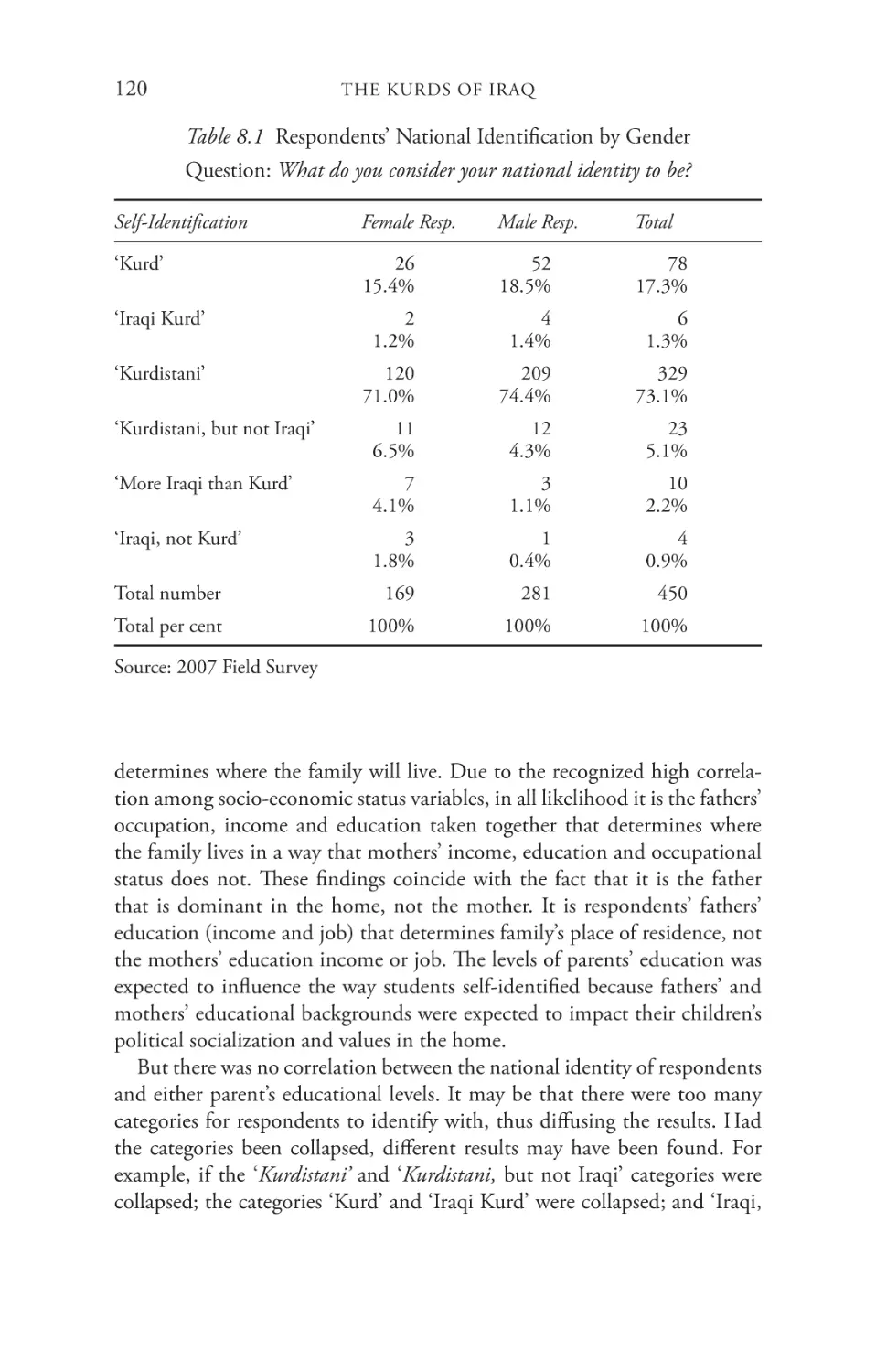
Respondents’ National Identification by Gender
120
Correlation Coefficients for Gender, National Identity,
Family Residency and Parents’ Educational Levels
121
8.3 Opinions on the Major Factors that Consolidate National Identity 123
8.4 Strength of Pride as a Kurdistani
128
8.5 Respondents’ Strength of Pride as an Iraqi
128
8.6 Opinion on Partition of Iraq and Separation of Kurdistan
by Gender
135
8.7 Respondents’ Belonging to a Tribe by Age and Class
136
8.8 Chi-Square Test
137
8.9 Respondents’ Belonging to Tribe by Gender
139
8.10 Attachment to Local Areas by Fathers’ Type of Occupation
140
8.11 Views on the Importance of Speaking Kurdish by Type of College 141
8.12 The Importance of Islam as the Vital Factor for Kurdish
Unity by Place of Family Residence
143
8.13 Students’ Membership in Political Parties
146
8.14 Attitudes towards Kurdishness and Political Parties
148
8.15 Attitudes toward Kurdistan’s Parliament and its Power
151
8.16 Respondents’ Use of Mass Media
153
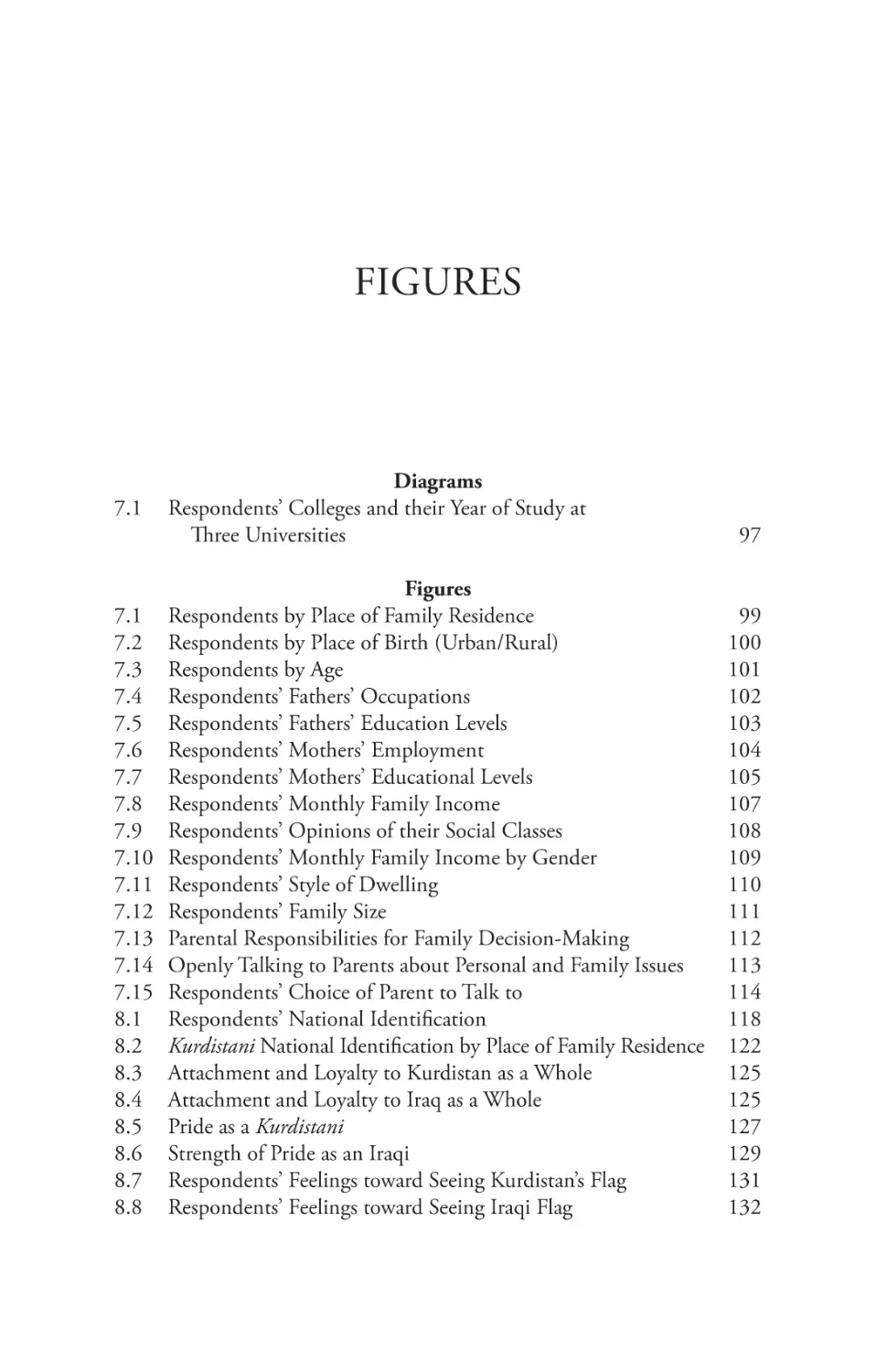
Figures
7.1
Diagrams
Respondents’ Colleges and their Year of Study at
Three Universities
Figures
7.1 Respondents by Place of Family Residence
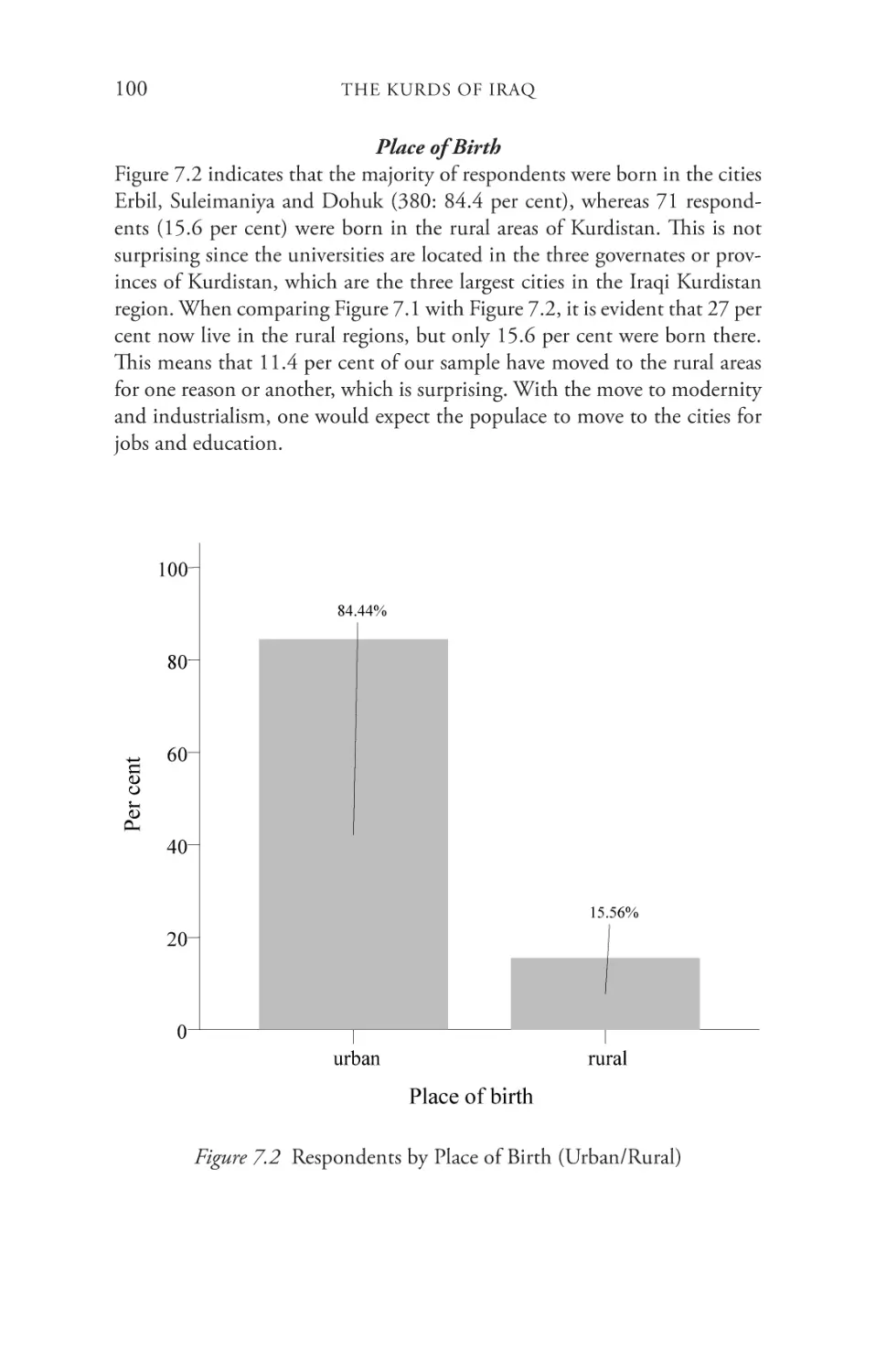
7.2 Respondents by Place of Birth (Urban/Rural)
7.3 Respondents by Age
7.4 Respondents’ Fathers’ Occupations
7.5 Respondents’ Fathers’ Education Levels
7.6 Respondents’ Mothers’ Employment
7.7 Respondents’ Mothers’ Educational Levels
7.8 Respondents’ Monthly Family Income
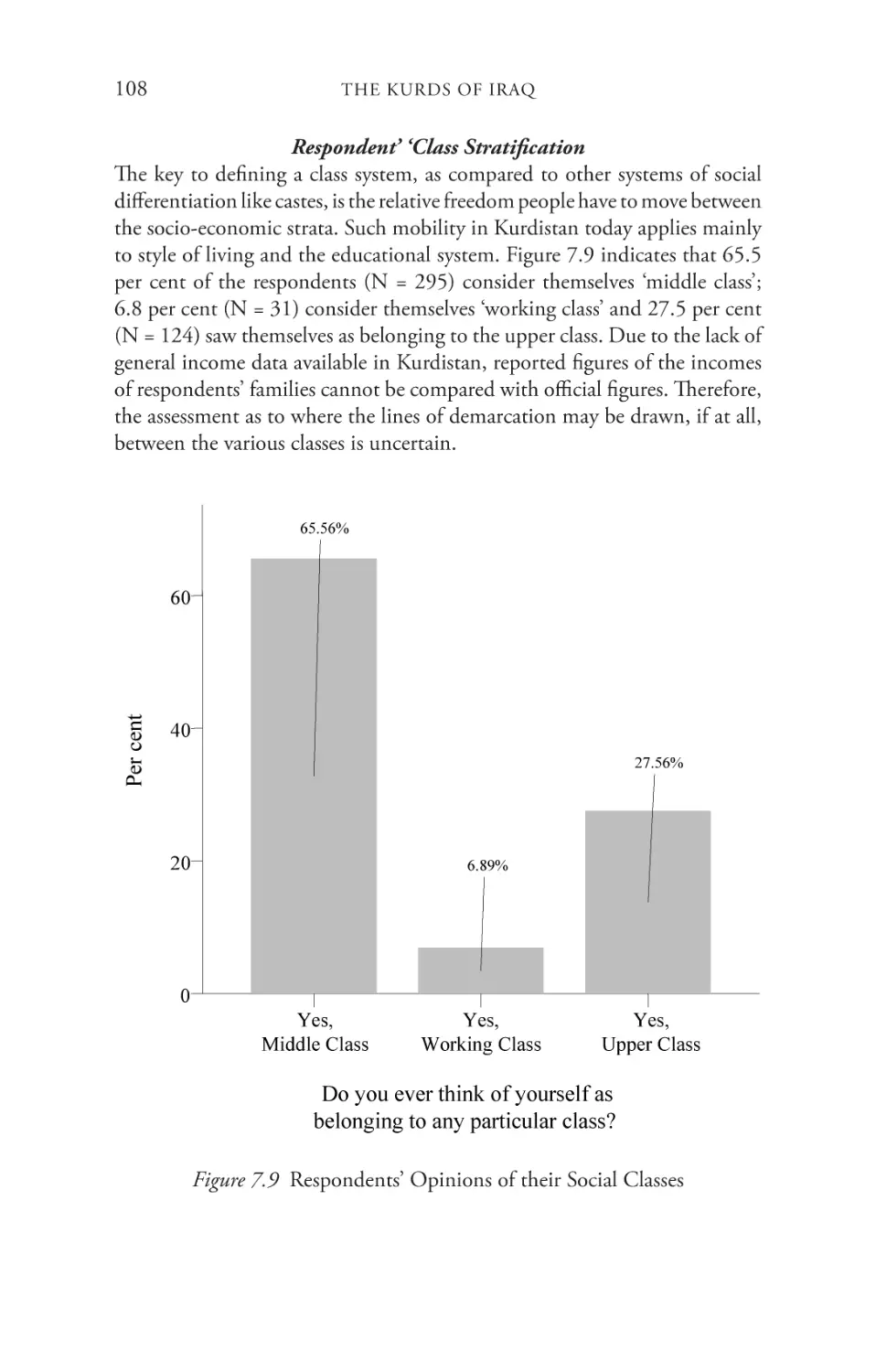
7.9 Respondents’ Opinions of their Social Classes
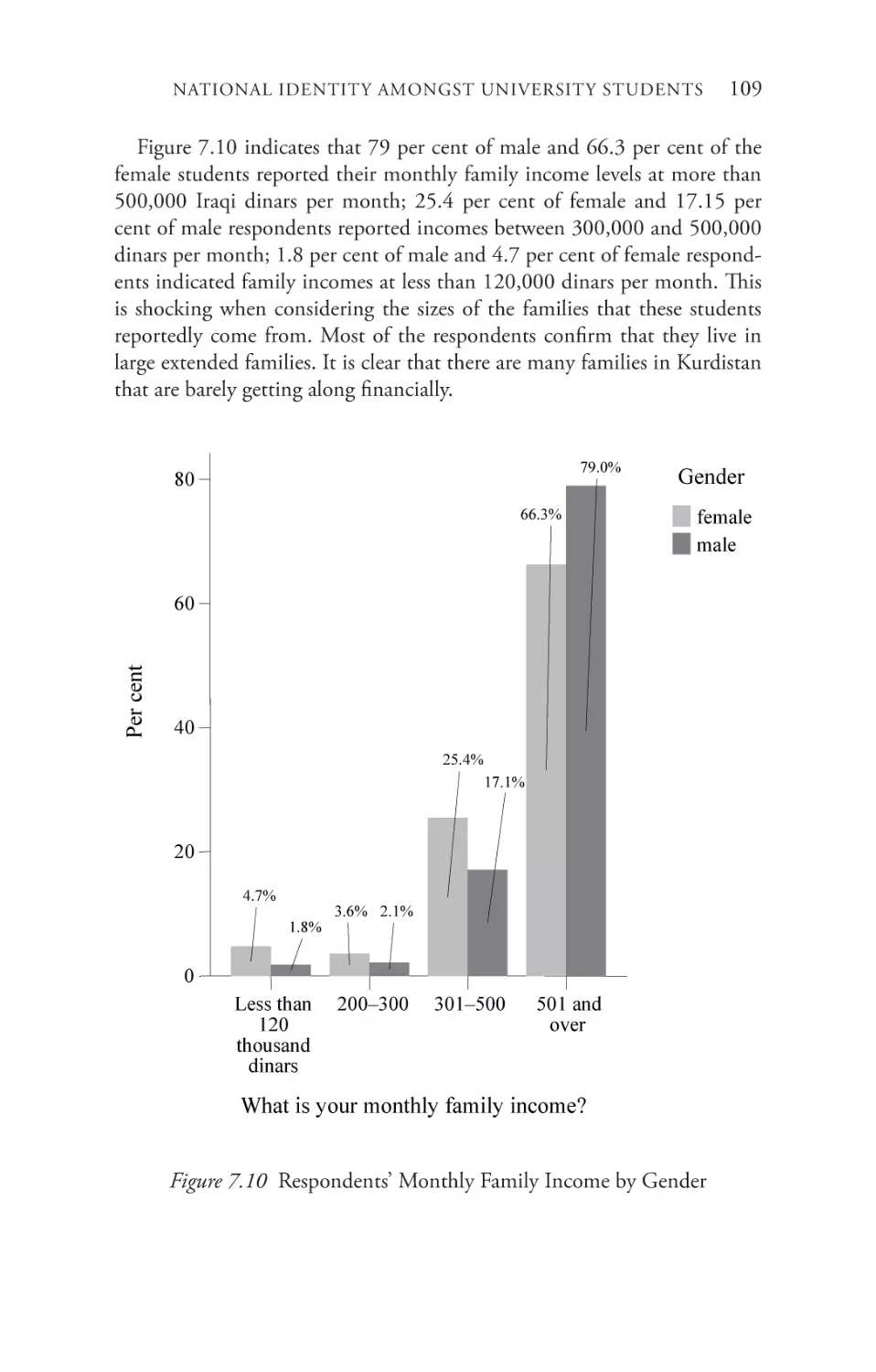
7.10 Respondents’ Monthly Family Income by Gender
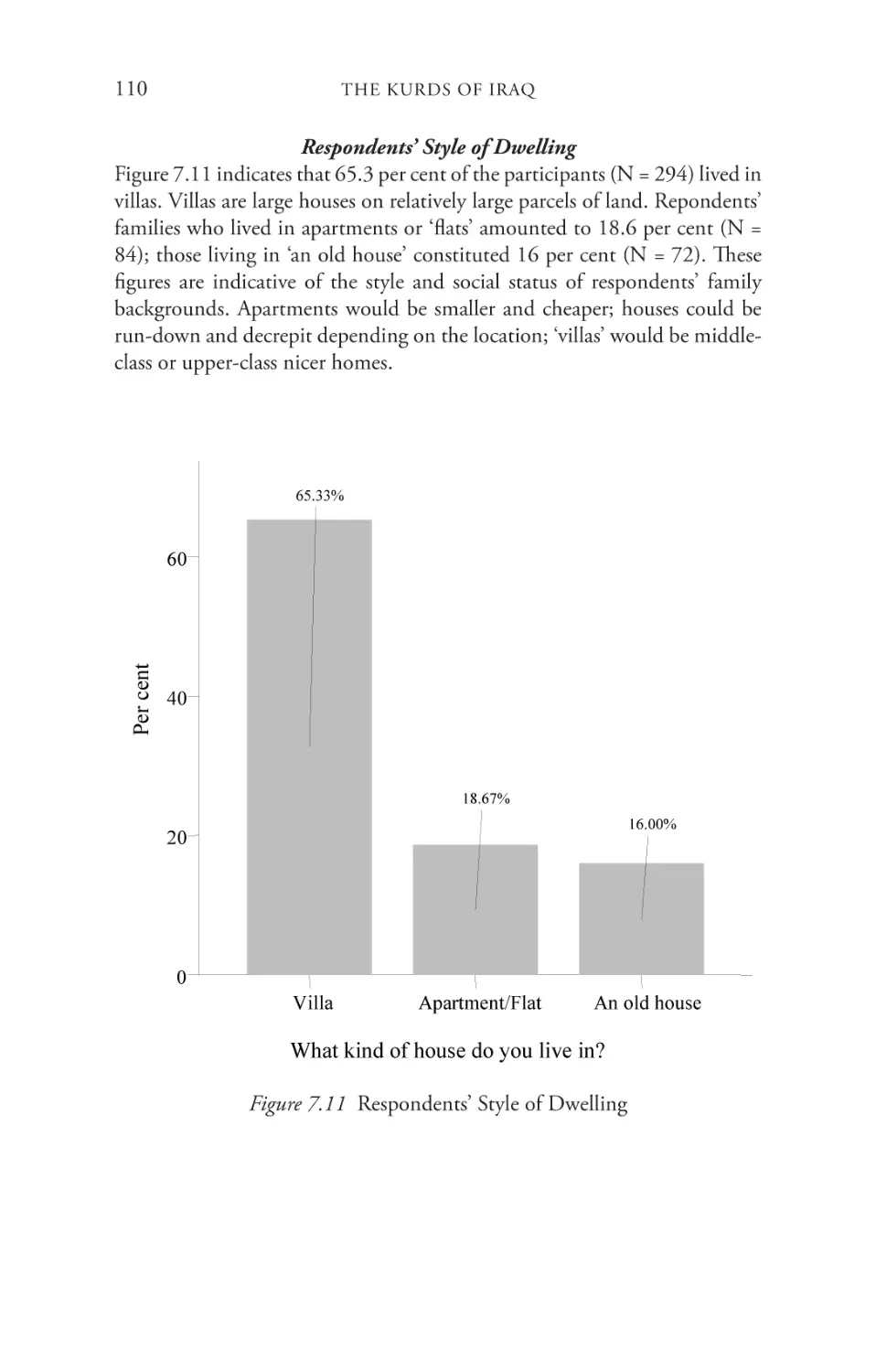
7.11 Respondents’ Style of Dwelling
7.12 Respondents’ Family Size
7.13 Parental Responsibilities for Family Decision-Making
7.14 Openly Talking to Parents about Personal and Family Issues
7.15 Respondents’ Choice of Parent to Talk to
8.1 Respondents’ National Identification
8.2 Kurdistani National Identification by Place of Family Residence
8.3 Attachment and Loyalty to Kurdistan as a Whole
8.4 Attachment and Loyalty to Iraq as a Whole
8.5 Pride as a Kurdistani
8.6 Strength of Pride as an Iraqi
8.7 Respondents’ Feelings toward Seeing Kurdistan’s Flag
8.8 Respondents’ Feelings toward Seeing Iraqi Flag
97
99
100
101
102
103
104
105
107
108
109
110
111
112
113
114
118
122
125
125
127
129
131
132
xiv
The KURDS OF IRAQ
8.9 Respondents’ Attachment to Kurdistan by Class
8.10 Respondents’ Attachment to Iraq by Class
8.11 Attitudes toward the Language of Learning and Studying at
the University by Levels of Fathers’ Education
8.12 Respondents’ Membership in a Political Party by Age Groups
8.13 Respondents’ Loyalty to the KDP
8.14 Distribution of Respondents’ Loyalty to the PUK
8.15 Respondents’ Voting at the Election of 2005
8.16 Attitudes toward the American/British War of 2003 in Iraq
8.17 Attitudes toward the General Standard of Living after 2003
8.18 Attitudes toward the Unification of the Administrations
of the KDP and the PUK in 2006
A.1
Maps
The Boundaries of the Greater Kurdistan Region
133
134
142
145
147
147
149
150
150
152
177
Appendices
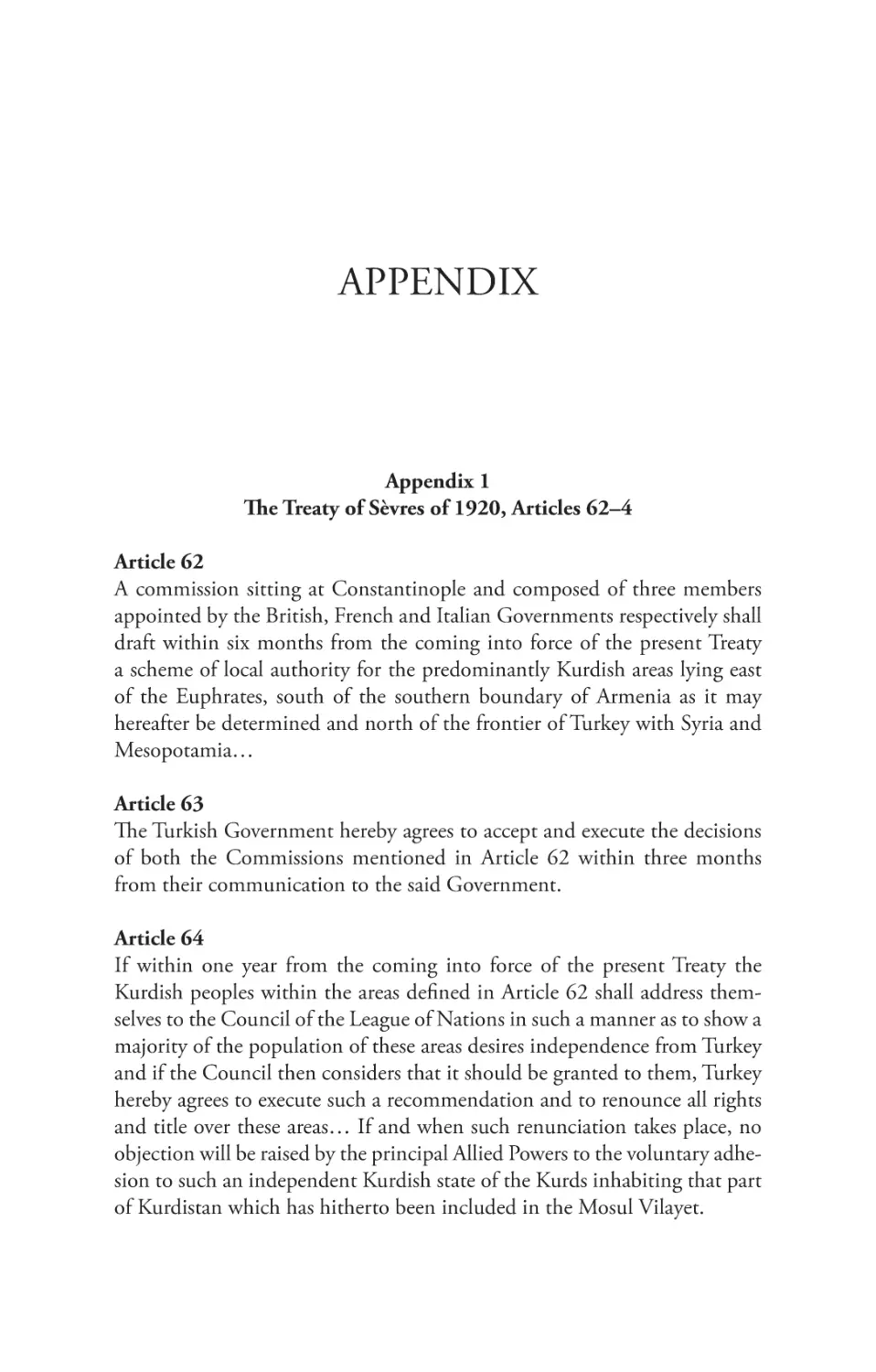
1
The Treaty of Sèvres of 1920, Articles 62–4
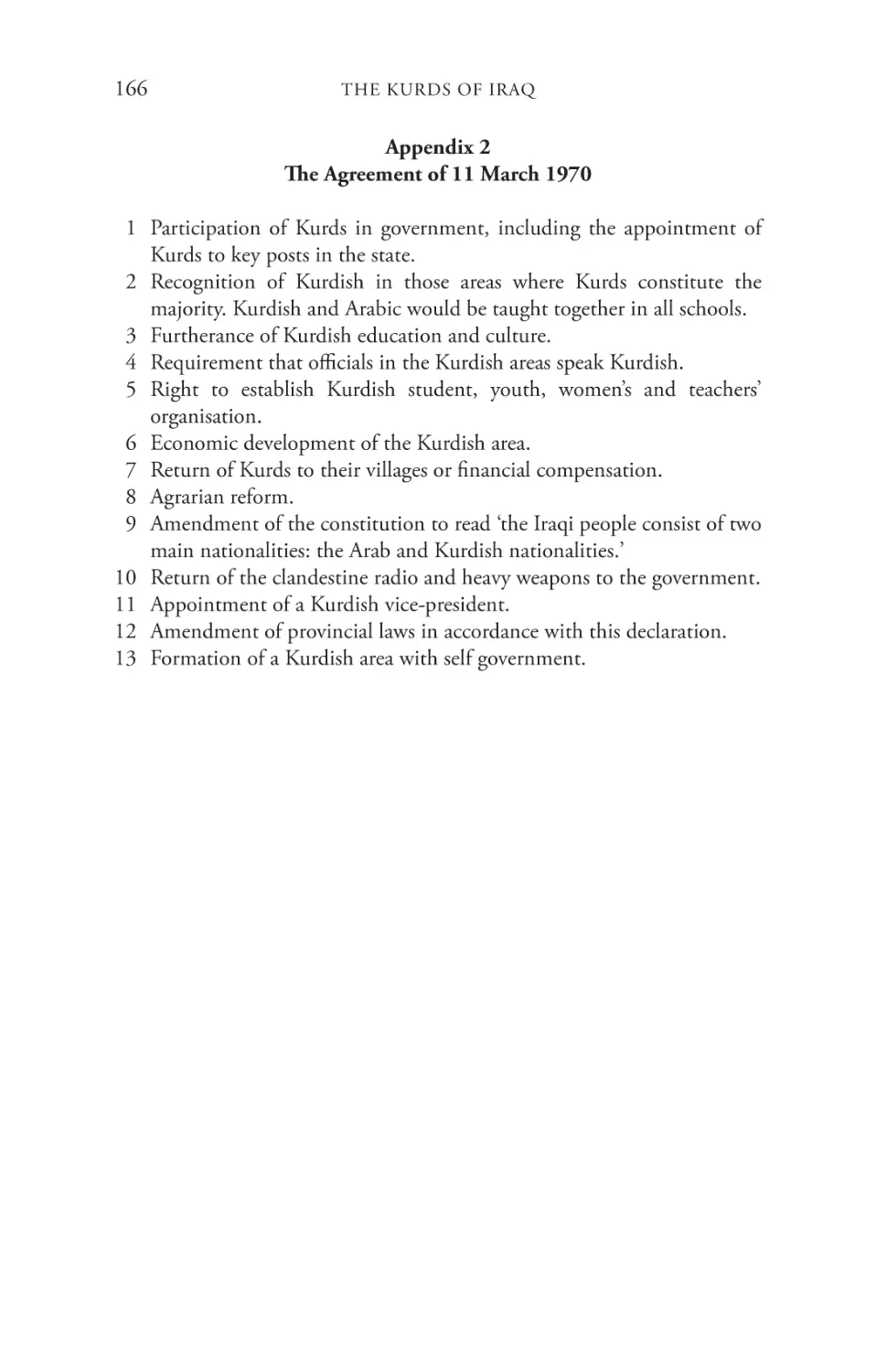
2
The Agreement of 11 March 1970
3 General Provisions of the Autonomy Declaration of 1974
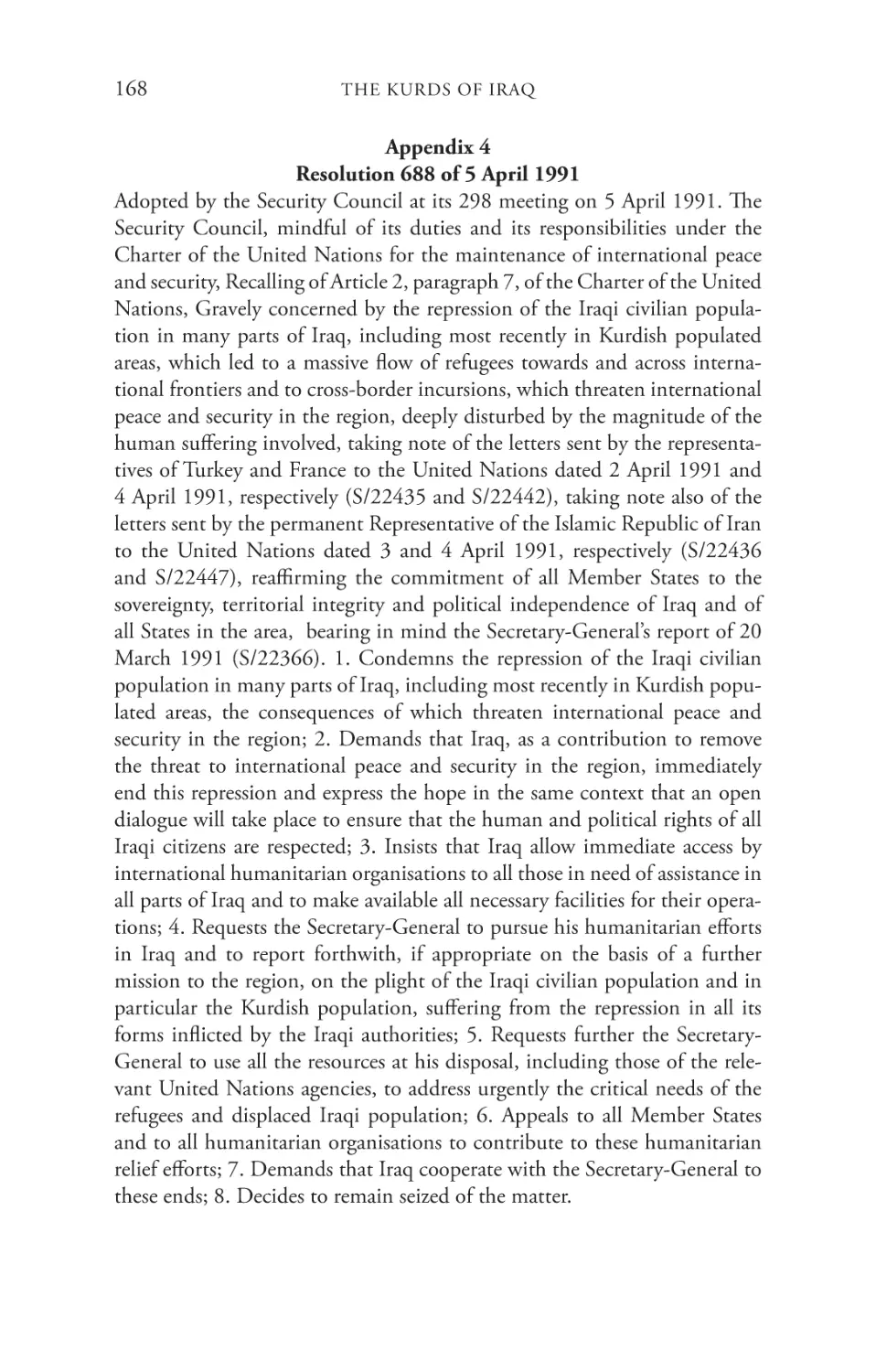
4
Resolution 688 of 5 April 1991
5
The Unification Agreement between the KDP and the PUK
6
The Questionnaire in English
7
The Boundaries of the Greater Kurdistan Region
165
166
167
168
169
171
177
A Note on the
Transliteration and
Translation System Used
Except for some Arabic, Kurdish, Persian or Ottoman words, terms and
names, which have been standardized in English (such as Sunna, Shi’a,
Jihad, Hussein, Salahaddin, Qur’an, Pasha, Agha, Hiwa), the non-English
words or names used have been transliterated according to the system used
by the International Journal of Middle Eastern Studies, which is a modified
version of the Encyclopaedia of Islam where Qaf = Q, not K.
The spellings reflect neither pronunciations, which vary from Arabic to
Kurdish, Persian, or Turkish, nor accepted English spellings, which often
reflect the way a word sounds in English rather than how it is spelled in
Arabic or other languages. It might be useful to note that Kurdish, Persian
and Turkish make use of all of the five English vowels (a, e, i, o and u),
whereas Arabic uses only three vowels (a, i and u).
All non-English words, except the well-known terms or names such as
Islam, Ali, Mohammad or Hussein, are italicized. Words and geographical
names familiar to English readers are given in the English version and not
in transliteration. Regarding the pronunciation of Arabic words, the Arabic
linguistic system of al-Hruf al-Qamariaya and al-Huruf a Shamsiya was not
followed. So a word like al-Siyasiya should be pronounced as As-Siyasa, or
As Suleimaniya as a name of Suleimaniya city.
The article (al) was put in front of the noun to make it easier for the
reader, unless it was different in the original text. This transliteration system
has not been applied to the maps as the spellings on the maps sometimes
differ from those in the text. For instance, on some maps, one might see the
name ‘Irbil’ instead of ‘Erbil’ or ‘Arbil.’ Or one might see ‘Hawler’ rather
than ‘Erbil’, ‘Irbil’, or ‘Arbil’. For the Kurdish terms and names, the Sorani
written style was adopted, as it is the style used in Iraqi Kurdistan, e.g., the
xviii
The KURDS OF IRAQ
name Hiwa is distinguished from Hevi or Hiva. Translations from Kurdish
and Arabic language sources are my own unless otherwise specified.
Abbreviations and Glossary
ABSP
ADM
Algiers Accord
CARDI
CPA
CSO
CW
FCO
FO
ICP
IGC
IIG
IKF
Arab Ba’th Socialist Party founded in 1947 as a secular
Arab nationalist Party. The official name of the Ba’th
party.
Assyrian Democratic Movement. A political party representing the Chaldo-Assyrian (Christian) community
headed by Yondam Youssef Kanna.
An agreement reached in 1975 between the Shah of Iran
and Iraqi President Saddam Hussein (Vice President at
the time), whereby the Shah agreed to cut off support
for Iraqi Kurdish rebels in exchange for an Iraqi territorial concession.
Committee against Repression and for Democratic
Rights in Iraq.
Coalition Provision Authority, headed by Ambassador
L. Paul Bremer.
Civil Society Organization.
Chemical weapons.
Foreign and Commonwealth Office.
Foreign Office.
Iraqi Communist Party, founded in 1934.
Iraqi Governing Council, appointed by the CPA to
provide guidance and advice on governing Iraq during
the period 13 July 2004–1 June 2005.
Interim Iraqi Government, formed after the elections of
30 January 2005. Replaced on 3 May 2005 by the Iraqi
Transitional Government. Iyad Allawi served as prime
minster with Gazi al Yawer appointed president.
Iraqi Kurdistan Front. Political front formed in 1987 of
leading parties based in Kurdistan.
xx
The KURDS OF IRAQ
Islamic League of Kurdistan.
Islamic Movement of Iraqi Kurdistan.
Islamic Movement in Kurdistan.
International Islamic Front.
India Office.
Iranian Revolutionary Guard Coup.
Kurdistan Autonomous Region.
Kurdistan Communist Party.
Kurdistan Democratic Party. One of the two main
parties founded in 1946 and headed by Mas’ud Barzani.
KDP (PC)
Kurdistan Democratic Party Provisional Committee.
KDP (PL)
Kurdistan Democratic Party, Provisional Leadership.
KF
Kurdistan Front.
KIL
Kurdish Islamic League.
KIU
Kurdistan Islamic Union. A moderate Islamic party
founded in 1994 under leadership of Salahaddin
Baha’adin.
KNA
Kurdistan National Assembly. The 105-seat legislature
of the Kurdistan Region of Iraq was first assembled in
1992.
KNF
Kurdistan National Front.
KRG
Kurdish Regional Government. The unified government
established in Kurdistan by the Kurdish Front after the
1992 elections. It was divided in 1993 and reunified in
2006.
KSP
Kurdistan Socialist Party. One of several small Kurdish
parties in northern Iraq.
KTP
Kurdish Toilers’ Party.
KUP
Kurdistan Unity Party.
Lausanne
Superseded the 1920 Treaty of Sèvres, giving most of
Treaty of 1923 Kurdistan to Turkey.
No Fly Zone
Area established under UN auspices in which Iraq was
not allowed to fly non-commercial fixed-wing aircraft.
There were two such zones in Iraq, one above the thirtysixth parallel in the north and one below the thirty-third
parallel in the south.
NGO
Non-governmental organization.
OFFP
The United Nations Oil for Food Programme.
OPC
Operation Provide Comfort. The name given by the US
military to the operation that returned Iraqi Kurdish refugees to their homes in the wake of the 1991 rebellion.
ILK
IMIK
IMK
INF
IO
IRGC
KAR
KCP
KDP
Abbreviations and Glossary
xxi
Organization of Petroleum Exporting Countries.
Formed in 1960 by Middle East oil-exporting countries
and a few others, such as Venezuela, Indonesia and
Nigeria. OPEC is dedicated to protecting the oil-price
structure in the interests of exporters.
PUK
Patriotic Union of Kurdistan. One of the two main
Kurdish parties in Kurdistan. Founded in 1975 it has
since been led by Jalal al-Talabani.
RCC
Revolutionary Command Council. The highest legislative and executive authority in Iraq from 1968–2003.
Resolution 687 The UN cease-fire resolution that concluded the Gulf
War and stipulated the requirements that Iraq had to
fulfil before troops were withdrawn. Chief among these
was the destruction of Iraq’s weapons of mass destruction (WMD). Sanctions would be maintained until this
was satisfactorily accomplished.
Resolution 688 The UN resolution that instructed Iraq to cease repression of its population and to allow the international
community to assist Kurdish refugees in returning to
Iraq.
Resolution 986 The UN resolution, known as ‘Oil for Food,’ that
allowed Iraq to export a certain amount of oil in order
to purchase food, medicine and other essentials for its
population, despite sanctions.
TAL
Transitional Administrative Law. An interim constitution signed on 8 March 2004 by IGC.
UAE
United Arab Emirates.
UAR
United Arab Republic. A political union formed by
Egypt, Syria and Yemen in 1958. The UAR lasted until
1961.
UK
United Kingdom.
UKDP
United Kurdistan Democratic Party.
UKH
University of Kurdistan in Hawler (Erbil).
UN
United Nations.
UNSCOM
United Nations Special Commission. A body created
in 1991 to conduct inspections in Iraq for biological
weapons and long-range missiles.
USA
United States.
WMD
Weapons of mass destruction, whether chemical,
biological or nuclear.
OPEC
Glossary of Kurdish and
Arabic Terms
A chieftain or a tribal leader or landowner
among the Kurds.
Anfal
‘Spoils.’ The term is taken from the eighteenth
Sura of Qur’an, where it refers to the spoils of
battle. In Iraq it is the code name for a campaign
by the central government against Kurds in
1978–9 in the aftermath of the Iran–Iraq war, in
which chemical weapons were used.
Arbil, Erbil, Irbil, (or The current capital of the Kurdish autonomous
Hawler in Kurdish)
region.
Ashertalaf Immigrants The Arab Iraqis who received 10,000 dinars
from Saddam in 1980 to immigrate to Kirkuk.
Assyrians
A Christian minority in northern Iraq, sometimes referred to as Nestorians.
Ba’th
‘Renaissance, rebirth.’ Refers to the Ba’th Party,
a pan-Arab party founded in Syria in 1946 that
took root in Iraq in the 1950s and was in power
1968–2003.
Bayan Athar
March proclamation.
Emir or Amir or Mir
A leader of an emirate or principality.
Emirate or Mirnishin A semi-independent principality.
Gurani
A group of Kurdish dialects, including Hawrami,
spoken around the Hawraman area of southern
Kurdistan.
Hiwa, Hiva, Hevi
Hope, a Kurdish political party founded by the
leftists in early 1940s in Iraqi Kurdistan.
Hukmdar
Governor.
Agha
xxiv
The KURDS OF IRAQ
Ittifaq
Ittihad Ikhtiyari
Jash
Agreement.
Voluntary union.
‘Little donkeys,’ Kurdish militia who serve the
state government.
Northern Kurd, speaker of Kirmanji, peasant.
Dialect of Kurdish, spoken north of the Greater
Zab River.
School that teaches religious science and Islamic
jurisprudence.
A religious minority or ethnic group based on
the Ottoman system of administration.
Clerical office in Sunni Islam.
A Sufi brotherhood order, widespread in
Kurdistan.
A Kurdish and Turkish feudal title.
‘Those who face death.’ Militias attached to
Kurdish political parties, especially the KDP and
the PUK.
A Sufi brotherhood order, widespread in
Kurdistan.
Muslim judge.
Autonomy law agreement of 11 March 1970 –
offered by the Ba’th government and accepted by
Mustafa Barzani.
Uprising.
Administrative territorial unit in the Ottoman
Empire.
Head of a tribe of Arabs. In Kurdistan this is a
leader of the Sufi order.
Muslims who follow the ‘party’ of Ali, that is,
who believe that Ali, the Prophet Muhammad’s
cousin and son-in-law should have succeeded the
Prophet as the leader of the Muslims.
A dialect of Kurdish spoken south of the Greater
Zab River. It is the dialect of Erbil, Suleimaniya
and Kirkuk.
Mystical order in Sunni religious doctrine.
Traditions of Prophet Muhammad including his
sayings (Hadith).
The word comes from Sunna, which means
words and actions.
Kirmanj
Kirmanji
Madrasa
Millet
Mulla or Mala
Naqshbandiya
Pasha
Peshmargas
Qaderiya
Qadi or Qzi
Qanun al-Hukm
al-Thati
Rapareen
Sanjaq or Sinjaq
Sheikh
Shi’a
Sorani
Sufi
Sunna
Sunni
glossary of kurdish and arabic terms
Tariqa
Thalug
Ulama
Uruba
Wilaya, Vilayat or
Wilayat
xxv
In the Sufi brotherhood this is one of the most
persistent forms of religious adherence.
Deepwater channel in the centre of a river;
used in a specific sense to denote the (disputed)
boundary between Iraq and Iran in the Shat
al-Arab.
Clergies or Islamic scholars knowledgeable in
Islamic law and theology.
‘Arabness’.
State or province; a unit of government under
the Ottoman Empire.
Preface
A decade ago while studying for the Master of Science degree in politics and
sociology at Birkbeck College, University of London, I came across David
McDowall’s book, A Modern History of the Kurds. While not the first I had
read on the subject of the Kurds and Kurdish history in English, this was
the book that aroused my interest and curiosity in Kurdish nationalism and
national identity. It led me to further study in the wider context of Kurdish
nationalism.
In my later studies I discovered that while Kurdish nationalism had been
studied from various angles and disciplinary perspectives, there was no study
in Kurdish, Arabic, or English, that concentrated on the history and culture
of the Iraqi part of Kurdistan. This is a serious deficiency in the literature. As
a social scientist and native researcher who has first-hand knowledge of the
Kurdish and Arabic languages, I thought that this study would fill a void in
the literature while adding an insider’s view to the study of nationalism and
national identity in the Kurdistan region of Iraq.
FOREWORD
The situation in the Kurdistan Region of Iraq, also referred to as Iraqi
Kurdistan or, by those unwilling to recognize the constitutional reality
of the Kurdistan Region, ‘Northern Iraq’, is a subject that swiftly arouses
commentary and speculation grounded at best in dated analyses of Iraqi
and Kurdish political life or, in the worse cases, highly loaded and at times
dangerously inaccurate views and misconceptions. These views and misconceptions are legion. Whether focusing on the supposed aspiration to secede
from Iraq and establish an independent state in the heart of the Middle
East, or viewing the Kurdish leadership being in some form of alliance with
the US and her allies to ensure that the wider Middle East region remains
in a fragmented condition, easy to influence, control, and coerce. Opinion
about the internal dynamics of the Kurdistan Region’s politics and society
are similarly varied, with the Kurdish leadership seemingly being either a
mirror-image of the deposed Ba’th regime of Saddam Hussein, or the only
true Western-style democrats between Europe and Australia.
Whatever the relative truth or fiction of these views may be, one theme
underpins all of them, and that is the sense that the Kurds in Iraq now exist as
a discrete unit, with the capability to engage in partnership with neighbours
inside and outside Iraq, and with the ability to self-determine, to a degree
not previously seen, their own future. This existence is commonly viewed
in a classic statist manner – or de facto statist manner, more accurately – in
so far as ‘the Kurds’ are often considered en masse, with little consideration
given to the domestic political and social realities that serve to build the
edifice of the Kurdish geopolitical reality in the international setting. This
lacuna constitutes a particular problem, as it is filled by many assumptions.
How the political parties operate; how processes of democratization are or
are not being implemented; how do young Kurds view their situation and
their future; how do people in the Kurdistan Region envisage their own
identities and, more importantly, how do they view the identities of those
xxviii
The KURDS OF IRAQ
around them, are just a few of the issues that are formatively important not
only to the Kurdistan Region itself, but the wider geopolitical theatre of the
Iraqi, Turkish, Syrian, and Iranian borderlands.
It is on the question of national identity that Mahir Aziz focuses upon.
Accepting that identities are mobile and changeable, needing to be remembered and constantly revisioned and reconstructed, Mahir’s research focuses
not upon those most commonly studied in terms of Kurdish politics – the
political elites – but upon those who will arguably be the dynamos of change
and development in the future – University students. His choice of sample
is important – young people, born in the autonomous Kurdistan Region
established in 1991, and exposed largely to a distinctly ‘Kurdish’ narrative
of culture, social processes, and historical and political development. How
this cohort of society views themselves, those around them, and their future
allows those interested in Iraq and the Kurdish place within (or outside) it to
understand, empirically rather than merely anecdotally, the current situation
and the demands and aspirations of a critical grouping (students) within a
vital region (Kurdistan) of a state (Iraq) of immense geopolitical significance
in the region and internationally. Aziz’s contribution is therefore not only
to the literature on nationalism, identity, and the Kurdistan Region of Iraq
– clear though this is. It is also a contribution to the wider field of Middle
East Politics, and wider strategic and geopolitical concerns.
Gareth Stansfield
Professor of Middle East Politics
Director of the Institute of Arab and Islamic Studies
Co-Director of the Centre for Kurdish Studies
University of Exeter
Introduction
This book is concerned with the development of Kurdish ethnonationalism
and Kurdish citizens’ perceptions of national identity in the Kurdistan region
of Iraq. After introducing the major theoretical approaches on nationalism
and national identity, the discussion concentrates on the development of
Kurdish nationalism and contemporary Kurdish national identity beginning with the 1990s. After the establishment of the Kurdistan Regional
Government (KRG) in 1992, the two major political parties, namely the
Kurdistan Democratic Party (KDP) and the Patriotic Union of Kurdistan
(PUK), achieved a de facto state. The new generation of Kurds in Iraq has
grown up since the 1991 Kurdish uprising, which is an absolutely different
political climate than that which their parents experienced. The parents’
generation was dominated by the Ba’th party, which along with the Iraqi
state was the hegemonic power. The youthful Kurdish generation does not
remember this and as a result has little interest in Iraqi politics or Arabic
culture.
The historical development of Kurdish national identity is contextualized within an understanding of Kurdish nationalism that spans the twelfth
century to the present time. This research supports Anthony Smith’s theory
of historical ethno-symbolism, which explains the origins and development
of nations as a long-term process subject to a great variety of influences.
Political, economic, social and emotional elements converge as conditions in the respective communities evolve, requiring the ruling elites to
continually adjust their means and goals, not only to remain in power, but
to consolidate and reinforce the sense of nationalism and national identity
among the people.
This investigation explores attitudes towards national identity using a sample
of university students from the three largest universities in Iraqi Kurdistan.
It is not suggested that nations and national identity are naturally occurring
phenomena; they are not. My concern is to explore how notions of ‘nation’
xxx
The KURDS OF IRAQ
and ‘national identity’ are used by students to position themselves in relation to
others and how such actions are partly responsible for the ongoing perpetuation
of the cultural outlook within the nation. The research explores answers to the
following questions: (1) Do the Kurds, specifically the young Kurds, have more
than one identity simultaneously? (2) Is ‘identity’ a confusing term for them?
(3) How do the young Kurds identify themselves? (4) What does it mean to be
Kurdistani or Iraqi? (5) To what extent is Kurdish identity linked with Kurdistan
and Kurdistanism? (6) Which identity is more predominant in Kurdistan:
national, tribal, Islamic or local?
With regard to the pre-1990s era when there was much confusion over
long-term prospects, an examination was made as to whether the Kurds in
the stateless nation of Iraqi Kurdistan have managed to retain a sense of
distinct culture and national consciousness, despite subjection to forceful
and unforgiving assimilating forces.
From the basic elements that make up the Kurdish sense of ‘nationhood’,
it is my contention that a unified nationalist political movement has sprung
up over the years, especially since 1960, which seeks power, ranging from
limited control over certain aspects of the nation’s affairs, to the dream of
complete independence. This unified nationalist movement fragmented
between 1975 and 1988 and resurged after 1998.
Data from the experiences of 450 graduate students from three major
universities in the region were used from which to draw inferences. The
data was collected through quantitative and qualitative research instruments
based on questionnaires and interviews which were then analysed from a
nationalistic framework. The participants generously interpreted various
aspects of their responses as well as their recollection of the acquisition of
such during the years of their upbringing. The findings demonstrate that
several factors have played a role in consolidating a sense of Kurdish national
identity. These include the national, territorial, political and linguistic
factors.
This book has been divided into two parts. Part One deals with the theoretical approaches to nationalism and national identity and chronologically
contextualizes the development of Kurdish nationalism in Iraq.
Chapter 1 provides background information to the study and to Kurdistan
in general, the questions of concern and a review of the current literature.
This chapter also deals with the construction of Kurdish national identity
in Iraqi Kurdistan. It assesses the national identity of young urban kurds,
whilst the remainder of the chapter is devoted to a description of Iraqi
Kurdistan’s population, religion, the economy in the post-1990s era and the
development of higher education.
introduction
xxxi
Chapter 2 conceptualizes and explores the most important terms and
concepts used in the study, such as nationalism, national identity, nation
state, stateless nation and political culture.
Chapter 3 addresses the modern theoretical debates and approaches to
nationalism and national identity. The dichotomy of civic versus ethnic
conceptions of national identity and nationalism is considered. Anthony
Smith’s ethno-symbolism and his six dimensions of ethnic community are
analysed and applied to Kurdistan as an appropriate model by which to
understand Kurdistan’s case. A critical reading of other scholars’ responses
to Smith’s approach is debated as well. The remainder of the chapter outlines
some of the most important contributions to the debate on nationalism and
national identity as represented in the works of Benedict Anderson by assessing
Anderson’s views on language, imagination and imagined communities.
Chapter 4 contextualizes Kurdistan’s history from the pre-modern to the
twentieth century by use of territorial and linguistic approaches. The early
phase of Kurdish nationalism is detailed, which covers the period from the
twelfth to the end of the nineteenth centuries. This chapter also assesses
Kurdish proto-national identity and the rise of the ‘imagined community’.
Chapter 5 outlines the historical and socio-political conditions for the
development of Kurdish nationalism from 1921–91. Ten sections cover the
following topics: (1) losing the game of state formation; (2) rebellion in
Kurdistan; (3) the meeting of tribalism and nationalism from 1930s–58; (4)
Political Developments in Iraq and Kurdistan; (5) the Kurdish nationalist
movement in the republican era: 1958–68; (6) Kurdish nationalist mobilization in the Ba’th era: 1968–90; (7) the Agreement of 11 March 1970;
(8) the Algiers Agreement of 1974–5 and the Kurdish Revolution; (9) the
Internal Displacement; and (10) militant Kurdish nationalism: 1976–90.
Chapter 6 explores the reconstruction and consolidation of Kurdish
national identity. Section one assesses the uprising (Rapareen) of March
1991 in Kurdistan and its causes and consequences. The second section
presents a socio-political reading of the 19 May 1992 elections and discusses
the power-sharing system which was in place from 1992–8. The third
section assesses the political power structures, power-sharing system and
Kurdish national identity from 1998–2008. The fourth section illuminates
the notion of Kurdistanism (Kurdistaniyeti in Kurdish) as a new form of
asserting modern national identity from 1998–2008. It also assesses Kurdish
nationalism after 1998 until the present time.
Part Two consists of three chapters which present the conclusions and
findings of the present study. Chapter 7 describes the method of the study
and the design of the questionnaire which was administered in March–June
xxxii
The KURDS OF IRAQ
2007 at the universities of Salahaddin, Suleimani and Dohuk. The demographic variables of the students are discussed along with those of their
families, including place of family residence, place of birth, age and gender
of respondents, marital status, parents’ occupation, education, income and
social status, family size and other characteristics.
Chapter 8 is devoted to students’ attitudes towards identity in a variety
of dimensions: tribal, local, territorial, religious and national. Here the issue
of Kurdistanism (Kurdistaniyeti) is investigated while exploring students’
attitudes towards Iraqi Kurdistan, the Kurdistani flag versus the Iraqi flag,
politics and political parties in Kurdistan. Chapter 9 discusses the study’s
findings and outlines recommendations for further study.
This book could not have been written without the effort and encouragement of many people. I would particularly like to thank my mentor and
friend, Professor Gareth Stansfield. Without his help, commitment to the
project and keen insights, this work would have been vastly more difficult to
complete. I have a special appreciation for Professor Tim Niblock for his assistance, encouragement, ideas and advice and criticism and suggestions. I would
like to express my deep gratitude to my friend Farouk Muhammad Amin in
the Netherlands for his advice and for refreshing my knowledge of statistics.
In the Kurdistan region many people have helped and supported me,
especially in the survey process. I would like to thank my students at the
universities of Salahaddin, Suleimani and Dohuk who were forthright,
honest and patient in answering the many questions. I thank Prof Nadje
AL-Ali of SOAS, London University for reviewing the questionnaire and
I’m grateful for Mr. Falah Mustafa Bakir the Director of Foreign Affairs
in Kurdistan Region in Hawler for the support he offered during the last
five years. I would particularly like to thank Dr. Fuad Mawlood Shareef for
providing me with the books I needed from the Library of Queen Mary
College at the University of London and Dr. Sharon Linzey for her assistance during the revision and final editing process. I would like to thank
my mother, brothers and near relatives who have encouraged me along the
way. The devotion and enduring encouragement, patience and unwavering
support of my family, especially my wife and my son Alan, enabled me to
cope during tense moments and the long commitment of working on the
PhD. To them I am utterly grateful. I would be remiss if I did not mention
the long hours of editing that Mrs. Valerie Dal Pozzo spent on my behalf.
And to the editors at I.B.Tauris, Joanna Godfrey and Maria Marsh, I express
my sincere gratitude for their help and patience. There are others that I am
sure I have forgotten to mention and I apologize in advance for this oversight.
Any errors of fact or interpretation are, of course, my sole responsibility.
1
The Construction of
Kurdish National Identity
in Iraqi Kurdistan
Much contemporary work on the politics of identity has concentrated on
either (1) the study of ethnicity and ethnic community, or (2) the analysis of national identity and nationalism. Over time these two fields have
converged, a process which has led scholars to study the phenomena of
ethnicity and nationalism as intimately related. Nowhere is this truer than
in cases of ethnonationalism.1
The term ‘ethnonationalism’ was coined by Walker Connor who defines a
nation as a self-conscious ethnic group.2 One may ask how the term ‘ethno
nationalism’ is distinguished from ‘nationalism’. For Connor the term ‘nationalism’ refers to loyalty to the ethnic group, but it is usually mistaken to refer
to loyalty to the state. The term ‘ethnonationalism’ must be distinguished
from ‘patriotism’. The latter is often synonymous with the nationalist projects
of post-colonial states.3 The study of the ethnonational must thus ‘focus on
the groups’ own cultural boundaries and the ways in which they use their
cultural resources to affirm their distinctiveness and promote their interests.4
My concern here is whether the theoretical approaches to nationalism
provide an adequate framework within which to understand the Kurdish
ethnonationalist movement and its current de facto state in Iraqi Kurdistan.
Mainstream scholarship generally takes the view that nationalism is a
modern phenomenon in both the West and the Middle East. Accordingly, it
was thought to have developed first in Europe 200–300 years ago and then
spread to the Middle East. Rogers Brubaker dates the birth of ‘nationhood’
to 1792 and considers it to have died in 1992.5
Walker Connor states: ‘Europe’s presently recognised nations emerged
only very recently, in many cases centuries later than the dates customarily
4
The KURDS OF IRAQ
assigned for their emergence.’6 There is no consensus on the origins or
timing of nationalist ideologies. Hans Kohn refers to 1642, whereas Acton
points to 1772 and the period of the partition of Poland as the date for the
birth of this phenomenon. Kedourie offers the year of 1806 when Fichte
published his call to the German nation. For most, the late eighteenth
century and the period of the French and American revolutions mark the
birth of nationalism.7
Toward the end of the twentieth century questions of national identity became highly relevant in both Eastern Europe and the Middle East.8
Modern societies tend toward a form of identity that finds expression in
the nation concept. As a result, understanding how national identity is
constructed is an enormously important task on the road to understanding
a people’s social and political culture. And nationalist movements are vital
for understanding how national identities are constructed.
The good news is that the tools used to understand the construction of
national identities are available within the community. Sometimes they
are invented. Concepts such as common culture, shared history, common
myth, traditions, national essence, the flag, the national anthem, language,
spirit of the people and folklore, are all imaginary creations that provide a
group with a sense of ‘togetherness.’ It is this sense of ‘togetherness’ and the
belief that the people of a given locale share a lot in common that serve to
unify the group.
For at least half a century, nationalism has given the Kurdish people
the most effective answer to questions of identity and connectedness in an
amorphous and fluid world. In recent decades political developments in
Kurdistan have been dominated by ‘nationalistic’ oriented, or ‘nationalistic’
types of questions.
Nation versus National Identity
The Kurds appear to be the largest ethnic group in the world without a state
of their own.9 Therefore, as the largest stateless nation in the Middle East,
they are a growing regional and international problem—as well as an embarrassment. They have suffered discrimination, marginalization and assimilation in each of the states in which they reside: Turkey, Iran, Iraq and Syria.
In each of these countries, the nationalism of the sovereign dominant ethnic
group has fed the official ideology and each national ideology has endeavoured to establish a homogeneous nation state. In every case the Kurds have
been excluded, sidelined, or outright had their existence denied.10
Iraqi Kurdistan has existed since 1991 when a new political era brought
about a strengthening of the Kurds’ sense of national identity. Gareth
construction of kurdish national identity
5
Stansfield asserts that this period may be a decade of development ‘in which
the political system was finding a measure of equilibrium in the milieu of
the geopolitical forces affecting it.’11
National Identity of Young Urban Kurds
The 1990s introduced a significant change in Kurdish thinking about themselves. The term ‘Kurd’ had previously referred to ethnicity. But after the
1990s the young educated Kurds began to understand their Kurdish-ness in
a new way, as Kurdistani.12
The political events of the 1920s, 40s, 60s, 70s and 90s consolidated
Kurdish national identity and strengthened Kurdish pride in Kurdistan. The
1990s was a period of growing Kurdistani identity. Thus, the central argument for this work may be stated as follows:
The political changes that took place in Iraqi Kurdistan after 1991, the
19 May 1992 election and the existence of the de facto Kurdish state since
1992 coalesced to cause a sense of political and national cohesiveness among
urban and literate Kurds in which a widely accepted identity as ‘Kurdistanis’
displaced the former self-designation of ‘Iraqi Kurds’ or ‘Iraqis’.
Historical memory, language and territory as characteristic features of
Kurdish national identity play an important role in stimulating national
historical consciousness and ethnic solidarity. Kurdish national identity
is not treated as an idea or discourse, but rather as empirically observable
political and social units.
Tribal affiliations and religious loyalties no longer exercise a major influence in post-1990s Iraqi Kurdistan, especially among the younger educated
generation. Today, professional, civic and ethnic allegiances proliferate and
they involve ever larger cross-sections of the populace in Kurdistan, especially educated youth.
The provinces of Erbil, Suleimaniya and Dohuk constitute the three
governates or provinces of Iraqi Kurdistan.13 The majority of the Iraqi Kurds
live in the Kurdish cities of Erbil, Suleimaniya, Dohuk and Kirkuk, while
a significant number live in other Iraqi cities such as Mosul, Baghdad and
Diyala. Of course, there are a significant number in exile.
Kurdish nationalism before the 1990s in Iraq was primarily a reaction
to policies denying them Kurdish national identity and to the systematic processes and policies promoting ‘de-Kurdification’, assimilation,
‘Arabization’, discrimination, terror and ethnic cleansing of the Kurds and
their interests.
As a consequence of the second Gulf war in 1991, the Kurdish Rapareen and
the Shi’i intifada in the south rebelled against Iraq. Later the USA established
6
The KURDS OF IRAQ
a ‘safe haven’ for the Kurds to keep Saddam’s troops from carrying out further
operations as part of his nefarious Anfal campaign which destroyed thousands of Kurdish villages and cost multiple thousands of Kurdish lives.14
The Gulf war of 1991 marked for Iraqi Kurds the turning point in their
understanding of contemporary politics and history. The de facto Kurdish
state was the result of the political vacuum left when Saddam withdrew from
Kurdistan. The US established a ‘no fly zone’ which protected the region
from future Iraqi army attacks. At the same time Kurdistan was politically
dominated and economically controlled by the two major Kurdish political
parties: the Kurdistan Democratic Party (KDP), led by Mas’ud Barzani and
the Patriotic Union of Kurdistan (PUK), led by Jalal Talabani.
Since the creation of Iraq by the British in 1921 and throughout most of
modern and contemporary Kurdish history, it was ‘the patchy and ambivalent recognition of Kurdish identity’ by various Iraqi political systems,
together with ‘territorial institutionalization of the Kurdish resistance, that
made Iraqi Kurdistan an important centre for the development of modern
Kurdish politics and culture for the whole region’.15 The Kurdish political
elites sought affiliation with regional or external powers, rather than relying
on indigenous power bases, primarily because they had no better alternatives. Even those dramatic events that brought the establishment of the
Mahabad Republic in Iranian Kurdistan in 1947, or the collapse of the
Kurdish nationalist movement of 1974 in Iraqi Kurdistan, might be interpreted this way.
After the establishment of the Kurdistan Regional Government (KRG) in
1992 and the declaration of the Transitional Administrative Law (TAL) on
8 March 2004, Kurdish nationalism became more consolidated than ever.
A new generation of Kurds grew up and and was educated with little or no
knowledge of Arabic culture and language. This is relevant to explain why
they also seem to have little knowledge, understanding, or interest in the
construction of Iraqi society and politics.
Why Study Kurdish National Identity in Iraqi Kurdistan?
There are at least two compelling reasons why Kurdish national identity in
Iraqi Kurdistan should be closely examined: (1) to better understand key
components of the political culture in the Kurdistan region through the
younger generation’s perception of national identity and (2) to better inform
debates about the prospects for consolidation of this national identity.
The modes of collective behaviour and national identity evident in
Kurdistan differ from those noted in Iraq or elsewhere in the Middle East.
This reflects the differences in cultures in terms of political development.
construction of kurdish national identity
7
On the one hand, the study of Kurdish national identity presents an important research task in its own right. Identity politics takes the form of nationalism, which represents an attempt at task-specific utilization of cultural
resources of a certain large group of people defined as a nation. On the
other hand, the character of nationalism exhibited in post-1990s Kurdistan
is an offshoot of a political culture that had little place for pluralistic values
heretofore and is not ready to cope with their immediate introduction or
insistence now. Kurdish nationalism, therefore, must be looked upon as a
political/cultural phenomenon in its own right.
Oftentimes newly liberalized or democratized nations compensate for
state incapacity and the underdevelopment of civil society by constructing
a political orientation and ideology to serve as the basis of its state nationalism. One might ask the fundamental question: Does Kurdistan possess a
political tradition of its own? The answer is, yes, it does, although Kurdistan
has never been ‘independent’ in the full sense of the word.
In recent years there have been a plethora of scholarly books and articles
regarding the Kurds. The arguments made on behalf of Kurdish nationalism and national identity have been largely theoretical and most studies
have dealt with the Kurdish cases in Turkey, Iran or Syria separately, or in
Kurdistan generally, which includes Turkey, Iran, Iraq and Syria. Discussions
of nationalism within Kurdistan have been largely undertaken within an area
studies framework and they have not been integrated into the theoretical
literature on nation-building, identity and nationalism. My approach differs
in that I offer a general picture of Iraqi Kurdistan’s population, religion, the
economy after the 1990s and the development of higher education.
The Background of the Iraqi Kurds
The Kurds in Iraq speak Kurdish. The Kurdish language is an IndoEuropean language that has Sorani and Bahdinani (Kirmanji) dialects.
The Kurds are ethnically Aryan and claim descent from the Medes. The
majority of Kurds are predominantly Sunni Shaf ’ites who converted to
Islam in the sixteenth century.16 Thus, Kurdish society cannot be seen
as a homogeneous one since there are other small minorities who also
live in the region e.g., Assyrians, Chaldeans, Turkmen and Armenians.
Demographically the region has a young growing population with 36 per
cent aged 0–14 years and only four per cent aged over 63. The median age
in Kurdistan is just over 20. More than 50 per cent are less than 20 years
of age, so it is a relatively young population.17 There are no exact figures
for the number of Kurds living in Iraq due to the fact that previous Iraqi
political systems downplayed their numbers, especially since the 1940s.
8
The KURDS OF IRAQ
According to the UN estimate, there are 3,757,058 Kurds in Iraq. The
population in each of the region’s three provinces is estimated to be: Erbil:
1,033,176; Suleimaniya: 1,605,506; and Dohuk: 817,376.18 (Table 1.1
illustrates a sampling of figures used.)
The Kurds claimed that their population in 1990 was 27.4 million in
all parts of Greater Kurdistan. Most of the Kurds are in Turkey where their
numbers run between 15 and 20 million, or about 23 per cent of the population. There are at least 4 million Kurds in Iraq (15 per cent of the population); it is believed that there are 7 million Kurds in Iran, or 15 per cent of
the population; and over 1 million in Syria, or nine per cent of the population. In addition there are 75,000 Kurds in Armenia (1.8 per cent of the
population), 200,000 in Azerbaijan (2.8 per cent of the population) and
300,000 in the Russian Federation.19 The Kurds easily comprise the fourthlargest ethnic group in the Middle East.20 The Kurds believe that they have
the right to be considered a nation because they have all the attributes
of nationhood: i.e., territory, language, culture, history, common myth,
economic resources and population.
Demographically the region has witnessed significant changes in the
last few decades. Previous Iraqi governments imposed migration policies
which resulted in a forced urbanization process. At least 600,000 people
in Iraq were internally displaced from 1970 to 2001. This included more
than 100,000 people who were forcibly removed from Kirkuk in November
1991 and replaced by Arabs under the ‘Arabization’ policy of Saddam
Hussein’s Ba’th Party. In 1975 alone 279,000 Arabs were forcibly relocated
to Kirkuk.21 According to a UNDP survey 66 per cent of those living in
Dohuk province were forced to change their residence at some point in their
lives due to war. The figures in Suleimaniya and Erbil are 31 per cent and
seven per cent, respectively.22
In the 1980s Saddam Hussein’s regime destroyed over 5,000 Kurdish and
Christian villages in clear violation of the International Covenant on Civil
and Political Rights, which is now considered to be customary international
law to be respected by all nations.23 These thousands of displaced Kurds were
forcibly relocated to collective towns. At least 2,620 of these villages were
rebuilt after 1991 by the Kurdistan Regional Government (KRG), with the
support of UN agencies and nongovernmental organizations.24
Kurdish population figures are at least as old as the nation states among
which Kurdistan is divided (see Table 1.1). All of the numbers given, both
from Kurdish and/or non-Kurdish sources, are rough estimates. In a few
instances, they are based on early census data obtained under political and
economic circumstances hardly conducive to accurate reporting.
construction of kurdish national identity
9
Table 1.1 Estimates of Iraqi Kurdistan’s Population
Author’s Estimate
Population for Year Cited
League of Nations (1925)
M. Amin Zaki (1945)
W. Jwaideh (1953)
B. Nikitine (1956)
C.J. Edmond (1957)
A. Ghassemlou (1965)
Short and McDermott (1977)
M. Bruinessen (1978)
More (1984)
D. McDowall (1992)
K. Nezan (1996)
M. O’Shea (1996) (2004)
G. Stansfield (2003)
Muller and Linzey (2007)
500,000
600,000
1,200,000
749,000
900,000
3,300,000
3,400,000
2,500,000
3,000,000
4,100,000
5,200,000
4,400,000
3,315,204
4,000,000
Sources:
1 Most population statistics pertaining to the Kurds cannot be trusted because
all the states in which the Kurds reside downplay their numbers for political
reasons. The first four figures are quoted in Shakir Khasbak, al Kurd wal-Mas’ala
al- Kurdiyai fil Iraq, (Kurds and the Kurdish Question in Iraq), (Al Mu’asasa al
Arabia le al-Dirasat wal- Nashr).
2 Figures 2 and 4 are quoted in Wadie Jwaideh, The Kurdish Nationalist Movement:
Its Origins and Development.
3 Figures 5–10 are quoted in Stansfield, Iraqi Kurdistan.
4 Figure 11 is quoted in Kendal, ‘The Kurds’.
5 For Figure 12 see O’Shea, Trapped Between and McDowall, A Modern History of
the Kurds.
6 Figure 13 is from Stansfield, Iraqi Kurdistan. This figure represents only the
population inhabiting the Kurdistan region, whereas the other figures presented
may include Kurds who live outside the region.
7 Figure 13 is taken from Muller and Linzey, The Internally Displaced Kurds of Turkey.
On the basis of this generalized data, some have conjectured or estimated
the numbers of Kurds in the four states of habitation and these figures have
then been used selectively by subsequent writers or politicians to diminish
or enhance the numbers of the Kurds depending on their motives. Over
time certain numbers (15, 20–25 million) became more or less accepted as
‘official’, but this was more due to repetition than based on sound research,
accurate data or solid methodological accounting procedures.
10
The KURDS OF IRAQ
Yet, the sizeable numbers of Kurds in the four states have always been a
crucial component of the Kurds’ argument for the right to self-determination
and nationhood. The Kurds claim to be the largest nation without a state.
Most observers agree that they constitute the fourth-largest ethnic group in
the Middle East after the Arabs, Persians and Turks, who each lay claim to
one or more countries. The unreliability of the data is commonly acknowledged as is the tendency of governments to minimize Kurdish population
figures and of Kurdish nationalists’ tendency to exaggerate them.
Religion in Kurdistan
In ancient times before the advent of Judaism and Christianity, many Kurds
were followers of Zoroastrianism, Mithraism, or they were pagans who
participated in tree and solar cults. The Kurds had absorbed some of these
mystical aspsects into their cultural worldview by approximately 800 bc.25
At the time the Arab conquests began in the seventh century ad, the Kurds
fought against the forced practice of Islam. Eventually the Kurds submitted
to the Arab armies and Islam became the dominant religion.
Since Islam’s arrival in the seventh century, religious belief and practice
haven’t meshed with politics. Religion helped to provide spiritual cohesion in a disaggregated world, but it never provided the ideological foundation for an emerging nationalist identity. Modern Kurdistani political
culture is deeply rooted in national rather than religious identity. Inasmuch
as Qur’anic Islam fuses the sacred with the secular, the development of
Kurdistani political identity that has simultaneous nationalist, modern and
secular components is a contradiction in terms of both belief and practice.
Having had its own indigenous belief systems, Islam was a foreign religion
that was interjected into Kurdistan by conquest, rather than by trade, with
the sword, rather than by choice, beginning in the seventh century ad when
many Kurds had long before converted to Christianity or Judaism.26
Today Islam pervades virtually all aspects of life in Iraqi Kurdistan. The
Kurds are not particularly religious people in the sense of abiding by dogma.
For example, few Kurds, whether in the countryside or in the cities, say
their prayers five times a day as Muslim religious teachings instruct, yet they
may scrupulously observe prescriptions that are secondary from the point of
view of religious doctrine, such as taboos concerning food and alcohol and
practices such as circumcision and wearing the veil. These taboos, however,
are not prevalent in today’s urban life in the major cities of Kurdistan. Rites
associated with pagan beliefs, sacred stones and other forms of divine intervention that may be practised in the most rural areas provide a sense of
proximity to God for their practitioners. Such practices are far removed
construction of kurdish national identity
11
from the orthodox strictures of the Qur’an that remain remote, inaccessible
and impenetrable for most country folk.27
For much of their pre-modern history, the most salient non-local identity
for many Kurds was that of membership in the community of Islam. The
Islamic Umma links its members by means of a common faith, ritual practice
and sacred language. Islam introduced literacy into Kurdish, Arab, Persian
and Turkish cultures. The successful spread of Islam was based not only on
military power, but on the training of Mulla (Mala in Kurdish), from the
newly absorbed linguistic communities in the law and the language of the
Qur’an. These new local elites were often instrumental in facilitating not
only the spread of the Islamic faith but the Arabization of convert cultures as
well. The Kurds were able to resist assimilation by such a dominant cultural
force due to the isolation and autonomy that the mountainous environment
of Kurdistan afforded them. The development of its indigenous forms of
religious observance facilitated this resistance as well.28
After the Kurds’ aristocratic leaders were removed in the nineteenth
century, popular Sheikhs became the most powerful leaders of Kurdish
rebellions against the Ottoman state and are generally credited with encouraging the rise of popular Kurdish nationalism. In later years they posed such
a threat to the Kemalist forces in Turkey that Kemal Ataturk banned the
madrasa and tariqa in order to eliminate their power base. A smaller number
of Kurds belong to the Shi’a sect. Religious minorities in the region include
Christians, Jews and Yezidi Ahli haq and Ali Allahi. There is little religious
dissension in Kurdistan in Iraq unless one converts from Islam.29 Since 2003
the UN High Commissioner for Refugees reported that 1.5 million refugees
have fled Iraq on account of religious persecution. Although Christians in
Iraq make up approximately three per cent of the total population, they
currently account for 40 per cent of the refugees living in nearby countries
and another 2 million are internally displaced in northern Iraq.30
Currently it is estimated that 80 per cent of contemporary Kurds are
Sunni Muslims belonging to the Shafi’i school of religious doctrine (madhab
or mazhab in Kurdish).31 One of the most persistent forms of religious
adherence among Muslim Kurds has been the Sufi brotherhoods (tariqa),
particularly the Naqeshbandiya and Qadriaya orders. Popular veneration of
the Sufi Sheikhs has been intense and even fanatical during certain periods of
Kurdish history, particularly among the peasant and urban lower classes.32
The Economy of Post-1991 Kurdistan
Before the 1990s the Iraqi government’s policies towards Kurdistan were
to marginalize the economy and deliberately neglect its infrastructure. The
12
The KURDS OF IRAQ
economy in the Kurdistan region was dominated by the oil sector, agriculture and tourism. Since the establishment of the Kingdom of Iraq in 1921
up to the 90s, the Kurds never controlled their economy, as it was always
under the central government’s hegemony. In the 1990s the Kurdistan
Regional Government (KRG) received 13 per cent of the oil revenues
garnered from the Oil-for-Food Programme under UN Security Council
Resolution 986.33
Because of the numerous adversities and obstructions caused by the Ba’th
regime, the Oil-for-Food Programme was installed later than designed. The
intention was to provide some sort of humanitarian relief (i.e., medical and
food support) for civilians when sanctions on Iraq were first imposed. This
was also expressed in Resolution 661 that implemented the sanctions in
1990. However, it was not until March 1997 that the first shipments of
food arrived in Iraq and reached the needy. The first oil that was exported
after the oil trade blockade was put in place took place in December 1996.
It is notable that the delivery of food supplies took quite some time to reach
the needy even after the oil had been delivered.34 The reason why it took
so long remains a mystery. In the initial stages of the programme, Iraq was
permitted to sell $2 billion worth of oil every six months, with two-thirds
of that amount to be used to meet Iraq’s humanitarian crises. In 1998 the
limit on the level of Iraqi oil exports under the programme was raised to
$5.26 billion every six months, again with two-thirds of the oil proceeds
earmarked to meet the humanitarian needs of the Iraqi people.
In December 1999 the ceiling on Iraqi oil exports under the programme
was removed by the Security Council. When the UN implemented the
programme on behalf of the government of Iraq, 72 per cent of the Iraqi
oil export proceeds funded the humanitarian programme. Of that, 59 per
cent was earmarked for contracts for supplies and equipment for the 15
central and southern governorates. The government of Iraq was to use 13
per cent for contracts on behalf of the three northern governorates. The
balance included 25 per cent for a Compensation Fund for war reparation
payments; 2.2 per cent for UN administrative and operational costs; and 0.8
per cent for the weapons inspection programme.35 The Kurds overwhelmingly supported the Oil-for-Food Programme as Kurdish society benefited
enormously from it.
Following the removal of Saddam Hussein’s regime and the subsequent
violence, the three provinces under the Kurdistan Regional Government’s
control were the only three in Iraq ranked ‘secure’ by the US military. The
relative security and stability of the region allowed the KRG to sign a number
of investment contracts with foreign companies. By 2003 the programme
construction of kurdish national identity
13
had disbursed $8.35 billion to the Kurdistan Regional Government. Iraqi
Kurdistan’s food security allowed for substantially more of the funds to be
spent on development projects than in the rest of Iraq. By the programme’s
end in 2003, $4 billion of the KRG’s Oil-for-Food funds were unspent and
the KRG claims funds are owed them which were withheld by the Iraqi
government.36
The stability of the Kurdistan region has allowed it to achieve a higher
level of development than other regions in Iraq. In 2004 the per capita
income was 25 per cent higher than in the rest of Iraq. The two chief cities of
the region, Erbil and Suleimaniya, both have international airports serving
destinations throughout the Middle East and parts of Europe. The Kurdish
Regional Government continues to receive 17 per cent of the revenue from
Iraq’s oil exports and it will soon implement a unified foreign investment
law. The KRG also has plans to build a media city in Erbil and free trade
zones near the borders of Turkey and Iran.
In 2006 the first new oil well since the invasion of Iraq was drilled in the
Kurdistan region by the Norwegian energy company DNO. Initial indications are that the oil field contains at least 100 million barrels of oil and can
be expected to regularly pump 5,000 barrels per day. The KRG has signed
exploration agreements with two other oil companies: Canada’s Western Oil
Sands and the UK’s Sterling Energy.37
No detailed or reliable economic statistics are available for the Kurdistan
region specifically, but the overall picture appears as follows. The per capita
income in the Kurdistan Regional Government is estimated to be the equivalent of $3,500 per year, still barely middling by regional standards but
modestly higher than in the rest of Iraq and growing lately at a healthy
seven per cent annual rate.38 This is due to rising oil revenues received from
Baghdad. Beyond any of these figures is the simple reality that daily economic
life for the people of the KRG is not hostage to constant severe security
disruptions, as has been the case everywhere else in Iraq for the past five
years. As a result, the prospects for economic development in the region are
reasonably good, though complicated by legal hassles, lack of transparency
and logistical bottlenecks with other parts of Iraq. Though still a developing
economy, if the KRG can find the right political paths to open up its very
substantial oil and gas reserves, ideally in cooperation with Baghdad, Ankara
and international energy firms, then its overall economic prospects could
fairly rapidly become highly attractive. At present the KRG relies almost
entirely on oil revenues distributed by Baghdad to cover its expenses. The
KRG depends on a month-to-month cash flow, with no margin of error.
Until the cash arrives literally in hand, people do not get paid.39
14
The KURDS OF IRAQ
Higher Education in the Kurdistan Region of Iraq
Universities tend to play a central role in political and cultural movements
for self-governance. Education systems in general play important roles as
they work to impose a specific cultural understanding based on a common
language. The education system played a key role in the creation of a shared
national identity in Kurdistan. Prior to the 1990s the previous Iraqi regime
paid scant attention to Salahaddin University. Table 1.2 shows the slow
growth of the number of students in attendance at Salahaddin University
prior to 1990. It is important to note that nearly half of these numbers
included Arab students who came from areas outside of Kurdistan, from
Mosul to Basra. The total number of students at the University of Salahaddin
for the 1990/1 academic year was 7,027.
After the 1990s higher education in Kurdistan underwent an enormous expansion. The numbers of students increased and the proportion of
students aged 18–25 grew even faster (see Tables 1.2 and 1.3). Arab students
from other parts of Iraq stopped attending Salahaddin University since the
central government ceased recognizing it after 1992. The total number of
students in 2005 was 9,005. They were all Kurdish students.
Until 1992 Salahaddin University was the only university in Kurdistan.
It initially consisted of seven colleges: Medicine, Engineering, Science,
Administration and Economics, Education, Arts and Law and Political
Science. Table 1.3 shows the increase in universities and the numbers of
students in Kurdistan for the last 15 years. Salahaddin University is considered the oldest and largest institution of higher education in the Kurdistan
region. It was established in Suleimaniya in 1968 as the University of
Suleimani. The central government transferred the university to Erbil in
1981 and changed its name to Salahaddin University. The College of Law
and Politics was added in 1985 and the College of Dentistry in 1995. The
number of colleges reached 22 in 2004 and decreased to 18 the following
year when the Colleges of Medicine, Dentistry, Nursing and Pharmacy separated and formed Hawler Medical University. Today there are 21 colleges,
17 for the morning classes and four for the evening. University employees
number about 2,483 and faculty members total about 1,063.40
15
construction of kurdish national identity
Table 1.2 Students attending Salahaddin University by College,
1968–90
Law
Medicine
Education
Administration
& Economics
Arts
Engineering
Agriculture
Science
Year
University of Salahaddin Colleges
1968–9
243
116
–
–
–
–
–
–
1969–70
513
200
–
–
–
–
–
–
1970–1
596
301
–
–
–
–
–
–
1971–2
698
388
41
41
–
–
–
–
1972–3
715
401
40
160
–
–
–
–
1973–4
692
542
45
139
–
–
–
–
1974–5
646
620
11
252
–
–
–
–
1975–6
654
729
127
566
158
–
–
–
1976–7
814
864
169
377
185
180
–
–
1977–8
917
862
184
3521
201
193
90
–
1978–9
997
875
142
377
182
352
210
–
1979–80
1135
1003
187
464
185
323
145
–
1980–1
1188
997
155
545
194
259
458
–
1981–2
1160
990
446
562
169
246
486
–
1982–3
1105
918
728
642
258
184
528
–
1983–4
1116
–
923
753
902
197
579
–
1984–5
972
–
832
927
992
266
587
1985–6
1305
–
997
1260
1385
289
782
88
1986–7
1279
–
862
1392
1310
322
771
101
1987–8
1236
–
871
1603
1463
356
780
145
1988–9
1244
–
973
1778
1260
372
746
174
1989–90
1272
–
992
1884
1307
421
767
189
1990–1
1254
–
986
1991
1373
437
785
201
Source: 2006 Field Survey, Department of Planning, Salahaddin University.
16
The KURDS OF IRAQ
Table 1.3 Students attending Salahaddin University by College,
1991–2005
Administration
&Economics
1881
1269
569
Medicine
Arts
1345
Law(evening)
Engineering
1225
Law
Science
1991–2
Education
Year
University of Salahaddin Colleges
530
194
741
1992–3
1278
1378
1894
1288
594
584
388
722
1993–4
1244
1409
2013
1308
522
572
599
778
1994–5
1269
1569
2341
1340
612
561
772
763
1995–6
1288
1523
2401
1386
914
529
785
744
1996–7
1298
1668
2565
1441
992
582
762
798
1997–8
1279
1701
2599
1482
1024
533
779
773
1998–9
1278
1663
2614
1599
1248
238
761
771
1999–0
1301
1672
2669
1704
1383
566
769
732
2000–1
1281
1649
2641
1788
1685
572
778
739
2001–2
1272
1678
2634
1881
1901
599
722
748
2002–3
1269
1645
2654
1922
1941
601
741
753
2003–4
1235
1628
2601
1999
1917
561
793
766
2004–5
1241
1602
2643
2024
–
571
764
721
2005–6
1272
1674
2665
2087
–
530
777
–
Source: 2007 Field Survey, Department of Planning, Salahaddin University.
In the Kurdistan region there are seventeen public and private universities. The three largest are Salahaddin University in Erbil, the University
of Suleimani and the University of Dohuk. They offer studies in various
subjects leading to specialized diplomas, Bachelor’s, Master’s and PhDs. The
two more recently established institutions are the University of Koya and
Hawler Medical University. Kurdistan also has two universities that teach
exclusively in English: University of Kurdistan-Hawler, which was established with the support of the KDP, and the American University in IraqSuleimaniya, established in 2007 by the KRG with the support of the PUK,
working in conjunction with American academicians.
construction of kurdish national identity
17
The second-largest university established in Kurdistan was Suleimani
University, which includes 15 colleges in different campuses in Suleimaniya
city, Bakrajo Chamchamal and Kalar. The total number of students at
Suleimani University was 15,329 in 2007 (see Table 1.4).
Table 1.4 Students attending Suleimani University by College, 2007
Name of College
Number of Students
Medicine
785
Dentistry
257
Veterinary
217
Nursing
105
Pharmacy
122
Engineering
1,032
Sciences
1,560
Agriculture
Humanities Education
Administration and Economics
Languages
Physical Education
Education / Kalar
953
1,402
925
1,184
521
1,227
Arts
123
Basic Education
865
Arts / Khanaqin
679
Education / Chamchamal
110
Law
448
Law / Evening
707
Political Sciences / Evening
360
Languages / Evening
Commercial / Evening
Scientific Education
419
1,328
N/A
Source: 2007 Field Survey, Department of Planning, Suleimani University.
18
The KURDS OF IRAQ
The third university in the region is Dohuk University, which was
founded in October 1992 by mandate of the KRG Parliament due to the
fact that Salahaddin University in Erbil could not meet the demand for all
who needed higher education (see Table 1.5). At first it consisted of two
colleges: the College of Medicine, which had 48 students and the College of
Agriculture, which had 146 students. The total number of students in 2007
was 7,235. Koya University was established in 2003 in the city of Koysinjak.
Koya is geographically situated at the centre of Iraqi Kurdistan, almost equidistant from Erbil and Suleimaniya. Currently, Koya University consists of
10 colleges with 29 departments. There are approximately 4,000 undergraduate and postgraduate students (60 per cent male and 40 per cent female),
taught by enthusiastic, dedicated and research-oriented academicians.
Table 1.5 Colleges and Departments at Dohuk University, 2007
Colleges
Departments
Morning Study (50)
Evening Study (8)
College of Medicine
General
College of Agriculture
Agriculture, Animal
Production, Forestry, Soil
and Water
College of Engineering
Civil Engineering, Water
Source Engineering,
Architecture Engineering,
Electricity and Computer
Sciences
College of Arts
Kurdish Language,
History, English Language,
Geography
Kurdish, History,
English Language
College of
Administration and
Economics
Economics, Administration,
Financial and Bank Sciences,
Accounting
General
Administration,
Administration,
Accounting,
Computer Sciences
College of Sciences
Computer Sciences,
Mathematics, Physics,
Chemistry, Biology
construction of kurdish national identity
Colleges
19
Departments
Morning Study (50)
Evening Study (8)
College of Education
Computer Sciences,
Mathematics, Physics,
Chemistry, Biology, History,
Kurdish Language, English
Language, Arabic Language,
Education and Psychology
Veterinary College
General
Politics
College of Law & Politics Politics
College of Basic
Education
Kurdish Language, English
Language, Sociology,
Mathematics
College of Physical Educ.
Physical Education
College of Education –
Zakho
Computer Sciences,
Mathematics, Physics,
Chemistry, Biology, History,
Kurdish Language, English
Language, Arabic Language,
Education and Psychology
College of Commerce –
Zakho
Commerce
Source: 2007 Field Survey, Department of Planning, Dohuk University.
Table 1.6 Students attending Universities in Iraqi Kurdistan, 2007
University
Year
Established
Location
Number of
Students in 2007
Salahaddin University
1968–81
Erbil
19,609
Suleimani University
1992
Suleimaniya
15,329
Dohuk University
1992
Dohuk
7,435
Hawler Medical University
2005
Erbil
2,105
Koya University
2003
Koysinjak
4,000
Kurdistan University-Hawler
2006
Erbil
234
Source: 2007 Field Surveys from the Planning and Registrar Offices of each University.
2
Nationalism, Nation, State,
Nation State and Stateless
Nation
There are as many different forms of nationalism as there are definitions
of what constitutes a nation. Terms such as ‘territory’, ‘language’, ‘culture’,
‘religion’ and ‘history’ are all possible but not necessary elements that factor
into the creation of a people’s sense of national identity.1
The study of nationalism has produced a plethora of related terminology:
‘nation’, ‘nation state’, ‘nation-building’, ‘nationhood’, ‘national identity’,
‘ethnicity’ and more.2 There is surprisingly little agreement on the nature
of, expected stages of, or typology of nationalism. This diversity of understandings is inevitable given the fact that the birth of each nation takes
place at different times and in differing geopolitical contexts. The literature emphasizes that the abstract concept of ‘nationalism’ is separate from
its multifarious, particular, contextually determined origins, routes and
implementations.3 Anthony Smith’s definition of nationalism is particularly
pertinent to this study because it fully explicates the socio-political understanding of Kurdish national identity:
Nationalism is a cultural doctrine and ideological movement for
attaining and maintaining the autonomy, unity and identity of a
nation.4
One of the major characteristics of nationalism has been its ability to
stamp an identity on to each person. The success of the notion and process
of nationalism is demonstrated by the fact that most people regard the
person without a nationality as somehow defective.5 The individual without
a nationality, or a national personality, is a lost soul, or even a non-person,
22
The KURDS OF IRAQ
if such a thing is possible. At least the individual without a national identity
is ill-defined and incomplete.6
The concepts of ‘nation’ and ‘nationalism’ cannot be clarified without
focusing on the process of identification. Katherine Verdery points out
that the future of the study of nations and nationalism lies in the consideration of national identities. She argues that the investigations of national
identity must take into account that ‘national identity exists at two levels:
the individual’s sense of self as national and the identity of the collective
whole in relation to others of like kind.’7 In other words, national identity may mean either the identity of individuals who claim to belong to a
nation, or the collective identity of the nation which distinguishes it from
other nations.
The term ‘nationalism’ is generally used to describe two types of
phenomena: the first consists of the attitudes that the members of a nation
have when they care about their national identity. This in itself raises questions about the concept of nation (or national identity), which is often
defined in terms of common origin, ethnicity or cultural ties. The second
type consists of the actions that the members of a nation take when seeking
to achieve or sustain self-determination. These actions raise questions about
whether self-determination should be understood as involving full statehood with complete authority over domestic and international affairs, or
whether something less is adequate.
Nation, State, Nation State and Stateless Nation
The terminology surrounding the issues of nations, nationalism and states
is both confused and confusing. Writers in international politics and in
the popular media often use the terms ‘nation’ and ‘state’ interchangeably,
as if they are synonyms.8 The word ‘nation’ is used to describe a human
community that has acquired national identity. Most definitions of nation
have three main common elements: spatial, social and political.9 The spatial
element is the territory: nations are usually linked to a homeland. The social
element pertains to common understandings, aspirations, myths, historical
memories, symbols and traditions. The political element is akin to ‘state’ or
‘government.’
The modern understanding of ‘nation’ may not be older than the ‘eighteenth century, give or take the odd predecessor.’10 It is commonly understood that every nation must have its own state. But is this always the case?
Are there not many stateless nations, or nations without a state in today’s
world? Traditionally, ‘nations’ are distinguished from ‘states’. A nation often
consists of an ethnic or cultural community, whereas a state is a political
nationalism, nation, state
23
entity with a varying degree of sovereignty. While many states are nations
in some sense, there are other nations which are not fully sovereign states.
In other words, there exist communities that consider themselves nations,
but which are not recognized as such by other states or they are not granted
the legitimacy, privileges, or acknowledgement of fully fledged states. These
are ‘nations in waiting’, ‘proto-nations’, ‘nations without states’, or ‘nonstate nations’. Examples of these include the Kurds, Basques, Armenians,
Palestinians, Québécois, Cree Indians, Scots, Welsh, Cornish … and other
people groups. What binds them together is that each somehow demonstrates a ‘national conscience’.11
What, then, is national consciousness? National consciousness is the
sense of belonging to a political and social community, which constitutes or
wishes to constitute a nation organized as a state. It is the fundamental basis
of the cultural or political nation. In principle, national consciousness is
independent of the existence of a national state. Without national consciousness, however, a national movement would be doomed to failure.12
What, then, is the state? The concept of the state, like that of nation
and nationalism, is problematic. In many cases the concept of state may
be likened to vastly different concepts of the nation, such as the United
Nations or the League of Nations.13 Philip Abrams states clearly:
We have come to take the state for granted as an object of political
practice and for political analysis, while remaining quite spectacularly
unclear as to what [it] is.14
David Held holds that the state is an ‘apparatus of government’.15
Referring to Weber Held notes that ‘the very nature of the state crystallizes
at the intersection of international and national conditions and pressures’.16
The state may thus be defined as ‘the institution, or grouping which possesses
the monopoly of legitimate or physical violence over a territory’.17
Gareth Stansfield studied the political development of Iraqi Kurdistan
in the late 1990s and found that it is not impossible to consider the
Kurdish entity as state or stately ‘entity’ because it possesses the attributes
of: population, territory, governmental and administrative institutions and significant informal and formal international relations. Yet,
Kurdistan does not have a formal standing army; it is not recognized
by the UN and it doesn’t collect taxes from its citizens.18 The ‘stately
attributes’ that Kurdistan does possess, however, serve to consolidate the
sense of belonging to one nation state among the younger generation in
Kurdistan, as shall be seen.
24
The KURDS OF IRAQ
What is National Identity? Meanings and Character
National identity is a particular form of collective identity in which, despite
their routine lack of physical contact, people consider themselves to be
bound together. They may feel bound together because they speak the same
language or a dialect of a common language. Or they inhabit or are closely
familiar with a defined territory and experience its economic system with the
same understanding. Or they share a variety of customs, of collective history,
which is experienced in the present with pride in the nation’s achievements
and, where necessary, a sense of shame at the nation’s failings.19
Social psychologist Michael Billig explains national identity as a social
concept which is derived through the habits, beliefs and behaviours of social
life and it has a strong emotional component. In all of these descriptions
identity is not conceived of as a ‘thing’, but is rather an understanding
that allows people to speak about self and the community. Identity does
not develop in a social void but in relation with other forms of existence.
‘Identity is a form of life.’20
Anthony Smith points out that national identity’s popularity is relatively
recent. It has replaced earlier terms such as ‘national character’ and the later
‘national consciousness’ which were widely used in eighteenth, nineteenth
and early twentieth centuries.21 National identity is not regarded as something that ‘is’, but something that is constructed. National identity in this
sense is in continual flux. No national identity is immutable, just as no
culture can remain untouched by history. Identity is perceived as ‘the action
unit of culture’.22
Although national identity generally refers to an identity that is
constructed and formed within the boundaries of a nation state, one cannot
limit it solely to such an activity. For Parekh national identity is, first of
all, identification with ‘a particular community based on a shared loyalty.’23
Nations without states or stateless nations also share common characteristics which differentiate them from other nations. An important aspect of
both individual and collective identities is their dependence on ‘the other.’
There is no independent identity without taking into account its difference from the identity of others. The creation of ‘the other’ is as necessary as constructing one’s own identity. Actually, ‘identities are constructed
through, not outside, difference’.24
The most important function of national identity is that it provides people
with the knowledge of who they and others are and where they are from.
Even though no definition may appear completely satisfactory, given the
complexity and multi-dimensionality of national identity, a working definition is necessary for constructing a theoretical framework. For the purposes
nationalism, nation, state
25
of this study, national identity is defined as a sense of national character or
a set of national characteristics that are presented as distinctive or defining.
Thus national identity is defined as the individual’s national feeling, loyalty
and connection to a national group.
I argue that national identity is imagined; it is a story people tell themselves, grounded in experience, structured by the social and economic context
in which people are set. It is assigned and learned as well as invented.
Political Culture
Political culture embraces the dominant patterns of beliefs and values,
which are acquired, but modify and change as a result of a complex process
of socialization and feedback from the political system. So for our purposes
political culture may be defined as the politically relevant values and attitudes of the members a society.25
The political culture may change rapidly through specific events.26 Even
so, the building blocks of political culture are the knowledge, beliefs, opinions and emotions of individual citizens toward their form of government.27
If nationalism is about identity and national identity is based on emotional
bonds, then national identity and political culture in Kurdistan are most
likely complementary aspects of the same phenomena. Since nationality is
politically shaped and reflects the national traditions of governance, political
culture must be seen as an important aspect of national identity.
In the older Anglo-American literature the dominant concept of ‘nation’
simply related to the civic, state-oriented concept: all citizens of a state
formed a nation. It was often contrasted with the Central European, ethnically oriented one for which a special term, ‘ethno-nation’, was coined.
A group forms an ethno-nation if its members share, or believe that they
share, origin, language and culture. Many combinations of underlying traits
(common history, language, customs, values, common political understandings and geographical proximity) must be true for each separate group that
claims to form a nation. For instance, the Kurds distinguish themselves from
Arabs or Turkmens in the sense that they belong to another nation, mainly
the Kurdish. They don’t speak the same language as Arabs or Turkmen; they
don’t live in similar conditions; and they have no shared political history
with their Arab neighbours, especially since the 1990s.
It is proposed that the term ‘nation’ denotes any group united through a
common belief in the possession of common features like language, roughly
common origins and history, ethnic ties and territory. Nationalism for the
Kurds can be regarded as a state-seeking and nation-building movement,
especially in the post-1990s era.
3
Approaches to the Study of
Nationalism and National
Identity
Anthony Smith’s understanding of ethnicity, nation, nationalism, national
identity and political culture are the focus of this chapter. Smith has popularized his six dimensions of ethnic community and I apply them to Kurdistan
because they are particularly pertinent and fitting to the development of
Kurdish understandings of nationalism.
The Civic–Ethnic Dichotomy
There are two ways to become a member of a nation. These two ways represent two separate and distinct kinds of nationalism: ‘ethnic-genealogical’
and ‘civic-territorial.’1 Scholars of nationalism point out that any nation
has many elements that correspond to their particular notion of ‘nation’.
Sometimes civic elements dominate ethnic ones; other times the opposite
occurs. Smith notes that there is a ‘profound dualism at the heart of every
nationalism and every nationalism contains civic and ethnic elements in
varying degrees and different forms.’2
The bases of the civic model are the sense of territory and the sense of
a legal-political community that is subject to common laws and institutions. These common laws and institutions are vital to the definition of the
community of citizens who are legally and politically equal and who identify with the common culture.3 Critical elements that make up the ethnic
concept of nation are common descent and kinship ties. Ethnic demography
is the route toward nationhood in this latter concept. This concept of the
nation also emphasizes elements such as customs, traditions and dialects.4
Ethnic nations appeal to existing customary and linguistic ties which they
28
The KURDS OF IRAQ
set out to standardize and elaborate, thereby developing rules and laws from
customs and transforming dialects into languages.5
The focal point of the civic-territorial nation is the political community.
Membership is based on juridical definitions of citizenship irrespective of
ethnic ancestry. The common culture is based not on genealogical commonality but on shared components of the political culture, such as the rights
and obligations of citizenship. The focal point of the ethnic-genealogical
nation is genealogy per se; the route to membership is through descent or
ancestry; and the common culture lies in shared components of native traditions and symbols.6
Belief in a unitary ethnic nation among the Kurds has produced an
intensely felt collective sense of ‘oneness’ and has served a variety of functions in modern Iraqi Kurdistan. The distinction between cultural or ethnic
and civic nationalism is difficult to ascertain in the Kurdish case because the
boundary dividing them is unclear. Both types of nationalism look forward
and backwards to seek to build a common destiny and obtain historical
legitimacy.
Political or civic nationalism is explicitly concerned with the individual
rights of each citizen, all of whom are equal, and it is based on cosmopolitan
and rationalist conceptions of the nation in which educated individuals are
united by common laws and mores. This nationalism anticipates a common
humanity, which transcends cultural differences, but accepts the division of
the world into different political communities. Its objective is the construction of a representative state for the community in order to participate as an
equal nation in a developing cosmopolitan civilization based on reason. The
vital elements in civic nationalism are the extension of legal rights and duties
to all sectors of society. Therefore, citizenship is the most important factor in
the civic conception of the nation.7
Cultural or ethnic nationalism imagines the nation to have a distinctive
civilization based on a unique history, culture and territory. Nations are not
merely rational political units, but organic beings that have been endowed
with unique individuality, which should be treasured by all members. Nature
and history, rather than mere consent or law, are the passions that bind
individuals to the nation. Cultural nationalism rejects the ideal of universal
citizenship rights and insists that presumed natural divisions between and
within nations be respected. As such, cultural nationalists view the nation as
an organic entity only in a metaphoric sense.8
Clearly, ethnic nationalism is a typology of nationalism that defines
its nation’s members based on consanguinity. Ethnic nationalists seek to
establish the ethnic nation as the ‘sole criterion of statehood’.9 Therefore
approaches to the study of nationalism
29
participation in the membership of ethnic nations is not based on free will
but on the fixed inheritance of bloodlines. Historical memories and myths
of descent are particularly important. As Smith points out, it is the particular mix of civic and ethnic elements that brings out the unique distinctiveness of each culture.
A unique sense of Kurdish national identity emerged when Kurdish
society began to modernize. People came to define themselves in terms of
ethnicity based on the myth of common ancestry. This meshed with civic
identity and its acquisition of political rights. One can assume that ideas of
civic nationalism spread along with the political transformation of the post1990s. Ideas of human rights, democracy, the free market and individualism
were spreading around the world during this time and they became the
dominant mode of thinking for the Kurds after the 1990s.
Ethno-Symbolism and the Dimensions of Ethnic Community
Both critics and supporters of Smith’s framework have focused on the
specific, mostly historical, issues that his theory addresses: the origins of
nations and nationalism, the importance of collective mythologies, the
questions of ethnic election or ethnic survival and national identity. The
nation as a homogeneous entity with shared characteristics is defined here in
terms of its dialectic and discursive nature. Smith’s definition of nation is:
a named human community occupying a homeland, and having
common myths and a shared history, territory, a common public
culture, a single economy and common rights and duties for all
members.10
Smith speaks explicitly in favour of an ‘ethnicist’ or ‘culturalist’ definition
of nation and describes nations as ‘cultural units’. Oftentimes mistakenly
referred to as ‘primordialistic’,11 Smith’s view is that most nations are to
a certain extent ‘the heritage of older collective groups’. The French term
ethnie as a unit of analysis is used as a synonym for ‘ethnic community’.
Smith feels it best captures the range of meanings embodied in the original
Greek term ethnos which stresses the similarity of cultural attributes in a
community rather than in biological or kinship-based factors. Ethnie serves
to unite cultural uniqueness with historical continuity.12
Though most latter-day nations are, in fact, polyethnic, or rather most
nation-states are polyethnic, many have been formed in the first place
around a dominant ethnie.13
30
The KURDS OF IRAQ
Nations always require ethnic ‘elements’, These may, of course, be reworked
and they often are. But nations are inconceivable without common myths
and memories of a territorial home.14
‘Any useful definition of the nation must do justice to both ethnic and
territorial conceptions’.15 The ethnie is defined by a set of features or dimensions that by now should be familiar:
a named human community connected to a homeland, possessing
common myths of ancestry, shared memories, one or more elements of
shared culture and a measure of solidarity, at least among the elites.16
These six dimensions may be considered in relation to the Kurds generally
and modern Iraqi Kurdistan specifically.17
Smith’s Conception of Ethnicity, Nation, Nationalism, National
Identity and Political Culture
Ethnicity is the basis of national identity for Smith. Hence, people who
share some of these characteristics are entitled to form some sort of national
identity. The movement that facilitates and brings nations into being is
nationalism. Nationalism is defined as
an ideological movement for attaining and maintaining autonomy,
unity and identity on behalf of a population deemed by some of its
members to constitute an actual or potential ‘nation.’18
Smith’s conception of nationalism as an ideology or core doctrine applies
to the nation, not the state. He suggests that four vital propositions should
be considered in defining the ‘ideology of nationalism’ or the ‘core doctrine’
of nationalism:19 (1) the world has been divided into nations and each
nation has its own history, destiny and individuality that make it unique; (2)
all the social and political power belongs to the nation and allegiance to the
state overrides all other loyalties; (3) if individuals want to be free and realize
themselves, their identification must be with a nation; and (4) nations must
be autonomous, united and free to attain their goals of security and peace.
Smith argues that although nations and nationalism are profoundly
modern phenomena, they have deep roots in earlier ethnic communities
and ethnies.20 He considers the specificity of the ethnie to be embedded in
its ‘myth-symbol complex’ which is very durable over time. This durability
does not imply that myths and symbols have static meanings, but rather that
they create a myth of ‘common origins’.21
approaches to the study of nationalism
31
Ethnicity in itself may well be an imagined association, but for Smith,
nations are more than artificial modern constructs. To see them as such is
to deny prior social formations the fluidity of the present. Nations develop
out of local traditions, institutions, economic and social structures and
dialects as much they are created by an elite who ‘hoodwink’ the populace
into accepting an ideology that is used as a tool for the maintenance of
hegemony. The masses not only experience national consciousness, but they
also participate in its formation.22
Smith argues that nationalisms and national identities develop within,
and are shaped by, specific historical, cultural and territorial contexts.
Nationalism ‘depends for its power not just on the general idea of the
nation, but on the presence and character of this or that specific nation’
from which it is derived.23 Nationalisms and national identities are thus
embedded in ‘pre-existing and highly particularized cultural heritages and
ethnic formations’.24 The political cultural patterns of pre-existing cultures
necessarily inform national development. For example, cultural definitions
of legitimate authority and community, and the individual’s relationship to
both, strongly shape national identity.
The ‘myth of the modern nation’ fails to grasp the continuing relevance
and power of the role that pre-modern ethnic ties and sentiments play in
providing a firm base for the nation-to-be.25 The argument that nationalism
is an exclusively political phenomenon inasmuch as its meaning cannot
be found outside of the political realm is seriously mistaken. Nationalism
cannot be reduced to the uniform principle that the cultural unit must be
made congruent with the political unit. Not only does this omit a number
of other vital nationalist tenets, but it fails to grasp the fact that the development of any nationalism depends on bringing the cultural and moral regeneration of the community into a close relationship, if not harmony, with the
political mobilization and self-determination of its members.26
To neglect the vital link between culture and politics in nationalism is,
therefore, ‘to remove the mainspring of nationalism, the ideal of communal
regeneration in any and every sphere of human life and substitute the “pure
form” of the territorial nation for its emotional content, on the lines of that
other hollow strategy, “national in form, socialist in content.”’27
Smith’s approach is grounded in a very different understanding of the
roots of nations and nationalism. Nationalism derives its force from its
historical embeddedness. As an ideology, nationalism can take root only if
it strikes a popular chord and is taken up by and inspires particular groups
and social strata. But nationalism is much more than an ideology. Unlike
other modern belief-systems, it depends for its power not just on the general
32
The KURDS OF IRAQ
idea of the nation, but on the presence and character of this or that specific
nation which it objectivizes. Its success, therefore, depends on specific
cultural and historical contexts and this means that the nations it helps to
create are derived from pre-existing and highly particularized cultural heritages and ethnic formations.28 A nation is not merely a cultural ‘artefact’ or
an invention by those with a nationalist agenda; nor are nations strategic
reactions to modernization and late capitalism. To understand them, ‘[w]
e must trace them back to their underlying ethnic and territorial contexts;
we must set them in the wider historical intersection between cultural ties
and political communities as these were influenced by and influence the
processes of modernization’.29
Underlying the development and appeal of the national idea is a strong
cultural legacy that incorporates patterns of authority, symbols, values,
political and social traditions, myths and memories, all of which undergo
reinterpretations throughout the generations and through political mobilization and actions. Smith calls the rediscovery of the ethnic past, and
especially of a ‘golden age’ that can act as an inspiration for contemporary
problems and needs, a ‘cultural purification’. These ‘pasts’ become standards
against which to measure the alleged failings of the present generation and
the contemporary community.
Smith’s analysis of the ‘modern ethnic revival’ revolves around the cultural
history of groups. He argues that ethnonationalism grows out of ethnic
consciousness, which is itself the product of a sense of common origin and
destiny and of cultural markers.30 The transformation of cultural markers
into identities expressing political claims is a natural and necessary phenomenon. Consequently, he is sceptical of theories that view nations and nationalism as purely modernly constructed phenomena.
Along with ethno-history, vernacular symbolic codes and indigenous
artifacts and achievements are rediscovered. Historians, archaeologists,
philologists and others scour the documentary and material records of the
community to reconstruct a picture of collective native life in earlier times
from which the current community can derive a sense of connection, continuity and dignity. In so doing they draw the boundaries of the community
on the basis of shared codes—often a vernacular language—which produces
a strong sense of cultural community and sense of distinguishment of the
group from others.31
‘Authentication’ involves ‘sifting or determining what is and what is not
distinctive, what is and what is not indigenous and what therefore can be
deemed to be ‘truly ours’. What is authenticated must then be ‘reappropriated’. People must be encouraged to take possession of their authentic
approaches to the study of nationalism
33
vernacular heritage and their genuine ethno-history. The history of several
East European nationalisms reveals the ways in which intellectuals defined
the cultural profile of their peoples through the reappropriation of an
authenticated vernacular language and culture, even where elements of that
linguistic culture long pre-existed the activities of the appropriating nationalist intellectuals.32
Thus there is a crucial ‘relationship between culture and politics in nationalism’, as nationalism’s goals are far more complex than a basic desire to
make the cultural and political unit ‘congruent’.33 To disregard its emotional
and spiritual aspects is to seriously misunderstand nationalism’s nature and
appeal. One should not assume that the nationalist project, including the
‘regeneration’ of the community, leads Smith to assume the purity of nationalist intentions. Leaders may be unscrupulous. However, ‘[t]he ethnic past
sets limits to the manipulations of the elites and provides the ideals for the
restored nation and its destiny. In this way the nation remains embedded in
a past that shapes its future as much as any present global trends’.34
The focus of analysis for nationalism ‘can be neither the aims nor activities
of the intellectuals, professionals and other elites, nor the mass sentiments
and memories of the common people, but the often complex relationships
between the two’.35 By sustaining a sense of shared memory, a nation’s
cultural framework remains a vital force in both shaping nationalism’s
substance and providing its continuing appeal. The modernist-instrumentalist approach weds nationalism’s essence and political appeal to the desire
for an increasingly obsolescent nation state and it discounts the nationalist
vision of culturally and historically anchored national identity as essentially
imagined. It provides little significant theoretical insight into continuities
in national perspectives over time or the continuing relevance of national
identity and nationalist programmes for rational citizens of modern states.
Smith’s approach provides a framework that incorporates elements of
both the primordialist and instrumentalist approaches which are useful for
exploring the character of Kurdish nationalism. The Kurds are an ethnie that
aspires to become a full nation, with or without a separate state of their own.
Even if it falls short of independent statehood, the Kurds of Iraq aim to form
a single nation out of their ethnie.36
Applying Smith’s Dimensions of Ethnic Community to Kurdistan
The first dimension, the necessity of having a collective name, fits Kurdistan
very well. If one inspects Kurdish historical records, there is plenty of documentation that the Kurds and Kurdistan, as name and territory, can be
traced back well over two thousand years.37 A collective proper name is the
34
The KURDS OF IRAQ
hallmark of the ethnic community in the historical record. The historical
record is more replete with collective names than descriptions of social and
cultural structures of a given nation.38 Kurdistan had a collective name for its
ethnic community by which it distinguished itself and continues to distinguish itself from others. At the same time that name summarizes Kurdistan’s
essence to itself. It is as if within the name, ‘Kurdistan’, lay the magic of the
ethnic community’s existence and guarantee of its survival.39
The second dimension is the myth of common ancestry, which undergirds
the sense of ethnic ties and sentiment for the members. Myths of origin and
descent provide not only the means to collectively locate the nation in the
world, but they provide the charter for the community’s self-understanding
which explains its origins, growth and destiny.40 The myth provides an overall
framework of meaning for the ethnic community, a mythomoteur which
makes sense of the community’s experiences and self-defines its ‘essence’.
‘Without a mythomoteur an ethnic group cannot define itself to itself or to
others and the group cannot inspire or guide collective action’.41
The study of ethnicity through ethnic myths, symbols, memories and
values allows us to grasp the dynamic and expressive character of ethnic
identity, and its long term influence on human affairs, while allowing
for its changing content and meaning.42
The common myth of descent for the ancient Kurds can be traced to
the memory of Kurdish common history, its golden age, heroes, myths
and symbols. In light of the importance of these myths, memories and
symbols, which are closely associated with Kurdish ethnic awareness of
the nineteenth and twentieth centuries, light can be shed on a Kurdish
‘golden age,’ along with its myths and memories. These distinguish the
Kurds from their neighbours. An example of the golden age is the citation of the Kurds to the dynasties and families who ruled various places
in Kurdistan in premodern history, such as the Shaddadis who ruled
951–1174 in Transcaucasia, 1088 north of Kurdistan, the Caucasus
and Armenia, and the Hasanwayhids who ruled 959–1095 in Dinawar.
Likewise 990–1096 the Marwandis ruled Diyarbakir, Jazera and several
towns in Armenia. A century later, between 1169 and 1250, the Ayyubi
dynasty came to power.43 Its founder was Salahaddin Ayyubi, a Kurd who
formed an Islamic empire in both Egypt and Syria.44 The Kurds also refer
to the Zand dynasty who ruled Iran 1752–95. The founder of this dynasty
was Karim Khan-e-Zand who became Shah of Persia.45 The Seljuk Turks
invaded these dynasties between the eleventh and twelfth centuries, the
approaches to the study of nationalism
35
Mongols invaded in the thirteenth century and their successors invaded
until the fifteenth century.46
An example of remembering heroes as mythical symbols is the Kurds’
popular memories of Kaway Asinger, Mami Alan and the ceremonies and
celebrations of Nawroz on 21 March (New Year’s Day).47 The Kurds mark
Nawroz on the first day of spring each year and celebrate it by going on
picnics and setting large fires on the peaks of mountains. Until recently all
the states in which the Kurds live, with the exception of Iran, prohibited
the Kurds from celebrating this day. The Persians allowed the celebration
because they also consider their new year to be on the first day of spring and
they also celebrate Nawroz.
The celebration of Nawroz is historically related to the legend of Zuhak
and of Kaway Asinger. The legend of Zuhak contains one of several folk
myths pertaining to the origins of the Kurds. According to written Kurdish
folklore, Zuhak was a tyrant who had snakes growing on his shoulders.
Physicians were not able to cure this deformity. Satan appeared to the tyrant
and told him that he would be cured if he would feed the snakes each day
with the brains of two youngsters. The executioner appointed to the task
of providing the brains took pity on his victims and each day spared one of
them and substituted the brains of a sheep. The survivors fled to the safety
of the mountains, where they became the founders of a new people, the
forefathers of the Kurds.48
Zuhak himself was overthrown when one of the tyrant’s intended victims
rebelled against his fate and killed Zuhak instead. That person was Kaway
Asinger. The day that tyrant Zuhak was killed is called Nawroz. Historically,
the Kurdish calendar dates from the defeat of the Assyrian Empire at
Nineveh, north of Mosul, by the forces of the Medes.49 The myth of Zuhak,
according to the Kurdish perspective, represents their existence as one of the
ancient peoples of the region. The end of Zuhak’s tyranny represents a great
deal of relief in the Kurds’ collective memory.50
The myth of Nawroz was used by Kurdish nationalists to rally and galvanize Kurdish support against the newly created national states which were
developing around them and encompassing the lands in which they were
living. Many Kurds applied Nawroz and the myth of Zuhak as a symbol of
freedom and victory of the people over the tyranny of Zuhak. This relates
to Smith’s third dimension of ethnic community in that there is a shared
historical memory that everyone in the ‘nation’ knows about and feels
emotionally toward. Smith points out that ‘history must tell a story; it must
please and satisfy as narrative; it must all be part of a piece … and it must
also educate.’51
36
The KURDS OF IRAQ
For the Kurds the symbol of Nawroz, an essentially Kurdish practice, is
requisite to their sense of ethnic identity. Thus, by engaging in these annual
celebratory rituals, the Kurds differentiate themselves from their neighbours, the majority of whom do not celebrate Nawroz. The Nawroz festival
as a shared historical memory can also be seen as an opportunity to practise Kurdish culture. Nawroz is a very important celebration for the Kurds
because it is an opportunity for them to gather together as Kurds, whether
in Kurdistan or in diaspora and to continue the celebration of their collective unique identity.
The fourth dimension refers to the elements of a shared culture. A distinctive shared culture serves to bind the members of an ethnic community and
to distinguish them from outsiders. Language and religion have been the
most commonly shared distinctive traits for an ethnic community.52 Other
than that, laws, dress, music, food and folklore all are providers of common
cultural bonds. The Kurdish language for the Kurds is the main, but not
the sole, differentiating mark of ethnicity. Though only Kurds practise the
Yezidi religion,53 since many Kurds belong to other religions, such as Islam,
Christianity and even Judaism, religion for the Kurds would not qualify
as the most distinguishing mark of ethnicity.54 Hensler and Muller point
out that given the wide diversity of religious practice in Kurdistan, ‘religious belief doesn’t play a major role in defining Kurdish distinctiveness’.55
Language, however, allows for a clear differentiation between Kurds and the
non-Kurds, such as Arabs or Turkmen.
Smith’s fifth dimension of ethnic community is having an association
with a specific homeland or territory. ‘Territory is relevant to ethnicity
because of an alleged and felt symbiosis between a certain piece of earth
and “its” community’. This can be clarified through three aspects of ethnic
homelands: sacred centres, commemorative association and external recognition.56 Smith refers to Musasir as the sacred city of ancient Urartu in what
is now northern Kurdistan.57
In the sixteenth century when Kurdistan as a homeland was divided by the
external powers of the Ottomans and the Qajars, the link between the Kurds
and their territory remained. This association itself became an essential part
of the collective memory and identity of the Kurds. Greater Kurdistan as a
land became part of the Kurdish lore and a focus of the Kurdish collective
dream. When outsiders identify members of the community, they often do
so with reference to their territorial ‘origins’. So the term ‘ethnic’ acquires
additional connotations of ‘being from the same original home land’.58
The final dimension that pertains to ethnic community is perhaps the
strongest in terms of evoking identity and national feeling. It is the sense of
approaches to the study of nationalism
37
solidarity. In my view the feeling among the Kurds of belonging to Kurdistan
is vital to demonstrate their national identity and political solidarity. The
feeling of belonging, of being part of a group that shares the same characteristics and which also separates them from others allows individuals to
acquire an identity outside of themselves and beyond their immediate environment. In times of stress and danger this strong sense of belonging can
override class, factional or regional divisions within the community. This
sense of solidarity must animate at least the educated upper strata to be
effective as a solidarity-inducing factor.59
Identity then is conceptualized as ‘sameness’.60 The nation as a form of
community implies both similarity among its members and difference from
outsiders.61 Political scientists in Kurdistan observe that national symbols
as markers of national solidarity have played a vital role in consolidating
national identity since the 1990s. National symbols, such as flags and
national anthems, play crucial roles in nation-building and maintenance.
National symbols are interactive aids through which people can and do
participate and celebrate the nation and their linkages to it. People who are
learning to identity as Kurds are invited not only to watch the Kurdish flag
from afar, but to carry it in their hands or to wear flag pins and participate
in flag parades and flag hoisting ceremonies.62
There is wide recognition that symbols are a potent source with which to
aid political power and influence. They are capable of rallying support for
state interests by evoking emotional sentiments relating to national identification, allegiance and self-sacrifice. For large and arguably ‘imagined’
communities,63 like a nation where group members cannot possibly have
direct experience of more than a fraction of the group, the ability to use
national symbols to objectify group solidarity is essential to arousing group
identification. Third, if group symbols facilitate in-group identification and
magnify social identity ideals, they should also augment group members’
attempts to positively distinguish in-groups from out-groups in an effort
to enhance self-esteem. Finally, key symbols such as flags, dress or national
anthems represent the group as a whole or in the abstract, thereby communicating ‘groupness’ itself, the shared in-group identity. Emile Durkheim
asserted the following:
The soldier who dies for his flag dies for his country, but as a matter of
fact, in his own consciousness, it is the flag that has the first place.64
During the past few years Mas’ud Barzani, the KDP leader and president
of Kurdistan, kept the Iraqi flag off of public buildings in the Kurdistan
38
The KURDS OF IRAQ
region. He was particularly concerned that Kurdistan’s flag as the symbol
of Kurdish unity not be diluted or confused with another competing
symbol, especially one that had been a symbol of oppression for the Kurds.65
National flags, food and anthems, emblems, national flowers and animals,
all symbolize a nation’s uniqueness, sovereignty, dignity and patriotism.66
For ethnic nationalists the ethnic group constitutes an individual’s
primary sense of belonging. Thus, an individual’s deepest sense of loyalty
derives from the ties of common ancestors and kinship, distinct language
and culture, the unique historical legacy of the group, shared traditions,
customs, norms and values and attachment to a particular territory. Ethnic
nationalists seek political autonomy to preserve, protect and defend their
collective identity from the encroachment of competing cultures to ensure
the continued survival of the collective identity. The offspring of this development is a world increasingly characterized by the binary division of ‘us’
versus ‘them’.
When ethnic groups seek aspirations of national sovereignty, political and
ethnic tensions escalate, resulting in intense social conflict. Smith views the
Kurds of Iraq as an ethnicity that ‘opted to remain autonomous … within
a larger state, given the political obstacles to national unity, let alone full
independence’.67 The Kurds qua Kurds possess all the attributes of Smith’s
six dimensions that qualify a group as an ethnic community.
In the pre-modern era society was predominantly composed of peasants
and their relations with the ‘landowners’ or Aghas who ruled over them.
Having long since lost the semi-state principalities with which they had
in some ways identified, the Kurdish nomads and peasantry suffered the
loss of their princes and Agha elites, which were expediently absorbed by
the Ottoman gentry. Thus, the source of their discontent was not a class
of people that spoke the same language or shared the same religion and
customs, but foreign oppressors, which is how they came to be seen. At the
early stage of the Ottoman Empire the Ottomans and the Safavids were
foreigners. Having lost virtually all its upper principalities by the nineteenth
century, except for the religious status of the Sheikhs or Aghas, the Kurds
were composed of backward peasants. This reality served to both hamper
and enhance the development of Kurdish ethnic consciousness rather than
a national one.68
However, the lingering memory of greatness with which no Kurd was
currently associated, fuelled anxiety and discontent. When the conditions
were right, it sparked ethnic awareness. The Ottoman reforms in the late
eighteenth century provided the infrastructure which allowed the rebirth
of the Kurdish intelligentsia in Kurdistan and thereby set the process of
approaches to the study of nationalism
39
nationalization in motion. Even when all the aforementioned elements of
proto-nationalism were present in a given society, this did not necessarily
guarantee the development of national sentiment and nation. However, Eric
Hobsbawm suggests that in places where proto-nationalism existed, the task
of nationalism was simplified exceedingly, as proto-national sentiments
could be mobilized behind a modern cause or modern state.69
Yet Hobsbawm, like the other contemporary and modernist scholars
of nationalism, views the historical evidence of nationalism as emerging
from the sharing of language, territory, ethnicity, religion and historicalpolitical attributes. But he labels it as ‘proto-nationalism’ and offers an
insightful discussion of such groups, terming them ‘proto-nations.’ These
communities, that share some type of common traits like language or religion, but attach no political connotations to that fact, are very different
from the full-fledged nations they sometimes grow into.70 Though
Hobsbawm’s idea of proto-nationalism applies to the Kurdish case before
the 1990s, especially during the pre-modern era, after the 1990s the
model is insufficient.71
Hobsbawm uses the term ‘proto-nationalism’ to describe an ethnic group’s
development towards nationalism. Proto-nations live across large areas and
even in diaspora. They feel that they belong together because of their mutual
ethnicity; but they lack a common polity. Where proto-nationalism exists,
it is possible to mobilize the existing national symbols to create a modern
state.72 Smith stated that ‘nations according to Hobsbawm owe much to
“invented traditions”, which are the product of social engineering’. They are
created to ‘serve the interests of the ruling elites by channelling the engineers
of the newly enfranchised masses’.73
Language, Imagination and Imagined Communities
One of the most celebrated and influential contributions to the debate
on nationalism has been Benedict Anderson’s Imagined Communities. For
the last twenty-five years his definition of nation has been the dominant
one for students of nationalism. Treating it in cognitive, anthropological
and spiritual terms74 Anderson’s description of the nation as an ‘imagined
community’ is useful and important because it emphasizes the symbolic
artificiality of national identity. He characterizes nations, as well as all other
communities that are larger than primordial villages of face-to-face contact,
as imagined communities and argues that communities need to be distinguished from one another not by their authenticity but by the way in which
they are imagined.75 For Anderson this community is an imagined—not
imaginary—one.
40
The KURDS OF IRAQ
Nation is an imagined political community, and imagined as both
inherently limited and sovereign. … It is imagined because the
members of even the smallest nation will never know most of their
fellow-members, meet them, or even hear of them, yet in the minds of
each lives the image of their communion.76
Anderson argues that the nation is to be imagined as a unique entity in
terms of time and space, but does ‘not rely upon a continuous act of imagination’ for its existence. It should be pointed out, however, that nationality,
nation-ness and nationalism for Anderson are essentially ‘particular cultural
artefacts created towards the end of the eighteenth century’.77 Anderson
refers to Watson’s definition as it elaborates what he wants to explain. Hugh
Seton-Watson writes:
A nation exists when a significant number of people in a community
consider themselves to form a nation, or behave as if they form one.78
Anderson considers that only if the nation is imagined to have an identity, may its people claim to have one. National identity can be similarly
conceived as ‘imagined’ if it provides an ‘imaginary unity’ against other
possible unities. A nation is a ‘community of people, whose members are
bound together by a sense of solidarity, a common culture and a national
consciousness’.79
What needs to be explored is what particular kind of imagination emerged
to permit ‘national imagination’, and what it is that ‘makes the shrunken
imaginings of recent history (scarcely more than two centuries) generate
such colossal sacrifices’.80 Anderson, like Smith, devotes more attention to
the cultural construction of nationalism, or as he puts it, ‘the cultural roots
of nationalism’.81 He advises how nationalism must be understood:
Nationalism has to be understood by aligning it, not with self-consciously
held political ideologies, but with the large cultural system that preceded
it, out of which, as well as against which, it came into being.82
The ‘two relevant cultural systems’ for Anderson are (1) the religious
community and (2) the dynastic realm.83 The religious community was
imagined through the medium of sacred languages and written scripts,
which fragmented, pluralized and regionalized in later years following the
demise of Latin. Dynastic realms were the only political system that people
‘as subjects rather than citizens’ thought of belonging to.84
approaches to the study of nationalism
41
Nations were imagined in a very particular way, as passing through an
uneventful linear time line. In explaining Anderson’s ideas, Smith points
out that ‘the decline of cosmic religions and monarchies [happened] at the
points when new conceptions of time and ‘print capitalism’ made it possible
to imagine nations moving through linear time’.85
This is a distinctly modern type of imagination, Anderson observes. The
technical preconditions were provided by the novel and the newspaper.
Print capitalism had thus been central to the rise of nationalism. The capitalist publishing industry, driven by a restless search for markets, assembled
the multiplicity of pre-modern vernaculars into a much smaller number of
print communities, each of which prefigured a modern nation.86
Anderson argues that historically speaking, the possibility for the
communities to imagine themselves as a nation only occurred when the
‘three fundamental cultural conceptions’ of fraternity, power and time
collapsed during the rise of capitalism in the late eighteenth century. These
three crucial cultural conceptions are: (1) the identification of ‘a particular
script-language’, such as the identification of Latin in Christendom and the
Ummah in the Islamic world, with access to religious truth; (2) the belief
that society was organized in a natural hierarchy, at the summit of which
were ‘monarchs who were persons apart from other human beings’; and (3)
a view of the inseparability of cosmology and history, which rendered ‘the
origin of the world and of men essentially identical’.87
Accordingly, the interconnected decline of these three meant that human
beings required ‘a new way of linking fraternity, power and time meaningfully together’.88 For Anderson the emergence of the printing press, or ‘print
capitalism’, related very much to the rise of nationalism. What mattered
to Anderson was the advent of print culture rather than industry per se.
As Montserrat Guibernau stated, it was not until the end of the fifteenth
century when the printing press had been established in Europe. By the
seventeenth century, according to Febvre, language had been established in
modern forms.89
Consequently, Latin decreased as an instrument for reading and communication among the elite intellectuals, monarchs, clergy and the public.
The reading of vernacular print-languages and literature, mainly newspapers, journals and books, portrayed the imagined political community and
became the basis of national consciousness.90
Anderson is quite correct in his suggestion that print capitalism provides
the new institutional space for the growth and development of the modern
national language.91 However, in pursuing these lines of arguments in relation to Iraqi Kurdistan, one might find good examples where it was at the
42
The KURDS OF IRAQ
initiative of the Ottoman Empire and later the British rule in Iraq that the
first printed books were produced in Kurdish. This happens at the end of
the seventeenth century when Ahmadi Khani printed his Mam u Zin in
Kurdish. The crucial movement in the development of the modern Kurdish
language came, however, in the 1970s, when the Kurdish intellectual elites
in Iraq made it a cultural and political project to provide its mother tongue
with the necessary linguistic equipment to enable it to become an adequate
language for modern culture.
After the 1990s an entire institutional network of printing presses,
publishing houses, newspapers, magazines and literary societies was created
outside the purview of the previous Iraqi state. It was through this venue
that a new approach and modern standardized language were given shape.
The Kurds of Iraq imagined their community to be a territorial political
entity. This can be seen clearly in the recent skirmish for their rights to be
written into the future constitution of Iraq. As to publication of newspapers, books and media, Anderson’s argument fits Kurdistan’s case very well.
After the 1990s the means of new technological communications played a
significant role in Kurdish national aspirations.
There is no single universal theory of nationalism. This is due to the
concept’s diverse interpretations and uses. However, there are three
approaches that most of the theories of nationalism can fit into for the most
part. They are (1) modernism, (2) ethno-symbolism and (3) social constructivism. The modernist view emphasizes nationalism as an invention and sees
the process as a modern and recent political phenomenon (Gellner: industrialization and modernization; Hobsbawm: the invention of tradition; and
Anderson: the printed word, language and imagination). Our concern has
been to focus on the main points of their treatment of nationalism theory,
rather than the historiographical details. However, Gellner and Anderson
and probably Hobsbawm to some extent belong in different ways to the
school which concentrates on the arguments that nations and nationalisms,
especially in the West, are constructed through a political process and this
happens in the modern period through the mobilization of groups seeking
recognition of their political rights or through cultural policies of established
states. The nation, for modernists like Hobsbawm and Gellner, is not only
recent, but it is novel and a product of the processes of modernization.92
Ethno-symbolism is adopted by those who oppose a purely modern origin
of nations approach (a group sometimes misleadingly called ‘primordialists’)
and argue that modern nations have strong connections with pre-modern
ethnic communities. The principal proponent of this view is Smith who
considers his theoretical framework to be ‘an internal critique and expansion
approaches to the study of nationalism
43
of modernism’.93 While not discarding the forces of modernity, Smith argues
that nations are not freely invented. Nation-building is constrained by the
ethnie.
Social constructivism constitutes an important part of the latest wave
of nationalism literature. Constructivists, in contrast to modernists
and ethno-symbolists, tend to be sceptical about grand theorizing. They
argue that there is no one type of ‘nation-ness’. ‘Nation-ness’ is a socially
constructed discourse. National identity varies across time and sections of
the population.
It seems that the theoretical explanation for the origins and development
of nations that best fits the Kurdish case is that proposed by Anthony Smith
and the historical ethno-symbolist school of thought. Smith’s paradigm
provides a thorough explanatory framework for understanding Kurdish
nationalism and is preferred to alternative theories because (1) it stresses
‘subjective’ memories, values, myths and sentiments, which can be seen
clearly in the Kurdish case; (2) it recognizes the impact that ‘old’ cultural
identities and ethnic ties have on the growth of nations and national identities; and lastly, (3) it clarifies the importance of collective passions and
deep-seated loyalties.
Smith rightly judges nation-formation to be a long-term process subject
to a great variety of influences: political, economic, social and emotional, as
conditions in respective communities evolve and the elites are continually
called upon to adjust their means and goals accordingly to maintain their
power positions and to keep the populace thinking towards nationhood.
4
Making Sense of
Kurdish History:
Territory, Language and
Proto-Nationalism
Anthony Smith’s ethnic historicism may be viewed as a rediscovery and
repossession of a group’s communal history. Assessing the cultural and territorial springboard of ethnic nationalism requires a clear understanding of
the origins of a nation’s roots.1 Smith argues that to understand a nation’s
roots and its continuing appeal, ‘we must trace them … to their underlying
ethnic and territorial contexts’.2
The nation of Kurdistan has always been assessed as a territorial community. A study of Kurdistan as a territory, its ancient history and protonational identity reveals the importance of language to the national identity
in Kurdistan. Kurdistan’s political culture from the twelfth through the
nineteenth century is considered to answer the fundamental question as to
whether there existed a Kurdish nationalism in the modern sense of the term
during that period.
Territory, Ancient History and Proto-National Identity
Difficulties in the periodization of Kurdish history pale in comparison to the
task of its political-cultural analyses. The historical background of Kurdistan
from ancient until modern times is reviewed to gain some perspective as to
how Kurdish nationalism emerged and developed over time. By analysing the
manner in which Kurdish nationalism has constructed and reconstructed the
nation in terms of territory, one can better understand how the demands of
Kurdish nationalism for political recognition based on linguistic differences
ultimately rely on territorial premises. It is clear that what underlies Kurdish
national identity is a ‘sense of place’ rather than a ‘sense of tribe and blood’.3
46
The KURDS OF IRAQ
Kurdish-ness is based on living in a common territory. Thus, territory
is one of the main elements of nationalism for the Kurds. Territorially the
perceptions of Kurdistan and Kurdish national identity have existed long
before their neighbouring nations existed and they remain central to the
Kurds’ sense of ‘imagined’ national identity.4 The territorial concept of the
nation is difficult to conceive of outside the realization of sovereign statehood.5 But it is important to clarify that the ethnic concept of the nation for
the Kurds plays a key role by way of the territorial idea of ‘homeland.’
Control over a given territory is a key claim of nationalism. In order to
justify the claims that are made in the name of a nation, the nation itself
must be defined in terms of the territory. For the Kurds generally, the sense
of territoriality contributes a great deal to the Kurdish sense of national
identity.
Kurds and Kurdistan in the Pre-Modern Era
The reconstruction of the early history of the Kurds is not an easy task.
Smith suggests two types of pre-modern ethnic community. The first type is
lateral and extensive, which is characterized as an aristocratic type of ethnie
including the clerical and scribal strata along with some of the wealthier
urban merchants. In this type of ethnic community the culture is stratified
and the elite strata are weakly diffused. Apart from the court and bureaucrats, only nobles, gentry and clergy had access to the Great Traditions. This
united them loosely, while dividing them from the masses, particularly in
the countryside, which remained embedded in folk culture.
The second is the urban-based vertical and intensive ethnie. It is also called
‘demotic’ ethnie in which a single ethnic culture permeates most strata of the
population, even if its base remains urban and outlying rural areas exhibit
local variants of the culture. In this type of ethnic community the indi
genous culture cannot remain the preserve of any class, even if its producers
and transmitters come from particular strata and institutions.6 Pertaining
to the Kurds, Smith refers to the Medes’ tribal confederation (ca.1100 bc)
as lateral ties of ethnicity which persisted over many years before suffering
dilution and dissolution, or alternatively, transformation into demotic ethnie
and incipient nations.7
There were also many ‘Kurdish Kingdoms’ and city-states in Kurdistan
before the arrival of the unifying Medes, such as the kingdoms of Kummuhu,
Melidi, Gurgum, Ungi (Unqi), Kamanu, Kasku, Nairi, Shupria, Urkish,
Mushku, Mardu, Kardu and, most importantly, Manna and Qutil. These are
presently known primarily through their Mesopotamian names, with their
native names still waiting to be discovered.8
making sense of kurdish history
47
This second type of ethnie, the vertical-demotic one, emphasizes the
ethnic bond that unites a people against the ‘stranger’ or ‘enemy’. This
signifies a marked emphasis upon sharp boundaries with bans on religious
syncretism, cultural assimilation and even inter-marriage. This type of ethnie
falls into discrete sub-types: (1) city-state amphictyonies, (2) frontier ethnies,
(3) tribal confederations and (4) diasporas and sects.9 The Kurds represent one
instance of a premodern ethnie which fits clearly into Smith’s second and
third sub-types.
Mehrdad Izady believes that the Kurds can be traced back more than
50,000 years. From the fifth century bc to the sixth century ad would be
‘the homogenization and consolidation of modern Kurdish national identity’ and the term ‘Kurds’ was established during this time.10
The Kurdish population occupies the territorial limits of the Zagros
Mountains. It has been these inhospitable mountains that have provided
a geographical ‘buffer’ from the political interests of the great empires of
the past. The failure of the Persian, Arab and Ottoman Empires of the past
1,000 years to subdue the people of the Zagros Mountains has left a cultural
space in which the Kurdish language and culture have evolved.11
British Scholar G. R. Driver concludes that the Kurds belong to Aryan
stock. Their land was called land of Kar-da or Kyrtii. The earliest account
of the Kurd comes from the Sumerian clay tablet in the third millennium
bc on which the name of the land called Kar-da or Qar-da is inscribed.12
Some scholars trace Kurdish history (the Medes) to Madai, a son of
Japheth who was one of the three sons of Noah, also in the third millennium bc.13 ‘The Medes migrated south of the Caspian Sea and north
of the Tigris River. This region has been predominately Kurdish since
antiquity and includes the mountains of Ararat in eastern Turkey where
Noah’s Ark allegedly rested as the flood waters receded (Genesis 8:4).’14
Biblical maps show the ancient Medes inhabiting the areas where the
Kurds still live today.15
This land, south of Lake Van in eastern Turkey, was inhabited by the
people of ‘Su’ who were connected with the Qur-ti-e, a group of mountain dwellers. It is with the name of Qur-ti-e that Driver makes his first
etymological connection. He further argues that the second derivation, an
early version of the word ‘Kurd’ is perhaps encountered in Xenophon’s epic
Anabasis in reference to the Karduchi or Kardukhi.16
Xenophon (430–352 bc), a student of Socrates who became a historian and army commander, describes the retreat of the Greek army of ‘Ten
Thousand’ (401–400 bc) from the warlike Karduchi or Kardukhi living east
of Botan which was to become a Kurdish emirate of the Ottoman Empire.
48
The KURDS OF IRAQ
The name of Khardukhi has subsequently been found on the left bank of the
Tigris River near Mount Djudi.17
Jemal Rashid Ahmad, the Kurdish historian who specializes in the ancient
history of the Kurds, confirms that Driver’s account is the most reputable
that can be relied upon.18 Ghassemlou wrote that ‘the Kurds are generally
regarded as descendants of the Medes and the conquest of Niniveh in 612 bc
by Kyaxar, King of the Medes, marks the beginning of their history.’19
Martin van Bruinessen has rightly pointed out that ‘Kurdish ethnicity is
much older than Kurdish nationalism’.20 Many historical sources assert that
the term ‘Kurdistan’, which means the ‘land of the Kurds’, first appeared
in the twelfth century (ad 1150) when the Turkish Seljuk prince Sanjar
(Saandjar) created a province with that name. This province included the
vilayets of Sinjar, Sharazur, Dinawer and Kermanshah.21
Kurdish medieval history from the sixth to the sixteenth century represents an important period of Kurdish Islamic history. The seventh to the
ninth centuries mark the re-emergence of Kurdish political power. Powerful
Kurdish dynasties were established that defended the Middle Eastern heartland against outside invaders, such as the Crusaders, and produced a ‘golden
age’ of Kurdish culture, during which the Kurds excelled in the fields of
history, philosophy, music, architecture, mathematics and astronomy.22
By the beginning of the thirteenth century the Kurdish period of Islamic
history had ended and that’s when four ‘Turkish centuries’ began.23
Boris James argues that the medieval era of the Kurds did not attract
many scholars in comparison with the focus scholars have paid to Armenian
history, for example. Vladimir Minorsky wrote a large tome, but after him
no one else seemed interested. According to James, there are many reasons
for this lack of attention and interest. First are political or ideological reasons:
the Kurds are not interesting; the Islamic period isn’t interesting because
Islam has undermined the Kurdish national destiny. Second, the alleged
paucity of sources available and the fact that those sources are written by
non-Kurdish people or from a non-Kurdish perspective might pose a central
problem in apprehending Kurdish reality during the Middle Ages. A third
reason is that the use and the value of the term, ‘Kurd’, reveal a problem
of categorization.24 Vasili Nikitine quoting Vladimir Minorsky says, ‘Very
early in the Arab historiography, the word Kurd became a synonym for
nomad.’25 Martin van Bruinessen says, ‘Medieval Arab geographers used
the term “Kurd” (in its Arabic plural form Akrad), to denote all nomadic or
semi-nomadic tribes that were neither Arab nor Turkish’.26
Accordingly, ‘Kurds’, as an identifier of a distinct people was in use as
early as ad 1150, although it did not necessarily imply a national identity.
making sense of kurdish history
49
In recent times, however, the term has come to include a distinct ethnic
or national identity. By the end of the sixteenth century there existed a
clear awareness of Kurdish ethnic identity.27 More than three decades ago
Cecil John Edmonds, a British diplomat and expert on the Kurds, defined
Kurdistan as: ‘the territory inhabited by the Kurds as a more or less homogeneous community constituting a majority of the population, which is
divided between Persia, Turkey, Iraq and Syria’.28
Some Arab geographers and historians of the Middle Ages have tried
to trace Kurdish ethnicity to the Arabs. Tenth-century Arab geographer
Mohammad Bin Hawqal and twelfth-century al-Masudi were two.29 More
recently, scholars such as Hakan Ozoglu have attempted to trace the Kurds
to the Turkish or Arab tribes.30 Even during the Ba’thist era this claim was
occasionally announced via some chauvinist Arab writers such as the former
Syrian secret police officer, Munthir al-Muselli and the Egyptian writer,
Muhammad Rashid al-Feel.31
The essentialist approach declares that the Kurds descended from the
Medes. There is clear and distinct evidence that Kurdish identity is differentiated from the Arabs, Turks or Persians.
On Kurdish Language and National Identity:
The Centrality of Language
If one wants to understand the evolution of national consciousness, the role
of language must be considered not only as an instrument of communication, but also as the basis for national identity. There is a general agreement among scholars on the importance of language for national identity
and nationalism. Language offers an essential ethnic boundary and it is the
defining element of national identity.
Language also provides a way of expressing a difference, which applies to
the dominant state as well as the subordinated nation(s). The policies that
impose a language are inherent in nation states and stateless nations and
they form a basic element in the representation of collective identity. The
state-mandated education system works through its operations and mechanisms to impose the state language.32 In countries where there is only one
language this obviously does not lead to conflict. But in those states that
are multilingual, it may invite conflict. Conflicts relating to languages and
cultures prove to be some of the most distinctive battles relating to the identities of ethnic groups and nations.
Contrary to much of what has been written about the language(s) of
the Kurds, one thing is clear from the start. In Iraqi Kurdistan there is one
Kurdish language—not multiple languages as many Western observers
50
The KURDS OF IRAQ
erroneously believe. What’s more, there are only two dialects. The theoretical dimension of language should be considered as a vital element in
the process of consolidating national identity before considering how many
languages and dialects the Kurds speak.
Theorists of nationalism have assessed the vitality of language in consolidating national identity. For Benedict Anderson the most important thing
about language is its capacity for generating ‘imagined communities’ to
build particular solidarities.33 The vernacular languages in particular are
used in many different ways to win the minds of those who speak or understand them. As Anderson puts it, ‘The choice of language appears as gradual,
unselfconscious, pragmatic … development.’34
While Gellner argues that language is the tool of trade for humanist intellectuals, Vico understood language to be more than a tool of culture; it was
culture.35 Development of a common vernacular from several local dialects
marks a new ethnic group on the horizon, just as the vernacular’s further
standardization, codification and dissemination in printed form lays the
foundation for modern nation-building.36
Nationalism is closely related to language and often conflated with it. ‘Why
is language so important in the definition of Kurdish identity?’ One answer
is historical: ‘It is, over hundreds of years, together with Kurdistan’s political culture, that which has been the sign of Kurdish identification.’ Indeed,
Kurdish nationalists define a ‘Kurd’ as whoever is born, lives and speaks
Kurdish. Another answer is political: ‘It is the easiest way to expand and reproduce the Kurdish population without resorting to criteria of territorial sovereignty that would then necessitate collision with the territoriality of the Iraqi
state.’ Yet, an additional and more fundamental answer may be linked to what
language represents, as a system of codes, crystallizing historically a cultural
configuration that allows for symbolic sharing without the worshipping of
icons other than those emerging in the communication of everyday life.37
Most scholars agree that the modern Kurdish language belongs to the
Iranian language group and it has almost been considered a branch of the
Indo-European family of languages.38 Elsewhere it has been argued that the
Kurds speak and write in one language and that is Kurdish. But two major
dialects exist in Kurdistan: Sorani and Kirmanj. Kirmanj is referred to in
Iraqi Kurdistan as ‘Bahdinani’ or ‘Badini’.39 If one doesn’t know the Kurdish
language from the inside, it can be confusing. The disagreement among
scholars in categorizing and classifying the Kurdish language and its dialects
can be at times amusing.
The majority of these ‘specialized’ and ‘non-specialized’ scholars
mistakenly classify the Kurdish dialects as languages. Or they view their
making sense of kurdish history
51
classifications as variants of one another. Martin van Bruinessen categorizes
the language into three dialects: Kurmanji, Sorani and the third as the subdialects of Sine’i (Sanandaji), Kermanshahi and Leki, but it was categorized
under different terminology and geographical places.40 Hassan Arfa’s classification has been: Zaza, Kirmanji and Gurani.41 David McDowall divides the
Kurdish language into two major languages or dialects: Kirmanji and Sorani.
He asserts that another three languages exist in various places in Kurdistan:
Kermanshahi, Zaza and Gurani.42 Kreyenbroek argues that there is no one
language or dialect. For him there are five different dialects: Kermanshahi,
Zaza, Gurani, Kurmanji and Sorani.43 Nader Entessar classifies it as three
languages rather than dialects: Kurdi, Kurmanji and Zaza.44 He contends
that the failure to adopt a lingua franca has not only hindered inter-Kurdish
communication, but it has also reduced the importance of language as a
symbol of ethnic identity for the Kurds.45
Entessar puts Gurani and Suleimani into the same dialect group.
However, whether identified as the dialect ‘spoken mostly by the Kurds of
Kermanshah’,46 or used as a label for the Hawrami dialect, Gurani cannot
be placed in the same group with Suleimani. ‘North and South Kurmanji’
(better known as Sorani), which he puts in one group, also belong to two
dialect groups. Entessar fails to mention that Sorani is the most developed
standard variety of Kurdish. He locates Zaza (Dimili) speakers in ‘the Iranian
province of Western Azerbaijan and central Turkey’.47
Gareth Stansfield posits that in Kurdistan generally there exists a Kurdish
group of languages, which subdivides into four major groupings: (1)
Kurmanji (Bahdinani), spoken in Turkey, Iran and Iraq; (2) Sorani, mostly
spoken in Iran and Iraq; (3) Sanandaj, Kermanshahi and Liki, spoken mostly
in Iran; and (4) Zaza and Gurani mostly spoken in Iran.48
Kurdish nationalists such as Hajar Abdurrahman, Hemen Mokryani
(from Iranian Kurdistan), Aladdin Sajadi, Jamal Nabaz and Ferhad Shakely,
emphasize the role of language as a vital factor for consolidating Kurdish
national identity. Thus, for the Kurds the Kurdish language is extremely
important as a symbol of who they are and it has been a crucial protector of
Kurdishness. This has been evident since the creation of Iraq by the British
in 1921. The Kurdish language since then has been formalized as a language
of two formal dialects, written in two separate scripts and a number of very
significant sub-dialects of each.
However, even with these linguistic rifts, all of the dialects of Kurdish
remain true to their claim to be ‘the Kurdish language’. It is quite certain
that up to World War One, the Kirmanji dialect was favoured. But since
the 1960s the Sorani dialect has become dominant among the Kurds of
52
The KURDS OF IRAQ
Iran and Iraqi Kurdistan.49 The problem of the lack of a unified tongue is
exacerbated by the fact there is also no unified Kurdish script. In Iran and
Iraq a modified version of the Perso-Arabic alphabet has been used and in
Turkey a version of the Latin alphabet has been used.50
The Kurdish cultural revival of the early 1930s and 40s and afterward
until the mid-70s in Iraqi Kurdistan was not so much concerned with
converting the Kurdish language into one with modern literary prestige;
rather it provided the means for the grounding of many elements of national
identity in the national homeland itself, which consequently became the
source of that national identity.
Such territorial premises still inform the way Kurdish nationalism
approaches the status of the Kurdish language and its role as the principal
element of national identity differentiation. The central point here is that
the limited literature on the Kurdish language demonstrates that there is no
single unified standard language in Kurdistan. Certainly the development
of written Kurdish in the last fifty years has resulted in two distinct dialects
that are written in prevailing scripts: Sorani and Kirmanji.
There are two other sub-dialects that are similar to each other, as well as
to ancient Persian, yet geographically separate from each other and they are
Zaza and Gurani. Unlike Sorani and Kirmanji these sub-dialects of Kurdish
have little written tradition. In actuality, the two dialects are generally used
in Turkey’s Kurdistan, rather than in Iraqi Kurdistan.
Nevertheless the Kurdish ‘languages’ still assist in boundary maintenance
of Kurdish identity from ‘the other’. In the Kurdish case language divisions
have come to reflect the repeated divisions of Kurdistan, both past and
present. This is most likely the reason why it is so salient an issue within
Kurdish factionalism today.
Historically speaking, the Kurds were isolated mountain tribes, often
nomadic for political and economic reasons. As a result the dialects of the
Kurdish language have a very limited written tradition.
Kreyenbroek asserts that Kurdish as a written language emerged by the
end of the nineteenth-century Ottoman Empire.51 On the contrary, Baba
Tahiri Hamadani (935–1010), Malay Ciziri (1407–81), Bisarani (1641–
1702) and Ahmadi Khani (1650–1706) were earlier poets who wrote in
Kurdish. These poets wrote in Hawrami (Hawramani and Luri dialects),
whereas Nali (1798–1855), Salim (1800–66) and Mawlawi (1806–82)
wrote in the Sorani dialects.52 Khani, wrote Mam u Zin in Kurdish at the
end of the seventeenth century.53
The Kurdish nation represents a ‘minority’ national group in the states
where they reside. The vast majority of them are bilingual. The linguistic
making sense of kurdish history
53
situation in Iraqi Kurdistan is actually less complex than it would appear
from the above classification. It is much less problematic than the case
of Turkey, Syria, Russia or even Iran. Nevertheless, unlike many Western
observers’ viewpoints, the speakers of these two dialects (Bahdinani and
Sorani) in Iraqi Kurdistan can be orally understood by each other in a
limited fashion.
While an educated person may read or speak both dialects, in Iraqi
Kurdistan the Sorani dialect is dominant in both speaking and print. This
has been the case since the 1930s. It is also probably the case that the choice
of a particular dialect to serve as the official written language for the Kurds
would give a measure of stability to the language. Although this would not
solve the differences between the dialects, it would lead to a narrowing
of the range of possibilities and facilitate communication through print.
Comparing Kurdish with the historical development of languages in Europe
and in France in particular, it was several centuries before French, a corrupt
form of Latin, became the official language of the French courts of justice
in 1539.54
Hobsbawm teaches us that for the masses, spoken languages do not
advance as rapidly as they do in print. By the Revolution of 1789, 50 per
cent of the people of France did not speak French at all and only 12 to 13
per cent spoke it correctly. In the north and south of France, nobody spoke
French.55 Similarly, only 2.5 per cent of the inhabitants of Italy spoke Italian
in 1860.56 Therefore, it must not be thought for a moment that by not
having a unified language, Kurdish nationalism is undermined.
The specificity of the Kurds’ locale and the presence of particular political
and historical factors after the 1990s have made Kurdish instead of Arabic
the major and first language of communication in Iraqi Kurdistan. This has
helped to consolidate Kurdish national identity, especially for the young
educated generation that has little appreciation or understanding of the
Arab-Iraqi culture and language. In other words, since the 1990s the Kurdish
language has become increasingly and more accurately a self-marker for the
Kurds. The Arabic language has come to be viewed as a clear cultural and/
or ethnic marker that can be mapped out to determine where the political
frontiers and boundaries are.
Recently the KRG Parliament declared a strategy to implement the
writing of Kurdish in Latin as a unified script. This project began in 2008 at
the primary educational levels in Kurdistan.
54
The KURDS OF IRAQ
The Kurds and Kurdistan from the Twelfth
to the Nineteenth Centuries
From the twelfth to the nineteenth centuries there were no nationalist
movements among the Kurds. The historical readings of Kurdistan’s social
and political culture during these seven centuries assert that tribal and religious affiliations, rather than national consciousness, characterized both
Kurdish society and politics. From the twelfth to the eighteenth century the
early tribes and communities of Kurdistan were brought under the territorial authority of the sophisticated Kurdish principalities, whose methods
of administration, political affairs, arts of war and practical abilities were
imposed upon them. During the rule of these principalities, (Mirnisheenakan
or Emirates), the loyalty of the Kurds was primarily oriented toward religion
(Islam) and to the protectors of the Ottoman (versus the Safavid) dynasty. It
certainly was not oriented toward nationality or national identity. However,
the Kurdish principalities had some features of statehood and the Kurdish
Prince (Mir) was responsible for running his tribal and administrative affairs
autonomously.57
Historically speaking, the Kurds continued to enjoy a good deal of
autonomy under the Ottomans and Safavids until the early sixteenth
century, when tensions arose between the two empires. As a result of war,
on 23 August 1514 Kurdistan was divided between the two empires for the
first time. The divisions were formalized in 1639 when a treaty of Zuhab was
signed between the Ottoman and Safavid authorities.58
One cause of tension was sectarian antagonism. The Ottomans were
Sunni and the Safavids were Shi’ite. Since many Kurds were also Sunni, the
Ottoman Sultan Selim used the Kurds against the Safavids, while focusing
his imperialistic schemes on Eastern Europe. In return for their military
support, the Kurds were given relief from paying taxes and they continued
to have freedom in their internal affairs. The Ottomans formed sixteen
autonomous Kurdish emirates or principalities, which were basically tribal
confederacies. These continued until the mid-nineteenth century.59
As indicated, tribalism and religious affiliation were the most important
determinants in the formation of Kurdish political culture. Since the time
the Kurdish provinces were split between the Ottoman and Persian empires
in the sixteenth century, strong tribal chieftains successfully fought to retain
some measure of local autonomy against the central authorities. Tribalism
was by and large one of the biggest obstacles in all of the Ottoman centralization efforts in the Tanzimat years. It was also the main reason for the
failure of the Kurdish nationalist movement to gain any momentum at the
grassroots level in the late Ottoman Empire.60
making sense of kurdish history
55
The Persians also allowed the Kurds under their jurisdiction to have independence until the mid-nineteenth century. By this time both empires began
centralizing their governments, while subjugating the Kurdish principalities
and leaving the Kurds to face an uncertain future.61 This led to many uprisings, which continue to the present day. Thus, the Kurds survived in ancient
times as a people and they continue to survive as a distinct nation.
In 1597 the Kurdish Prince Amir (Mir) Sharafkhan, the ruler or prince of
Bitlis, wrote the first historical book on Kurdistan, Sharafnama. This book
was not a history of Kurdistan per se, but it was about the Kurdish rulers of
Kurdistan.62 Sharafkhan clearly distinguishes the Kurds from the Turks and
elaborates upon the urban aristocratic, tribal and peasant divisions within
Kurdish society. Furthermore, he addresses the oppression that the Kurds
faced by the Turkish suppression of their Kurdish pride and identity.63
Ahmadi Khani’s (1650–1707) and Haji Kaderi Koyi’s (1817–96) ideas
about nationality were nothing like their contemporary European nationalist concepts. Ahmadi Khani was perhaps the greatest Kurdish poet and
scholar and was widely respected in the past and by contemporaries for
his excellently written works, which were all odes to the Kurdish nation.
Khani believed that loyalty to Islam did not mean that there was no national
identity or Islam would be opposed to national interests.64 Bruinessen views
Khani to be a precursor of Kurdish nationalism because Khani was aware of
and very proud of his Kurdish national identity.65
Khani called on the Kurds to remain loyal to their identity and ethnicity.
One of Ahmadi Khani’s well known works was Mam u Zin, written in
1644–45. It called upon the Kurds to unite and establish an independent
Kurdish state, to be liberated from the Turks and Persians and to find a
Kurdish king, a Kurdish crown, Kurdish currency and to improve Kurdish
culture. He also blamed the Kurdish princes for being dependent on the
Turks and Persians. Khani excluded the poor as well as the Kurdish intellectuals from blame, as they had no power.66
Hassanpour asserts that Sharafkhan and later Ahmadi Khani and Haji
Kaderi Koyi’s writings lack a philosophical or theoretical account of nationalism or the nature of political power in Kurdistan.67 However, Hassanpour
designates Mam u Zin as the historical origin of Kurdish nationalism.
Haji Kaderi Koyi, a more modern writer, was influenced by Khani’s Mam
u Zin. Many Kurdish nationalists regard Koyi as the father of Kurdish
nationalism.68
The Kurdish principalities in both empires cultivated literature and the
arts to a considerable degree. Small educated Kurdish elites gradually sprang
up. In the nineteenth century, the same drive toward national identity that
56
The KURDS OF IRAQ
was spreading among the Arabs also influenced the Kurdish elites, but for
the most part the several small Kurdish rebellions against the Ottomans
were prompted by a sense of injustice on the part of the local tribal leaders.
These rebellions were promptly suppressed by the Ottoman government
and, as they threatened the weakening empire, led to the imposition of
direct Turkish rule on the previously autonomous Kurdish principalities.69
As a result of the Ottoman and Persian empires’ policies of direct rule,
by the mid-nineteenth century the autonomous privileges had been eliminated. One can argue that during the long era of the seventeenth, eighteenth and nineteenth centuries, Kurdistan experienced no original Kurdish
nationalism.
It was during the eighteenth and nineteenth centuries, when the modern
era reached the boundaries of the Ottoman Empire, that the Kurdish intellectual elite became inspired to present themselves as a group distinct from
the Turks, Arabs and Persians. In the 1930s and 40s the urban secular
Kurdish elite of Turkey began participating in Kurdish nationalist movements, well ahead of the Kurds of Iraq.
Robert Olson’s seminal work on the emergence of Kurdish nationalism
connects the establishment of the relatively autonomous Kurdish tribes
within the Ottoman Empire to the emergent Kurdish movements that culminated in the Sheikh Said Rebellion of 1925.70 These autonomous Kurdish
tribes based their identities and imageries upon a style of nationalism that
appeared almost to be in the mode of the twentieth century. In other words,
the eventual collapse of the Ottoman Empire happened at the same time the
Kurdish tribes were waking up to the reality of their distinct identity.
Janet Klein argues that during the late Ottoman period (1908–9) this
movement ‘was neither unified nor linear.’71 She asserts that the Kurdish
nationalist movement of that time, which was represented by the educated
Kurds in Istanbul, was not a threat to the empire.72 Klein concludes that
from 1910–25 ‘Kurdish nationalism emerged as one possible future political arrangement for the Kurds’, but it certainly was neither a ‘cause nor
direct result of imperial disintegration’. It was only ‘one of several responses
to it and particularly to the state-building aftermath’.73 This was definitely
not the case in Iraq during the first two decades of the twentieth century.
Kurdish Proto-National Identity and the Rise
of the ‘Imagined Community’
Hobsbawm and Anderson posit that at the end of nineteenth century and
beginning of the twentieth, a myriad of cultural, social and political experiences and values, preserved in both written form and collective memory,
making sense of kurdish history
57
would serve as ‘proto-national bonds’. These cultural elements would be
passed down to later generations and eventually regenerate a people emerging
from the darkest period of their existence. At a time when people began to
speak in terms of nations and nationalism, the Kurds, and in particular
the Kurds of Iraq, would harken to their past experience and these protonational bonds. Drawing on Smith’s paradigm, these links to a past identity, together with a more modern outlook on politics, culture, religion,
language and self-worth, would inform the Kurds’ quest for freedom and
define them as a people.
Kurdish proto-national bonds may be separated into the categories of
culture/religion or ‘holy icons’, language and political experience, though
in actuality they tend to overlap one another. Before identifying examples
of proto-nationalism, the following question must be asked: In what ways
would a tribal or peasant Kurd in the late nineteenth century identify with
an ancestor from any given social stratum or era of Kurdish history? If a
peasant or tribal Kurd were to look back on Kurdistan, he would find several
things of meaning and value: a rich variety of Kurdish rituals and the existence of two major dialects and written and spoken Kurdish (the dialects
of which varied depending on region). It is possible to say that all of these
examples would represent an essential part of his or her identity and distinguish the Kurdish peasant from others.
As for those aspects which no longer represented a viable part of a peasant’s
daily existence, they would remain deep in the collective memory through
folklore and the oral tradition and less so through such works as Mam u
Zin and Sharafnama that were studied by literate, educated members of
their nationalist intelligentsia. This becomes evident in later references in
the populist press (in the 1880s) to the ‘glorious legacy’ of Kurdistan.74
This legacy includes such details as the important role of a diverse social
stratum, towns, as well as the not so pleasant aspects, such as life under
the Ottoman Empire and the self-defeating practice of internal rivalry. The
peasants would most likely have lacked the leadership necessary to provide
the national movement with its initial momentum and to encourage their
fellows to educate and better understand themselves for the sake of the
common good. In proposing the theory of proto-nationalism, it is apparent
that Hobsbawm was inspired by Benedict Anderson’s notion of the ‘imagined community’ of nation.
The problem before us derives from the fact that the modern nation,
either as a state or as a body of people aspiring to form such a state,
differs in size, scale and natures from the actual communities with
58
The KURDS OF IRAQ
which human beings have identified over most of history, and makes
quite different demands on them. It is, in Anderson’s useful phrase,
an ‘imagined community,’ and no doubt this can be made to fill the
emotional void left by the retreat or disintegration, or the unavailability of real human communities and networks, but the question
still remains why, having lost real communities, people should wish to
imagine this particular type of replacement.75
This is where Hobsbawm introduces the theory of proto-nationalism. He
proposes that prior to the entrance of modernity societies were characterized by proto-national bonds, or variants of feelings of collective belonging.
With the decline or loss of certain cultural conceptions (age-old imagined
communities), individuals, already in possession of a proto-national identity, found a suitable replacement in the imagined community of ‘nation’.
As Hakan Ozoglu states, the term ‘Kurdish proto-nationalism’ is problematic since it designates that Kurdish movements in the pre-World War One
period were destined to become nationalist.76
5
The Historical and SocioPolitical Conditions
for the Development of
Kurdish Nationalism: 1921–91
It was in Iraq that Kurdish nationalism first became a mass movement. Iraq
is the only state which recognizes the existence of the Kurds as a distinct
component of its population. Iraq’s Constitution explicitly mentions the
Kurds as one of the country’s two nationalities. Accordingly, the Kurds
have enjoyed more cultural rights in Iraq than do the Kurds of Turkey, Iran
or Syria.
Losing the Game of State Formation
Most historians and political scientists view the early years of the twentieth
century as the key starting point for conceptualizing Kurdish modern political history. The new country of Iraq was formed from the Ottoman provinces (vilayet or wilaya) of Baghdad, Basra and Mosul (populated mainly
by Kurds) with its oil fields. Northeast of Baghdad the province of Mosul
has significant geopolitical value because of Kirkuk’s oil.1 The disposition of
Mosul caused many skirmishes among the powers involved, but the British,
who were to administer the new Iraq, prevailed and in 1925 Mosul was
attached to Iraq. The Kurds had no voice in the discussions and Turkey
(Kemal Ataturk) was decidedly displeased.2
Between 1918 and 1929 the British policy towards the Kurds was to
encourage Kurdish nationalism, but not independence. From 1918 to 1923
British colonial officers had no clear policy or approach toward the Kurds
or the Mesopotamian region. Many observers felt that the British policy in
Kurdistan was vague and amorphous. British policy was not only fluid, but
it also varied according to the perceptions and interests of decision makers.
60
The KURDS OF IRAQ
This was due to the inconsistency between the India Office and the Foreign
Office.3 One problem facing the British officers and decision makers in the
application of such policies was knowing exactly what the Kurds wanted.
Major E. M. Noel, the first British officer who negotiated with the Kurdish
leadership, was sympathetic to Kurdish aspirations for self-government and
independence. Lord Toynbee of the Foreign Office also had a clear interest
in the idea of creating a Kurdish state. The India Office, however, suggested
that it was ineffective to limit the Kurds to a single state due to the ‘prohibitive racial and geographical difficulties.’4 A number of British colonial civil
servants opposed Major Noel and wanted to interject the Mosul vilayet into
the newly created country of Iraq. The Kurds opposed the idea of incorporating the Mosul province into Iraq and revolted against their rulers. Sheikh
Mahmud Barzinji, the first influential Kurdish leader who became the
governor (Hukmdar) of the Suleimaniya division in December 1918, led the
Kurdish revolts in the early 1920s.5 In March 1919 Sir Arnold Wilson, the
Acting Civil Commissioner, decided to ‘gradually curtail’ Sheikh Mahmud’s
power and replace him with Major E. B. Soane (who disliked Sheikh
Mahmud) instead of Noel as Political Officer in Suleimaniya.6
As the mandated power, the British were sympathetic to Kurdish aspirations and wanted to establish one or more autonomous Kurdish provinces
within the sovereign state of Iraq. They encouraged Sheikh Mahmud to
run such a Kurdish government, but when he declared himself the King of
Kurdistan and challenged British authority, they suppressed his government
and exiled him to India.7 Sheikh Mahmud led a second revolt in April 1931,
when he called for a ‘united Kurdistan’. The British defeated him again and
the Iraqi government kept him under house arrest until his death in 1956.8
British policymakers seem to have concluded that the best way to exploit
the oil fields in and around Mosul and Kirkuk was by creating a single
state, ‘the Kingdom of Iraq’, which would include the Kurdish areas in question. By 1925 the British declared that ‘it forms no part of the policy of
His Majesty’s Government to encourage or accept any responsibility for the
formation of any autonomous or independent Kurdish state’.9
Rebellion in Kurdistan
In the unstable aftermath of World War One, the Kurds (along with the
Armenians and the people of Hejaz) came close to attaining their national
aspirations when they were promised by the Great Powers (Great Britain and
France) the opportunity to form a Kurdish national state.10 This promise
was stated orally by US President Woodrow Wilson in his Fourteen Point
Programme for World Peace speech to the League of Nations11 and it is also
historical and socio -political conditions
61
written in section three, articles 62, 63 and 64 of the Treaty of Sèvres. It was
signed by the Constantinople (Ottoman) Government and by the Allied
Powers on 10 August 1920.12 Under Article 64 the Kurds would be granted
independence within a year. However, of all the signatory countries, only
Greece ratified the Treaty and the provision for Kurdish autonomy never
became a reality.13 There were several concerns, such as fears over the Soviet
Union’s undue influence over newly formed states and Britain’s concern that
there was no obvious choice of a Kurdish leader who could be counted on
to put Kurdish national concerns above tribal interests, that kept Kurdish
independence an elusive dream.14
The Treaty provided that the province of Mosul could join Kurdistan, if
the majority of its inhabitants voted for independence. This was the first
time in Kurdish history that the need to resolve their problem was acknowledged internationally.15
The Treaty of Sèvres redrew the political map of the Middle East largely
in accordance with European interests. The Ottoman Empire was dismantled under the pretext of punishment for their participation in the war on
the part of the Central Powers and, in its stead, several new states were
formed, including Turkey and the Kingdom of Iraq. The humiliating
conditions of the 1920 Treaty, combined with continued encroachments
on Turkish sovereignty after the war, led to Ataturk’s overthrowing the
Turkish Administration that signed the Treaty. ‘He led a war of independence on behalf of non-Arab Muslims of the Ottoman Empire against the
French, Greeks and Armenians, who staked competing claims for parts of
the former Ottoman territories.’16 In 1922 the newly established Grand
National Assembly abolished the Ottoman Sultanate and established the
modern Turkish Republic with its strong sense of Turkish nationalism under
Mustafa Kemal Ataturk.17
It was at the Cairo Conference in 1921 and largely at the urging of
Major Noel and Winston Churchill, that the delegates reached an agreement regarding the Kurdish state. The Kurdish state, which would function as a ‘buffer zone’, would be established in the north of Mesopotamia.
Nevertheless, both Percy Cox and Ms. Gertrude Bell held the minority view
that Kurdistan should be included in Iraq.18
The Treaty of Sèvres was rejected on 24 July 1923 and the Treaty of
Lausanne was signed instead in which the Republic of Turkey was recognized and the idea of creating a Kurdish national state was abandoned. The
Treaty of Sèvres was now meaningless.19
The Sèvres–Lausanne period was a watershed in the Kurds’ political
history. These unfulfilled promises and lost opportunities led many Kurds
62
The KURDS OF IRAQ
to feel that they were ‘expendable tools in the hands of the great powers’.20
In 1925 the League of Nations awarded the vilayet of Mosul to Iraq under
the British mandate because the British stated that Mosul’s oil was necessary
to ensure the economic viability of Iraq.21
Thus, the Treaty of Lausanne ratified what had been accomplished by
Mustafa Kemal Ataturk through force of arms.22 The Treaty, ratified by
Turkey and the allied powers to finally settle the distribution of territory,
failed to mention or refer to the Kurds by name. The question of Kurdish
autonomy was no longer an agenda item.23 Kurdistan was split between Iraq,
Syria, Turkey and Iran on 5 June 1926.24 The Kurds of Iraq became citizens
of an Arab state which was the Kingdom of Iraq. Kurdish nationalism and
national identity for the Iraq Kurds from this point forward would be dealt
with according to the changes in Iraq’s political system and culture.
The history of Kurdish nationalism of the first three decades of the twentieth century in Iraq is mainly the history of Kurdish tribal nationalist movements, which challenged the Ottoman, British and Iraqi authorities. British
policy at this time was to ‘retribalize’ Kurdish social relations as a means
of securing administrative control.25 Gareth Stansfield has rightly asserted
that ‘tribal militancy’ in the Kurdish rebellions played a cardinal role in
the mobilization of the Kurdish political institution. When studied closely,
these rebellions may be viewed as a balance between tribal and nationalist
interests.26
By the mid-1920s a small number of educated and a growing number of
professional classes in the Kurdish towns were beginning to show interest in
Kurdish national identity. All of the revolts and uprisings, which occurred
during the first three decades of the twentieth century, may be characterized as tribal, religious and proto-nationalist movements. These ambitious
and fragmented uprisings were aimed at asserting ethnicity as a marker of
national identity as well as a way of life.27
These uprisings and revolts were fragmented because of the tribal or
religious leadership on one hand and the undeveloped rural structure of
Kurdish society on the other. Exploring the nature of Kurdish nationalism
at this time Cecil John Edmonds (1889–1979) questioned the purity of a
nationalism that was used to cloak the ambitions of certain leaders or the
intolerance of tribesman of any type of order and administration.28 On the
motives of Sheikh Mahmud, Michael Gunter comments:
It would be a mistake, however, to see the activities of the Sheikh as
exercises of Kurdish nationalism. At the height of his appeal, he never
exceeded the primordial bounds of tribalism.29
historical and socio -political conditions
63
And McDowall continues in this vein:
It is tempting retrospectively to clothe Sheikh Mahmud in the garb
of modern nationalist ideas.… It is significant that Sheikh Mahmud
did not waste his time appealing to nationalist sentiment. He was a
sayyid, and the language his constituency understood was the language
of Islam. In 1919 he appealed for a jihad, not a national liberation
struggle. Furthermore, his style was to use kin and tribal allies and
his aim was the establishment of a personal fiefdom. Sheikh Mahmud
offered Kurdish liberation from British rule, but not from himself.30
Gunter feels that real Kurdish nationalist aspirations were expressed
in September 1930 when the educated middle class demonstrators of
Suleimaniya went to the streets and held a strike with no direction or guidance from a tribal or religious leader.31 It is important to note that the religious and tribal rebellions that broke out during the 1920s and 30s remain
efficacious symbols for many Kurdish nationalists even today. These rebellions have become an important part of the Kurdish nationalist narrative
and myth and they have served as an inspiration and model for subsequent
rebellions. They also opened up the Kurdish nationalist movement to the
lower strata of Kurdish society for the first time.
The ability of the Sheikhs to achieve significant political integration was
limited by substantive divisions that sometimes resulted from their religious
character. The power of the Sheikhs derived not only from their charismatic
talents, but also from their personal wealth and the regional land base which
they had secured when the 1858 Ottoman Land Code allowed them title to
large tracts. So while they articulated their demands in terms of legitimacy
and protection for the Kurdish nation, they were often just as concerned
with securing or preserving the legitimacy and protection of their own
regional power bases.
According to McDowall Kurdish opinion, particularly outside of
Suleimaniya, was not entirely behind Sheikh Mahmud, the self-declared
King of Kurdistan, whose lofty ambitions were generally distrusted.
Nothing perhaps, expressed Kurdish disarray more than the effort of the
British to establish whether their proposal that their protégé, the Emir
Faisal, should become King of all Iraq was acceptable to the Kurdish
population. Mosul and Arbil voted in favour, Kirkuk voted for a delay
on its decision (decided in 1923 in favour of Faisal’s Iraq), though the
interesting fact is that its Kurds asked for a separate Kurdish province
64
The KURDS OF IRAQ
but only on condition that they were not incorporated with the Kurds of
Suleimaniya. Only the population of the latter voted unconditionally
against Faisal or any inclusion in Iraq.32
The most significant violent opposition to external rule in Iraq emerged
from Barzan, which was led first by Sufi Sheikh Ahmad Barzani and later by
his brothers Muhammad Sadiq and Mulla Mustafa. Mustafa Barzani was
essentially a charismatic national leader; his conversion to Kurdish nationalism was gradual and due largely to the violent means by which the Iraq
movement attempted to suppress his regional autonomy.33
The Meeting of Tribalism and Nationalism: 1930s–58
The reassertion of tribal power was the backlash to the British administration’s explicit strategy to secure tribal loyalty. The British essentially revived
the indirect rule policies of the earlier Ottoman administrations. They
removed uncooperative Aghas and replaced them with others who were
often, as one officer remarked, ‘small men of no account until we made
them powerful and rich’.34 Judging by the remarks of British colonial officials, the revival of a dependent class of local landlords was the result of a
calculated policy from the British Foreign Office.
Settled agriculture and extended civilization have tended to disintegrate the tribe and to weaken the influence of the Sheikhs. To restore
and continue the power of the tribal Sheikhs is not the least interesting
of the problems in land administration which the Baghdad ‘vilayet’
presents.… We must recognize that it is primarily our business not to
give rights to those who have them not, but to secure their rights to
those who have them.35
In Iraq the landlord class became essentially parasitic to the rural economy,
moving to the towns and villages while keeping the growing numbers of
sharecroppers tied to the land. Most villages were owned by single families
and any remaining collective or tribal land was quickly converted into large
private estates. By 1958 one per cent of the landowners owned 55 per cent
of all private land in Iraq.36
As outlined, the Sheikhs in Kurdistan had provided the opportunity for
the integration of more diverse elements of Kurdish society in the nationalist
struggle and the tribal tradition supplied the military strength. The integration of these elements into a modern nationalist movement with objectives
that transcended class and regional allegiances, however, began with the
historical and socio -political conditions
65
emergence of urban nationalist organizations. Kurdish urban nationalism
began in the towns and cities of Kurdistan.
Traditionally the Kurdish intelligentsia developed in Madrasa (Islamic
religious schools). From the late seventeenth to the early twentieth century,
these schools provided leaders who promoted Kurdish ethnic interests.
However, from the mid-twentieth century the educational landscape
of Kurdistan changed and those who were educated in Istanbul, Tehran,
Baghdad, Damascus and other major cities became the dominant forces in
Kurdistan. These individuals and groups (with few exceptions) looked down
upon Kurdish culture, traditions and way of life.37 Those who had the good
fortune to study abroad, whether East or West, tended to keep with other
Middle Eastern groups instead of joining the host countries’ mainstream.
This did not help Kurdistan at all. There was no other country that had so
many self-loathing intellectuals.
It should not be surprising to find that apart from the reading circles
in the mosques, the majority of the Kurds in Iraqi Kurdistan were largely
illiterate until the twentieth century. From the 1930s the urban educated
strata began to involve themselves in Kurdish nationalism. The formation
of nationalist organizations in the urban centres of Kurdistan and Baghdad
gave the Kurdish educated politically active elites some sort of legitimacy
that increased the sense of Kurdayati as a way of thinking. Nevertheless,
during the years between the formation of Iraq and its independence in
1932, very few steps were taken on behalf of the Kurds.38
Unlike the constitutions of the states of Turkey, Iran or Syria, the Iraqi
Provisional Constitution of 1921 affirmed that Iraq was composed of
two national groups, the Arabs and Kurds. Arabic and Kurdish languages
had equal status. Seeking Iraq’s admission to the League of Nations, the
British tried to ensure minority groups’ rights in Iraq.39 After 1925 the
initial Iraqi local language law provided for limited teaching of Kurdish
in schools within Kurdish speaking areas and for the publication of
Kurdish language books. There was also limited Kurdish representation
in government.40
This stimulated Kurdish aspirations among the educated elite. During the
1930s and 40s many journals and underground groups organized among
the Kurdish educated strata in both Erbil and Suleimaniya. The Kurds had
been granted limited cultural rights and Iraqi Kurdistan had become the
centre of Kurdish cultural life since the late 1920s.41 The Iraqi government
certainly did not favour these developments in Kurdistan. During the early
state formation period, the Kurds still qualified as a ‘non-imagined’ community.42 Nevertheless, this would change in the ensuing years.
66
The KURDS OF IRAQ
Political Developments in Iraq and Kurdistan
In the 1930s and even more so in the 40s, two main currents of ideologies emerged which affected Kurdish nationalism. One was communist and
socialist ideas; the other was pan-Arab nationalism.43 The Kurds reacted
against the emergence of Arab nationalism and many intellectuals were
affected by the socialist ideas of the Iraqi Communist Party, which had been
founded in 1934. Among them there were intellectuals like Ibrahim Ahmad,
Jalal Talabani, Hamza Abdulla and Salih al-Haidari. However, the 1930s had
witnessed the emergence of Kurdish cultural, political and nationalist activities. Several Kurdish political organizations had organized their movements
in the towns and urban centres such as Erbil, Suleimaniya, Kirkuk, Kifri,
Kalar and Khanaqin. Baghdad also had been the base for many Kurdish
cultural and national movements. The organizations that developed were
Komalay Lawan (a youth organization, announced in Baghdad in 1930),
Komalay Brayati (Brotherhood Organization, 1938–43 in Suleimaniya),
Shorish (Revolution) and Rizgari Kurd (Kurdish Liberation, 1945).
The most significant and effective of the movements were Darkar
(Woodcutters), in Suleimaniya, and Hiwa (Hope), in Erbil. Hiwa played
a key role in solidifying the Kurdish nationalist sentiment.44 By the time of
the Second World War, a much more diverse cross-section of the Kurdish
population was involved in nationalist and other opposition movements
in Iraq. Thus a new urban class of political activists was coalescing. The
Iraqi Communist Party (ICP) initially attracted the support of many urban
Kurds. Although this support dropped off when the party abandoned its
commitment to Kurdish independence, it continued to have a Kurdish
wing named Azadi (Freedom). In 1940 a new urban Kurdish nationalist
party Hiwa (Hope) was formed that gathered together the disparate activist
elements that had formed in several Kurdish cities.
Hiwa also moved quickly to link up with the emerging nationalist coalition centred in the city of Mahabad in Iran. While the party’s nationalist
rhetoric was attractive to middle-class intellectuals, it was less attractive to
rural Aghas and landlords (and the peasants they controlled). It was quickly
suppressed after the defeat of the first Barzani rebellion. In Hiwa’s place
emerged a party called Rizgari Kurd (Kurdish Liberation) which launched a
formal appeal to the UN for the independence of a united Kurdistan. This
agenda brought it into ideological conflict with the Iraqi Communist Party,
which regarded the Kurdish issue as a minority problem within the Iraqi
state.45
The notable and prominent Kurdish political activists of this time were
Ibrahim Ahmad from Suleimaniya and Salih al-Haidari from Erbil.46 The
historical and socio -political conditions
67
new Iraqi government, which under the Anglo-Iraqi treaty of 1930 was
granted independence, ignored the question of Kurdish autonomy and
barely tolerated Kurdish nationalist interests. Demonstrations and strikes
were organized to protest the monarchical ruling elites’ treatment of the
Kurds.
The most influential Kurdish leader to emerge from the unrest of the
1930s was Mustafa Barzani. By the mid-40s he had influence over a relatively large area of Kurdistan. He became the leader of the Kurdish nationalist movement. In 1943 he fled from exile in Suleimaniya and escaped
to Barzan where he reorganized his position at the expense of rival tribes
and the Iraqi government. He requested autonomy for the Kurdish areas of
Kirkuk, Suleimaniya, Erbil, Dohuk and Khanaqin. The Hiwa assisted him
in a revolt.
Barzani was a fascinating character and his career highlighted the internal
contradictions of Kurdish nationalism.47 In 1945 the Iraqi army forces,
assisted by Royal Air Force bombers, forced Barzani and his followers to
retreat to Iranian Kurdistan. In Mahabad he joined the Iranian Kurdish
nationalist movement, which was in the midst of its struggle for a Kurdish
republic. Barzani and his followers played an important role in the defence
of Mahabad before retreating to the Soviet Union.
Barzani directed the armed forces in defending the first Kurdish Republic
proclaimed in Mahabad by Qazi Mohammed on 22 January 1946.48 The
Mahabad Republic lasted only for eleven months. Their leaders were
captured and later hanged by the Iranian army in Chwar Chera Square in
Mahabad city. After his escape with his followers, Barzani lived the next
eleven years in exile in the Soviet Union.49 On 16 August 1946 the Kurdish
Democratic Party was announced in Baghdad at the first congress held there
and Barzani was selected as its president-in-exile. In the third congress of
1953 the name was changed to the Kurdistan Democratic Party.50
The hegemony of Barzani in the mid-1940s over the Kurdish movement
ended with the secular nationalists and urban-educated Kurds cooperating
with the Iraqi Communist Party. When Barzani was forced to leave Iranian
Kurdistan and seek refuge in Stalin’s Soviet Union in 1946, the relationship with the left generally, and the Communists specifically, developed and
re-emerged under the leadership of Ibrahim Ahmad.51 Thus, the Kurdish
nationalist movement for the next decade was less effective in terms of tribal
and nationalist desires and geared more towards class-based politics. This
was the case until the 1960s when Kurdish nationalism re-appeared.52
During the 1940s–50s British policies in Iraq were still in effect. Iraqi
society was heterogeneous, being a mixture of Shi’i and Sunni Arabs, Kurds,
68
The KURDS OF IRAQ
Chaldo-Assyrians (or Aramaeans), Armenians, Turkmens and a small
minority of Jews. Instead of neutralizing ethnic and religious differences,
the British heightened them by elevating Sunni Arabs to high positions of
power in the government and introducing the politics of ethnicity which
antagonized the Kurds and Shi’is.53 The acting leader of the KDP and the
Kurdish nationalist movement during 1953–8 was Ibrahim Ahmad. The
KDP and Kurdish nationalist ideology moved towards Iraqiness (Iraqchiyeti)
under Ahmad’s leadership and with the cooperation of his son-in-law Jalal
Talabani and the other leftist Kurds.
Ahmad’s approach and attitudes were to harmonize Kurdish nationalism
with Arab leftist nationalist groups, rather than to differentiate the Kurdish
ethnic and national identity from that of Arabs.54 The tensions that characterized the Kurdish nationalist movement during the period 1930–58
formed a hard-line sort of cooperation between tribal nationalist leadership
and urban intellectual leftists. Both sides tried to outmanoeuver and take
advantage of the other. Consequently, after 1958 it was Barzani’s achievements and charisma that played a leading role in Kurdish nationalism, more
than the urban intellectual leftists.55
The political instability in Iraq during this period made the Kurds an
important player in Iraq’s internal politics, especially during the 1950s and
60s. This was the time for consolidating Kurdish national identity.
The Kurdish Nationalist Movement in the Republican Era: 1958–68
From 1958 to 1968 many coups d’état failed in Iraq and there were four
changes of political regimes. During Qasim’s era, Iraq witnessed political
instability, ideological clashes and military authoritarianism.56 On 14 July
1958 the Hashemite monarchy and the government of Prime Minster Nuri
Sa’id were overthrown. The political parties that had been underground
until then, such as the ICP and KDP, wholeheartedly supported the new
republican government of Abdul Karim Qasim and the Free Officers.57
In Article 3 of the first Provisional Constitution announced on 27 July
1958 the Kurds were named as part of the state and their national rights
were ‘guaranteed’. But for the Kurds, Article 2 was complicated and selfcontradicting as it stated that ‘Iraq constitutes part of the Arab nation’.58
This reflected an ambiguity in defining Iraq’s national identity and at the
same time demonstrated the attempt to reconcile Arab national identity and
its pan-Arab tendencies with a territorial Iraqi national identity.59
The post-revolutionary era may be characterized as chaotic since Qasim
and his leftist supporters were asserting the ‘Iraqi-first’ identity tied to
wataniya nationalism. The second person in the government, Abdel Salam
historical and socio -political conditions
69
Arif, was anti-leftist, claiming that Nasserite Arab nationalism amalgamated
with Islamic Arabness (Uruba in Arabic). Qasim, however, never belonged
to any political party or organization. His official state discourse was to
create a sense of Iraqiness based on Arab–Kurdish fraternity.60
On 6 October of that year Barzani returned to Iraq as a hero from the
Soviet Union.61 Perhaps these two factors were most persuasive in making
the Kurds support Qasim and his regime.62 Accordingly, the Kurds were
allowed to broadcast in Kurdish and to publish books and periodicals.
Elementary schools in Kurdish-speaking areas were allowed to use Kurdish
as the medium of instruction. Kurdish departments were also established in
some of the Iraqi universities.
Qasim and his political system recognized Kurdish ethnic and national
identity and affirmed the partnership between the Kurds and Arabs.63 This
enabled Barzani to consolidate his power over the KDP and Kurdish nationalism alike. The relations of the Kurds with Qasim did not last long and
soon disintegrated. By 1960 concessions to the Kurds had been withdrawn.
Like most of those who ruled Iraq, Qasim began to fear that the Kurdish
demand for autonomy would lead to independence.64
The significant events to underline are these: (1) in July 1959 the Kurds
and the Communists were used by Qasim to suppress anti-Qasim insurgents in Mosul and Kirkuk.65 These two outbreaks of insurgency were
led by Arab nationalist Free Officers, namely Abdel Wahab al-Shawaf and
Nathem al-Tabaqchali (locally called the al-Shawaf movement or Harakat
al-Shawaf). (2) During 1960–1 Kurdish demands for cultural, national and
economic recognition and needs for security, health and education were sent
to the government by KDP members in Baghdad. This was after Barzani
had left Baghdad and gone to stay in Barzan. These demands were ignored
and Qasim began to attack Barzani through old tribal enemies (the Zebari,
Surchi and Herki tribes). Many members of the KDP were arrested. Later
the Khabat newspaper (KDP’s political voice) was closed in Baghdad.66
Smith’s description of the Kurds as a ‘proto-nation’ fits the situation
during this time:
Where disaffected ethnies become alienated enough to resort to terror
and revolt, their ethnic nationalism may become the vehicle for a new
national identity that draws many members of the community involved
in the conflict into a new type of politicised vernacular culture and
creates a different kind of participant society. In these cases the movement itself is the prototype and harbinger of a new society and culture.
Its cells, schools, guerrilla units, welfare associations, self-help groups,
70
The KURDS OF IRAQ
women’s societies and labour unions, as well as its songs, flags, dress,
poetry, sports, arts and crafts all presage and create the nucleus of the
future ethnic nation and its political identity, even where secession is
prevented and the community fails to obtain its own state.67
Kurdish ‘vernacular mobilization’ was vital to demoting the Kurds’ ethnic
nationalism.68 Historically speaking, the revolt against Qasim began after the
Iraqi Army attacked Barzan. The Kurdish Revolution thus began in March
1961 and continued until September 1961 when Barzani controlled all of
the Kurdistan mountain regions.69 The revolution was moderate; it sought to
secure autonomy and had an advanced social agenda, which involved nearly
all classes of Kurdish society. It was the KDP which gave the movement a
solid political, military and administrative structure.70 This continued until
1962. The Ba’th Party overthrew Qasim on 8 February 1963 and the Iraqi
Army under Abdel Salam Arif overthrew the Party itself nine months later.
On 13 April 1966 Abdel Salam Arif was killed in a helicopter crash
during a sandstorm while returning from Qurna to Basra. The nationalist
Army Officers appointed his brother, Abdel Rahman Arif, to replace him,
but the Arab Ba’th Socialist Party resumed power on 17–30 July 1968 under
the presidency of Ahmad Hasan al-Bakr and Saddam Hussein, his relative,
became the vice president.71
Many Iraqi observers characterized Abdel Rahman Arif as weak and not as
aggressive as his younger brother, Abdel Salam, was. With this high degree of
political instability in Iraq, it is not surprising that so little could be achieved
in terms of substantial demands of a Kurdish national movement. It seems
that during the five years of Qasim’s rule (1958–63) the Kurds managed to
consolidate and develop their cultural rights more than their national rights
and, as a consequence, the demands for autonomy were put aside.
During both brothers’ terms of rule, Abdel Salam and Abdel Rahman,
(1963–6 and 1966–8), Kurdish demands were apparently received in a
friendly manner and promises were given without real consideration. In
reality, however, the Kurds’ demands were answered by the attacks of the
Army on Kurdistan. It is striking that under the rule of Arif the second in
1966, the new cabinet had a moderate, civilian prime minister, a Britisheducated academic and lawyer, Abdel Rahman al-Bazzaz.
Al-Bazzaz had tried to establish peace with the Kurds within a democratic
system in Iraq. After two weeks of negotiations with the Kurds, al-Bazzaz
reached an agreement known as the June 1996 accord, or the ‘al-Bazzaz
Declaration,’ which included a fifteen-point offer to resolve the Kurdish
demands for autonomy and national recognition of their rights.
historical and socio -political conditions
71
However, the Nasserite national Officers, the Ba’thists and even the
Communists had rejected the agreement. In August of that year while
al-Bazzaz was in the Soviet Union, this group agreed to replace him by resignation and nationalist Army Officer Naji Talib succeeded him.72
One of the most remarkable evolutionary developments in the Kurdish
national movement was the replacement of the local tribal Agha or Sheikh,
who played a significant role prior to the 1940s and 50s, by the secular
urban educated strata. For several reasons however, Barzani was an exception. By the 1960s even the role of religious groups and their authorities
had declined. It was the KDP under the influence of the secular urban
educated politicians that played a major role in the Kurdish nationalist
movement.
Kurdish Nationalist Mobilization in the Ba’th Era: 1968–90
After the 1960s Kurdish political mobilization made a radical departure
from the mainstream of tribalism and religious affiliation. The Kurdish
nationalist movement grew stronger and more powerful in terms of party
organization and military prowess. The Arab Ba’th Socialist Party returned
to power for the second time, but in different circumstances; they came to
power through a coup d’état against Abdel Rahman Arif.73
The Iraqi state was weak before the Ba’thists consolidated their power. One
key point should be made about the Ba’th Party. At the early stage of their
rule, the affirmative consolidation of power and the stability of the regime
were their main ends.74 After 17 July Ahmad Hassan al-Bakir and Saddam
Hussein were very concerned with getting rid of the powerful pan-Arab
nationalist Army officers, (the non-Ba’thist clique of palace officers). Among
this group was Colonel Ibrahim Abdel Rahman al-Dawud, Commander of
the Republican Guard; Colonel Abdel Razak al-Nayef, Head of Military
Intelligence; Colonel Sa’adun Gedan, Commander of the Armoured Brigade
of the Guard; and later Ba’thist Army officers such as Hardan Abdel Gafur
al-Tikriti, Commander of the Air Force and Salih Mahdi Ammash, Minister
of the Interior.75
The problem was how to impose a solid form of unity and a shared Iraqi
identity on Iraq’s multiethnic and sectarian groups. The Kurdish question
for the new regime was the most complex and difficult problem.76 The Ba’th
hegemony over the state and society was not sufficiently consolidated and
they failed to crush the Kurdish revolts of 1969. Consequently, negotiations
with the Kurdish nationalist leadership culminated in the Agreement of 11
March 1970.
72
The KURDS OF IRAQ
The Agreement of 11 March 1970
‘Any ethnie that aspires to nationhood must become politicised and stake out
claims in the competition for power and influence in the state arena’, states
Smith.77 This is, in fact, what happened in the early 1970s between Iraq’s
new regime and the Kurdish national movement. The Kurdish movement’s
political demand was ‘democracy for Iraq and autonomy for Kurdistan.’78
In July 1970 the fledgling regime announced conditions that if agreed to
would enable the ICP and the KDP to join a ‘Progressive National Front’.
Barzani refused the proposal and the ICP joined the Front.79 The civilian
faction of the new Revolutionary Command Council (RCC), dominated by
Saddam Hussein and President Ahmad Hasan al-Bakr, offered to negotiate a
solution which would grant the Kurds a large measure of autonomy. Though
a contentious issue in Ba’th Party circles, their strategy of offering autonomy
was necessitated by the fact that Iran had increased the level of military
support to Barzani, including heavy weapons and air support. According to
Stephen Pelletiere, Kurdish relations with the Shah of Iran and Israel helped
to consolidate Barzani’s power over the KDP and Kurdish nationalism.80
Saddam Hussein travelled to Kurdistan and met with Barzani. He gave
Barzani a couple of blank sheets of paper and asked him to write down
the Kurds’ demands. Saddam took back the details to discuss with the
Revolution’s Command Council (RCC), which ultimately led to the March
Agreement.81 Because of this strategic subordination of Kurdish to Arab
Iraqi identity, Saddam Hussein was able to justify granting wide-ranging
autonomy to the Kurds in 1970, while insisting that they were still an integral part of Iraq.
The 13 articles of the agreement provided for full recognition of Kurdish
nationality; autonomy within four years; a Kurdish Vice-President of the
Republic; five Kurdish Ministers in the Cabinet; the concession to make
Kurdish an official language along with Arabic; to allow for the formation
of Kurdish political parties and cultural organizations; the integration of the
peshmarga into the border guard and Army units; and a census and plebiscite to determine the status of Kirkuk.82
This agreement further consolidated Kurdish national identity and led to
the legislation of the KDP. It was also to provide for a census, which would
serve as the basis for settling the territorial boundaries of Kurdistan. The
latter, however, never came about due to the disagreement over the Kirkuk
region and its demography in which the Kurds had a majority of citizens.
The government refused to consider allowing Kirkuk to be included in the
territory of the Kurdish region. The Ba’th ruling party was fully aware that
the majority of Kirkuk’s citizens were Kurdish. Meanwhile, the government
historical and socio -political conditions
73
undertook its Arabization policy in the provinces of Mosul, Kirkuk and
Khanaqin by deporting the Failis to Iran and replacing them with Arabs
from the surrounding tribes of Mosul and the Shi’is in the south.83
Not surprisingly, while the Kurds firmly referred to the ‘March
Proclamation’ as an ‘agreement’ (Ittifaq in Arabic), the Iraq government’s
media deliberately insisted on calling it a ‘March Proclamation’ (Bayan
Athar in Arabic) to demonstrate that it was a unilateral offer from a sovereign state to its subjects, not an agreement between equals. This distinction
is crucial because for the Kurds the guarantee of protection within the Iraqi
state depended upon recognition as equals to the Arabs and as nations. Their
place within Iraq was not automatic or given, but depended upon a voluntary union (Ittihad Ikhtiyari in Arabic).84
The use of this language always infuriated the Ba’th, who found it treasonous and a threat to the territorial integrity of the Arab Nation. More
importantly, the insistence that the rights that the Kurds enjoyed had been
granted them by the unitary sovereign state implied that these rights could
be unilaterally withdrawn as well. Although partial implementation of the
less contentious aspects of the March Agreement began in 1970–1, the
more important issues, involving recognition of the Kurds’ ‘national rights’,
the acceptance of Barzani’s candidate for vice-president, the teaching of
the Kurdish language in schools and the territorial issues, were continually
delayed. Following the assassination attempts of Idris Barzani in Baghdad in
1970 and of Barzani himself in 1971–2, the relation between the Kurds and
the central government deteriorated. The negotiations between the Kurdish
leadership and the Iraqi government during the long period of 1973 until
spring of 1974 resulted in deadlock.85
What the Ba’th regime had in mind in the years following the coup d’état
was the imposition of hegemonic power over the state. They would reinforce
the legitimacy of Ba’th Party rule throughout Iraq, rather than seriously
consider Kurdish national and political demands. They were successful in
achieving this end.
The Algiers Agreement: 1974–5 and the Kurdish Revolution
The war had begun in 1974. Baghdad had unilaterally announced a new
Autonomy Law (Qanun al-Hukm al-Thati in Arabic) that gave the Kurds
fewer national rights than the 1970 agreement warranted. It also gave them
a much more restricted definition and territorial extension of autonomy.
Barzani, overconfident and miscalculating Iranian and US support, rejected
the offer and demanded a larger territorial area as well as a share of Iraq’s oil
revenues proportionate to the size of the Kurdish population.86 Meanwhile
74
The KURDS OF IRAQ
the Iraqi government, in an attempt to weaken and collapse the Kurdish
struggle, offered Iran a revision of the agreement governing the demarcation
of the disputed Shat al-Arab waterway. As a result, Iran and the US withdrew
their support for the Kurds, resulting in the collapse of the Kurdish revolt.
The negotiations relating to the issue of Shat al-Arab took place between
Tehran (the Shah) and Baghdad (Saddam) in Algiers on 6 March 1975 at
the Organization of Petroleum Exporting Countries (OPEC) meeting.87
In exchange for its withdrawal of support for the Kurds Tehran demanded
that Iraq recognize the Shat al-Arab as an international waterway. Iraq agreed
to this substantial territorial concession and within a very short period, the
Iranians withdrew their support for the Kurds. Iraq gave the Kurds two
weeks to surrender and Iran threatened to assist in the military suppression
of the resistance if it persisted.88 On 23 March 1975 Barzani announced that
he was ending the struggle and he and his family sought refuge in Iran. Over
the next two weeks the movement completely collapsed with over 100,000
Kurds seeking refuge across the border. Some of those refugees eventually
found their way to the US, including Mustafa Barzani, who needed medical
treatment. He came to the US in 1977 and died there in 1979.89
It was both the Shah’s action and the Algiers Agreement that shattered
Kurdish political aspirations and which ultimately led to the collapse of
the Kurdish nationalist revolt. The collapse of the Kurdish revolutionary
movement, which started in September 1961 and lasted for the next fourteen years under the leadership of Barzani, was from all accounts a traumatic watershed experience for many Kurds in Iraq and in the other parts
of Greater Kurdistan.
It was after the collapse of the Kurdish movement in 1975 that Jalal
Talabani disagreed with the decision of the Kurdistan Democratic Party,
specifically Barzani, that continuing resistance against the Iraqi government
would be ineffectual. Talabani formed a new party, the Patriotic Union of
Kurdistan (PUK).
The leadership of the Kurdish movement was thus split and the PUK,
with Jalal Talabani at its head, dominated Kurdish national aspirations until
1983. After 1975 two coherent policies were practised by the government of
Iraq to secure its hold over Kurdistan. The first was the ill-fated and discriminatory Arabization of Kurdistan policy and the second was the Ba’thization
of Iraqi society policy, including Kurdistan. With the cooperation of security
forces, the Iraqi army created a security belt along the Iranian and Turkish
borders. Villages that fell within the belt were systematically destroyed.90
historical and socio -political conditions
75
Internal Displacement
The UN Guiding Principles on Internal Displacement (the ‘Guiding
Principles’)91 represent the ‘benchmark for national, international and
non-state actors in their interactions with the internally displaced,
providing guidelines in relation to each stage of the phenomenon of
internal displacement, as well as providing a framework for the consideration of issues of responsibility.’92 ‘“Internally displaced persons” includes
any person or group who involuntarily left their home ... in order to
protect themselves from the consequences of armed conflict.’93 It does
not have to be across a state border, it can be forced removal to another
village, town or locale. Saddam Hussein’s Arabization policy amounted to
the attempt to eliminate Kurdish national identity by forcibly assimilating
them into the official myth of a distinctive, unifying Iraqi territorial identity. This strategy began in the oil-rich and well-known Kurdish areas of
Kirkuk, Sinjar, Ain-Zala and Khanaqin.94 About 200,000 Kurdish families were forcibly deported to villages and towns belonging to Imara and
Naseriya cities and suburbs in the south. In addition, numerous Kurdish
villages, cities and small towns were renamed. Kirkuk, for instance,
became Al-Ta’mim which means ‘nationalization’ in Arabic. Toz, with
its majority population of Kurds, was attached to Tikrit and renamed
Salahaddin. In Bahdinan the Arabization policy affected Zebar, Barzan,
Atrush and Zakho.95
Eventually nearly half a million Kurds had been displaced from their
homes and forbidden to return.96 The systematic and organized Arabization
policy in these sensitive areas led the Ba’th to remap the province of Kirkuk,
Suleimaniya and Erbil by cutting or detaching Kurdish inhabited districts
and attaching them to the provinces of Salahaddin and Mosul in a way which
trapped the Kurds between the Arab tribal areas of Kirkuk and Erbil.
Consequently, much smaller areas became Kurdish and the Arabs were
moved into the excluded Kurdish areas to dilute the Kurdish populations.
On 18 November 1975 the towns of Kalar and Chamchamal were both
detached from Kirkuk and attached to Suleimaniya as an integral part of
the ‘Autonomous Region’. Further on, Kifri was attached to the Diyala
Province.97 The Ministry of Northern Affairs was abolished. Kurdish
schools were closed. The Kurdish Language Department at the University
of Baghdad was shut down and national and cultural activities that were not
consistent with Ba’th interests were banned.98
When the Ba’th proceeded with the Autonomy Law after 1974, a
Legislative and Executive Council was established in Erbil. Many Kurdish
figures that had previously split from the Central Committee of the KDP
76
The KURDS OF IRAQ
were appointed to the Executive Council, which was headed by Hashim
Aqrawi.99 Erbil became the capital and administrative centre for the autonomous region.
Following the 1975 disaster the Kurdish national movement split into
three factions as new political discourses arose: the Patriotic Union of
Kurdistan (PUK); the Kurdistan Democratic Party ‘Provisional Leadership’
(KDP-PL, Qiyaday Mu’akata in Kurdish); and the Democratic Party of
Kurdistan ‘Preparatory Committee’.100
Militant Kurdish Nationalism: 1976–90
While in Damascus on 1 June 1975 and after the collapse of the movement,
Jalal Talabani (known and called by the Kurds as Mam Jalal) formed his leftwing elements into an umbrella organization later known as the Patriotic
Union of Kurdistan. It consisted of three major groups: the Komala, led by
a young left-wing nationalist named Nawshirwan Mustafa; the Bezutnaway
Socialist (Socialist Movement), a less extreme brand of socialist ideologues;
and Hezi gishti (General Force), led by Jalal Talabani from Syria until his
return to Kurdistan in 1977.101
The formation of the PUK was a result of the political vacuum of 1975.102
Talabani and his comrades in the PUK were critical of Barzani’s leadership, as it was considered to be ‘tribal.’103 While the KDP-PL, led by Idris
Barzani (Mustafa Barzani’s son), remained ineffective in Iran especially
during 1978–9, both Sami Abdul Rahman and Mahmud Uthman split
from the KDP-PL and established their own political organizations. The
PUK, however, had continued its limited fighting against the Iraqi Army via
guerrilla warfare from Kurdistan.
In the last years of the 1970s many left-wing political organizations and
parties had been formed in Iraqi Kurdistan. In 1976 Mahmud Uthman
formed the Popular Alliance of Socialist Kurdistan (PASOK); in 1979
following a disagreement with Jalal Talabani, Rasul Mamand formed the
Kurdistan Socialist Party of Iraq (KSPI), with Mahmud Uthman joining the
party later. In 1981 Sami Abdul Rahman founded the Kurdistan Popular
Democratic Party (KPDP).104 These small political parties were ineffective
on Kurdistan’s political landscape. They lacked deep roots, a social base and
historical perspective.105
In 1968 and for the following ten years, Saddam was a prominent figure
in the Iraqi state. However, he implicitly disliked the expression, ‘Mr. Vice
President’ (al Sayid al-Na’ib in Arabic), and on 16 July 1979 took the
Presidency of Iraq from his relative, al-Bakr, in a silent coup on the pretext
of the latter’s ‘poor health’.106
historical and socio -political conditions
77
Saddam had already organized his civilian and army secret police
agencies by the time he took power. He controlled the Army by
arranging for the promotion of officers who were from his home town
of Tikrit and by establishing Ba’th Party control over it. These controls
over the Armed Forces consolidated his position as the Head of State
and the Army alike. He controlled the apparatus of the government in
the same way.107 The Ba’th, with its many security service associates,
behaved in clandestine and conspiratorial ways. Their relatively privileged members served as the eyes and ears of the Regime. At the end
of the 1970s and early 80s, Saddam’s authoritarian political regime was
solid and his loyal Republican Army was strong. Saddam had appointed
many members of his extended family to key posts in various security
apparatuses of the state.108 Ultimately these appointments enabled him
to act as omnipotent ruler and increased his psychological tendencies
towards dictatorial rule.
The 1978–9 revolution in Iran led to the overthrow of the Shah’s regime
and brought the Shi’i Islamists to power. This change of events startled
Saddam and alarmed his secular Ba’thist regime. It was as if they feared that
a similar scenario could happen in Iraq. Interpreting the post-revolutionary
chaos as an opportunity to grab power, Saddam ordered the invasion of Qasr
Shirin in September 1980, thus beginning the Iran–Iraq War.109
Kurdish nationalism’s strategies and tactics had changed. The KDP for the
most part stayed in Iran during the Iran–Iraq war which spanned 1980–8.
During the mid-1980s, however, the political climate in Iraqi Kurdistan
grew extremely complex due to the divisions within the political organizations and parties, on one hand and their differing goals and infighting, on
the other.110
From the start of the Iranian revolution the KDP, under the leadership
of Idris Barzani, allied itself with the Iranian government. The PUK found
itself in a more critical situation because it faced the Iranian army on one
side and the KDP and Iraqi forces on the other. Consequently, the PUK
had to cooperate with the Kurdistan Democratic Party of Iran (KDPI), led
by Abdul Rahman Ghassemlou, who was receiving support from the Iraqi
government against Iran. By 1984 Talabani openly negotiated with the Iraqi
government in Baghdad and by early 1985 the talks had broken down.111
After the failure of the PUK’s negotiation attempt with Baghdad in 1985,
the Arabization and deportation of the Kurds resumed.
The Regime announced a dirty plan for the resettlement of 500,000
Kurdish families via the destruction of their villages. They would be internally displaced and installed in settlements (mujam’ats in Arabic) located
78
The KURDS OF IRAQ
close to the main roads and military bases in order to give the governmental
authorities greater capacity to control them.112
The deteriorated situation and the open conflict between the KDP-PL
and the PUK led to violence and skirmishes in the years following 1976.
The traumatic events that took place during 1976–87 played a significant
role in the inability of the Kurdish movement to unite. This weakened the
already fragmented nationalist movement in the mid-1980s. This is not to
say that Kurdish pride in Kurdistan and the national identity of the Kurds
was fragmented, however.113
Thus, following the appointment of Saddam’s cousin, Ali Hassan al-Majid
(known as ‘Chemical Ali’ to the Kurds), as the head of the Iraqi State Security
Services and the chief of the Ba’th Party’s Bureau for Northern Affairs in
March 1987, the ruthless systematic Anfal campaign started (1987–8). The
use of chemical weapons in Halabja on 16 March 1988 allowed the Iraqi
Army including members of Republican Guard to have access to the progovernment Kurdish forces (Jash, which means ‘small donkey’ in Kurdish).
This allowed them to regain control of almost all the Kurdish territories and
inflict a severe setback for the Kurds. It was during Ali Hassan al-Majid’s
time that the ethnic cleansing of Kirkuk became more systematic. These
ruthless strategies of Arabization and deportations continued during the
1980s–90s in clear violation of the ‘UN Guiding Principles’.114 The most
striking aspect of this strategy was the process of building the camps for the
deported villagers and the transfer of the Kurds to these camps (Mujam’ats).
In 1989 in clear violation of international law the government prevented the
Kurds of Kirkuk and its surrounding areas from buying or building houses
unless they agreed to change their nationality to ‘Arab’.115
From 1988 to 2003 the Ba’th regime engaged in the ethnic cleansing of
Kirkuk under a policy called ‘nationality correction’ which was aimed at
changing the language and ethnicity of all inhabitants of the city to Arab
and Arabic respectively. If non-Arabs refused to change their nationality,
they were deported and their land, property and belongings confiscated.
Arabs from the south were brought in to replace them and provided with
strong material incentives to stay and entrench themselves into the affairs
of the city.116
These policies of displacement and disfranchisement of the Kurds from
the rural areas of Kurdistan were strategically designed by Saddam Hussein
to increase their dependence on the state. It is clear that the Arabization of
Kurdistan ‘territorialized’ Kurdish national identity, while linking Kurdish
demands more specifically to the geopolitically significant Kurdish areas
of Kirkuk and Khanaqin. Consequently, the central issue behind Kurdish
historical and socio -political conditions
79
autonomy centred on the original ethnic makeup of Kirkuk and its demographic structure rather than the political or cultural rights of the Kurds.117
It is estimated that 100,000 innocent Kurds were killed due to the Anfal
campaign. Halabja lost 5,000 in one chemical attack. In later years, however,
Halabja, a small town near the Iranian border south of Suleimaniya, would
draw international attention to the oppression of the Iraqi Kurds and become
a national symbol that would further politicize Kurdishness and strengthen
Kurdish national consciousness.118
Anfal marks one of the most brutal acts of genocide in modern Iraqi
history. It had a profound demographic, economic and psychological impact
on the Iraqi Kurds.119 In May 1988 despite the tensions, disagreements and
infighting, different Kurdish political parties made an umbrella organization
representing the Kurdish national movement to resolve their differences
and present a united Iraqi Kurdistan Front (IKF: Baray Kurdistani Iraqi
in Kurdish) which was locally called the ‘KF’.120 The participating factions
included the Kurdistan Democratic Party (KDP); the Patriotic Union
of Kurdistan (PUK); and six other small political parties including the
Kurdistan Popular Democratic Party (KPDP) led by Sami Abdurrahman;
the Kurdistan Socialist Party (KSP or PASOK in Kurdish) led by Mahmud
Uthman; the Iraqi Communist Party (ICP) led by Aziz Mohammad since
1964; the Kurdistan Toilers’ Party (KTP); and the Assyrian Democratic
Party (ADM). The Iran–Iraq war ended on 18 August 1988 with Saddam
Hussein’s armed forces more powerful than ever. Between that time and the
Iraqi occupation of Kuwait on 2 August 1990, the Kurds via the Kurdistan
Front ceased guerrilla activity in the Kurdish areas and concentrated on
advancing their cause politically from exile in Iran.121
The Kurdistan Front’s aim was the right of self-determination for the
Kurds and democracy for Iraq. The KF had a significant role in promoting
Kurdish aspirations in the latter days of the March uprising of 1991.
6
Reconstructing and
Consolidating National
Identity: 1991–2008
Due to the decline of Ba’th hegemony and the disappearance of its dominant
authoritative apparatus, Kurdistan underwent a great transformation in its
political culture after 1992. After 1997 this transformation led the young
educated Kurds to take on another feature of their identity. This new generation views themselves as Kurdistani rather than Iraqi. In the post-1990s the
notion of Kurdistanism (Kurdistaniyeti) appears as an alternative descriptor
to that of ‘Iraqi Kurd’. Kurdistanism means the promotion of Kurdistan in
its civic and traditional ethnic conceptions. It is also a term that captures
the territorial and political imagination of young Kurdistanis and consolidates the essence of Kurdish national identity. In formal KRG discourse
Kurdistani identity is the civic expression of the status quo of Kurdistan and
has been since the 1990s. It also means sharing the experience of the nonKurdish minorities with the Kurds during the 1990s era.
Contemporary scholarship views nationalism as a product of modernization. Kurdistan has not experienced a ‘normal’ or ‘proper’ period of modernization until very recently. Because of that Kurdistan did not have a sense of
nationalism until well into the twentieth century. Modern Kurdish national
identity is a twentieth-century phenomenon, indeed.
The real history of the consolidation of Kurdish national identity and
nation-building in Iraqi Kurdistan began after March 1991 and the election
of 1992. This period effectively put an end to the tyranny of the Ba’thist
regime in Kurdistan. This is even more evident in post-1998 Kurdistan.
One cannot help but notice that the Kurds have been entering a new era of
nation-building since the 1990s.
82
The KURDS OF IRAQ
The Rapareen of March 1991: Causes and Consequences
Two very important developments took place in the early 1990s. The first
was Iraq’s invasion and occupation of Kuwait on 2 August 1990, an event
that caused a deep regional and international crisis and ended the goal of
a unified Arab defence and sense of Arab unity.1 The second development
was the subsequent ‘safe haven’ for the Kurds created by the US-led Allied
forces after the failed uprising in Kurdistan. The invasion of Kuwait and
what followed brought new political hope to Kurdish national aspirations,
especially after 15 February 1991 when President Bush called on the Iraqi
people to overthrow the Dictator.2
For the first time in Iraq’s contemporary history, and even before the
ceasefire on 2 March 1991, the oppressed Shi’a in the south rebelled. But
the most significant event was the defeat of the Iraqi Army in Operation
Desert Storm.3 During the first week of March a spontaneous widespread
uprising took place in Kurdistan.4 Military bases, Security and Ba’th Party
Headquarters in the Kurdish towns and cities were attacked and overthrown
by the Kurdish masses with the support of Peshmarga led by the Kurdistan
Front (and the Jash units later).5
Unlike the uprising in the south, which varied from place to place, the
revolt in the north began on 4 March in the small town of Ranya north-east
of Kurdistan. Suleimaniya and Erbil followed on 6 and 7 March respectively. The uprising continued and on 11 March the people of Dohuk and
Zakho rebelled. On 21 March the city of Kirkuk, especially in the north,
was under the control of Kurdish Front forces. The southern part of the
city, which was mostly inhabited by Arab army officers and security police
personnel, remained under the control of the government until 29 March
when Saddam Hussein gathered his Republican Guard, marched back into
the territory and retook Kirkuk on 30 March. Immediately after, all the
major Kurdish cities were under his control.6
The Peshmarga forces of the Kurdistan Front had joined in towards the
latter part of the uprising. They were able to offer strategy and direction
especially during the fighting inside Kirkuk city. The Kurdistan Front had
given amnesty to all of the Jash units and asked them to cooperate with the
KF. The response of the Jash units was positive and they cooperated in the
rebellion.
As the Republican Guard proceeded to take over, well over two million
Kurds fled in unprecedented numbers to the Turkish and Iranian borders.
Iran accepted the Kurdish refugees, but Turkey refused them entrance.
Refugees on the Turkish border were stranded on mountainsides exposed
to the winter weather. Because trucks could not reach them, there was a
reconstructing national identity
83
desperate lack of food to sustain them and materials to shelter them.
However, Turkey allowed foreign journalists into the area and the world
watched as hundreds of Kurds died.7
Western governments (principally those of the Unites States, the United
Kingdom and France) responded by dispatching supplies through Turkey
and by direct airdrops to the refugees. The UN Security Council passed
Resolution 688 on 5 April. This was a historic resolution as it was the first
time the Kurds were ever mentioned by name.8
On 8 April 1991 at a European Community meeting in Luxembourg,
Britain’s Prime Minister John Major presented a proposal for a UN-protected
Kurdish enclave. The other European leaders endorsed the plan and a week
later it was endorsed by the United States as well. ‘Operation Provide
Comfort’ is the name given to the safe haven for the Kurds that was implemented by the United States and its Gulf War Allies in 1991. Under the
Operation Provide Comfort umbrella, Allied Western troops on the ground
persuaded the Kurds to descend from the mountains into the plains where
camps were set up with relief supplies as an added inducement. Allied
troops were also sent into Dohuk to maintain a presence so that the Kurdish
refugees who had fled to that area could go back to their homes. And the
area of Iraq above the 36th parallel, which includes Erbil, Mosul, Zakho
and Dohuk, was declared a ‘no-fly zone’. Any Iraqi plane flying above the
parallel would be subject to reprisal.9 More than a million Kurdish refugees
who had fled to Turkey and Iran began returning to their towns and cities
in May 1991.
By mid-July the system had been put in place and the Western troops
withdrew from northern Iraq to bases in Silopi, just across the southeastern
Turkish border. They left a small staff, the Military Coordination Centre in
Zakho, to oversee continuing relief efforts and to act as a stabilizing force.
The no-fly zone was regularly patrolled by aircraft from the United States,
Great Britain, France and Turkey.10
Operation Provide Comfort was not the only source of help to the Kurds.
There were several other relief programmes supported by different countries
and agencies and a number of initiatives aimed at strengthening opposition
to the Iraqi government and Saddam Hussein. At this stage the Americans
apparently did not want Saddam to be toppled by external forces, or they
were favouring a military coup from within Iraq. Later in 1991 Kurdish
leaders joined the Iraqi National Congress (INC), a US-backed opposition group and allowed it a presence in Iraqi Kurdish territory from which
to operate against Baghdad. Meanwhile the Iraqi opposition, including
Kurdish Front representatives, had meetings in Damascus and Beirut that
84
The KURDS OF IRAQ
aimed to develop an Iraqi united front, which had the goal of overthrowing
Saddam Hussein and setting up a coalition government for Iraq.
After the failure of the Rapareen many Iraqi Kurds found themselves in
ambiguous administrative and political predicaments, being neither fully
inside nor fully outside of the Iraqi state framework in the unprotected
safe-haven zone in north Iraq. The intent of the safe-haven, or no-fly zones
in southern and northern Iraq, was to protect the Shi’a and the Kurds from
revenge attacks by Hussein’s Army. The US–UK coalition flew warplanes
over these zones (without Security Council authorization) to prevent
Hussein’s airforce from using military aircraft to attack the Kurds and Shi’a.
In April of that year negotiations began with the central government, which
continued until August. They finally and completely broke down in January
1992.11
The negotiations between the Iraqi government and the KF failed because
KF representatives asked the Iraqi authorities to sign the agreement under
the observation of the UN or to be protected internationally.12 Baghdad
refused. As a result, the central government withdrew its military forces and
administrative services from Kurdistan and on 23 October 1991 imposed
an economic sanction on the region. As a result Kurdistan suffered great
economic hardship due to the double embargo imposed by Saddam and
the UN. Decision-making processes were the most important issue that the
KF faced. The KF proposed a general election to fill the political vacuum
created by the withdrawal of Iraqi governmental institutions.13
The 19 May 1992 Elections and the 1992–8 Power-Sharing System
The no-fly zone is considered to have ended on 19 March 2003 when
Operation Iraqi Freedom and the ‘shock-and-awe’ campaign began.
Despite economic privations resulting from massive population displacements, the cessation of most government-supplied rations from Baghdad
and the devastating impact of intra-communal conflict between the PUK
and KDP in 1996, the Kurds in the three northern governorates of Erbil,
Suleimaniya and Dohuk established democratically elected administrations
while founding a number of civil society and human rights organizations.
The National Assembly was legally established following the 19 May 1992
elections.
The Unity Party of Kurdistan (UPK) was founded after the 1992 elections under the leadership of Sami Abdul Rahman. It was a merger of three
other parties: the Kurdistan Popular Democratic Party (KPDP), founded in
1981 by Sami Abdul Rahman; the Kurdistan Socialist Party of Iraq (KSPI),
founded by Rasul Mamand in 1979 after a falling out with the PUK; and
reconstructing national identity
85
the Popular Alliance of Socialist Kurdistan (PASOK), founded in 1976.
The UPK was dissolved when it joined the KDP in 1993 during the latter
Eleventh Congress. This greatly affected the balance of power in Kurdistani
party politics. As a result the KDP was temporarily renamed the United
Kurdistan Democratic Party (UKDP).14
The National Assembly was established with two major parties, the KDP
and the PUK, holding the balance of power between them. This was later
called the ‘50/50 power sharing system’. The remaining five seats were allocated to the Christian Assyrians and Islamic movement representatives. In
actuality the KDP and the PUK won 50.22 per cent and 49.78 per cent of
the vote respectively. The top leader for Kurdistan was not chosen because
the final vote left Mas’ud Barzani and Jalal Talabani too close to call at
466,819 to 441,057.15
The London-based Electoral Reform Society pronounced the process ‘free
and fair’ with ‘no evidence of substantial fraud that would have significantly
affected the result’.16 Neither Mas’ud Barzani nor Jalal Talabani had held
positions within the governmental or administrative legal system. Due to the
political violence between KDP and PUK groups, as well as the fragmentation and polarization of society during 1993–4, the Peshmarga intervened to
forestall the erosion of party authority. With the establishment of the first
cabinet of the Parliament on 4 June 1992, 105 members were announced
with the speaker from the KDP and his deputy from the PUK. A month
later on 4 July 1992 a regional government was formed with the prime
minster from the PUK and his deputy from the KDP. On 4 October 1992
the Kurdistan Parliament proclaimed Kurdistan to be a federal state within
Iraq. Not surprisingly, the Iraqi government recognized neither the election
nor the federalism. Iraq’s Arab leaders feared that Kurdish demands for a
federation masked a quest for full independence, a concern shared by neighbouring states with large Kurdish populations (Turkey, Iran and Syria).
Power-sharing is an important means by which conflict can be mitigated
or even avoided. In the high stakes of Kurdish politics an agreement is of
little use if in the end it produces losers as well as winners. The sincerity
of a pledge to cease fighting must always be doubted if losing an election
means that a disputant is worse off than had he continued the war. Powersharing, on the other hand, creates conditions where all the parties are at
least partial winners. It reduces the perception that an election is a zerosum game, where losing at the ballot box necessarily entails losing (perhaps
permanently) everything and endangering the survival of an ethnic group.
The formula for power-sharing in Kurdistan, namely 50–50, was applied
at all levels of the administration in all the ministries of the region. This
86
The KURDS OF IRAQ
system in later months brought tension and conflict between the two sides.
Add to this the pre-existing chaos within the Islamic Movement in Kurdistan
(IMK), which ended in a skirmish in December 1993. Unfortunately
this division of power developed into violent conflict, as was seen in May
1994.17
There was disagreement between the KDP and the PUK over sources
of income from border trade with Turkey. The KDP benefited more and
the PUK felt squeezed out of power and starved of finances. This conflict
led to civil war.18 Thus in early 1994 the uneasy power-sharing arrangement between the KDP and PUK collapsed and armed clashes broke out
over territorial control and the sharing of revenues. The Kurdistan Regional
Government had no role in these events as the two parties were the two
main political players in Kurdistan’s political arena. Instead of uniting the de
facto state, which was established in the early 1990s, the two parties divided
Kurdistan into two administrative regions. This became evident after the
internal fighting of 1996 ended with the hegemony of the PUK over Erbil
city and its surrounding towns.
Due to continued skirmishes state rebuilding was compromised.The fight
for political hegemony between the KDP and the PUK continued during
1993–96. This incapacitated the government, which was represented in
Parliament, and continued discord made it difficult, if not impossible, to
kick-start a coherent process of state rebuilding. Skirmishes and internal
fighting were endured, on and off, until 17 September 1998 when the two
parties signed a cease-fire agreement in Washington.19
Since then the political balance between the two sides has been maintained and the region has witnessed great stability, albeit little cooperation.
After 1996 the governmental and administrative division between the two
parties deepened. That is not to say that the division of the political system
created two different political cultures. The Kurds did not confuse political
identity with the national. Initially the multi-party election of 1992 and
the establishment of the KRG that followed was the most important event
in the history of the modern Kurdish national movement.20 The divided
political and administrative systems that emerged in August 1996 allowed
the two sides to administer Kurdistan without internal competition.21 The
KDP was allocated administration of Erbil and Dohuk, while the PUK was
allocated governance over Suleimaniya, Derbandikhan and the towns that
belonged to Kirkuk. Gareth Stansfield has rightly called the current political
system ‘a consociational type of political and administrative system’.22
Administering and governing the region was not an easy task for the two
parties. That is why it took them nearly ten years to proclaim unity, at least
reconstructing national identity
87
publicly. It was only in 2006 when the two parties announced the unification of the two administrations that any sort of unity occurred. Despite all
the political crises and fragmentations, the Kurds still viewed Iraqi Kurdistan
as a single entity. That is remarkable.
Political Power Structures, Power-Sharing and Kurdish
National Identity: 1998–2008
The analysis of power structures and groupings within the leadership apparatus of Iraqi Kurdistan illustrates that the parties are characterized by
central leadership structures governing a politics of diffusion. This arrangement ensures that pluralistic demands are controlled within a hegemonic
structure.
Power-sharing would ideally work as a catalyst for peaceful cooperation
among contending parties after a deal is signed. A central feature of the 17
September 1998 Washington Agreement between the KDP and the PUK
was agreeing to a cease-fire. The requirement was that power be shared
among the competing political groups in the transitional institutions of
government. Both parties agreed to establish an arrangement of measures
for the sharing of power that would foster a sense of security in a post1996 skirmish environment (May 1994–October 96) that would make the
return to armed conflict less likely. The KDP and the PUK have controlled
most of the economic activity and communication networks as well as the
Peshmarga, which is used to defend their territories and impose order. The
causes for the fighting were manifold, including historical enmity between
the two parties’ political elites and the dissatisfaction of both parties over
the power-sharing formula enacted in Parliament and the Cabinet which
was established in 1992. Kurdistan had two executive jurisdictions, two
premiers, two cabinets and two army forces.
Ten years have passed since the formal ending of the three-year period of
skirmishes in Kurdistan. There has been no internal fighting since 1997 and
the movement is toward reconciliation and even cooperation.23 Significant
political achievements have been directed to supporting the region’s transition towards a lasting democratic peace. The establishment of a unified
Kurdistan Regional Government, the unification of a Kurdistan Parliament,
selection and appointment of a Kurdistan president and the unification of
Peshmarga forces in Kurdistan, are some of the signs that indicate the health
and maturity of Kurdish national politics. The process of normalization that
has been achieved by the KDP and the PUK gained US support in 1998
under the terms of the Washington Agreement. While remaining highly
wary of each other, the KDP and the PUK have worked in an increasingly
88
The KURDS OF IRAQ
cooperative manner since 2000. As a result, they coordinate their two
governments’ activities and have undertaken a range of normalization and
confidence-building measures. These activities stepped up when it became
clear that the US intended to remove the Ba’th regime.24
Since 2001 the KDP and PUK have gained prominence within the Iraqi
opposition. From the US’s perspective, they control a swathe of Iraqi territory that could prove crucial in the event of an invasion. The removal of the
Ba’th regime in 2003 heralded a new period of consolidation and prosperity
for the Kurds.25 The Kurds entered post-Saddam national politics on an
equal footing with Iraqi Arabs for the first time by participating in a US-led
occupation administration, the Coalition Provisional Authority (CPA).
Holding several seats on an advisory ‘Iraq Governing Council’ (IGC), which
was appointed in July 2003, were Barzani, Talabani and three independent
Kurds.
Hoshyar Zebari formally became Foreign Minister over the objection
of many Arab Iraqi figures in the transitional government that assumed
authority on 28 June 2004. This government operated under the 8 March
2004 ‘Transitional Administrative Law’ (TAL), which was a provisional
constitution that laid out a political transition process as well as citizens’
rights. The Kurds maintained their autonomous Kurdistan Regional
Government (KRG) with power to alter the application of some national
laws. Another provision allowed the Kurds to continue to field the Peshmarga
at 75,000 strong. The TAL did not give the Kurds control of Kirkuk province, however. They set up a process to resettle the Kurds that were expelled
from Kirkuk by Saddam. Despite opposition from Iraq’s Shi’ite leaders, the
Kurds succeeded in inserting a provision into the TAL that allowed any
three provinces to vote down, by a two-thirds majority, a permanent constitution. (The Kurds constitute an overwhelming majority in Dohuk, Erbil
and Suleimaniya provinces, assuring them of veto power, which they did
not use in the referendum that adopted the Constitution on 15 October
2005.26)
While the power-sharing system aims to manage joint governance at the
national level, it is designed to manage the potential outbreak of conflict
between the KDP and the PUK. The function of power-sharing is a mechanism for resolving the commitment problem in a context of serious mistrust
and vulnerability. In the absence of a strong civic culture and society in
Kurdistan the Kurdistanis may not reject parties advocating order and
economic advancement.
While the main function of power-sharing is to end violence, it does
not necessarily facilitate the building of democracy. Here, power-sharing
reconstructing national identity
89
denotes all types of sharing and dividing of power between former foes with
less emphasis on democratic representation and elections. Though powersharing can be compatible with democracy, it is sometimes constructed as
an alternative to competitive elections.27
Following the Washington Agreement the two parties have increased
cooperation, normalized political relations, improved the economic sector
of the region and organized joint committees of their representatives
with the UN and NGOs. Both parties participated in the opening of the
National Assembly in October 2002. As democracy in a unified Iraq takes
root, it remains to be seen whether the two parties and their leaders will face
competition from new actors with new agendas in Iraqi Kurdistan.28
Under Iraq’s Constitution the KRG has a large measure of political
autonomy within its own regional boundaries, including primary legislative, budgetary and administrative authority. The KRG drafted a constitution and presented it to the National Assembly this past summer (2009). As
the supreme authority of the KRG, the Parliament is weak but gradually it
is growing stronger. In 2007 for the first time the Parliament exercised its
prerogative to call in Cabinet ministers for questioning and they did this
on about a dozen occasions. In early 2008 Parliament received a detailed
current government budget with just enough lead time to allow some real
debate.29
Beyond any formal institutional structures the Parliament and the
Executive are under a form of joint management by the KDP and the
PUK. Organized political opposition is tolerated and visibly represented
in both main branches of government. But it is also effectively marginalized precisely because the two major parties have put aside ferocious past
conflicts in favour of a kind of political cease-fire over the KRG as a whole.
In fact the KRG actually provides major funding for both dominant parties,
along with minor funding for other parties in a way that helps preserve the
existing political balance. Following the elections of 2005, 39 seats were
each held by the KDP and PUK, 15 are held by the two Islamic parties, 5
by the Chaldo-Assyrian Christians, 4 by the Turkmens, 3 by the communists, 2 by the socialists, 1 by the Toilers’ Party and 1 place is shared by
smaller parties. A third of Parliament’s seats (29) now belongs to women.30
In analysing the internal structures of the KDP and the PUK, Gareth
Stansfield has concluded:
Structurally, and officially, the two parties exhibit few differences
from each other. Both of their internal organisations are similar, and
both have similar structures of authority. However, when the power
90
The KURDS OF IRAQ
structures of both parties are assessed, it is clear that they are somewhat
different with the KDP being characterised by a strong central leadership and democratic central tendencies. While there are divisions
apparent within the leadership of the KDP, they are being managed
in a subtle manner by Massoud, and the stability of the party should
remain. With the PUK, the central leadership possesses strong personalities with their own support bases and, while they are all loyal to
Talabani, the decision-making process within the PUK is animated
by these divisions. Perhaps most importantly, however, both parties
exhibit strong patrimonial tendencies within their leadership structures, with both Massoud and Talabani manoeuvring themselves
into positions where they remain in command of their organisations,
while attempting to encourage more democratic processes within their
respective parties.31
Considering the small parties in Kurdistan, efforts towards power-sharing
or inclusion go a long way toward the overall reduction of conflict. It seems
that power-sharing is a sort of ideal, whereby the most prominent political
parties and leaders share the most important political posts equally. The
diluted version of power-sharing was brought about by distributing lesser
posts or seats to small ethnic groups or parties that were almost guaranteed
to cooperate or follow the KDP’s and PUK’s political agenda.
After several months of negotiating, on 7 May 2006 the KDP and
the PUK agreed to reunify the Kurdish Regional Government under
the premiership of KDP heir apparent Nechirvan Barzani. Since then
the investment law of Kurdistan has been altered to allow for 100 per
cent foreign ownership of companies operating inside the region, thereby
encouraging a flood of investment. The KRG has embarked on a public
relations initiative to show Iraq, the Middle East and especially the US,
that it not only exists but is a consolidated, economically vibrant entity
that can no longer be ignored. This political and economic advancement
has been more than matched by socio-cultural developments within the
Iraqi Kurdish population. Autonomy from Baghdad has invigorated the
Kurdish sense of nationhood. With a national narrative previously built
around catastrophic events such as Anfal, the Kurds can now point to a
more positive development in the form of their autonomy and governmental institutions. The popular discourse in Kurdistan among young
educated Kurds has rapidly become dominated by notions of Kurdistani
identity, nationalism and even the moral right to statehood possessed by
all Kurds.32
reconstructing national identity
91
The Notion of Kurdistanism (Kurdistaniyeti) as a New Form
of Asserting National Identity: 1998–2008
The Kurds have governed their region for nearly two decades. The region
has been in a zone in transition and is progressively improving. Since 1998
Kurdistan has witnessed peace and progress with the support of UN agencies
which were forced to assist the local offices in administrative areas through
the Oil for Food Programme (SCR 986).33
The previous Iraqi government had no choice but to accept the deal on
20 May 1996, which allowed the central government in Baghdad to export
$2 billion in petroleum and petroleum products over a six month period.
Accordingly, $200–300 million, or 13 per cent of the worth of the income
was to be allocated to the Kurds. The programme was renewed every six
months. However, by December 1999, the ceiling on Iraqi exports was
lifted by the UN Secretary-General.34 In the long run the Oil for Food
Programme (OFFP) provided a mechanism for settling disputes and
resolving many conflicts between the PUK and KDP. It improved living
standards in Kurdistan considerably. These economic developments were
matched by the normalization of political relations between the KDP and
the PUK as evidenced after the Washington Agreement.35
Considering the internal development in Kurdistan, the education sector
has improved significantly. During the last eighteen years the Kurdistan
Regional Government has built more than three thousand schools. Higher
education has been expanded by establishing and institutionalizing new
universities such as Suleimani, Dohuk (both established in 1992), Koya
(established in 2003), the University of Kurdistan-Hawler (established in
2006 where the programmes, teaching, research and communication are
all conducted in English) and the American University of Iraq-Suleimaniya
(established in 2007).
Numerous publication houses have been established in the major cities
of Kurdistan. Numerous television and satellite channels have been broadcasting throughout Kurdistan. Kurdish authorities have established their
own standing police and military colleges. Many aspects of Kurdish culture
have focused on Kurdish national discourses such as literature, folklore, art
and music. Arabic is no longer dominant in the Kurdish educational system
and in the collective memories of the young educated generation.
In the post-1990s era Kurdish children have been brought up without
having to learn Arabic history or language.36 English, rather than Arabic,
has become this generation’s ‘world language’. These socio-political transformations combined with inclusive cultural traits have played a key role in
fostering Kurdish national identity and strengthening Kurdistaniyeti among
92
The KURDS OF IRAQ
the young generation. Children who were five years of age in 1991 are
23-year-old adults in 2009. They have no knowledge of Arabic or of Iraq’s
history and politics. They consider themselves to be Kurdistani rather than
Iraqi. For this generation the separation from Iraq’s politics and culture has
aided in the process of identity construction, especially in the aftermath of
Saddam’s removal from power.37 For the Kurds in Kurdistan and elsewhere,
independence is the ultimate dream. During the first two months of 2004
the referendum movement in Kurdistan collected 1,700,000 signatures of
those who were demanding a vote on whether Kurdistan should remain part
of Iraq. This represented approximately two-thirds of Kurdistan’s adults who
weighed in on the issue.38
Following the early days of the invasion, the United States appointed
General Jay Garner as the temporary ruler for Iraq. After three weeks
Ambassador Paul Bremer replaced him and later established the Coalition
Provisional Authority (CPA) to govern Iraq.
Government authority was transferred to an Iraqi Interim Government
in June 2004 and a permanent government was elected in October 2005.39
The unsuccessful strategy of the US was to hold Iraq together by establishing
a strong central government. Most political scientists and observers believe
that a strong unitary state in Iraq is impossible without a federal system.
Some have suggested what has been called a three-state solution.40 It seems
that partitioning Iraq into three federal regions would be a reasonable way
to treat the pathologies under which Iraq struggles.
Following the election of January 2005 the KDP and the PUK united
to form an alliance with several smaller parties in order to push the government to draft a permanent constitution. The Kurdish alliance has 53 deputies in the new Iraqi parliament, while the Kurdish Islamic Union has five.
Jalal Talabani was elected President of the new Iraqi administration on 6
April 2005 and Mas’ud Barzani became President of the Kurdistan Regional
Government. Unlike the rest of Iraq, the Kurdistan region witnessed an
economic boom after 2003, even greater than the boom of 1998 in terms of
property development, roads, supermarkets and urban planning.
On 21 January 2006 the two major parties in Kurdistan reached an
agreement to form a unified government and administration. This unified
regional government is planning to implement many policies to develop
Kurdistan’s own natural resources, water, minerals, oil and the hydroelectric
power industry within a secure legal environment, which in the long run
will encourage investment in and diversification of the regional economy.41
In recent years the KRG has appeared to carry more political weight with
the US and the international community than ever before.
7
Nationalism and National
Identity amongst
University Students
The new generation’s conception of national identity and its attitude towards
Iraq are different from those of their parents and grandparents. For university
students it is Kurdistanism (Kurdistaniyeti) rather than Iraqiness (Iraqchiyati
in Kurdish) which is the main focus of national aspirations. The subjects of
this study are young educated Kurdish university students predominantly
in the 18–25 age group that live in all parts of Iraqi Kurdistan. The 1990s
in Iraqi Kurdistan demarcates a significant change in the attitudes of the
thinking in the region and these students testify to an awareness of the deep
differences. Since the term ‘Kurd’ is most often understood as ethnicity, it
is necessary to realize that some Kurds, especially the young educated ones,
understand their own Kurdish-ness in another way: they are Kurdistani.
The purpose of my research was to obtain data on the perception of
modern students towards their national identity. My data indicate that
national identity is undergoing transition. How it is changing and in what
direction it might be heading was a major concern.
Why University Students?
Universities have played a central role in social movements around the
world in the last two centuries. In the US the students at Kent State
University come to mind during the protest against the Vietnam war. In
China Tiananmen Square comes to mind when thinking of students that
put their lives on the line to make political statements about national policies. These youthful social movements have impacted governments and
have been known to change the course of history. This generation of young
educated Kurds have grown up and been politically socialized during the
96
The KURDS OF IRAQ
1990s. Their ages fall between 18–25 years old for the most part. They were
never taught or educated in the Arab Iraqi school system; hence they lack
the knowledge of Arabic or even extensive knowledge in Iraq’s geography
and history. They did not witness the important political developments of
Iraq that enabled Iraqi Kurdistan to be self-governing. The hypothesis was
that they do not consider themselves as Iraqi as much as they consider themselves to be Kurdistani or Iraqi Kurds.
The Method
The survey instrument was designed to cover students’ perceptions toward
their national identity and their attitudes toward Kurdistan and Iraq. The
questionnaire consisted of 49 closed or objective questions divided into
eight sections. Other questions used Likert scales to measure the intensity
of respondents’ feelings on particular topics. Respondents were selected as
follows, 200 from Salahaddin University, 150 from Suleimani University
and since Dohuk University was much smaller in size and number than
Salahaddin and Suleimani universities, only 100 questionnaires were distributed there: 50 to the College of Arts and 50 to the College of Science.
The questionnaire was distributed to two colleges at each university:
the College of Arts and College of Science. Sophomores and juniors were
selected within each college. Random stratified sampling techniques were
used to assure that the profile of the sample matched the profile of the population of students from which they were drawn. The following variables
were measured: place of residency, urban/rural background, gender, age,
marital status, fathers’ and mothers’ educational status, fathers’ and mothers’
occupational status, family income and social status. The interviews were
carried out during March–June 2007. Since the respondents were Kurdish
speakers, the questionnaire was presented in the Sorani (Kurdish) dialect.
The response rate of the survey was 100 per cent since the respective course
tutors at each university supported the research project and allocated about
40 minutes of class time for the completion of the questionnaires. Fifteen
qualitative in-depth interviews (five from each university) were conducted
with students who had explicitly expressed their interest in the topic after
they had returned the questionnaires. These interviews related to the way in
which they perceive their identity, how they thought of politics in Kurdistan
and how they viewed politics in Iraq. Descriptive analyses were conducted
to provide a meaningful summary of the distribution for each variable in
the study.
national identity amongst university students
University of Salahaddin
200 Students
Questionnaire
College of Arts
College of Science
100 Students
100 Students
Year two
Year three
Year two
Year three
50 Students
50 Students
50 Students
50 Students
University of
Suleimani
150 Students
College of Arts
College of Science
75 Students
75 Students
Year two
Year three
Year two
Year three
37 Students
38 Students
37 Students
38 Students
University of
Dohuk
100 Students
College of Arts
College of Science
50 Students
50 Students
Year two
Year three
Year two
Year three
25 Students
25 Students
25 Students
25 Students
Diagram 7.1 Respondents’ Colleges and their Year of Study at Three
Universities
97
98
The KURDS OF IRAQ
Respondent Demographics
Gender Distribution
The sample consisted of 450 male and female students: 281 (62.4 per
cent) were males and 169 (37.5 per cent) were females. Since more males
in Kurdistan attend the universities than females, the proportion of male
and female respondents in this study approximated the proportions who
attended the universities.
Table 7.1 indicates that slightly higher proportions of males attend the
Colleges of Science (52 per cent versus 46 per cent) and higher proportions
of females attend the Colleges of Arts (54 per cent versus 48 per cent). While
the differences are not great, the results do fall in line with traditional sex
role stereotypes. Higher rates of males than females still tend to be attracted
to the ‘hard sciences’, and the opposite tends to hold true for females and
the ‘soft sciences’. These are stereotypical gender role formations which take
time to be socialized out of.
Table 7.1 Respondents’ Gender by College of Study
Gender
Female
Colleges of Arts
Colleges of Science
Total N %
91
(54%)
78
(46%)
169
100%
Male
134
(48%)
147
(52%)
281
100%
Total
225
(50%)
225
(50%)
450
100%
Source: 2007 Field Survey
national identity amongst university students
99
Place of Family Residence
Figure 7.1 displays the place of respondents’ family residence. The majority
(N = 328) of the respondents (73 per cent) came from urban backgrounds,
which is not surprising. The cities of Erbil, Suleimaniya and Dohuk are
regarded as urban centres. The suburbs of these cities are administrative
rural areas called Nahya and Qaza. They are socially and economically
regarded as ‘rural’ and may be considered as villages. Figure 7.1 illustrates
that 122 respondents (27 per cent) came from rural areas: 51 (11.5 per cent)
from the suburbs and 71 (15.5 per cent) from villages. It is more difficult
for students from rural areas to attend the universities in the ‘big cities’ than
it is for students in the urban centres. It takes more effort for governments
to attract rural or village young people to the universities. Considering the
historical backwardness of Kurdistan in terms of education, it should not be
surprising that only 27 per cent of this sample came from rural or village
backgrounds.
80
72.89%
Per cent
60
40
20
0
15.78%
city
village
11.33%
suburbs
Place of family residence
Figure 7.1 Respondents by Place of Family Residence
100
The KURDS OF IRAQ
Place of Birth
Figure 7.2 indicates that the majority of respondents were born in the cities
Erbil, Suleimaniya and Dohuk (380: 84.4 per cent), whereas 71 respondents (15.6 per cent) were born in the rural areas of Kurdistan. This is not
surprising since the universities are located in the three governates or provinces of Kurdistan, which are the three largest cities in the Iraqi Kurdistan
region. When comparing Figure 7.1 with Figure 7.2, it is evident that 27 per
cent now live in the rural regions, but only 15.6 per cent were born there.
This means that 11.4 per cent of our sample have moved to the rural areas
for one reason or another, which is surprising. With the move to modernity
and industrialism, one would expect the populace to move to the cities for
jobs and education.
100
84.44%
Per cent
80
60
40
15.56%
20
0
urban
rural
Place of birth
Figure 7.2 Respondents by Place of Birth (Urban/Rural)
national identity amongst university students
101
The Age of the Respondents
Age varies slightly among our respondents as would be expected among
university students. Figure 7.3 shows that the majority of the respondents
(361: 80 per cent) were between the ages of 18–21 and are categorized as the
‘young generation’. The next age group, 22–25, consists of 73 respondents
or 16 per cent of the sample. In the 26–29 age group there were 16 students
or four per cent of the sample. This means that the majority of the respondents were born in the early 1990s, specifically 1991–3.
Table 7.2 indicates that the pattern of living in cities and villages is very
similar by sex of the respondent. The proportion of males who live in the
suburbs, however, is about twice as high as that of females, but the numbers
are small and insignificant for the purposes of this study.
100
80.22%
80
Per cent
60
40
16.22%
20
0
3.56%
18–21
22–25
Students’ age
Figure 7.3 Respondents by Age
26–29
102
The KURDS OF IRAQ
Table 7.2 Place of Family Residence by Gender
Family Residence
Female
Male
City
127
201
75.1%
Total
71.5%
328
72.9%
Village
29
17.2%
42
14.9%
71
15.8%
Suburbs
13
7.7%
38
13.5%
51
11.3%
169
100%
281
100%
450
100%
Total
Source: 2007 Field Survey
Family Profiles: Parents’ Occupations and Educational Levels
Fathers’ Occupations
Figure 7.4 indicates that 60.2 per cent of the respondents’ fathers (N =
271), worked in the governmental sector. The second-largest category was
the private sector where 26.8 per cent of the fathers worked (N = 121). Only
10.8 per cent (N = 49) indicated that their fathers were retired. Two per cent
(N = 7) indicated that their fathers were unemployed.
60.22%
Per cent
60
40
26.89%
20
10.89%
2.00%
0
unemployed
retired
government private sector
sector
Father’s occupation
Figure 7.4 Respondents’ Fathers’ Occupations
national identity amongst university students
103
Fathers’ Educational Levels
Figure 7.5 indicates that 54.2 per cent of the fathers (N = 244) completed
preparatory school (high school) ; 15.1 per cent (N = 68) were university
graduates; eight per cent (N = 36) had primary education experience and
11.3 per cent (N = 51) were illiterate. A total of 26.44 per cent (N = 129)
of the fathers either graduated from or had some university educational
experience.
60
54.22%
50
Per cent
40
30
20
15.11%
11.33%
8.00%
10
6.22%
5.11%
0
illiterate
primary
secondary preparatory university
higher
education
Level of father’s education
Figure 7.5 Respondents’ Fathers’ Educational Levels
104
The KURDS OF IRAQ
Mothers’ Employment
Figure 7.6 indicates that 60 per cent of the respondents’ mothers (270)
were not economically active, meaning that they were stay-at-home mothers
and wives. Forty per cent (N = 180) of the respondents’ mothers worked
outside the home. Out of this number 59 per cent (N = 106) worked in
the governmental sector and 41 per cent (N = 74) worked in the private
sector. When you compare these mothers’ figures with the fathers’ figures,
the comparisons are 59:60 per cent (mothers to fathers respectively) worked
in the governmental sector and 41:27 per cent (mothers to fathers respectively) worked in the private sector. The difference in the private sector is
made up by the 11 per cent of male respondents’ fathers who were retired
and the two per cent who were unemployed.
60.00%
60
50
40.00%
Per cent
40
30
20
10
0
yes
no
Does your mother work?
Figure 7.6 Respondents’ Mothers’ Employment
national identity amongst university students
105
Mothers’ Educational Levels
Figure 7.7 illustrates that 56.2 per cent of the respondents’ mothers (N =
253) had achieved a primary education; 14.4 per cent (N = 65) had achived
a secondary education and 29.3 per cent of the mothers were illiterate (N =
132). In Kurdistan it is usually thought that Kurdish women are gifted with
more opportunities than Arab women. Their participation in economic
activity is generally thought to be higher than that of Arab women due
to the relative ‘open-mindedness’ of the Kurds towards women generally.
However, to achieve gender equity, Kurdistan has a good way to go in
educating its women and employing them at proficient levels. In recent
years numerous civil society organizations have been established in Iraqi
Kurdistan to encourage women’s rights and development. The University of
Salahaddin is working this year to establish a Gender Studies programme as
is the University of Dohuk, and Suleimania.
60
56.22%
50
Per cent
40
29.33%
30
20
14.44%
10
0
illiterate
primary
secondary
Level of mother’s education
Figure 7.7 Respondents’ Mothers’ Educational Levels
106
The KURDS OF IRAQ
Feminist activities are ongoing in Kurdistan, whereas activism appears to
be lagging in Iraq proper. What is noticed when comparing data of fathers’
and mothers’ educational levels is that eight per cent of the fathers had only
a primary education compared to 56.2 per cent of the mothers. Of course,
54 per cent of the fathers had finished high school and 26.4 per cent of the
fathers had some university education. The illiteracy rate of fathers was at
11.3 per cent, but the illiteracy rate of mothers was at 29.3 per cent. This
indicates a severe lag in women’s educational levels compared to that of
men. The Kurdistan educational system must overcome these shortcomings
and ensure that all of the people of Kurdistan have the opportunity to attain
an adequate education. Obviously, educating Kurdistan’s parents as to the
need of giving their daughters a thorough education is also necessary.
Respondents’ Family Social Status
Family background and social status are important for understanding
respondents’ attitudes toward nationality and national pride. Two variables,
one objective and the other subjective, were taken into account to classify
respondents’ family social status: the family’s monthly income (objective)
and the social class that respondents categorized themselves in (subjective).
In addition, the size of the family and type of dwelling in which the respondents live are objective indicators which may be useful for determining a
family’s social status.
national identity amongst university students
107
Respondents’ Monthly Family Income
Figure 7.8 demonstrates that 74.2 per cent (N = 334) of the respondents’
families earned more than 500,000 Iraqi dinars per month;1 20.2 per cent
(N = 91) had a monthly income of 301,000–500,000 dinars per month; 2.7
per cent (N = 22) had the lowest family income at 200,000–300,000 Iraqi
dinars per month. While it is difficult to say what an ‘adequate standard
of living’ is, based on the majority of the population’s lifestyle in Iraqi
Kurdistan, in 2007 500,000 or above dinars per month reflected what could
be considered ‘middle’ class living in Kurdistan. ‘Upper class’ categorization
would depend on how high incomes went beyond 500,000. Since respondents were not asked specifically how much their families earned beyond
‘500,000 dinars per month’, we cannot tell from the data what upper class
means in this context.
80
74.22%
Per cent
60
40
20.22%
20
2.89%
0
Less than 120
thousand
dinars
2.67%
200–300
301–500
501 and over
What is your monthly family income?
Figure 7.8 Respondents’ Monthly Family Income
108
The KURDS OF IRAQ
Respondent’ ‘Class Stratification
The key to defining a class system, as compared to other systems of social
differentiation like castes, is the relative freedom people have to move between
the socio-economic strata. Such mobility in Kurdistan today applies mainly
to style of living and the educational system. Figure 7.9 indicates that 65.5
per cent of the respondents (N = 295) consider themselves ‘middle class’;
6.8 per cent (N = 31) consider themselves ‘working class’ and 27.5 per cent
(N = 124) saw themselves as belonging to the upper class. Due to the lack of
general income data available in Kurdistan, reported figures of the incomes
of respondents’ families cannot be compared with official figures. Therefore,
the assessment as to where the lines of demarcation may be drawn, if at all,
between the various classes is uncertain.
65.56%
Per cent
60
40
27.56%
20
0
6.89%
Yes,
Middle Class
Yes,
Working Class
Yes,
Upper Class
Do you ever think of yourself as
belonging to any particular class?
Figure 7.9 Respondents’ Opinions of their Social Classes
national identity amongst university students
109
Figure 7.10 indicates that 79 per cent of male and 66.3 per cent of the
female students reported their monthly family income levels at more than
500,000 Iraqi dinars per month; 25.4 per cent of female and 17.15 per
cent of male respondents reported incomes between 300,000 and 500,000
dinars per month; 1.8 per cent of male and 4.7 per cent of female respondents indicated family incomes at less than 120,000 dinars per month. This
is shocking when considering the sizes of the families that these students
reportedly come from. Most of the respondents confirm that they live in
large extended families. It is clear that there are many families in Kurdistan
that are barely getting along financially.
79.0%
80
66.3%
Gender
female
male
Per cent
60
40
25.4%
17.1%
20
4.7%
1.8%
3.6% 2.1%
0
Less than
120
thousand
dinars
200–300
301–500
501 and
over
What is your monthly family income?
Figure 7.10 Respondents’ Monthly Family Income by Gender
110
The KURDS OF IRAQ
Respondents’ Style of Dwelling
Figure 7.11 indicates that 65.3 per cent of the participants (N = 294) lived in
villas. Villas are large houses on relatively large parcels of land. Repondents’
families who lived in apartments or ‘flats’ amounted to 18.6 per cent (N =
84); those living in ‘an old house’ constituted 16 per cent (N = 72). These
figures are indicative of the style and social status of respondents’ family
backgrounds. Apartments would be smaller and cheaper; houses could be
run-down and decrepit depending on the location; ‘villas’ would be middleclass or upper-class nicer homes.
65.33%
Per cent
60
40
18.67%
16.00%
20
0
Villa
Apartment/Flat
An old house
What kind of house do you live in?
Figure 7.11 Respondents’ Style of Dwelling
national identity amongst university students
111
Respondents’ Family Size
Figure 7.12 demonstrates that the size of the family in Kurdish society is
still considerably large. Almost 59 per cent of the respondents (N = 265)
have 5–7 family members living in their households; almost 24 per cent
(N = 107) indicated that the size of their family was 8–10 members. These
figures reflect the fact that the Kurdish family in Iraqi Kurdistan may still be
characterized as an extended family. Only 17.3 per cent (N = 78) reported
living in nuclear family arrangements (2–4 members).
58.89%
60
Per cent
50
40
30
23.78%
17.33%
20
10
0
2–4
5–7
How many people live in your household?
Figure 7.12 Respondents’ Family Size
8–10
112
The KURDS OF IRAQ
Family Decision-Making
Respondents were asked who was responsible for making decisions in the
family. Figure 7.13 indicates that for 80 per cent of the respondents’ families, decisions were made by the father. Only 9.8 per cent indicated that the
mother took responsibility for family decision-making. Those who chose
‘all the family’ category for making decisions made up 10.2 per cent of the
sample. This category meant that all of the members of the family weighed
in on decisions that were to be made.
80.00%
80
Per cent
60
40
20
9.11%
10.22%
0.67%
0
father
mother
both
all the family
Who is usually responsible for making
decisions in your family?
Figure 7.13 Parental Responsibilities for Family Decision-Making
national identity amongst university students
113
Freedom to Talk to Parents about Personal or Family Issues
When asked if they felt free to talk about their personal matters or family
issues at home 83.6 per cent indicated that they did. But surprisingly, the
student respondents overwhelmingly preferred to talk to their fathers (86.5
per cent) rather than their mothers (2.9 per cent). See Figures 7.14 and
7.15. The difference between which parent to talk to, at 86.6 per cent, is
so great that it must be interpreted to mean that a serious problem exists in
the home relating to confidence in the mother. This is just the opposite of
what one might expect in the West, where sons and daughters, if they talk
to their parents at all, may be more likely to confide in their mothers. Why
such a low percentage of respondents were willing to talk to their mothers
is a baffling finding. Perhaps her low educational level or status as illiterate
make her a less likely candidate to trust. The relatively educated child might
be embarrassed or ashamed of a mother who coudn’t read, speak correctly
and is less educated than he or she. But, again, in a traditional society one
100
83.56%
Per cent
80
60
40
16.44%
20
0
Yes
No
Do you feel free to talk to your parents about
your or your family’s affairs?
Figure 7.14 Openly Talking to Parents about Personal and Family Issues
114
The KURDS OF IRAQ
100
86.47%
Per cent
80
60
40
20
10.61%
2.92%
0
Father
Mother
Both
If yes, to whom did you talk?
Figure 7.15 Respondents’ Choice of Parent to Talk to
would hope that respect toward the mother, which would be taught in the
home, school or mosque would compensate for any lack of education or
literacy. It can at least be said, as in the West, that the fact that the mother
makes less money than the father makes her less valued as well. This seems
to be a universal phenomenon. But that still does not explain the huge and
wide range of difference in the choice of parent that student respondents
would speak to about personal or family issues.
How religious values (or lack thereof ) might diminish the mother’s status
in the home is worthy of future exploration. Religion, per se, might mirror
her traditionally low status in the community at large. These are serious
issues that should be looked into.
national identity amongst university students
115
Discussion
Of the 450 undergraduate university students from Salahaddin, Suleimaniya
and Dohuk universities 62 per cent, or approximately two-thirds, were male
and one-third (38 per cent) were female. Most were single (94.4 per cent)
and ages ranged from 18 to 33 years old, with 80 per cent of respondents in the 18–21-year-old category. This sample’s responses presented few
surprises—except for the fact that so few of the respondents chose to address
their mothers about personal and family issues. The young educated generation of the post-1990s in Iraqi Kurdistan came predominantly from the
major cities, were mostly from the middle class (61.6 per cent) and tended
to live in extended families (58.8 per cent). The parents of the participants
had high levels of illiteracy compared to international standards (11.3 per
cent for the fathers and 29.3 per cent for the mothers). Yet in this part
of the world among Middle Eastern populations, these numbers would be
considered ‘normal’ or perhaps even ‘low’. The majority of parents who
were employed worked in the governmental sector (60.2 per cent for the
fathers and 59 per cent for the mothers) indicating that the government is
most probably the largest employer in the urban areas of Kurdistan. Threequarters (74.2 per cent) of the population earned more than 500,000 Iraqi
dinars per month and most of them live in villas (65.3 per cent).
The Kurdish family in Iraqi Kurdistan is still male-orientated and men
still dominate the action in the home by making the major decisions (80 per
cent). The vast majority of the students (83.5 per cent) asserted that it was
the father that they most talked to regarding their own personal and family
affairs. Only 2.9 per cent preferred to discuss matters with their mothers,
which is an astonishing finding. More research needs to be carried out to
find out why mothers attract such a low confidence rating and have such a
low standing in the home—the most important domain to her, traditionally speaking. It may be due to either her low educational level, her status of
illiteracy, or the fact that the socio-religious-cultural complex of Kurdistan
and the Middle East in general, tends to devalue women overall.
With more research and further development towards a viable civil and
democratic society, one would hope that women will come to be valued more
and achieve more parity in terms of education and socio-economic status
with men. It is also hoped that with movement towards civic and democratic values, the status of women in society at large will rise and women
will be more empowered to contribute—and receive—in the family setting
in a way that will make family life more fulfilling, as well as her participation in social roles and society at large. Women’s contributions are needed
in the greater community to help Iraqi Kurdistan’s overall productivity to
116
The KURDS OF IRAQ
rise. A nation cannot thrive and compete in the global marketplace when
50 per cent of its population are ignored, devalued, oppressed, or denied
their rightful place as full participants in the public arena, whether it be
commercial, educational, religious, civic, the arts, media, government, or
the family.
8
Toward an Understanding
of Modern Kurdish
Nationalism and National
Identity
How do young Kurds identify themselves? What does it mean to be
Kurdistani or Iraqi? To what extent is Kurdish identity linked with Kurdistan
and Kurdistanism? Which identity is predominant to the Kurds in Kurdistan:
national, tribal, Islamic or local? The Kurdistani conception is problematized
by asking and seeking answers to these questions.
I have proposed that the young educated generation be identified as
Kurdistani Kurds rather than Iraqi Kurds or Iraqis. This would be due to
the fact that in the 1990s Iraqi Kurdistan witnessed the consolidation of
Kurdistanism (Kurdistaniyeti).
Kurdistani and Iraqi National Identification
Identity is a concept which is constructed in social and historical contexts
by the creation of marked ‘differences’ between the self and the other.
Distinguishing oneself and/or one’s group from outsiders serves to
strengthen or reinforce the individuals or groups who identify themselves
with that particular identity. In response to questions such as ‘How do you
view yourself?’ or ‘What do you consider your national identity to be?’ a
glimpse of both positive and negative attitudes toward Kurdistan and Iraq
may be obtained. It may be noted that these kinds of issues have not been
addressed in the literature until now.
Figure 8.1 presents the results to the question of national identification of
students. There are 73.1 per cent (N = 329) that see themselves as Kurdistani
and only 17.3 per cent (N = 78) who consider themselves as simply ‘Kurds’.
This ‘proof ’ underlines and informs the kind of political consciousness that
118
The KURDS OF IRAQ
was expected among the educated young people in Iraqi Kurdistan. Only
5.1 per cent of the respondents (N = 23) regarded themselves as ‘Kurdistanis
but not Iraqis’. Those who identified as ‘Kurdistani’, ‘Kurds’, ‘Kurdistanis
but not Iraqis’ or ‘Iraqi Kurd’ total 96.8 per cent. A total of three per cent
identified as ‘more Iraqi than Kurd’ (2.2 per cent) and ‘Iraqi not Kurd’ (0.89
per cent). This self-definition question is a crucial one. Although national
identity is a dynamic phenomenon that can change over time, it has some
rooted or stable characteristics that tend to resist change and thereby provide
the self-schema of a long-lasting identity.
Smith points out six main factors that play a role in the formation of a
group’s national self-schema: a collective proper name, a myth of common
ancestry, shared historical memories, one or more differentiating elements
of a common culture, an association with a specific ‘homeland,’ and a sense
of solidarity of significant sectors of the population.1
80
73.11%
Per cent
60
40
17.33%
20
1.33%
5.11%
2.22%
0.89%
0
Kurd
Iraqi
Kurd
Kurdistani Kurdistani More Iraqi Iraqi not
but not
Kurd
than Kurd
Iraqi
How do you view yourself, or what do you consider
your national identity to be?
Figure 8.1 Respondents’ National Identification
understanding modern kurdish nationalism
119
In the internalizing process one of these factors usually stands out and
plays a noticeably more prominent role than the others in shaping and
informing the nature of a group’s identity. Each group is different and may
have a different factor play the most prominent role. For instance, if the
nation emphasizes the myth of common ancestry as a factor in its national
self-schema, then ethnic nationalism will likely be the basic or most important tenet of national identity. Alternatively, if the community emphasizes
the homeland as the most important factor in its national self-schema, then
civic nationalism will likely be the basic tenet of national identity. Thus,
a nation’s identity reflects its unique historical and cultural background,
as well as the current political situation of the nation in question. In Iraqi
Kurdistan, the national identity of young educated Kurds consists of both
the ethnic and civic tenets of nationalism.
Table 8.1 indicates that 18.5 per cent of males (N = 52) and 15.4 per
cent females (N = 26) identify as ‘Kurd’. This is not a great proportional
difference between the sexes. Slightly more males (209: 74.4 per cent) than
females (120: 71 per cent) identify as Kurdistani. What was noticed is that a
higher proportion of males than females identify as ‘Kurd’, ‘Kurdistani’, or
‘Iraqi Kurd’. However, applying the chi-square test on the different reporting
measures between females and males, there was no statistical significance
regarding their national identification by category. A very small number of
respondents, (10: 2.2 per cent), saw themselves as ‘more Iraqi than Kurd’
and only 2 students (0.9 per cent) saw themselves as ‘Iraqi and not Kurd’.
There is one likely interpretation for this finding. It would be expected that
those who viewed themselves as ‘more Iraqi than Kurd’ or ‘Iraqi and not
Kurd’ reflect the attitude of the non-Kurdish minority in Kurdistan. They
might be Turkmen, Chaldo-Assyrian, or Arabs who do not consider themselves Kurds or Kurdistani, but rather ‘Iraqi’ to some degree.
Correlation coefficients were run to see if fathers’ educational level would
be correlated with student respondents’ national identification. Surprisingly,
they were not, but other things were.
Table 8.2 shows that the level of fathers’ education is highly correlated
with level of mothers’ education at the .01 level. This may be interpreted
to mean that the educated are marrying the educated or that those that
value education marry those with like values and they pursue their education later. Or lastly, the partners reinforce educational values in the family,
causing mothers (probably) to attain a somewhat higher level of education
after they are married. Also fathers’ education is highly correlated (.05 level)
with the place of family residence, but mothers’ educational level is not.
This may be interpreted to mean that it is the fathers’ educational level that
120
The KURDS OF IRAQ
Table 8.1 Respondents’ National Identification by Gender
Question: What do you consider your national identity to be?
Self-Identification
Female Resp.
Male Resp.
Total
‘Kurd’
26
15.4%
52
18.5%
78
17.3%
‘Iraqi Kurd’
2
1.2%
4
1.4%
6
1.3%
‘Kurdistani’
120
71.0%
209
74.4%
329
73.1%
‘Kurdistani, but not Iraqi’
11
6.5%
12
4.3%
23
5.1%
‘More Iraqi than Kurd’
7
4.1%
3
1.1%
10
2.2%
‘Iraqi, not Kurd’
3
1.8%
1
0.4%
4
0.9%
Total number
169
281
450
Total per cent
100%
100%
100%
Source: 2007 Field Survey
determines where the family will live. Due to the recognized high correlation among socio-economic status variables, in all likelihood it is the fathers’
occupation, income and education taken together that determines where
the family lives in a way that mothers’ income, education and occupational
status does not. These findings coincide with the fact that it is the father
that is dominant in the home, not the mother. It is respondents’ fathers’
education (income and job) that determines family’s place of residence, not
the mothers’ education income or job. The levels of parents’ education was
expected to influence the way students self-identified because fathers’ and
mothers’ educational backgrounds were expected to impact their children’s
political socialization and values in the home.
But there was no correlation between the national identity of respondents
and either parent’s educational levels. It may be that there were too many
categories for respondents to identify with, thus diffusing the results. Had
the categories been collapsed, different results may have been found. For
example, if the ‘Kurdistani’ and ‘Kurdistani, but not Iraqi’ categories were
collapsed; the categories ‘Kurd’ and ‘Iraqi Kurd’ were collapsed; and ‘Iraqi,
121
understanding modern kurdish nationalism
Table 8.2 Correlation Coefficients for Gender, National Identity,
Family Residency and Parents’ Educational Levels
Correlation Variable Coefficient Gender
Gender
Place of
Family
Residence
Considering
National
Identity
Level of
Level of
Father’s
Mother’s
Education Education
Correlation
Coefficient
1.000
.052
–.094*
.046
.088
Sig. (2-tail)
N/A
.275
.046
.327
.061
Place of Family
Residence
Correlation
Coefficient
.052
1.000
.022
.110*
–.020
Sig. (2-tail)
.275
N/A
.645
.020
.667
How do you
view yourself,
or what do
you consider
your national
identity to be?
Correlation
Coefficient
–.094*
.022
1.000
.033
–.003
Sig. (2-tail)
.046
.645
N/A
.490
.949
Correlation
Coefficient
.046
.110*
.033
1.000
.127**
Level of
Father’s
Education
Level of
Mother’s
Education
Sig. (2-tail)
.327
.020
.490
N/A
.007
Correlation
Coefficient
.088
–.020
–.003
.127**
1.000
Sig. (2-tail)
.061
.667
.949
.007
N/A
Source: 2007 Field Survey
* Correlation is significant at the 0.05 level (2-tailed).
** Correlation is significant at the 0.01 level (2-tailed).
not Kurd’ and ‘More Iraqi than Kurd’ were collapsed; the findings might
then have proved to be significantly correlated.
Had those same national identification categories been collapsed, a
significant relationship with place of residence and respondents’ national
identity might also have been found. Figure 8.2 bears out that most of the
respondents were from the city. Urbanized people are more oriented towards
national pride and national identity than villagers or rural based people are.
As it was, however, the numerous identification possibilities appear to have
diffused the results and no significant correlations showed up between place
of residence and respondents’ national identity.
122
The KURDS OF IRAQ
Gender is significantly related to national identity in the sample and this
result was maintained despite the fact that there was an unwieldy number
of ways to self-identify politically. This significant negative correlation can
be interpreted here to mean that being male is positively correlated with the
Kurd or Kurdistani identification and being female is negatively correlated
with Kurdistani or Kurdish identification (at the .05 level). It is evident that
being socialized to a strong degree of Kurdish identity is considered to be
more important for males than for females. As mentioned, this is worthy of
further research to discover the underlying dynamics that cause females to
be overlooked in the socializing strategies that enable males to identify more
strongly with the Kurdish national cause.
The percentages in Figure 8.2 indicate that 76.9 per cent of respondents whose families reside in the cities consider themselves to be Kurdistani,
whereas those whose families are from rural areas: villages (15.8 per cent)
80
76.9%
How do you view
yourself, or what do
you consider your
national identity
to be?
60
Per cent
Kurdistani
40
15.8%
20
7.3%
0
city
village
suburbs
Place of family residence
Figure 8.2 Kurdistani National Identification by Place of Family Residence
understanding modern kurdish nationalism
123
and suburbs (7.3 per cent), do not consider themselves as Kurdistani to the
same extent. It may be deduced that people who reside in the rural areas are
more concerned about their way of life and how to survive, than about their
national identification. Also, they are out of mainstream political thinking
that mingling in the large cities brings, such as interaction and involvement with social movements. Ideas and new thoughts tend to develop in the
urban areas, rather than the rural regions that are subject to less stimulation.
Also, you will recall that many had extremely low income levels. One may
surmise that these less-well-off respondents were from the rural areas overall.
Perhaps the economic difficulties that these respondents faced also had an
impact on their political/national identification. While this wasn’t tested
specifically, it is a subject worth looking into.
Respondents were asked about the major factors that consolidate national
identity. They were given six choices to select from. Table 8.3 reflects these
data. The majority of respondents, 35.8 per cent, (N = 161) indicated that
the factor that most consolidated Kurdish national identity was the national
factor. The second major factor to consolidate Kurdish national identity was
the territorial factor (109: 24.2 per cent).
Table 8.3 Opinions on the Major Factors that Consolidate
National Identity
Question: What are the major factors which consolidate Kurdish
national identity?
Factors that consolidate national identity
Valid
N
%
National Factor
161
35.8
Political Factor
86
19.1
Economic Factor
2
0.4
Linguistic Factor
89
19.8
Territorial Factor
109
24.2
Educational Factor
Total
Source: 2007 Field Survey
3
0.7
450
100
124
The KURDS OF IRAQ
The linguistic factor was the third most mentioned factor (89: 19.8 per
cent). The political factor drew 19.1 per cent (N = 86) of the respondents
and the educational and economic factors were not as important, as the data
shows that only 0.7 per cent (N = 3) of the respondents chose this factor
and 0.4 per cent of the respondents (N = 2) selected the economic factor.
These data reveal that for the Kurds, the national, territorial and linguistic
factors were most crucial in consolidating Kurdish national identity. This
is not surprising considering the deep sentiments the Kurds have to their
‘cause’, their ‘nation’, their ancient land and the language and dialects that
only their nation speaks as a national language.
Attitudes, Pride, Attachment and Loyalty toward Kurdistan and Iraq
Other important aspects of the sense of belonging to a group or nation are
one’s ethnicity, a feeling of concern for one’s culture, a sense of ‘nationhood’,
and the experience of exclusion, contrast, or separateness from other groups.
Figure 8.3 reflects the strength of loyalty and attachment to Kurdistan as a
whole. The data indicate that 87.1 per cent of the respondents feel that they
are very closely attached and loyal to Kurdistan; 7.5 per cent confirmed that
they feel ‘fairly close’ and loyal to Kurdistan; and 4.8 per cent declared that
they are ‘not very close’ or loyal to Kurdistan. Only 0.44 per cent felt that
they were ‘not at all close’ to Kurdistan. These results reveal that a strong
majority of young educated Kurds feel that they are very closely attached to
Kurdistan and they are loyal to it. This is a robust finding.
In contrast, when students were asked the same question about Iraq,
69.7 per cent indicated that they did ‘not feel very closely attached or loyal’
to Iraq; 12.8 per cent indicated that they do ‘not feel closely attached or
loyal’ to Iraq ‘at all’ and 13.3 per cent of the respondents indicated that
they are ‘very close, loyal, or attached to Iraq’ as a whole (see Figure 8.4).
These results give us 92.5 per cent of the respondents who either ‘are not’
or ‘are not at all’ closely attached or loyal to Iraq. It is quite clear from the
sample that for the vast majority of the students, attachment and loyalty to
Kurdistan is much stronger than loyalty and attachment to Iraq. It may be
that the Iraqi identification factor reflects identification with the state which
this generation has very little or no connection to.
In the in-depth interviews with students on the subject of attachment
to Kurdistan and Iraq, there was a clear sense of scepticism towards Iraq
that revealed a lack of a strong emotional bond or overall attachment. The
following quote from Anthony Smith, while applied to Europe, offers an
illustrative example of how this kind of scepticism may apply to students’
perceptions of Iraq:
understanding modern kurdish nationalism
100
87.11%
Per cent
80
60
40
7.56%
20
0
Very close
Fairly close
4.89%
Not very
close
0.44%
Not at all
close
How closely attached or loyal do you
feel to Kurdistan as a whole?
Figure 8.3 Attachment and Loyalty to Kurdistan as a Whole
69.78%
Per cent
60
40
20
0
13.33%
12.89%
4.00%
Very close
Fairly close
Not very
close
Not at all
close
How closely attached or loyal do
you feel to Iraq as a whole?
Figure 8.4 Attachment and Loyalty to Iraq as a Whole
125
126
The KURDS OF IRAQ
Without shared memories and meanings, without common symbols
and myths, without shrines and ceremonies and monuments, except
the bitter reminders of recent holocausts and wars, who will feel
European in the depth of their being, and who will willingly sacrifice
themselves for so abstract an ideal? In short, who will die for Europe?2
Of course, these students would only have heard of the ‘recent holocausts
and wars’ as they were not around to witness Anfal or the chemical attacks
of Saddam Hussein against their people. Nonetheless, it is sure that they
have heard about it and their primary socializing agents, i.e., their parents,
have shared their bitterness and stories of disappointment and survival with
their children.
The qualitative interviews provided some additional support for the
widely shared consensus that attachment to the nation is the ideal core
concept of national ideology and ‘political “love” gives palpable expression to the abstraction of the nation.’3 The following three statements from
respondents are representative of the opinions expressed in this regard:
‘I love Kurdistan and I’m willing to give my life to it. I don’t have
this sort of feeling toward Iraq.’ (Male student from Salahaddin
University)
‘Kurdistan for me is my fatherland and I don’t have any feeling
towards Iraq.’ (Male student from Salahaddin University)
‘I’m willing to give my life to Kurdistan, but I’m not prepared to do
that for Iraq.’ (Male student from Salahaddin University)
When you compare Figure 8.3 to Figure 8.4, it is evident that not only
were respondents’ attachments and loyalty to Kurdistan far more positive
than their attachments and loyalty to Iraq, but the relationship to Iraq
appears to be strongly negative compared to the positive attachments and
loyalty expressed toward Kurdistan. This can be expected since the respondents are identifying as newly forged Kurdistanis.
Pride as a Kurdistani versus Iraqi
The notion of Kurdistanyati (i.e., Kurdistani) is a new concept that reflects
the contemporary national identification among the young educated generation in Iraqi Kurdistan. The strength of respondents’ pride was measured
by asking students ‘How proud are you of being a Kurdistani?’ From Figure
8.5 and Table 8.4 we can observe that the majority or 88.9 per cent of
respondents are very proud of being Kurdistani (N = 400). Those who were
understanding modern kurdish nationalism
127
400
88.89%
400
Frequency
300
200
100
0
26
5.78%
Very proud
Not very
proud
22
4.89%
Not at all
proud
2
0.44%
Not a Kurd
How proud are you of being a Kurd or Kurdistani?
Figure 8.5 Pride as a Kurdistani
not proud of this identification represented only 5.8 per cent (N = 26) of the
total sample. Only 4.9 per cent (N = 22) of the students declared that they
were not proud of being Kurdistani ‘at all’. Not surprisingly, only two of the
respondents, or four per cent, were not Kurds.
In comparing this data to that in Figure 8.6 and Table 8.5, it is evident
that the feeling of pride towards Iraq among the respondents is, once again,
quite negative. This finding is likely due to the hegemony of Kurdish nationalist culture in this area for nearly two decades. This would encompass all
the years of upbringing that most of these respondents can remember.
It might also explain their lack of knowing about Iraqi politics and culture
on one hand and the Kurdification of the educational and political institutions in Kurdistan on the other. Thus, the terms ‘Kurdistan’, ‘Kurdistani’,
and ‘Kurdistaniyeti’ all appeal to young educated urbanites and students in
the broadest sense. These terms would be used in the speech of the younger
generation as well. Qualitative evidence provides insight into how respondents feel pride as Kurdistanis.
128
The KURDS OF IRAQ
Table 8.4 Strength of Pride as a Kurdistani
Question: How proud are you of being a Kurdistani?
Strength of Pride
N
Very Proud
400
88.9
26
5.8
Not Very Proud
Not at all Proud
%
22
4.9
Not a Kurd
2
0.4
Total
450
100.0
Source: 2007 Field Survey
Figure 8.6 and Table 8.5 reveal that most of the students (76 per cent) do
not see themselves as Iraqis and 7.8 per cent are ‘not very proud’ of being
Iraqis. What’s more, 3.6 per cent have declared that they are ‘not proud’
to be Iraqis ‘at all’. Only 12.7 per cent of the sample affirmed their pride
as Iraqis. The mean was 3.43 and the standard deviation was 1.078. These
findings provide additional strong evidence that university students in the
Kurdistan region of Iraq mainly identify as Kurdistani and definitely not
Iraqi. Almost all of the interviewees acknowledged that respondents do not
see any elements of a shared culture (the fourth dimension of Smith’s ethnic
community) with Iraq or Iraqi culture. It seems that they do not distinguish
between Kurdistanism and Kurdistaniyeti either. The two concepts, from
their perspective, have the same meaning. These findings reflect Kurdistan’s
contemporary political and national culture.
Table 8.5 Respondents’ Strength of Pride as an Iraqi
Question: How proud are you of being an Iraqi?
Strength of Pride
N
%
Very Proud
57
12.7
Not Very Proud
35
7.8
Not at all Proud
16
3.6
Not Iraqi
342
76.0
Total
450
100.0
Source: 2007 Field Survey
understanding modern kurdish nationalism
129
400
342
76.00%
Frequency
300
200
57
12.67%
35
7.78%
100
0
Very proud
Not very
proud
16
3.56%
Not at all
proud
Not Iraqi
How proud are you of being an Iraqi?
Figure 8.6 Strength of Pride as an Iraqi
Moreover, the very Kurdification of Kurdistan’s culture has revealed itself
in the controversy between the KRG and the Iraqi authorities in Baghdad
over the former’s unwillingness to fly the Iraqi flag over KRG public buildings. In addressing the role of national symbols being conveyed in takenfor-granted ways in so much of the life of a political community, Smith says
the following:
…flags, anthems, parades, coinage, capital cities, oaths, folk costumes,
museums of folklore, war memorials, ceremonies of remembrance for
the national dead, passports, frontiers—as well as more hidden aspects,
such as national recreation, the countryside, popular heroines, fairy
tales, forms of etiquette, styles of architecture, arts and crafts, modes
of town planning, legal procedures, educational practices and military
codes—all those distinctive customs, mores, styles and ways of acting
and feeling that are shared by the members of a community of historical culture.4
130
The KURDS OF IRAQ
Smith understands full well that national identity is capable of holding
strong sway over the individual. He uses the terms, ‘potent and durable’,
to describe the emotion of attachment that is reinforced by national
ceremonies.5
Pride or Hostility toward the Kurdistani National Flag
and the Iraqi National Flag
In mid-2008 the president of the Kurdistan Region, Mas’ud Barzani, banned
the raising of the Iraqi national flag beside the Kurdish flag on government
and public buildings in Kurdistan. Since the Rapereen of 1991, it was the
policy of the Kurdistan region to fly the Iraqi national flag along with its
own.
The flag for the Kurds represents their nationality and it functions as an
important symbol for Kurdistanyati. However, the Iraqi flag carries negative
associations for many Kurds who recall all too well Saddam’s forces hoisting
it during the Anfal campaigns of bombings, slaughter and chemical warfare
against them. Even though these young students would not have been
around to witness such atrocities, they most assuredly have heard the stories
time and time again as to what acts Iraq’s president perpetrated against their
people. Mas’ud Barzani banned the Iraqi flag soon after Kurdistan’s two
administrations were united under his leadership in 2006. This move caused
dismay in Baghdad. The issue came to the fore again when President Barzani
announced that he would not allow the Iraqi national flag to be raised in
March 2008 during a meeting of Iraqi parliamentarians in Erbil, the capital
of the Kurdistan region. The reasoning behind President Barzani’s decision
was the fact that all of the crimes and atrocities against not only the Kurds,
but the rest of the Iraqi people as well, had been committed under the
leadership of that same flag. Add to this the war against Iran, the invasion
of Kuwait and the bombardment of neighboring countries with his deadly
rockets and there was no way President Barzani was going to have that flag
raised publicly for the Kurds to respect and honor.
The Kurds rightly claimed that it was under this flag that Saddam’s regime
destroyed more than 5,000 Kurdish villages, used chemical weapons and
warfare on Halabja which killed more than 5,000 innocent civilians and
waged the Anfal campaign in Kurdistan in which more than 180,000 people
were slaughtered. It was under this flag that Saddam waged a genocidal
war—lasting decades—against the Kurdish citizens of Iraq and the mass
graves, which they are still finding, are the proof of these atrocities.6
Figure 8.7 indicates that 86.4 per cent of the respondents feel ‘very proud’
when they see Kurdistan’s flag and 7.1 per cent claim to feel a ‘bit of pride’
understanding modern kurdish nationalism
131
100
86.44%
Per cent
80
60
40
20
7.11%
5.33%
1.11%
0
Very proud
A bit proud
Don’t feel
much either way
A bit hostile
When you see the Kurdistani flag, does it make
you feel proud or hostile or not feel much either way?
Figure 8.7 Respondents’ Feelings Toward Seeing Kurdistan’s Flag
towards seeing the Kurdish flag; 5.3 per cent of the sample do not feel much
either way and only 1.1 per cent feel a bit hostile. When the same question
was asked regarding perceptions toward the Iraqi flag, opposite results were
obtained (see Figure 8.8). Only a very small percentage (3.7 per cent) indicated that they were ‘very proud’. Only 2.6 per cent of them were a ‘bit of
proud’ and 37.3 per cent indicated that they did not ‘feel much either way;’
16.2 per cent felt a bit of hostility towards the Iraqi flag; 40 per cent felt
‘very hostile’ towards the flag.
Figure 8.9 explains that the majority of students (56.4 per cent) that
consider themselves to be ‘middle class’ are more attached and/or loyal to
Kurdistan. Almost 24.6 per cent of those who came from the ‘upper classes’
saw themselves as attached and/or loyal to Kurdistan. Only six per cent of
the students who came from ‘working class’ backgrounds saw themselves
132
The KURDS OF IRAQ
40.00%
40
37.33%
Per cent
30
20
16.22%
10
3.78%
2.67%
0
Very proud
A bit
proud
Don’t feel
much either
way
A bit
hostile
Very hostile
When you see the Iraqi flag, does it make you feel
proud or hostile or not feel much either way?
Figure 8.8 Respondents’ Feelings Toward Seeing Iraqi Flag
as attached and/or loyal to Kurdistan. Those students who were ‘not very
loyal’ or ‘not loyal at all’ were a very small percentage (four per cent). Class
clearly has a significant role in shaping attitudes toward the nation. As
can be expected, the ‘great middle class’ consists of those most attached
and loyal to the nation. Comparing the above data to the data that reflect
students’ attitudes toward Iraq by class (Figure 8.10), those who consider
themselves to be from the ‘middle class’ are for the most part the ones who
are not very closely attached to Iraq (50.2 per cent). These are likely the
same respondents who were attached and loyal to Kurdistan. The second
highest percentage of those who are not very closely attached and loyal to
Iraq were those students from upper-class backgrounds (15.33 per cent).
A very small number who were from the ‘middle’ and ‘upper classes’ felt
that they were very close to Iraq: (5.1 per cent) and (7.1 per cent) respectively. The lowest number in attachment was among those who came from
working-class backgrounds: 1.1 per cent reported to be ‘very close to Iraq’,
whereas 4.2 per cent were ‘not very close’. A more sophisticated way to
understanding modern kurdish nationalism
300
133
Do you ever think of
yourself as belonging
to any particular class?
254
56.44 %
Yes, middle class
Yes, working class
200
Count
Yes, upper class
27
6.00 %
111
24.67 %
10
2.22 %
100
22
4.89 %
2
0.44 %
19
4.22 %
2
0.44 %
1
0.22%
1
0.22%
0
Very
close
Fairly
close
Not very
close
Not at
all close
How closely attached or loyal do you feel to
Kurdistan as a whole?
Figure 8.9 Respondents’ Attachment to Kurdistan by Class
understand students’ attitudes toward Kurdistan is through a measure that
is derived from students’ responses to four attitudinal statements, which is
presented in Table 8.6.
Table 8.6 presents the results of students’ opinions on the issues of
independence and the separation of Kurdistan from Iraq. The first statement expresses the view of the majority of females and males. Of the
female respondents 152 (33.8 per cent) expressed an opinion in favour
of independence and separation from Iraq. Also as expected, males felt
more strongly on this issue (253: 56.2 per cent) than females (152:
33.8 per cent). The idea of the unification of Iraqi Kurdistan with other
parts of Greater Kurdistan is weak among both sexes: only nine per cent
of the females and seven per cent of the males expressed this opinion.
This response category clearly does not fit into the Kurdistani pattern of
thinking of the future of their nation. The idea of Kurdistan’s remaining
part of Iraq while maintaining its own parliament and obtaining more
federalist power was also not very strong. It appears that remaining a part
134
The KURDS OF IRAQ
250
Do you ever think of
yourself as belonging
to any particular class?
226
50.22%
Yes, middle class
200
Yes, working class
Yes, upper class
Count
150
19
4.22%
100
50
0
23
5.11%
5
1.11%
Very
close
32
7.11%
12
2.67%
69
15.33%
34
7.56%
7
1.56%
6
1.33%
Fairly
close
Not very
close
17
3.7%
Not at all
close
How closely attached or loyal do
you feel to Iraq as a whole?
Figure 8.10 Respondents’ Attachment to Iraq by Class
of Iraq with a little additional power also does not fit the Kurdistani model
of thinking. Only 2.7 per cent of the females and 5.6 per cent of the males
chose this response. This last view, which expressed the idea of taking
Kurdistan back to the pre-1990s era and remaining part of Iraq without
having a parliament and a federal system was selected by no one other
than one female. This respondent is likely not Kurdish at all. It should
be noted that the KRG does not usually talk about separating from Iraq,
even if individual members have this sentiment in their hearts. The official
policy is to remain part of Iraq. However, this is not the case among the
young educated Kurdistani generation, particularly when one notes that
the referendum movement, in which people sign petitions in favour of
some particular issue is very popular in Kurdistan. The data indicate that
the young educated generation in Kurdistan is neither sympathetic to, nor
attached to, Iraq proper. They have little difficulty imagining Kurdistan as
a fully independent state and the Kurdistani mode of thinking and being is
likely to result in discussing the unutterable: the withdrawal from Iraq and
establishing Kurdistan’s independence as a nation.
understanding modern kurdish nationalism
135
Table 8.6 Opinion on Partition of Iraq and Separation of
Kurdistan by Gender
Question: Which of these statements come closest to your view?
Female
Male
Total
Kurdistan should become independent,
separate from Iraq
152
33.8%
253
56.2%
405
90.0%
Kurdistan should become independent,
separate from Iraq and the other three parts of
Kurdistan join us
4
0.9%
3
0.7%
7
1.6%
Kurdistan should remain part of Iraq, with
its own elected parliament, which has more
federalist power
12
2.7%
25
5.6%
37
8.2%
Kurdistan should remain part of Iraq, without
an elected parliament and federal system
1
0.2%
0
0.0%
1
0.2%
Total responses
and percentages
169
37.6%
281
62.4%
450
100%
Source: 2007 Field Survey
Attitudes, Pride, Attachment and Loyalty toward Tribe,
Area of Origin, Language and Religion
Respondents’ Tribal Identification
Tribal identity, or affiliation and attachment to tribes, does not exist among
members of the young educated generation and particularly in urbanized
and modernized areas of Iraqi Kurdistan. Table 8.7 illustrates respondents’
tribal affiliation by age and class. The data indicate that a clear majority do
not have tribal affiliation (379: 84.2 per cent). Only 71 respondents or 15.8
per cent of the sample indicated that they have tribal affiliation. The chisquare test was applied to see if the relationship of tribal belonging with age
and class categories was significant. A significant relationship was found to
exist between them. See Table 8.8.
The total number of students who were from the ‘middle class’ was 295.
Out of this number 250 or 84.7 per cent did not belong to any tribe. The
vast majority of students between the ages of 18–21 that came from ‘middle
class’ families (195: 82.9 per cent) shared that they did not belong to tribes.
But 40 respondents (17 per cent) from the same age group and class indicated that they did belong to a tribe. For the ‘working class’ the number was
very small. Out of 31 respondents 30 or 96.8 per cent indicated that they
belonged to no tribe. Only 1 respondent (3.2 per cent) confirmed that he
136
The KURDS OF IRAQ
belonged to a tribe and he was in the 22–25 age group. This is not surprising
since there are no factories in Kurdistan. Those who are self-employed do
not consider themselves to be ‘working class’. For the 124 students who
came from the upper class, 99 (79.8 per cent) said they belonged to no tribe
and only 25 (20.2 per cent) indicated that they did belong to a tribe.
Table 8.7 Respondents’ Belonging to a Tribe by Age and Class
Questions: Do you ever think of yourself as belonging to any particular class?
Do you belong to any tribe?
Class Identification
Middle Class
Age Group
18–21
22–25
26–29
Total
Working Class
18–21
22–25
26–29
Total
Upper Class
18–21
22–25
26–29
Total
GRAND TOTAL
Number
Per cent
Source: 2007 Field Survey
Tribal Affiliation
Yes
No
Total
40
17.0%
2
4.2%
3
25.0%
45
15.3%
0
0.0%
1
7.7%
0
0.0%
1
3.2%
23
21.1%
195
82.9%
46
95.8%
9
75.0%
250
84.7%
17
100%
12
92.3%
1
3.2%
30
96.8%
86
78.9%
10
83.3%
3
100%
99
79.8%
379
84.2%
235
100%
48
100%
12
100%
295
100%
17
100%
13
100%
1
3.2%
31
100%
109
100%
12
100%
3
100%
124
100%
450
100%
216.7%
0
0.0%
25
20.2%
71
15.8%
understanding modern kurdish nationalism
137
Table 8.8 Chi-Square Test
Question: Do you ever think of yourself as belonging to
any particular class?
Class
Middle Class
Working Class
Pearson Chi-Square
Continuity Correction
df
Asymp. Sig. (2-sided)
6.014a
2
0.049
Likelihood Ratio
7.437
2
0.024
Linear-by-Linear
Association
0.875
1
0.350
N of Valid Cases
295
Pearson Chi-Square
Continuity Correction
1.431b
2
0.489
Likelihood Ratio
1.784
2
0.410
Linear-by-Linear
Association
0.848
1
0.357
N of Valid Cases
Upper Class
Value
31
Pearson Chi-Square
Continuity Correction
0.908c
2
0.635
Likelihood Ratio
1.505
2
0.471
Linear-by-Linear
Association
0.765
1
0.382
N of Valid Cases
124
Notes
a) 1 cell (16.7%) has expected count less than 5. The minimum expected count is
1.83.
b) 4 cells (66.7%) have expected count less than 5. The minimum expected count
is .03.
c) 3 cells (50.0%) have expected count less than 5. The minimum expected count
is .60.
What is interesting to note when you look at these numbers is that as
you go from ‘working class’ to ‘middle class’ to ‘upper class’, the proportions of those class groups who belong to tribes increases. For example, 3.2
per cent of the ‘working class’ age groups belong to tribes; 15.3 per cent
of the ‘middle class’ age groups belong to tribes and 20.2 per cent of the
‘upper class’ age groups have tribal affiliations. One might have expected
138
The KURDS OF IRAQ
the opposite trend: that the higher one ascends on the socio-economic
ladder, the higher the tendency to leave tribal affiliation behind. But here it
is evident that the poorer classes are the ones leaving tribal affiliation behind
and the higher classes tend to hang on to the tribal connection. Perhaps with
increased human capital in terms of money, education and occupational
status, fathers in particular have more invested in the tribal structure and
depend on these connections to secure his place in the tribal community.
This finding is somewhat surprising and deserves further research.
Belonging to a tribe by gender is presented in Table 8.9. These data indicate that 243 (86.5 per cent) of male respondents do not belong to a tribe.
Of the 169 female respondents 136 (80.4 per cent) indicated that they also
do not belong to a tribe. A small number of females (33: 19.5 per cent)
indicated that they did belong to a tribe and 38 (13.5 per cent) of the males
indicated that they belonged to a tribe.
Table 8.9 indicates that 38 males (13.5 per cent of total male respondents) and 33 females (19.6 per cent of total female respondents) for a total
of 71 students or 15.8 per cent of the entire sample are tribal members.
Alternatively, 243 males (86.5 per cent of total male respondents) and 136
females (80.4 per cent of total female respondents) were not members of a
tribe, for a total of 379 student respondents or 84.2 per cent of the entire
sample. More females belong to tribes than males do, a difference of 6.1 per
cent. It appears that overall the tribe and tribal affiliation is not as salient in
the minds of the young educated strata as it might have been for past generations, considering the literary accounts. Kurdish society is not one which
can be characterized as a traditional tribal society any longer. If there were
an opportunity to compare the data with similar data taken from respondents attending an Iraqi university, for example, different results would likely
be obtained because Arabs are generally thought of as being more tribally
oriented.
However, in the mid-1990s Amal Obeidi conducted a survey of students
from Garyounis University in Libya that dealt with the political culture in
that country. Obeidi concluded that more than half of her student respondents affiliated with a tribe and they were not ready to drop that tribal identification.7 Obeidi’s results differ from mine for several reasons. First of all, her
study took place sixteen years before this one; secondly the history, culture
and political situation of Libya are quite different from that of Kurdistan. It
may be that Kurdistan is entering the modern era in terms of time and space
well before Libya.
understanding modern kurdish nationalism
139
Table 8.9 Respondents’ Belonging to Tribe by Gender
Question: Do you belong to any tribe?
Gender
Tribe?
Yes
No
Totals
Female
33
19.6%
136
80.4%
169
100%
Male
38
13.5%
243
86.5%
281
100%
Totals
71
15.8%
379
84.2%
450
100%
Source: 2007 Field Survey
Attachment and Loyalty to Respondents’ Local Areas
Table 8.10 indicates that the vast majority of the respondents (283: 62.9 per
cent) see themselves as ‘very close’ and and loyal to their local areas. Nearly
21 per cent (N = 93) reported not being ‘very close’ to their local areas. The
third-largest category was those who reported to be ‘fairly close’ to their
local areas (49: 10.9 per cent). Only 25 (5.6 per cent) of the respondents
affirmed that they were ‘not at all close’ to their local areas. While students
whose fathers worked in the governmental sector and who were ‘very close’
to their local regions represented the vast majority of the respondents in
terms of absolute numbers (151: 33.6 per cent of total sample), their proportion of responses in the ‘very close’ category is actually the lowest at 55.7 per
cent. The highest proportion of responses that were most closely attached
to their local areas was the respondents whose fathers were in the private
sector (76 per cent of the 121 students whose fathers worked in the private
sector reported being ‘very close’ to their local areas. The second-highest
category of those who reported to be ‘very close’ to their local regions were
respondents whose fathers were retired. A total of 49 respondents’ fathers
were retired and 34 or 69.4 per cent of those respondents reportedly were
‘very close’ to their local areas. The 6 respondents whose fathers were unemployed were the third-highest category ‘very close’ to their local regions at
66.7 per cent. Respondents (N = 151) whose fathers worked for the government sector scored last at being ‘very close’ to their local areas at 55.7 per
cent. Of those nine respondents whose fathers were unemployed, three or
33.3 per cent reported being ‘fairly close’ to their local areas. But this figure
is rather insignificant because the number is so low. What is interesting is
140
The KURDS OF IRAQ
Table 8.10 Attachment to Local Areas by Fathers’ Type of Occupation
Question: How closely attached or loyal do you feel to your local
area, city, village or suburb? Does your father work? If so, what is
his occupation?
Father’s
Occupational
Category
Very
Closely
Fairly
Closely
Not Very
Close
Not at all
Close
Unemployed
% of total
Proportion
6
1.3%
66.7%
3
0.7%
33.3%
0
0.0%
0.0%
0
0.0%
0.0%
9
2.0%
100.0%
Retired
% of total
Proportion
34
7.6%
69.4%
5
1.1%
10.2%
7
1.6%
14.3%
3
0.7%
6.1%
49
10.9%
100.0%
Government
% of total
Proportion
151
33.6%
55.7%
32
7.1%
11.8%
68
15.1%
25.1%
20
4.4%
7.4%
271
60.2%
100.0%
92
20.4%
76.0%
9
2.0%
7.4%
18
4.0%
14.9%
2
0.4%
1.7%
121
26.9%
100.0%
283
62.9%
49
10.9%
93
20.7%
25
5.5%
Private
% of total
Proportion
Total
Total
450
100%
Source: 2007 Field Survey
that 68 of the 271 respondents (25.1 per cent) whose fathers worked in the
government sector reported not being very close to their local areas. This
is not quite half as many as those in the government sector who reported
being ‘very close’ to their local areas. Of the 121 respondents whose fathers
worked in the private sector, 18 or 14.9 per cent were not very close to their
local regions, compared to seven (14.3 per cent) of those whose fathers were
retired. Of the respondents whose fathers worked for the government 20
(7.4 per cent) of were ‘not at all close’ to their local areas.
Overall, 332 respondents or 73.8 per cent of the total sample reported
being close to their local areas; 117 respondents or 26.2 per cent reportedly
were ‘not very close’ or ‘not at all close’ to their local areas. Since threequarters of the young generation in Kurdistan are closely attached and loyal
to the local areas, it is evident that overall respondents tend to be reasonably
content with where they are from. What is somewhat surprising is how
many respondents whose fathers worked for the government sector, were
not content to be where they live: 68 (25.1 per cent) and 20 (7.4 per cent)
understanding modern kurdish nationalism
141
reportedly were ‘not very close’ or ‘not at all close’ to their local areas respectively. One can’t help but wonder if the problem is the location where the
government has their fathers working and hence the locale is unsuitable, or
if the working conditions are such that it wouldn’t matter where they lived,
they are just unhappy working in their government jobs. This topic obviously warrants further research.
Attachment and Loyalty to Kurdish, Arabic and English Languages
Table 8.11 shows that the vast majority of students (401: 89.1 per cent
overall) feel that speaking in Kurdish is ‘very important’ for the Kurds. In
the Colleges of Arts, 86.7 per cent of the students (N = 195) thought it
‘very important’ to speak Kurdish. A higher proportion (91.6 per cent) from
the Colleges of Science (N = 206) felt it important to speak Kurdish, an
increase of 4.9 per cent. Of the 46 students (10.2 per cent) who felt that it
was not important to speak Kurdish, 30 or 65.2 per cent of those responses
came from the Colleges of Arts and 16 or 34.8 per cent came from the
Colleges of Science. It appears that students from the Colleges of Sciences
were a bit more sceptical of the idea of speaking Kurdish than students from
the Colleges of Arts. Either these 46 students are more ‘cosmopolitan’ and
Table 8.11 Views on the Importance of Speaking Kurdish
by Type of College
Question: How important do you think it is to speak
in the Kurdish language?
Speaking Kurdish
Colleges of Arts
Colleges of Science
Total
Very Important
Proportion
% of total
195
48.6%
86.7%
206
51.4%
91.6%
401
100%
89.1%
Not Important
Proportion
% of total
30
65.2%
13.3%
16
34.8%
7.1%
46
100%
10.2%
Don’t Know
Proportion
% of total
0
0.0%
0.0%
3
100%
1.3%
3
100%
0.6%
Total
225
100%
225
100%
450
100%
Source: 2007 Field Survey
142
The KURDS OF IRAQ
feel that Arabic, English, or some other language will suffice in academe or
the marketplace, rather than Kurdish, or these data contain a healthy subsample of non-Kurdish student respondents who have little loyalty to the
Kurdish language. There is a third possibility and that is that while most
of the respondents are indeed Kurdish and tend to identify with national
identity, they have heard complaints that the Kurdish language is not useful
outside of the Kurdistan area and consequently they are expressing a value
that the Kurdish language ‘is not important’ to speak because they have not
yet made the conscious link of the importance of the Kurdish language to
national identity. There were three students or 0.6 per cent of the sample
that didn’t have an opinion, or didn’t know if Kurdish was important to
speak. In conclusion 90 per cent of the students agreed that it was important
to speak Kurdish and this was a robust finding.
Figure 8.11 reflects the fact that the vast majority of the students (166:
36.8 per cent) whose fathers have a preparatory level of education prefer
that the university educational system of teaching and studying should be in
Language of studying and
teaching at the University
should be in:
200
166
36.89%
Kurdish
English
150
Arabic
Kurdish and English
Count
70
15.56%
100
34
7.56%
32
7.11%
1
0.22%
7
1.56%
50
17
3.78%
12
2.67%
32
7.11%
36
8.00%
12
2.67%
11
2.44%
7
1.56%
0
illiterate
primary
secondary
preparatory
university
higher
education
Level of father’s education
Figure 8.11 Attitudes toward the Language of Learning and Studying at
the University by Levels of Fathers’ Education
understanding modern kurdish nationalism
143
Kurdish and English. The second category among this group of students was
those who chose Kurdish alone to be the language of teaching and studying
at the university (70: 15.56 per cent). Surprisingly, a very small number of
students whose fathers have a higher educational level, such as university
and higher, have chosen Kurdish and English to be the languages of teaching
and learning at the university (36: 8 per cent) and only 32 (7.1 per cent) of
them chose Kurdish. There was little interest in Arabic or in English alone
as the main language for teaching and studying at the university. It is significant to emphasize that after 2006 the Kurdish authorities in the educational
sector intend to stress the English language from the early primary years
and to include it at all levels of the educational system. The above data
corroborate what was summarized earlier in this work, namely that Arabic
is no longer dominant or considered to be important in Kurdistan, either in
education or in daily life.
Table 8.12 shows that in students’ opinions Islam does not play a vital role
for Kurdish unity. The overwhelming majority (376: 83.6 per cent) strongly
disagree that ‘the importance of Islam is the vital factor for Kurdish unity.’
However, when place of family residence is considered, the data obtained
reflect the fact that 81.1 per cent of students who come from the city or
urban areas ‘strongly disagreed’ with the statement. Only 12 respondents
or 35 of those who were from the city ‘strongly agreed’ with the statement
while 40 (12.2 per cent) agreed. Even those who come from the villages and
suburbs overwhelmingly disagreed with the statement: 91.5 per cent of the
Table 8.12 The Importance of Islam as the Vital Factor for
Kurdish Unity by Place of Family Residence
Question: Do you agree that Islam is the vital factor for Kurdish unity?
Family Residence
Strongly
Agree
Agree
Strongly
Disagree
Don’t
Know
Total
City
12
3.7%
40
12.2%
266
81.1%
10
3.0%
328
100%
Village
1
1.4%
4
5.6%
65
91.5%
1
1.4%
71
100%
Suburb
0
0.0%
6
11.8%
45
88.2%
0
0.0%
51
100%
13
2.9%
50
11.1%
376
83.6%
11
2.4%
450
100%
Total
Source: 2007 Field Survey
144
The KURDS OF IRAQ
village respondents (N = 65) and 88.2 per cent of the suburb respondents
(N = 45) ‘strongly disagreed’ with the statement. Only one villager and
no suburbanites ‘strongly agreed’ with the statement; and 4 villagers (5.6
per cent) and 6 (11.8 per cent) suburbanites ‘agreed’ with the statement.
One villager ‘didn’t know’. If the ‘strongly agree’ and ‘agree’ categories are
collapsed, then 52 or 15.9 per cent of the respondents from the city agree
with the statement that Islam is the vital factor for Kurdish unity; five or
seven per cent of the city dwellers agree with the statement; and six or 11.8
per cent of the suburban dwellers agree with the statement. Even if the
two ‘strongly agree’ and ‘agree’ categories are collapsed for the village and
suburban respondents, the total only comes to 12 respondents, or ten per
cent of suburban and village respondents who think that Islam is the key
to holding Kurdish society together. Comparing this with the 15.8 per cent
of the city-dwelling respondents who think that Islam is the key to Kurdish
unity, it is clear that the further away from the city you go, the less you are
likely to feel that Islam is the key to unity—another surprising finding.
Those who live in the village or suburban areas are far less likely to feel that
Islam is the key to Kurdish unity.
From these data it is clear that Islam by itself counts for very little in
the thinking of the young educated strata of Kurdish citizens. It appears
to be Kurdishness or Kurdistanyati by itself which is considered important.
Interestingly, Amal Obeidi’s data showed that 84 per cent of the sample
she investigated indicated that Arabism and Islam were equally important
for Libyan students. And for them Islam was the highest ranked reason for
being an Arab.8 Similarly and contrary to the results of this study, Obeidi’s
survey shows that Islam as a religion for university students in Libyan society
was regarded as a vital factor for Arab unity (62 per cent).9
Attitudes, Pride, Attachment and Loyalty toward Kurdish Politics
Many aspects of Kurdish politics have been analysed according to students’
perceptions and involvement in politics. Indeed, involvement and political
activities have a great deal to say about the attitudes that one has in the field
of politics. Figure 8.12 records the membership of student respondents in
the political parties of Iraqi Kurdistan. It was surprising to find strong negative responses to the question: ‘Are you a member of any political party?’
This was the case in all the age groups of the sample surveyed. In the first
age group (18–21) there were 240 respondents or 53.3 per cent of the entire
sample who indicated that they were not a member of any political party,
whereas 121 respondents (26.8 per cent) of the sample indicated that they
were. Similarly, in the second age group (22–25) the vast majority said they
understanding modern kurdish nationalism
240
53.33%
250
Are you a member
of any political
party?
Count
200
150
145
Yes
No
121
26.89%
100
56
12.44%
50
17
3.78%
4
0.89%
12
2.67%
0
18–21
22–25
26–29
Age
Figure 8.12 Respondents’ Membership in a Political Party by Age Groups
were not members of any political party (56: 12.4 per cent), while only 17
or 3.7 per cent said they were. In the third age group (26–29), 12 or 2.6 per
cent of the respondents indicated that they were not members of a political
party and only four or 0.8 per cent said they were. When calculating the
total numbers, it appears that the majority of the students (308: 68.4 per
cent) were not involved in any political parties and only 142 or 21.6 per
cent were members of political parties.
Table 8.13 reflects the membership of those 142 students who said that
they were involved in political parties as members. The majority of the
respondents who were involved in politics are involved with the Patriotic
Union of Kurdistan (69: 48.6 per cent) and the second party category most
frequented was the Kurdistan Democratic Party (57: 40.1 per cent). Only
11 students were members of the Islamic Movement in Kurdistan (7.7 per
cent) and a very small number were members of the Kurdistan Communist
Party (5: 3.5 per cent). Obviously the PUK and the KDP are the major
political parties in the lives of the young educated set in Kurdistan as well
as the populace at large.
In order to understand the political climate in Iraqi Kurdistan, it is important to know the degree of loyalty or non-loyalty of the respondents towards
146
The KURDS OF IRAQ
Table 8.13 Students’ Membership in Political Parties
Question: If yes, which party is it?
Political Party
Number
% of entire
sample
% of those
involved
Kurdistan Democratic Party
57
12.7%
40.1%
Patriotic Union of Kurdistan
69
15.3%
48.6%
Islamic Movement in Kurdistan
11
2.4%
7.7%
Kurdistan Communist Party
5
1.1%
3.5%
Total
142
31.6%
100.0%
Source: 2007 Field Survey
the two major political parties in Kurdistan, namely the KDP and the PUK.
Therefore, two separate questions were asked: ‘Please indicate how loyal you
feel to the KDP’ and ‘Please indicate how loyal you feel to the PUK.’ Figures
8.13 and 8.14 present the students’ responses.
Figure 8.13 shows that the vast majority of the students (375: 83.3 per
cent) are not loyal to the KDP at all. However, 48 (10.6 per cent) indicated
that they were ‘very loyal,’ or ‘fairly loyal’ (13: 2.8 per cent) to the KDP. These
data may reflect the fact that although the young generation in Kurdistan
are proud of their identity and consider themselves to be Kurdistani and
they are attached to Kurdistan, they are frustrated with the KDP and do not
consider themselves loyalists to the party. The next figure will give us a clear
picture on the same issue of attitudes towards the PUK.
Figure 8.14 explains the degree of loyalty of the students towards the
PUK. The results indicate that these student respondents were not loyal
to the PUK either. In fact, responses were even more negative in nature:
(403: 89.5 per cent). Three respondents (0.6 per cent) said they are ‘not very
loyal’. Those students who consider themselves to be ‘very loyal’ were 39 or
8.6 per cent and only five respondents or 1.1 per cent claimed to be ‘fairly
loyal’. The data indicate that the negative attitude towards the PUK was
more severe than that towards the KDP. This issue is worthy of investigation as to the reasons behind this sort of attitude toward the two largest and
dominating political parties. Why 20 per cent of the student respondents
chose to be active in politics at all considering the negativity associated with
it is also worth looking into.
understanding modern kurdish nationalism
375
83.33%
400
Frequency
300
200
100
48
10.67%
13
2.89%
14
3.11%
0
Very loyal
Fairly loyal
Not very loyal Not at all loyal
Please indicate how loyal you feel to the KDP
Figure 8.13 Respondents’ Loyalty to the KDP
500
403
89.56%
Frequency
400
300
200
100
39
8.67%
5
1.11%
3
0.67%
0
Very loyal
Fairly loyal
Not very loyal Not at all loyal
Please indicate how loyal you feel to the PUK
Figure 8.14 Distribution of Respondents’ Loyalty to the PUK
147
148
The KURDS OF IRAQ
Table 8.14 indicates that the vast majority of students (269: 59.8 per
cent) do not feel that Kurdishness need be ‘bound’ or tied to political parties,
whereas 181 (40.2 per cent) felt that it did. It seems that most of the students,
especially those who pride themselves on not having been members of any
political parties, may be exhibiting a sort of anger or contention with what is
associated with the two ruling parties in Kurdistan. For them, being Kurdish
definitely does not equate with involvement with the political status quo.
The elections for the National Assembly were held in Iraq on 30 January
2005 when a transitional parliament was elected to draft the country’s new
constitution. The constitution was adopted through a referendum on 15
October 2005. It is noteworthy to examine which parties the students
elected in these elections. The outcomes are shown in Figure 8.15. Contrary
to expectation, the overwhelming majority of the students voted for the
KDP (252: 56 per cent). The PUK received the second-highest number of
votes (145: 32.2 per cent). Expectedly, the other two small parties which the
students chose were the Kurdistan Communist Party (KCP) (N = 27, six
per cent) and the Islamic Movement (26: 5.7 per cent). These results reflect
the ambiguity of the students’ negative attitudes toward and dissatisfaction
with the two major political parties. It also reveals the cognitive dissonance
inherent in having negative attitudes toward the political parties and their
decisions to ‘elect’ them at the same time. More research should be done to
tap into what cognitive dissonance reducing mechanisms young people are
drawing on to legitimate actions that they have inherent difficulties with.10
Table 8.14 Attitudes towards Kurdishness and Political Parties
Question: Does Kurdishness need to be bound to political parties?
Answer
Number
Yes
181
40.2%
No
269
59.8%
Total
450
100.0%
Source: 2007 Field Survey
Percentage
understanding modern kurdish nationalism
149
300
252
56.00%
Frequency
200
142
32.22%
100
27
6.00%
0
KDP
PUK
KCP
26
5.78%
IM
In the last election which Kurdish political party did
you vote for?
Figure 8.15 Respondents’ Voting at the Election of 2005
Figure 8.16 gives a clear picture of respondents’ opinions on the 2003 war
in Iraq (‘Liberation’ or ‘Invasion,’ or ‘Invasion but it was good for the Kurds
in the end’). The data indicate that 291 or 64.6 per cent view the war in Iraq
in 2003 as ‘Liberation’. A small proportion of students (46: 10.2 per cent)
view it as an ‘Invasion’; and 25.1 per cent of the sample (N = 113) saw it as
an ‘Invasion, but it was good for the Kurds in the end’.
Figure 8.17 represents students’ attitudes towards the general standard of
living in Kurdistan after 2003. More than half of the respondents (271: 60.2
per cent) thought that the standard of living in Kurdistan had increased a
little; 122 respondents (27.1 per cent) thought that the standard of living had
‘increased a lot’; 33 respondents, or 7.3 per cent, thought that the standard
of living had remained the same and 24 respondents (5.3 per cent) indicated that they thought it had ‘fallen a little’. The fact is that the standard of
living has indeed increased since 2003, compared to pre-2003 levels. As the
majority of the sample were from the middle class that depends on monthly
wages to make ends meet, they have undoubtedly seen and experienced
150
The KURDS OF IRAQ
291
64.67%
Frequency
300
200
113
25.11%
100
46
10.22%
0
Invasion
Invasion, but it was
good for the Kurds
in the end
Liberation
What do you think of the American and British
war of 2003 in Iraq? Was it:
Figure 8.16 Attitudes toward the American/British War of 2003 in Iraq
271
60.22%
Frequency
300
200
122
27.11%
100
33
7.33%
0
Increased
a lot
Increased
a little
Stayed the
same
24
5.33%
Fallen a
little
What do you think of the general standard of living in Kurdistan
after 2003? Has it increased or fallen?
Figure 8.17 Attitudes toward the General Standard of Living after 2003
understanding modern kurdish nationalism
151
an increase in the standard of living as well as witnessed their families’ and
parents’ comments regarding such. Due to this fact most of respondents’
answers were positive.
Regarding the Kurdistan National Assembly and its power, Table 8.15
indicates that students’ responses focused on the importance of giving more
power to Parliament. The vast majority (382: 84.9 per cent) ‘strongly agreed’
that Parliament should be given more power; 52 (11.6 per cent) ‘agreed’
with the statement that Parliament should be given more power. When you
add these two categories together, that is a total of over 96 per cent (N
= 434) that think that Parliament needs more power. Only ten respondents (11.6 per cent) felt that Parliament did not need more power and only
six respondents (1.3 per cent) ‘strongly disagreed’ with the statement. This
totals almost 13 per cent of those who disapproved of Parliament’s getting
more power (N = 16).
The most heated debates and dilemmas in the Kurdish media were about
the Kurdish Parliament in Iraqi Kurdistan not having any real power. It is
important to note that during the informal interviews and meetings many
students indicated their disappointment with the corruption in many ministerial and political institutions of the Kurdistan Regional Government.
An interesting issue to consider in contemporary Kurdish politics is the
unification of the two administrations of the two largest parties (KDP and
PUK) and how this will impact the political situation in Iraqi Kurdistan.
It took nearly five years for the leadership of the two parties to agree to
join forces. Figure 8.18 presents students’ attitudes toward the unification
process, which culminated with an agreement of the 50–50 division of
power between the two parties. The overwhelming majority of the students
Table 8.15 Attitudes toward Kurdistan’s Parliament and its Power
Question: Kurdistan’s Parliament should be given more power
Agreement
Number
Strongly Agree
382
Percentage
84.9%
Agree
52
11.6%
Disagree
10
2.2%
Strongly Disagree
6
1.3%
Total
450
100%
Source: 2007 Field Survey
152
The KURDS OF IRAQ
viewed the agreement as a good action for the Kurds, (375: 83.3 per cent);
62 respondents (13.7 per cent) felt that ‘it makes no difference’. Only 13
or 2.8 per cent of the respondents indicated that they ‘don’t know’ whether
this unification is good for the Kurds in the long run or if it makes any
difference.
Table 8.16 shows that more than half of the respondents use the Internet
as a mass media tool for getting news (279: 62 per cent); 87 respondents
or 19.3 per cent indicated that the television was the mass medium they
used; and 54 respondents or 12 per cent indicated that newspapers were
their tool for getting the news. Only six respondents (1.3 per cent) used the
radio for following up on the news, whereas 24 respondents or 5.3 per cent
indicated that they use all of the mentioned mass media for following the
news. Clearly, these young people in the universities are keeping up with
400
375
83.33%
Frequency
300
200
100
62
13.78%
13
2.89%
0
Good for the Kurds
It makes no
difference
I don’t know
What do you think of the unification of the two
adminstrations of the KDP and the PUK in 2006?
Figure 8.18 Attitudes toward the Unification of the Administrations of the
KDP and the PUK in 2006
understanding modern kurdish nationalism
153
the world in making use of the World Wide Web. From my observations in
the universities, it is clear that they are using the Web not only for catching
up on the news, but for communications with friends and acquaintances, as
well as for doing research.
In sum, the general findings of this research indicate that a strong
majority of the students (329: 73.1 per cent) in the sample see themselves as
Kurdistani. This particular type of self-identification in terms of nationality
is the outcome of the political socialization process that this educated, young
generation has grown up with in Iraqi Kurdistan. Parents’ educational levels
and occupational status, family income, friends, location in the city/suburb
or village, involvement in politics, media usage, tribal affiliation and all the
other variables that make a person what he or she is, impact the socialization
of the person as he or she grows into adulthood.
As expected, a very small percentage (two per cent) saw themselves as more
Iraqi than Kurd. Iraqiness by itself counts for very little in the construction
of modern and contemporary Kurdish identity among young people, as does
religion. The concept of Kurdistaniyeti played a key role in the identification
of the majority of the respondents. In Smith’s terminology, Kurdish national
identity appears to rest upon the unique national, territorial and linguistic
bases of the Kurds. In the vast majority of students’ views (161: 36.8 per
cent), the ‘national factor’ was the most crucial in determining national
identity, especially when comparing it to the other factors such as political,
economical, territorial or the linguistic. The second major factor for them
was the territorial factor (109: 24.2 per cent), followed by the linguistic
factor (89: 19.8 per cent) and then the political factor (86: 19.1 per cent).
Table 8.16 Respondents’ Use of Mass Media
Question: What kind of mass media do you make use of?
Type of Mass Media
Number
Internet
279
62.0%
Radio
6
1.3%
Television
87
19.3%
Newspapers
54
12.0%
All of the above
24
5.3%
450
100.0%
Total
Source: 2007 Field Survey
Percentage
154
The KURDS OF IRAQ
National, territorial and linguistic factors are very crucial in Kurdistan for
consolidating Kurdish national identity, whereas educational and economic
factors were not. Ideas of the Kurdish people as a ‘nation’, with an ancient
and historic territory as well as a unique language, weigh heavily as identifying factors for young, educated Kurds.
The students do not as a rule distinguish between Kurdism, Kurdishness,
Kurdistanism or Kurdistanyeti. The concepts in students’ perceptions have
the same meanings. The very Kurdification of Kurdistan’s political culture
means that Kurdish young people identify strongly with their land, their
people, their language and their heritage. They might not like what is going
on within the major political parties, but when it comes to national identification, there is little doubt who they think they are. They are Kurds,
Kurdistani, or Kurdistanyeti, first and foremost.
9
Post-1990s Kurdistaniyeti
A body of work has emerged, especially since the 1990s, which is critical
of the view that nationalism can be understood as a fixed and static set of
beliefs, emotions and attachments to one’s nation. No general theory or
paradigm, however, has been developed to address the multiple challenges
of present-day national and ethnic realities related to national identification.
Research and theoretical contributions to national phenomena tend to be
centred on three major paradigms: perennialism, modernism and postmodernism, or put in another way: modernism, ethno-symbolism and social
constructivism.
Anthony Smith’s theory of ethno-symbolism was applied to the Kurdish
case because his theoretical explanation for the origins and development of
nations and national identity best fit with the historical understanding of
the Kurdish socio-cultural milieu and present-day political dilemmas. Smith
rightly judges nation-formation to be a long-term process subject to a great
variety of influences: political, economic, social and emotional, all of which
require the nation’s elites to continuously adjust their means and goals to
maintain support and positions of leadership while keeping national identity vital and national goals the focus of the nation.
The Kurdistan territory was explored and its ancient history delved into
to expose the significance of language for national identity in Kurdistan.
Kurdistan’s political culture from the twelfth through the nineteenth
century was one in which religious and tribal affiliations were dominant. It
was argued that what underlies Kurdish national identity is a ‘sense of place’
rather than a ‘sense of blood.’
Yet, a very significant fact in understanding the question surrounding
Kurdish pre-modern history in terms of territoriality suggests that for
centuries the Kurds were distinguishable from Arabs or Persians—or
even Turks—in that they identify their ethnic identity with a territory, or
156
The KURDS OF IRAQ
motherland, i.e., Kurdistan, rather than ethnicity. This conception of place
rather than blood is crucial in identifying the ‘self ’ (i.e., nation) and differentiating it from the ‘other’ (nations).
Kurdish-ness is based on living in a common territory. Thus, territory
is one of the main elements of Kurdish nationalism—which is why it is
difficult for Kurds to see their ‘nation’ torn apart and distributed to Turkey,
Iran, Iraq and Syria. Kirmanj Gundi, said this in his presidential speech at
the 21st Annual Conference of the Kurdish National Congress of North
America:
Whether we acknowledge it or not, the reality is that the plight of one
part of Kurdistan is tied to other parts of Kurdistan. Sadly, this reality
is more recognized by the occupying countries than it is by us. It is
mirrored in the brutal measures taken by these central governments
against us. They demonstrate that regardless of their differences, they
are united in suppressing our Kurdish identity. Therefore, as long as we
in each part of Kurdistan adhere to the capital of our respective countries, we will never be able to have a true Kurdish voice.
We need to revive the Kurdish aspiration as a nation, instead of each
part thinking separately. For as long as we think separately, we will
be treated separately. As long as we are treated separately, we remain
ineffective.
We realize that the division of Kurdistan is what makes our situation
unique and unlike any other national group that has sought recognition of its national rights. Nevertheless, this must not discourage us
from dreaming our sacred dream of independence. This means that the
Kurdish political parties in all parts of Kurdistan must stop bickering
and come to terms with each other and together strengthen Kurdish
unity. We must do this to promote our common interests on the diplomatic front...
So while we can continue to press our claims for our rights as autonomous people within the nations to which we have been consigned, we
must see this as only an interim step toward a final goal of a free and
united Kurdistan.1
Without a doubt, it is the fear that the Kurds do intend to have their ‘free
and united Kurdistan’ that helps to explain the treatment that the Kurds
have been given by their host nations for the past hundred years.
To summarize, up to the sixteenth century the Kurds had no ethnic selfconsciousness. The main divisions used to differentiate the Kurds from
Post-1990s Kurdistaniyeti
157
‘others’ were generally based on social hierarchy, religious separation of the
Shi’i and Sunni groups and economic-cultural categories between the settled
mountainous, nomadic, family or tribal groups. It was the events of the
1990s that coalesced to ripen a sense of Kurdistani identity that currently
defines the character of Kurdish society—and this, it seems evident, is now
irreversible.
The reason is this: Kurdistan, as well as many regions in the Middle East,
lacks an established civil society. Because it lacks an established civil society, it
lacks a solid base upon which to build or develop a sense of responsible citizenship and the democratic mindset that would enable it to stand on its own
without relying on the props of titular ethnicity. It is difficult to address the
lack of civil societal apparatuses without acknowledging an element that very
few scholars are willing to address but which blocks the path toward building
civil society structures. Let us begin by defining what ‘civil society’ is.
The London School of Economics’ Centre for Civil Society refers to ‘civil
society’ as an atmosphere where ‘uncoerced collective action around shared
interests, purposes and values’ is made possible. Its institutional forms are
distinct from those of the state, family and market, though the boundaries
between them are often blurred and negotiated. ‘Civil society embraces a
diversity of spaces, actors and institutional forms which all vary in their
degree of formality, autonomy and power. Civil societies consist of organizations such as registered charities, development non-governmental organizations, community groups, women’s organizations, faith-based organizations,
professional associations, trade unions, self-help groups, social movements,
business associations, coalitions and advocacy groups.’2
In a nutshell then, civil society refers to voluntary participation by average
citizens and thus it does not include behaviour that is imposed or coerced by
the state. There is a high degree of nongovernmental organizational (NGO)
involvement, a strong measure of voluntary participation in the public and
private sector and it includes individual action as well as the institutions and
organizations they participate in. Sometimes these institutions are called
‘civil society organizations’ or CSOs. Thus, ‘civil society is strong to the
degree that those CSOs are large and powerful.’3 A civic culture is one in
which most people believe that their government is legitimate and their
institutions can be trusted. Civil societies operate to assist in democratic
institution building, in strengthening communities, in promoting equitable
access to resources and ensuring respect of human rights and diversity.
Having laid out the groundwork for understanding what a civil society
is, let us address one of the roadblocks in Kurdistan (and throughout other
parts of the Middle East) that may stand in the way of Kurdistan’s building
158
The KURDS OF IRAQ
the necessary framework that must be established for a long-lasting democratically oriented civic culture. The issue is the enigma of the ancient practice of cousin marriage.
In nearly half of all marriages in Arab Muslim cultures the spouses are first
or second cousins to each other.4 Steve Sailer refers to a 1986 study of 4,500
married hospital patients and staff in Baghdad where they found that ‘46
per cent were wed to a first or second cousin, while a smaller 1989 survey
found that 53 per cent were “consanguineously married.”’5 For example,
Saddam Hussein and his first wife, Sajida, were first cousins. Sailer says, ‘By
fostering intense family loyalties and strong nepostistic urges, inbreeding
causes the development of civil society to be nearly impossible.’6
Stanley Kurtz addresses the centrality of men to the Muslim kinship
system and how that sets up the problem. ‘The women who marry into
a lineage pose a serious threat to the unity of the band of brothers. If a
husband’s tie to his wife should become more important than his solidarity
with his brothers, the couple might take their share of the property and leave
the larger group, thus weakening the strength of the lineage.’7
‘There is a solution to this problem, however—a solution that marks out
the kinship system of the Muslim Middle East as unique in the world. In
the Middle East, the preferred form of marriage is between a man and his
cousin (his father’s brother’s daughter). Cousin marriage solves the problem
of lineage solidarity. If, instead of marrying a woman from a strange lineage,
a man marries his cousin, then his wife will not be an alien, but a trusted
member of his own kin group. Not only will this reduce a man’s likelihood of
being pulled away from his brothers by his wife, a woman of the lineage is less
likely to be divorced by her husband and more likely to be protected by her
own extended kin in case of a rupture in the marriage. Somewhere around a
third of all marriages in the Muslim Middle East are between members of the
same lineage and in some places the figure can reach as high as 80 per cent.’8
Consanguineous marriages are the solution if you live in an insecure land
and are subject to unexpected invasions. Clan and tribal support systems
based on trust served to protect the extended family, served as a form of
social insurance and offered help to avenge the wrong done to one of your
members by an outsider. They also allowed a tribe to keep wealth within the
family as there were fewer heirs to divide the wealth between.9 Security is
enhanced because it is incumbent upon the tribe to take care of ‘their own’,
but not necessarily outsiders.
King Faisal reportedly described his subjects as being ‘devoid of any
patriotic idea … they had ears given to [hear] evil; [they were] prone to
anarchy and perpetually ready to rise against any government whatever’.10
Post-1990s Kurdistaniyeti
159
Sailer relates the corruption inherent in ‘clannishness’ and coups to the high
rates of inbreeding.11 The well-known lack of trust among tribes and clans
for those outside their own kinship structure adversely affects the development of civil society. Randall Parker asks, ‘How can we transform Iraq into
a modern liberal democracy if every government worker sees a government
job as a route to helping out his clan at the expense of other clans?’12
Extended families that are incredibly tightly bound are really the enemy
of civil society because the alliances of family override any consideration of fairness to people in the larger society. Yet, this obvious fact is
missing from 99 per cent of the discussions about what is wrong with
the Middle East.13
US Army Colonel (Ret.) Norvell De Atkine spent many years in the
Middle East during his military career. He wrote about his observations in
the Middle East Quarterly:
In the modern Middle East, networks of kin are still the foundation
of wealth, security, and personal happiness. That, in a sense, is the
problem. As we’ve seen in Afghanistan, loyalty to kin and tribe cuts
against the authority of the state. And the corrupt dictatorships that
rule much of the Muslim Middle East often function themselves more
like self-interested kin groups than as rulers who take the interests of
the nation as a whole as their own. That, in turn, gives the populace
little reason to turn from the proven support of kin and tribe, and trust
instead in the state.14
Jon Utley states that building democracy in lands with high rates of cousin
marriage is a slow process, but can come about with education, economic
prosperity and a lot of intermingling. He suggests that whereas the goal of
obtaining a truly ‘civil society’ in lands with high consanguineous marriage
rates might be out of reach, perhaps the goal of a society based on the rule
of law may not be. ‘Successful transitions to modern societies can come
about in countries where there is a ’good’ semi-dictator or ruler who has
stayed in power long enough to effect the change. ’Justice’ is a very basic
part of Muslim teachings and so lends itself to the rule of law. The modern
societies in Asia have all experienced stable governments and laws first, then
economic development and more freedom.’15
The Roman Catholic Church has waged a long war against cousin
marriage, even out to fourth cousins or higher. By halting the custom of
160
The KURDS OF IRAQ
consanguineous marriages, especially among royalty, the extended families
of Europe weakened and the advantages of arranged marriages lessened. It
also strengthened broader institutions like the Church and the nation state
as well as other ‘grass-roots’ organizations.16
The point is not that Islam is necessarily responsible for the high rates
of inbreeding in Muslim countries. The custom pre-dated Islam and was
found among the ancient Jews, such as Abraham, who married his halfsister, Sarah; Isaac married Rebekah, a cousin once removed; and Jacob
married his two first cousins, Leah and Rachel. The Hindus of India have
high consanguinity rates and some Christians in the Middle East practise
the custom also, though less so than Muslims.17
So why do so many people around the world prefer endogamous marriages
in the family? Sailer explains the answer to this question by sharing a discussion he had with a Pakistani lecturer named Rafat Hussain. Hussain told
him: ‘In patriarchal societies where parents exert considerable influence and
gender segregation is followed more strictly, marriage choice is limited to
whom you know. While there is some pride in staying within the inner
bounds of family for social or economic reasons, the more important issue
is: Where will parents find a good match? Often it boils down to whom you
know and can trust.’18
Is it true that the closer the genetic relationship between two people,
the more likely they are to feel a sense of loyalty and altruism toward one
another? This was William D. Hamilton’s thesis in 1964 when he claimed
that nepotism was biologically inspired.19 The level of nepotistic feeling
depends upon the degree of genetic similarity. The more similar you are
genetically speaking the normal family feelings will be multiplied accordingly.20 But nepotism is a zero sum game. ‘The flip side of being materially
nicer toward your relatives is that you have fewer resources with which to
be civil or even fair toward non-kin. So nepotism corruption is rampant in
countries such as Iraq where Saddam appointed members of his extended
family from his hometown of Tikrit to key positions in the national government, those whom he could “trust.”’21
‘The tendency toward inbreeding can also turn an extended family into a
miniature racial group with its partially isolated gene pool. This process has
been going on for thousands of years in the Middle East. Not just the Jews,
but other ancient inbreeding groups such as the Samaritans, the John the
Baptist-worshipping Sabeans and the Yezidis still survive.’22
The point to be made here with regard to civil society structure building
is that diversity needs to be encouraged, as well as marriages based on exogamous qualities; and the young people and citizenry need to have more
Post-1990s Kurdistaniyeti
161
personal and social choices—whether they be in the university setting or in
the family setting, if modern, democratic-oriented and civic-minded institutions are to be developed that will last for a very long time in Kurdistan.
The political and cultural cohesions growing within and among the young
Kurdistanis appear to be strong and the sense of community they feel with
the nation is solid. Attempts to create a nation based on the predominant
ethnicity are bound to continue. However, with the aid of free choice of
marriage partners and the encouragement of intermarriage and associations
with voluntary organizations, the evolution toward civil society will grow
stronger.
The political events of the 1920s, 40s, 60s, 70s and the 90s particularly
had the effect of consolidating Kurdish national identity and strengthening
Kurdish pride in Kurdistan. In the twentieth century, especially after the 40s
and up to 1990, political history and politics in Iraqi Kurdistan brought to
bear some tremendous challenges and changes. The notion of Kurdistanism
(Kurdistani-ness) or Kurdistaniyeti began to take root. This helps to explain
why the Iraqi state under the various ruling regimes (i.e., the monarchies,
Qasim, the Arif brothers and Saddam Hussein) could not incorporate the
Kurds into Iraq’s fold, socially, politically, or economically speaking.
None of the various regimes and governments that ruled Iraq since its
formation in the 1920s until the removal of Saddam Hussein from power in
2003, succeeded in assimilating the Kurds into the state of Iraq and its Arab
dominant population. This was due to the failure of these regimes to instil
a normative sense of Iraqiness in the Kurdish people. The identity that was
fostered and imposed continually on the Kurdish people served to differentiate the Kurds from the centre, keep them on the fringes of society and
prevent the formation of Iraqi identification. From the start the monarchy
failed to formulate an Iraqi identity among the Kurds. Evidently they didn’t
see the importance of this for the future, or they simply did not care. Keeping
the Kurds on the sidelines, they missed an opportunity to enlarge the Iraqi
nation to include the Kurds and their territory called Kurdistan.
Qasim’s regime failed to consolidate the territory that was given Iraq into
the Iraqi identity. His era was short, chaotic and politically unstable. More
than any previous regime in Iraq’s modern history, the ongoing Arabization
policies, Anfal and massive deportations which the Ba’th strategically adopted
and systematically applied in Kurdistan, could not melt the Kurds’ growing
sense of ethnic identity or integrate the inclusive national identity of the
Kurds into the Iraqi Arab culture and the Ba’thist pan-Arab ideology.
The post-1990s era in Iraqi Kurdistan was the era of Kurdistaniyeti.
Kurdistaniyeti means the promotion of Kurdistani in its ethnic, territorial
162
The KURDS OF IRAQ
and traditional conceptions. It is also a condition in which the territorial and
political imagination of Kurdistan have been consolidated. The real history
of the consolidation of a Kurdish national identity and nation-building in
Iraqi Kurdistan began after March 1990 and the elections of 1992, which
effectively put an end to the tyranny of the Ba’thist regime in Kurdistan. In
the early 1990s following the uprising in Iraq, Saddam and his regime were
shown to be isolated regionally and internationally.
This can now be seen clearly, but was visible from 1998 when the best
period of political institutions in Kurdistan began. Since the 1990s the Kurds
have entered into a new era of nation-building. After the withdrawal of the
Iraqi army, the biggest change in the governmental institutions of Kurdistan
was the election of the Kurdistan National Assembly and the power-sharing
arrangement between the two major parties in ruling Kurdistan. After 2003
this transformation expanded as the Kurdish political system consolidated
itself nationally and internationally.
In conclusion, modern nationalism for the Kurds since the 1990s may
be regarded as a state-seeking and nation-building movement. The political
and administrative experience of the last twenty years have made it clear that
Iraqi Kurdistan is institutionalized politically—not in a fully self-sufficient,
independent manner as a UN-recognized State, but as a de facto Kurdish
state. There is an organized political leadership which has risen to power
through democratic elections and which has received popular support. This
political leadership has achieved sufficient capacity to provide governmental
services, maintain effective control internally and regionally and it is capable
of entering into relations with other states. Findings from the present investigation indicate that the Kurdistan Region of Iraq does not at present
possess a broad-based democratic culture or fully developed civil society.
This leaves unanswered the questions about the prospects for the emergence
of a de jure Kurdish political state in the future.
That is not to say that there are not level-headed voices of democracy in
Kurdistan. There certainly are. In 2006 the state of Turkey put pressure on
the Kurdistan Regional Government as well as the US to attack the PKK
bases in southern Kurdistan (north of Iraq). Iran, who needed Turkey’s
support in the event that the US interfered with its nuclear ambitions, for
the first time openly expressed support for Turkey in its war against the
PKK and PJAK. The US opposed Turkey’s intention to send troops into
Iraq to destabilize Kurdistan as it had in the past. Dr. Saman Shali, then
president of the Kurdish National Congress of North America, called upon
the Kurdish leaders to be prudent in their decision-making, especially with
regard to the volatile events surrounding Turkey and the PKK. Shali urged
Post-1990s Kurdistaniyeti
163
Kurdish leaders to cease all military activity and to pursue diplomatic measures that would protect the rights of the Kurds and ensure a lasting peace.
War was the ‘harbinger of destruction and despair’, but by resisting the call
to war, which appeared to be Turkey’s aim, Kurdistan could ‘light the way
to peace’.23
Kurdish Prime Minister Mr. Nechirvan Barzani proposed mediation
between the Turkish Government and the PKK, but the Turkish government refused, just as it had refused earlier offers of mediation proposed by
Deputy Prime Minister of Iraq, Dr. Barham Salih and the Iraqi Foreign
Minister, Mr. Hoshyar Zebari. President Mas’ud Barzani of the Kurdish
region and Prime Minister Nechirvan Barzani informed the Turkish government of their opposition to and resistance toward any military operation
inside of Iraqi Kurdistan. With pressure from the US, who were also opposed
to Turkey’s interference in the physical territory of Iraqi Kurdistan, Turkey
and Iran backed off and the invasion never happened.
There are many other examples of moderate and temperate responses to
agitating circumstances and signs are evident that Kurdistan is making its
way toward becoming a civic-oriented society. The research demonstrates
that tribal affiiation, identification with and connections to tribes appear
to be lessening. As Kurdistan enters into and interacts with the international community and bright Kurdish students and scholars go abroad to
study, there will be more intermingling, intermarriage and the embracing of
democratic ideals. It is believed that Kurdistan is on the path to democratic
and civic-minded methods and procedures that will enable it, as Shali said,
to be a ‘beacon of light on the way to peace’.
Appendix
Appendix 1
The Treaty of Sèvres of 1920, Articles 62–4
Article 62
A commission sitting at Constantinople and composed of three members
appointed by the British, French and Italian Governments respectively shall
draft within six months from the coming into force of the present Treaty
a scheme of local authority for the predominantly Kurdish areas lying east
of the Euphrates, south of the southern boundary of Armenia as it may
hereafter be determined and north of the frontier of Turkey with Syria and
Mesopotamia…
Article 63
The Turkish Government hereby agrees to accept and execute the decisions
of both the Commissions mentioned in Article 62 within three months
from their communication to the said Government.
Article 64
If within one year from the coming into force of the present Treaty the
Kurdish peoples within the areas defined in Article 62 shall address themselves to the Council of the League of Nations in such a manner as to show a
majority of the population of these areas desires independence from Turkey
and if the Council then considers that it should be granted to them, Turkey
hereby agrees to execute such a recommendation and to renounce all rights
and title over these areas… If and when such renunciation takes place, no
objection will be raised by the principal Allied Powers to the voluntary adhesion to such an independent Kurdish state of the Kurds inhabiting that part
of Kurdistan which has hitherto been included in the Mosul Vilayet.
166
The KURDS OF IRAQ
Appendix 2
The Agreement of 11 March 1970
1 Participation of Kurds in government, including the appointment of
Kurds to key posts in the state.
2 Recognition of Kurdish in those areas where Kurds constitute the
majority. Kurdish and Arabic would be taught together in all schools.
3 Furtherance of Kurdish education and culture.
4 Requirement that officials in the Kurdish areas speak Kurdish.
5 Right to establish Kurdish student, youth, women’s and teachers’
organisation.
6 Economic development of the Kurdish area.
7 Return of Kurds to their villages or financial compensation.
8 Agrarian reform.
9 Amendment of the constitution to read ‘the Iraqi people consist of two
main nationalities: the Arab and Kurdish nationalities.’
10 Return of the clandestine radio and heavy weapons to the government.
11 Appointment of a Kurdish vice-president.
12 Amendment of provincial laws in accordance with this declaration.
13 Formation of a Kurdish area with self government.
appendix
167
Appendix 3
General Provisions of the Autonomy Declaration of 1974
1
The area of Kurdistan shall enjoy autonomy, limited by the legal,
political and economic integrity of the Republic of Iraq. The area
shall be defined in accordance with the 11 March 1970 manifesto
and the 1957 census records.
2
Kurdish will be the official language beside Arabic in the region and
the language of education, although the teaching of Arabic will also
be compulsory.
3
The rights of non-Kurdish minorities within the region will be guaranteed, with proportional representation in local autonomy.
4
The judiciary will conform to the legal system of Iraq.
5–9 Covered fiscal aspects of autonomy, within the financial integrity of
the state.
10–15 Provided for the establishment of a Legislative and an Executive
Council as government organs of the autonomous area.
16–21 Established the relationship between the Central authority and the
Autonomous Administration, defined by the government as one of
supervision and co-ordination.
168
The KURDS OF IRAQ
Appendix 4
Resolution 688 of 5 April 1991
Adopted by the Security Council at its 298 meeting on 5 April 1991. The
Security Council, mindful of its duties and its responsibilities under the
Charter of the United Nations for the maintenance of international peace
and security, Recalling of Article 2, paragraph 7, of the Charter of the United
Nations, Gravely concerned by the repression of the Iraqi civilian population in many parts of Iraq, including most recently in Kurdish populated
areas, which led to a massive flow of refugees towards and across international frontiers and to cross-border incursions, which threaten international
peace and security in the region, deeply disturbed by the magnitude of the
human suffering involved, taking note of the letters sent by the representatives of Turkey and France to the United Nations dated 2 April 1991 and
4 April 1991, respectively (S/22435 and S/22442), taking note also of the
letters sent by the permanent Representative of the Islamic Republic of Iran
to the United Nations dated 3 and 4 April 1991, respectively (S/22436
and S/22447), reaffirming the commitment of all Member States to the
sovereignty, territorial integrity and political independence of Iraq and of
all States in the area, bearing in mind the Secretary-General’s report of 20
March 1991 (S/22366). 1. Condemns the repression of the Iraqi civilian
population in many parts of Iraq, including most recently in Kurdish populated areas, the consequences of which threaten international peace and
security in the region; 2. Demands that Iraq, as a contribution to remove
the threat to international peace and security in the region, immediately
end this repression and express the hope in the same context that an open
dialogue will take place to ensure that the human and political rights of all
Iraqi citizens are respected; 3. Insists that Iraq allow immediate access by
international humanitarian organisations to all those in need of assistance in
all parts of Iraq and to make available all necessary facilities for their operations; 4. Requests the Secretary-General to pursue his humanitarian efforts
in Iraq and to report forthwith, if appropriate on the basis of a further
mission to the region, on the plight of the Iraqi civilian population and in
particular the Kurdish population, suffering from the repression in all its
forms inflicted by the Iraqi authorities; 5. Requests further the SecretaryGeneral to use all the resources at his disposal, including those of the relevant United Nations agencies, to address urgently the critical needs of the
refugees and displaced Iraqi population; 6. Appeals to all Member States
and to all humanitarian organisations to contribute to these humanitarian
relief efforts; 7. Demands that Iraq cooperate with the Secretary-General to
these ends; 8. Decides to remain seized of the matter.
appendix
169
Appendix 5
The Unification Agreement between the KDP and the PUK
On 21 January 2006, (KDP) and (PUK), on the basis of partnership,
consensus and equity, agreed on what follows:
1
2
3
4
5
A new post of Vice President of the Region will be established by amendment to the Law of the Presidency of the Region. The Vice President
will be from the PUK and will also serve as the Deputy Commanderin-Chief of the Peshmerga forces of the Kurdistan Region.
The Prime Minister and his Deputy will be identified by the Kurdistan
National Assembly (KNA) and will be charged by the President of the
Kurdistan Region with forming a joint cabinet. The Prime Minister will
submit the names of his cabinet to the KNA.
The Speaker of the KNA will be from the PUK and the Prime Minister
will be from the KDP until the next election of the KNA at the end of
2007. For the next election, the KDP and PUK will participate in a
joint slate as equals and at that time the post of the Speaker of the KNA
will go to the KDP and the Prime Minister will be from the PUK. This
will be for two years. After that, the KDP and PUK will rotate the posts
of Speaker and Prime Minister. If by the end of 2007 elections are not
conducted due to delay, the posts of Speaker and Prime Minster will
rotate.
If either of the ministerial blocs withdraws from the joint cabinet, the
entire cabinet will be considered as resigned.
The ministerial posts will be divided as follows:
a The Ministers of Interior, Justice, Education, Health, Social Affairs,
Religious Affairs, Water Resources, Transportation, Reconstruction,
Planning and Human Rights will be from the PUK.
b The Ministers of Finance, Peshmerga Affairs, Higher Education,
Agriculture, Martyrs, Culture, Electricity, Natural Resources,
Municipalities, Sports and Youth and Minister of Region for the
affairs of areas outside the Region will be from the KDP.
c The remaining ministries will be assigned to other parties of the
Kurdistan Region.
d The Ministries of Finance, Peshmerga Affairs, Justice and Interior
should unite within one year. These four ministries, until they
unite, will have both a cabinet minister and a minister of the region
for the affairs of the concerned ministry. Each minister will have
responsibility for the part of the ministry which is currently under
their control.
170
The KURDS OF IRAQ
6 The budget of 2006 will be managed as it has been decided, but the
share of the budget of the Presidency of the Kurdistan Region, the
KNA, the Council of Ministers and the Judicial Council and any other
joint items from each side will be allocated equally. Afterwards, in the
coming years, the Kurdistan regional budget will be prepared by the
unified KRG and submitted to the KNA. After approval, the budget
will be allocated to various areas according to population percentage
and agreement within the unified KRG.
7 Under the auspices of the Presidency of the Kurdistan Region there will
be established a Supreme Commission to institutionalize the police and
security agencies of the Kurdistan Region. These united agencies will
be removed from political considerations. After the unified KRG takes
office in the capital of the Kurdistan Region, Erbil, a special programme
will be instituted for university graduates with the aim of recruiting
new candidates to the security services of the governorates for the sake
of unification and re-establishment of these important agencies for our
people.
8 The KRG representations abroad, according to agreement of both the
KDP and PUK, will be assigned by the Prime Minster and his Deputy.
9 In all the Governorates of the Kurdistan Region a joint committee will
be established between the KDP and PUK to resolve issues as they may
arise.
10 Both sides, KDP and PUK, will present Mr. Jalal Talabani as their
candidate for the sovereign post in the Iraqi Federal Government.
171
appendix
Appendix 6
The Questionnaire in English
All the questions can be answered with a simple tick/number.
All your answers will be treated as confidential and anonymous.
1. Place of family residence
City
Village
Suburb
26–29
Divorced
Widow
Third
College of Science
Retired
Private Sector
Secondary
Higher education
2 Place of birth
Urban
Rural
3 Age
18–21
22–25
30–33
34+
Male
Single
4 Gender
Female
5 Marital status
Married
6 Year of university study
First
Second
7 In which College do you study?
College of Arts
8 a) Does your father work?
Yes
No
b) If so, what is his occupation?
Unemployed
Government Sector
9 Level of father’s education
Illiterate
Primary
Preparatory
University
Fourth
172
10
The KURDS OF IRAQ
a) Does your mother work?
Yes
No
b) If yes, what is her occupation?
Unemployed
Government Sector
11
Level of mother’s education
Illiterate
University and over
Primary
Retired
Private Sector
Secondary
12 Who is usually responsible for making decisions in your family?
Father
13
How many people live in your household?
Less than 2
2–4
5–7
11–13
14–16
17–19
14
a) What is your family income (per month in thousand Dinars)?
Less than 120
301–500
Mother
121–199
Both
All the family
8–10
200–300
501 and over
b) How would you classify/categorise the social status of your
family?
Working Class
Lower Middle Middle
Upper Middle Upper
15 What kind of house do you live in?
Villa
Apartment/flat An old house
16 Do you feel free to talk to your parents about your or your family’s
issues/concerns?
Yes
No
b) If yes whom do you talk to?
Father
Mother
17
Do you ever think of yourself as belonging to any particular class?
Both
Yes, Middle class Yes, Working class Yes, Upper class
173
appendix
18
a) Do you belong to any tribe?
Yes
b)
No
If yes, please indicate how loyal you are to your tribe?
Very loyal
Not very loyal
Fairly loyal
Not at all loyal
19 If it were possible, would you like the Kurds to drop their tribal
identifications and think of themselves only as Kurds?
Yes
No
20 How closely attached or loyal do you feel to your local area city or
village?
Very closely
Not very close
Fairly closely
Not at all close
21 What do you consider your national identity to be?
Kurd
Iraqi Kurd
Kurdistani
Kurdistani but not Iraqi
Iraqi
More Iraqi than Kurd
Iraqi not Kurd
I don’t know
22
How closely attached or loyal do you feel to Kurdistan as a whole?
Very close
Fairly close
Not at all close
Not very close
23
How closely attached or loyal do you feel to Iraq as a whole?
Very close
Fairly close
Not at all close
Not very close
24
How proud are you of being a Kurdistani?
Very proud
Not very proud
Not a Kurd
Not at all proud
25
How proud are you of being an Iraqi?
Very proud
Not at all proud
Not very proud
Not Iraqi
174
The KURDS OF IRAQ
26 When you see the Iraqi flag, does it make you feel proud or hostile
or do you not feel much either way?
Very proud
A bit proud
Don’t feel much either way
A bit hostile Very hostile
27 When you see the Kurdistani flag, does it make you feel proud or
hostile or do you not feel much either way?
Very proud
A bit proud
Don’t feel much either way
A bit hostile Very hostile
28 Which of these statements comes closest to your view?
Kurdistan should become independent, separate from Iraq.
Kurdistan should become independent, separate from Iraq and
the other three parts of Kurdistan should join us.
Kurdistan should remain part of Iraq, with its own elected
parliament, but with more federalist power.
Kurdistan should remain part of Iraq, without an elected
parliament or federal system.
29 The Kurdish Parliament has no power compared with the two
major Political Parties.
Strongly agree
Agree
Strongly disagree
Don’t know
30
Is it necessary for a Kurd to learn and speak Arabic?
Yes
No
Disagree
I don’t know
31 How important do you think it is to share the same religion with
a mate?
Very important
Not very important
32
Do you think that Islam is the vital factor for Kurdish unity?
Strongly agree
Agree
Strongly disagree
Don’t know
175
appendix
33
How important do you think it is to be Kurdish or Kurdistani?
Very important
34
Not important Don’t know
How important do you think it is to speak the Kurdish language?
Very important Not important
Don’t know
35 What are the major factors, which consolidate Kurdish National
Identity?
National Factor
Political Factor
Economic Factor
Linguistic Factor
Territorial Factor
Educational Factor
Other Factors. Please identify
36
Language of teaching and studying at the university should be in
Kurdish
Arabic
English
Kurdish & English
Kurdish & Arabic
37 University education ought to be less under the control of the
government
Strongly agree
Agree
Strongly disagree
Don’t know
38
a) Are you a member of any political party?
Yes
Disagree
No
b) If yes which party is it?
c) If not, why not?
39
Please indicate how loyal you feel to the KDP?
Very loyal
Fairly loyal
Not very loyal
Not at all loyal
40
Please indicate how loyal you feel to the PUK?
Very loyal
Fairly loyal
Not very loyal
41
Does ‘Kurdishness’ need to be bound to political parties?
Yes
Not at all loyal
No
176
The KURDS OF IRAQ
42
In the last election which Kurdish political party did you vote for?
KDP
I didn’t vote
43
Do you discuss political affairs, local or international?
Yes
PUK
KCP
IM
No
44 What do you think of the American and British war of 2003 in
Iraq? Was it:
Invasion
Invasion but it was good for the Kurds in the end
Liberation
45 What kind of mass media do you make use of?
Internet
Television
Radio
Newspapers
Magazines
All of the above
46 Do you think that the current situation in Iraq is directly relevant
to Kurdistan?
Yes
No
47 Has the general standard of living in Kurdistan after 2003 increased
or fallen?
Increased a lot
Increased a little
Stayed the same
Fallen a little
48
Kurdistan’s Parliament should be given more power
Strongly agree
Agree
Disagree
Strongly disagree
Fallen a lot
49 What do you think of the unification of the two administrations
of the KDP and the PUK in 2006?
Good for the Kurds
I don’t know
It makes no difference
appendix
Appendix 7
Map of Greater Kurdistan
Map A.1 The Boundaries of the Greater Kurdistan Region
Source: www.institutkurde.org.
177
Notes
1
2
3
4
5
6
7
8
9
The Construction of Kurdish National Identity in Iraqi Kurdistan
‘Ethnonationalism’ is useful because it distinguishes state-seeking nationalism
from the nationalism of existing states; and it captures the ethnic-cultural
dimension of the former. Ethnonationalism is the action of a group that claims
some degree of self-government on the grounds that it is united by a special
sense of solidarity emanating from one or more shared features that makes it
a ‘nation.’ The manifestation of ethnonationalism is a nationalist movement
which consists of nationalist parties and organizations. See Walker Connor,
Ethnonationalism: The Quest for Understanding (Princeton, New Jersey:
Princeton University Press, 1994).
Walker Connor, ‘The Politics of Ethnonationalism,’ Journal of International
Affairs, Vol. 27, No. l, 1973: 1–21; Walker Connor, ‘Ethnonationalism.’ In
Understanding Political Development, edited by Myron Weiner and Samuel
Huntington (Massachusetts: Little Brown and Company, 1987), 196–220.
Walker Connor, ‘Beyond Reason: The Nature of the Ethnonational Bond,’
Ethnic and Racial Studies, Vol. 16, No. 3, July 1993: 373–89.
Stephen Cornell, ‘The Variable Ties that Bind,’ Ethnic and Racial Studies, Vol.
19, No. 2, April 1996: 265–89.
Rogers Brubaker, Nationalism Reframed: Nationhood and the National Question
in the New Europe (Cambridge: Cambridge University Press, 1996), 1–10.
Brubaker’s study of the recent history of nationalisms in Eastern Europe and
the former Soviet Union explores how particular representations of the nation
are institutionalized as part of a process of nation-state building. See p. 1.
Connor, Ethnonationalism, p. 223.
Anthony D. Smith, Theories of Nationalism, p. 27; and John Hutchinson and
Anthony D. Smith, (eds.), Nationalism (Oxford: Oxford University Press,
1994), p. 3.
David McCrone, et al., (eds.), ‘Who Are We? Problematising National Identity,’
Sociological Review, Vol. 4, No. 46, 1998: 629–52, at 629.
Mark Muller and Sharon Linzey, The Internally Displaced Kurds of Turkey:
Ongoing Issues of Responsibility, Redress and Resettlement (London: Kurdish
Human Rights Project, Bar Human Rights Committee of England and Wales,
2007), pp. 17–8, at 18. The number of Kurds worldwide is believed to be
around 30 million, though some think it as high as 40 million.
180
10
The KURDS OF IRAQ
Nezan Kendal, ‘The Kurds: Current Position and Historical Background.’ In
Kurdish Culture and Identity, edited by Philip G. Kreyenbroek and Christine
Allison (London and New Jersey: Zed Books Ltd, 1996), p. 14.
11 On 5 April 1991 the UN Security Council passed Resolution 688 condemning
the repression of the Iraqi civilian population throughout Iraq. On 19 May
1992 the Kurds had their first free election in Kurdistan. See Gareth R. V.
Stansfield, Iraqi Kurdistan: Political Development and Emergent Democracy
(London: RoutledgeCurzon, 2003), pp. 95–6.
12 Our treatment of the Kurdistani concept is distinguished from that of Gareth
Stansfield and Hashem Ahmadzadeh. They refer to civic regionalism as part of
Kurdistani identity; the dichotomy of civic and ethnic conceptions of Kurdistani
identity is the focus. Cf. Gareth Stansfield and Hashem Ahmadzadeh, ‘Kurdish
or Kurdistanis? Conceptualizing Regionalism in North Iraq.’ In An Iraq of Its
Region, Cornerstones of a Federal Democracy? edited by Reidar Visser and Gareth
Stansfield (London: Hurst Publishers Ltd, 2007), 123–49.
13 Erbil, or Arbil (‘Hawler’ in Kurdish), is the capital of Iraqi Kurdistan. This
city has been regarded as one of the world’s oldest continuously settled towns,
having been continuously inhabited for about 8,000 years. The earliest records
referring to ‘Arab’ilu’ belong to the late 3rd millennium bc. It lies on a flat,
rich and fertile plain between the Great Zab and the Lesser Zab rivers. ‘Erbil’
was mentioned in the Sumerian holy writings (about 2,000 bc) as ‘Orbelum’
or ‘Urbilum’ and in the Arab and Assyrian texts as ‘Arba-Elu’. The name can
also refer to Helios, the sun god, making the city a place of worship of the sun.
Hawler is famous for its ancient citadel (Qala) and minaret. For more information on Erbil and how it developed, see Mahir Abdulwahid Aziz, al-Tatawur
al-Hathari fi madinat Erbil, (Urban Development in Erbil City), Unpublished
Master’s Thesis, University of Baghdad, 1990, pp. 5–6. Suleimaniya is the
second-largest city in the region. According to some nationalist Kurds, it is
the capital of Kurdish nationalism. Dohuk is the third city in terms of size and
population.
14 Rapareen is the Kurdish word for uprising and intifada is the Arabic word for
it.
15 Sami Zubaida, ‘Introduction.’ In The Kurds: A Contemporary Overview, edited
by Philip G. Kreyenbroek and Stefan Sperl (London: Routledge, 1992), p. 4.
16 Mehrdad R. Izady, The Kurds: A Concise Handbook (London: Taylor and Francis,
1992), p. 133; and Sa’ad Jawad, Iraq and the Kurdish Question: 1958–1970
(London: Ithaca Press, 1981), p. 3.
17 UNDP Iraq Living Condition Survey, Vol. 1. Tabulation Report, Table 1.6,
2004 (cited on KRG website: http://www.krg.org).
18 Oil-for-Food Distribution Plan, approved by the UN, December 2002 (cited
on KRG website: http://www.krg.org).
19 Figures taken from the Commission of the European Communities, Regular
Report on Turkey’s Progress Towards Accession (2007) European Commission
p. 39; accessed at http://ec.europa.eu/-enlargement/archives/pdf/key_documents/2004/rr)tr_2004_en.pdf. Retrieved on 3 September 2007.
20 Muller and Linzey, The Internally Displaced Kurds, p. 18.
21 David L. Phillips, ‘Power-Sharing with Iraqi Kurds,’ Center for Preventive
Action, Council on Foreign Relations. 10 June 2004, p. 11.
notes
22
181
UNDP Iraq Living Conditions Survey, Vol. 1, Tabulation Report, Table 1.12:
Displacement due to war, 2004 (cited on KRG website: http://www.krg.org).
23 The International Covenant on Civil and Political Rights. Concluded at New
York, Dec. 16, 1966. Entered into force, Mar. 23, 1976. 999 U.N.T.S. 171. In
Human Rights, edited by Louis Henkin, Gerald L. Neuman, Diane F. Orentlicher,
David W. Leebron (New York: Foundation Press, 2001), pp. 57–74.
24 Taken from KRG’s old website: http://old.krg.org/about/ministries/reconstruction/index.asp.
25 Izady, The Kurds, p. 131; Michiel Leezenberg, ‘Political Islam among the Kurds,’
paper presented for the International Conference ‘Kurdistan: The Unwanted
State,’ Jagiellonian University, Polish-Kurdish Society, Cracow, Poland, 29–31
March 2001: 1–26, at 1. For an account of Zoroastrianism, see Philip G.
Kreyenbroek, ‘Religion and Religions in Kurdistan.’ In Kurdish Culture, edited
by Kreyenbroek, et al., pp. 96–9. For an analysis of Kurdistan before Islam,
see Maria T. O’Shea, Trapped Between the Map and Reality: Geography and
Perception of Kurdistan (London: Routledge, 2004), pp. 71–3.
26 John Bulloch and Harvey Morris, No Friends but the Mountains: The Tragic
History of the Kurds (London: Penguin Books, 1993), p. 59.
27 Mahir Abdulwahid Aziz, ‘al A’ila wadawruha fi al Tanshi’a al Igtima’ia,’ (The
Family Role in Socialization), Gulan Al-Arabi: Monthly General PoliticalCultural Magazine, No. 74. 31 July 2002: 98–105, at 101–2; and Leezenberg,
‘Political Islam,’ op.cit., pp. 1–6.
28 On the role of the Mullas, see Bruinessen Agha, Shaikh, pp. 209–10; and
Leezenberg, ‘Political Islam,’ pp. 1–2.
29 Kreyenbroek, ‘Religion and Religions in Kurdistan,’ op.cit., pp. 92–105;
Entessar, Kurdish Ethnonationalism, p. 9; and Bruinessen, Agha, Shaikh, pp.
270–98.
30 See Rayyan Al-Shawaf, ‘The Destruction of Iraq’s Christians,’ Daily News:
Egypt, 20 July 2007; Buckenmeyer, Jacob, ‘US Commission Hears Testimony
on Christians in Iraq,’ Catholic News Service, 26 July 2007; Julia Duin, ‘Iraq’s
Perils Dire for Minority Faiths,’ The Washington Times, 26 July 2007; and
‘USCRIF to Secretary Rice: US Must Address Threats to Religious Minorities
in Iraq,’ USCRIF Press Release, 6 September 2007.
31 Kreyenbroek, ‘Religion and Religions in Kurdistan,’ op.cit., pp. 92–3. This
figure is Bruinessen’s estimate. McDowall assesses it at 75%. See David
McDowall, A Modern History of the Kurds, (London: I.B.Tauris, 1996), p. 10;
and Bruinessen, Agha, Shaikh, pp. 35–6.
32 Bruinessen, Agha, Shaikh, pp. 205–64; and Leezenberg, ‘Political Islam,’ op.cit.,
p. 1.
33 Accessed at http://news.bbc.co.uk/2/hi/middle-east/1501327.stm, retrieved
on 5 April 2006.
34 Carl-Mikael A. Teglund, Economic Sanctions as Warfare: A Study about the
Economic Sanctions on Iraq: 1990–2003, Bachelor’s thesis, Uppsala University,
2006, p. 38.
35 Accessed at http://www.un.org/depts/oip/background/index.html, retrieved
on 29 April 2006.
36 Acting under Chapter VII of the UN Charter, the Security Council adopted
Resolution 986 on 14 April 1995, establishing the Oil-for-Food programme.
182
The KURDS OF IRAQ
This resolution provided Iraq with another opportunity to sell oil to finance
the purchase of humanitarian goods and carry out UN mandated activities.
The programme was intended to be a ‘temporary measure to provide for the
humanitarian needs of the Iraqi people until Iraq fulfilled relevant Security
Council resolutions, notably Resolution 687 of 3 April 1991.’ Accessed at
http://news.bbc.co.uk/2/hi/middle_east/1501327.stm on 4.5.2006.
37 See Michiel Leezenberg, ‘Economy and Society in Iraqi Kurdistan: Fragile
Institutions and Enduring Trends.’ In Iraq at the Crossroads: State and Society
in the Shadow of Regime Change, edited by Toby Dodge and Steven Simon,
International Institute of Strategic Studies, Adelphi Paper 354 (Oxford: Oxford
University Press, 2003), 149–60.
38 David Pollock, The Kurdish Regional Government in Iraq: An Inside Story. In The
Future of the Iraqi Kurds, edited by Soner Cagaptay, The Washington Institute
for Near East Policy, Policy Focus 85, July 2008: 1–38, at 8.
39 Ibid., pp. 8–9.
40 Data were obtained from the Directorate of Planning Office of Salahaddin
University in 2007.
Nationalism, Nation, State, Nation State and Stateless Nation
1 Liah Greenfeld, Nationalism: Five Roads to Modernity (Cambridge, Mass:
Harvard University Press, 1992), pp. 7–9. According to Miroslav Hroch, the
term ‘nationalism’ entered academe rather late, perhaps no earlier than the
work of the American historian Carlton Hayes with his Historical Evolution
of Modern Nationalism (New York, 1931). See Miroslav Horch, ‘From
National Movement to the Fully-formed Nation: The Nation-building
Process in Europe.’ In Mapping the Nation, edited by Gopal Balakrishnan
(London: Verso, 1996), 78–97, at 96, fn 2. It was mostly the historians,
rather than sociologists or political scientists, who first paid attention to
national phenomena at the beginning of the last century. The pioneering
works of Carlton Hayes, Hans Kohn and Louis Snyder made national
phenomena a subject of a sustained academic inquiry. For more information, see Umut Ozkirimli, Theories of Nationalism: A Critical Introduction
(New York: Palgrave, 2000).
2 Paul Latawski, ‘The Problem of Definition: Nationalism, Nation and NationState in East Europe.’ In Contemporary Nationalism in East Central Europe,
edited by Paul Latawski (New York: St. Martin’s Press, 1995), p. 2.
3 Smith, National Identity. See also Peter Alter, Nationalism (London: Edward
Arnold, 1989), 56–93.
4 Smith, National Identity, p.74. The italics are in the original text. See Anthony
D. Smith, Myths and Memories of the Nation (Oxford and New York: Oxford
University Press, 1999), p. 103.
5 Ernest Gellner, Nations and Nationalism (Ithaca, New York: Cornell University
Press, 1983), p. 6.
6 Ibid.
7 Katherine Verdery, ‘Whither “Nation” and “Nationalism”?’ In Mapping the
Nation, p. 229.
8 Connor, Ethnonationalism, chapter 4.
9 Smith, National Identity, pp. 8–15.
notes
10
183
E. J. Hobsbawm, Nations and Nationalism since 1780: Programme, Myth, Reality
(Cambridge: Cambridge University Press, 2d ed., 1997), p. 3.
11 Godfrey Baldacchino, ‘A Nationless State? Malta, National Identity and the
EU’, West European Politics, Vol. 25, No. 4, October 2002: 191–206, at 192.
12 Alter, Nationalism, p. 18.
13 Connor, Ethnonationalism, p. 40. Nation-building is wrongly used to refer to
what is usually and correctly known as ‘state-building,’ because the term ‘state’
is confused with the 50 states that comprise the United States.
14 Philip Abrams, ‘Notes on the Difficulty of Studying the State,’ Journal of
Historical Sociology, Vol. 1, No. 1, March 1988: 58–89.
15 David Held, ‘Introduction: Central perspectives on the Modern State.’ In States
and Societies, edited by David Held, et al., (Oxford: Martin Robertson, 1983),
p. 1.
16 Ibid., p. 42.
17 Max Weber, ‘Politics as Vocation.’ In From Max Weber: Essays in Sociology,
edited by H. H. Gerth and C. Wright Mills (London: Routledge, 1991), p.
78.
18 Stansfield, Iraqi Kurdistan , pp. 14–5.
19 Philip Schlesinger, ‘On National Identity: Some Conceptions and
Misconceptions Criticised,’ Social Science Information, Vol. 26, No. 2, 1987:
219–64.
20 Michael Billig, Banal Nationalism (London: Sage Publications, 1995), pp.
24, 60 and 69. Billig treats national identity and nationalism from the understanding of the behaviourist school of psychology, which is avoided in this
study.
21 Smith, Nationalism: Theory, p. 17.
22 Thomas K. Fitzgerald, Metaphors of Identity (Albany: State University of New
York Press, 1993), p. 186.
23 Bhikhu Parekh, ‘Defending National Identity in a Multicultural Society.’ In
People, Nation and State: The Meaning of Ethnicity and Nationalism, edited by
Edward Mortimer and Robert Fine, (London: I.B.Tauris, 1999), 66–74, at
69.
24 Stuart Hall, ‘Introduction: Who Needs ‘Identity?’ In Questions of Cultural
Identity, edited by Stuart Hall and Paul Du Gay (London: Sage Publications,
1996), p. 4.
25 Michael Rush and Phillip Althoff, An Introduction to Political Sociology (London:
Nelson, 1971), pp. 68–9.
26 Iain McLean, Oxford Concise Dictionary of Politics (Oxford: Oxford University
Press, 1996), p. 379.
27 Rod Hague and Martin Harrop, Comparative Government and Politics: An
Introduction (London: Palgrave, 2001), p. 78.
Approaches to the Study of Nationalism and National Identity
1 Smith, National Identity, p. 15.
2 Ibid., p. 13.
3 Smith, The Ethnic Origins, pp. 134–5.
4 Ibid., pp. 137–8.
5 Ibid., p. 138.
184
6
7
8
9
10
11
12
13
14
15
16
17
18
19
20
21
22
23
24
25
26
27
28
29
30
31
32
33
34
35
36
37
38
39
40
The KURDS OF IRAQ
Smith, National Identity, pp. 79–84.
John Hutchinson, The Dynamics of Cultural Nationalism (London: Allen and
Unwin, 1987), p. 12.
Ibid, pp. 12–3.
Anthony D. Smith, The Ethnic Revival (Cambridge: Cambridge University
Press, 1981), p. xii.
Smith, Nationalism: Theory, p.13; Smith, National Identity, p.14; Anthony D.
Smith, ‘The Origins of Nations,’ Ethnic and Racial Studies, Vol. 12, No. 3, July
1989: 340–67; and Hutchinson, The Dynamics, pp. 12–3.
Smith prefers the French term ethnie to ‘ethnic community’. He doesn’t
consider himself a ‘primordialist’, but calls his account of nationalism ‘ethnosymbolic’, which links modern nations to premodern ethnies through myth,
symbol, memory, value and tradition. For more on Smith’s ethno-symbolism
paradigm, see Smith, Nationalism: Theory, pp. 4 and 57–8.
Smith, The Ethnic Origins, pp. 21–2.
Smith, National Identity, p. 39.
Ibid., p. 40.
Anthony D. Smith, ‘The Myth of the “Modern Nation” and the Myths of
Nations’, Ethnic and Racial Studies, Vol. 11, No. 1, January 1988: 1–26.
Smith, National Identity, pp. 39–40, and Smith, Nationalism, p. 13.
For more on these six dimensions see Smith, The Ethnic Origins, pp. 22–31.
Smith, National Identity, p. 73.
Ibid., p. 74. See also, Smith, Myths and Memories, pp. 188–9.
Ibid.
Ibid., pp. 13–6.
Ibid., pp. 153–200.
Anthony D. Smith, Nations and Nationalism in a Global Era (Cambridge:
Polity Press, 1995), p. xiii.
Ibid.
Ibid., p. 40.
Ibid., p. 13.
Ibid., p. 14.
Ibid., p. viii.
Ibid., pp. 5–6.
Smith, The Ethnic Revival, pp. 66 and 85.
Anthony D. Smith, ‘Culture, Community and Territory: The Politics of
Ethnicity and Nationalism’, International Affairs, Vol. 72, No. 3, July 1996:
445–58, at 450–1.
Ibid., p. 451.
Smith, Nations and Nationalism, p. 13
Ibid., p. 158.
Ibid., pp. 80–1.
Smith, The Ethnic Origins, p. 129.
Cf., David McDowall, The Kurds: A Nation Denied (London: Minority Rights
Publication, 1992), p. 11.
Smith, The Ethnic Origins, pp. 22–3.
Ibid., p. 23.
Ibid., p. 24.
notes
41
42
43
44
45
46
47
48
49
50
51
52
53
54
55
56
57
185
Ibid., pp. 24–25.
Ibid., pp. 211–2.
Abdul Rahman Ghassemlou, Kurdistan and the Kurds (London: Collet’s
Publishers, 1965), p. 35.
Stephen C. Pelletiere, The Kurds: An Unstable Element in the Gulf (London:
Westview Press, 1984), p. 22.
Mir Sharafkhani Bdlisi, Sharafnama: Mezhuy Mala Mirani Kurdistan,
(Sharafnama: The History of Mula Mir’s of Kurdistan), Kurdish trans. by
Mamosta Hazhar, (Hawler, Aras Publishing House, No. 410, 2006). Most
Persians in Iran regard Karim Khan-e-Zand as a Persian, not a Kurd.
Jwaideh, The Kurdish National Movement, p. 37, cited in Hassanpour, Language,
p. 50.
Mami Alan or Mam u Zin is an epic drama that Ahmadi Khani (1650–1706)
refers to in 1696. Mam of the Alan clan and Zin of the rival Botan clan are two
lovers whose union is prevented by a certain Bakir of the Bakran clan. Mam
eventually dies. While mourning the death of her lover on his grave, Zin falls
dead of grief and is buried next to him. See Izady, The Kurds, p. 176.
Hakan Ozoglu, Kurdish Notables and the Ottoman State: Evolving Identities,
Competing Loyalties and Shifting Boundaries (Albany: State University of New
York Press, 2004), p. 22; Ghassemlou, Kurdistan, pp. 41–4; and Bulloch, et al.,
No Friends but the Mountains, p. 50.
In 614 bc Assur, the first capital of Assyria was sacked by the Medes under King
Cyaxares. The Medes and the Persians defeated the Assyrians in 612 bc after a
mere three-month siege. The Babylonian army defeated the Assyrian–Egyptian
alliance at the Battle of Carchemish in 605 bc and Assyria never again existed
as an independent nation.
Izady, The Kurds, p. 34.
Smith, The Ethnic Origins, p. 26.
Ibid, pp. 26–7. For our account of the Kurdish language as an important
marker of ethnicity and national identity, see Chapter 4.
The Yezidi religion is a syncretistic combination of Zoroastrian, Manichaean,
Jewish and Nestorian Christian with Islamic Shi’a and Sufi elements and has
many variants. They believe that they were created separately from the rest
of mankind and are descended from Adam only—not from Adam and Eve
like the rest of humanity. They have therefore kept themselves isolated from
others where they live and do not intermarry. They call themselves ‘children of Adam’ and see themselves as a chosen people. See Sharon F. Linzey,
Turkey’s Compliance with its Obligations: The Context of Turkey’s Law on
Compensation for Damage arising from Terrorist Acts, Unpublished L.L.M.
Thesis, Cornell Law School, 2006.
However, Yezidism is probably the only truly ethnic religion in the world. It
is practiced only by the Kurds. So while all Kurds are not Yezidi, all Yezidis are
Kurds. See Linzey Ibid.
Camille Overson Hensler and Mark Muller, Freedom of Expression and of
Association in Turkey (London: Kurdish Human Rights Project & Bar Human
Rights Committee of England and Wales, November 2005), p. 17.
Ibid., p. 28
Ibid., p. 29.
186
The KURDS OF IRAQ
58 Ibid.
59 Ibid., p. 31.
60 Smith, National Identity, p. 75.
61 Guibernau, Nationalisms, p. 80.
62 Pal Kolsto, ‘National Symbols as Signs of Unity and Division,’ Ethnic and
Racial Studies, Vol. 29, No. 4, July 2006: 676–701 at 676.
63 See Benedict Anderson, Imagined Communities: Reflections on the Origin and
Spread of Nationalism (Revised Edition. London: Verso, 1991).
64 Emile Durkheim, Elementary Forms of Religious Life. Trans. by J. W. Swain
(London: Allen & Unwin, 1957), p. 220.
65 On 5 February 2008 Iraq removed the three stars from the Iraqi national
flag, which referred to the three aims of the Ba’th Party (unity, freedom and
socialism). Since then, the new Iraqi flag has been raised on the governmental
buildings in Kurdistan.
66 Kolsto, ‘National Symbols as Signs’, p. 679. The Kurdish poem, Ay Raqib, (Oh
Enemy), by Dildar, (also known as Younis Ra’uf, 1917–48), is a most effective
nationalist symbol for the Iraqi Kurds, as is the marching song or national
anthem of the Kurds asserting their origin as Medes (‘We are the sons of Medes’
and Kay Khusraw, ‘Our religion and faith is Kurdistan’).
67 Smith, The Ethnic Origins, p.154. I disagree with Smith here. The demand
for autonomy appeared alongside the struggle for participation in legislative
and executive power in Iraq. In the mid-seventies Kurdish leadership accepted
autonomy as the best solution and as a political means for obtaining political
ends. But the Kurdish aspiration for independence has always been the ultimate
dream. The result of the referendum of 2002 is a good example of this fact.
68 Ozoglu, Kurdish Notables, pp. 47–51.
69 Hobsbawm, Nations and Nationalism, p. 78.
70 Ibid., pp. 46–79.
71 Ibid., p. 64.
72 Ibid., pp. 64, 73 and 77.
73 Smith, Nationalism: Theory, p.48.
74 McCrone, The Sociology, p. 5.
75 Anderson, Imagined Communities, p. 6.
76 Ibid., p. 6. Italics in the original.
77 Ibid., p. 4.
78 Seton-Watson, Nations and States, p. 5.
79 Anderson, Imagined Communities, pp. 3–6.
80 Ibid., p. 7.
81 Ibid., pp. 7 and 9–36.
82 Ibid., p. 12.
83 Ibid., pp. 12–8.
84 Ibid., pp. 12 and 19.
85 Smith, Nationalism: Theory, p. 48.
86 Anderson, Imagined Communities, pp. 42–4.
87 Ibid., p. 36.
88 Ibid.
89 Guibernau, Nationalisms, p. 66.
90 Anderson, Imagined Communities, pp. 44–6.
notes
91
92
93
187
Ibid., pp. 17–49.
Smith, Myths and Memories, p. 6.
Anthony D. Smith, Nationalism and Modernism: A Critical Survey of Recent
Theories of Nations and Nationalism (London: Routledge, 1998), p. 145.
Making Sense of Kurdish History:
Territory, Language and Proto-Nationalism
1 Anthony D. Smith, ‘The Crises of Dual Legitimation.’ In Nationalism, pp.
113–21, at 113 and 117.
2 Smith, Nations and Nationalism, pp. 5–6
3 Referring to the Scottish case, David McCrone confirms that in Scotland
a ‘sense of tribe’ (defining Scottishness in terms of blood and genealogy) is
perhaps weaker than the ‘sense of place’ (residence, territory). See McCrone,
The Sociology, p. 42.
4 McDowall, A Modern History, pp. 2–3.
5 Smith, The Ethnic Origins, p. 135.
6 Ibid., pp. 76–77.
7 Ibid., pp. 81–3.
8 Izady, The Kurds, pp. 32–4.
9 Smith, The Ethnic Origins, pp. 83–5.
10 Izady, The Kurds, p. 34; and O’Shea, Trapped Between, p. 66. Izady claims too
much for the Kurds and his periodization is exaggerated.
11 O’Shea, Trapped Between, pp. 63–92. From a geopolitical point of view O’Shea
sees Greater Kurdistan as a buffer zone between the Persians and Ottomans.
Martin van Bruinessen shares the same idea. According to Eskander, it was at
the Cairo conference (12 March 1921) that the British government favoured
a separate Kurdish entity in the shape of a ‘buffer zone’. See Saad Eskander,
‘Southern Kurdistan under Britain’s Mesopotamian Mandate: From Separation
to Incorporation 1920–3,’ Journal of Middle Eastern Studies, Vol. 37, No. 2,
April 2001: 153–80, at 154–6.
12 Godfrey Rolles Driver, ‘The Name “Kurd” and its Connexions,’ Journal of
Royal Asiatic Society of Great Britain and Ireland (JRAS), July, Part III, 1923:
393–404, at 393ff, cited also in Ozoglu, Kurdish Notables, p. 23.
13 See Genesis 10:2 in The New Oxford Annotated Bible: New Revised Standard
Version with the Apocrypha. Michael D. Coogan, Marc Zvi Brettler, Carol A.
Newsom and Pheme Perkins, (eds.), 3rd edition (New York: Oxford University
Press, 2007). Scholars estimate the timeline of Japheth’s birth to be approximately 2500 bc.
14 Robert L. Brenneman, As Strong as the Mountains, (Long Grove, IL: Waveland
Press, 2007), p. 18. Dutch theologian Ellen Van Wolde traces the sons of
Japheth to their ancestral places of residence and states that Madai was the
father of the Medes who migrated south of the Caspian Sea and north of the
Tigris River. See Ellen Van Wolde, Stories of the Beginning (Ridgefield, CT:
Morehouse, 1997).
15 Brenneman, As Strong as the Mountains, p. 18.
16 Godfrey Rolles Driver, ‘The Name “Kurd” and its Connexions,’ op.cit.
17 Ghassemlou, Kurdistan, p. 34; Bulloch, et al., No Friends but the Mountains,
p. 55; Izady, The Kurds, p. 35; and Pelletiere, The Kurds, p. 20.
188
18
The KURDS OF IRAQ
Jemal Rashid Ahmad, Dirasat Kurdiyah fi bilad Subartu, (Kurdish Studies in
the Country of Subartu), Baghdad, 1984; and Jemal Rashid Ahmad, Tarikh
al-Kurd al-Qadim, (The Ancient History of the Kurds), (Hawler: Salahaddin
University Publisher, 1990).
19 Ghassemlou, Kurdistan, p. 34.
20 Martin van Bruinessen, ‘Kurdish Society, Ethnicity, Nationalism and Refugee
Problems.’ In The Kurds, edited by Kreyenbroek, et al., p. 48.
21 Derk Kinnane, The Kurds and Kurdistan (London: Oxford University Press,
1964), p. 12; Kerim Yildiz, The Kurds in Iraq: The Past, Present and Future
(London: Pluto Press, 2004), p. 7; McDowall, A Modern History, p. 6; Kendal,
‘The Kurds,’ p. 10; and Ozoglu, Kurdish Notables, p. 26.
22 Izady, The Kurds, p. 41.
23 Ibid., p. 46.
24 Boris James, Uses and Values of the Term ‘Kurd’ in Arabic Medieval Literary
Sources, paper presented in the World Congress of Kurdish Studies, University
of Salahaddin, Erbil, 6–9 September 2006.
25 Ibid.
26 Bruinessen, Agha, Shaikh, p. 111.
27 Bruinessen, Kurdish Ethno-Nationalism versus Nation-Building States: Collected
articles (Istanbul: The ISIS Press, 2000), pp. 16–8.
28 Cecil John Edmonds, ‘Kurdish Nationalism,’ Journal of Contemporary History,
Vol. 6, No. 1, Nationalism and Separatism, 1971: 87–107, at 87.
29 Ibid., p. 26; and Khasbak, al Kurd wal-Mas’ala al-Kurdiyai fil Iraq, p. 13.
30 Ozoglu, Kurdish Notables, pp. 22–6.
31 Muhammad Rashid Al-Feel, al Akrad fi Nathar al Elm, (The Kurds from the
Viewpoint of Science), Baghdad, 1965.
32 Guibernau, Nationalisms, pp. 66–71.
33 Anderson, Imagined Communities, pp. 37–46.
34 Ibid., p. 45.
35 Gellner, Thought and Change, p. 195.
36 Smith, The Ethnic Origins, pp. 6–16.
37 Manuel Castells, The Power of Identity: The Information Age: Economy, Society
and Culture. (Oxford, United Kingdom: Blackwell Publication Ltd., Vol. 2,
2nd edition, 2004), p. 52.
38 Philip G. Kreyenbroek, ‘On the Kurdish Language.’ In The Kurds, p. 70;
Ghassemlou, Kurdistan, p. 26; McDowall, A Modern History, p. 9; Joyce
Blau, ‘Kurdish Written Literature.’ In Kurdish Culture and Identity, Philip G.
Kreyenbroek and Christine Allison, (eds.) (London, New Jersey: Zed Book
Ltd, 1996), p. 20; Izady, The Kurds, p. 167. Izady’s classification and analysis
of the Kurdish language are very confusing and misleading as he divides the
Kurdish language into two major groups: Kurmanji and Pahlawani. Kurmanji
is further divided into two branches, Bahdinani and Sorani, whereas Pahlawani
is divided into the two branches of Dimili (or Zaza) and Gurani. Ibid., p.167.
39 Mahir Abdulwahid Aziz, ‘al Shakhsia al Kurdia: Dirasa Igtima’ia fi thaw’ al
Anthropologia al Hatharia,’ (Kurdish Personality: A Social Study in Cultural
Anthropology), Gulan Al-Arabi, Monthly General Political-Cultural Magazine,
Erbil Kurdistan, No. 73, 30 June 2002: 61–6.; and Aziz, ‘al A’ila wadawruha fi
al Tanshi’a al Igtima’ia,’ (Family Role in Socialization), at 103.
notes
40
189
Bruinessen, Agha, Shaikh, pp. 21–2; and Bruinessen, ‘Kurdish Society,’ op.cit.,
p. 35.
41 Arfa, The Kurds, p. 4.
42 McDowall, A Modern History, pp. 9–10. ‘Despite not having a single systematized written or spoken language, the Kurdish language is composed of two
major dialects: Kirmanji and Sorani and four sub-dialects: Kirmanshahi, Leki,
Gurani and Zaza.’ For more on this, see McDowall, The Kurds, pp. 12–13.
43 Kreyenbroek, ‘On the Kurdish Language,’ op.cit., pp. 70–1.
44 Entessar, Kurdish Ethnonationalism, p. 4.
45 Ibid., pp. 4–5.
46 Ibid., p. 4.
47 Ibid., p. 5. See also, Amir Hassanpour, ‘Kurdish Studies: Orientalist, Positivist
and Critical Approaches: Review of Nader Entessar’s Kurdish Ethnonationalism,
Middle East Journal, Vol. 47, No. 1 Winter, 1993: 119–22.
48 Stansfield, Iraqi Kurdistan, p. 37. Stansfield’s and other Western scholars’ assessment
of these dialects as languages is disputed. The diversity of dialects is natural in such
mountainous regions where pre-twentieth century communications are difficult. In
June 2008 the KRG Parliament passed a law which mandates the use of the Latin
alphabet, rather than Arabic, for writing in Kurdish. There is discussion in cultural
and academic centres in Kurdistan regarding uniting the major two dialects.
49 Ghassemlou, Kurdistan, p. 27.
50 Izady, The Kurds, p. 178.
51 Kreyenbroek, ‘On the Kurdish Language,’ op.cit., p. 69.
52 Sajadi, Mejouy Adabi Kurdi, pp. 146–287.
53 Ibid., p. 72.
54 Anderson, Imagined Communities, p. 45.
55 Hobsbawm, Nations and Nationalism, p. 60.
56 Ibid., p. 61.
57 Jwaideh, The Kurdish National Movement, pp. 37–42. Mirnisheen is the Kurdish
word for ‘principality’ and Imara (Emirate) is the Arabic word for it. Mir is the
Kurdish version for Amir which means ‘the Prince’.
58 Ibid., p. 39.
59 McDowall, The Kurds, pp. 26–7.
60 Ioannis N. Grigoriadis, ‘Turkey’s Political Culture and Minorities,’ paper
presented at the International Conference ‘Nationalism, Society and Culture
in post-Ottoman South East Europe’ May 29–30, 2004, St Peter’s College,
Oxford University, Oxford, 1–24 at 7–11.
61 Bruinessen, Agha, Shaikh, pp. 138–40; and Ghassemlou, Kurdistan, pp. 36–9.
62 See Bdlisi, Sharafnama.
63 Bruinessen, ‘Kurdish Society,’ p. 48. Also see Hassanpour, The Making of
Kurdish Identity, pp. 111–4.
64 Martin van Bruinessen, ‘Ehmedi Xani’s Mem u Zin and Its Role in the Emergence
of Kurdish National Awareness.’ In Essays on the Origins of Kurdish Nationalism,
edited by Abbas Vali (Costa Mesa, California: Mazda Publishers, 2003), pp.
40–57.
65 Ibid., p. 41.
66 Sajadi, Mejouy Adabi Kurdi, pp. 204–06; Vali, ‘Genealogies of the Kurds,’
op.cit., p. 22. For an account of Mam u Zin, see Martin Strohmeier, Crucial
190
The KURDS OF IRAQ
Images in the Presentation of a Kurdish National Identity: Heroes and Patriots,
Traitors and Foes (Leiden: Brill, 2003), 27–35.
67 Hassanpour, ‘The Making of Kurdish Identity,’ op.cit., p. 120.
68 Sajadi, Mejouy Adabi Kurdi, pp. 324–7
69 Saad Basheer Eskander, ‘Qiyam al-Nitham al-Imarati fi Kurdistan wa Suqutuhu:
Mabain Muntasaf al-Qarn al-Ashir wa Muntasaf al-Qarn al- Tasi’ Ashar,’ (The
Rise and Fall of the Principality System in Kurdistan: Between the Tenth and
Mid-Nineteenth Centuries), Dar al-Shu’un al-Thaqafia al-Ama, Baghdad,
2005: 378–98.
70 Robert Olson, The Emergence of Kurdish Nationalism and the Sheikh Said
Rebellion, 1880–1925 (Austin: University of Texas Press, 1989).
71 Janet Klein, ‘Kurdish Nationalists and Non-nationalist Kurdists: Rethinking
Minority Nationalism and the Dissolution of the Ottoman Empire, 1908–
1909,’ Nations and Nationalism, Vol. 13, No. 1, 2007: 135–53 at 137.
72 Ibid., p. 145.
73 Ibid., p. 146.
74 The essence of the Kurdish ‘question’ for the Kurds is being a nation without a
state. Many scholars refer to 1880 as the first time the Kurdish leaders appeared to
have explicit ideas as to a separate Kurdish state. For more on this, see Jwaideh, The
Kurdish National Movement, and Olson, The Emergence of Kurdish Nationalism.
75 Hobsbawm, Nations and Nationalism, p. 46. (Italics in the original.)
76 Ozoglu, Kurdish Notables, p. 70.
The Historical and Socio-Political Conditions for the Development
of Kurdish Nationalism: 1921–91
1 Gareth Stansfield, ‘The Kurdish Question in Iraq: 1914–1947,’ Middle East,
On Line, Series 2, Introductory Essays, The National Archives, UK, 2007,
p. 2. For more on the Mosul question, see Charles Tripp, A History of Iraq
(Cambridge: Cambridge University Press, 2000), pp. 58–60; and O’Shea,
Trapped Between, pp. 141–5.
2 Ghareeb, ‘The Kurdish Issue,’ In Iraq: Its History, People and Politics, p. 168; and
Tripp, A History of Iraq, pp. 58–9.
3 O’Shea Trapped Between, p. 116. For more on the British policy in Iraqi
Kurdistan, see Saad Eskander, ‘Britain’s Policy in Southern Kurdistan: The
Formation and the Termination of the First Kurdish Government, 1918–9,’
British Journal of Middle Eastern Studies, Vol. 27, No. 2, 2000: 129–63; see also,
Eskander, ‘Southern Kurdistan,’ op.cit.
4 O’Shea Trapped Between, pp. 128–39.
5 Jwaideh, The Kurdish National Movement, pp. 471–516; Arfa, The Kurds,
pp. 112–13; and McDowall, A Modern History, p. 156.
6 Jwaideh, The Kurdish National Movement, pp. 511–12; Arfa, The Kurds, p. 113;
and McDowall, A Modern History, p. 156.
7 McDowall, The Kurds, pp. 81–3.
8 Edgar O’Ballance, The Kurdish Struggle: 1920–94 (London: Macmillan Press
Ltd, 1996), p. 20; and Chaliand, The Kurdish Tragedy, pp. 54–5.
9 The British Ambassador to Iran made this statement, chastising his council in Tabriz
who was sympathetic toward some Kurdish nationalist projects. See McDowall, A
Modern History, p. 199; and Romano, The Kurdish Nationalist, p. 36.
notes
10
11
191
Muller and Linzey, The Internally Displaced Kurds, p. 19.
President Woodrow Wilson’s Fourteen Point Programme for World Peace (1918)
made clear the Great Powers’ concern that minorities of the Ottoman Empire
be ‘assured of an absolute unmolested opportunity of autonomous development.’ Accessed at, http://usinfo.state.gov/usa/infousa/facts/demo-crac/51.
htm. The United States Department of State, in September 2007.
12 Jwaideh, The Kurdish National Movement, p. 539; and McDowall, The Kurds,
p. 33.
13 Muller and Linzey, The Internally Displaced Kurds, p. 19.
14 Ibid.
15 O’Shea, Trapped Between, pp. 139–40.
16 Muller and Linzey, The Internally Displaced Kurds, p. 19.
17 McDowall, A Modern History, p. 130; O’Shea, Trapped Between, p. 141; Muller
and Linzey, The Internally Displaced Kurds, p. 19; and Bruinessen, Kurdish
Society, pp. 272–3.
18 O’Shea, Trapped Between, pp. 80–3 and 141. Gertrude Margaret Lowthian
Bell was a British writer, traveller, political analyst, administrator in
Arabia and an archaeologist who mapped and identified Anatolian and
Mesopotamian ruins. She was appointed Commander of the Order of the
British Empire in 1917.
19 Jwaideh, The Kurdish National Movement, p. 567; and Bruinessen, Kurdish
Society, p. 273.
20 Ghareeb, ‘The Kurdish Issue,’ In Iraq: Its History, People and Politics, p. 168.
21 O’Shea, Trapped Between, p. 143; and Stansfield, ‘The Kurdish Question,’
op.cit., p. 2.
22 McDowall, A Modern History, p. 140.
23 Ibid., p. 142.
24 O’Shea, Trapped Between, p. 143.
25 John Ciment, The Kurds: State and Minority in Turkey, Iraq and Iran (New York:
Facts On File, Inc., 1996), p. 80.
26 Stansfield, Iraqi Kurdistan, p. 61.
27 McDowall, A Modern History, p. 174.
28 Edmonds, ‘Kurdish Nationalism,’ op.cit., p. 88.
29 Michael M. Gunter, The Kurds of Iraq: Tragedy and Hope (New York: St.
Martin’s Press, 1992), p. 3. Sheikh Mahmud was an Agha and Sheikh, as well as
a member of the Naqshbandi order.
30 McDowall, A Modern History, p. 158.
31 Gunter, The Kurds, p. 3.
32 McDowall, The Kurds, p. 82. The italics are in the original text.
33 McDowall, A Modern History, pp. 178–80.
34 Marion Farouk-Sluglett and Peter Sluglett, Iraq since 1958: From Revolution to
Dictatorship (London: I.B.Tauris, 1990), p. 291.
35 Quoted in Ibid., p. 290.
36 Ibid.
37 On the role of these religious schools, see Bruinessen, Agha, Shaikh, Chapter
Four.
38 Amir Hassanpour, ‘The Creation of Kurdish Media Culture.’ In Kurdish Culture
and Identity, pp. 53, 72.
192
39
The KURDS OF IRAQ
Denise Natali, The Kurds and the State: Evolving National Identity in Iraq, Turkey
and Iran (Syracuse, New York: Syracuse University Press, 2005), p. 27.
40 Gunter, The Kurds, p. 2; and McDowall, A Modern History, p. 172.
41 Blau, ‘Kurdish Written,’ op.cit., p. 22. For a detailed and vivid account of
the prints and publications of newspapers, magazines, journals and books
on Kurdistan during this period, see Hassanpour, ‘The Creation,’ op.cit., pp.
48–84.
42 Natali, The Kurds, p. 34.
43 Ibid., p. 35.
44 Stansfield, Iraqi Kurdistan, p. 64; McDowall, A Modern History, p. 289; and
Edmund Ghareeb, The Kurdish Question in Iraq (New York: Syracuse University
Press, 1981), p. 27.
45 McDowall, A Modern History, pp. 293–4.
46 Cf., Abdel Satar Tahir Shareef, ‘al-Jamiyat wal Munathamat wal Ahzab al
Kurdiya fi Nisf Qarn: 1908–58,’ (Associations, Organizations and Kurdish
Political Parties in Half a Century: 1908–58), (Baghdad: Sharikat al Ma’rifa,
1989), pp. 87–208. Shareef was a member of the KDP in the 1960s and
later became the head of al Hizb al Democraty al Kurdistani al thawri (The
Revolutionary Kurdistan Democratic Party) in Baghdad. This party was
supported by the Ba’thists as an alternative to the KDP after 1975. Shareef
was assassinated in Kirkuk in 2008. See Stansfield, Iraqi Kurdistan, pp.
63–4; Romano, The Kurdish Nationalist, p. 189; and McDowall, A Modern
History, pp. 293–4. According to Salih al-Haidari, (cited in Shareef ), the
Hiwa Party was first announced in Erbil by leftist Kurds of Erbil. This
party first organized under the name of Darker, which was adopted from
an Italian nationalist organization. Shorish as a party was also established
in Erbil before becoming the Rizgari Kurd. The KDP was established from
the amalgamation of Shorish and Rizgari Kurd. See Shareef, ‘al-Jamiyat wal
Munathamat’, p. 155.
47 David McDowall, ‘The Kurdish Question.’ In The Kurds, p. 25; and Gunter,
The Kurds, p. 9.
48 Ismet Sheriff Vanly, ‘Kurdistan in Iraq.’ In People without a Country: The Kurds
and Kurdistan, edited by Gerard Chaliand. Trans. by Michael Pallis (London:
Zed Books Ltd, 1993), p. 149; McDowall, ‘The Kurdish Question’, op.cit., p.
26; and Gunter The Kurds, pp. 3 and 9–10.
49 Stansfield, Iraqi Kurdistan, p. 63; Romano, The Kurdish Nationalist, pp. 224–9;
and Jwaideh, The Kurdish National Movement, p. 709.
50 For an account of the establishment of the KDP, see Stansfield, Iraqi Kurdistan,
p. 66.
51 Romano, The Kurdish Nationalist Movement, p. 189.
52 Stansfield, Iraqi Kurdistan, p. 63.
53 Natali, The Kurds, pp. 28–9.
54 Ibid., pp. 43–4.
55 Stansfield, Iraqi Kurdistan, pp. 61–7; and Natali, The Kurds, p. 47.
56 Phebe Marr, The Modern History of Iraq (Boulder, Colorado: Westview Press,
2nd ed., 2004), p. 81.
57 Bruinessen, Agha, Shaikh, p. 26. Apart from Brigadier General Abdul Karim
Qasim who became the President of Iraq, (Prime Minister, Minister of Defence
notes
193
and Commander in Chief of the Army), the rest of the Free Officers were
Arab nationalists. Colonel Abdul Salam Arif, who became the Vice-President,
(Deputy Prime Minster and Minister of the Interior), was a Nasserite nationalist. See Michael Eppel, Iraq from Monarchy to Tyranny: From Hashemites to the
Rise of Saddam (Gainesville: University Press of Florida, 2004), p. 153.
58 Eppel, Iraq from Monarchy, p. 153; Bruinessen, Agha, Shaikh, p. 26.
59 Eppel, Ibid.
60 Natali, The Kurds, p. 49.
61 Ghareeb, The Kurdish Question, p. 38, (cited in Stansfield, Iraqi Kurdistan,
p. 67); Vanly, ‘Kurdistan in Iraq.’ In People without a Country, p. 150; and
Bruinessen, Agha, Shaikh, pp. 26–7;
62 Marr, The Modern History, pp. 104–5.
63 Eppel, Iraq from Monarchy, p. 186; and Entessar, Kurdish Ethnonationalism, p.
117.
64 Marr, The Modern History, op.cit, p. 105; and Eppel, Iraq from Monarchy, p.
188.
65 For an in-depth account of the Mosul and Kirkuk insurgents see Hanna
Batatu, The Old Social Classes and the Revolutionary Movements of Iraq: A Study
of Iraq’s Old Landed and Commercial Classes and its Communists, Ba’thists and
Free Officers (New Jersey: Princeton University Press, 1978), pp. 890–925.
66 Stansfield, Iraqi Kurdistan, pp. 68–9; Bruinessen, Agha, Shaikh, p. 27; and
Natali, The Kurds, p. 52.
67 Smith, National Identity, p. 137.
68 Ibid.
69 For a detailed account of the September 1961 revolution, see Stansfield, Iraqi
Kurdistan, pp. 68–9, and Vanly, ‘Kurdistan in Iraq.’ In People without a Country,
pp. 151–2.
70 Vanly, ‘Kurdistan in Iraq.’ In People without a Country, pp. 151–2; and
Stansfield, Iraqi Kurdistan, pp. 69–70.
71 Stansfield, Iraqi Kurdistan, pp. 69–70; Eppel, Iraq from Monarchy, pp. 288–9;
and Marr, The Modern History, p. 131.
72 Marr, The Modern History, p. 130; Stansfield, Iraqi Kurdistan, pp. 73–4; Eppel,
Iraq from Monarchy, pp. 229–30; and Tripp, A History, pp. 185–9.
73 In Iraq’s modern era, there is not one single example of a natural or smooth
transition of power from a ruler or regime to another. Transfers have either
been unexpected, bloody, or both. During the monarchical era of the Kings
(1921–58), Faysal I, Gazi and Faysal II died or were killed at a young age: 48,
27 and 23 respectively. Abdel Karim Qasim was killed in 1963, Abdel Salam
Arif died in a helicopter crash. Saddam Hussein was hanged on 31 Dec. 2006.
Abdel Rahman Arif was the only leader or president who was not killed in a
coup d’état. Arif was allowed to go into exile in Turkey. He lived there until
1988 when Saddam allowed him to return to Iraq. However, Arif died in 2007
in Jordan. See Ofra Bengio, ‘A Republican Turning Royalist? Saddam Husayn
and the Dilemmas of Succession,’ Journal of Contemporary History, Vol. 35, No.
4, 2000: 641–53, at 641–2.
74 Brendan O’Leary and Khaled Saleh, ‘The Denial, Resurrection and Affirmation
of Kurdistan.’ In The Future of Kurdistan in Iraq, Brendan O’Leary, et al., (eds.),
(Philadelphia, Pennsylvania: University of Pennsylvania Press, 2005), p. 22.
194
75
The KURDS OF IRAQ
Cf., Hanna Batatu, The Old Social Classes, p. 1073; Eppel, Iraq from Monarchy,
p. 241; Anderson, et al., The Future of Iraq: Dictatorship, Democracy, or Division?
(New York: Palgrave Macmillan, 2004), pp. 51–2; and Pelletiere, The Kurds,
pp. 160–1.
76 Ghareeb, The Kurdish Question, pp. 138–42; and Tripp A History of Iraq, pp.
94–9.
77 Smith, The Ethnic Origins, p. 156.
78 Batatu, The Old Social Classes, p. 1102.
79 Ibid., pp. 1109–10; and Vanly, ‘Kurdistan in Iraq.’ In People without a Country,
p. 157.
80 Pelletiere, The Kurds, pp. 162–3.
81 Marr, The Modern History, p. 154; Ghareeb, ‘The Kurdish Issue,’ In Iraq: Its
History, People and Politics, p. 171; and Stansfield, Iraqi Kurdistan, p. 75. For
more on Saddam’s meeting with Barzani, see Bulloch, et al., No Friends, pp.
129–30.
82 McDowall, The Kurds, pp. 89–91; Stansfield, Iraqi Kurdistan, p. 75; McDowall,
A Modern History, pp. 325–8; Marr, The Modern History, p. 154; and Vanly,
‘Kurdistan in Iraq.’ In People without a Country, pp. 153–4.
83 Vanly, ‘Kurdistan in Iraq.’ In People without a Country, pp. 153–7; and Marr,
The Modern History, p. 155.
84 Ofra Bengio, Saddam’s Word: Political Discourse in Iraq (Oxford: Oxford
University Press, 1998).
85 Stansfield, Iraqi Kurdistan, p. 75; Marr, The Modern History, p. 155; and
Chaliand, The Kurdish Tragedy, p. 62.
86 Ghareeb, ‘The Kurdish Issue,’ In Iraq: Its History, People and Politics, p. 172; and
Stansfield, Iraqi Kurdistan, p. 76.
87 Bulloch, et al., No Friends but the Mountains, p. 137; and Eppel, Iraq, p.
248. For more on the 1975 Algiers Agreement and what followed, see Vanly,
‘Kurdistan in Iraq.’ In People without a Country, pp. 167–76.
88 Farouk-Sluglett, et al., Iraq; Stansfield, Iraqi Kurdistan, pp. 77–9; and Eppel,
Iraq, p. 248.
89 Ghareeb, ‘The Kurdish Issue,’ In Iraq: Its History, People and Politics, p. 73; and
Bulloch, et al., No Friends but the Mountains, p. 141.
90 Gunter, The Kurds, pp. 46–7; Anderson, et al., The Future of Iraq, pp. 167–8;
and Stansfield, Iraqi Kurdistan, p. 79;
91 Guiding Principles on Internal Displacement, U.N. Doc. E/CN.4/1998/53/
Add.2 (1998), noted in Comm. Hum. Rts. Res. 1998/50. [hereinafter ‘Guiding
Principles.’]
92 Muller and Linzey, The Internally Displaced Kurds, p. 15.
93 Ibid., p. 29.
94 Some scholars hold that the Arabization policy started in 1963 during Abdel
Salam Arif ’s rule. Others date this policy to an earlier period. Anderson and
Stansfield hold that the policy goes back to the British mandate era of the
1920s and 1930s when they backed the Iraqi government in bringing in huge
numbers of Arab workers to satisfy the expanding oil industry needs in Kirkuk,
in addition to settling the area with several large nomadic Arab tribes such as Al
Jbur. See Anderson, et al., The Future of Iraq, p. 156. The Ba’th policy encouraged the Arabs (mostly Shi’a) to live in Kirkuk by giving every family a piece
notes
195
of land free of charge and 10,000 dinars to build a house on it. The Kirkukis
called them Ashertalaf immigrants, or ‘the Arabs who got 10,000 dinars’. The
government also gave large sums of money to any Arab who married a Kurdish
woman.
95 Vanly, ‘Kurdistan in Iraq.’ In People without a Country, pp. 185–7; and
Chaliand, ‘Introduction.’ In People without a Country, p. 7. Forced assimilation
and internal displacement result in massive oppression and widespread poverty.
See, Muller and Linzey, The Internally Displaced Kurds, pp. 24–9.
96 Tripp, A History of Iraq, p. 214; and Gunter, The Kurds, p. 35.
97 Vanly, ‘Kurdistan in Iraq.’ In People without a Country, pp. 185–6.
98 Ibid.
99 Stansfield, Iraqi Kurdistan, p. 79.
100 Chaliand, (ed.) ‘Introduction.’ In People without a Country, p. 8.
101 McDowall, A Modern History, pp. 342–3; Stansfield, Iraqi Kurdistan, pp.
79–81. Talabani was the KDP representative in Lebanon from 1974–5. The
word Mam in Kurdish means ‘uncle’.
102 Stansfield, Iraqi Kurdistan, p. 80.
103 Vanly, ‘Kurdistan in Iraq.’ In People without a Country, p. 188.
104 Foreign and Commonwealth Office, Background Brief on the Iraqi Opposition,
London, Private Paper, 1993: 1–6, at 2.
105 A. Sherzad, ‘The Kurdish Movement in Iraq: 1975–88’. In The Kurds: A
Contemporary Overview, edited by Philip G. Kreyenbroek and Stefan Sperl
(London: Routledge, 1992), pp. 134–69, at 137–8.
106 In July 1979 Saddam pushed Al-Bakir from power and took his place as
President of the Republic, Prime Minister and Commander in Chief of the
Armed Forces, the Chairman of the RCC and Secretary of Regional Command.
For a good discussion of the Iraqi totalitarian state under Saddam, see Stansfield,
Iraq: People, pp. 96–8.
107 Ahmed S. Hashim, ‘Military Power and State Formation in Modern Iraq,’
Middle East Policy, Vol. 10, No. 4, 2003: 20–47, at 35.
108 For a detailed assessment of Saddam’s family rule, see the in-depth essay by
Bengio, ‘A Republican Turning Royalist,’ op.cit., pp. 641–53, at 644–5.
109 Stansfield, Iraq, People, pp. 107–8; and O’Ballance, The Kurdish Struggle, p. 123.
110 O’Ballance, The Kurdish Struggle, pp. 123–46; and Stansfield, Iraqi Kurdistan,
p. 90.
111 McDowall, ‘The Kurdish Question,’ op.cit., p. 55; and Marr, The Modern
History, p. 199.
112 Chaliand, The Kurdish Tragedy, p. 70
113 While pursuing undergraduate studies at Salahaddin University from 1982 to
1987, I witnessed years of fear, threats and harassment by the Ba’th Student
Union and its security agents. Students were daily urged to join the Ba’th and
the popular Army. As a result of refusing to join the Ba’th, many of us were
suspended from the University for a year. (The author was in his second year
of studies in 1983.) In April 1984 a mass student demonstration was held, in
which the author participated, that was supported by small underground cells
of communists, PUK’s Komala and Alay Shoresh. Many students were captured
by the secret police in the city centre of Erbil. Other than two Arab communist
students, the rest were leftist Kurdish nationalists. During these years many
196
114
115
116
117
118
119
120
121
The KURDS OF IRAQ
Iraqi Kurd graduates fled the country (mostly to Iran) to escape compulsory
military service.
See, ‘Guiding Principles,’ op.cit.
Chaliand, The Kurdish Tragedy, p. 70. This was also a violation of the International
Convention on the Elimination of All Forms of Racial Discrimination. Entered
into force, Jan. 4, 1969. 660 U.N.T.S. 195. In Human Rights, Louis Henkin,
Gerald L. Neuman, Diane F. Orentlicher, David W. Leebron, (eds.), (New
York: Foundation Press, 2001), pp. 180–91.
Sophia Wanche, ‘Awaiting Liberation: Kurdish Perspectives on a Post-Saddam
Iraq.’ In The Future of Kurdistan, p. 187. For more on this policy see Resolution
no. 850 of the RCC 27 November 1988 and Resolution no. 199 of the RCC 6
September 2001 which allows any Kurd or Turkmen to change to Arab nationality. This information is based on Report no. 58 of the PUK‘s Organisational
Branch 2, Kirkuk, Private Paper, 2005.
Denise Natali, ‘Manufacturing Identity and Managing Kurds in Iraq.’ In
Right-Sizing the State: The Politics of Moving Borders, Brendan O’Leary, Ian S.
Lustick and Thomas Callaghy, (eds.), (Oxford: Oxford University Press, 2001),
253–88, at 277.
For more on the Anfal Operation, see McDowall, A Modern History, pp.
353–64; Stansfield, Iraqi Kurdistan, p. 90; Tripp, A History of Iraq, pp. 243–5;
and Bruinessen Agha, Shaikh, pp. 42–3. During the 1980s Anfal campaign,
the Jash (Fursan, or Jehush in Arabic), who came mostly from tribal rural
uneducated backgrounds, assisted the Iraqi Army. A number of them were
used as Special Forces (Mafariz Khasa in Arabic), attached to the General
Security in the Kurdish cities of Erbil, Suleimaniya, Dohuk and Kirkuk. For
a comprehensive account of their involvement in Anfal and as an apparatus of
the security forces of the Ba’th in Kurdistan, see McDowall, A Modern History,
pp. 354–63.
The term Anfal means ‘the spoils.’ Taken from the eighth Sura of the Qur’an
(Surat al-Anfal), it refers to the first Muslim battle (Battle of Badr) with unbelievers in ad 624. The Sura claims that the spoils of the battle belong to God
and the messenger (Muhammad). It gives the right to plunder an enemy’s life,
wealth and property. For the Iraqi Army Anfal was a military code-name for the
operation of genocide launched against the Kurds. See McDowall, A Modern
History, p. 366; and Sheri Laizer, Martyrs, Traitors and Patriots: Kurdistan after
the Gulf War (London: Zed Books, 1996), p. 27.
The IKF was formed during November–December 1987. Its formation was
announced in May 1988.
Stansfield, Iraqi Kurdistan, p. 92; and Gunter, The Kurds, pp. 39–40.
Reconstructing and Consolidating National Identity: 1991–2008
1 At the time of the Gulf war the entire Gulf Cooperation Council (Saudi Arabia,
Kuwait, Bahrain, the United Arab Emirates [UAE], Qatar and Oman) took
strong positions against Iraq, as did Egypt, Syria, Morocco and Lebanon in
spite of the often expressed pro-Iraqi public opinion. By the mid-1990s only
Saudi Arabia and Kuwait publicly remained strongly supportive of American
policy toward Iraq (even if many of the Arab leaders privately continued to
support the containment of Iraq). By the end of the 1990s most Arab leaders
notes
197
opposed the sanctions in private as well as in public. On March 2002 an Arab
summit in Beirut brought about a public Arab consensus on restoring Iraq to
the Arab order, while a succession of Arab leaders pointedly rejected US Vice
President Dick Cheney’s suggestion that they privately supported the American
agenda of war against Iraq. For more on this see Marc Lynch, ‘Beyond the Arab
Street: Iraq and the Arab Public Sphere,’ Politics and Society, Vol. 31, No.1,
2003: 55–91, at 57.
2 Ghareeb, ‘The Kurdish Issue,’ In Iraq: Its History, People and Politics, p. 176.
3 For a detailed account of the uprising in the south see Faleh Abd al-Jabbar, ‘Why
the Intifada Failed.’ In Iraq Since the Gulf War: Prospect for Democracy, edited by
Fran Hazelton, The Committee Against Repression and for Democratic Rights
in Iraq (CARDRI), (London: Zed Books, 1994), pp. 97–117.
4 It is not surprising then that apart from Baghdad and the three Sunni cities
of Anbar, Tikrit and Mosul, all the other cities in Iraq rose up against the
Regime.
5 The idiomatic translation of Peshmarga is ‘those who face death.’ Pesh means ‘to
stand in front of ’ and marga means ‘death’.
6 McDowall, A Modern History, pp. 371–2. Early in the morning on 7 March
the Governor of Erbil and Director of Security of Erbil (accompanied by many
other Ba’thist and Army officers) fled to Mosul by helicopter. Only the Ba’thist
security headquarters, which resisted until 10 a.m. in Erbil, was the Directory
of Northern Region’s security. All the security police officers who resisted were
killed by the rebels in the same building.
7 On April 1991 James Baker, the US Secretary of State reached the Turkish border
where many Kurds complained and requested the help of the United States.
8 Stansfield, Iraqi Kurdistan, p. 95; and McDowall, A Modern History, pp.
373–5.
9 O’Ballance, The Kurdish Struggle, pp.188–90; Stansfield, Iraqi Kurdistan, pp.
95–6; and Marr, The Modern History, p. 255.
10 Marr, The Modern History, p. 256.
11 McDowall, A Modern History, pp. 376–9.
12 For an in-depth account of the negotiation, see Ghareeb, ‘The Kurdish Issue.’
In Iraq: Its History, People and Politics, p. 178.
13 McDowall, A Modern History, pp. 382–3.
14 See Amnesty International, ‘Iraq: Human Rights Abuse in Iraqi Kurdistan
since 1991’, 28 February 1995, p. 9.
15 Romano, The Kurdish Nationalist Movement, p. 209. For a vivid analysis of
the result of the election, organs and administration of the government, see
Stansfield, Iraqi Kurdistan, pp. 121–44.
16 Cited in Romano, The Kurdish Nationalist, p. 208.
17 Stansfield, Iraqi Kurdistan, pp. 146–52; and Ghareeb, ‘The Kurdish Issue.’ In
Iraq: Its History, People and Politics, p. 179.
18 Romano, The Kurdish Nationalist Movement, p. 209.
19 Stansfield, Iraqi Kurdistan, p. 210; and Ghareeb, ‘The Kurdish Issue.’ In Iraq:
Its History, People and Politics, p. 180.
20 Stansfield, Iraqi Kurdistan, p. 121.
21 Ibid., p. 175.
22 Ibid., p. 177.
198
The KURDS OF IRAQ
23 Ofra Bengio, ‘Autonomy in Kurdistan in Historical Perspective.’ In The Future
of Kurdistan, pp. 179–80; and Stansfield ‘Governing Kurdistan.’ In The Future
of Kurdistan in Iraq, pp. 201–3.
24 Stansfield, Gareth, R. L. and Hashem Ahmadzadeh, The Kurdish Policy
Imperative, Middle East Programme Briefing Paper 07/04, December 2007,
accessed at http://www.chathamhouse.org.uk/publications/papers/view/-/
id/584/.
25 Ibid.
26 Kenneth Katzman, ‘The Kurds in Post-Saddam Iraq,’ CRS Report for Congress,
27 September 2008: 1–6, at 3.
27 Ian S. Spears, ‘Understanding Inclusive Peace Agreements in Africa: The
Problems of Sharing Power,’ Third World Quarterly, Vol. 21, No. 1, 2000:
105–18, at 105.
28 Henri J. Barkey and Ellen Laipson, ‘Iraqi Kurds and Iraq’s Future,’ Middle East
Policy, Vol. XII, No. 4, Winter 2005, p. 68.
29 Pollock, The Kurdish Regional Government in Iraq, p. 4.
30 Ibid. In the 2009 elections, women achieved 29 per cent of the seats, constituting nearly a third of the seats in Parliament.
31 Stansfield, Iraqi Kurdistan, p. 119.
32 Stansfield, et al., The Kurdish Policy Imperative, pp. 4–5.
33 The Oil for Food Programme was created as a humanitarian counterweight
to the sanctions imposed against Iraq by the 1991 UN Security Council
Resolution 687.
34 Stansfield, Iraq, People, p. 149.
35 Stansfield, ‘Governing Kurdistan.’ In The Future of Kurdistan in Iraq, p. 204.
36 Information was obtained from various governmental sections in the region
during our last field trip of 2007. See also, Anderson, et al., The Future of Iraq,
pp. 114 and 177; Stansfield, ‘Governing Kurdistan.’ In The Future of Kurdistan
in Iraq, p. 205; and Peter W. Galbraith, ‘What Went Wrong?’ In The Future of
Kurdistan in Iraq, pp. 241–2.
37 Anderson et al., The Future of Iraq, pp. 177–8. Politically speaking, for those
born in the early 1960s, Iraq under the rule of Saddam Hussein represents the
‘bad memories’ of the past.
38 Galbraith, ‘What Went Wrong?’ In The Future of Kurdistan in Iraq, p. 243.
39 Ibid., pp. 241–2.
40 US Senator Sam Brownback outlined a plan for a federal Iraq where ‘Sunnis,
Shi’a and Kurds would manage their own affairs within a unified state.’ It
appears to be the concern with Kirkuk and its oil that has kept other politicians
and world leaders from supporting this solution. See ‘Brownback Outlines
“Diplomatic Surge” for Iraq’ on the Kurdish National Congress of North
America website accessed 9/4/2007 at http://www.kncna.org/docs/k_viewarticle.asp?date=8/15/2007.
41 Ibid., p. 28.
1
Nationalism and National Identity amongst University Students
During May and June 2007 the Iraqi dinar’s value increased slightly. Accordingly,
500,000 Iraqi dinars was equivalent to $700. During the time of the survey,
however, 500,000 Iraqi dinars was equivalent to $600.
notes
1
2
3
4
5
6
7
8
9
10
199
Toward an UnderstAnding of Modern Kurdish Nationalism
and National Identity
Smith, The Ethnic Origins, p. 21.
Smith, Nations and Nationalism, p. 139.
Smith, Nationalism: Theory, p. 31
Smith, National Identity, p. 77.
Ibid., p. 78.
Whereas the Iraqi Constitution of 2005 is silent when it comes to which flag is
considered to be the national flag, it is clear and straightforward in Article 12
that the flag and national anthem, along with all the national emblems, would
be regulated by law. This article should have been implemented long ago. See
Eamad J. Mazouri, The Flag Controversy in Iraq, Kurdishaspect.com, Kurdish
News and Points of View, 2007: http://chinese-school.netfirms.com/otherarticle-flags.html. It is significant that on 5 February 2008 the Iraqi Parliament
decided to change the flag by removing the three stars, which were emblems of
Ba’th Party goals. This was a compromise that the Kurds had agreed on. It was
after this that Barzani allowed the Iraqi flag to fly next to the Kurdish flag on
public and governmental buildings.
Amal Obeidi, Political Culture in Libya (Surrey: Curzon Press, 2001), p. 219.
Ibid., pp. 90, 218.
Ibid., p. 203.
See Leon Festinger, A Theory of Cognitive Dissonance (Palo Alto, California:
Stanford University Press, 1962).
Post-1990s Kurdistaniyeti
1 Gundi, Kirmanj, Presidential Address, Twenty-first Annual Conference of the
Kurdish National Congress of North America, Washington: D.C., 28 March
2009.
2 See ‘What is Civil Society?’ Centre for Civil Society, London School of
Economics, http://www.lse.ac.uk/collections/CCS/what_is_civil_society.htm.
Retrieved 29 Nov. 2009.
3 ‘“Civil Society” An Agreed Definition’ (2003) available at http://pages.britishlibrary.net/blww3/3way/civilsoc.htm. (cited by Charles (Chip) Hauss, ‘What
is Civil Society?’ Beyond Intractibility, accessed on http://www.beyondintractability.org/essay/civil_society. Retrieved 29 Nov. 2009.
4 Sailer, Steve, ‘Cousin Marriage Conundrum: The Ancient Practice Discourages
Democratic Nation-Building,’ The American Conservative, 13 January 2003,
pp. 20–2.
5 Ibid.
6 Ibid.
7 Kurtz, Stanley, ‘Veil of Tears,’ National Review, 28 January 2002.
8 Ibid.
9 Jon Basil Utley, ‘Tribes, Veils and Democracy: Understanding Muslim Society,’
26 April 2006. Available at http://www.antiwar.com/utley/?articleid=8900.
Retrieved 3 Dec. 2009.
10 Sailer, ‘Cousin Marriage Conundrum,’ p. 20.
11 Ibid.
12 Cited in Sailer, op.cit., p. 21.
200
13
14
15
16
17
18
19
20
21
22
23
The KURDS OF IRAQ
Utley, ‘Tribes, Veils and Democracy’.
Novell B. De Atkine, ‘Why Arabs Lose Wars,’ Middle East Quarterly, Dec.
1999, Vol. 6, No. 2.
Ibid.
Sailer, ‘Cousin Marriage Conundrum,’ p. 22.
Ibid.
Ibid.
William D. Hamilton, ‘Kin Selection,’ (1964), cited in Sailer, Ibid.
Ibid.
Sailer, ‘Cousin Marriage Conundrum,’ p. 22.
Ibid.
Shali, Saman, ‘The Kurds and the Middle East Crisis,’ KurdishMedia.com, 13
August 2006.
Bibliography
Literature in Kurdish and Arabic
Ahmad, Jemal Rashid, Dirasat Kurdiyah fi bilad Subartu. (Kurdish Studies in
the Country of Subartu). (Baghdad, 1984).
Ahmad, Jemal Rashid, Tarikh al-Kurd al-Qadim, (The Ancient History of the
Kurds). (Hawler: Salahaddin University Publisher, 1990).
Al-Feel, Muhammad Rashid, al-Akrad fi Nathar al-Elm, (The Kurds from the
Viewpoint of Science). (Baghdad, 1965).
Aziz, Mahir A., al-Tatawur al-Hathari fi Madinat Erbil, (Urban Development
in Erbil City), Unpublished Master’s thesis. (University of Baghdad,
College of Arts, Sociology Department), 1990.
Aziz, Mahir Abdulwahid, ‘al-Shakhsia al-Kurdia: Dirasa Igtima’ia fi thaw’
al-Anthropologia al-Hatharia’, (Kurdish Personality: A Social Study in
Cultural Anthropology). Gulan Al-Arabi, (Monthly General PoliticalCultural Magazine). (Erbil, Iraq, No. 73, 30 June 2002), pp. 61–6.
Aziz, Mahir Abdulwahid, ‘al-A’ila wadawruha fi al-Tanshi’a al-Igtima’ia’,
(Family Role in Socialization). Gulan Al-Arabi (Monthly General PoliticalCultural Magazine). (Erbil, Iraq, No. 74, 31 July 2002), pp. 98–105.
Aziz, Mahir Abdulwahid, ‘Islami Siyasi u Moderniti la Roghhalati nawarast’.
(Political Islam and Modernity in the Middle East). Translated by Saman
Halabjayi, Tiwejinewe, Issue No. 3. (Irbil, 2005), pp. 221–32.
Bdlisi, Mir Sharafkhani, Sharafnama: Mezhuy Mala Mirani Kurdistan,
(Sharafnama: The History of Mula Mirs of Kurdistan). Translated by
Mamosta Hazhar. (Hawler: Aras Publishing House, No. 410, 2006).
Eskander, Saad Basheer, ‘Qiyam al-Nitham al-Imarati fi Kurdistan wa
Suqutuhu: Mabain Muntasaf al-Qarn al-Ashir wa Muntasaf al-Qarn al-Tasi’
Ashar’, (The Rise and Fall of the Principality System in Kurdistan: between
the Tenth and Mid-Nineteenth Centuries), Dar al-Shu’un al-Thaqafia
al-Ama. (Baghdad, 2005).
202
The KURDS OF IRAQ
Huzni, Husein, Sarjami Barhami Hussein Huzni, (The Collected Works of
Hussein Huzni), Vol. 1, edited by Kurdistan Mukeryani. (Hawler: Aras
Publishing House, 2007).
Khasbak, Shakir, alKurd wal-Mas’ala al-Kurdiyai fil Iraq, (Kurds and the
Kurdish Question in Iraq). Al-Mu’asasa al-Arabia le al-Dirasat wal-Nashr.
(Beirut, 1959, 2nd edition, 1989).
Sajadi, Ala’ddin, Mejouy Adabi Kurdi, (The History of Kurdish Literature).
(Baghdad, 1952).
Sajadi, Ala’ddin, Shoreshakani Kurd wa Kurdu Komari Iraq, (Kurdish Revolutions,
Kurds and the Republic of Iraq). (Tehran: Atlas Publisher, 2005).
Shareef, Abdel Satar Tahir, ‘al-Jamiyat wal Munathamat wal Ahzab
al-Kurdiya fi Nisf Qarn: 1908-1958’, (Associations, Organizations and
Kurdish Political parties in half a century: 1908-–58). (Baghdad: Sharikat
al-Ma’rifa, 1989).
Zaki, Muhammad Amin, Khulasayeki Tarikhi Kurdu Kurdistan, (A Brief
History of the Kurds and Kurdistan). (Vol. 1, Baghdad, 1931; Vol. 2,
Baghdad, 1937).
Literature in English
Abd al-Jabbar, Faleh, ‘Why the Intifada Failed’. In Iraq since the Gulf War:
Prospect for Democracy, edited by Fran Hazelton. The Committee Against
Repression and for Democratic Rights in Iraq (CARDRI). (London: Zed
Books, 1994).
Abrams, Philip, ‘Notes on the Difficulty of Studying the State,’ Journal of
Historical Sociology, Vol. 1, No. 1, March, 1988: 58–89.
Al-Shawaf, Rayyan, ‘The Destruction of Iraq’s Christians,’ Daily News: Egypt
20 July 2007.
Alter, Peter, Nationalism. (London: Edward Arnold, 1989).
Anderson, Benedict, Imagined Communities: Reflections on the Origin and
Spread of Nationalism. (Revised Edition. London: Verso, 1991).
Anderson, Benedict, ‘Introduction’. In Mapping the Nation, edited by Gopal
Balakrishnan. (London: Verso, 1996).
Anderson, Liam and Gareth Stansfield, The Future of Iraq: Dictatorship,
Democracy, or Division? (New York: Palgrave Macmillan, 2004).
Arfa, Hassan, The Kurds: An Historical and Political Study. (London: Oxford
University Press, 1966).
Baldacchino, Godfrey, ‘A Nationless State? Malta: National Identity and the
EU’, West European Politics, Vol. 25, No. 4, October 2002: 191–206.
Barkey, Henri J. and Ellen Laipson, ‘Iraqi Kurds and Iraq’s Future,’ Middle
East Policy, Vol. 12, No. 4, Winter, 2005: 66–76.
bibliography
203
Batatu, Hanna, The Old Social Classes and the Revolutionary Movements
of Iraq: A Study of Iraq’s Old Landed and Commercial Classes and of its
Communists, Ba’thists and Free Officers. (Princeton, New Jersey: Princeton
University Press, 1978).
Bellah, Robert N., ‘Civil Religion in America,’ Daedalus, Journal of the
American Academy of Arts and Sciences, Vol. 96. No. 1, Winter 1967:
1–21.
Bengio, Ofra, ‘Autonomy in Kurdistan in Historical Perspective’, In The
Future of Kurdistan in Iraq, edited by Brendan O’Leary, et al. (Philadelphia,
PA: University of Pennsylvania Press, 2005).
Bengio, Ofra, ‘A Republican Turning Royalist? Saddam Husayn and the
Dilemmas of Succession’, Journal of Contemporary History, Vol. 35, No.
4, 2000: 641–53.
Bengio, Ofra, Saddam’s Word: Political Discourse in Iraq. (Oxford: Oxford
University Press, 1998).
Billig, Michael, Banal Nationalism. (London: Sage Publications, 1995).
Blau, Joyce, ‘Kurdish Written Literature’. In Kurdish Culture and Identity,
edited by Philip G. Kreyenbroek and Christine Allison. (London: Zed
Books Ltd, 1996).
Brenneman, Robert L., As Strong as the Mountains (Long Grove, IL:
Waveland Press, 2007).
Brubaker, Rogers, Nationalism Reframed: Nationhood and the National
Question in the New Europe. (Cambridge: Cambridge University Press,
1996).
Bruinessen, Martin van, Agha, Shaikh and State: The Social and Political
Structures in Kurdistan. (London: Zed Books Ltd, 1992).
Bruinessen, Martin van, Kurdish Ethno-Nationalism versus Nation-Building
States: Collected Articles. (Istanbul: The ISIS Press, 2000).
Bruinessen, Martin van, ‘Ehmedi Xani’s Mem u Zin and Its Role in the
Emergence of Kurdish National Awareness’. In Essays on the Origins of
Kurdish Nationalism, edited by Abbas Vali. (Costa Mesa, California:
Mazda Publishers, 2003).
Bruinessen, Martin van, ‘Kurdish Society, Ethnicity, Nationalism and
Refugee Problems.’ In The Kurds: A Contemporary Overview, edited by
Philip G. Kreyenbroek and Stefan Sperl. (London: Routledge, 1992).
Bulloch, John and Harvey Morris, No Friends but the Mountains: The Tragic
History of the Kurds. (London: Penguin Books, 1993).
Castells, Manuel, The Power of Identity: The Information Age: Economy,
Society and Culture. (Oxford, United Kingdom: Blackwell Publications
Ltd, Vol. 2, 2nd edition, 2004).
204
The KURDS OF IRAQ
Chaliand, Gerard, ‘Introduction’. In People without a Country: The Kurds
and Kurdistan, edited by Gerard Chaliand. Translated by Michael Pallis.
(London: Zed Books Ltd, 1993).
Chaliand, Gerard, The Kurdish Tragedy. Translated by Philip Black. (London:
Zed Books Ltd, 1994).
Ciment, John, The Kurds: State and Minority in Turkey, Iraq and Iran. (New
York: Facts On File, Inc, 1996).
Connolly, William. E., Identity–Difference: Democratic Negotiations of
Political Paradox. (London: University of Minnesota Press, 1991).
Connor, Walker, ‘The Politics of Ethnonationalism’, Journal of International
Affairs, Vol. 27, No. l, 1973: 1-21.
Connor, Walker, ‘Beyond Reason: The Nature of the Ethnonational Bond’,
Ethnic and Racial Studies, Vol. 16, No. 3, July 1993: 373–89.
Connor, Walker, ‘Ethnonationalism’. In Understanding Political Development,
edited by Myron Weiner and Samuel Huntington. (Massachusetts: Little,
Brown and Company, 1987).
Connor, Walker, Ethnonationalism: The Quest for Understanding. (Princeton,
New Jersey: Princeton University Press, 1994).
Connor, Walker, ‘A Nation is a Nation, is a State, is an Ethnic Group, is
a....’ In Nationalism, edited by John Hutchinson and Anthony D. Smith.
(Oxford: Oxford University Press, 1994).
Cornell, Stephen, ‘The Variable Ties that Bind,’ Ethnic and Racial Studies,
Vol. 19, No. 2, April 1996: 265–89.
De Atkine, Novell B., ‘Why Arabs Lose Wars’, Middle East Quarterly, Vol.
6, No. 2, Dec. 1999.
Driver, Godfrey Rolles, ‘The Name “Kurd” and its Connexions’, Journal
of Royal Asiatic Society of Great Britain and Ireland (JRAS), Part III, July
1923: 393–404.
Durkheim, Emile, Elementary Forms of Religious Life. Translated by J. W.
Swain. (London: Allen & Unwin, 1957).
Edmonds, Cecil John, ‘Kurdish Nationalism’, Journal of Contemporary
History, Vol. 6, No. 1, Nationalism and Separatism, 1971: 87–107.
Entessar, Nader, Kurdish Ethnonationalism. (Boulder, Colorado: Lynne
Rienner Publishers, 1992).
Eppel, Michael, Iraq from Monarchy to Tyranny: From Hashemites to the Rise
of Saddam. (Gainesville, Florida: University Press of Florida, 2004).
Eskander, Saad, ‘Britain’s Policy in Southern Kurdistan: The Formation
and the Termination of the First Kurdish Government, 1918-1919’,
British Journal of Middle Eastern Studies, Vol. 27, No. 2, 2000:
129–63.
bibliography
205
Eskander, Saad, ‘Southern Kurdistan under Britain’s Mesopotamian
Mandate: From Separation to Incorporation 1920-23’, Journal of Middle
Eastern Studies, Vol. 37, No. 2, April 2001: 153–80.
Farouk-Sluglett, Marion and Peter Sluglett, Iraq since 1958: From Revolution
to Dictatorship. (London: I.B.Tauris, 1990).
Festinger, Leon, A Theory of Cognitive Dissonance. (Stanford, California:
Stanford University Press, 1962).
Fitzgerald, Thomas K., Metaphors of Identity (Albany, New York: State
University of New York Press, 1993).
Galbraith, Peter W., ‘What Went Wrong’. In The Future of Kurdistan in
Iraq, edited by Brendan O’Leary, et al. (Philadelphia, PA: University of
Pennsylvania Press, 2005).
Galetti, Mirella, ‘Kurdistan and its Christians’, World Congress of Kurdish
Studies conference, University of Salahaddin, Irbil, 6–9 September 2006.
Gellner, Ernest, Thought and Change. (London: Weidenfeld & Nicolson,
1964).
Gellner, Ernest, Nations and Nationalism. (Ithaca, New York: Cornell
University Press, 1983).
Ghareeb, Edmund, The Kurdish Question in Iraq. (Syracuse, New York:
Syracuse University Press, 1981).
Ghareeb, Edmund, ‘The Kurdish Issue.’ In Iraq: Its History, People and
Politics, edited by Shams C. Inati., (New York: Humanity Press, 2003).
Ghassemlou, Abdul Rahman, Kurdistan and the Kurds. (London: Collet’s
Publishers, 1965).
Gleason, Philip, ‘Identifying Identity: A Semantic History’. The Journal of
American History, Vol. 69, No. 4, March, 1983: 910–31.
Greenfeld, Liah, Nationalism: Five Roads to Modernity. (Cambridge,
Massachusetts: Harvard University Press, 1992).
Grigoriadis, Ioannis N., ‘Turkey’s Political Culture and Minorities’. Paper
presented for the International Conference ‘Nationalism, Society and
Culture in Post-Ottoman South East Europe, 29–30 May 2004, St Peter’s
College, Oxford University, Oxford. 1–24.
Guibernau, Montserrat, ‘Anthony D. Smith on Nations and National
Identity: a Critical Assessment’, Nations and Nationalism, Vol. 10, No.
1/2, 2004: 125–41.
Guibernau, Montserrat, Nationalisms: The Nation-State and Nationalism in
the Twentieth Century. (Cambridge: Polity Press, 1996).
Gundi, Kirmanj, Presidential Address, Twenty-first Annual Conference of
the Kurdish National Congress of North America. Washington: D.C.,
28 March 2009.
206
The KURDS OF IRAQ
Gunter, Michael M., The Kurds of Iraq: Tragedy and Hope. (New York: St.
Martin’s Press, 1992).
Hall, John A., ‘Nationalism, Classified and Explained’. In Notions of
Nationalism, edited by Sukumar Periwal. (Budapest: Central European
University Press, 1995).
Hall, Stuart, ‘The New Ethnicities’. In Ethnicity, edited by John Hutchinson
and Anthony D. Smith. (Oxford: Oxford University Press, 1996).
Hall, Stuart, ‘Introduction: Who Needs “Identity”?’ In Questions of
Cultural Identity, edited by Stuart Hall and Paul Du Gay. (London: Sage
Publications, 1996).
Hamilton, William D., ‘The Genetic Evolution of Social Behaviour I and
II’, Journal of Theoretical Biology, 7: 1–16, 17–32, (quoted in Steve
Sailer, ‘Cousin Marriage Conundrum: The Ancient Practice Discourages
Democratic Nation-Building’, The American Conservative, 13 January
2003: 20–2).
Hashim, Ahmed S., ‘Military Power and State Formation in Modern Iraq,’
Middle East Policy, Vol. 10, No. 4, 2003: 20-47.
Hassanpour, Amir, Language and Nationalism in Kurdistan: 1918–1985.
(San Francisco: Mellen Research University Press, 1992).
Hassanpour, Amir ‘The Creation of Kurdish Media Culture’. In Kurdish
Culture and Identity, edited by Philip G. Kreyenbroek and Christine
Allison. (London: Zed Books Ltd, 1996).
Hassanpour, Amir, ‘Kurdish Studies: Orientalist, Positivist and Critical
Approaches.’ Review of Nader Entessar’s Kurdish Ethnonationalism,
Middle East Journal, Vol. 47, No. 1, Winter, 1993: 119–22.
Hassanpour, Amir, ‘The Making of Kurdish Identity: Pre-20th Century
Historical and Literary Discourses’. In Essays on the Origins of Kurdish
Nationalism, edited by Abbas Vali. (Costa Mesa, California: Mazda
Publishers, 2003).
Hassanpour, Amir, Review of Hakan Ozoglu, Kurdish Notables and the
Ottoman State: Evolving Identities, Competing Loyalties and Shifting
Boundaries, SUNY Series in Middle Eastern Studies. (Albany: State
University of New York Press, 2004), in H-Turk, H-Net, Reviews,
(September 2007). http://www.h net.org- /reviews/showrev.
php?id=13540.
Hauss, Charles (Chip), ‘What is Civil Society?’ Beyond Intractibility, accessed
on http://www.beyondintractability.org/essay/civil_society. Retrieved 29
Nov. 2009.
Hayes, Carlton, Historical Evolution of Modern Nationalism. (New York:
Richard R. Smith Pub., 1931).
bibliography
207
Held, David, ‘Introduction: Central Perspectives on the Modern State’.
In States and Societies, edited by David Held, et al. (Oxford: Martin
Robertson, 1983).
Henkin, Louis, Gerald L. Neuman, Diane F. Orentlicher, David W. Leebron,
(eds.) Human Rights. (New York: Foundation Press, 2001).
Hensler, Camille Overson and Mark Muller, Freedom of Expression and
of Association in Turkey. (London: Kurdish Human Rights Project &
Bar Human Rights Committee of England and Wales, November
2005).
Hoberman, R. D., The Syntax and Semantics of Verb Morphology in Modern
Aramaic: A Jewish Dialect of Iraqi Kurdistan. (New Haven: American
Oriental Society, 1989).
Hobsbawm, Eric J. ‘Ethnicity and Nationalism in Europe Today’. In Mapping
the Nation, edited by Gopal Balakrishnan. (London: Verso. 1996).
Hobsbawm, Eric, ‘Introduction: Inventing Traditions’. In The Invention of
Tradition, edited by Eric Hobsbawm and Terence Ranger. (Cambridge:
Cambridge University Press, 1983).
Hobsbawm, Eric J., ‘The Nation as Invented Tradition’. In Nationalism,
edited by John Hutchinson and Anthony D. Smith. (Oxford: Oxford
University Press, 1994).
Hobsbawm, Eric J., Nations and Nationalism Since 1780: Programme, Myth,
Reality. (Cambridge: Cambridge University Press, 2nd edition, 1997).
Horch, Miroslav, ‘From National Movement to the Fully-formed Nation:
The Nation-building Process in Europe’. In Mapping the Nation, edited
by Gopal Balakrishnan. (London: Verso, 1996).
Hughes, Michael, Nationalism and Society: Germany 1800-1945. (London:
Edward Arnold, 1988).
Hutchinson, John, The Dynamics of Cultural Nationalism. (London: Allen
and Unwin, 1987).
Hutchinson, John and Anthony D. Smith, (eds.), Nationalism. (Oxford:
Oxford University Press, 1994).
Izady, Mehrdad R., The Kurds: A Concise Handbook. (London: Taylor and
Francis, 1992).
James, Boris, ‘Uses and Values of the Term Kurd in Arabic Medieval Literary
Sources’. Paper presented in the World Congress of Kurdish Studies,
Salahaddin University, Erbil, 6–9 September 2006.
Jawad, Sa’ad, Iraq and the Kurdish Question: 1958–1970. (London: Ithaca
Press, 1981).
Jwaideh, Wadie, The Kurdish National Movement: Its Origin and Development.
(Syracuse, NY: Syracuse University Press, 2006).
208
The KURDS OF IRAQ
Jwaideh, Wadie, ‘The Kurdish Nationalist Movement: Its Origins and
Development’. Unpublished PhD Dissertation, Syracuse University, 1960.
Katzman, Kenneth, ‘The Kurds in Post-Saddam Iraq’. CRS Report for
Congress, 27 September 2008: 1–6.
Kedourie, Elie, Nationalism. (Oxford: Blackwell Publishers, 1993).
Kendal, Nezan, ‘The Kurds: Current Position and Historical Background’.
In Kurdish Culture and Identity, edited by Philip G. Kreyenbroek and
Christine Allison. (London: Zed Books Ltd, 1996).
Kinnane, Derk, The Kurds and Kurdistan. (London: Oxford University
Press, 1964).
Klein, Janet, ‘Kurdish Nationalists and Non-Nationalist Kurdists: Rethinking
Minority Nationalism and the Dissolution of the Ottoman Empire,
1908-1909’. Nations and Nationalism, Vol. 13, No. 1, 2007: 135–53.
Kolsto, Pal, ‘National Symbols as Signs of Unity and Division’, Ethnic and
Racial Studies, Vol. 29, No. 4, July 2006: 676–701.
Kreyenbroek, Philip G., ‘On the Kurdish Language’. In The Kurds: A
Contemporary Overview, edited by Philip G. Kreyenbroek and Stefan
Sperl. (London: Routledge, 1992).
Kreyenbroek, Philip G., ‘Religion and Religions in Kurdistan’. In Kurdish
Culture and Identity, edited by Philip G. Kreyenbroek and Christine
Allison. (London: Zed Books Ltd, 1996).
Kuntz, J. Kenneth, The People of Ancient Israel. (New York: Harper and Row,
1974).
Kupchan, Charles A., ‘Introduction: Nationalism Resurgent’. In Nationalism
and Nationalities in the New Europe, edited by Charles A. Kupchan.
(London: Cornell University Press, 1995).
Kurtz, Stanley, ‘Veil of Tears,’ National Review, 28 January 2002: 36–40.
Latawski, Paul, ‘The Problem of Definition: Nationalism, Nation and
Nation-State in East Europe’. In Contemporary Nationalism in East Central
Europe, edited by Paul Latawski. (New York: St. Martin’s Press, 1995).
Leezenberg, Michiel, ‘Economy and Society in Iraqi Kurdistan: Fragile
Institutions and Enduring Trends’. In Iraq at the Crossroads: State and Society
in the Shadow of Regime Change, edited by Toby Dodge and Steven Simon.
(Adelphi Paper 354. Oxford: IISS, Oxford University Press, 2003).
Leezenberg, Michiel, ‘Political Islam among the Kurd’. Paper originally
presented for the International Conference ‘Kurdistan: The Unwanted
State’, Jagiellonian University, Polish-Kurdish Society, Cracow, Poland,
29–31 March 2001: 1–26.
Lijphart, Arend, Democracy in Plural Societies: A Comparative Exploration.
(New Haven: Yale University Press, 1977).
bibliography
209
Lijphart, Arend, The Politics of Accommodation: Pluralism and Democracy in
the Netherlands. (Berkeley: University of California Press, 1968).
Linzey, Sharon F., Turkey’s Compliance with its Obligations: The Context of
Turkey’s Law on Compensation for Damage arising from Terrorist Acts.
Unpublished L.L.M. Thesis, Cornell Law School, (2006).
Lynch, Marc, ‘Beyond the Arab Street: Iraq and the Arab Public Sphere’.
Politics and Society, Vol. 31, No.1, 2003: 55–91.
Malesevic, Sinisa, ‘“Divine Ethnies” and “Sacred Nations:” Anthony D.
Smith and the Neo-Durkheimian Theory of Nationalism’, Nationalism
and Ethnic Politics, Vol. 10, No. 4, Winter, 2004: 561–93.
Marr, Phebe, The Modern History of Iraq. (Boulder, Colorado: Westview
Press, 2nd edition, 2004).
Mazouri, Eamad J., The Flag Controversy in Iraq, Kurdishaspect.com,
Kurdish News and Points of View, (2007). Accessed at http://chineseschool.netfirms.com/other-article-flags.html.
McCrone, David, The Sociology of Nationalism: Tomorrow’s Ancestors.
(London: Routledge, 2000).
McCrone, David, et al., ‘Who Are We? Problematising National Identity’.
Sociological Review, Vol. 46, No. 4, 1998: 629–52.
McDowall, David, A Modern History of The Kurds. (London: I.B.Tauris,
1996).
McDowall, David, The Kurds: A Nation Denied. (London: Minority Rights
Publication, 1992).
McDowall, David, ‘The Kurdish Question: a Historical Review’. In The
Kurds: A Contemporary Overview, edited by Philip G. Kreyenbroek and
Stefan Sperl. (London: Routledge, 1992).
McLean, Iain, Oxford Concise Dictionary of Politics. (Oxford: Oxford
University Press, 1996).
Muller, Mark and Sharon Linzey, The Internally Displaced Kurds of Turkey:
Ongoing Issues of Responsibility, Redress and Resettlement. (London: Kurdish
Human Rights Project, Bar Human Rights Committee of England and
Wales, 2007).
Natali, Denise, ‘Manufacturing Identity and Managing Kurds in Iraq’. In
Right-Sizing the State: The Politics of Moving Borders, edited by Brendan
O’Leary, Ian S. Lustick and Thomas Callaghy. (Oxford: Oxford University
Press, 2001), 253–88.
Natali, Denise, The Kurds and the State: Evolving National Identity in Iraq,
Turkey and Iran. (Syracuse, New York: Syracuse University Press, 2005).
O’Ballance, Edgar, The Kurdish Struggle: 1920-1994. (London: Macmillan
Press Ltd, 1996).
210
The KURDS OF IRAQ
Obeidi, Amal, Political Culture in Libya. (Surrey: Curzon Press, 2001).
O’Leary, Brendan, ‘Power-Sharing, Pluralist Federation and Federacy’.
In The Future of Kurdistan in Iraq, edited by Brendan O’Leary, et al.
(Philadelphia: University of Pennsylvania Press, 2005).
O’Leary, Brendan and Khaled Saleh, ‘The Denial, Resurrection and
Affirmation of Kurdistan.’ In The Future of Kurdistan in Iraq, edited by
Brendan O’Leary, et al. (Philadelphia: University of Pennsylvania Press,
2005).
Olson, Robert, The Emergence of Kurdish Nationalism and the Sheikh Said
Rebellion, 1880-1925. (Austin: University of Texas Press, 1989).
Olson, Robert, (ed.), The Kurdish Nationalist Movement in the 1990s: Its
Impact on Turkey and the Middle East. (Lexington: The University Press
of Kentucky, 1996).
O’Shea, Maria T., Trapped Between the Map and Reality: Geography and
Perception of Kurdistan. (London: Routledge, 2004).
Ozkirimli, Umut, Theories of Nationalism: A Critical Introduction. (New
York: Palgrave, 2000).
Ozoglu, Hakan, Kurdish Notables and the Ottoman State: Evolving Identities,
Competing Loyalties and Shifting Boundaries (Albany: State University of
New York Press, 2004).
Parekh, Bhikhu, ‘Defending National Identity in a Multicultural Society.’ In
People, Nation and State: The Meaning of Ethnicity and Nationalism, edited
by Edward Moretimer and Robert Fine. (London: I.B.Tauris, 1999).
Pelletiere, Stephen C., The Kurds: An Unstable Element in the Gulf. (London:
Westview Press, 1984).
Phillips, David L., ‘Power-Sharing with Iraqi Kurds,’ Center for Preventive
Action, Council on Foreign Relations. 10 June 2004, p. 11.
Pollock, David, ‘The Kurdish Regional Government in Iraq: An Inside Story’.
In The Future of the Iraqi Kurds, edited by Soner Cagaptay, The Washington
Institute for Near East Policy, Policy Focus 85, July 2008: 1–38.
Romano, David, The Kurdish Nationalist Movement: Opportunity,
Mobilization and Identity. (Cambridge: Cambridge University Press,
2006).
Rush, Michael and Phillip Althoff, An Introduction to Political Sociology.
(London: Nelson, 1971).
Sailer, Steve, ‘Cousin Marriage Conundrum: The Ancient Practice
Discourages Democratic Nation-Building’, The American Conservative,
13 January 2003: 20–2.
Schneckener, Ulrich, ‘Models of Ethnic Conflict Regulation: The Politics
of Recognition’. In Managing and Settling Ethnic Conflicts: Perspectives
bibliography
211
on Successes and Failures in Europe, Africa and Asia, edited by Ulrich
Schneckener and Stefan Wolff. (London: Hurst & Company, 2004).
Seton-Watson, Hugh, Nations and States: An Inquiry into the Origins of
Nations and the Politics of Nationalism. (London: Methuen, 1982).
Shafer, Boyd C., Faces of Nationalism: New Realities and Old Myths. (New
York: Harcourt Brace Jovanovich, 1972).
Shali, Saman, ‘The Kurds and the Middle East Crisis’, KurdishMedia.com,
13 August 2006.
Sherzad, A., ‘The Kurdish Movement in Iraq: 1975-88’. In The Kurds: A
Contemporary Overview, edited by Philip G. Kreyenbroek and Stefan
Sperl (London: Routledge, 1992).
Smith, Anthony D., ‘The Crises of Dual Legitimation’. In Nationalism,
edited by John Hutchinson and Anthony D. Smith. (Oxford: Oxford
University Press, 1994).
Smith, Anthony D., ‘Culture, Community and Territory: The Politics of
Ethnicity and Nationalism’, International Affairs, Vol. 72, No. 3, July
1996: 445–58.
Smith, Anthony D., The Ethnic Origins of Nations. (Oxford: Blackwell
Publishers, 1986).
Smith, Anthony D., ‘Ethnic Myths and Ethnic Revivals’, Journal of European
Sociology, Vol. 25, 1984: 283–305.
Smith, Anthony D., ‘National Identity and Myths of Ethnic Descent’,
Research in Social Movements, Conflict and Change, Vol. 7, 1984: 95–130.
Smith, Anthony D., National Identity. (London: Penguin Books, 1991).
Smith, Anthony D., The Ethnic Revival. (Cambridge: Cambridge University
Press, 1981).
Smith, Anthony D., ‘The Myth of the “Modern Nation” and the Myths of
Nations’, Ethnic and Racial Studies, Vol. 11, No. 1, January 1988: 1–26.
Smith, Anthony D., Nationalism and Modernism: A Critical Survey of Recent
Theories of Nations and Nationalism. (London: Routledge, 1998).
Smith, Anthony D., Nationalism: Theory, Ideology, History. (Cambridge:
Polity Press, 2004).
Smith, Anthony D., Nations and Nationalism in a Global Era. (Cambridge:
Polity Press, 1995).
Smith, Anthony D., Theories of Nationalism. (London: Harper & Row, 2nd
edition, 1983).
Smith, Anthony D., ‘The Origins of Nations’, Ethnic and Racial Studies,
Vol. 12, No. 3, July 1989: 340–67.
Smith, Anthony D., Myths and Memories of the Nation. (Oxford: Oxford
University Press, 1999).
212
The KURDS OF IRAQ
Spears, Ian S., ‘Understanding Inclusive Peace Agreements in Africa: The
Problems of Sharing Power’, Third World Quarterly, Vol. 21, No. 1, 2000:
105–18.
Stansfield, Gareth R. V., ‘Governing Kurdistan: The Strength of Division’.
In The Future of Kurdistan in Iraq, edited by Brendan O’Leary, et al.
(Philadelphia: University of Pennsylvania Press, 2005).
Stansfield, Gareth R. V., Iraqi Kurdistan: Political Development and Emergent
Democracy. (London: RoutledgeCurzon, 2003).
Stansfield, Gareth R. V., Iraq: People, History, Politics. (Cambridge: Polity
Press, 2007).
Stansfield, Gareth R. V., ‘The Kurdish Question in Iraq’. In Iraq: 19141947; Middle East, On Line, Series 2, introductory essays. The National
Archives, UK, 2007.
Stansfield, Gareth, R. V. and Hashem Ahmadzadeh, ‘Kurdish or Kurdistanis?
Conceptualizing Regionalism in the North Iraq’. In An Iraq of Its Region,
Cornerstones of a Federal Democracy? Edited by Reidar Visser and Gareth
Stansfield (London: Hurst Publishers Ltd, 2007).
Stansfield, Gareth, R. V., Robert Lowe and Hashem Ahmadzadeh, The
Kurdish Policy Imperative. Middle East Programme Briefing Paper 07/04,
(December 2007). Accessed at http://www.chathamhouse.org.uk/
publications/papers/view/-/id/584.
Strohmeier, Martin, Crucial Images in the Presentation of a Kurdish National
Identity: Heroes and Patriots, Traitors and Foes. (Leiden: Brill, 2003).
Tripp, Charles, A History of Iraq. (Cambridge: Cambridge University Press,
2000).
Utley, Jon Basil, ‘Tribes, Veils and Democracy: Understanding Muslim
Society’, 26 April 2006. Available at http://www.antiwar.com/
utley/?articleid=8900. Retrieved 3 Dec. 2009.
Vali, Abbas, ‘Genealogies of the Kurds: Constructions of Nation and
National Identity in Kurdish Historical Writing’. In Essays on the Origins
of Kurdish Nationalism, edited by Abbas Vali. (Costa Mesa, California:
Mazda Publishers, 2003).
Vali, Abbas, ‘The Kurds and Their “Others:” Fragmented Identity and
Fragmented Politics’, Comparative Studies of South Asia, Africa and the
Middle East, Vol. xviii, No. 2, 1998: 82–95.
Van Wolde, Ellen, Stories of the Beginning. (Ridgefield, Connecticut:
Morehouse, 1997).
Vanly, Ismet Sheriff, ‘Kurdistan in Iraq’. In People without a Country: The
Kurds and Kurdistan, edited by Gerard Chaliand. Translated by Michael
Pallis. (London: Zed Books Ltd, 1993).
bibliography
213
Verdery, Katherine, ‘Whither “Nation” and “Nationalism”?’ In Mapping the
Nation, edited by Gopal Balakrishnan. (London: Verso, 1996).
Wanche, Sophia, ‘Awaiting Liberation: Kurdish Perspectives on a PostSaddam Iraq’. In The Future of Kurdistan in Iraq, edited by Brendan
O’Leary, et al. (Philadelphia: University of Pennsylvania Press, 2005).
Weber, Max, ‘Politics as Vocation’. In From Max Weber: Essays in Sociology,
edited by H. H. Gerth and C. Wright Mills. (London: Routledge, 1991).
Wilson, Woodrow, Fourteen Point Programme for World Peace (1918). The
United States Department of State. Accessed at http://usinfo.state.gov/
usa/infousa/facts/democrac/51.htm. Retrieved 9 September 2007.
Yildiz, Kerim, The Kurds in Iraq: The Past, Present and Future. (London:
Pluto Press, 2004).
Zubaida, Sami, ‘Introduction’. In The Kurds: A Contemporary Overview,
edited by Philip G. Kreyenbroek and Stefan Sperl. (London: Routledge,
1992).
Reports and Theses
Amnesty International, ‘Iraq: Human Rights Abuse in Iraqi Kurdistan since
1991’. 28 February 1995.
‘Brownback Outlines “Diplomatic Surge” for Iraq’. Kurdish National
Congress of North America website: http://www.kncna.org/docs/k_
viewarticle.asp?date=8/15/2007.
‘“Civil Society” An Agreed Definition’, (2003) available at http://pages.britishlibrary.net/blww3/3way/civilsoc.htm, (cited by Charles (Chip) Hauss,
‘What is Civil Society?’ Beyond Intractibility, accessed on http://www.
beyondintractability.org/essay/civil_society. Retrieved 29 Nov. 2009.
Commission of the European Communities, Regular Report on Turkey’s
Progress Towards Accession (2007) European Commission, p. 39;
accessed at http://ec.europa.eu/enlargement/archives/pdf/key_documents/2004/rr)tr_-2004_en.pdf. Retrieved 3 September 2007.
Foreign and Commonwealth Office, ‘Background Brief on the Iraqi
Opposition’. London, Private Paper, 1993: 1–6.
Guiding Principles on Internal Displacement. U.N. Doc. E/CN.4/1998/53/
Add.2 (1998), noted in Comm. Hum. Rts. Res. 1998/50.
PUK‘s Organisational Branch 2, ‘Report no. 58’. Kirkuk, Private Paper,
2005.
UNDP Iraq Living Condition Survey, Vol. 1, Tabulation Report, Table 1.6,
(2004). Accessed at http:// www.krg.org.
UNDP Iraq Living Conditions Survey Vol. 1, Tabulation Report, Table
1.12: Displacement due to war, (2004). http:// www.krg.org.
214
The KURDS OF IRAQ
USCRIF to Secretary Rice: ‘US Must Address Threats to Religious Minorities
in Iraq’. USCRIF Press Release, 6 September 2007.
‘What is Civil Society?’ Centre for Civil Society, London School of
Economics, accessed at http://www.lse.ac.uk/collections/CCS/what_is_
civil_society.htm. Retrieved 29 Nov. 2009.
INDEX
Abd al-Jabbar, Faleh 197n3
Abrams, Philip 23, 183n14
Acton, Lord John 4
Aghas (landowners) 38, 64, 71
agriculture 12
Ahmad, Ibrahim 66, 67, 68
Ahmad, Jemal Rashid 48, 188n18
Ahmadzadeh, Hashem 180n12,
198n24
airports, international 13
Algiers Agreement 73–4
Allison, Christine 180n10
Alter, Peter 182n3
Althoff, Phillip 183n25
American University in IraqSuleimaniya 16
Amnesty International 197n14
ancestry, common 34–5
Andersen, Benedict: future of Iraq
194n75; ‘imagined communities’
xxxi, 39–41, 56, 57, 58; Imagined
Communities 39, 186n63; and
language 50; print capitalism 42
Anfal campaign 6, 78, 79, 130,
196n119
Anglo-Iraqi treaty (1930) 67
approaches to nationalism and national
identity 27–43; application of
Smith’s ideas of ethnic community
33–9; civic-ethnic dichotomy
27–9; ethnicity, nation, nationalism,
national identity and political culture
30–3; ethno-symbolism and the
dimensions of ethnic community
29–30; language, imagination and
imagined communities 39–43
Aqrawi, Hashim 76
Arab conquest of Kurdistan 10
Arabic culture, loss of dominance in
education 6, 91
Arabic language, as cultural marker 53
Arabization policy 5, 8, 11, 73, 74, 75,
78, 194n94
Arfa, Hassan 51, 189n41
Arif, Abdel Rahman 70
Arif, Abdel Salam 68, 70, 193n57
aristocracy, removal of 11
army, Kurdistani 23, 72, 77, 87
assimilation, forced 4, 5, 11, 75
Ataturk, Kemal 11, 61, 62
‘authentification’ 32
autonomy, Kurdish, demand for 61,
72, 85, 92
Autonomy Law 73, 75
Ay Raqib (Kurdish poem) (Dildar)
186n66
Azad (Kurdish wing, ICP) 66
Aziz, Mahir Abdulwahid 180n13,
181n27, 188n39
Baghdad: as capital of Iraq 73, 77,
83, 84, 90, 91; Iraq formation from
216
The KURDS OF IRAQ
Ottoman vilayet 59, 64; political
centre 65, 66, 67; oil revenue 13
al-Bakr, Ahmad Hasan, 70, 71, 72, 76,
195n106
Balakrishnan, Gopal 182n1
Baldacchino, Godfrey 183n11
Barkey, Henri J. 198n28
Barzani, Ahmad 64
Barzani, Idris 73, 76, 77
Barzani, Mas’ud: banning of Iraqi
flag 37, 38, 130; Iraq Governing
Council 88; leader KDP 6;
President Kurdistan Regional
Government 92; vote for leader
national assembly 85
Barzani, Mustafa 64, 67, 68, 69, 72,
73, 74
Barzani, Nechirvan 90, 163
Barzinji, Sheikh Mahmud 60, 62, 63,
191n29
Basra 59
Batatu, Hanna 193n65
Ba’th party: authoritarian regime
73, 77; end of regime 81; and
new generation xxix; obstruction
of Oil-for-Food programme 12;
overthrow by army 70; overthrow of
Qasim 70; Student Union 195n113;
US reaction to regime 88 see also
Arabization policy
Ba’thization of Iraq policy 74
al-Bazzaz, Abdel Rahman 70
al-Bazzaz Declaration 70, 71
Bdlisi, Mir Sharafkhani 185n45
Bell, Gertude 61, 191n18
Bengio, Ofra 194n84, 195n108,
198n23
Billig, Michael 24, 183n20
Bin Hawqal, Mohammad 49
Blau, Joyce 188n38
Bremer, Paul 92
Brenneman, Robert L. 187n14
Brownback, Sam 198n40
Brubaker, Rogers 3, 179n5
Bruissen, Martin van 48, 51, 55,
181n28, 187n11, 188n20
Buckenmeyer, Jacob 181n30
Bulloch, John 181n26
Bush, President George H. W. 82
Cairo Conference (1921) 61
Callaghy, Thomas 196n117
Castells, Manuel 188n37
census 72
Centre for Civil Society, London
School of Economics 157, 199n
Chaliand, Gerard 190n8, 192n48
Christianity 10, 11
Churchill, Winston 61
Ciment, John 191n
civic-ethnic dichotomy 27–9
civil society organizations (CSOs) 84,
157
civil war (1994) 86
Coalition Provisional Authority (CPA)
88, 92
collective names 33, 34
communism 66
Connor, Walker 3, 179n1, 2, 3
consanguineous marriage 158–60
Constitution 88, 89
Cornell, Stephen 179n4
coup d’état (by Arab Ba’th Socialist
Party) 71
coups d’état, failed 68
cousin marriage see consanguineous
marriage
CPA see Coalition Provisional
Authority
CSOs see civil society organizations
cultural bonds 4, 36
cultural community 32-3
cultural systems 40
culture, Kurdish, ‘golden age’ 34, 48
Darkar movement 66
De Atkine, Norvell B. 159, 200n14
Declaration of Autonomy (1974) 167app
index
‘de-Kurdification’ 5
democracy, Iraqi 72, 79, 88, 89, 159
democracy, Kurdish 29, 162
Democratic Party of Kurdistan
‘Preparatory Committee’ 76
dialects 7, 50-3
Dildar (Younis Ra’uf ) 186n66
discrimination 4, 5
Dodge, Toby 182n37
Dohuk 5, 83
Dohuk, University of 16, 18, 18t,
19t.
Driver, G. R. 47, 48, 187n16
du Gay, Paul 183n24
Duin, Julia 181n30
Durkheim, Emile 37, 186n64
dynastic system 40
economy, Kurdistani, post 1991 11–13
Edmonds, Cecil John 49, 62, 188n28
education: expansion 91; higher
14–19, 19t; and rejection of tribal
links 5
election, 1992 xxxi, 5, 81, 84–5
election, 2009 198n30
election, Iraqi 2005 89, 92
Electoral Reform Society 85
Entessar, Nader 51, 181n29
Eppel, Michael 193n57
Erbil (Arbil) 5, 13, 180n13
Eskander, Saad Basheer 187n11,
190n69
ethnic cleansing 5, 78
ethnic nationalism 27–9, 36, 38
ethnie : aristocratic 46; as constraint
on nation- building 43; definition
30; disaffected 69; early roots of
nationalism 29, 30; ‘myth-symbol
complex’ 30; politicization 72;
vertical-demotic 46, 47
ethnonationalism xxix, 3, 25, 32,
179n1
ethno-symbolism 29–30, 42, 43,
184n11
217
Faisal, Emir 63
family, Kurdish, male domination
115–16, 120
Farouk-Sluglett, Marion 191n34
Febvre 41
Festinger, Leon 199n10
Fine, Robert 183n23
Fitzgerald, Thomas K. 183n22
flag, Iraqi 186n65, 199n6
flags, national, attitude towards 130–5,
131fig, 132fig
free trade zones 13
Galbraith, Peter W. 198n36
Garner, General Jay 92
Gellner, Ernest 42, 50, 182n5, 188n35
Gerth, H. H. 183n17
Ghareeb, Edmund 190n2, 192n44
Ghassemlou, Abdul Rahman 48, 77,
185n43
Great Britain 59–60, 64
Greenfeld, Liah 182n1
Grigoriadis, Ioannis N. 189n60
Guibernau, Montserrat 41, 186n89
Gulf War, Second (1991) 5, 6, 83,
196n1
Gundi, Kirmanj 156, 199n1
Gunter, Michael 62, 191n31
Hague, Rod 183n27
al-Haidari, Salih 66, 192n46
Halabja 78, 79, 130
Hall, Stuart 183n24
Hamilton, William D. 160, 200n19
Harrop, Martin 183n27
Hashemite monarchy 68
Hassanpour, Amir 55, 189n47,
191n38
Hawler Medical University 16
Hayes, Carlton 182n1
Held, David 23, 183n15
Henkin, Louis 181n23
Hensler, Camille Overson 36
hierarchy, societal 41
218
The KURDS OF IRAQ
higher education 14–19, 19t
historical and socio-political conditions
xxxi, 59–79; Algiers Agreement
73–4; internal displacement
75–6; ‘March Proclamation’ 71,
72–3, 166app; militant nationalism
1976-1990 76–9; nationalist
mobilization in Ba’th era 71; political
developments 66–8; rebellion,
Kurdistan 60–4; Republican era
1958-68 68–71; statelessness 59–60;
tribalism and nationalism, 1930s
64–5
historical embeddedness, as unifier 5,
31, 32
history of Kurds 47, 54–6
Hiwa movement 66, 67
Hobsbawm, Eric 39, 56, 42, 53, 57,
58, 183n10
Horch, Miroslav 182n1
human rights organizations 84
Huntington, Samuel 179n2
Hussain, Rafat 160
Hussein, Saddam : American attitude
towards 83; Arabization policy 75,
78; Ba’th party 70; nepotism 160;
presidency Iraq 76–7; and RCC 72;
removal from power 161; stability
of regime 71; totalitarianism 195n,
198n
Hutchinson, John 184n7
ICP (Iraqi Communist Party) 66, 72
IGC (Iraq Governing Council) 88
IKF (Iraqi Kurdistan Front) 79,
196n120
illiteracy 65, 115
‘imagined community’ 39–43, 46,
56–8
IMK (Islamic Movement in Kurdistan)
86
INC (Iraqi National Congress) 83
intelligentsia 38, 56, 65
internal displacement 75–9
International Covenant on Civil and
Political Rights 8, 181n23
intifada 5, 180n14, 197n3
investment, foreign 12, 13
Iran 4, 72, 77
Iran-Iraq war (1980) 77
Iraq: creation (1921) 6, 51, 59, 60;
political instability 68; research
findings 124–30; as residence of
Kurds 4, 8, 85
Iraq Governing Council see IGC
Iraqi Communist Party see ICP
Iraqi Kurdistan Front see IKF
Iraqiness (Iraqchiyeti) 68
Islam: conversion of Kurds, C16 7, 54;
as dominant religion 10; as non-local
identity 11; reduction of importance
to young educated Kurds 143–4
Islamic Movement in Kurdistan see
IMK
Israel 72
Izady, Mehrdad R. 47, 180n16
James, Boris 48, 188n24
Jash 78, 82, 196n118
Jawad, Sa’ad 180n16
Judaism 10, 11
June 1966 accord see al-Bazzaz
Declaration
Jwaideh, Wadie 185n46
Kar-da (Kyrtii) 47
Katzman, Kenneth 198n26
KDP (Kurdistan Democratic Party):
allied with Iranian government during
revolution 77; arrest of members 69;
border trade 86; cease-fire agreement
87; and ‘Progressive National Front’
72; and KRG xxix; and Kurdish
Revolution 70; legislation of 72;
Provisional Leadership (KDP-PL) 76,
78; and PUK 6, 84–7, 92
KDPI (Kurdistan Democratic Party of
Iran) 77
index
Kedourie, Elie 4
Kendal, Nezan 180n10
KF (Kurdish Front) 79, 82, 84
Khabat newspaper (KDP), closure 69
Khanaqin 78
Khani, Ahmadi 42, 52, 55
Khasbak, Shakir 188n29
Kinnane, Derk 188n21
Kirkuk 5, 78, 79, 82, 88
Kirmanj dialect 50–2
Klein, Janet 56, 190n71
Kohn, Hans 4, 182n1
Kolsto, Pal 186n66
Komalay Brayati (Brotherhood
Organization) 66
Komalay Lawan (youth organization) 66
Koya University 16, 18
Koyi, Haji Kaderi 55
KPDP (Kurdish Popular Democratic
Party) 76, 79, 84
Kreyenbroek, Philip G. 51, 52,
180n10, 181n25, 188n38
KRG (Kurdistan Regional
Government): autonomy 88, 89;
draft constitution 89; establishment
1992 xxix, 6, 87; funding for
dominant parties 89; and Kurdistani
identity 81; Oil-for Food Programme
12; public relations initiative 90;
rehoming of displaced citizens 8;
security of provinces 12
KSPI (Kurdish Socialist Party of Iraq)
76, 84
Kurdish Democratic Party (later
Kurdistan Democratic Party) 67
Kurdish Front see KF
Kurdish Islamic Union 92
Kurdish language 7, 41, 42, 65, 75,
141t
Kurdish people: as Aryan 47;
demographics 7–10; as ethnic
community 38; geographical
separation of Zagros mountains 47,
52; as stateless nation 4, 10
219
Kurdish political parties, research
results: and Kurdishness 148t; loyalty
to 144–54; membership 145fig,
146t, 147fig; voting 149fig
Kurdish Popular Democratic Party see
KPDP
Kurdistan: attitude towards 124–30;
development 13; division of 62;
formation of regional government
85; historical identity 47–9, 54–6;
lack of UN recognition 23; loyalty to
125fig; map 177app; as new identity
5–6; political tradition 6, 7
Kurdistan Democratic Party see KDP
Kurdistan Democratic Party of Iran see
KDPI
Kurdistan-Hawler, University of 16
Kurdistan Regional Government see
KRG
Kurdistanism (Kurdistaniyeti) 81, 91–2,
155–163
Kurtz, Stanley 158, 199n7
Kuwait 82
Laipson, Ellen 198n28
Laizer, Sheri 196n119
language: dialects 7, 50–3; English as
‘world language’ 91; lack of unified
script 52; loyalty to 139–44; and
national identity 49–53, 155; oral
tradition 57; as unifier 5, 25, 36,
45, 51
Latawski, Paul 182n2
League of Nations 60, 62, 65
Leebron, David W. 181n23
Leezenberg, Michiel 181n27, 182n37
Linzey, Sharon 179n9
Lustick, Ian S. 196n117
Lynch, Marc 197n1
Madrasa 65
Mahabad 67
al-Majid, Ali Hassan (‘Chemical Ali’) 78
Major, John 83
220
The KURDS OF IRAQ
Mala (Mulla) 11
Mam u Zin (Khani) 42, 52, 55,
185n47, 189n66
Mamand, Rasul 84
‘March Proclamation’ (Bayan Athar)
71, 72–3, 166app
Marr, Phebe 192n56
al-Masudi, Abul Hasan Ali 49
Mazouri, Eamad J. 199n6
McCrone, David 179n8, 186n74,
187n3
McDowall, David 51, 63, 181n31,
184n37
McLean, Iain 183n26
Medes 7, 46, 47, 48, 185n49
media: expansion 91, use by students
153t
methodology xxxi, 95–7, 97diag,
171–6app
Middle East Quarterly 159
militancy, Kurdish nationalist 76–9
Military Co-ordination Centre 83
Ministry of Northern Affairs, abolition
of 75
Minorsky, Vladimir 48
Mithraism 10
modern Kurdish nationalism and
national identity 117–54; attitudes
towards Kurdistan and Iraq 124–30;
attitudes towards national flags
130–5; loyalty to language 141–4;
loyalty to Kurdish politics 144–54;
loyalty to local areas 139–41;
national identification 117–24; tribal
identification 135–9
modernist-instrumentalist approach 33
Mohammed, Qazi 67
Morris, Harvey 181n26
Mortimer, Edward 183n23
Mosul 59, 61, 62
Mulla see Mala
Muller, Mark 36, 179n9, 185n55
Mustafa, Nawshirwan 76
mythomoteur 34
Natali, Denise 192n39, 196n117
National Assembly 84, 85, 89
‘national correction’ policy (ethnic
cleansing) 78
national identification (research
report) 117–54; factors 118, 123t;
gender difference 120t, 121t, 122;
parents’ education level 120, 121t;
place of family residence 121t,
122fig, 122–3
national identity: as collective identity
24–5; consolidation 6, 68, 161;
construction 4, 21–2; early C20
62–3; as imagined 25; Khani
55; and modernization 29, 42;
reconstruction 81–92; terminology
21–3; university students 95–116;
young urban Kurds 5–6
national movement, division 76
national symbols 129
nationalism: Ba’th era 71; ‘civicterritorial’ 27–9; as cultural
construction 28, 32, 40; definition
30; ‘ethnic-genealogical’ 27–9;
ethno-symbolism 42; link between
culture and politics 31; modernism
42; origin of concept 3–4; in
Republican era (1958-68) 68–71;
social constructivism 42; terminology
21–3; university students 95–116
nationhood: definition of xxx, 8, 22–3,
29–30, 39; and national identity 4-5,
90; origin 3
natural resources 92
Nawroz 35, 36
Neuman, Gerald L. 181n23
Nikitine, Vasili 48
‘no fly zones’ 6, 83, 84
Noel, Major E. M. 60, 61
nongovernmental organizations
(NGOs) 157
O’Ballance, Edgar 190n8
Obeidi, Amal 138, 199n7
index
Oil-for-Food Programme 12, 13, 91,
180n18, 181n36, 198n33
oil industry 12–13, 62
O’Leary, Brendan 193n74, 196n117
Olson, Robert 56, 190n70
OPEC (Organization of Petroleum
Exporting Countries) 74
Operation Desert Storm 82
Operation Iraqi Freedom 84
‘Operation Provide Comfort’ 83
Orentlicher, Diane F. 181n23
O’Shea, Maria T. 187n11
Ottoman Empire 36, 38, 54, 56, 61
Ottoman Land Code (1858) 63
Ottoman Sultanate, abolition of 61
Ozkirimli, Umut 182n1
Ozoglu, Hakan 49, 58, 185n48
paganism 10
pan-Arab nationalism 66
Parekh, Bhikhu 24, 183n23
Parker, Randall 159
Parliament and power, attitudes
towards 151t
partition 92
PASOK (Popular Alliance of Socialist
Kurdistan) 76, 79, 85
Patriotic Union of Kurdistan see PUK
Pelletiere, Stephen C. 72, 185n44
Persian Empire 54, 55
Peshmarga 72, 82, 85, 87, 88, 197n5
Phillips, David L. 180n21
political culture 25
political developments, Iraq and
Kurdistan 66–8
Pollock, David 182n38
Popular Alliance of Socialist Kurdistan
see PASOK
population 7–10, 9t
power sharing 85–90
power transition, modern Iraq 193n73
pre-modern era 38, 46–9
pride, Iraqi 126–30
pride, Kurdistani 126–30
221
primordialism 33, 42, 184n11
‘print capitalism’ 41-2
‘proto-nationalism’ 23, 39, 56-8, 69
Provisional Constitution (1958) 68
PUK (Patriotic Union of Kurdistan):
border trade 86; cease-fire agreement
87; co-operation with KDPI 77;
conflict with KDP-PL 78; formation
of 74, 76; and KDP 6, 84–7, 92; and
KRG xxix
Qajars 36
Qasim, Abdul Karim 68–70, 161,
192n57
Qasr Shirin, invasion of 77
Qur-ti-e 47
Rahman, Sami Abdul 76, 84
Rapareen (March 1991) xxxi, 5, 82–4,
180n14
rebellion, Kurdistan 60–4
refugees 82, 83
relief, humanitarian 12, 83
religion 10–11, 36, 40 see also Islam
revolts, Kurdish (1969) 71
Revolution, Kurdish (1961) 70
Revolutionary Command Council
(RCC) 72
Rizgari Kurd (Kurdish Liberation) 66
Romano, David 190n9
rural population 10, 46, 64
Rush, Michael 183n25
Safavids 38
‘safe haven’ 6, 82, 83, 84
Sa’id, Nuri 68
Sailer, Steve 158, 159, 160, 199n4
Sajadi, Ala’ddin 189n66
Salahaddin, University of 14, 15t
Saleh, Khaled 193n74
Salih, Dr Barham 163
sanctions, economic 84
Schlesinger, Philip 183n19
Seton-Watson, Hugh 40, 186n78
222
The KURDS OF IRAQ
Shah of Iran 72, 77
Shali, Saman 163, 200n23
Sharafkhan, Prince Amir 55
Sharafnama (Sharafkhan) 55
Shareef , Abdel Satar Tahir 192n46
Shat al-Arab waterway 74
al-Shawaf, Rayyan 181n30
Sheikh Said Rebellion (1925) 56
Sheikhs 11, 63
Sherzad, A. 195n105
Shi’a Islam 11, 82, 84, 185n53
Shi’i Islam 67, 77, 157
‘shock- and -awe’ campaign 84
Shorish (Revolution) 66, 192n46
Simon, Steven 182n37
Sluglett, Peter 191n34
Smith, Anthony D. : application
of ideas of ethnic community
33–9; approaches to nationalism
and national identity 27–43;
definition of nation 29; definition
of nationalism 21; demotic
ethnie 46; ethnic historicism 45;
ethnies and nationhood 72; ethnosymbolism xxix, xxxi, 29-30,
42, 155; and identity 124, 126;
language, imagination and imagined
communities 39–43; ‘modern ethnic
revival’ 32; nation, nationalism,
national identity and political culture
30–3; national ceremonies 130;
national identity 24, 57; pre-modern
ethnic communities 46, 47; protonation 69; works 179n7, 182n9,
182n3, 183n3, 184n9, 187n93
Soane, Major E. B. 60
social constructivism 42, 43
Sorani (dialect) 50–2
Spears, Ian S. 198n27
Sperl, Stefan 180n15
standard of living, post 2003 150fig
Stansfield, Gareth: current political
system 86; dialects 51, 189n48;
Kurdish national identity 4, 5, 23;
Kurdish rebellions 62; power sharing
89, 90; works 180n12, 190n1,
195n102, 198n24
state: definition of 23; formation of
59–60
Strohmeier, Martin 189n66
Sufi Islam 11, 64, 185n53
Suleimaniya 5, 13, 180n13
Sunni Islam 7, 11, 54, 67, 68, 157,
197n
symbols, national 37
Synyder, Louis 182n1
Syria 4, 8, 85
TAL (Transitional Administrative
Law) 6
Talabani, Jalal ( Mam Jalal): IGC 88;
KDP 195n101; leader PUK 6,
74, 76, 90; leadership vote 85;
negotiations with Iraqi government
77; President Iraqi administration
92
Teglund, Carl-Mikael A. 181n34
territory 5, 36, 45–9, 155–6
three-state solution 92
totalitarianism 195n106
tourism 12
Toynbee, Lord Arnold 60
Transitional Administrative Law see
TAL
Treaty of Lausanne 61, 62
Treaty of Sèvres 61, 165app
tribal identification, research findings
135-9
tribalism 54, 64–5
Tripp, Charles 190n1
Turkey: attempt to destabilize
Kurdistan 162; formation of 61; and
Kurdish residents 4, 8, 85; Mosul
attached to Iraq 59; refusal to admit
Kurdish refugees 82, 83; threat by
Sheikhs 11; urban secular elite 56
index
Umma 11
UN Guiding Principles on Internal
Displacement 75, 78
UN High Commissioner for Refugees
11
UN Security Council Resolution 661
12
UN Security Council Resolution 688
83, 168app
UN Security Council Resolution 986
(Oil-for-Food Programme) 12, 91,
181n36
UNDP Iraq Living Conditions Survey
181n22
Unification Agreement, KDP and PUK
152fig, 169–70app
United Kurdistan Democratic Party
(UKDP) 85
United States 83, 92, 197n
universities see higher education
university students, national identity:
attitude to local area 139–41;
attitude to nation 124–30; and
language 141–4; national flag 130
–4; national identification 117–24;
political loyalty 144–54; rationale
and methodology 95–7; respondent
demographics 98–116; tribal
identification 135–9
UPK (Unity Party of Kurdistan) 84, 85
urban population 10, 65
urbanization, forced 8
223
Uthman, Mahmud 76
Utley, Jon Basil 159, 199n9
Vali, Abbas 189n66
Van Wolde, Ellen 187n14
Vanly, Ismet Sheriff 192n48
Verdery, Katherine 22, 182n7
Vico, Giambattista 50
Visser, Reidar 180n12
Wanche, Sophia 196n116
Washington Agreement (1998) 86, 87,
89, 91
Weber, Max 23, 183n17
Weiner, Myron 179n2
Wilson, Sir Arnold 60
Wilson, President Woodrow 60,
191n11
World War I 60
Wright Mills, C. 183n17
Xenophon 47
Yezidi religion 11, 36, 185n53
Yildiz, Kerim 188n21
young Kurds: as Kurdistani 23, 53, 81,
90; lack of attachment towards Iraq
92; national identity xxix, xxx, 5-6
Zebari, Hoshyar 88, 163
Zoroastrianism 10, 181n25
Zubaida, Sami 180n15