/




Tags: military affairs military positions army
Year: 1947



Text
                    DEPARTMENT OF THE ARMY PAMPHLET No. 27-4
PROCEDURE FOR
MILITARY EXECUTIONS
DEPARTMENT OF THE ARMY
DECEMBER 1947
RESTRICTED, dissemination of restricted matter.—no
person is entitled sdlely by virtue of his grade or position to
knowledge or possession of classified matter,
is entrusted only tc
require such knowL
Such matter
those individuals whose official duties
dge or possession. (See also AR 380—5.)
This pamphlet supersedes WD Pamphlet 27-4, 12 June 1944, including С 1,
1 12 August 1944
DEPARTMENT OF THE ARMY
Washington 25, D. C., 9 December 1947
Department of the Army Pamphlet 27-4, Procedure for Military
Executions, is published for the information and guidance of all
concerned.
[AG 250 (17 Sep 47) ]
By order of the Secretary of the Army :
Official :	DWIGHT D. EISENHOWER
EDWARD F. WITSELL Chief of Staff,
Major General	United States Army
The Adjutant General
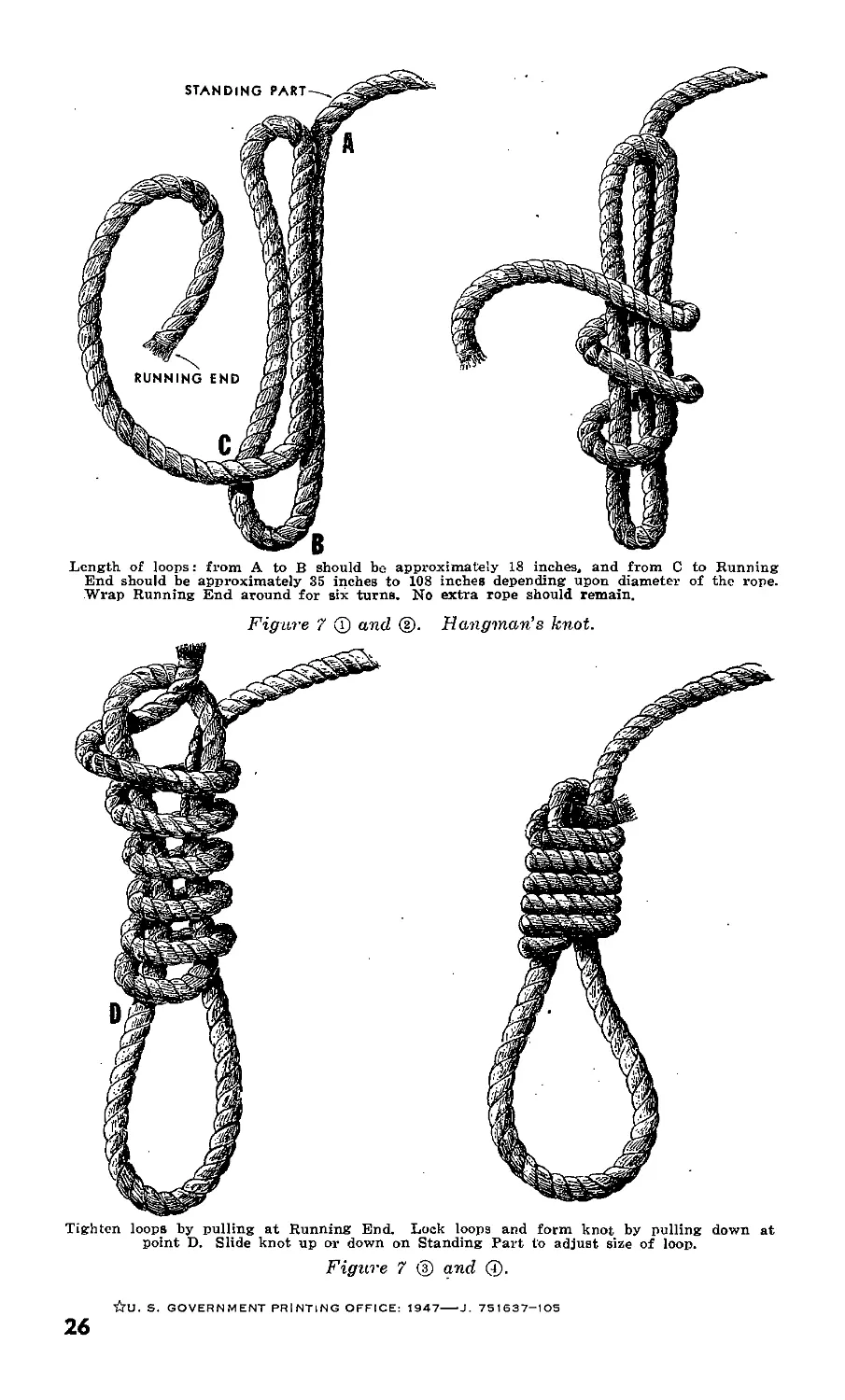
Distribution :
USAF (10) ; AGF (10) ; T (10) ; Base Comd (10) ; Def Comd
(10); Arm & Sv Bd (2), except 19 (20) ; Adm Sv (2) ;
Tech Sv (2) ; FC (1) ; Gen & Sp Sv Sch (2), except 19
(100) ; A (10) ; CHQ (10) ; D (2) ; AF (2).
For explanation of distribution formula, see TM 38-405.
c	DA PAMPHLET 27-4
С 1
PROCEDURE FOR MILITARY EXECUTIONS
Changes I	DEPARTMENT OF THE ARMY
No. 1	j	Washington 25, D. C., £4 June 1953
DA Pamphlet No. 27-4, 9 December 1947, is changed as follows:
"^Authority
(Superseded)
In adjudging the sentence of death a court-martial will not pre-
scribe the method of execution. In accordance with paragraph 126a,
Manual for Courts-Martial, United States, 1951, a sentence to death
which has been finally ordered executed will be carried into effect by
shooting or hanging. (See pertinent Department of the Army letters
and regulations.)
2.	Time and Place
-a. (Superseded) The authority ordering the execution of a sentence
of death issues instructions concerning the time and place of execu-
tion, any designations or instructions in this particular matter by the
court or the convening authority being disregarded.
Ъ. (Rescinded.)
»4flnsanity
If, after issuance of order of execution, the prisoner shows signs of
having become insane, the officer designated to execute the sentence
may cause a board to be convened under the provisions of SR.
600-440-1 to determine the sanity of the prisoner. If the board * * *
of further instructions.
15. Execution.
« • * * * * «
^x-^The officer charged with the execution will direct the burial party
in the disposal of the body as prescribed by AR 210-190 and AR
30-1820.
Д7. Executioner
An official experienced executioner will be appointed. If one is not
available to the command, a professional civilian executioner may be
obtained and appointed; payment at the local rate, but not to exceed
one hundred dollars ($100.00) per execution, may be authorized and
paid from Contingencies of the Army, Project 416, Maintenance
TAGO 4301B—June 200499*—53
DA PAMPHLET 27-4
c i
2
and Operations, Project 1554. In the event * * * and appointed
executioner.
Disposition
of Remains
If the next * * * by pertinent regulations.
AR 30-1820.)
(See AR 210-190 and
21-,'Disposition of Effects
See Section 6, The Act of 5 May 1950 (PL 506, 81st Congress)
and SR 600-560-5. War criminals and * * * disposition of effects.
^21 Notification and Reports
The officer designated * * * circumstances attendant thereon. He
will likewise, in addition, comply with the requirements of section
VI, SR 600-400-10. The quartermaster or * * * in AR 30-1815.
[AG 250 (19 Mar 53)]
By order of the Secretary of the Army :
Official :
WM. E. BERGIN
Major General. USA
The Adjutant General
J. LAWTON COLLINS
Chief of Staff. United States Army
Distribution :
Active Army:
GSUSA (2): SSUSA (2); Tech Svc (2); Admin & Tech
Svc Bd (2), 19 (10); AFF (5); OS Maj Comd (10); Base
Comd (10): MDW (2); A (10); CHQ (10); Div (2);
FT (1); Sch (2) except 19 (100).
NG: None.
Army Reserve: None.
For explanation of distribution formula, see SR 310-90-1.
TAGO 4601B
V. S. SOVSUXMEHT PAINTING OFFICE: 1953
CONTENTS
Paragraph Page
SECTION I. GENERAL
Authority______________________________________   1	1
Time and Place_________________________________   2	1
Delegation of Authority _____________________......	3	1
Insanity --------------------------------------   4	1
Pregnancy --------------------------------        5	2
Witnesses---------------------------------------- 6	2
Multiple Executions---------------------------    7	2
Escort_______________________________________     8	3
Chaplain_____________________________________     9	3
Medical Officer _____________________________    10	3
Interpreter------------------------------------  11	3
Miscellaneous ________________________________   12	3
II.	EXECUTION BY MUSKETRY
Officer Charged with Execution________________   13	5
. Assembly of Escort____________________________  14	6
Execution____________________________________.... 15	6
III.	EXECUTION BY HANGING
Officer Charged with Execution__________________ 16	9
Executioner ________ ____________________ ._____ 17	10
Assembly --------------------------------------- 18	10
Execution____________________________________    19	10
IV.	PROCEEDINGS AFTER EXECUTION
Disposition of	Remains-----------------------   20	12
Disposition of	Effects _________________________ 21	12
Notification and Reports .....;__________ ___.... 22	12
V.	DEPARTURES
Limited Facilities______________________________ 23	13
In Time of War__________________________________ 24	13
VI.	STRUCTURES
Permanent Scaffold __________________________... 25	14
Semipermanent Scaffold _________________________ 26	14
Emergency Structures____________________________ 27	14
VII.	EQUIPMENT
Hood ------------------------------------------- 28	15
Collapse Board and Binding Strap________________ 29	15
Rope ------------------------------------------- 30	15
Post____________________________________________ 31	15
RESTRICTED
This pamphlet supersedes WD Pamphlet 27-4, 12 June 1944, including С 1,
12 August 1944
SECTION I
GENERAL
1.	Authority
Military executions\dll be by musketry or by hanging as desig-
nated by a court martiatjn imposing the sentence of death. (Man-
ual for Courts-Martial, lb§ct, page 93.)
2.	Time and Place
a.	The authorit^ordering the execution of a sentence of death
designates or causes^to be designated the time and place for such
execution, any designatren^made by the court as to such matters
being disregarded. (ManuaKf.or^Courts-Martial, 87&, page 76.)
b.	Adhere it is found to be impracticable to proceed with the
executioh^at the time named or at the place selected, the officer
designated ЬуЧЬе confirming authority to execute the sentence
will designate at tlfe-earliest opportunity another time or place,
and the execution will proceed according to the new designation.
3.	Delegation of Authority
a.	The officer designated by the confirming authority to execute
the approved sentence of death will be responsible for its execution.
He may delegate to a subordinate officer the duties connected with
the carrying out of the execution.
b.	The subordinate officer named will be one under the direct
control of the delegating authority. He will be duly and officially
named by an order of the officer designated to execute the sentence
and directed therein to carry out the execution.
4.	Insanity
If, after issuance of order of execution, the prisoner shows signs
of having become insane, the officer designated to execute the
sentence may cause a board to be convened under the provisions
of AR 600-500 to determine the sanity of the prisoner. If the
board finds the prisoner to be sane, the execution will proceed as
ordered; but in the event he shall be found to be insane, notice of
the findings of the board, including, if practicable, its report, will
be transmitted to the confirming authority if other than the Presi-
1
dent, or to The Adjutant General if the sentence was confirmed
by the President, and the execution will be stayed pending the
receipt of further instructions.
5.	Pregnancy
If the prisoner is a woman and medical examination reveals that
she is pregnant, immediate report of the fact will be made to the
confirming authority or to The Adjutant General, as prescribed in
paragraph 4, and the execution will be stayed pending the receipt
of further instructions.
6.	Witnesses
The officer designated to execute the sentence will prescribe
whether the execution will be public or private, rules of secrecy
as to time, place, and the presence of witnesses, military or civilian,
including members of the press if the presence of the latter is
deemed proper. In the case of the execution of a foreign national,
the officer designated to execute the sentence will prescribe whether
persons of the same nationality as the condemned may be present.
If troops are designated to observe an execution by musketry, these
troops will be paraded and formed into the three sides of a hollow
rectangle, facing inward and toward the site on which the prisoner
is to be placed. In executions by hanging, the troops, if designated
to witness the execution, will be paraded and formed in a square
around the gallows. No photographs nor motion pictures of the
actual execution will be permitted except for official purposes.
The environs of the place of execution will be closely and securely
guarded to prevent the intrusion of unauthorized persons. All
persons in attendance will be cautioned that no demonstrations or
unseemly conduct will be tolerated. Troops will assume the posi-
tion of attention upon the approach of the escort and will remain
at attention until the conclusion of the ceremony.
7.	Multiple Executions
In multiple executions, the prisoners may be executed either simul-
taneously or in succession. Where two or more prisoners are to
be executed in succession, the same execution party or gallows may
be used for each execution. Where two or more prisoners are to
be executed simultaneously by musketry, a separate execution
party will be provided for each of the prisoners. The latter will
be placed in line at an interval of ten paces. Where two or more
prisoners are to be executed simultaneously by hanging, the officer
2
designated to execute the sentence will prescribe the number of
gallows to be erected, and the prisoners will be hanged from the
gallows simultaneously or by groups.
8.	Escort
The escort for execution may be mounted, dismounted, or motor-
ized, but upon arrival at the scene of execution, mounted or motor-
ized escorts will form in the manner prescribed for dismounted
escorts. The minimum escort will consist of components as pre-
scribed in paragraph 14b.
9.	Chaplain
In all executions, a chaplain of the prisoner’s choice will be pro-
vided if practicable. If no chaplain of the prisoner’s choice or of
his particular faith and/or race is available, the officer charged
with the execution of the sentence will take all reasonable measures
to provide a civilian clergyman of that faith and/or race. The
chaplain should be available at all times after the prisoner is noti-
fied of the time of execution.
10.	Medical Officer
A medical officer will be officially designated to be in attendance
upon the execution. It will be his duty to determine the extinction
of life in the prisoner and to make pronouncement thereof. He
will furnish a death certificate to accompany the report of exe-
cution.
11.	Interpreter
In the event that the prisoner does not speak English, an interpre-
ter Will be officially designated to be in attendance at the notifica-
tion of the prisoner (par. 12a) and the execution. It is his duty
to interpret the charge, finding, sentence orders and any last state-
ment made by the prisoner. Before entering upon his duties, the
interpreter will take the oath of affirmation required of an inter-
preter for a court-martial.
12.	Miscellaneous
a.	The prisoner will be notified of the time of execution no less
than 24 hours prior thereto if practicable at which time the order
directing the execution will be read to him by the officer charged
with the execution of the sentence or by some officer at his direc-
tion. The chaplain should be present.
3
b:' If practicable due notice will be given to the next of kin of
the prisoner and an opportunity provided for the claiming of the
body following the execution.
c.	A prisoner in the Armed Forces of the United States will be
dressed in regulation uniform from which all decorations, insignia,
or other evidences of membership therein have been removed.
Likewise, no such evidences will appear on any clothing used in
burial. Similar procedures may be dispensed with, in the dis-
cretion of the officer responsible for carrying out the execution
(or higher authority) in the case of a prisoner in the armed forces
of another nation. A prisoner not within the foregoing categories
may be dressed in any clothing available.
d.	After the prisoner is notified of the time of execution (a
above) the commanding officer of the place of confinement will,
where practicable, approve any reasonable special request of the
prisoner, including special request for food, and permission to
have in his possession a Bible, Rosary, or similar religious articles
during the execution. Sufficient writing paper and envelopes
should be furnished and no limit placed on the number of letters
which may be written. All letters are subject to censorship and
may or may not be forwarded.
4
SECTION II
EXECUTION BY MUSKETRY
13.	Officer Charged with Execution
The officer charged with the execution will command the escort
and make the necessary arrangements for the conduct of the exe-
cution. He will—
a.	Instruct and rehearse the escort and the execution party in
their duties, insuring that all members of the execution party are
qualified in the weapon to be used.
b.	Arrange for the receipt of the prisoner by the prisoner guard.
c.	Arrange for an execution party of eight men and one ser-
geant.
d.	Arrange for a chaplain to accompany the prisoner.
e.	Arrange for the presence of a medical officer at the scene of
the execution.
f.	Cause a post with proper rings placed therein for securing
the prisoner in an upright position to be erected at the place of
execution.
g.	Cause eight rifles to be loaded in his presence. Not more than
three nor less than one will be loaded with blank ammunition. . He
will place the rifles at random in the rack provided for that
purpose.
h.	Provide a black hood to cover the head of the prisoner.
i.	Provide a 4-inch round target, white or black as appropriate;
a black target will be used when light colored clothing is worn.
j.	Cause the prisoner’s arms to be secured either behind his
back or in front at the waist (fig. 1), before or immediately after
his receipt by the prisoner guard.
fc. Arrange for an ambulance or other conveyance with suffi-
cient personnel to be in attendance upon the execution to receive
and care for the body. In the event a contract undertaker is used
by the quartermaster, his services may be substituted. See AR
30-1820.
I.	Provide straps to secure the prisoner to the post at waist and
ankles. (See par. 29b.)
5
14.	Assembly of Escort
a.	If a band is prescribed, it will be formed in accordance with
chapter 3, FM 12-50, proceed to the exterior door of the place of
imprisonment at which the prisoner is to be received by the pris-
oner guard, and halt near the door, facing in the direction of the
scene of the execution.
b.	The prisoner guard will consist of twelve men armed with
rifles, under the command of a sergeant armed with a pistol. The
prisoner guard will form in double ranks and at the proper time
will proceed to the place of imprisonment to receive the prisoner.
c.	The main guard will consist of one or more platoons and will
form in the rear of the band.
d.	The execution party will be formed unarmed and proceed to
a previously prepared rack of rifles, secure arms, and move to the
scene of the execution, halting 15 paces from and facing the posi-
tion to be taken by the prisoner. At close interval, and at order
arms, the party will await the arrival of the prisoner and escort.
e.	At the designated time the prisoner, with his arms bound
securely behind his back or in front at the waist (fig. 1), accom-
panied by the chaplain, will be received by the prisoner guard and
placed between the ranks. The escort will then proceed toward
the scene of the execution, the band playing the “Dead March.”
f.	The escort will approach the scene of the execution on line
with the open side of the rectangle formed by the witnessing
troops. The band will move past the point at which the prisoner
is to be placed, and will take position on the opposite side of the
rectangle, facing the scene,of the execution. The prisoner guard,
prisoner, and chaplain will proceed directly to the prisoner’s post,
halt, and face the execution party. The main guard will proceed
to a point 5 paces behind the execution party and form a line
facing the scene of execution.
15.	Execution
a.	The officer charged with the execution will take position in
front of the execution party and face the prisoner. If troops are
present, he will read the charge, finding, sentence, and orders aloud
to the prisoner. He will then notify the prisoner and the chaplain
that a brief time will be allowed the prisoner for any last state-
ment. "After a reasonable time, he will order the sergeant of the
execution party to secure the prisoner to the post and to place the
hood over his head. Then the medical officer will place the target
over the prisoner’s heart. The prisoner prepared, the officer
6
charged with the execution will order the prisoner guard to join
the main guard; the chaplain and medical officer will retire to the
flank taken by the band. The officer charged with the execution
will take position 5 paces to the right of and 5 paces to the front
of the execution party.
b.	Commands for the execution will, when practical, be given
by a combination of manual and oral signals as prescribed.
(1)	When the officer charged with the execution raises the right
arm vertically overhead, palm forward, fingers extended and
joined, the execution party will come to the “Ready” position as
prescribed for firing a volley, and will unlock rifles.
(2)	When the officer charged with the execution lowers his arm
to a horizontal position in front of his body, the execution party
will take the position of “Aim.”
(3)	When the officer charged with the execution drops his arm
directly to his side and orally commands: FIRE, the execution
party will fire simultaneously.
(4)	The officer charged with the execution will then bring the
execution party to “Order Arms.”
c.	When the use of manual signals is not practical, the following
oral commands are prescribed:
(1)	At the command ready, the execution party will take that
position and unlock rifles.
(2)	At the command aim, the execution party will take that
position with rifles aimed at target on the prisoner’s body.
(3)	At the command fire, the execution party will fire simul-
taneously.
d.	The officer charged with the execution will join the medical
officer who will examine the prisoner and, if necessary, direct that
the “coup de grace” be administered. Should the medical officer
so decide, the sergeant of the execution party will administer the
“coup de grace,” with a hand weapon, holding the muzzle just
above the ear and one foot from the skull.
e.	Under exceptional circumstances, the officer charged with the
execution, with the permission of the commanding officer, may
detail an extra file of six men to administer the “coup de grace.”
This file will form the rear rank of the execution party, and if it
is necessary to administer the “coup de grace,” will move in front
of the execution party and fire, at the command of the officer
charged with the execution.
f.	Upon pronouncement of the death of the prisoner by the
medical officer, the execution party will proceed to the racks from
which the rifles were originally obtained, and replace the rifles in
the racks at random. The execution party will then be dismissed.
7
g.	The escort, with the band playing a lively air, will return to
their parade ground and be dismissed.
h.	The witnessing troops will parade in column in front of the
body and proceed to their respective parade grounds where they
will be dismissed.
i.	The officer charged with the execution will direct the burial
party in the disposal of the body as prescribed by AR 210-500 and
AR 30-1820.
8
SECTION III
EXECUTION BY HANGING
16.	Officer Charged with Execution
The officer charged with the execution will command the escort
and make the necessary arrangements for the conduct of the
execution. He will— .
a.	Instruct components of the escort in their duties.
b.	Arrange for the receipt of the prisoner by the prisoner guard.
c.	Arrange for a chaplain to accompany the prisoner.
d.	Arrange for the presence of a medical officer at the scene of
the execution.
e.	Provide a proper gallows.
f.	Provide a black hood to cover the head of the prisoner.
g.	Provide a collapse board for use if necessary.
h.	Cause the prisoner’s arms to be secured before or immedi-
ately upon his receipt by the prisoner guard. The arms may be
secured either behind the back or in front, fastened to the belt
(fig. 1)-
i.	Arrange for a burial party as prescribed in paragraph 13&.
j.	Determine the proper amount of drop of the prisoner through
the trap door. A standard drop chart for normal men of given
weights is given below. Variation of the drop because of physical
condition may be necessary. A medical officer should be consulted
to determine whether any factors, such as age, health, or muscular
condition will affect the amount of drop necessary for a proper
execution.
120 lbs or less	8'	1"	170 lbs	6'	0"
125 lbs	7'	10"	175 lbs	5'	11"
ISO lbs	7'	7"	180 lbs	5'	9"
135 lbs	T	4"	185 lbs	5'	7"
140 lbs	T	Г	190 lbs	5'	6"
145 lbs	6'	9"	195 lbs	5'	5"
150 lbs	6'	7"	200 lbs	5'	4"
155 lbs	6'	6"	205 lbs	5'	2"
160 lbs •	6'	4"	210 lbs	5'	1"
165 lbs	6'	2"	220 lbs and	over 5'	0"
k.	Rehearse the execution within 24 hours prior to the scheduled
time for the execution. A sandbag or similar object approximat-
9
ing the prisoner’s weight may be used to insure proper functioning
of the gallows, trap door, and hangman’s noose.
17.	Executioner
An official experienced executioner will be appointed. If one is
not available to the command, a professional civilian executioner
may be obtained and appointed; payment at the local rate, but not
to exceed one hundred dollars ($100.00) per execution, may be
authorized and paid from Contingencies of the Army, Project 416.
In the event a professional executioner is not available, a suitable
emotionally stable member of the command will be selected and
appointed executioner.
18.	Assembly
a.	If a band is prescribed, it will be formed in accordance with
chapter 3, FM 12-50, proceed to the exterior door of the place of
imprisonment at which the prisoner is to be received by the pris-
oner guard, and halt near the place of imprisonment, facing in
the direction of the scene of the execution.
b.	The prisoner guard will consist of twelve men armed with
rifles,, under the command of a sergeant armed with a pistol. The
prisoner guard will form in double ranks and at the proper time
will proceed to the door to receive the prisoner.
c.	The main guard will consist of one or more platoons and will
form in the rear of the band.
d.	At the designated time the prisoner, with his arms bound
securely behind his back, accompanied by the chaplain, will be
received by the prisoner guard and placed between the ranks.
The escort will then proceed toward the scene of the execution,
the band playing the “Dead March.”
e.	Upon the arrival of the escort, consisting of the band, pris-
oner guard, main guard, prisoner and chaplain within the square
formed by the witnessing troops before the gallows, the sergeant
of the prisoner guard and a sergeant from the main guard will
conduct the prisoner to the platform of the gallows, the officer
charged with the execution and the chaplain preceding the pris-
oner.
19.	Execution
a.	If troops are present, the officer charged with the execution
will face the prisoner and read aloud to him the charge, finding,
sentence and orders. He will then notify the chaplain and the
10
, prisoner that a brief time will be allowed the prisoner for any
last statement. After a reasonable time he will have the execu-
tioner place the hood over the prisoner’s head and bind his ankles.
The executioner will then adjust the noose around the prisoner’s
neck and remain beside the prisoner. The sergeant of the pris-
oner guard or other individual designated by the officer charged
with the execution will then place himself in position at the trigger
and, upon a signal from said officer, will spring the trap. The
medical officer will then examine the body for time of death and
report to the officer charged with the execution.
b.	Upon the pronouncement of the death of the prisoner, the
escort, with the band playing a lively air, will return to the parade
ground and be dismissed.
c.	The witnessing troops will move to their respective areas
where they will be dismissed.
d.	The officer charged with the execution will direct the burial
party in the disposal of the body as prescribed by the commanding
officer.
11
SECTION IV
PROCEEDINGS AFTER EXECUTION
20.	Disposition of Remains
If the next of kin or other relatives of the deceased desire the body,
the officer designated to execute the sentence will, if practicable,
permit its delivery to them for burial. If no such claim is made,
he will cause it to be buried in a post or civilian cemetery or at
the place of death, whichever may be deemed proper and is author-
ized by pertinent regulations. (See AR 210-500 and AR 30-
1820.) £' . \
21.	Disposition of Effects
See Articles of War 112 and sections V, VI, and VII, AR 600-550.
War criminals and civilian resident criminals convicted by a Mili-
tary Tribunal and executed by military authorities are considered
as subject to military law for the purpose of disposition of effects.
22.	Notification and Reports
The officer designated to execute the sentence will notify The Ad-
jutant General immediately following the execution, by fastest
available method of communication, of the carrying out of the
sentence of death, the time, place and any unusual circumstances
attendant thereon. He will likewise, in addition, comply with the
requirements of section II, AR 600-550 The quartermaster or
other officer in charge of burial will furnish report as provided
in AR 30-1815.
12
SECTION V
DEPARTURES
23.	Limited Facilities
If the facilities are not available for the carrying out of each of
the provisions of this pamphlet or if the exigencies of the situation
require it, the officer designated to execute the sentence may make
the necessary departures from the provisions herein contained,
except that he may not change the mode of execution. Any de-
parture will be reported in writing to the authority ordering the
execution.
24.	In Time of War
In time of war:
a.	Only the minimum number of troops necessary to accomplish
the execution need be employed.
b.	All instructions pertaining to the use of a band are inoper-
ative.
13
SECTION VI
STRUCTURES
25.	Permanent Scaffold
A permanent type, demountable scaffold, with a metal trigger
mechanism, will be erected when the need for such a structure is
determined by the commanding officer. (See fig. 2.) Where
available, troops belonging to the Corps of Engineers will be em-
ployed in the constructing of the scaffold, but where not available,
or where it is more practicable, other troops or civilians may be
employed. Preliminary tests will be made to insure the strength
of the rope in the stability of the scaffold’s construction. If facil-
ities are limited, a trap door on the second floor 6f the building
may be constructed to effect the execution, or a similar improvising
employed.
26.	Semipermanent Scaffold
A semipermanent scaffold which requires no special metal fittings
may be used in executions by hanging when deemed expedient by
the commanding officer. (See fig. 3.)
27.	Emergency Structures
When the exigencies of the field so dictate, emergency type gallows
may be used. (See fig. 4.)
14
SECTION VII
EQUIPMENT
28.	Hood
The hood will be black, the outer surface of rough materials, split
at the open end so that it will come well down on the prisoner’s
chest and back.
29.	Collapse Board and Binding Strap
a. A collapse board will be provided for use in case of the col-
lapse of the prisoner. (See fig. 5.)
30.	Rope
The rope will be of manila hemp, at least % inch and not more
than 11/4 inches in diameter and approximately 30 feet in length.
The rope will be boiled and then stretched while drying to elim-
inate any spring, stiffness, or tendency to coil. The hangman’s
knot (figure 7) will be used in the preparation of the noose. That
portion of the noose which slides through the knot will be treated
with wax, soap, or grease to insure a smooth sliding action through
the knot. The noose will be placed snugly around the prisoner’s
neck in such a manner that the hangman’s knot is directly behind
his left ear.
31.	Post
Design for post used in execution by musketry as mentioned in
paragraph 15a, is shown in figure 6.
15
16
PLAN OVER BEAM
Figure 2 ®. Permanent scaffold.
17
3' в
18
о
SIDE ELEVATION SCALE •£"=!'
'6103.0 ,6>« 9« 9^
FIN. GRADE LINE
3 HEAVY
EVENLY
3* 0" OP’G.
MAX TRAVEL OF PULL ROD
FLOOR
t
*
ROD
3"x4"
2”x4'
SHAFT
LEVER
SPRING STEEL DOOR CATCH
38 4* POST
3' ЗГ LONG
REQUIRED
BOLT- TRAVEL
i THICK STEEL PLATE
BELLCRANKS
25n
THICK 5PLY PLYWOOD
4 OF _
CONNECT TO RELEASE
DOOR CATCH
DUTY HINGES 2Гх2|’х^их 2* 8"
SPACED
PLAN VIEW OF BELL CRANK
SPLIT TYPE
PILLOW BLOCKS
Figure 2 ®. Permanent scaffold, bell crank.
У OF।TRAP DOOR
-SPLIT TYPE
PILLOW SLOCKS
SHAFT- 2"BLACK PIPE
CONTINUOUS WELD
ю
Figure 3 ®. Semipermanent scaffold.
ENO
2"x8 " Spiked All Around Top Of
6"x 6" To Form Piote or Ribbon
Figure 3 ®. Semipermanent scaffold,

2"x6"

	2‘,x4"	--
	Flooring
г'^б"

Plan of Underside
Trap Door, One Half
4
details.
22
5/4“TaG Floor
zHeovy Strop Hinge
Г'7	_____
© Screw Eye
4“x4"	9‘ 6" Long Cut In Two Pieces At Center
Hinged To Stand with I-Inch Bow At Center
MATERIALS
2	pcs 6"x8"“	22'	Long	Gallows Posts
4	6"x6*'-	12'		Platform posts
2	2“x 10"-	16'		Step Stringers
4	г’Ъю"-	10'		Cross Bar*- Beam
3	2их8"-	14' 12'		Joist-Extend for stair landing
1	2"x8'’-			Joist- Short
7	2’’x8”-	10'		Joists- Regular
8	2"x6"-	14'		X Braces
4	2l'x6"-	10'		Gallows Braces
1	4"x41’-	10'		Knee Braces (cut Io 5* o")
4	4"x4"-	4'		Newels
2	2l’x4"-	16'		Slair Roil
1	2"x4"-	14'		Stair Rail
3	2"x4*'“	10		Stair Rail Я Trap Door Rail flOpc 2"x8" 12* Long \
	^Flooring if	2"	Ihlck	<6	2"xB" 10' Long I 2"x8" 8' Long/
t	pc 2"x6"“	8*	Long	Trap Door Rails
1	2“x6 3/d'B’			140 BM3/4" T8G Pine Flooring
4	2 xIO “	14'		Cut into 3' 8" lengths Step Tread
1	4"x4”-	10'		Trigger
Figure 3 ®.
Semipermanent scaffold, details (Continued).
23
20'
Figzzre 4. Emergency gallows, post type and tripod type.
24
Broce Boord
B( B3= 1 Inch Strops
Figure 5. Collapse board.
Figure 6. Post used in execution by musketry.
25
STANDING PART
RUNN NG E
Length of loops: from A to В should be approximately 18 inches, and from 0 to Running
End should be approximately 35 inches to 108 inches depending upon diameter of the rope.
Wrap Running End around for six turns. No extra rope should remain.
Figure 7 (T) and ®. Hangman's knot.
Tighten loops by pulling at Running End. Lock loops and form knot by pulling down at
point D. Slide knot up or down on Standing Part to adjust size of loop.
Figztve 7 ® and ©.
☆ u. S. GOVERNMENT PRINTING OFFICE: 1947-J. 751637-105
26