/


















































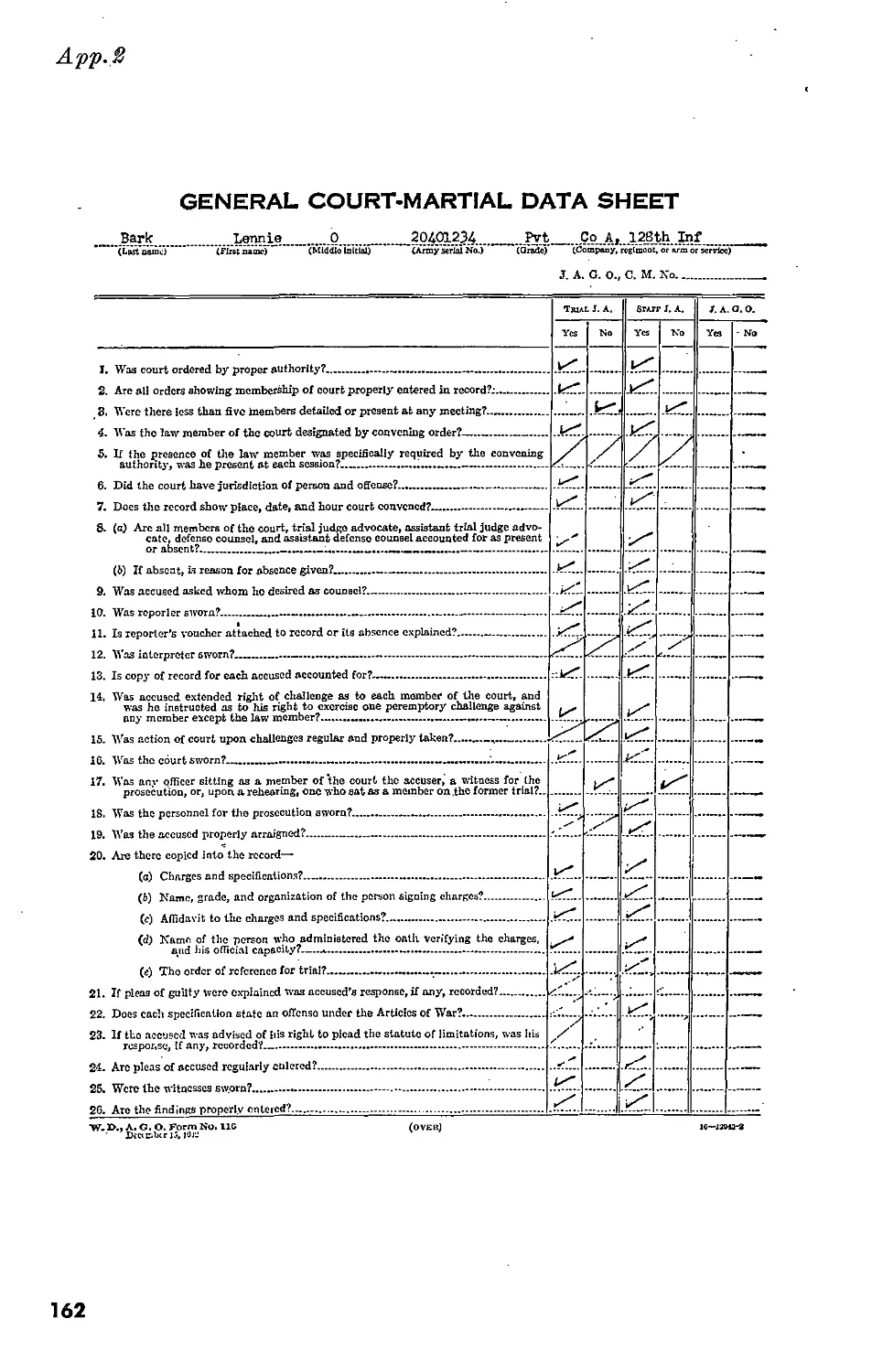

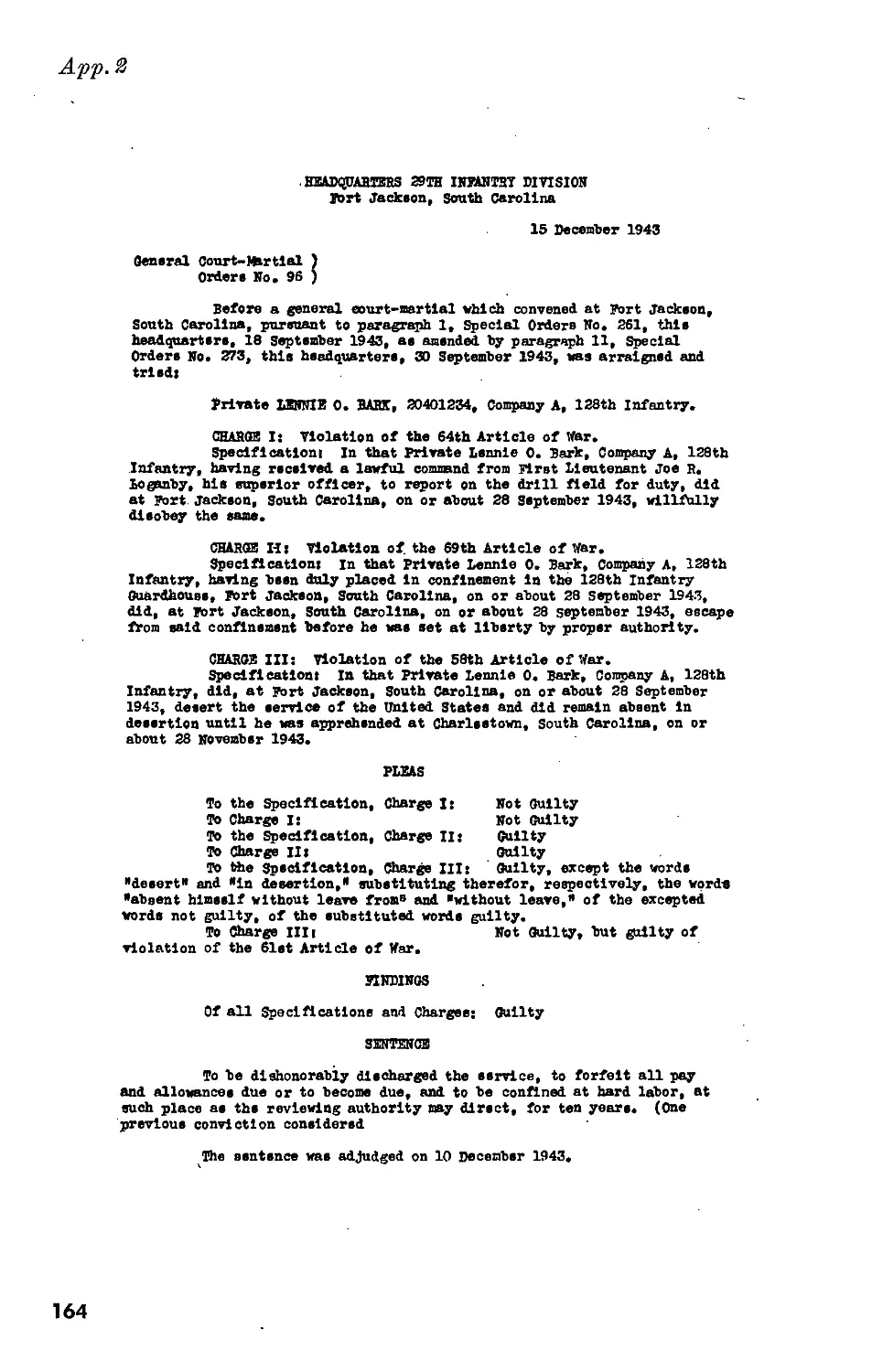


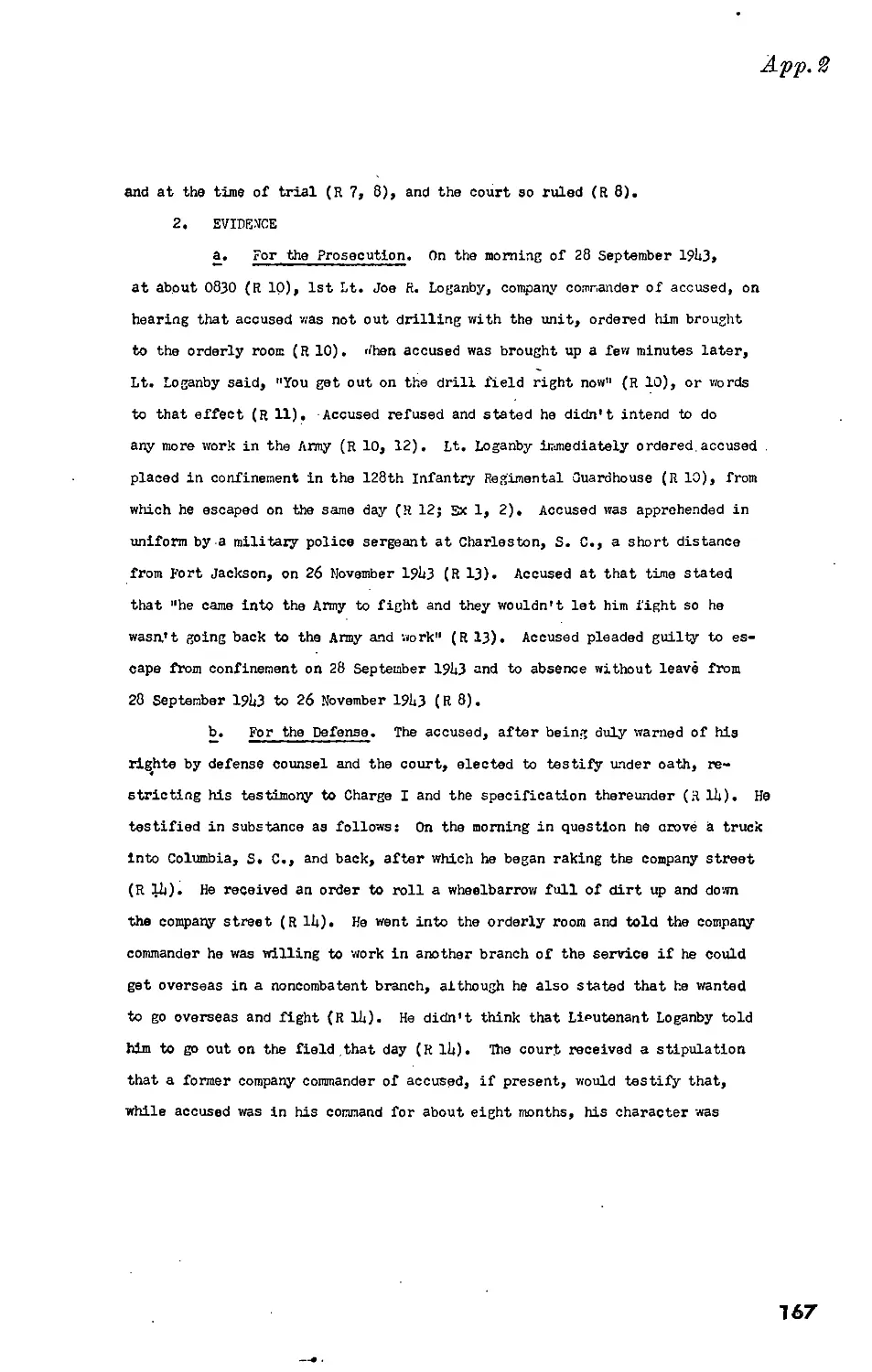
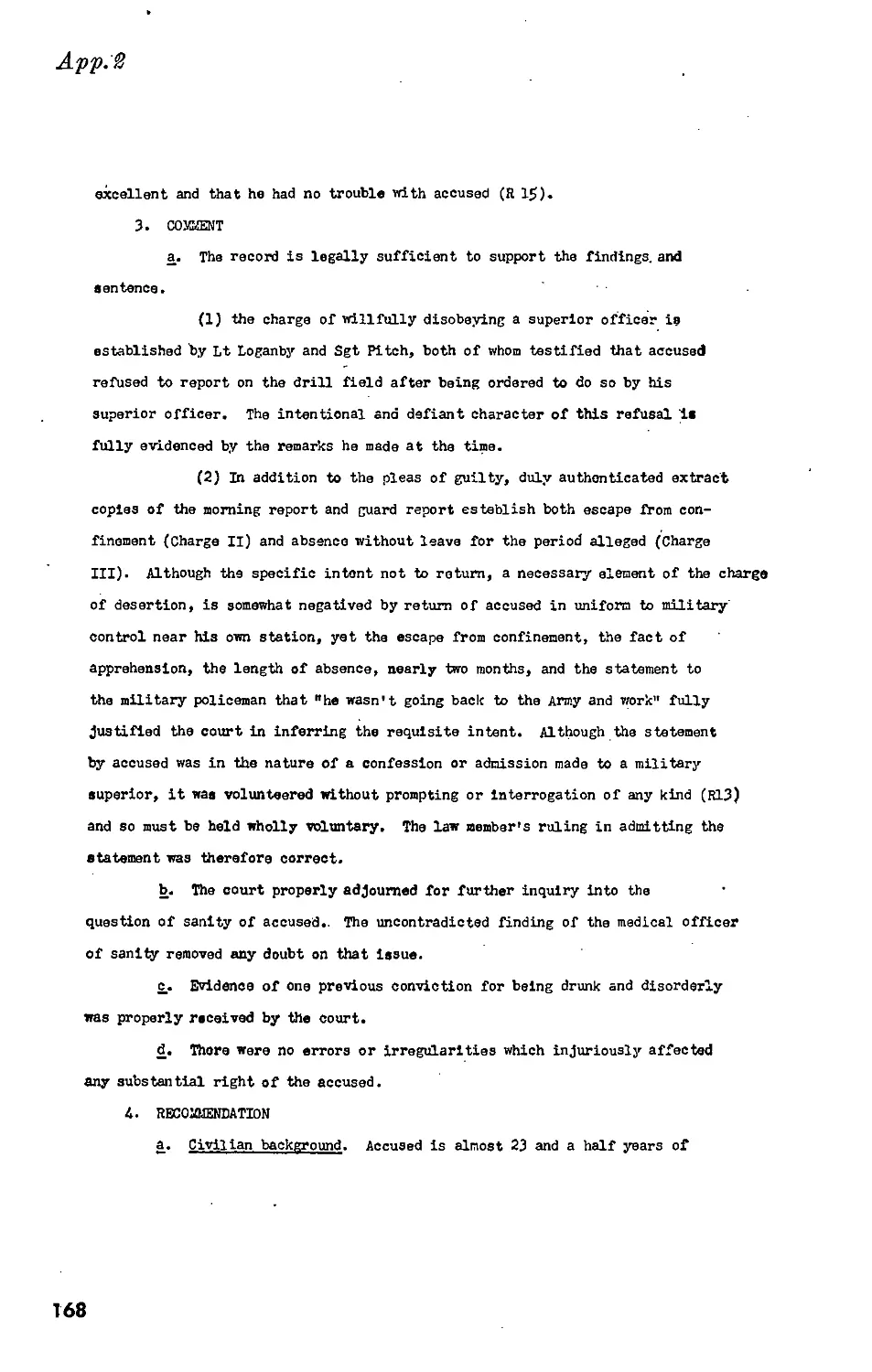
























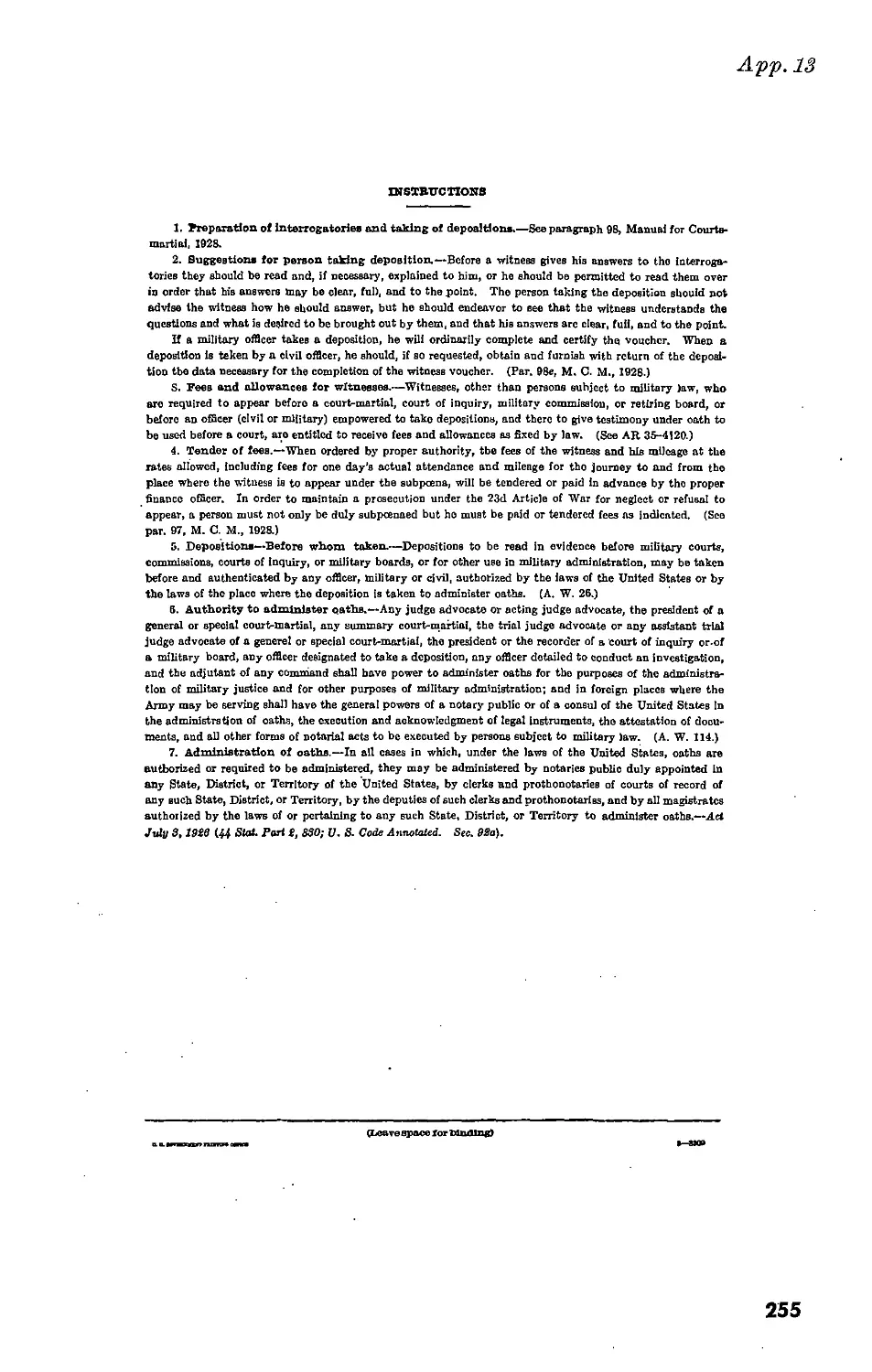

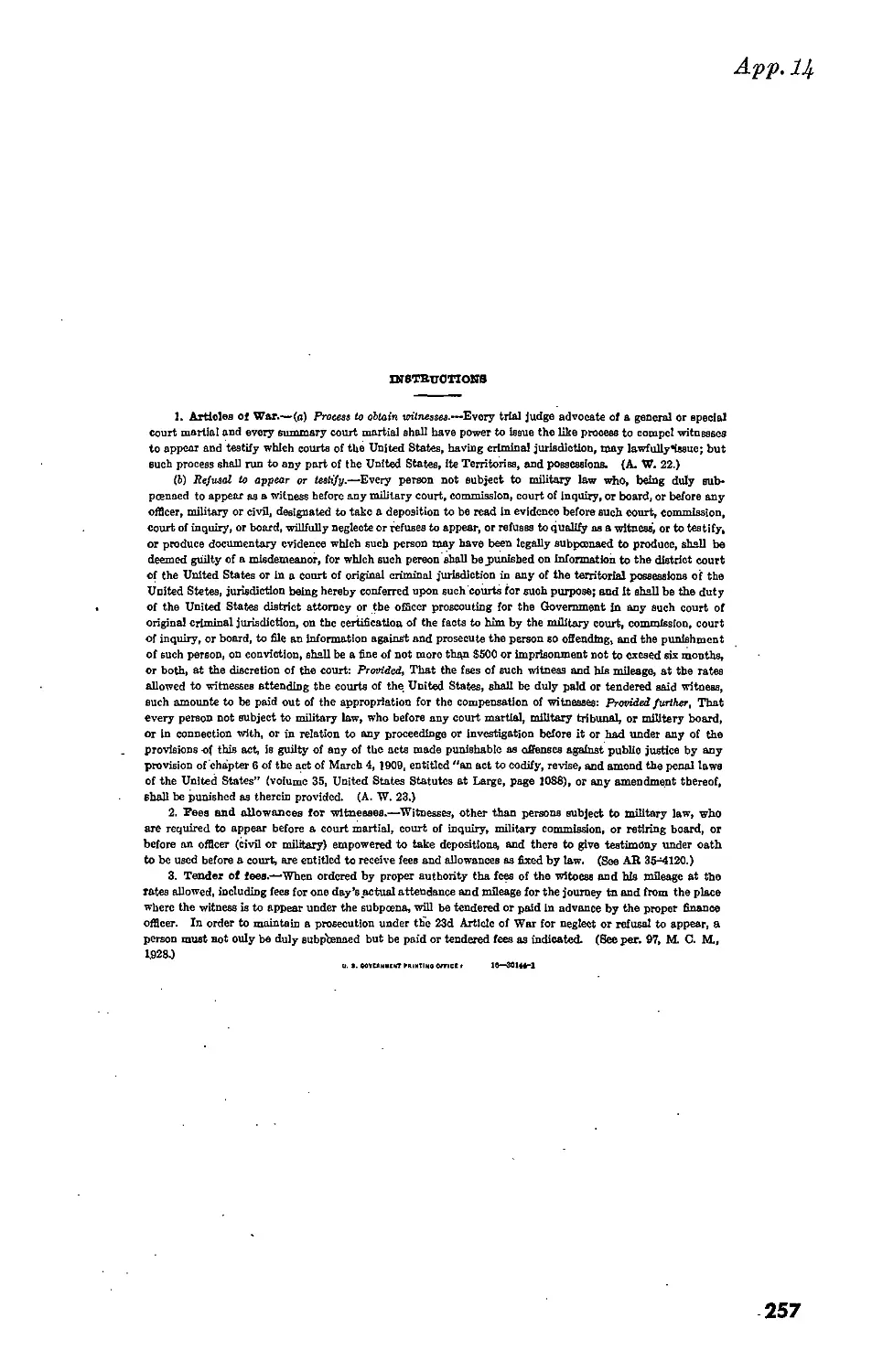
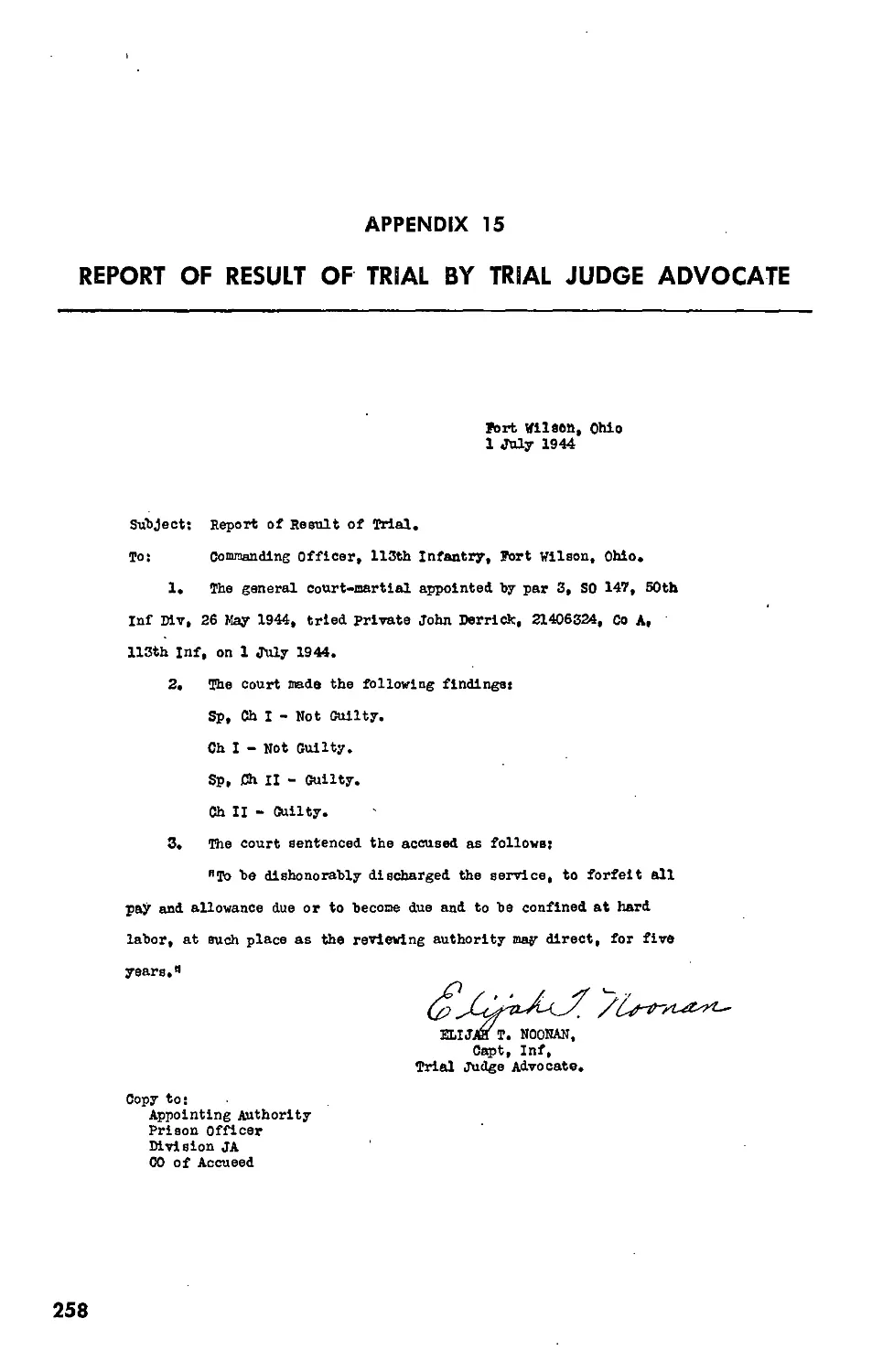
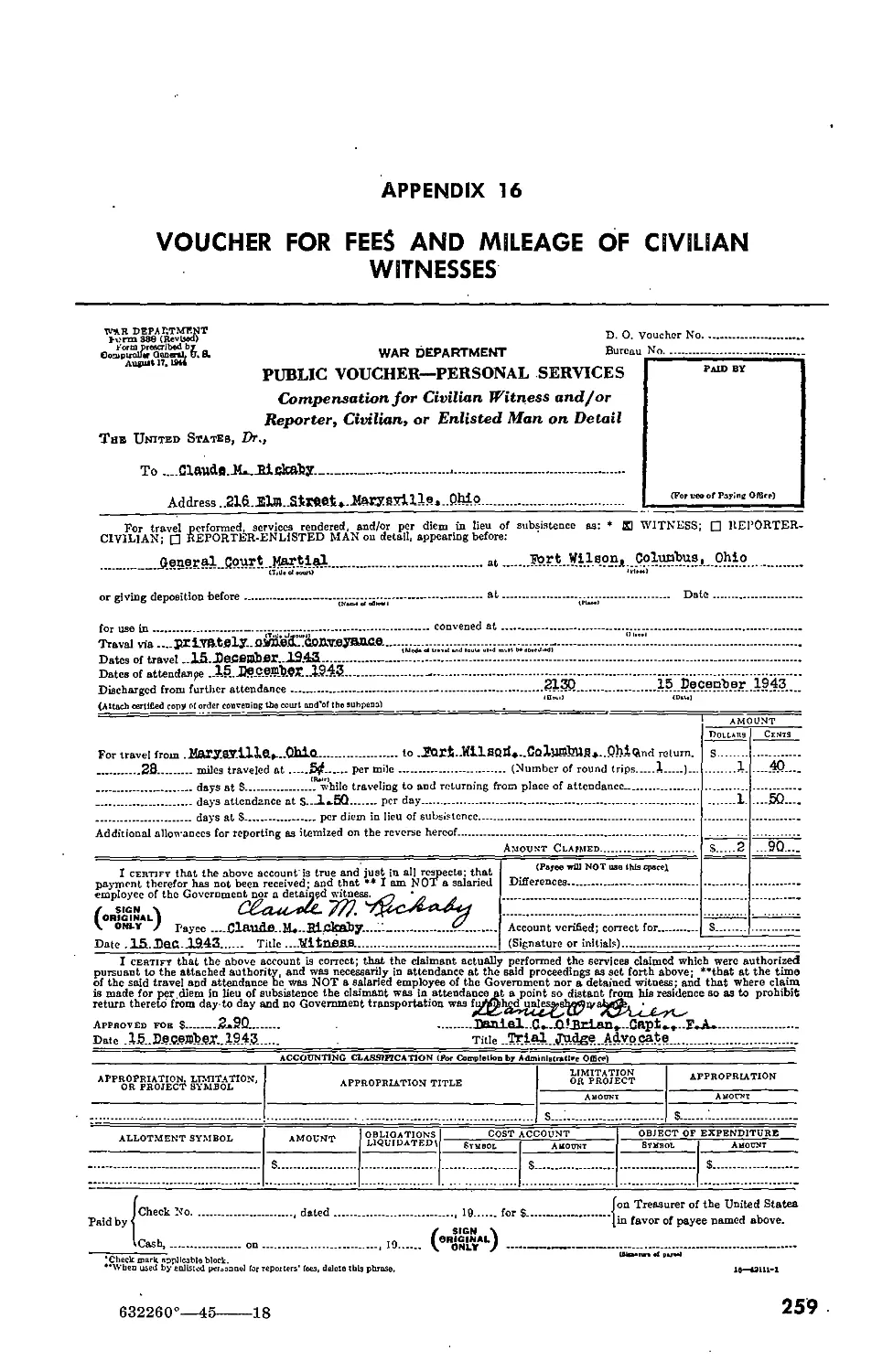









Text
                    MILITARY
JUSTICE
PROCEDURE
BAR DEPARTMENT
FEBRUARY 1945
WAR DEPARTMENT TECHNICAL MANUAL
TM 27-255
MILITARY
JUSTICE
PROCEDURE
WAR DEPARTMENT
FEBRUARY 1945
United States Government Printing Office
Washington : 1945
WAR DEPARTMENT
Washington 25, D. C., 23 February 1945
TM 27-255, Military Justice Procedure, is published for the information
and guidance of all concerned.
[AG 300.7 (21 Oct 44)]
By order of the Secretary of War :
Official :
J. A. ULIO
Major General
The Adjutant General
G. C. MARSHALL
Chief of Staff
Distribution :
AAF (20); AGF (20); ASF (2); T of Opns (50); Def Comd (10);
AAF Comd (10); S Div ASF (2); Tech Sv (2); SvC (10) ; Area
ASvC (5); PC&S (2) ; PE (5); Sub PE (2); Stg A (4) ; GH (2);
Sch (50) ; USMA (50); ASTU (2); ROTC (2); Proc C (6) ; RC
(2) ; Reclass C (2) ; Rehab C (2) ; Sep C (2) ; PW Cp (2) ; A (6);
CHQ (4) ; D (3) ; В (2); R (2) ; SBn (2); Bn (2); C (2); AF
(10) ; W (4) ; G (2) ; S (2); F (2).
For explanation of symbols, see FM 21-6.
15676
II
FOREWORD
This manual is a practical guide to court-martial and military justice
procedure. It is not a substitute for the Manual for Courts-Martial but
is intended as an aid in using that book. The Manual for Courts-Martial
is a legal work, covering comprehensively, but concisely, the basic law
and procedure of military justice. However, officers need to know not
merely the legal principles but how to apply them practically in a given
situation, what to insert in the blanks on the first page of a charge
sheet, for example, or how to state to an accused the effect of his plea
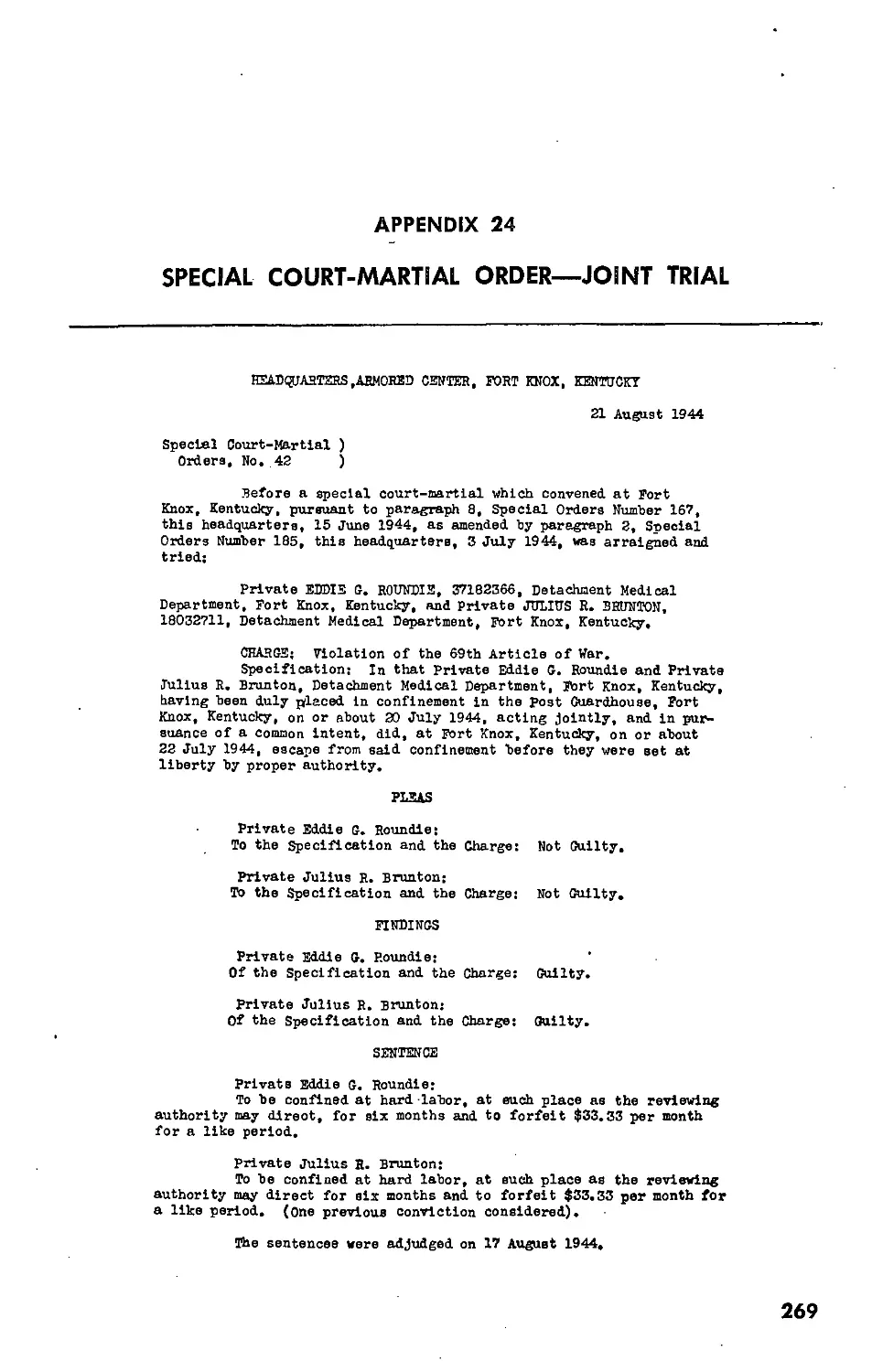
of guilty, or how to draft a court-martial order where several accused
have been tried jointly. It is to answer such questions as these that this
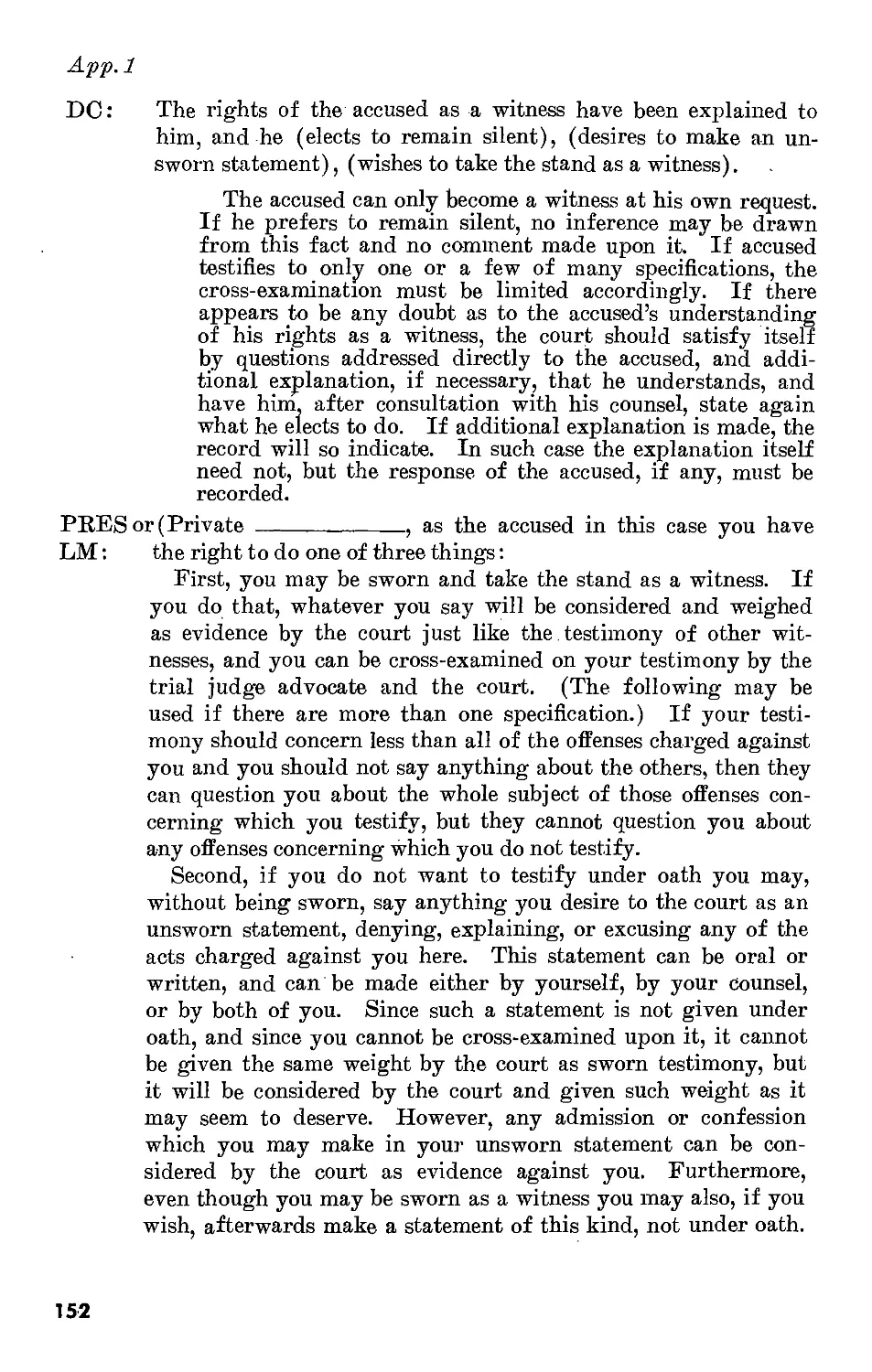
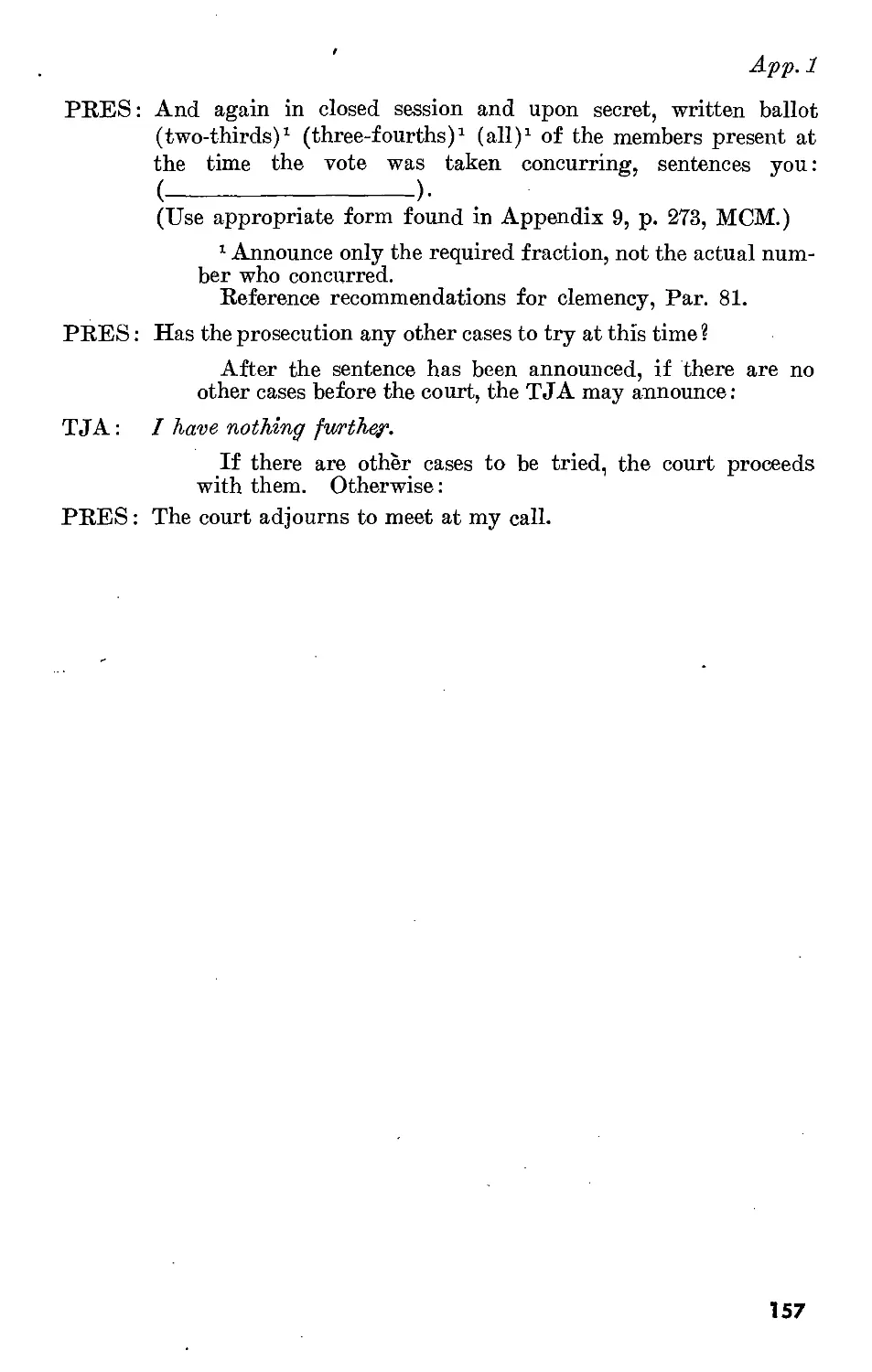
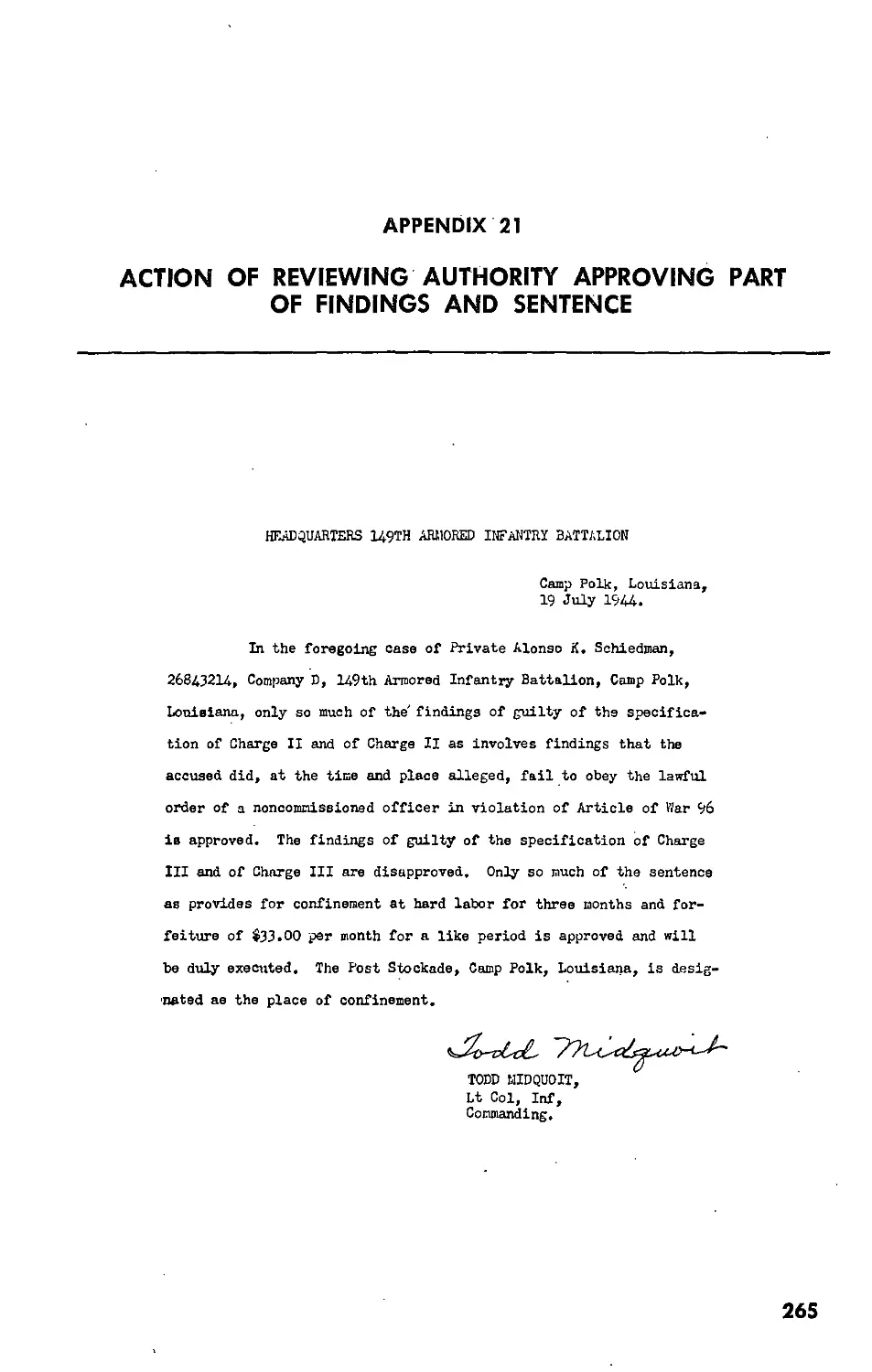
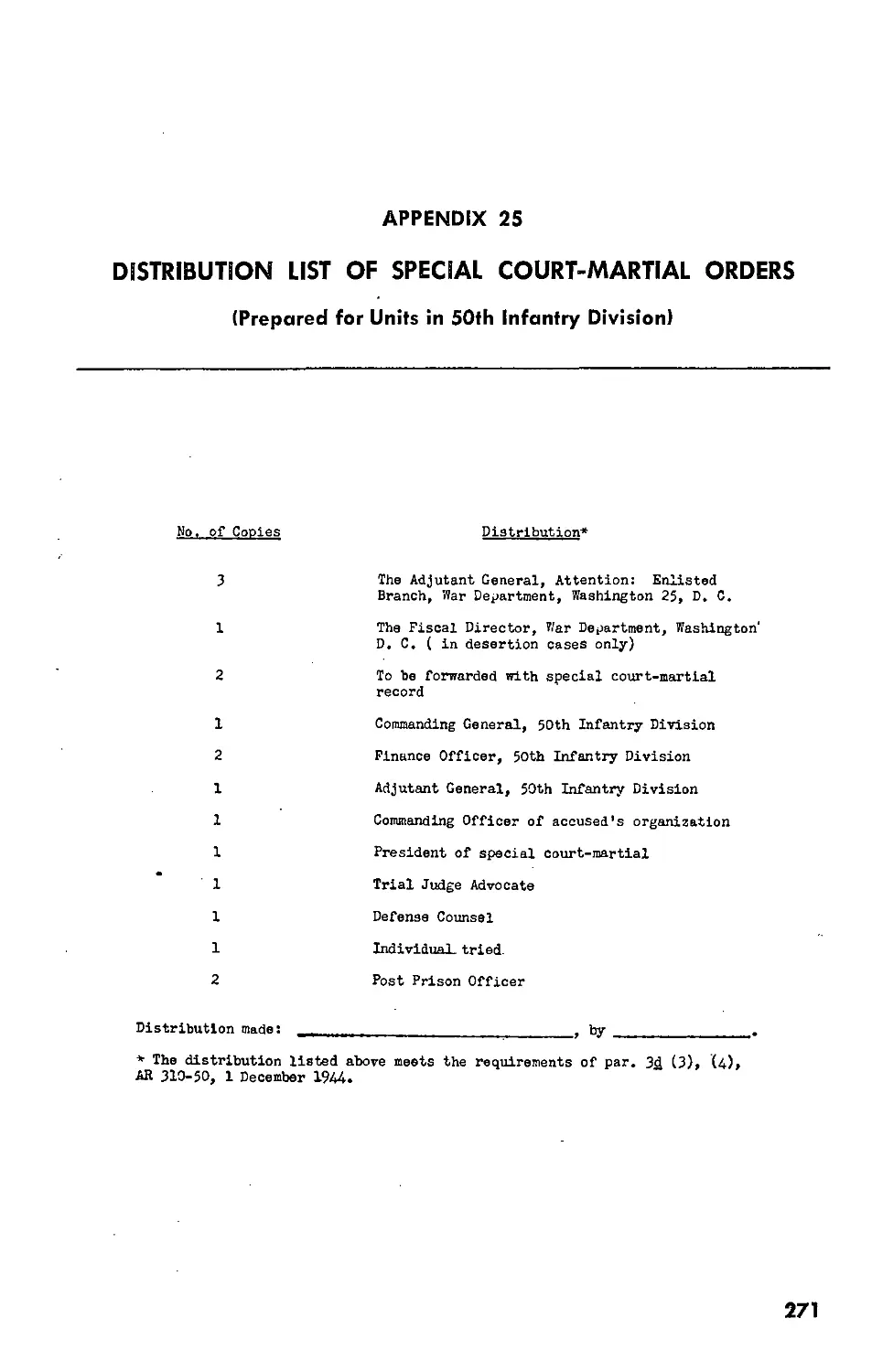
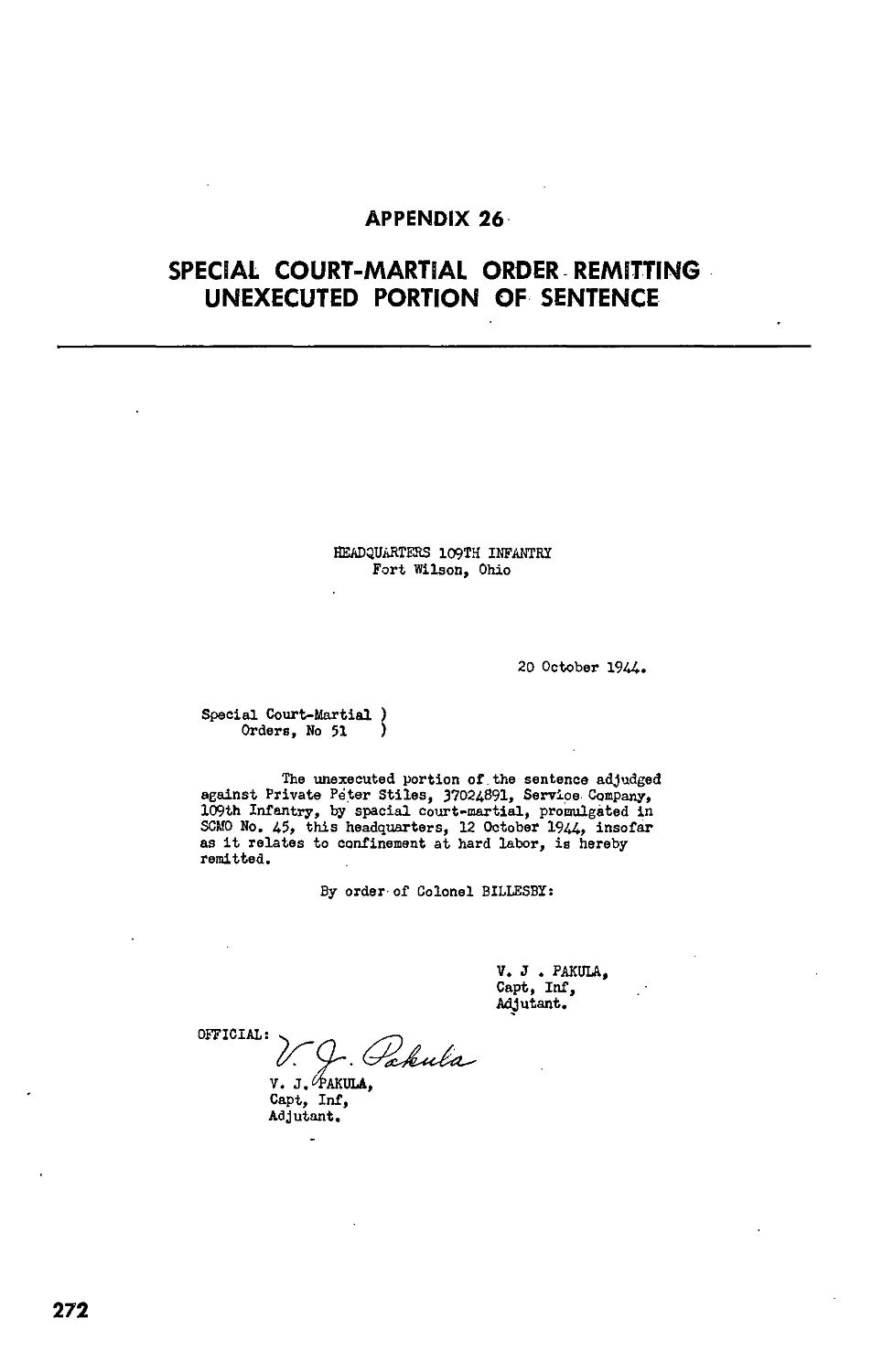
manual is designed. Accordingly, it contains numerous appendices,
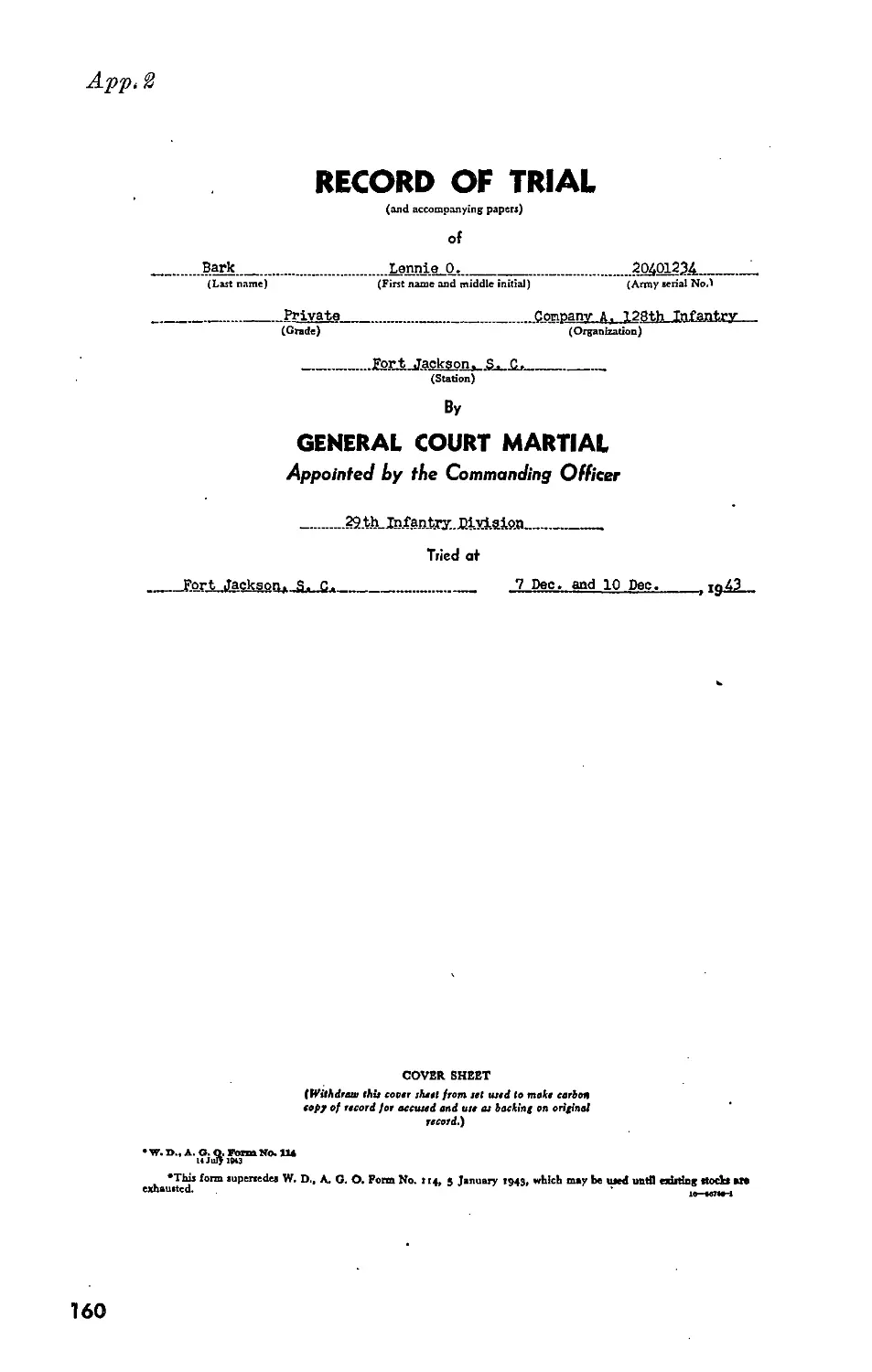
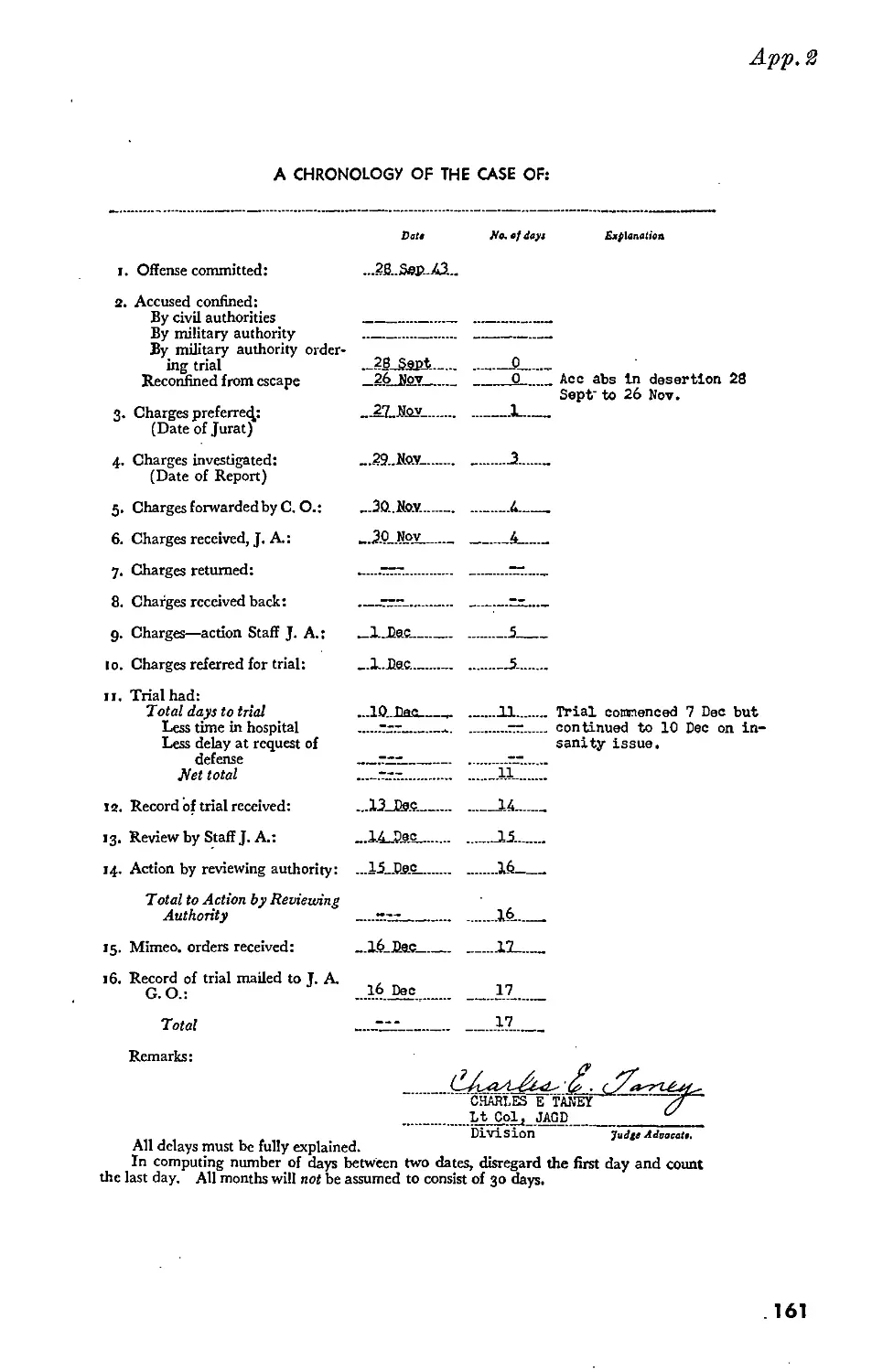
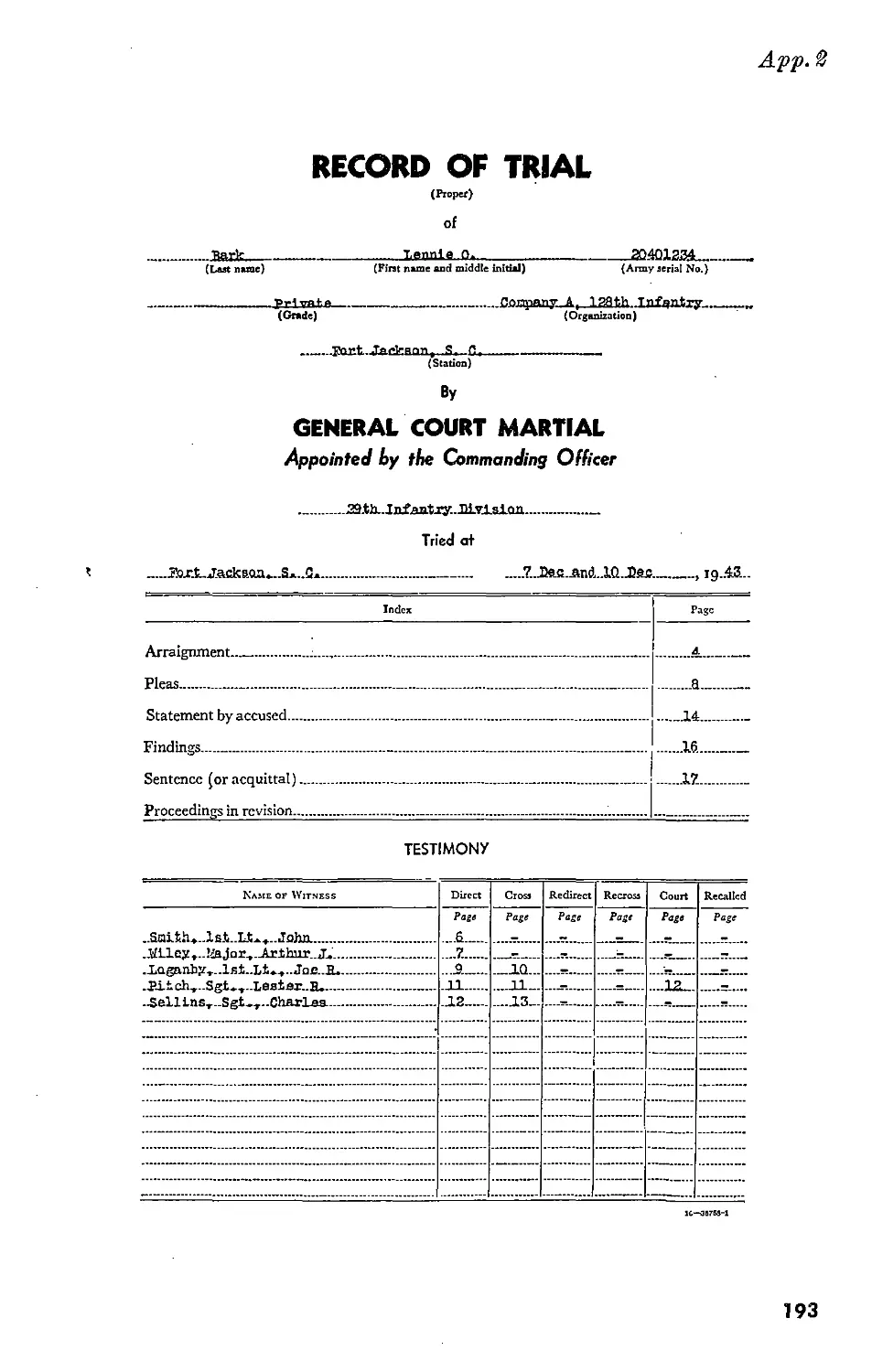
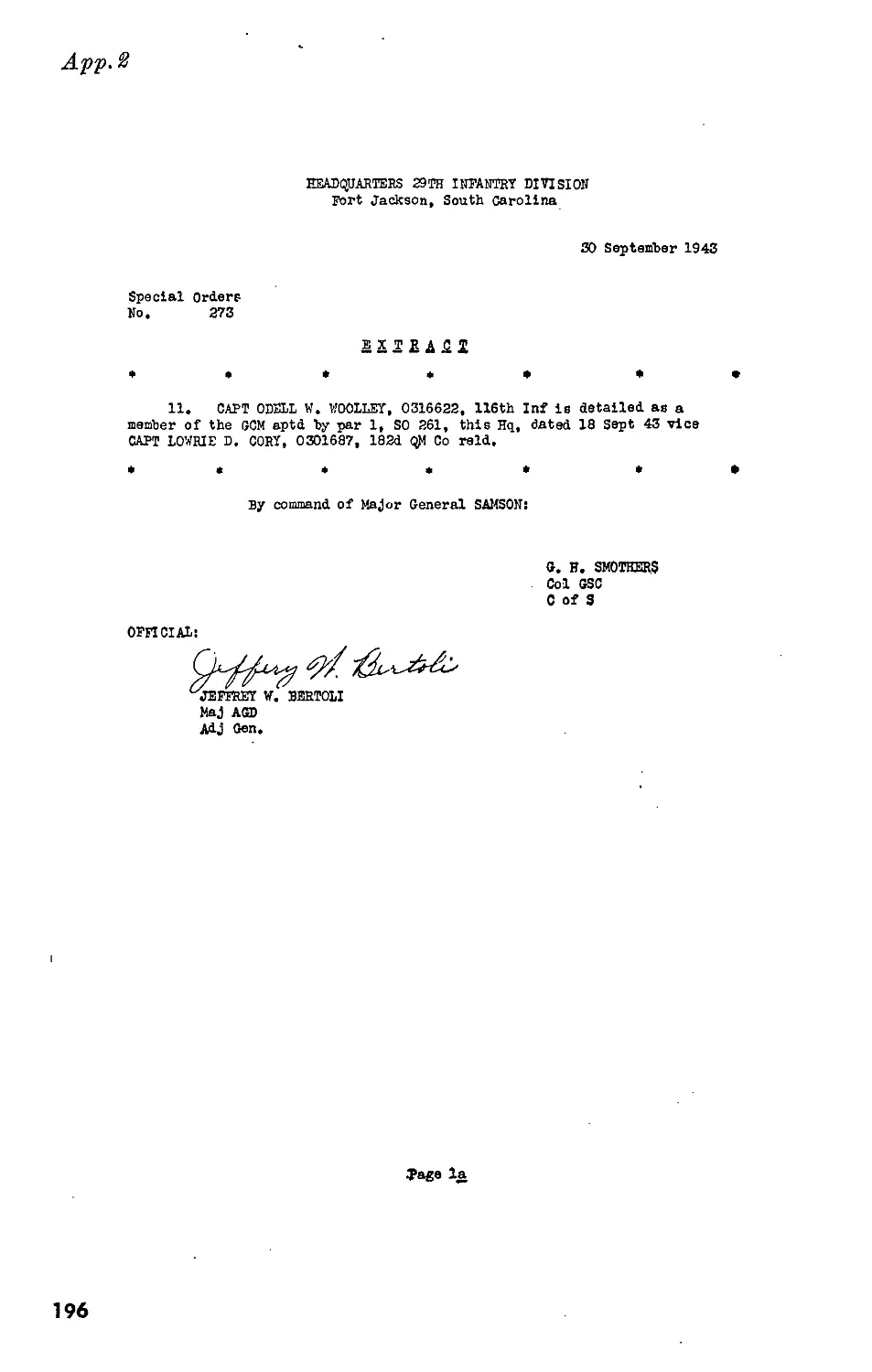
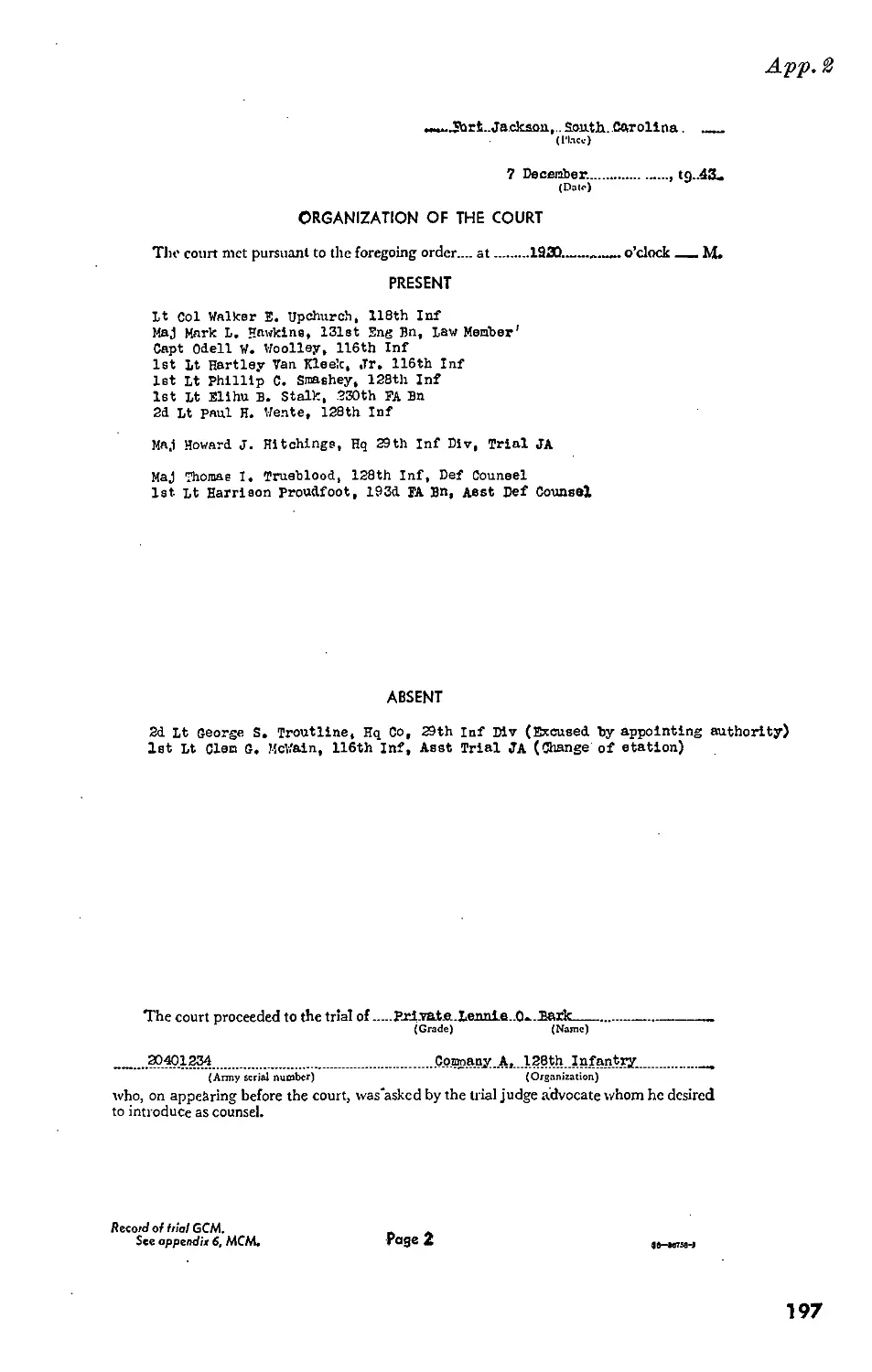
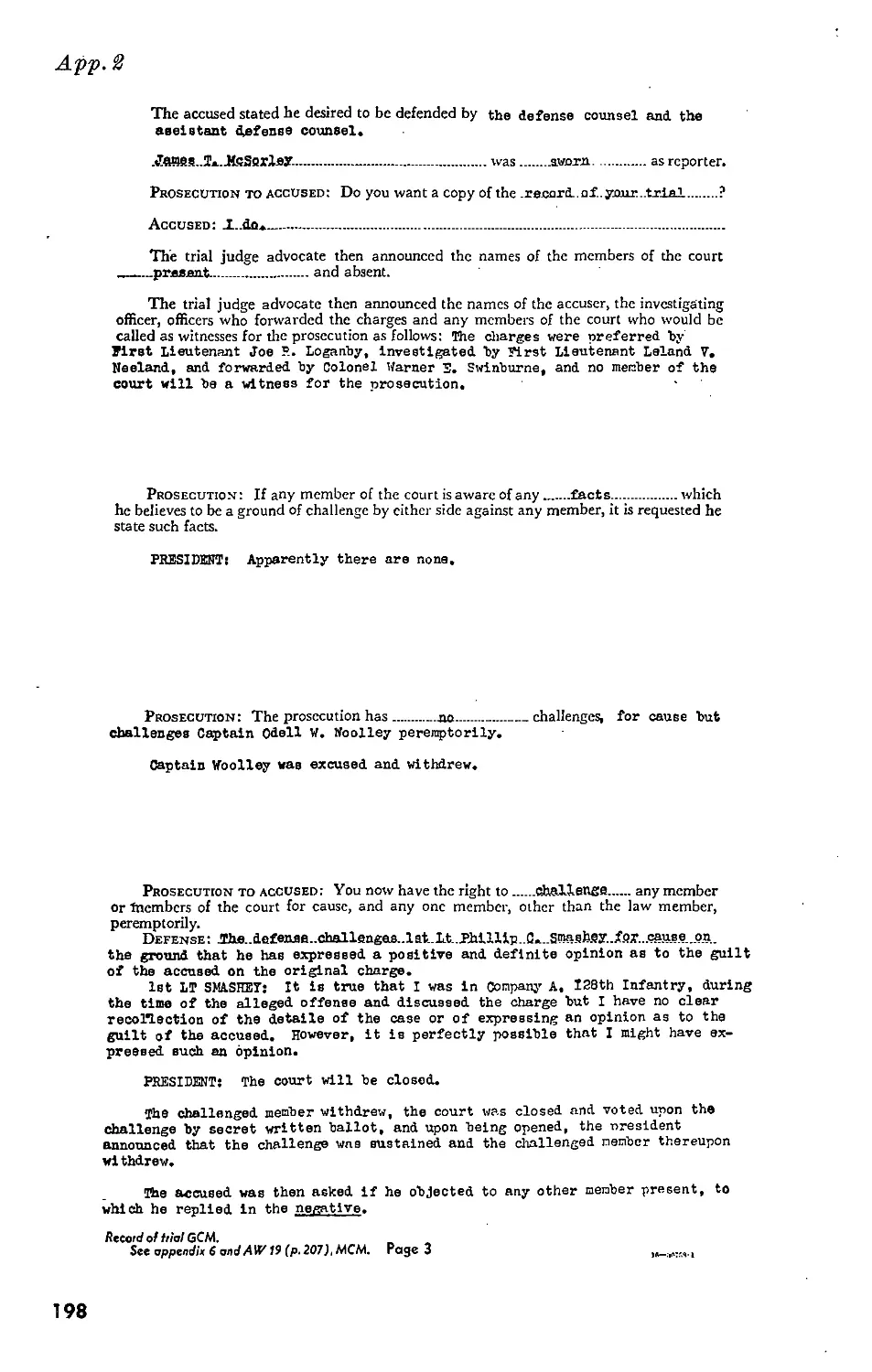
containing a “step by step” outline of trial procedure, a specimen record
of trial by general, special, and summary courts martial and examples
of all other papers and forms commonly encountered in court-martial
procedure.
The possible duties which an officer may be required to perform in
connection with the administration of military justice are numerous and
varied, as for instance, imposition of punishment under AW 104, serving
as trial judge advocate or as summary court, or even as reviewing
authority. Doubtless no one officer will have to perform all these tasks.
Since any officer, however, may from time to time be called on to serve
in several different capacities, this manual touches on most of the phases
of military justice procedure from the initial question “Is any punishment
required?” to the final action to be taken on a completed case. Some
of the material is necessarily legal and technical in nature, such as the
discussion of the rules of evidence or the powers of reviewing authority.
Although all officers other than members of the JAGD will not have to
deal with such matters, some must have knowledge of these and other
technical aspects of the court-martial system. These subjects are covered
as simply as possible and practical examples and forms are furnished.
Ш

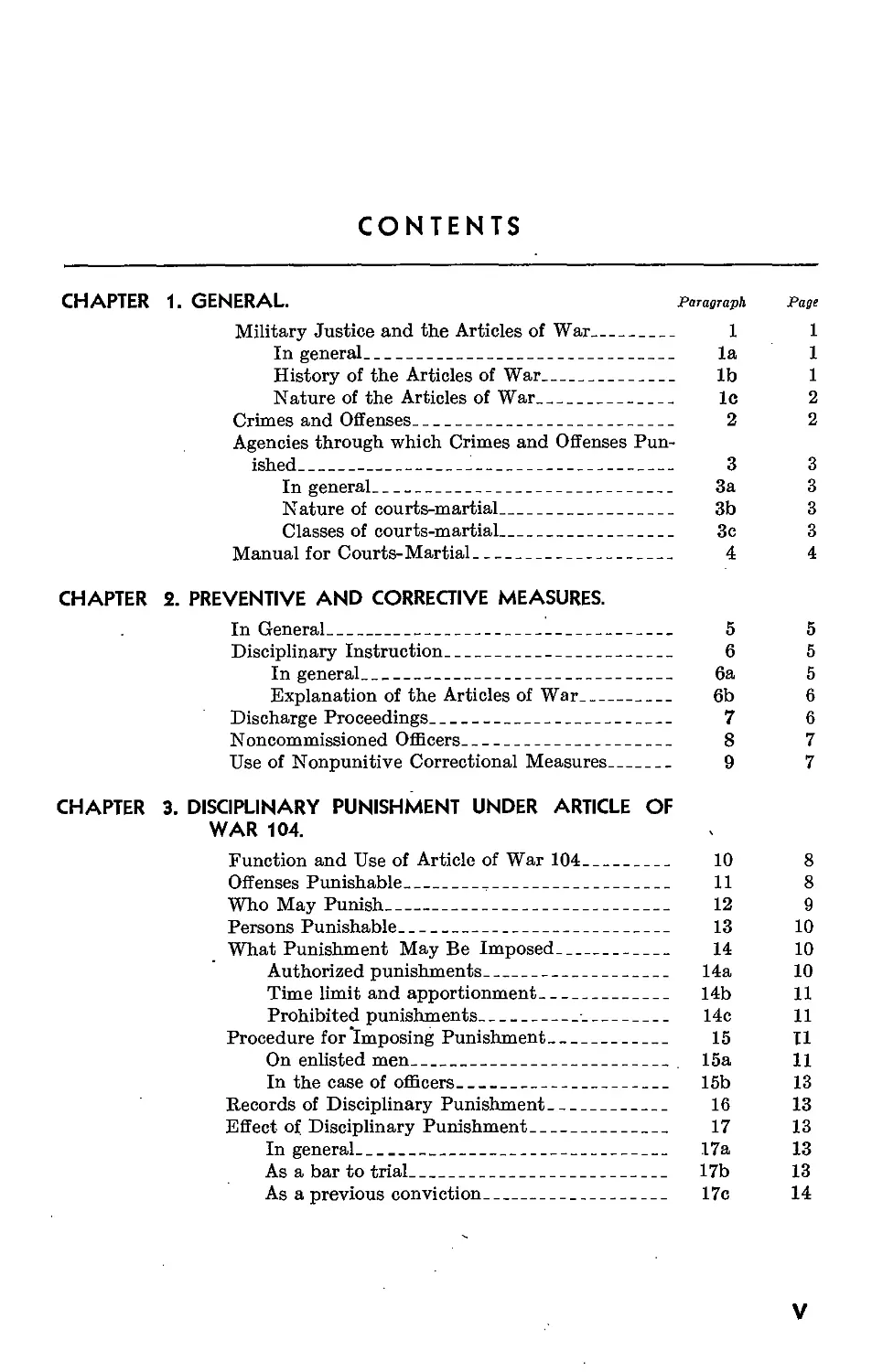
CONTENTS
CHAPTER 1.	GENERAL.	Paragraph Page
Military Justice and the Articles of War_____________ 1	1
In general_____________________________________ la	1
History of the Articles of War_________________ lb	1
Nature of the Articles of War__________________ lc	2
Crimes and Offenses__________________________________ 2	2
Agencies through which Crimes and Offenses Pun-
ished________________________________________________ 3	3
In general____________________________________ 3a	3
Nature of courts-martial______________________ 3b	3
Classes of courts-martial_____________________ 3c	3
Manual for Courts-Martial____________________________ 4	4
CHAPTER 2.	PREVENTIVE AND CORRECTIVE MEASURES.
In General___________________________________________ 5	5
Disciplinary Instruction_____________________________ 6	5
In general_____________________________________ 6a	5
Explanation of the Articles of War_____________ 6b	6
Discharge Proceedings________________________________ 7	6
Noncommissioned Officers_____________________________ 8	7
Use of Nonpunitive Correctional Measures________	9	7
CHAPTER 3.	DISCIPLINARY PUNISHMENT UNDER ARTICLE OF
WAR 104.
Function and Use of Article of War 104______________ 10	8
Offenses Punishable_________________________________ 11	8
Who May Punish______________________________________ 12	9
Persons Punishable__________________________________ 13	10
What Punishment May Be Imposed---------------------- 14	10
Authorized punishments________________________ 14a	10
Time limit and apportionment__________________ 14b	11
Prohibited punishments_______________________  14c	11
Procedure for Imposing Punishment___________________ 15	II
On enlisted men_______________________________ 15a	11
In the case of officers_______________________ 15b	13
Records of Disciplinary Punishment__________________ 16	13
Effect of Disciplinary Punishment___________________ 17	13
In general____________________________________ 17a	13
As a bar to trial_____________________________ 17b	13
As a previous conviction______________________ 17c	14
V
CHAPTER 4. ARREST AND CONFINEMENT.	Paragraph		Page
Arrest or Confinement before Trial		18	15
In general	;		18a	15
Necessity and purpose of restraint		18b	15
Types of restraint		18c	15
Degree of restraint to be imposed		18d	15
Who May Arrest and Confine		19	16
Enlisted men				19a	16
Officers and warrant officers		19b	16
Procedure for Arresting or Confining		20	17
Preliminary inquiry into offense		20a	17
Procedural steps to arrest		20b	17
Procedural steps to place person in confine-
ment		20c	17
Statements and reports required		20d	17
Status of Person in Arrest or Confinement		21	18
Status of arrest		21a	18
Status of confinement prior to trial		21b	18
Duration and Termination of Arrest and Confine-
ment		22	19
CHAPTER 5. PREFERRING CHARGES.		-
Charges in General		23	20
Definitions		23a	20
By whom charges preferred		23b	20
Necessity for inquiry before preferring charges.	23c	20
Promptness in preferring charges		23d	21
Additional charges		23e	21
Selection of Charge		24	21
General		24a	21
Multiplication of charges			24b	22
Combining charges of serious and minor
offenses			24c	22
Joint charges		24d	23
Drafting Charges and Specifications				25	23
The charge		25a	23
Specifications, in general		25b	24
Abbreviations		25c	24
Serial numbers		25d	25
Description of persons		25e	25
Dates		25f	25
Details		25g	25
Value		25h	25
Several larcenies		25i	25
Examples of correct and incorrect drafting		25j	26
Numbering charges and specifications		25k	26
Preparation of Charge Sheet		26	26
General		26a	26
Name, etc., of accused		26b	26
Age of accused		26c	27
Pay of accused	:		26d	27
Service of accused		26e	27
Data as to witnesses, etc		26f	27
Data as to restraint of the accused		26g	27
VI
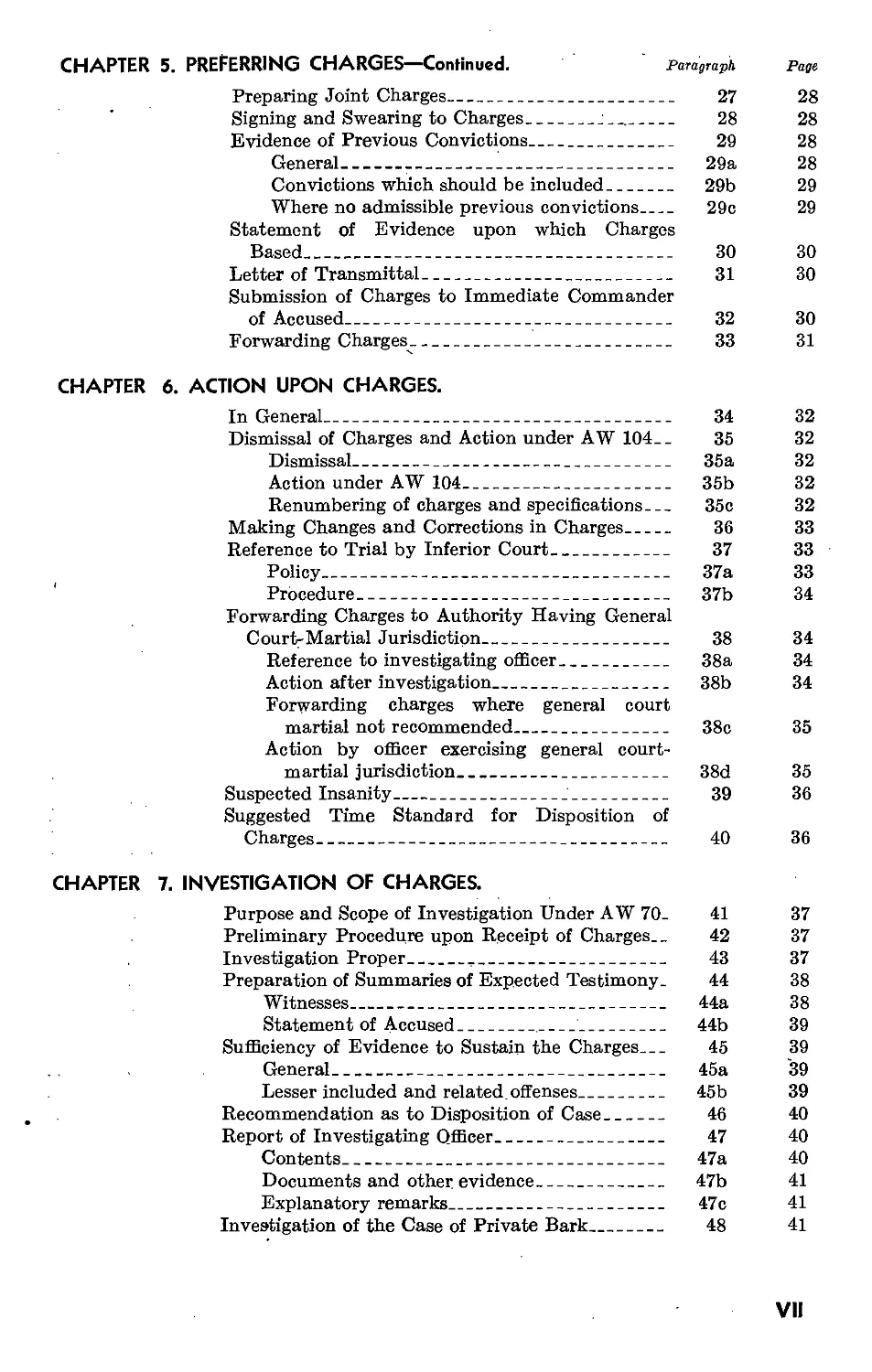
CHAPTER 5. PREFERRING CHARGES—Continued.	Paragraph	Page
Preparing Joint Charges------------------------ 27	28
Signing and Swearing to Charges_______j________	28	28
Evidence of Previous Convictions___________________ 29	28
General______________________________________ 29a	28
Convictions which should be included_______	29b	29
Where no admissible previous convictions___	29c	29
Statement of Evidence upon which Charges
Based______________________________________________ 30	30
Letter of Transmittal______________________________ 31	30
Submission of Charges to Immediate Commander
of Accused________________________________________ 32	30
Forwarding Charges________________________________ 33	31
CHAPTER 6.	ACTION UPON CHARGES.
In General________________________________________ 34	32
Dismissal of Charges and Action under	AW 104. .	35	32
Dismissal____________________________________ 35a	32
Action under AW 104__________________________ 35b	32
Renumbering of charges and specifications__	35c	32
Making Changes and Corrections in Charges______	36	33
Reference to Trial by Inferior Court______________ 37	33
Policy_______________________________________ 37a	33
Procedure____________________________________ 37b	34
Forwarding Charges to Authority Having General
Court-Martial Jurisdiction______________________ 38	34
Reference to investigating officer____________ 38a	34
Action after investigation___________________ 38b	34
Forwarding charges where general court
martial not recommended______________________ 38c	35
Action by officer exercising general court-
martial jurisdiction_________________________ 38d	35
Suspected Insanity________________________________  39	36
Suggested Time Standard for Disposition of
Charges____________________________________________ 40	36
CHAPTER 7.	INVESTIGATION OF CHARGES.
Purpose and Scope of Investigation Under AW 70-	41	37
Preliminary Procedure upon Receipt of Charges. _	42	37
Investigation Proper_____,_____________________ 43	37
Preparation of Summaries of Expected Testimony.	44	38
Witnesses_____________________________________ 44a	38
Statement of Accused________________________  44b	39
Sufficiency of Evidence to Sustain the Charges_	45	39
General______________________________________ 45a	39
Lesser included and related, offenses________ 45b	39
Recommendation as to Disposition of Case_______	46	40
Report of Investigating Officer____________________ 47	40
Contents_____________________________________ 47a	40
Documents and other evidence_________________ 47b	41
Explanatory remarks__________________________ 47c	41
Investigation of the Case of Private Bark______	48	41
VII
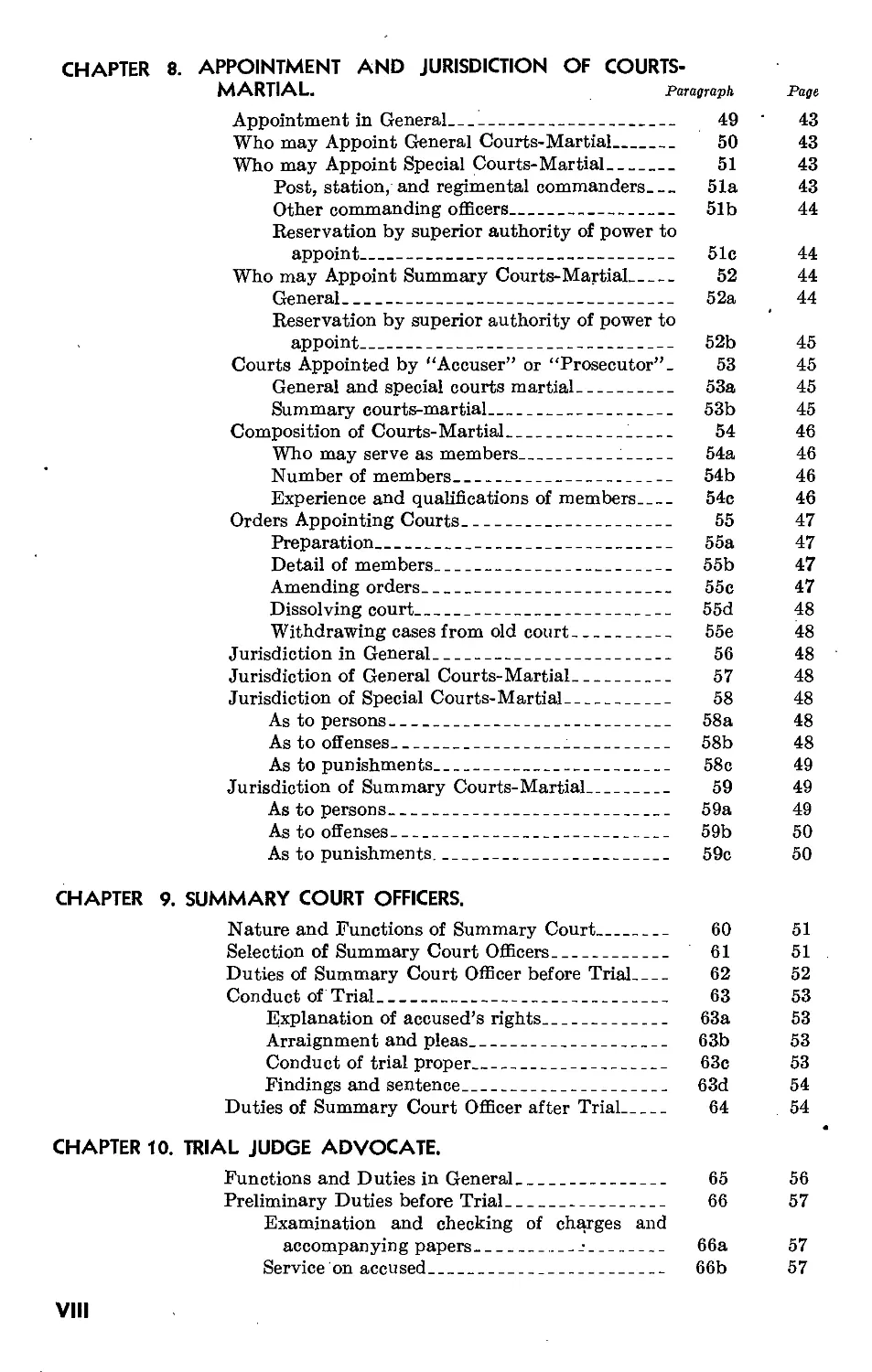
CHAPTER 8.	APPOINTMENT AND JURISDICTION OF COURTS-
MARTIAL.	Paragraph	Page
Appointment in General_______________________ 49 ‘	43
Who may Appoint General Courts-Martial_______	50	43
Who may Appoint Special Courts-Martial_______	51	43
Post, station, and regimental commanders_	51a	43
Other commanding officers__________________ 51b	44
Reservation by superior authority of power to
appoint____________________________________ 51c	44
Who may Appoint Summary Courts-Martial_______	52	44
General____________________________________ 52a	44
Reservation by superior authority of power to
appoint____________________________________ 52b	45
Courts Appointed by “Accuser” or “Prosecutor”- 53	45
General and special courts martial_________ 53a	45
Summary courts-martial_____________________ 53b	45
Composition of Courts-Martial_________________   54	46
Who may serve as members_________________   54a	46
Number of members__________________________ 54b	46
Experience and qualifications of members_	54c	46
Orders Appointing Courts________________________ 55	47
Preparation________________________________ 55a	47
Detail of members__________________________ 55b	47
Amending orders____________________________ 55c	47
Dissolving court___________________________ 55d	48
Withdrawing cases from old court___________ 55e	48
Jurisdiction in General_________________________ 56	48
Jurisdiction of General Courts-Martial__________ 57	48
Jurisdiction of Special Courts-Martial__________ 58	48
As to persons______________________________ 58a	48
As to offenses___________________________   58b	48
As to punishments__________________________ 58c	49
Jurisdiction of Summary Courts-Martial__________ 59	49
As to persons______________________________ 59a	49
As to offenses_____________________________ 59b	50
As to punishments._________________________ 59c	50
CHAPTER 9.	SUMMARY COURT OFFICERS.
Nature and Functions of Summary Court________	60	51
Selection of Summary Court Officers_____________ 61	51
Duties of Summary Court Officer before	Trial_	62	52
Conduct of Trial________________________________ 63	53
Explanation of accused’s rights____________ 63a	53
Arraignment and pleas______________________ 63b	53
Conduct of trial proper____________________ 63c	53
Findings and sentence______________________ 63d	54
Duties of Summary Court Officer after Trial__	64	54
CHAPTER 10.	TRIAL JUDGE ADVOCATE.
Functions and Duties in General_________________ 65	56
Preliminary Duties before Trial_________________ 66	57
Examination and checking of charges and
accompanying papers______________•________ 66a	57
Service on accused_______________________ 66b	57
VIII
CHAPTER 10. TRIAL JUDGE ADVOCATE—Continued.	Paragraph	Page
Preparation of the Case_______________________ 67	58
Analyzing the case__________________________ 67a	58
Interviewing witnesses______________________ 67b	59
Arrangement of evidence_____________________ 67c	59
Preparation of questions and opening state-
ment______________________________________ 67d	61
Attendance of Witnesses; Stipulations; Depositions. 68	61
In general__________________________________ 68a	61
Stipulations________________________________ 68b	61
Depositions_________________________________ 68c	62
Attendance of military witnesses____________ 68d	63
Attendance of civilian witnesses____________ 68e	63
Attendance of witnesses for the defense__	68f	63
Arranging for Trial_______________________________ 69	64
Notifying members, witnesses, and the accused 69a	64
Preparation of courtroom, etc_______________ 69b	64
Duties during Trial_______________________________ 70	64
Duties after Trial________________________________ 71	65
Report of result of trial___________________ 71a	65
Preparation of the record___________________ 71b	65
Preparation of vouchers_____________________ 71c	65
Weekly Reports____________________________________ 72	65
/
CHAPTER 11. DEFENSE COUNSEL.
Right of Accused to Counsel_______________________ 73	66
Duties of Defense Counsel in General______________ 74	66
Duties before Trial_____________________________   75	67
In general__________________________________ 75a	67
Receipt and examination of charges and accom-
panying papers_______________________________ 75b	67
Interview with accused_______________________ 75c	67
Advising accused as to pleas_________________ 75d	68
Preparation of the case______________________ 75e	68
Duties during Trial_______________________________ 76	68
In general___________________________________ 76a	68
Calling accused as witness___________________ 76b	69
Duties after Trial_______________________________  77	69
Clemency_____________________________________ 77a	69
Examination of record________________________ 77b	70
CHAPTER 12.	MEMBERS OF GENERAL AND SPECIAL COURTS-
MARTIAL.
In General________________________________________ 78	71
President_________________________________________ 79	71
Definition___________________________________ 79a	71
Assembling the court_________________________ 79b	71
Excusing members_____________________________ 79c	71
Duties during trial in general_______________ 79d	72
Rulings on interlocutory questions___________ 79e	72
Concluding incidents of trial________________ 79f	73
Authentication of record_____________________ 79g	73
IX
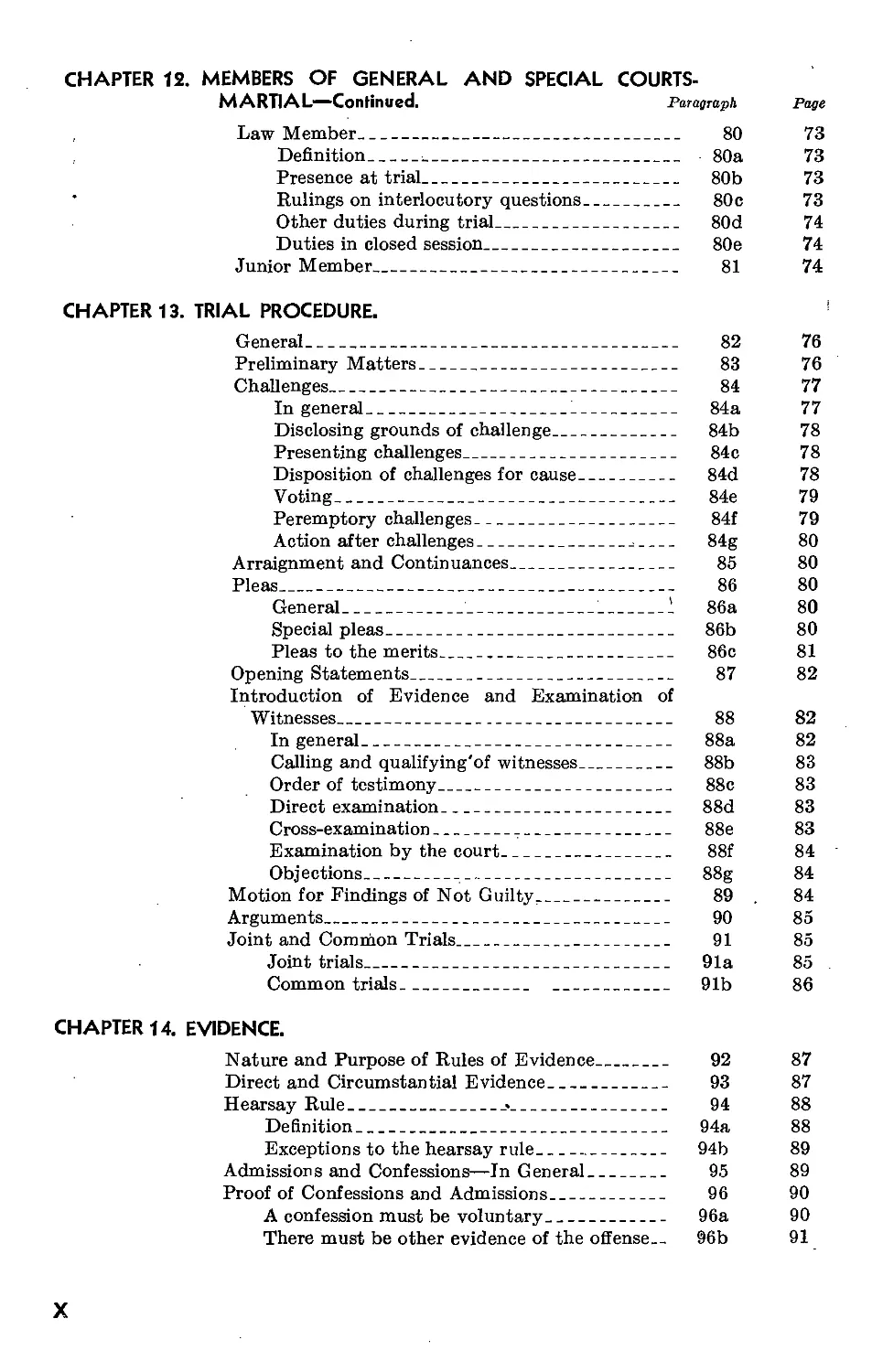
CHAPTER 12. MEMBERS OF GENERAL AND SPECIAL COURTS-
MARTIAL—Continued.	Paragraph Page
Law Member________________________________________ 80	73
Definition_____;___________________________	80a	73
Presence at trial____________________________ 80b	73
•	Rulings on interlocutory questions__________ 80c	73
Other duties during trial____________________ 80d	74
Duties in closed session_____________________ 80e	74
Junior Member_____________________________________ 81	74
CHAPTER 13.	TRIAL PROCEDURE.
General________________________________________ 82	76
Preliminary Matters____________________________ 83	76
Challenges_____________________________________ 84	77
In general_________________________________ 84a	77
Disclosing grounds of challenge____________ 84b	78
Presenting challenges______________________ 84c	78
Disposition of challenges for cause________ 84d	78
Voting_______________________________________ 84e	79
Peremptory challenges______________________ 84f	79
Action after challenges____________________ 84g	80
Arraignment and Continuances___________________ 85	80
Pleas__________________________________________ 86	80
General____________________________________1	86a	80
Special pleas______________________________ 86b	80
Pleas to the merits__________________________ 86c	81
Opening Statements_____________________________ 87	82
Introduction of Evidence and Examination of
Witnesses____________________________________ 88	82
In general___________________________________ 88a	82
Calling and qualifying'of witnesses________ 88b	83
Order of testimony___________________________ 88c	83
Direct examination___________________________ 88d	83
Cross-examination__________________________ 88e	83
Examination by the court_____________________ 88f	84
Objections__________________________________  88g	84
Motion for Findings of Not Guilty.________________ 89	84
Arguments_________________________________________ 90	85
Joint and Common Trials___________________________ 91	85
Joint trials_________________________________ 91a	85
Common trials______________________________   91b	86
CHAPTER 14.	EVIDENCE.
Nature and Purpose of Rules of Evidence________	92	87
Direct and Circumstantial Evidence________________ 93	87
Hearsay Rule_________________•_________________ 94	88
Definition___________________________________ 94a	88
Exceptions to the hearsay rule_______________ 94b	89
Admissions and Confessions—In General_____________ 95	89
Proof of Confessions and Admissions_______________ 96	90
A confession must be voluntary_______________ 96a	90
There must be other evidence of the offense.- 96b	91
X
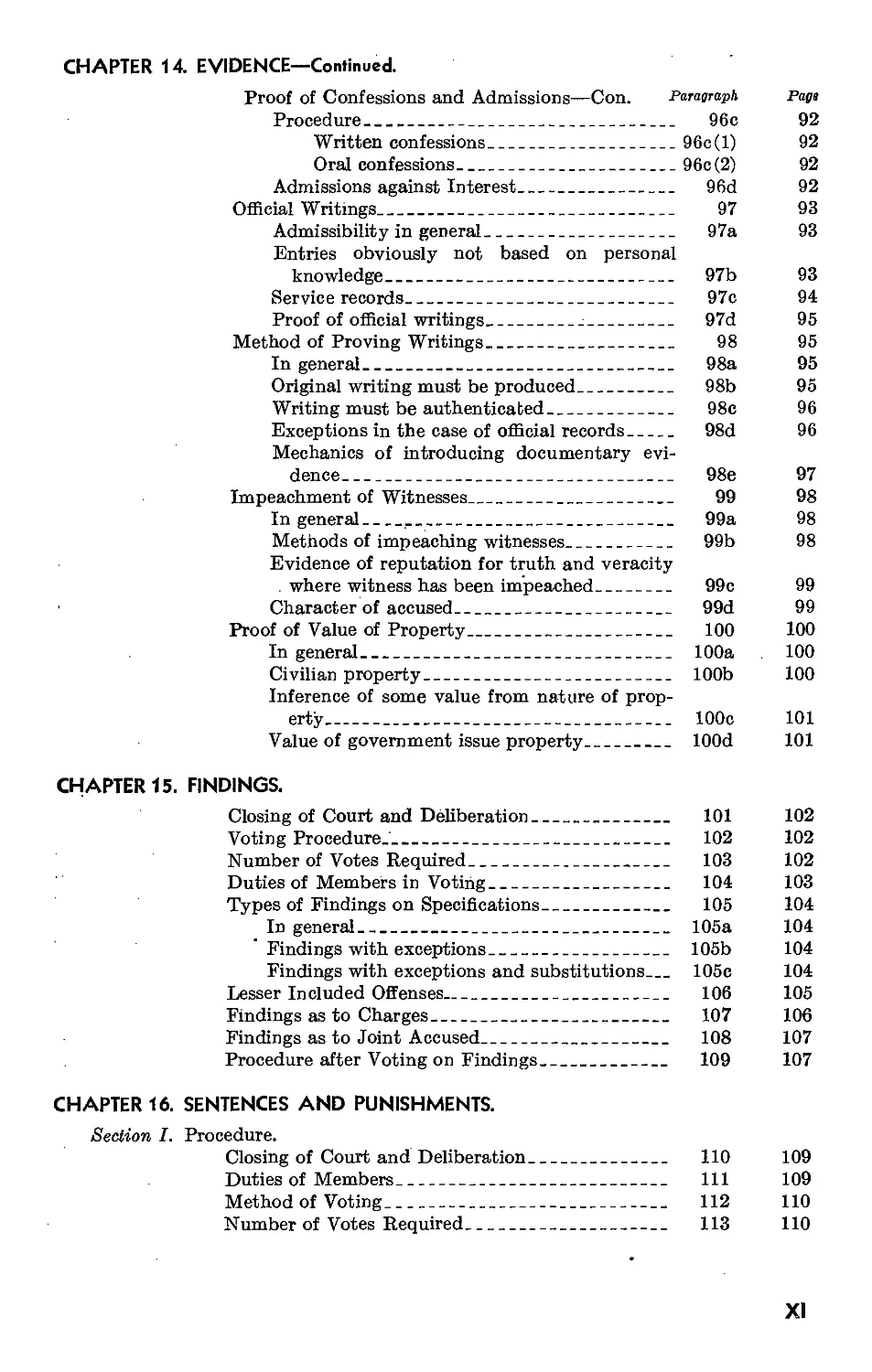
CHAPTER 14.	EVIDENCE—Continued.
Proof of Confessions and Admissions—Con. Paragraph	Page
Procedure____________________________________ 96c	92
Written confessions___________________96c(l)	92
Oral confessions______________________96c (2)	92
Admissions against Interest__________________ 96d	92
Official Writings__________________________________ 97	93
Admissibility in general_____________________ 97a	93
Entries obviously not based on personal
knowledge_____________________________________ 97b	93
Service records______________________________ 97c	94
Proof of official writings______-__________ 97d	95
Method of Proving Writings_________________________ 98	95
In general___________________________________ 98a	95
Original writing must be produced____________ 98b	95
Writing must be authenticated________________ 98c	96
Exceptions in the case of official records_	98d	96
Mechanics of introducing documentary evi-
dence________________________________________ 98e	97
Impeachment of Witnesses___________________________ 99	98
In general___________________________________ 99a	98
Methods of impeaching witnesses______________ 99b	98
Evidence of reputation for truth and veracity
. where witness has been impeached________	99c	99
Character of accused_________________________ 99d	99
Proof of Value of Property________________________ 100	100
In general__________________________________ 100a	100
Civilian property___________________________ 100b	100
Inference of some value from nature of prop-
erty_________________________________________ 100c	101
Value of government issue property__________ lOOd	101
CHAPTER 15.	FINDINGS.
Closing of Court and Deliberation_________________ 101	102
Voting Procedure._________________________________ 102	102
Number of Votes Required__________________________ 103	102
Duties of Members in Voting_______________________ 104	103
Types of Findings on Specifications_______________ 105	104
In general__________________________________ 105a	104
Findings with exceptions____________________ 105b	104
Findings with exceptions and substitutions... 105c	104
Lesser Included Offenses__________________________ 106	105
Findings as to Charges____________________________ 107	106
Findings as to Joint Accused______________________ 108	107
Procedure after Voting on Findings________________ 109	107
CHAPTER 16.	SENTENCES AND PUNISHMENTS.
Section I. Procedure.
Closing of Court and Deliberation_________________ 110	109
Duties of Members_________________________________ 111	109
Method of Voting__________________________________ 112	110
Number of Votes Required__________________________ 113	110
XI
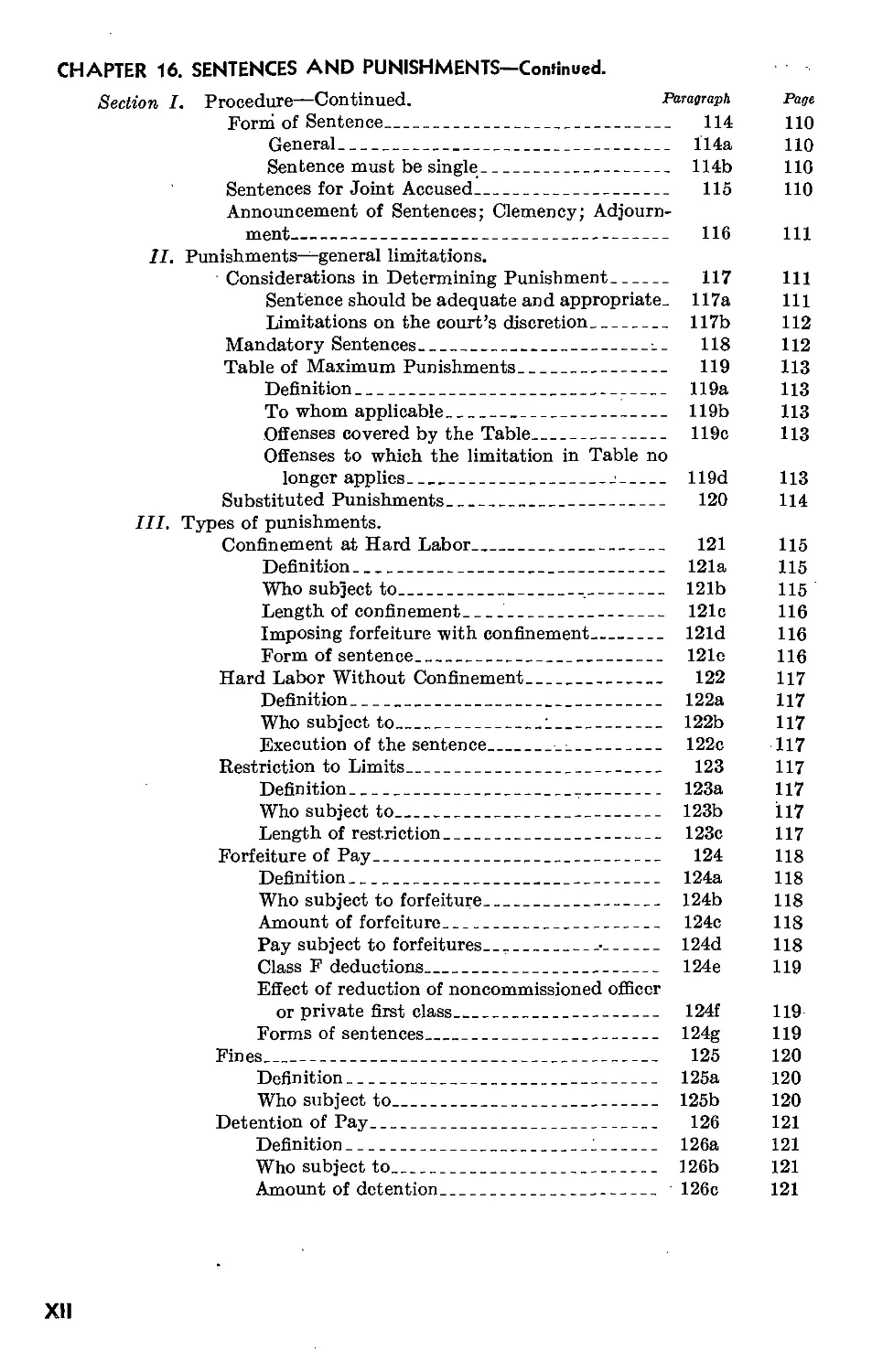
CHAPTER 16. SENTENCES AND PUNISHMENTS—Continued.
Section I. Procedure—Continued.	Paragraph	Page.
Form of Sentence_________________________________ 114	110
General____________________________________ 114a	110
Sentence must be single_____________________ 114b	110
Sentences for Joint Accused______________________ 115	110
Announcement of Sentences; Clemency; Adjourn-
ment______________________________________________ 116	111
II. Punishments—general limitations.
Considerations in Determining Punishment_______	117	111
Sentence should be adequate and appropriate- 117a	111
Limitations on the court’s discretion_______ 117b	112
Mandatory Sentences_______________________________118	112
Table of Maximum Punishments_____________________ 119	113
Definition__________________________________ 119a	113
To whom applicable__________________________ 119b	113
Offenses covered by the Table_______________ 119c	113
Offenses to which the limitation in Table no
longer applies_______________________------ 119d	113
Substituted Punishments__________________________ 120	114
III. Types of punishments.
Confinement at Hard Labor________________________ 121	115
Definition__________________________________ 121a	115
Who subject to_____________________________  121b	115
Length of confinement_______________________ 121c	116
Imposing forfeiture with confinement_______ 121d	116
Form of sentence____________________________ 121e	116
Hard Labor Without Confinement____________________ 122	117
Definition__________________________________ 122a	117
Who subject to________________1____________ 122b	117
Execution of the sentence___________________ 122c	117
Restriction to Limits_____________________________ 123	117
Definition________________________________   123a	117
Who subject to______________________________ 123b	117
Length of restriction_______________________ 123c	117
Forfeiture of Pay_________________________________ 124	118
Definition__________________________________ 124a	118
Who subject to forfeiture___________________ 124b	118
Amount of forfeiture________________________ 124c	118
Pay subject to forfeitures. ________•______ 124d	118
Class F deductions__________________________ 124e	119
Effect of reduction of noncommissioned officer
or private first class_______________________ 124f	119
Forms of sentences___________________________ 124g	119
Fines_____________________________________________ 125	120
Definition__________________________________ 125a	120
Who subject to______________________________ 125b	120
Detention of Pay__________________________________ 126	121
Definition___________________________1______ 126a	121
Who subject to_______________________________ 126b	121
Amount of detention__________________________ 126c	121
XII
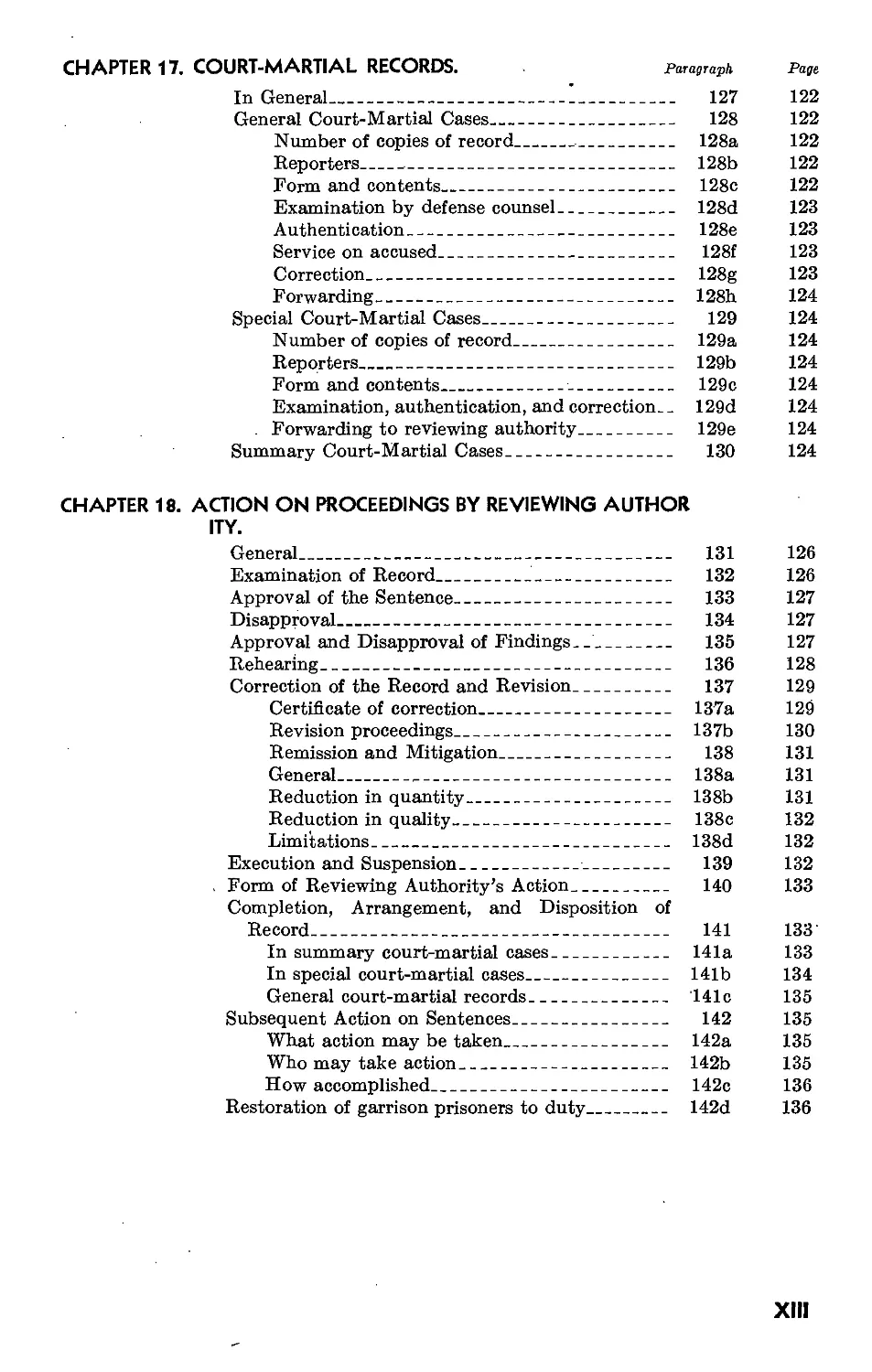
CHAPTER 17. COURT-MARTIAL RECORDS.	Paragraph	Page
In General_________________________1__________ 127	122
General Court-Martial Cases______________________ 128	122
Number of copies of record__________________ 128a	122
Reporters___________________________________ 128b	122
Form and contents___________________________ 128c	122
Examination by defense counsel______________ 128d	123
Authentication______________________________ 128e	123
Service on accused__________________________ 128f	123
Correction__________________________________ 128g	123
Forwarding__________________________________ 128h	124
Special Court-Martial Cases______________________ 129	124
Number of copies of record__________________ 129a	124
Reporters___________________________________ 129b	124
Form and contents__________________________  129c	124
Examination, authentication, and correction. _ 129d	124
. Forwarding to reviewing authority__________ 129e	124
Summary Court-Martial Cases______________________ 130	124
CHAPTER 18. ACTION ON PROCEEDINGS BY REVIEWING AUTHOR
ITY.
General__________________________________________ 131	126
Examination of Record____________________________ 132	126
Approval of the Sentence_________________________ 133	127
Disapproval______________________________________ 134	127
Approval and Disapproval of Findings. ___________ 135	127
Rehearing________________________________________ 136	128
Correction of the Record and Revision____________ 137	129
Certificate of correction___________________ 137a	129
Revision proceedings________________________ 137b	130
Remission and Mitigation_____________________ 138	131
General_____________________________________ 138a	131
Reduction in quantity_______________________ 138b	131
Reduction in quality________________________ 138c	132
Limitations_________________________________ 138d	132
Execution and Suspension________________________  139	132
. Form of Reviewing Authority’s Action____________ 140	133
Completion, Arrangement, and Disposition of
Record________________________________________ 141	133
In summary court-martial cases______________ 141a	133
In special court-martial cases______________ 141b	134
General court-martial records_______________ 141c	135
Subsequent Action on Sentences___________________ 142	135
What action may be taken____________________ 142a	135
Who may take action_________________________ 142b	135
How accomplished____________________________ 142c	136
Restoration of garrison prisoners to duty_______ 142d	136
XIII
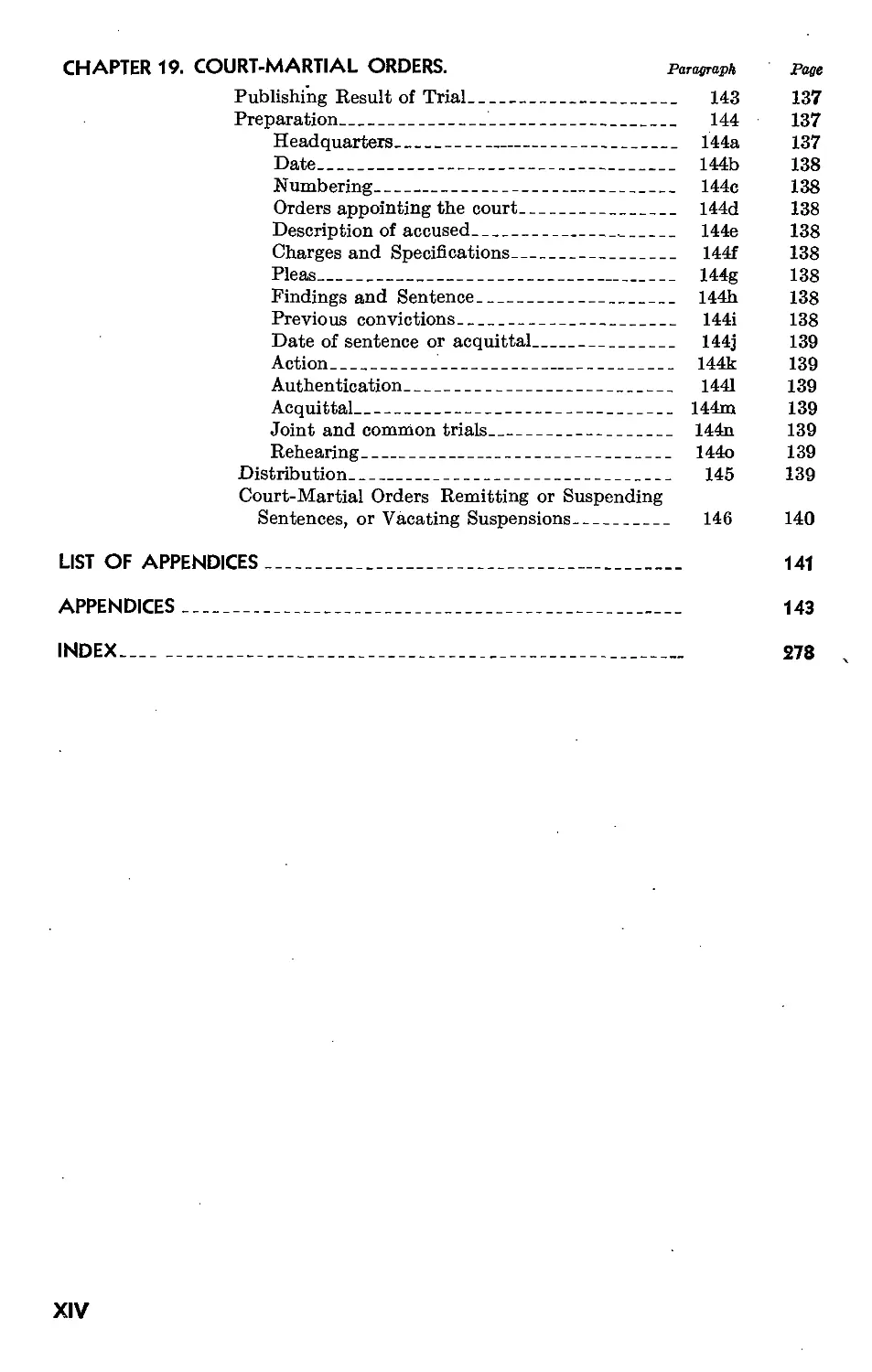
CHAPTER 19. COURT-MARTIAL ORDERS.	Paragraph
Publishing Result of Trial______________________ 143
Preparation____________________________________  144
Headquarters________________________________ 144a
Date________________________________________ 144b
Numbering___________________________________ 144c
Orders appointing the court----------------- 144d
Description of accused_____________________   144e
Charges and Specifications------------------ 144f
Pleas_______________________________________ 144g
Findings and Sentence_______________________ 144h
Previous convictions________________________ 144i
Date of sentence or acquittal_______________ 144j
Action______________________________________ 144k
Authentication______________________________ 1441
Acquittal___________________________________ 144m
Joint and common trials_____________________ 144n
Rehearing___________________________________ 144o
Distribution____________________________________ 145
Court-Martial Orders Remitting or Suspending
Sentences, or Vacating Suspensions____________ 146
Page
137
137
137
138
138
138
138
138
138
138
138
139
139
139
139
139
139
139
140
141
143
278
LIST OF APPENDICES____________________________________
APPENDICES____________________________________________
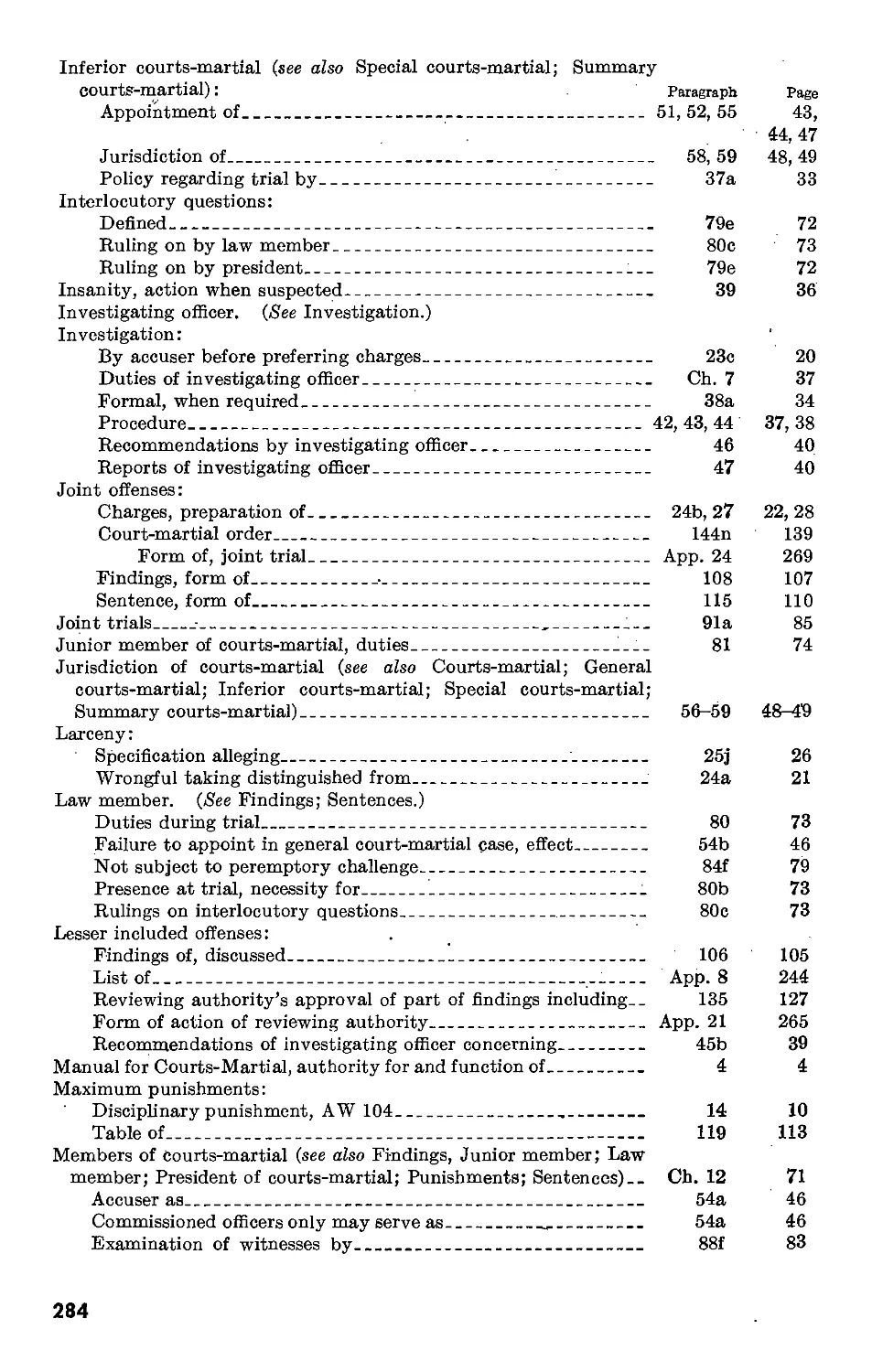
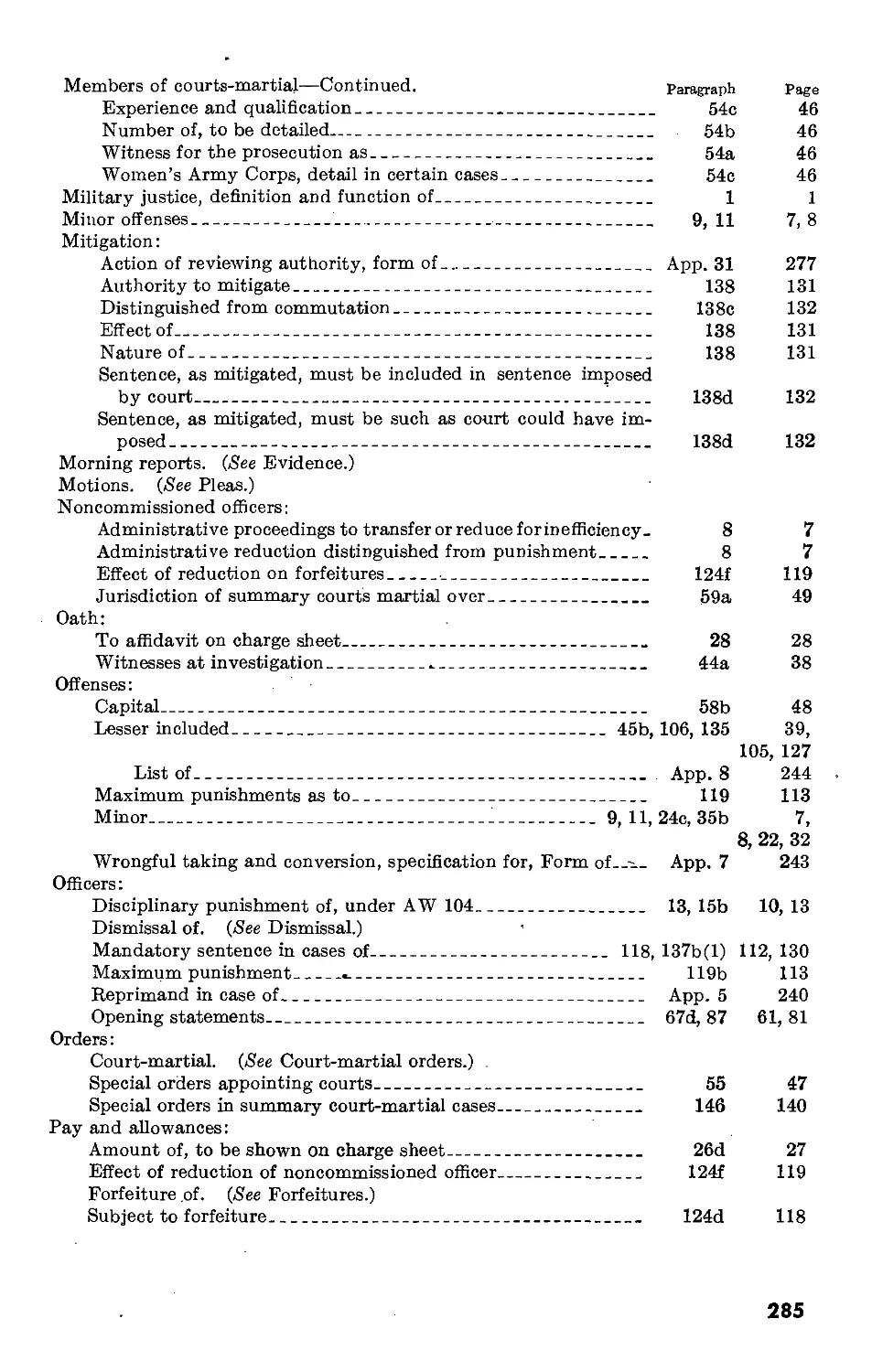
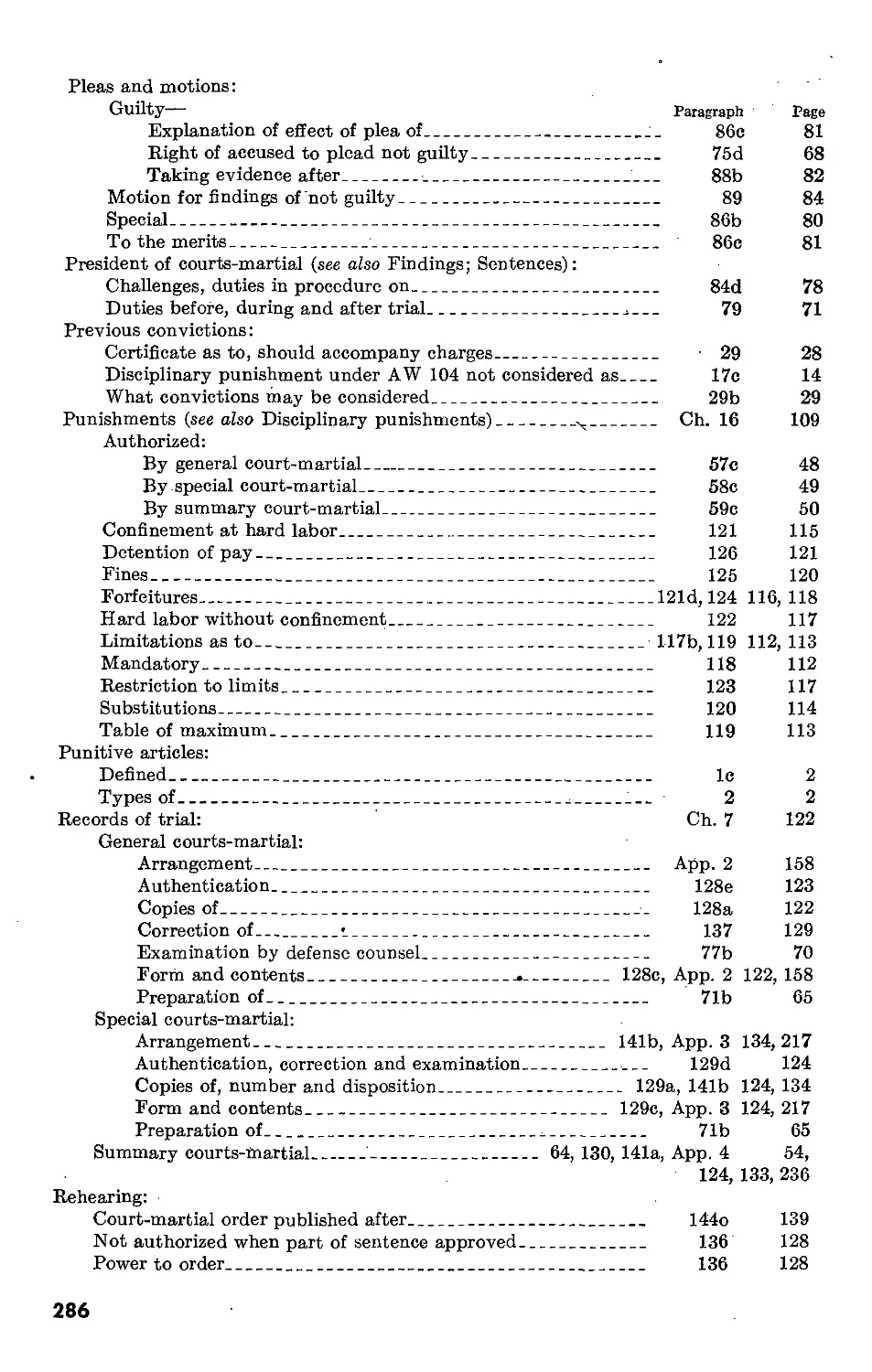
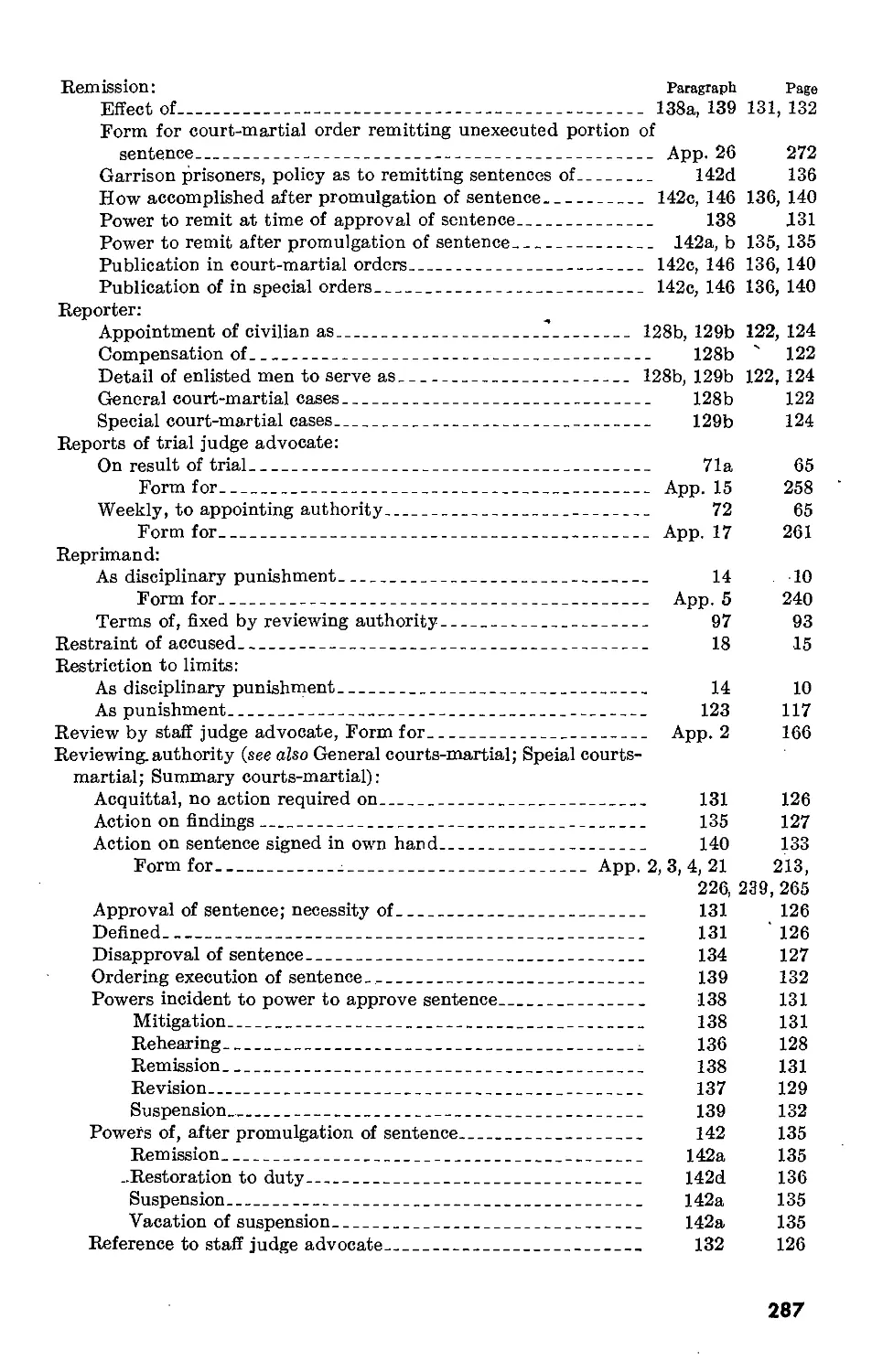
INDEX_________________________________________________
XIV
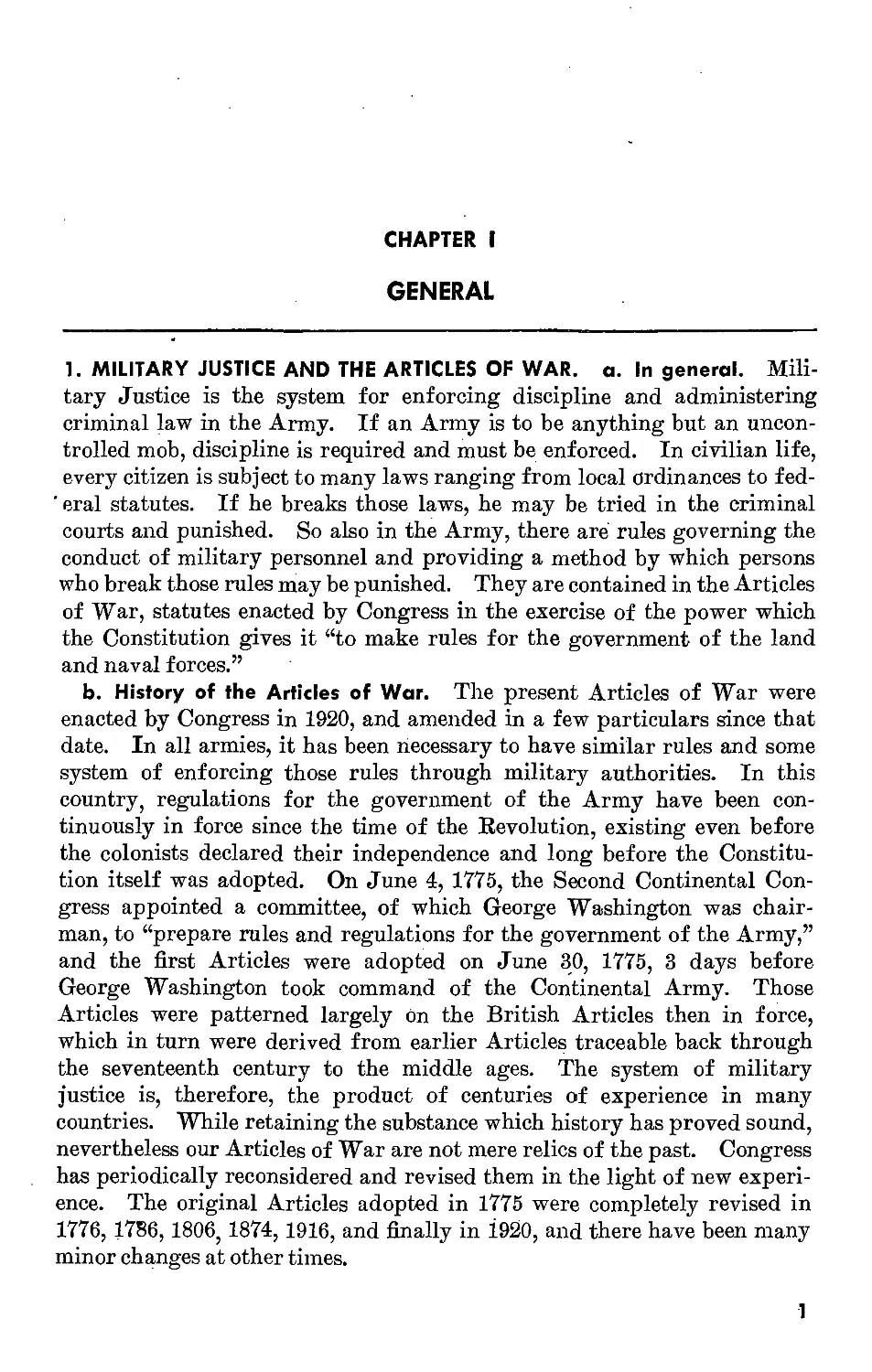
CHAPTER I
GENERAL
1.	MILITARY JUSTICE AND THE ARTICLES OF WAR. a. In general. Mili-
tary Justice is the system for enforcing discipline and administering
criminal law in the Army. If an Army is to be anything but an uncon-
trolled mob, discipline is required and must be enforced. In civilian life,
every citizen is subject to many laws ranging from local ordinances to fed-
' era! statutes. If he breaks those laws, he may be tried in the criminal
courts and punished. So also in the Army, there are rules governing the
conduct of military personnel and providing a method by which persons
who break those rules may be punished. They are contained in the Articles
of War, statutes enacted by Congress in the exercise of the power which
the Constitution gives it “to make rules for the government of the land
and naval forces.”
b. History of the Articles of War. The present Articles of War were
enacted by Congress in 1920, and amended in a few particulars since that
date. In all armies, it has been necessary to have similar rules and some
system of enforcing those rules through military authorities. In this
country, regulations for the government of the Army have been con-
tinuously in force since the time of the Revolution, existing even before
the colonists declared their independence and long before the Constitu-
tion itself was adopted. On June 4, 1775, the Second Continental Con-
gress appointed a committee, of which George Washington was chair-
man, to “prepare rules and regulations for the government of the Army,”
and the first Articles were adopted on June 30, 1775, 3 days before
George Washington took command of the Continental Army. Those
Articles were patterned largely on the British Articles then in force,
which in turn were derived from earlier Articles traceable back through
the seventeenth century to the middle ages. The system of military
justice is, therefore, the product of centuries of experience in many
countries. While retaining the substance which history has proved sound,
nevertheless our Articles of War are not mere relics of the past. Congress
has periodically reconsidered and revised them in the light of new experi-
ence. The original Articles adopted in 1775 were completely revised in
1776, 1786,1806,1874,1916, and finally in 1920, and there have been many
minor changes at other times.
1
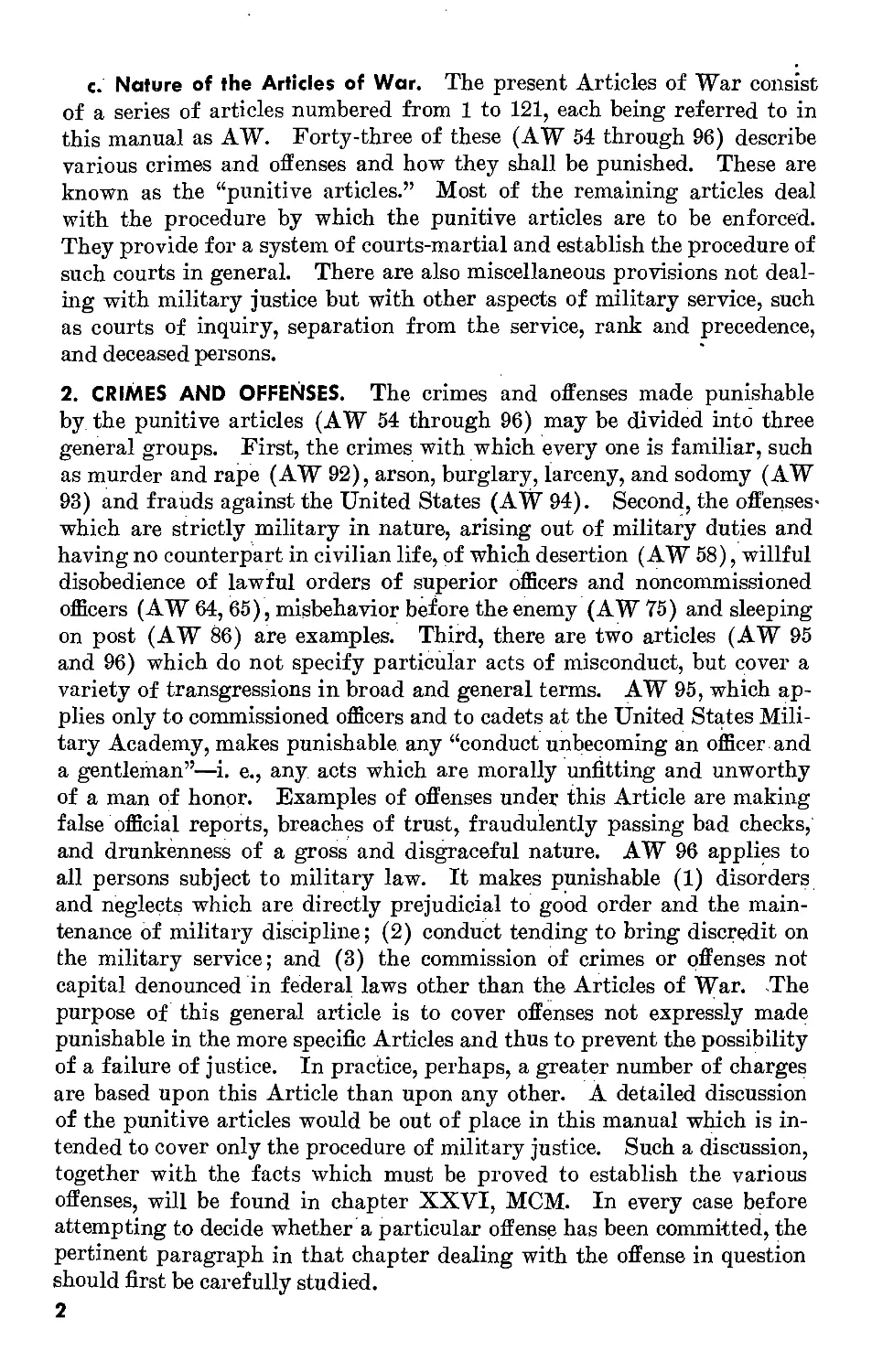
c. Nature of the Articles of War. The present Articles of War consist
of a series of articles numbered from 1 to 121, each being referred to in
this manual as AW. Forty-three of these (AW 54 through 96) describe
various crimes and offenses and how they shall be punished. These are
known as the “punitive articles.” Most of the remaining articles deal
with the procedure by which the punitive articles are to be enforced.
They provide for a system of courts-martial and establish the procedure of
such courts in general. There are also miscellaneous provisions not deal-
ing with military justice but with other aspects of military service, such
as courts of inquiry, separation from the service, rank and precedence,
and deceased persons.
2.	CRIMES AND OFFENSES. The crimes and offenses made punishable
by the punitive articles (AW 54 through 96) may be divided into three
general groups. First, the crimes with which every one is familiar, such
as murder and rape (AW 92), arson, burglary, larceny, and sodomy (AW
93) and frauds against the United States (AW 94). Second, the offenses-
which are strictly military in nature, arising out of military duties and
having no counterpart in civilian life, of which desertion (AW 58), willful
disobedience of lawful orders of superior officers and noncommissioned
officers (AW 64, 65), misbehavior before the enemy (AW 75) and sleeping
on post (AW 86) are examples. Third, there are two articles (AW 95
and 96) which do not specify particular acts of misconduct, but cover a
variety of transgressions in broad and general terms. AW 95, which ap-
plies only to commissioned officers and to cadets at the United States Mili-
tary Academy, makes punishable any “conduct unbecoming an officer and
a gentleman”—i. e., any acts which are morally unfitting and unworthy
of a man of honor. Examples of offenses under this Article are making
false official reports, breaches of trust, fraudulently passing bad checks,
and drunkenness of a gross and disgraceful nature. AW 96 applies to
all persons subject to military law. It makes punishable (1) disorders
and neglects which are directly prejudicial to good order and the main-
tenance of military discipline; (2) conduct tending to bring discredit on
the military service; and (3) the commission of crimes or offenses not
capital denounced in federal laws other than the Articles of War. The
purpose of this general article is to cover offenses not expressly made
punishable in the more specific Articles and thus to prevent the possibility
of a failure of justice. In practice, perhaps, a greater number of charges
are based upon this Article than upon any other. A detailed discussion
of the punitive articles would be out of place in this manual which is in-
tended to cover only the procedure of military justice. Such a discussion,
together with the facts which must be proved to establish the various
offenses, will be found in chapter XXVI, MCM. In every case before
attempting to decide whether a particular offense has been committed, the
pertinent paragraph in that chapter dealing with the offense in question
should first be carefully studied.
2
3.	AGENCIES THROUGH WHICH CRIMES AND OFFENSES PUNISHED, a.
In general. Having defined the various offenses and authorized punish-
ment for them (AW 54 through 96), Congress provided the means
whereby that punishment could be imposed. It established the system
of courts-martial to try offenders, and conferred upon commanding
officers a disciplinary power to impose limited punishment for minor
offenses without trial. The exercise of such disciplinary power by com-
manding officers is considered fully in chapter 3, infra.
b. Nature of courts-martial. A court-martial is a court composed of
one or more commissioned officers (the number depending upon the class
of court), the function of which is to decide whether a person subject to
military law has committed a violation of the Articles of War and, if it
finds him guilty, to adjudge punishment for the offense. It is an
instrumentality through which military authorities enforce discipline
and punish offenders. Unlike the criminal courts of a state or the United
States, it is not a permanent judicial body. It comes into existence
only when ordered by competent military authority, its members are
selected by the officer who appoints it; and its sentences are carried out
only when the authority who appointed it, or in some cases like or higher
authority, so orders. It is, however, a court of law and justice, determin-
ing each case only after hearing witnesses and receiving evidence.
Similarly it is bound by certain rules of evidence and the fundamental
principles of criminal law, and is empowered to adjudge only such
sentences as the Articles of War permit.
c. Classes of courts-martial. There are three classes of courts-martial:
(1) The highest court, known as a general court-martial, consisting of at
least five officers as members (one of whom is designated as law member),
together with a trial judge advocate (the prosecuting attorney), an
assistant trial judge advocate, a defense counsel, and an assistant defense
counsel. It has power to try any person subject to military law for
violation of any Article of War. It may impose any authorized punish-
ment from a mere reprimand to dishonorable discharge, dismissal, life
imprisonment, or even death itself. (2) An intermediate court known
as a special court-martial, consisting of at least three officers as members,
together with a trial judge advocate and defense counsel. It may try
any person subject to military law from a warrant officer down to a
private. It is more limited as to the offenses it can try and the punish-
ment it can impose than a general court. (3) The lowest court, known
as a summary court-martial, consisting of but one officer who performs
the functions of court, trial judge advocate and defense counsel. It is
narrowly limited as to the persons it can try and as to the punishments
it can impose. Only relatively minor offenses are referred to it. The
jurisdiction of general, special, and summary courts-martial with respect
to persons, offenses and punishments is discussed in chapter 8, infra.
632260°—45
2
3
4.	MANUAL FOR COURTS-MARTIAL. Congress itself in the Articles of
War defined the crimes and offenses which are punishable and the general
system for imposing punishment. No statute, however, can provide
for all the numerous details encountered in the operation of any judicial
or administrative system. The laws establishing the procedure of civil
courts, for example, are often supplemented by detailed rules of court.
In providing for the court-martial system, Congress accordingly author-
ized the President to prescribe the detailed procedure to be followed
before military tribunals and the manner of proof and rules of evidence
(AW 38.), and also to establish maximum limits of punishment for most
offenses (AW 45). The President issued these regulations in the Manual
for Courts-Martial, U. S. Army, 1928. The Manual for Courts-Martial
covers the operation of the entire court-martial system, from the initial
steps to be taken before trial through the Completion of the case. It
deals fully with the various crimes and offenses, the evidence which can
be used to prove them and the sentences which can be imposed. It is the
bible of military justice. ' Being an order of the President issued by
direction of Congress, it has all the force of law. From time to time
since 1928 changes were made in the Manual for Courts-Martial by execu-
tive order of the President. These changes are included in the present
edition of the Manual for Courts-Martial corrected to April 20, 1943.
All references to the Manual for Courts-Martial herein are to this edition.
It will be cited as MCMf
4
CHAPTER 2
PREVENTIVE AND CORRECTIVE MEASURES
5.	IN GENERAL. Some individuals are by nature rebellious or are habitual
offenders who cannot be kept from wrongdoing. Punishment may be
the only possible method of dealing with them. Such cases, however,
are in the minority. Punishment is a last resort and should be used
only if other measures have proved ineffective. In many cases, where
the offender is not an incorrigible wrongdoer, proper preventive measures
would have kept him out of trouble. The foremost preventive is, of
course, good leadership, with all that the term implies. The, better the
leadership, the better the morale and discipline in an organization and
the fewer the occasions requiring use of punitive measures. For good
leadership there is no effective substitute.
6.	DISCIPLINARY INSTRUCTION, a. In general. The importance of ade-
quately instructing men in the meaning of their military status, in
their duties and responsibilities toward one another, their superiors
and the Government, in the advantages to be gained from being good
soldiers and in the disadvantages of a bad record, cannot be too greatly
stressed. Many men coming into the Army are unfamiliar with the
concepts and necessity of military discipline. Unless they know what is
expected of them, they cannot be expected to do their job. It is for this
reason that Army Regulations provide:
“* * * Officers will impress upon the young enlisted men
lessons of patriotism and loyalty, will instill or develop in them
the concept of democracy as a form of government ideally suited
to the American way of life, and will teach and impress upon them
the necessity for obedience and military discipline in the service.
These lessons will be repeated again and again. The difference
between the status of an enlisted man and that of a civilian will
be carefully explained. The Articles of War will not only be read
to the enlisted men but will be explained and their purpose laid
before the young enlisted man in such a way as to make him under-
stand that in becoming an enlisted man he has subjected himself to
a new control and has assumed obligations of service that did not
rest upon him as a civilian.” (See par. 3, AR 600-10,8 July 44.)
It must be remembered that in the Army many officers are inexperienced
in matters pertaining to military justice. All officers should fully acquaint
5
themselves with the provisions of the Articles of War and of Army Regu-
lations relating to matters of discipline so they can properly instruct
their men and also carry out the disciplinary policies of the Army
themselves.
b. Explanation of Articles of War. Congress felt it so important to
acquaint enlisted men with their military obligations that it required
certain of the Articles of War to be read and explained to every soldier
at the time of his enlistment and once every 6 months thereafter (AW
110). The articles to be read include all the punitive articles (AW 54
through 96), together with certain miscellaneous provisions (AW 1, 2,
29, and 104 through 109). In addition to these articles specified in AW
110, AW 28 (defining desertion) is to be similarly read and explained.
(See par. 27, TM 12-230.) Moreover, specific explanation of the offenses
of wartime desertion (AW 28, 58, 59) misbehavior of-sentinels (AW 86)
and the serious consequences resulting therefrom is an important part of
training, and it is the duty of a commanding officer to insure that it is
properly done. A perfunctory, hurried reading of the articles by an
officer who himself does not clearly understand what they mean and is
anxious only to get through with a necessary chore, defeats the purpose
of the requirement. Soldiers should understand the law so that they will
hot break it. Adequate time and preparation must be devoted to the task
if that object is to be attained. As a supplement to (but not a substitute
for) this required reading and explanation, use of the following sound
training films will prove helpful: TF 11-235, Articles of War; TF 15-992,
Administration of Military Justice and Courts-Martial; TF 19-2034,
AWOL and Desertion. The fact that the Articles of War have never
been read to a soldier does not excuse him if he commits an offense, but,
although not serving as a defense, it can be regarded by the court as an
extenuating circumstance. (See par. 126a, MCM.)
7.	DISCHARGE PROCEEDINGS. An individual who, for mental or physical
reasons, cannot be adjusted to military service impairs the efficiency and
morale of his organization. He may not only get into trouble himself
but may corrupt others. If he has no potential value to the service he
should be eliminated before his continued presence causes disciplinary
problems. Under the provisions of AR 615-368, 20 July 1944 and AR
615-369,20 July 1944, an enlisted man may be administratively discharged
from the service if he gives evidence of habits or traits of character which
serve to render his retention in the service undesirable, or is disqualified
for service, physically or in character, through his own misconduct or if
he is inapt, does not possess the required degree of adaptability to military
service, or is disqualified because of enuresis. Such administrative dis-
charge should not be used in place of punishment for a crime or offense.
It should never be regarded as a substitute for appropriate disciplinary,
action where such action is called for. However, the elimination in proper
6
cases of undesirables who have no potential military value may prevent the
necessity of disciplinary action later. The policy with respect to admin-
istrative discharge of homosexuals is set out in War Department Circular 3,
1944, and of marihuana addicts in Memo W 615-13-43, January 29
(Monthly Digest of War Department Directives, January, 1943, p. 13,
AR 615-368, 20 July 1944).
8.	NONCOMMISSIONED OFFICERS. A thoroughly competent group of
noncommissioned officers is of. vital importance in developing and main-
taining discipline in any organization. (See WD Cir. 70,1944.) Careful
initial selection of noncommissioned officer material is required. Equally
important is the removal of those who do not attain or live up to the
standard expected of them. Proper use should be made of administrative
proceedings to transfer or reduce inefficient noncommissioned officers.
(See pars. 13c and 15, AR 615-5, 30 June 1943.) Such administrative
reduction is not punishment and should not be used as such.
9.	USE OF NONPUNITIVE CORRECTIONAL MEASURES. Many delinquencies
occur which indicate, not that the offender is essentially a wrongdoer, but
that he needs further instruction or training. For such delinquencies
correction, not punishment, is required. If the offense is trivial, Army
Regulations provide that no punishment, either under AW 104 or by court-
martial, be imposed until less drastic measures have been tried without
success. (See par. 26, AR 600-10, 8 July 1944.) A commanding officer
is expected and authorized to use appropriate correctional measures to
remedy deficiencies in discipline (par. 105, MCM). He may, for instance,
warn, criticize, or rebuke the offender or require him to undergo further
training. A recruit, for example, who is late for formation, appears in
improper uniform or has unclean equipment may be censured, required
to clean his equipment, or to take special training. Such action is in the
nature of instruction, not punishment.
7
CHAPTER 3
DISCIPLINARY'PUNISHMENT UNDER ARTICLE OF WAR 104
10.	FUNCTION AND USE OF ARTICLE OF WAR 104. Many minor in-
fractions of the rules may occur from time to time in any command
which require some punishment but which are not sufficiently serious to
warrant trial by court martial. To provide a prompt and efficient method
of disposing of such offenses, Congress in AW 104 authorized command-
ing officers themselves to impose limited forms of disciplinary punishment
directly upon persons of their command without the intervention of a
court-martial. Such disciplinary punishment is commonly known as
“company,” “battery,” or “squadron” punishment. The policy as to use
of this disciplinary power is clear:
“A commanding officer should resort to his power under A. W. 104
in every case where punishment is deemed necessary and where that
article applies, unless it is clear that punishment under that article
would not meet the ends of justice and discipline. Superior com-
manders should restrain any tendency of a subordinate commander
to resort unnecessarily to court-martial jurisdiction for the punish-
ment of offenders” (par. 105, MCM).
A commanding officer must not disregard the provisions of AW 104. He
must decide in each case whether they are applicable, and if so, whether
use of them will adequately serve the ends of justice and discipline.
AW 104 does not give commanding officers authority to impose any
punishment they see fit in any manner they choose. The forms of author-
ized punishment are limited and the procedure for imposing them clearly
prescribed. It is necessary to consider, therefore, what offenses can be
dealt with under this Article, who may exercise the power, the persons
subject to it, and the nature of the punishment that can be imposed.
11.	OFFENSES PUNISHABLE. Only “minor” offenses may be disposed of
by use of a commanding officer’s disciplinary powers. ‘ If a serious offense
is to be punished, charges must be preferred and tried by court-martial.
Whether an offense is minor or serious is often a question of judgment
which cannot be settled by rule of thumb. Everyone easily recognizes
some offenses as being very serious. The Manual refers to three such
classes which are never minor (par. 105, MCM) : (1) those for which
the Articles of War provide a mandatory punishment, such as conduct
В
unbecoming an officer and a gentleman (AW 95) or an officer’s being
found drunk on duty in time of war (AW 85) for which dismissal from
the service is required punishment; (2) those for which the death penalty
is authorized, such as wartime desertion (AW 58) or sleeping on post
in time of war (AW 86); and (3) those for which confinement in a
penitentiary is authorized, of which felonies such as arson, burglary or
assault with intent to do bodily harm with a dangerous weapon (AW 93)
are examples. Whether an offense not falling within one of the above
classes is “minor” depends upon its nature, the time and place of its
commission, and the person committing it. “Generally speaking, the
term includes derelictions not involving moral turpitude or any greater
degree of criminality or seriousness than is involved in the average
offense tried by summary court-martial” (par. 103, MCM). In other
words, the nature of the offense and the customary punishment for it
must be taken into consideration. Offenses such as larceny, an attempt
to commit sodomy, or fraudulently passing a bad check involve moral
turpitude and so are not properly to be treated as minor. Escape from
confinement, willful disobedience of noncommissioned officers, threatening
or assaulting a sentinel are offenses which, while not involving moral
turpitude, are more serious than the average offense tried by summary
court. These should not be regarded as minor. On the other hand,
unaggravated absence without leave for a short period or drunkenness
in station are offenses usually tried by summary court and properly may
be punished under AW 104. Of course, an offense which on its face
seems minor may be considered a serious one in the light of the circum-
stances of the particular case and the person committing it. Drunken-
ness on the part of a soldier who constantly overindulges and who has
not changed his ways despite repeated attempts at correction and the use
of disciplinary punishment, may cease to be a minor dereliction. The
question is one on which the commanding officer must use his best judg-
ment taking into account the nature of the offense, its effect upon the
organization as a whole, the manner in which such offenses are cus-
tomarily punished in the Army, the circumstances of the particular
case, and the record of the offender. Unless his discretion is abused,
his decision will be final and conclusive.
12.	WHO MAY PUNISH, a. The commanding officer of a detachment
or a company has power, to impose disciplinary punishment upon all
persons of his command. Higher authority (for example, a regimental,
post, division, or army commander) also possesses such power. In the
case of enlisted men, the offender’s unit commander usually takes dis-
ciplinary action. If higher authority believes that disciplinary action
under AW 104 is appropriate in such cases, he will normally refer the
matter to the unit commander for such action rather than impose punish-
ment himself. In the case of officers, the unit commander, although having
9
the power to impose punishment himself, will usually refer the case to.
higher authority such as the regimental or post commander. If for-
feiture of pay is believed an appropriate punishment in the case of a com-
missioned officer who may be so punished (par. 14a, infra), the matter
must be referred to the commanding general, since only a commanding
officer of the rank of brigadier general or higher has authority to forfeit
an officer’s pay under this Article.
b. The disciplinary power of a commanding officer cannot be delegated
to a subordinate (par. 105, MCM). A company commander cannot,
therefore, authorize his first sergeant to dispose of offenses under AW 104.
He must handle the matter himself. Of course, an officer who is tempo-
rarily in command of an organization has full authority to impose dis-
ciplinary punishments, since that is one of the command powers to which
he has succeeded.
13.	PERSONS PUNISHABLE. Any person under the command of the com-
manding officer is subject to disciplinary punishment. This includes not
only enlisted men but also warrant officers, flight officers, and commissioned
officers. There is often more occasion for utilizing AW 104 in the case
of officers than in the case of enlisted men. A commissioned officer can be
tried only by general court-martial. Unless his misconduct is such as
to warrant or require dismissal from the service, disciplinary punishment
is usually sufficient and preferable to trial.
14.	WHAT PUNISHMENT MAY BE IMPOSED, a. Authorized punishments.
The types of disciplinary punishments which may be imposed are set out
in AW 104 and in paragraph 106, MCM. These include admonition
(i. e., a warning or reproof), reprimand, withholding of privileges for
not exceeding 1 week, extra fatigue for not exceeding 1 week, restriction
to limits for not exceeding 1 week, and hard labor without confinement
for not exceeding 1 week. The term “extra fatigue” includes kitchen
police. Hard labor may not be imposed on any person above the .rank
of private first class and no punishment which would tend to degrade
the rank of the person punished is permitted (par. 106, MCM). In the
light of these limitations, the punishments which are applicable to non-
commissioned officers and officers are somewhat restricted. In their case,
admonition and reprimand, restriction to limits, and withholding of privi-
leges may be utilized. An additional punishment available in time of
war in the case of commissioned officers below the rank, of major—i. e.,
only captains and lieutenants—is forfeiture of half of 1 month’s pay. The
pay subject to forfeiture is base pay, which includes the increase for for-
eign service plus longevity pay. Flying pay is not included. (See WD
Cir. 420,1942.) Only commissioned officers are subject to such forfeiture.
10
Warrant officers or flight officers are not commissioned officers, nor are
aviation cadets. (See WD Cir. 420,1942.) Their pay cannot be forfeited
under AW 104.
b.	Time limit and apportionment. The Article limits withholdings of
privileges, extra fatigue, restriction and hard labor without confinement to
a period not exceeding 1 week. A week means 7 consecutive calendar days.
Restriction to the limits for two or more weekends or kitchen police for
7 Sundays, for example, are illegal forms of punishment. Furthermore,
any combination of the punishments referred to above cannot exceed a
total of 1 week. Thus, a soldier may not be restricted to the limits for 1
week and in addition be required to perform extra fatigue or hard labor.
If it is desired to impose a combination of two or more punishments for
a single offense, they must be apportioned so that the total will not exceed
1 week. Thus, 4 days’ restriction plus 3 days’ hard labor is authorized
since the combined punishment falls within the 1 week limitation. This
rule as to apportionment does not, however, prevent adding also a repri-
mand or admonition (dr, in the case of a captain or lieutenant, forfeiture
of pay), even if other authorized punishment in the full amount of 1
week is imposed.
c.	Prohibited punishments. Confinement under guard and forfeiture of
pay (except the forfeiture of pay of captains and lieutenants) are ex-
pressly prohibited (AW 104; par. 106 MCM). Detention of pay (par.
106 MCM) or any forced contributions or deductions are likewise illegal.
Reduction of noncommissioned officers or privates first class is not author-
ized as punishment under AW 104, but may be accomplished administra-
tively in accordance with paragraphs 13c and 15, AR 615-5, 30 June
1943. Punishments not sanctioned by the customs of the service, such as
carrying a loaded knapsack (par. 102 MCM) or “double-timing” may not
be imposed. Strictly military duties, such as guard duty, drills, practice
hikes, and marches, are not to be degraded by use as punishments (par.
102 MCM), and it is illegal to impose them under AW 104.
15.	PROCEDURE FOR IMPOSING PUNISHMENT, a. On enlisted men. The
procedure to be followed in exercising disciplinary powers under AW 104
is provided for in paragraphs 107 and 108, MCM.
(1)	The first step taken by the commanding officer is to satisfy himself .
that the person to be punished has committed the offense in question and
that it is a minor offense which can be disposed of under AW 104. No
particular form of investigation is required, but the commanding officer
should fully acquaint himself with the facts before he takes action. To
do this he will usually interview informally persons having knowledge
of the offense. It is desirable to give the accused an opportunity to ex-
plain his side of the case, and he may be permitted to be present when
other witnesses are interviewed if this seems desirable. It must be re-
11
membered that no person can be required to admit his guilt or to make
any statement which will incriminate him (AW 24). In talking with
the accused, therefore, the commanding officer must be careful not to
indicate that he has to make any statement. On the contrary, he should
explain to the accused that he is perfectly free to remain silent if he
chooses blit that if he does say anything, it may be considered against him.
(2)	Having satisfied himself that an offense was committed and that
disciplinary action under AW 104 is appropriate, the commanding officer
will call in the accused, notify him briefly and clearly of the nature of
the offense, and inform him that he proposes to impose punishment under
AW 104 unless trial by court-martial is demanded. The accused must
have an opportunity to demand trial by court-martial before punishment
is imposed. Failure to afford him this opportunity nullifies the order
of punishment and renders it illegal. He should, therefore, be given a
reasonable time in which to make up his mind whether to demand trial.
He is not entitled to be informed as to the punishment he will receive
if he selects disciplinary punishment in place of trial. If the accused
demands trial, disciplinary action under AW 104 cannot be taken. In
such case, if trial is advisable, charges should be promptly preferred and
the fact that a demand for trial was made should be noted on a memo-
randum attached to the charges (par. 27, MCM) or opposite the specifica-
tion on the charge Sheet itself (par. 33, MCM). A demand for trial does
not require the preferring of charges (par. 109, MCM), but if any
punishment is to be-imposed, it must be by way of trial.
(3)	If no demand for trial is made, the commanding officer determines
the appropriate punishment for the offense and informs the accused
of the punishment. At the same time the accused must be notified of
his right to appeal to the “next superior authority” if he believes the
punishment unjust or out of proportion to the offense.: Such superior
authority has the power to modify or set aside the punishment if justice
requires, but he may not increase it or impose a different kind of punish-
ment (par. 108, MCM). Failure to notify him of his rights renders the
punishment illegal. An appeal must be in writing, signed, and include
a statement of reasons for regarding the punishment as unjust or ex-
cessive (par. 108, MCM). If the accused expresses a desire to appeal,
the commanding officer should assist him in preparing the appeal, have
him sign it and forward it (through channels) to next superior authority.
Having imposed punishment, the commanding officer is charged with
the responsibility of having it executed. Punishment should be strictly
enforced. Failure in this respect may well have a worse effect on
discipline than imposing no punishment at all. The fact that the accused
has appealed does not prevent his being required to undergo the punish-
ment in the meantime, but the officer imposing the punishment may
suspend it until action by higher authority is taken.
12
b. In the case of officers. If the commanding officer decides to impose
punishment under AW 104 upon an officer of his command, notification
of the offense and of his intention to impose punishment therefor must
be by written communication to the officer through proper channels.
The accused will be directed to acknowledge receipt by indorsement
through channels and to include in the indorsement any demand for trial.
Notification of the punishment imposed (and of a(ny reprimand or
admonition included therein) will be by indorsement on the original
communication and the accused will be directed to acknowledge receipt
by similar indorsement and to include the date of receipt and any
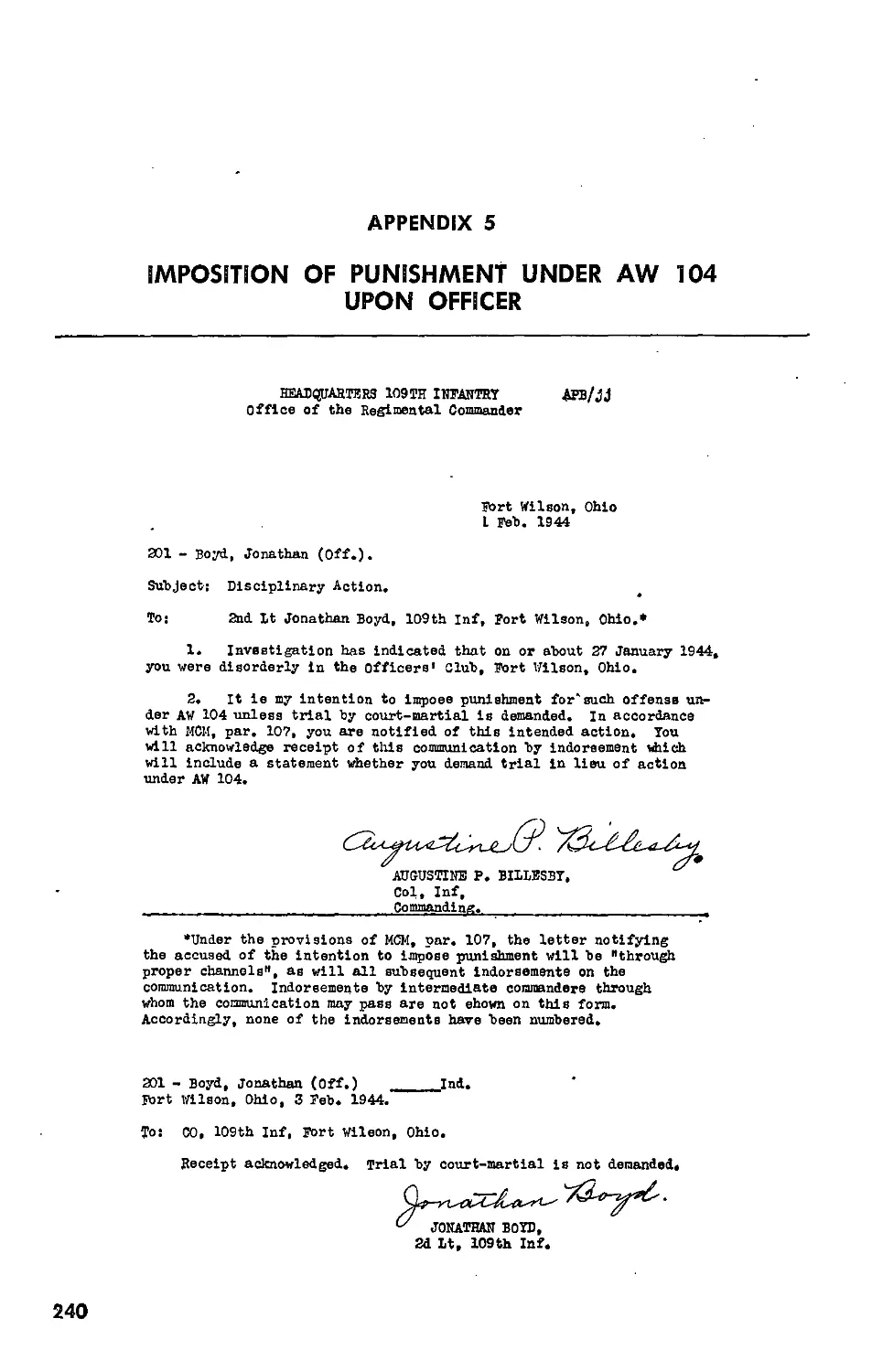
appeal (par. 107, MCM). A form for imposition of company punish-
ment upon an officer is attached. (See app. 5.) Such disciplinary power
is an attribute of command and may not be delegated to any subordinate.
For this reason the commanding officer authorized to impose punishment
under AW 104 must discharge the duty personally and cannot authorize
any other officer to impose the punishment.
16.	RECORDS OF DISCIPLINARY PUNISHMENT. In every case in which
punishment is imposed under AW 104, the immediate commanding officer
of the person punished must make a record of such punishment (par.
109, MCM) noting the offense with date and place of commission, the
punishment which was imposed, the authority who imposed it, the date
the accused received notice of the imposition of punishment, the decision
of higher authority (in case there was an appeal), any mitigation or
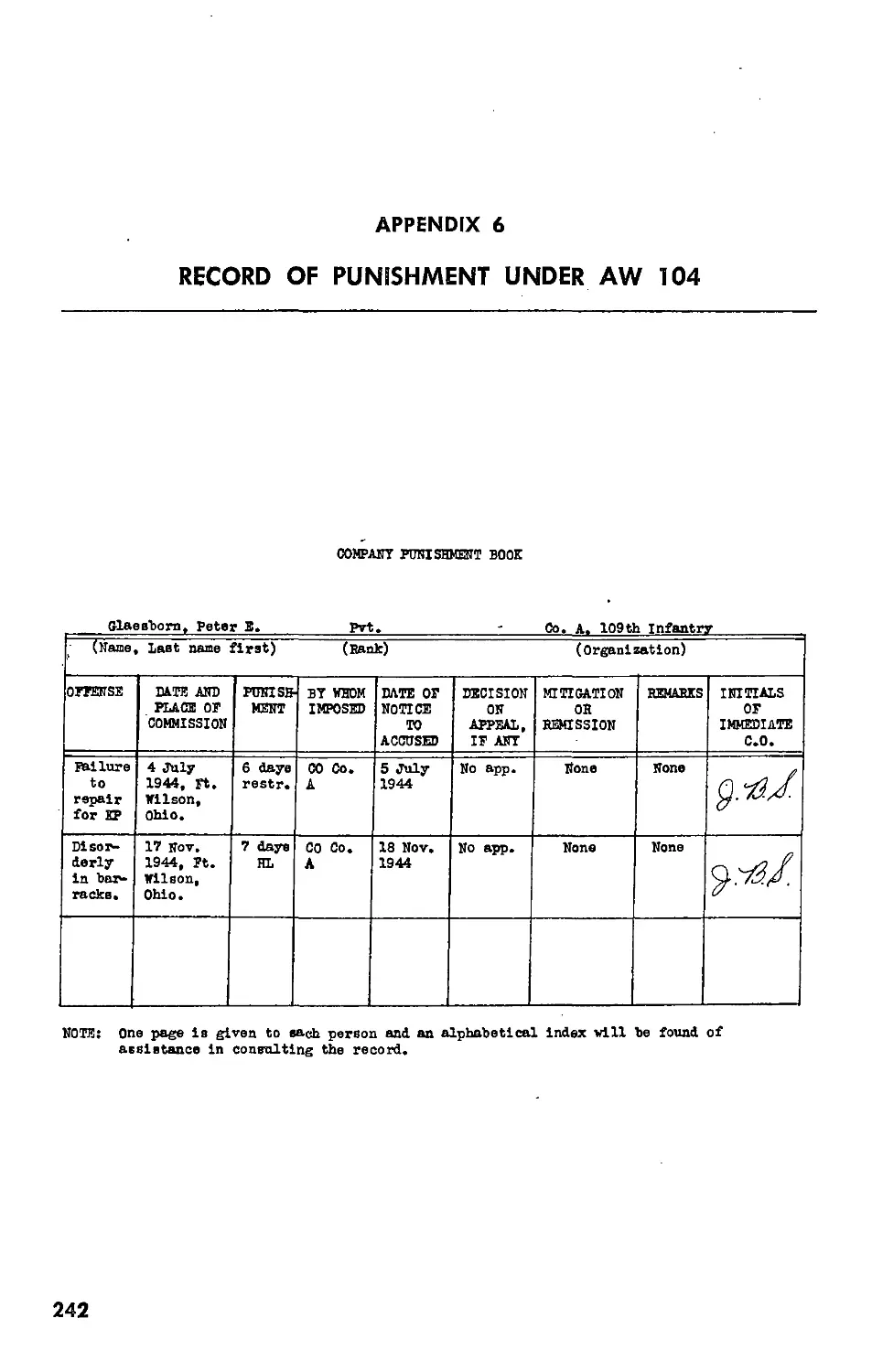
remission of punishment and any additional information desired. No
form for this record is prescribed. It is commonly kept in a punishment
book. A suggested form for such a book is set out in appendix 6. No
entry of such punishment will be made in the service record (par. 47,
TM 12-230) nor will any transcript of the record be furnished or for-
warded in the event of enlisted men’s transfer. In the case of officers,
a copy of the communication imposing the punishment with its indorse-
ments is usually placed in the officer’s 201 file.
17.	EFFECT OF DISCIPLINARY PUNISHMENT, a. In general. The fact
that punishment under AW 104 has been imposed upon a soldier or officer
' may be taken into account by his commanding officer in connection with
other matters affecting him in the future. It is a factor in considering
his fitness for promotion. The fact that the offender has been punished
under AW 104 in the past may be an important consideration in deciding
whether trial by court-martial should be had for a subsequent offense.
The authority acting upon a sentence may well take into account such
prior punishment in determining whether the sentence should be remitted
or mitigated.
b. As a bar to trial. No person under military law may without his
consent be tried twice for the same offense (AW 40). Punishment under
AW 104 is not technically a “trial” within the meaning of this provision.
13
However, the same fundamental principle of fairness which precludes
“double jeopardy” is the basis for the rule set forth in the Manual for
Courts-Martial that punishment under AW 104 will bar a subsequent
trial for the same offense (par. 69c, MCM). Thus, a soldier who has
been properly punished under AW 104 for failure to appear at drill
cannot later be tried by court-martial for the same act. As has been stated
above, only “minor” offenses can properly be punished under AW 104.
There is no power to dispose of a “serious” offense under that article.
If, therefore, disciplinary punishment was in fact imposed for a serious
offense, such punishment would not prevent trial by court-martial for that
offense. Thus, if a soldier were punished under AW 104 for sleeping
on post in violation of AW 86 (a capital offense, which cannot be con-
sidered minor), he could nevertheless be tried by court-martial for that
offense, since his commanding officer had no power at all to dispose of so
serious a transgression by such limited punishment. The offenses which
are minor and properly punishable under AW 104 are described in para-
graph 11, supra. Although the imposition of disciplinary punishment for
a minor offense will bar a later trial by court-martial for the same offense,
it will not bar trial for another crime or offense growing out of the act
which was punished (AW 104; par. 69c, MCM). For example, if a soldier
were punished under AW 104 for reckless driving, that punishment would
not preclude trying him later for manslaughter if his reckless driving had
caused a death (par. 69c, MCM); or if a soldier while drunk struck a
noncommissioned officer, punishment under AW 104 for drunkenness
would not mean that he could not be tried for the assault. If he were so
tried, however, he would be entitled to show at the trial the punishment
he had already received so that the court could consider that fact in
determining its sentence (par. 79c, MCM).
c. As a previous conviction. As noted above, disciplinary action under
AW 104 is not a trial, and an accused who has been so punished has not
been “convicted” of any offense. Records of disciplinary punishment,
therefore, are not previous convictions and may not be introduced in
evidence by the trial judge advocate nor considered by the court against
the accused under the provisions of paragraph 79c, MCM.
14
CHAPTER 4
ARREST AND CONFINEMENT
18. ARREST OR CONFINEMENT BEFORE TRIAL, a. In general. The law
with respect to arrest and confinement pending trial is set out in AW 69,
paragraphs 18 through 23, MCM, and AR 600-355, 17 July 1942. An
outline of the procedural steps to be taken on arrest or confinement is
contained in section XVI, TM 12-255.
b. Necessity and purpose of restraint. If an offense has been committed
for which trial by court-martial is required, the question of imposing
some form of restraint on the accused pending trial must be considered.
The purpose of such restraint is to insure the presence of the accused at
the trial and to prevent him from committing other offenses in the mean-
time. AW 69 provides that when “charged with crime or with a serious
offense” the accused “shall be placed in confinement or arrest as circum-
stances may require” but “shall not ordinarily be placed in confinement”
when charged with a minor offense. It is not mandatory that the accused
be restrained at all pending trial (par. 19, MCM). The necessity for
any restraint must be determined in the light of the offense charged and
the character of the offender. If some restraint is deemed necessary, only
the minimum required under the circumstances should be imposed (par.
19, MCM).
, c. Types of restraint. (1) A person in arrest is restrained within cer-
tain limits, not by physical force, but by his moral and legal obligation
to'obey the order or arrest (par. 139«, MCM). When placed in arrest he
is required to remain within his barracks, quarters, or tent unless larger
bounds, such as the company area, are specified (AW 69).
(2) By confinement the accused is physically restrained (par. 139a,
MCM) either by being imprisoned in a guardhouse or being put under the
control of a guard.
d. Degree of restraint to be imposed. No greater degree of restraint
should be imposed than is required by the circumstances of the particular
case. Unless physical restraint is necessary, an accused should not be
placed in confinement pending trial. Confinement results in loss of man-
power. Not only is the person confined unavailable for duty during his
confinement, but the more soldiers there are in the guardhouse, the greater
the number of guards who must be taken from other duties to control
15
them. For minor offenses restraint in any form may be unnecessary.
For example, there is usually no need to restrain a soldier who voluntarily
returns after a few days’ absence without leave. The fact that he has
returned on his own accord is a good indication of his intention to stay
with his organization. His availability for trial a few days later can
safely be assumed. Arrest or restriction would in any event be futile if
he should decide to run off again. On the other hand, a soldier who breaks
restriction and remains absent without leave until apprehended, probably
requires confinement since his past conduct indicates that only physical
restraint will hold him with his organization. Even a person who com-
mits a serious military offense, such as a sentinel who sleeps on post, is
not necessarily to be confined unless there is some basis for believing that
otherwise he will flee before trial. The question to be decided in each
case is: what restraint, if any, is necessary to insure the presence of the
accused at the trial and to prevent his doing harm to persons or property
in the meantime.
19. WHO MAY ARREST AND CONFINE, a. Enlisted men. (1) Any com-
missioned officer has the power to order an enlisted man into arrest or
confinement (par. 20, MCM). A warrant officer does not have the au-
thority of a commissioned officer to arrest or confine enlisted men, except
when he is assigned and serving as commander of a station or unit.
(2) The commanding officer of any company or detachment may dele-
gate to his noncommissioned officers the power to arrest or confine enlisted
men belonging to his own company or detachment, or enlisted men of
other organizations temporarily in the company’s jurisdiction, if such
restraint is necessary (par. 20, MCM). Thus, for example, the first ser-
geant of a company, or any other noncommissioned officer, may be author-
ized by the company commander to arrest or confine any enlisted man
requiring such restraint who commits offenses in the company area.
b. Officers and warrant officers. A commissioned officer or warrant
officer may be placed in arrest or confinement only by order of a “com-
manding officer” (par. 20, MCM). The term “commanding officer” means
the officer commanding a complete or separate organization or command,
such as a post or regiment, or any lower unit which is “detached.” In
other words, a “commanding officer” is an officer who, under AW 10, has
power to appoint a summary court-martial. (See par. 52a, infra.) For
example, a captain commanding a company would have no power to place
in arrest a lieutenant in the company if the company was serving with and
as part of a regiment. If, however, the company were “detached,” that is,
acting alone and not subject to the immediate disciplinary control of a
superior of the same branch of the service (par. 5&, MCM), such power
would exist. Of course, any authority superior to a “commanding officer”
has similar power to arrest or confine. Thus, a post commander may
arrest, and so may the commanding general of the service command in
16
which the post is located; a regimental commander may arrest, and so
may his superiors, e. g., the division, corps, and Army commanders. A
commanding officer may not delegate to others his power to arrest and
confine officers (par, 20, MCM). The order placing a commissioned
officer or warrant officer in arrest or confinement must be the order of the
commanding officer himself. That does not mean that he personally must
communicate his order to the person arrested. Like any order of a com-
mander, it may be issued through other officers or be communicated to the
person arrested either in writing or orally (par. 20, MCM).
20. PROCEDURE FOR ARRESTING OR CONFINING, a. Preliminary inquiry
into offense. No person should be placed in arrest or confinement unless
the authority so ordering either has personal knowledge of the offense
or has made inquiry into it (par. 19, MCM). The purpose of this require-
ment is to prevent a person being deprived of his liberty on mere suspi-
cion. A full and exhaustive investigation is, of course, not required.
But such investigation should be sufficient to furnish reasonable grounds
for believing that an offense has been committed by the person to be
restrained.
b.	Procedural steps to arrest. An arrest is imposed by notifying the
person to be arrested that he is under arrest and informing him of the
limits of his arrest. The order of arrest may be oral or in writing.
No particular formality is required. It is desirable to explain to him
the meaning of arrest and the penalty which may be imposed if he breaks
his arrest.
c.	Procedural steps to place person in confinement. A person to be
confined is placed under guard and taken to the guardhouse or other
place of confinement. The authority ordering confinement will deliver
to the commander of the guard or prison officer a written statement of
the name, grade, and organization of the prisoner and the Articles of
War which he has violated. (See par. 6a, AR 600-355, 17 July 1942.)
Unless such a written statement is delivered with the prisoner, the com-
mander of the guard may refuse to receive the prisoner (AW 71).
d.	Statements and reports required. When a person is placed in arrest
or confinement, reports must be made of that fact so that proper author-
ities will be sufficiently informed to take proper action.
(1)	. The immediate commanding officer of the person restrained (i. e.,
his company or unit commander) must at once be notified (par. 6c and d,
AR 600-355, 17 July 1942), so that he may take disciplinary action, if
necessary, and make proper entries in the morning report. If the arrest
or confinement was ordered by a person other than an officer, that person
must at once report the fact to his own unit commander who will without
delay notify the unit commander of the person restrained. Thus, a non-
commissioned officer who has placed a soldier from some other organiza-
tion in arrest or confinement would at once inform his own company com-
17
mander, who would without delay notify that soldier’s unit commander.
If arrest or confinement was ordered by an officer, he will himself notify
directly the unit commander of the person restrained. Thus, a lieutenant
who placed a soldier in confinement would himself report such confinement
to the soldier’s unit commander.
(2)	If an officer is placed in arrest or confinement without, at the same
time, charges being preferred against him, a written report must be made
to4he officer having general court-martial jurisdiction. (See par. 6&,
AR 600-355, 17 July 1942.) Thus, a regimental commander who placed
one of his officers in arrest without preferring charges would be required
to make a written report to the commanding general of the division; a
post commander would make such report to the commanding general of
the service command.
(3)	If a person is placed in confinement, the commander of the guard
(i. e., the officer of the day or other officer in direct control of the guard-
house) within 24 hours after such confinement, or as soon as he is relieved
from his guard, must report to the commanding officer the name of the
prisoner, the offense charged against him, and the name of the officer who
ordered the confinement (AW 72; par. 14a, AR 600-375, 17 May 1943).
Thus, if a company commander caused an accused to be confined in the
post guardhouse, the prisoner officer (or the officer of the day) would be
obliged to make the report to the post commander within 24 hours after
confinement. The post commander must then see that proper steps are
taken to have the prisoner promptly tried or released. (See AW 70.)
21.	STATUS OF PERSON IN ARREST OR CONFINEMENT, a. Status of
arrest. A person in arrest is restricted to his barracks, quarters, or tent
or such larger limits as may have been specified in the order of arrest
(AW 69). A change of status from duty to arrest having occurred, an
entry to that effect will be made in the morning report. (See par. 20,
AR 345-400, 3 January 1945.) He cannot, if he is to remain in that
status, be required to perform his full military duty, since placing him
on duty terminates his arrest. This, however, does not prevent his being
required to do ordinary cleaning or policing up about his quarters. He
is furthermore subject to the restrictions provided in paragraph 7, AR
600-355, 17 July 1942, such as inability to bear arms or to exercise com- -
mand of any kind. If he breaks his arrest by going beyond the prescribed
limits, he is subject to trial (AW 69) and, if he is a commissioned officer,
may suffer the penalty of dismissal for such offense.
b. Status of confinement prior to trial. A person who is confined pend-
ing trial is a “garrison prisoner” and subject to the provisions of AR
600-375, 17 May 1943, with respect to treatment, discipline, and employ-
ment. If he is a private or private first class, he will perform such hard
labor and military duties as are prescribed in paragraph 20&, AR 600-375,
17 May 1943. If he is of higher rank, he will not be required to perform
18
military duties or hard labor while detained, except necessary policing
of quarters and employment in the mess appropriate to his grade. (See
par. 20(<Z) (2), AR 600-3.75,17 May 1943.)
22.	DURATION AND TERMINATION OF ARREST AND CONFINEMENT.
When a person is placed in arrest or confinement, immediate steps must
be taken either to bring him to frial or to release him (AW 70; par. 26,
MCM). The law, however, does not prescribe any definite time limit
within which he must be released if charges are not preferred. Normally
charges can and should be preferred promptly, within at least 48 hours
after the accused is restrained. The accused is not automatically released
from restraint, however, because of delay in preferring the charges.
He must remain in arrest or confinement until released by proper author-
ity. The proper authority to release the accused from arrest is normally
the officer who imposed the arrest. Thus, a commissioned officer or
warrant officer would be released from arrest by order of the commanding
officer who had arrested him. An enlisted man will usually be released
from arrest by his own unit commander. The proper authority to order
release from confinement is the commanding officer to whose command the
guardhouse or prison is subject. Thus, a prisoner confined in a post
guardhouse would be ordered released by the post commander; a prisoner
in a regimental guardhouse by the regimental commander. Once the
prisoner is turned over to the guard, he passes beyond the control of the
officer who initially ordered him confined—unless such officer is the
“commanding officer” described above—and such officer is not a proper
authority to order his release (par. 140a, MCM). The release of a
prisoner without proper authority is. a punishable offense (AW 73).
632260°—15-
з
19
CHAPTER 5
PREFERRING CHARGES
23.	CHARGES IN GENERAL, a. Definitions. If, because of the seriousness
of the offense, trial by court-martial is required, charges must be pre-
ferred—i. e., there must be a formal accusation, just as in state and
federal courts a defendant is brought to trial on an indictment. or
complaint. The charges consist of two parts, the technical “charge”
which is a statement of the Article of War violated, and the “specifica-
tion” which is a statement of facts and circumstances constituting that
violation (par. 24, MCM). Charges are “preferred” by preparing a
charge sheet (WD, AGO Form 115) and submitting it to the officer
exercising court-martial jurisdiction. See appendices 2, 3, and 4, for
forms of completed charge sheets.
b.	By whom charges preferred. Ordinarily, the immediate command-
ing officer of the accused (i. e., the company or unit commander) will
himself prefer charges or cause them to be preferred. Charges, however,
may be preferred by others. Any person subject to military law—
another officer, an enlisted man, or even a prisoner—has the legal right
to prefer charges (par. 25, MCM). It is ordinarily preferable, however,
for one who claims that an offense has been committed to inform the
immediate commanding officer of the accused of the alleged offense and
let him take such action as he deems necessary. Charges cannot be pre-
ferred by any one who is not subject to military law, although such a
person may bring to the attention of military authorities a supposed
offense. The person who prefers charges is known as the “accuser.”
(par. 60, MCM).
c.	Necessity for inquiry before preferring charges. In the absence of
his own personal knowledge, the accuser must make some inquiry into
the alleged offenses in order to avoid the preferring of charges on the
basis of mere frivolous or malicious accusations, or inaccurate informa-
tion. Some investigation frequently is necessary to determine just what
offense. The person who prefers charges is known as the “accuser”
that a report of an assault and battery was not accurate, and that the
offender should be charged instead with being drunk and disorderly. The
accuser should be sure that there is evidence of all elements of the offense,
and should know from what witnesses or other sources such evidence
20
can be obtained. This does not mean that in each case he must make
an exhaustive investigation or even interview all possible witnesses.
The extent of the inquiry will depend upon the seriousness of the offense,
the existence , of unusual circumstances, the extent of the accuser’s personal
knowledge of the facts, or the credibility of the original complaint he
receives. In preferring charges the accuser must take an oath that he
either has personal knowledge of, or has investigated, the matters stated
in the specifications (par. 31, MCM; also Affidavit, WO, AGO Form
115). To avoid swearing falsely, he must at least have made sufficient
inquiry into the offense to justify a reasonable belief that the accused
committed it.
d.	Promptness in preferring charges. Undue delay in preferring
charges not only is an injustice to the accused, but has an adverse effect
upon the discipline of the command. Although no definite time limit
for preferring charges is set by law or regulation, in the ordinary case
they should be preferred within 48 hours after the offense is discovered.
Promptness is particularly necessary if the accused is in arrest or con-
finement, since AW 70 requires that “immediate steps” be taken either
to try or to release a person who is thus restrained. The accumulation
of charges, that is, allowing various unrelated offenses to pass without
taking any disciplinary action and then preferring charges for such
past offenses if the accused is later guilty of further misconduct, is an
improper practice. If an offense warrants punishment at all, punishment
should be imposed at once. Punishment long after an offense has oc-
curred hurts rather than helps the discipline of the command.
e.	Additional charges. After charges originally are preferred, but
before the accused is brought to trial, other offenses by the accused may
be brought to light. Such offenses may have occurred before the prepara-
tion of the charge sheet, but were not known at that time to the accuser,
or, as is more frequently the case, they may be committed after the
original charges.were preferred, as, for example, a breach of arrest or
escape from confinement while the accused was awaiting trial. Charges
for such offenses should be tried at the same time as the original charges.
They are known as “additional charges.” They should be preferred
separately on a charge sheet designated “additional charges,” and for-
warded for disposition in conjunction with the original charges. If they
are added to the original charge sheet, the affidavit should be amended
to show the accuser’s knowledge or investigation of the additional charges
and specifications. Since the additional charges also must be sworn to
by the accuser, the date of the affidavit should be changed, if necessary,
so that it will not be prior to the date of the offense alleged in the
additional charges.
24.	SELECTION OF CHARGE, a. General. The first step in preferring
charges is to determine the offense or offenses with which the accused
21
should be charged. That requires an analysis of the facts and a study
of the pertinent paragraphs of the Manual for Courts-Martial dealing
with the elements of proof of various offenses (ch. XXVI, MCM). In the
case of Private Lennie O. Bark (app. 2), for example, Lieutenant Loganby,
his company commander, before starting to prepare the charge sheet, first
considered what offense Bark committed by deliberately refusing to obey
his order to go out to drill. Turning to the Index of the Manual for
Courts-Martial under the heading “Disobedience of Orders,” he found
that the offense of willful disobedience in violation of AW 64 was dealt
with in paragraph 134&. From the discussion in that paragraph he re-
alized that to constitute willful disobedience there must be an intentional
defiance of authority, not mere heedless failure to obey, or nonperformance
of a mere routine duty. Checking the elements of proof, he concluded
that in this case the offense was committed. Accordingly, he decided to
charge willful disobedience in violation of AW 64. Had the facts been
different and Bark’s disobedience been due to mere neglect, or had the
order been a standing order, then he would have decided to charge the
offense of failure to obey in violation of AW 96. In the Bark case the
selection of the appropriate offense was not difficult. Often there is more
doubt as to what offense the accused has committed. For example, wrong-
ful taking and use of property must be distinguished from larceny. To
be guilty of larceny, the taker must have an intention permanently to
deprive the owner of his rights in the property taken. One who takes a
vehicle for a short “joy ride” without permission from the owner has not
committed larceny if the taking is not accompanied with the intent to
permanently deprive the owner thereof. Such cases should be charged
as wrongful taking and using either under AW 96 if a civilian vehicle, or
under AW 94 if a Government vehicle, rather than as larceny under AW
93. If, after careful study of the facts and the Manual for Courts-Martial,
uncertainty still remains, it is well to consult the staff judge advocate, if
possible, before drafting charges.
b.	Multiplication of charges. When an offender has committed several
violations of the Articles of War, either by a single act or by acts connected
with one incident, there may be a temptation to “throw the book at him”—
that is to charge him with every violation, serious or petty, of which he is
technically guilty. Such a practice of multiplication of charges is to be
avoided (par. 27, MCM). Numerous charges and specifications increase
the difficulty of investigation, trial and action on the record. Moreover,
the amount of punishment is not increased by charging several different
offenses arising out of a single act, since punishment may be imposed with
respect to the act in its most serious aspect only. (See par. 80a, MCM.)
c.	Combining charges of serious and minor offenses. If a serious offense
is charged, charges of minor offenses should not generally be added. (See
par. 27, MCM.) Thus, to a charge of burglary, there should not be joined
a charge of being drunk in quarters; to the charge of sleeping on post,
22
there should not be added a charge of failure to repair for reveille. The
possible additional punishment for the minor offense is inconsequential,
and the additional charge is a nuisance at the trial and detracts from the
important charge. However, if the minor offense serves to explain the
circumstances of the greater offense, it is proper to charge both. For
example, if the accused stole $50 from the footlocker of another soldier
after having lost heavily in a poker game, the charge of gambling in
camp in violation of orders could properly be added to the more serious
offense of larceny, since the former explains the motive for the larceny.
d.	Joint charges. A joint offense is one committed by two or more
persons acting together in pursuance of a common intent. If, for example,
soldiers A and В plan to rob a service station, and pursuant to that plan A
holds up the proprietor with a gun while В removes money from the till,
a joint offense of robbery has been committed. Anyone who aids, abets,
or assists another in the commission of an offense is as much a principal as
the chief offender, e. g., the driver of a getaway car as well as those remov-
ing the money at the point of a gun, would be guilty of robbery. Joint
offenders may be charged either separately or jointly—that is, a single
charge may be made against all (par. 27, MCM). The advantage of a
joint charge is that all the accused will be tried together at one trial, thus
saving time, labor and expense. This must be weighed against possible
unfairness to the accused which may. result if their defenses are incon-
sistent or if evidence against one would seriously prejudice another. As
to some offenses which can be committed only by two or more acting to-
gether, such as mutiny, riot, or conspiracy, the charges should almost
always be joint. As to others, such as robbery or assault committed by
two or more, the question is one of the most convenient method of trial.
There are offenses which can never be joint, such as absence without leave,
desertion, or drunkenness (par. 27, MCM). Such offenses cannot be
jointly charged.
25.	DRAFTING CHARGES AND SPECIFICATIONS, a. The charge. The
offense or offenses to be charged having been determined, the next step
is to draft the charges and specifications. The charge is simply a state-
ment of the Article of War which was violated (par. 28, MCM). In
deciding what offense to charge, the accuser necessarily will have con-
cluded what the proper Article of War is. No matter how many offenses
an accused commits, if they are all violations of a single Article of War,
there will be only one charge. For example, AW 93 covers,/ among other
things, the offenses of arson, burglary, perjury, forgery and assault with
intent to do bodily harm. If an accused committed each one of those
offenses, he would have violated only one Article of War. Accordingly,
in charging him with those five offenses there would be one charge—
violation of AW 93—and five specifications, each setting out a. separate
offense. On the other hand, if the accused committed the offense of
23
larceny and also deserted the service, he would have violated two Articles
of War, i. e., AW 93 by larceny and AW 58 by deserting. In charging
him, therefore, there would be two charges with one specification under
each. Designation of the wrong Article of War in a charge is not fatal,
provided that the specification sets out an offense (par. 28, MCM).
b.	Specifications, in general. In drafting the specification, the accuser
should see appendix 4, Manual for Courts-Martial, for the appropriate
form. There he will find 167 forms for specifications covering almost
every offense. The specification for willful disobedience in violation of
AW 64, for example, is covered in Form 28. If there is a specification for
the offense he wants to charge, as there will be in ninety-nine cases out
of one hundred, he should copy that specification exactly. Any attempts
to improve on the form or add new flourishes may result in failure to
charge any offense. In the rare case where there is no form exactly
covering the offense he wants to charge, the form for the offense which
seems most like it should be followed as a guide. For example, there
is no form for a specification charging involuntary manslaughter—i. e.,
the unintentional killing of a human being through culpable negligence.
To allege that offense, the specification for voluntary manslaughter
(Form 88) should be adapted by omitting the words “willfully, feloniously,
and.” In some cases there may be no form which even seems close to the
offense to be charged. Then the accuser must make up his own. He should
state clearly and concisely just what the accused did. In drawing up a
new specification, care must be taken to show that the acts done by the
accused were unlawful by stating that he did the acts “unlawfully” or
“wrongfully,” otherwise no offense may be stated. For example, an alle-
gation that the accused “took and carried away” the property of another
person does not set out an offense since he may have had permission to
take it or have done so under orders from a superior. If, however, it is
stated that he took it “wrongfully” or “unlawfully,” it is clear that an
offense was committed. Forms of specifications for wrongful taking and
conversion of property of another are set out in appendix 7. Before
drafting the specification, the Instructions, appendix 4, pp. 236-238,
Manual for Courts-Martial, should be studied. They contain detailed
information as to the method for completing the forms. Other particular
matters to be observed in drafting specifications are discussed below.
c.	Abbreviations. Abbreviations should not be used in specifications.
Grades, organizations and months should be written out in full. How-
ever, the numerical designation of the organization should be set out in
figures instead of words—e. g., “341st Field Artillery Battalion” or “IX
Armored Corps”—except where the official designation of the organiza-
tion is always written out as in the case of an Army, an Air Force, or a
Service Command—e. g., “Third Army,” “First Air Force,” “Fourth
Service Command.” (See par. 6, AU 220-5,16 December 1944.)
24
d.	Serial numbers. The serial number of the accused should not appear
in specifications (par. a, app. 4, MCM).
e.	Description of persons. The accused should be described by name,
rank and organization only. If a civilian, appropriate descriptive words
showing jurisdiction should be added after his name, such as “a person
accompanying the armies of the United States in the field” (par. c, app.
4, MCM). Other persons mentioned in the specification may be identi-
fied by name and rank only, if military personnel, and by name only,
if civilians.
f.	Dates. Dates should be alleged as “on or about” a certain date.
The hour of the day at which the offense is alleged to have occurred
should not usually be stated. In charging absence without leave for a
brief period during one calendar day, however, the hours of departure
and return may be stated, if known.
g.	Details. Although a specification must describe the offense charged
so that it reasonably refers to that specific offense and no other, it should
not allege details unnecessary for that purpose. Since details alleged
must be proved, elaborate specifications unduly increase difficulties of
proof. It is not ordinarily proper to allege the street address where
the offense occurred, or to recite the occupation, residence, or station of
persons, or detailed descriptions of articles. For example, a specification
alleging that the accused did “at Cheyenne, Wyoming, on or about 15
November 1943, feloniously take, steal and carry away a Chevrolet
automobile, value about $375, the property of George R. Crowe” would
be sufficient.
h.	Value. In order to be the subject of a larceny, the thing stolen
must be of some value. The articles alleged to have been stolen and
the value of each should be stated. For example, an allegation that the
accused stole “clothing and equipment of a total value of $____________” is
improper; it should be stated as “one shirt, value $________, one pair of
shoes, value $_______, and one blanket, value $_________, of a total value
of $_______.” Value of articles should be stated as “value $2.08”
(when known exactly, e. g., per Government price list), or “value about
$5” (the usual form). If money itself is involved (e. g., when money is
alleged to have been stolen), it should be described as “about $3.50, lawful
money of the United States.”
i.	Several larcenies. When several articles appear to have been stolen
at about the same time and place, from either one or several persons,
as when a thief enters a barracks at night and steals articles from
several foot lockers, the larceny of all of them should be alleged in a
single specification (pars. 27, 149<?, MCM). If, however, there were
several unrelated larcenies committed at different times, each should be
set out in a separate specification.
25
j.	Examples of correct and incorrect drafting. The following example
illustrates the errors most commonly made in the drafting of
specifications:
Specification: In that Pvt. Arthur N. Beadle, 38432987, Co. C, 118th
Inf., Ft. Sam Houston, Tex., did, at Ft. Sam Houston, Tex., on or
about March 20th, 1943, take, steal, and carry away one billfold,
black leather, value two dollars ($2.00), containing three dollars and
fifty cents ($3.'5'0) in currency, and personal papers, all the property
of Pvt. Lester P. Wake, Co. B, 118th Inf., Ft. Sam Houston, Tex.
Under the rules set out above, the foregoing specification should read as
follows:
Specification: In that Private Arthur N. Beadle, Company C, 118th
Infantry, did, at Fort Sam Houston, Texas, on or about 20 March
1943, feloniously take, steal and carry away one billfold, value
about $2, and about $3.50, lawful money of the United States, of a
total value of $5.50, the property of Private Lester P. Wake.
k.	Numbering charges and specifications. When there is but a single
charge—that is, when a violation of only one Article of War is alleged—
the charge is not numbered. When there is more than one, however,
the charges are to be numbered with Roman numerals—i. e., Charge I,
Charge II, etc. Similarly, if there is but one specification under a par-
ticular charge, it should not be numbered. But if more than one speci-
fication is alleged under one Charge, they are designated by Arabic
numerals—i. e., Specification 1, Specification 2 (app. 4&, MCM). Ad-
ditional charges (par. 23c, supra) are numbered in the same manner as
the original charge; a single added charge is. designated simply “Ad-
ditional Charge,” but if more than one, they are numbered Additional
Charge I, Additional Charge II, etc. Specifications under additional
charges are designated in the same way as ordinary specifications. The
term “Additional” is not used in connection with the specifications.
26.	PREPARATION OF CHARGE SHEET, a. General. Having drafted
the charges and specifications, the accuser must then prepare the charge
sheet in triplicate. The first page consists largely of personal data re-
garding the accused and a list of witnesses and of records or other articles
to be used as evidence. The instructions on the charge sheet (WD AGO
Form 115) should be carefully followed. Attention should be given to
the matters noted below.
b.	Name, etc., of accused. The instructions on page 1 as to the name
of the accused state “Give last name, first name, and middle initial in
that order followed by serial number, grade, company, regiment, arm
or service, or by other appropriate description of accused.” It will be
noted that the method of stating the name is the reverse of that used in
the specification. It will be noted also that the serial number must be
stated, whereas it is never set out in the specification. Great care must
26
be taken to set out this data correctly since an error may cause the
wrong person to be charged. If the accused is not a member of a mili-
tary organization or of any arm or service, such as a civilian accompany-
ing the Army, the “appropriate description” following his name would
be words indicating what he was and that he Was subject to military law.
c.	Age of accused. It is preferable to state the age of the accused in
years and months as of the date of preferring charges (e. g., 25 8/12).
The word “present” should be inserted over the age.
d.	Pay of accused. Pay of the accused will be base pay only. “Base
pay” includes the increase for longevity and for foreign service. (See
par. 124d, infra.) The amount of any compulsory deduction from an
enlisted man’s pay under the Servicemen’s Dependents Allowance. Act
should be entered in the space “Allotments to Dependents” and indicated
as “Class F.” (See par. 39, AR 35-5540, 5 January 1944.) This space
is also used for entering the amount of any voluntary allotment for the
benefit of dependents. Deductions for National Service Life Insurance
are to be entered in the space designated “Government Insurance De-
duction.” Other allotments should not be entered on the charge sheet.
e.	Service of accused. Prior service should be shown under this head-
ing with the inclusive dates of such service, organizations from which
discharged, and the total length of such service in years, months, and
days. If the accused had no prior service, the statement “no prior
service” should be made. After such entry, current service should be
shown. In the case of enlisted men, this should include a statement as
to the place and date of enlistment or induction and of the term of enlist-
ment, which now is “for the duration of the war and 6 months.” In the
case of officers, this should include a statement of the date of original
commission and dates of entry upon present active duty.
f.	Data as to witnesses, etc. In this space should be listed the names
and addresses of witnesses under tK^headings “Against the Accused”
and “For the Accused.” If there are no witnesses for the accused, the
word “None” should be entered under the latter heading. If the wit-
nesses are in military service, their grade, organization, and station should
be shown—e. g., “Corporal Arthur T. Bickle, Battery B, 741st Coast
Artillery Battalion, Fort Dawes, Maine.” Under the heading “Docu-
mentary and Other Evidence” there should be listed any papers, docu-
ments, or other articles or things—e. g., a knife, currency, etc.—which
may be introduced in evidence. If there is no such evidence, the word
“None” should be entered under that heading. The record of previous
convictions (par. 29, infra) should not be referred to on the charge sheet.
g.	Data as to restraint of the accused. The type, place and date of any
restraint imposed should be stated. If the accused was initially placed
in arrest or confinement elsewhere by military or civil authorities, the
date and place of such initial restraint should also be shown. If no
restraint was imposed, this fact should be indicated.
27
27.	PREPARING JOINT CHARGES. In preparing joint charges, page 1
of the charge sheet should be filled in as to one accused in the ordinary
way. (See par. 26, supra.) The personal data as to the other accused
should be filled in on page 1 of another charge sheet—the page cut off
immediately above “Data as to witnesses, etc.” It is usually unnecessary
to fill out the entire first page as to the other accused since the data as to
witnesses and restraint will nearly always be the same for all. Securely
fasten the cut page to the top of page 1 of the first charge sheet. Forms
for specifications for joint offenses may be found in Appendix 4/, p. 237,
MCM. In using these forms it must be noted that an allegation “that
Private A and Private B, acting jointly and in pursuance of a common
intent, did, in conjunction with Private C” do a certain act, does not state
an offense against Private <7, but does charge a joint offense against A
and B.
28.	SIGNING AND SWEARING TO CHARGES. After he has prepared the
charge sheet, the accuser will sign the same on the original on page 3 and
swear to it before a person authorized to administer oaths. Ordinarily
the copies need not be signed. The charges may be sworn to before any
of the officers authorized by AW 114 to administer oaths. The notes in
fine print appearing at the end of the affidavit should be strictly followed.
It must appear that the accuser either has personal knowledge of, or has
investigated, each matter made the subject of charges. The inapplicable
words should be stricken from the affidavit. If the accuser has personal
knowledge of certain specifications and charges and has investigated
others, nothing need be stricken. Care should be taken to insure that the
affidavit on the charge sheet shows the date of its execution and the name,
rank, branch and capacity (i. e., Adjutant, Summary Court, etc.) of the
officer administering the oath. Unless it appears that the officer was one
who could administer oaths, it may be contended that the charges were
not sworn to. If the accuser believes the accused is innocent, but feels
that he should be tried for his own protection—that is, in order to have
judicial determination of his innocence—he need not swear to the charges.
Such a case would be one in which, for example, a sentinel in the perform-
ance of his duty killed an intruder and it was desired to try him for
homicide so that the lawfulness of the killing might be established. An
accused, however, may not be tried upon unsworn charges if he objects
par. 31, MCM).
29.	EVIDENCE OF PREVIOUS CONVICTIONS, a. General. When for-
warded, the charges should be accompanied by evidence of previous
convictions, (par. 34, MCM). This may be considered in deciding what
disposition to make of the charges, but is primarily for use by the court
(if the case is referred for trial) in determining the amount of the
sentence (par. 80a, MCM). The evidence is usually in the form of an
28
extract copy of the pertinent entries in the accused’s service record
(app. 2, par. 216 infra) showing the date and nature of the offense, the
sentence imposed, and the fact of approval. The extract must be authen-
ticated by the official custodian of the service record, who ordinarily is the
unit personnel officer.
b. Convictions which should be included. The evidence of previous
convictions should be in such form that it can be introduced at the trial.
Therefore, only convictions which can be considered by the court should
be included. Disciplinary punishment under the 104th Article of War
is not a conviction, and no reference thereto should be made. The
Convictions must be^convictions by courts-martial. Such previous convic-
tions may be considered by the court only if they meet two conditions:
(1) they must be for offenses which were committed during the accused’s
current enlistment (if an enlisted man) or current appointment (if an
officer); and (2) they must be for offenses which were committed within
1 year of the offense being charged (if an enlisted man) or within 3 years
of the offense being charged (if an officer). Thus, if a soldier is tried
on 7 July 1944 for an offense committed on 1 July 1944, only convictions
for offenses committed within 1 year before 1 July 1944 would be admis-
sible—i. e., offenses committed on or after 1 July 1943. Therefore, a
conviction for an offense committed on 29 June 1943 would not be admis-
sible and should not be included in the certificate of previous convictions.
In computing the 1 year, periods of absence without leave for which
the accused was convicted should be excluded (par. 79c, MCM). Thus,
in the example given above, if the accused had been convicted of absence
.without leave from 1 September 1943 to 1 October 1943, that period of 30
days would not be counted in computing back 1 year from 1 July 1944.
One year from 1 July 1944 (excluding that 30-day period) would be
1 June 1943. Therefore, any offense committed on or after 1 June 1943
would be admissible, and the conviction for the offense committed on
29 June 1943 should be included in the certificate in such case. Periods
of absence without leave are excluded only if the accused was convicted
of such absence. Disciplinary punishment under AW 104 for such
absence is not a conviction. Thus, if, in the example last given, the
accused had in fact been absent without leave from 1 September 1943
to 1 October 1943 but had not been convicted of such absence, the 30-day
period would not be excluded. Nor are periods during which the accused
was not in a duty status during the one year for other reasons (as, for
example, periods in confinement or in a hospital for treatment for vene-
real disease) to be excluded. The only periods which may be discounted
are periods of unauthorized absences for which the accused was convicted.
c. Where no admissible previous convictions. If the accused has no
admissible previous convictions, a certificate that there are no admissible
convictions should be forwarded. Although, if no evidence of convic-
tions is forwarded with the record, it may properly be assumed that
29
there are none which can be considered, it is better to have an express
certificate of that fact. Then there can be no question of merely forget-
ting to forward evidence of convictions if there are any.
30.	STATEMENT OF EVIDENCE UPON WHICH CHARGES BASED. Unless
the accuser believes that the charges will be disposed of under AW 104
or by reference to a summary court, he should prepare a summary of
the evidence upon which the charges are based. This summary is in-
tended to give the commanding officer sufficient information about the
case so that he can decide how to dispose of it, and to guide the investi-
gating officer if the charges are later formally investigated. The sum-
mary may be in any convenient form. (See app. 2, pp. 180-185 infra.)
The signatures of witnesses to the summaries of their respective testimony
should be obtained when practicable and'when no undue delay will result
(par. 32, MCM). If, for any reason, it is desirable to make a more com-
plete statement of the testimony of any witness (for example, if it may be
difficult for the investigating officer to interview him later, or if the
accused will probably not desire to cross-examine him, or if there is a
possibility that he may be tampered with before the investigation), the
substance of his testimony, stated in the first person, should be signed
and sworn to by him. Each such sworn statement should be entered
on a separate sheet of plain paper for possible attachment to the investi-
gating offijcer’s report.
31.	LETTER OF TRANSMITTAL. Charges not disposed of under the pro-
visions of AW 104 should be forwarded by letter of transmittal unless
the accuser believes that they should be referred to a summary court-
martial. The letter may be very brief, and a mimeographed form may
be used. (See app. 2, p. 175 infra.) It should contain a specific recom-
mendation as to disposition of the charges. An explanation of any unusual
features of the case or a statement as to the character of service of the ac-
cused may be included. Any documentary evidence that may be used in
proof of the offense should be listed in the body of the letter and should
normally be forwarded with the charges. (Par. 32, MCM.) Any articles
which may be introduced in evidence should be referred to with a state-
ment as to where they may be found. Other papers submitted with the
charges (such as prior correspondence) should be listed separately as
inclosures. If it is believed that trial should be had by summary court-
martial, charges may be submitted without a letter of transmittal or any
accompanying papers other than the certificate of previous convictions.
Such forwarding will be considered a recommendation for trial by
summary court.
32.	SUBMISSION OF CHARGES TO IMMEDIATE COMMANDER OF ACCUSED.
If a person other than the immediate commander of the accused prefers
charges, he ordinarily should submit them to such commander for action.
30
(Par. 30, MCM.) That officer is the one primarily concerned with the
discipline of the accused and is in the best position to know of any per-
sonal elements that should be considered in determining what dispo-
sition to make of the charges. The accuser, moreover, may not have
available the personal data regarding the accused which must be shown
in the charge sheet, and the immediate commanding officer can supply
the necessary information. Upon receipt of the charges, the immediate
commander will take action in accordance with paragraph 33, MCM.
If any of the offenses alleged may properly be punished by action under
AW 104, he should so dispose of them, and line out and initial the speci-
fications and charges thus disposed of. Charges not so disposed of
should be carefully examined to insure that they are complete and correct
in form and properly signed and sworn to by a person subject to military
law, and that the accuser’s summary of evidence is sufficient. Any miss-
ing personal data on the first page of the charge sheet should be inserted
and any errors corrected. No corrections or changes may be made in
the charges or specifications themselves.
33.	FORWARDING CHARGES. Charges which the immediate command-
ing officer of the accused has preferred himself, and charges submitted
to him by others which he has not disposed of under AW 104, will be
forwarded by him directly to the officer who has authority to appoint
summary court-martial for the command (par. 30a, MCM), e. g., the
regimental or post commander. (See par. 52, infra, for a discussion
of the commanders having such authority.) The charges will be for-
warded by letter of transmittal (excfept where trial by summary court-
martial is recommended), inclosing the summary of evidence, certificate
of previous convictions, and any other pertinent memoranda discussed
in the preceding paragraphs.
31
CHAPTER 6
ACTION UPON CHARGES
34.	IN GENERAL. The charges and allied papers are forwarded to the
officer exercising summary court-martial jurisdiction over the organiza-
tion—for example, the regimental or post commander—who will be
referred to in this chapter as the “commanding officer.” It is his task to
see than the charges are properly disposed of. The various types of
action he can take are discussed in the following paragraphs.
35.	DISMISSAL OF CHARGES AND ACTION UNDER AW .104. a. Dismissal.
Upon examination of the charges, he may decide that all or some of them
do not warrant further action because they are trivial, do not constitute
any offense or because there are sound reasons for not punishing the ac-
cused for such offenses. If so, he may dismiss all or part of the charges.
If he wishes to dismiss all of the charges, he normally will return the
charge sheet and allied papers to the accuser by indorsement on the letter
of transmittal (if any) or by separate communication, stating that no
action appears warranted. If he wishes to dismiss only some of the speci-
fications or charges, he will draw lines through such specifications or
charges and initial them.
b.	Action under AW 104. He has the same obligation and authority
as the immediate commanding officer of the accused to make use of dis-
ciplinary punishment under AW 104 if such punishment is appropriate.
If, therefore, any of the offenses charged are “minor” offenses which can
be adequately punished under that article, he will, unless trial is demanded,
line out the specification or charge alleging that offense and have appro-
priate disciplinary punishment imposed. Although he may himself im-
pose the punishment, normally the matter should be referred back to the
immediate commanding officer of the accused for action. The procedure
to be followed in imposing disciplinary punishment under AW 104 is dis-
cussed in chapter 3, supra. Of course, if the accused demands trial, dis-
ciplinary punishment cannot be imposed. In such case the charge must
be either dismissed or tried.
c.	Renumbering of charges and specifications. Where some charges
and specifications are dismissed or disposed of under AW 104, the remain-
ing charges and specifications may require renumbering. Thus, if there
32
were two charges, with one specification under Charge I and three speci-
fications under Charge II, and the commanding officer struck out Charge I
and its specification and also Specification 1 of Charge II, all that would
be left would be a single charge with two specifications under it. There-
fore, the numeral II should be stricken out after the Charge and the
specifications should be renumbered 1 and 2. In such case it would be
necessary to change the numerical designations of the charge and specifi-
cations appearing in the affidavit on the charge sheet to correspond to this
renumbering.
36.	MAKING CHANGES AND CORRECTIONS IN CHARGES. If the com-
manding officer decides that trial by court-martial is necessary on all or
some of the charges, he should, before referring them to trial, have the
charges carefully examined to determine that they are properly signed
and sworn to, free from defects of form or substance, and that they prop-
erly set out an offense under the Article of War alleged. If any errors or
omissions are discovered in the charge sheet or allied papers, relating to
formal matters, such as data as to service, previous convictions, etc., cor-
rections should be made or the missing data supplied. If the charges and
specifications themselves contain obvious errors, corrections may be made,
or the charges and specifications may be redrafted without sending the
charges back to the accuser, provided that the correction or redraft does
not involve any substantial change or include matters not already fairly
included. Where corrections or changes are made, they must be initialed
by the officer making them. If a specification sets out all the elements
of the offense, but is carelessly drawn, its wording can be changed to
conform to the appropriate form in appendix 4, MCM. Or if, for ex-
ample, a specification and charge allege larceny in violation of AW 93,
the specification can be redrafted to allege wrongful taking, and the charge
changed to allege a violation of AW 96, since that offense is fairly in-
cluded in the original charge. This change can be made by striking out
the necessary words and figures and substituting new ones, or by retyping
the entire specification and charge. However, the specification could not
be redrafted over the accuser’s signature to allege larceny of different or
additional property, or to charge embezzlement rather than larceny.
Such redrafting would result in charging new matters to which the
accuser has never sworn. If such a change is necessary, new charges must
be prepared and signed and sworn to either by the original accuser or
some other authorized person.
37.	REFERENCE TO' TRIAL BY INFERIOR COURT, a. Policy. Having de-
termined that trial by court martial is warranted, the commanding officer
must decide to what type of court-martial the charges should be referred.
The Manual for Courts-Martial provides that “charges, if tried at all,
should be tried by the lowest court that has power to adjudge an appro-
priate and adequate punishment” (par. 34, MCM). The first question
33
to be determined then is whether a summary court has jurisdiction to
try the accused and the offense in question, and if so, whether the punish-
ment it has power to impose is adequate and appropriate for the offense.
If the case cannot adequately be disposed of by summary court, then
consideration must be given to referring it to a special court-martial.
In this connection, the jurisdictional limits of summary and special courts-
martial, discussed, in chapter 8, infra, should be considered. Trial by
general court-martial should be the exception, not the rule. Charges
against an enlisted man should not be referred to general court-martial
unless the offense is so serious that only a general court-martial has power
to adjudge an adequate sentence or unless the accused should be dishon-
orably separated from the service because he is unsuitable to associate
with other enlisted men.
b. Procedure. If the charges are to be referred to a summary or spe-
cial court-martial the 1st indorsement on page 3 of the charge sheet
should be completed and signed by the adjutant on each of the three
copies. The charge sheets, together with the allied papers, will then be
transmitted to the summary court officer or trial judge advocate of the
special court-martial as the case may be.
38.	FORWARDING CHARGES TO AUTHORITY HAVING GENERAL COURT-
MARTIAL JURISDICTION, a. Reference to investigating officer. If the
commanding officer decides that trial by general court-martial is required,
the charges must be formally investigated in compliance with AW 70
before being forwarded to superior authority (par. 30c, MCM). A
formal investigation under AW 70 is not required before charges are
referred to inferior courts-martial for trial (AW 70; par. 30c, MCM),
although the commanding officer may have any charges investigated
before deciding how to dispose of them. Such action would be proper
if he were doubtful as to the nature of the offense, the appropriateness
of the charges or the type of inferior court to which they should be
referred. However, he should not unduly delay trial by requiring inves-
tigations in the usual case of minor offenses. The purpose and procedure
of an investigation under AW 70 is discussed in chapter 7, infra.
b.	Action after investigation. On the basis of the investigating officer’s
report, the commanding officer may conclude that his initial decision
to recommend trial by general court-martial was not sound and that it
would be better to dismiss the charges, dispose of them under AW 104
or refer them to an inferior court. He would accordingly take such of
those actions as was indicated. If, however, he still believes that trial
by general court-martial is warranted, he will forward the charges, allied
papers and the investigating officer’s report to the authority having
general court-martial jurisdiction over the command. Unless he has
been otherwise directed, all three copies of the charge sheet and other
papers will be forwarded. Usually he will forward the charges by
indorsement on the letter of transmittal. He must include in the indorse-
34
ment, or other communication, his recommendation as to trial. The
indorsement or letter should be personally signed by the commanding
officer and not by his adjutant. (See app. 2, p. 179 infra.)
c.	Forwarding charges where general court-martial not recommended.
The commanding officer may believe that trial by an inferior court is
adequate, but he may have no power to refer the charges to such a
court. For example, he is without authority to refer a capital case to
a special court-martial (par. 58b, infra), or to refer charges against a
noncommissioned officer to a summary court over his objection. (See
par. 59a, infra.) In such cases trial by the inferior court in question
can be authorized only by the authority having general court-martial
jurisdiction. The commanding officer, therefore, would forward the
charges to the authority having general court-martial jurisdiction, recom-
mending trial by special or summary court, as the case may be.
d.	Action by officer exercising general court-marital jurisdiction. AW
70 and paragraph 356, MCM, require the authority having general
court-martial jurisdiction to consider the advice of his staff judge ad-
vocate, based on all the information relating to the case which is reason-
ably available, before he orders trial by general court-martial. This
requirement for examination of the charges by a trained military lawyer
safeguards the substantial rights of the accused and protects him against
trial on unfounded or relatively minor offenses by a general court-martial
and insures adequate preparation and investigation of each case. The
staff judge advocate rechecks the charges and accompanying papers to
ascertain that all necessary data appear on their face, that they have
been properly investigated and that there is sufficient evidence to war-
rant trial. Just as the “commanding officer” may correct errors and
redraft charges and specifications over the signature of the accuser,
provided no substantial change is made and no matter not fairly included
in the original charges is added (par. 36, supra), so the staff judge advo-
cate may make similar corrections and changes. If the investigation
has been inadequate or is incomplete, he may recommend that the charges
be sent back for further investigation. He must make a written report
to the officer exercising general court-martial jurisdiction as to the kind
of trial, if any, which should be had, taking into account the nature of
the offenses charged, the circumstances surrounding them, the age, charac-
ter, length of service, and former convictions of the accused, and policies as
to trial by inferior court. (See app. 2, p. 178 infra for an example of such
a report.) In addition to reference to a general court-martial for trial,
he may recommend, and the appointing authority may take, any of the
actions which the commanding officer could have taken—e. g. dismissal
of any charge or specification, disposition under AW 104, or reference
to an inferior court. Normally if disposition under AW 104 or trial
by an inferior court is deemed proper, the charges will be returned to the
commanding officer who forwarded them, with directions to take such
action. If trial by general court-martial is decided upon, the charges
632260"—45--4	35
will be referred to the trial judge advocate of that court by completion
of the first indorsement on the charge sheet.
39.	SUSPECTED INSANITY. If there is reason to believe that the accused
is mentally defective or was so at the time the offense was committed,
steps should be taken to settle the question before charges are referred
to trial. The matter should be referred to a board of one or more
medical officers for its opinion on three questions: (1) whether both at
the present time and at the time the offense was committed the accused
knew the difference between right and wrong, (2) whether he had the
capacity to keep from doing wrong, and (3) whether at the present
time he has the mental ability to understand the nature of the proceed-
ings against him and to do what is necessary to present his defense. To
determine these questions the board should place the accused under obser-
vation, examine him and conduct such further investigation as it thinks
necessary. Its report, in as nontechnical language as possible, should
state its opinion specifically on these questions. On the basis of this
report, further action on the charges may be suspended or the charges
dismissed, proceedings may be taken to discharge the accused from the
service on the ground of mental disability, or the charges may be re-
ferred to trial. Both the commanding officer who first received charges
and higher authority to whom the charges are forwarded have authority
to have the accused examined by a board of medical officers.
40.	SUGGESTED TIME STANDARD FOR DISPOSITION OF CHARGES. There
is no prescribed period of time within which charges must be preferred
and the various steps in the trial of a case taken and completed. Nor-
mally, however, the following time periods can be observed without any
sacrifice of thoroughness or fairness. In most cases it should be possible
to prefer charges within 48 hours after an offense is known to have been
committed. If such charges are to be tried by a summary court, the
case should be tried and completed within 3 days after the charges are
preferred. In special court-martial cases, the charges should be referred
for trial, the trial had and the record completed within 7 days after the
charges are preferred. In general court-martial cases, the charges should
be investigated within 48 hours after they are preferred, should be sent
to the officer exercising general court-martial jurisdiction within 24 hours
after completion of the investigation and should be referred for trial
within 48 hours after receipt by the officer exercising general court-
martial jurisdiction. After being so referred they should promptly be
served on the accused, but, except where military necessity demands it,
the accused should not be brought to trial on those charges before a
general court-martial within 5 days after such service unless he consents
thereto. There will, of course, be many cases in which for good reasons
compliance with this suggested standard will not be possible. However,
this standard should be the rule, and departure from it the exception.
36
CHAPTER 7
INVESTIGATION OF CHARGES
41.	PURPOSE AND SCOPE OF INVESTIGATION UNDER AW 70. The pur-
pose of the formal investigation required by AW 70 is to inquire into the
truth of the matter set forth in the charges, the form of the charges, and
what disposition should be made of the case (par. 35a, MCM). It is
not the investigator’s function to build up a case against the accused,
but to ascertain and impartially weigh all facts in arriving at his final
conclusions. He is required to conduct “a thorough and impartial inves-
tigation” (AW 70). All available evidence should be exhausted. The
investigating officer is not limited to examination of the witnesses and
documentary evidence indicated on the charge sheet; he should extend
his investigation as far as may be necessary to make it thorough.
Failure of investigating officers to perform their duties in a careful and
conscientious manner will sometimes cause injustice to be done and will
often require return of the charges for further investigation, thus delaying
the proceedings.
42.	PRELIMINARY PROCEDURE UPON RECEIPT OF CHARGES. Before
starting the investigation proper, the charge sheet and accompanying
papers should be examined with particular attention to the witnesses
and evidence relied upon by the accuser to substantiate the charges. The
investigating officer should familiarize himself with the essential elements
of each offense charged so that he will be able to determine whether the
evidence received in the investigation supports the offense charged.
Paragraphs 129 through 152, MCM, contain a discussion of the more
common offenses under the Articles of War, and give in detail the neces-
sary elements of proof in each case. Each specification should be com-
pared with the corresponding form in appendix 4, MCM. Any minor
corrections necessary to put it in proper form inay be made and authen-
ticated by initials. Changes of substance may not be made.
43.	INVESTIGATION PROPER, a. Since, in the absence of a satisfactory
reason, the report of investigation should be completed within 48 hours,
immediate steps must be taken to arrange a time and place for the investi-
gation at which the accused and all available witnesses will be present.
37
b. At the outset, the accused should be advised that an impartial inves-
tigation of the charges is to be conducted. The nature of the charges,
the name of the accuser, and the names and substance of the testimony
of all witnesses should be made known to him. He should be shown the
charge sheet and accompanying papers. He should then be advised that
he has the right to cross-examine all witnesses against him if available,
to call any available additional witnesses in his own behalf, to introduce
any other evidence, and to make any statement bearing on the case subject
to the risk of having it used against him. He must be specifically warned
that it is not necessary for him to make any statement. He should be
made to understand that the investigating officer is seeking the truth,
not playing the role of prosecutor.
c. After the accused has been fully advised of his rights, all available
witnesses should be called and examined in his presence. In examining
witnesses the investigating officer should encourage them to talk freely,
being alert to discover any evidence not disclosed by the papers. If
witnesses are not available, their expected testimony should be read to
the accused and he should be asked if he desires to have them questioned
further. If he does not, the witnesses need not be called, even if they
become available. If the accused does wish to question them, the investi-
gating officer should ascertain whether they will be available within a
reasonably short time and, if so, whether the officer referring the charges
for investigation will consent to a delay for the purpose of questioning
such witnesses. The investigating officer may ascertain the substance of
the testimony which the accused expects from any witness, and inform the
accused that such testimony will be regarded as having been taken; and
if accused then withdraws his request to have the witness questioned,
such witness need not be called even if he is available. The decision of
the officer having immediate summary court-martial jurisdiction over
the witness (e. g. the regimental commander) as to the availability of the
witness is final (par. 35a, MCM). The accused has no right to counsel,
although in exceptional cases the commanding officer of the accused may,
in his discretion, permit counsel.
44.	PREPARATION OF SUMMARIES OF EXPECTED TESTIMONY, a. Wit-
nesses. After each witness has been examined and cross-examined his
material testimony should be reduced to writing and recorded on a separate
sheet of paper headed by the name of the witness, a notation as to whether
he was sworn, and any other appropriate explanatory comment, e. g.,
“Johns, Walter E., Pvt., Co. B, 111th Infantry, Fort Meade, Maryland
(Sworn),” “Werner, Irwin A., grocer, 112—13th St., N. W., Washington,
D. C. (by telephone).” The summary should be in the first person and
should be reasonably brief without sacrificing important details. Matter
which is obviously hearsay or which could serve no useful purpose at the
trial should be excluded. Although witnesses need not sign or swear to
38
their statements, it is advisable to secure signed and sworn statements if
practicable. If the witness is sworn, the following jurat: “Subscribed
and sworn to before me this-----------day of--------------------, 19----,”
should be added after his signature. The jurat will be signed by the
investigating officer, who has authority to administer oaths for all pur-
poses of the investigation. (See AW 114, and app. 2, pp. 180-185 infra,
for examples of summaries of expected testimony.)
b. Statement of accused. Any statement made by the accused will like-
wise be reduced to writing, will be read over to him, and he will be given
the opportunity to sign it, if he so desires. But he will not be required
or induced to sign it and will be advised that it is not necessary for him
to do so.
45.	SUFFICIENCY OF EVIDENCE TO SUSTAIN CHARGES, a. General.
After the investigating officer has heard all the witnesses and examined
all documents and other relevant matters, he will check the essential
elements of the offense with the evidence to determine whether the charges
can be sustained. It often will be impossible to find direct evidence of
every element of the offense charged, but the element may be established
by reasonable inference from other facts (par. 112&, MCM). Thus, for
example, all the essential elements of a larceny may be proved by showing
(1) the disappearance of the article from the possession of its owner with-
out his consent (from which it is inferred that it was taken and carried
away by trespass), and (2) the unexplained possession by the accused of
this same article shortly thereafter (from which it is inferred that it was
the accused who committed the trespass and carried the article away) and
(3) the fact that the accused had made no report of having the property
of another in his possession, well knowing the incriminating nature of
such possession, plus, perhaps, the fact that he used the property as his'
own, or asserted ownership of it through pawning it or otherwise (from
which it is inferred that he had the intention to deprive the owner per-
manently of his property). Wherever the intention of the accused is an
essential element, as for example, in desertion, larceny, burglary, murder,
it almost always must be inferred from the circumstances.
b. Lesser included and related offenses. If the evidence is not suffi-
cient to establish the offense charged, it may tend to establish a lesser
included offense—i. e., an offense which must be proved in establishing the
principal offense, but which lacks some of the additional elements of the
principal offense. For example, absence without leave must be proved
to establish desertion, but does not contain the element of intent to remain
away permanently or to avoid hazardous duty or shirk important service
required for desertion; wrongful taking without the consent of the owner
must be shown to establish larceny, but lacks the element of intent to
deprive the owner permanently of his property required for larceny. (See
app. 8 infra for a list of some of the more common lesser included offenses.)
39
If the evidence tends to establish only the lesser included offense, the
investigating officer may recommend that the lesser offense be substituted
on the charge sheet for the greater offense originally charged, or, in case
of doubt, that the accused be tried on the original charge since the court
can always find him guilty of the lesser included offense. (See par. 106,
infra.} The evidence may, however, show a different offense, not included
in the offense changed. For example, if under a charge of larceny the
evidence showed that the accused did not wrongfully take the property
but that it was entrusted to him, the offense of embezzlement should have
been charged. In such case, the investigating officer may recommend that
the original charge be withdrawn and the accused tried on a substituted
charge. The investigating officer should draft the substituted charge on
a separate charge sheet, have it sworn to (or swear to it himself if to the
best of his knowledge and belief the facts it contains are true) and forward
it with his report of investigation.
46.	RECOMMENDATION AS TO DISPOSITION OF CASE. If the investigat-
ing officer decides that the evidence will not support a finding of guilty
of the original charge, or of some lesser included or other offense, he
will so report, recommending dismissal of the charges. If he is in doubt
as to whether the charges can be sustained, he can properly recommend
trial, particularly if the offense is of a serious nature, so that the doubtful
issue of fact can be determined by a court. If he is convinced that the
charges can be sustained, he will then recommend the type of court to
which they should be referred. In this connection he will be guided by
the policy with respect to trial by inferior courts discussed in chapter 6,
supra.
47.	REPORT OF INVESTIGATING OFFICER, a. Contents. If he deter-
mines that the charges should be dismissed, disposed of under AW 104,
or tried by inferior court, the investigating officer may make an informal
report to that effect to the commanding officer, either orally or in writing.
If the commanding officer then decides not to forward the charges, the
investigating officer may be required to make ony a very abbreviated
formal report or none at all (par. 35a, MCM). He must make a com-
plete formal report, however, when required to do so, or when he himself
recommends trial by general court-martial. The printed form of Pretrial
Investigating Officer’s Report (WD AGO Form 120, see app. 2, p. 177
infra) may properly be used, but its use is not required, and other forms
may be provided locally for this purpose. The report will include a rec-
ommendation as to the disposition of the case, a statement of the investigat-
ing officer’s opinion as to whether the accused is or was mentally defective,
deranged, or abnormal; and a statement of the substance of the testimony
taken on both sides (par. 35a, MCM). The report, together with a
summary of the expected testimony of witnesses, and any statement by
the accused, will be prepared in triplicate.
40
b. Documents and other evidence. A list of all documents and other
evidence (such as a pistol, knife, or shoes) and any other matters which
have been considered, with such comment as may be necessary to identify
them, should be made in the space provided on the form. Where
practicable to do so, documents should be attached to the report, fastened
to legal size paper to permit ready incorporation into the file. Official
records and bulky documents or evidence will not be attached, but a
statement will be made as to where they may be found. Articles to be
used as evidence, which have been placed for safekeeping in the posses-
sion of a responsible person (for example, a billfold, believed to have been
stolen, which has been found in the accused’s locker and delivered to the
company commander) should be left in his custody, if practicable, until
they are produced at the trial. The reason is, of course, that in order
to identify the article when introducing it in evidence, it may be necessary
to present the testimony of each person who has had it in his possession
since it was found in the accused’s locker, and this procedure becomes
unduly complicated if the article has passed through several hands.
c. Explanatory remarks. A statement of any explanatory or extenuat-
ing circumstances should be made in the report whether they are offered
by the accused in his own behalf or are developed by the independent
inquiry of the investigating officer. These circumstances, which perhaps
have no direct bearing on the question of accused’s guilt, may be very
important in determining the type of court to try the case. Comments
as to appearance and apparent credibility of the accused or other wit-
nesses may be included. In short, all matters which were given weight
by the investigating officer in making his recommendation should appear
in his report.
48.	INVESTIGATION OF THE CASE OF PRIVATE BARK. a. Examples of
the forms and procedure used in investigating charges appear in the case of
Private Lennie O. Bark (app. 2 infra). By first indorsement on the letter
of transmittal (app. 2, p. 176 infra) the regimental commander referred
the charges to Lieutenant Neeland, investigating officer. Lieutenant Nee-
land first studied the charges and the accuser’s summary of evidence, and
noted that the offenses alleged were willful disobedience of a superior offi-
cer, escape from confinement, and desertion; and that the specifications fol-
lowed the appropriate forms in appendix 4, MCM. He then examined
the paragraphs in the Manual for Courts-Martial dealing with the ele-
ments of proof of these three offenses (pars. 1346, 1396, and 130a,
respectively, MCM). It appeared that the witnesses whose testimony
was outlined in the accuser’s summary of evidence should be able to
testify to all of these necessary elements. Accordingly, he promptly
arranged for the witnesses to come to his office at regimental headquar-
ters and for the accused to be brought there under guard. This was a
fairly simple matter, since all were members of the same command. If
41
some witnesses had been in other organizations or were civilians, the in-
vestigating officer might have had to go to them; or, if it had not been
practicable for the accused to be brought from his place of confinement,
it might have been necessary to interview him and the witnesses at the
guardhouse.
b. After advising Private Bark in the manner outlined in paragraph
43b, supra, Lieutenant Neeland interviewed each witness separately in
Bark’s presence, with the exception of Lieutenant John Smith, giving
Bark an opportunity to cross-examine each and to make a statement
himself. Lieutenant Smith was interviewed by telephone after the ac-
cused had been shown the summary of his expected testimony and stated
that he did not wish to cross-examine him. After the hearing he pre-
pared, in triplicate, a summary of each witness’ testimony which was
signed and sworn to by each, except Lieutenant Smith. (See app. 2, pp.
180-184 infra.) The accused elected to remain silent rather than make a
statement. Concluding that the statements of the witnesses were sufficient
to support the charge, Lieutenant Neeland prepared his report in triplicate
(app. 2, pp. 177-178 infra) recommending trial by general court-martial,
attached the statements as exhibits, and returned all three copies, with the
charges and accompanying papers, to the regimental commander.
42
CHAPTER 8
APPOINTMENT AND JURISDICTION OF COURTS-MARTIAL
49.	APPOINTMENT IN GENERAL. There are three classes of courts-mar-
tial: general, special, and summary (AW 3). Certain commanding
officers are authorized by the Articles of War to appoint one or more of
these classes of courts. The officer who has this power is called the
“appointing authority.” The power is not dependent upon rank, but
upon command. An officer who is not so authorized under the Articles
of War cannot appoint courts, whether he be a general officer or a second
lieutenant. Officers authorized to appoint are enumerated in AW 8, 9,
and 10, dealing, respectively, with general, special, and summary courts-
martial.
50.	WHO MAY APPOINT GENERAL COURTS-MARTIAL. A general court-
martial can be appointed only by relatively few persons. AW 8 author-
izes the President of the United States, the Superintendent of the Military
Academy, the commanding officer of a territorial department or territorial
division (e. g., the Department of Hawaii, the Department of Alaska)
and the commanding officers of certain large tactical units—i. e., an army,
a corps, a division, and a separate brigade—to appoint a general court-
martial. It will be seen that this list does not include the commanding
officers of many other organizations or installations, such as service com-
mands, air forces, defense commands, ports of embarkation, etc. How-
ever, AW 8 permits the President to empower the commanding officer of
any district or any force or body of troops to appoint a general court.
Through General Orders, or other directives, of the War Department,
the President has given that power to commanding officers of many such
large organizations and installations. A commanding officer who has
power to appoint a general court-martial is known as an “authority
exercising general court-martial jurisdiction.”
51.	WHO MAY APPOINT SPECIAL COURTS-MARTIAL, a. Post, station,
and regimental commanders. Any authority who can appoint a general
court-martial can also appoint a special court-martial. In addition, the
commanding officers enumerated in AW 9 have power to appoint such
courts—i. e., “the commanding officer of a district, garrison, fort, camp,
or other place where troops are on duty”—in short, any post or station
43
commander—and the commanding officer of a “brigade, regiment, de-
tached battalion, or other detached command.” Post and regimental
commanders are typical examples of officers who have power to appoint a
special court-martial.
b. Other commanding officers. Many types of organizations, it will be
noted, are not expressly referred to in AW 9. No reference, for example,
is made to squadrons, groups, and wings in the Air Force. Such units,
however, correspond to battalions, regiments, and brigades, respectively,
and so have the same power to appoint inferior courts. (See par. 2c,
AR 95-10, 27 July 1942.) Nor is there any express reference to the many
varying special types of units which are not part of any division or regi-
mental organization, such as antiaircraft battalions, supply, repair and
replacement depots, service schools, etc. Most of these, however, are cov-
ered by the term “detached battalion or other detached command.” If a
unit is not subject to the immediate disciplinary control of a superior of
the same branch of the service and its commanding officer is primarily
responsible for the administration of discipline over the enlisted men in
it, it is “detached.” For example, independent units such aS a quarter-
master port battalion or a service school are “detached.” So is an engineer
battalion in an infantry division, since there is no intermediate command
of the same branch of the service between it and division headquarters,
and its commanding officer is directly responsible for discipline in the
command. On the other hand, a battalion in an infantry regiment, while
serving as a part of the regiment, is not “detached” since it is merely a
tactical unit subject for disciplinary purposes to the control of the regi-
mental commander, a superior of the same branch of the service.
c. Reservation by superior authority of power to appoint. A command-
ing officer who has power under AW 9 to appoint special courts-martial
is known as an “authority exercising special court-martial jurisdiction.”
His power to appoint such courts cannot, however, be exercised if “a
competent superior deems it ‘desirable’ to reserve that power to himself
and so notifies the subordinate” (par. 5&, MCM). By “superior” is meant
higher authority in the same chain of command. For example, the com-
manding general of a division might reserve to himself the power to
appoint special courts martial for all or any units in the division, and if he
so notified the commander of each regiment or detached command in the
division, they could not appoint special courts.
52.	WHO MAY APPOINT SUMMARY COURTS-MARTIAL, a. General.
Summary courts may be appointed by any officer who has power to appoint
a general or special court-martial. Post and regimental commanders are
typical examples of an authority exercising summary court-martial juris-
diction. The commanding officer of any “detached company, or other
detachment” is also specifically authorized to appoint summary courts
(AW 10). The term “detached” or “detachment” has the same meaning
44
as in AW 9—i. e., a body of troops separated from others and made an
independent unit for disciplinary purposes. (See par. 51b, supra.) So
that a small detachment may have the means of enforcing discipline
through summary courts, AW 10 provides that “when but one officer is
present with a command he shall be the summary court officer.” In such
case, he automatically assumes his duties as summary court officer without
any order of appointment (par. 5c, MCM). Where more than one officer
is present with a command, however, a subordinate officer must be
appointed summary court-martial (par. 5c, MCM).
b. Reservation by* superior authority of power to appoint. As in the
case of special courts-martial, a “competent superior” may reserve to him-
self the power to appoint summary courts. (See par. 51c, supra.)
53.	COURTS APPOINTED BY “ACCUSER” OR “PROSECUTOR.” a. General
and special courts-martial. An accused may not be tried by a general
or special court-martial appointed by the “accuser,” that is, the one who
originates, adopts, or becomes responsible for the charge, or the “prosecu-
tor,” that is, the one who proposes or undertakes to have the charges tried,
in the case. (See AW 8, 9) An officer who has himself signed and sworn
to the charges is always an accuser (par. 60, MCM) and any officer who,
because of his personal feeling or interest in charges preferred by another,
adopts them as his own or undertakes to have them tried is an accuser or
prosecutor (pars. 5, 60, MCM). The mere forwarding of charges with a
formal recommendation as to their disposition does not make the forward-
ing officer either an accuser or prosecutor. Every officer exercising court-
martial jurisdiction must make a recommendation as to the disposition
of charges submitted to him before they are referred for trial. Mere
fulfillment of this official duty does not disqualify him from acting as an
appointing authority. If the officer who appointed a general or special
court is the accuser or prosecutor in a particular case, the case cannot be
tried by his court. For example, if a division commander had preferred
charges, the accused could not be tried by a general or special court-
martial appointed by him. The charges would have to be tried by a
special or general court appointed by superior authority—e. g., the corps
commander. The fact that an appointing authority is an accuser or
prosecutor as to charges in one case does not, of course, mean that a
general or special court appointed by him cannot try other cases in which
he is not the accuser or prosecutor.
b. Summary courts-martial. There is no prohibition against trying
an accused before a summary court-martial appointed by the accuser or
prosecutor in the case. It is generally desirable, however, where the
officer who appointed the summary court is the accuser or prosecutor,
to forward the charges to higher authority for reference to another
summary court.
45
54.	COMPOSITION OF COURTS-MARTIAL, a. Who may serve as mem-
bers. Only officers are competent to serve on courts-martial. By
“officers” is meant “commissioned officers” (AW 1). Warrant officers
and flight officers are not “officers” within this definition and may not be
detailed as members, trial judge advocate, defense counsel, or as summary
court officers. An officer who is the “accuser” in a particular case or
who is “witness for the prosecution,” i. e., one called as a witness by the
prosecution at any stage of the proceedings (pars. 4, 5, 59, MCM;
AW 9, 10), is ineligible to sit as a member in the trial of that case.
If, therefore, a member of the court is called as a witness for the
prosecution, he must, before qualifying as a witness, be excused from
further duty as a member of the court in the case (par. 59, MCM). This
disqualification does not apply to summary court officers. The summary
court officer may be the accuser and chief witness for the prosecution
but, in such a case, the charges should, as a matter of policy, be referred
to another summary court officer for trial, if possible.
b. Number of members. Every general court-martial must have at
least five members (AW 5) and every special court-martial at least three
(AW 6). If less than the required number is present, a trial cannot
proceed (par. 38c, MCM). Therefore, enough members over the bare
minimum should be detailed in the order appointing the court so that if
some members are absent or challenged, the court will not be reduced
below the necessary quorum and become unable to function. Usually
from seven to ten members are detailed on a general court and from five
to eight on a special. One of the members of a general court-martial
must be expressly designated as law member (AW 8). Failure to desig-
nate a law member renders the entire general court-martial illegal. A
trial judge advocate and a defense counsel must be appointed for both
general and special courts-martial (AW 11). In addition a general court-
martial may also have one or more assistant trial judge advocates and
assistant defense counsel when necessary (AW 11). The detail of assistant
trial judge advocates or assistant defense counsel on special courts-martial
is permissible, but is neither required nor customary. If so detailed,
however, there should be as many assistant defense counsel as trial judge
advocates. Defense counsel should be of at least equal rank with the
trial judge advocate. The duties of the trial judge advocate, defense
counsel, and members are discussed in chapters 10, 11, and 12, infra,
respectively. A summary court consists of only one officer who combines
the functions of member, trial judge advocate and defense counsel. His
duties are discussed in chapter 9, infra.
c. Experience and qualifications of members. The proper functioning
of the court-martial system is dependent upon the selection of qualified
officers for detail to courts. For that reason, it is especially important
that each general and special court have detailed one or more members
with a background of military law. A summary court officer should
46
possess a like qualification and should be selected from field officers
whenever practicable. (See par. 3-y, AR 235-3, 15 May 1942.) Where
possible, officers who are lawyers should be utilized for the three key
positions of president, trial judge advocate, and defense counsel on
general and special courts martial, and for the additional key position of
law member on general courts martial. A general or special court to
which charges against a member of the Women’s Army Corps is referred
will include one or more commissioned officers of the Women’s Army
Corps, when available. (See WD Cir. 462,1944.)
55. ORDERS APPOINTING COURTS, a. Preparation. After final selec-
tion of personnel for a court-martial has been made and approved by the
commanding officer, the formal order must be prepared, mimeographed
and published. Orders appointing general courts-martial are usually
prepared under the supervision of the staff judge advocate, whereas
orders appointing special and summary courts-martial are usually pre-
pared by the adjutant of the organization appointing the court, e. g.,
regiment, detached battalion, etc. Forms for orders appointing general,
special, and summary courts are set out in appendix 2, MCM. Examples
of orders appointing special and summary courts-martial are contained in
appendices 3 and 9 infra respectively. The order appointing the court is a
special order and subject to the provisions of paragraph 4, AR 310-50,
1 December 1944, as to form, contents, and abbreviations.
b.	Detail of members. The orders appointing general and special
courts will name the members in order of rank, personnel of the prosecu-
tion, and the defense being named after the members of the court. The
grade, name, serial number, and organization or arm of service, of each
officer detailed should be stated, e. g., “MAJ WILFRED E KESSEL-
RING, 0322618, 21st Inf.” The appointing order should not designate a
president, since the ranking member present at any particular sitting is
automatically the president.
c.	Amending orders. When it becomes necessary to relieve members
or to add new ones, the appointing order may be amended. This should
not be done by deleting.certain names and inserting others—e. g., “par. 8,
SO 31, this Hq, 31 Jan 1944, is amended by deleting the name of MAJ
WILFRED E KESSELRING, 0322618, 21st Inf, and inserting the name
of CAPT RUDOLPH О MILSTEIN, 0847996, 21st Inf, in place
thereof”—but by formally relieving the member and appointing his suc-
cessor, viz, “CAPT RUDOLPH О MILSTEIN, 0847996, 21st Inf, is
detailed as a member of the SCM aptd by par. 8, SO 31, this Hq, 31 Jan
1944, vice MAJ WILFRED E KESSELRING, 0322618, 21st Inf reld.”
Amending orders should be kept at a minimum. Frequently it is no more
difficult to prepare an entire new detail than to prepare an amending order
changing an existing detail. In any event, no more than two amending
47
orders should be issued. If it is necessary to make further changes, a new
court should be appointed.
d.	Dissolving court. In appointing a court, the old court should not
be dissolved nor the order appointing the old court rescinded or revoked.
Such action would prevent the reconvening of the old court for purposes
of revision proceedings if that became necessary. A court-martial is dis-
solved only as a method of censure.
e.	Withdrawing cases from old court. When a new court is appointed,
care should be exercised to include in the appointing order a provision
withdrawing from the old court charges previously referred to it and
referring them to the new court—e. g.:
“All unarraigned cases in the hands of the trial judge advocate of
the SCM aptd by par. 8, SO 31, this Hq, 31 Jan 1944, are withdrawn
from that court and are referred for trial to the trial judge advocate
and the SCM herein aptd.”
56.	JURISDICTION IN GENERAL. In directing trial by inferior courts,
consideration must be given to the jurisdictional limits of such courts
with respect to persons, offenses, and punishments. A failure to recog-
nize these limits may lead commanding officers to refer cases for trial by
inferior courts-martial which the court is without power to try. In such
cases the result is a void sentence which cannot be enforced.
57.	JURISDICTION OF GENERAL COURTS-MARTIAL. General courts-mar-
tial have power to try any person subject to military law for any crime
or offense made punishable by the Articles of War (AW 12) and upon
conviction may, within certain limitations, punish such person at its
discretion (par. 13, MCM). As to limitations on a court’s discretion in
imposing a sentence, see paragraphs 117 through 120, infra, and para-
graphs 102 through 104, MCM.
58.	JURISDICTION OF SPECIAL COURTS-MARTIAL, a. As to persons.
Special courts-martial have power to try all persons subject to military
law except “commissioned officers and persons of equivalent, relative or
assimilated rank” (par. 14, MCM). Warrant officers, flight officers, and
aviation cadets are, therefore, triable by special courts-martial. Both
special and summary courts-martial have jurisdiction over civilians sub-
ject to military law, but that authority should not be exercised in this
country without consent of the War Department.
b.	As to offenses. Any offenses not capital may be tried by special
court-martial. A capital offense is any offense which the Articles of
War expressly provide may be punished by death (AW 43). Thus, a
sentinel who sleeps on his post in time of war in violation of AW 86,
commits a capital offense because that Article provides that he shall
“suffer death or such other punishment as the court-martial may direct.”
Since the offense is one which is expressly made punishable by death
48
by the Article of War defining it, the offense is capital. The following
offenses are capital: desertion in time of war (AW 58); advising or
aiding another to desert in time of war (AW 59) ; assaulting or willfully
disobeying a superior officer (AW 64); mutiny or sedition (AW 66, 67);
misbehavior before the enemy (AW 75) and other war offenses (AW
76-78, 81-82) ; misbehavior of a sentinel in time of war (AW 86), includ-
ing sleeping on post, drunk on post, or leaving post before regularly
relieved; and murder or rape (AW 92). These capital offenses, except
murder, rape, and spying (par. 14, MCM), may be tried by special court-
martial if, but only if, prior to trial the officer exercising general court-
martial directs the particular case to be so tried (AW 12, 13). For
example, the commanding officer of a regiment cannot refer charges of
sleeping on post in time of war (AW 86) to a special court-martial with-
out express authority from the officer exercising general court-martial
jurisdiction, i. e., the division commander. If he believes the case should
be tried by a special court-martial, he must forward the charges to
division headquarters. In such case, the division commander could in
his discretion either refer the case for trial to a general or special court-
martial appointed by himself, or return the charges to the regimental
commander with authorization to try them by special court-martial.
In event of trial of a capital case by special court-martial, the punishment
that may be imposed is limited by AW 13 (par. 14, MCM). No capital
case therefore, should be referred to such a court for trial omless it is
clear that the punishment it has jurisdiction to impose is adequate under
the circumstances. Nor does the power to try a capital case give it
jurisdiction over persons otherwise not subject to trial by special court-
martial, e. g., officers (AW 12, par. 14, MCM).
c.	As to punishments. Special courts-martial have power to adjudge
confinement of not more than 6 months, and forfeiture of two-thirds
pay per month for not more than 6 months (AW 13). They may adjudge
restriction to the limits, detention of pay, and hard labor without confine-
ment, for not more than 3 months. They may also adjudge a reprimand,
admonition, and reduction of a» noncommissioned officer or private first
class.. They cannot adjudge death, dishonorable discharge of an enlisted
man, or dismissal of an officer (par. 15, MCM).
59. JURISDICTION OF SUMMARY COURTS-MARTIAL, a. As to persons.
Summary courts do not have jurisdiction over commissioned officers,
warrant or flight officers, aviation cadets, master sergeants, first sergeants,
or technical sergeants under any circumstances. They have jurisdiction
over privates, privates first class, and noncommissioned officers below the
grade of technical sergeant. Such noncommissioned officers, however,
cannot be tried by summary court if they object, unless the trial is
authorized by the officer exercising general court-martial jurisdiction
' over them (par. 16, MCM). For example, a regimental commander
49
could not refer charges against a corporal in his command to a summary
court-martial over the corporal’s objection. In such a situation the
division commander (who exercises general court-martial jurisdiction)
might authorize trial by summary court-martial, after which the regi-
mental commander could refer the charges to such court. It should be
noted that technicians are noncommissioned officers. Privates and pri-
vates first class can be tried by summary courts regardless of their
objection.
b. As to offenses. Summary courts-martial have jurisdiction to try
any offense not capital. They have no power to try a capital offense
under any circumstances. For a discussion of capital offenses, see
paragraph 58b, supra.
c. As to punishments. Summary courts-martial have power to adjudge
confinement of not more than 1 month, restriction to limits for not more
than 3 months, and forfeiture or detention of two-thirds of 1 month’s
pay (AW 14). The maximum amount of confinement and forfeiture
(or of confinement and detention) may be imposed together in one
sentence. Since confinement and restriction to the limits are both forms
of deprivation of liberty, only one of these may be imposed in the maxi-
mum amount in any one sentence (par. 17, MCM). Summary courts
have power also to impose a reprimand or admonition and to adjudge
reduction of noncommissioned officers or privates first class (par. 103<7
and e, MCM). They cannot adjudge death, dishonorable discharge of
an enlisted man or dismissal of an officer (par. 103&, MCM).
50
CHAPTER 9
SUMMARY COURT OFFICERS
60.	NATURE AND FUNCTIONS OF SUMMARY COURT. The function of a
summary court is to dispense justice promptly for relatively minor offenses
under a simple form of procedure. A summary court-martial consists of
a single officer, called the “summary court officer,” who performs the
functions not only of a court, but of the trial judge advocate and defense
counsel as well. The summary court must investigate both sides of the
matter thoroughly and impartially and see that the interests of both the
Government and the accused are fully conserved (par. 82, MCM). A
summary court proceeding is a true “trial,” its procedure following that
prescribed for general courts-martial as far as practicable. Its very name
indicates, however, that its proceedings will be taken promptly and
speedily completed.
61.	SELECTION OF SUMMARY COURT OFFICERS. Since far more soldiers
are tried by summary courts than by all other types of military tribunals
combined, the fairness and efficiency of the entire court-martial system
may be judged by the manner in which such proceedings are conducted.
It is, therefore, of utmost importance that each summary court officer not
only possess qualities of leadership, fairness and dignity, but that he be
so well grounded in rules of summary court procedure as to enable him
to maintain a judicial atmosphere in his proceedings at all times. The
appointment of inexperienced junior officers with little or no background
in military law or the handling of men defeats the very purpose of a
summary court trial. The duty of acting as summary court officer is not
onq, therefore, that can be rotated indiscriminately among officer per-
sonnel of a command. As the summary court must act impartially, any
close personal knowledge of the soldier or the offense is a handicap. It
is, therefore, inadvisable to refer to a summary court officer charges
against personnel of his own immediate command with whom he has had
close personal contact. Although there is no legal prohibition against
the accuser or prosecutor serving as summary court officer, a fairer trial
will result if such cases are referred for trial to someone having no knowl-
edge of the persons or offenses involved. Of course, in small detachments,
with a single officer or with a very limited number of officers present, if
632260°—45
5
51
the maintenance of discipline requires immediate trial and punishment,
the charges may have to be tried by an officer familiar with the case, even
the accuser himself. That the law provides for. (See pars. 53 and 54a,
supra.) Where possible, however, such a result should be avoided.
62.	DUTIES OF SUMMARY COURT OFFICER BEFORE TRIAL a. The first
knowledge that a summary court officer ordinarily will have of a case
will be upon his actual receipt of the charges referred to him for trial.
Since usually neither a letter of transmittal nor a report of investigation
will accompany the charges, his only information of the case may be the
contents of the charge sheet itself. This he will carefully examine, both
to determine the offenses to be tried and the evidence, witness and docu-
mentary, that may be adduced to prove them. Although he should cor-
rect and initial slight errors or obvious mistakes in the charges, he has
no authority to make any substantial change therein. As soon as the
charges and accompanying papers, if any, have been examined and a
knowledge obtained as to the proof necessary to sustain the charges,
immediate arrangements should be made for trial. That is of especial
importarice if the accused is in arrest or confinement. It should be pos-
sible in the normal case to arrange for the trial to take place within 24
hours after receipt of the charges. The summary court officer then notifies
all witnesses and the accused of the time and place set for trial. The
organization commanders of military witnesses, including the accused,
should be requested (informally, by telephone or otherwise) to have them
present. If the accused is in confinement, arrangements for his attend-
ance may be made with the appropriate prison officer. Civilian wit-
nesses may be notified, by letter or telephone, of the time of the trial. The
summary court officer has the same power as the trial judge advocate of
a general or special court to compel the attendance of civilian witnesses by
subpoena and to take depositions in proper cases. (See par. 68c and e,
infra.)
b. The case of Private Merton T. Johnson (app. 4 infra) may be con-
sidered to illustrate the procedure followed by a summary court officer. On
13 October 1943, Major Charles B. Foster, 181st Infantry, Summary
Court, received the original and two copies of a charge sheet, together
with a certificate of previous convictions extracted from the service record
of accused showing a prior conviction. He then studied the charge sheet
from which he learned that the accused had been in confinement since
11 October 1943, and that he was charged with two offenses: being drunk
in camp and breach of restriction, both in violation of the 96th Article
of War. He noted the names of three witnesses listed on page 1 of the
charge sheet: Captain Arthur M. Stern, Company C, 181st Infantry,
Corporal Zachary T. Kellogg, Company K, 181st Infantry, and Private
Thomas D. Graves, 26th Military Police Company. He first called
Captain Stern, then the commanding officers of the two enlisted witnesses
52
and arranged for them to be present in his office at 0900 the next morning.
He next called the prison officer at the post guardhouse and arranged for
the presence of accused at the same time.
63.	CONDUCT OF TRIAL, a. Explanation of accused’s rights. At the
appointed hour, when all witnesses and the accused have arrived, the
court will proceed with the trial. Witnesses should be excluded from
the proceedings of the court until called to testify. The accused should
be called in and advised of the following matters: the nature of the
proceeding; who appointed the court; the name of the accuser; the names
of the witnesses to be called so far as is known; the right of accused to
cross-examine them or have the court ask any questions desired; the
right of accused to call any witnesses or produce any evidence in his
own behalf, with assurance that the court will assist him in every way
possible to do so; and his right to testify, to remain silent, or to make
an unsworn statement at the proper time. If accused desires to produce
additional witnesses or other evidence, the court should recess briefly
at this point to arrange for having the witnesses summoned or the
evidence produced.
b.	Arraignment and pleas. After making sure that accused under-
stands his rights and is as much at ease as possible under the circum-
stances, the summary court should read or show the charges and specifi-
cations to him. He should be asked if he understands the nature of the
charges. If he indicates that he does not, additional explanation should
be made. He should then be asked how he pleads to each specification
of each charge and to each charge. If he pleads guilty to any specifica-
tion or charge, the meaning and effect of his plea should be explained
to him, including the maximum sentence the court could impose if the
plea is allowed to stand. (For form of explanation of effect of plea
of guilty, see app. 1, p. 149 infra.) The court should change the plea of
“guilty” to “not guilty” if the accused requests it or if there is any doubt as
to his understanding and desire to plead guilty, or if at any time during the
trial he makes a statement, sworn or unsworn, inconsistent with the plea.
If the guilty plea is changed, the court will proceed in the same way as
if a plea of “not guilty” had been originally entered. If a plea of guilty
to all specifications and charges is allowed to stand, the court may
proceed at once to find the accused guilty and to impose an appropriate
sentence. Despite the plea of guilty, however, the court, if it so desires,
may summon witnesses to clear up any doubtful matters or to testify to
any mitigating or extenuating circumstances in connection with the com-
mission of the offense. If after hearing this evidence the court should
believe the plea of guilty to have been improvidently entered it may
allow a withdrawal of the guilty plea.
c.	Conduct of trial proper. If the accused enters a “not guilty” plea
to any offense charged, witnesses must be called or evidence produced to
53
establish every element of every offense to which he has so pleaded. Wit-
nesses for the prosecution will first be called. They will be sworn and
interrogated by the prosecution as to all matters relevant to the offense
charged, after which the accused will be extended the right to cross-
examine them. The accused may question them himself, or suggest ques-
tions to be asked by the court, or decline to exercise his right. The court
will carefully follow the testimony but will not attempt to record it.
After all prosecution evidence has been offered, evidence for the defense,
including any testimony or statement by the accused will be received.
The rights of the accused as a witness should be fully explained to him.
(For a form of such explanation, see app. 1, pp. 152-153 infra.) The ac-
cused may testify or make an unsworn statement at any stage of the presen-
tation of his defense. If the accused elects to make an unsworn statement,
the court may not cross-examine or question him on the statement par. 76,
(MCM).
d.	Findings and sentence. At the conclusion of all evidence on both
sides, the court, after considering the evidence, should arrive at findings of
guilty or not guilty as to each offense charged. A summary court, like
members of a general or special court, must be satisfied beyond a reason-
able doubt before it can find an accused guilty. (See par. 104, infra.)
If the accused is found not guilty of all offenses charged, the court will
advise the accused that he has been acquitted of all charges and specifica-
tions. If, however, the court has convicted the accused of any offense
charged, or of an offense included in any offense charged, it will not an-
nounce any of its findings at that time. It will rather determine the
sentence to be imposed, taking into consideration any evidence of previous
convictions and the personal data as to the accused appearing on the first
page of the charge sheet. The evidence should be shown or read to the
accused who will be asked whether it is correct. If he claims it is not
correct, the court will take action as indicated in paragraph 79&, MCM.
A discussion of findings and sentences will be found in chapters 15 and 16.
After deciding upon its sentence, the court should announce both its find-
ings and sentence immediately, i. e., before the accused leaves, unless
otherwise directed by the appointing authority. In the case of Private
Merton T. Johnson (app. 4 infra) the court would have announced its
findings and sentence as follows: “Private Johnson, the court finds you: Of
all the Specifications and the Charge: Guilty, and sentences you to perform
hard labor for fifteen days and to forfeit eighteen dollars of your pay.”
64. DUTIES OF SUMMARY COURT OFFICER AFTER TRIAL. The duties of
the summary court are not over at the conclusion of the trial. So much
of the proceedings as relate to pleas, findings, and sentence or acquittal
must be recorded in the appropriate place on page 4 of the charge sheet
(par. 86 and app. 8, MCM). All three copies of the charge sheet will be
completed. For the completed record of trial in the case of Private John-
54
son, see appendix 4 infra. If any previous convictions were considered by
the court, as in the Johnson case, a notation of that fact and the number
considered will follow the sentence in the column headed “Sentence or
acquittal and remarks” on page 4 of the charge sheet. If the accused were
a noncommissioned officer and objected to trial by summary court, a nota-
tion tha,t trial was authorized by an authority competent to bring the
accused to trial before a general court-martial should be made in the same
column. A statement that the meaning and effect of the accused’s plea
of guilty (if any) and his right to testify were explained to him is not
required (see note, app. 8, MCM), but is desirable, and may be placed in
the same column, e. g., “MCM, par. 82 complied with,” or “Meaning and
effect of plea of guilty explained to accused.” The summary court will
then sign the record in triplicate and will forward all three copies, and
accompanying papers, without letter of transmittal to the reviewing
authority, i. e., the authority who referred the case for trial or his suc-
cessor (par. 86, MCM). If the summary court officer is the only officer
present with the command, he will so state in signing the record and
instead of forwarding the record, will hold it as transmitted to himself
as reviewing authority (par. 86, MCM). The action to be taken by the
reviewing authority and the disposition to be made of the record are
discussed in chapter 18, im,fra.
55
CHAPTER 10
TRIAL JUDGE ADVOCATE
65.	FUNCTIONS AND DUTIES IN GENERAL a. A trial judge advocate
must be appointed for every general and special court martial (AW 11).
He is the prosecuting attorney who represents the United States in the
trial of cases and, under the direction of the court, prepares the record
of trial. It is his duty to bring charges to trial promptly, to make a
full, systematic, and fair presentation of the case, to execute all orders
of the court, to advise the court in matters of procedure and to see that
the record of its proceedings is accurate and in proper form. Upon
him rests a distinct responsibility for a fair and complete trial, free
from prejudicial error, ending in a just result. Unless he is capable,
familiar with all his duties, and thoroughly prepared, the proper trial
of any case is jeopardized. Although his primary duty is to prosecute,
proper prosecution does not mean just obtaining convictions. It means
presenting the facts to the court fully so that the truth may be ascer-
tained. Any act inconsistent with a genuine desire to have the whole
truth revealed is prohibited (par. 41<Z, MCM). The trial judge advocate
must at all times be fair and free from bias, prejudice, or hostility,
(par. 41a, MCM). He must conduct himself as the representative of
the United States, not simply as an attorney determined to win a case.
If, for any reason, he cannot properly perform his duties in this manner,
he should promptly report that fact to the appointing authority.
b.	In addition to a trial judge advocate, one or more assistant trial
judge advocates may be appointed for every general court-martial when
necessary (AW 11). The appointment of an assistant trial judge advo-
cate for a special court-martial is neither required nor customary. An
assistant trial judge advocate performs such duties as the trial judge
advocate may designate. Appropriate duties include taking care of
details in arranging for trial and in securing the attendance of wit-
nesses, assisting in the preparation of cases, and conducting the trial of
particular phases of a case (app. 5, MCM). He is, however, competent
to perform any of the duties of the trial judge advocate and may conduct
the entire trial of a case if the trial judge advocate so directs. Ultimate
responsibility, however, always rests upon the trial judge advocate.
c.	A trial judge advocate’s first task is to know what his duties are.
They are described in detail in the Manual for Courts-Martial, particu-
56
larly in paragraphs 41, 42, and appendix 5. He should fully acquaint
himself with those provisions and with other passages in the Manual
for Courts-Martial referred to in those paragraphs. The discussion in
this chapter, and in later chapters in this manual dealing with trial
procedure and evidence, furnishes explanatory and supplementary ma-
terial as to some of the principal functions of the trial judge advocate.
There is, however, no adequate substitute for a study of the Manual for
Courts-Martial. If he has any doubt or difficulty as to his duties in
general, or as to a problem in a particular case, he should never hesitate
to ask the staff judge advocate of the command for advice. It is far
easier to avoid errors by obtaining instructions before trial than to try
to correct them after the proceedings are completed.
66.	PRELIMINARY DUTIES BEFORE TRIAL, a. Examination and checking
of charges and accompanying papers. Suggestions as to the steps a trial
judge advocate should take prior to the assembling of the court for trial
are set out in appendix 5, MCM. When a case is referred for trial, there
will be forwarded to the trial judge advocate the charges and accompany-
ing papers. These papers should include the investigating officer’s report
(if any), with its summary of the expected testimony of witnesses, the
record of previous convictions of the accused, in some cases documentary
evidence listed on the charge sheet, such as an extract copy of a morning
report, and, in general court-martial cases, the staff judge advocate’s
recommendation for trial by general court-martial. These papers should
be in duplicate. The trial judge advocate should examine all papers
received to see that none appear to be missing. He should then check the
order appointing the court and the 1st indorsement on the charge sheet
to determine that the charges were referred to him for trial. Next he
should examine the charges and specifications to see if they are in proper
form, comparing them with the appropriate form or forms in appendix 4,
MCM. If he finds any obvious error in form or slight mistake in names,
dates, amounts, or spelling, for example, he should correct and initial such
defect. He cannot, however, make any substantial change in the charges
or specifications. If he discovers any serious irregularity in the order
appointing the court or in the charges themselves, he should promptly
report that fact to the appointing authority. After determining that the
charges and allied papers are complete and in correct form, he should
separate the duplicate copy of the charge sheet and of each of the allied
papers to make up a set for service on the accused. He should not include
in the papers to be served any memorandum or letter containing instruc-
tions for the trial of the case which may have been sent to him by the staff
judge advocate.
b. Service on accused. Immediately after the papers have been re-
ceived and checked, the trial judge advocate should serve the accused.
This consists in delivering personally to the accused a copy of the charge
57
sheet. Copies of the allied papers may be either delivered to the accused
himself with the charge sheet or to defense counsel. At the time of
service, he may inquire of the accused whether the data appearing on the
first page of the charge sheet are correct. If incorrect, he should check
with the custodian of the service record of the accused and have the state-
ment corrected. After delivering a copy of the charges to the accused,
he should complete and sign the certificate of service appearing on page 4
of the charge sheet, both on the original charge sheet and on the copy
delivered to the accused. He should at once notify the defense counsel that
the accused has been served. Service on the accused should not be delayed.
In a general court-martial case, the accused should not ordinarily be
brought to trial within 5 days after service of charges upon him without
his express consent. Any delay in serving charges, therefore, delays the
beginning of trial. Similarly in a special court-martial case, although
there is no definite limit as to the time within which trial may be begun
after service, the accused is entitled to a reasonable time after service
within which to prepare his defense.
67.	PREPARATION OF CASE. a. Analyzing case. After the foregoing
preliminary matters have been taken care of, the trial judge advocate
begins the preparation of the case for trial. Complete and painstaking
preparation before trial is the surest method of success. The first step is
to know what has to be proved to establish each of the specifications and
charges. That requires a study of the paragraphs in the Manual for
Courts-Martial (ch. XXVI) discussing the offenses in question. Take, for
example, the case of Private Lennie O. Bark, the record of which case
appears in appendix 2 infra. Three charges are involved: willful disobe-
dience of a superior officer in violation of AW 64, escape from confinement
in violation of AW 69, and desertion in violation of AW 58. The trial
judge advocate would first read the paragraphs of the Manual for Courts-
Martial dealing with those three offenses (pars. 134&, 139&, and 130a,
respectively) and note, under the heading Proof in those paragraphs,
what he must prove to establish each offense. He might write down the
following:
Charge I. Willful disobedience (par. 134Z>, MCM).
a.	The accused received a command from Lieutenant Loganby.
b.	Lieutenant Loganby was the accused’s superior officer.
c.	The accused willfully disobeyed the command.
Charge II. Escape from confinement (par. 139&, MCM).
a.	The accused was duly placed in confinement.
b.	He freed himself from confinement before being released by
proper authority.
Charge III. Desertion (par. 130a, MCM).
a.	The accused absented himself without leave from his place of
service.
b.	He intended at the time of absence to remain away permanently
from such place.
58
с.	Не was absent from 4 October 1943 until he was apprehended
at Charleston, S. C., on 26 November 1943.
Having thus learned what he must prove, he would carefully study the
statements of the witnesses attached to the investigating officer’s repprt,
observing how these bits of testimony will establish each of the required
elements of proof.
b.	Interviewing witnesses. With the case fully in mind, he should
then interview personally every witness who is expected to testify to
anything other than purely routine matters. Calling a witness to testify
without first knowing what he is prepared to say is a dangerous pro-
cedure. From a personal interview, before trial, the trial judge advocate
is able to make a study of each witness, test the accuracy of his story,
check inconsistencies, and observe his ability to express himself and to
answer questions. He may also obtain new bits of information about
the case or clues to other evidence not disclosed by the investigating
officer’s report. It is his duty to learn all that he can about the facts
involved and he should never fail to investigate any evidence or to
interview a witness simply because that evidence or witness is not listed
on the charge sheet or referred to by the investigating officer.
c.	Arrangement of evidence. His next task is to decide just how he
is going to present his case through the testimony of these witnesses.
The general method of presenting a case is to prove each offense in the
order charged and to prove the events relating to each offense chrono-
logically in the order in which they occurred. In other words, the case
should be presented to the court in the manner in which a story would
be told, beginning with the first event. In the Bark case, the chronologi-
cal order of events was as follows: the accused disobeyed a command of
Lieutenant Loganby, as a result of which he was placed in confinement,
from which he escaped and deserted the service. The trial judge advo-
cate would plan to present his evidence to establish the events in that
order. Turning to the outline which he has made of the elements of the
offenses (par. 67a, supra}, he will observe that to prove the first charge
he must establish that Bark received an order from Lieutenant Loganby,
his superior officer, and willfully disobeyed this order. Obviously, Lieu-
tenant Loganby will be the key witness on this charge. He will testify
that he ordered the accused to go out on the drill field, that he is the
company commander and the superior officer of the accused, and that the
accused disobeyed his order. The willful nature of the accused’s dis-
obedience is shown by his flat refusal to obey and the character of his
remarks at the time. Lieutenant Loganby’s testimony is corroborated
by Lieutenant Grant, Sergeant Pitch and Sergeant Kelley. It will be
desirable to call at least one of these to testify, but in view of the com-
plete unequivocal statements of Lieutenant Loganby it is hardly necessary
to take up the time of the court having the same story told four times.
Normally Lieutenant Grant would be the corroborating witness whom
59
the trial judge advocate would select, since he is an officer and was
present throughout the entire occurrence. However, on interviewing him
the trial judge advocate learned that he will probably not be present at
the time of trial because he has been ordered to school. Since the two
sergeants also can testify to the entire event, it will be sufficient to call
one of them. Sergeant Pitch’s story as to the remarks made by the
accused is a little more complete than Sergeant Kelley’s and after inter-
viewing both, the trial judge advocate observed that Sergeant Pitch
appeared to remember the events more clearly and could express himself
better. He decides, therefore, to use Sergeant Pitch. As to the second
charge, escape from confinement, he- has learned from defense counsel
that the accused intends to plead guilty. In the course of the prepara-
tion of his case, he properly inquired from defense counsel how the
accused expected to plead so that he might know in advance, if possible,
whether all the issues in the case were going to be contested. He did not,
of course, ask the accused himself, nor did he attempt in any way to
induce a plea of guilty (par. 41e, MCM). Despite the expected plea of
guilty, he prepares to offer some evidence on the issue of escape, since
the accused may change his mind and since, in any event, at least a prima
facie case should be proved in every case where there is a plea of guilty
as a guide to the reviewing authority and for subsequent consideration
of the case for clemency. The fact of confinement can be established
by the entry of duty to confinement in the morning report of Company
B, the organization to which the accused was assigned, and by an extract
copy of the guard report of the 128th Infantry. The fact that the
accused escaped is shown by the same evidence—i. e., the entry in the
morning report of confinement to absence without leave, and the entry
in the guard report of such escape. The third charge, desertion, requires
establishing that the accused absented himself without leave on 4 October
1943, that he intended not to return to the service and that his absence
continued until terminated by apprehension on 26 November 1943. The
accused intends to plead guilty to absence without leave, although deny-
ing desertion, so that element is admitted. It will have been proved in
any event by the entry on the morning report used to prove escape from
confinement. The termination of that absence by apprehension will be
proved by the testimony of Sergeant Sellins, the military policeman who
arrested him in Charleston, S. C., on 26 November 1943. His intention
not to return will be proved from various facts and circumstances. In
most cases, direct evidence of an intention not to return is not available.
The court must draw an inference as to intention from the accused’s acts,
the duration of his absence, the manner in which it was terminated, and
other circumstances. In this case, the court-martial would be justified
in concluding that Bark did not intend to return to the service on the
basis of his statements to Lieutenant Loganby that he did not like the
Army and would not do any more work, his escape from confinement
60
while awaiting trial on a capital charge, his absence for 6 weeks and
failure to surrender, although he was not far from his own station, and
the termination of his absence by apprehension. In addition to this
circumstantial evidence, however, there is in this case also direct evidence
of the intention not to return, i. e., the statement made by the accused
to Sergeant Sellins that he wasn’t going back to the Army. The testi-
mony of Sergeant Sellins on this point, if admitted in evidence, will
leave no possible question as to desertion. The trial judge advocate
recognizes that the defense counsel will probably object to this damaging
evidence’on the ground that such a statement made to a military police-
man is an involuntary confession. He is prepared to meet that argument
by bringing out the fact that the sergeant did not urge the accused to
make the statement or threaten him or promise any reward or favor.
However, he knows that there is some question whether this evidence will
be admitted. In any event, there is enough circumstantial evidence of
intention not to return so that the case will not fail even if the sergeant’s
testimony is excluded.
d.	Preparation of questions and opening statement. Having thus out-
lined the method by which he will prove the case, and the order in which
he will call his witnesses, he notes down the principal questions he will
ask each witness. An inexperienced trial judge advocate will often find
that unless he has clearly in mind just how each witness is to be ques-
tioned, he may either forget to bring out some important fact or be unable
to phrase his questions properly to elicit the desired information. As he
acquires more experience it may become unnecessary to make any notes in
advance, but for his first cases it may be desirable to go to the extent of
writing out each question in full. It is also good practice to write out an
opening statement, that is, a brief statement of the issues to be tried and
what he expects to prove, which will be made at the trial immediately
before evidence is introduced. An opening statement is not required, but
it is desirable in any case involving numerous issues or complicated facts.
It enables the court to grasp at the outset the theory of the case and to
relate to the whole picture each piece of testimony as it is introduced.
By thus preparing a simple and concise statement of what he intends to
prove, and the facts that will be shown by the evidence to establish that
proof, he makes sure that he has his case well in hand.
68.	ATTENDANCE OF WITNESSES; STIPULATION; DEPOSITIONS, a. In gen-
eral. Before the date for trial, the trial judge advocate must arrange to
have witnesses who are to testify in person present at the trial. Before
deciding that the presence of a witness is necessary, he should first con-
sider whether the evidence which that witness is expected to give can as
well be covered by a stipulation or deposition.
b.	Stipulations. A stipulation is an agreement between the parties
either as to facts, i. e., that a certain fact is true, or as to testimony, i. e.,
61
that if a certain witness were present in court he would testify as follows:
(then set forth the stipulated testimony) (par. 126&, MCM). For ex-
ample, the parties might agree that the value of an Automobile which the
accused was alleged to have stolen was $350, or that the officer who au-
thenticated an extract copy of a morning report was the legal custodian
of that record, or that the accused had previously been convicted of certain
offenses. Such an agreement would be a stipulation as to facts. (See
app. 11, infra). Or, for example, the defense, while not admitting as a
fact that the accused was in civilian clothes when apprehended, might be
willing to agree that the policeman who arrested the accused would testify
that the accused was dressed in civilian clothes when arrested. Such an
agreement would be a stipulation as to testimony. (See app. 12, infra.) It
is the duty of the trial judge advocate and the defense counsel to save the
time and expense of having a witness brought to the trial by stipulating as
to unimportant matters or undisputed facts (pars. 41&, 45&, MCM). Thus,
if both the prosecution and the defense are satisfied that the value of an
automobile-alleged to have been stolen is $350 and that such value could
easily be proved by calling as witnesses certain automobile dealers, there
is no point in incurring the expense of having such witnesses brought to
the trial and taking up the time of the court in hearing their testimony.
A stipulation either that the automobile was of that value or that a cer-
tain named witness would so testify would be appropriate. Stipulations,
however, should not be made as to vital matters amounting either to a
complete defense or substantially admitting the accused’s guilt (par. 126&,
MCM). For example, if the accused pleaded not guilty to a charge of
desertion it would not be proper to stipulate that he intended to desert
the service, since such a stipulation would be entirely inconsistent with
his claim that he was not guilty and would practically amount to a con-
fession. Similarly a stipulation that the accused was 50 miles away from
the scene of the crime at the time it was committed should not be entered
into by the prosecution since in effect it constitutes a complete defense.
c.	Depositions. If a witness cannot personally appear at the trial for
any reasonable cause, such as sickness, age, or imprisonment, or if he
lives or is about to go outside the state where the trial is to be held or
more than 100 miles away, his deposition may be taken to be used in
evidence (AW 25). That is, questions by both sides, either written or
oral, will be submitted to him at his home or other place where he is found
and his answers will be written down and sworn to before some person who
has power to administer oaths, such as notary public or an officer men-
tioned in AW 114. These written answers constitute his deposition and
may be introduced in evidence in lieu of his testimony in person. A depo-
sition may be introduced in any case by the defense. The prosecution may
introduce it in any case that is not capital, but may not introduce it in a
capital case unless the defense expressly consents in open court to its use.
Before arranging to have a witness appear in person, the trial judge
62
advocate should consider whether a deposition will answer the purpose
without involving equal or greater inconvenience or expense (par. 97a,
MCM). Thus, if a civilian witness in a larceny case lived outside the
state or more than 100 miles away from the place of trial, it would be
possible for the trial judge advocate to use his deposition instead of having
him testify in person. Of course, the testimony of a witness before the
court often creates a stronger impression than the reading of his written
testimony. The trial judge advocate must balance the advantage to be
derived from his testimony in person against the inconvenience, possible
delay in trial, and expense to the Government involved in summoning him
as a witness. The procedure for taking depositions is fully described in
paragraph 98, MCM. A completed deposition is set out in appendix 13,
infra.
d.	Attendance of military witnesses (par. 97c MCM). If the witness
is in the military service and stationed near the place of trial, the trial
judge advocate will informally notify him to attend, either orally or in
writing. In the case of an enlisted man, such notice should be given to
his commanding officer so that he can arrange for "the presence of the
witness. Ordinarily a witness should be notified at least 24 hours before
the time when he will be required to start for the trial.
e.	Attendance of civilian witnesses (par. 97& MCM). A civilian wit-
ness is usually willing to attend voluntarily if arrangements are made
with him in advance and he is informed that he will obtain his fees and
mileage going to and returning from the place of trial. Unless the trial
judge advocate believes that the witness will not come unless formally
served, he will simply mail to the witness a subpoena (WD AGO Form
117) in duplicate and a return addressed envelope, with the request that
the witness sign the acceptance of service on one copy of the subpoena
and return the copy. If, however, the trial judge advocate believes that
the witness will not attend unless required to do so, he will arrange to
have the subpoena formally served on the witness. While such service
may be made by any person, it should normally be made by an officer.
It the witness is a considerable distance from the station of the trial
judge advocate, the subpoena may be sent to the commanding officer of a
station near the witness with the request that he arrange to have it served.
A completed subpoena, with a certificate of service, appears in appendix 14,
infra. Subpoenas should be issued to a civilian witness so that he will have
24 hours notice before starting to the trial.
f.	Attendance of witnesses for the defense. Upon request by defense
counsel, the trial judge advocate should make arrangements to procure
the attendance of witnesses desired by the defense. Defense counsel may
withdraw his request for the attendance of a witness if the trial judge
advocate enters into stipulations as to facts or testimony which are undis-
puted or unimportant. If the testimony of a witness requested by the
defense seems to be unnecessary, or it appears that a deposition of that
witness will fully answer the purpose, the trial judge advocate may take
63
the matter up with the appointing authority or the court if during trial,
before incurring the expense and inconvenience of summoning the witness.
Unless the request by defense counsel is unreasonable, however, any wit-
ness requested by him should be summoned.
69.	ARRANGING FOR TRIAL, a. Notifying members, witnesses, and the
accused. He should arrange with the president of the court as to the
time of the trial, and give adequate notice to the members of the court
and all others concerned, such as witnesses, of the hour, date, and exact
place of meeting. This notice can take any form, even that of an oral
communication. All that is required is that those concerned have suf-
ficient advance information so that they will be present at the trial.
(See appendix 10, infra, for suggested form of written notice to members
of the court.) He must also make arrangements to insure the pres-
ence of the accused at the trial. This will require notice to the prison
officer if the accused is in confinement. Unless the accused is a general
prisoner, he should be dressed in a service uniform, not in fatigue or
prison attire.
b. Preparation of courtroom, etc. The trial judge advocate is respon-
sible for obtaining a suitable room for the trial and having it supplied
with the necessary tables, chairs, stationery, etc. He should have pre-
pared for each member of the court a typewritten copy of the charges
and specifications in the case. The court is not entitled to examine the
charge sheet itself or any data, appearing on the first page of the charge
sheet. Unless, therefore, each member has before him a copy of the
charges and specifications, it may be difficult for him to follow the case,
particularly if the specifications are numerous or complicated.
70.	DUTIES DURING TRIAL. At the trial, it is the duty of the trial judge
advocate to present the case against the accused. He should be familiar
with the provisions of the Manual for Courts-Martial dealing with trial
procedure, contained in paragraphs 49 through 84. A few of the import-
ant matters which may arise are discussed in chapter 13, infra. Appen-
dix 1, infra, contains an outline of the procedural steps to be taken in any
case. Appendix 2, infra, sets out the complete transcript of the proceedings
in the trial of Private Bark before a general court-martial showing, how
that case was presented by the trial judge advocate. Use throughout the
trial of the procedural outline in appendix 1 will enable any trial judge ad-
vocate to cover all the formal procedure and guide him in the presenta-
tion of his case. In addition to trial procedure, a trial judge advocate
must have some knowledge of the rules of evidence. Chapter XXV,
Manual for Courts-Martial (pars. 110 through 126) compresses into some
30 pages a complete treatise on those rules. A trial judge advocate
should consider such portions of that chapter as bear upon problems
raised in his particular case. A few of the more common problems of
evidence which arise are discussed in chapter 14, infra.
64
71.	DUTIES AFTER TRIAL, a. Report of result of trial. Immediately after
final adjournment of the court in any case, the trial judge advocate must
notify the commanding officer of the accused as to the result of the trial
(par. 41&, MCM). He must make this report even if the court did not
announce the result of the trial in open court. The “commanding offi-
cer” to be notified is the post, regimental, or similar commanding officer
of the accused, even though -the court was appointed by higher authority.
It is, however, desirable to send a copy of the notice also to the authority
appointing the court in such case. The purpose of the requirement is
to permit the commanding officer to take prompt and appropriate action
as to the restraint of the accused (par. 19, MCM), such as releasing him
if he is in confinement and has been acquitted, or imposing some appro-
priate restraint on him if he has not theretofore been restrained and
has been sentenced to confinement. A form for a report of the result
of trial is set out in appendix 15, infra.
b.	Preparation of Record. It is the responsibility of the trial judge
advocate to prepare, or cause to be prepared, the record of trial (par.
41&, 85a, MCM) and to make proper disposition of it. The preparation
and disposition of records of trial are discussed in chapter 17, infra.
c.	Preparation of vouchers. The trial judge advocate should also com-
plete the voucher for fees and mileage of a civilian witness and, if pos-
sible, deliver the vouchers to the witness before he leaves the place of
trial so that he may promptly submit the voucher to the proper disburs-
ing officer for payment (app. 5, MCM). A completed voucher for fees
and mileage of a civilian witness is set out in appendix 16, infra. A similar
duty exists as to the preparation of the voucher for the reporter, if any.
The compensation to which a reporter is entitled is discussed in chapter
17, and a completed voucher for compensation of a reporter is set out
in appendix 2, p. 190, infra.
72.	WEEKLY REPORTS. Unless the appointing authority directs other-
wise, the trial judge advocate is required to submit a weekly report to
him, through the president of the court, of the status of cases which
have been referred for trial. This report must in any event state the
reasons for the delay in disposing of cases that have been on hand for
over 2 weeks (par. 41&, MCM), but the appointing authority may re-
quire an explanation for a shorter delay. A form for such a weekly
report is set out in appendix 17, infra.
65
CHAPTER 11
DEFENSE COUNSEL
73.	RIGHT OF ACCUSED TO COUNSEL. A defense counsel must be ap-
pointed for every general and special court-martial (AW 11). In ad-
dition, one or more assistant defense counsel are usually appointed on
every general court-martial, the number being equal to the number of
assistant trial judge advocates. Every accused tried before a general or
special court-martial is, therefore, assured of having counsel to represent
him and to protect his rights. He is not, however, required to use the
services of the regularly appointed defense counsel, since he may have
civilian or military counsel of his own selection if he chooses (AW 17).
Civilian counsel must be,provided at the accused’s own expense (par.
45a, MCM). Military counsel, other than the regularly appointed de-
fense counsel, may be detailed, upon request made on behalf of the
accused through proper channels, if such person is reasonably available
(AW 17; par. 45a, MCM). A trial, of course, will not be delayed un-
reasonably until the particular counsel desired by accused is available
to serve. In a trial overseas, for example, the accused would not be
entitled to a continuance, for the purpose of obtaining civilian counsel
of his own choice, until he was transferred back to this country. The
regularly appointed defense, counsel will immediately advise the accused
of his right to select individual counsel (par. 43&, MCM) and should
assist in securing such counsel if the accused desires. If the accused
does select individual counsel, the regularly appointed defense counsel
will assist throughout the trial, performing such duties as individual
counsel designates (par. 45&, MCM). Though there is no legal objection
to enlisted men serving as individual counsel, the practice is not de-
sirable and should not be encouraged. An accused does not have a right
to be represented by counsel before a summary court-martial since the
summary court officer performs such functions of a defense counsel as
are necessary to safeguard his substantial rights.
74.	DUTIES OF DEFENSE COUNSEL IN GENERAL. The duties of a defense
counsel, whether he be the regularly appointed counsel or one selected
by the accused, are similar to those of a counsel for a defendant in a
criminal case before the civil courts, i. e., to represent him at the trial
and to present his side of the case. Regardless of his personal opinion
66
as to the guilt of the accused, he must guard his interests by all legiti-
mate and honorable means and present any proper ground of defense or
extenuation (par. 43&, MCM). While he must never resort to any fraud
or trickery, he has the duty of presenting to the court everything favor-
able to the accused. He should disclose promptly to the accused any
personal interest or prejudice he may have, however slight; and, of
course, if such prejudice, bias, or personal interest is sq strong as to
prevent him from representing the accused conscientiously and fairly,
he should ask to be relieved before undertaking the defense. He should
। not ask, however, to be relieved merely because he may believe that the
accused is guilty. An accused who admits his guilt is nevertheless
entitled to be represented by counsel and to a fair and impartial trial.
It is the function of the court, not of defense counsel, to determine the
question of guilt or innocence.
75.	DUTIES BEFORE TRIAL, a. In general. The first task of a defense
counsel is to learn what his duties are. They are described in detail in
pars. 43, 44, and 45, MCM. These sections, as well as pertinent cross-
references referred to in them, must be thoroughly understood before
preparation of any particular case is undertaken. The defense counsel
should feel free to call upon the staff judge advocate of his command
either to discuss his general duties or to present a problem encountered
in preparing the defense of a particular case. There can be no substitute
for painstaking preparation.-
b.	Receipt and examination of charges and accompanying papers. The
defense counsel will probably first learn of a particular case when he is
notified by the trial judge advocate. Usually the accused himself will
have been personally served with a copy of the charges. Defense coun-
sel should first carefully examine both the charges and the allied papers,
preferably before he interviews the accused. Unless he has some knowl-
edge of the offenses charged, the elements comprising them (ch. XXVI,
MCM), the substance of testimony of all witnesses, and possible theories
of defense, he cannot intelligently discuss the case with the accused. No
accused can be successfully represented without obtaining his full confi-
dence, and this can never be gained .unless he feels that his counsel is
energetically putting forth his best efforts.
c.	Interview with accused. As soon as he is acquainted with the case,
he should at once arrange to interview the accused. Even if the accused
is in confinement, he will be allowed to have such interviews with his
counsel as may be required. The defense counsel should first tell the
accused that he has been detailed to represent him, what his general
duties are, and that the accused has the right to select individual counsel,
civilian or military, of his own choice. The selection of individual coun-
sel should neither be encouraged nor discouraged. The accused should
be told that everything he discloses is confidential, and that the defense
632260°—45-
e
67
cannot properly be planned unless he tells the whole truth, even though
it amounts to a confession of guilt. Counsel should ascertain whether
the accused knows of any other witnesses or evidence not disclosed by
the papers forwarded. A close questioning frequently reveals, details or
lines of defense that may not at first be apparent. Even if there is no
defense to the charge, there may be reliable testimony as to accused’s
good character and record of service, or as to circumstances tending to
lessen the seriousness of the offense, which should be presented.
d.	Advising accused as to pleas. In a proper case the defense counsel
will explain to accused his right to plead the statute of limitations in
bar of trial (par. 45Z>, MCM). Thus, if it appears from the charges
that they are barred by the statute of limitations, for example, that
more than 2 years have elapsed in a case involving absence without
leave, the defense counsel should explain to the accused his right to
enter such a plea. Other special pleas that may be made are discussed
in paragraphs 64 through 69, MCM, and in paragraph 86b, infra. A
decision as to whether the accused will plead “guilty” or “not guilty,”
should always be reached before trial. After a full discussion of the
facts of the case with the accused, he should be asked how he desires to
plead to each offense. If he indicates that he desires to plead guilty to
one or more offenses, the defense counsel should advise him of the mean-
ing and effect of sueh plea (app. 1, p. 149, infra) and of the maximum pun-
ishment he can receive for the offense. He should be told that he has a
perfect legal and moral right to enter a plea of not guilty even if he knows
he is guilty (par. 64a, MCM), and that, if there is any doubt in his mind; he
should enter such a plea. He should not be encouraged to plead guilty
to an offense in the hope that by so doing he may receive a lighter
sentence. If he desires to plead guilty, little can be done but to offer
mitigating or extenuating evidence or, in a proper case, to submit a
clemency recommendation at the conclusion of the trial. (See par. 77a,
infra).
; e. Preparation of case. By way of preparation, the defense counsel
will follow substantially the same procedure as the trial judge advocate
in studying the charges and allied papers, analyzing the case and inter-
viewing witnesses. (See par. 66, supra.) It is well to interview not only
witnesses for the defense but also those for the prosecution, to prepare to
cross-examine them, in the light of the expected testimony for the defense.
He should make timely request of the trial judge advocate to secure the
attendance of defense witnesses if he is doubtful that, they will otherwise
be present, tmd should collaborate with the trial judge advocate in the
preparation of depositions and stipulations in proper cases. (See par.
68, supra.)
7b. DUTIES DURING TRIAL, a. In general. It is his duty to. present the
case for the defense, just as the trial judge advocate presents the case for
the prosecution. Like the trial judge advocate, he must be familiar with
68
court-martial procedure and should be acquainted with the provisions of
the Manual for Courts-Martial dealing with such matters (pars. 49 through
84, MCM). Some of the common problems arising in a trial, such as
challenges, the examination of witnesses, and arguments, are discussed in
chapter 13, infra. That discussion applies equally to the trial judge advo-
cate and defense counsel. The outline of procedure (app. 1, infra) should
be used by defense counsel as well as trial judge advocates. Defense
counsel must also have some knowledge of the rules of evidence, dealt with
in chapter XXV, MCM, some of which are also discussed in chapter 14,
this manual.
b. Calling accused as witness. Often the most important question
which must be decided in the course of a trial is whether or not the accused
shall testify. The defense counsel must make certain that the accused
fully understands the courses of action which are open to him, i. e., to
remain silent, to testify as a witness, and to make an unsworn statement,
and the possible consequences of following each of these courses. A form
for explanation of these rights will be found in appendix 1, p. 152, infra.
If the accused testifies under oath, he is not only subject to cross-examina-
tion like any other witness, but a greater latitude may be allowed in cross-
examining him (pars. 120<Z, 121&, MCM). It is, therefore, well to con-
sider the possibility that in testifying as a witness the accused may make
admissions, either on direct or cross-examination, as to matters essential
to the prosecution’s case, thus establishing facts which the prosecution
might otherwise be unable to prove. No inference of guilt can be drawn
from the failure of the accused to testify (par. 120<Z, MCM), and no
comment can be made by the prosecution on his silence (par. 77, MCM).
If he is on trial for a number of offenses, he has the right to testify about
only a part of them and remain silent as to the others (par. 121&, MCM).
Unless the accused can testify fully and frankly to facts which constitute
defense to one or more of the specifications, or which show extenuating or
mitigating circumstances, it is usually best that he remain silent. The
defense counsel should dissuade him from testifying to an unsubstantiated
story which appears incredible and which cannot stand up under cross-
examination. The third possible choice, the unsworn statement, should
also be carefully explained to the accused, and he should be particularly
warned that any admission during the course of the statement may be
treated as evidence against him (par. 76, MCM).
77. DUTIES AFTER TRIAL a. Clemency. If the accused is convicted and
it is believed that the sentence of the court is too severe, under the cir-
cumstances, the defense counsel may prepare a request for clemency in
letter form addressed to the reviewing authority. Such a request may be
signed by one or more members of the court as well as by the defense
counsel (par. 81, MCM). The defense counsel should not mechanically
69
prepare a clemency request in every case but only in the event that a good
reason exists therefor.
b. Examination of record. Before the record of trial is authenticated,
the defense counsel will examine and sign or initial it after making cer-
tain that it accurately reflects the proceedings of the court. (See par.
128d, infra.)
70
CHAPTER 12
MEMBERS OF GENERAL AND SPECIAL COURTS-MARTIAL
78. IN GENERAL. Members of courts-martial perform the functions of
judge and jury. They hear, discuss, and weigh the evidence, determine
the guilt or innocence of the accused and, if the accused is found guilty,
adjudge a proper sentence. They are sworn to “administer justice, with-
out partiality, favor or affection.” (AW 19). The liberty, or even life,
of an accused may depend upon the correctness of their decisions. Serv-
ice as a member of a court-martial is, therefore, a most important duty
which must be conscientiously performed. All members, irrespective of
rank, have an equal vote and an equal responsibility in deciding the
question of guilt or innocence and in determining the sentence. Neither
the president nor the law member has any greater power than any other
member in this respect. They do, however, have some special functions
to perform which are discussed in the paragraphs below.
79. PRESIDENT, a. Definition. The ranking member present at the trial
is the president (par. 39, MCM) and thus no member is ever specially
detailed as such. If the senior officer named in the detail for the court
is not present at any session, or if the ranking member is excused during
trial, the next in rank automatically becomes the president. If the law
member of a general court-martial is or becomes the ranking member
present, he exercises the functions of both president and law member.
b.	Assembling the court. The president, after being consulted by the
trial judge advocate, sets the date, hour, and place of the trial, pre-
scribes the uniform to be worn, and directs the trial judge advocate to
notify the other members (including counsel) of these matters. If coun-
sel for either side is unprepared to proceed to trial at the time set, or if
other good reason for delaying the trial exists, the president may post-
pone the assembling of the court (par. 52&, MCM) thereby in effect
granting a continuance. This power should not be exercised unless good
cause is shown.
c.	Excusing members. The president does not have the power to ex-
cuse members from attendance at the trial. Like the performance of
any other military duty, a detail to serve on a court martial cannot be
revoked by authority inferior to that directing it. Requests to be ex-
cused from sitting on the court must be directed to the appointing
71
authority (par. 38a, MCM), not to the president of the court. For a
proper reason (e. g., preparation of another case), the president may in
advance of trial excuse from attendance during a trial such of the per-
sonnel of the prosecution (par. 41a, MCM), and, with the consent of the
accused, such of the personnel of the defense (par. 43a, MCM), as will
not be required.
d.	Duties during trial in general. While the trial is in progress, the
president speaks for the court, maintaining order, directing the conduct
of the proceedings, excusing witnesses, declaring recesses and adjourn-
ments, preventing any undue delay, and controlling and announcing the
results of the court’s deliberation in closed session. The president must
be thoroughly familiar with court-martial procedure. Appendix 1, this
manual, and paragraphs 38, 39, and 49 through 81, MCM, should be
carefully studied. (See also ch. 13, this manual for a discussion of
some of the common matters arising in a trial.)
e.	Rulings on interlocutory questions. In all special court-martial
eases and in general court-martial cases if the law member is not present,
the president of the court must rule on all interlocutory questions, except
challenges. An “interlocutory question” is one which does not finally dis-
pose of the case, an intermediate question arising during the course of the
trial. A motion for continuance, a plea to the jurisdiction of the court, the
admissibility of a stipulation, whether certain evidence should be received,
the propriety of statements or arguments by the trial judge advocate or
defense counsel are examples of interlocutory questions. In short, any
question except the decision on findings and on the sentence is an interlocu-
tory question. Although a challenge of a member is an interlocutory
question, it is disposed of differently. (See AW 31; pars. 57 and 58, MCM,
and the discussion in par. 84, infra.) On all other interlocutory questions
the president must make a ruling. This ruling is always to be made “subject
to the objection of any member.” Thus, if the defense should move for a
continuance, the president would dispose of the question by ruling: “Subject
to the objection of any member the motion is granted (or denied).” If
no member objects, the ruling will stand. If, however, any member does
object, the court will close to vote on the question (AW 31). The vote
will be oral, beginning with the junior member and continuing in inverse
order of rank. The president will ask each member how he votes and
tally the results. A majority vote decides the question, and in case of a
tie vote, the objection, motion, etc., is overruled (par. 51/, MCM). The
members vote on the principal question, and not upon the ruling. If, for
example, the defense made a motion for a finding of not guilty; the
president ruled, subject to objection by any member, to grant the motion;
a member objected; and the court was closed; the question to be put to a
vote is whether the motion should be granted or denied, not whether
the ruling should be sustained. Therefore, if there were a tie vote, the
motion would be overruled. After the vote is taken the court will reopen
72
and the president will announce the decision, i. e., “Motion denied (or
granted),” but not the numerical vote of the court.
f.	Concluding incidents of trial. The duties of the president during
the deliberation of the court upon its findings and sentence are discussed
in chapters 15 and 16, infra. In announcing the findings and sentence
he must be sure to state the findings and sentence voted by the court
accurately, both as to form and substance. The president will conclude the
trial by stating either that the court will adjourn to meet at his call, or
that it will proceed to other business.
g.	Authentication of record. The president, together with the trial
judge advocate, authenticates the record' of trial. (See par. 128e, infra.)
80.	LAW MEMBER, a. Definition. A law member must be detailed for
every general court-martial (AW 8). He is the member of the court
who is specially skilled in questions of military law and procedure and is
the legal adviser of the court. It is his function not only to make rulings
on questions raised throughout the trial, but to guide the court in mat-
ters of procedure and to clarify points of law which may arise in dis-
cussion in closed session. He has the powers of other members and votes
equally with them on all questions on which a vote is required.
b.	Presence at trial. The appointing authority may expressly direct
that he be present at all trials or at a particular trial. If there is such
a directive, the trial cannot proceed if for any reason the law member is
absent (par. 38c, MCM.) If there is no such directive, the absence of
the law member does not affect the validity of the proceedings. Thus,
if the law member is challenged for cause and the challenge is sustained,
the trial may proceed after the law member is excused. In such case,
the president will rule on interlocutory questions. (See par. 79e, supra.)
Every effort, however, should be made to have the'law member participate
in all trials unless he is excused on a challenge for cause. He cannot be
challenged peremptorily.
c.	Rulings on interlocutory questions. When present, he, instead of the
president, must rule on all interlocutory questions except challenges.
(See par. 79e, supra, as to what constitutes an interlocutory question.)
His rulings differ from the president’s in one important respect, namely,
his ruling is final on objections to the admissibility of evidence. When
the president rules (as he does in a special court-martial always, and in a
general court-martial in the absence of the law member) all his rulings
are subject to objection of any member. When the law member rules,
all his rulings are subject to the objection of any member except rulings
concerning the admissibility of evidence. On such questions his ruling
is binding on all members of the court and cannot be overturned by them.
The reason is clear. Objections to the admissibility of evidence generally
concern technical matters of law as to which the law member has more
knowledge than any other member of the court. Thus, if an objection
73
were made to the admission in evidence of an extract copy of a morning
report on the ground that it was not duly authenticated or to a question
asked a witness on the ground that it called for hearsay, the law member
would rule “The objection is overruled (sustained).” AW 31 lists cer-
tain matters, such as questions of recalling witnesses, the sanity of the
accused, or competency of a witness, which are not to be considered objec-
tions to the admissibility of evidence. As to these and all other questions
not involving evidence, the law member rules in the same manner as the
president, i. e., “subject to objection of any member.” (See par. 79e,
supra, as to procedure if a member objects.) If a member objects in such
a case and the court is closed to vote on the question, the law member has
the same right as any other member to vote.
d.	Other duties during trial. In addition to his functions as a judge
in ruling on interlocutory questions and as a member in voting on the
findings and sentence, he is the general legal adviser of the court. Though
he should not interfere with the orderly procedure of the court, he may
call attention to and correct errors that occur even though no objection
is made. If, for example, the prosecution offers incompetent or otherwise
prejudicial testimony the law member may exclude it despite a failure of
the defense to object. He should likewise curtail an unwarranted cross-
examination of the accused or any other witness by another member of
the court, especially since counsel are more reluctant to object to improper
questioning by members of the court than by opposing counsel. If re-
quested by the president, he should explain to accused at the proper time
the effect of a plea of guilty and his rights as a witness. (See app. 1, p.
152, infra.}
e.	Duties in closed session. He must be prepared to answer all ques-
tions of law arising in closed session. This may include an explanation
of the elements necessary to establish the offenses charged, what lesser
offenses, if any, are included in the offenses charged, and the possible find-
ings the court may make by way of exceptions and substitutions. He
should be prepared to advise the court as to the maximum punishment for
each offense with which accused is charged. It may be desirable for him
to write out in proper form the findings and sentence upon which the
court has determined so that they will be correctly and accurately
announced by the president.
81.	JUNIOR MEMBER. The junior member, has the same right and duty
to participate in discussions in closed session and to vote as has any other
member. Since he has an equal responsibility in determining the fate
of the accused, he should decide in accordance with his own judgment and
not be influenced by the higher rank of other members. To avoid such
influence, AW 31 provides that, whenever the vote is oral (as it is on.
interlocutory questions except challenges), the junior member shall vote
first. When the vote is by secret written ballot (as it is on challenges,
findings and sentences) the junior member distributes the ballots, collects
74
them, opens and counts them before the president who checks and tabu-
lates the vote. The junior member customarily acts as messenger for the
court. When the court is prepared to open after having been in closed
session, he summons the prosecution and the defense and other persons
who have been excluded.
75
CHAPTER 13
TRIAL PROCEDURE
82.	GENERAL. The purpose of a trial is to present evidence to the court
so that it may decide whether the accused did what he is charged with
doing and, if it is found that he did, adjudge a proper sentence. The
first stage of the trial consists of the assembling, organization and
swearing of the court, reading the charges and determining how the
accused pleads to. them. The second stage consists in the presentation
of evidence against the accused by the prosecution, of evidence in his
behalf by the defense and of arguments, if any, by both sides. The
third stage consists in the deliberation and voting by the court on the
findings and sentence, and the announcement by the court of such find-
ings and sentence. The entire procedure of a trial is covered in detail
in paragraphs 49 through 84, MCM. A step-by-step outline of the pro-
cedure for trials before general courts martial is contained in appendix 1
of this manual. The present chapter does not discuss the entire course
of procedure, but explains some of the more common incidents of a trial
which are sometimes sources of difficulty or error. Most of the pro-*
cedure discussed has reference to a trial by general or special court-
martial. The procedure for trials by summary courts is dealt with in
chapter 9, supra.
83.	PRELIMINARY MATTERS. At the date and hour set for trial, the mem-
bers of the court assemble, together with the trial judge advocate, the
defense counsel, and assistant trial judge advocate and defense counsel,
if any. Unless a quorum of the court (i. e., five members of a general
court-martial, three of a special) and the accused are present, the trial
cannot proceed. The members are seated, with the president in the
center, the law member on his immediate left, and other members alter-
nately to the right and left according to rank. The figure below illus-
trates the proper seating of a general court-martial and the arrangement
of the courtroom (the figure being based on the court assembled for the
trial of Private Bark, app. 2, infra.')
76
2d Lt 1st Lt
Weate Smashey
Capt
Woolley
Lt Col
Upchurch
(Pres)
Maj
1st Lt
1st Lt
Hawkins
(LM)
Van Kleek
Stalk
Ac-
cused
Asst
DC
Guard
When the court has been properly seated and called to order, the name
of the accused is announced and defense counsel introduced. The re-
porter (if any) is sworn and the trial judge advocate announces the
names of the members of the .court present, stating the names and rea-
sons for the absence of any who are not present. The court is then
ready to consider and dispose of challenges to any of the members.
84.	CHALLENGES, a. In general. A challenge is an objection to the right
of a member to participate in the trial. There are two classes of chal-
lenges-: (1) challenges for cause, and (2) peremptory challenges. A
challenge for cause is an objection to a member on the ground that he
is disqualified to participate for reasons stated to the court. Nine
grounds for such disqualification are listed in paragraph 58c, MCM. A
peremptory challenge is an arbitrary objection to a member without
giving any ground or reason. Both the prosecution and defense may
make any number of challenges for cause. Each side, however, has only
one peremptory challenge. Only members of general and special courts-
martial may be challenged (par. 58&, MCM). Such objections may not
be made to trial judge advocates, defense counsel, or summary court
officers.
b.	Disclosing grounds of challenge. After announcing the names of
the members present, the trial judge advocate must state any ground for
77
challenge which he believes exists and will call upon every member to
make similar disclosure with respect to any grounds of challenge against
the member himself or any other member (par. 57u, MCM). The pur-
pose of this disclosure is to insure that all possible grounds for disquali-
fication will be known so that proper action can be taken to excuse or
challenge any disqualified member. If it appears from the facts thus
disclosed that a member falls within the first five classes enumerated in
paragraph 58e, MCM, for example, that he is not a commissioned officer,
or was not appointed on the court, or is the accuser, or will be a witness
for the prosecution, his continued presence on the court will make the
entire proceedings void. If, therefore, there is no dispute as to those
facts, he must be excused at once by the president without requiring a
challenge. If any other of the nine grounds for disqualification are
revealed, for example, that a member was the investigating officer in
the case, or had formed a definite opinion that the accused was guilty,
of was a brother of the accused, no action will be taken until that member
is challenged.
c.	Presenting challenges. After disclosure of all possible disqualifying
facts, the trial judge advocate will proceed to state any challenges for
cause that he has. Although there is no limit to the number of challenges
for cause he may make, only one may be presented at a time. When all
his challenges have been presented and disposed of by the court, including
his one peremptory challenge, if made (f, infra), the defense will be.
afforded an opportunity to present its challenges (par. 58/, MCM).
In challenging a member for cause, the reason for the challenge must
be stated. Thus, “The prosecution challenges Captain Ritter on the
ground that he is decidedly friendly to the accused,” or “The defense
challenges Major Sikes on the ground that he has expressed a positive
opinion as to the guilt of the accused,” would be a proper statement of
a challenge.
d.	Disposition of challenges for cause. When a challenge has been
made, it becomes the duty of the court to determine whether it should be
sustained or not sustained. The party making the assertion that a .mem-
ber is disqualified has the burden of proving it in case the facts are dis-
puted (par. 58/, MCM). When a member is challenged for cause, the
president usually asks him what he has to say about the matter and the
member may make a statement without being sworn. The challenging
side may then withdraw its challenge if the explanation is satisfactory,
or it may be willing to submit the matter on the Basis of the member’s
statement. If no satisfactory statement is made, it may offer evidence to
support the challenge and may even examine the challenged member under
oath. (For form of oath, see par. 95, MCM, and app. 1, p. 146, infra).
The accused and other witnesses, including members of the court, may tes-
tify on that issue. The opposing side may also introduce evidence and both
sides may offer argument, creating literally a “trial within a trial.”
78
After all matters to be considered on the issues have been presented to
the court, it must proceed to determine whether the challenge should be
sustained. Although challenges for cause are interlocutory questions
(par. 79e, supra), they are not ruled upon by the president or law member,
as are other such questions, but by the court itself in closed session and
by secret written ballot (AW 31; par. 58/, MCM). If, however, there is
no doubt that all members of the court would vote unanimously to sustain
the challenge were the matter submitted to them it is unnecessary to go
through the formality of voting. In such case, the president may excuse
the challenged member, unless some objection is raised by the court or
counsel (par. 58/, MCM). If, for example, a member who was challenged
on the ground that he was decidedly hostile to the accused stated that he
was convinced that the accused was a worthless soldier and that the service
would be much better off without him, there would be no necessity of
putting the challenge to a vote since it would doubtless be unanimously
sustained. Except in such cases, the court must be closed and vote on the
challenge.
e.	Voting. When the court is closed to deliberate on the challenge,
the challenged member must withdraw. Deliberation in closed session
may properly include full and free discussion, after which the junior
member will distribute and collect the ballots. The vote should be
“sustained” or “not sustained.” The junior member will count the votes
and the president will check them and announce the numerical result to
the court (AW 31). A challenge is not. sustained unless a majority of
the members present vote to sustain it. i The court will reopen, the chal-
lenged member will resume his seat and the president will announce
whether the challenge is sustained or not sustained. If sustained, the
challenged member will be excused and withdraw.
f.	Peremptory challenges. Normally each side exercises its peremptory
challenge, if it desires to use it, after its challenges for cause have been
disposed of, although it may challenge peremptorily before it challenges
for cause, or during challenges for cause. Such a challenge cannot be
made after the accused has been arraigned, except as to a new member
detailed after the beginning of the trial. Any member of the court may
be challenged peremptorily except the law member (AW 18; par. 58<Z,
MCM). No ground or reason for such a challenge need exist. It is
simply an arbitrary right to remove a member from the court. When
peremptorily challenged, the member must be excused at once by the
president. Only one peremptory challenge may be exercised by each side,
i. e., the prosecution and the defense (AW 18). Two or more joint defend-
ants have only one such challenge between them (par. 58<Z, MCM). How-
ever, each defendant in a common trial may exercise one peremptory
challenge.
g.	Action after challenges. After all challenges have been disposed of,
the court will be rearranged, if that has become necessary because one or
79
more members were excused upon challenge. The court will then be
sworn (AW 19; par. 61, MCM), and is then ready to proceed with the
charges.
85. ARRAIGNMENT AND CONTINUANCES. The trial judge advocate will
read the charges and specifications, including the signature of the accuser,
and then ask the accused how he pleads to each specification and charge
(par. 62, MCM). The accused is thereby arraigned. The proper time
for making motions and special pleas is after arraignment. Thus, if a
motion for a continuance is made at the start of the case, the court should
normally defer action on the motion until after the accused has been
arraigned (par. 52c, MCM). The right to prepare his defense is a funda-
mental right to which every accused is entitled. If reasonable cause is
shown, an application to have the proceedings continued should be
granted after arraignment (par, 52a, MCM). The grounds for continu-
ance are set forth in paragraph 52&, MCM. Whether the request for a
continuance is reasonable is a question of judgment depending on the
facts and circumstances in each particular case. Occasion for granting
a continuance may also arise later in the course of trial as, for example,
where a specification is later amended, or where an expected witness is
suddenly unable to appear.
86. PLEAS, a. General. After arraignment the accused will plead, i. e.,
make his answer to the charges, usually through the defense counsel,
rather than by stating them himself. The order usually followed in case
of several charges and specifications, is to plead to the first, second, etc.,
specification to the first charge, then to the first charge, and so on with
tlie rest. (See apps. 1, pp. 148-149, and 2, p. 203, infra,~) He may at once
plead “guilty” or “not guilty” or, he may, by way of special plea or motion,
raise objections to being tried at all, on all or some of the specifications and
charges, or he may remain silent. He may make special pleas to some
specifications and charges and plead “guilty” or “not guilty” to the others.
b. Special pleas. A special plea is an objection to trial before the court
on all or some of the charges or specifications on the ground, for example,
that the court has no jurisdiction, or that the specification or charge is
defective, or that trial is completely barred by the statute of limitations
or by former trial for the same offense. Special pleas are discussed in
paragraphs 64 through 69, MCM. Where the accused has made a special
plea to a particular specification or charge, that plea must be disposed
of before the accused is required to plead to the merits of the case. Thus,
if there were a single specification and charge alleging absence without
leave and the accused pleaded the statute of limitations in bar of trial,
i. e., contended that he could not be tried for that offense because it "was
committed more than 2 years before he was arraigned (AW 39), the
court could not proceed to the trial until the plea was disposed of.
If the plea were overruled, then the accused would be required to plead
80
further. If the plea were sustained, the trial could not proceed. The
court would adjourn and the record of trial up to that point would be
prepared and forwarded to the reviewing authority. If, however, there
were two or more offenses and a special plea was sustained to one, the
trial would proceed as to the charge or charges remaining, and at the
conclusion of the trial the entire record would be forwarded to the
reviewing authority. The sustaining of a special plea does not, of
course, mean that the accused has been found not guilty. If the review-
ing authority disagrees with the court’s ruling, he may return the record
of trial to the court by indorsement or letter with directions to recon-
vene, overrule the plea, and proceed with the trial on the merits. A
ruling on a special plea is an interlocutory question which jthe law mem-
ber or president rules on subject to the objection of any member. (See
pars. 79e and 80c, supra.)
c. Pleas to the merits. If the accused has no special pleas, or if any
special pleas he makes are overruled, he must answer to the specification
and charge by pleading “guilty” or “not guilty,” or guilty in part but
not guilty of the rest (as, for example, in a trial on charges of desertion,
by pleading guilty of absence without leave but not guilty of desertion).
If he remains silent or refuses to plead, the court will proceed as if he
had pleaded not guilty (par. 70, MCM). Although the defense counsel
is under a duty to explain to the accused the meaning and effect of a
plea of guilty (par. 45&, MCM), the court should, nevertheless, satisfy
itself, when such a plea is made, that the accused does understand the
consequences of pleading guilty. In case of. doubt the law member or
president should make an appropriate explanation or statement to the
accused. A form for such statement may be found in appendix 1, p. 149,
infra. The same duty as to explanation exists if an accused pleads guilty
to an offense lesser than, but included in the offense charged, such as a plea
of guilty to absence without leave on a charge of desertion. If any
question arises as to whether accused intends to plead guilty or not
guilty, or if he pleads guilty and then at any stage of the proceedings
makes a statement, sworn or unsworn, inconsistent with his plea, the
court should enter a plea of riot guilty. Thus, if accused pleads guilty
to larceny, but claims that he was so drunk at the time he didn’t know
what he was doing, his statement is inconsistent with his having had a
specific intention to steal the property which is necessary to establish
larceny. Consequently the case should be treated as though a plea of
not guilty had been entered.
87. OPENING STATEMENTS. After all preliminary objections, motions
and special pleas have been disposed of, and the accused has pleaded
“guilty” or “not guilty” to all or some of the charges, the trial proper is
ready to proceed. Before calling any witnesses, the trial judge advocate
may make an opening statement, that is, a brief and clear statement of
the issues in the case and of the testimony which is to be offered to prove
81
the charges (par. 75&, MCM). Such a statement is not required, and
in a minor case or one where the issues are few and not complex, probably
serves little purpose. In all cases of difficulty or importance, however, a
simple concise statement renders the issues intelligible at the outset and
enables the court to follow the testimony more readily. The statement
must be factual, omitting all argument and any reference to matter
which will not be properly proved. For example, in the case of Private
Bark (app. 2, infra) the trial judge advocate might state: “The prosecu-
tion will show that on the morning of 28 September, the accused refused to
go out on the drill field and drill when ordered to do so by his command-
ing officer, Lieutenant Loganby, saying that he was sick of the Army
and would not do any more work; that he was at once placed in
confinement in the post stockade by order of Lieutenant Loganby; that
on the afternoon of that day, he escaped from confinement. The prose-
cution will further show that he remained absent without leave until the
26th of November when he was arrested in Charleston, South Caro-
lina, by Sergeant Sellins, a military policeman. Through the testimony of
Sergeant Sellins, we shall show that the accused stated at the time he
was arrested that he wasn’t going back to the Army.” The defense
counsel may also make an opening statement, usually after the prosecu-
tion has concluded its case and before any defense witnesses are called
(par. 75c, MCM).
88. INTRODUCTION OF EVIDENCE AND EXAMINATION OF WITNESSES,
a. In general. After his opening statement, if any, the trial judge advo-
cate will proceed to call and examine his witnesses. If the accused
pleads guilty, he can be convicted on the basis of his plea without any
evidence being presented. However, even where there is a plea of guilty,
the trial judge advocate should present some evidence to the court on
all the elements of the offense, although, of course, since there is no
dispute, he need not prove the case in the same detail and with the same
completeness as if the accused had pleaded not guilty.
b.	Calling and qualifying of witnesses. Although court-martial pro-
ceedings are usually open to the public (par. 49e, MCM), witnesses
should be excluded from the court room until called to testify (par. 121,
MCM). The assistant trial judge advocate will ordinarily summon into
the court room witnesses for both prosecution and defense. If the witness
is in the military service he will proceed to the witness chair, salute the
president, and raise his right hand while the trial judge advocate, or his
assistant, administers the oath (AW 19), after which he is seated. The
trial judge advocate asks all witnesses, for the defense as well as for the
prosecution, the preliminary question as to their identity and as to
whether they know the accused and who he is. (See app. 1, p. 150, infra.)
If the witness is a prosecution witness, the trial judge advocate will proceed
to examine him; if a witness for the defense, the defense counsel will
assume the direct examinations. At the conclusion of his testimony,
82
•the witness will be excused by the president, whom he again salutes
before leaving. If the accused testifies, the prosecution will ask him his
name, grade, organization and station, and whether he is the accused,
after which the defense assumes the direct examination.
c.	Order of testimony. The trial judge advocate should be allowed
to introduce his evidence in such order as he thinks fit (par. 41&, MCM),
although he should endeavor to present the case in a logical fashion.
The order of examining a witness is direct examination by the party call-
ing him, cross-examination by the other side, redirect examination, recross-
examination, and then questions by the court (par. 121a, MCM).
d.	Directexamination. The object of the direct examination is to pre-
sent to the court by witnesses a word picture of facts proving or tending
to prove the contentions of the side calling them. Leading questions,
i. e., questions which suggest the answer, are not ordinarily permitted on
direct examination (par. 121c, MCM). Careful preparation will Suable
counsel to know what questions to ask and how to ask them to avoid
objections. It may be well for the beginner to write out all questions he
proposes to ask on direct examination, and even counsel with experience
should make a summary of the evidence to prove by each witness.
e.	Cross-examination. For a discussion of the rules of cross-examina-
tion, see paragraph 121&, MCM. Cross-examination should not be under-
taken at all unless it is believed that some advantage can be gained
thereby. If an adverse witness tells a straightforward, consistent story
on direct examination and no reason appears to doubt his credibility,
nothing can be gained by cross-examination. Repetition will only serve
to strengthen the witness in the eyes of the court, and matter overlooked
on direct examination and adverse to the cross-examiner may often be
brought out. If, however, the witness contradicts himself or other wit-
nesses, appears uncertain in his knowledge, or may be impeached by a
prior inconsistent statement or a bad general reputation for truth and
veracity, then cross-examination is indicated. Leading questions are, of
course, proper on cross-examination.
f.	Examination by court. After examination by counsel for both sides
has been completed, the trial judge advocate will ask if there are any
questions by the court (par. 121&, MCM). The law member, or presi-
dent, if there be none, should not hesitate to stop improper inquiry even
without objection by counsel as the parties are often disinclined to object
to questions asked by members of the court (par. 75a, MCM, and app. 2,
this manual).
g.	Objections. Counsel should make timely objections to the admission
of any incompetent or otherwise improper evidence that might be injuri-
ous to their side of the case. An objection should be specific, stating the
particular ground upon which it is made. Both defense counsel and
trial judge advocate have a duty to assist the court in keeping the trial
free from error. They should not, however, interrupt the proceedings
with frequent objections, even though technically sound, on trivial points
632260°—45---7
83
not damaging to their side, as this only serves to delay the trial and may
antagonize the court.
89.	MOTION FOR FINDINGS OF NOT GUILTY. After the prosecution has
presented all its evidence and rested, the defense may make a motion for
findings of not guilty as to any offense charged. This motion is in effect
a request to the court to acquit the accused because the prosecution has
failed to prove all the necessary elements of the offense. After the mo-
tion has been made and both sides have been afforded the opportunity
to argue, the court must determine whether there is some substantial
evidence of every element of the offense.. So long as there is some evi-
dence of each element, even though contradicted by stronger evidence, the
motion should be denied. Moreover, even though the evidence is insuf-
ficient to establish the offense charged, if it proves any lesser included
offense, the motion should be denied. If, for example, in a trial for
desertion the prosecution established absence without leave but failed
to offer any evidence of an intent to desert, a motion for findings of
not guilty of desertion should not be granted because the lesser included
offense of absence without leave has been established. A motion for
findings of not guilty is an interlocutory question ruled on initially by
the law member or president subject to objection by any other member.
(See pars. 79e, 80c, supra.) If the motion is granted, the court at
once announces that the accused is acquitted and the trial is concluded.
Although the motion should be made when it appears that there is no
available evidence to prove the prosecution’s case, it often serves only
to call attention to the prosecution’s neglect to present evidence which
can be obtained, in which event the court may properly, permit or
require the trial judge advocate to reopen the case and produce such
available evidence (par. 71<Z, MCM).
90.	ARGUMENTS. Both the prosecution and the defense may make argu-
ments to the court. After all evidence is in and both sides have rested,
the prosecution has the right to open and, if argument for the defense
is made, to close (par. 77, MCM). If, however, the prosecution waives
opening argument, the defense too may waive argument, in which
event the prosecution will be precluded from arguing. A well pre-
sented closing argument will aid the court in its deliberations, partic-
ularly if the charges are numerous or complex, or the evidence has
been difficult to follow. A closing argument should be a clear sum-
mation of the testimony indicating in what respects it favors that
side. Oratory,t strong protestations of the guilt or innocence of ac-
cused, and tricks of showmanship are generally ineffective before courts-
martial and should be avoided. As in all phases of presenting the
case, both the trial judge advocate and defense counsel should conduct
themselves with the courtesy, dignity, and forthrightness necessary to the
proper performance of their important military duties. After argu-
84
ments are concluded, the court will be closed to deliberate on its findings.
(See ch. 15, infra.)
91.	JOINT AND COMMON TRIALS, a. Joint trials. Where two or more
persons j oin in the commission of a crime or offense, they may be charged
jointly. (See par. 24d, supra.) Persons so charged are jointly tried,
that is, there is only one trial and one record of the proceedings. After
the arraignment one or more of the joint accused may make a motion
to sever, that is, to be tried separately. Among the principal grounds
for such a motion are the fact that the defenses of the various accused
are antagonistic to one another, or that one of the accused desires to call
another of the accused as a witness. If the court grants the motion,
it will decide which of the accused will first be tried and amend the
specification so as to eliminate the reference to the party who is not to be
tried at that time (par. 71&, MCM). If the motion is not granted or if
all accused do not move to sever, the trial proceeds as a joint trial. Each
of the accused must in general be accorded every right and privilege he
would have had if he had been tried separately (par. 49c, MCM). How-
ever, the defense has only one peremptory challenge, no matter how many
joint accused there may be. Both court and counsel must be careful to
note evidence which is admissible against only one or some joint accused,
and consider it only as against such of the accused as it applies to. If,
for example, a written confession obtained from one accused is offered
in evidence, the trial judge advocate should state that it is offered against
that accused only, and the court should be cautioned against considering
it against any coaccused. So, too, out-of-court statements of one cocon-
spirator after the common design has terminated (par. 114c, MCM) and
unsworn statements at the trial, which are not evidence (par. 76, MCM),
are only admissible against the accused who made them. However, one
joint accused may always testify at the trial against another (par. 114c,
MCM). If the defense counsel finds that the defenses of joint accused
whom he has been detailed to defend are inconsistent, e. g., if each
attempts to cast the blame on the other, he should make application
to the reviewing authority to have each represented by separate defense
counsel. Separate findings and sentences must be made as to each
accused. (See pars. 108,115, infra.)
b. Common trials. Two or more accused may be jointly tried only if
they are charged jointly. They can be so .charged only if the offense is
one which more than one person can commit. ' (See par. 24d, supra.)
Two or more persons may each commit an offense which cannot be
considered joint, but, if committed at the same time and place, the
evidence and witnesses may be the same as to each. In such circum-
stances, the separate charges against the several accused may be tried
together at a common trial. This may be done, however, only if the
appointing authority so directs and no one of the accused objects. The
85
object of having a common trial is one of convenience, to avoid having
the same evidence presented at several trials and the preparation of
several separate records. Since the charges are separate, each accused
is entitled to all the rights he would have had if the charges had not
been combined, including the right to a peremptory challenge, the situa-
tion differing in this respect from that of a joint trial. Separate findings
and sentences must, of course, be made as to each accused. Although a
single record of trial is prepared, separate court-martial orders are
issued as to each of the accused. (See par. 144n, infra.}
86
CHAPTER 14
EVIDENCE
92.	NATURE AND PURPOSE OF RULES OF EVIDENCE. Like civil courts,
courts-martial are required to determine the cases before them “according
to the evidence” (AW 19), that is, solely on the basis of matters intro-
duced before them at the trial and facts of which the court may take
judicial notice. Every bit of this evidence must be presented in open
court. If courts were allowed to decide on information they obtained
from other sources, their decisions might be based on mere rumor, opinion
or something equally untrustworthy. The information which can be
introduced before a court upon which to base its decision and the method
of presenting it are governed by the rules of evidence. These rules are
based on common sense and long experience, and furnish a safe and
efficient method of ascertaining the truth. The rules of evidence which
must be followed by courts-martial are contained in chapter XXV, MCM.
A decision of a court-martial based on facts not established by proper
evidence cannot be upheld. Some knowledge of the rules of evidence
must, therefore, be possessed by every trial judge advocate, defense counsel
and summary court officer. While those untrained in law are not ex-
pected to master all the rules, they should know the fundamental prin-
ciples which apply to the particular case being tried. Full instruction
in the substantive law and rules of evidence is not within the scope of this
manual. This chapter deals with only some of the rules more commonly
encountered in trials. Because of this limitation reference must be had
to the Manual for Courts-Martial for further study of other rules of
evidence.
93.	DIRECT AND CIRCUMSTANTIAL EVIDENCE. Facts other than those of
which the court may take judicial notice may be proved either by direct
evidence or by circumstantial evidence. Statements of fact within the
personal knowledge of the witness, or contained in a document which is
admissible in evidence constitute direct evidence. Thus testimony of a
witness that he saw the accused take property from the foot locker of
another soldier would be dirpet evidence of the taking. The taking might,
however, be proved not by direct evidence of a witness who saw the taking,
but by indirect or circumstantial evidence. Thus, if a witness testified
87
that the stolen property was found in the accused’s locker after the ac-
cused denied it was there, the court might infer, from the accused’s
possession and concealment of the property, the fact that he had taken it.
Where the offense in question requires proof of a specific intention or
knowledge or understanding on the part of the accused, it is almost always
necessary to establish such intention, knowledge, or understanding, by
indirect evidence. On a charge of desertion, for example, it is neces-
sary to prove that the accused intended to remain away permanently or
to avoid hazardous duty or shirk important service. Such intent is not
a fact to which a witness, other than the accused, can testify, and testimony
of such intent would be merely an opinion or conclusion of the witness,
which he is not permitted to give. (See par. 112&, MCM.) The inten-
. tion could be proved only by evidence of things the accused did or said
from which the court could infer his intention. That his unexplained ab-
sence continued for several months or more, or that he was appre-
hended while dressed in civilian clothes, or that he had traveled a great
distance from his station before being returned to military control, or
that he had stolen articles from his barracks mates shortly before leaving,
though not directly proving his intention, constitute circumstances from
which the court may in the light of other evidence and on the basis of
its own general experience and observation, infer the existence of an
intent not to return to his organization. The same principle applies to
proof of knowledge or understanding, as for example in cases of willful
disobedience of lawful orders of commissioned or noncommissioned offi-
cers (AW 64, 65), where it must be shown that the accused knew that the
order was given by a superior. (See par. 134&, MCM.) No witness can
testify that the accused understood the order, or knew it was given by a
superior, or that his disobedience was “willful.” Those are conclusions
which the court itself may draw from evidence as to the circumstances
under which the order was given and what the accused said and did
thereafter.
94.	HEARSAY RULE. a. Definition. Any witness other than an expert
witness is allowed to testify only to what he himself did or what he
observed with his own senses. He can testify, for example, that he
ordered the accused placed in confinement, that he saw the accused climb
out a window, that he heard shots being fired. He cannot testify to
what someone else told him, as, for example, that the sergeant of the
guard told him that the accused was placed in confinement, that the
accused climbed out the window and that shots were fired at him. Such
a testimony would be “hearsay.” The “hearsay” rule means simply that
a fact cannot be proved by having a witness testify as to statements
made by someone else or by introducing in evidence a book, document,
report, or other paper in which statements are made. Thus, if a soldier
were being tried for larceny of property from a footlocker, testimony
88
of a witness that the accused’s barracks mate said that he saw the ac-
cused take the property from the footlocker is no evidence that the
accused took it. In such case the witness would not be testifying to
facts within his own knowledge, but merely as to what someone had
told him. The fact that the statement was in writing would not change
the result. If the accused’s barracks mate had told an investigating
officer during the course of an official investigation that the accused took
the property, and the statement was typed, signed and sworn to, the
written statement could not be admitted. The best method of proving
the fact would be to call as a witness the person who made the statement
and let him testify in court from his own knowledge that he saw the
accused take the property. Hearsay is literally no evidence at all. Even
though hearsay evidence is admitted without objection, it cannot be con-
sidered by the court, and if the only evidence to support a finding is
hearsay, the finding cannot be upheld. The hearsay rule does not mean
a witness can never testify as to what he heard others say. Often one
of the issues in a case is whether a statement was made, not whether
the facts stated are true. If a soldier is charged with willful diso-
bedience of the lawful order of a superior officer, for example, anyone
who heard the order given by the officer can testify to what he heard
the officer say. The issue to be decided is whether or not the order was
given, and anyone who heard it given would be testifying as to a fact
of which he had personal knowledge. Thus there would be no question
of hearsay. Similarly, if a soldier were being tried for disrespect toward
an officer by calling him incompetent, anyone within hearing at the time
the remark was made could testify that he heard accused call the officer
incompetent. The purpose of such testimony would not be to prove
that the officer was incompetent, but only to show that the accused did
in fact make that disrespectful statement. Such testimony is not,
therefore, hearsay.
b. Exceptions to the hearsay rule. The hearsay rule is subject to a
number of well-recognized exceptions. These are discussed in paragraphs
114 through 119, MCM. A few of the more important exceptions are con-
sidered in the paragraphs below.
95.	ADMISSIONS AND CONFESSIONS—IN GENERAL. As stated above,
the hearsay rule prohibits proof of a fact by having a witness testify
to what someone else told him or by producing a written statement made
by someone not in court. One of the principal exceptions to the rule
is that which permits evidence as to admissions or confessions made
prior to the trial by the accused himself. A witness may testify as to
what the accused said, or a written statement made by the accused may
be introduced in evidence. An admission is a statement made by the
accused which connects him with the offense but falls short of a full
acknowledgment of guilt. A confession is a full acknowledgment of
89
guilt or of substantially all the elements of the offense. Thus, a state-
ment by a soldier that he “held up A and took his wallet” or that he
“went over the hill to get out of the Army” are, respectively, confessions
of robbery (AW 93) and desertion (AW 58), as they both acknowledge
all elements of each offense. On the other hand statements that he
“stuck a gun in his ribs but ran away when he saw the cops coming” or
that he “took off to see his girl but was coming back in a week” are only
admissions since they do not acknowledge all elements of the offenses of
robbery and desertion, the first not admitting the actual taking, a neces-
sary element of robbery, and the second expressly denying an intent
to remain away permanently, a necessary element of desertion. The dif-
ferent rules as to the admissibility in evidence of admissions and of
confessions are discussed below. It must be remembered that these rules
apply only to admissions or confessions made by an accused outside of
court. An accused may completely acknowledge his guilt in court by
pleading guilty, or in his testimony as a witness, or in an unsworn state-
ment. Or his testimony or unsworn statement may contain damaging
admissions. In such circumstances there is no question of hearsay at
all. The rules limiting the admissibility of evidence as to confessions
by an accused have nothing to do with his statements made before the
court.
96.	PROOF OF CONFESSIONS AND ADMISSIONS, a. A confession must
be voluntary. Before a confession can be admitted it must be shown that
it was entirely voluntary on the part of the accused. A confession is
not voluntary if the accused was induced to. make it, or materially
influenced, by hope of obtaining some benefit, or by fear of punishment
or injury, inspired by some person who had the authority, or whom the
accused reasonably believed had authority, to do what he promised or
threatened. Thus, if an accused made a confession because of a promise
that if he confessed he would be released from confinement at once, or
because of a threat that he would be beaten if he did not confess, the
confession is not voluntary if the promise- or threat were made by a
person whom the accused reasonably believed could carry it out. In
every case, therefore, before offering evidence of the confession the trial
judge advocate should show all surrounding circumstances, including
what was said by the person to whom the accused confessed. If the
circumstances under which the confession was made raise any doubt as
to its voluntary nature, the court should inquire further into the facts,
permitting the defense to offer any evidence it may have on the point,
before admitting the confession. The circumstances under which a
confession was made may not suggest the need for any further inquiry,
as for example, if a private confessed to a fellow private. In such cases
the confession may be regarded as voluntary. Where, however, a confes-
sion is made to a military superior, it should be subjected to close scrutiny
90
and should not be admitted unless clearly shown to be voluntary, espe-
cially when the soldier confessing is ignorant or inexperienced and is
being held in confinement. The fact that the accused was advised by
his superior before making the confession that he need not make any
statement at all, but that if he did it might be used against him, tends
to show that the confession was voluntary, but is not conclusive on the
point. Even a slight assurance of benefit held out by a military superior
to an accused under charges is ground for rejecting the confession.
Thus, if a company commander secures a confession from an enlisted
man of his organization by stating that “matters would be easier for
him” or “as easy as possible” if he confessed, such confession should not
be regarded as voluntary. A similar result might follow as to confessions
made by soldiers, upon assurances held out, or intimidation resorted to,
by noncommissioned officers depending upon the circumstances. In view
of the peculiar conditions under which accused persons are often placed
when making confessions, and of the probability of error or exaggeration
on the part of the witnesses who relate them, when oral, evidence of
confessions is in general to be received with caution. Where, however,
a confession is explicit and deliberate as well as voluntary, and is proved
by a witness by whom it has not been misunderstood and is not mis-
represented, it is one of the strongest forms of proof (par. 114a, MCM).
b. There must be other evidence of the offense. An accused cannot be
convicted solely upon evidence of a confession made by him outside of
court. The prosecution is required to furnish evidence, wholly apart
from the confession, that the crime charged was probably committed by
someone, so that there will be some corroboration of the confession. This
is known as evidence of the corpus delicti, i. e., body of the crime. Thus,
in a trial for murder, it would be necessary to establish that the partic-
ular person whom the accused was charged with murdering had died
under circumstances indicating that he was unlawfully killed, for ex-
ample, that he was found dead from poisoning or a bullet worund. If
that were shown, a confession by the accused that he had committed the
murder could be considered. Ordinarily the prosecution should be re-
quired to prove the corpus delicti before it offers evidence of a confession.
The court may, however, permit the confession to be offered first on the
assurance of the trial judge advocate that he will prove the corpus
delicti later. If he does not, the confession must be stricken out and
disregarded by the court. This independent evidence need not be suf-
ficient in itself to satisfy the court beyond a reasonable doubt that the
accused committed the crime, nor even cover every element of the offense.
All that is required is some evidence that the crime in question was
probably committed by someone. Thus in a case of larceny, evidence
that property was missing under circumstances indicating that it was
stolen, e. g., that a soldier’s wall locker was pried open and that clothing
was taken therefrom, would be sufficient. Or, in a case of desertion,
91
evidence that accused had absented himself without leave, e. g., a duly
authenticated extract copy of his company morning report, would estab-
lish the corpus delicti.
c. Procedure. After evidence of the corpus delicti has been introduced,
the prosecution will then be ready to offer evidence of the confession
itself. The confession may have been oral or in writing.
(1) Written confessions. A witness who was present at the time the
alleged confession was signed or written should be called to the stand.
The trial judge advocate should produce the confession and have it
marked as “Prosecution’s Exhibit 1 [or the next number in order] for
Identification.” It should be shown to counsel for accused and then
handed to the witness. The witness should be asked if he can identify
the statement, including when and where it was taken, who was present
at the time, how it was prepared, e. g., taken down in shorthand and
transcribed or written out in longhand, and whether or not he saw the
accused sign it, write it in his own hand or otherwise adopt it as his
statement. The witness will be asked what, if any, warning was given
to the accused before he made or signed the statement. At this point the
defense, if it so desires, may cross-examine the witness and introduce
any evidence of its own on the issue of whether the confession was vol-
untarily made. The trial judge advocate should then formally offer the
confession into evidence. The entire confession must be offered, as the
prosecution has no right to withhold any portion. If the court is satis-
fied that it is voluntary, the confession will be admitted and marked as
an exhibit. The entire confession should then be read to the court by
the trial judge advocate, and will ultimately be attached to the record
as an exhibit. (See app. 3, p. 233, infra.)
(2) Oral confessions. The person to whom the confession was made,
or someone present at the time, will be called and sworn as a witness.
The trial judge advocate will ask the witness if he had, or was present at,
a conversation with the accused concerning the particular offense or
offenses, and if so where and when it took place and who was present
at the time. In view of the discussion in paragraph 96a it is advisable
that the witness be asked what, if any, warning was given to accused
before he made the statement, after which the defense will be permitted
to cross-examine or introduce its own evidence on the question of whether
the confession was voluntary. The witness will then be asked to relate
what the accused said.
d. Admissions against interest. Admissions of declarations against
interest (par. 95, supra), unlike confessions, are admissible in evidence
without any affirmative showing that they were voluntarily made. For
example, if a military police officer arrested an enlisted man on suspicion
that the latter had participated in a bank robbery, a statement by the
soldier that he had been in the vicinity of the bank at about the time
in question would constitute an admission against interest and could
92
be introduced in evidence despite the failure of the officer to warn him
of his rights. Should it appear, however, that the admission was pro-
cured by means which may have been of such character as to have caused
the accused to make a false statement, such as, for example, the use of
“third degree” measures, the court should exclude or disregard all evi-
dence of the statement.
97. OFFICIAL WRITINGS, a. Admissibility in general. As already indi-
cated (par. 94, supra), a written statement is ordinarily not admissible
as proof of the facts stated in it since it is a statement made by someone
outside of court, i. e., hearsay. This is true even if the statement is an
official report. Thus, the written report of an investigating officer as
to what a witness said at the investigation, or a written statement or
affidavit by a military policeman that the accused was apprehended,
would be inadmissible. The witness at the investigation or the military
policeman must be called to testify in person. An important exception
to this rule, however, is that which permits the use in evidence of official
statements in writing made by an officer or other person who had the
duty to know and to record the fact or event stated (par. 117a, MCM).
The most common illustration of this rule is the admission of entries
- in a morning report. The company or other similar unit commander is
charged by law with the duty to know and to make a permanent record
in his company morning report of certain facts and events taking place
within his organization. (See AR 345-400, 3 January 1945.) Since he
must know and record the status of all men in his organization, an entry
in a morning report of “Dy to AWOL,” for example, is evidence of
absence without leave. It is unnecessary to call the company commander
- himself to testify as a witness. The entry in the morning report is
enough. This exception, it must be remembered,, applies only to the
original record of facts which the person making the record had a duty
to know and to record. An investigating officer does not have a duty to
know the facts to which a witness at an investigation testifies, whereas
a company commander does have a duty to know the status of enlisted
men in the company. The report of the investigation is, therefore, in-
admissible, whereas the morning report is admissible. Other unit records
in which facts must be originally recorded, such as the record of indi-
vidual clothing and equipment, a payroll, or a guard report, are ad-
missible on the same principle. For instance, entries in a guard report
relating to confinement or escape from confinement would be admissible
to establish those facts, without calling as a witness the prison officer
or other person making the entries. (See app. 2, p. 215, infra.)
b.	Entries obviously not based on personal knowledge. One qualifica-
tion must be observed as to official records of facts which the recording
officer has a duty to know and to record. If it appears from the record
that the officer making the entry obviously did not have personal
93
knowledge of the. fact recorded, the entry is treated as hearsay. Thus,
a company commander is required to enter in the morning report facts
affecting, the status of men in the organization, but it may be obvious
that he cannot have personal knowledge of those facts. For example,
suppose a soldier stationed at Camp A was ordered to proceed on detached
service to Camp В a considerable distance away. While en route to
Camp В he absented himself without leave and failed to arrive at Camp
В at the designated time. At his trial for absence without leave the
trial judge advocate offered into evidence an extract of the company
morning report made at Camp A reciting absence without leave of
accused while en route to Camp B. It is obvious that the entry in
question was not based on the personal knowledge of the company com-
mander at Camp A, as the alleged unauthorized absence did not originate
at the station of his organization and the entry must have been based
on information obtained from outside sources. A proper method of
proving absence without leave in such case would be to offer into evidence
a duly authenticated extract of the morning report of the company at
Camp A reciting the transfer from Camp A to detached service at Camp
B, an authenticated copy of the orders transferring accused from Camp
A to Camp B, and a duly authenticated extract copy of the morning
report of the organization to which accused was assigned at Camp B,
showing his absence without leave by failing to arrive at the point of
destination at the required time. The latter entry, i. e., that accused
failed to report at the organization at the time ordered, would be within
the personal knowledge of that organization commander. Another com-
mon unauthorized use of a hearsay entry in a morning report is the
attempt to prove termination of absence without leave or desertion at a
place or post other than that where the particular unit is stationed. If
a company is located at Camp A, an entry in its morning report that an
absentee of that company surrendered to or was apprehended by either
the civil authorities or the military authorities at a location other than
at Camp A would obviously not be within the personal knowledge of
the absentee’s company commander at Camp A and would be no evidence
at all of the termination of the absence. This does not mean that termi-
nation of absence cannot, in a proper case, be shown by morning report
entries. If the absentee surrenders to his own organization and is
restored to duty, or is apprehended and returned to it under guard,
respective entries in his organization morning report of “AWOL to duty”
or “AWOL to confinement, Post Guardhouse,” would be based on personal
knowledge and admissible to show return to military control. (See, for
example, app. 2, p. 214, infra.)
c.	Service records. The principles applicable to unit records discussed
in paragraph 97a, supra, do not apply in general to service records..
Entries made in these records are not ordinarily made as to facts which
the recording officer himself has a duty to know, but are copies from other.
94
. original records. Although, for example, all furloughs taken by a soldier
are recorded in this service record, the entries therein are copies from
the original furlough certificate and are thus secondary evidence, not the
original evidence of the fact of the furlough. The entry in the service
record could not be introduced into evidence, therefore, to establish that
a soldier had taken a furlough, if proper objection was made that the
entry was copied from other original sources (par. 117a, MCM). There
are, however, two types of entries in service records which may properly
be introduced into evidence at a trial. The first of these, an extract copy
of a service record duly authenticated by the unit personnel officer and
relating to evidence of previous convictions of accused, is both admissible
and the usual method of proving previous convictions (par. 117a, MCM,
and app. 2, this manual). And, secondly, the final indorsement on the
service record is an original entry and commonly, used to establish the
character of the discharge of an accused, i. e., honorable or dishonorable.
(See par. 117a, MCM.)
d.	Proof of official writings. The discussion in the subparagraphs above
has dealt with the question whether the contents of a document can be
considered as evidence of the facts stated therein. Before that question
arises, however, the document itself must be properly proved. The method
of proving writings is considered in paragraph 98.
98. METHOD OF PROVING WRITINGS, a. In general. There are two
general rules for proving the contents of a document or other writing:
(1) the original document or writing must be produced and (2) there must
be evidence to prove that the document or writing is what it purports to be.
There are exceptions to these rules in the case of public documents or
other official records. The general principles will first be discussed and
then the exceptions will be dealt with.
b.	Original writing must be produced. Generally when the contents of
any written instrument are to be proved at a trial, the instrument itself
must be introduced. This is known as the “best evidence” rule. It for-
bids proof of the contents of any writing by oral testimony or by a copy
of the writing. If, for example, it is desired to prove admissions made
by an accused in a post card mailed to another soldier, the latter is not
permitted to testify as to what was contained in the card. The card
itself must be introduced as the best evidence of what it contains. Like-
wise the recipient of the card would not be permitted to make a copy of it
and bring that to court as evidence, even though he would testify that the
copy produced was an exact copy of the original. If, however, the
original writing has been lost or destroyed or is otherwise not available,
its contents may be proved by a copy or by the testimony of witnesses who
have seen the writing (par. 116a, MCM). Whenever the contents of a
document become material, such as a check in a forgery case, a pay voucher,
or a written or signed confession of an accused, the original writing must
95
be produced in court, and introduced into evidence, unless there is a
satisfactory showing that it cannot be produced.
c.	Writing must be authenticated. No document can be received in
evidence until the party offering it has established its genuineness, i. e.,
that it is what it purports to be, by testimony of one or more witnesses.
If, for example, the prosecution seeks to introduce into evidence a letter
written by the accused, it must do more than merely bring the letter into
court and offer it into evidence. There must be some proof that the piece
of paper in question was written by the accused. The prosecution should
have the person who received the letter testify that he received it and
identify it. Then the signature should be shown to be that of the accused
by the testimony of that witness or other witnesses. The genuineness of
the letter is thus established and the letter may be received in evidence.
The fact that the writing is an official document, such as a judgment of a
court or a company morning report, does not dispense with the necessity
of its authentication. If a company morning report, for example, is
offered in evidence, it must be authenticated by proof that it is in fact
the morning report of the particular unit. This may be shown by testi-
mony of the company commander, the first sergeant, or anyone else who
knows that fact of his own knowledge. The exception which permits the
introduction of authenticated copies of such documents is discussed in
d below.
d.	Exceptions in the case of official records. An important exception
to the two general rules stated above, i. e., that the original writing
must be produced and that its genuineness must be proved by witnesses,
exists in the case of public records required to be preserved on file in a
public office, including records in the War Department and in any
command or unit in the Army. In the case of such records, a copy
which has been duly authenticated by the .legal custodian of the original
may be admitted in evidence in place of the original without first proving
that the original has been lost or destroyed, or is otherwise unavailable.
This exception is made necessary by the inconvenience to the public
business and the impairment of the record system of the War Department
and Army units that would result if the original records were removed
from their files. A common illustration of the use of this exception is
in the case of company morning reports. A morning report may, of
course, be proved by producing the original and having a witness testify
in court as to its genuineness, as stated in c above. But since it is in
official writing, an extract copy duly authenticated by its legal custodian
may be introduced into evidence without production of either the original
report or a witness to authenticate it. There are three “legal custodians”
of the morning' report, any one of whom may prepare an extract copy.
They are the company or other unit commander preparing the report,
The Adjutant General, and the unit personnel officer, all of whom
receive duplicate originals of the morning report (AR 345-400, 3 Jan
96
1945) and are charged with their custody. As only three legal custodians
exist, it follows that no one else is empowered to authenticate an extract
of the morning report. For example, neither the regimental commander,
the regimental adjutant, nor any company officer other than its com-
mander may exercise this function, and an extract purportedly authenti-
cated by any of them would be excluded on objection that it was not
properly authenticated. Though a failure to object to its introduction
on the part of the defense would waive a proper authentication, a trial
judge advocate should never anticipate a failure to object on prdper
grounds, and should make certain that the extract is properly authen-
ticated before it is offered into evidence. In the ordinary case involving
absence without leave the company commander will prepare and authen-
ticate an extract from his morning report containing pertinent entries
that concern the accused on WD AGO Form 44. This will be attached
to the charges and other allied papers at the time they are forwarded
and will be introduced into evidence at the trial by the prosecution.
The advantages of using a duly authenticated copy in lieu of the original
are manifest. Aside from saving the time consumed by a witness in
attending a trial, it is often impracticable or even impossible to produce
both the original morning report and a witness to authenticate it. If,
for example, a soldier deserts his organization at a port of embarkation
and is not returned to military control until after it has departed, neither
the original company record nor any one who could identify it as such
would remain. If, however, the company commander had properly
prepared and authenticated an extract copy of this report and attached
it to the charges or delivered it to the port authorities, this difficulty
would not arise. For a specimen form of a duly authenticated extract
copy of a morning report, see appendix 2, p. 214, infra.
e.	Mechanics of introducing documentary evidence. In the usual case
requiring documentary proof, where the original writing is to be intro-
duced, a witness who can testify as to its genuineness will be called. The
document should be marked for identification by the reporter, or, if none,
by the trial judge advocate, after which the document will be referred
to by the number given, e. g., “Prosecution’s Exhibit 1 for Identification.”
It will be shown to opposing counsel and then to the witness who will be
asked to identify it as to what it purports to be. If opposing counsel
desires to cross-examine the witness on the question of admissibility
before the document is received in evidence, such a request should be
granted. The document will then be offered in evidence, and if admitted
will be shown or read to the court. It is of utmost importance that the
document actually be received in evidence, and the mere marking of it
for identification does not serve this purpose. If a duly authenticated
extract copy of a morning report or other official record is offered in
evidence, no witness need be called. The document is merely marked
for identification, shown to opposing counsel, and offered in evidence.
97
All documents received in evidence will be attached to the record of trial
when it is prepared. If, however, an original record or other document
which should be returned to its source is received in evidence, the party
introducing the record should request permission of the court to with-
draw it and substitute a suitable copy certified as such by the trial judge
advocate, so as to permit the return of the original (par. 75a, MCM).
99. IMPEACHMENT OF WITNESS, a. In general. A fundamental prin-
ciple of evidence is that the reputation of a witness as to truth’ and
veracity cannot be shown unless it has been attacked. For example, after
a witness testifies, his own side cannot “bolster” his testimony by offering
evidence that his general reputation for truth and veracity in his com-
munity, organization or station is good. The accused occupies no excep-
tional status as a witness in this respect and his testimony cannot be
enhanced by evidence of his reputation for truth and veracity any more
than that of any other witness.. Once a witness testifies, however, the
opposing side may attack his credibility. The methods of doing so are
discussed in the subparagraphs below.
b.	Methods of impeaching witnesses. The various methods of dimin-
ishing the credibility of a witness are discussed in paragraph 124&,
MCM. There are four methods of impeaching a witness: (1) By
showing that the reputation of a witness for truth and veracity in his
community is bad. His “community” includes his organization, station,
or post. Such evidence must be limited to his reputation in the com-
munity, and the personal opinion of a witness as to his character or
veracity may not be shown. (2) By showing that the witness has been
convicted of a crime which involves moral turpitude or which effects
his credibility, as, for example, sodomy (involving moral turpitude) or
making a false official statement (affecting credibility). Convictions for
other offenses as, for example, a purely military offense such as desertion
(AW 58) or willful disobedience (AW 64) are not admissible. Before a
conviction may be proved, the witness must first be questioned with
reference to it and given an opportunity of denying, admitting, or ex-
plaining it. (3) By showing that the witness has previously made a
statement inconsistent with his testimony in court. The inconsistent
statement must relate to one of the issues in the case, not to a collateral
or subordinate matter. For example, if a witness testified in a trial for
robbery that he was in a drugstore drinking a lemonade when the accused
came in with a gun in his hand and held up the store, he could not be
impeached by showing that before the trial he had stated that he was
drinking an ice cream soda at the time the accused entered. He could be
impeached, however, by showing that he had earlier stated that at no
time did he see the accused with a gun. (4) By showing that the wit-
ness was prejudiced or biased for or against the accused, or was a friend
or an enemy or related to the accused, etc. Such facts with respect to
his personal interest tend to diminish his credibility.
98
c.	Evidence of reputation for truth and veracity where witness has been
impeached. When the credibility of a witness has been assailed, the side
which called the witness may meet the attack by evidence that his general
reputation for truth and veracity was good. If, for example, the defense
offers evidence to impeach the credibility of a prosecution witness by proof
that his general reputation for truth and veracity in his organization was
bad, or that he had made prior inconsistent statements, the prosecution
may in rebuttal show that his general reputation for truth and veracity
in his organization is good (par. 1245, MCM). But such rebuttal evidence
is inadmissible unless his credibility as a witness, rather than the truth or
accuracy of his particular testimony, is assailed. Although statements
made by a witness are flatly contradicted by other witnesses, his reputation
for truth cannot be shown until his credibility has been assailed by some
recognized method of impeachment discussed in paragraph 99b, supra.
If, in every case where witnesses are in direct conflict, proof of their
general character could be introduced, the true disputed issues of fact
would be lost sight of in a mass of testimony sustaining or impeaching the
various witnesses in the case. If, to prove a charge of drunkenness a
prosecution witness, A, testifies that accused was staggering and had the
odor of alcohol on his breath, and the defense thereafter calls a witness,
B, who testifies that accused neither staggered nor smelled of liquor, the
prosecution may not show that the general reputation of A for truth and
veracity in his organization was good. The attack made by В was upon
A’s particular testimony, not upon his character or reliability as a witness
generally. But if the defense called witness C, who testified that A’s gen-
eral reputation for truth and veracity was bad, the proposed prosecution
testimony would be admissible.
d.	Character of accused. It is a fundamental rule that the prosecu-
tion may not introduce evidence of the accused’s bad moral character or
forma! misdeeds in proof of the charges on which he is being tried (par.
1125, MCM), since there would be a tendency to find him guilty simply
because of his bad record. If, however, the accused testifies under oath
as a witness, his credibility is subject to being attacked like that of any
other witness. If it is attacked, the defense may show that his reputation
for truth and veracity is good, as it may in the case of other witnesses.
If the prosecution does not attempt to impeach him, then the defense may
not bolster his story by evidence of his reputation for truth. It must be
remembered that the prosecution may not impeach his credibility unless
he testifies as a witness. If, for example, he remained silent or made an
unsworn statement only, his credibility would not be an issue and the
prosecution could not attack it. Although the defense may not introduce
evidence of the reputation of the accused for truth in order to enhance
his credibility as a witness unless the prosecution attempts to impeach
him, it may always offer evidence of his general good character and mili-
tary record to show the probability that he was innocent. Whereas his
632260°—45-
8
99
reputation for truth and veracity would be material only if he testified as
a witness, evidence of his good character, such as that he is a good soldier,
that he has had a prior honorable discharge,-would all indicate the un-
likelihood that he had committed the offense charged. If the defense
introduces such evidence, the prosecution has the right to introduce evi-
dence in rebuttal. It could, for example, show by another of his former
commanders that he was not a good soldier, or that he had at one time
received a discharge other than honorable. It must be remembered that
only the defense may offer evidence of the accused’s general good char-
acter originally, and that the prosecution may introduce evidence on the
point only by way of rebuttal.
100. PROOF OF VALUE OF PROPERTY, a. In general. In cases involving
an offense against property, such as larceny, embezzlement, misappropri-
ation, damage, loss, or wrongful disposition, it is necessary to prove that
the property had some value in order to establish the offense. Moreover,
in such cases the seriousness of the offense and the amount of punish-
ment that can be imposed are determined by the value of the property
in question. For example, larceny of. a watch valued at less than $20
carries a maximum confinement of 6 months in a guardhouse, whereas
if the watch is shown to be of a value in excess: of $50, confinement for
5 years in a penitentiary is authorized. The trial judge advocate must,
therefore, offer affirmative and competent evidence of the value of each
item of property included in the charges.
b.	Civilian property. The value to be proved is the “market value”
of the property, that is what it is worth in the open market at the time
of the offense. The court cannot determine the specific market value of
any property unless evidence is introduced to prove it, or unless there is
a stipulation by both sides as to that value. (See par. 68b, supra, as to
stipulations as to value.) Proper evidence of market value is the testi-
mony of someone who, by virtue of his knowledge and experience, knows
what that value is. If, for example, the article involved is a second
hand watch, a dealer in second hand watches may testify as to his
opinion of its value. When called as a witness, the dealer or other ex-
pert should first be questioned as to his experience in dealing in articles
of the kind involved so that he may qualify as an expert on the subject
of their value, after which he will be shown the property, be permitted
to examine it if he has not already done so, and then asked to give his
opinion of its value at the time the alleged offense was committed. The
owner of the property may not testify as to its value unless he can also
qualify as an expert witness, nor may the owner be permitted to testify
as to any special or peculiar value the property may have for him.
Neither the original cost of a second hand article, nor what it will cost
to replace it is sufficient to prove its market value. Thus, if a soldier
100
were being tried for stealing a suit of clothes worth $30, the testimony
of the owner that he paid $40 for the suit 2 years ago, and that it is still
worth that much to him as he could not replace it for $50, is not evidence
of the “market value” of the suit. If, however, someone who dealt in
second hand clothing and was familiar with its market value testified
that the suit was worth $25 at the time of the offense, the court could
find that the suit had a value of $25.
c.	Inference of some value from nature of property. Although a court-
martial cannot find the specific value of property unless evidence of such
value is produced, nevertheless where the character of the property
clearly appears in evidence, for instance, if it is exhibited in court, the
court, from its own experience, may infer that the property has some
value (par. 149g, MCM). Where the prosecution, for example, fails to
prove the specific value of a suit of clothes, the court could, despite lack
of direct proof, infer that the clothes were of some value. The value
inferred in such cases is nearly always “some value less than $20.”
d.	Value of government issue property. When Government articles
issued or used in the military service are involved, as, for example, an
Army issue overcoat in serviceable condition, their value is established
by reference to a published Government price list (e. g*, AR 30-3000,
16 Oct. 1944). The proper procedure is to identify the property as of
a type mentioned in a published Army price list, offer evidence of
its serviceable condition, then show the price set out in the list. The
court may take judicial notice of the published price (par. 125, MCM),
that is, it may recognize the existence of the price without formal proof
of it. The court should be asked to take judicial notice of the price and
the published list should be called to its attention or submitted to it.
101
CHAPTER 15
FINDINGS
101.	CLOSING OF COURT AND DELIBERATION. After all the evidence has
been received and the arguments and statements have been made, the
court closes to determine its findings. Before voting, the members of
the court may desire to discuss the evidence and the merits of the case.
So that no member’s opinion will be influenced by superiority in rank,
the members should express their views in inverse order of rank, begin-
ning with the junior member. Discussion should be frank and informal,
but it should not take the form of members stating how they intend to
vote. The requirement for voting by secret written ballot (AW 31) is
to prevent any member being unduly affected by the decision of other
members.
102.	VOTING PROCEDURE. After the discussion is completed, the junior
member of the court distributes a ballot to each member. The court
will vote first on the specification, or specifications, and then on the
charge. If there are two or more charges, the court will vote first on
the specifications to Charge I, then on Charge I, next on the specifications
to Charge II, then on Charge II, etc. The necessity of voting on the
specification before voting on the charge is clear. It cannot very well be
decided that the accused has violated the Article of War set out in the
charge until it has first been determined whether he did the acts alleged
in the specification. After each vote, the junior officer ’collects the
ballots and counts them in the presence of the president, who verifies
his count and announces the result to the court.
103.	NUMBER OF VOTES REQUIRED. To find an accused guilty of any
charge or specification, a two-thirds vote of the members present at
the time the vote is taken is sufficient in every case except for a conviction
of spying in violation of AW 82. For that offense a unanimous vote
is necessary for conviction. AW 43 requires unanimity for conviction
of “an offense for which the death penalty is made mandatory by law”
and violation of AW 82 is the only such offense. All other convictions,
even for offenses for which the death penalty may be imposed, such as
wartime desertion, mutiny, sleeping on post, or murder or rape, require
only a two-thirds vote. In determining how many votes are needed to
102
make the required two-thirds, a fraction is counted as one. Thus,
assuming that eight members are present at the time of voting, six votes
would be" necessary to convict. Two-thirds of 8 is 5y3, but since the
i/s counts as a whole vote, the requirement for two-thirds is not met
unless six members concur. Unless two-thirds of the members (or in
the case of spying all the members) vote to find the accused guilty of a
specification or charge, the accused is acquitted of that specification or
charge. The court may, however, take as many ballots on any specifica-
tion or charge as it sees fit, the final result not being conclusively de-
termined by the first ballot. For example, if on the first ballot only five
of nine members present voted to find the accused guilty of a specifica-
tion, the court could, if it saw fit, vote again on the same specification
and if 6 members then voted to find the accused guilty, the accused would
be convicted. Conversely, if the required two-thirds voted to find the
accused guilty, it would be possible to take another vote upon which less
than two-thirds might be obtained. In short, the court may reconsider
its findings, vote again, and come to a different result at any time until it
has announced its findings or has received evidence of previous convic-
tions (par. 78<7, MCM).
104.	DUTIES OF MEMBERS IN VOTING. Every member must vote on
each specification and charge. A refusal or failure to vote would be a
neglect of duty and thus a military offense. Each member of the court
has sworn to determine the case “accordng to the evidence” and “with-
out partiality, favor or affection” (AW 19). In deciding on the guilt
of the accused, he must not consider any matter which has not properly
been placed before the court, nor may he take into account any previous
knowledge or opinion he may have had as to the accused. Every ac-
cused is presumed to be innocent until his guilt is proved beyond a reason-
able doubt (par. 112a, MCM). As to each offense charged, therefore,
the prosecution must establish beyond a reasonable doubt each element
of the offense and that the accused was the person who committed it
(par. 78a, MCM). Thus, if on a trial for willful disobedience in viola-
tion of AW 64 a reasonable doubt existed as to any of the facts which
must be established, i. e., that the accused received the command in ques-
tion, or that the officer giving it was his superior officer, or that the
accused disobeyed it, or that his disobedience was willful, the court could
not find the accused guilty. The requirement for proof beyond a rea-
sonable doubt, however, does not mean that the prosecution must prove
with absolute mathematical certainty that the accused is guilty. No
matter how clear the testimony, there is almost always some possibility
that the accused may be innocent. The question each member must ask
himself is whether in view of all the evidence, he, as a reasonable man,
has any substantial, sensible and conscientious doubt as to the guilt of
the accused.
T03
105.	TYPES OF FINDINGS ON SPECIFICATIONS, a. In general. The most
common findings on a specification are “Guilty” or “Not Guilty.” The
court, however, may also find the accused guilty with exceptions’, or guilty
with exceptions and substitutions.
b. Findings with exceptions. The evidence may establish that the ac-
cused is guilty of a part of a specification but not of the balance, of
guilty of the substance of a specification but not of certain details alleged.
In such a case', the court may find the accused guilty of the specification
with the exception of the part not proved. For example, if a specifica-
tion for larceny alleged that the accused stole “one billfold, value about
$2, and one fountain pen, value about $4.50, property of Private Walter
Buntz,” and the evidence proved merely that the accused stole Private
Buntz’s billfold, the court should convict him of stealing the billfold but
not the fountain pen. It would do this by finding him guilty of the
specification with the exception of the words in the specification relating
to the fountain pen, as follows:
Of the specification: Guilty, except the words “one fountain
' pen, value about $4.50,” of the excepted words, not guilty.
c. Findings with exceptions and substitutions. The court is not limited,
however, merely to finding the accused guilty with exceptions. Where
certain allegations in a specification are not exactly established, the court
may not only except such allegations but substitute the true details
shown by the evidence. If, therefore, the names of persons, dates, or
places, descriptions of articles, sums of money, etc., which are set out
in a specification are shown by the evidence to be incorrect, the court in
its findings on the specification should except such statement, substitute
the correct facts shown by the evidence, and find the accused not guilty
of the excepted words but guilty of the substituted words. For example,
if a specification alleged that the accused stole “one gold watch, value
about $85,” and the evidence established that, although he stole the gold
watch, its value was only $13, the court in its finding on the specification .
would except the figures “$85” and substitute the figures “$13,” as
follows:
Of the specification: Guilty, except the figures “$85,” substitut-
ing therefor the figures “$13”; of the excepted figures, not guilty,
and of the substituted figures, guilty.
The power to make exceptions and substitutions does not authorize the
court, however, to find the accused guilty of a different or greater offense
than was charged. For example, if the specification alleged that the
accused stole a watch and the evidence showed that he stole a fountain
pen, the court could not by exceptions and substitutions find him guilty
of stealing the latter article since that is a different offense. Similarly,
if the specification alleged that he stole a watch of a value of $15 (for
which a sentence of 6 months confinement can be imposed), he could not
104
by exceptions and substitutions be found guilty of stealing a watch of
a value of $55 (for which a sentence of 5 years’ confinement might be
imposed), since the latter is a greater offense.
106.	LESSER INCLUDED OFFENSES. The evidence in a case may fall short
of proving all the elements of the offense charged but may prove that the
accused committed a less serious offense which is necessarily included in
the offense charged. For example, to prove desertion it is necessary to
establish (1) that the accused absented himself without leave and (2)
that he had the intent to desert. The offense of absence without leave is,
therefore, necessarily included in desertion. To prove robbery it is neces-
sary to establish (1) that the accused stole certain property and (2) that
he did so by force and violence or by putting the owner in fear. Larceny
(the stealing of the property) is, therefore, necessarily included in robbery.
Where the offense described in the specification is not fully proved, but
it is shown that the accused committed a lesser included offense, the court
by exceptions and substitutions should find the accused not guilty of the
offense set out in the specification, but guilty of the less serious offense
established by the evidence. If the court’s finding on the specification is
simply “not guilty,” the accused will be acquitted, not merely of the
major offense, but of all minor offenses necessarily included in it. A
finding of not guilty on a specification alleging desertion, for example,
will bar any subsequent trial for absence without leave (par. 68, MCM).
Before finding an accused not guilty, the court shall consider whether the
commission of any lesser included offense has been proved. Some of the'
more common examples of lesser included offenses are listed in appendix,
infra. The method o'f finding an accused guilty of a lesser offense is to ex-
cept from the specification the inappropriate words and substitute the
necessary appropriate words. For example, if an accused were tried under
a specification alleging larceny in the usual form (app. 4, Form 94, MCM),
and the court desired to find him guilty only of the lessei’ included offense
of wrongfully taking the property, it would be necessary to except the
words indicating that the accused stole the property and substitute words
showing simply a wrongful taking. This would be done as follows:
Of the specification: Guilty, except the words “feloniously take,
steal, and carry away,” substituting therefor the words “wrong-
fully take and carry away,” of the excepted words not guilty, of
the substituted words guilty.
Although the court by exceptions and substitutions may always convict
of a lesser included offense, it has no power to find a greater offense
nor an offense of a different nature than that charged, since no one can
be convicted of an offense of which he has not been notified and which
he has had no opportunity to defend. Thus, if charged with absence
without leave, he cannot be found guilty of the greater offense of deser-
tion; if charged with larceny, he cannot be convicted of the greater
105
offense, robbery. Similarly, a finding of a different offense, as, for
example, embezzlement on a charge of larceny, or wrongful pledging of
property on a charge of wrongful sale, may not be made.
107.	FINDINGS AS TO CHARGES. After arriving at its findings on the
specification or specifications under a charge, the court must then make a
finding on the charge itself. A finding on the charge is essential. Where
the accused has been found not guilty of the specification under a particu-
lar charge, or of all specifications if there are more than one, the only pos-
sible finding on the charge itself is “not guilty.” Since the accused was not
guilty of doing the acts alleged in the specification, he did not violate the
Article of War set out in the charge. If, however, the accused is found
guilty of the specification or specifications, the finding on the charge should
be “Guilty.” Thus, if the accused is tried on a charge of violating the
58th Article of War and on a specification alleging that he deserted the
service of the United States, and he is found guilty of the specification,
he must be found guilty of the charge—i. e., of violating the 58th Article
of War. Since that article denounces desertion, one who deserts neces-
sarily violates it. To find an accused guilty of a charge, it is necessary
only that he be found guilty of one specification which describes an
offense under the Article of War referred to in the charge. Thus, if the
accused were charged with violating the 93d Article of War and there
were three specifications under that charge each alleging a different
larceny, he must be found guilty of the charge if he is found guilty о/
one specification, even if he is found not guilty of the other two speci-
fications. Larceny is a violation of AW 93, and an accused who has
committed one larceny is as guilty of violating that" Article as if he had
committed three, fifteen, oi“ one hundred. Similarly, if under a charge
of violating AW 93 there were three specifications, the first alleging
robbery, the second alleging mayhem and the third alleging arson, and
the accused were found guilty of the third specification only, the finding
on the charge must be guilty because arson is an offense denounced by
AW 93. In such a case, the findings would read as follows:
Of Specification 1 of the Charge: Not Guilty
Of Specification 2 of the Charge: Not Guilty
Of Specification 3 of the Charge: Guilty
Of the Charge: Guilty
By making exceptions and substitutions in its finding on a specification,
the court may have caused the specification to allege an offense which is
not covered by the Article of War referred to in the Charge. In such a
case, the court must find him not guilty of the Article of War referred
to in the Charge, but guilty of the Article of War which covers the new
offense of which he has been found guilty. For example, assume a charge
of violating the 58th Article of War, and a specification alleging that the
accused deserted the service. If on the specification the court by excep-
106
tions, and substitutions found the accused guilty only of the lesser included
offense of absence without leave, it could not find him guilty of the Charge.
Absence without leave is not a violation of AW 58, but of AW 61. The
court’s finding on the charge in such case should read as follows:
Of the Charge: Not guilty, but guilty of a violation of the 61st
Article of War.
108.	FINDINGS AS TO JOINT ACCUSED. If two or more accused are
charged jointly, separate findings on each specification and charge must be
made as to each accused. Thus, if Privates Timothy Binz and Roderick
Random were jointly charged with robbery and were found guilty of the
specifications and the charge, the findings should be made in this form:
As to Private Roderick Random—
Of the Specification of the Charge: Guilty
Of the Charge: Guilty.
As to Private Timothy Binz—
Of the Specification of the Charge: Guilty.
Of the Charge: Guilty.
If one or more of joint accused is acquitted and one or more convicted,
the findings should by proper exceptions eliminate the words showing that
the person acquitted jointly participated in the offense. Thus, if in the
trial of Privates Binz and Random, the former was found not guilty and
the latter guilty, it would be necessary in making the finding as to Random
to except the reference to Binz and the words indicating that the offense
was joint. The finding in such case would be in the following form:
As to Private Timothy Binz—
Of the Specification of the Charge: Not Guilty.
Of the Charge: Not Guilty.
As to Private Roderick Random—
Of the Specification of the Charge: Guilty, except the words
“Private Timothy Binz, Company C, 143d Infantry,” and “acting
jointly and in pursuance of a common intent,” of the excepted words,
not guilty.
Of the Charge: Guilty.
109.	PROCEDURE AFTER VOTING ON FINDINGS. After the findings have
finally been determined, the court will be opened. If the accused has been
found not guilty of dll specifications and charges, the president will at
once announce that he has been acquitted (AW 29). If, however, he has
been found guilty of any offense, the court will make no announcement of
its findings, but will call on the trial judge advocate to read the data as to
the age, pay, and service of the accused shown on the first page of the
charge sheet and to offer any evidence of previous convictions (par. 79a,
MCM, and app. 1, this manual). This information is to be considered
by the court in fixing the appropriate sentence in much the same way a
judge in a criminal court may take into account a defendant’s previous
T07
criminal record and other factors disclosed by the probation officer before
imposing sentence. After reading the data from the charge sheet the
trial judge advocate should ask the accused if the statement is correct.
As already indicated, this data should have been carefully checked before
trial, so there should be no inaccuracy or lack of completeness. In the very
rare case in which defects may be pointed out, the correct data may be
stipulated to or may be proved by taking evidence on the point (par. 79&,
MCM). The trial judge advocate will then read to the court any evidence
of previous convictions by courts-martial and introduce in evidence as an
exhibit the extract copy of the service record of the accused or other proof
(such as the court-martial order or record of trial itself) of the convictions.
The convictions which may be considered for this purpose are discussed
in paragraph 29, supra. At this stage the accused may introduce evidence
of the character given him on any former discharges from the military
service.
108
CHAPTER 16
SENTENCES AND PUNISHMENTS
Section I.	PROCEDURE
110.	CLOSING OF COURT AND DELIBERATION. After the data and evi-
dence described in paragraph 109, supra, have been received, the court
will again be closed, so that it may determine the sentence. As in the
case of findings, the voting may be preceded by a full and free discus-
sion among the members, the junior member being permitted to express
himself first to avoid any influence based on superiority of rank. It is
proper for the law member of a general court-martial or the president,
if the law member is not present or the trial is before a special court-
martial, to state at the very outset of the discussion the punishment
which is authorized upon the basis of the findings, provided he does not
at that stage indicate his views as to what punishment ought to be im-
posed. A clear statement by him of the permissible punishments will
prevent useless discussion or consideration of unauthorized sentences.
The matters to be considered in determining the proper punishment are
discussed in paragraphs 117 through 120, infra.
111.	DUTIES OF MEMBERS. Every member of the court is required to
to vote for a proper sentence regardless of his opinion or vote as to the
guilt of the accused. Although he personally may have believed the
accused not guilty and may have so voted when the court was consider-
ing its findings, the question of guilt has been settled by the court and
he must accept that conclusion. The only matter he can now consider is
what is an adequate and proper punishment for the offense. If the
Article of War which the accused has violated prescribes a mandatory
punishment (par. 118^ infra), then it is the duty of each member to
vote for that sentence. If the Article leaves the punishment to the dis-
cretion of the court, then he must vote for an appropriate sentence, exer-
cising his own judgment and voting according to his own conscience.
He should, however, give due weight to the opinions of others, and if
the court becomes sharply divided, he should carefully re-examine his
own views to determine the justness of his decision in the light of
conflicting opinions.
109
112.	METHOD OF VOTING. When the discussion is completed, any mem-
ber who desires to propose a sentence will write it out on a slip of paper.
The junior member will collect these proposed sentences and submit them
to the president who will arrange them in order of severity and read
them to the court. The court will then vote on the proposed sentences
beginning with the lightest. As in the case of findings, the voting will
be by secret written ballot, the junior member collecting and counting
the ballots in the presence of the president who verifies the count and
announces the result of the court. If the first sentence voted on is not
adopted, a ballot will then be taken upon the next heavier sentence pro-,
posed, and so on until a sentence has received the required number of
votes. If none of the sentences proposed are adopted, a new set of
proposals may be made and voted upon.
113.	NUMBER OF VOTES REQUIRED. AW 43 prescribes the number of
votes which are required to impose a sentence. For a sentence of death,
all members present at the time of voting must concur; for a sentence to
confinement for more than 10 years (including, of course, life imprison-
ment) concurrence of three-quarters of those present at the voting is
required; for all other sentences concurrence of two-thirds of those pres-
ent at the voting is required. Thus, an accused may be convicted of war-
time desertion by a two-thirds vote, but to sentence him to death a
unanimous vote would be necessary, to sentence him to confinement in
excess of 10 years a three-quarters vote, and to impose any other sentence
a two-thirds vote.
114.	FORM OF SENTENCE, a. General. After the court has arrived at
a sentence, it should be written out in proper form by the president or
 law member. The forms for sentences set forth in appendix 9, MCM,
should be strictly adhered to. Failure to express the sentence in proper
form may result in an illegal or ineffective sentence or one which does
not express the result which the court desires.
b. Sentence must be single. Regardless of the number of offenses of
which the accused has been convicted, the court will impose a single
sentence. The sentence will not be so phrased as to indicate that part
of the punishment is imposed for one offense and part for another offense.
115.	SENTENCES FOR JOINT ACCUSED. If two or more accused are
jointly tried and convicted, a separate sentence must be adjudged as to
each precisely as if they had been separately tried. A different punish-
ment may be imposed on each if there are extenuating circumstances
as to some not existing as t© others or if the degree of guilt is different.
Even if precisely the same punishment is imposed on all, however, the
sentence as to each must be separately stated. Thus, if Privates Binz
and Random were jointly convicted of robbery and the court desired to
110
impose confinement for 5 years on both, the sentence would be phrased
as follows:
As to Private Timothy Binz:
To be dishonorably discharged the service, to forfeit all pay
and allowances due or to become due and to be confined at hard
labor at such place as the reviewing authority may direct for
5 years.
As to Private Roderick Random:
To be dishonorably discharged the service, to forfeit all pay
and allowances due or to become due and to be confined at hard
labor at such place as the reviewing authority may direct for
5 years.
116.	ANNOUNCEMENT OF SENTENCES; CLEMENCY; ADJOURNMENT.
When ready to disclose its sentence, the court should be opened, the accused
brought before the table where the court sits, and the president should then
announce the findings and sentence of the court. The form for this an-
nouncement is set out in appendix 1, pp. 156-1Э7, infra. In announcing the
findings and sentence, the president should state only the proportion of
members voting for the finding or the sentence which is required by
AW 43. Thus, if an accused were found guilty of any offense, except
spying in violation of AW 82, the announcement of the findings should
be “two-thirds of the members present at the time the vote was taken
concurring in each finding of guilty,” even if there was actually a
unanimous vote or a proportion greater than two-thirds. If the accused
were sentenced to 10 years’ confinement or less, the announcement should
refer to. the concurrence of “two-thirds” of the members; if sentenced
to more than 10 years to “three-fourths” of the members; and if to death
to “all the members.” If there is good reason for not disclosing them,
the president will state that the court has directed that the findings and
sentence be not announced. It is only in a rare case that there. are
sufficient reasons of policy for not announcing the findings and sentence
in open court. Even if not announced, the findings and sentence must be
revealed to the trial judge advocate who must record them (app. 6,
pp. 268-269, MCM) and notify the commanding officer of the accused
of the result of trial (par. 415, MCM). After the announcement of
findings and sentence (or statement that they are not to be announced),
the defense counsel may submit any documents or other matters relating
to clemency which he desires the court to consider. (See ch. 11, supra.)
When all clemency considerations have been disposed of, the court will
adjourn unless the trial judge advocate has other cases to present at
that time. In the latter case, the court will take up the next case.
Section II.	PUNISHMENTS—GENERAL LIMITATIONS
117.	CONSIDERATIONS IN DETERMINING PUNISHMENT. a. Sentence
should be adequate and appropriate. So far as the sentence is discre-
111
tionary, the court should impose a punishment which is adequate for the
offense and appropriate for the offender, avoiding on the one hand undue
leniency and on the other excessive harshness. Any extenuating or ag-
gravating circumstances involved in the commission of the offense, to-
gether with the character and record of the accused, as shown by previous
convictions and previous service, should be taken into account. A court
which automatically imposes the maximum sentence in every case is not
performing its proper function. On the other hand, inadequate sentences
may have even more serious consequences. The reviewing authority has
power to reduce an excessively severe sentence, but he cannot add to the
punishment no matter how inadequate it may be. Undue leniency com-
pletely ties the reviewing authority’s hands and, where the offense is of
a civil nature which would be punished severely by the civil courts,
may bring the entire system of military justice into disrepute.
b. Limitations on court’s discretion. The court does not in any case have
a completely uncontrolled discretion. First, it must consider what pun-
ishment is authorized for the particular offense, since punishment for
that offense may be mandatory—i. e., specifically prescribed by the
Article of War, or it may be limited by the Table of Maximum Punish-
ments. Second, if the case is tried by an inferior court, it must consider
whether it has jurisdiction to impose the kind and amount of punish-
ment which is authorized for that offense. Third, it must consider the
status and rank of the accused, since all types of punishment are not
applicable or appropriate to all types of accused. Fourth, it must select
an authorized kind of punishment and consider the possible limitations
on the amount of that punishment and the circumstances under which
it can be adjudged.
118.	MANDATORY SENTENCES. Some offenses carry a mandatory punish-
ment, that is, the Article of War denouncing that offense provides the
specific punishment which must be imposed upon conviction. For spying
in violation of AW 82, the death penalty must be imposed; for conduct
unbecoming an officer and a gentleman in violation of AW 95, dismissal
from the service is mandatory. As to these offenses the court has abso-
lutely no discretion in determining the sentence, its only function being
to adjudge the sentence which the statute requires. It cannot add any-
thing to the prescribed punishment, nor give anything less. For murder
or rape in violation of AW 92, death or life imprisonment are the only
possible punishments, the court having simply the power to choose one
or the other. For other offenses (AW 56, 57, 85, and 87) the punishment
is partly mandatory and partly discretionary, that is, those articles require
dismissal, but permit the court to adjudge such additional punishment
as it sees fit. An officer convicted of being drunk on duty in time of
war (AW 85), for example, must be sentenced to dismissal, but, unlike
the case of a conviction for conduct unbecoming an officer and a gentle-
112
man (AW 95), the court may add a further punishment if it chooses.
Where the sentence is mandatory or partly mandatory, failure of the
court to adjudge the punishment which the statute requires makes its
sentence illegal and of no effect.
119.	TABLE OF MAXIMUM PUNISHMENTS, a. Definition. The punish-
ment of offenses other than those referred to in paragraph 118 is left
by the Articles of War to the discretion of the court, the Articles gen-
erally providing that the offense should be punished “as a court-martial
may direct.” However, by AW 45, the President was authorized to
establish limits of punishment for such offenses. By the Table of Max-
imum Punishments set out in paragraph 104c, MCM; the President
established such limits for many offenses. The punishment provided in
that table for any offense is simply the таттлмп that may be imposed.
It is not a required punishment, and the court may adjudge less than
that set out in the table in any case.
b.	To whom applicable. The limitations provided in the table are
applicable only to offenses committed by enlisted men, including pris-
oners under a suspended sentence of dishonorable discharge. As to of-
fenses committed by other persons triable by courts-martial, commissioned
officers, warrant and flight officers, aviation cadets, prisoners whose dis-
honorable discharge has been executed, and civilians, there is no legal
maximum other than that provided in the Articles of War. However, the
maximum established in the table may be used as a standard for determin-
ing the appropriate amount of punishment for such persons. In the case
of civilians, adherence to that maximum should be the rule (see WD Cir.
175, 1943).
c.	Offenses covered by table. The maximum provided in the table as
to a particular offense is also applicable to any included offense not listed
or to any closely related offense which is not listed. For example, the
table does not provide any punishment for wrongful taking of property
in violation of AW 96. That does not mean that there is no limit to the
punishment for wrongful taking, however, since wrongful taking is in-
cluded in the offense of larceny. Therefore, it cannot be punished any
more severely than can larceny of the same amount of property. Simi-
larly, there is no punishment provided for the offense of knowingly receiv-
ing stolen goods in violation of AW 96. That offense is not included in
any offense listed, but it is closely related to the offense of larceny. It is,
therefore, governed by the maximum applicable to larceny.
d.	Offenses to which limitation in table no longer applies. The limita-
tion on punishment of some offenses listed in the table is no longer in
effect. The maximum established for the offense of willful disobedience
of a superior officer in violation of AW 64 is not applicable “in time of
war or grave public emergency.” There is now, therefore, no limitation
upon the punishment for that offense. (It will be noted that the table
113
contains no maximum at all as to the offense of assaulting a superior
officer in violation of AW 64.) The limitation on punishments for viola-
tion of AW 58 (desertion), AW 59 (advising or persuading another to
desert) and AW 86 (misbehavior of sentinel) were suspended by order
of the President as to offenses committed after 3 February 1942 (Execu-
tive Order 9048, 3 February 1942; Sec. IV, Bull. 6, WD, 1942; see Note,
p. 97, par. 104c-, MCM). Violations of those Articles committed after
that date are punishable by death or such other punishment as the court-
martial may direct. However, for such offenses committed on or before
3 February 1942 the maximum is still in effect. Thus, an accused who is
tried today for having deserted on 1 February 1942 cannot be punished
more severely than the table allows. The limitation upon punishment for
absence without leave from command, guard, quarters, station, or camp
in violation of AW 61 was suspended by order of the President as to
such offenses committed after 1 December 1942 (Executive Order 9267,
9 November 1942; Sec. I, Bull. 57, WD, 1942; see Note, p. 97, par. 104c,
MCM). Absence without leave on or before 1 December 1942 is punish-
able only to the extent provided in the table. It will be noted that in
addition to absence without leave from command, guard, quarters, station,
or camp, AW 61 also makes it an offense to fail to repair at the fixed time
to the properly appointed place of duty or to go from the same without
proper leave. The President’s order did not suspend the maximum as
to these two latter offenses. If, therefore, a soldier today failed to repair
for KP in violation of AW 61 he could be punished only to the extent
permitted by the table—i. e., by forfeiture of 3 days’ pay.
120.	SUBSTITUTED PUNISHMENTS. The Table of Maximum Punishments
state the maximum punishment in terms of confinement or forfeiture
or both. It contains no reference to such other forms of punishment as
hard labor without confinement, restriction to the limits, or detention
of pay. For many; minor offenses these latter forms of punishment
would be more appropriate. Unless a dishonorable discharge is imposed,
the court has discretion to substitute other punishments for those stated
in the table. The basis for such substitution is set out in a table on
page 96, MCM. From that table it will be seen that the following
punishments are equivalents: forfeiture of 1 day’s pay, confinement at
hard labor for 1 day, detention of iy2 day’s pay, hard labor without
confinement for iy2 days, and restriction to the limits for 3 days. If
an enlisted man were convicted of being drunk on duty in violation of
AW 85, for example, for which the maximum punishment is forfeiture
of 20 days’ pay, the court could substitute other punishments for all or
part of the 20 days’ forfeiture at the rates just referred to. Since 1
day’s forfeiture is equivalent to 1 day’s confinement, it could substitute
20 days’ confinement; since 1 day’s forfeiture is equivalent to 1% day’s
hard labor without confinement, it could substitute 30 days’ hard labor
114
without confinement; since 1 clay’s forfeiture is equivalent to 3 days’
restriction to the limits, it could substitute 60 days’ restriction to the
limits. Or it could substitute other punishments for part of the author-
ized forfeiture. Thus, it could impose forfeiture of 10 days’ pay and
for the remaining 10 days’ forfeiture authorized substitute 10 days’ con-
finement of 15 days’ hard labor without confinement or 30 days’ restric-
tion. Substitutions cannot be made if a dishonorable discharge is
imposed. They are of importance chiefly in cases of minor offenses.
By substituting additional forfeitures, or hard labor without confine-
ment, or restriction, for the authorized confinement in such cases, the
accused will be adequately punished but will not be kept from his regular
duties as he would be if the sentence included confinement. In making
substitutions the court must keep in mind the limits on its own jurisdic-
tion and on particular types of punishment. Thus, if the authorized
punishment for an offense were confinement at hard labor for 1 month
and forfeiture of two-thirds of 1 month’s pay, a summary court-martial
could not impose additional forfeitures in place of all or any part of
the confinement, since it has no jurisdiction to forfeit more than two-
thirds of 1 month’s pay. Similarly if the authorized punishment for an
offense were 2 months’ confinement and forfeiture of two-thirds pay
per month for 2 months, no court could substitute restrictions for all the
confinement (that is, 3 X 60, or 180 days) since in no event may restriction
be imposed in excess of 3 months (i. e., 90 days). It is to be especially
jnoted that the Table of Maximum Punishments and the Table of
Substitutions are to be used Ъу the court in cases involving enlisted
personnel only, excluding aviation cadets, warrant officers, and flight
officers and including general prisoners not dishonorably discharged
(par. 104a, MCM). In no case may the reviewing or higher authority
make use of the Table of Substitutions in taking his action. (Par.
104c, MCM.)
Section III. TYPES OF PUNISHMENTS
121.	CONFINEMENT AT HARD LABOR, a. Definition. By this punish-
ment the accused is imprisoned and required to perform hard labor
during such imprisonment. Confinement “without hard labor” cannot
be imposed (par. 103г, MCM), since it is not desirable that a prisoner
serve out his term in idleness. Even if the words “at hard labor” are
omitted in the sentence, the prison authorities may require performance
of hard labor by the prisoner (AW 37) and normally should do so.
(See par. 20, AR 600-375, 17 May 1943, and par. 5, AR 600-395,
28 March 1944.)
b.	Who subject to. Any person triable by court martial may be sen-
tenced to confinement at hard labor. Such a sentence cannot be adjudged
in the case of a commissioned officer, unless he is also sentenced to
632260°—45-
9
115
dismissal; and in the case of a warrant officer, flight officer, or aviation
cadet, unless he is also sentenced to dishonorable discharge.
c.	Length of confinement. The amount of confinement which may be
imposed is subject, in the case of enlisted men, to the limitations, if any,
imposed by the Table of Maximum Punishments for the offense. (See
par. 119, supra.) Special and summary courts-martial cannot, of course,
adjudge confinement in excess of their jurisdictional limits—i. ,e., 6
months and 1 month respectively. A general court-martial cannot
adjudge more than 6 months’ confinement in the case of an enlisted,
man without sentencing him also to a dishonorable discharge (par.
104&, MCM).
d.	Imposing forfeiture with confinement. It is contrary to the policy of
the War Department that a soldier should serve a sentence of confine-
ment without some forfeiture of pay, in the absence of special circum-
stances. The mere fact that he is in confinement does not automatically
result in any forfeiture of pay. The sentence must expressly provide
for forfeiture. In every instance in which confinement is authorized
in the Table of Maximum Punishments, forfeiture is also authorized.
For example, the offense of larceny of property of a value of $20 or less
in violation of AW 93 carries 6 months’ confinement at hard labor.
Although there is no entry in the column headed “Forfeiture” in the
table as to that offense, the entry “Yes” in the column headed “Dishon-
orable discharge and forfeiture of all pay and allowances” shows that
total forfeitures are authorized, and, of course, a lesser forfeiture is,
therefore, allowable.
e.	Form of sentence. (1) The appropriate forms for sentences of con-
finement at hard labor are set out in app. 9, MCM. (See particularly
Forms 6 and 7.) Care should be taken to state that the accused is to be
“confined.” A sentence to “serve” at hard labor, for example, does not
provide for confinement and would result simply in the performance of
hard labor without confinement, which would not carry out the intention
of the court. The sentence should expressly state that the confinement
is to be “at hard labor,” although, as pointed out above, the omission
of these words will not prevent hard labor being required. It is not the
function of the court to designate the place of confinement, and any such
designation in the sentence is improper and ineffective (par. 103?, MCM).
A sentence of a general court-martial should provide for confinement
at hard labor “at such place as the reviewing authority may direct”
(app. 9, Form 7, MCM), since there are several possible places of con-
finement of prisoners sentenced to dismissal or dishonorable discharge.
(See par. 5, AR 600-375, 17 May 1943.) These words are usually not
included in a sentence imposed by a summary or special court-martial
(app. 9, Form 7, MCM), since normally there is only one place in which
a garrison prisoner is confined—i. e., the guardhouse of the organization
for which the inferior court was appointed.
116
(2) Sentences of confinement at hard labor in excess of 1 month should
not be stated in terms of days—e. g., “ninety days”—but in terms of
months—e. g., “three months.”
122. HARD LABOR WITHOUT CONFINEMENT, a. Definition. A sentence
to perform hard labor without confinement requires the accused to perform
hard labor in addition to his regular duties for the number of days or
months provided in the sentence. In no case can it be imposed for more
than 3 months (par. 103г', MCM). The accused is not to be excused from
his assigned duties so that he may perform the hard labor, the very
purpose of the sentence being to exact extra work of a laborious nature
from him during such time as may be available after he has completed
his other tasks. Since the labor is to be performed in time which he
would otherwise have free, 1 day’s hard labor cannot be measured in
terms of hours. The performance each day of the assigned task after his
normal duties are done satisfies the sentence whether the particular task
takes 1, 2, or more hours. A sentence to perform hard labor does not
subject the accused to any legal restraint. His freedom of action is
limited as a practical matter by having to do additional work after his
normal duties are performed, but legally he is as free to come and go as
any other soldier.
b. Who subject to. Hard labor without confinement is an appropriate
punishment for enlisted men only. It may never be imposed on officers,
warrant officers, flight officers, Army nurses, or aviation cadets (par. 103c,
MCM). A noncommissioned officer or private first class who is sentenced
to perform hard labor is automatically reduced to the grade of private if
the sentence is approved and either ordered executed or suspended (par.
103<Z, MCM; par. 13a, AR 615-5,30 June 43).
c. Execution of sentence. Since the sentence itself simply provides for
the performance of hard labor for a certain number of days or months,
some one must designate the particular tasks which the accused is to
perform. Normally, the immediate commanding officer of the accused
will designate the amount and character of the work to be done, although,
of course, the reviewing authority may do so.
123. RESTRICTION TO LIMITS, a. Definition. By this punishment the
accused is deprived of the privilege of going outside the area fixed in the
sentence. He may, for example, be restricted to the limits of the camp, or
of his regimental or company area. As in the case of arrest prior to trial,
the restraint is moral, not physical. The person restricted will not be *
exempted from any military duty by reason of his sentence.
b. Who subject to. Restriction to limits is an appropriate form of pun-
ishment for all military personnel whatever their rank or status.
c. Length of restriction. Every type of court-martial may impose re-
striction, but no court-martial may impose it in excess of 3 months (par.
103/, MCM).
117
124. FORFEITURE OF PAY. a. Definition. ' A sentence of forfeiture de-
prives the accused of the amount provided in the sentence for the number
of months or days stated therein. That amount is collected out of pay
only (par. 7, AR 35-2460, 21 May 1942). Allowances are not forfeited
except under a sentence “to forfeit all pay and allowances” which, in the
case of enlisted men, can be imposed only with a dishonorable discharge.
No punishment—whether it be death, dismissal, dishonorable discharge,
or imprisonment—automatically results in forfeiture or deprivation of any
pay or allowances due the accused. If the court intends to forfeit pay,
or pay and allowances, it must expressly adjudge the kind and amount of
forfeiture in its sentence (par. 103g, MCM; par. 25, AR 35-2460, 21 May
1942). A court-martial has no power to assign or appropriate the pay
of an accused to reimburse the Government or any agency or person, nor
to require the accused to pay any debt or satisfy any obligation (par. 103g,
MCM).
b.	Who subject to forfeiture. A sentence of forfeiture is an appropriate
form of punishment for all military personnel whatever their rank or
status. Civilians who may be tried by court-martial are, however, sub-
ject to forfeiture only as to pay due them from the United States Gov-
ernment. If, as in the case of a newspaper correspondent or an em-
ployee of a contractor, for example, they are being paid by someone
other than the United States, a money penalty can be adjudged only
in the form of a fine. (See sec. IV, WD Cir. 175, 1943 and par. 125,
infra.)
c.	.Amount of forfeiture. A summary court-martial may forfeit two-
thirds of 1 month’s pay (AW 14). A special court-martial may forfeit
two-thirds pay per month for 6 months or less (AW 13). A general
court-martial is not limited as to the amount of forfeiture it may impose,
but in the case of an enlisted man it may not forfeit more than two-thirds
pay per month for six months, unless it also sentences the accused to a
dishonorable discharge (par. 1045, MCM). In such a case, it should
adjudge total forfeitures—i. e., forfeiture of “all pay and allowances
due or to become due.”
d.	Pay subject to forfeitures. A forfeiture applies to base pay, longevity
pay (that is, the 5 percent increase for each 3 years of service) and the
increased pay for sea duty or foreign duty (if not in a status of con-
finement; see WD Cir. 484, 1944). Except in case of a sentence of
total forfeitures (imposed only with a dishonorable discharge) no
, other pay is subject to forfeiture. To illustrate: An enlisted man of the
fourth grade (i. e., a sergeant), who has 4 years of service and is over-
seas, receives base pay of $78 per month (AR 35-2340, 31 August 1942),
which is increased by 5 percent—i. e., $3.90, for 3 years service (AR 35-
2360, 7 December 1944) and by 20 percent—i. e., $15.60, for foreign
service (AR 35-1490, 15 September 1944). The amount of monthly
forfeiture a court could impose upon him, therefore, would be two-
thirds of $97.50. Additional pay for particular duties such as aviation
118
pay (AR 35-1480, 10 October 1942) or pay for parachute duty (AR 35-
1495, 1 December 1944) is not part of his pay which can be forfeited.
Thus, if the sergeant just referred to received $50 additional pay because
required to engage in parachute jumping, the basis for determining the
amount of monthly forfeiture would still be $97.50.
e.	Class F deductions. It is the policy of the War Department that the
amount of an enlisted man’s monthly contribution to family allowance
be excluded in computing the amount of his pay subject to forfeiture.
(See par. 38, AR 35-5540, 5 January 1944.) Any Class F deduction is,
therefore, to be subtracted from his base pay. Thus, if there were a
Class F deduction of $27 from the pay of a private (whose monthly pay
is $50), his net pay subject to monthly forfeiture is $23. Hence, the
maximum allowable forfeiture (two-thirds of the net pay) would be
$15.33. Other allotments or deductions, however, are not excluded in
determining the amount of net pay subject to forfeiture.
f.	Effect of reduction of noncommissioned officer or private first class. In
computing the amount of forfeiture, the court should remember that if
a noncommissioned officer or private first class is reduced to the grade
of private by the sentence, the forfeiture must be based on the pay of
his reduced grade, that is, on a private’s pay. Thus, if a sergeant, whose
pay is $78, is reduced by sentence of court-martial, the maximum monthly
forfeiture would be $33.33—i. e., two-thirds of $50. There are two ways
in which a noncommissioned officer or private first class may be reduced
by a court-martial sentence. (1) The sentence may expressly provide
that he is to be reduced. Thus, a sergeant might be sentenced “to be
reduced to the grade of private,” either separately or with some other
form of punishment, forfeitures, for example. (2) Even if the sentence
does not expressly provide for reduction, a noncommissioned officer or
private first class is nevertheless automatically reduced if the sentence
includes dishonorable discharge, confinement at hard labor, or hard labor
without confinement, and such sentence is carried into execution or
suspended. For example, if a sergeant were sentenced to be confined
at hard labor for 3 months and to forfeit two-thirds pay per month for
a like period, and the reviewing authority approved the sentence and had
it carried into execution or suspended it, the sergeant would be auto-
matically reduced to a private on the date of the reviewing authority’s
action. (See par. 16a, AR 615-5, 30 June 1943.) When, therefore, a
court-martial sentences a noncommissioned officer or private first class
either to reduction, to confinement at hard labor, or hard labor without
confinement, it should compute any forfeiture it imposes on the basis
of a private’s pay and not on the pay which the accused is receiving
at the time of trial.
g.	Forms of sentences. (1) Forfeitures should be expressed in terms
of dollar's, or. dollars and cents, not in fractions of months’ or days’
119
pay—i. e., “To forfeit $33.33,” not “To forfeit two-thirds of 1 month’s
pay” (par. 1, app. 9, MCM, and AR 35-2460, 21 May 1942).
(2) If the forfeiture is for more than 1 month, it must be expressed as
forfeiture of a definite sum per month (par. 1, AR 35-2460, 21 May 1942).
Thus, a sentence “to forfeit $33 for 6 months,” omitting the words “per
month,” means a forfeiture of only $33. So also, a lump sum forfeiture
can forfeit no more than two-thirds of the accused’s pay for 1 month.
For example, in the case of a soldier receiving $50 per month, a forfeiture
of an amount equal to two-thirds of his pay for 6 months expressed as
a lump sum—i. e., “$199.98” rather than as “$33.33 per month for 6
months”—is interpreted as forfeiting only $33.33. Forfeitures must not
only be stated in terms of dollars and cents per month, but it must also
clearly appear for how many months the forfeitures are to run. Thus, a
sentence to be confined at hard labor for 6 months and “To forfeit $33 per
month” is indefinite as to the amount of the forfeiture. The forfeiture
should have been expressed as “$33 per month for a like period” (Form 8,
app. 9, MCM).
(3) Forfeitures should not be expressed in terms of days, i. e., “$33 '
per month for 45 days” or “$1.10 per day for 45 days.” If it is desired
to impose forfeiture of a soldier’s pay for 1 or more months and a fractional
part of another month, the better method is to compute the total amount
to be forfeited in dollars and cents and divide it into even months.
Example: A forfeiture of $14 per month for 1 month and 15 days, amounts
to $21. This may be stated as “$10.50 per month for 2 months.”
125. FINES, a. Definition. Whereas a forfeiture deprives the accused
of all or part of his pay, a fine makes him pecuniarily liable in general to
the United States for the amount of money specified in the sentence. He
owes the United States that amount whether or not he g^ts any pay.
The United States may collect that debt in the way in which it collects
other debts due to it, by suit if necessary. A fine is expressly authorized
as a punishment for violations of AW 80 (dealing in captured property)
and of AW 94 (frauds against the Government), the object being to
reimburse the United States for amounts thus illegally diverted from the
public treasury for private purposes.
b. Who subject to. Fines should not be imposed on military personnel,
either enlisted men or officers, except perhaps in the case of aggravated
embezzlements or other frauds by a disbursing officer, for instance, where
a large sum is necessary to make good the defalcation. The proper form
of monetary punishment for military personnel is forfeiture of pay. In
the case of civilians triable by courts-martial, however, forfeiture of pay
cannot be adjudged except as to pay due them from the United States
Government. A fine and not a forfeiture is, therefore, the appropriate
method of imposing monetary punishment on a civilian. A sentence im-
posing a fine may at the same time impose confinement in the alternative
120
upon failure to pay the fine, at the rate of 1 day for so many dollars of
the fine remaining unpaid. (See sec. IV, WD Cir. 175, 1943.) Summary
and special courts-martial as well as general courts-martial have juris-
diction to impose fines.
126. DETENTION OF PAY. a. Definition. By this form of punishment,
the amount specified in the sentence is withheld from the pay of the ac-
cused until he is finally separated from the service, when it will.be
repaid to him on a final statement. (See par. 9, AR 35-2460, 21 May
1942.) It differs from forfeiture in that the amount detained is ulti-
mately returned to the accused when he leaves the service. It is, there-
fore, a less severe form of punishment.
b. Who subject to. Only enlisted men in the Army are subject to deten-
tion of pay (par. 103y, MCM).
c. Amount of detention. A summary court may not detain more than
two-thirds of 1 month’s pay (AW 15). A special or general court-
martial may not detain more than two-thirds pay per month for 3 months
(par. 104&, MCM). Pay which is subject to detention is the same as the
pay which is subject to forfeiture. (See par. 124d, supra.} No court-
martial can combine both forfeitures and detention so as to affect more
than two-thirds of any 1 month’s pay.
121
CHAPTER 17
COURT-MARTIAL RECORDS
127. IN GENERAL. Every court-martial, like every court of law, must pre-
pare a record of its proceedings. This record may be so informal as to
be wholly contained on the four pages of a charge sheet, as in the case
of a summary court record, or it may consist of several volumes of testi-
mony and exhibits as occasionally occurs in a complicated general court-
martial trial. The duty of preparing a general or special court-martial
record falls on the trial judge advocate, while a summary court officer
is responsible for the preparation of records of the trials he conducts.
(See ch. 9, supra.') While no record of the testimony at a trial by sum-
mary court is made, all testimony at a general court-martial is recorded
by question and answer, and testimony at a special court-martial is re-
corded either by question and answer or by a summary of evidence
depending on whether a reporter was authorized by the appointing
authority and served at the trial.
128. GENERAL COURT-MARTIAL CASES, a. Number of copies of record.
An original and one carbon copy must be made of every general court-
martial record whether or not the accused requests a copy. A separate
carbon copy will be prepared for each additional accused.
b.	Reporters. Civilians or enlisted men may serve and be compensated
as reporters at general courts-martial trials without any authorization
by the appointing authority. (As to their rates of compensation, see
par. 2, AR 35-4120, 30 July 1943.) No military personnel except en-
listed men (and women) of the Army and retired military personnel
may receive extra compensation for acting as reporter. No compensa-
tion can be made for extra carbon copies unless authorized by the ap-
pointing authority or ordered by the court, and in no event may an
enlisted man be paid additional compensation for making extra copies of
the record. A copy of the reporter’s voucher must be attached to the
record of trial. For a specimen completed reporter’s voucher, see
appendix 2, p. 190, infra.
c.	Form and contents. The use of the printed form for record of trial
by general court-martial (WB AGO Form 114), though not mandatory,
will result in the avoidance of many procedural and formal errors as
well as in reducing the amount of stenographic work required. The
122
record should be typed on only one side of the paper. The contents of
the record are discussed in paragraph 85&, MCM. Great care will be
taken to follow the forms contained in appendix 6, MCM. A specimen
record of trial may be found in appendix 2, this manual.
d.	Examination by defense counsel. The defense counsel will examine
the record of trial before it is authenticated. A suitable notation that
this duty has been accomplished should be included on the page bearing
the authentication, as, for example, the word “Examined” followed by
the signature or initials of the defense counsel. (See app. 2, p. 212, infra.)
If because of death, disability, or absence, the defense counsel is unavail-
able, the assistant defense counsel, if he was present at the trial, will sign or
initial the record in lieu of the defense counsel, reciting the reason
therefor. If neither the defense counsel nor the assistant defense counsel
is available, the word “Examined” will be followed by the signature or
initials of the accused and of one member of the court present at the
trial, and the reason for the signature or initials of the member rather
than of defense counsel (or assistant defense counsel) will be given.
e.	Authentication. The record will be authenticated by the president
and trial judge advocate. (See AW 33.) Such authentication can be
made only by the president and trial judge advocate who were actually
present at the trial. It must be noted that they are the persons who
actually served in those capacities, that is, if the senior member of the
court detailed in the order appointing the court was absent during the
trial, the next senior member who sat was the president and should
authenticate as president, not as “a member in lieu of the president
because of his absence,” and if the trial was conducted by the assistant
trial judge advocate, he would authenticate as “trial judge advocate.”
If, after trial, the persons who served in those capacities are unable to
authenticate because of death, disability, or absence, the record will be
signed by another member in lieu of the president and an assistant trial
judge advocate in lieu of the trial judge advocate; otherwise by another
member of the court. If someone other than the president or trial judge
advocate authenticates, the reason must be stated. The form for authen-
tication in such cases is set out in appendix 6, MCM. (See also app. 2,
this manual.)
f.	Service on accused. The record of trial will affirmatively show the
personal receipt of the accused for a copy of the record if such copy was
requested by him at the trial. (See app. 2, p. 194, infra.) If his personal
signature cannot be secured, a certificate of delivery by the officer delivering
it (the trial judge advocate) to accused will be forwarded with the record.
It is not proper for the defense counsel to sign a receipt on behalf of
the accused. If accused did not request a copy of the record, the extra
copy will be forwarded with the original to the appointing authority.
g.	Correction. Until the record has been authenticated and forwarded
to the reviewing authority, it is not complete and the president or trial
123
judge advocate is at liberty to correct the transcript of proceedings to
make it conform to the facts by erasure, interlineation or otherwise,
initialing corrections made. Thereafter, however, any change or correc-
tion must be made formally, not by interlineations, erasures or other
physical change in the original. See in this connection paragraph 137,
infra, as to revision proceedings and correction of records by certificate.
h.	Forwarding. The record and accompanying papers with General
Court-Martial Data Sheet (WD AGO Form 116) properly completed and
signed (see note on 2d page of GCM Data Sheet as to questions that
need not be answered) will be sent by the trial judge advocate by letter
of transmittal to the reviewing authority. (See par. 85c, MCM.)
129. SPECIAL COURT-MARTIAL CASES, a. Number of copies of record.
Only one copy of the record of a special court-martial trial need be made
(first note, app. 7, p. 271, MCM). The accused is not entitled to a copy
even though he demands it.
b.	Reporters. The appointment of a reporter for a special court-mar-
tial is authorized only if the appointing authority directs that the testi-
mony be reduced to writing (par. 46a, MCM). A provision for directing
that the testimony be reduced to writing may be included in the order
appointing the court (see app. 2&, MCM). Ordinarily a summary of
testimony will suffice without appointing or employing a reporter to
record the testimony by question and answer as in the case of a general
court-martial trial. It should be noted that there is no provision for
paying an enlisted man for serving as reporter of a special court-martial.
(See par. 2Л, AR 35-4120, 30 July 1943.)
c.	Form and contents. The form and contents of a special court-martial
record are set out in appendix 7, MCM, and a specimen record may be
found in appendix 3, this manual. Except as otherwise indicated, the
requirements of paragraph 85, MCM, as to general court-martial records
are applicable.
d.	Examination, authentication, and correction. What has been said
as to examination by defense counsel, authentication, and correction of
general court-martial records (par. 128d, e, and g, swpra) applies equally
to special court-martial records.
e.	Forwarding to reviewing authority. After authentication the record
will be sent by the trial judge advocate to the reviewing authority of
the special court-martial who will take action thereon. (See ch. 18,
infra.) After taking action, the reviewing authority will publish a
special court-martial order promulgating the result of trial and his action
thereon (par. 87c?, MCM; AR 310-50, 1 December 1944; and ch. 19, this
manual).
130. SUMMARY COURT-MARTIAL CASES. The record of trial by summary
court-martial is the charge sheet itself (WD AGO Form 115), which
is prepared in triplicate by the summary court officer. As to preparation
124
and forwarding of record by summary court officer, see appendix 8,
MCM, and paragraph 64, supra. For a specimen form of record by
summary court-martial, see appendix 4, infra. After completion of the
record, the summary court officer will forward all three copies to the re-
viewing authority who will take appropriate action and make proper
disposition of them. (See par. 142a, infra.)
125
CHAPTER 18
ACTION ON PROCEEDINGS BY REVIEWING AUTHORITY
131.	GENERAL After a case has been completed and the record prepared,
• the proceedings must be submitted to the “reviewing authority”—that is,
the officer who appointed the court, or if there has been a change in com-
mand, his successor. No sentence of court-martial can be carried into
effect until the reviewing authority has personally approved it (AW 46).
Up to that point, a sentence is simply a recommendation by the court.
A finding of not guilty on any specification or charge, however, is final
when announced by the court and cannot be changed or disapproved by
the reviewing authority. Nevertheless, even in the case of an acquittal,
the record of the proceedings must be transmitted to_him although he
cannot take action by way of approval or disapproval of the result.
132.	EXAMINATION OF RECORD. Before action is taken on a sentence
the record must be examined to determine that the procedure was legally
correct and that the findings and sentence of the court are lawful. Cases
tried by general courts-martial are reviewed by the staff judge advocate,
who must write a formal review of the case and specifically recommend
the action to be taken. Normally there is no staff judge advocate in
organizations having only special and summary court-martial jurisdic-
tion and the officer who acts as reviewing authority of an inferior court-
martial must, therefore, decide whether the record and sentence are legally
sufficient and determine upon his action without the advice of a trained
military lawyer. The review of a summary court-martial record, which
consists only of the charge sheet, is limited to checking whether the pleas,
findings, sentence, and necessary remarks are properly recorded and
whether the sentence is A lawful one. A special court-martial record,
however, contains a summary of the evidence, and it is incumbent on the
reviewing authority to determine not merely that the proper procedural
steps were taken and recorded, but that the findings of the court are
supported by competent proof. In this connection he should consider
the elements of proof required to establish the offense as set out in chapter
XXVI, MCM, and decide whether those elements have been established by
proper evidence. (See ch. XXV, MCM, and ch. 14, of this manual.) He
must then determine whether the sentence imposed is a legal one. (See
ch. 16, this manual for a discussion of sentences.) A check list of matters
126
to be considered in reviewing a special court-martial record will be found
in appendix 3, this manual. Having carefully examined the record to
determine its validity, the reviewing authority must then decide what
action he will take upon the sentence. The various courses of action open
to him are discussed in the succeeding paragraphs.
133.	APPROVAL OF SENTENCE. Unless the whole or part of the sentence
is expressly approved, the proceedings of the court have no legal effect.
Approval does not indicate that the reviewing authority is satisfied with
the sentence. He may regard it as grossly inadequate, but without
approval of the sentence the finding of guilty as well as the sentence
is without any force or effect. If the proceedings were valid and the
sentence legal, the reviewing authority will approve the sentence. If
part of the sentence is unlawful, he should approve so much as is lawful
and thereby make that portion effective. Thus, if a special court-martial
sentenced an accused to be confined at hard labor for 7 months (which
exceeds by 1 month the amount of confinement it has jurisdiction to
impose), the reviewing authority would approve “only so much of the
sentence a!s provides for confinement at hard labor for 6 months.”
Similarly, if the sentence exceeded the amount authorized by the Table of
Maximum Punishments, so much as was authorized would be approved.
(For form of such action, see app. 21, mfra.}
134.	DISAPPROVAL. The disapproval of a sentence makes it completely
ineffective and places the accused in the same position as if he had been
acquitted by the court. If the proceedings were entirely irregular, or
the findings not warranted, or the sentence wholly illegal, the reviewing
authority may wipe out the conviction by disapproving the sentence.
Since an accused may not be tried twice for the same offense without
his consent (AW 40), disapproval of a sentence, unless a rehearing is
ordered by the same action, not only relieves the accused of the punish-
ment imposed by the sentence, but renders him immune from ever being
punished for that offense. An error in the course of proceedings is not
sufficient ground for disapproving the sentence unless from an examina-
tion of the entire proceedings it appears that the substantial rights of the
accused were injured thereby (AW 37; par. 87&, MCM). If the pro-
ceedings were regular and the findings warranted but the sentence is
excessive, the entire sentence should not be disapproved. So much as is
legal should be approved. (See par. 133, supra.) It is unnecessary to
disapprove the illegal portion expressly. The reviewing authority should
merely state that “only so much as” is legal is approved.
135.	APPROVAL AND DISAPPROVAL OF FINDINGS. It is only the sentence
for which the reviewing authority’s approval is required. (See AW 46.)
He need not take any action on the findings of the court. If the sentence
is lawful, he will ordinarily state only that the sentence is approved,
127
without referring to the findings. If, however, the findings are not fully
supported by the evidence, he may expressly disapprove those which are
unwarranted. Thus, if an accused were found guilty of two specifica-
tions under a charge and the finding as to the first specification was not
supported by the evidence, that finding should be expressly disapproved.
(See Form 3, app. 10, MCM.) In such case, it would not be necessary to
approve expressly the finding of guilty of Specification 2 and of the
Charge. Similarly, if the evidence did not support all the facts alleged
in the specification of which an accused were found guilty, only as much
of the finding as was warranted might be approved. For example, if a
finding of guilty were made on a specification which alleged that the
accused stole a watch of a value of $100 and the evidence showed that
the watch was of a value of $5 only, the reviewing authority might
approve only so much of the finding of guilty of the specification as
involved a finding that the accused did at the time and place alleged
steal a watch of the value of $5. If the court by exceptions and substi-
tutions should have found the accused guilty only of a lesser included
offense, but actually found him guilty as charged, the reviewing authority
should approve only so much of the finding as involves a finding of
guilty of a lesser included offense. (For forms for such an action see
Form 4, app. 10, MCM, and app. 21, this manual.) The reviewing
authority cannot disapprove a finding of not guilty, even if he deems it
unjustified (par. 875, MCM) ; nor should he approve such a finding.
136.	REHEARING. If the reviewing authority determines that the find-
ings were unwarranted or that errors were committed, he cannot approve
the sentence. Yet he may be satisfied that the accused can legally be con-
victed on a new trial and should not go unpunished. In such a case he
may disapprove the sentence and order a rehearing before another court.
The direction for a rehearing must be taken at the same time as, and
be made a part of, his action in disapproving the sentence. (See par.
89 and Form 7, app. 10a, MCM.) It cannot be made later. Nor may a
rehearing be ordered if any part of the sentence is approved (par. 89,
MCM). The rehearing must be before a court composed of members
who did not hear the original case (AW 50%). It may be necessary,
therefore, to appoint a new court composed entirely of different members
to rehear the case unless another court is already in existence. The trial
judge advocate and defense counsel who participated in the original
hearing, however, are ordinarily retained in those positions on rehearing.
The record of the original trial with action of the reviewing authority
disapproving the sentence and directing a rehearing are transmitted to
the trial judge advocate of the new court, accompanied by a letter of
any special instructions. Where, upon a rehearing, it is made to appear
to the satisfaction of the court that a witness who has testified in either
a Federal or a State court or before a court martial at a former trial
128
of the same person where the issues were the same as in the case on trial
and where the accused was confronted with the witness and afforded the
right of cross-examination, is dead, insane, or too old or infirm to attend
the trial, or is beyond the reach of process, or more than 100 miles from
the place where the trial is had, or cannot be found, his testimony at the
former trial, if properly proved, may be received by the court if other-
wise admissible, except that such testimony of an absent witness may
not be introduced in evidence in a capital case without the consent of the
accused unless the witness is dead or beyond the reach of process. A
new indorsement referring the charges for a rehearing is pasted or
stapled over the indorsement on the original charge sheet. On rehear-
ing the case is fully tried anew, the procedure being the same as on the
original hearing. The court may not find the accused guilty of any
offense of which he was found not guilty on the first hearing nor impose
a more severe sentence than was originally adjudged. Thus, if an ac-
cused charged of larceny in violation of AW 93 was originally found
guilty only of wrongful taking in violation of AW 96 and sentenced to
confinement at hard labor for 3 months and forfeiture of two-thirds of
his pay per month for a like period, on rehearing the court could not
find him guilty of larceny nor sentence him to a greater punishment
than was originally imposed. A rehearing is appropriate if the errors
on the original trial were so substantial as to render the sentence illegal
and if it is probable that these errors can be avoided at a new trial, or
if the prosecution failed to establish all elements of the particular of-
fense by competent proof and such proof is available for a rehearing.
137.	CORRECTION OF THE RECORD AND REVISION, a. Certificate of cor-
rection. The record may be incomplete or defective in some important
respect, such as the omission of a finding on a charge, or absence of a
statement as to the sentence, or failure to show that the members of the
court were sworn or that the required number of members concurred in
the vote on the findings and sentence. A sentence based on such a record
cannot be approved. Such defects, however, may be due simply to clerical
errors or carelessness in preparing the record. The court, in fact, may
have been sworn, or arrived at its findings or sentence by the proper vote
or made all required findings, but the record may not correctly show the
facts. If such is the case, the record must be corrected to speak the truth.
Such correction cannot be made by physical changes in the record through
alterations, erasures, or interlineations. It must be made formally. In
case of such clerical errors or omissions, before the reviewing authority
takes action, the record may be returned to the president of the court, or
to the summary court officer in cases tried by summary court, for a cer-
tificate as to the matters which appear to have been omitted or incorrectly
stated (par. 875, MCM). This certificate will be signed by the officers who
authenticated the record or, in summary court-martial cases, by the sum-
129
тагу court officer. A form for indorsement returning a record of trial
by special court-martial for correction is set out in appendix 18, infra, and
a form for a certificate of correction is contained in appendix 19, infra. In
general court-martial cases, if the accused has been furnished a copy of
the record, he must be also furnished a copy of the certificate and his
receipt therefor or a certificate of delivery should be signed on the face
of the original certificate, otherwise the extra copy of the certificate will
be forwarded with the unclaimed copy of the record. In special and
summary court-martial cases it is not necessary to furnish a copy of the
certificate to the accused since he is not entitled to a copy of the record
itself. A certificate of correction merely makes the record correspond
to what actually happened at the trial. It cannot change the facts. If
the court was not sworn, for example, that defect cannot be remedied by
a certificate.
b. Revision proceedings. (1) If the record discloses erroneous action
by the court in making its findings and sentence which is capable of being
corrected, the record may be returned so that the court may revise its
action before the reviewing authority acts on the sentence. Such revision
of the record is not a new trial or rehearing. No new evidence may be
taken, nor witnesses called, nor additional matters considered. The court
may reconsider its action on the findings or sentence in question, and
either revoke its old action and correct it or decline to make a change.
For example, if the court considered improper evidence of previous con-
victions in determining the sentence, the record might be returned so
that it could reconsider its sentence disregarding the improper evidence
(par. 875, MCM). Or, if the court erroneously failed to impose any
sentence at all, or imposed an illegal sentence, it might revise its action
by now adjudging a sentence or revoking its old sentence and imposing
a new and legal one. AW 40 specifically prohibits reconsideration of an
acquittal or of a finding of not guilty on a specification or charge, or any
increase in the severity of the sentence, unless the sentence was less than
the mandatory sentence required by law. Thus, a court which had found
an accused not guilty of desertion, but guilty only of the lesser included
offense of absence without leave, could not on revision proceedings change
its finding to one of guilty of desertion. Similarly, a court could not by
revision increase a sentence of confinement at hard labor for 3 months to
a sentence of confinement at hard labor for 3 months and forfeiture of
two-thirds pay per month for a like period. A court, however, which
had failed to impose the mandatory sentence of dismissal upon an officer
convicted of a violation of AW 95, could revoke its original illegal sen-’
tence and adjudge the dismissal which the law requires. Errors which
occurred in the course of trial, such as failure to swear the court or wit-
nesses, improper rulings on challenges, or admission of improper evidence
cannot be corrected by revision proceedings after the trial is completed.
130
(2) If the case is a proper one for revision of the findings or sentence,
the reviewing authority will return the record to the trial judge advo-
cate of the general or special court-martial with directions to have the
court reassemble and reconsider the finding or sentence in the particular
specified with a view to correcting the defect. This is usually done by
an indorsement on the letter by which the record was transmitted to the
reviewing authority or, in the case of a special court-martial where the
record may not have been transmitted by letter, the directions, may be
communicated to the trial judge advocate orally or by original letter.
(See app. 20, infra.) Only members of the court who were present at the
trial can participate. If the necessary quorum of those members (i. e.,
five for a general court-martial; three for a special court-martial) cannot
be obtained, no revision is possible. The accused and defense counsel
are not present since no new matters can be considered. The trial judge
advocate will read the directions of the reviewing authority to the court
and the court will then close for. deliberation and voting. The pro-
ceedings on revision will be formally recorded and forwarded for attach-
ment to the original record. The form for the record of such proceedings
is set out in appendix 6, pp. 269, 270, MCM. If there is occasion for
revision in a case tried by summary court martial, the record will be
returned to the summary court officer with similar directions.
138.	REMISSION AND MITIGATION, a. General. Although a sentence
may be a legal and proper one for the offense of which the accused has
been found guilty, for reasons of policy the reviewing authority may
wish the accused to be less severely punished. If, for example, the
accused had been confined for an undue length of time before trial, or
there were extenuating circumstances, such as his youth, drunkenness at
the time of the offense, or ignorance of his duties, or the court recom-
mended clemency, it might be desirable to make the punishment less
severe. If the reviewing authority decided on this course of action, he
could approve the sentence and then remit or mitigate it—i. e., relieve
the accused of all or part of the punishment by reducing it in quantity
or quality (par. 87&, MCM). Such action by the reviewing authority
does not destroy the effect of the conviction as does disapproval of the
sentence. The record of the conviction stands, but the accused does not
have to undergo that part of the punishment which is remitted or miti-
gated. It is essential that the reviewing authority expressly approve the
sentence and then reduce it. Until approved the sentence has no legal
effect and there is nothing to be reduced.
b.	Reduction in quantity. In such a case as of a sentence of confinement
at hard labor for 6 months and forfeiture of $33 per month for a like
period, the reviewing authority might approve the sentence and remit
it in its entirety (in which case the accused would undergo no punish-
ment) ; or he might remit all or part of the confinement (leaving the
632260°—45-
io
131
entire forfeiture in effect); or he might remit part of both the confine-
ment and forfeiture. For a form for such action, see Form 2, appendix
10, MCM. (See also app. 2, this manual.)
c.	Reduction in quality. Instead of cutting down the quantity of the
punishment by remitting all or part of it, the reviewing authority may
“mitigate” the punishment—i. e., reduce it to a less severe degree- of
the same general type of punishment (par. 87&, MCM.) For example,
. confinement at hard labor and restriction to the limits are both forms
of restraint on liberty, the latter being a less severe type of restraint.
A sentence to confinement at hard labor for 1 month, therefore, could be
reduced to restriction to the limits for the same or a shorter period, since
the general nature of the punishment is not thereby changed but there
is simply a reduction in the degree of that punishment. Similarly,,
confinement at hard labor and hard labor without confinement are both
forms of hard labor, the latter being less severe. Therefore, a sentence
to confinement at hard labor for 1 month could be reduced to hard labor
without confinement for the same or a shorter period (par. 87&, MCM).
For an example of such action see appendix 31, this manual. Although
the severity of the punishment may be thujs mitigated, the reviewing
authority may not change its general nature. He could not, for example,
change confinement to forfeiture, nor change forfeiture to restriction.
Only the President and certain commanding officers authorized by him
under AW 50 may “commute” the sentence—i. e., change its general
nature.
d.	Limitations. The punishment as reduced by the reviewing authority
must be included in the sentence actually adjudged by the court. For
example, confinement at hard labor for 1 month cannot be reduced to
restriction to the limits for 2 months, since the original sentence provides
for only 1 month’s punishment. The punishment as reduced must also be
one which the court itself could have imposed in the first place. Thus, a
sentence of confinement at hard labor for 6 months cannot be reduced
by the reviewing authority to restriction to the limits for 6 months
or to hard labor without confinement for 6 months, since the court itself
could not have imposed more than 3 months of restriction (par. 103/,
MCM) or of hard labor without confinement. (See par. 103г, MCM.)
Nor, for example, in the case of a sentence of dishonorable discharge,
total forfeitures and confinement at hard labor for 1 year, could the
reviewing authority remit the dishonorable discharge leaving the total
forfeitures and the confinement at hard labor in effect, since the court
itself could not have imposed such punishment without also adjudging a
dishonorable discharge. (See par. 104c, MCM.)
139.	EXECUTION AND SUSPENSION. In addition to expressly approving
the sentence the reviewing authority must order it “executed”—i. e., put
into effect—if the accused is to undergo the punishment imposed. Except
132
for certain sentences adjudged by general courts martial (i. e., those
which require confirmation under AW 48 or examination for legal
sufficiency by the Board of Review and The Judge Advocate General
under AW 50y2) all sentences may be ordered executed, by the reviewing
authority as soon as he has approved them. In his action on the
sentence, therefore, he will usually order execution of the sentence.
Instead of ordering the sentence immediately put into effect, he may
“suspend” the execution of all or part of it, in much the same way as a
judge in a criminal court sentences an offender and then puts him on
probation. The accused is thus given an opportunity to redeem himself.
If he does so, he may never undergo the punishment. If he does not,
the suspension may be “vacated”—i. e., the sentence may be put into
effect. (See app. 28, infra.) Suspension differs from remission in that a
suspended sentence may later be ordered executed, whereas by remission
the accused is completely relieved of the punishment for all time.
140.	FORM OF REVIEWING AUTHORITY’S ACTION. After the reviewing
authority has decided what disposition he intends to make of the case,
his action must be written and signed by him. In summary court-martial
cases, it is placed on page 4 of the charge sheet. (See app. 4, infra.) In
general and special court-martial cases it is written on a separate sheet of
paper to be attached to the record of trial. (See apps. 2, p. 165, and 3, p.
225, infra.) The heading of the action must show the headquarters of the
reviewing authority and the place and date of action. In preparing the
body of the action itself, the suggested forms set out in appendix 10, MCM,
should be carefully followed. They cover almost all situations, and al-
though in a rare case it may be necessary to make some slight modification,
adherence to the forms should be the rule. Attempts to devise a new or un-
usual type of action may result in rendering the entire action illegal or
ineffective. It will be noted that the appropriate forms of action in sum-
mary court-martial cases (appendix 10c, MCM), are brief and concise.
The action in general and special court-martial cases should specifically
state the grade, name, serial number, and organization of the accused—
e. g., “In the foregoing case of Private John M. Rentland, 36126705, Serv-
ice Battery, 359th Field Artillery Battalion.” The action must be signed
by the reviewing authority in his own hand. Under his signature must be
typed his name, rank, branch of service, and the word “Commanding.”
The latter word must appear, since it is only the commanding officer of an
organization who has authority to act on a sentence.
141.	COMPLETION, ARRANGEMENT, AND DISPOSITION OF RECORD, a.
In summary court-martial cases. Each case will be numbered serially by
the regimental or other unit adjutant on page 4 of the charge sheet (par.
82, MCM). It is customary to begin a new series each year starting with
number 1. After the reviewing authority has recorded his action on
133
page 4, the original and the two copies will be delivered to the regimental
or other unit personnel officer, who will, in the case of an approved sen-
tence, enter the essential data on the service record of the accused and
indicate that he has made such entry by initialing in the space provided
on page 4. The original record will be filed in the office of the regimental
or other unit commanding officer (par. 87c, MCM). The two copies
(referred to as reports of trial) are then forwarded as follows: one copy,
completed and certified as a true copy of the original, will be immediately
forwarded to The Adjutant General, Washington, D. C., and the remain-
ing copy will be sent to the officer exercising general court-martial juris-
diction. (See par. 47, TM 12-230, and par. 87c, MCM.) These provisions
with respect to the disposition of reports of trial by summary court apply
to trials of civilians by summary court. In civilian cases it is advisable
to forward also a copy of the informal investigation, if any. The report
of trial forwarded to the officer exercising general court-martial jurisdic-
tion is examined by his staff judge advocate for errors, defects or omis-
sions (par. 91, MCM). If any are found, the report may be returned
with directions to take corrective or modifying action.
b. In special court-martial cases. After the reviewing authority has
taken and recorded his action, a special court-martial order setting out
the result of trial and the action taken on the sentence must be prepared.
(The preparation and distribution of such orders are discussed in chapter
19, infra.) The record will then be arranged from top to bottom in the
following order:
(1)	Special court-martial check sheet (if check sheet is used).
(2)	Two copies of the special court-martial order.
(3)	Any special court-martial orders suspending, remitting, or miti-
gating the sentence.
(4)	Record of trial proper.
(5)	Action of the reviewing authority.
(6)	Exhibits in the following order:
(a) Special order appointing the court and any amendatory order or
orders, to be marked Exhibit 1, la, etc.
(&) Charge Sheet to be marked Exhibit 2.
(c) Any other exhibits introduced at the trial, properly numbered or
lettered, followed by record of previous convictions, if any, properly
numbered as an exhibit. Prosecution’s exhibits will be numbered. De-
fense exhibits will be lettered.
(<Z) Report of investigation, if any.
(e) Authorization by officer exercising general court-martial jurisdic-
tion for trial of particular case by special court-martial, if any. (See
pars. 38c, 58b, 59a, supra.) An example of a completed special court-
martial record is set out in appendix 3, infra., The record and accompany-
ing papers thus arranged will be forwarded to the officer exercising general
court-martial jurisdiction over the command (par. 87c, MCM). The rec-
134
ord will there be examined by the staff judge advocate for errors, defects,
and omissions (par. 91, MCM). If any are discovered, corrective or
modifying action may be taken by the officer exercising general court-
martial jurisdiction or he may return the record with directions that
such action be taken by the reviewing authority. The record if found
satisfactory, or after corrective action, is filed in the staff judge advocate’s
office.
c. General court-martial records. After the reviewing authority has
taken action, his staff judge advocate will have a general court-martial
order issued, complete the additional necessary papers (i. e., the chron-
ology sheet and the court-martial data sheet) and forward the record
to the office of The Judge Advocate General. A discussion of the types
of review of general court-martial records in the office of The Judge
Advocate General is beyond the scope of this manual.
142. SUBSEQUENT ACTION ON SENTENCES, a. What action may be
taken. Once the reviewing authority has taken final action on a sentence
and that action has been published in a court-martial order, or the ac-
cused has been notified of it, the action is final and cannot be changed
or revoked (par. 87b, MCM) unless the original action was void. Thus,
if a reviewing authority approved and ordered executed a sentence of
forfeiture adjudged by special court-martial and the special court-martial
order were published, it would be too late to recall or rescind his ap-
proval. The forfeiture has become legally effective and must be collected.
Any amount forfeited can be repaid to the accused only by act of Con-
gress. (See par. lOy, AR 35-2460, 21 May 1942.) However, so much of
a sentence as has not already been carried out may be remitted or miti-
gated or suspended (AW 50; AW 52). For example, if an accused had
served 2 months of a sentence to confinement at hard labor for 3 months,
the remaining 1 month of the confinement might be remitted, or miti-
gated to restriction to the limits or hard labor without confinement, or
suspended. (See par. 17<Z, AR 600-375, 17 May 1943.) Similarly, the
uncollected portion of a sentence of forfeiture might be remitted or miti-
gated or suspended. (See par. 10, AR 35-2460, 21 May 1942.) If
originally a sentence was not ordered executed but was suspended, the
suspension may be “vacated” and the sentence put into eff ect at any time
during the accused’s term of enlistment or service (par. 94, MCM).
b.	Who may take action. Subsequent action of the type just described
may be taken by the officer who has power to appoint a court of the
kind which imposed the sentence for the command in which the person
under sentence is held (AW 50; AW 52). For example, such action
might be taken on a sentence adjudged by summary court by the officer
who has summary court-martial jurisdiction over the organization of
accused, e. g., the regimental commander, and by any superior military
authority. Thus, if the regimental commander of the 430th Infantry
135
approved a sentence of a special court-martial and ordered it executed,
he could remit, mitigate, or suspend the balance of the sentence so long
as the accused was in the 430th Infantry, since he would be the officer
who had power to appoint a court of the kind which adjudged the
sentence (i. e., a special court-martial) for the command in which the
accused is held (i. e., the 430th Infantry). However, if the accused were
transferred from the 430th Infantry to the 121st Infantry before the
sentence had been completed the commanding officer of the latter organi-
zation (who has power to appoint special courts-martial) could remit,
mitigate, and suspend the balance of that sentence and the commander
of the 430th Infantry would no longer have authority to take such action.
Garrison prisoners confined in a post guardhouse are still carried on the
rolls of their original organization and, although their sentences may be
remitted or suspended by the commander of the post, they should not
as a matter of policy be remitted ’or suspended without the express con-
currence of the authority who approved the sentence.
c.	How accomplished. It is unnecessary for the authority remitting,
mitigating, or suspending the balance of a sentence or vacating a suspen-
sion to sign personally any action effecting that result. All that is
necessary is the publication of an order setting out the action taken.
In general and special court-martial cases, any such action will be pub-
lished in appropriate general and special court-martial orders (par. 94,
p. 83, MCM). (See apps. 26 through 28, infra, for forms.) Distribution
of such orders is covered by paragraphs 3c? (3) and (4), AR 310-50,1 De-
cember 1944. In summary court-martial cases such action will be pub-
lished in a paragraph of the organization’s special orders (apps. 29 and
30, infra) not in a court-martial order.
d.	Restoration of garrison prisoners to duty. Garrison prisoners who
are members of organizations under orders for oversea assignments
should be released to the custody of their organizations in time to
accompany them and the commanding officers of such organizations
should consider the advisability of remitting (absolutely or conditionally),
mitigating, or suspending the unexecuted portion of the sentence being
served by such prisoners.
136
CHAPTER 19
COURT-MARTIAL ORDERS
143. PUBLISHING RESULT OF TRIAL. A court-martial order setting out
the result of the trial and the reviewing authority’s final action thereon
must be published in every case tried by a general or special court-martial
(par. 87<Z, MCM; AR 310-50, 1 December 1944). This requirement ap-
plies whether the accused has been found guilty or acquitted. The order
in cases tried by a general court-martial will be designated a General
Court-Martial Order; in cases tried by a special court-martial it will be
designated a Special Court-Martial Order. No order is published in
cases tried by summary court-martial, as there is no such thing as a
“Summary Court-Martial Order.”
144. PREPARATION. Since the court-martial order is an official record
of the results of the trial and of the punishment that has been imposed,
its careful preparation is a matter of great importance. It is the author-
ity under which a prison officer keeps an accused in confinement and a
finance officer withholds the amount of a forfeiture from his pay. It is
the basis on which entries of convictions are made in his service record.
It is proof of his innocence if he was acquitted. Even slight mistakes
in it may have injurious effects upon the rights of an accused, so it must
be complete and scrupulously accurate. General court-martial orders are
normally drafted by the staff judge advocate and for that reason matters
peculiar to such orders will not be discussed. The preparation of special
court-martial orders, however, is the responsibility of the adjutant of
the command. He must know what is to be included. A form for a spe-
cial court-martial order is set out in appendix Ila, p. 278, MCM, and
other examples will be found in appendices 26 through 28, this manual.
The mistakes which are commonly made in the preparation of such
orders are usually due to carelessness and failure to check the record and
the order carefully. Attention should be paid to the following matters
which are common sources of error in preparing special court-martial
orders:
a.	Headquarters. The correct designation of the headquarters of the
reviewing authority must be shown. This should be copied from the
action sheet.
137
b.	Date. The order, no matter when actually published, will bear the
date on which the reviewing authority took final action—i. e., the date
will correspond with that on the action sheet. Thus, if on 1 May a
regimental commander approved and ordered executed a sentence of a
special court-martial, but the adjutant of the regiment did not have the
order mimeographed until 3 May, the order would nevertheless be dated
1 May.
c.	Numbering. Each special court-martial order issued by an organi-
zation is numbered consecutively in a separate series for each calendar
year. (See AR 310-50, 1 December 1944.) The last order issued in any
calendar year should bear a notation that it is the last of the series for
that year, and the first of the next calendar year should bear a nota-
tion at the top to the effect that “SCMO No.------is the last of the series
of 194—” (the preceding year). If it is necessary to issue a corrected
copy, it will be labeled “Corrected Copy” and be given the same number
and date as the order it corrects.
d.	Orders appointing the court. The paragraph, number, date and
issuing headquarters of the special order which appointed the court and
of all amending orders must be stated.
e.	Description of accused. The name, organization and serial number
of the accused must be accurately set forth and correspond with those
appearing on page 1 of the charge sheet. Particular care should be taken
to insure that the serial number is stated correctly.
f.	Charges and specifications. The charges and specifications must be
copied exactly as they appear on the charge sheet, unless they were
amended in the course of the trial. If amended, they must be set out
as they read after amendment. If a charge or specification was nolle
prossed or withdrawn by the appointing authority, it should not be
copied in full, but its number should be given followed by the words
“Nolle prosequi by order of the appointing authority” or “Withdrawn
by order of the appointing authority.” (See app. 22, infra.)
g.	Pleas. The pleas must be copied exactly from the record. If a plea
of guilty was changed to not guilty at any stage of the proceedings, it
should beset forth as “Guilty changed to Not Guilty.”
h.	Findings and sentence. The findings and sentence must be copied
exactly as they appear in the record.
i.	Previous convictions. If evidence of previous convictions of the
accused was considered by the court, that fact must be stated. This
statement is set out in parentheses after the statement of the sentence—
e. g., “(Two previous convictions considered).” If no evidence of previ-
ous convictions was considered, a positive statement to that effect is not
required, since if nothing is said it is assumed that there were no such
convictions. It is good practice, however, to state specifically “(No
previous convictions considered),” if such was the case, because it would
138
remove any question of the reference to previous convictions having been
omitted through inadvertence.
j.	Date of sentence or acquittal. The date on which the acquittal was
announced or sentence was adjudged must be stated. This date is impor-
tant since the date on which the sentence was adjudged fixes the time from
which the term of confinement begins to run. (See par. 17&, AR 600-375,
17 May 1943.)
k.	Action. The reviewing authority’s action on the sentence, omitting
“In the foregoing case of--------------,” is copied from the action sheet.
Any reprimand imposed by the reviewing authority must be set out in
full. (See par. 3a, AR 310-50,1 December 1944.)
I.	Authentication. The order must be properly authenticated as pro-
vided in paragraph 11, AR 310-50, 1 December 1944.
m.	Acquittal. A form for a court-martial order in case of an acquittal
will be found in appendix 23, infra.
n. Joint and common trials. In the case of a joint trial, a single order
is issued, but the findings and sentence as to each accused are separately
stated. (See app. 24, infra.) In the case of’a common trial, separate
orders should be issued for each accused.
o. Rehearing. In the case of a rehearing, neither the original proceed-
ings of the court nor the action of the reviewing authority thereon will
be published in the court-martial order (par. 87<Z, MCM). The order
will promulgate only the proceedings on rehearing with the action of
the reviewing authority thereon. However, if some of the original charges
and specifications were not referred for rehearing, they should be set out
in a separate paragraph in the order together with the action of the
court and the reviewing authority thereon (par. 87(Z, MCM). Thus, for
example, if an accused were convicted on two charges and acquitted on
a third charge, and the reviewing authority referred for rehearing the
two charges on which he was convicted, and on rehearing he was again
convicted on those two charges, the court-martial order should set out not
only the court’s findings and sentence upon the rehearing and the review-
ing authority’s action on those two charges, but also the fact that the
accused was acquitted on the third charge.
145. DISTRIBUTION. Army regulations do not prescribe the distribution
to be made of special court-martial orders beyond the requirement that
three copies for each accused be sent to The Adjutant General, Attention:
Enlisted Branch, Washington, D. C.; one copy (in trials on charges of
desertion only) to the Fiscal Director; and copies to the prison officer of
the place where the accused is confined. In addition, two copies should
be attached to the record of trial when it is forwarded to the officer exer-
cising general court-martial jurisdiction. Although no other distribution
is required, it is customary to send a copy to the President, trial judge
advocate and defense counsel, to the immediate commanding officer of the
139
accused and to the finance officer of the organization. An example of the
distribution which may be made is set out in appendix 25, infra.
146. COURT-MARTIAL ORDERS REMITTING OR SUSPENDING SENTENCES,
OR VACATING SUSPENSIONS. When in a general or special court-martial
case it is desired to remit or suspend the balance of a sentence which has
been ordered executed, oi’ to vacate a suspension of a sentence (ch. 1'8,
supra), such action is taken by issuing a court-martial order. Forms for
such orders in special court-martial cases are set out in appendices 26
through 28, infra. If such action is taken in a case tried by summary
court-martial, it must be done in the organization’s special orders, not by
court-martial order. Appropriate forms for a paragraph in a special
order remitting the balance of a sentence imposed by summary court-
martial, setting aside such a sentence or vacating a suspension will be
found in appendixes 29 and 30.
140
LIST OF APPENDICES
App. No.	Title	Text refer- ence (para- graph)	Page
1	Procedure Outline for Trials before General and
	Special Courts-Martial, U. S. Army, _				143
2	Record of Trial by General Court? Martial and Ac-
	companying Papers:		158
	Chronology Sheet		 . .	141c	161

	General Court-Martial Data Sheet. _	141c	162
	General Court-Martial Order			 		143	164
	Staff Judge Advocate’s Review _ 		132	166
	Charge Sheet. . __ . 		 	-	26	171
	Pretrial Investigating Officer’s Report. __	47	177
	Letter of Transmittal, Court-Martial Charges	 Indorsements Referring Charges for Investi-	31	175
	gation and Returning Report of Investigation- Indorsement Recommending Trial by General	38a, 48b	176
	Court-Martial _ _			 		38b	170
	Accuser’s Summary of Evidence.		30	186
	Staff Judge Advocate’s Recommendation as to
	Disposition of Charges..			38d	187

	Voucher for Reporter’s Services.. __			128b	188
	Statement of Personal Services by Reporter		190
	Indorsement by Trial Judge Advocate Trans-
	mitting Record of Trial _	_ _	_ _	129e	192
	Record of Trial Proper:
	Index 		 	 			 			193
	Receipt of Accused for Copy of Record	 Special Order Appointing General Court-	128b	194
	Martial	 		55a, b	195
	Special Order Amending Order Appointing
	Court .		55c	196
	Transcript of Testimony						197

	Action of Reviewing Authority--		140	213
	Extract Copy of Morning Report (Exhibit 1)		98d	214
	Extract Copy of Guard Report (Exhibit 2)			215
	Record of Previous Convictions		29	216
3	Record of Trial by Special Court-Martial and Ac-
	companying Papers 	 		141b	217

	Cover Sheet			 _ 				218
	Check Sheet					219
	Chronology Sheet				 			220
1	Special Court-Martial Order		143	221
141
LIST OF APPENDICES—Continued
tK-	Title	Text refer- ence (para- graph)	Page
	1 Record of Trial Proper. 	 		129	222
	Action of Reviewing Authority			140	226
	Special Order Appointing Special Court-Martial _	55 a, b	227
	Charge Sheet	'	 	 		26	228
	Confession of Accused (Exhibit o) _			95, 96c (1)	234
	Record of Previous Convictions 		29	235
4	Report of Trial by Summary Court-Martial		130	236
5	Imposition of Punishment under AW 104 upon
	Officer 	 ________ 		15b	240
6	Record of Punishment under AW 104 	 _	16	242
7	Specifications for Wrongful Taking and Conversion
	under AW 96_ _		 __	__		243
8	Lesser Included Offenses 		106	244
9	Special Order Appointing Summary Court-Martial. _	55 a, b	248
10	Notice by TJA of Convening of Court. 			249
11	Stipulation as to Facts. __		 __	68b	250
12	Stipulation as to Expected Testimony. 			68b	251
13	Deposition by Civilian Witness _ _			68c	252
14	Subpoena for Civilian Witness 		 			68e	256
15	Report of Result of Trial by Trial Judge Advocate		71a	258
16	Voucher for Fees and Mileage of Civilian Witness		71c	259
17	Weekly Report of Trial Judge Advocate. _			72	261
18	Indorsement Returning Record of Trial by Special
	Court-Martial for Certificate of Correction _ 			137a	262
19	Certificate of Correction.					137a	263
20	Indorsement Returning Record of Trial by Special
	Court-Martial for Proceedings in Revision			137b	264
21	Action of Reviewing Authority Approving Part of
	Findings and Sentence	 _ _ 	 __	133, 135	265
22	Special Court-Martial Order __				143, 144	266
23	Special Court-Martial Order—Acquittal	 			268
24	Special Court-Martial Order—Joint Trial. _ _	144n	269
25	Distribution List of Special Court-Martial Orders		145	271
26	Special Court-Martial Order Remitting Unexecuted
	Portion of Sentence		 _ 		142c, 146	272
27	Special Court-Martial Order Suspending Unexecuted
	Portion of Sentence- _		 			142c, 146	273
28	Special Court-Martial Order Vacating Suspension of
	Sentence 	 _		’		 _	142c, 146	274
29	Special Order Remitting Sentence of Summary
	Court-Martial	 	 		 _	142c, 146	275
30	Special Order Vacating Void Sentence of Summary
	Court-Martial		 	 ___	142c, 146	276
31	Action of Reviewing Authority Mitigating Sentence.	138c	277
142
APPENDIX 1
PROCEDURE OUTLINE FOR TRIALS BEFORE GENERAL AND
SPECIAL COURTS-MARTIAL, U. S. ARMY
The president is seated with the law member (if present) on his
immediate left. The remaining members are seated alternately to the
right and left of the president in order of seniority. When the court
is ready, the trial proceeds substantially as follows:
PRES: The court will come to order.
TJA: The prosecution is ready to proceed with the trial of the United
States against {Name, rank, and organization of accused as read
from the charge sheet).
At this point the accused, assistant TJA, if any, and
counsel for the defense rise and remain standing until the
choice of the counsel has been announced.
TJA: The accused is present, together with the regularly appointed
defense counsel and assistant defense counsel.
TJA: Whom does the accused desire to introduce as counsel?
DC:	.The regularly appointed defense counsel.
or
“The accused desires to introduce as individual counsel
(state who he is).” In this event, the TJA should ask the
accused if he wishes to retain the services of the defense
counsel and the assistant defense counsel. The President
of the court should excuse counsel not desired by the ac-
cused. Reference military and civilian defense counsel,
AW 17; MCM, par. 45.
All except the TJA here resume their seats.
*TJA: The reporter will be sworn.
The reporter rises and raises his right hand. The TJA
raises his own right hand, faces the reporter, and admin-
isters the following oath:
*Indicates not applicable to special courts-martial trials whenever used in this
outline.
143
App. 1
You (name of reporter) swear (or affirm) that you will faith-
fully perform the duties of reporter to this court. So help
you God.
On affirmation omit last sentence.
*Reporter: I do.
The reporter now sits down and thereafter is not required
to rise until the oath is administered to the court and the
TJA, after which he resumes his seat and remains seated
throughout the trial.
*TJA: (To accused') (Private----------------------------), do you want
a copy of the record of your trial?
*DC: He does (not).
TJA: (The interpreter will be sworn.)
The interpreter (if any) may either be sworn at this
time or just before he is used.
When sworn, he rises; the TJA facing him repeats the
following oath:
You (name of interpreter) swear (or affirm) that you will truly
interpret in the case now in hearing. So help you God.
On affirmation omit last sentence.
At this point the accused, assistant TJA and counsel for
the defense stand and remain standing until the names of
the members present and absent are announced.
TJA: The following members of the court appointed by paragraph
---------------, Special Orders, No.-------, Headquarters--------------,
dated ----------------------------------------------------------------- (As amended by paragraph ,
Special Orders ________, dated ) are present:
The TJA announces by name and rank the members
present, including personnel of the prosecution and defense.
At the first meeting of the court the TJA may read the
order appointing the court; if the original court order is
amended, he may read this amended order to the court at
its first meeting after the amendment is published.
TJA: Absent:
Announce by name the members absent including per-
sonnel of the prosecution and defense, and the reasons for
said absence.
A proper way of announcing the name of an absentee and
the reason for his absence is as follows: “Absent, Major
Jones (sick in hospital), (by verbal authority of the ap-
pointing authority), (on leave of absence), (reason un-
known)
All except the TJA now resume their seats.
144
App. 1
TJA: The general nature of the charges in this case is (1) J----------
; the charges were preferred by (2) ----------------:--;
forwarded by (3)------------------; and were investigated by
and no member of the court will be a wit-
ness for the prosecution. The records in this case disclose (no
grounds for challenge) (grounds for the challenge of---------),
for the following reason: he (is the accuser, was the investigat-
ing officer, forwarded the charges as commanding officer, will
be a witness for the prosecution) (4).
(1)	Merely give the common name of the offense or
offenses charged, e. g., “desertion and sleeping on post.”
(2)	The name of the person signing the charge sheet.
(3)	The name of the officer who actually forwards the
charges to the appointing authority, as for example, a regi-
mental commander or a detachment commander whose or-
ganization has several companies or batteries.
(4)	If disclosed grounds of challenge are undisputed
and are within the first five grounds enumerated in Par. 58e,
the president will forthwith excuse the member by ruling
in substance: “------------------------is excused and will
withdraw.” If there are challenges on grounds other than
grounds 1-5, MCM, par. 58e, the procedure outlined in '
MCM, par. 5§/, will be followed.
The court need not rearrange itself after each member
is excused but will do so after all the challenges have been
acted upon.
Whether or not he discloses any grounds of challenge,
the TJA will state:
TJA: If any member of the. court is aware of any facts which he be-
lieves to be a ground for challenge by either side against any
member, it is requested that he state such facts.
TJA: The prosecution (has no) challenges (---------------------->-----
for cause on the ground-----------------------).
The TJA should challenge for cause any member whom
he believes to be ineligible to sit and in doing so the cause
must be stated. The challenged member will be given the
right to make a statement to this challenge, and if it appears
that the member should be excused the president may ex-
cuse him subject to the objection of any member. In case
of an objection by any member, or the DC, evidence may
be presented to the court in an effort to uphold or overrule
the challenge. In the event of a doubtful challenge, the
challenged member should withdraw and the court should
be closed. Voting should be by secret written ballot and a
majority of votes is necessary to sustain the challenge.
Challenges for cause ordinarily should be made before
arraignment but may be presented at any stage of the pro-
145
App. 1
ceedings, if the challenger has exercised due diligence or
the challenge is based upon grounds as enumerated in
clauses 1-5, MCM, par. 58e. Challenges for cause may
again be presented, even though once overruled, if for good
cause, such as newly discovered evidence.
The trial judge advocate will administer to a challenged
member who is to be examined under oath as to his compe-
tency the following oath:
“You swear (or affirm) that you will true answer make to
questions touching your competency as a member of the
the court in this case. So help you God.”
TJA: The prosecution (has no peremptory challenge) desires to chal-
lenge peremptorily (name of member).
The prosecution is allowed one peremptory challenge
which may be exercised against any member of the court at
this time, except the law member. The law member can
only be challenged for cause.
TJA: Does the accused desire to challenge any member of the covert
for cause?
DC:	(No) Yes, the defense challenges (name of member) for cause.
(Cause should be stated.)
TJA: Does the accused wish to exercise his right to one peremptory
challenge, against any member except the law member?
DC:	The defense (has no) challenges (Name of member)
peremptorily.
The accused exercises his right to challenge for cause and
peremptorily in the same manner as the prosecution.
In a joint trial all the accused constitute the “side” of the
defense and are entitled to but one peremptory challenge.
MCM, par, 58<Z. In a common trial each accused is entitled
to a peremptory challenge.
TJA: Does the accused object to being tried by any member of the
Court now present?
DC:	(No) (The defense challenges, etc.)
If the accused has any further objections they must be
stated in the form of a challenge and the necessary action
taken as previously indicated. The question by the TJA
is repeated until the accused is finally able to answer in the
negative.
The seating of the court will be rearranged if made neces-
sary as a result of challenges.
TJA: The court will be sworn.
All persons in the court room rise and stand until the
swearing of the court and of the TJA (and Asst.) is com-
146
App. 1
pleted. Each member raises his hand as his name is called
by the TJA in administering the following oath:
Pou, Major , Captain, 1st Lieutenant ,
etc. {each member raises his right hand as his name is called') do
swear {or affirm) that you will well and truly try and determine.,
according to the evidence, the matter now before you, between
. the United States of America and the person to be tried, and
that you will duly administer justice, without partiality, favor,
or affection, according to the provisions of the rules and articles
for the government of the armies of the United States, and if any
doubt should arise, not explained by said articles, then according
to your conscience, the best of your understanding, and the custom
of war in like eases; and you do further swear {or affirm) that
you will not divulge the findings or sentence of the court until
they shall be published by the proper authority or duly announced
by the court, except to the trial judge advocate and assistant trial
judge advocate; neither will you disclose or discover the vote or
opinion of any particular member of the court-martial upon a
challenge or upon the findings or sentence, unless required to give
evidence thereof as a witness by a court of justice in due course of
law. So help you God.
Each member of the court: I do.
Members lower their hands but remain standing while the
president administers the following oath to the TJA (and
assistant TJA):
PRES: You, Captain ---------------- (and Lieutenant — ----:—!----) do
swear (or affirm) that you will faithfully and impartially per-
form the duties of a trial judge advocate (and assistant trial
judge advocate), and will not divulge the findings or sentence of
the court to any but the proper authority until they shall be
duly disclosed. So help you God.
TJA (and Assistant) : I do.
All now resume their seats except the TJA, the accused
and counsel, who remain standing during the arraignment
and pleas to the general issue.
TJA: {By direction of the appointing authority, the prosecution with-
draws the following charges and specifications, and will not pur-
sue the same further at the present trial: )
A nolle prosequi may be entered either before or after
arraignment and plea. MCM, par. 72.
TJA:	{Private--------------), I will now read the charges and specifica-
tions-under which you are about to be tried. The affidavit and
632260°—45-
11
147
App. 1
1st indorsement referring the case to me for trial are apparently
in proper form.
The TJA now reads the charges and specifications together
with the name of the accuser. With the consent of the court
the accused may waive the reading of the charges and specifi-
cations. MCM, par. 62.
TJA: The charges were served on the accused on  19________________________
If the accused is being tried by general court-martial and
less than five days have elapsed since the date of service of
the charges, the TJA should announce that fact and ask
the accused if he consents to being brought to trial at this
time. Should an objection be entered by the accused, it
may be a ground for a continuance except in a case of mili-
tary necessity.
TJA: (Private --------------:---), how do you plead to each charge and
specification?
This constitutes the arraignment, as the pleas of the ac-
cused are no part thereof. MCM, par. 62.
TJA: Before receiving pleas to the general issue, I advise you that
special pleas or motions, if any, should be made at this time.
If the DC has special pleas or motions to offer, he should
so announce them and state to which charges and specifica-
tions they apply. Such as, “a plea in bar of trial is entered
to the specification under Charge II and to Charge II, said
specification alleging desertion in violation of the 58th AW.
The statute of limitations exempts the accused from trial for
• this offense.” Reference special pleas, MCM, par. 64.
Special pleas, if any, should be made before pleading to
the general issue. They should briefly and clearly set forth
the nature and grounds of the objection to be raised. MCM,
par. 64.
If there are more than one accused a motion to sever may
be made. MCM, par. 71 b.
Any motion for continuance by either side should be
made at this time. MCM, par. 52c.
After all the special pleas and motions have been made
and the court has disposed of them, or if there are no special
pleas or motions to make, the DC continues:
DC:	The accused pleads:
To all specifications and charges (Not Guilty) (Guilty).
or
To the Specification of the Charge (Not Guilty) (Guilty).
(Guilty, except the words --------------- and ---------------,
substituting therefor, respectively, the words
148
App. 1
and ____________, to the excepted words not guilty, to the
substituted words guilty.)
To the Charge (Not Guilty) (Guilty) (Not Guilty, but
guilty of a violation of the Article of War).
or
To Specification 1, Charge I, etc.
To Specification 2, Charge I, etc.
To Charge I, etc.
To the specification, Charge II, etc.
To Charge II, etc.
If the accused pleads guilty to any specification (s) or
charge (s), the DC continues:
DC:	(The meaning and effect of the plea of guilty to specifica-
tion  charge —_________________ and to ------ charge  have been
explained to the excused.)
If there appears to be any doubt as to the accused’s un-
derstanding of his plea, the court should satisfy itself by
questions addressed directly to the accused, and additional
explanation if necessary? that he understands the effect of
his plea of guilty and wishes it to stand. If additional ex-
planation is made, the record will so indicate. In such case
the explanation itself need not but the response of the
accused, if any, must be recorded. The following expla-
nation may be used in such case:
PEES or
LM:	(Private, you have pleaded guilty to Speci-
fication  Charge. By so doing you have admitted guilt
of the offense(s) of, and your plea subjects you
to a finding of guilty of such specification(s) and charge (s)
by the court, in which event you may be sentenced by the court
to the following maximum punishment:
Before accepting your plea of guilty the court wishes to advise
you that you are legally and morally entitled to plead not guilty
and place the burden upon the prosecution of proving your guilt.
With this in mind do you still wish to plead guilty?)
Ace:	((Yes Sir) (I desire to change my plea(s) to not guilty))
Upon completion of pleas the accused, assistant TJA, if
any, and counsel for the defense are seated.
TJA: Does the defense or the court desire any parts of the Manual or
other authoritatvoe legal precedents read?
DC:	The defense does (not).
PRES: The court does (not).
149
App. 1
The court may direct the TJA to read parts of the Man-
ual or parts of other legal authorities. MCM, par. 755.
Any extracts from the Manual or from other authorities
that are read will be identified by paragraph, page, etc., but
need not be copied into the record.
TJA: The prosecution calls as its first witness: ----------------------.
ment.
The TJA may acquaint the court with the essence of the
proof requisite for conviction on each specification. (This
proof may be found in the Manual under discussion and
proof appropriate to the AW.) The TJA may make a
brief opening statement as to what he expects to prove.
MCM, par. 755.
TJA: The prosecution calls as it first witness:
Witness presents himself in front of and faces the presi-
dent of the court, and if in the military or naval service
salutes the president of the court, after which, the TJA
(standing) administers the following oath to the witness:
You swear (or affirm) that the evidence you shall give in the
case now in hearing, shall he the truth the whole truth and
nothing but the truth. So help you God,
On affirmation omit last sentence.
TJA: State your name, grade, organization, and station:
Should the witness be a civilian, the following should be
asked:
State your name, residence, and occupation.
Witness: ________________________
TJA: Do you hnow the accused? If so, state his name.
Witness:_________________________
TJA: Is he in the military service of the United States?
Witness: ________________________
TJA: ~What is his grade and organization?
Witness: ________________________
The prosecution now proceeds with the direct examina-
tion of the witness, at the conclusion of which the prosecu-
tion may state:
TJA: No further guestions. Does the defense desire to cross-examine?
DC:	The defense does (not).
If the defense desires, it may cross-examine the witness
respecting matters brought out on direct examination or
bearing on his credibility. The prosecution may pursue its
redirect examination on facts brought out by the cross-
150
App. 1
examination and then turn the witness over to the defense
for re-cross-examination, etc. The TJA then inquires:
TJA: Do any members of the court desire to question the witness?
Any member of the court may ask a witness, other than
the accused, any questions that either side might ask subject
to objection by either side or any other member of the court.
MCM, par. 121&.
In questioning the accused, the members of the court are
limited to questions which would have been admissible on
cross-examination by the prosecution. MCM, par. 121&.
Should the court ask any questions which elicit new mat-
ter both the prosecution and the defense may cross-examine
upon such new matter.
At the conclusion of all questioning
TJA: Request that the witness be excused.
PRES : The witness is excused.
Should a witness be recalled, it is not necessary to again
administer the oath. The TJA will simply state “You are
reminded that you are still under oath.” MCM, par. 121a.
If either side believes that it may be necessary to recall
the witness for further testimony, the court may be re-
quested to instruct the witness to remain available for recall.
The prosecution presents its case by calling all available
prosecution witnesses and introducing in evidence the neces-
sary stipulations, depositions, etc., in logical order.
After the prosecution presents its evidence the TJA
announces:
TJA: The prosecution rests.
The defense may at this time enter a motion for a find-
ing of not guilty by the following appropriate statement:
“The defense moves for a finding of not guilty as to (all
specifications and charges) or (to Specification (1), (2),
(3), etc.), Charge (I), (II), (etc.), on the ground that the
prosecution has failed to present sufficient evidence to sup-
port a finding of guilty as to these specifications arid
charges.” The court may require specific indication of the
alleged insufficiency. MCM, par. 71(7.
DC:	The defense does (not) desire to make an opening statement.
DC:	The defense calls as its first witness:_____________________
The defense presents its case in the same manner as out-
lined above for the prosecution. The TJA administers the
oath to the witnesses and asks the same preliminary ques-
tions as are addressed to witnesses for the prosecution. The
defense thereafter conducts the direct and redirect examina-
tion and the prosecution conducts cross and re-cross-ex-
amination.
151
App. 1
DC:	The rights of the accused as a witness have been explained to
him, and he (elects to remain silent), (desires to make an un-
sworn statement), (wishes to take the stand as a witness).
The accused can only become a witness at his own request.
If he prefers to remain silent, no inference may be drawn
from this fact and no comment made upon it. If accused
testifies to only one or a few of many specifications, the
cross-examination must be limited accordingly. If there
appears to be any doubt as to the accused’s understanding
of his rights as a witness, the court should satisfy itself
by questions addressed directly to the accused, and addi-
tional explanation, if necessary, that he understands, and
have him, after consultation with his counsel, state again
what he elects to do. If additional explanation is made, the
record will so indicate. In such case the explanation itself
need not, but the response of the accused, if any, must be
recorded.
PRES or (Private ----------------, as the accused in this case you have
LM:	the right to do one of three things:
First, you may be sworn and take the stand as a witness. If
you do that, whatever you say will be considered and weighed
as evidence by the court just like the testimony of other wit-
nesses, and you can be cross-examined on your testimony by the
trial judge advocate and the court. (The following may be
used if there are more than one specification.) If your testi-
mony should concern less than all of the offenses charged against
you and you should not say anything about the others, then they
can question you about the whole subject of those offenses con-
cerning which you testify, but they cannot question you about
any offenses concerning which you do not testify.
Second, if you do not want to testify under oath you may,
without being sworn, say anything you desire to the court as an
unsworn statement, denying, explaining, or excusing any of the
acts charged against you here. This statement can be oral or
written, and can be made either by yourself, by your counsel,
or by both of you. Since such a statement is not given under
oath, and since you cannot be cross-examined upon it, it cannot
be given the same weight by the court as sworn testimony, but
it will be considered by the court and given such weight as it
may seem to deserve. However, any admission or confession
which you may make in your unsworn statement can be con-
sidered by the court as evidence against you. Furthermore,
even though you may be sworn as a witness you may also, if you
wish, afterwards make a statement of this kind, not under oath.
152
App. 1
Third, you may remain silent, that is, say nothing at all.
You have a perfect right to do this if you wish, and if you do so
the fact that you do not take the witness stand yourself, or make
any statement, will not count against you in any way with the
court. It will not be considered as any admission that you are
guilty, nor can it be commented on in any way by the trial judge
advocate in addressing the court.
Knowing these various rights, take time to consult with your
counsel and then state to the court which you will do.)
Асе:	(I desire to (be sworn as a witness) (make an unsworn state-
ment) (remain silent))
Should the accused elect to take the stand as a witness,
the TJA will administer the oath and ask the following
preliminary questions, after which the procedure follows
that of other defense witnesses:
State your name, grade, organization and station.
Answer______________________._
Are you the accused in this case ?
Answer_____________
When the defense has finished its case the DC should state:
DC:	The defense rests.
The prosecution now has the privilege of calling or re-
calling witnesses in rebuttal. After it has done so, or if it
does not wish to rebut the evidence of the defense, the TJA
may state:
TJA: The prosecution has nothing further. Does the court wish to
have any witnesses called or recalled?
PRES: It does (not).
If witnesses are called, the TJA will conduct the direct,
and redirect examination unless the court otherwise directs.
MCM, par. 75&.
TJA: (Opening argument.)
The TJA has the right to make an opening argument,
which he may waive, and if any argument is made in behalf
of the defense, the TJA may make a closing argument in
rebuttal. MCM, par. 77.
DC:	(Argument.)
The defense has the right to make an argument at this
point. MCM, par. 77.
TJA: (Closing argument.)
, If there are no arguments or upon completion of argu-
ments, the president may inquire:
153
App. 1
PRES: Has the prosecution anything further?
TJA: It has (not).
PRES: Has the defense anything further ?
DC:	Ithas(not).
The question is repeated by the president until both the
prosecution and the defense answer in the negative.
Reference order of receiving testimony and reopening
case to receive testimony previously omitted. MCM, par.
121<z.
PRES: The court will be closed.
At this point all persons leave the room except the mem-
bers of the court. The TJA should not consult the court
in closed session without the accused and his counsel being
present. AW 30.
When the court has been cleared the members proceed to
vote on the findings. The vote shall be by secret written
ballot, shall be counted by the junior member and checked
by the president, who will forthwith announce the result
of the ballot to the members of the court. AW 31.
The vote may be preceded by an explanation of legal
principles involved by the law member and free discussion
by the members of the court. The vote itself must, how-
ever, be secret.
Specifications are voted upon first, and. then the charges
under which they are laid, otherwise the order of voting
will be determined by the president subject to the control
of the court. MCM, par. 78. A vote upon a lesser included
offense or upon a finding with exceptions and substitutions
may properly be taken after a vote on specifications or
charges as written. Reference forms for findings with
exceptions and substitutions. MCM, par. 78& and <?.
A two-thirds vote of members present is required to con-
vict of any offense except spying (AW 82) which requires
a unanimous vote of members present. AW 43. Should
the number of votes required for a finding of guilty not be
obtained, the finding is automatically not guilty. The
president may, however, in the closed session, require recon-
sideration and repetition of the voting until the court is
convinced that the ballots cast represent the considered and
final judgment of the court. A finding of guilty in which
the requisite number of the court concurs becomes the find-
ing of the court but may be reconsidered by the court at
any time before the finding is announced or the court opens
to receive’evidence of previous convictions. MCM, par. 78<Z.
When the court has reached its findings, the court will
be opened. In the presence of the accused, his counsel and
the personnel of the prosecution (all of whom remain
standing), the president, if the court has acquitted the
accused of all specifications and charges, announces:
154
App. 1
PRES: (-----------------------------, the court acquits you of all specifica-
tions and charges.
The court stands adjourned unless there is other business.)
or
If the court has found the accused guilty of any offense,
the president will not announce its findings but will inquire:
PRES: Has the prosecution any evidence of previous convictions to
offer and will the prosecution read the personal data from the
charge sheet as concerns the accused ?
TJA: The prosecution has (no) evidence of
previous convictions to offer.
The TJA states (There are no previous convictions), or
(the number of previous convictions, 1, 2, 3, etc.) and reads
the evidence of previous convictions as they appear on the
form accompanying the Charge Sheet (extract from Service
Record). MCM, par. 79c. At the conclusion of the read-
ing, the TJA asks:
TJA: Has the accused any objection to the evidence of previous con-
viction's) read?
DC:	(No objection.) (The accused objects---------------------------.)
The TJA marks the evidence of previous convictions as
an exhibit to be forwarded with the record.
Should the accused object to the introduction of any
offered evidence of previous convictions, the court follows
the procedure as outlined in MCM, par. 79&.
TJA: The prosecution will now read the personal data concerning the
accused as shown on page one of the Charge Sheet.
The TJA reads everything on page 1 of the Charge
Sheet, except data as to witnesses. He then asks:
TJA: Is this statement correct?
DC:	It is correct. (The accused objects to)
If the defense objects to any part of the data read, the
court proceeds as outlined in MCM, par.
PRES: The court will be closed.
Deliberation on the sentence may include full and free
discussion.
It is customary to permit each member to propose a
sentence in writing. They are collected by the junior mem-
ber and given to the president who puts the proposed sen-
tences to vote beginning with the lightest. Voting on the
sentence is by secret, written ballot, and it is obligatory on
each member, regardless of his vote on the findings, to vote
for an appropriate sentence for the offenses of which accused
155
App.l
was found guilty. If the required number of votes are not ob-
tained on any one of the proposed sentences, new sentences
may be proposed, and voted on. Reference voting on sen-
tences, MCM, par. 80S.
A unanimous vote of members present is required to give
the death penalty and three-fourths vote of members pres-
ent is required to sentence to life imprisonment or confine-
finement for more than ten years. All other sentences are
determined by two-thirds vote of members present.
As with the findings, the president, subject to control of
the court, may require reconsideration of any sentence voted
and repetition of the voting until the court is convinced that
the ballots cast represent the considered and final judgment
of the court.
x Where two or more persons have been found guilty on
joint or common charges each must be sentenced separately,
although the punishment awarded may be the same.
The court shall award a single sentence for all offenses
and not a separate sentence for each of them. MCM, par.
80&. The sentence may not exceed the maximum limits for
the offense or offenses of which accused is convicted. MCM,
par. 104.
When the court arrives at a sentence, the court will be
opened, and the president will announce the findings and
sentence in the presence of the accused, his counsel, and.the
personnel of the prosecution, who will stand during the
announcement. If the court so decides, the findings and
sentence need not be announced.
The anouncement may be as follows:
PRES: (Private ----------------), the court, in closed session and upon
secret, written ballot (two-thirds)1 (all)1 of the members pres-
ent at the time the vote was taken concurring in each finding of
guilty, finds you:
Of (all) the specifications and charges: Guilty.
or
Of specification 1, charge 1 (guilty) (not guilty), (and con-
tinues to enumerate the findings as to each specification and
charge).
Of specification (), charge () guilty, except
the words -------:_____ and  substituting therefor,
respectively, the words and of the ex-
cepted words, not guilty, of the substituted words, guilty.
Of charge (_--------,)’: not guilty; but guilty of a violation
of the---------Article of War.
This latter form (exceptions and substitutions) may be ap-
propriate where the court finds the accused guilty of a lesser
included offense.
156
App. 1
PRES: And again in closed session and upon secret, written ballot
(two-thirds)1 (three-fourths)1 (all)1 of the members present at
the time the vote was taken concurring, sentences you:
(-------------------------------).
(Use appropriate form found in Appendix 9, p. 273, MCM.)
1 Announce only the required fraction, not the actual num-
ber who concurred.
Reference recommendations for clemency, Par. 81.
PRES: Has the prosecution any other cases to try at this time ?
After the sentence has been announced, if there are no
other cases before the court, the TJA may announce:
TJA: I haw nothing fv/cthep.
If there are other cases to be tried, the court proceeds
with them. Otherwise:
PRES: The court adjourns to meet at my call.
157
APPENDIX 2
RECORD OF TRIAL BY GENERAL COURT-MARTIAL AND
ACCOMPANYING PAPERS
INTRODUCTION
This appendix contains a specimen record of trial by general court-
martial and accompanying papers as arranged by the Staff Judge Advo-
cate for transmittal to The Judge Advocate General. (See par. 141c,
supra.) It will be noted that papers are not arranged in chronological
sequence in the order in which they are prepared. As a matter of
convenience in checking and examining general court-martial records
in the Office of The Judge Advocate General, all such records, when
transmitted, should be arranged in the following order:
1.	Chronology Sheet.
2.	General Court-Martial Data Sheet (WD AGO Form No. 116).
3.	General Court-Martial Order, 6 copies (plus one copy for each
additional accused, if more than one) .
4.	Review of Staff Judge Advocate, in duplicate.
5.	Charge Sheet.
6.	Report of investigating officer, required by paragraph 35a,
Manual for Courts-Martial, followed by any other papers
which accompanied the charges when referred for trial,
unless otherwise disposed of.
7.	Report of Staff Judge Advocate, required by paragraph 35&,
Manual for Courts Martial.
8.	Copy of reporter’s voucher.
9.	Any copies of the record not otherwise disposed of.
10.	Records of* former hearing.
11.	Record of trial proper in the following order: index sheet;
receipt of accused, or certificate of trial judge advocate,
covering delivery of copy of record; Special Order ap-
pointing the court and amending orders, if any; record
of proceedings in court; action of reviewing authority;
exhibits; clemency papers. The action of the reviewing
authority will be typed on a separate sheet immediately
following the sheet bearing the authentication of the record.
(As a rule items 1 to 10 inclusive, should be bound together and
suitably marked on front cover, the record proper being bound separately
and also suitably marked on front cover; but if the total bulk is small, all
items, 1 to 11 inclusive, may be bound together. In the latter case the
158
App. %
point of division between 10 and 11 should be indicated by a separating
cover sheet or other means. An exceptionally bulky record may properly
be made up in the form of two or more volumes.)
The record of trial and the general court-martial order have been printed
in usual book form. An actual record of trial should be prepared on one
side of the page only, and a general court-martial order, if it requires
more than one page, should be prepared on both sides of the paper so
that the reverse side of each page can be read by turning up the bottom
of the page.
159
App, 8
RECORD OF TRIAL
(and accompanying papers)
of
Bark.............................Lennie,	0..........................   20401234
(Last name)	(First name and middle initial)	(Army aerial No,I
.Private_________________________________Company A. 128th Infantry.
(Grade)	(Organization)
________Fort Jackson^ S. C._________,
(Station)
By
GENERAL COURT MARTIAL
Appointed by the Commanding Officer
.....^th_Infantry..J2iylalsn._______
Tried at
Fort Jackson, S. c.,	7 Dec, and 10 Dec.
COVER. SHEET
(Fftfftdratt) tbit coper sheet from ret wed to moke carbon
copy of record for accwed and use ar backing on original
record.)
• W. I>., A. G. Q. Form No. U4
UJuiy 1МЭ
•This form supersedes W. D,, А. О. O. Form No. 114, 5 January 1943, which may be sued untO editing stocks an
exhausted.	IMeMM
160
App. 2
A CHRONOLOGY OF THE CASE OF:
j. Offense committed:	Date	No. of dope	Explanation ...2S..Sep..43._
2. Accused confined:
By civil authorities By military authority
By military authority order-
ing trial Reconfined from escape	._28_5api._	 e_	 26 Nov 		0 	Ace abs in desertion 28 Sept* to 26 Nov.
3. Charges preferred (Date of Jurat)	_2.7_Лйу_	 .1
4. Charges investigated:	_.29..Ko.v_		 		-3
(Date of Report)
5. Charges forwarded by C. 0.:	_.30..Ko.v.	 	4
6. Charges received, J. A.:	_.3.P.Npv_	 	4
7. Charges returned:		 	~
8. Charges received back:	,			 	—
9. Charges—action Staff J. A.:	_1.Лас.	 ..	_5
10. Charges referred for trial:	_.l..Cac.	 __5.
jj. Trial had:
Total days to trial Less time in hospital Less delay at request of defense /let total	—10 Dae_		 	JJ.	 Trial commenced 7 Dec but 		-	~	 continued to 10 Dec on in- sanity issue. 	_11.
12. Record of trial received:		__14
13. Review by Staff J. A.:	_.1.4_5_ec_	_._li
14. Action by reviewing authority:	...15_.C9.c_	.16
Total to Action by Reviewing Authority		 		.16
15. Mimeo. orders received:	_.16_D.ac	 .._.._13
j 6. Record of trial mailed to J. A. G. O.:	16 Dee		1?_
Total	— -	 	17
Remarks:	CHARLES E TANEY	/7" Lt Col, JAGD
Division	Judge Advocate.
All delays must be fully explained.
In computing number of days between two dates, disregard the first day and count
the last day. All months will not be assumed to consist of 30 days.
. 161
App.2
GENERAL COURT-MARTIAL DATA SHEET
Bark	.Lennie_______________.B..............__2Q4pl234_______________Pvt__________Co A,..128 th Inf__________________________
‘(i.ae'nain'i"'" (Fbtf namnj	(Middle Initial)	(Army Serial No.) (Orate) (Company, regiment, or arm or service)
J. A. G. О., С. M. No...........................
	Trial J. A,		Staff J. A.		J. A	G.O.
	Yes	No	Yes	No	Vts	 No
1. Was rmirt. nrderfld hv пгопйг authority?					 				 					pX*
9 Ан» all orders showino" momhorsbin of court, nrooerlv entered In record?:
3. Were there less than five inembers detailed or present at any meeting?..		 4. Was fho laxv тпйтпЬрг nf t.hr* court desltrnated hv convening огНаг?	. .				s'
	tz-*		s'
5. If the presence of the law member was specifically required by the convening authority, was he present at each session?.				 6. Did the court have jurisdiction of person and offo™??? ,..
7. Docs the record show place, date, and hour court convened?—...—...———..	s'		s'
8. (a) Are all members of the court, trial judge advocate, assistant trial judge advo- cate, defense counsel, and assistant defense counsel accounted for as present or absent?....................—	. ..	.......................			s'
(b) If absent, is град on for absence giv^n?....	s		S’
9. Was accused asked whom he desired as counsel?.—	..........	s'		^z-*
10. Was reporter sworn?.... .....		...	...			s'
11. Is reporter’s voucher attached to record or its absence explained?	—	 12. Was interpreter sworn?........—				s^	S^	—	—
13	. Is copy of record for each accused accounted for?.	-	_	 14	, Was accused extended right of challenge as to each member of the court, and was he instructed as to his right to exercise one peremptory challenge against any member except the law member?	-	_			 15	Was action of court upon challenges regular and properly taken?........-4		At'.						.

1G. Was the court sworn?.—	S'		k''..
17. Was any officer sitting as a member of the court the accuser, a witness for the prosecution, or, upon a rehearing, one who sat as a member on .the former trial?.. IS, Was the personnel for the prosecution sworn?......—....—...........					—
19. Was the accused properly arraigned?..............................................	S	.S'	s'
20. Are there copied into the record— (e) Charges and specifications?.............................................................	S		S'
«vrnde and organization of the oerson sieninc charges?......		S'		s'
fA Affidavit. tn Ihp nhnrges and RDAcifien.tinns?						S'		s'
(d) Name of the person who administered the oath verifying the charges, and his official capacity?		....			S'
(e) The order of reference for trial?—			 21 If pleas of guilty were explained was accused’s response, if any, recorded?					—	—	—
02 Т)орч each ягиччПслПоп state an offense under the Articles of War?.					>	s'
23. If tho accused was advised of his right to plead the statute of limitations, was his response, if any, recorded?.—
24» Arc picas of accused regularly entered?..............................................,	......			S'
OR Wem 1hn witnesses Rworn?									s'		s'
26. Are the findings properly entered?		s'		s'
W.»., Л. G. O. Form No. UG	(OVER) • DcooUrjS, J'JIC					1C~-J3OU“3
162
App. 2
2?. Was the vote upon each finding in closed session and by secret writton ballot?.
2S. Is the evidonce, if any, of previous convictions admissible?........_.......
(Par..?9c, M. С. M.).
29.	Was the vote upon tho sentence in closed session and by secret written ballot?..
30.	Did at least two-thirds of members present at the time the vote on each finding
was taken concur therein?...........................................__.........................
31.	In each case of finding of guilty where death sentence was mandatory, did all
members present concur in each finding?.-...........-................................
32.	Did members present concur in sentence, as follows*. To death, all members: to life
imprisonment or confinement for over ten years, at least three-fourths of mem-
bers; to any other punishment, at least two-thirds?__________________________________
33.	Does the evidence sustain the findings of the court?...........................
34.	Are tho findings legal?.........................................................
35.	Is tho sentence legal?.........................................................
36.	Does any ruling of the court on the admission of evidence or other matters injuri-
ously affect the substantial rights of accused?.............................  ......
37.	Did all members who participated in proceedings in revision vote on original
38.	At proceedings in revision are the trial judge advocate, assistant trial judge
advocate, defense counsel, assistant defense counsel, the accused, and the indi-
vidual counsel, if any, accounted for as present or absent?......................
39.	Is the record properly authenticated?.......................................
>40. Docs it sufficiently appear that the defense counsel accepts the record as correct?.
41.	Is action of reviewing authority properly entered in record and signed?______
42.	In case of adjournment or continuance, are' each day's proceedings properly
signed by trial judge advocate?...............—.............................-_____
43.	After each adjournment during trial, is presence or absence of members of court,
trial judge advocate, assistant trial judge advocate, defense counsel, assistant
defense counsel, accused, his individual counsel, and the reporter properly
accounted for?...............................—-.........................
44.	Does action of reviewing authority:	w
Expressly approve the sentence and order its execution or suspension?_
Designate the proper place of confinement?.......—....................
Is the action otherwise legal and properly taken?.....................
45.	Is clemency recommended by the court?..................................
(a)
(b)
W
Note.—Questions 15, 19, 21, 22, 23, S3, 36, 41, and 44 not to be answered by the trial judge advocate. Question 44 not
to be answered by the staff judge advocate.
.I5_5ec43.
Staff Judge Advocate,	(Data)
• Officer Reviewing Record.	(Arttan)	(Data)
Chief Examiner.	(Action)	(Data)
19—13043-3
632260°—45---12
163
App. 2
EBKKSJKBXBBS 29TB 1КЯШТ2Т DIVISION
Port Jackson, South Carolina
15 December 1943
General Court-Martial )
Orders Ko» 96 )
Before a general court-martial which convened at Bort Jackson,
South Carolina, pursuant to paragraph 1, Special Orders Ko» 261, this
headquarters, 18 September 1943, as amended by paragraph 11, Special
Orders Ko» 273, this headquarters, 30 September 1943, was arraigned and
tried:
Private LENNIE О» BARK, 20401234, Company A, 128th Infantry.
CHARGE I: Violation of the 64th Article of War.
Specificationi In that Private Lennie 0» Bark, Company A, 128th
Infantry, having received a lawful command from Birst Lieutenant Joe R.
Loganby, his superior officer, to report on the drill field for duty, did
at Bort Jackson, South Carolina, on or about 28 September 1943, willfully
disobey the same»
CHARGE li: Violation of. the 69th Article of War.
Specification: In that Private Lennie 0. Bark, Company A, 128th
Infantry, having boon duly placed in confinement in the 128th Infantry
Guardhouse, Port Jackeon, South Carolina, on or about 28 September 1943,
did, at Port Jackeon, South Carolina, on or about 28 September 1943, escape
from said confinement before he wao set at liberty by proper authority.
CHARGE III: Violation of the 58th Article of War.
Specification: In that Private Lennie 0» Bark, Company A, 128th
Infantry, did, at Bort Jackeon, South Carolina, on or about 28 September
1943, desert the service of the united States and did remain absent in
desertion until he was apprehended at Charlestown, South Carolina, on or
about 28 Kovember 1943»
PLEAS
To the Specification,	Charge I:	Kot Guilty
To Charge I: To the Specification,	Charge II:	Kot Guilty Guilty
To Charge II: To Hie Specification,	Charge III:	Guilty Guilty, except the words
"desert11 and "in desertion," substituting therefor, respectively, the word?
"absent hlmeelf without leave from" and "without leave," of the excepted
words not guilty, of the substituted words guilty.
Фо Charge Illi	Kot Guilty* but guilty of
violation of the 61et Article of War»
BINDINGS
Of all Specifications and Charges; Guilty
SENTENCE
Фо be dishonorably discharged the service, to forfeit all pay
and allowances due or to become due, and to be confined at hard labor, at
such place ae tho reviewing authority may direct, for ten years» (One
previous conviction considered
The sentence wao adjudged on 10 December 1943»
164
Арр.,2
The sentence ie approved but five years of the confinement
imposed are remitted. Ao thus modified the sentence will be duly
executed, but the execution of that portion thereof adjudging
dishonorable discharge io suspended until the soldier1e release from
confinement, {the Fourth Service Command Rehabilitation Center, Fort
Jackson, South Carolina, is designated as the place of confinement»
By command of Mejor General SAMSON:
G. H. SMOTHERS,
Colonel, GSC,
Chief of Staff*
OFFICIAL:
Major, AGD,
Adjutant General.
165
App. 2
HEADQUARTERS 29TH INFANTRY DIVISION
Office of the Division Judge Advocate
14 December 1943
STAFF JUDGE ADVOCATE'S REVIEW
UNITED STATES
Lennie 0. Bark, 20401234, Private,
Company A, 128th Infantry
Present Age: 21 5/12
Date of Enlistment: 13 Nov. 1940
Prior Service: None
Previous Convictions: One
Confined: 28 Sept. 1943
Escaped: 28 Sept. 1943
Reconfined: 26 Nov. 1943
Accused Arraigned:, 7 Dec. 1943
Place of Trial: Fort Jackson, S. C.
Charges and Specifications		Plea	Findings
CH I:	Violation 64th AW	NG	G
Sp:	Willful disobedience of command of superior .officer to report for drill, Fort«Jackson, S« C«» 28 Sept. 1943.	NG	G
CH II:	Violation 69th AW	G	G
Sp:	Escape from confinement, Fort Jacksen, S. C., 28 Sept. 1943.	G	G
CH III:	Violation 58th AW	NG but G of violation	G
Sp:	Desertion, Fort Jackson, S. C.,	61st AW
	28 Sept. 1943, terminated by appre- hension, Charleston, S. C., 26 Nov. 1943.	NG but G of AWOL	G.
Sentence: DD, TF, CHL for ten years.
Maximum Punishment: Death
1.	INSANITY OF ACCUSED
On arraignment the defense suggested .(R 5), end offered evidence to
justify (R 6) ah inquiry into the mental condition of accused. A continuance was
granted upon motion of the defense for the purpose of reporting the facts to the
appointing authority for appropriate action (R 6). When the court reconvened, the
medical officer appointed to examine accused testified that accused was, in his
opinion, mentally responsible both at the time the alleged offenses were committed
166
App. S
and at the time of trial (R 7, 8), and the court so ruled (R 8).
2.	EVIDENCE
a.	For the Prosecution. On the morning of 28 September 19h3>
at about 0830 (R 10), 1st Lt. Joe ft. Loganby, company commander of accused, on
hearing that accused was not out drilling with the unit, ordered him brought
to the orderly room (R 10). »/hen accused was brought up a few minutes later,
Lt. Loganby said, “You get out on the drill field right now’1 (R 10), or words
to that effect (R 11). Accused refused and stated he didn’t intend to do
any more work in the Army (R 10, 12). Lt. Loganby immediately ordered.accused .
placed in confinement in the 128th Infantry Regimental Guardhouse (R 10), from
which he escaped on the same day (R 12; Sx 1, 2)» Accused was apprehended in
uniform by a military police sergeant at Charleston, S. C., a short distance
from Fort Jackson, on 26 November 19b3 (R 13)* Accused at that time stated
that ‘'he came into the Army to fight and they wouldn’t let him fight so he
wasn’t going back to the Army and work” (R 13). Accused pleaded guilty to es-
cape from confinement on 28 September 19h3 and to absence without leave from
28 September 19h3 to 26 November 19h3 (R 8).
b.	For the Defense. The accused, after being duly warned of his
righte by defense counsel and the court, elected to testify under oath, re-
stricting his testimony to Charge I and the specification thereunder (R 14). He
testified in substance as follows: On the morning in question he arove a truck
Into Columbia, S. C., and back, after which he began raking the company street
(R 1L). He received an order to roll a wheelbarrow full of dirt up and down
the company street (R 1Ц). He went into the orderly room and told the company
commander he was willing to work in another branch of the service if he could
get overseas in a noncombatent branch, although he also stated that he wanted
to go overseas and fight (R Ih). He didn't think that Lieutenant Loganby told
Mm to go out on the field that day (R lb). The court received a stipulation
that a former company commander of accused, if present, would testify that,
while accused was in his command for about eight months, his character was
167
Арр. Я
excellent and that he had no trouble with accused (R 1£).
3.	COMMENT
a.	The record is legally sufficient to support the findings, and
sentence.
(1)	the charge of willfully disobeying a superior officer is
established by Lt Loganby and Sgt Pitch, both of whom testified that accused
refused to report on the drill field after being ordered to do so by his
superior officer. The intentional and defiant character of this refusal Is
fully evidenced by the remarks he made at the time.
(2)	In addition to the pleas of guilty, duly authenticated extract
copies of the morning report and guard report establish both escape from con-
finement (Charge II) and absence without leave for the period alleged (Charge
III). Although the specific intent not to return, a necessary element of the charge
of desertion, is somewhat negatived by return of accused in uniform to military’
control near his own station, yet the escape from confinement, the fact of
apprehension, the length of absence, nearly two months, and the statement to
the military policeman that "he wasn’t going back to the Army and work” fully
justified the court in inferring the requisite intent. Although the statement
by accused was in the nature of a confession or admission made to a military
superior, it was volunteered without prompting or Interrogation of any kind (R13)
and so must be held wholly voluntary. The law member's ruling in admitting the
statement was therefore correct.
b.	The court properly adjourned for further inquiry into the
question of sanity of accused.. The uncontradicted finding of the medical officer
of sanity removed any doubt on that issue.
c_. Evidence of one previous conviction for being drunk and disorderly
was properly received by the court.
d.	There were no errors or irregularities which injuriously affected
any substantial right of the accused.
4.	RECOMMENDATION
a.	Civilian background. Accused is almost 23 and a half years of
168
App. 2
age. Prior to enlisting he lived at Charleston, S. C., with his father.
His mother has been dead for some years. He has married since his enlistment
but he and his wife are separated and she has instituted divorce proceedings.
He completed grade school and three years of high school, then quit school
and secured a job as an elevator operator for about 15 months, earning $22.50
per week. He has no civilian police record so far as is known.
b.	Military Record. After enlisting on 13 November 1940 accused
was given basic training at Fort Jackson, S. C., since which time he has
been in four different organizations. He has served as a rifleman, company
clerk and supply clerk. He has been uniformly rated as ••satisfactory" as a
soldier and his character rating has been from "Unsatisfactory" to "Excellent.”
His AGCT score is 102. He has had three previous court-martial convictions,
only one of which has occurred within a year of tho present offenses. He was
convicted by summary court-martial of disrespect toward a noncommissioned
officer in February 1941, by special court-martial of failing to obey a
lawful order of a commissioned officer in January 1942, and, as shown at the
trial, by summary court-martial for being drunk and disorderly in January 1943.
His total sentences to confinement have aggregated four months. Company punish-
ment has been imposed on accused three times within the last year, twice for
drunkenness and once for absence without leave.
£. Recommended action. The record of accused, both civilian and
military, shows that he is not a good soldier. Junior officer leadership in
his organization is good so no justification for defiance of authority may
be based on that ground. Nonetheless, he is young, has a fair civilian
background, and though he has numerous military derelictions behind him, none
has been serious and they have been spread over nearly three years. It is
believed that his apparent resentment of military discipline may yet be cured
with proper training. The sentence of the court, dishonorable discharge, total
forfeitures and confinement for ten years is not excessive, but it is believed
that restoration of accused could better be effected if the period of confine-
ment were reduced. It is therefore recommended that the sentence be approved,
169
App. 0
but that five years* confinement be remitted and that as thus modified the
sentence be executed] withholding execution of the dishonorable discharge
until Iiis release from confinement. The Fourth Service Command Rehabilitation .
Center, Fort Jackson, South Carolina, is the appropriate place of confinement.
d_. A form of action designed to carry this recommendation into effect
is attached hereto.
HUGO ROOT, JR.,
1st Lt., JAGD,
Assistant Division Judge Advocate.
I concur. I have personally
read the record of trial.
CHARLES Ё. TANEY,
Lt Col, JAGD,
Division Judge Advocate.
170
App. 2
(WHITS NOTHING ABOVE THIS UNI)
CHARGE SHEET
„Fort.Дас1£8опх, S.C.____________________________27. November f 19 43_
(Place)	(Date)
Name, etc., of accused	20401234,. Pvt, Cg At 128th Inf,______________________________
(Give List полил fust ноте, and middle initial in that order followed by serial number, grade, company, regiment,
Ona or service, or by other appropriate description o( accused. Allan names, etc., to follow in same manner)*
Present "........................ .................... ............ Class F Deduction
Age .21_5/1.2_____Pay, $._5QaP9______________per month. Allotments to dependents, ------------------per month.
(Dascpay plus pay for length of service)
Government Insurance deduction, $________None______per month.
Data as to service:No prior service. Enlisted at Charleston, S»C., on 13 November 1940
(As to each terminated cnlistmcat, give Including dales of service and organization in which serving at termination. As to
for three years.  Service extended by „Service Extension Act of 1941»
current enlistment, give the initial dale and the term thereof. Give similar data as to service not under an enlistment)
Data as to witnesses, etc.: Against the Accused:•
(Give names, addresses, and note if for accused. List documentary evidence and note where each Item thereof
1st Lt Joe R. Loganby, Co A, 128th Inf, Fort Jackson, S. C..
may be found)
.l.St.lt.CIass.M» Grant, Co„A, 128th Inf,. Fort Jackson, S« C._________________________„
Sgt T.est.er R. Pitch, Co A, 128th Inf. Fort Jackson, S. С»______________________________
.Sgt Marion D...Kelley,,..Jr,, 128th Inf, For t„ Jacks on, S. C.________________________
,1st,Lt John Smith, 128th Inf, Fort Jackson, S. C.
Sgt Charles Sellins, 1650th S. U., M.P. Det. Charleston, S..C.___________________________
_____________ _	......For the Accused:
None......................................................................................
Documentary Evidence and Exhibits
Extract copy of .morning report, Co A, 128th Inf, months of September
and November, 1943»	___________________________________ ______________
Extract copy, of guard^xeport, ,128th Inf, months of..September and_________________
J£oyemb9r,_19.43.»______________________________________________________________________
Data as to restraint of accused: -Confin_ed .28 .September 1943.» reconfined 26 November 1943
(Give date, place, and initial date of any restraint of accused)
after escape, 128th Infantry Guardhouse, Fort Jackson, S. C._________________________________________________
«19-27789-3
W. X>., А. О. O. Form No. 115
8 Joly, 1M3
(1)
171
Арр. 8
Charge : Violation of the A4th Article of War.
Specification : In that Private Lennie 0. Bark, Company A, 128th Infantry, having
received a lawful command from First Lieutenant Joe R. Loganby, his superior
officer, to report cn the drill field for duty, did at Fort Jackson, South Carolina
on or about 28 September 1943, willfully disobey the same.
CHARGE II: Violation of the 69th Article of ’Л'аг.
Specification: In that Private Lennie 0. Bark, Company A,-128th Infantry, having
been duly placed in confinement in the 128th Infantry Guardhouse, Fort Jackson,
South Carolina, on or about 23 September 1943, did, at Fort Jackson, South Carolina
on or about 23 September 1943, escape from said confinement before he was set at
liberty by proper authority,
CHARGE III: Violation of the 58th Article of Viar.
Specification: In that Private Lennie 0. Bark, Company A, 128th Infantry, did, at
Fort Jackson, South Carolina, on or about 28 September 1943, desert the service of
the United States and did remain absent in desertion until he was apprehended at
Charleston, South Carolina, on or about 26 November 1943.
(Additional sheets, if necessary, for charges and specifications will be attached here. Ordinary 8 by 12$£-inch paper will
be used for additional sheets)
(2)
ei,—arrw-a
(WHITE NOTHING BELOW THIS LINE)
172
App. 0
(WHITS NOTHING ABOVE THIS LINE)
(Signature of accuser)
^JOB H. LOGAHBY, *
138th-Xnf____________________________
(Grade, organization, ann, or service)
AFFIDAVIT
Before me, the undersigned, authorized by law to administer oaths in cases of this character, per*-
sonally appeared the above-named accuser this....S7.th.... day of___November.......... — ,w> 19.42 , and
made oath that he is a person subject to military law and that he personally signed the foregoing charges
and specifications, and further that he* has personal knowledge of the matters set forth in specification^
af fihAvga T	_______________________________________________• and *has investigated the matters set
(Indicate by specification and charge numbera)
forth in specifications. of Charges IT. and TTT_________________________________________________, and that the same
(Indicate by specification and charge numbers)
are true in fact, to the best of his knowledge and belief.
flapt, 128th Tnft Adjutant___________________________
(Official character, oa summary court, notary public, etc.)
Notes.—At (•) strike out words not applicable.
If the accuser has persona! knowledge of the facts stated in one or more specifications or parts thereof, and his
knowledge as to other specifications or parts thereof is derived from investigation of the facts, the form of
the oath will be varied accordingly. In no case will he be permitted to state alternatively, as to any par-
ticular charga or specification, that he either has personal knowledge or has investigated.
If the oath is administered by a civil officer having a seal, his official seal should be affixed.
1st IND.
Headquarters 29th Tnf THv____________________________ Ttort Jaekson, S. C. , IJDessnb.er.___________, 19.. 43.
(Place)	(Date)
Referred for trial to .Maj.Roward_J._Rltc.blags,..24-2S.til-lAf..-jttv ^..Tslal_ JA_of_gmaral._
(Grade, name, and organization of summary court, or trial judge advocate)
_________________,_________________________court-martial appointed by paragraph_________1____, Special Orders
(Summary) (Trial judge advocate of special or general)
No. 861 , Headquarters 29th Tnf THv__________	____18 September____________________ 19,4g.
as amended by par 11» SO No 273, Hq 29 th Inf Div» SO Sept 43,
Py command.of
(Commander order)
•JO—37П0-9
.Major...GaoeraLSAMSOH____________
(Grade and name of commanding officer}
/Л4ЛЛШ.
Maj, AGD,
Adjutant General
173
App. 2
I have served a copy hereof on (each of) the above-named accused, this..„1st_______day
December, 19 43
HOWARD J. HITCHIKGS,
(Grade and organization)
Judge Advocate,
(SPACE FOR USE WHERE TRIAL IS BY SUMMARY COURT)
CASE ............
SPECIFICATIONS AND CHARGES
PLEAS
FINDINGS
SENTENCE OR ACQUITTAL AND REMARKS
Place_____________________________ Date____________________ 19_^_
--------------------------------------------------------------------------------------------------------------------,---.----Summary Court.
' (Signature, grade, and organization)
Headquarters.......................................................................................................        19_
(Place and date)
(Action of reviewing authority)
__________________________________________________, Commanding.
(Signature, grade, and organization)
Entered on service record in cases of conviction
(Initial* of pononnel adjutant)
(4)
(WRITE NOTHING BELOW THIS LINE)	rt»-377e»-a v.*.cmn>RTnt>maoorncg
174
App. И
LETTER OF TRAMS MITTAL- COURT-MARTIAL CHARGES
Company A, 128th Infantry
(Organization)
Fort Jackson. S. C.
(Place)
27 November 1943
(Date}
Subjects General if HiH& Court-Martial Charges,
To:	Commanding Officer, 128th Infantry, Fort Jackson, S. C.
(Organization) (Place)
1.	In compliance with paragraph 23, MCM, there are forwarded herewith
court-martial charges against:
Bark__________Lennie 0.___________20401234 _Pvt. Co A, 128th Inf.
feast name (First name and	(ASN) (Grade) (Organization)
of accused) middle initial)
2.	Summaries of expected testimony upon which the charges are based
are attached.
3.	The following documentary evidence and «exhibits upon which the
charges are based are attached:
a.	Extract copy of morning report, Co A, 128th Inf, months of September
and November 1943*
b.	Extract .copy of guard reports, 128th Inf, months of September and
November 1943*
4.	There is attached evidence of one previous convictions of accused.
5.	Civilian offenses, Character^ occupation, and other information of
the accused before entrance into the Army: See Incl. 5 attached.
6.	Character of military service of accused prior to offenses here
Charged: Satisfactory.
7.	In my opinion he should _be eliminated from the service.
8» I recommend trial by General Court-Martial.
(Signature)
JOE R.' LOGANBY
(Name typed)
1st Lt, Inf.	Comdg.
Inc^s	(Grade and Organization)
Incl. 1 - Charge sheet (in trip.).
Incl. 2 - Summaries of expected
testimony (in trip.).
Incl. 3 • Documents listed in par. 3*
Incl. 4 • Evidence of previous convictions (in trip.).
Incl. 5 - Civilian record of accused.
175
App. %
FORWARDING INDORSEMENTS
201 Bark» Lennie 0.	(Enl) 1st Ind.
(Name of accused, last вале first
Hq, 128th Inf	Fort Jackson, S._C.	28 November 19 43
(Organization)	(Place)	(Date)
To: 1st It Leland V. Neeland	Ha 128th Inf	[ Port Jackson» S, C,
(Rank) (lull name)	(Organization)	' (Place)
1» You are designated to Investigate the Inclosed charges against
Pvt Lennie 0. Bark______________ 20401234	_ Co A. 128th Inf
(Grade and full namfc of accused) (ASn)	(Organization)
Your Inveetlgatlon will be conducted In conformity with paragraph 35a, MCM.
2. The Investigation will be completed on W.D., A.G.O. Pom No.120
(Pretrial Investigating Officer’s Report) and returned within 48 hours. Any
delay beyond that period will be explained In your report.
By order of Colonel SWINBURNE. .	:
BRADLEY M, McGINTY
(Name typed)
5 Inds.
n/c
Cant. I28th Inf
(Grade and organization)"*
Adjutant.
176
App. 2
PRETRIAL INVESTIGATING OFFICER’S REPORT
...2nd.___Ind.
Ltj_J1eland..y*..NsgJ.ftnd«..Hq<..128th..Inf*____, Investigating Officer,______29.mav.amber...., 19.43
To: ...C.5.t.l.28tll.Inf...t.Jb.rt.J'.ackaon^..£»..C».._______________:_____________;________________
1.	I have investigated the inclosed charges dated____22.2Ioxemti.er.19.43____________
against JEit-Lennifl..O. Bark, ai401234^..Ca.A._12Rth..Tnf.....................—-----------
........................................................in accordance with the provisions of
Article of War 70 and paragraph 35a, Manualfor Courts-Martiah At the outset of the inves-
tigations, I informed the accused of the nature of the charges alleged against him; of the
names of the accuser and witnesses, so far as known to me; of the fact that the charges
were about to be investigated; of his right to cross-examine all available witnesses against
him and to present anything he may desire in his own behalf, either in defense or mitigation;
of his right to have the investigating officer examine available witnesses requested by him;
*and that it was not necessary for him to make any statement with reference to the charges
against him, but that if he did make one it might be used against him.
2.	In the presence of the accused, I have examined all available witnesses and docu-
mentary evidence and have reduced the material testimony given by each witness, under
direct and cross examination, to a statement embodying the substance of the testimony
taken on both sides, which said statement is attached hereto as hereinafter indicated:
1st Lt Joe R. Loganby-, Oo Л, 128th Inf, Exhibit Л
1st Lt Cass M. Grant, Co A, 128th Inf, Exhibit В
Sgt Lester R. Pitch, Co A, 128th Inf, Exhibit C
(Sgt Marlon D. Kelley, Jr, Co A, 128th Inf, Exhibit D
Sgt Charles Sellins, 1650th S. U., M. P. Det, Charleston, S. 0.,
Exhibit E
3.	The substance of the expected testimony of the following-named witnesses either
in oral or written form was made known to the accused who stated he did not desire to
cross-examine such witnesses and therefore the same were not called or examined in the
presence of the accused.
1st Lt John Smith, 128th Inf, Port Jackeon, S. C., Exhibit У
4.	The following documents have been examined, shown to the accused, and are
appended:
a.	Extract copy of morning report, Co A, 128th Inf, months of September and
November, 1943, Exhibit G
b.	Extract copy of guard reports, 128th Inf, months of September and November,
1943, Exhibit H
W. 1>„ Л. O. o. Form N'O. 120*
17/uiy 1VM
*T	hi4 farm tnpenedcs W. D., А. О. O. Form No- UOl
* 4шшу JM3, which may be used util existing
guxtkj aro exbawled.
(over)
И-Ю8Ю-8
177
Арр.%
5.	The accused, after he had been carefully warned by me as above indicated, *said
that he did not desire to make a statement—or—
^Вхххшзх)
• Strike out words act applicable.
6.	Explanatory or extenuating circumstances:
The evidence adduced established a willful disobedience by the accused of
the order of his superior officer, It Loganby. His unexplained absence of two months
commencing with an escape from confinement and terminated by apprehension, coupled
with his statements made to the apprehending military policeman justifies the sus-
taining of the desertion charge. Ho mitigating or extenuating clrcumetancee appear.
7.	There is no reasonable ground for a belief that the accused is now, or was at the
time of the commission of the alleged offense (s), mentally defective, deranged, or abnormal.
8.	Trial by ..genexal_.caux.tr.aaxt.ial_is accordingly recommended.
9.	There is attached a record of________one_______previous convictions committed
during the current enlistment and within one year preceding, the commission of the offense
for which the accused is now charged. (Par. 79, MCM.),
10.	In arriving at my conclusions, I have considered not only the nature of the offenses
and the evidence in this case, but I have likewise considered the age of the accused, his
military service, the necessity for preserving the manpower of the Nation in the present
emergency, of salvaging all possible military material, and the established policy of the
War Department that trial by general court martial will be resorted to only when the
charges can be disposed of in no other manner consistent with military discipline.
5 Incla
n/c
.....LHT.AWD V- NEELAITD....................
(Name, typed)
.....lst.xtr.12ath..Inf..................—..
(Grade and organization)
IS— 35880-1
178
App. 2
recommendation of trial by court-martial
201 Bark, Lennie 0._______________(Enl) 3d Ind.
^Name of accused,""iast name first)
Ho, 128 th Inf	Fort Jackson» S. C. 30 November____________ 19 43
(Organization)	(Place)	(Date)
Jo: CG 29th Inf Div	Fort Jackson, S, C.
(Organization)	(Place)
I recommend trial of the inclosed charges dated 27 November 1943
against Pvt Lennie 0. Bark, 20401234, Co A, 128th Inf________________________________
general court-martial.
(Signature) ♦
5 Incls.
n/c
WARNER F, SWINBURNE.
~	" (Name, typed)
Col, 128th Inf_________, Comdg.
(Grade and organization)
* This indorsement should be signed personally by the officer exercising court-
martial jurisdiction over the accused, and not by an adjutant or other subor-
dinate.
632260°—45---13
179
App. S
loganby, Joe R., 1st It, Co A, 128th Inf (Sworn)s
I am Commanding Officer of Co A, 128 th Inf. on the morning of
28 September 1943 at about 0830 and after the company had gone out to drill»
I had Pvt Bark brought up to the orderly room. He was not out with the
company. When he came in, I told him, ’’You get out on that drill field
right now.’1 He refused and said he didn’t intend to work any more while
he was in the Army and that he had been there long enough already. When
I saw he wasn’t going to obey my order, I ordered him placed in confinement.
Subscribed and sworn to before me
this 29th day of November 1943
LELAND V. NEELAND
1st Lt, 128th Inf
Investigating Officer
EXHIBIT A (Inv. Off. Report)
180
App. %
Grant, Cass M., 1st Lt, Co A, 128th Inf (Sworn):
On the morning of 28 September 1943, after the company had gone
out on the field for drill, someone discovered the accused in the latrine.
Lt Loganby called the accused to the orderly room and questioned him as to
the reason for not being on the field. I was there at the time. The ac-
cused said that he did not intend to go on the field and furthermore that
he didn’t intend to do any more work. Lt Loganby said, “You go out on the
drill field right now.” The accused said that he vrould not and that he had
been in the Army long enough and that he didn't like the way it was run.
He stated that if he stayed here much longer he would commit suicide.
/77
CASS M. GRANT
1st Lt, 128th Inf
Subscribed and sworn to before me
this 29th day of November 1943
LELAND V. NEELAND
1st Lt, 128th Inf
Investigating Officer
EXHIBIT В (Inv. Off. Report)
181
App. 0
Pitch, Lester R,, Sgt, Co A, 128th Inf (Sworn):
I was in charge of quarters on 28 September and was in the orderly
room at the time Pvt Bark was called in. The accused refused to obey Lt
Loganby’s command to go out on the drill field and stated he would not do
any more work. He also said that he was tired of the Army and would commit
suicide if he stayed hare much longer.
LESTER R. PITCH, 38006411-
Sgt, Co A, 128th tnf
Subscribed and sworn to before me
this 29th day of November 1943
LELAND V. NEELAND
1st Lt, 128th Inf
Investigating Officer
EXHIBIT C (Inv. Off. Report)
182
App. 2
Kelley, Marion D., Jr, Sgt, Co A, 128th Inf (Sworn)t
I was present on 28 September 1943 when Lt Loganby said to the
accused, "Didn’t I tell you that I wanted you on the field?1’ The accused
said "yes." Lt Loganby said something to him about.work and the accused
said that he didn’t intend to work any more.
Sgt, Co A, 123th Inf
Subscribed and sworn to before tne.
this 29th day of November 1943
1st Lt, 128th Inf .
Investigating Officer
EXHIBIT D (inv. Off. Report)
183
App. 0
Sellins, Charles, 1650th S. U., M. P. Det (Sworn):
On 26 November 1943 I was on patrol duty in Charleston, S. C.
Accused was walking along a street in a dirty.uniform, so I stopped him and
asked him for his pass or furlough, which he said he didn't have. He then
told me that they wouldn’t let him fight in the Army like he wanted to so
he wasn’t going back to the Army and work any more. That was all that was
said. I didn’t say anything more than ask him for a pass before he started
to talk.
CHARLES SELLINS, 14063281
Sgt, 1650th S. U., M. P. Det
Subscribed and sworn to before zoe
this 29th day of November 1943
LELAND V. NEELAND
1st Lt, 128th Inf
Investigating Officer
EXHIBIT E (Inv. Off. Report)
184
App. 2
Smith, John, 1st Lt, 123th Inf (unsworn, by telephone):
I am prison officer of the 128th Infantry. The accused, Bark, was
confined in the 128th Infantry Guardhouse on 28 September 1943. On that same
afternoon he was absent at roll call apd couldn’t be found. He was not re-
leased by competent authority and did not have my permission to leave. On
26 November 1943 he was returned to confinement at the 128th Infantry Guardhouse.
EXHIBIT F (Inv. Off. Report).
185
App, 2
ACCUSER’S SlMtARY OF EVIDENCE
in the case of
Bark, Lennie 0., 20401234, Pvt, Co A, 128th Inf
1st Lt Joe R. Loganby Comdg Co A, 128th Inf,.will testify that the
accused was brought before him in the "company orderly room on 28-September
1^43 for failing to report for drill with his organization; that when
commanded to go out on the drill field the accused refused, saying that he
had been in the Army plenty long already and that he didn’t like the way
it was run.
1st Lt Cass H. Grant and Sgt Lester R.-fitch, both Co A, 128th Inf,
will corroborate Ltlpeanby’s testimony, both having been present during
the entire conversation,
Sgt Liarion D. Kelley, Jr. Co A, 128th Inf, was in the brderly room
during part oi’ the-conversation and heard Lt Loganby say to the accused,
’’Didn’t I tell you that I wanted you on the field?” to which the accused
said ’’Yes.” He also heard Lt Loganby say something about work to which the
accused replied that he didn’t intend to work any more.
1st Lt John Smith, 128th Inf, will testify that accused, after being
confined in the 128 th Inf Guardhouse on 28 September 1943, escaped without
authority on 28 September 1943 and didn’t return until reconfined on 26
November 1943*
Sgt Charles Sellins, 16£0th S. U., M. Р» Det, Charleston, S. C., will
testify that he picked accused up in Charleston, S. C.,—on 2d November 1943
because he didn’t have a pass or furlough, and that accused told him he
wasn’t going back to the Army to do any more work.
JOE R. LOGANBY
1st Lt, 128th Inf
Incl. 1
CIVILIAN RECORD
OF
Bark,  Lennie 0._________20401234 Pvt. Co A, 128th Inf.
Chief of Police of Charleston, S. C., in reply to questionnaire,
reports that prior to enlisting accused lived at Charleston, S. C.,
with his fattier, his mother having been dead for some years; that
accused has married since his enlistment, but he and his wife are
separated and she has instituted divorce proceedings; that he com-
pleted grade school and three years of high school, then quit school
and secured a job as an elevator operator for about 15 months,
earning $22.50 per week; and that accused lias no police record and
that his civilian character is fair.
(Signature) (/
JOE R. LOGANBY
(Name typed)
Incl. J
1st Lt, Inf._________
(Grade and Organization)
186
App. %
HEADQUARTERS 29TH INFANTRY DIVISION
Office of the Division Judge Advocate
Fort Jackson, S. C.
1 December 1943
JA 201 Bark, Lennie 0. (Enl)
Subject: Recommendation as to disposition of court-martial charges»
To i Commanding General, 29th Infantry Division, Fort Jackson, S. С»
1.	The attached charges and allied papers in the case of Private
Lennie 0. Bark, 20401234, Company A, 128th Infantry, charged with willful
disobedience of a lawful order of a superior officer, escape from confine-
ment, and desertion, have been examined»
2.	The evidence supports all charges. It shows a flagrant violstion
of the 64th Article of War. Leadership in the organization of accused has
been of consistently high quality and no circumstances appear to mitigate
this act of willful disobedience. The remaining two charges, equally well
established by the evidence, leave no choice but to recommend trial by
general court-martial in order that an adequate sentence may be imposed.
The prior record of accused presents nothing in his favor and he has one
previous conviction. He appears to be
3.	I recommend trial by general
mentally competent.
Lt Col, JAGD
Division Judge Advocate
1 Incl.
Ltr fr Co A, 128th Inf, 28 Sept 43
-«'/3 inds, and 5 incls.
187
App. 0
D. 0. Voucher No.
Bureau No......
WAR DEPARTMENT
Form 388 (Revised)
r»rm prescribed by _
Comptroller Oeueral. U, ft
доряит, 1И» PUBLIC VOUCHER—PERSONAL SERVICES Compensation for Civilian Witness and/or Reporter, Civilian, or Enlisted Man on Retail The United States, Dr,, To .-Janes..I»,.McSOTlfiJt		—		....			 Address „,Jia...9.,-Hew„West9rn. Apts...flolunMa_,„S.-C.		PAID BY (Рог ом of Pn/lna Office)
For travel performed, services rendered, and/or per diem in lieu of subsistence as: * П WITNESS; Я REPORTER-
CIVILIAN; □ REPORTER-ENLISTED MAN on detail, appearing before:
.........__e“?r^_C<mrt..!»rttal..................................................................................  at	.Tort-Jackson. S. C. ......................................
rrala Ы aanl...........................................................rpt...,....................................................................................................w
or giving deposition before
at..
»’ *• *»•<* • м •» Osts •шматаишлом»
for use in.............................  .........................	convened at............._____,,,,,...
travel via Л^.уд1в1у..х)жаасС^солте7апса..............................................................TT.’.................
Dates of travel .7..Лвсяп1Ъяг .2943. and	............................................................
Dates of attendance 7 DftCftlrfber-1943 TO ТМ^дшЪйт 1943.................................................................... .......
Discharged from further attendance......_..........................................1115.........^,.^.—.ЛЬ-11©.СЯ1Л.9Т..Х9.43.........
(Attach certified copy of order convening tho court and'of tbeeubpene)	IBew>	<0,U>
AMOUNT
For travel from . ColnribiA,	------- to ... Л2Т^..«1Аб1Ш>214..5л-!7а....м.......and return.
.......44.,.......miles traveled at ...Бф.....per mile......._................(Number	of round trips....?.......)...
9	ОЦи)
.............................. days at $.while.traveling to and returning from place of attendance-...........w..........
..............................................................................................................  days........................................................................................................attendance at $.........................................................................................5«0Q.....................................................................................per day..  .......
..............................................................................................................  days	at S.per	diem in lieu of subsistence.-.     w.
Additional allowances for reporting as itemized on the reverse hereof._—____________—.............. -.........
Amount Claimed.....................
”"'11 ”867”'
..05...
I certify that the above account is true and just in all respects: that
payment therefor has not been received: and that ** I am NOT a salaried
employee of tho Government nor a detamcd^witness. /?
(original!.	ZZ1 -	z^“
\ only J Рауеес'ЛЯВ<ЭВ..Л1«..МсЗ.ОГ1еу.______________............
Date 13,ДеС..1Э4а....... Title ЙфОЖЬвЕ................-..........
(Payee wffl NOT on this ерем)
DBferencea.—
Account verified; correct for.........
(Signature or initials).........."...
I certify that the above account is correct; that the claimant actually performed the services claimed which were authorized
pursuant, to the attached authority, and was necessarily in attendance at the said proceedings as set forth above; **that at the time
of the said travel and attendance he was NOT a salaried employee of the Government nor a detained witness; and that where cialm
is made for per diem in lieu of subsistence the claimant was in attendance^ к point, so distant £Fom fcja residence sojas to prohibit
return thereto from day to day and no Government transportation was furnBrtd x--’----------*-----*1-J-	‘
Approved for $....J24e.O5........... ....................................JlQW&Td.
Date ..13.DftC.19.43.......
tea.
Title .JfejQr4..Inf<»..TrlSl.J»d&e..A<lTO.«t.t9^....
ACCOUNTING CLASSIFICATION (For CompIcUon by Adnilalntraltvo Offlcr)
APPROPRIATION, LIMITATION,
OR PROJECT SYMBOL
APPROPRIATION TITLE
LIMITATION
OR PROJECT
APPROPRIATION
Amount
Check No	 , Paid by	[on Treasurer of the United States dated		19	for	$..,Mw.r,Aw,,,.-.J. .	.	. . '	’	Im favor of payee named above. / SION \
Cash,	on.... •Check mark applicable block.	( ORIGINAL 1 					 19	 \ ONLY /	.		—-	— 		 *	OtaMwert мп»
’When и sod by exilbUxi personnel (or reporters' toes, delete tbls phrase.	ie—aaiu-1
188
App. 2
ITEMIZED SCHEDULE OF ALLOWANCES CLAIMED
DATE	CHARACTER OF SERVICES RENDERED	RATE	AMOUNT
	Reporting GCM case of pvt. Lennie 0. Bark, Co. A., 128th Inf., Port Jackson, S. C., GCM aptd by par. 1, S.O. 261, Hq. 29th Inf. Div., 18 Sept. 43.
7 Dec 1943	1 hour actually spent in court (1930-2015)	50jf		50
10 Dec 1943	2 hours (0900-1115) actually spent in court	50jf	1	00
	For transcribing notes and for making that portion of the original record which is required to be typewritten, 5,180	20# per 100 words	10	36
	Total,		11	86
189
App,2
WAR DEPARTMENT
Form ЗЯ8Л (Revised)
Form prescribed by
Comptroller General, U.S*
August 17,1M4
D. 0. Voucher No.-,.,.t^v-,
WAR DEPARTMENT	Bureau No.-......... •.
PUBLIC VOUCHER—PERSONAL SERVICES
Compensation for Civilian Witness and/or
Reporter, Civilian, or Enlisted Man on Detail
The United States, Dr.,	*
To ...Ja®ss..TA..M.cS.OTlex________________________________
Address	......
For travel performed, services rendered, and/от per diem in lieu of subsistence as: ♦ □ WITNESS: Я REPORTER-
CIVILIAN; □ REPORTER-ENLISTED MAN on detail, appearing before:
(?eneral eoust Ma.rtial_....... at ....Jart. Jackson—S...C...
or giving deposition before.............................................  at............................   .	Date______—___________
for use in_—...... —.............. —................ convened	at..—...........................................
Travel viaPr±yaX_elxj)imje^.aoKY.eysjici&...........................................____________________________
Dates of travel „7. J2ecfijAer_15.4a.and-JXLDecem^c!iS.^2’?.''.'."!.............................................
Dates of attendance .7-ЛесеЙ]Эзаг..19.43..лпЛ.ДД.^есел1'Ьех.19.43............—..................................
Discharged from further attendance......._..........................JL115...........lQ._Decenher..l943..........
IHoqi)	tOlle)
(Attach certified copy of order convening tbo court and of tbo subposa)
AMOUNT
For travel from	л._5л.—C.t................to _JR,r.t-.jT.e,CkSO.n,...SjL—C*..........and return.
_______44........ miles	traveled at   5f£... per mile......................(Number	of round trips..—2.)...
days at $...............................................................................................  while	traveling to and returning from place of attendance—_
—________________days attendance at S.....5»QQ.... per day....................................................
;................. days	at S....-.......per diem in lieu of subsistence..................   -...............
Additional allowances for reporting as itemized on the reverse hereof.........................................
Amount Claimed..«.................
(Payee wfli NOT use this space)
Differences.—_____________________
Jaaee T. McSorley
Account verified; correct for...........
13 Dec 1943	lieporter
(Signature or initials)-...1...............
24.06
13 Dec 1943
MEMORANDUM
Howard. J. Hitchings
Major Inf., Trial Judge Advocate
190
App, 2
ITEMIZED SCHEDULE OF ALLOWANCES CLAIMED
DATE	|	CHARACTER OP SERVICEE RENDERED	RATE	AMOUNT
	Reporting GCM case of Pvt. Lennie 0. Bark, Co. A., 128th Inf.. Fort Jackson, S. C., GCM aptd Ъу par. 1, S. 0. 261, Hq, 29th Inf. Div., 18 Sept. 43,
7 Dec 1943	1 hour actually spent la court (1930-2015)	50f#		so
10 Deo 1943	2 hours (0900-1115) actually spent in court	50/	1	00
	For transcribing notes and for making that portion of the original record which la required to be typewritten, 5,180	20/ per 100 words	10	36
1	Total, j		11	86
<i. а. всгиошат митмстлсс	tt—42KI-1
191
App. £
TRANSMITTAL OF RECORD BY TRIAL JUDGE ADVOCATE___________
(Leave the space above this line for binding)
Fort Jackson» S, 0.
(Place)
13 December 1943
201 Bark, Lennie 0	(Enl)
(Name of accused, last name first)
Subject: Transmittal of Record of Trial.
To:	Commanding General, 29th Infantry Division. Fort Jackeon.. S. 0.
Pursuant to paragraph 85c, MCM, there are transmitted herewith the
record of trial and accompanying papers in the case of
Pvt Lennie 0. Bark, Cq A, 123th Inf.
(Grade, name and organization of accused)
HOWARD J. HITCHINGS
(Name typed)
1 Incl.
Record of tsAal and
accompanying papers.
Maj, Inf_________________
(Grade and branch)
Trial Judge Advocate.
192
App. %
RECORD OF TRIAL
(Proper)
of
-Sark_______________________lennle 0.__________________________2Q4Q12M—.
(Last name)	(First name and middle initial)	(Anny serial No.)
3zisaia_____________________________Лопрапу A, laath Tnfqatry______________
(Grade)	(Organization)
___-FOXt.С«______________________
(Station)
By
GENERAL COURT MARTIAL
Appointed by the Commanding Officer
..........J39.th..Ia£aatJV..Jllv±sl<ui...........—
Tried at
____Jtoxt.Jackaaa...S...S.................................  _...?..Ле.я.Апй..1С!.Т2йгг.______, ig..43...
Index	Page
Arraignment	 ~
Pleas 										a	—
Statement by accused		... 14
Findings		... 16
Sentence (or acquittal)		... 17
Proceedings in revision
TESTIMONY
Name of Witness	Direct	Cross	Redirect	Recross	Court	Recalled
..aai.th...ls.t..IJ:....Joha	 V£leytJZajort Arthur tTt.......................... 	 .Pitchy..Sgt*»..Lestsr..lL	 .3ellLnsT-Sgi*T..Charles.		Page ....&	 	 0	 .11	 .12...—	Page .._1Q... ....13...	: {	! £ l! »! I| lj	»|	:	w	i i ; j i £ 1 i; I: i| I: i	Page	Page
								—

			—
					—
1C—36753-1
193
App. 0
EXHIBITS, ETC, APPENDED
Description	Number	Page where introduced
	1	12
		 .. JS:tras.t..Capy..nf..fiuarA.EenortR			2.		12
_.Jiecar<i..o£..I?reYioiis..Con.vi.ct±on£L...................................  I....3.......1.6
RECEIPT FOR СОРУ OF RECORD
I hereby acknowledge receipt of a carbon copy of the above described record of trial,
delivered to me at	ЕогЛ..Даскаоль.Ho.llth..Ca.E0.Una.. this	13th	day	of	Hacenhar	, 10-38759-1	"	19-43- (Signature of accused)
194
App. £
PROCEEDINGS OF A GENERAL COURT MARTIAL
which convened at Fort Jackeon, South ^Carolina	-pursuant to the
following order _
HEADQUARTERS 29TH INFANTRY DIVISION
Tort Jackeon, South Carolina
18 September 1943
Special Orders)
No. 261 )
® 5 T Д A С T
1. A GCM is aptd to meet at Fort Jackson, S. C., at 1900 on 20 Sept 43,
or as soon thereafter as practicable, for the trial of such persons as may
properly bo brought before it:
DETAIL FOR THE COURT
LT COL WALKER E. UPCHURCH, 024163, 116th Inf
MAJ MARK L. HAWKINS, 0311262, 131st Eng Bn, Law Member
CAPT LQWRIS D. CORT, 0301687, 182d QM Co
1ST LT 'HARTLEY VAN KLEEK JR., 0461238, 116th Inf
1ST LT PHILLIP C. SMASHET, 0631201, 128th Inf
1ST LT SLIHU B. STALK, 0634812, 230th TA Bn
2D LT GEORGE.S. TROUTLINE, 0486201, Hq Co, 29th Inf Div
2D LT PAUL H. WENTE, 0516236, 128th Inf
MAJ HOWARD J. HITCHINGS, 0341266, Hq 29th Inf Div, Trial JA
1ST LT CLEM G. McWAIN, 0496822, 116th Inf, Asst Trial JA
MAJ THOMAS I. TRUEBLOOD, 0201366, 128th Inf, Def Counsel
1ST LT HARRISON PROUDFOOT, 0386998, 193d ?A Bn, Aset Def Counsel
•
All unarraigned eases in the hands of the Trial JA of GCM aptd .by par 18,
SO 161, this Hq, 10 June 43, will be brought to trial before the court hereby
aptd.
By command of Major General SAMSON:
G. H. SMOTHERS
Col GSC
C of S
Maj AGD
Adj Gen.
page 1
632260°—45—14
195
App. %
HEADQUARTERS 29 TH IKFAHTRY DI VI SI OH
Fort Jackson, South Carolina
30 September 1943
Special Orders
Ho. 273
SXJBAJI
11. CAPT ODELL W. WOOLLEY, 0316622, 116th Inf is detailed as a
member of the COM aptd by par 1, SO 261, this Hq, dated 18 Sept 43 vice
CAPT LOWRIE D. CORY, 0301687, 182d Q(< Co reld.
By command of Major General SAMSOH:
G. H. SMOTHERS
Col GSC
C of S
OFFICIAL:
Maj AGD
Adj Gen.
?age la
196
App. 2
•^J-tort.-Jackson,.. South..Carolina.
(1'hCc)
7 Deceraber..........,	tg..4&»
(Dale)
ORGANIZATION OF THE COURT
The court met pursuant to the foregoing order.... at.1930.___ o’clock _ M.
PRESENT
It Col Walker E. Upchurch, 118th Inf
Maj Mark 1. Hawkins, 131st Eng Bn, law Member'
Capt Odell w. Woolley, 118th Inf
1st Lt Hartley Van Kleek, Jr. 118th Inf
1st Lt Phillip C. Smashey, 128th Inf
1st Lt Ellhu B. Stalk, 230th PA Bn
2d Lt Paul H. Wente, 128th Inf
Maj Howard J. Hltchlngs, Hq 29th Inf Div, Trial JA
Maj Thomae I. Trueblood, 128th Inf, Def Couneel
1st Lt Harrison Proudfoot, 193d FA Bn, Aest Def Counsel
ABSENT
2d Lt George S. Troutllne, Hq Co, 29th Inf Div (Excused hy appointing authority)
1st Lt Clem G. McWaln, 116th Inf, Asst Trial JA (Change of station)
The court proceeded to the trial of Pri.vatja.Lennie..0*.Bark.......................
(Grade)	(Name)
_____20401234.....................................Ср.вюапу. A,.. 128th. .Infantry...............
(Army serial number)	(Organization)
who, on appearing before the court, was“asked by the trial judge advocate whom he desired
to introduce as counsel.
Record of trial GCM.
See appendix 6, MCM,
Page 2

197
App. 0
The accused stated he desired to be defended by the defense counsel and the
aeeistant defense counsel*
.j№fiS..TA.JfeSarZey.........................was......sworn.......as reporter.
Prosecution to accused: Do you want a copy of the .record.of..ynnr...trial...?
Accused: .I..d£u.............................................................
The trial judge advocate then announced the names of the members of the court
——present.................and absent.
The trial judge advocate then announced the names of the accuser, the investigating
officer, officers who forwarded the charges and any members of the court who would be
called as witnesses for the prosecution as follows: The charges were preferred by
First Lieutenant Joe P.. Loganby, investigated by First Lieutenant Leland V*
Neeland, and forwarded by Colonel Warner 3. Swinburne, and no member of the
court will be a witness for the prosecution.
Prosecution : If any member of the court is aware of any facts.......which
he believes to be a ground of challenge by cither side against any member, it is requested he
state such facts.
PRESIDENT: Apparently there are none.
Prosecution: The prosecution has.....no......  challenges,	for cause but
challenges Captain Odell W. Woolley peremptorily.
Captain Woolley was excused and withdrew.
Prosecution to accused: You now have the right to..........challenge.......any member
orfnembers of the court for cause, and any one member, other than the law member,
peremptorily.
Defense: ZEhfi..de£enflfi..challfingas..lat..L.t..Phillip..Сл..2ша.е.Ь<9у..for...cause...on.
the ground that he has expressed a positive and definite opinion as to the guilt
of the accused on the original charge.
1st LT SMA.SHET: It is true that I was in Company A, I28th Infantry, during
the time of the alleged offense and discussed the charge but I have no clear
recollection of the detaile of the case or of expressing an opinion as to the
guilt of the accused. However, it is perfectly possible that I might have ex-
pressed such an opinion.
PRESIDENT: The court will be closed.
The challenged member withdrew, the court was closed and voted upon the
challenge by secret written ballot, and upon being opened, the nresident
announced that the challenge was sustained and the challenged member thereupon
wi thdrew.
The accused was then asked if he objected to any other member present, to
which he replied in the negative.
Record of trial GCM.
See appendix 6 and AW 19 (p. 207), MCM. Page 3	ja-wmi
198
App.®
The members of the court and the personnel of the prosecution were ihen ... swdrn
ARRAIGNMENT
The accused was then arraigned upon’ the following charges and specifications:
Charge : Violation of the.....64th...Article of War.
Specification : In that, .Private..Lennie..Q^.Bark,..Company..A,..12.8.th.Infantry,
having received, a lawful command from First Lieutenant Joe R. Loganby, hie su-
perlor officer, to report on the drill field for duty, did, at Fort Jackson,
<3outh Carolina, on or about 28 September 1943, willfully disobey the same.
CHARGE II! Violation of the 69th Article of War.
Specification: In that private Lennie 0, Bark, Company A, 128th Infantry,
having been duly placed in confinement in the 128th Infantry Guardhouse, Fort
Jackson, South Carolina, on or about 28 September 1943, did, at Fort Jackson,
South Carolina, on or about 28 September 1943, escape from said confinement before
he was set at liberty by proper authority.
CHARGE III; Violation of the 58th Article of War.
Specification: In that Private Lennie 0. Bark, Company A, 128th Infantry,
did, at Fort Jackson, South Carolina, on or about 28 September 1943, desert the
eervice of the united States and did remain absent in desertion until he was
apprehended at Charleston, South Carolina, on or about 26 November 1943.
Accord of M’o/ GCM.
See appendix 6 andAW19(p.207),MCM. Page 4
1,—3«TM*t
199
App. #
/«/............-Jo* a. Loganby..............
(Signature of accuser (typed))
...........JDK.a. LOGANBY..
(Name (typed) )
........let Lt, 128th Inf
(Grade, organization, or arm or service)
AFFIDAVIT
Before me, the undersigned, authorized by law to administer oaths in cases of this
character, personally appeared the above-named accuser, this............ 27 th..........day of
.....November...................... 19..43 , and made oath that he is a person subject to military
law and that he personally signed the foregoing charges and specifications, and further that
he *has personal knowledge of the matters set forth in specification^....of..Dharge..I..........
(Indicate hy specification
................._.............  ;	and *has investigated the matters set forth in specifications
and charge numbers)
..of..Charges IJ.. and..Ill................ _	-...............  and	that the same arc true
(Indicate by .specification and charge numbers)
in fact, to the best of his knowledge and belief.
. .Bradley. 3L...McGinty
(Signature (typed) )
.BRADLEY.M... McGINTY..............
(Name (typed) ]
...................................Gap-t-,-.128thXnf...................
(Grade and organization)
.........................................Adjutant.
(Official character, as summary court, notary public, etc.)
1st IND.
Headquarters....29.th.Inf..IlLv.........-...Port..Jackaon,...., S^..fL..X.I>ao......, 1942.
(Ptarc)	(Date)
Referred for trial to ...Maj.Howard..J*..Bitch±ngs, .Hq..29th.Inf..Bly..................
(Grade, name, and organization of trial judge advocate]
Trial Judge Advocate of general court-martial appointed by paragraph.......1........, Special
Orders No......36.1...., Headquarters ..29,t.h..Inf.Bl.y..18..September............., io.43.
3g amended hy paragraph 11, Special Orders No. 273, Headquarters 29th Inf Divt
5y command of .Majjor...Geuieral.HAMSQN:....................................................
(Grade and name of commanding officer)
/е/.........Jeffrey. W*.Bertoli , Adjutant.
JEFFREY W. BERTOLI
’The-aeetwed-theft-ple&ded-as-feUews-i-	Maj, AGO
Adjutant General
DEFEKSE: The actions and demeanor of the accused during the past few
days have raised a doubt in my mind as to his existing mental condition. He hae
behaved peculiarly and I have been unable to get him to cooperate properly in the
preparation of his defense. Whether his conduct is due to an unstable mental
condition I have been unable to determine. In the interest of justice I believe
that the court should inquire into his mental condition. I now desire to call a
witness in support of the statement I have just made and then to move that the
court recommend to the appointing authority that the mental condition of accused,
be inquired into and a report made, and that pending such inquiry the court ad-
journ to meet again at the call of the president.
.LAW MEMBER: Subject to objection by any member the witness may be called
1st Lieutenant John smith, 128th Infantry, a witness for the defense was
sworn and testified as follows:
•Stiikc out phrase not applicable.*
Record of trial GCM.
See appendices 3 and 6, MCM.
Page 5
200
App. 0
dirsct чхлганлнои
Questions by Prosecution:
Q. State your name» grade, organization and station.
A. John Smith, First Lieutenant, 128th Infantry, Fort Jackson, S. C,
Q. Do you know the accused? If so, state his name»
A. I do, Lennie 0. park.
Q. Is he in the military service of the United States?
A. Yes, sir.
Q, What is his grade and organization?
A. Private, Company A, 128th- Infantry.
Questions by Defense:
Q. How long have you known him?
A. Since September 28th 1943.
Q. What has been your relation to the accused eince that date?
A. I an the prison officer of the 128th Infantry and the accused was con-
fined in the regimental guardhouse, which is under my juriedietion.
Q. Have you observed the actions and demeanor of the accused during his
confinement?
A. I have.
Q. State what you observed.
A. The actions and demeanor of the accused have been out of the ordinary.
He has been sullen and morose, has shown no interest in what goes
on about him and has failed to cooperate with his counsel in prepar-
ing his case for trial. He has been erratic in his actions and
unreliable in his work.
DEFKUSE: I renew my motion for an adjournment and a recommendation
by the court to the appointing authority for examination of accused by a
medical board or officer to inquire into and give a report on the mental
condition of the accused.
LAW MHMBEB: Subject to objection by any member of the eourt the
motion of the defense counsel is granted.
.The court then at 2015 on 4 December 1943, adjourned to meet at the
call of the president,
HOWARD J. HITCHINGS
Major, Hq. 29th Inf. Div.
Trial Judge Advocate.
Fort Jackson, South Carolina
10 December 1943
The court met, pursuant to adjournment at 0900, all the personnel
of the court, prosecution and defense, who were present at the close of;
the previous session in this case, being present.
Page 6
201
App. 2
The accused and reporter were also present.
PROSECIFTION: Second Lieutenant George S. Troutline, who was detailed
as a member of the court in the appointing order, is'now present. The
prosecution does not challenge him. The accused now has an opportunity
to exercise hie rights as to challenge, for cause or peremptorily, to
lieutenant Troutline.
DEFENSE: The accused does not desire to challenge Lieutenant
Troutline, either for cause or peremptorily.
Lieutenant Troutline was sworn as a member of the court.
The record of proceedings of 7 December 1943 in this case was then
read to the new member.
PROSECUTION: After the adjournment of the court on 7 December 1943,
the appointing authority at tho request of the court, appointed Major
Arthur J. Wiley, Medical Corps, psychiatrist for 29th Infantry Division,
to inquire into and report on the mental condition of the accused. The
major is now available as a witness.
PRESIDENT: Major Wiley will be called as a witness.
Major Arthur J. Wiley, Medical Corps, a witness for the court was
sworn and testified as follows:
DIRECT EXAMINATION
Questions by prosecution:
Q. State your name, grade, organization and station.
A. Arthur J. Wiley, Major, Medical Corps, 29th Infantry Division, Port
Jackson, South Carolina. I am division psychiatrist.
Q. Do you know the accused? If so, state his name.
A. I do; Lennie 0. Bark.
Q. Is he in military service of the United States?
A. Be is.
Q. What is his grade and organization?
A. Private, Company A, 128th Infantry.
Q. Directing your attention to the period between 7 December and 9 December
1943 state whether or not you saw the accused during that period.
A. Yes, I saw him several times.
Q. Did you during that period have occasion to examine the accused with
reference to hie mental condition?
A. Yes, sir.
Q. Mayor, based upon your examination, what ie your opinion as to the
present mental condition of the accused?
A. The aocused is now mentally sound and able to intelligently cooperate
in his own defense.
Q. In your opinion at the time of the alleged offenses did the accused
know the difference between right and wrong?
A. Yes, sir.
page 7
202
A/pp. 3
q, At that time was the accused in your opinion able to adhere to the
right?
A. Yes, sir»
The defense declined to cross-examine the witness.
There being no further questions, the witness was excused and
withdrew.
DEFENSE: We have no evidence to present on the mental iesue.
LAW MSMB3B: Subject to "objection by any member of the court, it !•
the ruling of the law member that at the times, of the commission of the
several offenses charged and at the present time, the accused is not
suffering from any mental disease or defect, can distinguish between
right and wrong and adhere to the right, and that the trial proceed,
PROSECUTION: Has accused any special pleas to offer?
DEFENSE: No, sir.
PRESIDENT: The accused will plead to the general issue.
The accused pleaded as followe:
To the Specification, Charge I* Not Guilty.*
To Charge I:	Not Guilty.
To the Specification, Charge II: Guilty.
To. Charge II:	. Guilty.
To the Specification, Charge III: Guilty, except the words «desert’1
and ”in desertion”, substituting therefor, respectively, the words «absent
himself without leave.from” and «without leave”, of the excepted words not
guilty, of the substituted words guilty.
To Charge III; Not guilty, but guilty of violation of the 61st
Article of War.
PRESIDENT: The law member will explain to the accused the meaning
and effect of his plea of guilty to specification of Charge II and
Charge II, and of his plea of guilty to absence without leave and
violation of the 61st Article of War under Charge III and its specification.
The law member explained to the accused the effect of his pleas of
guilty.
PRESIDENT: Do you still desire to plead guilty to specification of
Charge II and Charge Ц and to absence without leave in violation of the
61st Article of War under Charge III and’ its specification.
ACCUSED: Yes, sir.
page 8
203
App. 2
By direction of the court the following matters were read to the court by the trial judge
advocate, to wit: None.
The Jtriftl..J.udga..ad.v.ocate.._...................... then	made — opening
statement to the court.
TESTIMONY FOR THE PROSECUTION
_________X§t..Xtt.J.Q.9.-R>...X£9.Sanbyx„Cp..A>.. 128th . Inf.} д witness for the prosecution,
was swom and testified as follows:
DIRECT EXAMINATION
Questions by prosecution:
Q. State your full name, grade, organization, and station.
A.	Loganby» .1st.Lt....Co..A,.128th.Inf* Jfer.t Jackspn»..^..^________
Q. Do you know the accused? If so, state his name.*'
A. I do;......Lennie..0..-Bark ...............................  _..................
Q. Is he in the military service of the United States?
A.....Tes.. Sir.........
Q. What is his grade and organization?
Д.....PrfyateA..gqmp^y..Aj.. 128th Infantry_
Reco/d of Wo/ GCM.
See appendix 6 and AW 19 (p. 207), MCM. Page p9
te—мтав-|
204
App. 2
Q. What is your official connection with Company A, 128th Infantry!
Л» I am Company Commandar.
Q. How long have you been the commanding officer of Company A, 128th
Infantry?
A* Since 15 August 1943*
Q. lieutenant Loganby, did you have occasion to see the accused, Private
Bark, on 28 September 1943?
A* Yes, sir.
Q. What were the circumstances?
Д. Well sir, on the morning of the 28th at about 0830, the charge of
quarters came into the orderly room and said that Bark wae down in
the latrine* The conroany was out drilling at the time*
DEFENSE; Objection* What anyone told this witnees outside of the
presence of the accused is hearsay*
LAW MEMBER: Objection sustained. The anewer will be stricken*
Q, Just state what happened.	•
A* Well, I told the charge of quarters to go down and bring Bark up to
the orderly room, and in a few minutes he was brought up.
Q. State what was said if anything by you to the accused when he came to
the orderly room.
A. I said, "You get out on the drill field right now.”
Q. How far were you from the accused at that time?
A* I would say about five feet. He was Just across my desk from me*
Q. In what tone of voice did you speak to him?
A. A little louder than I am epeaking now*
Q. What, if anything, did he say or do in reply?
A. He said ”No, I won'c. I don't intend to work any more while I nm in
the Army.”
Q. What else if anything did he say?
A. He said that he didn't like the way the Army was run.
Q. Tell the court whether the accused obeyed your command*
A* He did not. He just stood there and said what I already told you.
Q* What did you do next?
A. I ordered him placed in confinement in the 128th Infantry guardhouse,
CROSS EXAMINATION
Questions by defense:
Q. Didn't the accused say that he wanted to fight?
A* Yes, sir.
Q. What did he say on the 28th in that connection?
A* He said that he didn't like the way the Army was run; that he Joined
the Army to fight and had been setting on the post two years, or been
here too long; I believe he didn't say years or months, but that he
Page 10
205
App. 0
had been here too long: if he wasn't going to figit, he didn't see
why he had to work and he didn't see any good in working, and he
waen't going to work any more.
There being no farther questions the witness was excused and with-
drew.
Sergeant Lester R. Pitch, Company A, 128th Infantry, Fort Jackson,
South Carolina, a witness for the prosecution, was sworn and testified ae
follows:
DIRECT EXAMINATION
Questions by prosecution:
Q. State your name, grade, organisation and etation.
A. Lester R. Pitch, Sergeant, Company A, 128th Infantry, Forf Jackeon,
South Carolina,
Q. Do you know the accused! If so, etate his name.
A. Yes, sir. He'e Lennie Bark.
Q. Is he in the military service?
A. Yes, sir.
Q. What is hie grade and organization?
A. He is a private in our organization, Company A, 128th Infantry.
Q. Were you on duty with Company A, 128th Infantry, on the morning of
28 September 1943?
A. Yes, sir.
Q. Where?
A. In the company orderly room. I was in charge of quarters.
Q. Did you see the accused that morning?
A. Yes, sir.
Q. Were you present when the company commander gave him an order?
A. Yes, sir.
Q. What, if anything, did the company commander say to the accused?
A. He told him to get right out on the drill field,
Q. Did he obey the Lieutenant's order?
A. He did not, sir.
Q. What, if anything, did the accused say to lieutenant Loganby in
response to his command?
A. He said he wasn't going to work and that the Amy was all imagination
and he didn't like the way it was run.
CROSS EXAMINATION
Questions by defense?
Q. Did the accused make any attempt to or start to carry out the
order that you say you heard the commanding officer я-ive him?
A. Well, sir, he hesitated just a moment and then said ho refused to
do it.
page 11
206
App. 2
Q. To whom did. he make this statement?
A. To Lieutenant Loganby, sir*
Q, Were you present when the accused, made statements to Lieutenant Loganby
about wanting to fight? What were they?
A* Yee, sir» He said that he joined the Amy to fi^it and that he was
willing to fight if he could go across, but he didn't intend to work
any mors as long as he stayed here; that he was tired of working*
EXAMINATION BY THE COURT
Q. Where were you in the orderly room in reference to Lieutenant Loganby*s
office?
A, Just outside the door, approximately five feet from Bark,
There being no further questions the witness was excused and withdrew*
PROSECUTION; (After showing document to defense) The prosecution
offers into evidence as Prosecution’s Hlochlbit 1 an extract copy of the
morning report of Company A, 128th Infantry, duly authenticated by its
commander and legal custodian, 1st Lt* Joe R. Loganby, for the months of
September and November, 1943, containing entries concerning the accused.
DEFENSE: Objected to as not the best evidence and hearsay. The
original should be produced. Also the company commander who testified a
few minutes ago could have been examined concerning the entries.
LAV/ MEMBER: Objection overruled* The document is admitted into
evidence and marked prosecution’s Exhibit 1*
PROSECUTION: (After showing document to defense) The prosecution
next offers into evidence as Prosecution's Exhibit 2 an extract copy of
the guard reports of the 128th Infantry duly authenticated by the
regimental adjutant. Its legal custodian, for the months of September and
November, 1943, containing entries concerning the accused.
DEFENSE: Same objection.
LAV MEMBER: Overruled* The document will be admitted and marked
Prosecution's Exhibit 2.
Sergeant Charles Sellins, 1650th Service Unit, Military Police
Detachment, a witnees for the prosecution, was sworn and testified as
follows:
DIRECT EXAMINATION
Questions by prosecution:
Q. State your name, grade, organization and station,
A* Charles Sellins, sergeant, 1650th Service Unit, M. P, Detachment»
Charleston, South Carolina.
Q. Do you know the accused? If so, state his name.
A* I do. Lennie 0, Bark, Company A, 128th Infantry*
Q. What is your present duty assignment?
A. On military police duty, Charleston, South Carolina.
Page 12
207
- App. 0
Q. Tell the court how you know this accused.
A. On the morning of 26 November 1943, I wae oh patrol duty in Charleston,
South Carolina, I saw tho accused walking up tho street in a dirty
uniform. I stopped him and asked him for his pass. He said he didn't
have one. I asked him for a furlough and he said he hadn't one. Then
he told me that he came into the Army to fight and they wouldn't let
him fight so he wasn't going bad: to the Army and work,
DEFENSE: I move that the statement made by the accused to Sergeant
Sellins be stricken out on the ground that it amounts to a confession;
that Sergeant Sellins at the time the statement was made was the superior
of the accused, and that no warning of his rights was given to the accused
by the Sergeant.
PROSECUTION: Before the lav» member rules on this motion, I desire to
ask the witnese some additional questions.
LAW MEMBER: You may proceed.
q. Did you warn the accused of his rights?
A. No, sir.
Q. Did you threaten him?
A, No, eir.
Q. Did you promise him anything?
A. No, eir»
Q. How was thie statement made?
A. He made the etatement without any urging of any kind on my part.
Q. Why didn't you warn him?
A. When he told me this I didn't know he was even AWOL. He Just made the
etatement to me right after I asked him for his furlough papers.
LAW MEMBER: The statement made by the accused to the witness wae
voluntary. The motion to etrike is denied*
Q. Sergeant Sellins; then what did you do?
A* I found out he was from Company A of 128th Infantry and took him
down to polioe station.
CROSS EXAMINATION
Q. The accused was dreeeed in hie uniform, vaen't he?
A. Yee, eir.
There being no further questions, the witneee wae excused and withdrew*
PROSECUTION: The prosecution rests.
DEFENSE: The defense moves for a finding of not guilty of the firet
charge and its specification on the ground that the evidence before the
court ie not legally sufficient to support a finding of guilty of sueh
charge and specification. One of the elements of proof of willful die-
obedience, as given in paragraph 134b, Manual for Courte-Martial, 1928
(corrected April 30, 1943), ie that accused willfully disobeyed such
command, and thie element hae not been proven in thie caee* The evidence
doee not establish the guilt of the accused.
Page 13
208
App. 2
LAW MEMBER: Subject to objection by any member of the court the de-
fense’s motion for a finding of not guilty of the first charge and its
specification is denied.
LIEUTENANT VENTS, a member: I object.
PRESIDENT: The court will be closed.
The court was closed and upon being opened, the preeident announced
that the motion of the defence for a finding of not guilty of Charge I and
its specification was denied.
D^ENSE: The defense has explained to the accused his rights as a
witness, and he desiree to take the stand and be sworn as a witness con-
fining his testimony to Charge I and its specification.
The law member at the request of the preeident again explained to
accused his rights and asked accused what he desired to do.
ACCUSED: I desire to be sworn as a witness and testify only to the
Charge of disobedience of orders.
The accused at hie own request was therefore sworn and testified as
followe:
DIRECT EXAMINATION
Questions by prosecution:
Q. State your name, grade, organization and station.
A. Lennie 0. Bark. Company A. 128th Infantry. Port Jackson, S.C.. Private.
Q. Are you the accused in this case?
A. Yes. sir.
Questions by the defense:
Q. private Bark. I want you to tell the court exactly what happened on
28 September that concerns this charge before the court.
A. That morning we had the usual routine and I was detailed to drive a
truck into Columbia,.South Carolina, which isn’t'very far from'Camp.
Q. Then what happened?
A. I drove to Columbia and returned in about half an hour and when I got
back. I came and picked up the rake and started raking company street,
at the time I was caught on the company street with my rake in my
hand. This was reported to Lieutenant Loganby, and he eent a sergeant
down and ordered me to roll a wheelbarrow up and down company street
full of dirt, and I rolled the wheelbarrow up to ths orderly room and
got permieeion to eee the company commander. I went and talked to
him and told him I was willing to work in another branch of the
service if I could get transferred across seas, if I could get that.
Q.- Did Lieutenant Loganby tell you to go out on the field?
A. Not that day. sir. I don’t think. No. sir. not that day. Be gave me
orders to roll the wheelbarrow up and down the company etreet.
Q. What did you tell Lieutenant Loganby about wanting to go overseas and
fight?
A. I told him I had been in the company long enough to get a chance to
fight..
Q. Do you want to go aoroes seas now and fight?
A. Yes, sir.
page 14
209
'Арр. 8
.	CROSS EXAMINATION
Questions by prosecution:
Q. Now you haven’t told the court what you told the Lieutenant when you
went into the orderly room. Did you tell him you weren’t going to
work anymore as long as you were in the Army?
A. Not like that.
Q. Well what did you tell him?
A. I was intending to work. I would if I was in a different branch of
the service I would like to work.
Q. What branch of the service were you talking about?
A. Noncombatant.
Q. I thought you told the court a few minutes ago you didn’t want to work
but you wanted to fight.
A. I do, sir.	**
Q. You don’t want to go to noncombatant troops, then?
A. No, sir, not if I can go across seas.
Examination by the court:
Q. What were you doing in Charleston, South Carolina on 26 November 1943?
DEFENSE: The defense objects to that question. The accueed has lim-
ited his testimony to the first charge and specification and did not give
any testimony with reference to Charleston on the 26th of November and it
doee not have a bearing upon the testimony of the witness on direct
examination.
LAW MEMBER: A member of the court may ask the accused only those
questions that would have been admissible on cross-examination by the
prosecution. This question relates to an offense not testified by
accueed. Objection sustained.
There being no further questions the witness was excused.
DEFENSE: It is stipulated by and between the prosecution, defenee
and accused that if Captain William E. Shannahan, Company C, 128th
Infantry, were present in court and sworn as a witness, he would testify
that he was the conpany commander of the accused from 23 November 1942
to the 30th of July, 1943, that while the accueed was under his command
hie character was excellent, that he never had any trouble with accused
at all.
PROSECUTION: I agree to this stipulation.
LAW MEMBER: Subject to the abjection of any member of the court,
the stipulation will be accepted.
DEFENSE: The defenefe rests.
The prosecution announced that it had no further testimony to offer.
The defense had no farther testimony to offer.
Oral arguments were then made by the defense and prosecution.
page 15
210
App. 2
FINDINGS
Neither the prosecution nor the defense having anything further to offer, the court Was
closed and voted in the manner prescribed in Articles of War 3 г and 43. Upoft
....aecseS..........written bailor,.....two.-r.thlrda.........of	the members present
at the time the vote was taken concurring in each finding of guilty, the court finds the
accused:
Of all Specifications and Charges: Guilty.
PREVIOUS CONVICTIONS. ETC.
The court was opened and the trial judge advocate stated, in the presence of the
accused and his counsel, that he had .....some......evidence of previous convictions, which
(No or some)
was read to the court and is attached as Exhibit ...3.......
(Cross out if inappropriate)
The trial judge advocate read the data as to age, pay, service, and data as to restraint
of accused as shown on the charge sheet as follows:
Age .21.5/12. Pay, $..50^00........................................per	month. Allotments to
(Base pay plus pay for length of service)
dependents, $01aaa..E..$22«.00...„ per month.
Government insurance deduction, $.........None...........per month.
Data as to service: Eo..prlor..jaeirYiaefc...J*nlLfi.tje.d..Ghasle.ato.n^..Sfc..G*4..9n„13.H.Qyemb6r
1940 for three years. Service extended, by Service Bttengion
Act of 1941.
Data as to restraint of accused: ,rGoijLflne.d;,2B..5erLt.em]iftr..l943^..123th..Infantry„GuArdhouse,
Port Jackeon, s. u, Reconfined 26 November 1943 after eacape, 128th infantry
Guardhouse, Fort Jackson, S, C. _
Prosecution to accused: Is that data correct?
Accused: Tes‘, eir.
Recon/ of trial GCM.-
See appendix 6, MCM.
Page .15...
632260°—45-
•15
211
App. Я
SENTENCE
The court was closed, and upon secret written ballot_two-thirds	nftbr
members present at the time the vote was taken concurring, sentences the accused to
be dishonorably discharged, the service, to forfeit all pay and allowances
due or to become due, and to be confined at hard labor» at such place ae the
Reviewing authority may direct for ten years*
The court was opened and the president_announced.___ the findings and sentence.
The court then, at... 1115.........o’clock,____M., ...~.._on.lQ~Deceaber..„..-..., 19ЛХ.
^.dJoume.d..tQ.jnflflt..at..thfi..eall.n£..th.e. president*
AUTHENTICATION OF RECORD
Maj, OS
A member in lieu of the president
because of his absence*
MaJ.t-.lnf.
Trial judge Advocate.
I examined the record before it was authenticated.
THOMAS I* TRUEBLOOD
_____________________ ...
Defense Counsel.
Aeco'c/ of trial GCM.
See appendices 6 and 9, MCM.
Page .17.

212
App. 2
HEADQUARTERS 29TH INFANTRY DIVISION
Fort Jackson, South Carolina
15 December 1943
In the foregoing case of Private Lennie 0. Bark, 20401234,
Company A, 128th Infantry, the sentence is approved but'five years of
the confinement imposed are remitted. As thus modified the sentence
will be duly executed, but the execution of that portion thereof ad-
judging dishonorable discharge is suspended until the soldier's release
from confinement. The Fourth Service Command Rehabilitation Center,
Fort Jackson, South Carolina, is designated as the place of confinement.
LEW A. SAMSON,
Major General, U.S. Army,
Commanding.
213
App. 0
..Bark.......xennifi......0___________.3Q4Q1234_____
(Lest namej (Firstname) (Middie initial) (Army serial number}-
.......Pvt_________Co..A+..138th..Inf.______________
(Grade)	(Company, regiment, and arm or service)
EXTRACT COPY OF MORNING REPORT OF—
....С.Р.трапу-А,___________iSStb-lnfsatky.__________
(Company, troop, battery, or detachment) (Regiment or other organization)
28 Sept 43
Bark, Lennie 0. 20401234 Pvt
Dy to conf 128th Inf gd house awaiting
trial charged with willful disobedience
(AW 64)
Bark, Lennie 0. 20401234 pvt
Conf to AWOL 1700
/s/ Joe R. Loganby
1st Lt, Inf
26 Nov 43
Ba№, Lennie 0 . 20401234 Pvt
AWOL to conf 128th Inf gd house 1400
awaiting trial charged with escape fr
conf and desertion.
/s/ Joe R. Loganby
1st Lt, Inf.
C.o..A,..128.th..Jnf ^..Port-Jacks £ul,.-S..C.-----...
(Complete designation of command)	(Station) (Date)
,	,	27 Nov 43
l,J.O.e.Il...Xoganby*..l.g.t..Lt^..Inf.------, certify
(Name, grade, and arm or service)
that I am the commanding officer of	........
(Complete designation of
.... -Inf—.. _and official custodian of the morning reports j
command)
of said command, and that the foregoing is a true and com-
plete copy (including any signature or initials appearing
thereon) of that part of the morning report of said com-
mand submitted at 5.0.rt..JaCkSQn>..S^..C^...........
(Station)
for the dates indicated in said copy which relates to
....Leaai.a..Q...3.ark^..2()4f)1234*..B.vt^--Dfl.-A^..
(Full name. Army serial number, grade and organization of person
_. 128th Inf____________________________
(Grade and arm or service)
(See AR 81 6-800)
W. D., A. G. O. Form Ke. 44
10 July 1943	10—36247-1 U. S. GOVERNMENT PRINTING OFFICE
PROSECUTIONS'S EXHIBIT 1
214
App. ®
EXTRACT COPT OP GUARD REPORTS ОУ
*
128th Infantry
No»	Name	Co	Regt	Confined Authority	28 Sept 1944 Date	Charge
*	* * • .	*	*	•
	Confined during tour of 27-28 Sept 44,
12	Bark, Lennie 0.	A	128th Inf	CO Co A	28 Sept 44	AW 64
Escaped, Garrison Prisoner Bark, 12fc 1700»	.
26 Nov 44
Reconfined, Garrison prisoner Bark, 3, 1400,
Headquarters 128th Infantry, Port Jackson, S, C.,
27 November 1943,
I, Capt Bradley M, McGinty, Inf, certify that I am the adjutant of
128th Inf and official custodian of the guard reports of said command, and
that the foregoing is a true and coiaplete copy of that part of the guard report
of said command submitted at Fort Jackson, S, C., for the dates indicated in
said copy which relates to Bennie 0. Bark, 20401234, Pvt, Co A, 128th'Inf*

BRADLHT M, McGINTT
Capt, Inf
Adjutant
PROSECUTION’S EXHIBIT 2
215
App. %
НЕСОМ 0? FR3VI0US COMVICTIOHS
EXTRACT COPY 0? SERVICE RECORD
OP
*
Bark ___________Lennie 0_______________20401234 Pvt go A. 128th Inf.
(Last name) (Birst "name and	(ASNj(Grade) (Organization)
middle initial)
RECORD 0? TRIALS BY COURTS-MARTIAL
Sum CM 96th AW _ 3 January	1943 Drunk and disorderly
(Date of offense)	(Synopeie of specifications)
in camp.
.Sentence announced and adjudged 6 January	1943.
Sentence as approved CHL for 1 month and forf. $33
•	. Approved 7 January 1943
I certify the above ie correct.
/в/ Daniel E. OJSara 1st It. 128th Inf
Name, grade and organization
personnel Officer
CM_________AW ______________________________1943 _________________________.
(No.)	(Date of offense)	(Synopsis of specifications)
Sentence announced and adjudged	19 .
Sentence as approved	..
. Approved	19
I certify the above is correct.
Name, grade and organization
128th Infantry	Port Jackson. S. C.	27 November 1943
(Designation of command)	(Station)	(Date)
I certify that I am the official custodian of the Service Record of the
above-named soldier and that the foregoing ie a true copy of entries therein
relating to previous conviotione*
(Signature)
DANIEL B. O'GARA
(Name typed)
let Lt. 128th Inf
(Grade and Organization)
Personnel Officer
PROSECUTION EXHIBIT 3
216
APPENDIX 3
RECORD OF TRIAL BY SPECIAL COURT-MARTIAL
INTRODUCTION
This appendix contains a specimen record of trial by special court-
martial as it would be forwarded by the reviewing authority to the officer
exercising general court-martial jurisdiction over the command. (See
par. 141b, supra.) Suggested forms for a check sheet and chronology
sheet have been included, but it should be noted that the use of these
forms is optional and not required.
The record of trial and the special court-martial order have been
printed in usual book form. When actually prepared, if the special
court-martial order and record of trial by special court-martial are
typewritten on both sides of the paper, they should be prepared so that
the reverse side of each page can be read by turning up the bottom of
the page.
217
Арр.З
RECORD OF TRIAL
of
Rentland	John M. - -	.	36126705
(Last name) — ~ (First name and middle initial) (Army serial number)
pvt ____________________________________Sv Btry, 359th FA BQ.
(Rank)	(Organization)
,_______Fort Sill» Okla._________,
(Station)	*“
by
SPECIAL COURT-MARTIAL
Appointed by the Commanding Officer of
. 359th Field Artillery Battalion
Tried at	Fort Sill, Okla.	‘
On	28 November	19 43
Days awaiting trial
(In arreet or confinement):	7
1st Ind.
To: Commanding General, 36th infantry Division________________________________
Fort Sill, pkla. 3 December, 19 43
Forwarded in compliance with paragraph 87c, M.C.M.
For the Commanding Officer;
(2.
С. V. TUCKER,
_______Capt, FA,__________
(Adjutant)
Received, __________________________________________________
Daye awaiting the record (after date of trial); ___
Acting by Commanding General under par. 91, M. C. M«:
Modification of sentence ordered
Letter to appointing authority
Record filed without comment
,	Division JA
(Examiner)
Record of Trial,	Cover .	_ .
File Clerk
218
App. 3
SPECIAL COURT-MARTIAL CHECK SHEET
RENTLAND, JOHN M. 36126705 Pvt Sv Btry, 359tb FA Bn
(Name)	(ASfi) (Rank) (Organization)
RECORD	Yes	No
1» Is the chronology dieet properly filled out, including explanations of all excessive delays?
2. Is the record properly arranged?
3; Are all orders showing membership oi the court appended to the record?	is’'"
4. Does the record show place, date and hour the court convened? (APP. 7, MCM)	\s^
Are absent members listed, or if none are ab- . sent, does the record so state? (App. 7, MCM).	Is'*
6. Was the accused given an opportunity to chal- lenge members of the court? (Pars. 57 and $8. MCM	ys''
7. Were the members of the court and personnel of the prosecution sworn?	ys"'
8. Were at least three members of the court pres- ent at all times throu^iout the trial?	\s^
9. Are pleas of accused regularly entered? (Pars. 64 and 70, App. 6, MCM)	IS'''
10. Were all the witnesses sworn? (APP* 6, MCM)	\s^
11. After each recess and adjournment are the per- sonnel of the court, prosecution, defense and ac- cused accounted for? (APP. 6, MCM)
12. Are the findings in proper fonn?	\s^
13» Does the evidence sustain the findings of the court?	Is''
14. Is the sentence in proper form? (App. 9, MCM)	is"'
15» Is the sentence within the maximum?	ls^
16. Is the hour and date of any adjournment shown? (APP. 6, MCM)	\S"'
17. Is the record properly authenticated? (App. 6, MCM)
18. Does the record show that Defense Counsel has examined the record? (Par. 45b, MCM)	is'	•
19. is the action of the reviewing authority in proper form? (Par. 87, MCM)	IS^
20. Are all erasures and interlineations in the record properly initialed? (APP. 6, MCM)	Is"'
21. Is the date of the SCMO the same as the action of the Reviewing Authority? (Par. 87d, MCM)
22. Are the orders appointing the court cited in the SCMO? ’ (APP. 11. MCM)
23. Are the accused*s name, grade, serial nunber and organization correctly shown in the SCMO? (App. 11, MCM)	^s''
24. Are ail charges and specifications correctly copied into the SCMO?	Is"'
£5. Are the pleas, findings and sentence correctly- copied into the SCMO?	\s"'"
219
App. 3
t
Yes No '
____________SPECIAL COURT-MARTIAL ORDER__________
26. Does the SCMOindicate that previous convic-
tions, if any, were considered? (App. 11, MCM)
27. Is the date of the adjudging of the sentence,
or the announcement of an acquittal, shown?
(Par, 67d, MCM)___________________________
^8. Is the action-oi the Reviewing Authority cor-
rectly shown on the SCMO?
С. V. TUCKER
' Capt, FA
Adjutant
RECORD OF TRIAL
BY
SPECIAL COURT-MARTIAL
OF
RENTLAND	John M.	36126705 Pvt Sv Btry, 359th FA Bn
(Last name) (Firstname and (ASN) (Grade) (Organization)
middle initial)
CHRONOLOGY
Date No, of days Explanation*
1.	Accused arrested or oonf	21	Nov 1943
2.	Charges fwd
	To Reg or Bn Hq	22	Nov 1943	1
	Recd, Reg or Bn Hq	22	Nov 1943	1
	To TJA.	24	Nov 194 3	3
	Reod, TJA	24	Nov 1943	3
			Personnel of
3.	Date of trial	28	Nov 1943	7	court on CPX,
			"	' "	"" Nov. 26, 2.7,
4.	Record fwd to RA	30	Nov 1943	9	1943.
5.	Dato of aotion	1	Deo 1943	10
6.	Record fwd to SJA	1	Doo 1943	10
7.	Total		10
•Explain any delay over six days between arrest or confinement and
date of trial] over three days between date of trial and notion by
RA. Count number' of days from arrest or confinement. In computing
number of days between two dates, disregard the first day and count
the last day. Months will net be assumed to consist of 30 days.
С. V. TUCKER
Capt, FA
Adjutant
220
App. 3
HEADQUARTERS 359TH FIELD ARTILLERY BATTALION
Fort 8111, Oklahoma
Special Court-Martial )	1 December 1943
Orders No. 127 )
Before a special court-martial which convened at Fort Sill,
Oklahoma, pursuant to paragraph 32, Special Orders No. 277, thie
headquarters,-4 October 1943, was arraigned, and tried»
Private JOHN M. RENTLAND, 36126705, Service Battery,
359th Field Artillery Battalion.
CHARGE: Violation of the 93d Article of War.
Specification: In that private John U. Rentland,
Service Battery, 359th Field Artillery Battalion, did,
at Fort Sill, Oklahoma, on cr about November 20, 1943,
feloniously take, steal- and carry away about $13.00,
lawful money of the United States, the property of
Private Charles Bosant.
PLEAS
To the Specification and the Charge» Not Guilty
FINDINGS
Of the Specification and the Charge» Guilty
SENTENCE
To be confined at hard labor at euch place as-the reviewing
authority may direct for six months and to forfeit thirty-three dollars
per month for a like period. (One previous conviction considered.)
The sentence was adjudged on 28 November 1943.
The sentence is approved and vdll be duly executed. The post
Stockade, Fort Sill, Oklahoma, is designated ae the place of confinement.
By order of Colonel DONOVAN:
OFFICIAL. Q
С. V. TUCKER,
Capt, FA,
Adjutant.
С. V. TUCKER,
Capt, FA,
Adjutant
221
А.рр. 3
record о f trial
by
SPECIAL COURT-MARTIAL
Private John M* Rentland, 86126706, Service Battery, 359th FA Bn
Proceedings in the trial of Private John M. Rentland, 36126705, Service
Battery, 359th Field Artillery Battalion, by the special court-martial
appointed by the order of which a copy ie appended, marked Prosecution
Exhibit 1.
Fort Sill, Oklahoma
28 November 1943
The court met pursuant to the order appointing it at 1940, all the
personnel of the court being present except as follows:
First Lieutenant Joseph 7, Kingman, 0310513, 359th
Field Artillery Battalion,
The accused and regularly appointed defense counsel were present.
The following members of the court were exoused and withdrew for the
reason stated opposite their names:
Captain Woodman A* Franks, 0369742, 359th Field Artillery
Battalion (exoused upon challenge for cause);
Second Lieutenant Elwood 0, MeAttee, 0501326, 359th Field
Artillery Battalion (exoused upon peremptory challenge).
There was no contest with respeot to the excusing of any of the
officers named except as follows:
Captain Woodman A, Franks was challenged for cause by the defense
upen the,ground that he could not impartially try the case having been
the accuser at a former trial against the accused and having publicly
stated that in his opinion the accused was not a substantial soldier.
Captain Franks admitted those facts but etated that he oouldact
impartially in the instant case. Thereupon, Captain Franks withdrew,
the oourt closed and upon secret written ballot voted to sustain the
challenge.
The accused having been given full opportunity to exercise his
rights as to challenge, the members of the oourt and the personnel of
the proseoution were sworn.
The accused was then arraigned upon the Charge and Specification
appended and marked prosecution Exhibit 2,
The accused then pleaded as follows:
To the Specification and the Charge: Net guilty.
The trial judge advocate made no opening statement.
Private Charles Bosant, Service Battery, 359th Field Artillery
Battalion, a witness for the prosecution was sworn and testified in
eubstance as follows:
DIRECT EXAMINATION
I am a private in the Service Battery, 359th Field Artillery
Battalion, Fort Sill, Oklahoma. I know the accused who is in the military
service of the United States and member of my battery. On November 19,
1943,. the accused and I were on guard duty together on the first relief.
222
App. 3
When the second relief took over at 9:30 p.m,, the accused and I went
to the post exchange for something to eat., I had $15 in my billfold.
I spent about a dollar and a half at the post exchange and had $13 left
in three $1 bills and one $10 bill and some small ohange. I always
keep my bills in .a wallet in my left hip pocket. The accused tried to
borrow $5 from me, but I wouldn’t let him have it. We then went baok
to the guardhouse and went to sleep. The Corporal of the Guard woke
me about one o’clock in the morning. I found myzwallet missing. They
made a search, but the wallet was not found. The accused helped to
make the search and had an electric lantern in his hand. On the
following morning the $10 bill and three $1 bills were found in the
eleotrio lantern that the accused carried. The lantern was found under
the.accused’s bed.
CROSS EXAMINATION
There were about six lanterns in the guardhouse, and when I reported
my money missing, there were about 10 men present in the guardhouse.
QUESTIONS BY THE COURT
When I woke up and could not find my billfold, I told the sergeant
of tfye Guard at once. The money that was found in the electric lantern
was of the same denominations and looked like my money since the corner
of the i^Jtf’bill was torn.
flQ fiSA.
Private Payson T. Wright, Service Battery, 359th Field Artillery
Battalion, a witness for the proseoution was eworn and testified in
substance as follows:
DIRECT EXAMINATION
I am a private in the Service Battery, 359th Field Artillery
Battalion, Fort Sill, Oklahoma. The accused is also a member of that
battery. On November 19, 1943, about 9:00 P.M., Private Bozant showed
me $15 which he had in his billfold. I was in the guardhouse on the
night of November 19th, and sometime during the early part of the
morning I was awakened by the acoused who told me that someone had
taken Bozant’s money. The aooueed, using an electrio lantern, joined
us in searching for the money. The next morning a $10 bill and three $1
bills were found in the bottom of an electric lantern in the guardhouse.
CROSS EXAMINATION
When Bozant reported that his money was missing, the Corporal
of the Guard searched everyone. The money was not found and I went back
to sleep. Another search was made in the morning and everyone pulled
off his shoes and stockings. After that the Officer of the Day searched
the web belts, flashlights and lanterns, and finally found the money in
the electrio lantern.
First Lieutenant Donald S. Drexel, Headquarters Battery, 359th Field
Artillery Battalion, a witness for the prosecution was sworn and testified
in substance as follows:
DIRECT EXAMINATION
I know the acoused who is in the military service of the United states.
On November 19 and 20, 1943, I was Officer of the Day» At about 6:00 А.М»
on November 20 I received a re.port that Private Bozant had lost $13.
I then called into the main room of the guardhouse all members of the
223
A/pp. 3
guard who were not then on post and had the Sergeant of the Guard search
then» I picked up a lantern under the accused's bed in the guardhouse
and looked in it* X took off the bottom piece of the lantern and found
a $10 bill and three $1 bills folded between the battery and the wall of
the lantern*
The witness then identified an electric lantern, a $10 bill and
three $1 bills* shown to him by the prosecution, as being the lantern
and the bills to which he'had Just testified.
The prosecution offered in evidence the electric lantern and requested
that it might be withdrawn at the conclueion of the trial* The lantern
was received in.evidence and marked prosecution Exhibit 3,
The prosecution then offered In evidence the $10 bill and the three
$1 bills and requested that they might be-withdrawn at the conclusion
of the trial* The bills were received in evidence and markfed Prosecution
Exhibit 4.
The wltnees then continued his direct testimony:
I immediately took the accueed to my office. Before questioning the
accueed I told him that anything he migit say wwild be held against hin
and that he could remain silent if he chose to do so* The accueed then
made a statement as to taking the money* Staff Sergeant William E*
Parks* who was present, took down the accused's statement in shorthand
and typed it up* The accueed read over the typewritten statement and
then swore to it before Captain J* X* Cateby* the battalion summary
court-martial officer.
The witness then identified a document, shown to him by the
prosecution, as being the statement eigied and sworn to by the accused*
The prosecution offered tha. document in evidence*. The defense ob-
jected to the admission of the document on the ground that the^ confession
was not voluntary* The objection was overruled, the document wae received
in evidence and marked prosecution Bchibit 5*
The defense declined to cross-examine the witness*
The prosecution rested*
The defense stated that it had no witnesses to call or evidence to
offer*
The accueed* after being fully advised of his rights by the court,
stated that he desired to remain silent*
The defence rested*
The prosecution announced that it had no farther testimony to offer*
The defense had no ftirther testimony to offer.
Oral arguments were then made by counsel for the defense and counsel
for the prosecution*
Neither the prosecution nor the defense having anything further to
offer* the court wae closed, and upon secret written ballot, two-thirds
of the members present at the time the vote was taken concurring in each
finding of guilty* finds the accused:
224
App. 3
Of the Specification and. the Charge; Guilty*
The court wae opened, and. the trial judge advocate, in the presence
of the accused and hie counsel, read the attached evidence of one
previous conviction. Prosecution Exhibit 6.
The trial Judge advocate read the data as to age, pay and service
as ehown on the charge sheet, Prosecution Exhibit 2.
The accused stated that he had no objection to offer concerning
the data as to age, pay and service*
The court was closed and upon secret written ballot, two-thirds
of the membere present at the time the vote was taken concurring,
sentences the accused to be confined at hard labor at such place as
the reviewing authority may direct for six months and to forfeit
thirty-three dollars per month for a like period*
The court was opened and the president announced the findings and
sentence*
The court then at 2115 on 28 November 1943, adjourned to meet
at the call of the Preeident*
FLETCHER S* SMITH
Major, FA
president
H1R0LD C. CONNOR
Captain, FA
Trial judge Advocate
Examined by defense counsel
225
Арр.З
HEADQUARTERS 359th FIELD ARTILLERY BATTALION
Fort Sill, Oklahoma
1 December 1943
In the foregoing case of Private John M. Rentland, 36126705,
Service Battery, 359th Field Artillery Battalion, the sentence is
approved and will be duly executed. The Post Stockade, Fort Sill,
Oklahoma, is designated as the place of confinement.
RICHARD DONOVAN
Colonel, FA
Commanding
226
App. 3
HEADQUARTERS 3S9TH FIELD ARTILLERY BATTALION
Fort Sill, Oklahoma
Special Orders )	4 Oct 1943
i
No, 277	)
EXTRACT
* • • * ♦
32. A SOM is aptd to meet at Fort Sill, Okla, at 1930 on
6 Oct 1943, or as soon thereafter as practicable, for the trial of
such persons as may properly be brought before it.
DETAIL FOR THE COURT
MAJ FLETCHER S. SMITH, 0412868, 359th FA Bn
CAPT BRIAN W. JOHNSON, 0384057, 359th FA Bn
CAPT WOODMAN A. FRANKS, 0369742, 359th FA Bn
1ST LT JOSEPH V. KINGMAN, 0310513, 359th FA Bn
1ST LT DONALD H. RAYS, 0364363, 359th FA Bn .
2D LT ELWOOD С. MC AT TEE, 0501326, 359th FA Bn
CAPT HAROLD C. CONNER, 0350416, 359th FA Bn, Trial JA
СлРТ JOSEPH DEERING JR, 0356203, 359th FA Bn,
Def Counsel
All unarraigned cases in the hands of the Trial JA of the SCM
aptd by par 12, SO 214, this Hq, 2 August 1943, will be brought to
trial before, the court hereby aptd.
By order of Colonel DONOVANi
С. V. TUCKER
Capt, FA
Adjutant
OFFICIAL j
a
С. V. TUCKER
Capt, FA
Adjutant
PROSECUTION EXHIBIT 1
632260°—45-
16
227
App. з
(WHITE NOTHING ABOVE THIS LINE)
CHARGE SHEET
19^2-
Fort Sill, Okla.__________________, 25 November
(Паев)	(®ete>
Name, etc., of accuaed Bentland. John_M., 361Я6705, Private, Service Jatter^J^Sgth-----------------
(Give tap- mm», first «am», and mleMlf initial in that order followed by aerial number, grade, company, regiment.
Field Artillery Battalion..................................................................  _
arm or service, or by other appropriate description of accuaed. Alias names, etc., to follow in ваше manner)
present	«
Agp26 6/12 pay, $50 .00 pej. month. Allotments to dependents, $--------------------------------per month»
(Base pay plus pay for length of service)	'
Government Insurance deduction, $LJ56___________per month.
Data as to service: No qprvicR. Inducted at Detroit. Mich»» 13_March__1943, _for__t
(As to us ch terminated enlistment, give Including dates of service and organization in which earring at termination. Ал to
the duration of the war and six months,
current enlistment, give the Initial date and the term thereof. Give similar data as to eorviee not under an enlistment)
Data as to witnesses, etc.: Against the Accused»_______________________________________________________
(Give names, addressee, and note И for accused. List documentary evidence and note where each item thereof
.First Lieutenant Donald S« Drexel, Headquarters Battery, 359 th Field Artillery
may be found)
Battalion, Fort Sill, Okla.
Charles Bozant, Service Battery, 359th Field Artillery Battalion,
Fort Sill, Okla.
Private Payson T. Wrlfiht, Service Battery, 359th Field Artillery Battalion,
Fort Sill, Okla.
_______________________________For the Accused?____________________________________
None..
,Documentary Evidence and Exhibits?
-Swovn atatament- of accused.attached hereto._,___
1 aWtrift hnn^ latarn at office. Battalion Headquarters, 359th Field
ArMTiery Battalion, Fort-Sill. Okla.______________
1 $10 ът and 3 $1 bills in safe, Battalion Headquarters, 359th Field
-Artillery BattaJ.inn, Fort. Sill, .Oklan__________
j
Data as to restraint of accused: Confined 51 November 1943, Post Stockade, Fort Sill,
(Give date, place, and Initio] data of any restraint of acouaed)
.Skla,
Vr. D.. A. O. o. Vorra No. 115
6 July, ,H3
(1)
PROSECUTION EXHIBIT 2
228
App. 3
CHAEGS : Violation of the 953_____________________ Article of War.
Specification ; In that Private John M. Kentland, Service Battery, 359-th Field
Artillery Battalion, did, at Fort Sill, Oklahoma, on or about November 20, 1943,
feloniously take, steal and carry away about $13<00, lawful money of the United
States, the property of Private Charlee Bozant.
(Additional sheets, if necessary, for charges and specifications will be attached here. Ordinary 8 by 12%-ineh paper will
be used for additional sheets).
(2)
_____________________________________	_ «e-enee-i
 (WRITE NOTHING BELOW ТШЭ UNS)
229
А.рр. 3
fWmi'K NOTHING ABOVE THIS LINE)
(Signature of accuser)
DOT AID S* DREXEL,
1st Lt, 359th FA Bn,
(Grade, organltaHcn, arm, oraervfoa)
AFFIDAVIT
Before me, the undersigned, authorized by law to administer oaths in cases of this character, per*
sonally appeared the above-named accuser this____22d____jay of November 119 h3 ; and
made oath that he is a person subject to military law and that he personally signed the foregoing charges
and specifications, and further that he*
(Indicate by specification and charge numbers)
forth in specification/ and the charge__________________________________________________t and that the same
(Indicate by specification and charge rinmbers)
are true in fact', to the best of his knowledge and belief.
(Signature)	-----------------------
V Capt. 359th FA Bn. Suamary Court
(Official character, as summary court, notary public, ete)
Notes.—At (•) strike oat words not applicable.
If the accuser has personal knowledge of the facts stated in one or more specifications or parts thereof, and his
knowledge as to other specifications or parte thereof is derived from investigation of the facts, the form of
the oath will be varied accordingly. In no case will he be permitted to stete alternatively, as to any par-
ticular charge or specification, that he either has personal knowledge or has investigated.
If the oath is administered by a civil officer having a seal, his official seal should be affixed.
fri IND.
Headquarters 35?th FA, Bn__________________
Tort Sill, Okla*________, 2li November > io li3
(Place)	(Date)
Referred for trial to-CAPteln Harold Q, C>oiBnoJU.J52tbu-EA..Bns..JcUl Judge Advocate_________________
(Grade. пш«. and organisation of summary court, or trial judge advocate)
___of the special________________________court-martial appointed by paragraph —32.	, Special Orders
(Summary) (Trial judge advocate of ipecla] or general)
No. _2Z7____, Headquarters -359th FA Bn.___________	li October_______________________,19_UX
By order of
(Command or order)
не—anao-a
Colonel DCKOVAHi________________
(Grade and nam. of commanding officer)
Adjutant.
С. V. TUCKER
Capt, FA
(8)
230
App. 3
I have served aespy hereof on	the above-named accused, this - 25th	(цу
of November  i<a 4g
(Signature)
?UROLDC. CONNOp,
Capt, 359th FA Bn,
Trial Judge Advocate.
< Grade and organization)
Place_________________,________________ Dale 19_____________________________
_________________________________________________________________________Summary Court
(Signature, grade, and organization)
Headquarters______________________________________________________________, 19____
(Place and date)
(Aetion of reviewing authority)
______________________________________________________________________________ Commanding.
(Signature, grade, and organization)_________________________•
Entered on service record in cases of conviction-----------------------------,----—
(IniUale of penonnel adjutant)
(«
(WMTE NOTHING BELOW THIS LINE)
231
App. 3
One electric lantern introduced into evidence and withdrawn
at the conclusion of the trial»
PROSECUTION EKHIBIT 3
232
App. 3
One $10 bill and three $1 bills introduced into evidence and
withdrawn at the oonoluslon of the trial*
PROSECUTI0H EXHIBIT 4
233
А.рр. 3
Fort Sill, Oklahoma
Personally appeared before me, the undersized authority for
administering oaths in cases of this character, private John M
Rentland, 36126705, Service Battery, 359th Field Artillery Battai*
ion, Fort Sill, Oklahoma, who, having been warned of his rights
and having been duly sworn according to law, deposes and says as
follows;
On or about 19 November 1943, I was on guard at Fort
Sill, Oklahoma. I was relieved from my duties as guard at 9:30 P.M.
to resume again at 1:30 A»M., 20 November. Private Charles Bozant,
Service Battery, 359th Field Artillery Battalion and myself went
down to the PX to get a sandwioh. We ate a ham and egg sandwich
and drank a milkshake. We went back to the guardhouse and went
to sleep. This was about 11:30 P.M. I was sleeping and awakened
by a noise. I went to Private Bozant's bed. He was asleep. I
took his billfold from his hip pocket, went outside, took £13 from
the billfold. I threw the billfold into the bushes and went back
to the guardhouse. I went to sleep and was awakened at l;30 A.M.
to go on guard. Bel ore I went on guard I put the $13 in my lan-
tern where it was found by Lieutenant Drexel the next morning.
Further the deponent sayeth not.
'JOHN M. RENTLAND, 3^126705
Pvt, Service Btry, 359th fa Bn
Sworn and subscribed to before me this 20th day of November 1943.
Capt, 359th FA Bn
Summary Court
PROSECUTION EXHIBIT 5
234
App. 3
EXTRACT COPT OF SERVICE RECORD
OF
Rentland John M, 36126705 Pvt Sv Btry, 359th FA Bn
(Last name)(First name and (ASN)	(Grade)	(Organization)
middle initial)
RECORD OF TRIALS ВТ COURTS-MARTIAL
Summary CM 61st AW 3 June 1942 AWDL fr 6/3/43 to 6/6/43 .
*	(bate oi olfense) (Synopsis of epecifica- ”
tions)
Salience announced and adjudged _ 9 June	192'43
Sentence as approved	'	forf. $10
 	Approved	~ 10 June	19 43 ~
I certify the above is correct.
/в/John L. Нупев^ 1st Lt, FA_______
Kame, grade and organization
Personnel Officer
359th FA Bn
(Designation of command)'
Fort Sill, Okla. 23 November 1943_
(Station)	(Date)
I certify that I am the oificial custodian of the Service
Record of the above named soldier and that the foregoing ie a
true copy of entry therein relating to previous convictions.
_________JOHN L. HYNES
(Name typed)
1st Lt, 359 th FA Bn
(Grade and organization)
Personnel Officer.
PROSECUTION EXHIBIT 6
235
APPENDIX 4
REPORT OF TRIAL BY SUMMARY COURT-MARTIAL
* (WHITE NOTHING ABOVE THIS LINE)
CHARGE SHEET
Fort Dlx, N.J*	11 October ip43
(Pbee)	(Date)
Name, etc., of accueed Johnson,, Merton T.. 33076518. Private. ....Company CL 181st________________________
*	(Give last name,'first ваш, and middle initial in that order followed by aerial number, grade, company, regiment.
Tn-fant.ry............................................................................................
arm or service, or by other appro&riate description of>aecwed> Abas names, etc., to follow la same manner)
Present	(Class "F")
Age 23 fi/12 Pay, $_50^00________________per month. Allotments to dependents, fr22.aOQ.._________per month.
(Base pay plus pay for length of service)
Government Insurance deduction, fr None per month.
Data as to service: _No prior, service. Inducted at Baltimore. Md.. 18 July 1942. for________________________
(Ae to each terminated ealistanent. giro inslodiDg-dates of service sod osaulsaUoa in which auvlryr at termination. As to
. tba duration of ths war and six month.._______________________________________________________________
current enlistment, give the Initial date and the term ilwreet Give rtsilar data us to eerviee not. snder an entlohnert)
Data as to witnesses, etc.: — Against the Accused:______________________________________,____________________
(Give names, addresses, and note И for accuse^. List docummHary evtdanee and note where each item thereof
Captain Arthur M. Stern, Company 0» 181at Infantry, Fort Dix, N. J.___________________________________
cay Im found)
. Corporal Zachary T. Kellogg. Company K. 181-st Infantry; Fort Dix, N. J.______________________________
Eri2L-±±A_Thnmas D. Graves, 28th Military Police Company, Fort Dixt N. J
For the Accused:
None
Documentary Evidence and Exhibits:
None
Data as to restraint of accused:
(Give date, place, and initial dataof any restraint of ooetued)
W. IX. A. G. O. Form No. 1M>
6 July, 190
010-37700-3
a)
236
App. 4
Рнлвдв : Violation of the	Article of War.
Spedfioaiimk'it In that Private Merton T. Johnson, Company C, 181st Infantry* wae,
at Port Dix, New Jersey, on or about October 10, 1943, drunk In еапф.
Specification 2» In that Private Merton T. Johnson, Company C, 181st Infantry,
having been restricted to the limits of Fort Dix, New Jersey, did, at Tort Dix,
New Jereey, on or about October 10, 1943, break said restriction by going to
New York City., New York.
(Additional sheets, if necessary, for charges and specifications will be attached here. Ordinary 8 by 12%’inch paper will
be used for additional sheets)
(2)
(WTtITE NOTHING BELOW THIS LINE)
Cl 6-27769-3
237
App. 4 '
(WHITE NOTHING ABOVE THIS LINE)
(Signature of accuser)
ARTHUR M. STERN
Capt, 181st Inf.________________________________
(Grade, organization, arm. or eorvieo)
AFFIDAVIT
Before me, the undersigned, authorized by law to administer oaths in cases of this character, per-
sonally appeared the above-named accnser this Hth_______day of JfetOber__________________, 19' ll3, and
made oath that he is a person subject to military law.and that he personally signed the foregoing charges
and specifications, and further that he*
/ZZZZ/////////////////U-UJ.I/1ULILUUJZZZZZZZZZZZZZ7/di///has investigated the matters set
(Indicate by specification and charge numbers)
forth in specifications .1 .aiyL_2_.Qf the charge and the, charge__________________> and that the same
(Indicate by specification and chyge numbers)
are true in fact, to the best of his knowledge and belief.
(Signature)	___________________
E. M. ROWLEY (Grade.and oration)
Captf 181st Tnf. Adjutant______________________________
(Official character, ы summary court, notary public, etc.)
Notes.—At (*) strike out words not applicable.
If the accuser has personal knowledge of the facta stated in one or more specifications or parte thereof, and his
knowledge as to other specifications or parte thereof is derived from investigation of die facts, the form of
the oath will be varied accordingly. In no case will he be permitted to state alternatively, as to any par-
ticular charge or specification, that he either has personal knowledge or has investigated.
If the oath is administered by a civil officer having a seal, his official seal should be affixed.
1st IND.
Headquarters_______181et Infantry_________________,_______EortJ2igJ_ll4L_, 12 October_____________, 19_U3.
(Place)	(Date)
Referred for trial tn Major Charles B. Foster. 181et Infantry_________________________________________
(Grade, name, and organisation of summary court, or trial judge advocate)
-------Sumaii court-martial appointed by paragraph _XjL, , Special Orders
(Summary) (Trial judge advocate of special or general)
No. 2111, , Headquarters 181et Infantry 1 September, ioh3
By—Ordej;_____________
(Command or order)
«16—ЭТ7М-»
of C olcnel RICHARDSON__________________
(Grade and name of commanding officer)
E • M. ROWLEYj
Capt. 181st Inf.

(S)
238
App. 4
I have served a copy hereof on (each of) the above-named' accused,'this _____________________________day
of_____________________________________ 19_
(Signature)______________________________________ Trial Judge Advocate,
(Grade nod organisation)
(SPACE FOR USE WHERE TRIAL IS BY SUMMARY COURT)
CASE Ho.l?k.......
SPECIFICATIONS AND CHARGES
FINDINGS
Sp. It Ch:
Sp.A 2: Ch:
Ch:
G	G
NG	G
G	G
SENTENCE OR ACQUITTAL AND REMARKS
To perform hard labor for fifteen
days and to forfeit eighteen
dollars of his pay (one previous
conviction considered)•
Accused received an explanation
of the meaning and effect of his
plea of guilty to Sp. 1 and to
the Ch.
Place___Fort Dixt N.J.__________, Date
Major, 181st Infantry__________________________
CHARLES B. FOST^T?	(Signature, grade, and organliAtlon)
Headquarters 181st mf. Fort Dix, N.J., 15 October , igjd_
(PJaee aid data)
1U October 17 g h3 .
Summary Court.
Approved and ordered executed.
(Action of reviewing authority)
*	(Signatare, grade, and organisation)
TOXLIAM H. RICHARDSON,
,	... Col. 181et Inf.
Entered on service record m cases of conviction	________________
^Commanding,
E. Ы. R(
Capt. 181et Inf
Adjutant_______
(InJtlroof personnel adjutant)
(4)
(тагп ыоташа below this line»
«10— S7T8M	P- * eovnmpff М1КПН* orrict
239
APPENDIX 5
IMPOSITION OF PUNISHMENT UNDER AW 104
UPON OFFICER
HEADQUARTERS 109TH INFANTRY ЛРВ/jJ
Office of the Regimental Commander
Fort Wilson, Ohio
L Feb. 1944
SOI - Boyd., Jonathan (Off.).
Subject: Disciplinary Action.
To:	2nd It Jonathan Boyd, 109th Inf, Fort Wilson, Ohio.*
1. Investigation has indicated that on or about 27 January 1944,
you were disorderly in the Officers1 Club, Fort Wilson, Ohio.
2. It ie my intention to impoee punishment for'such offense un-
der AW 104 unless trial by court-martial is demanded. In accordance
with MCM, par. 107, you are notified of this intended action. You
will acknowledge receipt of this communication by indorsement which
will include a statement whether you demand trial in lieu of action
under AW 104.
AUGUSTINE F. BILLESBY,
Col, Inf,
Commanding,
•Under the provisions of MCM, par. 107, the letter notifying
the accused of the intention to impose punishment will be "through
proper channels", as will all subsequent indorsemente on the
communication. Indorsemente by intermediate commanders through
whom the communication may pass are not ehown on this form.
Accordingly, none of the indorsements have been numbered.
201 - Boyd, Jonathan (Off.)	Ind.
Fort Wilson, Ohio, 3 Feb. 1944.
To: CO, 109th Inf, Fort Wileon, Ohio.
Receipt acknowledged. Trial by court-martial is not demanded.
JONATHAN BOYD,
2d Lt, 109th Inf.
240
App. 5
201 - Boyd, Jonathan (Off.)	Ind.
Hq, 109th Inf, Fort Wilson, Ohio, 3 Feb. 1944.
To: 2d Lt Jonathan Boyd, 109th Inf, Fort Wilson, Ohio.
1.	You are hereby reprimanded for conduct to the prejudice of good
order and military discipline. Your actions indicate an instability of
character and dieregard of the responsibilities of an officer. Every
officer is required so to conduct himself as to be an-example of decorum
to be followed by his associates in the service. In this duty you have
failed. Since thie is your first offense coming to vy notice, and einoe
your military record heretofore has been good, chargee were not preferred
in order that you might have the opportunity of redeeming yourself and
proving you are worthy of holding a commleeion.
2.	This reprimand will become part of your personal record.
3.	You are advised of your right to appeal in accordance with MCM,
par. 108.
4.	Reply by indorsement hereon, including the date of
your receipt of this indorsement and any appeal you may deeire
to make.
UGUSTINZ P. BILLESBY
Col, Inf,
Commanding.
201 - Boyd, Jonathan (Off.) Ind.
Fort Wilson, Ohio, 4 Feb. 1944.
To: co, 109th inf. Fort Wlleon, Ohio
1.	Received 4 Feb 1944, and contents noted*
2.	No appeal.
J0K1TH4N BOYS,
2d Lt, 109th Inf.
241
APPENDIX 6
RECORD OF PUNISHMENT UNDER AW 104
COMPANY PUNISHMENT BOOK
Glaeshorn, peter B.___________Pvt._______________Co._A. 109th Infantry
(liame. Last name first)	(Rank)	(Organization)
OFFENSE	DATE AND PLACE OP COMMISSION	FUNIS» MENT	BY WHOM IMPOSED	DATE 0Г NOTICE TO ACCUSES	DECISION ON APPEAL, IF ANY	MITIGATION OH REMISSION	BEMABKS	INITIALS OF IMMEDIATE c.o.
failure to repair for 1?	4 July 1944, Ft. Wilson, Ohio.	6 days restr»	CO Co. A	5 July 1944	No app.	None	None
Disor- derly in bar- racks»	17 Nov. 1944, Ft. Wilson, Ohio.	7 days HL	CO Co. A	18 Nov. 1944	No app.	None	None
									 -
HOUS: one page is given to each person and an alphabetical index will be found of
assistance in consulting the record.
242
APPENDIX 7
SPECIFICATIONS FOR WRONGFUL TAKING AND
CONVERSION UNDER AW 96
For use of property, not owned by the government, without
consent of the owner:
In that	did, at	, on
or about ________ , 19 , without the consent
of the owner, wrongfully take and carry away	,
value about	, the property of•
For the use of property, without authority, owned by the United
States;
In that	did, at ____________________, on
or about	, 19 » without authority,
wrongfully"take and carry away *	, value
about	, property of the United States. -
Wrongful use of property entrusted to accused:
In that ____________________did, &,t ________________, on
or about	, 19 , wrongfully convert to
his own use	, valued at______________, the
property of	, entrusted to him (by
) (for	_________by	.
) by virtue oi his”(detail) or (assignment)
as	.
In that	did, at	, on
or about ___________________________, 19_, wrongfully take and use
without consent о/ the owner, a certain automobile, to wit, a
(here give a brief description of the automobile, as: Buick Sedan)
property of _	, of a value of
more than $50.00.
632260°—45-
•17
243
APPENDIX 8
LESSER INCLUDED OFFENSES
This table lists certain major offenses, some lesser offenses which are
included within those major offenses, and some offenses which have been
held not to be included offenses. It is not an all inclusive list, nor can
it be applied mechanically in every case. There is often a justifiable
divergence of opinion, depending on the form of the specification and the
facts in the case, as to whether a particular offense is included within the
principal offense charged. This table, therefore, is intended as a general
guide and must be used in all cases with caution.
Principal offense	Lesser included	Reference	Not included	Reference
Absence without leave (AW 61).		/	Failure to repair to properly appoint- ed place of duty (AW 61).	Dig. Op. JAG, 1912— 40, sec. 419 (3).
Assault with intent . to commit murder or manslaughter (AW 93).	Assault with intent to do bodily harm (AW 93). Lesser degrees of as- sault (AW 96).	1921 MCM, par. 377-
Assault with intent to commit rape (AW 93).	Assault (AW 96)	 Attempt to commit rape (AW 96).	Dig. Op. JAG, 1912- 40, see. 451 (4).	Assault and battery (AW 96).	Dig. Op. JAG, 1912- 40, sec. 451 (4). But see see. 451 (59).
Assault with intent to rob (AW 93).	-				Assault with intent to do bodily harm CAW 93).	Dig. Op. JAG, 1912- 40, sec. 451 (59).
Assault with intent to do bodily harm with a dangerous weapon (AW 93).	Assault with a dan- gerous weapon (AW 96). Assault (AW 96)..__	Dig. Op. JAG, 1912- 40, see. 451 (8). Dig. Op. JAG, 1912- 40, sec. 451 (9) and (13).	Attempting to strike officer or noncom- missioned officer (AW 64, 65).	Dig. Op. JAG, 1912- 40, Sup. I, sec. 451 (Ila).
Assault with intent to do bodily harm (AW 93).	Assault (AW 96)..__
244
App. 8
Principal offense	Lesser included	Reference	Not included	Reference
Assaulting commis- sioned officer (AW 64) or noncommis- sioned officer (AW 65) in execution of office.	Assault upon officer or noncom, not in execution of his office (AW 96).	Dig. Op. TAG, 1912- 40, see. 423 (2); 1 Bull. JAG, 18.
Battery (AW 96)		Assault (AAV 96) _ _ _	1921 MCM, par. 377
Burglary (AW 93)...	Housebreaking (AAA 93). Breaking and enter- ing (AAV 96). Tresspass (AAA7 96). Attempt (AW 96).__	Dig. Op. JAG, 1912- 40, sec. 451 (14). Dig. Op. JAG, 1912- 40, sec. 451 (14). Dig. Op. JAG, 1912— 40, see. 451(15). .
Conduct unbecoming an officer and a gentleman (AW 95).	Same act under AAV 96.	1921 MCM, par. 377; but see 1 Bull. JAG, 215.	—
Desertion (AW 58)_._	Absence without leave (AAV 61). Quitting post with intent to report elsewhere (AW 96). Attempt to desert (AAV 58).	1 Bull. JAG, 103... Dig. Op. JAG, 1912- 40, see. 416 (12).			 -	-
Desertion (AAV 28) absence without leave with intent to shirk important service or to avoid hazardous duty.	Absence without leave.		Desertion (AW 58) wih intent to re- main away per- manently.	1 Bull. JAG, 322.
Disobeying order of superior officer (AW 64) or non- commissioned offi- cer (AW 65).	Failure to obey (AW 96).	1 Bull. JAG, 159....	D isobed ience of gen- eral or standing order (AAV 96).	Dig. Op. JAG, 1912— 40, sec. 422 (7).
Drunk on duty (AAV 85).	Drunkenness (AW 96).	Dig. Op. JAG, 1912- 40, see. 443 (1).
Drunk on post (AW 86).	Drunkenness (AAV 96). ...	—
Embezzlement (AW 93t94).	Misappropriation (AW 96). Fraudulent conver- sion (AAV 96).	Dig. Op. JAG, 1912- 40, see. 451 (21).	Larceny (AW 93, 94). Losing government property (AW 83, 84).	Dig. Op. JAG, 1912- 40, sec. 451 (43). Dig. Op. JAG, 1912- 40, sec. 452 (4).
Escape from confine- ment (AW 69).	Attempt to escape (AW 96). -	Dig. Op. JAG, 1912— 40, see. 427 (4).	Breach of arrest (AW 69). Breach of restraint or parole (AW 96).	Dig. Op. JAG, 1912- 40, Sup. I, see. 427 (6a). Dig. Op. JAG, 1912— 40, see. 427 (6); 1 Bull. JAG, 214.
245
App. 8
Principal offense	Lesser included	Reference	Not included	Reference
Larceny (AW 93)...	Wrongful taking without consent of owner (AW 96).	Dig. Op. TAG, 1912- 40. see. 451 (40); 1 Bull. TAG, 21. >	Embezzlement (AV 93). Wrongful possession (AW 96). Receiving stolen goods (AW 96). Wrongfully dispos- ing of property by sale (AW 83, 84). Willfully or negli- gently losing prop- erty (AW 84).	Dl£. op. TAG, 1912- 40, sec. 451 (16).
Manslaughter (AW 93).	Attempt (AW 96)... Various forms of assault (AW 93, 96).	MCM, par. 149a, p. 167.
Mayhem (AW 93) - -.	Attempt (AW 96). Various forms of assault (AW 93, 96).	MCM, par. 1496, p. 167.
Misappropriation (AW 93).						Larceny (AW 94)...	Dig. Op. TAG, 1912— 40, sec. 452 (18).
Murder (AW 92)		Manslaughter (AW 93). Various forms of as- sault (AW 93, 96). Attempt (AW 96)___	MOM, par. 148a, p. 162; Dig. Op. TAG 1912-40, sec. 450 (2).
Perjury (AW 93)_		False swearing (AW 96). Giving false testi- mony (AW 96).	Dig. Op. TAG, 1912- 40, see. 451 (52).
Rape (AW 92)		Attempt (AW 96)___ Various degrees of assault (AW 96).	MCM, par. 1486, p. 165.
Robbery (AW 93)		Attempt (AW 96)___ Assault with intent to rob (AW 93). Assault and battery (AW 96). Larceny (AW 93)___ Wrongful taking of property (AW 96)	MCM, par. 149/, p. 171. Dig. Op. JAG, 1912- 40, see. 451 (59). Dig. Op.TAG, 1912- 40, see. 451 (59). Dig. Op. TAG, 1912— 40, Sup. I, see. 451 (50).	Assault with intent to do bodily harm (AW 93).	Dig. Op. JAG, 1912- 40, sec. 451 (59); 1 Bull. JAG, 20.
246
App. 8
Principal offense	Lesser included	Reference	Not included	Reference
Sentinel sleeping on post (AW 86).	Watchman sleeping on post (AW 96).	Dig. Op. JAG, 1912- 30, Sup. VII, see. 1548.	Leaving post before being relieved (AW 86). Loitering on post (AW 96) or im- properly perform- ing duties as sen- tinel (AW 96).	Dig. Op. JaG, 1912— 40, see. 444 (2). Dig. Op. JAG, 1912- 40, sec. 444 (2).
Sentinel leaving post before being re- lieved (AW 86).			Improperly perform- ing duties as sen- tinel (AW 96).	Dig. Op. JAG, 1912- 40, see. 444 (3).

Wrongful disposition ofmilitary property (AW 84, 94).			Negligent loss (AW 84). Wrongful abandon- ment of property (AW 84).	Dig. Op. JAG, 1912- 40, sec. 442 (3). 1 Bull. JAG, 275.

Wrongful sale of mili- tary property (AW 84, 94).			Wrongful disposition (AW 84, 94). Wrongful pledging or pawning (AW 94).	Dig. Op. JAG, 1912— 40, sec. 442 (3). Dig. Op. JAG, 1912- 40, see. 452 (21). 1 Bull. JAG, 20.

247
APPENDIX 9
SPECIAL ORDER APPOINTING SUMMARY COURT-MARTIAL
HEADQUARTERS
128TH INFANTRT
Саар Polk, Louisiana
1 May 19U3.
SPECIAL ORDERS)
KO. 118)
EXTRACT
3.	Effective this date Major John P. Stafford, Jr.,
02052137, Inf, is detailed Summary Court-Martial.
*****************************
By Order of Colonel Gravest
R. L. LOWE,
Capt., 128th Inf,
Adjutant
OFFICIAL!
R. L. LOWE,
Capt., 128th Inf,
Adjutant.
248
APPENDIX 10
NOTICE TO MEMBERS OF MEETING OF COURTS-MARTIAL
headquarters гэтн infantry division
Office of the Trial Judge Advocate
Fort Jackson, south Carolina.
5 December 1943
SUBJECT: Convening of General Court-Martial,
TO:	Second Lieutenant George S. Troutline, Headquarters Company,
29th Infantry Division,
1,	By direction of the president thereof, the General Court-
Martial appointed by paragraph 1, Special Orders No. 261, Headquarters
29th Infantry Division, dated 18 September 1943, as amended by paragraph
11, Special Orders No. 273, Headquarters 29th Infantry Division, dated
30 September 1943, will meet in Room 4, Division Headquarters Building
(Q4316), Fort Jackson, South Carolina, at 1930 on Tuesday, 7 December
1943, for the trial of such cases as may be properly brought before
the court.
2.	Service uniform with coat, service, and trousers, olive drab,
without side arms will be worn.
3.	Request reply by indorsement.
HOWARD J. HITCHINGS,
Major, Inf.,
Trial Judge Advocate.
let Ind.
Second Lieutenant George s. Troutline, Headquarters Company, 29th Infantry
Division, 6 December 1943,
To: Major Howard j. Hitchings, Trial Judge Advocate, Headquarters 29th
Infantry Division, port Jackson, South Carolina.
1.	I will (not) be present.
2.	Reason: Excused by VOCG.
George S. Troutline
(Name)
Second Lieutenant, Inf,
(Rank) (Arm or Service)
249
APPENDIX 11
STIPULATION AS TO FACTS
Fort Jackeon, S. 0.
5 January 1944
STIPULATION
It ie hereby stipulated and agreed by and between the
prosecution, the defense and the accused as follows:
1» That the value of the gold wrist watch referred to in the
Specification of Charge I of thie case, at the tine alleged therein,
was thirty-five dollars ($35.00).
2.	That said wrist watch, at the time alleged, wae owned by
Sgt Joseph A. Turner, Co C, 111th Infantry, Fort Jackson, S. C.
Thomas D. MacFadden
Capt, 130th Inf,. Trial. Judge. Advocate .
Capt, 130th Inf, Defense Counsel
Mat Camicia
Pvt4 Co C, 130th Inf, Accused
250
APPENDIX 12
STIPULATION AS TO EXPECTED TESTIMONY
Tort Jackson, s* C*
5 January* 1944
STIPULATION
It 1b hereby* stipulated and agreed by and between
the proeecution, the defense and the accueed that If Michael I»
O’Reilly, 4237 2d Ave, New Toxic City, N* T*» were present, he
would testify ae follows:
I was a member of the New Tork City police Department
on duty 24 December 1944, when Pvt James R* Scott came to me at the
42d Street police station and said that he was absent from his out-
fit, had no money and wanted to go back* Re was dressed in military
uniform when he came to the police station*
Thomae D* Macpadden
Capt, 130th Inf, Trial Judge
Advocate
Capt, 130th Inf, Defense Couneel
Mat Caaicia
Pvt, 0o 0* 130th Inf, Accused
251
APPENDIX 13
DEPOSITION OF CIVILIAN WITNESS
(Leave epaca for binding)
1 This fornj ta be used
where deposition is
taken on written inter-
'rogatories. it should ba
modIQod la case it is to
be used for oral deposi-
tions so as to conform
to the provisions of tho
Menus! for Courts-
Martial, 1928 (per.98,for
such cases.
1 Strike out words not
need.
1 Oeaerel (or special or
summary) court-mar-
tial, or military com-
mission, or court of in-
quiry, or military board.
UNITED STATES
vs.2
ШШМФНШ
pvt John T. Derrick, 35406324, Company A,
... 113_th.Infantry.___________________
Deposition of....Lucy-Jonea .Derrick..
INTERROGATORIES
AND
DEPOSITION*
stationed or residing at—28.Q.J£aet ._2^rd_.Stx_Newark, N.J.
to be read in evidence before a ’...^eperal. .court-martial
United States Army, appointed to meet ak.F9Jt..Vil9PH>..ColumbusA.Ohio
by paragraph .12—, Special Orders, No. „282.., Headquarters...^.kb.Jn.fantrjr
• Insert Паше or title
of person who 1$ re-
quested to co use tho do
position ta be taken.
MyA ® 1.9 .0 etpber
19-43.
Fort...tfilaon^.Ohio........., 10.JDS&., 19.43 rj?o. .Second. Service Command
T	,	,	.............GoVe’rnore Islandi"N’.’‘Y’.'.......
1 request you cause to be taken on the following interrogatories the deposition of the
• To be eubeerlbed by
the trial judge advo-
cate or other proper
person with bis name,
grade, ormnisatlon. end
official title, as "judge
advocate.** "summary
court," “recorder,'' etc.
/"paniel'C. 6 TB r i ёп......
Capt, 103d FA Bn, Trial JA
Headquarters, Se.CQnd--SWTvi.ee..Command, 12. Deq 19.43
To„RaJWT-Ret.er..MA.jttlweed,..Hqs .Second.Service Command.
who will take ov cause to be taken the deposition above requested.®
By ..command
.........of	„ЖДог.. General GLASS
• If it Is desired ta
give special instruc-
tions, there should be
added "special instruc-
tions attached."
Milton E, Weles.
CoX,”AGD
, Adjutant.
General
First interrogatory: Are you in the military service of the United States? If so, what
is your full name, grade, organization, and station? If not, what is your full name, occupa-
tion, and residence?
’ If the spaces for
answers ere not suffi-
cleot, extra sheets may
be Inserted by tbe officer.
taking (be deposition,
la such case, be will
rewrite tho interroga-
tertos, writing tbe an-
ewers immediately bo-
low tbe respective inter-
rogatories.
Answer:1 name is Lucy Jones. I live at 280 East Third St., Newark,
N. J. I work as a waitress at the Bluebird Reetaurant on Clendenny Ave.
Second interrogatory: Do you know the accused? If so, how long have you known him?
Answer: I have known the accused for three years.
Third interrogatory: What is your, relationship to the accused?
Answer: I am his wife.
Fourth interrogatory: When were you married?
Answer: About a year ago.
Fifth interrogatory: Doee your husband support you?
Answer: He frequently sends me money or brings me money.
Sixth interrogatory: During the period between September 1» 1943,
and November 15, 1943, did you see the accused? If eo, when?
Answer: Yes, from the middle of September to the end of November.
W. D., Л. о. O. Form Mu. xi«
Mor. 13.	J—3J00
252
App. 13
Seventh interrogatory: Did. you write to the accused asking him to
come to you because you were sick at that time?
Answer: I wrote to my husband at Port Wilson and told him I was sick
in bed so that a neighbor had to cope in and take care of me* I have no
relativee nor could I employ a nurse, so I asked my husband to come to
me.
Eighth interrogatory: Did the accused come after you wrote to him?
Answer: Yes, he came about the middle of September and told me that
he was just taking a few days off and would have to go back soon, but
since I did not get any better he stayed down to take care of me,
Uinth interrogatory: How long did he remain with you?
Answer: Until I got well about the middle of November and was able
to go back to work.
Tenth interrogatory: Did your husband during that time make a state-
ment to you about returning to Fort Wilson?
Answer: -Yes, every couple of days he told me it was about time he
got back. About November 24 or 25 he told me one evening that he would
have to go back to camp the next day, and he made arrangements that same
night to go back.
Eleventh interrogatory: Did your husband leave you to return to Fort
Wilson?
Answer: Yes, the next morning he left to catch the train to Ohio,
but I did not hear anything from him until he wrote to me from the
guardhouse at Fort Wilson,
* la ease во cites-
InterTOgetorfas are pro-
ponfided this fact will
be recorded and authen-
ticated by the signature
of defense counsal when
the deposition Is taken
by the prosecution, and
by the trial judge advo-
cate when tbe deposi-
tion 1$ taken by thede-
fanee, In court-martial
cases.
First cross-inierrogatory ® •
were ill?
•Did you have a doctor examine you when you
Answer: No, my neighbor and my husband were able to take care of me
and I thought it was a silly expense to have the doctor come in.
Second cross-interrogatory: When were you able to work after your
illnese?
Answer: I was completely well about the middle of November and in-
tended to start work about that time but felt that I should have a little
rest after my illness to recuperate, so my husband stayed on.
Third croes-interrogatory: Did you or your husband have any money
during this period?
Answer: Yee, my husband had quite a bit of money when he came down
to help but used it all up while I was sick.
Fourth cross-interrogatory: Did your husband remain in uniform during
this period?
Answer: Yes, he had no other clothes.
(Leave space lor binding)
253
App. 13
Лея re spaoo’for binding)
First interrogatory by the___________________
•Ineert “court.1’
* co m m laaion," or
“board/’ as tho сам
п»Лу be,
Answer:
(Witness sign here)...
.Ьасх.Лодед.ЛегЛйЬ...............
I ozfeftfff that the above deposition was duly taken by me, and that ’the above-named
witness, having been first duly sworn by me, gave the foregoing answers to the several inter*
rogatoriss, and that hs prescribed ths foregoing deposition in my presence at
____________________t this ______dsy of —Mcaahet...----, 19,45
(Name)
peter M. M-lweed.
.J^J^,H^e..SAC/?Ad...Se.X^ce.J7pmmand.............
(Ocado and oc?anhatlqn)
.........J&Msry...C«ar.t.................
(Official chancier, as summary court, notary public, etc.)
254
App. 13
INSTRUCTIONS
1. Preparation of interrogatories and taking of depositions.—See paragraph 98, Manual for Courts-
martial, 1928.
2. Suggestions for person taking deposition.—-Before a witness gives his answers to the interroga-
tories they should be read and, if necessary, explained to him, or he should be permitted to read them over
in order that his answers may be clear, ful), and to the point. The person taking the deposition should not
advise the witness how he should answer, but he should endeavor to see that the witness understands the
questions and what is desired to be brought out by them, and that his answers are clear, fuii, and to the point.
If a military officer takes a deposition, he will ordinarily complete and certify the voucher. When a
deposition is teken by a civil officer, he should, if so requested, obtain and furnish with return of the deposi-
tion tbe data necessary for the completion of the witness voucher. (Par. 98e, M. С. M., 1928.)
S.	Fees and allowances for witnesses.—Witnesses, other than persons subject to military law, who
are required to appear before a court-martial, court of inquiry, military commission, or retiring board, or
before an officer (civil or military) empowered to take depositions, and there to give testimony under oath to
be used before a court, are entitled to receive fees and allowances as fixed by law. (See AR 35-4120.)
4.	Tender of fees.—-When ordered by proper authority, tbe fees of the witness and his mileage at tbe
rates allowed, including fees for one day's actual attendance and mileage for the journey to and from the
place where the witness is to appear under the subpeena, will be tendered or paid in advance by the proper
finance officer. In order to maintain a prosecution under the 23d Article of War for neglect or refusal to
appear, a person must not only be duly subpeenaed but ho must be paid or tendered fees as indicated. (See
par. 97, M. С. M., 1928.)
5.	Depositions—-Before whom taken.—Depositions to be read in evidence before military courts,
commissions, courts of inquiry, or military boards, or for other use in military administration, may be taken
before and authenticated by any officer, military or civil, authorized by the laws of the United States or by
the laws of the place where the deposition is taken to administer oaths. (A. W. 26.)
6.	Authority to administer oaths.—-Any judge advocate or acting judge advocate, the president of a
general or special court-martial, any summary court-martial, the trial judge advocate or any assistant trial
judge advocate of a general or special court-martial, the president or the recorder of a court of inquiry or-of
a military board, any officer designated to take a deposition, any officer detailed to conduct an investigation,
and the adjutant of any command shall have power to administer oaths for tbe purposes of the administra-
tion of military justice and for other purposes of military administration; and in foreign places where the
Army may be serving shall have the general powers of a notary public or of a consul of the United States In
the administration of oaths, the execution and acknowledgment of legal instruments, tho attestation of docu-
ments, and all other forms of notarial acts to be executed by persons subject to military law. (A. W. 114.)
7.	Administration of oaths.—-In all cases in which, under the laws of the United States, oaths are
authorized or required to be administered, they may be administered by notaries public duly appointed in
any State, District, or Territory of the United States, by clerks and prothonotaries of courts of record of
any such State, District, or Territory, by the deputies of such clerks and prothonotaries, and by all magistrates
authorized by the laws of or pertaining to any such State, District, or Territory to administer oaths.—-Ad
July 3,1929 (44 Slot. Part £, $30; U. 8. Code Annotated. Sec. 93a).

(Leave space Гог nmniiig)
»—8ЭОО
255
APPENDIX 14
SUBPOENA FOR CIVILIAN WITNESS
SUBPCENA FOR CIVILIAN WITNESS
t Udo out When Inap-
propriate '‘betoro----,
a-------, designated to
take your dpoosiUOD to
be read In evidence.”
i When u^ed, enter
namo, grade, and organ*
'teation, If any.
i Whan used, enter
official character, if any,
such as trial Judge ed va-
cate, summary court,
notary public, etc.
• Genera! (or special
Or summary) court*
martial etb
®fje jpreafoent of tfje states to Claud? .“..Rickaijr.
Greeting:
You are hereby summoned and required to be and appear in person on the
day of ____December............t 19^3-, at .7.13.0.. o’clock	in,,
ШМШШШШ/Ш 41/44444441444444444/4444444144414441444/
a 4..££neral-------------
....cpuxtrfflartial............of	the United States, atFort .У/ilsp.n,.,..
.............................................Columbus,..Ohio........., appointed to meet by paragraph 17.......
Special Orders, No. —??.?...............................................................................,	Headquarters __._.
dated......£.QatfibSX..................,	19h3..., then and there to testify and give
evidence as a witness for the..dfifensft....................................
in the case of6 _.Private..John..TA. Derrick,.3SUQ^.^>...C.QniP.W..A>..	____
* Enter name, etc., of
accused or other subject
of investigation.
* Line out when (дар*
propriate "and you are
Ь ereby required to bring
With you. to be used In
evidence in said case,
the following-described
documents, to wit"
. Infant ryr--Fxirt-Mlsonr-Ohio..............................................

And have you then and there this precept.
Dated at.................P!}*°......this.Ц£ь.________day
of____Р.е=®“Ьег________ig.ki.
......
(To be subscribed by trial Judge advocate, recorder, oto.)
Trial Judge Advocate
The witness is requested to subscribe on one copy of the subpoena the following and-to return to the person
serving the subpoena the copy thereof so subscribed.
'When service Is бу
matt the witness will be
requested to subscribe
this acknowledgment of
acceptance on one copy
and to return same to
tho officer who issued
the subpamb
71 hereby accept service of the above subpoena.
19____
(Signature of witness)
* This jrroof of service
WOI be Oiled out when
service Is oaramaL aixL.
the capytma completed • •
be returned to the officer
Issuing the eubpuma.
s Personally; appeared beforejnfi-thH uiidfflsigned authotity; ,^2d-Xt. OsmegjP» Fox
who, being first duly sworn according to law, deposes and says that at .ШХУ£У111$#...ОЙ10-..
on ...21.Р-®?®и.Ьег....  19.U3..,	he personally delivered to ...С1ВДЙе„Мх^1скагаг.„.
.........in person a duplicate of the within subpoena.
(Signature)
Subscefbed and SWORN to before me at
ШЛ1Ж.Л1й.
this......Utt.... day of .„.JJejenfeej:..........,	19..У.
w. D>. A. G. O. Form No. 117
Mar, 10,1928
VALENTINE QUADE
 Lt Col, JAGD
(Grade, «rga&UMioo, aad official character)
14-401M4
256
Арр. Ц
IN8TRUOTIOHB
1.	Articles of War.—-(a) Process to obtain witnesses.—Every trial judge advocate of a general or special
court martial and every summary court martial shall have power to issue the like process to compel witnesses
to appear and testify which courts of the United States, having criminal jurisdiction, may lawfullySesue; hut
such process shall run to any part of the United States, ite Territories, and possessions. (A. W. 22.)
(b) Refusal to appear or testify.—Every person not subject to military law who, being duly sub*
poenaed to appear as a witness before any military court, commission, court of inquiry, or board, or before any
officer, military or civil, designated to take a deposition to be read in evidence before such court, commission,
court of inquiry, or board, willfully neglecte or refuses to appear, or refuses to qualify as a witness', or to testify,
or produce documentary evidence which such person may have been legally subpeenaed to produce, shall be
deemed guilty of a misdemeanor, for which such pereon shall be .punished on information to the district court
of the United States or in a court of original criminal jurisdiction in any of the territorial possessions of the
United Stetes, jurisdiction being hereby conferred upon such courts for such purpose; and It shall be the duty
of the United States district attorney or tbe officer proscouting for the Government in any such court of
original criminal jurisdiction, on the certification of the facts to him by the military court, commission, court
of inquiry, or board, to file an Information against and prosecute the person so offending, and the punishment
of such person, on conviction, shall be a fine of not more than $500 or imprisonment not to exceed six months,
or both, at the discretion of the court: Provided, That the fees of such witness and his mileage, at tbe rates
allowed to witnesses attending the courts of the United States, shall be duly paid or tendered said witness,
such amounts to be paid out of the appropriation for the compensation of witnesses: Provided further, That
every person not subject to military law, who before any court martial, military tribunal, or military board,
or in connection with, or in relation to any proceedinge or investigation before it or had under any of the
provisions of this act, is guilty of any of the acts made punishable as offenses against public justice by any
provision of chapter 6 of tbe act of March 4, 1909, entitled "an act to codify, revise, and amend the penal laws
of the United States” (volume 35, United States Statutes at Large, page 108$), or any amendment thereof,
shall be punished as therein provided. (A. W. 23.)
2.	Fees and allowances for witnesses.—Witnesses, other than persons subject to military law, who
are required to appear before a court martial, court of inquiry, military commission, or retiring board, or
before an officer (civil or military) empowered to take depositions, and there to give testimony under oath
to be used before a court, are entitled to receive fees and allowances as fixed by law. (See AR 35^4120.)
3.	Tender of fees.—When ordered by proper authority tha fees of the witoess and his mileage at the
rates allowed, including fees for one day’s actual attendance and mileage for the journey tn and from the place
where the witness is to appear under the subpeena, will be tendered or paid in advance by the proper finance
officer. In order to maintain a prosecution under the 23d Article of War for neglect or refusal to appear, a
person must not ouly be duly subpeenaed but be paid or tendered fees as indicated. (See per. 97, M. С. M.,
1,9280
U. 1. MVDhMIHT MlHTIHeerriCt t 16-30144-1
257
APPENDIX 15
REPORT OF RESULT OF TRIAL BY TRIAL JUDGE ADVOCATE
fort Wilson, Ohio
1 July 1944
Subject: Report of Result of Trial,
Commanding Officer» 113th Infantry» Fort Wilson» Ohio,
1* The general Court-martial appointed by par 3» SO 147» 50th
Inf Div, 26 May 1944, tried private John Derrick, 21406324, Co A,
113th inf, on 1 July 1944.
2* The court made the following findings:
Sp, Ch I - Not Guilty.
Ch I - Not Guilty.
Sp, Ch II - Guilty.
Ch II - Guilty.
3* The court sentenced the accueed as follows:
RTo be dishonorably discharged the service, to forfeit all
pay and allowance due or to become due and to be confined at hard
labor, at such place as the reviewing authority may direct, for five
years**1

ELIJAH T. NOONAN,
Capt, Inf,
Trial Judge Advocate.
Copy to:
Appointing Authority
Prison Officer
Division JA
CO of Accueed
258
APPENDIX 16
VOUCHER FOR FEES AND MILEAGE OF CIVILIAN
WITNESSES
\V71K UtfA 1.Д Г.1Ч *
j-vrm38S (Revised)
Form Prescribed by
Coupirouar Gen«*l, u. &
AUgult 17,1M4
D. 0. Voucher No......
WAR DEPARTMENT	Bureau No. —......
PUBLIC VOUCHER—PERSONAL SERVICES	РаШ by
Compensation for Civilian Witness and/or
Reporter, Civilian, or Enlisted Man on Detail
Tbe United States, Dr.,
To	.............-.......-....-.....
Address „216 Sin. Street ..Hansville, Ohio......
For travel performed, services rendered, and/or per diem in lieu of subsistence as: * И WITNESS; □ REPORTER-
CIVILIAN; □ REPORTER-ENLISTED MAN on detail, appearing before:
General Court Martial.....................................  u.....
.......  *	........*.........iriJeelmwi)	<rl»»>
or giving deposition before.......-.....................................
Date...............
for use in   ...............-----------------.......... convened at .......................—.................................................
Travai via ....рг^т^Ху-.о^^^йодтб^влае..............................................-..............................................
—~	. л . аш	(Mod* du.l.t end >tuu u»*d aill b* do*«d*4)
Dates of travel ..lfi.J3efienb0r..X9.4a............................................................................................
Dates of attendance	.......................................................................................
Discharged from further attendance............................-......................213Q...............15..5.6С0ПЪ0Г_.1943
(Attach certified copy ot order coBveninp the court and’of tbo auhpena).
’ AMOUNT
Doit-Ana Cents
For travel from . МДГУ 07.1110,..Ohio	to	.JOrt..HilSQd...ColurabUB*..Ohi0ritl relum. 	2S	miles	traveled at	5$	per mile	 (Number of round trips	1	)... 		days	at S	while	traveling to and returning from place of attendance	 /levs af.icnHp.ncp nt s	... per dav 	 		s	 	1. 	1.
days at S 	 per	diem in lieu of subsistence
Addition»! Allowances for reporting as ilemirpd on the reverse hereof ..
Amount Claimed		s	2	...90....
I certify that the above account'is true and just in all respects; that
payment therefor has not been received; and that ** I am NOT a salaried
employee of the Government nor a detained witness.	_
(SIGN \	'7/}.
ORIGINAL!	rtf'
ONLY J payec „..Glauda.M^.aifikaby......................«.......
Date .15.DaC.1943....... Title ....WitnefiB.......................
(Payee will NOT use this epecel
Differences....................
Account verified; correct for......... S..................
(Signature or initials)................,................—
I certify that the above account is correct; that the claimant actually performed the services claimed which were authorized
pursuant to the attached authority, and was necessarily in attendance at the said proceedings as set forth above; *’tbat at the time
of the said travel and attendance be was NOT a salaried employee of the Government nor a detained witness; and that where claim
is made for per.diem in lieu of subsistence the claimant was in attendance at a point so distant from his residence so as to prohibit
return thereto from day-to day and no Government transportation was fi^^hgd^ unlesgsl^ffiiy'
Approved for $________2a9Q...... ..................................Ttftnlftl flT nf flrlan, flApt. Т„У-A^...................
Date .XS..D.WS®1?.QX..I9.43. 	Title .Trial, .judge. Advocate............................
ACCOUNTING CLASJWKCATION (For Completion by Administrative Office)
APPROPRIATION. LIMITATION, OR PROJECT SYMBOL	APPROPRIATION TITLE	LIMITATION OR PROJECT	APPROPRIATION
		Amount	Amount
		s...:		$-	1
ALLOTMENT SYMBOL	амл.-ктт	OBLIGATIONS	COST ACCOUNT	OBJECT OF EXPENDITURE
	"	LKIUIUATLIH	Symbol	AuotTNT	Symbol	Amount
	g	 ...	...	Я			 $

fon Treasurer of the United States
^in favor of payee named above.
{Check No................... dated...................., 10...for $.............
Z SIGN \
Cash, ...........on..................  ,10.... (.вИЖ*и) _____________________
'Check mark applicable block.
••When used by eolisted pcusanel (or reporters' Coes, delete this phrase.
1»—<3111-1
632260°—45-
18
259
App. 16
WAR DEPARTMENT
Form 338 a (Revised)
Form prescribed by
Comptroller General, u. S<
August 17,1944
D. 0. Voucher No.
WAR DEPARTMENT	Bureau No.......
PUBLIC VOUCHER-PERSONAL SERVICES	1
PAID BY
Compensation for Civilian Witness and/or
Reporter, Civilian, or Enlisted Man on Detail
The United States, Dr.,
To .-QLau.de..Ю-Bickaby.
Arldresa ..216. -Elm St-reet t .Maryflvlll*,.. ОМ л.
(For шэ of Poring Office)
For travel performed, services rendered, and/or per diem in lieu of subsistence as: * И WITNESS; □ REPORTER-
CIVILIAN; □ REPORTER-ENLISTED MAN on detail, appearing before:
........ffAne.rsil..ao.ur.t.Uartlal.........................  st	...rorV.Wllsoji...Colum1iua,.jQhla._..........
<TlU» Ы HUD	CFiAWl
Or giving deposition before.........-..................t..................i....at......................
<4	<PJm>
Date
for use in..........................................convened	at......._...................................
Travel via ...pri.vatftly.AMied-CQnveyance...;...............................‘?7.’........................
Dates of travel	...........................................................‘..............
Dates of attendance ....15..Dficemhor-1943................................................................
Discharged from further attendance..............................2.1.30...............1.5...19.43...
(Ппи>
(Attach ccrtiQed copy of order cooveofog tbe court and o( tbe eubpeaa)
AMOUNT
For travel from ...ЖГУ8У111й+..0Ыо............to Jtort- WilaonB ПпТптЪпя, QhVnnri return.
........2.8....miles traveled at.-5f£...per mile................. (Number	of round trips_1....)...
<R>w>
..................................days	at $.while.traveling to and returning from place of attendance
	days attendance, at S... JL.50	per day.
....................................................................................................................................................................................................................days.at $.per	diem in lieu of subsistence....
Additional allowances for reporting as itemized on the reverse hereof...........................
Amount Claimed................
(Payee wilt NOT ueo this apace)
Differences....................
Claude M. Rickaby
15 Sec 1943	Witness
Account verified; correct for.......
(Signature or Initials)..................................
MEMORANDUM
2.90 14 WawW iqai	Daniel C. O'Brien, Capt.,F.A. 15 December 1943	Trial jugee Advocate ’ ACCOUNTING CLASSIFICATION (For Completion by AdmlnlalraHro Office)
APPROPRIATION. LIMITATION, OR PROJECT SYMBOL	APPROPRIATION TITLE				LIMITATION OR PROJECT		APPROPRIATION
					AMOUNT		Amount
					$			$
ALLOTMENT SYMBOL	AMOUNT	OBLIGATIONS LIQUIDATED	COST ACCOUNT			OBJECT OF EXPENDITURE
			Symbol	Amount		Symbol		Amount
	s			s					$

I Check No........................... dated...................   19....'..	for $..
/ SIGN \
n	lft (ORIGINAL)
Cash,................. on	......................., 19..... \	ONLY / _________
•Check mark applicable block.
••When used by eullsted регтооао! (or nportots' feu, delete thia phraia.
{on Treasurer of the United States
in favor of payee named above.
Otntlvn Ы мл*>
№*-Ш1Ы
260
APPENDIX 17
WEEKLY REPORT OF TRIAL JUDGE ADVOCATE
Fort Wilson, Ohio
2$ May 19hh
Subject: Weekly report of trial judge advocate of general court-martial
appointed by par 35, SO 106, Hq £Oth Inf Div, 15 April
Tot Commanding General, 50th Inf Div, Fort Wilson, Ohio.
Report rendered for week ending Friday, 26 May l?hh by Captain
Daniel A. O'Brien, trial judge advocate of the general court-martial for
the 50th Infantry Division.
a. Cases awaiting trial:			Expected Date of Trial
Accueed	Referred	Cause of delay*
Doll, Pvt John A, Co A, 109th Inf	23 May hh		30 May a
Paters, Cpl E Frank, Btry C, hO7th FA Bn	10 May	Awaiting depositions forwarded 11 May	29 May 1Д
b« Cases	being reported:
Accused	Tried	Cause of delay*	Expected Date of Return of Record
Jernes, Pvt Tom D, Co A, 50th .Sig Bl*	1? May hh Reporter in hospital 21-25 Hay		27 May hh
Potts, Pfc John>	25 May hh		28 May 1Д
50th QM Co
«Explanation of delay in every case in hands of trial judge advocate not
promptly brought to trial after five days from date of service of charges
upon accused and not submitted to Division within five days of date of
trial. Use additional paragraphs, if necessary, if space provided not
adequate.

DANIEL A. O’BRIEN,
Capt, AGD,
Trial Judge Advocate.
261
APPENDIX 14
INDORSEMENT RETURNING RECORD OF TRIAL FOR
CERTIFICATE OF CORRECTION
201 Hartford, John J. (Enl) ________Ind.
Hq, 150th Inf, Port Wilson, Ohio, 4 Angust 1944
Toi Capt Daniel A. O'Brien, Inf, Trial JA, 150th Inf,
Bort Wilson, Ohio.
1, The record of trial hy special court-martial In the case
of Pvt John J. Hartford, 32016543, Co A, 109th Inf, returned here-
with, fails to disclose that Qpl Timothy B. Maguire, a witness for
the prosecution, was sworn.
2. If this witness was in fact sworn, a certificate of
correction prepared in accordance with MCM, par. 87h, will he
signed hy the president of the court and the trial Judge advocate,
a copy served on the accueed and the original sent to this office
together with'the record of trial.
By order of Colonel MUIBOOKET:
Capt, Inf,
Adjutant.
1 Incl,
Becozd of trial
262
APPENDIX 19
CERTIFICATE OF CORRECTION
5 August 1944*
UNITED STATES
Private John J. Hartford, 32016543,-
Company A, 109th Infantry.
The record of trial in the above case, which was tried
by Special Court-Martial appointed by par 38, S.O. 197, Hq 150th
Infantry, dated 15 July 1944, at Fort Nilson, Ohio, on 1 August
1944, is corrected by the insertion' on page three immediately
following line 9, of the following:
"Corporal Timothy B. Maguire was sworn as a witness.”
Thie correction is made because the witness was sworn
at the time of trial but a statement to that effect was omitted,
in error, from the record.
HOLLINGSWORTH E. HELNICK,
,	. Lt Col, Inf,
/Г)	President.
DANIEL A. OBRIEN,
Capt, Inf,
Trial Judge Advocate.
Copy of this certificate received by me this 5th day of August 1944*
V JOHN’J. HARTFORD, 32016543.
263
APPENDIX 20
INDORSEMENT'RETURNING RECORD OF TRIAL FOR
PROCEEDINGS IN REVISION
201 Gabney, Theodore 0, (Enl)
Ind
Hq. 150th Inf, Fort Wilson, Ohio, 10 Avgust 1944»
To: 1st Lt. Stanley G. Pettigrew, Trial Judge Advocate, Hq. 150th Inf,
Fort Wilson, Ohio.
1.	The record of trial by special court-martial in the case of
Pvt Theodore 0. Gabney, 14117877, Hq Co, 158th Inf, is returned here-
with for revision in accordance with MCM, par 83.
2.	The record recites that the trial judge advocate read to the
court the evidence of previous convictions contained in the certificate
attached as Prosecution Exhibit 6.
3.	Inasmuch as the second offense contained in the certificate
was committed more than one year prior to the offense charged* less
periods of unauthorized absenoes as shown by the findings in the case
and by the evidence of previous convictions,-that offense shoul'd not
have been considered by the court in deliberating on its sentence
(MC1I par. 79c).
4.	The members of the court present at the original trial should
reconvene, vacate their previous sentence, and adjudge an appropriate
sentence without regard to the previous conviction mentioned (MCM,
par. 871j).
By order of Colonel MULROONEY:
E. T. BURSTEIN,
Capt, Inf,
Adjutant.
264
APPENDIX 21
ACTION OF REVIEWING AUTHORITY APPROVING PART
OF FINDINGS AND SENTENCE
HEADQUARTERS 149TH ARMORED INFANTRY BATTALION
Camp Polk, Louisiana,
19 July 1944.
In the foregoing case of Private Alonso K. Schiedman,
26843214, Company D, 149th Armored Infantry Battalion, Camp Polk,
Louisiana, only so much of the" findings of guilty of the specifica-
tion of Charge II and of Charge II as involves findings that the
accused did, at the time and place alleged, fail to obey the lawful
order of a noncommissioned officer in violation of Article of War 96
ie approved. The findings of guilty of the specification of Charge
III and of Charge III are disapproved. Only so much of the sentence
as provides for confinement at hard labor for three months and for-
feiture of $33.00 per month for a like period is approved and will
be duly executed. The Post Stockade, Camp Polk, Louisiana, is desig-
•nated ae the place of confinement.
TODD MIDQUOIT,
Lt Col, Inf,
Commanding.
265
APPENDIX 22
SPECIAL COURT-MARTIAL ORDER
SEADQJJARTERS 830 HELD ARTILLEET BATTALION
Fort Knox, Kentucky
4 September 1944
Special Court-Martial )
Orders No* F )
Before a special court-martial which convened at Fort Knox,
Kentucky, pursuant to paragraph 1, Special Orders No. 227, this head-
quarters, 14 August 1944, was arraigned and tried»
private JOSEPH K. POPKINS, 31119637, Battery D, 83d Held
Artillery Battalion.
CHARGE I: Violation of the 65th Article of War.
Specification: In that private Joseph K. popkins, Battery D,
83d Held Artillery Battalion, did, at Louisville, Kentucky, on or about
26 Auguet 1944, wrongfully attempt to strike Corporal James Gutowski, a
noncommissioned officer on the face with his fist, while said Corporal
James Gutowski was in the execution of his office.
CHARGE II; Nolle prosequi by direction of convening authority.
CHARGE III: Violation of the 85th Article of War.
Specification; In that private Joseph K. popkins. Battery D, •
83d Field Artillery Battalion, was, at Fort Knox, Kentucky, on or about
27 August 1944, drunk on duty at drill.
PLEAS
To all Specifications and Charges: Not Guilty.
FINDINGS
Of the Specification, Charge I: ' Guilty, except tho words
*while eaid Corporal James Gutowski wae in the execution of his office,*
of the excepted words not guilty.	*
Of Charge I: Not Guilty but guilty of a violation of the
96th Article of War*
Of the Specification, Charge III, and (barge III: Not Guilty
on motion by the defense.
SENTENCE
To be confined at hard labor, at such place as the review-
ing authority may direct for three months and to forfeit $33.00 per
month for a like period.
The sentence was adjudged on 1 September 1944*
266
App. 22
The sentence ie approved and will be duly executed. The
poet Guardhouse, Port Knox, Kentucky, ie designated as the place of
confinement,
Sy order of lieutenant Colonel BABRELL:
I, В, WEED,
Capt, P. A,a
Adjutant,
I, E. WEED,
Capt, TA,
Adjutant,
267
APPENDIX 23
SPECIAL COURT-MARTIAL ORDER—ACQUITTAL
HEADQUARTERS 83D FIELD ARTILLERY BATTALION
Fort Knox, Kentucky
20 July 1944
Special Court-Martial )
Orders, No. 76	)
Before a Special Court-Martial which convened at Fort Knox,
Kentucky, pursuant to paragraph 1, Special Orders Number I64, this
headquarters, 12 June 1944* WaS arraigned and tried:
Private JAtlES D. GRUBY, 39476212, Headquarters Battery,
83d Field Artillery Battalion.
CHARGE: Violation of the 93rd Article of War.
Specification: In that Private James D. Gruby, Headquarters
Battery 83d Field Artillery Battalion, did, at Fort Knox, Kentucky, on
or about 5 July 1944, with intent to do him bodily harm, commit an as-
sault upon Private Robert T. Donn, by striking him on the head with a
tent stake.
PLEAS
To the Specification: Not Guilty
To the Charge: Not Guilty
FINDINGS
Of the Specification: Not Guilty
Of the Charge: Not Guilty
The Court thereupon acquitted the accused on 16 July 1944*
By order of Lieutenant Colonel McGuffey:
OFFICIAL;
L. E. JONES,
Capt, FA,
Adjutant.
L. E. JOI
Capt, FAj
Adjutant.
268
APPENDIX 24
SPECIAL COURT-MARTIAL ORDER—JOINT TRIAL
HEADQUARTERS .ARMORED CENTER, FORT KNOX, KENTUCKY
21 August 1944
Special Court-Martial )
Orders, No,.42	)
Before a special court-martial which convened at Fort
Knox, Kentucky, pursuant to paragraph 8, Special Orders Number 167,
this headquarters, 15 June 1944, as amended by paragraph 2, Special
Orders Number 185, this headquarters, 3 July 1944, was arraigned and
tried:
Private EDDIE G. R0UNDI3, 37182366, Detachment Medical
Department, Fort Knox, Kentucky, and Private JULIUS R. BRUNTON,
18032711, Detachment Medical Department, Fort Knox, Kentucky,
CHARGE; Violation of the 69th Article of War.
Specification: In that Private Eddie G. Roundie and Private
Julius R. Brunton, Detachment Medical Department, Fort Knox, Kentucky,
having been duly placed in confinement in the post Guardhouse, Fort
Knox, Kentucky, on or about 20 July 1944, acting jointly, and in pur-
suance of a common intent, did, at Fort Knox, Kentucky, on or about
22 July 1944, escape from said confinement before they were set at
liberty by proper authority.
PLEAS
Private Eddie G. Roundie;
To the Specification and the Charge: Not Guilty.
Private Julius R. Brunton;
To the Specification and the Charge; Not Guilty.
FINDINGS
Private Eddie G. Roundie:
Of the Specification and the Charge: Guilty.
Private Julius R. Brunton;
Of the Specification and the Charge: Guilty.
SENTENCE
Private Eddie G. Roundie;
To be confined at hard -labor, at euch place as the reviewing
authority may direot, for six months and to forfeit $33.33 per month
for a like period.
private Julius R. Brunton:
To be confined at hard labor, at such place as the reviewing
authority may direct for six months and to forfeit $33.33 per month for
a like period, (one previous conviction considered).
The sentences were adjudged on 17 August 1944.
269
App.
The sentences are approved, hut ae to Private Eddie G. Roundle
three months of the confinement at hard labor imposed are remitted. Ab
thus modified the sentences will he duly executed. The Post Guardhouse,
Port Knox, Kentucky, is designated ae the place of confinement.
By order of Colonel UPDIKE;
OFFICIAL:
T. T. ЗТНПМРЬЖЕТЕН,
Maj, Inf,
Adjutant.
Maj, Inf,
Adjutant.
270
APPENDIX 25
DISTRIBUTION LIST OF SPECIAL COURT-MARTIAL ORDERS
(Prepared for Units in 50th Infantry Division)
No, of Copies	Distribution*
3	The Adjutant General, Attention: Enlisted Branch, War Department, Washington 25, D. C.
1	The Fiscal Director, ?/ar Department, Washington D. C. ( in desertion cases only)
2	To be forwarded with special court-martial record
1	Commanding General, 50th Infantry Division
2	Finance Officer, 50th Infantry Division
1	Adjutant General, 50th Infantry Division
1	Commanding Officer of accused’s organization
1	President of special court-martial
1	Trial Judge Advocate
1	Defense Counsel
1	Individual, tried.
2	Post Prison Officer
Distribution made:
* The distribution listed above meets the requirements of par. 3£ (3), (4),
AR 310-50, 1 December 1944.
271
APPENDIX 26
SPECIAL COURT-MARTIAL ORDER REMITTING
UNEXECUTED PORTION OF SENTENCE
HEADQUARTERS 109TH INFANTRY
Fort Wilson, Ohio
20 October 1944.
Special Court-Martial )
Orders, No 51	)
The unexecuted portion of.the sentence adjudged
against Private Peter Stiles, 37024891, Service Company,
109th Infantry, by spacial court-martial, promulgated in
SCMO No, 45, this headquarters, 12 October 1944, insofar
as it relates to confinement at hard labor, is hereby
remitted.
By order-of Colonel BILLESBYs
V. J . PAKULA,
Capt, Inf,
Adjutant.
Capt, Inf,
Adjutant.
272
APPENDIX 27
SPECIAL COURT-MARTIAL ORDER SUSPENDING
UNEXECUTED PORTION OF SENTENCE
HEADQUARTERS 109TH INFANTRY.
Fort Wilson, Ohio
27 October 1944.
Special Court-Martial )
Orders, No 53	)
The unexecuted portion of the sentenoe adjudged
against Private Keith A. Coward, 31682436, Service Company,
109th Infantry, by special court-martial, promulgated in
SCMO No. 46, thie headquarters, 12 October 1944, is hereby
suspended.
By order of Colonel BILLESBY:
V. J. PAKULA,
Capt, Inf,
Adjutant,
Capt, Inf,
Adjutant.
273
APPENDIX 28
SPECIAL COURT-MARTIAL ORDER VACATING
SUSPENSION OF SENTENCE
HEADQUARTERS 109TH INFANTRY
Fort Wilson, Ohio
9 February 1944.
Special Court-Martial )
Orders, No. 15 )
So much of the order published in SCIZO No, S3, this
headquarters, 21 December 1943, as suspends execution of the
unexecuted portion of the sentence in the case of Private
Haljmar Dynowzki, 34824894, Headquarters Company, 109th Infan*
try, is vacated and said sentence will be carried into
execution.
By order of Colonel BILLESBY:
V. J. PAKULA,
Capt, Inf,
Adjutant.
OFFICIAL:
Capt, Inf,
Adjutant.
274
APPENDIX 29
SPECIAL ORDER REMITTING SENTENCE OF
SUMMARY COURT-MARTIAL
HEADQUARTERS 109TH INFANTRY
Fort Wilson, Ohio
10 March 1944.
Special Orders )
No. 70	)
EXTRACT
14. So much of the unexecuted portion of the sentence
adjudged by Sum CM, Case No 47, this Hq, 27 Feb 1944, in the
case of Pvt Thomas M Trombone, 37182365, Co D , 109th Inf,
as pertains to confinement at hard labor only, is remitted.
By order of Colonel BILLESBY:
V. J. PAKULA,
Capt, Inf,
Adj.
632260°—45----19
275
APPENDIX 30
SPECIAL ORDER VACATING VOID SENTENCE OF
SUMMARY COURT-MARTIAL
HEADQUARTERS 109TH INFANTRY
Fort Wilson, Ohio
17 December 1944
Special Orders )'
No. 251	)
EXTRACT
5. Proceedings of Sum CM, Case No. 122, this Hq, 13 Deo.
1944, in the case of Pvt Harold E. Hofhenetein, 37035063, Co
M, 109th Inf, being void, the findings and sentence in said
case are vacated. All rights, privileges and property of which
Pvt Hofhenstein has been deprived by virtue of said sentence
sill be restored.
By order of Colonel BIILESBYi
OFFICIAL!
V. J. PAKULA,
Capt, Inf,
Adj.
7.^. PAKULA,
Capt, Inf,
Adj.
276
APPENDIX 31
ACTION OF REVIEWING AUTHORITY
MITIGATING SENTENCE
HEADQUARTERS 92D INFANTRI
Саар Polk, Louisiana
23 September 1944
In the foregoing case of Private David L. Bel&sco,
39786241, Company E, 92d Infantry, the sentence Is approved but
so- much thereof as relates to confinement at hard labor is miti-
gated to hard labor without confinement for one month and restric-
tion to the limits of Camp Polk, Louisiana, for a like period*
As thus modified the sentence will -be duly executed*
ROGER E* MULLIGAN
Col, Inf,
Commanding*
277
INDEX
Absence without leave:	Paragraph	Page
Entries in morning reports, as proof	of_________________________ 97a	93
Lesser included offense of desertion_____________________________ 106	105
Table of maximum punishments not	applicable to______________ 119d	113
Accused:
Character of_____________________________________________________ 99d	99
Restraint of______________________________________________________ 18	15
Rights of, as a witness__________________________________ 76b, App. 1 69, 152
Rights of, in investigation______________________________________ 43b	38
Service of charges on____________________________________________ 66b	57
Statement of, in investigation___________________________________ 44b	39
Accuser:
As appointing authority_____________________________________ 53	45
As member of court-martial__________________________________ 54a	46
Preparation and forwarding of charges by____________________ 25, 26, 33	23,
26,31
Summary of evidence of______________________________________ 30	30
Acquittal:
Announcement of__________________________________________________ 109	107
Form for special court-martial order—acquittal______________ App. 23	268
Action by reviewing authority. (See Reviewing authority.)
Administrative measures, distinguished from disciplinary punish-
ment____________________________________________________________ 9	7
Admonition. (See Reprimand.)
Allotments:
Class F deductions____________________________________________ 26d, 124e
Shown on charge sheet________________________________________	26d
Appointing authority (see also Appointment of courts-martial, Re-
viewing authority):
Charges, disposition of_____________________________-_________ 34-40
For general courts-martial____________________________________ 38
For special courts-martial____________________________________ 37, 38c
For summary courts-martial____________________________________ 37, 38c
Appointment of courts-martial______________________________________ Ch. 8
Special orders appointing courts___________________________55, App. 3
27, 119
27
Arguments____________________________________________________ 90
Arrest (see also Confinement of accused prior to trial)______ Ch. 4
Articles of War:
Function___________-_____________________________________ lb
History of____________________________________________________ lb
Reading and explaining to enlisted men________________________ 6a, b
Training films, use of______________________-_________________ 6b
Authentication of records of trial_____________________________ 128e, 129d
Capital offenses, defined and listed------------------------------ 58b
32-36
34
33, 35
33, 35
43
47, 217
84
15
1
1
5, 6
6
123, 124
48
278
Paragraph
Certificate of correction of record__________________________________ 137a
Form for____________________________________________________ App. 19
Certificate of previous convictions________________________________ 29a
Form for____________________________________________________ App. 2
Challenges____________________________________________________________ 84
Character evidence. (See Witnesses.)
Charges and specifications:
Accuser’s summary of evidence to accompany------------------ 30
Allotments shown on charge sheet____________________________ 26d
AW 104, disposing of by action under_____________________ 32, 33, 35b
Changing and correcting---------------------------------- 32, 36, 66a
Charge sheet, preparation of________________________________ 26
Commanding officer, action by_______________________________ Ch. 6
Dismissal of________________________________________________ 35a
Drafting of_________________________________________________ 25, 26
Examples of_________________________________________________ 25j
Forwarding of____________________________________________ 31, 33, 38c
Immediate commander of accused, action by___________________ 32, 33
Investigation of____________________________________________ Ch. 7
By accuser before preferring charges___________________ 23c, 30
When not required___________________________________________ 38a
When required________________________________________________38a
Joint offenses_______________________________________________ 24b, 27
Mutiplication of charges__________________________________________ 24b
Oath necessary_______________________________________________ 23c, 28
Officer exercising general court-martial jurisdiction, action by--	38d
Preparation, general rules and suggestions for_____________________ 24
Previous convictions, evidence of, should accompany_______________ 29a
Promptness in preparing___________________________________________ 23d
Redrafting________________________________________________________  36
Reference to trial of________________________________________ 37, 38d
Report on, by staff judge advocate________________________________ 38d
Service on accused________________________________________________ 66b
Several larcenies alleged in one specification____________________ 25i
Time standard for disposition of___________________________________ 40
Under AW 96________________________________________________________  2
Unsworn charges____________________________________________________ 28
Who may prefer_____________________________________________________ 23
Chronology sheet:
General court-martial, form of_______________________________ App. 2
Special court-martial, form of_______________________________" App. 3
Civilians:
Jurisdiction of inferior courts over_______________________58a
Punishment appropriate for___________________________________ 125b
Summary court, disposition of report of trial, in cases of___	141a
Clemency__________________________________________________________77a, 116
Commanding officers (see also Administrative measures; Charges;
Disciplinary punishment):
Power to arrest or confine___________________________________ 19
Common trials_____________________________________________________ 91b
Page
129
263
28
216
77
16
85
30
27
30,
31, 32
30,
33, 57
26
32
32
23, 26
26
30,
31, 35
30, 31
37
20, 30
34
34
22, 28
22
20, 28
35
21
28
21
33
33, 35
35
57
25
36
2
28
20
161
220
48
120
133
69,111
279
Commutation:	Paragraph	Page
Authority who may commute sentence______________________________ 138c	132
Distinguished from mitigation___________________________________ 138c	132
Company punishment. (See Disciplinary punishment.)
Confessions. (See Evidence.)
Confinement (see also Accused; Arrest; Prisoners; Restriction to
limits):
As disciplinary punishment, not authorized_______________________ 14c	11
Hard labor included in sentence of______________________________ 121a	115
Forfeiture of pay during________________________________________ 121d	116
Pending trial-----------------------------------------.— ._	18	15
Place of, designation of________________________________________ 121e	116
Sentences to____________________________________________________ 121e	116
Correctional measures, as substitute for punishment for minor
offenses_______________________________________________________________ 9	7
Corrective action on records of trial:
Form for certificate	of correction__________________________ App.	19	263
Form of indorsement returning record for certificate of cor-
rection_____________________________________________________ App.	18	262
Nature of________________________________________________________ 137	129
Court-martial orders_______________________________________________ Ch.	19	137
Authentication__________________________________________________ 1441	139
Date.___________________________________________________________ 144b	138
Distribution list, special court-martial orders______________ App. 25	271
Distribution of______________________________________________ 145	139
Form and contents____________________________________________ 144	137
Forms for court-martial orders:
Promulgating sentence_____________________________________App. 2, 3, 22	164,
221, 266
Acquittal________________________________________________ App. 23	' 268
Joint trial_______________________________________________ App.	24	269
Remitting unexecuted portion of sentence_______._______App. 26	272
Suspending unexecuted portion of sentence__________________App.	27	273
Vacating suspension of sentence___________________________ App.	28	'	274
Preparation of_______________________________________________   144	137
Rehearing, publication of charges and specifications on_	144o	139
Remission, mitigation, and suspension, to be published in.	146	140
Courts-martial (see also General courts-martial; Members of courts-
martial; Special courts-martial; Summary courts-martial):
Amendment of orders appointing________________________________ 55c	47
Appointment of________________________________________________ 55a, b 47
Classes of____________________________________________________ 3c, 49	3, 43
Form for special orders appointing general court-martial___... App. 2	195
Form for special orders appointing special courts-martial_____ App. 3	217
Jurisdiction of; (See Jurisdiction.)
Nature of____________________________________________________________ 3b	3
Seating of members___________________________________________________ 83	76
Selection and qualification of members______________________________ 54c	46
Deductions, Class F:
Excluded in determining forfeitures________________________________ 124e	119
Shown on charge sheet______________________________________________  26d	27
Defense Counsel___________________________________________________ Ch. 11	66
Assistant defense counsel,, detail of_________________________ 54b, 73	47,66
Civilian counsel, use of_____________________________________________ 73	66
280
Defense Counsel—Continued.	'	Paragraph Page
Detail of, general and special courts-martial______________ 54b, 73	46, 66
Detail of military counsel of accused’s own selection____________ 73	66
Duties of:
After trial------------------------------------------------- 77	69
Before trial------------------------------------------------ 75	67
During trial________________________________________________ 76	68
Definitions:
Accuser____________________________________________________ 53a, 54a	45, 46
Admission_______________________________________________________  94	88
Appointing authority--------------------------------------------- 49	43
Arrest__________________________________________________________ 18c	15
Articles of War__________________________________________________ la	1
Capital offense_________________________________________________ 58a	48
Charges__________________________________________________________ 23	20
Commanding officer_________________________________________ 19b, 34	1.6, 32
Confession_______________________________________________________ 94	88
Confinement_____________________________________________________ 18c	15
Deposition______________________________________________________ 68c	62
Detached unit______________________________________________ 19b, 51b	16, 44
Direct evidence___________________________________________________ 82	76
Hearsay__________________________________________________________ 94a	88
Indirect evidence_________________________________________________ 92	87
Interlocutory question___________________________________________ 79e	72
Law member_______________________________________________________ 80a	73
Military justice_________________________________________________ la	1
Minor offense____________________________________________________ 11	8
Officer__________________________________,_________________ 54a	46
President of court-martial______________________________________ 79a	71
Punitive articles________________________________________________ 1c	2
Quorum____________________________________________________________ 83	76
Specification_____________________________________________________ 23	20
Stipulation_____________________________________________________ 68b	61
Superior authority______________________________________________ 51c	44
Witness for the prosecution_____________________________________ 54a	46
Delay in disposition of charges________________________________________ 40	36
Depositions:
Use of, in general_______________________________________________ 68c	62
When admissible__________________________________________________ 68c	62
Desertion:
Capital offense__________________________________________________ 58b	48
Intent, proof of by indirect evidence_____________________________ 92	87
Table of maximum punishments not applicable to__________________ 119d	113
Detention of pay_____________________________________________________ 126	121
Not permitted under AW 104_________________________________________ 7	6
Discharge, administrative______________________________________________ 7	6
For homosexuals____________________________________________________ 7	6
Purposes of____________________________-____________________ 7	6
Disciplinary punishment______________________________________________ Ch.	3	8
As previous conviction______________________________________ 29c	29
Form for company punishment book________________________________ App.	6	242
Form for imposition of upon officer_____________________________ App.	5	240
Dismissal, mandatory punishment_________________________________ 118	112
281
 Paragraph Page
Evidence (see also Witnesses)___________________________________ Ch. 14	87
Accuser’s summary of_________________________________•______ 30	30
Admissions against interest_______________________________________ 96	90
Authentication of writings_______________________________________ 98b	95
Confessions_________________________________________________ 94, 95	88, 89
Corpus delicti, independent evidence of necessary______	96b	91
Proof of, oral and written----------------------------------- 95	89
Direct and indirect__________________________________________ 92	87
Documentary—
Introduction of----------------------------------------97, 98	93, 95
Listing of on charge sheet_____________________________ 26f	27
Hearsay_____________________________________________________ 93	87
Morning reports as__________________________________________97a, 98d	93, 96
Extract copies of, admissible when.____________________ 98d	96
Hearsay entries in_____________________________________ 97b	93
Proof of absence without leave by entries in--------------- ,97b	93
Official writings______________________________________________ 97	93
Morning reports and other unit records as___________________ 97a	93
Personal knowledge, must be based on. _ _______________ 97b	93
Proof of_______________________________________________97d, 98d	95,96
Plea of guilty by accused, evidence of prima facie case required.	70	64
Service records as_______________________________________________ 97c	94
Value of property, proof of______________________________________ 100	100
Witnesses, impeachment of______________r____________________ 99	98
Writings, proof of________________________________________________ 98	95
Findings (see also Sentence)____________________________________ Ch. 15	102
Acquittals, announcement of-----.________________________________ 109	107
. Action by reviewing authority upon_______________________________ 135	127
As to charges____________________________________________________ 107	106
Content and form of_________________________________________ 105-108 104-107
Exceptions and substitutions_____________________________________ 105	104
Joint offenses__________________________________________________  108	107
Lesser included offenses, procedure in voting on________________  106	105
Members, duties in voting on_____________________________________ 104	103
Number of votes required_________________________________________ 103	102
Previous convictions, evidence of read when______________________ 109	107
Procedure in voting on______________________________________ 102, 109 102, 107
Flight officers, forfeiture of pay, not authorized under	AW 104______ 14a	10
Forfeitures:
Computation, form of and policy as to____________________________ 124	118
Disciplinary power under AW 104 does not include_________________ 14c	11
Pay subject to________________________________,------------- 124d	118
Forms:
Action of reviewing authority approving part of findings and
sentence____________________________________________________ App. 21	265
Action of reviewing authority approving sentence_________App. 2, 3, 4	213,
226, 239
Action of reviewing authority mitigating sentence___________ App. 31	277
Certificate of correction___________________________________ App. 19	263
Charge Sheet_________________________________________ App. 2, 3, 4	171,
228, 236
Chronology sheet, general court-martial_____________________ App. 2	161
Chronology sheet, special court-martial_____________________ App. 3	220
282
Forms—Continued.	Paragraph	Pago
Company punishment book------------------------------ App. 6	242
Deposition by civilian witness---'___________________________ App.	13	252
Disciplinary punishment, form for imposition of, upon officer. _ App. 5	240
Distribution list of special court-martial orders____________ App.	25	271
General court-martial order--------------------------------- App. 2	154
Index of record of trial, general court-martial_____________ App. 2	193
Indorsement returning record for certificate	of correction__App.	18	262
Indorsement returning record for revision____________________ App.	20	264
Lesser included offenses, list of____________________________ App.	8	244
Notice of convening of court__________________________________App.	10	249
Order appointing general court-martial------------------------ App. 2	195
Order appointing special court-martial----------------------- App. 3	227
Procedure, trials before general and special courts-martial,
outline of____________________________________________________ App. 1	143
Previous convictions, record of------------------------------ App. 2, 3
Record of trial, general court-martial_______________________ App. 2
Record of trial, special court-martial----------------------- App. 3
Report of trial judge advocate as to result of trial.:_______App. 15
Special court-martial order_______________________________ App. 3, 22
Special court-martial order, acquittal_______________________ App. 23
Special court-martial order, joint trial.____________________ App. 24
Special court-martial order remitting unexecuted portion of
sentence___________________________________________________ App. 26
Special court-martial order vacating suspension of sentence.. App. 28
Special order appointing summary court-martial_______________ App. 9
Special order remitting sentence of summary court____________ App. 29
Special order vacating sentence of summary court__________.-. App. 30
Specifications, wrongful taking and conversion_______________ App. 7
Staff Judge Advocate’s review________________________________ App. 2
Stipulations______________________________________________ App. 11, 12
Subpoena_____________________________________________________ App. 14
Summary court-martial, report of trial_______________________ App. 4
Trial judge advocate, weekly report of_______________________ App. 17
Vouchers, reporters__________________________________________ App. 2
Vouchers, fees and mileage of civilian witness_______________ App. 16
Garrison prisoners:
Authority to remit or suspend sentences of________________ 138, 139, 142
216, 235
158
217
258
221,266
268
269
272
274
248
275
276
243
166
250, 251
256
236
261
190'
259
131,
132, 135
116
136
2
213
43, 47
45
48
Place of confinement for___________________________________ 121e
Restoration to duty on movement overseas. ___________________ . 142d-
General article (AW 96), scope__________________________________ 2
General courts-martial (see also Courts-martial):
Action by reviewing authority, form for____________________ App. 2
Appointment of___________________-.1_______________________ 50, 55
By accuser_____________________________________________ 53a
Jurisdiction_______________________________________________ '57
Orders. (See Court-martial orders.)
Records. (See Records of trial.)
Reference for trial____________________________________________  38d
Time for bringing cases to trial before____________________ 66b
Who may appoint__________________________________________________ 50
Homosexuals, administrative discharge of_______________________________ 7
35
57
43
6
283
Inferior courts-martial (see also Special courts-martial; Summary
COUrtS-martial):	Paragraph
Appointment of____________________________________________51, 52, 55
Jurisdiction of______________________________________________ 58, 59
Policy regarding trial by____________________________________ 37a
Interlocutory questions:
Defined__________________________________________________________ 79e
Ruling on by law member__________________________________________ 80c
Ruling on by president_______________________________________	79e
Insanity, action when suspected_________________________________________ 39
Investigating officer. {See Investigation.)
Investigation:
By accuser before preferring charges_________________________ 23c
Duties of investigating officer______________________________ Ch. 7
Formal, when required____________________________________________ 38a
Procedure____________________________________________________ 42, 43, 44
Recommendations by investigating officer__________________________ 46
Reports of investigating officer__________________________________ 47
Joint offenses:
Charges, preparation of______________________________________ 24b, 27
Court-martial order__________________________________________ 144n
Form of, joint trial____________________________________ App. 24
Findings, form of______________•_____________________________ 108
Sentence, form of____________________________________________ 115
Joint trials___•__________________________________________________	91a
Junior member of courts-martial, duties___________________________	81
Jurisdiction of courts-martial {see also Courts-martial; General
courts-martial; Inferior courts-martial; Special courts-martial;
Summary courts-martial)__________________________________________ 56-59
Larceny:
Specification alleging__________________________________________  25j
Wrongful taking distinguished from_______________________________ 24a
Law member. {See Findings; Sentences.)
Duties during trial__________________________________________ 80
Failure to appoint in general court-martial case, effect_____	54b
Not subject to peremptory challenge__________________________ 84f
Presence at trial, necessity for_____________________________-	80b
Rulings on interlocutory questions___________________________ 80c
Lesser included offenses:
Findings of, discussed_______________________________________ 106
List of______________________________________________________ App. 8
Reviewing authority’s approval of part of findings including, _	135
Form of action of reviewing authority________________________ App. 21
Recommendations of investigating officer concerning__________ 45b
Manual for Courts-Martial, authority for and function of__________ 4
Maximum punishments:
Disciplinary punishment, AW 104______________________________ 14
Table of_____________________________________________________ 119
Members of Courts-martial {see also Findings, Junior member; Law
member; President of courts-martial; Punishments; Sentences)-- Ch. 12
Accuser as____________________________________________________ 54a
Commissioned officers only may serve as_______________________ 54a
Examination of witnesses by___________________________________ 88f
Page
43,
44, 47
48, 49
33
72
73
72
36
20
37
34
37, 38
40
40
22, 28
139
269
107
110
85
74
48-49
26
21
73
46
79
73
73
105
244
127
265
39
4
10
113
71
46
46
83
284
Members of courts-martial—Continued.	Paragraph	Page
Experience and qualification_______________________________________ 54c	46
Number of, to be detailed__________________________________________ 54b	46
Witness for the prosecution as_____________________________________ 54a	46
Women’s Army Corps, detail in certain cases___________________ 54c	46
Military justice, definition and function of______________________________ 1	1
Minor offenses_____________________________________________________ 9, 11	7, 8
Mitigation:
Action of reviewing authority, form of__________________________ App. 31	277
Authority to mitigate___________________________________________ 138	131
Distinguished from commutation________________________________  138c	132
Effect of_______________________________________________________ 138	131
Nature of_______________________________________________________ 138	131
Sentence, as mitigated, must be included in sentence imposed
by court__________________________________________________ 138d	132
Sentence, as mitigated, must be such as court could have im-
posed_____________________________________________________ 138d	132
Morning reports. (See Evidence.)
Motions. (See Pleas.)
Noncommissioned officers:
Administrative proceedings to transfer or reduce forinefficiency. 8	7
Administrative reduction distinguished from punishment_____	8	7
Effect of reduction on forfeitures________•__________________________
124f	119
Jurisdiction of summary courts martial over_________________ 59a
Oath:
To affidavit on charge sheet________________________________ 28
Witnesses at investigation___________.______________________ 44a
Offenses:
Capital----------------------------------------------------- 58b
Lesser included_________________________________________45b, 106, 135
List of------------------------------------------------ App. 8
Maximum punishments as to___________________________________ 119
Minor___________________________________________________9, 11, 24c, 35b
Wrongful taking and conversion, specification for, Form of---_ App. 7
Officers:
Disciplinary punishment of, under AW 104____________________ 13, 15b
Dismissal of. (See Dismissal.)
Mandatory sentence in cases of__________________________ 118, 137b(l)
Maximum punishment__________________________________________ 119b
Reprimand in case of________________________________________ App. 5
Opening statements__________________________________________ 67d, 87
Orders:
Court-martial. (See Court-martial orders.)
Special orders appointing courts____________________________ 55
Special orders in summary court-martial cases_______________ 146
Pay and allowances:
Amount of, to be shown on charge sheet______________________ 26d
Effect of reduction of noncommissioned officer______________ 124f
Forfeiture of. (See Forfeitures.)
Subject to forfeiture_______________________________________ 124d
49
28
38
48
39,
105, 127
244
113
7,
8, 22, 32
243
10, 13
112, 130
113
240
61, 81
47
140
27
119
118
285
Pleas and motions:
Guilty—	Paragraph Page
Explanation of effect of plea of___________________________	86e	81
Right of accused to plead not guilty__________________________ 75d	68
Taking evidence after________________________________________  88b	82
Motion for findings of not guilty___________________________________ 89	84
Special____________________________________________________________ 86b	80
To the merits_____________________________________________________  86e	81
President of courts-martial (see also Findings; Sentences):
Challenges, duties in procedure on_________________________________ 84d	78
Duties before, during and after trial_____________________„—	79	71
Previous convictions:
Certificate as to, should accompany charges-------------------  29	28
Disciplinary punishment under AW 104 not considered as________	17e	14
What convictions may be considered____________________________ 29b	29
Punishments (see also Disciplinary punishments)__________4________ Ch. 16	109
Authorized:
By general court-martial______________________________________ 57c	48
By special court-martial______________________________________ 58c	49
By summary court-martial______________________________________ 59c	50
Confinement at hard labor__________________________________________ 121	115
Detention of pay___________________________________________________ 126	121
Fines______________________________________________________________ 125	120
Forfeitures___________________________________________________121d, 124 116,118
Hard labor without confinement_____________________________________ 122	117
Limitations as to_________________________________________ 117b, 119 112, 113
Mandatory______________________________________________________ 118	112
Restriction to limits__________________________________________ 123	117
Substitutions__________________________________________________ 120	114
Table of maximum_______________________________________________ 119	113
Punitive articles:
Defined_________________________________________________________ le	2
Types of_________________________________________-________ 2	2
Records of trial:	Ch. 7	122
General courts-martial:
Arrangement___________________________________________ App. 2	158
Authentication________________________________________ 128e	123
Copies of_____________________________________________-	128a	122
Correction of_________•-______________________________ 137	129
Examination by defense counsel________________________ 77b	70
Form and contents________________________•-------- 128c, App. 2 122, 158
Preparation of---------------------------------------- 71b	65
Special courts-martial:
Arrangement__________________________________________ 141b, App. 3 134, 217
Authentication, correction and examination------------—	129d	124
Copies of, number and disposition______________________ 129a, 141b 124, 134
Form and contents____________________________________ 129c, App. 3 124, 217
Preparation of____________________________________________ 71b	65
Summary courts-tnartial___________________________ 64, 130, 141a, App. 4	54,
124, 133, 236
Rehearing:
Court-martial order published after__________________________ 144o	139
Not authorized when part of sentence approved------------------ 136	128
Power to order_________________________________________________ 136	128
286
Remission:	Paragraph Page
Effect of____________________________________________________ 138a, 139 131, 132
Form for court-martial order remitting unexecuted portion of
sentence________________________________________________ App. 26	272
Garrison prisoners, policy as to remitting sentences of____ 142d	136
How accomplished after promulgation of sentence____________ 142c, 146 136, 140
Power to remit at time of approval of sentence_____________ 138	131
Power to remit after promulgation of sentence______________ 142a, b 135, 135
Publication in court-martial orders________________________ 142c, 146 136, 140
Publication of in special orders___________________________ 142c, 146 136, 140
Reporter:
Appointment of civilian as_____________________2___________ 128b, 129b 122,124
Compensation of________________________________________________ 128b	' 122
Detail of enlisted men to serve as_________________________ 128b, 129b 122, 124
General court-martial cases____________________________________ 128b	122
Special court-martial cases____________________________________ 129b	124
Reports of trial judge advocate:
On result of trial______________________________________________ 71a	65
Form for_______________________________________________ App. 15	258
Weekly, to appointing authority___________________________________ 72	65
Form for_______________________________________________ App. 17	261
Reprimand:
As disciplinary punishment_________________________________ 14	10
Form for_______________________________________________ App. 5	240
Terms of, fixed by reviewing authority___________________________ 97	93
Restraint of accused_________________________________________________ 18	15
Restriction to limits:
As disciplinary punishment_______________________________________ 14	10
As punishment___________________________________________________ 123	117
Review by staff judge advocate, Form for_______________________ App. 2	166
Reviewing.authority (see also General courts-martial; Speial courts-
martial; Summary courts-martial):
Acquittal, no action required on________________________________ 131	126
Action on findings______________________________________________ 135	127
Action on sentence signed in own hand___________________________ 140	133
Form for_________________________________________App. 2, 3, 4, 21	213,
226, 239, 265
Approval of sentence; necessity of______________________________ 131	126
Defined__________________________________________________________ 131	126
Disapproval of sentence__________________________________________ 134	127
Ordering execution of sentence.__________________________________ 139	132
Powers incident to power to approve sentence_____________________ 138	131
Mitigation___________________________________________________ 138	131
Rehearing____________________________________________________  136	128
Remission____________________________________________________ 138	131
Revision_____________________________________________________ 137	129
Suspension___________________________________________________ 139	132
Powers of, after promulgation of sentence________________________ 142	135
Remission__________________________________________________ 142a	135
..Restoration to duty_______________________________________ 142d	136
Suspension_________________________________________________ 142a	135
Vacation of suspension_____________________________________ 142a	135
Reference to staff judge advocate________________________________ 132	126
287
Revision:	Paragraph	Page
Form for indorsement returning record for___________________ App. 20	264
Proceedings in---------------------------------------------- 137b	130
Sentences (see also Findings; Punishments)---------------------- Ch. 16	109
Action of reviewing authority on. (See Reviewing authority.)
Additional__________________________________________________ 64’	54
Announcement of_________________________________________________ 16
Confinement. (See Confinement.)
Effective date of_______________________________________________ 63
Evidence of company punishment in determination	of________	17b
Form and contents____________________________________ 114, 115, 124g
Forfeiture. (See Forfeitures.)
Mandatory____________________________________________________  118
Members, duties in voting on________________________________   111
Method of voting on___________________________________________ 112
Number of votes required______________________________________ 113
Ordering execution of______________________________________ , 139
Special court-martial orders. (See Court-martial orders.)
Special eourts-martial:	,
Action by reviewing authority______________________________ 140
Appointment of_____________________________________________ 51, 55
Assistant trial judge advocate to serve on_ _ ________ 54b
By accuser________________________________________________ 53a
Reservation of power by superior authority.--_____________ 51c
Who may appoint_____________________________________________ 51
Investigation in cases tried by_______________________________ 38a
Jurisdiction of_________________________________________________ 58
Orders. (See Court-martial orders.)
Records. (See Records of trial.)
Reference for trial to_____________________________________ 37, 38d
Form for indorsement referring case for trial__________ App. 3
Special orders:
Appointing courts_________________________________________ 55
13
53
13
110, 119
112
109
110
110
132
133
43, 47
46
45
44
43
34
48
33, 35
230
47
Remitting, suspending or vacating suspension of sentence by
summary court_____________________________________________ 142c, 146
Form for, remitting part of sentence--------------------- APP- 29
Form for, vacating sentence______________________________ App. 30
Specifications. (See Charges and specifications.)
Copies of, to be prepared for members of court_______________ 69b
Correction of, by investigating officer______________________ 42
Forms for, alleging wrongful taking__________________________ App. 7
Stipulations:
Amounting to a complete defense or admission of guilt_____— •	68b
As to facts_______________________________________________68b, App. 11
As to testimony__________________________________________68b, App. 12
Should be entered into when_______________________________________ 68b
Summary Court Officers (see also Summary courts-martial)__________ Ch. 9
Accuser as_______________________________________________________ 54a
Conduct of trial___________________________________________________  63
Duties before trial________________________________________________ 62
Duties respecting record of trial___________________________-	64
Not subject to challenge_____________________________________ 84a
Qualifications to be possessed by____________________________ 54c, 61
Witness for prosecution as___________________________________ 54a
136, 140
275
276
64
37
243
61
61, 250
61, 251
61
51
46
53
52
54
77
46, 51
46
288
Summary courts-martial:
Action of reviewing authority	on—	Paragraph	Page
Form of----------------------------------------------------   140	133
In general--------------------------------------------------- 131	126
Subsequent to	promulgation	of sentence_______________________ 142	135
Appointment of summary courts-martial.______________________ 52, 55, 61	44,
47, 51
Jurisdiction________________________________________________ 59	49
Orders in, remitting, mitigating, or suspending sentence____142c, 146 136, 140
Copies of______________________________________________64, 141a 54, 133
Corrective action on_________________________________________ 137	129
Filing______________________________________________________ 141a	139
Numbering_____v________________________________________ , 141a	133
Preparation of________________________________________________ 64	54
Transmittal of—
To reviewing authority___________________________ 64, 130
To officer exercising general court-martial jurisdiction.	141a
To The Adjutant General__________________________ 141a
Reference for trial_______________________________________ 37
Suspension of sentence:
Power, in general, who may exercise—
At time of approval of sentence______________________ 131
After promulgation of sentence_______________________ 142b
Restoration to duty___________________________________.___ 142d
Vacation of_______________________________________________ 142a, 146
Training films, as substitute for reading Articles of War_____ 6b
Trial judge advocate (see also Court-martial records; Trial pro-
cedure)____________________________________________________ Ch. 10
Arranging for time and place of trial_____________________ 69
Assistant trial judge advocates—
Detail of_____________________________________________ 54b, 65,
Duties of_____________________________________________65b, 88b
Disclosure of grounds of challenge by_____________________ 84b
Duties before trial____________________________________________ 66
Duties during trial____________________________________________ 70
Duties respecting record of trial______________________________ 71
Preparation of case for trial__________________________________ 67
Reports by________________________________________________ 71a, 72
Forms for_____________________________________________ 15, 17
Serving charges upon accused by___________________________ 66b
Trial procedure (see also Evidence; Findings; Sentences; Summary
court officers; Punishments)________________________________ Ch. 13
Adjournment___________________________________________'___ 116
Arguments______________________________________________________ 90
Calling and qualifying of witnesses_______________________ . 88b
Challenges, procedure and	voting on____________________________ 84
Clemency______________________________________________________ 116
Examination and cross-examination of witnesses____________ 88d, e
Introduction of evidence__________________________________ 88, 98e
Objections_______________a________________________________ 88g
Opening statements_____________________________________________ 87
Order of testimony____________________________________________ 88c
Pleas__________________________________________________________ 86
54, 124
133
133
' 33
126
135
136
135, 140
6
56
64
46, 56
56, 82
77
57
64
65
58
65
11, 13
57
76
111
85
82
77
111
83
82, 97
83
81
83
80
289
Trials:	Paragraph Page
Common___________________________________________________________  91b	85
Joint____________________________________________________________  91a	85
Value:
Allegation of in speeifieation____________________________________ 25b	24
Proof of__________________________________________________________ 100	100
Warrant officers:
Forfeiture of pay, not authorized under AW 104____________________ 14a	10
Jurisdiction of special court-martial over________________________ 58a	48
Not “officers”____________________________________________________ 54a	46
Witnesses:
Accused, character of_____________________________________________ 99d	99
Attendance of, at investigation_______________________________ 43, 44a	37, 38
Attendance of, at trial____________________________________________ 68	61
Character, proof of_______________________________________________ 99c	99
Data as to, shown on charge sheet_________________________________ 26f	27
Examination and cross-examination of_______________________________ 88	82
Impeachment of_____________________________________________________ 99	98
Questions as to identity of accused_______________________________ 88b	82
Women’s Army Corps, detail of on courts-martial_______________________ 54e	46
Wrongful taking of property:
Distinguished from larceny and embezzlement_______________________ 24a	21
Lesser included offense of larceny________________________________ 106	105
Specifications alleging_______________________________________ App. 7	243
290
U. S, GOVERNMENT PRINTING OFFICE: 1945