/


Tags: weapons military affairs
Year: 1902


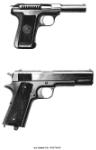

Text
29/55» Whitehouse Street
Aston
BIRMINGHAM,
OCTOBER, /дог.
The “ Mars ” Pistol.
This Pistol occupies a unique position in that it is the only Automatic Pistol which
can fire a heavy projectile at a high velocity.
The Revolver is essentially a short range weapon of low velocity, but possesses a
stopping power absolutely lacking in the Automatic Pistols at present on the market. The
projectiles of the latter attain fairly high velocities, but being of small size and light weight,
they are totally deficient in the stopping power essential to a defensive weapon.
The shock-producing effect of a Pistol bullet depends upon the striking area, mass,
weight, and velocity of the projectile. Thus the maximum useful effect can only be obtained
from a heavy bullet travelling at a high velocity, and in this respect no other approaches
the combination of shock-producing and ranging powers found in the ° Mars.”
3
To obtain such a combination has been the work of some years and constant experi-
ments ; the special features now embodied in the u Mars ” being radically different from those
of all other automatic small arms.
In the “ Mars ” Firearms the entire effort of the powder gas has been expended before
the breech commences to unlock^ as only AFTER THE TERMINATION OF THE RECOIL
does this unlocking take place.
The recoil is absorbed in compressing springs, which, by their reaction -
(a)	Unlock the breech ;
(b)	Withdraw and eject the empty case;
(c)	Reload ;
(d)	Close and lock the breech.
The Magazine (which serves as butt or handle) in the “ Mars” Pistol, lies immediately
under the barrel and the cartridges are withdrawn rearwardly therefrom (see illustration page 12),
thus the barrel can be made of greater length than in any other Automatic Pistol within the same
limits of overall length, as in all others the breech end of the barrel must commence in front of the
magazine. Now, conditions as to calibre, pitch of rifling, &c., being identical, the length of the barrel
practically determines the quantity of powder which can be burned, and this again determines
the velocity obtainable. Therefore, these fundamental principles ensure for the “Mars” Pistol
a marked superiority to any present or future competitor, as they are essential to the attainment
of equal ballistic results.
When fired from a rest at short ranges, there is little to choose in accuracy between
a first-class Revolver and any good Automatic Pistol, but owing to its much better balance (the
(centre of gravity being in the hand) much better shooting can be made with a “ Mars ” Pistol
by an inexperienced shot than with a revolver. At ten paces it is not difficult to group eight
shots in as many seconds within a four inch circle.
4
Description of “ Mars ” Military Pistols.
Length of Barrel
Length of Pistol ...........
Weight of Pistol with Magazine
Diameter of Bullet ...
Capacity of Magazine
Weight of Projectile ...
Muzzle Velocity
Charges...............
9*5in. overall.
ii’5in. overall.
480Z.
°*335’n* o*36oin. o*45oiri.
Eight and ten cartridges.
140 grains, 160 grains, 220 grains.
1,750 ft. sec., 1,640 ft. sec.. 1,250 ft. sec
(according to weight of bullet, charge and calibre).
10 to 12% grains of Smokeless Powder.
The following table shows the comparative energies developed in the Colt Revolver,
Colt Automatic, Mauser Automatic, and “ Mars ” Pistols :—
Pistol.	Calibre.	Weight of Bullet.	1 Charge of Powder	Muzzle Velocity.	Energy in foot lbs.
e» Colt Revolver Colt Automatic Mauser “ Mars ” ,,	... (8i mm.)	ins. 455 •360 •300 •450 •360 •335	grs. 265 >05 85 2 20 l6o I4O	grs. 18 7*8 775 12 12 10	ft. per sec. 700 1,260 1,400 1,250 1,640 L75O	287 364 379 760 969 95°
5
Operation.—To withdraw magazine out of the Pistol, press the button on the left
hand side of trigger guard, when it may be easily withdrawn. The magazine is charged by
pushing the cartridge in, bullet first, then holding down the previous cartridge, so as to leave
space for the next one to be pushed in on top. The magazine may be charged with any
number of cartridges, from one to eight. The magazine is then inserted into the handle, and
pressed in as far as possible. Then, as in fig. i, take the Pistol in the right hand, and with the
left hand turn the Bolt Handle as far as it will rotate from right to left.
6
Now pull back as far as possible, (see fig. 2), and release sharply. This movement
withdraws the cartridge from the magazine, and elevates it, cocks the hammer, and releasing
the bolt, is pulled forward by its spring, pushes the live cartridge into the chamber, and locks
the breech. The Pistol is now ready for firing
7
To fire the Pistol, press the trigger firmly. The barrel and bolt carrier will now
recoil together fully locked against the resistance of their springs, as shown in fig. 3.
8
Then, as soon as the powder gases have been expended, the barrel and bolt begin to
be pulled forward by their springs, the breech being unlocked during the first part of the
forward movement. The barrel is now pulled forward by its spring into its normal position,
the empty case being held by the retracted bolt until ejected by the elevation of the fresh
cartridge. See fig. 4.
9
Fig. 5-
As soon as the trigger is released and returns to its forward position, it will disengage
the bolt and allow it to move forward (see fig. 5), pushing the fresh cartridge into the chamber,
and locking the breech, thus making the Pistol ready for another shot, and on pressing the
trigger the operation will be repeated until the magazine i> exhausted.
The Pistol should be kept oiled with a thin oil that, will not congeal, and all screws
kept tight. After firing, clean out the barrel with Nitroclean, and after wiping dry, coat with
Rililine.
10
INSTRUCTIONS FOR. STRIPPING
Take out the Magazine by pressing the button (G), and withdrawing by means of the
loop on the bottom of the Magazine.
Unscrew the two Bolt Carrier Nuts (ZZ), and withdraw the Springs; then cock the
Hammer, and unlock the Bolt by turning the Handle (7) from Right to Left, and withdraw the
Bolt Carrier (C) from the Body (#).
Then turn the Gib (/) until the Saw Slot is horizontal, then press out from the opposite
side. Now the Barrel (Л), together with its Spring (ZQ, Buffer Bush (Z), and Buffer Spring (AZ) may
be drawn out backward from the body of the Pistol.
To take out the Lockwork, unscrew the Hammer Bolt Pin (TV), then press out the
Hammer Bolt (O), when the Hammer, together with its Spring, may be taken out of the Body of
the Pistol.
Then unscrew the Trigger Pin (P), and take off the Lock Plate (Q).
The Detent (7?) is then turned round from Right to Left as far as possible, when it may
be lifted out of the Body. Then lift out the Connecting Rod (S’) from the Trigger (T); next press
out the Trigger Pin (/*), and withdraw the Trigger (Z) from the top of the Body.
To take out the Sear (67), unscrew the Sear Pin (У), when it will come away freely.
Now the Cam Piece (HQ in the centre of the Body can be pulled out backwards, and
then the Sear Spring (JV) pressed out from behind.
To take out Magazine Catch (G) give a smart tap from behind, when it will spring out.
To strip the Bolt Carrier (C) take hold of the Sliding Bolt ДР) (not shown in drawing),
and turn upwards, when it will come away.
Then take out the Elevator Pin (У), by turning the head downward and press out
from opposite side when the Elevator will drop out.
Next lift the Spring (Z) on the screw out of its catch,, and unscrew and take out, when
the Firing Pin will come away.
11
Then turn the Handle (Z) from Right to Left, as far as possible, when the Bolt (Z>) can
be pulled forward and out, together with its Spring. Then turn the Handle (Z) until it can be
pulled out backwards^
The Bell Crank (A) is then taken off, by turning from Right to Left as far as it will go,
when it may be lifted off.
To take out the Extractor (b) from the Bolt (Z>) lift up the front until it can be turned
opposite Slot in Bolt, when it can be lifted out from the Bolt.
To put together, reverse the operation, taking care to put back each part in the same
order as taken to pieces.
i 2
PRESS OPINIONS.
“THE SPORTING GOODS REVIEW,” December 16th, 1901.
THE “MARS” AUTOMATIC PISTOL.
In February, .1899, not very much less than
three years ago; (me of the London daily papers
published an article on the subject of automatic
pistols, wherein the supineness of British manu-
facturers was strongly reprobated. The month
following we were able to show that the British
manufacturers were not, as a matter of fact,
lagging so hopelessly behind. After speaking of
the Webley-Fosbery revolver—which in its final
form we were only enabled to describe and illus-
trate in our issue of August 15th last—we went on
to instance an English automatic pistol, called the
uMars,M which had been invented by Mr. H. W.
Gabbett-Fairfax. “ The present model,” we wrote
on March 15th, 1899, “ is of *400 calibre, and the
bullet weighs 175 grains, the case being a straight
taper, but in its final form it is quite possible the
calibre of the ‘ Mars ’ automatic pistol will be
reduced to *360, with a bottle-neck case. Until
these details have been thoroughly worked out,
further speculative discussion can serve no good
purpose. We hope, however, to return to the
subject as soon as the arm is perfected.”
For some considerable time nothing more was
heard of the new weapon, but it happened a few
months ago that almost by accident an automatic
pistol of an unfamiliar type found its way into our
hands. We thought, at first sight, that it was,
perhaps, some new kind of Borchardt, a pistol first
described in this journal so long ago as January,
1894. But a very cursory examination satisfied
us that it was not, and ultimately we found it to
be the Jong-talked of “Mars.” Even then, how-
ever, the hope expressed in 1899 had to remain
unfulfilled, and in May last we contented ourselves
with merely recording the fact that the pistol had
been exhaustively tested by the Small Arms Com-
mittee. After a lapse of yet more time the weapon
has been publicly exhibited, and we are now at
liberty to give details concerning this, the first all-
British automatic pistol that has been produced.
13
As will be seen from the illustration, the resem-
blance to the Borchardt consists chiefly in the fact
that the handle of the pistol is utilised as a
magazine Its. most important peculiarity is the
comparative largeness of the bore, whereby
stopping power, derived from the use of a heavy
projectile, is assured. For purposes of warfare,
the new weapon, therefore, starts with an impor- I
tant advantage, in view of the fact that international I
sentiment on the question of expanding bullets of 1
all kinds is such as to give a preference to projec- |
tiles large enough to deal a disabling blow without
having recourse to expansion. The original *400 j
“ Mars ” has apparently been dropped, but the -360 |
has been perfected, and also a pistol of *450 calibre. |
taking a 220 grain jacketted bullet, as compared 1
with the 265 grains of the *450 Service revolver. |
To set against the reduction in weight, we have
the fact that t»e automatic pistol has no break in
the barrel, and is therefore capable of a higher
velocity. With 12^ grains of Cordite in an Eley
case, which, by the way, is made with a groove at
the base instead of a rim, the muzzle velocity of
the “ Mars ” is stated to be 1,250 feet per second,
while the *450 revolver gives 700 feet.
In essential principle the large bore automatic
pistol closely follows its predecessors of smaller ।
calibre, but in details interesting differences are to |
be observed. The recoil has hitherto.been gener-
ally used, first, to slide back the barrel and breech-
block for a distance of about one-fifth of an inch,
and then to release the block, which continues its
travel to perform the ejectory and reloading
operations. One pistol, however, the Bergmann,
had a breech that was never locked, the block
being only held up to the breech by means of a
coiled spring, the swelling of the cartridge case
being relied on to retain it in position until the
1
period of highest pressure had elapsed. The
‘‘Mars” goes to the opposite extreme, for not
only is the breech securely fastened, but block and
barrel recoil, locked together, to the full extent of
the travel. The illustration on page io shows the
pistol cocked ready for firing. The trigger being
pressed, the locked barrel runs out, over the hand
of the shooter, and recocks the hammer. At the
full extent of the travel, when the projectile has
left the muzzle, and the period of high pressure
has ceased, the breech-block is unlocked, and held
back, along with a sliding piece or carriage on
which it. is mounted, while the barrel, freed of
restraint, is carried forward again under the
influence of a compressed spring. During this
movement of the barrel the spent case—which,
with its extractor, remains behind with the breech-
block—is ejected as a fresh cartridge rises from the
magazine. At this point, which is reached so soon
after the discharge that no appreciable time elapses
at all, the finger is still pressing the trigger, the
spent shell is dropping to the ground, the breech
block on its slide is projecting behind the pistol,
the barrelHias returned to its forward position, and
the cartridge has risen in the open space between
the block and the breech. Now release the trigger,
the block and its slide fly home, carrying the
cartridge into the chamber; the operation of
locking is automatically performed, and the pistol
is ready for firing again.
The automatic fastening of the breech-block,
and the working of the magazine in re-loading, are
operations which, lacking diagrams, it is some-
what difficult to clearly explain. The -450 “Mars”
holds eight straight-taper cartridges in the maga-
zine, and when fully charged the weapon, before it
can be used, requires cocking, as well as that
retraction of the breech-block necessary to bring a
4
cartridge into the chamber. In the illustration it
will be observed that two small projections are
fixed at the back of the breech. With their aid a
half turn is given to the block when it can be seen
that the closure is effected by means of three lugs
of taper shape, so arranged that while in one
position the block is locked with absolute security,
in the other it is not locked at all. Having with
the fingers imparted this turning movement, the
bolt can be .withdrawn and the hammer cocked.
In most automatic pistols such a movement
uncovers the top of the magazine, but in the
“Mars” this is not so. The withdrawal of the
block is therefore so arranged that in combination
with an elevating device it draws the top cartridge
out of the magazine and tilts it up in such a way
that the return of the block carries the cartridge
into the chamber. After that, the first shot may
be discharged, and the automatic action already
described will continue to take place, as the
trigger is pressed and released, until the magazine
has been emptied, which it is said can be accom-
plished in about three seconds. To secure the
automatic release of the block when the pistol is
working under the influence of recoil, a spring is
provided to impart the necessary turning move-
ment. The barrel and block being locked together
while in their extreme rearward position, continue
so locked at the beginning of the return travel. In
the first quarter of an inch or so the turning spring
is brought into operation, and the block, imme-
diately revolving, is left behind on its carriage
with the spent cartridge case held in the jaws of
the extractor, ready to be ejected as the next
cartridge rises.
In the *360 model, the case used i% as we con-
jectured it would be, of bottle-neck shape, while
the *450 is a straight taper. We take it, there-
fore, that the first pistol, the *400 bore, has been
developed into the *450, while the *360 has been
perfected, and an additional model of 8-5 mm.
(•3246) has been introduced, so that a weapon of
yet smaller calibre is available if required. The
•450. as we have said, takes eight cartridges, the
smaller bores taking ten and eleven. The bullets
used are nickel-cased. The *450 has a charge of
i2i grains of Cordite, and the *360, 12 grains.
The cartridges are not held in a clip, the magazine
in the handle serving the same purpose. With the
•450, the velocity developed is 1,250ft. sec., and
the velocity energy 760 ft. pounds, while the *360
gives velocity 1,640 ft. sec., and develops about
960 ft. pounds of energy.
5
“ARMS AND EXPLOSIVES,” December, 1901.
THE “ MARS” AUTOMATIC PISTOL.
On the 23rd ult. representatives of the Press
were invited to witness an interesting display of
the performance of the u Mars ” automatic pistol
by its inventor, Mr. Hugh W. Gabbett-Fairfax.
Not the least striking of the claims to novelty put
forward on behalf of this weapon is the fact that
it is of English design and manufacture through-
out, and shoots English-made ammunition. Mr.
Gabbett-Fairfax has been at work on the various
details of the pistol for several years past, and has
doubtless experienced most of the vicissitudes of
alternate hope and anxiety incidental to the shaping
of a perfected article from the first crude imaginings,
but it must be admitted that the success attending
the recent demonstration will go far to compensate
the inventor for the stress and strain which alone
could have brought about so satisfactory a con-
summation.
Apart from the fact of its British origin, the
“ Mars ” has various other features entitling it to
favourable criticism. Hitherto there has been a
somewhat distinct dividing line between the auto-
matic pistol and the revolver in respect to calibre,
the ammunition of the former being, with one
exception, of relatively small calibre, and in no
way comparable in actually shock-producing effects
with the larger, heavier, and slower-moving bullet
of the revolver. Reasons for This difference are
not far to seek. The tendency of the day towards
high velocities and long ranges needs no elabora-
tion of explanation. Therefore, the fact stands
that in the leading and successful types of auto-
matic pistol now in use the calibre rarely exceeds
•300 in., or the Weight of bullet 100 grains, while
the muzzle velocity ranges between 1,000 and
1,400 ft? per second, as against the 455 calibre,
265 grain bullet, and 700 ft. per second velocity,
which are adopted in the Service revolver. There
is no need in this place to go into a consideration
of the relative merits or demerits of the two forms
of arm, or of the obvious difficulties to be encoun-
tered in providing satisfactory ammunition for the
revolver. That is an aspect of the case which
may be dealt with elsewhere. Suffice it to say
that, for certain purposes, especially for practical
close-range fighting, the revolver has always re-
tained its full measure of adherents as a man-
stopper, no matter what its alleged inferiority may
be in ease of handling and working, range, and
general efficiency.
Having these guiding marks in view, the inven-
tor of the “ Mars” pistol has turned his energies
in the direction of producing a weapon which
should combine the shock-producing qualities of
the Service arm with the superior ballistics and
the more rapid manipulation of the automatic
pistol, and it, is „interesting to notice how. the
development has been brought about, and how far
successfully accomplished. At the present time
there are three calibres of the “Mars” in exist-
ence, advancing by steady degrees from a mini-
mum of 8’5 mm , or *3346 in., to *360 in. and *450
in. It will be noted that even the smallest calibre
is larger than the average of the other automatic
pistols, whilst the second size equals that of the
16
largest of those arms, the nominal ‘380 Colt or
Browning. The largest calibre is approximately
that of the British Service revolver, but the ballistic
qualities of the two arms are of a very widely-
removed character. The Service cartridge is
sufficiently well known to require no description
here. It consists of a bullet weighing 265 grains,
which is propelled by 18 grains of black powder,
which give a muzzle velocity of 700 It. per second,
the muzzle energy therefore being 287 ft. lbs. This
cartridge is obviously an anachronism, retained
solely because it seems well-nigh impossible to
devise anything better in conjunction with the
principle of revolving chambers. On the other
hand, the cartridge for the *450 calibre “Mars”
pistol is of distinctly up-to-date design, weighing
approximately 363 grs.. of which the empty shell
contributes 130 grs. The nickel-coated bullet is
of 220 grs. weight, and is propelled by from 12
to 14 grs. of Cordite, the latter amount only
having been quite recently adopted. This car-
tridge gives a muzzle velocity ot about 1,250 ft.
per second, corresponding to an energy of about
760 ft. lbs. In other words, it gives a muzzle
energy practically 2J3 greater than that ob-
tained with the Service ammunition. Superior
relative results are also obtained from the smaller
calibres, the 8£ mm. pistol, .with its 140 grs.
bullet and 1,750 ft. per second velocity, showing a
muzzle energy of 950 ft. lbs., and the *360 calibre,
with a bullet weighing 160 grs., and a muzzle
velocity of about 1,640 ft. per second, developing
about 960 ft. lbs. of energy. The ammunition for
the three calibres of “ Mars” pistol is supplied by
Messrs. Eley Bros., Ltd.
'Burning to the weapon itself, on pages 9 & io, we
give herewith two illustrations showing the ‘'Mars”
automatic pistol ; the one showing the pistol prior
to the firing of a shot, and the other the weapon
in a transition stage, having ejected a fired case,
while another cartridge is just visible emerging on
its way into the chamber of the pistol. It will be
noted that the magazine is contained within the
stock, being in the form of a slide inserted from
below, much in the same manner as in the Colt,
Luger, and Borchardt automatic arms ; and in the
•360 calibre, which is the one here shown, the
magazine is constructed to hold ten cartridges.
By the way, the 8| mm. and *360 cartridges are of
the bottle-neck pattern, while that of the *450
calibre is straight-tapered, all being provided with
a rim groove. Each calibre of bullet has two
cannelures, and the inventor of the u Mars ” pistol
may take some credit to himself for the neat and
practical design of his ammunition. There is no
projecting shoulder where the cartridge case ends,
but the metal is bevelled off and then compressed
all round into the top cannelure of the bullet, thus
making a very efficient junction of the two com-
ponents of the complete cartridge. Reverting to
the pistol, the *360 calibre, as here shown, has a
length of barrel, measured from the muzzle to the
breech-block, of 8*7 in., or over all to the back of
the latter of 9’5 in The extreme length of the
pistol is ii*5 in > and its weight 21b. 10 oz. The
actual bore is 354 in , the bullet itself being
•360 in. in diameter, and weighing 160 grs., as
already mentioned. Its powder charge is 12 grs.
of Cordite, giving the muzzle velocity and energy
above stated.
The actual working of the pistol reveals some
features not to be found in other automatic arms
now in existence, one especial point in relation to
the “ Mars” being that the breech-block and
barrel recoil together through the whole length of
backward travel, and do not separate until the
motion of recoil is completed and the barrel moves
forward to its normal position. This important
co-relation of the parts is effected in a very in-
genious manner, the breech-block being held to
the barrel by a method which can only properly be
compared with the system of breech-closing by
means of an interrupted screw that is invariably
adopted in larger ordnance, a resemblance that is
all the more fitting since the opening of the breech
is effected by hand through the agency of two
small handles, shown at the back of the breech-
block, which are miniature reproductions of those
originally introduced, we believe, in Armstrong’s
early breech-loading guns of the ’50’s and ’Go’s,
and retained in a moye or less modified form to
the present day. To follow the working of the
pistol during the firing of one shot and the prepa-
ration for another, we will assume that the charged
magazine is duly inserted into the stock or handle
of the pistol, where it is firmly held by a spring
catch. The chamber is still empty, so to load it
the handles at the back of the breech-block arc
given a half-turn to the left, and the block being
thus released from its locking to the barrel, is
withdrawn backwards to a certain distance and
then released. This action draws a cartridge from
the magazine, which, it will be noted, is below the
barrel of the pistol, and not below the back of the
chamber, as in most automatic arms, and deposits
it in the chamber of the barrel, and at the same
time cocks the hammer. On pulling the trigger
the cartridge is fired in the usual course. The
recoil drives back both barrel and breech-block,
firmly held together, to the distance of about 2 in.
against the pressure of powerful springs contained
in the body of the pistol below the barrel. As
soon as the pressure of recoil is over, these springs
pull the barrel forward again, but in the mean-
time a bell-crank lever, actuated by a detent
through a medium of a sliding bar, disengages the
breech-block, which is left behind with the empty
cartridge case still held in the jaws of the extractor.
The backward movement of recoil has drawn
another cartridge from the magazine into an ele-
vating device, which, on the return of the barrel,
tilts up so as to place the nose of the bullet in line
for entering the chamber. It can be seen in this
position in the second illustration, on Page 9, which
shows the operation of the pistol at this particular
juncture. The tilting of this elevating device at
the same time throws the empty case upwards and
outwards. Now it only remains to release the trig-
ger, which unlooses the breech-block from its
engagement, and allows it to travel forward under
the impulse of strong springs. As it moves it
pushes the waiting cartridge into the chamber, and
still following on. is securely locked in place, the
breech-lugs swinging over automatically by spring
action the moment the block is home. The initial
recoil has already cocked the hammer again, and the
pistol is, as shown in the first illustration, ready
for the discharge of a second shot. It may be
mentioned that the above operations, which have
taken so long to describe, are accomplished so
rapidly that it is possible to fire from eight to ten
shots in three seconds.
Unfortunately, Mr. Gabbett-:Fairfax was notable
to give extended displays of the rapidity of fire
possible with his pistol, owing to the fact that he
had not received the expected supply of ammu-
nition. and had very few cartridges available. But
he was able to demonstrate the ease and rapidity
of working of all calibres of the “Mars *’ up to the
full extent to which speed of fire would be desirable,
in so far as it would be possible to take aim in
shooting. And, beyond that, he was able to give
a very practical trial of the ballistic qualities of his
pistol, as compared with others, by means of a
series ,of tests for penetration.
To indicate the capacities of the pistol for long-
range shooting, the inventor showed one of *360
calibre» fitted with a 12 in. barrel and a neat
detachable stock, for firing from the shoulder, but
it was impossible at that time, and under the cir-
cumstances, to make a detailed trial. Even under
disadvantages, however, it was seen that the
pistol could make fair practice al over 100 yards,
and possibly at some future time we may have an
opportunity of making a personal test. For the
present it is enough to say that Mr. Gabbett-
Fairfax is to be congratulated on the production
of a British-made weapon which, judging by present
appearances, is in no way inferior to those already
associated with foreign inventors and manufac-
turers, and which bids fair to establish, by sheer
merit, a conspicuous position among automatic
pistols.
19
“LAND AND WATER/
SHOOTING.
A trial of the latest automatic pistol, the “Mars,”
was made on Wednesday, at the London Sporting-
Park at Hendon. This pistol differs materially in
principle from all the automatic pistols now on the
market. The only real point of similarity is the
sliding barrel. The three models tried were a *450,
a *360, and a *335. The *450 is specially designed
for the British Government, and carries a bullet
approved by the authorities.
The two illustrations will give a fair idea of the
appearance of the pistol. Fig. 5 as it appears
when ready to fire, and Fig. 4 as it appears after a
shot has been fired and before the trigger is
released. These illustrations, however, do not
show what I consider is the most important point
about the new pistol, which is that the breech-block
is firmly locked to the breech of the barrel while
the barrel is being moved back by the force of the
recoil, and is not released until after the discharge
has taken place.
It is most important to realise that the force of
the gas generated by the powder is completely
expended before the breech begins to unlock, as
this is quite a new departure in automatic firearms.
By this means the pressure sustained by the cart-
ridge case is minimised, and so there should be
but little risk of cartridges splitting or jamming,
and all escape of gas backward is stopped. The
breech-block, by the way, is secured into the breech
end of the barrel by an interrupted screw, which is
a very safe method.
When the energy of the recoil is expended, the
barrel springs forward, and the pistol appears as
shown in Fig. 4 as long as the trigger is pressed.
The empty case is ejected by the incoming cart-
ridge, except in the case of the last shot, when it
November 30th, 1901.
is ejected by a connection with the hammer spring.
When the trigger is released the breech mechanism
springs forward, taking with it the fresh cartridge
and lodging it in the chamber of the barrel.
The three pistols shown at the trials all weigh
about the same—2 lbs. 10 oz. The length of the
barrel and of the whole weapon is the same in all
three calibres. Barrel 9 5 in., pistol 11*5 in. The
capacity of the magazine in the case of the two
smaller calibres is 10, and in the .450 8 cartridges.
The magazine is contained in the handle of the
pistol. The *450 bullet interested me particularly,
as it is, though completely nickel cased, specially
designed to convey a great shock to the object
struck, being of a very round-nosed character.
The ammunition is manufactured by Eley Brothers,
and the pistol itself was invented and is entirely
manufactured in this country.
Mr. Gabbett-Fairfax, the inventor, is to be con-
gratulated on having introduced an entirely new,
and apparently very sound, principle in automatic
firearms. The practical firing tests were eminently
satisfactory, and the pistol gave very great pene-
tration. I was glad to see that the inventor would
not be induced to make any experiments as to
extreme rapidity of fire, though I have no doubt
that the pistol would fire much more rapidly than
could possibly be required for practical purposes.
All that is wanted is a weapon which will fire as
quickly as the shooter can take aim, and the
“ Mars ” pistol will do more than this.
I will not at present go into the question of
muzzle velocities, but hope to do so in the near
future. 1 will simply mention Ц)е fact that the
•450 bullet weighs 220 grs. Cordite is the powder
used in loading the cartridges, and for the purpose
in question cordite is as good as, if not better,
than any of the other powders on the market.