/










Text
                    MOLLY DUNIGAN AND ANTHONY ATLER
Will to Fight of Private
Military Actors
Applying Cognitive Maneuver to Russian
Private Forces
CORPORATION
Research Report

For more information on this publication, visit ww w.rand.org/t/RRA355-1.
About RAND
The RAND Corporation is a research organization that develops solutions to public policy
challenges to help make communities throughout the world safer and more secure, healthier
and more prosperous. R AND is nonprofit, nonpartisan, and committed to the public interest. To
learn more about RAND, visit www.rand.org.
Research Integrity
Our mission to help improve policy and decisionmaking through research and analysis is
enabled through our core values of quality and objectivity and our unwavering commitment
to the highest level of integrity and ethical behavior. To help ensure our research and analysis
are rigorous, objective, and nonpartisan, we subject our research publications to a robust and
exacting quality-assurance process; avoid both the appearance and reality of financial and
other conflicts of interest through staff training, project screening, and a policy of mandatory
disclosure; and pursue transparency in our research engagements through our commitment to
the open publication of our research f indings and recommendations, disclosure of the source
of funding of published research, and policies to ensure intellectual independence. For more
information, visit ww w.rand.org/about/research-integrity.
RAND’s publications do not necessarily ref lect the opinions of its research clients and sponsors.
Published by the RAND Corporation, Santa Monica, Calif.
© 2023 RAND Corporation
is a registered trademark.
Library of Congress Cataloging-in-Publication Data is available for this publication.
ISBN: 978-1-9774-0647-7
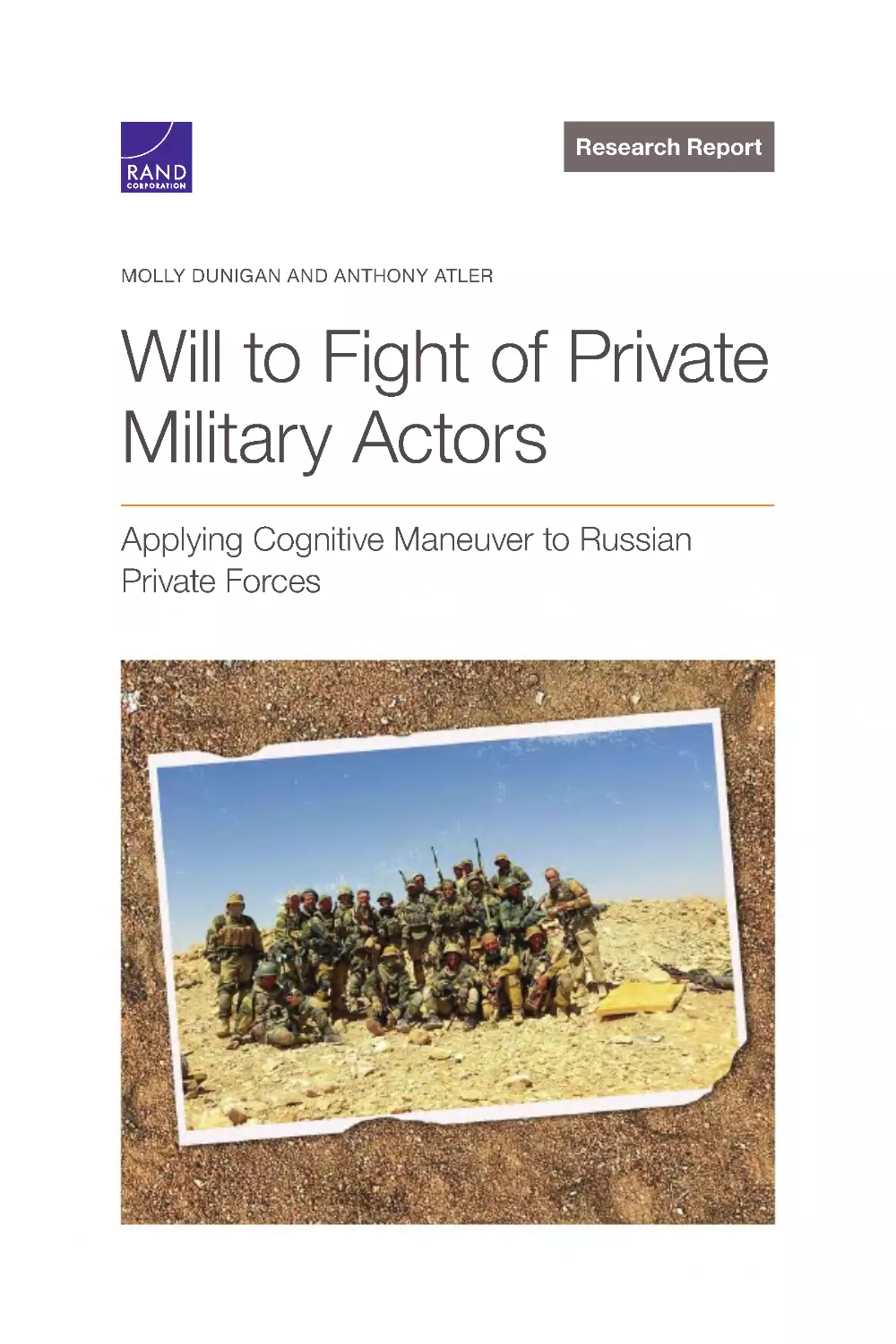
Cover: Undated photo purporting to show Wagner Group contractors, likely in Syria, released by
the Security Service of Ukraine. Background photo by Tejasvi Ganjoo/Unsplash.
Limited Print and Electronic Distribution Rights
This publication and trademark(s) contained herein are protected by law. This representation of
RAND intellectual property is provided for noncommercial use only. Unauthorized posting of
this publication online is prohibited; linking directly to its webpage on rand.org is encouraged.
Permission is required from R AND to reproduce, or reuse in another form, any of its research
products for commercia l purposes. For information on reprint and reuse permissions, please
visit w ww.rand.org/pubs/permissions.

iii
Preface
This report documents research and analysis conducted as part of
a project entitled Will to Fight in Overseas Contingencies: Breaking
Adversaries Through Cognitive Maneuver, sponsored by U.S . Army
Special Operations Command. The purpose of the larger project
was to analyze the will to fight of a selected set of adversary forces
in named overseas contingencies, identify strengths and vulnerabilities
that might be exploited, and develop a game or simulation to explore
cognitive maneuver options to break adversaries’ will to fight.
This research was conducted within R AND Arroyo Center’s
Strategy, Doctrine, and Resources Program. R AND Arroyo Center,
part of the R AND Corporation, is a federally funded research and
development center (FFRDC) sponsored by the United States Army.
R AND operates under a “Federal-Wide Assurance” (FWA00003425)
and complies with the Code of Federal Regulations for the Protection of
Human Subjects Under United States Law (45 CFR 46), also known
as “the Common Rule,” as well as with the implementation guidance
set forth in DoD Instruction 3216.02. As applicable, this compliance
includes reviews and approvals by R AND’s Institutional Review Board
(the Human Subjects Protection Committee) and by the U.S . Army. The
views of sources utilized in this study are solely their own and do not
represent the official policy or position of DoD or the U.S . Government.

v
Contents
Preface ............................................................................. iii
Figures and Tables ...............................................................vii
Summary .......................................................................... ix
Ack nowledgments .............................................................. xxi
Abbre viations .................................................................. xxiii
CHAPTER ONE
Understanding the Will to Fight of Private Military Actors ............. 1
Cognitive Maneuver ............................................................... 4
Background on t he Will-to-Fight Model........................................ 6
Research Approach................................................................12
CHAPTER TWO
Russia’s Private Military Actors ............................................... 15
Industry Structure in Context ...................................................19
CHAPTER THREE
Applying the Will-to-Fight Model to Private Military Actors ......... 27
Translating the Military Will-to-Fight Model to Private Military
Actors ......................................................................... 28
Linking Model Factors to Strategies to Counter Russian Private
Military Actors ...............................................................51

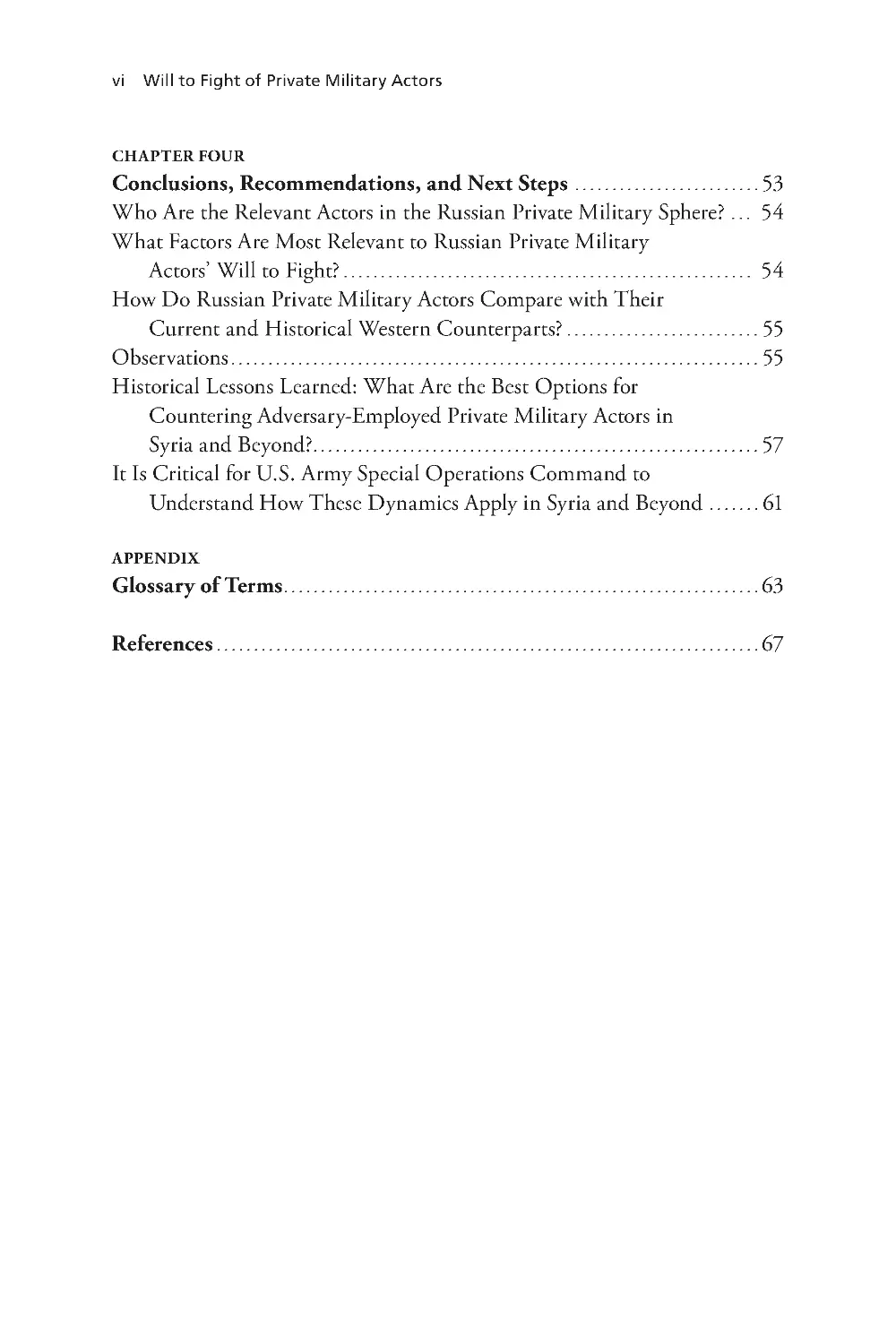
vi Will to Fight of Private Military Ac tor s
CHAPTER FOUR
Conclusions, Recommendations, and Next Steps .........................53
Who Are the Relevant Actors in the Russian Private Military Sphere? ... 54
What Factors Are Most Relevant to Russian Private Military
Actors’ Will to Fight? ....................................................... 54
How Do Russian Private Military Actors Compare with Their
Current and Historical Western Counterparts? ..........................55
Observations .......................................................................55
Historical Lessons Learned: What Are the Best Options for
Countering Adversary-Employed Private Military Actors in
Syria and Beyond?............................................................57
It Is Critical for U.S . Army Special Operations Command to
Understand How These Dynamics Apply in Syria and Beyond .......61
APPENDIX
Glossary of Terms ................................................................63
References .........................................................................67

vii
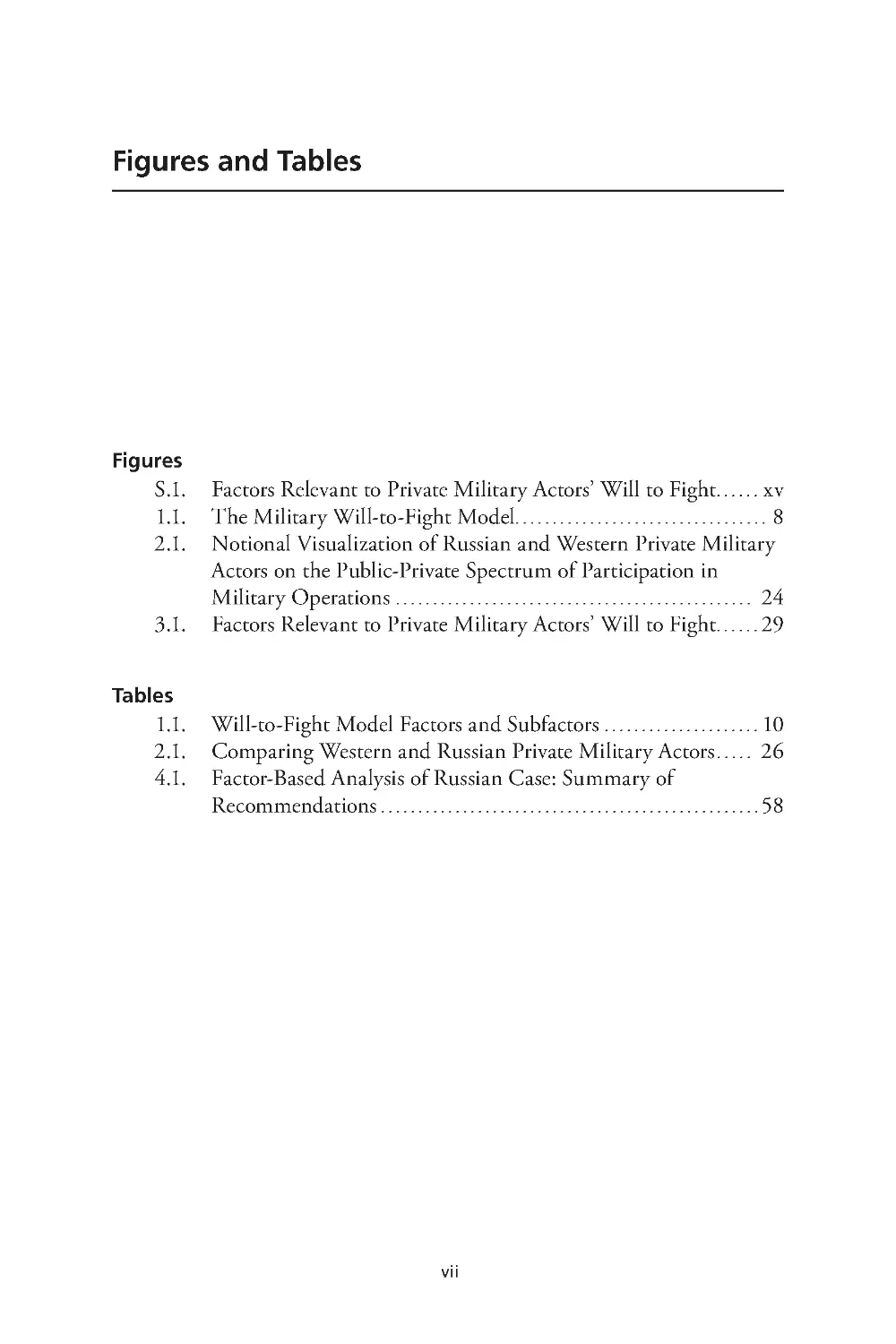
Figures and Tables
Figures
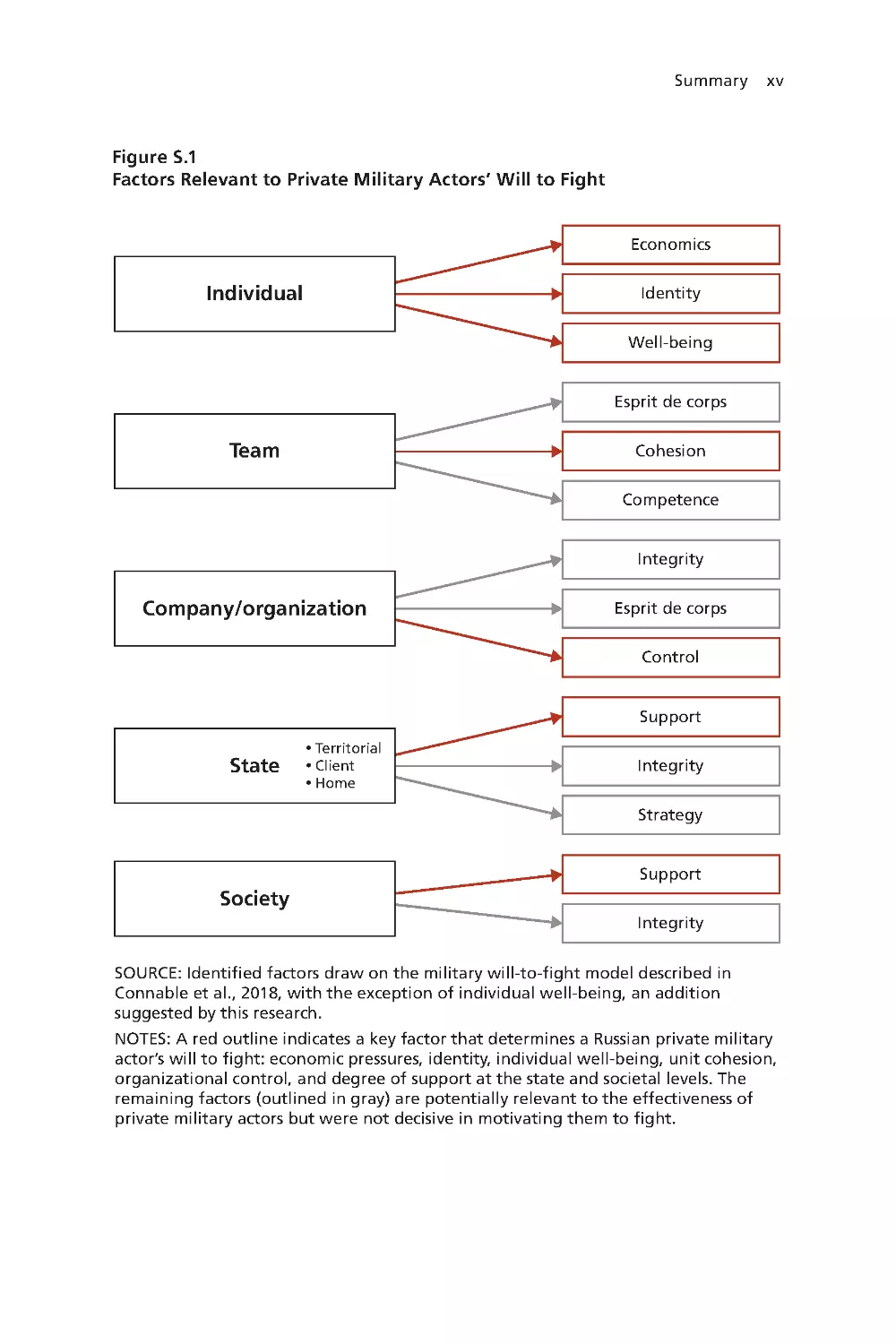
S.1. Factors Relevant to Private Military Actors’ Will to Fight...... xv
1.1. The Military Will-to-Fight Model.................................. 8
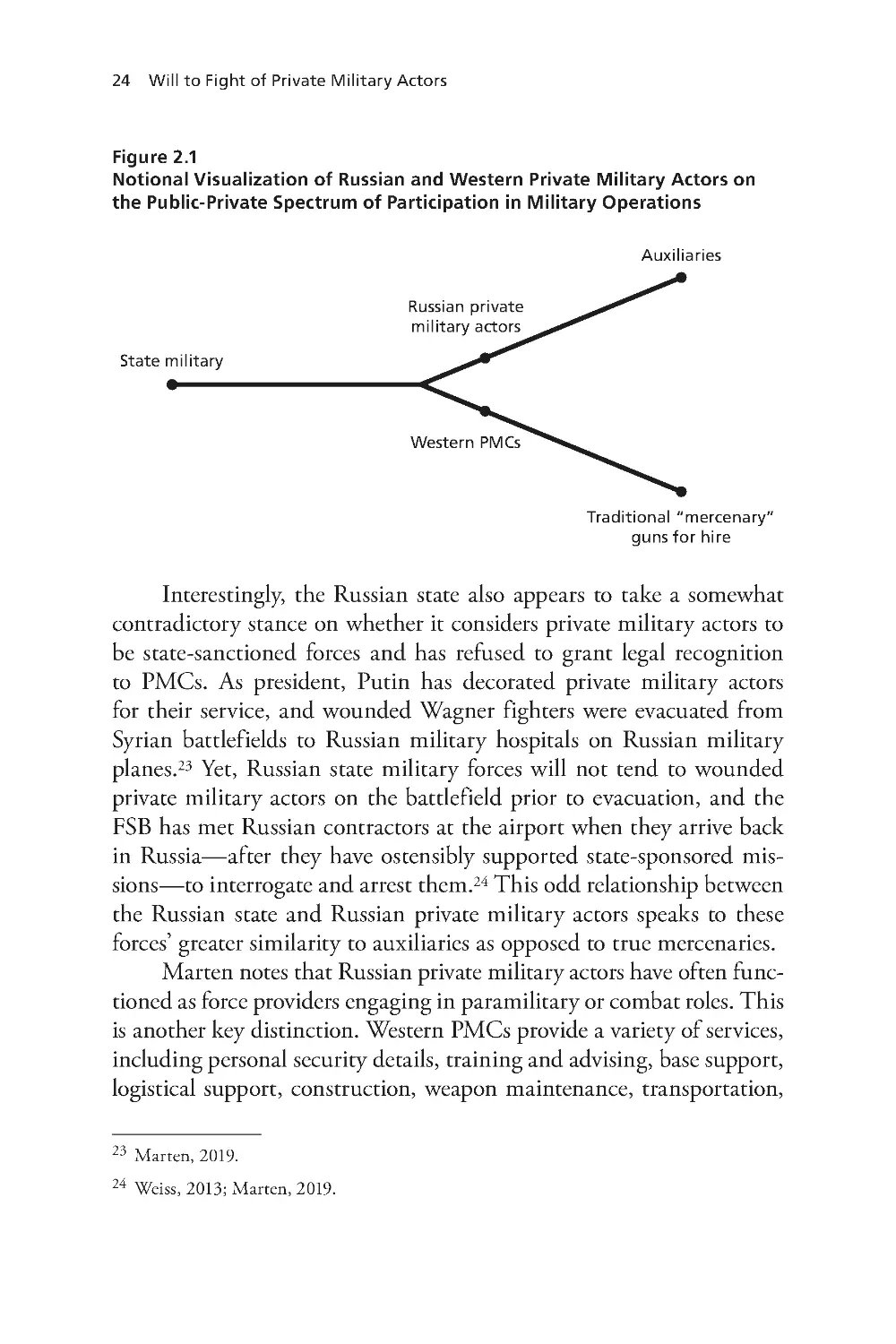
2.1. Notional Visualization of Russian and Western Private Military
Actors on the Public-Private Spectrum of Participation in
Military Operations ................................................ 24
3.1. Factors Relevant to Private Military Actors’ Will to Fight......29
Tables
1.1. Will-to-Fight Model Factors and Subfactors .....................10
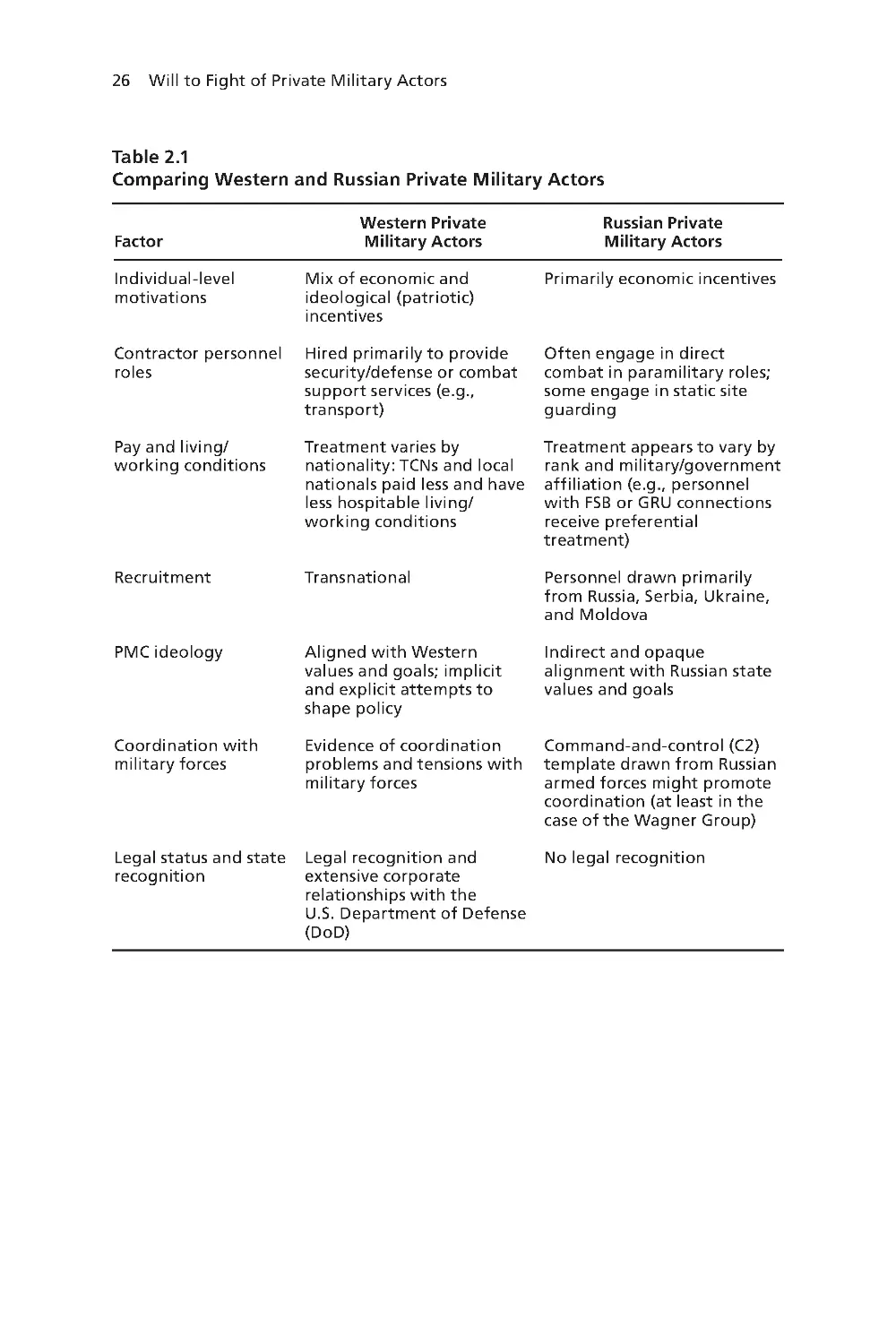
2.1. Comparing Western and Russian Private Military Actors ..... 26
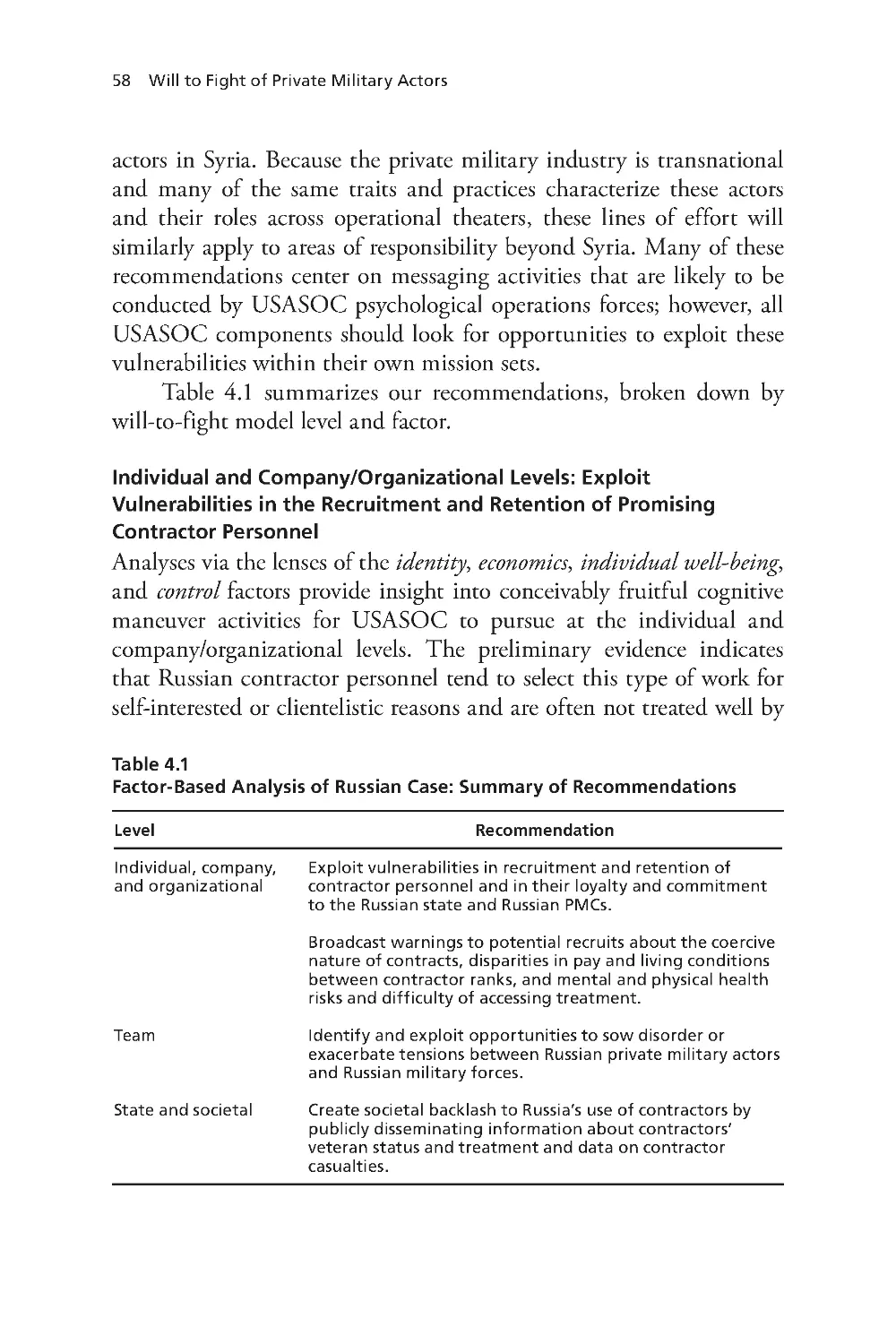
4.1. Factor-Based Analysis of Russian Case: Summary of
Recommendations ...................................................58

ix
Summary
The research reported here was completed in July 2020, followed by secu-
rity review by the sponsor and the U.S . Army Office of the Chief of Public
Affairs, with final sign-off in June 2023.
The work therefore predates Russia’s 2022 invasion of Ukraine, and
largely omits consideration of Russian private military forces in the war in
Ukraine. Nonetheless, as of June 2023, this analysis remains relevant to an
in-depth, long-term understanding of Russian private military actors and
their will to fight.
In Syria, Ukraine, several African countries, and other conflict
hotspots around the globe, private contractors operating on behalf
of, yet are ostensibly separate from, the Russian state. These devel-
opments have prompted questions and concern within military and
policy circles in light of the current U.S. focus on great power com-
petition with Russia and China,1 and the extent to which Russia has
been exerting malign inf luence in conf licts worldwide through the
use of proxy forces, including private military actors. The Army, the
joint force, and U.S. allies and partners require a better understand-
ing of the role that these Russian-hired private militar y actors play in
conf licts, how to address their presence in operational planning, and
the implications for U.S. policy with regard to Russia. The United
States and its allies may be able to counter these forces through cogni-
1 U.S. Department of Defense, Summary of the 2018 National Defense Strateg y of the United
States of America: Shar pening the American Militar y’ s Competitive Edge, Ja nuary 19, 2018.

x Will to Fight of Private Military Actors
tive maneuver. U.S. Army Special Operations Command (USASOC)
recognizes that the best way to win wars may be to use force in the
multidomain context to achieve cognitive objectives—to change
minds, to change behaviors, to win.2
With a specific focus on the case of Russian private militar y activ-
ity in Syria between 2015 and 2019, the purpose of this report is to
apply a model developed at R AND to explore adversaries’ “will to
fight” to an analysis of (1) what motivates and demotivates Russian
private military contractors in Syria and the companies that hire them
to fight; (2) what inf luences the Russian government’s decisions about
whether and how to utilize private military actors in Syria; and (3) how
USASOC and other U.S . government entities can leverage cognitive
maneuver to counter these actors.3 To that end, this report addresses
the following research questions:
1. Who are the relevant actors in the Russian private military
sphere to consider when assessing Russian private forces’ will
to fight?
2. What factors are most relevant to Russian private military
actors’ will to fight?
3. How do Russian private militar y actors compare with their
current and historical Western counterparts, and what lessons
can be drawn from these comparative cases to inform U.S.
opportunities to counter adversary-employed private military
actors?
2 U.S. A rmy Special Operations Com mand, E xpanding Man euv er in the Early 21st Century
Security Environment, Ja nuary 12 , 2017; A llison A stori no-Courtois, ed., A Cognitive Capa -
bilities Agend a: A Multi-Step Approach for Closing DoD’s Cognitive Capability Gap, Wa sh -
ington, D.C .: Joi nt Staff, Strategic Multi-L ayer A ssessment Off ice , October 2017; Patricia
DeGen naro, “The Power of Cognitive Maneuver: Don’t Undere stimate Its Value,” Small
Wars Journal, September 19, 2017.
3 For more on the underlying model, see Ben Conn able, Michael J. McNer ney, William
Marcellino, A aron Frank, Henry Hargrove , Marek N. Posa rd, S. Reb ecca Zimmerman,
Nata sha L a nder, Jase n J. Ca stillo, and James Sladden, Will to Fight: Analyzing, Modeling,
and Simulating the Will to Fight of Militar y Units, Santa Monica, Calif.: R A ND Corporation,
RR-2341-A, 2018.

Summary xi
We employed a multimethod qualitative approach to address
these questions, including a media analysis, a literature review, conver-
sations with subject-matter experts, and a limited number of semistruc-
tured inter views with foreign military personnel who had operational
experience with Russian private military actors. Finally, we performed
selective case-study analyses of analogous instances of private militar y
contractor employment to derive lessons learned and identify particu-
lar individual, corporate, and client-state and societal factors that may
make private military forces vulnerable to cognitive maneuver and
attendant declines in their will to fight.
This topic is important for several reasons. First, all U.S. govern-
ment agencies and military services should be concerned about Rus-
sia’s increasing use of private militar y actors worldwide. These deploy-
ments allow Russia to expand its military footprint while maintaining
plausible deniability in major combat operations and competition
short of armed conflict. To effectively engage on this topic, the U.S .
Army needs to be well informed regarding Russian private militar y
actors’ characteristics, activities, motives, and vulnerabilities. Second,
USASOC forces have a potentially unique role to play in implement-
ing U.S. military strategy vis-à-vis private military actors, especially
in competition short of armed conflict, because of their positions in
theaters of interest and their particular skill sets. Indeed, Army psy-
chological operations, civil affairs, and special operations personnel are
likely to be called upon to pursue cognitive maneuver activities, such as
messaging and information operations, to stymie Russian private mili-
tary activity. Therefore, it is critical for the U.S . Army and USASOC-
aligned forces to develop a foundational understanding of Russian pri-
vate militar y actors and their activities, as well as potential methods for
exploiting their vulnerabilities.
Who Are the Relevant Actors in the Russian Private
Military Sphere?
Russia has a long history of relying on former military personnel and
intelligence specialists to reinforce its national interests in areas that

xii Will to Fight of Privat e Militar y Actor s
are most critical to the state’s leading exports: energy and arms. Most
modern Russian private military actors can trace their lineage back to
Alpha Group and its sister unit, Vympel (also known as Vega Group),
counterterrorism and counterespionage units formed under the aus-
pices of the KGB’s development courses for officers following the dis-
solution of the Soviet Union. Alpha Group and Vympel, in turn, have
ties to World War II–era partisan warfare units and the creation of
specialized irregular reconnaissance task forces in the 1950s.4
One of the most recent iterations of the Russian marketized force
model is the Wagner Group, founded in 2014 by Dmitry Utkin, former
commander of the Russian military intelligence directorate’s (GRU’s)
Spetsnaz special forces units. That same year, Wagner contractors took
part in the annexation of Crimea and fought in the Donbass conflict
in eastern Ukraine. In fall 2015, when Moscow launched its military
intervention in Syria, Wagner deployed more than 2,000 personnel
to support the campaign; that number grew to 5,000 by 2017.5 The
Wagner Group has also reportedly operated in Sudan, the Central Afri-
can Republic, Madagascar, Libya, Mozambique, Mali, and Venezuela.
Russia’s use of the Wagner Group as a paramilitary entity grew quickly
and extensively during the war in Ukraine, and by 2023, the group was
reportedly employing 50,000 fighters at one time on Ukrainian soil.6
Other Russian private militar y companies (PMCs) that have
appeared, to varying extents, in traditional media and online social
media reporting since 2001 include the following:
4 Candace Rondeau x, Decoding the Wagner Group: Analyzing the Role of Private Mili-
tary Security Contractors in Russian Proxy Warfare, Washington, D.C .: New America,
November 7, 2019, pp. 25 –26.
5 Metin Gurcan, “Private Military Companie s: Moscow ’s Other A rmy in Syria,” A l-Mon-
itor, Novemb er 30, 2017.
6 Ryan Browne, “Top US General Warns Ru ssia Using Merc ena ries to Acc ess Africa’s Natu-
ral Resources,” CN N, February 7, 2019; Tim Lister, Sebastian Shukla, and Clarissa Ward,
“Putin’s Private Army,” CN N, August 2019; Jane Flanagan, “Mozambique Calls on Russian
Firep ow er,” The Times, October 2, 2019; Kimberly Marten, “Russia’s Use of Semi-State Secu-
rity Forces: The Ca se of the Wagner Group,” Post-Soviet Af fairs, Vol. 35, No. 3, 2019; “What
Is Rus sia’s Wagner Group of Mercenaries a nd Why Did It March on Moscow?” BBC News,
June 26, 2023.

Summar y xiii
• Anti-Terror Orel
• Slavonic C orps
• Moran Security Group
• RSB Group
• E.N .O.T.Corps
• MAR
• DOBR ANDR
• Turan
• Centre R
• ATK Group
• Tigr Top-Rent Security
• Cossacks
• Patriot.7
Media and scholarly writing, relying on a mix of hard evidence
and anecdotal speculation, indicates that contractors working under
the auspices of one or more of these companies have operated in Iraq,
Afghanistan, Ukraine, Syria, Libya, Chechnya, Tajikistan, Yemen,
Burundi, and earlier incarnations of the conflict in Ukraine—some as
far back as the late 1990s.8
What Factors Are Most Relevant to Russian Private
Military Actors’ Will to Fight?
The will-to-fight model was developed to assess the will to fight of
military forces and so could not be adopted wholesale to examine the
motivations of private military actors. Our research identified six fac-
tors as particularly important for understanding the will to fight of pri-
vate military actors (specifically, Russian private military actors). These
7 The industry’s lack of transparency limits analysts’ ability to track the existence and activ-
ities of Russi an private military actors, though many have tried. Se e, f or e xample, Marten,
2019 and Sergey Sukhankin, “Continuing War by Other Me ans”: The Case of Wagn er, R ussia’ s
Premier Priv ate Militar y Company in the Middle East, Washington, D.C .: Ja me stow n Foun-
dation, July 13, 2018b.
8 Browne, 2019; Lister, Shukla, and Ward, 2019; Flanag an, 2019; Marten, 2019.

xiv Will to Fight of Private Military Actor s
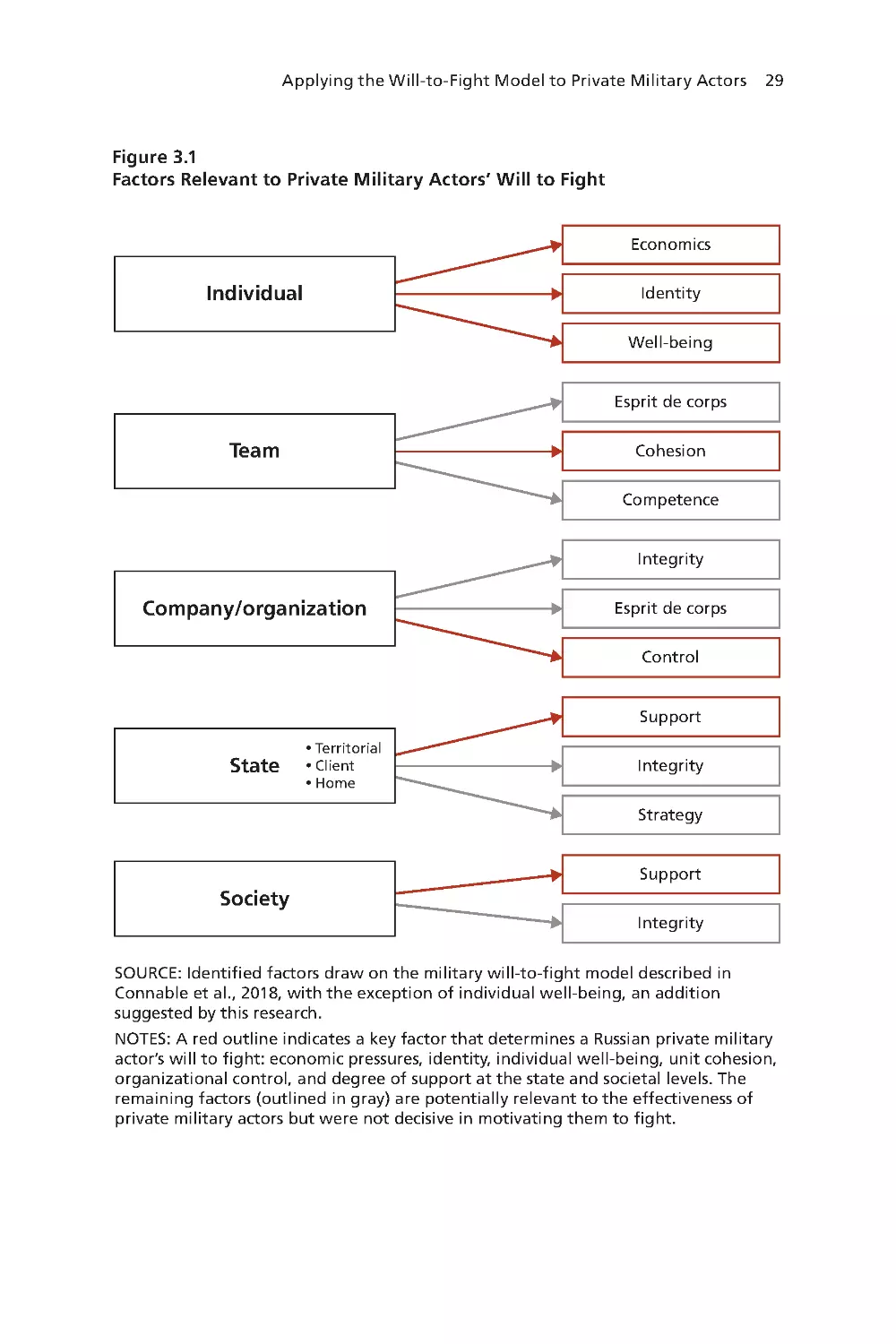
factors are outlined in red in Figure S.1. Those outlined in gray were
potentially relevant in determining private military actors’ operational
effectiveness, but we found that these factors were not decisive in moti-
vating them to fight.
What Lessons Can Be Drawn from Comparative Cases to
Counter Adversary-Employed Private Military Actors?
Applying the modified will-to-fight model led us to the following
conclusions with regard to this population.
Identity
The individual identities of contractor personnel vary and may not
align with the goals of the Russian state or PMC leadership goals in
ordering the deployment. Therefore, the impact of identity on will
to fight is variable. However, detailed analyses of private militar y
contractors’ individual identities provide insight into potential vulner-
abilities regarding their will to fight.
Data limitations make it difficult to discern the relevant compo-
nents of the identities of Russian private militar y actors operating in
any given area, but in the Syrian conf lict (between 2015 and 2019),
we know that they were typically Eastern European, possibly (but
not necessarily) patriotic, and most likely had military or intelligence
background and skill sets that they sought to apply to lucrative work
beyond the military.
Individual Well-Being
Challenges to individual well-being may decrease one’s will to fight,
as well as effective occupational functioning while performing tasks
related to a contracted, military-relevant position in theater. Anecdotal
reports indicate that some Russian contractors have returned home
from Syrian deployments with posttraumatic stress disorder and physi-
cal and mental health problems that are likely to go unaddressed over
the long term.

Summary xv
Figure S.1
Factors Relevant to Private Military Actors’ Will to Fight
SOURCE: Identified factors draw on the military will-to-fight model described in
Connable et al. , 2 018, with the exception of individual well-being, an addition
suggested by this research.
NOTES: A red outline indicates a key factor that determines a Russian private military
actor’s will to fight: economic pressures, identity, individual well-being, unit cohesion,
organizational control, and degree of support at the state and societal levels. The
remaining factors (outlined in gray) are potentially relevant to the effectiveness of
private military actors but were not decisive in motivating them to fight.
Individual
Well-being
Economics
Identity
Team
Competence
Esprit de corps
Cohesion
Company/organization
Control
Integrity
Esprit de corps
State
• Territorial
• Client
• Home
Strategy
Support
Integrity
Society
Support
Integrity

x vi Will to Fight of Private Military Actor s
Economics
Economic factors in the military will-to-fight model can be associated
with oneself or one’s family and include several drivers that can directly
affect an individual’s will to fight: (1) the need for subsistence, (2) the
desire for socioeconomic advancement, and (3) the motivation to earn
money and improve quality of life.
Compiled data from media reports indicate that pay rates for
Russian private militar y actors—even at the more senior operational
levels—are significantly lower than for Western contractors who pro-
vide security ser vices in theaters of conflict under the auspices of West-
ern PMCs. However, the pay offered to contractors who work for Rus-
sian private military actors was significantly higher than the average
monthly salary in Russia as of early 2020 and was, in some cases, higher
than what U.S. prime contractors paid Eastern European nationals for
their service in Iraq in the early and mid-2000s.
Cohesion
High levels of task cohesion between private military actors and their
state military counterparts can increase military effectiveness by posi-
tively inf luencing will to fight at the team level. Notably, at least one
currently active Russian PMC, the Wagner Group, appears to maintain
a clear and well-developed command-and-control (C2) system within
its own company formations, following a template drawn from the
structure of the Russian armed forces. Such a structured C2 approach
may assist in improving task cohesion between contractors and the
allied military forces they deploy alongside, although co-deployment
of militar y and private forces is typically quite challenging and can lead
to coordination problems, friendly-fire issues, or outright violence.9
Control
The concept of control reflects the relationship between individual
and higher-level factors. For example, individual will to fight may not
be inherently strong, but unit- and organization-level coercion may be
9 Molly Dunigan, Victory for Hire: Private Se curity Companie s’ Impact on Milita ry Effective -
ness, Stanford University Press, 2011.

Summary x vii
sufficiently strong that, on the surface, the will to fight of the entire
unit or organization appears to be quite robust. Thus, will to fight may
be vulnerable if individuals are targeted, but there is a risk such efforts
will fail due to unit or organizational oversight.
The private military industry is illegal in Russia, and some spec-
ulate that this intentional illegality is a mechanism for Putin or the
Russian Federal Security Service to control private military actors and
ensure their loyalty. Other mechanisms of both unit and organiza-
tional control appear to include recruiting personnel with promises of
lucrative and easy work, then holding their passports until their con-
tract has been fulfilled.
Support
A lack of state or societal support can weaken will to fight. Russian
private militar y actors and their Western counterparts have appeared
over time to receive comparable levels of state support. For example,
wounded contractors who work for Russian companies are treated in
Russian hospitals and share training sites with Russian military bases.
Yet, due to the industr y’s illegal status in Russia, state support wavers at
times. Societal support is more tenuous, and it is the absence of societal
awareness and hence support that seems to enable Russia’s use of pri-
vate military actors and thus may be a vulnerability in these forces’ will
to fight. Indeed, intentional obfuscation regarding contractor casualty
counts has led to a dearth of Russian popular attention to the use of
contractors, which equates to a public “nod” to these deployments.
The Best Options for Countering Adversary-Employed
Private Military Actors in Syria and Beyond
We recommend that USASOC and the broader U.S. government
pursue three lines of effort moving forward to exploit vulnerabilities
associated with Russia’s use of private military actors. Many of these
recommendations center on messaging activities that are likely to be
conducted by USASOC psychological operations forces; however, all

x viii Will to Fight of Private Militar y Actor s
USASOC components should look for opportunities to exploit these
vulnerabilities within their own mission sets.
Individual and Company/Organizational Levels: Exploit
Vulnerabilities in the Recruitment and Retention of Promising
Contractor Personnel
Analyses via the lenses of the identity, economics, individual well-being,
a nd control factors provide insight into conceivably fruitful cognitive
maneuver activities for USASOC to pursue at the individual and
company/organizational levels. It appears that Russian contractor
personnel tend to select this type of work for self-interested or
clientelistic reasons and are often not treated well by the Russian
government. Indeed, in some cases, it appears that they are victims
of outright exploitation by the state or the companies they work for.
These individuals may therefore be moderately vulnerable and their
loyalties highly malleable. It follows that efforts to weaken their loyalty
and commitment may prove fruitful.
Options for exploiting such vulnerabilities could include overt
messaging efforts through social media and other venues to highlight
the inequities in pay and living conditions between operational
contractors on the ground and individuals higher in the ranks of
the PMC corporate structure, or to highlight to the demographic
of potential recruits the coercive nature of such contracts. Moreover,
broad messaging of statistics regarding contractors’ deployment-
related physical and mental health and challenges acquiring long-term
treatment for these problems could affect recruitment of both new and
veteran contractors over time.
Team Level: Exploit and Deepen Potential Discord Between
Contractor and Military Populations
Analyses via the lens of the cohesion factor—specifically, task
cohesion—provide insight into potentially fruitful cognitive maneu-
ver activities for USASOC to pursue at the team level. Western uses
of PMCs have provided abundant examples of poor coordination
and, at times, hostile or deadly interactions between contractors and

Summary xix
supposedly allied military forces.10 U.S. psychological operations
and special operations forces could fruitfully explore methods of sowing
disorder and resentment between Russian private military contractors
and Russian military forces, both in high-tension combat operations
and in everyday interactions outside of the conflict space, including
domestically in Russia and Eurasia.
State and Societal Levels: Widely Disseminate Information About
Contractors’ Veteran Status and Contractor Casualties to the
Russian Public
Analyses via the lens of the support factor provide insight into potentially
fruitful cognitive maneuver activities for the U.S. government to
pursue at the state and societal levels—possibly with support from
USASOC. There is evidence that contractor casualties are significantly
underreported in Russia and that contractors’ families are prohibited
from talking to the media if they hope to receive death compensation.
In an effort to foster societal backlash within Russia against the
Russian government’s utilization of private military actors, U.S. forces
should consider methods to broadly disseminate information about
Russian involvement in foreign conf licts—including the use of Russian
veterans in private militar y roles and their subsequent treatment—to
the Russian public, as well as data on contractor casualties.
10 Dunigan, 2011, Chapter 3; David Phinney, “Ma rines Jail Contractor s in Iraq: Tension
and Confusion Grow Amid the ‘Fog of War,’” CorpWatch, June 7, 2005; Ariel Zilber, “Ex–
Green Beret and Father-of-Four Who Worked as a Contractor for L ockhe ed Martin Dies
After Being ‘Pummeled into Unconsciousne ss by Two Mari ne s Duri ng a Gym A ltercation’
While Working in I raq,” Daily Mail, Ja nuary 8, 2019.

xxi
Acknowledgments
We gratefully acknowledge the assistance of a number of foreign mili-
tar y personnel who took the time to speak with us for the purposes of
this study. Although we cannot name them publicly, we are indebted to
them for their assistance. We thank Ben Connable and Michael McNer-
ney for their deft leadership of the project for which we conducted this
research and for their guidance on applying the will-to-fight model
to this case. Jennifer Kavanagh and Stephen Watts provided valuable
RAND management support. We also thank Deborah Avant at the
University of Denver and Anika Binnendijk at R AND for their careful
reviews of the report. The U.S . Army Special Operations Command
G-9 directorate deserves special thanks for funding this research, and
we would especially like to thank Brooke Tannehill for the guidance
that he and his team provided over the course of our study.

x xiii
Abbreviations
C2
command and control
DoD
U.S. Department of Defense
FSB
Russian Federal Security Service
GRU
Glavnoye R azvedyvatelnoye Upravleniye [Russian
Intelligence Directorate]
KGB
Komitet Gosudarstvennoy Bezopasnosti
[Committee for State Security]
LOGCAP
Logistics Civil Augmentation Program
PMC
private military company
PMSC
private military and security company
PSC
private security company
PTSD
posttraumatic stress disorder
TCN
third-countr y national
USASOC
U.S. Army Special Operations Command

1
CHAPTER ONE
Understanding the Will to Fight of Private
Military Actors
The research reported here was completed in July 2020, followed by secu-
rity review by the sponsor and the U.S . Army Office of the Chief of Public
Affairs, with final sign-off in June 2023.
The work therefore predates Russia’s 2022 invasion of Ukraine, and
largely omits consideration of Russian private military forces in the war in
Ukraine. Nonetheless, as of June 2023, this analysis remains relevant to an
in-depth, long-term understanding of Russian private military actors and
their will to fight.
In Ukraine, Syria, and other conflict hotspots around the globe, pri-
vate contractors are operating on behalf of, yet are ostensibly separate
from, the Russian state. Indeed, there is documentation that the Rus-
sian Wagner Group is or has recently been active in Ukraine, Syria,
Sudan, the Central African Republic, Madagascar, Libya, Mozam-
bique, Mali, and Venezuela.1
Russian private military actors appear to be somewhat unique in
that they have a direct relationship with Russian state leadership, but
they technically remain illegal under Russian law. Moreover, although
Russian military force privatization has roots extending back to the
end of the Cold War, the extent to which the Russian state employs
1 Ryan Brow ne, “Top US Ge neral Warns Russia Using Mercen arie s to Acce ss Africa’s Nat-
ural Resources,” CNN, Februar y 7, 2019; Tim Lister, Sebastian Shukla, a nd Clari ssa Ward,
‘Putin’s Private A rmy,” CN N, Aug ust 2019; Jane Flanag an, “Moza mbique Calls on Russia n
Firep ow er,” The Times, October 2, 2019.

2 Will to Fight of Private Military Actors
private military actors has exploded in the past decade. These actors
are increasingly thought to constitute a critical, planned component
of Russia’s militar y end strength for ground operations, and they are
intrinsically tied to protecting and sustaining two of Russia’s leading
exports: energy and arms.2
Against the development of Russia’s “new generation warfare”
concept—which emphasizes the growing use of nonmilitar y means in
combination with military tools to achieve political ends—this increas-
ing reliance on private actors for military functions around the globe is
striking.3 In the context of the current U.S. focus on great power com-
petition with Russia and China,4 and in light of the increasing extent
to which Russia is exerting malign inf luence in proxy conf licts world-
wide, the U.S. Army, joint force, and U.S. allies and partners need to
consider and better understand these Russian-hired private militar y
actors and how best to combat them. Indeed, given that private mili-
tary actors are central to Russia’s new generation model of warfare, an
ability to erode or disrupt their effective use would deny the Russian
government a critical tool in achieving its political and military goals.
Cognitive maneuver offers a promising option for the United States
and its allies to exploit Russian vulnerabilities and undercut its new
generation warfare model.
The purpose of this report is to apply a model developed by RAND
Corporation researchers to explore adversaries’ “will to fight,” as a lens
through which to analyze the threats posed by Russian private military
2 Candace Rondeau x, Decoding the Wagner Group: Analyzing the Role of Private Mili-
tary Security Contractors in Russian Proxy Warfare, Washington, D.C .: New America,
November 7, 2019, p. 20.
3 On the Russian concept of ne w generation warfa re , see Linda Robinson, Todd C.
Helmus, Raphael S. Cohen, A lireza Nader, A ndre w R adin, Madeline Magnuson, a nd Katya
Migacheva, Mod er n Political War fare: Cur re nt Practices an d Possible Response s, Santa Monica,
Calif.: R AND Corporation, R R-1772-A, 2018, p. 42.
On private military companie s (PMCs) and Russia n hybrid warf are strategy, see Marga-
rete Klei n, Priva te Militar y Companie s: A Growing Inst rument in Russia’s Foreign and Security
Policy Toolbox, Helsi nki, Finla nd: E uropea n Ce ntre of Excellence for Countering Hybrid
Threats, March 2019.
4 U.S. Department of Defense, Summary of the 2018 National Defense Strateg y of the United
States of America: Shar pening the American Militar y’ s Competitive Edge, Ja nuary 19, 2018.

Understanding the Will to Fight of Private Military Actors 3
actors, focusing on the case study of the Syrian civil war between 2015
and 2019.5 The ultimate aim is to help U.S. Army Special Operations
Command (USASOC) and other U.S. military and government enti-
ties better assess (1) what motivates and demotivates private military
contractors and the companies that hire them to fight; (2) what moti-
vates and demotivates the Russian state government to utilize private
military actors in Syria; and (3) what USASOC and other U.S . military
and government entities can do to inf luence such activities.
In an attempt to elucidate U.S. opportunities to exploit the
strengths and vulnerabilities associated with Russia’s utilization of pri-
vate military actors, this report explores key issues regarding private
military actors’ will to fight across multiple cases and time periods. In
doing so, it focuses particularly but not exclusively on Russian private
military actors, comparing and contrasting this relatively opaque, cli-
entelistic case of military privatization with lessons learned from other
cases of private military force use over the past several decades.
This topic is critically important for several reasons. First, the
entire U.S. national security apparatus should be concerned about Rus-
sia’s increasing deployment of private military actors worldwide, as such
activity allows Russia to expand its military footprint while maintain-
ing plausible deniability and, therefore, relative opacity both in major
combat operations and in the competitive space short of armed con-
flict. Although Russia’s use of private military actors is quickly becom-
ing a global phenomenon, prior to the invasion of Ukraine in 2022, it
5 For the purposes of this report, the phrase private military actors comprises both PMCs
and individual private military cont ractor person nel. In this tra nsnational industry, the
two are related but also distinct. For e xa mple, Russian PMCs sometimes hire non-Russia n
nationals a nd sell their ser vice s to non-Ru ssian f irms and client s. Thus, it is critical to explore
these actors’ will to fight at both the corporate a nd individual le vels. In the academic and
policy literature, the term PMC is often conf lated with both privat e sec urity company (PSC)
a nd private militar y and sec urity company (PMSC). However, the distinction appe ars to b e
that PSCs provide security and combat-related ser vice s only, where as PMC and PMSC are
broader terms encompa ssing all the services marketed by these companie s, i ncluding secu-
rity and combat-related ser vice s. In this report, we re fer simply to PMCs or private militar y
actors, e xcept when quoting from sources that use different termi nolog y. Notably, Russia’s
pri mary private military actor, the Wag ner Group, bega n a s a more-traditional PMC, but it
has essentially evolved into a state-affiliated paramilitary or auxiliary force in the years since
this research w as originally conducted.

4 Will to Fight of Private Military Actors
had been most visible—and, arguably, had the greatest impact on con-
flict outcomes—in Syria. The U.S . Army needs to be well informed
regarding Russian private military actors’ characteristics, activities,
motives, and vulnerabilities in the Syrian context to effectively coordi-
nate future operations involving such actors.
All U.S . Army forces should be aware of Russian private military
actors because of their potential participation in major combat
operations or other direct operations in theaters of conflict. USASOC
has a unique role in combating these forces, a result of both the
positioning of USASOC-aligned forces globally and the particular
skill sets of these forces. Army psychological operations, civil affairs,
and special operations personnel are likely to be on the front lines,
competing with or battling such opaque forces in the gray zone below
the threshold of armed conflict. Therefore, it is essential for USASOC-
aligned forces to comprehensively understand Russian private militar y
actors and their roles, as well as possible methods for exploiting their
vulnerabilities.
To that end, this report addresses the following research questions:
1. Who are the relevant actors in the Russian private military
sphere for the purposes of understanding best how to inf luence
these forces’ will to fight?
2. What factors are most relevant to Russian private military
actors’ will to fight?
3. How do Russian private militar y actors compare with their
current and historical Western counterparts, and what lessons
can be drawn from these comparative cases to inform U.S.
opportunities to defeat adversary-employed private militar y
actors?
Cognitive Maneuver
As explained in USASOC’s explorations of cognitive maneuver, the
best way to win wars may be to use force in a multidomain context to

Understanding the Will to Fight of Private Military Actors 5
achieve cognitive objectives—to change minds, to change behaviors, to
win.6 In general terms,
maneuver is a principle of Joint operations that involves the
employment of forces in the operational area through movement
in combination with fires to achieve a position of advantage in
respect to the enemy.7
In the land domain, military forces conduct combined arms
maneuver, including envelopment, turning movement, frontal attack,
penetration, infiltration, and flank attack.8 Cognitive maneuver occurs
in the human domain and aims to shape contextual conditions and
inf luence decisionmaking. USASOC defines cognitive maneuver as
the tactics of a campaign to shape the conditions of the global
environment and inf luence actors’ decision-making behaviors.
We shape and influence to continually maintain positions of
advantage, adapting to the changing nature and character
of conf lict.9
This is a natural outgrowth of efforts to operate in the human
domain, in which “evolving operational demands require a force that is
capable of impacting human decisionmaking and associated behavior
and focus campaign design on creating desired effects to achieve suc-
cess across all domains.”
10
Note that cognitive maneuver is related to cognitive aspects of
militar y operations, which focus on the three mental functions that
6 U.S. A rmy Special Operations Com mand, E xpanding Man euv er in the Early 21st Century
Security Environment, January 12 , 2017.
7 U.S. A rmy Special Operations Com mand, Cognitive Mane uve r for the Contemporar y an d
Future Strategic Operating Environment, May 31, 2016, p. 2 .
8 Robert A. Warburg , U.S . A rmy Special Operations Com mand, “Cog nitive Maneuver for
the Contemporary and Future Strategic Operating Environ ment,” brief ing , June 21, 2016.
9 U.S. A rmy Special Operations Comma nd, 2016.
10 U.S. Special Operations Comm and, Operating in the Human Domain, version 1.0,
Aug ust 3, 2015.

6 Will to Fight of Private Military Actors
inf luence the formation of perception, intent, decisionmaking, and
behavior: (1) cognition, which refers to modes of knowledge
and information processing; (2) affect, which refers to emotion and
feeling; and (3) conation, which refers to impulse, yearning, and striv-
ing to carry out an act.11
R AND’s will-to-fight model draws on these explorations of how
best to conceive of cognitive maneuver and seeks to elucidate the
cognitive levers that may be relevant to various actors’ will to fight in a
range of circumstances.
Background on the Will-to-Fight Model
R AND’s will-to-fight model, designed to analyze the military units of
nation-states, includes 29 multifaceted cognitive factors that inf luence
the will to fight of military units.
A primary goal of this assessment approach is to add purpose, struc-
ture, and credibility to what is often derided as a subjective process.12
Ideally, further exploration and modification of the will-to-fight model
and tool will lead to a holistic combat effectiveness assessment approach
that integrates both the tangible and intangible factors of warfare.
Understanding the will to fight of any adversary requires assess-
ing the factors that inf luence that adversary’s forces. Factor-by-factor
assessment is the most realistic, practical, and feasible way to assess
the disposition of a militar y organization or unit to fight, act, or per-
severe. It is necessary to accept at the outset that finite clarity is out of
reach. Furthermore, as stated earlier, there is no single factor or small
11 A llison A stori no-Courtoi s, ed., A Cognitive Capabilities Age nda: A Multi-Step Approach
for Closing DoD’ s Cog nitive Capability Gap, Wa shington, D.C .: Joi nt Staff, Strategic Multi-
Layer Assessment Off ice , October 2017; Pat ricia DeGenna ro, “The Power of Cog nitive
Maneuver: Don’t Underestimate Its Value,” Small Wars Journal , September 19, 2017.
12 See Ben Connable, Embracing the Fog of War: A sse ssment an d Met rics in Count erins ur -
gency, Sa nta Monica, Calif.: R AND Corporation, MG-1086-DOD, 2012, a nd Ben Con-
nable, Michael J. McNerney, William Ma rcellino, Aa ron Fra nk, Henry Hargrove, Marek
N. Posard, S. Reb ecca Zimmerman, Nat asha L a nder, Jase n J. Castillo, a nd James Sladden,
Will to Fight: An alyzing, Modeling, an d Simulating the Will to Fight of Militar y Units , Sa nta
Monic a, C alif.: R AND Corporation, R R-2341-A, 2018.

Understanding the Will to Fight of Private Military Actors 7
set of key factors that can explain will to fight in any one case or in
general. Instead, understanding will to fight is a process of factor-by-
factor assessment with the goal of identifying strengths that might be
reinforced and weaknesses that need to be shored up through security
force assistance.
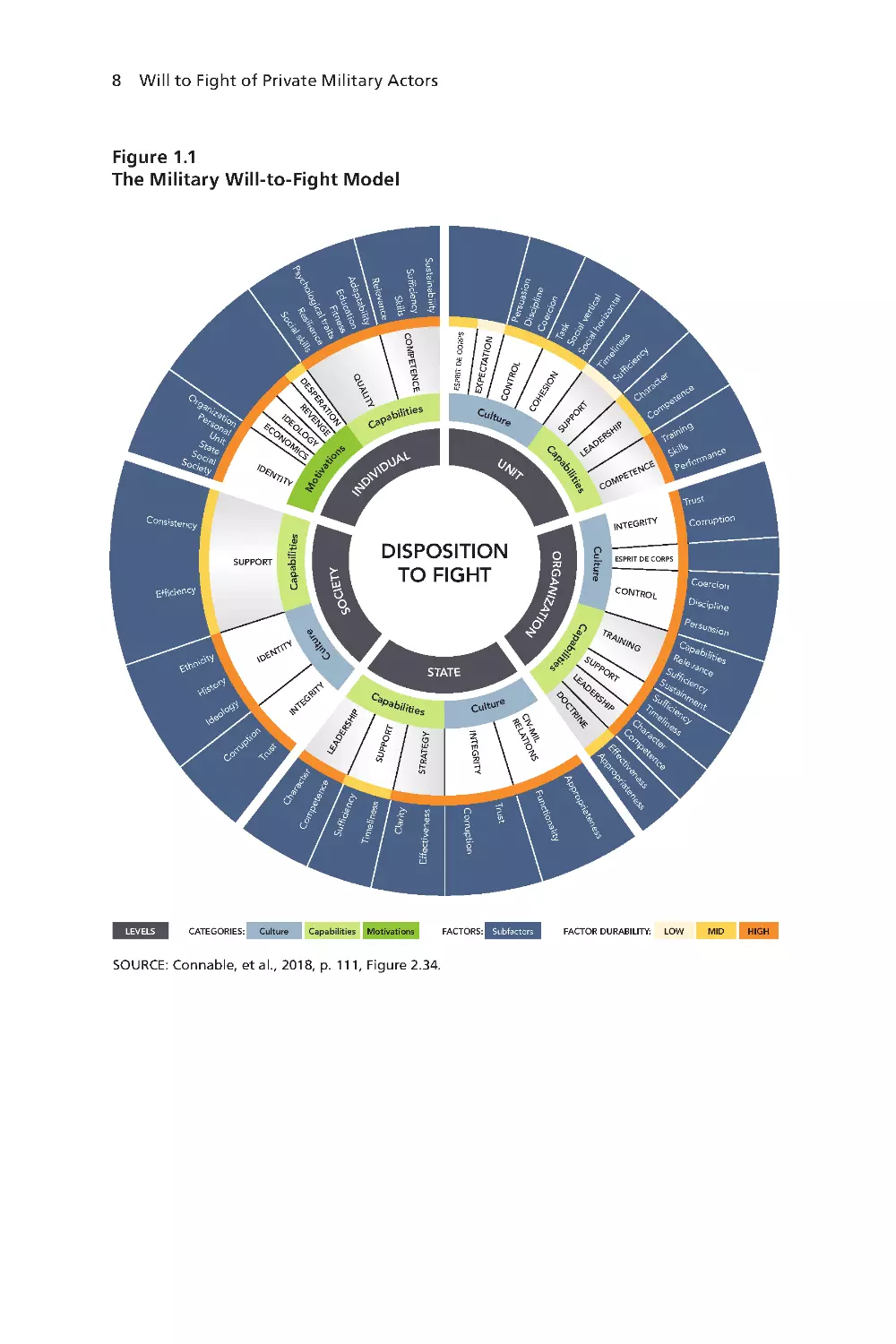
Figure 1.1 shows the will-to-fight model containing 29 major fac-
tors and 61 subfactors. All are derived from a nine-part, mixed-meth-
ods research effort, the results of which were published in the 2018
R AND report Will to Fight: Analyzing, Modeling, and Simulating the
Will to Fight of Military Units.13 The model helps focus the analysis of
each factor at four different levels and along three broad dimensions:
At the levels of the individual, unit, organization, state, and society,
and along the dimensions of motivation, capability, and cultural fac-
tors. For example, unit competence is assessed as a capability, while
societal identity is assessed as a cultural factor.14 Most of the factors
have associated subfactors, which are designed to help break down
the analysis and categorize the evidence. For example, organizational
control consists of methods of coercion, persuasion, and the cultural
approach to discipline.15 All factors are more or less durable in battle,
rated high, mid, or low. Durability ref lects the likelihood that factors
might change over the course of a single battle or over a short series of
battles. All the factors collectively help describe the unit’s or organiza-
tion’s disposition to fight in a prospective battle.
13 Connable et al., 2018.
14 Unit competence is def ined by unit skills, trai ning, and performance. Skills i ndicate
the ability of individuals and units to perform ta sk s. According to the will-to -f ight model,
“ Trai ning is the methods and capabilities used to build and maintain skills. Performance i s
the demon stration of skills. All components of competence ca n build or erode confidence
and, therefore , disposition to fight” (Connable et al., 2018, p. 80).
In the will-to-fight model, identity “include s social and personal identity. It is the com-
mitment to a n identity (e.g ., expectations about what a soldier does) or sense of self-se arch
for satisfaction” (Connable et al., 2018, p. 54).
15 Control “is the method of obtaini ng obedience to orders a nd pursuit of mission objec-
tives. Control relies on a mi x of coercion and persuasion, and it is ref lected in discipline”
(Connable et al., 2018, pp. 79 – 80).

8 Will to Fight of Private Military Actors
Figure 1.1
The Military Will-to-Fight Model
SOURCE: Connable, et al., 2018, p. 111, Figure 2.34.
Capabilities Motivations
Culture
LOW
MID
HIGH
CATEGORIES:
Subfactors
FACTORS:
FACTOR DURABILITY:
LEVELS
A
d
a
p
t
a
b
i
l
i
t
y
S
u
s
t
a
i
n
a
b
i
l
i
t
y
S
u
f
f
i
c
i
e
n
c
y
S
k
i
l
l
s
R
e
l
e
v
a
n
c
e
E
d
u
c
a
t
i
o
n
F
i
t
n
e
s
s
P
s
y
c
h
o
l
o
g
i
c
a
l
t
r
a
i
t
s
R
e
s
i
l
i
e
n
c
e
S
o
c
i
a
l
s
k
i
l
l
s
O
r
g
a
n
i
z
a
t
i
o
n
P
e
r
s
o
n
a
l
U
n
i
t
S
t
a
t
e
S
o
c
i
a
l
S
o
c
i
e
t
y
Consistency
Efficiency
E
t
h
n
i
c
i
t
y
H
i
s
t
o
r
y
I
d
e
o
l
o
g
y
C
o
r
r
u
p
t
i
o
n
T
r
u
s
t
C
h
a
r
a
c
t
e
r
C
o
m
p
e
t
e
n
c
e
S
u
f
f
i
c
i
e
n
c
y
T
i
m
e
l
i
n
e
s
s
C
l
a
r
i
t
y
E
f
f
e
c
t
i
v
e
n
e
s
s
C
o
r
r
u
p
t
i
o
n
F
u
n
c
t
i
o
n
a
l
i
t
y
A
p
p
r
o
p
r
i
a
t
e
n
e
s
s
A
p
p
r
o
p
r
i
a
t
e
n
e
s
s
E
f
f
e
c
t
i
v
e
n
e
s
s
C
o
m
p
e
t
e
n
c
e
C
h
a
r
a
c
t
e
r
T
i
m
e
l
i
n
e
s
s
S
u
f
f
i
c
i
e
n
c
y
S
u
s
t
a
i
n
m
e
n
t
S
u
f
f
i
c
i
e
n
c
y
R
e
l
e
v
a
n
c
e
C
a
p
a
b
i
l
i
t
i
e
s
P
e
r
s
u
a
s
i
o
n
D
i
s
cipline
Coercion
Corruption
T
r
u
s
t
P
e
r
f
o
r
m
a
n
c
e
C
o
m
p
e
t
e
n
c
e
S
u
f
f
i
c
i
e
n
c
y
T
i
m
e
l
i
n
e
s
s
S
o
c
i
a
l
h
o
r
i
z
o
n
t
a
l
S
o
c
i
a
l
v
e
r
t
i
c
a
l
C
o
e
r
c
i
o
n
D
i
s
c
i
p
l
i
n
e
P
e
r
s
u
a
s
i
o
n
T
a
s
k
C
h
a
r
a
c
t
e
r
S
k
i
l
l
s
T
r
a
i
n
i
n
g
T
r
u
s
t
C
O
M
P
E
T
E
N
C
E
Q
U
A
L
I
T
Y
D
E
S
P
E
R
A
T
I
O
N
R
E
V
E
N
G
E
I
D
E
O
L
O
G
Y
E
C
O
N
O
M
I
C
S
I
D
E
N
T
I
T
Y
I
D
E
N
T
I
T
Y
I
N
T
E
G
R
I
T
Y
L
E
A
D
E
R
S
H
I
P
SUPPORT
S
U
P
P
O
R
T
S
T
R
A
T
E
G
Y
I
N
T
E
G
R
I
T
Y
D
O
C
T
R
I
N
E
L
E
A
D
E
R
S
H
I
P
S
U
P
P
O
R
T
T
R
A
I
N
I
N
G
C
O
N
TR
O
L
I
N
TE
G
RITY
C
O
M
P
E
T
E
N
C
E
L
E
A
D
E
R
S
H
I
P
S
U
P
P
O
R
T
C
O
H
E
S
I
O
N
C
O
N
T
R
O
L
E
X
P
E
C
T
A
T
I
O
N
E
S
P
R
I
T
D
E
C
O
R
P
S
C
I
V
-
M
I
L
R
E
L
A
T
I
O
N
S
ESPRIT DE CORPS
C
u
l
t
u
r
e
C
a
p
a
b
i
l
i
t
i
e
s
C
a
p
a
b
i
l
i
t
i
e
s
C
a
p
a
b
i
l
i
t
i
e
s
C
a
p
a
b
i
l
i
t
i
e
s
C
a
p
a
b
i
l
i
t
i
e
s
C
u
l
t
u
r
e
STATE
C
u
l
t
u
r
e
C
u
l
t
u
r
e
M
o
t
i
v
a
t
i
o
n
s
S
O
C
I
E
T
Y
O
R
G
A
N
I
Z
A
T
I
O
N
U
N
I
T
I
N
D
I
V
I
D
U
A
L
DISPOSITION
TO FIGHT

Understanding the Will to Fight of Private Military Actors 9
Each factor in the model represents a line of inf luence on the
disposition to fight. Every factor is interdependent in some way.
Organizational leadership affects unit leadership, which affects
esprit de corps, unit support, cohesion, and so on.16 In an ideal world,
this model would be fully interactive and dynamic. There would be a
theory-driven way to show every relational value between ever y factor,
as well as a way to calculate all those dynamic relationships to gen-
erate a finding. As of mid-2023, no field of scientific endeavor had
come close to cracking the code on this kind of interwoven human
complexity. Therefore, the R AND model and this report pursue a
clearer understanding of each factor, along with trends across factors.
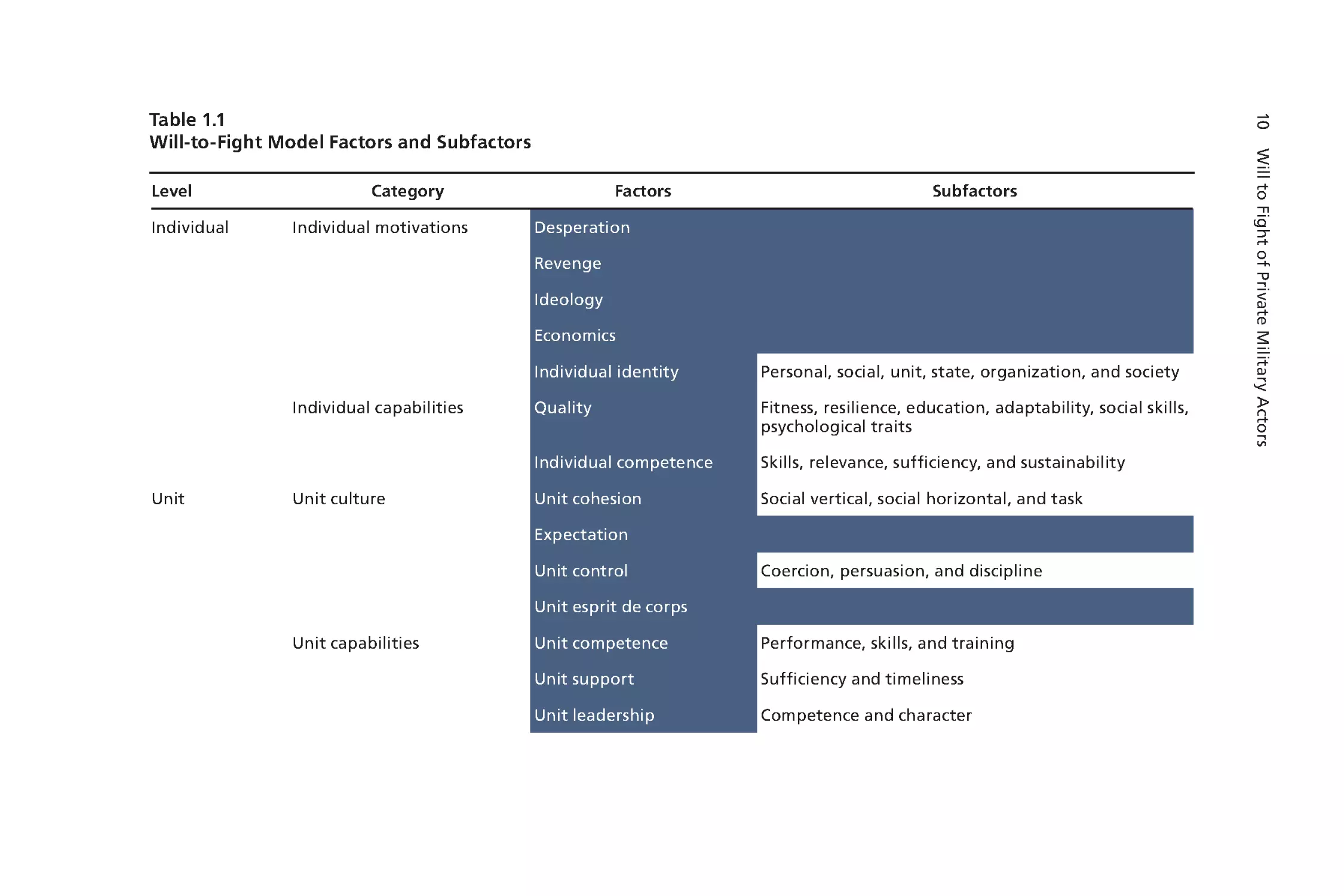
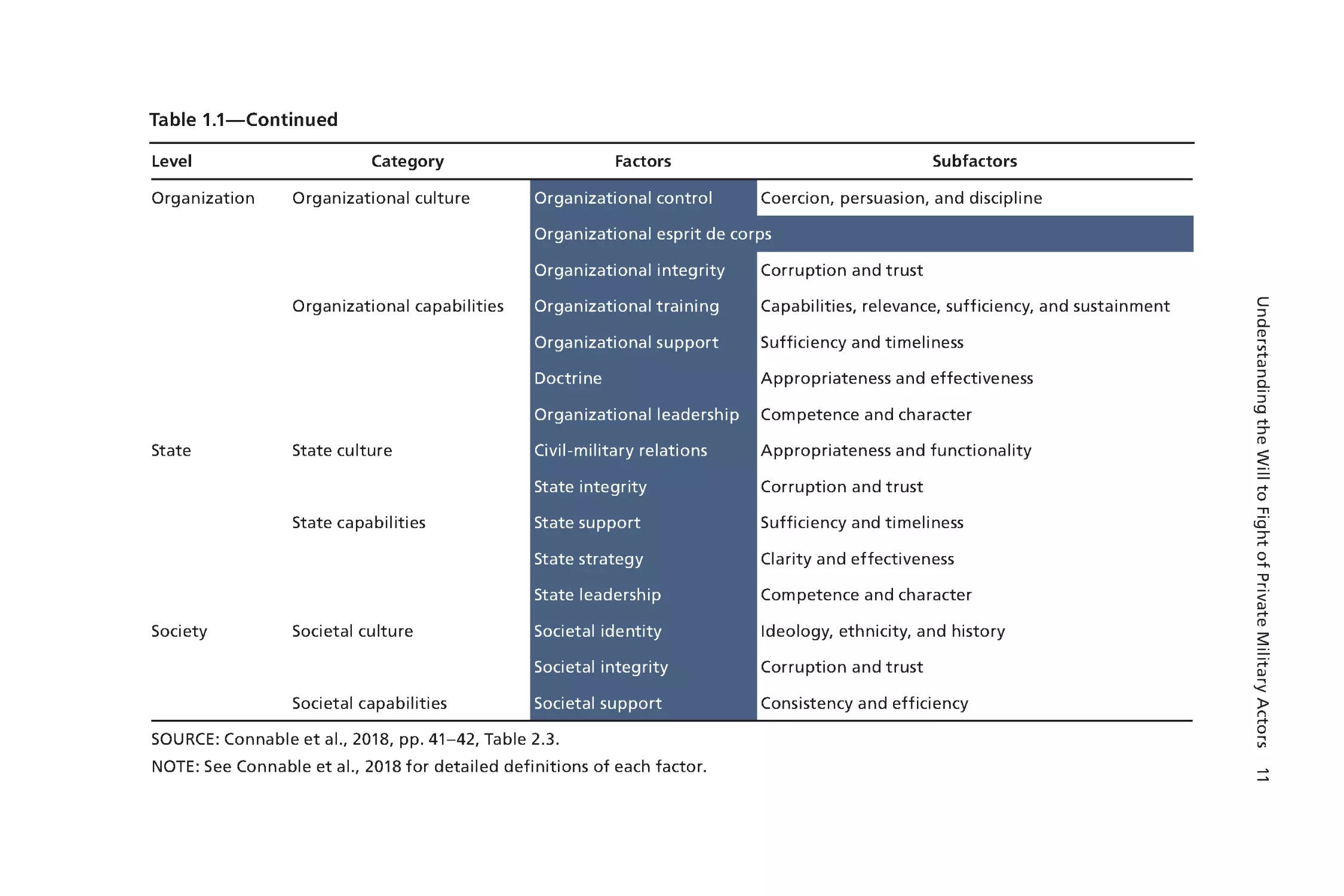
Another way to view the model and factors is in table form.
Table 1.1 shows the same factors, subfactors, levels, and categories
aligned vertically and horizontally, with factors shaded.
16 Leadership in the model is def ined, de scribed, a nd has the same subfactors at both the
unit and org ani zational levels. “L eadership is the act of a single person in authority direct-
ing a nd encouraging the behavior of soldiers to accomplish a military mission.” L e ader ship
subfactors a re competence and cha racter, “and leaders connect with soldiers and other le ad-
ers through vertical cohe sion.” Howe ver, the de scription of org ani zational leadership notes,
“Vertical cohe sion b et ween units and the org ani zation’s leadership is weaker and more dis-
tant than at the small-un it level,” and “assessment and analysis of org ani zational inf luences
on will to fight might require an examination of several levels of vertical leadership” (Con-
nable et al., 2018, pp. 71, 88).
Relevant to all analyses of military will to fight in that loyalty to an organization influ-
ence s individuals’ and units’ will to f ight, “Esprit de corps is a French term generally trans-
lated a s ‘group spirit.’ It is also called élan or pride, and it is often ref erred to simply as esprit
(spirit). Memb ers of a pa rticular unit develop part of their i ndividual identity in relation to
the unit and to the organization.” Acknowledging that it is a factor at every level of an orga-
nization, the will-to-fight model ties esprit to “the fighting spirit of a unit and an ardor or
eager ne ss to pursue a cause or ta sk,” adding , “It captures a conf idence i n battle prowe ss and
succe ss, and concepts of elite membership.” (Connable et al., 2018, pp. 77–78, 88).
Unit support “is the sufficiency and timeliness of equipment, supplies, we apon s, medi-
cal assista nce, f ires, food, w ater, and other thing s the unit needs to accomplish its mission s”
(Connable et al., 2018, p. 82).
Cohesion include s both task cohe sion and social cohe sion at the unit level. Task cohe sion
is “a com mitment to colle ctive goals,” wherea s social cohesion “i s bonding based on friend-
ship, tr ust, or other aspects of interpersonal relationships,” formed through, for e xample,
“sha red e xperience and hardship.” In the model, “Social cohesion in the sta nda rd model of
m ilitary group cohesion include s both horizontal (peer) a nd vertical (leader) bonds” (Con-
nable et al., 2018, pp. 65–66).

1
0
W
i
l
l
t
o
F
i
g
h
t
o
f
P
r
i
v
a
t
e
M
i
l
i
t
a
r
y
A
c
t
o
r
s
Table 1.1
Will-to-Fight Model Factors and Subfactors
Level
Category
Factors
Subfactors
Individual
Individual motivations
Desperation
Revenge
Ideology
Economic s
Individual identity
Personal, so cial, unit, s t ate, or ganization, and society
Individual capabilities
Quality
Fitness , res ilience, e duc ation, adaptability, so cial skills ,
psychologic al traits
Individual compete nce
Skills , relevance, s uf ficie nc y, and sust ainabilit y
Unit
Unit culture
Unit cohesion
Social vertical, social horizontal, and task
Expectation
Unit control
Coercion, per suasion, and discipline
Unit esprit de corps
Unit capabilities
Unit competence
Perfor mance, skills , and training
Unit support
Sufficiency and timeliness
Unit leadership
Competence and character

U
n
d
e
r
s
t
a
n
d
i
n
g
t
h
e
W
i
l
l
t
o
F
i
g
h
t
o
f
P
r
i
v
a
t
e
M
i
l
i
t
a
r
y
A
c
t
o
r
s
1
1
Level
Category
Factors
Subfactors
Organization
Organizational culture
Organizational control
Coercion, per suasion, and discipline
Organizational e sprit de corps
Organizational integrity Corruption and trust
Organizational capabilities Organizational training
Capabilities, relevance, sufficiency, and sustainment
Organizational support
Sufficiency and timeliness
Doctrine
Appropriateness and effectiveness
Organizational leadership Competence and character
State
State culture
Civil-militar y relations
Appropriatenes s and functionality
State integrity
Corruption and trust
State c apabilities
State support
Sufficiency and timeliness
State strategy
Clarity and effectiveness
State leadership
Competence and character
Society
Societal culture
Societal identity
Ideology, ethnicity, and history
Societal integrity
Corruption and trust
Societ al c apabilities
Societal support
Consistency and efficiency
SOURCE: Connable et al., 2018, pp. 41 –42, Table 2.3 .
NOTE: S ee Connable et al. , 2 018 for detailed definitions of each factor.
Table 1.1— Continued

12 Will to Fight of Private Military Actors
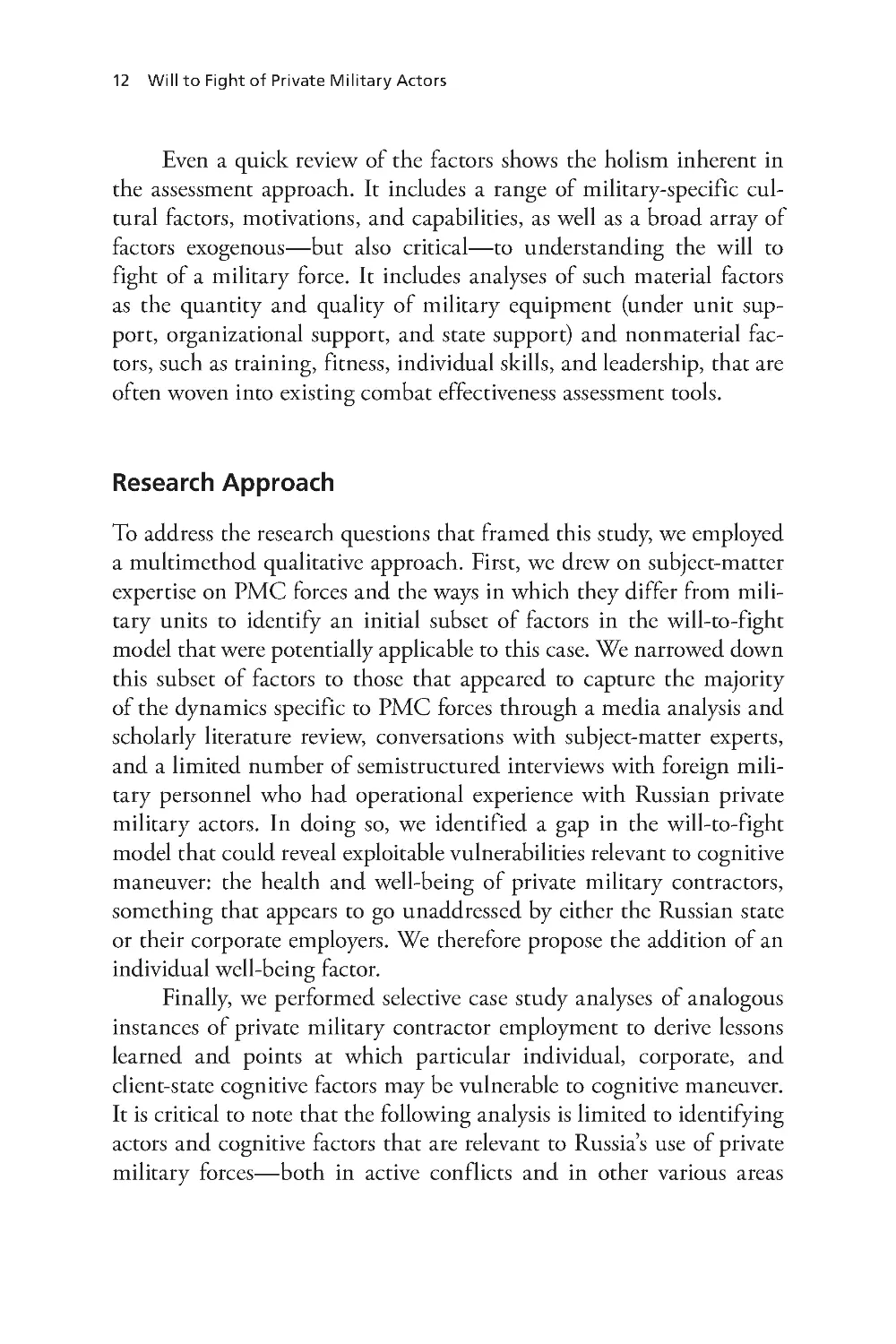
Even a quick review of the factors shows the holism inherent in
the assessment approach. It includes a range of military-specific cul-
tural factors, motivations, and capabilities, as well as a broad array of
factors exogenous—but also critical—to understanding the will to
fight of a military force. It includes analyses of such material factors
as the quantity and quality of military equipment (under unit sup-
port, organizational support, and state support) and nonmaterial fac-
tors, such as training, fitness, individual skills, and leadership, that are
often woven into existing combat effectiveness assessment tools.
Research Approach
To address the research questions that framed this study, we employed
a multimethod qualitative approach. First, we drew on subject-matter
expertise on PMC forces and the ways in which they differ from mili-
tary units to identify an initial subset of factors in the will-to-fight
model that were potentially applicable to this case. We narrowed down
this subset of factors to those that appeared to capture the majority
of the dynamics specific to PMC forces through a media analysis and
scholarly literature review, conversations with subject-matter experts,
and a limited number of semistructured inter views with foreign mili-
tary personnel who had operational experience with Russian private
militar y actors. In doing so, we identified a gap in the will-to-fight
model that could reveal exploitable vulnerabilities relevant to cognitive
maneuver: the health and well-being of private military contractors,
something that appears to go unaddressed by either the Russian state
or their corporate employers. We therefore propose the addition of an
individual well-being factor.
Finally, we performed selective case study analyses of analogous
instances of private military contractor employment to derive lessons
learned and points at which particular individual, corporate, and
client-state cognitive factors may be vulnerable to cognitive maneuver.
It is critical to note that the following analysis is limited to identifying
actors and cognitive factors that are relevant to Russia’s use of private
militar y forces—both in active conf licts and in other various areas

Understanding the Will to Fight of Private Military Actors 13
of competition short of armed conflict—and pressure points that the
United States could exploit.
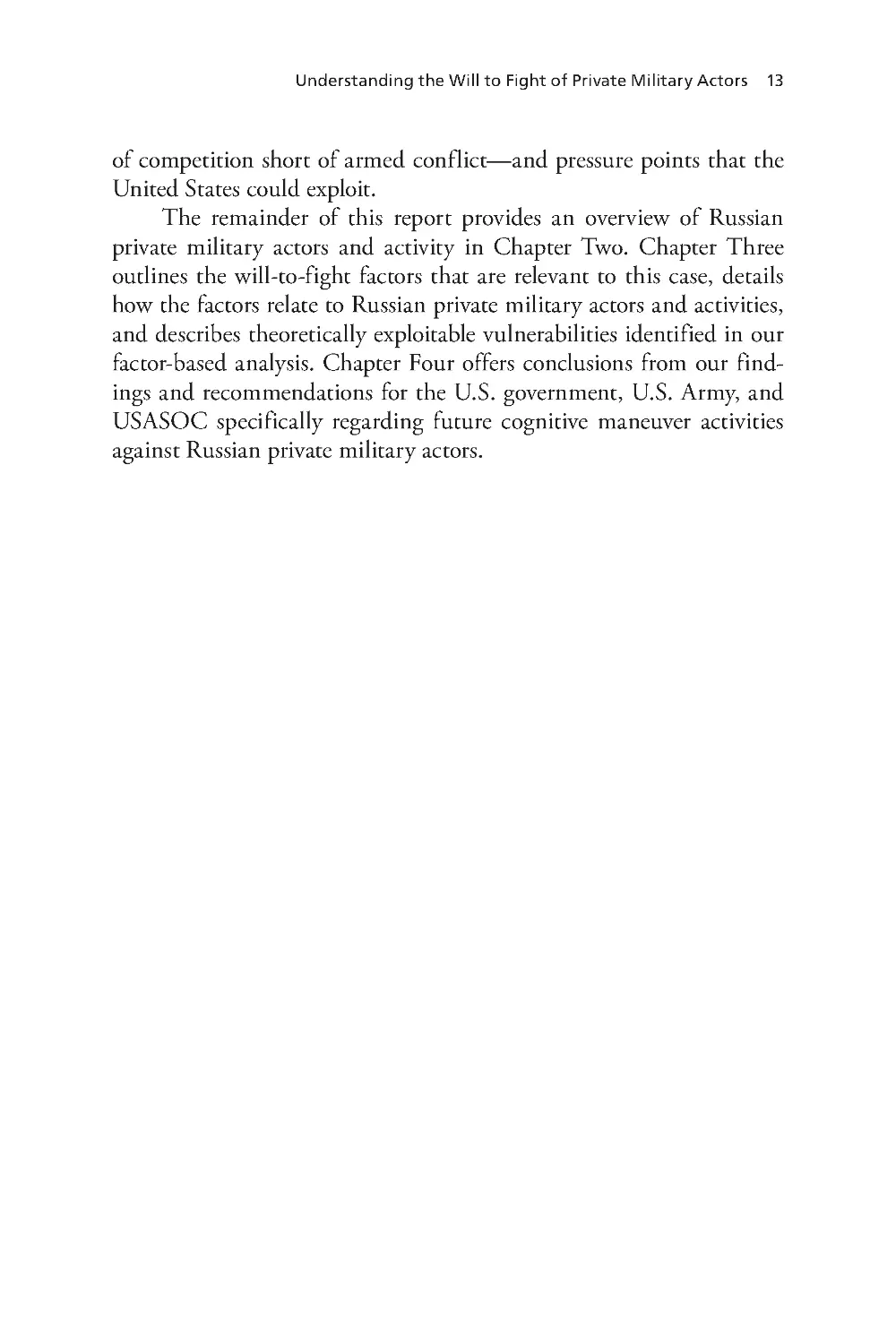
The remainder of this report provides an overview of Russian
private military actors and activity in Chapter Two. Chapter Three
outlines the will-to-fight factors that are relevant to this case, details
how the factors relate to Russian private military actors and activities,
and describes theoretically exploitable vulnerabilities identified in our
factor-based analysis. Chapter Four offers conclusions from our find-
ings and recommendations for the U.S . government, U.S. Army, and
USASOC specifically regarding future cognitive maneuver activities
against Russian private militar y actors.

15
CHAPTER TWO
Russia’s Private Military Actors
The rapid growth in Russia’s employment of private military actors
in recent years is notable and appears to be tied to the Russian state’s
overall efforts to quietly increase its global footprint below the threshold
of armed conflict through hybrid warfare and strategic competition. In
addressing the first research aims of this study, this chapter explores the
question of who the relevant actors are in the Russian private militar y
sphere for the purposes of understanding how best to inf luence their
will to fight.
It is important to note Russia’s roles as both a contracting state
and a home state for contracted forces (i.e ., it employs private mili-
tary actors both domestically and abroad, and it exports private mili-
tary services to other client states).1 The distinction between Russia’s
import and export markets for private forces has become increasingly
opaque, with the Russian state technically maintaining that the exis-
tence of private military companies and the use of their services are ille-
gal in Russia, despite extensive evidence of close Russian state support
and client relationships with particular firms.2 Interestingly, promi-
nent figures, including Russian president Vladimir Putin, have argued
1 This e xporting of private military support occu rs through contract s with PMCs, such as
the Wagner Group, and deploy ment s of individual private military cont ractors.
2 Michael Wei ss, “The Case of the Keystone Cossacks,” Foreign Policy, Novemb er 21, 2013;
Kimb erly Marten, “Russia’s Use of Semi-State Security Forces: The Case of the Wagner
Group,” Post-Soviet Affairs, Vol. 35, No. 3, 2019.

16 Will to Fight of Private Military Actor s
for legalization, and a bill to legalize PMCs was proposed in Russia’s
Duma in 2018. It did not pass.3
Prior to 2014, foreign military experts and scholars of militar y
privatization generally believed that the market for forces exported
from Russia and Ukraine—that is, for individual contractors’
and small firms’ services purchased by non-Russian entities—was
generally thought to be small in comparison to the markets in the
United States and the United Kingdom. The market tended to operate
through informal networks rather than large corporate structures, with
sellers who were generally (but not exclusively) individuals or small
companies. As they do today, buyers included a range of foreign states,
international government organizations, and private individuals. In
the early 2000s, the Russian press estimated that between 5,000 and
10,000 Russian and Ukrainian contractor personnel were providing
transport support—and sometimes filled combat roles—for various
foreign firms and other entities around the globe. Contractor personnel
on the Russian export market at this time were involved primarily in
piloting Russian and Soviet planes and, increasingly, acting as armed
guards or paramilitary forces in conf lict zones. At that time, aircraft
pilots and experts were by far the most commonly contracted person-
nel from Russia and Ukraine.4
This export market should not be confused with the internal
post-Soviet market for forces purchased by Russian entities to support
operations abroad, but this appears to have been critical in driving the
shape and character of present-day Russian private military actors.
This market can trace its lineage back to counter-terror and counter-
espionage units formed under the auspices of KGB development courses
for officers following the dissolution of the Soviet Union—namely,
Alpha Group and its sister unit Vympel (also known as Vega Group).
3 Sergey Sukha nkin, “Continuing War by Other Mean s”: The Case of Wagn er, Russia’s Pr e -
mier Private Militar y Company in the Middle East , Wa shington, D.C .: Jame stow n Founda-
tion, July 13, 2018b.
4 Olivia Allison, “Informal but Diverse: The Market for Exported Force from Russia and
Ukrai ne,” i n Molly Dunigan and Ulrich Petersohn, eds., The Markets for F orce: Privatization
of Security Across World Regions, Philadelphia, Pa.: University of Pennsylvania Pre ss, 2015,
pp. 88 –89.

Russia’s Private Military Actors 17
Alpha Group and Vympel, in turn, have ties to World War II partisan
warfare units and the creation of specialized irregular reconnaissance
task forces in the 1950s.5
The supply of skilled veterans and related corporate networks
following the dissolution of the Soviet Union therefore drove the
market to some extent. Yet, the foundations of the demand signal in
the current Russian market are shaped by clientelism, in the form of
private firms that emerged in the post– Cold War era to support the
security needs of state energy companies, such as Gazprom, Tatneft,
Stroytransgaz, Zarubezhneft, Rosneft, and Surgutneftgaz, all of which
are, in turn, led by close associates of Russian president Vladimir
Putin.6 As Candace Rondeaux notes,
The transition of elite security cadres from government service
to private security overlapped with several phases of privatization
and reorganization of state enterprises of strategic importance for
Russia’s export base. State-backed energy firms soon emerged as a
key incubator for the PMSC industry. A few years after the Soviet
collapse, [Russian president Boris] Yeltsin issued an executive
decree that allowed Gazprom and Transneft to set up their own
militarized armies to protect newly built infrastructure. Transneft
and Gazprom subsequently joined a wave of state-run firms in the
finance and energy sectors that staffed their specialized security
divisions with former top KGB officers at the time.7
Corporate demand for privatized security services continued
to grow: By 2007, Gazprom employed 20,000 or more contracted
personnel to secure its operations. Simultaneously, Putin initiated a
broader, quiet privatization push between 2005 and 2007, giving
control of major Russian exporting industries to politicians with state
security ties and to longtime associates with roots in the KGB or its
modern successor, the Russian Federal Security Service (FSB).8
5 Rondeaux, 2019, pp. 25–26.
6 Rondeaux, 2019, pp. 20–29.
7 Rondeaux, 2019, pp. 28–29.
8 Rondeaux, 2019, p. 27.

18 Will to Fight of Private Military Actor s
It was against this backdrop of Russian force privatization that
Dmitr y Utkin, former commander of Glavnoye Razvedyvatelnoye
Upravleniye (GRU) Spetsnaz—Russian special forces units attached
to the chief intelligence directorate of the Russian general staff—
is reported to have founded the Wagner Group in 2014. Utkin was
reportedly fascinated with Nazi Germany and chose the name
“Wagner” in homage to one of Hitler’s favorite composers.9 Wa g ne r
contractors took part in the 2014 annexation of Crimea and have
fought in Donbass, in eastern Ukraine. In fall 2015, when Moscow
launched its militar y intervention in Syria, Wagner deployed more
than 2,000 personnel there.10
Though increasingly notorious, the Wagner Group is just one of
several known Russian PMCs that operate abroad or have done so in
the relatively recent past. In addition to the Wagner Group, the follow-
ing Russian private military actors have been cited in traditional media
and online reporting since 2001:
• Anti-Terror Orel
• Slavonic C orps
• Moran Security Group
• RSB Group
• E.N .O.T.Corps
• MAR
• DOBR ANDR
• Turan
• Centre R
• ATK Group
• Tigr Top-Rent Security
• Cossacks
• Patriot.11
9 Mike Giglio, “I nside the Shadow Wa r Fought by Russia n Merce naries,” Bu zzFe ed News,
April 17, 2019.
10 Metin Gurca n, “Private Militar y Compa nie s: Moscow ’s Other A rmy in Syria,”
Al-Monitor, Novemb er 30, 2017.
11 Marten (2019) has highlighted that the RSB Group post s conf licting claims on its web site
that it “does not participate in armed conf lict s” but can produce 1,000 former Russi an

Russia’s Private Military Actors 19
Media and scholarly reports detail, with a mix of hard evidence
and speculation, that contractors working under the auspices of one or
more of these companies have operated in Iraq, Afghanistan, Ukraine,
Syria, Libya, Chechnya, Tajikistan, Yemen, and Burundi, in some cases
as far back as the 1990s. This is in addition to reported Wagner Group
operations in Ukraine, Syria, Sudan, the Central African Republic,
Madagascar, Libya, Mozambique, Mali, and Venezuela.12
Indeed, by summer 2017, the Wagner Group alone may
have employed as many as 5,000 contractors just to Syria.
That number allegedly jumped dramatically from approxi-
mately 1,000 a year earlier.13 Other reports as of early 2018 pro-
vided more-precise numbers, with a slightly lower count of
4,840 Wagner contractors, though it is unclear whether all were
deployed to Syria at that time.14 And as of early 2023, approximately
50,000 Wagner contractors were reportedly operating in Ukraine.
Industry Structure in Context
Russian private military actors and their relationships to the Russian
state and Russian society differ in some ways from historical cases of
military officers ready to take up arms in under a week. The group is rumored to have operated
in Libya and clai ms to provide security functions for Russian companie s around the glob e
in coordination with the FSB. For more information on E .N.O.T. Corps, see Sukhankin,
2018b. Scholars and journalists have speculated that the Turan’s e xi stence may have be en
completely fabricated. Marten (2019) reports that a Russi an watchdog org anization, the
Conf lict Intelligence Te am, demon strated through compa rative photographic evidence that
Turan, supposedly operating in Syria, was f ake. Nonethele ss, se vera l Russia n media outlet s
repeated claims ab out Turan’s involvement in Syria a s if they were tr ue. Marten (2019)
mentions Pat riot in passi ng; def initive evidence of this f irm’s e xistence remai ns elusive.
12 Browne, 2019; Lister, Shukla, and Ward, 2019; Flanag an, 2019; Marten, 2019.
13 Sarah Fainberg , Russian Spetsnaz: Contrac tor s and Volunte er s in the Syrian Conflict, Pa ris:
French Institute of International Relations, Russie.Nei.Vision s No. 105, De cembe r 2017;
Neil Hauer, “Putin Has a Ne w Secret Weapon in Syria: Chechens,” Foreign Policy, May 4,
2017.
14 Sergey Sukha nkin, “War, Busi ne ss a nd ‘Hybrid’ Warf are: The Case of the Wagner Private
Military Compa ny (Part Two),” Eurasia Daily Monitor, Vol. 15, No. 61, April 23, 2018a.

20 Will to Fight of Private Military Actor s
militar y privatization, and scholars and journalists studying these cases
have focused on such distinctions and their implications as a depar-
ture from historical precedent.15 However, in other ways, Russia’s use
of private military actors bears striking similarities to historical cases
(in terms of both the purchase and sale of such ser vices) involving
the United States, United Kingdom, and South Africa, among other
countries. Indeed, Russian private military actors constitute a hybrid
between PMSCs and contractors emanating from the heretofore dom-
inant states in the modern-day privatized security and military ser-
vices market (such as the United States, United Kingdom, Australia,
New Zealand, and South Africa) and the historical “mercenaries” with
whom they are often grouped in terms of terminology.
A widely agreed-upon definition of the term mercenary is
elusive, with scholars and analysts arguing over many of the most
basic components of mercenarism.16 Most traditional conceptions of
mercenaries involve a profit motivation or a foreign component and
may depend on the degree to which they engage in public versus
15 See, for in sta nce, A nna Borshche vskaya, Ru ssian Priva te Militar y Companies: Continuity
and Evolution of the Model, Philadelphia, Pa.: Foreign Policy Research Institute, December
2019; Nathaniel Rey nolds, Putin’s Not-So- Se cret Mercena ries: Patr ona ge , Geopolitics , and the
Wag ner Group, Wa shington, D.C .: Ca rnegie Endow ment for International Peace, July 8,
2 019.
16 Molly Dunigan, Victory for Hire: Private S ecu rity Companies’ Impact on Militar y
Effectiveness, Palo A lto, Calif.: Stanford University Press, 2011, p. 15. A rticle 47.2 of
Additional Protocol I of the Gene va Conve ntions def ines a mercenary as
any person who
(a) is sp ecially recruited locally and abroad in order to f ight in an armed conflict;
(b) does, in fact, take a direct part in hostilities;
(c) is motivated to take p art in the hostilities essentially by the desi re for private g ain
and, in fact, is promised by or on behalf of a Party to the conflict material compensation
substantially in excess of that promised or paid to combatants of similar rank and
functions in the armed forces of that Party;
(d) is neither a national of a Party to the conflict nor a resident of territory controlled by
a Party to the conflict;
(e) is not a member of the armed forces of a Party to the conflict; and
(f) has not been sent by a State which is not a Party to the conflict on official duty as a
member of its armed forces.

Russia’s Private Militar y Actor s 21
private violence, on a historical spectrum. Not quite mercenaries,
auxiliary forces (troops hired out in units by their rulers to serve in
foreign conf licts) are considered to be more mercenary-like than
modern-day private military companies based in Western countries,
both because they tend to be less attached to the cause for which they
are fighting and because they are less often subject to legitimate control
by the state actors in question. Historical examples of auxiliary forces
include the Hessian forces hired to fight for the British in the American
Revolution and the condottieri hired by Italian city-states in the 13th–
15th centuries.17
Western PMCs, in contrast, are less mercenary-like than are
most historical examples of mercenaries and auxiliary forces and have
several notable characteristics distinguishing them from traditional,
historically grounded concepts of mercenaries. Such characteristics
include t he following:
• Western PMC personnel are, by definition, backed by a corporate
infrastructure designed to select, train, and deploy them. This
corporate infrastructure similarly bids on contracts and, in most
cases, has a professional portfolio detailing its performance on
previous contracts.
17 Dunigan, 2011; Joseph Jay Deiss, Captains of Fortune: Prof iles of Six Italian Condottieri,
New York: Thomas Y. Crowell Company, 1967; Daniel Waley, The Italian City-Republics,
London: World University Library, 1969; C. C . Bayley, Wa r and Society in Ren ais sance Flor -
ence: The “D e Militia” of Leonar do B runi, Toronto: University of Toronto Press, 1961; Eugene
B. Smith, “The Ne w Condottieri and US Policy: The Privatization of Conf lict and its Impli-
c at i on s ,” Parameters, Vol. 32, No. 4, Winter 2002–2003; Michael Mallett, Mercenaries and
Their Maste rs: Warfar e in Ren ais sance Italy, L ondon: Bodley Head, 1974; William Caf erro,
“Italy and the Companie s of Adventure in the Fourteenth Century,” The Historian, Vol.
58, No. 4, June 1996; Edward J. Lowell, The Hessians and the Other German Auxiliaries of
Great Britain in the Revolutionary War, Ne w York: Harper and Brothers, 1884, chapt. 2;
Joseph George Rosenga rten, A D efe nce of the He ssian s, reprint, Philadelphia, Pa.: Historical
Society of Pennsylvania, July 1899; Joha nn E rnst Prechtel, A Hessian Off icer’s Diar y of the
American Revolution, Bruce E . Burgoyne, tra ns., Bowie , Md.: Heritage B ook s, 1994; Rodney
Atwood, The Hessians: Me rce narie s f rom Hesse n-K asse l in the American Re volution, Ne w York:
Cambridge Unive rsity Press, 1980; Mark Mayo Boatner III, En cyclopedia of the Ame rican
Revolution, Ne w York: David McKay Publications, 1969; Joha nn Ge org Zinn, journ al entry
in Bruce E . Burgoy ne , ed. and trans., Enemy Views: The American Rev olutionar y Wa r a s
Recorded by the He ssian Par ticipants , We stmi nster, Md.: Heritage Books, 1996.

22 Will to Fight of Private Military Actor s
• The modern private military industry in Western states is unique
in its scale and transnational nature. Indeed, many PMCs have
the capability to hire hundreds of personnel representing a range
of nationalities on short notice.
• Virtually all reputable U.S.- a nd UK-based firms openly compete
for government contracts and espouse a company ideology in line
with the ideals of the United States and its Western allies.18
• Some but not all Western PMCs do indeed make both explicit
and implicit attempts to shape foreign policy. In this sense, the
degree of state control over modern Western PMCs seems to be
rather reciprocal. The former Blackwater Worldwide is a prime
example of this phenomenon.19
• Western companies in the industry adhere to several pieces of
regulatory guidance aimed at increasing contractors’ compliance
with international humanitarian law and instituting quality
management systems for business operations at the corporate
level. Relevant guidance includes the Montreux Document,
the International Code of Conduct for Private Security Service
Providers, and the American National Standards Institute’s PSC.1
Standard.20
18 Western PMC firms have nonetheless bee n the subject of numerous and at times high-
prof ile report s of a lack of accountability and exce ssive u se of force , sug gesting that e spousal of
U.S . and allied ideals is not ne cessarily equivalent to adherence to related pri nciples of inter-
national huma nitarian law and the laws of war. See , for insta nce, Sarah K. Cotton, Ulrich
Petersohn, Molly Dunigan, Q Burkha rt, Meg an Zander-Cot ugno, Edward O’Connell, a nd
Michael Webber, Hired Guns: Views About Armed Contractors in Operation Iraqi Freedom,
Santa Monica, Calif: R AND Corporation, MG-987-SR F, 2010; Matt Apuzzo, “Black water
Guards Found Guilty in 2007 Iraq Killings,” New York Times, October 22, 2014.
19 Acting almost like a nongove rnme ntal orga ni zation or think tank, Blackwate r’s Global
Peacekeeping a nd Stability Operations I nstitute made the case for a public-private pa rt-
nership bet ween the U.S . military and PMCs in conducting peacekeeping operations. Se e
Dunigan, 2011, chapt. 1.
20 The International Code of Conduct cont ain s “st anda rds and pri nciples f or the responsible
provision of private security service s” that are tied to i nternational law a nd r ule s for compa-
nies that are me mbers of the International Code of Conduct Association. (See International
Code of Conduct Association, “About Us,” webpage , undated.) The code is an outgrowth of
the 2008 Montreu x Document, a collab oration bet we en the International Committee of the
Red Cross and the Swiss Federal Department of Foreign Affairs that brought together repre-

Russia’s Private Militar y Actor s 23
Despite these characteristics, Western PMCs do arguably
resemble mercenaries to a much greater extent than do regular, state-
sanctioned forces.21 Russian private military actors, on the other hand,
are somewhat closer to auxiliaries than Western PMCs. In her detailed
case study of the Wagner Group, Kimberly Marten refers to Russian
private military companies as
“semi-state” informal security organizations that have an opaque
relationship with the Russian state, characterized by partial
recognition and hazy contracting, sometimes in the face of
apparent illegality. The vast majority of their members are recently
retired veterans from one or another Russian state security force,
but some groups have also attracted pro-Russian fighters from
other post-Soviet states and Serbia as members.22
Figure 2.1 presents a notional comparison between Russian
and Western private military actors relative to state, mercenary, and
au x iliary forces.
sent atives of 17 governments a nd “dre w widely on the k nowledge of indust ry repre sentatives,
academic e xperts, a nd nongovern ment al org ani zations.”
The Montreu x Document describes itself as “an intergovernmental st atement [that]
cle arly articulating the most pertinent international leg al obligations [of state s] with reg ard
to PMSCs,” as well as the legal status of these personnel. Se e International Committee of
the Red Cross and Federal Department of Foreign Affairs of Switzerland, The Montreux
Document on Pe rtinent Inte rn ational Legal Obligations and Good Pra ctices for State s Related to
Operations of Private Militar y an d Security Companie s D uring Ar med Conflict, Gene va, Swit-
zerland, September 17, 2008.
The PSC.1 Standa rd, published by the A merican National Standards In stitute and ASIS
International, provides detailed, auditable requireme nts and guidance for PMCs, building
on the Montreu x Document and International Code of Conduct. See A merican National
Standards In stitute and ASIS International, Manageme nt Syste m for Quality of Private S ecu -
rity Company Operations: Requirements with Guidance, Ale xandria, Va.: ASIS International,
American National Standard PSC.1-2012, 2012.
21 Dunigan, 2011, p. 19; Anthony Mockler, The Mercena rie s, New York: Macmillan, 1969;
Janice E . Thomson, Mercenaries, Pirates, and Sovereigns, Princeton, N.J .: Princeton Univer-
sity Press, 1994; P. W. Singer, Corporate War rior s: The Rise of the Privatized Militar y Indust ry,
Ithaca, N.Y.: Cornell University Press, 2003; Sarah Percy, Me rce narie s: The History of a Nor m
in International Relations, O xford, U K: O xford University Press, 2007; Niccolò Machiavelli,
The Prince, Ge orge Bull, t rans., Ne w York: Ra ndom Hou se, 2003, chapt. XIII .
22 Marten, 2019.

24 Will to Fight of Private Militar y Actor s
Interestingly, the Russian state also appears to take a somewhat
contradictor y stance on whether it considers private military actors to
be state-sanctioned forces and has refused to grant legal recognition
to PMCs. As president, Putin has decorated private military actors
for their service, and wounded Wagner fighters were evacuated from
Syrian battlefields to Russian military hospitals on Russian military
planes.23 Yet, Russian state military forces will not tend to wounded
private military actors on the battlefield prior to evacuation, and the
FSB has met Russian contractors at the airport when they arrive back
in Russia—after they have ostensibly supported state-sponsored mis-
sions—to interrogate and arrest them.24 This odd relationship between
the Russian state and Russian private militar y actors speaks to these
forces’ greater similarity to auxiliaries as opposed to true mercenaries.
Marten notes that Russian private military actors have often func-
tioned as force providers engaging in paramilitary or combat roles. This
is another key distinction. Western PMCs provide a variety of ser vices,
including personal security details, training and advising, base support,
logistical support, construction, weapon maintenance, transportation,
23 Marten, 2019.
24 Wei ss, 2013; Marten, 2019.
Figure 2.1
Notional Visualization of Russian and Western Private Military Actors on
the Public-Private Spectrum of Participation in Military Operations
State military
Auxiliaries
Traditional “mercenary”
guns for hire
Western PMCs
Russian private
military actors

Russia’s Private Military Ac tor s 25
communication, intelligence analysis, and risk analysis, in addition to a
very small subset of actors engaged in paramilitary activities.25
Clearly, Western private militar y actors are not a perfect
analogue for Russian private militar y actors. Table 2.1 summarizes the
distinctions discussed in this chapter and prefaces several additional
differences between the two types of forces that are elaborated in
Chapter Three.
Scholars and analysts have been studying the dynamics of historical
and modern Western private military actors for the past two decades,
and the variables driving Western private military actors’ will to fight
and the concomitant markets for force are fairly well understood.
Russian private military actors, on the other hand, are a relative
black box. It therefore makes sense to perform a comparative analysis
of Russian and Western private military actors to highlight possible
points of inf luence related to Russia’s use of these personnel. In line
with our third research question, Chapter Three presents trends and
dynamics associated with a number of historical instances of Western
private military utilization in examining the factors motivating private
militar y actors to fight.
These comparisons offer insights about potential pressure points
for exploiting states’ willingness to utilize private militar y forces, as
well as the willingness of those forces and the companies that employ
them to become embroiled in conf lict themselves.
25 Moshe Schwa rt z a nd Joyprada Swai n, D epar tment of Defense Contrac tor s in Afghanistan
and Iraq: Background and Analysis, Washington, D.C .: Cong re ssional Research Service,
R40764, May 2011, p. 16; Molly Dunigan, Ca rrie M. Farmer, R achel M. Bu rns, Alison
Hawks, and Claude Me ssan Setodji, Out of the Shad ows: The He alth and Well-Being of Priva te
Contr actors Working in Conflict Environments, Sant a Monica, Calif.: R AND Corporation,
RR-420-RC, 2013.

26 Will to Fight of Private Military Actors
Table 2.1
Comparing Western and Russian Private Military Actors
Factor
Western Private
Military Actors
Russian Private
Military Actors
Individual -level
motivations
Mix of economic and
ideological (patriotic)
incentives
Primarily economic incentives
Contractor personnel
role s
Hired primarily to provide
se curity/defens e or combat
support services (e.g.,
transpor t)
Often engage in direct
combat in paramilitar y role s;
s ome engage in st atic site
guarding
Pay and living/
working conditions
Treatment varie s by
nationality: TCNs and local
nationals paid less and have
less hospitable living/
working conditions
Treatme nt appear s to vary by
rank and military/government
af filiation (e.g . , per sonnel
with FSB or GRU connections
re ceive preferential
treatment)
Recruitment
Transnational
Personnel drawn primarily
from Rus sia, S erbia, Ukraine ,
and Moldova
PMC ideology
Aligned with Wester n
values and goals; implicit
and explicit atte mpts to
shape policy
Indirec t and opaque
alignment with Russian st ate
values and goals
Coordination with
military forces
Evidence of coordination
problem s and tensions with
militar y forces
Command-and- control (C2)
template draw n f rom Rus sian
ar med forces might promote
coordination (at least in the
case of the Wagner Group)
Legal status and state
recognition
Legal re cognition and
ex tensive corporate
relationships with the
U.S . Depar tment of Defens e
(DoD)
No legal recognition

27
CHAPTER THREE
Applying the Will-to-Fight Model to Private
Military Actors
Notably, the military will-to-fight model is not a perfect analogue for
assessing the factors that motivate either individual private militar y
contractors or PMCs or for assessing the factors that motivate the states
that hire them. The model is premised on the organization of militar y
units and relationships to their state and society; private militar y actors
differ from militar y units both in their organization and in state gov-
ernment and societal perceptions of their role. Nonetheless, the mili-
tary model is a useful baseline for understanding this population’s will
to fight. Five factors from the model are relevant to the private military
sphere, but we suggest adding an additional factor that is particularly
salient to this analysis: individual well-being.
This chapter discusses all six of these factors in relation to
both Russia’s use of private militar y actors and historical cases of
predominantly Western military privatization. What follows is a deep
dive into the motivations of a new ground force adversary that the
United States is confronting in multiple theaters and in notably large
numbers in Syria. As the Army considers Russian private militar y
actors’ motivations and how they align with these will-to-fight factors
in the Syrian theater and elsewhere, it might identify new opportunities
to greatly strengthen U.S. tactical, operational, and strategic positions
against such forces.

28 Will to Fight of Private Military Actor s
Translating the Military Will-to-Fight Model to Private
Military Actors
Translating the military will-to-fight model to the private militar y
sphere required identifying several key distinctions between military
units and private military actors. Again, the model explores the cognitive
motivations of five levels of actors: individuals, units, organizations,
the state, and society. However, the private military industr y is a
transnational phenomenon, crossing state borders and balancing the
interests of business, government, militar y, and society in various ways.
As noted in Chapter One, we employed a multimethod qualitative
approach that drew on subject-matter expertise, media analysis, a
scholarly literature review, conversations with subject-matter experts,
and a limited number of semistructured interviews with foreign
militar y personnel to (1) identify an initial subset of factors in the will-
to-fight model that were applicable and (2) to narrow down this subset
of applicable factors to those that appeared to capture the majority of
the dynamics specific to Russian private military actors.
Through this research, we developed a private military will-to-
fight model comprising factors at the individual level (contractor
personnel themselves), the contractor operator tea m level (taking the
place of the militar y unit), the company level (that is, the corporate
entity employing the personnel and winning the contracts), the state
level, and the societa l level. There are three distinct types of “state”
actors that are relevant to private militar y utilization: (1) the client state
with which a PMC has a contract (i.e ., the contracting state); (2) the
territorial state on whose territory contractors operate; and (3) the home
states from whose citizenry the contracting personnel are drawn.1
Figure 3.1 shows the five factors that we identified as particu-
larly important for understanding the will to fight of private military
actors—specifically, Russian private militar y actors. The figure also
1 According to the 2008 Montreu x Document, a contracting state is one that directly enters
into a contract with a PMSC or one of its sub contractors. A territorial state is where a given
PMSC operate s, a nd a home state is where a given PMSC is registered or incorporated or its
“principal place of man agement.” (International Committee of the Red Cross and Federal
Department of Foreign Affairs of Switzerland, 2008, p. 10).

Applying the Will-to- Fight Model to Private Militar y Actor s 29
Figure 3.1
Factors Relevant to Private Military Actors’ Will to Fight
SOURCE: Identified factors draw on the military will-to-fight model described in
Connable et al. , 2 018, with the exception of individual well-being, an addition
suggested by this research.
NOTES: A red outline indicates a key factor that determines a Russian private military
actor’s will to fight: economic pressures, identity, individual well-being, unit cohesion,
organizational control, and degree of support at the state and societal levels. The
remaining factors (outlined in gray) are potentially relevant to the effectiveness of
private military actors but were not decisive in motivating them to fight.
Individual
Well-being
Economics
Identity
Team
Competence
Esprit de corps
Cohesion
Company/organization
Control
Integrity
Esprit de corps
State
• Territorial
• Client
• Home
Strategy
Support
Integrity
Society
Support
Integrity

30 Will to Fight of Private Militar y Actor s
shows our modification to the will-to-fight model in the form of the
additional individual-level factor of individual well-being. Key factors
that determine Russian private military actors’ will to fight are out-
lined in red. Although the remaining factors could be relevant, our
research indicated that they were not decisive factors in motivating pri-
vate military actors to fight. Detailed definitions of all the factors can
be found in the appendix.
Individual-Level Factors
Identity
Identity in the military will-to-fight model includes both social and
personal identity and is defined as “a commitment to an identity
(e.g., expectations about what a soldier does) or sense of self-search for
satisfaction.”
2 In assessing private military actors’ will to fight, identity
and other individual-level factors may provide the best opportunity for
U.S. military exploitation. In other words, the individual identities of
contractor personnel vary, and they may not align with the expectations
of the Russian state or the goals of a PMC’s leadership in general or in
relation to a particular contractor deployment. In the militar y will-to-
fight model, “identity is both culturally obtained and unique within
the individual: Each soldier forms a unique perspective on various
inf luencing identities, and in doing so creates a separate unique identity
that inf luences will to fight.”
3 The impact of identity on will to fight
is variable. However, detailed analyses of private military contractors’
individual identities can provide insight into potential vulnerabilities
in their will to fight.
Identity is a complex concept in the private military sphere, often
characterized on the Western side of the industry—which actively
recruits personnel with military experience—by a desire to apply mil-
itar y-acquired skills in a civilian career field, and to do so lucratively.4
Patriotism has also been found to be a key component of identity in the
2 Connable et al., 2018, p. 54.
3 Connable et al., 2018, p. 53.
4 Wester n actors, as defined here, are based in or operate primarily from the United States,
United Kingdom, Canada, South Africa, Au stralia, Ne w Zealand, or NATO countrie s; they

Applying the Will-to- Fight Model to Private Militar y Actor s 31
Western private military industry, where most firms strive to actively
align themselves with the rhetoric, goals, and ideology espoused by
Western state clients.5
Alison Hawks points out that a key distinction between mili-
tary identity and what identity means for actors in the private mili-
tary industry, as well as what makes the latter so difficult to define:
“Security contracting is the culmination of experience. It is not a new
skill industry in which distinctive skills and qualities are developed for
purposes of identification.”
6 Complicating any definition of identity
for private military actors is the variation in contract terms and lengths;
contractors move between teams, clients, employers, and countries. By
its nature, the industr y transcends national boundaries in the person-
nel it employs, the corporate players that dominate at any given time,
and the public and private clients it serves.
Drawing on data from a sur vey and interviews with former
U.S. and UK service members who were employed as private security
contractor personnel, Hawks found that these personnel sought
employment in the private militar y industry out of a desire for an
environment in which they would be (1) understood using a common
language, (2) recognized for specific skills and competencies, and
(3) able to engage in work that gave them purpose. For those who had
been out of the military for less than six months before becoming a
security contractor, Hawks identified the strongest motives for seeking
such work as a desire for environmental continuity, autonomy in
contrast to a perceived lack of autonomy during military service, and
social mobility through economic gain—such as paying for education,
homeownership, and debt eradication. For Western contractors in
the study sample who had spent more than six months in civilian life
before becoming a security contractor, the strongest motives for joining
the industry were a desire to return to a remembered experience, or “get
also include local and third-country actors hired by the governments of the United State s,
United Kingdom, Canada, Australia, Ne w Zealand, or closely allied count rie s.
5 Dunigan, 2011.
6 A lison Hawks, “I ’ve Got Soul, but I’m Not a Soldier,” St. Antony’s International Review,
Vol. 9, No. 2 , February 2014, pp. 72–73.

32 Will to Fight of Private Military Ac tor s
back in the game”; to have others recognize the skills and competence
acquired during their militar y career; to feel a sense of belonging; and
to receive relatively substantial economic remuneration for their skills.7
The Russian private military actors operating in Syria and
elsewhere are so shadowy and elusive that it is difficult to definitively
confirm the various components of their identity. Yet, we can piece
together a partial picture from multiple reports by Yevgeny Shabaev,
a former Russian military officer who has become an advocate for
members of the Wagner Group and other Russian PMCs and claims to
be in regular contact with these personnel. In a 2019 media interview,
Shabaev claimed that Russian contractors are driven solely by monetary
incentives rather than patriotic identity: “The system is based on
personal financial interests, not on military sense. There is not any
patriotism. There is only financial interest.”
8 Shabaev also noted that
state coercion may play a role, with some fighters recruited directly out
of prison and with few other options open to them.9
In these ways, personnel employed by Russian PMCs may be
somewhat distinct from their Western counterparts. Then again,
they may not be; Russian fighters quoted in the press have espoused
patriotism to Russia:
There is a bigger motivation. If you are fighting under a Russian
flag, with a Russian weapon, even if you are eating moldy food
and are 10,000 kilometers from home, you are nonetheless
fighting for Russia.10
We know that most contractors who worked for Russian firms
through early 2020 were of Russian, Serbian, Ukrainian, or Moldovan
descent; Western firms, in contrast, tend to draw on a transnational
7 Hawks, 2014, pp. 76–77.
8 Giglio, 2019.
9 Borshchevsk aya, 2019.
10 Sergei K hazov-Cassia and Robert Coalson, “Russi an Mercen aries: Vagner Commanders
Describe Life I nside the ‘Me at Gri nder,’” Radio Fre e Europe/Radio Liberty, March 14, 2018.

Applying the Will-to -Fight Model to Private Militar y Actor s 33
hiring pool.11 Yet, up until the massive deployment of Wagner fight-
ers in Ukraine in 2022 and 2023, most Russian private military actors
were similar to their Western counterparts in that they tended to be
either military veterans or former officers of the military intelligence
agency (GRU) or federal security agency (FSB), and most are recruited
through informal and online veteran networks.12
Existing knowledge of the Wagner Group provides some idea of
how Russian PMCs were organized at the time of their involvement in
Syria; there is some evidence that such an organizational structure has
continued in the Wagner deployments to Ukraine in 2022 and 2023.
There appear to be multiple levels of Wagner forces: essentially, the
“cannon-fodder” (untrained, unskilled, force multipliers), semiama-
teurs (recruited through veteran and Cossack networks), and a highly
skilled officer level. Indeed, Wagner fighters have speculated in media
interviews that the Russian state uses particularly dangerous operations
as a “meat grinder,” sending the most ideologically minded recruits in
an effort to purge potentially disruptive elements from its own borders:
There is a rumor that [Wagner] is a so-called “meat-grinder” proj-
ect. What is to be done with those who fought in Donbas? With
the idiots from the first wave who are real ideologues? These are
scary people who could catalyze society. They can cause trouble
like yeast in bread. But in Syria, you can help the interests of the
country and get rid of some yeast at the same time. That’s what
some people are saying. And probably there is something to it.13
11 Ori Swed and Thomas Crosbie, “Who A re the Private Cont ractors in Iraq and Afghani-
sta n?” Militar y Times, March 14, 2019.
12 Andrew Linder, “Russia n Private Military Companie s in Syri a a nd Beyond,” New Perspec-
tives in F or eign Policy, No. 16, Fall 2018; Reynolds, 2019. This, of course, shifted in 2022
and 2023, with the massive use of Wagner fighters in Ukraine; an estimated 40,000 person-
nel were reportedly recruited directly from Russian pri sons (“Russia’s Wagner Merce naries
Halt Prisoner Recruitment Campaign —Prigozhin,” Reuters, Febr uary 9, 2023).
13 K hazov-Cassia and Coalson, 2018.

34 Will to Fight of Private Militar y Actor s
Other Wagner fighters have impressive militar y records.14 There
are indications that the more highly skilled forces are being recruited
directly out of the FSB, where personnel are thought to be more capa-
ble than those in the GRU.15
On the whole, then, it appears that contractors operating on Rus-
sian PMC contracts are typically Eastern European, perhaps patriotic,
and most likely have a background in militar y or intelligence skill sets
that they are seeking to apply to lucrative work beyond the military.
This assessment implies that, in general, some portion of these contrac-
tor personnel falls into a limited demographic with narrowly defined
and largely transactional incentives that drive their will to fight. There-
fore, if offered other or more promising employment opportunities uti-
lizing these skill sets, they might be vulnerable to enticement away
from the ranks of these firms.
Individual Well-Being
Individual well-being is not included in the military will-to-fight model.
However, a high prevalence of deployment-related physical and mental
health conditions in transnational contractor populations, coupled
with a lack of long-term mental and physical health care among these
populations, make this factor a major point of distinction between pri-
vate military actors and state-run militar y forces. Defined as “the state
of being happy, healthy, or prosperous,” individual well-being is rele-
vant to both physical and mental health.16 A minimal level of economic
security is necessary to ensure physical and mental health and, hence,
well-being. Challenges to individual well-being may decrease will to
fight, as well as effective occupational functioning in theater.17
Indeed, because state-sanctioned military forces often have long-
term health insurance coverage and other benefits associated with
government employment, they are better able to address deployment-
14 Reynolds, 2019.
15 Sukhankin, 2018a.
16 Merri am-Webster, “Well-Bei ng,” Merriam-Webster.com Dictionary, undated.
17 See, for example, Dunigan et al., 2013, on the relationship between various aspects of
deploy ment-related mental he alth and occupational f unctioni ng.

Applying the Will-to -Fight Model to Private Militar y Actor s 35
related health concerns than contractors, for whom insurance and
benefits—when offered at all—do not typically extend beyond the
short duration of a contract.18 Moreover, media and scholarly reporting
indicate that Russian private military actors in Syria and beyond have
suffered from health-related effects of deployment, pointing to the
possibility that this factor represents exploitable vulnerabilities. We
therefore determined that an individual well-being factor would be
a useful addition to explore and analyze private military contractors’
will to fight at the individual level. Because these personnel are often
transient actors in the industry, interested in short-term but lucrative
employment, and frequently move between contracts and companies,
the cognitive factors motivating them to fight at the individual level
have a particularly strong potential for exploitation.
Prior research indicates that contractors worldwide suffer quietly
from deployment-related menta l health problems, such as posttraumatic
stress disorder (PTSD) and depression, in greater numbers than either
U.S . or UK military veterans. A 2013 survey of a transnational sample of
660 contractors found that 25 percent met criteria for probable PTSD,
18 percent screened positive for depression, and 10 percent reported
high-risk drinking.19 By comparison, the proportions among U.S . mili-
tary troops deployed to Iraq or Afghanistan at that time were estimated
at 4 –20 percent for PTSD, 5 –37 percent for depression, and 5–39 per-
cent for alcohol abuse.20 Rates of PTSD were lower among UK mili-
tary personnel, with 4–7 percent reporting probable PTSD.21 Although
the exact reasons for the heightened likelihood of such conditions in
the contractor population are unknown, one hypothesis seemingly sup-
ported by existing data is that the private military industry stigmatizes
18 Dunigan et al., 2013.
19 Dunigan et al., 2013.
20 Institute of Medicine, Ret urning Home f rom Iraq an d Afghanistan: A sse ssment of Re adjust-
ment Needs of Veterans, Service Members, and Their Families, Washington, D.C .: National
Acade mie s Press, 2013.
21 Dunigan et al., 2013.

36 Will to Fight of Private Military Actors
seeking treatment and that menta l health treatment and long-term
insurance are not readily available to contractors in the industry.22
The lack of long-term support for deployment-related mental and
physical health problems acquired while working on contract is a sensi-
tive and volatile topic among personnel working on the Western side of
the industry, and it is worthy of further exploration with regard to Rus-
sian private military contractors. Indeed, in the United States, there has
been extensive media reporting on injured contractors waiting for years
for approval of Defense Base Act insurance claims, and in a number of
cases—at least anecdotally—such claims are outright denied.23
There are preliminary indications that Russian contractor
personnel similarly suffer from physical and mental stress as a result
of contract deployments. Lower-ranking Russian contractor personnel
have claimed that they arrived in Syria to find the standards far
worse than advertised, with harsh living conditions, poor food, and
insufficient weaponry. The stress of this operating environment is
likely compounded by the illegal status of the private military industr y
in Russia, which essentially carries with it a constant threat of being
arrested and imprisoned for performing this work.
Those who complain about any of these conditions are reportedly
afforded no reprieve and offered no way out of the countr y in which
they are operating until their contract term has been completed.
Meanwhile, higher-ranking contractors in the corporate structure of a
given firm reportedly receive better treatment and even a percentage of
profits.24 Some supporters, including Yevgeny Shabaev, who has filed a
22 Dunigan et al., 2013.
23 T. Christian Miller, “A IG Faces I nquiry over Medical Care for U.S . Contractors,”
ProPublica, April 22, 2009a; T. Christian Miller, “Congre ssional Hearing : Off icials
Admit Major Flaws i n Prog ram to Aid Wounded War-Zone Workers,” ProPublica, June
19, 2009b; T. Christian Miller, “The Other Victims of Battlefield Stress; Defe nse Con-
tractors’ Ment al Health Neglected,” ProPublica, February 26, 2010a; T. Chri stian Miller,
“ This Ye ar, Contractor De aths E xcee d Military Ones in Iraq and Afghanistan,” ProPublica,
September 23, 2010b; T. Christian Miller, “Foreign Workers for U.S. A re Casualties Twice
Over,” ProPublica, June 19, 2009c; T. Chri stian Miller and Doug Smith, “Injured Civilians
Battle to Get Care,” Los Angeles Times, April 17, 2009.
24 Giglio, 2019.

Applying the Will-to -Fight Model to Private Military Ac tor s 37
petition on Russian contractors’ behalf with the International Criminal
Court, claim that many Wagner members have returned home with
PTSD and other medical issues that go unaddressed.25 Basic treatment
is apparently afforded to these personnel only when they are suffering
from immediate battlefield wounds, but—as in the rest of the global
private military industry—they receive no long-term treatment or
medical follow-up.26
It is not clear how well known the high rates of PTSD and limited
support are among the broader Russian population. Any increase in
publicity about the challenges that PMC personnel face could lead to
recruitment and retention challenges. Indeed, such health issues—
widely broadcast across the country and among those demographics
from which PMCs hire—could affect recruitment over time.
Economics
Economics in the militar y will-to-fight model can be tied to both
oneself and one’s family. This factor includes several drivers that can
directly affect one’s will to fight: (1) the need for subsistence, (2) the
need for socioeconomic advancement, and (3) a motivation to earn
money and improve one’s quality of life.27 As alluded to earlier with
regard to both the definition of mercenary and the identity of private
militar y actors, economic motivations and overall incentives for a lucra-
tive career are strong. Most accounts paint a picture of self-interested
contractors working for Russian PMCs, with patriotism or loyalty
to any state being less of a motivator than what is typically observed
among Western contractors. After 2014, Russia experienced a visible
economic downturn, with both living standards and real wages rap-
idly falling. Reports indicate that the typical recruit between 2015 and
2019 was a middle-aged Russian man (35–50 years old) with a militar y
background and a family or dependents to support.28
25 Maria Tsvetkova, “Russia n Military Vetera ns Seek ICC Investigation of Mercenary
Deploy ments,” Reuters, November 9, 2018.
26 Giglio, 2019.
27 Connable et al., 2018, p. 54.
28 Sukhankin, 2018b.

38 Will to Fight of Private Militar y Actor s
At the height of Operation Iraqi Freedom and Operation Enduring
Freedom in Afghanistan, contractors in the Western private militar y
industry were able to make nearly a soldier’s annual salary in just one
month. Two contractor inter viewees who served in Afghanistan in
2002 and 2003 (with one returning for one month in late 2004) noted
that they were making approximately $1,000 per day while deployed,
working as PMC team leaders.29 Such pay was extreme even for among
Western firms at the time and has abated somewhat. It is important
to note that local nationals and third-country nationals (TCNs) who
work for Western PMCs are paid substantially less than their Western-
born counterparts. Wages for these personnel are approximately one-
eighth to one-fifteenth of those paid to Westerners.30
Data on funding and wages for Russian private military actors is
less reliable and murkier, but media reports indicate that pay for con-
tractors who work for Russian firms varies based on the deployment in
question, level of seniority, and operational position in the field. Avail-
able data do not capture wages for various services performed by Rus-
sian contractors, but the type of service performed is also likely a rel-
evant factor dictating one’s pay. Prior to deploying to Ukraine or Syria
in the period between 2015 and 2019, Wagner personnel could expect
to receive 80,000 rubles ($1,300) per month during preparations at
Molkino. In Ukraine, contractor personnel were reportedly paid
20,000 rubles ($1,900) monthly, along with 180,000 rubles ($2,900)
monthly for “installing order” on the territory of the “Luhansk Peo-
ple’s Republic,” the occupied, separatist portion of Ukraine’s Luhansk
region. In addition, personnel were guaranteed 60,000 rubles ($960)
per week while serving in action in Ukraine. Compensation to the
family of a contractor killed on one of these deployments varied from
2 million to 3 million rubles ($32,000 –$48,000). Notably, the “insur-
29 Dunigan, 2011, citing inter vie ws with former private military cont ractor personnel,
April 2007.
30 Amanda Chisholm, “Marketing the Gu rkha Se curity Package: Colonial Historie s and
Neoliberal Economie s of Private Se curity,” Security Dialogue, Vol. 45, No. 4, Aug ust 2014, p.
354; see also A manda Chisholm, “The Silenced and Indispen sable: Gurkhas in Private Mili-
tary Security Companie s,” International Feminist Journal of Politics, Vol. 16, No. 1, 2014.

Applying the Will-to- Fight Model to Private Militar y Actor s 39
gents” from the Donetsk and Luhansk People’s Republics were making
significantly less: approximately 15,000 rubles ($240) per month.31
From 2015 to 2016, the average salary earned by Wagner
employees in Syria may have reached 240,000 rubles ($3,800) per
month; if a deployment lasted an entire year, total pay would be the
equivalent of $45,600. Russian sources suggest that monthly wages in
early 2017—the height of the Russian campaign in Syria—may have
been as high as 500,000 rubles ($8,000), or the equivalent of $96,000
annually. However, other sources suggest that salaries were in the range
of 150,000 –300,000 rubles ($2,300–$4,800) per month during this
period.32 Family compensation for a death in combat was reportedly
up to 5 million rubles ($80,000), which is equal to the standard
compensation for the death of a Russian soldier.33
Notably, these figures are significantly lower than the pay offered
to Western expatriates who perform security ser vices for Western
PMCs. They are nonetheless dramatically higher than the average
monthly salary in Russia, which was, as of March 2020, 50,926 rubles
per month (approximately USD $740, or an annual salary equivalent
to $8,880).34
Perhaps more importantly, the reported wages offered by Russian
PMCs are not significantly lower than those paid by U.S . firms,
such as KBR, Fluor, and DynCorp, to Eastern European logistical
support contractors in the Balkans conflicts in the mid-1990s and
in Iraq in more recent years. Indeed, the U.S . Army’s Logistics Civil
Augmentation Program (LOGCAP), which provides the vast majority
of logistical support for the Army worldwide, specifically directs its
prime contractors to bring TCN salaries into line with the prevailing
31 Sukhankin, 2018b.
32 Sukhankin, 2018b; Ray Finch, “Private Russian Soldiers i n Syria,” OE Watch, Vol. 6,
No. 10, October 2016. These figures align with those cited in an interview with a former
Wagner contractor published in the Russia n ne wspaper Moskovsky Komsomolets, who reported
that Russian mercena rie s a re paid approximately $2,600 a month, while senior personnel are
paid more than $4,000 per month. Se e Gurca n, 2019.
33 Sukhankin, 2018b.
34 Trading E conomics, “Russi a Average Monthly Wage s,” data for Ma rch 2020.

40 Will to Fight of Private Military Ac tor s
wages of their home countries.35 In practice, this has meant that the
salaries of Western PMC personnel from the same countries where
Russian PMCs recruit—Bosnia, Kosovo, and elsewhere in Eastern
Europe—are the same or less than the reported salaries offered to
Wagner fighters in Syria in recent years. Adam Moore outlines this
dynamic in his book on the evolution of Bosnian TCN pay in Iraq:
DynCorp, for instance, classified its employees according to four
categories: 1) Expats (Americans), 2) Foreign National United
Kingdom (FNUK), 3) Foreign National European (FNE), and 4)
Foreign National Asian (FNA). Pay and privileges were roughly
equivalent for expats and FNUK employees. My interviews sug-
gest that DynCorp paid FNE workers (which were primarily from
Bosnia, Macedonia, and Kosovo) less than KBR, with salaries for
most positions bet ween $30,000 and $50,000 [annually].36
Critical assessment of the incentives and pay structure for person-
nel working for Russian private military actors may highlight ways in
which the U.S. military can manipulate the labor market for these Rus-
sian firms. It may be worthwhile for future research on this topic to
probe the possibility of luring Russian nationals and other citizens from
Eastern European countries to work for Western PMCs employed pri-
marily by U.S. government organizations and allied clients. To do this,
contract mechanisms, such as LOGCAP, would need to be revised to
ensure that the United States offers adequate wages and other career
incentives to attract contractor personnel who might otherwise work
for Russian PMCs. Although directly hiring Russian nationals for such
positions would likely spark legitimate security concerns, shifting cur-
rent practices among U.S. firms to reduce inequalities in pay between
TCN contractors with Eastern European and Asian citizenship and their
U.S. and Western counterparts could assist in channeling third-country
labor toward the U.S. side of the industry and away from Russian PMCs.
Such a strategy would be most useful if targeted specifically at the demo-
35 Adam Moore, Empire’s L abor: The Global Army That Supports U.S . War s, Ithaca, N.Y.:
Cornell University Press, 2019, p. 57.
36 Moore, 2019, p. 57.

Applying the Will-to -Fight Model to Private Military Actor s 41
graphic most likely to find Russian PMC employment to be an attractive
option: middle-aged military veterans with families or other financial
commitments who hail from countries targeted for recruitment.
Team-Level Factors
Cohesion
Cohesion in the military will-to-fight model includes task cohesion
and social cohesion, both operating at the unit level. Task cohesion is a
commitment to collective goals. It defines units or teams composed
of “members who share a common goal and who are motivated to
coordinate their efforts as a team to achieve that goal.”
37 Social cohesion,
meanwhile, “ is bonding based on friendship, trust, or other aspects of
interpersonal relationships,” formed through, for example, “through
shared experience and hardship.” In the model, “Social cohesion in the
standard model of military group cohesion includes both horizontal
(peer) and vertical (leader) bonds.”
38
In the case of private military actors, we were particularly interested
in task cohesion, not only among the components of a private militar y
team itself but also between contractors and the militar y forces they
operate alongside in the field. Prior research has found that successful
PMC-military coordination in the field allows the entire force to be
more responsive to its own needs and capabilities, as well as to external
conditions, increasing its level of integration and militar y effectiveness.
Stated more directly, high levels of task cohesion between private
militar y actors and their state military counterparts can increase mili-
37 Robert J. MacCoun, “What Is K now n About Unit Cohesion a nd Military Performance,”
in B ernard Rostker, Scott A. Harris, James P. K aha n, Erik J. Frinking, C . Neil Fulcher,
Lawrence M. Hanser, Paul Koegel, John D. Winkler, Brent A. B oultinghouse , Joa nna
Heilbrunn, Janet Lever, Robert J. MacCoun, Peter Tiemeyer, Gail L. Zellman,
Sandra H. Berr y, Jennifer Hawe s-Daw son, Sama ntha Ravich, Steven L . Schlossma n,
Timothy Hagg arty, Tanja m Jacobson, A ncella Livers, Sherie Mershon, A ndre w Cornell,
Mark A. Schuster, David E . K a nouse, R ayna rd Kington, Mark Litwi n, Conrad Peter
Schmidt, Carl H. Builder, Peter Jacob son, Stephen A. Saltzburg, Roger Allen Brow n,
William Fedorochko, Ma rilyn Fisher Fre emon, John F. Peterson, a nd James A . De war,
Sexual Orientation and US Militar y Pe rsonn el Policy: Options an d Assessment , Santa Monica,
Calif.: R AND Corporation, MR-323-OSD, 1993, p. 291.
38 Connable et al., 2018, p. 65.

42 Will to Fight of Private Military Actors
tary effectiveness by increasing will to fight at the team level. In Opera-
tion Iraqi Freedom and Operation Enduring Freedom in Afghanistan,
particularly in the early years of both conflicts, much of the coordina-
tion between private militar y contractors and supposedly allied mili-
tary forces was ad hoc. When coordination problems occurred, they
came with many interrelated problems that inf luenced military effec-
tiveness, including friendly fire incidents between PSC and militar y
personnel (so-called blue-on-white incidents), resentment over differ-
ences between PMC and military pay, the militar y’s lack of knowledge
regarding PMCs’ presence in their areas of responsibility, and PMCs’
often-negative impact on local civilians’ perceptions of the entire mili-
tary operation.39
In any situation of private military contractor employment, it is
critical to determine whether and to what extent contractors will be
operating in the field alongside a state’s military forces. At issue is not
only C2 complexity generated by the presence of a variety of force
types in one area of responsibility but also the conceivable levels of
cohesion versus resentment between these forces. As Ryan Kelty notes,
With the increase in civilian contracting, especially contractors
who work alongside soldiers and perform similar (or at least com-
parable) duties, highly salient aspects of one’s job are likely to
become points of social comparison between service members
and the civilian contractors with whom they work. For example,
social comparisons could be expected, in particular, with regard
to pay, benefits, autonomy, level or risk for injury and death, and
impact of one’s employment on one’s family.40
Militar y personnel have indicated several reasons for their resent-
ment of contractors in both the Iraq and Afghanistan theaters, includ-
ing perceived differences in pay and living conditions and their percep-
tion of contractors’ disregard for local civilians and respected norms.
Some military personnel have reported that contractors’ “cowboy” tac-
39 Dunigan, 2011, chapt. 3 .
40 Ryan Kelty, “Citizen Soldiers and Civilian Contractors: Military Outsourcing , Unit
Cohe sion, and Retention Attitude s,” Chestertown, Md.: Wa shington College, 2011, p. 5 .

Applying the Will-to- Fight Model to Private Militar y Actor s 43
tics make their own jobs more difficult.41 Other sur veyed U.S. militar y
personnel reported concerns about PMC employment options having a
negative impact on military retention, particularly in the special opera-
tions forces communities.42 Kelty’s analysis of survey data from U.S.
Army personnel returning from overseas deployments showed a direct
correlation between soldiers’ job satisfaction and their attitudes toward
contractors: “The more positively soldiers view contractors, the more
satisfied they are with their job.”
43
Cohesion between military and contractor populations is likely
to be most challenging when appropriate structures are not in place
to facilitate their coordination, including streamlined communications
and C2 structures. In the case of the Russian private military industry,
cohesion between the military and contractor populations may be less
of an issue than it is in the Western side of the industry, as it appears
that such firms are closer to state-sanctioned auxiliaries, as discussed
in Chapter Two. Additionally, the Wagner Group appears to main-
tain a clear and well-developed C2 system, following a template drawn
from the structure of the Russian armed forces—this may enable their
coordination with parallel state military structures.44 Yet, this dynamic
of cohesion between private and public forces—especially when co-
deployed alongside one another in a particular theater—is worth
watching carefully because it has a historical tendency to be problem-
atic in other cases of military privatization and other PMCs. In these
cases, it may be worthwhile to explore how U.S. forces might sow dis-
order and resentment between Russian private military contractors and
Russian military forces. This could manifest tactical, operational, and
41 Dunigan, 2011, pp. 76 –85; Cotton et al., 2010.
42 Cotton et al., 2010; Christopher Spea rin, “Special Operations Force s a Strategic Resource:
Public and Private Divides,” Parameters, Vol. 36, No. 4, Winter 2006 –2007.
43 Kelty, 2011, pp. 8 –9.
44 Wagner’s C2 str ucture include s a n upper le vel consi sting of the commander-in-chief and
a mana ging director and a middle level consisting of an administrative group, the general
staff, and the cont rol group. Various subunits are respon sible for firearm traini ng, engineer
training , ta nk and infantry f ighting vehicle cre w s, tactical training , and artillery and a nti-a ir
defen se. It has been arg ued that this struct ure allow s Wag ner to carry out offen sive missions
or operations usually perf ormed by the regular armed forces. See Sukhankin, 2018b.

44 Will to Fight of Private Military Actors
strategic inefficiencies among Russian forces and could be a fruitful
point of vulnerability to leverage in future conf licts.
Company/Organizational-Level Factors
Control
Control is addressed at both the unit and organizational levels in the
militar y will-to-fight model, analogous to the team and company levels
in the private military sphere. At both the unit and organization levels,
control is defined as follows:
This is the method of obtaining obedience to orders and pursuit
of mission objectives. Control relies on a mix of coercion and
persuasion, and it is ref lected in discipline. Coercion is a set of unit-
imposed motivations that involve fear, compulsion, punishment,
and external threats to elicit obedience; these can include
cultural norms that result in social punishments, in addition
to authoritarian physical threats. Persuasion is encouragement
to perform the formal and informal standards of behavior, and
can include rewards, discussion, ideological conditioning,
and intraunit competition. Discipline ref lects the cultural
approach to control and defines the relationships between leaders
and soldiers.45
In the unit and organizational contexts, control is defined simi-
larly but measured differently; most critically, unit leaders are under-
stood to seek to mirror organizational standards, and organizational
control is less likely to change over the course of a single battle or short
series of battles.46 Control reflects that individual will to fight may not
be inherently strong, but unit and organizational-level coercion are suf-
ficiently strong that, on the surface, the will to fight of the entire unit
or organization appears to be quite robust. The implication is that will
to fight may be vulnerable if targeted accordingly, but there is risk in
such targeting due to unit or organizational-level oversight.
45 Connable et al., 2018, p. 76.
46 Connable et al., 2018, p. 76.

Applying the Will-to- Fight Model to Private Militar y Actor s 45
In the private military industry, control is indeed also relevant
at the team (unit) and company (organizational) levels, with extensive
literature on the inability of team leaders or company management to
keep unwilling contractors in the field if they wish to abandon their
posts—at least on the Western side of the industry.47 This speculation is
usually couched in terms of the strategic, operational, and tactical risks
to the state in replacing military forces with contractors in the field,
but there have also been reports of less reputable companies engag-
ing in human trafficking of TCN contractors. Such activities typically
involve recruiting personnel in third countries with promises of lucra-
tive and easy work, then holding their passports once they arrive in the
theater of conflict until they have worked through the duration of their
contract.48 Other types of control reported in the Western private mili-
tary industry include team leaders assigning TCNs to the worst shifts
and even beating local nationals who—in line with their assigned
guard duties—refuse team leaders’ entry to officially restricted areas.49
Interestingly, the “control” activities of Russian PMC teams and
corporate leadership align neatly with such activities on the Western
side of the industr y. One distinction is that the private military indus-
47 Deborah Avant, “The Privatization of Security: L e ssons f rom Iraq,” Orbis, Vol. 50, No.
2, Spring 2006; Jennifer K . Elsea, Moshe Schwartz, Kennon H. Nak amura, Private Se curity
Contractors in Iraq: Background , Legal Status, and Other Issues, Washington, D.C .: Cong re s-
sion al Research Service, R L32419, Aug ust 25, 2008; U.S. General Accounting Off ice , Mili-
tar y Oper ations Contr actors Pr ovide Vital Services to Deployed Forces but Are Not Adequat ely
Addressed in DoD Plan s, Washington, D.C ., GAO-03-695, June 2003; William G. Holt
II, Battlefield Contractors: Operational Risk and System Support Contractors, Ne wport, R.I .:
Naval War Colleg e, October 27, 2010; Kim M. Nelson, Cont ractors on the Battlefield: F or ce
Multipliers or Force Dividers? Ma x well Air Force Base, A la.: Air Comm and a nd Staf f Col-
lege , April 2000; Linda Robinson, “A merica’s Se cret Armie s: A Swarm of Private Contractors
Bedevils the U.S. Military,” U.S . News and World Report, November 4, 2002; Anthony K.
W hitson, Logistical Contractors on the Peacekeeping (PKO) Battlefield: A Guide for the Opera-
tional Commander, Ne wport, R.I .: Naval War College, Februa ry 2001.
48 Corporate conf iscation of TCNs’ passport s wa s reportedly occurring as recently as 2018
in I raq; several employe es of Reston, Virginia– based Sallyport Global reported that the com-
pany their passports were taken when they landed in country. See Zack Kopplin and Irvin
McCullough, “U.S . Paid $1B to Cont ractor Accused of Bigotry at Iraq Air Base,” Daily
Bea st, Septembe r 18, 2018.
49 Kopplin and McCullough, 2018.

46 Will to Fight of Private Military Actors
tr y is illegal in Russia, as noted. Marten and other analysts have specu-
lated that such illegality is a mechanism for Putin or the FSB to control
private military actors. If they are operating illegally, their loyalty may
be ensured through threats of imprisonment at any time.50 The Rus-
sian state has indeed leveraged this power: As Foreign Policy reported,
upon returning from “an abortive attempt to regain control of oil fields
in Syria’s eastern province of Deir ez-Zor” in 2013, an entire contin-
gent of 267 Russian contractors working for a Hong Kong–based com-
pany, Slavonic Corps, was “taken into temporary custody by waiting
FSB agents who confiscated their SIM cards, electronic media, and
passports and began interrogating them individually.” Slavonic Corps
was allegedly hired by the Russian PMC Moran under a contract with
the Syrian government. Two members of Moran’s leadership team were
also arrested and faced prison time.51
Other aspects of Russian private military deployments share
striking similarities with the control dynamics seen in PMCs’ treatment
of TCNs on the Western side of the industr y. Russian investigative
journalists found that, prior to the aborted mission and mass
detainment of Moran’s Slavonic Corps subcontractors, Slavonic Corps
had been recruiting former Russian soldiers with combat experience to
guard “energy facilities” in exotic locales for the promise of $4,000 per
month, at Moran’s direction:
[R]ecruits were invited to Moscow, where they were told, in
Moran’s offices, that they’d be subcontracted to Syria with
Slavonic Corps. . . . Right away, people signed a contract that
included a will to bury their remains in their homeland or, if that
proved impossible, in the nation where they died, and then be
reburied in Russia. . . . They were given assault rifles, machine
guns, and grenade launchers as well as other Soviet-era hardware,
some of it 70 years old.
According to one unnamed Slavonic Corps mercenary:
50 Marten, 2019. On the benefits to the Russian state of maintaining the industry’s legal
opacity, see B orshche vsk aya, 2019.
51 Wei ss, 2013.

Applying the Will-to -Fight Model to Private Military Actor s 47
“When they spoke to us in Russia, they explained that we were
going on a contract with the Syrian government; they convinced
us that everything was legal and in order. Like, our government
and the FSB were on board and involved in the project. When we
arrived there, it turned out that we were sent as gladiators, under
a contract with some Syrian or other, who may or may not have a
relationship with the government. . . . That meant that we were
the private army of a local kingpin. But there was no turning
back. As they said, a return ticket costs money, and we’ll work it
off, whether we like it or not.”
52
Available information indicates that some individual contractor
personnel working for Russian PMCs may be fighting under coercion
and could be vulnerable to efforts to turn their loyalties. Weak loyalty
and resulting loss of personnel could trigger downstream human capital
issues in the Russian private military industr y. However, this possibility
should be viewed with caution; there is similarly some counter vailing
evidence that the idea of joining Wagner or other Russian PMCs has
gained in popularity and that potential recruits will, in the near term,
be plentiful. As Candace Rondeaux noted in a 2020 Defense One
podcast episode,
[I]f you look at VKontakte, which is the Russian version of
Facebook, these groups have grown in popularity. The sort of
mysticism around [them] . . . has grown exponentially since the
start of the Ukraine war, certainly.53
Further exploration of possible fruitful approaches to both exploit
the interests of such personnel and to educate them regarding potential
brutality and poor living and working conditions in the ranks of a
privatized deployment is needed and would be a useful direction for
future research.
52 Wei ss, 2013.
53 Defen se One R adio, “Wagner and Russian Private Military Contractors,” podca st
episode, Janua ry 15, 2020.

48 Will to Fight of Private Military Ac tor s
State- and Societal-Level Factors
Support
Support is relevant at both the state and societal levels in the military
will-to-fight model. State support is defined as the extent to which
states deliver “equipment, weapons, vehicles, medical supplies, and so
on through the organization to the unit and the individual.” The mili-
tary model adds, “Sufficient and timely material support is important
for the sustainment of military operations, and therefore for sustain-
ment of will to fight.”
54 Societal support, on the other hand, takes many
forms, the most common being “popular support, material support,
and recruiting support.”
55 Most importantly, the military will-to-fight
model highlights the consistency and efficiency of societal support as crit-
ical subfactors for assessing support’s impact on will to fight. Indeed, a
lack of either state or societal support can weaken will to fight.
State support of private military actors is, in some ways, superf luous.
States frequently contract with PMCs to increase f lexibility and to
avoid having to provide services directly. Indeed, a large proportion
of U.S . contracting dollars are devoted to logistical support, weapon
maintenance and upkeep, and transportation contracts, such as
LOGCAP, capped for its fifth iteration in LOGCAP V at $82 billion
over ten yea rs.56 In such cases, the state is effectively contracting out its
support function to private entities.
Yet, it is relevant to note that, in U.S. defense policy, contractors
are officially denoted as a key component of the tripartite “total
force,” which is composed of militar y, DoD civilians, and DoD-hired
contractors.57 Because contractors constitute an official arm of the U.S .
defense structure, DoD expects to support those employed on DoD
contracts, either organically or through the use of other contractors.
54 Connable et al., 2018, p. 98.
55 Connable et al., 2018, p. 106.
56 U.S. A rmy Sustai nment Command, Public Affairs, “LOGCAP V Performa nce Cont rac-
tors Selected,” April 15, 2019.
57 U.S. Code, Title 10, Subtitle A , Chapter 3, Section 129a, General Policy for Total Force
Management; U.S . Depa rtment of Defen se Instruction 1100.22 , Policy an d Procedure s for
Det ermining Workforce Mix, Washington, D.C ., incorporating chang e 1, December 1, 2017.

Applying the Will-to- Fight Model to Private Militar y Actor s 49
Often, specific types of support to be provided by the state client are
written into contract terms.
Russian private military actors appear to receive some comparable
levels of state support. As noted, wounded Wagner Group contractors
have been airlifted from Russian military bases in Syria to recover at
Russian hospitals; they also share training sites with Russian militar y
bases. Yet, due to PMCs’ illegal status, state support wavers at times.
For instance, as Slavonic Corps personnel retreated from the battlefield
at Deir ez-Zor, other teams of Russian private militar y actors had to
call in helicopter teams to evacuate the wounded from the battlefield;
Russian state forces did not do so, for whatever reason.58 Wav e r i ng
state linkages to the industr y decrease predictability in how Russia will
utilize such forces, how well private military actors will be resourced
and supported, and how they will behave.
Societal support, meanwhile, is an interesting and apparently
Janus-faced factor with regard to military privatization in both the
West and in Russia. Indeed, its most critical reflection is that societal
ignorance—or lack of societal attention—drives the utilization of
private militar y actors. PMC employment has an ability to reduce
transparency and accountability to democratic processes and, by
extension, to popular support. There is the potential for negative
public opinion when it is revealed that PMC personnel are engaging
in activities that would ordinarily be performed by state military
personnel or when they participate in covert activities that are legally
or politically off limits for state military forces.59
In both the Western and Russian cases, so-called “back-door
deployments” of contractors—designed to obviate any formal count-
ing of a particular state’s boots on the ground—provide a state with
plausible deniability, both to foreign and domestic actors, about activi-
ties in a given area. One manifestation of the utility of PMC-derived
plausible deniability for the state is the absence of societal attention
to casualty counts for contractor personnel. For instance, while it has
become fairly common knowledge that private military actors have
58 Marten, 2019.
59 Dunigan, 2011, chapt. 4 .

50 Will to Fight of Private Military Actors
accounted for most of the losses on the Russian side of the ground war
in Syria, information on the number of contractor deaths varies. In
2016, a Russian Ministry of Defence official insisted that only 27 “pri-
vate soldiers” had been killed in Syria, while another account placed
the number at 100 or more.60 In an oft-cited February 2018 battle in
Deir ez-Zor between U.S.-backed Syrian Defense Forces and Russian
private military actors, casualty estimates varied but were as high as
600 deaths among the Russian private militar y forces.61 Moreover, rela-
tives of those slain tend to refuse to talk, and Wagner personnel claim
that nondisclosure of the terms of working for a PMC is a condition of
their fa mily receiving compensation.62
Due to the lack of attention to contractor casualties, popular support
for a state’s involvement in particular conflicts may be inf lated beyond
what would be seen if they were military deployments and associated
militar y casualties. The presence of politically active “mothers’ groups”
in Russia may help to spread information on contractor casualties, but
the extent of their inf luence remains to be seen, and they too often
have incomplete information regarding contractor casualties.63
Tenuous societal support due to a lack of information allows
the state to utilize contractors with plausible deniability, hidden from
domestic and foreign observers. To exploit this factor, U.S . forces may
consider methods of broadly messaging information about Russian
involvement in foreign conf licts, including the use of Russian militar y
veterans, to the Russian public, as well as information on the casualties
inf licted thus far, with the intent of increasing public opposition and
limiting Russia’s ability to use PMC personnel at all.
60 Finch, 2016; Konrad Bingham and James Muzyka, “Private Compa nies Engag e in Rus-
sia’s Non-Linear Warf are,” Jane’s Intelligence Review, Janua ry 29, 2018.
61 Rondeaux, 2019, p. 10.
62 Finch, 2016; Maria Tsvetkova and Anton Zverev, “Ghost Soldiers: The Ru ssians Se cretly
Dying for the K re mlin i n Syria,” Reuters, November 3, 2016.
63 Paul A. Goble , “Russian Soldiers’ Mothers Group Helping 7,000 Soldiers and Family
Membe rs Every Year,” Euromaidan Press, October 4, 2014; Terrence McCoy, “What Does
Russia Tell the Mothers of Soldiers Killed in Ukraine? Not Much,” Washington Post,
Aug ust 29, 2014.

Applying the Will-to - Fight Model to Privat e Military Actor s 51
Linking Model Factors to Strategies to Counter Russian
Private Military Actors
Better understanding of the motivations of a new ground force
adversary confronted by the United States in numerous theaters and in
notably large numbers in Syria will empower U.S. forces and leadership
to develop an effective strategy to counter it. Indeed, for USASOC,
considering Russian private militar y actors’ motivations as they align
with or diverge from the militar y will-to-fight model in the Syrian
theater and elsewhere could greatly strengthen U.S. tactical, operational,
and strategic positions against such forces. Chapter Four expands on
these findings and offers specific suggestions for cognitive maneuver
activities that may be pursued against Russian private military actors
in Syria and beyond.

53
CHAPTER FOUR
Conclusions, Recommendations, and Next Steps
The primary objectives of this research were to use R AND’s militar y
will-to-fight model as a lens to preliminarily analyze Russian private
militar y activity in Syria and elsewhere to enable USASOC and
other U.S. militar y and government entities to better assess (1) what
motivates and demotivates Russian private military contractors and the
companies that hire them to fight, (2) what motivates and demotivates
the Russian state government to utilize private military actors in Syria,
and (3) what USASOC and other U.S . military and government
entities can do to influence such activities.
As noted in Chapter One, we designed this research to meet these
objectives by answering three interrelated research questions:
1. Who are the relevant actors in the Russian private military
sphere to consider when assessing Russian private forces’ will
to fight?
2. What factors are most relevant to Russian private military
actors’ will to fight?
3. How do Russian private military actors compare with their cur-
rent and historical Western counterparts, and what lessons can
be drawn from these comparative cases to inform U.S. opportu-
nities to defeat adversary-employed private military actors?
This chapter presents our conclusions and recommendations as
they relate to these research questions.

54 Will to Fight of Private Military Actors
Who Are the Relevant Actors in the Russian Private
Military Sphere?
Founded by former GRU Spetsnaz commander Dmitr y Utkin in
2014, the Wagner Group is the most high-profile of Russia’s private
militar y actors. When Moscow launched its militar y intervention in
Syria in fall 2015, Wagner deployed more than 2,000 personnel there.1
Wagner contractors also took part in the 2014 annexation of Crimea
and have fought in Ukraine, Sudan, the Central African Republic,
Madagascar, Libya, and Mozambique.2 Other Russian private militar y
actors have reportedly been active as far back as the late 1990s in Iraq,
Afghanistan, Ukraine, Syria, Libya, Chechnya, Tajikistan, Yemen, and
Burundi. Such actors include Cossacks, Anti-Terror Orel, the Slavonic
Corps, Moran Security Group, RSB Group, E.N.O.T. Corps, M AR,
DOBR ANDR, Turan, Centre R, ATK Group, Tigr Top-Rent Security,
and Patriot.
What Factors Are Most Relevant to Russian Private
Military Actors’ Will to Fight?
Because the private military industr y is transnational and inf luenced
by business, government, military, and transnational society interests,
we recommend modifications to the military will-to-fight model to
account for various motivations of industry actors. We defined a private
militar y will-to-fight model comprising factors at the individual level,
the contractor operator team level, the PMC/organizational level,
the state level, and the societal level. Spanning these five levels, we
identified five factors as particularly important for understanding the
will to fight of private military actors—specifically, Russian private
militar y actors: identity, economics, cohesion, control , and support, with
the additional factor of individual well-being.
1 Gurcan, 2017.
2 Browne, 2019; Lister, Shukla, and Ward, 2019; Flanag an, 2019; Marten, 2019.

Conclusions , Recommendations , and Next Step s 55
How Do Russian Private Military Actors Compare with
Their Current and Historical Western Counterparts?
The activities of Russian private military actors since the late 1990s
in Iraq, Afghanistan, Ukraine, Syria, Libya, Chechnya, Tajikistan,
Yemen, Burundi, Sudan, the Central African Republic, Madagascar,
and Syria, as well as media speculation of Wagner activity in Libya
and Mozambique, reveal that Russian private military actors and
their relationships to the Russian state and society differ in some ways
from historical cases of militar y privatization. However, in other ways,
Russia’s use of private military actors bears striking similarities to
private militar y activity by the United States, United Kingdom, and
South Africa, among other countries.
First and foremost, Russian private militar y actors are reminiscent
of auxiliaries and, therefore, closer to mercenaries, than Western
private military actors. A fine-grained, preliminary view of Russian
private military actors’ characteristics and motivations in line with
each of the private military will-to-fight model factors provides further
comparative insight.3
Observations
Individual Factors
Identity
The individual identities of contractor personnel vary, and the impact
of identity on one’s will to fight is therefore variable. Although it is dif-
ficult to definitively confirm the various components of the identity of
Russian private military actors operating in Syria between 2015 and
2019, we do know that they are typically Eastern European, not neces-
sarily patriotic, and likely had a background in military or intelligence
skill sets that they were seeking to apply to lucrative work beyond the
military.
3 Note that this analysis represent s an initial cut at identif ying the will-to-f ight factors
relevant to the private military sphere; further e xploration would extend these analyses
through an in-depth coding of e ach factor usi ng the will-to-fight tool.

56 Will to Fight of Private Military Actors
Individual Well-Being
Challenges to individual well-being may decrease will to fight, as well
as effective occupational functioning while performing tasks in theater.
Anecdotal reports indicate that Russian contractors have returned
home from Syrian deployments with PTSD and other physical and
mental health problems that tend to go unaddressed over the long
term. Although these outcomes do not diverge from the industry norm,
according to transnational studies of private military contractors’
health and well-being, this finding presents a potentially exploitable
vulnerability within this population.
Economics
Economic factors in the military will-to-fight model can be associated
with the self or one’s family and include drivers that directly affect an
individual’s will to fight: (1) the need for subsistence, (2) the need for
socioeconomic advancement, and (3) the motivation to earn money
and improve quality of life. Compiled data from media reports indicate
that pay rates for Russian private military actors—even at the more
senior operational levels—are significantly lower than for Western
contractors who provide security services in theaters of conflict under
the auspices of Western PMCs. However, the pay offered to contractors
who work for Russian private military actors was significantly higher
than the average monthly salary in Russia as of early 2020 and was,
in some cases, higher than what U.S . prime contractors paid Eastern
European contractors in Iraq in the early and mid-2000s.
Team Factor: Cohesion
High levels of task cohesion between private military actors and their
state militar y counterparts can increase militar y effectiveness by
positively inf luencing will to fight at the team level. Notably, at least one
currently active Russian PMC, the Wagner Group, appears to maintain
a clear and well-developed C2 system following a template drawn
from the structure of the Russian armed forces. Such a structured C2
approach may assist in improving task cohesion between contractors
and allied militar y forces they deploy alongside.

Conclusions , Recommendations , and Next Steps 57
Company and Organizational Factor: Control
If unit and organizational-level coercion are sufficiently strong, on
the surface, the will to fight of the entire unit or organization would
appear to be quite robust. Control, therefore, may obscure vulnerability
in individual will to fight that may be targeted accordingly, but there is
risk in such targeting due to unit or organizational oversight.
Unlike the situation in many Western markets for privatized
forces, the private military industry is illegal in Russia. Some speculate
that this intentional illegality is a mechanism for Putin or the FSB
to control private military actors and ensure their loyalty. Other
mechanisms of both unit and organizational control appear to include
recruiting personnel with promises of lucrative and easy work, then
holding their passports until their contract has been fulfilled.
State and Societal Factor: Support
A lack of state or societal support can weaken will to fight. Russian
private militar y actors appear to receive comparable levels of state
support as their Western counterparts. For example, wounded
contractors are treated in Russian hospitals and share training sites
with Russian military bases. Yet, due to the industr y’s illegal status
in Russia, state support wavers at times. Societal support is more
tenuous, and it is the absence of societal awareness and hence support
that seems to enable Russia’s use of private military actors and thus
may be a vulnerability in these forces’ will to fight. Indeed, intentional
obfuscation regarding contractor casualty counts has led to a dearth of
Russian popular attention to the use of contractors, which effectively
equates to a public “nod” to these deployments from Russian society.
Historical Lessons Learned: What Are the Best Options
for Countering Adversary-Employed Private Military
Actors in Syria and Beyond?
Based on the foregoing analyses and conclusions, we recommend that
USASOC and the broader U.S. government pursue three lines of effort
to exploit vulnerabilities associated with Russia’s use of private militar y

58 Will to Fight of Private Militar y Actor s
actors in Syria. Because the private military industry is transnational
and many of the same traits and practices characterize these actors
and their roles across operational theaters, these lines of effort will
similarly apply to areas of responsibility beyond Syria. Many of these
recommendations center on messaging activities that are likely to be
conducted by USASOC psychological operations forces; however, all
USASOC components should look for opportunities to exploit these
vulnerabilities within their own mission sets.
Table 4.1 summarizes our recommendations, broken down by
will-to-fight model level and factor.
Individual and Company/Organizational Levels: Exploit
Vulnerabilities in the Recruitment and Retention of Promising
Contractor Personnel
Analyses via the lenses of the identity, economics, individual well-being,
a nd control factors provide insight into conceivably fruitful cognitive
maneuver activities for USASOC to pursue at the individual and
company/organizational levels. The preliminary evidence indicates
that Russian contractor personnel tend to select this type of work for
self-interested or clientelistic reasons and are often not treated well by
Table 4.1
Factor-Based Analysis of Russian Case: Summary of Recommendations
Level
Recommendation
Individual, company,
and organizational
Exploit vulnerabilities in re cruitment and r etention of
contractor per s onnel and in their loyalt y and commitment
to the Russian state and Russian PMCs.
Broadcast war nings to potential r ecruits about the coercive
nature of contract s , disparities in pay and living conditions
bet ween contract or rank s , and ment al and physic al health
risks and difficulty of accessing treatment.
Team
Identif y and exploit oppor tunities to sow disorder or
exacer bat e t ensions bet ween Ru ssian private military actor s
and Russian military forces .
State and s ocietal
Create so ciet al backla sh to Rus sia’s use of cont ractor s by
publicly disseminating information about contractor s’
veteran st at us and treatment and dat a on contractor
casualties.

Conclusions , Recommendations , and Next Step s 59
the Russian government. Indeed, in some cases, it appears that they
are victims of outright exploitation by the state or the companies they
work for. Some Russian contractor personnel may be fighting under
PMC coercion and could be vulnerable to efforts to turn their loyalties.
These individuals may therefore be moderately vulnerable and their
loyalties highly malleable. It follows that efforts to weaken their loyalty
and commitment may prove fruitful.
Options for exploiting such vulnerabilities could include overt
messaging efforts through social media and other venues to highlight
the inequities in pay and living conditions between operational
contractors on the ground and individuals higher in the ranks of
the PMC corporate structure, or to highlight to the demographic
of potential recruits the coercive nature of such contracts. Moreover,
widely broadcasting statistics regarding contractors’ deployment-
related physical and mental health and the challenges in acquiring
long-term treatment for these problems could affect the recruitment of
both new and veteran contractors over time. Such strategies would be
most effective if they specifically targeted the demographic most likely
to find Russian PMC employment to be an attractive option: middle-
aged militar y veterans with families or other financial commitments.
We urge caution in pursuing these recommendations; the data
on Russian contractors’ identity and motivations and on Russian
PMCs’ recruitment and retention tactics are scarce and of questionable
reliability. There may be some contradictory evidence that contractors
working in the Russian side of the industry are at least partially
motivated by patriotism or that Wagner’s labor pool is growing as
it gains widespread global publicity. Further exploration of possible
approaches to exploit the interests of such personnel is needed and
could be productive. However, in the near term, the recommendations
here could be an effective part of a multifaceted strategy to stymie
Russian private militar y activity.
Team Level: Leverage Latent Discord Between Contractor and
Military Populations
Analyses via the lens of the cohesion factor provides insight into poten-
tially fruitful cognitive maneuver activities for USASOC to pursue at

60 Will to Fight of Private Militar y Actor s
the team level. The Western side of the private militar y industry pro-
vides abundant examples of poor coordination and, at times, hostile or
deadly interactions between contractors and supposedly allied militar y
forces.4 Admittedly, Western examples are not perfect analogues for
the Russian case because the Russian state appears to be more directly
involved in Russian PMC activity than is typical in such situations in
the West, and because Russian contractors are sometimes seen as dis-
posable “cannon fodder.”
5 Nonetheless, disorder or resentment could
be a fruitful point of vulnerability for Russian private military actors
and an opportunity to leverage in future conf licts.
State and Societal Level: Widely Disseminate Information About
Contractors’ Veteran Status and Contractor Casualties to the
Russian Public
Analyses via the lens of the support factor provide insight into pos-
sibly fruitful cognitive maneuver activities for the broader U.S . gov-
ernment to pursue at the state and societal levels—possibly with sup-
port from USASOC. There is evidence that contractor casualties are
significantly underreported in Russia, and that contractors’ families
are prohibited from talking to the media if they hope to receive death
compensation. Significantly, the ability to deploy additional boots on
the ground beyond those counted in official militar y statistics has been
shown to be a major incentive for states to contract with private mili-
tary actors. This practice allows for plausible deniability of the state’s
direct involvement in such military activities. Prior research, however,
indicates that when a state’s population does learn of such “backdoor
deployments,” the reaction can be intensely negative.6
4 Dunigan, 2011, chapt. 3; David Phinney, “Ma rines Jail Contractors i n I raq: Te nsion and
Conf usion Grow A mid the ‘Fog of War,’” CorpWatch, June 7, 2005; Ariel Zilber, “E x– Gre en
Beret and Father-of-Four Who Worked a s a Contractor for L ockheed Martin Dies After
Being ‘Pum meled into Uncon sciousne ss by Two Mari ne s During a Gym Altercation’ While
Working in Iraq,” Daily Mail, Janua ry 8, 2019.
5 Numerous media and scholarly report s use the term can non fodde r when de scribing how
Wagner perceives its lowe st-le vel force s. See , f or e xample, Sukha nkin, 2018a.
6 Dunigan, 2011.

Conclusions , Recomme ndations , and Next Steps 61
The U.S . government should therefore consider methods to
broadly disseminate information about Russian involvement in foreign
conf licts—including the use of Russian veterans in private military
roles and their subsequent treatment—to the Russian public, as well as
data on contractor casualties. In doing so, it would be critical to devise a
well-constructed communication plan supported by clear evidence, as it
is likely that such messaging would be tagged as “fake news” by Russian
state media. As with the individual and company/organizational-level
recommendations, we urge caution in pursuing this recommendation
and advise further research into specific implementation methods.
It Is Critical for U.S . Army Special Operations Command
to Understand How These Dynamics Apply in Syria and
Beyond
All U.S. government agencies and military services should be
concerned with Russia’s increasing deployment of private militar y
actors worldwide. Such activity allows Russia to expand its militar y
footprint while maintaining plausible deniability and, therefore, the
relative opacity of its pursuits in the competitive space short of armed
conf lict. The consequences of Russia’s covert expansion of its ground
footprint through the use of private military actors have been apparent
in Syria, but this trend can be observed in Russia’s operations on a global
scale. To effectively engage and coordinate with other parts of the U.S .
militar y and government, USASOC needs to be well informed about
Russian private military actors’ characteristics, activities, motives,
and vulnerabilities. USASOC also has a unique role in combating
these forces in competition short of armed conflict; indeed, Army
psychological operations, civil affairs, and special operations personnel
are all likely to be on the front lines, operating in near or battling such
opaque forces in multidomain operations. It is critical for USASOC-
aligned forces to understand Russian private military actors and their
activities as they consider opportunities to exploit their vulnerabilities
through cognitive maneuver.

63
APPENDIX
Glossary of Terms
The following terms and definitions are drawn from the will-to-fight
model as applied to military forces, but there are points of overlap in
how the model applies to private military actors’ will to fight.
Cohesion: Refers to task cohesion and social cohesion (also defined in
this appendix) at the unit level.
Control: The method of obtaining obedience to orders and pursuit of
mission objectives. Control relies on a mix of coercion and persuasion,
and it is ref lected in discipline. Coercion relies on a set of unit-imposed
motivations that involve fear, compulsion, punishment, or external
threats to elicit obedience that can invoke cultural norms and associated
social punishment or physical threats. Persuasion is encouragement
to conform to formal and informal standards of behavior and can
include rewards, discussion, ideological conditioning, and intraunit
competition. Discipline ref lects the cultural approach to control
and defines the relationships between leaders and personnel. Unit-
and organizational-level control are defined similarly but measured
differently; most critically, unit leaders are understood to seek to mirror
organizational standards, and organizational control is less likely to
change over the course of a single battle or a short series of battles.
Economics: Can be tied to both oneself and family and includes the
need for subsistence, the desire for socioeconomic advancement, and
the motivation to earn money and improve one’s quality of life.

64 Will to Fight of Private Military Ac tor s
Esprit de cor ps: A French term generally translated as “group spirit.”
In militar y writings, it is sometimes used interchangeably with élan or
pride or simply referred to as esprit (spirit). Esprit de corps is the fight-
ing spirit of a unit and an ardor or eagerness to pursue a cause or task. It
captures confidence in battle, prowess, and success, as well as concepts
of elite membership.
Identity: Includes both social and personal characteristics or sense
of belonging. The term is also frequently used in the context of a
commitment to meeting expectations (e.g., about what a soldier does)
or search for self-satisfaction.
Individual well-being: A person’s perceived happiness, health, or
prosperity. Individual well-being is inf luenced by both physical and
mental health, as well as economic security.
Leadership: The acts of a single person in authority to direct and
encourage the behaviors of personnel with the goal of accomplishing a
military mission.
Social cohesion: Bonding based on friendship, trust, or other aspects
of interpersonal relationships, with the essential argument being that
soldiers fight because of close interpersonal bonds formed within their
primary social group through shared experience and hardship. Social
cohesion in the standard model of military group cohesion includes
both horizontal (peer) and vertical (leader) bonds.
Societal support: The most common forms are popular support,
material support, and recruiting support. The military will-to-fight
model highlights the consistency and efficiency of societal support as
critical subfactors for assessing changes to will to fight.
State support: The extent to which states deliver (or do not) equip-
ment, weapons, vehicles, medical supplies, and so on through the orga-
nization to the unit and the individual. Sufficient and timely material
support is important to sustain military operations and, therefore, to
sustain will to fight.

Glossary of Terms 65
Task cohesion: A commitment to collective goals.
Unit competence: Unit skills, training, and performance. Skills are
resident in individuals and across units and reflect the ability to perform
specific tasks. Training refers to the methods and capabilities used to
build and maintain skills. Performance is the demonstration of skills.
Unit support: The sufficiency and timeliness of equipment, supplies,
weapons, medical assistance, fires, food, water, and other things the
unit needs to accomplish its missions.

67
References
Allison, Olivia, “Informal but Diverse: The Market for Exported Force from
Russia and Ukraine,” in Molly Dunigan and Ulrich Petersohn, eds., The Markets
for Force: Privatization of Security Across World Regions, Philadelphia, Pa.:
University of Pennsylvania Press, 2015, pp. 87–102.
American National Standards Institute and ASIS International, Management
System for Quality of Private Security Company Operations: Requirements with
Guidance, Alexandria, Va.: ASIS International, A merican National Standard
PSC.1-2012, March 5, 2012.
Apuzzo, Matt, “Blackwater Guards Found Guilty in 2007 Iraq Killings,”
New York Times, October 22, 2014.
Astorino-Courtois, Allison, ed., A Cognitive Capabilities Agenda: A Multi-Step
Approach for Closing DoD’s Cognitive Capability Gap, Washington, D.C .:
Joint Staff, Strategic Multi-Layer A ssessment Office, October 2017.
Atwood, Rodney, The Hessians: Mercenaries from Hessen-Kassel in the American
Revolution, New York: Cambridge University Press, 1980.
Avant, Deborah D., “ The Privatization of Security: Lessons from Iraq,” Orbis,
Vol. 50, No. 2 , Spring 2006, pp. 327–342.
Bayley, C. C ., War and Society in Renaissance Florence: The “De Militia” of
Leonardo Bruni, Toronto: University of Toronto Press, 1961.
Bingham, Konrad, and James Muzyka, “Private Companies Engage in Russia’s
Non-Linear Warfare,” Jane’s Intelligence Review, January 29, 2018.
Boatner, Mark Mayo III, Encyclopedia of the American Revolution, New York:
David McKay Publications, 1969.
Borshchevskaya, Anna, Russian Private Military Companies: Continuity and
Evolution of the Model, Philadelphia, Pa.: Foreign Policy Research Institute,
December 2019. A s of August 26, 2020:
https://w w w.fpri.org/wp-content/uploads/2019/12/rfp4-borshchevskaya-f inal.pdf

68 Will to Fight of Private Militar y Actor s
Browne, Ryan, “ Top US General Warns Russia Using Mercenaries to Access
Africa’s Natural Resources,” CNN, February 7, 2019. A s of August 26, 2020:
https://w w w.cnn.com/2019/02/07/politics/us-russia-mercenaries-africa
Caferro, William, “Italy and the Companies of Adventure in the Fourteenth
Century,” The Historian, Vol. 58, No. 4, June 1996, pp. 795–810.
Chisholm, A manda, “ The Silenced and Indispensable: Gurkhas in Private
Militar y Security Companies,” International Feminist Journal of Politics, Vol. 16,
No. 1, 2014, pp. 26–47.
—— — , “Marketing the Gurkha Security Package: Colonial Histories and
Neoliberal Economies of Private Security,” Security Dialogue, Vol. 45, No. 4,
August 2014, pp. 349–372.
Connable, Ben, Embracing the Fog of War: Assessment and Metrics in
Counterinsurgency, Santa Monica, Calif.: R AND Corporation, MG-1086-DOD,
2012. A s of August 26, 2020:
https://w w w.rand.org/pubs/monographs/MG1086.html
Connable, Ben, Michael J. McNerney, William Marcellino, Aaron Frank, Henry
Hargrove, Marek N. Posard, S. Rebecca Zimmerman, Natasha Lander, Jasen J.
Castillo, and James Sladden, Will to Fight: Analyzing, Modeling, and Simulating
the Will to Fight of Military Units, Santa Monica, Calif.: R AND Corporation,
RR-2341-A , 2018. As of August 26, 2020:
https://w w w.rand.org/pubs/research_reports/RR2341.html
Cotton, Sarah K., Ulrich Petersohn, Molly Dunigan, Q Burkhart, Megan Zander-
Cotugno, Edward O’Connell, and Michael Webber, Hired Guns: Views About
Armed Contractors in Operation Iraqi Freedom, Santa Monica, Calif.: R AND
Corporation, MG-987-SRF, 2010. A s of August 26, 2020:
https://w w w.rand.org/pubs/monographs/MG987.html
Defense One Radio, “ Wagner and Russian Private Military Contractors,” podcast
episode, January 15, 2020. A s of August 26, 2020:
https://w w w.defenseone.com/ideas/2020/01/
ep-62-wagner-and-russian-private-military-contractors/162447
DeGennaro, Patricia, “ The Power of Cognitive Maneuver: Don’t Underestimate
Its Value,” Small Wars Journal, September 19, 2017. As of August 26, 2020:
https://smallwarsjournal.com/jrnl/art/
the-power-of-cognitive-maneuver-don’t-underestimate-its-value
Deiss, Joseph Jay, Captains of Fortune: Profiles of Six Italian Condottieri, New York:
Thomas Y. Crowell Company, 1967.
Dunigan, Molly, Victory for Hire: Private Security Companies’ Impact on Military
Effectiveness, Palo Alto, Calif.: Stanford University Press, 2011.

References 69
Dunigan, Molly, Carrie M. Farmer, R achel M. Burns, Alison Hawks, and
Claude Messan Setodji, Out of the Shadows: The Health and Well-Being of Private
Contractors Working in Conflict Environments, Santa Monica, Calif: R AND
Corporation, RR-420-RC, 2013. A s of August 26, 2020:
https://w w w.rand.org/pubs/research_reports/RR420.html
Elsea, Jennifer K., Moshe Schwartz, a nd Kennon H. Naka mura, Private Security
Contractors in Iraq: Background, Legal Status, and Other Issues, Washington, D.C .:
Congressional Research Service, R L32419, August 25, 2008.
Fainberg, Sarah, Russian Spetsnaz: Contractors and Volunteers in the Syrian Conflict,
Paris: French Institute of Internationa l Relations, Russie.Nei.Visions, No. 105,
December 2017. As of August 26, 2020:
https://w w w.ifri.org/en/publications/notes-de-lifri/russieneivisions/
russian-spetsnaz-contractors-and-volunteers-syrian
Finch, Ray, “Private Russian Soldiers in Syria,” OE Watch, Vol. 6 , No. 10,
October 2016, pp. 48–49.
Flanagan, Jane, “Mozambique Calls on Russian Firepower,” The Times, October 2,
2019.
Giglio, Mike, “Inside the Shadow War Fought by Russian Mercenaries,”
BuzzFeed News, April 17, 2019. As of August 26, 2020:
https://www.buzzfeednews.com/article/mikegiglio/
inside-wagner-mercenaries-russia-ukraine-syria-prighozhin
Goble, Paul A., “Russian Soldiers’ Mothers Group Helping 7,000 Soldiers and
Family Members Every Year,” Euromaidan Press, October 4, 2014. A s of
August 26, 2020:
http://euromaidanpress.com/2014/10/04/russian-soldiers-mothers-group-helping-
7000-soldiers-and-family-members-every-year
Gurcan, Metin, “Private Military Companies: Moscow’s Other Army in Syria,”
Al-Monitor, November 30, 2017.
Hauer, Neil, “Putin Has a New Secret Weapon in Syria: Chechens,” Foreign Policy,
May 4, 2017.
Hawks, Alison, “I’ve Got Soul, but I’m Not a Soldier,” St. Antony’s International
Review, Vol. 9, No. 2 , February 2014, pp. 71–88 .
Holt, William G. II, Battlefield Contractors: Operational Risk and System Support
Contractors, Naval War College, Newport, R .I., October 27, 2010.
Institute of Medicine, Returning Home from Iraq and Afghanistan: Assessment of
Readjustment Needs of Veterans, Service Members, and Their Families, Washington,
D.C .: National Academies Press, 2013.
International Code of Conduct A ssociation, “About Us,” webpage, undated. As of
December 22, 2020:
https://icoca.ch/about

70 Will to Fight of Private Militar y Actor s
International Committee of the Red Cross and Federal Department of Foreign
Affairs of Switzerland, The Montreux Document on Pertinent International Legal
Obligations and Good Practices for States Related to Operations of Private Military
and Security Companies During Armed Conf lict, Geneva, Switzerland,
September 17, 2008. As of August 26, 2020:
https://w w w.icrc.org/en/doc/assets/f iles/other/icrc _002_0996.pdf
Kelty, Ryan, “Citizen Soldiers and Civilian Contractors: Militar y Outsourcing,
Unit Cohesion, and Retention Attitudes,” Chestertown, Md.: Washington
College, 2011.
Khazov-Cassia, Sergei, and Robert Coalson, “Russian Mercenaries: Vagner
Commanders Describe Life Inside the ‘Meat Grinder,’” R adio Free Europe/
Radio Liberty, March 14, 2018. As of August 26, 2020:
https://w w w.rferl.org/a/russian-mercenaries-vagner-commanders-syria/
29100402.html
Klein, Margarete, Private Military Companies: A Growing Instrument in Russia’s
Foreign and Security Policy Toolbox, Helsinki, Finland: European Centre of
Excellence for Countering Hybrid Threats, March 2019. A s of August 26, 2020:
https://w w w.hybridcoe.f i/wp-content/uploads/2019/06/HybridCoE _
StrategicA nalysis_3 _2019.pdf
Kopplin, Zack, and Irvin McCullough, “U.S. Paid $1B to Contractor Accused of
Bigotry at Iraq Air Base,” Daily Beast, September 18, 2018. A s of August 26, 2020:
https://w w w.thedailybeast.com/
us-paid-dollar1b-to-contractor-accused-of-bigotry-at-iraq-air-base
Linder, Andrew, “Russian Private Militar y Companies in Syria and Beyond,” New
Perspectives in Foreign Policy, No. 16, Fall 2018, pp. 17–21. A s of August 26, 2020:
https://w w w.csis.org/npfp/russian-private-military-companies-syria-and-beyond
Lister, Tim, Sebastian Shukla, and Clarissa Ward, “Putin’s Private Army,” CNN,
August 2019. A s of August 26, 2020:
https://edition.cnn .com/interactive/2019/08/africa/putins-private-army-car-intl
Lowell, Edward J., The Hessians and the Other German Auxiliaries of Great Britain
in the Revolutionary War, New York: Harper and Brothers, 1884.

Refe rences 71
MacCoun, Robert J., “ What Is Known About Unit Cohesion and Militar y
Performance,” in Bernard D. Rostker, Scott A. Harris, James P. Kahan, Erik J.
Frinking, C. Neil Fulcher, Lawrence M. Hanser, Paul Koegel, John D. Winkler,
Brent A . Boultinghouse, Joanna Heilbrunn, Janet Lever, Robert J. MacCoun,
Peter Tiemeyer, Gail L. Zellman, Sandra H. Berry, Jennifer Hawes-Dawson,
Samantha Ravich, Steven L. Schlossman, Timothy Haggarty, Tanjam Jacobson,
Ancella Livers, Sherie Mershon, A ndrew Cornell, Mark A. Schuster, David E.
Kanouse, R aynard Kington, Mark Litwin, Conrad Peter Schmidt, Carl H.
Builder, Peter Jacobson, Stephen A. Saltzburg, Roger Allen Brown, William
Fedorochko, Marilyn Fisher Freemon, John F. Peterson, and James A. Dewer,
Sexual Orientation and U.S . Military Personnel Policy: Options and Assessment,
Santa Monica, Calif.: R AND Corporation, MR-323-OSD, 1993, pp. 283–331.
As of August 26, 2020:
https://w w w.rand.org/pubs/monograph_reports/MR323.html
Machiavelli, Niccolò, The Prince, George Bull, trans., New York: R andom House,
2003.
Mallett, Michael, Mercenaries and Their Masters: Warfare in Renaissance Italy,
London: Bodley Head, 1974.
Marten, Kimberly, “Russia’s Use of Semi-State Security Forces: The Case of the
Wagner Group,” Post-Soviet Affairs, Vol. 35, No. 3, 2019, pp. 181–204.
McCoy, Terrence, “What Does Russia Tell the Mothers of Soldiers Killed in
Ukraine? Not Much,” Washington Post, August 29, 2014.
Merriam-Webster, “Well-Being,” Merriam-Webster.com Dictionary, undated. A s of
August 26, 2020:
https://w w w.merriam-webster.com/dictionar y/well-being
Miller, T. Christian, “A IG Faces Inquiry over Medica l Care for U.S . Contractors,”
ProPublica, April 22, 2009a. A s of August 26, 2020:
http://w w w.propublica.org/article/
aig-faces-inquiry-over-medical-care -for-u.s .- c ontractors-422
—— — , “Congressional Hearing: Officials Admit Major Flaws in Program to
Aid Wounded War-Zone Workers,” ProPublica, June 19, 2009b. A s of August 26,
2020:
http://w w w.propublica.org/article/
congressional-hearing-officials-acknowledge-program-to-treat-war-contra-619
—— — , “Foreign Workers for U.S . Are Casualties Twice Over,” ProPublica,
June 19, 2009c. As of August 26, 2020:
http://w w w.propublica.org/article/
foreign-workers-for-u .s .-a re -casualties-twice-over-619

72 Will to Fight of Private Military Actors
—— — , “ The Other Victims of Battlefield Stress; Defense Contractors’ Menta l
Health Neglected,” ProPublica, February 26, 2010a. As of August 26, 2020:
http://w w w.propublica.org/article/
injured-contractors-the-other-victims-of-battlefield-stress-224
—— — , “This Year, Contractor Deaths Exceed Military Ones in Iraq and
Afghanistan,” ProPublica, September 23, 2010b. As of August 26, 2020:
http://w w w.propublica.org/article/
this-year-contractor-deaths-exceed-military-ones-in-iraq-and-afgh-100923
Miller, T. Christian, and Doug Smith, “Injured Civilians Battle to Get Care,”
Los Angeles Times, April 17, 2009.
Mockler, A nthony, The Mercenaries, New York: Macmillan, 1969.
Moore, Adam, Empire’s Labor: The Global Army That Supports U.S . Wars, Ithaca,
N.Y.: Cornell Universit y Press, 2019.
Nelson, Kim M., Contractors on the Battlefield: Force Multipliers or Force Dividers?
Maxwell Air Force Base, Ala.: Air Command and Staff College, April 2000.
Percy, Sarah, Mercenaries: The History of a Norm in International Relations, Oxford,
UK: Oxford Universit y Press, 2007.
Phinney, David, “Marines Jail Contractors in Iraq: Tension and Confusion Grow
Amid the ‘Fog of War,’” CorpWatch, June 7, 2005.
Prechtel, Johann Ernst, A Hessian Officer’s Diary of the American Revolution,
Bruce E. Burgoyne, trans., Bowie, Md.: Heritage Books, 1994.
Reynolds, Nathaniel, Putin’s Not-So-Secret Mercenaries: Patronage, Geopolitics, and
the Wagner Group, Washington, D.C .: Carnegie Endowment for International
Peace, July 8, 2019. A s of August 26, 2020:
https://carnegieendowment.org/2019/07/08/putin-s -not-so -secret-mercenaries-
patronage-geopolitics-and-wagner-group-pub-79442
Robinson, Linda, “A merica’s Secret A rmies: A Swarm of Private Contractors
Bedevils the U.S . Militar y,” U.S . News and World Report, November 4, 2002.
Robinson, Linda, Todd C. Helmus, Raphael S. Cohen, Alireza Nader,
Andrew Radin, Madeline Magnuson, and Kat ya Migacheva, Modern Political
Warfare: Current Practices and Possible Responses, Santa Monica, Calif.: R AND
Corporation, RR-1772-A , 2018. As of August 26, 2020:
https://w w w.rand.org/pubs/research_reports/RR1772.html
Rondeaux, Candace, Decoding the Wagner Group: Analyzing the Role of Private
Military Security Contractors in Russian Proxy Warfare, Washington, D.C .: New
America, November 7, 2019.
Rosengarten, Joseph George, A Defence of the Hessians, reprint, Philadelphia, Pa.:
Historical Societ y of Pennsylvania, July 1899.

References 73
“Russia’s Wagner Mercenaries Halt Prisoner Recruitment Campaign—Prigozhin,”
Reuters, February 9, 2023.
Schwartz , Moshe, and Joyprada Swain, Department of Defense Contractors in
Afghanistan and Iraq: Background and Analysis, Washington, D.C .: Congressiona l
Research Service, R40764, May 13, 2011.
Singer, P. W., Corporate Warriors: The Rise of the Privatized Military Industry,
Ithaca, N.Y.: Cornell University Press, 2003.
Smith, Eugene B., “ The New Condottieri and US Policy: The Privatization of
Conflict and its Implications,” Parameters, Vol. 32, No. 4, Winter 2002–2003,
pp. 104–119.
Spearin, Christopher, “Specia l Operations Forces a Strategic Resource: Public and
Private Divides,” Parameters, Vol. 36, No. 4, Winter 2006 –2007, pp. 58–70.
Sukhankin, Sergey, “War, Business a nd ‘Hybrid’ Warfare: The Case of the Wagner
Private Military Company (Part Two),” Eurasia Daily Monitor, Vol. 15, No. 61,
April 23, 2018a.
—— — , “Continuing War by Other Means”: The Case of Wagner, Russia’s Premier
Private Military Company in the Middle East, Washington, D.C .: Jamestown
Foundation, July 13, 2018b.
Swed, Ori, and Thomas Crosbie, “Who Are the Private Contractors in Iraq and
Afghanistan?” Military Times, March 14, 2019. As of September 8, 2020:
https://w w w.military times.com/new s/your-nav y/2019/03/14/
who-are -the-private-contractors-in-iraq-and-afghanistan
Thomson, Janice E., Mercenaries, Pirates, and Sovereigns, Princeton, N.J.:
Princeton University Press, 1994.
Trading Economics, “Russia Average Monthly Wages,” data for March 2020. As of
September 8, 2020:
https://trad ingeconomics.com/russia/wages
Tsvetkova, Maria, “Russian Militar y Veterans Seek ICC Investigation of
Mercenary Deployments,” Reuters, November 9, 2018. As of August 26, 2020:
https://www.reuters.com/article/us-russia-military-mercenaries/russian-military-
veterans-seek-icc-investigation-of-mercenary-deployments-idUSKCN1NE2G7
Tsvetkova, Maria, and Anton Zverev, “Ghost Soldiers: The Russians Secretly
Dying for the Kremlin in Syria,” Reuters, November 3, 2016. A s of August 26,
2020:
https://w w w.reuters.com/article/us-mideast-crisis-syria-russia-insight/ghost-
soldiers-the-russians-secretly-dying-for-the-kremlin-in-syria-idUSKBN12Y0M6
U.S. A rmy Special Operations Command, Cognitive Maneuver for the
Contemporary and Future Strategic Operating Environment, May 31, 2016.

74 Will to Fight of Private Militar y Actor s
—— — , Expanding Maneuver in the Early 21st Century Security Environment,
January 12, 2017. A s of August 26, 2020:
https://w w w.soc .mil/Files/ExpandingManeuvers21Century.pdf
U.S. A rmy Sustainment Command, Public Affairs, “LOGCAP V Performance
Contractors Selected,” April 15, 2019. As of August 26, 2020:
https://w w w.army.mil/article/220353/logcap_v_performance_contractors_selected
U.S. Code, Title 10, Subtitle A, Chapter 3, Section 129a, General Policy for Total
Force Management.
U.S. Department of Defense, Summary of the 2018 National Defense Strateg y of
the United States of America: Sharpening the American Military’s Competitive Edge,
January 19, 2018.
U.S. Department of Defense Instruction 1100.22 , Policy and Procedures for
Determining Workforce Mix, incorporating change 1, December 1, 2017.
U.S. General Accounting Office, Military Operations: Contractors Provide Vital
Services to Deployed Forces but Are Not Adequately Addressed in DoD Plans,
Washington, D.C ., GAO-03-695, June 2003.
U.S. Special Operations Command, Operating in the Human Domain, version 1.0,
August 3, 2015.
Waley, Daniel, The Italian City-Republics, London: World University Library,
1969.
Warburg, Robert A ., U.S . Army Special Operations Command, “Cognitive
Maneuver for the Contemporary and Future Strategic Operating Environment,”
briefing, June 21, 2016.
Weiss, Michael, “The Case of the Keystone Cossacks,” Foreign Policy,
November 21, 2013.
“What Is Russia’s Wagner Group of Mercenaries and Why Did It March on
Moscow?” BBC News, June 26, 2023.
Whitson, A nthony K., Logistical Contractors on the Peacekeeping (PKO) Battlefield:
A Guide for the Operational Commander, Newport, R .I.: Naval War College,
February 2001.
Zilber, Ariel, “E x– Green Beret and Father-of-Four Who Worked as a Contractor
for Lockheed Martin Dies After Being ‘Pummeled into Unconsciousness by Two
Marines During a Gym Altercation’ While Working in Iraq,” Daily Mail,
January 8, 2019. A s of August 26, 2020:
https://w w w.dailymail.co.uk/news/article-6567705/American-defense-contractor-
Iraq-DIES-pummeled-unconsciousness-Marines.html
Zinn, Johann Georg, journal entry in Bruce E. Burgoyne, ed. and trans., Enemy
Views: The American Revolutionary War as Recorded by the Hessian Participants,
Westminster, Md.: Heritage Books, 1996.

I
n Syria, Ukraine, several African countries, and other conflict
hotspots around the globe, private contractors are operating
on behalf of, yet are ostensibly separate from, the Russian
state. Reliance on these actors allows Russia to expand its
military footprint while maintaining plausible deniability of
direct involvement in major combat operations and competition
short of armed conflict. The United States and its allies may be
able to counter these actors and diminish their will to fight through
cognitive maneuver, a concept that emphasizes changing minds
and behaviors as a path to victory.
An adaptation of the RAND-developed military will-to-fight model
highlights opportunities to counter Russia’s use of private military
actors using cognitive maneuver. Accompanying multimethod
qualitative analyses found potential vulnerabilities at the individual,
team, organizational, state, and societal levels that could be
targeted to diminish the motivation to fight among individual
contractor personnel, the relationships between Russian private
military companies and the Russian government and armed forces,
and public opinion on the use of contractors and their treatment.
RR-A355-1
www.rand.org
$21.00
ARROYO CENTER
9 781977 406477
ISBN-13 978-1 -9774-0647 -7
ISBN-10 1-9774-0647 -5
52100