





Author: Malek J.
Tags: history ancient history ancient egypt ancient egypt culture cat cult in ancient egypt cat worship cult university of pennsylvania press ancient egyptians religion
ISBN: 0-8122-1632-6
Year: 1997


                    /
y)
a WN V4
Ne
_a oa
i
©
Ta eo NN bf
Pac oe

Animals / Ancient History $17.95
‘The definitive account of the feline in Egypt.’—Cats
Cat fanciers who consider their pets majestic have history on their
side: felines were domesticated in ancient Egypt around 2000 BC
while their European cousins still ran wild. Over the centuries they
gained an exalted position in royal society—revered as an incarnation
of a goddess, modeled in bronze statuettes, and even mummified and
buried with their owners. Yet cats also won commoners’ respect for
their humble origins and protective instincts, earning them a
prominent place in the personal religion of ordinary people.
Egypt scholar Jaromir Malek has called on a variety of artistic and
written sources to tell how the cat became one of the most widely
esteemed animals in that ancient society. He shows how we can date
the domestication of cats from their depictions in art—first from the
tomb of Baket III, in which a cat is shown confronting a field rat;
then increasingly in images where cats are seen under the chairs of
wives, complementing the dogs that had long been depicted under
their husbands’. His book includes more than a hundred illustrations
—many in full color—that show how cats came to be widely repre-
sented in tomb paintings, sculpture, papyri, jewelry, ostraka, and
sarcophagi. Throughout the text, he provides sufficient information on
ancient Egyptian religion, society, and art to help general readers
understand how the cat achieved its place of honor.
Today cats can be seen throughout Egypt, wandering in bazaars or
asleep in shaded courtyards, evidence of an enduring relationship
with humans that this book warmly captures. The Cat in Ancient
Egypt is an informative and entertaining work that will delight
cat-lovers and history buffs alike.
Egyptologist and cat lover Jaromir Malek is Keeper of the Archive at
the Griffith Institute, Ashmolean Museum, Oxford.
University of Pennsylvania Press
Philadelphia
ISBN 0-8122-1632-6

cat
IN
ANCIENT

ANCIENT
EGYPT
JAROMIR MALEK
PENN
University of Pennsylvania Press
Philadelphia

To Fane, for patience.
To Pandora, for being herself.
To those fighting against the trade
in animal furs, for courage.
Originally published 1993 by the British Museum Press
Copyright © 1993 Jaromir Malek
First paperback printing 1997
All rights reserved
Published by
University of Pennyslvania Press
Philadelphia, Pennyslvania 19104-4011
Library of Congress Cataloging-in-Publication Data
Malek, Jaromir.
The cat in ancient Egypt / Jaromir Malek.
p.
Originally published: London : British Museum Press, 1993.
Includes bibliographical references and index.
ISBN 0-8122-1632-6
1. Egypt——Civilization——To 332 B.C. 2. Cats Egypt. 3. Cats—
—Religious aspects. _I. Title.
DT61.M288 1997
932 DCz21
97-1419!
CIP
ISBN O—8122—1632-6
Designed by James Shurmer
Cover designed by Grahame Dudley Associates
Typeset by Rowland Phototypesetting Ltd
Bury St Edmunds, Suffolk
Printed in Great Britain by Butler & Tanner Ltd, Frome and London
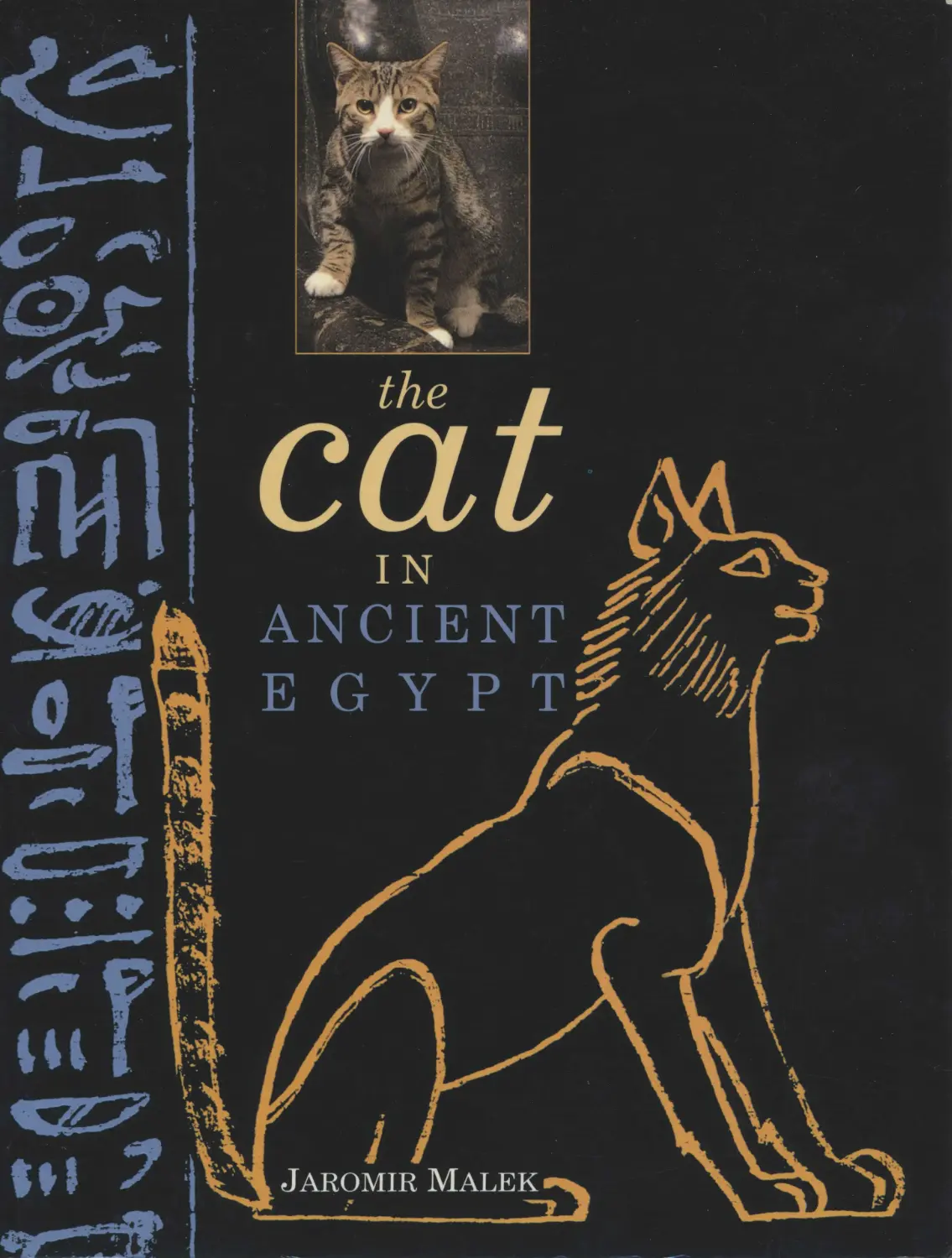
(Front cover) Main picture: The Egyptian cat, after Ms Egypt
a 4 (P) section A/4, Bodleian Library, University of Oxford.
Inset: A modern descendant.
(Frontispiece) The ancient Egyptian cat: sleek, elegant, and
with an aura of aloofness and mystery. No other animal
better conjures up the image of pharaonic civilization.
British Museum.

Contents
Chronological chart
Prologue
Running free The wild cats
Together at last The domestic cats
A poor man’s lion The divine cats
Pride goes before a fall
The story cats
Buried with full honours
The mummified cats
Epilogue
Selected bibliography
Illustration acknowledgements
Index
page 7
13
TS
45
73
I1I2
123
135
140
142

‘For he is hated by the hypocrite and miser.
For the former is affraid of detection.
For the latter refuses the charge.’
(Christopher Smart, Fubilate Agno, 1760)
Acknowledgements
I wish to thank Carolyn Jones for editing the text of
this book, her cat Domino for taking an active part in
assembling its illustrations, and James Shurmer for
designing it; their contribution goes far beyond this
brief mention. I am also grateful to my friends in the
Department of Egyptian Antiquities of the British
Museum, in particular Carol Andrews, Stephen
Quirke, and John Taylor, for their help. While I was
enjoying myself, they gave of their precious time
generously and ungrudgingly. The Keeper of
Egyptian Antiquities, Mr W. V. Davies, kindly
allowed me to study and illustrate many previously
unpublished objects.
A note on Egyptian words:
As the precise vocalization of most Egyptian words is
uncertain, they are given in a modified Egyptological
transliteration. This may be something of a make-
believe, but has the merit of allowing us to pronounce
them.

Chronological chart
BC
C.5 00OO— 3,000
C.3000—2950
C.2950—2647
2647-2124
2647-2573
2573-7454
2549-2526
2518-2493
2488-2460
2454-2311
2447-2435
2408-2377
2311-2140
2311-2281
2280-2243
2236-2143
2140-2134
2134-2124
ANCIENT EGYPT
Predynastic Period
‘Dynasty O’
Narmer
The Early Dynastic Period
First Dynasty
Second Dynasty
Hotepsekhemwy
The Old Kingdom
(Third to Eighth Dynasties)
Third Dynasty
Fourth Dynasty
Khufu
Khafra
Menkaura
Fifth Dynasty
Sahura
Nyuserra
Sixth Dynasty
Teti
Pepy 1
Pepy 1
Seventh Dynasty
Eighth Dynasty

CHRONOLOGICAL CHART
2123-—¢.2040
2123-2040
2123-c.2040
2050—¢.2040
The First Intermediate Period
(Ninth to mid-Eleventh Dynasties)
Ninth/Tenth (Heracleopolitan) Dynasty
Eleventh (Theban) Dynasty (rst part)
Mentuhotep u1 (before re-unification)
¢.2040—1648
¢.2040—1980
C.2040—1999
1980-1801
1980-1951
1960-1916
Ig 18-1884
1886-1878
1878-1859
1859-1814
1814-1805
1805-1801
1801-1648
1648-1540
1648-1540
1648-1550
The Middle Kingdom
(mid-Eleventh to Thirteenth Dynasties)
Eleventh (Theban) Dynasty (27d part)
Mentuhotep 1 (after re-unification)
Twelfth Dynasty
Amenemhat 1
Senusret I
Amenemhat 11
Senusret 1
Senusret I11
Amenemhat 11
Amenemhat Iv
Sobekneferu (Queen)
Thirteenth Dynasty
The Second Intermediate Period
(Fourteenth to Seventeenth Dynasties)
Fourteenth, Fifteenth (“The Hyksos’) and Sixteenth
(“The Lesser Hyksos’) Dynasties (contemporary)
Seventeenth (Theban) Dynasty
Intef v
Seqenenra laa 1
(plus c. the first decade of the reign of
Ahmose 1 of the Eighteenth Dynasty)

CHRONOLOGICAL CHART
1540-1069 The New Kingdom
(Eighteenth to Twentieth Dynasties)
1540 (1550)—1296 Eighteenth Dynasty
1540
(accession
1550)-1525 Ahmose 1
1525-1504 Amenhotep 1
1504-1492 Thutmose 1
1492-1479 Thutmose 11
1479-1457 Hatshepsut (Queen)
1479-1425 Thutmose 11
1427-1401 Amenhotep
I4OI—1391 Thutmose tv
13QI-1353 Amenhotep m1
1353-1337 Amenhotep tv = Akhenaten
1338-1336 Smenkhkare
1336-1327 Tutankhamun
1327-1323 Ay
1323-1295 Horemheb
1295-1186 Nineteenth Dynasty
1295-1294 Ramses 1
1294-1279 Sety I
1279-1213 Ramses 11
1213-1203 Merenptah
1203-1200 Amenmessu
1200-1194 Sety 1
1194-1188 Saptah
1188-1186 ‘Tausret (Queen)
1186-1069 Twentieth Dynasty
1184-1153 Ramses 111
1153-1147 Ramses Iv

CHRONOLOGICAL CHART
eee
1069—c.715 The Third Intermediate Period
(Twenty-first to Twenty-fourth Dynasties)
1069-945 Twenty-first Dynasty
945-715 Twenty-second Dynasty
924-889 Osorkon 1
874-850 Osorkon 11
773-767 Pamiu
818-715 Twenty-third Dynasty
727-715 Twenty-fourth Dynasty
C.715-343 The Late Period
(Twenty-fifth to Thirtieth Dynasties and the ‘Second
Persian Period’)
¢.715-656 Twenty-fifth (Nubian) Dynasty
716—702 Shabako
664-525 Twenty-sixth (Saite) Dynasty
664-610 Psamtek 1
610-595 Nekau 1
595-589 Psamtek 11
589-570 Apries
570-526 Ahmose
526-525 Psamtek 1
525-404 ‘Twenty-seventh (Persian) Dynasty
525-522 Cambyses
404-399 Twenty-eighth Dynasty
399-380 Twenty-ninth Dynasty
380-343 Thirtieth Dynasty
360-342 Nectanebo 1
342-332 The ‘Second Persian Period’
IO

CHRONOLOGICAL CHART
nn SS Ooo Ooo
BC GRECO-ROMAN EGYPT
332-305 Macedonian Dynasty
332 Alexander the Great conquers Egypt
305-30 Ptolemaic Dynasty
30 BC-AD 395 Roman province
AD 395-642 Byzantine Egypt
ISLAMIC EGYPT
639-642 Arabs, led by Amr ibn al-As, conquer Egypt
Note on the chronological scheme for ancient Egypt:
The dates may be regarded as certain for the Late Period. The possible margin of
error should not exceed fifteen years for the New Kingdom, some forty years for the
Middle Kingdom, sixty years for the Old Kingdom, and about roo years for the first
two dynasties.
Il

1 (Above) and 2 (Right) The bronze ‘Gayer-Anderson cat,’ c.664—30 Bc, probably the
most spectacular among the many thousands of such statuettes, is anatomically
startlingly well observed and finely decorated with silver inlays and gold earrings and a
nose-ring. It is known by the name of the collector who presented it to the British
Museum. See also the frontispiece.
3 (Far right) Nowadays Egyptian cats display a much greater variety of colours and
coat-patterns than their ancestors but, as far as one can judge from ancient Egyptian
evidence, their behaviour has changed little.

Prologue
The modern Egyptian domestic cat, which one encounters in the cafes and
bazaars, in the noisy streets of Cairo and in the dusty sun-drenched villages,
is a graceful and delicate little creature, usually much smaller than Western
cats. The intensity of its attentive gaze is unnerving and almost tangible; the
speed of its lightning reactions makes you gasp. It is hard to believe that the
ancestors of this entertaining but humble animal played such an important
part in everyday life in ancient Egypt.
Where did it all begin? One of the closest wild relatives of the modern cat
was Felis silvestris libyca, or the African wild cat, with tawny, yellow-grey fur
and striped markings which provided ideal camouflage among the rocks and
sand of the desert. This was a larger beast than the little cats of today: a
predator rather than a scavenger. Occasionally, among the multi-coloured
cats of modern Egypt, one can still see an animal that seems to revert to its
ancient ancestry. Several years ago I saw such a one climbing the Great
Pyramid of King Khufu (2549-2526 Bc) at Giza — an animal with superb
yellow and cream fur, brindled with fine lines of silvery grey. It is strictly
I3

PROLOGUE
forbidden to climb the pyramids, but this prohibition cannot, of course, be
enforced on cats, and the cat was making its way upwards, safe from all human
interference, its coat blending perfectly with the rugged texture of the ancient
stones. No doubt, there would be plenty of prey on the pyramid, in the shape
of careless birds, and perhaps small creatures such as lizards. In the suffocating
heat and the blinding sun the cat calmly went about its own private concerns,
high above the mass of humanity milling about below and with total disregard
for their incomprehensible trivial pursuits.
There are innumerable ways of approaching ancient civilizations, although
I suspect that those who suggest that we can ever understand them fully are
deluding themselves. The traditional well-tried methods concentrate, in a
broad sweep, on the fluctuating fortunes of the kings and their courts, the
rise and fall of empires, and the monuments of the mighty. But a large canvas
and a thick brush dilute rather than focus attention, and tend to stress the
unusual, the strange, and the heroic, making communication between now
and then difficult. The unexceptional, the normal, and the ordinary — and
this, like it or not, applies to most of us — usually remains unspoken. Yet
recognition and familiarity are the elder sisters of understanding. ‘The ancient
Egyptian domestic cat was the ancestor of many of our cats. Our modern cat
represents one of the few remaining links between the ancient Egyptian
civilization and the completely different world of today. The animal has
remained essentially the same (or so at least it seems from the surviving
evidence), and our attitudes, feelings and prejudices towards cats, and animals
in general, can be directly compared with those of the ancient Egyptians.
Are we really that much different, in spite of the time, geography, language,
and technology? And if so, are we better people?
4 The modern
Egyptian cat: just like
its ancient ancestors, it
is street-wise and alert,
always on the look-out
for advantageous
opportunities which
might present
themselves.
14

Running free
The wild cats
A revolutionary change in the lifestyle of people who traversed and inter-
mittently inhabited the north-eastern corner of the African continent took
place shortly before 4ooo sc. It was then that the first permanent settlements
of sun-dried mud-brick houses began to appear along the river Nile. Initially,
they were mainly situated on higher ground at the foot of the rising gebel
(desert plateau) along the narrow river valley and on the ‘turtle-backs,’ the
sandy ridges in the flat expanse of the northern delta, which afforded some
protection against unexpectedly high floods. Roving cattle-breeders, peripa-
tetic plant-gatherers and seasonal cultivators were becoming settled farmers.
These were the first steps towards the future splendour of the pharaonic
cities, but also towards one of the most ambiguous and volatile relationships
the animal world and humankind have ever known, that of cats and people.
The dependence of the early societies on favourable geographic and cli-
matic factors was almost absolute. Their combination in predynastic Egypt
(before c.3000 BC) was uniquely suited to farming and animal husbandry.
Rain played almost no part in the country’s climate, but every year around
19 July (of the Julian calendar), when the star Sopdet (Sirius) reappeared on
the morning horizon after a prolonged period of invisibility, it heralded the
imminent arrival of the annual flood and the beginning of a new calendar
year. The Nile, which was, and still is, the main geographical and ecological
feature of the area, rose swiftly. The Egyptians referred to it simply as iteru,
‘river,’ but the waters of the inundation were personified under the name
Hapy. According to a text known as The Hymn to Hapy, ‘when he appears,
the land jubilates, everybody rejoices, every jawbone puts on a smile, every
tooth is bared.’ The river remained swollen until September and during this
period much of the valley and the delta was under several feet of water. All
agricultural activities ceased, and many villages became temporary islands
hardly showing above the waters of this annually-recurring deluge. When at
last the inundation receded, it left behind a deposit of rich organic silt, mostly
a decaying vegetable matter, which restored the land’s fertility. Large shallow
pools of stagnant muddy water dotted the river banks for some time. Before
they dried up under the scorching sun, they provided enough water for plants
which were sown in their immediate vicinity, and the early settlers soon learnt
to make it last even longer by constructing simple dykes and canals. Farming
)

RUNNING FREE
5 The counting of cattle paraded in groups of five, on a wall-painting from the Theban
tomb of Nebamun, c.1450 Bc or a little later. British Museum.
and cattle-breeding were accompanied by progress in crafts and the pro-
duction of modest artistic creations which can be easily followed in surviving
evidence. However, spiritual development is much more elusive and difficult
to trace, and in the absence of any written sources we must rely on its often
incomplete reflection in the mirror of archaeological artefacts.
Advances in material culture went hand in hand with the fast-growing
social stratification of Egyptian society. This can be detected in the increasing
differences in the number and quality of goods which accompanied the dead
into the next world, and the size and degree of elaboration in the construction
of tombs and graves. At first, the privileged individuals buried in these tombs
were almost certainly chiefs and elders of village communities and their
families. Differences in local conditions (which favoured some areas more
than others), the growing personal ambitions and expectations of community
leaders and the ease of communications along the Nile, eventually led to
the formation of larger social units. Geographically, Egypt was naturally
delimited by the deserts in the east-west direction. Impenetrable marshy
areas and the shore of the Mediterranean formed the country’s northern
16

THE WILD CATS
- p< |e i
= ene Se STKE 2 a . s
Mba aig | | '
6 The stocktaking of geese, and putting them in crates, shown on a wall-painting from the
Theban tomb of Nebamun, probably c.1450 or a little later. British Museum.
boundary. The granite barrier of the first Nile cataract at Aswan presented
a formidable obstacle to river navigation in the south and separated Egypt
from Nubia. Before long the ethnically varied settlers in the northern reaches
of the Nile valley became the most advanced nation in the area, leaving their
nomadic neighbours far behind. Shortly after 3000 Bc, there emerged in
Egypt a unified state governed by one ruler. Rudimentary hieroglyphs
appeared at about the same time; Egypt crossed the line separating prehistory
and history. The period between c.3000 Bc and the conquest of Egypt by
Alexander the Great in 332 Bc represents the flowering of Egyptian ‘dynastic’
(a reference to the Egyptian royal houses or ‘dynasties’) or pharaonic civil-
ization.
Egypt proper (Kemz, ‘Black Land’) consisted of two geographically different
parts which were in many respects diametrical opposites. A narrow stretch
of fertile land along the Nile in southern (or Middle and Upper) Egypt was
known as Ta-shema, from the words ta, ‘land,’ and shema, ‘narrow,’ while the
broad flat delta in the north (Lower Egypt) was Ta-mehu, from the word
meh, ‘to fill.’ Vast, inhospitable deserts (not considered part of Kemi) stretched
17

RUNNING FREE
7 Insouthern Egypt, the Nile valley is often little more than a blue ribbon of river bordered
by narrow strips of fertile land.
on either side of the river to the east and west. Egyptian fauna and flora
reflected this division. On the whole, the Egyptian animal world was remark-
ably benign. It presented only limited dangers'to humans and could be easily
exploited by them.
The Nile was the giver of life and the main traffic artery, and its marshes
and muddy shores were the habitat of many animals and birds. ‘The river was
teeming with fish, but these were regarded as ritually impure, forbidden to
priests on duty, and were absent from the lists of food offerings in the tombs
of the priests and officials. This concept, which seems so strange in a country
completely dominated by a river, probably originated among the nomadic
people who contributed significantly to the population of predynastic Egypt.
Nevertheless, fish was the staple diet of ordinary peasants and craftsmen.
The river also harboured the crocodile, by far the greatest threat to people
18

THE WILD GATS
and their livestock. Tomb reliefs often depict these beasts lurking in the
water while herdsmen, trusting the efficacy of their magical spells, cross a
canal in small papyrus skiffs followed by their cattle. Crocodiles remained
Aswan, and I recall vividly encounters with these animals near Sayyala and
Korosko during the UNESCO campaign to save the monuments of Nubia
in the mid-1960s. There are reports that the shores of Lake Nasser have now
provided the crocodile with new breeding grounds and that their numbers
are again on the increase.
The most powerful animal living in the Nile was the hippopotamus, fre-
quently met in Egypt during the third millennium sc, but gradually declining
from about 1500 Bc and finally becoming extinct in the early nineteenth
century aD. In pharaonic Egypt, the mighty hippopotamus was hunted mainly
as an undesirable animal which destroyed crops and wreaked havoc in culti-
vated fields.
8 Spectacularly patterned sand dunes can form in the Western (Libyan) Desert; the Eastern
Desert is more a rocky wilderness.
IQ

RUNNING FREE
Booed aL aE
=
=
=
S
9 A hippopotamus hunt in the marshes shown on a painted relief in the tomb-chapel of the vizier
Mereruka at Saqqara, ¢.2300 BC.

THE WILD CATS
heron, egret, ibis, flamingo, shelduck, teal, lapwing, sandpiper, plover, avocet,
kingfisher, stork, hoopoe, and many others. On the reliefs and paintings in
Egyptian tombs, birds are often depicted rising like a thick cloud from a
papyrus thicket when disturbed by the flight of a hunter’s throwstick or by
the stealthy approach of a marauding predator, such as the ichneumon, the
genet, or the cat. The hieroglyphic script contains at least thirty signs which
are ornithologically-accurate images of birds, and a detailed palaeographic
study of these hieroglyphs would almost certainly identify more.
Beyond the fertile green valley and the delta there stretched the deserts.
10 A papyrus marsh
teeming with birds, on
a relief, originally
painted, from the cult-
temple of King Userkaf
(2454-2447 BC) at
Saqqara. Cairo,
Egyptian Museum.
21

RUNNING FREE
minerals or in order to procure luxury goods, not available in their own
country, by long-distance trading. On the whole, however, the deserts were
the equivalent of ‘abroad,’ areas inhabited by unfriendly people speaking
strange tongues, the home of weird creatures and mythical beasts, and so they
were intensely disliked and feared. To die abroad threatened one’s chances of
life after death. Ancient Egyptians were profoundly home-oriented, and in
this respect modern Egyptians are not much different. It was not until the
second half of the third century ap that some of the descendants of ancient
Egyptians, the persecuted Christian Copts, voluntarily withdrew into the
wilderness of the deserts in order to lead the life of hermits. Areas closer to
the river, especially along wadis (desert valleys), were not entirely barren but
resembled savannas rather than deserts. They supported limited vegetation
and provided the habitat for a variety of wildlife.
The environment was profoundly influenced not only by advancing aridity
but by man’s activities, such as hunting and cattle-grazing. In pharaonic
Egypt hunting no longer played a significant part in the country’s economy.
There were professional hunters who, at least during the third millennium Bc,
procured animals to be offered in tombs and temples or to be kept for breed-
ing. These had to be captured alive and this explains the seemingly laborious
method of lassoing animals such as ibexes, represented on the walls of Old-
Kingdom (2647-2124 Bc) tombs. The king and his officials also indulged in
the killing of animals as a sport, and archery skills were much vaunted. The
ibex, oryx and several species of gazelle and antelope, but also the wild bull
and the lion, were the main animals hunted. Limited and unsuccessful
attempts were also made to domesticate some of them. Herds of big game,
such as the elephant and the giraffe, had been recorded in a remarkably
realistic fashion in prehistoric rock-drawings, but they retreated south into
Upper Nubia (beyond the second Nile cataract and further south, modern
Sudan) well before the beginning of the pharaonic era. The lion roamed the
margins of the Egyptian deserts at all times. There were also wolves, jackals,
hyenas and caracals. The ostrich gradually became a rare visitor, and its
feathers and eggs were imported as precious commodities from Nubia.
Ostriches in any significant numbers were last seen in Egyptian deserts in
the nineteenth century ap although there are occasional reports of more
recent sightings. |
Zoologically, small cats (genus Felis) are mammals and carnivores which
belong to the family Felidae (this also contains three species of Lynx, the large
cats, and the cheetah) but their classification is by no means universally agreed
on. The swamp or jungle cat (Felis chaus) and the African wild cat (Felis
silvestris libyca) are the two wild species encountered in Egypt. Their presence
is confirmed by many reports and observations made in the past two hundred
22

THE WILD CATS
years, particularly since the French invasion under
Napoleon in 1798 and
Muhammad Ali’s reforms in the first half of the ni
neteenth century which
made Egypt more accessible to European travellers and naturalists.
The swamp or jungle cat, Felis chaus, is the larger and heavier of the
indigenous wild cats. Its specialist Latin name derives,
two
etymologically inaccur-
at least some justification
in using an Egyptian word because this cat does not occur elsewhere on the
African continent (although it is found further east, as far as south-eastern
Asia). As its popular name suggests, it prefers marshy areas with dense ground
cover. In modern times it has been seen only in the delta and the northern
part of the Nile valley, but the situation would have been different in ancient
11 The swamp cat (Felis chaus), the larger and heavier of the two indigenous species of small
cats known from Egypt.

RUNNING FREE
12 The African wild cat (Felis silvestris libyca), a close relative of ancient Egyptian domesti-
cated cats and a distant ancestor of many of our cats.
times. The combined head and body length of the swamp cat is c.650—750mm,
with long legs but — an important characteristic — a relatively short tail, c.250—
300mm. Its ears are long and tufted. These cats weigh on average between
3.5 and 6:5kg (8—14lbs). They are usually plain-coloured without distinctive
body markings, ranging from light reddish brown or sandy fawn to grey, with
black-tipped ears and tail, and with faint stripes on the head, a darker dorsal
line and stripes on the upper legs and the tail.
The African wild cat (Felis silvestris libyca, also Felis maniculata) is very adept
at adjusting to varying surroundings. It is much more lightly built than Felis
chaus. Its head and body length is c.60omm which makes the tail, measuring
c.350mm, proportionally long. The ears are not tufted. The legs are long
when compared with modern cats. The body colour can vary considerably
according to the habitat but the markings of the fur, which are not unlike
those of our striped tabby, are an important feature. Pale sandy fawn is the
most common colour, with a rufous line on the back and multiple transverse
24

THE WILD CATS
stripes of the same colour, though paler, on the body. These may also
appear on the head and usually extend to the legs. The black-tipped tail is
ringed.
The overall area of Egypt is ¢.1,000.000km?, but only some 40,o0okm? is
cultivable land; the rest is desert. In all countries where natural resources
have to be used in a very intensive way, fauna and flora are affected profoundly
through the elimination of unwanted dangerous or damaging species, over-
exploitation of others, and the introduction of new varieties. The fauna and
flora of ancient Egypt were quite different from those of today and many
plants and animals now firmly associated with the popular image of the
country were either unknown in antiquity or were introduced relatively late
— it will suffice to mention the horse, camel, water buffalo, turkey and chicken,
and sugar cane, cotton, oranges, bananas, and potatoes. It is, therefore, neces-
sary to establish whether the situation concerning the small cats was the same
In ancient Egypt as in more modern times. The evidence which we shall
examine is that of the Egyptian language, the skeletal remains, especially
those of mummified cats, and art, in particular representations in tomb wall-
paintings and reliefs.
The Egyptians were always rather inclined to rigid categorization. Their
custom of listing items according to formal criteria, such as materials, was
the result of a long scribal and bureaucratic tradition and can be a source of
invaluable information, but also of much frustration, for modern scholars.
Written sources, however, do not offer us much assistance here. The Egyp-
tians did not distinguish lexicographically between different wild cats, nor
did they differentiate between wild and domesticated cats. There was only one
word for the cat in pharaonic Egyptian which we can find in the hieroglyphic
writing. It was the onomatopoeic miu or mii (feminine mutt), imi (feminine
imuit Or miat) in demotic, the penultimate stage of the Egyptian language,
and emu or amu in Coptic, written from c. the third century AD. The cat
was simply ‘(s)he who mews,’ and as we shall see, this was how the Egyptians
themselves understood it. The word described the whole genus, Felis, and
could also be applied to one or two other animals similar in appearance.
The Bohairic and Fayumic (Lower Egyptian) dialects of Coptic used the
word shau or djeu, of unclear etymology, in order to refer to a male cat.
The Greek gale, ‘ferret,’ ‘weasel,’ became Coptic kle, with the meaning ‘cat,’
perhaps more as a reference to the comparable usefulness of the animal rather
than any other similarity — the Greeks and Romans kept ferrets in order to
rid their houses and barns of vermin. Even the Arabic hirr (feminine irra)
could exceptionally be adopted into Coptic as her, but all these were late
additions made well after the eclipse of the pharaonic civilization. The situ-
ation is rather surprising when compared with the variety of words for the
25

RUNNING FREE
dog, but it is consistent with other known facts, such as the large number of
proper names for dogs, and their almost complete absence for cats.
Attempts at identifying mummified cats (most of these date to the first
millennium Bc, relatively late in pharaonic Egypt) have in the past produced
curiously differing and (for a non-specialist) confusing results, much influ-
enced by the strongly-felt need to distinguish between wild/semi-wild and
domesticated cats. It seems reasonable to expect that the majority of mummi-
fed cats were domesticated animals which came either from temple catteries
or from ordinary households. It is, then, puzzling to observe that many of
them are larger than the modern wild Felis silvestris libyca (normally domesti-
cated animals are smaller). Osteological (skeletal) differences may, however,
be too small and the variations within each group too wide (not to mention the
differences in the size of males and females) to provide reliable information on
the animal’s status.
Furthermore, in ancient Egypt contacts between domesticated and wild
cats and the ensuing hybridization would have been unavoidable. There must
have been semi-domesticated and feral cats and dogs roaming Egyptian towns
and villages, but also wild animals would have strayed into settlements from
time to time. In a demotic story of Setne Khaemwaset, dating to the Ptolemaic
period (after 332 Bc), the protagonist dreams of becoming so infatuated with
13 The serval (Felis serval),
on a fragment of a faience
plaque of the reign of
Thutmose m1 (1492-1425 BC),
from the temple of the
goddess Hathor at Serabit el-
Khadim in the Sinai. British
Museum.
26

ko
14 Nubian princes bringing tribute, including skins of the serval or civet cat. A wall-
painting in the tomb of Huy, the Nubian viceroy of Tutankhamun (1336-1327 BC).
Tabubu, the daughter of the prophet of the goddess Bastet, that he agrees
when she suggests that his children should be killed and their bodies thrown
out of the window to be devoured by cats and dogs. Fortunately, this was
just a bad dream described in a work of fiction though it probably reflected
reality in that scavenging animals, including cats, were a common sight.
The mummies of cats are invaluable in order to establish which species of
cats were known in antiquity, but as a rule they do not shed sufficient light
on whether these animals were wild, tame or domesticated. It seems that they
can be safely divided only between Felis silvestris libyca (a vast majority, no
doubt mostly domesticated cats) and Felis chaus (only a few in each of the
groups examined, perhaps tamed or wild cats).
faience plaques found in the temple of Hathor at Serabit el-Khadim, in
southern Sinai, bear representations of the serval. Some of them are accom-
panied by the cartouches of Queen Hatshepsut ( 1479-1457 BC) and
Thutmose 11 (1492-1425 Bc). The animals were sketched before the plaques
were glazed and display the typically strong spotted pattern of the serval’s
=}

RUNNING FREE
coat, with its whiskers prominently marked. The pelts of small animals which,
it has been suggested, might be those of the serval or civet cat (Viverra civetta)
are shown as part of the tribute of Nubia in the Theban tomb (tT 40) of the
viceroy of Kush, Amenhotep Huy, of the reign of Tutankhamun (1336-
1327 BC).
No certain representations of the civet cat are known from Egypt. Animals
and animal products were always an important element of tribute and war
booty: bears from Western Asia are depicted in the pyramid-complex of King
Sahura (2447-2435 BC) at Abusir, but in later times most of the exotic fauna
came from the south, e.g. monkeys and baboons, giraffes, ostriches, and
cheetahs.
It is rather ironic, but illustrates well the difficulties experienced by those
who study ancient Egyptian civilization, that what could be the earliest rep-
resentations of small wild cats are so uncertain as to be virtually excluded
from serious consideration. They occur in the largest and most comprehen-
sive wildlife scene known from the third millennium sc. This was found
broken up into hundreds of small fragments in the sun-temple of King Nyu-
serra (2408—2377 Bc) at Abu Gurab, on the west bank of the Nile south-west
of Cairo. Around 2450 Bc, the cult of the sun-god Ra (or Atum) of On
(Heliopolis, nowadays a north-eastern suburb of Cairo) became so important
that for the next hundred years each king built for him a special temple in
the vicinity of the state capital, Inebhedj, “White Wall (later Memphis). ‘The
king was now described as ‘the son of the god Ra.’ The sun-temples were
architecturally unusual buildings and the focal point of each was an obelisk
(a tall structure resembling a massive column of a rectangular plan, tapering
towards the summit), the symbol of the sun-god. In the sun-temple of Nyu-
serra, a long corridor which started at the main entrance and approached the
obelisk by skirting a large court open to the sun, eventually led to a chamber
named by Egyptologists the ‘Room of the Seasons.’ On its walls there were
representations of the Egyptian countryside which illustrated the life-giving
qualities of the sun-god. They were arranged according to the three seasons
of the Egyptian calendar year: akhbet (inundation), peret (winter), and shemu
(summer).
Cats appear several times. One fragment shows two registers (horizontal
bands into which the available space on the wall was divided) of incompletely
preserved animals, including a hound, antelope, oryx, and a cat. The cat has
a remarkably long tail and appears to be too large for Felis silvestris libyca,
but the relative sizes of representations were subject to special rules in Egyp-
tian art and are not always a reliable guide. The colour of the coat of the
animal was not preserved and the fragment, which the archaeologists brought
home to Germany, was destroyed during the Second World War; therefore,
28

THE WILD CATS
the accuracy of the available copy cannot be checked. Several other fragmen-
tary reliefs from Abu Gurab are equally uncertain.
Animals in ancient Egyptian art are usually remarkably well-observed and
accurately portrayed. The manner in which they were depicted was less
dependent on the ‘canonized’ image than representations of human figures,
and they are more easily comprehensible to those untrained in the unusual
conventions which govern these images. Casual sketches of animals made on
ostraca (flakes of limestone) during the Ramesside period (1295-1069 Bc)
show that when freed from the constrictions of formality, some Egyptian
draughtsmen, like all great artists, were able to convey the character of an
animal in a few deft touches of the brush.
Egyptian art was anything but art for art’s sake, and should not be
approached uncritically. Superficially examined, scenes shown in the tombs
of wealthy Egyptians may give the impression of being a spontaneous and
faithful reflection of reality, with a mass of convincing detail. We must not,
however, forget that they were intended to be functional rather than decorat-
ive, and that they played an important and well-defined role in the ideological
(religious) context of the tomb. The reality which these scenes portray is the
wished-for reality of the life beyond the grave, carefully selected, censored,
proven by use, and deeply rooted in religious and artistic traditions, combined
with a host of traditional and symbolic allusions and visual references.
At first, from about 2650 Bc, tomb representations were mainly preoccu-
pied with the material provisioning of the tomb which was essential for the
continued existence of the tomb owner (or, to be more precise, one of his
‘modes of existence,’ his ka) after death. Activities portrayed there were an
extension of the early pictorial lists of food and drink offerings. Such offerings
brought to the tomb by the deceased’s relatives or by the priests contracted
to look after the tomb could be substituted, it was thought, by their represen-
tations or conjured-up by the recitation of prescribed spells. The logic of
this was impeccable: there was never any attempt to pretend that the tomb
owner’s ka required more than the spiritual substance of the offered food,
and when the offerings were removed from the altar or table they were
consumed by the priests and their families. This remarkably ‘realistic’ way
of looking at the presentation of offerings to the dead avoided waste (with
only a few exceptions, foodstuffs were not made unconsumable in the process)
and the ‘spiritual substitution’ avoided excesses. In a country which, to our
eyes, was obsessed with the service of the dead, presentation of offerings
never reached the point when it would have represented an intolerable drain
on Egyptian economy. In fact, it is possible to visualize an economic system
developing in which, ultimately, the redistribution of the national produce
is entirely effected through the provisioning of the dead.
29

RUNNING FREE
When, sometime after 2570 Bc, tomb decoration expanded as more wall
space became available, new topics were added to the simple provisioning
theme: bearers burdened with offerings approaching the tomb, butchers
slaughtering oxen, bakers baking bread, and brewers brewing beer. The next
thing was to take another step back in time and logic and to show agricultural
activities and episodes in the life of herdsmen, fish being caught in large nets,
hunters lassoing wild animals, men making papyrus boats, and craftsmen
manufacturing items of funerary furniture. Even the Egyptians realized that
bread alone was not enough, and pursuits which were not purely materialistic,
such as music, dance, and games, also began to be included. All these activities
are shown being carried out by minor figures, usually members of the tomb
owner’s household and people belonging to his estates.
The developed repertory of tomb scenes thus presents a large selection of
themes and a number of interesting details, but it was never the result of
pure artistic creativity and random inspiration. The freedom of the craftsman
or artist responsible for the tomb’s decoration was not absolute, but rather
consisted of his ability to choose first, the topic (e.g. agriculture, or baking
and brewing) and, to a lesser extent, its location in the tomb, then the episodes
which were going to be shown (e.g. ploughing, sowing, reaping, threshing,
winnowing, and transport), the composition of each episode (e.g. the number
of participants and their relationship within the scene), and finally the treat-
ment of individual figures (their gestures, details of clothing, etc.). The artist’s
originality (and in spite of everything said so far the term is justified since
no tombs with identical decoration are known) depended on the choice of a
new combination of familiar elements rather than on their invention. The
corpus of scenes at the artist’s disposal was, of course, enriched from time
to time by the inclusion of new subjects or a contemporary treatment of some
of the old ones, while others became traditional and after some time ceased to
reflect reality. Some topics, however, were never shown because, for various
reasons, they never became part of the recognized repertory. This, therefore,
means that Egyptian tomb art cannot be taken at its face value, but must be
interpreted. To try and reconstruct Egyptian ‘daily life’ on the basis of tomb
representations, as many popular publications are fond of doing, is a risky
business. Even greater caution must be exercised when studying represen-
tations in Egyptian temples, although scenes in which we could expect to
find wild cats occur there very exceptionally.
In which tomb scenes are we then to look for Egyptian wild cats? The
period of Egyptian history now conventionally known to Egyptologists as
the Old Kingdom (2647-2124 Bc) was the era of the great pyramid-builders,
whose monuments we admire in the neighbourhood of Memphis (at that time
still called Inebhedj), on the west bank of the Nile some z2okm to the south-
30

THE WILD CATS
west of present Cairo. The royal pyramids at Giza, Abusir, Saqqara, Dahshur,
Meidum and several other places are surrounded by tombs of officials and
priests. These tombs are known as mastabas (from the Arabic word for ‘bench,’
describing the external shape of the tombs’ superstructures) and the walls of
their free-standing chapels are decorated with scenes in raised relief. Stone
was the material in which to build for eternity because of its permanence,
and relief-carving was preferred to painting for the same reason. Priests and
visitors were allowed access to the chapel; the underground burial chamber
was sealed and inaccessible. After c.2 300 BC, decorated private tombs, mostly
rock-cut, became more common in provincial cemeteries also.
Many Old-Kingdom tombs show the deceased standing tall in a small
papyrus skiff, hurling a throwstick at birds, spearing fish or, usually in the
case of women, pulling or shaking the stalks of papyrus plants. These are
exceptional representations because the tomb owner is actively engaged in a
demanding physical exercise. In most other instances he remains an attentive
but passive observer, standing in a dignified posture, seated, or carried in a
palanquin, while others provide the hustle and bustle which is so characteristic
of Egyptian tomb reliefs. Such scenes almost certainly did not reflect reality,
but had symbolic meaning which went well beyond the outwardly simple
record of hunting and fishing. It is difficult to explain them in an entirely
satisfactory manner, but one wonders whether they may be connected with
a concept which is often taken up as a theme in Egyptian art, that of the
necessity to assert control over the forces of nature, here symbolized by the
birds and fish. According to the Egyptian ideas concerning kingship this was
15 ‘The ichneumon (Herpestes
ichneumon) is a vicious raider of
birds’ nests, but also a
courageous snake-fighter.
31

RUNNING FREE
the duty of the pharaoh, but we may have here one of the earliest instances
of ‘democratization’ of the very ancient prerogatives of the ruler (dating to
well before the beginning of the historic period) and their transfer to the
other groups of society. Other examples of this process are known. Another
possible explanation is that the scene was at first part of the repertory of the
royal pyramid temples which was later adopted, with a modified symbolic
content, for the decoration of private tombs. Activities in the marshes in
which the tomb owner’s personnel are involved often accompany the main
themes, and include papyrus-gathering and making small papyrus boats, net-
ting fish and fowl, angling, hunting hippopotami, and light-hearted river-
battles between boat-crews in which punting poles are used without mercy.
Animals, birds, fish, insects, and plants provide a colourful setting.
An occasional inclusion in these scenes of the ichneumon, also known as
the mongoose, is of particular interest. ‘T'wo species have been reported from
Egypt in modern times. Herpestes ichneumon is an animal with an elongated
body, pointed head, characteristically round ears, relatively short legs, and a
long tail. Its rather coarse fur is of a grizzled dark colour. It is reminiscent
of a large weasel or a rat and only a little smaller than the Egyptian wild cat,
with a body-length of some 500—600omm and a tail which is not much shorter.
The ichneumon can successfully fight snakes and rats, but is also a vicious
raider of birds’ nests. In the second half of the first century BC, Diodorus
Siculus described it appreciatively as a destroyer of crocodiles’ eggs. His
account of how it kills crocodiles is considerably less believable. According
to him, the ichneumon first rolls in mud (perhaps in order to acquire camou-
flage for concealment or to form a protective carapace, but the author does
not explain this further). When it sees a crocodile asleep with its mouth open,
it jumps into it and destroys the beast by gnawing its intestines from inside.
Classical authors recount several similarly fantastic stories about Egyptian
animals. While modern scholars bravely try to explain them by references to
complex religious concepts to which the stories are supposed to allude, one
cannot help feeling that they may reflect a sense of humour and mischievous
leg-pulling of gullible foreigners by the Egyptians rather than lack of observa-
tion of nature or intentional obscurantism.
The ichneumon is shown in a number of tombs at Saqqara which date to
the advanced Old Kingdom, c.2300-2150 Bc. Usually it can be found in a
small cameo scene where it is eagerly climbing a papyrus stalk, which bends
under its weight, in search of a bird’s nest. Reality and artistic licence almost
certainly merge here: the conventions of Egyptian art required a base-line
on which to place individual figures, and while in most cases these were
straight horizontal lines separating registers, the base-line is in these cases
provided by a single papyrus stalk. The weight of the animal makes such a
32

THE WILD CATS
16 An ichneumon grasped by its tail, on a wall relief in the tomb of Mereruka, the vizier of
King Teti (2311-2281 Bc) at Saqqara.
feat somewhat unlikely in real life. It would be hardly possible to mistake the
ichneumon for another animal because of its characteristic silhouette, with
the upper outline of the pointed head continuing smoothly and fluently as a
gently curved line along the back of its body and the long tail. In the tomb-
chapel of the vizier Mereruka at Saqqara, dating to the reign of King Teti
(2311-2281 BC), there is a curious detail depicting a man firmly grasping an
ichneumon’s tail. The relative sizes of the man and animal do not correspond
here to our perception of reality; this was one of the more flexible aspects of
Egyptian representations, which the artist skilfully exploited in order to link
in one scene the large figure of the tomb owner and the ichneumon, shown
on a corresponding scale, with the much smaller representations of the minor
participants. One wonders whether the planes of the real world and make-
believe became one here and whether perhaps a tame animal was meant to
distract the attention of wild fowl so that they would present an easier target
for Mereruka’s throwstick. Instances of tame ichneumons kept in Egyptian
houses in order to control vermin are known from relatively recent times.
33

RUNNING FREE
Another ichneumon is shown descending a papyrus stalk with a chick in its
jaws. In a relief in the tomb of Princess Seshseshet Idut, which is also at
Saqqara and is of approximately the same date, the dark brown paint on the
ichneumon’s fur, perhaps with some indication of the individual hairs, is still
well preserved. The ichneumon remained a constant element of the fishing
and fowling scenes. It can be found in the tomb of Khnumhotep 11 at Bent
Hasan in c.1goo Bc and, as a rather cuddly animal with little claim to realism,
‘nthe tomb of Menna at Thebes (rT 69), which is some goo years later than
the mastaba of Mereruka.
In her tomb, Princess Seshseshet is standing in a papyrus boat smelling a
lotus flower, as a concession to her femininity, but otherwise the marsh-scene
is designed very much like those showing the more masculine pursuits of
17 A genet and an
ichneumon above a scene
showing the netting of fish
and the harpooning of
hippopotami, on a painted
wall-relief in the tomb of
princess Seshseshet Idut,
probably of the reign of
King Teti (2311-2281 BC),
at Saqqara.
34

THE WILD CATS
18 The genet (Genetta
genetta) can be confused
with the cat (Felis
silvestris libyca or Felis
chaus) when
interpreting Egyptian
representations,
although in reality the
two animals are quite
different.
fishing and fowling. In addition to the ichneumon, another animal is depicted
plundering a bird’s nest. It has a narrow pointed muzzle, long ears, a very
long tail, and a coat of sallow-grey colour. One unfortunate chick is already
dangling from its jaws, and the same cruel fate, it seems, is awaiting the other
four fledglings in the nest. Their parents are frantically trying to distract the
bloodthirsty marauder. The animal is a genet (probably Genetta genetta), the
smallest of the predators which used to stalk the marshes, but now regarded
as extinct in Egypt. Its body-length is around 450mm; the tail measures
some 300mm or more. The genet can usually be easily recognized by the
characteristic dark lines on the neck which turn into spots on the body, and
the dark rings on the tail, but the relief in Seshseshet’s tomb has unfortunately
lost such subtle colour distinctions. Two genets and one ichneumon can be
35

RUNNING FREE
seen in the same context in the somewhat earlier tomb of the official Ty at
Saqqara. Ty held a number of offices connected with pyramids and sun-
temples of kings dating between ¢.2450 and 2370 Bc and may have been the
contemporary of the last of them, King Nyuserra. There is little doubt that
in spite of the artist’s success in conveying the tension of these dramatic events
shown unfolding in the animal world, this was a popular and conventionally
stereotyped scene which was regarded as standard for the decoration of these
tombs.
The genet’s coat markings are very clear on the three animals represented
in the tomb of Khnumhotep 11 at Beni Hasan. Around 2123 Bc power in
Egypt was seized by rulers who hailed from Henen-nesu (classical Heracleo-
polis, modern Ihnasya el-Medina in Middle Egypt), while contenders
appeared in the south, in Weset (Thebes, modern Luxor). The reasons for
this development were complex, partly inherent in the system itself and its
19 A scene of fish-spearing in the tomb of Khnumhotep 11 at Beni Hasan, c.1900 Be. The
tall rushes conceal a cat, two genets and an ichneumon.
36

THE WILD CATS
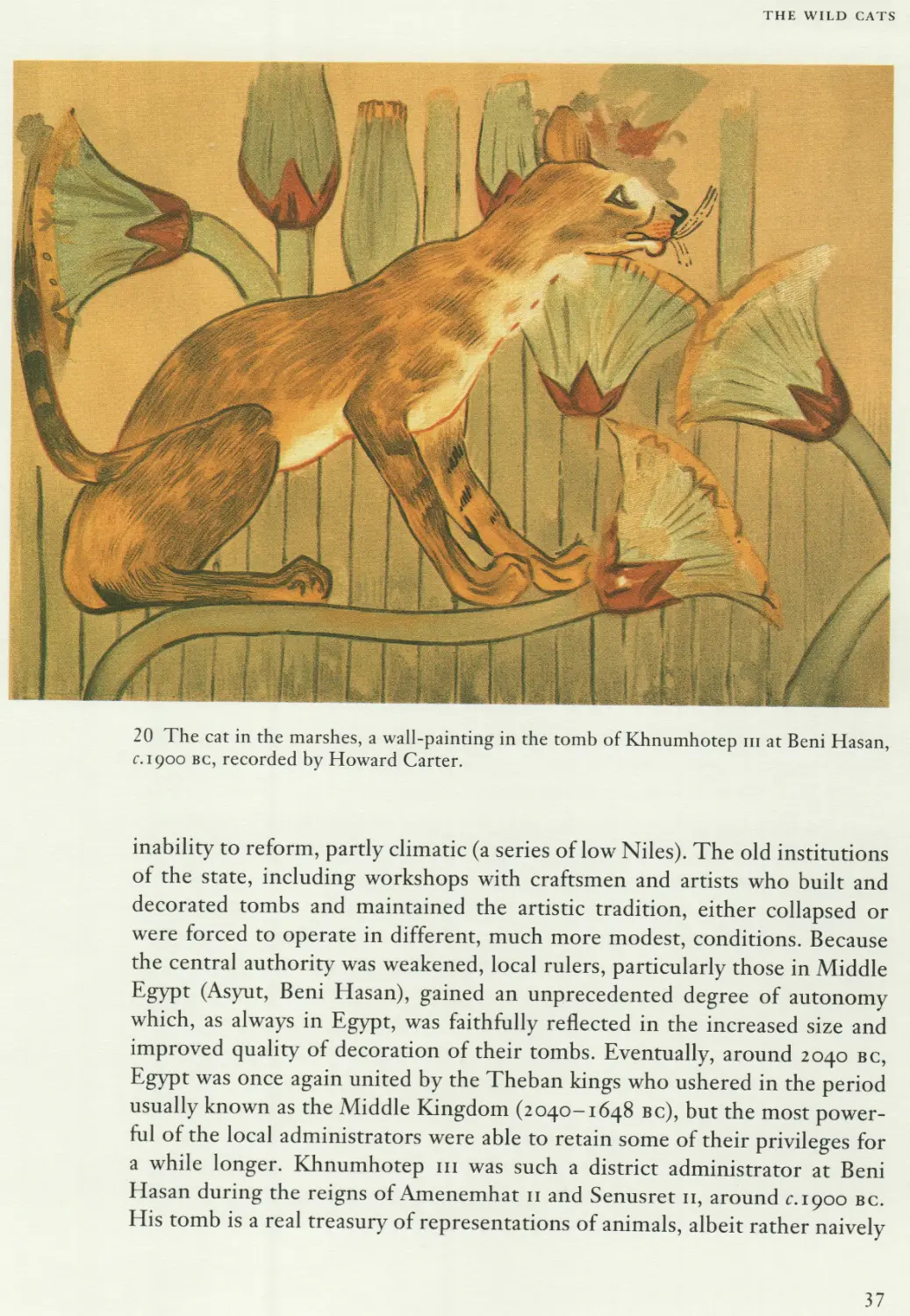
20 The cat in the marshes, a wall-painting in the tomb of Khnumhotep 11 at Beni Hasan,
c.1g00 BC, recorded by Howard Carter.
inability to reform, partly climatic (a series of low Niles). The old institutions
of the state, including workshops with craftsmen and artists who built and
decorated tombs and maintained the artistic tradition, either collapsed or
were forced to operate in different, much more modest, conditions. Because
the central authority was weakened, local rulers, particularly those in Middle
Egypt (Asyut, Beni Hasan), gained an unprecedented degree of autonomy
which, as always in Egypt, was faithfully reflected in the increased size and
improved quality of decoration of their tombs. Eventually, around 2040 BC,
Egypt was once again united by the Theban kings who ushered in the period
usually known as the Middle Kingdom (2040-1648 Bc), but the most power-
ful of the local administrators were able to retain some of their privileges for
a while longer. Khnumhotep 111 was such a district administrator at Beni
Hasan during the reigns of Amenemhat 11 and Senusret 11, around C.IQOO BC.
His tomb is a real treasury of representations of animals, albeit rather naively
37

RUNNING FREE
portrayed. The painted decoration in the main room of his tomb-chapel
includes marsh-scenes which unmistakably imitate their Old-Kingdom proto-
types, but are also considerably different because of the changed historical,
religious and artistic circumstances. A genet is shown scrambling among the
rushes in the fowling scene, and another two are present in Khnumhotep’s
fishing scene.
We must, however, return briefly to Old-Kingdom tombs in order to clarify
a probable misunderstanding which is responsible for the alleged earliest
reference to the cat, presumably wild, in Egyptian tomb-scenes. This is in
the mastaba of Meryre-nufer, also called Qar, a high official who was in charge
of the settlements of priests and craftsmen attached to the pyramids of Khufu
(2549-2526 Bc) and Menkaura (2488-2460 Bc) and probably lived during
the reign of Pepy 1 (2280-2243 Bc). It is situated in the eastern part of the
necropolis at Giza. When it was excavated by G.A. Reisner, A. Rowe and
T.R.D. Greenless in 1924-5, two small relief fragments were found and in
the relatively recent publication of the tomb by Wm. K. Simpson they were
assigned to the decoration of the staircase connecting the superstructure of
the tomb with the rock-cut underground chapel. It seems that one of the
fragments shows an ichneumon, while the animal on the other was described
as a ‘cat climbing ... [a] stalk to [a] duck nest.’ The ‘cat’ is shown carrying
a bird by the neck in its mouth. Unfortunately, the reliefs were only recorded
in sketches in the object register of the excavation and were not photo-
graphed. Nowadays it is no longer possible to locate the fragments in order
to check them because they have probably disappeared into one of the many
closely-guarded storerooms of the Egyptian Antiquities Organization. The
sketch does, indeed, appear to show a cat, with pointed ears, a short muzzle,
and long legs, but caution demands that this relief be treated with scepticism.
It would have been easy to mistake the silhouette of a genet for that of a
cat when making a sketch under difficult field conditions. Furthermore, the
archaeologist who recorded the monument may have known and subcon-
sciously imitated a more completely preserved relief in the Museo Gregoriano
in the Vatican. This displays a similar composition: two genets and, this time
unmistakably, a cat are climbing papyrus stalks towards birds’ nests. For a
long time this relief used to be dated to about 2400 or 2300 Bc, and only
relatively recently has it been established that it is some 1700 years later and
comes from the Theban tomb (rr 34) of the ‘fourth prophet of the god
Amun,’ Montuemhat, dated to the mid-seventh century sc. The continuity
of motifs in Egyptian art can sometimes be a source of some difficulties.
The tomb of Khnumhotep 11 (c.1900 Bc) at Beni Hasan, has already been
mentioned several times. A large scene next to the entrance to the shrine
with a statue, shows the tomb owner spearing fish in the traditional way.
38

THE WILD CATS
While the subject matter is well-known, the artist adopted several interesting
solutions to the problems of space and perspective (the Egyptian concept of
the latter, sometimes called ‘aspective,’ was rather different from that preva-
lent in modern Western art). Thus the water with the fish about to be impaled
on Khnumhotep’s harpoon rises vertically like a mound, with the papyrus
thicket forming its background. The animals are no longer shown in a semi-
realistic fashion climbing a single papyrus stalk but are placed directly among
the papyrus plants, as if the artist experimented with the amalgamation of
the horizontal and vertical planes into one. Beside the traditional ichneumon
and genets the artist introduced a new feature: the cat. The animal is only a
minor element of the scene’s setting and appears to have no religious or
overtly symbolic significance. It sits on its haunches on one of the stalks
which bends under its weight and so provides an almost straight horizontal
21 ‘Two genets and a cat searching for birds’ nests in the marsh, on a relief from the Theban
tomb-chapel of Montuemhat, c.650 Bc. Vatican, Museo Gregoriano Egizio.
39

RUNNING FREE
22 Animals from the desert margins, in a hunting scene in the tomb of Khnumhotep 111 at
Beni Hasan, c.1900 Bc. It is doubtful that the seated cat is Felis silvestris libyca.
base-line for the representation. The cat’s tail, partly obscured by the right
haunch on the inside of which it curls, points straight up, the standard ‘hiero-
glyphic’ image of the animal. The cat was accurately recorded in watercolours
by Howard Carter in his pre-Tutankhamun days (his paintings of animals
and birds are famous): the body is grey-brown without any markings, but
with four or more dark rings on the tail and three darker bands on the front
paws. The forehead, throat and underbelly of the animal are almost white.
The whiskers are long.
There are two questions to be answered: which species of the Egyptian cat
is shown here, and whether the animal is wild or domesticated. Commenting
on Carter’s drawing nearly a hundred years ago, the brilliant British Egyptol-
ogist Francis Llewellyn Griffith suggested that this was Felis maniculata (i.e.
Felis silvestris libyca) because of its long and tapering tail. Quoting no lesser
authority than J. Anderson, the author of several fundamental books on Egyp-
tian fauna, he claimed that this was a domesticated cat. Griffith’s approach
to the representation was rather too literal and both views require revision.
The cat is shown in its ‘hieroglyphic’ image which, as we shall see later, had
40

THE WILD CATS
by then been well established. It seems that just as the Egyptians did not
distinguish lexicographically between different wild cats (and also the dom-
esticated cat), they adopted only oné ‘cat’ image which, with minor variants
(particularly the position of the cat’s tail), was used as a ‘hieroglyph’ in their
writing. It was this iconography of the cat which the artist used here, but the
complete absence of body markings (in total contrast to the two genets in
the same scene) and the marshy setting indicate that the cat represented is
Felis chaus. The long tail of the cat, which is more appropriate for Felis silvestris
libyca, is probably due to the standardized hieroglyphic prototype. There is
little to support the view that this is a domesticated cat because of the absence
of any sign of a direct relationship with the tomb owner. Griffith was aware
of this difficulty and pointed out that the domestic cat tends to stray and
hunt for itself; while this is certainly true, it is hardly a compelling argument
when interpreting this scene. It is, then, most likely that this is a wild cat,
and probably Felis chaus.
The theme of the hunting of fowl and the spearing of fish in the marshes
continued to be very common in the tombs of the Theban nobles and priests,
mostly dating between c.1500 and 1350 Bc. The latter part of the Middle
Kingdom, after 1800 Bc, saw progressive weakening of the central authority
which culminated in a takeover by a group of immigrants from Western Asia,
the Hyksos (an Egyptian term for their leaders, literally ‘rulers of foreign
countries’), around 1648 Bc. Once again, it was the local princes in the south,
at Weset (Thebes), who offered the strongest opposition to the Hyksos rule
and eventually succeeded in wresting power from their hands. The new period
of strongly centralized government which followed is called the New King-
dom (1540-1069 Bc) by Egyptologists. Theban topography favoured rock-
cut tombs, and the pharaohs started being buried in the Valley of the Kings,
while private tombs were made over a large area of the Theban west bank.
The details of New-Kingdom fowling and fishing scenes betray how far they
came to be removed from reality: for a trip to the marshes and strenuous
exercise the tomb owner is dressed in fine clothes, wears jewellery and is
accompanied by his whole family. We shall have an opportunity to return to —
several of these scenes later but one of them, of Menna (TT 69), dating to
the reigns of Thutmose rv and Amenhotep 111 (¢.1390 BC), is of particular
interest. ‘here is the ubiquitous ichneumon climbing a papyrus stalk, but
the other animal is a cat, with a yellow-brown striped coat and a long tail,
certainly Felis silvestris libyca. Is this a variation on the wild animals which we
have already seen in the tomb of Khnumhotep m1 at Beni Hasan? Or is it a
domesticated cat taking part in an imaginary family outing? This question,
unfortunately, cannot be answered with absolute certainty, but I believe that
this is a domestic cat. As we shall see, there is little doubt that by this time
41

RUNNING FREE
the animal had been domesticated, and since the composition is fictitious and
does not reflect reality, the inclusion of a domestic cat is not a contradiction
but a logical extension of the theme.
Few of the activities shown in Egyptian tombs take place on desert margins.
The hunting of wild game is a conspicuous exception although it remained
only infrequently shown during the Old Kingdom (2647-2124 Bc). Dis-
appointingly, none of these scenes shows a wild cat in which we would recog-
nize Felts silvestris libyca or Felis chaus.
It has been suggested that a wild cat is represented among the animals in
the hunting scene, though apparently not hunted itself, painted in the Theban
tomb of the vizier Intefiger (TT 60), of the reign of Senusret 1 (1960-1916 BC),
but the identification is far from certain. Once again, the remarkable artist
who decorated the tomb of Khnumhotep im: at Beni Hasan around
23 There may be an
intentional humorous
touch present in this
wall-painting in the
Theban tomb of Menna,
c.139O BC, as a tabby cat
gets first to the eggs in
the marsh scene while a
rather ponderous-looking
ichneumon lags behind.
42

THE WILD CATS
24 Neferhotep, c.1450 Bc, was an enthusiastic but hardly discerning hunter. Some would
see a cat (Felis silvestris libyca) in the animal in the top right corner.
c.1g00 Bc blazed the trail. On the north wall of Khnumhotep’s tomb-chapel
there is a large display of scenes which include several registers of hunting
scenes. The hunt is presented as a sporting occasion: the tomb owner and
his sons, accompanied by their hounds, are shown sending a cloud of arrows
among a variety of animals. Not all of them are necessarily hunted; some just
provide an attractive backdrop for the scene and illustrate the variety and
richness of wildlife. Most of them are real, such as the lion, caracal, gazelle,
ibex, hare, hedgehog, and zoril, but there is also a curious mythical beast
which appears to sprout a head and wings on its back. These seem to have
been very much in vogue among the artists decorating the tombs at Beni
Hasan. As we shall see, similar creatures were represented on the so-called
magic knives of approximately the same period and regarded as benign apo-
tropaic (protective) animals. It is curious how easily reality and fantasy mixed,
or perhaps just were not distinguishable. Among these animals there is a
seated cat, although to which species it belongs is by no means certain. Its
fur is reddish brown but, apparently, without any markings, and its rather
thick long tail points up away from the body. It could be Felis silvestris libyca
or, like the animal standing behind it, a caracal (Caracal caracal). It is a great
pity that the tombs at Beni Hasan have not been re-recorded in more recent
43

RUNNING FREE
times and that we have to rely on P. E. Newberry’s publication which, while
pioneering at the end of the last century, is no longer satisfactory.
In the Theban tomb of Neferhotep (tr 4.5), of the reign of Thut-
mose III (1479-1425 Bc) or Amenhotep 11 (1427-1401 BC), there is an animal
shown as having been hit with one of the tomb owner’s arrows. It has been
suggested that it is Felis chaus because of its short tail and tufted ears. This
detail is only known from a copy by F. Cailliaud published in 1823. The tomb
has either been destroyed or is lost, and the identification of the animal is
not safe. It would be the only known instance of an indigenous small wild
cat being hunted.
To sum up, our search for representations of wild cats in ancient Egypt
has produced rather meagre results. Apparently the wild cats were not shown
in the reliefs and paintings in Egyptian tombs and temples during the third
millennium sc. The reasons for this may have been that the ichneumon and
_ the genet were a more common sight in the papyrus thickets along the Nile
banks at that time and that the tightly controlled repertory did not provide
sufficient opportunities for the inclusion of cats. Desert scenes occurred too
infrequently in Old-Kingdom tombs. Early in the second millennium sc the
situation changed only a little. The painted scenes in the tomb of
Khnumhotep 11 at Beni Hasan, dated to c.1g00 Bc, may show both indigen-
ous small wild cats, Felis chaus as well as Felis silvestris libyca. The cats in the
similar scenes in later tombs, such as those of Menna (TT 69, c.1390 BC) and
Montuemhat (TT 34, c.650 Bc), both apparently Felis silvestris libyca, are almost
certainly already domesticated. The scanty attention paid to the wild cats
does not prepare us for the change which took place once they decided to
throw in their lot with humanity. But that is the next chapter of the story.
44

Together at last
The domestic cats
Considering the initial usefulness, then the popularity, and finally the
religious importance of the cat, it would be most satisfying to be able to state
firmly and unambiguously that the domestication of the animal took place in
Egypt, to trace and illustrate the successive stages of this development, and
to assign them accurate dates. The history of the Egyptian cat is better known
than those of its relatives anywhere else in the world, but such certainty,
unfortunately, eludes us on all counts.
Remains of cats found at Near Eastern sites such as Jericho (late sixth or
early fifth millennium sc, and perhaps already c.gooo zc) are earlier than the
corresponding finds from Egypt but their scarcity in both regions suggests
that the chances of preservation play an inordinately influential role in domes-
tication theories. The evidence provided by skeletal material of the predyn-
astic period (before c.3000 Bc) from Egypt is encouraging but not more than _
that. The earliest known remains of a cat in Egypt come from Mostagedda,
south of Asyut in Middle Egypt, and are dated to sometime before C.4000 BC.
One of the graves in this cemetery contained the burial of a man who, judging
by the tools and other material accompanying him to the next world, probably
was a primitive craftsman. The bones of a gazelle and a cat, the former
probably intended for his funerary repast, the latter perhaps his pet, were
found at the dead man’s feet. The excavation of the late predynastic settle-
ment at Abydos in Upper Egypt yielded skeletal evidence for the cat dating
to just before 3000 Bc, but it is not possible to establish whether it was wild,
tame or domesticated. Such uncertainty also plagues material of somewhat
later dates, e.g. from Elephantine, near Aswan, dated between c.2 500 and
1900 BC. More often than not, an animal that had become a pet would have
been buried regardless of whether it had started life wild or domesticated,
and conclusions based on isolated instances of such discoveries are unsafe.
The finds of mummified cats do not predate the first millennium gc. There
is little doubt that by then the animal had been fully domesticated and the
difficulties which accompany attempts at distinguishing between these and
wild cats have already been mentioned.
Textual evidence concerning cats before the beginning of the New King-
dom (1540 BC) is very restricted. It is perhaps appropriate that the oldest
certain images of cats in ancient Egypt occur as hieroglyphs. The earliest
45

TOGETHER AT LAST
25 The three ‘hieroglyphic cats’ on a fragment of a wall-relief found at Lisht, but possibly
from the cult-temple of Pepy 1 (2236-2143 Bc) at Saqqara. New York, MMA.
appear on a small fragment of a temple wall found in the vicinity of the
pyramid of King Amenemhat 1 (1980-1951 Bc) at el-Lisht, on the west bank
of the Nile some 5okm south of Cairo. Amenemhat 1 was the successor of
the Theban rulers who, after a period of internal strife, united the country
under their control around 2040 Bc and inaugurated a new period of strong
centralized government, the Middle Kingdom (2040-1648 Bc). The king
probably came to the throne as the result of a coup d'etat, but that did not
adversely affect his successful reign during which Egypt flourished. The need
to replace Thebes as the royal residence soon became apparent and a new
state capital was established near modern Lisht. It became known as Itjtawy,
literally ‘Seizer of the Two Lands,’ from its full name ‘Amenemhat 1 is the
Seizer of the Two Lands (= both parts of Egypt).’ Artificially-created towns
and villages were often given such long-winded names. Thebes, because of
its location deep in the south, was not ideally suited to be the administrative
centre of the whole of Egypt and there must have been reasons, most probably
connected with the movement and silting up of the branches of the Nile,
which made it difficult to return to the former Old-Kingdom capital further
north, just south of Cairo.
The pyramid of Amenemhat 1 was now constructed in the vicinity of the
new royal residence, and in order to save building costs, and perhaps for
46

THE DOMESTIC CATS
other reasons, his architects exploited the dilapidated structures of the earlier
kings at Giza and Saqqara as convenient sources of material. One limestone
block from such a building seems to date to the end of the Old Kingdom,
perhaps to the reign of Pepy 11 (2236-2143 BC), although the dating is based
only on stylistic criteria (thus the possibility remains that the relief may be
later, c.1950 Bc). It is part of a scene showing an anonymous male deity
described as ‘lord of the city of Miuu.’ The name of the town is written with
three hieroglyphs representing seated cats, all facing left. It may be that the
name of the locality was, indeed, ‘Cats’ (the hieroglyphic sign repeated three
times conveyed multitude and so recorded grammatical plural) or “Cat Town,’
although it was in the nature of the Egyptian script that the name need not
have anything to do with cats and their images may have only been used to
record its pronunciation. The hieroglyph appears in two variants: two of the
cats are shown with their tail gently curling away from and above the body,
parallel to the line of the animal’s back, while that of the third animal curls
up along its left haunch at its side. This last was later to become the standard
‘hieroglyphic’ image of the cat. It is unfortunate that the name of the god is
lost and that the town is not known from elsewhere. A Ptolemaic (after
332 BC) locality near Medinet Habu in the Theban area which had a similar
name is known from demotic papyri, and would have been connected with a
genuine cattery in a local temple precinct.
The Egyptians were quite fond of naming their children after animals,
probably because something in their character or behaviour reminded them
of a similar characteristic observed in the animal world. There are many
examples, from ‘Frog,’ ‘Mouse,’ ‘Gazelle’ and ‘Monkey’ to ‘Wolf,’ ‘Hound,’
‘Crocodile’ and ‘Hippopotamus.’ Most people, it seems, had only one name
although instances of two names are not uncommon. Very long and often
rather pompous names were shortened and nicknames were frequent; many
of the theriophoric (after animals) names probably belong to the latter cate-
gory. ‘Cat’ could be applied to men (Pa-miu, ‘The Tomcat’) as well as women
(Miut or Mitt, later with the definite article, Ta-miit, ‘The Cat’), but female
names are known from considerably earlier. :
Personal names which might derive from this word are known from the
late Old Kingdom. One of the daughters of Iymery at Giza, around 2400 Bc,
was called Mit, but the name is written phonetically, without a hieroglyph
which would confirm that the intended meaning was ‘cat,’ and since other
possibilities exist, perhaps we should not put too much trust in this interpret-
ation. Mizut, the name of a servant woman shown sieving flour on the stela
(gravestone) of a certain Tefnen from Giza, dated to C.231I—2140 BC, is
followed by a hieroglyph of a lying or crouching cat. Its very long tail seems
to curl along its haunch and then stretch in a wavy fashion behind and away
47

TOGETHER AT LAST
26 Two daughters of a man called Mentuhotep, buried at Saqqara ¢c.1950 Bc, were called
Miit, ‘Female Cat’ (near the bottom of the broken stela).
from the animal. The next female ‘Cat’ (Miit) was a five-year old girl who
belonged to the household of King Mentuhotep 11 (2050-1999 BC). She must
have died unexpectedly: her mummy was found in the king’s temple at Deir
el-Bahri, on the west bank of the Nile at Thebes, buried in coffins which
were much too big for her and on which the name of the original owner had
been rather crudely changed to hers. The name is written with hieroglyphs
conveying the phonetic spelling followed by a sign showing a seated cat, with
its tail curling up along its back. In another contemporary name, that of the
mother of Intef (a high official serving the same king), the hieroglyph of a
48

THE DOMESTIC CATS
cat shows an animal whose tail points almost straight up. Two daughters of
a man called Mentuhotep, who lived around 1950 Bc and whose stela was
found at Saqqara, were also called Miit. The names are written with a sign
showing a ‘hieroglyphic’ cat with its tail curling along its haunch.
Our main source of information on the domestication of the cat is art.
Physical appearance is not a very good indicator of whether an animal is
domesticated, so we have to rely on the context in which it occurs and on
the frequency of its representations on the walls of tombs. We have, however,
already seen in the example of the wild cats that the link between reality and
Egyptian art is not simple and that the presence or absence of a motif must
not be interpreted uncritically.
The cat in a domestic context appears for the first time at Beni Hasan in
Middle Egypt, in the tomb of Baket 11. This official called himself ‘Great
Overlord of the Oryx-district (= Beni Hasan) in its Entirety,’ i.e. he was a
local administrator in charge of one of some forty districts among which
a a a ae
oe
4%
Ne
: ENTRANCE TO SHRINE. =~
27 Aconfrontation between a cat andaratina painted scene in the tomb of Baket mat Beni
Hasan, c.1950 Bc.
49

TOGETHER AT LAST
Egypt was divided. Baket probably lived around c.1950 Bc. In his rock-cut
chapel, on the wall next to the entrance to a small shrine which housed his
statue, are various painted representations. Above the door there are men
engaged in activities connected with the vintage, including the pressing of
the must in a sack, and the trapping of birds in a large clap-net. Below, to
the left of the entrance, are five registers of scenes. The lower four show
rather standard depictions of bakers, brewers and offering-bearers. The top
register is the most interesting by far and contains several animals, each with a
‘caption’ which identifies it: a female cat (mit) confronting a field rat (probably
Arvicantbhis niloticus), and four adult baboons, one of them with a baby baboon
on her back. Descriptive captions, comparable to those in our cartoons, were
traditional in Egyptian two-dimensional representations and should not be
interpreted as a sign of lack of confidence of the artist in the quality of his
work. In Old-Kingdom tombs (2647-2124 Bc) they played an important role
by neatly filling the empty area between representations (to leave a space
would have been regarded as artistically uncouth). They also extended the
information provided by the images (e.g. by recording the conversation
between the represented people) but here they degenerated into mere identi-
fiers. The cat, facing right, is shown in its ‘hieroglyphic’ form, with the tail
gently curling up and partly obscured by the right haunch. A man stands at
the left end of the register, holding a stick reminiscent of the instrument
often seen in the hands of house attendants looking after pet animals. This
was a baton with one of its ends shaped like a human hand. There is no way
of knowing whether the cat is domesticated or just tamed, but there is little
doubt that the animal is an accepted member of the household and not just
a passing visitor. The inclusion of the rat must be significant and indicates
the cat’s usefulness and value as a pest-destroyer.
Another monument, a fragment of a tomb wall of approximately the same
28 A dog or a cat? The
controversy continues. A OS
relief-decorated wall-
fragment from Koptos,
c.1950 Bc. London, Petrie
Museum. == TS
50

THE DOMESTIC CATS
date, is more ambiguous. It is a stone slab which the famous British archaeolo-
gist Flinders Petrie found re-used in the pavement of the severely damaged
temple of the god Min at Koptos (modern Qift in Upper Egypt). On one
side of the stone we see the legs of a man, facing left. He is seated on a chair
under which is his dog, rather poetically named as Hemuma, ‘Steering-Oar
of the Lion,’ perhaps because of his tail. Representations of dogs are often
accompanied by their names, which sometimes refer to their appearance:
‘Ebony,’ ‘Black,’ ‘Big.’ Although the dog is shown under the man’s chair, this
need not be taken too literally. The animal may be sitting next to it and in any
case, as we have seen, leaving large unused spaces went against the Egyptian
understanding of good composition, so the representation of the animal was
used as a convenient space-filler.
On the reverse of the Koptos block there is a similar scene, only this time
the man is accompanied by his wife and both are facing right. The woman
is seated close to her husband on the same wide chair but, according to the
rules of Egyptian ‘perspective’, she is shown as if she were well behind him
and further away from the viewer, i.e. partly obscured by the man and to his
left. Under her chair, there is an animal in which the excavator initially saw
the form of a dog. It is a plump, ungainly creature with short pointed ears,
a short blunt face, and a short curled-up tail. The Egyptologist A.J. Arkell
subsequently suggested that the animal is a cat. The representation is far
removed from the sleek elegance of a real cat and Arkell’s theory has not
been accepted by everybody. Current opinion has swung back to the original
identification by Petrie. It must be admitted that several of the animal’s
characteristics are puzzling, and the short curling tail is particularly difficult
to explain. Nevertheless, two additional considerations may be adduced.
First, the animal has no name, and cats, unlike dogs, were not given names.
The only exception seems to be the cat in the tomb of Puimre at Thebes
(TT 39), dated to the reign of Thutmose m1 (1479-1425 BC), which is called
Nedjem (or Nedjemet, if female), ‘Sweet’ or ‘Pleasant;’ the figure of the cat is,
unfortunately, almost completely lost.
Second, the animal is shown next to the seated woman (the pairing of men
with dogs, and women with cats, later became a regular feature).
So it may be that this is one of the instances — which must have existed
but usually pass unmentioned in books — of a less than competent artist, in
this case trying to portray a tame or domesticated cat. The posture of the
cat, with its front paws on a raised platform on which the man and his wife
rest their feet, is unusual but not unique. The cat under the chair of a seated
lady became a standard convention in Egyptian art some 500 years later.
So far, we have noted only isolated representations of cats accompanying
people around 1950 Bc but, as we shall see, this corresponded to the appear-
51

TOGETHER AT LAST
ance of the cat as one of the ‘protective animals’ in religious beliefs. ‘The
word ‘cat’ began to be used as a personal name a few hundred years earlier.
Small amulets representing cats may also date to between c.2300 and 2040 BC.
Other indications of increased intimacy between cats and people can be found
and cited as evidence for a change in their mutual relationship.
At Abydos, the most important Middle-Kingdom cemetery in Upper
Egypt, Flinders Petrie found a small tomb with a pyramidal superstructure
which he dated to c.1980—1801 Bc. In its chapel, there were seventeen skel-
etons of cats and nearby a row of small offering pots which the excavator
estimated may have originally contained milk. This would be the earliest
recorded instance of adult cats being given milk which, as wild animals, they
would not taste after they had been weaned. Diodorus mentions that the
Egyptians used to feed cats with bread in milk, or with raw cut-up fish, and
that they called them with a special clucking sound.
An alabaster vessel in the shape of a cat, of about the same date, is the
earliest large three-dimensional representation of a cat. The animal’s eyes
are inlaid with rock crystal over a painted pupil and lined with copper. The
29 An alabaster vessel,
perhaps intended to
hold cosmetic oil, in the
form of a cat, c.1980—
1801 Bc. This is the
earliest three-
dimensional
representation of a cat
on a larger scale. New
York, MMA.
52

THE DOMESTIC CATS
30 An early faience statuette of a cat,
possibly from Sheikh Abd el-Qurna
(Thebes), c.1850—1650 se. British
Museum.
container for cosmetic oil or similar material.
A blue faience statuette of a stalking cat with a spotted coat, from Matariya
(Heliopolis), is similarly dated, as is the faience statuette of a lying, perhaps
sleeping, cat found in a tomb near the pyramid of Senusret 1 (1960-1916 BC)
at Lisht. A cat with its back arched, as if about to jump, and with the markings
of its fur indicated by dark dashes, comes, together with another, crouching,
cat from a tomb of c.1850-1650 Bc at Abydos. Another small sculpture which
belongs to this group comes, allegedly, from Thebes. These cats are so
realistically portrayed that one is reluctant to assign them a function similar
to that of the vicious cats represented on magic knives. But this may be a
sentimental notion which has no place here.
Each of the gold spacer-bars from a bracelet of Sobekemsaf, the queen of
the Theban King Intef v (1648-1643 Bc), is decorated with three reclining
cats with their front paws crossed. |
From about 1450 Bc, cats in a domestic context became frequent in Theban
tombs and they began to be shown so obviously at ease in Egyptian houses
that there can be little doubt that these had been domesticated animals for
31 Gold spacer-bars of Sobekemsaf, the queen
of Intef v (1648-1643 Bc), with three reclining
cats. Possibly from Edfu. British Museum.
53

TOGETHER AT LAST
necessary preconditions for the domestication process to take place there.
We can only speculate about how this happened and try to reconstruct a
sequence of the events from the available pieces of this jigsaw puzzle.
The living conditions in Egyptian towns, villages and country estates varied
as much as the social status of their inhabitants, from the cramped squalor
of urban housing through primitive peasant dwellings to spacious and
comfortable country villas. Animals were never far away and those which
were domesticated played a vital part in the country’s economy. There were
herds of cattle, sheep, goats and donkeys. Pigs were reared, although they
were almost never shown in tomb scenes. A large variety of geese, duck and
cranes were bred in fowlyards. Hunting dogs are attested in Egypt very early,
after c.4000 Bc, and they are shown in this capacity, and also as household
pets, in tombs. Baboons and monkeys were also bred in captivity because in
Egypt they no longer lived in the wild and had to be imported from the
south. The horse was introduced from Western Asia, probably early during
the Hyksos domination in the seventeenth century Bc, but its use as a draught
animal remained confined to two-wheeled chariots. There were no horse-
drawn waggons, mainly because the Nile was such a convenient traffic artery
that roads were not required. Very heavy items, such as building blocks or
large statues, had to be moved only short distances overland, and here the
cattle-drawn sled or human force were the traditional means of transport.
The horse was occasionally ridden but never replaced the donkey in this role.
In the absence of the camel, the donkey was also the only pack animal suited
for long caravan journeys across the desert.
Two potential dangers threatened the life and prosperity of the Egyptians
of any social status indoors as well as outdoors: poisonous snakes, and vora-
cious rats and mice. The cobras (Naja haje and Naja nigricollis) and vipers
(Cerastes cerastes, or horned viper, and Cerastes vipera) were encountered much
too often for comfort and their bite was deadly. Rats and mice attacked
supplies of grain in estate granaries and communal silos in towns. There was
little that men could do personally to safeguard against these hazards and so
it is easy to see why animals able to destroy such vermin were not only
tolerated but made welcome. The wild cat (Felis silvestris libyca) would have
strayed into settlements and recognized granaries and silos as ready-made
killing grounds. There would also have been occasional scraps of food either
discarded or left on purpose to encourage the cats to return. Eventually a
kind of symbiosis was reached which suited both sides: in exchange for a
steady supply of food, or access to it, cats kept the area clean of vermin.
The relationship reminds me strongly of another which I have been able
to observe in modern Egypt on many occasions. Sites with ancient Egyptian
remains are looked after by the Egyptian Antiquities Organization whose
54

THE DOMESTIC CATS
local inspectors assign guards, ghaffirs, to protect individual monuments.
These guards stay on site at all times, often alone, and live in small huts put
up for that purpose. This may be a fairly pleasant and profitable occupation
if the place is visited by tourists who, as a reward for small courtesies and
some informal guiding, provide a much-needed supplement to the ghaffirs
very modest wages. Unfortunately, many of the monuments are in areas
where the ghaffir does not see a living soul for days on end and his stay there
1s one of unrelieved boredom. Vigilance is needed, however, not only because
of the possibility of an unexpected visit by his superiors but also because of
the real danger to the monument in his care posed by looters and robbers.
The ghaffirs therefore usually strike up a kind of symbiotic relationship with
the many feral dogs who roam the desert margins and the outskirts of villages
and towns in large packs. The always-hungry dogs are fed leftovers so that
they adopt the area around the ghaffir’s dwelling as their home ground. The
ghaffir can then spend most of the day in his hut, safe in the knowledge that
the approach of any visitor will be announced well in advance by the dogs
barking furiously as they try to deter the interloper. The dogs go with the
territory; they do not belong to anybody and at the end of his tour of duty,
usually several weeks long, the ghaffir will depart to another, perhaps more
lucrative destination. His successor will, of course, immediately set about
establishing his own relationship with the pack.
When cats and people became used to each other’s presence and recognized
the mutual benefits of their co-existence, the next step towards proper domes-
tication was not too difficult to make. Cats are remarkably well suited for
taking advantage of changed living conditions. If I had to venture a guess |
would suggest that the natural habitat of their Egyptian wild ancestors was
so varied that special alertness to, and ability to exploit, any opportunities as
they presented themselves were essential for their survival. It seems quite
likely that cats soon extended their activities from the neighbourhood of the
granaries and silos closer to houses. There their ability to kill rats, mice and,
probably even more importantly, snakes also stood them in good stead. Cats
were also able to offer new and different characteristics from the traditional
pets such as dogs, baboons and monkeys, and they soon won over the hearts
of the Egyptians and came to be accepted in their houses. For cats, the
household represented an additional source of food and comfort and, in
return, they surrendered some degree of their independence. This allowed
humans to influence their genetic make-up, mainly by modifying their diet
and by selective breeding. In this way, the cat eventually became a domesti-
cated animal, or to put it more precisely, domesticated itself.
Another interesting but quite different theory concerning the domesti-
cation of the cat regards religious motivation as its main reason. In ancient
55

TOGETHER AT LAST
Egypt, practical and ideological considerations are usually so closely inter-
twined that to try to disentangle them and assign them strict priorities 1s
often extremely difficult and, indeed, methodologically incorrect. It would
be wrong to dismiss the idea out of hand but at present it is difficult to
reconcile what we know about the modest religious significance of the cat in
the early stages of its domestication with its important role as an economic,
protective and companion animal at the same time.
The usefulness of the Egyptian cat for humans was of a different type than
was the case with the other domesticated animals, and the relationship was
governed by different rules. The crudest form of a ‘relationship’ between
humans and animals in ancient Egypt was one where the latter represented
a convenient source of food, skin or wool: cattle, pigs, sheep, and fowl. Other
animals were domesticated because they possessed certain characteristics
which made them in some respects superior to men and for which they could
be exploited: the horse’s strength, the donkey’s ability to carry burdens, the
dog’s speed and sense of smell. Yet others, pets such as monkeys and baboons,
were kept for companionship and amusement, and their liberty to opt out of
this one-sided relationship was, accordingly, curtailed. The qualities for
which the cat was appreciated required it to have considerable freedom to
come and go as it pleased and to be, to some extent, a free agent. We are
still able to observe the remnants of these characteristics in our domestic
cats, such as their great ability to adapt to and exploit their surroundings, and
their self-contained independence. Sedentary farming was the fundamental
precondition for the cat’s domestication; the cat is basically a farmer’s animal,
while the dog is the animal of the roving hunter. ‘This helps to understand
why the domesticated cat appeared in Egypt relatively late and why the corre-
sponding evidence for the dog is so much greater. The dog had been in
contact with man for several thousand years before the cat, and certainly well
before the appearance of permanent farming settlements.
The domestication process in ancient Egypt may have unfolded along the
following chronological lines:
¢.4000 BC
The first permanent settlements, with their granaries and silos, appear and provide
the basic precondition for the meeting of cats (Felis silvestris libyca) and humans;
C.4O00—2000 BC .
Cats and humans establish contact and develop a symbiotic relationship based on
mutual advantages; this gradually leads towards domestication (it appears that the
swamp cat, Felis chaus, plays a very little part, if any, in this process);
¢.2000—I000 BC
The fully domesticated cat is a permanent member of the Egyptian household as an
economic and companion animal;
56

THE DOMESTIC CATS
32 A wall-painting in the Deir el-Medina tomb of Ipuy, with a kitten on Ipuy’s lap and the
mother-cat under the chair of his wife Duammeres, c.12 $0 Ec.
C.I000 BC-AD 350
Because they are now regarded as manifestations of certain deities, in particular the
goddess Bastet, cats are also bred in large numbers in temple catteries.
From the reign of Thutmose 11 (1479-1425 Bc) the cat began to be shown
quite frequently in the decoration of Theban tombs. The earliest decorated
tombs on the west bank of the Nile at Thebes (opposite modern Luxor) go
back to the end of the Old Kingdom (c.2300 BC), but the most spectacular
date to between c.1540-1186 Bc. The tombs were rock-cut, and the plans of
their decorated chapels were variants of a cruciform design (a forecourt, and
then a short entrance corridor leading to a very wide but short hall preceding
a narrow and deep offering room). The burial chambers were at the bottom
of deep shafts starting in the chapels.
The scenes in which cats appear can be divided into four types (one of
57

TOGETHER AT LAST
these, illustrations of the so-called Book of the Dead, will be described in the
following chapter). The first occurs only in the tomb of the sculptor Ipuy
(rr 217), of the reign of Ramses 11 (1279-1213 BC), in the area of the Theban
necropolis known as Deir el-Medina. The men buried in these tombs were
craftsmen and artists employed on the decoration of the royal tombs in the
Valley of the Kings. Their own tombs display superb technical skills com-
bined with a rather naive freshness of design, sometimes bordering on the
unorthodox in detail. This accounts for the uniqueness of Ipuy’s decoration.
The tomb owner and his wife Duammeres, dressed up in their festive clothes,
are shown seated on high-backed chairs, while their son and daughter are
offering them decorative bouquets. The scene is heavy with symbolism (the
word for such a bouquet was ankh, from the same root as the word for ‘life’),
but the artist added a delightful detail in the form of a small kitten on Ipuy’s
lap. The coat of the kitten is light brown with the tabby pattern indicated
by darker stipples. One of its front paws is raised, perhaps a humorous touch
since it looks as though it is going to wreck Ipuy’s very fine garment. It is,
however, possible that this was a posture with which the artist was familiar
because it also occurs on the so-called magic knives dated some 500 years
earlier and in the contemporary illustrations accompanying the texts of the
Book of the Dead. In both these cases the cat brandishes a knife, with which
it is about to destroy a snake.
An adult cat, with the same coat-colour and markings as the kitten, is
seated under the chair of Ipuy’s wife. It is possible that it has a collar round
its neck (unless the artist tried to indicate the tabby stripes which would have
encircled its throat like necklaces). If the animal looks a little strange, this is
because its body is represented in the standard ‘hieroglyphic’ image of a cat,
(”
we
”-”->
_ &
-” _
ws
EH we
33 A ‘cat under the chair,’ wearing a multi-strand bead necklace and heavy earrings, on a
wall-painting in the tomb of Penbuy and Kasa at Deir el-Medina, c.1250 BC.
58

THE DOMESTIC CATS
but its face is in front view, as if returning a watchful gaze. [his was unusual
in Egyptian art where the faces, be they of people or animals, were almost
always rendered in profile. The cat showing its face can be seen in several
other Ramesside tombs, e.g. those of Penbuy and Kasa (tr 10) and
Djehutihirmaktuf (rT 357), and it may be that the same local artist drew
all these scenes. An earlier example, in a different context, can be found
in the tomb of Amenemhat Surero (TT 48), of the reign of Amenhotep m1
(1391-1353 BC), and also in the tomb of Neferhotep (TT 50), of the reign
of Horemheb (1323-1295 Bc), and these may have served as the prototypes
of the image.
The cat in the tomb of Penbuy and Kasa is a plump and rather cross-looking
creature, and one suspects that much of its diet was due to its owners’ kindness
rather than its own hunting efforts. There is a necklace consisting of three
strands of beads round its neck, and it wears earrings with large pendants.
This cat would be very much at home in many city flats of today.
This brings us to the second and largest group of nearly twenty scenes
with a cat which are known from Theban tombs. These show the tomb owner
and his wife seated side by side, sometimes with their children bringing
offerings or a priest presenting libation and incense. The cat is invariably
under the chair of the wife, perhaps because the animal was more often
befriended by the mistress of the house than by her husband. Artistic con-
siderations were also important: the dog had been represented under the
chair of the man for some rooo years before the appearance of the cat and
now at last the woman had her companion animal. |
some would like to see sexual and fertility symbolism in the association of
the cat and woman, and a reference to the goddess Hathor. This cannot be
excluded, and the Egyptian artist often surprises us by the complexity of his
design and the richness of ideas which it contains. Certainly, the cat’s associ-
ation with some aspects of Hathor was at this time established. Nevertheless,
a completely convincing proof is difficult to find. Cats have, of course, been
linked with sexual and fertility images in many cultures, and their ability to
reproduce is legendary. Early in the second century ap, Plutarch wrote, rather
enigmatically and perhaps mainly in reference to the cat’s moon associations,
that the Egyptian cat gives birth first to one kitten, then two, three until the
number seven is reached, making the total the same as the twenty-eight days
of the lunar month. |
If the cat under a woman’s chair is a sexual and fertility symbol, a similar
interpretation should be applied to the dog or the monkey under the man’s
chair. The monkey’s sexual prowess is well-known and was recognized as
such by the Egyptians. This is made quite obvious by some of the objects on
which the monkey motif is used (e.g. the shape of the containers to hold
59

TOGETHER AT LAST
34 A monkey and a cat embracing
a goose, under the throne of Tiy,
the queen of Amenhotep 111
(1391-1353 BC), as shown in the
unfortunately damaged tomb-
painting of Anen at Sheikh Abd el-
Qurna (Thebes).
35 A spitting ‘cat under the chair,’
enjoying a less than amicable
relationship with a goose, in the
tomb of Penbuy and Kasa at Deir
el-Medina, c.1250 BC.
60

THE DOMESTIC CATS
tetera eee
.-
36 A girl-servant attending to guests in a banquet scene, with an optimistic long-tailed ‘cat
under the chair.’ The Theban tomb of Nebamun and Ipuky, c.1360 Bc.
kohl), but there is nothing in the treatment of these animals in Theban tombs
which points to the same idea. If such symbolism is present, it is very subtle.
A variation of the ‘cat under the chair’ theme also occurs in banquet scenes.
The cat is only a very small element, whether symbolically charged or not,
in these artistic compositions and its importance does not exceed that of a
minor motif which conveniently fills a rather awkward empty space. Never-
theless, the mere fact that it appears suggests that the animal’s presence in
the house was now taken for granted. The treatment of the cat displays
some lovingly humorous touches. Under the throne of Tiy, the queen of
Amenhotep 111 (1391-1353 BC), represented in the tomb of their contempor-
ary Anen (TT 120), there is a monkey and a most unlikely pair seemingly in
in the approximately contemporary tomb of Ramose (TT 55) and the already
mentioned Ramesside tomb of Ipuy (rT 217), but the bird is now much
smaller than the cat. In the Ramesside tomb of Penbuy and Kasa (rr 10) the
cat and the goose seem well matched; the cat is not necessarily going to be
the winner of that particular confrontation. A monkey and a cat appear
together on several occasions, the former under the chair of the man, the

TOGETHER AT LAST
37 (Left) A cat gnawing a
bone under the chair of
wife Mutemwia, on a
painting in the tomb of
Neferronpet Kenro,
c.1250 BC.
38 (Right) A picture of
anxiety. A cat tied to the
ornamental leg of a chair
and apparently unable to
reach its bowl filled with
meat. Painting in the
tomb of May, c.1450 BC.
39 (Right, below) A ‘cat
under the chair’ of Tawi,
the wife of Nakht, on a
wall-painting in his tomb
at Sheikh Abd el-Qurna,
probably of the reign of
Thutmose tv (1401-1391
BC).
of Raya (TT 159) and Penne Sunero (TT 331). Fights between the two pets
must have been a sight to behold and there is little doubt about which of the
animals was the artist’s favourite in the tomb of Neferhotep (TT 50), of the
reign of Horemheb (1323-1295 BC). The cat, its face shown in front view,
seems to have taken the monkey by complete surprise and appears to be
carried by it in a piggyback fashion: it has one of its front paws on the
monkey’s head and the hind paws firmly on its back.
Perhaps not surprisingly, the majority of the cats in Theban tombs are
demonstrating their incomparable opportunism as they are busily feeding.
The object of their attention may be a large leg-bone with meat placed in a
bowl or basket, as in the tomb of Sennufer (TT 96), of the reign of
Amenhotep 1 (1427-1401 BC), or only slightly less sumptuous meals in the
Ramesside tombs of Raya (rT 159) and Neferronpet Kenro (TT 178). In the
tomb of May (rr 130), probably dated to the reign of Thutmose 111 (1479-
62

THE DOMESTIC CATS

TOGETHER AT LAST
1425 BC), the cat is tied to the leg of the chair with a red ribbon, and there
is a bowl filled with pieces of meat nearby but apparently just out of the
anxjous animal’s reach. The cat in the tomb of Nakht (rr 52), probably of
the reign of Thutmose tv (1401-1391 BC), is eating a large fish. The cat’s
arched back and its stretched front paws, firmly holding the fish down as it
voraciously attacks it, wonderfully convey the feeling of compressed animal
energy and the cat’s excitement at such a feast. A variation on the same
theme exists, sketched on a small limestone flake, and reminds us that a sole
occurrence in tomb decoration need not guarantee originality. It is worth
pointing out that while the protagonist of these scenes may be new, the
subject had already been known to Old-Kingdom artists. In the tomb of
Nika-ankh at Tihna, in Middle Egypt, which dates to c.2450 BC, there Is a
dog under his master’s chair busily eating a goose.
Whenever it can be ascertained, the colour of the coat of the cats in Theban
tombs is fairly uniformly somewhere between sandy yellow and light reddish
brown. The markings of the fur are indicated either by dark stippling or by
longer brushstrokes, but both techniques suggest a pattern which we would
associate with striped tabbies. The animal thus very much resembles the wild
cat, Felis silvestris libyca. This is in agreement with the evidence gleaned from
the examination of cat mummies; most of those are, of course, Ptolemaic,
i.e. some 1000 years later.
A cat under the chair of the wife can also be seen on several stelae (grave-
40 A ‘cat under the
chair’ on a fragment
of a stela, probably
from the Theban area
and dating to ¢.1450
Bc. Florence, Museo
Archeologico.
64

THE DOMESTIC CATS
41 Simut fowling in the marshes, accompanied by his wife, children and the family cat. A
Theban tomb-painting of the 14th century Bc, copied by Sir J. Gardner Wilkinson.
stones) which are approximately contemporary with the Theban tombs
described above.
The motif of the cat under the chair was not confined to tomb decoration
or to stelae. A real, highly decorative gilt chair, found in the tomb of Yuiu
and Tjuiu, the parents of Tiy who was the wife of Amenhotep 1 (1391-
1353 BC), displays a scene showing the queen in a papyrus skiff during what
looks like a pleasure cruise in the marshes. Princess Satamun is offering her
a bouquet, and another princess is standing behind her. Under the chair of
the seated queen there is a large tabby cat. Apotropaic creatures and beings,
about which I shall talk later, appear on the carved armrests of the chair.
This is an interesting link between the formal domestic scenes with the tomb
owner accompanied by his wife, and the traditional marsh-scenes in which
he is hunting birds and spearing fish. We have already seen from the much
earlier Saqqara tomb of Princess Seshseshet Idut that when a woman was
required to take the leading role in such a scene the composition was modified
in favour of a more leisurely pursuit.
At least half a dozen scenes of hunting birds and spearing fish which include
cats may be found in Theban tombs; others may have escaped my attention
or have not been published. They are those of Amenemhat (TT 53, of the
reign of Thutmose 111, 1479-1425 Bc), Nebamun (probably of the same date),
Kenamun (TT 93, of the reign of Amenhotep un, 1427-1401 Bc), Menna
65

TOGETHER AT LAST
42 Nebamun, accompanied by the family cat, on an imaginary hunting trip in the marshes.
A Theban tomb painting of c.1450 Bc or a little later. British Museum.
(rr 69, probably the reigns of Thutmose Iv or Amenhotep 11, 1401-
1353 BC), Simut (rT A.24, the reign of Amenhotep 111, 1391-1353 BC), and
again of the Ramesside Ipuy (rT 217). It is clear that either Ipuy or the artist
who was responsible for the decoration of his tomb must have been a great
cat-lover, because the animal occurs there in three different scenes. Misunder-
standing based on a naively literal interpretation of marsh scenes has led
some scholars to suggest that these provide evidence that the cat was used
by the Egyptians for retrieving. A modified view concedes that the proposition
seems unlikely but would like to see cats used to flush fowl out of their hiding
places. The theory is seemingly quite attractive. The birds would rise swiftly
on the hunter’s approach and so would not give him more than a fleeting
66

THE DOMESTIC CATS
Nleal
i
SS
aa)
Oo
“oS
—_
=
)
oc
5
°
N
a
>
HF
N
Y
whe
YN
bey
CS
&
o
vee
ded
a
~—
vu
=.
a
“> f
NN
eo
ee
Bp"
2
;
E on
ns
t
cs
ae
go
a
Pe
a
a
|
ny Oo
a
Gs
=.’
ORS
nS
i i
em 0
Se

TOGETHER AT LAST
moment in which to launch his throwstick. They would, however, instinc-
tively try to protect their nests against a cat and so present the hunter with
more targets. We have seen that the ichneumon may have earlier been
employed for the same purpose.
The cat was a new element in the old genre of hunting scenes and the
artists incorporated it in different ways. In the tomb of Amenemhat the cat
is climbing a single papyrus stalk which bends under its weight as the animal
strives to reach a nest with three eggs. This, we have seen, was how the
ichneumon and the genet used to be shown in Old-Kingdom tombs. The
cat, however, appears to have been left unfinished or the design was altered.
The yellow-brown fur of Menna’s cat has the dorsal line indicated by a series
of heavy dark dots and the stripes by dark vertical brushstrokes. It skips
nimbly from one papyrus umbel to another while the cat of Ipuy seems to
scramble upwards laboriously in very much the same way as the genets in
the Middle-Kingdom tomb of Khnumhotep 11 at Beni Hasan. Ipuy’s cat has
a thick dark line along its back, with the tabby pattern shown by series of
dots arranged in horizontal lines. The cat of Simut, an animal with a striped
coat and a ringed tail, stands on its hind legs and with its front paws clings
to the long kilt of its master, as if attempting to reach the decoy bird in the
hunter’s left hand.
It is, I suspect, Nebamun’s cat which has caused the confusion about
‘retrieving.’ It is balancing on two papyrus stalks, with one small bird grasped
in the claws of its front paws, another under its hind paws, and its sharp teeth
sunk into the wing of a third, a duck. The hairs of its light brown coat are
indicated by stippling; the stripes are suggested by soft dark lines running
horizontally like necklaces across its throat and chest, and by less sharply
defined vertical lines on the body. Its tail is black-tipped with two dark rings.
The representation of Nebamun’s cat is curiously ‘un-Egyptian’ and, viewed
in isolation, would easily pass for a European animal painting. ‘The compo-
sition of the scene is superb and worth examining in greater detail. Nebamun
is standing in a small papyrus canoe, holding three decoy birds in his right
hand, and poised to hurl a serpent-shaped throwing stick which he grasps in
his left hand. He wears a short wig. Round his neck there is an ornamental
broad collar of multiple strands of beads. Three stalks with a lotus flower
and two buds are casually thrown over his shoulder. Round his hips Nebamun
wears a short pleated kilt. His wife, dressed up in all her finery, is standing
primly behind him holding a bouquet of flowers, a menat-necklace and a
sistrum (ceremonial rattle). Nebamun’s small daughter is kneeling at her
father’s feet, clinging to the calf of his left leg with her right hand and
plucking a bunch of lotus flowers with her left hand. This is, of course,
another example of a clever artistic device to fill the space between Nebamun’s
68

THE DOMESTIC CATS
feet. There is a duck in the prow of the boat. The birds in the papyrus
clumps are represented as a melange of wings and beaks. Beautifully observed
butterflies beat their wings wherever there is enough room; one of them is
about to settle on Nebamun’s left foot. I should mention in passing that,
perhaps not surprisingly, some scholars see deep erotic symbolism in these
marsh scenes. Symbolism in art is extremely difficult to prove or disprove,
and as this would take us far away from cats, I do not propose to examine
this particular approach in detail.
Nebamun’s cat looks so much at home in the scene of the hunt in the
marshes that it looks as though cats have always been part of it. ‘At home’ is
a clue to its inclusion here and elsewhere. The cat was now regarded as an
integral element of ‘family at home’ scenes and its presence was felt necessary
even in the imaginary marsh scenes. The tomb owner was accompanied by
his family and the occasion would not have been the same without the family
pet. At this point reality began to intrude upon the fictitious world. Since
the scene was a wild bird hunt, the artist showed the cat reacting to the
situation the way it would have in the real world. This, however, provides
no serious grounds for the theory that it was employed for retrieving. The
question is not whether the Egyptian cat could or could not have been trained
to perform this task. There is just no evidence to support the proposition.
The ‘cat in the marshes’ motif continued to appear sporadically even after
the end of the New Kingdom. The Theban tomb of Montuemhat (TT 34),
dated to c.650 Bc, has already been mentioned, and there is a cat in the only
slightly later marsh-scene of Patjenfy from Heliopolis.
Thebes was not the only necropolis of importance during the New King-
dom. For reasons of economic and administrative convenience Memphis
became the capital of Egypt sometime around 1450 Bc, if not earlier, although
Thebes retained its religious importance. For quite a long time, tombs built
in the main Memphite necropolis could not compete in the quality of their
decoration with their Theban counterparts. At first, the larger tombs were
made in the poor-quality rock at Saqqara. The earliest free-standing tomb-
chapel decorated in relief belongs to a treasury official, Mery-mery, who was
a contemporary of Amenhotep 111 (1391-1353 Bc). In his chapel the cat
appears, in its ‘hieroglyphic’ image but with one of the front paws raised,
under the chair of his wife Meryt-ptah. Shortly after this tomb had been
completed, King Amenhotep rv (1353-1337 Bc) initiated the greatest
religious upheaval pharaonic Egypt knew. Only one deity, the impersonal
Aten (portrayed as a sun disc with its rays terminated in human hands), began
to be preferred early in the king’s reign. The traditional pantheon was mainly
ignored. The king changed his name to Akhenaten (‘Radiance of the Aten’)
and transferred his residence to the newly founded city of Akhetaten (‘Hori-
69

TOGETHER AT LAST
zon of the Aten’) at Amarna (hence the term ‘Amarna period’) in Middle
Egypt, near modern Ashmunein. The old gods and their temples and priests
were at first ignored and eventually actively persecuted.
The decoration of the temples hastily put up for the worship of the new
deity was full of interesting and previously unseen features, but the cat
appeared neither in the bustling activities around the royal palaces and their
storehouses nor in the more official scenes. The same fate befell the other
pet animals such as dogs and monkeys. The art of the Amarna period is full
of prancing caparisoned horses and speeding chariots, dashing soldiers and
grovelling officials, endless ceremonies in front of the Aten’s altars, and the
publicly-vaunted domestic happiness of the royal family, but despite the unde-
niable beauty of some of its masterpieces it is not a homely and cosy art, and
the cats probably did not fit in. It may also be that their association, at that
time modest at best, and those of other animals, with some of the proscribed
deities contributed to their exclusion. Be that as it may, when the Amarna
regime collapsed after the death of Akhenaten, his second successor expur-
gated the name of the Aten from his own name, changed it to Tutankhamun,
and moved his royal residence back to Memphis. The Amarna artists who
arrived in the Memphite area now inspired an unprecedented upsurge in the
standard of tomb decoration. The cat, however, hardly appears. New-
Kingdom tombs dating from this period at Memphis are as yet little known
and it is, of course, possible that scenes with cats are still waiting to be
discovered under the Saqqara sand. We have, however, already seen that the
inclusion of the cat was very much a solution to a specific artistic problem,
that of space, chosen by Theban artists. It seems that the Amarna-inspired
Memphite school of tomb decoration preferred other motifs, such as children
and monkeys, instead. It would be rash to draw conclusions based on negative
evidence, so for the time being it must suffice if we accept that the precise
reasons for the scarcity of cats in New-Kingdom tombs at Memphis are not
yet known.
During the New Kingdom (1540-1069 Bc) the cat appeared on decorative
items or objects of daily use where the reasons for its inclusion were primarily
aesthetic. Nevertheless, ideological (religious) connotations were never far
away. A broad collar of Queen Ahhotep, the wife of King Seqenenra
Taa 11 (1571-1556 BC), contained eighteen small gold pendants in the shape
of seated cats. Bead armlets with gold bars with inlaid gold, carnelian and
faience figures of recumbent cats, each with its front paws crossed and its
head turned, were found in the tomb of the three wives of
Thutmose 11 (1479-1425 BC) at Thebes. It seems that the motif of cats was
used on the jewellery of queens in the same way as sphinxes (human-headed
lions) were on the personal ornaments of kings.
7O

THE DOMESTIC CATS
a contemporary of
ry-Mery,
=
an
3
a
g
3S
te
YU
a
.
ce
5
a
Ne
a
ksmuseum van Oudheden
5
at Saqqara, on a rel
iden, R
otep III (1391-1353 Bc). Le
44 A ‘cat under the chair’
Amenh

TOGETHER AT LASI
Egyptian hand-held mirrors were large, brightly-polished copper discs.
Their handles varied considerably but one type was carved in wood in the
form of a nude girl holding a small cat. The handle was originally gilded.
The mirror was, of course, one of the items associated with the goddess
Hathor, and we shall describe her connection with the cat later. For some,
this explains the presence of the cat on mirror handles.
This may be the right place to mention briefly the role the cat played in
Egyptian medicine, famous throughout the ancient world, and in practical
household matters. The fat, fur, and excrement of the tomcat, and the pla-
centa and fur of the female cat, appear in prescriptions, luckily used exclu-
sively externally or in fumigation. Some of these should not be allowed to
fall into oblivion. The fat of a tomcat smeared over things was guaranteed
to keep the mice away. A remedy for relieving stiffness in various parts of
the body was to apply a bandage with a mixture of animal (pig, snake, an
unidentified ibtjersu creature, mouse, and cat) fats. A cat placenta was an
important element in a lotion which prevented hair from going grey; unfortu-
nately, there are no instructions on whether it was sufficient to apply it only
when the person was out of the public eye or whether it had to be worn for
a longer period of time for the preparation to be effective. A female cat’s fur
mixed with human milk and resin was put on burns, accompanied by the
recitation of an appropriate spell.
Large decorated tombs were still
built at Saqqara during the reign of
Ramses Iv (1153-1147 BC), but it was
the Delta which was now commanding
attention as the stage on which Egypt's
destiny was going to unfold. For its
part, the cat, having secured
acceptance in Egyptian houses, was
about to make a decisive bid for a place
in the Egyptian pantheon.
45 A wooden figure of a nude girl carrying a
kitten, probably the decorative handle of an
object such as a mirror. Probably from
Thebes, c.1370 Bc. British Museum.
Te

A poor man’s lion
The divine cats
The progress of the cat in Egyptian religion was quite remarkable and in
many respects unusual. Unlike some other animals, the cat did not appear in
the right place at the right time, and was not prominently associated with an
important local deity at the beginning of Egyptian history. It never attained
a truly elevated ‘official’ status which would have enabled it to become a
full member of the divine community encountered on the walls of Egyptian
temples. We would search there in vain for representations of a cat-headed
goddess. In spite of all this, the cat’s popularity eventually surpassed that of
any other animal and reached far beyond Egypt’s boundaries.
The cat’s strength lay in its humble origins and its apotropaic (protective)
qualities, which first brought it widespread respect and a prominent place in
the personal religion of ordinary people. These characteristics soon led to
the association of the male cat with the sun-god and the complex of beliefs
concerning the sun’s night journey through the underworld, so securing it,
in religious terms, the highest possible connections. An unexpected twist of
history helped the cat early in the first millennium sc when the city of
Bubastis (modern Tell Basta, near Zagazig in the eastern Delta) provided
some of the rulers for an Egypt which was then struggling through a period
of uncertainty and disunity. It appears that the linking of the female cat with
the goddess Bastet started at that time. During the Ptolemaic period (332-
30 BC) the cat’s popularity reached its peak. It was the most Egyptian of all
the animals associated with Egyptian gods and one which never lost a certain
aura of aloofness and mystery (in this respect the slow beginnings of its
domestication paid off handsomely in the end), and was a familiar sight in
most houses. Popular religious beliefs, sometimes castigated as ‘primitive’
because of their emphasis on gods manifesting themselves through animals,
proved to possess more vitality than the elaborate and more abstract religious
systems of pharaonic Egypt. These ideas were now skilfully manipulated by
the state and the temples to their own advantage, and were enthusiastically
supported by the vast majority of Egyptians. Was this a sign of failure?
Perhaps, and it was certainly evidence of profound ideological re-thinking
and re-evaluation. When Christianity reached Egypt, the ground had already
been prepared for the disintegration of the old structure.
The spiritual edifice of ancient Egyptian religion may be compared to a
73

A POOR MAN’S LION
real building of brick and mortar. Seen from outside, the facade of an old
house which has been lived in for a long time, and has been rebuilt and
modified on many occasions, seems deceptively revealing because it is full of
windows — big and small, old and new, some shuttered or boarded up, others
flung open. But their large number, their different shapes and sizes, and the
absence of a single pattern may confuse rather than help the viewer. We
learn only a little about the rooms behind the facade, still less about their
mutual relationship and the interior layout of the house, and nothing about
the rooms which have no windows at all. In the same way, our understanding
of ancient Egyptian religion may be made difficult by the number of its deities
and their individual characteristics, but even more so by the complexity of
their relationships, the multi-layered composition of the whole structure, and
the reticence of our sources about some of its aspects.
Ancient Egyptian religion was a vast and largely unsystematic collection
of diverse ideological beliefs which developed in different parts of the country
in prehistoric times, before 3000 Bc, and which continued to be modified
and changed throughout Egyptian history by the inter-action of various
elements and the inclusion of new ones. The fluctuating fortunes of Egyptian
cities such as Henen-nesu (Heracleopolis, modern Ihnasya el-Medina), Weset
(Thebes, Luxor), and Per-Bastet (Bubastis, Tell Basta) had a direct bearing
on the standing of their local deities (Harsaphes, Amun, Bastet). There were
partial efforts to order ideas concerning deities of ‘the most important |
religious centres, such as On (Heliopolis, a suburb of Cairo), Mennufer
(Memphis, south-west of Cairo) and Khemenu (Hermopolis, Ashmunein in
Middle Egypt), but there were no attempts to introduce a uniform system
for the whole country. This must be regarded as unusual in a society where
the king held such a uniquely centralized position; one would expect this to
have been reflected in religion.
The term ‘religion’ covered a wider area in ancient Egypt than the more
limited sense in which we understand it nowadays. It also included ideas
which we describe differently, such as state ideology and the theory of king-
ship, concerned with the position of the king and his relationship to gods.
The complex religious ideas expressed in the texts and decoration of Egyptian
temples were the ideological property of the minority; only priests associated
with these temples would have been able to read the inscriptions and see the
representations in any case. ‘The majority of people were not allowed beyond
the temple’s monumental gateway (pylon). Egyptian temples were not places
where religious dogmas would have been spread among and affirmed by
ordinary people. There was a large diversity of religious feelings within vari-
ous sections of Egyptian society: personal beliefs of the owners of large
decorated tombs were not the same as the religion of the poor. This further
74

THE DIVINE CATS
deepened the differences in Egyptian society because many of the high
officials also held priestly functions. It seems that there were hardly any
full-time priests before the beginning of the Middle Kingdom (¢.2040 Bc).
Different religious ‘levels’ did not remain fixed and isolated; there was a
certain amount of interchange between them. Even the humblest peasant,
who would have had no understanding of the religious concepts conveyed by
the scenes on the walls of Egyptian temples, could be present when the
temple image was brought out and carried in procession during religious
festivals. The beliefs of the poor, which usually went unrecorded, were some-
times ‘promoted’ and received official recognition so that they became part
of the religion, recorded in some detail in sources available to us. Modern
Egyptological analysis distinguishes four main ‘dimensions’ of ancient Egyp-
tian religion. The first three belong to the restricted ‘official’ sphere, such
as beliefs concerning local deities and their temples, cosmic events and the
maintenance of the existing order in the universe, nature and society, and
primitive mythology; religious beliefs of individuals (‘personal piety’) rep-
resent the fourth ‘dimension.’
The piety of the Egyptians impressed all visitors from abroad, but the role
animals played in their religion was one of the most misunderstood aspects
of the country. The situation was best summed up by the mistaken statement
of Herodotus that all animals were held sacred. Foreigners were fascinated
(some repelled) by this aspect of Egyptian culture. Clement of Alexandria, a
militant Christian writer of the second century AD, was openly scathing about
the Egyptian gods being ‘a cat or a crocodile, or a native snake or a similar
animal, which should not be in a temple, but in a cleft or a den or on a dung
heap’ (translation K. A. D. Smelik). Some of the recorded evidence concern-
ing the Egyptians and animals is anecdotal but conveys the character of the
period the better for it. Herodotus wrote that when an Egyptian house was
on fire, its inhabitants were more concerned about the fate of their cats than
their possessions. At the time of his visit to Egypt, sometime in the mid-fifth
century Bc, even household cats were regarded as manifestations of a deity
and his statement must be seen in this light. He also adds, rather perplexingly,
that in such a situation the cats ‘leap over the men and spring into the fire.’
Should this be explained by the maternal instinct of female cats trying to
rescue their kittens? Or is it a rather distorted comment on the cat’s love of
warmth? In the second century ap, the Macedonian rhetorician Polyaenus
gave an account of the battle of Pelusium, in the eastern Delta, in 525 Bc.
The stratagem of the Persian conqueror Cambyses was to shield his soldiers
from missiles by putting rows of animals, cats among them, in the front rank.
The Egyptians were afraid that they might injure or kill their gods and duly
lost the battle. It is unlikely, though, that this is a true story. Cambyses
75

A POOR MAN’S LION
acquired a bad reputation as far as Egyptian religion was concerned. Accord-
ing to Herodotus, he was responsible for mortally wounding the Apis-bull
at Memphis, a crime which must have been so heinous that there was no
punishment available for it.
In a country like Egypt, animal forms were easily understood and required
no further explanation because they were part of everybody’s daily experience.
The division which we instinctively make between people and animals was
not so strongly felt and the category ‘animals’ did not, in fact, exist. To put
it differently, ‘living beings’ included gods, people, and animals. A theological
treatise recorded under Shabako (716-702 Bc) but perhaps composed as early
as the third millennium sc, describes the heart and tongue of the creator-god
Ptah being present in ‘all gods, all people, all cattle, all worms, all that lives.’
Just like people, animals were made by the creator god, worshipped him (in
their own way) and were looked after by him. In certain exceptional cases,
their link with the god may have even been more immediate than that of
humans.
Images were very significant in all aspects of Egyptian culture but nowhere
more so than in religion. A deity was worshipped in its visible epiphany
(manifestation), as a cult image. These could be of various types, either inani-
mate (statues or two-dimensional representations of deities, heavenly bodies,
exceptionally even objects) or live animals. An animal was chosen to act as a
god’s image for the period of its natural life because of its special external
characteristics, such as an unusual pattern of markings on the hide of the
Apis-bull at Memphis. It was unique and when it died, it was buried as
befitted its status and a successor was selected. The role of animals in Egyptian
religion was quite different from, and had nothing to do with, zoolatry (animal
worship), and to talk about ‘deification’ of cats misses the point.
In temples, an image was the focus of the ritual performed there regularly.
These were almost private affairs. In theory only the king took part, but in
practice the priests, as his deputies, acted on his behalf. The rest of the
population was excluded. Egyptian art contributed to the confusion of out-
siders by introducing hybrid forms of representations of deities in which
human bodies were combined with animal heads, but these had no special
religious value of their own and were purely artistic devices.
Several animals could be regarded as manifestations of the same deity. The
god Amun of Thebes could manifest himself in the shape of the ram or the
goose, or Thoth of Hermopolis as the baboon or the ibis. The same animal
species could be associated with deities at several different localities. There
were bull cults such as that of Apis at Memphis, Mnevis at Heliopolis, Buchis
at Hermonthis (modern Armant, south of Luxor), and others at various Delta
sites. [he ram was the animal of the gods Khnum of Elephantine (near Aswan,
76

THE DIVINE CATS
in the first Nile cataract area) and Amun, and was also important at Mendes
(Tell el-Ruba, in the central Delta) as the ‘Ram Lord of Djedet (= Mendes).’
Cult images of the same deity could be anthropomorphic (imitating human
beings) as well as zoomorphic (imitating animals). The fact that a deity could
manifest itself in the form of an animal did not preclude that animal’s econ-
omic exploitation (cattle are a case in point) and did not mean that all
members of the species were regarded in the same way. However, relatives
of the animal chosen as the god’s cult image (e.g. the mother of the Apis-bull
and his offspring) may have been treated in a special way.
The number of animals regarded as manifestations of a deity increased
enormously towards the end of pharaonic history and in Ptolemaic and
Roman Egypt. Hor, a priest in the temple at Abydos sometime during the
third century Bc, proudly proclaimed ‘I have provided food for the ibis, the
falcon, the cat, and the jackal.’ The concept was extended to cover domestic
animals, such as cats, perhaps dogs, snakes and some birds. In a way, there
was a god present even in the humblest Egyptian household.
At first, the cat was very much a minor auxiliary figure on the periphery
of religious beliefs and had to ‘prove’ itself at every stage of its rise to promin-
ence. It does not appear in the oldest corpus of Egyptian religious spells, the
Pyramid Texts, so called because they were inscribed on the walls of rooms
and corridors of royal pyramids between about 2340 Bc and the end of the
Old Kingdom, some two hundred years later. The purpose of these texts was
to equip the deceased king with spells he might need to overcome difficulties
in his other existence.
In the Pyramid Texts, a cat-like goddess called Mafdet (perhaps ‘Runner’)
is described as killing a serpent with her claws. Fortunately, we have a rep-
resentation of the animal, identified by an inscription, on a stone vase of
¢.2950—2800 BC, found in a royal tomb at Abydos and so we know that this
was a larger cat, probably the leopard (Panthera pardus) or cheetah (Acinonyx
jubatus). Vhe latter is probably the fastest land-creature on earth and its
Egyptian name would be very appropriate. At the beginning of Egyptian
history, such animals would have been tamed and kept in the royal palace
for companionship, protection and prestige. The custom did not seem to
have been kept up and another big cat, the lion, became more prominently
associated with royalty in the Old Kingdom (after 2647 Bc). Later, there are
instances of lions kept as the king’s pet animals shortly before and during
the Ramesside period (from c.1330 Bc). This, however, was not the last
appearance of the goddess Mafdet who, as a deity manifesting herself in the
form of a ‘panther’ embodying the qualities of big cats, continued to appear
sporadically throughout the rest of Egyptian history. As we shall see later,
she may have been the first goddess represented as a cat-headed woman.
77

A POOR MAN’S LION
The earliest representations of the cat in a religious context seem to have
been on the so-called magic knives which were an important part of tomb
equipment during the Middle Kingdom, from around 2000 Bc till about
1500 Bc. They need not have been purely funerary; some may have been
used in their owner’s lifetime. The magic knives are curved, narrow and flat
objects, usually made of hippopotamus ivory, and vaguely resemble large
ceremonial flint knives. Their incised decoration shows a series of animals
and curious creatures and beings, demigods rather than gods: lions and snakes
with knives, long-tailed dwarfs with leonine faces, serpent-headed beings
with human bodies, long-necked animals resembling giraffes but initially
perhaps based on the appearance of the cheetah, pregnant hippopotami with
crocodiles on their back, bird-headed griffins with a human head on their
withers, turtles, frogs and beetles, and also cats. These were the nightmarish
inhabitants of the world of popular beliefs rather than representatives of the
religion of temple walls, the lesser gods rather than full members of the
pantheon. The purpose of these objects was apotropaic, to provide protection
against the prosaic dangers of everyday existence, such as scorpions and
poisonous snakes, but also illnesses and accidents, difficult births, nightmares
and fear of the unknown. Most of them, it seems, belonged to women and
children. The cat was, no doubt, included because of its ability to destroy
snakes, in the role assigned in the Pyramid Texts to the goddess Mafdet.
The cat could be shown in its ‘hieroglyphic’ image, sometimes with one paw
raised wielding a large knife. This was the traditional Egyptian instrument for
‘cutting off the heads’ of enemies, a custom recorded in a most vivid way on
the palette of King Narmer (c.2975 Bc). Originally such palettes, usually slabs
of slate, were functional and employed for the grinding of materials used in
eye make-up. Later they became highly decorative ceremonial or votive
objects. ‘Cutting off the heads’ must have been carried out with a flint knife,
46 An ivory magic knife of c.1850 Bc. Among the protective creatures are a hippopotamus
with a knife, a lion, a cat on a basket, and a ‘panther.’ British Museum.
78

THE DIVINE CATS
but there is no suggestion that it was still practised in pharaonic Egypt. The
image, in a way, reflected an old-fashioned figure of speech and collective
memory. Iconographically remarkable are representations of cats standing
on their hind paws and holding such a knife in both front paws.
The cat is mentioned in a similar role in the Coffin Texts. These began to
be written on wooden coffins from about 2100 Bc and performed the same
role for ordinary people as the Pyramid Texts did earlier for the kings. In
Spell 335, the deceased declares: ‘I am the Great Tomcat (77u oa) which split
the ished-tree on its side in On ( = Heliopolis, the home-town of the sun-god)
on the night of making war and warding off the rebels, and on the day of
destroying the foes of the Lord of All.’ The ished-tree was the sacred tree of
the sun-god at Heliopolis but the precise significance of its ‘splitting,’ perhaps
in order to allow the sun to rise, is not clear. The text continues: ‘Who is
this Great Tomcat? He is the god Ra himself. He was called “cat” (7iu)
when Sia (= personification of knowledge) spoke of him because he was
mewing during what he was doing, and that was how his name of “cat” came
into being.” We learn two important things: the male cat is clearly linked
with the sun-god as his supporter and his manifestation, and the etymology
of the word for ‘cat’ is given here. A reference to the ‘cry of a tomcat’ is
made in the Book of Amduat, which I shall mention later, where it is compared
with the voices of the souls of the inhabitants of the underworld. In the Coffin
Texts the word ‘cat’ is sometimes written with a taxogram (a sign indicating
a category) of a ‘hieroglyphic’ cat.
The nature of the cat and some of its characteristics ensured that it figured
prominently in superstitions. According to one of the earliest dream-books
which contains interpretations of dreams, perhaps compiled as early as
c.1g80—1801 Bc, if a man sees himself in a dream ‘seeing a large cat (mii oa),’
it is a good omen, and means that ‘a large harvest will come to him.’ From
what I have said about the connection between farmers and cats, it seems
that there is some logic present in this. A similar demotic composition, of
the second century ap, describes a situation in which one meets a cat, but
the text is too fragmentary to establish its significance.
Apotropaic demons, including cats, may occasionally occur on various
objects of daily use, such as cosmetic jars. Small amulets showing cats, in
bone or green faience, were found in the cemeteries in the Qaw — Badari
area of Upper Egypt, and dated to the end of the Old Kingdom and the First
Intermediate Period (between c.2300 and 2040 Bc). Worn on the body or
clothes, they would have provided a round-the-clock protection against the
hazards of everyday life.
The apotropaic function of the cat was never entirely lost. It still appears
in this original role, as a protective animal, on small amulet-stelae (‘cippi’) and
79

A POOR MAN’S LION
‘magic’ statues of the Late, Ptolemaic and Roman periods. They functioned in
a way which was similar to that of magic knives, with special emphasis on
protection against snake-bites and scorpion-stings. On one such stela, made
during the reign of Nectanebo 11 (360-342 Bc), a distressed female cat who
has been stung by a scorpion appeals to the sun-god to come and help ‘his
daughter.’ The sun-god calms her down and assures her that it is in his power
to render the poison ineffective and promises her his protection.
In the meantime, however, the cat had moved on to greater things in what
could be described as the second stage of its rise to religious prominence.
Royal tombs of the New Kingdom (after 1540 Bc) in the Valley of the Kings
contained on their walls copies of the so-called underworld books. These
were texts and representations which described and portrayed in detail the
dark watery underworld region into which the sun-god Ra had to descend at
the end of every day and which he traversed during the night. The tomb
walls acted as huge sheets of papyrus from which these compositions were
47 Detail of painted
decoration of the coffin of
Djedhorefankh, showing
several forms of the sun-god,
from Deir el-Bahri, c.goo Be.
British Museum.
80

THE DIVINE CATS
copied; the background colour of these texts is that of a page of a papyrus
scroll. The journey was fraught with danger and difficulties and many
obstacles put in the sun-god’s way had to be overcome and numerous enemies
trying to hinder his progress had to be defeated before the nightly sojourn
was over and the sun could triumphantly re-appear on the eastern horizon
at dawn. Various demon-helpers facilitated the journey, among them cats
and cat-headed beings. They were the same motley crew we have already
met on magic knives.
In the Book of Amduat (‘The Book of What is in the Underworld’) a demon
‘of brutal face’, represented cat-headed or at least with a cat’s ears, is seen
decapitating bound enemies in a scene reminiscent of the traditional trium-
phant scene featuring the pharaoh. This may have once had some basis in
reality but, contrary to the opinion of some Egyptologists, it is extremely
unlikely that such a barbaric act would have been publicly performed in
pharaonic Egypt. In the Book of the Caverns a cat-headed demon called Miuty
48 Different forms of the sun-
god, including one which is
cat-headed, painted on the
anthropoid coffin of
Amenemope, from Thebes,
c.goo BC. British Museum.
SI

A POOR MAN’S LION
(from miu, ‘cat’) is shown watching over bound enemies of the sun-god, and
in the Book of the Gates the porter, also called Miuty, who guards the last gate
through which the sun-god must pass, is cat-headed and holds two sceptres.
One of these is serpent-shaped. After the end of the New Kingdom (1069 so),
the texts and vignettes of these ‘underworld books’ began to be copied on
coffins of ordinary people.
Finally, the sun-god could manifest himself in the form of the cat. In the
Litany of the Sun, which enumerates his seventy-five names and his corre-
sponding seventy-four forms, he appears as such twice: as Miuty and as the
‘Great Tomcat’ (miu oa). A remarkable representation of a seated cat appears
on one of the pillars in the burial chamber of Thutmose 111 (1479-1425 BC).
The animal, which was sketched with maximum economy, has a ringed tail
and tabby body markings indicated by series of semi-circular dashes. A cat-
headed form of the sun-god appears on the second gold shrine of Tutan-
khamun (1336-1327 Bc). For some three hundred years after the end of the
New Kingdom, until about the middle of the eighth century Bc, some of the
forms of the sun-god, including the cat-headed Miuty, were painted on the
interior of coffins.
49 A. cat
representing one of
the forms of the sun-
god, in a remarkably
fluent sketch in the
tomb of Thutmose
Il (1479-1425 BC) in
the Valley of the
Kings.
82

THE DIVINE CATS
50 Underworld deities or forms of the sun-god, on the second shrine of Tutankhamun
(1336-1327 Bc). Cairo, Egyptian Museum.
In the papyrus of Nespaheran, an ‘oblationer of the temple of the god
Amun’ probably around goo Bc, the deceased appeals to the ‘female cat (zit)
of lapis lazuli,’ a rather leonine looking creature which may be associated
with the sun-god because of the epithet ‘of the horizon.’ Intriguingly, the
cat is also described as ‘mistress of the embalming house,’ perhaps because
the original role of the animal was to accompany and serve the sun-god in
the underworld, the realm of the dead presided over by the god Osiris.
The ideas contained in the ‘underworld books’ soon began to be reflected
in private tombs and their funerary equipment. A deceased person now hoped
to participate in the daily regeneration of the sun-god by associating with
him during his nightly journey. During the New Kingdom, religious spells
called by Egyptologists the Book of the Dead came to be regarded as essential
for the tomb owner’s well-being in the other world. Illustrated copies of the
Book of the Dead written on papyri were put in the tomb and also started
being inscribed on tomb walls. Some of the imagery is similar to that of the
other underworld books. The name formed a part of one’s personality and
so knowledge of it was all-important. In Spell 145 of the Book of the Dead the
83

A POOR MAN’S LION
deceased addresses the twelfth of the gates through which he has to pass as
follows: “The name of the god who guards you is Cat (mit).’ The guardian
of the gate is cat-headed.
The cat appears in the vignette (illustration) accompanying Spell 17 which
is closely related to the earlier Spell 335 of the Coffin Texts. He is shown
killing the sun-god’s foe, represented by a serpent. A successful outcome of
this confrontation ensured that the sun re-appeared the following morning
and that the world continued to function. The cat is usually shown trampling
on the serpent with one of its front paws; the other is raised, often holding
a knife with which it is about to sever the serpent’s head. This subject con-
tinued to be represented in copies of the Book of the Dead well into the
Ptolemaic period (332-30 Bc).
In most cases the vignette shows a male cat. There is, however, at least
one example where the cat slaying the Apophis snake is female, with clearly
indicated teats. This is on a pictorial ‘mythological’ papyrus of the songstress
of the god Amun-Ra, king-of-the-gods, Taudjatre, dated to c.t000 Bc. The
scene is described as “The killing of the snake Apophis by the living cat
who has come out of the underworld and who makes one prosperous in the
necropolis.’ Since the cat was identified with the deceased person it was, quite
logically, shown as female.
This theme is represented in the wall-paintings of several Ramesside tombs
(after 1295 Bc) at Deir el-Medina, an area of the Theban necropolis where
the cat motif appears unusually often. These are no pussycats but strong
and powerful animals, and the contrast between them and the barrel-shaped
creature under the wife’s chair, sporting a necklace and large earrings, in the
approximately contemporary tomb of Penbuy and Kasa (Tr 10), could hardly
be greater. There is a strong likelihood that the prototype of these cats of
the sun-god was not the domesticated Felis silvestris libyca, but its wild and
untamed cousin, the serval (Felis serval). It is also remarkable how leonine
these cats, with their square and blunt faces, look. It is just possible that the
development which before long was going to associate the lioness and the
female cat as two aspects of the same goddess, Bastet, may have been fore-
shadowed in the distinction between domesticated cats and these snake-
fighting creatures.
The cats in the tomb of Sennedjem (tT 1), of the reign of Sety 1 (1294-
1279 BC), and a slightly later tomb of Nakhtamun (tT 335), have a long tail
and a coat with rows of small dark crescents which produce the effect of a
very pronounced striped pattern. Nakhtamun’s cat is described as ‘great cat,
a form of the god Ra,’ while the snake is ‘Apophis, the enemy of Ra.’ The
cat in the tomb of Inherkha (rr 359), of the reigns of Ramses 111 and rv (1184-
1147 BC), is something different altogether. This is a large bloodthirsty ani-
84

THE DIVINE CATS
51 (Top) A cat slaying the Apophis serpent in front of the zshed-tree, from Spell 17 of
the Book of the Dead of Ani, c.1250 Bc. British Museum. 52 (Below) Another version of
the theme, from a papyrus with the Book of the Dead of Hunufer, perhaps from
emphis, c.1280 Bc. British Museum.

A POOR MAN’S LION
53 (Above) The cat described as
‘mistress of the embalming house’ in the
papyrus of Nespaheran, c.goo Bc.
Oxford, Bodleian Library.
CMuen
\
54 (Left) Cats as elements of decoration
above one of the doorways in the
Theban tomb of Amenemhat Surero, of
the reign of Amenhotep 1 (1391-1353
BC).
55 (Right) A very strange-looking cat
slaying the Apophis snake near the ished-
tree, in a painting in the Theban tomb
of Inherkha, c.1160 Bc.
86

THE DIVINE CATS
mal, with a sandy-coloured coat with very fine spots which, however, do not
form any strong pattern, very long and straight ears of which a hare would
be proud, and a dark-tipped ringed tail. Its posture is that of a ‘hieroglyphic’
cat, with its left front paw holding a large knife while the right paw crushes
the serpent’s head. Blood is spurting from the place where the knife has cut
the snake’s body. It is difficult to believe that this cat is Felis silvestris libyca
or even Felis serval, one wonders whether the artist tried to show an imaginary
cat-like animal and whether the unusual details must be put down to artistic
licence.
In Spell 125 there is an interesting reference to an overheard ‘conversation
which the ass held with the cat;’ the cat may represent the sun-god but the
role of the ass is unclear. Quite often it stands for his enemy.
The connection of the cat with the sun-god may find its ultimate reflection
in The Hieroglyphics of Horapollon, an Egyptian author of perhaps the fourth
or fifth century aD, who wrote that the animal’s pupils changed according to
the course of the sun and the time of day, and that at Heliopolis there was
a cat-headed xoanon (image) of the god. __
An early tendency to associate the cat with the lion may also be reflected
in the imitation of decorative screens above the doorways in the tombs of
Kenamun (tT 93), of the reign of Amenhotep 11 (1427-1401 Bc), and
Amenemhat Surero (tT 48), a contemporary of Amenhotep 11 (1391-

A POOR MAN’S LION
1353 BC). These devices copy the highly ornamental skylight ‘windows’ which
probably existed in simpler versions in contemporary houses. They are
rounded at the top, a form which developed because of the vaulted ceiling
of the original room behind such a window, and consist of a combination of
decorative motifs known from elsewhere (so-called djed-pillars, hawks’ heads,
papyrus buds, etc.). In real houses they would have formed a latticed grille
which allowed in light from outside while protecting the privacy of the room
behind it (the principle was developed with consummate skill in the Arab
mashrabtyya). In these two tombs there are cats seated in the windows. One
may wonder whether this is a straightforward record of a common sight or
whether we should look for symbolic connotations. The truth may be some-
where in between. The lion had been from the earliest Egyptian history
associated with the concept of guardianship, and so representations of these
animals or of sphinxes (hybrid forms which combine the lion’s body with a
human head) are often found in the vicinity of doorways and entrances to
temples and palaces. The Great Sphinx which protects the approach to the
pyramid-complex of King Khafra (2518-2493 Bc) at Giza is the best
example. It seems quite likely that the cats in the entablature of the doorways
56 Astela with two cats, and
below, the donor and his wife
reciting a hymn to the ‘great
cat’ and the sun-god Pre.
Probably from Deir el-
Medina, c.1250 Bc or a little
later. Oxford, Ashmolean
Museum.
88

THE DIVINE CATS
in Theban tombs may have had a similar function while at the same time
reflecting everyday reality. The motif is also known from some small objects
of approximately the same date.
It is because of its connection with the sun-god that the cat appears on
some Ramesside stelae found in the Theban area. These monuments belong
to the sphere of ‘personal piety’ and most of them were commissioned by
fairly ordinary people, often workmen from Deir el-Medina who would have
been able to make them themselves or have them manufactured by their
comrades. In certain areas of the large temples of the main national gods,
particularly near their entrances, private individuals were allowed to set up
small round-topped slabs of stone, ‘stelae.’ Small shrines, so-called contra-
temples, were sometimes specially made at the back of large sanctuaries for
the ordinary populace to worship.
A stela may contain a representation of the deity to whom it was presented,
with its donor, perhaps accompanied by other members of his family, shown
before it or in the register below. The texts are usually short hymns in honour
of the deity, and include personal requests which, however, are never too
specific. That the cat stands for the sun-god is sometimes made clear by the
inscriptions. On one such stela, dated to c.1250 Bc, there are two rather
plump ‘hieroglyphic’ cats shown in the stela’s rounded ‘lunette,’ one called
‘perfect (or young) cat (miit nufer) of the god Pre (i.e. Ra, the sun-god),’ the
other is ‘great (or elder) cat (miit oa), the peaceful one, in his perfect name
of Atum, at peace.’ Atum was another name of the sun-god and the contrast
between the epithets ‘perfect’ and ‘great’ is found often in Egyptian texts.
There is a curious mixture of grammatical genders in the description of the
cats. This need not be significant at all, but it may be an oblique reference
to the sun-god’s ‘eye’ personified by several goddesses, among them Tefnut,
Hathor, and Mut. These were regarded as his daughters and most of them
could take on the form of a lioness, but such an interpretation would associate
the cat with the lioness some three hundred years before such a development
can be demonstrated for the goddess Bastet. Underneath, the donor is simul-
taneously addressing the ‘great cat’ and the sun-god:
Giving praise to the great cat,
kissing the earth before Pre, the great god:
O peaceful one, who returns to peace,
you cause me to see the darkness of your making.
Lighten me that I can perceive your beauty,
turn towards me,
o beautiful one when at peace,
the peaceful one who knows a return to peace.
May you give life, prosperity, and health
to the ka of...

A POOR MAN’S LION
The space for the name of the donor was left blank, probably because this
was a monument made in advance and the name was going to be filled in
when a prospective buyer was found. These were simple stelae but even so
their design and the composition of their texts were quite sophisticated. The
texts contains a play on the words sehedj, which may mean ‘make light’ in a
physical sense (for example, when describing a dawn, but also when referring
to a remedy for a person who suffered from an eye disease) as well as ‘instruct,’
and we are left to guess which meaning was intended. Also the word an can
be understood either as ‘return,’ ‘returning,’ but also as ‘beautiful.’ Here the
taxogram (generic determinative, a hieroglyphic sign which indicates into
which category of meanings the word belongs) makes the intended sense clear
but there is little doubt that the linking of the two words is not accidental.
On the stela of the foreman Pashed, of c.1290 Bc, there is a ‘hieroglyphic’
cat and a goose, described as ‘(female) cat, mistress of heaven’ and ‘good goose
of Amun,’ and the text below indicates that the cat is an animal associated with
57 A stela dedicated by the
draughtsman Nebre of Deir
el-Medina, with the ‘good
swallow’ and the ‘good cat,’
c.1250 Bc. Turin, Museo
Egizio.
go

THE DIVINE CATS
Amun’s female companion, the goddess Mut. It is probable that the Egyptians
connected the name of Mut and the word for the female cat, miit, in a
kind of false etymology. In what might appear to be a rather mind-twisting
development, the goddess Mut could now be thought to have been, as a cat,
present at the side of the sun-god during the already mentioned episode of the
‘splitting of the zshed-tree at Heliopolis,’ known from the Coffin Texts and the
Book of the Dead. This is alluded to in the text known as the Mut Ritual.
A similarity between the word for a female cat (mit) and the name of Maet,
the goddess of truth and order, may explain an interesting feature found on
some late bronze statuettes of cats. Some of them display a figure of the
goddess as an element of a necklace round the animal’s neck, or Maet’s
symbol, an ostrich feather, was used to imitate the pattern of the fine hairs
inside the cat’s ears.
Some monuments do not make it obvious with which deity the cat is linked.
On the approximately contemporary stela of the professional female mourner
58 A stela dedicated to the
‘good and peaceful cat’ by
lady Hemetnetjer, from
Deir el-Medina, c.1270 Be.
Turin, Museo Egizio.
QI

A POOR MAN’S LION
Hemetnetjer, there are two ‘hieroglyphic’ cats facing each other, but in the
text only the ‘good and peaceful (female) cat’ is asked to grant ‘life, prosperity
and health.’ The gender of the animal suggests that this cat, shown twice for
the sake of symmetry, is associated with a goddess, perhaps again Mut or, as
we shall see later, Hathor Nebethetepet.
A stela of the draughtsman Nebre shows a swallow which, apparently, also
_ received some kind of worship at Deir el-Medina, and ‘the good (female) cat,
enduring! enduring)’.
It is not always possible to decide whether the motif of a cat used on
small objects should be regarded as purely decorative or whether religious
connotations are present. Maybe it is wrong to ask such a question at all.
Although their dating is not easy, amulets (statuettes) in the shape of cats,
usually very small and made of Egyptian faience (glazed frit), were now
common and probably linked with the cat’s protective function in popular
religion. The cat also occurred in the same role on finger-rings and earrings.
The cat on the base of a scarab-shaped amulet may be part of the ‘trigram’
of the god Amun. Amun of Thebes was the most important Egyptian deity
from the beginning of the second millennium sc. His name was often
inscribed on amulets, sometimes in a cryptographic form. A group of three
hieroglyphs, consisting of the sun-disc + a cat + a basket, normally read aten
+ miu + neb, could convey the name of Amun by acrophony, the reading of
the initial consonants only: a + m + n = Amun. Other combinations are
more symbolic and not always easy to decipher, but that is one of the main
difficulties accompanying the study of scarabs in general. For example, a cat
may be combined with one or more lotus flowers, both symbols of regen-
eration.
59 A steatite scarab with the trigram of Amun,
probably c.664—30 Bc. British Museum.
Q2

THE DIVINE CATS
Seals (‘scaraboids,’ so called because their shape initially was that of the
scarab beetle), where a figure of the cat formed the part which the user
handled, are also known. The name of the deity on the base, such as the
Theban Amun-Ra, need not be directly linked to the cat.
The sistrum, or ceremonial rattle, was an instrument symbolically connec-
ted with the notion of regeneration and particularly associated with the god-
dess Hathor. It can be frequently seen in the hands of wives of high officials.
Starting in the New Kingdom, one or more cats appeared quite often on
Hathor-headed sistra associated with the goddess Nebethetepet. This was
one of the many forms of the goddess Hathor and a companion of the creator-
god Atum and sun-god Ra at Heliopolis. The goddess personified the creator-
god’s hand. In this way the Egyptian system of religious ‘constellations’
(groupings) overcame the difficulty posed by the absence of a female counter-
part for the creator-god who, by definition, was alone. One of the most salient
characteristics associated with the goddess Nebethetepet was sexual energy,
and the original linking of the cat with this goddess was probably due to the
animal’s fertility and prodigious procreative powers.
Another object linked with Hathor and Nebethetepet was the menat, a
multi-strand faience bead necklace with a solid faience counterpoise which
sometimes carried representations of cats wearing such a necklace.
On stelae dedicated to Hathor and Nebethetepet by Kasa and his wife
Bukhanef, of Deir el-Medina, there are two cats flanking the Hathor emblem
consisting of a pillar or column with the head of the goddess shown in front
view, as if it were its capital. Kasa and Bukhanef lived during the reign of
Ramses 11 (1279-1213 BC). From at least as early as the ninth century Bc,
cats flanking such an emblem could be linked with the goddess Bastet but
that need not have been the case in the New Kingdom. A temple-wall frag-
ment from Bubastis, dated to the reign of Nectanebo 11 (360-342 Bc), shows
two cats with the Hathor emblem between them. The cats’ heads are turned
back towards it in a rather unusual posture; the context suggests an association
with Hathor rather than Bastet.
The cat can also be found on large bowls decorated with Hathor-heads.
One mentions Amenhotep 11 (1391-1353 Bc) and was found, of all places,
in the tomb of Akhenaten at Amarna; others are dated to the Ramesside
period (1295-1069 Bc). Hathor’s face, enveloped by a massive wig, is either
moulded in relief or painted, and flanked by vegetal motifs and seated cats.
Half way through the last century of the second millennium zc, Egypt
entered a prolonged crisis during which rulers of several Delta cities vied for
the control of the country. At the end of this period, which lasted for some 400
years, invasions of the Kushites from the south (‘Nubian’ Dynasty, Manetho’s
Twenty-fifth) and the Assyrians from the north-east compounded the com-
93

A POOR MAN’S LION
60 A fragment of an alabaster bowl
decorated in high relief, with part of
the Hathor-head and a cat. The bowl
was inscribed with the names of
Amenhotep 11 (1391-1353 BC) and
Queen Tiy, but it was found in the
tomb of Akhenaten (1353-1337 BC)
at Amarna. The Brooklyn Museum.
plexity of the situation. It was resolved only when the prince of the city of
Sais (modern Sa el-Hagar) in the western delta, Psamtek 1 (664—610 BC), was
first recognized by the Assyrian king Ashurbanipal as a vassal ruler of Egypt,
and then gained complete independence. The Ptolemaic historian Manetho
says that one of the ruling families during this difficult period, his ‘T'wenty-
second Dynasty (945-715 BC), originated in the city of Bubastis (a Graecised
form of the ancient Egyptian Per-Bastet, ‘House of the Goddess Bastet,’ Tell
Basta) in the south-eastern part of the Delta. The city of Bubastis goes back
to the beginning of Egyptian history and building activities of all periods are
well attested there. Bubastis did not now necessarily replace Memphis and
Tanis (San el-Hagar, in the north-eastern Delta) as the country’s administrat-
ive capital, but its importance was considerably enhanced and this led to
extensive building activities in the local temple of the goddess Bastet by
several kings, such as Osorkon 1 (924-889 Bc) and Osorkon 11 (874-850 BC).
The names of these kings suggest that their ancestors belonged to the Libyan
94

THE DIVINE CATS
ethnic element, which had always been very strongly represented among the
inhabitants of the Delta.
The chief deity of the city was from the earliest times the goddess Bastet.
Somewhat confusingly, her Graecised name was Bubastis, the same as the
name of the locality, but this may have been due to misunderstanding on the
part of Herodotus. Early representations of Bastet show a woman with the
head of a lioness and a uraeus (serpent) on her forehead, holding a long
sceptre in one hand, and an ankb (‘life’) sign in the other. In this form she
already appears on stone vessels from Saqqara which mention King Hotepse-
khemwy (c.2800 Bc). Bastet was a goddess without a real name; hers means
simply ‘She of the City of Bast.’ The lion god Mahes (Miysis or Mios in
Greek) was regarded as her son. The goddess very soon began to be linked
with other localities, in particular Memphis (perhaps through assimilation
with another goddess represented as a lioness, Sekhmet, a companion of
Ptah), Heliopolis where she was regarded as the daughter of the creator and
sun god Atum, and Heracleopolis. She also became closely associated with
several other goddesses, in particular Hathor, Mut, and Isis.
The name of Bastet often occurs in New Year’s wishes found inscribed on
various small items such as blue-glazed flasks which would have been New
Year’s gifts. The reason for this may have been that as a lioness goddess she
was associated with the five epagomenal days of the Egyptian civil calendar,
i.e. those which did not belong to any of the twelve months of thirty days
each. ‘These days were marked by religious festivals, but were also regarded
as a dangerous period because of their unusual position within the year. The
lioness goddesses, because of their bellicose character, would have been linked
with these five days.
The Egyptians were used to thinking in terms of opposites, such as the
day and the night, the Nile valley and the desert, Upper and Lower Egypt,
the white and the red royal crowns, and many others. The goddesses Sekhmet
and Bastet began to be paired as such opposites complementing each other
as early as c.1850 Bc. ‘She rages like Sekhmet and she is friendly like Bastet’
is how the goddess Hathor-Tefnut was described in The Myth of the Eye of
the Sun in the temple at Philae some 1700 years later. Eventually they came
to be thought of as aspects of the same goddess, one threatening and danger-
ous, the other protective and peaceful.
We do not know precisely when the female cat started being regarded as
a manifestation of Bastet but it is reasonably certain that it coincided with the
rise to greater prominence of the city of Bubastis during the T'wenty-second
Dynasty (945-715 Bc). The name of one of the kings of this dynasty was
Pamiu, “The Tomcat,’ and he reigned between 773 and 767 Bc. It may be
that the link was mainly due to the physical similarity of the two animals,
95

A POOR MAN’S LION
albeit on a different scale, and the comparable patterns of behaviour. The
head of a lioness and that of a female cat are very difficult to distinguish in
Egyptian art. The lion’s main characteristics were strength and ferocity; the
cat was its household counterpart, playful and affectionate. In the demotic
Instruction of Ankhsheshong, of the Ptolemaic period (after 332 Bc) or even
earlier, there is a rather more down-to-earth comparison of the two animals
(translation by M. Lichtheim): ‘When a man smells of myrrh, his wife is a
cat before him. When a man is suffering, his wife is a lioness before him.’
Apart from her traditional representations as a lioness or a lioness-headed
woman, the goddess Bastet could now be represented as a cat or cat-headed
woman. We have seen that the image of the cat had been known in Egyptian
religion for some thousand years earlier. We have noted the possibility that
some of the goddesses regarded as the daughters of the sun-god and rep-
resented as lionesses may have been shown as cats already during the
Ramesside period; the case remains to be argued fully and convincingly
demonstrated. It seems that the image of a cat-headed woman may also have
been known before. A goddess, who sometimes appears as an ‘usherette’ in
scenes of the judgement of the deceased person known from one of the
vignettes in the Book of the Dead, is usually nameless but may be Mafdet, the
‘female panther’ deity which combines the characteristics of big cats. In the
‘mythological’ papyrus of the songstress of the god Amun-Ra, king-of-the-
gods, Dirpu, dated to c.1000 Bc, such a goddess is shown bringing the
deceased lady into the presence of Osiris, the ruler of the underworld. I
have already remarked on the difficulties which we encounter when trying
to distinguish between the heads of lions, cats, and probably also leopards
and cheetahs. Here the body is that of a woman but the head is quite unmistak-
ably that of a cat. It is, of course, quite clear, that this cannot be Bastet. So
it seems that iconographically the representations of Mafdet may have paved
the way for Bastet.
Some statuettes portray both forms of Bastet, as a woman with the head of a
lioness, accompanied by a small figure of a cat. A fragment of such a piece shows
a seated goddess, almost certainly the warlike lioness-headed Sekhmet, with
her feet resting on the backs of prostrate bound captives, while a cat is perched
rather nonchalantly on their legs. Child-bearing and nurturing instincts
figured prominently in the ‘character’ of Bastet and other goddesses who mani-
fested themselves as lionesses; the king is often called their son. ‘These were
now combined with the cat’s fertility, apparently boundless nocturnal love-life, |
and its old protective function, and so indicate the areas in which the goddess
Bastet was popularly supplicated for help with human problems.
With the link between the two animals forged, it is easy to understand
why extensive cat cemeteries appeared wherever the local goddess manifested
96

THE DIVINE CATS
61 (Left) Bronze statuette of King Pamiu (“The Tomcat’), of the 22nd (Bubastite) Dynasty,
offering jars of water. British Museum. 62 (Right) Glazed sandstone statuette of the lioness-
(or cat-) headed Sekhmet/Bastet, with a bronze face, probably c.664—30 Bc. British Museum.
herself as a lioness. Ultimately, they were all regarded as aspects of the same
deity. An important cult of a lioness goddess was that of Pakhet (from pakh,
‘to scratch,’ literally ‘She Who Scratches’) at Istabl Antar (Speos Artemidos)
near Beni Hasan in Middle Egypt. In the fourth century sc, a certain Pede-
kem, buried at Tuna el-Gebel (the necropolis of Hermopolis), was a ‘prophet
of the living cat of the temple of Pakhet.’ A large cemetery of such mummified
temple cats was located in the vicinity of the temple.
Some of the goddesses to whom the cat was occasionally linked were not
usually portrayed in the form of a lioness and so the connection must have
been of a different, though not always obvious, kind. The most important
97

A POOR MAN’S LION
among these was Neith, the goddess worshipped primarily at Sais (Sa el-
Hagar) in the western delta.
A more widespread recognition of the cults with animals as their cult
images, and the final stage in the cat’s religious progress, started during the
Late period (after 664 Bc). The preceding four centuries witnessed enormous
changes in the political life of the country, which must have been mirrored
in the corresponding adjustments in the religious sphere. The increased popu-
larity of local animal cults, such as that at Bubastis, may have been one of
them. Nevertheless, the developments in the Late period could not have been
an entirely spontaneous process but were at least partly a consequence of a
deliberate policy of the kings of the Twenty-sixth (664-525 Bc) and Thirtieth
(380-343 Bc) Dynasties, and then the early Ptolemies. These rulers intro-
duced wide-ranging administrative reforms which actively encouraged the
growth of the ‘sacred animal industry’ associated with temples and cemeteries
so that the state became an active participant in the process. Not the smallest
consideration would have been the fact that the numbers of people involved
in these cults in various capacities (priestly, administrative, and menial)
increased considerably. The state benefited fiscally from the sale of priestly
offices, taxation of the institutions connected with the cults, and perhaps also
from the donations made by pious worshippers.
The festival of the goddess Bastet at Bubastis became one of the largest and
most popular in the country. These occasions usually included a ceremonial
procession during which the image of the local deity was brought out and at
least its portable shrine could be seen by ordinary people. In the fifth
century Bc, Herodotus described the large number of river boats on the way
to the city, full of men and women making music, singing, and clapping their
hands. He estimated that some 700,000 people attended such a festival of the
goddess, whom he called Artemis. It is difficult to judge whether the inviting
erotic gestures of the women pilgrims which he mentions were prompted by
their pious zeal and served as a reference to the nature of the goddess, or
were an expression of Chaucerian bawdy merriment. The festivities included
large quantities of wine being consumed. Even wild animals associated with
a deity could feel safe while festivities lasted; some 700 years earlier,
Ramses Iv (1153-1147 BC) claimed that he had not hunted lions during the
festival of Bastet. Celebrations of Bastet were not confined to Bubastis but |
were also regular occasions at Esna and Thebes in Upper Egypt and in
Memphis.
The growth in popularity of cults associated with animals accelerated dur-
ing the Ptolemaic period. The earlier economic considerations still applied,
but new dimensions may have been added as the result of altered political
and religious circumstances. On the one hand, these cults could be seen as
98

THE DIVINE CATS
an expression of Egyptian nationalism and a means of uniting the Egyptian
populace behind their traditional religious institutions at times when native
beliefs and culture were forced on the defensive under pressure from foreign
elements. On the other hand, they would have been a tangible proof of the
new ruling group’s wish to placate the religious feelings of the native popu-
lation. It is interesting to note that a number of the devotees who dedicated
votive items to Bastet had Greek names.
Bastet became a very common element of Ptolemaic personal names, and
was surpassed in popularity only by the god Osiris. Names like Padibast/
Tadibast (Greek Petobastis/Tetobastis) = ‘(S)he whom Bastet gave,’ Baste-
tirdis = “Bastet is she who gave him/her,’ or Pashenubaste/Tashenubaste
(Greek Psenobastis/Senobastis) = “The Son/Daughter of Bastet,’ suggest that
the goddess was believed to have played a part in the child’s conception or
birth. Other names, such as Ankh-bastet = ‘May Bastet live!’ or Nakhtbas-
terau = “Bastet is powerful against them,’ are more general. It is possible
that the attractive Pedemiu, ‘He whom the cat gave,’ is a ghost name, i.e.
one which did not exist but was misread by Egyptologists. The hieroglyph
of a cat may simply stand for the goddess Bastet, and the name be Padibast.
The popularity of animal cults and the zealous esteem in which they were
held also had some adverse effects. In spite of its often terrifying imagery,
ancient Egyptian religion could hardly be described as savage or militant.
Indeed, while it played such an important part in everybody’s life, a huge
diversity of often contradictory views existed fairly amicably side by side.
One of the hallmarks of ancient Egypt was a remarkable degree of ideological
tolerance and common sense. Compliance and orthodoxy were, of course,
expected, but religious persecution was unknown. For most of Egyptian his-
tory there were no attempts to spread the influence of a deity by violent
means and no pogroms on those worshipping different gods. The pharaoh
may have ascribed the motivation behind some of his acts, such as military
campaigns abroad, to his attempts to please the gods, but his prime consider-
ations were of a very practical nature. No edicts banning particular deities
are known. Deep religious feelings were widespread, but exclusivist religious
fanaticism seems to have been absent. There was only one attempt, under
Akhenaten (1353-1337 BC), to alter the existing religious set-up in a radical
fashion and to favour one god to the detriment of the others.
These circumstances, it seems, changed in the second half of the first
millennium sc and the situation may have sometimes approached religious
hysteria. Herodotus, who visited Egypt in the mid-fifth century Bc, says that
anybody who intentionally killed a sacred animal was put to death; an acciden-
tal killing was punished by whatever penalty the priests deemed appropriate.
Diodorus confirms this statement and recounts an incident which he himself
99

A POOR MAN’S LION
witnessed, probably in 59 sc during the reign of Ptolemy x1 Auletes, in which
a visiting member of a Roman delegation accidentally killed a cat. Neither
the king’s intervention nor delicate diplomatic considerations could save the
man from being lynched by an angry mob. Even if a dead animal was spotted
lying in the street people would avoid it for fear of being suspected of involve-
ment in its death. Was something like this meant when the already mentioned
sage Ankhsheshonq advised ‘Do not laugh at a cat’?
The increase in the popularity of cats in late Egypt was reflected in the
large numbers of bronze statuettes of these animals. The statuettes demon-
strated the improved skills in bronze casting and the ability to produce on a
large scale which characterized the progress of small arts in the first half of
the first millennium Bc. They may have been used in many ways. In a rather
opportunist way, some of them may have held the cat remains in the hollow
left after casting, and these were buried in cemeteries; small statuettes have
also been found among the bandages of real animals. Others may have been
fixed to small caskets which contained the cat’s body. The majority of them
were intended to be dedicated in a shrine.
The idea behind the gift of a statuette of a deity to the deity itself is
interesting. It was a common custom in late Egypt to present a small monu-
ment to a temple, perhaps to commemorate a pilgrimage made on the
occasion of a religious festival or as an expression of gratitude to the god for
past favours or in expectation of such favours in the future. There were
several types of these monuments, including images of the deity itself. “The
concept probably goes back to the time when it was only the king who
provided temples with their cult images, such as statues, or renewed the
existing ones. Gradually this royal prerogative was modified and became
available to ordinary people. They were now allowed to leave a statuette
representing the cult image in which the deity manifested itself (in this case
a cat) on the temple’s premises. These small items, usually only a few inches
high, were probably bought in the local workshop and were kept in the temple
for some time. When their accumulated numbers increased to such an extent
that pressure for space made it rather awkward to retain them any longer, they
were collected and buried in specially-prepared pits. There they may have been
joined by various other items of temple furniture which may have got damaged
or needed replacement but which had been associated with the structure for
such a long time that it was not deemed proper to throw them away.
In the present state of our knowledge, it is very difficult to date the thou-
sands of bronze statuettes of cats in museums and private collections with
any precision. Most of them probably represent the cat of Bastet. It seems
that the earliest among them date to about goo Bc (a statuette inscribed
for one of the kings called Sesonchis) and others to the seventh and sixth
100

63 (kight) A bronze
statuette of a cat,
c.664—30 Bc. As in
almost all three-
dimensional examples,
its tail is neatly placed
on the ground along
the right side of the
body. British
Museum.
64 (Far right) A
bronze statuette of a
cat with gold earrings,
probably c.664-30 Bc.
British Museum.
THE DIVINE CATS
centuries Bc (a statuette of a cat of Psamtek 1, 664-610 Bc), but the majority
of them are Ptolemaic (after 332 Bc). Inscribed statuettes are very exceptional.
However, this may be because the pedestals to which many of them were
originally attached, and which may have carried the name of the donor,
were made of a different material, most probably wood, and these have now
disappeared. When preserved, the pedestal may be in the shape of the menat
counterpoise, with one end rounded and the other rectangular. The larger
statuettes were made by hollow casting, the smaller are often solid cast. Many
different types are known and anatomically most of them are remarkably
accurate. I’he artist sometimes succeeded superbly in conveying the rather
haughtily graceful dignity and aloofness of the animal, but there are also
many examples of rather mediocre workmanship. The most common is the
traditional ‘hieroglyphic’ image of a seated cat, albeit with the tail neatly
lying on the ground along the paws. These vary in size from those which are
only a few centimetres high to large life-size sculptures.
Details of the bronze statuettes, such as the eyes, ears, the pattern of the
fur, and the animal’s ornaments, may be picked out in gold. The cats often
have their ears pierced for gold or silver earrings and some also wear a
IOI

A POOR MAN’S LION
65 (Left) A bronze statuette of a cat with its
eyes, collar and details of the fur picked out in
gold, probably c.664—30 Bc. British Museum.
66 (Below) An amulet in the form of a small
hollow-cast bronze figure of a cat and two
kittens, with a ring for suspension, c.664—30 BC.
British Museum.
nose-ring. On their head may be the sun-disc and uraeus (serpent), both
deriving from the lioness-headed image of Bastet, and between their ears an
image of the scarab beetle which indicated the cat’s connection with the
sun-god. A winged scarab may also appear on the chest. The eyes may be
inlaid in rock crystal or similar opaque material. Round the neck there is
occasionally a necklace of cowrie-shells or similar, often with a pendant, such
as the udjat-eye of Horus, an ‘aegis’ consisting of a head of a deity with a broad
collar, or a small figure of a deity. The fur is sometimes indicated by patterned
incisions and several other techniques, as are the whiskers and the hairs in the
ears. Exceptionally, much smaller kittens accompany an adult cat.
The cat in the Ramesside tomb of Penbuy and Kasa (TT 10, ¢c.1250 BC)
sports a collar-like necklace and earrings, and so we must accept that some
domestic pets were made to look faintly ridiculous by wearing such orna-
ments, probably including a nose-ring. The scarab may reflect a natural mark-
ing of the fur. Some of the other adornments of these statuettes, however,
imitate the features of the large temple images rather than living reality.
The cat’s tail is invariably neatly placed on the ground along the right side
of the animal, sometimes curled round the right forepaw. The reason for this
102

THE DIVINE CATS
67 (Above) A large bronze
statuette of a cat, c.664—30 BC,
probably from Saqgara. British
Museum.
68 (Above, right) A hollow-cast
bronze statuette of a cat, c.664—
30 Bc, which is large enough to
have been used to hold the
remains of a real cat. It has an
incised udjat-eye on its chest.
British Museum.
69 (Right) A bronze statuette
of a mother cat with three
kittens being suckled, while a
fourth is licking her nose,
c.664—30 Bc. British Museum.

A POOR MAN'S LION
70 (Above) A bronze statuette of
‘housewife Bastet’ holding a sistrum and
aegis, with four kittens, c.664—30 BC.
British Museum.
71 (Above, right) A bronze hollow-cast
statuette of ‘housewife Bastet’ wearing a
patterned dress and carrying a sistrum and
aegis, accompanied by kittens, c.664—30
Bc. British Museum.
72 (Right) A bronze statuette of the
household god Bes, wearing a feathered
crown, between two cats, c.664—30 BC.
British Museum.
104

THE DIVINE CATS
73 (Right) A bronze
statuette of ‘housewife
Bastet,’ with her eyes
highlighted in gold,
probably c.664—-30 Bc.
British Museum.
74 (Far right) A bronze
statuette of ‘housewife
Bastet’ wearing a
contemporary
Hellenistic (though not
necessarily un-
Egyptian) dress, rst
century AD. British
Museum.
lies in the conventions of Egyptian two-dimensional art and script in which
animals looked to their right. The tail would have been almost completely
obscured if it had been placed along the other side of the body, and this
would not have been artistically acceptable.
Cats shown in other positions are also known. Those lying down with their
kittens are well attested, but there are also standing, walking, crouching or
sleeping animals. Groups of several adult cats also occur.
Some statuettes may show the cat in the company of a deity other than
Bastet, such as Nefertem (originally regarded as the son of the goddess Sekh-
met at Memphis and then similarly linked with Bastet), Osiris, or the dwarf
house-god Bes. The cat may be supporting it, being carried on its shoulders,
or just sitting at its feet. A worshipper may sometimes kneel in adoration in
front of a cat.
Another common type of a bronze statuette shows Bastet as a cat-headed
goddess dressed in a tightly-fitting patterned ankle-length dress (less usually
one which reveals the knees), holding a sistrum in one hand and the aegis of
the lioness-headed Sekhmet, her alter ego, in the other. She sometimes also
105

A POOR MAN’S LION
holds a small figure of the god Nefertem. It has been suggested that the
patterned or sometimes striped gown imitates the tabby coat of the Egyptian
cat, and while this is a most attractive theory, it would be difficult to prove
it. These statuettes at first appear fairly uniform but, in fact, they display a
large variety of details. The ears may be pierced for earrings. In some statu-
ettes, the feline characteristics are confined to the head of the deity while
others show the cat’s hind paws and a tail showing beneath the dress. Some-
times the goddess is wearing a non-Egyptian free-flowing robe, such as we
see in Hellenistic statues of the goddess Isis. A round basket may be shown
dangling from one of her elbows. This may have been intended for carrying
kittens, but a definite proof of this theory is lacking. Small figures of cats
sometimes accompany her, or the house-dwarf Bes may stand rather awk-
wardly next to her feet. These are charming statuettes for which some
Egyptologists have coined the phrase ‘housewife Bastet’ because one cannot
help comparing them to ordinary housewives on the way to do their shopping
in the local supermarket.
75 A variant of the cat-headed
‘housewife Bastet’ statuettes, this
time with the goddess carrying a
child and wearing a long flowing
robe. Painted and gilded
limestone, Ist century AD.
Hildesheim, Pelizaeus-Museum.
106

THE DIVINE CATS
Cat statuettes of all types were also made in other materials, such as differ-
ent kinds of stone (limestone, lapis lazuli, breccia, agate, quartz, haematite,
etc.), faience, glass, pottery or wood. Smaller sculptures, including some
bronze pieces, have a large ring in the shoulder area, presumably to allow
them to be attached to garments or to be part of personal jewellery such as
necklaces. These were then used as amulets and worn for protection.
Inscriptions on cat statuettes are usually limited to the names of the deity
and the donor and a simple wish, e.g. “Twice. May Great Bastet, the Mistress
of Bubastis, give life to Horemheb, for ever!’ or ‘May Bastet, Mistress of
Ankh-tawy (= Memphis), make life and protection!’
The figure of a ‘cat on a column’ is found on bronze terminals which imitate
either a papyrus umbel or a lotus flower and are reminiscent of architectural
column-capitals, hence the term. The lotus, as a symbol of regeneration,
would have been particularly appropriate, but the shape of the column is
often rather ambiguous. Originally, I presume, the objects were attached to
staves or sticks. These would have been more than ordinary walking sticks
76 (Rigat) A bronze
sistrum with a
recumbent cat and two
kittens on top of the
arch, and another cat
seated below, 1st
century AD. British
Museum.
77 (Far right) A cat
seated at the base of the
arch of a bronze
Hathor-headed sistrum,
C.332—30 Bc. British
Museum.
107

MAN’S LION
78 (Above) A faience statuette of
cat-headed Bastet holding an
udjat-eye, c.664—30 Bc. British
Museum.
79 (Above, right) A small faience
statuette-amulet of cat-headed
Bastet, c.664—30 Bc. British
Museum.
80 (Right) A small faience
quadriform (representing four
figures) amulet of the goddess
Bastet, probably from Abydos,
c.664—30 Bc. British Museum.
108

81 (Above) A faience amulet in the form of a
spotted (tabby) cat, rst century ap. British
Museum.
82 (Above, right) A small faience amulet with
a suspension ring, representing a cat and
kittens, c.664—30 Bc. British Museum.
83 (Right) A blue faience amulet with a
suspension ring, a cat and a kitten, c.664—30
Bc. British Museum.
84 (Below, left) A faience amulet, a cat
turning its head, perhaps fron Memphis, rst
century AD. British Museum.
85 (Below, right) A faience amulet showing
two cats seated on top of a papyrus column,
c.664—30 BC. British Museum.
THE DIVINE CATS

A POOR MAN’S LION
86 A bronze handle,
probably from a vessel
or a furniture fitting,
with a seated cat,
c.664—30 Bc. British
Museum.
and may have designated the holder’s office or priestly function. Another
possibility is that they formed decorative finials of furniture such as palan-
quins or litters. The cat is usually seated or crouching and may be accom-
panied by a kitten. The motif was adopted in the manufacture of faience
amulets where the cat has the usual ring for suspension in the shoulder area.
We have already seen that shortly before the beginning of the New King-
dom (c.1540 BC) the cat appeared on ladies’ personal jewellery such as brace-
lets, where its religious protective role may have been combined with purely
aesthetic considerations. Small figures of cats continued to be used through-
out Egyptian history on faience finger-rings and, in particular, as elements
of necklaces in various materials. The cat may also be found on items of,
apparently, ‘daily life,’ such as vase-handles and skewers or large pins.
Sometimes the motif of a cat is, quite frankly, perplexing. How does one
I1O

THE DIVINE CATS
explain the decoration of a faience pectoral (a plaque in the shape of a small
naos which was placed on the breast of a human mummy) which consists of
a large fish, with another small fish and a cat below? That this was not a
mere whim of the craftsman goes without saying, but what was the symbolism
behind it?
Sistra (rattles) with the figures of cats were now often linked with the
goddess Bastet by their inscriptions.
With the loss of Egyptian independence to Rome in 30 Bc the more formal
aspects of Egyptian religion started losing ground and the process accelerated
when Christianity reached the country. The traditional beliefs of ordinary
people would have survived longer and when in the fourth to fifth
centuries AD Shenute, the head of the White Monastery at Sohag in Middle
Egypt, waged war on pagans and their abominable religious practices, these
must have been adherents of the old Egyptian deities. Theirs was a losing
fight and with the demise of their beliefs the cat also lost its divinity and
returned to its original role of a domestic animal and pet. In Egypt, at least,
it did not fare too badly, although the contents of some of the Greek papyri
with magical texts from Egypt, probably dating to the fourth century ap,
ominously include spells to be recited while drowning a cat. Elsewhere it was
a different story.
87 A bronze statuette of a cat and four kittens (one licking its mother’s nose, two being
suckled, and the fourth playing with the cat’s hind paw), c.664—30 sc. British Museum.
III

Pride goes before a fall
The story cats
_ The sources which are available to us for the study of ancient Egypt chiefly
inform us about the lives of the wealthy and privileged members of Egyptian
society. These were the people who were buried in large decorated tombs,
had their statues set up in temples, and left autobiographical texts. We know
considerably less about those who built and decorated the tombs, manufac-
tured the statues and carved the inscriptions. The largest section of the Egyp-
tian population were peasants, whom we only encounter as anonymous
background figures in reliefs and paintings or as faceless names in administrat-
ive documents. When, therefore, we talk about arts and religion we must not
forget that Egypt was a multifaceted and multilayered society and that the
differences between the ‘official’ (reflected in monuments and other records)
and the ‘unofficial’ (left unrecorded) must have been enormous.
One of the few exceptions to the usual paucity of information concerning
the Egyptian ‘working classes’ is the community of artisans who were
employed in the construction and decoration of royal tombs of the pharaohs
of the New Kingdom (1540-1069 Bc). Their settlement was at Deir el-
Medina, in the desert on the west bank of the Nile at Thebes, and their
workplace was the Valley of the Kings. These stonemasons, sculptors, and
painters were very skilled workmen and employees of the state. They were
certainly no paupers, but must have been well off by contemporary standards.
The level of literacy among these people was unusually high and the number
of documents concerning all aspects of their lives which have survived is very
large. Some of these were written in ink on papyri, the most popular writing
material, made from the pith of the Cyperus papyrus L. reed. More casual
notes and jottings were made on ostraca (from the Greek ostrakon, ‘potsherd’),
flakes of smooth white limestone which were much cheaper and of which
there was an inexhaustible supply in the area. The script used for writing on
ostraca was the cursive ‘hieratic’ (the relationship between the hieratic script
and the hieroglyphs, which we can see on temple and tomb walls, can be
compared to that of our handwriting and print). The majority of the papyri
and ostraca found in the village of Deir el-Medina or in the Valley of the
Kings date to the Ramesside period, ¢.1295—1069 Bc, which represented the
peak in the fortunes of the settlement.
On some of the ostraca there are very quickly but skilfully sketched rep-
112

THE STORY CATS
resentations which may suggest that these small objects were used as informal
jotting pads. We find there details of large scenes which we know from tomb
walls and stelae and even some which are new, either because the idea was
abandoned or because the more accomplished version has not survived. Some,
particularly sketches of animals, appear to have been made purely for pleasure.
The cat occurs several times. One ostracon shows it carrying a mouse or rat
in its mouth. Another depicts a man in front of a large cat. This is a statue
rather than a live animal, and it is interesting to see how the artist solved the
problem of the disproportionate sizes of the two figures. The cat is placed
on a pedestal and its height seems further increased by a large sun-shade
behind it. On another ostracon, there is a woman kneeling in front of a cat,
an artistic solution which is even more effective. A young boy, his arm raised,
faces a large mean-looking cat, as if trying to chase it away or hit it with
whatever he may be holding in his hand.
Other ostraca are of a rather special kind. Many depict scenes involving
animals, among which cats are well represented. One shows a tabby cat,
upright on its hind paws, with a stick in one front paw while steadying a pole
with a jar and a basket slung over its shoulder with the other. Ducks walk in
two orderly rows in front of their duckherd, a cat. On another ostracon there
is a lady mouse or rat, dressed up in a fine pleated garment, seated on a
folding stool the legs of which imitate duck necks and heads. It holds a lotus
flower rather delicately in one ‘hand’ while enjoying a drink through a long
88 A painted ostracon, perhaps from Deir el-Medina and dated toc.1150 Bc. A cat, holding a
fan and a napkin, presents a roasted goose to a seated rat. The Brooklyn Museum.
I13

PRIDE GOES BEFORE A FALL
drinking tube from a large wine-jar. Two adult cats are in attendance — one
doing up the rat’s hair, the other, accompanied by a kitten, looking after the
supply of wine. Several variants of the scene are known. One shows a rat
smelling a lotus flower, its hind ‘feet’ resting on a small mat, and a cat in
attendance in front of it. In another, a cat acting as a servant girl holds a fan
and a hand-cloth while presenting a seated cat with a roasted goose. Yet
another scene shows a rat witnessing the punishment of a young offender
which is being meted out with a large stick by a cat, while on another ostracon
the roles of the punishing and the punished are reversed. Other animals, too,
appear in most unlikely situations. The fox is shown playing the double oboe
to a dancing goat, making music as a member of a troupe of musicians, or
brewing beer with an antelope as its helper. Several foxes can be seen fanning
a lady mouse, bringing her flowers and serenading her. Monkeys in the role
of gardeners are watering a vegetable plot, playing the double oboe for a
male dancer, or driving a chariot. A mouse can also be shown as a chariot
driver or a juggler. In a breathtakingly sacrilegious scene, a mouse is carried in
a portable shrine by jackals as though it were a deity, with a monkey spreading
its paws behind it in a gesture of protection. On another ostracon, a dog may
be seen walking up the staircase leading to a building, perhaps a temple.
The situations depicted are strange and appear to have nothing to do with
89 The nightmare of a cat tormentor? An ostracon, probably from Deir el-Medina and
dated to c.1150 Bc, with a cat chastising a young offender. Chicago, Oriental Institute.
114

90 A tabby cat, with
a basket with |
provisions slung on a
pole, herding a flock
of geese. An
ostracon from Deir
el-Medina, c.1150
Bc. Cairo, Egyptian
Museum.
THE STORY CATS
the decoration of the tombs and the formal images of Egyptian art. Or have
they? The figure of a herdsman carrying a water jar and a basket with pro-
visions on a pole over the shoulder was a motif with which every tomb-artist
would have been familiar. Rather formal representations of seated ladies
indulging at banquets or attended by their housemaids must have been so
common that every tomb draughtsman must have been heartily sick of them.
Brewers, gardeners, and musicians were represented in tombs. Occasions
during which a portable shrine with a divine image was carried in procession
can be seen on tomb as well as temple walls. Is it not likely, then that these
ostraca simply stand for the one thing which no society, however pious or
authoritarian, can ever prevent, namely humour?
Literary sources suggest that in spite of, or may be because of, the seem-
ingly crushing formality pervading Egyptian society there was a strong under-
current of irreverence and healthy scepticism among its inhabitants. In this
respect, modern Egypt is remarkably similar. The scenes on the ostraca com-
bine two things. The first is a refreshingly cynical view concerning the
relationship between the real world and tomb art. The other is an acute
observation of the character of various animals, in particular cats — we have
already seen that there are more cats in the paintings in Deir el-Medina
Ils

PRIDE GOES BEFORE A FALL
tombs than anywhere else in Egypt — combined with a rather shrewd compari-
son with people. The relative sizes of the protagonists do not correspond to
reality and this suggests that rather than animal species they represent types
which can be met in the animal world as well as among people. Cats are
natural comics but their haughtily independent and proud demeanour makes
them an inherent butt for humour. There is nothing an ordinary man of
today likes better than when a public figure is brought down as the result of
his or her indiscreet or arrogant behaviour. It seems that the ancient Egyp-
tians were not much different. What is reflected in these ostraca is irreverent,
at times slightly vulgar, but probably not much more than that. It is unlikely
that the sketches were illustrations of fables with a moral content. Nor do
they seem to have been intended to act as a satire containing veiled criticism
aimed at the more privileged groups of Egyptian society.
I would like to imagine a group of workmen sitting in the shade, just inside
the entrance to one of the royal tombs, taking a brief rest from their work
in a dark and dusty environment, perhaps annoyed by the behaviour of their
superior or angry at the delay in their payment. One of them, who has spent
the whole morning drawing scenes which his colleagues will then complete
in colour or carve into the surface of the tomb wall, has picked up a limestone
fragment and starts, almost absent-mindedly, sketching on it. His colleagues
watch his effort with amusement but also some professional interest and pass
91 A sketch of a cat with long
ears, on an ostracon, ¢.1250
Bc. Compare the cats on the
stela of Hemetnetjer, fig.58.
Hildesheim, Pelizaeus-
Museum.
116

THE STORY CATS
the finished ostracon from hand to hand, perhaps making disparaging remarks
or jokingly adding a slightly coarse detail here and there. There are times
when one feels like a little mouse pursued by the mighty cats of this world,
and it is nice to think that the situation might be turned upside down. These
people must have known the feeling and must have been just as prone to
daydreaming as we are, and so they created a topsy-turvy world which existed
only in their imagination.
The scenes on the ostraca were not necessarily always invented on the spur
of the moment but became a genre which would have been improvised and
repeated on many occasions. Nevertheless, the point which most of them
make seems sufficiently clear and they do not require a story or a fable to
explain them or justify their existence.
A few of the ostraca are different and it appears that these do, indeed,
illustrate episodes from stories. One of them shows a monkey seated in front
of a large cat (almost certainly not Felis silvestris libyca), with a bird, perhaps
a vulture, nesting on eggs above. These animals appear in The Myth of the
Eye of the Sun, recorded in demotic on three papyri dated to the second
century AD, and also known from a Greek version. This is, of course, much
later than the ostraca but there is some evidence to show that the theme was
known already in the New Kingdom (1540-1069 Bc). Indeed, its predecessor
may be The Book of the Divine Cow, in which the goddess Hathor turns into
92 A sketch of a cat, perhaps a
household animal, on an
ostracon, probably c.1300—1100
Bc. Cambridge, Fitzwilliam
Museum.
1179

PRIDE GOES BEFORE A FALL
the terrifying goddess Sekhmet and punishes those who plotted against her
father Ra. Only getting her drunk prevents her from bringing about the
destruction of the whole of humankind. Scarabs which show a cat in front of
a wine jar may refer to this story and show the pacified aspect of the goddess.
The Myth of the Eye of the Sun concerns Tefnut, the daughter of the sun-god
Ra whose eye she personifies. The beginning of the text is lost but presumably
described how the father and his daughter quarrelled and how Tefnut in
anger went to live abroad, in the south, in various animal forms, including
that of a wild ‘Nubian cat.’ After some time the god Ra became lonely and
wished to see his daughter again. So he sent the god Thoth, in the form of
a monkey or a baboon, as his ambassador to plead with Tefnut. The goddess
displays the two contradictory characteristics which we have seen embodied
in Bastet, a raging lioness and a peaceful cat. When Thoth meets her, she is
at her most threatening and he needs all his diplomatic skills to save his life.
He entertains the goddess by telling her various stories, including one about
a mother vulture and mother cat and their uneasy relationship. Eventually
he succeeds in persuading her to return to Egypt, pacified and benign, and
be reunited with her father at Memphis. The myth is also known from hiero-
glyphic texts found in several temples of the Greco-Roman period, in particu-
lar Philae, but also at Kom Ombo, Esna, Edfu, Dendera, and some Nubian
temples. The goddess is described by a variety of names, such as Sekhmet,
Tefnut, Hathor, or ‘Eye of the god Ra’. As daughters of the sun-god, these
goddesses in their anger represented the cruel and dangerous aspects of the
sun which had to be appeased and pacified.
Three fragmentary Ramesside (c.1295—1069 BC) papyri contain a whole
93 A cat as a female
servant fanning a seated
lady rat who holds a
lotus flower to her nose.
An ostracon, probably
from Deir el-Medina,
dated to ¢c.1150 BC.
Brussels, Musées
Royaux d’Art et
d’ Histoire.
118

THE STORY CATS
Two scenes reconstructed from a satirical papyrus probably from Deir el-Medina, c.1250—
1100 Bc, Turin, Museo Egizio. 94 (Top) Mice besieging a fortress defended by cats. 95 A
cat savaged by a goose, another acting as a gooseherd and other scenes.
series of illustrations comparable to those on the ostraca, and probably also
come from Deir el-Medina. One of them, in the Museo Fgizio in Turin, is
better known for its ‘erotic’ part. This is the closest we get to pornography
in a culture which, we are sometimes told, hardly knew sex, only ‘fertility.’
It must be admitted that, when compared, the activities of animals are more
amusing though not necessarily so imaginative as those of their human
counterparts. There is a remarkable sequence of scenes which starts with
mice besieging a fort defended by a garrison of cats. Here the audacious artist
sailed perilously close to danger. A mouse ina dog-drawn chariot, discharging
its arrows, cannot fail to remind one of King Ramses triumphant in the battle
scenes in Egyptian temples, such as the pylon of the Luxor temple. This
monumental entrance to the temple was accessible to the public and every-
body would have known it intimately. The king mouse is preceded by infan-
trymice with spears, shields and bows, one of them climbing a siege ladder.
Their opponents include a defiant cat archer; the other cats have either been
slain or are begging for mercy. If one forgets that the protagonists are mice
and cats this scene could illustrate one of the victorious Ramesside campaigns
into Palestine or Syria. Then there is a duel between a cat and a mouse in
which the weapons are curved cudgels. The final episode shows the chief of
the cats surrendering to the mice. Tales about wars between cats and mice,
11g

PRIDE GOES BEFORE A FALL
96 A fragment ofa satirical papyrus of c.1150 Bc, showing a cat herding a flock of geese anda
fox looking after a herd of goats while playing the double oboe. British Museum.
in which the traditional patterns of animal behaviour are reversed, have been
recorded in various parts of the Near East and it is tempting to derive them
from an ancient Egyptian prototype. The theme, however, is not known from
Egyptian literature and so it is not certain whether these drawings should be
regarded as illustrations of such a hypothetical story or mere elaboration of
an idea which might appear independently anywhere.
The next strip on the Turin papyrus shows chain gangs of various animal
miscreants being escorted by another animal. They include a cat with its front
paws in a wooden sheyba, a device for immobilizing the hands of prisoners or
captives, known from tomb and temple reliefs. There is a scene in an animal
court presided over by an ass as a judge. Several apparently isolated scenes
include a remarkable orchestra which includes a donkey as a harpist, a lion
as a lyre-player, a crocodile as a lutenist, and a monkey playing the double
oboe. Such a cartoon would be dynamite in the cultural world of today and
one wonders how well such a ‘review’ was received three thousand years ago
by the artists who may have felt themselves caricatured. The duckherd scene
is also included and is enriched by an episode showing a cat, lying on its
back, being savaged by a goose. Another cat 1s either trying to cool the
combatants’ tempers by throwing a jar of water over them or is attempting
to revive the flagging fighting spirit of its comrade. This could be the continu-
ation of the tense confrontation under a chair shown in the Deir el-Medina
tomb of Penbuy and Kasa, which the author of the drawing on the papyrus
may have known. Next to it, a bird needs a ladder to climb a tree while a
hippopotamus is hopping nimbly in its branches picking figs into a basket.
A similar papyrus in the Egyptian Museum in Cairo shows cats as attendants
EZO

THE STORY CATS
97 The top part of a faience figurine of 98 Detail of the cat as gooseherd, from the satirical
the dwarf god Bes, with the scene of a cat papyrus in the British Museum.
and three geese on his crown, c.664—30
Bc. Musée du Louvre.
99 A procession of cats as household servants attending to a seated lady mouse or rat. Note the cat
carrying a baby mouse in a sling. A satirical papyrus dating to c.1 150 Bc. Cairo, Egyptian Museum.
i2zt

PRIDE GOES BEFORE A FALL
of a seated lady mouse, including one doing up her large wig, another plying
her with drink, a cat nurse carrying a baby mouse in a sling, and another
holding a large fan. The third such papyrus is a fragment in the British
Museum. It shows a cat as a duckherd, and two others as servants of a lady
mouse. There is also a remarkable scene of a lion and a gazelle playing senet,
a board game vaguely reminiscent of our draughts. ‘There may be a hint of
irreverence even here if one recalls the scenes in the temple at Medinet Habu
in which Ramses 111 (1184—1153 BC) is playing games with his harem ladies.
Occasional examples of the theme of animals behaving like people are
attested throughout the rest of Egyptian history, albeit infrequently. Some-
times they appear in surprising contexts which are difficult to explain. A
faience piece, which apparently formed the upper part of a figurine of the
dwarf house-god and ladies’ companion Bes, shows a scene with a cat herding
three large geese, depicted on the dwarf’s crown, as if on a fool’s-cap. Very
unusual reliefs from the temple at Medamud, north of Luxor, dating to c.mid-
seventh century Bc, show a feast in honour of a mouse, with a cat as a house
servant and a crocodile playing the lute, and jackals as cooks. A pottery relief
of the first or second century aD shows a cat and a mouse engaged in a
fistfight refereed by an eagle. The last known examples occur in the art of
the Egyptian Christians, the Copts. A fresco from the monastery of Apa
Apollo in Bawit, in Middle Egypt, dating to the seventh or eighth century ap,
shows what looks like negotiations between a cat (perhaps called ‘cat of Buto’)
and a delegation of mice.
None of the later examples,
however, can compare with the
variety and number of themes
known from Deir el-Medina, nor
with the witty characterization
and effortless technique of the
Ramesside artists.
100 A cat and a mouse engaged in a
boxing match supervised by an eagle,
on a moulded pottery relief of the rst
or 2nd century aD. Copenhagen, Ny
Carlsberg Glyptotek.
122

Buried with full honours
The mummified cats
The earliest evidence for the cat in Egypt comes from a grave to which, it
seems, the animal accompanied its master. There is nothing to show whether
the two died together or whether the animal was hastened to its death so
that the two would not be separated. Be that as it may, the idea that animals
may be buried just like human beings, or in their company, appeared well
before the beginning of the Egyptian historic period and such burials are
known from all times. It is certain that some of the animals regarded as
manifestations of deities, such as the Apis-bull associated with the god Ptah
at Memphis, or the Mnevis-bull of the sun-god Ra (or Atum) of On (Heli-
opolis), were buried in a simple fashion from the earliest times. For the first
1500 years of Egyptian history these were, however, exceptional cases.
A decisive change in the official attitudes towards cults in which a live
animal was regarded as the deity’s manifestation took place after 1400 Bc,
during the reign of Amenhotep 111 (1391-1353 Bc). The king now began to
take an active interest in them, particularly in the burial arrangements which
had to be made after the animal’s death. Some of the ideas about humans’
life after death were also applied to these animals so that their tombs increased
in size and rudimentary mummification procedures, depending on the species,
were used. At Saqqara, the main necropolis of ancient Memphis south-west
of modern Cairo, the earliest large tombs of the Apis-bulls date from this
period. This development may have been one of the signs warning of an
approaching far-reaching ideological crisis which was to shatter the cosy
world of Egyptian religion during the reign of the king’s son and successor,
Akhenaten (1353-1347 Bc). Nevertheless, one wonders whether at least some
degree of personal motivation and general interest in animals may have played
a part in it as well. It would have been the duty of the high priest of Ptah to
supervise the burial of the Apis-bull, who had his living quarters in Ptah’s
temple at Memphis. We know that during the reign of Amenhotep 111 this
office was held by his eldest son and heir designate, Prince Djehutymose,
who would have succeeded his father if he had not predeceased him. As it
happened, Amenhotep 111 was followed by his son of the same name, the
future Akhenaten, whose views on Egyptian religion were of a different, much
more radical and iconoclastic kind.
A small limestone sarcophagus made for a cat and bearing the titles and -
123

BURIED WITH FULL HONOURS
name of the same Prince Djehutymose was found at Memphis. It is rectangu-
lar, with a vaulted lid, and its incised inscriptions and repr entations imitate
in an almost disturbing fashion scenes on human funerary monuments. The
texts include declarations of the goddesses Isis and Nephthys about the pro-
tection which they promise to give to the cat T’amyt. This was the name of
the animal but did not amount to much more than ‘The Female Cat.’ The
corners of the sarcophagus bear the names of the four ‘Sons of Horus,’ Hapy,
Oebhsenuef, Duamutef, and Imsety, who acted the protectors of the body.
The cat is ‘Osirified’, i.e. identified with the god Osiris, the ruler of the
underworld, in the same way as all people were after death. On the lid she
addresses the sky goddess Nut and wishes to become an ‘imperishable star,’
a reference to the ancient belief that a deceased person (at first perhaps only
the king) ascended into the sky and became one of the circumpolar stars.
The text guarantees that ‘the limbs of ‘Tamyt, one true of voice before the
great god, shall not be weary.’ The cat 1s shown in her ‘hieroglyphic’ image
in front of a table with offerings which include a duck and, rather illogically
in her case, some vegetables. She wears a menat necklace with a decorative
counterpoise. Behind the animal, there is a standing cat mummy, with the
body tightly wrapped up in bandages and topped with a cat-headed mask.
This suggests that, at least in some cases, cats were mummified already around
1350 BC, but it must be stressed that there 1s nothing to show that this
particular animal was in any way connected with a deity. Everything points to
her being a beloved pet. It is, of course, possible that when we credit Prince
Djehutymose with special affection for animals we are, ina rather sentimental
but mistaken way, trying to link a general trend in Egyptian religion with a
personal characteristic. The connection may be rather flimsy and there are
other examples of myths in Egyptology created in modern times.
Mummification, or the art of preservation of the dead in a nearly life-like
form, is such an unusual concept that it holds morbid fascination for many
people. The word for mummies derives from the Arabic mumiya, ‘wax,’ ‘bitu-
men,’ perhaps because of their blackened appearance, although Dead Sea
bitumen has been identified in some late specimens. The over-emphasis
placed on this aspect of Egyptian culture by non-specialists is more often
than not detrimental to the serious study of ancient Egypt and has resulted
in the less than favourable popular image of Egyptologists, demonstrated by
many novels and films. |
It is true that the majority of monuments which have survived from ancient
Egypt and which Egyptologists study, and non-specialists admire, are funer-
ary and come from tombs. Many others are connected with the worship of
deities and originate in temples. Only very few items in museum collections
were found in the excavations of towns and villages and had been used by
124

THE MUMMIFIED CATS
ordinary people in everyday life. There are many reasons for this, in particular
the chances of preservation which favour tombs made at the edge of the
desert rather than houses situated in the densely-populated Nile valley and
the delta. Stone-built tombs and temples were also able to withstand the
be separated from its other aspects. The study of this type of evidence signifi-
cantly contributes to our knowledge of ancient Egyptian culture but, unless
we are careful, we may obtain a rather biased and distorted image.
A human being could manifest itself in several ‘modes of existence,’ as a
body, but also immaterially as ka, ba, or a name, although none of these must
be seen purely mechanically as the person’s ‘components.’ Death was not the
end but, provided certain conditions were fulfilled, the threshold to a different
form of life. The various ‘modes of existence’ were mutually dependent on
each other so that preservation of the body was an essential condition for
continued life after death.
The traditional way of explaining the origins of mummification is almost
certainly rather simplistic but basically correct. During the predynastic period
bodies of the dead were interred in ordinary graves dug at the edge of the
101 The stone
sarcophagus of
Tamyt, the cat of
Prince Djehutymose,
¢.1350 BC, found at
Memphis. Cairo,
Egyptian Museum.
125

BURIED WITH FULL HONOURS
desert, and in the dry sand and hot climate they were often preserved by
natural means. With the introduction of coffins and the enlargement and
elaboration of tombs these conditions changed and so it was necessary to try
and achieve by artificial means what previously nature had accomplished
unaided. The methods of mummification continued to develop throughout
Egyptian history and there was a considerable diversity according to the
status and means of the deceased. Two stages of the process were essential
for its success: evisceration, i.e. the removal of the inner organs (practised
from about 2500 Bc), and dehydration of the body by natron (a naturally-
occurring dehydrating agent, a mixture of sodium carbonate and bicarbonate,
with which the body was covered and packed during the period set aside for
mummification). Various exotic materials were also used but their contri-
bution to the successful outcome of the operation was limited. When the
treatment of the body had been completed, it was wrapped up in bandages,
often very elaborate, and put into one or more coffins and sarcophagi. These
were placed in the tomb’s burial chamber which was then closed and sealed.
Large animal cemeteries were a feature of the first millennium Bc. They
became more common towards the end of the Late period, from c.qoo Bc and
after, but the majority of them date to the Ptolemaic period (332-30 BC),
therefore they are later than pharaonic civilization proper. The vast increase
in the quantities of animals which now began to be mummified, or at least
buried, was due to the large numbers kept within temple precincts and to an
extension of the concept of ‘manifestation of the god’ to some household
animals. Almost the whole animal world is represented among these mum-
mies: cattle, lions, crocodiles, rams, dogs, cats, baboons, ichneumons, ibises,
falcons, shrewmice, snakes, fish, and others. |
In the mid-fifth century sc, Herodotus wrote that when a cat died, the
inhabitants of the house shaved their eyebrows as a sign of mourning; dead
cats were, according to him, taken to the city of Bubastis (Tell Basta) where
they were embalmed and buried. The cat cemeteries in the vicinity of the
temple of the goddess Bastet at Bubastis may, indeed, have been among the
earliest large animal necropoli and date from c.goo Bc. Several other sites have
yielded large quantities of mummified cats. The location of cat cemeteries was
not accidental. At Bubastis, Saqqara and Istabl Antar they were situated close
to the temples of the local deities Bastet, Sekhmet/Bastet and Pakhet. Most
of the cats came from catteries attached to these temples and had been cared
for by the personnel belonging to these institutions.
The cat cemetery at Tell Basta, in the south-eastern delta, was pillaged
and almost completely destroyed in the second half of the nineteenth century,
before it could be investigated by archaeologists. E. Naville, who excavated
there on behalf of the Egypt Exploration Fund in the late 1880s, described
126

THE MUMMIFIED CATS
dramatically the ‘heaps of white bones of cats’ littering the site, mixed with
bronze statuettes and cat masks. He believed that the presence of furnaces
indicated that the animals were not mummified but cremated, and Egyptolo-
gists have most recently tried to defend this view and support it by the already
quoted remarks of Herodotus concerning house fires. Nevertheless, I think
that this proposition is very unlikely; the whole concept of cremation would
contradict all we know about Egyptian ideas concerning life after death of
people as well as animals.
At Saqqara, south-west of Cairo, mummified cats were found close to the
Bubastieion, the precinct of the goddess Bastet. Its beginnings may date to
the Late period, perhaps to King Ahmose (570-526 Bc), but it was especially
important during the Ptolemaic period (332-30 Bc). This was one of several
temple structures situated at the eastern edge of the pyramid plateau, near
the beginning of the approach to the main feature of the local sacred animal
necropolis, the Serapeum with the tombs and chapels of the Apis-bulls. The
connection of this area with the goddess Bastet may go as far back as the
New Kingdom (1540-1069 Bc), although no temple remains of such an early
date have yet been located. The location of the temple cattery has not been
102 (Right) The most
common type of cat
mummy, with a conical
body and the head
modelled in linen and
plaster, probably c.332-
30 BC. British Museum.
103 (Far right) A cat
mummy displaying an
elaborate meander-
pattern of bandaging.
From Abydos, c.332—30
Bc. British Museum.
127

BURIED WITH FULL HONOURS
established so far but it would have been in one of the buildings adjacent to the
temple. New-Kingdom rock-cut tombs (locally known as abwab el-qutat, ‘cat
galleries’) in a wadi (valley) nearby were used as depositories for cat burials.
The cemeteries with extensive deposits of mummified cats at Istabl Antar
(Speos Artemidos), south of Beni Hasan in Middle Egypt, have been subjected
to large-scale pillaging and illicit excavating but they have never been scien-
tifically examined. They are situated close to the mouth of a wadi near the
rock-cut temple of the goddess Pakhet, commissioned by Queen Hatshepsut
around 1470 Bc. Pakhet is first attested in the Middle Kingdom (2z040-
1648 Bc) but a sanctuary of this period has not yet been located.
From Thebes, we know about ‘the resting-place of the cats’ mentioned in
a demotic papyrus of the mid-second century Bc, and contemporary docu-
ments in Greek refer to the privileges enjoyed by people connected with cat
cemeteries. Mummified cats were found at Dra Abu ‘l-Naga, on the west
bank of the Nile.
During the Ptolemaic period cats would have been buried in animal cem-
eteries in all parts of Egypt, and cat burials or cat mummies have been also
reported from near Tanis in the delta, Giza, Akhmim, Abydos, Dendera, the
Dakhla Oasis, and several other places. It is impossible to estimate the
numbers of animals involved with any accuracy but hundreds of thousands,
104 An unusually fine bronze
cat mask with meticulously
indicated whiskers and hairs.
From Bubastis, c.664—30 BC.
British Museum.
128

THE MUMMIFIED CATS
possibly millions, are indicated. An idea may be gleaned from the example
of a single shipment of cat remains, weighing about nineteen tons and thought
to have contained some 180,000 mummified cats, which was sent to England
to be processed to make fertilizer towards the end of the last century.
Diodorus described the mummification of sacred animals in the first
century Bc although, like many other writers, he did not quite appreciate the
main principles of the technique. According to him, the body was wrapped
up in fine linen and treated with cedar oil and spices before being deposited
in the tomb. As in the case of human mummies, a variety of procedures were
employed, and the method described by Diodorus would have been one of
the simplest. Scientific examination of cat mummies carried out in modern
times has established the main stages of the process in some detail. The first
105 A bronze cat mask,
probably from Bubastis,
c.664—30 Bc. British Museum.
129

BURIED WITH FULL HONOURS
support for the mummified body. Sometimes the legs were left extended and
bandaged separately so that the appearance of the mummified animal was
more life-like. The combined effects of natron and a hot dry climate quickly
took care of the rest. Temples with adjacent buildings where animals were
kept must have had specialized staff for the mummification of animals and
large establishments where it was performed as if on a conveyor belt.
The final preparation of the mummified body for burial varied from cem-
etery to cemetery; also, more than one method was used at each site. Most
often it was felt to be sufficient to wrap the mummified cat in one or more
layers of bandages and larger pieces of linen. These sometimes varied in
colour and were made to form a decorative geometric pattern, usually
lozenge-shaped or striped. Simple ornaments, such as a string of faience beads,
may have been added. A mummified cat usually acquired a slightly tapering
tubular form, with only the head with an imitation of the ears distinguishable.
The shape of some other cat mummies is reminiscent of their human counter-
parts, with ‘feet’ and ‘shoulders.’ Facial features may have been painted on
the bandages, or a bronze mask in the shape of a cat's head was sometimes
placed over them. This was inspired by human burials; one of the best known
ancient Egyptian monuments, Tutankhamun’s gold mask, served the same
purpose.
Sometimes the cat was put into a wooden coffin made up of a number of
smaller pieces of wood. The coffin usually consisted of two adjoining halves
and imitated the shape of the animal. Such a coffin may have been overlaid
with gesso, with details such as collars and necklaces, similar to those found
on bronze statuettes, painted round the animal’s neck, or it could be gilded.
This reflected the custom of burying people in anthropoid coffins which
resembled that of a mummified body in shape, with only the head and
occasionally the hands appearing from the wrappings. There are reports of
bronze cat heads which were found fixed to such wooden coffins. Other
coffins were miniature versions of the rectangular coffins with vaulted lids
which we know from human burials. On the coffin, the person who was
responsible for the cat’s burial may be shown, his arms raised in adoration,
in front of a cat. |
Some bronze statuettes of cats which were manufactured hollow could be
used to contain the remains of small cats. This procedure was common in
the cases of smaller animals and birds but must have been an exception rather
than the rule for cats; the majority of such statuettes are much too small to
contain the remains of even very young cats. Other statuettes may have been
attached to a small box which then contained the body of a mummified cat.
The large numbers of animals made it impossible to bury them in individual
tombs and the chosen method depended on local conditions. The mummified
130

THE MUMMIFIED CATS
106 A radiograph of a cat mummy
showing the dislocated cervical vertebrae
which probably caused the animal’s death.
London, The Natural History Museum.
107 A radiograph showing the typical
position of the limbs of a mummified cat.
London, The Natural History Museum.

BURIED WITH FULL HONOURS
108 (Above) Three cat-
shaped coffins made of
gypsum-covered wood, with
inlaid eyes. The piece in the
centre demonstrates the
method of manufacture in
two halves, that on the right
displays the remains of
gilding. Probably Ptolemaic
(332-30 BC) or even later.
British Museum.
109 (Left) A small bronze
casket with a feline figure,
probably used to contain the
remains of a cat, c.664—30
Bc. British Museum.

THE MUMMIFIED CATS
cats may have been buried in communal brick-lined graves (Tell Basta),
deposited in specially prepared rock-cut galleries (Dendera) or in re-used
tombs of earlier dates (Saqqara), or placed in large pottery jars (Tell Basta,
that pious Egyptians who wanted to display their religious fervour were not
disappointed. The two age groups may have been selected because the size
of very young animals would have been particularly suitable for the small
110 A bronze casket with the
figures of two cats, one
crouching, the other seated,
from Saqqara, c.664—30 BC.
British Museum.
133

BURIED WITH FULL HONOURS
containers in which they were buried, and in order to regulate the number
of animals by reducing the number of male cats which reached sexual maturity
(normally at some eight to fourteen months). This may seem like a rather
cynical explanation but we know that, in spite of all their protestations to the
contrary, the Egyptians could be remarkably unsentimental and level-headed
people and such a solution, though not attractive, is not unthinkable.
An equally startling revelation is that many of the mummies are less than
complete. Similar cases are known from the examination of human mummies
from a later date where it is difficult to find an explanation other than that
the body was damaged during mummification, either accidentally or due to
the negligence of undertakers. It is possible that the same may have sometimes
happened during the mummification of cats which almost certainly would
have been done even less carefully and involved larger numbers of corpses.
Sometimes, however, it seems that the incompleteness 1s such that it may
have been intentional. It may be that these mummified animals reflect the
changing attitudes towards the concept of mummification of human bodies
discernible in Egypt in the Late and Ptolemaic periods. As if in recognition
of the ultimate hopelessness of the task, the emphasis shifted towards the
external appearance of the human mummy rather than the preservation tech-
niques. The elaborate bandaging and the beautifully-decorated coffins and
sarcophagi ensured that any defects would have been impossible to detect.
Perhaps this make-believe approach was allowed to manifest itself more
strongly in the mummification of animals, so that it was not always regarded
as essential to preserve the body in its entirety. Maybe we should pause before
scorning such curiously ambiguous and contradictory ways of thinking. Could
they not be described as remarkably modern?
134

Epilogue
Our last words concern the fortunes of the cat following the demise of Egyp-
tian pharaonic civilization and its Greco-Roman inheritors. The European
wild cat (Felis silvestris silvestris), once common but now becoming extinct,
has a reputation for being almost untameable. Egyptian domesticated cats
probably reached ancient Greece from time to time and may be the rather
ferocious-looking animals so much admired by Greek ladies on painted vases,
perhaps as early as the fifth and fourth century Bc. The much earlier, leonine-
looking ‘hieroglyphic’ cats represented in appliqué relief on Minoan pots
were contemporary with the later phase of the Egyptian Middle Kingdom,
c.1875—1700 BC, but it is likely that the inspiration was artistic rather than
from first-hand knowledge of the animal. The statement of Diodorus that
Egyptians abroad ransomed captive cats and hawks in order to repatriate
them to Egypt must be taken with a pinch of salt, but it was only in the early
centuries ap that Egyptian cats spread to Italy in larger numbers (replacing
and taking over the services of the ferret as a mouser) and then to the rest
of the continent, to become our house cat (Felis silvestris catus). Some inter-
breeding with the indigenous wild cat is usually suggested.
Strangely, the cat did not bring with it its Egyptian name, but the new one
poses a problem. In almost all European languages the word for the cat
derives from the Latin catus or cattus, generally claimed to be first attested
in the fourth century ap, although an earlier instance may exist. This is
usually connected with kadis in one of the Nubian dialects. Nubian cats may
have been held in high regard, but such etymology appears strained and an
intermediary of some kind, perhaps one of the North African languages, is
probable. No better explanation, however, is available. In Arabic, the most
common word for the cat is gitt or gitta. Attempts to link the word ‘puss’ or
‘pussy’ with the name of the Egyptian goddesses Pakhet or Bastet are certainly
wrong. A connection, though not necessarily direct, with another Arabic
word, bass or bassa, is probable but this can hardly claim an ancient Egyptian
origin. In Upper Egypt, the word diss or bissa is applied to the wild (or
feral) cat. Like the Romanian pisicd, it may derive from the Turkish pisi and
ultimately from the Persian poshak. The fact that in seventeenth-century
English the word ‘pussy’ could also refer to the hare gives one some food
for thought. The English ‘tabby’ derives from al-Atabiya, a quarter of Bagh-
135

EPILOGUE
dad famous for the manufacture of striped silk taffeta to which the coat of
tabby cats may be compared.
Between ap 639 and 642 Egypt was conquered by an Arab coalition led
by Amr ibn al-As and became part of the Islamic world. Al-Qahira (Cairo)
was founded in ap 969 and quickly became one of the greatest medieval cities
of the world. Following the Ottoman conquest in AD 1520 the country’s
vitality seemed to have all but evaporated and its importance continued to
decline until Napoleon’s invasion in 1798 pushed it by force into the eagerly
extended arms of the Western world. In 1922 its independence and a year
Italy, 2nd half of the 4th century sc. British Museum.
136

EPILOGUE
later its constitution were at last proclaimed, and in 1952 it became a republic.
At present, Egypt is trying to maintain a precarious balance between the rich
West and its economic interests in the region, and the rising tide of Arab
nationalism and religious fundamentalism, while at the same time tackling
the enormous economic and human problems facing its people.
The cat, on the whole, has fared well. The Egyptians, whether Muslims
or Copts, are fond of cats and mostly treat them kindly. Islamic religion
displays considerable tolerance towards them. The Prophet Muhammad is
said to have cut off a sleeve of his cloak so that he would not disturb a cat
which had fallen asleep on it, and the streaks on the fur of the Egyptian cat
are described as the marks left where the Prophet’s hand stroked it. There are
records of medieval donations to provide for the food for homeless strays of
Cairo, some of which still existed in the last century. The best-known of
such charities is perhaps that of the Sultan Baibars (ap 1260-1277) whose
emblem was one of the big cats, and who left a garden near his mosque for
the upkeep of destitute Cairo cats.
When entering a Cairo mosque, you can be sure that there will be a cat
quietly sleeping somewhere in a corner of the courtyard, clearly feeling safe
and very much at home. Life in modern Egypt is quite hard for ordinary
people, and much more so for their animals. Of all the domestic animals, the
cat has probably had the best deal. It may have been shorn of its divine
connections, but when compared with the ancient Egyptian cat, its way of
life probably did not change all that much in the Middle Ages and for many
of them it still continues in the same way, little affected by ‘progress,’ in
modern times. This, unfortunately, is in marked contrast to what we know
about the barbaric treatment of cats in ‘enlightened’ medieval Europe, sur-
passed only by the behaviour of people towards each other then, in more
recent times, and in parts of the continent even now.
It may be that the welfare of animals and concern about their basic rights
are luxuries which people in certain areas of the world can ill afford. More
often than not, even those who can regard it as a sacrifice which they are not
prepared to make. It is a depressing thought, and one cannot help feeling
that the symbiotic relationship into which the cats and humankind entered
voluntarily in Egyptian villages some 6000 years ago, has been betrayed by
one of the parties to the contract.
137

Selected bibliography
Abou-Ghazi, D., ‘Die Katze in Religion
und Leben im alten Agypten.’ In: Das
Altertum, 9 (1963): 7-16.
Alliot, M., ‘Les auxiliaires de chasse du
tueur d’oiseaux au baton de jet.’ In:
Bulletin de la Société Francaise d Egyptologie,
6 (1951): 17-25.
Altenmiiller, H., Die Apotropaia und die
Gotter Mittelagyptens. Eine typologische und
religionsgeschichtliche Untersuchung der
sogenannten ‘Zaubermesser’ des Mittleren
Reichs. Munchen. 1965.
Anderson, J. and de Winton, W.E., Zoology
of Egypt: Mammalia. London: Hugh Rees,
Ltd. 1902.
Arkell, A.J. ‘An early pet cat.’ In: Journal of
Egyptian Archaeology, 48 (1962): 158.
Armitage, P.L. and Clutton-Brock J., “A
radiological and histological investigation
into the mummification of cats from
ancient Egypt.’ In: Journal of Archaeological
Science, 8 (1981): 185-96.
Boessneck, J., Die Tierwelt des Alten Agypten,
untersucht anband kulturgeschichtlicher und
zoologischer Quellen. Miinchen: Verlag C.H.
Beck. 1988.
Bonnet, H., Reallexikon der dgyptischen
Religionsgeschichte, s.v. ‘Katze.’ Berlin:
Walter De Gruyter & Co. 1952.
138
Brunner-Traut, E., Altagyptische
Tiergeschichte und Fabel. Gestalt und
Strahlkraft. Darmstadt: Wissenschaftliche
Buchgesellschaft. 1968.
Clutton-Brock, J., Domesticated Animals
from Early Times. London: British Museum
(Natural History) and Heinemann. 1981.
Clutton-Brock, J. The British Museum Book
of Cats Ancient and Modern. London: British
Museum Publications and British Museum
(Natural History). 1988.
Les Chats des Pharaons. ‘4000 ans de divinité
feline.’ Exposition, etc. Catalogue, 27 octobre
1989 — 25 février 1990. Bruxelles: Institut
Royal des Sciences.
Delvaux, L. and Warmenbol, E., Les Divins
chats d’Egypte: un air subtil, un dangereux
parfum. Leuven: Editions Peeters. 1991.
Hermann, A., ‘Die Katze im Fenster uber
der Tiir.’ In: Zeitschrift fiir dgyptische Sprache
und Altertumskunde, 73 (1937): 68-74.
Hopfner, T., Der Tierkult der alten Agypter
nach den griechisch-romischen Berichten und
den wichtigeren Denkmalern. \n:
Denkschriften der kaiserlichen Akademie der
Wissenschaften in Wien, phil.-bist. Kl. 57 |2}.
Wien: Alfred Holder. 1913.
Hornung, E., ‘Die Bedeutung des Tieres
im alten Agypten.’ In: Studium Generale,
20[2] (1967): 69-84.

Janssen, R. and J., Egyptian Household
Animals. Princes Risborough, Aylesbury:
Shire Publications Ltd. 19809.
Keller, O., Die antieke Tierwelt, i. Leipzig:
Verlag von Wilhelm Engelmann. rgo9.
Kessler, D., Die heiligen Tiere und der Konig,
1. Bettrage zu Organisation, Kult und
_ ‘Theologie der spatzeitlichen Tierfriedhéfe.
Wiesbaden: Otto Harrassowitz. 1989.
Langton, N. and B., The Cat in Ancient
Egypt. Cambridge University Press. 1940.
Lortet, L. and Gaillard C., La Faune
momifiée de V’ancienne Egypte. Lyon: Henri
Georg, Editeur. 1905.
Malek, J., ‘Ashmolean cats.’ In: The
Ashmolean, 8 (Autumn 1985): 12-16.
Malek, J., ‘Adoration of the Great Cat.’ In:
The EES Newsletter, 6 (October 1990): 6-9.
Morant, H. de, ‘Le chat dans l’art
egyptien.’ In: Chronique d’Egypte 12 (1937):
29-40.
Morrison-Scott, T.C.S., ‘The mummified
cats of ancient Egypt.’ In: Proceedings of the
Zoological Society of London, 121 (1951-2):
861-7.
Riefstahl, E., ‘A sacred cat.’ In: The
Brooklyn Museum Bulletin, xiii [2] (Winter
1952): I-15.
Robinson, R., ‘Cat.’ In: Mason, I. L. (ed.),
Evolution of Domesticated Animals. London
and New York: Longman. 1984.
Roeder, G., Agyptische Bronzefiguren.
Berlin: Staatliche Museen. 1956.
SELECTED BIBLIOGRAPHY
Scott, N.E., “The cat of Bastet.’ In: The
Metropolitan Museum of Art Bulletin, xvii [1]
(Summer 1958): 1-7.
Serpell, J.A., “The domestication and
history of the cat.’ In: Turner, D.C. and
P. Bateson, The Domestic Cat: the Biology of
its Behaviour. Cambridge University Press.
1988.
Stork, L., ‘Katze.’ In: Helck, W. and W.
Westendorf, Lexikon der Agyptologie, iii.
Wiesbaden: Otto Harrassowitz. 1980.
Tabor, R., Cats. The Rise of the Cat. BBC
Books. 1991.
te Velde, H., ‘A few remarks upon the
religious significance of animals in ancient
Egypt.’ In: Numen, xxvii (1980): 76-82.
te Velde, H., ‘The cat as sacred animal of
the goddess Mut.’ In: Studies in Egyptian
Religion dedicated to Professor fan Zandee.
Leiden. 1982.
Yoyotte, J., ‘Des lions et des chats.
Contribution a la prosopographie de
’époque libyenne.’ In: Revue d Egyptologie,
39 (1988): 155-78.
Zeuner, F.E., A History of Domesticated
Animals. London: Hutchinson. 1963.
139

Illustration acknowledgements
Abbreviations
BM = By courtesy of the Trustees of the
British Museum
H. = height
L. = length
W. = width
Frontispiece,
1,2 BM 64391. H. 42cm.
3,4 C.M. Johns
5 BM 37976. H. 58.5cm
6 BM 37978. H. 71cm
7,8 Graham Harrison, from T. G. H. James,
Egypt the Living Past, 1992, figs. 8,14
9 Werner Forman Archive / Werner Forman
10 Cairo, Egyptian Museum, JE 56601, photo
Werner Forman Archive. H. 102cm
11 © Roger Tabor
12 Bruce Coleman Ltd. / D. & R. Sullivan
13 BM 41842. H. 6.5cm.
14 From Nina de Garis Davies and A. H.
Gardiner, The Tomb of Huy, 1926, pl. xxviii.
15 © Oxford Scientific Films / Eyal Bartov
16 ©John G. Ross
17 From R. Macramallah, Le Mastaba
d’Idout, Cairo, 1935, frontispiece
18 Bruce Coleman Ltd. / Francisco Marquez
19 From P. E. Newberry, Beni Hasan, i, 1893,
pl. xxxiv
20 Copy by Howard Carter, from F. Ll.
Griffith (ed.), Beni Hasan, iv, 1900, pl. v
21 Vatican, Museo Gregoriano Egizio, 22765.
H. 56cm
22 Hervé Champollion
23 Photo Claudio Emmer, © Editions d’Art
Albert SKIRA, Geneva
94 From F. Cailliaud, Recherches sur les arts
I4o
et métiers, 1831, pl. 37
25
26
27
28
29
30
3]
32
33
34
35
36
37
38
39
40
41
New York, Metropolitan Museum of
Art, 15.3.1708. H. 34.5cm. All Rights
Reserved
Griffith Institute, Ashmolean Museum,
Oxford. Gunn MSS. xiv.48(2). H. 55cm
From P. E. Newberry, Beni Hasan, ii, 1893,
pl. vi
London, Petrie Museum, 14323. H. 30.5cm.
Copied by the author, drawn by M. E. Cox
New York, Metropolitan Museum of Art.
Purchase, Lila Acheson Wallace Gift,
1990 (1990.59.1). H. 11.4cm. All Rights
Reserved
BM 24405. H. 6cm.
BM 57699-700. H. 1.2cm
Egyptian Expedition of The Metropolitan
Museum of Art, New York, Rogers Fund,
1930 (30.4.411). All Rights Reserved
Drawing by Norman de Garis Davies.
Griffith Institute, Ashmolean Museum,
Oxford, photo. 1457
Painting by Nina de Garis Davies. Copy
of a wall painting from the tomb of Anen
(TT 120) (MMA 33.8.8). All Rights
Reserved
Drawing by Norman de Garis Davies.
Griffith Institute, Ashmolean Museum,
Oxford, photo. 1456
Painting by Nina de Garis Davies. Copy
of a wall painting from the tomb of Two
Sculptors (TT 181) (MMA 30.4.105).
New York, Metropolitan Museum of Art.
All Rights Reserved
From Nina M. Davies and A. H. Gardiner,
Ancient Egyptian Paintings, 11, 1936, pl. xcv
Painting by Norman de Garis Davies.
Oxford, Ashmolean Museum, 1947.72
Painting by Norman de Garis Davies.
Oxford, Ashmolean Museum, 1947.42
Florence, Museo Archeologico, 2525.
H. 14.5cm
The Bodleian Library, Oxford, MS

42, 43
44
45
46
47
48
49
50
51
52
53
54
55
56
57
58
59
60
61
62
63
64
65
66
67
68
69
70
71
72
73
74
75
Gardner Wilkinson, section B.II.9, fol.
18v (right)
BM 37977. H. 81cm
Leiden, Rijksmuseum van Oudheden,
AP.6. H. of the cat 9cm. Photo P. J.
Bomhof, © Rijksmuseum van Oudheden
BM 32733. H. 22.2cm.
BM 24425 verso, drawing by Chris
Barrett. L. 25.4cm.
BM 22900
BM 22941
John G. Ross
Griffith Institute, Ashmolean Museum,
Oxford, photo. TAA 1296
BM 10470/10
BM 9901/8
The Bodleian Library, University of
Oxford, ms Egypt a 4 (P) section A/4
From T. Save-Sdderbergh, Four
Eighteenth Dynasty Tombs, 1957, pl. lvi
(right). Réproduced with the permission
of the Griffith Institute, Ashmolean
Museum, Oxford
Arpag Mekhitarian
Oxford, Ashmolean Museum, 1961.232.
H. 21.2cm
Turin, Museo Egizio, 50056. H. 14.2cm
Turin, Museo Egizio, 50053. H. 16cm
BM 48703. W. 0.9cm
The Brooklyn Museum, 16.41. H. of
this fragment 10cm
BM 32747. H. 25.4cm
BM 63516. H. 26.7cm
BM 47547. H. 16.7cm
BM 58517. H. 16.5cm
BM 22927. H. 8.2cm
BM 11578. H. 3.8cm
BM 6768. H. 47cm
BM 11560. H. 20.7cm
BM 43045. H. 4.6cm
BM 25565. H. 26cm
BM 12590. H. 16cm
BM 36108. H. 7.2cm
BM 11031. H. 10.8cm
BM 57278. H. 18.9cm
Hildesheim, Pelizaeus-Museum, 748.
H. 47cm
76
77
78
79
80
81
82
83
84
85
86
87
88
89
90
9]
92
93
94,95
96, 98
106,
97
99
100
101
102
103
104
105
107
108
109
110
111
ILLUSTRATION ACKNOWLEDGEMENTS |
BM 38177. H. 15.4cem
BM 64558. H. 22.3cm
BM 60235. H. 7.5cm
BM 11236. H. 4.8cm
BM 60400. H. 1.9cm.
BM 27725. H. 8.3cm
BM 24749. H. 3.7cm
BM 61594. H. 2.7cm
BM 61591. H. 2.5cm
BM 11893. H. 4.4cm
BM 11543. H. 11.8cm
BM 61556. W. 11.5cm
The Brooklyn Museum, 37.51E. H. 8.9cm
The Oriental Institute, University of Chicago
13951. H. 7.8cm. Photo. Jean M. Grant
Cairo, Egyptian Museum, JE 65429. Photo.
© John G. Ross
Hildesheim, Pelizaeus-Museum, 3989.
H. 12cm
The Fitzwilliam Museum, University of
Cambridge, EGA.3859.1943. Photo. ©
Fitzwilliam Museum. H. 11cm
’
Brussels, Musées Royaux d’Art et d’Histoire,
E. 6727. H. 9cm
Drawings by Richard Parkinson after papyrus
55001 (details), in Turin, Museo Egizio
BM 10016
Musée du Louvre, E. 17339, photo© R.M.N. —
R. G. Ojeda
Drawing (partly reconstructed) by Richard
Parkinson of a detail of papyrus in Cairo,
Egyptian Museum, JE 31199
Copenhagen, Ny Carlsberg Glyptotek,
ALIN 449. H. 17cm
Cairo, Egyptian Museum, CG 5 003.
H. 64cm
BM 55409. H. 43.2cm
BM 37348. H. 45.7cm
BM 11562. H. 9cm
BM 11555. H. 6.3cm
London, The Natural History Museum
BM 20725, 6761, 25299. H. 51.5cm, 52cm,
37cm
BM 6767. H. 2.5 + 3.2cm
BM 22540. H. 15.2cm
BM F 207 (Dept. of Greek and Roman
Antiquities). H. 46.2cm
14!

Index
Figure numbers are in bold
Abu Gurab, locality 28-9
Abusir, locality 28, 31
Abydos, locality 45, 52-3, 77) 128,
133, 80, 103
aegis 102,105, 70—I
Ahhotep, queen 70
Ahmose, king of the 26th Dynasty
127
Akhenaten (Amenhotep Iv), king
69, 70, 93,99, 123, 60
Akhetaten, locality 69
Akhmim, locality 128
Alexander the Great 17
Amarna, locality 70, 93,60
Amenemhat 65,68 —
Amenemhat 1, king 46;
Amenemhat 11 37
Amenemhat Surero 59, 87,54
Amenemope 48
Amenhotep Huy 28, 14
Amenhotep u, king 44, 62,65,
87; Amenhotep 1 41, 59, 61,
65-6, 69, 87, 93,123, 34, 44, 54,
60; Amenhotep tv see Akhenaten
amulet 52, 79,92, 110, 66, 79-85
Amun/Amun-Ra, god 38, 74, 76-7,
83-4, 90-3, 96, 59
Anen 61,34
Ani 51
Ankh-bastet 99
Ankh-tawy see Memphis
-Ankhsheshongq 96, 100
antelope 22,28, 114
Apa Apollo 122
Apis-bull 76-7, 123,127,129
Apophis snake 84, 51-2, 55
apotropaic animals/creatures/
demons 43, 65,79
apotropaic qualities of the cat 73,79
Armant see Hermonthis
Artemis, goddess 98
Ashmunein see Hermopolis
Ashurbanipal, Assyrian king 94
ass 87,120
Aswan, locality 17,19, 45,76
Asyut, locality 37,45
Aten, the, deity 69,70
Atum, god 28, 89, 93,95, 123
ba (mode of existence) 125
baboon 28, 50, 54-6, 76, 118, 126
Badari, locality 79
Baibars, Sultan 137
Baket 111 49, 50, 27
Bast, name of city 95
Bastet, goddess 27,57, 73—4, 84,
89, 93-6, 98-100, 102, 105, 107,
III, 118, 126—7, 135, 78—80;
see also ‘housewife Bastet’
Bastetirdis 99
142
Bawit, locality 122
Beni Hasan, locality 34, 36-8,
41-4, 49, 68,97, 128, 19, 20,22, 27
Bes, god 105-6, 122,72,98
Book of Amduat 79,81
Book of the Caverns 81
Book of the Dead 58,83,84, 91,96;
Spell 17 84, 51-25 Spell 125 87;
Spell 145 83
Book of the Divine Cow 117
Book of the Gates 82
bronze cats QI, 100, 107, 127, 130,
frontispiece, 1, 2,63—9, 87
Bubastieion 127
Bubastis, Graecised form of Bastet
95
Bubastis (Per-Bastet, Tell Basta,
Zagazig), locality 73-4, 93-5,
98, 107, 126, 133, 104-5
Buchis-bull 76
Bukhanef 93
Buto, locality 122
Cairo (al-Qahira) 13, 28, 31, 46, 74,
120, 123, 127, 136-7
Cambyses, king 75
camel 25, 54
caracal (Caracal caracal) 22,43
cat coffins 130
cat masks 124, 127,130, 104-5
cat cemeteries 96—7, 126
cat under the chair 51, 59, 61,
64-5, 32-3, 35-409; 44
catteries, in temples 26, 47, 57,
126-7, 133
cattus see catus
catus 135
cheetah (Acinonyx jubatus) 22, 28,
77-8, 96
Christianity 73.111
civet cat (Viverra civetta) 28,14
Clement of Alexandria 75
cobra (Naja haje and Naja
nigricollis) 54
Coffin Texts 79,91; Spell 335 84
Coptic 25
Copts 22,122,137
cremation 127
crocodile 18, 19, 32, 75, 78, 120,
122,126; as name 47
Cyperus papyrus L. 112
Dahshur, locality 31
Dakhla Oasis 128
Deir el-Bahri, locality 48, 47
Deir el-Medina, locality 58, 84, 89,
Q2—3, 112, 115, 11g, 120, 122,
32-3, 35, 56-8, 88-90, 93-4
demotic 25-6, 47,79, 96, 117,128
Dendera, locality 118, 128, 133
Diodorus Siculus 32, 52,99,129,135
Dirpu 96
Djedet see Mendes
Djedhorefankh 47
Djehutihirmaktuf 59
Djehutymose 123-4, Io
dog 26, 51, 54-6, 59, 64, 70, 77,
114, 119, 12
domestication of the cat 45, 49,
53-6, 73
donkey 54,56, 120
Dra Abu ’I-Naga, locality 128
dream-books 79
drowning a cat III
Duammeres, wife of Ipuy 58, 32
Duamutef, ‘Son of Horus’ 124
duck 54,68, 113,124
duckherd, cat as 113,120,122
dwarf 78, 105-6, 122,97
eagle 122,100
earrings 59,92, 101-2, 106, 2, 33,
6
4
Edfu, locality 118, 31
elephant 22
Elephantine, locality 45, 76
erotic gestures 98
erotic symbolism 69
Esna, locality 98,118
excrement of the cat 72
eye of the sun-god Ra 89,118
eyebrows shaved as a sign of
mourning 126
fables 116-7
falcon 77,126
fat of the cat 72
Felis chaus 22—4,27, 41-2, 44, 56,
11,18
Felis maniculata see Felis
silvestris libyca
Felis silvestris catus 135
Felis silvestris libyca (Felis
maniculata) 13, 22,24, 26-8,
40-4, 54, 56, 64, 84, 87, 117, 12,
18,22,24
Felis silvestris silvestris 135
feral cats 26,135
feral dogs 26,55
ferret 25,135
fertility of the cat 93
finger-ring 92,110
fox 114,96
frog 78; as name 47
fur of the cat 13, 24, 53, 64, 68, 72,
102, 137,65
gazelle 22,43,45,122; as name 47
genet (Genetta genetta) 21, 35-6,
38-9, 41, 44, 68, 17-19, 21
giraffe 22,28, 78
Giza, locality 13, 31, 38, 47, 88, 128
goat 54, 114,96
goose 54, 61, 64, 76, 9O, 114, 120,
122, 6, 34-5; 88, 99,95—-7
Greek papyri 111,128
griffin 78
Hapy, ‘Son of Horus’ 124
Hapy (waters of the inundation) 15

Harsaphes, god 74
Hathor, goddess 27, 59, 72, 89, 93,
95, 117-8, 13, 60, 77
Hathor Nebethetepet or
Nebethetepet, goddess 92-3
Hathor-Tefnut, goddess 95
Hatshepsut, queen 27,128
Heliopolis (On, Matariya), locality
28, 53, 69, 74, 76, 79, 87, 91, 93;
955123 _
Hemetnetjer 92, 58,91
Hemuma, dog’s name 51
Henen-nesu see Heracleopolis
Heracleopolis (Henen-nesu,
Ihnasya el-Medina), locality 36,
74595 |
Hermonthis (Armant) 76
Hermopolis (Khemenu, Ash-
munein), locality 70, 74, 76,97
Herodotus 75-6, 95, 98-9, 126-7
hieratic script 112
Hieroglyphics, The, of Horapollon
8
7
hippopotamus 19, 32, 78, 120,9,
17,46,95; as name 47
Hor 77
Horapollon 87
Horemheb 107
Horemheb, king 59, 62
horse 25,54, 56,70
Horus, god 102
Hotepsekhemwy, king 95
hound 28; as name 47
‘housewife Bastet’ 106, 70-1,
73—5
Hunufer 52
Huy see Amenhotep Huy
Hyksos, the 41, 54
Hymn to Hapy, The 15
ibex 22,43
ibis 21, 76-7, 126
ibtjersu creature 72
ichneumon (Herpestes ichneumon,
mongoose) 21, 32—5, 38-9, 41,
44, 68, 126, 15-17, 19, 23
Idut see Seshseshet Idut
Ihnasya el-Medina see
Heracleopolis
Imsety, ‘Son of Horus’ 124
Inebhedj (White Wall), locality
28, 30
Inherkha 84,55
Instruction of Ankhsheshong 96
Intef 48
Intef v, king 53,31
Intefiger 42
Ipuky 36
Ipuy 58, 61, 66, 68, 32
ished-tree 79,91, 51,55
Isis, goddess 95, 106, 124
Istabl Antar (Speos Artemidos),
locality 97,126,128
Itjtawy see Lisht
Iymery 47 _
jackal 22,77, 114,122
ka (mode of existence) 29, 89, 125
Kasa 59, 61,84, 93, 102, 120, 33, 35
_ Kenamun 65,87
Kenro see Neferronpet
Khaemwaset see Setne
Khaemwaset
Khafra, king 88
Khemenu see Hermopolis
Khnum, god 76
Khnumhotep 111 34, 36-9, 41-4,
68, 19, 20, 22
Khufu, king 13, 38
kitten 58-9, 102, 105-6, 110, 114,
32,45, 66, 69-71, 76, 82-3, 87
Kom Ombo, locality 118
Koptos (Qift), locality 51,28
Korosko, locality 19
Kush, viceroy of 28
leopard (Panthera pardus) 77,96
lion 22, 43, 51, 70, 77-8, 87-8,
95-6, 98, 120, 122, 126, 46
lioness 84, 89, 95-7, 102, 105, 118
Lisht (Itjtawy), locality 46, 53,25
Litany of the Sun 82
Luxor see Thebes
Luxor temple 119
Lynx 22
Maet, goddess g1
Mafdet, goddess 77-8, 96
magic knife 43,53, 58,78, 80-1, 46
Mahes (Mios, Miysis), god 95
Manetho 93-4
Matariya see Heliopolis
May 62,38
Medamud, locality 122
medicine 72
Medinet Habu, locality 47, 122
Meidum, locality 31
Memphis (Mennufer, Ankh-tawy),
locality, or Memphite 28, 30, 69,
7°, 74; 79; 94-5, 98, 105, 107,
118, 123-4, §2, 84, 101
menat 93,101,124
Mendes (Djedet, Tell el-Ruba),
locality 77
Menkaura, king 38
Menna 34, 41, 44, 65, 23
Mennufer see Memphis
Mentuhotep 49, 26
Mentuhotep n, king 48
Mereruka 33-4,9, 16
Mery-mery 69, 44
Meryre-nufer Qar 38
Meryt-ptah 69
Min, god 51
Mios see Mahes
Mit, daughter of Iymery 47
Miu, locality in Nubia 27
Miuuty, cat-headed demon 81
Miuty, name of the sun-god 82
Miuty, porter in the underworld 82
INDEX
Miuu, city 47
Miysis see Mahes
Mnevis-bull 76, 123
mongoose see ichneumon
monkey 28, 54-6, 59, 61-2, 70, 114,
117-18, 120,34; as name 47
Montuemhat 38, 44, 69, 21
moon associations of the cat 59
mouse 54-5, 72, 113-14, 117, 119,
122,94,99, 100; as name 47
Muhammad Ali 23
Muhammad, Prophet 137
Mustagidda, location 45
Mut, goddess 89, 91-2, 95
Mut Ritual 91
Mutemwia 37
Myth of the Eye of the Sun 95,
117-8
mythological papyrus 84, 96
Nakht 64, 39
Nakhtamun 84
Nakhtbasterau 99
Narmer, king 78
Nebamun (various) 65, 68-9, 5, 6,
3 6, 42-3
Nebethetepet see Hathor
Nebethetepet
Nebre 92,57
Nectanebo un, king 80, 93
Nedjem (or Nedjemet), cat’s
name 51
Neferhotep 44, 59, 62,24
Neferronpet Kenro 62,37
Nefertem, god 105-6
Neith, goddess 98
Nephthys, goddess 124
Nespaheran 83, 53
Nika-ankh 64
nose-ring 102, 2
Nubia 17, 19, 22, 27-8, 118, 135
Nubian cats 118, 135
Nut, goddess 124
Nyuserra, king 28, 36
On see Heliopolis |
Oryx 22,28,49
Osiris, god 83,96, 99, 105, 124
Osorkon 1, king 94; Osorkon n 94
ostracon 29, 112-13, 115-117,
119, 88-93
ostrich 22, 28, 91
Padibast 99
Pakhet, goddess 97, 126, 128, 135
Pa-miu (‘The Tomcat’), name 47
Pamiu, king 95, 61
‘panther’ 77,96, 46
papyrus 19, 21, 30-2, 34, 38-9, 41,
44, 65, 68—9, 88, 107; as writing
material 47, 80-1, 83—4, 96,
II1I-12, 117—18, 120, 122, 128,
52-3,94—6, 98
Pashed go
Pashenubaste 99
143

INDEX
Patjenfy 69
Pedekem 97
Pedemiu 99
Pelusium, battle of 75
Penbuy 59, 61, 84, 102, 120, 33, 35
Penne Sunero 62
Pepy 1, king 38; Pepy 1 47,25
Per-Bastet see Bubastis
Petobastis 99
Philae, locality 95,118
Pig 54, 56,72
placenta of the cat 72
Plutarch 59
Polyaenus 75
Pre, god 89, 56
Psamtek 1, king 94, 101
Psenobastis 99
Ptah, god 76,95, 123
Prolemy xi Auletes, king 100
Puimre 51
puss/pussy 135
Pyramid Texts 77-79; Spell 335 79
Qahira, al- see Cairo
Qaw, locality 79
Qebhsenuef, ‘Son of Horus’ 124
Qift see Koptos
Ra, god 28, 79, 80, 84, 89, 93, 118,
123; see also Pre
ram 76—7,126
Ramose 61
Ramses, king 119; Ramses 11 58,
93; Ramses 1m 84, 122;
Ramses 1v 72, 84,98
rat (Arvicanthis niloticus) 32,50,
54-5, 113-14, 27, 88, 93,99
rattle see sistrum
Raya 62
regeneration 92—3, 107
retrieving, by cats 66, 68-9
Sa el-Hagar see Sais
Sahura, king 28
Sais (Sa el-Hagar), locality 94, 98
San el-Hagar see Tanis
Saqqara, locality 31-4, 36,47, 49,
65,69, 70; 72595; 123, 126-7, 133,
9,10, 16, 17; 25-6, 44, 67, IIo
Satamun, princess 65
Sayyala, locality 19
scarab 92-3, 102, 118,59
scaraboids 93
scorpion 78, 80
Sekhmet or Sekhmet/Bastet,
goddess 95—6, 105, 118, 126, 62
senet 122
Sennedjem 84
Sennufer 62
Senobastis 99
Senusret 1, king 42,53; Senusret 1
7
Seqenenra Taa nu, king 70
Serabit el-Khadim, locality 27, 13
Serapeum 127
144
serpent 77-8, 82, 84, 87; see also
uraeus
serval (Felis serval) 27-8, 84, 87,
13,14
Seshseshet Idut, princess 34-5, 65,
17
Sesonchis, king roo
Setne Khaemwaset, in demotic
story 26
Sety 1, king 84
sexual and fertility symbolism 59
sexual maturity of cats 134
sexual prowess of monkey 59
Shabako, king 76
sheep 54, 56
Sheikh Abd el-Qurna, locality 30,
34,39
Shenute 111
Sia, personification of knowledge
79
Simut 66, 68, 41
Sirius see Sopdet
sistrum (rattle) 68, 93, 105, 111,
70-1, 76-7
snake 32, 54-5, 58, 72,75, 77-8,
80, 84, 87, 126; see also serpent
Sobekemsaf, queen 53, 31
Sohag, locality 111
‘Sons of Horus’ 124
Sopdet (Sirius) 15
spacer-bars 53,31
Speos Artemidos see Istabl Antar
sphinx 70, 88
stela 49, 64, 80, 89-93
strangling of cats 133
sun-god 73, 79, 80, 82-3, 87, 89, 91,
93,96, 102, 118, 123, 47-50
sun-temple 28, 36
Sunero see Penne
Surero see Amenemhat
swallow 92,57
Ta-mehu (Lower Egypt) 17
Ta-miit, ‘female cat,’ as name 47
Ta-shema (Middle and Upper
Egypt) 17
tabby 24, 53, 58, 64-5, 68, 82, 106,
113, 135,23, 81,90
Tabubu 27
Tadibast 99
tail of the cat 24-5, 28, 4o-1, 43,
47-51, 68, 82, 84, 87, 101-2,
105-6, 36, 63
‘Tamyt, cat’s name 124,101
Tanis (San el-Hagar), locality 94,
128
Tashenubaste 99
Taudjatre 84
‘Tawi 39
Tefnen 47
Tefnut, goddess 89, 118
Tell Basta see Bubastis
Tell el-Ruba see Mendes
Teti, king 33,16,17
Tetobastis 99
Theban tomb tr 1 (Sennedjem)
84; TT 10 (Penbuy and Kasa)
59, 61, 84, 102; TT 34
(Montuemhat) 38, 44,69; TT 39
(Puimre) 51; TT 4o
(Amenhotep Huy) 28; rr 48
(Amenemhat Surero) 59, 87;
TT 50 (Neferhotep) 59, 62;
TY 52 (Nakht) 64; Tr 53
(Amenemhat) 65; TT 55
(Ramose) 61; TY 60 (Intefiger)
42; TT 69 (Menna) 34, 41, 44,
66; TT 93 (Kenamun) 65, 87;
TT 96 (Sennufer) 62; Tr 120
(Anen) 61; TT 130 (May) 62;
TT 159 (Raya) 62; Tr 178
(Neferronpet Kenro) 62; TT 217
(Ipuy) 58, 61,66; TT 331
(Penne Sunero) 62; TT 335
(Nakhtamun) 84; TT 357
(Djehutihirmaktuf) 59; rr 359
(Inherkha) 84; rr A.5
(Neferhotep) 44; rr A.24
(Simut) 66
Thebes (Weset, Luxor), locality,
or Theban 34, 36-7, 41, 46, 48,
51, 5357-9, 61-2, 65-6, 69, 70,
74, 76, 84, 89, 92, 98, 112, 122,
128, 45,48
Thoth, god 76, 118
Thutmose 11, king 27,44, 51,57,
62,65, 70, 82, 13, 49;
Thutmose tv 41, 64, 66, 39
Tihna, locality 64
Tiy, queen 61,65, 34,60
Tyuiu 65
Tuna el-Gebel, locality 97
Tutankhamun, king 28, 40, 70, 82,
130, 14, 50
Ty 36
udjat-eye 102,68,78 -
uraeus 95, 102
Userkaf, king 1o
Valley of the Kings 41,58,80,112,49
viper (Cerastes cerastes and Cerastes
vipera) 54
vulture 117-8
weasel 25, 32
Weset see Thebes
White Monastery 111
White Wall see Inebhedj
wild cat 13, 22-8, 30, 32, 38, 40-2,
44—5,49, 52, 54-5, 64, 118, 135
wolf 22; as name 47
xoanon of the sun-god 87
Yuiu 65
Zagazig, see Bubastis
zoril 43