/


Author: Christensen Wendy
Tags: ancient egyptian ancient civilization ancient and ancient world
ISBN: 0-8160-5558-0
Year: 2005


Text
                    GREAT EMPI RES OF TH E PAST

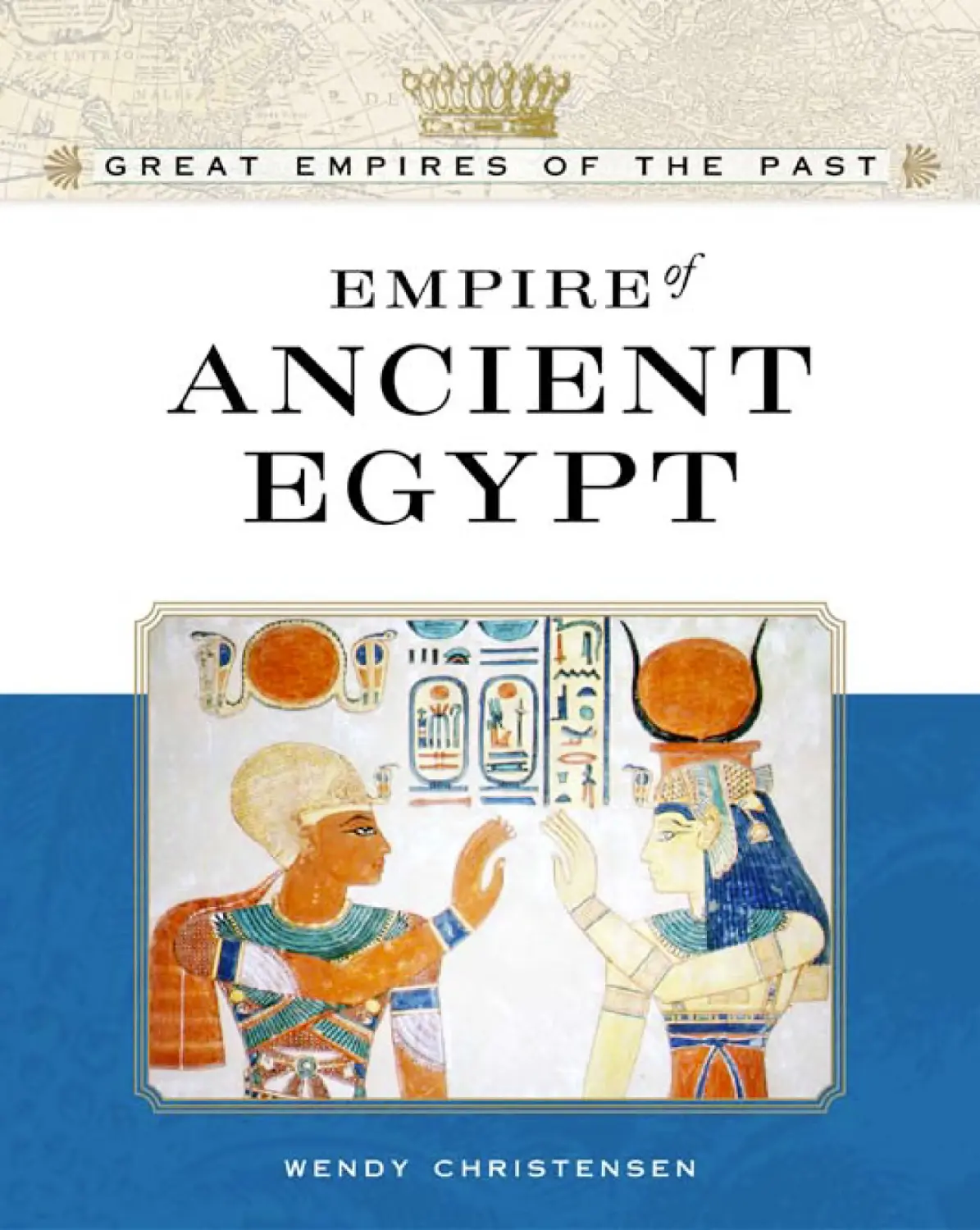
Empire of
Ancient Egypt

WENDY CHRISTENSEN

For Alison, God’s grace incarnate.
Great Empires of the Past: EMPIRE OF ANCIENT EGYPT
Copyright © 2005 Wendy Christensen

H ISTORY CONSULTANT: Dr. Josef Wegner, Associate Professor of Egyptology, University of
Pennsylvania; Associate Curator, Egyptian Section, University of Pennsylvania Museum

All rights reserved. No part of this book may be reproduced or used in any form or by any means, electronic or mechanical,
including photocopying, recording, or by any information storage or retrieval systems, without permission in writing from
the publisher. For information, contact:
Facts On File, Inc.
132 West 31st Street
New York NY 10001
Library of Congress Cataloging-in-Publication Data
Christensen, Wendy.
Empire of ancient Egypt / Wendy Christensen.
p. cm. — (Great empires of the past)
Includes bibliographical references and index.
ISBN 0-8160-5558-0 (hc: alk. paper)
1. Egypt—History—To 640 A.D.—Juvenile literature. I. Title.
II. Series.
DT83.C49 2004
932'—dc22
2004003951
Facts On File books are available at special discounts when purchased in bulk quantities for businesses, associations, institutions, or sales promotions. Please call our Special Sales Department in New York at (212) 967-8800 or (800) 322-8755.
You can find Facts On File on the World Wide Web at http://www.factsonfile.com
Produced by the Shoreline Publishing Group LLC
President/Editorial Director: James Buckley Jr.
Series Editor: Beth Adelman
Designed by Thomas Carling, Carling Design, Inc.
Photo research by Jullie Chung, PhotoSearch, NY
Index by Word Co.
Photo and art credits: Bildarchiv Steffens/Bridgeman Art Library: 1, 16; Giraudon/Art Resource, NY: 3, 71; Erich
Lessing/Art Resource, NY: 4, 36, 55; Photography by Egyptian Expedition/The Metropolitan Museum of Art: 9, 88;
Photofest: 13; Hirmer Fotoarchiv: 21; Stuart Westmorland/Corbis: 27; Facts On File, 39, 114; The Metropolitan Museum
of Art, Rogers Fund and Edward S. Harkness Gift, 1929. (29.3.2): 40; Sandro Vannini/Corbis: 48; Bettmann/Corbis: 50;
© The British Museum: 56, 75, 98; Vanni/Art Resource, NY: 62; Scala/Art Resource, NY: 76; Art Resource, NY: 78, 106;
Louvre, Paris/France/Bridgeman Art Library: 86; AP/Worldwide Photos/Mohamad al-Shehety: 92; Josef Polleross/The
Image Works: 110; Private Collection: 112; Lloyd Cluff/Corbis: 115; AP/Worldwide Photos/Mohamed El-Dakhakhny:116.
Printed in the United States of America
VB PKG 10 9 8 7 6 5 4 3 2 1
This book is printed on acid-free paper.

CONTENTS
Introduction
PA RT I

H I STO RY
CHAPTER 1
CHAPTER 2
CHAPTER 3

PA RT I I

5

Egypt Before the Empire
Imperial Egypt
Egypt’s Long Decline

17
37
51

S O C I E T Y A N D C U LT U R E
CHAPTER 4
CHAPTER 5
CHAPTER 6

Egyptian Society
Everyday Life in Egypt
Egyptian Religion, Science, and Culture
Epilogue
Time Line
Resources
Bibliography
Index

63
79
93
111
120
121
123
124

Introduction
EGYPT, THE WORLD’S FIRST SUPERPOWER, WAS BORN ABOUT
5000 B.C.E. in the valley of the Nile River in northeastern Africa. Tucked
into a long, narrow gorge threaded by the river and bounded by steep
cliffs, Egypt enjoyed a predictable, mostly pleasant climate and natural
barriers against invasion. To the west lay the Sahara Desert, to the east a
harsh, mountainous wasteland. To the south, a series of six great rapids
(called cataracts) obstructed the river. To the north was the “Great Green:”
the Mediterranean Sea.
An Egyptian called his homeland Kemet. His world was divided
into lowland kemet (“black land”), the narrow ribbon of rich, black earth
on the valley floor, and highland deshret (“red land”), the pale, reddish
sand of the forbidding desert plateaus. Foreigners were “highlanders.”
“Going up” meant leaving the valley; “descending” was returning home.
Egypt was a long, narrow oasis carved by the Nile River through
the harsh desert. “The Egypt to which we sail nowadays is… the gift of the
river,” said Greek historian and traveler Herodotus. The Nile, one of the
world’s longest rivers, flows more than 4,200 miles north from central
Africa to the Mediterranean. The name “Nile” comes from the Greek
word Neilos, but the Egyptians called it simply iteru, “the river.”

opposite

The Boy King
This gold mask of King
Tutankhamun (popularly
known as King Tut), taken
from his inner coffin, toured
museums throughout the
world in the early 1980s,
sparking interest yet again in
the culture of ancient Egypt.

The Two Lands
Because all life came from the Nile, geography was everything in ancient
Egypt. The narrow valley through which the Nile ran, and the wider Delta
where it flowed into the sea, were known as the “two lands” of ancient
Egypt. Upper Egypt, Ta-Shomu (“narrow land”), was a long, narrow, limestone gorge, 10 to 30 miles wide, stretching from the first cataract at Aswan

5

EMPIRE OF ANCIENT EGYPT

WHAT ARE
CONNECTIONS?
Throughout this book,
and all the books in the
Great Empires of the Past
series, you will find Connections boxes that point
out ideas, inventions, art,
food, customs, and more
from this empire that are
still part of our world
today. Nations and cultures in remote history
can seem far removed
from our world, but these
connections demonstrate
how our everyday lives
have been shaped by the
peoples of the past.

to the edge of the Delta, 500 miles to the north. It was bounded by cliffs that
rose from a few hundred feet to almost 1,000 feet high. In ancient times,
Upper Egypt’s floodplain totaled 42,500 square miles. Cultivated lands extended from just over one and a half miles wide at Aswan to about 13 miles
wide on the west bank opposite modern Tell el-Amarna.
About 100 miles south of the Mediterranean, the Nile split into two
streams and many smaller tributaries. It formed the fan-shaped Nile Delta,
an 8,500-square-mile region of marsh and heavily silted land called Lower
Egypt, Ta-Mehu (“water-filled land”).
The ancient Nile had at least five, and as many as 16, outlets to the
sea. (The modern Nile has only two, Rosetta and Damietta.) About 50
miles southwest of the Delta’s apex lay the Faiyum. Connected underground to the Nile, the ancient Faiyum was a wetlands paradise, thick
with lotus and papyrus plants and teeming with birds and animals. Birket
Qaran, a lake in the northern Faiyum, was a favorite hunting spot.
The Nile (then and now) blends two major streams. The White Nile
rises from the clear waters of Lakes Victoria, Albert, and Edward in central Africa. As it flows north, it gathers water from over 1,500 miles of
tributaries. The Blue Nile rises in Lake Tana, in the highlands of Abyssinia
(modern Ethiopia). It flows more than 1,000 miles before joining the
White Nile. The two streams join at Khartoum, capital of the modern
Republic of the Sudan, and flow another 1,900 miles to the sea. About
140 miles north of Khartoum, the Atbara River, rising from the Ethiopian highlands, joins the Nile.
Near Khartoum, the Nile enters a region of hard sandstone. As it
runs through this difficult land, there are six lengths—the cataracts—where
it has been unable to carve a clear channel. Stony outcroppings, rapids,
and small but treacherous falls obstruct navigation. The northernmost
cataract (the first) is closest to Egypt. Once past the first cataract, near
the modern city of Aswan, sandstone gives way to softer limestone. This
made it much easier for the Nile to carve a relatively straight channel.
After passing the island of Elephantine, the Nile enjoys a 675-mile, unobstructed passage to the Delta and the Mediterranean Sea.

The Inundation
Each year, spring rains and melting snows in the Ethiopian highlands
poured into the Blue Nile, carrying huge quantities of volcanic silt (fine
particles of earth) and decaying vegetation. These “green waters,” saturated with minerals and organic material, started to reach Egypt by June.

6

INTRODUCTION
A month later, a wave of muddy water, enriched with silt and red earth,
poured into the Nile from the Blue Nile and the Atbara. It washed over
the valley floor, depositing millions of tons of mineral-laden silt, potash,
and organic materials.
The waters continued rising until mid-September, then gradually
receded. In October, the waters rose again briefly, then receded until
spring. By the end of May, the Nile was at its lowest level of the year, and
the land was dry and cracked.
This annual flood—called the inundation—was treasured and feared.
It brought life and fertility; Egypt’s civilization would have been impossible
without it. But it could also bring trouble—from temporary inconvenience
to major catastrophe.
When the inundation arrived on time and was neither too high nor
too low, planting and harvesting went smoothly. If the inundation arrived earlier or later than usual, crop yields might be dangerously low.
And a low Nile or a high Nile could spell disaster. With a low Nile, the
floodwaters did not reach some of the farmlands. These lands could not
be planted—there was no way to get enough water to them. A single low
Nile year caused some problems, but stored grain usually came to the
rescue. A series of low Niles could bring widespread famine.
In a high Nile, floodwaters swept away homes, villages, herds, dams,
and canals. Thousands of people drowned or were left homeless.
The Egyptians worshiped the vital inundation as Hapi, a chubby
god with a papyrus plant growing from his head. They held festivals to
honor Hapi at the site of modern Gebel el-Silsila, near Elephantine, where
they believed the inundation arose, and sang a hymn to Hapi: “When he
appears, the land jubilates, everybody rejoices.” Modern Egyptians honor
this tradition by throwing flowers into the river each summer at Awru elNil, a national holiday that celebrates the inundation.

The Evidence of History

THE NILE AS COMPASS
Upper Egypt lies south of
Lower Egypt. That seems
upside down. But it made
perfect sense to the
Egyptians because the
Nile flows south to north.
The Egyptian word for
north meant “downstream;” their word for
south meant “upstream.”
Most rivers flow north to
south, but to Egyptians
this seemed strange.
Egyptian travelers were
confused when foreign
rivers did not behave
“correctly.” One Egyptian,
perplexed by the
Euphrates River in
Mesopotamia (modern
Iraq), called it “the inverted water which goes
downstream in going
upstream.”

Ancient Egypt was one of the longest-lasting civilizations the world has
ever known, spanning more than 3,000 years from about 3100 B.C.E. to 30
B.C.E.. It left an enormous amount of material for Egyptologists to study:
tombs, temples, monuments, paintings, sculptures, papyrus scrolls, coffins,
mummies, pottery, household goods, jewelry, clothing, toys, and more. The
surviving materials are only a tiny, random fraction of what Egypt produced.
The first historian to take an interest in Egypt was Greek traveler and
writer Herodotus (c.480-425 B.C.E.) who visited Egypt around 450 B.C.E.

7

EMPIRE OF ANCIENT EGYPT
In Book 2 of his Histories, he documented places, people, and practices
he saw himself. He also recorded legends and tall tales. Scholars disagree
about Herodotus’s reliability on many matters, especially history.
Egyptologists have found several partial lists of kings, recorded at
various times during Egypt’s long history. Most of these are incomplete,
inaccurate, or both. Kings sometimes deliberately left out or erased the
names of previous rulers, or changed inscriptions to claim previous kings’
accomplishments as their own.
The king list considered most
complete (although it has many
mistakes) was written in Greek by
the Egyptian high priest and scribe
Manetho. His list extends from
It is very difficult to establish accurate dates for Egyptian history.
3100 B.C.E. (the time of the unificaThe Egyptians did not keep a continuous timetable of years
tion of Upper and Lower Egypt) to
and events. Some dates can be cross-checked against
332 B.C.E. (when Egypt was conrecords of other ancient peoples, or against known astroquered by Alexander the Great), dinomical events. All dates before 664 B.C.E. are estimates.
viding the kings into 31 dynasties
Early dates were given relative to the years of a king’s
(hereditary ruling families). This was
reign, or some major or unusual event (“year five of Djet,”
the first time the rulers had been
or “the second year after Djet’s first expedition to Nubia”).
listed in this standardized way.
Sometimes, dates were given relative to the national cattle
Manetho lived during the
census, a major event that happened every two years (“the
Ptolemaic Period, which puts him
year after Pepy’s sixth counting of the oxen”). When a new
a thousand years further away in
king took the throne, the year was reset to one.
time from the earliest dynasties than
During the Middle Kingdom and later, dates were given
we are today from his time. Neither
only relative to each king’s reign (“the 12th year of ThutManetho’s Histories nor his sources
mose”). Often, several kings had the same name, making
have survived. Short passages from
dates even more complicated.
his work, including his list of kings,
There is still much controversy among Egyptologists
were later quoted by the Roman hisabout dates. As new information has come to light, Egyptorians Africanus, Josephus, and
tologists have revised Egyptian chronology several times. In
Eusebius, preserving them for subthe New Kingdom, dates from different sources can vary by
sequent study.
as much as 20 years. For the Old and Middle Kingdoms,
Modern Egyptologists recogdates might differ as much as 50 years in either direction.
nize 34 dynasties: the 31 listed by
The dates in this book are from “Three Kingdoms and 34
Manetho, two additional dynasties
Dynasties,” by Dr. William J. Murnane, in David Silverman’s
for the Macedonian and Ptolemaic
book Ancient Egypt.
kings, and what they call Dynasty
0, to account for a few very early

Egyptian Dates

8

INTRODUCTION

Carter Wraps Up His
Treasures
On November 4, 1922,
British Egyptologist Howard
Carter (1873–1939)
uncovered a flight of steps
leading down into the tomb
of a minor Eighteenth
Dynasty king, Tutankhamun.
Carter removed a few stones
from the door that sealed the
tomb and peered into the
chamber. “Can you see
anything?” asked Earl of
Carnarvon (1866–1923), the
expedition’s financial backer,
whom Carter had summoned
from London. “Yes,” Carter
replied, “wonderful things.”
(As quoted in “The Tomb of
Tutankhamen” by Howard
Carter.)
kings. Egyptian kings are often called pharaohs, but that term was not
used for the king until quite late in Egyptian history.
Because Egyptian history is so long, Egyptologists group the dynasties into periods, based on political, social, economic, and other factors they had in common. These divisions are modern inventions.

A Whirlwind Tour of Egyptian History
The 1,850 years of Egypt’s Predynastic era (5000 B.C.E.–3150 B.C.E.) were
busy times of intense cultural and agricultural development, population
growth, widespread settlement, and the adoption of hieroglyphic writing. Egypt’s population was about 1 million by the time King Narmer
united the “two lands” in 3100 B.C.E.
The 375 years of the Early Dynastic Period (3000 B.C.E.–2625 B.C.E.)
saw the unification of Upper and Lower Egypt under strong central rule.
During Dynasties 0 to 3 the capital city of Memphis was founded, and
Egypt’s huge, bureaucratic government rapidly developed.

9

EMPIRE OF ANCIENT EGYPT
The Old Kingdom (2625 B.C.E.–2130 B.C.E.) was the age of the great
pyramids. In statues of themselves, Old Kingdom rulers have a calm, godlike peacefulness. They knew they were assured of eternal life. They probably did not care much about everyday, earthly matters or the troubles
of the peasants. They are portrayed speaking directly to the gods and
thinking lofty thoughts. They did not hesitate to pour all Egypt’s resources
into building lavish tombs for themselves.
By the end of the Old Kingdom, Egypt’s population had grown to
2 million, mostly extremely poor peasants. There was general unhappiness
with increasingly expensive royal building projects. Powerful, wealthy
local rulers started ignoring the king, and splintered Egypt into independent feudal provinces.
Climate changes brought a disastrous series of low Niles, causing
crop failures, widespread famine, and the miseries of the First Intermediate
Period (2130 B.C.E.–1980 B.C.E.). For 150 years, Egypt suffered chaos,
civil war, and famine.
The Middle Kingdom (1980 B.C.E.–1630 B.C.E.) was a glorious but
restrained era of reform and cultural restoration. In statues of themselves,
Middle Kingdom rulers have the worried, care-worn expressions of men
facing many real-world problems. They were wealthy and powerful, but
also hard workers, running a huge, unwieldy government. They saw what
chaos and civil war can do to their country. They did not want a repeat.
For 350 years, Egypt enjoyed peace, prosperity, increased trade, and great
practical achievements. The population grew to about 2.5 million. For
the first time, Egypt had a middle class.
The Second Intermediate Period (1630 B.C.E.–1539 B.C.E.) brought
Egypt’s worst nightmare: rule by foreigners. Another period of climate
change and unstable Nile years brought crop failure, famine, and civil
disorder. The Hyksos (“rulers of foreign lands”), foreigners of Semitic
origin, took advantage and seized the throne, holding it for more than
100 years. Because they were foreigners, the Hyksos were hated. But they
brought much-needed fresh ideas and cultural innovations to Egypt. After
a long, difficult power struggle, a group of princes from the city of Thebes
drove the Hyksos from Egypt.
The New Kingdom (1539 B.C.E.–1075 B.C.E.) was Egypt’s imperial
age. At its greatest extent, Egypt’s empire stretched from the fourth
cataract of the Nile deep in Nubia all the way to the Euphrates River in
Asia. Egypt was powerful and wealthy beyond compare—the world’s
first superpower. The imperial pharaohs of the New Kingdom have

10

INTRODUCTION
proud, confident faces. They owned the world. They thought extremely highly of Egypt, and even more highly of themselves. No boast was
too grand, no monument too large, no conquest too challenging for
these mighty pharaohs. For more than 450 years, Egypt, now home
to about 3 million people, was on top of the world. Gold, gifts, plunder,
and tribute flowed in like the Nile floods. But winds of change were
blowing.
During the 419 years of the Third Intermediate Period (1075
B.C.E.–664 B.C.E.) Egypt’s power weakened and, eventually, the empire
came to an end. By around 1000 B.C.E., Egypt was just about bankrupt.

CONNECTIONS

>>>>>>>>>>>>>>>>>>>>>>>>>>

Popular Obelisks
Obelisks are four-sided tall, slender pillars covered with hieroglyphic inscriptions and tapering to a point at the top, usually carved from a
single block of stone. They were created by the
Egyptians to symbolize contact between humans on earth and the gods in the heavens. A
pair of obelisks bearing commemorative inscriptions often stood at the entrance to temples, particularly those dedicated to the sun god,
Ra. Their purpose was to proclaim the king’s
power and successes.
These obelisks captured the imagination of
foreign conquerors throughout history, and
many can now be found in different parts of
the world. Two great obelisks, which stood in
Egypt for 2,500 years, were brought to Rome
to commemorate Julius Caesar. These became
known as Cleopatra’s Needles. Ironically, in 1878
one was transported to London and placed on
the Thames River embankment. New York City
received the other one, and placed it in Central
Park in 1881.

Several obelisks were brought to ancient
Rome in imperial times, and others were made
by the Romans, who imitated Egyptian hieroglyphics to simulate the real thing. They were
erected outside temples or mausoleums or along
the center line of arenas built for chariot racing.
When the Roman Empire came to an end, one
by one the obelisks fell and were buried. It was
not until the Renaissance that a renewed interest for antiquities caused them to be unearthed.
Possibly the best known obelisk in Egypt is at
the Temple of Luxor in Thebe, which was raised
by Ramses II. This obelisk was originally one of
a pair, each 72 feet tall and 254 tons of solid red
granite. In 1836, Napoleon removed one and it
now stands in the Place de la Concorde in Paris.
One modern obelisk that may be familiar is
the Washington Monument in the United States
capital. Built to honor the first president of the
United States, George Washington (1732–1799),
this 555-foot obelisk is the tallest building in
Washington, D.C.

11

EMPIRE OF ANCIENT EGYPT
The country splintered into numerous small kingdoms and fiefdoms,
constantly at war. Massive confusion reigned, enabling Egypt’s former
colony, Nubia, to seize the throne, which it held for more than 100 years.
During Egypt’s Late Period (664 B.C.E.–332 B.C.E.) outside influences and invaders—Assyrians, Babylonians, Persians, and Macedonian
Greeks—dominated Egypt. A dynasty of merchant-kings, the Saites, fell
to the Persian Cambyses in 525 B.C.E. The First Persian Occupation (525
B.C.E.–405 B.C.E.) was an unhappy time. Egypt did not like being part of
someone else’s empire. The Egyptians rebelled and won back their independence for 66 years. Nakhthoreb (also known as Nectanebo II), the
last king of the Thirtieth Dynasty, who ruled from 362 B.C.E. to 343 B.C.E.,
was the last native Egyptian to rule Egypt for 2,300 years, until 1952.
The Second Persian Occupation (343 B.C.E.–332 B.C.E.) was brief and
troubled. Egypt longed for a savior. In 332 B.C.E., Alexander the Great
drove the hated Persians from Egypt, beginning the Hellenistic (Greek) Period (332 B.C.E.–323 B.C.E.). The Egyptians considered Alexander a god—
the son of their god Amun-Re. In founding the city of Alexandria,
Alexander brought Egypt into the greater Mediterranean world. But
Egypt’s ancient, native civilization was swiftly passing away.
The Ptolemaic Period (323 B.C.E.–30 B.C.E.) saw the end of ancient
Egypt. The Ptolemies, ruling from Alexandria, were greatly influenced by
the Greeks, and Greek and Egyptian culture began to blend. In 30 B.C.E.,
Queen Cleopatra VII committed suicide rather than face defeat by the
Romans, and Egypt became a province of the Roman Empire.

Why Learn About Ancient Egypt?
Ancient Egypt did not leave what scholars call a successor community—
an identifiable group of people who carry on some or all of the practices,
beliefs, traditions, and customs of an earlier people or culture with a reasonable degree of continuity. To be a true successor community to a culture
or civilization, the new culture must uphold beliefs and traditions that were
integral to the original culture, and that are identifiable and distinctive.
But once Egypt became part of the Roman Empire, her religion
gradually vanished. Hieroglyphic writing was abandoned, and the secret
to deciphering it was lost for thousands of years. Her spoken language
metamorphosed into Coptic. Her artistic styles were not adopted by other
cultures. Her imperial age lasted only a few hundred years, and left little
mark on a rapidly-changing world. Of all Egypt’s achievements, only the
365-day calendar, adopted by the Romans, remained.

12

INTRODUCTION
For thousands of years, ancient Egypt lay buried in sand and obscurity. But she was only sleeping. In 1798, French general Napoleon
Bonaparte shook her awake with a landmark expedition to Egypt.
Napoleon brought scientists, historians, artists, and scholars to explore
and document the ancient monuments and ruins. In 1802, the first edition
(of more than 40) of Travels in Upper and Lower Egypt by French artist
Vivant Denon (1747-1825) caused a huge sensation in Europe. The resulting fascination produced waves of what came to be known as Egyptomania—a trend that shows no signs of slowing 200 years later. Egyptian
styles of design and ornamentation have long influenced architecture,
fashion, make-up, hairstyles, home décor, graphic arts, jewelry and more.
In 1809, the first edition of Denon’s 36 illustrated volumes of
Description de l’Egypte (Description of Egypt) caused another wave of

The Mummy’s Curse
The 1943 movie The
Mummy’s Ghost was one in
a popular series of movies
showing ancient mummies
that came back to life. This
one stars Lon Chaney as the
mummy and Frank Reicher
as Professor Norman.

13

EMPIRE OF ANCIENT EGYPT

CONNECTIONS

>>>>>>>>>>>>>>>>>>>>>>>>>>

Egyptomania
The hippies of the 1960s adopted the ankh, an
Egyptian symbol for eternal life, as a symbol of
their movement. A new wave of Egyptomania
swelled in the 1970s when objects from
Tutankhamun’s tomb toured world museums.
Millions of visitors waited for hours to see the
solid gold coffins, jewelry, and other treasures.
Recent reexamination of a mummy found
in a tomb in 1898 has led some Egyptologists
to suggest it may be the famous beauty Nefertiti. This startling announcement, along with a
Discovery Channel special about the queen, has
already set off a new wave of Egyptomania.

Many computer games use Egyptian motifs
and themes. Mail-order catalogs sell CD cabinets and wine closets shaped like Tutankhamun’s
coffin. You can buy lamps in the form of the
goddess Isis, pedestals and end tables shaped
like temple columns, jewelry boxes decorated
with copies of tomb-wall paintings, and figurines of the Egyptian deities Bastet, Sekhmet,
Isis, Osiris, and Anubis. Scarabs and Egyptian
cats are popular jewelry items. You can visit web
sites that translate your name (or any text) into
hieroglyphics, and buy rings and pendants with
your name, in hieroglyphics, in a royal cartouche.

Egyptomania. Denon’s books gave European scholars their first close
look at images of Egyptian objects and inscriptions, and helped speed up
the process of decoding the hieroglyphics. They also alerted potential
looters. Egyptian tourism skyrocketed.
Another huge wave of Egyptomania erupted after the discovery of
the tomb of Tutankhamun (popularly known as King Tut) in 1922. Egyptian design, with its elegant, angular lines and geometrical forms based
on idealized plants and flowers, had a tremendous influence on the art
movement of the time known as Art Deco.
Hollywood quickly picked up on the popular myth of a “curse” on
King Tut’s tomb. An endless series of “curse of the mummy” movies followed. Epic films “documented” the building of the pyramids and the life
of Cleopatra, taking extreme liberties with the facts.
Egypt becomes more fascinating with each passing year, each new
archaeological discovery, each television special, each old mystery solved,
each new mystery that emerges. In many ways, the modern world is
Egypt’s long-delayed “successor community.” We do not worship Egyptian gods and goddesses or write in hieroglyphics. But no other ancient
civilization holds such intense fascination for us.

14

PA RT I

HISTORY
Egypt Before the Empire
Imperial Egypt
Egypt’s Long Decline

15

CHAPTER 1

Egypt Before
the Empire
IN EARLY PREHISTORIC TIMES, THE NILE VALLEY WAS NOT A
great place to live. Each summer, floodwaters filled the narrow gorge cliff
to cliff. When they receded, the valley remained wet and marshy.
But it was a hunter’s paradise. The Nile was alive with fish. Papyrus thickets teemed with game birds. Antelopes, gazelles, oryxes, and
wild bulls grazed in lush greenery near the cliffs. Crocodiles and hippos
patrolled river shallows and muddy pools.
From 8000 to 5000 B.C.E., the Nile valley and surrounding deserts
were much cooler and wetter than they are today. But the climate was
changing rapidly, turning hotter and drier. The valley started drying out
more quickly after the annual floods. Soon, some spots on the sandy
plateaus that rose up to the cliffs were dry year-round.
Around 5000 B.C.E., people started living year-round in the Nile
River valley. Great droughts in Asia had set masses of people adrift. These
unwilling wanderers longed to resume the lifestyles they had left: agriculture (growing grains and other foodstuffs) and animal husbandry (tending herds of animals for meat, milk, hides, wool, and transportation). To
them, the Nile valley looked very inviting.
Archaeologists have identified several Predynastic Egyptian cultures, named for modern towns where remains of ancient cultures were
found. The Badarian culture arose about 5000 B.C.E. It was succeeded by
the Amratian culture (also called Naqada I) about 4000 B.C.E. The Early
and Late Gerzean Periods (also called Naqada II) followed around 3500
B.C.E. and 3300 B.C.E.
Because these cultures did not leave written records, it can seem
that Egyptian civilization sprang out of nowhere. But it was just that the

opposite

Still a Wonder
The pyramids at the Giza
Plateau still have the power
to awe us, more than 4,500
years after they were built.

17

EMPIRE OF ANCIENT EGYPT
ancient Egyptians had settled down and prospered in the Nile valley long
before they learned to write. Archaeologists have uncovered enough physical evidence to piece together a general picture of early civilization in
the valley. But over thousands of years, the Nile’s annual flood buried
most evidence of Predynastic Egyptian life. What is known about these
people comes mostly from cemeteries, pottery, tools, weapons, jewelry,
and other metal objects.
Early Nile valley settlers carefully buried their dead in locations
safe from the floodwaters. Archaeologists have discovered many cemeteries
on high ground near the cliffs. Villages were located on “turtle-backs”
(small rises of land) on the valley floor. Evidence of only a few valley
floor settlements has survived, mostly by chance. By studying layers of
mud, archaeologists and geologists have determined that many more settlements are buried deep beneath millennia of mud.
In the Delta, the Nile has gradually shifted eastward over thousands
of years, wiping out signs of many important early settlements. Other ancient villages lie buried deep beneath modern towns and cities. Many of
these sites have been continuously inhabited for up to 8,000 years.
Many ancient settlements were dismantled, brick by brick, by the
Egyptians themselves. Most ancient buildings were made of sun-dried
mud-brick. As mud-brick decays, it turns into sebakh—the organic debris
of human occupation; it makes a cheap, handy compost and fertilizer.
Over the centuries, sebakh gatherers have removed all traces of entire
ancient villages and towns.
Predynastic Egyptians lived in small, self-supporting villages on
humps of dry land near the river’s edge, close to hunting and fishing
grounds and to cultivated fields. They tended herds of animals. They wove
baskets and mats from papyrus and reeds. They grew wheat and barley,
storing the grains in pits lined with reed mats. They used milling and
grinding stones and simple cooking equipment.
They protected their eyes from the harsh sun with “eye paint”: minerals mixed with oils and ground on stone palettes. They pressed cleansing oils from the wild castor plant. Compared to people in other parts of
the ancient world, they enjoyed a good life. Food, both cultivated and
wild, was usually plentiful.
They believed in an afterlife. They laid a dead person on his left
side, knees touching his chin, wrapped him in a reed mat or animal skin,
or placed him in a basket, and buried him in a shallow oval pit in the
sand, facing west. Graves often included jars of beer and food, pottery,

18

EGYPT BEFORE THE EMPIRE
make-up palettes, weapons, personal ornaments, and small figurines symbolizing fertility or life. In the hot, dry sand, bodies dried out before they
had a chance to rot, creating natural mummies.
Predynastic religion included animal cults. Animal cemeteries, located near human graves, included the bodies of dogs, jackals, sheep, and
cows, wrapped in linen or matting and carefully buried.

Coming Together
During the Badarian era, perhaps about 100,000 people lived in what
was to be Egypt. This increased to 250,000 people during the Amratian Period. With more people to feed, better organization was necessary. Egypt
always faced the danger of a low or high Nile (see page 7). When disaster struck, it took discipline, cooperation, and strong leadership to quickly restore food production and distribution.
Villages gradually banded together into confederations under strong
chieftains. These regional alliances became the permanent administrative districts of dynastic Egypt. Egyptologists call these districts nomes,
and their leaders, nomarchs.
During the late Gerzean era, important people such as nomarchs
were buried in increasingly large, complex, rectangular mud-brick structures. Ordinary people were still buried in simple pits in the sand.
There is controversy among Egyptologists about what this two-tier
burial system means. Sir Flinders Petrie (1852–1942), father of scientific
archaeology, thought it meant that a “dynastic race” had invaded Egypt
from the Near East or Nubia, taken over, and introduced writing and
other cultural advances. Other scholars believe the social divisions were
a natural part of cultural trends already in motion.
The later Gerzean Period saw increased political activity. The population continued to grow rapidly. Since there are no written records, little is known about how the nomes finally joined up, forming two distinct
cultures in Upper Egypt and Lower Egypt: the Delta culture and the
Naqada culture. By 3400 B.C.E. Egypt ended up with two kingdoms.
The Ta-Mehu culture in Lower Egypt’s Delta had its capital at Pe
(later Buto). Its king wore a red crown (known as deshret). Its patroness
was the cobra goddess Edjo (Wadjet) and its symbols were the papyrus and
the bee. While there is no evidence that the ancient Egyptians called this
the Red Land, modern scholars have referred to it that way.
The Ta-Shomu culture in the long, narrow gorge of Upper Egypt
had its capital at Nekhen (later Hierkonpolis). Its king wore a tall,

WHY TWO NAMES?
Sometimes you will see
two names used to refer
to the same god, goddess
or noble person—such as
the cobra goddess Edjo
(Wadjet). Because Egyptian writing did not use
vowels, we do not know
how they pronounced
their words and guesses
have to be made. Thus,
many ancient Egyptian
words or names have
three or more forms
(including at least one
Greek form) that are
more or less accepted.
For example, Thutmose is
also called Tuthmosis;
Taweret is also Tueris;
Sesostris is also Senwosret; Khufu is also Cheops;
Khafre is also Chephren—and there are
many more.

19

EMPIRE OF ANCIENT EGYPT
conical white crown (known as hedjet). Its patroness was the vulture
goddess Nekhbet and its symbols were the lotus and the sedge (a kind
of marsh grass). This culture has come to be known as the White Land.
There were struggles for dominance among factions within each of
the two lands, and between Ta-Mehu and Ta-Shomu. An ambitious local
chieftain arose in Ta-Shomu, and united its districts under his rule. He
then did the same in Ta-Mehu.
To piece together the story of Egypt’s unification, archaeologists
have made many guesses based on a small number of objects: large commemorative palettes (shield-shaped stones) and ceremonial mace heads
(hammer-like weapons) carved with scenes depicting political events.
The chieftain who united the two lands (in about 3100 to 3150
B.C.E.) is traditionally called Narmer. His triumphs are depicted on the
Palette of Narmer, now in the Cairo Museum. On one side, Narmer wears
the white crown as he slays his foes; on the other side he wears the red
crown. After Narmer, Egyptian kings wore the combined double crown
(known as sekhemty), and adopted names and titles that symbolized their
dominion over the two lands.
No one knows who taught the inhabitants of the Nile valley to
write. It might have been refugees from Mesopotamia. Mesopotamian
cuneiform (wedge-shaped) writing, scratched into slabs of damp clay,
bears little relation to Egyptian writing. But the idea of expressing ideas
using symbols could have planted a seed. Hieroglyphics, Egyptian picture-writing, emerged during the late Predynatsic Period, and hieroglyphs
are found in a tomb that has been dated to 3250 B.C.E.

The Early Dynastic Period
Narmer’s triumph did not put an immediate end to conflict. There were
many periods of localized warfare. Forces from the north and south
clashed. For awhile, the two lands continued to think of themselves as
separate kingdoms.
Narmer, who was from Ta-Shomu, may have married a Ta-Mehu
princess to establish his right to rule the north. Throughout Egyptian history, many kings chose wives to strengthen their ties to the royal family or
to cement a political or diplomatic relationship. Second Dynasty king
Khasekhemwy also married a northern princess.
This period, known as the Early Dynastic Period, covers 375 years of
what Egyptologists have named Dynasties 0 to 3 (3000 B.C.E.–2625 B.C.E.).
Most information about the Early Dynastic Period comes from royal tombs

20

EGYPT BEFORE THE EMPIRE
at Abydos, and tombs of nobles at Saqqara. The few items missed by tomb
robbers show that arts and crafts were already highly advanced.
Early kings wanted to be assured of plenty of help and companionship in the afterlife. When they died, servants and family members
were killed and buried with them. First Dynasty king Djer was buried
with more than 300 people. This cruel, wasteful practice was abandoned
by the end of the First Dynasty.
The population was growing rapidly, reaching an estimated 1 million by the end of the Second Dynasty. One of the king’s most important
roles was to increase food production by extending irrigation systems
and reclaiming land for farming. Land was reclaimed for farms, towns,
and cities using dams and drainage canals. First Dynasty king Hor-Aha
founded the capital city of Memphis on land reclaimed from the Nile.
Memphis (which means “white walls”), at the southern tip of the Nile
Delta, became one of the ancient world’s greatest cities.
Artistic, cultural, religious, and political traditions were established
during the Early Dynastic Period that persisted throughout Egypt’s history.
At Memphis, a highly centralized, bureaucratic government was soon in

Writing on the Wall
Hieroglyphics emerged
during the late Predynastic
Period, and became both a
sophisticated writing system
and an elegant art form. On
monuments they were often
combined with relief carvings, as on this obelisk at
Amun’s Temple in Karnak.
It shows the king being
confirmed by Amun.

21

EMPIRE OF ANCIENT EGYPT
place and growing fast. The government employed legions of scribes, tax
collectors, accountants, engineers, and architects. Specialists oversaw
trade, irrigation, and drainage, and the distribution and storage of food.
Scribes, whose job was to write down all important records, quickly converted from cumbersome hieroglyphics, based on pictures, to speedier hieratic script (a kind of hieroglyphic shorthand). They wrote on
sheets or rolls of papyrus, made from the fiber of the papyrus plant, which
was already in wide use by Narmer’s time. Accountants and engineers had
all the basic mathematical and surveying skills they needed to determine
property boundaries and calculate crop yields. The 365-day calendar
was in place. A system of weights and measures simplified trade and tax
collection.
Artists and craftsmen started using standardized proportion grids for
depicting objects and people. Before beginning to paint or carve, the artist
drew a grid of horizontal and vertical lines of predetermined size and
spacing on his work surface (a tomb wall, for example). Depending upon
the rank and social position of the person being depicted, he or she was
made a specific size in relation to the other figures in the composition.
Also, each figure had to be structured in a specific way—a person was a certain number of “heads” tall, the legs were a certain length in relation to
the torso, and so on. These very specific relationships were established
early on and artisans seldom deviated from them. These conventions and
proportions had deep religious, magical, cultural, and social significance.
(There is more information about artistic conventions in chapter 6.)
The arts of pottery and stonework were highly advanced. There is
evidence of roof beams, joists, and large doors made of cedar wood, indicating ongoing trade with Lebanon, which is on the Mediterranean
coast more than 200 miles northeast of Egypt. Articles of ebony and ivory
show that trade with Nubia, in north-central Africa south of Egypt, was
well-established. Trade goods that came through the southerly routes
from Nubia originated in Nubia itself, and from the peoples of the Sudan
and of equatorial and sub-Saharan Africa. Lapis lazuli ornaments show
that Egyptian traders were also benefitting from a long-distance trade
network that brought in gemstones and other luxury goods from as far
as central Asia. The stage was set for a spectacular flowering of culture.
Early Third Dynasty kings faced serious internal political problems
and could not yet afford to concentrate on tomb-building. They granted
large estates, herds, and rich gifts to trusted nobles who promised to keep
the provinces quiet. These nobles enjoyed enormous local power and pres-

22

EGYPT BEFORE THE EMPIRE
tige, setting up a dangerous pattern repeated throughout the dynastic era:
powerful local nobles becoming too wealthy and independent.
Besides putting down internal squabbles, kings were also busy obtaining reliable supplies of the industrial materials they needed and the luxury goods they craved. Third Dynasty kings began extensive mining in
the Sinai Peninsula, especially for copper and turquoise. Keeping the
mines open often meant military action against local Bedouin tribes.
Keeping prized gold flowing north from Nubian mines was a problem faced by kings throughout the dynastic era. Third Dynasty king
Djoser extended the boundary of Upper Egypt to the first cataract at
Aswan to help secure the southern trade routes.
Djoser’s success at managing internal affairs let him turn attention
to his tomb. He wanted to do something different, and had just the man
to do it: his brilliant vizier (chief official), Imhotep. Imhotep designed
the world’s first pyramid, the Step Pyramid, at Saqqara. The Step Pyramid
is a stack of successively smaller mastabas (the Arabic word for “bench”;
it is a small, oblong tomb with sloping sides and a flat roof) piled atop
one another. It measures 467 feet by 393 feet, and is 200 feet tall. It was
the first all-stone building in the world.

The Old Kingdom
The Old Kingdom spans Dynasties 4 through 8, a period of 495 years
from 2625 B.C.E. to 2130 B.C.E. It was the age of the great pyramids. The
rule of the god-king was absolute. He alone was privileged to enjoy eternal life. As chief priest, he controlled the Nile and the inundation, and
made sure the sun rose every day. As leader of an increasingly prosperous
country, he commanded enormous power and wealth. Old Kingdom kings
poured all of Egypt’s resources into ensuring that their afterlives would be
as luxurious and glorious as possible.
For a few hundred years at the height of the Old Kingdom, all
Egypt’s wealth—stone, gold, and gems, every peasant’s labor, every artisan’s
skill, the central government, and the entire religious establishment—were
harnessed for a single goal: building royal tombs. Advances in architecture,
astronomy, surveying, construction, quarrying, stonework, sculpture, art,
and hieroglyphic writing were focused on designing, building, decorating, and maintaining the king’s tomb and vast necropolis—a city of the
dead, where tombs were laid out like a well-planned town.
Like Djoser, later kings also wanted pyramids. And now they had
the wealth to build on a large scale. They tried several designs. During

23

EMPIRE OF ANCIENT EGYPT

NOTHING LASTS
FOREVER
The idea behind building
a village for the living
around a necropolis was
that priests would tend to
the king’s necropolis eternally, performing rituals,
providing nourishment
and offerings to the dead
king and his favorites
buried nearby, forever.
Egyptians called their
tombs “houses of a milion years.” In practice,
however, the mortuary
cults of even the grandest
kings were eventualy
abandoned. The tombs
were plundered and
stripped for building
stone by tomb robbers—
and later kings.

24

his 40-year reign, Fourth Dynasty king Sneferu built at least two pyramids of different designs: his Bent pyramid, and the Red Pyramid, both at
Dahshur. The Bent pyramid was an attempt to build a true, smooth-sided
pyramid. But during construction, it almost collapsed. So the builders
had to reduce its almost 54-degree angle of incline to 43 degrees halfway
up, resulting in a curiously asymmetrical profile. The Red Pyramid is a
smooth-sided (not stepped) structure, making it the first true pyramid.
Unlike the Great Pyramid and others in the Giza Plateau, the Red
Pyramid at Dahshur rises at a 43-degree angle of incline.
Sneferu’s son, Khufu, was the biggest builder of all. He spent his entire 25-year reign getting ready for his afterlife. It still holds many mysteries. The Great Pyramid of Khufu, second king of the Fourth Dynasty, is the
only one of the seven wonders of the ancient world still standing. Khufu
took the art and science of pyramid building to heights it had never
achieved before, and never would again.
Khufu built his pyramid and necropolis at the edge of the desert
on the northwestern corner of the Giza Plateau, southwest of modern
Cairo. No one had built there before. When fully developed, the complex stretched over four miles long. It included the Great Pyramid (surrounded by an eight-foot high wall) and a huge mortuary temple for the
king’s funeral. A 2,700-foot-long paved causeway led to the Valley Temple by the Nile. At least five pits held boats in which Khufu’s spirit could
sail the heavens.
The vast necropolis included hundreds of mastabas for royals, nobles, priests, and officials. Villages housed construction workers and
priests to tend to the king’s cult after his death. There were three small pyramids for Khufu’s queens, and a small cult pyramid—a very small pyramid
used in religious/magical rituals and ceremonies during the king’s funeral, and afterward as a site of rituals for his mortuary cult. It may have
been meant for the king to use in some (unknown) way during his afterlife. It was excavated only recently, and its precise meaning and use within the necropolis is still a hot topic of debate among Egyptologists.
Khuit Khufu—Khufu’s Horizon, as the Egyptians called the Great
Pyramid—was the largest, most complex, and best built of all the pyramids. When first built, it rose 481 feet into the desert sky. (The top 31
feet, including the capstone, are long gone.) The pyramid’s base covers
about 13 acres. Each of the four sides is 755 feet long at the base. Until
1889, when the 1,045-foot Eiffel Tower was built in Paris, it was the tallest
artificial structure on earth. It held this record for more than 4,000 years.

EGYPT BEFORE THE EMPIRE
More than 2 million limestone blocks, weighing an average of twoand-one-half tons each (some weigh up to 15 tons), were stacked, with
amazing accuracy, in 210 ascending rows. The blocks in the lowest row are
five feet tall; the blocks at the summit are 21 inches tall. The outer walls are
slightly concave (bowed inward) to increase stability. The Pyramid was
topped with a gold-covered pyramidion (pyramid-shaped capstone).
No one is sure exactly how the Great Pyramid was built or how
long it took. Egyptian priests told Herodotus it had taken 20 years. He
calculated that the project would have required more than 100,000 workers. Modern Egyptologists believe it was more like 15,000. The pyramid
builders had mostly stone-age tools. But they also had unlimited
manpower, religious motivation, excellent organization, strong leadership, and plenty of time.
For measuring, the builders used ropes and sticks, a plumb bob (a
weight at the end of a string), leveling staffs, and a set-square to mark
angles. For cutting limestone, they used flint knives, copper chisels, long
copper saws, and wooden wedges. A stonecutter, recognizing natural
seams in the rock, pounded in wooden wedges, soaked the wedges, and
waited for the heat of the sun to expand the wood. The wood split the
rock at the seams. Harder stone was pounded free with diorite slabs,
using pumice or quartz sand as an abrasive.
Most of the blocks were quarried from limestone outcrops near the
site. The outer casing was fine white limestone from Tura, east of the Nile.
(Most of the casing blocks are long gone, used to build medieval Cairo.) The
pink granite for the burial chamber and sarcophagus (the outer stone coffin) was floated on barges from quarries near Elephantine.
At the time the Great Pyramid was built, the Egyptians had donkeys and oxen, but no horses. They did not use pulleys or wheels. The
massive blocks were probably raised using earth and mud-brick ramps. The
design of the ramps is a subject of much controversy. On flat ground and
slight inclines, the blocks were dragged with heavy flax ropes over oiled
rollers made of wood or stone.
The Great Pyramid was not built by slaves. Manual laborers, drafted from all over Egypt, worked under a core of architects, engineers, master builders, stonemasons, artisans, and scribes. Draftees were mostly
farmers who had nothing to do while their fields were underwater as a result of the inundation. They worked for a season, then returned home.
The Pyramid’s interior is a complex maze of chambers, tunnels,
shafts, and corridors. There is much controversy about the purpose and

25

EMPIRE OF ANCIENT EGYPT
nature of some of these features, and whether there might be still-undiscovered features inside, or beneath, the Great Pyramid.
Khufu’s son, Khafre, built his slightly smaller pyramid complex near
his father’s. He added a unique touch: the Great Sphinx. A reclining lion with
a human head and Khafre’s face, this guardian of the necropolis, carved
from a natural outcrop of limestone, is 60 feet tall and 240 feet long.
King Menkaure’s pyramid, the third at Giza, is only half the height
of the Great Pyramid. In fact, the huge pyramids of Sneferu, Khufu, and
Khafre were a departure from the normal scale of the vast majority of
pyramids. Many scholars think that after Khafre the emphasis turned to
temples and their decoration.
As they observed the sun and the other objects in the sky, the astronomer-priests of the popular sun god Re at Heliopolis made many discoveries. They documented the movements of celestial bodies, and learned
to calculate the passage of time based on the rising and setting of stars
and constellations. They understood the geometry of angles and were
skilled at surveying land. They guarded their scientific knowledge closely. Because its priests possessed so much useful knowledge, the solar cult
became wealthy and powerful. The first kings of the Fifth Dynasty finally realized that building lavish tombs for themselves while ignoring the rest
of the country was not wise. They quickly saw the advantages of being
associated with Re’s powerful cult. Fifth Dynasty king Userkaf built the first
temple to the sun god. His successors built many more.
Fifth Dynasty pyramids were not as well built at their Fourth Dynasty
predecessors: They were constructed with rubble or mud-brick cores covered with stone casings. When the outer stone was stolen for other buildings (as always happened, sooner or later), the pyramids crumbled. Since
the pyramids could not be relied on to stand forever, kings started looking to magic to ensure a comfortable afterlife. The tomb of the last king of
the Fifth Dynasty, Unas, contains the first known example of the Pyramid Texts, which are hundreds of magic spells to help the dead king navigate the dangers of the underworld on his way to paradise.
During the Fifth Dynasty, power was somewhat decentralized and
nomarchs and provincial nobles became increasingly wealthy and powerful. Many local posts became hereditary, with fathers passing power and taxfree estates to their sons. A feudal system developed, especially in Upper
Egypt. Local rulers controlled mini-kingdoms and paid little attention to dictates from Memphis. As long as Egypt remained peaceful and taxes rolled
in to the royal treasuries, the kings went along with this arrangement.

26

EGYPT BEFORE THE EMPIRE

CONNECTIONS

>>>>>>>>>>>>>>>>>>>>>>>>>>

The Square Sail
Travel south to north in Egypt was always easy
because that is the direction in which the Nile
River flows. But north to south travel was slow
and cumbersome until a clever boatman had a
brainstorm around 3350 B.C.E. He attached a
large square of fabric (probably linen) to a yard
(a horizontal pole) that was attached to a mast
near the front of his Nile boat. This sail caught
the prevailing north-to-south winds and
propelled his boat upriver.
Square sails are very inefficient if conditions
require much steering and tacking (sailing on
a zigzag into the wind). But since the Nile is relatively straight, calm, and easy to navigate,
Egyptian sailors saw no need to improve much
upon this invention. The little steering that was
required needed only a steering pole or the use

of slender steering oars. The square sail served
them well for thousands of years.
When Egyptian sailors ventured into the
Mediterranean Sea, or into the Red Sea down
the coast of Africa to Punt (on the eastern coast
of Africa, in the area of modern Somalia) even
their seagoing ships were still fitted with simple square sails.
Later sailors, such as the Greeks and Phoenicians, faced with the more complex demands
of sailing across the Mediterranean Sea, made
numerous improvements to the square sail. They
also developed more efficient sails in a variety of
designs to more effectively catch the winds and
propel large, heavy ships through deep water.
But the basic shape of all square sails originally
came from those ancient Nile reed boats.

Today, sailboats are still commonly used to carry goods and passengers along the Nile.

27

EMPIRE OF ANCIENT EGYPT
But there was rumbling on the borders. Soldiers often had to be
sent to Nubia to protect trade routes and to recruit mercenaries (soldiers
for hire) for the army and police forces. A major fort was established at
Buhen, near the second cataract. Libyan raiders made repeated incursions from the western desert.
The Fifth Dynasty ended in confusion. The first king of the Sixth
Dynasty, Teti, settled things down. But the power and influence of the
king was severely declining. Local nobles no longer felt it necessary or
even desirable to be buried near the king. They built tombs for themselves and their families in their own districts.
The last known king of the Old Kingdom, Pepy II, took the throne
when he was a child. (Pepy II was, in fact, a Sixth Dynasty king, and the
Old Kingdom ended in the Eighth Dynasty. However, not much is known
about the kings of Dynasties 7 and 8, and Pepy II is the last king from
this period to have had much influence over the course of events in the Old
Kingdom.) His 94-year reign appears to have been marked by a steady
decline in royal power. As the power of central government decreased, the
power of local rulers increased. Instability and civil disorder followed
Pepy’s death.
A few hundred years of gloriously high culture had been followed
by a severe backlash. Many scholars believe the artistic and architectural achievements of the Old Kingdom were never equaled. But the Great
Pyramid and similar projects were enormous drains on Egypt’s resources.
The royal pretensions that led to such projects got out of hand. When
powerful and all-too-independent nobles rebelled against the king’s authority and a series of low Niles brought widespread crop failure and
famine, pyramid-building was the last thing on the king’s mind.

The First Intermediate Period
The god-king no longer enjoyed exalted status. Local rulers and nomarchs
had grabbed much of his authority. When the collapse finally came, it
was sudden and complete.
While general disorder and the independence of local rulers helped
bring about the collapse of the Old Kingdom, many scholars believe that
climate change in Africa and the Near East had at least as much to do
with it. Changes in the patterns of monsoon rains over the Abyssinian
highlands caused widespread drought and a series of low Niles. Food
production abruptly declined. Hot winds blew from the south for weeks
at a time, according to some ancient texts. Sandstorms and dust storms hid

28

EGYPT BEFORE THE EMPIRE
the sun for days. Already dry farms turned to dust. In some places, the
Nile was so shallow that it could be crossed on foot. Drought and famine
in the Near East drove bands of starving, desperate refugees to Egypt’s
borders, putting additional pressure on food and water supplies.
These disastrous events called into serious question the god-king’s
ability to control the river and to ensure agricultural success. The king
quickly lost any reputation he still had for magical powers. Only local
warlords had the power to repel invaders, control distribution of scarce
food, and enforce water conservation. Egypt quickly splintered into numerous small feudal kingdoms ruled by powerful chieftains. Their only
concerns were keeping their domains secure and keeping invaders out. Art,
tomb building, and everything else had to wait.
This period spans from about 2130 B.C.E. to 1980 B.C.E., Dynasties
9 to 11 (early). But in fact, there is little information and much confusion
about the length of this period (estimates range from 140 to 200 years)
and the number of kings. A rapid succession of kings (sometimes more
than one at a time) claimed the throne. None of these self-proclaimed
rulers had much influence beyond Memphis. By 20 years after Pepy II’s
death, the Delta had been invaded by “Asiatics”—refugees and nomadic
tribes from northeast of Egypt in the Near East, Palestine, and beyond, to
the Tigris-Euphrates Valley. Egypt’s government, such as it was, fled south.
One powerful faction ruled the Delta during the ninth and tenth
dynasties, and parts of Middle Egypt from Herakleopolis. They brought a
temporary end to warfare, expelled Asiatic invaders from the Delta, fortified the eastern borders, improved irrigation systems, and reestablished
Memphis as a regional capital. Another powerful ruling family (the
Eleventh Dynasty) ruled from Thebes. There were frequent border clashes between the Thebans and Herakleopolitans.

The Middle Kingdom
After years of fighting, the family in Thebes prevailed. They reunited Egypt
under Mentuhotep II, leader of the last phase of the struggle against the
Herakleopolitans. On becoming king, Mentuhotep took the kingly title
“He who gives heart to the two lands.” (This kingly title was called a Horusname, after Horus, the falcon-headed god who was the traditional protector of Egyptian kings. The king is the physical embodiment of
Horus-on-earth. To the ancient Egyptians, he was Horus.) In his 14th year
of rule, he crushed a major rebellion in Abydos, securing his control of
Upper Egypt. He changed his Horus-name to “Lord of the white crown.”

29

EMPIRE OF ANCIENT EGYPT

CONNECTIONS

>>>>>>>>>>>>

Timekeeping and
Shadow Clocks
The Egyptians were among the first people to subdivide
the daylight and nighttime periods into smaller increments. They kept track of these with primitive but clever
shadow clocks, precursors of sundials.
Many obelisks served as shadow clocks. The moving
shadows cast by these tall, slender, tapering, four-sided
monuments, which date from as early as 3500 B.C.E.,
enabled observers to divide the daylight hours into morning and afternoon. Marks on the ground nearby recorded
the lengths of the shadows at various times of the year. On
the longest day of the year, the shadow at noon was at its
shortest length of the year. Other ground marks near the
obelisk’s base indicated smaller subdivisions of time.
The Egyptians may also have developed the world’s
first portable timepiece—ancestor of modern watches. A
14-inch-long bar with an elevated crosspiece, this device,
dating from around 1500 B.C.E., divided a sunny day into 10
parts, plus two twilight hours—morning and evening. By
facing east and orienting this timepiece east and west in
the morning, the observer could read the time from the
shadow cast by the crosspiece across five measured markings on the bar. After noon, he would face west and read
the time from shadows cast in the opposite direction.
Timekeeping at night was a later innovation. Around
600 B.C.E., Egyptians developed a device called the
merkhet, one of the world’s oldest known astronomical
tools. An observer aligned a pair of merkhets with the
Pole Star to establish a meridian (a north-south line). By
observing when other stars crossed this meridian, he
could accurately track the hours of darkness.

30

It was not until his 39th year
of rule that he reunited Upper and
Lower Egypt. He changed his
Horus-name to “Uniter of the two
lands.” So began the Middle Kingdom, which lasted 350 years and
encompassed Dynasties 11 (late) to
14 (1980 B.C.E. to 1630 B.C.E.).
With strong central control,
peace and prosperity returned.
Mentuhotep II, ruling from Thebes,
built a temple-tomb for himself at
Deir el-Bahari, west of the city. He
handed on to his son, Mentuhotep
III, a stable, united Egypt.
Mentuhotep II and the kings
who followed faced a new Egypt—
one that had experienced chaos and
misery. For the rest of the dynastic
era, the suffering of the First Intermediate Period was remembered as
a warning about what happens
when order breaks down.
Faced with a growing population (perhaps 1.5 million people by
2000 B.C.E.), Middle Kingdom kings
concentrated on expanding trade and
agriculture, promoting the welfare of
the country and keeping the peace.
Unlike the all-powerful god-kings
of the Old Kingdom, Middle Kingdom rulers could not harness the
entire wealth of the nation to build
lavish tombs. Pyramid building was
revived during the Middle Kingdom,
but they were not as large as the
ones of the Old Kingdom. Instead
of building lavish tombs, they devoted their attention and resources to

EGYPT BEFORE THE EMPIRE
repairs, land reclamation, irrigation, and harbors. They strengthened border
defenses, dealing quickly and firmly with incursions by Libyans and Bedouins.
They renewed long-neglected diplomatic and trading relationships.
Ambassadors and trade expeditions traveled to the ancient Phoenician city
of Byblos, and other cities in the Near East, as well as Nubia and Punt. A
new middle class of independent professionals, artisans, and tradesmen
arose. Many farmers owned their own land, weakening the old system of
feudal estates.
Secular (non-religious) literature—stories, poetry, songs, satires,
proverbs, and wisdom literature (proverbs, collections of wise sayings,
morality tales, fables, and advice to the young from their elders)—became
popular. Stories called pessimistic literature reminded Egyptians about
the misery of civil war, lest they forget.
With Thebes now the capital, the traditional Theban god Amun
became prominent. He merged with Heliopolis’s sun god Re, becoming
Amun-Re. The Theban kings provided lavish support and rich gifts to
Amun-Re’s priesthood and temples.
Unlike the all-powerful god-kings of the Old Kingdom, Middle
Kingdom rulers could not harness the entire wealth of the nation to build
lavish tombs. Pyramid building was revived during the Middle Kingdom,
but they wree not as large as the ones of the Old Kingdom.
The rapidly-growing cult of Osiris promised even poor peasants a
pleasant afterlife. The Pyramid Texts were updated to apply to the wider
range of spirits now eligible for eternal life. The revised spells, called the
Coffin Texts, were painted or carved on wooden coffins. The new middle class of artisans started mass-producing grave goods: pottery, ushabtis,
serdab statues (small statues of a dead person, sealed into a niche or
chamber in the tomb), furniture, models, and more.
The Governor of the South and vizier of Mentuhotep IV overthrew
his king to become Amenemhet I, founder of the Twelfth Dynasty. His
29-year reign gave Egypt its first extended period of stability and security in more than 200 years. His first move was to build and furnish a boat
to cruise the Nile, putting nomarchs in their place and crushing troublesome Asiatics and Nubians.
To consolidate his power over Upper and Lower Egypt at a more
strategic location, Amenemhet I established a new capital at Itj-tawy,
about 20 miles south of Memphis. He introduced “co-regency” (a king
sharing power with his heir) to strengthen royal succession and eliminate the instability that often followed a king’s death. Co-regency made

31

EMPIRE OF ANCIENT EGYPT
royal transitions much smoother, and was adopted by several later kings.
Amenemhet shared the throne with his son, Senwosret, for 10 years. Senwosret handled the military and kept the frontiers secure. He established
fortified towns and trading posts as far south as the third cataract.
When Senwosret I took the throne, he continued his military activities, securing Egypt’s southern border at the second cataract with 13
forts. He sent mining expeditions to Nubia, Syria, and the western oases.
He built a magnificent solar temple at Heliopolis.
The 34-year reign of his son, Amenemhet II, saw great achievements. The king widened and deepened the canal that fed the Faiyum
from the Nile, expanding hunting, fishing, and agriculture. He sent trade
expeditions to Punt, the Red Sea, Lebanon, and the Levant. He carried on
a thriving trade with the Mediterranean island of Crete.
Senwosret II, son of Amenemhet II, presided over a peaceful, prosperous Egypt. He expanded cultivation in the Faiyum and established
friendly (perhaps too friendly) relations with the nomarchs. His habit of
giving them tax-free land grants and other rich gifts was one that had
caused trouble before. His son, Senwosret III, decided to nip that problem in the bud once and for all. He created a new government structure
that greatly minimized the power of the nomarchs. He closed their courts
and revoked their rights and privileges. The new government had three
major departments: North, South, and Elephatine/Nubia. Each was overseen by a council of senior officials reporting to a department vizier, who
reported directly to the king.
During his 18-year reign, Senwosret III showed remarkable skill
in managing economic affairs and foreign policy. He led a series of military campaigns to secure Nubian trade routes, protect the southern borders, secure access to the gold mines, and suppress troublesome Nubians.
He cut a bypass canal around the first cataract, improving on a primitive
Old Kingdom canal. This allowed speedier, safer trade, and rapid movement of soldiers to trouble spots. Senwosret also built many forts along the
southern frontier.
Senwosret’s relations with Asia were mostly peaceful trading partnerships, though he did do some plundering. Much of the plunder and trade
wealth that flowed in went to support the temples of Amun-Re at Thebes.
The next king, Amenemhet III, enjoyed 46 years of peace, prosperity, economic growth, and high artistic achievement. He sent almost
continual expeditions to the turquoise mines of the Sinai to satisfy Egypt’s
endless desire for this prized gemstone.

32

EGYPT BEFORE THE EMPIRE
Amenemhet III built two pyramids for himself. One he abandoned.
The other, where he was buried, is famous for the large number of features designed to keep tomb robbers out. There were trap doors, false
passages and dead ends. His sarcophagus was carved from a single, massive block of quartzite. After his burial, it was topped with a 45-ton stone
slab, and all passages and corridors were filled with rock and rubble. His
tomb was looted anyway.
Little is known about the last two Middle Kingdom rulers who are
named and known, Amenemhet IV and Queen Sobeknefru. Climate
change was causing instability in the inundation—the river was always
either too high or too low. The resulting disruption led to Egypt’s second
extended period of disorder, the Second Intermediate Period. Egypt was
about to experience her worst nightmare: rule by foreigners.
Egypt entered a period of internal instability, though not as long
or severe as the First Intermediate Period. The Thirteenth Dynasty, ruling
from Itj-tawy, included many kings with brief reigns. They maintained
some control over both Upper and Lower Egypt, but left few monuments
or records. A competing faction (the Fourteenth Dynasty) ruled from a
power base in the western Delta. It included an unknown number of obscure kings who came and went quickly. Egyptian control of Nubia collapsed, but many Egyptians stayed to work for local Nubian rulers.
As the 13th and 14th dynasties struggled with one another, a group
of foreigners of Semitic origin claimed dominion over Egypt from their
eastern Delta power base, Avaris. The Hyksos soon controlled the eastern Delta and the eastern deserts.
The Hyksos had been clever. They did not invade with fanfare and
drawn swords. Instead, they immigrated into the eastern Delta and settled
in, waiting for the right moment to make their move. Their political influence was largely confined to the Delta. The five (or six) Hyksos kings
adopted Egyptian titles, dress, and traditions. They worshiped traditional Egyptian gods and goddesses (they preferred Seth over Osiris), while introducing several of their own to the religious mix. They built many
temples and sponsored developments in Egyptian arts, crafts, and literature. They sacked Memphis, but did not cause the widespread terror and
destruction claimed by later writers.

The Second Intermediate Period
The horror of having their throne seized by foreigners caused the Egyptians
to see the Hyksos in the worst possible light. But in many ways, Hyksos

33

EMPIRE OF ANCIENT EGYPT
rule was the best thing that could have happened to Egypt. It rescued Egypt
from political turmoil and cultural decline. The Hyksos brought fresh ideas
and new technologies to a land that had become fixed in its outlook.
They introduced Egypt to superior bronze-age technology, already
in wide use elsewhere. They introduced new military strategies, tactics, and
equipment: the chariot and horse, the composite bow, scale armor (armor
with solid, overlapping tabs of metal, rather like metal fish scales), and improved daggers and swords. Without these innovations, it is doubtful
Egypt could have become an imperial superpower.
The Hyksos also introduced fresh ideas to the arts and everyday
life. The vertical weaving loom, stringed musical instruments (lute and
lyre), the oboe, the tambourine, the olive and pomegranate trees—all came
to Egypt with the Hyksos. This 107-year period (1630 to 1539 B.C.E.)
spans Dynasties 15 to 17.
Egypt had always been strongly inward-looking. Egyptians had not
seen the outside world as threatening, or even as very interesting or important. It was a handy shopping mall where they could get things they

Models and Magic
The tomb of Meketre, chancellor to Eleventh
Dynasty king Mentuhotep II, held a secret
missed by the looters who otherwise stripped
it. In a sealed chamber, Meketre had placed 25
exquisitely detailed models of daily life and activities that his spirit could magically activate to
brew his afterlife beer, catch fish for him, clean
his house, serve his meals, bake his bread, haul
water, care for his animals, fight off invaders,
weave linen, build him a Nile yacht—any task
that would need doing in the afterlife.
A model of the cattle census is complete
with animals, herdsmen, village officials, and
royal tax collectors. There are models of granaries (buildings for storing grain), boats of different sizes, and Meketre’s house and garden.

34

There are miniature workshops for bakers,
butchers, brewers, weavers, and woodworkers
Meketre added model serving girls to carry
water, and battalions of tiny archers and soldiers, ready to fight if the need arose. Some of
the models from Meketre’s tomb can be seen
at the Metropolitan Museum of Art in New
York City (the rest are in the Cairo Museum).
The tradition of placing such models, and
other servant figures, such as ushabtis (“answerers”), in tombs was a typical Egyptian response
to a practical problem. With fewer resources
available to build and stock huge, lavish tombs,
even the king relied on magical servant figures,
and paintings, figurines, and menus that could
be magically activated as needed.

EGYPT BEFORE THE EMPIRE
wanted. Seeing their kingship seized by foreigners finally opened their
eyes. The Hyksos takeover profoundly changed the Egyptians’ view of
the world. They realized they needed to do more than just go shopping in
the world’s mines and bazaars. They needed a strong, even aggressive,
foreign policy to prevent the many up-and-coming nations around the
Mediterranean from coming in and taking whatever they wanted—
including the throne. For the first time, Egypt established a standing army
and a professional military. Because of the Hyksos, Egypt was no longer
isolated from the world.
As the Hyksos consolidated control over the Delta, a family of Theban princes formed a ruling faction (the Seventeenth Dynasty) at Thebes.
They preserved Middle Kingdom culture, and controlled Upper Egypt
from Elephantine to Abydos, north of Thebes. The Hyksos and the Nubians, who had formed an alliance, hemmed in the Thebans for almost 100
years. Finally, simmering tensions exploded into open conflict.
The Thebans were determined to drive the hated foreigners off the
throne and out of Egypt. King Seqenenre Tao and his son Kamose mounted fierce campaigns against the Hyksos. Seqenenre Tao was soon killed.
His mummy shows terrible wounds, probably inflicted in battle. Kamose
resumed the fight, retaking the Nubian border forts and leading a raid to
the outskirts of Avaris. But he reigned only three years.
His son, Ahmose was also determined to drive the invaders out,
but waited for the right moment. About halfway through his 26-year reign,
he led attacks against the Hyksos at their strongholds in Avaris and Memphis. After a hard-fought campaign, Ahmose prevailed. Not content with
driving the Hyksos out of Egypt, he chased them all the way back to
Palestine and laid siege to their home city, which was in northern Palestine (what the Bible describes as Caanan).
The Theban ruling family became the Eighteenth Dynasty, and Ahmose I the first king of the New Kingdom. Egypt’s glorious imperial age
was about to begin.

35

CHAPTER 2

Imperial Egypt
THE 350 YEARS OF DYNASTIES 18 AND 19 WERE THE WORLD’S
first great empire. A series of brilliant military pharaohs extended Egypt’s
domain from the fourth cataract deep in Nubia in the south, to the Euphrates River in the Near East. Egypt’s empire was much smaller than
the later Persian and Roman empires, was built up gradually, and took
shape not entirely by design. Egypt’s greatest general-kings appeared
when much of the rest of the Mediterranean world was unstable and
weak. Still, Egypt was the world’s first superpower.
The imperial age brought vast wealth and a new, cosmopolitan outlook to Egypt. Previously isolated in their narrow valley, Egyptians now
subdued a multitude of nations, adopted their gods and goddesses, and imported their fashions and technologies.
Sons of the leaders of conquered territories in Nubia and Asia were
compelled to live in Egypt, study in temple schools, and learn Egyptian
ways. Foreign princesses joined the royal harem—the king’s group of wives.
Harems could be quite large, with hundreds of wives. Although these foreigners lived in luxury, their marriages were strictly diplomatic—their presence kept the tribute and gifts flowing, and discouraged revolt.
Trade, always important, became more varied and extensive. Finely made products—weapons, furniture, faience (glazed earthenware), linen,
jewelry—from the workshops of Egypt’s skilled artisans were in demand
everywhere. Goods and materials Egyptians had always craved poured
in from abroad.
From Nubia and further south came gold, ebony, ivory, amethysts,
carnelian, jasper, diorite (a hard, grayish-green stone used for statues),
leopard skins and other exotic animal pelts, incense, oils, ostrich eggs

opposite

Sun Worshipers
The royal family of Akhenaten offers a sacrifice to Aten,
the sun god, on this 1350
B.C.E. relief from Amarna.
During Akhenaten’s brief
reign, Egypt had the first
recorded monotheistic (belief
in one god) religion.

37

EMPIRE OF ANCIENT EGYPT

THE PHARAOHS
The word pharaoh
comes from the word
per-aa, which is the
Egyptian word for “great
house” or “palace.” Over
time, the phrase “the
Great House says . . .”
came to mean “the king
says . . .” just as “the
White House says . . .”
really means “the president says . . .” By the
Eighteenth Dynasty, Great
House, or Pharaoh, was
one of the king’s titles.

38

and feathers, and monkeys. From the mountainous deserts to the east
came carnelian, garnets, jasper, rock crystal, obsidian, green and multi-hued
feldspar, alabaster, copper, and rare emeralds. The copper and turquoise
mines of Sinai were in constant production. Silver and lapis lazuli came
from the far reaches of the Near East.
With Ahmose’s triumph over the Hyksos (see page 35), the Thebans reigned supreme. In a series of military campaigns, Ahmose secured
Egypt’s borders. To build support for his central government, he gave the
nomarchs and provincial nobles a great deal of authority and responsibility—backed up with land grants and rich gifts. He also started major
temple-building projects all over the country. His son, Amenhotep I, ruled
for 21 years, continuing his father’s military campaigns in Nubia and
Syria, and founding the great temple of Karnak, near Thebes.
The next king, Thutmose I, was a non-royal general who gained
the throne by marrying a princess. During his 11-year reign, the priests of
Amun-Re at Thebes became fabulously wealthy and powerful.
Thutmose II was the son of a royal harem woman. He found it prudent to strengthen his claim to the throne by marrying his half-sister. Like
Thutmose I, he conducted successful military campaigns in Nubia and
Syria.
Thutmose III was also the son of a minor harem wife. He became
king as a small child. His aunt Hatshepsut, ruling as his regent, seized
the throne within two years. A talented and ambitious woman, Hatshepsut
became one of Egypt’s most powerful female pharaohs. She built and restored many temples, and built a splendid mortuary temple of unique design for herself at Deir el-Bahari near Thebes. With her lavish royal
support, the Amun-Re priesthood became even richer.
Hatshepsut was not much concerned with military matters, but she
was very interested in trade. She sent almost continuous expeditions to the
turquoise mines of Sinai, and to Punt, down the African coast. Meanwhile, Thutmose III was in the army, studying military strategy and planning his comeback.
There is much historical evidence that Thutmose III disliked his
aunt Hatshepsut. As soon as she died (some scholars speculate that
Thutmose actually had a hand in her death), he destroyed many of her
monuments and those of her supporters. He scratched her name off
inscriptions and made sure she was left off the official king lists. His
revenge complete, he proceeded to earn his modern title, “The Napoleon
of Egypt.”

IMPERIAL EGYPT

Egypt Is the Nile

Mediterranean Sea

Alexandria

The grandest and most
important cities in imperial
Egypt were clustered around
the Nile River. In this mainly
desert region of North Africa,
the Nile meant life.

Buto

Sais
Naucratis

NILE
DELTA

LOWER EGYPT

Tanis
Avaris

Bubastis
Heliopolis

Giza
Memphis
Dahshur

Cairo

SINAI
PENINSULA

FAYUM
Herakleopolis

MIDDLE EGYPT
Amarna
(Akhetaton)
N
e
il

Red Sea

.
R

Deir el-Bahari

Karnak
Thebes

UPPER EGYPT
Hierakonpolis

Syene
(Aswan)
1st cataract

LOWER NUBIA

N

0
0

150 miles

2nd cataract

150 km

39

EMPIRE OF ANCIENT EGYPT

A Rare Likeness
Hatshepsut, the aunt of
Thutmose II, became one of
Egypt’s most powerful female
pharaohs. But after her
death, her nephew had most
evidence of her reign erased.

40

Building a Superpower
The first king to use ships for major
troop movements, Thutmose III
launched campaigns against Syria
each summer for 18 years. In his
most brilliant victory, he marched
to Gaza in 10 days and took the
city. He proceeded to Meggido and
drove off the enemy after a daringly clever surprise attack.
Unfortunately, his soldiers
could not resist the temptation to
do some looting. This gave the
enemy time to build up their defenses in Meggido. (A seven-month
siege finally dislodged them.) Thutmose III conquered more than 350
cities in the Near East, from the
northeast border of Egypt to the Euphrates River. The temples of
Amun-Re got most of the spoils, as
well as large shares of the tribute
that flowed in from conquered
provinces.
Thutmose I had already pretty much conquered Nubia, enabling
Thutmose III to concentrate on
Asia. His primary opponent was the
Mittani Empire in northern Syria,
which eventually fell to Egypt.
The court of Thutmose III was
luxurious beyond anything we can
imagine today. During his 54-year
reign, nothing was too good for his
hundreds of wives (including many
foreign princesses) and military generals. Tombs and grave goods from
his era are remarkable for their high
quality and abundance.

IMPERIAL EGYPT

CONNECTIONS

>>>>>>>>>>>>>>>>>>>>>>>>>>

Perfume and Cosmetics
A wealthy woman during Egypt’s imperial
age, dressed for a party or festival, might have
stepped from the pages of a modern fashion
magazine (except for that odd white cone
atop her head). Her pleated, embroidered
linen gown, fringed wool shawl, elaborate
wig, and flashy jewelry would be the pride of
a Paris designer.
Modern beauties would recognize her routine. She took a leisurely bath, washing with a
refreshing solution of natron (a drying mineral)
and fragrant oil. A cleansing cream made of oil
mixed with lime (a mineral power) toned and
softened her skin. She applied a wrinkle-fighting potion, custom-made from a secret recipe
from the king’s personal physician.
She rubbed a deodorant made of ground
carob (crushed pods from the carob tree, with
a chocolate fragrance) onto her body. An edible perfume of natron, cinnamon oils, and a
“secret ingredient” from Punt sweetened her
breath.
She opened her make-up kit, surveying tiny
jars of gold, translucent stone, ivory, and glass
in the shapes of animals and birds, filled with
powders, oils, unguents, and perfumes. (Unlike
modern alcohol-based perfumes, hers were oilbased, scented with exotic ingredients such as
cinnamon, myrrh, frankincense, cardamom,
wine, and honey.) She selected a miniature
gold spoon for mixing oils, her carved black
kohl stick, several make-up palettes, and a pol-

ished copper hand mirror carved in the form of
Hathor, the goddess of beauty.
Using her kohl stick, she applied thick
black lines around her eyes. A touch more defined and lengthened her brows. She patted
her cheeks with a dusting of powdered red
ochre, then mixed a bit of it with oil to make
colored lip gloss. She applied henna (a reddish
dye extracted from the rose-scented loosetrife
plant) to parts of her wig, her feet, the palms
of her hands, and her fingernails.
Her servants helped her wiggle into a
tight-fitting, pleated linen sheath, topped
with an embroidered wool shawl. She donned
her fashionably long, braided wig, adding a
circlet (crown-shaped hair ornament) of gold
with tiny gemstone flowers. From her overflowing jewelry case, she selected heavy gold
earrings with dangling beads, several rings
(one shaped like the ankh, symbol for life),
and a three-row beaded collar of gold,
turquoise, lapis lazuli, and amethyst. Finally,
she donned five gold bracelets—one on each
upper arm and three for her dainty wrists.
At the door, she slipped into delicate
leather sandals decorated with fresh flowers.
She added a few fresh flowers to her wig. Just
before leaving, she placed a cone of scented
fat atop her wig. Over the evening, the heat
would gradually melt the fat, releasing its
scent and running a cooling stream of perfume down her wig, face, and neck.

41

EMPIRE OF ANCIENT EGYPT

The Amarna Period
In his third year of rule, Amenhotep IV held a
heb-sed, a traditional festival that re-affirmed his
fitness to rule. Oddly, no gods except his favorite,
the Aten, were included. The Aten, a winged sun
disk, was an obscure god in whom Amenhotep’s
parents had taken an interest, but only as one
god among many. The heb-sed shrines featured
only Amenhotep IV beneath the Aten disk. Even
Amun-Re was excluded.
By his fifth year as ruler, Amenhotep had promoted the Aten to official state god. Support
that used to flow to Amun-Re temples and priests
went to the Aten cult, which quickly grew rich.
Temples of Amun-Re closed for lack of funds. The
king declared that the Aten was the one true
god, and banned all others—a staggering change
in a land where 2,000 gods were worshiped.
Amenhotep changed his name to Akhenaten
(“Living Spirit of the Aten”) and moved his capital to a new city, Akhetaten (“Horizon of the
Aten”) on the east bank of the Nile, halfway between Thebes and Memphis—modern Tell elAmarna. The brief era of Akhenaten’s radical
religious upheaval is called the Amarna Period.
Within four years, Akhetaten, the city, was
fully functional. It became both the religious and
political capital of Egypt. Buildings were decorated with art in the new Amarna style, with charming scenes of Akhenaten, the king, his wife
Nefertiti (which means “a beautiful woman has
come”), and their six daughters.
The elite found it wise to swiftly convert. But
almost everyone else continued to quietly wor-

42

ship their traditional gods and goddesses. The
Aten religion, actually a cult formed around the
personality of the king, never caught on outside
the king’s closed circle.
In the 12th year of Akhenaten’s reign, several
members of his family died suddenly, possibly of
plague. Nefertiti vanished. She may have died, or
she may have been “retired” because she produced no sons. Akhenaten married at least one
of his surviving daughters—but still got no sons.
He became increasingly intolerant of the persistent interest in the old gods, traditional religion,
and anybody who disagreed with his radical religious notions. After ruling for 17 years, he died.
Massive confusion followed. The identity of
his immediate successor is a hot topic of scholarly
controversy. Tutankhaten, the king who followed the mystery successor, changed his name
to Tutankhamun and moved the capital back to
Thebes. He demolished the Aten’s temples, and
erased the names of Akhenaten and Nefertiti
from monuments. Amun-Re ruled once more.
Akhetaten was abandoned. With its residents gone and valuables removed, it sank back
into the desert sands, until it was rediscovered by
archaeologists in the early 1800s.
The kings who followed Akhenaten tried to
erase the heretic king, his wife, and the entire
embarrassing episode from history. In spite of
their efforts, Akhenaten and Nefertiti are among
the best-known icons of ancient Egypt—and the
Amarna Period is one of the most intensively
studied and fascinating eras of Egyptian history.

IMPERIAL EGYPT
The death of Thutmose III provoked widespread revolts around
his empire. Because Egypt had never been known for military or imperial ambitions, the conquered peoples could be forgiven for hoping that
when Thutmose III died, they would be able to regain their independence. But his son, Amenhotep II, quickly set them straight. A vigorous
man, famous as a sportsman and athlete, the new king subdued every revolt. He moved swiftly into Nubia, killing seven captive Nubian princes.
He hung one from the walls of the Nubian capital, as a warning. A decisive campaign in Palestine confirmed that Amenhotep meant to hold on
to his empire.
For the rest of his 26-year reign, peace ruled the empire. Tribute
flowed into Egypt as reliably as the Nile floods. The next king, Thutmose
IV, also enjoyed a peaceful, prosperous reign. Thutmose IV and the powerful Mittani kingdom of the Near East reached a peace accord, and Thutmose married at least one Mittani princess. From then on, all that was
required to keep the empire in line were a few “police actions” in Nubia
and Syria.
The next king, Amenhotep III presided over a prosperous, stable
empire. There was little need for military action during his 37-year reign,
because the empire was secure. Egypt was the world’s undisputed superpower. The king built grand temples, enhanced his reputation as a
sportsman, and enjoyed luxury and high living at his fabulous court, along
with more than 1,000 wives. His era is known for magnificent artwork
and statuary.
Egypt’s wealth during this prosperous era did not come from war
booty, but from vast international trade and tribute from conquered
provinces. Gold poured in from the empire’s mines. The king built a spectacular mortuary temple at Thebes that included two 60-foot-tall statues
of himself, known as the colossi of Memnon.
It was lucky for Egypt that the next king reigned only 17 years. Focused on promoting his new religion, Amenhotep IV badly neglected the
empire. Only quick, decisive work by the kings who followed him kept
Egypt’s empire together.
Tutankhamun was a young boy, and his power was controlled and
manipulated by older, experienced officials. During his 10-year reign, extensive building was carried out at the temples of Karnak and Luxor.
There were military campaigns in Nubia and Syria, although Tutankhamun
probably did not personally participate. He left no heir. He may have
been murdered, but this idea is very controversial.

43

EMPIRE OF ANCIENT EGYPT

Government Documents
Never Change
To archaeologists’ dismay, centuries of sebakh gatherers have destroyed all traces of many ancient settlements. On the plus side, it
was a sebakh gatherer who found the Amarna Letters. This collection of documents, written in the cuneiform script of Mesopotamia,
was discovered in 1887 at Tell el-Amarna. The discoverer tried to sell
them, only to be told they were fakes. They are not.
The Amarna Letters are some of the most valuable documents
ever found in ancient Egypt. They are personal and diplomatic correspondence between the court of Eighteenth Dynasty king
Akhenaten and foreign kings and officials.
A modern diplomat would instantly recognize the subjects and
tone of the letters: complaints about Egypt’s foreign policy, demands for gifts or tribute, requests for special treatment, pleas for
more foreign aid, insincere apologies for border raids, attempts to
gain favor with flattery and praise, boring details of trade agreements. He would also recognize the muddled, rambling jargon typical of government documents—then and now.
Akhenaten’s reign had destabilized the empire at a time when the
neighboring Hittites were becoming a major force. Renewed military efforts would have been needed, but Tutankhamun had been too young
and inexperienced to lead effective military campaigns. After Tutankhamun’s premature death, his young wife, Ankhesenamun, wrote to
the Hittite king and asked him to send one of his sons. She would marry
the son, she said, and he would become king of Egypt.
This sounded too good to be true. The Hittite king suspected a trap,
and sent a team of diplomats to investigate. Assured that Ankhesenamun’s story was true and her offer sincere, the Hittite sent his son—who
was ambushed at the border and murdered. The next three generations saw
sporadic war between Egypt and the Hittites.
Tutankhamun’s successor, Ay, was an elderly official who had served
under several kings. Ay ruled only four years. He was followed by

44

IMPERIAL EGYPT
Horemheb, an experienced, war-hardened general whom scholars consider
the chief suspect in the murder of the unfortunate Hittite prince.
Horemheb was a career officer who had served ably under three kings.
Supremely ambitious, he seized the throne upon Ay’s death, and married
a sister of Nefertiti to establish a link to the royal family.
There is little evidence that Horemheb undertook any major military campaigns. His 27-year reign was focused on restoration, consolidation, internal reforms, and rewriting history. He immediately repaired
and reopened temples closed by Akhenaten. He restored the wealth and
prestige of the Amun-Re temples with lavish royal support—but took the
precaution of appointing army officers loyal to him as chief priests. He
did everything possible to erase all records of the kings between Amenhotep III and himself.
After Horemheb’s death, his vizier became king. Ramesses I, first
king of the Nineteenth Dynasty, was a career military officer who reigned
only two years. His son, Sety I, presided over a rebirth of art and culture.
A major builder and patron of Amun-Re, Sety I started the splendid Great
Hypostyle Hall at the temple of Karnak, and built many other temples. He
also resumed military campaigns to Nubia and Syria. His tomb is the
largest and finest in the Valley of the Kings. But his greatest achievement
might have been fathering Ramesses II—Ramesses the Great.
Ramesses II did everything on the grandest possible scale. No other
pharaoh built so many temples, fathered so many children (more than
100 sons, daughters not counted), or erected so many colossal statues
and obelisks. He presided over the peak of Egypt’s imperial age.
As a young prince, Ramesses II participated in many military campaigns against the Hittites. Soon after taking the throne, he led 20,000
soldiers against the Hittites in a great battle at Kadesh in Syria. The battle ended in a stalemate, but Ramesses II returned home and proclaimed
victory. Further campaigns had similar outcomes. This started getting expensive, and embarrassing, for both sides. According to Egyptian records,
it was the Hittite king who proposed a peace treaty. Hittite records say it
was Ramesses. In any case, flowery diplomatic letters, rich royal gifts,
and Ramesses’s marriage to a Hittite princess sealed the peace pact.
Ramesses II was one of Egypt’s biggest builders. He completed
Sety’s mortuary temple at Thebes, another for himself at Abydos, and the
huge mortuary temple called the Ramesseum. He added to the temple
complexes Karnak and Luxor, and built major temples all over Egypt.
His Great Temple at Abu Simbel, cut into the rocky cliffs near Elephantine,

45

EMPIRE OF ANCIENT EGYPT
was dedicated to the gods Re-Herakhte, Ptah, and Amon-Re—but with
its four 60-foot-tall statues of himself, it was clearly meant to proclaim
his own magnificence. Nearby, he built a smaller temple to honor his favorite wife, Nefertari, and the goddess Hathor. He built a new city, Piramesse (“Domain of Ramesses”) in the Delta.
A total of 14 jubilee festivals were held in ancient Egypt by various
kings. Also called heb-sed festivals, these weeks-long national parties
were held to reaffirm the king’s vigor and fitness to rule. The heb-sed included many religious ceremonies and a ritual “marathon run” in which
the king ran a course around the temple precincts to show that he was in
excellent shape. Kings held heb-seds at different intervals, and some held
many more than others. They were generally 10 to 15 years apart during
the 64-year reign of Ramesses II. The king was more than 90 years old
when he died.
Ramesses II is believed by many scholars to be “Pharaoh” mentioned in the Bible in the book of Exodus, which describes how Moses
freed the Israelite people from Egyptian slavery. However, there are no surviving records in Egypt of this event during the reign of any pharaoh.

The Beginning of the End
When Merneptah, 13th son of Ramesses II, took the throne, revolt was in
the air. Merneptah repelled waves of Libyan invaders, subdued rebellion
in Nubia, and turned back hordes of refugees from Mesopotamia, who
were suffering from extreme droughts. (He did send grain to the faminestricken Hittites.) Times were equally difficult for the rulers who followed
him through the end of the Nineteenth Dynasty, including Twosret, Egypt’s
fourth reigning queen. Within 25 years of the death of Ramesses the Great,
Egypt was beset by invaders, and disorder mounted. The Nineteenth Dynasty ended in confusion.
The Twentieth Dynasty saw the beginning of the end of Egypt’s empire. Ramesses III was the last great imperial pharaoh. When he took the
throne in 1279 B.C.E., the world was in turmoil. The Trojan War and the
fall of Mycenae in what is today Greece, and several years of drought,
poor harvests, and famine in lands around the Mediterranean sent hordes
of refugees on the move.
A confederation of refugees—collectively called the Sea Peoples—
tried again to invade Egypt. They had first appeared during the reign of
Merneptah, but had been turned back. This was not an army. These were
entire nations—men, women, children, animals, household goods—on the

46

IMPERIAL EGYPT

CONNECTIONS

>>>>>>>>>>>>>>>>>>>>>>>>>>

Holding up the Sky
Even before the dawn of the Old Kingdom,
Egyptian architects were using columns to span
large spaces and hold up roofs. They were the
first builders to do so. The earliest columns
were faithful copies of the palm tree trunks and
bound bundles of branches and logs that Egyptians had long used to support the reed and
rush roofs of their dwellings. The earliest
columns in stone or brick were carefully constructed and carved to closely mimic the sizes,
shapes and textures of their organic models.
The earliest builders may have believed
that trees held up roofs by some kind of
magic, and so thought it wise to imitate their
forms as closely as possible when using other
materials. Conservative in architecture as in
everything else, Egyptians were not comfortable straying too far from the way things had
always been done. Because they knew trees
and bound bundles of plant materials would

hold up roofs, it made sense to model all roof
support structures after these proven forms.
By the Fifth Dynasty, Egyptians were building graceful, elaborate, granite and limestone
columns modeled after palm trees, complete
with crowns of palm foliage. Other columns
resembled bound bundles of papyrus stalks,
crowned with clusters of buds. Later columns
recalled the lotus flower, either fully opened
with outstretched petals or in bud.
Greek travelers to Egypt were awestruck by
the magnificent colonnades (rows and groups
of columns) in Egyptian temples. Inscribed, decorated, colorfully painted, and topped with
stone flowers and foliage, these Egyptian
columns found their way, somewhat transformed, into Greek architecture. Whenever you
see a modern bank, government building, or
stately mansion fronted by a row of graceful
columns, thank an ancient Egyptian architect.

move, desperate for a place to live. They had their eyes on the fertile Nile
River Delta.
Their attempts to invade overland were met with fierce resistance,
resulting in heavy loss of life. When their ships approached close to Egypt’s
northern shore, ranks of archers drove them off with wave after wave of
deadly arrows. The remnants of the Sea Peoples were finally chased back
to the Near East.
This gave Egypt only a short break from trouble. Invasions of the
Delta and several waves of Libyan invaders required the king’s attention.
Ramesses III crushed them all. His reign was prosperous, but troubled. He
was even beset by problems in his own palace. A “harem conspiracy,” led
by a minor queen who wanted to promote her son’s fortunes (and her

47

EMPIRE OF ANCIENT EGYPT

Elegant Support
The earliest columns in
Egyptian buildings were
copies of palm tree trunks.
Later columns were even
more elaborate, using
stylized renderings of
papyrus and lotus plants.

48

own) plotted to kill the king. The plot was discovered just in time. Most of
the conspirators were allowed to commit suicide (considered a great boon)
in lieu of execution. A few other chose to kill themselves rather than face
lesser punishments, such as having their ears and noses chopped off.
Ramesses III was followed by a long series of kings, also named
Ramesses (IV through XI). They are called the Ramessides. The kings
from Ramesses IV onward had no family connection with Ramesses the
Great. And borrowing his name did them little good. Little is known
about these kings. During the 81 years of their reigns, internal instability
increased. Trade dropped sharply. Egypt was plagued by civil wars, strikes,
widespread lawlessness, and huge price increases. The empire was swiftly receding, which meant less tribute and gifts coming in (the Egyptian
economy and the lifestyles of the rich and royal had become quite dependent upon all this tribute, which they did not have to work to earn).
Troubles around the Mediterranean curtailed trade, meaning even less
income. The pie was shrinking and the elites were elbowing one another to

IMPERIAL EGYPT
get their share before it all disappeared. The growing prevalence of infighting was not good for social stability. Nubia, and its important gold resources, was finally lost. Under Ramesses VI, the eastern frontier was
pulled back to the eastern Delta. The turquoise mines in the Sinai were
abandoned. Some building still went on in Egypt, but as less tribute flowed
in from the weakening empire, funds dried up.
The powerful priests of Amun-Re at Thebes rebelled openly against
the throne. Civil war raged in Thebes. Finally, Herihor, a high priest of
Amun-Re who had risen through the military ranks and had been southern vizier and viceroy of Nubia, declared himself king. His reign overlapped the last six years of the reign of Ramesses XI, who continued to rule
from Piramesse in the Delta. The two kings acknowledged each others’ separate spheres of influence. There was not much Ramesses XI could do
about it.

49

CHAPTER 3

Egypt’s Long Decline
THE FLOWERING OF EGYPTIAN CULTURE WAS COMING TO AN
end. When Ramesses XI died, Smendes, a relative of the Theban priests,
became king in the north and founded the Twenty-first Dynasty.

The Third Intermediate Period
This period covers Dynasties 21 through 25, spanning 419 years from
1075 B.C.E. to 664 B.C.E.. Smendes moved his capital from Piramesse to
Tanis, in the eastern Delta. The Tanite kings (who ruled only the Delta) and
the Theban kings recognized each other’s separate rights of succession,
respected one another’s power, and cemented ties between their families
with royal marriages. Both ruling families had strong Libyan roots, and
both kings were considered legitimate. But Egypt, with a population approaching 3 million, suffered from the lack of strong central government.
For most of the Twenty-first Dynasty, the Tanite kings in the Delta
and the Theban soldier-priest-kings in the rest of Egypt were closely related. Sometimes they were brothers. The Theban king Pinedjem married one of the daughters of Ramesses XI. One of Pinedjem’s sons,
Psusennes I, became the third king of the Tanis Dynasty. Two other sons
became priest-kings, ruling from Thebes. The daughter of Psusennes I
married the high priest of Amun-Re, further linking the ruling families. A
great temple at Tanis was dedicated to the Theban gods Amun-Re, Mut,
and Khonsu.
During his 25-year reign at Tanis (coinciding with the Biblical era
of David and Goliath), King Siamun built extensively at both Tanis and
Piramesse. Also during that time, Egyptian princesses started marrying
foreign princes and kings, reversing a long-held pattern.

opposite

Classic Beauty
This Egyptian beauty is
Cleopatra VII (69–30 B.C.E.).
She became queen at the age
of 17, and was the last ruler
of an independent Egypt
until the 20th century.

51

EMPIRE OF ANCIENT EGYPT
The Theban priest-kings, well aware of tomb robberies in the Valley of the Kings, worried that the great pharaohs buried there were losing
out on eternal life. They removed many royal mummies from their original tombs (many had already been looted) and stashed them in large
groups in well-hidden, better-secured tombs. They also removed just about
all the gold, valuables, and grave goods they found, “recycling” the loot into
their temple treasuries, or saving it for their own tombs.
Two of these caches of royal mummies were discovered in the late
1800s by European explorers. One cache was discovered in 1881 in a
tomb at Deir el-Bahari near Thebes, another in 1898 in the tomb of Amenhotep II in the Valley of the Kings. Dozens of royal mummies—including
most of Egypt’s great imperial pharaohs—had been packed into small
chambers, side by side, with only the linen on their backs.
Some of their recycled funeral goods showed up in the tomb of
Psusennes I—the only completely intact royal tomb ever found in Egypt.
Psusennes had a solid silver coffin trimmed with gold, and a solid gold
face mask. His sarcophagus, coffins, and other burial equipment had
clearly belonged to other kings. The borrowed finery did his mummy little good; poor conditions in his tomb destroyed it.
Little is known about Psusennes II, last king of the Twenty-first
Dynasty. His son, Shoshenq I, founded the Twenty-second Dynasty, also
known as the Libyan or Bubastite Dynasty because the kings of the
Twenty-second Dynasty were descended from Libyan raiders who had
invaded Egypt during the reigns of Meneptah and Ramesses III and settled in the eastern Delta at Bubastis. They ruled Egypt for 233 years.
Shoshenq I took the title great chief of the Meshwesh Libyans. He
led a campaign against Palestine (he is the ruler Shishak mentioned in
the Bible), plundering Solomon’s temple and looting everything but the
Ark of the Covenant. This bold raid restored some of Egypt’s old prestige. A strong leader, Shoshenq I reunited Upper and Lower Egypt, and
kept them together for nearly 100 years.
Despite this, there was plenty of internal conflict. The power of the
Tanis faction weakened, and the north splintered in many hereditary fiefdoms that paid little attention to the king. In the south, a patchwork of
small kingdoms arose. By the time Shoshenq III took the throne, Egypt
had entered the most confusing period in her long history.
During the Twenty-third Dynasty, Upper and Lower Egypt split
apart. Factions fought over control of the Delta. During this so-called
“Libyan anarchy,” nine major kingdoms (collectively called the Twenty-

52

EGYPT’S LONG DECLINE
third Dynasty) coexisted. This fragmentation seriously weakened Egypt,
leaving it unable to defend itself from the Nubians, who swept north. By
the end of the dynasty, at least three or four rulers claimed to be king of
Egypt. Too late, they saw the threat from Nubia.
One self-proclaimed king, Tefnakhte, ruling from Sais in the Delta
(the Twenty-fourth Dynasty), tried to organize a coalition of Upper and
Lower Egyptian rulers to fight the Nubian invasion. The forces of the
north met the Nubian forces at Herakleopolis. The northerners were
forced to surrender, but Nubian king Piankhy allowed them to remain
as governors of their cities. A second Sais king, Bakenrenef (Bocchoris)
rebelled. The Nubians killed him.
The Twenty-fifth Dynasty was the Nubian Dynasty. Nubia was a
stable, prosperous, completely Egyptianized state. Long a colony of Egypt,
the Nubians treasured ancient Egyptian culture. Believing that Egypt had
lost her way, they did not see themselves as invaders, but as restorers of the
old order. They took the titles of great New Kingdom pharaohs, and maintained traditional Egyptian religion and culture. For 104 years, they ruled
Egypt from Memphis and Thebes. They worshiped Amun-Re, rebuilt and
refurbished neglected temples and monuments, and built many new temples. Imitating the ancient pharaohs, the Nubian kings built pyramid tombs

Nubian Renaissance
Nubia has long been closely linked with Egypt.
Ancient Egypt subdued Nubia, sometimes cruelly, in order to keep gold mines and southern
trade routes open. Nubians and others (sometimes convicted criminals) worked the mines
under horrendous, near-slavery conditions. Over
long years as a colony of Egypt, though, the Nubians came to admire and imitate Egyptian culture. For about 100 years, during the
Twenty-fifth Dynasty, Nubian kings ruled Egypt.
Nubia also maintained strong cultural ties
with Sub-Saharan Africa. After the Aswan High
Dam was built in 1965, the Nile’s annual flood

built up behind the dam. By 1971, much of
ancient Nubia was flooded, drowned forever
beneath Lake Nasser. Anthropologists sadly
proclaimed the end of Nubian culture.
However, instead of fading into history, the
Nubians migrated into Cairo, bringing their culture, language, dress, and music with them.
Nubian music, modernized with electric instruments added to traditional ones, has taken
Egyptian pop music culture by storm. Anthropologists learned that it is a mistake to count
out people who once transformed themselves
from mine slaves into pharaohs.

53

EMPIRE OF ANCIENT EGYPT

Animal Cults
Animal cults were always important in Egyptian religion.
This fascinated some observers, such as Herodotus, but horrified others. “Who does not know what monsters are adored
by demented Egypt?” wrote Roman poet and satirist Juvenal in 127 C.E. in his Fifteenth Satire (as quoted in John
Manchip White’s Ancient Egypt: Its Culture and History).
The Egyptians did not actually worship animals. They
worshiped the god or goddess who resided in the animal’s
form. Many of these deities were depicted with the animal’s
head on a human body.
One animal cult that was widely popular among all classes of people centered on the bull. In different parts of Egypt,
the sacred bull was known by different names, and even represented different gods. The Apis bull was the god Ptah at
Memphis; the Mnevis bull was the god Re at Heliopolis; the
Buchis bull was the god Montu at Luxor. The ram was associated with the gods Amun and Khnum. Hathor was a cow,
Anubis a jackal. Atum was a mongoose, Amun a goose.
Sebek was a crocodile, Heket a frog, and Taweret a hippopotamus. Mafdet was a leopard or cheetah, Sekhmet a
lion, Pahket (“she who scratches”) a lioness, and Bastet a cat.
Horus was a falcon, Thoth an ibis (or a baboon). The scarab
beetle (a type of dung beetle) symbolized the god Khepri
and was associated with the sun and movement.
Vast cemeteries of animal mummies, most dating to the
Late Period and the Ptolemaic era, highlight the popularity
of animal cults. Millions of cats, bulls, ibises, and crocodiles
were mummified and buried with great ceremony. A 2003
exhibit in Cairo included two gilded limestone shrew sarcophagi—topped with tiny golden shrews.
Late Period animal cults brought out an intolerance
previously unknown in Egypt. Killing a cult animal, even by
accident, often brought heavy penalties—even death.

54

(much smaller and steeper than
those at Giza) in their homeland.
When the Nubian pharaoh
Taharqa meddled in Palestine,
though, it angered the Assyrians, a
powerful empire in the Near East
that had control of the region. During a half-century of power struggles and open warfare, the Assyrians
sacked Memphis and Thebes, looting the fabulous treasuries of the
Amun-Re temples. The Nubians
were driven back to their historical
borders south of the first cataract.
Thereafter, their contacts with Egypt
were limited to trade.

The Twenty-sixth Dynasty
Aided by Greek mercenaries,
Psamtik I of Sais took the throne,
founding the Twenty-sixth Dynasty.
For the next 139 years, the Saites
presided over a relatively orderly,
prosperous Egypt, consisting of (according to Herodotus) more than
20,000 towns. They used a combination of force and diplomacy to reunite Upper and Lower Egypt. They
hired Greek mercenaries for the
army, and oversaw the development
of Egyptian naval power. The Assyrians had their own problems and
left Egypt alone. Most of Egypt’s
eastern allies were being conquered
by the Persian king Cyrus the Great.
The Saites carried on a vast
trade around the Mediterranean.
King Necho II preceded the modern Suez Canal (connecting the

EGYPT’S LONG DECLINE

Mediterranean and Red Seas) by 2,500 years by building a canal connecting the Nile to the Red Sea. They welcomed foreign traders, building towns where foreigners could live as national communities. They
allowed the Greeks to colonize Naukratis in the Delta as a “free trade
zone,” where Greek traders enjoyed many privileges and rights.
The Saite Dynasty was an era of nostalgia. Saite kings revived ancient religious, artistic, and cultural traditions. They resurrected the Pyramid and Coffin Texts (see page 95). They built tombs at Giza and Saqqara,
to be near the ancient kings. Animal cults became extremely popular.
The Saite kings were well aware of the wealth and power of the
Theban priests of Amun-Re, and of their history of proclaiming themselves kings. To secure their power over these powerful priests, the Saite
kings revived a New Kingdom custom of naming the king’s eldest daughter God’s Wife of Amun. The old title had been largely honorary, but the
new one packed real power. The princess lived at the temple of Amun-Re
at Karnak. Revered as a near-goddess, she performed religious rituals and
controlled vast wealth and great estates. She was not allowed to marry, but

Sacred Insect
The scarab beetle symbolized
the god Khepri, who was
associated with the sun and
movement. This scarab,
carved with hieroglyphics on
the underside, is made of
green stone and gold. It dates
from around 1200 B.C.E.

55

EMPIRE OF ANCIENT EGYPT

Nubian King
Granite sphinx of the Nubian
pharaoh Taharqa. The
Nubians, who had long been
vassals of Egypt, became its
rulers during the Twenty-fifth
Dynasty.
she could adopt an heir. Holding this post gave the king’s daughter enormous personal wealth, power, and influence—and kept the throne safer for
her father, because the Amun-Re priests all answered to her.
But once again, winds of change were blowing around the Mediterranean. The Babylonian Empire came to regard Egypt as its enemy. Babylon defeated Egyptian forces in the Near East and seized Egypt’s foreign
territories. Then, the Persian king Cyrus the Great conquered the
Babylonians. In 525 B.C.E., the inexperienced king Psamtik III faced the
Persian army of Cambyses at Pelusium on the eastern frontier. Defeated,
he fled back to Memphis, but was hauled off in chains to the Persian capital. The Twenty-sixth Dynasty collapsed in confusion.

Sunset of Native Rule
Cambyses had a reputation as a cruel tyrant. Fortunately, he only ruled
Egypt for three years. He was followed by Darius I, a kinder,
gentler Persian. Darius supported Egyptian animal cults and added to
temples. He also improved the canal between the Nile and the Red Sea.

56

EGYPT’S LONG DECLINE
Still, the Egyptians were extremely unhappy about being part of
somebody else’s empire. Xerxes, another tyrant, put down several Egyptian rebellions. After 120 years, the Egyptians threw off Persian rule,
regaining their independence for 67 years.
The Twenty-eighth Dynasty had only one, obscure, king,
Amyrtaeos, who ruled for 10 years. Chaos in the Twenty-ninth Dynasty left
a power vacuum. A usurper, Hakor, seized the throne. Ruling for 12 to 19
years, Hakor completed many building and refurbishing projects. Aided
by Greek mercenaries, he turned back a series of Persian attacks.
The Thirtieth Dynasty beat back an attack by combined Persian
and Greek forces. Nakhtnebef I (Nectanebo I) enjoyed a stable, 19year reign, restoring temples all over Egypt. The 19-year reign of
Nakhthoreb (Nectanebo II) saw a return to stability, the old gods, and
traditional values. But Nakhthoreb was the last native Egyptian to rule
Egypt for 2,300 years, until General Mohammed Naguib in 1952.
In 343 B.C.E., Persian ruler Ataxerxes reconquered Egypt. He
drafted Egyptian sculptors and artisans to decorate palaces at the Persian capital, Persepolis. Again, the Egyptians chafed under foreign rule,
and longed for rescue.
In 332 B.C.E., Mazaeus, governor (the office was known as satrap)
under the Persian Darius III, opened the gates of Egypt to Alexander the
Great, saving the country and his own life. Egypt welcomed Alexander as
its savior—despite the fact that Alexander was Macedonian.
Egypt’s Greek merchant community had long conducted wideranging, prosperous trade from their base at Naukratis in the Delta. Greek
mercenaries, rising through the ranks, had modernized the Egyptian army
and introduced new strategies and tactics. By the time of Alexander’s arrival, old Egyptian traditions were already giving way to Greek culture.
Alexander, son of Philip of Macedon, was a brilliant military leader
who set out to conquer the world. He swiftly conquered the entire Persian
Empire. He was an enlightened ruler, often leaving conquered lands better off than they had been before his arrival. He used common social and
economic concerns to unite diverse cultures and religions. At the same
time, he established new cities to spread Greek culture.
Alexander, at 24, was already master of an empire when he reached
Egypt. His first stop was the Oracle of Amun, who proclaimed him Amun’s
son and Egypt’s rightful king, founding the Thirty-second Dynasty.
Alexander was crowned pharaoh at Memphis with traditional religious
splendor. He paid tribute to Egyptian gods and goddesses, repairing and

57

EMPIRE OF ANCIENT EGYPT
restoring many temples, including Luxor. Alexander spent six months in
Egypt setting up his new government. He appointed a viceroy and six
governors. He converted Egyptian finance, tax, and bureaucratic systems
to follow Greek models. He founded the new city of Alexandria, located
on the coast at the Nile’s west mouth—the ideal spot for it to become the
commercial hub for the entire eastern Mediterranean. This Greek city
became Egypt’s new capital and a center of Greek learning and culture.
Alexander left troops stationed at Memphis and at Pelusium on the
eastern frontier, put his own officers in charge of the Nile fleet, and left to
conquer the rest of the world. But he became ill and died in 323 B.C.E.
Alexander’s empire was divided among his top generals. Ptolemy, one of
the most trusted of his generals, got Egypt. For a time, Alexander’s halfbrother and then his son were the rulers of Egypt in name, although Ptolemy was actually in charge. Then, in 305 B.C.E., he was crowned Ptolemy
I—the beginning of the Thirty-second (Ptolemaic) Dynasty.
Ptolemy’s first move was to “kidnap” Alexander’s body as it passed
through Egypt on its way to Greece
CONNECTIONS
for burial. Alexander, whom the
Egyptians considered a god, was
buried at Alexandria. This gave
Ptolemy tremendous religious and
political clout. To further strengthen his position, Ptolemy married the
daughter of Nectanebo II, the last
For half a century (247 B.C.E.–195 B.C.E.), the Greek scientist
native Egyptian king.
and geographer Eratosthenes was keeper of the great
Under the Ptolemies, Egypt
Library at Alexandria, home to thousands of ancient Egyptlooked outward to Greece, not inian documents recorded on papyrus scrolls. He took adward into the Nile Valley. The new
vantage of the opportunity to examine centuries of Egyptian
upper class was Greek. The rulers
land use records, carefully recorded by generations of scribes.
paid lip service to Egyptian religion
Very early in their history, the Egyptians had developed
and traditions—they appeared in
sophisticated techniques for accurately measuring large
paintings and statues with Egyptian
tracts of land. This was necessary to reestablish property
royal dress and symbols—but to the
boundaries after the annual inundation. These techniques,
outside world they were Greek
evolved and improved upon over time, eventually formed
rulers, appearing on coins in Greek
the basis for the maps Eratosthenes used to calculate the
dress and trappings.
length of a degree of latitude, one of the cornerstones of
The Ptolemies were patrons
modern cartography (mapmaking).
of the arts. They expanded and supported the Library at Alexandria,

>>>>>>>>>>>>

Mapmaking and
Cartography

58

EGYPT’S LONG DECLINE
attracting scholars from all over the world. Temples they built at Dendera, Edfu, Philae, Esna, and Kom Ombo still draw tourists today. They
built many new cities and towns. The Pharos of Alexandria, an immense
lighthouse that was one of the seven wonders of the ancient world, was
completed by Ptolemy II.
Under the Ptolemies, Egypt was prosperous and stable, exporting
huge quantities of papyrus and grain all over the Mediterranean. But as
a family, the dysfunctional Ptolemies were united mainly by shared names
and bad behavior. The Ptolemies were fond of high living and gross excess;
Ptolemy X was so fat that he could not walk unaided.
The Ptolemaic court was a complex, ongoing soap opera of scheming courtiers, corrupt officials, double-crossing advisors, and backstabbing siblings. It was peppered with intrigue, conspiracies, rivalries, and
murders. It is difficult to sort out the players. All the kings were named
Ptolemy, and most of the royal women were named Cleopatra, Berenice,
or Arsinoe. At least two Ptolemies married their sisters named Arsinoe.
Other Ptolemies also married their sisters, claiming reverence for Osiris and
his sister-wife, Isis. But their motives were usually political, not religious.
By the time of Ptolemy VII, Rome was the Mediterranean’s dominant power. Like bickering children, feuding Ptolemies ran to Rome for
help. Ptolemy XII paid a large bribe (with Egyptian government funds) to
Roman emperor Julius Caesar to be backed as king. Rulers around the
region took advantage of Egypt’s internal disorder to seize her possessions and naval bases. Egypt became a rich pawn in Roman power struggles—vital because Egyptian grain fed the Roman mobs.
The last Ptolemy, Cleopatra VII, became queen at age 17. A talented, ambitious woman, she is said to be the only one of the Ptolemies who
could understand and speak Egyptian. Her older brother, whom she was
scheduled to marry, tried to kill her instead (this was typical Ptolemaic
behavior). She fled to Rome—and returned with an army. Julius Caesar
favored her claim, and her. Cleopatra became Caesar’s mistress and they
had a son. She then married her younger brother, who became king.
After the death of Julius Caesar, Cleopatra took up with Mark
Antony, a former Roman consul who was engaged in a power struggle
with Caesar’s heir, Octavian (the future emperor Augustus Caesar). The
Battle of Actium, off the coast of Greece in September, 31 B.C.E., left
Octavian victorious. In August, 30 B.C.E., Octavian entered Egypt,
claiming it for Rome. Rather than surrender, Cleopatra committed
suicide. Dynastic Egypt died with her.

59

EMPIRE OF ANCIENT EGYPT

CONNECTIONS

>>>>>>>>>>>>>>>>>>>>>>>>>>

The Birth of Scientific Medicine
Early Greek physicians and scientists had a
great curiosity about human anatomy and the
inner workings of the human body. But Greek
religious and cultural traditions did not permit them to systematically dissect corpses. So
they traveled to Egypt in order to observe
mummifications.
Egyptian physician-priests had been mummifying human bodies for thousands of years.
But because they looked at corpses through
religious, not scientific, eyes, they still had very
little knowledge about human anatomy. Their
goal was to preserve the body, not to understand it. In a short time, visiting Greek physi-

cians learned more about the structure and
workings of the human body than Egyptian
physician-priests had learned in millennia.
At the same time, the visiting Greeks took
careful note of the more practical and effective treatments offered by Egyptian physicians: setting broken bones, the use of
bandages, compresses and splints for injuries,
simple surgeries, and potions and prescriptions that actually worked. These Greek observations of Egyptian medical knowledge—and
their ability to separate the merely magical
from the reliable and scientific—helped form
the basis of Western scientific medicine.

Octavian ran Egypt as his personal estate, selling Egyptian grain
to feed the Romans’ endless appetite for “bread and circuses”—free food
and entertainment supplied by the government. Roman Egypt was extremely prosperous and productive, and the population grew rapidly. Several Roman emperors appear in Egyptian trappings on monuments within
Egypt, but it was just a political fiction.
Major changes lay ahead. The spread of Christianity wiped out most
traces of the old Egyptian religion. The Coptic language evolved from
earlier Egyptian. Hieroglyphics, hieratic, and demotic writing disappeared,
replaced by the Greek alphabet with a few additional letters. The last
known hieroglyphic inscription was carved on a temple at Philae in 394.
Egypt remained a territory of the Roman Empire, and then the
Byzantine Empire, until Arab general Amr ibn el-As conquered the area
in 641. The Arabs introduced the Islamic faith to Egypt. Although a small,
strong Christian community survived (they became known as Coptic
Christians), Egypt became, and remains, an Islamic nation, firmly a part
of the Arab cultural tradition.

60

PA RT I I

SOCIETY AND CULTURE
Egyptian Society
Everyday Life in Egypt
Egyptian Religion, Science, and Culture

61

CHAPTER 4

Egyptian Society
THE EGYPTIANS WERE PRACTICAL, TRADITION-LOVING,
conservative, orderly, and tolerant. They organized the world into categories, with clear outlines and defined boundaries. They were suspicious
of the unknown and avoided unnecessary risks. Their government was
highly centralized and heavily bureaucratic. They were dedicated record
keepers. They loved peace and order, and had little instinct for warfare.
They were inclined to live and let live.
Although much of what we know about the ancient Egyptians
comes from tombs, temples, and mummies, they were not a people obsessed with death. They loved the elements of their good life—festivals,
music, color, ornament, beer, wine, and sweets—and simply wanted to
make sure they could also have these things in the afterlife.
The Nile Valley is a long corridor linking Africa with the Near East.
The Egyptians reflected ethnic influences from both regions. Some had
dark skin and features typical of the peoples of central Africa. Others
were lighter or olive-skinned, with Mediterranean or Near Eastern features.
They had no notion of “race” based on skin color or appearance.
Since the earliest days when the region was settled, easy travel up and
down the Nile ensured that people from different regions and with different
ethnic backgrounds mixed and intermarried. Travelers and invaders also
intermarried and intermingled with the local people.
The Egyptians did make one major distinction: There were the people of Kemet, who spoke the Egyptian language and followed Egyptian religion and customs (“us”); and the people who did not (“them”),
considered misguided and inferior.

opposite

Nefertiti the Queen
This painted limestone bust
of Nefertiti, Akhenaten’s
queen, was found in the
remains of the workshop of
the sculptor Thutmose. Now
displayed in the Egyptian
Museum in Berlin, Germany,
it is a very familiar image of
ancient Egypt.

63

EMPIRE OF ANCIENT EGYPT

Divine Balance
The guiding principle of Egyptian
society was ma’at, which means balance, rightness, order, justice, truth,
harmony, good behavior, and the
With more than 2,000 gods and goddesses, there was always
status quo. The stability and prean excuse for a festival. Some festivals lasted weeks, attracting
dictability of the Nile contributed
thousands of visitors. The historian Herodotus witnessed a
to this world view.
festival honoring the cat-headed goddess, Bastet, at her saIn nature, ma’at was the riscred city, Bubastis, and wrote about it in The Histories, Book 2:
ing and setting of the sun, the orderly progression of the seasons,
[T]hey come in barges, men and women together, a great
and the annual inundation. In daily
number in each boat; on the way some of the women keep
life and business, ma’at was fairness
up a continual clatter with castanets and some of the men
play flutes while the rest, both men and women, sing and
and justice. In government affairs,
clap their hands….When they reach Bubastis they celebrate
ma’at meant the status quo: folthe festival with elaborate sacrifices and more wine is conlowing traditions and precedents
sumed than during all the rest of the year. The numbers that
and not rocking the boat. In relimeet there are, according to native report, 700,000 men and
gious matters, ma’at meant living a
women….
good life, honoring the gods and
These wild religious festivals were also long holidays from
goddesses, and being tolerant.
work. Priests distributed food, beer, wine, and other luxuries.
Everyone, even the king, was exThen, as now, free food and drink were always welcome.
pected to live by ma’at.
Ma’at was also the name of
the goddess of balance and order. She, and the idea of ma’at, were sometimes associated with the cat (mit or miit), because of the balance between fierceness and gentleness the Egyptians saw in cats.
The opposite of ma’at was isfet—chaos, mischief, disruption, and
disorder—represented by the god Seth. He was associated with the red
lands of the desert.
Egyptian society was like a pyramid. At the top, set apart like the
golden capstone on the Great Pyramid, was the king. At the broad base
of the social pyramid were peasants, 80 percent of the population. In
between were priests, government officials, artisans, tradesmen, and
soldiers.
Egyptian society consisted of a wealthy, privileged elite, masses of
very poor peasants, and (after the Middle Kingdom) a small middle class
of artisans and professionals. The wealthiest families enjoyed diets, clothing, possessions, lifestyles, pleasures, and conveniences that the poorest
could not even imagine. Yet even the poorest Egyptians had advantages

Always a Party

64

EGYPTIAN SOCIETY
not dreamed of by peasants in other parts of the ancient world. Compared to other ancient lands, Egypt was lucky, healthy, and prosperous.

The King and His Palace
At the top of the pyramid were Egypt’s kings, who were also viewed as
gods. They were responsible for the country’s spiritual and material wellbeing. As the living embodiment of the god Horus, the king battled
cosmic forces, upholding ma’at against isfet. As chief priest and fertility
symbol, the king was responsible for the prosperity of the land, the success of crops, the annual, moderate inundation of the Nile, and the daily
rising and setting of the sun. As military leader, he had to keep Upper
and Lower Egypt united and content, and protect Egypt from enemies
and invaders.
He was chief rainmaker and water-finder. His coronation took
place at the beginning of akhet, the inundation season, to symbolize his
power over the river. He was Egypt’s role model for proper behavior and

CONNECTIONS

>>>>>>>>>>>>>>>>>>>>>>>>>>

The Balance Beam Scale
As early as 1350 B.C.E., the Egyptians had developed accurate balance beam scales that
could weigh small quantities of materials with
an accuracy of plus or minus 1 percent. These
scales were substantially similar to the balance
beam scales used in modern chemical laboratories until quite recently (when they were
largely replaced by even more accurate
digital scales). Mechanical balance beam
scales are still widely used in commerce and in
everyday applications that do not require
minute accuracy.
Balance beam scales are simple in concept
but very difficult to make highly accurate. A
horizontal beam is pivoted at the center of a
vertical post. Suspended from the ends of the

beam are two platforms. One platform carries
the object or material to be weighed. The
other carries an object (or objects) of known
weight. A wooden balance beam scale found
in the ruins of Akhetaten (Amarna) came
complete with a collection of small weights in
the forms of birds and animals.
For the Egyptians, balance beam scales had
deep religious significance as well as practical
applications. After death, each person’s heart
(the seat of his or her soul) was weighed
against the “feather of Ma’at” on the scales of
Ma’at, the goddess of balance and order. Beautifully illustrated copies of the Book of the Dead
(see page 95) clearly depict this dramatic scene,
complete with Ma’at’s balance beam scales.

65

EMPIRE OF ANCIENT EGYPT
ma’at. Everything he said was law. Justice in Egypt meant “what the king
loves”; wrongdoing was “what the king hates.”
The king owned everything (symbolically, if not in practice)—all
land, resources, animals, crops, people, every ounce of gold, every jar of
beer, and every mud-brick in every peasant’s hut. He held absolute power
over life and death. Everything the king touched—his clothing, crowns,
jewelry, tools, food, sandals, beer mug—was blessed with magic rituals
and reserved for his use alone. Much of his time was spent performing
magical and religious rituals to keep the universe running properly. His performance of these rituals magically activated similar rituals performed
by lesser priests.
The palace, called per-aa (which means “great house”), was a complex of residences for the king and his family, harem, friends, personal
staff, and government officials. It was also the seat of the central government and the military headquarters. It housed a major temple with
its own priesthood. Many kings maintained two Great Houses (in Upper
and Lower Egypt) and also many secondary palaces.
The Great House was a place of luxury, splendor, and ceremony.
No effort or expense was spared to impress visitors. Everything the king
did followed strict protocol. He was constantly surrounded by officials,
priests, courtiers, visitors, and favor-seekers. He enjoyed the best of everything—except leisure and privacy.
Numerous favorites and officers of the court and their families and
staffs lived at court at the king’s expense. These Honored Ones, as they
were known, were granted special favors: tombs near the king’s, and lavish grave goods (linen, oils, wood for coffins, stone for sarcophagi). In
the Old Kingdom, these honors meant they would join the king in eternal life—an extremely rare privilege.
Highest in status were the posts of King’s Friend and Unique Friend.
Other prized posts were Lordship of the Secret of the Royal House (keeper of the crown jewels) and Lordship of the Secret of all the Royal Sayings
(issuer of invitations into the king’s presence). The Director of the King’s
Dress supervised a large staff, including the Valet of the Hands, Director of Oils and Unguents, Keeper of the King’s Wigs, and Groom of the
Bedchamber. Each supervised large staffs.
The king chose his heir from among his sons—usually the son of his
chief wife. If he had no sons, the king might choose a senior official who
had married a princess. Many princes were prepared for kingship, just in
case (although some went into military or religious service, particularly

66

EGYPTIAN SOCIETY
if an heir emerged early on). They studied astronomy, mathematics, civil
engineering, architecture, and magical-religious rituals and spells.
Princes participated in hunting expeditions, military tournaments,
and sporting competitions. They were expected to show exceptional talent and ability. Some princes ruled as co-regents (co-kings) with their
fathers, although the extent of co-regency is controversial among Egyptologists. Many princes apprenticed in the army and took part in military campaigns.
While still a child, the crown prince (the one selected to be heir to
the throne) was generally married to a sister, half-sister, or cousin. This kept
the royal bloodlines “pure” and honored the god Osiris and his sisterwife, the goddess Isis.

Royal Ladies and Harem Women
The king’s mother (known as the “great royal mother”) and the king’s
chief wife (known as the “great royal wife”) were associated with the goddess Hathor, and enjoyed near-divine status. A few women reigned as
kings, and others reigned as co-regents with underage relatives. Royal
ladies had lavish funerals, tombs, and grave goods, though not as elaborate as those of kings. Princesses received some education, sometimes
learning to read and write.
Wealthy and royal ladies managed multiple large estates and
supervised hordes of servants. Especially during the imperial age, they
enjoyed the best the world could offer. They anointed themselves with
costly imported perfumes, sipped the finest wines and dined on exotic
delicacies. They owned huge collections of wigs and jewels. Their clothing chests bulged with finery, from royal linen smocks so fine they were
transparent, to pleated and embroidered gowns made especially for them.
Particularly during Egypt’s imperial age, kings kept harems of hundreds of wives, many brought from foreign lands (along with their many
servants and attendants) to cement diplomatic ties with distant parts of the
empire. Talented female singers, dancers, and musicians were often added
to the royal harem to entertain at court.
Although she was married to the king, a harem woman might seldom see him. Still, there was always a chance he might single her out as
a favorite. And there was a small chance that the king’s great wife would
not bear a son, and the son of a harem woman would be promoted to
crown prince. Whatever her origin, a woman whose son became king
became a queen herself—the great royal mother.

THE KING’S SYMBOLS
The king’s royal dress
included many symbolic
items.
• The double crown
(sekhemty) combined the crowns of
Upper and Lower
Egypt.
• The false beard, woven
of rushes, symbolized
divinity. Even female
kings wore it.
• A bull’s tail attached to
the back of his kilt gave
the king magical protection from the rear.
• The sacred uraeus, a
spitting cobra, circled
the king’s crown or
headdress, symbolizing
his role as protector of
Egypt.
• The protective falcon
(the god Horus) encircled his head or stood
behind him.
• The shepherd’s crook,
carried in the left hand,
symbolized the king’s
gentleness, persuasive
powers, and love for
his people.
• The flail (a small whip),
carried in the right
hand, symbolized the
king’s power to compel, showing that he
was fierce, fearless,
and all-powerful.

67

EMPIRE OF ANCIENT EGYPT

Nobles and Priests
A few hundred privileged families controlled most of Egypt’s wealth.
Wealth meant land ownership. The king (who owned everything) granted large estates to his relatives, friends, and favorites. These large landowners paid no taxes, but collected heavy taxes from their serfs (the peasants on their estates). They became fabulously wealthy “little kings.” Nobles had a moral duty under ma’at to care for the less fortunate, but were
not legally required to do so.
Priests performed daily religious-magical rituals for the dead, and for
gods and goddesses. These elaborate rituals were based on ancient traditions and had to be carried out exactly the same way every time. If the
king—Egypt’s chief priest—did not perform the proper daily rituals, the
rituals performed by ordinary priests were worthless.
The dead and the gods required daily nourishment. Rituals included offerings of food and drink, sacrifices of animals, and magical spells.
One important ritual in every temple was the daily washing, feeding, and
clothing of the statue of the god or goddess.
Individual priests had specialties such as teaching, record-keeping, caring for the dead, presiding at funerals, sacrificing animals, or caring for the god’s statue. They paid no taxes and were supported by the
government. All but the smallest temples included granaries, libraries,
healing centers, and schools. Temples also employed staffs of artisans,
craftsmen, scribes, butchers, bakers, herdsmen, cooks, guards, doorkeepers, and janitors.
In large temples dedicated to the major gods, priests controlled
enormous wealth. At the height of their prosperity under Twentieth
Dynasty king Ramesses II, the priests of Amun-Re at Thebes controlled
90,000 serfs, thousands of acres of farmland, 500,000 head of cattle, 400
orchards, 80 ships, and 50 workshops. The Amun-Re temples received
all the revenues from 65 towns and cities in Egypt and its empire.
Most priests were part-timers, working at small temples of local
gods or goddesses. As Egypt’s most educated class, priests were physicians, undertakers, embalmers, astronomers, mathematicians, architects,
librarians, teachers, and scribes. They also ran the temple schools.
While on duty, a priest had to be ritually pure. This meant shaving his
head and body and cleaning his mouth with natron (a drying mineral),
among other ritual practices. There were many things he was not allowed
to do, and many things he was required to do. While performing rituals,
priests wore leopard skins, masks, wands of office, and elaborate jewelry.

68

EGYPTIAN SOCIETY
Women were not allowed to become priests. However, they could
be professional mourners at funerals, reenacting the grief of the goddesses
Isis and Nephthys at the death of Osiris. They could be sacred prostitutes
in the temples of the fertility god Min, or temple musicians, shaking the
sistrum (a sacred musical rattle) or playing instruments during ceremonies
and processions. They also helped tend their families’ funerary cults,
bringing offerings to the dead or burning incense at tombs. The term
“priestess” generally meant a temple prostitute or a musician.

Government Officials
The vizier, or tjaty, was the king’s top government official. He was the
king’s eyes and ears, his right-hand man, his enforcer, and his chief advisor.
Though the vizier enjoyed immense personal wealth, prestige, and power,
he also carried heavy burdens of responsibility.
He consulted daily with the king about major issues and decisions.
He planned the king’s schedule, hired and fired royal household staff,
and supervised the king’s bodyguard. As manager of the state archives,
he inspected and approved government documents, issued receipts from
royal storehouses and granaries, and dispatched palace messengers and
diplomats. As acting chief justice of the courts, he judged land disputes.
He oversaw the cattle census. Every few months, he toured the country,
inspecting canals, reservoirs, and dams. He supervised tree-felling and
shipbuilding. He made sure the border fortresses were well-supplied and
secure. He organized defenses and ordered counter-measures against
border raids. No wonder Rekhmara, vizier of Eighteenth Dynasty king
Thutmose III, was known to rise before dawn and wander the streets of
Thebes.
The vizier supervised a personal staff of scribes, assistants, couriers,
guards, and stewards. Many kings had two viziers—one for Upper and
one for Lower Egypt. In the early dynasties, the vizier was usually a relative of the king. The job could be passed from father to son, but only in
cases of ability and merit. Kings were advised to appoint only very rich
men—who were less likely to be tempted by bribes—as viziers.
Some viziers were also architects, physicians, and astronomers.
One of the most famous, Imhotep, was vizier to Third Dynasty king
Djoser. Called “Egypt’s Leonardo da Vinci” because he was master of so
many subjects, Imhotep was a brilliant architect. He designed the first
pyramid, Djoser’s Step Pyramid. He was the first to do large-scale building entirely in stone. Imhotep was also famous as a physician,

69

EMPIRE OF ANCIENT EGYPT
mathematician, astronomer, magician, statesman, and wise man. He was
credited with inventing the calendar. In later years, he was worshiped as
a god and was considered a son of Ptah, god of arts and learning.
Like modern bureaucrats, viziers loved to expand their departments. Reporting to the vizier were several sub-viziers, cabinet officers, and
department heads. The chief steward, master of the horse, scribe of the recruits, and superintendent of works also reported to the vizier, as did the
nomarchs—governors of Egypt’s 42 districts (called nomes). The chancellor (known as director of the seal) oversaw taxes, trade, and economic affairs. Overseers of the treasury looked after raw materials, tribute,
plunder, and commodities. Overseers of the granary managed harvesting and storage of crops.
Egypt’s government was many-layered, bureaucratic, and very expensive to run. It collected heavy taxes and spent lavishly. Huge departments—in charge of farming, granaries, taxes, frontiers, trade, health, the
army, shipbuilding, foreign diplomacy, law—had branch headquarters in
Upper and Lower Egypt. Each had many sub-departments and regional
offices.
Regional officials stationed throughout Egypt and in conquered
provinces reported to the vizier. One of the most powerful regional officials was the viceroy of Nubia. He ran conquered Nubia, oversaw military
forces and border forts, and kept the southern trade routes open. He
commanded a large bureaucracy and ruled independently, far from the
king’s eye. This job was usually passed from father to son.
Egypt was divided into 42 nomes (provinces): 22 in Upper Egypt, 20
in Lower Egypt. Throughout Egypt’s history, the nomes were the basic
administrative units of government. Nome boundaries were ancient, and
nomarchs were descendants of Predynastic tribal chieftains. The nomarch
was governor, chief judge, and high priest of the local god or goddess.
Each town or city had a Council of Elders that reported to the nomarch.

The Middle Class
Among the middle class that emerged during the Middle Kingdom were
independent artisans, tradesmen, scribes, and professional soldiers. Most
lived in towns or cities, in districts with other members of their profession.
They formed informal guilds and tradesmen’s groups. They did not own
land, but often had considerable personal wealth and many possessions.
They were dependent on wealthy customers and clients, but were not
tied to a wealthy landowner’s estate the way the mass of peasants were.

70

EGYPTIAN SOCIETY
Only 2 to 5 percent of Egyptians could read and write. They were
scribes, essential to Egypt’s diverse
agricultural economy and bureaucratic government. When a government official visited an outlying
district to inspect granaries, enforce
tax collections, hold a criminal trial,
open a new temple, supervise repair
of a dam or canal, or oversee a building project, a team of scribes was
there, writing everything down.
Like modern technology workers, scribes traveled frequently for
their jobs. Their equipment had to be
as compact, lightweight, portable, and
versatile as a modern business traveler’s laptop and personal organizer. A scribe carried his tools in a custommade box decorated with colorful designs. He had a small palette (like a
child’s watercolor box) with shallow pots of dry red and black ink. (He
often carried blue, green, and yellow ink, too.) He packed small pots for
gum (a binder for ink) and water, a mortar and pestle for grinding ink,
lumps of raw pigments, extra pens and papyri, brushes made of rope or
crushed twigs, tools for repairing his pens and brushes, and a clipboardlike writing surface. He was ready for any job.
The scribe moistened his reed pen in gum and drew it across one of
the colors on his palette. In flowing hieratic script, he wrote on papyrus
propped up on his writing surface. Many statues depict the typical posture
of a scribe, sitting cross-legged, looking up alertly, pen raised, ready to write.
Scribes were always in demand and always busy. Scribes were the
glue that held Egypt together. A talented, ambitious scribe had his choice
of interesting jobs. He could work in the royal household, on the vizier’s
staff, with a professional guild, or at the estate of a nobleman. He might
work at a building site tracking labor, materials, and progress. He could
work in a temple, copying religious texts, or teaching student scribes. He
could provide sketches of hieroglyphic texts to stone carvers and painters
working on decorating a tomb or temple.
Egypt’s professionals—engineers, architects, astronomers, mathematicians, and physicians—came from the ranks of scribes. Scribes could

Ready to Write
This Eighteenth Dynasty
stone relief shows scribes
with their pens and papyrus
ready.

71

EMPIRE OF ANCIENT EGYPT
become civil engineers, in charge of harbors, irrigation systems, roads,
canals, and public works. They might accompany trading or mining expeditions to Nubia, Lebanon, or Sinai to negotiate trades, record
transactions, or carry out surveying tasks. They might join diplomatic
missions to document treaties and trade agreements.
Scribes were almost always men. The job was often passed down
from father to son, but a clever peasant boy might be selected to attend a
temple school. A Middle Kingdom literary work called Satire of the Trades
impressed upon students the advantages of being a scribe, and the miseries
of every other occupation.
Scribes generally did not pay
taxes. They were supported generously by the government and by
temples. They were fed, housed, and
The Egyptians were fanatical record-keepers. They produced
given fine clothes. They performed
millions of papyrus documents. Only a tiny, random selection
no heavy labor. A scribe was somehas survived, mostly by chance. Papyrus is durable, but was
times his own boss (although most
never meant to last thousands of years. The papyrus records
were part of a hierarchy of adminthat survived were preserved by the hot, dry climate in airless
istration), and often supervised imtombs, or were stored in sealed clay jars. Grave robbers
portant projects. He was honored
ignored papyri, or tossed them into trash heaps.
and respected by all, held up as a
Many papyri that survived unharmed until the 1800s
role model for the young. The
were damaged or destroyed by early explorers, who did not
scribe’s exalted status also brought
realize how fragile or valuable they were. Adventurers tore
responsibilities. He was expected to
apart tombs looking for gold and treasure. Papyri could not
be a man of uncommonly good
be sold, so they were tossed aside. Papyrus often crumbles to
character and to live up to the reppieces when exposed to air and moisture, so many ancient
utation of his profession. Scribes
records vanished soon after they were uncovered. Others
were held in such high esteem that
were lost in transit or damaged by rough handling. Only a
wealthy men who were not scribes
few early explorers recognized the historical value of these
often had statues made depicting
papyrus documents.
themselves as scribes.
Modern scholars, called papyrologists, piece together and
Another way to raise one’s
study the surviving papyri. They treasure every scrap of inforstatus was in the military. Before
mation from these rare, random records. Egyptian scribes
the Middle Kingdom, Egypt did not
would be amazed to find their wine sales receipts and cattle
have a standing army. Military
counts, their tallies of beer jars and grain harvests, their inforces had been drafted as needed,
ventory lists and memos, their notes from boring diplomatic
with each nome sending a quota of
meetings, preserved as treasures in libraries and museums.
men. Military leaders were citizen
soldiers, not professionals.

Random Access

72

EGYPTIAN SOCIETY
During Egypt’s imperial age, however, military service became a profitable career. Professional officers were rewarded with tax-free estates, livestock, serfs, gold, ceremonial weapons, and comfortable retirement jobs.
During the New Kingdom, Egypt maintained two large armies in
four divisions, stationed permanently in Upper and Lower Egypt. The
army included infantry, scouts, charioteers, marines, and archers. Officers successfully used strategies, tactics, and innovations introduced by the
Hyksos, including horses and chariots.
New Kingdom soldiers were a privileged, prosperous class. During
peacetime, they lived in military communities. Soldiers returning from
campaigns were rewarded with land, livestock, and serfs, which they
could keep as long as at least one member of their family remained on
active duty.
A military career was one of the few paths to status and wealth for
a poor young man. Even common soldiers shared in battle plunder: cattle, weapons, and other loot taken from defeated peoples. Ahmes
Penekhbet, a soldier who distinguished himself in battle against the
Hyksos and Asiatics, won armlets, bangles, rings, two golden axes, and two
silver axes. He also received the “gold of valor”—six gold flies and three gold
lions—from the king.
Most Egyptians were unwilling to go abroad for military expeditions. They were terrified that if they died outside Egypt, their bodies
would not be properly mummified or buried, the proper prayers and spells
would not be said at their funerals (if they even had funerals), and they
would lose their chance at eternal life. So even at the height of empire,
much of the army was composed of mercenaries (soldiers for hire) and
troops from conquered lands, especially Nubians. Late Period armies
were manned heavily by Asiatics and Greeks. Slaves and foreign captives
often won their freedom by joining the army.
Egyptian artisans, another part of the middle class, created beautiful work, but not for personal artistic expression. Their statues, paintings,
and carvings had specific religious, magical, or ritual purposes. In the
early days, art primarily served the dead (especially kings), and the gods.
As Egypt prospered, the skills artisans had developed and refined were
turned toward creating beautiful and useful objects for the living.
Most artisans labored anonymously in workshops as members of
efficient production teams. Their work was dedicated to the glory of
the king, the dead, and the gods and goddesses. They had plenty of
opportunity to demonstrate technical excellence and pride in their

73

EMPIRE OF ANCIENT EGYPT

LEARNING FROM
SCRAP PAPER
Student scribes practiced
their skills by copying
texts their teachers
thought were inspiring or
educational: religious
works, magic spells, popular legends, and
proverbs. Papyrus was
too valuable to use as
“scrap paper,” so beginners copied their lessons
on ostraca, flat flakes of
limestone or broken
pieces of pottery left over
from building projects.
Schoolboys also wrote
graffiti and made drawings on ostraca. These
ostraca were tossed into
trash heaps after school.
Archaeologists love ancient trash heaps. Scholars consider these
ostraca among the most
valuable records of Egypt.
There are many religious
documents and literary
works that are preserved
only on schoolboy ostraca. Those long-ago students would probably be
surprised to find their ancient homework, graffiti,
and rude drawings displayed in museums.

74

workmanship. Their work required talent, skill, patience, and discipline.
Though it had to follow strict conventions and traditions, it was frequently
witty and inventive, and almost always graceful and elegant.
Artisans apprenticed for years in workshops of master craftsmen.
Most artisans did not know how to read or write. They copied plans and
sketches provided by scribes or priests. While excavating the ruins of
Akhetaten, king Akhenaten’s short-lived capital at Tell el-Amarna, archaeologists discovered the remains of the workshop of the sculptor Thutmose. Buried under rubble and sand in his storeroom, they discovered
several incomplete sculptures and models that Thutmose had probably
used in training his apprentices.
One of these models was a painted limestone bust of Nefertiti,
Akhenaten’s queen (on page 62). Now displayed in the Egyptian Museum in Berlin, Germany, it has become one of the most treasured icons
of ancient Egypt. Because of that bust, and because his workshop had
been abandoned quickly and remained undisturbed for thousands of
years, modern scholars know more about the life of Thutmose the sculptor than they do about many of Egypt’s kings.
Another workers’ colony, at Deir el-Medina near Thebes, was occupied by generations of artisans and tradesmen who worked on tombs in
the Valley of the Kings. They lived with their families in a walled village,
enjoying a large measure of independence and self-government. They worked
four hours in the morning, took a lunch-and-nap break, then worked another
four hours. They enjoyed one day of rest every 10 days (an Egyptian week).
They took frequent time off for festivals and religious holidays. In their off
hours, they were free to cut and decorate tombs for themselves and their
families in the nearby cliffs. Some worked part-time as priests.
They were paid in wheat and barley. The government supplied rations of fish, vegetables, oils, butter, salt, charcoal, wine and beer. They had
servants to do laundry, haul water, grind grain, and catch fish. They employed cooks, butchers, rope-makers, weavers, and basket makers.

Serfs, Slaves, and Guards
Egyptian peasants were serfs, bound to their masters’ land. They could
also own their own land and animals. But most peasants owned very little, and everything they produced was heavily taxed. Most lived in small
mud-brick houses in villages adjoining the fields. Each village had a Council of Elders, members of the principal families who handled day-to-day
matters and minor disputes.

EGYPTIAN SOCIETY

A peasant’s life was one of constant, backbreaking manual labor. He
planted, tended, and harvested his master’s main crop. He labored in his
master’s garden, and tended his master’s herds, flocks, and beehives. He
carried endless heavy clay jars of water, balanced in pairs on a yoke across
his shoulders, from river or canal to field and garden.
He drained marshes, removed wind-blown sand from fields, turned
over soil, and planted, harvested, and cultivated vines and vegetable crops.
Each year after the floodwaters receded, he helped local officials reestablish field boundaries and replace markers.
He also put in regular duty on local projects: digging and clearing
canals, repairing dikes and dams, and building and repairing roads. In
his spare time, he could work in his own garden and tend his animals.
During the inundation, the fields were under water and most peasants had nothing to do. The government took advantage of this idle labor
force, drafting conscripts to construct royal tombs, build and enlarge temples, cut and haul stone, work mines, or for military campaigns.
Draftees had their heads shaved, said quick good-byes to their families, and boarded boats bound for job sites. They were assigned to crews
and put to work. After the inundation was over, they usually returned
home. Conscripts were not paid, either in money or in goods. This was

Who Is Winning?
Ancient papyrus doodles and
graffiti, such as this lion and
antelope playing a popular
Egyptian board game, were
tossed onto trash heaps in
their day but are valuable
artifacts in ours. This one is
in the British Museum.

75

EMPIRE OF ANCIENT EGYPT

Onward Nubian Soldiers
A painted wood funerary
model from an Eleventh
Dynasty tomb, c.2000 B.C.E.,
shows a regiment of Nubian
archers. Much of the Egyptian army was made up of
foreign mercenaries,
especially Nubians.

76

forced labor, but it was not slavery. The work was often brutally hard and
dangerous, but conscripts were fed, housed, and treated reasonably well.
Evading the labor conscript was a serious offense, punished harshly. One
document calls for a punishment of 200 lashes and five open wounds. If
a conscript deserted, his family might be imprisoned or held hostage until
he returned. Conscripts who could afford to do so often hired a replacement worker—a practice that was tolerated, if not officially approved.
The government also used conscript labor to maintain irrigation
systems. The canals, dams, dikes, and reservoirs that captured and managed the waters of the inundation were in constant need of enhancement,
maintenance, and repair. Conscripts were put to work year round on
these projects, and were sent wherever their labor was most needed.
Conscript labor was not popular, but many draftees probably saw
their experience as an adventure. This might be their only chance to see
the world beyond their village and participate in the great works of the age.
A talented conscript might be noticed by an important official, and given
education and training.
The concept of a slave as a person totally owned by another person
did not exist. The line between “slave” and “citizen” was fuzzy. The personal slave of a wealthy man was often better off than a peasant. The
slave could own property, and even
have servants. He could purchase
his freedom, or his master could free
him with a word. Most Egyptian
slaves were treated reasonably well,
especially compared to slaves elsewhere in the world at the time. They
were fed, housed, and given a yearly allocation of clothing, oils, and
linen. When it was especially hot,
their work hours were reduced.
Most slaves were foreign war
captives from Asia or Nubia. They
were considered ritually impure,
and therefore could not enter temples or enjoy Egyptian burial rites.
When they died, their corpses were
thrown into the river for the crocodiles. In the Late Period, many for-

EGYPTIAN SOCIETY

This Beer Is for Inty-shedu
In 1992, Dr. Zahi Hawass, secretary general of
the Egyptian Supreme Council of Antiquities
and director of the Giza Pyramids Excavation,
was excavating a cemetery southeast of the
Sphinx that includes more than 30 tombs of
craftsmen and artisans who worked on the pyramids. One of these belonged to a carpenter and
boat builder named Inty-shedu. The main burial
shaft contained a skeleton and two jars of beer.
Two other burial shafts held only skeletons.
Inty-shedu’s tomb was a rare find in many
ways, but held an extra surprise: a serdab with
multiple statues. A serdab (Arabic for “cellar”) is a
wall niche or small chamber containing a miniature portrait statue of the deceased person. The
serdab figure was a kind of insurance policy for
the tomb owner: If anything happened to his
mummy, his ka (spirit) would recognize the

serdab figure, allowing him to still enjoy eternal
life. The serdab statue was sealed into its chamber, with a tiny slot where the ka could enter.
Inty-shedu did not have the usual single statue, but five serdab figures depicting him at different ages. Like a modern man who wants the
loudest stereo or the fastest car, Inty-shedu
wanted to stand out from the afterlife crowd.
But he also wanted to be one of the guys. In
his adult statues, Inty-shedu wears a sporty
moustache. Archaeologists know that moustaches were popular among workingmen, while
kings and nobles were generally clean-shaven.
Inty-shedu’s portrait statues, crafted in painted limestone, are vivid and lifelike. It is easy to
imagine “magically activating” one of them,
opening a jar of beer and sitting down with Intyshedu to talk about business at the boat yard.

eigners, including former slaves and descendants of slaves, rose to positions of power.
The Medjay (or Medjai) were desert wanderers from Nubia who
were hired by Egypt as policemen, guards, and soldiers. The Medjay had
reputations as fearless guards and brutal law enforcers. They punished
criminals such as tax evaders and draft-dodgers, and guarded palaces,
temples, and tombs all over Egypt. But no police force, even the fierce
Medjay, was ever able to stop the robbers who looted just about every
royal tomb in the land.

77

CHAPTER 5

Everyday Life
in Egypt
AS EGYPT GREW AND PROSPERED, SOME OF THE SETTLEMENTS
along the Nile blossomed into towns and cities, with districts for temples, tradesmen, artisans, and laborers. But most people lived in rural
areas and villages. At most, 5 percent of the people were city dwellers.
Walled or fortified towns, common elsewhere, were rare in Egypt. Cities
and towns were hot, dry, and dusty, teeming with people and animals.
Streets were cramped and narrow. Flies and biting insects swarmed and
buzzed. Smoke from dung-fueled cooking fires hung heavily in the air.
Although clean in their homes and persons, the Egyptians, like
other ancient peoples (and some modern ones), saw any space outside
their front doors as a convenient dump. Trash and garbage were carted off
to the nearest canal, thrown into alleys or temporary pits, or piled in
heaps wherever there was space. Heated by the broiling sun, rubbish
heaps quickly became noxious pest- and vermin-ridden nightmares.
Once the Egyptians domesticated the cat (during the Middle Kingdom), urban conditions improved. Cats quickly went to work killing rodents and other pests in alleys, dumps, homes, and granaries, improving
health and preserving precious food supplies.

opposite

Cats in Life and Afterlife
Mummified cats were
common in Egyptian tombs
because cats were so useful
in life. By killing rodents and
other pests, cats protected the
food supply, kept the home
cleaner, and enhanced family
health. Millions of cats were
mummified, and pilgrims to
Bubastis, sacred city of the
feline goddess Bastet,
purchased cat mummies to
leave as an offering.

Homes and Other Buildings
Most homes and villages were set on high ground to protect them from the
inundation. Settlements in low-lying areas were surrounded by dams and
berms (a wall of earth) that required constant inspection and maintenance, lest water flood in.
Good-quality timber had to be imported, and building with stone
was expensive and labor-intensive. Limestone, granite, massive wooden

79

EMPIRE OF ANCIENT EGYPT
pillars, and other expensive, durable materials were reserved for homes for
the dead and homes for the gods.
Houses and other buildings for the living, from peasant’s hut to
king’s palace, were built of mud-brick: clay-heavy mud from the Nile,
mixed with chopped straw or sand and dried in the sun. By 3000 B.C.E.,
Egyptian builders were already expert mud-brick builders. They had even
standardized brick sizes and shapes. The Egyptians knew how to fire
bricks in a kiln. But sun drying was so easy and efficient, and made such
strong, durable materials, they saw no need to go to the extra trouble.
Sun-dried mud-brick was cheap, versatile, readily available, and could
be worked quickly into structures of any size. In the hot, dry climate,
mud-brick buildings lasted several generations.
Home for a peasant farmer or
workman was just a few small
rooms. At sites of major public projects, like the Giza plateau during
the Fourth Dynasty pyramid age,
Most Egyptian homes lacked even primitive plumbing.
the government built “workers’ vilSome middle- and upper-class homes had “earth closets”:
lages”: rows or terraces of simple
primitive toilets with limestone seats and a bucket of sand.
houses, much like the row houses
Drainage went into sand layered beneath the house.
in New England factory towns of
Some wealthy families had bathing rooms, which were
the 1800s.
recessed areas with limestone-slab floors. The bather stood
The typical home, humble or
in this “shower stall” while servants doused him with buckgrand, followed a model still comets of clean water. Drainage ran into a large earthenware
mon in Egypt and other hot clibowl on the floor, or through a channel in the wall and out
mates. To the street, the home
into a barrel outdoors. The practical Egyptians probably represented a blank wall with a door.
cycled the waste water into their gardens.
A visitor passed through a recepNo one had running water. Water was carried, in large clay
tion area before reaching a courtjugs and pots, from the nearest canal or the river. The backyard that was open to the sky.
breaking job of fetching a household’s daily water supply was
Several rooms surrounded
women’s work. Some wealthy families had wells dug on their
the courtyard. The most private
property, eliminating the need for constant water-hauling.
ones were reserved for the women.
At one site, archaeologists found a stone bathtub with
The arrangement, size, number, furplastered sides and a drain. Water drained into a vase
nishings, and decorations of rooms
punched with holes and cemented into the earth. This bathvaried greatly, according to hometub was probably owned by a person who was so wealthy
owner’s wealth, status, and taste.
that he saw no need to conserve water.
Some homes had a second story or
additional courtyards. Flat roofs

Plumbing and Bathtubs

80

E V E R Y D AY L I F E I N E G Y P T
accessed by staircases or ladders became breezy outdoor sleeping places
on hot nights.
Thick walls of mud-brick helped keep interiors comfortable. Tiny
windows set high in the walls helped heat escape. Some homes had small,
triangular roof structures (called “wind towers”) that funneled cooling
north winds into the home. These were common features of Egyptian
homes well into the 20th century. The few small openings were covered
with linen hangings or wood shutters to help keep out dust and insects.
Pots of scented oils sweetened the air.
Interiors were quite dark. They were lighted at night with small
pottery oil lamps. (Herodotus found the scent of the Egyptians’ castor
oil lamps unpleasant.) Fancier homes were lit with elaborate lamps of
carved translucent stone, such as alabaster. Most cooking was done in
outdoor kitchens on stone hearths or metal braziers. The most common
cooking fuel, still used in rural Egypt today, was cow dung. Charcoal and
wood scraps were also occasionally burned.
Egyptians were fond of plants and flowers, and grew a great variety
for home decoration, personal adornment, and offerings to the gods and
the dead. Many herbs and flowers were used in food, cosmetics, and medicines. Country villas of wealthy families boasted lush gardens, irrigated
year round with water carried in stone jars from a canal or the river. The
courtyard was a pleasant retreat from the dirt, insects, and noise of the
street. It might have a pool of cool water surrounded by flowering and
vining plants, date palm and fig trees, and other fruit and shade trees.
Some families planted sycamore trees, sacred to the goddess Hathor.
Many families plastered their interior walls and had them painted
with colorful designs, flowers, animals, and nature scenes. Many homeowners laid floors of pressed clay or brick paving tiles, coated with smooth
plaster. Floor coverings woven of reeds, papyrus, or palm straw helped
trap the ever-present dust and sand, and served as sleeping mats.

Interior Decor
The Egyptians’ clean, uncluttered interior decor would not look strange
in an ultra-modern decorating magazine. Furnishings were few and simple: low tables, wood stools with woven rush seats, and stands or pedestals
to hold platters of food. Chairs with arms were rare, and were reserved for
important guests.
Most people slept on the floor on woven mats, although some used
low, built-in platforms of brick or wood. According to Herodotus, people

81

EMPIRE OF ANCIENT EGYPT
in Upper Egypt slept on raised platforms, above the clouds of flies and
gnats, while in Lower Egypt, sleepers draped their mats with fine netting—which they used by day to catch fish.
During the prosperous New Kingdom, upper-class homes were
more lavishly furnished, with beds, chairs, and couches topped with soft
cushions. Furniture legs were carved in fanciful shapes, like animals’
paws. Although their furnishings must have seemed luxurious to them,
the homes of even the wealthiest Egyptians would look somewhat empty
to modern eyes.
Mud-brick construction made it easy to build in handy wall niches
for linens, pottery, and other household goods. Jewelry, linens, clothing,
cosmetics, perfumes, toys, and other personal possessions were stored in
wooden chests, boxes, or woven baskets.

The Egyptian Family and Household
The Egyptians highly valued marriage and family. The basic family unit was
the nuclear family of father, mother, and children. Households often included unmarried or widowed female relatives, providing support for
them and gaining extra hands for childcare and housework. Couples
wanted as many healthy children as possible. If a married couple was unable to have children, they often divorced. Childless couples sometimes
adopted children.
Women had a great deal of freedom, independence, and status
under law and custom. Unlike women of most ancient societies, they
could own or rent property, inherit wealth, own slaves, leave property to
(or disinherit) their children, take legal cases to court on their own, operate businesses, work outside the home, and live alone without a male
guardian. Their lives were not easy, though. Girls were married by age
12 to 14, as soon as they could have children. Many babies died in infancy, so it was important to make the most of a woman’s fertile years.
Marriage was an agreement between a man and a woman to live
together and have children. There was no official ceremony. Divorces,
separations, and remarriages all occurred. Adultery was punished harshly, especially in women. Polygamy (a man taking multiple wives) was accepted, but in practice only wealthy men had multiple wives. Polygamy was
too expensive for the average working man.
A married woman was called “mistress of the house.” She was responsible for child care, cooking, hauling water, grinding grain, baking
bread, brewing beer, spinning and weaving, making and repairing cloth-

82

E V E R Y D AY L I F E I N E G Y P T
ing, and tending the shrines of domestic gods and goddesses. Wealthy
woman supervised many servants.
Pregnancy and childbirth were extremely dangerous for both mother and baby. Physicians could offer little help. Pregnant women recited
magical spells and prayers, made offerings to Bes, Taweret, and Bastet,
and wore protective charms and amulets. A woman gave birth in a squatting or kneeling position, balanced over a platform. A midwife stood by
to help. Afterwards, the woman and her child had to leave home for several days for purification in a special “birth tent.” Similar practices are
still enforced in many societies around the world.

An Egyptian Child’s World
A few Egyptians enjoyed long lives. Pepy II, last king of the Sixth Dynasty, ruled for more than 90 years. But most people did not live past 35
or 40. Three or four out of every five children did not survive to adulthood. A child who lived to celebrate his fifth birthday was lucky. Because
so many children died young, children were only gradually included in
the life of the family and community.
Childhood was brief but happy, with games, toys, and freedom.
Egyptians often named (or nicknamed) their children after animals, such
Monkey, Cat, Frog, Mouse, Hound, or Gazelle, based on the child’s behavior. Miit (cat) was a popular name for girls.
Children played games much like today’s: leap frog, running and
jumping, swimming, tug-of-war, ball games of many kinds, and a form of
hopscotch. Gymnastics, vaulting, and handball were popular with both
boys and girls. One ancient game, “goose steps,” is still played in rural
Egypt. Girls played with dolls and small animal figurines. Children fished,
swam, and rowed small boats. Some wealthy families had swimming pools.
Late childhood was devoted to preparations for adulthood. There
was no such thing as a “teenager” as we know it. A peasant child’s life
of hard manual labor began early, helping with planting, harvesting, and
threshing. Boys were considered fully adult by age 15 or 16. They were expected to take on adult responsibilities, adopt a profession, and support
their families.
Girls almost never learned to read and write. Priests, nobles, and the
wealthy sent their sons to temple schools to study under the strict guidance of priest-scribes. A peasant boy who showed extraordinary intelligence and promise might be sent to school—a major turning point in his
family’s fortunes, because the literate minority ran the country.

83

EMPIRE OF ANCIENT EGYPT
Most of a young man’s higher education was on-the-job training,
alongside a master in his chosen field. Youngsters studying to become
priests, and students of mathematics, medicine, or astronomy, stayed at the
temple school for advanced education.

Bread and Beer for Peasant and King
The staples (basic foods) for everyone, peasant to king, were bread and
beer. Emmer and spelt, the two kinds of wheat grown in Egypt, were
ground on a grinding stone called a saddle quern. This work was done
by women, and was very hard on the back and knees. Bakers created
dozens of kinds of bread, to be served with thick spreads of fava beans,
lentils, or chickpeas.
Even humble homes had a kitchen brewery. To make beer, barley
flour was formed into loaves, which were lightly baked. The baked loaves
were soaked in tubs of water and allowed to ferment. Other varieties of
beer were made from fermented wheat, wheat loaves, or plain ground,
unbaked barley. Beer was sweetened with honey, dates, or fruit juices.
Wine made from fermented palm sap or grapes was also popular
and widely available. Vineyards in the Delta produced the choicest wines,
but several regions of Egypt and the western desert oases also produced
distinctive vintages. Imported wines had snob appeal, just as they do
today. Wealthy families grew grapes in their gardens and pressed their
own wines. The Egyptians preferred their wine, like their beer, sweet, so
they added honey or fruit juices. Beer and wine stayed cool in large, semiporous, sealed earthenware jugs.
Even the poorest peasant could supplement his bread and beer
with onions and eggs. Also on the regular menu was fish, caught in the Nile
or in the many irrigation canals. Nile perch, catfish, and tilapia were spitroasted over coals. Fish and pork were considered ritually impure, but
both were common in peasants’ diets.
Farm families kept flocks of fowl for the table. Goose, duck, crane,
and pigeon, spit-roasted over glowing embers, were favorite menu choices and available to all but the poorest. Wild birds of the marshes were
snared or trapped in nets, or brought down with boomerang-like throwsticks. Some were killed and eaten; others kept in small flocks for eggs.
Wealthy families had a much richer and more varied diet. They regularly enjoyed milk, butter, and cheese from herds of cows and goats. They
frequently ate beef, goat, lamb, and mutton (sheep), all rare in a peasant’s
diet. Nobles also dined on exotic meats such as gazelle and antelope.

84

E V E R Y D AY L I F E I N E G Y P T

A Wealth of Produce
Irrigated gardens around villas produced a bounty of fruits and vegetables:
melons, figs, pomegranates, dates, onions, peas, chickpeas, beans, lentils,
lettuces, leeks, cucumbers, cabbage, horseradish, spinach, turnips, carrots, eggplant, and radishes. Vines on trellises produced raisins, wine,
and table grapes. Herb gardens featured dill, coriander, chicory, cumin,
parsley, and various varieties of mint (possibly including catnip). Juniper
berries were grown as a spice.
The Egyptians pressed oils from sesame seeds and castor beans for
cooking, flavoring foods, and making medical and cosmetic potions. They
pressed flax seeds for linseed oil. The most common oil was pressed from
the fruit of the moringa tree.
Rich or poor, people ate with their fingers. In wealthy households,
servants poured water over their masters’ hands between courses and offered clean linen towels to dry them. Poor folks had to wash up all by
themselves. Most households were well-equipped with earthenware jugs,
pitchers, bowls, platters, and mugs. Wealthy families had sets of fancy

CONNECTIONS

>>>>>>>>>>>>>>>>>>>>>>>>>>

Marshmallows and Licorice
The Egyptians loved sweets: sweetened beer
and wine, and marshmallows and licorice.
Among the world’s oldest sweets, marshmallow
confections date back to 2000 B.C.E. Egyptians
made a honey-based candy flavored and thickened with the sweet, sticky sap from the roots
of the marshmallow (Althaea officinalis), a plant
with hollyhock-like flowers that grew wild in
salt marshes and in wetlands around the Nile.
This special delicacy was said to be reserved for
royalty, and for offerings to the gods. Until the
mid-1800s, marshmallow candies still included
many of the same ingredients the Egyptians
used. In modern marshmallow recipes, gelatin
or gum arabic replaces plant sap.

Egyptian physicians also used honey and the
sap of the marshmallow plant in medicines and
potions, especially in remedies such as medicinal
wines used to treat sore throats—a practice
common right through the 19th century.
Another plant the Egyptians both enjoyed as
a sweet and in medical potions was licorice (Glycyrrhiza glabra). A supply of dried licorice root
was found in Tutankhamun’s tomb. The sweet
root was chewed as a delicacy. Egyptian physicians also prescribed it to treat coughs and lung
disease. Licorice root is still widely used as a flavoring and ingredient in foods and medicines. It
is still grown in Egypt, and exported for use in
organic foods, teas, and herbal medicines.

85

EMPIRE OF ANCIENT EGYPT
dishes made of fine alabaster, schist, or other
decorative stone.
Until the New Kingdom, there were no dining room tables. Diners squatted on rush mats at
low, multi-purpose tables, or stood up and plucked
food from bowls or platters on stands, buffet style.
The elite of the New Kingdom perched on high
stools at large tables, or reclined on couches, while
servants brought them food and drink.

Personal Appearances

The Height of Fashion
Long braided wigs were very
fashionable among the
wealthy women of ancient
Egypt. The wigs were often
reddened with henna and
adorned with fresh flowers.

86

Appearance, cleanliness, and good grooming were
important. Even mummies were carefully manicured. Medical papyri include formulas for preventing baldness, fighting wrinkles, and coloring
gray hair. The Egyptians washed with natron-andoil soaps, shaved with copper or bronze razors, and
plucked stray hairs with copper or silver tweezers.
They applied eye paint (called kohl), scented oils,
and deodorant made of powdered carob. They admired the results in hand-held mirrors of highlypolished copper.
Egyptian clothing was light, simple, and elegant, especially in the Old and Middle Kingdoms.
Egypt was almost always hot, so both men and
women wore as little as possible. Men wore plain
linen loincloths that hung to the knees. Women wore linen shifts. Children
generally ran about naked, wearing only amulets or charms (often depicting the god Bes) to protect them from harm.
Many men shaved their heads—a sensible choice in a hot, dry, dusty,
insect-infested land. Many women, including legendary beauty Nefertiti,
did too. For dress-up, both men and women wore wigs made of human
hair, or a mixture of hair and plant materials, stiffened with beeswax.
Wigs came in many styles. Some included braids, plaits, ribbons, and jeweled ornaments. Wig fads came and went. Nefertiti favored a short, curly
Nubian-style wig, widely copied by her subjects.
Children had shaved heads except for what was known as the “sidelock of youth” (also called the “Horus lock”), a narrow shock of hair left
hanging to one side. The falcon-god Horus was the Egyptian archetype of

E V E R Y D AY L I F E I N E G Y P T
the good son, and the Horus lock was worn as a pious reminder of Horus’s
role as a virtuous and devoted child. Cutting off of the side-lock was a
rite of passage when a child became an adult.
During the New Kingdom, enormous wealth flowed into Egypt.
The elite adopted colorful, elaborate clothing, jewelry, and personal adornments. Increased contact with the Near East, where colorful, ornamented textiles were popular, influenced
CONNECTIONS
fashions.
Women enjoyed the opportunity to dress up in elaborately
pleated, embroidered, and decorated gowns, capes, and shawls in
many colors. Even men got into the
act, wearing richly pleated kilts,
Men, women, and children of all ages and social groups
capes, and long skirt-like garments
wore heavy eye makeup called kohl. On stone palettes,
emblazoned with decorations and
they ground malachite (a green ore of copper) or galena
rich embroideries.
(a dark gray ore of lead) into powder, blended it with fraEven at their fanciest, Egyptgrant oil, and applied it in thick bands above and below
ian fashions were graceful, tasteful,
their eyes with a rounded-end tool called a kohl stick. They
and (almost) never overdone. Most
also brushed natural pigments made from colored earth
clothing was made of natural-coland minerals onto their eyelids and eyebrows.
ored linen, spun and woven from
Scholars have long known that the thick eye paint offlax, one of Egypt’s major crops.
fered some protection against the constant glare of the sun,
Figurines and paintings show
blowing sand and dust, and the unavoidable clouds of inwomen in multi-hued sheaths with
sects. Eye paint was an ancient version of sunglasses; modgeometric patterns of red, yellow,
ern-day athletes still paint thick black lines under their eyes.
and blue.
In 1999, Egyptologists and chemists studied the contents
Egyptians went barefoot most
of several 4,000-year-old pots in the collection of the Louvre
of the time. During the prosperous
Museum in Paris, France. The pots were from ancient Egyptyears of the empire, royals and the
ian makeup kits. The researchers found chemical compounds
elite completed their outfits with
that were used thousands of years later by Greek and Roman
rush or papyrus sandals, leather
doctors to treat infectious eye diseases such as conjunctivitis.
shoes, or leather slippers. Both men
Elaborate eye paint was also a fashion statement, and
and women wore clothing and aceven a form of religious devotion. Worshippers of the catcessories made of wool and leather.
headed goddess Bastet may have painted their eyes in imiBut these materials were not contation of the tabby markings on their cats’ faces. The dark
sidered ritually pure, so leather and
rings around a tabby cat’s eyes are still called “eyeliner” today.
wool are seldom depicted in art
works.

>>>>>>>>>>>>

Health, Beauty,
and Tabby Cats

87

EMPIRE OF ANCIENT EGYPT

Jewelry and Amulets

Fit for a King
Among the wealthy and
royalty, elaborate jewelry
was worn by both men and
women. This neck collar,
made of semiprecious stones,
was found in the tomb of
King Tutankhamun.

88

Everyone wore jewelry. The wealthy
had rich ornaments made of gold
and decorated with amethyst,
turquoise, lapis lazuli, and other
gemstones. Less exalted folks wore
strings or collars with faience beads
and amulets (faience is pottery coated with brightly colored glazes).
Jewelry, especially amulets and
charms, had magical and protective
powers. Carnelian, turquoise, and
lapis lazuli brought luck. (These beliefs endure today, as the modern
fashion of “power bead” bracelets.)
Even the poorest peasant child
wore a pottery or bone ring or
amulet with a crude image of Bes.
Amulets magically attracted
good luck and warded off evil. They
protected the wearer from accidents, hunger and thirst, snakes, demons,
and other everyday dangers. Amulets were made in many forms: scarabs
and the ankh (symbols of eternal life), animals, gods and goddesses,
crowns, and the Eye of Horus (symbol of wholeness).

The Egyptians and Animals
Most Nile Valley animals were not dangerous, and were easy to hunt,
herd, or domesticate. Egyptians trusted amulets and magic spells to protect themselves from the exceptions: crocodiles, scorpions, and several
kinds of snakes with deadly bites. When hippos were common, they
caused much damage to crops and fields and were hunted as nuisances.
Rats and mice that consumed and fouled stored grain were a huge problem until the cat was domesticated during the Middle Kingdom.
Hunting, fowling, and fishing in the marshes was a popular sport and
a source of food. Subsistence hunting (hunting for daily food consumption)
by large numbers of people became less important as farming and animal husbandry (raising domesticated animals) became widespread.
In Predynastic times, settlers rounded up the wild cows, bulls, oxen,
gazelles, oryxes, and goats that roamed the Nile Valley into domestic and

E V E R Y D AY L I F E I N E G Y P T
temple herds. Animals were raised for milk, hides, meat, and sacrifice to the
gods. Geese, ducks, cranes, and pigeons were bred and fattened for food.
The Egyptians practiced selective breeding to improve domestic animals.
Hunters speared and netted fish. They brought down game birds
with boomerang-like throw sticks. They captured birds for domestic flocks,
or to be fattened as religious sacrifices. Nobles and the wealthy continued
to hunt for sport. They speared hippos and crocodiles. Royals and the elite
enjoyed game drives in the marshes and desert edges, especially in the early
years when there were still plenty of large animals. They took hippos, lions,
leopards, antelopes, gazelles, ibexes, oryxes, giraffes, and elephants.
Like us, the Egyptians cherished pet dogs and cats as companion
animals. From ancient times, dogs guarded herds and helped in game drives.
Later Egyptians were great dog fanciers, breeding companion animals that
looked much like modern Salukis. Dogs, usually depicted in the company of men, were named for their looks: Ebony or Big were common names.
Cats, who arrived in the Nile Valley during the Middle Kingdom,
were originally prized for their ability to kill rodents and protect food supplies. But they were soon adopted as household pets. They not only controlled rats, mice, and snakes, but also offered companionship and pleasure.
In Egyptian art, cats were usually shown with women.
After the Hyksos introduced horses, the Egyptians became famous
horse breeders and charioteers.
CONNECTIONS
They did not ride the horses, however; scholars believe the spines of
their horses were too weak to support riders.

>>>>>>>>>>>>

Pack Animals

Sports, Games, and Fun
Egyptians loved competition. The
work gangs building the Great Pyramid engaged in rivalries, adopting
team names and slogans, bragging
about their own stone-hauling abilities, and taunting other crews for
being lazy. Farmers harvesting crops
lightened their burdens by choosing up sides and trying to outdo the
other guys in cutting, threshing, and
hauling.

Pack animals may well have been in use for thousands of
years by the time the Nile Valley was settled. But the first
certain evidence of pack animals at work comes from Upper
Egypt in the early dynastic era, around 3000 B.C.E.
Early settlers in the Nile Valley had tamed the donkeys
that roamed the valley and gathered them into domestic
herds. It probably was not long before a weary farmer or
water carrier lashed his burden onto the back of one of
these sturdy, uncomplaining beasts. By 2000 B.C.E., caravans
of heavily-laden donkeys were common in Egypt, the Near
East, and the surrounding deserts.

89

EMPIRE OF ANCIENT EGYPT

GODSEND AND
GODDESS
The Egyptian word for cat
was mit, miit, miw, miu,
or mii—”she who
mews.” The African wild
cat (Felis silvestris lybica)
was a godsend, and later
a goddess, to Egypt. Cats
were economically useful,
religiously significant,
and popular as pets.
Sometimes called
“the gloved cat” for her
distinctive forearm
markings, the small,
long-legged, sandy-colored mackerel tabby
prized by the Egyptians
is the ancestor of today’s
domestic cats. Genetic
and anatomical research
shows that all of today’s
domestic cats are descended primarily from
F. silvestris lybica.

The king and wealthy nobles sponsored sporting events, providing
equipment, announcing winners, and awarding prizes such as special collars. Players wore uniforms and shouted down the calls of supposedly
neutral referees. Participants were cheered not only for winning, but for
showing ability, grace, and good sportsmanship.
Older children and adults pursued athletic activities that resemble
modern sports: handball, hockey, boxing and wrestling, long-distance
running, weight lifting, long jump and vaulting, archery, javelin throw,
sport fishing, and hunting. Drawings on tombs at Beni Hasan depict a
sport much like hockey. Players wield bats made of palm branches, bent
at the ends like hockey sticks. The ball was compressed papyrus fiber,
covered in dyed leather. Rural Egyptians still play a similar game.
Egyptian team rowing resembled modern rowing sports. The leader,
sitting at the rudder of the rowboat, called out high-pitched, rhythmic signals to synchronize the rowers and encourage them to greater speed. An
ancient Egyptian rower, standing on the banks of the Charles River at
Harvard University in Boston, Massachusetts, would instantly recognize
his sport.
Long-distance running was a popular sport. It also had ritual significance for the king. As part of the heb-sed festival, held at intervals
during each king’s reign, the king ran a special course around the temple
grounds. This ritual run confirmed that he was still physically and mentally fit to rule.
Egyptians enjoyed playing board games such as dog-and-jackal,
mehen (“coiled serpent”), and senet. According to the Book of the Dead,
they even played senet in the afterlife. Peter Piccione, professor of comparative ancient history at the College of Charleston in Charleston, South
Carolina, thinks they played senet both for fun and for religious reasons.
Senet, played with bone or ivory pieces on a board with 30 squares, enabled living players to communicate with the dead. When played in the
afterlife, senet let the dead player’s spirit move freely between heaven
and earth. Four senet boards were found in Tutankhamun’s tomb.

Music and Dancing
Music and dancing, originally part of religious rituals, quickly became
popular in everyday life. The wealthy hired small orchestras and troupes
of dancing girls to entertain at banquets. Musicians played wooden harps,
flutes, pipes, clarinets, and trumpets. They clicked finger-clappers, shook
the sistrum, and rattled their bead necklaces and other jewelry in time

90

E V E R Y D AY L I F E I N E G Y P T

CONNECTIONS

>>>>>>>>>>>>>>>>>>>>>>>>>>

Take Me Out to the Seker-Hemat
The Egyptians were the first to play ball
games. Egyptologist Peter Piccione, professor
of comparative ancient history at the College
of Charleston in Charleston, South Carolina,
noticed a connection between an Egyptian religious ritual called seker-hemat (“batting the
ball”) and modern baseball, stickball, and
softball.
He was studying wall paintings in a shrine of
the goddess Hathor, at a temple built by Queen
Hatshepsut at Deir el-Bahari. In one painting,
Eighteenth Dynasty king Thutmose III holds a
slender, bat-like stick in one hand and what
looks like a baseball in the other. Two priests facing the king—catchers—hold similar balls.
Each night, as the sun traveled through
the dangerous underworld, the serpent
Apopi, who symbolized chaos, tried to devour
it. The seker-hemat ball was the “eye of

Apopi.” By batting the ball, the king destroyed chaos, upheld ma’at, and made sure
the sun rose in the morning.
An inscription over the scene (from 1475
B.C.E.) says, “Batting the ball for Hathor, who is
foremost in Thebes.” According to Piccione,
seker-hemat started out as a game and evolved
into a religious ritual. It was played in open
courtyards of temples. Archaeologists have
found three-inch, stitched leather balls that
look much like the balls in the temple painting.
Like modern baseball, seker-hemat was a
rite of spring and renewal. The player-king
was seen as a strong, heroic figure, like a modern baseball star. “Sport and religion were not
mutually exclusive of each other 5,000 years
ago, and in many ways, they still are not
today,” says Piccione. Modern baseball fans
would agree, especially at World Series time.

to the music. In later years, they played lyres, lutes, oboes, and tambourines—all introduced by the Hyksos.
The sistrum, a hand-held instrument of wires threaded with metal
disks and beads, was used in religious rituals, to accompany everyday
music, and for magical purposes. The sistrum’s shaking sounds were
handy for driving away demons and bringing good luck to women in
childbirth. The sistrum was sacred to the goddess Hathor.
The cat goddess Bastet is often depicted rattling her sistrum, and
many sistra include small cat figures.

91

CHAPTER 6

Egyptian Religion,
Science, and Culture
TO THE EGYPTIANS, RELIGION AND MAGIC WERE “TWIN
sisters.” For the average person, religion meant everyday offerings and
devotions honoring local deities and familiar household gods, and a deepseated belief in the power of magical rituals, spells, charms, and protective amulets. Over the course of Egyptian history, Egyptians worshiped
more than 2,000 gods and goddesses, mostly minor local deities known
only in one region or village. When a city became important, so did its
gods and goddesses. Egyptians were more likely to adopt foreign deities
than to persecute their worshipers. They were remarkably tolerant, especially compared to other ancient peoples.
There were no universal truths, no fixed religious doctrines. The
contradictions in their many views of the universe and multiple creation
stories did not bother them a bit. Religion was magical, not logical. In
Ancient Egypt: Its Culture and History, J.E. Manchip calls Egyptian religion “a huge, intricate mosaic with thousands of pieces.”
The king and other high priests took care of the great matters: keeping the world running smoothly and maintaining ma’at in the universe.
Their daily rituals ensured that the sun would rise, the inundation would
occur on schedule, and crops would grow. The average family’s religion
was focused on humbler matters: ensuring the health and safety of children and animals, protecting the home, ensuring fertility, gaining protection
from everyday dangers and troublesome spirits, and getting safely through
pregnancy and childbirth. One religious story loved by king and peasant
alike was the legend of Isis, Osiris, and Horus, retold in the box on page 94.
Every home had shrines to Bes, Taweret, or Bastet, fierce protectors
of homes, babies, and women in childbirth. Families placed statues of

opposite

Watering the Desert
An Egyptian farmer chops
cane along an irrigation
ditch that channels water
from the Nile River. Ancient
Egyptian engineers maintained
a massive, interconnected
irrigation system throughout
the empire.

93

EMPIRE OF ANCIENT EGYPT

The Osiris Legend
Osiris was the ancient king who brought civilization to Egypt. He married his sister, Isis. But
his brother, Seth, also fell in love with Isis, and
wanted to be king himself.
Seth tricked Osiris, then locked him in a coffin and threw it into the river. Isis, grief-stricken, searched everywhere for Osiris’s body. She
finally found it at Byblos (on the Mediterranean Coast in what is today Lebanon). Osiris
was mummifed, and, as a mummy, impregnated Isis. She gave birth to their son, Horus.
Seth found Osiris’s mummy, chopped it into
pieces, and scattered the pieces throughout the
Nile Valley. Once again, Isis searched. She gathered up all the pieces and reassembled them.
When Horus grew up, he set out to avenge
his father’s murder. In a huge battle, he injured
Seth so badly that Seth became unable to father children. Seth tore out one of Horus’s eyes.
The earth god, Geb, declared Horus the winner
of the battle and awarded him dominion over
Upper and Lower Egypt. The eye of Horus that
Seth tore out became the sacred wedjat, a

powerful magical symbol of wholeness used in
good luck charms.
The Osiris story was known and loved by
Egyptians throughout the dynastic era. It explained why the king was entitled by the gods
to rule Egypt. When a king took the throne, he
became Horus and inherited the two lands that
Geb had awarded Horus.
The Osiris story also offered the promise of
eternal life to all people. Just as Isis had
brought Osiris back to life, the gods would also
bring them back to life—if they lived good lives
of ma’at. It also inspired the practice of mummification, which was intended to make all
people like Osiris.
In ancient times, coronations and jubilee
festivals were often held during the Festival of
Khoiakh, an annual observance of the death
and resurrection of Osiris. Modern Egyptians
continue this tradition by exchanging gifts of
colored eggs at Sham el-Nessim, a springtime
festival celebrating the rebirth of vegetation
and life.

these beloved deities in wall niches, and wore amulets and charms with
their images. A small statue of Bes between two cats, currently in the
British Museum, probably once occupied an honored niche in the home
of a workman’s family. Household shrines also honored dead ancestors.
If not remembered, these ghosts might stir up family trouble.
The Egyptians believed that their gods and goddesses could take
any form—human, animal, a natural force (like the river), or any combination. None of the gods or goddesses was completely good, or completely evil. There was no all-evil “devil.”

94

E G Y P T I A N R E L I G I O N , S C I E N C E , A N D C U LT U R E

The Judgement of Ma’at
Even when eternal life was opened to all, it was not guaranteed. At death,
each person was judged on the scales of the goddess Ma’at.
The Egyptians believed that the soul lived in the heart. When a
body was mummified, most internal organs were removed and placed in
canopic jars. But the heart was returned to the body with a magic charm
called the heart scarab.
Each dead person appeared in the Hall of Ma’at for judgement. Before an audience of gods and goddesses, the heart was placed on a balance.
On the other side was the Feather of Ma’at. If the person had lived a
good life of ma’at, his heart was light as the feather, and his spirit gained
eternal life. If not, a fearsome monster (part crocodile, part hippo, part
lion) immediately devoured him, and he was dead forever.
Once judged fit for eternal life, the spirit faced a dangerous journey through the underworld. To get past the gatekeepers and monsters, he
had to recite magic spells from the Pyramid Texts, Coffin Texts, or the
Book of Going Forth by Day (also known as the Book of the Dead).
Copies of these spells—illustrated scrolls for the wealthy, a few scraps of
papyrus for the poor—were placed in tombs.
After death, the spirit took three different forms: ka, ba, and akh.
The ka was the spirit of life. At the instant of death, ka and body were
united. The ka stayed with the corpse. At the funeral, a ceremony called
Opening of the Mouth magically activated the ka. The ka lived in the
tomb, feeding on offerings of food and drink brought by the ka servant. In
a pinch, the ka could magically activate food listed on menus in the tomb.
The ba was the spirit of personality, depicted as a human-headed
bird. The ba could leave the body after death and roam the earth, visiting
the dead person’s favorite places.
The akh (which means “shining ghost”) was the spirit of immortality. Its brightness reflected the person’s accomplishments in life. Depending on the dead person’s beliefs, the akh shone in the sky as a star,
traveled with the sun in the solar boat, or lived with Osiris in the Field of
Reeds—a kind of paradise afterlife.
From Predynastic times, the Egyptians believed that eternal life required preservation of the body. As tombs became larger and fancier, they
contained more and richer grave goods: clothing, furniture, jewelry, pottery, toys, weapons, food and drink, and more. This caused two problems
the Egyptians never completely managed to solve: preservation of corpses,
and tomb robbery.

95

EMPIRE OF ANCIENT EGYPT
In a mastaba or pyramid, the corpse, isolated from the hot, dry
desert environment that allowed natural mummification, was likely to
rot. So the Egyptians invented artificial mummification. Mummies were
encased in nested coffins and enclosed in stone sarcophagi. But many
bodies rotted anyway. Many more were torn apart by tomb robbers, eager
to get at the jewelry they were buried with.
The thought of all that buried gold, jewelry, fine linen, and luxury
goods was more than some Egyptians could resist. Almost all tombs were

Egyptian Gods and Goddesses
The Egyptians recognized thousands of gods and
goddesses, but here are some of the major ones:
Amun (Amun-Re): God of Thebes, associated with
the goose and ram, later associated with Re and
Atum. Amun-Re, Mut, and their son Khonsu were
worshiped as a trio.

Hathor: Wise, gentle cow-headed goddess, protector of heaven, earth, and the underworld,
beloved by wives and mothers, wet-nurse and
wife of Horus, goddess of music and dance. The
sistrum was her symbol. She is often shown wearing a horned sun-disk headpiece.

Anubis: Jackal-headed god, patron of embalmers,
protector of tombs.

Heket: Frog goddess, patroness of fertility, protector of women in childbirth.

Aten: The disk of the sun, worshiped as the one
true god by Akhenaten (see page 42).

Horus: Falcon-headed sky god, son of Isis and
Osiris, protector of the king.

Atum: Sun-god of Heliopolis, later associated
with Re.

Isis: Fertility goddess, mother of Horus, divine
mourner, one of the four protectors of canopic
jars, the special containers in which the internal
organs removed from a mummified person were
placed. The four canopic jars contained the dead
person’s lungs, liver, stomach, and intestines.
These jars were placed in the person’s tomb, often
within an elaborately decorated, sealed chest.

Bastet: Cat-headed goddess, protector of women,
home, and children, guardian of the Delta, goddess of fertility, warmth, pleasure, the moon, and
beer.
Bes: Fierce, lion-headed dwarf god, protector of
children and women in childbirth.
Edjo (Wadjet): Cobra goddess, patroness of Lower
Egypt, protector of the king.

Khepri: Creator god, shown as a scarab beetle
within the sun disk.

Geb: Earth god.

Khnum: Ram-headed god; he created the earth
and the first man on his potter’s wheel.

Hapi: God of the inundation.

Khonsu: Warrior god, son of Amun-Re and Mut.

96

E G Y P T I A N R E L I G I O N , S C I E N C E , A N D C U LT U R E
looted, many within days of burial. The Egyptians tried to foil tomb robbers with burial chambers made of solid quartzite topped with multi-ton
rock slabs. They tried false doors, trap doors, mazes, dead-end passages,
dummy chambers, trick doors, hidden shafts, stairways leading nowhere,
passages back-filled with huge stone blocks and rubble, curses inscribed
on walls, Medjay guards. Nothing worked.
After the pyramids were looted, Egypt’s kings decided their mummies might be safer in caves carved into solid rock. But the rock-cut

Ma’at: Goddess of balance, order, and justice who
judged souls after death. Her symbol was an ostrich feather.

Sekhmet: Fierce lion-headed goddess, she destroyed Egypt’s enemies.

Min: Fat, jovial, popular fertility god.

Selkit: Scorpion goddess, one of the four protectors of canopic jars.

Montu: Falcon-headed war god of the king.
Mut: Wife of Amun-Re.
Neith: Hunting goddess of Sais, one of the four
protectors of canopic jars. Her symbol was two
feathered arrows.

Sebek: Crocodile god, associated with Seth.

Seshat: Goddess of writing, the divine librarian,
wife of Thoth.
Seth: God of disorder, storms, violence, and mischief, brother and murderer of Osiris.

Nehkbet: Vulture goddess of Upper Egypt, protector of the king.

Shu: Air god, paired with Tefnut, he was usually
shown between Geb (earth) and Nut (sky).

Nephthys: Sister of Isis, Osiris, and Seth, divine
mourner, one of four protectors of canopic jars.

Sopdu: Bearded guardian god of Egypt’s eastern
borders.

Nun: God of chaos who existed before creation of
the world.

Taweret: Pregnant hippopotamus, protector of
fertility and women in childbirth.

Nut: Sky goddess, wife of earth god Geb; her
arched body forms the sky.

Tefnut: Moisture goddess, paired with Shu.

Osiris: God of the underworld, the dead, the
land’s fertility, and the inundation. Depicted as
a mummified king, he offered eternal life to all.
Ptah: Creator god of Memphis, patron of artisans and craftsmen.
Re: Sun god of Heliopolis, later merged with
Atum and Amun.

Thoth: Ibis-headed god, husband of Seshat, vizier
and scribe of the gods, inventor of writing, mathematics, languages, accounting, magic, law, and
board games. He controlled the moon, stars, and
seasons.
Upuaut: Jackal god, avenger of Osiris, protector
of the dead, opener of the ways into the underworld.

97

EMPIRE OF ANCIENT EGYPT
tombs in the Valley of the Kings, in the cliffs west
of Thebes, presented no real difficulties for tomb
robbers.
The graves of ordinary folks were seldom targets for looters—there was nothing much to steal.
Poor people were buried like their ancestors, in simple reed-lined pits in the sand. In many cases, their
bodies probably lasted longer than most expensively mummified kings.

At Home in the Afterlife

A Mummy Priestess
This coffin and mummy were
for a priestess, and date from
about 1000 B.C.E. They are
now in the British Museum
in London. Our word
mummy comes from the
Arab word mumiyah, which
means “tar” or “pitch.”

98

Much of what is known about Egyptian life comes
from tombs: paintings, murals and carvings of everyday activities, statues of the tomb owner and his
family and animals, food and drink, including “magical menus,” and household equipment and supplies.
Detailed wooden models of typical home and farm
scenes placed in the tomb—kitchens, breweries,
workshops, gardens, and boats—could be magically
activated as needed. The houses of the living were
recreated in the houses of the dead.
During the Old Kingdom, the companions the
king chose to accompany him in eternal life were
not permitted to sail the skies with him in the solar
boat. They were confined to their tombs, which is
why they went to so much trouble and expense to
store away plenty of food, drink, and luxury goods.
Once the afterlife was opened to all after the
Old Kingdom, the king still ascended to the heavens after death. Everyone else was no longer confined to spending eternity in their tombs, and
enjoyed the afterlife of their choosing. For the elite, this was comfort and
luxury, with the goods they had brought along in their well-equipped
tombs—just like the villas and palaces they enjoyed on earth, only better.
Farmers and peasants also pictured the ideal afterlife much like earthly life,
without the bad parts. In the afterlife’s Field of Reeds it was never too
hot, there was no illness or injury, flies did not bite, the inundation was always just right, and grain grew 15 feet high.
The spirits of the dead required daily nourishment. Bakers, brewers,
and other ka servants who lived in necropolis villages prepared and served

E G Y P T I A N R E L I G I O N , S C I E N C E , A N D C U LT U R E

How Mummies Were Made
Herodotus, in his Histories, described mummification. The dead person’s family approached
an embalmer, who offered three levels of service. He displayed small models so the family
could see how the mummy would look, and
they agreed on a price.
For the top-of-the-line mummification, the
skull was first cleaned by removing the brain
through the nose using a long, thin iron hook.
The skull cavity was then rinsed with chemicals.
Then, using a flint knife, the embalmer
made a large incision in the abdomen. The
lungs, liver, stomach, and intestines were removed and washed in a chemical bath. These
organs were then packed, along with spices
and natron (a sodium mineral used for drying),
into four canopic jars, for placement in the
dead person’s tomb under the care of goddesses Isis, Nephthys, Neith, and Selkit.
Finally, the heart was removed and the
emptied torso was cleaned with palm wine and
fragrant spices. When it was ready, the heart
was placed back into the chest cavity, along
with a heart scarab. (Often made of gold and
jewels, this was a favorite target of tomb robbers, who hacked open mummies to get them.)
The mostly empty torso was now filled with
rolls of linen, sawdust, and a mixture of myrrh,
cassia, spices, and natron. The body was
repacked and padded until the embalmer
achieved what he felt was a natural look.
For special corpses, such as kings, there
were extra steps to be taken at this point. For

example, When Rameses II was mummified, his
nose was packed with peppercorns to preserve
its unique shape, his fingernails and hair were
colored with henna—a natural reddish dye,
symbol of life—and his abdominal incision was
covered with a solid gold plaque.
For all mummies, the next step was to stitch
up the incision in the torso. Now the body had
to be dried. The embalmer laid out the body on
a six-foot-wide table covered with natron, and
piled more natron over the body to cover it
completely.
After 70 days of drying, the body was uncovered, thoroughly washed, and anoint it with
precious oils and fragrant ointments. Then is
was wrapped head to toe in several layers of
fine linen strips soaked in gum. The fingers and
toes were wrapped individually, and for really
expensive mummifications solid gold toenail
and fingernail covers were put in place, and
the tongue was replaced with a solid gold artificial tongue. During the wrapping process,
amulets, charms, and scraps of papyrus with
magical spells were placed between the layers
of linen.
For less-expensive mummification, the embalmer simply injected oil of cedar into the
corpse and packed it in natron. The oil dissolved everything but the skin and bones. After
70 days, the oil was drained off, carrying away
the dissolved flesh. The dried corpse was then
returned to the family for burial, with no linen
wrapping.

99

EMPIRE OF ANCIENT EGYPT
daily meals to the spirits. These practical ka servants removed the food at
the end of each day and took it home for supper. In case ka servants neglected their duties, every prudent tomb owner had menus of his favorite
meals inscribed on the walls of his tomb. In a pinch, his ka could magically bring the menu items into existence.
A modern Egyptian tradition called el-Arbeiyin recalls these ancient beliefs. After a person has been dead for 40 days, family members
bring food to his grave and distribute it to poor people who have gathered
there.

MEMOS TO MUMMIES
TO MUSEUMS
Many of the ancient
Egyptian papyri held by
Duke University in
Durham, North Carolina,
came from mummy cartonnage from a cemetery
near Herakleopolis, south
of modern Cairo. Cartonnage is a covering of several layers of papyrus
paper used on some Late
Period mummies. After
being wrapped with linen
strips, the mummy was
covered with sheets of
cartonnage and coated
with a thick layer of plaster. The papyri used for
cartonnage often came
from recycling bins in
Egyptian government and
administrative offices.

100

Agriculture: Backbone of the Economy
Egypt’s agricultural economy was built on a technique known as basin
cultivation. Natural depressions flooded by the inundation were surrounded with berms and dams to hold in water. Canals let water in or
out as needed. In times of prosperity, land was reclaimed from the desert
and marsh and was converted to farmland.
The inundation often destroyed or moved boundary markers and
damaged or destroyed canals, berms, ponds, and dams. Once the floodwaters receded, farmers helped government officials re-survey croplands. Damaged systems had to be rebuilt or repaired swiftly, so planting could begin.
The recently soaked fields needed little or no plowing. The farmer
scattered seeds and turned his animals and children loose in the fields to
trample it in. A farmer’s tools were simple: primitive picks and hoes, baskets, and heavy pottery water jars carried on yokes across the shoulders.
Farmers grew two kinds of wheat, emmer (Triticum dicoccum) and spelt
(Triticum spelta). They also grew several varieties of barley (Hordeum
vulgare), mostly for beer. Farmers worked together to harvest one field after
another as quickly as possible, using wood sickles with flint blades. It
was hot, backbreaking work, lightened by competitions, work songs, and
many jars of beer. The grain sheaves were gathered into bundles and carried by donkeys to the threshing floor in the village.
Emmer and spelt both require vigorous threshing (beating the grains
out of their husks) before they can be ground into coarse flour. Animals
and children trampled the grain to separate out the husks. The grain was
tossed into the air and the lighter husks blew away. The heavier grains
fell into large, flat baskets and were filtered through coarse sieves to remove pebbles and insects. Husks and stems were saved for making mudbrick. The grain was measured, packed into sacks, and stored in silos,
awaiting the tax collector.

E G Y P T I A N R E L I G I O N , S C I E N C E , A N D C U LT U R E
The third major crop was flax (Linum usitatissimum). Bundles of
flax fibers were carried off to be prepared for spinning, weaving into cloth,
and braiding into rope—after the tax collector had taken his cut.

Crime and Punishment
Egyptians were courteous, law-abiding people. Society was generally orderly and peaceful. Men and women were treated equally by law and
custom, as were members of different social classes.
Egyptian law was based on custom, tradition, and ma’at. An offense against law and order was an offense against ma’at. Laws covered
crimes, land disputes, commercial transactions, wills, property transfers,
and trusts for eternal care of tombs. Legal disputes could be complex.
One land dispute among several generations of a feuding wealthy family
went on for decades, with many trials presided over by a series of viziers.
All judgements were made in the king’s name. There were no professional lawyers. Trials were speedy and punishments were swift. Imprisonment was considered expensive and unproductive. Prisons were
used as courts, storehouses for legal records, and to hold prisoners awaiting trial. The death penalty was rare. It had to be approved by the king and
was reserved for only the most horrible crimes. Children who killed their
parents faced especially gruesome deaths, such as being eaten alive by
crocodiles. A merciful king might allow a condemned criminal to commit
suicide.
For serious offenses, a criminal would have his nose or ears, or
both, cut off. He might also be sentenced to hard labor in the mines of
Nubia, or be banished to a faraway frontier fort. Disgrace and banishment were considered worse than death. For lesser crimes, beatings and
whippings were common. Occasionally, an entire family was punished
for a relative’s crime.
While this all may sound harsh to us today, Egypt’s laws and punishments were generally much more humane and enlightened than those
of most other ancient cultures.

Weapons of War
The Egyptians were not warriors by nature. Their battle gear was mostly
adapted from hunting weapons. Soldiers used bows, spears, javelins, and
daggers, and carried animal-hide shields. Much of the Egyptian army was
made up of foreign mercenaries who favored their own traditional
weapons and protective gear.

101

EMPIRE OF ANCIENT EGYPT

The Tax Collector’s Haul
The Egyptians were among the first civilizations to pay taxes. Taxes were heavy, about 50 percent of
all produce, plus a head tax on each person. Taxes were paid “in kind,” which means in raw materials and finished goods. Some professionals paid taxes in labor.
Egyptians did not use money until very late in their history. Instead of writing a check or authorizing an electronic payment, they hauled their taxes in sacks. A tax collector’s storehouse might contain:
barley in sacks
dates
flour
cakes
dried fish

worked wood
flax in bundles
papyrus scrolls
bundles of papyrus
dressed animal hides

balls of frankincense
salt
wigs
charcoal
kohl (eye make-up)

jars of wine and beer
bolts of linen cloth
dyes and paints
leather sandals
chariots

During the New Kingdom, the Egyptians became famous for their
khepesh swords—curved scimitars shaped like the leg of a bull. The king
often carried this weapon. The Hyksos introduced the horse and chariot,
which the Egyptians used mainly for speed. Their chariots were lightweight wicker vehicles that carried a driver and an archer or spear thrower. In battle, chariots were deployed in large groups. Diplomats and
couriers also used chariots for speedy travel.

Mathematics
The Egyptians were interested in practical applications of mathematics,
not theories. They were very good at manipulating numbers, and used
their skill to solve real world problems faced on the job by engineers, tax
collectors, construction supervisors, and military officers. The major surviving Egyptian mathematical document, the Rhind Papyrus, is a collection of mathematical problems with solutions.
The Egyptians multiplied by repeated addition, and divided by repeated subtraction. They used fractions, but only with a one in the numerator. They did not know about the concept of zero.
They used a hieroglyphic decimal system. Units were represented by
vertical strokes arranged in rows. A spiral represented 100, 200 was two
spirals, 10,000 was a finger, 100,000 was a tadpole. A god with upraised
arms meant 1 million—or “I can count no further.”

102

E G Y P T I A N R E L I G I O N , S C I E N C E , A N D C U LT U R E
Accounting, bookkeeping, surveying, and land measurement were
highly sophisticated. Accountant-scribes knew how to determine accurate
property boundaries and calculate crop yields based on land area. They
could estimate labor and materials for construction projects, and determine
consumption rates for food and other commodities for districts, based
on population.
They were skilled at drawing plans and making accurate layouts.
For designing complexes of buildings, they used a primitive theodolite,
a surveying instrument that measures angles. They used practical mathematics to figure out the best ways to transport and erect huge blocks of
stone, massive obelisks, and colossal statues.

Astronomy
The Egyptians were practical astronomers, too, using the stars mainly to
orient buildings and for timekeeping. When Khufu built the Great Pyramid, Egyptian astronomy was at its height. An Egyptian catalog of the
universe lists five constellations, including crocodile, ox leg (the modern
Great Bear), and Osiris holding a staff (the modern Orion).
Egyptian astronomers divided the heavenly bodies into “unwearied stars” (planets), “imperishable stars” (stars always visible above the
horizon), and “indestructible stars” (fixed stars). They knew Jupiter, Saturn, Mars, Venus, and possibly Mercury.
They divided each day into 24 hours. The duration of each hour
varied with the season. They used sundials, shadow clocks, and water
clocks, marking time by measuring shadows or dripping water.

Health and Medicine
Egypt’s physicians were famous for their knowledge and skill. The Greeks,
Romans, Persians, and Arabs admired and borrowed Egyptian medical
practices.
Doctors treated problems common at farms and construction sites:
stiffness, sprains, crushing injuries, fractures, wounds, burns, and skin
disorders. They used splints, bandages, and compresses, and performed amputations and simple surgeries with saws, knives, drills, hooks, and forceps.
The Edwin Smith Papyrus (from about 1600 B.C.E.), a kind of casebook
for surgeons, divides injuries and disorders of the head and chest into
treatable, non-treatable, and “maybe” cases.
Although medicine and embalming (preparing the dead for burial)
were closely related, Egyptians had little understanding of the internal

103

EMPIRE OF ANCIENT EGYPT

CONNECTIONS

>>>>>>>>>>>>

Artesian Wells
Egyptian engineers maintained the empire’s massive, interconnected irrigation system, and expanded it, using
fired mud-brick or copper drainpipes and drain tiles to
convert low-lying areas into productive farmland. They
were skilled well-drillers. A well near the Great Pyramid,
dug about 3000 B.C.E., bores through 300 feet of solid
rock before reaching water.
In a land where water management was a matter of
life and death, Egyptian engineers were noted for their
ability to locate sources of fresh water deep beneath the
desert sands and bring it to the surface. They were the
first to use percussion drilling (pounding a sharpened bit
into rock with a series of powerful blows) to drill artesian
wells, in which water is forced up by its own pressure
from pockets deep underground.
Artesian wells are still common, especially in rural
areas. Percussion drilling is still widely used for drilling
water wells and in gas, oil, and mineral exploration. Modern drill rigs use compressed air, lasers, and other hightech equipment, but it all started with determined
Egyptian engineers pounding rocks.

workings of the human body.
Corpses were sacred—not to be
studied or dissected.
Although Herodotus considered the residents of Upper Egypt
the healthiest people in the world,
mummies and skeletons show that
Egyptians suffered many ills. Most
had rotten teeth. Their bread, full of
sand and grit from grinding stones,
wore down their tooth enamel until
the roots were exposed, causing abscesses and severe pain.
Except for uncomplicated
treatments such as setting fractures
and stitching wounds, magic spells
and amulets were the best remedies
Egyptian doctors had for most ailments. Diseases were blamed on
demons or ghosts. Prescriptions
called for applying potions while
reciting magical spells and incantations. Potions included mixtures of
leaves, herbs, fruit juices, dates and
figs, honey, tannic acid, resins, castor oil, human milk, animal fat and
blood, animal fur, snake grease, and
goose grease.

Language and Writing
Hieroglyphics, Egyptian picture-writing, was used for almost 35 centuries
for religious texts and inscriptions on monuments. (Today, you can visit
web sites to find out what your name looks like in hieroglyphics; see page
122.) The earliest hieroglyphics, ownership and business records, appear
on stone vases and seals.
But hieroglyphics quickly became too cumbersome for everyday
use. A flowing, script-like writing called hieratic (from the Greek word
hieratikos, which means “priestly”), derived from hieroglyphics, was used
for almost all writing. Later, busy scribes invented shorthand, called

104

E G Y P T I A N R E L I G I O N , S C I E N C E , A N D C U LT U R E
demotic (from the Greek word demotikos, “popular”). At the end of the
dynastic era, a script derived from the Greek alphabet, called Coptic,
came into wide use.
Egypt’s best-known literary works are collections of magical spells
to aid the dead in their passage through the dangerous underworld on
their way to eternal life. In the Old
CONNECTIONS
Kingdom, spells called the Pyramid
Texts were inscribed on the walls of
royal tombs. In the Middle Kingdom, similar spells, the Coffin Texts,
were painted or carved on coffins.
The Egyptians invented the 365-day calendar. They actuThe most famous collection
ally used three calendars: a lunar agricultural calendar
of religious-magical literature is
tied to the seasons, a civil calendar based on the 365-day
called the Book of Going Forth by
year, and a lunar religious calendar based on the moon
Day, sometimes known as the
but tied to the civil calendar.
Book of the Dead. It includes 90
The agricultural year had three seasons of four
chapters of magical spells that were
months each. The seasons were akhet (inundation), peret
copied on papyrus scrolls and
(germination, growth), and shemu (warm season, harplaced in tombs. Many surviving
vest, and possibly the source of our word “summer”).
copies are beautifully illustrated in
New year’s day, the first day of akhet, occurred each sumcolor. A rich man might have an ilmer when the star Sopdet (Sirius) rose precisely at sunrise.
lustrated scroll 120 feet long, with
The civil year had 360 days, divided into 12 months of
spells covering every danger. A
30 days each. Each month had three 10-day weeks called
poor man would get just a spell or
decades. To make 365, five days were added, celebrated
two on a scrap of papyrus.
as the birthdays of five gods.
The Middle Kingdom was the
Misalignments between the calendars made keeping
golden age of non-religious literatrack of religious festivals (often tied to phases of the
ture. Teachers loved the “wisdom
moon) difficult, so the Egyptians also invented a lunar reliterature,” collections of proverbs
ligious calendar.
and instructions for living a life of
The inconsistencies among their calendars did not
ma’at. Stories such as The Tale of
trouble the Egyptians. Their great insight into calendar
Sinuhe, The Tale of the Eloquent
making was that any calendar is artificial, so it might as
Peasant, and The Shipwrecked
well be simple, practical, and useful. Multiple calendars
Sailor were so popular that they
worked fine for them for 3,000 years.
were copied and repeated for cenThe calendar we use today traces its roots to the Egyptian
turies. The moral of many of these
civil calendar. When Julius Caesar needed a simple, accurate
stories was, “There’s no place like
calendar for the Roman Empire, that is the one he chose.
home.” In the New Kingdom, love
poetry also became popular.

>>>>>>>>>>>>

A CalendarThat Lasted

105

EMPIRE OF ANCIENT EGYPT
Collections of papyri (stored
in boxes and pottery jars) in private
homes and temple schools were
called Houses of Life. These libraries served religious and practical purposes, containing papyri of
religious, scientific, and popular literature.

Arts and Artisans

The Rosetta Stone
This famous stone, dating
from 196 B.C.E. and discovered in 1799, was the key to
understanding Egyptian
hieroglyphics. The same text
appears in hieroglyphics on
top, then demotic, then
Greek.

106

Art was created for religious, symbolic, or magical purposes, not artistic expression. Each part of a scene
had to convey the exact message intended. Though most scenes were
stereotyped set pieces based on conventional themes, the best Egyptian
art works are still graceful and lively.
Egyptian artists were careful
observers of nature and excellent
draftsmen. But in depicting people,
they followed long-established traditions, conventions, and proportions. Heads appear in profile, eyes
are face-on. Torsos turn toward the
viewer, legs are twisted into profile.
All five fingers are extended and visible. Nobles are larger than commoners. Men are larger than women.
Children are tiny, but with adult proportions. The king is always much
bigger than anyone else. Everything is drawn literally and exactly, with
bold outlines and no shading or shadows. There is no doubt about the
scene’s subject and purpose.
Each scene was carefully planned and designed. The artist sketched
a grid on his surface and laid out figures with traditional proportions (see
page 22). As long as he followed the conventions, he was free to arrange
people and objects as he liked.
The Egyptians loved vibrant color. Paints, manufactured from minerals
and plants, included black (from lead ore and lampblack), blue and green
(from malachite and copper), white (from limestone), and brown, red, and

E G Y P T I A N R E L I G I O N , S C I E N C E , A N D C U LT U R E
yellow (from colored earth and plants). Colors had religious and symbolic
meanings. People were painted either red-brown (men) or yellow (women)
to indicate they were alive, or green or black if they were dead. Osiris was
green, Amun-Re blue. Other gods had yellow skin because their flesh was
made of gold. White symbolized hope or pleasure. Red meant evil.
Most statues were idealized forms, not personal portraits. They
were designed for specific settings, such as a tomb or temple. Sculptors
worked with mostly stone-age tools, in alabaster, basalt, diorite, granite,
limestone, marble, and quartzite. Eyes were made of white quartz, rock
crystal, ebony, and copper for a lifelike quality. Many sculptures were
painted. The painted limestone bust of Nefertiti in the Berlin Museum is
among the world’s most famous sculptures.
In early Predynastic times, the Nile valley still had some large trees,
and woodworking achieved its highest level. Later woodworkers were at
a disadvantage because of the lack of good quality large timber. Native
woods were available only in small sizes and quantities. Imported wood—
cedar, cypress, ebony, juniper, fir, yew, and oak—was used for columns,
temple doors, flagpoles, fine coffins, furniture, and seagoing ships.

The Key to Hieroglyphics
In 1799, a stone tablet was discovered at Rosetta, in the Nile Delta. On this stone, (which came
to be known as the Rosetta Stone), the same
message appears in three languages: hieroglyphics, demotic, and Greek. Greek was well
known, so the key to hieroglyphics seemed at
hand. Scholars worked furiously, but made little progress. In 1822, French scholar Jean-Francois Champollion (1790–1832) hit on the key
concept that hieroglyphic writing is neither
purely ideographic (each sign standing for an
idea) nor purely phonetic (each sign representing a sound). It is a combination of both.
A word was spelled out in phonetic symbols.
At the end, a final picture was added. This last

symbol was not supposed to be read with the
other signs, but was an ideogram—a pictorial
clue to the word’s meaning. Vowels were not
written. So the word deshret (desert), for example, was written with the pictograms for d-sh-r-t.
Hieroglyphics are beautifully designed drawings of birds, animals, people, buildings, and
everyday objects. Throughout most of Egyptian
history, 600 to 700 individual hieroglyphic symbols were in use. The last known hieroglyphic inscription was carved on a temple wall at Philae
in the year 394. Knowledge of hieroglyphics was
then lost—until 1822. Today, the phrase “Rosetta Stone” is used to refer to anything that is key
to unlocking a mystery of communication.

107

EMPIRE OF ANCIENT EGYPT

TOOLS WITHOUT IRON
For most of the dynastic
era, Egyptians used tools
and weapons made of
flint, wood, copper and
some bronze. Copper,
from Nubia and the Sinai,
was their primary industrial metal. By the New
Kingdom, the Egyptians
had learned to make
bronze by adding tin to
copper. They did not use
iron as an industrial
metal until the Twentyfirst Dynasty, long after it
had come into common
use in the Near East.

108

Clay-heavy Nile mud was the raw material for most pottery. Beer
and wine jars, oil vessels, mugs, plates, cosmetic pots, canopic jars, figurines, ushabtis, and most coffins were made of mud “coarseware.” The
types and styles of coarseware found at ancient sites provide important
clues for establishing dates and chronologies.
Faience (quartz or clay covered with a fired glaze) was popular in
Egypt as far back as the Early Dynastic Period. The Step Pyramid of Djoser has inlaid faience tiles. It was used for amulets, small objects such as
bowls and statuettes, and inlays. The most popular colors were blue and
greenish blue, recalling the Egyptians’ favorite gemstones, lapis lazuli and
turquoise.
Beginning in the Eighteenth Dynasty, artisans cut and molded glass
to create beads, amulets, perfume jars, vases, and figurines in a rainbow
of colors. Glassblowing, forming molten glass into intricate shapes, was
unknown in dynastic times.
Jewelry for the wealthy was made of gold, hammered, cut, or shaped,
and adorned with gemstones: amethysts, turquoise, rock crystal, malachite, lapis lazuli, onyx, peridot, hematite, jade, coral, carnelian, garnet,
jasper, agate, beryl, and rare emeralds from the eastern desert. Amulets and
ornaments of faience, bone, and pottery were mass-produced for ordinary folks. Silver was rare and little used. Electrum, a rare, highly-prized
natural alloy of gold and silver, came mostly from Upper Egypt and Nubia.
Much of the work of Egyptian jewelers was sealed up in tombs, stolen,
and melted down by looters. The surviving pieces only hint at the fabulous
treasures that were lost.

Textiles
Most flax was spun and woven into linen cloth for clothing and domestic textiles. Torn into strips, fine linen wrapped mummified corpses. Flax
was also spun and braided into durable rope, strong enough to haul multiton stone blocks.
Linen was one of Egypt’s major exports, in demand all over the
world. It was woven in several grades, from coarse cloth to fine, almost
transparent “royal linen” prized by wealthy ladies. Most linen was left its
natural, off-white shade. Vegetable dyes were used to make yellow (safflower), red (madder), and blue (acacia tree bark) fabric.
In Predynastic times, the art of weaving fine linen on flat, horizontal looms was already well-developed. The Hyksos introduced vertical looms. During the Nineteenth Dynasty, a major linen manufacturing

E G Y P T I A N R E L I G I O N , S C I E N C E , A N D C U LT U R E
business was run by harem ladies and minor members of the royal family at a royal palace at Miwer in the Delta.
Silk, a luxury reserved for only the wealthiest ladies, was not known
until the Persian conquest in 525 B.C.E. Cotton, for which modern Egypt
is famous, was not grown until Roman times.

CONNECTIONS

>>>>>>>>>>>>>>>>>>>>>>>>>>

Papermaking
Papyrus paper was made in single sheets and
in long scrolls. Our word “paper” comes from
the Egyptian word pa-pe-yo, “that [plant] of
the Nile.”
The papyrus plant (Cyperous papyrus)
grew in great quantities in the Nile shallows
and in the swamps and wetlands surrounding
the river, especially in the Delta. Papyrus was a
forerunner of paper, although unlike true
paper (which was invented by the Chinese), it
is a laminated material (made in layers).
Trusting to their amulets and magical
spells, harvesters waded into crocodile-infested wetlands to gather it for the paper upon
which their bureaucratic government depended. When demand increased, they grew
papyrus as a crop.
Egyptian papyrus makers cut the triangular papyrus stalks into thin strips, which they
softened by soaking in muddy water. They
then layered the flattened strips horizontally
and vertically into a kind of mat, and pounded them together into a thin laminate. Finally,
they smoothed and polished the papyrus with
a stone or bone. The result was a smooth,

portable, lightweight, inexpensive, and reasonably durable writing surface that took ink
rapidly and well. Egyptians were already making papyrus by 4000 B.C.E., and the oldest written papyrus rolls are 5,000 years old. Because
the papyrus plant was common in Egypt and
rare elsewhere, papyrus was, for a long time,
an Egyptian monopoly. It was coveted all over
the known world. Throughout the dynastic
era and after, papyrus was one of Egypt’s
chief exports. The availability of Egyptian papyrus helped encourage the development
and advance of writing in many cultures
around the Mediterranean.
Papyrus fell out of use by the ninth century
C.E., replaced by more elegant (and much more
expensive) parchment. The cost and scarcity of
parchment put the written word out of the
reach of most people—even educated people.
Just as papyrus was readily available to
every Egyptian who could read and write,
today inexpensive paper is easily available to
all. The average American uses about 700
pounds of paper products each year. Ironically, papyrus is no longer grown in Egypt.

109

Epilogue
TODAY, THE ARAB REPUBLIC OF EGYPT IS HOME TO MORE THAN
72 million people. Most are jam-packed into the same 550-mile-long narrow canyon that supported no more that 3 to 4 million people at the
height of Egypt’s ancient empire. More than 45 percent of Egyptians live
in a few huge cities, such as Cairo (10 million) and Alexandria (4 million). Agriculture employs 29 percent of Egyptians. Another 22 percent
work in industry; 49 percent staff service industries.
Modern Egypt’s boundaries have not changed much since ancient
times. Egypt is bordered by Libya on the west, Sudan in the south, and Israel on the northeast. Most of Egypt’s land area is barren, desolate desert.
Only 2 percent (less than 8,000 square miles) of Egypt’s 385,000-squaremile area can be farmed. Almost all of it is intensively cultivated.
Modern Egypt shows little trace of ancient Egyptian culture. It is culturally and religiously an Arab, Islamic nation. More than 90 percent of
Egyptians profess the Moslem (mostly Sunni) faith. A small community
(perhaps 10 percent of the population) of Coptic Christians thrives, and
areas of southern and middle Egypt are heavily Coptic.
Egypt is a democracy and a secular country, and most Egyptians
practice a moderate, progressive form of Islam. However, Egypt is facing pressure from more traditional, conservative groups who would like
to see Islam have more influence over day-to-day affairs. Conservative
Muslims worry that Western influences will weaken and eventually erase
the traditions that have persisted in Islamic countries for centuries. Moderate Muslims worry that Egypt will become a theocracy (a nation ruled
by religious officials). The conflict is ongoing and has, at times, turned
violent.

opposite

An Islamic Nation
Egyptians gather for Friday
prayers on the first day of the
Muslim holy month of
Ramadan at the Al-Azhar
mosque in Cairo. More than
90 percent of Egyptians
today are Muslim.

111

EMPIRE OF ANCIENT EGYPT

Fashionable Tourists
Early in the 1900s, traveling
to Egypt to see the antiquities was considered fashionable, especially for wealthy
Europeans. These tourists
often climbed all over the
ancient ruins and even
brought back souvenirs they
chiseled off. Today, visits to
ancient sites are carefully
supervised.
Both Christians and Muslims speak Arabic, in a variety of regional dialects. Many educated Egyptians are fluent in French and English.
Only 51 percent of the population can read and write—a big jump over ancient figures (2 to 5 percent) but still well below most of the developed
world.
Like literacy, life expectancy has increased since ancient times.
Men can expect to live to 60, women to 66.2 (ancients did well hoping for
age 30). But it still lags far behind the developed world. Infant mortality
is almost 60 per 1,000 live births—61st highest in the world. With fewer
than 2 million motor vehicles in the country, it is clear that many Egyptians still get around the way their ancestors did—on foot and donkeys.
Egypt’s major industries are textiles, food production, and tourism.
A $3.9 billion dollar per year industry, tourism is dependent mainly upon
ancient ruins and monuments, many of which are now threatened by rising water tables and salt retention—not to mention looting. Egypt’s location at the crossroads of the troubled Middle East, and some
well-publicized violent incidents, have also threatened the vital flow of
tourists. So far, worldwide fascination with ancient Egyptian culture has
overcome tourists’ nervousness.

112

EPILOGUE

The Plunder Continues
Tomb robbing is an ancient tradition.
Merykare, king during the troubled First Intermediate Period, admitted to his son that even
he had looted tombs.
Ancient and medieval tomb robbers melted
down uncounted gold objects. They ripped apart
mummies to find jeweled amulets. They destroyed or vandalized inscriptions and paintings.
Later religious sects considered the ancients misguided pagans, so they destroyed temples and
monuments. Temples were converted to Christian churches or Muslim mosques.
The builders of medieval Cairo stripped the
fine white limestone casings off the pyramids.
Early Arab explorers, unable to find an entrance into the Great Pyramid, broke in by
heating the surface with huge fires, then pouring on cold vinegar. Battering rams made short
work of the shattered rocks.
French-Italian Bernadino Drovetti (17761852), one of the most ambitious looters,
amassed huge collections of antiquities, which
he sold to museums in Sardinia, Turin, Paris
(The Louvre), and Prussia. Agents for Western
cities transported massive obelisks, sarcophagi,
and monumental sculptures across the ocean
to new homes in parks and urban squares.
Plunder of building stone and treasure continued well into the 1800s. In The Search for
Ancient Egypt, archaeologist Jean Vercoutter
reports that “between 1820 and 1828, 13 entire temples disappeared, their stones either
used to build factories or ending up in lime

kilns; and no one will ever know how many
statues and reliefs suffered the same fate.”
Many looted artifacts eventually arrived in
the hands of scholars who could properly care
for them. Vercoutter comments, “The objects
that were pillaged… were at least preserved for
posterity.” But much was tragically destroyed in
the rush for treasure. In an effort to stop the
plundering, the Egyptian government established its Antiquities Service and founded the
Cairo Museum in 1835.
Despite heroic efforts by Egyptian authorities,
the plunder continues. It is illegal to remove antiquities from Egypt, or to sell them. Thousands
of sites are under constant guard, and due to this
strong enforcement of laws, antiquities smuggling is not as extensive as it is in other areas of
the world. But all Egypt is one large archaeological site. Modern thieves drive right up to ancient
tombs with pickup trucks and chainsaws.
Many Egyptians are very poor. Government
funds for security are not plentiful. The price of
Egyptian antiquities on the international black
market continues to rise. The temptations are
enormous. Objects have even disappeared
from display cases in the Cairo Museum.
Museum storerooms throughout Egypt are
jam-packed with artifacts, many never properly
documented, catalogued, or even counted.
Even some archaeologists cannot resist the
temptation. In the summer of 2003, an archaeologist was caught at the Cairo airport leaving
the country with a suitcase full of small objects.

113

EMPIRE OF ANCIENT EGYPT

Mediterranean Sea

West Bank
Gaza Strip

Rosetta
Alexandria

LIBYA

Tanta

NILE
DELTA Al
Mansurah

Dead
Sea

Port Said

ISRAEL

Suez Canal
Ismailia

Cairo

JORDAN

Suez

SINAI
PENINSULA

Al Fayyum
Bani Suwayf

EA

Al Minya

SAUDI
ARABIA

At Tur

S

N il

E

N
ER
ST

W
E

D

T

eR

.

A

T
ER
ES

R

N
D

E

Luxor
(Thebes)

Al Qusayr

SE
R

Red
Sea

T
Aswan

Aswan High
Dam
Extent of ancient
Egyptian empire

Lake Nasser

Nation boundary
Disputed boundary
(Thebes) Ancient city name
0
0

N

150 miles
150 km

SUDAN

The Nile Is Still Egypt
An ancient Egyptian would recognize this modern map of Egypt, with its major cities still clustered around the
life-giving waters of the Nile River.

114

EPILOGUE

The Aswan High Dam
The completion of the Aswan High Dam in 1965 was a turning point for
Egypt. The dam brought total control over the Nile’s famously unpredictable inundation, turning the river into a long irrigation canal. But just
like the river in its natural state, the dam has been both a blessing and a
curse for Egypt.
The dam enables Egyptians to store two to three years of Nile flow
for controlled release for irrigation. This has been a great benefit to agriculture and health, protecting Egypt from massive droughts in 1972–1973
and 1983–1984. The dam also saved Egypt from catastrophic floods in
1964 and 1973. Crops can now be grown year-round. The dam immediately provided irrigation for more than 1 million acres of new farmland.
Egypt now has many more options for siting towns and factories—a great
benefit to industry. The dam also generates 2,500 megawatts of electricity without using fossil fuels.
On the other hand, the loss of the more than 100 million tons of
sediment per year that the Nile used to carry has caused severe coastal erosion. The Nile bloom—a rich soup of nutrients that used to flow into the

Damming the Nile
The Aswan High Dam has
brought a mixture of good
and bad. The Nile’s annual
flood can now be controlled,
but many antiquities have
been flooded and there have
been grave ecological consequences, as well.

115

EMPIRE OF ANCIENT EGYPT

Ancient Bones
This 2,660-year-old coffin of
an Egyptian child was
uncovered in 1996 at an archaeological dig near Djoser’s step pyramid, 19 miles
south of Cairo.

116

Mediterranean Sea and feed marine
life—is now only a memory. Egypt’s
formerly productive coastal sardine,
anchovy, and shrimp fisheries have
collapsed. The eastern Mediterranean basin is all but lifeless.
Coastal land is vanishing, and without new deposits of sediment, parts
of the Nile Delta are sinking. The
amount of water that reaches the
sea from the Nile is now less than
5 percent of the natural flow.
One effect seen immediately
upon the dam’s completion was the
loss of raw materials (Nile mud) for
making mud-brick—a major local
industry. Farmers started selling
their topsoil to brick makers, gaining short-term profit at the expense
of the long-term productivity of
their land.
Without the yearly deposit of
natural fertilizer from the inundation, Egyptian farmers turned to
expensive artificial inorganic fertilizers, which they need to apply in
ever-increasing quantities. More
than 30 percent of the dam’s
electricity generating capacity runs
factories that produce artificial
fertilizer.
Meanwhile, sediment is building up in Lake Nasser at an alarming
rate: 100 million tons per year. Projections say that within 600 years, half
the lake’s capacity to store irrigation water will be lost. Within 1,000
years, the lake will be useless for water storage. (In the context of Egypt’s
history, 1,000 years is not a long time.) There is no known, realistic way
to remove the sediments already trapped behind the dam.
Because of the constant supply of irrigation water to croplands,
Egypt’s water table has risen dramatically, threatening many ancient

EPILOGUE
tombs, monuments, archaeological digs, and popular tourist destinations.
Because the river no longer washes away excess salts, the land is in danger of becoming too salty, further threatening both agriculture and ancient structures.
To counter this threat, the dam’s distribution system includes a
complex network of channels and drainage canals to remove excess salts
and water. Huge electric pumps empty these into the Mediterranean Sea.
These pumps use another 5 to 10 percent of the electricity generated by
the dam.

A Looming Food Crisis
Egypt’s chief export crop is cotton (not grown in ancient times). Rice,
beans, fruits, wheat, vegetables, and corn are also grown. Modern Egyptian agriculture is spectacularly efficient. Food production per acre is almost the highest in the world. Since
the dam was built, nearly all available water is used to irrigate crops.
All potential cropland is already intensively cultivated. But Egyptian
Before a modern Egyptologist moves a spoonful of sand, he
food production is still not sufficient
spends years planning his proposed dig and securing perto meet the needs of its ever-growmission from the Supreme Council of Antiquities. Satellite
ing population. In fact, Egypt imand aerial photographs, ground-penetrating radar, sonar,
ports three-quarters of the wheat it
robotic probes, and other remote sensing equipment can
consumes.
explore sites without disturbing them. To minimize unnecEgypt’s population has tripled
essary digging, special drills send thin, transparent tubes
since the end of World War II, and
into the ground, bringing back cores—long, narrow samis projected to double again by the
ples of the soil beneath. The cores reveal how many layers
end of the 21st century. In the early
of soil are present, and if any have been disturbed.
days after the dam was built, Egypt
Site work proceeds with the greatest care and patience. A
could buy enough wheat with revsite is mapped, measured, and marked. Each layer is analyzed.
enues from exported cotton. But by
Nothing is moved until it has been inspected, photographed,
the 1980s, Egypt had one of the
measured, documented, and catalogued. All artifacts—from
highest rates of wheat import per
gold statues to pottery fragments—are packed and stored
person of any country in the world.
carefully. Archaeologists are painfully aware that objects preEgypt can no longer grow enough
served underground for millennia often crumble to dust
cotton to buy the wheat it needs, so
when exposed to air and moisture. Any traces of human reit sells oil. But Egypt has a growing
mains are treated with supreme care, respect, and dignity.
domestic demand for its own,
already-depleted, oil reserves.

Delicate Digging

117

EMPIRE OF ANCIENT EGYPT

Egypt Is the Nile
After he recovered from the shock of seeing his homeland
through the eyes of the soaring falcon god Horus, an ancient
Egyptian viewing a satellite photograph of northeastern
Africa would quickly recognize kemet. He would see iteru,
the river, and along it the narrow band of lush green vegetation. He would also see deshret, the sandy, lifeless desert that
the waters of the inundation never reached. And there would
be the same steep, rocky cliffs that bounded his world. High
on the western desert plateau, the ancient Egyptian would
probably recognize the string of oases, stretched like widelyspaced green beads against the gold-red desert sands.
Although the national boundaries of the modern Arab
Republic of Egypt encompass many thousands of square
miles of deshret, to modern Egyptians as well as to their ancient ancestors, the narrow Nile gorge, and especially the
thin green ribbon bordering the Nile, is “Egypt.” Most
Egyptians are still crowded into that narrow corridor. Although the Aswan High Dam has opened up many previously uninhabitable areas to cultivation and settlement,
Egyptians still vote with their feet, electing to stay close to
the river that has given life to their land for so long.
At night, especially when the moon is full, modern Egyptians lucky enough to own horses are fond of riding them
deep into deshret. Forbidding by day, the desert by night is
a magical place: cool, windy, empty, and endless. Although
they glory in galloping by the light of the Bastet’s eyes,
modern Egyptians, like their ancient forebears, always return to their river, their homeland, their kemet.

Egypt’s rapid population
growth has also overwhelmed delivery of basic services: water supply, waste disposal, electricity, and
transportation. By the early 1980s,
demand for electricity already exceeded supply.

Salvage Archaeology

During the planning of the Aswan
High Dam in the 1950s, it occurred
to some observant persons that the
dam was going to flood more than
300 miles of Nubia, including
dozens of important ancient monuments and sites. Many had never
been excavated or even documented. Additional sites doubtless awaited discovery. Even more troubling,
the dam would drown the Great
Temple of Ramesses II at Abu Simbel, the smaller temple Ramesses
built for his favorite wife nearby,
and the monuments and temples on
the island of Philae.
The dam could not wait.
UNESCO, a branch of the United
Nations, appealed for international
help. The two major missions were
to move Ramesses’s Great Temple
and the Philae monuments to higher
ground. Many other sites and monuments needed to be excavated, documented, and possibly moved.
The vastness of this task cannot be overestimated. A heroic effort by
thousands of archaeologists from all over the world poured their combined talents, creativity, and labor into getting the impossible job done. Ancient forts were excavated and documented with astounding swiftness
and thoroughness. Several monuments were moved and rebuilt at an

118

EPILOGUE
open-air museum near Aswan. Temples and monuments that would have
otherwise drowned beneath Lake Nasser were donated by grateful Egypt
to countries participating in the rescue effort. Most of these have been
rebuilt as parts of museums in Europe and the United States.
Because of the international, science-based, technologically sophisticated, well-planned, and perfectly-executed rescue effort, Ramesses’s glorious Abu Simbel temples now stand eternal watch on higher
ground near the lake, but safe from its waters. Moving the four 60-foot tall
statues of the Pharaoh was a supreme technical challenge. Several plans
were considered and discarded. In the end, the huge statues were cut
apart, hauled off in pieces, and reassembled at their new home. Ramesses the Great, mighty ruler of the world’s first superpower, would have
expected nothing less.
No individual, no single nation, could have rescued those monuments. The era when a Howard Carter or a Giovanni Belzoni could go to
the Valley of the Kings and just start digging is long gone. Twenty-first
century archaeology is a scientific discipline, not a treasure hunt.
With its water table rising and economically vital tourism threatened,
Egypt may need to organize another massive program of international
cooperation and salvage archaeology to help solve the looming food crisis and to deal with the numerous ecological problems caused by the
Aswan High Dam.
Egyptian antiquities authorities face new archaeological crises every
day. Each time a highway, parking lot, or office building is built, ancient
sites and artifacts emerge. Like the dam, these construction projects cannot wait. Salvage archaeologists rush to excavate and document, with
practiced speed and precision. With water tables rising and resources
thin, preservation of known sites now takes precedence over new digs. And
yet, Egyptologists agree, many “wonderful things” still lie sleeping beneath the sands.

119

TIME LINE
There is considerable doubt about the absolute dating of events before 664 B.C.E. Dates listed here
are from “Three Kingdoms and Thirty-four Dynasties” by Dr. William J. Murnane, in David P.
Silverman’s book Ancient Egypt.
3000 b.c.e.

Menes unites the two kingdoms of Egypt, the Red Land and the White Land.

3000–2625 b.c.e. Early Dynastic Period
c. 2900 b.c.e.

The great city of Memphis is founded.

2625–2130 b.c.e.

Old Kingdom

c. 2650 b.c.e.

Imhotep builds the Step Pyramid for King Djoser.

c. 2530 b.c.e.

Khufu builds his Great Pyramid at Giza.

2130–1980 b.c.e. First Intermediate Period
1980–1630 b.c.e. Middle Kingdom
1630–1539 b.c.e. Second Intermediate Period
1539–1075 b.c.e.

New Kingdom

1479–1425 b.c.e.

Thutmose III builds the great empire.

1353–1336 b.c.e.

In the Amarna Period, Amenhotep IV (Akhenaten) promotes a short–lived
religious revolution.

1279–1213 b.c.e.

Ramesses II (“Ramesses the Great”) rules Egypt and a vast empire. His era is
the height of Egypt’s imperial age.

1075–664 b.c.e.

Third Intermediate Period

664–332 b.c.e.

Late Period

343 b.c.e.

The reign of the last native Egyptian king, Nectanebo II, ends. The next time a
native Egyptian will rule Egypt is 1952 C.E.

332 b.c.e.

Alexander the Great enters Egypt and is welcomed as a savior. He and succeeding Macedonian Greeks rule Egypt. The Hellenistic (Greek) Period begins.

305–30 b.c.e.

Ptolemaic Period (Dynasty 32)

30 b.c.e.

Cleopatra VII commits suicide, ending the dynastic era. Egypt becomes a province
of the Roman Empire.

394 c.e.

The last hieroglyphic inscription is carved in a temple at Philae.

641

Egypt is conquered by the Arabs, and converts to Islam.

120

R ESOURCES: Books
Aldred, Cyril, Third edition revised and updated by Aidan Dodson. The Egyptians (New York:
Thames & Hudson Ltd., 1998)

Macauley, David. Motel of the Mysteries (Boston:
Houghton Mifflin Company/Walter Lorraine
Books, 1979)

This classic text, newly revised and updated, describes all aspects of ancient Egypt in a scholarly
but very clear and readable style.

A cautionary (and very funny) look at the dangers of too much over-interpretation of ancient
artifacts. Reading Macauley will make you a much
better (and more skeptical) Egyptologist.

Brier, Bob, and Hoyt Hobbs. Daily Life of the
Ancient Egyptians (Westport, Conn.: Greenwood Press, 1999)

Macauley, David. Pyramid (Boston: Houghton
Mifflin/Walter Lorraine Books, 1982)

A vivid portrait of daily life in Egypt from 3000
to 30 B.C.E., reconstructed using hieroglyphic inscriptions and ancient painted scenes.

You will not find a better introduction to the Great
Pyramid. After studying this book, you could probably build one yourself. Marvelous illustrations.

Clayton, Peter A. Chronicle of the Pharoahs
(New York: Thames & Hudson Ltd., 1994)

Shaw, Ian. The Oxford History of Ancient Egypt
(New York: Oxford University Press, 2000)

This reign-by-reign outline of the dynasties and
kings of Egypt includes many fascinating biographical details, family information, portraits of all
the major kings, and lots of great mummy photos.

This book may have more than the casual reader
wants to know about the history of ancient Egypt.
It is well-organized and extremely complete. The
index is superb.

David, Rosalie. Handbook to Life in Ancient
Egypt, Revised edition (New York: Facts On
File, 2003)

Silverman, David P., general editor. Ancient
Egypt (New York: Oxford University Press,
2003)

A wealth of facts, stories, and data on every aspect of Egyptian life and history. This is the ideal
first book to read about ancient Egypt.

Chapters written by experts in various fields of
Egyptology cover many aspects of ancient Egyptian life, culture, and philosophy. There is not much
information about political history, but unusually good coverage of religion.

Jackson, Kevin and Jonathan Stamp. Building
the Great Pyramid (Richmond Hill, Ontario:
Firefly Books, 2003)
The authors document an actual recreation, using
period tools and materials, of the techniques used
in laying out and constructing the Great Pyramid.
There are excellent descriptions of mummification and funerary rituals. The authors take readers on a brief tour of the history of Egyptology,
and bring them up to date with a clear-headed
discussion of 19th-century as well as modern newage “pyramidologists” (and “pyramidiots”).

Vercoutter, Jean. The Search for Ancient Egypt
(New York: Harry N. Abrams, Publishers, 1992)
This handbook is a fascinating tour of the rediscovery of ancient Egypt, and the deciphering of
hieroglyphics, in the 19th and early 20th centuries. Excerpts from original source documents
and actual reports, drawings, and paintings by
early explorers bring the history of Egyptian archaeology, with all its glory, disasters, mistakes,
and occasionally horrifying incidents, vividly alive.

121

R ESOURCES: Web Sites
Akhet Egyptology: The Horizon to the Past
www.akhet.co.uk
This is a great site for basic information for novice
Egyptologists, with lots of images. It includes the
“clickable mummy.”

Ancient Egypt
www.ancientegypt.co.uk
This well-designed resource comes from The British
Museum. It has timelines, explorations, history,
geography—and a clever opening animation.

Animal Mummies
www.animalmummies.com
More mummies: mummified pets, sacred animals,
votive offering mummies, and victual mummies
(mummified food) in ancient Egypt.

The Egypt Archive
www.egyptarchive.co.uk/
A fascinating collection of ancient Egyptian images, including photos, maps, engravings from
rare books, drawings, and historical documents.

Egyptology Resources
www.newton.cam.ac.uk/egypt/
This is a superb collection of links to reliable
Egyptology resources on the web, put together by
Egyptologist Nigel Strudwick.

Guardian’s Egypt
www.guardians.net/egypt
This constantly-updated site includes a “cyber
journey to Egypt.” Go inside the pyramids. Learn
about King Tut. Join an ongoing discussion group.

Hieroglyphics
www.17webplace.com/translit/tranparser.htm
www.iut.univ-paris8.fr/~rosmord/nomhiero.html
At these sites, you can convert your name, or any
text, into hieroglyphics.

122

Life in Ancient Egypt
www.carnegiemuseums.org/cmnh/exhibits/egypt/
This is an introduction to The Walton Hall of Ancient Egypt at the Carnegie Museum of Natural
History in Pittsburgh, Pennsylvania.

Mark Millmore’s Ancient Egypt
www.discoveringegypt.com
This great general introductory site is a good place
to start an exploration of ancient Egypt. Learn
about kings and queens, pyramids and temples,
even get an ancient Egypt screen saver.

The Plateau
www.guardians.net/hawass/
The official web site of Dr. Zahi Hawass, Secretary
General of the Supreme Council of Antiquities
and Director of the Giza Pyramids excavations.
This site is authoritative and always up to date.

The Theban Mapping Project
www.thebanmappingproject.com/
The official site of the Theban Mapping Project
(TMP), based at the American University in Cairo.
The TMP is an effort to prepare a comprehensive
archaeological database of Thebes, site of thousands of important tombs and temples.

The Tomb of Senneferi
www.newton.cam.ac.uk/egypt/tt99/
This site documents archaeologist Nigel Strudwick’s ongoing dig at the tomb of Senneferi (Theban Tomb 99). His “dig diaries” are a fascinating
look at the day-to-day work of archaeology.

The Upuaut Project:
A Report by Rudolf Gantenbrink
www.cheops.org
This web site contains the complete scientific report about the robot probes that first investigated
the “air shafts” inside the Great Pyramid of Khufu.

BIBLIOGRAPHY
Aldred, Cyril, The Egyptians (Third edition, revised and
updated by Aidan Dodson). London: Thames & Hudson
Ltd., 1998.
Asimov, Isaac, The Egyptians. Boston: Houghton Mifflin
Co., 1967.
Breasted, James Henry, A History of Egypt. New York:
Bantam Books, 1964.
Budge, E. A. Wallace, Egyptian Tales and Legends:
Pagan, Christian and Muslim. Mineola, New York:
Dover Publications, 2002 (originally published in 1931).
Carter, Howard, “The Tomb of Tutankhamen,” National
Geographic Adventure Classics. Washington, D.C.:
National Geographic Society, 2003 (originally published
by Cassell, London, 1923).
Clayton, Peter A., Chronicle of the Pharoahs. London:
Thames & Hudson Ltd., 1994.
Collier, Mark and Bill Manley, How to Read Egyptian
Hieroglyphics. Berkeley and Los Angeles: University of
California Press, 1998.
Cottrell, Leonard, Life Under the Pharaohs. London: Pan
Books, Ltd., 1955.
David, Rosalie, Handbook to Life in Ancient Egypt. New
York: Facts On File, 2003.

Macauley, David, Motel of the Mysteries. Boston:
Houghton Mifflin/Walter Lorraine Books, 1979.
———, Pyramid. Boston: Houghton Mifflin/Walter
Lorraine Books, 1982.
Malek, Jaromir, The Cat in Ancient Egypt. Philadelphia:
University of Pennsylvania Press, 1993.
McEvedy, Colin and Richard Jones, Atlas of World
Population History. New York: Penguin Books, 1978.
McGeveran, Jr., William A., (Editorial Director), The
World Almanac and Book of Facts 2003. New York:
World Almanac Books, 2003.
Michalowski, Kazimierz, Art of Ancient Egypt. New
York: Harry N. Abrams Publishers, 1986.
Piccione, Peter A., “Batting the Ball,” Home Page of
Peter A. Piccione, Ph.D., Egyptologist, Assistant
Professor of Comparative Ancient History. URL:
http://www.cofc.edu/~piccione/sekerhemat.html.
Updated in 2003.
Shaw, Ian, The Oxford History of Ancient Egypt. Oxford,
England: Oxford University Press, 2000.
Silverman, David P. (general editor) Ancient Egypt. New
York: Oxford University Press, 2003.

deCamp, L. Sprague, The Ancient Engineers. New York:
Ballantine Books, 1974.

Tyldesley, Joyce, Judgement of the Pharaoh: Crime and
Punishment in Ancient Egypt. London: Phoenix Books,
2000.

Derry, T.K., and Trevor I. Williams, A Short History of
Technology: From the Earliest Times to A.D. 1900.
Mineola, N.Y.: Dover Publications, 1993.

——–, Nefertiti: Unlocking the Mystery Surrounding
Egypt’s Most Famous and Beautiful Queen. New York:
Penguin Books, 1998.

Desroches-Noblecourt, Christiane (introducer), Egyptian
Wall Paintings from Tombs and Temples. New York:
UNESCO-New American Library, 1962.

Vercoutter, Jean, The Search for Ancient Egypt
(“Discoveries” Series). New York: Harry N. Abrams
Publishers, 1992.

Hawass, Zahi, Silent Images: Women in Pharaonic
Egypt. New York: Harry N. Abrams Publishers, 2000.
Herodotus, The Histories. New York: Penguin Classics,
1972.

Verner, Miroslav, The Pyramids: The Mystery, Culture
and Science of Egypt’s Greatest Monuments (translated
from German by Steven Rendell). New York: Grove
Press, 2001.

Jackson, Kevin and Jonathan Stamp, Building the Great
Pyramid. Toronto, Canada: Firefly Books, Ltd., 2003.

White, John Manchip, Ancient Egypt: Its Culture and
History. Mineola, N.Y.: Dover Publications, 1970.

James, T.G.H., An Introduction to Ancient Egypt. New
York: Harper & Row, 1979.

——–, Everyday Life in Ancient Egypt. Mineola, N.Y.:
Dover Publications, 1991.

123

INDEX
Page numbers followed by i indicate illustrations.

Abu Simbel 45-46. See also Great
Temple at Abu Simbel
accounting 103
Actium, Battle of 59
addition 102
adultery 82
Africa 53, 63
afterlife 18-19, 26, 31, 73, 90,
95-100
agriculture 75, 92i, 100-101, 105,
111, 115-117. See also farmers
Ahmes Penekhbet 73
Ahmose 35, 38
akh 95
Akhenaten 36i, 42, 44, 65, 74
akhet 65, 105
Alexander the Great 57
Alexandria 58
alphabet, Greek 60
Amarna Letters 44
Amarna Period 42, 44, 45
Amenemhet I 31
Amenemhet II 32
Amenemhet III 32-33
Amenemhet IV 33
Amenhotep I 38
Amenhotep II 43, 52
Amenhotep III 43
Amenhotep IV 42, 43
Amratian culture (Naqada I) 17, 19
Amr ibn el-As 60
amulets 86, 88, 99, 104, 108, 113
Amun 31, 54, 96
Amun-Re 38, 96
depictions of 107
loss of income to Aten cult 42
and Middle Kingdom 31
and Nubian Dynasty 53
priesthood of 38
priesthood rebellion under
Ramessides 49
and Saite Dynasty 55-56
temples of 40, 45, 46, 51, 54,
68
Amun’s Temple (Karnak) 21i
Amyrtaeos 57
animal cults 19, 54, 55
animals 88-89. See also specific
animals
Ankehnaten. See Amenhotep IV
ankh 88

124

Ankhesenamun 44
antiquities 113
Antiquities Service 113
Antony, Mark 59
Anubis 96
Apis bull 54
Apopi 91
apprenticeships 74
Arabic language 112
Arbeiyin, el- 100
archaeology 113, 117-119
archers 76i
architecture 47, 48i
army, standing 35, 72, 73
artesian wells 104
artifacts 18, 22. See also grave
goods; tomb
artisans 73-74
artsartisans 22, 34, 73-74, 106-108
Asia 29, 32, 37, 40, 63, 76
Assyrians 54
astronomy 26, 30, 103
Aswan 23
Aswan High Dam 53, 115-119, 115
Ataxerxes 57
Aten 42, 96
Atum 96
Avaris 33
Ay 44-45
ba 95
Babylonian Empire 56
Badarian culture 17, 19
Bakenrenef 53
balance, divine. See ma’at
balance beam scale 65
ball games 91
barley 100
baseball, origins of 91
basin cultivation 100
Bastet 64, 79, 91, 93, 96
bathtubs 80
beer 77, 84, 100
Belzoni, Giovanni 119
Bent pyramid 24
berms 100
Bes 93, 94, 96
board games 90
boats 27, 31
body, preservation of 95. See also
mummies/mummification

Book of the Dead (Book of Going
Forth by Day) 65, 90, 95, 105
breeding, of domestic animals 89
brick. See mud-brick
bronze 108
bronze age 34
Bubastis 64, 79
Bubastite Dynasty 52
Buchis bull 54
building materials 79-80
bull 54, 67
bureaucracy 70, 71, 109
burial and afterlife 18-19, 21,
95-100. See also mummies/
mummification
Byblos 31, 94
Byzantine Empire 60
Caesar, Julius 59, 105
Cairo 53, 110i, 113
Cairo Museum 113
calendar 22, 70, 105
Cambyses 56
canals 32, 54-55, 100
canopic jars 96, 97, 99
Carter, Howard 119
cartography 58
cartonnage 100
cats 64, 78, 79, 89-91
cemeteries 18, 54
Champollion, Jean-Francois 107
chancellor 70
chariot 102
charms 94, 95
childbirth 83
children 82-84, 101, 106
Christianity 60
city life 79
civil calendar 105
Cleopatra VII 50i, 59
climate 17, 28-29, 33
clocks 30, 103
clothing 41, 86, 87
coarseware 108
coffin 98i, 116i
Coffin Texts 31, 55, 95, 105
color, in art 106-107
columns 47, 48i
conscript labor 75-76
constellations 103
construction methods, pyramids 25

construction projects, modern 119
copper 108
Coptic Christians 111
Coptic language 60
Coptic script 105
co-regency 31, 67
corpses, medicine and 104
cosmetics 41, 87
cotton 109, 117
Council of Elders 70, 74
crime and punishment 101. See
also tomb robbing
crown price 67
cuneiform 20, 44
Cyrus the Great 54, 56
Dahshur 24
daily life 17, 18, 79-91
dams 53, 79, 100, 115-119, 115i
dancing 90-91
Darius I 56-57
Darius III 57
decimal system 102
Deir el-Bahari 30, 38, 52
Deir el-Medina 74
Delta culture 19
demotic script 104-105, 107
deodorant 41, 86
desert 111
deshret 19, 118
diet 84
dining customs 85-86
diplomacy 31, 44, 67, 72, 102
Director of the King’s Dress 66
divine balance. See ma’at
division (mathematical) 102
divorce 82
Djer 21
Djoser 23, 69
documents 44, 72
dogs 89
donkeys 89
draftees 75-76
drafting (architectural) 103
dress, of king 67
drilling, of wells 104
drought 17, 28-29, 115
Drovetti, Bernadino 113
dumps 79
dyes 108
“dynastic race” 19
Dynasty 32. See Ptolemaic Period
Early Dynastic Egypt 20-23
Early/Late Gerzean Periods 17
Edjo (Wadjet) 19, 96
education 83-84
Edwin Smith Papyrus 103
Eighteenth Dynasty 35, 37, 108
electricity generation 116, 118

electrum 108
Eleventh Dynasty 29
embalming 99
emmer 84, 100
employment, in modern Egypt 111
Eratosthenes 58
erosion 115, 116
Euphrates River 37
Exodus 46
exports. See trade
eye makeup 18, 86, 87
Eye of Horus 88
faience 108
Faiyum 32
falcon 67
family 82-83
farmers 89, 98
farming. See agriculture
Feather of Ma’at 65, 95
Festival of Khoiakh 94
festivals 46, 64, 94, 105
Field of Reeds 95, 98
Fifth Dynasty 26, 28, 47
First Intermediate Period 28-29
fish and game 17, 84, 89, 116
flail (whip) 67
flax 101, 108
flint 108
floods 115. See also inundation
flowers 81
food and drink 84-86
food crisis 117-119
footwear 87
foreign policy 35, 44
Fourteenth Dynasty 33
Fourth Dynasty 24-26
fowl 84
fractions 102
“free trade zone” 55
fruits and vegetables 85
funerary cults 69
funerary customs 65, 68, 69, 73,
95-100. See also grave goods;
mummies/mummification; tomb
funerary model 76
furniture 82
games 75i, 83, 89-90
gardens 81
Gaza 40
Geb 94, 96
general-kings 37
Gerzean Periods (Naqada II) 17, 19
Giza 24, 55
glass 108
god-king 23, 28, 29, 65
gods and goddesses 93, 96-97. See
also specific gods and goddesses
God’s Wife of Amun 55-56

gold 23, 43, 113
government officials 69-70
granary 70
grave goods. See also tomb robbing
of Khufu 24
and Middle Kingdom 31
in Predynastic Egypt 18-19
problems created by 95
senet board 90
of Thutmose III 40
in tomb of Psusennes I 52
grave robbers. See tomb robbing
Great House 66
Great Hypostyle Hall 45
Great Pyramid at Giza 16i, 89, 113
Great Pyramid of Khufu 24-26
Great Sphinx 26
Great Temple at Abu Simbel 45-46,
118, 119
Great Temple at Tanis 51
Greek alphabet 60, 107
Greek architecture 47
Greeks 27, 55, 57, 58, 60, 103
grooming 86-87
guards 77
guilds 70
gum 71, 99
hair styling 86-87
Hakor 57
Hall of Ma’at 95
Hapi 96
harem conspiracy 47-48
harem women 67, 109
Hathor 67, 91, 96
Hatshepsut 38, 40i, 91
Hawass, Zahi 77
health 103-104
heart scarab 95, 99
heb-sed 42, 46, 90
hedjet 20
Heket 96
Heliopolis 32, 54
Hellenistic Period 57-59
henna 41, 99
Herakleopolis 29, 53
herding 88-89
Herihor 49
Herodotus 25, 54, 64, 99, 104
hieratic script 22, 71, 104
Hierkonpolis 19
hieroglyphics 20, 21, 60, 102, 104,
106, 107
hippopotamus 88
Hittites 44, 45
hockey 90
homes and buildings 79-82, 98
Honored Ones 66
Hor-Aha 21
Horemheb 45

125

horse and chariot 102
horses 89
Horus 94, 96
Horus lock 86-87
Horus-name 29, 30
Houses of Life 106
hunting/fishing 88
Hyksos 33-35, 73, 91, 102, 108
ideographic symbols 107
Imhotep 23, 69-70
Imperial Egypt 37-50
imperishable stars 103
imports. See trade
indestructible stars 103
industry, in modern Egypt 111, 112
infant mortality, modern Egypt 112
inks 71
interior decor 81-82
Inty-shedu 77
inundation 75, 79, 100
iron 108
irrigation 92, 104, 115, 116
isfet 64, 65
Isis 59, 69, 94, 96, 99
Islam 60, 111
iteru 118
Itj-tawy 31, 33
jewelry 41, 88, 88, 108
Juvenal 54
ka 77, 95
Kadesh, battle at 45
Kamose 35
Karnak 43, 45, 55
ka servants 98, 100
Kemet 63
kemet 118
Khafre 26
Khasekhemwy 20
khepesh sword 102
Khepri 96
Khnum 54, 96
Khonsu 51, 96
Khufu 24
Khuit Khufu. See Great Pyramid of
Khufu
kings. See also specific kings
depiction of 106
in Egyptian society 65-67
and law 101
mummification of 99
in Old Kingdom 23
and sporting events 90
symbolic dress items of 67
in Ta-Mehu culture 19
in Ta-Shomu culture 19-20
in Third Dynasty 22-23
and viziers 69

126

King’s Friend 66
kohl 41, 86, 87
labor conscript 75-76
lamps 81
land ownership 68
language 104-106, 112
lapis lazuli 22, 38, 88
Late Period 54
latitude 58
Lebanon 22
Library at Alexandria 58-59
Libya 28, 46, 47, 52-53
licorice 85
life expectancy 83, 112
lighting 81
limestone 25
linen 108-109
literacy 71, 112
loom, vertical 108
Lordship of the Secret of the Royal
House 66
lotus 20
Lower Egypt 52, 54, 69, 70
low Nile. See drought
lunar calendar 105
Luxor 43, 54
Ma’at (goddess) 95, 97
ma’at (principle of balance) 64
and balance-beam scale 65
and god-king 65-66
and law 101
and nobility 68
and Osiris legend 94
and ritual 93
and seker-hemat 91
Macedonian Greeks 57
magic 26, 93-95, 104
makeup 41, 87
mapmaking 58
marriage 20, 37, 67, 82-83
marshmallows 85
mastaba 24
mathematics 22, 102-103
Mazaeus 57
medicine 60, 103-104
Medjay 77
Meggido 40
mehen 90
Meketre 34
Memnon, colossi of 43
Memphis 21-22, 29, 53, 54, 57
Menkaure 26
Mentuhotep II 29-30
Mentuhotep III 30
Mentuhotep IV 31
mercenaries 54, 73, 101
merkhet 30
Merneptah 46

Merykare 113
Mesopotamia 20, 46
middle class 64, 70-74
Middle Kingdom 29-33, 105
military 35, 72-73
Min 97
Mittani Empire 40, 43
Miwer 109
Mnevis bull 54
modern Egypt 111-119, 114m
months 105
Montu 54, 97
mortuary temple 43
mud, for pottery 108
mud-brick 18, 80-82, 116
multiplication 102
mummies/mummification 98i
animal cults 54
canopic jars 96
cats 79
grooming of mummies 86
invention of 96
linen 108
medicine 60
Osiris legend 94
process of 99
tomb-robbing 113
Twenty-first Dynasty 52
music 90-91
Muslims 110i, 111
Mut 51, 97
Nakhthoreb (Nectanebo II) 57
Nakhtnebef I (Nectanebo I) 57
Naqada culture 19
Narmer 20
Nasser, Lake 116, 119
native rule, end of 56-60
natron 68, 86, 99
Naukratis 55, 57
naval power 54
Necho II 54-55
necropolis 23, 24, 98-99
Nectanebo I 57
Nectanebo II 57
Nefertari 46
Nefertiti 42, 62i, 74, 86
Neith 97, 99
Nekhbet 20, 97
Nekhen 19
Nephthys 69, 97, 99
New Kingdom 82, 87, 108
Nile bloom 115-116
Nile Delta 18, 21, 47, 109, 116
Nile river 19, 27, 39, 64, 114,
115-118
Nile valley, in predynastic times
17-18
Nineteenth Dynasty 46, 108-109
nobility 68, 98, 106

nomarch 19, 70
nomes 19, 70
Nubia 53
during Amenhotep II’s reign 43
during Early Dynastic period 22
during Eighteenth Dynasty 37-38
electrum 108
during Fifth Dynasty 28
flooding by Aswan High dam 118
during Fourteenth Dynasty 33
during Merneptah’s reign 46
during Ramessides’s reign 49
during Senworset III’s reign 32
under Sety I 45
during Seventeenth Dynasty 35
as source of slaves 76
during Third Dynasty 23
during Twenty-third Dynasty 53
viceroy of 70
Nubian archers 76i
Nubian Dynasty 53
nuclear family 82
Nun 97
Nut 97
obelisk 21i, 30
Octavian 59-60
oils 85
Old Kingdom 23-26, 28, 98, 105
Oracle of Amun 57
Osiris 97
and akh 95
depictions of 107
and Hyksos 33
legend of 94
and Middle Kingdom 31
and Ptolemies 59
ritual of death of 69
and royal bloodlines 67
ostraca 74

pets 89
“Pharaoh” (Biblical) 46
Pharos of Alexandria 59
Philae 60, 107, 118
Phoenicia 27, 31
Piankhy 53
Piccione, Peter 90, 91
Pinedjem 51
Piramesse 46
plants 81
plumbing 80
poetry 105
politically-motivated marriages 20
polygamy 82
population 19, 30, 51, 111, 117-118
potions 104
pottery 108
Predynastic cultures 17, 88-89, 107,
108
pregnancy 83
pre-Imperial Egypt 17-36
priests 24, 68-69
princes/princesses 66-67
produce 85
proportion grid 22, 106
prostitutes, sacred 69
Psamtik I 54
Psamtik III 56
Psusennes I 51, 52
Psusennes II 52
Ptah 46, 54, 70, 97
Ptolemaic Period 54, 58-59
Ptolemy II 59
Ptolemy VII 59
Ptolemy X 59
Ptolemy XII 59
punishment 101
pyramid 23-24, 26, 28, 30, 32-33.
See also specific pyramids
Pyramid Texts 26, 31, 55, 95, 105

pack animals 89
paints 106-107
Palestine 35, 43, 52, 54
Palette of Narmer 20
papyrologist 72
papyrus 22, 71, 72, 99, 100, 109
parchment 109
peasants 64-65, 80, 83, 98
Pelusium, Battle of 56
Pepy II 28, 83
per-aa 66
percussion drilling 104
peret 105
perfume 41
Persepolis 57
Persian Empire 56-57, 109
personal appearance 86-87, 86i
pessimistic literature 31
Petrie, Sir Flinders 19

race, concept of 63
ram 54
Ramadan prayer gathering 110i
Ramesses I 45
Ramesses II 45-46, 68, 99
Ramesses III 46
Ramesses XI 49
Ramessides 48-49
Re 97
record keeping 72
Red Land 19
Red Pyramid 24
refugees, during Twentieth Dynasty
46-47
Re-Herakhte 46
Rekhmara 69
religion 93-100. See also specific
gods and goddesses
religious tolerance 93

Re (sun god) 26, 31, 54
Rhind Papyrus 102
Roman Empire 59-60, 105, 109
Rosetta Stone 106, 107
rowing 90
royal succession 66-67
ruins 112
running 90
saddle quern 84
sailboats 27, 27i
Sais 53
Saite Dynasty 54-56
salvage archaeology 118-119
sandals 41, 87
Saqqara 23, 55
satrap 57
scale, balance-beam 65
scarab 55i, 88, 99
science 69-70, 103
scribes 22, 71-72, 71i, 74
sculpture 74
Sea Peoples 46-47
sebakh 18, 44
Sebek 97
Second Dynasty 21-22
Second Intermediate Period 33-35
sedge 20
seker-hemat 91
sekhemty 20, 67
Sekhmet 97
Selkit 97, 99
senet 90
Senworset I 31-32
Senworset II 32
Senworset III 32
Seqenenre Tao 35
serdab 77
serfs 68, 73-76
Seth 33, 64, 94, 97
Sety I 45
Seventeenth Dynasty 35
shadow clocks 30, 103
Sham el-Nessim 94
shemu 105
shoes 87
Shoshenq I 52
Shoshenq III 52
shrines 93-94
Shu 97
Siamun 51
silk 109
silver 108
Sinai Peninsula 23, 32, 38, 49
sistrum 91
Sixth Dynasty 28
slaves 76-77
sleeping mats 81-82
Smendes 51
Sneferu 23-24

127

Sobeknefru 33
social stratification 63
in afterlife 98
law and 101
ma’at and 64-65
and military service 73
scribes and 72
slaves and citizens 76
society, Egyptian 63-78
solar cult 26
Sopdet 105
Sopdu 97
spells 26, 95, 105
spelt 84, 100
sphinx 56. See also Great Sphinx
sports and games 89-91
stars 103
statues 107
Step Pyramid 23, 69, 108
subtraction 102
sundials 103
Supreme Council of Antiquities 117
surveying 100, 103
swords 102
Syria 40, 45
Taharqa 54, 56i
Ta-Mehu culture 19, 20
Tanis 51, 52
Ta-Shomu culture 19-20
Taweret 93, 97
taxation 68, 72, 74, 101, 102
teeth 104
Tefnakhte 53
Tefnut 97
Tell el-Amarna 44, 74
temples. See also specific temples
of Amun-Re 40, 45, 46, 51, 54,
68
construction during Nubian
Dynasty 53
construction under Alexander
the Great 57-58
construction under Ptolemies 59
construction under Ramesses II
45-46
repair under Horemheb 45
staff and facilities of 68
and tomb-robbing 113
Teti 28

128

textiles 108-109, 112
Thebes
and Amenhotep III 43
Assyrian sack of 54
civil war during Ramessides 49
and Middle Kingdom 29-31
and Nubian Dynasty 53
and Seventeenth Dynasty 35
and Thutmose I 38
and Twenty-first Dynasty 51, 52
theodolite 103
Third Dynasty 22-23
Third Intermediate Period 51-54
Thirteenth Dynasty 33
Thirtieth Dynasty 57
Thirty-second Dynasty 57, 58-59
Thoth 97
threshing 100
Thutmose I 38
Thutmose II 38
Thutmose III 38, 40, 43, 69, 91
Thutmose IV 43
Thutmose (sculptor) 63, 74
tiles 108
timekeeping 30, 103
tin 108
tjaty 69
toilet 80
tomb 98-100. See also pyramid
artisans and 74
of Djoser 23
hieroglyphics in 20
of Inty-shedu 77
in Old Kingdom 23
and Saite Dynasty 55
of Thutmose III 40
tomb models 34
tomb robbing 96-98
and Medjay 77
in modern Egypt 112, 113
and papyri 72
and Twenty-first Dynasty 52
tools 25, 71, 108
tourism 112, 112, 119
trade
under Amenemhet II 32
under Amenhotep III 43
decline under Ramessides 48
during Early Dynastic period 22
during Eighteenth Dynasty 37-38

and Greeks 57
during Middle Kingdom 31
under Necho II 55
papyrus as export 109
under Ptolemies 59
during Third Dynasty 23
treasury 70
Tura 25
turquoise 32, 38, 49, 88
Tutankhamun 42-44, 85, 88i, 90
Twelfth Dynasty 31
Twentieth Dynasty 46
Twenty-eighth Dynasty 57
Twenty-fifth Dynasty 53
Twenty-first Dynasty 51, 108
Twenty-ninth Dynasty 57
Twenty-second Dynasty 52
Twenty-sixth Dynasty 54-56
Twenty-third Dynasty 52-53
Twosret 46
UNESCO 118
unification 19-20
Unique Friend 66
United Nations (UN) 118
Upper Egypt 52, 54, 69, 70, 108
Upuaut 97
uraeus 67
ushabtis 34
Valley of the Kings 52, 74, 98
ventilation 81
vertical loom 108
villages 18
vizier 32, 69-70
waste disposal 79
water clock 103
weapons 34, 101-102
wedjat 94
wells 104
wheat 84, 117
White Land 20
wigs 41, 86, 86i
wind towers 81
wine 84
wisdom literature 105
women 41, 67, 69, 82
woodworking 107
workers’ villages 80
writing 20, 22, 104-107, 109