/










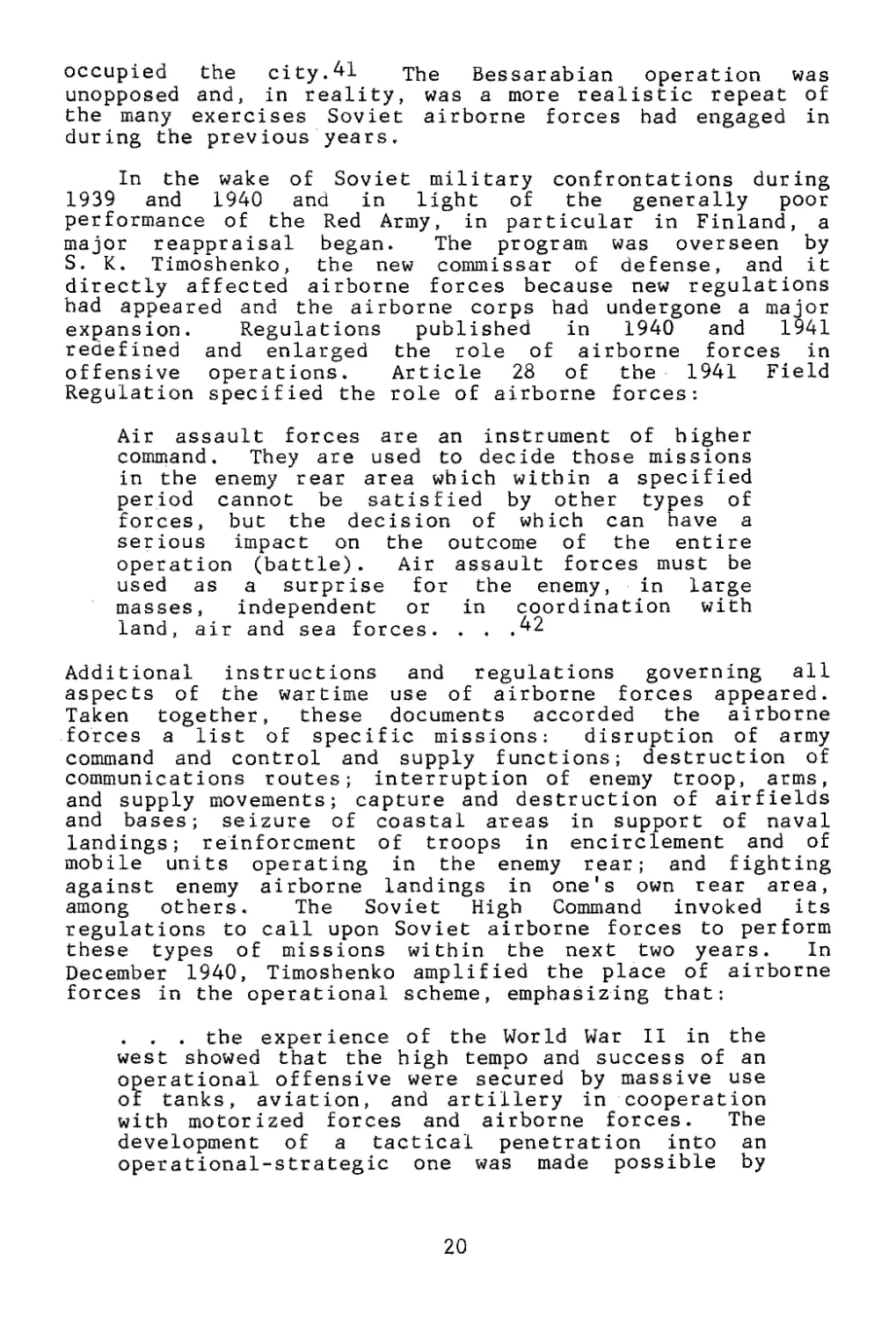


















































Tags: military affairs military soviet airborne
Year: 1984


Text
                    The Soviet Airborne
Experience
by Lieutenant Colonel David M. Glantz
November 1984
FOREWORD
Deep battle, a major element in both U.S. and Soviet doctrine, is a tenet that emphasizes
destroying, suppressing, or disorganizing enemy forces not only at the line of contact, but through-
out the depth of the battlefield. Airborne forces are a primary instrument to accomplish this type
of operation. While the exploits of German, British, and American paratroops since 1940 are well
known to most professional soldiers, the equivalent experience of the Soviet Union has been
largely ignored—except in the Soviet Union. There, the Red Army’s airborne operations have become
the focus of many recent studies by military theorists.
Lieutenant Colonel David M. Glantz has done much to remedy this gap in our historical litera-
ture. The Soviet Airborne Experience examines the experiences of the Red Army in World War II
and traces Soviet airborne theory and practice both before and since the Great Patriotic War of
1941—45. Airborne warfare emerges as an essential part of the high-speed offensive operations
planned by Soviet commanders.
Because Lieutenant Colonel Glantz examines airborne operations within the larger context of
Soviet unconventional warfare, the implications of this study reach beyond one specialized form of
maneuver. This study, in demonstrating the ability of Russian airborne and partisan forces to
survive and fight behind German lines for months at a time, provides us with an instructive
example of how Soviet special operations troops probably plan to operate in future wars. The
Soviet Airborne Experience is an important reference for anyone concerned with planning and
conducting operations.
DAVE R. PALMER
Major General, USA
Deputy Commandant
CSI Research Surveys are doctrinal research manuscripts, thematic in nature, that investigate the
evolution of specific doctrinal areas of interest to the U.S. Army. Research Surveys are based on
primary and secondary sources and provide the foundation for further study of a given subject.
The views expressed in this publication are those of the author and not necessarily those of the
Department of Defense or any element thereof.
Cover photo from Soviet Military Review, No. 10, 1971.
COMBAT
studiesI
INSTITUTE
The Soviet Airborne
Experience
by Lieutenant Colonel David M. Glantz, U.S. Army
November 1984
U.S. Army
Command and General
Staff College
Fort Leavenworth, KS 66027-6900
Library of Congress Cataloging in Publication Data
Glantz, David M.
The Soviet airborne experience.
(Research survey / Combat Studies Institute, U.S. Army
Command and General Staff College ; no. 4)
“November 1984.”
Bibliography: p.
1.	Soviet Union. Armiia—Parachute troops—History.
2.	Soviet Union. Armiia—Airborne troops—History.
3.	World War, 1939-1945—Aerial operations, Russian.
I. U.S. Army Command and General Staff College. Combat
Studies Institute. II. Title. III. Series: Research survey
(U.S. Army Command and General Staff College.
Combat Studies Institute) ; no. 4.
UD485.S65G53 1985	356'.166'0947	84-28536
For sale by the Superintendent of Documents, U.S. Government Printing Office, Washington, D.C. 20402
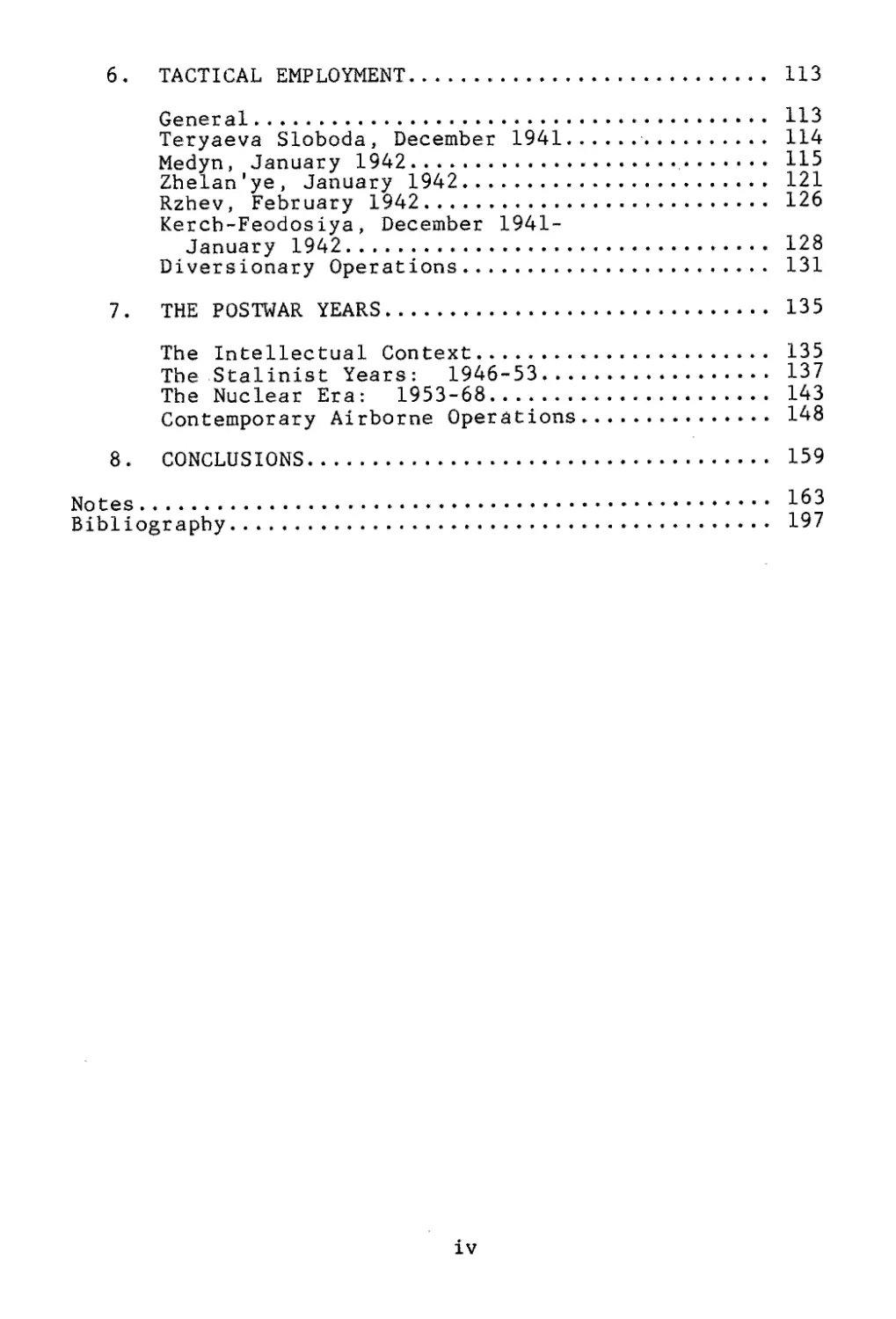
CONTENTS
Maps...............................................       v
Tables................................................  vii
Abbreviations . ..................................       ix
Symbols...........................................       xi
Chapter
1. THE PREWAR EXPERIENCE.............................. 1
Genesis of the Airborne Concept..................  1
Early Experimentation..........................    4
Formation of an Airborne Force...................  8
On the Eve of War..............................   18
2. EVOLUTION OF AIRBORNE FORCES DURING
WORLD WAR II.................................  25
Initial Airborne Involvement.................... 25
Organization and Employment..................... 28
3.	OPERATIONAL EMPLOYMENT: VYAZ’MA,
JANUARY-FEBRUARY 1942............................... 37
Strategic Context............................... 37
Operational Planning.........................    44
8th Airborne Brigade Assault.................... 48
8th Airborne Brigade Operations................. 53
Conclusions ................•.................   56
4.	OPERATIONAL EMPLOYMENT: VYAZ’MA,
FEBRUARY-JUNE 1942.................................. 59
Operational Planning..........................   59
4th Airborne Corps Assault....................   63
February Offensive............................   65
March Offensive.............................     67
April Offensive...............................   73
Encirclement and Breakout, 1 May-23 June 1942..	79
Conclusions.................................     85
5.	OPERATIONAL EMPLOYMENT: ON THE DNEPR,
SEPTEMBER 1943. .. ..........................  91
Operational Planning..........................   91
Airborne Assault...............................  99
5th Airborne Brigade Operations.................. 102
Conclusions....................................     109
iii
6	. TACTICAL EMPLOYMENT. ......................   113
General.....................................    113
Teryaeva Sloboda, December	1941...............  114
Medyn, January 1942...........................  115
Zhelan'ye, January 1942........................ 121
Rzhev, February 1942............................ 126
Kerch-Feodosiya, December 1941-
January 1942..............................      128
Diversionary Operations.....................    131
7	. THE POSTWAR YEARS.......................  ....	135
The Intellectual	Context....................  135
The Stalinist Years: 1946-53...............  ...	137
The Nuclear Era:	1953-68..................... 143
Contemporary Airborne Operations..............  148
8.	CONCLUSIONS........... ......................... 159
Notes ..........................................       163
Bibliography.............................. 197
iv
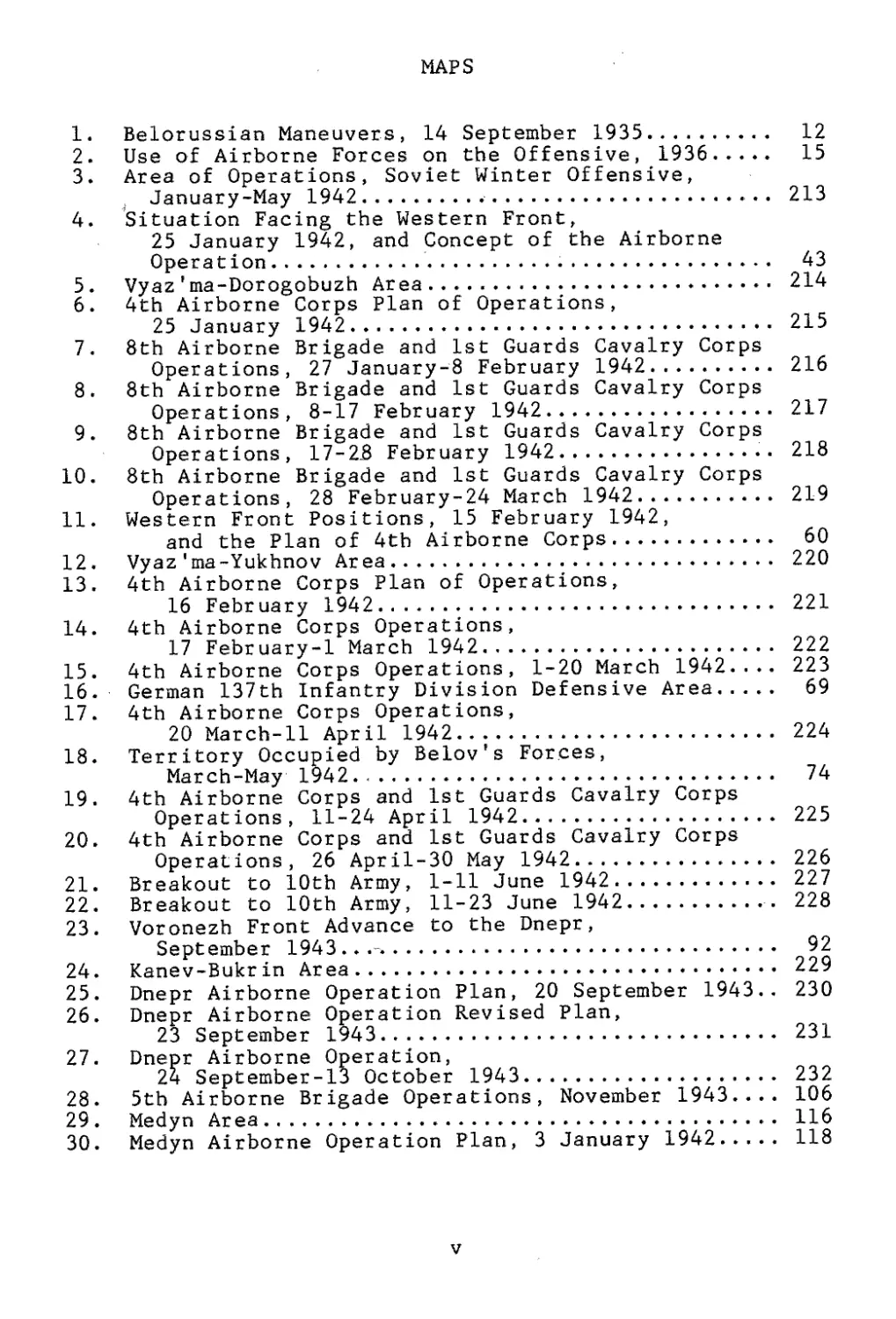
MAPS
1.	Belorussian Maneuvers, 14 September 1935............. 12
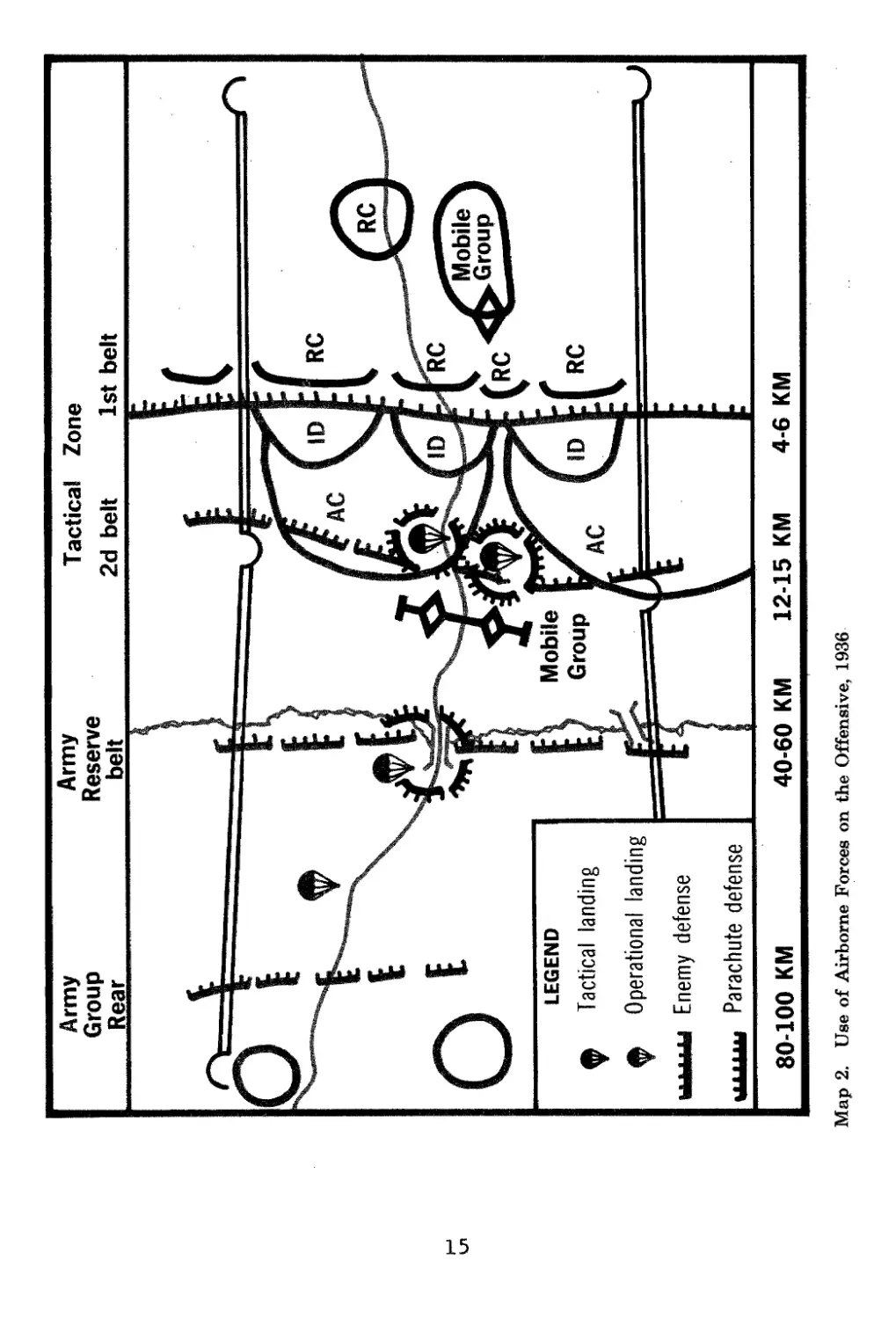
2.	Use of Airborne Forces on the Offensive, 1936........ 15
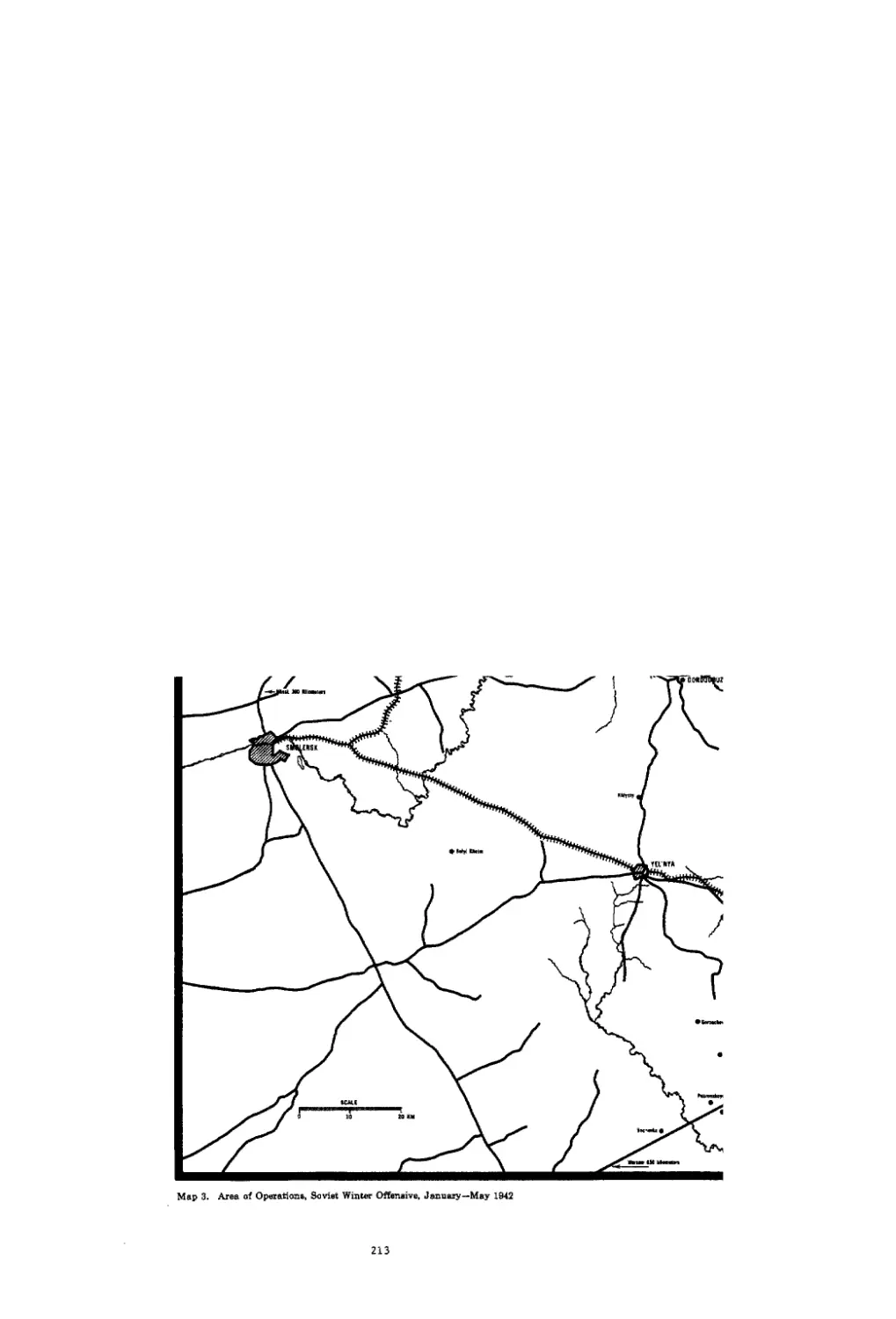
3.	Area of Operations, Soviet Winter Offensive,
, January-May 1942.................................     213
4.	Situation Facing the Western Front,
25 January 1942, and Concept of the Airborne
Operation.....................................     43
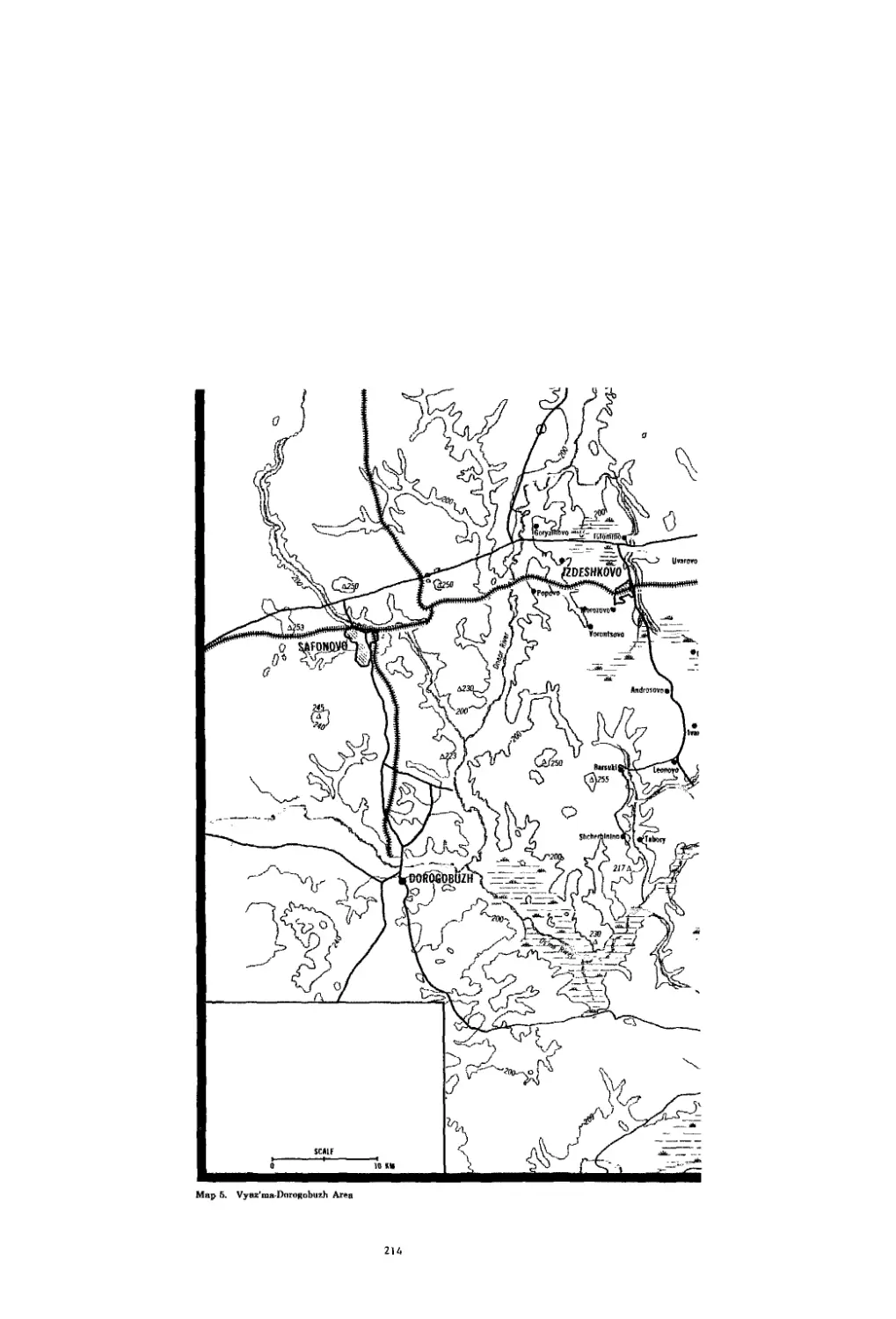
5.	Vyaz'ma-Dorogobuzh Area............................. 214
6.	4th Airborne Corps Plan of Operations,
25 January 1942......................................   215
7.	8th Airborne Brigade and 1st Guards Cavalry Corps
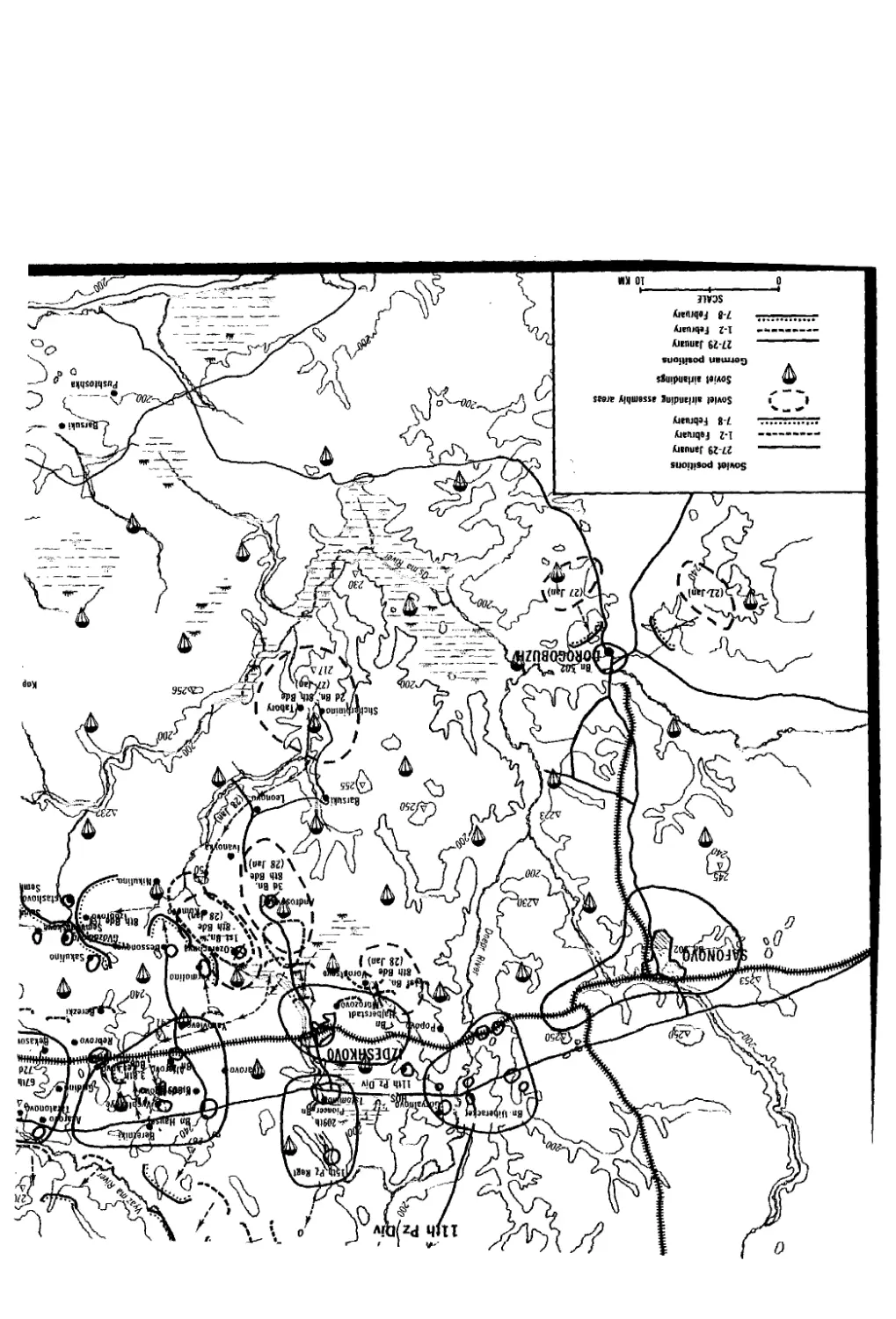
Operations, 27 January-8	February 1942............... 216
8.	8th Airborne Brigade and 1st Guards Cavalry Corps
Operations, 8-17 February	1942.................. 217
9.	8th Airborne Brigade and 1st Guards Cavalry Corps
Operations, 17-23 February 1942....................     218
10.	8th Airborne Brigade and 1st Guards Cavalry Corps
Operations, 28 February-24 March 1942................... 219
11.	Western Front Positions, 15 February 1942,
and the Plan of 4th Airborne Corps....................... 60
12.	Vyaz'ma-Yukhnov Area................................ 220
13.	4th Airborne Corps Plan of Operations,
16 February 1942........................................ 221
14.	4th Airborne Corps Operations,
17 February-1 March 1942...............................  222
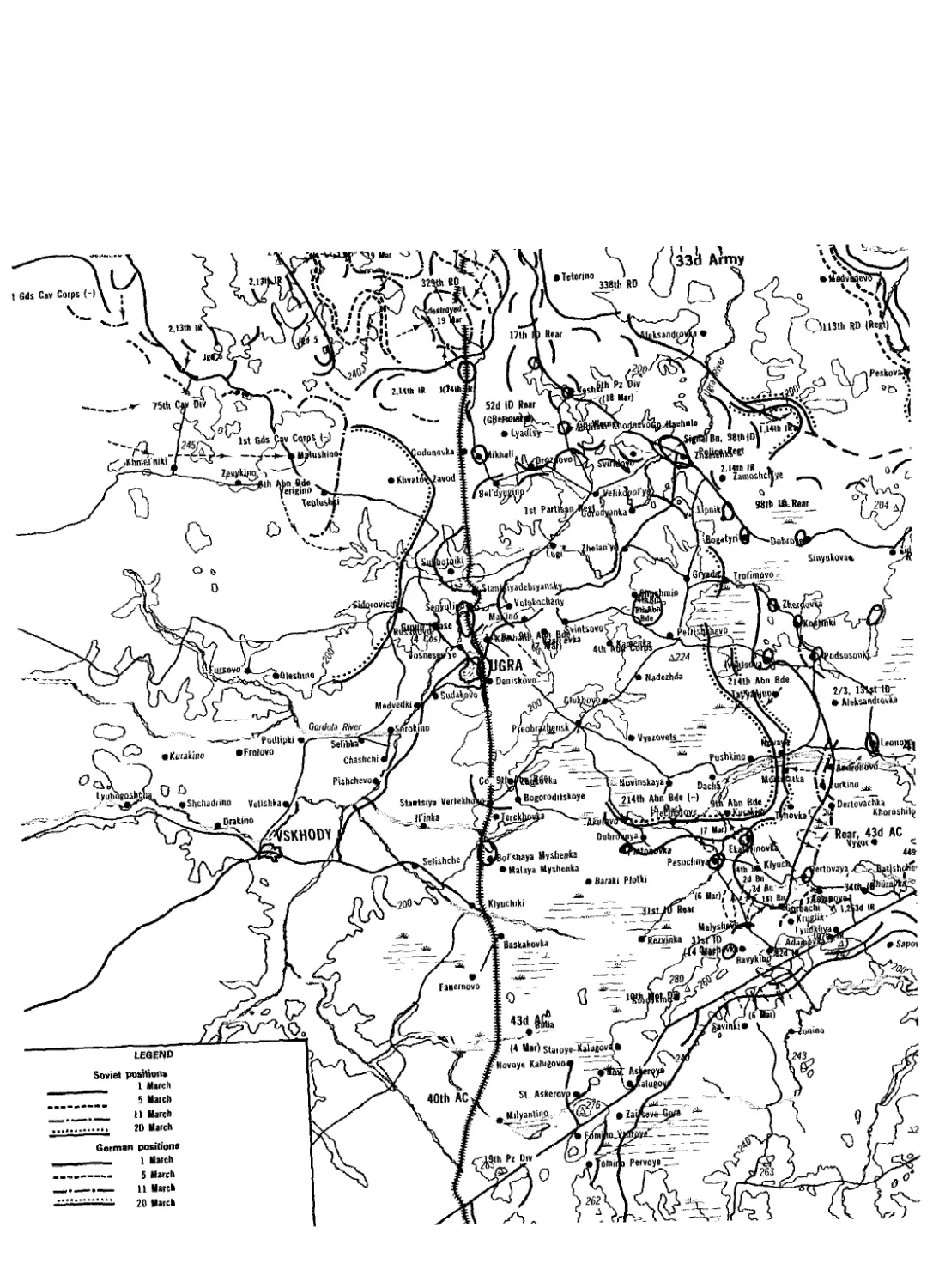
15.	4th Airborne Corps Operations, 1-20 March 1942.... 223
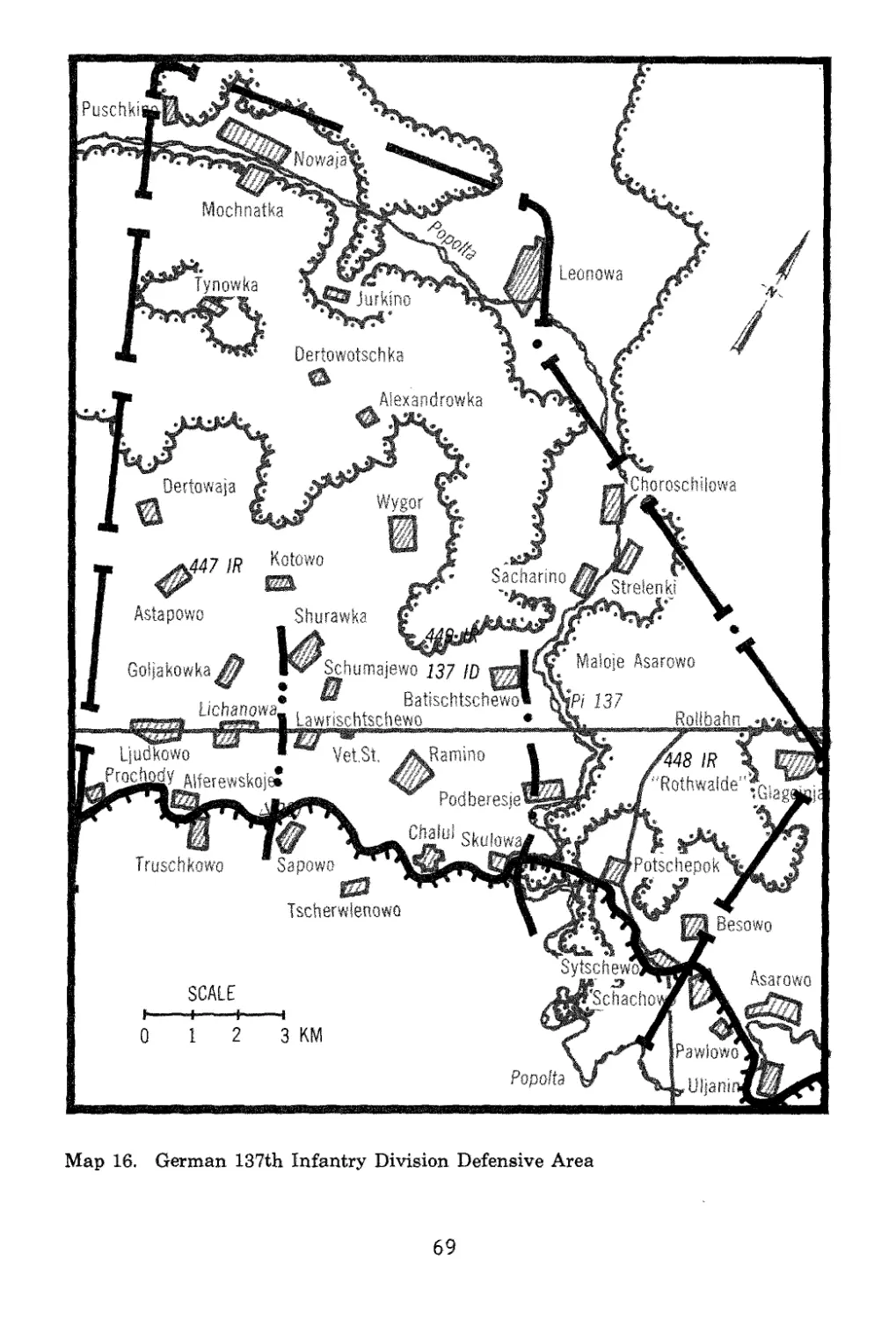
16.	German 137th Infantry Division Defensive Area..... 69
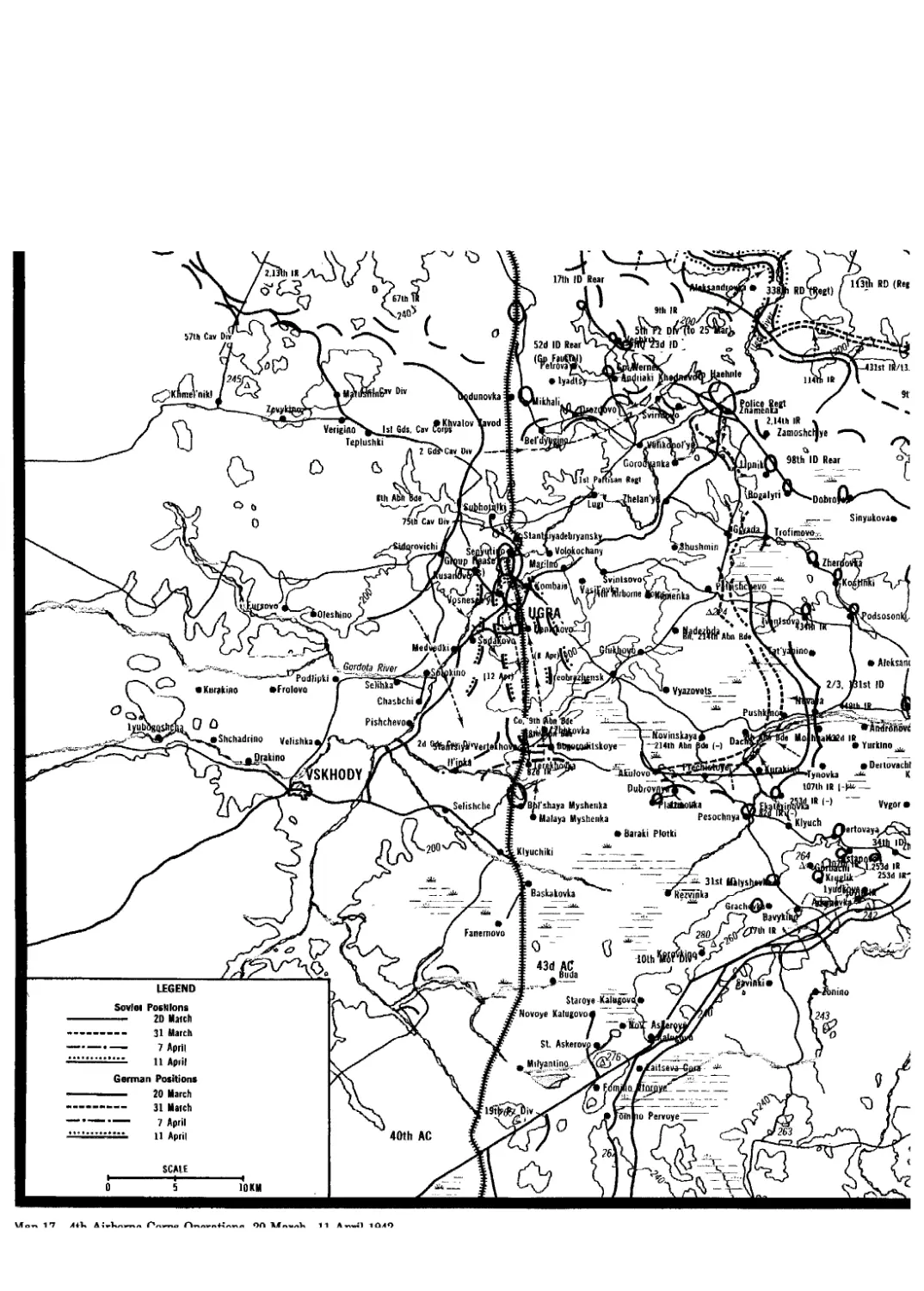
17.	4th Airborne Corps Operations,
20 March-11 April 1942................................   224
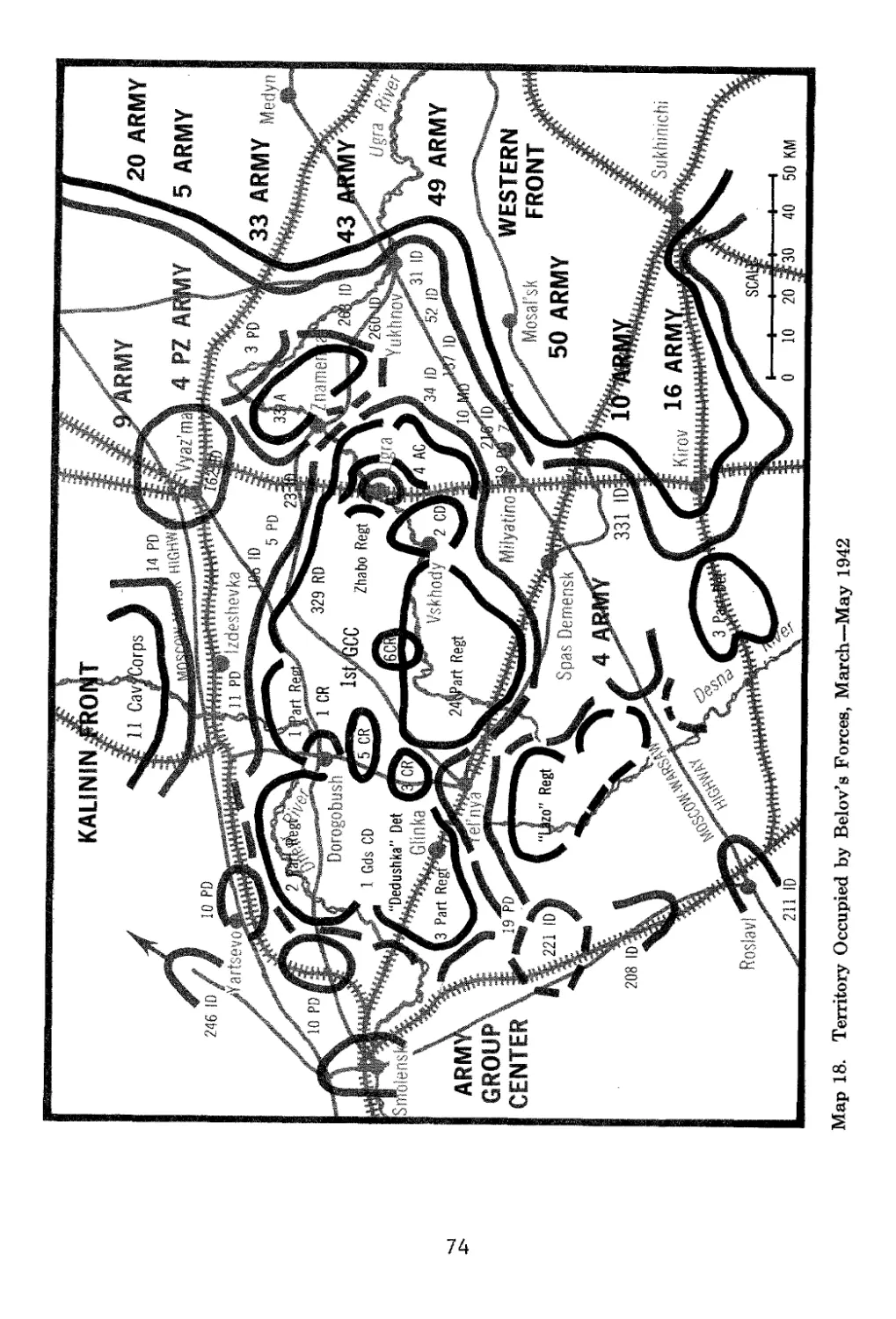
18.	Territory Occupied by Belov's Forces,
March-May 1942........................................... 74
19.	4th Airborne Corps and 1st Guards Cavalry Corps
Operations, 11-24 April 1942.......................... 225
20.	4th Airborne Corps and 1st Guards Cavalry Corps
Operations, 26 April-30 May 1942........................ 226
21.	Breakout to	10th Army,	1-11	June 1942............. 227
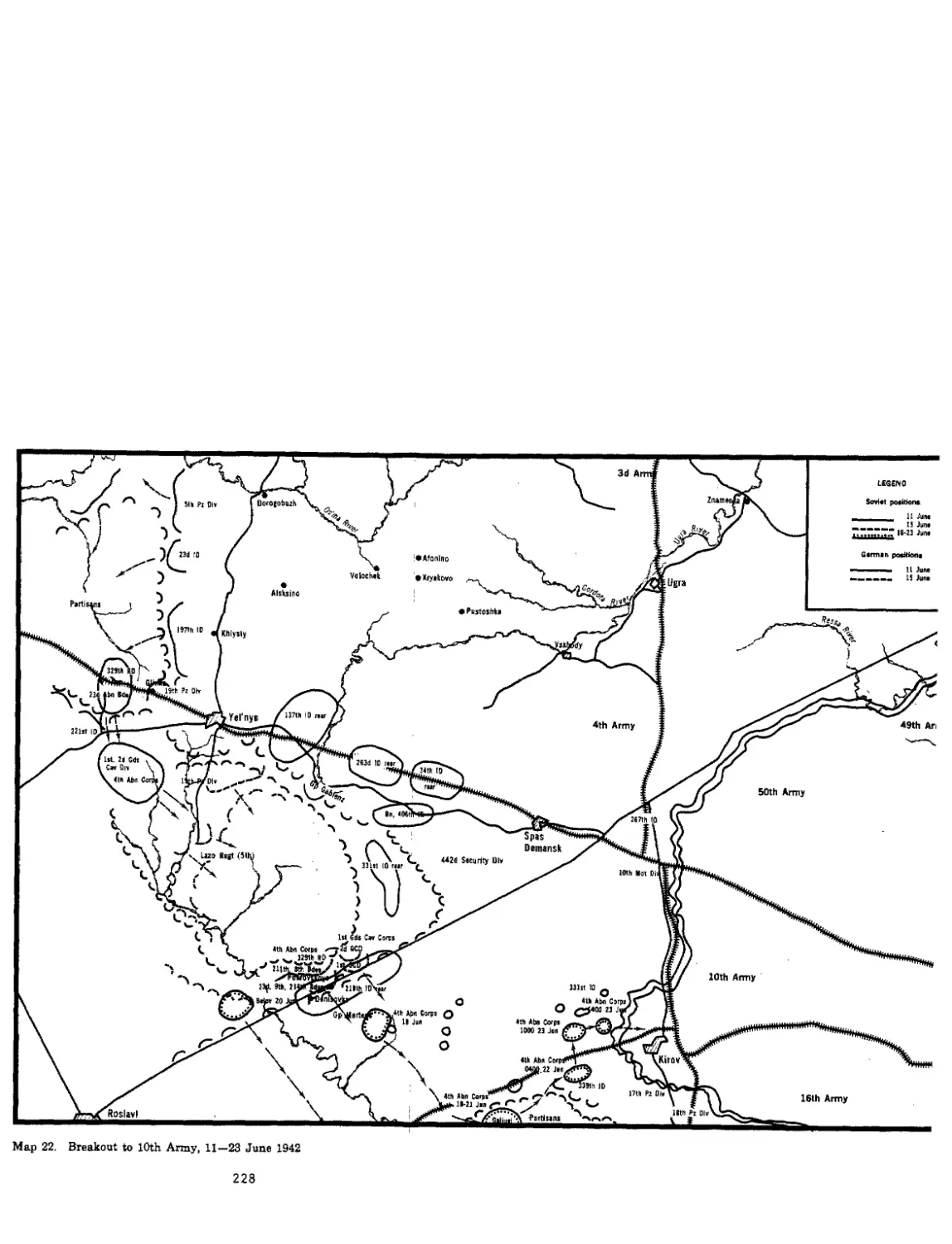
22.	Breakout to	10th Army,	11-23	June 1942...........  228
23.	Voronezh Front Advance to the Dnepr,
September	1943.................................   92
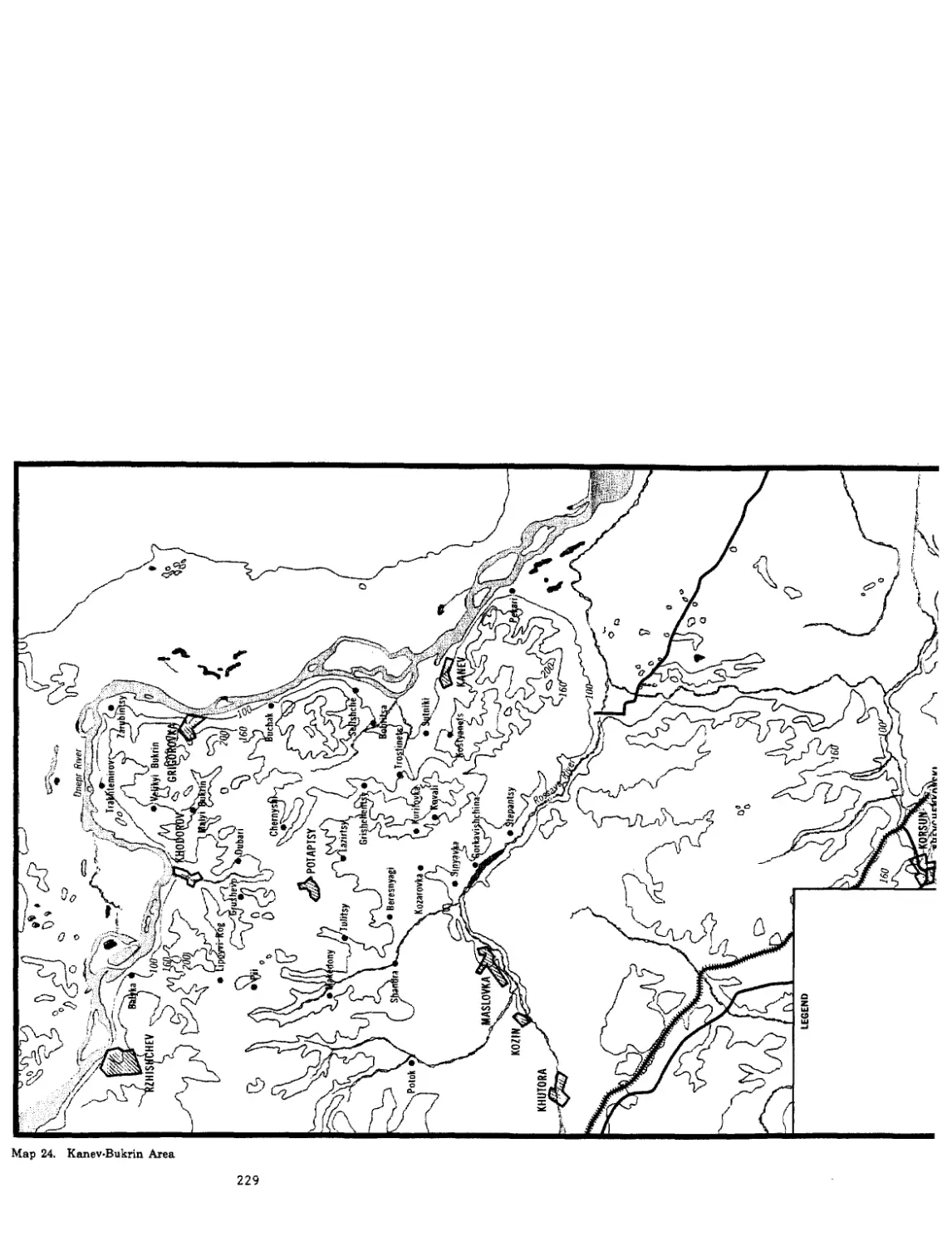
24.	Kanev-Bukrin Area..................................  229
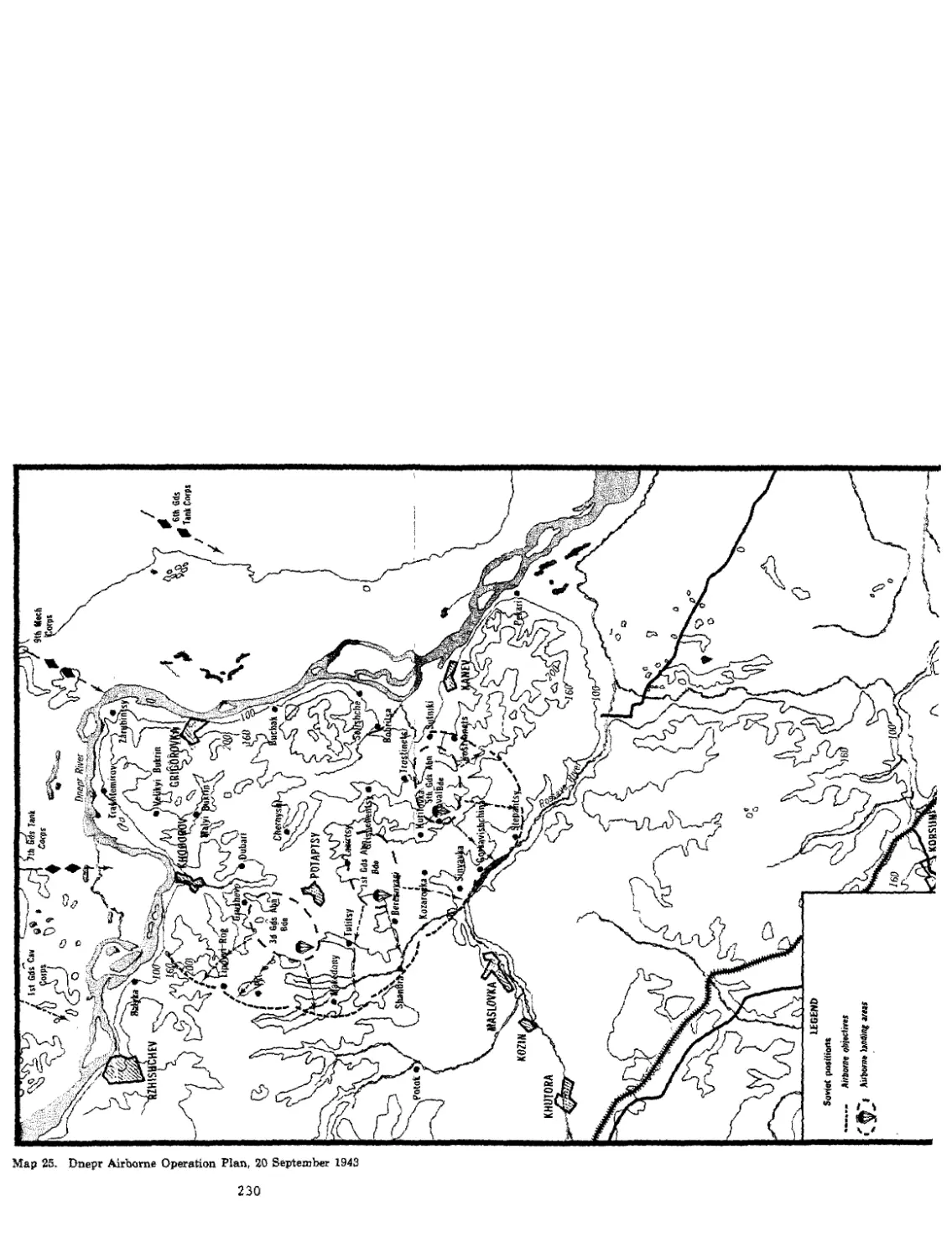
25.	Dnepr Airborne Operation Plan, 20 September 1943.. 230
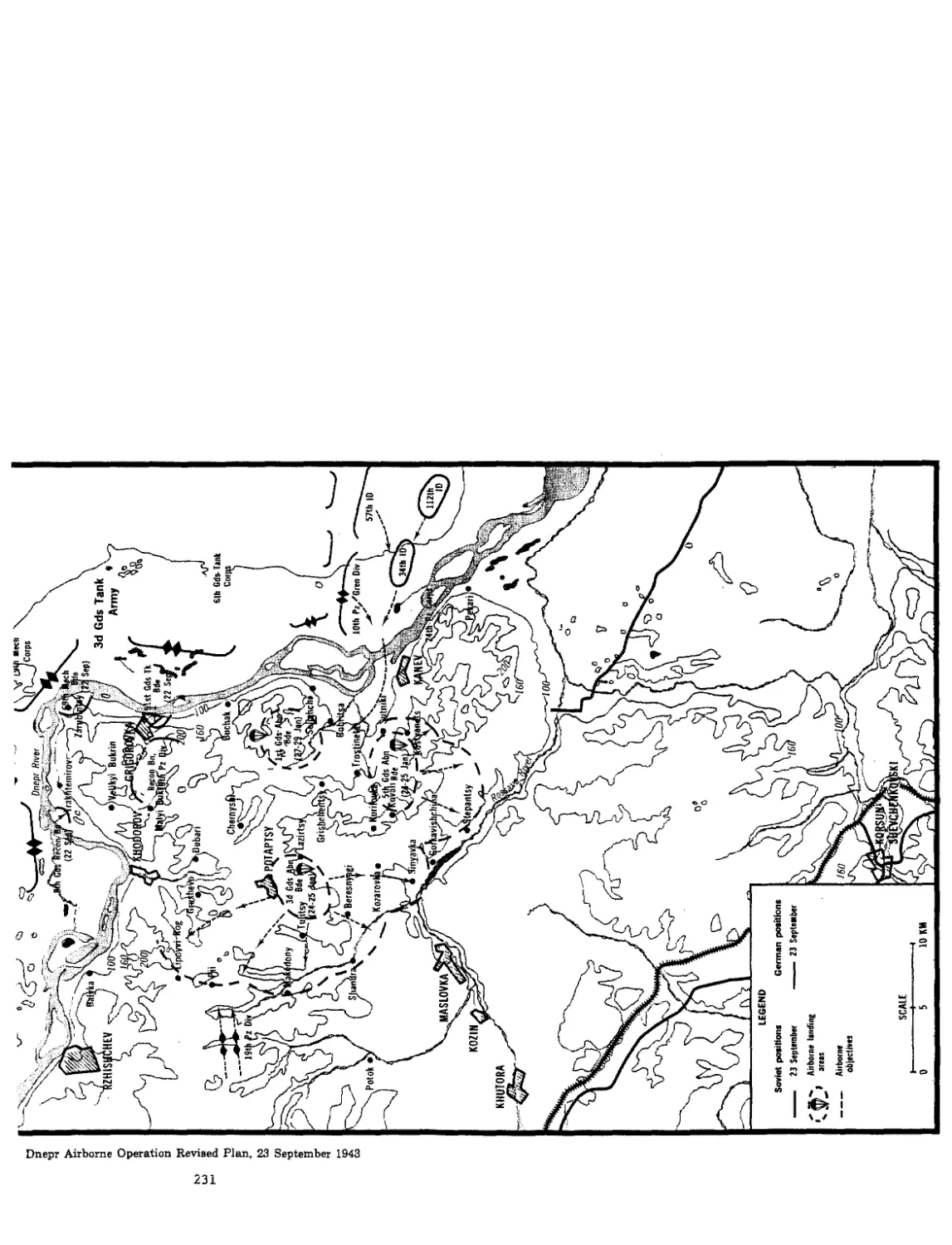
26.	Dnepr Airborne Operation Revised Plan,
23 September 1943.....................................   231
27.	Dnepr Airborne Operation,
24 September-13 October 1943............................ 232
28.	5th Airborne Brigade Operations, November 1943.... 106
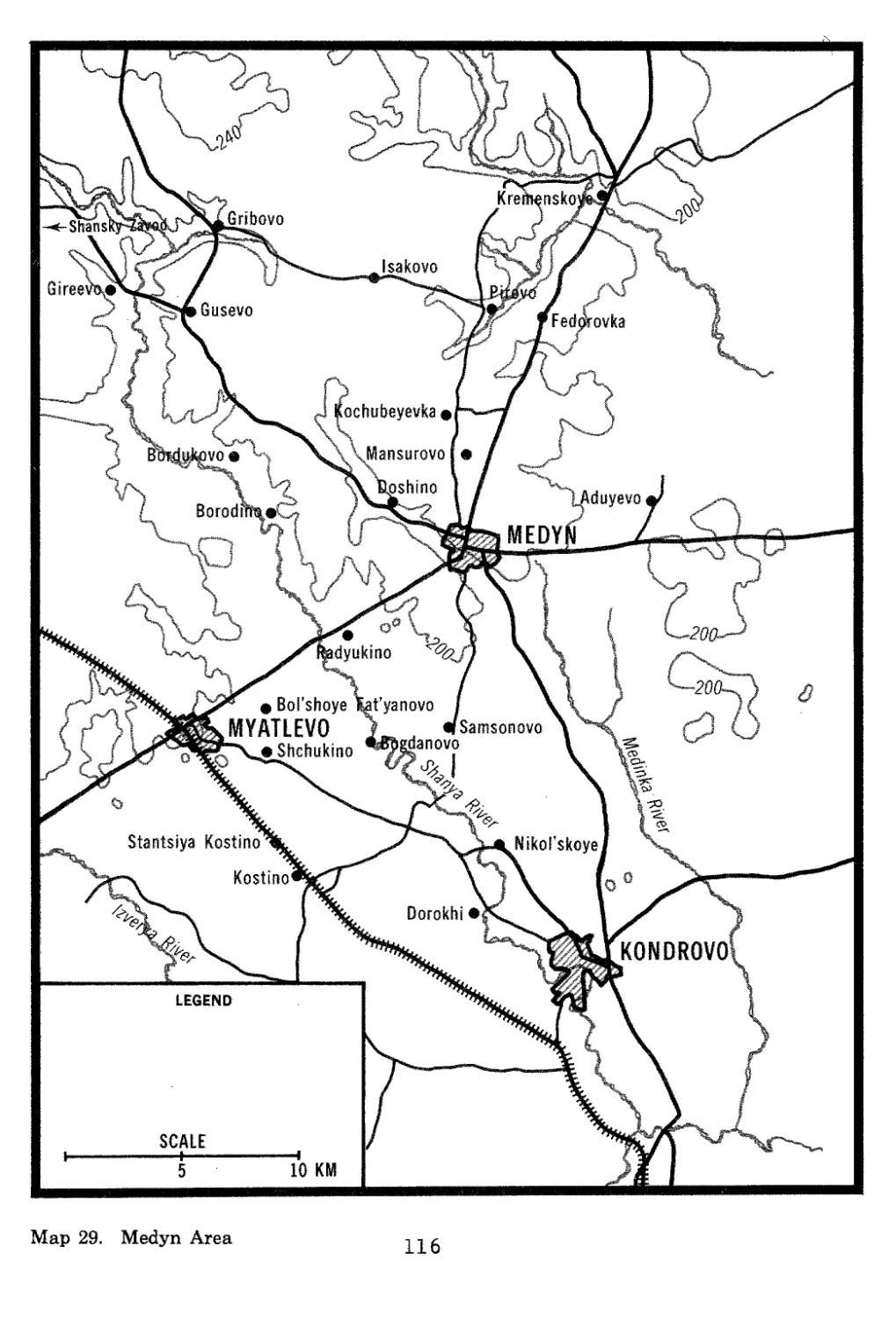
29	. Medyn Area.................................        116
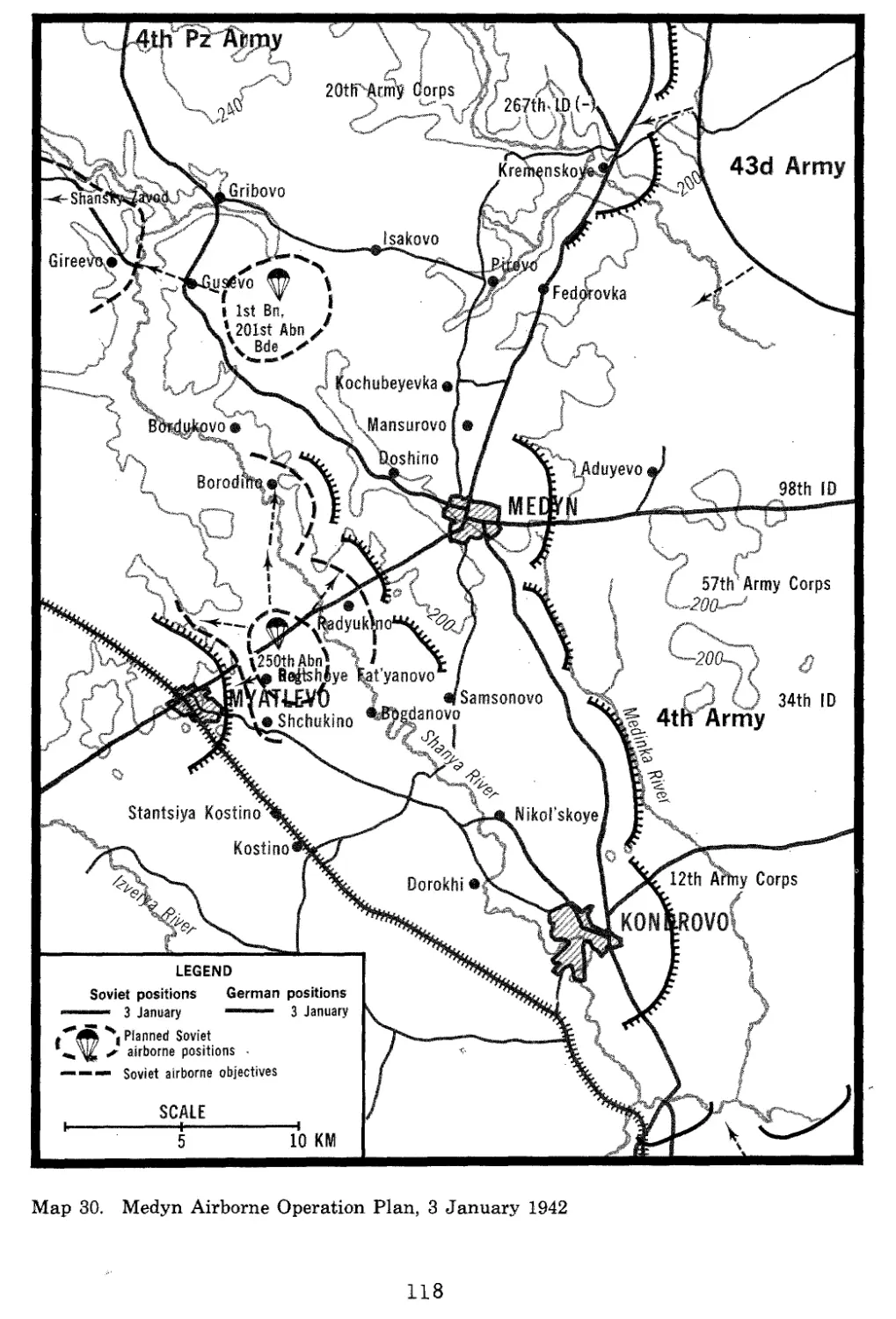
30.	Medyn Airborne Operation Plan, 3 January 1942....... 118
v
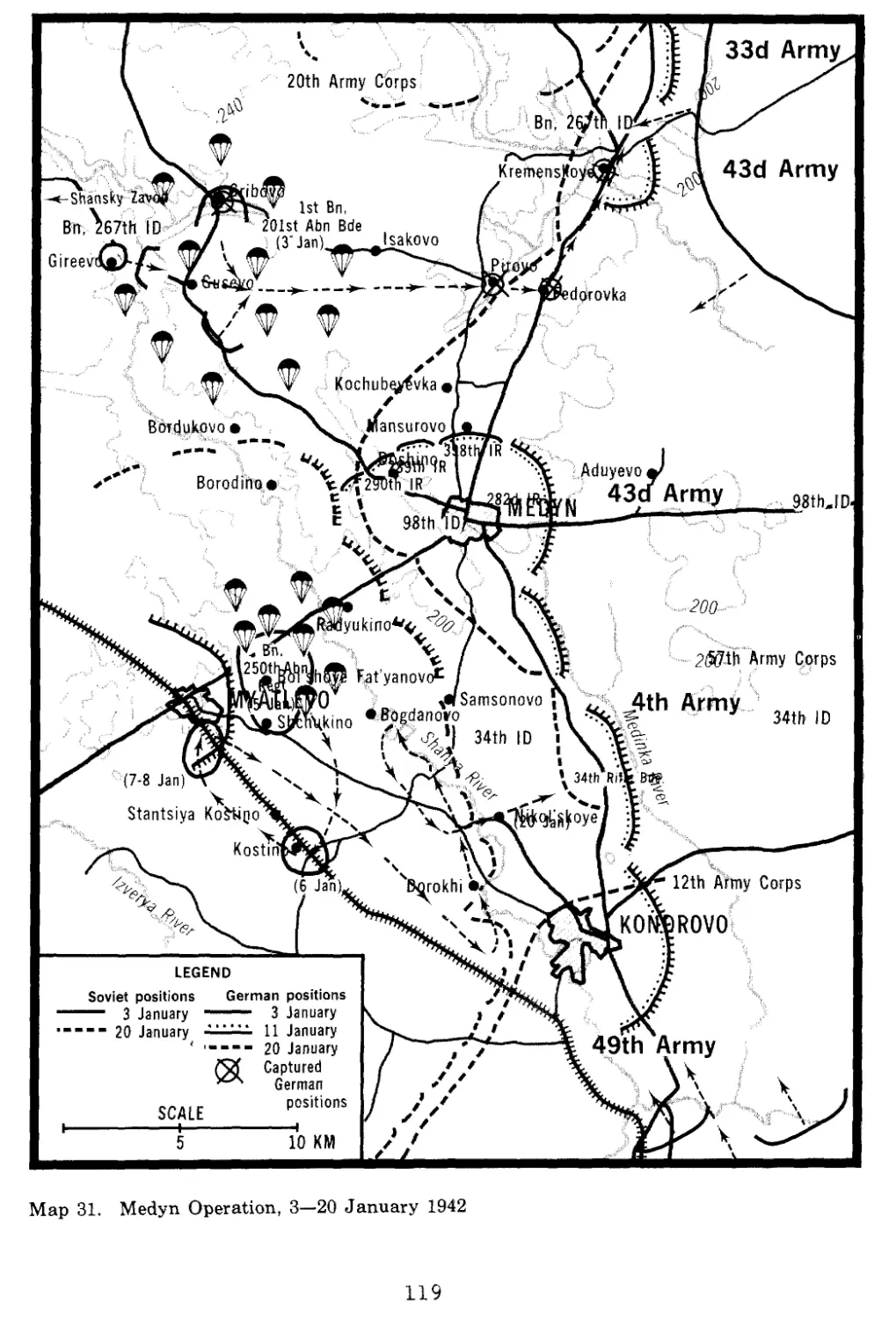
31.	Medyn Operation, 3-20 January	1942...............  119
32.	Zhelan'ye	Airborne Operation,	20	January	1942..... 233
33.	Zhelan'ye	Airborne Operation,	27	January	1942.... 234
34.	Zhelan’ye	Airborne.Operation,
29 January-1 February 1942......................  235
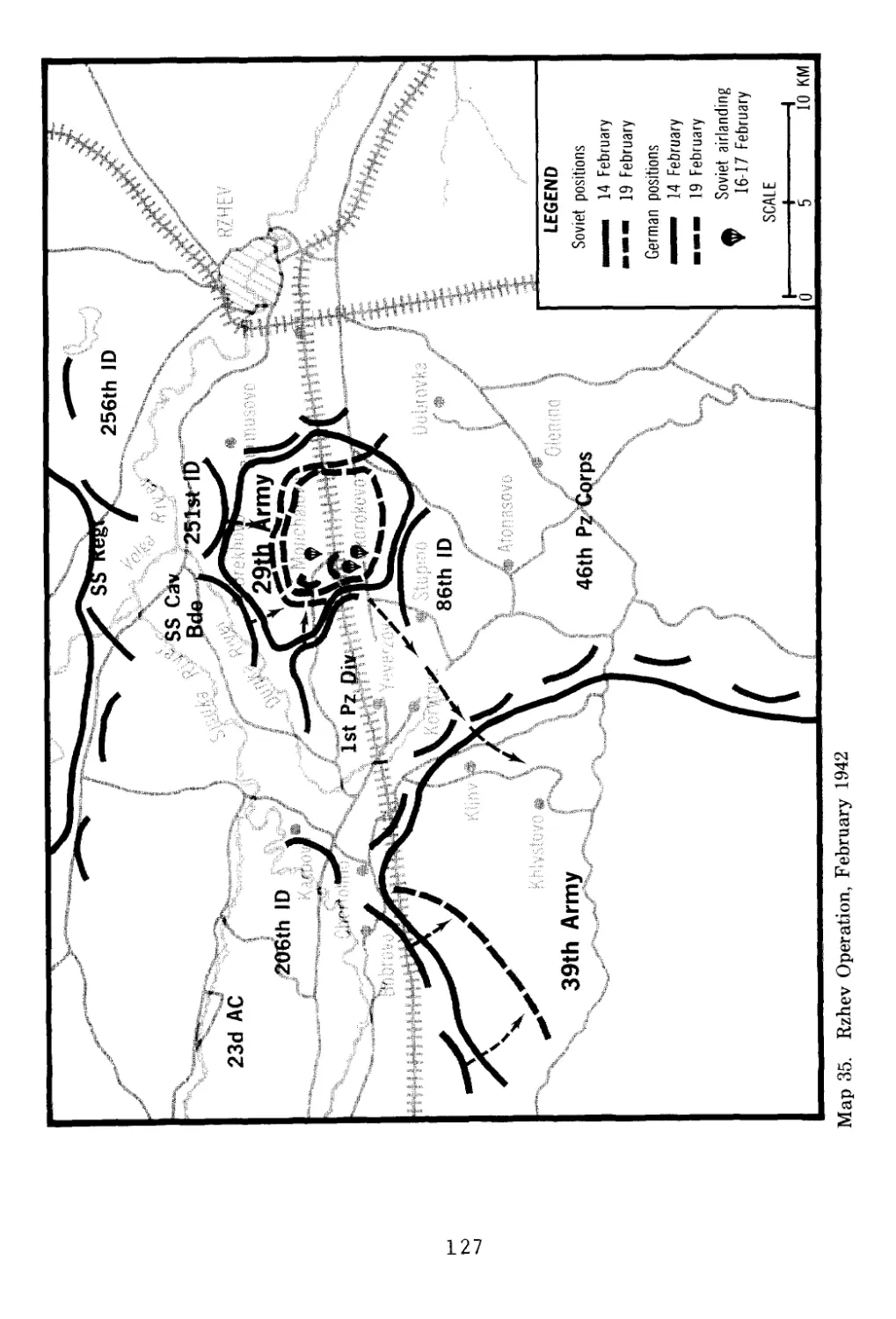
35.	Rzhev Operation, February 1942.....................  127
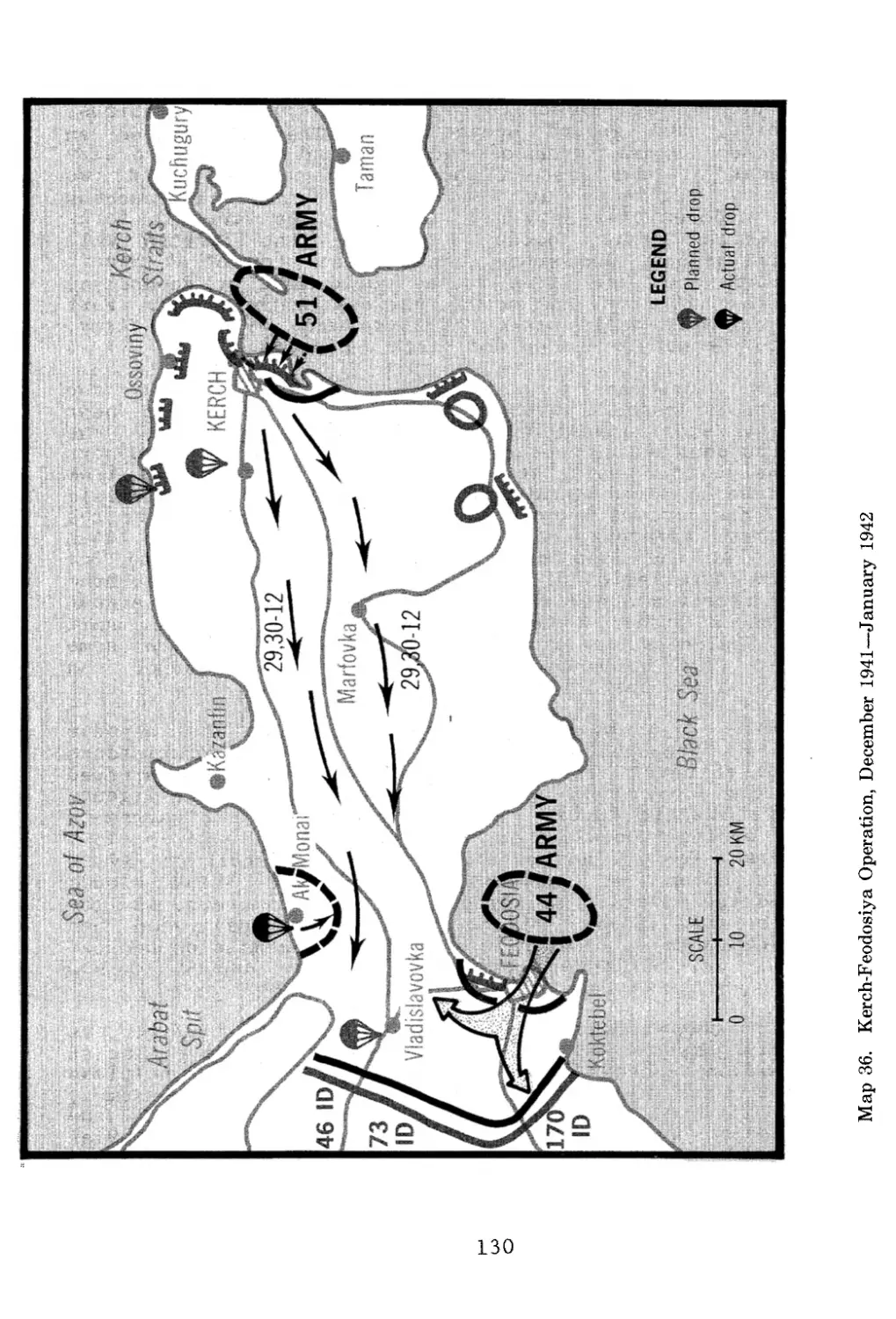
36.	Kerch-Feodosiya Operation,
December 1941-January 1942...........................    130
vi
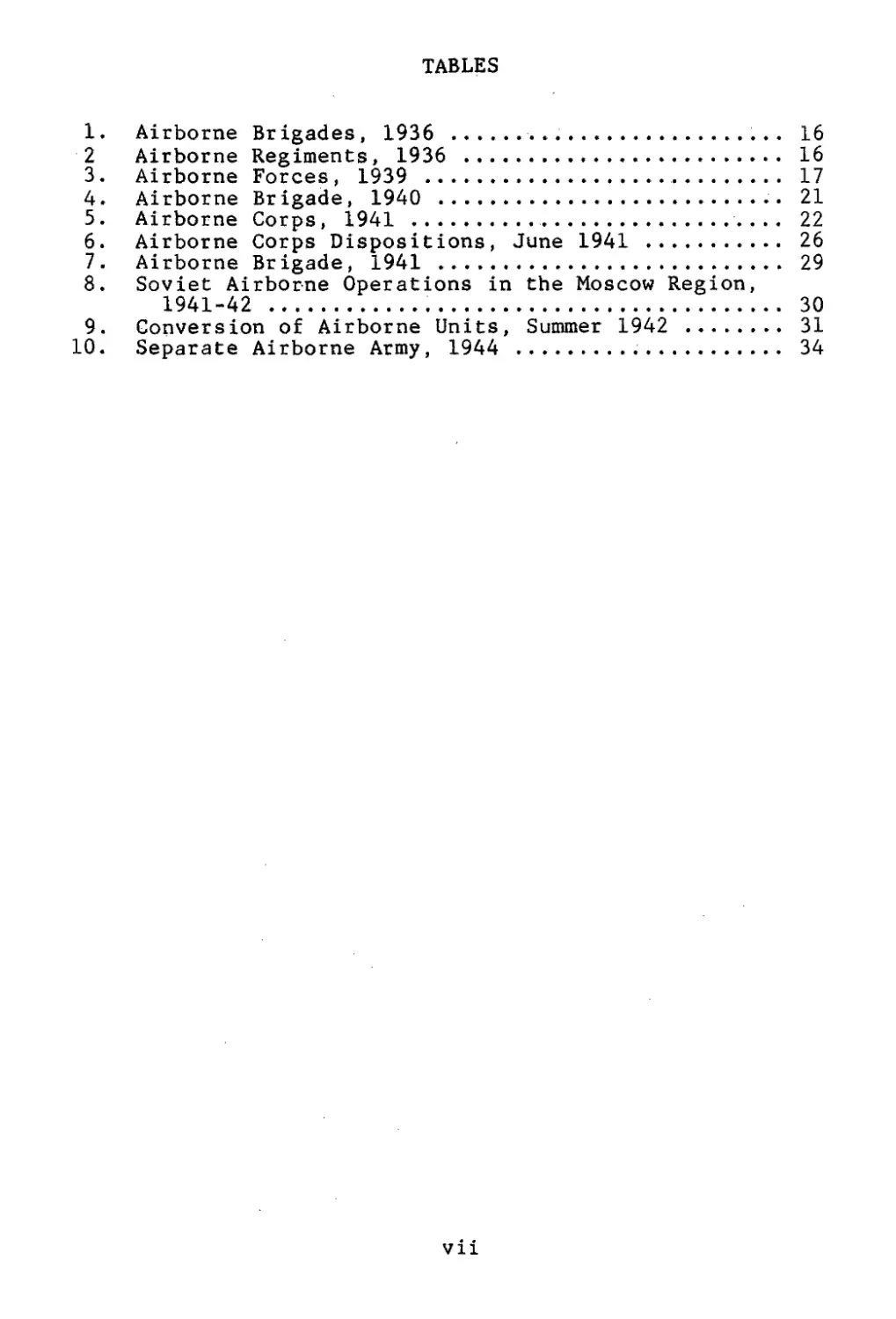
TABLES
1.	Airborne	Brigades, 1936 ........................    16
2	Airborne	Regiments, 1936 .........................  16
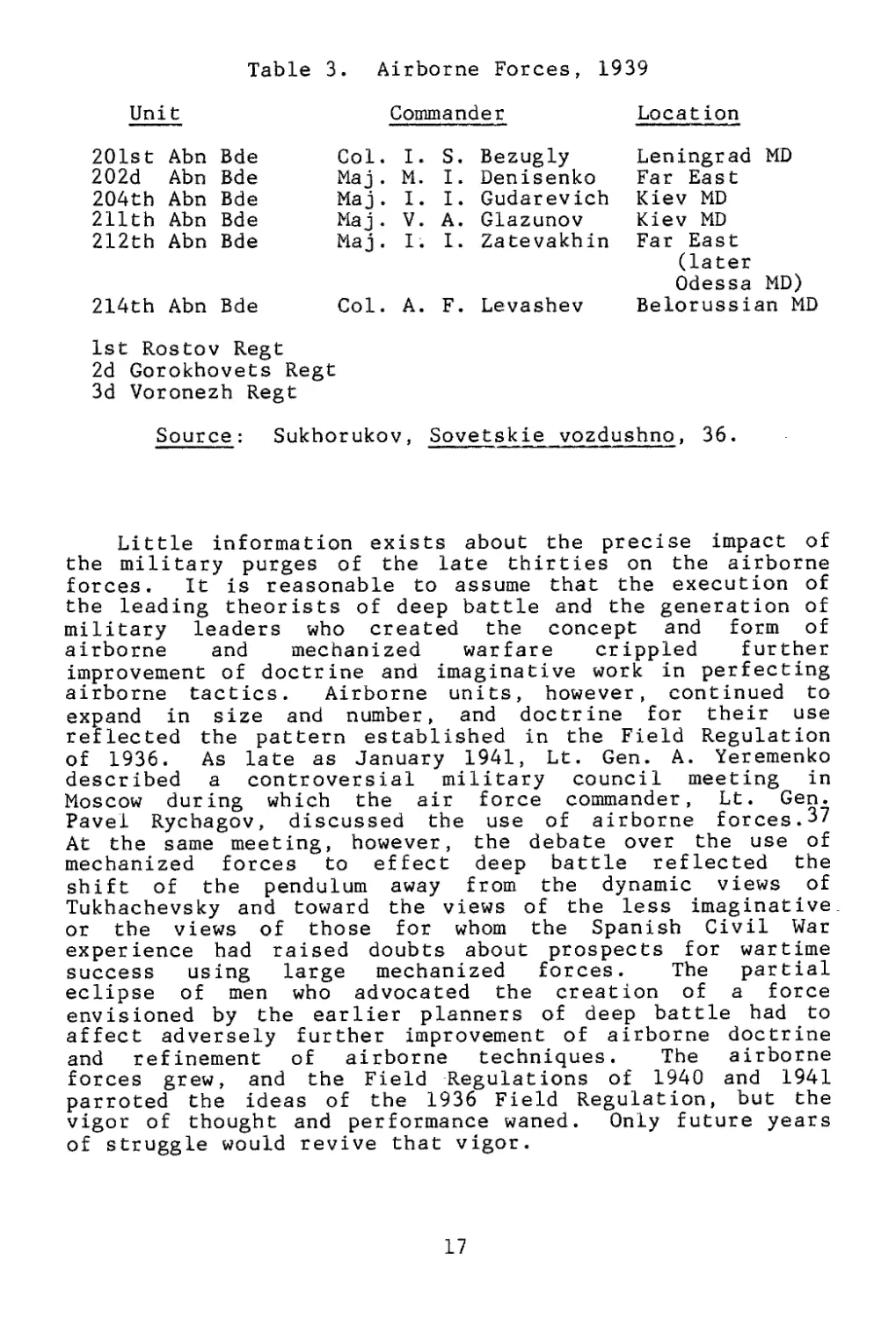
3.	Airborne	Forces, 1939 ...........................   17
4.	Airborne	Brigade, 1940 ..........................  21
5.	Airborne	Corps, 1941 .........................      22
6.	Airborne	Corps Dispositions, June 1941 ............ 26
7.	Airborne	Brigade, 1941 ............................ 29
8.	Soviet Airborne Operations in the Moscow Region,
1941-42 ..........................................     30
9.	Conversion of Airborne Units, Summer 1942 ......... 31
10.	Separate Airborne Army, 1944 ...................... 34
vii
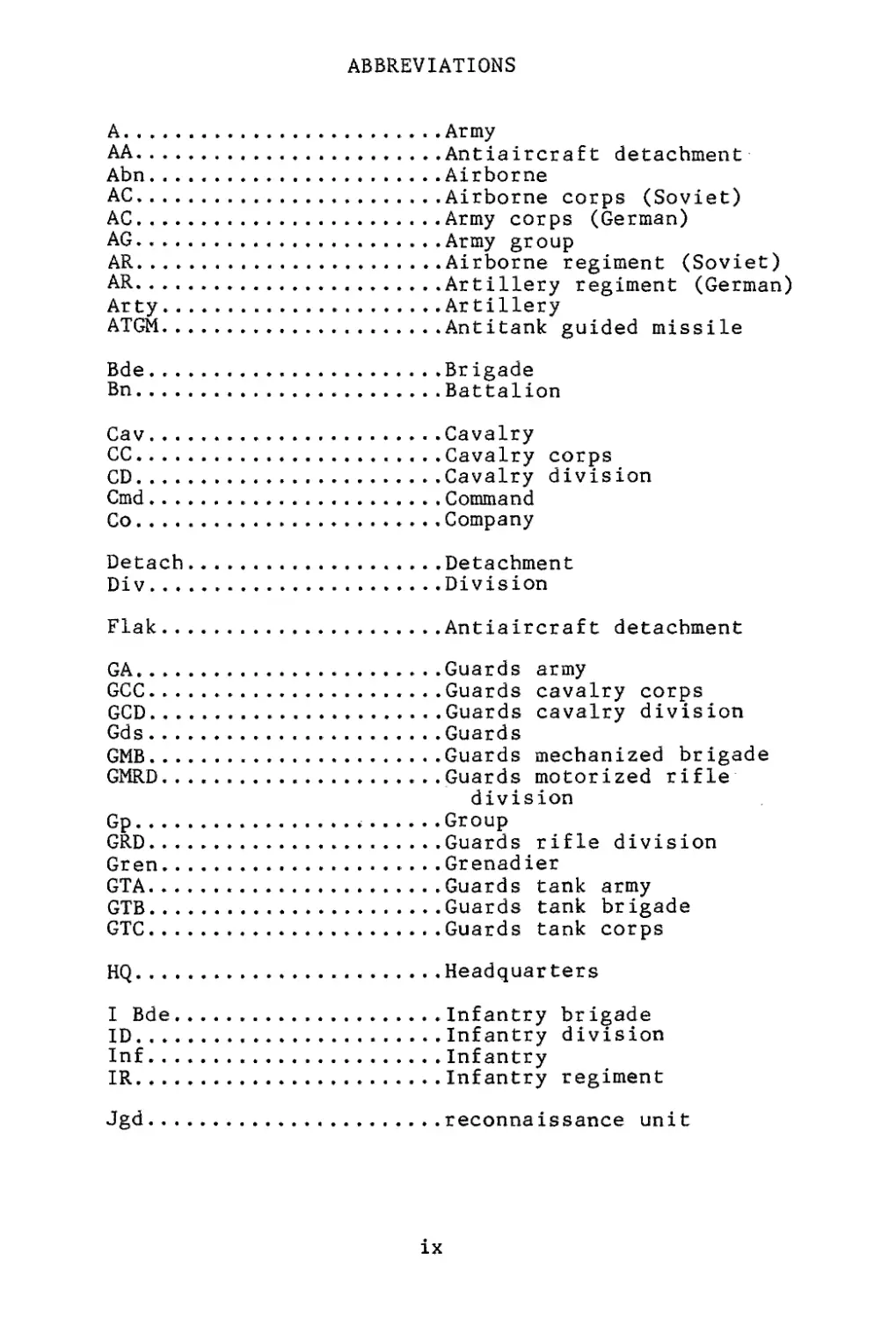
ABBREVIATIONS
A........................ Army
AA. ......................Antiaircraft detachment
Abn.......................Airborne
AC.......................  .Airborne	corps (Soviet)
AC........................Army corps (German)
AG. . ....................Army group
AR........................Airborne regiment (Soviet)
AR.....................    .Artillery	regiment (German)
Arty......................Artillery
ATGM......................Antitank guided missile
Bde. .................... .Brigade
Bn. .................    .	.Battalion
Cav....... ...........  .Cavalry
CC...................    .Cavalry	corps
CD........................  Cavalry	division
Cmd........... ........... , Command
Co......................... Company
Detach................. Detachment
Div.......................Division
Flak......................Antiaircraft detachment
GA.........................Guards	army
GCC. ......................Guards	cavalry corps
GCD........................Guards	cavalry division
Gds.....................  Guards
GMB........................Guards	mechanized brigade
GMRD. . . .................Guards	motorized rifle
division
Gp................. *......Group
GRD.......................  Guards	rifle division
Gren......................Grenadier
GTA........................ Guards	tank	army
GTB. ...................  .Guards	tank	brigade
GTC.......................  Guards	tank	corps
HQ. .................. .Headquarters
I Bde......................Infantry	brigade
ID.........................Infantry	division
Inf.......................Infantry
IR........................Infantry regiment
Jgd.......................reconnaissance unit
ix
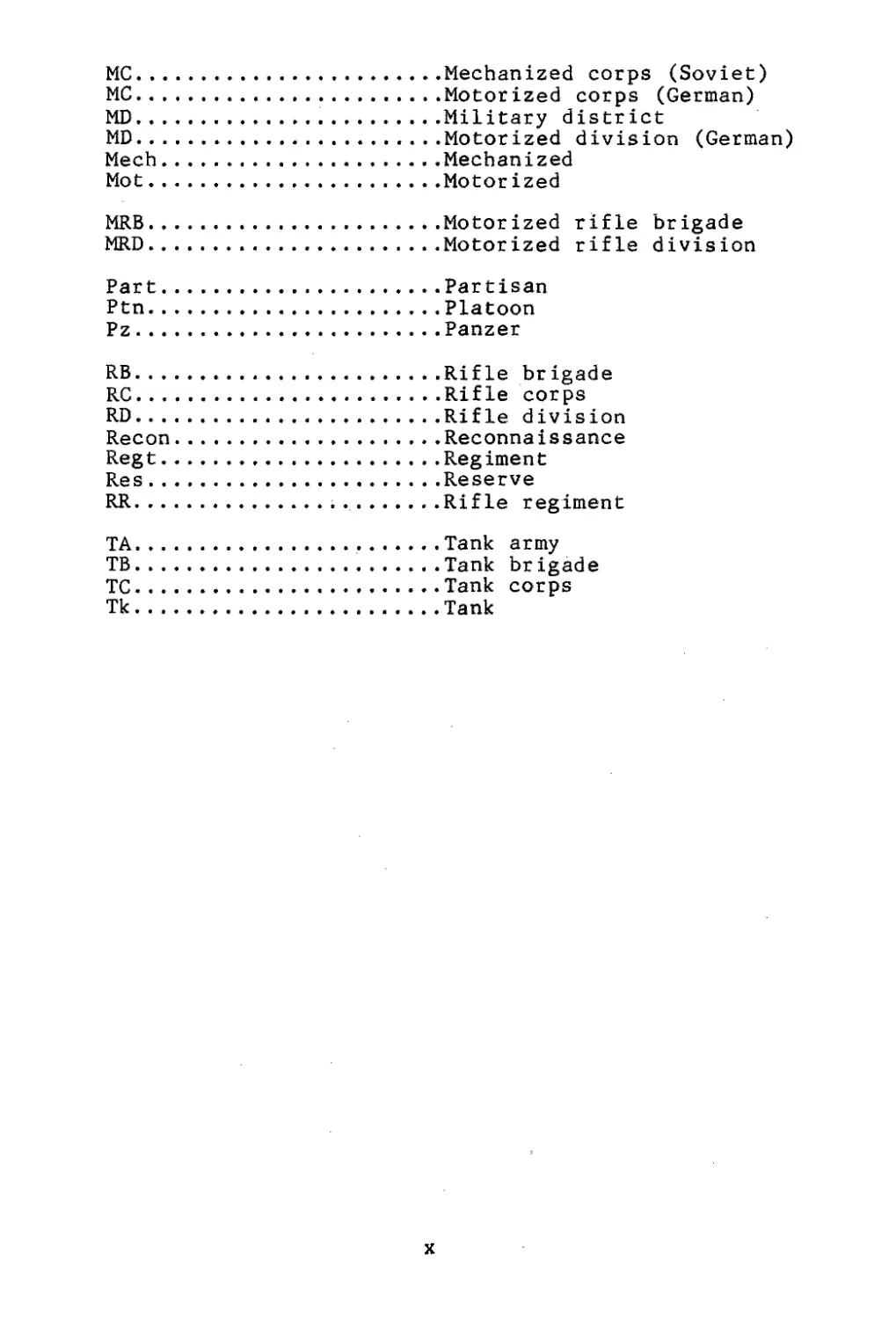
МС........................Mechanized corps (Soviet)
MC........................Motorized corps (German)
MD.  ................Military district
MD...................... .Motorized division (German
Meeh....................  .Mechanized
Mot...................... .Motorized
MRB.......................Motorized	rifle	brigade
MRD........................Motorized	rifle	division
Part.  ................ .Partisan
Ptn. .....................Platoon
Pz. . ....................Panzer
RB........................Rifle brigade
RC. ......................Rifle corps
RD........................Rifle division
Recon.  .................. .Reconnaissance
Regt....................  .Regiment
Res  .....................Reserve
RR................. .Rifle regiment
TA........................Tank	army
ТВ....................... . .Tank brigade
TO. ......................  Tank	corps
Tk........................ Tank
Soviet
SYMBOLS
Front boundary
Army boundary
Corps boundary
Division/brigade boundary
Infantry unit assembly area
Tank/mechanized unit assembly area
Cavalry unit assembly area
Infantry unit deployed or moving
Tank/mechanized unit deployed or moving
Cavalry unit deployed or moving
Self-propelled artillery unit deployed
or moving
Tanks in firing positions
Self-propelled guns in firing position
xi
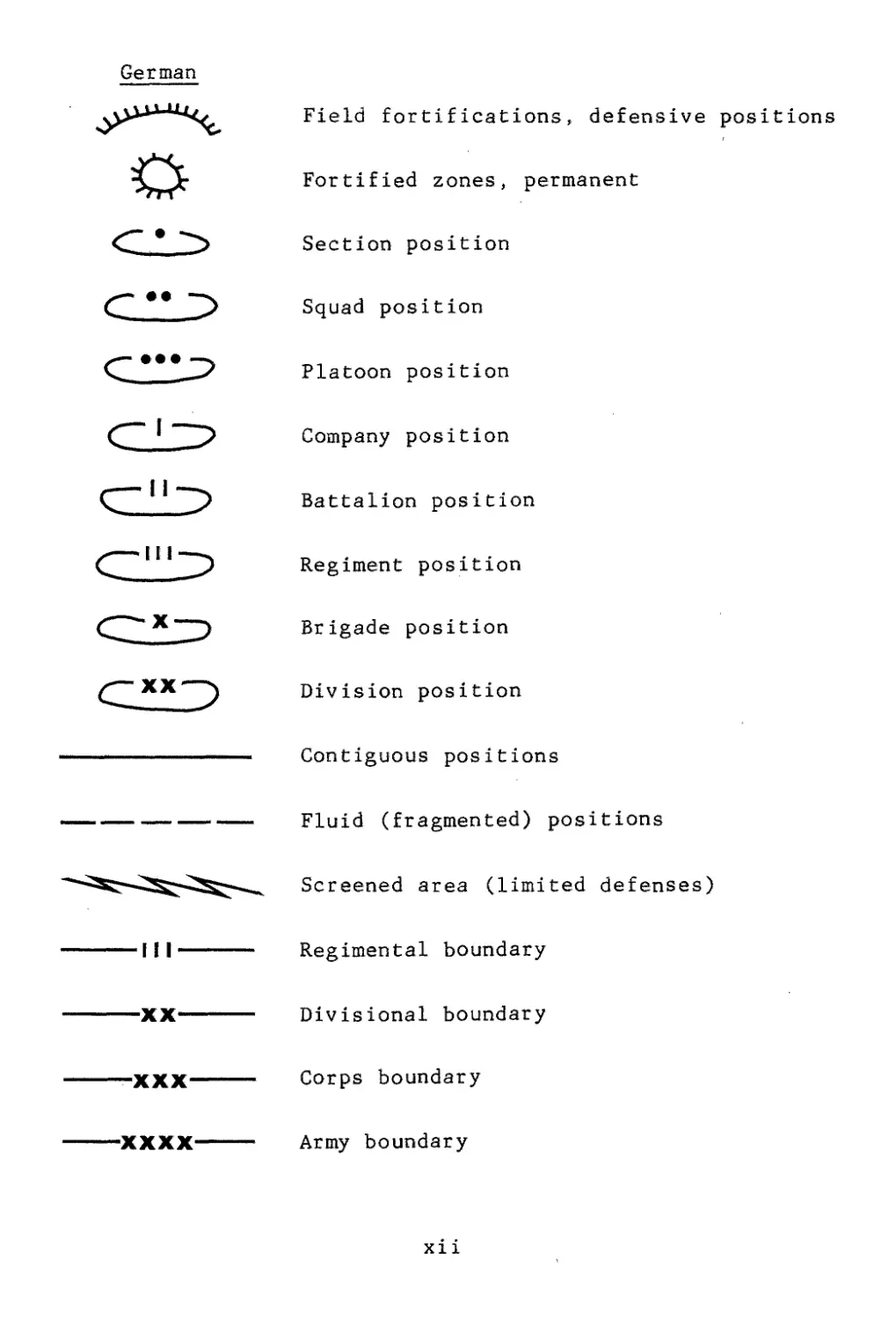
German
Field fortifications, defensive positions
Fortified zones, permanent
Section position
Squad position
Platoon position
Company position
Battalion position
Regiment position
Brigade position
Division position
Contiguous positions
Fluid (fragmented) positions
Screened area (limited defenses)
III------ Regimental boundary
XX------ Divisional boundary
------XXX----- Corps boundary
XXXX------ Army boundary
xi i
CHAPTER 1
THE PREWAR EXPERIENCE
Genesis of the Airborne Concept
The genesis of Soviet airborne military doctrine
occurred during the decade of the 1920s, a period
characterized by intense intellectual ferment in Soviet
military affairs. That ferment ultimately converged with
the movement toward industrialization and the adoption of
modern technology to produce, in the early 1930s, a
renaissance of military thought within the Soviet Union.
A generation of military leaders and thinkers, conditioned
by a revolutionary philosophy and participation in the
Russian Civil War and Allied intervention and eager to
elevate the Soviet Union into a competitive military
position with the rest of Europe, gave shape and focus to
that renaissance. They were imaginative men, infused with
ideological zeal, encouraged by their political leaders
to experiment, and willing to learn from the experiences
of military leaders abroad. Their efforts produced a
sophisticated military doctrine, advanced for its time,
and an elaborate, if not unique, military force structure
to implement that doctrine.
It is one of the major ironies of history that the
work of these men--the Tukhachevskys, the Triandafilovs,
the Issersons, and a host of others--would be eclipsed and
almost forgotten. Their efforts for the Soviet Union
earned for them only sudden death in the brutal purges of
the late 1930s. The formidable armed force they had built
and the sophisticated thought that had governed use of
that force decayed. The brain of the army dulled, and
imagination and initiative failed. The military
embarrassments of 1939-40 and the debacle of 1941 blinded
the world to the true accomplishments of Soviet military
science	in	the 1930s, and an	appreciation	of	those
accomplishments never really returned. The military
leaders	of	1943-45 resurrected	the concepts	of	their
illustrious predecessors and competently employed them to
achieve victory over Europe's most vaunted military
machine. Yet the memories of the Soviets' poor
performance	in	1941 never	faded and have	since	colored
Western attitudes toward Soviet military art. Thus, it is
appropriate	to	recall the	realities of Soviet	military
development	unblemished by	the images of	1941.	One of
those realities	was Soviet	experimentation	with	airborne
forces in the 1930s.
1
Soviet receptivity to the idea of air assault was but
a part of greater Soviet interest in experimentation with
new military ideas to restore offensive dominance to the
battlefield. World War I had seen the offensive fall
victim to static defensive war. In positional warfare,
the firepower of modern weaponry stymied the offense and
exacted an excruciating toll in human lives. Those wedded
to the idea of the dominance of the infantry--the ultimate
elevation of men to preeminence on the battlefield--saw
the infantry slaughtered in the ultimate humiliation of
man’s power to influence battle. Infantry, the collective
personification of man, dug antlike into the ground,
overpowered by impersonal firepower and the crushing
weight of explosives and steel.
New weapons--the tank, the airplane--emerged during
wartime, but most military theorists saw these weapons as
demeaning to the infantry and as an adjunct to the
existing technological dominance of fire. Yet there were
those who experienced war in a different context. For
three years after 1918 in the vast expanse of Russia,
regiments, brigades, divisions, and armies engaged in a
seesaw civil war--a chaotic confrontation over vast
territories, a war in which the zeal of man and his
ability to act counted more than human numbers on the
battlefield. Shorn of advanced weaponry, the separate
armies joined a struggle in which imaginative maneuver
paid dividends, in which rudimentary operational and
tactical techniques could once again be tested without
prohibitive loss of life. It was a different sort of
struggle, one that conditioned many of its participants to
be receptive to new ideas of warfare. The credibility of
the offense emerged supreme, and to that new faith in the
offense was added the imperative of an ideology that
inherently embraced the offensive.
The Red Army (RKKA*) as it emerged from the civil war
was crude by Western standards. Large, ill-equipped, and
relatively unschooled in military art, the Red Army was
simultaneously the shield of the Soviet state and the
lance of revolutionary socialism. Although the ardor for
international revolution waned in the face of harsh
economic and political realities and the army shrank in
the immediate postwar years to provide manpower for
factories and fields, the revolutionary foundation of the
army remained. The writings of Mikhail Frunze enunciated
the uniqueness of the Red Army. The attitudes and
*Raboche-Krest'yanskaya Krasnaya Armiya (Workers and
Peas ants Red Army).
2
actions of the leading commanders and theorists better
characterized the reality of the army. Theoretical
debates within the army over the nature of war and the
role of man and modern weaponry began in the twenties. At
first, these debates expressed mere hopes, kept so by the
reality of Soviet industrial and technological
backwardness. But as that industrial development began to
accelerate, goaded by Stalin's ruthless "Socialism in One
Country," and as technological proficiency rose, either
generated from within or imported from abroad, abstract
hopes turned into concrete policies and programs. These
new doctrines sought to combine the offensive potential of
new weapons with the ideological zeal and faith in the
offensive which was born of revolution and civil war
experience. Thus, while the victors of World War I sought
to make new weapons the slave of the defense and guarantee
the status quo, those defeated--Germany and the
U. S. S.R.--turned, to the new weaponry as a means to
overturn the status quo. In this sense, it is not
surprising that German and Soviet military thought evolved
in so similar a manner during the interwar years.
The shape of future Soviet military thought began to
take form in the late 1920s. Frunze's postulation of a
proletarian military doctrine reflecting the classless
nature of the Socialist state gave focus to that thought.
Soviet officers began to ponder the implications of
Frunze's "Unified Military Doctrine," a doctrine that
dictated dedication to maneuver, aktivnost (activity), and
the offensive in the real world oT battle. These new
principles rejected the concepts of defensive, static,
positional warfare so dominant in Western European and
American military thought.1
Although Frunze died in 1925, other thinkers expanded
his theories, deriving first an intellectual basis in
doctrine and then specific methods and techniques to
translate that doctrine into practice. The Field
Regulation (USTAV*) of 1929 reflected this mixture of
theory and experiment. It established the objective of
conducting deep battle (glubokyi boi) to secure victory at
the tactical depth of the enemy cTeTense by using combined
arms forces, specifically infantry, armor, artillery, and
aviation, acting in concert.2 Deep battle, however,
remained an abstract objective that could be realized only
when technology and industry provided the modern armaments
necessary for its execution. The 1929 regulation was a
*Ustavlenie (regulation). Russians routinely refer to
regulations as USTAVs.
3
declaration of intent, an intent that would begin to be
realized in the early 1930s as the first Five Year Plan
ground out the heavy implements of war.
Among those implements of war were tanks and aircraft,
each symbolizing an aspect of potential deep battle. The
tank offered prospects for decisive penetration,
envelopment, and the exploitation of offensive tactical
success to effect greater operational success, the latter
dimension conspicuously absent in the positional warfare
of World War I. Aircraft also added a new dimension to
the battlefield. Besides the potentially devastating
effects of aerial firepower, aircraft offered prospects
for vertical envelopment, a third dimension of offensive
maneuver. Vertical envelopment, of potential value even
in isolation, would supplement the offensive action of
mechanized forces and further guarantee the success of
deep battle. Thus, the emerging doctrinal fixation on
deep battle gave impetus to experimentation with airborne
forces, experimentation that began in earnest in the late
twenties.
Early Experimentation
Experimentation with airborne forces went hand in
glove with doctrinal research. Although many theorists
examined the uses of airborne forces, in particular the
problems and the missions, M. N. Tukhachevsky played the
leading role. As commander of the Leningrad Military
District, he conducted trial exercises and prepared a
study on the "Action of Airborne Units in Offensive
Operations." As a result of his critiques of exercises
conducted in 1929 and 1930, he proposed to the Revoensovet
(Revolutionary Military Soviet) a sample aviation
motorized division TOE (table of organization and
equipment) for use as an operational-strategic landing
force.3 Supplementing Tukhachevsky's work, A. N.
Lapchinsky, chief of staff of the Red Army's air force
(WS*) and N. P. Ivanov wrote an article investigating
such precise airborne problems as time and place of
landing, order of landing, mutual operations with aviation
and land forces, calculation of required forces, and
landing times for airborne units of battalion to
regimental size.^ These theoretical discussions
paralleled practical exercises in both countryside and
classroom. Simultaneously, other agencies worked in
developing all types of airborne equipment as evidenced by
the first domestic production of parachutes in April 1930.
*Voenno-Vozdushnyi sil1.
4
Active experimentation grew in scope when, on 2 August
1930, a major test occurred near Voronezh in the Moscow
Military District.5 To test landing techniques rather
than tactics, three R-l aircraft dropped two detachments
of twelve parachutists armed with machine guns and rifles;
their mission was to perform a diversionary mission in the
enemy rear. The detachment commanders, L. G. Minov and
Ya. D. Moshkovsky, would play a leading role in future
airborne experimentation. The Voronezh test drop, from
heights of 500 and 300 meters, focused on solutions of
such technical problems as preventing dispersal of dropped
personnel, determining visibility on the part of airborne
troops, and calculating the time necessary for those
troops to reform and become combat capable. The exercise
was repeated at the same location in September 1930 when
ANT-9 aircraft dropped an eleven-man detachment under
Moshkovsky's command.6 While the military district
commander, A. J. Kork, looked on, the detachment
successfully seized documents from an "enemy" division
beadquarters. The success of these experiments was noted
in a decree of the Revoensovet on the results of combat
training. The decree mandated conduct of additional
airborne exercises in 1931, to emphasize both technical
and tactical aspects of an air assault. 7 From 1933 on,
virtually all Soviet field exercises included airborne
operations.
Early experimentation in various military districts
gave rise to the formation of an experimental aviation
motorized landing detachment in Tukhachevsky's Leningrad
Military District in March 1931. This detachment
consisted of a rifle company; sapper, communications, and
light vehicle platoons; a heavy bomber aviation squadron;
and a corps aviation detachment. Ya. D. Lukin commanded
the 164 men, under the staff responsibility of D. N.
Nikishev. The unit had two 76-mm guns, two T-27
tankettes, four grenade launchers, three light machine
guns, four heavy machine guns, fourteen hand machine guns,
and a variety of light vehicles. Twelve TB-1 bombers and
ten R-5 light aircraft provided aviation support.
Tukhachevsky charged the detachment to conduct airborne
operations to achieve tactical aims; specifically, a
parachute echelon would seize airfields and landing strips
in the enemy rear to secure an area for landing the main
force.8 At first, the unit tested organizational
concepts and equipment for airlanding but did not address
the issue of airdrop. In June 1931, Tukhachevsky ordered
the creation of an experimental non-TOE parachute
detachment in the 1st Aviation Brigade to test the airdrop
dimension of airborne operations.V This new unit became
the parachute echelon of the combined airborne force and,
with forty-six volunteers under Minov, practiced airdrops
in exercises at Krasnoye Selo and Krasnogvardeisk, outside
5
Leningrad, and at Mogilevka, in the Ukraine, during August
and September 1931. At Mogilevka, I. E. Yakir, the Kiev
Military District commander, supervised the drop of
Minov's twenty-nine men from several ANT-9 aircraft.1^
On 14 December 1931, I. P. Belov, Tukhachevsky's
successor as the Leningrad Military District commander,
reported on the airborne exercises to the Revoensovet.
Belov lauded the success of airborne troops in working
with ground and naval forces in the enemy's rear areas.
In particular, the exercises accented the paratroopers'
ability to capitalize on their inherent element of
surprise. Belov echoed Tukhachevsky's earlier call to
create TOE airborne divisions based on existing
detachments. Specifically, Belov argued that an airborne
division consist of a motor landing brigade, an aviation
brigade, a parachute detachment, and essential support
units.1L
Though positive in general, air force assessments of
the more than 550 airborne exercises pointed out several
noticeable shortcomings in the use of airborne forces.
All the drops had taken place in summer, and few had
occurred at night. Drops were small-scale and usually
resulted in considerable dispersion of forces. The air
force command criticized the haphazard study of foreign
parachute equipment and urged accelerated work on Soviet
domestic chutes.12
On 5 January 1932, on the basis of these and other
reports, the Revoensovet issued its own report,
"Concerning the Aviation Motorized Detachments of the
Leningrad Military District." That report mandated the
creation of four aviation motorized detachments, one each
in the Moscow, Leningrad, Belorussian, and Ukrainian
military districts, and the establishment of a squadron of
TB-1 bombers to transport the airborne troops. The
Leningrad detachment at Detskoye Selo, designated the 3d
Motorized Airborne Landing Detachment, was formed from two
existing aviation landing units. Commanded by M. V.
Boytsov, the detachment had 144 men organized into three
machine gun companies and three aviation squadrons,
supported by an aviation park (aviation support units).
These units would deploy on a functional basis as a
parachute battalion of two companies and a landing group
of one company and one artillery battery. The detachment
had six 76-mm guns, eighteen light machine guns, 144
automatic pistols, and light vehicles. For
transportation, the aviation squadrons contained six
ANT-9, six R-5, three TB-1, and three U-2 aircraft.13
The grandiose plans of the Revoensovet to create four of
these detachments failed, probably because of shortages of
6
equipment and trained personnel. Only the Leningrad
detachment was complete, although the Ukrainian Military
District formed a thirty-man parachute platoon. No units
appeared in other districts. Consequently, exercises
involving the Leningrad detachment would be the focus for
further experimentation. 14-
The conceptual framework for use of airborne forces
became more elaborate in February 1932 when a Red Army
order, "Temporary Regulation on the Organization of Deep
Battle," recognized that the 1929 hope of being able to
conduct such battle was becoming a reality. Although the
basic regulation emphasized the role of mechanized forces
in the success of deep battle, the Red Army discussed the
utility of airborne forces in a companion draft document,
"Regulation on the Operational-Tactical Employment of
Aviation Motorized Landing Detachments." The new
regulation declared that aviation motorized detachments
were "army operational-tactical units that coordinated
closely with ground forces." When mobilized, the
detachments would perform diversionary missions, such as
destroying enemy rail and road bridges, ammunition
warehouses, fuel dumps, and aircraft at forward
airfields. They would also support ground offensive
operations by destroying enemy lines of communication,
supply depots, headquarters, and other important
objectives in the enemy rear areas. In addition, they
would block withdrawal or reinforcement by enemy forces.
During defensive operations, the detachments would perform
similar functions by striking enemy command and control
facilities, disrupting enemy troop movements, and securing
airfields in the enemy rear area.15
Having articulated the concept of airborne operations,
the Red Army addressed the issues of training and
equipment development. The Red Army Training Directorate
issued a series of directives that outlined training
requirements for airborne units and subdivided that
training into four categories:	parachute, glider,
airlanding, and combined operations. Training in each
category occurred in close coordination with aviation
units. In April 1932, the "Regulations Concerning the
Special Design Bureau (OKB) of the VVS, RKKA" addressed
equipment requirements and entrusted tKe" OKB with planning
and developing air assault equipment, in particular
gliders and parachute platforms for transporting guns and
vehicles, and modifying the TB-1 bomber to transport
airborne troops.16 By November 1932, the OKB had worked
out specific equipment requirements for the aviation
motorized detachments, including modifications to the TB-1
and TB-3 bombers.
7
While the Red Army issued its specific regulations,
exercise experience and theoretical writings continued to
refine practices and concepts of airborne force use. An
exercise of the Leningrad 3d Motorized Airborne Landing
Detachment on 29 September 1932 at Krasnogvardeisk,
conducted under the watchful eyes of the Revoensovet
chairman, К. E. Voroshilov, included a full cycle of
airborne activities. Drop, attack, and withdrawal were
all rated successful.17 д 17 November 1932 Revoensovet
order assessing the year's exercises noted that problems
of airborne assault still existed but again emphasized the
importance of the unit.
Two important contributions to airborne theory
appeared in 1932, fueling the movement toward fielding
larger and more numerous airborne units. Tukhachevsky
published an article investigating the "New Question of
War" and articulating the role and missions of airborne
forces. He stressed the operational and tactical missions
of such forces by stating that "air assault forces must
operate between deployed enemy corps, army, and front
reserves, arresting the action of the forces throughout
the operational depth of the defense."18 The chief of
airborne	forces of the Red Army	air	force	staff, E. I.
Tatarchenko, seconded the views of Tukhachevsky with an
article	in War and Revolution	titled	"Technical,
Organizational, and Operational Questions of Airborne
Forces."	Tatarchenko argued for	creation	of separate,
uniquely	armed airborne forces	to	operate in close
coordination with aviation units in attacks on enemy rear
areas. He stressed the necessity for simultaneous airdrop
over larger areas to reduce dispersion of the airborne
force and to reduce drop time. He also proposed a
time-phased employment of the assault: a small group
would prepare the landing sight, an advanced guard would
secure a larger landing area, and a main force would
follow to conduct the major phase of the operation. 19
Thus, the February regulations and the theoretical
articles of 1932 paved the way for more concrete measures
for the development of an airborne force.
Formation of an Airborne Force
The growing sophistication of airborne doctrine and
the development of new equipment forced attention on the
need to create larger airborne units. An 11 December 1932
Revoensovet order directly responded to the need, creating
an airborne brigade from the existing detachment in the
Leningrad Military District.20 The new brigade would
train an airborne cadre and establish operational norms
8
for all Soviet airborne units. In addition, by 1 March
1933, aviation Landing detachments would be created in the
Belorussian, Ukrainian, Moscow, and Volga military
districts, and non-TOE aviation assault battalions would
be set up in rifle corps and cadre rifle divisions
throughout the Soviet Union. To implement the Revoensovet
order, a directive of the Commissariat of Military and
Naval Affairs transformed the Leningrad Military
District's 3d Motorized Airborne Landing Detachment into
the 3d Airborne Brigade (Special Purpose), commanded by
Boytsov. Unlike the earlier detachment, the new brigade
was a combined arms unit organized with both peacetime and
wartime TOEs. It had a parachute detachment (battalion
size), a motorized/mechanized detachment (battalion size),
an artillery battalion, and an air group comprised of two
squadrons of TB-3 modified bombers and one squadron of R-5
aircraft. Initially, four such special purpose airborne
detachments (1st through 4th) were formed in the Volga,
Belorussian, Ukrainian, and Moscow military districts,
each with peacetime and wartime TOEs, Throughout 1933,
the Revoensovet created twenty-nine ’additional non-TOE
special" "purpose airborne battalions in the rifle corps and
cadre rifle divisions of other military districts so that,
by year's end, the twenty-nine existing airborne
battalions totaled more than 8,000 men. By 1 January
1934, the force structure included one airborne brigade,
four aviation motorized detachments, twenty-nine separate
airborne battalions, and several company- and platoon-size
elements totaling 10,000 men.21 To train airborne
cadres, the Revoeqsovet, in March 1933, initiated a
special airborne course that focused on the precise
techniques required by parachute, landing, and combined
operations.22 While the units organized, staff
responsibilities governing their use emerged. The Red
Army staff was responsible for training and overall use of
airborne forces. In wartime, the Red Army air force would
deliver units to combat, but, once in combat, airborne
units would be under the operational control of the fronts
and armies. The 1933 airborne organization remained
unchanged until 1936.
Civilian organizations helped provide the manpower for
Soviet airborne units. Komsomol (Communist Union of
Youth) and Osoaviakhim (Society for the Promotion of
Defense and the Furthering of Aviation and of the Chemical
Industry of the U.S.S.R.) sponsored sport parachuting,
which became popular in the Soviet Union of the 1930s and
created a large pool of trained youth parachutists.23
Meanwhile, theoretical work
employment continued, punctuated by
airborne exercises. On 15 June
on airborne force
increasingly elaborate
1933, the Red Army
9
assistant chief of staff, S. A. Mezhenikov, issued the
"Temporary Instructions on the Combat Use of Aviation
Landing Units."24 This regulation, broader than its
1932 predecessor, categorized airborne assaults as either
operational (conducted by a regiment or brigade against
objectives in the operational depth of the defense) or
tactical (carried out by one to two companies or a
battalion against objectives in its tactical depth). The
regulations also defined the specific functions of each
command level in an airborne operation. Combined arms
headquarters staffs, the chief of the air group, and the
airborne commander were jointly to work out employment
plans after conducting a systematic reconnaissance and a
careful assessment of force requirements and objectives.
Then, the commander of the airborne operation would fully
coordinate the actions of the aviation and airborne units
and also ensure that airborne force plans were coordinated
with the plans of the ground force commander in whose
sector the airborne force operated. The aviation unit
commander	was	in	command	from the	time airborne	forces
loaded on the aircraft to the time of their descent or
landing.	The	regulation	required	that airborne	forces
engage in bold maneuvers to capitalize on the element of
surprise	and	to	effect	speedy employment and	rapid
concentration	of	forces. Because	airborne units were
equipped with only light weapons, the regulation
emphasized the decisive importance of using the forces in
mass.
In consonance with the new instructions, exercises
involving airborne forces intensified. In September 1933,
at Luga in the Leningrad Military District, the 3d
Airborne Brigade conducted a tactical exercise under
Tukhachevsky's supervision. Operating in poor weather
conditions (strong winds and low clouds), the paratroopers
dropped in a heavily defended enemy rear area to block
enemy withdrawal and movement of reserves. The surprise
drop, conducted after the lifting of a friendly artillery
barrage, succeeded in driving off the enemy, occupying the
objective, and repulsing enemy reserves. Tukhachevsky was
pleased with the results.25 in September the following
year, near Minsk in the Belorussian Military District, a
multiple airborne assault supported a ground force
offensive exercise. On 7 September, a 129-man force
dropped to secure a section of highway west of Minsk and a
key crossing over the Svisloch River where, in
coordination with an advancing motorized regiment, it
blocked enemy withdrawal routes from the city. On 9
September near Trostyanets, northeast of Minsk, a second
operational assault by 603 men, in close coordination with
an advancing mechanized brigade, blocked movement of enemy
reserves into the city. The two airborne operations
10
emphasized coordination between ground and airborne units
operating in the enemy rear.26
Capitalizing on the success of the 1934 maneuvers,
more extensive airborne activity occurred in the 1935
maneuvers. Held in the Kiev Military District, under the
supervision of Army Commander First Rank I. E. Yakir and
the watchful eyes of such luminaries as Voroshilov,
Budenny, Gamarnik, Tukhachevsky, and Egorov, the exercise
tested techniques for conducting deep battle.* The
scenario involved the penetration of a strong defense by a
rifle corps reinforced by a tank battalion and RGK (High
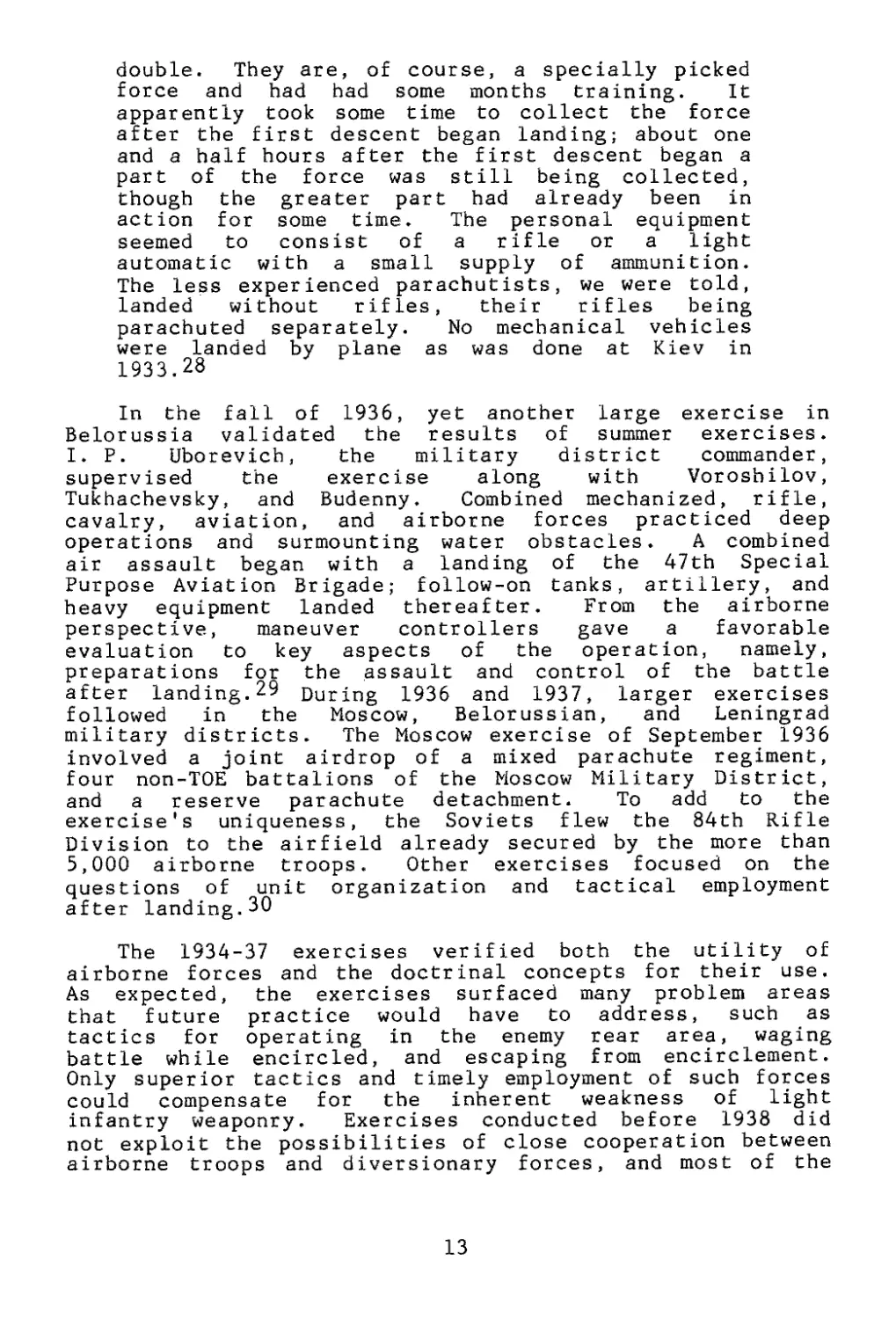
Command reserve) artillery (see map 1, p. 12). 'A" cavalry
corps and a mechanized corps developed that penetration.
A large airborne assault supported their efforts to
encircle and destroy the enemy. The airborne force of two
parachute regiments (1,188 men) and two rifle regiments
(1,765 men), under control of a rifle division, had to
land at Brovary (northeast of Kiev), secure a landing area
and crossings over the Dnepr River, block the approach of
enemy reserves from the east, and cooperate with cavalry
and rifle corps units attacking Kiev from the west. More
than 1,000 troops of the parachute echelon, flying in from
bases 280 kilometers away, participated in a simultaneous
drop and secured the landing area. Troops of the main
force rifle regiments followed and, together with the
parachute echelon, accomplished their assigned mission.27
Western attaches viewed the drop with interest. The
British attache, Maj. Gen. (later Field Marshal) A. P.
Wavell reported:
We were taken to see a force of about 1,500 men
dropped by parachute; they were supposed to
represent a "Blue" force dropped to occupy the
passages of a river and so delay the advance of
the "Red" Infantry corps which was being brought
up for the counteroffensive. This parachute
descent, though its tactical value may be
doubtful, was a most spectacular performance. We
were told that there were no casualties and we
certainly saw none; in fact the parachutists we
saw in action after the landings were in
remarkably good trim and mostly moving at the
*1. E. Yakir, Kiev Military District commander; К. E.
Voroshilov, people's commissar of defense; S. M. Budenny,
inspector of Cavalry Forces; Ya. B. Gamarnik, deputy
commissar of defense; M. N. Tukhachevsky, deputy commissar
of defense; A. I. Egorov, chief of the General Staff.
11
го
Map 1. Belorussian Maneuvers, 14 September 1935
double. They are, of course, a specially picked
force and had had some months training. It
apparently took some time to collect the force
after the first descent began landing; about one
and a half hours after the first descent began a
part of the force was still being collected,
though the greater part had already been in
action for some time. The personal equipment
seemed to consist of a rifle or a light
automatic with a small supply of ammunition.
The less experienced parachutists, we were told,
landed without rifles, their rifles being
parachuted separately. No mechanical vehicles
were landed by plane as was done at Kiev in
1933.28
In the fall of 1936, yet another large exercise in
Belorussia validated the results of summer exercises.
I. P. Uborevich, the military district commander,
supervised the exercise along with Voroshilov,
Tukhachevsky, and Budenny. Combined mechanized, rifle,
cavalry, aviation, and airborne forces practiced deep
operations and surmounting water obstacles. A combined
air assault began with a landing of the 47th Special
Purpose Aviation Brigade; follow-on tanks, artillery, and
heavy equipment landed thereafter. From the airborne
perspective, maneuver controllers gave a favorable
evaluation to key aspects of the operation, namely,
preparations for the assault and control of the battle
after landing.29 During 1936 and 1937, larger exercises
followed in the Moscow, Belorussian, and Leningrad
military districts. The Moscow exercise of September 1936
involved a joint airdrop of a mixed parachute regiment,
four non-TOE battalions of the Moscow Military District,
and a reserve parachute detachment. To add to the
exercise's uniqueness, the Soviets flew the 84th Rifle
Division to the airfield already secured by the more than
5,000 airborne troops. Other exercises focused on the
questions of unit organization and tactical employment
after landing.30
The 1934-37 exercises verified both the utility of
airborne forces and the doctrinal concepts for their use.
As expected, the exercises surfaced many problem areas
that future practice would have to address, such as
tactics for operating in the enemy rear area, waging
battle while encircled, and escaping from encirclement.
Only superior tactics and timely employment of such forces
could compensate for the inherent weakness of light
infantry weaponry. Exercises conducted before 1938 did
not exploit the possibilities of close cooperation between
airborne troops and diversionary forces, and most of the
13
operations extended to only a limited depth in the enemy
defense. Equipment problems still hindered airborne
operations, and a larger more versatile fleet of aircraft
was essential for larger, airborne groups to conduct
deeper operations. The Soviet theorists directly
confronted such problems in a 1937 report, "The Course of
Preparing Parachute Landing Forces."31
While the Soviets validated their airborne techniques
in these and other exercises, theoretical work continued.
Exercises and maneuvers, in turn, permitted more complete
expression of the theory of deep battle. In March 1935,
the Red Army had issued its "Instructions on Deep Battle,"
which gave the concept clearer meaning:
Deep battle is battle involving massive use of
new mobile and shock means for a simultaneous
attack on the enemy to the entire depth of his
combat formation with the aim of fully
encircling and destroying him. . . . The new
means and tactics of deep battle increase the
importance of surprise.32
One of the new means was the infant airborne force.
The 1936 Field Regulation was the epitome of Soviet
pre-World War II doctrinal development (see map 2,
p. 15). It elaborated the brief description of deep
battle provided in the 1935 "instructions" and defined
deep battle as
the simultaneous assault on enemy defenses by
aviation and artillery to the depth of the
defense, penetration of the tactical zone of the
defense by attacking units with wide use of tank
forces, and violent development of tactical
success into operational success with the aim of
complete encirclement and destruction of the
enemy. The main role is performed by the
infantry, and in its interests are organized the
mutual support of all types of forces.33
Article 7 of the Field Regulation specifically outlined
the role of airborne forces:
Parachute landing units are the effective means
. . . disorganizing the command and rear services
structure of the enemy. In coordination with
forces attacking along the front, parachute
landing units can go a long way toward producing
a complete rout of the enemy on a given axis.34
14
Сл
Army	Army
Group	Reserve
Rear	belt
Tactical Zone
2d belt 1st belt
80-100 KM
40-60 KM 12-15 KM 4-6 KM
Map 2. Use of Airborne Forces on the Offensive, 1936
Thus, while success in deep battle relied primarily on
mechanized and tank forces, the airborne arm played a
considerable supporting role.
With airborne forces accepted as a participant in deep
battle, the airborne force structure continued to become
more sophisticated and to grow in size. In 1936, two new
airborne brigades (aviation landing and special purpose)
were organized on the basis of existing TOE and non-TOE
units in the Belorussian and Kiev military districts, thus
raising the number of brigades to three (see table 1). To
augment airborne forces in the increasingly dangerous
climate of the Far East, the Revoensovet created three
airborne regiments from existing smaller units (see
table 2). As part of the 1936 force expansion, one
separate special purpose battalion was formed in each of
the Moscow, Volga, and Trans-Baikal military districts,
and three non-TOE parachute regiments of 1,660 men each
were organized in the Moscow Military District.35
Table 1. Airborne Brigades, 1936
Unit	Commander	Location
3d Abn Bde	I.	S.	Kokhansky	Leningrad MD
13th Abn Bde	A.	0.	Indzer	Kiev MD
47th Abn Bde	A.	F.	Levashev	Belorussian MD
Source: Sukhorukov, Sovetskie vozdushno, 35.
Table 2. Airborne Regiments, 1936
Unit	Commander	Locat ion
1st Abn Regt	M.	I.	Denisenko	Far	East
2d Abn Regt	I.	I.	Zatevakhin	Far	East
5th Abn Regt	N.	E.	Tarasov	Far	East
Source: Sukhorukov, Sovetskie vozdushno, 35.
As the overall Soviet force structure expanded
significantly in the late 1930s, so did the airborne
structure. In 1938, existing aviation landing units were
transformed into six airborne brigades of 3,000 men each.
A year later, three new special aviation landing regiments
were created in the Moscow Military District. These 1938-
39 units were organized on a uniform TOE (see table 3).36
16
Table 3. Airborne Forces, 1939
Unit	Commander	Location
201st 202d	Abn Abn	Bde Bde	Col. Maj .	I. M.	S. I.	Bezugly Denisenko	Leningrad MD Far East
204th	Abn	Bde	Maj .	I.	I.	Gudarevich	Kiev MD
211th	Abn	Bde	Maj .	V.	A.	Glazunov	Kiev MD
212th	Abn	Bde	Maj .	I.	I.	Zatevakhin	Far East (later Odessa MD)
214th	Abn	Bde	Col.	A.	F.	Levashev	Belorussian MD
1st Rostov Regt
2d Gorokhovets Regt
3d Voronezh Regt
Source: Sukhorukov, Sovetskie vozdushno, 36.
Little information exists about the precise impact of
the military purges of the late thirties on the airborne
forces. It is reasonable to assume that the execution of
the leading theorists of deep battle and the generation of
military leaders who created the concept and form of
airborne and mechanized warfare crippled further
improvement of doctrine and imaginative work in perfecting
airborne tactics. Airborne units, however, continued to
expand in size and number, and doctrine for their use
reflected the pattern established in the Field Regulation
of 1936. As late as January 1941, Lt. Gen. A. Yeremenko
described a controversial military council meeting in
Moscow during which the air force commander, Lt. Gen.
Pavel Rychagov, discussed the use of airborne forces.37
At the same meeting, however, the debate over the use of
mechanized forces to effect deep battle reflected the
shift of the pendulum away from the dynamic views of
Tukhachevsky and toward the views of the less imaginative
or the views of those for whom the Spanish Civil War
experience had raised doubts about prospects for wartime
success using large mechanized forces. The partial
eclipse of men who advocated the creation of a force
envisioned by the earlier planners of deep battle had to
affect adversely further improvement of airborne doctrine
and refinement of airborne techniques. The airborne
forces grew, and the Field Regulations of 1940 and 1941
parroted the ideas of the 1936 Field Regulation, but the
vigor of thought and performance waned. Only future years
of struggle would revive that vigor.
17
The Soviets were pioneers in the development of
airborne forces:during the interwar years. Although other
nations gave thought to such forces, only the Germans came
close to matching Soviet achievements in the field. Italy
conducted early experiments in the late 1920s and, in
1928, formed a company of trained parachutists before its
interest waned. The British took note of Soviet
experiences in the 1933 and 1936 maneuvers, but concern
over the light nature of airborne forces and an absence of
lift aircraft thwarted British development of airborne
units. In essence, the primarily defensive concerns of
Great Britain argued against the development of an
offensive airborne force. French experimentation was
limited to the creation in 1938 of two airborne companies,
but even this small force was disbanded after war began.
Similarly, no serious airborne experimentation occurred in
the United States before 1940.38 Only the use of a
German airborne force on Crete in May 1941 prompted Great
Britain, and the United States to create their own airborne
units.
The Germans, however, more concerned with offensive
theory, accepted the potential value of airborne units
and, in the 1930s, began building an airborne force.
Airborne forces, in German eyes, "offered great
possibilities for surprise attack, which was something
that was occupying the minds of the German Army planners,
and it looked to be a suitable way of speeding up the
armored thrust of the Blitzkrieg."39 Formation of a
German airborne force began in secret in 1938. Maj. Gen.
Kurt Studant formed the first airborne division (7th Air
Division), which consisted of a mixture of parachute
battalions and airlanding battalions with integrated air
units. Yet, by 1940, the German airborne force was still
limited to a single division.
Thus, the Soviets and Germans alike accepted the
validity of airborne concepts. Although both nations
formed airborne units, the scale was far greater in the
Soviet Union. The ensuing war would test the
effectiveness of that large force.
On the Eve of War
Even during the crisis-ridden years of 1938-41, the
Red Army continued to grow and played a role in the prewar
incidents that would forecast the coming of more difficult
times. The airborne force grew apace with the army and
gained combat experience in those crises. When tension
rose in the Soviet Far East between the Soviet Union and
Japan and finally erupted in the major battle at
18
Khalkhin-Gol in July and August 1939,* Soviet airborne
forces were sucked into the conflict. Dispatched from
the Far East into eastern Mongolia, Col. I. I.
Zatevakhin's 212th Airborne Brigade, participating in a
ground role as part of Army Group Commander, G. K. Zhukov's
force earned fame in the assaults on Mount Fui that
smashed the Japanese right flank.40 During the
Soviet-Finnish War in the winter of 1939-40, which began
with a series of Soviet failures, airborne forces again
participated as infantry, performing diversionary missions
while operating with motorized rifle forces. The 201st
Airborne Brigade operated with the 15th Army, and the
204th Airborne Brigade was in 15th Army reserve until
committed to combat in the final stages of the conflict.
The first use of airborne forces in their proper role
occurred during the Soviet occupation of Rumanian
Bessarabia in June 1940. The Bessarabian operation called
for rapid advance by tank and cavalry units, followed by
rifle units to seize and annex the territory from a
recalcitrant Rumanian government. Airborne forces had the
missions of capturing important positions to cut the lines
of withdrawal of Rumanian forces and of waiting for the
arrival of advancing Soviet mobile forces. Moreover,
airborne forces would prevent retreating Rumanian forces
from destroying property and supplies and would secure the
key cities of Bolgrad and Izmail. The planned operation
commenced with a ground force advance on 28 June. While
ground operations proceeded, the 201st, 204th, and 214th
Airborne brigades, under control of the air force
commander, moved by rail to airfields 350 kilometers from
their drop zone. There they joined the four heavy bomber
regiments (comprising 170 TB-3 aircraft) that would convey
them to their drop areas. On 29 June, the 204th Airborne
Brigade dropped twelve kilometers north of Bolgrad,
advanced to the city, and occupied it that evening. The
following day, the 1st Battalion, 204th Airborne Brigade,
secured the city of Kagul at the mouth of the Danube
River. That same day, the 201st Airborne Brigade received
orders to airland at Izmail and secure both that city and
the vital road network passing through it. Because an air
reconnaissance bad confirmed the inadequacy of the
airfields to accommodate so large a force, the brigade
instead landed by parachute in the Izmail area. By the
evening of 30 June, against no opposition, the brigade
*See Edward J. Drea, Nomonhan: Japanese-Soviet
Tactical Combat, 1939, Leavenworth Papers noT ~2 (Tort
Leavenworth, KS: Combat Studies Institute, U.S. Army
Command and General Staff College, January 1981).
19
occupied the city.4-1 The Bessarabian operation was
unopposed and, in reality, was a more realistic repeat of
the many exercises Soviet airborne forces had engaged in
during the previous years.
In the wake of Soviet military confrontations during
1939 and 1940 and in light of the generally poor
performance of the Red Army, in particular in Finland, a
major reappraisal began. The program was overseen by
S. K. Timoshenko, the new commissar of defense, and it
directly affected airborne forces because new regulations
had appeared and the airborne corps had undergone a major
expansion. Regulations published in 1940 and 1941
redefined and enlarged the role of airborne forces in
offensive operations. Article 28 of the 1941 Field
Regulation specified the role of airborne forces:
Air assault forces are an instrument of higher
command. They are used to decide those missions
in the enemy rear area which within a specified
period cannot be satisfied by other types of
forces, but the decision of which can have a
serious impact on the outcome of the entire
operation (battle). Air assault forces must be
used as a surprise for the enemy, in large
masses, independent or in coordination with
land, air and sea forces. . . .^2
Additional instructions and regulations governing all
aspects of the wartime use of airborne forces appeared.
Taken together, these documents accorded the airborne
forces a list of specific missions: disruption of army
command and control and supply functions; destruction of
communications routes; interruption of enemy troop, arms,
and supply movements; capture and destruction of airfields
and bases; seizure of coastal areas in support of naval
landings; reinforcment of troops in encirclement and of
mobile units operating in the enemy rear; and fighting
against enemy airborne landings in one's own rear area,
among others. The Soviet High Command invoked its
regulations to call upon Soviet airborne forces to perform
these types of missions within the next two years. In
December 1940, Timoshenko amplified the place of airborne
forces in the operational scheme, emphasizing that:
. . . the experience of the World War II in the
west showed that the high tempo and success of an
operational offensive were secured by massive use
of tanks, aviation, and artillery in cooperation
with motorized forces and airborne forces. The
development of a tactical penetration into an
operational-strategic one was made possible by
20
introduction of mobile forces into the
penetration and by operations of airborne
forces.43
As dark clouds of war descended over Europe, the
Soviet Union heeded Timoshenko's words and rushed to put
its forces on a wartime footing. Large and cumbersome
mechanized units reappeared (at least on paper), and
airborne forces underwent massive expansion. In the first
step toward expansion in November 1940, Timoshenko
approved a new airborne brigade TOE. This brigade
organization contained parachute, glider, and airlanded
groups, as well as a brigade school to teach airborne
techniques. The refurbished brigades numbered 3,000
personnel and had sixty-seven motorcycles; fifty-four
bicycles; and improved artillery, antitank, and
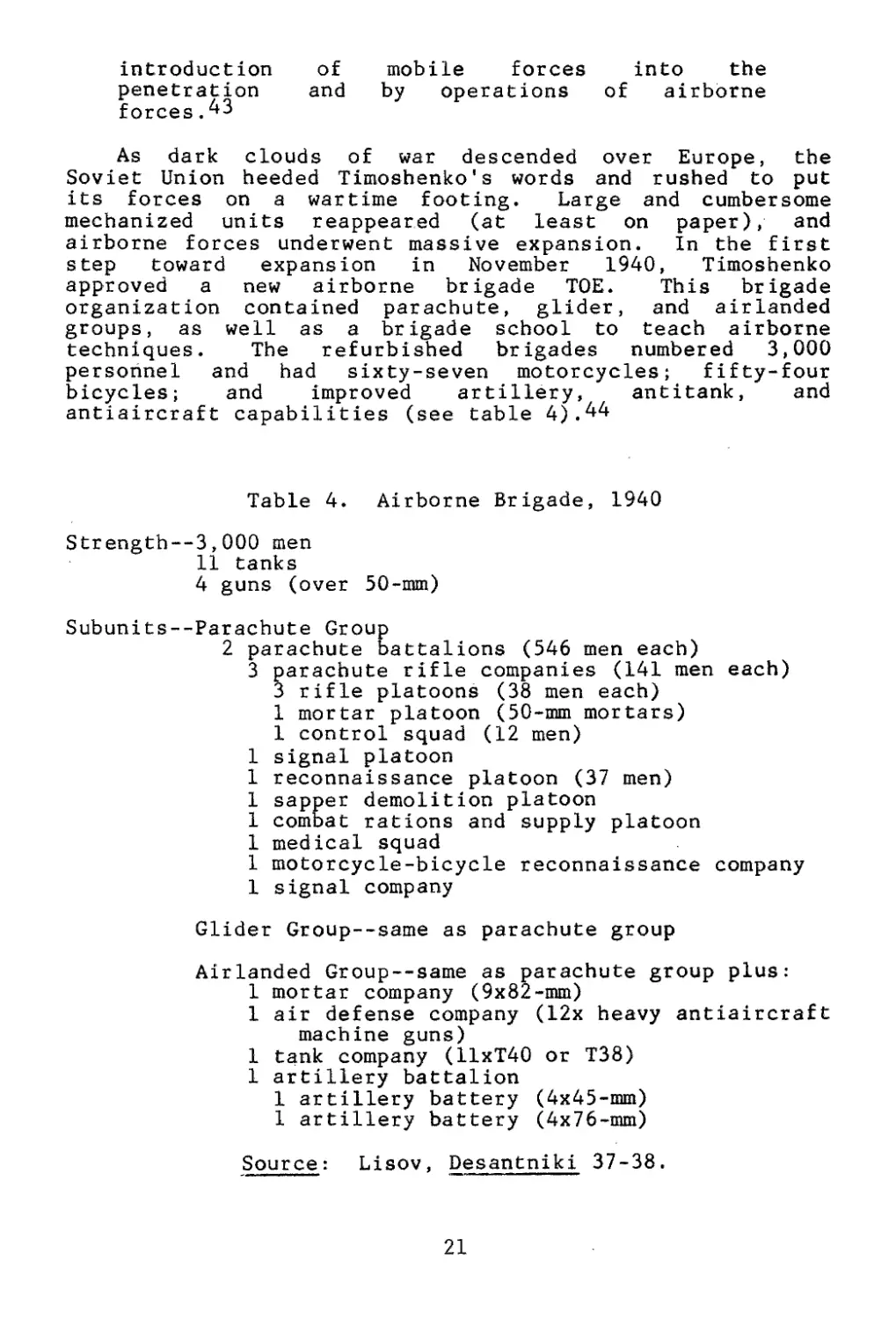
antiaircraft capabilities (see table 4).44
Table 4. Airborne Brigade, 1940
Strength—3,000 men
11 tanks
4 guns (over 50-mm)
Subunits--Parachute Group
2 parachute battalions (546 men each)
3 parachute rifle companies (141 men each)
3 rifle platoons (38 men each)
1 mortar platoon (50-mm mortars)
1 control squad (12 men)
1 signal platoon
1 reconnaissance platoon (37 men)
1 sapper demolition platoon
1 combat rations and supply platoon
1 medical squad
1 motorcycle-bicycle reconnaissance company
1 signal company
Glider Group--same as parachute group
Airlanded Group--same as parachute group plus:
1 mortar company (9x82-mm)
1 air defense company (12x heavy antiaircraft
machine guns)
1 tank company (llxT40 or T38)
1 artillery battalion
1 artillery battery (4x45-mm)
1 artillery battery (4x76-mm)
Source: Lisov, Desantniki 37-38.
21
Although the airborne brigades were strengthened by
TOE, the total number of brigades remained six--three in
the Far East and three in the European U.S.S.R.45
Further expansion of the airborne force occurred in March
and April 1941, when five airborne corps were established
from the cadre of the existing 201st, 204th, 211th, 212th,
and 214th Airborne brigades. Each airborne corps had
about 10,000 men and a significant number of supporting
weapons. The corps had three airborne brigades, a
separate tank battalion, and control and logistical
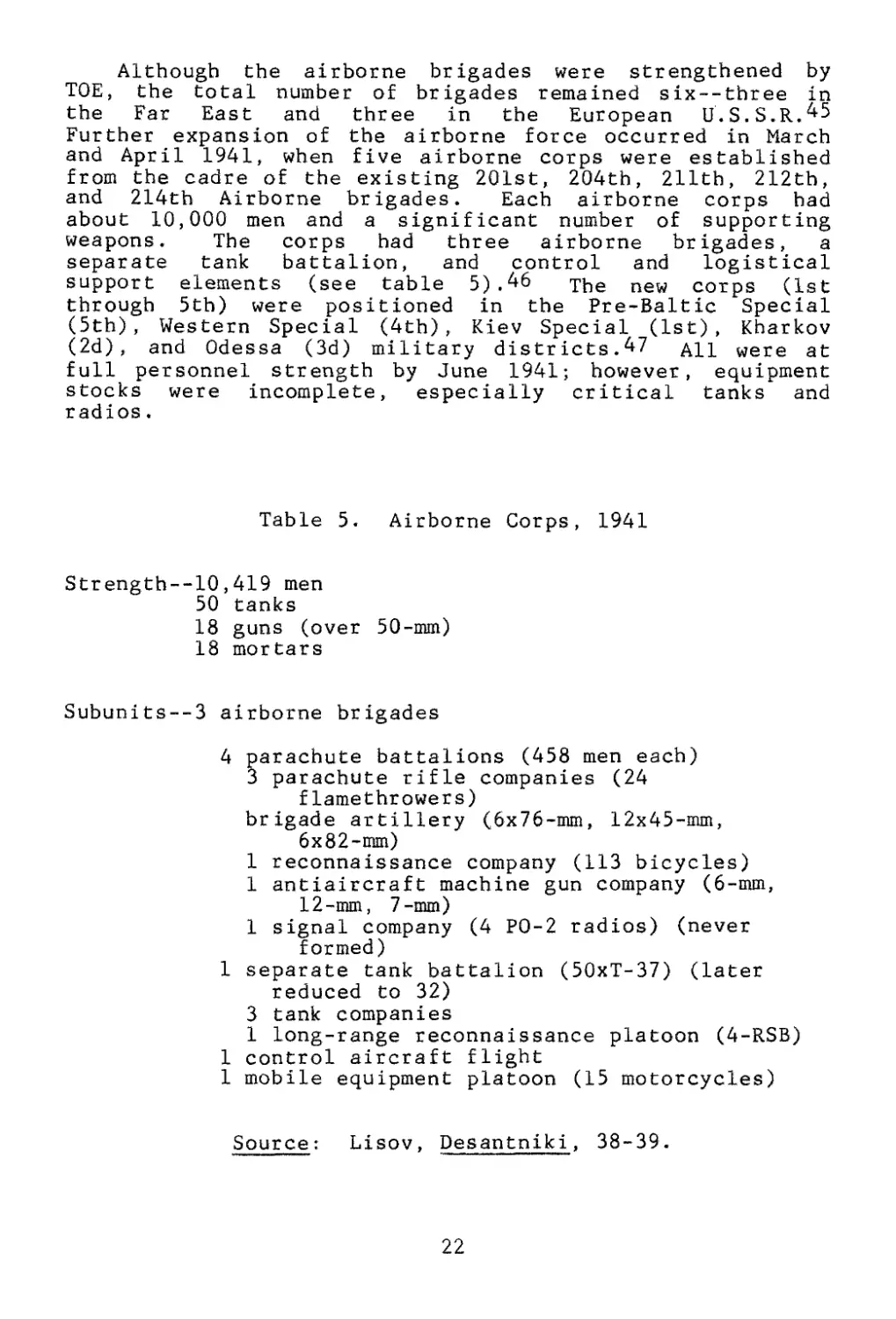
support elements (see table 5).46 The new corps (1st
through 5th) were positioned in the Pre-Baltic Special
(5th), Western Special (4th), Kiev Special (1st), Kharkov
(2d), and Odessa (3d) military districts.47 дц were at
full personnel strength by June 1941; however, equipment
stocks were incomplete, especially critical tanks and
radios.
Table 5. Airborne Corps, 1941
Strengtb--10,419 men
50 tanks
18 guns (over 50-mm)
18 mortars
Subunits--3 airborne brigades
4 parachute battalions (458 men each)
3 parachute rifle companies (24
flamethrowers)
brigade artillery (6x76-mm, 12x45-mm,
6x82-mm)
1 reconnaissance company (113 bicycles)
1 antiaircraft machine gun company (6-mm,
12-mm, 7-mm)
1 signal company (4 PO-2 radios) (never
formed)
1 separate tank battalion (50xT-37) (later
reduced to 32)
3 tank companies
1 long-range reconnaissance platoon (4-RSB)
1 control aircraft flight
1 mobile equipment platoon (15 motorcycles)
Source: Lisov, Desantniki, 38-39.
22
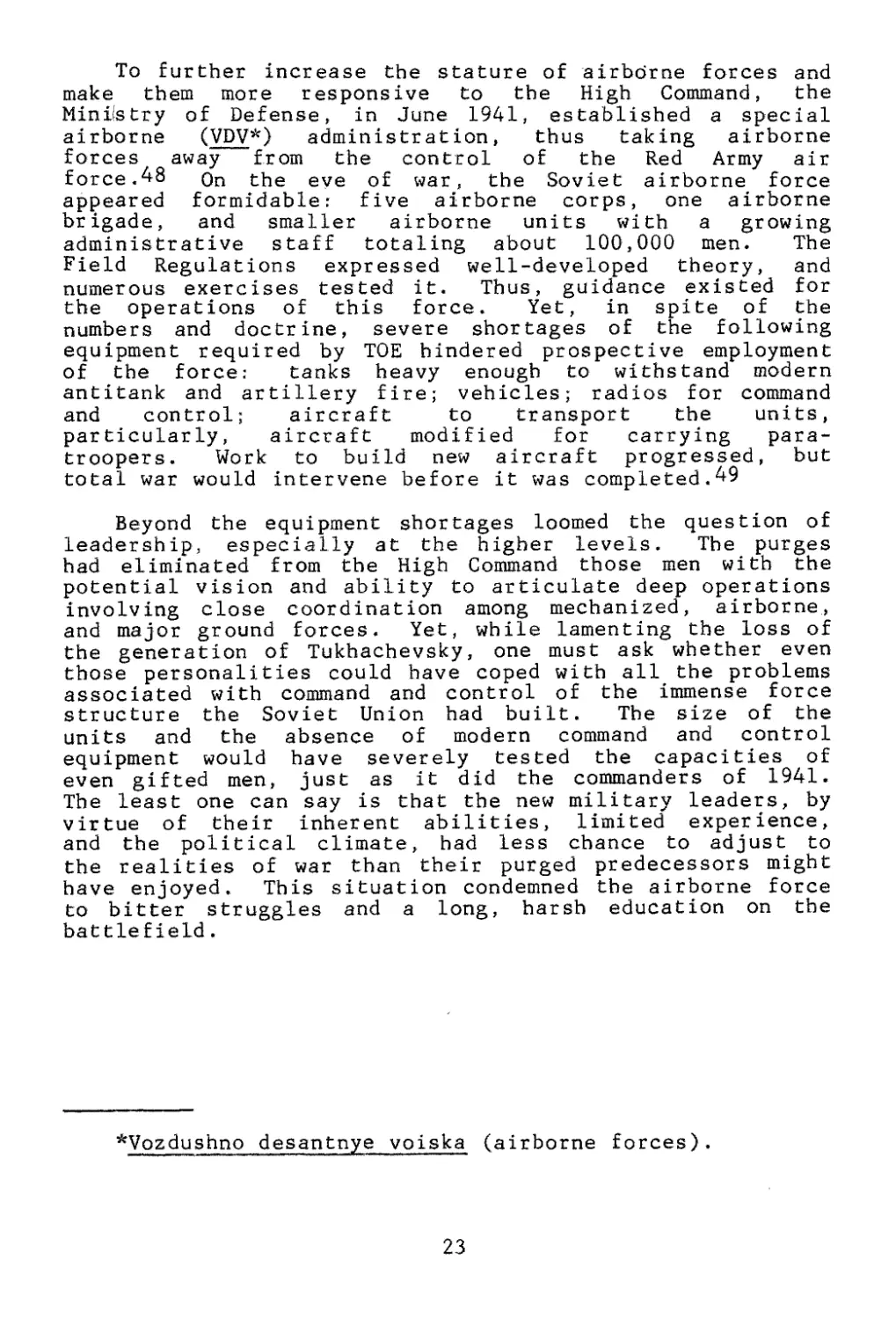
To further increase the stature of airborne forces and
make them more responsive to the High Command, the
Ministry of Defense, in June 1941, established a special
airborne (VDV*) administration, thus taking airborne
forces away from the control of the Red Army air
force. 48 Qn	eve of war, the Soviet airborne force
appeared formidable: five airborne corps, one airborne
brigade, and smaller airborne units with a growing
administrative staff totaling about 100,000 men. The
Field Regulations expressed well-developed theory, and
numerous exercises tested it. Thus, guidance existed for
the operations of this force. Yet, in spite of the
numbers and doctrine, severe shortages of the following
equipment required by TOE hindered prospective employment
of the force: tanks heavy enough to withstand modern
antitank and artillery fire; vehicles; radios for command
and control; aircraft to transport the units,
particularly, aircraft modified for carrying para-
troopers. Work to build new aircraft progressed, but
total war would intervene before it was completed.49
Beyond the equipment shortages loomed the question of
leadership, especially at the higher levels. The purges
had eliminated from the High Command those men with the
potential vision and ability to articulate deep operations
involving close coordination among mechanized, airborne,
and major ground forces. Yet, while lamenting the loss of
the generation of Tukhachevsky, one must ask whether even
those personalities could have coped with all the problems
associated with command and control of the immense force
structure the Soviet Union had built. The size of the
units and the absence of modern command and control
equipment would have severely tested the capacities of
even gifted men, just as it did the commanders of 1941.
The least one can say is that the new military leaders, by
virtue of their inherent abilities, limited experience,
and the political climate, had less chance to adjust to
the realities of war than their purged predecessors might
have enjoyed. This situation condemned the airborne force
to bitter struggles and a long, harsh education on the
battlefield.
*Vozdushno desantnye voiska (airborne forces).
23
CHAPTER 2
EVOLUTION OF AIRBORNE FORCES DURING WORLD WAR II
Initial Airborne Involvement
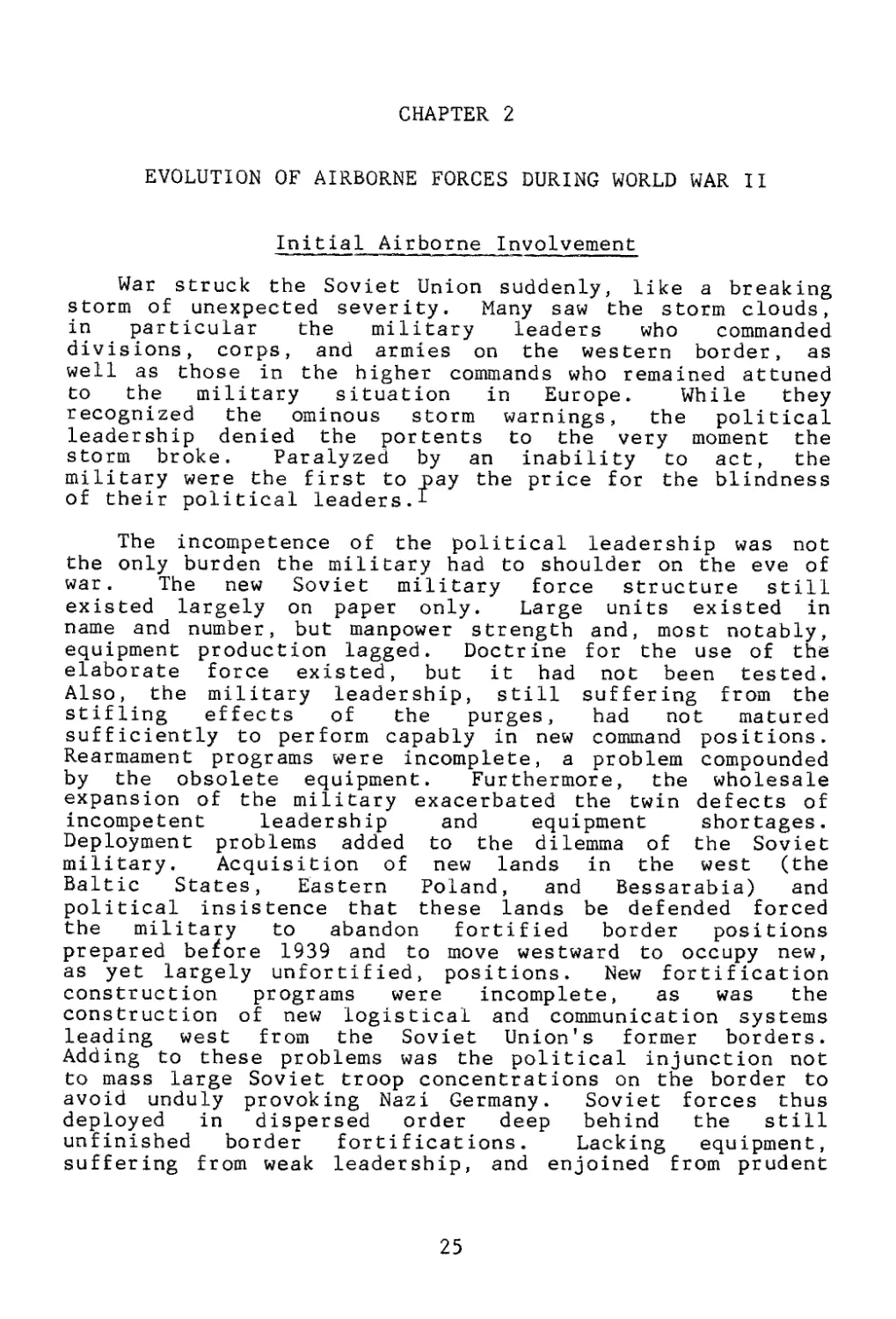
War struck the Soviet Union suddenly, like a breaking
storm of unexpected severity. Many saw the storm clouds,
in particular the military leaders who commanded
divisions, corps, and armies on the western border, as
well as those in the higher commands who remained attuned
to the military situation in Europe. While they
recognized the ominous storm warnings, the political
leadership denied the portents to the very moment the
storm broke. Paralyzed by an inability to act, the
military were the first to pay the price for the blindness
of their political leaders.1
The incompetence of the political leadership was not
the only burden the military had to shoulder on the eve of
war. The new Soviet military force structure still
existed largely on paper only. Large units existed in
name and number, but manpower strength and, most notably,
equipment production lagged. Doctrine for the use of the
elaborate force existed, but it had not been tested.
Also, the military leadership, still suffering from the
stifling effects of the purges, had not matured
sufficiently to perform capably in new command positions.
Rearmament programs were incomplete, a problem compounded
by the obsolete equipment. Furthermore, the wholesale
expansion of the military exacerbated the twin defects of
incompetent leadership and equipment shortages.
Deployment problems added to the dilemma of the Soviet
military. Acquisition of new lands in the west (the
Baltic States, Eastern Poland, and Bessarabia) and
political insistence that these lands be defended forced
the military to abandon fortified border positions
prepared before 1939 and to move westward to occupy new,
as yet largely unfortified, positions. New fortification
construction programs were incomplete, as was the
construction of new logistical and communication systems
leading west from the Soviet Union's former borders.
Adding to these problems was the political injunction not
to mass large Soviet troop concentrations on the border to
avoid unduly provoking Nazi Germany. Soviet forces thus
deployed in dispersed order deep behind the still
unfinished border fortifications. Lacking equipment,
suffering from weak leadership, and enjoined from prudent
25
readiness preparations, they would soon face the onslaught
of Europe's most well-trained army, blooded in war and
intent on utterly destroying its unwary Soviet opponent.
A microcosm of the Soviet force structure, airborne
forces suffered similar basic problems. Principal among
these was the lack of experience at higher command
levels. Few senior commanders were capable of conducting
strategic operations requiring the integration of airborne
forces into the complex overall combat scheme of deep
battle. Airborne forces also suffered from the general
equipment deficiencies of the Red Army and the deployment
problems of other forces. Elite and well trained,
airborne units did, however, manage to avoid some of the
problems that plagued other Soviet units. Airborne unit
commanders generally led well in combat, and many of the
original airborne leaders rose to prominence in later war
years.2 The nature of airborne units, as well as their
prewar deployments, resulted in their immediate commitment
to combat in 1941 as ground infantry units. On several
occasions, airborne units were ordered to join special
formations designed to block German advances in critical
sectors. Only after six months of war would airborne
units begin to perform, on a large scale, those special
tasks for which they had been formed.
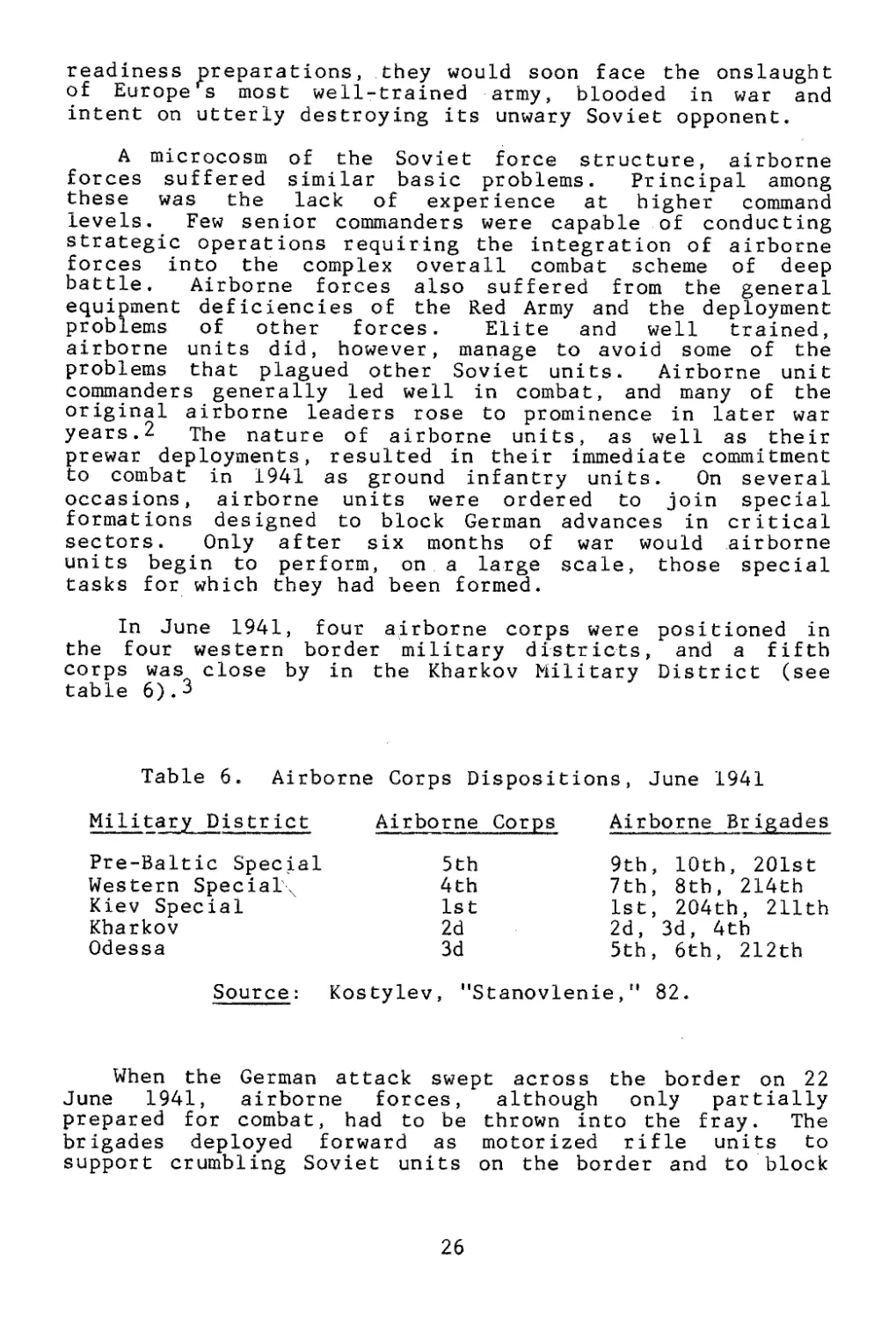
In June 1941, four airborne corps were positioned in
the four western border military districts, and a fifth
corps was close by in the Kharkov Military District (see
table 6).3
Table 6. Airborne Corps Dispositions, June 1941
Military District Airborne Corps Airborne Brigades
Pre-Baltic Special	5th	9th, 10th, 201st
Western Special^	4th	7th, 8th, 214th
Kiev Special	1st	1st, 204th, 211th
Kharkov	2d	2d, 3d, 4th
Odessa	3d	5th, 6th, 212th
Source: Kostylev, "Stanovlenie," 82.
When the German attack swept across the border on 22
June 1941, airborne forces, although only partially
prepared for combat, had to be thrown into the fray. The
brigades deployed forward as motorized rifle units to
support crumbling Soviet units on the border and to block
26
deep penetrations of advancing German panzer units. The
surprise of the German offensive and the Soviet command's
general paralysis during the first few weeks of war
prevented a concerted Soviet counteroffensive using Soviet
airborne units. Consequently, airborne units went into
combat in piecemeal fashion as reinforcements in critical
areas. Few had the opportunity to conduct airborne
missions they had trained for.
The first airborne units to see combat were those of
the 5th	Airborne	Corps	in the	Pre-Baltic	Military
District.	In the	midst	of field	maneuvers	when the
Germans attacked, the airborne troops, under Gen. I. S.
Bezugly, cooperated first with the 21st Mechanized Corps
and then with the 27th Army in unsuccessful attempts to
halt the slashing German armor advances. After suffering
heavy casualties south of Daugavpils, the corps, on High
Command orders, moved from the Northwestern Front
(formerly Pre-Baltic Military District) to the Moscow
Military District on 15 August.4 Maj. Gen. A. S.
Zhadov's 4th Airborne Corps of the Western Special
Military District fought a bitter six-day defensive
action, attempting to hold German Army Group Center at the
Berezina River. After the Germans had forced the river,
4th Airborne joined the 13th Army to defend the approaches
to Smolensk. The 214th Airborne Brigade, 4th Airborne
Corps, under Col. A. F. Levashev, took part in the defense
of Minsk and fought for two months in the first great
German encirclement of Soviet forces. Few men of the
brigade survived.5
Farther south, in the Kiev Special Military District
(Southwestern Front), Maj. Gen. M. A. Usenko's 1st
Airborne Corps also fought defensive battles alongside the
Soviet 5th and 6th armies as German Army Group South
battered its way toward Kiev. Reinforced by 2d and 3d
Airborne corps, the 1st also participated in the futile
defense of Kiev. Both the 1st and 2d Airborne corps were
caught in the German encirclement of Kiev in August-
September 1941 and suffered such grievous losses that both
units were disestablished (only to be re-created later).
The 3d Airborne Corps, also encircled at Konotop, fought
its way out. In November, it was reorganized into the
87th Rifle Division under Col. A. I. Rodimtsev (former
commander of 5th Airborne Brigade).6 The 87th Rifle
Division, later redesignated 13th Guards Rifle Division,
achieved lasting fame at Stalingrad and elsewhere. In
summary, during the opening months of war, actual airborne
operations were limited to occasional diversionary
airdrops, as elite Soviet airborne troops fought as
infantrymen.
27
Organization and Employment
After the tragic border battles, only the 4th and 5th
Airborne corps in the Moscow region remained relatively
intact. In August and September 1941, the High Command
reorganized the airborne forces and redefined the
guidelines for their future employment. A 4 September
order of the People's Commissariat of Defense created the
higher level Administration of the Command of Airborne
Forces to replace the older lower level airborne force
administration. The	order also withdrew	all	airborne
forces from front command and subordinated them to the new
administration, now	commanded	by Maj.	Gen. V. A.
Glazunov. Henceforth,	airborne	units would	be	used only
with specific Stavka*	approval	to perform	the	following
missions:'
•	Cooperate with ground forces in encircling and
destroying large enemy groups.
•	Disorganize enemy command and control and rear area
logistics facilities.
•	Secure and hold important terrain, crossings, and
points in the enemy rear.
•	Secure and destroy enemy airfields.
•	Secure landings of naval infantry and river
crossings.
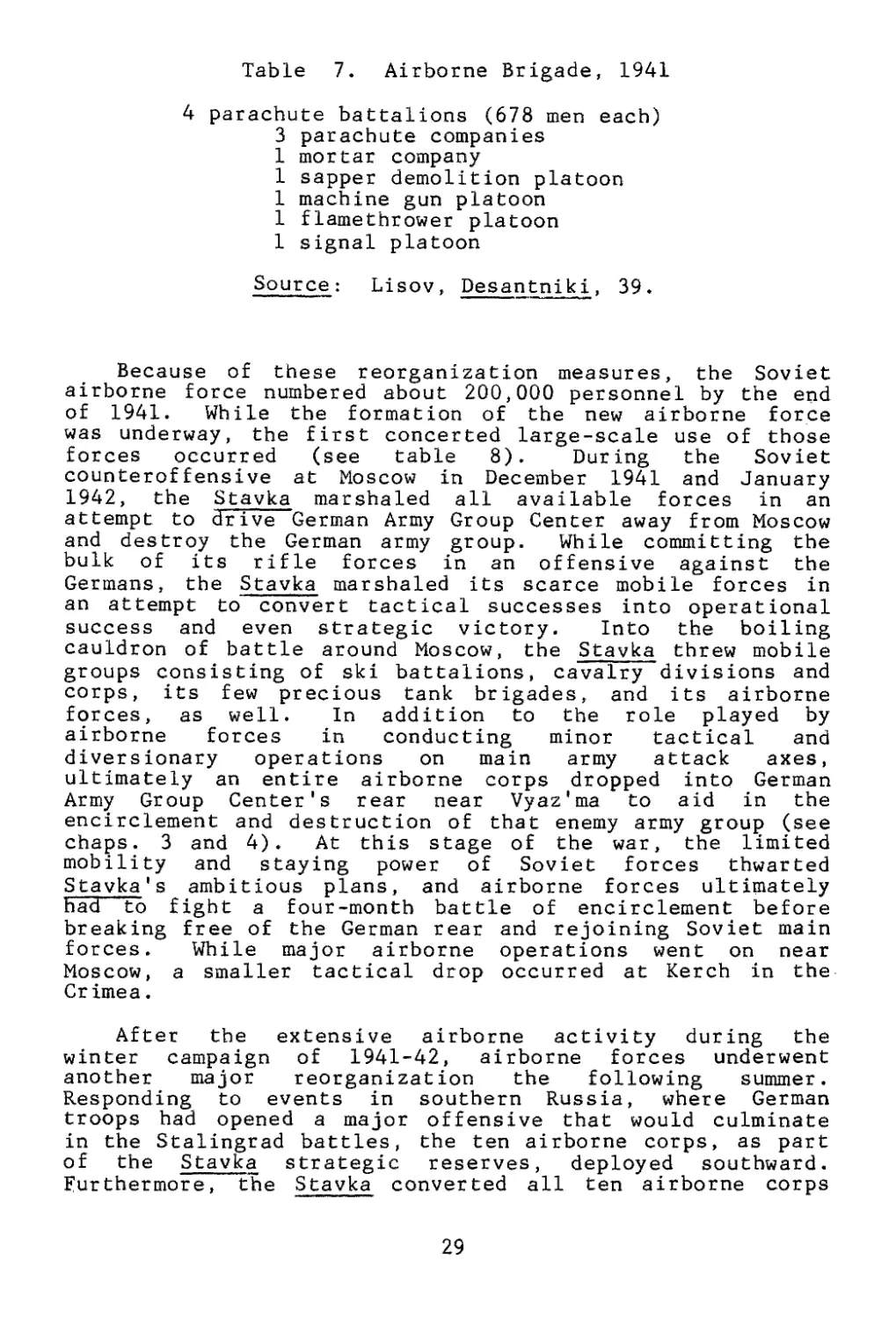
To bolster the depleted airborne force structure, a
new airborne brigade TOE strengthened the parachute
battalion (see table 7), and five new airborne corps (6th
through 10th) were organized using this new brigade TOE.
The Soviets reorganized or reinforced the older corps (1st
through 5th) with personnel and equipment and created five
new maneuver airborne brigades. By June 1942, creation of
these new units was completed. The new administration
also established schools and courses to train cadre for
these units.S The Stavka formed nine separate aviation
transport squadrons and Five separate aviation detachments
to perform the critical function of transporting airborne
units. During 1942, these units combined to form two
separate aviation-glider regiments and two aviation
transport regiments equipped with U-2, R-5, ТВ-1, TB-3,
and PS-84 aircraft.9 Because of heavy losses of
aircraft early in the war, the lack of sufficient aircraft
posed a serious problem for the airborne forces.
^Supreme headquarters--in essence, Stalin.
28
Table 7. Airborne Brigade, 1941
4 parachute battalions (678 men each)
3 parachute companies
1 mortar company
1 sapper demolition platoon
1 machine gun platoon
1 flamethrower platoon
1 signal platoon
Source: Lisov, Desantniki, 39.
Because of these reorganization measures, the Soviet
airborne force numbered about 200,000 personnel by the end
of 1941. While the formation of the new airborne force
was underway, the first concerted large-scale use of those
forces occurred (see table 8). During the Soviet
counteroffensive at Moscow in December 1941 and January
1942, the Stavka marshaled all available forces in an
attempt to drive German Army Group Center away from Moscow
and destroy the German army group. While committing the
bulk of its rifle forces in an offensive against the
Germans, the Stavka marshaled its scarce mobile forces in
an attempt to convert tactical successes into operational
success and even strategic victory. Into the boiling
cauldron of battle around Moscow, the Stavka threw mobile
groups consisting of ski battalions, cavalry divisions and
corps, its few precious tank brigades, and its airborne
forces, as well. In addition to the role played by
airborne forces in conducting minor tactical and
diversionary operations on main army attack axes,
ultimately an entire airborne corps dropped into German
Army Group Center's rear near Vyaz'ma to aid in the
encirclement and destruction of that enemy army group (see
chaps. 3 and 4). At this stage of the war, the limited
mobility and staying power of Soviet forces thwarted
Stavka1s ambitious plans, and airborne forces ultimately
had to fight a four-month battle of encirclement before
breaking free of the German rear and rejoining Soviet main
forces. While major airborne operations went on near
Moscow, a smaller tactical drop occurred at Kerch in the
Crimea.
After the extensive airborne activity during the
winter campaign of 1941-42, airborne forces underwent
another major reorganization the following summer.
Responding to events in southern Russia, where German
troops had opened a major offensive that would culminate
in the Stalingrad battles, the ten airborne corps, as part
of the Stavka strategic reserves, deployed southward.
Furthermore, the Stavka converted all ten airborne corps
29
Table 8. Soviet Airborne Operations in the Moscow Region,
1941-42
Date	Location	Airborne Force
14-15 Dec 41	Teryaeva Sloboda	One Bn, 214th Abn Bde, 4th Abn Corps*
2-4 Jan 42	Medyn	One Bn, 201st Abn Bde, 5th Abn Corps One Bn, 250th Rifle Regt*
18-22 Jan 42	Zhelan’ye	1st and 2d Bns, 201st Abn Bde, 5th Abn Corps 250th Abn Regt
27-31 Jan 42	Ozerechnya- Tabory	8th Abn Bde, 4th Abn Corps**
13-23 Feb 42	Velikopol'ye- Zhelan'ye	One Bn, 8th Abn Bde, 4th Abn Corps 9th and 214th Abn Bdes, 4th Abn Corps***
16-17 Feb 42	Rzhev	4th Bn, 204th Abn Bde, 1st Abn Corps*
16-18 Apr 42	Svintsovo	4th Bn, 23d Abn Bde, 10th Abn Corps***
29-30 May 42	10 km south of Dorogobuzh	23d Abn Bde, 10th Abn Corps 211th Abn Bde, 1st Abn Corps***
*See chap 6.
**See chap 3.
***See chap 4.
30
into guards rifle divisions to bolster Soviet forces in
the south. Nine of these divisions participated in the
battles around Stalingrad, and one took part in the
defense of the northern Caucasus region. In addition,
five maneuver airborne brigades and one airborne regiment,
all at full TOE strength, reinforced Soviet defensive
efforts in the Caucasus as rifle units (see table 9).10
Table 9.
Conversion of Airborne Units,
Summer 1942
Old
Airborne Designation	New
	Designation	Commander
Gds Abn Corps	Gds Rifle Div
1st	37 th	Maj. Gen. V. G. Zholydev
2d	32d	Col. M. F. Tikhonov
3d	33d	Col. A. I. Utvenko
4th	38th	Col. A. A. Onufriev
5th	39th	Maj. Gen S. S. Gur'ev
6th	40th	Maj. Gen. A. I. Pastrevich
7th	34th	Maj. Gen. I. I. Gubarevich
8th	35th	Maj. Gen. V. A. Glazkov
9th	36th	Col. M. 1. Denisenko
10th	41st	Col. N. P. Ivanov
Abn Bde 1st 2d 3d 4th 5th	Rifle Bde
	5th 6th 7th 8th 9th	Names not	of commanders are available
4th Res Abn	10th Rifle Bde
Regt
Source: Sukhorukov, Sovetskie vozdushno, 146-79.
Former airborne units achieved considerable
distinction in the bitter fighting of fall 1942,
vindicating Stalin's decision to use airborne units in a
ground role. Maj. Gen. V. G. Zholydev's 37th Guards Rifle
Division fought tenaciously in defense of the Barricady
and Tractor factories at Stalingrad and suffered 90-
percent casualties while exacting a heavy toll on the
31
Germans.H Maj. Gen. S. S. Gur'ev's 39th Guards Rifle
Division participated in the equally tenacious defense of
the Red October plant. Likewise, Maj. Gen. A. I.
Rodimtsev's 13th Guards Rifle Division won lasting fame in
the street fighting for control of downtown Stalingrad.12
Although it had committed virtually all airborne
forces to ground fighting in southern Russia, the Stavka
still foresaw the necessity of conducting actual airborne
operations later during the war. To have a force capable
of fulfilling airborne missions, the Stavka created eight
new airborne corps (1st, 4th, 5th, 6th, 7th, 8th, 9th, and
10th) in the fall of 1942. Beginning in December 1942,
these corps became ten guards airborne divisions (two
formed from the 1st Airborne Corps and the three existing
separate maneuver airborne brigades). The new guards
airborne divisions trained in airborne techniques, and all
personnel jumped three to ten times during training.
Training stressed rear area operations, mutual cooperation
with front ground and air forces, antitank warfare, ground
defensive techniques, and use of initiative.!^ In
February 1943, as Soviet forces attempted to exploit
German defeats in the winter battles of 1942-43, the
Stavka dispatched all of these airborne divisions to the
Northwestern Front where they fought at Staraya Russa and
Demyansk as part of 1st Shock Army, 68th Army, and the
Khozin Group. By April and May 1943, in response to
prospects for renewed German offensive action in the Kursk
region, the airborne divisions had redeployed southward.
Seven divisions (2d, 3d, 4th, 5th, 6th, 8th, and 9th) had
moved to reinforce the Central Front by the end of May,
and the remaining three (1st, 10th, and 7th) joined the
37th and 52d armies at Kharkov in August. 14 During the
Kursk battles, airborne forces participated in neavy
fighting, in particular the 4th Guards Airborne Division,
which defended successfully against German 9th Army panzer
forces at Ponyri, and the 9th Guards Airborne Division,
which participated in the Soviet armored victory over
German 4th Panzer Army at Prokhorovka.
After the defeat of German forces at Kursk, the bulk
of the airborne divisions joined in the pursuit of German
forces to the Dnepr River. Even as ten guards airborne
divisions fought at the front, new airborne brigades
formed in the rear areas. In April and May 1943, twenty
brigades formed and trained for future airborne
operations. Most of these brigades had become six new
guards airborne divisions (11th through 16th) by September
1943.15 The Stavka, however, earmarked three of these
airborne br igades For use in an airborne operation to
cross the Dnepr River.
32
As Soviet forces approached the new German defensive
line on the Dnepr, the problem of securing bridgeheads for
offensive operations across the river was paramount.
Advanced elements of Soviet forces seized a number of
small bridgeheads, but only light infantry formations were
able to cross into these footholds. Larger bridgeheads
free from German interdiction were necessary to build
bridges across the Dnepr and to introduce heavy armored
forces needed to continue the offensive. To gain a larger
bridgehead, the Stavka ordered three airborne brigades to
conduct a major airborne operation across the Dnepr River
near Velikeyi Bukrin. This second, and last, operational
use of airborne forces failed because of inadequate
preparations, poor reconnaissance, clumsy coordination of
forces, and many of the same reasons that had caused the
Vyaz'ma operation to fail (see chap. 5). The Soviets
would conduct no further large-scale airborne operations.
Instead, airborne forces continued to fight in a ground
combat role.
After the failure of the Dnepr operation, the original
ten guards airborne divisions participated in campaigns on
the left and right banks of the Ukraine, in particular as
part of 5tb Army at Kirovograd, at Korsun-Shevchenkovskii,
and in the advance to the Dnestr River. In January 1944,
the newer guards airborne divisions became rifle divisions
within 37th Guards Rifle Corps, 7th Army, and fought to
liberate Karelia.16 the summer and fall of 1944,
seven guards airborne divisions, fighting as infantry and
as part of 4th Guards Army, joined in the rout of German
and Rumanian forces at Yassy-Kishinev and marched with
Soviet forces into Hungary.
Attempts to revive large airborne units began in late
summer 1944. In	August, the Stavka	formed the 37th,	38th,
and 39th Guards	Airborne	corps.	By October, the	newly
formed corps had	combined	into a	separate airborne	army
under Maj. Gen. I. I. Zatevakhin (see table 10).17
However, because	of the	growing	need for well-trained
ground units, the new army did not endure long as an
airborne unit. In December, the Stavka reorganized the
separate airborne army into the 9th Guards Army of Col.
Gen. V. V. Glagolev, and all divisions were renumbered as
guards rifle divisions. As testimony to the elite nature
of airborne-trained units, the Stavka held the 9th Guards
Army out of defensive actions, using it only for
exploitation during offensives. 18	Other airborne
divisions, separately or in groups, participated as
elements of frontal ground forces in the remaining
campaigns of the war. Throughout the rest of the war,
airborne operations were limited to low-level tactical or
33
minor diversionary operations, usually conducted by
airlanded ground force units. Of note were the numerous
airlandings that occurred after the collapse of Japanese
resistance in Manchuria in August 1945.*
Table 10. Separate Airborne Army, 1944
Separate Airborne Army, Maj. Gen. I. I. Zatevakhin
37th Guards Airborne Corps, Lt. Gen. P. V. Mironov
13th Guards Airborne Division
98th Guards Airborne Division
99th Guards Airborne Division
38th Guards Airborne Corps, Lt. Gen. A. I. Utvenko
11th Guards Airborne Division
12th Guards Airborne Division
16th Guards Airborne Division
39th Guards Airborne Corps, Lt. Gen. M. F. Tikhonov
8th Guards Airborne Division
14th Guards Airborne Division
100th Guards Airborne Division
Source: Sukhorukov, Sovetskie vozdushno, 238.
Although the bulk of the airborne force structure
consisted of guards airborne divisions organized and
fighting as guards rifle divisions, the Stavka continued
to recognize the need for specialized airborne units.
Consequently, it continued to organize separate airborne
brigades similar to those of 1941 with 3,345 men, six
76-mm guns, eight 45-mm antitank guns, twenty-eight 37-mm
antiaircraft guns, twenty-four antiaircraft machine guns,
thirty-six heavy machine guns, and eighty-one antitank
rifles.19	war's end, the guards airborne divisions
and separate airborne brigades that had not been
demobilized would provide the nucleus of the Soviet
postwar airborne force.
*See Lt. Col. David M. Glantz, August Storm: The
Soviet 1945 Strategic Offensive in Manchuria^ LeavenwbrtH
Papers no^ Т\ ana August Storm: Soviet Tactical and
Operational Combat in Manchur fa? 1945^, Leaven worth Pa pe r s
no: 8 (Fort" Le aVenwor KS~i Comb a t Studies Institute,
U.S. Army Command and General Staff College, February 1983
and June 1983, respectively).
34
Thus, from 1942 on, wartime realities demanded that
airborne forces be used repeatedly as infantry in ground
fighting along the front. Earlier airborne operations on
a grand scale bad failed because of the light infantry
nature of those forces, the paucity of aviation available
to deliver units into battle, the absence of technology
required to guarantee accurate delivery, and the inability
of the light units to compete with the firepower of German
formations. In 1944, transport aircraft capable of
carrying the heavy equipment an airborne unit would
require to survive and to fulfill its mission were still
in short supply. Manpower shortage ruled out heavy
expenditures of personnel on airborne operations whose
chances of success the Soviets rated as only marginal.
Thus, strategic and operational use of airborne forces
faded into memory. The Soviets still used occasional
tactical assaults, particularly diversionary drops,
because those types of airborne missions had proved
successful earlier in the war (see chap. 6).
In spite of the diminished use of large-scale
airdrops, Soviet military theory still recognized the
value of such airborne operations under the proper
circumstances. Declarations on the theoretical use of
airborne forces changed remarkably little from the
missions outlined in regulations of the mid-thirties. The
Field Regulation of 1944 echoed the Field Regulation of
1936 by declaring in Article 34, “Airborne troops are
means at the disposal of the High Command. They are
characterized by a high degree of mobility, powerful
automatic armament, ability to appear quickly and suddenly
and to conduct battle in the rear of the enemy. "20 The
regulation detailed the following airborne missions:
•	Cooperate behind enemy lines with ground troops,
jointly with partisan detachments, to encircle and utterly
defeat the enemy and to combat approaching enemy reserves.
•	Seize important enemy rear lines (boundaries) and
crossings that protect enemy troops.
•	Seize and destroy enemy air bases.
•	Break up enemy rear command and control
establishments.
•	Protect seaborne troop landings by seizing coastal
regions.
Having articulated the precise missions of airborne
forces, the regulations added the important caveat that
“successful employment of airborne troops requires careful
35
preparation and effective cooperation with aviation,
partisan detachments, and mobile troops."21 The combat
experiences of Vyaz'ma in the winter of 1941-42 and of the
Dnepr in 1943 were thus carefully woven into the new
regulations. The regulations also pointed out that
success in a frontal attack could be achieved, in part, by
"decisive actions in the rear of the enemy with airborne
actions." Paragraph 200 of the Field Regulation of 1944
reiterated the airborne missions it had already listed and
amplified what airborne forces could accomplish in a
general offensive; paragraph 416, on pursuit operations,
tasked airlandings to "seize the defiles, crossings, road
centers, and commanding heights and hold them until the
approach of mobile units."22 Although airborne
operations from 1944 to the war's end would be of
extremely limited scope, the 1944 regulation captured the
essence of war experiences and passed their legacy into
the postwar years when peace and a restored economy would
provide airborne forces the means to fulfill the missions
for which they were most suited at the strategic,
operational, and tactical levels.
36
CHAPTER 3
OPERATIONAL EMPLOYMENT: VYAZ’MA, JANUARY-FEBRUARY 1942
Strategic Context
The Soviets conducted two operational level airborne
operations during the Great Patriotic War. The first and
largest in scale and aim occurred during the Soviet winter
offensive of January-February 1942. It was designed to
push German Army Group Center away from Moscow and, if
possible, to destroy it. The first phase of the Soviet
Moscow counteroffensive began on 5 December (see map 3,
p. 213). After a month of severe fighting in bitterly
cold weather, Soviet forces drove German troops from the
northern and southern approaches to Moscow, freeing Klin
and Kalinin in the north and Tula and Kaluga in the south
and threatening the flanks of German Army Group Center.
During this first phase, the Soviets used a tactical
airborne operation west of Klin to facilitate the
successful ground advance by dropping an airborne
battalion in the German rear area near Teryaeva Sloboda
(see chap. 6). By late December, with Soviet forces
approaching Rzhev, Volokolamsk, Mozhaisk, Medyn, Yukhnov,
and Kirov, the momentum of the Soviet offensive had
ebbed.
Despite the loss of momentum, the Soviet offensive had
inflicted materiel and psychological damage on German
forces. German personnel and equipment losses were heavy,
and Soviet forces threatened to break through the thinning
German lines in three distinct sectors of Army Group
Center. South of Kaluga, the Soviet 1st Guards Cavalry
Corps, 50th Army, and 10th Army tore a major gap between
German 2d Panzer Army and 4th Army. The 12th, 13th, and
43d Army corps of German 4th Army withdrew westward toward
Yukhnov in heavy snow and bitter cold and under intense
Soviet pressure.	The	Soviets threatened to	encircle	the
43d Army Corps	from	both flanks. The 4th Army rear
service units and ad hoc lines of communication units
?ieced together	loose defenses east and	southeast	of
ukhnov, and depleted units of 4th Army's 40th Panzer
Corps (19th and	10th	Motorized* divisions)	attempted	to
plug the yawning gap between Yukhnov and Sukhinichi.1
*Panzer grenadier.
37
At Maloyaroslavets, north of Kaluga, the Soviet 33d
and 5th armies pressured 4th Panzer Army and 4th Army's
left flank. By early January, Soviet forces had breached
4th Army's defenses on a fifteen-kilometer front between
Maloyaroslavets and Borovsk. The Soviet thrust separated
4th Army's left flank unit, the 20th Army Corps, from its
parent unit, and 20th Army Corps was unable to repair the
breach.2
Meanwhile, farther north, Col. Gen. I. S. Konev's
Kalinin Front posed the third serious threat to Army Group
Center. Konev's assault forced German 9th Army to
withdraw fifty kilometers from Kalinin toward Rzhev and
showed no evidence of weakening.
Col. Gen. Franz Halder, chief of staff of the German
army, recorded growing German desperation in his diary.
Noting that 29 December was "a very bad day," Halder also
wrote:
. . . in AGp. [Army Group] Center, however, the
enemy's superiority on the fronts of Second Army
and Second Panzer Army is beginning to tell. We
did succeed in sealing the penetrations, but the
situation on the overextended front, at which the
enemy keeps hammering with ever new concen-
trations, is very difficult in view of the state
of exhaustion of our troops. . . .3
For Halder, 30 December was "again a hard day" and
31 December was "an arduous one," with Soviet forces
pressuring 43d Army Corps of 4th Army in the Yukhnov
sector and 4th Panzer Army in the Maloyaroslavets area.
On 2 January, a "day of vehement fighting," Halder noted,
"In Fourth and Ninth Armies . . . the situation is taking
a critical turn. The breakthrough north of
Maloyaroslavets has split the front and we cannot at the
moment see any way of restoring it again."4
The Soviet 33d Army breakthrough between
Maloyaroslavets and Borovsk, 50th Army's penetration south
of Yukhnov, and the Kalinin Front's thrust on German 9th
Army's left flank were major threats to the coherence of
German Army Group Center's defenses. Because of this
crisis, Adolf Hitler became involved in operational and
tactical decisions by insisting that German forces
maintain their positions or counterattack. This
insistence inexorably led to the German decision to stand
fast in a hedgehog defense throughout the winter and
spring of 1942.5 Hitler's orders forced German
commanders to improvise measures to restore a coherent
defense. The 4th Army's 43d Army Corps conducted a
38
tenacious, though harrowing, withdrawal toward Yukhnov,
while 40th Motorized Corps struggled to erect barriers to
block the advance of Soviet 50th Army and 1st Guards
Cavalry Corps southwest of Yukhnov. Cut off from 4th Army
and attached to 4th Panzer Army, 20th Army Corps failed in
separate attempts to repair the breached German defenses
west of Maloyaroslavets. The German counterattacks,
however, combined with the harsh weather and tenuous
Soviet supply system to slow the momentum of the Soviet
advance. The German situation remained critical, but not
disastrous.
To restore momentum and to deliver the coup de grace
against the reeling German forces, Stalin and the Stavka
marshaled the remaining strength of the Soviet forces in a
final, desperate attempt to encircle German Army Group
Center with a close and wide envelopment. The Kalinin and
Western fronts would press German forces westward from
Moscow, while the left wing of the Western Front and right
wing of the Kalinin Front would attack from south and
north to meet at Vyaz'ma and encircle the bulk of German
Army Group Center. Together with these attacks, the
reinforced Northwestern Front, on the right of the Kalinin
Front, would strike southward to seize Smolensk, deep in
German Army Group Center's rear. By capitalizing on
German losses at Moscow and the German distaste for winter
battle, Soviet forces would achieve operational and,
perhaps, strategic victory. Memories of Russia's
destruction of Charles XII's Swedish army at Poltava more
than two centuries before and Napoleon's army more than
one century earlier mesmerized Soviet leaders. Yet, in
those two earlier epochs, Russian armies had not been so
seriously defeated as they were in the disastrous months
after June 1941, when only the greatest of sacrifices had
saved Moscow. Now, with scarcely any rest, those ragged
survivors of the opening months of the campaign again
would be called on to conduct deep, sustained operations
against the foe that had already wrought such terrible
havoc on them.
For his January offensive, Stalin massed his
understrength rifle divisions, rifle brigades, and tank
brigades on a broad front to strike against the entire
German line. On main directions,* be assembled his
dwindling mobile assets, a handful of tank brigades,
cavalry corps and divisions, and ski battalions, which,
with rifle division support, would form the shock groups
*Napravlenie means direction-axis in English.
39
and mobile groups for ' converting tactical success into
operational victory. Already weakened by the battles on
the close approaches to Moscow, these groups of men,
tanks, and horses would carry the burden of leading the
advance into the depths of the German defenses. The deep
snow, subzero temperature, and fierce German resistance
would test the mettle of these units. Their staying power
would dictate success or failure of the offensive.
Rifle forces of the Soviet fronts had the task of
attacking German forces and making initial penetrations
through German lines. To guarantee successful encircle-
ment of German forces, mobile groups would advance into
these penetrations, racing to sow confusion in the German
rear and to seize key objectives before the Germans could
recover from the initial breakthroughs. As required,
airborne forces would go into combat either to assist
rifle forces in making the initial penetrations or to
reinforce the mobile groups once they had advanced deep
behind German lines. With mobile forces successfully
committed to the German rear, rifle forces would follow to
isolate German units and destroy them piecemeal. To these
ends, in the midst of one of the harshest winters in
Moscow's history, Stalin ordered the unleashing of his
forces.
Stavka orders issued on 7 January 1942 outlined the
missions of those units participating in the general
offensive on the western direction.6 The overall
objective was to encircle and then to destroy German Army
Group Center. Soviet armies of the Kalinin Front's right
wing, namely, 39th and 29th armies, would attack from
northwest of Rzhev toward Sychevka and Vyaz'ma against the
right flank of German 9th Army. The 11th Cavalry Corps
would lead the Kalinin Front advance. The 10th, 50th,
49th, and 43d armies (from' south to north) of the Western
Front's left wing would attack toward Yukhnov and Vyaz'ma,
led by a mobile group consisting of 1st Guards Cavalry
Corps. The attack would strike German 4th Army and the
junction between 4th Army and 2d Panzer Army to the
south. The remaining armies of the Western Front (from
south to north--33d, 5th, 16th, and 20th armies), with 2d
Guards Cavalry Corps as a mobile group, would attack
westward toward Sychevka, Gzhatsk, and Vyaz'ma. The 33d
Army thrust would strike the junction of 4th Panzer Army
and 4th Army. The 30th Army, 31st Army, and 1st Shock
Army of the Kalinin Front's left wing would pressure the
German 9th Army between Rzhev and Volokolamsk. Several
tactical airborne drops in the rear of German forces on
Soviet main attack axes would assist the Soviet advances.
The Stavka planned a large operational airborne drop in
the region southwest -of Vyaz'ma, deep in the rear of
40
Germap 4th Panzer Army and 4th Army to complete the
overall Vyaz'ma encirclement. Precise objectives and
timing of the airborne drop would depend on the progress
of the main offensive.
On 8 January, the Soviet offensive began in the
Kalinin Front's sector and, during the next few days,
extended to other sectors. On the eighth, the 39th Army
of the Kalinin Front smashed through German 9th Army
defensive positions west of Rzhev and advanced fifty
kilometers south toward Vyaz'ma. The 29th Army and 11th
Cavalry Corps rushed to exploit the penetration. The 11th
Cavalry Corps raced 110 kilometers to the western
outskirts of Vyaz'ma, thus threatening the rear of German
9th Army. The right wing of the Western Front joined the
10 January assault, with 20th Army, 1st Shock Army, and
16th Army pushing German 9th Army units westward through
Shakhovskaya toward Gzhatsk. The same day, 5th Army and
33d Army of the Western Front joined the attack and
threatened German 4th Panzer Army units at Mozhaisk and
Vereya. Simultaneously with the advance of other Western
Front armies, the 43d, 49tb, 50th, and 10th armies (from
north to south) penetrated German 4th Army positions east
of Yukhnov and Mosal'sk, moved on toward the critical
Moscow-Warsaw highway near Yukhnov, and drove toward
Kirov, thus encircling German forces at Sukhinichi.
German 4th Army, with its north and south flanks turned,
withdrew toward Medyn. A forty-kilometer gap formed
between 4th Army and 2d Panzer Army on 4th Army's right
flank. The 1st Guards Cavalry Corps entered the gap to
exploit across the Moscow-Warsaw highway to south of
Vyaz'ma.
During the initial phases of the new offensive, the
Soviets launched two tactical airborne assaults to assist
the advances of ground forces. On 3 and 4 January, to
assist the advance of 43d and 49th armies, battalion-size
airborne assaults secured objectives in German 4th Army's
rear area at Bol'shoye Fat'yanovo, near Myatlevo, and in
the Gusevo area north of Medyn. Both airborne forces
eventually joined forces with advancing Soviet armies. A
second airborne assault occurred on 18 January in the
Zhelan'ye area west of Yukhnov, where a regimental-size
force dropped to assist 1st Guards Cavalry Corps in
crossing the Moscow-Warsaw highway southwest of Yukhnov.
This assault was successful, and airborne troops linked up
with 1st Guards Cavalry forces, with whom they would
continue to operate.
Despite initial successes, the advance had slowed by
late January. Soviet units were tired and nearly out of
stock. Although mobile forces had penetrated into the
41
German rear on at least three axes, they lacked the
strength to secure their objectives. Compounding these
difficulties, German counterattacks had delayed the
advance of main frontal forces and cut off communication
between these mobile forces and main front units.
Originally threatened by strategic and operational
encirclements, now the Germans threatened to encircle the
exploiting Soviet mobile units. Marshal A. M. Vasilevsky,
then a member of the Stavka, described the situation:
At the beginning of 1942, having correctly
assessed front conditions as favorable for a
continuation of the offensive, the High Command
inadequately took into account real Red Army
capabilities. As a result, the nine armies at
the disposal of the Stavka were almost evenly
divided among all strategic directions. In the
course of the winter offensive, Soviet forces
expended all reserves created with such
difficulty in the fall and the beginning of
winter. Assigned missions could not be
achieved.7
Vasilevsky referred to the deteriorating situation of
late January (see map 4, p. 43). By then, the Germans had
halted the main Soviet advance and launched violent
counterattacks against forward Soviet positions. The
Kalinin Front offensive ground to a halt short of Rzhev,
Sychevka, and Vyaz’ma. Renewed German counterattacks
southwest of Rzhev threatened the overextended front's
shock group of 29th and 39th armies. Northwest of
Vyaz'ma, 11th Cavalry Corps (18tb, 24th, and 82d Cavalry
divisions and 2d Guards Motorized Rifle Division) harassed
German	forces but	was	unable to cut permanently	the
Smolensk, Vyaz'ma,	and	Moscow highway. Armies of	the
Western Front's right and center took Mozhaisk and
approached, but could not seize, Gzhatsk. Lead elements
of Lt.	Gen. M. G.	Yefremov's 33d Army penetrated between
German	4th Panzer	Army	and 4th Army defenses north	of
Yukhnov and moved forward toward Vyaz'ma. The left wing
of the Western Front swept south and west of Yukhnov
against German 4th Army but failed to take the city. Maj.
Gen. P. A. Belov's 1st Guards Cavalry Corps advanced on
Mosal'sk. To complicate matters further, the Germans,
though encircled at Sukhinichi, stoutly resisted and soon
mounted a relief effort that threatened the Western
Front's left flank.
On 19 January, German 9th, 4th Panzer, and 4th armies
occupied positions running from north of Rzhev, east of
Zubsov and Gzhatsk, to east and south of Yukhnov. The 4th
Panzer Army's 9th, 7th, and 20th Army corps defended from
42
Map 4. Situation Facing the Western Front, 25 January 1942, and Concept of
the Airborne Operation
43
northeast of Gzhatsk to twenty-five kilometers north of
Medyn. The 4th Army's 12th, 13th, 57th, and 43d Army
corps defended along the Shanya River west of Medyn in a
semicircle east, southeast, and south of Yukhnov.8 The
20th Army Corps right flank divisions (167th and 255th
Infantry divisions) and the 57th Army Corps left flank
divisions (98th and 52d Infantry divisions) tried in vain
to close the twenty-kilometer breach in German defenses
north of Medyn (a breach occupied by Soviet 33d Army).9
Southwest of Yukhnov, scattered 40th Motorized Corps units
and rear service units of 43d Army Corps tried to halt the
Soviet 50th Army advance toward the critical Moscow-Warsaw
highway and the Vyaz'ma-Bryansk rail line. German control
of the major Rollbahn, as well as the Moscow-Minsk
Rollbahn (from Vyaz rma to Smolensk), was critical for the
reinforcement and resupply of German Army Group Center
forces.* Hence, cutting the Rollbahnen became a primary
Soviet objective.
In the face of these developments, the Stavka issued
new orders. It believed a large airborne operation in the
Vyaz'ma area would reinforce advancing Soviet mobile
forces, destroy the cohesion of German 4th Panzer and 4th
armies, and enable Soviet forces to take that city.
Simultaneously, the main Soviet fronts would resume
offensive operations to support the advancing mobile
groups. The Stavka gave priority to 33d and 43d armies
attacking toward Vya'zma from the east and to 50th Army
attacking with 1st Guards Cavalry Corps toward the
Moscow-Warsaw highway and Vyaz'ma from the southeast.
Operational Planning
On 15 January 1942, the Stavka made the decision to
insert Maj. Gen. A. F. Levashev * s 4th Airborne Corps into
the area southwest of Vyaz'ma (see map 5, p. 214). It was
a bold decision because it involved a series of night
parachute drops conducted in the harshest of winter
conditions with temperatures well below zero. The
10,000-man 4th Airborne Corps (8th, 9th, and 214th
Airborne brigades) was then based near Moscow. This corps
was one of the most experienced--surviving--airborne
units, and its commander, General Levashev, had previously
operated for a long period in the enemy rear. Also, its
*Rollbahnen were roads designated as main axes of
motorized transportation. The Germans prohibited all
animal transport and marching columns from using these
roads.
44
214th Brigade had spent three months encircled in
Belorussia. The projected airborne assaults would take
off from three airfields near Kaluga (Grabtsevo,
Zhashkovo, and Rzhavets), some thirty to forty kilometers
behind the front.fO
The staff of the airborne forces, in close
coordination with the air force, planned the operation
with particular emphasis on operational objectives, unit
missions, force composition, aviation and combat support,
and logistical considerations. Unfortunately, they paid
little attention to the conduct of ground operations,
specifically to a coordinated linkup with front forces.
Participating agencies shared responsibilities for the
operation. The commander of airborne forces, Maj. Gen. V.
A. Glazunov, supervised preparation of the airborne
force. The air force commander handled the timing of the
drop, while the Western Front commander, General of the
Army G. K. Zhukov, had operational control of the forces
after landing. The air force commander had overall
control of the operation from his Moscow headquarters,
although be established a forward command post at
Kaluga.11
On 17 January, General Glazunov assigned specific
missions to General Levashev of 4th Airborne Corps.1^
The 4th Corps would cooperate with the Kalinin and Western
fronts to encircle and destroy German Army Group Center.
The main corps force would land southwest of Vyaz'ma to
cut German communications between Vyaz'ma and Smolensk,
while a secondary force would interdict the withdrawal of
German units from Vyaz'ma to the west (see map 6,
p. 215). To confuse the Germans about the precise
location of the main drop, the plan authorized several
auxiliary reconnaissance-diversionary landings spread over
wide areas of the German rear.
Only fragmented German forces were in the area west
and southwest of Vyaz'ma. These forces sought shelter
from the snow and bitter cold in villages along the
Moscow-Minsk and Vyaz'ma-Yukhnov roads. Garrisons of up
to battalion size defended populated points along the
major communications routes. Smaller units defended
supply and maintenance installations in villages up to
twenty kilometers off the highways. By mid-January, 11th
Panzer Division had general responsibility for security of
the Rollbahn west of Vyaz'ma beyond the Dnepr River
crossing. Although still committed to action farther
east, 3d Motorized Division had units patrolling the
highways east and south of Vyaz'ma. In late January, the
309th Infantry Regiment (208th Infantry Division)
45
garrisoned the Rollbahn west of Vyaz'ma, and, after 30
January, 5th Panzer Division units moved into Vyaz'ma and
the region southwest of the city. These scattered forces
would be the first to face the Soviet airborne assault.13
The Soviet airborne landing was scheduled to begin
with a daylight drop of a battalion-size forward
detachment. It would secure landing sites by the end of
the first day for the corps's main force. The main drop
would occur during darkness to minimize the risk of enemy
attack. Originally, the operation was to begin on 21
January, but slow movement of the corps into the staging
area had forced a postponement of the drop until 26-27
January. The corps moved to Kaluga over rail lines cut by
the Germans, who had also destroyed the main bridge over
the Oka River. Consequently, corps units had to ford the
river, carrying their supplies with them. This entire
movement to Kaluga had been poorly planned and was
executed with almost complete disregard for secrecy or
concealment. Supplies were left uncamouflaged, and
personnel wore conspicuous new winter uniforms (other
troops had not yet been issued them). Moreover, because
winter weather had driven command posts into villages and
towns, corps command posts were in populated areas
recently evacuated by the Germans, who must certainly have
left behind agents to report on Soviet movements.14
Similar problems occurred in attempts to concentrate
aircraft at the airfields. With this inauspicious
beginning, 4th Airborne Corps paratroopers slowly arrived
at their staging areas.
On 24 January, General Zhukov dispatched the following
cryptic warning order to General Levashev: "To comrade
Levashev--Mission:	26-27 January, land corps and occupy
positions in accordance with the map. Objective: Cut off
withdrawal of the enemy to the west. Zhukov 24 January
1942 1300H." The order was posted on a 1:100,000 map
indicating corps areas and summarizing airborne force
objectives.15
Having received his mission, General Levashev reviewed
the situation and, at 1800 on 26 January, issued orders to
the corps. The corps main force would land southwest of
Vyaz'ma near Ozerechnya, Kurdyumovo, and Komovo. After
landing, the corps would advance into the forested area
west of Vyaz'ma; secure the villages of Yamkovo, Mosolovo,
Pleshkovo, and Azarovo; cut German communications routes;
and prevent both German withdrawal from and reinforcement
of Vyaz'ma. Seven smaller groups of twenty to thirty
airborne troops would conduct reconnaissance-diversionary
operations near the landing sites. They would establish
contact with the 11th Cavalry Corps and Maj. N. L.
46
Soldatov's airborne regiment, committed on 18 January in
the Zhelan'ye area (see chap. 6). 16
Levashev's order defined specific missions for his
corps's units.17 Lt. Col. A. A. Onufriev's 8th Airborne
Brigade, preceded by a forward detachment, would land near
Ozerechnya to secure a line from Rebrovo through Gradino
to Berezniki and to block German movement along the
Vyaz'ma-Smolensk and Vyaz'ma-Dorogobuzh roads. Col. I. I.
Kuryshev's 9th Airborne Brigade would land near Goryainovo
and secure a line from Goryainovo through Ivaniki to
Popovo to prevent the approach of German reinforcements
from the west. Lt. Col. N. Ye. Kolobovnikov's 214th
Airborne Brigade, reinforced by the separate tank and
artillery battalions of the corps, would land and assemble
in the Vysotskoye, Pleshkovo, and Uvarovo areas and act as
the corps reserve, prepared either to counterattack
against German units should they penetrate airborne
defensive lines or to reinforce the defense of the 8th and
9th Airborne brigades. Corresponding to missions assigned
by General Zhukov, General Levashev's major consideration
in decision making was to secure the designated objective
by surprise and to hold it for two to three days until 33d
Army and 1st Guards Cavalry Corps linked up with the
airborne forces.
After receiving Levashev's orders, commanders worked
at assembling the airborne corps and supporting aircraft.
Planning designated the concentration of forty PS-84 and
twenty-five TB-3 aircraft to conduct the lift. Although
insufficient for rapid movement of all airborne forces
into the drop area, severe shortages in military transport
aviation had dictated using so few aircraft. In fact,
when the tardy concentration of aircraft was complete,
only thirty-nine PS-84 and twenty-two TB-3 aircraft were
available. Similar deficiencies plagued fighter cover for
the operation. Originally, thirty fighters were expected
to cover the concentration areas, and one fighter regiment
(seventy-two fighters) would protect landing sites. Only
nineteen fighters, however, were available to protect the
operation.I» Given these aircraft shortages, the plan
necessitated that each aircraft crew make two to three
sorties a night to complete the movement in three or four
days. Planners ignored the weather, potential aircraft
combat losses, and the possibility of aircraft mechanical
failures. In addition, the operation faced adverse aerial
conditions because German aviation was especially active
in the sector and was familiar with the Kaluga airfields,
having recently flown from them.
Airborne units established liaison at the aviation
commanders' command posts at each airfield and at the
47
Western Front and air force headquarters to coordinate
aviation support. Within the airborne force, commanders
created signal operation instructions and special radio
nets connecting brigades to the corps. No communications
links, however, existed between the airborne force and
combat aviation units. Transport aviation did coordinate
well with the airborne forces throughout the planning
phases .
The estimate of the situation did not, however,
provide data on an important consideration, namely,
information concerning enemy strength in the drop area.
There simply was no reliable information on such German
forces. Neither partisan units (which proliferated in the
area) nor Major Soldatov's paratroopers were close enough
to Vyaz'ma to provide such intelligence. Soviet
reconnaissance flights also failed to detect German
units. Front headquarters optimistically reported a
wholesale enemy withdrawal from the area when, in fact,
none had occurred. On the contrary, considerable numbers
of German troops were near the drop area.
8th Airborne Brigade Assault
From 24 to 27 January, the overall situation on the
Western Front seemed favorable for the airborne
operation. The 11th Cavalry Corps of the Kalinin Front
remained just northwest of Vyaz'ma. The leading elements
of 33d Army approached Vyaz'ma from the east, and Belov's
1st Guards Cavalry Corps mounted persistent attempts to
cross the Moscow-Warsaw highway southwest of Yukhnov.
Thus, at 0400 on 27 January, General Zhukov sent the
following message to 4th Airborne Corps at Kaluga: "Tell
Levashev that the horse cavalry of Sokolov [11th Cavalry
Corps] Group has moved into the area that I marked on the
map. Therefore, the situation is eased for Levashev.
Think over the techniques of communications and give the
men instructions so that there are no misunder-
standings."!^ Levashev responded and ordered the 8th
Airborne Brigade into action (see map 7, p. 216). A
forward detachment consisting of the 2d Parachute
Battalion under Capt. M. Ya. Karnaukhov was ordered to
land at Ozerechnya and, by organizing all-round defenses,
prepare the area for further landings of the brigade.
Karnaukhov's battalion left the Zhashkovo airfield at 1430
on 27 January. Because of poor pilot orientation over the
drop area, the aircraft dropped the paratroopers at
high altitude far south of the planned drop zone. The
paratroopers landed scattered over an area of twenty to
twenty-five kilometers radius around the village of Tabory
48
about twenty kilometers south of Ozerechnya. The
battalion commander landed with the first contingent. At
1600, while the 2d Battalion jumped around Tabory, other
aircraft dropped seven diversionary groups, plus units to
establish contact with the 11th Cavalry Corps and
Soldatov's group, at various locations in the German rear.
The German command was almost immediately aware of the
airborne drop. The 4th Panzer Army received two reports.
The first was that Soviet troops with machine guns and
grenade launchers were along the Vyaz'ma-Smolensk highway
near Yakushkino. The second, from 11th Panzer Division,
was that, between 1600 and 1700 (after dusk) on 27
January, twenty transport aircraft had dropped about 400
paratroopers near Mitino station, west of Izdeshkovo
(probably Group Aksenov). Subsequent reports spoke of
Soviet attacks on an 11th Panzer Division battalion and a
309th Infantry Regiment battalion at Izyakovo and at
several other points along the Rollbahn. Other reports
said the airborne forces at Mitino had withdrawn south of
the Rollbahn. The 4th Panzer Army alerted all units in
the region to the new danger.20
Meanwhile, Soviet airborne commanders continued the
painstakingly slow assembly of their scattered forces.
The 2d Battalion's reassembly around Tabory took
considerable time. Of the original 648 men dropped, only
318 had assembled by evening. The next morning, the total
had risen to 476 men, but virtually all the unit's
supplies had been lost in the snow-covered fields and
forests.21 Karnaukhov faced an immediate dilemma.
Unable to establish contact with either 4th Airborne Corps
or the other brigade commanders and able to contact 8th
Airborne Brigade headquarters only long enough to report
"landed all right" before communications failed, the
commander could not notify headquarters of his new
location. Nor could he make a drop zone visible from the
air without confusing the main force, which expected him
to be at Ozerechnya. Consequently, on the morning of 28
January, Captain Karnaukhov moved part of his force to
Tabory and established a landing zone equipped with
signals, in case other units of the 8th Airborne Brigade
followed bis battalion's course. With his main force, he
moved to Ozerechnya to establish the prescribed landing
strip. Karnaukhov arrived at Ozerechnya on the evening of
the twenty-eighth only to find it occupied by a small
German force. He reconnoitered the German positions, and,
during the night, the small Soviet force attacked the
garrison. On the third attack, the Soviets took the
village while inflicting heavy casualties on the small
garrison, a company-size rear service unit. During the
remainder of the night, Karnaukhov's men prepared a
49
landing zone, established defenses, and scouted German
approach routes into the area.
Meanwhile, at Kaluga, the commander of airborne
forces, without information from the forward detachment,
ordered the 8th Airborne Brigade main force to begin its
assault on the night of 27-28 January. During the night,
two flights dropped Maj. A. G. Kobets's 3d Battalion,
along with heavy equipment, ammunition, and supplies. As
on the previous day, the drop was inaccurate, with half
the units landing in the Tabory area and the other half
around Ozerechnya. The 3d Battalion could not establish
communications with corps until late on the twenty-eighth.
Unfortunate events in the rear further complicated the
complex situation at the front. Throughout 28 January,
German aircraft, probably aware of the Soviet airborne
operations, bombed the airfield at Zhashkovo. When the
Soviets switched to Grabtsevo and Rzhavets airfields,
German bombers followed suit. Ineffective Soviet air
defenses at all three locations allowed German pilots to
destroy seven precious TB-3 bombers, one fighter, and
several fuel dumps.22 Ultimately, because of German air
attacks, flights from all three airfields ceased.
To clarify the confused situation, General Levashev,
on 28 January, sent his assistant chief of reconnaissance,
Sr. Lt. A. P. Aksenov, in a PO-2 light aircraft to find
the 2d Battalion's landing area and to determine its
condition. Two attempts to find the battalion failed. On
the second attempt, however, the aircraft, short of fuel,
landed at Vorontsovo, twelve kilometers southwest of
Alferovo. At Vorontsovo, Lieutenant Aksenov discovered
small groups of Soviet troops, but not the airborne
headquarters. Having reported to corps, he gathered 213
men and successfully attacked and destroyed the small
German garrison at Vorontsovo. On 1 February, using
captured German fuel, Aksenov flew to 8th Airborne Brigade
headquarters at Androsovo. His detachment remained in the
area south of Izdeshkovo to harass German garrisons in the
area.
Despite dwindling air transport, the landing of 8th
Airborne Brigade continued. On the night of 28-29
January, aircraft dropped 500 skis, ammunition, and
supplies at Ozerechnya. But of the original aircraft,
only ten PS-84s and two TB-3s remained serviceable.23
The Stavka ordered additional aircraft to continue the
operation, and, by 2000 on 29 January, 540 more men had
been airdropped. On the evening of 29-30 January,
50
however, German aircraft again bombed the Kaluga
airfields. On 30 January, the Germans hit both Zhashkovo
and Rzhavets.
Bad weather (snow with temperatures of -40°C) and
enemy aircraft activity had limited the total drop on 30
January to a mere 120 men. The following day, 215 men
jumped, including the 8th Brigade commander, Lt. Col.
A. A. Onufriev. He also brought desperately needed arms
and ammunition.24 While parachute drops continued, at
0530 on 29 January, the 4th Airborne Corps commander
ordered the aviation group to reconnoiter landing areas
systematically to find his subordinate units. Only on 31
January did a clear picture of airborne dispositions begin
to emerge.
After having landed, Onufriev moved westward to
Captain Karnaukhov's position. Assisted by a platoon sent
out by the 2d Battalion, the two forces merged on 31
January. Onufriev reported to both General Levashev and
General Zhukov that the Germans held the nearby road
junction of Yermolino-Bessonovo, perhaps in infantry
battalion strength supported by tanks and armored cars.
Smaller German units occupied the villages of Alferovo,
Boromaya, and Yermolina; the German garrison at Izdeshkovo
(units of 11th Panzer Division and 4th Panzer Army rear
service units) numbered about 400 men. Out of radio
contact, Onufriev's own brigade was dispersed in the
Ozerechnya, Androsovo, and Komovo areas.
While Lieutenant Colonel Onufriev operated with the 2d
Battalion, Major Kobets's 3d Battalion sought to
accomplish its mission.25 Onufriev's battalion had been
scattered over a large area on the night of 27-28 January,
and Major Kobets had landed near Androsovo. Rather than
wait for his forces to assemble, Kobets, with a detachment
of 131 men, moved on his objectives, the rail line and
road west of Vyaz'ma. After several days of fighting,
Kobets's detachment cut German communications between
Alferovo and Rebrovo and then slipped away from German
infantry reinforced by armored trains sent to destroy the
pesky Soviet unit. The 3d Battalion occupied defensive
positions on the southern edge of the forest north of
Yeskovo and repelled a German force dispatched from
Alferovo. The next day, the 3d Battalion took Yeskovo,
destroyed the garrison, and cut the rail line. At first
light on 7 February, the Germans again attacked from
Rebrovo but were repulsed. Subsequent heavy German
attacks finally drove Kobets's detachment into the forests
west of Yeskovo, where it continued to harass German
communications and forced the Germans to provide heavy
51
escorts of tanks and armored cars to protect their convoys
and ensure their safe arrival. The Germans burned all
villages in the area to deny food and shelter to the
Soviets. In mid-February, after repeated unsuccessful
attempts to reach 8th Airborne Brigade, the 3d Battalion
finally broke out of the German encirclement south via
Ugra station and met units of 1st Guards Cavalry Corps and
8th Airborne Brigade. The 3d Battalion's twenty-one-day
raid, during which Major Kobets was wounded three times,
had considerable diversionary value. It had cut the
Vyaz'ma-Smolensk road and forced German 4th Panzer Army to
commit valuable forces to reopen the army's lines of
communicat ion.
Major Kobets's battalion and other Soviet airborne and
cavalry units cut the Vyaz'ma-Smolensk Rollbahn repeatedly
after 27 January, causing the German higher command
considerable concern. On 31 January, Halder noted:
In Center, . . . the situation remains tight.
More heavy fighting on the supply road to
Yukhnov. The enemy is moving new forces westward
through the gap between Fourth Army and Fourth
Panzer Army. The attack to seal the gap has been
postponed to 3 Feb. . . . Enemy air landings
continue. Highway and railroad lines between
Smolensk-Vyaz'ma still not cleared. Condition of
troops in Fourth Army is serious! Supply
difficulties.26
Two days later, Halder revealed his impressions of the
expanding battle:
The enemy elements that infiltrated behind our
front are now being attacked by Fifth Armored
[Panzer] Division. The scenes in this battle
behind the front are absolutely grotesque and
testify to the degree to which this war has
degenerated into a sort of slugging bout that has
no resemblance whatever to any form of warfare we
have known.27
The 4th Panzer Army records confirm that the Rollbahn west
of Vyaz'ma was closed continuously for three days after 28
January.28
Meanwhile, despite the uncertain situation, landing
operations continued. Throughout 31 January, another 389
men dropped into the area. Flights finally halted on 1
February, for the overall military situation indicated the
hopelessness of continuing the efforts For six days, from
27 January through 1 February, 2,081 of the 3,062 men of
52
8th Airborne Brigade landed along with 120 automatic
pistols, 72 antitank rifles, 20 82-mm mortars, and 30
light mortars. Of those men, only 1,320 ultimately
managed to join Lieutenant Colonel Onufriev's main force.
In addition, seventy-six men of the 214th Airborne Brigade
landed to establish communications with 11th Cavalry Corps
north of the Vyaz'ma-Smolensk road and to conduct
diversionary operations.29 With these few lightly
equipped units, the 8th Airborne Brigade now had to cope
with a new operational situation.
As the drops proceeded, conditions on the Western
Front were changing. The 11th Cavalry Corps failed to cut
the Smolensk-Vyaz'ma highway, and German forces drove the
cavalry units northwest of Vyaz'ma. Lead elements of the
33d Army pushed into the area immediately east of Vyaz'ma,
but German counterattacks threatened to cut these units
off from the remainder of the 33d Army. Farther south,
Belov's 1st Guards Cavalry Corps forced its way across the
Moscow-Warsaw highway southwest of Yukhnov and joined
Major Soldatov's airborne force, only to find that the
Germans had slammed the trapdoor shut, cutting off Belov's
retreat and separating him from bis two rifle divisions
and his artillery, which remained south of the road.30
With his own light cavalry force of the 1st Guards and 2d
Guards Cavalry divisions, 57th and 75th Light Cavalry
divisions, and Major Soldatov's airborne force, Belov
faced heavily armed German forces at Vyaz'ma. In these
circumstances and under incessant German air attacks,
further drops of 4th Airborne Corps ceased. The remaining
airborne forces moved by rail from Kaluga to assembly
areas at Lyubertsy and Vnukovo.
8th Airborne Brigade Operations
Without reinforcements, Onufriev's 8th Airborne
Brigade operated with the 746 men who had assembled by
1300 on 1 February. For seven days, his units attacked
the small German garrisons south of Vyaz'ma, spreading
chaos in the German rear, but never seriously threatening
any critical German installation.
All Soviet units in the Vyaz'ma area were in an
equally uncomfortable situation. In reduced strength, 8th
Airborne Brigade harassed German garrisons and dodged the
blows of German 5th and 11th Panzer divisions. Moving up
from the south, 1st Guards Cavalry Corps encountered heavy
German opposition near Tesnikovo, Maloshino, and Kapustino
while, in the cavalry's rear, a strong German garrison
held out at Semlevo.31 On 4 February, the Western Front
commander ordered Belov to attack Vyaz'ma from the south,
53
in coordination with 33d Army, east of Vyaz'ma, and 11th
Cavalry Corps, fifteen kilometers west of Vyaz'ma on the
Moscow-Minsk highway. The Germans repelled all of Belov's
attacks and inflicted heavy casualties on the cavalry
units. Only the village of Zubovo fell into Soviet hands
on 6 February.
Also on 6 February, German 5th Army Corps received
from 4th Panzer Army the missions of coordinating the
defense of the Vyaz'ma-Smolensk Rollbahn and of main-
taining contact with 4th Army along the Vyaz'ma-Yukhnov
road.Sz To this end, 5th Army Corps deployed the 5th
Panzer, 106th Infantry, and 11th Panzer divisions north
and south of the railroad and highway running west from
Vyaz'ma toward Smolensk. In addition, elements of 5th
Panzer Division cooperated with the 3d Motorized Division
in operations south and southeast of Vyaz'ma against the
Soviet 33d Army that was bottled up there. Each of the
German divisions fought against the enemy simultaneously
in two directions. The 11th Panzer and 106th Infantry
divisions faced both north and south of the Vyaz'ma-
Smolensk road. The 5th Panzer Division engaged Soviet
paratroopers southwest of Vyaz'ma and 33d Army units
southeast of Vyaz'ma. Only by task organizing their units
into several battalion-size Kampfgruppen (battle groups)
could the German divisions successfully parry the
numerous. often uncoordinated and haphazard, Soviet
attacks.^3
As German defenses jelled, Belov received a new order
on 7 February:
Advance to the east with all forces of the 8th
Brigade and take Gredyakino, interdict the
Vyaz'ma-Izdeshkovo rail line and prevent the
movement of enemy trains. Enter into com-
munications with the 75th Cavalry Division
advancing east of Gredyakino and with Sokolov
[11th Cavalry Corps] about which I wrote you
prev iously.34
The 1,320 men of 8th Airborne Brigade at Izborovo were
now subordinated to General Belov's corps, and he ordered
them to attack east, secure Gredyakino, and cut the rail
line from Vyaz'ma to Izdeshkovo in coordination with 11th
Cavalry Corps (see map 8, p. 217). The 8th Airborne
Brigade would penetrate enemy defenses from Dyaglevo to
Savino and attack along the road from Vyaz'ma to
Dorogobuzh to secure Gredyakino. Initially, on 8
February, the brigade had some success and captured
Savino, Semenovskoye, and Gvozdikovo. The following day,
54
the brigade pushed on to take Dyaglevo and Marmonovo,
where they claimed to destroy the headquarters of 5th
Panzer Division, which was actually a battalion of the
106th Infantry Division. But this success was short lived
because German reinforcements counterattacked Dyaglevo
from Pesochnya and Staroye Polyanovo. Although repulsed,
the attacks cost the 8th Brigade another 140
casualties.35
At first light on the eleventh, elements of the German
106th Infantry and 11th Panzer divisions attacked south
from Semlevo station and southwest from Vyaz’ma in force,
driving the 8th Brigade from Dyaglevo and severing brigade
contact with 1st Guards Cavalry Corps and Kobets's 3d
Battalion. Although the 41st Cavalry Division had joined
the 8th Brigade, Dyaglevo could not be retaken. By 13
January, the 106th Infantry Division had reoccupied
Marmonovo. On the fifteenth, Dyaglevo fell, and Soviet
units withdrew into the forests between Dyaglevo and
Semlevo.36 Belov ceased his attacks on Selivano,
Stogovo, and Zabnovo in support of the 329th Rifle
Division of 33d Army and the 250th Airborne Regiment and
instead assisted the 8th Airborne Brigade in its attack on
Semlevo. The brigade commander notified front
headquarters of his problems, and front ordered the
brigade to join Belov in his bypass of Pesochnya to take
Semlevo. 37 Once Semlevo had fallen, the two units could
combine with 11th Cavalry Corps in an attack on Vyaz’ma
from the west. Such plans, however, were not grounded in
reality.
Deep snow delayed the attack by 1st Guards Cavalry
Division and 114th Ski Battalion on Semlevo. The 75th
Light Cavalry Division reinforced the attack and gained a
foothold in Semlevo, but no more. The 8th Airborne
Brigade joined Belov at Semlevo just as major German
infantry and armor units counterattacked on 15 February.
The concentric German attack now included elements of the
106th Infantry, 11th Panzer, and 5th Panzer divisions.
Now down to forty-nine tanks, the 5th Panzer Division
advanced through heavy snow from Stogovo toward Semlevo.
The 106th Infantry Division, with fourteen or fifteen
tanks and artillery, moved southward from Semlevo, while a
battalion of 11th Panzer Division advanced on Belomir to
the west of 106th Infantry Division.38 The German
counterattacks forced Belov's units to withdraw westward
to strike the rail line in a less well defended German
sector (see map 8, p. 217). Belov left the 250th Airborne
Regiment and 329th Rifle Division in the area southeast of
Vyaz'ma to continue harassing German forces. All attempts
to link up with 11th Cavalry Corps were in vain.
55
For more than a month, 8th Airborne Brigade operated
with 1st Guards Cavalry Corps behind German lines, first
attacking the rail line west of Vyaz'ma and then, on 7
March, swinging southeast in an attempt to relieve the
encircled 329th Rifle Division and 250th Airborne Regiment
that was surrounded by German forces east of Debrevo and
Knyazhnoe at Perekhody (see map 9, p. 218). From 7 to 13
March, Soviet attacks failed to break the German
encirclement, although Major Soldatov did mamage to
penetrate the German cordon with seventy-five ski troopers
(see map 10, p. 219). By 14 March, 250 to 300 men from
the 329th Rifle Division finally broke out to join Belov,
but no more.39
The 8th Airborne Brigade continued to operate with 1st
Guards Cavalry Corps west of the rail line from Vyaz'ma to
Ugra station until 6 April. The next day, the brigade
rejoined its parent 4th Airborne Corps, then fighting in
the German rear on the Yukhnov axis. Smaller groups of
the 8th Airborne Brigade, including the original seven
diversionary groups, continued operations in a wide area
southwest of Vyaz'ma. Elements of 3d Battalion and
partisans operated near Dorogobuzh until they rejoined
their brigade on 8 March. A 1st Battalion group was
active in the Yurkino area. A large group supplemented by
partisans near Dorogobuzh attacked and captured the town
on the night of 13-14 February. A 1st Guards Cavalry
Corps regiment reinforced these units, which for several
months held Dorogobuzh as a major base for partisan
operations.
Conclusions
For more than one month in German rear areas, 8th
Airborne Brigade conducted a running fight with enemy
units around Vyaz'ma. What had begun as a major airborne
operation to assist in the destruction of German Army
Group Center quickly degenerated into a series of tactical
drops with tactical consequences. Ultimately, airborne
units sought to destroy small German installations,
disrupt German supply routes, and avoid their own
destruction. The initial drop failed for a variety of
reasons, including poor reconnaissance, inadequate
equipment and transportation, faulty initial coordination
with ground forces, and chaotic delivery techniques.
Because the drop lacked security, both ground and air
forces suffered heavy losses.
It was evident early that planning had been correct in
outline, but weak in detail. Initial bottlenecks in the
availability of transport aircraft forced the corps to
56
issue fragmentary orders on the eve of each drop. The
failure of disoriented aircrews to drop their cargoes of
men and equipment in the correct zones disrupted planned
deployment of forces forward and hindered staff officers
in keeping track of force deployment. Piecemeal delivery
only compounded dispersion and resulted in "penny packet’1
employment of the force after landing. On the ground,
troops fought as well as could have been expected, but
their numbers and armament were simply not sufficient for
the task, a deficiency planners should have foreseen. As
a result, the full drop of 4th Airborne Corps aborted, and
8th Airborne Brigade, along with the units it was supposed
to cooperate with (1st Guards Cavalry Corps and 33d Army),
was, by the middle of February, surrounded and fighting
for survival. So, the Stavka committed a new and larger
airborne force to reinforce them in their struggle.
57
CHAPTER 4
OPERATIONAL EMPLOYMENT: VYAZ'MA, FEBRUARY-JUNE 1942
Operational Planning
Despite advancing up to 250 kilometers in some sectors
and making temporary penetrations in others, the January
Soviet offensive did not achieve its objectives.
Operational gains came only at a prohibitive cost in men
and equipment and never translated into strategic
victory. The most articulate Soviet assessment reasoned
that
the absence of large tank units, of powerful
aviation, of sufficiently strong artillery, of a
fresh flow of reserves, understrength forces,
large deficiencies and difficulties in logistics
(first and foremost weapons and ammunition)--all
that rendered impossible the decisive development
of success to the depth of the defense after a
penetration of the enemy front was realized--
finally, the Western Front was capable of
conducting operations only in separate sectors
with limited means.1
The great, surging Soviet counteroffensive was over,
but the Stavka renewed its efforts to liquidate the
Germans in the Yukhnov pocket and link up front forces
with Soviet forces now trapped in the Vyaz'ma pocket,
namely, 8th Airborne Brigade, 1st Guards Cavalry Corps,
and four divisions of 33d Army. On 1 February, the Stavka
appointed General Zhukov to coordinate those efforts as
supreme commander of forces on the western direction,
specifically the Kalinin and Western fronts. Zhukov
mustered his scarce reserves to resume the offensive in
selected critical sectors. Following the Stavka's orders,
Zhukov turned his attention to the German Yukhnov Group
(4th Army's 12th, 13th, 43d, and 57th Army corps), whose
destruction	would	open	the way to	relieve Vyaz'ma.
Whether the	weary	Soviet	troops could	concentrate enough
strength to	overcome the	German units	was critical. By
now, the Germans	were	receiving a	steady stream of
reinforcements and were building formidable hedgehog
defenses woven into village strongpoints that dotted the
area adjacent to main communication arteries.
The German situation had improved markedly by early
February (see map 11, p. 60). The Germans firmly held
Vyaz'ma, and the Soviet threat of 11th Cavalry and 1st
59
cr
о
Map 11. Western Front Positions, 15 February 1942, and the Plan of 4th Airborne Corps
Guards Cavalry corps had ebbed on both flanks. The right
wing of 4th Panzer Army (20th Army Corps) had linked up
with the left wing of 4th Army (12th Army Corps) and
constructed an unbroken front east of the Ugra River. The
Soviet 33d Army thrust had been cut off at its base, and
the Germans had surrounded 33d Army's four advanced
divisions southeast of Vyaz’ma, threatening the Soviet
divisions with piecemeal destruction. The Gzhatsk-Yukhnov
line remained firm, as did German positions facing
westward from Rzhev toward Sychevka. The 12th, 13th, and
43d Army corps of 4th Army defended the northern, eastern,
and southern approaches to Yukhnov, while 57th Army Corps
and 10th Motorized Division of 4th Army worked frantically
to create a continuous defensive line to protect the
Moscow-Warsaw Rollbahn southwest of Yukhnov. With the
Moscow-Warsaw and Moscow-Minsк roads under German control,
Soviet forces of the Western Front's left wing (10th,
50th, and 49th armies) were contained south of the
Moscow-Warsaw highway. The Stavka understood that if left
unchanged, this situation doomed the encircled Soviet
forces near Vyaz'ma. If those encircled forces were
crushed, the Germans would further strengthen their front
with units presently tied down in reducing the encircled
Soviet forces.
At the Stavka's direction, Zhukov agreed to a limited
offensive designed to free encircled forces, cut a gap in
the Moscow-Warsaw road, and, if possible, encircle the
German Yukhnov Group (see map 12, p. 220).2 The Stavka
transferred the 4th Airborne Corps to Western Front
control to provide Zhukov additional strength. The corps
had the 9th and 214th Airborne brigades, plus the 1st
Battalion, 8th Airborne Brigade. Its mission was to jump
into the Velikopol'ye, Shushman, and Zhelan'ye areas and
to conduct operations toward Pesochnya, Klyuchi, Tynovka,
and Leonovo, adjacent to the Moscow-Warsaw road (see map
13, p. 221). In coordination with 50th Army, it would
also continue operations against the Germans around
Yukhnov.
Lt. Gen. I. V. Boldin's 50th Army was to attack across
the Moscow-Warsaw road, meet 4th Airborne Corps at
Batishchevo, Vygor, Klyuchi, and Pesochnya, and sub-
sequently strike Yukhnov from the west. If successful,
4th Airborne Corps's and 50th Army's thrusts would permit
an advance into the regions southwest and southeast of
Vyaz'ma where 1st Guards Cavalry Corps and 33d Army were
operating.
The defenses the Germans had just erected along and
south of the Moscow-Warsaw Rollbahn southwest of Yukhnov
were tenuous. The 57th Panzer Corps defended the sector
61
that Belov's cavalry corps had passed through two weeks
earlier. The 19ttr Panzer Division, 137th Infantry
Division, one regiment of the 52d Infantry Division, and a
portion of the 10th Motorized Division defended a
twenty-kilometer stretch of the road southwest of the
Ressa River, with other 10th Motorized Division elements
deployed thinly to the southwest. These forces struggled
with lead elements of Soviet 50th Army as it pushed
through the snows past Mosal'sk toward the Rollbahn.3
Clearly, additional strength was necessary for the Germans
to defend the highway. To provide this strength, 4th
Army, on 16 February, ordered the 43d Army Corps to help
defend the highway from the Ressa River to Fornino.The
43d Army Corps's 31st, 34th, and 131st Infantry divisions
defending Yukhnov slowly disengaged units and moved them
southwest. The 12th and 13th Army corps contracted their
defensive lines north and east of Yukhnov and took over a
portion of 43d Army Corps's vacated positions south of
the city. The continuing bitter temperatures (-35° to
-40°C) made the redeployment even more arduous, and
knee-deep snow made even the Rollbahn difficult to use.
Also besieged by the cold and snow north of the
Moscow-Warsaw Rollbahn and along the Vyaz'ma-Yukhnov road
were the rear service areas of 4th Army's front-line
divisions and scattered army security and support units.
These units would be the first obstacles for the Soviet
airborne force to overcome. South of the projected
airborne landing area were rear service elements of the
31st Infantry Division in the villages of Pesochnya,
Dertovaya, and Klyuchi and in nearby hamlets.5 East of
the landing site, at and around Zherdovka and Podsosonki,
were elements of the 131st Infantry Division. To the
northeast, rear elements of the 98th Infantry Division and
a 4th Army SS Police Regiment garrisoned the key Ugra
River crossings at Znamenka. Other 98th Infantry Division
units defended the Vyaz'ma-Yukhnov road on both sides of
Klimov Zavod. Farther north, at Yermaki, on the road from
Znamenka to Vyaz'ma, was Service Detachment 152 of the 52d
Infantry Division. Finally, west of the airborne landing
zone along the Vyaz'ma-Kirov rail line, four companies of
Group Haase protected the critical rail bridge across the
Ugra River.6 The 5th Panzer and 23d Infantry divisions,
clearing airborne forces and Soviet 33d Army elements from
either side of the Vyaz'ma-Kirov rail line south of
Vyaz'ma, posed an even greater threat.
Alarmed by the earlier airborne operations of the
250th Airborne Regiment and by Belov's recent operations,
these small garrisons had erected all-round defenses
centered on the stone houses of the villages. Where
possible, the Germans had built breastworks and, often,
62
snow and ice barricades and ramparts. Villages within
artillery range of one another had prearranged mutual
defensive fires. Scarce armored vehicles and transport
vehicles had been formed into mobile detachments to patrol
the snow-covered roads and to maintain tenuous
communications, especially along the Rollbahn and
Vyaz'ma-Yukhnov supply arteries. In mid-February, with
their attention riveted on the strained front lines, the
Germans endured the cold isolation and awaited the
Russians' next move, scarcely suspecting it would again
come from the skies.
4th Airborne Corps Assault
The 4th Airborne Corps staged from the Lyubertsy and
Vnukovo airfields. Partisans of the 1st Partisan Regiment
operating in the Zhelan'ye area under Kirillov would
assist the corps landing and assembly of forces. The
4th Airborne Corps would drop from two flights of aircraft
on each of three nights. An aviation transport group of
forty-one PS-84s and twenty-three TB-3s would carry the
paratroopers.7 Although plans existed to drop radio
crews before the operation, none were actually dropped.
Instead, partisan units lit bonfires to guide the planes
to their destinations. This tactic had limited success,
however, for numerous fires existed anyway because of the
cold and the fog, and the Germans had lit diversionary
fires. Moreover, German aircraft also guided on the fires.
On the night of 17-18 February, the first battalion
from 8th Airborne Brigade dropped (see map 14, p. 222).
As in the earlier drop in January, instead of jumping from
600 meters, the paratroopers had to jump from 1,000 to
1,200 meters because	of	weather and	fog.8	The	wide
dispersion of men and supplies and the deep snow made
reassembly difficult	in	the severe	terrain of the
forested, roadless region. Once again, many aircraft lost
their way and returned with their human cargo rather than
risk dropping them into enemy strongholds. Disrupted
flight schedules prompted extra sorties and required more
time for the actual drop.
From 17 to 23 February, the 9th and 214th Airborne
brigades jumped into their drop zones. Misfortune struck
on the last evening of drops when German aircraft
intercepted the transport carrying the corps commander and
staff officers. The damaged transport escaped, but the
German attack had killed General Levashev and wounded
several staff officers. The corps chief of staff, Col.
A. F. Kazankin, took command of the corps.9 By the
morning of 23 February, 7,373 men of his command had
63
dropped, but almost 30 percent of those men never found
their way to the corps, battalion, and brigade assembly
points. Although some fell directly onto German positions
and were lost, an estimated 1,800 ultimately joined 33d
Army units, 1st Guards Cavalry units, and partisan
bands.Ю Obviously, the night drop had taken advantage
of surprise, and thus few men were lost to German ground
fire. Night conditions and heavy snow, however, inhibited
reorganization and assembly.
The Germans noted the drop but could do little to
disrupt it beyond dispatching a few air sorties to
intervene. Since the dramatic, large-scale landing of the
Soviet 250th Airborne Regiment on 20 January, German 4th
Army had recorded numerous small airlandings at Lugi and
Velikopol'ye. Suddenly, on the nights of 19 and 20
February, the 4th Army war diary recorded a significant
surge in activity when the 52d Infantry Division reported
that 145 aircraft had landed without interference on
brightly lit fields at Lugi and Velikopol'ye.H
Initially, the fatigue of overworked German aircrews had
prevented effective Luftwaffe interference with the
landings. Although air sorties were flown against the
airborne forces, 4th Army regarded the efforts of the
German air force as unsuccessful. Ground reaction was
similarly ineffective. Weather conditions and shortages
of ammunition for artillery pieces precluded resistance or
offensive action. Moreover, 4th Army lamented the
inability of its units to prevent the airborne forces from
cutting the Vyaz'ma-Yukhnov road. Even the strongest
German garrison could do little to thwart the airborne
land ings.12
Once over the initial surprise, the Germans anxiously
awaited the paratroopers' next move. The long period of
airborne assembly and regrouping caused the Germans to
underestimate the total enemy force and to wonder about
Soviet intent. Russian inactivity caused subsequent
critics to question 4th Army and 43d Army Corps estimates
that 3,000 paratroopers had landed. In fact, more than
7,000 Soviet troops had made the jump, and about 5,000 had
successfully assembled.
While the Germans puzzled over Soviet intentions,
Colonel Kazankin, by the evening of 23 February, had
established communications with his 9th and 214th Airborne
brigades, which had reassembled at Svintsovo and Gryada,
respectively. He had also contacted 50th Army and learned
that its units were locked in heavy fighting with the
Germans at Sapovo and Savinki near the Warsaw road. But
no breakthrough had yet been made. Kazankin now faced an
advance southward more than thirty kilometers across the
64
rough, snow-covered country. The broken terrain, forests,
and frozen swamps made any movement without skis
difficult. The only consolations were that the few roads
would not support German vehicles and the Germans were not
skillful at winter operations in open terrain. Alerted by
the drop, the Germans used the time the paratroopers were
assembling to strengthen their network of village
defenses. In villages, the Germans had shelter and warmth
against bitterly cold weather; the Soviets had to fend for
themselves in the open.
February Offensive
Colonel Kazankin ordered his forces to make a
two-pronged attack southward toward the Warsaw road and
50tb Army.13 From its jumping-off area at Glukhovo,
9th Airborne Brigade was supposed to advance through
Vyazovets, Kurakino, and Klyuchi; occupy Preobrazhensk and
Vyazovets; and then destroy the enemy in the Pesochnya,
Klyuchi, and Tynovka strongpoints. One battalion (4th)
with partisans attached was to secure Ugra station. The
214th Airborne Brigade was supposed to seize Ivantsevo and
Tat’yanino and reach Novaya, Mokhnatka, and Leonovo by the
evening of 24 February. The 1st Partisan Regiment,
subordinate to 4th Airborne Corps, would cover the
airborne forces' rear along a line through Gorodyanka, i
Sviridovo, Andriyaki, and Bel'dyugino against German
attacks from the direction of Znamenka and Vyaz'ma. Part
of the force was to cooperate with the 4th Battalion,
9th Brigade, in attacks on Ugra station. Three hundred
men of the 4th Battalion, 8th Brigade, were reserves for
4th Airborne Corps.* Almost all Soviet movement and
combat were to be conducted at night to capitalize on
darkness and to avoid detection and attack by German air
units. Darkness provided security, but it also meant slow
movement through the deep snows of the rough terrain.
On the night of 23-24 February--which in peacetime
would have marked the end of Red Army Day festivities
celebrating the Soviet Army's birthday--Colonel Kazankin
led his brigades southward. The advance initially fared
well. Colonel Kuryshev's 9th Airborne Brigade overran
several German outposts, and a surprise attack secured
Vertekhovo station from Group Haase before the Germans
could react. Heavy German automatic weapons fire from
*The remaining 250 men of this battalion had jumped into
the Yurkino area near Dorogobuzh to reinforce their parent
uni t.
65
positions in Ekaterinovka and Pesochnya halted the brigade
advance on the outskirts of Prechistoye and Kurakino.
Lieutenant Colonel Kolobovnikov's 214th Airborne Brigade's
surprise night attack had only limited success against
Ivantsevo, Kostinki, and Zherdovka. Insufficient Soviet
artillery and mortar preparation and heavy German fire
thwarted the attacks . 1^
German rear service units from five regiments of the
131st, 31st, and 34th Infantry divisions were strongly
entrenched in a thick network of villages, the strongest
of which were Dubrovna, Kurakino, Dertovaya, Gorbachi,
Zherdovka, Kostinki, Ivantsevo, Pesochnya, , and
Klyuchi.1$ Each of the villages was a company-size
strongpoint for all-round defense, and a system of
mutually supporting automatic weapons and artillery fires
tied each village into a defensive network with nearby
villages. Moreover, the Germans had been alerted to the
presence of the airborne units, but they did not know the
units' precise location.
On the morning of 25 February, the airborne corps
relied on resolute surprise attacks to reduce these
villages. By day's end, 9th Airborne Brigade had secured
Dubrovna, Kurakino, Borodino, and Gorbachi, but was still
unable to overcome German opposition in Dertovaya and
Ekaterinovka. The 214th Airborne Brigade occupied
Tat'yanino after heavy fighting, blockaded Ivantsevo, and
moved its advanced elements through the snow to
Kurakino. 18
In spite of heavy German opposition, the airborne
corps had advanced twenty to twenty-five kilometers on
separate axes toward their junction with 50th Army, which
was still fighting over a sector of the Moscow-Warsaw
road. Elements of the 4th Airborne Corps and partisans
along the rail line north of Ugra station succeeded in
taking Debransky and Subbotnik from Group Haase. They
captured seven rail cars full of bombs, food, and
weapons. Fighting farther south near Ugra station
revealed strong German garrisons at each station of the
Vyaz'ma-Kirov rail line, demonstrating the great
importance the Germans attached to defense of the
railroad.17 The major objectives for the airborne
forces were the German strongpoints at Pesochnya and
Klyuchi, whose capture would open the way to Astapovo,
Lyudkova, and 50th Army.18
Klyuchi was the key. At a critical road junction on a
ridge, it dominated the surrounding flat countryside.19
Moreover, its defensive network interlocked with other
villages, which, taken together, dominated the Warsaw
66
highway to the south. On 26 February, the 9th Airborne
Brigade attacked Klyuchi from the north. German aircraft
and artillery pounded the periphery of the village, while
the German garrison sortied with tanks and infantry into
the fringes of the surrounding woods. Heavy fighting
raged all day, either in the woods near the village or in
the outskirts of the village proper. After three hours of
night fighting, 9th Airborne Brigade captured the town and
killed most of the garrison. Small groups of German
survivors withdrew southward to Malyshevka, another
strongpoint about two kilometers north of the
Moscow-Warsaw road.20
On the morning of 27 February, with the Warsaw road
almost in sight, the corps pushed on toward Malyshevka.
The Germans blasted the paratroopers with artillery and
air attacks. German infantry and tanks fighting 50th Army
south of the highway were shifted to the north to defend
against the airborne force. Far from its landing sites,
the airborne force lacked supplies as well as mobility and
fire support. Conversely, the Germans' proximity to the
Warsaw road gave them the opportunity to use their
superior mobility to bring up fresh units. So,
4th Airborne Corps units withdrew to Klyuchi, frustrated
by their inability to traverse the last two kilometers to
the Warsaw highway and by the inability of 50th Army to
assist them. At Klyuchi on 1 March, the paratroopers
established a temporary defensive line anchored on the
villages of Vertekhovo station, Klyuch,i, Gorbachi,
Petrishchevo, Tynovka, Yurkino, Andronovo, and Novaya.
Corps headquarters took stock of its heavy losses,
regrouped its forces, and replenished its dwindling
supplies of ammunition and food.21
March Offensive
The respite from combat, however, was brief. Taking
advantage of superior mobility and firepower, a German
battalion of infantry supported by artillery and tanks
began counterattacks north of the highway (see map 15,
p. 223). Repeated German attacks from 1 to 5 March failed
to dislodge the Soviet paratroopers from their defensive
line. This time, the Soviet airborne force had the
advantage of a village and forest-based defense, while
German mobile forces, once they had left the road, found
the going difficult in the forests north of the highway.
On 4 March, developments to the northeast resulted in
new orders for the airborne corps. Soviet 43d and 49th
Army pressure on Yukhnov had finally forced the Germans to
abandon the city and the salient around it. The 43d Army
67
Corps withdrew its remaining divisions from the Yukhnov
salient to the southwest where they joined the 137th
Infantry Division and other 4th Army units in defenses
south of the Moscow-Warsaw Rollbahn. Each division
occupied a sector for all-round defense (see map 16,
p. 69). The bulk of each division's strength faced
southeast against Soviet 50th Army. Small battalion-size
Kampfgruppen, often organized from division support units,
occupied villages north of the Rollbahn to defend against
Soviet airborne, cavalry, and partisan units. These
divisions relied on the interlocking village defenses and
Rollbahn communications to thwart Soviet attacks. Until
the end of winter, 43d Army Corps relied on occasional
battalion-size forays north of the road to keep Soviet
forces in the rear from mounting a successful, concerted
drive southward to link up with 50tb Army. On 7 March,
43d Army Corps assumed responsibility for the entire
Rollbahn defense. While 43d Army Corps moved southwest of
Yukhnov, the 12th and 13th Army corps of 4th Army occupied
prepared positions facing east along the Ugra and Ressa
r ivers.22
In a flash of optimism generated by the German
withdrawal, the chief of staff of the Western Front sent
out the following orders:
Comrade Boldin [50th Army], Comrade Kazankin
[4th Airborne]. Enemy is withdrawing from
Yukhnov along the Vyaz'ma highway.
High Command order:
1. Comrade Boldin, strengthen the tempo of the
offensive, in every possible way cut the Warsaw
highway and complete the encirclement of the
enemy in that region.
2. Comrade Kazankin, while fulfilling the basic
mission--strike against Malyshevka and Grachevka
and send part of the force to cut the Vyaz'ma
highway near Slobodka. Organize ambushes along
the Vyaz'ma highway to destroy the enemy.23
On 3 March, General Boldin dispatched his assistant
chief of reconnaissance in a PO-2 aircraft to 4th Airborne
Corps headquarters to coordinate the upcoming operations.
Boldin passed word to Kazankin that, in view of Kazankin's
failure to break the German front at Lavrishchevo and
Adamovkq, 50th Army would now attack toward hill 253.2.
The following morning, Boldin specified that 50th Army's
attack route to the hill would be via Solov'yevka and
Makarovka and that the attack would occur on the night of
68
Kotowo
M7 IR
Astapowo
Shurawka
VA
Puschki
Leonowa
wygor
Maioje Asarowo
Truschkowo
Sapowo
Tscherwtenowo
Asarowo
Popolta
Uljani
,.7/J
ч
2	3 KM
SCALE
j---------]
Sytschewo
Schacho
cstrelen ki
Map 16. German 137th Infantry Division Defensive Area
Mochnatka
Tynowka
Dertowotschka
Alexandrowka
Dertowaja
Choroschilowa
Goljakowka
Lichanowa'
Sacharino
Schumajewo 137 id
«	Batischtschewot
1 lawrischtschewo
I
Ljudkowo
Prochady Aiferewskoje*
VetSt.
Podberesie
Ui* Skuiowa
Pi 137
IR 3
"Rothwaide”
Potschepok
oHbahn
Besowo
Pawiowo

69
5-6 March against the German 31st, 34th, and 137th
Infantry divisions. He requested that 4th Airborne Corps
cooperate, first by sending reconnaissance forces toward
50th Army and then by attacking to meet 50th Army
units.24
Colonel Kazankin followed Boldin's request and
assigned 9th Airborne Brigade, reinforced by the corps's
artillery battalion and part of the 214th Airborne
Brigade, to secure Malyshevka and subsequently Bavykino
(800 meters from the Warsaw road), where 50th Army advance
units had promised to meet the airborne force. The
9th Airborne Brigade would attempt to take Malyshevka by
envelopment, a simultaneous surprise attack from both
flanks and from the front. The 214th Airborne Brigade
covered 9th Airborne Brigade's right flank by an advance
on Pesochnya.
While in the woods north of Malyshevka, Colonel
Kuryshev of 9th Airborne Brigade issued orders to
battalion commanders and organized fire support. A short
artillery barrage would precede the 0300 infantry attack.
After dark, the battalions began their painstaking advance
to assault positions. The 2d Battalion ran into problems
early. At 2100, while moving through the northern edge of
woods one kilometer south of Klyuchi, the unit encountered
heavy German fire and halted. The 3d and 4th battalions
continued to advance, expecting to make a coordinated
attack. At 0100, the 3d Battalion approached Malyshevka
from the northeast and, at first light, attacked without
waiting for the 4th Battalion. Heavy German resistance
and a flank attack by a German ski battalion forced 3d
Battalion back toward Gorbachi. With 3d Battalion already
repulsed, 4th Battalion arrived late because of the deep
snow, attacked Malyshevka, and secured footholds in the
northwest and northeast portions of the village.
Immediate German counterattacks, however, denied 4th
Battalion time to dig in and drove the unit north out of
the village.25	./
The supposedly concerted Soviet attack failed. Poor
reconnaissance resulted in underestimation of German
strength in Malyshevka, which actually numbered two
infantry battalions with antitank guns and mortars, later
reinforced by a ski battalion. The disjointed nature of
the attack also doomed the operation. German reserves
counterattacking on 6 March forced the airborne force to
conduct a grueling withdrawal through deep snow at
agonizingly slow speeds (one kilometer an hour) back to
its original assembly areas. After its unsuccessful
offensive, 4th Airborne Corps, on 7 March, tried to
consolidate its defensive area by capturing German
70
Positions at Pesochnya and Ekaterinovka. Both attempts
ailed.
The 4th Airborne Corps's attempt to link up with 50th
Army was condemned to failure in advance. The corps's
3,000 men, with their light weapons and short supplies,
were exhausted by more than two weeks of combat and were
simply too weak to engage the heavy German defensive
line.26 The front commander had overestimated the
capability of his forces. The 50th Army had proved
earlier the futility of trying to break the formidable
German defenses on the Moscow-Warsaw road. After the
failed linkup, the situation stabilized. Airborne forces
continued conducting diversionary operations against the
German rear from their base area near Zhelan'ye.
Concentrating their forces for operations along a
number of axes, the Germans sought to root out and crush
the troublesome airborne force. The bulk of the 131st and
elements of the 34th Infantry divisions, reinforced by the
449th Infantry Regiment of 137th Infantry Division, massed
near Kostinki, Leonovo, Ivantsevo, Dertovaya, and
Andronovo to push toward Novaya, while elements of the
331st and 31st Infantry divisions assembled south of 4th
Airborne Corps positions.27 The Germans built a strong
defensive cordon around the airborne force with
minefields, snow barriers, abatis, and pillboxes to
restrict airborne force movement along the Slobodka-
Znamenka road and toward the Moscow-Warsaw highway.
Meanwhile, German task-organized mobile groups planned to
penetrate the airborne defensive area from the southeast
and south.
On 11 March, after a thorough reconnaissance of the
area, the German 131st Infantry Division attacked
Andronovo and Yurkino after an artillery preparation. The
Germans attacked three sides at first light. They forced
two platoons of 4th Battalion, 214th Airborne Brigade, to
withdraw into the woods west of Yurkino where the Soviets
managed to hold their positions. German attacks in the
center of the corps defense against Novaya and Tat'yanino
failed. Particularly heavy fighting occurred at Gorbachi,
a key Soviet strongpoint within artillery range of the
Warsaw road. Klyuchi and Gorbachi were constant thorns in
the Germans' side. Because of their proximity to the
Moscow-Warsaw road, they interfered with German
communications.
At dawn on 13 March, after an intense artillery
preparation, two German infantry battalions from the 31st
and 34tb Infantry divisions attacked Gorbachi from the
northeast, west, and south. Repeated German assaults,
71
taken under fire by the paratroopers at ranges of fifty to
seventy meters, finally secured a foothold in the airborne
defense. The 1st Battalion, 9th Airborne Brigade, was
unable to dislodge the Germans. At 1700, the commander of
2d Battalion, Capt. S. P. Plotnikov, dispatched one of his
companies from Klyuchi on skis to reinforce the 1st
Battalion. Advancing rapidly through the forest, the ski
battalion attacked the German left flank and forced a
German withdrawal to Astapovo. By 1800, the two
battalions had driven the last German troops from barns on
the northern side of the village. The 2d Battalion
commander's decisiveness and skillful maneuver had won the
battle. A telegram from the Western Front Military
Council lauded the efforts of the airborne force: "The
Corps operated in outstanding fashion, in spite of
difficulties. Give to the units operating in the Gorbachi
region my thanks."28
Yet, despite the victory at Gorbachi and a respite
offered by the arrival of a major snowstorm on 14 March,
German pressure increased unrelentingly as German
reinforcements continued to arrive in the area. By
18 March, the 131st Infantry Division had taken Pushkino
from the 4th Battalion, 214th Airborne Brigade, and had
reduced the battalion to only thirty men. The Germans had
threatened Borodino, Tynovka, Gorbachi, and Klyuchi and
had pushed back the corps defensive lines east of
Kurakino.29 Facing this heavy pressure, the corps
sought and received front permission to withdraw to a
defensive line of Vertekhovo station, Zhukovka, Akulovo,
Prechistoye, Kurakino, Nevinskaya, and Dacha. The Soviet
government recognized the paratroopers' efforts by
awarding an honorific title to the 4th Airborne Corps.
Despite 4th Airborne Corps's 19 March withdrawal to
better defensive positions, German attacks continued (see
map 17, p. 224). On 25 March, German units penetrated the
positions of Capt. D. I. Bibikov's 4th Battalion,
9th Airborne Brigade, at Kurakino. In a street battle
that lasted all day and night, the 4th Battalion suffered
thirty-eight killed and ninety-one wounded but repulsed
elements of the German 131st Infantry Division. Although
inflicting heavy casualties on the German force, the
4th Battalion, 9th Brigade, emerged with only eighty-eight
men fit for combat.30 The survivors transformed
Kurakino into a fortress of small strongpoints, with the
battalion command post as the center. Repeated
small-scale German attacks on Kurakino culminated on 31
March with a major German assault against the junction of
9th and 214th Airborne Brigade positions at Prechistoye,
Dubrovnya, and Kurakino. German heavy artillery and
aviation strikes preceded and accompanied the attack.
72
Having both suffered and inflicted heavy losses, 4th
Airborne Corps units abandoned the three strongpoints and
established new defenses in the forests to the northwest.
The 4th Airborne Corps's March defensive battles
achieved limited success in holding off the attacks of
elements of three German divisions. But the corps
suffered greatly. By the end of March, 2,000 paratroopers
were sick or wounded, including 600 who required
evacuation.31 Supplies were short, antitank ammunition
was gone, and rations were very low. Without
reinforcement, there was little chance to resist against
the continuing German attacks. Furthermore, the imminent
spring thaw would make movement even more difficult than
had the earlier heavy snow cover.
While the airborne force tried to join 50th Army,
other encircled Soviet forces fought for survival. By
mid-April, elements of 33d Army had been decimated under
constant German counterattacks.32 Remnants of the 329th
Rifle Division, 33d Army, and the 250th Airborne Regiment,
separated from 33d Army, managed to join Belov's 1st
Guards Cavalry Corps, but only after the Germans had
destroyed the bulk of those units in late March in a
pocket north of Perekhody. The 1st Guards Cavalry Corps,
thwarted in its attempts either to free Vyaz'ma or to
rescue 33d Army, withdrew its depleted forces westward
toward Dorogobuzh where, supported by partisans, it
reorganized its units and replenished its supplies in
March. Belov disbanded his three light cavalry divisions
and used them to reinforce his remaining units, the 1st
and 2d Guards Cavalry divisions, the 329th Rifle Division
remnants, and two partisan detachments.33
April Offensive
By late March, it was apparent that only joint efforts
of the encircled units would ensure their survival as
fighting entities. In late March, Belov's cavalry corps
moved eastward in a last, futile attempt to rescue the
remnants of 33d Army or, failing that, to join with 4th
Airborne Corps to reinforce joint efforts to break out of
German encirclement (see map 18, p. 74).34
As 1st Cavalry Corps moved east, German attacks on 4th
Airborne Corps intensified. The German 131st Infantry
Division's attacks on 2 and 3 April hit airborne positions
at Novinskaya, Dacha, and Akulovo, further shrinking the
restricted airborne defensive perimeter. German tanks and
artillery made the task of defense even more difficult.
On 7 April, the 4th Airborne Corps received some
73
Map 18. Territory Occupied by Belov’s Forces, March—May 1942
assistance when 8th Airborne Brigade returned to its
parent, unit from 1st Guards Cavalry Corps. Reduced to
reinforced battalion strength in the fighting alongside
Belov, Colonel Kazankin assigned to the 8th Brigade
defensive positions on the 4th Airborne Corps right flank
along the rail line from Preobrazhensk to Zhukovka. This
was the weakest portion' of the airborne defensive line,
and indications were that German forces were beginning to
mount counterattacks there. The only other Soviet force
in the region was the 2d Guards Cavalry Division. Belov
had dispatched it south to help Kazankin after the failure
of the final attempts to rescue 33d Army. The 2d Guards
Cavalry Division, after securing Ugra station, occupied
positions in the Baskakovka area and, from 7 April,
operated with 8th Airborne Brigade to repel German probes
north along the rail line from Buda.35 to further
complicate matters for the Soviets, the German Group Haase
still held out at Voznesen'ye and Senyutino in the rear of
2d Guards Cavalry Division.
Kazankin’s fears for his right flank were well
founded. On 9 April, after a systematic reconnaissance,
German forces with air, artillery, and armor support
struck northward against the junction between 2d Guards
Cavalry Division and 4th Airborne Corps. Following heavy
fighting, the Germans secured Vertekhovo station and
Zhukovka.36 gy nightfall on the tenth, the German force
had also seized Ugra station and Kombaya and had lifted
the Soviet siege of the German garrison at
Voznesen'ye.37 The slashing German attack continued on
the eleventh with other German forces advancing from the
northeast.
With the situation rapidly deteriorating, Belov fired
off the following message to Zhukov's headquarters-.
I am reporting to you an assessment of
conditions and proposals. The extent of the
corps front in encirclement exceeds 300
kilometers. Enemy strength: On a line
Milyatino-Yel'nya determined to be six infantry
divisions. Toward Yel'nya are fortifications
from Roslavl to Smolensk. West of the Dnepr an
undetermined force defends. To the north--
Yartsevo, Semlovo, Volosta Pyatnitsa station--
mixed units, including the 35th and 23d Infantry
divisions, cover the approaches to the railroad.
Conclusion: The corps participates in the
encirclement of the Vyaz1ma-Yel’nya-Spas Demensk
enemy group and in its turn is in operational
encirclement.
75
The strength of the corps and extent of the
front forces me to turn to defensive operations.
The initiative is clearly in the hands of the
enemy. There are no reserves. In such
conditions, I suggest an offensive plan:
1.	To break the encirclement ring to meet
50th Army in the general direction of Milyatino.
2.	To this end concentrate in Vskhody a
shock group made up of 1st and 2d Guards Cavalry
Divisions, 4th Airborne Corps, and partisan
detachment Zhabo.
3.	Basic group of Colonel Moskalika's
detachment to leave a small group to blockade
Yel'nya and with the main force attack Spas
Demensk.
4.	Leave "Dedushka" detachment to hold
Dorogobuzh. Dnepr floods help that mission.
5.	To secure the operation from north and
northeast leave the 329th Rifle Division and
small partisan detachments.
6.	With 50th Army units and possibly 10th
Army to seize the Warsaw highway in the Zaitsev
heights section, Yersha, and also Milyatino.
Thereafter to dig in on the road in the appointed
sector.
7.	After my linkup with Boldin in the
Milyatino area to unite my corps with my trains
including artillery, the tank brigade, the 7th
Guards Cavalry Division and throw the corps
either on Yartsevo to join with the Kalinin Front
or for another assignment.
8.	Preparations of the operation will
involve 7-10 days and possibly will succeed in
forestalling an enemy offensive.
No. 1596. Belov. Miloslavsky. Vashurin.38
On the eleventh, Zhukov approved Belov's proposal. By
then, however, Belov's enthusiasm had waned because Zhukov
had forbidden him to weaken forces around Dorogobuzh and
told him that 50th Army was not yet ready to join the
attack.39 Belov decided to attack anyway and, on the
twelfth, issued appropriate orders to his units, which now
included 4th Airborne Corps (see map 19, p. 225).
76
Those orders required 4th Airborne Corps to regroup
and join 1st Guards Cavalry Corps in an advance, southward
along and east of the rail line to Milyatino. When ready,
50th Army would launch an attack (its third) northward to
meet Belov's forces.40 distance from Belov's forces
to 50th Army was only twenty-five kilometers, but between
them were heavily entrenched German units in all-round
defensive positions.
The same day, Colonel Kazankin developed his offensive
plan.41 While the 214th Airborne Brigade would continue
to hold an airborne base area, the 8th and 9th Airborne
brigades would strike south in the direction of Buda,
Novoye Askerovo, Staroye Askerovo, and Milyatino to
cooperate with 50th Army and to pierce the Moscow-Warsaw
highway. The specific orders tasked 8th Airborne Brigade
to attack on an axis of Bol'shaya Myshenka, Malaya
Myshenka, western Buda, and Staroye Askerovo. The 9th
Airborne Brigade was ordered to advance through eastern
Buda to Novoye Askerovo. The 214th Airborne Brigade was
to secure a defensive line from Akulovo to Dubrovna and to
cover the flank of the main force from Baraki through
Plotki and Platonovka to Akulovo. On the 4th Airborne
Corps's right flank, the 2d Guards Cavalry Division was to
bypass enemy strongpoints and to reach Fanernovo factory,
three kilometers southwest of Baskakovka station. To
protect the rear of 4th Airborne Corps, one battalion of
the 1st Partisan Regiment occupied former airborne
defensive lines facing Vyaz'ma.
The offensive began on the night of 13-14 April, and,
by dusk on 18 April, the 8th and 9th brigades had
surprised German forces and secured Vertekhovo station,
Terekhovka, Bol'shaya Myshenka, and Bogoroditskoye.42
That evening, Belov received heartening news from Western
Front headquarters. It seemed that 50th Army had already
secured the Zaitsev heights and was but six kilometers
from Milyatino--this after being unprepared to attack only
three days before.43 jn any case, the front commander
ordered Belov to accelerate his advance and rejected
Belov's request to bring the 1st Guards Cavalry Division
forward from Dorogobuzh. Belov's forces pushed southward
on the night of 14-15 April and occupied Platonovka,
Baraki, and Plotki. On the left flank, the 214th Airborne
Brigade took Akulovo, but heavy German fire halted further
advance. Meanwhile, 2d Guards Cavalry Division reached
within three kilometers of Baskakovka. Heavy German air
attacks and ground resistance, however, made Belov rue the
absence of his best cavalry division. Without a reserve,
he could not sustain the advance much longer. On the
fifteenth, heavy German air attacks and ground
counterattacks threw General Boldin's 50th Army forces off
Zaitsev heights and back away from the Warsaw highway.
That setback rendered Belov's attack futile.
Belov pushed his forces forward, hoping they could
break the German lines by themselves. Belov's forces tdok
Buda on 17 April and were only three kilometers north of
Milyatino. There the offensive stalled and soon recoiled
under renewed German counterattacks. After a full day of
heavy battle, the Germans retook Buda at 1600 on 18 April
and halted airborne advances on Novoye Askerovo and
Kalugovo.
Belatedly, on the nineteenth, with airborne offensive
strength expended, reinforcements arrived from the Western
Front. The 4th Battalion, 23d Airborne Brigade, commanded
by Sr. Lt. S. D. Kreuts and numbering 645 men, had jumped
during the previous three days into a drop zone west of
Svintsovo.45 With these meager reinforcements, the 4th
Airborne Corps regrouped and again attacked toward Novoye
Askerovo.
The 214th Airborne Brigade covered the eastern
perimeter, and covering detachments from Malaya Myshenka
to Baskakovka station screened in the west. The corps's
main force moved through the now completely thawed
swamplands southward toward their objective. On the night
of 20-21 April, the soaked and weary 8th Airborne Brigade
attacked the heavily fortified and mined German-held
village, only to be repulsed. At 0200, the brigade
withdrew to the southern edge of the forest just north of
Novoye Askerovo.
While 8th Airborne Brigade attacked, German units
pounded airborne positions from Milyatino, Kalugovo, and
Baskakovka. The Germans struck the 9th Airborne Brigade,
defending 8th Airborne Brigade's flank and rear. The 9th
Brigade used ambush tactics to exact a heavy toll of
Germans. By morning, the Germans had given up their
attacks.
The 1st Guards Cavalry Corps reconnaissance units
identified elements of the German 331st Infantry Division
(557th and 306th Infantry regiments) and 504th Motorized
Engineer Regiment in the Malaya Myshenka, Baskakovka,
Buda, and Butovo regions and the 41st Motorized Regiment,
19th Panzer Division, supporting the 31st Infantry
Division in the Novoye Askerovo and Kalugovo regions.46
Thus, elements of at least one panzer and two infantry
divisions held the narrow corridor between 4th Airborne
Corps and 50th Army. Most of the German units held
prepared fortifications established to defend the
Moscow-Warsaw highway.
78
Despite the long odds against success, 4th Airborne
Corps made a final attempt to break the Germans' iron grip
on the Moscow-Warsaw highway. On the night of 23-24
April, corps units struck at Novoye Askerovo three times,
but heavy German machine gun and mortar fire from both
Novoye Askerovo and Staroye Askerovo and German
counterattacks from Staroye and Novoye Kalugovo forced the
paratroopers back to their starting position. Similar
attempts by 2d Guards Cavalry Division to take the
Fanernovo factory also failed. The two-kilometer zone to
the Warsaw highway remained insurmountable.47
The next day, the Germans struck back at Belov's
force. With tank and air support, they attacked from
Buda, Staroye and Novoye Askerovo, and Kalugovo. German
units pushed the airborne corps back into new defensive
positions. The Western Front commander, General Zhukov,
had no choice but to order 4th Airborne Corps to cease
offensive actions. Such attacks no longer served any
useful purpose because 50th Army's attack on Milyatino at
0200 that day had been repulsed. On 26 April, 50th Army
also went on the defense for the foreseeable future.48
Conditions facing 4th Airborne Corps could scarcely
have been worse. The Germans had eliminated the 33d Army
pocket and driven Soviet front forces onto the defense.
German units could now regroup and, when the spring thaw
ended, thoroughly crush the last threat in their rear,
namely, 1st Guards Cavalry Corps and 4th Airborne Corps.
Now that the spring thaw was in progress, rivers were
running high, swamps were unlocked, and terrain thus
hindered movement of Soviet troops already facing a
growing network of fortified positions and roads teeming
with armed German convoys. In these conditions, resupply
of the corps was impossible, except by risky
direct-parachute delivery.
The front commander consequently ordered airborne
corps units to return to their 12 April--before the
Milyatino offensive--positions. The Germans poured more
troops into the area vacated by 4th Airborne Corps but did
not resume their counterattacks immediately (see map 20,
p. 226).
Encirclement and Breakout, 1 May-23 June 1942
The first half of May was quiet, as the effects of the
spring thaw stifled coordinated action by either side.
The 4th Airborne Corps used the lull to improve its
defensive positions south and east of Ugra station.
Sufficient supplies were dropped or flown to improvised
79
airstrips to reequip and resupply corps units. Returning
aircraft also flew wounded personnel back to bol1shaya
zemlya (the big world). The 1st Guards Cavalry Corps
redeployed into a wide area from Dorogobuzh to south of
Vyaz'ma and refitted its units. The 1st Partisan Regiment
covered the north-northeastern flank of 4th Airborne Corps.
Augmented by the remnants of 8th Airborne Brigade,
250th Airborne Regiment, a battalion of 23d Airborne
Brigade, and some personnel from 33d Army, corps forces
numbered 2,300 men, plus 2,000 wounded and 1,700
partisans. Weaponry consisted of seven antitank guns,
thirty-seven antitank rifles, and thirty-four battalion
mortars.49 With this force, 4th Airborne Corps defended
a perimeter of thirty-five kilometers.
Belov and Kazankin still hoped to break out from the
German encirclement. Their hopes rose even more when, on
9 May, the chief of operations for the Western Front, Mai.
Gen. S. V. Golushkevich, flew into General Belovas
headquarters with news of a future Soviet offensive.50
The offensive would involve 50th Army, reinforced by new
Soviet mechanized formations, and would occur no later
than 5 June. But the nagging question remained, "Would
the Germans attack first?" Undeniable evidence suggested
that as many as seven divisions of the German 4th Panzer
Army and 43d Army Corps of 4th Army were preparing to
attack the encircled Soviet forces from both north and
south. So, Belov and Kazankin prepared to meet the German
blow.
The Germans reinforced their garrisons and
concentrated new units at Mikhali, Veshki, and Znamenka to
attack against the airborne positions. On 23 May, the
Germans dispatched a diversionary force from Milyatino.
The members wore Soviet uniforms, carried Soviet weapons,
and were supposed to destroy airborne headquarters. But,
instead, the 8th and 9th Airborne brigades intercepted and
destroyed the diversionary unit on 23-24 March. Captured
Germans revealed German planning for so-called Operation
Hanover, an attack that would involve seven divisions from
two army corps advancing from Znamenka (northeast), from
Milyatino (south), and from Dorogobuzh station
(northwest). The objective of the two- to three-day
operation was to split 1st Guards Cavalry Corps from 4th
Airborne Corps and then to destroy each piecemeal.51
At 0400 on 24 May, in pouring rain, Belov heard the
distant rumble of guns announcing the opening of the
German offensive (see map 20, p. 226). All headquarters
soon confirmed the sound of the guns and, more ominously,
revealed the coordinated nature of the German attack. The
80
6th Partisan Regiment at Vskbody reported to Belov that
Germans had overrun their positions with scarcely a
pause. The commander of the 6th Regiment was killed, and
the 8th Guards Cavalry Regiment was driven into and
through Vskhody.52 This German attack on Vskhody and a
similar one north along the rail line toward Ugra were
indicative of the enemy's intent to separate the cavalry
corps from 4th Airborne Corps units.
At the same time, Kazankin's airborne units were hard
pressed on all sides. After the 0400 artillery
preparation, elements of the German 23d Infantry, 5th
Panzer, 197th Infantry, 131st Infantry, 31st Infantry, and
19th Panzer divisions with aviation support attacked
airborne positions from Mikhali, Znamenka, and Milyatino.
Only the eastern sector of airborne defenses was
relatively quiet. Unable to stop the concerted German
advance and facing certain annihilation if he held his
ground, Colonel Kazankin, with Western Front approval,
esignated covering units on his defensive lines. On the
night of 24-25 May, he moved his main forces westward
toward the Ugra River at Selibka in hopes of crossing and
rejoining Belov's force.53
When 4th Airborne Corps reached the Ugra River on the
morning of the twenty-sixth, it found that German forces
had brushed aside partisan units on the far side and
occupied Pishchevo, Selibka, and Sorokino. The corps
lacked river-crossing equipment to traverse tjrhe
120-meter-wide water--an obstacle compounded by strong,
tricky currents and open swamps on the far bank.
Fortunately, the 8th Airborne Brigade could conceal itself
in the forests on the near bank of the river while it
reconnoitered a means to cross the river. By day's end,
the brigade had found three large and several small boats
at Pishchevo.5^
Meanwhile, Belov launched several local counterattacks
to relieve pressure on 4th Airborne Corps. The 6th Guards
Cavalry Regiment, with two T-26 light tanks, attacked
German units crossing the Ugra at Vskhody and forced them
to withdraw. At great risk, the under strength 2d and 7th
Guards Cavalry regiments of 2d Guards Cavalry Division
rushed to the Sorokino bridgehead of the 8th Airborne
Brigade and assisted the remnants of the corps in their
river crossing on the night of 26-27 May.55 After the
crossing, Kazankin ordered his forces to break out of the
German encirclement by moving westward between Selibka and
Chashchi and to regroup in the forests south of Podlipki.
Subsequently, the corps would move via Frolova and
Kurakino to Pustoshka and unite with Belov's forces, which
had preceded them. At 0030 on 28 May, the Soviets moved
81
into the darkness, infiltrated around German forces, and
reassembled south of Podlipki at first light. The
withdrawal had been accomplished in such secrecy that
German units opened an artillery barrage at 0600 on 29 May
on Chashchi and Selibka, where they still assumed the 4th
Airborne Corps was entrenched.56
Not all corps units were so successful in escaping
destruction. Surrounded at Bol'shaya Myshenka, one
company of the 8th Airborne Brigade perished to a man.
The 214th Airborne Brigade, covering the eastern airborne
perimeter defenses and the rear guard of the corps's
withdrawal, fought its way out of encirclement on the
night of 28-29 May near Fursovo, finally crossing the
Gordota River and joining the corps west of Podlipki.
Despite a diary entry by Halder that "Fourth Army has
closed the ring around the main body of Belov," by the
twenty-eighth, Belov's cavalry corps had escaped and
reestablished a fairly firm front facing east on the north
bank of the Ugra River at Vskhody.57 His forces
included 1st Guards Cavalry Division, 1st and 2d Partisan
divisions, and seven tanks, including a heavy KV* and a
medium T-34. Moreover, the 23d and 211th Airborne
brigades, with 4,000 men, had landed to reinforce the
corps and assist Belov in his withdrawal. 58 The
2d Guards Cavalry Division and 4th Airborne Corps would
soon join Belov after their escape from German forces to
the east. By 0400 on 30 May, 4th Airborne Corps had
arrived in Pustoshka. The 329th Rifle and 2d Guards
Cavalry divisions had preceded them. Belov's force was
now complete, though worn down, and numbered about 17,000
men.59
Belov anticipated the beginning of the Soviet June
offensive. He detailed a shock group of 1st Guards
Cavalry Division (4,500 men), 4th Airborne Corps (5,800
men), and a partisan regiment to cooperate with 50th
Army. Perhaps Vyaz'ma might yet be taken. But Belov's
hopes were dashed when Soviet forces near Kharkov suffered
a major defeat that canceled the June Soviet offensive.
The die was cast for 1st Guards Cavalry and 4th Airborne
Corps. German pressure continued to build. The German
23d Infantry and 5th and 19th Panzer divisions, advancing
from the north and east, pushed back the 329th Rifle
Division and occupied the best of Belov's landing strips
(see map 21, p. 227). On 4 June, Belov and Kazankin
dispatched a message to front headquarters outlining the
*Model Kliment! Voroshilov.
82
situation and requesting approval of their plan to
"penetrate east of Yel'nya in the region of the 5th
Partisan Rifle Regiment subsequently to break through, to
Kirov to unite with front forces."60 The next day, the
Western Front recommended either a move north to link up
with the Kalinin Front or a move east to Mosal'sk where
Soviet forces were most active. Both moves were
impossible, however, because the Dnepr River to the north
was flooding, and main force German units prevented escape
to the east. The Western Front finally agreed that Belov
should move southeast toward Kirov to rejoin 10th Army.
That move meant that Belov had to leave the major partisan
units behind to operate in small groups against the
Germans.
Belov’s planned route of withdrawal passed through the
forests south of Yel'nya, where S. Lazo's 24th Anniversary
of the Red Army Partisan Detachment operated, and then
across the Warsaw highway into the forests west of Kirov,
where Captain Galyuga's partisans could assist the
airborne forces. The 4th Airborne Corps would follow the
axis of Khlysty, Glinka, and Filimony. The 1st Guards
Cavalry Corps and 329th Rifle Division advanced on the
left.61
At noon on 6 June, the 160- to 200-kilometer march
began. The next day, the two corps endured heavy German
air attacks near Filimony. After that, movement was
restricted to nighttime to avoid hostile aircraft, and, on
10-11 June, corps units hid in the forests of Lazo's
partisans, where they replenished their food and
ammunition.62 By the night of 15-16 June, the corps had
reached the Moscow-Warsaw highway	and was	planning	its
attack in the Denisovka and Pokrovskoye sectors, with a
regrouping in the forests east of Pervovo	Buikovo	(see
map 22, p. 228).
Reconnaissance units estimated	that the	German	force
in that sector was one infantry regiment,	with a	tank
company on continuous patrol along the highway. 63 The
troops' exhaustion made an envelopment of the German
position impossible. A surprise night attack on a broad
front offered the only chance for success. Belov
organized his forces on a narrow front in the woods
opposite the highway. The 4th Airborne Corps on the right
had three brigades in first echelon and two in second
echelon. The 329th Rifle Division was in reserve. On the
left, Belov organized 1st Guards Cavalry Corps with the
1st and 3d Guards Cavalry regiments in first echelon and
the 6th and 5th in second echelon. Second-echelon units
stayed with the horses. The weakened 2d Guards Cavalry
Division was in reserve.
83
They attacked in darkness without any artillery
preparation. Soviet units advanced piecemeal because the
Germans took each unit under fire as they detected it.
First-echelon cavalry regiments successfully broke across
the road through a gauntlet of heavy German machine gun
and mortar fire. Subsequent small groups crossed in
dashes until German tanks arrived, firing down the
highway. Soviet cavalry groups balked at crossing the
road under the withering fire as daylight approached.
Maj. Gen. V. K. Baranov of 1st Guards Cavalry Division
rallied the force of 3,000 cavalry and several thousand
paratroopers who hurled themselves across the road in an
unstoppable mass. German fire killed many, including the
6th Cavalry Regiment's commander, Lt. Col. A. V.
Knyazeva. Those who crossed the road successfully made a
frantic dash southward. Those who followed ran a gauntlet
of fire that stripped the trees of their leaves and took a
frightful toll of casualties.
Almost all of General Baranov's 1st Cavalry Division
succeeded in crossing the deadly road, as did about half
of Kazankin's 4th Airborne Corps. However, the 2d Guards
Cavalry Division, 8th Airborne Brigade, and stragglers
from other airborne brigades could not cross nor could the
329th Rifle Division and the corps staff. Belov remained
with these forces, trusting in Baranov's and Kazankin's
ability to unite their forces with 10th Army.6^
Colonel Kazankin reorganized his truncated 4th
Airborne Corps and, harried by German air attacks, moved
southeast into the forests east of Podgerb. There the
unit rested from 17 to 21 June, replenishing its
ammunition and food under the protection of Galyuga's
partisan detachment. Colonel Kazankin notified the 10th
Army commander of his intentions to break through the
German lines and requested artillery support and whatever
other assistance 10th Army could provide. Wounded were
evacuated to front hospitals by light aircraft operating
from cleared forest landing strips, and the corps prepared
to attack a German sector near Zhilino, just north of
Kirov. The plan to weaken German defenses involved
diversionary attacks by machine gunners and artillery fire
and infantry attacks by front units. A forward detachment
of machine gunners led the corps's attack in deep echelon,
with the wives and children of the partisans in the middle
of the formation. After a four-hour fight and 120
casualties, 4th Airborne Corps finally reached 10th Army
positions and safety.65 Belov's force and the remaining
8th Airborne troops under Major Karnaukhov (commander of
the first airborne detachment to land in the enemy rear)
ended their hegira on the night of 27-28 June, when they,
84
too, broke through German lines north of Kirov.66 After
five months of bitter combat, one of the longest airborne
operations in history had ended.
Conclusions
Elements of 4th Airborne Corps had operated in the
German rear for more than six months. In continuous
battle, the paratroopers bad freed 200 villages (many of
which remained in partisan hands), moved 600 kilometers,
killed many Germans, and tied down seven divisions of four
German army corps, thus limiting the Germans' counter-
attack potential. German assessments, however, credited
the Soviets with varying degrees of success. A German
postwar critique of Soviet airborne operations around
Moscow stated:
The support given the partisans by parachutists
considerably increased the latter's striking
power and their threat in the rear of the German
Armies. There is also no doubt that, in addition
to mere reinforcement and supply by air, the
systematic recruiting, equipment, and training of
new troops was made possible by the Russians in
the rear of the Germans. . . . However
unpleasant it was for the Germans to have this
danger in their rear and although it especially
affected systematic supply of the front, at no
time was there a direct, strategic effect. The
Chief of Staff of the German Fourth Army stated
in this connection that "Although the whole
matter was very annoying it had no strategic
consequence."
According to the statements made by the
Commander in Chief of the Fourth Panzer Army, the
army estimated the breakthrough at the front to
constitute a substantially greater danger than
the parachute jumps in the zone of communi-
cations . 67
General of Infantry Guenther Blumentritt, chief of
staff of German 4th Army, wrote, "Strategically, this
commitment by the Russians had no detrimental effects in
spite of the critical situation of the Fourth Army. From
the tactical viewpoint, on the other hand, the 'red louse
in one's hide was unpleasant.'"68 Blumentritt, however,
was impressed enough by the Soviet airborne operations to
write a special postwar study concerning operations
against rear lines of communication that focused on the
85
Soviet airborne experience of 1941-42 and its
applicability in modern battle.69 The Germans did
acknowledge limited Soviet airborne successes:
The situation in Fourth Army was made far
more serious by the appearance of the Russian
airborne corps functioning as a compact unit.
The war diary of this army almost daily mentions
the fear that the Rollbahn will be threatened
simultaneously from the north and south and the
army cut off. The withdrawal of the army to the
Ressa-Ugra line at the beginning of March 1942
may be regarded as a tactical result of this
threat; that is to say that, in addition to other
factors, it was due to the effects of the Russian
airborne corps. It became necessary to release
German forces (131st Infantry Division) to attack
the airborne troops. Another direct result of
the fighting for the Rollbahn was the abandonment
of the plan to make a joint attack at the end of
March with the German Second Panzer Army and the
Fourth Army to retake Kirov. The forces set
aside by the Fourth Army for this purpose were
tied down by the violent attacks of Russian Tenth
[50th] Army on the Rollbahn from the south and
the simultaneous threat to it from the north by
the airborne corps and 1st Guards Cavalry Corps,
combined into Group Belov. The effective share
taken by the airlanding corps in this was
relatively small.
The assessment uncannily pinpointed the precise
reasons for a lack of greater Soviet success:
The following may well have been the decisive
reasons:
a.	The lack of the element of surprise.
b.	The lack of artillery and heavy weapons,
although for the rest, the airborne troops were
well equipped and trained. But this lack
substantially diminished their striking power.
c.	The difficulties of the terrain and of
the weather, which undoubtedly decreased the
mobility of the Russians also.
d.	The lack of coordination in the measures,
taken by the two separate forces north and south
of the Rollbahn, and the lack of synchronization
in the date and hour of the attack (perhaps also
86
influenced by road conditions); hesitation of the
airborne troops between attacking and going on
the defensive.
It is possible that there were also
difficulties in the attempt to supply the troops
exclusively by air and a rapid decrease of combat
strength.
Not the least reason for the failure of the
Russians was the steadfastness of German
troops.71
That higher headquarters shared the concern of
front-line commanders is evidenced by Halder's diary,
which repeatedly mentions the airborne threat to Army
Group Center.
For all their personal heroics and individual
sacrifices, Soviet airborne units had failed in their
primary mission--a failure for which the High Command was
to blame. A mission with operational-strategic aims had
achieved only tactical and diversionary objectives. The
offensive it had supported also failed for reasons beyond
the control of the individual airborne units.
Why did the offensive and airborne operation fail?
The answers fall into three areas: first, High Command
planning; second, execution and technical difficulties;
and, third, weather. At the highest command level,
official Soviet critiques of the winter offensive best
summarized the failure:
When our offensives carried our forces deep into
the depth of	the	position, there	was
unsatisfactory coordination between our forces
which had	broken	into	the enemy	position	and
those which remained on the original front line.
The initial [immediate] task given armies by
front commands covered too long a phase of the
operation, and flexibility was lacking in the
change or correction of such initial missions in
light of the subsequent development of the
situation. . . . Mobile formations were given
proper initial instructions (missions), but in
the course of operations they often got cut off,
and cavalry corps ended often by operating not in
cooperation with the main force.72
Dizzy with success over the results of the December
counteroffensive, the Soviet High Command continued that
offensive in January with depleted forces. Mobile groups,
87
in particular, lacked the power to sustain the offensive.
They achieved penetrations but were seldom able to exploit
them. Exploitation forces entered the narrow penetrations
and advanced only to find themselves exhausted and at the
mercy of better equipped foes. The Germans, ordered to
stand fast, used their heavier armament to close the
penetrations and to trap the Soviet exploitation forces.
Furthermore, the High Command clung too long to
original hopes and plans. It forbade isolated forces from
operating with other units until it was too late, and it
required them to attack their original objectives until
their combat strength was spent. Thus, Yefremov's three
divisions of Soviet 33d Army perished east of Vyaz'ma.
First forbidden to join Yefremov, Belov was then forced to
leave a major element of his force in Dorogobuzh. Only in
April could the remnants of all encircled units join
forces. By then, it was too late to conduct a serious
offensive operation with any prospects for success. The
Soviets themselves properly concluded that
the launching of large-scale operations [in
winter] impulsively, without regard to the
available troops and resources, leads to a
scattering of forces and a failure to achieve
substantial results. [Moreover,] mobile
formations [including airborne] in offensive
operations under winter conditions are capable of
carrying out independent operational missions.
But the limitations imposed on them by winter
conditions make it advisable for them to operate
relatively near to the main body of the army and
in close cooperation with it.?3
Operational planning for the several airborne assaults
was hasty and incomplete. The poorly planned movement of
aircraft and personnel to the launch airfields disrupted
the overall operational plan. Coordination between the
airborne force and the main front unit it was to link up
with was nonexistent or limited. Aviation support of the
operation, both combat and transport, was insufficient.
Insufficient advanced reconnaissance of the landing site
resulted in unrealistic assessments of enemy strength.
Logistical support was inadequate in both weapons and
amounts of supplies needed to overcome enemy forces. Lack
of communications prevented efficient assembly and
coordination of forces.
On top of the poor operational plans, technical
difficulties further disrupted smooth operations. The
lack of sufficient aircraft capable of carrying and
accurately dropping paratroopers lengthened the dropping
88
phase, made aircraft and airfields vulnerable to German
attack, and guaranteed dispersal of the combat troops in
the drop area. Lack of navigational equipment on the
ground and in the aircraft made accurate delivery almost
impossible. Scarce numbers of trained aircrews aggravated
this problem. Shortages of good radios hampered
communications throughout the operation.
The harsh weather conditions severely hindered the
operations of both sides but had a particularly severe
effect on the less mobile Soviet forces. Low temperatures
(-30° to -45°C) and deep snows (to a depth of one
meter) limited rapid assembly and movement of forces and
robbed the airborne forces of their ability to capitalize
fully on the initial surprise they achieved. Only
surprise produced by rapid movement could compensate for
the light armament of airborne units.
Slow Soviet movement resulting from all these problems
puzzled the Germans and confused them as to the actual
Soviet airborne force mission. Postwar German critics
cla imed
the operation [January-February] does not present
the characteristics of an airlanding operation in
the sense of an attack from the air. Rather, the
fighting is solely a ground operation, only the
assembly of forces takes place by air. This
assembly although taking place in the rear of the
enemy, nevertheless occurred in an area which the
enemy no longer controlled. The operation had
sound prospects for success, but the Russians
failed to take quick action and exploit the
element of surprise. They let weeks pass between
the first landings and the decisive thrust. As a
result they lost the best chance they had for
succeeding. . . . The situation of German Fourth
Army [would have been critical] if the Russians
at the end of January 1942 had landed their
brigade, which up till then had been landed in
scattered units, as a compact force in the area
southwest of Znamenka. If these airborne forces
had then established communications between the
Russian Thirty-Third and Tenth [50th] Armies, in
cooperation with Cavalry Corps Belov, the German
Fourth Army would have been completely
encircled. It would have been doubtful whether
this army could have broken out of encirclement,
in view of the condition it was in at the time.
The reasons for the way the Russians behaved are
not known. Perhaps, it was the temptation to
achieve a greater objective, the encirclement of
89
the German Fourth Panzer tArmy and Ninth Army.
Perhaps it was impossible for them to undertake a
landing synchronized in both time and space. It
is useless to speculate without additional
information on the subject from the Russians.74
Actual events, as revealed by the Soviets, confirmed the
correctness of German speculation.
Mitigating these failures is the fact that this first
Soviet airborne operation occurred during a desperate
period under great pressures and .. extremely complex
conditions. Unrealistically, the Soviet High Command
threw all the forces at its disposal into a massive
attempt to crush the Germans, who had recently wreaked
havoc on the Soviet Union but who now seemed vulnerable to
a Soviet counterblow. Reflecting on the regulations of
the 1930s and their prescription for modern successful
deep battle, the High Command seized upon the panacea of
airborne operations, keeping in mind what the regulations
promised the use of such forces could, produce, namely,
confusion and ultimate defeat for the enemy.
The offensive of January 1942 was a bold, though
flawed, attempt to follow the prescription of the 1930s
for victory. To the offensive, bold, imaginative resort
to deep battle would produce victory. But, in 1942, it
did not. Only later in the war, when forces and equipment
matched doctrine and when leaders educated themselves to
the necessities and realities of battle, would the older
concepts contribute to victory.
Airborne forces paid the price of High Command
failures. About 14,000 men jumped into the cauldron of
battle around Vyaz'ma.75 These men, under brave
leaders, endured the subzero cold of January and February,
and those who survived contended with the rotting moisture
and mud of April and May. They fought daily battles with
Germans, hunger, and the elements, and they reaped little
of the euphoria of victory. About 4,000 Soviet
paratroopers survived the four-month ordeal. Their only
reward, save survival, was the knowledge that they had
endured the longest airborne operation in history. Their
personal sacrifice and endurance left a legacy of lessons,
a step in the education of an army.
90
CHAPTER 5
OPERATIONAL EMPLOYMENT: ON THE DNEPR, SEPTEMBER 1943
Operational Planning
The Soviets conducted their second and last
operational level airborne assault in September 1943
during the Soviet advance to the Dnepr River. Having
repulsed major German attacks in a strategic defensive
operation at Kursk in July 1943, Soviet forces
counterattacked in mid-July and August with two of their
own offenses. Operation Kutuzov, launched in mid-July,
drove German forces from the Orel salient. The second
offensive, Operation Rumyantsev, begun in early August,
smashed German 4th Panzer Army and Operational Group
Kempf, and severely mauled German mobile operational
reserves. By late August, the Soviets had captured
Kharkov and had begun a broad front pursuit of the German
forces withdrawing toward the Dnepr River line.
Though largely unfortified, the Dnepr River was a
significant obstacle to future Soviet advances. The
German command believed that this river barrier would
stabilize the eastern line of contact for the long term.
Soviet planners had to establish firm bridgeheads over the
Dnepr River to prevent the Germans from stabilizing the
fluid front.
During the second half of September, Soviet forces
from the Kharkov area accelerated their advance toward the
Dnepr (see map 23, p. 92). The Soviet Central Front
advanced westward toward the river on a general axis
running north of Kiev. Spearheaded by Lt. Gen. P. S.
Rybalko's 3d Guards Tank Army, the Voronezh Front lunged
at the Dnepr in a sector from Kiev to south of Cherkassy.
As the Soviet advance accelerated, the German command
rushed troops in to man the Dnepr River line.
Facing weakening German resistance, General of the
Army N. F. Vatutin, Voronezh Front commander, in response
to Stavka orders to accelerate his advance, ordered the
following measures on 19 September:
To the commanders, 3d Guards Tank Army, 38th
Army, and 40th Army. The enemy, while
withdrawing, tries to burn all the bread
[crops]. Conditions demand a maximum offensive
tempo. I order:
91
40
Ю
Map 23. Voronezh Front Advance to the Dnepr, September 1943
1.	Comrade Rybalko move with care at a
speed of 100 kilometers per day to the
Pereyaslavl area by means of your best mobile
units and tanks, to arrive not later than
22-9-43.
2.	Commanders of 40th and 38th Armies
speed the tempo of the offensive, first of all
with mobile forces, to arrive at the Dnepr River
also on 22-9-43.
3.	Report measures undertaken.
Vatut ini
The Voronezh Front's mobile group (3d Guards Tank Army
with 1st Guards Cavalry Corps) raced forward, with all
three corps in first echelon, on a front of seventy
kilometers, and reached the Dnepr River on the night of
21-22 September. The next day, forward units secured
small bridgeheads across the Dnepr at Rzhishchev and
Velikyi Bukrin.2 The same day, lead elements of 40th
Army reached the river and also secured a small
bridgehead.3 Heavy German air attacks and the Soviets'
lack of bridging equipment to allow tanks to cross the
river placed the bridgeheads in danger of destruction by
German counterattacks. At this critical juncture, the
Stavka decided to use an airborne assault to widen the
br idgehead at Velikyi Bukrin (see map 24, p. 229).
The Soviet High Command anticipated the need to use
airborne forces in the Dnepr River operations. During
August and September, the Stavka ordered Maj. Gen. A. G.
Kapitkokin, commander of airborne forces, to train
airborne forces intensively for missions in the near
future. The 3d Airborne Brigade held exercises near
Moscow, and the 1st, 5th, and other brigades underwent
similar training.As the Soviet offensive proceeded
favorably, the Stavka, in early September, detached the
1st, 3d, and 5th Guards Airborne brigades from the
airborne administration and assigned them to the Voronezh
Front commander for use in the planned airborne
operation. To ensure unity of command, Maj. Gen. I. I.
Zatevakhin, deputy commander of airborne forces, commanded
the new airborne corps. His staff officers were from the
airborne administration. The new 10,000-man corps
contained Col. P. I. Krasovsky's 1st Brigade, Col. P. A.
Goncharov's 3d Brigade, and Lt. Col. P. M. Sidorchuk's 5th
Br igade.5
The airborne forces commander and
aviation commander jointly planned the
the long-range
operation (see
93
map 25, p. 230). By 16 September, airborne force
headquarters had detailed plans for objectives, force
composition and unit missions, requisite phasing of
preparations, and conduct of the operation. The airborne
forces commander was responsible for the overall plan and
all stages until the actual loading of the force onto
aircraft. The aviation commander was responsible for the
plan's in-flight phase. The Voronezh Front commander
exercised control of the operation after landing. To
facilitate joint planning, the airborne force staff (an
operational group) was at Lebedin with the aviation
operational groups and the 2d Air Army command post, which
supported the Voronezh Front. The new airborne corps
staff was also in Lebedin, but, as the time for operation
neared, it moved nearer to the front lines to the 40th
Army headquarters.
On 23 September, the communications network of the
units involved became operational. The airborne force
operational group established communications with the
Voronezh Front, 40th Army, and the long-range aviation
operational group, as well as with 2d Air Army and the
airfields from which the airborne corps would depart.
Concentration of the airborne corps and its equipment at
these airfields was supposed to be completed two days
before the operation commenced on the night of 23-24
September.
The airborne corps's mission, as established by
General Vatutin, was to cooperate with the front to secure
a bridgehead on the right bank of the Dnepr River near
Velikyi Bukrin and to widen and fortify the expanded
bridgehead.6 Specifically, the corps would seize
Lipovyi Rog, Makedony, and Stepantsy and prevent German
counterattacks from penetrating the west bank of the Dnepr
in the sector from Kanev to Traktomirov. The planned
corps defensive perimeter was thirty kilometers deep and
fifteen to twenty kilometers wide.
Colonel Krasovsky's 1st Guards Airborne Brigade would
land near Lazurtsy, Beresnyagi, and Grishentsy to capture
Makedony and Sinyavka and to prevent enemy counterattacks
toward Kurilovka and Bobritsa. Colonel Goncharov's 3d
Guards Airborne Brigade would land near Grushevo,
Makedony, and Tulitsy to secure a defensive line from
Lipovyi Rog to Makedony, and to prevent a German advance
to Chernyshi and Buchak. The 3d Brigade would hold the
line until 40th Army units arrived from Traktomirov and
Zarubentsy. Lieutenant Colonel Sidorchuk's 5th Guards
Airborne Brigade would land near Trostynets, Kovali, and
94
Kostyanets to secure a defensive line from Gorkavshchina
through Stepantsy to Kostyanets and to prevent an enemy
advance to the Dnepr from the south and southwest.7
The two-night landing would require 50 PS-84 aircraft,
150 IL-4/B-25 aircraft, 10 towed gliders, and 35 A-7 and
G-ll gliders. Aircraft would lift the force from
Smorodino and Bogodukhov airfields near Lebedin, a
distance of 175 to 200 kilometers from the drop sites.
Each aircraft would make two to three sorties a night.8
The 1st and 5th Guards Airborne brigades would land the
first night, 3d Guards Airborne Brigade the next night.
Gliders carrying artillery would land during the intervals
between the drops of the parachute echelons.
Aircraft equipped with cameras would conduct
continuous reconnaissance of the area for three days
before the operations to provide information on enemy
dispositions in the drop area. Front aviation units would
strike German targets detected by reconnaissance. Bombers
would attack the area immediately before the paratroopers
jumped from their aircraft. After the drop, front assault
and bomber aviation would provide close air support as
directed by the airborne corps commander. Communications
units dropped into the landing area would provide close
coordination between air and land forces. .In addition,
artillery observers would accompany the force to ensure
timely artillery support, and a squadron of artillery
adjustment (spotting) aircraft would help control and
shift artillery fires. Thirty-five aircraft would carry
supplies to the airborne force and evacuate casualties on
return trips from the bridgehead. The paratroopers
brought two days' rations and two or three basic loads of
ammunition.9 The Voronezh Front commander provided 100
vehicles for movement of men and materiel to the airfield.
The actual landings would be made in several phases.
Small units would jump into the area first to clear
landing sites and to establish contacts with local
partisan units. The brigades would follow, landing
according to a schedule worked out jointly by the corps
staff and the military transport aviation staff. Radio
communications would link the brigades to the corps and
the Voronezh Front command post. The auxiliary command
post of the Voronezh Front and the command post of 40th
Army also had stations in the communications net.
Elaborate security measures included strict radio silence
during the preparatory phase and signal call signs of
airborne units designated as so-called replacement units
to mask their true nature.Ю
95
On 19 September, Gen. G. K. Zhukov, Stavka
representative, approved the plan. He stressed that the
missions of the Voronezh Front and the airborne corps had
to correspond to the time of landing. Zhukov ordered
Vatutin to update brigade missions.il
Meanwhile, the pace of the Soviet advance had
quickened, and, on 21-22 September, lead elements crossed
the Dnepr River. Then, a series of unforeseen events
disrupted the carefully laid plans for conducting the
airborne operation. Airborne forces were unable to
concentrate at the airfields in the required two-day
period because of insufficient railroad cars to move the
corps. Furthermore, the railroad tracks were in
disrepair, so the requisite supplies and equipment for the
forces did not arrive on time. In addition, bad weather
prevented military transport aviation from assembling the
necessary aircraft at the proper airfields. Only eight
planes arrived at the airfields at the appointed time.12
Plans were altered accordingly (see map 26, p. 231).
General Vatutin, who arrived at 40th Army headquarters on
the morning of the twenty-third, issued amended orders.
He delayed the drop one day, to the night of 24-25
September, and, instead of committing three brigades over
two nights, he decided to send the two that could complete
their movement to the departure airfields. Vatutin
ordered the 3d Guards Airborne Brigade to land southeast
of Rzhishchev near Tulitsy, Beresnyagi, Lazurtsy, and
Potaptsy. The 3d Brigade would secure a defensive line
from Lipovyi Rog through Makedony and Sinyavka to
Kozarovka and hold it until the approach of 40th Army,
while blocking German movement from the west and
southwest. The 5th Guards Airborne Brigade was to land
west of Kanev near Kovali, Kostyanets, and Trostynets;
secure a line from Gorkavshchina through Stepantsy to
Sutniki; and hold the line until Soviet forces advanced
from Buchak, Selishche, and Kanev. The 5th Brigade would
also block a German advance from the south and
southwest. 13 The ]_st Guards Airborne Brigade would be
in reserve, scheduled to join the other brigades on the
second or third night of the operation, as soon as the
brigade could concentrate at departure airfields.
The delay in the operation and the last-minute changes
in plans caused near chaos in command channels. The
airborne command and airborne landing forces received the
changes on the twenty-third at 40th Army headquarters.
The commander of airborne forces and the corps commander
needed the entire day to clarify missions, evaluate the
situation, and make decisions in response to the
alterations. Orders to subordinate units went out on the
96
twenty-fourth. Brigade commanders, in turn, studied the
changes, made their decisions, and issued their orders a
mere one and one-half hours before the troops loaded onto
the aircraft. This ripple effect resulting from changed
orders most affected battalion and company commanders and
their men. Company commanders had only fifteen minutes
before takeoff to brief their subordinates. Platoon
leaders passed the information to their men during the
flight to the drop zone. As a consequence,
the lateness in mission assignment to units and
subunits of the landing force deprived the
commanders of the opportunity to clarify problems
of coordination within the landing force and with
other combat arms, to check on how subordinates
understood the mission, and to map out a battle
plan after landing in the enemy rear. Preflight
drills were not conducted with personnel or
officers, either on maps or on mock-ups of the
terrain, in connection with the forthcoming
mission.
Shortage of time forced brigade and battalion commanders
to limit their briefings to basic information about drop
zones, assembly areas, objectives, and defensive zones.
They did not address questions of supplying the troops
adequate weaponry. On the assumption that front units
would quickly relieve the paratrooper force, parachute
units lacked both shovels to dig entrenchments and
antitank mines with which to establish an effective
defense. Troops did not even carry ponchos for protection
against the night frosts of autumn.T-5
Moreover, Soviet commanders had virtually no
intelligence on enemy dispositions in their drop area.
Bad weather had prevented aerial reconnaissance, but
commanders operated on the assumption that German forces
were weak, as indeed they had been up to a week before the
operation. Unknown to the Soviets, however, the situation
was dramatically changing. In essence, a race to the
Dnepr River in the Rzhishchev-Kanev area was in progress.
What was at stake was the possibility of a major Soviet
foothold on the south bank. Before 22 September, there
had been virtually no German troops defending the south
bank in this critical sector. The 4th Panzer Army was
withdrawing to and across the Dnepr at Kiev. The 8th Army,
responsible for defense of	the	Dnepr	from south of Kiev to
south of Cherkassy, still	had	the bulk of	its forces on
the river's north bank.	The	24th Panzer	Corps (34th,
57th, 112th Infantry, and 10th Motorized divisions) was
supposed to anchor 8th Army's left flank. Until the 24th
Panzer Corps could disengage	from	heavy	fighting with
97
advancing Soviet forces on the north bank of the Dnepr, a
large gap would exist in the German Dnepr defenses north
of Kanev.16
It was this gap that lead elements of Soviet 3d Guards
Tank Army approached. When small groups of Soviet troops
crossed the river on the morning of 22 September, few
German troops were on the south bank. That day, 120
noncommissioned officer candidates from the flak combat
school at Cherkassy and the reconnaissance battalion of
19th Panzer Division manned scattered defenses along the
river. The remainder of 19th Panzer was still crossing
the Dnepr at Kiev. The evening of the twenty-first, 8th
Army ordered 24th Panzer Corps to move its most mobile
elements across the river and to secure the undefended
section. The 24th Panzer Corps began disengaging from
combat on 22 September and moved its lead elements to the
river's south bank at 1500 on 23 September, just as Soviet
infantrymen who had crossed the river at Zarubentsy and
Grigorovka attacked and pierced the thin German defensive
screen.
The same afternoon, 4th Panzer Army, fearing for the
open right flank, sent an urgent message to 8th Army to
hasten reinforcement of the German defenders. The 8th
Army responded and, at 2010 on 23 September, ordered the
main force of 19th Panzer Division and the truck-mounted
72d Infantry Division to reinforce 19th Panzer Division's
hard-pressed reconnaissance battalion in the Dnepr bend.
But that reinforcement would take precious time. The best
hope for successful reinforcement still lay with the 24th
Panzer Corps, which, by the evening of 23 September, had
succeeded in moving the bulk of its forces across the
river at Kanev. By 2115, the 57th Infantry Division had
crossed the Dnepr and was occupying positions east and
west of Kanev. The 112th Infantry Division was in the
process of crossing the river to reinforce German units in
the threatened Dnepr bend. The 34th Infantry and 10th
Motorized divisions crossed later in the evening. The
34th deployed to 24th Panzer Corps's left flank, west of
Rzhishchev, 10th Motorized Division to the area east of
Rzhishchev. By 0500 on 24 September, movement of the
panzer corps across the river was complete, so the Germans
demolished the bridge at Kanev. Motorized elements of all
24th Panzer Corps divisions had moved to their new
defensive sections, and division main bodies would follow
during the day. Completing the German defensive picture,
the 19th Panzer Division continued to move toward the
Dnepr bend from Kiev.17
German redeployments occurred just in time to contain
Soviet forces in the Dnepr bend. By noon on the
98
twenty-fourth, the Soviets had secured Traktomirov,
Zarubentsy, and Grigorovka, but they lacked the strength
to push farther south to unite those bridgheads into a
more formidable lodgment. By late afternoon on 24
September, the 57th and 112th Infantry divisions were in
their defensive positions, the 34th Infantry Division was
closing into its positions, and 19th Panzer and 10th
Motorized divisions were en route to their new positions
--positions that, unfortunately for the Soviets, traversed
the precise regions where Soviet airborne forces would
land. All this movement occurred unbeknown to Soviet
intelligence.
Airborne Assault
Throughout 24 September, men of the airborne brigades,
supplies, and supporting aircraft were being assembled at
the departure airfields. Despite the one-day delay, the
full complement of aircraft did not arrive. By the time
5th Guards Airborne Brigade had assembled, for instance,
only forty-eight of the required sixty-five LI-2 aircraft
had arrived; bad weather had halted the remainder. In
addition, for safety reasons, aircraft commanders insisted
on loading fifteen to eighteen units (men and cargo),
instead of the planned twenty on each aircraft.!*
Because these changes disrupted planning calculations,
commanders reallocated men and cargo just before takeoff,
which resulted in a significant quantity of supplies left
sitting on the runway.
Landing preparations were also careless. Many
battalion and brigade commanders did not carry radio crews
with them, but Colonel Goncharov had the entire command
group of 3d Guards Airborne Brigade with him on his
plane. The same storm front that contributed to general
ignorance concerning enemy dispositions also prevented
advanced marking of drop zones with bonfires and colored
squares.
At 1830 on 24 September, 3d Guards Airborne Brigade
departed; lead elements of 5th Brigade took off two hours
later (see	map	27, p. 232).	The	capacity of fuel trucks
supporting	the	aircraft was	less	than expected, so they
could not	fuel	the planned	number of aircraft on time.
The first	wave	of aircraft,	due	to takeoff ten minutes
before the second wave, could not complete its launch on
time. As soon as an aircraft had received fuel, it took
off, so both waves took off intermingled. Refueling of
subsequent waves was equally confused, and airborne troops
shifted from one plane to another in search of an earlier
departing flight. Fuel shortages naturally developed.
99
Because of the fuel shortage, 5th Brigade operations from
Bogodukhov had to be halted at 0100 on 25 September,
although all the men had not yet been lifted into
action.
Nevertheless, a total of 298 sorties (instead of the
planned 500) departed the airfields and dropped 4,575
paratroopers (3,050 from 3d Brigade and 1,525 from 5th
Brigade) and 660 light parachute bags with ammunition and
supplies. However, 2,017 men, or 30 percent of the
planned drop, most of them from 5th Brigade, were left at
the airfields. By first light on 25 September, the drop
of 3d Brigade was complete. Unfortunately, aircraft
carrying 3d Brigade's 45-mm antitank guns were not ready
on time and thus failed to join the flight.20
In a repeat of the Vyaz'ma operation (see chap. 3),
inaccurate drop techniques scattered the airborne forces
far and wide over the region. One aircraft dropped its
men into the Dnepr River, and one dropped its human cargo
into friendly positions on the near side. Two aircraft
dropped their men in what turned out to be a safer area
deep in the enemy rear. Indicative of the turmoil,
thirteen aircraft simply returned without dropping their
men, which further complicated the already confused flight
schedule.21
The aircraft flying over the intended drop zone ran
into dense hostile antiaircraft fire. The pilots' evasive
action did not improve the accuracy of the drop. Most
paratroopers jumped from aircraft flying 200 kilometers an
hour at altitudes of from 600 to 2,000 meters and taking
evasive action to avoid the antiaircraft fire. But even
greater shocks awaited the paratroopers. Instead of
landing in the planned, relatively compact ten-by-
fourteen-kilometer area, they found themselves scattered
over a thirty-by-ninety-kilometer area. The area was also
infested with German defensive positions.22 jn short,
the airborne assault was a disaster.
The amazement of German troops on the ground, viewing
the armada of aircraft spewing forth long strings of
paratroopers, was surpassed only by the horror of Soviet
paratroopers quickly aware of what awaited them. Lead
Soviet airborne forces jumped into the Dubari-Grushevo
area "just as the first troops of the main body of the
19th Panzer Division reached this locality by way of Pii
and Potaptsy. As a result, the parachutists and their
transport planes came under accurate defensive fire. The
approaching aircraft were dispersed while the para-
chutists, who had in the meantime jumped, were scattered
on the ground."23 German accounts describe the reaction
100
of German troops as the paratroopers descended onto their
positions. Some German troops fired small arms and
machine guns on the paratroopers as they descended, while
others turned their heavier weapons on the falling host of
parachutes. Col. E. Binder of the 19th Panzer Division
recorded a vivid picture of the events:
The 19th Panzer Reconnaissance Battalion was
fighting west of Zarubentsy. The armored
personnel carrier battalion of the 73d Panzer
Grenadier Regiment, with elements of the divi-
sion staff of the 19th Panzer Division, was
advancing by way of Pii-Potaptsy-Dudari[Dubari]-
Kolesishche; it was followed by the main body of
the 73d Panzer Grenadier Regiment, and the 74th
Panzer Grenadier Regiment. Behind these forces
came the rest of the division, including the 19th
Panzer Regiment. After the Germans had reached
Dudari [Dubari], the first Russian parachutists
jumped from a transport plane flying at an
altitude of 600 to 700 meters directly above the
little village. While these parachutists were
still in the air they were taken under fire by
machine guns and a 20-mm four-barreled flak gun.
A half minute or a minute later, the second plane
came over and thereafter at like intervals other
planes followed, flying in single file; only
seldom did two crafts fly side by side.
The parachutists were fired on while they
were still in the air with all available weapons,
including rifles and the flak guns which had in
the meantime been set up. As a result the
fourteenth or fifteenth plane turned off in a
northerly direction and dropped its parachutists
in the area of Romashki. These parachutists were
immediately taken under fire by men of the supply
trains, repair teams, and maintenance sections of
the 19th Panzer Reconnaissance Battalion.
The jumps, which continued for one to one
and a half hours, steadily became more irregular,
one of the reasons being the swift German
counteraction and another the signal lights going
aloft on all sides. The parachutists were
dropped without any plan. Wherever they landed
they were immediately attacked. Those who could
took cover in the numerous clefts in the ground.
With the parachutists split up in small
groups, the fate of the undertaking was sealed.
During the night great numbers of prisoners were
101
brought in. The rest of the parachutists were
destroyed the next day.24
Throughout the night, German troops, using the white
parachutes as beacons, hunted down and killed disorganized
groups of Soviet paratroopers. The backdrop of bonfires,
glowing embers, and German and Soviet flares illuminated
the bizarre and macabre battle.
As they fell to earth, individual paratroopers fired
on German postions, returning the deadly fire directed at
them. On the ground, the troops frantically attempted to
reassemble to survive in the midst of the enemy. The
dispersed landing of the paratroopers and darkness offered
some succor to the attackers, but only partial
compensation for the huge initial losses they suffered.
Between Dubari and Rossava, the Germans counted 1,500
parachutes in the first twenty-four hours, as well as 692
Soviet dead and 209 prisoners. Near Grushevo, the 3d
Company, 73d Panzer Grenadier Regiment, suffered heavy
losses while annihilating an estimated 150 Soviet
paratroopers in what was really a microcosm of the bigger
battle.25 Well into daylight on the twenty-fifth,
fragmented skirmishes raged as small groups of Soviet
paratroopers waged unequal struggles with German forces.
Succinctly put, "a series of fatal mistakes during
preparation and during the landing placed the airborne
troops in a very difficult position in the first hours
after landing. All attempts of subunit commanders to
gather their subordinates and establish command and
control in the course of the night had no success.”26
To survive, paratroopers from different units formed
ad hoc groups. All hopes of accomplishing the brigade's
missions faded. The landing problems forced higher
headquarters to postpone indefinitely further drops of the
1st and 5th Airborne brigades.
5th Airborne Brigade Operations
After the disastrous landing, ground units turned
first to survival and then to whatever damage they could
inflict on the Germans. As units sought to assemble, a
major communications problem compounded the effects of
German resistance. Radios and radiomen had been widely
scattered during the drop. Only five of twenty-six radios
were operative; the remainder had been either destroyed or
buried by their operators to keep them from German hands.
Lieutenant Colonel Sidorchuk was the first to establish
contact with Soviet forces on the left bank of the Dnepr.
He passed a message in the clear to friendly forces.27
102
Airborne force headquarters and Voronezh Front
headquarters sent additional radios across the river to
establish communications. Three groups of men with radios
dropped on the night of 27-28 September, but nothing more
was heard of them. The next night, a PO-2 aircraft sent
out with radios was shot down/28 Not until 6 October
did the front finally manage to establish even sporadic
radio communications with elements of the landing force.
Surviving paratroopers reassembled slowly. Planned
assembly areas were obviously too dangerous, so each man
or knot of men had to improvise. On 25 September, the
Germans systematically began to scour the countryside with
mobile detachments of various sizes. German records
indicate no great concern over the airborne drops. Soviet
airborne forces were too fragmented and had sustained such
heavy casualties that they posed no real tactical threat
to German defenses. While the almost casual cleanup of
airborne remnants progressed, the Germans focused their
attention on the dangerous bridgeheads to their front. On
the right flank of 24th Panzer Corps, SS Viking Panzer
Division of the 3d Panzer Corps cleaned up airborne forces
dropped south and southwest of Pekari. Meanwhile, Army
Group South dispatched reinforcements to 24th Panzer Corps
to assist in containing and reducing the Soviet
bridgeheads. On the morning of 25 September, 20th Panzer
Division was ordered forward to reinforce 24th Panzer
Corps. The 72d Infantry Division also continued its march
forward. The 24th Panzer Corps postponed an attack on the
bridgeheads planned for 26 September and, instead,
scheduled the attack for 28 September, by which time the
reinforcements would have arrived. By then, 7th Panzer
Division would also be available.
The planned attack finally occurred on 29 September,
and, although it did not eliminate the bridgeheads, it did
truncate them and remove the threat of a future Soviet
breakout in the region. While the Germans prepared to
deal with the bridgeheads, they paid only scant attention
to the airborne force. By 2100 on 26 September, the
Germans considered action against the parachutists to have
been completed. By then, only remnants of the airborne
force still resisted in the forests south of Kanev, north
of Buchak, and south of Dubari.29
For the Soviets, the task now was to salvage whatever
benefits possible from the abortive drop. From 25
September to 5 October in the area between Rzhishchev and
Cherkassy, forty-three separate Soviet groups assembled,
totaling 2,300 men of the 3d and 5th brigades' 4,575-man
landing force.20 Many others had been killed or
captured, while still others managed to join the nine
103
partisan groups operating in the vicinity. A small group
of 230 men who had survived drops into the Dnepr or behind
Soviet lines rejoined main front forces.
Initially, the largest groups of assembled para-
troopers gathered in three regions: 600 men in the Kanev
and Cherkassy forests; 200 men around Chernyshi; and four
groups totaling 300 men near Yablonovo.31 These groups
conducted diversionary attacks against German targets of
opportunity. Much of their time, however, was spent
searching for equipment, ammunition, and supplies that had
been dropped into the region. Without these items, they
could not operate. Because German patrols had gathered
and destroyed the scattered Soviet supplies, ammunition
shortages quickly limited the effectiveness of these
units. Still, a few small groups experienced a modicum of
success. On the night of 29-30 September, a group of 150
men under Sr. Lt. S. Petrosian successfully attacked a
German police headquarters in Potok village and later
ambushed a German artillery column south of the village.
Petrosian's detachment made its way south through Maslovka
to Kanev where, on 5 October, it joined a larger group
commanded by the 5th Guards Airborne Brigade commander,
Lieutenant Colonel Sidorchuk.32
By early October, surviving Soviet airborne groups
were in the northern area from Rzhishchev to Kanev and
farther south from Kanev to Cherkassy. In the north,
where the terrain was relatively open and the Germans had
extensive defensive positions, more than 1,000
paratroopers were forced to operate in small bands to
escape detection. Consequently, their operations had
limited effectiveness. In the south, however, the terrain
was rough and heavily forested, and the sparsely populated
region had few German defenses. Here, growing concentra-
tions of paratrooper groups harassed the Germans for more
than a month. Organized in at least five large detach-
ments, more than 1,200 men operated in this region. The
largest and most effective of these groups was the 600-man
force commanded by Lieutenant Colonel Sidorchuk, which had
come together by 5 October in the Kanev forest.
Unlike other groups, Sidorchuk's unit had sufficient
manpower and equipment to organize. Sidorchuk's force had
a brigade with three rifle battalions and sapper, anti-
tank, reconnaissance, and communications platoons. On 6
October, by a stroke of luck, a radio crew joined the
brigade and established communications with 40th Army
headquarters and, through it, with front head-
quarters. 33 From 8 to 11 October, front delivered
supplies and ammunition to the brigade in the Kanev area.
After concerted German attempts to smash Sidorchuk's
104
brigade, the force, with authorization of the front
commander, moved southward on 19 October into the more
remote and, hence, more secure Tagancha forest. There it
joined scattered groups, totaling about 300 men, operating
under Senior Lieutenant Tkachev. This combined force of
more than 1,000 men under Sth Airborne Brigade control
established defensive positions in the forest and
conducted forays and raids against small German garrisons
and supply points near the periphery of the area.
The first successful Soviet attack occurred on 22
October when Sidorchuk's unit blew up the rail line
between Korsun and Tagancha station, destroying a train in
the process. That evening, his force assaulted the
village of Buda-Vorobievska, scattering the staff of the
German 157th Reserve Battalion and burning warehouses in
nearby Potashnya. The attacks, however, did not go
unanswered. The next day, heavy German attacks on
Sidorchuk's forest position took a heavy toll in his
unit. Consequently, the brigade withdrew under cover of
darkness southward through Baibuz into the Cherkassy
forest northeast of Bol'shoye Starosel'ye. By then, the
brigade had picked up additional personnel and numbered
about 1,200 men, despite earlier losses. Sidorchuk added
one more battalion to his force and armed it with weapons
dropped by front aircraft.34
The 5th Airborne Brigade established a defensive base
in the Cherkassy forests and raided German installations
and communications routes in the region from 28 October to
11 November. Aside from conducting diversionary raids,
the unit also passed intelligence information to the 2d
Ukrainian Front, in whose sector it operated. The brigade
established communications with 52d Army, which was
preparing to cross the Dnepr River in the Cherkassy
sector.
On 11 November 1943, forty days after landing in the
German rear, the paratroopers received orders to
participate in a new operation intended to achieve what
the October operation had failed to achieve, namely, the
advance of Soviet main forces across the Dnepr (see
map 28, p. 106). The 52d Army ordered Sidorchuk to attack
and capture the villages of Lozovok, Sekirna, and
Svidovok, on the left bank of the Dnepr River, thereby
assisting the river crossing by 52d Army units. The
attack was scheduled for 12-13 November. A 52d Army
liaison officer visited Sidorchuk to coordinate army
missions, order of attack, and the mission the brigade was
to perform.35 The 5th Brigade's attack would coincide
with an attack by the 254th Rifle Division from across the
Dnepr River. The Germans in Lozovok had one infantry
105
I----------1-------(
0	2	4	6 KM
Map 28. 5th Airborne Brigade Operations, November 1943
106
battalion with engineer units. At the nearby village of
Yelizavetovka were two companies from the 266th Infantry
Regiment, 72d Infantry Division, while an infantry
battalion and five tanks defended Svidovok. Sidorchuk
assigned 1st Battalion to take Sekirna by surprise, while
the 3d Battalion would attack Lozovok. The 2d Battalion
had the difficult job of reducing the Svidovok
strongpoint. In reserve, 4th Battalion would assist the
2d Battalion. Two attached partisan detachments would
occupy Budishche, halt German movement from Moshny to
Lozovok, and assist 3d Battalion should the need arise.
All of the night attacks would occur simultaneously.36
At 0100 on 13 November, brigade units in attack
positions waited for Sidorchuk's signal to move through
the darkness to attack. Maj. A. Bluvshtein’s 2d Battalion
(4th, 5th, and 6th companies) faced a German battalion
entrenched in several strongpoints, but lacking anchored
flanks. The five German tanks at Svidovok posed a
considerable problem for the lightly armed paratroopers.
Bluvshtein’s plan of attack took maximum advantage of
surprise and darkness. Advancing without artillery
preparations, two assault groups would tie down the
defenders and, if possible, secure the strongpoints on the
south fringe of Svidovok. Following the assault groups,
two rifle companies would attack along the main street
and, in coordination with units operating on the left,
overcome the strongpoints in the center of the town. One
company would advance on the town from the east toward the
church in the town center. While the three companies
drove into Svidovok, one squad with machine pistols would
deploy on the southeast side of the town to cover any
German relief from Dakhnovka. After the battalion secured
the town and emerged on the northeast side, two companies
would secure islands in the Dnepr, while the third company
blocked enemy approach routes from Dakhnovka. Major
Bluvshtein established a small reserve of a platoon armed
with automatic weapons, one machine pistol, and an
antitank rifle.
At 0400, the assault groups attacked, employing hand
grenades and small-arms fire. Hard on the heels of the
assault groups, the 4th and 5th companies, followed by the
reserve, moved down the darkened streets toward the center
of town and secured the nearest strongpoints before the
surprised German garrison could react. From the east, the
6th Company attacked German outposts on hill 73.8, but
heavy German automatic weapons fire halted their attack.
Approaching the center of town, the 4th and 5th companies
ran into machine gun and tank fire that stopped their
107
advance. The 6th Company, unable either to take or to
envelop hill 73.8, retreated under intense German fire.
The 4th Battalion, itself facing heavy enemy fire on
2d Battalion's left, detached one platoon to cover its
advance. The remainder of the battalion entered Svidovok
from the west to envelop German strongpoints in the center
of town. Bluvshtein maneuvered his reserves to the east
to attack the strongpoints from the right flank. An
automatic weapons platoon attacked the strongpoints
frontally, using the houses for cover, and the antitank
riflemen engaged the five tanks, destroying one.
For the final push, a company of 4th Battalion joined
the 4th and 5th companies and the automatic weapons
platoon in overcoming German resistance. Having lost two
more tanks in the battle, the Germans withdrew to
northeast of the town where they joined the force that had
retreated from hill 73.8. Meanwhile, other Soviet units
took Lozovok and Sekirna and established defenses along
the 01'shanka and Dnepr rivers.
Despite its success, 2d Battalion now faced a bigger
threat. A German relief battalion with seven tanks rushed
down the road from Dakhnovka, broke through 2d Battalion's
covering force, and attacked Svidovok from the flank and
rear. Unfortunately for Bluvshtein and Sidorchuk, the
254th Rifle Division of the 2d Ukrainian Front was unable
to mount its attack across the Dnepr on the night of 12-13
November. German forces attacking from south and east
ejected the 2d and 4th battalions from their newly won
prize. To avoid German encirclement in Svidovok, the two
battalions withdrew into the forests west of the Dnepr.
It was a fitting denouement for the frustrating, tragic
operation.
To close the tale of the 5th Airborne Brigade, on the
night of 13-14 November, advanced elements of 254th Rifle
Division captured a foothold on the left bank of the
Dnepr. By 15 November, that division, followed by 52d
Army, had cleared the river towns and linked up with 5th
Airborne Brigade. After thirteen more days of combat, 5th
Brigade was evacuated to the rear. It had endured two
months of harrowing combat under the most adverse
conditions. Lieutenant Colonel Sidorchuk, commander of
5th Guards Airborne Brigade, Major Bluvshtein, and others
received the title "Hero of the Soviet Union" for their
feats, not the least of which was simple survival. More
than 60 percent of the force never returned.37 Other
survivors received mention in orders and medals, small
consolation for the thousands who had perished in the
poorly coordinated operation.
108
Conclusions
It is understandable that the Dnepr operation was the
Soviets' last major airborne operation. Even compared
with the Vyaz'ma ordeal of 1942, the Dnepr operation is a
classic case of how not to conduct an airborne operation.
As at Vyaz'ma, the men of the parachute units were not at
fault, for they were victims of circumstances, the worst
of which were higher command planning failures of criminal
proportions.
Stavka staff officer and future chief of the General
Staff Sf M. Shtemenko remarked on the operation but only
addressed the most basic failure: "The launching of a
massive airborne assault at nighttime bears witness to the
ignorance of the organizers of the affair, since
experience indicates that the launching of a massive night
assault, even on one's own territory, was associated with
major difficulties."38
The choice of a night operation was deliberate, and
those who made the decision were well aware of the risks
that a night drop entailed. The Vyaz'ma experience of
such drops was available. Beyond that, planning
deficiencies for the Dnepr operation would have condemned
a daytime drop to abject failure. A Soviet critique of
the operation surfaced the basic requirements for any
successful airborne operation:
Experience has affirmed that the conduct of
airborne operations demands from commanders and
staff a high degree of foresight, an ability to
define optimum missions and timing for the
landing, sober assessment of combat capabilities
of forces designated for the operation, and sharp
agreement [coordination] on their actions.39
On all these counts, the Dnepr operation was a distinct
failure. German critiques echoed this assessment:
The Russian command lacked the necessary
sensitivity for the timing, the area, and the
feasibility, as well as a correct evaluation of
the German forces in the organization of the
joint operation. The whole action carries the
stamp of dilettantism. Fundamentally the
reasoning was sound, but apparently an expert was
lacking to implement the plans. The operation
was accordingly a failure.
In their haste to cross the Dnepr River, the Soviets
committed the airborne corps without adequate preparation
109
time.41 Personnel and aircraft were hastily gathered
and poorly coordinated. Responsible headquarters planners
did not provide proper equipment and support. They
committed the corps into an area where intelligence data
on the enemy was virtually lacking, thus feeding the unit
to waiting German guns. In his 19 September review of
plans, Zhukov warned planners to proceed with prudence.
They did not, and the operation failed. In the words of a
Soviet critic, "In this regard, the commander of the
Airborne Forces deserved a reprimand because he did not
draw the appropriate conclusions from the experience of
4th Airborne Corps, which had landed [at Vyaz’ma] in the
winter of 1942."42
German critics pointed out that both the timing and
the location of the airborne drop were ill-advised. An
operation conducted against the key Dnepr River bridge at
Kanev even as late as 23 September could have resulted in
the destruction or Soviet possession of the bridge, the
isolation of 24th Panzer Corps on the north bank of the
river, and a possible major Soviet bridgehead over the
river.43 The Germans praised the capability of
individual airborne unit officers and soldiers:
There were individual cases . . . where tenacious
and fanatic resistance was put up by the Russian
soldier. The officers did try to reach the
rendezvous according to the sketches captured by
the Germans. [However,] captured sketches of the
enemy rendezvous areas facilitated the German
measures. Whenever Russians were encountered,
the German officers took the pertinent measures
without needing to consult their superiors.
This explains why there was no long drawn
out fighting in the rear of the corps.44
Amid the chaos of battle, the Germans did
underestimate the strength of the Soviet forces and,
hence, the damage inflicted on the Soviet force.
According to German records, "of the 1,500 parachutes
counted ... in the area west of the Dnepr line and west
of Cherkassy-Rzhishchev it is safe to say the total
strength was at least 1,500 to 2,000 men, since it is
certain that a considerable number of parachutes were
never found or were not seen from the air. During the
first two days about two-thirds of the minimum strength
had been put out of action. "45 jn fact, more than 4,500
Soviet parachutists had dropped into the region.
Even the Vyaz'ma operation had achieved certain
tactical and diversionary results. The Vyaz'ma force
110
survived insertion into the German rear and conducted
operations for more than four months, while tying up
precious German troops. Not so on the Dnepr; the Dnepr
force was spent within a matter of hours after takeoff,
and all hope of tactical gain was lost. The few
diversionary operations carried out by Sidorchuk's command
and the host of other tiny groups scarcely justified the
tragic losses the airborne corps endured.
German assessments credited the Soviet airborne drop
with having only an extremely limited impact. Thus,
"because of the lack of German forces, this area [Kanev
region] could never quite be cleared of enemy forces. As
a result, it constituted a latent threat to German rear
communications and occasionally had unpleasant
effects."46
The final irony, symbolic of the wasted efforts of the
paratroopers, was that in early 1944, when Soviet armies
had crossed the Dnepr at virtually every point and pushed
deep into the German rear, the only portion of the river
still in German hands was that area around Kanev, the
October 1943 objective of the airborne corps.
The Dnepr operation ended Soviet operational use of
airborne forces. The experiences at Vyaz'ma and on the
Dnepr revealed the weaknesses of airborne forces:
dependence on weather conditions, great vulnerability,
technical deficiencies, and fragile support systems. "In
large airborne operations, serious mistakes occurred that
reduced the effectiveness of the airborne force. That
created in the High Command a hesitation to believe in the
use of such airborne forces. "47 por the remainder of
the war, major airborne units, whose men had proven their
courage and endurance, would serve in a role that the
Soviet army was more accustomed and better trained to
play, namely, infantry conducting ground operations.
Ill
CHAPTER 6
TACTICAL EMPLOYMENT
General
Soviet experiences with tactical airborne operations
were more productive than their operational experiences.
Because tactical operations involved smaller units (up to
a battalion or a regiment) employed at more limited depths
(twenty to thirty kilometers) than operational landings,
they were better suited to the Soviets' level of expertise
and technology during the war years. High-level command
controlled such operations more closely, and the shallow
depth of employment allowed better coordination between
airborne and ground forces.
The missions of units conducting tactical operations
were limited in nature and, hence, more easily
attainable. Tactical operations usually involved missions
that facilitated the ground advance in an army sector,
such as engagement of enemy fire delivery systems,
disruption of enemy command and control, dislocation of
the enemy supply system, and attacks on critical junctions
and bridges on the enemy lines of communication. These
tactical operations involved relatively small forces in
support of a specific unit's advance, so they were of
shorter duration. The short duration alone reduced
logistical problems, increased the chances of airborne
unit survivability, and produced better chances of
tactical success. In addition, small groups of men were
better able to escape enemy detection during landing and
operation. They could avoid the twin threats of enemy
ground attacks and damaging air attacks.
Tactical airborne operations, by virtue of their small
size and limited duration, resembled diversionary
operations. The primary difference between the two was in
the intent and, to a degree, the depth of each. Tactical
operations occurred close to the front, but small-unit
(usually less than a battalion) diversionary operations
extended well into the enemy rear. Airborne units
performing tactical missions operated in close
coordination with forces (usually armies) advancing on a
precise axis, and usually linkup was envisioned within a
matter of days. Diversionary units usually engaged German
objectives deep in the rear of enemy lines of
communication or attacked targets whose destruction would
weaken the German war effort in general. Diversionary
units also conducted special reconnaissance and sabotage
113
missions deep in the enemy
operations, such as Odessa in
into either category.
rear. Of course, some
1941, did not fit neatly
Overall, however, the Soviets were more satisfied with
their tactical and diversionary operations and believed
that those types of operations provided greater returns
for manpower expended than did the large-scale airborne
operations. After the 1943 disaster along the Dnepr, the
Soviets restricted themselves to small-scale airdrops. A
brief review of the more significant Soviet tactical
experiences shows how they fared compared with the
operational experiences described earlier.
Teryaeva Sloboda, December 1941
During the Soviet counteroffensive around Moscow
during December 1941 and January 1942, the Soviets threw
into combat virtually every resource at their disposal to
break the back of German Army Group Center. The Soviets
were particularly interested in employing those forces and
techniques that facilitated deep battle and exploited
tactical successes. They sought to use mobile units of
every variety, although such units were in short supply at
this stage of the war. Among those few mobile units that
could lend depth to the battlefield were airborne forces.
The Kalinin Front conducted the first of several
tactical airborne operations. Beginning on 5 December,
that front opened the Klin operation, an attempt by 30th
Army and 1st Shock Army to drive German 3d and 4th Panzer
groups from the northern environs of Moscow and, if
possible, to destroy them. Pressured by the shock groups
of the two Soviet armies, the Germans did withdraw through
Klin to establish a new defensive line near Volokolamsk,
along the Lama and Ruza rivers. The German retreat
took place in subzero weather over snow-covered roads
running through the village of Teryaeva Sloboda.
To disrupt the German withdrawal, the Soviets, on the
night of 14-15 December, dropped near that village a
detachment of 415 paratroopers of the 214th Airborne
Brigade, commanded by Capt. I. G. Starchak.2 its
missions were to destroy bridges, interdict the road, and
create general confusion among German forces withdrawing
along the road from Klin (which fell to 30th Army on 15
December). For nine days, Starchak's unit harassed the
retreating German forces in a wide sector along the roads
from Klin to Volokolamsk, from Klin to Novo Petrovskoye,
and from Volokolamsk to Lotochino. It repeatedly cut the
rail line from Shakhovskaya to Novo Petrovskoye,
114
interfering with the flow of German logistics.3 After
the Soviet occupation of Volokolamsk on 19 December,
Starchak's unit moved west and continued harassing
operations for six more days before being withdrawn for
use in other operations. If subsequent operations were
any indication, the Soviets were pleased with the
achievements of Starchak’s command. If he did as well as
they claimed, the Soviets should have been pleased.
Medyn, January 1942
Apparently satisfied with the results of the earlier
tactical airborne drop, Stavka and front planners decided
to integrate similar airborne operations into the general
Soviet offensive planned for early January 1942. Such
airborne operations were also designed to disrupt German
command and control and logistical systems, block German
withdrawal, and assist the advance of ground armies.
Pursuant to these aims, two associated drops would
take place to facilitate the advance of the Western
Front. Western Front Directive no. 269 of 9 January
amplified earlier Stavka directives by ordering 43d, 49th,
and 50th armies and 1st Guards Cavalry Corps to attack
from the Kaluga-Maloyaroslavets area against German forces
in the Kondrovo, Yukhnov, and Medyn areas (see map 29,
p. 116).Two battalion-size airborne landings would
occur along the axis of advance of 43d Army in the Medyn
area. The parachute landing force consisted of one
battalion of the 201st Airborne Brigade, one battalion of
the 250th Rifle Regiment, and an airlanded group made up
of the remainder of 250th Rifle Regiment, commanded by
Maj. N. L. Soldatov, who would command the entire
operation.5
The planned airborne drop would occur in the German
rear along the boundary between 20th and 57th Army corps
of German 4th Army. On 29 December, Soviet assaults by
33d and 43d armies on an axis of Maloyaroslavets, Borovsk,
and Medyn split the two German corps. The 20th Army Corps
recoiled west and northwest of Borovsk where, on 4
January, it was attached to 4th Panzer Army. The 57th
Army Corps (34th Infantry, 98th Infantry, and 19th Panzer
divisions) and 12th Army Corps of 4th Army, by now
fighting as intermingled Kampfgruppen, conducted a
fighting retreat westward through deep snow and -30°C
temperatures from Maloyaroslavets to Medyn.6
On 3 January, the Western Front directed Soldatov to
drop his two parachute battalions in the vicinity of
Medyn. First, he was to secure landing strips on which to
115
Map 29. Medyn Area
116
land his regiment (see map 30, p. 118). Then, the units
would cut all highways from ; Medyn to Gzhatsk and
Kremenskoye, capture Myatlevo station and temporarily cut
the rail line, and block German 4th Army withdrawal routes
from Medyn to Yukhnov and movement of German
reinforcements to Medyn. They were also expected to fight
until the estimated 5 January approach of 43d Army into
the area.
Soldatov assigned Starchak's battalion of the ,250th
Rifle Regiment the mission of securing the airfield at
Bol'shoye Fat'yanovo and holding it until Soldatov's
airlanding force arrived. The second parachute
detachment, Capt. I. A. Surzhik's battalion of the 201st
Airborne Brigade, would land northwest of Medyn near
Gusevo, Borduko, and Isakova to capture and hold a bridge
over the Shanya River, to occupy Shansky Zavod and
Kremenskoye, and, with his main force, to cut the
Yukhnov-Medyn highway. After Starchak1s battalion
captured Bol'shoye Fat'yanovo, Soldatov's main force of
1,300 men was to land there. The scarcity of aircraft
available for the operation (twenty-one TB-3s and ten
PS-84s) dictated that the operation occur in distinct
phases:	Surzhik's battalion would land the first day,
Starchak's the next.8
On the night of 2-3 January, Captain Surzhik led his
battalion of 348 men into the Gusevo region (see map 31,
p. 119). After assembly, his battalion drove the
surprised Germans out of the villages of. Gribovo and
Maslova, destroyed the bridge over the Shanya River, and
established defensive lines. After several days of
interdicting the roads northwest from Medyn and repulsing
German attempts to reopen the road, Surzhik's battalion
moved northeast, capturing several villages and ultimately
linking up, after 11 January, with the advancing 43d Army
forces at Kremenskoye.9
Meanwhile, Major Starchak's battalion, which numbered
416 men instead of the planned 202, attacked Bol'shoye
Fat'yanovo and Yukhnov (see map 31, p. 119) Д0 After a
reconnaissance and air strikes on Medyn, Starchak's
battalion would land at the airfield in three stages. A
securing group under Capt. A. P. Kabachevsky would jump
into the area immediately adjacent to the airfield and
secure runway facilities to allow aircraft from the
starting command (startovaia kommanda) to land its
forces. A security group would establish defensive
positions two or three kilometers from the airfield and
block any enemy advance. A platoon-size reserve, dropped
with the battalion commander onto the airstrip, would
respond to any threat that arose on the airfield.
117
Map 30. Medyn Airborne Operation Plan, 3 January 1942
118
Map 31. Medyn Operation, 3—20 January 1942
119
The last element of the battalion to land would be the
starting command, equipped to prepare the airfield to
receive aircraft. Thirty minutes after the initial
parachute drop and immediately after the security group
had landed, the starting command would jump. After
landing, the starting command would establish landing
signals, remove runway obstacles, and receive Major
Soldatov's airlanding force. Meanwhile, the battalion
would send out reconnaissance patrols in different
directions to a distance of five to ten kilometers. If
Starchak failed to take the airfield, he was to notify
Soldatov and move his battalion north to join Surzhik's
forces. Before the operation, each officer and individual
trooper was given the plan of operations so each could
still carry out his part, even if the plan was disrupted.
On the night of 3-4 January, Major Starchak's
parachute group jumped into the airfield and faced heavy
resistance. Transport aircraft received heavy German
antiaircraft fire throughout the drop, which caused an
inaccurate drop and forced some aircraft to return to base
without dropping any paratroopers. Starchak assembled
about 85 percent of his men and attacked the German
garrison. At 0300 on 4 January, the starting command
aircraft appeared over the airfield but could not land
because of continued enemy resistance below and heavy snow
covering the landing strip. So, the starting command
returned to its home airfield. On 4 January, Starchak
continued to fight for the airfield. By nightfall, he had
secured it, and his battalion had established a perimeter
defense around the field, as well as the villages of
Bol'shoye and Maloye Fat’yanovo and Shchukino. The
following day, front sent two MiG and one U-2 aircraft to
establish communications with Starchak's unit, but this
attempt failed. Although the U-2 did land, it quickly
flew off when it mistook Starchak's men for Germans.
Heavy snow throughout 5 and 6 January also hindered
establishment of communications and covered the runways.
In such deteriorating conditions, front headquarters
canceled Soldatov’ss landing and ordered Starchak's
battalion to operate independently.
On 5 January, Major Starchak's battalion left
Bol'shoye Fat’yanovo to conduct diversionary attacks
against German installations. At Kostino, he destroyed a
bridge, and then on the night of 7-8 January, he captured
Myatlevo station, destroying two trains and twenty-eight
German tanks. From 8 to 19 January, Starchak's battalion
operated southward from Medyn to the Kondrovo area,
ambushing German supply convoys and harassing withdrawing
German forces. The battalion also destroyed bridges
across the Shanya River at Bogdanov, Samsonovo, and
120
Yakubovsky. These bridges were critical to an orderly
German withdrawal. Finally, on 20 January, the remnants
of the battalion, eighty-seven men, including the wounded
Starchak, linked up with the advancing 34th Separate Rifle
Brigade of 43 d Army near Nikol'skoye on the Shanya
River.11 The rest of Starchak's command had perished
during the seventeen days of combat.
Starchak had accomplished his basic mission and
secured the airfield at Bol'shoye Fat'yanovo. Inadequate
reconnaissance, however, had not detected the actual size
of the German garrison, and it took longer than planned to
attain the objective. Moreover, better air cover might
have improved the operation's success. Planners had also
failed to consider weather conditions, predictably severe
in January. Thus, Major Soldatov's larger operation
failed. Though Major Starchak had shown flexibility and
initiative in undertaking the diversionary tasks and his
men had endured a long, difficult operation, the overall
operation revealed deficiencies that would plague
subsequent larger Soviet airborne operations.
Zhelan'ye, January 1942
The next tactical airborne operation occurred hard on
the heels of the operation at Medyn. Likewise, it
included veterans who had planned or conducted the earlier
operation. The operation coincided with the expanded
Soviet January offensive into the flanks of Army Group
Center and with growing Soviet hopes to envelop the entire
German strategic grouping. By mid-January, the left wing
of the Western Front had penetrated German defenses south
of Yukhnov with 50th and 10th armies, spearheaded by Maj.
Gen. P. A. Belov's 1st Guards Cavalry Corps. The attack
hit German 4th Army's left flank and tore a major gap
between 4th Army and 2d Panzer Army. On 4th Army's right,
43d Army Corps fell back toward Yukhnov, while 40th
Motorized Corps, using small Kampfgruppen, tried to stave
off Soviet forces driving into the German's rear on 43d
Army Corps's right flank.12 Simultaneously, while the
Soviet 43d and 49th armies pressed German 4th Army units
back toward Yukhnov from the east, 33d Army threatened
Yukhnov from the north. North and east of Yukhnov, a
twenty-kilometer gap existed between 20th Army Corps of
4th Panzer Army and 57th Army Corps of 4th Army. The
divisions of 57th Army Corps, with other units of 4th
Army's 12th and 13th Army corps, were withdrawing into
prepared positions along the Shanya River west of Medyn.
These positions covered the northern, eastern, and
southern approaches to Yukhnov. The 4th Army's left
flank, however, was suspended in midair. The 98th
121
Infantry Division of 57th Panzer Corps, reinforced by the
52d Infantry Division, watched helplessly as Soviet 33d
Army divisions marched through the deep snow westward past
98th Infantry Division's left flank in the Domashnevo area
north of Myatlevo.!3 On 33 January, Col. Gen. Franz
Halder noted in his diary, "The gap north of Medyn is as
perturbing as ever. "14- The Stavka and Western Front
wanted 33d Army to advance to Vyaz1 ma and to link up there
with 1st Guards Cavalry Corps, moving from the south, thus
sealing the envelopment of a major portion of German Army
Group Center. Before that linkup, however, Belov's
cavalry corps had to penetrate newly established German
defenses along the Moscow-Warsaw highway southwest of
Yukhnov., The Western Front decided to conduct a tactical
airborne operation north of the highway to assist Belov's
crossing of that historic artery. The 250th Airborne
Regiment and the 1st and 2d battalions of the 201st
Airborne Brigade would land forty kilometers south of
Vyaz'ma near Znamenka, Zhelan'ye, and Lugi, a region
thirty-five to forty kilometers behind the German front
lines (see map 32, p. 233).16 Using skis for mobility
after their landing, the Soviet forces could block German
use of the Vyaz'ma-Yukhnov highway and the Vyaz'ma-Bryansk
railroad line, thereby disrupting German supply efforts.
They would also attack the German Yukhnov group from the
rear, thus easing Belov's task.
Soviet aerial reconnaissance indicated that a German
division headquarters, supply units, and an infantry
battalion garrisoned Znamenka. Another German battalion
guarded an ammunition depot at nearby Godunovka. A major
German headquarters was at Podsosenki, and elements of an
infantry battalion were strung out at Klimov Zavod,
Sidorovskoye, and Sinyukovo. Farther west, one battalion
each garrisoned Debryansky and Ugra station.16 Deep
snow isolated these garrison strongpoints from one
another, for only the main roads remained open to
traffic.
The airborne force completed outfitting and training
at Vnukovo airfield under supervision of the air force
administration of the Western Front. Then, by 17 January,
the units and aircraft had finished their combat
preparations. Twenty-one PS-84 aircraft would make the
landing effort. These aircraft had been assembled from
the civil air fleet, with several TB-3 bombers of the 23d
Bomber Aviation Division available to transport 45-mm
antitank guns.17
It was supposed to be a three-stage descent. First,
the 1st and 2d battalions, 201st Airborne Brigade, would
jump and secure . Znamenka airfield, organize all-round
122
defense, and prepare to receive the starting command and
airlanded group. Second, the starting command would
arrive to set up a control area for the main landing.
Third, thirty minutes after the starting command landed,
the main force of the 250th Airborne Regiment would begin
landing, transported in two to three aircraft groups to
avoid congestion at the landing strip.IS
At 0335 on 18 January, the first sixteen planeloads of
paratroopers departed Vnukovo, and, by 0900, 425 men of
the 201st Airborne Brigade had dropped between Znamenka
and Zhelan'ye (see map 33, p. 234). A second group of ten
aircraft flew in the next night, but bad weather forced
some of the aircraft to abort their drops. So, only about
200 more men jumped, bringing the total to 642 men,
lightly armed with mortars and antitank rifles. The
starting command (sixty-five men) landed at 1750 on 18
January from four PS-84 aircraft. Guided in by partisans,
the planes landed at night, in snow fifty to sixty
centimeters deep, on an unfamiliar field, only 1.5 to 2
kilometers from enemy-occupied Znamenka. 19 The aircraft
lacked skis, so only one was able to take off after
discharging its cargo. German troops destroyed the
remaining aircraft the next day.
After landing, Captain Surzhik's 1st Battalion, 201st
Airborne Brigade, assembled near Zhelan'ye and attacked
the Znamenka airfield. But they were unable to break
through the strong German defenses, so paratroopers and
the starting command near Znamenka disengaged from German
forces and joined Surzhik's command at Zhelan'ye after a
march through knee-deep snow.
Throughout the nineteenth, Captain Surzhik's men,
partisans, and local inhabitants prepared a landing strip
northwest of Plesnovo.20 Qn the twentieth, Surzhik was
able to radio headquarters, "Landing on wheels is possible
. . . send [the remaining force] urgently. Surzhik."21
Despite unfavorable weather and heavy German artillery
fire, an additional 1,100 troops landed in the Zhelan'ye
area, although the force had had to resort to only night
landings from 20 to 22 January. These landings brought
total strength at Zhelan'ye up to 1,643 men. During the
landings, the Germans shot down three Soviet aircraft,
killed twenty-seven paratroopers, and wounded nine
others.22
The airborne force began fighting within hours after
landing. One company of the 2d Battalion, 201st Airborne
Brigade, cut the Vyaz'ma-Yukhnov highway near Zamosh'ye
and Murashovka and captured fifty-four German supply
123
wagons. Two German companies with artillery support
counterattacked the company during two days of heavy
fighting.
Meanwhile, the 43d,	49th, and 50th armies of the
Western Front battered German positions at and southwest
of Yukhnov, and the 1st Cavalry Corps appeared ready to
strike across the Moscow-Warsaw highway. On 20 January,
General of the Army G. K. Zhukov, the Western Front
commander, radioed Major Soldatov, the 250th Airborne
Regiment commander, to accomplish the following missions:
By the morning of 21 January, with part of your
force, secure Klyuchi, establish communications
with Belov, and cooperate with him by striking
blows against the enemy in the direction of
Lyudinovo.
Zhukov soon expanded his original order:
First--do not leave the Znamenka, Zhelan'ye, Lugi
area, at any cost hold the region, and occupy
Znamenka; second--our units [units of 33d Army]
on 22 January enter the Temkino area with the
mission of establishing communication with you;
third--give help to Belov with part of your
force, for example, two battalions; fourth--at
all costs halt enemy movement along the
Yukhnov-Vyaz'ma highroad.23
Major Soldatov sent the 1st and 2d battalions, 201st
Airborne, under Captain Surzhik to attack Klyuchi and
Lyudinovo (see map 34, p. 235). On the twenty-second,
they moved southward through the deep snow at an
agonizingly slow pace. During the march, they eliminated
small German garrisons at Tat'yanino, Borodino,
Aleksandrovka, Andryanovka, and Novaya. Surzhik's force
reached Tynovka on 28 January and met Belov's 1st Cavalry
Corps, which had cut the Warsaw road only the day before.
While Surzhik linked up with Belov's cavalry,
Soldatov's 250th Airborne Regiment and A. A. Petrukhin's
partisan detachment attacked Znamenka on the nights of 22
and 23 January. Strong Soviet attacks failed to dislodge
the German garrison. Simultaneously, the 3d Battalion,
250th Regiment, and a company of the 1st Battalion, 201st
Regiment, fought Germans on the Vyaz'ma-Yukhnov road. To
the west, the 1st Battalion, 250th Regiment, attacked
German positions at Ugra station and cut the
Vyaz'ma-Bryansk rail line at two locations.24
On 24 January, front ordered Soldatov to "reconnoiter
[German positions] in the direction of Starosel'ye, and
124
Semlevo"
added yet
next day,
prepared
(fifteen kilometers southwest of Vyaz'ma), which
another mission to the 250th Regiment.25
units of the regiment captured Gorodyanka and
an attack on Bogatyri and Lipniki along the
Vyaz1ma-Yukhnov road.
Until the twenty-ninth, the area of 250th Regiment's
operations expanded, especially eastward along the
Vyaz'ma-Yukhnov road. Although several sections of the
road were cut, the important town of Znamenka remained
under German control even after heavy Soviet airborne
attacks on the night of 29-30 January.
On 31 January, the 250th Airborne Regiment linked up
with Belov's cavalry en route to Vyaz'ma and then moved
northward. On 2 February, when 1st Guards Cavalry Corps
reached the southeast approaches to Vyaz'ma, where it
joined newly arrived 8th Airborne Brigade, the 250th
Regiment moved northeast to join advanced elements of 33d
Army approaching Vyaz'ma from the east. Two days later,
the regiment joined the 329th Rifle Division of 33d Army
so that both units could fight as a regular combined arms
unit in the ensuing battle of encirclement.
The operations of 250th Airborne Regiment and 1st and
2d battalions, 201st Airborne Regiment, were a success.
They secured a base area in the German rear, disrupted
German logistics and communications, and assisted the
advance of 1st Guards Cavalry Corps. The airdrop and
airlanding went fairly well--most of the force landed--
and, once on the ground, units performed their multiple
missions well, despite organizational and equipment
limitations.
The problems of the operation again resulted from
planners' mistakes. The operation was too long. Equipped
with only light weapons and lacking armor and even medium
artillery, the airborne force had to operate for fifteen
days isolated from the main force.26 During that time,
the front assigned them too many missions and thus
fragmented airborne strength. Front had an exaggerated
notion of what a small force could accomplish. The
five-day landing period was too long, cost the unit the
element of surprise, and permitted the Germans to organize
their defenses and counterattacks accordingly.
The landing operation suffered because the starting
command landed at a different airfield from the parachute
force and, even worse, less than two kilometers from
German-held Znamenka. Furthermore, during the operation,
troops had difficultly on skis, indicating a lack of good
training.
125
On the positive side, the regiment did accomplish its
mission, and it proved the utility of operating with
partisan detachments, which was mutually beneficial. This
operation launched the long, complicated string of
airborne operations collectively known as the Vyaz'ma
airborne operation.
Rzhev, February 1942
Ongoing Soviet airborne operations in January and
February 1942 aimed at encircling German forces on the
approaches to Moscow, but one operation was to do the
reverse--assist Soviet forces trapped in a German
encirclement. After the attack by the Kalinin Front in
late January, the 39th and 29th armies, led by the 11th
Cavalry Corps, pushed southward west of Rzhev toward
Vyaz'ma. In early February, however, German 9th Army
forces counterattacked and trapped 29th Army southwest of
Rzhev.27 The Kalinin Front commander ordered 29th Army
to break out of the trap and to rejoin 39th Army to the
southwest. He also mounted an airborne operation designed
to reinforce encircled forces and to help 29th Army break
out.
The 4th Battalion, 204th Airborne Brigade, of Sr. Lt.
P. L. Belotserkovsky took off from Lyubertsy airfield to
jump into the Monchalovo-Okorokovo area (see map 35,
p. 127). Signal fires arranged in the form of triangles
and squares marked the drop zone in the middle of the 29th
Army area. Officers acquainted all personnel with the
names of villages in the drop zone and provided junior
commanders sketches of the drop zone.
The 500-man battalion jumped from two flights of
aircraft on the night of 16-17 February.28 BUt- because
the entire operational area--friendly as well as enemy--
was ablaze with fires of one sort or another, the planned
signal system failed. At least 100 men did not drop.
Those who jumped did so from heights of 300 to 400
meters. In spite of heavy antiaircraft fire, no aircraft
were lost. The seven-by-eight-kilometer encirclement area
was subject to heavy German artillery fire. Moreover,
German troops had penetrated into the encircled Soviets'
defensive perimeter. Paratroopers literally landed in
active fighting and had great difficulty assembling and
finding the supplies and heavy weapons that had been
dropped in "soft bags."29 German submachine gunners
contested the landing, while a German infantry company
with several tanks threatened Okorokovo from the northeast.
126
127
л
LEGEND
Soviet positions
ммм 14 February
19 February
German positions
14 February
19 February
м	Soviet airlanding
▼	16-17 February
SCALE
|------------1------------1
0	5	10 KM
Map 35. Rzhev Operation, February 1942
Lieutenant Borismansky's company landed at Okorokovo
where it defended the northeast approaches to the town
from the morning of the sixteenth until 1700 on the
seventeenth. The 2d Company's assistant commander
defended Monchalovo against repeated German infantry and
tank attacks. Lieutenant Kovalevsky's 1st Company, along
with a portion of Lieutenant Brusintsy's 2d Company,
engaged in a house-to-house, street-to-street battle over
Everzovo.
On the sixteenth, the battalion commander, Senior
Lieutenant Belotserkovsky, gathered sixty men south of
Okorokovo and finally joined Lieutenant Borismansky's
group northeast of the town. Only by nightfall on 17
February had the battalion commander finally succeeded in
reassembling his command and establishing communications
with the 29th Army commander.
For several days thereafter, the battalion supported
29th Army's breakout to the southwest by covering the
flanks and rear of the withdrawing Soviet forces.
Especially heavy fighting occurred at Zabrody where the
battalion repulsed repeated German attacks. After
suffering heavy casualties, the battalion, on 22 February,
followed remnants of 29th Army into 39th Army lines.
The operation at Rzhev differed from other airborne
operations because its intent was simply to reinforce an
encircled unit. Whether 29th Army could have broken free
of German encirclement without airborne assistance is a
moot point. Using such a small force for such a hazardous
operation was indicative of the extremity of 29th Army's
position. The actual drop experienced the same technical
and coordination problems that previous drops had
endured. Repeatedly facing the same problems surely must
have adversely affected unit capabilities and performance
in battle.
Kerch-Feodosiya, December 1941-January 1942
Although the focus of war remained fixed on the
approaches to Moscow, the German offensive tide also swept
across the plains of southern Russia. By October, German
armies had conquered the Ukraine and reached the Don
Basin. Col. Gen. E. Manstein's 11th German Army surged
into the Crimea, besieged the Soviet naval base at
Sevastopol, and drove Soviet forces from the Kerch
peninsula, the eastern extremity of the Crimea. In early
December, while Manstein reduced Sevastopol, the Stavka
ordered the Transcaucasus Front to prepare an operation to
recapture the Kerch peninsula, raise the siege of
Sevastopol, and expel Manstein from the Crimea.
128
The operation was an overly ambitious one. On 13
December, the Stavka ordered two armies and elements of
the Black Sea Fleet to conduct a joint amphibious,
airborne, and ground operation.30 They confronted an
estimated German force of two divisions and two cavalry
brigades at the eastern end of the peninsula and two
infantry regiments at Feodosiya.31 The Transcaucasus
Front ordered 51st Army and the Black Sea Fleet to force
the Kerch Strait, occupy Kerch and the Turkish wall
fortifications, and subsequently attack toward Ak Monai.
The 44th Army and fleet forces would land at Feodosiya,
capture that city, and occupy various nearby towns. Part
of 44th Army would attack Marfovka and, with 51st Army,
destroy German forces on the Kerch peninsula.32
The airborne forces' role was to support the
amphibious assault with a parachute company drop near
Baragova station west of Kerch (see map 36, p. 130). The
paratroopers would capture a base of operations to support
a naval force landing at Cape Zyuk. An airborne unit from
2d Airborne Corps would capture the Vladislavovka airfield
for Transcaucasus Front aviation units to use. After the
landings, parachute units would be subordinate to 44th
Army. At the last moment, however, high seas and ice
forced cancellation of the Ak Monai landing. The airborne
units received a new mission from front: land near Arabat
and block either a German advance down the Arabat spit
from Genichesk or a German withdrawal along the same
route. The commander of airborne forces planned and
conducted the operation.
While Major Nyashin's airborne battalion at Krasnodar
airfield prepared for the drop, small reconnaissance
groups of naval paratroopers carrying radios were dropped
into the German rear to collect and transmit intelligence
to the assault force. On 31 December, during extremely
poor weather conditions, the force took off in TB-3
bombers. Heavy cloud cover forced the aircraft to fly in
single column at substantial intervals. Thick clouds
forced the aircraft to fly at seventy-five meters, too low
for a safe drop. After the aircraft navigator had
threatened Major Nyashin with aborting the mission because
of the low altitude, the two agreed to ascend to 450
meters in the clouds just before the jump.33
In those harrowing conditions, the paratroopers
finally jumped. As they fell, Germans troops escorting an
ammunition convoy fired machine guns at the helpless
troops. Heavy winds dispersed the paratroopers. Assembly
was difficult, but the dispersion also created the
impression among the Germans that a much larger Soviet
force was landing. Heavy but fragmented fighting followed
129
130
Map 36. Kerch-Feodosiya Operation, December 1941—January 1942
the drop. Small groups of paratroopers painstakingly
infiltrated past German strongpoints and advanced on Ak
Monai. When the battalion had assembled enough men, it
attacked and captured a German artillery position on the
north flank of the Ak Monai defenses. Early on 1 January
1942, the battalion had occupied defenses at Ak Monai and
across the base of the Arabat spit.
Meanwhile, 44th Army occupied Feodosiya and advanced
ten to fifteen kilometers inland to Vladislavovka, but
there the Germans stood fast and prevented a Soviet
encirclement of their forces. As the Germans withdrew
westward, the Soviet airborne force split into
diversionary groups and harassed retreating German
forces. The paratroopers were later replaced by a naval
infantry unit. The front commander's decision to cancel
the airborne drop designed to secure Vladislavovka
airfield for Soviet fighters meant that Soviet forces
would lack effective air cover during the entire
offensive.34
Although the Kerch-Feodosiya airborne landing was a
relatively small operation, less than battalion size, it
suffered the same ills as the larger operations. Its size
was insufficient to achieve its assigned mission. Bad
weather hindered landing operations, and reconnaissance
had failed to detect enemy strength and dispositions. At
the command level, planners vacillated between objectives
and thus were unable to tailor a force suited to the
mission. As in other operations, the airborne force
landed in dangerous conditions, but, once on the ground,
the forces acted resolutely. The battalion commander
displayed initiative when conditions seemed appropriate
for him to change the unit's mission. The operation was a
microcosm of other unsuccessful Soviet operations by
larger airborne units.
Diversionary Operations
Diversionary operations were the most numerous and,
perhaps, the most successful type of airborne operation
the Soviets conducted. Diversionary operations varied in
mission and size. Small landing parties struck at
objectives deep in the enemy rear. Others simply
established contact with an organized partisan band to
raid German rear areas. Larger reconnaissance or sabotage
groups reported on enemy dispositions and troop movements
or attacked important enemy installations. Operations by
these groups kept the German enemy rear in turmoil and
tied down in a security role German forces that could have
been put to better use at the front. At the other
131
extreme, small organized groups conducted diversionary
raids in support of operations by other ground elements.
Often, diversionary operations sought to achieve
political, as well as military, aims. The following
examples illustrate their diversity.
In early July 1941, German forces drove deep into the
Ukraine. The 204th Airborne Brigade organized more than
ten landings in the enemy rear, usually at night, to
attack German lines of communication and logistical
facilities.35 Airborne forces bypassed or encircled in
the initial German offensive routinely undertook such
diversionary operations in the enemy rear areas. These
operations were the earliest manifestations of the
significant partisan network that in later years grew
throughout German-occupied territory, particularly in
Belorussia.
A well-organized diversionary operation with direct
tactical implications occurred during the defense of
Odessa in September 1941.36 After months under siege by
Rumanian and German forces, the Soviet garrison
counterattacked with seaborne, airborne, and garrison
forces. The sea assault and the garrison's sortie were
supposed to be simultaneous. During the artillery
preparation, thirty minutes before the assault,
twenty-three parachutists were dropped near a German
communications complex and along the probable route of
enemy reinforcements. The small group's surprise attack
on 22 September paralyzed the enemy. With little
resistance, parachutists linked up with the amphibious
assault group that evening. The next day, with the enemy
withdrawing, the airborne and naval force joined the
Odessa garrison. This local victory forced two Rumanian
divisions to withdraw to new positions farther from the
Odessa harbor and permitted the safe evacuation of the
garrison from Odessa to Sevastopol in the Crimea in early
October.37
During the critical months of the fall of 1942, German
forces advanced to Stalingrad and into the Caucasus.
German aircraft operating from Maikop raised havoc at
Soviet installations along the Black Sea.38 on the
night of 24 October, forty paratroopers, transported in
TB-3 and PS-84 aircraft, raided the Maikop airfield.
Partisan guides led the way as the paratroopers dropped on
and nearby the airfield. After an hour-long struggle, the
Germans finally drove off the airborne force, which had
destroyed twenty-two of the German's fifty-four aircraft
and damaged another twenty. Fourteen paratroopers were
killed.
132
Other small drops of from 80 to 200 men occurred in
support of the Novorossiisk amphibious landing of February
1943, the Kursk operation of July 1943, and an operation
near Polessk in September 1943.
Perhaps the most interesting airborne operations were
conducted during the Soviet Manchurian offensive of August
1945.* Late in that operation, after Soviet troops had
penetrated deeply into Manchuria and after the Japanese
command had decided to surrender, twenty airborne landings
brought Soviet soldiers to major Manchurian and Korean
cities and Japanese command installations. In Manchuria,
these landing detachments ranged from 150 to 500 men. All
forces were airlanded without reconnaissance and sometimes
in an atmosphere of uncertainty about Japanese reactions.
The landings were as much political as military in their
aims, for they sought to reinforce Japanese intentions to
surrender, hasten disarmament of the sometimes
recalcitrant Japanese troops, and establish a Soviet
presence in Manchuria.39 The Manchurian airborne
assaults were forerunners of Soviet paratroop landings in
Czechoslovakia in 1968.
Soviet diversionary operations were more successful
than larger operations. They were more economical in
terms of manpower, and they could be mounted by limited
means and with more primitive techniques. Although their
direct dividends were sometimes not readily apparent,
their long-term influence mounted. They were a useful
adjunct to the successful partisan warfare of 1943 and
1944. Since the war, the Soviets have viewed diversionary
operations with considerable interest.
*See Lt. Col. David M. Glantz, August Storm: The
Soviet 1945 Strategic Offensive in Manchuria^ Leavenworth
Papers no. T", and August Storm: Soviet Tactical and
Operational Combat in Manchuria, 1945"^ Leavenworth Papers
no. 8 (Fort Leavenworth, KS: Combat Studies Institute,
U.S. Army Command and General Staff College, February 1983
and June 1983 respectively).
133
CHAPTER 7
THE POSTWAR YEARS
The Intellectual Context
During the inevitable demobilization of the immediate
postwar years, the Soviet Union concentrated its
analytical energies on building an armed force to
guarantee its security and its emerging sphere of
influence. Another objective was to advance Soviet
interest whenever possible. If a single slogan has
personified Soviet attitudes since the almost messianic
seizure of Berlin in May 1945, it has been the words so
often seen in print, on walls, and on placards in the
Soviet Union, "Nikto ne zabyt, nichto ne zabyto" (No one
will forget, no thing will be forgotten). Accord!ng1у, the
Soviet Union examined the historical lessons of the recent
past and proceeded to build for the future.
The military was no exception. The historical lessons
of the late war loomed large. For the Soviets, it had
been the ultimate struggle (equivalent in Stalin's view to
nuclear war) out of which would emerge ultimate truths.
Never before in history had such a titanic struggle been
waged--a twentieth century Kulturkampf (war of
culture)--in which only one culture could emerge supreme.
The Soviet Union had won, but at tremendous cost and
sacrifice and against tremendous odds. The victory
confirmed for the Soviets the validity of not only their
military theory but also their political ideology, and it
proved that the Soviet military could absorb the shock of
major defeats, learn from those defeats, and win. Thus,
original Soviet military theory, the events and lessons of
war, and the postwar theory that emerged victorious had an
aura of truth, tried and tested in the heat of war as it
was. Security for future generations demanded that those
truths be transmitted to younger military officers as
accurately and in as much detail as possible. The
historical study of war experience and technique was the
essential base from which to derive subsequent theory. By
extension, without such a historical basis, present theory
could not be understood. Obviously, as a counterpoint, or
antithesis, to the thesis of that emerging theory stood
the technological changes since 1945. Today in the Soviet
Union, a synthesis of those elements exists: the tried
and true techniques and theory of the past juxtaposed
against and modified by the technological changes that
have occurred since the profound experiences of the Great
Patriotic War.
135
The Soviet Union reformed its military establishment
in 1946, and theories, practices, and organizations judged
to have contributed most to victory were emphasized.
Taken from 1944-45,	the	offensive	model	stressed deep
operations; maneuver;	and	judicious	use of	massed armor,
artillery, and airpower to effect success on the
battlefield. Combined arms armies remained the
numerically most important element of the Soviet force
structure. These armies were organized into rifle corps
and rifle divisions,	just	as in the late	war years, but
now they also contained	integrated	tank	and mechanized
elements. Mechanized armies of mechanized and tank
divisions, as the heirs to the wartime tank armies,
mechanized corps, and tank corps, emerged as the Soviet
army's powerful mobile force and, as such, received the
most attention and resources. The Soviet Union also
maintained as many as ten airborne divisions in the
immediate postwar years as an adjunct to its large,
increasingly mechanized army. But the real emphasis
remained on mechanized ground warfare, and airborne forces
played only an auxiliary role. Stalin's view of war, in
general (reflected in his "Permanent Operating Factors"),
plus his skeptical view of airborne operations, in
particular, and the absence of a sufficient technological
base to sustain airborne operations relegated large
airborne forces to the realm of theory rather than
pract ice. 1
Theoretical study of airborne warfare, however,
continued. Soviet military theorists intensely studied
war experiences to refine the precise missions airborne
forces should perform. Theoretical missions were
extensive, reaching into the strategic realm.2
Theorists also investigated airborne organizations,
planning, equipment, delivery techniques, and methods of
ground operations. Despite this intellectual activity,
there remained severe reservations about the real utility
and survivability of airborne forces in modern mechanized
combat. The ghosts of Vyaz'ma and the Dnepr were too
vivid. While Stalin lived, guards airborne divisions did
exist, but those divisions were copies of the guards
airborne divisions of the late war years. A model for the
Soviet army, they were elite divisions, well trained and
well equipped. Prospects for these show troops being used
in actual airborne warfare would remain remote until
Stalinist doubts as to their effectiveness had faded and
airborne forces had an efficient airborne transport to the
battlefield and had equipment to ensure survival in
battle. Sophisticated theory, elaboration of missions,
and organizational adjustments would develop in tandem
with technological changes--changes that would soon occur
136
and that would result in a rejuvenation of airborne
warfare theory and practice.
The Stalinist Years: 1946-53
The general postwar reorganization of the armed
forces also	affected airborne units. At the	highest
command levels, the air force lost control of airborne
forces when	they became directly	subordinate	to the
Ministry of	Defense	in June 1946.	The position of
commander of airborne forces was reestablished, and Col.
Gen. V. V.	Glagolev	was appointed	the first	postwar
commander (April 1946).3
During the demobilization, new airborne divisions
emerged from rifle divisions and guards airborne
brigades. The new guards airborne divisions were
organized under airborne corps headquarters control and
paralleled the organizational structure of a rifle
division. They lacked, however, the heavy weapons that
augmented rifle division TOEs in the postwar years (that
is, the medium tank and self-propelled gun regiment).4-
The new units had both organic parachute and airlanded
(glider-delivered) regiments. Controlled by the aviation
of airborne troops branch of the air force, air transport
divisions consisted of transport and glider regiments and
provided lift capability within the airborne corps. An
airborne corps had from two to three guards airborne
divisions and an air transport division.5
The weaponry available to the units and the
air-delivery means provided by the air force determined
both the potential combat role of these airborne divisions
and unit training, which was rather limited at first.
Until basic technological changes occurred, training and
combat use had to be patterned after World War II
operations and therefore were limited in scope. Thus, "in
the first postwar years, real changes in the means of
fulfilling military missions by airborne forces did not
occur. It is fully understandable because there were
changes in neither the techniques nor means of
landing.Airborne divisions were combined arms
operational-tactical divisions that operated in close
concert with tank and mechanized forces and aviation units
during front offensive operations.
Front operations in 1946-53 aimed at overcoming enemy
army group defenses to a depth of 150 to 200 kilometers by
means of successive army operations. The front's
operational formation consisted of a first echelon of
combined arms armies, a front mobile group of a mechanized
137
army and a second echelon, plus front aviation, airborne
forces (one to two divisions), a front antiaircraft group,
and a reserve. An army organized itself into a first
echelon of several rifle corps; a second echelon of a
rifle corps or several rifle divisions; an army artillery
group; an army antiaircraft group; and combined arms,
antitank, tank, engineer, and chemical reserves.
Sometimes, an army employed a mobile group of a separate
mechanized or tank division.?
Front operations had a close mission of first
penetrating the enemy army group defense and then
encircling and destroying the enemy force. First-echelon
combined arms armies performed this mission. The front's
subsequent mission was to develop the offensive with
mechanized armies to destroy enemy operational and
strategic reserves.8 The front's and army's operational
frontage and depth of mission increased, compared with
norms of the third period of the Great Patriotic War. The
Soviets expected the duration of front and army operations
to be shorter than had been the case during the war years.
In front operations, airborne forces operated to
operational depths (100 kilometers) to assist the
mechanized armies in exploiting the initial breakthrough.
Airborne operations were an integral part of front
offensive operations or amphibious operations.9
Furthermore, after 1950 Soviet theorists visualized
potential use of airborne forces in separate sectors, in
conjunction with other ground, naval, and air forces, to
achieve strategic offensive missions. Specially prepared
rifle forces, military transport, front aviation, and
antiaircraft forces (PVO Strany) would be attached to the
airborne force on such occasions. Ю
Because of the light nature of the airborne force and
limited transport aviation, the guiding principles for the
use of airborne forces were the same as during the Great
Patriotic War. Airborne forces would be
landing in limited regions, securing and holding
objectives until the arrival of main front
forces. Missions were thus passive. The depth
of landings did not exceed 20 to 100 kilometers,
and the length of independent combat action was
comparatively short. Air transport of that time,
the IL-12 and IL-14 aircraft were able to land
only personnel with light weapons, including
82-mm mortars.H
Even more modern aircraft were in relatively short
supply. The official 50 Years of the Soviet Armed Forces
138
stated, "however, in the airborne forces there remained
not a few of the obsolete aircraft (IL-2) with low speed
and cargo capacity. Therefore, for towing gliders and
transport of heavy equipment TU-2 and TU-4 [bombers]
supplied by the air force were used."12 This limitation
changed after 1950, when large numbers of modern aircraft
became available.
Foreign assessments recognized the overall Soviet
airborne employment concepts and the emphasis on surprise,
deception, and use of darkness. A U.S. assessment noted
the Soviets believe that airborne troops should
be used as a surprise element and should be
employed in sufficient strength to insure
successful operation against the selected
objective. The enemy rear and flanks are
probable areas of employment. Darkness and
deception are used in order to strike the enemy
when and where he least expects it. The airborne
assault includes paratroopers and air-landed
troops transported by either helicopter or cargo
aircraft or both. Although gliders may be used,
helicopters and assault-type aircraft are
expected to play the primary role.13
Although the materiel status of airborne units still
limited the scope of operations, it was improving:
Support weapons that can be airlifted include
both towed and self-propelled antitank guns,
antiaircraft guns, mortars up to 120-mm,
recoilless rifles, and lightweight vehicles. The
previous Soviet dependence upon captured enemy
equipment and supplies has now been somewhat
reduced. The lack of armor and heavy caliber
artillery in the airhead, however, must still be
compensated for by close support ground attack
aircraft and early linkup with friendly ground
forces.14
Doctrine and field exercises shaped specific missions
airborne forces were to per form. 15 The paramount
mission was to secure crossing sites (bridges or fords)
over major water obstacles on the main axis of the ground
force attack. Securing such crossings would preempt enemy
defenses. If airborne forces faced a defended crossing,
they would maneuver around the enemy flank and rear while
the main force attacked from the front. Another important
mission was to seize important objectives or key terrain
in the operational depths of the enemy defense in order to
assist main forces in encircling and destroying the enemy
139
or in order to block enemy withdrawal or reinforcement.
In airborne operations, key terrain included water
obstacles, mountain passes, and defiles between lakes. In
other instances, an airborne force could land over a wide
area to disrupt enemy withdrawal plans by conducting
harassing attacks on his columns or by destroying roads
and communications routes. At the lower end of the combat
spectrum, smaller airborne units could attack small, but
important, objectives, such as airfields, enemy command
posts, key road junctions, bridges, warehouses, and enemy
bases. Complementing amphibious operations, airborne
forces could make surprise landings to secure beachheads
where amphibious naval forces could land. In amphibious
operations, airborne forces could block the advance of
enemy reserves to a beachhead or prevent enemy withdrawal
from the beachhead. In certain cases, paratroops could
seize a port or naval base facilities.
With such doctrinal missions, airborne forces trained
using tactics derived from wartime experiences. Most
airborne training involved close coordination of airborne
units with mechanized mobile forces operating in realistic
simulation of wartime conditions, to include all-weather
and all-season exercises. Parachuting techniques,
orientation of units on the ground, rapid assembly of
units, timely seizure of objectives, and establishment of
defenses on the ground capable of holding terrain until
arrival of mobile ground forces received emphasis.1°
Operations occurred in distinct phases: first, landing in
a limited geographical area; second, securing objectives;
and, third, holding those objectives until the main force
arrived. Missions were passive because, after landing,
paratroopers lacked mobility and heavy mobile firepower.
Foreign analysts recognized the Soviet view of the
levels of war and postulated three types of Soviet
airborne operations: strategic, operational, and
tactical. Scope and significance of the action
distinguished the three types. Strategic operations were
large and were carried out deep in the enemy rear. The
objective was "to impair the enemy's war making
capabilities by seizing or neutralizing industrial,
administrative, and other strategic targets."1? To be
successful, strategic operations required continuous air
superiority to secure air delivery and supply routes and
to protect the airborne force before and after landing.
Operational level airborne assaults were "effected deep in
the enemy's rear defensive area in conjunction with
frontal operations by ground forces of at least army
size."18 This phased operation began with small
airborne forces dropping to seize airfields and landing
areas. A main body of varied size and composition
140
airlanded on the captured airfield, performed its combat
mission, and linked up with advancing ground forces.
Tactical airborne operations were smaller assaults by
paratroopers or by aircraft- and helicopter-transported
units operating at shallow tactical depths in the enemy
defense. Such forces usually operated on a main attack
axis
to facilitate the breakthrough of the main zone
of resistance; to delay the forward movement of
enemy reserves and divert their commitment from
the point of the main effort; to complete the
encirclement of enemy forces and take control of
commanding heights; to seize enemy antitank,
artillery, and atomic delivery systems and
simultaneously disrupt his communications lines;
to disrupt enemy rear area activities and destroy
stocks of ammunition and fuel; to seize tactical
airfields, bridges, and other tactical
objectives; and to assist in river crossing
operations and support amphibious landings.19
When discussing these missions, Soviet theorists
constantly focused on two major concerns. The first was
the necessity to reduce airborne force drop time to
improve surprise, unit concentration, and firepower once
on the ground. The second was the need to attain air
superiority over the drop area to protect the transports
from enemy antiaircraft fire and aviation and to provide
air support for airborne units on the ground in order to
compensate for their inherent weakness in fire
support.20 Constant field exercises provided solutions
for both problems. Larger aircraft and improved drop
techniques reduced the existing two- to three-day war
years' drop time to one to two days. This speed provided
greater tactical surprise and led to more effective ground
operations. To reduce drop time even more and to
capitalize on surprise, the Soviets emphasized the
importance of reconnaissance and a time-phased rapid
assault on or near the objective. Reconnaissance
determined the suitability of the landing sites, enemy
dispositions, and weather conditions that could affect the
assault. Actual landings occurred in three distinct
waves. The first wave of paratroopers secured and marked
landing areas for gliders, helicopters, and transport
aircraft. The second wave of gliders and/or helicopters
carried troops and light equipment into the secured
landing area. A third wave of transport aircraft lifted
additional troops and heavier equipment into the landing
area.21 Clearly, these procedures incorporated the
experiences and lessons of World War II operations.
141
Airborne forces trained on the basis of World War II
experiences. Simultaneously, the materiel standards of
airborne units evolved, thus improving their
capabilities. There was a concerted effort to improve
airborne troop weaponry and its sustainability in combat.
Units received more automatic weapons, modern artillery,
mortars, antitank guns, and antiaircraft guns. To
supplement the wartime 45-mm guns and 50-mm and 82-mm
mortars, airborne forces received the self-propelled guns
ASU-57 and later the SU-85 (1962), 85-mm antitank guns,
120-mm mortars, and 122-mm	(M-30) howitzers.22 Units
had increased firepower, better antitank protection, and
improved, though still limited, mobility. New GAZ-67
trucks and tractors could move guns, and the ASU-57 was
mobile. However, personnel could not move so readily.
Parachute battalions and companies still advanced to
combat on foot and also attacked on foot in combat
formation, supported by ASU-57 guns, recoilless guns, and
82-mm mortars. When attacking the enemy flank and rear,
airborne forces rode on the self-propelled guns.23
A primary concern in the first postwar period was also
the availability of delivery aircraft. Without adequate
numbers of aircraft configured to carry airborne units and
their equipment and to drop them accurately, airborne
operations remained theoretical. The Soviets . lacked such
aircraft during the war. After 1945, they developed and
fielded new aircraft better equipped to land airborne
forces more accurately. The IL-12 and IL-14 aircraft of
the late 1940s had improved carrying capabilities and
guidance systems, but, because of their side cargo doors,
they lacked the capacity to deliver large, bulky items tQ
the battlefield. A new generation of gliders, towed by
the TU-2 and TU-4 bombers, could carry men and equipment
more effectively. New aircraft and improved guidance
systems increased the depth at which airborne forces could
operate. Similar experimental work produced safer
parachutes capable of carrying larger equipment payloads.
Improved parachutes also permitted dropping equipment from
aircraft flying at speeds of 280 to 300 kilometers per
hour rather than the standard 160 to 180 kilometers per
hour.24
Beyond these developments, work also proceeded on
helicopters. By the end of the first postwar period, the
Soviets had produced the MI-1 and MI-4 helicopters.
Though Soviet theorists certainly considered the use of
helicopters for airlanding operations, real progress in
this regard would not be made until later.
Airborne operations in the first postwar period were
an integral part of Soviet offensive theory. Training of
142
airborne forces continued apace with that theory.
Materiel limitations, however, inhibited prospects for
full implementation of the theory. The introduction of
modern equipment gradually improved the airborne forces'
capabilities and brought them closer to the conceptual
framework governing their combat use. Although there was
progress in the first postwar period, the status of
airborne forces did not improve, and the Soviets did not
fully recognize their important contemporary role until
the mid-1950s.
The Nuclear Era: 1953-68
In the mid-1950s, several important factors merged to
produce a renaissance in the stature and importance of
airborne forces. Stalin's death in 1953 removed a major
obstacle in the path to reform. In the broadest sense,
Soviet military thought after Stalin began to cast off the
shibboleths harbored since the end of the Great Patriotic
War and began judging military affairs with more emphasis
on the contemporary situation, but without abandoning
faith in the lessons derived from the war. A recognition
of the importance of nuclear weapons and the possibility
of surprise engendered by initial wartime use of those
weapons triggered this basic revision of military theory
and force reorganization. The following period, usually
identified as the Zhukov reforms, was characterized by
intense reinvestigation of all areas of military science
in the light of technological changes. This reappraisal
resulted in a wholesale reorganization of the armed
forces, a redefinition of the role and capabilities of the
various arms and services within a new concept of military
operations, and accelerated development and fielding of
new weaponry. A second wave of change began in the early
1960s, keynoted by Nikita S. Khrushchev's January 1960
speech announcing Soviet recognition of a "revolution in
military affairs."25 y^g second wave represented a full
maturation of concepts developed during the first, or
Zhukov, phase.
The emergence of a new view on war, in general, and
offensive operations, in particular, was fundamental to
the changes after 1953. The new view held that general
war would likely begin with a nuclear exchange. Ground
operations would occur against this nuclear backdrop, and
the mission would be to mop up the theater after a
devastating nuclear exchange. Ground operations would
involve the action of mobile tank and motorized rifle
formations, supported by rocket forces conducting
high-speed deep operations, often on multiple axes, to
exploit the effects of nuclear strikes, defeat enemy
143
forces, and conquer and occupy territory.26 this
nuclear environment, ground forces would play a distinctly
secondary role to that of strategic rocket forces..
Such doctrine required a reorganization of the armed
forces. That reorganization created smaller, more mobile
forces capable of fighting and surviving on a nuclear
battlefield. Marshal G. K. Zhukov began the first wave of
structural changes in 1954 and 1955, and his successors
continued them after his ouster in 1957.27 The
ponderous mechanized armies and mechanized divisions were
abolished, as were rifle corps, rifle divisions, and
cavalry divisions. A new streamlined tank army replaced
the mechanized army, and a more flexible motorized rifle
division replaced both the mechanized division and the
rifle division.28 The combined arms army emerged as a
balanced force of tank and motorized rifle divisions, and
the tank division was reduced in size as well.29 Units
were fully motorized, and new equipment, rocket artillery,
new tanks (T-55), tactical missiles, armored personnel
carriers (BTR series), and early model surface-to-air
missiles were incorporated into the force structure. The
ground forces became a mobile, useful adjunct to strategic
rocket forces, capable of flexible, semi-independent
operations on a nuclear battlefield.
The second wave of change occurred after 1961, when
the Soviets further streamlined both motorized rifle and
tank divisions and tailored them to the nuclear
battlefield.30 Equipment modernization continued with
the introduction of the T-62 tank, antitank guided
missiles (ATGMs), infantry combat vehicles (BMP and BMD),
and tactical missiles at division level. This "Khrushchev
period" placed even greater emphasis on the predominance
of nuclear weapons on the battlefield.
These fundamental doctrinal changes affected the
airborne forces and their role in contemporary
operations. Airborne units were tailored to perform more
realistic combat missions on the nuclear battlefield.
Symbolizing the closer integration of airborne operations
with ground operations was the integration of airborne
forces into the ground forces in 1956.31 New weaponry
also made airborne units more mobile, hence more capable
of surviving on the nuclear battlefield. Military
theorists could now postulate new, more realistic missions
for airborne forces. The Soviets defined the theoretical
context of airborne force use as follows:
Nuclear rocket weapons are able to strike enemy
forces located at any distance from the front
lines. However, considerable gaps in time
144
between nuclear strikes on objectives in the deep
rear of the enemy and the entering of that region
by ground forces do not permit to a full measure
exploitation of the results of those strikes.
The problem of shortening that gap can be
resolved by landing airborne forces in the region
struck by rocket forces in order to secure key
enemy positions. Airborne units came to be
considered a combat means able to exploit
effectively and quickly the results of nuclear
strikes and completely destroy the enemy.
Moreover, airborne forces could undertake new
missions, such as destroying enemy nuclear
delivery means, bases, and warehouses for nuclear
weapons, etc.
They retained the missions of cooperating
with the ground forces in securing administrative
and industrial centers of the enemy, seizing
crossings and bridgeheads on wide water
obstacles, mountain passes and any difficult area
to access.32
Airborne unit capabilities improved as well, so "the
basic tendency of the development of tactics in that
period became a rejection of the passive defense of
limited regions (objectives) and a transition to maneuver
combat in a wider region."33 Improved airborne unit
mobility and broadened combat uses occurred with the
appearance of nuclear weapons because
the possibility of suppressing the enemy
improved, especially in enemy antiaircraft
systems in the landing region. Favorable
conditions were created for landing large
airborne assaults. Use of nuclear weapons
created high tempos for offensive action of
ground forces and shortened the period of time
they took to arrive in the landing region. This
permitted increasing the depth of regiment and
division drops.34
The introduction of nuclear weapons greatly expanded
the overall airborne mission, and the fielding of new
weaponry and airborne delivery systems also increased the
variety of missions airborne forces could perform. New
antitank weapons (PTURS), self-propelled artillery
(ASU-85), light armored vehicles (PT-76), and an airborne
combat vehicle (BMD in 1973) improved airborne force
survivability in combat, as well as sustainability on
longer duration operations. Furthermore, new transport
aircraft, including the AN-8 (1956), the AN-12 (early
145
1960s), and ultimately the AN-22, enabled airborne forces
to deploy with more versatile combat weaponry at longer
ranges.35 Theorists could also articulate more precise
tactical and operational missions, such as the use of air
assaults to reinforce the action of forward detachments on
the offensive.
The role of forward detachments in rapidly
exploiting the results of nuclear strikes and
securing high rates of advance has also
increased. Tactical airlandings--a new element
of the combat formation in divisions--could
perform such missions as destruction of enemy
nuclear delivery means and closing gaps created
as a result of their use.36
Airborne forces also came to play a greater role in
meeting engagements. By operating deep in the enemy's
rear, tactical airlandings and ground forward detachments
could, in a meeting engagement, forestall enemy use of
nuclear conventional fire and block deployment of the
enemy main forces.37
Army exercises reflected this extensive expansion in
airborne missions within the Soviet Union and outside the
nation's borders. A major innovation appearing in
exercises of the late 1950s was the use of maneuverable
airborne forces in the enemy's rear area. Exercises in
the late fifties and early sixties routinely included
airborne elements. By 1963, Soviet airborne forces were
participating in such exercises abroad. During Warsaw
Pact Exercise Quartet held in East Germany that year, at
least one airborne regiment with heavy equipment dropped
from AN-12 aircraft. An advanced assault reconnaissance
group of reinforced company size landed initially, secured
the landing site, and prepared for further drops. The
main body dropped by parachute with heavy equipment and
secured the airfield for a subsequent large airlanding
operation.38 Quartet initiated a series of similar
exercises in the late sixties using the same general
scenario, each involving larger forces.
Perhaps the clearest statement concerning the
employment of Soviet airborne forces, and one that best
described the function of airborne forces within the realm
of the revolution in military affairs, appeared in V. D.
Sokolovsky's classic work on military strategy:
During the operation [the offensive], wide
use will be made of tactical and operational air-
borne landings. These will have the task of
solving problems of the most effective use of
146
the results attained by massing nuclear
strikes. . .[such as] capture of the regions
where nuclear weapons are located, important
objectives, river crossings, bridgeheads,
mountain passes, defiles and the annihilation of
strategic objectives which cannot be put out of
commission in any other way. Helicopters will be
used as the main means of dropping tactical
airborne troops. Transport planes can be used
for operational landings. To assure the landing
of a large airdrop at a great depth, the enemy
air defense must be neutralized by ECM
[electronic countermeasures], air operations, and
rocket strikes.39
Sokolovsky's work not only captured the expanded role of
airborne forces, but also marked the emergence of new
concepts of air delivery using the helicopter.
Official U.S. assessments of Soviet airborne force
missions changed little from the fifties to the sixties.
Assessments categorized Soviet airborne operations as
strategic, operational, and tactical and described the
nature of these missions in the same language used in
1958.One subtle change was the mention of a new
front special purpose mission. A special purpose mission
was classified as "a highly specialized, small-size
operation conducted by a well-trained unit generally of
company size or smaller. These operations are designed to
harass and disrupt lines of communications, to conduct
sabotage, or to support partisan activities.The
assessment also noted the emergence of Soviet concern for
helicopter operations as a vital means for facilitating
rapid ground advance. Specifically, "helicopter assaults
usually involve forward detachments and are used to assist
the attacking forces to maintain a high tempo of attack.
This is accomplished by using a helicopter assault to
surmount obstacles and large areas of contamination."^
Conducted in the Ukraine from 24 September to 3
October 1967, Exercise Dnepr amply demonstrated the
expanded role of airborne forces. Elements of two guards
airborne divisions participated and engaged in both
operational and tactical landings. At the operational
level, a reinforced airborne division landed to secure an
objective deep in the enemy rear. In the phased landing,
first a lead battalion parachuted as an airborne
reconnaissance force. Heavy transports followed and
dropped a forward detachment and then the main force. A
novelty of the drop was the use of rockets to break the
fall of parachute-landed heavy equipment. At the tactical
level, a helicopter-borne battalion-size force secured a
147
bridgehead across the Dnepr for ground forces to
exploit.43 This symbolic replay of the unsuccessful
1943 Dnepr operation signaled Soviet commitment to the
expanded role of airborne forces and became a model for
future exercises.
Contemporary Airborne Operations
After Khrushchev's fall from power, a lengthy debate
began over Soviet military policy. It culminated in
significant changes by the early 1970s. The Soviets
reassessed Khrushchev's single-option war-fighting
strategy and reached a consensus that conventional war was
possible. Theorists initially treated techniques of
conventional war within a nuclear environment. But by the
1970s, that context had eroded, so theorists wrote about
both nuclear and conventional war. Historical and
theoretical military writings evidenced such a shift in
emphasis and seemed to indicate a basic change in the
Soviet view of war.44 The Soviets still considered
nuclear war a real possibility, but they increasingly
indicated an acceptance of, and perhaps a desire for, a
nonnuclear phase of operations. They appeared to conclude
that the existence of a strategic and tactical nuclear
balance (or superiority for the Soviets) could generate a
reluctance on both sides to use nuclear weapons, a form of
mutual deterrence that increased the likelihood that
conventional operations would remain conventional. At a
mininum, the Soviets prepared themselves to fight either a
nuclear war or a conventional war in a "nuclear-scared"
posture prepared for either eventuality. This Soviet
version of "flexible response" emphasized the necessity
for expanding and perfecting the combined arms concept.
Such a concept of modern war had a major impact on
Soviet force structuring and military theory. Light units
of the Khrushchev era (in particular, the motorized rifle
division) now received significantly heavier weaponry and,
to some extent, increased manpower. A new emphasis on
front operations and tactics and the study of such
previous operations required development and fielding of
new weapons in greater numbers in line units, a process
that continued throughout the seventies.45
These changes in military policy, of course, affected
the airborne forces. The combat capability of airborne
divisions increased with the introduction of the BMD
airborne combat vehicle, the 140-mm multiple rocket
launcher, the BRDM reconnaissance vehicle, the ASU-85
assault guns, new ATGMs, and new antiaircraft guns and
missiles.
148
The IL-76 jet transport aircraft substantially
improved Soviet airlift capacity. The articulation of
tactical, operational, and strategic airborne missions did
not change significantly from the early 1960s. The caveat
that such missions could be performed in either a nuclear
or a conventional environment was important.46 For
theorists, the primary concern was the issue of airborne
force survivability in a more lethal tactical and
operational environment, especially without benefit of the
devastating striking power of nuclear weapons. The
problems of Soviet airborne units in the Great Patriotic
War again became a focus of study and concern.47 The
major objective for such study was to determine what
missions the airborne force should perform in such an
intense combat environment and, more important, how it
should perform such missions. That study's major
by-product was the investigation of the most suitable
delivery means--helicopter or aircraft--for an airborne
force. Soviet study of U.S. experiences in Vietnam, in
part, intensified this concern over helicopter-borne
airmobile operations.48
Study and experience proved the vulnerability of
forces parachuted into combat or airlanded from aircraft.
An alternate means emerged in the 1950s when the MI-4
helicopter appeared in the Soviet aircraft inventory. The
MI-4, a helicopter capable of carrying troops, light
vehicles, and artillery, was used in the first
experimental helicopter-lift operations in the mid and
late 1950s. Other helicopters, the Yak-24 and MI-6,
appeared in the late fifties and added the much-needed
lift capacity to the helicopter force. The MI-6 could
transport heavier weapons and about sixty-five men into
combat.49 Helicopter development ultimately dovetailed
with the new theoretical requirements to wage war on the
nuclear battlefield. Helicopters, rather than aircraft,
seemed better suited to perform many of the newly
articulated missions. Therefore, exercises involving
helicopter-lifted forces increased, reaching a peak during
the 1967 Dnepr exercise. The addition of two new
helicopters to the inventory in the seventies fueled the
more and more convincing arguments for helicopter
superiority. The MI-8 troop transport helicopter provided
improved troop transport capability, and the MI-24 attack
helicopter afforded accompanying fire support for
helicopter-landed operations.50
As the equipment improved, theorists discussed the
utility of helicopters in operational and tactical level
operations. Shortly after Exercise Dnepr, an article in
Voennaya Mysl1 (Military Thought) assessed the role of
airborne forces in modern combat. Although accepting the
149
validity of airborne operations in general, it raised the
helicopter issue:
The creation of the helicopter has increased the
possibilities for landing airlifted troops from
the personnel of regular ground troops which have
not been trained in airborne landing. And this,
in turn, has helped to resolve certain serious
problems. While in the parachute method of
landing, the troops were greatly dispersed after
their landing and their combat efficiency
remained low for a certain period of time, the
troops delivered to the landing region in
helicopters are ready to enter battle
immediately.51
This article's uniqueness was its emphasis on using other
than airborne forces for such helicopter operations and on
the technical and tactical advantages of helicopter-landed
forces over parachute or airlanded forces.
By 1969, the Soviet investigation of a variety of air
assault methods had produced detailed conclusions.52
Although recognizing that airborne (parachute) forces
could still operate successfully, Soviet theorists
highlighted the conditions that made their use difficult.
Parachute forces required special training and equipment
to "perform their mission, a mission, moreover, that
depended on favorable weather conditions for success.
Also, to land an airborne force of sufficient size,
parachute troops had to secure a suitable landing area.
Because of the requirements of modern aircraft, such areas
were often in scarce supply. Because the means of
delivery usually dispersed airborne forces over a
considerable area during landing, assembling men and
equipment before beginning combat missions took a long
time. Past experiences continually illustrated these
difficulties, and exercises indicated the persistence of
this problem.
The helicopter, however, solved part of the problem
and provided greater flexibility to operational planners.
Helicopters had better maneuverability in combat, carried
heavier loads of men and equipment, and, by using vertical
takeoff and landing, placed forces in precise combat order
at a specific location, ready to commence ground
operations. Because helicopters were able to land in a
wide variety of locations, forces could more readily
secure their objectives. Helicopters could also operate
at considerable ranges and at high speeds, thus making
them less vulnerable to enemy ground fire and detection
than aircraft operating at low altitudes. During landing,
150
helicopter firepower could suppress enemy fire as
effectively as, if not more effectively than, fighter
aircraft escorting a landing force. Perhaps more
important, however, was the fact that troop training for
helicopter assault required less time, thus reducing
preparation time for an operation. Furthermore,
helicopters could carry any type of force into combat,
including motorized rifle forces with their weapons and
various types of support units. In short, helicopters
could deliver a true combined arms force.
As articulated in 1969, the ideal tactical air assault
unit was the motorized rifle battalion reinforced to be
able to conduct long-term combat in the enemy rear,
independently, if necessary, and free from the
requirements of fire support from front units.
Thus, a contemporary motorized rifle battalion
could successfully conduct battle with its TOE
weapons against large numbers of enemy tanks;
every motorized rifle company could defend a
strongpoint extending to one kilometer of front
(sometimes more), having created in its sector
high densities of automatic weapons fire. It is
clear that in a tactical landing the battalion,
on many occasions, must be reinforced by mortars
and artillery, engineer subunits, radiation and
chemical reconnaissance and other means to
increase its combat capabilities.53
Besides motorized rifle battalions performing the
usual helicopter air assaults, task-organized companies
and even platoons could conduct such missions as seizing
enemy nuclear delivery means, destroying command
facilities, and disorganizing the enemy rear. As with
airborne operations, helicopter assaults involved landing
in enemy territory while facing enemy fighter aircraft,
antiaircraft fire, infantry, artillery, and rocket fire.
World War II had taught that successful completion of the
missions required thorough preparation, uninterrupted
reconnaissance, firm command and control, effective
suppressive fire, adequate supply, and exact landing in
the designated area.
By 1970, the concept of helicopter assault had become
firmly entrenched in the lexicon of suitable airborne
techniques. In the wide range of missions allocated to
airborne forces, all that remained to be decided was which
precise functions aircraft and helicopters would perform
across the spectrum of airborne combat. In 1970, Col. A.
A. Sidorenko's The Offensive articulated the tasks each
type of force would per form. Writing in the context of
151
nuclear war, Sidorenko outlined the by now classic
portrayal of the stages of nuclear war, adhering to
Sokolovsky's general concepts. General airborne troops,
using modern transport aviation and equipped with new
weaponry, could perform the following basic missions in
the enemy rear: destroy enemy nuclear delivery means;
secure important areas and objectives; complete the utter
defeat of enemy forces subjected to nuclear strikes;
assist the attacking troops in overcoming water obstacles,
mountain passes, and passages from the march; prevent the
approach of enemy reserves and enemy withdrawal; and
disrupt the operation of the rear area and troop
control.54
Echoing Reznichenko's Taktika of 1966, Sidorenko
emphasized the utility of airborne parties working in
tandem with ground forward detachments. To penetrate an
enemy defense, airborne forces
landed from helicopters in the depth of the
enemy's defense right after nuclear strikes can
make more rapid use of their results than ground
troops and can capture important areas, junctions
of lines of communication, and crossings over
water obstacles. They can hinder the approach of
reserves and, thus, facilitate an increased rate
of the attack.55
Similarly, helicopter-lifted forces could conduct pursuit
operations to secure river crossings.
In addition to forward detachments, tactical
airborne landing forces can also be employed.
Usually they are landed from helicopters on axes
of operations of forward detachments, advanced
guards and tank battalions, and regiments. The
area for the airborne landing is chosen to ensure
a rapid seizure of crossings and other important
objectives and the assault crossing of the water
barrier at high rate.56
Having dealt with tactical and operational missions,
Sidorenko addressed accomplishment of diversionary
missions at all levels of combat: "The outfitting of
modern tactical airborne landing forces with powerful
weaponry and combat equipment permits them to perform
various missions by raid methods, to make surprise
assaults on withdrawing and approaching enemy columns,
control points, and rear service areas, and to cause panic
in the enemy disposition."57 Moreover, he pointed out
that World War II had shown that darkness favored
152
successful employment of tactical airborne landings, in
spite of the inherent difficulties of night operations.
With Sidorenko's postulations of airborne doctrine,
Soviet military theorists and planners continued
throughout the seventies to reform theory and to test the
theory in frequent exercises and field training. The
issue of airborne operations in a conventional
environment, as well as in a nuclear environment, posed a
particular challenge: specifically, a means to suppress
enemy fire in the absence of nuclear strikes on enemy
positions. The airborne forces also required greater
firepower and protection in combat. The fielding of the
MI-24 helicopter gunship and the BHD airborne combat
vehicle, in part, solved these problems.
Foreign assessments detected the changing emphasis of
Soviet airborne concepts, particularly the growing
flexibility of those forces in a potential nuclear
environment. Foreign military analysts presumed Soviet
airborne forces would perform the primary missions of
"helping ground forces maintain momentum in the attack by
dropping to the rear of enemy defenses, possibly capturing
or destroying key bridges and other installations and
independent operations in overseas areas, possibly in
conjunction with amphibious landings by naval
infantry."58 Aircraft-landed paratroopers along with
helicopter- or aircraft-landed motorized rifle troops
trained within a "nuclear battlefield" context in
large-scale operations as part of a general advance or in
small-scale drops to conduct reconnaissance, capture or
destroy limited objectives, or inflict sabotage. This
assessment concluded that battalion-size groups could
operate up to 160 kilometers in the enemy rear area,
regimental-size units up to 320 kilometers deep.59 it
ascribed to airborne forces the mission "to facilitate the
movement of the ground strike force by seizing bridges and
fords, capturing airfields for follow-up landings of
airborne troops and heavy equipment, and carrying out
sabotage missions against enemy nuclear launching and
communications facilities."80 This mission had the
intent of disrupting the enemy's offensive and defensive
capabilities.
Soviet exercises throughout the seventies were
indicative of the more sophisticated use of airborne
forces. The largest exercise occurred in March 1970 in
Belorussia along the Dvina River. Under the direction of
the airborne troops' chief of staff, Lt. Gen. P. Pavlenko,
AN-12 aircraft (and one AN-22) dropped an entire airborne
division (7,000 men) within twenty-two minutes. Its
mission was to secure key terrain in the enemy rear and to
153
prevent the advance of enemy reserves after a friendly
nuclear strike. In June 1971, another airborne division
participated in Exercise lug. In 1974-75 exercises, the
new IL-76 and AN-22 aircraft dropped an airborne force
after a drop of BMD vehicles. The IL-76 appeared again in
February 1978 in Exercise Berezina in Belorussia. There,
two battalions of an airborne regiment secured an airstrip
for the landing of main force elements in IL-76 aircraft,
which also carried SU-85 guns.61 The decade-long series
of exercises clearly demonstrated to Soviet military
theorists the validity of their airborne concepts, and,
with the new IL-76 with its 5, ООО-kilometer range, those
concepts included operations in the strategic realm.
Since 1976, the scale of aircraft-delivered airborne
operations has diminished, attesting not only to Soviet
reluctance to advertise such a clearly offensive weapon,
but also to a growing Soviet interest in helicopter-landed
forces in both the operational and tactical context. The
proliferation of Soviet articles on helicopter assault
forces, paralleled by changes in the Soviet force
structure and weapons, documents this growing belief in
the utility of such forces. 62 The missions performed by
helicopter-landed forces are virtually the same as those
expressed in 1969, but more often without mention of
nuclear warfare. In place of nuclear fires, the airborne
landing force supports itself with its organic fires and
ultimately with fire from the force advancing to link up
from the front (a standard World War II procedure).
Another mission often mentioned and once performed by
parachute landing forces is to support an amphibious
landing.
Force structure changes have accompanied the expanded
mission of helicopter-landed forces. Large numbers of
helicopters would deploy at potential wartime fronts, and
virtually all motorized rifle battalions would be trained
in an air assault role. The air assault brigade, an
operational level helicopter assault force introduced at
the front level, is a unique organization combining
parachute elements with helicopter-lift units.63 The
brigade's combat elements consist of two BMD-equipped
battalions, two	parachute	battalions, and	an artillery
battalion.64 This organization provides the flexibility
to operate with	heavy	BMD-equipped forces	deep in the
enemy's rear or with lighter parachute troops closer to
the front lines.	The	air	assault brigade	provides the
front commander a	means	of	supporting either	a penetration
of enemy defenses or an exploitation into the operational
depth of the defense (up to 100 kilometers). So, although
helicopter assault forces have claimed a wider role in
performing airborne missions, that role is commensurate
154
with the Soviets' reassessment of potential wartime combat
requirements within their current concept of war. And
helicopter assault forces share that role with more
traditional airborne forces.
As helicopter operations expanded in the 1970s and
additional helicopters and helicopter air assault units
appeared in the Soviet force structure, the classic
airborne division also improved its force structure and
capabilities. The basic airborne division structure has
changed little since the early 1960s. While retaining its
basic triangular configuration (three regiments, each with
three battalions), the division's size has diminished
slightly. The introduction of new equipment, however, has
markedly improved its firepower and mobility. From a
strength of more than 7,500, the division has decreased to
a present strength of about 6,500. Commensurate decreases
in manpower have occurred at regimental, battalion, and
company levels as the Soviets have introduced
combat-fighting vehicles and have rationalized the
division support structure.
Although official sources often disagree about the
exact size and configuration of divisional subunits, some
general trends have been distinguishable. 65 The gradual
equipping of the airborne regiments after 1973 with the
BMD airborne combat vehicle has reduced the regiment's
size but has drastically increased its capability of
maneuvering to its combat objective. The BMD's 73-mm
smoothbore gun and ATGM have improved the regiment's and
battalion's firepower. The new ATGM battery equipped with
AT-3 Saggers has replaced the older gun antitank battery
and further augmented battalion and regimental firepower.
The BRDM reconnaissance vehicle and new GAZ-69 trucks have
contributed to greater divisional mobility. Similar
improvements have occurred in airborne individual weapons
and automatic weapons. What has emerged from this
modernization program is a more compact, powerful airborne
unit that can more flexibly execute missions assigned to
it by recently articulated doctrine. The modern airborne
division, side by side with air assault battalions and
brigades, poses a significantly greater battlefield threat
than the older classic parachute division.
The Soviets have constructed airborne forces that can
be transported into combat by helicopter and aircraft.
These forces can flexibly perform the wide spectrum of
tactical, operational, and strategic missions articulated
since the early 1960s in both a nuclear and a conventional
environment. Airborne forces can either perform strategic
missions in support of a theater offensive or perform a
variety of independent strategic missions. During either
155
day or night, they can conduct operational or diversionary
missions to support a front offensive in close
coordination with other front forces, and they can carry
out a variety of tactical missions to support army
offensive operations.
Strategic forces* will be composed of
aircraft-delivered units of up to division size employed
at considerable depths in the enemy rear. Because of the
relative weakness of airborne divisions, without
reinforcement by heavier forces, they will be employed
only in the waning stages of hostilities, after enemy
theater resistance has crumbled. Then they will secure
key administrative, logistical, or communications areas.
In addition, strategic airborne forces can be used as a
political tool to "show the flag," demonstrate support for
a government, or exhibit a "presence" in a region.
Smaller airborne groups** will perform a lower level
strategic mission, that of conducting diversionary
operations deep in the theater rear. They will attack
such key targets as nuclear delivery or storage sites,
command and control facilities, communication centers,
transportation control centers, and possible wartime seats
of government.
Operational airborne forces*** will support front
operations. They will operate in close coordination with
other front forces to facilitate achievement of front
missions, specifically penetration, exploitation, and
destruction of enemy army group units. Airborne forces
will operate at depths of 100 to 300 kilometers against
enemy nuclear delivery means, command and control
facilities, reserves, logistical facilities, and the rear
of enemy army group forward defenses. The front air
assault brigade will operate in tandem with the lead
elements of the main attack army or the front operational
group at depths of up to 100 kilometers to assist in
penetration of the army group defensive zone or in
exploitation into the army group rear. 66 Once the
Soviets have penetrated enemy army group defenses,
regimental or multiregimental airborne assaults will occur
at depths of up to 300 kilometers to secure major terrain
features, such as river crossings, or to disrupt enemy
*Strategicheskii desant (strategic landing force).
* *Desant spetsial1 nogo naznacheniya (special landing
force).
***0perativnyi desant (operational landing force).
156
attempts to regroup and reestablish new defensive lines.
Such drops will occur only if warranted by the progress of
the front offensive and if linkup with advanced ground
force elements can occur within two or three days of the
drop. Elements of airborne divisions will deploy as small
diversionary teams in support of front operations. These
teams will attack enemy nuclear delivery means and storage
areas, command and control installations, and other
targets, the engagement of which will disrupt enemy army
group operations.
Tactical airborne forces,* primarily helicopter
assault units, will support army operations. Reinforced
motorized rifle battalion-size 'helicopter assault forces
will support the advance of army and division forward
detachments. The helicopter-landed forces, operating
primarily at night, will destroy enemy covering forces by
landing in their rear, preempt the establishment of
forward defenses or penetrate those defenses by landing
within or to the rear of them, and block movement of enemy
reserves to reinforce or reestablish the forward defense
by securing key terrain or road junctions in the enemy
rear.67 platoon- or company-size helicopter assault
units can also attack enemy nuclear delivery means and
command and control installations in the army offensive
sector. Depths of such tactical missions will be from 20
to 100 kilometers. Operational or tactical airborne units
will also support operations of amphibious forces by
securing beachheads or by blocking enemy movements to
contain or crush an amphibious assault.
The seventies and eighties have seen Soviet airborne
forces mature into what the visionaries of the 1930s
anticipated they could become, namely, a full-fledged
vertical dimension of deep battle. They are a credible,
diverse, and survivable force whose capabilities add yet
another facet to the concept of combined arms operations.
Their existence is the result of years of careful study.
Evolving technology has enabled military theorists and
practitioners to realize the fruits of that study and to
overcome many of the problems that have plagued previous
airborne forces. A nation whose history should make it
skeptical of prospects for airborne warfare has overcome
that skepticism. The Soviets display new confidence in
the capabilities of their expanded airborne force.
*Takticheskii desant (tactical landing force).
157
CHAPTER 8
CONCLUSIONS
Soviet experimentation with airborne operations has
spanned half a century. That the Soviets would consider
such a revolutionary military concept was understandable.
Airborne operations were a natural outgrowth of a greater
attempt to free battle from the fetters of positional
warfare. Those who developed the concept of deep battle
to restore the primacy of the offensive to the battlefield
viewed airborne operations as another dimension of mobile,
fluid war. Vertical envelopment by airborne forces
emerged as an adjunct to high-speed mechanized operations
intended to strike deeply into enemy rear areas. Tanks,
mechanized infantry, and airborne forces became the means
of effecting deep battle. Under the guidance of Marshal
Tukhachevsky, the theory of deep battle matured and a
force structure evolved to translate those theories into
practice. But, although the members of the Soviet High
Command accepted the utility of the new doctrinal
concepts, reality weighed against full realization of
their dreams.
Lagging technology, underdeveloped resources, and an
unsophisticated populace were the realities Soviet leaders
faced. In the thirties, equipment was scarce,
technological levels were low, and Soviet manpower was
still rooted in its peasant past. Research, industrial
development, and education would overcome those problems,
but only at a cost of precious time. Even if the
developers of deep battle theory had survived to test and
improve their theories in war, they might not have fully
mastered the problems of translating advanced theory into
practice. Perhaps, at best, their imagination might have
better adjusted Soviet forces and doctrine to those
realities. But the purges of the innovators settled the
issue and sounded the death knell for the prewar Soviet
army.
The ambitious plans of the Soviet High Command for
successfully employing their massive and varied forces in
battle foundered on the rocks of incompetent leadership,
inadequate weaponry, and lack of equipment as
sophisticated as the Soviet force structure. Concepts for
integrating the combat power of infantry, mechanized, and
airborne forces were useless in the absence of a sound
command and control system. Without radios, a refined
logistics system, or leaders capable of orchestrating the
actions of large forces, Soviet military concepts became
159
mere dreams. In June 1941, the more rehearsed and
technically competent German army, with its own concepts
of deep battle and the means to realize those concepts,
turned Soviet dreams into nightmares.
Soviet airborne forces escaped the worst effects of
those nightmares. While Soviet mechanized forces perished
and the Soviet ground force structure was shaken to its
foundations, airborne forces maintained their cohesion and
survived the harsh first months of war. The opening
phases of war sucked airborne forces into the cauldron of
ground combat. The fact that the Soviet High Command used
these forces as fire brigades to stem the German tide
where it rose highest testified to the High Command's high
esteem for airborne units. Well trained, highly
motivated, and relatively well equipped, the airborne
forces paid a high price for their military competence.
By late 1941, when few Soviet units qualified as elite,
airborne forces still warranted that distinction. So,
when the High Command mustered its forces to strike back
at the Germans outside Moscow, airborne forces were thrown
into action. The desperate battle of January 1942 drew
airborne forces center stage. In a threadbare and
imperfect attempt to realize offensive deep battle, the
High Command committed airborne forces to combat in tandem
with cavalry units, seasoned divisions from Soviet Asia,
and exhausted survivors of the summer and autumn campaigns.
The airborne operations in the winter of 1942 were an
adjunct to the surging efforts of the Soviet High Command
to crush an overextended and exhausted German Wehrmacht.
Lightly equipped airborne units, from battalion to corps
size, conducted numerous airborne assaults over a
four-month period in the German rear area in a vain
attempt to disrupt German defenses, link up with Soviet
ground forces, and destroy large chunks of German Army
Group Center. Plagued by poor planning; inadequate
quantities of transport aircraft; faulty coordination of
air, ground, and airborne units; deficient weaponry; and
the paralyzing cold of a severe winter, the airborne
forces failed to achieve operational success. The high
morale and endurance of the lightly armed units could not
compensate for the loss of surprise, an element so
critical for success. As a result, airborne operations
became an endurance test. At stake was the survival of
the units. Despite heavy costs in lives, airborne forces
generally passed the test and survived.
Clearly, the paratroopers had a disconcerting effect
on the Germans and made German defensive efforts more
difficult. But however difficult it was for the Germans,
their defenses held, and Soviet airborne operations failed
160
to achieve their primary missions. Again in 1943 on the
Dnepr River, a hasty Soviet attempt to capitalize on the
capabilities of airborne forces failed for many of the
same reasons that 1942 operations had failed.
On the	surface,	major	Soviet World War II	airborne
operations	project an	image of	abject	failure.
Operational experiences did achieve only limited success,
and so small was the, success that the Soviets abandoned
ideas of using large airborne forces later in the war.
However, at the same time the Soviets were experiencing
failure with large-scale operations, they were achieving
success with tactical and diversionary airborne
operations. Experience, whether good or bad, has been and
still is for the Soviets a vehicle for education and
improvement. The bitter airborne force experiences of
1942-43 were not merely noted and forgotten. The Soviets
studied and evaluated them just as they did the other
combat failures of 1941-42. That study rendered failure
useful as an analytical tool to build a force and a
doctrine that could succeed in battle. Soviet study of
World War II airborne experiences focused on the major
operational failures around Moscow and on the Dnepr. It
also surveyed the other tactical and diversionary
operations conducted throughout the war. That study paved
the way for sounder theory and practice in the future.
The war pointed out those elements necessary for
successful operational airborne assaults and created in
the Soviets a resolve to address those necessities in the
future.	Study of war	experience	also	evidenced	the
success	of airborne	forces in	the	tactical	and
diversionary realm, and, to this day, the Soviets have
capitalized on building forces to exploit that dimension
of battle.
In the immediate postwar period, the Soviets built a
formidable airborne force and refined their airborne
doctrine in light of wartime experiences. Although
airborne forces had a distinct place in the operational
and tactical scheme, that place was a modest one. The
complexity of airborne operations, the vulnerability of
airborne forces in high-intensity mechanized warfare, the
limited delivery capability of transport aircraft, and the
restricted mobility of airborne forces dictated that
airborne units perform only modest missions in close
coordination with ground forces.
The "revolution in military affairs" and improved
Soviet technology resulted in a reemphasis on airborne
warfare in the 1960s. The projection of nuclear firepower
onto the battlefield spelled an end to dense combat
161
formations, tight multiple echelons, and contiguous
defenses arrayed in great depth. Nuclear weapons
fragmented combat and forced potential combatants to
disperse their forces and to resort to mobility and speed
to achieve operational and tactical success. If nuclear
strikes could rupture and fragment defenses, then airborne
forces could again operate at great depth with less fear
of inevitable destruction. Airborne forces became a
useful adjunct to high-speed armored and mechanized forces
exploiting the effects of nuclear fires deep into enemy
defenses .
Advances in technology increased the firepower and
mobility of airborne forces and their survivability in
battle, whether nuclear or conventional. The development
of adequate transport means, helicopters for transport and
fire support, air-transportable assault guns, airborne
combat vehicles, light surface-to-air missiles, and
improved communications equipment unfettered airborne
forces. New types of airborne forces evolved, and the
helicopter emerged as a versatile means for projecting
airborne combat power.
Soviet airborne forces are structured to perform a
multitude of missions to support offensive operations at
any level. They are a flexible element of the Soviet
combined arms structure. The Soviets have intensely
studied the historical employment of such forces in
combat. They understand the strengths and limitations of
such forces, and they will use them judiciously. In
practical terms, the Soviets place the greatest faith in
the use of airborne troops at the tactical and operational
levels. In the words of General of the Army V. Margelov:
Now airborne forces are equipped with the most
perfect means of waging combat. Perhaps in no
other type of force is there concentrated such a
variety of arms and equipment. Soviet airborne
forces can appear in the enemy rear, having at
their disposal all that is essential for the
conduct of battle (operations); they are also
able to perform large strategic missions in
contemporary combat.1
162
NOTES
Chapter 1
1.	For a brief survey of Frunze's work and thought, see
Sovetskaya Voennaya Entsiklopediya [Soviet military
encyclopedia],	8:342-45 (hereaf ter cited as SVE). A
selection of his writings is in Voprosy strategii i
operativnogo iskusstva v sovetskikh voennykh trudakh
1917~r940gH J.Questions ol strategy and operational art in
Soviet military works, 1917-1940] (Moskva: Voennoe
Izdatel'stvo, 1965).
2.	V. Matsulenko, "Razvitie taktiki nastupatel'nogo boya"
[The development of tactics of offensive battle],
Voenno-istoricheskii zhurnal [Military history journal],
February 1968:28-29 (hereafter cited as VIZh).
3.	N. Ramanichev, "Razvitie teorii i praktiki boevogo
primeneniya vozdushno-desantnykh voisk v mezhvoennyi
period" [The development of the theory and practice of the
combat use of airlanding forces in the interwar period],
VIZh, October 1982:72-77.
4.	Ibid.
5.	I. I. Lisov, Desantniki--vozduzhnye desanty
[Airlanding troops--airlandings]	(Moskva:	Voennoe
Izdatel'stvo, 1968), 8-12.
6.	Ibid., 11.
7.	Ramanichev, "Razvitie teorii," 73.
8.	D. S. Sukhorukov, ed. , Sovetskie vozdushno-desantnye
[Soviet airlanding forces] (Moskva: Voennoe Izdatel'stvo,
1980), 11; Lisov, Desantniki, 14-15.
9.	Sukhorukov, Sovetskie vozdushno, 12.
10.	Lisov, Desantniki, 20.
11.	Sukhorukov, Sovetskie vozdushno, 13.
12.	Lisov, Desantniki, 20-22.
13.	Sukhorukov, Sovetskie vozdushno, 13-14; Ramanichev,
"Razvitie teor ii," 73.
14.	Sukhorukov, Sovetskie vozdushno, 14.
163
15.	I. Korotkov, "Voprosy obshchei taktiki v sovetskoi
voennoi istoriografii (1918-1941gg)" [Questions of general
tactics in Soviet military historiography], VIZh, December
1977:88; Ramanichev, "Razvitie teorii, 73.
16.	Ramanichev, "Razvitie teorii," 73.
17.	Sukhorukov, Sovetskie vozdushno, 15.
18.	Voprosy strategii, 122.
19.	Ramanichev, "Razvitie teorii," 74.
20.	Sukhorukov, Sovetskie__________vozdushno;	34; Lisov,
Desantniki, 22. In 1935, the br igade received the
honorific name Kirov Brigade in memory of the Leningrad
Communist party chief murdered in 1934.
21.	Ramanichev, "Razvitie teorii," 75.
22.	Ibid., 74. The course stressed such topics as
parachute training, landing techniques, and combined
operations after landing, including regrouping for combat,
maneuvers, raids on objectives, and techniques for
accomplishing typical missions.
23.	I. I. Lisov, Soviet Airborne Forces (Moskva: DOSAAF,
1967), 5-10, translated from the Russian title, Sovetskie
vozdushno-desantnye voiska, by the Techtran Corporation in
1964? Today, DOSAAF (All Union Voluntary Society for
Assistance to the Army, Air Force, and Navy) performs the
same function.
24.	Ramanichev, "Razvitie teorii," 74-75.
25.	Sukhorukov, Sovetskie vozdushno, 39.
26.	Ramanichev, "Razvitie teorii," 75-76.
27.	Ibid., 76; Sukhorukov, Sovetskie vozdushno, 40. The
parachute regiments were created from airborne troops of
airborne brigades and airborne battalions. The two rifle
regiments were the 43d and 90th of the 59th Rifle
Division. A detailed English language description of the
exercise is in A. Yeremenko, The Arduous Beginning
(Moscow: Progress Publishers, 1966)” 8-10.
28.	John Weeks, The Airborne Soldier (Poole, Dorset,
England: Blandford Press, 1982), 14?
29.	Sukhorukov, Sovetskie vozdushno, 41-42.
30.	Ibid.
164
31.	Ramanichev, "Razvitie teorii," 77.
32.	Korotkov, "Voprosy obshchei," 89.
33.	V. Daines, "Razvitie taktiki obshchevoiskovogo
nastupatel'nogo boya v 1929-1941gg" [The development of
tactics of combined arms offensive battle in 1929-1941],
VIZh, October 1978:96.
34.	Vremennyi polevoi ustav RKKA (PU-36) [Temporary field
regulation of the Red Army] (Moskva:	Voennoe
Izdatel'stvo, 1936), para. 7.
35.	Sukhorukov, Sovetskie vozdushno, 35-36.
36.	Ibid.
37.	Yeremenko, Arduous Beginning, 24-39.
38.	Weeks, Airborne Soldier, 18-26.
39.	Ibid., 20.
40.	Sukhorukov, Sovetskie vozdushno, 47-48. For details
on Khalkhin-Gol action, see G. Shelakhov and G. Plotnikov,
"Razgrom yaponskikh zakhvatchikov na reke Khalkhin-Gol"
[Destruction of Japanese invaders on the Khalkhin-Gol
River], VIZh, August 1969:31-41; P. A. Zhilin, ed., Pobeda
na reke Khalkhin-Gol [Victory on the Khalkhin-Gol Riverf
(Moskva: Izdatel'stvo "Nauka," 1981); Edward J. Drea,
Nomonhan:	Japanese-Soviet Tactical Combat,__________1939,
Leavenworth Papers n<T 2 (Tort Leavenworth^ KST: Combat
Studies Institute, U.S. Army Command and General Staff
College, January 1981).
41.	Sukhorukov, Sovetskie vozdushno, 49-50; Lisov,
Desantniki, 31-32.
42.	V. Kostylev, "Stanovlenie i razvitie vozdushno-
desantnykh voisk" [The growth and development of airborne
forces], VIZh, September 1975:82.
43.	Sukhorukov, Sovetskie vozdushno, 50.
44.	Lisov, Desantniki, 37-38.
45.	The 201st, 204th, and 214th Airborne brigades were
stationed in European Russia; the 202d, 211th, and 212th
Airborne brigades in the Far East. In 1940, the 211th and
212th brigades moved to the Ukraine. The 202d Airborne
Brigade remained at Khabarovsk until March 1944, when it
moved to Moscow. Ibid., 38.
165
46.	V. A. Anfilov, Proval "Blitskriga" [The failure of
blitzkrieg] (Moskva: Iz'datePTtvo "Nauka," 1971), 123;
Lisov, Desantniki, 38-39.
47.	Kostylev, "Stanovlenie," 82. The airborne corps
consisted of the following brigades:
Location
Airborne Corps Airborne Brigades
Pre-Baltic MD	5 th	9th, 10th, 201st
Western Special MD	4th	7th, 8th, 214th
Kiev Special MD	1st	1st, 204th, 211th
Kharkov MD	2d	2d, 3d, 4th
Odessa MD	3d	5th, 6th, 212th
48.	Ibid.
49.	Sukhorukov, Sovetskie vozdushno, 51. An airborne
variant of the PS-84 would have permitted dropping
twenty-five men from side doors and dropping equipment
through a cargo door.
Chapter 2
1.	For a candid view of Soviet readiness in 1941, see
S. P. Ivanov, ed. , Nachal'nyi period voiny [The beginning
period of war] (Moskva: Voennoe IzEatelrstvo, 1974); and
especially V. Petrov, June 22, 1941: Soviet Historians
and the German Invasio'n (Columbia: Univers iEy of South
Carolina Press4 1968) , with its translation of and
commentary on A. M. Nekrich's 1941-1942 iyunya [June
1941-42] (Moskva: Izdatel'stvo "Nauka ,,r 1965) .
2.	General I. S. Bezugly, commander, 5th Airborne Corps;
General A. I. Rodimtsev, commander, 5th Airborne Brigade;
General A. S. Zhadov, commander, 4th Airborne Corps. For
Rodimtsev's and Zhadov's airborne experiences, see A. I.
Rodimtsev, Tvoi otechestvo, syny [Your fatherland, sons]
(Kiev: Izdatel‘stvo pollticheskoi literatury, 1974); and
A. S. Zhadov, Chetyre goda voiny [Four years of war]
(Moskva: Voennoe Izdatel’stvo] 1978).
3.	Kostylev, "Stanovlenie," 82.
4.	Sukhorukov, Sovetskie vozdushno, 53-54.
5.	Zhadov, Chetyre, 14-18. By 7 July, the 7th and 8th
Airborne brigades had shrunk to 1,000 or 1,100 men each
and fifteen 45-mm guns.
166
6.	Sukhorukov, Sovetskie vozdushno, 54-69; Rodimtsev,
Troi otechestvo, 25-167^ By late September, Rodimtsev's
5th Airborne Brigade had only about 500 men, twenty heavy
machine guns, and twenty-five light machine guns. See
also I. Samchuk, Trinadtsataya Gvardeiskaya [Thirteenth
Guards] (Moskva: Voennoe Izdatel'stvo, 1971) , 3-24.
7.	Sukhorukov, Sovetskie vozdushno, 83.
8.	Lisov, Desantniki, 39.
9.	Kostylev, "Stanovlenie," 82.
10.	Sukhorukov, Sovetskie vozdushno, 146-79. A. V.
Morozov, 39-ya Barvenkovskaya [$9th Barvenkovo] (Moskva:
Voennoe Izdatel'stvo, 1^71), 3-5, relates the experiences
of one of those divisions.
11.	Ibid., 161.
12.	See also Rodimtsev, Troi otechestvo, 337-48; and
Vasilii Ivanovich Chuikov, The Battle for Stalingrad (New
York: Holt, Rinehart, and Winston, 1964)"
13.	Sukhorukov, Sovetskie vozdushno, 180-81.
14.	Ibid.,	181-84.
15.	Lisov,	Desantniki,	183.
16.	Sukhorukov, Sovetskie vozdushno, 226.
17.	Ibid.,	238.
18.	. Ibid., 238-39.
19.	G. P.	Sofronov,	Vozdushnye desanty vp ytoroi mirovoi
yoine [Airlandings i n the Second Worid War] (Moskva:
Voennoe Izdatel'stvo, 1962), 12.
20.	Polevoi ustay krasnoi a,rmii (PU-44) [Field regu-
lar i о ns of the Red Army] (Moskva: Voennoe Izdatel'stvo,
1944), 20-21.
21.	Ibid., 21.
22.	Ibid., 84-85, 157.
167
Chapter 3
1.	Albert Seaton, The Battle for Moscow (Rockville, NY:
Playboy Press, 1980) j 2”40’-5F.
2.	Chales de Beaulieu, et al., "Die Operationen der 4.
Panzerarmee im Feldzug gegen die Sowjetunion" [The
operations of the 4th Panzer Army in the campaign against
the Soviet Union], Foreign Military Studies MS no. P-206,
Phase C, vol. 2, 68-90, reproduced by U.S. Army, Europe,
1959 (hereafter cited as MS no. P-206).
3.	Franz Halder, The Halder Diaries: The Pri v a t e War
Journals of Colonel General Franz Halder' (Boulder~ CO:
Westview Press ,~Т973У] 243.
4.	Ibid., 244-46.
5.	Seaton, Battle, 209-11.
6.	V. D. Sokolovsky, Razgrom nemetsko-fashistskikh voisk
pod moskyoi [The defeat of German-Fascist forces at
MoscbwT^ (Moskva: Voennoe Izdatel'stvo, 1964), 307-10.
Also, see Georgii Konstantinovich Zhukov, The Memoirs of
Marshal Zhukov (New York: Delacorte Press, 1971), 352-53(
7.	A. Vasilevsky, Delo vsei zhizni [Life's work]
(Moskva: Izdatel'stvo politicheskoi literatury, 1975),
201.
8.	K. Reinhardt, Die Wende vor Moskau [The turning point
at Moscow] (Stuttgart: De u t s c h e VerTags-Anstalt,	1972),
243-55, Skizze 6.
9.	MS no. P-206, 104-23; M. Gareis, Kampf und Ende der
frankisch-sudeten deutschen 98. Division I The combat arid
end of the Frankish-Sudeten German 98th Division]
(Tegernsee, Federal Republic of Germany: Gareis, 1956);
199-201; Walter Friedrich Poppe, "Winter Campaign
1941-42: Campaign of the 255th Infantry Division East and
West of Temkino, Mid-December 1941 to April 1942," Foreign
Military Studies MS no. D-184, 1-12, reproduced by the
Historical Division, U.S. Army, Europe, 1947.
10.	Sukhorukov, Sovetskie vozdushno, 85-86. Much of the
operational and tactical detail oF 8th Airborne Brigade
operations and subsequent 4th Airborne Corps operations is
in Sukhorukov's and Lisov's work and in A. Lukashenko,
Dorogami vozdushnogo desanta [The paths of airborne
forces'] (Moskva”: Moskovskii Rabochii, 1971). Henceforth,
footnotes will highlight unusual facts or information
168
gleaned from other sources. For a general outline of the
Vyaz'ma airborne operations in their operational context,
see SVE, 2:445-46. The partisan role in the operations is
covered in N. F. Yudin, Pervaya partizanskaya [The First
Partisan (Regiment)] (Moskva: Moskovskii Rabochii, 1983).
11.	For details on coordination of air and airborne
forces, see A. Fedorov, Aviatsiya v bitve pod Moskvoi
[Aviation in the battle of Moscow] (Moskva: Izdatel1stvo
"Nauka," 1971), 230-44.
12.	Lisov, Desantniki, 95.
13.	MS no. P-206, Phase D, vol. 1, 32-48; Panzer-Armee
oberkommando 4/la, Kartenlaeen zum Kriegstagebuch, Nr 7-8
(Moskau), 24-29 January 1942, National Archives Microfilm
(hereafter cited as NAM) T313, roll 348. Subsequent 4th
Panzer Army unit positions shown on maps in the text are
from this source, which covers the period 7 December
1941-26 April 1942.
14.	Lisov, Desantniki, 96.
15.	D. Sukhorukov, "Vozdushno-desantnye voiska" [Airland-
ing forces], VIZh, January 1982:40.
16.	Sofronov, Vozdushnye desanty, 20.
17.	Sukhorukov, Sovetskie vozdushno, 86-87.
18.	Sofronov, Vozdushnye desanty, 19. A single lift of
the airborne force would have taken 550 to 600 aircraft.
See Lisov, Desantniki, 100.
19.	Sukhorukov, Sovetskie vozdushno, 87.
20.	MS no. P-206, Phase D, vol. 1,	40-42. German
after-action reports confirmed the Soviet accounts. See
Generalkommando V AK Abt la/lc, Die Luftlandetruppen der
Roten Armee, 25 March 1942, 12 -1^7 NAM T314, roll 2b2.
See also 5". Panzer Division/1с, Tatigskeitsberichte mit
Anlagen, 26-30 , January 1942, NAM T315, roll 2311; an?
1'1. Panzer Division/lc, Tatigskeitsberichte zum Kriegs-
tagebuch 3, 26-30 January 19427 NAM T315, roll 589.
21.	Sukhorukov, Sovetskie vozdushno, 88. For details on
Captain Karnaukhov's initial operations, see Lisov,
Desantniki, 103-6.
22.	Sofronov, Vozdushnye desanty, 20.
169
23.	Sukhorukov, Sovetskie vozdushno, 89-90. Twelve
aircraft were damaged Бу~ ahtTaTrcraTt“T”ire, two were shot
down, seven required repairs, and one disappeared while on
a mission.
24.	Ibid., 90. Onufriev brought with him 174 rifles, 129
automatic weapons, nine antitank rifles, twenty-two
machine pistols, twenty 82-mm mortars, five 50-mm mortars,
and one radio station.
25.	Ibid., 92-93.
26.	Halder, Diaries, 262.
27.	Ibid., 263.
28.	MS no. P-206, Phase D, vol. 1, 41.
29.	Sukhorukov, Sovetskie vozdushno, 91. Sofronov,
Vozdushnye desanty, claims that 2,328 men of 8th
Brigade landed.
30.	For Belov's operation during this time, see P. A.
Belov, Za nami Moskva [Behind us Moscow] (Moskva: Voennoe
Izdatel^stvcT, 1963), 177-219; and P. A. Belov,
"Pyatimesyachnaya bor'ba v tylu vraga" [A five-month
struggle in the enemy rear area], VIZh, August
1962:55-75. For operations of Soldatov's 25(Jth Regiment,
see N. Soldatov and A. Korol'chenko, "Znamenskii desant"
[Znamenka airlanding], VIZh, December 1972:72-74.
31.	Belov, Za nami Moskva, 204-7.
32.	H. Reinhardt, "Russian Air Landings in Area of German
Army Group Center," in "Russian Airborne Operations,"
Foreign Military Studies MS no. P-116, 17, reproduced by
the Historical Division, U.S. Army, Europe, 1953.
33.	MS no. P-106, Phase D, vol. 1, 120-31.
34.	Lisov, Desantniki, 109.
35.	Ibid.; MS no. P-106, Phase D, vol. 1, 120-28. The
German 4th Panzer Army estimated Soviet strength in the
German rear area at 12,000 men and German strength in the
same area at only 7,000 men.
36.	Ibid., 133.
37.	Belov, Za nami Moskva, 209-10; Sukhorukov, Sovetskie
vozdushno, 96"!
170
38.	MS no. P-106, Phase D, vol. 1, 136.
39.	Belov, Za nami Moskva, 217-19; MS no. P-106, Phase D,
vol. 1, 152-57. The Germans referred to this encirclement
operation as the Andrejany Kessel (Andrejany Cauldron).
The 5th Panzer Division and 23d infantry Division (that
arrived 24 February) reduced the pocket. The 4th Panzer
Army claimed 2,380 Soviet soldiers killed and 1,762
prisoners. MS no. P-116 states that Soviet losses were
5,000 killed and 700 prisoners.
Chapter 4
1.	Sokolovsky, Razgrom, 361.
2.	Lisov, Desantniki,	112; Sukhorukov, Sovetskie
vozdushno, 100.
3.	W. Meyer-Detring, Die 137. Infanterie division im
Mittelabschnitt der Ostfront [THe 137th Infantry Division
Tn the central sector of the Eastern Front] (Ansbach,
Federal Republic of Germany: Georg Gebhardt, 1962),
129-31, 139. For unit dispositions before and after 15
February, see Heeresgruppe Mitte/la, Anlagen zum
Kriegstagebuch: Lagekarten, eigene und Feindlage, 1
January-31 March 1942^ NAM T311, roll 225. An account 6T
4th Army's battles is in Armeeoberkommando 4/la,
Sonderbeilage zum Kriegstagebuch, Nr 14, Die Kampfe der 4.
Armee Im ersten Krlegsjahr g egen die Sowiets, June
-3^’79427 NAM"T3127 roll 186.------------
4.	Meyer-Detring, 137. Infanterie, 266; F. Hossbach,
Infanterie im Ostfeldzug 1941-42 flnfantry in the eastern
campaign] (Osterode, Harz, Federal Republic of Germany:
Verlag Giebel-Oehlschlagel, 1951), 206.
5.	Ibid., 204.
6.	Seaton, Battle, 260-61; Meyer-Detring, 137.
Infanter ie, 134; Gareis, Kampf und Ende, 2 0 8-13;
Reinhardt, "Russian Air Landings," 97 Detailed German
order of battle and unit dispositions are in
Generalkommando V Ak/la, Lagenkarten zum Kriegstagebuch 2,
7 February-29 April 1942, NAM T314, г о11 25 2.
7.	Sofronov, Vozdushnye desanty, 22.
8.	Sukhorukov, Sovetskie vozdushno, 101.
9.	Ibid.
171
10.	Sofronov, Vozdushnye desanty, 23, claims that 6,988
men had landed Бу 20 February. Sukhorukov, Sovetskie
vozdushno, 102, says the total was 7,373 by 23 February.
Lisov, Desantniki, 114, cites the figure of 1,800 men who
jоined other units.
11.	Reinhardt, "Russian Air Landings," 11; MS no. P-206,
138, states that the 52d Infantry Division reported that
130 aircraft landed 3,000 paratroopers on 19 and 20
February. Halder, Diaries, 272, entry for 20 February
notes "A Gp Center reports increasing number of
paratroopers put down behind its lines." The 52d and 98th
Infantry divisions also confirmed the landing in 52.
Infanterie Division/la, Kriegstagebuch 6 mit Anlagenband В
Operationsakten, 20 February 1942, NAM T315, roll 958; and
98. Infanterie Division/la, Kriegstagebuch 4, 20 February
1942, NAM T315, roll 1203.
12.	Reinhardt, "Russian Air Landings," 11-13.
13.	Sukhorukov, Sovetskie vozdushno, 103.
14.	Reinhardt, "Russian Air Landings," 13. See also 31.
Infanterie Division/la, Kriegstagebuch 6, Bande I u. II
mit Anlagenbande 1, 2, 4a, 4b, 4c, und 5, 1 January-31 May
1942, NAM ТЗ15, rolls 865-66; and 34. Infanterie
Division/la, Anlagenband 3 zum Kriegstagebuch 4, 1
January-28 February 19'4'2", NAM T315, roll 877.
15.	Lisov, Desantniki, 118. For a thorough treatment of
German winter defenses, see the candid Sbornik Materialov
do Izucheniyu Opyta Voiny, No. 2, Sentyabr-Oktbbr "I942gg
[Collections of materials for the study of war experienceV
no. 2, September-October 1942] (Moskva: Voennoe
Izdatel'stvo, 1942), 2-5, translated by U.S. Army, General
Staff, G2, Eurasian Branch, Washington, DC.
16.	Sukhorukov, Sovetskie vozdushno, 104.
17.	Ibid.
18.	Hossbach, Infanterie, 104. Rear service elements of
the 31st Infantry Division's 17th, 12th, and 82d Infantry
regiments held Pesochnya, Klyuchi, and Dertovaya,
respectively•
19.	Lisov, Desantniki, 119
20.	Ibid., 119-22. Sukhorukov, Sovetskie vozdushno, 107,
claims that the Germans lost 6ТПУ men of tw^- infantry
battalions and a regimental headquarters, as well as fifty
horses and 200 sleighs. German accounts of Klyuchi battle
172
are in 31. Infanterie Division/la, Kriegstagebuch 6, Bande
I u. II, report of I/AR67, 2 МагсБ 1942, NAM Т^Г5^ roll
865. German strength is given as 435 men. German losses
are reported as 14 killed, 34 wounded, 2 missing, and 559
horses lost. The Germans suffered additional losses at
Malyshevka and during the retreat from Klyuchi, but
nowhere near the 600 claimed by the Soviets. The Germans
reported 83 Soviets dead.
21.	Sukhorukov, Sovetskie vozdushno, 107.
22.	Reinhardt, "Russian Air Landings," 15.
23.	Ibid., 108.
24.	Ibid., 108-10, covers subsequent operations against
Malyshevka. The German garrison unit was identified as
the 82d Infantry Regiment, 31st Infantry Division.
25.	Ibid., 14. See also Gener alkommando XLIII AK,
Korpsbefehl Nr 121, 8 March 1942; and Korpsbefehl Nr 122,
9 March 1942', NAM T315, roll 1381.
26.	Sukhorukov, Sovetskie vozdushno, 108-10; Reinhardt,
"Russian Air Landings," Г7] Reinhardt confirms 4th
Airborne problems: "The behavior of the airborne troops
itself seemed obscure and changeable. Sometimes the
prisoners stated that the captured villages were merely to
be held until the Tenth Army [50th Army] crossed the
Rollbahn from the south, and sometimes that a breakthrough
across the Rollbahn was planned. It appeared that the
airborne force did not have any artillery or heavy
weapons, and that its striking power was limited."
27.	Lisov, Desantniki, 126-27. The Germans committed two
regiments of the 131st Infantry Division (1,100 men). The
remaining regiment was committed farther north against
Soviet 33d Army's Group Yefremov. Reinhardt, "Russian Air
Landings," 16. Details on 131st Infantry Division
operations are in 131. Infanterie Division/la,
Kriegstagebuch 6 mit Anlagen, 6 March-16 June 1942, NAM
T315? roll 1381.
28.	Sukhorukov, Sovetskie vozdushno, 111-12. See also
34. Infanterie D iv ision/la, Anlagenband 1 zum Kriegs-
ta^ebuch 5, Teil 1, 1 March-31~ July 1942, NAM T315, rol1
29.	Reinhardt, "Russian Air Landings," 16, comments on
the airborne defenses: "With difficulty, it [131st
Infantry Division] plowed a way through the snow and
attacked one village after the other. There were
173
reverses; the air landing forces were composed of the very
best type of Russian infantry. They had ample machine
guns, mortars, and automatic rifles. The German reports
laid particular stress on the fact that these forces were
trained marksmen. Installed in trenches made up of
banked-up snow, they defended tenaciously the villages
they had captured."
30.	Lisov, Desantniki, 127-28.
31.	Ibid., 131.
32.	The Germans called the operation against encircled
33d Army the Droshino Kessel (Droshino Cauldron).
Reduction of the cauldron is described in MS no. P-206,
Phase D, vol. 1, 170-78, 198-201; and Reinhardt, "Russian
Air Landings," 21. In Halder, Diaries, 21, the entry for
16 April reads, "Russian Thirty-third Army has been
liquidated." For descriptions of Soviet attempts to
relieve 33d Army, see Belov, Za nami Moskva, 225-29; A. P.
Beloborodov, Vsegda v boiu (Always in battle] (Moskva:
Voennoe Izdatel1stvo, 1962), 163-71; and P. A. Kuznetsov,
Gvardeitsy--Moskvichi [Guardsmen--Muscovites] (Moskva:
Voennoe Izdatel* stvo, 1962), 163-71.
33.	Belov, Za nami Moskva, 222-23.
34.	Reinhardt, "Russian Air Landings," 18-19, confirms
Belov's position on 18 March: "Under this [German]
pressure Cavalry Corps Belov again drew south and
apparently tried to establish contact with the airborne
corps. In doing so it encountered the small German Group
Haase at the railroad bridge over the Ugra. This group
had been cut off since the end of February and was being
supplied from the air. On 18 March the main body of the
Russian Cavalry Corps was situated on both sides of the
Vyazma-Kiev road and directly north of the Ugra. On this
day for the first time radio communications between the
Russian cavalry corps and the airborne corps were
intercepted." Belov's attempt to rescue 33d Army began on
the night of 27 March, but, by 14 April, it had failed.
Belov, Za nami Moskva, 226-27; Reinhardt, "Russian Air
LandingsT,т 2H-21 ~ notes Belov's attempted rescue.
35.	Sukhorukov, Sovetskie vozdushno, 116; Belov, Za nami
Moskva, 228-29.
36.	Lisov, Desantniki, 132.
37.	For details on the relief of Group Haase, see 131.
Infanterie Division/la, Kriegstagebuch 6, 6-10 March 1942,
NAM T315, roll 1381. ТБё 82d Infantry Regiment effected
174
the relief. Halder, Diaries, 296, notes the relief on 10
April:	"Relief forces have battled through to Combat
Group Haase, which will be taken back."
38.	Belov, Za nami Moskva, 229-31.
39.	Zhukov smoothed over his relations with Belov. See
Zhukov, Memoirs, 356-58.
40.	Halder, Diaries, 297-98, entry for 12 April notes
50th Army attack preparations: "On XXXX Corps front
apparently preparations for an attack (two new divs. ;
tanks brought up)." The entry for the next day mentions:
"Heavy attacks against Fourth Army and XXXX Corps and XII
Corps." Some details concerning 50th Army's attack plan
are in A. A. Andreev, Po voennym Dorogam, [Along military
roads] (Moskva: Voennoe Izdatel'stvo, 1971), 13.
41.	Sukhorukov, Sovetskie vozdushno, 118-19.
42.	Lisov, Desantniki, 134. Details on the German
defense are Tn 131. Infanterie Division, Kriegstage-
buch 6, 13-25 April 1942.	---------
43.	Belov, Za nami Moskva, 231-32.
44.	Halder, Diar ies, 298-99, notes the heavy Soviet
attacks on 40th Corps in the Milyratino sector and the
return of "quiet" by the eighteenth. See also Reinhardt,
"Russian Air Landings," 22.
45.	Sukhorukov, Sovetskie vozdushno, 119; A. A.
Yaroshenko, V boi shla 41-ya gvardeiskaya [Into battle
went the 41st Guards) (Moskva: Voennoe Izdatel'stvo,
1982), 4.
46.	Sukhorukov, Sovetskie vozdushno, 119.
47.	Halder, Diaries, 301, entry for 22 April states: "In
Fourth Army sector, the enemy attack at Fornino was
repelled." Halder mentions no heavy activity in his
entries for 23-24 April.
48.	Sukhorukov, Sovetskie vozdushno, 120; also noted by
Halder, Diar ies, 301.
49.	Lisov, Desantniki, 137.
50.	Belov, Za nami Moskva, 283.
51.	Sukhorukov, Sovetskie vozdushno, 121. For details on
Operation Hannover, see Reinhardt, "Russian Air Landings,"
175
22; Armeeoberkommando 4/la, Lagekarten, Anlagen zum
Kriegstagebuch, Nr 12, April -May 1942, NAM T312, roll 183;
and 131. Infanterie Division/la, [Reports, orders, and
messages], 24 May-1 June 1942, NAM T315, roll 1381.
Halder, Diaries,	318-20, mentions the operation often,
particularly the bad weather and stubborn resistance of
Belov's force.
52.	Belov, Za nami Moskva, 294-95.
53.	Lisov, Desantniki, 138-39.
54.	Sukhorukov, Sovetskie vozdushno, 122.
55.	Belov, Za nami Moskva, 297.
56.	Lisov, Desantniki, 139.
57.	Halder, Diaries, 319.
58.	Sukhorukov, Sovetskie vozdushno, 123. The two
airborne brigades also brought with them 131 antitank
rifles, 48 50-mm mortars, and 184 machine pistols.
59.	Belov, Za nami Moskva, 299. Belov's approximately
17,000 men included 1,800 from the 4th Guards Airborne
Corps and 2d Guards Cavalry Division, 4,000 from the 23d
and 211th Airborne brigades, 2,000 from the 329th Rifle
Division and Zhabo's partisan detachment, 4,500 from the
1st Guards Cavalry Division, and the remainder from
partisan units with Belov.
60.	Ibid., 301.
61.	Yaroshenko, V boi, 6-14. The 23d Airborne Brigade
covered the withdrawal of Belov's force by defending
against German attacks from the north. From 4 to 6 June,
the brigade fought severe battles at Volochek, Afonino,
and Kryakov against the German 11th Panzer and 23d
Infantry divisions, advancing southwest from Vyaz'ma and
south from Dorogobuzh. On 7 June, the brigade disengaged
from the Germans and covered Belov's withdrawal west of
Yelnya.
62.	Halder, Diaries, 323, entry for 9 June states: "AGp
Center reports break-out of Cav Corps Belov to the
South." The following day, Halder added: "The escaped
Cav Corps Belov is being pursued." On 11 June, Halder
sourly noted: "Unluckily, the main body of Belov's Cav.
Corps and of Fourth Airborne Brig, have escaped south."
176
63.	The attack across the Warsaw highway is vividly
portrayed in Belov, Za nami Moskva, 308-10. Both Lisov,
Desantniki, 143, and Sukhorukov, Sovetskie vozdushno, 125,
play down Soviet difficulty in crossing the highway.
64.	Halder, Diaries, 327-28. Diary entries succinctly
recount Belov's epic escape. On 16 June, Halder wrote:
"Cav Corps Belov has again broken out and is moving in the
direction of Kirov. Nothing that we could brag about."
The following day, he recorded his final diary entry on
Belov, noting with a touch of respect: "Cav Corps Belov
is now floating around the area west of Kirov. Quite a
man, that we have to send no less than seven divisions
after him."
65.	Sukhorukov, Sovetskie vozdushno, 126-27.
66.	On 24 June, Belov flew back to 10th Army headquarters
in a U-2 light aircraft that landed in the partisan-held
territory. Belov, Za nami Moskva, 320. Gunther
Blumentritt, "Operations Against Rear Lines of
Communications," Foreign Military Studies MS no. B-684,
6-7, reproduced by the Historical Division, U.S. Army,
Europe, 1947. The former chief of staff of 4th Army wrote:
General Belov who played a tragic-comic role and
showed great daring in 1941-42 should be
mentioned here. This Russian cavalry general
crossed the Oka River in December near Farussa
and Aleksin. By Christmas 1941 his cavalry
troops and infantry on sleds had advanced as far
as Yukhnov, deep in the rear of Fourth Army. It
had been thought that he would cut the Rollbahn.
However, for some reason he refrained from doing
that. He crossed this road and disappeared in
the swampy forests near Borodoritskoye. There he
joined forces with partisans and airborne troops
and constantly harassed the Fourth Army rear
area. How he managed to obtain supplies was a
mystery to us. He fought in this manner until
May 1942. Only Russians and Russian horses can
exist on absolutely "nothing." Nobody was able
to catch him. German forces in the rear areas
were too weak and not suited for that type of
Indian warfare in the wintry forests. Only
during May the entire forest area . . . was
crossed by combat patrols from all sides. Parts
of several divisions, including some motorized
177
units, were employed for this task. But Belov
escaped with his forces time and again. In May
1942 he was finally cornered in the woods west of
Spas-Demensk, but he broke through our lines with
about 4,000 cavalry troops, galloped toward south
across the Rollbahn, and disappeared again in the
forests eas"t of Roslavl; from there he slowly
moved eastward via Kirov and, avoiding the German
security lines, escaped behind the Russian front
lines. This episode caused many humorous remarks
at the time and the motorized troops which had
taken part in the operation became the butt of
these jokes. I admired General Belov as a
soldier and I was secretly glad that he had
escaped. It was said that he was received with
all honors in Moscow, and rightfully so.
The boundless endurance of Russian men and
horses who led a Spartan existence for 5 months
during a hard winter in those forests is
typical. Orders to Belov were transmitted from
Moscow by radio or liaison planes.
67.	Reinhardt, "Russian Air Landings," 26-27.
68.	Ibid.
69.	MS no. B-684, 5-8. Although Blumentritt uses the
Soviet example to point out that "war against rear lines
of communications can be very effective even on the
ground," he believes "it will be the air force and armored
units who are likely to attack the rear area of a modern
army successfully in any future war."
70.	Reinhardt, "Russian Air Landings," 27-28.
71.	Ibid., 28-29.
72.	Sbornik Materialov, 5.
73.	Ibid., 6, 8.
74.	Reinhardt, "Russian Air Landings," 25-26.
75.	Ibid., 30. The Germans estimated that between 15,000
and 20,000 Soviet airborne forces operated at one time in
the rear of German 4th and 4th Panzer armies, which was
close to the actual number.
178
Chapter 5
1.	К. S. Moskalenko, Na yugozapadnom napravlenii [In the
southwest direction] (Moskva:	Voennoe Izdatel'stvo,
1972), 122.
2	• Istoriya vtoroi mirovoi voiny 1939-1945 [History of
the Second World War1939-1945 ] (Moskva:	Voennoe
Izdatel'stvo, 1976), 7:212-13 (hereafter cited as IVMV).
This volume devotes but four lines to the subsequent
airborne landing. Elements of 51st Guards Tank Brigade,
6th Guards Tank Corps, 3d Guards Tank Army seized a small
bridgehead at Grigorovka. See A. M. Zvartsev, ed., 3-ya
gvardeiskaya tankovaya [3d Guards Tank Army] (Moskva:
Voennoe Izdatel*stvo, 1982), 95. See a brief synopsis of
the operation in Ya. P. Samoilenko, "Dneprovskaya
vozdushno-desantnaya operatsiya 1943" [The Dnepr
airlanding operation, 1943], SVE, 3:206-7.
3.	Sofronov, Vozdushnye desanty, 27.
4.	E. Binder, "Employment of a Russian Parachute Brigade
in Bend of the Dnepr Northwest of Kanev," in "Russian
Airborne Operations," Foreign Military Studies MS no.
P-116,	72, reproduced by the Historical Division, U.S.
Army, Europe, 1953, confirms this: "A Russian parachute
brigade was used in the operations. It had been organized
and trained about a year previously in the area south of
Moscow. Approximately half of the men in the brigade were
trained parachutists who had on the average made seven to
ten jumps. The rest of the brigade was composed of men
from seven regiments all mixed up together. These men had
not received any parachute training. ' Binder was chief of
operations, 19th Panzer Division, at the time of the
operation.
5.	Ibid., 29; Sukhorukov, Sovetskie vozdushno, 195-96.
6.	Ibid., 195.
7.	Lisov, Desantniki, 158.
8.	Sofronov, Vozdushnye desanty, 28. According to Lisov,
Desantniki, 159"[ each airplane would carry twenty men.
9.	Ibid., 160. Each man carried one and one-half units
of fire. One unit was in a container.
10.	Ibid.
179
11.	Sukhorukov, Sovetskie vozdushno, 197. Zhukov's
memoirs do not mention the disastrous airdrop.
12.	Lisov, Desantniki, 157.
13.	Sukhorukov, Sovetskie vozdushno, 198.
14.	Lisov, Desantniki, 158.
15.	Ibid., 159.
16.	W. K. Nehring, "Employment of Russian Parachute
Forces in Cherkassy-Kiev Area (24-25 September 1943)," in
"Russian Airborne Operations," Foreign Military Studies MS
no. P-116, 35-55, reproduced by the Historical Division,
U.S. Army, Europe, 1952. Nehring was commanding general
of the 24th Panzer Corps at the time of the Soviet
airborne drop. Paul Carell Schmidt, Scorched Earth: The
Russian-German War, 1943-1944 (New York: Ballantine7
T971), 401-44 j confirms Nehr ing's account. Sukhor ukov,
Sovetskie vozdushno, 198, portrays slightly more rapid
German deployment.
17.	Ibid; Binder, "Employment," 68-70.
18.	Lisov, Desantniki, 162.
19.	Sukhorukov, Sovetskie vozdushno, 199. Germans cite
1730 as the time the drop began. Nehring, "Employment,"
46.
20.	Lisov, Desantniki,	162-63; Sukhorukov, Sovetskie
vozdushno, 199; Sofronov, Vozdushnye desanty, 31.
21.	Ibid.
22.	Sukhorukov, Sovetskie vozdushno, 199.
23.	Nehring, "Employment," 46.
24.	Binder, "Employment," 70-71. Binder's account refers
primarily to actions of the 19th Panzer Division
reconnaissance battalion because the division's main body
did not reach the area until 25 September.
25.	Schmidt, Scorched Earth, 407. Nehring, "Employment,"
47, 59, states that the bulk of Soviet casualties occurred
from 24 to 26 September. He noted Soviet parachute drops
at Dudari-Gruschevo (200 parachutes), at Shandra (300
parachutes), at Beresnyagi (400 parachutes), and in the
region west of Pekari.
180
26.	Sukhorukov, Sovetskie vozdushno, 199.
27.	Lisov, Desantniki, 166.
28.	Sukhorukov, Sovetskie vozdushno, 200.
29.	Nehring, "Employment," 51-58.
30.	Sofronov, Vozdushnye desanty, 32.
31.	Lisov, Desantniki, 167-68.
32.	Sukhorukov, Sovetskie vozdushno, 200-203.
33.	Lisov, Desantniki, 171-72.
34.	Sukhorukov, Sovetskie vozdushno, 203.
35.	Lisov, Desantniki, 175.
36.	Sukhorukov, Sovetskie vozdushno, 204-6; and Lisov,
Desantniki,	175-76^ cover details of fighting, 11-15
November.
37.	Lisov, Desantniki, 178.
38.	S. M. Shtemenko, General'nyi shtab v gody voiny
[General staff in the war years) (Moskva:	Voennoe
Izdatel'stvo, 1981), 1:248.
39.	Sukhorukov, Sovetskie vozdushno, 210.
40.	Nehring, "Employment," 56.
41.	Ibid., 58, testifies to Soviet haste: "The Russians
had not thought over the presumable course of events
carefully enough; . . . [they] did not brief the main body
of their troops on the mission, so that the men are said
to have believed that they were going on a training
flight."Binder, "Employment," 72, states that "the jumps
came as a surprise. There was no advanced information.
The Germans did not expect an operation of this sort."
42.	Lisov, Desantniki, 177.
43.	Nehring, "Employment," 58.
44.	Ibid., 58-59.
45.	Ibid., 60.
181
46.	Ibid.
47.	Sukhorukov, Sovetskie vozdushno, 209-10.
Chapter 6
1.	See Sokolovsky, Razgrom, 206-12, 250-54, for context
of the operation; the airborne operation is not mentioned.
2.	The operational account is from Lisov, Desantniki,
75-76; and Sukhorukov, Sovetskie vozdushno, 78-7”9l	’
3.	Halder, Diar ies, 235, entry for 19 December notes the
growing rear area problem: "The Russians attack during
the night and turn up behind our positions at the break of
daylight."
4.	See Sokolovsky, Razgrom, 317-20; and Lisov,
Desantniki, 77.
5.	Soldatov and Korol'chenko, "Znamenskii desant," 72.
The 250th Airborne Regiment was formed in mid-December
1941 from the 250th Rifle Regiment, 82d Rifle Division,
from the Trans-Baikal Military District. It had three
battalions, one artillery battery, one mortar company, and
a 45-mm antitank gun platoon. Its 1,425 men were trained
in night combat in villages and in use of explosives.
6.	MS no. P-206, Phase D, vol. 1, 80-90; Seaton, Battle
for Moscow, 243; Gareis, Kampf und Ende, 191-94.
7.	Softonov, Vozdushnye desanty, 14.
8.	Lisov, Desantniki, 77.
9.	Sofronov, Vozdushnye desanty, 14; Lisov, Desantniki,
78-81; MS no. " P - ’2 0 бТРКазёГПоГ^ vol. 1, 82-89. TKeTth
Panzer Army noted on 6 January that Soviet airborne
forces, identified as the 201st Airborne Brigade, cut the
Medyn-Shansky Zavod road east of Gireyevo. Unfortunately,
the overextended right flank division of 20th Army Corps
(267th Infantry) was unable to deal with this threat and
to reestablish links with 4th Army's 98th Infantry
Division, then conducting an agonizingly slow fighting
withdrawal to Medyn.
10.	Lisov, Desantniki, 77, cites the planned figure.
Sofronov, Vo z^jjshnye~~~3 e s a n t у,	16, gives actual landed
strength. Subsequent" action of Captain Starchak's
battalion is covered in Sukhorukov, Sovetskie vozdushno,
137-39; and Lisov, Desantniki, 77-86.
182
11.	Lisov, Desantniki, 86.
12.	Seaton, Battle for Moscow, 248-50; Meyer-Detring,
137. Infanterie" 111-157
13.	Gareis, Kampf und Ende, 200-202; Lothar Rendulic,
"Combat in Deep Snow-/"- Foreign Military Studies MS no.
D-106, 6-10, reproduced by the Historical Division, U.S.
Army, Europe, 1947. Rendulic commanded the 52d Infantry
Division.
14.	Halder, Diar ies, 253.
15.	For context, see Sokolovsky, Razgrom, 345-50. On
349, he includes a short account of the airborne operation.
16.	Lisov, Desantniki, 87; Gareis, Kampf und Ende, 208;
Seaton, Battle for Moscow, 260. German records confirm
that 4th Army rear service, security, and police units
occupied these locations. A 4th Army police regiment and
a 98th Infantry Division signal battalion garrisoned
Znamenka. Other 98th Infantry Division service units
garrisoned towns along the Znamenka-Yukhnov road,
including Klimov Zavod. The 52d Infantry Division rear
service units occupied towns along the road from Znamenka
to Vyaz'ma.
17.	Lisov, Desantniki, 87.
18.	Sukhorukov, Sovetskie vozdushno, 140; Soldatov and
Korol'chenko, "Znamenskii desant," 71-72.
19.	Lisov, Desantniki,	88-89. Sofronov, Vozdushnye
desanty, 16, says 452 men landed the first day.
20. Soldatov and Korol'chenko, "Znamenskii desant," 72.
About 1,000 partisans cooperated with the paratroopers,
but only 800 were armed.
21.	Sukhorukov, Sovetskie vozdushno, 141.
22.	Sofronov, Vozdushnye desanty, 16-17; Gareis, Kampf
und Ende,	208;	98. Infanter ie D ivision/la, Kr iegstage-
buch 4~ 15 January-5 March 1942. On the night of 20-21
January, 98th Infantry Division antitank and signal units
observed a portion of the airlanding operation. They
reported parachute jumps on 20 January near Klimov Zavod
and larger airlandings on the night of 20-21 January near
Voronovo (not shown on maps but presumed to be south of
Znamenka). In the latter instance, 162 twin-engine
aircraft landed on "brilliantly illuminated" landing
str ips .
183
23.	Soldatov and Korol'chenko, "Znamenskii desant," 73.
24.	Gareis, Kampf und Ende, 208-10; Seaton, Battle for
Moscow, 261; Reinhardt? "Russian Air Landings T1 7. ТЫГ
98th Infantry Division reported combat with the airborne
force near Znamenka on 29 January and, later, further
north at Chodnevo (Khodnevo), Petrovo, and Mikaeli
(Mikhali). Only by 2 February had the division succeeded
in relieving the surrounded garrisons in its rear service
area.
25.	Soldatov and Korol'chenko, "Znamenskii desant," 74.
26.	Ibid., 74. Soldatov's force was equipped with two
45-mm antitank guns, thirty-four mortars (including
ineffective 50-mm), and eleven antitank rifles.
27.	Sokolovsky, Razgrom, 335-38; IVMV, 4:311. See also
Seaton, Battle for Moscow, 270; and Panzer-
Armeeoberkommando 47 Is? Kartehlagen zum Kriegstagebuch, Nr
7-8 (Moskau), 12-28 February 1947.
28.	Sukhorukov, Sovetskie vozdushno, 143.
29.	Ibid.; and Lisov, Desantniki, 91, claim that 400 men
made the drop. Sofronov, Vozdushnye desanty, 26-27,
states that 75 men returned to the airdrome, 312 were
dropped, and 38 fell into Soviet lines. Only 166 men of
the 312 dropped made it into the 29th Army area. The
details of combat are in Sukhorukov, Sovetskie vozdushno,
14 3 - 44.
30.	IVMV, 4:295-99.
31.	Sukhorukov, Sovetskie vozdusyno, 81. Erich von
Manstein, Lost Victories (ChTcago”" Hehrу Regnery, 1958),
227, claims that7" only the 46th Infantry Division, a
regiment of the 73d Infantry Division, and elements of the
Rumanian Mountain Corps were available to resist the
Soviets the first two days. D. D. Kodola,
"Kerchensko-Feodosiiskaya desantnaya operatsiya 1941-42"
[Kerch-Feodosiya landing operation, 1941-42], SVE,
4:145-47, states that German strength on the peninsula
included the 46th Infantry Division, a Rumanian cavalry
brigade, two tank battalions, two artillery regiments, and
five antiaircraft battalions.
32.	Sofronov, Vozdushnye desanty, 37.
33.	Lisov, Desantniki, 184.
184
34.	Ibid., 186.
35.	Sukhorukov, Sovetskie vozdushno, 59.
36.	For a detailed account, see N. Krylov, Glory Eternal
(Moscow: Progress Publishers, 1972), 237-67.
37.	Halder, Diaries,	116-23, entry for 22 September
reads: "At Odessa, the Romanians are making no headway."
The entry for the following day notes that "Romanian
reverses before Odessa are inconvenient." On 26
September, General Hauffe of the German Army Mission to
Rumania reported "the Romanians cannot get Odessa by
themselves" and passed to Halder a request for German
assistance.
38.	Lisov, Desantniki, 187-89.
39.	Ibid., 191-98. More detail is in L. N. Vnotchenko,
Pobeda na dal'nem vostoke [Victory in the Far East]
(Moskva: Voennoe Izdatel'stvo, 1971), 279-84.
Chapter 7
1.	Stalin defined the "Permanent Operating Factors" as
stability of the home front, morale of the armed forces,
quantity and quality of divisions, armament, and the
ability of commanders.
2.	Yu. Kostin, "Air Landings in Contemporary Operations,"
Voennaya Mysl1 [Military thought], August 1946, translated
Бу the U.S. Army General Staff, G2, Eurasian Branch,
Washington, DC. The author articulates a wide range of
tactical, operational, and strategic missions, including
disruption of enemy mobilization and strategic concen-
trations at the beginning of war, seizure of industrial
regions, creation of new theaters of operations, and
seizure of islands and beachheads. He concludes: "The
possibilities of further growth of air transport equipment
and long range bomber aviation lay a firm basis for
employment of air landing troops on such a scale, that
quite possibly further changes in the form of present day
military operations may be necessary."
3.	Sukhorukov, Sovetskie vozdushno, 263.
4.	The guards airborne division resembled a light rifle
division and probably contained the following elements:
185
Guards airborne rifle division (about 7,000 men):
1 parachute regiment
3 parachute battalions
2 parachute-glider regiments
1	parachute battalion
2	glider battalions
1 gun artillery regiment (24x76-mm guns)
1 mortar regiment (24xl20-mm mortars)
1 antitank battery (12x45-mm, 57-mm guns)
1 reconnaissance company
1 signal company
1 engineer company
1 medical company
1 motor transport company
See U.S. Department of the Army, Assistant Chief of Staff
for Intelligence, Soviet Airborne and Aerial Supply
Operations, Intelligence Research Project no. 9845
(Washington, DC, 1 October 1956), 10, declassified October
1982.
5.	Ibid. The airborne corps probably consisted of two or
three guards airborne divisions and an air transport
division comprising three transport aircraft regiments
(each with thirty-two aircraft) and one glider regiment of
thirty-two gliders.
6.	P. Pavlenko, "Razvitie taktiki vozdushno-desantnykh
voisk v poslevoennyi period" [The development of
airlanding force tactics in the postwar period], VIZh,
January 1980:27.
7.	Changing operational formations are addressed in David
M. Glantz, "Soviet Operational Formation for Battle,"
Military Review 63 (February 1983):2-12. A combined arms
army contained three rifle corps, a heavy self-propelled
gun regiment, and support units. A mechanized army had
two tank divisions, two mechanized divisions, and support
units. The rifle corps comprised three rifle divisions,
or two rifle divisions and one mechanized division, and
support units. The tank division, with three medium tank
regiments, a heavy tank self-propelled gun regiment, a
motorized rifle regiment, and support units, had 10,659
men, 252 tanks, and sixty-three self-propelled guns. A
mechanized division consisted of three mechanized
regiments, a medium tank regiment, a heavy tank
self-propelled gun regiment, and support units, for a
strength of 12,500 men, 197 tanks, and sixty-three
self-propelled guns. The rifle division consisted of
three rifle regiments, a medium tank self-propelled gun
regiment, and support units, for a strength of 11,013 men,
fifty-two tanks, and thirty-four self-propelled guns.
186
8.	For details, see I. Kh. Bagramyan, ed. , Istoriya voin
i voennogo iskusstva [History of war and military art]
(Moskva: Voennoe Izdatel'stvo, 1970), 478-87.
9.	Ibid., 481; L. N. Vnotchenko, "Nekotorye voprosy
teorii nastupatel'nykh i oboronitel'nykh operatsii
(1945-1954gg)" [Some questions on the theory of offensive
and defensive operations (1945-1953)], VIZh, August
1970:34.
10.	Ibid., 37.
11.	Pavlenko, "Razvitie taktiki," 27.
12.	M. V. Zakharov et al., eds. , 50 let vooruzhennykh sil
SSSP [50 years of the Soviet 'Armed For ces] (Moskva:
Voennoe Izdatel'stvo, 1968), 489 (hereafter cited as 50
Let) .
13.	U.S. Department of the Army, Pamphlet no. 30-50-1,
Handbook on the Soviet Army (Washington, DC, 1958), 33
^hereafter cited as DA Pam 30-5O-1).
14.	Ibid.
15.	Sukhorukov, Sovetskie vozdushno, 265.
16.	Ibid., 260.
17.	DA Pam 30-50-1, 33.
18.	Ibid.
19.	Ibid., 34. Subsequent U.S. assessments continued to
categorize Soviet airborne operations as strategic,
operational, and tactical. A 1969 assessment incorporated
the same verbiage as the 1958 assessment.
20.	Sukhorukov, Sovetskie vozdushno, 266; Kostin,
"Air landings," 15-17.
21.	Lisov, Desantniki, 240,	250-51,	263-64; DA Pam
30-50-1, 36.
22.	S. A. Tyushkevich et al., eds., Sovetskie
vooruzhennye sily [The Soviet armed forces] (Moskva:
Voennoe Izdatel'stvo, 1978), 384-88.
23.	Pavlenko, "Razvitie taktiki," 28.
24.	Sukhorukov, Sovetskie vozdushno, 264.
187
25.	For a clear definition of the nature of the
"revolution in military affairs," see R. Ya. Malinovsky,
"Revolyutsiya v voennom dele i zadachi voennoi pechati"
[The revolution in military affairs and the tasks of
military writers] , Problemy revolyutsii v voennom dele
[The problems of the revolution in mTT i tar’y '~aTTaTrTT
(Moskva: Voennoe Izdatel'stvo, 1965), 3-7 (hereafter cited
as Problemy).
26.	For an excellent statement of Soviet attitudes toward
nuclear war in the 1954-60 period, see V. A. Semenov,
Kratkii ocherk razyitiya sovetskogo operatiynogo iskusstva
fA short outTTne of the development of Soviet opeFatTonaI
art] (Moskva: Voennoe Izdatel'stvo, 1960), 289-97. For
the post-1960 view, see I. S. Glebov, "Razvitie
operativnogo iskusstva" [The development of operational
art], in Problemy, 133-39.
27.	In March 1953, G. K. Zhukov became first deputy
minister of defense. He was minister of defense from
February 1955 to October 1957, after which R. Ya.
Malinovsky replaced him. For details on his career, see
"Zhukov," SVE, 3:345-46.
28.	The new tank army consisted of four tank divisions
and support units. The motorized rifle division had three
motorized rifle regiments, a medium tank regiment, and
support units, for a strength of 13,150 men and 210 tanks.
29.	The combined arms army comprised three or four
motorized rifle divisions, one tank division, and support
units. The tank division consisted of two medium tank
regiments, a heavy tank regiment, a motorized rifle
regiment, and support units, for a strength of 10,630 men,
368 tanks, and fifty-two self-propelled guns.
30.	By 1968, the motorized rifle division had shrunk to
10,500 men and 188 medium tanks. The tank division's
heavy tank regiment had become a third medium tank
regiment, and the division strength had decreased to 9,000
men and 316 medium tanks.
31.	V. Margelov, "Razvitie teorii primeneniya
vozdushno-desantnykh voisk v poslevoennyi period" [The
development of the theory of the use of airlanding forces
in the postwar period], VIZh, January 1977:54.
32.	Ibid., 58.
33.	Pavlenko, "Razvitie taktiki," 28.
34.	Ibid., 27-28.
188
35.	Margelov, "Razvitie teorii," 59.
36.	V. G. Reznichenko, "Osnovnye napravleniya razvitiya
sovetskoi taktiki v poslevoennye gody" [The basic
direction of the development of Soviet tactics in the
postwar years], VIZh, August 1971:35.
37.	Ibid., 36. For details on such use of airborne
forces, see V. G. Reznichenko, Taktika [Tactics] (Moskva:
Voennoe Izdatel'stvo, 1966), 239-31!).
38.	Sukhorukov, Sovetskie vozdushno, 296. For a good
survey of exercises, see R. Oden and F. Steinert, "The
Soviet Airborne Troops," Review of the Soviet Ground
Forces, March 1980:5-12.
39.	V. D. Sokolovsky, Voennaya Strategiya [Military
strategy] (Moskva: Voennoe Izdatel'stvo,	1968),	339,
translated by the Foreign Technology Division.
40.	U.S. Department of Defense, Defense Intelligence
Agency, Handbook on the Soviet Armed Forces (Washington,
DC, July 1969) , 45-4Г
41.	Ibid., 46.
42.	Ibid., 47.
43.	Sukhorukov, Sovetskie vozdushno, 270-72.
44.	For a sample of the changing views, see M. M. Kiryan,
"Armeiskaya nastupatel'naya operatsiya" [Army offensive
operations], SVE, 1:239-44; N. Kireev, "Primenenie
tankovykh podrazdeleni i i chastei pri proryve oborony
protivnika" [The use of tank subunits (battalions) and
units (regiments) during the penetration of an enemy
defense], VIZh, February 1982:38-40.
45.	The motorized rifle division added a separate tank
battalion, and its strength increased to 12,510 men and
about 250 tanks. Tank division strength increased to
10,000 men and 325 tanks.
46.	Kiryan, "Armeiskaya," 239-44.
47.	It is perhaps not by accident that these experiences
were first revealed in detail in 1968 with virtually
nothing said about them before that date. The first
general survey of Soviet and foreign airborne operations
during World War II was written by Sofranov in 1962.
Lisov's detailed work appeared in 1968, following the more
general Lisov account, Sovetskie vozdushno-desantnye
189
voiska, published in 1962. Sukhorukov's detailed work
followed in 1980. Few articles of substance on airborne
experiences appeared before Lisov's work was published.
48.	Articles on the U.S. experience include P.
Maslennikov, "Nekotorye osobennosti taktiki sukhoputnykh
voisk SShA vo V'etname" [Some characteristics of the
tactics of U.S. ground forces in Vietnam], VIZh, August
1970:105-10; V. Matsulenko, "Voina v Yuzhnom V'etname"
[The war in South Vietnam], VIZh, January 1971:37-49; A.
Sinitsky, "Agressiya SShA v Kambodzhe i Laose" [The
aggression of the U.S.A, in Cambodia and Laos], VIZh, July
1971:47-52; N. Nikitin, "Nekotorye operativno-takticheskie
uroki lokal'nykh voin imperialisma" [Some
operational-tactical lessons of the local wars of
imperialism], VIZh, December 1978:60-66; V. Matsulenko,
"Lokal'nye voiny imperializma (1946-1968gg)" [Local wars
of imperialism, 1946-1968], VIZh, September 1968:36-51.
49.	For information on specific helicopter types and
capabilities, see G. H. Turbiville, "Soviet Airborne
Forces: Increasingly Powerful Factor in the
Equalization," Army 26 (April 1976):18-27; and G. H.
Turbiville, "A Soviet View of Heliborne Assault
Operations," Military Review 55 (October 1975):3-15.
50.	Ibid.
51.	K. Andrukhov and V. Bulatnikov, "The Growing Role of
Air-Borne Troops in Modern Military Operations," Voennaya
Mysl' [Military thought], July 1966, 175, CIA translation
no. FPIR 0475/67 in Selected Readings from Soviet Military
Thought (1963-1973) , "^§PC repor t 584, se 1 ec t e d~~and compi 1 ed
by Joseph D. Douglass and Amoretta Hoeber, 173-84
(Arlington, VA: System Planning Corporation, April 1980).
52.	An extensive analysis of tactical airborne
(helicopter) landings is in I. S. Lyutov and P. T.
Sayaidak, Motostrelkovyi batal'on v takticheskom
vozdushnom desante ["The motorized rifle battalion in
tactical airlandings] (Moskva: Voennoe Izdatel'stvo,
1969). In addition to theoretical, organizational, and
operational details, it gives detailed instructions on how
to engage specific missile systems (U.S. Corporal and
Sergeant missiles).
53.	Ibid., 12-13.
54.	A. A. Sidorenko, The Offensive (A Soviet View),
Soviet Military Thought, no^ I (Washington, “ТиТ: ^TTS.
Government Printing Office, 1973), 50, translated by the
U.S. Air Force from the Soviet work, Nastuplenie (Moskva:
Voennoe Izdatel'stvo, 1970).
190
55.	Ibid.,	149-50.
56.	Ibid.,	193.
57.	Ibid.,	173.
58.	U.S. Department of the Army, FM 30-40, Handbook on
Soviet Ground Forces (Washington, DC, 30 June 1975), 6-33"
59.	Ibid., 6-36, 6-37.
60.	Ibid., 6-37.
61.	Sukhorukov, Sovetskie vozdushno, 278-92; Oden and
Steinert, "Soviet Airborne Troops ,11 5-12.
62.	For example, see V. Kokhanov, "By Joint Efforts,"
Soviet Military Review, December 1974:20-21, which
discusses coordination of ground and airborne forward
detachments; and M. Belov, "Airlanding Forces," Soviet
Military Review, January 1979:22-23, which surveys
airborne missions and conditions necessary for success.
63.	U.S. Department of Defense, Soviet Military Power
(Washington, DC, 1982), 29.
64.	U.S. Department of the Army, FM 100-2-3 (Draft),
Soviet Army Troop Organization and Equipment (Fort
Leavenworth, RKT Threats Directorate, Combined Arms
Combat Developments Activity, Combined Arms Center, U.S.
Army Training and Doctrine Command, 1982), 4-108. See
also "Sowjetische Luftlande-Sturmbrigaden" [Soviet
airlanding brigades], Soldat und Technik [Soldier and
technology], December 1978: 634. The air assault brigade
has the following postulated organization:
1982 air assault brigade (2,000 men):
2 assault battalions (BMD)
2 parachute battalions
1 reconnaissance company
1 antiaircraft battery (6xZU-23)
1 artillery battalion
1 antitank battery (6x85-mm)
1 engineer company
1 signal company
1 parachute rigging and resupply company
1 transport and maintenance company
1 medical platoon/company
1 supply company
1 chemical defense platoon
191
65. Among official assessments of Soviet airborne
division TOEs are the following:
1968 airborne division:
3 parachute regiments
3 parachute battalions
1 artillery regiment
1 antiaircraft battalion
1 assault gun battalion (ASU-57/85)
1 reconnaissance battalion
1 engineer battalion
1 signal battalion
1 transportation battalion
1 chemical defense company
DOD, DIA, Handbook on the Soviet Armed Forces, 30.
1975 airborne division (7,200 men):
3 parachute regiments
3 parachute battalions
1 artillery regiment
1 artillery battalion (18xl22-mm)
1 rocket launcher battalion (140-mm)
1 antitank battalion (85-mm)
1 assault gun battalion (ASU-57/85)
1 antiaircraft battalion (18xZU-23)
1 reconnaissance battalion
1 engineer battalion
1 signal battalion
1 transportation battalion
1 maintenance battalion
1 medical battalion
1 chemical defense company
1 parachute rigging company
1975 parachute regiment:
3 parachute battalions (450 men)
1 mortar battery (6xl20-mm)
1 antiaircraft battery (6xZU-23)
1 antitank battery (6x85-mm)
1 engineer company
1 signal company
1 medical company
1 maintenance company
1 chemical defense platoon
FM 30-40, 30 June 1975, A-14, A-15.
192
1978 airborne division (7,673 men):
3 airborne regiments (126 BMDs)
3 airborne battalions
1 artillery regiment
1 howitzer battalion (18xl22-mm)
1 rocket launcher battalion (18xl40-mm)
1 assault gun battalion (18xASU-85)
1 antiaircraft battalion (18xZU-23)
1 reconnaissance battalion
1 engineer battalion
1 signal battalion
1 transportation battalion
1 maintenance battalion
1 medical battalion
1 chemical defense company
1 parachute rigging company
1978 airborne regiment (1,837 men, 40 BMDs):
3 airborne battalions (350 men)
1 assault gun battery/battalion (9xASU-57)
1 antitank battery (6x85-mm)
1 antiaircraft battery (6xZU-23)
1 mortar battery (6xl2-mm)
1 ATGM battery (6xAT-3)
support units
U.S. Army, Combined Arms Combat Developments Activity,
Concepts, Doctrine, and Literature Directorate, Threats
Division, HB 550-2, Organization and Equipment of the
Soviet Army (Fort Leavenworth, KS, Л July 1978), 2-12,
T-13.
1980 airborne division (7,151 men, 127 BMDs, 13 BRDM/
ВRDM-Is):
3 airborne regiments (1 BMD, 2 non-BMD)
3 airborne battalions
1 artillery regiment
1 howitzer battalion (18xl22-mm)
1 rocket launcher battalion (18xl40-mm)
1 assault gun battalion (18xASU-85)
1 antiaircraft battalion (18xZU-23)
1 reconnaissance battalion
1 engineer battalion
1 signal battalion
1 transportation battalion
1 maintenance battalion
1 medical battalion
1 chemical defense company
1 parachute rigging company
193
1980 airborne regiment (BMD) (1,322 men, 107 BMDs, 3
3 airborne battalions (270 men)
1 ATGM battery (9xAT-3)
1 air defense battery (6xZU-23)
1 mortar battery (6xl20-mm)
support units
1980 airborne regiment (non-BMD) (1,564 men, 10 BMPs):
3 airborne battalions (326 men)
1 BMD company (lOxBMD)
1 mortar battery (6xl20-mm)
1 antitank battery (6x85-mm)
1 air defense battery (6xZU-23)
support units
U.S. Army, Combined Arms Combat Developments Activity,
Concepts, Doctrine and Literature Directorate, Threats
Division, HB 550-2, Organization and Equipment^ of the
Soviet Army (Fort LeavenwortTH
1982 airborne division (6,500 men, 330 BMDs):
3 airborne regiments (13 BRDM/BRDM-2s)
3 airborne battalions
1 artillery regiment
1 howitzer battalion (18xl22-mm)
1 composite artillery battalion
(12xl22-mm, 6xl40-mm)
1 assault gun battalion (31xASU-85)
1 antiaircraft battalion (18xZU-23)
1 reconnaissance battalion
1 engineer battalion
1 signal battalion
1 transport and maintenance battalion
1 medical battalion
1 chemical defense company
1 parachute rigging, resupply company
1982 airborne regiment (1,455 men, 109 BMDs, 4 BRDMs):
3 airborne battalions (310 men)
1 mortar battery (6xl20-mm)
1 antitank guided missile battery (8xAT-3)
1 air defense battery (6xZU-23)
support units
FM 100-2-3 (Draft), 1982, 4-188, 4-195.
194
66. Glantz, "Soviet Operational Formation," 10-11.
67. Army forward detachments would be of reinforced tank
regiment size; division forward detachments of reinforced
tank battalion size. See Kireev, "Primenenie," 38-39.
For the origins of the concept and current applicability,
see N. Kireev and N. Dovbenko, "Iz opyta boevogo
primeneniya peredovykh otryadov tankovykh
(mekhonizirovannykh) korpusov" [From the experiences of
the combat use of forward detachments of tank (mechanized)
corps], VIZh, September 1982:20-27.
Chapter 8
1. Margelov, "Razvitie teorii," 59.
195
BIBLIOGRAPHY
Books and Articles
Andreev, A. A. Po voennym dorogam [Along military roads].
Moskva: Voennoe Izdatel1stvo, 1971.
Andrukhov, K., and V. Bulatnikov. "The Growing Role of
Air-Borne Troops in Modern Military Operations."
Voennaya Mysl1 [Military thought], July 1966:26-35.
CIA translation no. FPIR 0475/67 in Selected Readings
from Soviet "Military Thought11 (1963-ТТ73У, SPC report
584, selected and comp ilea by JosepTT-Dl Douglass and
Amoretta M. Hoeber, 173-84. Arlington, VA; System
Planning Corporation, April 1980.
Anfilov, V. A. Proval "Blitskriga" [The failure of
blitzkrieg]. Moskva: Izdatel1stvo "Nauka," 1971.
Bagramyan, I. Kh. , ed. Istoriya voin i voennogo iskusstva
[History of war and military art ]. Moskva: Voennoe
Izdatel'stvo, 1970.
Beaulieu, Chales de, et al. "Die Operationen der 4.
Panzerarmee im Feldzug Gegen die Sovjetunion" [The
operations of the 4th Panzer Army in the campaign
against the Soviet Union]. Foreign Military Studies
MS no. P-206, Phase C, vol. 2. Reproduced by the
Historical Division, U.S. Army, Europe, 1959.
Beloborodov, A. P. Vsegda v______boiu [Always in battle].
Moskva: Voennoe Izdatel '"stvo^ Г962.
Belov, M. "Airlanding Forces." Soviet Military Review,
January 1979:22-23.
Belov, P. A. "Pyatimesyachnaya bor'ba v tylu vraga." [A
five-month struggle in the enemy rear area].
Voenno-istoricheskii zhurnal [Military history
journal], August 1962’: 55-777
____. Za nami Moskva [Behind us Moscow], Moskva: Voennoe
Iz datel'stvo, 1963.
Binder, E. "Employment of a Russian Parachute Brigade in
Bend of the Dnepr Northwest of Kanev." In "Russian
Airborne Operations." Foreign Military Studies MS no.
P-116. Reproduced by the Historical Division, U.S.
Army, Europe, 1953.
197
Blumentritt, Gunther. "Operations Against Rear Lines of
Communications." Foreign Military Studies MS no.
B-684. Reproduced by the Historical Division, U.S.
Army, Europe, 1947. Other copies of this document may
bear the alternate title:	"War in the Rear
Communications Zone."
Bulatnikov, V. A., and N. N. Fomin. "Iskhodnyi raion dlya
desantirovaniya" [Departure area for an assault
landing]. Sovetskaya Voennaya Entsiklopediya [Soviet
military encyclopeoTaTT 3T645-46.~ MosKva: Voennoe
Izdatel'stvo, 1977.
Bulatnikov, V. A., E. D. Grebish, N. N. Fomin, and M. M.
Kholodov. "Desant" [Landing force]. Sovetskaya
Voennaya Entsiklopediya [Soviet military encyclo-
pe dTajd 37152-54. Moskva: Voennoe Izdatel1stro, 1977.
Chuikov, Vasilii Ivanovich. The Battle for Stalingrad.
New York: Holt, Rinehart, and Winstonj 19647
Daines, V. "Razvitie taktiki obshchevoiskovogo nastupatel'
nogo boya v 1929-1941gg" [The development of tactics
of combined arms offensive battle in 1929-1941].
Voenno-istor ichesk ii	zhurnal	[Military history
journal], 0c"t о ber 197ИГ91Г-101.
"Desantirovanie" [Assault landing].	Sovetskaya Voennaya
Entsiklopediya [Soviet military encyclopedia],
3:154-55. Moskva: Voennoe Izdatel1stvo, 1977.
"Desantnyi echelon" [Landing echelon]. Sovetskaya
Voennaya Entsiklopediya [Soviet military encyclo-
pedia ], 3:157. Moskva: Voennoe Izdatel'stvo, 1977.
Dontsov, I., and P. Livotov. "Soviet Airborne Tactics."
Military Review 44 (October 1964):29-33. Translated
and digested From the Russian article in Voyennyy
Vyestnik [Military messenger], November 1963.
Drea, Edward J. Nomonhan:	Japanese-Soviet Tactical
Combat, 1939. Leavenworth Papers no7 ”2. Fort
Leavenworth, KS: Combat Studies Institute, U.S. Army
Command and General Staff College, January 1981.
Fedorov, A. G. Aviatsiya v bitva pod Moskvoi [Aviation in
the battle of Moscow]. Moskva: Izdatel1stvo "Nauka,"
1971.
198
Fomin, N. N. "Desantno-shturmovye deistviya" [Landing
assault operations].	Sovetskaya______Voennaya
Entsiklopediya [Soviet	militarу	encyclopedia] ,"
3:155-56. Moskva: Voennoe Izdatel'stvo, 1977.
Gareis, M. Kampf und Ende der frankisch-sudeten deutschen
98. Division [Combat and end of the Frankish-Sudeten
German 58th Division]. Tegernsee, Federal Republic of
Germany: Gareis, 1956.
Garthoff, Raymond L. Soviet Military Doctrine. New York:
Free Press, 1953.
Glantz, David M. "Soviet Offensive Military Doctrine Since
1945." Air University Review 34 (March-April
1983):24-35:
____. "Soviet Operational Formation for Battle." Military
Review 63 (February 1983):2-12.
Glebov, I. S. "Razvitie operativnogo iskusstva" [The
development of operational art]. In Problemy
Revolyutsii v voennom dele [The problems of the
revolution in military af Eairs],	133-39.	Moskva :
Vonnnoe Izdatel'stvo, 1965.
Halder, Franz. The Halder Diaries: The Private War
Journals of Colonel General Franz Halder. Boulder,
CO: Westview Press^ 1'976.
Hossbach, F. Infanterie im Ostfeldzug 1941-42 [Infantry
in the eastern campaign] 1941-42]. Osterode, Harz,
Federal Republic of Germany:	Verlag Giebel-
Oehlschlagel, 1951.
Istoriya vtoroi mirovoi voiny 1939-1945 [History of the
Second World War,	1939-1945 j. Vols. 4 and 7.
Moskva: Voennoe Izdatel'stvo, 1975-76.
Ivanov, S. P., ed. Nachal'nyi period voiny [The beginning
period of war]. Moskva: Voennoe Izdatel'stvo, 1974.
Kireev, N. "Primenenie tankovykh podrazdelenii i chastei
pri proryve oborony protivnika" [The use of tank
subunits (battalions) and units (regiments) during the
penetration	of an	enemy defense]. Voenno-
istoricheskii	zhurnal [Military history journal],
February 1982:38-40.
199
Kireev, N., and N. Dovbenko. "Iz opyta boevogo primeneniya
peredovykh otryadov tankovykh (mekhonizirovannykh)
korpusov" [From the experiences of the combat use of
forward detachments of tank (mechanized)	corps].
Voenno-is tor icheski i zhurnal [Military	history
j о u r n аГП Se^TenTbeT~T9^T7TtFr277
Kiryan, M. M. "Armeiskaya nastupatel'naya operatsiya"
[Army offensive operations]. Sovetskaya Voennaya
Entsiklopediya [Soviet military encyclopedia],
1:239^44. Moskva: Voennoe Izdatel'stvo, 1976.
Kodola, D. D. "Kerchensko-Feodosiiskaya desantnaya
operatsiya 1941-42" [Kerch-Feodosiya landing
operation, 1941-42].	Sovetskaya_____Voennaya
Entsiklopediya [Soviet military	eincy clо p e d i a]7
4: 147^474 Moskva: Voennoe Izdatel'stvo, 1977.
Kokhanov, V. "By Joint Efforts." Soviet Military Review,
December 1974:20-21.
Korotkov, I. "Voprosy obshchei taktiki v sovetskoi
voennoi istoriografii (1918-1941gg)" [Questions of
general tactics in Soviet military historiography].
Voenno-istoricheskii zhurnal [Military history
Korzun, L. "Razvitie taktiki vstrechnogo boya v
poslevoennyi period" [The development of meeting
engagement tactics	in the postwar	period].
Voenno-is toricheskii	zhurnal	[Military	history
journal]! January Г982 : 69-754
Kostin, Yu. "Airlandings in Contemporary Operations."
Voennaya Mysi1 [Military thought], August 1946:1-21.
Translated by the U.S. Army, General Staff, G2,
Eurasian Branch, Washington, DC.
Kostylev, V. "Stanovlenie i razvitie vozdushno-desantnykh
voisk" [The growth and development of airborne
forces]. Voenno-istoricheskii zhurnal [Military
history journal ], September 197"5:80^557
Krylov, N. Glory Eternal. Moscow: Progress Publishers,
1972.
Kurochkin, K. "Vozdushno-Desantnym voiskam--50 let"
[Airlanding forces--50 years]. Voenno-istoricheskii
zhurnal [Military history journal], August 1980:94-96.
Kuznetsov, P. A. Gvardeitsy--moskvichi [Guardsmen--
Muscovites], Moskva! Voennoe Izdatel'stvo, 1962.
200
Liddell-Hart, Basil Henry, ed. The Red Army. New York:
Harcourt Brace, 1956.
Lisov, I. I.	Desantniki--vozduzhnye desanty [Airlanding
troops--airlandings]. Moskva: Voennoe Izdatel'stvo,
1968.
_____. Soviet Airborne Forces. Moskva: DOSAAF, 1962.
Translated by the Techtran Corporation in 1969 from
the Russian title, Vozdushno-desantnye voiska.
Lomov, N. A., ed. Scientific-Technical Progress and the
Revolution in Military ATTairs.	Mo s с оw~	1973.
Translated and published by the U.S. Air Force, 1973.
Lukashenko, A. Dorogami vozdushnogo desanta [The paths of
airborne forces]. Moskva: Moskovskii Rabochii, 1971.
Lyutov, I. S., and P. T. Sayaidak. Motostrelkovyi batal'on
v takticheskom desante [A motorized rifle baTtalfon
in a tactical airlanding], Moskva:	Voennoe
Izdatel'stvo, 1969.
Malinovsky, R. Ya. "Revolyutsiya v voennom dele i zadachi
voennoi pechati" [The revolution in military affairs
and the tasks of military writers]. In Problemy
revоlyutsii v voennom dele [The problems of tbe
revolution in military affairs], 3-7. Moskva:
Voennoe Izdatel'stvo, 1965.
Manstein, Erich von. Lost Victories. Chicago: Henry
Regnery, 1958.
Margelov, V. "Razvitie teorii primeneniya vozdushno-
desantnykh voisk v poslevoennyi period" [The
development of the theory of the use of airlanding
forces in the postwar period]. Voennoe-is toricheskii
zhurnal [Military history journal], January 1977:53-59.
Maslennikov, P. "Nekotorye osobennosti taktiki
sukhoputnykh	voisk SShA vo	V'etname" [Some
characteristics of the tactics of U.S. ground forces
in Vietnam].	Voenno-is toricheski i zhurnal [Military
history journalП Au gust 1970:105-10.
Matsulenko, V. "Lokal'nye voiny imperializma (1946-1968gg)
[Local wars of imperialism, 1946-1968]. Voenno-
istoricheskii zhurnal [Military history journal],
September 1968:36-51.
201
_____. "Razvitie taktiki nastupatel'nogo boya" [The
development of the tactics of offensive battle].
Voenno-istoricheskii_________zhurnal [Military history
доигпаГК February 1968:28-46.
. "Voina v Yuchnom V'etname" [The war in South
Vietnam].	Voenno-istorichesкi i zhurnal [Military
history journal], JanuaryTV 7ГГ37 - 3'9”
Meyer-Detring, W. Die 137. Infanterie division im
Mittelabschnitt der~" Ostfront- [The IVTTTTTnfant'ry
ITi vision in the central sector of the Eastern Front.]
Ansbach, Federal Republic of Germany: Georg Gebhardt,
1962.
Morozov, A. V. 39-ya Barvenkovskaya [39th Barvenkovo].
Moskva: Voennoe Izdatel1stvo7 15ol.
Moskalenko, K. S. Na yugozapadnom napravlenii [In the
southwest direction]! Mo s к v a: Voennoe Izdatel'stvo,
1972.
Muriev, D. Z. Proval
operation typhoonJT
1966.
operatsii "Taifun" [Failure of
Moskva:	Voennoe Izdatel'stvo,
_____. "Vyazemskaya Vozdushno-desantnaya operatsiya 1942"
[Vyaz'ma airlanding operation 1942]. Sovetskaya
Voennaya Entsiklopediya [Soviet military encyclo-
pedia j	Moskva: Voennoe Izdatel1 stvo , 1976.
Nehring, W. K. "Employment of Russian Parachute Forces in
Cherkassy-Kiev Area (24-25 September 1943)." In
"Russian Airborne Operations." Foreign Military
Studies MS no. P-116. Reproduced by the Historical
Division, U.S. Army, Europe, 1953.
Nikitin, N. "Nekotorye operativno-tacticheskie uroki
lokal'nych voin imperialisma" [Some operational-
tactical lessons of the local wars of imperialism].
Voenno-istoricheskii zhurnal z [Military history
jour naif, December 1Т7’8Т5ТГ=1Г5!
Oden, R. , and F. Steinert. "The Soviet Airborne Troops."
Review of Soviet Ground Forces, March 1980:5-12.
Pavlenko, P. "Razvitie taktiki vozdushno-desantnykh voisk
v poslevoennyi period" [The development of airlanding
force tactics in the postwar period].
Voenno-istoricheskii zhurnal [Military history
journal], January19 8 0728-33.
202
_____• Taktika [Tactics]. Moskva: Voennoe Izdatel'stvo,
19667
Rodimtsev, A. I. Tvoi otechestvo, syny [Your fatherland,
sons]. Kiev: Izdatel'stvo politicheskoi literatury,
1974.
Samchuk, I. Trinadtsataya gvardeiskaya [Thirteenth
Guards]. Moskva: Voennoe~Tzda~tel * stvo", 1971.
Samoilenko, Ya. P. "Dneprovskaya vozdushno-desantnaya
operatsiya 1943" [The Dnepr airlanding operation,
1943]. Sovetskaya Voennaya Entsiklopediya [Soviet
military encyclopedia"]^ 3: 206^77	Mosк va:	Voennoe
Izdatel'stvo, 1977.
_____. "Iz opyta upravleniya vozdushnymi desantami v gody
voiny" [From the experience of command and control of
airlanding forces in the war years]. Voenno-
istor icheskii zhurnal [Military history journal JT
December 1979:15-21.
______. "Vozdushno-desantnaya operatsiya" [Airlanding
operation]. Sovetskaya Voennaya Entsiklopediya
[Soviet military encyclopedia],	2:284-85. Moskva:
Voennoe Izdatel'stvo, 1976.
Samorukov, B. "Combat Operations Involving Conventional
Means of Destruction." Voennaya Mysl1 [Military
thought], August 1967:29-41. CIA translation no. FPD
0125/68 in Selected Readings from Soviet Military
Thought (1963-1973), SPC report 584, selected and
compiled by Joseph D. Douglass and Amoretta M. Hoeber,
259-78. Arlington, VA: System Planning Corporation,
April 1980.
Samsonov, A. M. Porazhenie vermakhta pod Moskvoi [Defeat
of the Wehrmacht at Moscow П Moskva: Moskovskii
Rabochii, 1981.
Sbornik Materialov po Izucheniya Opyta Voiny, No. 2,
Sentyabr-Oktobr 19'42gg 1 Collect ion ol" ma t e r i a Is for-
the study of war experience, no. 2, September-October
1942]. Moskva:	Voennoe Izdatel'stvo, 1942.
Translated by U.S. Army, General Staff, G2, Eurasian
Branch, Washington, DC.
Schmidt, Paul Karl [Carell, Paul]. Scorched Earth: The
Russian-German War, 1943-1944. New York: Ballantine,
T97T7-----------------------------
204
Petrov, V. June 22, 1941: Soviet Historians and the
German Invasion^ CoTumETal” Universi"ty oE~ SoutK
Carolina Press, 1968.
Polevoi ustav krasnoi armii (PU-44) [Field Regulations of
the^Red^SrmjH^TtosEva^ ~Voennoe Izdatel'stvo, 1944.
Poppe, Walter Friedrich. “Winter Campaign 1941-42:
Campaign of the 255th Infantry Division East and West
of Temkino, Mid-December 1941 to April 1942." Foreign
Military Studies MS no. D-184. Reproduced by the
Historial Division, U.S. Army, Europe, 1947.
Radzievsky, A. I., ed. Armeiskie operatsii; primery iz
opyta Ve1ikoi otechestvennoi voiny [Army operations:
Examples from the experience oT the Great Patriotic
War]. Moskva: Voennoe Izdatel'stvo, 1977.
"Raion desantirovaniya" [Landing area]. Sovetskaya
Voennaya Entsiklopediya [Soviet military encyclo-
pedia П 7:45. Moskva: Voennoe Izdatel'stvo, 1979.
"Raion sosredotocheniya" [Concentration area]. Sovetskaya
Voennaya Entsiklopediya [Soviet military encyclo-
ресГГаТ, 7T4 5~. Mos к v aT"^Vo e n no e Izdatel' stvo , 1979.
Ramanichev, N. "Razvitie teorii i praktiki boevogo
primeneniya vozdushno-desantnykh voisk v mezhvoennyi
period" [The development of the theory and practice of
the combat use of airlanding forces in the interwar
period]. Voenno-is tor icheskii zhurnal [Military
history jourпаТП 0сТоБег~1^82 : 72 -Тт7~
Reinhardt, H. "Russian Air Landings in Area of German Army
Group Center." In "Russian Airborne Operations."
Foreign Military Studies MS no. P-116. Reproduced by
the Historical Division, U.S. Army, Europe, 1953.
Reinhardt, K. Die Wende vor Moskau [The turning point at
Moscow], Stuttgart: Deutsche Verlags-Anstalt, 1972.
Rendulic, Lothar. "Combat in Deep Snow." Foreign Military
Studies MS no. D-106. Reproduced by the Historical
Division, U.S. Army, Europe, 1947.
Reznichenko, V. G.	"Osnovnye napravleniya razvitiya
sovetskoi taktiki v posle-voennye gody" [The Basic
direction in the development of Soviet tactics in the
postwar years].	Voenno-is tor icheski i zhurnal [Mili-
tary history journaTn August Т97ТГ2Т-38.
203
Seaton, Albert. The Battle for Moscow. Rockville, NY:
Playboy Press,”1980.
Semenov, V. A. Kratki i_______ocherk razvitiya sovetskogo
operativnogo iskusstva [A short outline ol the
development oF Soviet operational art]. Moskva:
Voennoe Izdatel'stvo, 1960.
Shelakov, G. , and G.	Plotnikov. "Razgrom yaponskikh
zakhvatchikov na reke Khalkhin-Gol" [Destruction of
Japanese invaders	on the Khalkhin-Gol river].
Voenno-istoricheskii zhurnal [Military history
jоurnalj, August 1969:31-41.
Shtemenko, S. M. General'nyi shtab____v gody voiny [General
Staff in the war years ] . vols. Moskva: Voennoe
Izdatel'stvo, 1981.
Sidorenko, A. A. The Offensive (A Soviet View). Soviet
Military Thought, no. 1. Washington, DC:	U.S.
Government Printing Office, 1973. Translated by the
U.S. Air Force from the Soviet work, Nastuplenie
(Moskva: Voennoe Izdatel'stvo, 1970).
Sinitsky, A. "Aggression SShA v Kambodzhe i Laose" [The
aggression of the U.S.A. in Cambodia and Laos].
Voenno-istoricheskii zhurnal [Military history
journal], July 1971:47-52.
Sofronov, G. P. Vozdushnye desanty vo vtoroi mirovoi
yoine [Airlandings in the Second World War fMoskva:
Voennoe Izdatel'stvo, 1962.
Sokolovsky, V. D. Razgrom nemetsko-fashistskikh voisk pod
moskvoi [The defeat of German-Fascist forces at
Moscow]. Moskva: Voennoe Izdatel'stvo, 1964.
_____. Voennaya strategiya [Military strategy]. Moskva:
Voennoe Izdatel'stvo, 1964. Translated by the Foreign
Technology Division.
Soldatov, N. , and A. Korol'chenko. "Znamenskii desant"
[Znamenka Airlanding]. Voenno-istoricheskii zhurnal
[Military history journal], December 1972:71-74.
"Sowjetische Luftlande-Sturmbrigaden" [Soviet airlanding
brigades]. Soldat und Technik [Soldier and
technology], December 1978:634.
Sukhorukov, D. S. "Vozdushno-desantnye voiska" [Air-
landing forces]. Voenno-istor icheskii zhurnal [Mili-
tary history journal], January 1982:37-43.	~
205
_____. "Vyvody iz opyta primeneniya vozdushnykb desantov
vo vtoroi mirovoi voine" [Conclusions from the
experience of the use of airlanding forces in the
Second World War]. Voenno-istoricheskii zhurnal
[Military history journal]"] July 1981:67-74.
• ed. Sovetskie yozdushno-desantnye [Soviet
airlanding forces ]. Moskva: Voennoe Izdatel'stvo,
1980.
Svetlishin, N. A. "Rzhevsko-vyazemskaya operatsiya 1942"
[The Rzhev-Vyaz'ma operation, 1942]. Sovetskaya
Voennaya Entsiklopediya [Soviet military encyclo-
pedia], 7ГГ16-18. Moskva: Voennoe Izdatel'stvo, 1979.
Taran, S. "Kniga o'Krylatoi pekhote'" [Book about flying
infantry]. Voenno-istoricheskii zhurnal [Military
history journаГГ, June 1969 Г99-104.
Turbiville, G. H. "Soviet Airborne Forces: Increasingly
Powerful Factor in the Equation." Army 26 (April
1976):18-27.
_____. "A Soviet View of Heliborne Assault Operations."
Military Review 55 (October 1975):3-15.
Tyushkevich, S. A., et al., eds. Sovetskie vooruzhennye
sily [The Soviet armed forces’]"] Moskva: Voennoe
Izdatel'stvo, 1978.
U.S. Army. Combined Arms Combat Developments Activity.
Concepts, Doctrine, and Literature Directorate.
Threats Division. HB 550-2. Organization and
Equipment of the Soviet Army. Fort Leavenworth, K'S’,
----------------------------------
_______. HB 550-2. Organization and Equipment of the Soviet
Army. Fort LeavenwortK] КЗ"] 13 July 1980.
U.S. Department of Defense. Soviet Military Power.
Washington, DC, 1982.
. Defense Intelligence Agency. Handbook on the Soviet
Armed Forces. Washington, DC, J uTy~T91)9']
U.S. Department of the Army. FM 30-40. Handbook on Soviet
Ground Forces. Washington, DC, 30 June 19 75"]
206
____. FM 100-2-3 (Draft).
and Equipment. Fort
Directorate, Combined
Activity, Combined Arms
Soviet Army Troop Organization
Leavenworth, KS:	Threats
Arms Combat Developments
Center. U.S. Army Training
and Doctrine Command, 1982.
_____• Pamphlet no. 30-50-1. Handbook on the Soviet Army.
Washington, DC, 1958.
_____. Assistant Chief of Staff for Intelligence. Soviet
Airborne and Aerial Supply Operations. Intelligence
ResearcF" Pro j ect no 9o45. Washington, DC, 1 October
1956. Declassified October 1982.
Vasilevsky, A. Delo vsei zhizni [Life's work]. Moskva:
Izdatel'stvo politicheskoГ Titeratury, 1975.
Vnotchenko, L. N. "Nekotorye voprosy teorii nastupatel'
nykh i oboronitel'nykh operatsii (1945-1953gg)" [Some
questions on the theory of offensive and defensive
operations (1945-1953) ]. Voenno-istoricheskii zhurnal
[Military history journal], August 1970:30-38.
____. Pobeda na dal'nem vostoke [Victory with the Far
East}.” Moslcva: Voennoe Izdatel'stvo, 1971.
Voprosy str ategii i operatiуnogo i skusstva v sovetskikh
voennykK "trudakh 1917-T940gg TQuestions of strategy
and op er a t ion al art '~TnSoviet military works,
1917-1940]. Moskva: Voennoe Izdatel’stvo, 1965.
Vremennyi polevoi ustav RKKA (PU-36) [Temp orary field
regulation of	the Red ArmyTT	Moskva:	Voennoe
Izdatel'stvo, 1936.
Weeks, John S. The Airborne Soldier. Poole, Dorset,
England: Blandford Press, 1982^
Yaroshenko, A. A. V boi shla 41-ya gyardeiskaya [Into
battle went the 41st GuarJsb MosTva: “Voennoe
Izdatel'stvo, 1982.
Yeremenko, A. The Arduous Beginning. Moscow: Progress
Publishers, 1966.
Yudin, N. F. Pervaya partizanskaya [The First Partisan
(Regiment)]. Moskva: Moskovskii Rabochii, 1983.
207
Zakharov, И. V., et al., eds. 50 let vooruzhennykh sil
SSSP [50 years of the Soviet armed for ce s]~7~~ Mos к va:
Voennoe Izdatel'stvo, 1968.
Zhadov, A. S. Chetyre goda voiny [Four years of war],
Moskva: Voennoe Iz~dateIrTt'vo7 1978.
Zhilin, P. A., ed. "Pobeda na reke Khalkhin-Gol" [Victory
on the Khalkhin-Gol River]. Moskva: Izdatel'stvo
"Nauka," 1981.
"Zhukov." Sovetskaya Voennaya Entsiklopedia [Soviet
military епсусТорёЗТаТ^ 31345-2Г51 Moskva :	Vоennoe
Izdatel’stvo, 1977.
Zhukov, Georgii Konstantinovich. The Memoirs of Marshal
Zhukov. New York: Delacorte Press, ПИТТ"" ’
Zvartsev, A. M., ed. 3-ya gvardeiskaya tankovaya [3d
Guards Tank Army]. Moskva: Voennoe IzlaTeVstvo,
1982.
Documents
The items listed in this section are German army documents
from the National Archives' collection on microfilm,
herein called NAM. They are presented in order from the
higher level units through the lower level units, e.g.,
from army group level through division level.
Heeresgruppe Mitte/la. Anlagen zum
Lagekarten, eigene und Feindlage. 1
Kriegstagebuch:
January-31 March
Heeresgruppe Mitte/la/lc. Kriegstagebuchkarten Russland.
1 April-30 June 1942. NAM T311, roll 2274
Panzer-Armee Oberkommando 4/la. Anlage zum Kriegstagebuch,
Nr 7-8 Ausb au diner neuen S~tellung ostwlr ts~~GzKatskT
I5™Decem5Fr”l’9'4"r-27^January 194'2.	NAM"T313” roll 347 ."
Panzer-Armee Oberkommando 4/la. Kartenlagen zum Kriegs-
tagebuch, Nr 7-8, (Moskau).	7 December 1941-26 April
19424	нЖ^31ТГ~го1Г3487"
Armee Oberkommando 4/la. Lagekarten, Anlage zum Kriegs-
tagebuch, Nr 12 April -MayL3434-~NAM' T312 roTT
208
Armee Oberkommando 4/la. Sonderbeilage zum Kriegstagebuch,
Nr 14, Die Kampf e______def 4. Armee im ersten Kr iegsj ahr
gegen die Sow jets. June T91I-June 1942. "NAM T31Z,
РБТГ'Ш':-------—
Generalkommando V AK Abt la/lc. Die Luftlandetruppen der
Roten Armee. 25 March 1942. NAM T314, roll 252.'
Generalkommando V AK/la. Lagenkarten zum Kriegstagebuch 2.
7 February-29 April 194 27 NAM "T3T4, rb Г1 2527
Generalkommando V AK/lc. Feindlagenkarten zum Tatigkeits-
bericht. 7 February-31 April 1942. NAM TT14j roll
2557-------
Generalkommando XII AK/la. Anlagen zum Kriegstagebuch 5.
5 March-31 May 1942. NAM T314, roll 50 Г.
Generalkommando XII AK/lc. Tatigkeitsbericht.	5 March-
31 May 1942. NAM T314, roll 5B2T
Generalkommando XLIII AK. Korpsbefehl Nr 121., 8 March
1942, and Korpsbefehl Nr 122, 9 March 1142. NAM T315,
roll 1381.
Generalkommando XLIII AK/la. Kr iegstagebuch, Band 2,
Feldzug gegen die Sowjet Union. 19 AprilH May
144 2. NAM ТЗТ4Т~^ПППИТ:
5. Panzer Division/lc. Tatigkeitsberichte mit anlagen.
11 December 1941-22 June 1942. NAM 1315, roll 23117
11. Panzer Division/la. Anlagenbande 1-5 zum Kriegs-
tagebuch3.	25 January-20 April Г9417- NAM T315,
rolls 588-89.
11. Panzer Division/la.	Kriegstagebuch 3.	25 January-
20 April 1942. NAM T315, roll 588“
11. Panzer Division/lc.	Tatigkeitsbericht zum Kriegs-
tagebuch 3.	26 January-20 ApriI 1942. NAM T315j roT 1
589.
23. Infanterie Division/la. Anlagenbande 1-5 zum Kriegs -
tagebuch 9.	22 January-21 June 1912. NAM T3157 rolTs
/88-8’97
23. Infanterie Division/la. Kriegstagebuch 9.	25 January-
22 June 1942. NAM T315, roll /8?.
209
23. Infanterie Division/lc. Tatigkeitsbericht als
Anlagenband 8 zum Kriegstagebuch 97 2T January-
21 June 1942. NAM T315, roll 789.
31. Infanterie Division/la. Kr iegstagebuch 6, Bande I u.
II mit Anlagenbande 1,	27^ч1Г7""~41э, 5cT^und 57
-
31. Infanterie Division/la. Kriegstagebuch 7, Parstellung
der Ereignisse. 1 June-10 June 19524 nST~T3T54 roll
Ш7~
31. Infanterie Division/lc. Tatigkeitsbericht mit Anlagen
a 1 s	Anlagenband 6 zum Kr regTtageKucIF~~~T7~ la.
ITT a n u a ry773TMaynWl ЖГтПТГгЬТ18бЬ7"
34. Infanterie Division/la. Anlagenband 1 zum Kriegs-
tagebuch 5, Teil I. 1 MarсН^З 1 J uТу T9524 ~NAM ~T3175 ,
гоТГ’БТТТ*'^
34. Infanterie Division/la. Anlagenband 3 zum Kriegs-
tagebuch 4.	1 January-28 'TebruarY~T9524 7NAM~~T3I5',
ТБТГТШТ”"
34. Infanterie Division/la. Kr iegstagebuch 4, Teil Ic,
II, Ila, Tatigkeitsber ichte. I JanuaryTZK February
T9524—КАИТтаТ^БТГ^ТБТ-
52. Infanterie Division/la. Anlagen zum Kr iegstagebuch 5,
Kr iegsgliederungen, Oper ationsakteh7~~Gef echtsperTcbteb
KFregsrang~7I7Verl u s 11 i s t e" Gefechts und" VerpElegungs-
s t а rken7~°T77Tanuar у - Г8 February 1942. ТШГт315, "roTl
ОТТ-
52. Infanterie Division/la. Kriegstagebuch 6 mit
Anlagenband В OperationsaktenT 13 Feb г и ary"- 6 June"
98. Infanterie Division/la. Anlagenband 2 zum Kriegs-
tagebuch 4, Operationsakten mit Karten. 8 January-
7Г^НГТ97ЙГ1ШГт2Т5^ТТ^	~
98. Infanterie Division/la. Anlagenband zum Kriegstage-
buch 5, Operationsakten. Т1ГМау=Т0 June—"l942. NAM
98. Infanterie Division/la. Kriegstagebuch 4. 15 January-
5 March 1942. NAM T315, гоТГ1275зГ~
106. Infanterie Division/la.	Kriegstagebuch 1, Band VI
mit Anlagen, Ila, Ta t i g к e its berTcntl “27~Efe5r"uary=‘
210
106. Infanterie Division/la. Kriegstagebuch 1, Band VII
mit Anlagen, Ila, Tatigkeitsbericht.	26 AprTI 1942-
10 May 1942. NAM T315, roll 17472
131. Infanterie Division/la. Kriegstagebuch 6.	6 March-
16 June 1942. NAM T315, гоГПШ.
131. Infanterie Division/la. Kriegstagebuch 6 mit Anlagen.
6 March-16 June 1942. NAM~f3T57 roll 1381.
137. Infanterie Division/la. Anlage I zum Kriegstagebuch.
27 March-30 April 1942. NAM T3I5, roll 14227
211
Map 3. Area of Operations, Soviet Winter Offensive, January—May 1942
213
Map 5. Vyaz’ma-DoroRobuzh Area
214

•Teterjno
213th 18
75th C
/(18 Mar)
iWSnKlhodflfiVo
□dunovka
ikiia It
Lugi
odsosonk^
Nadezhda
Zi4fh Abn Bde
Medved ki
• Vvazovets
Pushkino
ruhchevo
u
Bogorodrtskoye
Ifariekh
Ahn Bde
SXHOD'Y
Sehshche
Pcsochny
Baraki Pfotki
'“it Mar) '
uteivjnka
LEGEND
Soviet positions
1 March
5 March
____	11 March
20 March
German positions
—	1	March
5 March
—	11	March
"*-	20	March
Sehbka
Chashchi
Stanisiya
I mka
2/3. 1
Novmskaya
214th Ahn Bde H
lanieiyadebryansk
Voloknchany
Kfyuc
2d Bn
Men
GRA
Deniskovn.- -!
• Khvat
avod
1st Parti
52d ID Bear
Drakmo
t Gds Cav Corps (-)
O113th RD (W)
•Kurakino
о a
^Shctiadiino
\2*U
K14|h
(G0eRMetg^
• (.yadwr--
M^tushinry

Abn Bde
pngino
\ XeOtushti
О \ _Л
. Gordota River
• Frolovo
Vellshka
Fanemovo
40th AC
8el uyWflfi
shcjyc
93th HL Rear
Sinyukova*,

Trofimovo <•
• AlftksandcQ/ka
leonoj^j
urkino
ofshaya Myshenka
• Malaya Myshenka
Khoroshiig
ОП?еаг, 43d AC
Vygor • C
44»
ertovaya Z\jB$shci&
Klyuchiki
Baskakovka
«d<
H Mar) sUuoye-JUhigov
Novoye Ka/ugovo*
Si. Askerovo
Mdyanltrio
Snpo»
17th ID Rear
• 33
52d ID Real
Police Sect
Znamenka
Goro
pnik
Jtogalyri
helan'y
Subhowk)
Shushmin
rovichi
• Aleksani
1st ID
vyazovets
Pishchevo
Deriovachl
&VSKHODY
Vvgor
Sehshche
ertovaya
Klyuchiki
264
253d IJT
Baskakovka
Fanernovo
43d AC
Buda
LEGEND
Novoye Katugovo
St. Askerov
Mtlyanimo
о Pervoye ___
SCALE
10KM
0
5
IR
• Yurkino
Bavyk
ZTZih IR К,
31st Malys
Rezvinka
Volokochany
МасП
Hovinskaya
-214th Abn Bde 1-1
t^Uoilovo
PubrO^flytryX
Bjri'shaya Myshenka
Malaya Myshenka	Pesochnya
ft Baraki Plotki
Se hka
Chasbchi
5tt7> Dlf^to
fitf'hd ID *

Knrakino
Infr"'
dunovka: |
1ЙЙ. RD (Ret
Vengino
Teplushki
Podlipki
•Frolovo
о 0
Shchadrino Velishka
POENIOnS
2D Match
31 March
7 April
11 April
German Positions
20 March
31 Match
7 April
11 April
Soviet
6
Sih
Medvedki
Is! Pa
Lugi
Slantfiyadebryansk
98th ID Rear
Trofimovo-
Gordqta River
40th AC
Dobro
Sinyukovai
Jl^ovlu -j;
fltVBUiHtskoye—
ynovka
t07lh IR |
Klyuch
artisan Detach
ikhaTi
rozdovo
<Ч"!
Arty
329th Rd
Tatyanilo#
VyazoLpH -*
Мцлс
A
4
Myshen
Eh
I
2/Z53d 11
4
— 20 May
Fanernovo
O -
QBuda
51st 111
LEGEND
Novoye Kalugov
mo pervoye __
О
Am
SCALE
10KM
5
0
1st ID
r t *
Bn. 221sl ID
Arty Cmd 302
Vengino
Teplushki
-.•r^T7 Ltf
 2d/Gdi Cav KjKJchl
Gds Cav/Reirt*
267tb ID
(20 May)
Baskakovka
GP Northwest
10th Мот Ж
Mil
nanis |
destroyed •
5 Bns
1 Bn)
Abn Bde
GofdBTS
adebrwnsk
Ann
rt/V * *
BoeorodilskMrBn.
xdsV&KMDY
s Cav Div
* 8tb Gos cav
№
113
Kiyuchiki
43d AC
* Rezjanka
Grachevkae
Bavyk
2d Gds
v Dlv(-)
6th Parti
Reft
che
24
.365
alufovo
AA
P atonovka
Pesochnya
A Barah P otki
1st Gds Cav Corps
4th Abn Corps
197th


4-
t. Partisan Reel

2d Gds Cav Div K .fibdljplu
Kurakino -r-zi.u - /
Soviet positions
_	26	April-24 May
—	26	May
»	29	May
—	30	May
German positions
----	26	April-24	May
26 May
.	29	May
LLLL.	30	May
мкШв T
31st ID

inovb
Klyix
264
Map 20. 4th Airborne Corps and 1st Guards Cavalry Corps Operations, 26 April—30 May 1942
Map 21. Breakout to 10th Army, 1—11 June 1942
227
Map 22. Breakout to 10th Army, 11—23 June 1942
223
to
to
to
Мар 24. Kanev«Bukrin Area
Map 25. Dnepr Airborne Operation Plan, 20 September 1943
230
Dnepr Airborne Operation Revised Plan, 23 September 1943
231
Map 27. Dnepr Airborne Operation, 24 September—13 October 1943
Lieutenant Colonel David M. Glantz
Lieutenant Colonel David M. Glantz is director
of Soviet doctrine, Center for Land Warfare, U.S.
Army War College, Carlisle Barracks, Pennsylvania.
He received a bachelor’s degree in history from
Virginia Military Institute and a master's in modern
European history from the University of North Car-
olina. A graduate of the USACGSC, the Russian
Language School, and the U.S. Army Institute for
Advanced Soviet and East European Studies, he
has taught in the Department of Social Sciences
and the Department of History at the U.S. Military
Academy and has served with the Office of the
Deputy Chief of Staff for Intelligence, U.S. Army,
Europe, and as chief of the Teaching Committee
and as curriculum supervisor for the Combat Stud-
ies Institute, USACGSC.
-----------------------------COMBAT STUDIES INSTITUTE---------------------------------------------
Mission
The Combat Studies Institute was established on 18 June 1979 as a separate, department-
level activity within the U.S. Army Command and General Staff College, Fort Leavenworth, Kansas,
for the purpose of accomplishing the following missions:
1.	Conduct research on historical topics pertinent to doctrinal concerns of the Army and publish
the results in a variety of formats for the Active Army and Reserve components.
2.	Prepare and present instruction in military history at CGSC and assist other CGSC departments
in integrating military history into their instruction.
3.	Serve as the TRADOC executive agent for the development and coordination of an integrated,
progressive program of military history instruction in the TRADOC service school system.
4.	Direct the CAC historical program.
5.	Supervise the Fort Leavenworth museum.