/





Text
                    v\UOMO/)/z
como

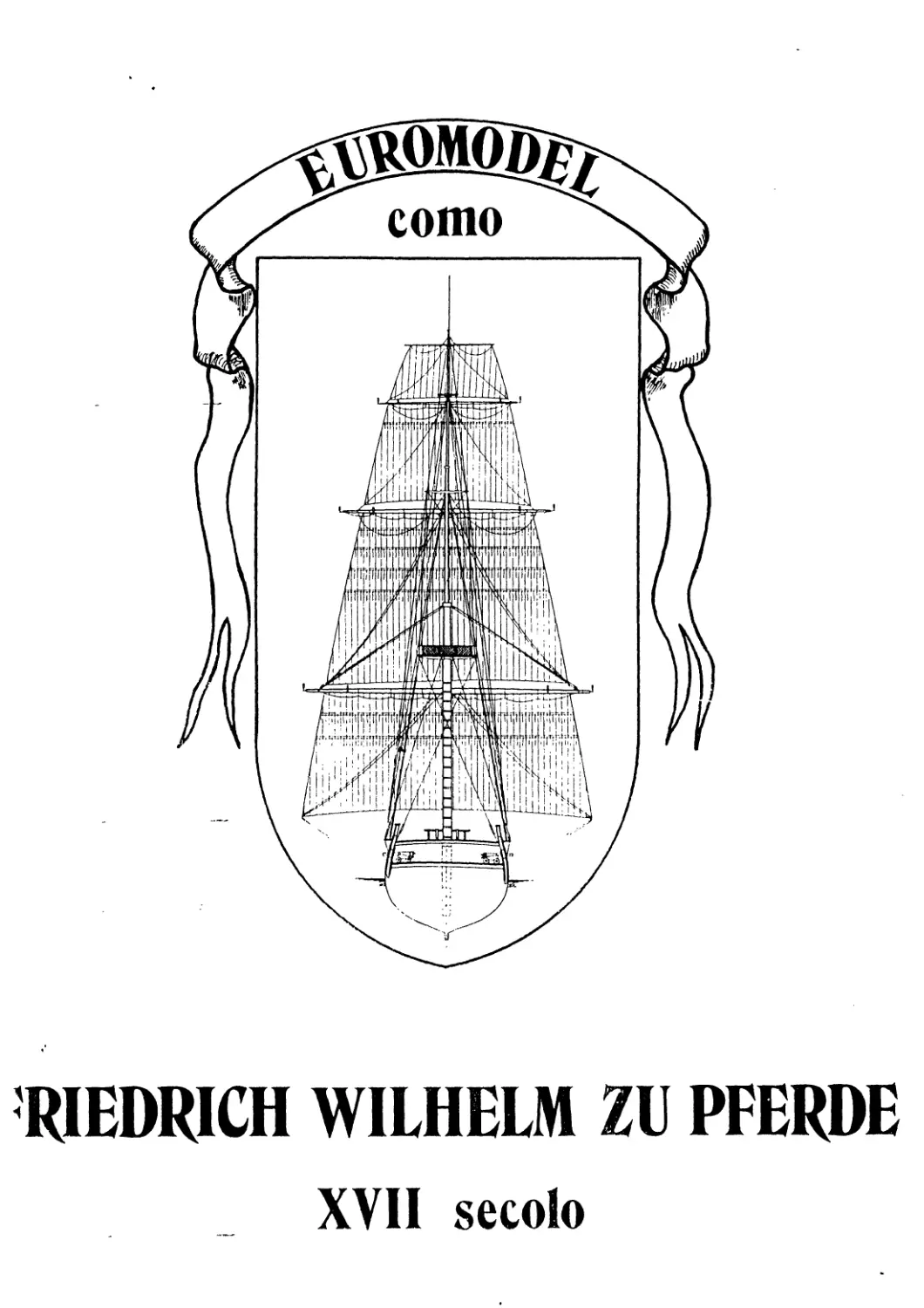
KIEDRICH WILHELM ZE PFERDE

XVII secolo
'EUYOmOcfeC S.n.c.

"Via Ost ine (li, 56/A

22100 Como (CO)

/Tory

Friedrich Wilhelm zu pferde

History:

The “Friedrich Wilhelm zu Pferde”was built between 1660 and 1661 in the
shipyard of Pillau Princpaute by Mr. G.C. Peckelhering.

It’s lengh was equal to 125 feet , the width 32 feet and the tonnage about
900 tons.

The ship was predisposed for an equipment of 50/60 guns and it had a crew
of 250 men.

The “Friedrich Wilhelm zu Pferde” made several strips. In 1685 from
Pillau to Emden , in September 1691 from Emden to Shetland Islands , under the
guide of Captain Jean Le Sage , as escort of the “Derfflinger”.

On July 25th 1692 the “Friedrich Wilhelm zu Pferde” sailed from Emden ,
togedher with a fleet , to go to the Guinea . Düring the trip it and the
“Salamander” fought togetherwith French ship and they won .

At the time the Brandeburgo was in war toward France . In the night
October 30th/31st 1692 three french ships fougth the “Friedrich Wilhelm zu
Pferede” At the first cannonades Captain Jean Le Sage was killed and the has
been set on fire.
To the modeller:

We have tried to realize the design of the “Friedrich Wilhelm zu Pferede” in the most
complete and detailed way , quoting it in every detail, in order to enable everyone to assembly
this very important model.

The design allows the construction of the ship using both raw materials or already-
made detail, such as supplied with the construction kit.

In both cases , it is however indispensable , in order to achieve good results , the
presence of the modeller for the finishing of certain parts and for the current Titting of the
same.

We therefore invite the modeler to start this job with love , to carefully read the
drawing in order to understand every single detail , not to have the hurry of accomplishing
the job and to intervenue with his Creative sense in case it should be necessary to overcome
some faultiness he should find out, though our good will.

Further-f if he feels it is necessary , we will appreciate any critics or eventual
suggestions for any improvement.

While we thank you for the preference you give us , we wish you a good job.

Instructions:

The following instructions are prioritired to make the construction process as simple as
possible . Please keep in mind they are only suggestions.

Please study the design tables carefully as the instructions highlight only the major
Steps for construction .

Arrange'in position the transversal frames 1 - 10 (see table #11). Inserting the samc in
the respective joints of the keel . Before gluing them , check that they are perfectly parallel
each other and perpendicular to the keel itself.

Insert from the Stern the decks , after having cut them in the middle , Tixing with nails
and glue , then cover the same witl the listels .

Start the construction of the upper stern , by adapting the Supports of the same both
upstars and downstairs , Please pay a particular attention to the constructive details drawn on
table #11.

Mount with a file the frames and the listle blocks covering the stern , by checking with
a listel of the planking that it makes contact and that it takes the exact curving to get the
correct form of the hüll.

On the frames make the corner quarter round ( Fig.l ) in order to enable perfect
support of the listels on the frames.
Fjg^l

Corner of quarter round

Bow filling

Applying the planking:

From the study of the design it’s obvious that the length of the profile of each frame is
different.

The longest piece is the one of the main frame and it becomes smaller toward the bow
and the stern.

Every listel has to be taped in the direction of the bow and stern.

On a separate sheet of paper draw an horizontal line that corresponds to the
longitudinal symmetry axis of the model.

From this line you’II draw a perpendicular line for each frame .

Each line has to be numbered with the corresponding frame nuinber. (Fig. 2)

Eig^
Example:

Main frame length (LO) : Planking Strip width = Strips number of each side (Nr)

LI: Nr = Width of the strip in position of frame II l)

L2 : Nr	=	Width	of the strip in position of frame	H	2)

L3 : Nr	=	Width	of the strip in position of frame	II	3)

L4 : Nr	=	Width	of the strip in position of frame	II	4)

L5 : Nr	Width	of the strip in position of frame	II	5)

LA : Nr Width of the strip in position offrame HA)

LB : Nr	Width of the strip in position offrame II B) etc. etc. etc.

To the hull-framework , apply a listel horizontal to the hüll starting from the main
frame to the deck bridge next draw with a pencil on the frame the larger part of the listel.

With a yarn you can have the profile of each frame starting from the line already
drawn up to the keel.

This will teil you the length of each frame.

The first survey to be made is the one on the main frame and the length of its profile
has to be transferred on the corresponding line of the design already drawn .

At this point you’ll divide with a ruler the length of the profile of the main frame by
the width of the planking listel.

You’ll see that the Segments will correspond to the number of listels you need to plank
a hüll side.

It’s necessary then to survey the length of the other frame and take them back on the design.

Each survey has to be divided in similar segments. The number must be the same as
the number utilized for the subdivision of the section on the main frame.

For example : If the section of the main frame has been divided into 20 parts also then
the other frames have to be subdivided into 20 parts.

Take the listel away and sign on the border each listel in order to have a safe drive
during the application of the plunking.

Repeat everything for the other side of the hüll.

From the designs try to make a diagram in order to have a rcference to taper the
planking listels. (Fig. 3).

EigJ5

Example of diagram obtained from Fig 2
The expert model-maker can eventually prepare the planking listels directly front the
framework.

Every listel has to be profiled following the diagram, with the help of a pack-plane,a
rasp, a small saw or a glass paper.lt is your choice depending on the quantity of material you
need to remove. This is a job that requires a lot of ATTENTION and PATIENCE for
good results.

The application must be made with glue and each listel must stay in place on every
frame with the help of thin rivets or pins than can be taken off as soon as the glue is dry.

We suggest you to begin by putting the first listel from the battery-deck and proceed
than with pairs (left side and right side) in order to avoid a crooked hull due to the drying of
the glue. In case you have some problems with the wood listels, here are some suggestions to
keep them soft and flexible.

A)	Wet the listels with very hot water.

B)	Run the listel back and forth on the top of a soft-solderer ( 30/40 Watt)
until they have reached the right flexibility . Be careful not to burn the listel.

C)	Try to enervate the inside part of the listel making some notches on the
wished part.

The application of the listels from the top to the bottom must stop at half width of the
hull.

Continue from the keel up to the top , possibly alternating the courses.

You’ll then have some empty course.

These courses will be left for later as they are larger and will obtain a perfect union of
the planking and , consequently , a Strong hull.

As soon as the glue dryes , continue finishing the hull, removing all rivets.

Proceed scraping by using small pieces of broken glass or with a scraper.

Removes all imperfections and wrinkles .

Next smooth the hull, graduating the thickness of the paper.

Finish the planking by putting the wales and the size caprails.

Cut out the gun pbtters.

Place the guns ofjtjie battery deck .

Start with the construction of the stern decorating .

Attach the bow wheel, the false keel, the stern wheel and the rudder.
Start the construction of the poop buttocks . Their form and size can be realized after
a very carefull checking of the table # 10 . In this table you will find the longitudinal and
vertical sections essential for the execution of a correct work .

At the end you will execute the coach box . It need a lot of precision and patience . Its
correct executionwill give a great relief to the niagnificence of the model.

The size of the coach box cannot be fixed in advance , as it depends from the way the
modeller will have executed the prow of the model itself.

Hovever , checking the tables # 1 and # 2 it is possible to realize the bending radius of
the listel which surrounds the joining of the stern wheel and the prow itself.

We talk now about the level of stern :

On table # 2 you will find drawing of the stern level view in all its parts . After you
have looked at it, follow our instruction to realize it easier .

After you have bended Friedrich Wilhelm’s picture , glue it on the middle side of the
stern view according with the drawing . Utilize epoxidie glue to joint the Steel golden parts
toghether with the window directly below the picture up mentioned . Windows and Steel must
be positioned on the transversal longheron .

It’s very important that the transversal longheron stick out , because it support the
caryatids and the frames of the level of the stern .

This frames must be worked out by the wood ledges with the following dimension :
4x30x400 and accuratly coopied from table # 2 .

We reccomand you to well Finish all this pieces paziently even if it will require long
time , to be sure on your job done .

We hope, now , you have completed all the more difficult parts.

It remains you to adorn the ship with all the gold decoration and to position the guns .

Timber for masts :

The construction of all the component of the masts , probably , is the more delicate
stage of all the assembly .

We suggest you to fit out , first of all , the element as top , mast sector , yards , etc ,
than to fit out the three masts and bow Sprit wich are subsequently placed on the sheep
already completed in all their additional as brace , block destined to the rigging .

The domension , position and the taper of the various rods , must read from table # 6.
The taper is one of the job to be done much carefully (the result is much evident, even
when the sheep model is completed ); using , first , a little wooding plane or rasping file ,
second , with sand paper of many dimension ( before big than little ).

Do much attention to the assembly of the crosstree , which need notches and holes
where the iron gunter go through end fixed with a droop of glue .

The colouring of the yards must be done before their Installation .

By the relief on table # 6 of the top section of the main mast , the fore mast , the mizen
mast, the fore topmast, the bowsprit, the top gallant mast, etc.

You can notice that to the bottom there is a certain bending fundamental to position between
cap and cross-töp ( 01-06 ).

Final gluing of masts into their seats , must be done after you have well checked the
exact inclination and allineament ( see table # 2 ) during drying-process .

Mast can be kept in a right position by temporary threads fixed in various side of the
boats.

We reccomend you to set only the first part of every singol mast , in order that the
fixing of the shrouds will be easy .

The guards-shrouds must be placed on the first beit, than put into the apposit notches
of the guards-shrouds the chain-plates and fixing them by a drop of glue and a little nail ( see
table #02) . In the meantime you have prepared the gusrds , that you will set on the first part
of the masts.

Ended this job you begin the fitting out of the Standing rigging , that are those
wich are not used during the sailing and which have the function to hold the masts ( see table
# 7) . Set, first, the bow sprit , than the fore-mast , and the mizen mast , in order to fix the
rigging without any abstacle .

Now keep attention to set out the tops , that are made by two disks laid iipon with
brest band set diagonally ; than position the parapet and glue . When it is well dry , drill the
base of the tops to pass true deadeye . Now fit the braces that are part of the Standing rigging .

The following Operation is to fit out the bowsprit and its rigging , after glued the
bowsprit and its-mast - Step , than mount the top of bowsprit ( made as the one above
mentioned ).

Now fix the fore - topmast with its cross-tree and caps , last the rise of topmast with the
flag.
Ended this Stage you have to position the spritsail yard and fore sail yard , their
rigging , send again to the foremast - brace , will be holded to the marlinespike-bow .

If you want try the sail, reinember that the sheet have a binding to the marlinespike of
the bow deck handrail, starting from a little ring situated on the side of the sheep .

All the rigging should be on table # 7 and table # 9 .

All the yard mast be erected and their rigging , bridle into the parrel , go by the cap ,
than a double block , last a second block already fixed the deck near the bottom inasts .

The rigging of the tackle end to the belaying pin rack , that is at the bottom of the
inasts

For the rigging of the brace there are the binding to the brace , go by brace-block ,
shrouds block and belayin pin of the handreil of the decks .

The same Utting for the rigging of the main mast and niizen mast .

Don’t forget to look very carefully the drawing before begining the job to avoid any mistake .

We think that at this point the most difficult work has been made .

The modeler will have to decorate the ship with goldened freezes and to place the guns
of the main-deck , of the quarter-deck and of the opposite quarter-deck .

We belive that it is uselles to trace a detailed plan for the conted in table # 6-7-8-9 .

You will start with the mainsail, then the foremast, then again with the mizzen and at
the end the bowsprit.

We hope the designs and instructions are helpful.

We would like to thank you once again for your choice of our products and we wish
you a happy LAUNCH.

We would appreciate if , when you have finished the model , you could send us a
picture or dia-positive of your job as well as any comments you may have .

This allows us to improve our model and eliminate any problems you may have had.

Send to :	EDROMODEL Snc

Via Ostinelli, 56/A

22100 COMO (CO) -ITALY-
Internet e-mail: euromode@tin.it or euromode@mbox.vol.it

(Photos and comments will become the property of EUROMODEL Snc)
Components list

99/004

N°1	Keel
N° 10	Frames
N°1	Upper stern
N°1	Lower stern
N° 7	Supports of stern
N-°l	Wheel stern
N°1	Wheel bow
N° 1	Ruddler
N°9	Decks and chainwales
N°1	Base board
N° 1	Stern inlaying decoration	Art.33/008
N°1	Complete Serie of single decorations (124 pieces)	Art.l 1/102
N° 20	Guns mm. 55	Art.l 1/084
N° 18	Guns mm. 50	Art.l 1/114
N° 10	Guns mm. 45	Art.l 1/115
N°4	Guns mm. 38	Art.11/116
N° 38	Guns carriages	Art.22/123
N° 10	Guns carriages	Art.22/125
N°4	Guns carriages	Art.22/008
N°40	Guns carriages wheel mm. 9
N° 76	Guns carriages wheel mm. 7
N° 64	Guns carriages wheel mm. 6
N° 28	Guns carriages wheel mm. 5
N°1	Axle for gun carriage in ramin dowel mm. 4 x 500
N°3	Axle for gun carriage in ramin dowel mm. 3 x 500
N°1	Axle for gun carriage in ramin dowel mm. 2 x 500
N°3	Complete set of ladders	Art.22/070
N° 1	Plate of base board	Art.12/004
N° 15	Column mm. 18	Art.22/119
N°6	Cleats	Art.22/271
N° 1	Capstan	Art.22/134
N° 12	Mast cleats mm. 8	Art.l 1/048
N°2	Cleats for ropes	Art.l 1/049
N°50	Gräting kit mm. 60	Art.22/003
N°200	Gräting kit mm. 40	Art.22/003
N°4	Deadeye mm. 3	Art.l 1/358
N°4	Deadeye mm. 3	Art.l 1/436
N°4	Deadeye mm. 5	Art.l 1/435
N°8	Deadeye mm. 5	Art.l 1/437
N° 30	Deadeye mip, 7	Art.l 1/306
N°4	Mast cap	Art.22/043
N°3	Mast cap	Art.22/044
N°2	Mast cap	Art.22/045
N° 2	Mast cap	Art.22/046
N°15	Belaying-pin mm. 14	Art.22/088
N°12	Belaying-pin mm. 12	Art.22/087
N°84	Hinges guns port	Art.11/052
N° 5 Hinges for ruddler
N° 2 Barrel

N°60 Deadeye mm. 7
N°32 Deadeye mm. 5
N°26 Deadeye mm. 3
N°132 Block mm. 3 one way
N°50 Block mm. 5 one way
N°15 Block mm. 7 one way
N°15 Block mm. 5 two way
N° 5 Block mm. 7 two way
N°20 Block mm. 3 two way
N° 6 Block mm 10 one way
N° 2 Block mm.lO two way
N° 4 Block mm.10 three way
N° 2 Block sister mm. 16
N°20 Block sister mm. 11
N°12 Block sister mm. 7
N° 1 Stern lantern

N° 2	Emergency anchor with blocks

N° 2	Bower with blocks

N° 1	Lifeboat mm. 110 with keel

N° 1	Lifeboat mm. 150 with keel

N° 1	Lime block mm. 50 x 60 x 180

N° 1	Lime block mm. 35 x 60 x 120

N° 1 Plywood mm. 1 x 85 x 300
N° 100 Lime strips-mm. 1,5 x 6 x 760
N° 4 Lime Strips mm. 2,5 x 5 x 760
N° 100 Walnut Strips mm. 1 x 6 x 760
N° 40 Walnut Strips mm. 0,5 x 6 x 710
N° 1	Walnut Strip mm. 10 x 10 x 630

N° 1	Walnut Strip mm. 10 x 10 x 330

N° 6	Walnut Strips mm. 2 x 8 x 760

N° 8	Walnut strips mm. 2 x 5 x 760

pins, Upper circle of mast top)

N° 1	Walnut strip mm.	2 x 20 x 760

N° 1	Walnut strip mm.	1 x 14 x 760

N° 1	Walnut strip mm.	9 x 11 x 150

N° 1	Walnut strip mm.	9 x 14 x 150

N° 6 Walnut Strips mm. 2 x 2 x 760
N° 1 Walnut strip mm. 2 x 4 x 560
Bowsprit, Main mastjack)

N° 1	Walnut strip mm. 6 x 6 x 300

N° 2	Walnut strips mm. 2 x 2 x 500

N° 3	Walnut strips mm. 2 x 2 x 700

, Stern buttock decqration)

N° 1	Walnut strip mm. 8 x 8 x 200

N° 1	Walnut strip mm. 2 x 3 x 760

Jack, Bowsprit Jack )

N° 1	Walnut strip mm.	3 x 15 x 400

N° 1	Walnut strip mm.	5 x 6 x 140

N° 1	Walnut strip mm.	2,5 x 4 x 140

N° 1	Walnut strip mm.	6 x 7 x 140

Art.l 1/294

Art.22/111

Art.22/022

Art.22/020

Art.22/018

Art.22/026

Art.22/028

Art.22/030

Art.22/032

Art.22/034

Art.22/031

Art.22/116

Art.22/115

Art.22/114

Art.22/129

Art.22/084

Art.22/083

Art.55/003

Art.l 1/108

Art.l 1/109

Art.88/009

Art/88/013

(Stern buttock)

(Filler block bow)

(Mast-top basement)

(1° Planking)

(Longitudinal streams)

(2° Planking)

(Decks covering)

(False-keel)

(Base board)

(Wales)

(Wales , Caprailsize . Belaying circle of

(Guns port)

(Border ofguns port)

(Bollard)

(Big bollard)

(Base for capstan , Gräfin ofserpa)

(Stair of outside stair, Coastal Jack,

(Pinrail)

(Borders ofgralings)

(b'ore lower mast Jack, Bowsprit Jack

(('atheads)

(Borders ofgrating , Main top gallant sail

(Chain-wales)

(Fore main mast Coastal Jack)

(Fore main mast Coastal jack)

(Main mast Coastal Jack)
• N° 1 Walnut strip mm. 3 x 4 x 80	(C rosst ree of main topsail coastal jack)
• N° 1 Walnut strip mm. 2 x 3 x 80	(C rosst ree of main topsail jack)
• N° 1 Walnut strip mm. 1 x 3 x 110  Coastal Jack	(Crosstree ofmain and mizzen topsail
• N° 1 Walnut strip mm. 3 x 3,5 x 220 lower jack)	(Mizzen lower mast coastal jack , Mizzen
• N° 1 Walnut strip mm. 2 x 2,5 x 50	(Mizzen topsail coastal jack)
• N° 1 Walnut strip mm. 4 x 17 x 150	(Supports ofmast tops)
•	N° 1	Walnut strip mm. 2 x 4 x 400  •	N° 1	Complete series of ramin masts :	(l)ecoration of stern huttock)

N° 1 Diam. mm. 12 x 710

N° 1 DiamTmm. 12 x 340

N° 1 Diam. mm. 10 x 720

N° 1 Diam. mm. 8 x 570

N° 1 Diam. mm. 6 x 700

N° 1 Diam. mm. 6 x 580

N° 1 Diam. mm. 5 x 360

N° 1 Diam. mm. 4 x 650

yard and bowsprit.)

N° 1 Diam. mm. 3 x 610

N° 1 Diam. mm. 3 x 200

N° 1 Diam. mm. 2 x 70

(Main mast, Fore mast)

(Bowsprit)

(Main lower mast, Fore mast)

(Mizzen lower mast, Fore lower topsail jard)

(Main lower topsail jard, Fore royal sail mast)

(Fore lower topsail jard, Spritsail yard, Bowsprit)

(Mizzen yard, Yih bowsprit)

(Main top gallant sail, 2° fore royal soul mast, Fore lower topsail

(Outrigger ofmain lower yard, Outrigger offoremain yard))

(Flags pole)

(Bowsprit flag pole)

• Mt. 10	Rigging yarn for ship mm. 0,25	Art.77/025
• Mt. 10	Rigging yarn for ship mm. 0,40	Art.77/040
• Mt. 10	Rigging yarn for ship mm. 0,60	Art.77/060
• Mt. 10	Rigging yarn for ship mm. 0,80	Art.77/080
• Mt. 10	Rigging yarn for ship mm. 1,00	Art.77/100
• Mt. 5	Rigging yarn for ship mm. 1,50	Art.77/150
• N° 1	Complete series of flags	Art.13/024
• N° 1	Complete series of cloth sail mm. 450 x 900	Art.15/004
• N° 1	Complete series of plants (N° 11 Table)	Art.66/004
	Instruction for assembling
	Fotocolor
ERRATA CORRIGE

.OSS.'-4-