/































































































































Tags: dictionary
ISBN: 978-1-4654-5894-0



Text
                    Outer margin
Costal
£ vSv margin
Antenna
Compound
Head
Thorax
Abdomen
Hind
wing
Abdominal
segment
DICTIONAR

ultimate
VISUAL
dictionary
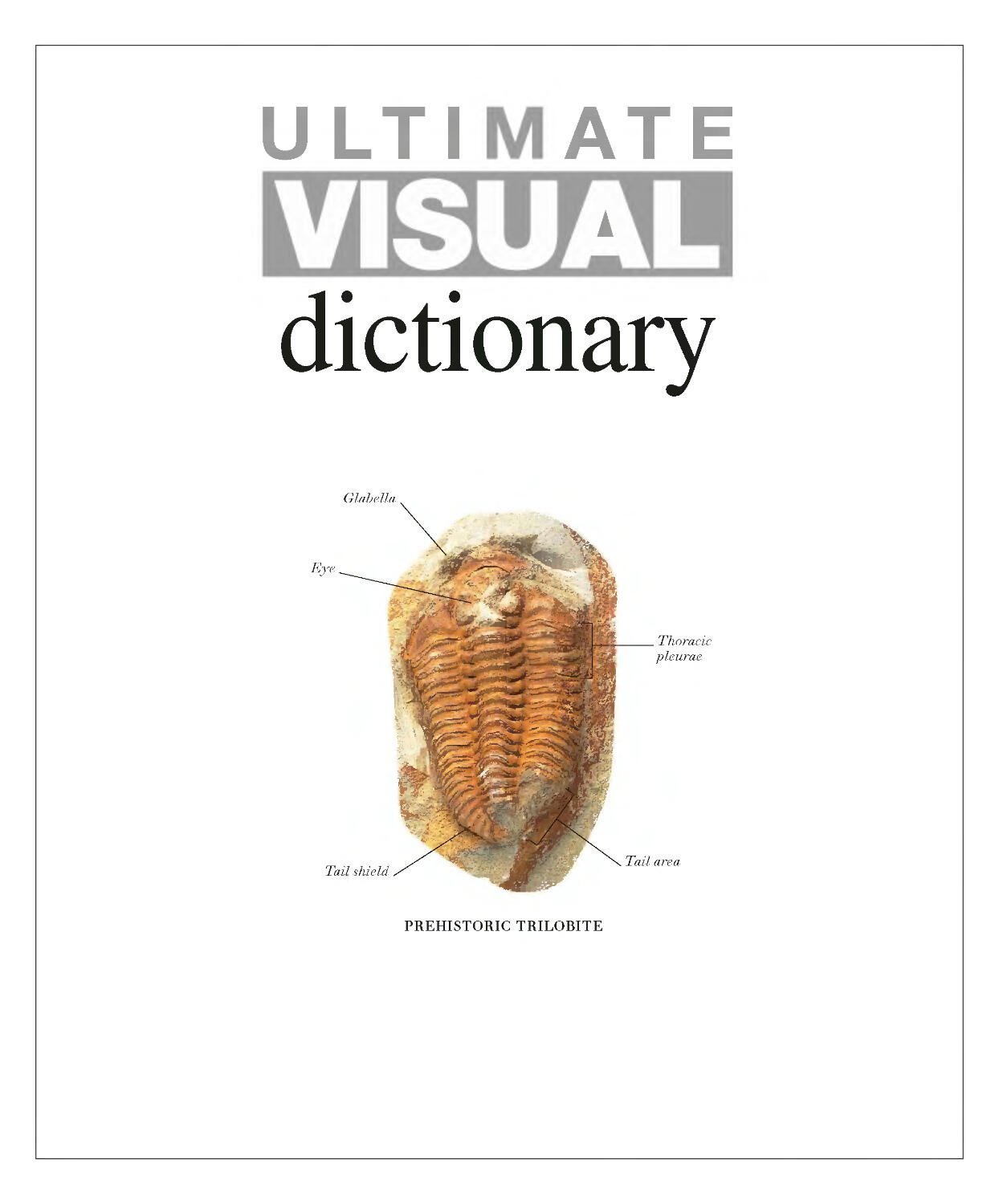
Tail shield
Glabella
Thoracic
pleurae
Tail area
PREHISTORIC TRILOBITE

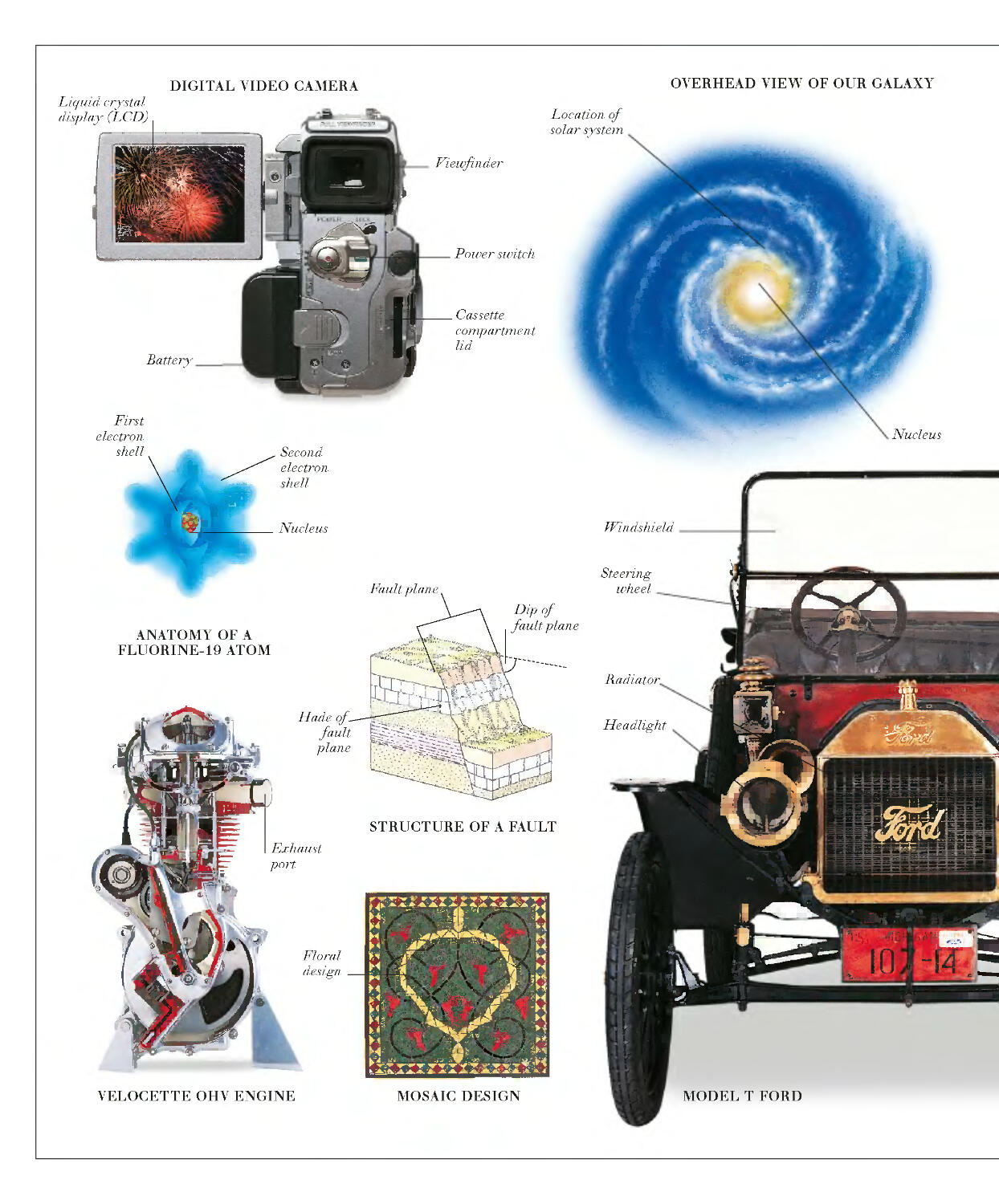
DIGITAL VIDEO CAMERA
OVERHEAD VIEW OF OUR GALAXY
Liquid crystal
display (LCD)
Location of
solar system
		' B
Viewfinder
Power switch
Cassette
compartment
Battery
First
electron
shell
Nucleus
Second
electron
shell
Windshield
Nucleus
Steering
wheel
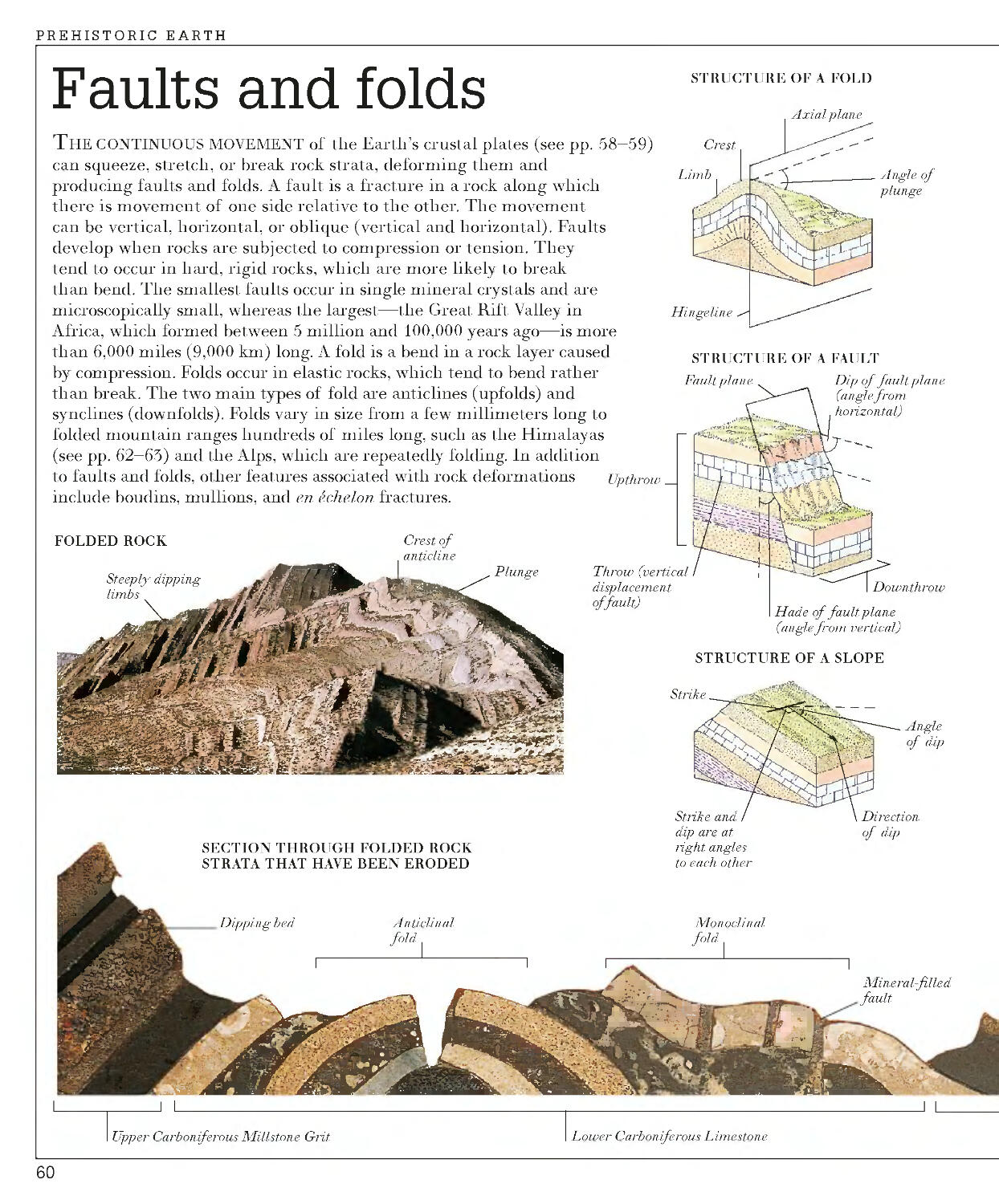
Fault plane
lane
ANATOMY OF A
FLUORINE-19 ATOM
Radiator
Hade of -
fault
plane
Headlight
STRUCTURE OF A FAULT
Exhaust
port
Floral
VELOCETTE OHV ENGINE
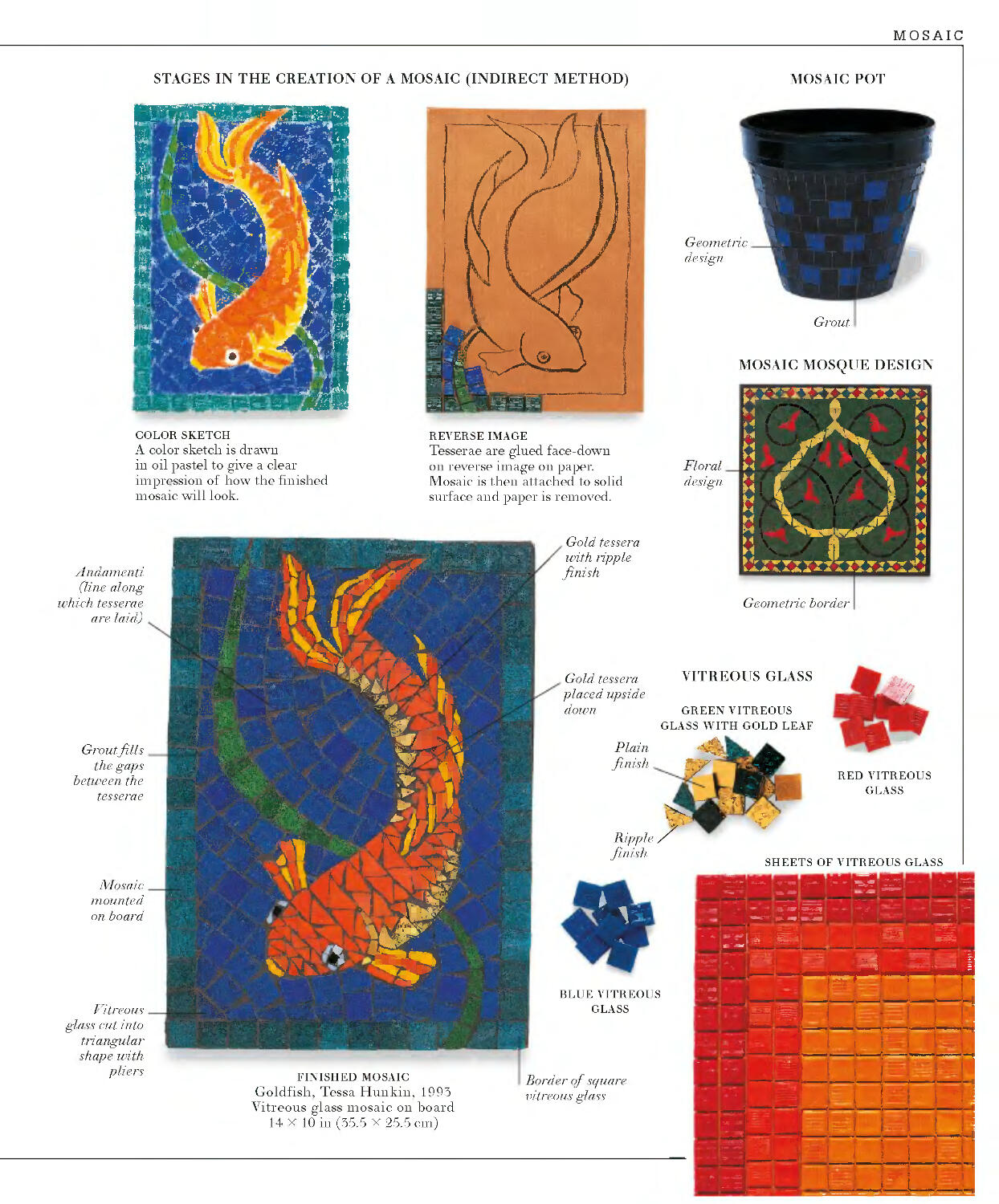
MOSAIC DESIGN
MODEL T FORD
r
ZZ- 1 - • . \
.
.A.

u lti m ate
VISUAL
dictionary

Penguin
Random
House
THIS EDITION
DK LONDON
Editorial Consultants Ian Graham, Darren Naish, Carole Stott
Picture Researcher Karen VanRoss
Jacket Designer Silke Spingies
Digital Conversion Coordinator Linda Zacharia
Production Editor Joanna Byrne
Production Controller Linda Dare
Managing Editor Julie Ferris
Managing Art Editor Owen Peyton Jones
Art Director Philip Ormerod
Associate Publishing Director Liz Wheeler
Publishing Director Jonathan Metcalf
DK DELHI
Managing Art Editor Arunesh Talapatra
Managing Editor Saloni Talwar
Deputy Managing Art Editor Priyabrata Roy Chowdhury
Senior Art Editor Rajnish Kashyap
Senior Editor Neha Gupta
Art Editors Arijit Ganguly, Pooja Pipil
Assistant Art Editor Pooja Pawwar
DTP Manager Balwant Singh
DTP Designer Jaypal Singh Chauhan
Managing Director Aparna Sharma
Anatomical And Botanical Models Supplied By Somso Modelle, Coburg, Germany
ORIGINAL EDITION (Ultimate Visual Dictionary)
Project Art Editors Heather McCarry, Johnny Pau, Chris Walker, Kevin Williams
Designer Simon Murrell
Project Editors Luisa Caruso, Peter Jones, Jane Mason, Geoffrey Stalker
Editor Jo Evans
DTP Designer Zirrinia Austin
Picture Researcher Charlotte Bush
Managing Art Editor Toni Kay
Senior Editor Roger Tritton
Managing Editor Sean Moore
Production Manager Hilary Stephens
First American edition published under the title
Ultimate Visual Dictionary, 1994
This revised edition published in 2017 by
DK Publishing
345 Hudson Street
New York, New York 10014
17 18 19 20 21 10 9 8 7 6 5 4 3 2 1
001—299759—Jan/17
REVISED EDITIONS IN 1996, 1997, 1998, 1999, 2000, 2002, 2006, 2011, 2016, 2017
Copyright © 1994, 1996, 1997, 1998, 1999, 2000, 2002, 2006, 2011, 2016, 2017 Dorling Kindersley Limited
All rights reserved under international and pan-american copyright conventions.
No part of this publication may be reproduced, stored in a retrieval system, or
transmitted in any form or by any means, electronic, mechanical, photocopying,
RECORDING OR OTHERWISE, WITHOUT THE PRIOR WRITTEN PERMISSION OF THE COPYRIGHT OWNER.
PUBLISHED IN GREAT BRITAIN BY DORLING KINDERSLEY LIMITED.
A CATALOG RECORD for THIS BOOK IS AVAILABLE from the LIBRARY of congress.
ISBN 978-1-4654-5894-0
Printed and bound in China
A WORLD OF IDEAS:
SEE ALL THERE IS TO KNOW
www.dk.com
4

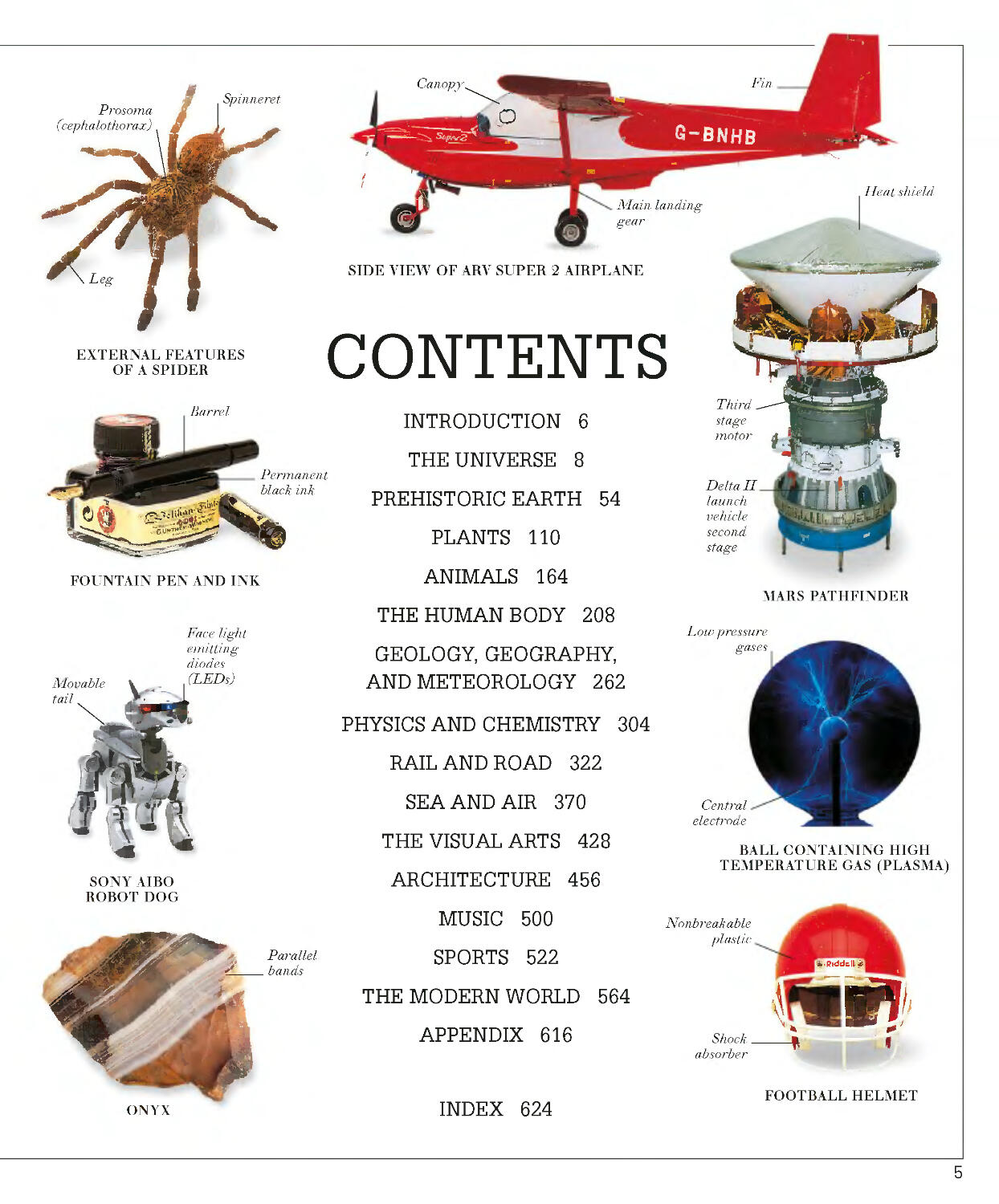
EXTERNAL FEATURES
OF A SPIDER
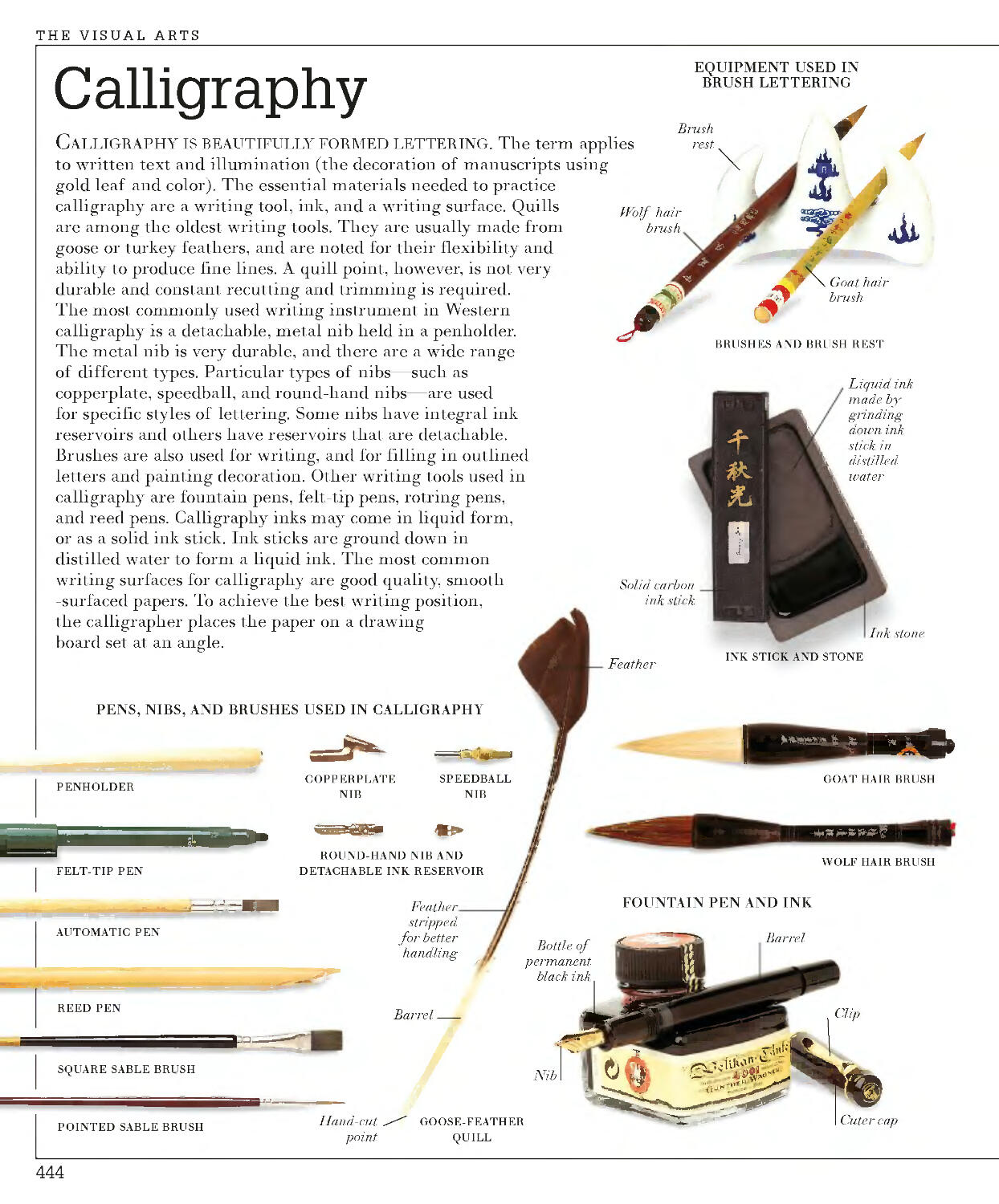
Barrel
Permanent
black ink
FOUNTAIN PEN AND INK
Face light
emitting
diodes
SONY AIBO
ROBOT DOG
Parallel
bands
SIDE VIEW OF ARV SUPER 2 AIRPLANE
CONTENTS
INTRODUCTION 6
THE UNIVERSE 8
PREHISTORIC EARTH 54
PLANTS 110
ANIMALS 164
THE HUMAN BODY 208
GEOLOGY, GEOGRAPHY,
AND METEOROLOGY 262
PHYSICS AND CHEMISTRY 304
RAIL AND ROAD 322
SEA AND AIR 370
THE VISUAL ARTS 428
ARCHITECTURE 456
MUSIC 500
SPORTS 522
THE MODERN WORLD 564
APPENDIX 616
Third
stage
motor
Delta II
launch
vehicle
second
stage
MARS PATHFINDER
Low pressure
gases
Central
electrode
BALL CONTAINING HIGH
TEMPERATURE GAS (PLASMA)
Nonbreakable
plastic
Shock
absorber
ONYX
INDEX 624
FOOTBALL HELMET
5

Introduction
HE VISUAL DICTIONARY is a
completely new kind of reference
book. It provides a link between pictures
and words in a way that no ordinary
dictionary ever has. Most dictionaries
simply tell you what a word means, but
the Visual Dictionary shows you—through
a combination of detailed annotations,
explicit photographs, and illustrations.
In the Visual Dictionary, pictures define
the annotations around them. You do not
read definitions of the annotated words,
you see them. The highly accessible
format of the Visual Dictionary, the
thoroughness of its annotations, and
the range of its subject matter make
it a unique and helpful reference tool.
How to use the Visual Dictionary
You will find the Visual Dictionary simple to use.
Instead of being organized alphabetically, it is
divided by subject into 14 sections—The Universe,
Prehistoric Earth, Plants, Animals, The Human Body,
etc. Each section begins with a table of contents
listing the major entries within that section. For
example, The Visual Arts section has entries on
Drawing, Tempera, Fresco, Oils, Watercolor, Pastels,
Acrylics, Calligraphy, Printmaking, Mosaic, and
Sculpture. Every entry has a short introduction
explaining the purpose of the photographs and
illustrations, and the significance of the annotations.
If you know what something looks like, but don’t
know its name, find the term you need by turning
to the annotations surrounding the pictures; if you
know a word, but don’t know what it refers to, use
the comprehensive index to direct you to the
appropriate page.
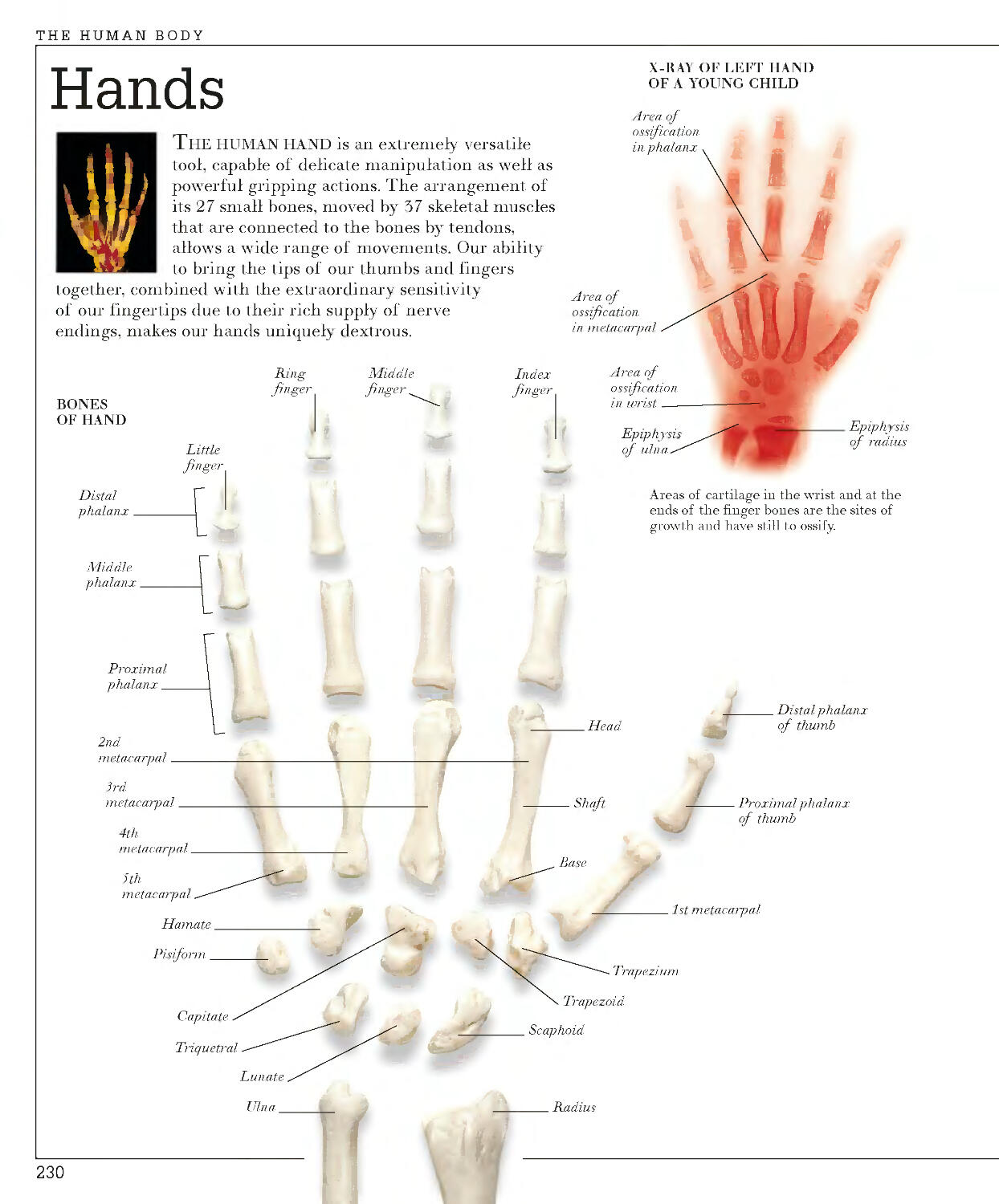
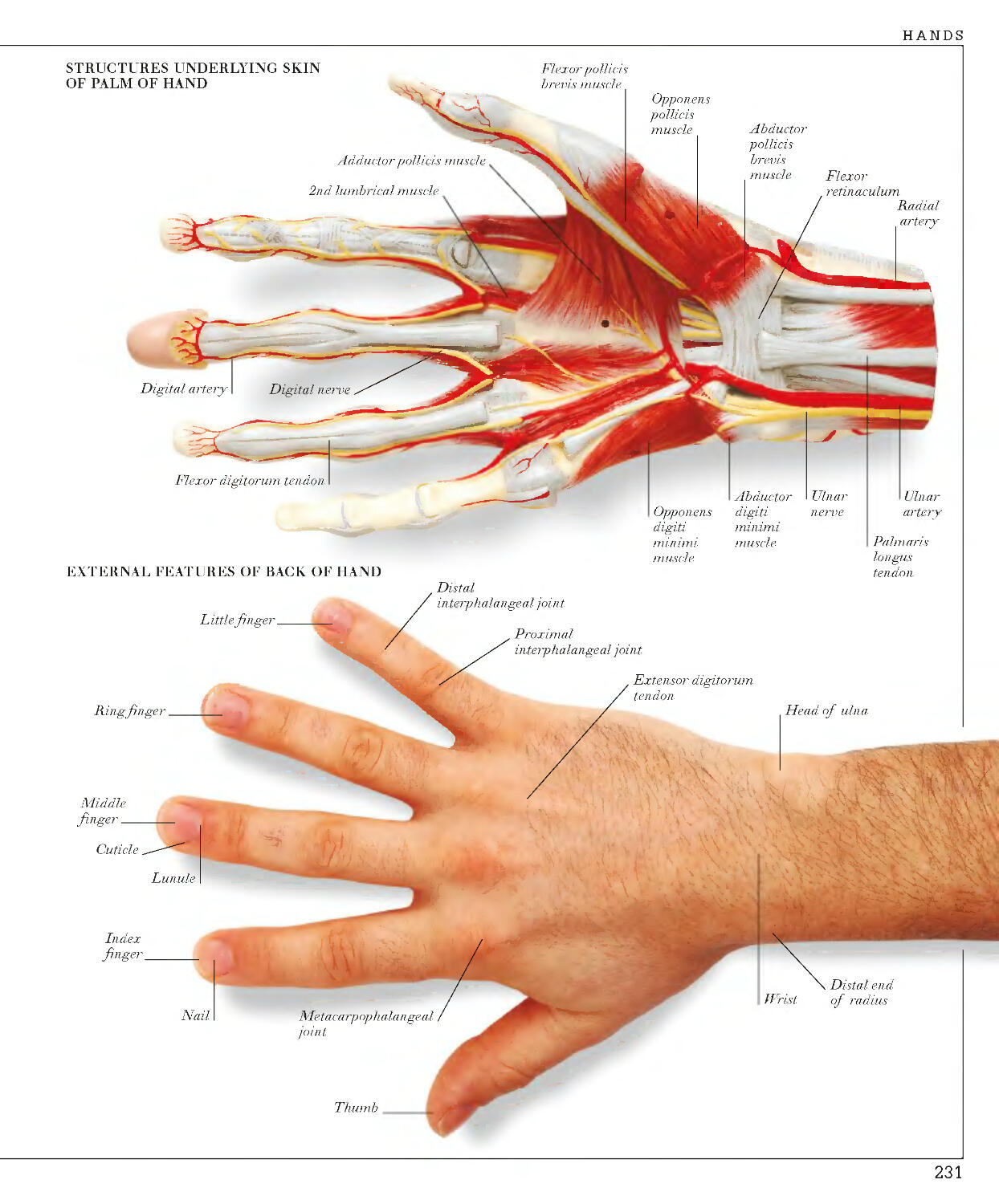
Suppose that you want to know what the bone
at the end of your little finger is called. With a
standard dictionary, you wouldn’t know where
to begin. But with the Visual Dictionary you simply
turn to the entry called Hands—within The Human
Body section—where you will find four fully
annotated, color photographs showing the skin,
muscles, and bones of the human hand. In this entry
you will quickly find that the bone you are searching
for is called the distal phalanx, and for good measure
you will discover that it is attached to the middle
phalanx by the distal interphalangeal joint.
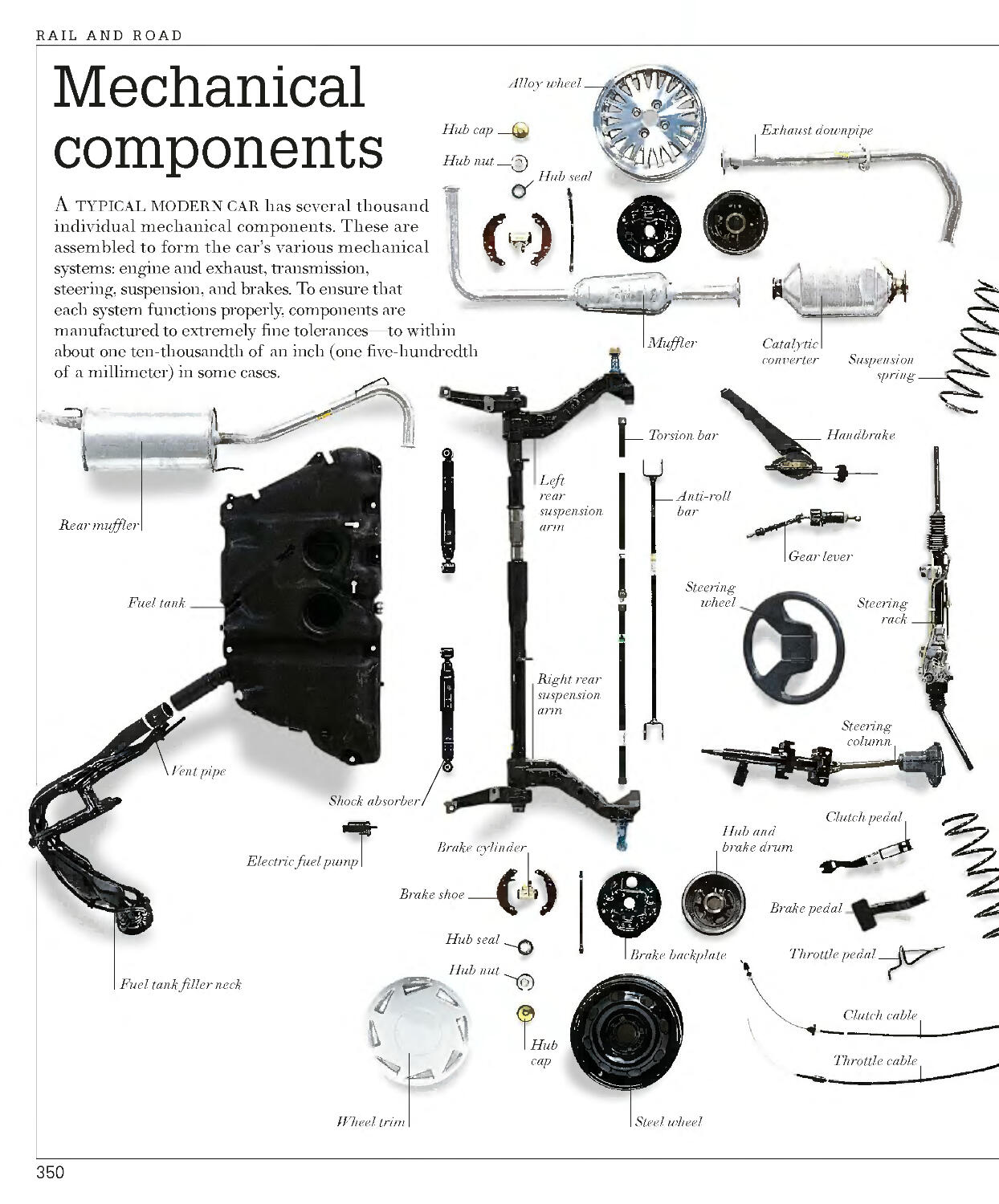
Perhaps you want to know what a catalytic converter
looks like. If you look up “catalytic converter” in an
ordinary dictionary, you will be told what it is and
possibly what it does—but you will not be able to tell
what shape it is or what it is made of. However, if
you look up “catalytic converter” in the index of the
Visual Dictionary, you will be directed to the Modern
engines entry on page 344—where the introduction
gives you basic information about what a catalytic
converter is—and to page 350—where there is a
spectacular exploded-view photograph of the
mechanics of a Renault Clio. From these pages you
will find out not only what a catalytic converter looks
like, but also that it is attached at one end to an
exhaust pipe and at the other to a muffler.
Whatever it is that you want to find a name for, or
whatever name you want to find a picture for, you
will find it quickly and easily in the Visual Dictionary.
Perhaps you need to know where the vamp on a
shoe is; or how to tell obovate and lanceolate leaves
apart; or what a spiral galaxy looks like; or whether
birds have nostrils. With the Visual Dictionary at
hand, the answers to each of these questions, and
thousands more, are readily available.
The Visual Dictionary does not just tell you what the
names of the different parts of an object are. The
photographs, illustrations, and annotations are all
specially arranged to help you understand which
parts relate to one another and how objects function.
With the Visual Dictionary you can find in seconds
the words or pictures that you are looking for; or
you can simply browse through the pages of the
book for your own pleasure. The Visual Dictionary
is not intended to replace a standard dictionary
or conventional encyclopedia, but is instead a
stimulating and valuable companion to ordinary
reference volumes. Giving you instant access to the
language that is used by astronomers and architects,
musicians and mechanics, scientists and
sportspeople, it is the ideal reference book for
specialists and generalists of all ages.
6

Sections of the Visual Dictionary
The 14 sections of the Visual Dictionary contain a
total of more than 30,000 terms, encompassing
a wide range of topics:
•	In the first section, The Universe, spectacular
photographs and illustrations are used to show
the names of the stars and planets and to
explain the structure of solar systems, galaxies,
nebulae, comets, and black holes.
•	PREHISTORIC earth tells the story in annotations
of how our own planet has evolved since its
formation. It includes examples of prehistoric
flora and fauna, and fascinating dinosaur
models—some with parts of the body stripped
away to show anatomical sections.
•	PLANTS covers a huge range of species—
from the familiar to the exotic. In addition
to the color photographs of plants included in
this section, there is a series of micrographic
photographs illustrating plant details—such
as pollen grains, spores, and cross-sections of
stems and roots—in close-up.
•	In the ANIMALS section, skeletons, anatomical
diagrams, and different parts of animals’ bodies
have been meticulously annotated. This section
provides a comprehensive guide to the
vocabulary of zoological classification and
animal physiology.
•	The structure of the human body, its parts, and
its systems are presented in THE HUMAN BODY.
The section includes lifelike, three-dimensional
models and the latest false-color images. Clear
and authoritative annotations indicate the
correct anatomical terms.
•Geology, Geography, and Meteorology
describes the structure of the Earth—from the
inner core to the exosphere—and the physical
phenomena—such as volcanoes, rivers, glaciers,
and climate—that shape its surface.
•	Physics and Chemistry is a visual journey
through the fundamental principles underlying
the physical universe, and provides the essential
vocabulary of these sciences.
•	In RAIL and road, a wide range of trains, trams
and buses, cars, bicycles, and motorcycles are
described. Exploded-view photographs show
mechanical details with striking clarity.
•	SEA AND AIR gives the names for hundreds
of parts of ships and airplanes. The section
includes civil and fighting craft, both
historical and modern.
•	THE VISUAL Arts shows the equipment and
materials used by painters, sculptors, printers,
and other artists. Well-known compositions
have been chosen to illustrate specific artistic
techniques and effects.
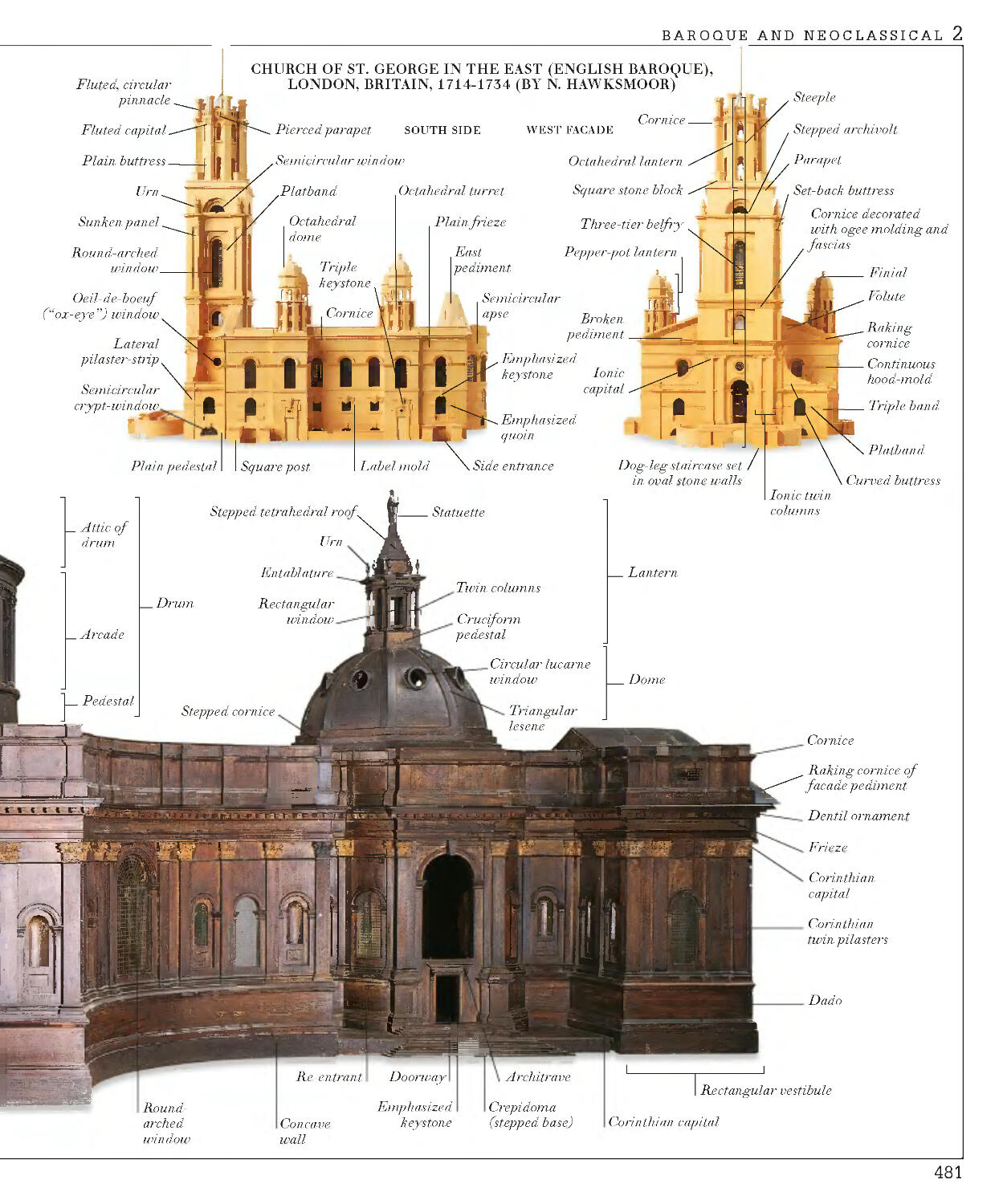
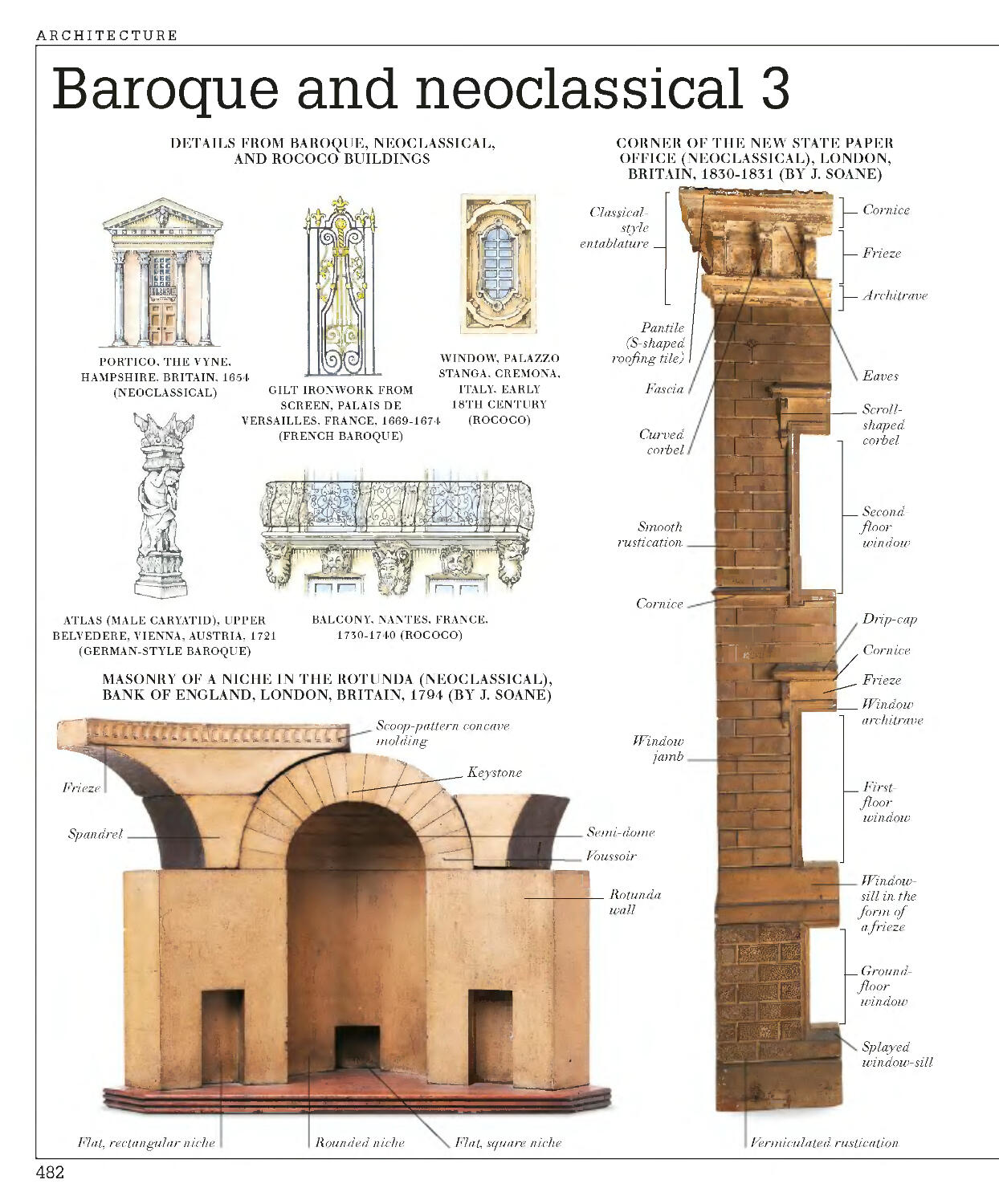
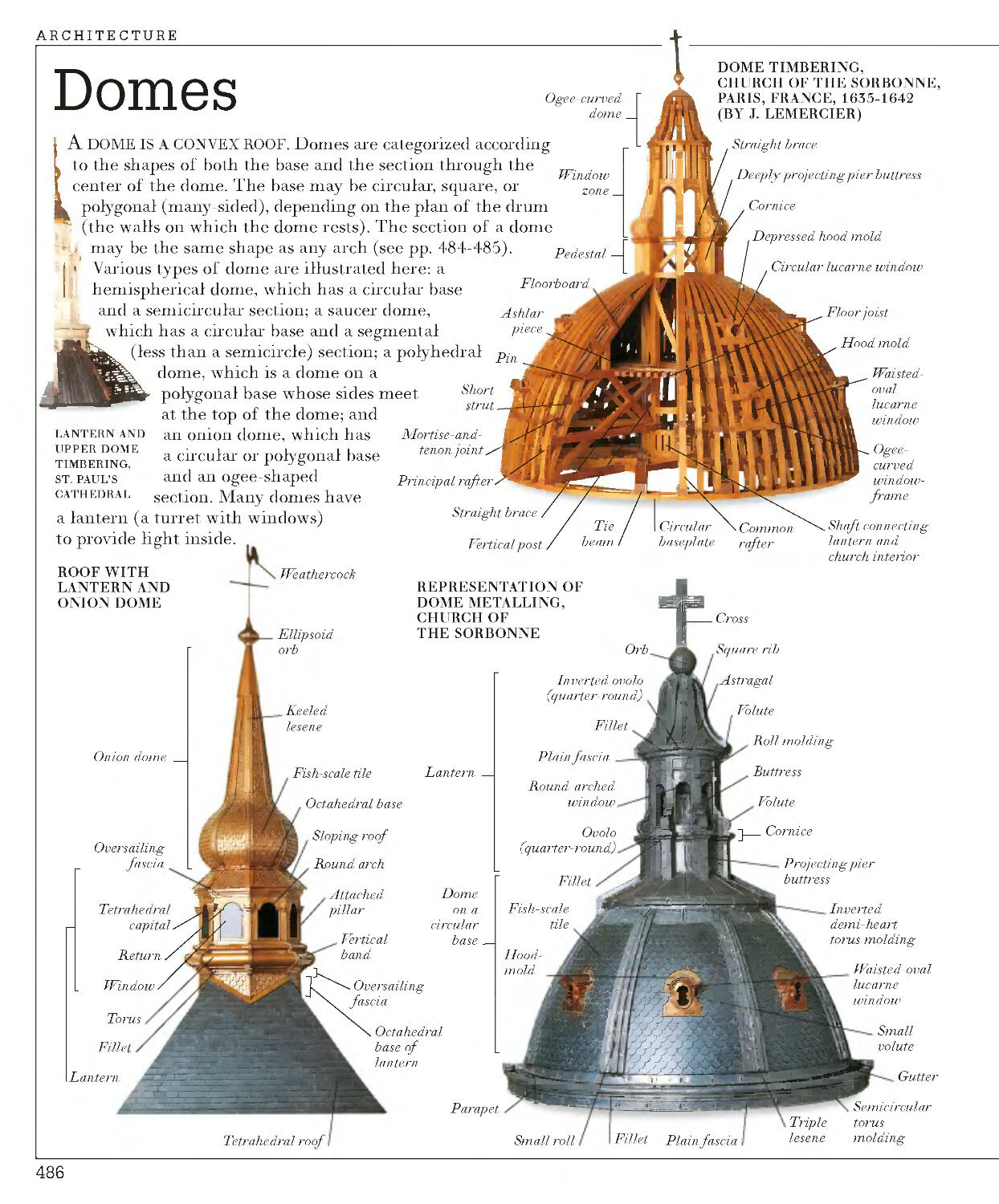
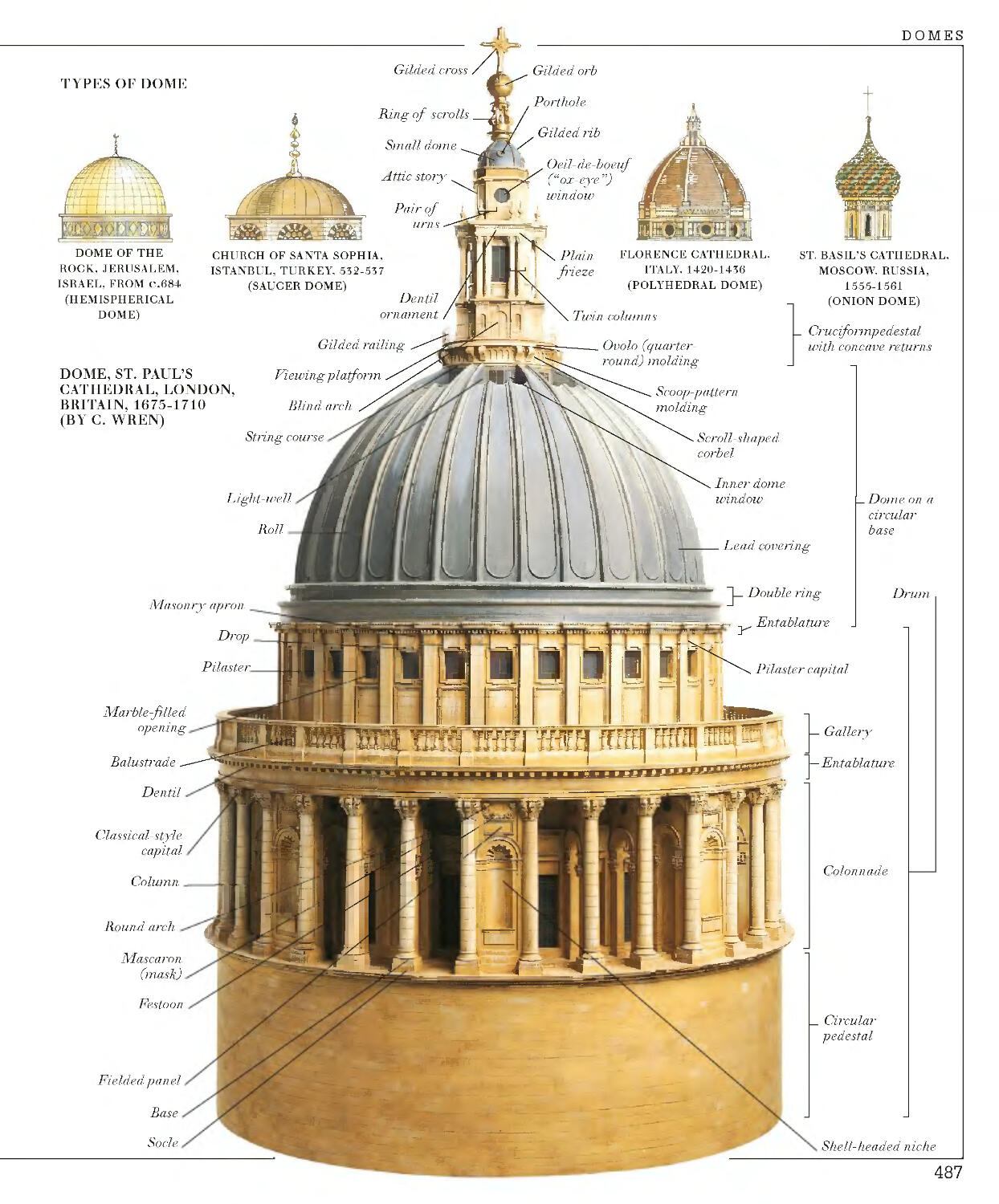
•Architecture includes photographs of
exemplary architectural models and illustrates
dozens of additional features such as columns,
domes, and arches.
•	MUSIC provides a visual introduction to
the special language of music and musical
instruments. It includes clearly annotated
photographs of each of the major groups of
traditional instruments—brass, woodwind,
strings, and percussion—together with modern
electronic instruments.
•	The SPORTS section is a guide to the playing
areas, formations, equipment, and techniques
needed for many of today’s most popular sports.
•	In The Modern World, items that are a
familiar part of our daily lives are taken apart
to reveal their inner workings and give access to
the language used by their manufacturers. It
also includes systems and concepts, such as
the internet, that increasingly influence our
21st century world.
7

The Universe
Anatomy of the Universe	10
Galaxies	12
The Milky Way	14
Nebulae and Star Clusters	16
Stars of N orthern Skies	18
Stars of Southern Skies	20
Stars	22
Small Stars	24
Massive Stars	26
Neutron Stars and Black Holes	28
The Solar System	30
The Sun	32
Mercury	34
Venus	36
The Earth	38
The Moon	40
Mars	42
Jupiter	44
Saturn	46
Uranus	48
Neptune and Pluto	50
Asteroids, Comets, and Meteoroids	52

THE UNIVERSE
Anatomy of the universe
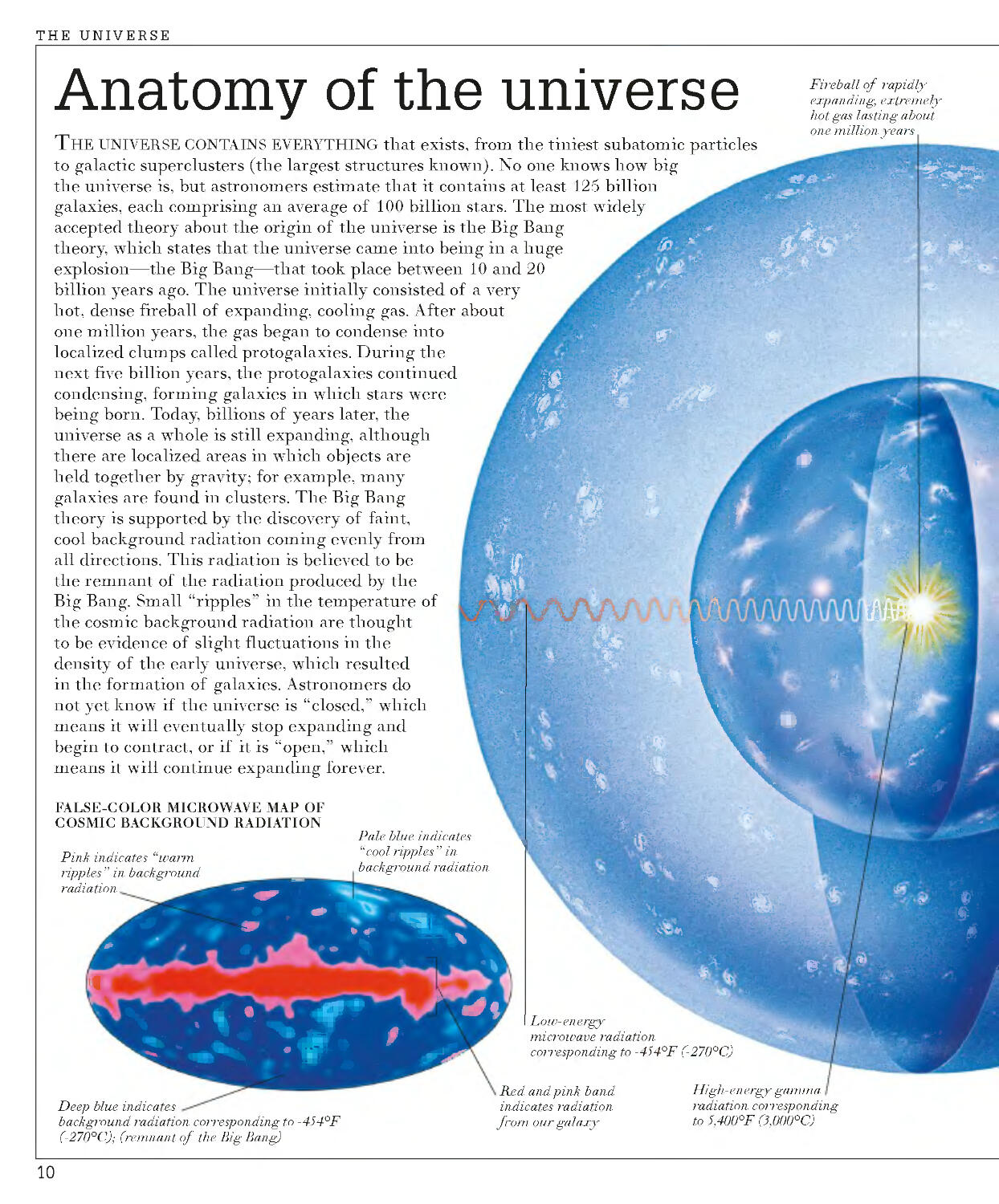
THE UNIVERSE CONTAINS EVERYTHING that exists, from the tiniest subatomic particles
to galactic superclusters (the largest structures known). No one knows how big
the universe is, but astronomers estimate that it contains at least 125 billion
galaxies, each comprising an average of 100 billion stars. The most widely
accepted theory about the origin of the universe is the Big Bang
theory, which states that the universe came into being in a huge
explosion—the Big Bang—that took place between 10 and 20
billion years ago. The universe initially consisted of a very
hot, dense fireball of expanding, cooling gas. After about
one million years, the gas began to condense into
localized clumps called protogalaxies. During the
next five billion years, the protogalaxies continued
condensing, forming galaxies in which stars were
being born. Today, billions of years later, the
universe as a whole is still expanding, although
there are localized areas in which objects are
held together by gravity; for example, many
galaxies are found in clusters. The Big Bang
theory is supported by the discovery of faint,
cool background radiation coming evenly from
all directions. This radiation is believed to be
the remnant of the radiation produced by the
Big Bang. Small “ripples” in the temperature of
the cosmic background radiation are thought
to be evidence of slight fluctuations in the
density of the early universe, which resulted
in the formation of galaxies. Astronomers do
not yet know if the universe is “closed,” which
means it will eventually stop expanding and
begin to contract, or if it is “open,” which
means it will continue expanding forever.
Fireball of rapidly
expanding, extremely
hot gas lasting about
one million years
FALSE-COLOR MICROWAVE MAP OF
COSMIC BACKGROUND RADIATION
Pink indicates “warm
ripples” in background
radiation
Pale blue indicates
“cool ripples” in
background radiation
Low-energy
microwave radiation
corresponding to -454°F (-270
Deep blue indicates
background radiation corresponding to -454°F
(-270°C); (remnant of the Big Bang)
Red and pink band
indicates radiation
from our galaxy
High-energy gamma I
radiation corresponding
to 5,400°F (3,000°C)
10

ANATOMY OF THE UNIVERSE
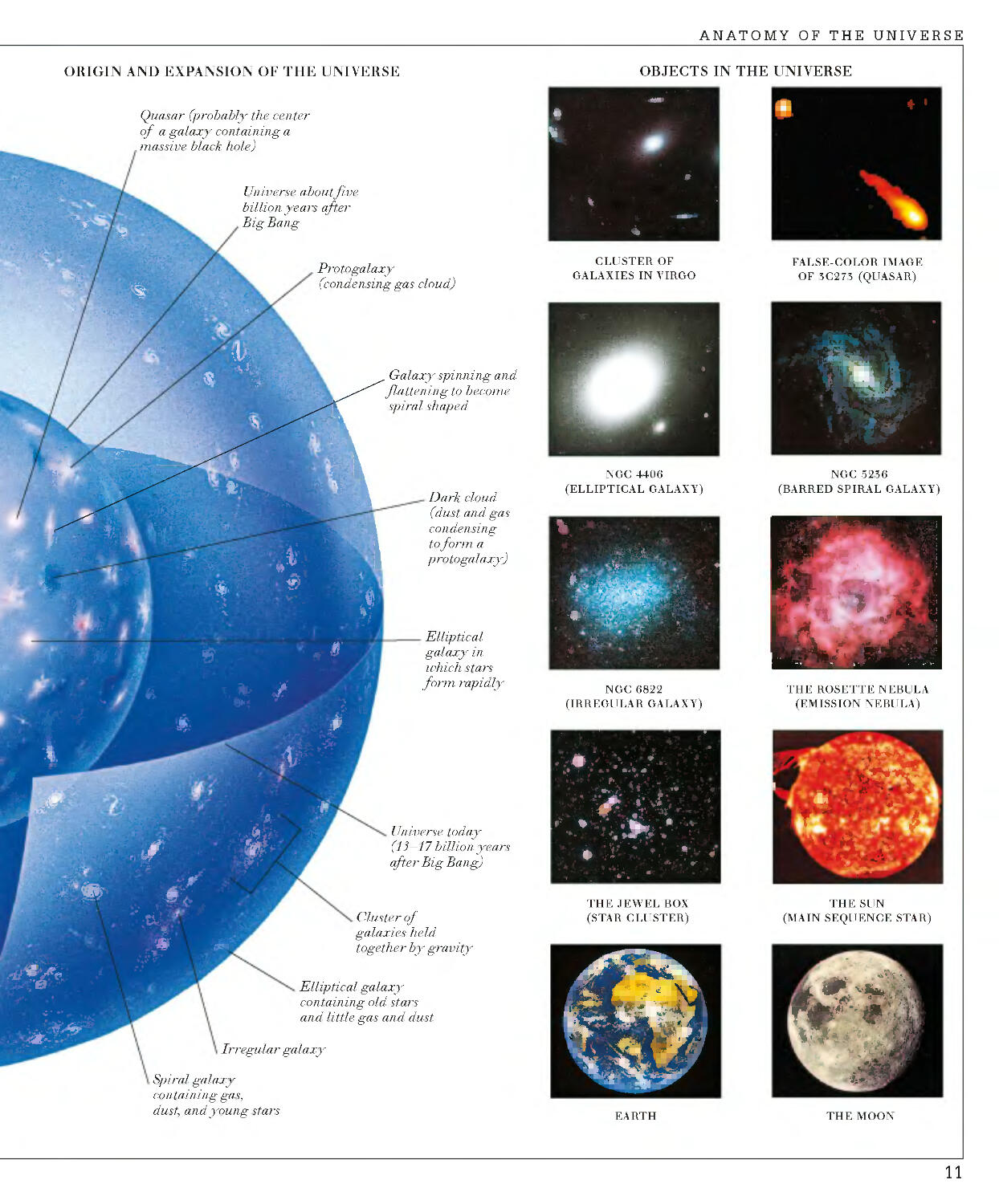
ORIGIN AND EXPANSION OF THE UNIVERSE
Galaxy spinning and
flattening to become
spiral shaped
Universe about five
billion years after
Big Bang
Protogalaxy
(condensing gas cloud)
Dark cloud
(dust and gas
condensing
to form a
protogalaxy)
. Elliptical
galaxy in
which stars
form rapidly
Universe today
(13—17 billion years
after Big Bang)
Cluster of
galaxies held
together by gravity
Elliptical galaxy
containing old stars
and little gas and dust
Irregular galaxy
Spiral galaxy
containing gas,
dust, and young stars
Quasar (probably the center
of a galaxy containing a
massive black hole)
OBJECTS IN THE UNIVERSE
CLUSTER OF
GALAXIES IN VIRGO
NGC 4406
(ELLIPTICAL GALAXY)
NGC 6822
(IRREGULAR GALAXY)
THE JEWEL BOX
(STAR CLUSTER)
FALSE-COLOR IMAGE
OF 3C273 (QUASAR)
NGC 5236
(BARRED SPIRAL GALAXY)
THE ROSETTE NEBULA
(EMISSION NEBULA)
THE SUN
(MAIN SEQUENCE STAR)
EARTH
THE MOON
11

THE UNIVERSE
OPTICAL IMAGE OF NGC 4486
(ELLIPTICAL GALAXY)
SOMBRERO,
A SPIRAL GALAXY
A GALAXY IS A HUGE MASS OF STARS, nebulae,
and interstellar material. The smallest
galaxies contain about 100,000 stars, while
the largest contain up to 3 trillion stars.
There are three main types of galaxy,
classified according to their shape: elliptical,
which are oval shaped; spiral,
which have arms spiraling
outward from a central bulge (those whose arms
spiral from a bar-shaped bulge are called spirals);
and irregular, which have no obvious shape.
Sometimes, the shape of a galaxy is distorted by
a collision with another galaxy. Quasars (quasi¬
stellar objects) are thought to be galactic nuclei
but are so far away that their exact nature is still
uncertain. They are compact, highly luminous
objects in the outer reaches of the known
universe: while the farthest known “ordinary”
galaxies are about 12 billion light-years away, the
farthest known quasar is about 13 billion light-
years away. Active galaxies, such as Seyfert
galaxies and radio galaxies, emit intense radiation.
In a Seyfert galaxy, this radiation comes from the
galactic nucleus; in a radio galaxy, it also comes
from huge lobes on either side of the galaxy. The
radiation from active galaxies and quasars is
thought to be caused by material falling into
central black holes (see pp. 28-29).
OPTICAL IMAGE OF LARGE MAGELLANIC
CLOUD (IRREGULAR GALAXY)
Globular cluster
containing very
old red giants
Central region
containing old
red giants
Less densely
populated region
Neighbouring galaxy
Tarantula Nebula
Dust cloud obscuring
light from stars
Emission nebula
Light from stars
OPTICAL IMAGE OF NGC 2997 (SPIRAL GALAXY)
Glowing nebula
in spiral arm
Spiral arm
containing
young stars
Galactic nucleus
containing
old stars
Dust lane
Dust in spiral
arm reflecting
blue light from
hot young stars
Hot, ionized
hydrogen gas
emitting red light
12

GALAXIES
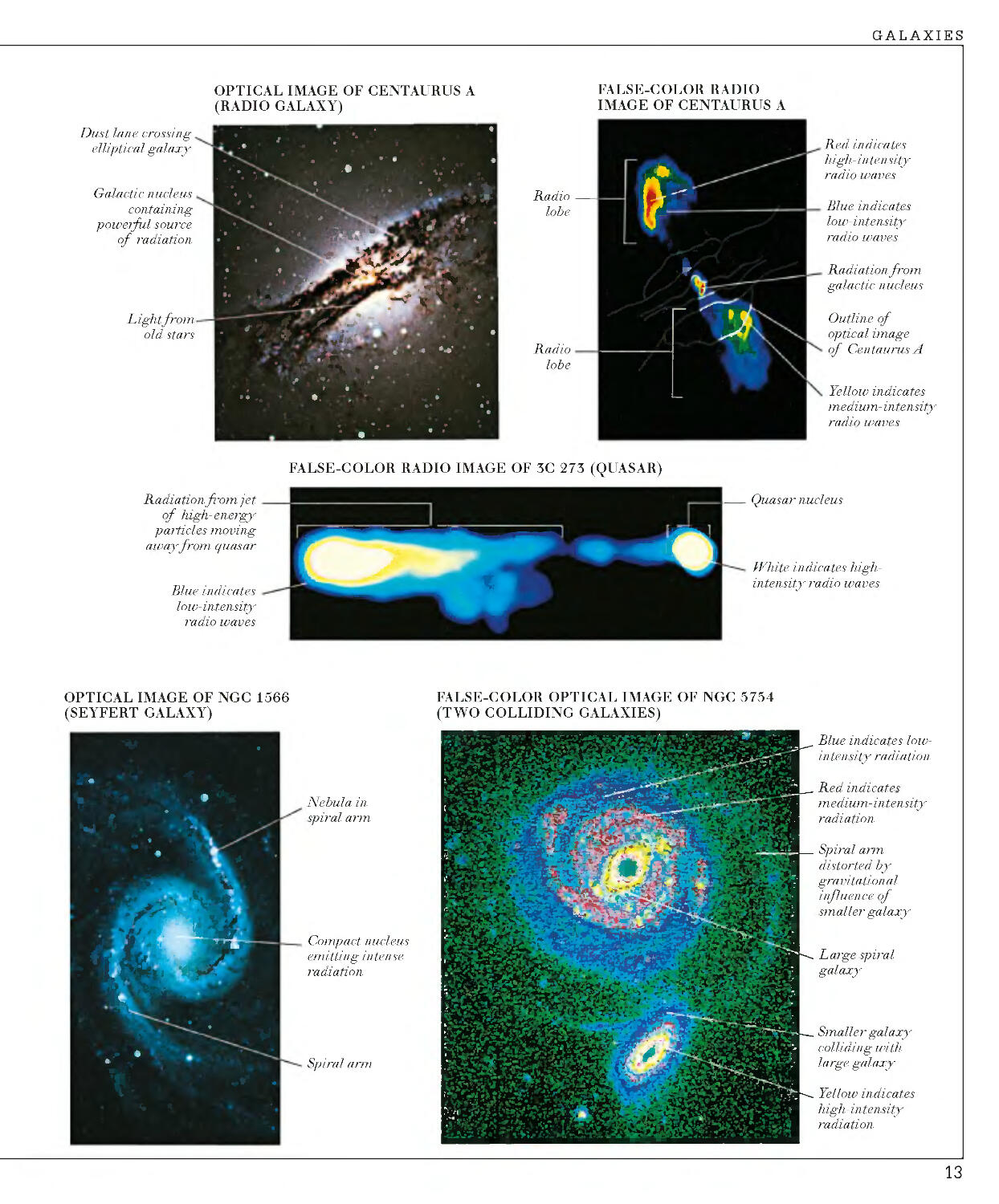
OPTICAL IMAGE OF CENTAURUS A
(RADIO GALAXY)
ght from -
old stars
Dust lane crossing
elliptical galaxy
Galactic nucleus
containing
powerful source
of radiation
FALSE-COLOR RADIO
IMAGE OF CENTAURUS A
Radio
lobe
Radio
lobe
Red indicates
high-intensity
radio waves
Blue indicates
low-intensity
radio waves
Radiation from
galactic nucleus
Outline of
optical image
of Centaurus A
Yellow indicates
medium-intensity
radio waves
FALSE-COLOR RADIO IMAGE OF 3C 273 (QUASAR)
Radiation from jet
of high-energy
particles moving
awayfrom quasar
Blue indicates
low-intensity
radio waves
Quasar nucleus
White indicates high-
intensity radio waves
OPTICAL IMAGE OF NGC 1566
(SEYFERT GALAXY)
Nebula in
spiral arm
Compact nucleus
emitting intense
radiation
Spiral arm
FALSE-COLOR OPTICAL IMAGE OF NGC 5754
(TWO COLLIDING GALAXIES)
Blue indicates low-
intensity radiation
Red indicates
medium-intensity
radiation
Spiral arm
distorted by
gravitational
influence of
smaller galaxy
Large spiral
galaxy
Smaller galaxy
colliding with
large galaxy
Yellow indicates
high-intensity
radiation
13

THE UNIVERSE
The Milky Way
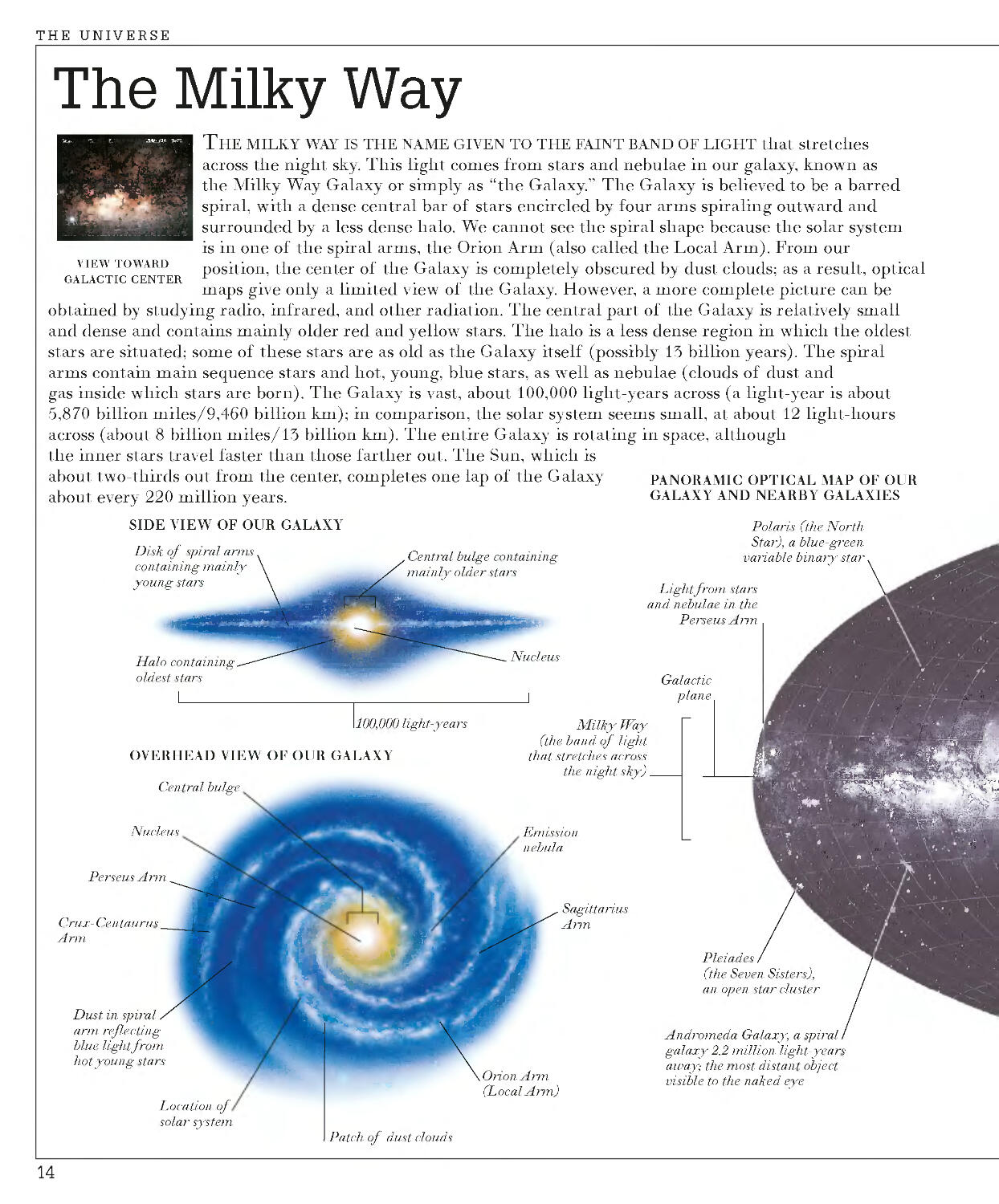
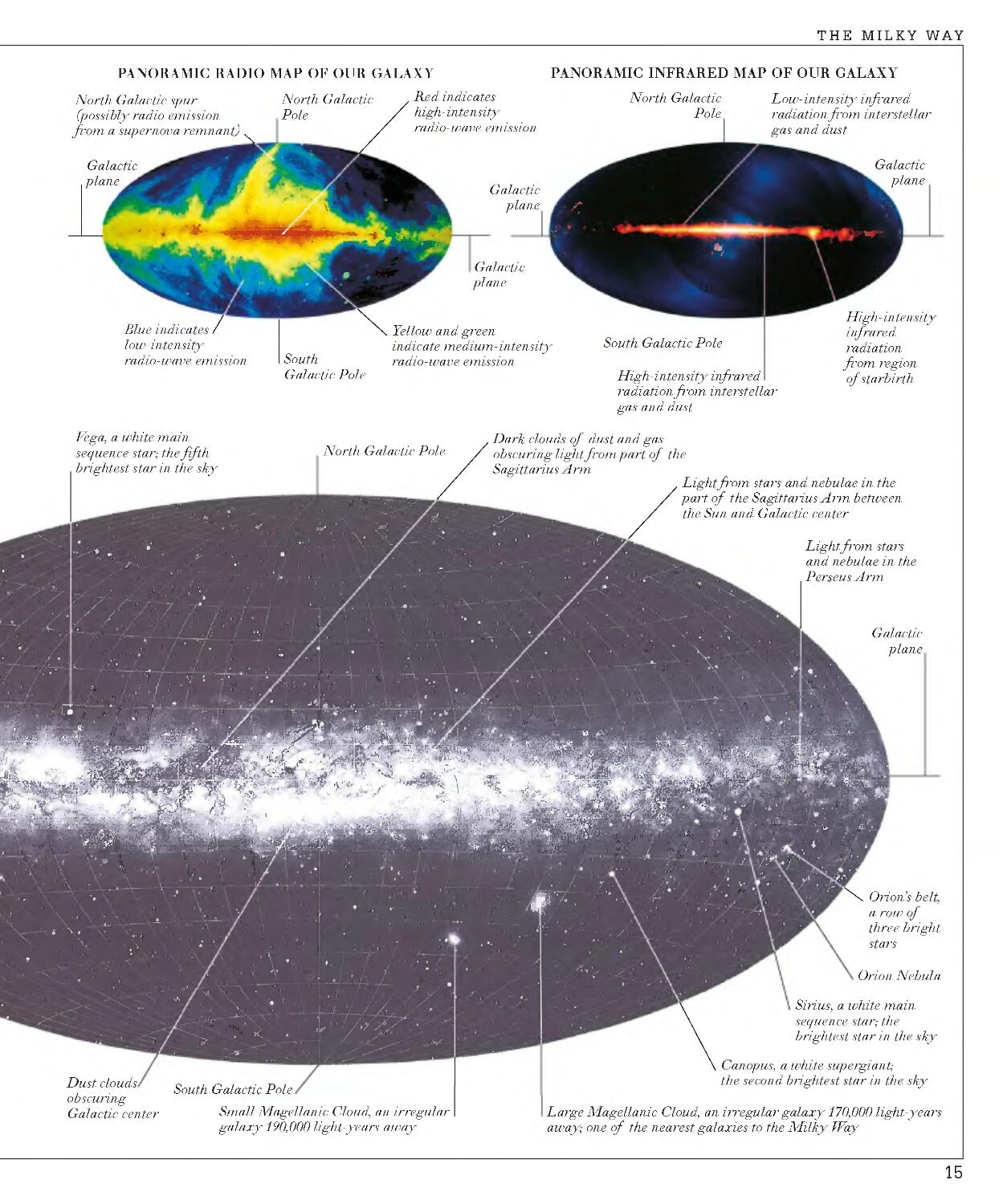
The MILKY WAY IS THE NAME GIVEN TO THE FAINT BAND OF LIGHT that stretches
across the night sky. This light comes from stars and nebulae in our galaxy, known as
the Milky Way Galaxy or simply as “the Galaxy.” The Galaxy is believed to be a barred
spiral, with a dense central bar of stars encircled by four arms spiraling outward and
surrounded by a less dense halo. We cannot see the spiral shape because the solar system
is in one of the spiral arms, the Orion Arm (also called the Local Arm). From our
position, the center of the Galaxy is completely obscured by dust clouds; as a result, optical
maps give only a limited view of the Galaxy. However, a more complete picture can be
obtained by studying radio, infrared, and other radiation. The central part of the Galaxy is relatively small
and dense and contains mainly older red and yellow stars. The halo is a less dense region in which the oldest
stars are situated; some of these stars are as old as the Galaxy itself (possibly 13 billion years). The spiral
arms contain main sequence stars and hot, young, blue stars, as well as nebulae (clouds of dust and
gas inside which stars are born). The Galaxy is vast, about 100,000 light-years across (a light-year is about
5,870 billion miles/9,460 billion km); in comparison, the solar system seems small, at about 12 light-hours
across (about 8 billion miles/13 billion km). The entire Galaxy is rotating in space, although
the inner stars travel faster than those farther out. The Sun, which is
about two-thirds out from the center, completes one lap of the Galaxy PANORAMIC OPTICAL MAP OF OUR
about every 220 million years.	GALAXY AND NEARBY GALAXIES
Perseus Arm
SIDE VIEW OF OUR GALAXY
Disk of spiral arms
containing mainly
young stars
Halo containing
oldest stars
I
Central bulge containing
mainly older stars
Nucleus
Polaris (the North
Star), a blue-green
variable binary star
Light from stars
and nebulae in the
Perseus Arm
Galactic
plane
1100,000 light-years
OVERHEAD VIEW OF OUR GALAXY
Central bulge	.
Milky Way
(the band of light
that stretches across
the night sky) _
Nucleus
Emission
nebula
Crux-Centaurus
Arm
Sagittarius
Arm
Pleiades
(the Seven Sisters),
an open star cluster
Andromeda Galaxy, a spiral
galaxy 2.2 million light-years
away; the most distant object
visible to the naked eye
Dust in spiral
arm reflecting
blue light from
hot young stars
Location of
solar system
Orion Arm
(Local Arm)
Patch of dust clouds
14

THE MILKY WAY
PANORAMIC RADIO MAP OF OUR GALAXY	PANORAMIC INFRARED MAP OF OUR GALAXY
Galactic
plane
South Galactic Pole
High-intensity infrared
radiationfrom interstellar
gas and dust
High-intensity
infrared
radiation
from region
of starbirth
North Galactic spur
(possibly radio emission
from a supernova remnant)
Galactic
plane
North Galactic
Pole
, Red indicates
high-intensity
radio-wave emission
Galactic
plane
Blue indicates /
low-intensity
radio-wave emission
South
Galactic Pole
Galactic
plane
Yellow and green
indicate medium-intensity
radio-wave emission
North Galactic
Pole
Low-intensity infrared
radiationfrom interstellar
gas and dust
South Galactic Pole
Dust clouds.
obscuring
Galactic center	Small Magellanic Cloud, an irregular
galaxy 190,000 light-years away
Orion’s belt,
a row of
three bright
stars
Orion Nebula
Sirius, a white main
sequence star; the
brightest star in the sky
Canopus, a white supergiant;
the second brightest star in the sky
Large Magellanic Cloud, an irregular galaxy 170,000 light-years
away; one of the nearest galaxies to the Milky Way
Vega, a white main
sequence star; the fifth
brightest star in the sky
, Dark clouds of dust and gas
obscuring light from part of the
Sagittarius Arm
. Light from stars and nebulae in the
part of the Sagittarius Arm between
the Sun and Galactic center
Light from stars
and nebulae in the
Perseus Arm
Galactic
plane
15

THE UNIVERSE
Nebulae and star clusters
HODGE 11, A
GLOBULAR CLUSTER
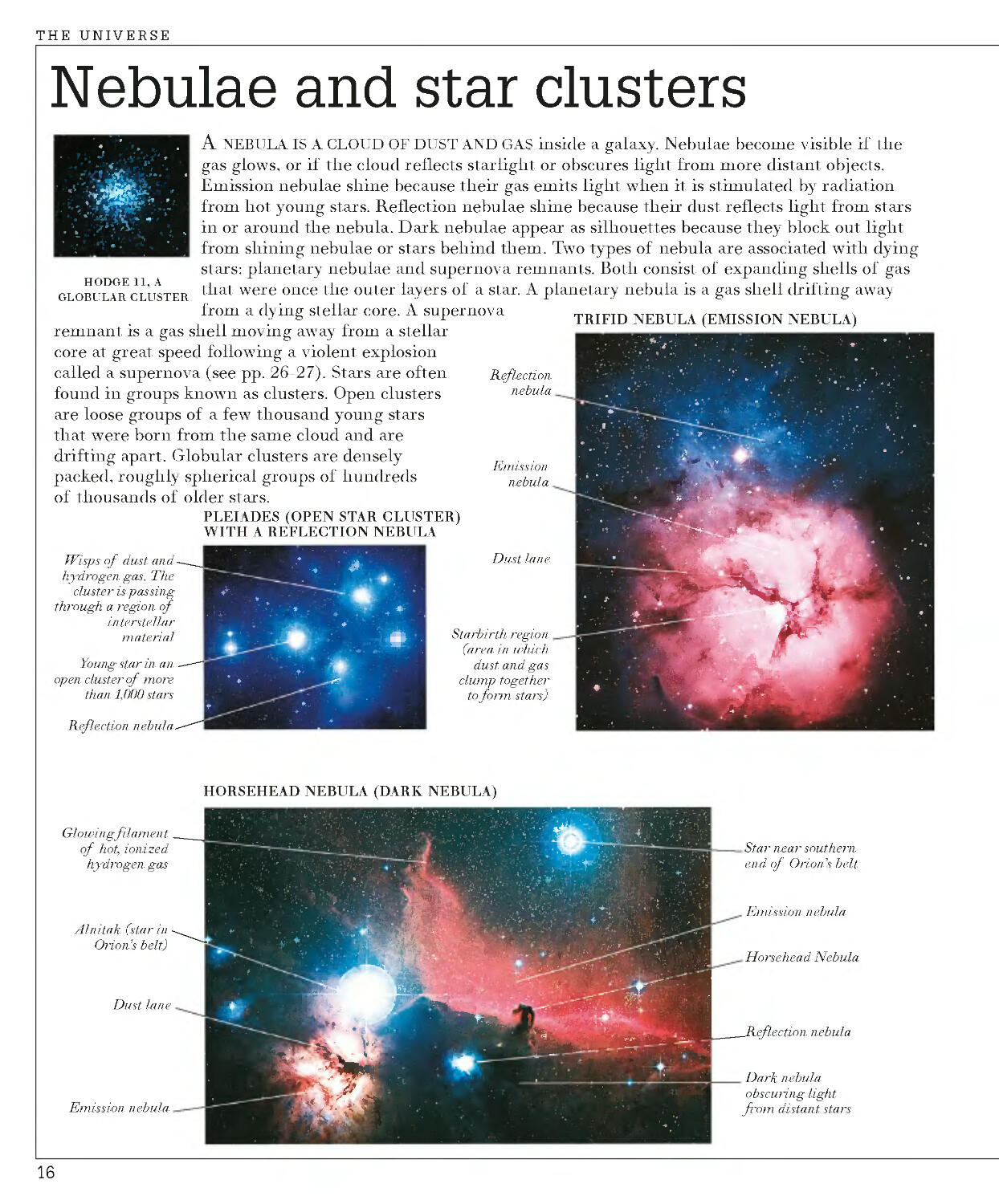
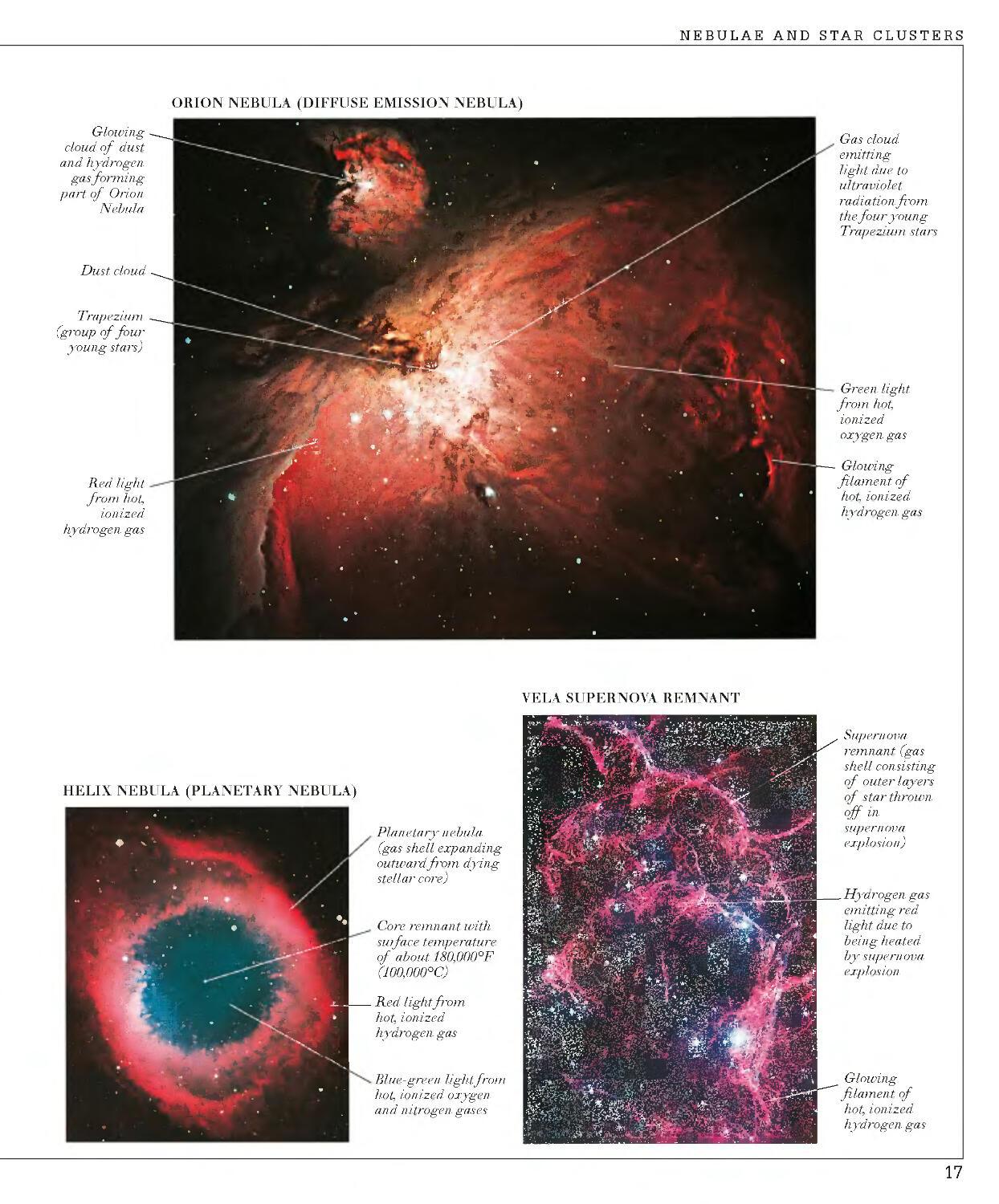
A NEBULA IS A CLOUD OF DUST AND GAS inside a galaxy. Nebulae become visible if the
gas glows, or if the cloud reflects starlight or obscures light from more distant objects.
Emission nebulae shine because their gas emits light when it is stimulated by radiation
from hot young stars. Reflection nebulae shine because their dust reflects light from stars
in or around the nebula. Dark nebulae appear as silhouettes because they block out light
from shining nebulae or stars behind them. Two types of nebula are associated with dying
stars: planetary nebulae and supernova remnants. Both consist of expanding shells of gas
that were once the outer layers of a star. A planetary nebula is a gas shell drifting away
from a dying stellar core. A supernova
remnant is a gas shell moving away from a stellar
core at great speed following a violent explosion
called a supernova (see pp. 26-27). Stars are often
found in groups known as clusters. Open clusters
are loose groups of a few thousand young stars
that were born from the same cloud and are
drifting apart. Globular clusters are densely
packed, roughly spherical groups of hundreds
of thousands of older stars.
TRIFID NEBULA (EMISSION NEBULA)
Reflection
nebula
Emission
nebula
PLEIADES (OPEN STAR CLUSTER)
WITH A REFLECTION NEBULA
Wisps of dust and
hydrogen gas. The
cluster is passing
through a region of
interstellar
material
Young star in an
open cluster of more
than 1,000 stars
Reflection
Dust lane
Starbirth region
(area in which
dust and gas
clump together
to form stars)
HORSEHEAD NEBULA (DARK NEBULA)
Alnitak (star in -
Orion's belt)
Dust lane .
Emission nebula.
	Star near southern
end of Orion's belt
Glowing filament
of hot, ionized
hydrogen gas
Emission nebula
Horsehead Nebula
eflection nebula
Dark nebula
obscuring light
from distant stars
16

NEBULAE AND STAR CLUSTERS
ORION NEBULA (DIFFUSE EMISSION NEBULA)
Dust cloud
Trapezium
(group of four
young stars)
Red light
from hot,
ionized
hydrogen gas
Green light
from hot,
ionized
oxygen gas
Glowing
filament of
hot, ionized
hydrogen gas
Glowing
cloud of dust
and hydrogen
gasforming
part of Orion
Nebula
Gas cloud
emitting
light due to
ultraviolet
radiation from
the four young
Trapezium stars
VELA SUPERNOVA REMNANT
HELIX NEBULA (PLANETARY NEBULA)
Planetary nebula
(gas shell expanding
outward from dying
stellar core)
Core remnant with
surface temperature
of about 180,000°F
(100,000°C)
Red light from
hot, ionized
hydrogen gas
Blue-green light from
hot, ionized oxygen
and nitrogen gases
Supernova
remnant (gas
shell consisting
of outer layers
of star thrown
offin
supernova
explosion)
Hydrogen gas
emitting red
light due to
being heated
by supernova
explosion
Glowing
filament of
hot, ionized
hydrogen gas
17

THE UNIVERSE
Pi.
Antares
’.ubenelgenubi
S Zubem
Alphecca
CES
CA
<>, Alphard
El Na
S: im
Rigel
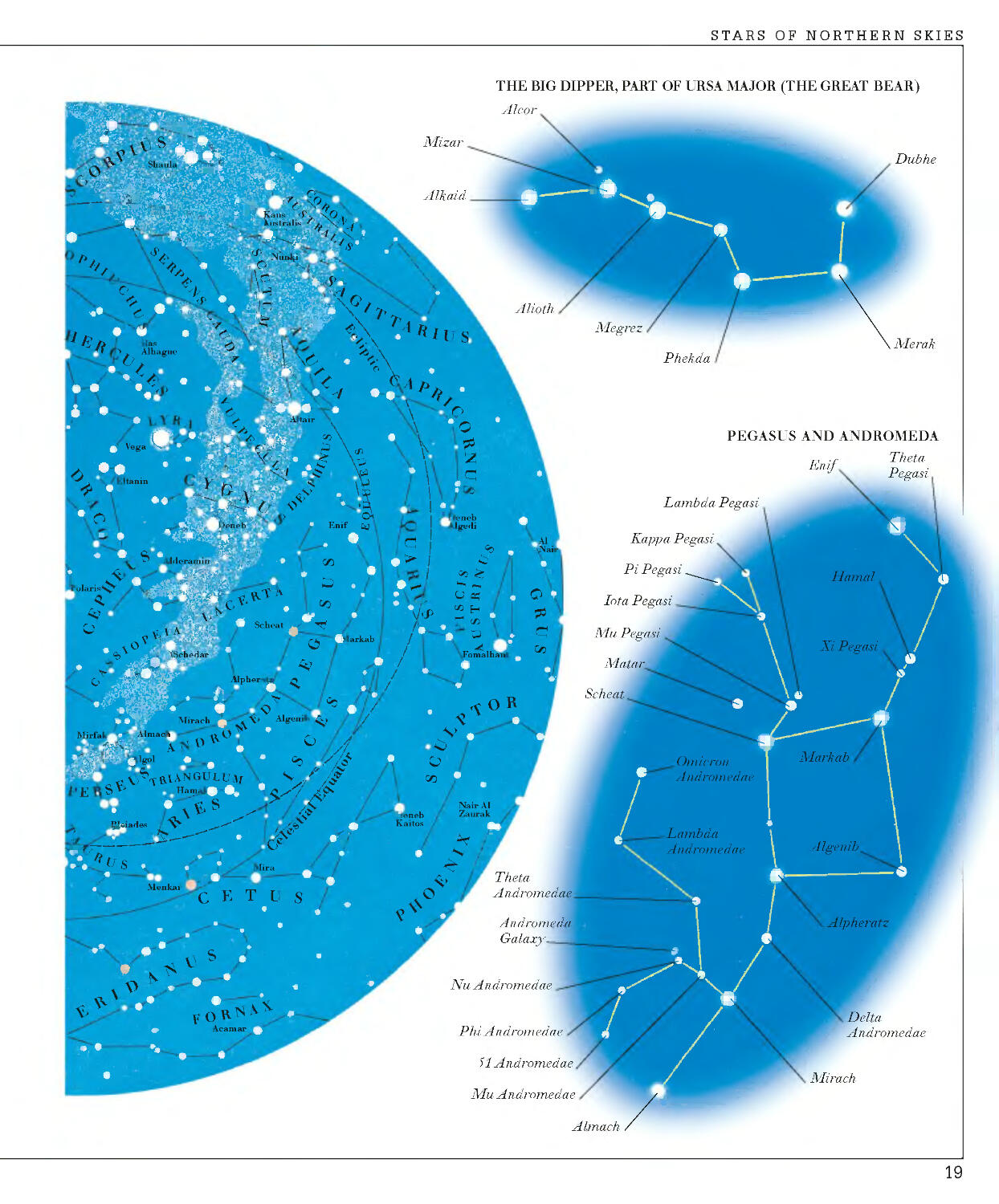
Stars of northern skies
When you look at the northern sky, you look away from the densely
populated Galactic center, so the northern sky generally appears less
bright than the southern sky (see pp. 20-21). Among the best-known
sights in the northern sky are the constellations Ursa Major
(the Great Bear) and Orion. Some ancient civilizations believed
that the stars were fixed to a celestial sphere surrounding the
Earth, and modern maps of the sky are based on a similar
idea. The North and South Poles of this imaginary
celestial sphere are directly above the North and South
Poles of the Earth, at the points where the Earth’s axis
of rotation intersects the sphere. The celestial North
Pole is at the center of the map shown here, and
Polaris (the North Star) lies very close to it. The
celestial equator marks a projection of the
Earth’s equator on the sphere. The ecliptic
marks the path of the Sun across the sky
as the Earth orbits the Sun. The Moon and
planets move against the background of
the stars because the stars are much more
distant; the nearest star outside the solar
system (Proxima Centauri) is more
than 50,000 times farther away than
the planet Jupiter.
ORION	^
Xi Orionis
Mu Orionis
Nu Orionis
Heka
Saiph
Bellatrix
Betelgeus
Orion's belt
Alnitak
Pi4 Orionis
Pi5 Orionis
Pi6 Orionis
Mintaka
Eta Orionis
Orion
Nebula
Tau Orionis
Rigel
a
Omicron
Orionis
VISIBLE STARS IN THE NORTHERN SKY
Alnilam
18

STARS OF NORTHERN SKIES
THE BIG DIPPER, PART OF URSA MAJOR (THE GREAT BEAR)
Alcor
Mizar
Dubhe
Alkaid
Alioth
Megrez
Merak
Phekda
PEGASUS AND ANDROMEDA
Vegi
Theta
Pegasi
Eltanin
Lambda Pegasi
' Deneb
Pi Pegasi
Hamal
Mu Pegasi
Markab
Xi Pi
Fomalhaut
Matar_
Scheat
Algenib ^
Mirach
Markab
. Omicron
Andromedae
GULUiVf
Hamal
Deneb
Kaitos
.Lambda
Andromedae
Algenib
Mira
Theta
Andromedae
Menkar
Alpheratz
Andromeda
Galaxy.
Nu Andromedae
Delta
Andromedae
Phi Andromedae
51 Andromedae
Mirach
Mu Andromedae
Almach
19

THE UNIVERSE
Algethi
E RP
Algedi
*acock
^	/ Algedi
Nair
Small
[arkab
Scheat
Deneb
Kaitos
Algenib
Mira
Mirach
Gamma
Hydri
Almach
Alcy<
Gamma Mensae
I
Alpha Mensae
Pleiades
Eta Mensae
Beta Mensae
mm
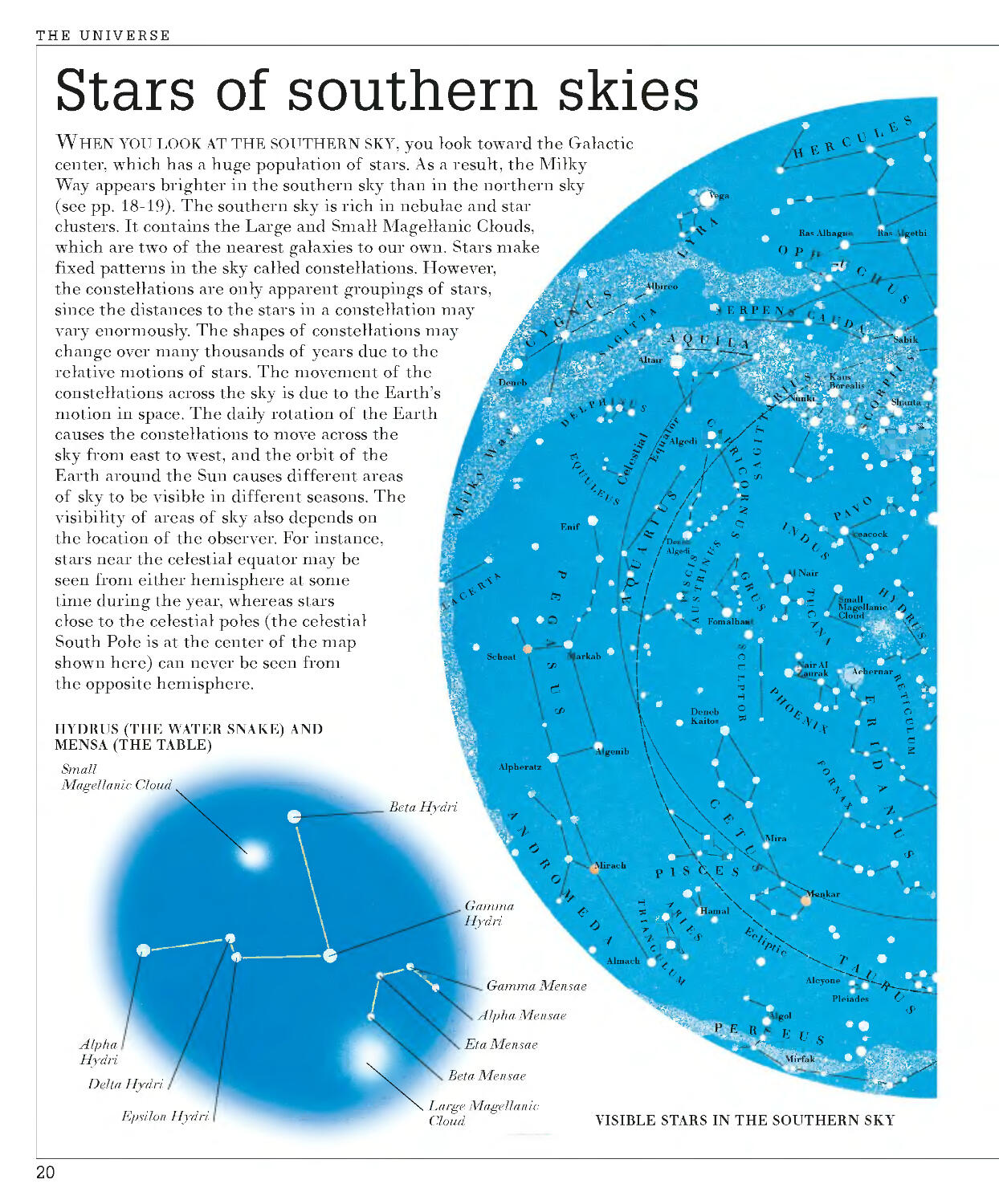
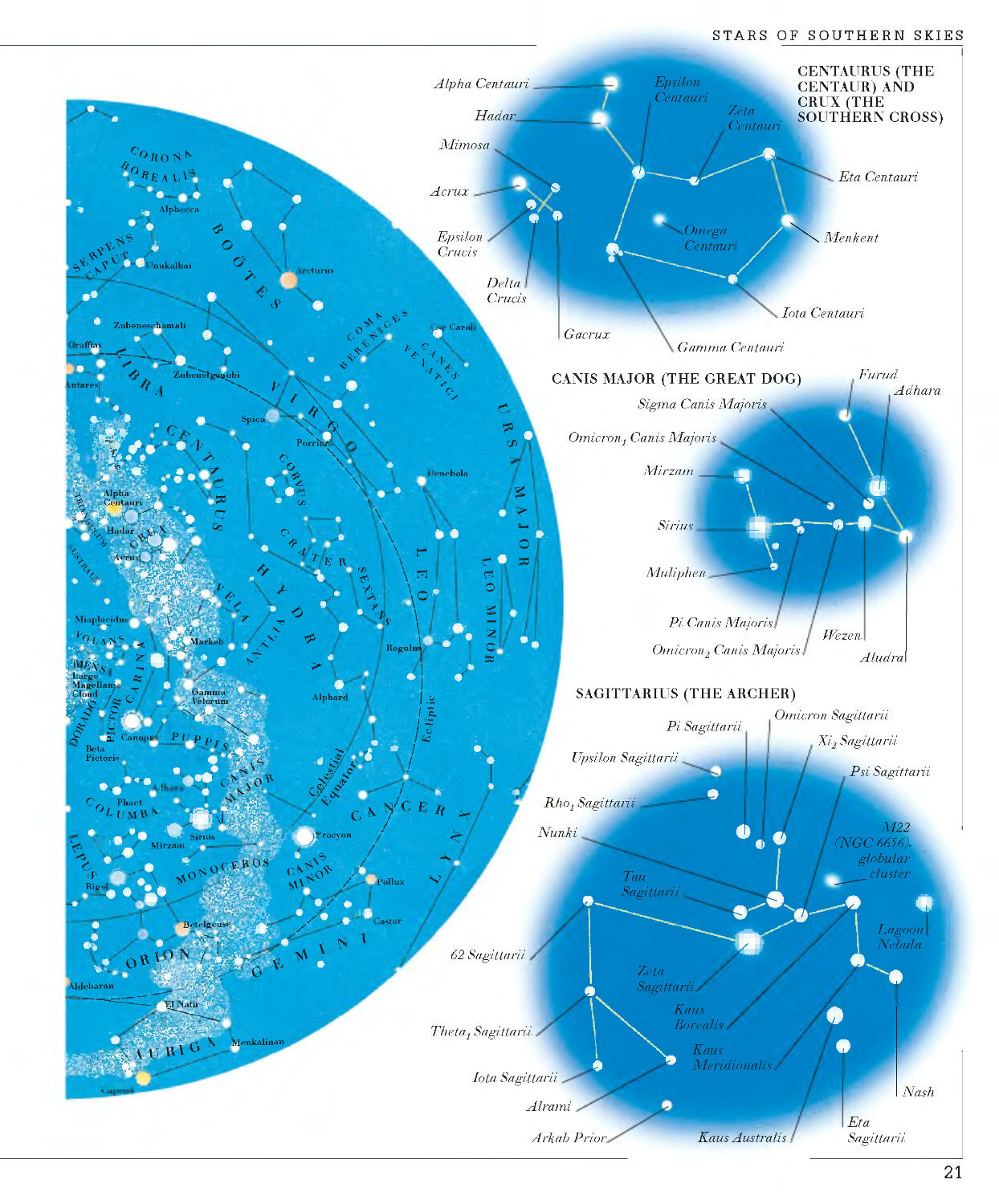
Stars of southern skies
When YOU LOOK AT THE SOUTHERN SKY, you look toward the Galactic
center, which has a huge population of stars. As a result, the Milky
Way appears brighter in the southern sky than in the northern sky
(see pp. 18-19). The southern sky is rich in nebulae and star
clusters. It contains the Large and Small Magellanic Clouds,
which are two of the nearest galaxies to our own. Stars make
fixed patterns in the sky called constellations. However,
the constellations are only apparent groupings of stars,
since the distances to the stars in a constellation may
vary enormously. The shapes of constellations may
change over many thousands of years due to the
relative motions of stars. The movement of the
constellations across the sky is due to the Earth’s
motion in space. The daily rotation of the Earth
causes the constellations to move across the
sky from east to west, and the orbit of the
Earth around the Sun causes different areas
of sky to be visible in different seasons. The
visibility of areas of sky also depends on
the location of the observer. For instance,
stars near the celestial equator may be
seen from either hemisphere at some
time during the year, whereas stars
close to the celestial poles (the celestial
South Pole is at the center of the map
shown here) can never be seen from
the opposite hemisphere.
HYDRUS (THE WATER SNAKE) AND
MENSA (THE TABLE)
Small
Magellanic Cloud
Alpha
Hydri
Delta Hydri
Epsilon Hydr
/	C ^ v
\
Ras Alhague Ra
O P ifW
\ 1 c
1
Large Magellanic
Cloud
VISIBLE STARS IN THE SOUTHERN SKY
20

STARS OF SOUTHERN SKIES
CENTAURUS (THE
CENTAUR) AND
CRUX (THE
SOUTHERN CROSS)
Epsilon
Centauri
Alpha Centauri
Hadar.
\tauri
Mimosa
os^
Eta Centauri
Acrux
.Omega
Centauri
Epsilon
Crucis
Menkent
lukalhai
Delta
Crucis
Iota Centauri
Zubei
Cor Caroli
Gacrux
Gamma Centauri
Furud
CANIS MAJOR (THE GREAT DOG)
Sigma Canis Majoris
Adhara
Omicron1 Canis Majoris
Mirzam
Denebola
Sirius
Muliphen
Pi Canis Majoris '
Omicron Canis Majoris
Wezen
Regulus
Aludra
SAGITTARIUS (THE ARCHER)
Omicron Sagittarii
Xi2 Sagittarii
Pi Sagittarii
CanoPus	PV p
Beta	"
Pictoris
Upsilon Sagittarii
Psi Sagittarii
Adhari
Rho1 Sagittarii
Phaet
l
Nunki
Sirius
Mirzam
lobular
Pollux
Rigel
Castor
agoon
Tebula
62 Sagittarii
Kaus
Borealis
Theta1 Sagittarii
mkalinan
Kaus
Meridionalis
Iota Sagittarii
Nash
Alrami
Eta
Sagittarii
Kaus Australis
Arkab Prior,
21

THE UNIVERSE
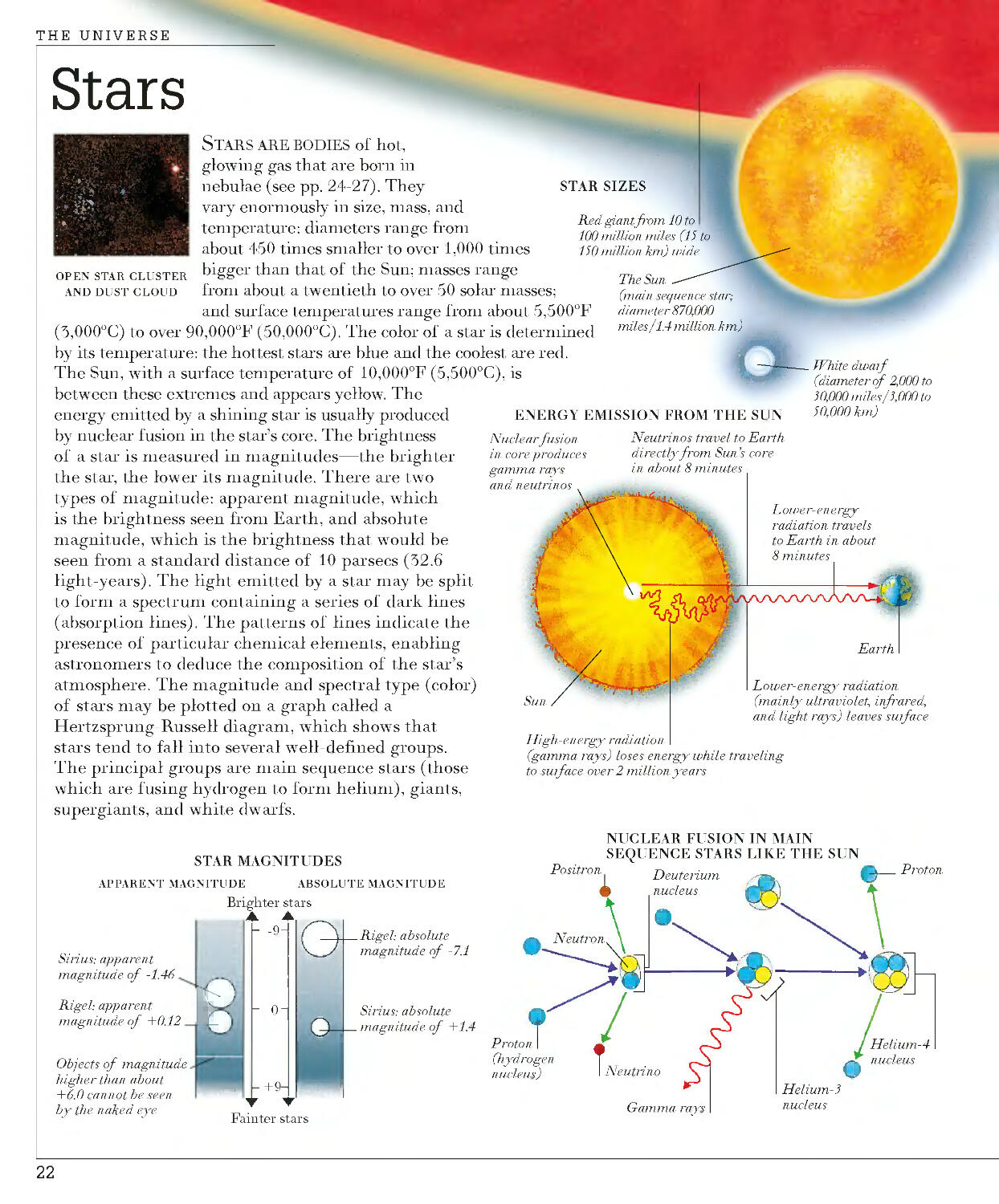
Stars
OPEN STAR CLUSTER
AND DUST CLOUD
Nuclear fusion
in core produces
Stars are bodies of hot,
glowing gas that are born in
nebulae (see pp. 24-27). They
vary enormously in size, mass, and
temperature: diameters range from
about 450 times smaller to over 1,000 times
bigger than that of the Sun; masses range
from about a twentieth to over 50 solar masses;
and surface temperatures range from about 5,500°F
(3,000°C) to over 90,000°F (50,000°C). The color of a star is determined
by its temperature: the hottest stars are blue and the coolest are red.
The Sun, with a surface temperature of 10,000°F (5,500°C), is
between these extremes and appears yellow. The
energy emitted by a shining star is usually produced
by nuclear fusion in the star’s core. The brightness
of a star is measured in magnitudes—the brighter
the star, the lower its magnitude. There are two
types of magnitude: apparent magnitude, which
is the brightness seen from Earth, and absolute
magnitude, which is the brightness that would be
seen from a standard distance of 10 parsecs (32.6
light-years). The light emitted by a star may be split
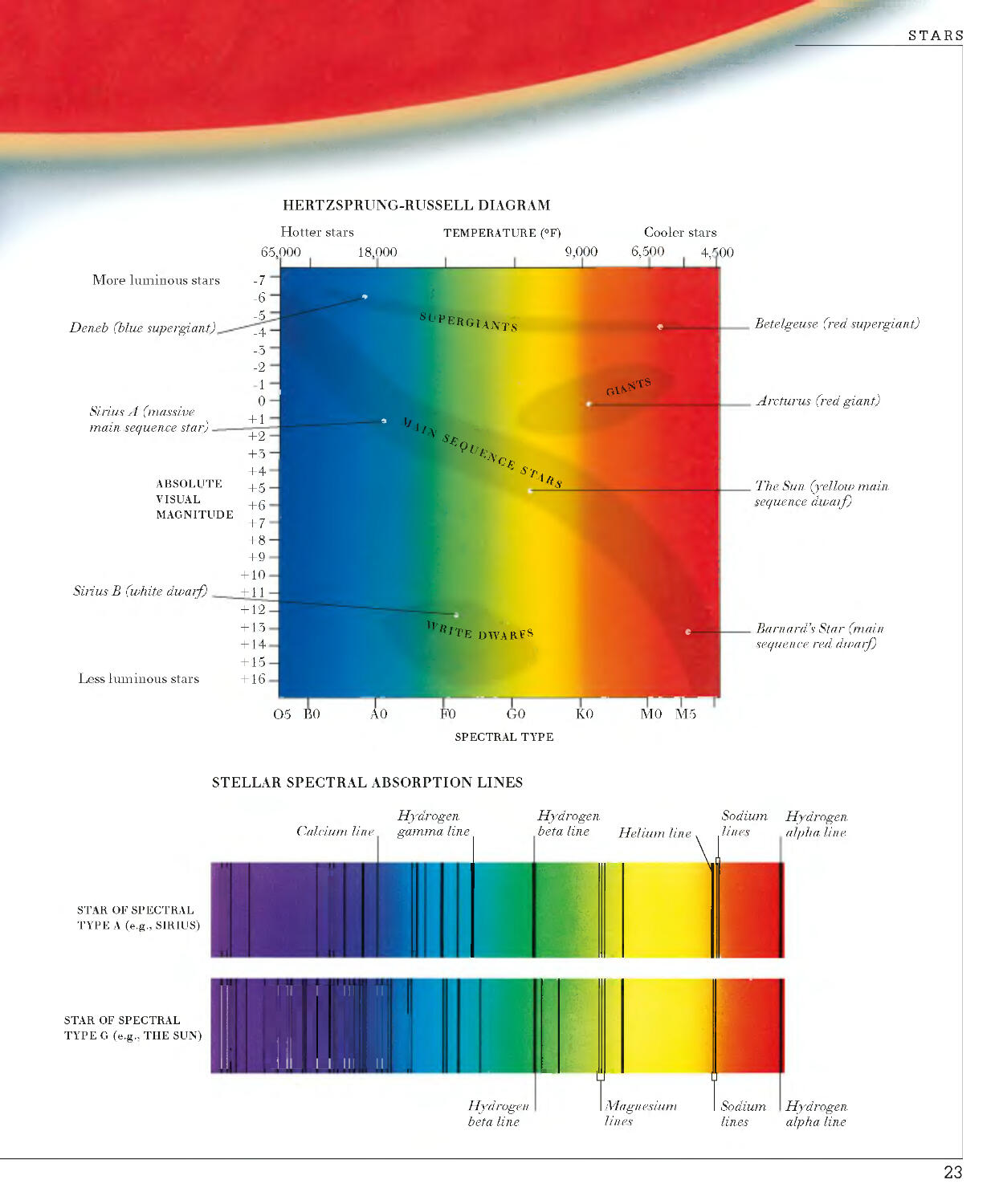
to form a spectrum containing a series of dark lines
(absorption lines). The patterns of lines indicate the
presence of particular chemical elements, enabling
astronomers to deduce the composition of the star’s
atmosphere. The magnitude and spectral type (color)
of stars may be plotted on a graph called a
Hertzsprung-Russell diagram, which shows that
stars tend to fall into several well-defined groups.
The principal groups are main sequence stars (those
which are fusing hydrogen to form helium), giants,
supergiants, and white dwarfs.
STAR SIZES
Red giant from 10 to
100 million miles (15 to
150 million km) wide
The Sun
(main sequence star;
diameter 870,000
miles/1.4 million km)
ENERGY EMISSION FROM THE SUN
Neutrinos travel to Earth
directly from Sun’s core
White dwarf
(diameter of 2,000 to
30.000	miles/3,000 to
50.000	km)
(gamma rays) loses energy while traveling
to surface over 2 million years
STAR MAGNITUDES
APPARENT MAGNITUDE	ABSOLUTE MAGNITUDE
Brighter stars
-9
Positron
NUCLEAR FUSION IN MAIN
SEQUENCE STARS LIKE THE SUN
Deuterium
Sirius: apparent
magnitude of -1.46 „
Rigel: apparent
magnitude of +0.12.
Objects of magnitude
higher than about
+6.0 cannot be seen
by the naked eye
- 0-
+9-
Fainter stars
G
Rigel: absolute
magnitude of -7.1
Sirius: absolute
		magnitude of +1.4
Proton
Proton
(hydrogen
nucleus)
I Neutrino
Gamma rays
Helium-4
nucleus
Helium-3
nucleus
22

STARS
HERTZSPRUNG-RUSSELL DIAGRAM
Hotter stars	TEMPERATURE (°F)
Cooler stars
. Betelgeuse (red supergiant)
. Arcturus (red giant)
. The Sun (yellow main
sequence dwarf)
. Barnard’s Star (main
sequence red dwarf)
STELLAR SPECTRAL ABSORPTION LINES
STAR OF SPECTRAL
TYPE A (e.g., SIRIUS)
STAR OF SPECTRAL
TYPE G (e.g., THE SUN)
Hydrogen
Calcium line gamma line
Hydrogen	Sodium Hydrogen
beta line	Helium line.	lines	alpha line
Hydrogen
beta line
Magnesium
lines
Sodium Hydrogen
lines alpha line
23

THE UNIVERSE
zone
Small stars
Small STARS HAVE a MASS of up to about one and a half
times that of the Sun. They begin to form when a region of
higher density in a nebula condenses into a huge globule of
gas and dust that contracts under its own gravity. Within
a globule, regions of condensing matter heat up and
begin to glow, forming protostars. If a protostar
contains enough matter, the central temperature
reaches about 27 million °F (8 million °C). At this
temperature, nuclear reactions in which hydrogen
fuses to form helium can start. This process releases
energy, which prevents the star from contracting
more and also causes it to shine; it is now a main
sequence star. A star of about one solar mass remains
on the main sequence for about 10 billion years, until much of the hydrogen in
the star’s core has been converted into helium. The helium core then contracts,
STRUCTURE OF A
MAIN SEQUENCE STAR
Core containing hydrogen
fusing to form helium
REGION OF
STAR FORMATION
IN ORION
Radiative
Convective
Surface temperature
10,000° F (5,500° C)
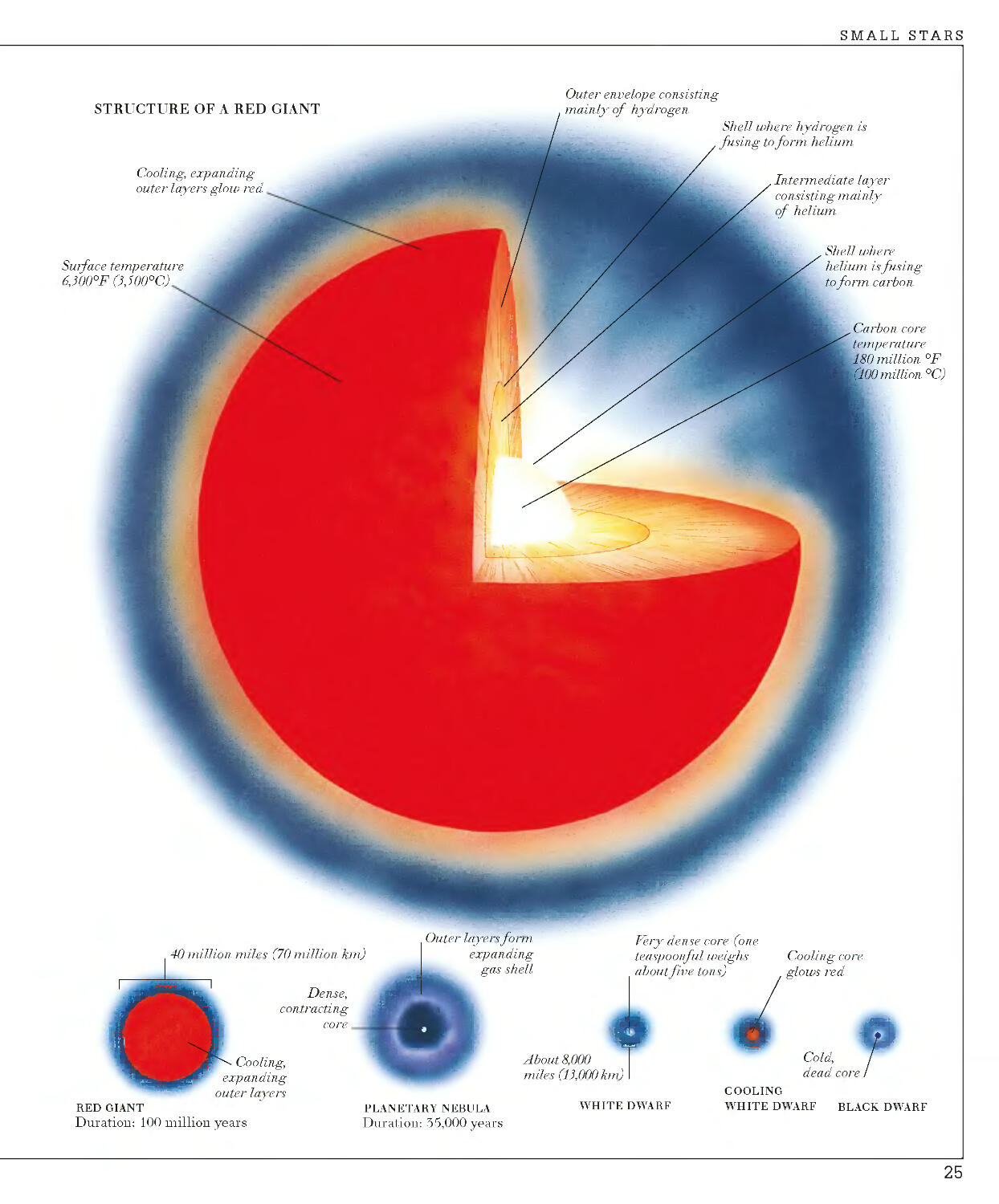
and nuclear reactions continue in a shell around the core. The core becomes hot
enough for helium to fuse to form carbon, while the outer
layers of the star expand and cool. The expanding
star is known as a red giant. When the
helium in the core runs out, the outer
layers of the star may be blown
away as an expanding gas shell
called a planetary nebula. The
remaining core (about 80
percent of the original
star) is now in its final
stages. It becomes
a white dwarf star
that gradually cools
and dims. When it
finally stops shining
altogether, the dead
star will become
a black dwarf.
Core: 27 million °F
(15 million °C)
STRUCTURE OF A NEBULA
Young main
sequence star
Dense region of dust and
gas (mainly hydrogen)
condensing under gravity
to form globules
Hot, ionized hydrogen
gas emitting red light
due to being stimulated
by radiation from hot
young stars
Dark globule of dust and
gas (mainly hydrogen)
contracting to form protostars
LIFE OF A SMALL STAR OF ABOUT ONE SOLAR MASS
Cool cloud of
gas (mainly
hydrogen)
and dust
Dense globule
condensing to
form protostars
Glowing
ball of gas
(mainly
hydrogen)
About 1.4 million km
PROTOSTAR
Natal cocoon
(shell of dust
blown away by
radiation from
protostar)
Star
producing
energy by
nuclear fusion
Duration: 50 million years
MAIN SEQUENCE STAR
Duration: 10 billion years
NEBULA
24

SMALL STARS
40 million miles (70 million km)
Dense,
contracting
core
Cooling,
expanding
outer layers
Outer layers form
expanding
gas shell
Very dense core (one
teaspoonful weighs
about five tons)
About 8,000
miles (13,000 km)
RED GIANT
PLANETARY NEBULA
WHITE DWARF
Cooling core
glows red
Cold,
dead core I
COOLING
WHITE DWARF BLACK DWARF
STRUCTURE OF A RED GIANT
Cooling, expanding
outer layers glow red
Surface temperature
6,300°F (3,500°C)
Outer envelope consisting
mainly of hydrogen
Shell where hydrogen is
fusing to form helium
Intermediate layer
consisting mainly
of helium
Shell where
helium is fusing
to form carbon
Carbon core
temperature
180 million °F
100 million °C)
Duration: 100 million years
Duration: 35,000 years
25

THE UNIVERSE
Massive stars
SUPERNOVA
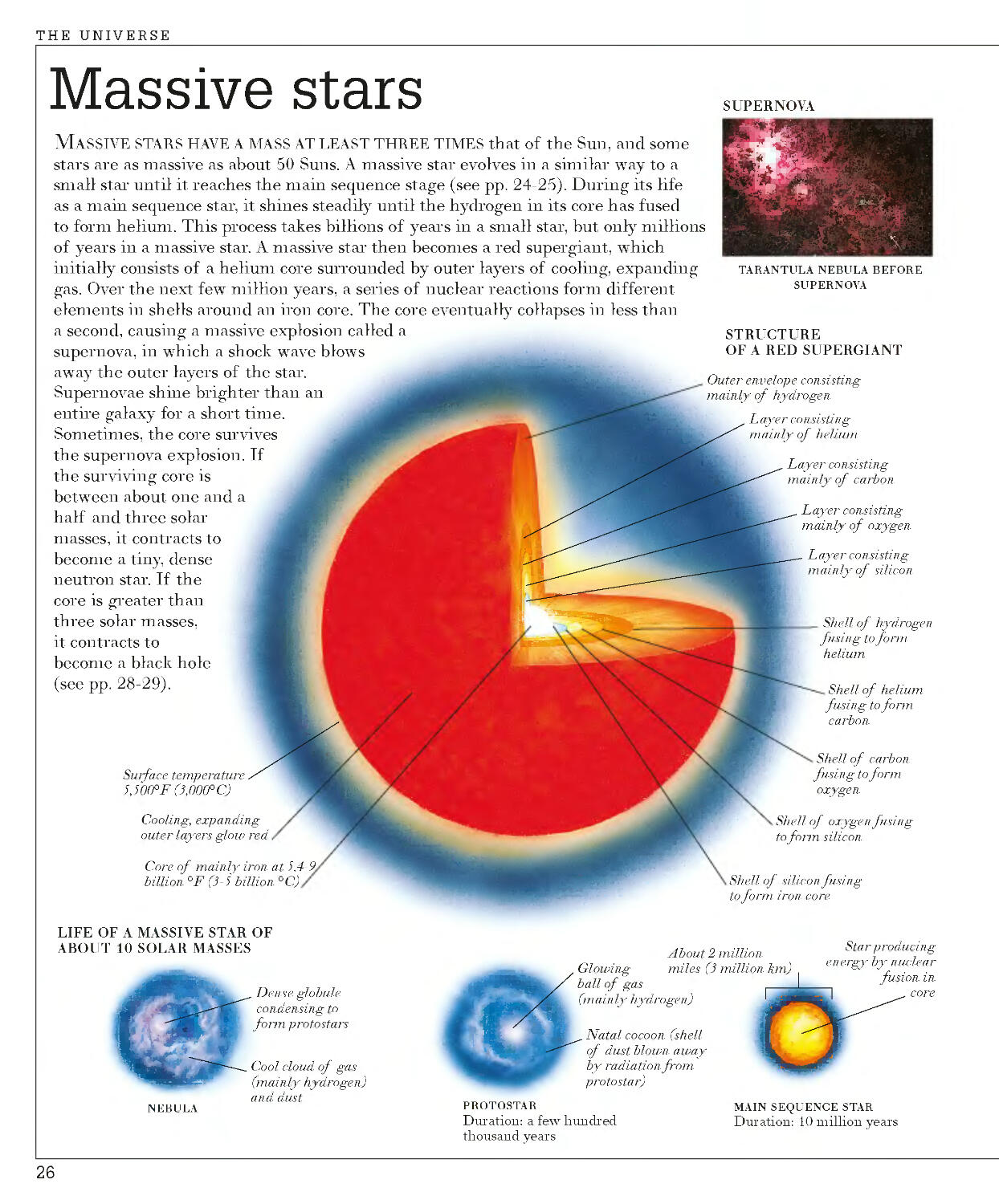
Massive STARS HAVE a MASS AT LEAST THREE TIMES that of the Sun, and some
stars are as massive as about 50 Suns. A massive star evolves in a similar way to a
small star until it reaches the main sequence stage (see pp. 24-25). During its life
as a main sequence star, it shines steadily until the hydrogen in its core has fused
to form helium. This process takes billions of years in a small star, but only millions
of years in a massive star. A massive star then becomes a red supergiant, which
initially consists of a helium core surrounded by outer layers of cooling, expanding
gas. Over the next few million years, a series of nuclear reactions form different
elements in shells around an iron core. The core eventually collapses in less than
a second, causing a massive explosion called a
supernova, in which a shock wave blows
away the outer layers of the star.
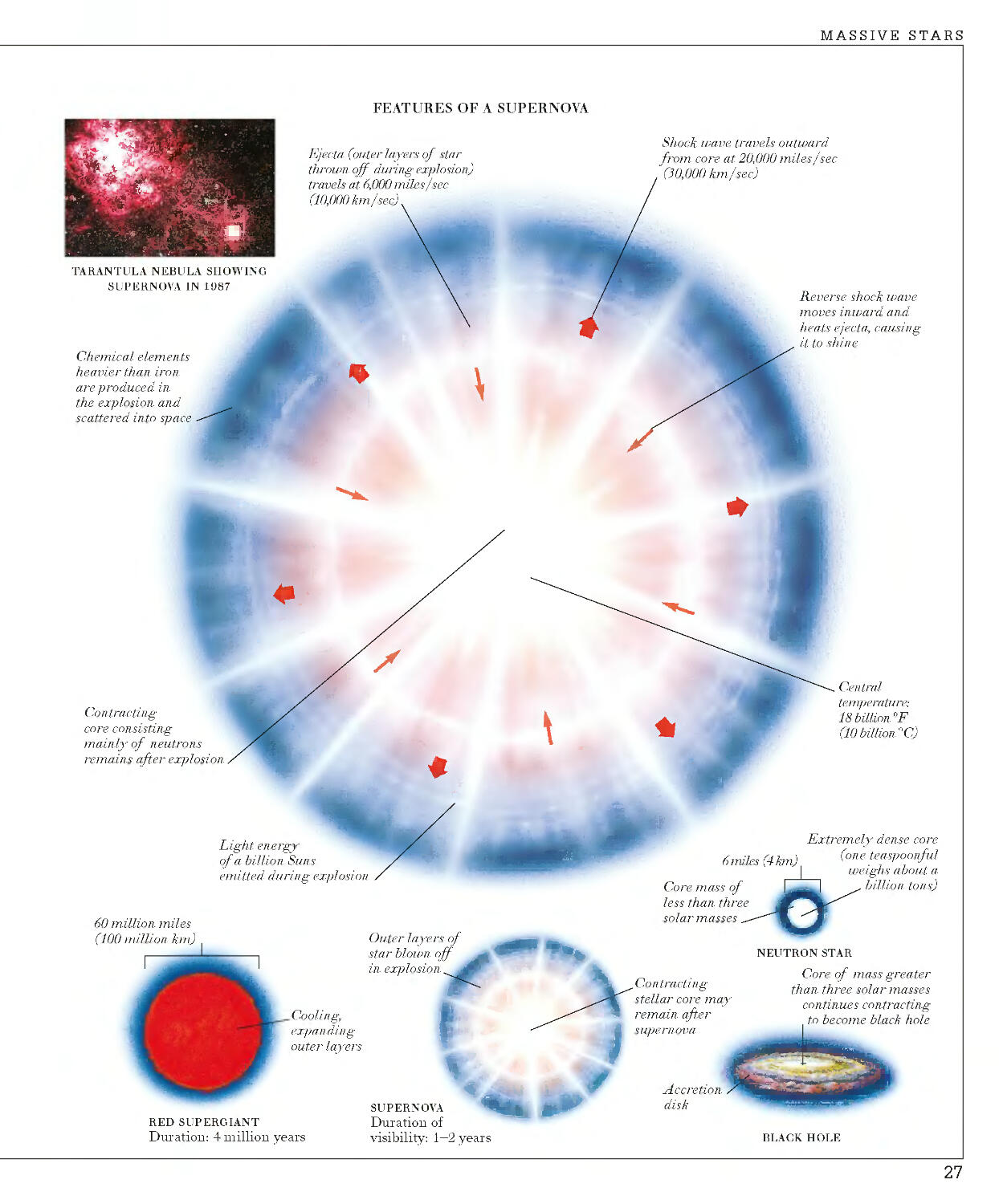
Supernovae shine brighter than an
entire galaxy for a short time.
Sometimes, the core survives
the supernova explosion. If
the surviving core is
between about one and a
half and three solar
masses, it contracts to
become a tiny, dense
neutron star. If the
core is greater than
three solar masses,
it contracts to
become a black hole
(see pp. 28-29).
Surface temperature
5,500° F (3,000° C)
TARANTULA NEBULA BEFORE
SUPERNOVA
STRUCTURE
OF A RED SUPERGIANT
Outer envelope consisting
mainly of hydrogen
Layer consisting
mainly of helium
Cooling, expanding
outer layers glow red
Core of mainly iron at 5.4-
billion °F (3-5 billion °C)
Layer consisting
mainly of carbon
Layer consisting
mainly of oxygen
Layer consisting
mainly of silicon
Shell of hydrogen
fusing to form
helium
Shell of helium
fusing to form
carbon
Shell of carbon
fusing to form
oxygen
Shell of oxygen fusing
to form silicon
Shell of silicon fusing
to form iron core
LIFE OF A MASSIVE STAR OF
ABOUT 10 SOLAR MASSES
Dense globule
condensing to
form protostars
Cool cloud of gas
(mainly hydrogen)
and dust
NEBULA
Natal cocoon (shell
of dust blown away
by radiation from
protostar)
About 2 million
Glowing miles (3 million km)
ball of gas
(mainly hydrogen)
Star producing
energy by nuclear
fusion in
core
PROTOSTAR
Duration: a few hundred
thousand years
MAIN SEQUENCE STAR
Duration: 10 million years
26

MASSIVE STARS
FEATURES OF A SUPERNOVA
Ejecta (outer layers of star
thrown off during explosion)
travels at 6,000 miles/sec
(10,000 km/sec)
Shock wave travels outward
from core at 20,000 miles/sec
(30,000 km/sec)
Contracting
core consisting
mainly of neutrons
remains after explosion
Light energy
of a billion Suns
emitted during explosion
60 million miles
(100 million km)
r
Outer layers of
star blown off
in explosion
Cooling,
expanding
outer layers
RED SUPERGIANT
Duration: 4 million years
SUPERNOVA
Duration of
visibility: 1—2 years
6 miles (4 km)
Core mass of
less than three
solar masses
Contracting
stellar core may
remain after
supernova
Accretion
disk
Extremely dense core
(one teaspoonful
weighs about a
billion tons)
NEUTRON STAR
Core of mass greater
than three solar masses
continues contracting
to become black hole
BLACK HOLE
TARANTULA NEBULA SHOWING
SUPERNOVA IN 1987
Central
temperature:
18 billion °F
(10 billion 0C)
Chemical elements
heavier than iron
are produced in
the explosion and
scattered into space
27

THE UNIVERSE
Neutron stars
and black holes
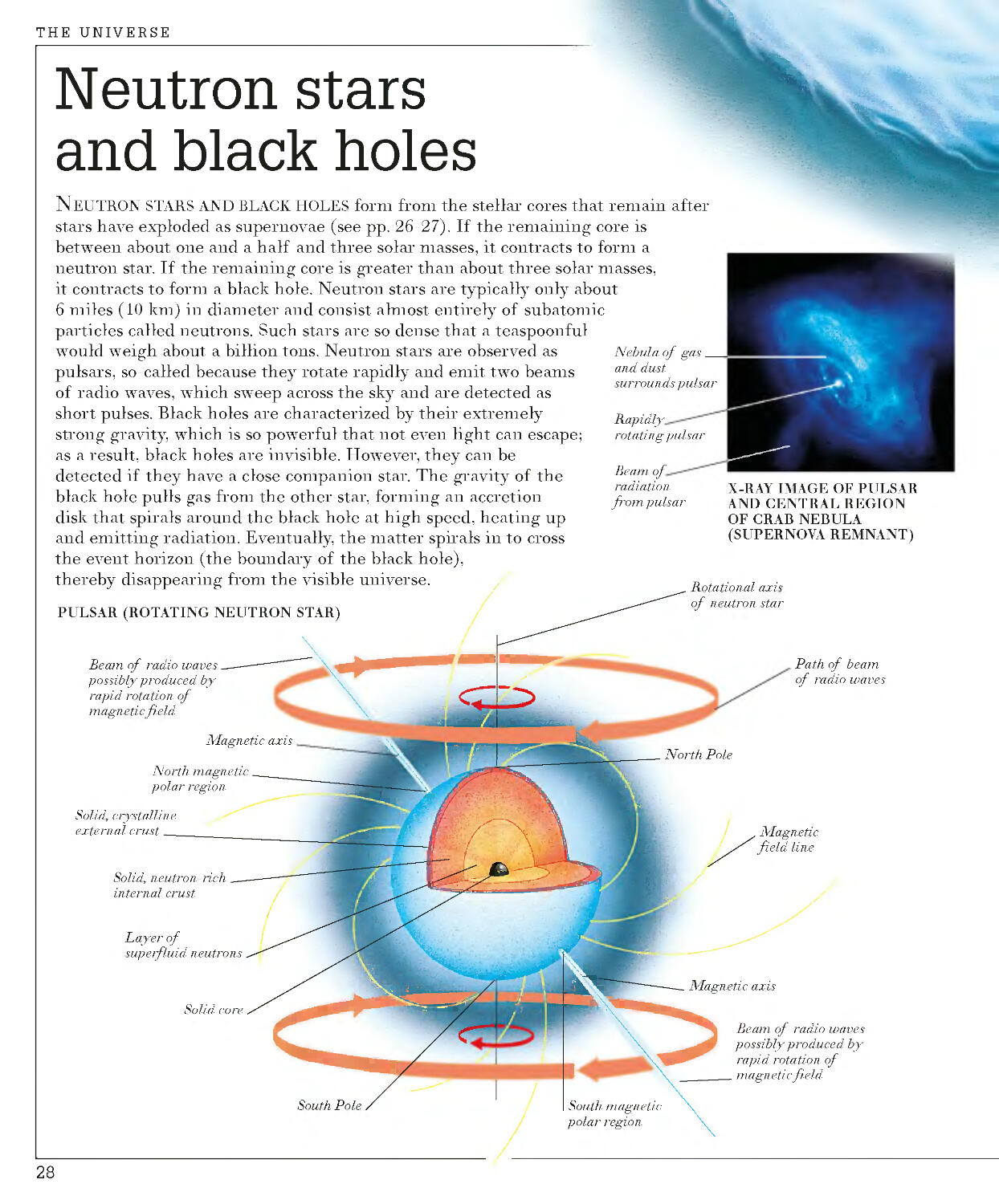
NEUTRON STARS AND BLACK HOLES form from the stellar cores that remain after
stars have exploded as supernovae (see pp. 26-27). If the remaining core is
between about one and a half and three solar masses, it contracts to form a
neutron star. If the remaining core is greater than about three solar masses,
it contracts to form a black hole. Neutron stars are typically only about
6 miles (10 km) in diameter and consist almost entirely of subatomic
particles called neutrons. Such stars are so dense that a teaspoonful
would weigh about a billion tons. Neutron stars are observed as
pulsars, so-called because they rotate rapidly and emit two beams
of radio waves, which sweep across the sky and are detected as
short pulses. Black holes are characterized by their extremely
strong gravity, which is so powerful that not even light can escape;
as a result, black holes are invisible. However, they can be
detected if they have a close companion star. The gravity of the
black hole pulls gas from the other star, forming an accretion
disk that spirals around the black hole at high speed, heating up
and emitting radiation. Eventually, the matter spirals in to cross
the event horizon (the boundary of the black hole),
Beam of,
radiation
from pulsar
Nebula of gas
and dust
surrounds pulsar
Rapidly,
rotating pulsar
X-RAY IMAGE OF PULSAR
AND CENTRAL REGION
OF CRAB NEBULA
(SUPERNOVA REMNANT)
North Pole
thereby disappearing from the visible universe.
PULSAR (ROTATING NEUTRON STAR)
Beam of radio waves
possibly produced by
rapid rotation of
magnetic field
Magnetic axis
North magnetic
polar region
Rotational axis
of neutron star
Path of beam
of radio waves
Solid, crystalline
external crust
Solid, neutron-rich
internal crust
Layer of
superfluid neutrons
Solid core
South Pole
Magnetic
field line
Magnetic axis
Beam of radio waves
possibly produced by
rapid rotation of
magnetic field
South magnetic
polar region
28

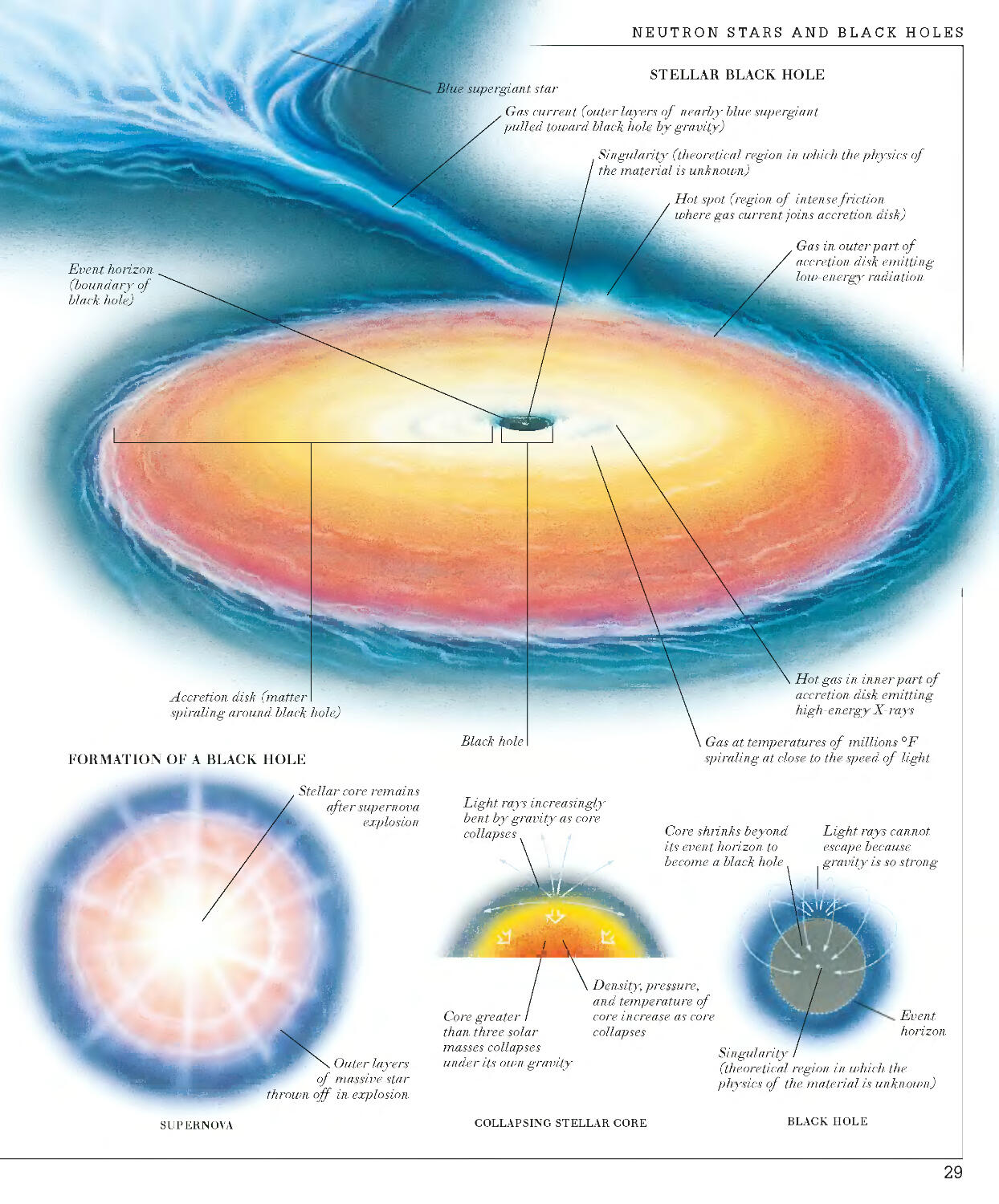
STELLAR BLACK HOLE
Event horizon
(boundary of
black hole)
. Blue supergiant star
Gas current 'outer layers of nearby blue supergiant
pulled toward black hole by gravity)
Singularity (theoretical region in which the physics of
the material is unknown)
Hot spot (region of intense friction
where gas current joins accretion disk)
Gas in outer part of
accretion disk emitting
low-energy radiation
Black hole
Accretion disk (matter
spiraling around black hole)
FORMATION OF A BLACK HOLE
Hot gas in inner part of
accretion disk emitting
high-energy X-rays
Gas at temperatures of millions °F
spiraling at close to the speed of light
Stellar core remains
after supernova
explosion
. Outer layers
of massive star
thrown off in explosion
Light rays increasingly
bent by gravity as core
collapses
Core shrinks beyond
its event horizon to
become a black hole
Light rays cannot
escape because
gravity is so strong
Core greater.
than three solar
masses collapses
under its own gravity
Density, pressure,
and temperature of
core increase as core
collapses
Singularity
(theoretical region in which the
physics of the material is unknown)
SUPERNOVA
COLLAPSING STELLAR CORE
BLACK HOLE

THE UNIVERSE
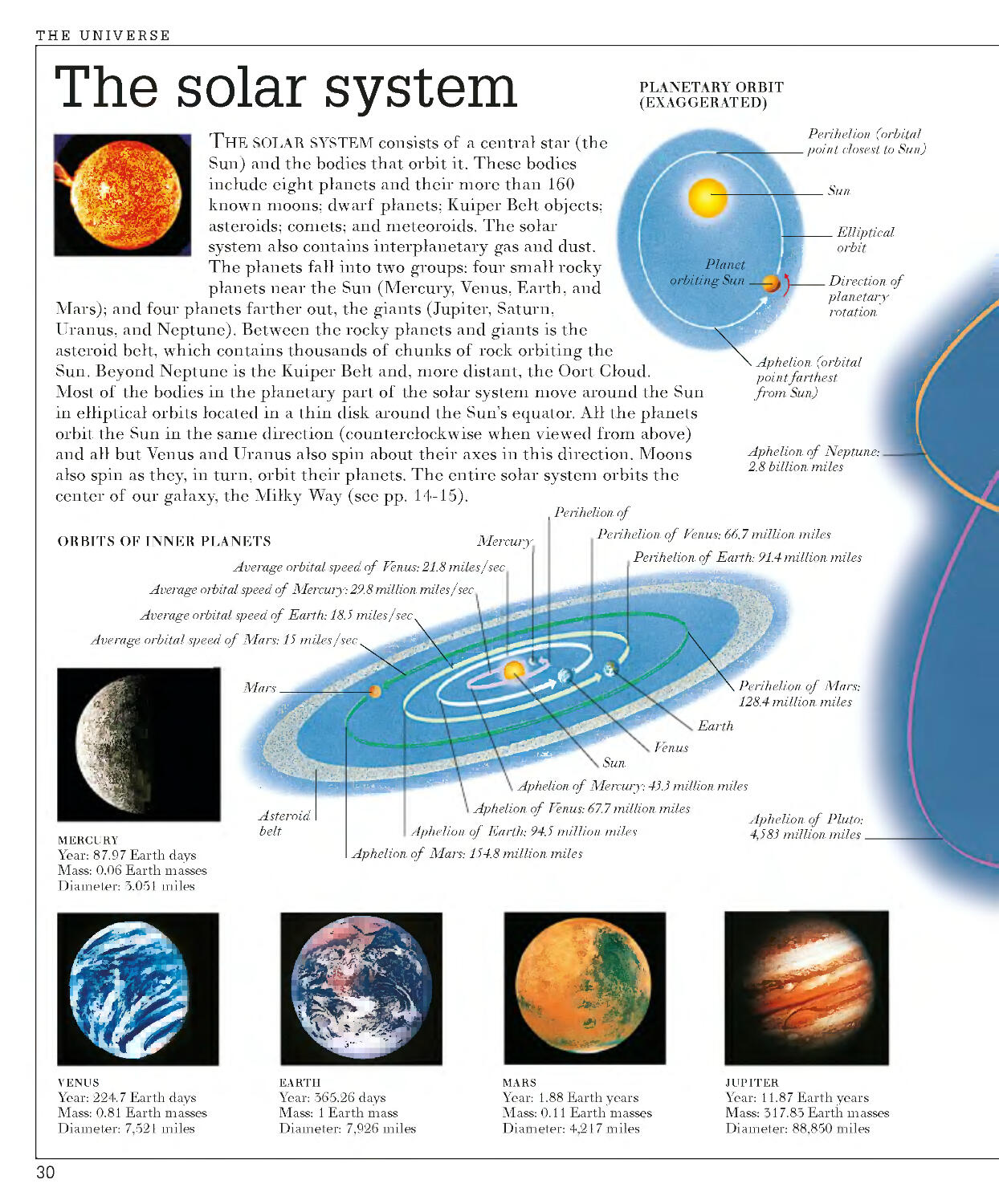
The solar system
PLANETARY ORBIT
(EXAGGERATED)
Sun
Planet
orbiting Sun
THE SOLAR SYSTEM consists of a central star (the
Sun) and the bodies that orbit it. These bodies
include eight planets and their more than 160
known moons; dwarf planets; Kuiper Belt objects;
asteroids; comets; and meteoroids. The solar
system also contains interplanetary gas and dust.
The planets fall into two groups: four small rocky
planets near the Sun (Mercury, Venus, Earth, and
Mars); and four planets farther out, the giants (Jupiter, Saturn,
Uranus, and Neptune). Between the rocky planets and giants is the
asteroid belt, which contains thousands of chunks of rock orbiting the
Sun. Beyond Neptune is the Kuiper Belt and, more distant, the Oort Cloud.
Most of the bodies in the planetary part of the solar system move around the Sun
in elliptical orbits located in a thin disk around the Sun’s equator. All the planets
orbit the Sun in the same direction (counterclockwise when viewed from above)
and all but Venus and Uranus also spin about their axes in this direction. Moons
also spin as they, in turn, orbit their planets. The entire solar system orbits the
center of our galaxy, the Milky Way (see pp. 14-15).
Perihelion of
Perihelion (orbital
point closest to Sun)
Sun
Elliptical
orbit
Direction of
planetary
rotation
Aphelion (orbital
point farthest
from Sun)
Aphelion of Neptune:
2.8 billion miles
ORBITS OF INNER PLANETS	Mercury
Average orbital speed of Venus: 21.8 miles/sec
Average orbital speed of Mercury: 29.8 million miles/sec
Average orbital speed of Earth: 18.5 miles/sec
Average orbital speed of Mars: 15 miles/sec
Mars
Perihelion of Venus: 66.7million miles
Perihelion of Earth: 91.4 million miles
MERCURY
Year: 87.97 Earth days
Mass: 0.06 Earth masses
Diameter: 3.051 miles
Perihelion of Mars:
128.4 million miles
Earth
Venus
Asteroid
belt
* Aphelion of Mercury: 43.3 million miles
\ Aphelion of Venus: 67.7 million miles
Aphelion of Earth: 94.5 million miles
Aphelion of Mars: 154.8 million miles
Aphelion of Pluto:
4,583 million miles.
VENUS
Year: 224.7 Earth days
Mass: 0.81 Earth masses
Diameter: 7,521 miles
EARTH
Year: 365.26 days
Mass: 1 Earth mass
Diameter: 7,926 miles
MARS
Year: 1.88 Earth years
Mass: 0.11 Earth masses
Diameter: 4,217 miles
JUPITER
Year: 11.87 Earth years
Mass: 317.83 Earth masses
Diameter: 88,850 miles
30

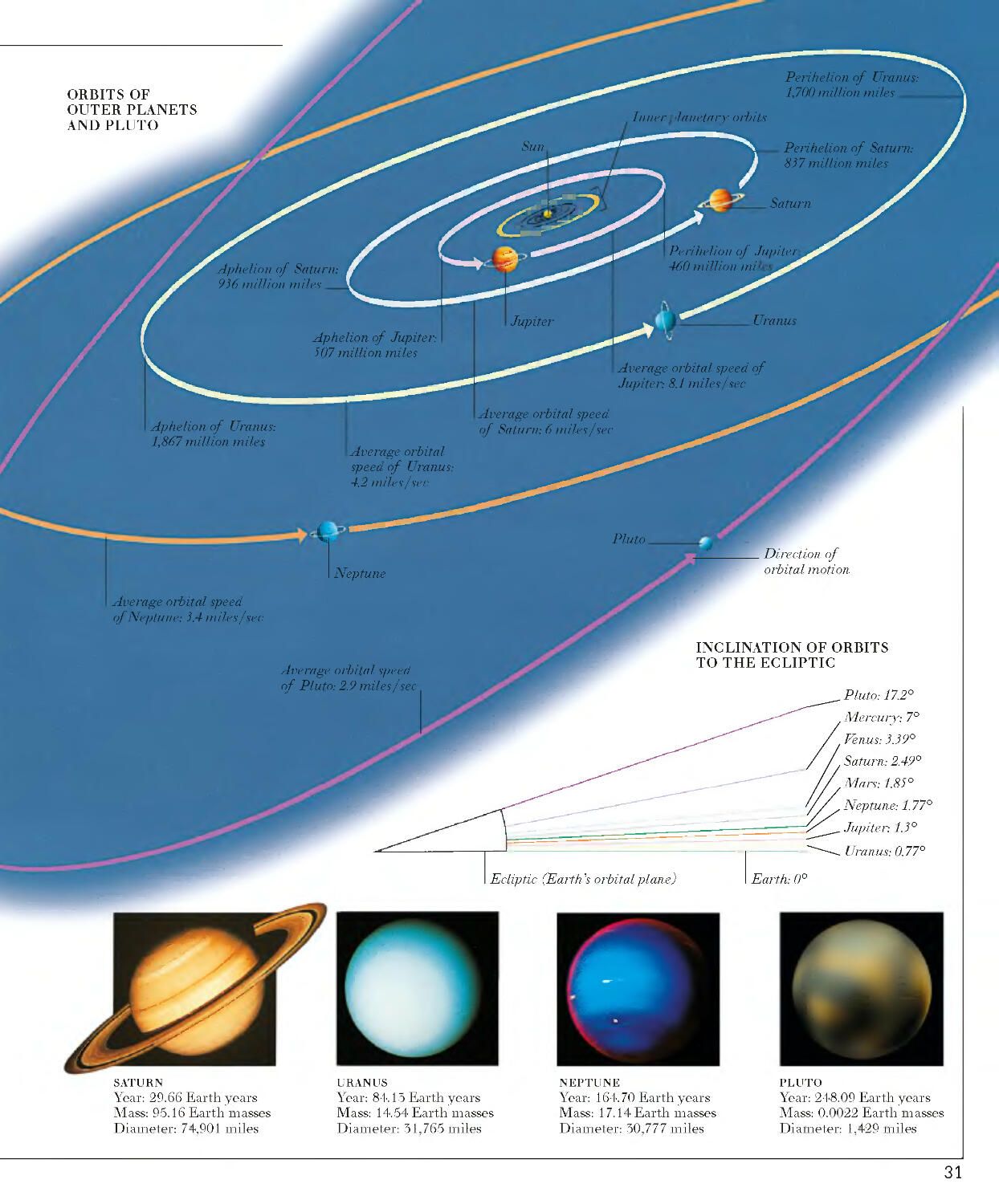
Perihelion of Uranus:
1,700 million miles
ORBITS OF
OUTER PLANETS
AND PLUTO
Inner planetary orbits
Sun
Perihelion of Saturn:
837 million miles
Saturn
Perihelion of Jupiter:
460 million miles
Aphelion of Saturn:
936 million miles
Uranus
Jupiter
Aphelion of Jupiter:
507 million miles
Average orbital speed of
Jupiter: 8.1 miles/sec
Average orbital speed
of Saturn: 6 miles/sec
Aphelion of Uranus:
1,867 million miles
Average orbital
speed of Uranus:
4.2 miles/sec
Pluto
Direction of
orbital motion
Neptune
Average orbital speed
of Neptune: 3.4 miles/sec
INCLINATION OF ORBITS
TO THE ECLIPTIC
Average orbital speed
of Pluto: 2.9 miles/sec
Pluto: 17.2'
Mercury: 7°
Venus: 3.39°
Saturn: 2.49°
Mars: 1.85°
Neptune: 1.77°
Jupiter: 1.3°
Uranus: 0.77°
Ecliptic (Earths orbital plane)
Earth: 0'
SATURN
URANUS
NEPTUNE
PLUTO
Year: 29.66 Earth years
Mass: 95.16 Earth masses
Diameter: 74,901 miles
Year: 84.13 Earth years
Mass: 14.54 Earth masses
Diameter: 31,765 miles
Year: 164.70 Earth years
Mass: 17.14 Earth masses
Diameter: 30,777 miles
Year: 248.09 Earth years
Mass: 0.0022 Earth masses
Diameter: 1,429 miles
31

THE UNIVERSE
The Sun
HOW A SOLAR ECLIPSE OCCURS
SOLAR
PHOTOSPHERE
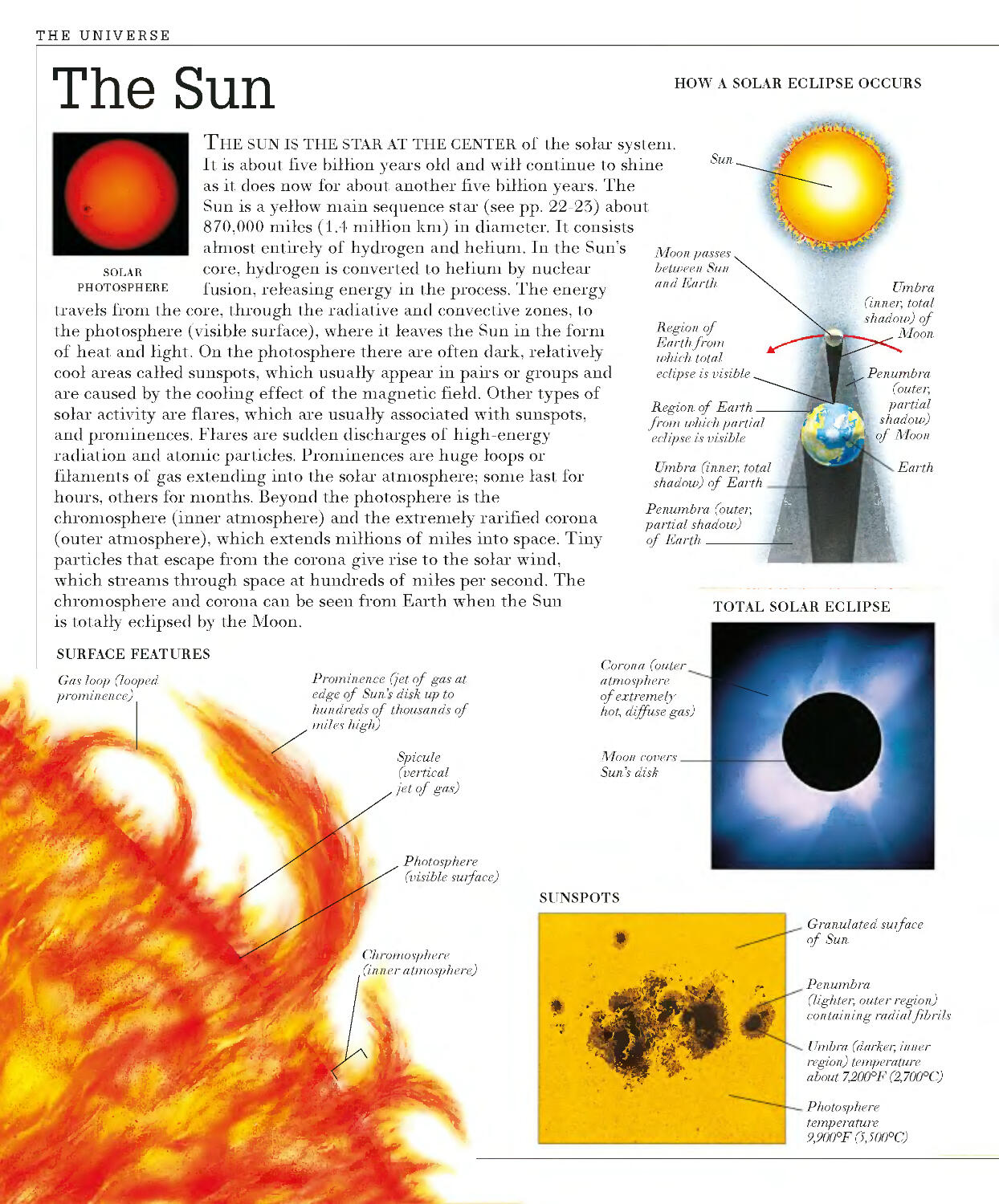
The SUN IS THE STAR AT THE CENTER of the solar system.
It is about five billion years old and will continue to shine
as it does now for about another five billion years. The
Sun is a yellow main sequence star (see pp. 22-23) about
870,000 miles (1.4 million km) in diameter. It consists
almost entirely of hydrogen and helium. In the Sun’s
core, hydrogen is converted to helium by nuclear
fusion, releasing energy in the process. The energy
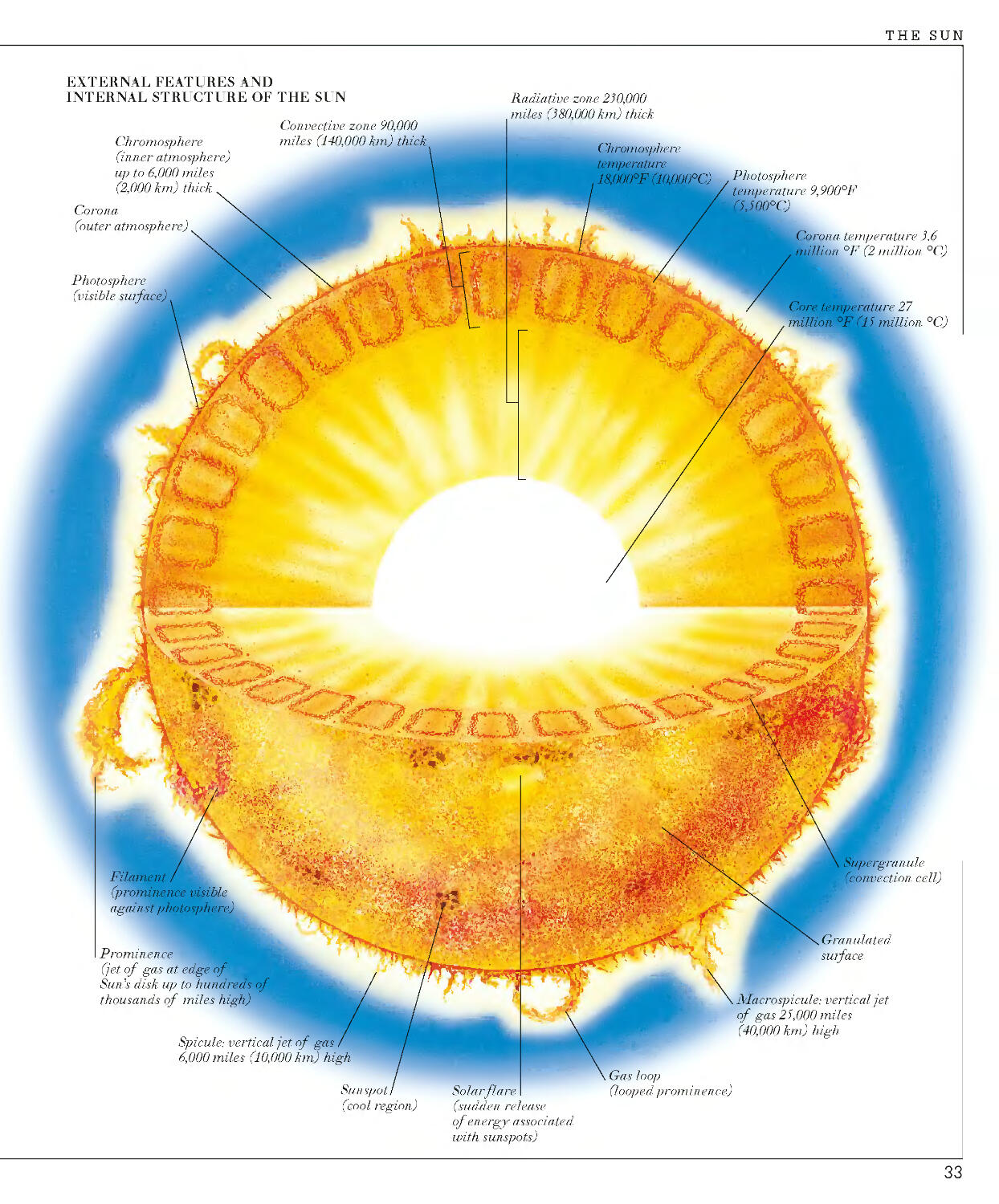
travels from the core, through the radiative and convective zones, to
the photosphere (visible surface), where it leaves the Sun in the form
of heat and light. On the photosphere there are often dark, relatively
cool areas called sunspots, which usually appear in pairs or groups and
are caused by the cooling effect of the magnetic field. Other types of
solar activity are flares, which are usually associated with sunspots,
and prominences. Flares are sudden discharges of high-energy
radiation and atomic particles. Prominences are huge loops or
filaments of gas extending into the solar atmosphere; some last for
hours, others for months. Beyond the photosphere is the
chromosphere (inner atmosphere) and the extremely rarified corona
(outer atmosphere), which extends millions of miles into space. Tiny
particles that escape from the corona give rise to the solar wind,
which streams through space at hundreds of miles per second. The
chromosphere and corona can be seen from Earth when the Sun
is totally eclipsed by the Moon.
Sun
Moon passes
between Sun
and Earth
Region of
Earthfrom
which total
eclipse is visible
Region of Earth
from which partial
eclipse is visible
Umbra (inner, total
shadow) of Earth _
Penumbra (outer,
partial shadow)
of Earth
Umbra
(inner, total
shadow) of
Moon
Penumbra
(outer,
partial
shadow)
of Moon
Earth
TOTAL SOLAR ECLIPSE
SURFACE FEATURES
Gas loop (looped
prominence)
Prominence (jet of gas at
edge of Sun’s disk up to
hundreds of thousands of
miles high)
Spicule
(vertical
jet of gas)
Photosphere
(visible surface)
Corona (outer
atmosphere
of extremely
hot, diffuse gas)
Moon covers
Sun’s disk
SUNSPOTS
Chromosphere
(inner atmosphere)
Granulated surface
of Sun
Penumbra
(lighter, outer region)
containing radial fibrils
Umbra (darker, inner
region) temperature
about 7,200°F (2,700°C)
Photosphere
temperature
9,900°F (5,500°C)

THE SUN
EXTERNAL FEATURES AND
INTERNAL STRUCTURE OF THE SUN
Chromosphere
(inner atmosphere)
up to 6,000 miles
(2,000 km) thick ,
Convective zone 90,000
miles (140,000 km) thick
Radiative zone 230,000
smiles (380,000 km) thick
Corona
(outer atmosphere)
Photosphere
'visible surfacey
Chromosphere
temperature
18/J00°FC10/J00°CMiPhotosphere
temperature 9,900°F
(5,500°C)
Corona temperature 3.6
million °F (2 million °C)
Core temperature 27
million °F (15 million °C)
7\
,/■
. y-'VSariwN. . '
C* i \ *
. ■ . ■'
^ '*■' £*'£???, . ..
,.' v
Filament
(prominence visible
against photosphere)
ergranule
convection cell)
^ ;
Prominence
(jet of gas at edge of
Sun’s disk up to hundreds of
thousands of miles high)
Granulated
surface
Spicule: vertical jet of gas
6,000 miles (10,000 km) high
Macrospicule: vertical jet
of gas 25,000 miles
(40,000 km) high
Sunspot
(cool region)
Solar fla
(sudden release
of energy associated
with sunspots)
Gas loop
(looped prominence)
33

THE UNIVERSE
Mercury
TILT AND ROTATION OF MERCURY
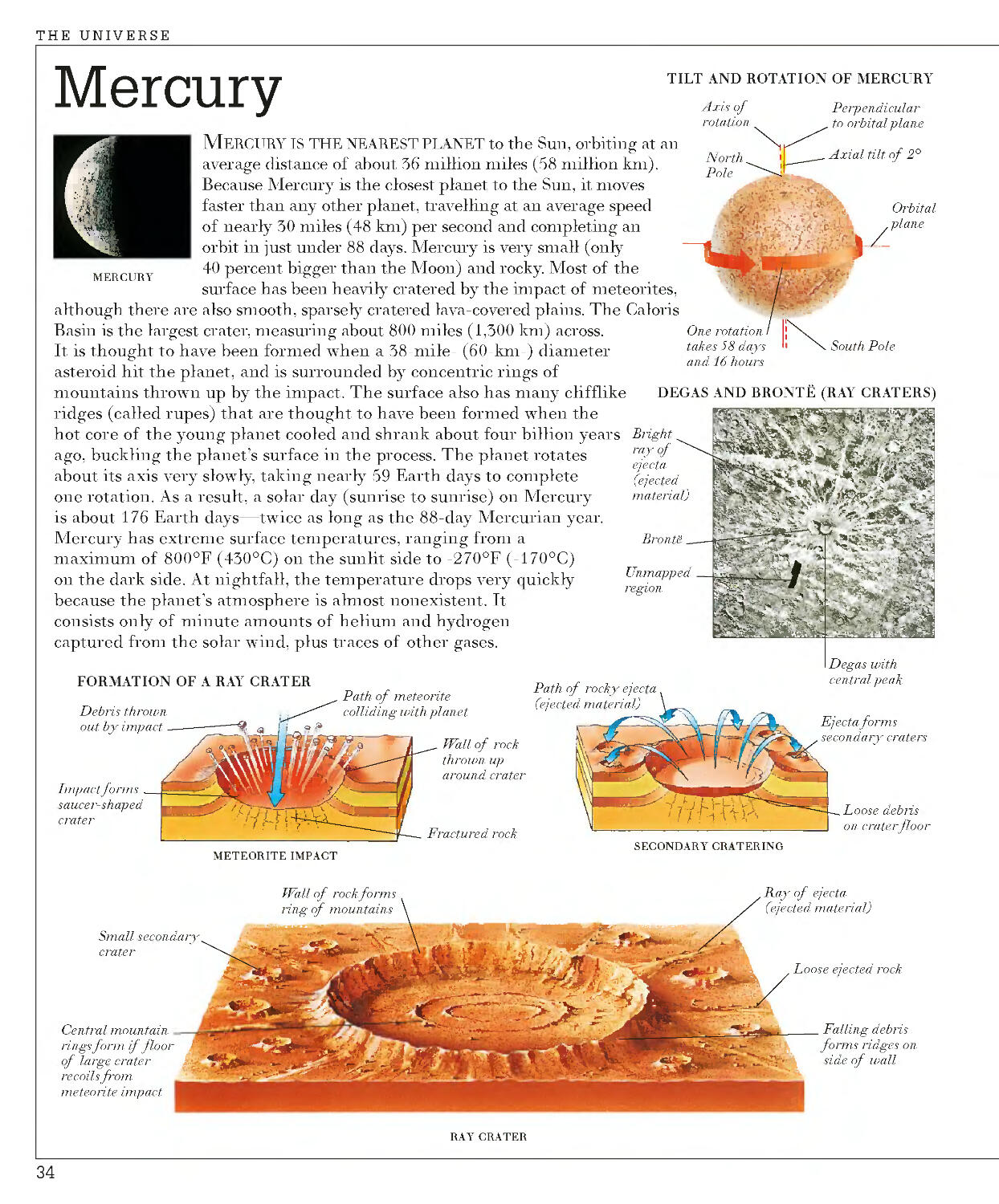
Mercury IS THE NEAREST PLANET to the Sun, orbiting at an
average distance of about 36 million miles (58 million km).
Because Mercury is the closest planet to the Sun, it moves
faster than any other planet, travelling at an average speed
of nearly 30 miles (48 km) per second and completing an
orbit in just under 88 days. Mercury is very small (only
mercury 40 percent bigger than the Moon) and rocky. Most of the
surface has been heavily cratered by the impact of meteorites,
although there are also smooth, sparsely cratered lava-covered plains. The Caloris
Basin is the largest crater, measuring about 800 miles (1,300 km) across.
It is thought to have been formed when a 38-mile- (60-km-) diameter
asteroid hit the planet, and is surrounded by concentric rings of
mountains thrown up by the impact. The surface also has many clifflike
ridges (called rupes) that are thought to have been formed when the
hot core of the young planet cooled and shrank about four billion years
ago, buckling the planet’s surface in the process. The planet rotates
about its axis very slowly, taking nearly 59 Earth days to complete
one rotation. As a result, a solar day (sunrise to sunrise) on Mercury
is about 176 Earth days—twice as long as the 88-day Mercurian year.
Mercury has extreme surface temperatures, ranging from a
maximum of 800°F (430°C) on the sunlit side to -270°F (-170°C)
on the dark side. At nightfall, the temperature drops very quickly
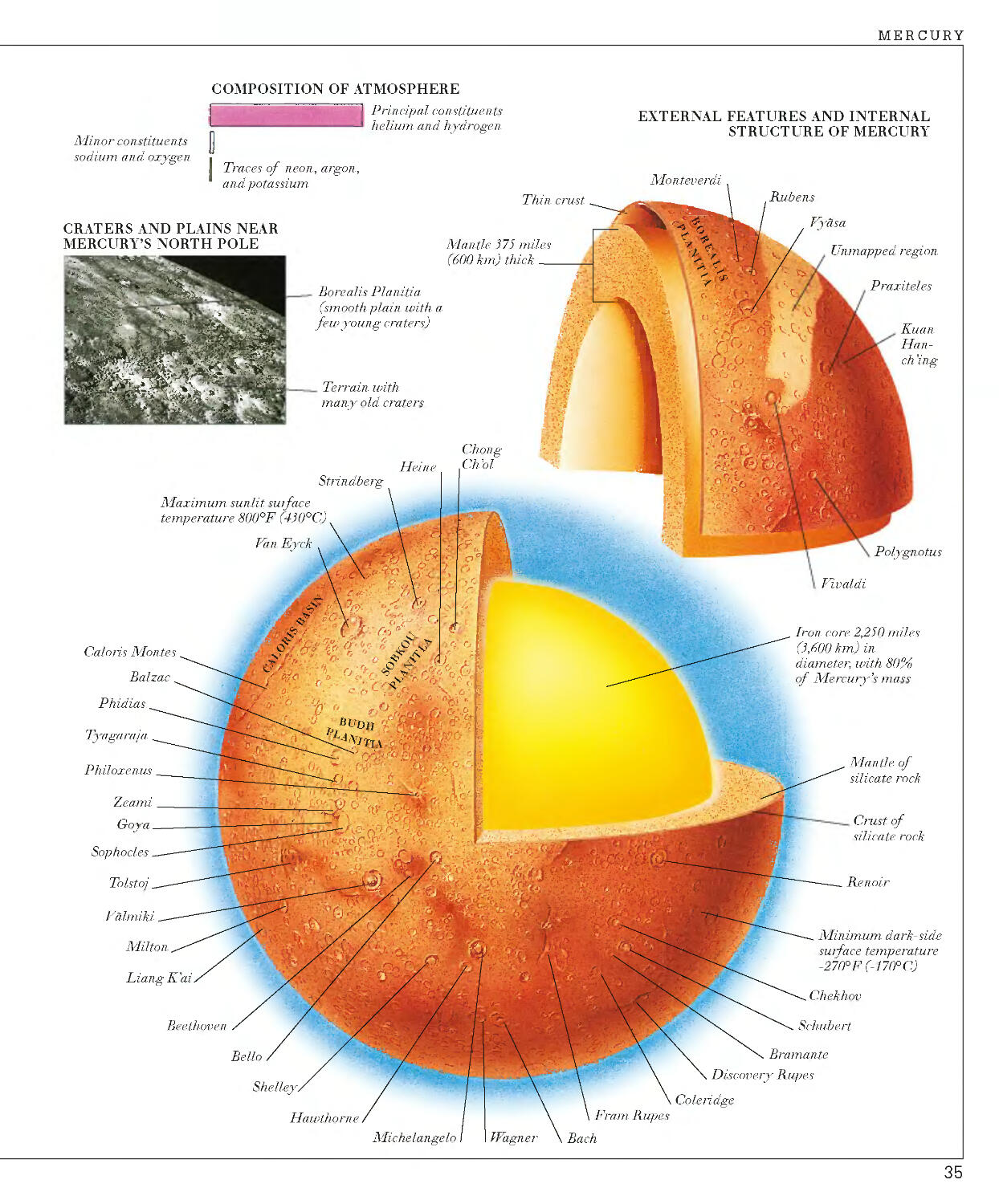
because the planet’s atmosphere is almost nonexistent. It
consists only of minute amounts of helium and hydrogen
captured from the solar wind, plus traces of other gases.
Axis of
rotation
North
Pole
Perpendicular
to orbital plane
Axial tilt of 2°
One rotation
takes 58 days
and 16 hours
South Pole
Orbital
plane
DEGAS AND BRONTE (RAY CRATERS)
Bright
ray of
ejecta
(ejected
material)
Bronte
Unmapped
region
FORMATION OF A RAY CRATER
Debris thrown
out by impact
Path of meteorite
colliding with planet
Path of rocky ejecta
(ejected material)
Impact forms
saucer-shaped
crater
Wall of rock
thrown up
around crater
Fractured rock
Degas with
central peak
Ejectaforms
secondary craters
Loose debris
on crater floor
SECONDARY CRATERING
METEORITE IMPACT
Central mountain
rings form if floor
of large crater
recoils from
meteorite impact
Falling debris
forms ridges on
side of wall
Small secondary
crater
Wall of rockforms
ring of mountains
Ray of ejecta
(ejected material)
Loose ejected rock
RAY CRATER
34

MERCURY
COMPOSITION OF ATMOSPHERE
Vivaldi
Minor constituents
sodium and oxygen
Principal constituents
helium and hydrogen
EXTERNAL FEATURES AND INTERNAL
STRUCTURE OF MERCURY
. Traces of neon, argon,
‘ and potassium
Monteverdi
Thin crus!
CRATERS AND PLAINS NEAR
MERCURY’S NORTH POLE
Mantle 375 miles
'600 km, thick
Borealis Planitia
(smooth plain with a
few young craters)
Terrain with
many old craters
Rubens
Vyasa
Unmapped region
Praxiteles
Kuan
Han-
ch'ing
Strindberg
Maximum sunlit surface
temperature 800°F (430°C)
Heine
Chong
Ch,ol
Van Eyck
MIBMf
. V /, ■ yX ({"■ -
\?a>:	• dv
Caloris Montes _
Balzac _
Phidias „
Tyagaraja
Philoxenus
Zeami
Goya
Sophocles
Tolstoj
Valmiki
Milton
Liang K’ai
Polygnotus
Iron core 2,250 miles
'3.600 km)
mameter. with 80%
of Mercury's mass
Mantle of
silicate rock
Crust of
silicate rock
Renoir
Beethoven
Minimum dark-side
surface temperature
-270°F (-170° C)
Chekhov
Schubert
Bello
Shelley.
Hawthorne
Fram Rupes
Bramante
Discovery Rupes
Coleridge
Michelangelo Wagner Bach
35

THE UNIVERSE
Howe
Venus
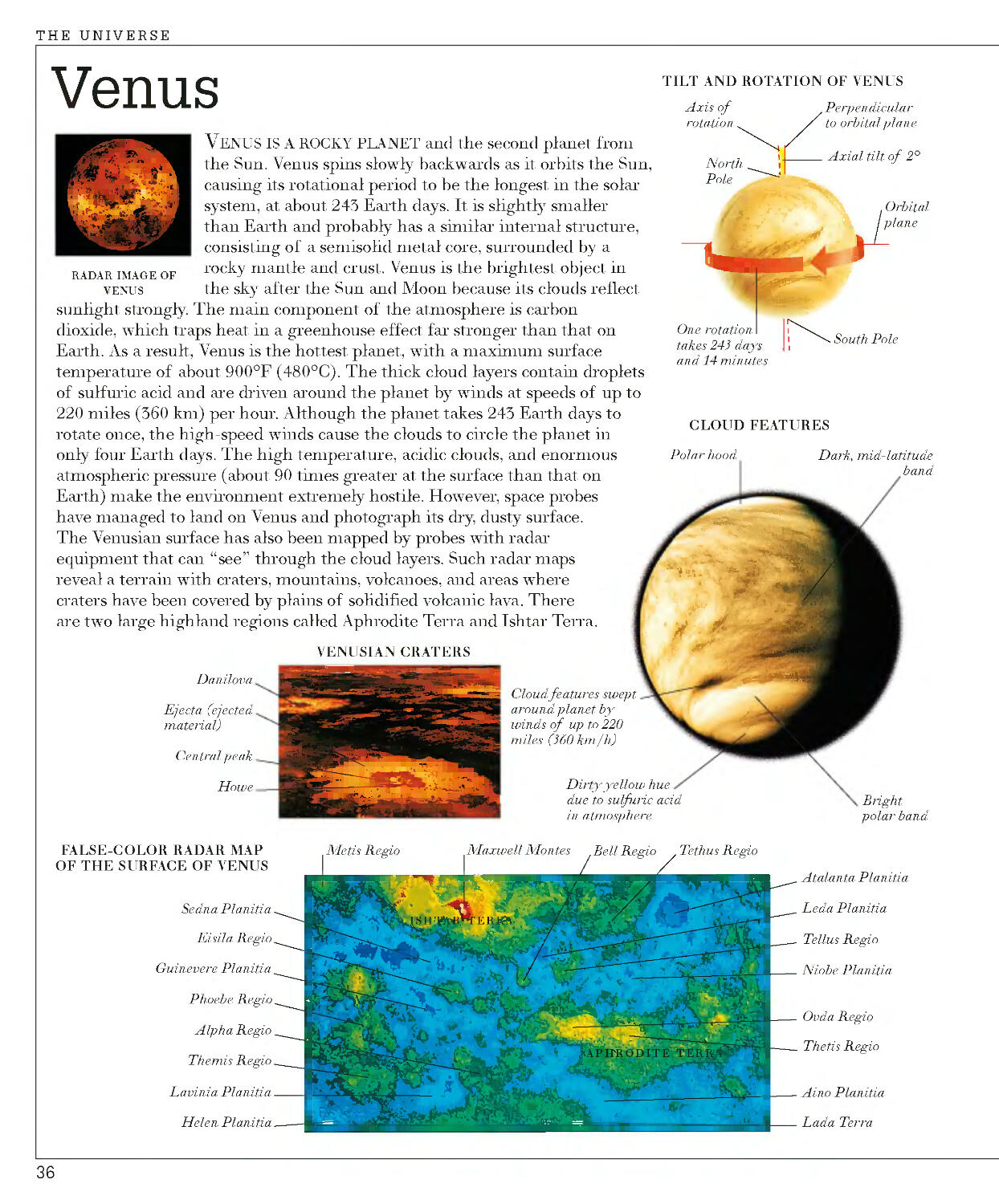
VENUS IS a ROCKY PLANET and the second planet from
the Sun. Venus spins slowly backwards as it orbits the Sun,
causing its rotational period to be the longest in the solar
system, at about 243 Earth days. It is slightly smaller
than Earth and probably has a similar internal structure,
consisting of a semisolid metal core, surrounded by a
rocky mantle and crust. Venus is the brightest object in
the sky after the Sun and Moon because its clouds reflect
sunlight strongly. The main component of the atmosphere is carbon
dioxide, which traps heat in a greenhouse effect far stronger than that on
Earth. As a result, Venus is the hottest planet, with a maximum surface
temperature of about 900°F (480°C). The thick cloud layers contain droplets
of sulfuric acid and are driven around the planet by winds at speeds of up to
220 miles (360 km) per hour. Although the planet takes 243 Earth days to
rotate once, the high-speed winds cause the clouds to circle the planet in
only four Earth days. The high temperature, acidic clouds, and enormous
atmospheric pressure (about 90 times greater at the surface than that on
Earth) make the environment extremely hostile. However, space probes
have managed to land on Venus and photograph its dry, dusty surface.
The Venusian surface has also been mapped by probes with radar
equipment that can “see” through the cloud layers. Such radar maps	,
reveal a terrain with craters, mountains, volcanoes, and areas where	f
craters have been covered by plains of solidified volcanic lava. There	H
are two large highland regions called Aphrodite Terra and Ishtar Terra.
RADAR IMAGE OF
VENUS
TILT AND ROTATION OF VENUS
Axis of
rotation
North
Pole
Perpendicular
to orbital plane
Axial tilt of 2°
I'
Orbital
plane
Cloud features swept
around planet by
winds of up to 220
miles (360 km/h)
Dirty yellow hue
due to sulfuric acid
in atmosphere
Bright
polar band
VENUSIAN CRATERS
Danilova
Ejecta (ejected
material)
Central peak
One rotation
takes 243 days
and 14 minutes
- South Pole
CLOUD FEATURES
Polar hood	Dark, mid-latitude
band
FALSE-COLOR RADAR MAP
OF THE SURFACE OF VENUS
Sedna Planitia
Eisila Regio
Guinevere Planitia
Phoebe Regio
Alpha Regio
Themis Regio
Lavinia Planitia
Helen Planitia
Maxwell Montes
Metis Regio
Atalanta Planitia
Leda Planitia
Tellus Regio
Niobe Planitia
Ovda Regio
Thetis Regio
Aino Planitia
Lada Terra
36

VENUS
ATMOSPHERE
STRUCTURE
Thermosphere
Haze containing
droplets of
, sulfuric acid
Troposphere
— Thick cloud layers
containing droplets
of sulfuric acid
. Lower haze of dust
and sulfuric acid
aerosol (extremely
small droplets)
- Clear atmosphere
of mainly carbon
dioxide
COMPOSITION
Carbon dioxide about 96%
Nitrogen about 3.5% j I
I Carbon monoxide, argon, sulfur
dioxide, and water vapor about 0.5%
37

THE UNIVERSE
The Earth
TILT AND ROTATION OF THE EARTH
Axis of
rotation
North
Pole
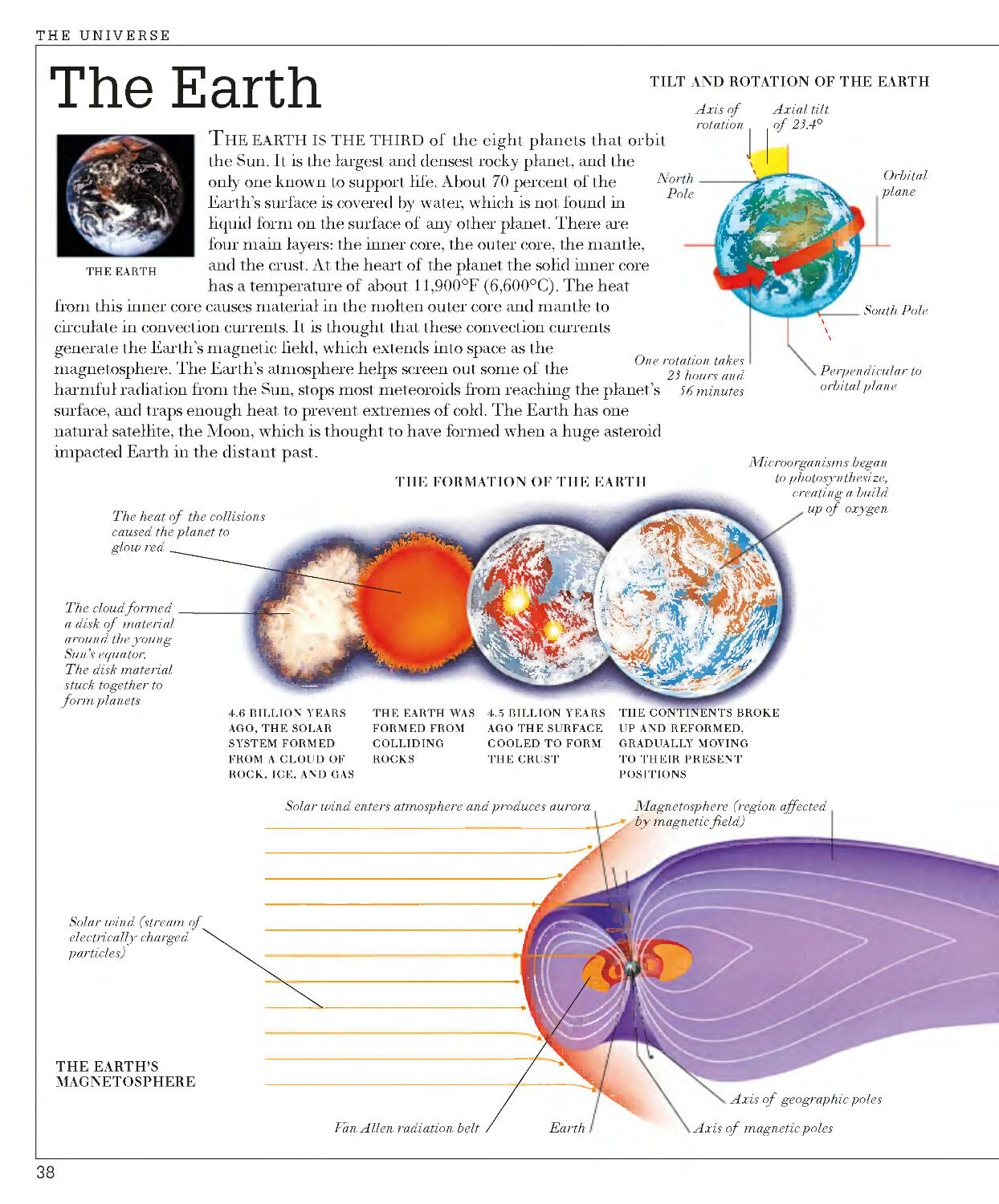
THE EARTH IS THE THIRD of the eight planets that orbit
the Sun. It is the largest and densest rocky planet, and the
only one known to support life. About 70 percent of the
Earth’s surface is covered by water, which is not found in
liquid form on the surface of any other planet. There are
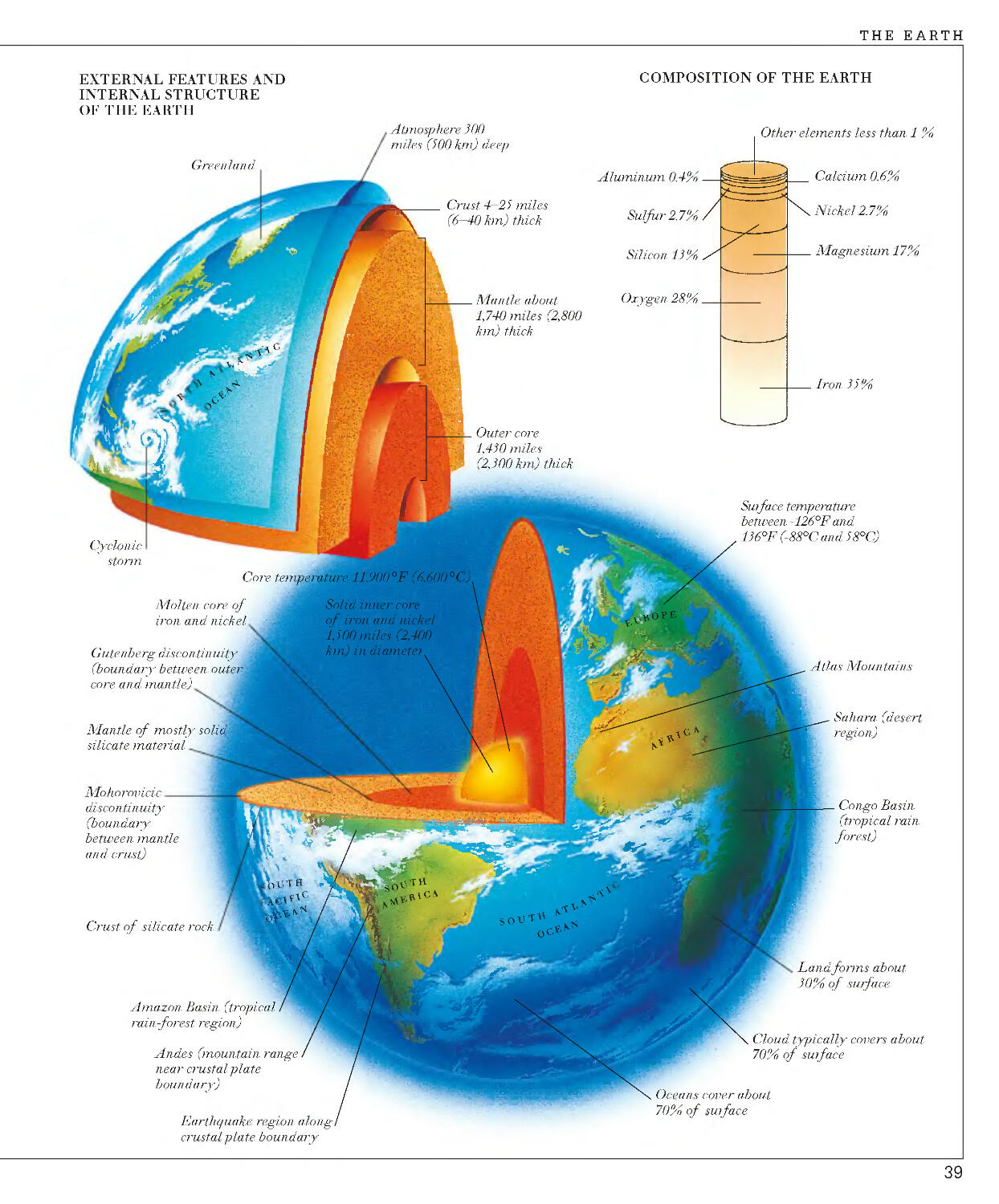
four main layers: the inner core, the outer core, the mantle,
the earth	and the crust. At the heart of the planet the solid inner core
has a temperature of about 11,900°F (6,600°C). The heat
from this inner core causes material in the molten outer core and mantle to
circulate in convection currents. It is thought that these convection currents
generate the Earth’s magnetic field, which extends into space as the
One rotation takes
magnetosphere. The Earth s atmosphere helps screen out some of the	23 hours and
harmful radiation from the Sun, stops most meteoroids from reaching the planet’s 56 minutes
surface, and traps enough heat to prevent extremes of cold. The Earth has one
natural satellite, the Moon, which is thought to have formed when a huge asteroid
impacted Earth in the distant past.
Axial tilt
of 23.4°
Orbital
plane
South Pole
Perpendicular to
orbital plane
THE FORMATION OF THE EARTH
The heat of the collisions
caused the planet to
glow red
The cloud formed
a disk of material
around the young
Sun’s equator.
The disk material
stuck together to
form planets
Microorganisms began
to photosynthesize,
creating a build
up of oxygen
4.6 BILLION YEARS
AGO, THE SOLAR
SYSTEM FORMED
FROM A CLOUD OF
ROCK, ICE, AND GAS
THE EARTH WAS
FORMED FROM
COLLIDING
ROCKS
4.5 BILLION YEARS
AGO THE SURFACE
COOLED TO FORM
THE CRUST
THE CONTINENTS BROKE
UP AND REFORMED,
GRADUALLY MOVING
TO THEIR PRESENT
POSITIONS
Solar wind (stream of
electrically charged
particles)
THE EARTH’S
MAGNETOSPHERE
Earth
Solar wind enters atmosphere and produces aurora
Magnetosphere (region affected
by magnetic field)
Van Allen radiation belt
v Axis of geographic poles
\ Axis of magnetic poles
38

THE EARTH
EXTERNAL FEATURES AND	COMPOSITION OF THE EARTH
INTERNAL STRUCTURE
OF THE EARTH
Aluminum 0.4%
Crust 4—25 miles
(6—40 km) thick
Sulfur 2.7%
Silicon 13%
Oxygen 28%
Mantle about
1,740 miles (2,800
km) thick
	Outer core
1,430 miles
(2,300 km) thick
Core temperature 11,900 °F (6,600 °C)]
Solid inner core
of iron and nickel
1,500 miles (2,400
km) in diameter
core of
d nickel
. Atmosphere 300
miles (500 km) deep
Greenland
Surface temperature
between -126°F and
136°F (-88°C and 58°C)
Other elements less than 1 %
Calcium 0.6%
Nickel 2.7%
Magnesium 17%
Iron 35%
Gutenberg discontinuity
(boundary between outer
core and mantle)
Mantle of mostly solid
silicate material
Mohorovicic
discontinuity
(boundary
between mantle
and crust)
Crust of silicate rock
Atlas Mountains
Sahara (desert
region)
. Congo Basin
(tropical rain
forest)
Amazon Basin (tropical
rain-forest region)
Andes (mountain range
near crustal plate
boundary)
Land forms about
30% of surface
Cloud typically covers about
70% of surface
Earthquake region along
crustal plate boundary
Oceans cover about
70% of surface
39

THE UNIVERSE
The Moon
TILT AND ROTATION OF THE MOON
THE MOON FROM
EARTH
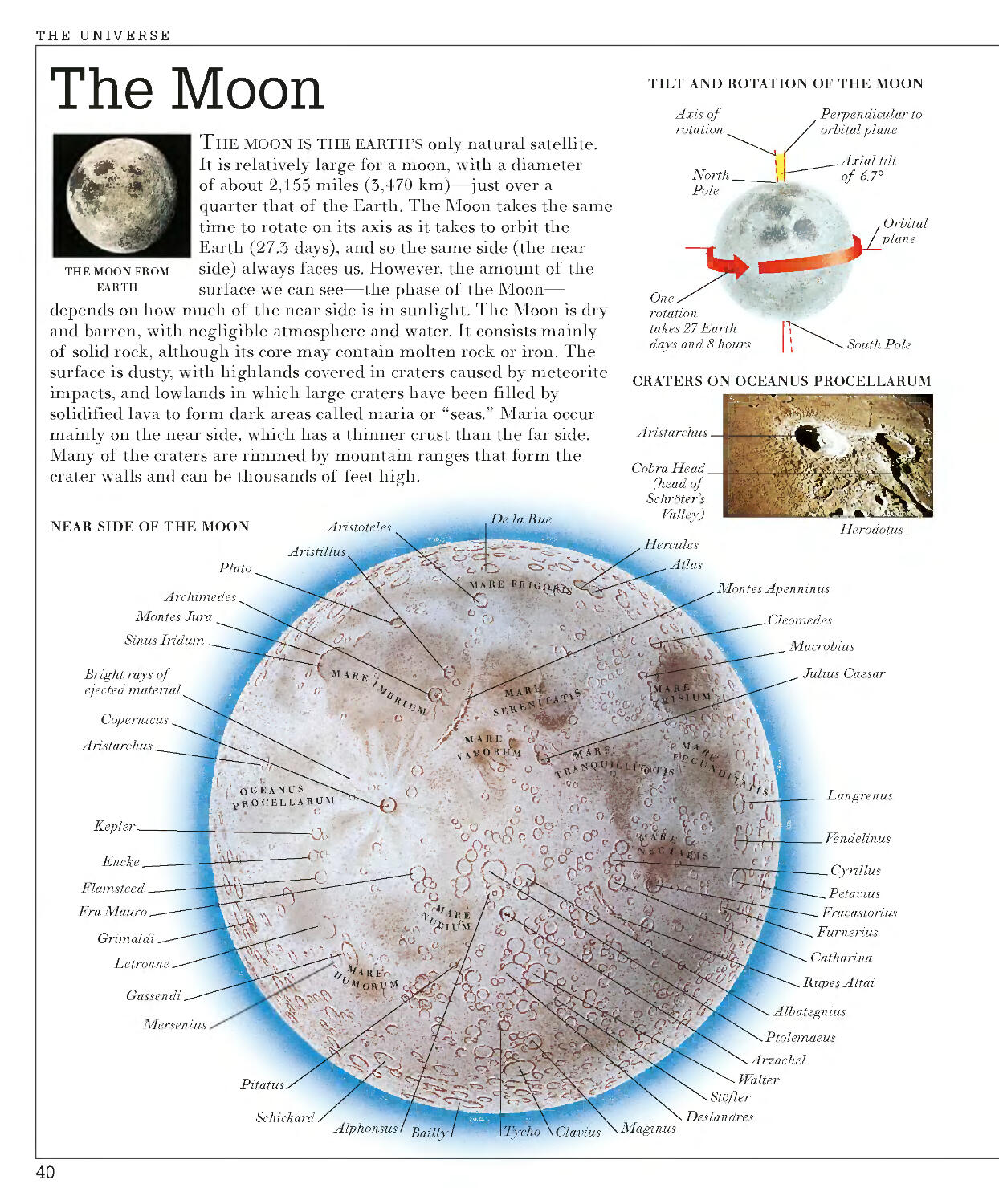
THE MOON IS THE EARTH’S only natural satellite.
It is relatively large for a moon, with a diameter
of about 2,155 miles (3,470 km)—just over a
quarter that of the Earth. The Moon takes the same
time to rotate on its axis as it takes to orbit the
Earth (27.3 days), and so the same side (the near
side) always faces us. However, the amount of the
surface we can see—the phase of the Moon—
depends on how much of the near side is in sunlight. The Moon is dry
and barren, with negligible atmosphere and water. It consists mainly
of solid rock, although its core may contain molten rock or iron. The
surface is dusty, with highlands covered in craters caused by meteorite
impacts, and lowlands in which large craters have been filled by
solidified lava to form dark areas called maria or “seas.” Maria occur
mainly on the near side, which has a thinner crust than the far side.
Many of the craters are rimmed by mountain ranges that form the
crater walls and can be thousands of feet high.
rotation
takes 27 Earth
days and 8 hours	South Pole
CRATERS ON OCEANUS PROCELLARUM
NEAR SIDE OF THE MOON
Plato
Aristoteles
Archimedes
Montes Jura
Sinus Irmum
Bright rays of
ejected material
Copernicus
Aristarchus
Kepler.
Encke
Flamsteed.
Fra Mauro
Grimaldi
Letronne
Gassendi
Mersenius
Pitatus
Schickar
Cyrillus
Petavius
Fracastorius
Furnerius
Catharina
Rupes Altai
Albategnius
Pto/emaeus
Irzache!
W alter
Stofler
Deslandres
40

THE MOON
PHASES OF THE MOON
Last quarter.
Line of sight
Full Moon
Sunlight
FAR SIDE OF THE MOON Rocky crust covered with loose regolith (soil)
Dust on surface 6 in (15 cm) thick
Surface cratered
due to impact of
large meteorites
>. * tv	\v
■	.	.	Mach
/ km
Joliot
Fleming.
Mendeleev
Keeler
Pasteur.
Hilbert
Tsiolkovsky.
Milne
Gagarin
Jules Vern
Roch
Van de Graaff
Planck
Schrodinger
Von Karman
Crust of near side
100 miles (60 km) thick
Small inner core
with a central
temperature of
2,700°F (800°C)
Crust of far side
60 miles (100 km) thick
Galois
Doppler
Montes Rook
Montes Cordillera
Mendel
Apollo
Zeeman
Antoniadi
41

THE UNIVERSE
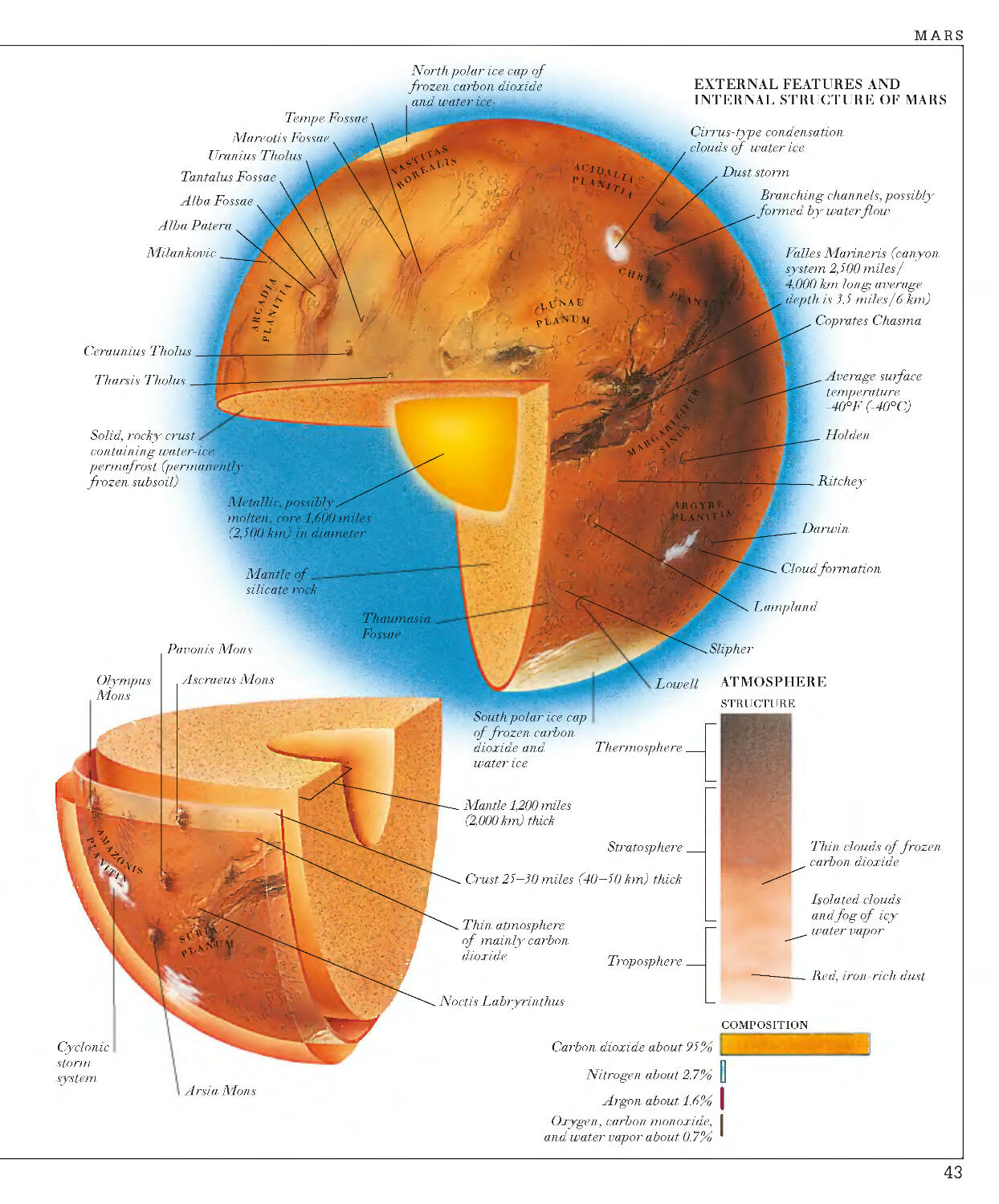
Mars
TILT AND ROTATION OF MARS
SURFACE FEATURES OF MARS
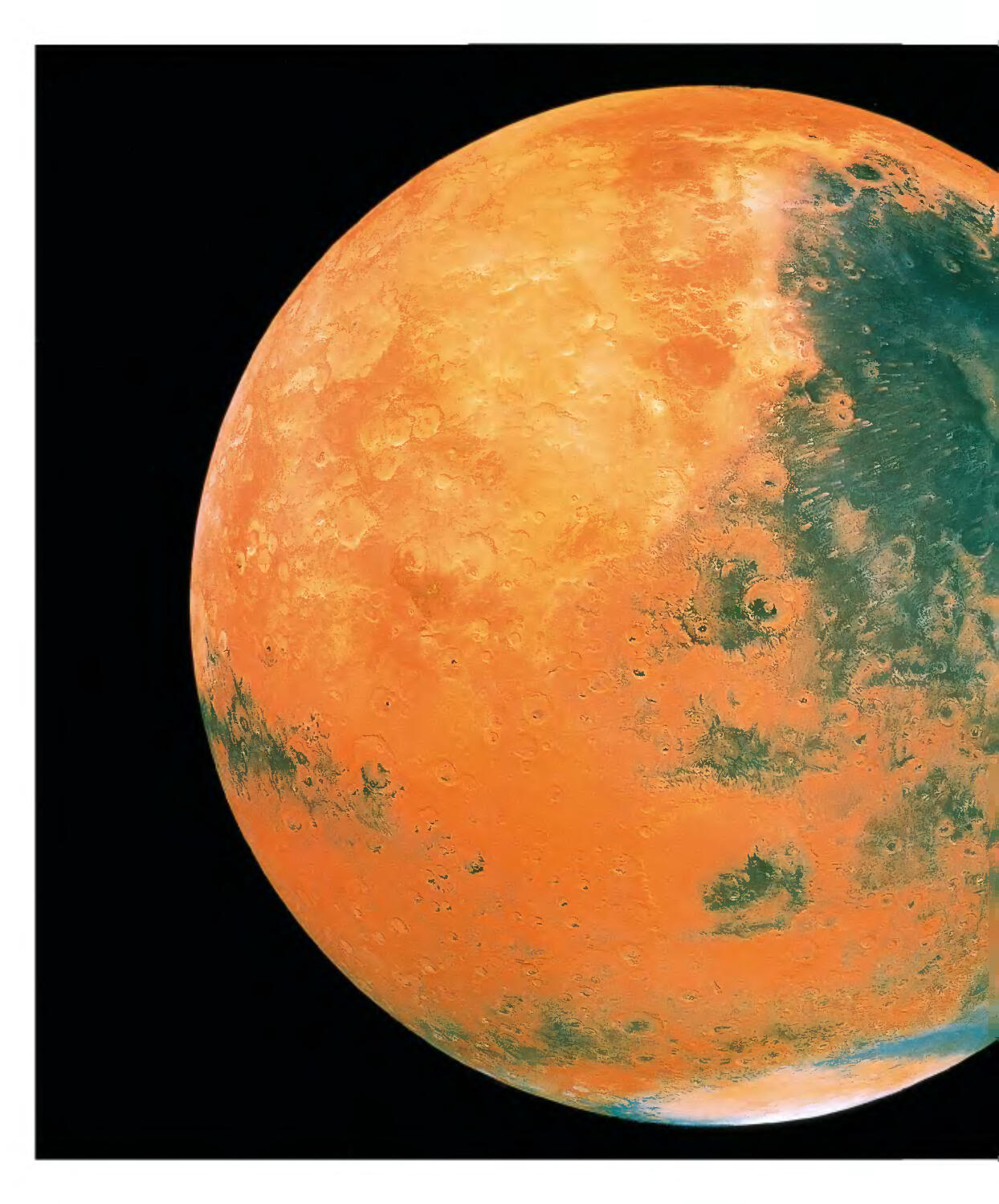
Mars, known as the red planet, is the fourth planet
from the Sun and the outermost rocky planet. In the
19th century, astronomers first observed what were
thought to be signs of life on Mars. These signs
included apparent canal-like lines on the surface, and
dark patches that were thought to be vegetation. It is
MARS	now known that the “canals” are an optical illusion,
and the dark patches are areas where the red dust that
covers most of the planet has been blown away. The fine dust particles are
often whipped up by winds into dust storms that occasionally obscure
almost all the surface. Residual fine dust in the atmosphere gives the
Martian sky a pinkish hue. The northern hemisphere
of Mars has many large plains formed of solidified
volcanic lava, whereas the southern hemisphere has
many craters and large impact basins. There are also
several huge, extinct volcanoes, including
Olympus Mons, which, at 370 miles (600 km)
across and 15 miles (25 km) high, is the largest
known volcano in the solar system. The surface
also has many canyons and branching channels.
The canyons were formed by movements of the
surface crust, but the channels are thought to have
been formed by flowing water that has now dried
up. The Martian atmosphere is much thinner than
Earth’s, with only a few clouds and morning mists.
Mars has two tiny, irregularly shaped moons called
Axis of
rotation
Axial tilt
of 24°
North Pole
Perpendicular
to orbital plane
Orbital
plane
One rotation
takes 24 hours
and 37 minutes
South Pole
Bright
water-ice fog
Fog in canyon 12 miles
(20 km) wide at end of
Valles Marineris
Syria Planum
NOCTIS LABYRINTHUS (CANYON SYSTEM)
Phobos and Deimos. Their small size indicates that
they may be asteroids that have been captured by
the gravity of Mars.
THE SURFACE
OF MARS
Surface covered
with red-colored
iron oxide dust
Dark area where
dust has been
blown away by
wind
South
polar ice
cap
PHOBOS
Average diameter: 14 miles
Average distance from
planet: 5,800 miles
DEIMOS
Average diameter: 8 miles
Average distance from
planet: 14,600 miles
Summit caldera
consisting of
overlapping
collapsed
volcanic craters
Gentle slope
produced by
lava flow
Cloud formation
MOONS OF MARS
OLYMPUS MONS (EXTINCT SHIELD VOLCANO)
42

MARS
North polar ice cap of
frozen carbon dioxide
and water ice
Tempe Fossae
Mareotis Fossae
Uranius Tholus
Tantalus Fossae
Alba Fossae
Alba Patera
Milankovic
EXTERNAL FEATURES AND
INTERNAL STRUCTURE OF MARS
Cirrus-type condensation
clouds of water ice
Dust storm
Branching channels, possibly
formed by water flow
Ceraunius Tholus
Tharsis Tholus
Solid, rocky crust
containing water ice
permafrost 'permanently
frozen subsoily
Metallic, possibly.
molten, core 1,600 miles
(2,500 km) in diameter
Valles Marineris (canyon
system 2,500 miles/
4,000	km long; average
depth is 3.5 miles/6 km)
Coprates Chasma
Average surface
temperature
-40°F (-40°C)
Holden
Ritchey
Darwin
Cloud formation
Lampland
Thin clouds of frozen
carbon dioxide
Isolated clouds
and fog of icy
water vapor
Red, iron-rich dust
Cyclonic
storm
system
Carbon dioxide about 95%
Nitrogen about 2.7%
Argon about 1.6%
Oxygen, carbon monoxide, 1
and water vapor about 0.7% L
43

THE UNIVERSE
Jupiter
TILT AND ROTATION OF JUPITER
Jupiter IS THE FIFTH PLANET from the Sun and
the innermost of the four giant planets. It is the
largest and the most massive planet, with a
diameter about 11 times that of the Earth and a
mass about 2.5 times the combined mass of the
seven other planets. Jupiter is thought to have a
small rocky core surrounded by an inner mantle
of metallic hydrogen (liquid hydrogen that acts
like a metal). Outside the inner mantle is an outer mantle of liquid
hydrogen and helium that merges into the gaseous atmosphere.
Jupiter’s rapid rate of rotation causes the clouds in its atmosphere
to form belts and zones that encircle the planet parallel to the
equator. Belts are dark, low-lying, relatively warm cloud layers,
and zones are bright, high-altitude, cooler cloud layers.
Within the belts and zones, turbulence causes the
formation of cloud features such as white ovals
and red spots, both of which are huge storm systems.
The most prominent cloud feature is a storm called
the Great Red Spot, which consists of a spiraling
column of clouds three times wider than the Earth
that rises about five miles (8 km) above the upper
cloud layer. Jupiter has a thin, faint, main ring, inside
which is a tenuous halo ring of tiny particles. Beyond
the main ring’s outer edge is a broad and faint
two-part gossamer ring. There are 63 known Jovian
moons. The four largest moons (called the
Galileans) are Ganymede, Callisto, Io, and
Europa. Ganymede and Callisto are cratered and
icy. Europa is smooth and icy and is thought to
have a subsurface water ocean. Io is covered
in bright red, orange, and yellow splotches.
This coloring is caused by sulfurous
material from active volcanoes that shoot
plumes of lava hundreds of miles above
the surface.
Axis of rotation
North Pole
Axial tilt of 3.1°
Perpendicular
to orbital plane
Orbital plane
One rotation takes
9 hours and 55 minutes
South Pole
GREAT RED SPOT AND WHITE OVAL
Great Red Spot
(anticyclonic
storm system)
Red color
probably due
to phosphorus
White oval
(temporary
anticyclonic
storm system)
GALILEAN MOONS OF JUPITER
INNER RINGS OF JUPITER
Main ring
Halo ring
EUROPA
Diameter: 1,950 miles
Average distance from
planet: 416,900 miles
GANYMEDE
Diameter: 3,270 miles
Average distance from
planet: 664,900 miles
CALLISTO
Diameter: 2,983 miles
Average distance from
planet: 1,168,200 miles
IO
Diameter: 2,263 miles
Average distance from
planet: 262,100 miles

JUPITER
ATMOSPHERE
STRUCTURE
EXTERNAL FEATURES AND INTERNAL STRUCTURE OF JUPITER
Stratosphere
Troposphere .
Atmosphere of mainly
hydrogen and helium
White clouds of
, ammonia crystals
Dark orange
clouds of ammonium
„ hydrosulfide crystals
Bluish clouds of water
. ice and water droplets
Outer mantle
merging into
atmosphere
COMPOSITION
Inner mantle 18,500
miles (30,000 km) thick
Hydrogen about 90% |
Helium about 10% j~~~|
Traces of ammonia, f
methane, and water i
vapor
North Temperate Zone
North Temperate Belt
£North polar
Zone (high-pressure
region of rising gases)
Red-colored
storm
„ Plume
(trailing
cloud)
High-altitude
white cloud
Outer mantle of liquid
hydrogen and helium
North Tropical
Zone
South
Temperate Belt
South
Temperate Zone
Flash of lightning
Great Red Spot
(anticyclonic
storm system)
Cloudtop
temperature
-180°F (-120°C)
White oval
(temporary
anticyclonic
storm system)
45

THE UNIVERSE
Saturn
FALSE-COLOR
IMAGE OF SATURN
Saturn IS THE SIXTH PLANET from the Sun. It is a
1 gas giant almost as big as Jupiter, with an equatorial
diameter of about 75,000 miles (120,500 km). Saturn
is thought to consist of a small core of rock and ice
surrounded by an inner mantle of metallic hydrogen
(liquid hydrogen that acts like a metal). Outside the
inner mantle is an outer mantle of liquid hydrogen
that merges into a gaseous atmosphere. Saturn’s
clouds form belts and zones similar to those on
Jupiter, but obscured by overlying haze. Storms and eddies, seen as
red or white ovals, occur in the clouds. Saturn has an extremely thin
but wide system of rings that is about half a mile (1 km) thick but
extends outward to about 260,000 miles (420,000 km) from the
planet’s surface. The main rings comprise thousands of narrow
ringlets, each made of icy rock lumps that range in size from tiny
particles to chunks several yards across. The D, E, and G rings are
very faint, the F ring is brighter, and the A, B, and C rings are
bright enough to be seen from Earth with binoculars. In 2009,
a huge dust ring was discovered 4 million miles (6 million km)
beyond the main system. Saturn has more than 60 known moons,
some of which orbit inside the rings and are thought to exert a
gravitational influence on the shapes of the rings. Unusually, seven
of the moons are co-orbital—they share an orbit with another
moon. Astronomers believe that such co-orbital moons may have
originated from a single satellite that broke up.
TILT AND ROTATION OF SATURN
Axial tilt of 26.7°	One rotation
takes 10 hours
and 40 minutes
North .
Pole
Orbital
plane
. South Pole
Perpendicular
to orbital plane
. Axis of
rotation
FALSE-COLOR IMAGE OF SATURN’S
CLOUD FEATURES
Ribbon-shaped
striation caused
by winds of 335
mph (540 km/h)
Oval (rotating
storm system)
INNER RINGS OF SATURN
D ring
C ring (“crepe ring”)
B ring
Cassini Division
A ring
Encke
Division
F ring
MOONS OF SATURN
ENCELADUS
Diameter: 509 miles
Average distance from
planet: 148,000 miles
DIONE
Diameter: 695 miles
Average distance from
planet: 254,000 miles
TETHYS
Diameter: 652 miles
Average distance from
planet: 183,000 miles

SATURN
ATMOSPHERE
COMPOSITION
STRUCTURE
EXTERNAL FEATURES AND
INTERNAL STRUCTURE
OF SATURN
Clouds form belts (dark,
low-altitude layers) and
zones (bright, high-
altitude layers)
Hydrogen about 96.3%
Helium about 3.3% j”j
Traces of ammonia, methane, :
and water vapor •
. Atmosphere of mainly
hydrogen and helium
Stratosphere
Troposphere
_ Outer mantle merging
into atmosphere
Haze of
ammonia crystals
White clouds of
ammonia crystals
, Dark orange clouds
of ammonium
hydrosulfide
crystals
. Blue clouds of water
ice and water vapor
F ring
Outer mantle of
liquid hydrogen
Inner mantle of
liquid metallic hydrogen
Rock and ice core
18,500 miles (30,000
km) in diameter
Core temperature
2imPF l5.om°C)
Equator swept by
winds of 1,100 mph
1.800 km h)
47

THE UNIVERSE
Uranus
TILT AND ROTATION OF URANUS
Axial tilt
of 97.9
FALSE-COLOR
IMAGE OF URANUS
Orbital
plane
Axis of
rotation
Uranus IS THE SEVENTH PLANET from the Sun
and the third largest, with a diameter of about
32,000 miles (51,000 km). It is thought to
consist of a dense mixture of different types of
ice and gas around a solid core. Its atmosphere
contains traces of methane, giving the planet a
blue-green hue, and the temperature at the cloud
tops is about -350°F (-210°C). Uranus is the most
featureless planet to have been closely observed:
only a few icy clouds of methane have been seen so far. Uranus is
unique among the planets in that its axis of rotation lies close to its
orbital plane. As a result of its strongly tilted rotational axis, Uranus rolls
on its side along its orbital path around the Sun, whereas other planets spin
more or less upright. Uranus is encircled by main rings that consist of rocks
interspersed with dust lanes and two distant outer rings made of dust. The
rings contain some of the darkest matter in the solar system and are extremely
narrow, making them difficult to detect: most of them are less than 6 miles (10 km)
wide, whereas most of Saturn’s rings are thousands of miles in width. There are
27 known Uranian moons, all of which are icy and most of which are farther out
than the rings. The 13 inner moons are small and dark, with diameters of less
than 100 miles (160 km), and the five major moons are between about 290 and
1,000 miles (470 and 1,600 km) in diameter. The major moons have a wide variety
of surface features. Miranda has the most varied surface, with cratered areas
broken up by huge ridges and cliffs 12 miles (20 km) high. Beyond these are nine
much more distant moons with diameters less than 90 miles (150 km).
Perpendicular to
orbital plane
South Pole
H r " "
North
Pole
One rotation
takes 17 hours
and 14 minutes
MAJOR MOONS
MIRANDA
Diameter: 295 miles
Average distance from
planet: 80,700 miles
RINGS OF URANUS
Epsilon ring
Lambda ring
Delta ring
RINGS AND DUST LANES
Gamma ring
Eta ring
Beta ring
Alpha ring
Rings 4 and 5
Ring 6
	 	 Zeta ring
ARIEL
Diameter: 720 miles
Average distance from
planet: 118,800 miles
UMBRIEL
Diameter: 726 miles
Average distance from
planet: 165,500 miles
TITANIA
Diameter: 981 miles
Average distance from
planet: 270,900 miles
OBERON
Diameter: 946 miles
Average distance from
planet: 362,000 miles

URANUS
COMPOSITION OF
ATMOSPHERE
EXTERNAL FEATURES AND
INTERNAL STRUCTURE
OF URANUS
Hydrogen 83%
Helium 15%
Methane2%
Atmosphere
of hydrogen,
helium, and
methane gases
Sharply defined
Epsilon ring
Dense mantle of
icy and gaseous
water, ammonia,
and methane
Blue-green hue due to
presence of methane
in atmosphere
Core temperature
12,600°F(7,000°C)
South Pole
Solid rocky core
10,500 miles(17,000
km) in diameter
Mantle 6,000 miles
(10,000 km) thick
Atmosphere
merging into
mantle
Cloudtop
temperature
-350°F (-210°C)
Rings of dark
rocks interspersed
with dust lanes
Icy clouds of.
frozen methane
blown by winds of
185 mph (300 km/h)
49

HE UNIVERSE
Neptune and Pluto
Small Dark Spot
(cyclonic wind
storm)
TILT AND ROTATION OF NEPTUNE
North
Pole
Orbital
plane
FEATURES OF NEPTUNE
Perpendicular to
orbital plane
South Pole
Great Dark Spot
(anticyclonic
wind storm)
Scooter (cirrus
cloud)
Axis of
rotation
One rotation
takes 16 hours
and 7 minutes
Axial tilt
of 28.8°
FALSE-COLOR
IMAGE OF NEPTUNE
NEPTUNE IS the farthest planet from the Sun,
at an average distance of about 2.8 billion miles
(4.5 billion km). Neptune is the smallest of the
giant planets and is thought to consist of a small
rocky core surrounded by a mixture of liquids and
gases. Several transient cloud features have been
observed in its atmosphere. The largest of these
were the Great Dark Spot, which was as wide as
the Earth, the Small Dark Spot, and the Scooter.
The Great and Small Dark Spots were huge storms that were swept
around the planet by winds of about 1,200 miles (2,000 km) per hour.
The Scooter was a large area of cirrus cloud. Neptune has six tenuous
rings and 13 known moons. Triton is the largest Neptunian moon and
the coldest object in the solar system, with a temperature of -390°F CLOUD
(-240°C). Unlike most moons in the solar system, Triton orbits its
mother planet in the opposite direction of the planet’s rotation.
The region extending out from Neptune’s orbit is populated by
Kuiper Belt objects and dwarf planets. They make a doughnut¬
shaped belt called the Kuiper Belt. The Kuiper Belt objects are a
mix of rock and ice, irregular in shape, and less than 600 miles
(1,000 km) across. The larger dwarf planets, which include Pluto,
are almost round bodies. Pluto was the first object discovered
beyond Neptune and was considered a planet until the dwarf
planet category was introduced in 2006. It is made of rock and ice
and is 1,365 miles (2,274 km) across. It has three known moons.
The largest, Charon, is about half Pluto’s size and the two
probably had a common origin.
RINGS OF NEPTUNE
Adams ring and unnamed
ring on its inner edge
Arago ring
Lassell ring
Le Verrier ring
Galle ring
HIGH-ALTITUDE CLOUDS
Methane cirrus clouds
25 miles (40 km) above
main cloud deck
Cloud shadow _
Main cloud deck
blown by winds at speeds
of about 12,000 miles
(2,000 km/h)
MOONS OF NEPTUNE
TRITON
Diameter: 1,681 miles
Average distance from
planet: 220,500 miles
PROTEUS
Diameter: 259 miles
Average distance from
planet: 73,100 miles

NEPTUNE AND PLUTO
EXTERNAL FEATURES AND INTERNAL
STRUCTURE OF NEPTUNE
COMPOSITION
OF ATMOSPHERE
Cloudtop
temperature
-360°F (-220°C)
Atmosphere
merging into
mantle
Hydrogen 85%
Helium 13%
Mantle 6,000 to
9,000 miles (10,000
to 15,000 km) thick
Methane 2%
Adams ring
Haze of hydrocarbons
above clouds
Le Verrier ring
Atmosphere of
hydrogen,
helium, and
methane gases
Mantle of icy _
water, methane,
and ammonia
Lassell
ring
Rocky silicate core.
8,700 miles (14,000
km) in diameter
Galle r
Darker clouds of
hydrogen sulfide
below main cloud
deck
Main cloud deck
blown by winds up to
1,200 mph (2,000 km/h)
Methane cirrus clouds
25 miles (40 km)
above main cloud deck
Great Dark Spot
Surface of icy
water and methane
Small Dark Spot
Scooter
Icy mantle
EXTERNAL FEATURES AND
INTERNAL STRUCTURE
OF PLUTO
TILT AND ROTATION OF PLUTO
Axial tilt
of 57.5°
Surface of water ice.
and methane ice
Core of rock and,
possibly, ice
. One rotation
takes 6 days
and 9 hours
North Pole
Surface temperature
about -360°F (-220°C)
Tenuous
atmosphere forms
when Pluto is at its
closest to the Sun
Orbital plane
COMPOSITION
OF TEMPORARY
ATMOSPHERE
Perpendicular
to orbital plane
Axis of
rotation
Methane probably mixed with nitrogen
and carbon monoxide 100%
South Pole
51

THE UNIVERSE
Asteroids, comets,
and meteoroids
OPTICAL IMAGE OF
HALLEY’S COMET
ASTEROID 951 GASPRA
Asteroids, comets, and meteoroids are all
debris remaining from the nebula from which the solar
system formed 4.6 billion years ago. Asteroids are
rocky bodies up to about 600 miles (1,000 km) in
diameter, although most are much smaller. Most of them
orbit the Sun in the asteroid belt, which lies between the
orbits of Mars and Jupiter. Cometary nuclei exist in
a huge cloud (called the Oort Cloud) that surrounds
the planetary part of the solar system. They are made
of frozen water and dust and are a few miles in
diameter. Occasionally, a comet is deflected from the Oort Cloud on to a long,
elliptical path that brings it much closer to the Sun. As the comet
approaches the Sun, the cometary nucleus starts to vaporize in the
heat, producing both a brightly shining coma (a huge sphere of
gas and dust around the nucleus), and a gas tail, and a dust tail.
Meteoroids are small chunks of stone or stone and iron, which
are fragments of asteroids or comets. Meteoroids range in size from
tiny dust particles to objects tens of meters across. If a meteoroid
enters the Earth’s atmosphere, it is heated by friction and
appears as a glowing streak of light called a meteor (also known
as a shooting star). Meteor showers occur when the Earth passes
through the trail of dust particles left by a comet. Most meteoroids
burn up in the atmosphere. The remnants of the few that
are large enough to reach the Earth’s surface are termed meteorites.
High-intensity
light emission
Nucleus
Medium-intensity,
light emission
FALSE-COLOR IMAGE OF
HALLEY’S COMET
Low-intensity I
light emission
52
FALSE-COLOR IMAGE OF A
LEONID METEOR SHOWER
METEORITES
DEVELOPMENT OF COMET TAILS
STONY-IRON
METEORITE
Iron
Stone (olivine)
STONY METEORITE
Fusion crust
formed when
passing
through
atmosphere
Olivine
and pyroxene
mineral interior
Dust tail deflected by
photons in sunlight
and curved due to
comet’s motion
Tails lengthen
as comet nears
Sun
Gas tail pushed away
from Sun by charged
particles in solar wind
Direction of comet’s
orbital motion
Coma surrounding
nucleus
Tails behind
nucleus
Nucleus vaporized
by Sun’s heat,
forming a coma
with two tails

FEATURES OF A COMET
Gas molecules excited by
Sun and emitting light
Comet tails up to 60
million miles (100
million km) long
Thin, straight
gas tail
Thin, straight
gas tail blown by
solar wind
Head
(coma and
nucleus)
Broad, curved
dust tail
Coma
surroun
nucleus
Nucleus a
few miles
across .
STRUCTURE OF
A COMET
Glowing coma
600,000	miles (1
million km) across
around nucleus
Dust layer
with active
areas emitting
jets of gas
and dust
Jet of gas and ^
dust produced by
vaporization
on sunlit side
of nucleus
Ices, mainly water ice, but
also frozen carbon dioxide,
Broad curved
Dust particles
methane, and ammonia
dust tail
reflecting sunlight
53

Prehistoric
Earth
The Changing Earth	56
The Earth’s Crust	58
Faults and Folds	60
Mountain Building	62
Precambrian to Devonian Period	64
Carboniferous to Permian Period	66
Triassic Period	68
Jurassic Period	70
Cretaceous Period	72
Tertiary Period	74
Quaternary Period	76
Early Signs of Life	78
Amphibiansand Reptiles	80
The Dinosaurs	82
Theropods 1	84
Theropods2	86
Sauropodomorphs 1	88
Sauropodomorphs 2	90
Thyreophorans 1	92
Thyreophorans 2	94
Ornithopods 1	96
Ornithopods 2	98
Marginocephalians 1	100
Marginocephalians2	102
Mammals 1	104
Mammals 2	106
The First Humans	108

PREHISTORIC EARTH
The changing Earth
lMBRIAN
DEVONL
Global
mountain
building
occurred
The EARTH FORMED FROM a CLOUD OF DUST and gas drifting
through space about 4.6 billion years ago. Dense minerals sank to
the center while lighter ones formed a thin rocky crust. However,
the first known life-forms—bacteria and blue-green algae—did
not appear until about 3.4 billion years ago, and it was only about
700 million years ago that more complex plants and animals
began to develop. Since then, thousands of animal and
plant species have evolved; some, such as the dinosaurs,
survived for many millions of years, while others died
out quickly. The Earth itself is continually changing.
Although continents neared their present locations
about 50 million years ago, they are still drifting Multicellular soft-
slowly over the planet’s surface, and mountain
ranges such as the Himalayas—which began to
form 40 million years ago—are continually
being built up and worn away. Climate is also
subject to change: the Earth has undergone
a series of ice ages interspersed with
warmer periods (the most recent
glacial period was at its height
about 2°,°00 years ag°). Marine plans
flourished
Land plants
appeared
(e.g., Cooksonia)
Small mammals
appeared (e.g.,
Crusafontia)
Dinosaurs
became
extinct
bodied animals
appeared (e.g.
worms and
jellyfish)
Shelled
invertebrates
appeared (e.g.
trilobites)
.
Earth
formed .
Unicellular
organisms appeared
(e.g, blue-green
algae)
Coral reefs
appeared
Vertebrates /
appeared (e.g.,
Hemicyclaspis)
More complex
types of algae
appeared
Amphibians
appeared (e.g.,
Ichthyostega)
geological timescale
millions of
years ago (mya)
4,600
570
510
439
409
363
323
290
mississippian
(north America)
Pennsylvanian
(north America)
cambrian
ordovician
silurian
devonian
carboniferous
precambrian time
paleozoic
56

THE CHANGING EARTH
EVOLUTION OF THE EARTH
Marine reptiles
appeared (e.g.,
Mixosaurus)
JURASSIC
Flowering plants
appeared (e.g.,
Magnolia)
Oil and gas
deposits formed
Himalayas
began to form
Coal-forming
forests flourished
Large mammals
appeared (e.g.,
Arsinoitherium)
Conifers
appeared
EUOUS
Colorado River
began to cut out
the Grand Canyon
Uplift of the /
Sierra Nevada
began
Modern humans
(Homo sapiens)
appeared
Birds appeared
(e.g., Archaeopteryx)
Dinosaurs
flourished
65 56.5 35.5 23.5 5.2 1.64	0.01	0 MYA
290	250	200
145
PERMIAN
TRIASSIC
JURASSIC
CRETACEOUS
TERTIARY
QUATERNARY
MESOZOIC
CENOZOIC
EPOCH
PERIOD
ERA
57

PREHISTORIC EARTH
The Earth’s crust
ELEMENTS IN THE EARTH’S CRUST
Other elements 2%
Potassium 2.6%
Calcium 3.6%
Aluminum 8%
The EARTH’S CRUST IS THE SOLID outer shell of the Earth. It includes
continental crust (about 25 miles/40 km thick) and oceanic crust (about
four miles/6 km thick). The crust and the topmost layer of the mantle
form the lithosphere. The lithosphere consists of semirigid plates
that move relative to each other on the underlying asthenosphere (a
partly molten layer of the mantle). This process is known as plate
tectonics and helps explain continental drift. Where two plates move
apart, there are rifts in the crust. In mid-ocean, this movement results
in seafloor spreading and the formation of ocean ridges; on continents,
crustal spreading can form rift valleys. When plates move toward each other,
one may be subducted beneath (forced under) the other. In mid-ocean, this causes
ocean trenches, seismic activity, and arcs of volcanic islands. Where oceanic crust
is subducted beneath continental crust or where continents collide, land may be
uplifted and mountains formed (see pp. 62—65). Plates may also slide past each
other—along the San Andreas fault, for example. Crustal movement on continents
may result in earthquakes, while movement under the seabed can lead to tidal waves.
Magnesium 2%
Sodium 2.8%
Iron 5%
Silicon 28%
Oxygen 46%
Rift formed where i
two plates are
moving apart
Volcanic island
that originally
formed over
hot spot
Oceanic Magma rises
crust melts	to form a
volcano
Volcano develops
over hot spot and
builds up to form
an island
FEATURES OF PLATE MOVEMENTS
Ridge where magma
is rising to form new
oceanic crust
Region of
seafloor
spreading
Magma rises to
form a hot spot
Magma (molten rock)
erupts at rift
Ocean trench formed where oceanic
crust is forced under continental crust
Subduction zone
mmimmumiinumiinmimiiiiiifniiii/;
58

THE EARTH’S CRUST
MAJOR PLATES OF THE EARTH’S CRUST
Hellenic plate
f Eurasian plate
North American
plate
Plates sliding
past each
other.
Cocos plate
Caribbean plate
Nazca plate
Pacific plate
Philippine plate
Plates converging
South American plate
African plate
Indo-Australian plate
Plates moving apart
MOVEMENT OF LAND ALONG OCEANIC RIDGES
Boundary along
which two plates
slide past each
other
Mountain range
uplifted where subducting
oceanic crust compresses
and deforms edge of
continental crust
Lithosphere
(crust and
topmost layer
of mantle)
ridge sections take
shape of curve
CURVED OCEANIC RIDGE
STRAIGHT OCEANIC RIDGE
Land moves apart
at a constant rate,
perpendicular
to curve
Land moves apart
at a constant rate,
perpendicular
to ridge
Asthenosphere
(upper part
of mantle)
STRESSES RESOLVE INTO SECTIONS
59

PREHISTORIC EARTH
Faults and folds
STRUCTURE OF A FOLD
Axial plane
THE CONTINUOUS MOVEMENT of the Earth’s crustal plates (see pp. 58—59)
can squeeze, stretch, or break rock strata, deforming them and
producing faults and folds. A fault is a fracture in a rock along which
there is movement of one side relative to the other. The movement
can be vertical, horizontal, or oblique (vertical and horizontal). Faults
develop when rocks are subjected to compression or tension. They
tend to occur in hard, rigid rocks, which are more likely to break
than bend. The smallest faults occur in single mineral crystals and are
microscopically small, whereas the largest—the Great Rift Valley in
Africa, which formed between 5 million and 100,000 years ago—is more
than 6,000 miles (9,000 km) long. A fold is a bend in a rock layer caused
by compression. Folds occur in elastic rocks, which tend to bend rather
than break. The two main types of fold are anticlines (upfolds) and
synclines (downfolds). Folds vary in size from a few millimeters long to
folded mountain ranges hundreds of miles long, such as the Himalayas
(see pp. 62—63) and the Alps, which are repeatedly folding. In addition
Crest
Limb
Hingeline
STRUCTURE OF A FAULT
Fault plane
Dip of fault plane
(angle from
horizontal)
Upthrow
Crest of
anticline
FOLDED ROCK
Throw (vertical
displacement
of fault)
Plunge
Steeply dipping
limbs
Downthrow
Hade of fault plane
(angle from vertical)
STRUCTURE OF A SLOPE
Strike
Strike and
dip are at
right angles
to each other
Direction
of dip
SECTION THROUGH FOLDED ROCK
STRATA THAT HAVE BEEN ERODED
Dipping bed
Anticlinal
fold
Monoclinal
fold
Mineral-filled
fault
J L
J L
I Upper Carboniferous Millstone Grit
I Lower Carboniferous Limestone
60

FAULTS AND FOLDS
EXAMPLES OF FOLDS
Monocline
Chevron
fold
Anticline
Isocline
Box
Recumbent
Fan
Cuspate
fold
Synclinorium
Anticlinorium
EXAMPLES OF FAULTS
Sinistral strike-slip	Dextral strike-slip
dip-slipfault
SMALL-SCALE ROCK DEFORMATIONS
Competent
bed (rocks
that break) Tension
Tension
Incompetent
bed ,
Tension
Competent
bed breaks
into sections
Competent
bed
Tension
I Incompetent bed
(rocks that bend)
Masses of rock shear	En echelon
BOUDIN
MULLION
EN ECHELON FRACTURE
Upper Carboniferous Millstone Grit	Upper Carboniferous Coal Measures
Mineral-filled
fault
Dipping bed
Gentlyfolded bed
Horizontal bed,
Mineral-filled fault N
Dipping bed v
61

PREHISTORIC EARTH
Tension
Mountain building
THE PROCESSES INVOLVED in mountain building—termed orogenesis—occur
as a result of the movement of the Earth’s crustal plates (see pp. 58—59). Asia
There are three main types of mountains: volcanic mountains, fold
mountains, and block mountains. Most volcanic mountains have been
formed along plate boundaries where plates have come together or
moved apart and lava and other debris have been ejected onto the
Earth’s surface. The lava and debris may have built up to form a
dome around the vent of a volcano. Fold mountains are formed
where plates push together and
cause the rock to buckle upward.
Where oceanic crust meets less dense
continental crust, the oceanic crust
is forced under the continental crust. The
continental crust is buckled by the impact.
This is how folded mountain ranges, such as the
Appalachian Mountains in North America, were
formed. Fold mountains are also formed where
two areas of continental crust meet. The
Himalayas, for example, began to form when
India collided with Asia, buckling the sediments
and parts of the oceanic crust between them. Block mountains are formed when a block
of land is uplifted between two faults as a result of compression or tension in the Earth’s
crust (see pp. 60—61). Often, the movement along faults has taken place gradually over
millions of years. However, two plates may cause an earthquake by suddenly sliding past
each other along a faultline.
FORMATION OF
THE HIMALAYAS
Himalayas
formed by
buckling of
sediment and
part of the
oceanic crust
between two
colliding
continents
BHAGIRATHI PARBAT,
HIMALAYAS
India moves
north
India collides
with Asia about 40
million years ago
Compression
VOLCANIC MOUNTAIN
FOLD MOUNTAIN
BLOCK-FAULT MOUNTAIN
UPLIFTED BLOCK-FAULT MOUNTAIN
Compression
Block forced
down
Block forced
down
Extinct
volcano
Layers of rock buckled
by compression to
form syncline
Layers of rock buckled
by compression to
form anticline
Vent
Layers of lava
and ash build up
to form volcanic
mountain
Block uplifted to form
mountain range
Fault
Tension
Block uplifted to form
mountain range
Fault
Fault
Block
forced
down
EXAMPLES OF MOUNTAINS
Active
volcano
62

MOUNTAIN BUILDING
STAGES IN THE FORMATION OF THE HIMALAYAS
Asia
India
Asia
Continental
crust
Continental
crust
20 MILLION YEARS AGO
Continental
crust
Ganges
plain
Sediment and part of
oceanic crust farther
folded and uplifted to
form Himalayas
TODAY
Continental
crust
Ripple effect of collision
forms mountains and
plateau of Tibet
Ganges
plain
Sediment and part of
oceanic crust folded
and uplifted
India
P wave.
shadow
Focus (point at which
earthquake originates)
ANATOMY OF AN EARTHQUAKE
Shock waves
radiate outward
fromfocus
Focus
Crust
S and P
shock
waves
Core (blocks
S waves and
deflects P
waves)
L wave
Mantle
‘Faultline along which two
plates may slide past each
other, causing an earthquake
PATH OF SHOCK WAVES
THROUGH THE EARTH
SAN ANDREAS FAULT
EARTHQUAKES
Epicenter (point on Earth’s
surface directly above focus)
Isoseismal lines
join places with
equal intensity
of shock
P wave
63

PREHISTORIC EARTH
Precambrian to
Devonian periods
MIDDLE ORDOVICIAN POSITIONS
OF PRESENT-DAY LANDMASSES
North
America
Greenland
China
South
America
When THE EARTH FORMED about 4.6 billion years ago, its
atmosphere consisted of volcanic gases with little oxygen,
making it hostile to most forms of life. One large supercontinent,
Gondwana, was situated over the southern polar region, while
other smaller continents were spread over the rest of the world.
Constant movement of the Earth’s crustal plates carried
continents across the earth’s surface. The first primitive life-forms
emerged around 3.4 billion years ago in shallow, warm seas.
The build up of oxygen began to form a shield of ozone South ,
around the Earth, protecting living organisms from the Africa
Sun’s harmful rays and helping to establish an atmosphere	Africa ,
in which life could sustain itself. The first vertebrates appeared about
470 million years ago, during the Ordovician period (510—439 million years ago),
the first land plants appeared around 400 million years ago during the Devonian
period (409—363 million years ago), and the first land animals about 30 million years later.
Scandinavia
Europe
Australia
India
North East
Africa
i Siberia \ Central Asia
EXAMPLES OF PRECAMBRIAN TO DEVONIAN PLANT GROUPS
A PRESENT-DAY CLUBMOSS A PRESENT-DAY	FOSSIL OF AN EXTINCT LAND PLANT	FOSSIL OF AN EXTINCT SWAMP PLANT
(Lycopodium sp.)	LAND PLANT	(Cooksonia hemisphaerica)	(Zosterophyllum Hanoveranum)
(Asparagus setaceous)
EXAMPLES OF PRECAMBRIAN TO DEVONIAN TRILOBITES
ACADAGNOSTUS
Group: Agnostidae
Length: V*> in (8 mm)
PHACOPS
Group: Phacopidae
Length: 1% in (4.5 cm)
OLENELLUS
Group: Olenellidae
Length: 2^ in (6 cm)
ELRATHIA
Group: Ptychopariidae
Length: % in (2 cm)
64

PRECAMBRIAN TO DEVONIAN PERIODS
CEPHALASPIS
Group: Cephalaspidae
Length: 8% in (22 cm)
THE EARTH DURING THE MIDDLE ORDOVICIAN PERIOD
Siberia
- Kazakstania
EXAMPLES OF EARLY
MARINE INVERTEBRATES
FOSSIL NAUTILOID
(Estonioceras
perforatum)
FOSSIL BRACHIOPOD
(Dicoelosia bilobata)
FOSSIL GRAPTOLITE
(Monograptus
convolutus)
BOTHRIOLEPIS
Group: Bothriolepididae
Length: 16 in (40 cm)
Laurentia
China
Gondwana
Baltica
EXAMPLES OF DEVONIAN FISH
COCCOSTEUS
Group: Coccosteidae
Length: 14 in (35 cm)
CHEIROLEPIS
Group: Cheirolepidae
Length: 6% in (17 cm)
RHAMPHODOPSIS
Group: Ptyctodontidae
Length: 6 in (15 cm)
CHEIRACANTHUS
Group: Acanthodidae
Length: 12 in (30 cm)
PTERICHTHYODES
Group: Asterolepididae
Length: 6 in (15 cm)
TRACE FOSSIL
(Mawsonites spriggi)
65

PREHISTORIC EARTH
Carboniferous to
Permian periods
LATE CARBONIFEROUS POSITIONS
OF PRESENT-DAY LANDMASSES
North
America
Greenland
Siberia
THE CARBONIFEROUS PERIOD (363—290 million years ago) takes its name
from the thick, carbon-rich layers—now coal—that were produced
during this period as swampy tropical forests were repeatedly
drowned by shallow seas. The humid climate across northern
and equatorial continents throughout Carboniferous times
produced the first dense plant cover on Earth. During the early
part of this period, the first reptiles appeared. Their development
of a waterproof egg with a protective internal structure
ended animal life’s dependence on an aquatic environment.
Toward the end of Carboniferous times, the earth’s continents
Laurasia and Gondwana collided, resulting in the huge land-
mass of Pangaea. Glaciers smothered much of the southern
hemisphere during the Permian period (290—245 million years ago),
covering Antarctica, parts of Australia, and much of South America, Africa, and India.
Ice locked up much of the world’s water and large areas of the northern hemisphere experienced
a drop in sea level. Away from the poles, deserts and a hot dry climate predominated. As a result of
these conditions, the Permian period ended with the greatest mass extinction of life on Earth ever.
China
South
America
Australia
Antarctica
Antarctica
India
EXAMPLES OF CARBONIFEROUS AND PERMIAN PLANT GROUPS
A PRESENT-DAY FIR
(Abies concolor)
FOSSIL OF AN EXTINCT FERN	FOSSIL OF AN
(Zeilleria frenzlii)	EXTINCT HORSETAIL
(Equisetites sp.)
FOSSIL OF AN
EXTINCT CLUBMOSS
(Lepidodendron sp.)
EXAMPLES OF CARBONIFEROUS AND PERMIAN TREES
PECOPTERIS
Group: Marattiaceae
Height: 13 ft (4 m)
PARIPTERIS
Group: Medullosaceae
Height: 16 ft 6 in (5 m)
MARIOPTERIS
Group: Lyginopteridales
Height: 16 ft 6 in (5 m)
MEDULLOSA
Group: Medullosaceae
Height: 16 ft 6 in (5 m)
66

CARBONIFEROUS TO PERMIAN PERIODS
EXAMPLES OF CARBONIFEROUS
THE EARTH DURING THE LATE CARBONIFEROUS PERIOD	AND PERMIAN ANIMALS
China
Appalachian
Mountains
Siberia
Gondwana
SKULL OF AN EXTINCT SYNAPSID
(Dimetrodon loomisi)
AN EXTINCT SHARK
(Helicoprion bessonowi)
FOSSIL TEETH OF
LEPIDODENDRON
Group: Lepidodendraceae
Height: 100 ft (30 m)
CORDAITES
Group: Cordaitacea
Height: 33 ft (10 m)
GLOSSOPTERIS
Group: Glossopteridaceae
Height: 26 ft (8 m)
ALETHOPTERIS
Group: Medullosaceae
Height: 16 ft 6 in (5 m)
67

PREHISTORIC EARTH
Triassic period
TRIASSIC POSITIONS OF
PRESENT-DAY LANDMASSES
A PRESENT-DAY
CYCAD
A PRESENT-DAY GINKGO
(Ginkgo biloba)
A PRESENT-DAY CONIFER
(Araucaria araucana)
FOSSIL OF AN
EXTINCT FERN
FOSSIL LEAF OF AN
EXTINCT CYCAD
EXAMPLES OF TRIASSIC
PLANT GROUPS
THE TRIASSIC PERIOD (250—200 million years ago) marked the beginning
of what is known as the Age of the Dinosaurs (the Mesozoic era). During
this period, the present-day continents were massed together, forming
one huge continent known as Pangaea. This landmass experienced
extremes of climate, with lush green areas around the coast
or by lakes and rivers, and arid deserts in the interior. The
only forms of plant life were nonflowering plants, such
as conifers, ferns, cycads, and ginkgos; flowering plants had
not yet evolved. The principal forms of animal life included
diverse, often gigantic, amphibians, rhynchosaurs
(“beaked lizards”), and primitive crocodilians. Dinosaurs
first appeared about 230 million years ago, at the beginning
of the Late Triassic period. Among the earliest dinosaurs
were the carnivorous (flesh-eating) herrerasaurids, such as
Herrerasaurus and Staurikosaurus. Early herbivorous (plant-eating)
dinosaurs first appeared in Late Triassic times and included Plateosaurus
and Technosaurus. By the end of the Triassic period, dinosaurs dominated
Pangaea, possibly contributing to the extinction of many other reptiles.
North
America
Europe
South
America
(Pachypteris sp.)
(Cycas revoluta)
(Cycas sp.)
EXAMPLES OF TRIASSIC DINOSAURS
MELANOROSAURUS
Group: Melanorosauridae
Length: 40 ft (12.2 m)
MUSSAURUS	HERRERASAURUS
Group: Sauropodomorpha	Group: Herrerasauridae
Length: 6 ft 6 in—10 ft (2—3 m) Length: 10 ft (3 m)
PISANOSAURUS
Group: Ornithischia
Length: 3 ft (90 cm)
68

TRIASSIC PERIOD
THE EARTH DURING THE TRIASSIC PERIOD
EXAMPLES OF TRIASSIC ANIMALS
Pangaea
Andes
Ural Mountains
Sinus Borealis
AN EXTINCT AMPHIBIAN
A NAUTILOID MOLLUSK
(Nautilus sp.)
Vegetation
Tethys	AN EXTINCT CHONDROSTEAN FISH
Sea	(Cleithrolepis granulatus)
Deep
Scandinavian
Mountains
Caledonian
Mountains
Desert
Continental
shelf
Pangaea
AN EXTINCT SEA-GOING REPTILE
(Pachypleurosaurus sp.)
Appalachian
Mountains
Pacific Ocean
Desert
Vegetation
AN EXTINCT RHYNCHOSAURIAN REPTILE
(Scaphonyxfischeri)
PLATEOSAURUS
Group: Plateosauridae
Length: 26 ft (7.9 m)
TECHNOSAURUS
Group: Ornithischia
Length: 3 ft 3 in (1 m)
COELOPHYSIS
Group: Coelophysidae
Length: 10 ft (3 m)
STAURIKOSAURUS
Group: Herrerasauridae
Length: 6 ft 6 in (2 m)
69

PREHISTORIC EARTH
Jurassic period
JURASSIC POSITIONS OF
PRESENT-DAY LANDMASSES
THE JURASSIC PERIOD, the middle part of the Mesozoic
era, lasted from 199 to 145 million years ago. During Jurassic
times, the landmass of Pangaea broke up into the continents
of Gondwana and Laurasia, and sea levels rose, flooding areas
of lower land. The Jurassic climate was warm and moist.
Plants such as ginkgos, horsetails, and conifers thrived,
and giant redwood trees appeared, as did the first flowering
plants. The abundance of plant food coincided with the
proliferation of herbivorous (plant-eating) dinosaurs, such
as the large sauropods (e.g., Diplodocus) and stegosaurs
(e.g., Stegosaurus). Carnivorous (flesheating) dinosaurs,
such as Compsognathus and Allosaurus, also flourished
by hunting the many animals that existed—among them
other dinosaurs. Further Jurassic animals included shrewlike
mammals, and pterosaurs (flying reptiles), as well as plesiosaurs
and ichthyosaurs (both marine reptiles).
North
America
Europe
Arabia
Asia
Australia
South
America
Africa
Antarctica
India
EXAMPLES OF JURASSIC PLANT GROUPS
A PRESENT-DAY FERN
(Dicksonia antarctica)
A PRESENT-DAY HORSETAIL	A PRESENT-DAY CONIFER
(Equisetum arvense)	(Taxus baccata)
FOSSIL LEAF OF AN
EXTINCT CONIFER
FOSSIL LEAF OF AN
EXTINCT REDWOOD
DIPLODOCUS
Group: Diplodocidae
Length: 88 ft (26.8 m)
CAMPTOSAURUS
Group: Iguanodontia
Length: 16—23 ft (4.9—7 m)
DRYOSAURUS
Group: Dryosauridae
Length: 10—13 ft (3—4 m)
70

JURASSIC PERIOD
THE EARTH DURING THE JURASSIC PERIOD
EXAMPLES OF JURASSIC ANIMALS
Laurasia
Laurasia
North Atlantic
Ocean
North
American
Cordillera
Ural Mountains
Turgai
Strait
Desert
Vegetation
Laurasia
Desert
AN EXTINCT PTEROSAUR AN EXTINCT
(Rhamphorhynchus sp.) BELEMNITE MOLLUSK
(Belemnoteuthis sp.)
Tethys Sea
AN EXTINCT
RHYNCHOSAURIAN REPTILE
(Homeosaurus pulchellus)
Continental
shelf
AN EXTINCT PLESIOSAUR
(Peloneustes philarcus)
Andes
Gondwana
Vegetation
Gondwana
Pacific Ocean
AN EXTINCT ICHTHYOSAUR
(Stenopterygius megacephalus)
ALLOSAURUS	SCELIDOSAURUS	STEGOSAURUS
Group: Allosauroidea
Length: 36 ft (11 m)
Group: Thyreophora
Length: 13 ft (4m)
Group: Stegosauridae
Length: 30 ft (9.1 m)
71

PREHISTORIC EARTH
Cretaceous period
THE MESOZOIC ERA ENDED WITH the Cretaceous period, which lasted
from 146 to 65 million years ago. During this period, Gondwana and
Laurasia were breaking up into smaller landmasses that more closely
resembled the modern continents. The climate remained mild and
moist but the seasons became more marked. Flowering plants,
including deciduous trees, replaced many cycads, seed ferns,
and conifers. Animal species became more varied, with the
evolution of new mammals, insects, fish, crustaceans, and
turtles. Dinosaurs evolved into a wide variety of species
during Cretaceous times; more than half of all known
dinosaurs—including Iguanodon, Deinonychus, Tyrannosaurus
and Hypsilophodon—lived during this period. At the end
of the Cretaceous period, however, most dinosaurs became
extinct. The reason for this mass extinction is unknown but
it is thought to have been caused by climatic changes due
to either a catastrophic meteor impact with the Earth or
extensive volcanic eruptions.
CRETACEOUS POSITIONS OF
PRESENT-DAY LANDMASSES
North
America
Europe
, Arabia
Asia
South America
Australia
Antarctica
EXAMPLES OF CRETACEOUS PLANT GROUPS
A PRESENT-DAY CONIFER
(Pinus muricata)
A PRESENT-DAY
DECIDUOUS TREE
(Magnolia sp.)
FOSSIL OF AN
EXTINCT FERN
(Sphenopteris latiloba)
FOSSIL OF AN
EXTINCT GINKGO
(Ginkgo pluripartita)
FOSSIL LEAVES
OF AN EXTINCT
DECIDUOUS TREE
SALTASAURUS
Group: Saltasauridae
Length: 40 ft (12.2 m)
TOROSAURUS
Group: Ceratopsidae
Length: 25 ft (7.6 m)
HYPSILOPHODON
Group: Ornithopoda
Length: 4 ft 6 in—7 ft 6 in (1.W2.3 m)
72

CRETACEOUS PERIOD
THE EARTH DURING THE CRETACEOUS PERIOD
EXAMPLES OF
CRETACEOUS ANIMALS
\
Pacific
Ocean
West Africa
North America
Africa ( Greenland , Europe
1
Continental Sea
Ural
Mountains
Desert
North
Atlantic
Ocean
Andes
longialatum)
Tethys
Sea
Asia
AN EXTINCT INSECT AN EXTINCT
(Libellulium	MARINE TURTLE
India
Australia
Vegetation
South
America
Antarctica
\ South Atlantic
Ocean
(Plesiochelys latiscutata)
AN EXTINCT CRUSTACEAN
(Homarus sp.)
AN EXTINCT CROCODILIAN
AN EXTINCT HOLOSTEAN FISH
(Lepidotes maximus)
TYRANNOSAURUS	DEINONYCHUS	IGUANODON
Group: Tyrannosauridae
Length: 40 ft (12.2 m)
Group: Dromaeosauridae
Length: 8—11 ft (2.4^3.4 m)
Group: Iguanodontia
Length: 30 ft (9.1 m)
73

PREHISTORIC EARTH
Tertiary period
TERTIARY POSITIONS OF
PRESENT-DAY LANDMASSES
rica
Following THE DEMISE OF THE DINOSAURS at the end of the Cretaceous
period, the Tertiary period (65—1.6 million years ago), which formed the first
part of the Cenozoic era (65 million years ago—present), was characterized
by a huge expansion of mammal life. Placental mammals nourish and
maintain the young in the mother’s uterus; only a few groups of
placental mammals existed during Cretaceous times, compared
with a few dozen during the Tertiary period. One
of these included the first hominid (see pp.108—109),
Ardipithecus, which appeared in Africa. By the beginning of
the Tertiary period, the continents had almost reached their
present position. The Tethys Sea, which had separated the
northern continents from Africa and India, began to close up,
forming the Mediterranean Sea and allowing the migration of
terrestrial animals between Africa and western Europe. India’s
collision with Asia led to the formation of the Himalayas.
During the middle part of the Tertiary period, the forest-dwelling
and browsing mammals were replaced by mammals such as the horses,
better suited to grazing the open savannahs that began to dominate.
Repeated cool periods throughout the Tertiary period established the
Antarctic as an icy island continent.
North
America
Europe Asia
South
America
Antarctica
EXAMPLES OF TERTIARY PLANT GROUPS
A PRESENT-DAY OAK
(Quercus palustris)
A PRESENT-DAY BIRCH
(Betula grossa)
EXAMPLES OF TERTIARY
ANIMAL GROUPS
HYAENODON
Group: Hyaenodontidae
Length: 6 ft 6 in (2 m)
TITANOHYRAX
Group: Pliohyracidae
Length: 6 ft 6 in (2 m)
FOSSIL LEAF OF AN
EXTINCT BIRCH
(Betulites sp.)
FOSSILIZED STEM OF
AN EXTINCT PALM
(Palmoxylon sp.)
PHORUSRHACOS	SAMOTHERIUM
Group: Phorusrhacidae	Group: Giraffidae
Length: 5 ft (1.5 m)	Length: 10 ft (3 m)
74

TERTIARY PERIOD
THE EARTH DURING THE TERTIARY PERIOD
EXAMPLES OF TERTIARY ANIMALS
North America Appalachian Mountains
Pyrenees Europe Alps
Rocky
Mountains
Sierra
Nevada
Asia Continental
sea
Zagros
Mountains
AN EXTINCT MAMMAL
(Arsinoitherium)
Andes
South
America
Atlantic
Ocean
Atlas
Mountains
Antarctica Vegetation
MAMMUT
Group: Mammutidae
Length: 8 ft (2.5 m)
Himalayas
Tethys Sea
- iJm
	Australia
India
AN EXTINCT MAMMAL
(Merycoidodon culbertsonii)
Indian
Ocean
AN EXTINCT PRIMATE
(Aegyptopithecus sp.)
AN EXTINCT
GASTROPOD MOLLUSK
(Ecphora quadricostata)
TETRALOPHODON
Group: Gomphotheriidae
Length: 8 ft (2.5 m)
75

PREHISTORIC EARTH
Quaternary period
QUATERNARY POSITIONS OF
PRESENT-DAY LANDMASSES
THE QUATERNARY PERIOD (1.6 million years ago—present) forms the
second part of the Cenozoic era (65 million years ago—present): it has
been characterized by alternating cold (glacial) and warm (interglacial)
periods. During cold periods, ice sheets and glaciers have formed
repeatedly on northern and southern continents. The cold
environments in North America and Eurasia, and to a lesser
extent in southern South America and parts of Australia, have
caused the migration of many life-forms toward the Equator.
Only the specialized ice age mammals such as Mammuthus
and Coelodonta, with their thick wool and fat insulation,
were suited to life in very cold climates. Humans developed
throughout the Pleistocene period (1.6 million—10,000 years
ago) in Africa and migrated northward into Europe and Asia.
Modern humans, Homo sapiens, lived on the cold European
continent 30,000 years ago and hunted other mammals. The
end of the last ice age and the climatic changes that occurred
about 10,000 years ago brought extinction to many Pleistocene
mammals, but enabled humans to flourish.
North
America
Europe Asia
South
America
Australia
India
Antarctica
EXAMPLES OF QUATERNARY PLANT GROUPS
A PRESENT-DAY BIRCH	A PRESENT-DAY SWEEETGUM
(Betula lenta)	(Liquidambar styraciflua)
FOSSIL LEAF OF A SWEETGUM
(Liquidambar europeanum)
FOSSIL LEAF OF A BIRCH
(Betula sp.)
PROCOPTODON
Group: Macropodidae
Length: 10 ft (3 m)
DIPROTODON
Group: Diprotodontidae
Length: 10 ft (3 m)
TOXODON
Group: Toxodontidae
Length: 10 ft (3 m)
MAMMUTHUS
Group: Elephantidae
Length: 10 ft (3 m)
76

QUATERNARY PERIOD
THE EARTH DURING THE QUATERNARY PERIOD
EXAMPLES OF QUATERNARY ANIMALS
Pyrenees
Alps
Appalachian
Mountains
Ice sheet
Rocky
Mountains
Asia
Vegetation
North
America
Carpathian
Mountains
A MAMMAL SKELETON
(Hippopotam us
amphibius)
Taurus
Mountains
Himalayas
India
Australia
SKULL OF AN EXTINCT
CAVE BEAR
(Ursus spelaeus)
Desert
Andes
Indian
Ocean
South
America
Atlantic
Ocean
Ice cap
Atlas
Mountains
Antarctica
DEINOTHERIUM
Group: Deinotheriidae
Length: 13 ft (4 m)
COELODONTA	AUSTRALOPITHECUS
Group: Rhinocerotidae	Group: Hominidae
Length: 13 ft (4 m)	Length: 4 ft (1.2 m)
77

PREHISTORIC EARTH
Early signs of life
STROMATOLITIC LIMESTONE
Glabella
For ALMOST a THOUSAND MILLION YEARS after its formation, there
was no known life on Earth. The first simple, sea-dwelling organic
structures appeared about 3.5 billion years ago; they may have
formed when certain chemical molecules joined together.
Prokaryotes, single-celled microorganisms such as blue-green
algae, were able to photosynthesize (see pp. 138—139), and thus
produce oxygen. A thousand million years later, sufficient
oxygen had built up in the Earth’s atmosphere to allow
multicellular organisms to proliferate in the Precambrian
seas (before 570 million years ago). Soft-bodied jellyfish,
corals, and seaworms flourished about 700 million years
ago. Trilobites, the first animals with hard body frames,
developed during the Cambrian period (570—510 million
years ago). However, it was not until the beginning of the
Devonian period (409—363 million years ago) that early
land plants, such as Asteroxylon, formed a water-
retaining cuticle, which ended their dependence on an
aquatic environment. About 360 million years ago, the
first amphibians (see pp. 80—81) crawled onto the land,
although they probably still returned to the water to lay
their soft eggs. By the time the first reptiles and synapsids
appeared late in the Carboniferous, animals with
backbones had become fully independent of water.
Alternate
layers of
mud and
sand
Layers bound
by algae
Limestone
Long,
beaklike
snout
Growth
line
Thoracic
pleurae
Dorsal
plate
Fixed lateral
plate
Bony dorsal
shield
Dorsal
spine
base
Tail shield
Tail area
FOSSILIZED JAWLESS FISH
FOSSILIZED TRILOBITE
78

EARLY SIGNS OF LIFE
Small
ossicles
of upper
surface
Central
disk
Iron
pyrites
Ambulacral groove
FOSSILIZED STARFISH
UPPER SURFACE OF
FOSSILIZED STARFISH
LOWER SURFACE OF
FOSSILIZED STARFISH
Jointed
leg
Jointed leg
with oar¬
shaped
paddle
Segmented
abdomen
Chelicera
(jointed
pincer)
UNDERSIDE OF FOSSILIZED EURYPTERID
Shell contains eight
somites (thoracic
segments)
Abdominal
segments
Hingeless,
bivalved
shell
Telson (tail
spine)
FOSSIL OF AN EXTINCT SHRIMP
Growing tip
Disk-shaped
sporangium
(spore-case)
Stem
Leaflike scale
RECONSTRUCTION OF ASTEROXYLON
79

PREHISTORIC EARTH
Amphibians and reptiles
Rib
Glenoid cavity
Humerus
Elbow joint
Clavicle
Radius
Ulna
Finned tail
bone surface
Spiracle
to draw
in water
Mandible
Scaly skin
The EARLIEST KNOWN AMPHIBIANS, such as Acanthostega
and Ichthyostega, lived about 363 million years ago	Sculpted or pitted
at the end of the Devonian period (409—363 million years
ago). Their limbs may have evolved from the muscular
fins of lungfishlike creatures. These fish can use their
fins to push themselves along the bottom of lakes and
some can breathe at the water’s surface. While
amphibians (see pp. 182—183) can exist on land, they are
dependent on a wet environment because their skin does
not retain moisture and most species must return to the
water to lay their eggs. Evolving from amphibians, reptiles
(see pp. 184—187) first appeared during the Carboniferous
period (363—290 million years ago): Westlothiana, a
possible early reptile, lived on land 338 million years ago.
The development of the amniotic egg, with an embryo
enclosed in its own wet environment (the amnion) and
protected by a waterproof shell, freed reptiles from the
amphibian’s dependence on a wet habitat. A scaly skin
protected the reptile from desiccation on land and
enabled it to exploit ways of life closed to its amphibian
ancestors. Reptiles include the dinosaurs, which came
to dominate life on land during the Mesozoic era
(245—65 million years ago).
Cervical vertebra
Cranium
Orbit
Maxilla
Orbit
Pocket
enclosing
nostril
Small tooth
FOSSIL SKULL OF ACANTHOSTEGA
Muscular back
Shoulder girdle
Hip girdle
MODEL OF ICHTHYOSTEGA
Dorsal vertebra
Scapula
Naris
Mandible
Sharp tooth
SKELETON OF ERYOPS
Metacarpals
80

AMPHIBIANS AND REPTILES
Rib
Vertebra
Pelvis
Scapula
Humerus
Dorsal
vertebra
Radius
Ulna
Flattened
skull bones
Rib
Leg
Femur
Rear foot
Caudal
vertebra
Tail
Waterproof,
scaly skin
Eye
Mouth
Semi-sprawling
stance
MODEL OF WESTLOTHIANA
Neural spine
Tri lobea tail
Sacral vertebra
Ilium
Fleshy,
lobed
pelvicfin
Fleshy,
lobed
pectoral
FOSSILIZED LUNGFISH
Caudal vertebra
Fibula
Femur
Ischium
Tibia
Pubis
Acetabulum
Metatarsals
Chevron
Phalanges
FOSSIL SKELETON OF WESTLOTHIANA
FOSSIL SKELETON OF A PAREIASAUR
81

PREHISTORIC EARTH
The dinosaurs
STRUCTURE OF
SAURISCHIAN PELVIS
	^ Hook of preacetabular
process
, Ilio-pubic joint
Acetabulum
The DINOSAURS WERE a LARGE GROUP of reptiles that
were the dominant land vertebrates (animals with P
backbones) for most of the Mesozoic era (245—65
million years ago). They appeared some 230 million
years ago and were distinguished from other scaly,
egg-laying reptiles by an important feature: dinosaurs
had an erect limb stance. This enabled them to keep their
bodies well above the ground, unlike the sprawling and
semisprawling stance of other reptiles. The head of the
dinosaur’s femur (thighbone) fit into a socket in its ^
pelvis (hip-bone), producing efficient and mobile
locomotion. Dinosaurs are categorized into two groups
according to the structure of their pelvis: saurischian
(lizard-hipped) and ornithischian (bird-hipped) dinosaurs.
In the case of most saurischians, the pubis (part of the pelvis)
jutted forward, while in ornithischians it slanted
back, parallel to the ischium (another part of
the pelvis). Dinosaurs ranged in size OR
from smaller than a domestic cat
to the biggest land animals ever
known. The Dinosauria
were the most successful land
vertebrates ever, and survived
for 165 million years, until
most became extinct
65 million
Ilium
Pubis
Ilio-ischial joint
Pubic foot
Ischium
GALLIMIMUS
A saurischian dinosaur
POSITION OF PELVIS IN A
SAURISCHIAN DINOSAUR
Ilium
Preacetabular process
Postacetabular
process
Ilio-ischial joint
Ilio-pubic joint
		Prepubis
Acetabulum
Pubis
Ischium
years ago
HYPSILOPHODON
An ornithischian dinosaur
POSITION OF PELVIS IN AN
ORNITHISCHIAN DINOSAUR
COMPARISON OF
ANIMAL STANCES
BAROSAURUS
A saurischian dinosaur
The thighs and upper arms
project straight out from the
body so that the knees and
elbows are bent at right angl
COMMON IGUANA
(Iguana iguana)
A present-day reptile
ERECT STANCE
The thighs and upper arms
SEMISPRAWLING STANCE
The thighs and upper arms
project straight down from
the body so that the knees
and elbows are straight.
project downwards and
outwards so that the knees
and elbows are slightly bent.
DWARF CROCODILE
(Osteolaemus tetraspis)
A present-day reptile
82

THE DINOSAURS
EXAMPLES OF DINOSAUR CLAWS
Hook shape
Sharp
tip
Base
Claw used for
catching fish
BARYONYX
THUMB-CLAW
Top part
of claw
(sharp
point
missing)
DINOSAURIA
Claw for
digging and
defense
Base
SCELIDOSAURUS
STEGOSAURIA
APATOSAURUS
THUMB-CLAW
Claw used to
catch prey
Top part
of claw
Mandible
Quadratojugal
bone
SKULL AND MANDIBLE OF
HETERODONTOSAURUS
Bony crest Orbit
Flattened
surface
Premaxilla .
Maxilla
Semi-conical
tooth
Naris
wm
Base
Postorbital
process
Infratemporal
fenestra
Retroarticular
process
Broad
surface
Base
Infratemporal
fenestra
MASSOSPONDYLUS
THUMB-CLAW
Top part
of claw
Claw used for
digging and
defense
ORNITHISCHIA
MARGINOCEPHALIA
CERAPODA
o
ORNITHOPODA
Orbit
Caninelike
tooth
ornithomimus	SKULL AND MANDIBLE
FINGER-CLAW	OF BARYONYX
Mandible
83

PREHISTORIC EARTH
Naris
Cervical
rib
Scapula
Shoulder joint
Mandible
Serrated
tooth
Ulna.
Phalanges
Metacarpals
Femur
Ischium
Naris
Eye
Wrist joint
Elbow joint
Coracoid
Rib
Thigh
Humerus
Scaly skin
Pubis
Tail
Forelimb
Tibia
Fibula
Hand
Hind limb
SKELETON OF
TYRANNOSAURUS
Ankle
joint
Ankle
Metatarsals
Foot
Phalanges
Claw
Hallux
(first toe)
Theropods 1
An ENORMOUSLY SUCCESSFUL SUBGROUP of the Saurischia,
the bipedal (two-footed) theropods (“beast feet”) emerged
230 million years ago in Late Triassic times; the oldest known
example comes from South America. Theropods spanned the
age of most dinosaurs (230—65 million years ago) and beyond,
and included most of the known predatory dinosaurs. The
typical theropod had smallish arms with sharp, clawed fingers;
powerful jaws lined with sharp teeth; an S-shaped neck; long,
muscular hind limbs; and clawed, usually four-toed feet. Many
theropods may have been warm-blooded; most were exclusively
carnivorous. Theropods ranged from animals no larger than
a chicken to huge creatures, such as Tyrannosaurus and
Baryonyx. The group also included ostrichlike omnivores
and herbivores with toothless beaks, such as Struthiomimus
and Gallimimus. Birds are dinosaurs and evolved from
within a group of tetanuran theropods called maniraptorans.
Archaeopteryx, small and feathered, was the first known
bird and lived alongside other dinosaurs.
Ilio-tibial muscle
Iliofemoral muscle
INTERNAL ANATOMY OF
ALBERTOSAURUS LEG
Femoro-tibial
muscle
Internal tibial
flexor muscle
Femur
Ilio-fibular
muscle
Cranium Supraoccipital crest
Orbit .
. Cervical vertebrae
Dorsal vertebrae
Gastrocnemius
muscle
Digital flexor
muscle
Fibula
Tarsal
Metatarsal
Toe
Claw
Ambiens
muscle
Femoro-
tibial
muscle
Anterior
tibial
muscle
Common digital
extensor muscle
Ilium
EXTERNAL FEATURES OF TYRANNOSAURUS
84

THEROPODS 1
FOSSIL SKELETON OF ARCHAEOPTERYX
SKELETON OF BARYONYX HAND
Metacarpal
Scapula
Wing-feather
impression
Phalanx
Large
thumb
claw
Radius
Claw
'■Mi’
Wrist joint
Metacarpal
Radius
Ulna
Humerus
Flexor
tubercle
Cervical
vertebra
Ulna
Olecranon
Trochlea
Phalanx
Dorsal
vertebra
Cranium
Metacarpophalangeal
joint
Interphalangeal
joint
Rib
Gastralia
Orbit
Femur
Ilium
Caudal
Fingt
claw
vertebra
Pubis
Ischium
Reversed
hallux
(first toe)
Tibia
Metatarsal
Tail-feather
impression
EXAMPLES OF
LARGE THEROPODS
Phalanx
Caudal vertebrae
EUSTREPTOSPONDYLUS
Group: Megalosauridae
Length: 23 ft (7 m )
Chevron
Transverse
process
Small, triangular
horn
Neural spine
BARYONYX
Group: Spinosauridae
Length: 30 ft (9.1 m)
Eye
Curved
serrated
tooth
Elastic
tissue
. Large,
expansile
jaw
HEAD OF ALLOSAURUS
YANGCHUANOSAURUS
Group: Sinraptoridae
Length: 33 ft (10 m)
85

PREHISTORIC EARTH
Theropods 2
Eye
EXAMPLES OF
ORNITHOMIMOSAURS
Toothless
beak
GARUDIMIMUS
Length: 11 ft 6 in (3.5 m)
Ilium Hip joint
%ry\ Kidney
-	Femur
DROMICEIOMIMUS
Length: 11 ft 6 in (3.5 m)
Dorsal
vertebra
Scapula
Gizzard
Lung Rib
Trachea
Cervical
musculature
Shoulder joint
Coracoid
Heart
Posterior brachial
muscle
Anterior brachial
muscle
Liver
Eye
Human
Intestine
Claw
Posterior
antebrachial
muscle
Anterior
antebrachial
muscle
Pubis
Femoral
musculature
Metacarpal
Snout
Ulna
Tibia
Anterior
crural muscle
Short
forelimb
Tail
INTERNAL ANATOMY OF
FEMALE GALLIMIMUS
Grasping
claw
EXTERNAL FEATURES OF AN EARLY
THEROPOD (HERRERASAURUS)
Ankle
Hallux
(first toe)
Foot
86

THEROPODS 2
EXAMPLES OF SMALL
THEROPODS
CHIROSTENOTES
Length: 6 ft 6 in (2 m)
AVIMIMUS
Length: 5 ft (1.5 m)
STRUTHIOMIMUS
Length: 11 ft 6 in (3.5 m)
Neural
spine
COELURUS
Length: 6 ft (1.8 m)
PROCOMPSOGNATHUS
Length: 4 ft (1.2 m)
Caudal
vertebra
Tail
Scaly skin
Lateral caudal
musculature
Dorsal
vertebra
Scapula
Humerus
Radius
Chevron
Cervical
vertebra
Ulna
Cloaca
Cranium
Ilium
Posterior
crural
muscle
Caudal
vertebra
Fibula
Tarsal
Rib
Ischium
Gastralia
Tendon
Ankle joint
Pubis
Metatarsal
Hip joint
Metatarsal
Phalanx
Fibula
Phalanx
Tibia
FOSSIL SKELETON
OF STRUTHIOMIMUS
Femur
87

PREHISTORIC EARTH
Infra temporal
Mandible
Ilium
Hip joint
Ischium
Pubis.
Femur
\ Scapula
. Shoulder
joint
Humerus
Rib
Tail
Thumb-claw
Knee joint
Elbow joint
Tibia
Radius
Fibula
Ulna
Wrist joint
Ankle joint.
Metacarpal
Metatarsals
Phalanx
Cranium
Orbit
.Mandible
■ Phalanges
THECODONTOSAURUS
Sauropodomorphs 1
The SAUROPODOMORPHA (“lizard-feet forms”)
were herbivorous, usually quadrupedal (four-footed)
dinosaurs. A suborder of the Saurischia, they were
characterized by small heads, bulky bodies, and
long necks and tails. Sauropodomorphs have often
been split into two groups: prosauropods and
sauropods. Prosauropods lived from Late Triassic
to Early Jurassic times (225—180 million years ago) and included beasts
such as the small Anchisaurus and one of the first very large dinosaurs,
Plateosaurus. By Middle Jurassic times (about 165 million years ago),
sauropods had replaced prosauropods and spread worldwide. They
included the heaviest and longest land animals ever, such as Diplodocus
and Brachiosaurus. Sauropods persisted to the end of the Cretaceous
period (65 million years ago). Many of these dinosaurs moved in herds,
protected from predatory theropods by their huge bulk and powerful
tails, which they could use to lash out at attackers. Sauropodomorphs
were the most common large herbivores until Late Jurassic
times (about 145 million years ago), and appear to have
survived in both southern and northern
continents until the end of the
Cretaceous period.
Naris
SKULL AND MANDIBLE OF
PLATEOSAURUS
Antorbital
Orbit
Serrated, leaf¬
shaped tooth
Paroccipital
process
Mandibular
fenestra
Sacral vertebrae
Dorsal vertebrae
SKELETON OF
PLATEOSAURUS
Cervical
vertebrae
I Naris
88

SAUROPODOMORPHS 1
EXAMPLES OF
PROSAUROPODS
THUMB-CLAW OF
MASSOSPONDYLUS
Caudal
vertebrae
. Top part of
claw (sharp
point missing)
Curved
body of
claw
MASSOSPONDYLUS
Group: Massospondylidae
Length: 16 ft (5 m)
Neural spine
LUFENGOSAURUS
Group: Massospondylidae
Length: 20 ft (6.1 m)
Base of claw
Chevron
RIOJASAURUS
Group: Riojasauridae
Length: 36 ft (11 m)
Transverse
process
Naris
Eye
MELANOROSAURUS
Group: Melanorosauridae
Length: 23 ft (7 m)
Claw
Thigh
Leaf¬
shaped
tooth
EXTERNAL FEATURES
OF ANCHISAURUS
Slender snout
. Long,
flexible
neck
Long bodys
Forelimb
Hind limb
Hip
TOP VIEW OF ANCHISAURUS
Scaly skin
Shoulder
Thigh
Forelimb
Tail
Elbow
Knee
Hand
Large, curved
thumb-claw
Ankle
Hind limb
Hallux
(first toe).
Finger
Foot.
Claw
SIDE VIEW OF ANCHISAURUS
89

PREHISTORIC EARTH
Sauropodomorphs 2
Maxillary
fenestra
Orbit
Antorbital
fenestra
Cranium
Maxilla
Sclerotic
ring
Infratemporal
fenestra
Mandible
FOREFOOT OF
ELEPHANT
FOREFOOT BONES
OF ELEPHANT
Peg-shaped
tooth
Wrist
Nail
Radius
Ulna
Carpals 	r ip-A', Metacarpals
L
Phalanges	■
COMPARISON OF
THE FOREFEET
OF AN ELEPHANT
AND DIPLODOCUS
FOREFOOT BONES
OF DIPLODOCUS
SKULL AND MANDIBLE
OF DIPLODOCUS
Ulna
Sacral vertebra
Ilium
Dorsal
vertebra
Radius
Coracoid
Carpals	^
Scapula
Metacarpals
Caudal
vertebra
Neural
spine
Phalanges
Small
intestine
Dorsal vertebra
Ovary
Kidney
Rib
Ischium
Hip joint
Femur
Large intestine
Hip joint
Cecum
Rib
Humerus
Knee joint
Elbow joint
— Ulna
Radius
Ankle joint
Tibia
Pubis
Femur
Fibula
Oviduct
	Wrist joint Phalanges
j	Metacarpals
Cloaca
MIDDLE SECTION OF DIPLODOCUS SKELETON
Thigh
musculature
Posterior crural
musculature
Caudal
musculature
Fibula
Anterior
crural
muscle
Ankle joint
Metatarsal _
90

SAUROPODOMORPHS 2
Outer ear
Naris
. Fossil eggshell
fragment
Eye
FOSSIL EGG OF
SALTASAURID
Mouth
Antorbital fenestra
Orbit
Naris
Maxilla
Fossil
egg
_ Fossil eggshell
fragment
Cranium
Spoon¬
shaped
tooth
Infratemporal
fenestra
Mandible
SKULL AND MANDIBLE
OF CAMARASAURUS
INTERNAL ANATOMY OF
FEMALE BRACHIOSAURUS
Cervical vertebra
Scapula
Trachea
Esophagus
CETIOSAURUS
Group: Cetisauridae
Length: 59 ft (18 m)
Intercostal muscle
Scapular muscle
Shoulder joint
. Lung
. Humerus
SHUNOSAURUS
Group: Eusauropoda
Length: 33 ft (10 m)
SALTASAURUS
Group: Saltasauridae
Length: 40 ft (12.2 m)
Gizzard
Anterior brachial
muscle
Posterior brachial
musculature ..,;.
Elbow joint i-
_ Radius
_ Ulna
Posterior antebrachial
musculature
DIPLODOCUS
Group: Diplodocidae
Length: 90 ft (27.4 m)
Wrist joint
Metacarpal
91

Hip
Thigh
Eye
Naris
Knee
Beak
Cheek
Neck
Shoulder
Short forelimb
Elbow
Nail
Ankle
Wrist
Forefoot
PREHISTORIC EARTH
Thyreophorans 1
ThYREOPHORANS (“SHIELD BEARERS”) were a group of
quadrupedal armored dinosaurs. They were one clade among
several within the Ornithischia (bird-hipped dinosaurs),
they were characterized by rows of bony studs, plates, or spikes along the back
which protected some from predators and may have helped others regulate
body temperature. Up to 30 ft (9 m) long, with a small head and small cheek
teeth, thyreophorans had shorter forelimbs than hind limbs and probably
browsed on low level vegetation. The earliest thyreophorans
were small and lived in Early Jurassic times
(about 200 million years ago) in Europe,
North America, and China. Stegosaurs,
such as Stegosaurus and Kentrosaurus,
replaced these older forms. The earliest
stegosaur remains come mainly from
China. Several genera of stegosaurs
survived into the Early Cretaceous
period (115 100 million years ago).
Ankylosaurs, with a combination of
beak and teeth in close proximity,
and cheek teeth adapted for
cropping vegetation, appeared
at the same time as stegosaurs.
They originated in the
Late Jurassic period
(155 million years ago)
and in North America
survived until 65 million
years ago.
TUOJIANGOSAURUS
Group: Stegosauridae
Length: 23 ft (7 m)
Dorsal plate
Outer ear
EXTERNAL FEATURES OF
STEGOSAURUS
Hind foot
92

THYREOPHORANS 1
EXAMPLES OF STEGOSAURS
HUAYANGOSAURUS
Group: Huayangosauridae
Length: 13 ft (4 m)
KENTROSAURUS
Group: Stegosauridae
Length: 16 ft (4.9 m)
WUERHOSAURUS
Group: Stegosauridae
Length: 20 ft (6.1 m)
EXAMPLES OF STEGOSAUR SKELETONS
Prepubic process
Pubis
Ischium
Humerus
Femur
Cranium
Tibia
Chevron
Fibula
Ulna
Ilium
Tail
Caudal
vertebra
Dorsal plate
Dorsal vertebra
Caudal plate
Caudal spike %
Caudal plate
Neural spine
Caudal spike
Cervical
vertebra
Cervical
plate
STEGOSAURUS
Dorsal plate
Ilium ,
Dorsal vertebra
Caudal
spike
Caudal
vertebra
Cervical
plate
Cranium
Cervical
vertebra
KENTROSAURUS
Base
Holefor
blood vessel
Large surface area for
radiating and absorbing heat
SIDE VIEW OF
DORSAL PLATE
SECTION THROUGH
DORSAL PLATE
Dorsal plate
Ilium
Dorsal vertebra
Scapula
Caudal spike
Caudal plate
Neural spine
Chevron
Cervical
plate
Cervical
vertebra
TUOJIANGOSAURUS
Scaly skin
DORSAL PLATE OF STEGOSAURUS
Front
edge
Pointed top
Back edge
93

PREHISTORIC EARTH
Thyreophorans 2
Maxilla
Orbit
EXAMPLES OF
ANKYLOSAUR
SKULLS
Posterolateral
horn
Posterolateral
horn
Cranium
Maxilla
Naris
Nasal
bone
Cranium
Orbit
Beak
Tooth
Naris
Jugal
plate
Mandible
SKULL AND MANDIBLE OF EUOPLOCEPHALUS
Orbit
Beak
Nasal
bone
Beak
Cranium
Tooth
Naris
Mandible
. Infratemporal
fenestra
SKULL AND MANDIBLE OF ANKYLOSAURUS
Dorsal vertebra
Small intestine
Ilio-tibial
muscle
Rib
Gizzard
Mandible
Reproductive
canal
Ischium .
Scapula Lung
Ilium
Shoulder
spike
SKULL AND MANDIBLE
OF PANOPLOSAURUS
Coracoid
Cervical
musculature
Head
horn
Humerus
Radius
Wrist joint
Ilio¬
tibial
muscle
Toothless
beak
Heart
Femur
.wer
Knee joint
Gastrocnemius
muscle
Fibula
Metacarpal
Large
intestine
Elbow
Ulna joint
Digital
extensor
muscle
Ventral
antebrachial
muscle
Ankle
joint
INTERNAL ANATOMY OF FEMALE EUOPLOCEPHALUS
Metatarsal
94

THYREOPHORANS 2
EXTERNAL FEATURES OF EDMONTONIA
EXAMPLES OF ANKYLOSAURS
Flank spike
Dorsal scute
Dermal armour
Nuchal
PINACOSAURUS
Group: Ankylosauridae
Length: 5 m (16 ft 6 in)
Shoulder
spike
MINMI
Group: Ankylosauria
Length: 2.4 m (8 ft)
Broad, flat
snout
Hind
limb
Naris
Elbow
Ankle
Forelimb
POLACANTHUS
Group: Polacanthidae
Length: 4 m (13 ft)
Caudal vertebra
Forefoot
Blunt nail
Neural spine
Ureter
Terminal
plate
Ossified caudal
vertebra
FOSSIL OF
ANKYLOSAURUS
TAIL CLUB
Lateral plate
Chevron
Cloaca
Lateral caudal
musculature
Tail club
95

PREHISTORIC EARTH
Ornithopods 1
Orbit
SKELETON OF
IGUANODON
Cranium
Naris
Ornithopods (“bird feet”)
of
were a group
ornithischian (“bird-hipped”) dinosaurs. These '
bipedal and quadrupedal herbivores had a
horny beak, plant-cutting or grinding cheek
teeth, and a pelvic and tail region stiffened by
bony tendons. They evolved teeth and jaws
adapted to pulping vegetation and flourished
from the Middle Jurassic to the Late	‘
Cretaceous period (165—65 million years ago)
in North America, Europe, Africa, China, Australia, and
Antarctica. Some ornithopods were no larger than a dog,
while others were immense creatures up to 49 ft (15 m) long.
Iguanodonts, an ornithopod group, had a broad, toothless beak
at the end of a long snout, large jaws with long rows of ridged,
closely packed teeth for grinding vegetation, a bulky body, and
a heavy tail. Iguanodon and some other iguanodonts had large
thumb-spikes that were strong enough to stab attackers. Another
group, the hadrosaurs, such as Gryposaurus and Hadrosaurus,
lived in Late Cretaceous times (97—65 million years ago) and
with their broad beaks are sometimes known as “duckbills.”
They were characterized by their deep skulls and closely packed
rows of teeth, while some, such as Corythosaurus and
Lambeosaurus, had tall, hollow, bony head crests.
Mandible
Cervical
vertebra
Cervical rib
Dorsal
vertebra
Scapula
Humerus
Sternal bone
IGUANODON
TOOTH
Sacral
vertebra
Radius
Ulna
Caudal
vertebra
Prepubic
process
Femur„
Neural
spine
Pubis
Tibia
Ilium
Chevron
Fibula
Ischium
Metatarsal
Thigh
Heavy, stiff tail
EXTERNAL FEATURES OF
MANTELLISAURUS
SKULL AND MANDIBLE OF
YOUNG MANTELLISAURUS
Cheek Orbit
tooth
Cranium
Maxilla
Premaxilla
Knee
Paroccipital
process
Hind limb
	Jugal bone
Coronoid
process
Ankle
Foot
Predentary
bone
Mandible
Dentary
bone
Hooflike nail
96

ORNITHOPODS 1
OURANOSAURUS
Group: Iguanodontia
Length: 23 ft (7 m)
EXAMPLES OF IGUANODONTS
CAMPTOSAURUS
Group: Camptosauridae
Length: 16—23 ft (4.9—7 m)
INTERNAL ANATOMY OF
HIND LEG OF IGUANODON
Fibula
Eye
Shoulder
Neck
Beak
Forelimb
Thumb-
Naris
Wrist
Hand
Finger
Ilium
Ilio-tibial
muscle
Ambiens
muscle
Tongue
External pubo-ischio-
femoral muscle
Common digital
extensor muscle
Anterior tibial
muscle
Hooflike nail
Hooflike nail
Ilio-femoral
muscle
Short
caudo-
femoral
muscle
Tibial flexor
muscle
Femur
Ilio-fibular
muscle
Gastrocnemius
muscle
Tarsal
Metatarsal
97

PREHISTORIC EARTH
Ornithopods 2
BRACHYLOPHOSAURUS
LAMBEOSAURUS
Length: 23 ft (7m)
Length: 49 ft (14.9 m)
Sacral
vertebrae
Caudal vertebrae
Neural spine
Chevron
Rounded top
end of egg
Emerging
hatchling
Hatchling
Eggshell
fragment
Plant material
to protect and
warm eggs
Ilium
Unhatched
egg
Bony crest
Raised nest
Hip joint
Prepubic process
Naris
scooped
of soil
Ischium
Femur
Eye
MODEL OF MAIASAURA NEST
Cheek pouch
Knee joint
Neck
Thigh
FOSSIL SKELETON OF
PARASAUROLOPHUS
Toothless
beak
Scaly skin
Shoulder
Forelimb
Elbow
Long, thick
tail
Ankle joint
Tubercle
Wrist
Hind limb
Knee
Metatarsal
Ankle
Nail
Toe
EXTERNAL FEATURES
OF CORYTHOSAURUS
Nail
Foot
98

ORNITHOPODS 2
HYPACROSAURUS
Length: 30 ft (9.1 m)
HADROSAURUS
Length: 26—33 ft (7.9—10 m)
GRYPOSAURUS
Length: 26—33 ft (7.9—10 m)
Bony crest
Orbit
Dorsal
vertebrae
Air passage
Infratemporal
fenestra
Air passage
Cranium
Infratemporal fenestra
Orbit
Naris
Cervical
vertebrae
Mandible
Tooth
SKULL AND MANDIBLE
OF JUVENILE
LAMBEOSAURUS
Naris
Mandible
Scapula
Bony
crest
Sclerotic ring
Cranium .
Shoulder joint
Tibia
Rib
Orbit
Humerus
Fibula
Elbow joint
Naris
Radius
Wrist joint
Ulna
Infratemporal
fenestra
Mandible
Phalanges
Premaxilla
Metacarpal
SKULL AND MANDIBLE OF
ADULT LAMBEOSAURUS
Phalanges
99

PREHISTORIC EARTH
HEAD-BUTTING PRENOCEPHALES
Marginocephalians 1
Marginocephalia
(“margined heads”) were
a group of bipedal and quadrupedal
ornithischian dinosaurs with a narrow
shelf or deep, bony frill at the back of
the skull. Marginocephalians were
probably descended from the same ancestor as the ornithopods and
lived in what are now North America, Africa, Asia, and Europe during
the Cretaceous period (145—65 million years ago). They were divided
into two groups: Pachycephalosauria (“thick-headed lizards”), such
as Pachycephalosaurus and Stegoceras, and Ceratopsia (“horned
faces”), such as Triceratops and Psittacosaurus. The thick skulls of
Pachycephalosauria may have protected their brains during possible
head-butting contests fought to win territory and mates; their hips
and spines may also have been strengthened to withstand the shock.
The bony frill of Ceratopsia would have added to their frightening
appearance when charging; the neck was strengthened for impact
and to support the huge head, with its snipping beak and powerful
slicing toothed jaws. A charging ceratopsian would have been a
formidable opponent for even the largest predators. Ceratopsians
were among the most abundant herbivorous dinosaurs of the
Late Cretaceous period (97—65 million years ago).
EXAMPLES OF SKULLS OF PACHYCEPHALOSAURS
. Thick, high-
domed cranium
Supraorbital ridge
Cervical
rib
Humerus
Ulna
Radius
Wrist joint
Metacarpal
Phalanx
cranium
Mandible
Thickened dome
Orbit
Maxilla
Tooth I
Bony
ridge
SKULL AND MANDIBLE
OF STEGOCERAS
Maxilla
SKULL OF PRENOCEPHALE
Thickened dome
of cranium
Bony spike
Maxilla
Orbit
SKULL OF PACHYCEPHALOSAURUS
Bony
nodule
Scaly skin
Neck
Tail
Hind limb
Ankle
Foot
EXTERNAL FEATURES OF
PACHYCEPHALOSAURUS
Bony nodule
. Domed head
-Eye
- Bony spike
Snout
Forelimb
	 Finger
Hand
Claw
, Thickened dome
Bony nodule
Buccal cavity
Brain cavity
SECTION THROUGH SKULL OF
PACHYCEPHALOSAURUS
100

MARGINOCEPHALIANS 1
EXAMPLES OF
PACHYCEPHALOSAURS
HOMALOCEPHALE
Group: Pachycephalosauria
Length: 10 ft (3 m)
WANNANOSAURUS
Group: Pachycephalosauria
Length: 2 ft (60 cm)
PRENOCEPHALE
Group: Pachycephalosauria
Length: 8 ft (2.4 m)
SKELETONS OF STEGOCERAS
Caudal vertebrae
Sacral
vertebrae
Orbit
Dorsal vertebrae
Cervical
vertebrae
Chevron
Naris
Neural spine
s Ilium
Hip joint
Cervical rib
Prepubis
Mandible
Radius
Femur
Ischium
Rib
Scapula
Wrist
joint
Knee joint
Ulna
Elbow
joint
Fibula
Tibia
Ankle joint
Metatarsals
Domed head
Bony shelf
Claw
Phalanges
EXTERNAL FEATURES OF
STEGOCERAS
Outer ear
Eye
Scaly skin
Naris
Neck
Shoulder
Tail
Thigh
Forelimb
Hind limb
Hand
Elbow
Knee
Ankle
Finger
Foot
Claw
Claw
101

PREHISTORIC EARTH
Brow horn
Marginocephalians 2
Parietosquamosal
frill
Nose horn
Epoccipital bone
Thick, scaly
skin
Epoccipital bone
Parietosquamosal
frill
Parietal fenestra
Thigh
Tail
Nose horn
core
Supraorbital
ridge
Eye
Hind
limb
Ankle
Naris
Orbit
Elbow
Naris
Toothless
beak
Nail
Cranium
Forelimb
Wrist
EXTERNAL FEATURES
OF TRICERATOPS
Mandible
Pubis
Dorsal vertebrae
Parietosquamosal
frill
SKULL AND MANDIBLE
OF STYRACOSAURUS
Ilium
Hip joint
Cranium
Parietal
fenestra
Postorbital
bone
v Orbit
Nasal bone
Lacrimal
bone
Infratemporal
fenestra
Naris
Beak
Jugal bone
Rostral
bone
Predentary
bone
Dentary
bone Tooth
'	Surangular
bone
Angular bone
Mandible
Rib
Ischium
SKULL AND MANDIBLE
OF PROTOCERATOPS
Scapula
Femur
Humerus
Knee joint
Fibula
Elbow
joint
Sternal
bone
Tibia
Neural spine
Ankle joint
Caudal vertebra
Coracoid
Ulna
Metatarsals
Chevron
Shoulder
joint
Phalanges
Radius
SKELETON OF TRICERATOPS
102

MARGINOCEPHALIANS 2
Eye
EXTERNAL FEATURES
OF PSITTACOSAURUS
EXAMPLES OF CERATOPSIA
Cheek horn
Beak
Scaly skin
Claw
PROTOCERATOPS
Group: Protoceratopsidae
Length: 9 ft (2.7 m)
Thigh
Finger
Forelimb
Elbow
Knee
Claw
Ankle
Hind limb
STYRACOSAURUS
Group: Centrosaurinae
Length: 18 ft (5.5 m)
Tail
Parietosquamosal
frill
Brow horn
core
Cranium
Orbit
TRICERATOPS
Group: Chasmosaurinae
Length: 30 ft (9.1 m)
Nose horn
core
Cervical
rib
Naris
Infratemporal
fenestra
PACHYRHINOSAURUS
Group: Centrosaurinae
Length: 18 ft (5.5 m)
Jugal bone
Tooth
Metacarpals Mandible
Rostral bone
Phalanges
Predentary
bone
LEPTOCERATOPS
Group: Leptoceratopsidae
Length: 7 ft (2.1 m)
103

PREHISTORIC EARTH
Mammals 1
Humerus
Orbit
Radius
Mandible
Ulna
TETRALOPHODON
CHEEK TEETH
SINCE THE EXTINCTION of most of the dinosaurs 65 million years
ago, mammals (along with birds) have been the dominant vertebrates
on land. This class includes terrestrial, aerial, and aquatic forms.
Having developed from the therapsids, the first true mammals
small, nocturnal, shrewlike creatures, such as Megazostrodon-
appeared over 200 million years ago during the Triassic period
(250—200 million years ago). Mammals had several
features that differed from those of their ancestors: an efficient
four-chambered heart allowed these warm-blooded animals Long aids
to sustain high levels of activity; a covering of hair helped them
maintain a constant body temperature; an improved limb
structure gave them more efficient locomotion; and the birth of live
young and the immediate supply of food from the mother’s milk aided their
rapid growth. Since the end of the Mesozoic era (65 million years ago), the
number of major mammal groups and the abundance of species in each
have varied dramatically. For example, the Perissodactyla (the group	Scapula
that includes Coelodonta and modern horses) was a common group
during the Early Tertiary period (about 54 million years ago).	Cervical
Today, the mammalian groups with the most species include the vertebra
Rodentia (rats and mice), the Chiroptera (bats), the Primates
(monkeys and apes), the Carnivora (bears, cats, and dogs),
and the Artiodactyla (cattle, deer, and pigs), while the
Proboscidea group, which formerly included many genera
such as Phiomia, Moeritherium, Tetralophodon, and
Mammuthus, now has only three species of elephant.
In Australia and South America, millions of years
of continental isolation led to increased diversity
of the marsupials, a group of mammals
distinct from the placentals (see p. 74)
that existed elsewhere.
MODEL OF A
MEGAZOSTRODON
Insulating
hair
Neural .
spine
Chisel-edged
molar
Metacarpal
Phalanx
Nasal horn
Premaxilla bone
104

MAMMALS 1
Cranium
HOOFBONE (THIRD
PHALANX) OF A HORSE
UPPER JAWBONE
(MAXILLA) OF A HORSE
Naris
Premaxilla
bone
Molar
tooth
SKULL AND MANDIBLE
OF A MOERITHERIUM
Articular
Tendon insertion
Molars
Premolars
Upper jaw tusk
Molar
tooth
Dorsal vertebra
SKULL AND MANDIBLE
OF A PHIOMIA
Shovel¬
shaped
tusk
Ilium
Thick hide
Trunk
socket
joint
Short tusk used
for rooting up
plants
Pubis
MODEL OF A PHIOMIA
Cranium
Elongated
digit
Rib
Mandible
Teeth
Femur
Caudal
vertebra
Fibula
Tibia
Metatarsal
Phalanx
SKELETON OF AN ARSINOITHERIUM
Humerus
Hind limb
bone
FOSSIL SKELETON OF A BAT
105

PREHISTORIC EARTH
Mammals 2
Articulation
with skull
LOWER JAW OF A BEAR
SKELETON OF A TOXODON
Large
canine
Diastema
Scapula
Neural
spine
Low cusp
■ ■£. -
Molar
Cervical
vertebra
Premolar
Zygomatic Cranium
arch
Orbit
Maxilla
Nasal bone
Occipital region
Incisor
Molar
Mandible
Humerus
Incisor
Large
breastbone
Radius
SKULL OF AN OPOSSUM
Ulna
Cranium
Orbit
Metacarpals
Naris
Occipital
region
Phalanx
Canine
Molar
Infraorbital
foramen
106

MAMMALS 2
FOSSIL SKULL OF	LOWER JAW OF AN
AN HYAENODON	AUSTRALOPITHECUS
Orbit
Sagittal crest
Naris
Expanded
occlusal
Cranium
Canine
Neck
insertion
Infraorbital
foramen
Premolar
Mandible
Molar
Molar
SKULL OF A SMILODON
Orbit
Muscle scar
Naris
Ilium
Sagittal crest
Infraorbital
foramen
Occipital
condyle
Zygomatic
arch
Dentary
bone
Slicing
tooth
Canine
Femur
Rib
Thick,
insulating
coat.
Fibula
Tibia
Ivory tusk
Metatarsals
Woolly
underhair
Hairy trunk
Phalanx
RECONSTRUCTION OF A MAMMOTH
107

PREHISTORIC EARTH
The first humans
JAWBONE OF AUSTRALOPITHECUS
(SOUTHERN APE)
Larger jawbone
than modern
human
Modern HUMANS BELONG TO THE MAMMALIAN order of
primates (see pp. 202—203), which originated about 55 million
years ago; primates included the only extant hominid species. The
earliest hominid was Ardipithecus (“ground ape”) and Australopithecus
(“southern ape”), both small-brained intermediates between apes and
humans that were capable of standing and walking upright. Homo habilis,
the earliest member of the genus Homo, appeared at least 2 million
years ago. This larger-brained “handy man” began making tools for hunting.
Homo ergaster first appeared in Africa about 1.8 million years ago and spread
into Asia about 800,000 years later. Smaller-toothed than Homo habilis,
H. ergaster—followed by Homo erectus—developed fire as a tool, which enabled
it to cook food. Neanderthals, a near relative of modern humans, originated about
200.000	years ago, and Homo sapiens (modern humans) appeared in Africa about
100.000	years later. The two coexisted for thousands of years, but by 30,000 years ago,
Homo sapiens had become dominant and the Neanderthals had died out. Classification
of Homo sapiens in relation to its ancestors is enormously problematic: modern
humans must be classified not only by bone structure, but also by specific
behavior—the ability to plan future action; to follow traditions; and to use
symbolic communication, including complex language and the ability to use
and recognize symbols.	Cranium
Large back
tooth
Jutting brow
ridge
Orbit
Orbit
Naris
Naris
Jutting
jawbone
SKULL OF AUSTRALOPITHECUS
(SOUTHERN APE)
SKULL OF HOMO HABILIS
(FIRST MEMBER OF HOMO GENUS)
Larger braincase than
Australopithecus
Orbit
Naris
Small brow
ridge
Orbit
Well rounded
cranium
'
Naris
Small tooth
External auditory meatus
External
auditory meatus
SKULL OF HOMO ERECTUS (UPRIGHT MAN)	SKULL OF HOMO SAPIENS (MODERN HUMAN)
108

THE FIRST HUMANS
FLINT TOOL MADE ABOUT
250,000	YEARS AGO
EXAMPLES OF TOOLS USED
BY HOMO SAPIENS
Point
Sharp edge
used to cut
meat
Axe used to
clear land
Leather binding
FIRE-MAKING TOOLS
Flint may
have been
carved by
Homo
erectus
Wooden
mouthpiece
held drill
securely
FLINT HANDAXE
FLINT FLAKE
WOODEN MOUTHPIECE
Wooden drill turned
in drill hole to create
spark
Bone
Hammer
head used to
detach chips
of flint
Head used
to mine
flint
Leather bow
kept drill
upright
BOW DRILL
Handle
Handle
Drill hole
Handle
DRY STRAW
ANTLER	RED DEER ANTLER
HAMMER	HAMMER
FARMING
AX
WOODEN HEARTH
EXAMPLES OF PREHISTORIC FOODS
MINT
y <
* J
WHEAT GRAINS
SPEAR AND ARROW HEADS
.	FISHING TACKLE
Wooden point
Flint glued into	WOODEN ARROW
tii'frfr:igfii
SALMON
FLINT ARROW

* V\
M vV* t?

Plants
Plant Varieties	 112
Fungi and Lichens	 114
Algae and Seaweeds	 116
Liverworts and Mosses	 118
Horsetails, Clubmosses, and Ferns	 120
Gymnosperms 1	 122
Gymnosperms 2	 124
Monocotyledons and Dicotyledons	 126
Herbaceous Flowering Plants	 128
Woody Flowering Plants	 130
Roots 	 132
Stems 	 134
Leaves 	 136
Photosynthesis	 138
Flowers 1	 140
Flowers 2	 142
Pollination	 144
Fertilization	 146
Succulent Fruits	 148
Dry Fruits	 150
Germination	 152
Vegetative Reproduction	 154
Dryland Plants	 156
Wetland Plants	 158
Carnivorous Plants	 160
Epiphytic and Parasitic Plants	 162

PLANTS
Plant varieties
FLOWERING PLANT
Bromeliad
(Acanthostachys strobilacea)
There are more than 300,000 species of plant.	-	Leaf
They show a wide diversity of forms and life-styles, ranging, for example,
from delicate liverworts, adapted for life in a damp habitat, to cacti, capable of surviving
in the desert, and from herbaceous plants, such as corn, which completes its life-cycle in one year,
to the giant redwood tree, which can live for thousands of years. This diversity reflects the adaptations
of plants to survive in a wide range of habitats. This is seen most clearly in the flowering plants (phylum
Angiospermophyta), which are the most numerous, with over 250,000 species, and the most widespread,
being found from the tropics to the poles. Despite their diversity, plants share certain characteristics: typically,
plants are green, and make their food by photosynthesis; and most plants live in or on a substrate, such as
soil, and do not actively move. Algae (kingdom Protista) and fungi (kingdom Fungi) have
GREEN ALGA	some plantlike characteristics and are often studied alongside plants, although they
Micrograph of desmid	are not true plants.
(Micrasterias sp.)
FERN
Tree fern
(Dicksonia antarctica)
Pyrenoid
(small protein
body)
Chloroplast
Sinus
(division between
two halves of cell)
Cell wall
Rachis.
(main axis
of pinnate leaf)
BRYOPHYTE
Moss
(Bryum sp.)
Petiole.
(leaf stalk)
Seta
(stalk)
Immature capsule
Ramentum
(brown scale)
Sporophyte
(spore-
producing
plant)
Base of dead
frond (leaf)
Trunk
Capsule
(site of spore
production)
Adventitious
root
. Gametophyte
(gamete-producing
plant)
Epiphytic
fern growing
at base 		-
112

FLOWERING PLANT
Succulent
(Kedrostis africana)
Petiole.
(leaf stalk)
Spine Flower
FLOWERING PLANT
Micrograph of cross-section
through leaf of marram grass
(Ammophila arenaria)
Bract
(leaflike structure)
Sclerenchyma
(strengthening
tissue)
'orescence
Cuticle.
(waterproof
covering)
Stem
.Stem
Vascular
tissue
Stiff trichome.
(hair)
Phloem
Interlocked
trichomes (hairs)
Caudex
(swollen
stem
base)
Epidermis
(outer layer
of cells)
Hinge cells.
(cause curling of leaf to
reduce water loss)
Mesophyll
(photosynthetic
tissue)
Root
Pinna
(leaflet)
FLOWERING PLANT
Couch grass
(Agropyron repens)
FLOWERING PLANT
Pitcher plant
(Sarracenia purpurea)
Sepal
Fruit
surrounded
by floral parts
Caryopsis
(type of^
dryfruit)
Rachis
(main axis
grass inflorescence)
Umbrella
of style
Pitcher (leaf
modified to trap
insects)
Frond (leaf)
Pedicel
(flower
stalk)
Hood
Node
Downward-pointing.
hair (encourages _
insect prey into
pitcher)
Midrib of
pinna (leaflet)
Wing
Lamina
(blade)
Round, hollow
stem
Sheathing
leaf base
Immature
pitcher
Adventitious
root
113

PLANTS
Fungi and lichens
EXAMPLES OF FUNGI
Fungi WERE ONCE THOUGHT OF AS PLANTS but are now classified as
a separate kingdom. This kingdom includes not only the familiar
mushrooms, puffballs, stinkhorns, and molds, but also yeasts,
smuts, rusts, and lichens. Most fungi are multicellular, consisting
of a mass of threadlike hyphae that together form a mycelium.
However, the simpler fungi (e.g., yeasts) are microscopic,
single-celled organisms. Typically, fungi reproduce by means of
spores. Most fungi feed on dead or decaying matter, or on living
organisms. A few fungi obtain their food from plants or algae,
with which they have a symbiotic (mutually advantageous)
relationship. Lichens are a symbiotic partnership between
algae and fungi. Of the six types of lichens, the three most
common are crustose (flat and crusty), foliose (leafy), and
fruticose (shrublike). Some lichens (e.g., Cladonia floerkeana)
are a combination of types. Lichens
reproduce by means of spores or
soredia (powdery vegetative
fragments).
Emerging
sporophore
(spore-bearing
structure)
Pileus (cap)
continuous with
stipe (stalk)
Bark
of dead
beech tree
EXAMPLES
OF LICHENS
Inrolled
margin
of pileus
(cap)
FRUTICOSE
Cladonia portentosa
Secondary fruticose
thallus
Branched, hollow stem
Apothecium
(spore-producing body)
Gill
(site of spore
production)
Soredia (powdery vegetative
fragments) produced at
end of lobe
Sporophore
(spore-bearing
structure)
Tree bark
Foliose
thallus
Gleba .
(spore-producing
tissue found in
this type of fungus)
Porous stipe
(stalk)
Volva
(remains of
universal
veil)
(spore-bearing
structure)
OYSTER FUNGUS
(Pleurotus pulmonarius)
Sporophore
(spore-bearing
structure)
(stalk)
(fungal
filaments)
Toothed
branchlet
Branch
Stipe (stalk)
RAMARIA FORMOSA
STINKHORN
FOLIOSE
Hypogymnia physodes
Soredia (powdery vegetative
fragments) released onto
surface of squamulose
thallus
(Phallus impudicus)
Moss
Apothecium
(spore-producing
body)
SECTION THROUGH FOLIOSE LICHEN
SHOWING REPRODUCTION
BY SOREDIA
Fungal hypha
Algal cell,
Soredium (powdery vegetative
fragment involved in propagation)
released from lichen
Upper
cortex
Algal
layer.
SQUAMULOSE (SCALY)
AND FRUTICOSE THALLUS fruticose thallus
Cladonia floerkeana
Basal scale
of primary
squamulose
thallus Medulla of \
fungal hyphae ,
(mycelium)
Podetium
(granular stalk)	Lower /
of secondary	cortex
Rhizine
(bundle of
absorptive hyphae)
Soralium " ""
(pore in
upper surface
of thallus)
Upper surface
of thallus
114

FUNGI AND LICHENS
Peridium (wall surroun
spore-producing tissue)
Exoperidium
Endoperidium
Gleba
(spore-producing
tissue found in
this type of fungus)
Scale on
exoperidium
(outer part of
peridium)
Stipe
(stalk)
Underground mycelium
(mass of hyphae)
Substratum of woodland
soil and leaf litter
Fan-shaped
pileus (cap)
COMMON PUFFBALL
(Scleroderma citrinum)
Sporophore
(spore-bearing
structure)
.Pileus
(cap)
Stipe. r	Gill (site of
(stalk)	spore production)
HOHENBUEHELIA PETALOIDES
(stalk)
Sporophore
(spore-bearing
structure)
Substratum
of woodland
soil and leaf
litter
Hyphae
(fungal filaments)
FRINGED CRUMBLE CAP
(Psathyrella candolleana)
LIFE-CYCLE OF A MUSHROOM
Velar scale	Pileus (cap)
(remains of
universal veil)
Gill
(site of spore
production)
Underground
mycelium
Annulus
(ring)
Stipe
(stalk)
MATURE SPOROPHORE
.Sporophore (SPORE-BEARING STRUCTURE)
(spore-bearing
structure)
Basidium
(spore-
producing
structure)
Discharged spore
SECTION OF GILL
Primary
mycelium
develops
from spore
Primary
mycelia fuse
to produce
secondary
mycelium
SPORES GERMINATE AND
PRODUCE MYCELIUM
Immature
sporophore _
Mycelium.
MYCELIUM FORMS SPOROPHORE
Universal veil. - ••
Pileus
(membrane \.
" (cap)
enclosing developing \
sporophore) i ^
■. Gill
—
Underground ' ,.
mycelium
. . Stipe
(stalk)
Expanding
pileus (cap)
Annulus (ring)
being formed as
partial veil breaks
Underground
mycelium
SPOROPHORE GROWS
ABOVE GROUND
, Partial veil
oins pileus
to stipe)
Stipe
(stalk)
, Volva
(remains
°f _
universal
veil)
UNIVERSAL VEIL
BREAKS
115

PLANTS
Algae and seaweeds
BROWN SEAWEED
Channelled wrack
(Pelvetia canaliculata)
ALGAE ARE NOT TRUE PLANTS. They form a diverse group
of plantlike organisms that belong to the kingdom Protista.
Like plants, algae possess the green pigment chlorophyll
and make their own food by photosynthesis (see pp. 138-139).
Many algae also possess other pigments by which they can be
classified; for example, the brown pigment fucoxanthin is
found in the brown algae. Some of the 10 phyla of algae are
exclusively unicellular (single-celled); others also contain
aggregates of cells in filaments or colonies. Three phyla—
the Chlorophyta (green algae), Rhodophyta (red algae),
and Phaeophyta (brown algae)—contain larger, multicellular,
thalloid (flat), marine organisms commonly known as seaweeds.
Most algae can reproduce sexually. For
example, in the brown seaweed
Fucus vesiculosus, gametes
(sex cells) are produced in
conceptacles (chambers) in
the receptacles (fertile tips
of fronds); after their release
into the sea, antherozoids
(male gametes) and oospheres
(female gametes) fuse; the
resulting zygote settles on a rock
and develops into a new seaweed.
EXAMPLES OF ALGAE
Cap
Stalk -
Reproductive
chamber
Sterile whorl
Cell wall
Rhizoid
GREEN ALGA
Acetabularia sp.
Flagellum
Eyespot
Contractile
vacuole
Coenobium
(colony of cells)
Starch
grain
GREEN ALGA
Chlamydomonas sp.
BROWN SEAWEED
Oarweed
(Laminaria digitata)
_ Cytoplasm
Nucleus
Chloroplast
Pyrenoid
(small protein
body)
Daughter
coenobium
Girdle _
Gelatinous
sheath
Thallus.
(plant
body)
Margin of
lamina (blade)
rolled inward to
form channel
Receptacle
(fertile tip
of frond)
Apical
notch
Hapteron (holdfast)
Apical notch
Conceptacle
(chamber)
BROWN SEAWEED
Spiral wrack
(Fucus spiralis)
Receptacle
(fertile tip
of frond)
Lamina
(blade)
Smooth margin
. Thallus
(plant
body)
Midrib
Spine
Nucleus
Biflagellate cell
Cytoplasm
Vacuole
Plastid
(photosynthetic
organelle)
GREEN ALGA
Volvox sp.
DIATOM
Thalassiosira sp.
Thallus (plant body)
Lamina.
(blade)
RECEPTACLE
Spiral wrack
(Fucus spiralis)
Hapteron (holdfast)
Apical notch
_ Receptacle
(fertile tip
of frond)
. Conceptacle
(chamber)
containing
reproductive
structures)
Midrib

ALGAE AND SEAWEEDS
Crinkled margin
GREEN SEAWEED
Enteromorpha linza
RED SEAWEED
Corallina officinalis
t Branch
LIFE-CYCLE OF BROWN SEAWEED
Bladder wrack
(Fucus vesiculosus)
Female
receptacle
Male
Branched,
hard thallus
(plant body)
rece
Lamina
(blade)
Air bladder.
Thallus
(plant
body)
Stipe
(stalk)
Hapteron
(holdfast)
Main
stem
Hapteron
(holdfast)	A..
. Unbranched,
spirally twisted
frond
MALE AND FEMALE SEAWEEDS
Female
receptacle
Small hapteron
(holdfast) attaching
seaweed to mussel
Male
rece)
Conceptacle
Ostiole
(opening to
conceptacle,
RED SEAWEED
Dilsea carnosa
MALE AND FEMALE RECEPTACLES
Paraphysis
(sterile hair) ,
Ostiole
(opening to
conceptacle_
Antheridium
(male sex
organ)
Thallus
(plant
body)
V Oogonium.
(female sex organ)
SECTIONS THROUGH MALE AND FEMALE
CONCEPTACLES	,
Oogonium
Antherozoid.
(male gamete)
Lamina
(blade)
Antheridium
(male sex organ)
'	' Oosphere.
h'y (female ,
gamete)
PRODUCTION OF GAMETES
Hapteron
(holdfast)
Antherozoid (male
gamete) swims
toward oosphere _
/ Oosphere
(female
gamete) is
fertilized by
antherozoid
to produce
a zygote
GREEN ALGA
Spirogyra sp.
Cytoplasm
Flagellum
Cell (cylindrical)
Cell wall
Flexible stipe
(stalk)
FERTILIZATION
Filament
(strand of
linked cells)
Spirally
wound
chloroplast
Young thallus
(plant body)
Two filaments
linked for
conjugation
(sexual
reproduction)
Hapteron
(holdfast)
ZYGOTE DEVELOPS INTO
A YOUNG SEAWEED
Conjugation
tube
Hapteron
(holdfast)
End wall of conjugation
tube still in place
117

PLANTS
A LEAFY LIVERWORT
Scapania undulata
Liverworts and mosses
Rhizoid
Ray
(radial groove)
		Stalk
Disk
Lobe
A THALLOID LIVERWORT
Marchantia polymorpha
Archegoniophore
(stalked structure
carrying archegonia,
Lobe
Lobe
Stalk
Disk
Thallus
(plant body)
Gemma cup
ARCHEGONIOPHORE
FROM BELOW
Stalk
Gemma (detachable
tissue that produces
new plants)
Thallus
(plant body)
Toothed margin
of cup
Apical
notch
Rhizoid
SIDE VIEW OF
ARCHEGONIOPHORE
DETAIL OF GEMMA CUP
Pore
Thallus
(plant body)
FEMALE
GAMETOPHYTE
Gemma
Ray
(radial groove)
Midrib
Archegoniophore
(stalked structure
carrying archegonia,
MICROGRAPH OF LOBE
MICROGRAPH OF THALLUS
Conocephalum conicum
Position
of air
chamber
Porefor
exchange
of gases „
Rhizoid
118

LIVERWORTS AND MOSSES
A COMMON MOSS
Polytrichum commune
LIFE-CYCLE OF MOSS
Funaria sp.
MICROGRAPH OF MOSS SPORE
Funaria hygrometrica
Branch of
conducting
tissue to “leaf’
Cortex
Female rosette
(“leaves”
around
archegonia)
Male rosette
(“leaves” around
antheridia)
Lateral
branch
of “stem
Main “stem
Rhizoid
Epidermis
(outer layer
of cells)
Archegonium
(female sex
organ)
GAMETOPHYTE
Antherozoids
(male gametes)
released from
antheridium
Central strand
of conducting
tissue
Epidermis
of capsule
Midrib
Antheridium
(male sex organ)
Remains of
spore-forming
tissue
Flagellum
MICROGRAPH OF CROSS-SECTION
THROUGH STEM AND LEAF
SECTION THROUGH
MATURE MALE APEX
SECTION THROUGH
MATURE FEMALE APEX
Capsule
Spore-containing
space
Apophysis
(swollen area between
seta and capsule)
Columella.
(central tissue
of capsule)
Archegonium
(female sex
organ)
Columella
(central tissue
of capsule)
Antherozoid
(male gamete)
swims to
oosphere
CROSS-SECTION
THROUGH CAPSULE
Oosphere (female.
gamete)fertilized
by antherozoid
FERTILIZATION
Operculum
(lid)
Beak
Male apex ,
(“leaves”
surrounding
antheridia)
Calyptra
(hood
covering
capsule)
Capsule
. Sporophyte
grows from
fertilized
oosphere
Seta
(stalk)
Seta
(stalk)
Gametophyte
Young
aerial
“stem’
SPOROPHYTE
Capsule
rsis
Seta
(stalk)
Operculum
(lid)
Air space
Peristome
tooth opens
Spores
dispersed
RIPE CAPSULE
Young
gametophyte
Bud
Protonema
(branched
green filament)
Spore
Rhizoid
EXTERNAL VIEW
OF MOSS
DEVELOPING
GAMETOPHYTE
119

PLANTS
CLUBMOSS
Lycopodium sp.
Horsetails, clubmosses
and ferns
Horsetails, CLUBMOSSES, AND FERNS are primitive land
plants, which, like higher plants, have stems, roots, and leaves,
and vascular systems that transport water, minerals, and food.
However, unlike higher plants, they do not produce seeds when
reproducing. Their life-cycles involve two stages. In stage one,
the sporophyte (green plant) produces spores in sporangia.
In stage two, the spores germinate, developing into small,
short-lived gametophyte plants that produce male and female
gametes (sex cells); the gametes fuse to form a zygote from
which a new sporophyte plant develops. Horsetails (phylum
Sphenophyta) have erect, green stems with branches
arranged in whorls; some stems are fertile and have a single
spore-producing strobilus (group of sporangia) at the tip.
Clubmosses (phylum Lycopodophyta) typically have small leaves arranged
spirally around the stem, with spore-producing strobili at the tip of some
stems. Ferns (phylum Filicinophyta) typically
have large, pinnate fronds (leaves)
sporangia, grouped together
develop on the underside
of fertile fronds.
Stem with
spirally
arranged
leaves
Branch
FROND
Male fern
(Dryopteris
filix-mas)
Strobilus
(group of sporangia)
CLUBMOSS
Selaginella sp.
Cortex (layer
between epidermis
and vascular tissue)
Epidermis _
(outer layer
of cells)
Shoot
apex
Branch
Rhizophore
(leafless
branch)
Vascular
tissue
HORSETAIL
Common horsetail
(Equisetum arvense
Phloem
o
Apex of
sterile shoot
Sporangiophore
(structure
carrying
sporangia)
Lacuna
(air spa*
Creeping stem with
spirally arranged
leaves
MICROGRAPH OF CROSS-SECTION
THROUGH CLUBMOSS STEM
Strobilus
(group of
sporangia)
Endodermis
(inner layer
of cortex)
Vascular tissue
Lateral
branch
Sclerenchyma
(strengthening tissue)
Chlorenchyma
. (photosynthetic
tissue)
Epidermis _
(outer layer
of cells)
Photosynthetic
sterile stem
Non-photosynthetic
fertile stem
Node
Parenchyma
(packing
tissue)
.Internode
Cortex.
(layer between
epidermis and
vascular tissue)
Young
shoot
Collar of small
brown leaves
Hollow pith
cavity
Tuber
Node
Carinal canal
(longitudinal
channel)
Vallecular canal.
(longitudinal channel)
Rhizome
MICROGRAPH OF CROSS-SECTION
THROUGH HORSETAIL STEM
Adventitious root
120

HORSETAILS, CLUBMOSSES, AND FERNS
LIFE-CYCLE OF FERN
SPORE PRODUCTION IN FERN
Bracken
(Pteridium
aquilinum)
Sporangium
(spore-producing
structure)
Annulus
(ring of cells
around sporangium)
Apex of
pinnule
Sporangium
(spore-producing
structure)
Pinna (leaflet)
Pinnule (leaflet
of pinna) —
Spore.
Pinnule.
(leaflet
Frond
(leaf)
Rolled
immature
frond _
Spore inside
dehisced
(split open)
sporangium
Abaxial.
(lower)
surface oj
pinnule
Sorus
(group of
sporangia)
SPOROPHYTE	Rhizome
Placenta
Midrib of
pinnule
fj I K/ly<g Ks !y 1/1 tsCd	^ /ttTBndK jj Ij |Vl I	VV O
.	Sorus
sorus)
(group of
Sporangium	sporangia)
(spore-producing structure)
SECTION THROUGH MATURE PINNULE
Midrib of pinnule
MICROGRAPH OF SPORANGIA ON
LOWER SURFACE OF FERTILE
PINNULE
Apex of frond (leaf)
MICROGRAPH OF LOWER SURFACE
OF FERTILE PINNULE
Midrib
of pinna
(leaflet).
Sporangium
splits and
releases spores
FERN
Male fern
(Dryopteris filix-mas_
Annulus
ruptures
at weak
point
o
Pinna
(leaflet)
Spore
RELEASE OF SPORES
FROM SPORANGIUM
Spore
Filament
develops
into
prothallus
Rhizoid
Pinnule.
(leaflet of
pinna)
GERMINATION OF SPORE
rchegonium
(female sex
organ)
Prothallus.
(free-living
gametophyte)	Rhizoid
GAMETOPHYTE PRODUCES GAMETES
Antheridium
(male sex organ)
Frond.
(leaf)
Young frond.
(leaf)
Young frond
(leaf) rolled
and covered
by ramenta
Rachis
(main axis
pinnate leaf)
Antheridium
(male sex
organ)
Oosphere
(female
gamete)
Base of
old dead
frond (leaf)
Ramentum
(brown scale)
Sclerenchyma
(strengthening tissue)
Vascular
bundle.
Antherozoid /
(male gamete)
swims to
oosphere
Rhizome
Archegonium.
(female sex organ)
FERTILIZATION
Phloem
Vascular
tissue
Primary leaf_
of growing
sporophyte
Remains of
gametophyte
Epidermis
(outer layer
of cells)
Parenchyma
(packing tissue)
MICROGRAPH OF CROSS-SECTION
THROUGH FERN RACHIS
Adventitious root
FERTILIZED OOSPHERE GROWS
INTO NEW SPOROPHYTE PLANT
121

PLANTS
Frayed end of leaf
pollen grains
horm>
Gymnosperms 1
LIFE-CYCLE OF SCOTS PINE
(Pinus sylvestris)
The GYMNOSPERMS ARE FOUR RELATED PHYLA of seed-producing
plants; their seeds, however, lack the protective, outer covering
that surrounds the seeds of flowering plants. Typically,
gymnosperms are woody, perennial shrubs or trees, with stems,
leaves, and roots, and a well-developed vascular (transportat) system.
The reproductive structures in most gymnosperms are cones: male
cones produce microspores in which male gametes (sex cells) develop;
female cones produce megaspores in which female gametes develop.
Microspores are blown by the wind to female cones, male and female
gametes fuse during fertilization, and a seed develops. The four
gymnosperm phyla are the conifers (phylum Coniferophyta), mostly
tall trees; cycads (phylum Cycadophyta), small palmlike
trees; the ginkgo or maidenhair tree
(phylum Ginkgophyta), a tall tree with
bilobed leaves; and gnetophytes
Ovuliferous scale
(ovule- then seed¬
bearing structure)
Needle
(foliage
leaf)
Cone
Ovuliferous sca
(ovule- then
bearing structure)
MALE CONES
YOUNG FEMALE CONE
Pollen grain in micropyle
(entrance to ovule)
Pollen
grain
Nucleus
Air sac
POLLINATION
SCALE AND SEEDS
Pine
(Pinus sp.)
(phylum Gnetophyta), a diverse
group of plants, mainly shrubs,
but also including the
horizontally growing
welwitschia.
Wing
scar
Wing of seed
derived from
ovuliferous sc
Microsporangium
(structure in which
are
Integument
(outer part
of ovule)
Pollen tube
(carries male
gamete from
pollen grain
to ovum)
Ovuliferous
scale
Ovule
(contains
female
gamete)
Archegonium
(containing
female
gamete)
Seed
Seed
Point of attachment
to axis of cone
OVULIFEROUS SCALE FROM
THIRD-YEAR FEMALE CONE
Ovuliferous
scale
(ovule- then
seed-bearing
structure)
FERTILIZATION
Seed
. Seed
. Wing
MATURE FEMALE CONE AND
WINGED SEED
Microsporophyll
(modified leaf
carrying
microsporangia)
Scale leaf
Ovuliferous scale
(ovule- then seed¬
bearing structure)
Ovule
(contains
female
gametes)
Bract
scale
Plumule
(embryonic
shoot)
Cotyledon
(seed leaf)
. Root
Axis
of cone
MICROGRAPH OF LONGITUDINAL
SECTION THROUGH YOUNG
MALE CONE
MICROGRAPH OF LONGITUDINAL
SECTION THROUGH SECOND-YEAR
FEMALE CONE
GERMINATION OF
PINE SEEDLING
WELWITSCHIA
(Welwitschia mirabilis)
122

GYMNOSPERMS 1
Seed
Aril
(fleshy
outgrowth
from seed)
Stem
Needle
(foliage
leaf)
DISCARDED CONE
Mature
female
cone
YEW
(Taxus baccata)
Ovuliferous
scale
Ovule
(containsfemale
gamete)
CROSS-SECTION THROUGH
IMMATURE CONE
Seed
Scalelike
leaf
Ovuliferous scale
(ovule- then seed¬
bearing structure)
Single ovule
(containsfemale
gamete).
CROSS-SECTION
THROUGH MATURE
CONE
Immature
male cone
Woody.
scale
Opening between
woody scales
through which
seeds are
released
Developing
seed
Scale
Female “cone
s Scale
. Scale
CYCAD
Sago palm
(Cycas revoluta)
Stem
SMOOTH CYPRESS
(Cupressus glabra)
Immature
female
cone
Ovuliferous scale
(ovule- then seed¬
bearing structure)
FEMALE “CONES” AT
VARIOUS STAGES OF
DEVELOPMENT
Pinna
(leaflet)
MAIDENHAIR TREE
(Ginkgo biloba)
Girdle scar
Pinnate leaf \
Stem
Scale
leaf^
Petiole
(leaf stalk)
Old leaf base
Bilobed leaf
Stem covered
by scale leaves
Continuously
growing leaf „
Adaxial (upper)
surface of leaf
Site of cone
growth
Frayed end of leaf
Abaxial (lower
surface of leaf
Immature
cone
Woody stem
scar
123

PLANTS
Gymnosperms 2
Second-year female cone
Ovuliferous scale
(ovule- then seed-bearing
structure)
BRANCH OF BISHOP PINE
(Pinus muricata)
Needle
(foliage leaf)
Ovuliferous scale
(ovule- then seed¬
bearing structure)
Cone
Apical bud
Cone stalk
Stem
Dwarf shoot
Scale leaf scar
FEMALE CONE
(FIRST YEAR)
Stem
Male cone
Needle (foliage leaf)
Dwarf shoot
Margin
of needle
(foliage leaf)
Upper surface
of needle
(foliage leaf).
Needle
(foliage leaf)
Apical bud
Scar of
dwarf shoot
Dwarf shoot
Stem
TERMINAL ZONE OF BRANCH
Stoma
(pore)
Vascular tissue
Mesophyll
(photosynthetic tissue)
Phloem
Epidermis
(outer
layer of
cells)
Female
cone
Stoma
(pore).
Woody ovuliferous
scale (ovule- then
seed-bearing structure)
■ —■—.Cuticle
'	(waterproof
Resin canal covering)
Endodermis
(inner layer
of cortex)
MICROGRAPH OF NEEDLE
(FOLIAGE LEAF) OF PINE
(Pinus sp)
FEMALE CONE
(THIRD YEAR)
MICROGRAPH OF CROSS-SECTION
THROUGH NEEDLE (FOLIAGE LEAF)
124

CROSS-SECTION THROUGH
MATURE STEM OF BISHOP PINE
(Pinus muricata)
Apical bud scale
Apical bud
Annual ring.
Shoot
apex
Immature needle
(foliage leaf)
Needle
(foliage
leaf) bud
Bud scale.
Heartwood
(supportive,
inactive
secondary
xylem)
Scale leafy
MICROGRAPH OF LONGITUDINAL SECTION
THROUGH SHOOT APEX OF PINE
(Pinus sp.)
Branch trace
(vascular bundle
supplying branch)
Pith
Hypodermis
(cell layer below
epidermis)
Medullary ray
(extension of pith)
Cortex
(layer between
epidermis and
vascular tissue)
Base of dwarf shoot
Pith
_ Dwarf shoot trace
(vascular bundle
supplying dwarf
shoot)
Epidermis
(outer layer
of cells)
Sapwood
(active secondary
xylem)
Secondary
xylem
Vascular
tissue
Phloem
Phloem “
Periderm.—■
(outer layer
of bark)
Bark
Primary.
xylem
Resin canal
Cortex
(layer between
phellem and
vascular tissue)
MICROGRAPH OF CROSS-SECTION
THROUGH YOUNG STEM OF PINE
(Pinus sp.)
Cortex
(layer between
phellem and
vascular tissue)
Resin canal
Primary
xylem
Secondary
xylem .
Endodermis
(inner layer
of cortex)
Phellem
(protective
outer layer)
Secondary
xylem
Phloem
Primary
xylem
Phellem
(protective
outer layer)
Resin canal
Phloem
MICROGRAPH OF CROSS-SECTION
THROUGH YOUNG ROOT OF PINE
(Pinus sp.)
MICROGRAPH OF CROSS-SECTION
THROUGH MATURE ROOT OF PINE
(Pinus sp.)
125

PLANTS
Monocotyledons
and dicotyledons
COMPARISONS BETWEEN
MONOCOTYLEDONS AND
DICOTYLEDONS
Vein
(parallel
venation)
Leaflet
Flowering PLANTS (PHYLUM ANGIOSPERMOPHYTA) are divided into two classes:
monocotyledons (class Monocotyledoneae) and dicotyledons (class
Dicotyledoneae). Typically, monocotyledons have seeds with
one cotyledon (seed leaf); their foliage leaves are narrow with
parallel veins; the flower components occur in multiples of
three; sepals and petals are indistinguishable and are known
as tepals; vascular (transport) tissues are scattered in random
bundles throughout the stem; and, since they lack stem
cambium (actively dividing cells that produce wood),
most monocotyledons are herbaceous (see pp. 128-129).
Dicotyledons have seeds with two cotyledons; leaves are broad with a central
midrib and branched veins; flower parts occur in multiples of four or five;
sepals are generally small and green; petals are large and colorful; vascular
bundles are arranged in a ring around the edge of the stem; and, because many
dicotyledons possess wood-producing stem cambium, there are woody forms
(see pp. 130-131) as well as herbaceous ones.
Xylem
CROSS-SECTION
THROUGH
MONOCOTYLEDONOUS
LEAF BASES
Petiole
Emerging
leaf
Leaf base
h
Water-absorbing
parenchyma
(packing
tissue)
Sunken
stoma
(pore)
Mesophyll
tissue)
. Adventitious
root
Vascular tissue
Palisade mesophyll
(tightly packed
photosynthetic tissue)
Spongy
mesophyll
(loosely packed
photosynthetic
tissue)
A MONOCOTYLEDON
Paradise palm
(Howea forsteriana)
Collenchyma
(supporting
tissue)
Cuticle
(waterproof
covering)
Epidermis
(outer layer of cells)
Sclerenchyma
(strengthening tissue)
Vascular
tissue
Xylem
Phloem
Midrib
Vein
Epidermis
(outer layer
of cells)
Parenchyma
(packing tissue)
MICROGRAPH OF CROSS-SECTION THROUGH
A MONOCOTYLEDONOUS LEAF
MICROGRAPH OF CROSS-SECTION THROUGH
A DICOTYLEDONOUS LEAF
Yucca (Yucca sp.)
Outer tepal
(monocotyledonous
sepal)
Lateral, inner tepal
(monocotyledonous
Crab apple (Malus sp.)
Column
(stamens
and style)
Guide hair
A MONOCOTYLEDONOUS FLOWER
Orchid
(Phalaenopsis sp.)
Stamen
Filament
Anther.
Pollen
anther
Funnel guide for
bird pollinators’ beak
. Labellum (lip)
forming landing stage
for pollinator
Stigma
Petal
A DICOTYLEDONOUS FLOWER
Hibiscus
(Hibiscus rosa-sinensis)
126

Flower bud
Stigma
Petal
Sepal
	Pedicel
(flower stalk)
Bract
(leaflike structure)
—- Receptacle
Anther.
Plicate (folded)
lamina (blade)
of young leaf
Stamen
Filament
Petiole
(leaf stalk)
Node
Lora
(strip of
dead cells)
Lamina
(blade)
Petiole.
(leaf stalk)
Stem
Leaf base
Branch
Lateral
bud
Vein
(branched venation)
MONOCOTYLEDONOUS LEAF BASES FORMING STEM
Chusan palm
( Trachycarpusfortunei)
Stem.
Midrib
1 Pith
Bud scale
leaf
Axillary bud
(bud developing
between leaf and stem)
Main root
Petiole
(leaf
stalk)
- Immature
foliage leaf
Lateral root
	Vascular supply
to axillary bud
_ Phellem
(protective cork layer)
Vascular tissue of stem
(xylem and phloem)
Leaf base
Leaf trace.
(vascular bundle supplying leaf)
MICROGRAPH OF LONGITUDINAL SECTION THROUGH
A WOODY DICOTYLEDONOUS STEM
Maple (Acer sp.)
A DICOTYLEDON
Hibiscus (Hibiscus rosa-sinensis)
Metaxylem
'	Protoxylem
Protoxylem
Pericycle
(outer layer
of stele)
Metaxylem
Cortex
(layer between
epidermis and
vascular tissue)
Epidermis _
(outer layer
of cells)
Epidermis
(outer layer
of cells)
Phloem
Pith
Pericycle
(outer layer
of stele)
Cortex
(layer between
epidermis and
vascular tissue)
Endodermis
(inner layer
of cortex)
Phloem
Endodermis
(inner layer
of cortex)
Stele .
(vascular cylinder)
MICROGRAPH OF CROSS-SECTION THROUGH
A DICOTYLEDONOUS ROOT
(vascular cylinder)
MICROGRAPH OF CROSS-SECTION THROUGH
A MONOCOTYLEDONOUS ROOT
Corn (Zea mays)
Buttercup (Ranunculus sp.)
127

PLANTS
Herbaceous flowering plants
the storage organs, produce leaves, flowers, and seeds, and then die. Some
herbaceous plants (e.g., potatoes) are perennial. They grow back year after year,
producing shoots and flowers in spr
storing food in underground tubers
rhizomes during
dying back in th<
and surviving
underground
during winter.
Petiole (stalk)
of young leaf
Stipule
(structure at
base of leaf)
Lateral
root.
Trifoliate
leaf
Node
Simple
ovate
leaflet'
Root
nodule
Main
root
STRAWBERRY
(Fragaria x ananassa^
	Runner
(creeping stem)
Leaf
Stem	scar
0
SWEET PEA
(Lathyrus odoratus)
Remains
of leaves
Lateral
root scar
Rib
Leaf base
Lateral root
Tap
root
Leaf
scar s
Petiole
(leaf
stalk)
CARROT
Caucus carota)
Slender
rhizome
Stem
tuber
.Adventitious
root
Stem
Narrow,
succulent leaf,
Simple
deltoid
leaf
ROCK STONECROP
(Sedum rupestre')
POTATO
(Solanum tuberosum)
Adventitious
root
Herbaceous FLOWERING PLANTS TYPICALLY HAVE GREEN, NON-WOODY STEMS, and tend to be relatively
short-lived. Many herbaceous plants live for only one or two years. Annuals (e.g., sweet peas) grow from
seed, produce flowers and then seeds, and die within a single year. Biennials
(e.g., carrots) have a two-year life cycle. In the first year, seeds grow into plants, -	Young plant
which produce leaves and store food in underground storage organs; the stems
and foliage then die back in winter. In the second year, new stems grow from
forming
128

HERBACEOUS FLOWERING PLANTS
PARTS OF HERBACEOUS FLOWERING PLANTS
Bract
(leaflike
structure) N
Bracteole
(small bract)
Midrib.
Succulent,
simple ovate
Cyme
(type of inflorescence)
Inner, tubular
disk floret
Flower bud
Outer, ligulate
ray floret
Internode
LIVE-FOREVER OR
ICE PLANT
(Sedum spectabile')
Simple lobed
leaf.
Lateral
bud
Peduncle
(inflorescence stalk)
Leaf
Capitulum
(type of inflorescence)
Petiole
(leaf stalk)
Leaf base
Prickle
Peduncle
(inflorescence
stalk)
Petiole
(leaf
stalk)
Rachis
(main axis of
pinnate leaf)
e'endril
Bract.
(leaflike
structure)
Spinose-dentate I
margin
SLENDER THISTLE
(Carduus tenuiflorus)
FLORISTS’ CHRYSANTHEMUM
(Chrysanthemum morifolium)
Capitulum
(type of
inflorescence)
Dentate
margin
Winged
rachis
_ Stem (main
segment axis of
pinnate
Pinna
(leaflet)
Margin of
cladode
Raceme
(type of inflorescence)
Sheath formed
from leaf base
Unwinged rachis
(main axis of
pinnate leaf)
HOGWEED
(Heracleum sphondylium)
TOADFLAX
(Linaria sp.)
Peduncle
(inflorescence
stalk)
Flower bud
Toothed
notch
Bract
(leaflike
structure)
Tepal
PERUVIAN LILY
(Alstroemeria aurea)
Cladode
(flattened stem)
Stem
branch
Petal
Sepal
EVERLASTING PEA
(Lathyrus latifolius)
CRAB CACTUS
(Schlumbergera truncala)
129

PLANTS
Woody flowering plants
^VOODY FLOWERING PLANTS ARE PERENNIAL, that is, they continue to grow and reproduce for many years.
stem (the trunk) that bears branches. Deciduous woody
plants (e.g., roses) shed all their leaves once a year p
and remain leafless during winter. Evergreen	c
woody plants (e.g., ivy) shed their leaves	le
gradually, so retaining full
leaf cover throughout
the year.
BRAMBLE
(Rubus fruticosus)
Trifoliate
compound
Simple
entire
leaf
Dentate
margin
Aggregate fruit
(succulent fruit)
Tendril
Rachis
Petiole
(leaf stalk)
Main
root.
Prickle
I Leaflet
ROWAN
(Sorbus aucuparia)
COMMON MULBERRY
(Morus nigra)
CLEMATIS
(Clematis
montana)
Prickle
Lenticel (pore)
Internode
CHUSAN PALM
( Trachycarpusfortunei)
scar.
ELDER
(Sambucus
nigra)
Node Node
ROSE
(Rosa sp.)
Stem
Lateral
bud
	Petiole
(leaf stalk)
Lateral
root
Dormant
bud
Ring scar.
COMMON HORSE
CHESTNUT i
(Aesculus
hippocasta.num)
Petiole
(leaf
stalk)
Petiole
(leaf stalk)
scar.
Adaxial (upper)
surface of
lamina
Triple spine
(modified leaf)
Simple
palmate leaf.
Leaflet
Lora (strip
of dead cells)
Terminal
bud
COMMON HORSE CHESTNUT
(Aesculus hippocastanum)
PASSION FLOWER
(Passiflora caerulea)
Tendril
Palmate
compound leaf
Stipule (structure
at base of tendril)
CHUSAN PALM
( Trachycarpusfortunei)
They have one or more permanent stems above ground, and numerous smaller branches. The stems and branches
have a strong woody core that supports the plant and contains vascular tissue for transporting water and
nutrients. Outside the woody core is a layer of tough, protective bark, which has lenticels (tiny pores) in it to
enable gases to pass through. Woody flowering plants may be shrubs, which have several stems arising from the
soil; bushes, which are shrubs with dense branching and foliage; or trees, which typically have a single upright
130

WOODY FLOWERING PLANTS
PARTS OF WOODY FLOWERING PLANTS
Simple
lobed
obovate
leaf_
DURMAST OAK
(Quercus petraea)
Midrib
Pedicel
(flower
stalk)
BARBERRY
(Berberts sp.)
RUSSIAN VINE
(Polygonum baldschuanicum)
131

PLANTS
Roots
MICROGRAPH OF PRIMARY ROOT DEVELOPMENT
Cabbage (Brassica sp.)
Split in testa
as seed
germinates.
i
Roots ARE THE UNDERGROUND PARTS OF PLANTS. They have
three main functions. First, they anchor the plant in the soil.
Second, they absorb water and minerals from the spaces
between soil particles; the roots’ absorptive properties are
increased by root hairs, which grow behind the root tip,
allowing maximum uptake of vital substances. Third, the
root is part of the plant’s transport system: xylem carries
water and minerals from the roots to the stem and leaves,
and phloem carries nutrients from the leaves to all parts of
the root system. In addition, some roots (e.g., carrots) are food
stores. Roots have an outer epidermis covering a cortex of parenchyma
(packing tissue), and a central cylinder of vascular tissue. This arrangement
helps the roots resist the forces of compression as they grow through the soil.
Cotyledon
Primary root
CARROT
(Daucus carota)
FEATURES OF A TYPICAL ROOT
Buttercup
(Ranunculus sp.)	Stele
Testa
(seed coat)
Root hair
Phloem sieve tube
(through which
nutrients are
Root tip
(region of
cell division)
(vascular cylinder)
Cell wall
Endodermis
Nucleus
Cytoplasm
Pericycle
(outer layer
of stele)
, transported)
Root hair
Air space
(allowing gas
diffusion in
the root)
Companion cell
(cell associated
with phloem
sieve tube)
Cortex
(layer between
epidermis and
vascular tissue)
Root hair
Epidermis
(outer layer
of cells)
Xylem vessel
(through which water
and minerals are transported)
Parenchyma
(packing) cell
132

ROOTS
PRIMARY ROOT AND MICROGRAPHS OF SECTIONS THROUGH ROOTS
Stele
(vascular
cylinder),
Lateral root
Apical meristem
(region of actively
dividing cells)
Primary root
Elongating region
Root cap
(protects
dividing
cells)
	Epidermis
(outer layer
of cells)
Cortex
(layer between
epidermis and
vascular tissue)
Epidermis
(outer layer
of cells)
CROSS-SECTION THROUGH ROOT OF BUTTERCUP
(Ranunculus sp.)
Stele
(vascular
cylinder)
Cortex
(layer between
epidermis and
vascular tissue)
Epidermis
(outer layer
of cells)
Cortex
(layer between
epidermis and
vascular tissue)
Lateral root
CROSS-SECTION THROUGH ROOT OF FAVA BEAN
(Viciafaba)
Endodermis
(inner layer
of cortex)
Cortex
(layer between
epidermis and
vascular tissue)
Stele
(vascular
Epidermis	cylinder)
(outer layer
of cells)
J	\ auHamm
Phloem
Metaxylem „
Protoxylem .
Pericycle
(outer layer)
Root tip
(region of
cell division).
Stele
(vascular
cylinder)
PRIMARY ROOT OF FAVA BEAN
(Viciafaba)
CROSS-SECTION THROUGH ROOT OF LILY
(Lilium sp.)
Cortex
(layer between
epidermis and
vascular tissue)
Epidermis
Elongating region
Stele
(vascular
cylinder)
Apical meristem
(region of actively
dividing cells)
Hyphae of fungus.
in mycorrhizal
(symbiotic) association
with orchid
Root cap
(protects
dividing cells)
Starch grain
LONGITUDINAL SECTION
THROUGH ROOT TIP OF FAVA BEAN
CROSS-SECTION THROUGH ROOT OF ORCHID IN
MYCORRHIZAL ASSOCIATION WITH FUNGUS
(Viciafaba)
133

PLANTS
Stems
MICROGRAPH OF LONGITUDINAL
SECTION THROUGH APEX OF STEM
Coleus sp.
The STEM IS THE MAIN SUPPORTIVE PART OF a PLANT that grows
above ground. Stems bear leaves (organs of photosynthesis), which
grow at nodes; buds (shoots covered by protective scales), which grow
at the stem tip (apical or terminal buds) and in the angle between a
leaf and the stem (axillary or lateral buds); and flowers (reproductive
structures). The stem forms part of the plant’s transport system: xylem
tissue in the stem transports water and minerals from the roots to the
aerial parts of the plant, and phloem tissue transports nutrients
manufactured in the leaves to other parts of the plant. Stem tissues
are also used for storing water and food. Herbaceous (non-woody)
stems have an outer protective epidermis covering a cortex that
consists mainly of parenchyma (packing tissue) but also has some
collenchyma (supporting tissue). The vascular tissue of such stems
is arranged in bundles, each of which consists of xylem, phloem,
and sclerenchyma (strengthening tissue). Woody stems have an outer
protective layer of tough bark, which is perforated with lenticels (pores)
to allow gas exchange. Inside the bark is a ring of secondary phloem,
which surrounds an inner core of secondary xylem.
Apical
meristem
(region of
actively
dividing
cells)
Developing
bud
Pith
Procambial
strand (cells
that produce
vascular tissue)
Leaf primordium
(developing leaf)
Cortex
(layer between
epidermis and
vascular tissue)
Vascular
tissue
Epidermis
(outer layer
of cells)
Young
leaves
YOUNG WOODY STEM
Lime
(Tilia sp.)
Cortex
(layer between phellem
and vascular tissue)
Xylem vessel
(through which
water and
minerals are
transported)
Xylem fiber
(supporting 2®
tissue)
Secondary
phloem
Pith
Phellem
(protective
cork layer)
EMERGENT BUDS
London plane
(Platanus x acerifoliaa)
Terminal bud
Ray.
(parenchyma
cells)
Phloem sieve tube
(through which
nutrients are
transported)
Phloem fiber
(supporting
tissue)
Lenticel
(pore)
Lateral bud _
Vascular cambium
(actively dividing cells
that produce xylem
and phloem)
Fall
wood
Spring
wood
Inner
bud scale
Secondary
xylem
Outer
bud scale
Companion cell
(cell associated
with phloem
sieve tube)
Node
Lenticel
(pore)
134
emerging
Node
Internode
Leaf scar
Woody
stem

STEMS
Pith
MICROGRAPHS OF CROSS-SECTIONS THROUGH VARIOUS STEMS
Epidermis
(outer layer
of cells)
Collenchyma
(supporting
tissue)
Pith
Vascular.
bundle
Prickle
(outgrowth of epidermis)
Vascular cambium
(actively dividing
cells that produce
xylem and phloem)
Sclerenchyma
(strengthening
tissue)
Pith
cavity
CHERVIL
(Anthriscus sp.)
Cortex
(layer between
epidermis and
vascular tissue)
Secondary
phloem
Secondary
xylem
Primary
xylem
Epidermis
(outer layer
of cells) with thick cuticle
(waterproof covering) ROSE
(Rosa sp.)
Cortex
(layer between
epidermis and
vascular tissue)
Collenchyma
(supporting
tissue)
Epidermis
(outer layer
of cells)
Secondary
phloem
Cortex
(layer between
epidermis and
vascular tissue)
Secondary
xylem
Primary
xylem
Pith
Pith
cavity
DEADNETTLE
(Lamium sp.)
Sclerenchyma
(strengthening
tissue)
Pith with stellate
parenchyma
(star-shaped
packing
tissue)
Mesophyll
(layer of
photosynthetic
tissue)
Vascular
bundle
Epidermis
(outer layer
of cells) with thick
cuticle (waterproof
covering)
Xylem
Phloem
Sclerenchyma
(strengthening
tissue)
RUSH
(Juncus sp.)
Phloem
Xylem
.Vascular
tissue
Parenchyma
(packing tissue) with
bundles of sclerenchyma
(strengthening tissue)
Vascular bundle
(xylem, phloem,
and sclerenchyma
fibers)
Epidermis
(outer layer
of cells)
Endodermis
(inner layer
of cortex)
Mesophyll
(layer of
photosynthetic
tissue)
■	-	i -	>	■	'
Cortex
.	(layer between
epidermis and
COCONUT PALM	vascular tissue)
(Cocos nucifera)
Epidermis
(outer layer of cells)
Lacuna
(air space)
Cortex
(layer between
epidermis and
vascular tissue)
MARE’S TAIL
(Hippuris vulgaris)
135

PLANTS
vein
Margin
Lateral
Lamina base
Petiole (leaf stalk)
. Leaf base
Leaves
SIMPLE LEAF SHAPES
Subacute apex
Acuminate
apex
Leaves are the main sites of photosynthesis (see pp.
138-139) and transpiration (water loss by evaporation)
in plants. A typical leaf consists of a thin, flat lamina
(blade) supported by a network of veins; a petiole (leaf
stalk); and a leaf base, where the petiole joins the
stem. Leaves can be classified as simple, in which
checkerbloom the lamina is a single unit, or compound, in
(Sidalcea malviflora)
which the lamina is divided into separate
leaflets. Compound leaves may be pinnate, with pinnae (leaflets)
on both sides of a rachis (main axis), or palmate, with leaflets
arising from a single point at the tip of the petiole. Leaves can
be classified further by the overall shape of the lamina, and
by the shape of the lamina’s
apex, margin, and base.	Apex
GENERAL LEAF
FEATURES
Cuneate
base
Entire
margin
PANDURIFORM
Croton
(Codiaeum variegatum)
COMPOUND LEAF SHAPES
Lamina
(blade)
Rachis
(main axis of
pinnate leaf) -
Pinna_
(leaflet)
Petiolule
(leaflet
stalk)
Petiole
(leaf stalk)
Entire
margin
Cordate
base
LANCEOLATE
Sea buckthorn
(Hippophae rhamnoides)
Terminal
pinna
(leaflet) _
Midrib
Emarginate
apex
Sweet chestnut	ODD PINNATE
(Castanea sativa)	False acacia
(Robinia pseudoacacia)
136

LEAVES
Subacute
Acuminate
apex
Acuminate
apex
Subacute
apex
Mucronate
apex
apex
Entire
margin
Entire
margin
Serrulate
margin
Cuneate base
ORBICULAR
Camellia
(Camellia japonica)
ELLIPTIC
Fig
(Ficus sp.)
Acute apex
Cuspidate apex
Entire
margin
Entire
margin
Variegated
lamina
(blade)
Cuneate
base
Entire
margin
Cuneate base
Truncate
base
Cordate base.
OBOVATE
RHOMBOID	PALMATELY LOBED
DELTOID
LINEAR
Petiole
(leaf stalk)
Common ivy
(Hedera helix')
Leaflet
Tupelo
(Nyssa sylvatica)
Persian ivy
(Hedera colchica
Sulfur Heart)
Pinna
(leaflet)
Rachis
(main axis of
pinnate leaf)
Petiole
(leaf stalk)
EVEN PINNATE
Black walnut
(Juglans nigra)
DIGITATE
Horse chestnut
(Aesculus parviflora)
Persian ivy
(Hedera colchica)
Iris
(Iris lazica)
Pinna
(leaflet)
Pinnule
(leaflet of
pinna)
Rachilla
(secondary
axis of
pinnate leaf)
Rachis
(main axis of
pinnate leaf)
Petiole
(leaf stalk)
BIPINNATE
Honey locust
(Gleditsia triacanthos)
Leaflet
Leaflet
Pinnule
(leaflet of
pinna)
Rachilla
(secondary axis
of pinnate leaf)
Pinna
(leaflet)
Petiolule
(leaflet stalk)
BITERNATE
Petiole
(leaf stalk)
Petiole
(leaf stalk)
Rachis
(main axis
oj pinnate
leaf)
Petiole
(leaf stalk)
TRIFOLIATE
TRIPINNATE
Clematis
(Clematis sp.)
Laburnum
(Laburnum x watereri)
Meadow rue
(Thalictrum delavayi)
137

PLANTS
Photosynthesis
PHOTOSYNTHESIS IS THE PROCESS by which plants make their food
using sunlight, water, and carbon dioxide. It takes place inside special
structures in leaf cells called chloroplasts. The chloroplasts contain
chlorophyll, a green pigment that absorbs energy from sunlight.
During photosynthesis, the absorbed energy is used to join together
carbon dioxide and water to form the sugar glucose, which is the
energy source for the whole plant; oxygen, a waste product, is
released into the air. Leaves are the main sites of photosynthesis,
and have various adaptations for that purpose: flat laminae (blades)
provide a large surface for absorbing sunlight; stomata (pores) in the
lower surface of the laminae allow gases (carbon dioxide and oxygen)
to pass into and out of the leaves; and an extensive network of veins
brings water into the leaves and transports the glucose produced by
photosynthesis to the rest of the plant.
THE PROCESS OF PHOTOSYNTHESIS
MICROGRAPH OF LEAF
Lily (Lilium sp.)
Stoma
Guard cell
Lower
(pore)
(controls
surface of
opening
lamina
and closing
of stoma)
(blade)
Glucose molecule
		L
Oxygen
atom
Carbon
,atom
Hydrogen
atom
Glucose is a high-energy
product of photosynthesis.
It travels to all parts of the
Sunlight, which is absorbed
by chloroplasts in the leaf,
provides the energy for
photosynthesis
Oxygen
molecule
Water, a raw material
in the soil, travels to the
leaf from the roots via
the xylem
Carbon dioxide, a raw
material in the air, enters
the leaf through stomata
on the lower surface of the
lamina (blade)
Oxygen, a waste product
of photosynthesis, leaves
the leaf through stomata
on the lower surface of
the lamina (blade)
138

PHOTOSYNTHESIS
CROSS-SECTION THROUGH LEAF
Christmas rose
(Helleborus niger)
Upper (adaxial).
epidermis (outer
layer of cells)
Cuticle (waterproof covering)
Palisade mesophyll
(tightly packed layer
of photosynthetic
tissue)
Spongy mesophyll.
(loosely packed layer
of photosynthetic
tissue)
Lower (abaxial).
epidermis (outer
layer of cells)
Guard
(controls opening	Stoma
and closing of	(pore)
stoma)
INTERNAL VIEW OF CHLOROPLAST
Granum
(stack of thylakoids that
hold chlorophyll
molecules in position)
Stroma
(watery matrix)
Cell wall
Cytoplasm
Vacuole
Chloroplast
(photosynthetic
organelle)
Nucleus
Intercellular
:	space
Sclerenchyma
(strengthening
-	tissue)
Xylem (tissue
that transports
water and
mineral salts)
Phloem (tissue
that transports
-	sugars and
other nutrients)
Vein
Parenchyma
(packing
tissue)
\ Substomatal
chamber
Lamella
(membrane of
thylakoid)
Thylakoid
(flat sac of
granum)
Chloroplast
envelope
Outer
membrane
Inner
membrane
Ribosome
(site of protein
synthesis)
Deoxyribonucleic
acid (DNA)
strand
Starch grain
Stroma thylakoid
(link between grana)
139

PLANTS
Inner tepal
(monocotyledonous
petal)
Flowers 1
Groove
secreting
nectar
Flowers are the sites of sexual reproduction in
flowering plants. Their component parts are arranged
Filament
the sepals. In monocotyledonous flowers (see pp. 126-127), sepals
and petals are indistinguishable; individually they are called tepa
(collectively called the perianth). The petals surround the male
and female reproductive structures (androecium and gynoecium)
The androecium consists of stamens (male organs); each stamen
is made up of a filament (stalk) and anther. The gynoecium
has one or more carpels (female organs); each carpel consists
of an ovary, style, and stigma. Some flowers (e.g., lily) occur
singly on a pedicel (flower stalk); o
sunflower) are arranged in a group
on a peduncle (inflorescence stalk)
A MONOCOTYLEDONOUS
FLOWER
Lily
(Lilium sp.)
Ovary
Syncarpous
(fused carpels)
gynoecium	Stigma
Outer tepal _—-—'
(monocotyledonous
Stigma
Anther
EXTERNAL VIEW
Outer tepal
(monocotyledonous
sepal)
Inner tepal,
(monocotyledonous
petal)
Honey
guide
Tepal
scar
Anther.
Stamen
Receptacle
Filament
Ovary _
wall
Ovule
Pollen on
anther
Pedicel
(flower
stalk)
Papilla
(fleshy hair)
Outer tepal
sheath
Folded inner tepal
. (monocotyledonous petal)
Ovary
ma
Receptacle
Pedicel
(flower
stalk)
Anther.
Filament
LONGITUDINAL SECTION
THROUGH FLOWER BUD

FLOWERS 1
Posterior
Honey
Posterior
Membranous
spur of
posterior sepal
Posterior
petal
False anthers
attract pollinating
insects
Posterior
petal
Anterior
Lateral
sepal
Bract
(leaflike
structure)
Anther
Anterior
petal
Anterior
sepal
Anther,
Anterior
sepal
Bract
(leaflike
structure)
Pedicel
(flower stalk)
Pedicel
(flower stalk)
Lateral
sepal
EXTERNAL VIEW
SIDE VIEW
A DICOTYLEDONOUS FLOWER
Larkspur
(Delphinium orientalis')	^
Position
of nectary
Posterior
petal
Membranous
spur
Anterior
petal
Posterior
Immature
Bract
(leaflike
structure)
Sepal
sheath
Receptacle
Carpel
Filament
Stamen
Anther
Stigma
Pedicel
(flower stalk)
Pedicel
(flower
stalk)
Bract
(leaflike
structure)
EXTERNAL VIEW
OF FLOWER BUD
Nectary
Ovary
Membranous
spur
Filament
Anther
Receptacle
Anterior
Sepal
sheath
Pedicel
(flower stalk)
LONGITUDINAL SECTION THROUGH FLOWER BUD
fc *
spur of
H
, j)
posterior sepal
Androecium _
/
	 A*.
■ My
Ovary "
$
141

PLANTS
Flowers 2
Sterile ray floret to
attract pollinating
insects
Outer
fertilized
floret
Two-lobed
lized	stigma
Pollen	'	■
Style.	•	Anther *
'it w • w
	Corolla W	W
tube
/	(fused
petals)
COMPOUND INFLORESCENCE
(CAPITULUM)
Sunflower
(Helianthus annulus)
Disk florets.
Ray floret
Florets with
anthers ready
to shed pollen
Pappus /
(modified
sepal)	Ovary
Inner, immature
florets
I
Florets (small
flowers) are grouped
together to resemble
a single large flower
. Corolla tube (fused petals)
. Ovary
Anther
Disk floret
Nectar
Stigma
Ovary
Bract'
(leaflike structure)
Domed receptacle
(flattened top of
inflorescence stalk
Pith
Epidermis
(outer layer
of cells)
of peduncle
(inflorescence
stalk)
Peduncle
AL SECTION THROUGH
INFLORESCENCE
.orescence
FLORETS FROM SUNFLOWER
142

FLOWERS 2
ARRANGEMENT OF FLOWERS ON STEM
Spathe
(large bract)
to attract
pollinating insects
Flower
Spadix (fleshy
axis) carrying
male and female
flowers.
Bract
(leaflike
structure)
. Petal
Flower.
Ovary
Peduncle
'orescence
Remains of tepals I
(monocotyledonous
petals and sepals)
Peduncle,
Pedicel
Peduncle
'orescence
(flower
stalk)
'orescence
'42i|fc
INFLORESCENCE (SPIKE)
Heliconia peruviana
Stigma
Style __
Anther
„ Filament
. Stamen
INFLORESCENCE
(COMPOUND UMBEL)
Common elder
(Sambucus nigra)
INFLORESCENCE (SPADIX)
Painter’s palette
(Anthurium andreanum)
Three-lobed
stigma
Ovary,
Flower
Bract
(leaflike
structure)
Flower
bud
Pedicel
(flower
stalk)
Peduncle
(inflorescence
stalk)fused
to bract
Inner tepal
(monocotyledonous
petal)
Filament
Anther
. Stamen
Pedicel
(flower stalk)
Outer tepal
(monocotyledonous
sepal)
Peduncle
(inflorescence
stalk)
SINGLE FLOWER
Glory lily
(Gloriosa superbaa)
Corolla
Calyx
Bract
(leaflike
structure)
SINGLE
FLOWER
INFLORESCENCE
(DICHASIAL CYME)
Common lime
(Tilia x europaea)
INFLORESCENCE
(SPHERICAL UMBEL)
Allium sp.
143

PLANTS
Petiole
(leaf stalk)
Bract
(leaflike
structure)
Pollination
Pollination is the transfer of pollen (which contains
the male sex cells) from an anther (part of the male
reproductive organ) to a stigma (part of the female
reproductive organ). This process precedes fertilization
(see pp. 146-147). Pollination may occur within the same
flower (self-pollination), or between flowers on separate
plants of the same species (cross-pollination).
In most plants, pollination is carried out either
by insects (entomophilous pollination) or by the
wind (anemophilous pollination). Less commonly,
birds, bats, or water are the agents of pollination.
Insect-pollinated flowers are typically brightly
colored, scented, and produce
nectar, on which insects
feed. Such flowers also
tend to have patterns that
are visible only in ultraviolet
light, which many insects can
see but which humans cannot.
These features attract insects,
which become covered with the
sticky or hooked pollen grains
when they visit one flower,
and then transfer the pollen
to the next flower they visit.
Wind-pollinated flowers are
generally small, relatively
inconspicuous, and unscented.
They produce large quantities
of light pollen grains that are
easily blown by the wind to
other flowers.
REPRODUCTIVE STRUCTURES IN
WIND-POLLINATED PLANT
Sweet chestnut
(Castanea saliva)
Flower bud _
Prominent stigma
protrudesfrom flower-
Female
flower
Stigma
MICROGRAPHS OF
POLLEN GRAINS
Exine (outer coat of pollen
grain)
Part of male.
catkin
(inflorescence
adapted for
wind
pollination)
Peduncle.
(inflorescence
stalk)
Male
flower
Jp
■?#
	Peduncle
(inflorescence
stalk)
, Filament
„ Anther
REPRODUCTIVE STRUCTURES IN
INSECT-POLLINATED PLANTS
MICROGRAPH OF CARPELS (FEMALE ORGANS)
Yellow-wort
(Blackstonia perfoliata)
Colpus
(furrow-shaped	Exine _	_ ; . -yy
aperture)^	(oiater	f * ^ , ■
coat of	‘ '	‘ *'	‘
pollen
grain)
Stamen
Boundary between
two fused carpels
(each carpel
consists of a stigma,
style, and ovary)
Ovary
Pore
EUROPEAN FIELD ELM
(Ulmus minor)
Pore
Exine
(outer coat of
pollen grain)
Calyx
(whorl of
sepals)
MICROGRAPH OF STAMENS (MALE ORGANS)
Common centaury
(Centaurium erythraea)
Colpus
(furrow-shaped
aperture)_
Exine -
JUSTICIA AUREA
(oute,
coat of
pollen
grain)
s Baculum
(rod-shaped
structure)
MEADOW CRANESBILL
(Geranium pratense')
		Equatorial
furrow
BOX-LEAVED MILKWORT
(Polygala chamaebuxus)
FEMALE
MALE
144

POLLINATION
INSECT POLLINATION OF MEADOW SAGE
Anther pushed on to
bee's hairy abdomen
Sepal
Immature, unreceptive
stigma
Labellum
(lip) forming
landing stage
for bee
Pollen grains from
anther stick to
bee's abdomen
Pollen grains attached
to hairy abdomen
Long style curves
downward when
bee entersflower.
Sepal
Mature, receptive
stigma touches bee's
abdomen, picking
up pollen
Labellum
(lip)forming
landing stage
for bee
1. BEE VISITS FLOWER WITH MATURE
ANTHERS BUT IMMATURE STIGMA
2. BEE FLIES TO	3. BEE VISITS FLOWER WHERE
OTHER FLOWERS	THE anthers have withered
AND THE STIGMA IS MATURE
SUNFLOWER UNDER NORMAL
AND ULTRAVIOLET LIGHT
Petal
ST. JOHN’S WORT
UNDER NORMAL AND
ULTRAVIOLET LIGHT
Ovary
Stigma
Filament
Central area o
diskflorets
Stamen
Honey guide
directs insects
to dark,
central part
of flower
Anther
Ray floret
NORMAL LIGHT
NORMAL LIGHT
Paler, outer part
of ray floret
. Darker, inner
part of ray floret
Insects attracted to
darkest, central part
of flower, which
contains nectaries,
anthers, and stigmas
Dark central area containing
nectaries, anthers, and stigmas
ULTRAVIOLET LIGHT
Colpus
(furrow-shaped
aperture)
Exine
(outer coat of
, pollen grain)
Columella (small
column-shaped
structure)
ULTRAVIOLET LIGHT
Trilete mark
(development
scar)
Exine
(outer coat of
pollen grain)
Pore
Tricolpate _
(three colpae
pollen grain
Exine	'
(outer coat of
pollen grain)
Exine.	'
(outer coat of
pollen grain)
MIMULOPSIS SOLMSII
THESIUM ALPINIUM	RUELLIA GRANDIFLORA	CROSSANDRA NILOTICA
145

PLANTS
Fertilization
DEVELOPMENT OF A SUCCULENT FRUIT
Blackberry
(Rubus fruticosus)
7. MESOCARP (FLESHY PART OF PERICARP)
OF EACH CARPEL STARTS TO
CHANGE COLOR
8. CARPELS MATURE INTO DRUPELETS
(SMALL FLESHY FRUITS WITH SINGLE SEEDS
SURROUNDED BY HARD ENDOCARP)
9. MESOCARP OF DRUPELET BECOMES
DARKER AND SWEETER
Fertilization is the fusion of male and female
gametes (sex cells) to produce a zygote (embryo).
Following pollination (see pp. 144-145), the pollen
grains that contain the male gametes are on Stamen _
the stigma, some distance from the female
gamete (ovum) inside the ovule. To enable the
gametes to meet, the pollen grain germinates
and produces a pollen tube, which grows
down and enters the embryo sac (the inner Carpel.
part of the ovule that contains the ovum).
Two male gametes, traveling at the tip of the
pollen tube, enter the embryo sac. One gamete
fuses with the ovum to produce a zygote that
will develop into an embryo plant. The other
male gamete fuses with two polar nuclei to
produce the endosperm, which acts as a food
supply for the developing embryo. Fertilization
also initiates other changes: the integument (outer
part of ovule) forms a testa (seed coat) around the
embryo and endosperm; the petals fall off; the stigma
and style wither; and the ovary wall forms a layer
(called the pericarp) around the seed. Together, the
pericarp and seed form the fruit, which may be
succulent (see pp. 148-149) or dry (see pp. 150-151).
BANANA	In some species (e.g., blackberry), apomixis can
(Musa ‘lacatan)	occur: the seed develops without fertilization of
the ovum by a male gamete but endosperm formation and fruit
development take place as in other species.
Petal_
Filament
Anther.
Ovary
Stigma
Style
1. FLOWER IN FULL BLOOM
ATTRACTS POLLINATORS
Abortive
Endocarp	seed,
(inner layer of
pericarp)
Mesocarp
(middle
layer of
pericarp)
Exocarp
(outer
layer of
pericarp)
Sepal
Remains of
style
Carpel
Receptacle
of stamen
Exocarp
(outer layer of
pericarp)
Carpel
Remains
of sepal
Remains
of style
Exocarp
(outer layer of
pericarp)
Remains
of styl
Drupelet
Pedicel
(flower
stalk)
4. PERICARP FORMS
FLESH, SKIN, AND A HARD INNER
LAYER (SHOWN IN CROSS-SECTION)
Remains
of stamen
Remains
of sepal
Exocarp
(outer layer
of pericarp)
Remains
of sy
Remains
of stamen
Remains
of sepal
Pedicel
(flower
stalk)
Pedicel
(flower
stalk)
drupelet
Remains
of stamen
Pedicel
(flower
stalk)
146

FERTILIZATION
Anther.
Prickle
Anther
Filament
Stamen
Carpel
Stamen
Remains of stigma
and style
Ovary
THE PROCESS OF FERTILIZATION
Generative nucleus
Sepal
Pedicel
(flower
stalk)
Filament
Sepal
(divides toform two
male gametes)
Pollen tube
nucleus
Pollen grain
lands on stigma
Surface of stigma
Pore
Pedicel
(flower stalk)
Male gamete
(sex cell)
Pollen
tube
Pollen
tube
nucleus
POLLEN GRAIN GERMINATES
2. FERTILIZATION HAS TAKEN
PLACE; PETALS FALL OFF
3. OVARIES BEGIN TO SWELL;
STAMENS WITHER AND DIE
Exocarp
(outer
layer of
pericarp)
Remains
of style
Exocarp
(outer layer
of pericarp)
Carpel
Remains
of style
Carpel
Remains of
stamen
Remains
of stamen
Pollen grain
Style
Polar nucleus
Ovary _
Stigma
Pollen tube
Sepal
Antipodal
cell
Ovule
Male gamete
Receptacle
Sepal
. Pedicel
(flower stalk)
. Pedicel
(flower stalk)
Embryo sac
Ovum
(female gamete)
MALE GAMETES TRAVEL TO
EMBRYO SAC
Nucellus
(layer surrounding
embryo sac)
Micropyle
(entrance
to ovule)
5. CARPELS EXPAND AND BECOME
MORE FLESHY
6. CARPELS EXPAND
FURTHER
Exocarp
(outer layer
of pericarp)
Remains
of style
Remains of style
Drupelet
Exocarp
(outer
layer of
pericarp)
Remains
of stamen
Pedicel
(flower
stalk)
Remains
of sepal
2nd male gamete
fuses with polar
nuclei toform
endosperm nucleus
Synergid nucleus
(disappears after
fertilization)
Antipodal cell
Integument
(outer part
of ovule)
1st male
gamete fuses
with ovum to
form embryo
Pollen tube reaches
ovum via micropyle
FERTILIZATION
Drupelet
Remains
of stamen
Pedicel
(flower
stalk)
Remains
of sepal
Style and
stigma wither.
Endosperm
(food store)
Pericarp
(maturing
ovary wall)
Embryo plant
10. DRUPELETS (COLLECTIVELY
AN AGGREGATE FRUIT) EXPAND
11. DRUPELETS RIPEN FULLY
Testa
(seed coat)
Cotyledon
(seed leaf)
Plumule
(embryonic
shoot)
Radicle
(embryonic
root)
DEVELOPMENT OF EMBRYO
147

PLANTS
Skin
Succulent fruits
A FRUIT IS A FULLY DEVELOPED and ripened ovary
(seed-producing part of a plant’s female reproductive
organs). Fruits may be succulent or dry
(see pp. 150-151). Succulent fruits are
Pedicel
(flower
stalk)
HESPERIDIUM (A TYPE OF BERRY)
Lemon
(Citrus limon)	Pedicel
Endocarp	(flower stalk)
fleshy and brightly colored, making
them attractive to animals, which
eat them and so disperse the seeds
away from the parent plant. The
wall (pericarp) of a succulent fruit
has three layers: an outer exocarp,
a middle mesocarp, and an inner
endocarp. These three layers vary
in thickness and texture in different
types of fruits and may blend into
each other. Succulent fruits can be
classed as simple (derived from
one ovary) or compound (derived
from several ovaries). Simple
succulent fruits include berries,
which typically have many seeds, and drupes, which
typically have a single stone or pit (e.g., cherry
and peach). Compound succulent fruits include
aggregate fruits, which are formed from many
ovaries in one flower, and multiple fruits, which
develop from the ovaries of many flowers. Some
fruits, known as false fruits or pseudocarps, develop
from parts of the flower in addition to the ovaries.
For example, the flesh of the apple is formed
from the receptacle (the upper end of the
flower stalk).
Leathery
exocarp
Remains
of style
Mesocarp
Exocarp
Oil
gland
Remain
of style
Seed
Vesicle
(juice
sac)
Placenta
EXTERNAL VIEW
OF FRUIT
LONGITUDINAL SECTION
THROUGH FRUIT
BERRY
Cocoa
(Theobroma cacao)
Hilum
(point of
attachment
to ovary)
Testa
(seed
coat)
Embryo
\
I
vZ7
Cotyledon ’
(seed leaf)
EXTERNAL VIEW AND
SECTION THROUGH SEED
Carpel
wall
Carpel
Placenta
CROSS-SECTION
THROUGH FRUIT
Peduncle
(inflorescence
stalk)
SYCONIUM (A TYPE OF FALSE FRUIT)
Fig	Remains
(Ficus carica)	of female	Fleshyinfolded
receptacle
flowers „...
Pip (seed	\/rv
surrounded	of male
by endocarp)	flowers
FRUIT WITH FLESHY ARIL
Lychee
(Litchi chinensis)
Pedicel
(flower stalk)
Pedicel
(flower stalk)
Pericarp
(fruit wall)
Pore closed
by scales
EXTERNAL VIEW
Seed
Remains „
of style
Aril (fleshy
outgrowth
from seed
stalk)
Pericarp
(fruit wall)
Drupelet
Pedicel
(flower
stalk)
EXTERNAL VIEW
OF FRUIT
LONGITUDINAL SECTION
THROUGH FRUIT
REMAINS OF A SINGLE
FEMALE FLOWER
Endocarp
LONGITUDINAL SECTION
THROUGH FRUIT
EXTERNAL VIEW AND
SECTION THROUGH PIT
Pit
I Endocarp
Embryo
Cotyledon
(seed leaf)
Testa
(seed coat)
OF FRUIT
148

SUCCULENT FRUITS
BERRY
Cape gooseberry
(Physalis peruviana)
Pedicel
(flower
stalk)
Calyx
(whorl
of sepals)
Pit (seed
surrounded
by endocarp)
Receptacle
Drupelet
Calyx
(whorl of sepals)
surrounding berry
AGGREGATE FRUIT
Raspberry
(Rubus idaeus)
Remains	Mesocarp
of stamen	 and
exocarp
Drupelet
Remains
of style
Pedicel
(flower
stalk)
Exocarp
of berry
Pedicel
(flower
stalk)
EXTERNAL VIEW
OF FRUIT
INTERNAL VIEW
OF FRUIT
EXTERNAL VIEW
OF FRUIT
LONGITUDINAL SECTION
THROUGH FRUIT
Seed
Placenta
Hard
endocarp
Cotyledon
(seed leaf)
(seed coat)
Hard
endocarp
-Pit „
Pericarp
\
Seed
(seed
coat)
CROSS-SECTION	EXTERNAL
THROUGH FRUIT	VIEW OF SEED
EXTERNAL VIEW AND
SECTION THROUGH PIT
Testa
(seed coat)
Swollen
receptacle
Waxy skin
Endocarp
EXTERNAL
VIEW OF FRUIT
Hilum (point
of attachment
to ovary)
Testa
(seed coat)
EXTERNAL VIEW
OF FRUIT
Testa
(seed coat)
Mesocarp
and
endocarp
CROSS-SECTION
THROUGH FRUIT
. Embryo
. Testa
(seed coat)
. Cotyledon
(seed leaf)
POME (A TYPE OF FALSE FRUIT)
Apple
(Malus sylvestris)
Pedicel (flower
stalk)
Seed v
Mesocarp
and exocarp
CROSS-SECTION
THROUGH FRUIT
. Vascular
strand
Rind
(fused receptacle
and exocarp)
Embryo
Cotyledon
(seed leaf)
PEPO (A TYPE OF BERRY)
Charentais melon
(Cucumis melo)
Pedicel
(flower stalk)
Rind
(fused receptacle
and exocarp)
Seed
EXTERNAL VIEW AND
SECTION THROUGH SEED
EXTERNAL VIEW AND
SECTION THROUGH SEED
149

PLANTS
Sepal
Remains
of sepal
LEGUME
Pea
(Pisum sativum)
Receptacle
Dry FRUITS HAVE a HARD, DRY PERICARP (fruit wall)
around their seeds unlike succulent fruits, which have fleshy
pericarps (see pp. 148-149). Dry fruits are divided into three types:
dehiscent, in which the pericarp splits open to
release the seeds; indehiscent, which do not split
open; and schizocarpic, in which the fruit splits
but the seeds are not exposed. Dehiscent dry
fruits include capsules (e.g., love-in-a-mist),
follicles (e.g., delphinium), legumes (e.g., pea),
and siliquas (e.g., honesty). Typically, the
seeds of dehiscent fruits are dispersed by
the wind. Indehiscent dry fruits include nuts
(e.g., sweet chestnut), nutlets (e.g., goosegrass),
achenes (e.g., strawberry), caryopses
(e.g., wheat), samaras (e.g., elm), and cypselas (e.g., dandelion).
Some indehiscent dry fruits are dispersed by the wind, assisted
by “wings” (e.g., elm) or “parachutes” (e.g., dandelion); others
(e.g., goosegrass) have hooked pericarps to aid dispersal on
animals’ fur. Schizocarpic dry fruits include cremocarps
(e.g., hogweed), and double samaras (e.g., sycamore
maple); these are dispersed by the wind.
NUTLET
Goosegrass
(Galium aparine')
Pedicel
(flower stalk)
Receptacle
Remains
of stamen
Placenta
Pericarp
(fruit
wall)
Remains of
style and
— stigma
Pedicel
(flower
stalk)
Remains
of sepal
Funicle
(stalk
attaching
seed to
placenta)
Pericarp
(fruit
wall)
Seed
Remains of
style and
stigma
NUT
Sweet chestnut
(Casta.nea sativa)
Peduncle
(inflorescence
stalk)
Remains
of male
inflorescence
Nut
(indehiscent
fruit)
Spiked cupule
(husk around
fruit formed
from bracts)
Line of splitting
between valves
of cupule
EXTERNAL VIEW
Funicle	OF FRUIT
(stalk attaching
seed to placenta)
INTERNAL VIEW
OF FRUIT
Micropyle
(pore for water
absorption)
Testa
(seed
oat)
Cotyledon
(seed leaf)
Testa
(seed
coat)
EXTERIOR VIEW AND
SECTION THROUGH SEED
Sepal
Swollen
receptacle
ACHENE
Strawberry
(Fragaria x ananassa)
_ Pedicel
(flower stalk)
EXTERNAL VIEW OF FRUIT WITH
SURROUNDING CUPULE
Remains
of stigma
Nut
(indehiscent
fruit)
Woody pericarp
(fruit wall)
Remains
of
Remains
of style
Testa
(seed coat)
EXTERNAL VIEW AND
SECTION THROUGH FRUIT
Remains
of style
Radicle
(embryonic
root)
Plumule
(embryonic
shoot)
Pedicel
(flower
stalk)
Remains
of stigma
and style
Achene
(one-seeded
dryfruit)
EXTERNAL VIEW
OF FRUIT
Embryo
Cotyledon
(seed leaf)
Woody pericarp
(fruit wall)
Swollen
fleshy tissues
of receptacle
LONGITUDINAL SECTION
.	THROUGH FRUIT
Pericarp
Pericarp
(fruit wall)
(fruit
wall) _
Cotyledon
(seed leaf)
Testa
(seed coat)
EXTERNAL VIEW AND
SECTION THROUGH SEED
150

DRY FRUITS
Pedicel
(flower stalk)
Pericarp (fruit wall)
enclosing single seed
Seed.
Remains
of stigma
and style
Testa I
(seed coat)
DOUBLE SAMARA
Sycamore
(Acer pseudoplatanus)
Mericarp /
(half-fruit)
Pericarp
fruit
wall)
extended and
flattened to
form wing that
assists in wind dispersal
CAPSULE
Love-in-a-mist
(Nigella damascena)
CREMOCARP
Hogweed
(Heracleum sp.)
Remains
of style _
Branchings
bracteole
(leaflike
structure)
Line of
dehiscence
(splitting) y
Flattened
pericarp
(fruit
wall)
Vitta
(oil duct)
Carpel
wall
Placenta
Testa
(seed coat)
Fused
edge of
carpels
Seed
EXTERNAL
VIEW OF SEED
Pedicel
(flower stalk)
Pericarp
(fruit
wall)
Pericarp
(fruit wall)
Receptacle
EXTERNAL VIEW OF FRUIT
Abortive
ovule
Pericarp
covering
seed .
Carpophore.
(central
supporting
strand)
Pedicel
(flower
stalk)
Pedicel
(flower stalk).
EXTERNAL VIEW OF FRUIT LONGITUDINAL SECTION
THROUGH FRUIT
.Placenta
One-seeded
mericarp
(half-fruit)
Carpel
wall.
Cotyledon
(seed leaf)
Sculptured
testa
(seed coat)
Vitta.
(oil duct)
Seed
Testa
(seed coat)
Pericarp
(fruit
wall)
Pedicel
(flower stalk)
Carpel
VIEW OF SEPARATED CARPELS
CROSS-SECTION
THROUGH FRUIT
EXTERIOR VIEW AND
SECTION THROUGH SEED
FOLLICLE
Larkspur
(Delphinium sp.)
Remains of
style and
stigma
Carpel split open
along one side
SILIQUA
Honesty
(Lunaria annua
Remains of
stigma and style
Testa
(seed coat)
o
Pericarp
(fruit wall)
False
septum
Placenta
	Flattened
edge of testa
aids dispersal
of seed
Seed.
Seed.
Pericarp
(fruit
wall)
Valve of
pericarp
Hilum (point
of attachment
to ovary)
. Embryo
x Cotyledon
(seed leaf)
Carpel split
open,
exposing
seeds
Pericarp
(fruit
wall)
Testa \
(seed coat)
Receptacle
R.eplum	Pedicel
(ridge surrounding	^ (flower stalk)
false septum)
PARTS OF SPLIT-OPEN FRUIT
Pedicel
(flower stalk)
EXTERNAL VIEW AND SECTION
THROUGH SEED
151

PLANTS
Germination
HYPOGEAL GERMINATION
Fava bean
(Vicia faba)
Germination is the growth of seeds into seedlings. It starts when
seeds become active below ground, and ends when the first foliage yesta
leaves appear above ground. A seed consists of an embryo and	(seed
its food supply, surrounded by a testa (seed coat). The embryo is	coat)
made up of one or two cotyledons (seed leaves) attached to a central
axis. The upper part of the axis consists of an epicotyl, which has a
plumule (embryonic shoot) at its tip. The lower part of the axis consists
of a hypocotyl and a radicle (embryonic root). After dispersal from the
parent plant, the seeds dehydrate and enter a period of dormancy.
Following this dormant period, germination begins, provided that the
seeds have enough water, oxygen, warmth, and, in some cases, light.
In the first stages of germination, the seed takes in water; the
embryo starts to use its food supply; and the
radicle swells, breaks through the testa,	^ Cotyledon
and grows downward. Germination	(seed leaf
then proceeds in one of two ways,
depending on the type of seed.
In epigeal germination, the
hypocotyl lengthens, pulling
the plumule and its protective
cotyledons out of the soil.
In hypogeal germination,
the cotyledons remain below
ground and the epicotyl
lengthens, pushing
the plumule upward.
Split in testa
(seed coat) due
to expanding
cotyledons
Young
shoot
Cataphyll
(scale leaf of
plumule)
Cotyledons
(seed leaves)
remain within
testa (seed
coat) below
soil’s surface
l
SHOOT APPEARS
ABOVE SOIL
SEED AT START OF
GERMINATION
Cotyledon
(seed leaf)
Cotyledon
(seed leaf)
Plumule
(embryonic
shoot)
Epicotyl
(upper part
of axis)
Hypocotyl
(region
between
epicotyl and
radicle)
Radicle
(embryonic
root)
Testa
(seed coat)
Epicotyl
(upper part
of axis)
lengthens
Plumule
(embryonic
shoot)
_ Primary
root
_ Lateral root
Hilum (point of
attachment to ovary)
RADICLE BREAKS
THROUGH TESTA
Root tip
(region of
cell division) N
Foliage leaf _
Cotyledon
(seed leaf)
Stipule
(structure at
base of leaf)
Epicotyl
increases in
length and
turns green
p
Cataphyll
(scale leaf
of plumule)
Epicotyl
(upper part
of axis)
Hypocotyl
(region between
epicotyl and radicle)
FOLIAGE
LEAVES APPEAR
Cotyledons (seed
leaves) remain
food source for
the seedling
Radicle
(embryonic
root)
Primary
root
152

GERMINATION
EPIGEAL GERMINATION
Black bean
(Phaseolus sp)
Epicotyl
(upper part
of axis)
Plumule
(embryonic
shoot)
Testa
(seed coat)
Raphe
(ridge)
Testa
(seed coat)
Hilum (point
of attachment
to ovary)
Hypocotyl
(region between
epicotyl and
radicle)
Epicotyl
(upper part
of axis)
Testa
(seed coat)
Radicle	Plumule
(embryonic (embryonic
root)	shoot)
Hilum
(point of
attachment
to ovary)
Cotyledon
(seed leaf)
Cotyledon
(seed leaf)
Micropyle
(pore for
water
absorption)
LONGITUDINAL SECTION
THROUGH SEED AT START OF
GERMINATION
Hypocotyl
(region between
epicotyl and radicle)
Firstfoliage
leaf fully
grown
Lateral root_
Petiole.
(leaf stalk)
«y
Growing
point
. Cotyledon (seed
leaf) withers
EXTERNAL VIEW OF SEED AT
START OF GERMINATION
First foliage leaf
£& Cotyledon
protected by cotyledons
(seed leaves)
(seed leaf)
Testa
	Hypocotyl
“hook” pushes
. out of soil
	Hypocotyl (region
between epicotyl
(seed
and radicle)
coal)
Hypocotyl (region
straightens
splits
between epicotyl and
radicle) elongates
and lengthens
Testa (seed
coal) shed
. Lateral
root
Primary root_
(elongated
radicle)
RADICLE BREAKS THROUGH
TESTA AND LENGTHENS
Testa (seed
coat) begins to
_ disintegrate
_ Root
. Root
Primary
root
HYPOCOTYL
“HOOK” APPEARS
ABOVE SOIL
HYPOCOTYL
STRAIGHTENS,
PULLING LEAVES
AND COTYLEDONS
OUT OF SOIL
FIRST FOLIAGE
LEAVES FULLY
DEVELOPED
Root cap
(protective
covering for
root tip) v
153

PLANTS
Vegetative
reproduction
ADVENTITIOUS BUD
Mexican hat plant
(Kalanchoe
daigremontiana)
CORM
Gladiolus
(Gladiolus sp.)
Many PLANTS CAN PROPAGATE THEMSELVES by vegetative
reproduction. In this process, part of a plant separates
off, takes root, and grows into a new plant. Vegetative
reproduction is a type of asexual reproduction; that
is, it involves only one parent, and there is no
fusion of gametes (sex cells). Plants use various
structures to reproduce vegetatively. Some plants
use underground storage organs. Such organs include
rhizomes (horizontal, underground stems), the
branches of which produce new plants;
bulbs (swollen leaf bases) and corms (swollen stems),
which produce daughter bulbs or corms that separate
off from the parent; and stem tubers (thickened Notch in leaf
underground stems) and root tubers (swollen	margin containing
adventitious roots), which also separate off from	menstematic ^
(actively dividing) •
the parent. Other propagative structures include cells
runners and stolons, creeping horizontal stems that	^
take root and produce new plants; bulbils, small bulbs that
develop on the stem or in the place of flowers, and then
drop off and grow into new plants; and adventitious buds,
miniature plants that form on leaf margins before dropping
to the ground and growing into mature plants.
Leaf
margin _
BULBIL IN PLACE OF FLOWER
Orange lily
(Lilium bulbiferum)
. Scar left
by flower
Adventitious bud
(detachable bud
with adventitious
roots) drops
from leaf
Apex of
leaf
Lamina
(blade)
of leaf
STOLON
Ground ivy
(Glechoma hederacea)
Petiole
(leaf stalk)
Parent
plant
Stolon
(creeping stem)
Peduncle
(inflorescence
stalk)
Adventitious root-
of daughter plant
Daughter plant
developed from
lateral bud
154
\

VEGETATIVE REPRODUCTION
ROOT TUBER
STEM BULBIL
GROWING BULB
Sweet potato
(Ipomoea batatas)
Petiole
(leaf
stalk)
Aerial
stem
Lateral
bud
Root tuber
(swollen
adventitious
root)
Adventitious
root
Stem
\ Adventitious
root
Leaf
Lily.
(Lilium sp.)
Foliage
leaf
Stem bulbil
developing
from lateral
bud
Stem
Apex
of leaf
Stem bulbil
at base of
stem
Grape hyacinth
(Muscari sp.)
Foliage
leaf
Root
Flower bud
Peduncle
(inflorescence
stalk)
Immature
spike (type of
inflorescence)
\ Fleshy scale
leaf containing
stored food
Terminal
bud
Lateral
branch
Fleshy scale
leaf containing
stored food
CORM
Gladiolus
(Gladiolus sp.)
ROOT TUBER
Begonia
(Begonia x tuberhybrida)
BULB WITH SHOOT
Amaryllis
(Hippeastrum sp.)
Remains of
flowering shoot
Shoot
New
foliage
leaf__
Apical bud «
(flower bud)
New corm forming
at base of shoot
Shoot
Food
store.
Shoot
Protective
scale leaf
Protective
scale leaf
Swollen stem
containing
stored food
Last year's
root
Vascular
tissue
Adventitious
root
Developing
adventitious
root.
Fleshy scale
leaf containing
stored food
Aerial shoot developing
from terminal bud
RHIZOME
Ginger
(Zingiber officinale)
Adventitious
root
Stem
Scale leaf
scar
Epidermis
Node
Cortex
Internode
Scale leaf i
Developing
adventitious
root
Node
Epidermis
Vascular
tissue
Food store.
Vascular
tissue
Lateral bud
EXTERNAL VIEW
LONGITUDINAL SECTION	CROSS-SECTION
THROUGH AERIAL SHOOT	THROUGH RHIZOME
155

PLANTS
LEAF
SUCCULENT
Lithops sp.
Dryland plants
Dryland PLANTS (XEROPHYTES) are able to
survive in unfavorable habitats. All are found
in places where little water is available; some
live in high temperatures that cause excessive
loss of water from the leaves. Xerophytes
show a number of adaptations to dry
conditions; these include reduced leaf area,
rolled leaves, sunken stomata, hairs,
spines, and thick cuticles. One group,
succulent plants, stores water in specially
enlarged spongy tissues found in leaves, roots,
or stems. Leaf succulents have enlarged, fleshy,
water-storing leaves. Root succulents have a
large, underground water-storage organ with
short-lived stems and leaves above ground. Stem
succulents are represented by the cacti (family
Cactaceae). Cacti stems are fleshy, green, and
photosynthetic; they are typically ribbed or
covered by tubercles in rows, with leaves
being reduced to spines or entirely absent.
Spine
(modified
leaf)
STEM SUCCULENT
Golden barrel cactus
(Echinocactus grusonii)
Areole
(modified
lateral shoot)
Trichome
(hair)
Spine
(modified
, leaf)
Areole
(modified
lateral shoot)
Waxy cuticle
(waterproof
covering)
Tubercle
(projection
from stem
surface)
_ Root
EXTERNAL VIEW
Root
DETAIL OF STEM SURFACE
LONGITUDINAL SECTION
THROUGH STEM
156

DRYLAND PLANTS
LEAF SUCCULENT
Lithops bromfieldii
LEAF SUCCULENT
Haworthia truncata
Translucent
“window”
allows light
to reach
base of leaf.
Dead,
withered
leaf
Fissure
Translucent -
“window”
allows light
to reach base
of leaf
Succulent
leaf
Mottled
Waxy cuticle
(waterproof
covering)
Water-storing
parenchyma
(packing tissue)
Root tuber.
Photosynthetic
region
Dead
Unified
leaf pair
lower in
Translucent
“window”
allows light to
reach center
of leaf_
issure
Fissure
LONGITUDINAL SECTION
THROUGH LEAF
Raised cell
Waxy cuticle
(waterproof
covering)
Root
Stoma
(pore)
Photosynthetic
region
Water-storing
parenchyma
(packing
tissue)
Cup surround
sunken stoma
(pore)
LONGITUDINAL SECTION
THROUGH LEAF PAIR
MICROGRAPH OF LEAF SURFACE
ROOT SUCCULENT
Oxalis sp.
Petiole
(leaf stalk)
Stem
Flower
bud
STEM AND ROOT SUCCULENT Root tuber.
String of hearts
(Ceropegia woodii)
Pedicel.	'
(flower stalk)
EXTERNAL VIEW
Root
Petiole
(leaf stalk)
Succulent
trailing stem
Trifoliate
leaf
Stem
Root
tuber.
Succulent
leaf
Water-storing
parenchyma
Root tuber.
Root
Root
LONGITUDINAL SECTION
THROUGH ROOT TUBER
157

PLANTS
Wetland plants
exchange pores, are absent from plants
that are completely submerged; in
partially submerged plants with
floating leaves (e.g., water lilies),
stomata are found on the
WATER HYACINTH
(Eichhornia crassipes)
Abaxial (lower
surface of
lamina (blade)v
Adaxial (upper) surface
of lamina (blade)
Inflated petiole
(leaf stalk)
provides buoyancys
Isthmus (narrow
connecting
region)
upper
leaf surfaces, where they cannot
be flooded.
WATER FERN
(Azolla sp.)
Dorsal lobe
of leaf
Orbicular
lamina
(blade).—■
Leaf with tiny
hairs to prevent
waterlogging
Stem
Rhizome
Adventitious
root
Dense, fibrous
root system
Adventitious
root
Lateral branch of
adventitious root
Orbicular
lamina
(blade)
Vein
Endodermis
(inner layer
of cortex)
Isthmus
(narrow
connecting
region)
CANADIAN POND WEED
(Elodea canadensis)
Internode
Phloem
Lacuna
(air spat
Vascular
tissue
Epidermis
(outer layer
of cells)
Node
Inflated
petiole
(leaf stalk)
Node
Lacuna
(air spat
Cortex
(layer between
epidermis and
vascular tissue)
Stem
Epidermis _
(outer layer
of cells)
LAMINA AND SECTION THROUGH INFLATED MICROGRAPH OF CROSS-SECTION
PETIOLE OF WATER HYACINTH	THROUGH ROOT OF WATER HYACINTH
Leaf base
Adventitious
root
'WETLAND PLANTS GROW SUBMERGED IN WATER, either partially (e.g., water hyacinth) or completely (e.g.,
pond weeds), and show various adaptations to this habitat. Typically, there are numerous air spaces inside the
stems, leaves, and roots; these aid gas exchange and buoyancy. Submerged parts generally have no cuticle
(waterproof covering), enabling the plants to absorb minerals and gases directly from the water; in addition,
being supported by the water, they need little of the supportive tissue found in land plants. Stomata, the gas
158

WETLAND PLANTS
WATER LILY
Lateral
vein.
Phloem
(Nymphaea sp.)
Star-shaped sclereid
(short strengthening cell)
Lacuna
(air space)
Upper epidermis
(outer layer of cells)
Vein
MICROGRAPH OF CROSS-SECTION
THROUGH LEAF OF WATER LILY
Flower,
Lower epidermis„
(outer layer of cells)
L
Petal
Palisade mesophyll
(tightly packed
photosynthetic tissue)
Parenchyma
(packing tissue)
I Midrib
Adaxial (upper)
Abaxial (lower)	surface of	Margin
Midrib Waxy, water-repellent surface of	lamina (blade)	of lamina
lamina (blade)	lamina (blade)	(blade)
Petiole
(leaf stalk)
Pedicel
(flower stalk)
Developing
Cortex
(layer between
epidermis and
vascular tissue)
Cortex
(layer between
epidermis and
vascular tissue)
Star-shaped sclereid
(short strengthening cell)
Vascular
bundle _
Epidermis _
(outer layer
of cells)
Lacuna
(air space)
Endodermis
(inner layer
of cortex)
Epidermis _
(outer layer
of cells)
MICROGRAPH OF CROSS-SECTION
THROUGH STEM OF
ELODEA SP.
■acuna
Vascular
bundle
Flower
bud
MICROGRAPH OF CROSS-SECTION THROUGH
PETIOLE OF WATER LILY
Pedicel
(flower stalk)
Rhizome
Plant fully
submerged
Adventitious
root
f
L
r
159

PLANTS
PITCHER PLANT
Cobra lily (Darlingtonia californica)
Areola
(“window” of
transparent tissue)
Fishtail nectary
Carnivorous
plants
Hood
Pitcher
Wing
Tubular
petiole
__ (leaf stalk)
Areola
(“window” of
transparent
tissue)
Carnivorous (insectivorous) plants feed on insects and other small
animals, in addition to producing food in their leaves by photosynthesis.
The nutrients absorbed from trapped insects enable carnivorous plants to
thrive in acid, boggy soils that lack essential minerals, especially nitrates,
where most other plants could not survive.
All carnivorous plants have some leaves
modified as traps; many use bright colors
and scented nectar to attract prey; and
most use enzymes to digest the prey. There
are three types of traps. Pitcher plants, such
as the monkey cup and cobra lily, have leaves
modified as pitcher-shaped pitfall traps,
half-filled with water; once lured inside the
mouth of the trap, insects lose their footing on
the slippery surface, fall into the liquid, and
either decompose or are digested. Venus fly
traps use a spring-trap mechanism; when an
insect touches trigger hairs on the inner
surfaces of the leaves, the two lobes of the trap
snap shut. Butterworts and sundews entangle
prey by sticky droplets on the leaf surface,
while the edges of the leaves
slowly curl over to envelop
and digest the prey.
Smooth surface
Dome-shaped
hood develops
Nectar roll
Fishtail
nectary
appears
Mouth .
Immature
pitcher
Wing .
Downward I
pointing hair
DEVELOPMENT OF MODIFIED
LEAF IN COBRA LILY
Immature
trap
Closed
trap
Interlocked
teeth
VENUS FLY TRAP
(Dionaea muscipula)
Red color of trap
attracts insects
Phyllode .
(flattened
petiole)
Sensory
hinge
Summer petiole
(leaf stalk) ^
Nectary zone
(glands secrete
nectar)
Inner
Digestive zone
(glands
secrete
digestive
enzymes)
Trap
(twin-lobed
leaf blade)
Lobe
of trap
Midrib
(hinge of
trap)
Spring petiole
(leaf stalk)
Digestive
gland
MICROGRAPH OF LOBE OF
VENUS FLY TRAP
Tooth
Trigger hair
160

PITCHER PLANT
Monkey cup
(Nepenthes mirabalis)
Inner surface
of pitcher
Lamina
(blade)
Digestive
Outer surface
of pitcher
gland
Lamina
(blade) ,
Nectar-
MICROGRAPH OF WALL OF PITCHER secreting
gland
Tendril
Immature
pitcher
Midrib
Lid (attracts insects;
stops rainwater from
flooding pitcher) —
Lid
Rim of pitcher
(containing
nectar
glands)
Rim of
pitcher
Mouth
of pitcher
Spur.
Tendril
Pitcher
opens
Waxy zone -
(no foothold
for insects)
Lid remains
firmly closed as
pitcher develops
Mouth of_
pitcher
Tendril
elongates
Digestive ^
zone
(normally
containing
digestive
fluid)
Recently
formed leaf.
Frontal
rib
Partly
digested
insects
Tendril at tip of
recently formed leaf.
Digestive
gland
Swelling forms	Immature pitcher
at tip of tendril	fills with air
Mature
pitcher
DEVELOPMENT OF MODIFIED LEAF
IN PITCHER PLANT
SECTION THROUGH
PITCHER
Margin of
lamina (blade)
rolled inwards
MICROGRAPH OF
BUTTERWORT LEAF
Stalked secretory
gland (produces
sticky, mucuslike
f substance)
BUTTERWORT
(Pinguicula caudata)
Flattened
lamina
(blade) .
Insect
trapped
on sticky
surface
of lamina
(blade)
Immature
leaf
Digestive gland
(produces enzymes)
Adaxial
(upper) surface
of leaf
Abaxial,
(lower) surface
of leaf
161

PLANTS
Epiphytic and parasitic plants
Node
'orescence
Peduncle
'orescence
Phloem
Epiphytic AND PARASITIC PLANTS GROW ON OTHER LIVING PLANTS. Typically, epiphytic plants are
not rooted in the soil; instead, they live above ground level on the stems and branches of other
plants. Epiphytes obtain water from trapped rainwater and from moisture in the air, and
minerals from organic matter that has accumulated on the surface of the plant on which
they are growing. Like other green plants, epiphytes produce their food by photosynthesis. Epiphytes
include tropical orchids and bromeliads (air plants), and some mosses that live in temperate regions.
Parasitic plants obtain all their nutrient requirements from the host plants on which they grow. The parasites
produce haustoria, rootlike organs that penetrate the stem or roots of the host and grow inward to merge
with the host’s vascular tissue, from which the parasite extracts water, minerals, and manufactured nutrients.
As they have no need to produce their own food, parasitic plants
lack chlorophyll, the green photosynthetic pigment, and they
have no foliage leaves. Partial parasitic plants (e.g., mistletoe)
obtain water and minerals from the host plant but have
green leaves and stems and are therefore able to
produce their own food by photosynthesis.	Flower
bud
EPIPHYTIC ORCHID
Brassavola nodosa
Peduncle
(inflorescence
stalk)
Strap-shaped
arching leaf
(part of rosette
of leaves)
Flower,
r
Overlapping leaf.
bases in which
rainwater is trapped
EPIPHYTIC BROMELIAD
Aechmea miniata
Leaf
Mass of
adventitious roots
Bark of tree to
which epiphyte
is attached
Velamen
(multi-layered epidermis
capable of absorbing
water from rain or
condensation)
Aerial
root
Stem
Cortex
(layer between
epidermis and
vascular tissue)
Cortex cell
containing
chloroplasts
Vascular
tissue
Exodermis
(outer layer
of cortex)
Bark of tree to
\\ /
\\
which epiphyte
is attached
>
Pith
Endodermis
(inner layer
of cortex)
MICROGRAPH OF CROSS-SECTION THROUGH
AERIAL ROOT OF EPIPHYTIC ORCHID
162

EPIPHYTIC AND PARASITIC PLANTS
LONGITUDINAL SECTION THROUGH EPIPHYTIC BROMELIAD
Scarlet star
(Guzmania
lingulata)
Bract
(leaflike
structure)
Immature
bracts
ROOT PARASITE
Broomrape
(Orobanche sp.)
Stem of host plant
Leaf (part of
rosette of leaves)
Flower bud
of broomrape
Overlapping leaf bases
in which rainwater is
trapped
Flower of
broomrape
Leaf of
host plant
Stem of
broomrape
Stem
Tuber of broomrape attached to
host plant’s roots through
haustoria (penetrating organs
that absorb nutrients from host’s
vascular tissue)
Immature
flowers
Shoot of
broomrape
Swollen stem base
STEM PARASITE
Dodder
(Cuscuta europaea)
Tip of dodder.
stem showing
circular
movement
around
host plant
Main root
of host plant
Inflorescence
(spike) of dodder
flowers
Point of
attachment
of dodder stem
to host stem
Lateral root of
host plant
Haustorium
(penetrating organ that
absorbs nutrients from
host’s vascular tissue)
Union of host and dodder
vascular systems
Vascular tissue
of dodder
Leaf of
host plant
Thread-like
stem of dodder
twined around
stem of host
plant
Stem of
dodder _
Stem of
host plant
Vascular
tissue of
host plant
Phloem
Stem of
host plant
EXTERNAL VIEW OF PLANT	MICROGRAPH OF CROSS-SECTION THROUGH STEM
PARASITIZED BY DODDER	OF PLANT PARASITIZED BY DODDER
163

Animals
Sponges, Jellyfish, and Sea Anemones	166
Insects	168
Arachnids	170
Crustaceans	172
Starfish and Sea Urchins	174
Mollusks	176
Sharks and Jawless Fish	178
Bony Fish	180
Amphibians	182
Lizards and Snakes	184
Crocodilians and Turtles	186
Birds 1	188
Birds 2	190
Eggs	192
Carnivores	194
Rabbits and Rodents	196
Ungulates	198
Elephants	200
Primates	202
Dophins, Whales, and Seals	204
Marsupials and Monotremes	206

ANIMALS
Sponges, jellyfish,
and sea anemones
INTERNAL ANATOMY OF A SPONGE
Amoebocyte
Osculum
(excurrent pore)
Choanocyte
(collar cell)
. Ostium
(incurrent pore)
. Porocyte (pore cell)
. A s	up the phylum Porifera. They are among
■ v	the simplest of all animals, having no
tissues or organs. Their bodies consist
of two layers of cells separated by a
jellylike layer (mesohyal) that is strengthened
by mineral spicules or protein fibers. The body
is perforated by a system of pores and water
channels called the aquiferous system. Special
cells (choanocytes) with whiplike structures
(flagella) draw water through the aquiferous
system, thereby bringing tiny food particles
to the sponge’s cells. Jellyfish (class Scyphozoa),
sea anemones (class Anthozoa), and corals
(also class Anthozoa) belong to the
also known as
Mesohyal
Spongocoel
(atrium; paragaster)
Spicule
Pinacocyte
(epidermal cell)
Ostium (incurrent pore)
EXTERNAL FEATURES
OF A SEA ANEMONE
SKELETON OF A SPONGE
phylum Cnidaria.
Coelenterata. More complex than
sponges, coelenterates have simple
tissues, such as nervous tissue;
a radially symmetrical body;
and a mouth surrounded by
tentacles with unique stinging
cells (cnidocytes).
Protein matrix
Pore
EXAMPLES OF SEA ANEMONES
Tentacle
PARASITIC ANEMONE
(Calliactis parasitica)
JEWEL ANEMONE
(Corynactis viridis)
PLUMOSE ANEMONE
(Metridium senile)
MEDITERRANEAN SEA ANEMONE
(Condylactis sp.)
GREEN SNAKELOCK
ANEMONE
(Anemonia viridis)
BEADLET ANEMONE
. (Actinia equina)
GHOST ANEMONE
(Actinothoe
sphyrodeta)
166

SPONGES, JELLYFISH, AND SEA ANEMONES
INTERNAL ANATOMY OF A JELLYFISH
Mouth
Gonad
Mesoglea
Tentacle
Subgenital pit
Oral arm
Rhopalium
Filament
Ectoderm -
Endoderm -
Radial canal
Hood
Stomach
EXTERNAL APPEARANCE
OF A JELLYFISH
STRUCTURE OF A CNIDOCYTE
Cnidocil (trigger)
Nucleus
Operculum Cnidocil
(trigger)
Barb (stylet)
Thread
Thread
Spine
Barb (stylet)
Operculum
Nucleus
EXAMPLES OF
CORALS
' '
HONEYCOMB CORAL
(Goniastrea aspera)
MUSHROOM CORAL
(Fungia fungites)
BEFORE DISCHARGE
Incomplete
mesentery
Gonad
Oral disk
Mouth
Sphincter
muscle
Mesenteric
filament
Mouth
Basal disk
(pedal disk)
Pharynx
Ostium (mesenteric
perforation)
Tentacle
Collar
Siphonoglyph
Complete
mesentery
Retractor
muscle
Gastrovascular
cavity
STAR CORAL
(Balanophyllia regia)
AFTER DISCHARGE
INTERNAL ANATOMY OF A
SEA ANEMONE
Oral disk
167

ANIMALS
Insects
EXAMPLES OF INSECTS
PUPA
(CHRYSALIS)
THE WORD INSECT REFERS to small invertebrate creatures,
especially those with bodies divided into sections. Insects,
including beetles, ants, bees, butterflies, and moths, belong to
various orders in the class Insecta, which is a division of the
phylum Arthropoda. Features common to all insects are an
exoskeleton (external skeleton); three pairs of jointed legs;
three body sections (head, thorax, and abdomen); and one
pair of sensory antennae. Beetles (order Coleoptera) are the
biggest group of insect, with about 300,000 species (about 30
percent of all known insects). They have a pair of hard elytra (wing cases),
which are modified front wings. The principal function of the elytra is to
protect the hind wings, which are used for flying. Ants, together with bees
and wasps, form the order Hymenoptera, which contains about 200,000
species. This group is characterized by a marked narrowing between the
thorax and abdomen. Butterflies and moths form the order Lepidoptera,
which has about 150,000 species. They have wings covered with tiny
scales, hence the name of their order (Lepidoptera means “scale wings”).
The separation of lepidopterans into butterflies and moths is largely
artificial, since there are no features that categorically distinguish one
group from the other. In general, however, most butterflies fly by day,
whereas most moths are night-flyers. Some insects, including butterflies
and moths, undergo complete metamorphosis (transformation) during their
life-cycle. A butterfly metamorphoses from an egg to a larva (caterpillar),
then to a pupa (chrysalis), and finally to an imago (adult).
Elytron
EXTERNAL FEATURES
OF A BEETLE
Compound -
eye
Head
Prothorax
Front leg
Hind leg
Compound eye
, Antenna
Head
Middle
leg
Hind
leg
Thorax
Wing
Claw
BUMBLEBEE
Compound
eye
Stigma
(spot)
i
Vein I
Abdomen .
DAMSELFLY
§ i
Metathorax
Middle leg
ANT
EARWIG
FLY
168

INSECTS
EXTERNAL FEATURES
OF A CATERPILLAR
Vein
Apex
Postabdominal
spine
Abdomen
Thorax
Head
Forewing
Spiracle
Antenna
Anal clasper
Thoracic Segment
Costal .
margin
EXTERNAL FEATURES
OF A BUTTERFLY
Compound
eye
Antenna
Head
Outer
margin
Proboscis
Front leg
Thorax
Spur
Middle
leg
Femur
Tibia
Hind wing
Abdominal
segment
Abdomen
Hind leg
Tarsus
INTERNAL ANATOMY OF A FEMALE BUTTERFLY
Abdomen
Thorax
Head
Copulatory bursa
Ovary
Dorsal blood
vessel.
Intestine
Antenna
Esophagus
Crop
Colon
Heart
Cerebral
ganglion
(brain)
Rectum
Anus ^
Opening of oviduct
Proboscis
Opening of.
copulatory bursa
Oviduct
Midgut
Salivary gland
Malpighian
tubule
Seminal
receptacle
Ventral nerve cord
169

Prosoma
(cephalothorax) Opisthosoma (abdomen)
Chelicera
Median eye
Femur
Coxa
. 3rd walking leg
Claw
1st walking leg
EXTERNAL FEATURES OF A SCORPION
Chela (claw of pedipalp)	Pedipalp
Esophagus
Spiracle
Metasoma
(tail)
Patella
Arachnids
The CLASS ARACHNIDA INCLUDES SPIDERS (order Araneae) and
	C\. scorpions (order Scorpiones). The class is part of the phylum
'■	Arthropoda, which also includes insects and crustaceans.
Spiders and scorpions are characterized by having four pairs of
walking legs; a pair of pincerlike mouthparts called chelicerae; another
pair of frontal appendages called pedipalps, which are sensory in spiders
but used for grasping in scorpions; and a body divided into two
sections (a combined head and thorax called a cephalothorax
or prosoma, and an abdomen or opisthosoma).
Unlike other arthropods, spiders and
scorpions lack antennae. Spiders
and scorpions are carnivorous.
Spiders poison prey by biting
with the fanged chelicerae,
scorpions by stinging
with the end of the
metasoma (tail).
MEXICAN TRUE RED¬
LEGGED TARANTULA
(Euathlus emilia)
INTERNAL ANATOMY OF A FEMALE SPIDER
Anterior
aorta
f Ostium
Heart
Brain
Simple eye
Poison gland
Poison duct
Chelicera
Fang
Digestive gland
Posterior aorta
Malpighian
tubule
Intestine
Cloaca
Ovary
Anus
Spinneret
Silk gland
Trachea
Mouth
Spermatheca
(seminal receptacle)
Tibia
Tarsus
4th walking leg
Metatarsus
Trochanter
2nd walking leg

Prosoma
. (cephalothorax)
Trochanter.
Pedipalp
Chelicera
Femur
1st walking leg
Patella
Tibia
Metatarsus
Tarsus
EXAMPLES OF SPIDERS
RAFT SPIDER
(Dolomedes fimbriatus)
I \
ORB SPIDER
(Nuctenea
umbratica)
EXTERNAL FEATURES OF A SPIDER
HUNTSMAN SPIDER
(Heteropoda
venatoria)
—>
BLACK WIDOW SPIDER
(Latrodectus mactans)
HOUSE SPIDER
(Tegenaria gigantea)
. 4th walking leg
Spinneret
Opisthosoma
(abdomen)
3rd walking leg
Simple eye
Claw
MOLT OF A TARANTULA
Spiders must shed their
exoskeleton (external skeleton)
to grow. During molting, the
exoskeleton splits and the spider
pulls itself out, leaving behind
the old exoskeleton, shown above.
2nd walking leg
171

ANIMALS
Crustaceans
1st swimmeret
(1st pleopod)
THE SUBPHYLUM CRUSTACEA is one of the largest groups
in the phylum Arthropoda. The subphylum is divided
into several classes, the most important of which
are Malacostraca and Cirripedia. The class
Malacostraca includes crayfish, crabs,
lobsters, and shrimps. Typical features of
malacostracans include a body divided
into two sections (a combined head
and thorax called a cephalothorax,
and an abdomen); an exoskeleton
(external skeleton) with a large
plate (carapace) covering the
cephalothorax; stalked,	j; ,
compound eyes; and two
of antennae. The class
\’	2nd swimmeret
(2nd pleopod)
3rd swimmeret (3rd pleopod)
4th swimmeret (4th pleopod)
5th swimmeret (5th pleopod)
Telson
Abdomen
pairs
Cirripedia includes barnacles,
which, unlike other
crustaceans, spend their	•
adult lives attached to a	"
surface, such as a rock. Other
characteristics of cirripedes
include an exoskeleton of	^
overlapping calcareous plates;
a body consisting almost entirely
of thorax (the abdomen and head
are minute); and six pairs of thoracic
appendages (cirri) used for filter feeding.
EXTERNAL FEATURES
OF A CRAB
Endopod
. Exopod
Uropod
Abdominal
segment
3rd leg
(3rd pereopod)
2nd leg (2nd
pereopod)
5 th leg (5 th
pereopod)
4th leg (4th
pereopod)
Propodus
Compound eye
Antenna
EXTERNAL FEATURES OF A SHRIMP
Cheliped (chela;
claw; 1st leg;
1st pereopod)
Cephalothorax
Compound eye
Abdomen
Carapace (shell)
Antenna
Merus
Leg	Swimmeret
(pereopod)	(pleopod)
Abdomen
2nd leg
(2nd pereopod)
'Exopod y
. Endopod
Uropod
5th leg (5th pereopod)
3rd leg (3rd pereopod)
Telson
4th leg (4th pereopod)
172

CRUSTACEANS
EXTERNAL FEATURES OF A STALKED BARNACLE
Carina plate
Cirrus
Propodus
Scutum plate
Merus
EXTERNAL FEATURES
OF A CRAYFISH
Ischium
Antenna
Basis
2nd maxilliped
Coxa
Mandible
INTERNAL ANATOMY OF
A STALKED BARNACLE
Cirrus
Cephalothorax
Scutum plate
Female
gonopore
3rd maxilliped
Penis
Rostrum
Testis
Mouth
Anus
Antennule
Adductor muscle
Carina plate
Supraoesophageal
ganglion
Compound
eye
Midgut
Esophagus
Cephalic groove
Mantle cavity
Digestive caecum
	Ovary
Stalk (peduncle)
Stomach
Oviduct
Cement gland
Antennule
Cheliped (chela; claw;
1st leg; 1st pereopod)
INTERNAL ANATOMY OF A FEMALE CRAYFISH
Proventriculus (stomach)
. Brain	.....
Heart Ostium
Ovary
Dorsal abdominal artery
Intestine (hindgut)
■gg..
Opening of
green gland
\ Green gland
Mouth
Ventral nerve
cord
Digestive
caecum
Anus
Sternal artery.
Ventral abdominal artery
Oviduct
173

Disk
Madreporite
Spine
Arm
Rectum
Pyloric stomach
Madreporite
Tube foot
Anus
Stone canal
Rectal caecum
canal
Cardiac stomach
		Pyloric duct
canal
'oric caecum
Mouth
Esophagus
Gonad
Conopore
Starfish and
sea urchins
Starfish, SEA URCHINS, AND THEIR relatives (including
feather stars, brittle stars, basket stars, sea daisies,
sea lilies, and sea cucumbers) make up the phylum
Echinodermata. A unique feature of echinoderms is the water
vascular system, which consists of a series of water-filled canals
from which protrude thousands of tiny tube feet. The tube feet
may be used for movement, feeding, or respiration. Other features
include pentaradiate symmetry (that is, the body can be divided into
five parts radiating from the center); no head; a diffuse, decentralized
nervous system that lacks a brain; and no excretory organs. Typically,
echinoderms also have an endoskeleton (internal skeleton)
consisting of hard calcite ossicles embedded in the
body wall and often bearing protruding spines or
tubercles. The ossicles may fit together to
form a test (as in sea urchins) or
remain separate (as in
sea cucumbers).
EXTERNAL FEATURES OF
A STARFISH (UPPER, OR
ABORAL, SURFACE)
INTERNAL ANATOMY
OF A STARFISH
ANIMALS
174

STARFISH AND SEA URCHINS
EXAMPLES OF SEA URCHINS
Tube foot
PENCIL SLATE SEA
URCHIN
(Heterocentrotus
mammillatus)
CALIFORNIAN PURPLE
SEA URCHIN
(Strongylocentrotus
purpuratus)
EDIBLE SEA URCHIN
(Echinus escelentus)
INTERNAL ANATOMY
OF A SEA URCHIN
Gonopore
Anus Madreporite
Genital plate
EXTERNAL FEATURES OF A
SEA URCHIN (UPPER, OR
ABORAL, SURFACE)
Intestine
Gonad
Stone canal
Axial gland
Anus
Ring canal
Siphon
Polian vesicle
Spine
Test
Spine
Nerve ring
Radial nerve Mouth
Tube foot
Radial canal
Ampulla
Tube foot
CUSHION STAR
(Asterina gibbosa)
COMMON BRITTLE STAR
(Ophiothixfragilis)
Tube foot
EXAMPLES OF
STARFISH
Mouth
Ambulacral groove
EXTERNAL FEATURES OF A STARFISH
(LOWER, OR ORAL, SURFACE)
COMMON STARFISH
(Asterias rubens)

ANIMALS
Mollusks
EXTERNAL FEATURES OF A SCALLOP
Upper valve (shell) Mantle	Ocellus (eye)
The PHYLUM MOLLUSCA (MOLLUSKS) is a large group of animals that
includes octopuses, snails, and scallops. Octopuses and their relatives—
including squid and cuttlefish—form the class Cephalopoda.
Cephalopods typically have a head with a radula (a filelike feeding
organ) and beak; a well-developed nervous system; sucker-bearing
tentacles; a muscular mantle (part of the body wall) that can expel
water through the siphon, enabling movement by jet propulsion; and
a small shell or no shell. Snails and their relatives—including slugs,
limpets, and abalones—make up the class Gastropoda. Gastropods
typically have a coiled external shell, although some, such as slugs,
have a small internal shell or no shell; a flat foot; and a head with
tentacles and a radula. Scallops and their relatives—including clams,
mussels, and oysters—make up the class Bivalvia (also
4, called Pelecypoda). Features of bivalves include a shell
with two halves (valves); large gills that are used for
,■ breathing and filter feeding; and no radula.
Shell rib
Lower valve
(shell)
Sensory
tentacle
Ventral margin
of shell
Sensory
tentacle
Shell rib
Anterior
INTERNAL ANATOMY
OF AN OCTOPUS
Cephalic
vein
Poison gland
Posterior
wing of shell
Skull
Umbo
Digestive caecum
Dorsal mantle
. cavity
Crop
Brain
Dorsal margin of shell
Siphon (funnel)
Tentacle
Mantle muscles
Buccal mass
Shell rudiment
Beak
Stomach
Caecum
Gonad
Systemic heart
Kidney
Branchial heart
Ctenidium
Ink sac
Muscular
septum
Sucker.
Anus
/ \
/ %
VM V'.,.. . - .... _
176

MOLLUSKS
Growth line
EXTERNAL FEATURES
OF A SNAIL
Shell
Eye
Posterior
tentacle
Collar,
INTERNAL ANATOMY
OF A SNAIL
Digestive gland
Shell
Heart
Ovotestis
Foot
Head
Lung
Hermaphrodite duct
Anterior
tentacle
Salivary gland
Crop
Mucous gland
Dart sac
Albumen gland
Copulatory bursa
Spermatheca
Cerebral
ganglion
Kidney.
EXTERNAL FEATURES
OF AN OCTOPUS
Stomach
Ureter
Spermoviduct
Eye with horizontal iris
Siphon (funnel)
Flagellum
Penis
Radula
Anus
Excretory
pore
Mouth
Gonopore
Pedal gland
Esophagus
Visceral hump
: V V
177

ANIMALS
Eye
Gill opening
Eye
Gill slit
Sucker
Pectoralfin
Sharks and
jawless fish
Sharks, DOGFISH (WHICH ARE actually small
sharks), skates, and rays belong to a class
of fishes called Chondrichthyes, which is a
division of the superclass Gnathostomata (meaning “jawed
mouths”). Also sometimes known as elasmobranchs,
sharks and their relatives have a skeleton made of
cartilage (hence their common name, cartilaginous
fish), a characteristic that distinguishes them from
bony fish (see pp. 180-181). Other important features
of cartilaginous fish are extremely tough, toothlike
scales, and lack of a swim bladder. Jawless fish—
lampreys and hagfish—are primitive, eellike fish
that make up the order Cyclostomata (meaning
“round mouths”), a division of the superclass
Agnatha (meaning “without jaws”). In
addition to their characteristic round,
suckerlike mouths and lack of jaws,
cyclostomes also have smooth,
slimy skin without scales, and
unpaired fins.
Snout
SHARKS’ JAWS
Jaws of an adult
tiger shark
Jaws of a young
tiger shark
EXTERNAL FEATURES
OF A DOGFISH
appj—**• .*»■. 'g * -r't	-
■—.I?—
FEATURES OF A
LAMPREY’S HEAD
Tooth
Fringed inner lip
EXTERNAL FEATURES OF A LAMPREY
Anterior dorsal fin
Posterior dorsal fin
Sucker
Anal fin
Caudal fin
178

SHARKS AND JAWLESS FISH
EXAMPLES OF CARTILAGINOUS FISH
TIGER SHARK
(Galeocerdo cuvier)
SCALLOPED
HAMMERHEAD SHARK
(Sphyrna lewini)
Anterior dorsal fin
Posterior dorsal fin
Pelvic fin
Right lobe
of liver
Epibranchial
artery
Dorsal aorta
[an duct
Oviduct
Kidney
Spinal cord
Esophagus
Lateral dorsal
aorta
Ovary
Rectal gland
Brain
Orbital
artery
f-M,1
,,;////A, \
f ////rro (
Mouth
Spiral
valve
Cloaca
Heart
Gill slit
Rectum
Intestine
Pyloric region
of stomach
Ventral aorta
Pancreas
Cardiac region
of stomach
INTERNAL ANATOMY
OF A FEMALE DOGFISH
Caudal fin
179

ANIMALS
Bony fish
Bony FISH, SUCH AS CARP, TROUT, SALMON, perch, and
cod, are by far the best known and largest group of fish,
with more than 20,000 species (over 95 percent of all
known fish). As their name suggests, bony fish have
skeletons made of bone, in contrast to the cartilaginous
skeletons of sharks, jawless fish, and their relatives (see
pp. 178-179). Other typical features of bony fish include
a swim bladder, which functions as a variable-buoyancy
organ, enabling a fish to remain effortlessly at whatever
depth it is swimming; relatively thin, bonelike scales;
a flap (called an operculum) covering the gills; and
paired pelvic and pectoral fins. Scientifically, bony
fish belong to the class Osteichthyes, which is a
division of the superclass Gnathostomata
(meaning “jawed mouths”).
EXAMPLES OF BONY FISH
HOW FISH BREATHE
Fish “breathe” by extracting oxygen from water
through their gills. Water is sucked in through the
mouth; simultaneously, the opercula close to prevent
the water from escaping. The mouth is then closed,
and muscles in the walls of the mouth, pharynx, and
opercular cavity contract to pump the water inside
over the gills and out through the opercula. Some fish
rely on swimming with their mouths open to keep
water flowing over the gills.
Anal fin ray
LIONFISH
(Pterois volitans)
STURGEON	SNOWFLAKE MORAY EEL
(Acipenser sturio)	(Echidna nebulosa)
180

BONY FISH
Stomach
Ovary
Intestine
INTERNAL ANATOMY OF A
FEMALE BONY FISH
Dorsal aorta
Ureter
Kidney
Spinal cord
Urinary bladder
Pyloric caecum
Brain
Olfactory
bulb
SKELETON OF A
BONY FISH
Mouth
Pharynx
Urinogenital Anus
opening	Swim bladder
Heart
Liver
Spleen
Pancreas
•, Gill
Dorsal fin ray
Radial cartilage
Supraoccipital bone
Rib .
Frontal bone
Orbit
Lacrimal bone
Premaxilla
Maxilla
Dentary
Quadrate bone
Preopercular bone
Interopercular bone
Branchiostegal ray
Subopercular bone
Pectoral
fin ray
Eye
Scapula
EXTERNAL FEATURES OF A BONY FISH
, Anterior dorsal fin
Posterior dorsal fin
s Pelvis
. Pelvic fin ray
Maxilla
Mouth
Mandible
Operculum
Pelvic fin
Anal fin
Lateral line
181

ANIMALS
Amphibians
scaleless, hairless skin; lungs; and are cold-blooded.
They also undergo complete metamorphosis, from
eggs laid in water through various water-living
larval stages (such as tadpoles) to land-living
adults. Typical features of adult frogs and
toads include a squat body with no tail; long,
powerful hind legs; and large, often bulging,
eyes. Adult newts and salamanders typically
have a long body with a well-developed
tail; and relatively short, equal-sized legs.
However, newts and salamanders show
considerable variation; for example, in
some species the adults have minute
legs, external gills rather than lungs,
and spend their entire lives in water.
Posterior vena cava
EXTERNAL FEATURES
OF A FROG
_	_	Trunk
Hind limb	.
Right bronchus
Stomach
Pulmonary
artery
Right lung
Left lung
Heart
Pancreas
Liver.
Duodenum
_ Spleen
Left kidney
Right kidney
Dorsal aorta
Mesentery
Head
Cloaca
Small intestine
Rectum
Left ureter
Forelimb
External
nostril
5 digits
Mouth
Eye
Tympanum
(eardrum)
4 digits
EXTERNAL FEATURES OF A
SALAMANDER
Eye
Forelimb
Tail
Digit
Hind limb
The CLASS AMPHIBIA INCLUDES FROGS and toads (which make
up the order Anura), and newts and salamanders (which make
up the order Urodela). Amphibians typically have moist,
INTERNAL ANATOMY
OF A FEMALE FROG
182

EGGS (SPAWN)
YOUNG TADPOLES
MATURE TADPOLE
YOUNG FROG
but no legs. As the tadpoles grow, the gills
disappear, back legs develop, then front
legs, and the tail shrinks. Eventually
the tail disappears, resulting in a
young adult frog.
Sphenethmoid
bone
Nasal bone
Maxilla
Frontoparietal bone
Pterygoid bone
Quadratojugal bone
Prootic bone
Phalanges
Squamosal bone
Exoccipital bone
Suprascapula
Carpals
Vertebra
Metacarpals
Radio-ulna
Phalanges
Sacral
vertebra
Humerus
Metatarsal
Ilium
Distal
tarsals
Femur
Astragalus
(tibiale)
	Urostyle
Tibiofibula
Proximal
tarsals
Calcaneum
(fbulare)
METAMORPHOSIS OF FROGS
Frogs undergo complete metamorphosis. Eggs
(spawn) are laid in water and hatch into young
tadpoles, which have a tail and external gills
Premaxilla
SKELETON OF A FROG
Ischium

ANIMALS
Lizards and snakes
LIZARDS AND SNAKES BELONG to the order Squamata, a division of the class
Reptilia. Characteristic reptilian features include scaly skin, lungs, and
cold-bloodedness. Most reptiles lay leathery-shelled eggs, although some
hatch the eggs inside their bodies and give birth to live young. Lizards
belong to the suborder Lacertilia. Typically, they have long tails, and
shed their skin in several pieces. Many lizards can regenerate a tail
if it is lost; some can change color; and some are limbless.
Snakes make up the suborder Ophidia (also called
Serpentes). All snakes have long, limbless bodies;
can dislocate their lower jaw to swallow large
prey; and have eyelids that are joined together
to form a single transparent covering over
the front of the eye. Most snakes shed
their skin in a single piece. Constrictor
snakes kill their prey by squeezing;
venomous snakes
EXAMPLES OF
SNAKES
MEXICAN ^
MOUNTAIN
KING SNAKE
(Lampropeltis
triangulum
annulata)
EXTERNAL FEATURES
OF A LIZARD
BANDED MILK
SNAKE
(Lampropeltis
ruthveni)
Eye
Mouth
External
nostril
Crest
Eardrum
Orbit
Skull
Scapula
Masseteric scale
Cervical vertebrae
Phalanges
Carpals.
Ulna
Radius
Dorsal scale
Metacarpal
Humerus
Rib
Thoracolumbar
vertebrae
Pelvis
Sacrum
Femur.
Tibia
Tarsals
Fibula
Dewlap
Metatarsal
Caudal
vertebrae
Phalanges
SKELETON
OF A LIZARD
Belly
Ventral scale
Claw
184

LIZARDS AND SNAKES
Skull
Orbit
Mandible
EXTERNAL FEATURES
OF A RATTLESNAKE
Scale
Rattle
Vertebra
Abdomen
Tail
SKELETON OF
A SNAKE
Head
Rib
Nostril
Forked tongue
Caudal vertebrae
Spinal cord
Brain .
Lung
Stomach
INTERNAL ANATOMY OF
A FEMALE LIZARD
Funnel
Oesophagus ,
Trachea
Oviduct
_____ Kidney
Ureter
Anterior chamber of cloaca
Heart
Liver
Bladder
Small intestine
Cloacal opening
Rectum
Posterior chamber of cloaca
Hind leg
Tail
/
ft v
Eye 1
185

ANIMALS
Crocodilians
and turtles
SKULLS OF CROCODILIANS
CROCODILIANS AND TURTLES BELONG to different orders in the class Reptilia.
The order Crocodilia includes crocodiles, alligators, caimans, and gharials.
Typically, crocodilians are carnivores (flesh-eaters), and have a long
snout, sharp teeth for gripping prey, and hard, square scales. All
crocodilians are adapted to living on land and in water: they have four
strong legs for moving on land; a powerful tail for swimming; and their
eyes and nostrils are high on the head so that they stay above water while
the rest of the body is submerged. The order Chelonia includes marine
turtles, terrapins (freshwater turtles), and tortoises (land turtles).
Characteristically, chelonians have a short, broad body encased in a
bony shell with an outer horny covering, into which the head and limbs
can be withdrawn; and a horny beak instead of teeth.
GHARIAL
(Gavialis gangeticus)
NILE CROCODILE
(Crocodylus niloticus)
AMERICAN ALLIGATOR
(Alligator mississippiensis)
SKELETON OF A CROCODILE
Skull
Cervical
vertebrae
Thoracic	Lumbar
vertebrae	vertebrae	Sacrum
Caudal
vertebrae
186

CROCODILIANS AND TURTLES
EXTERNAL FEATURES OF A TERRAPIN
SKELETON OF A TURTLE
Marginal
shield
Eyelid
Nuchal shield
Hind leg
Claw
Foreleg
Lateral shield
(costal shield)
Central shield
(vertebral shield)
	Mandible
Pygal shield
Rectum
Cloaca
Oviduct
Tail crest
Tail
Buccal cavity
■ Scute
Liver
Gallbladder
Small intestine
Ovary
Bladder
Trachea
Esophagus
_ Heart
Stomach
Pancreas
Duodenum
Anus
INTERNAL ANATOMY OF A
FEMALE TORTOISE
Claw
Hind leg
Hind foot with 4 toes
187

ANIMALS
Birds 1
Under tail
coverts
Tarsus
Tail feathers (retrices)
BIRDS MAKE UP THE CLASS AVES. There are more than 9,000 species, almost all of which can fly
(the only flightless birds are penguins, ostriches, rheas, cassowaries, and kiwis). The ability to
fly is reflected in the typical bird features: forelimbs modified as wings; a streamlined body;
and hollow bones to reduce weight. All birds lay hard-shelled eggs, which the
parents incubate. Birds’ beaks and feet vary according to diet and way
of life. Beaks range from general-purpose types suitable for a	EXTERNAL FEATURES OF A BIRD
mixed diet (those of thrushes, for example), to types
specialized for particular foods (such as the large,
curved, sieving beaks of flamingos). Feet range
from the webbed “paddles” of ducks, to the
talons of birds of prey. Plumage also varies
widely, and in many species the male is
brightly colored for courtship display
whereas the female is drab.
EXAMPLES OF BIRDS
Forehead
Crown
Nostril
Upper
• mandible
Beak
Nape
Lower
mandible
Minor
coverts_
Lesser wing coverts
Median wing coverts
MALE TUFTED DUCK
(Aythya fuligula)
Primary flight feathers
(primaryremiges)
WHITE STORK
(Ciconia ciconia)
MALE OSTRICH
(Struthio camelus)
Greater wing coverts
(major coverts)
Secondary flight feathers
(secondary remiges)
Breast
Thigh
Claw
Toe
188

BIRDS 1
Orbit
Skull
Upper
mandible
SKELETON OF A BIRD
1st digit
Carpal
Radius
Cervical vertebrae
Humerus
Carpal
3rd digit
Metacarpals
2nd digit
Ulna
Furcula (clavicle; wishbone) _
Coracoid
Femur.
Sternum
Keel
Tibiotarsus
.
Scapula
Synsacrum
Buccal
cavity
. Brain
Beak
Trachea
Esophagus
Heart
Pygostyle
Spinal cord
Digit
Lung
Kidney	INTERNAL ANATOMY
OF A BIRD
Stomach
(proventriculus)
Ilium —|
Ischium
Pubis
_ Pelvis
Tarsometatarsus
Liver
Bile duct
Pancreas
Rectum
Gizzard
Ureter
Duodenum
MALE KESTREL
(Falco tinnunculus)
COMMON BLACKHEADED GULL
(Larus ridibundus)
189

ANIMALS
*
Birds 2
EXAMPLES OF BIRDS’ FEET
KITTIWAKE
(Rissa tridactyla)
The webbed feet are
adapted for paddling
through water.
LITTLE GREBE
(Tachybaptus ruficollis)
The lobed, flattened feet
are adapted for swimming
underwater.
TAWNY OWL
(Strix aluco)
The clawed feet are adapted
for gripping prey.
EXAMPLES OF BIRDS’ BEAKS
KING VULTURE
(Sarcorhamphus papa)
The hooked beak is adapted
for pulling apart flesh.
GREATER FLAMINGO
(Phoenicopterus ruber)
In the living bird, the large,
curved beak contains a
for
cartilaginous “strainer
filtering food particles
from water.
MISTLE THRUSH
BLUE-AND-YELLOW MACAW
(Turdus viscivorus)
The general-purpose beak is
suitable for a wide range of
animal and plant foods.
(Ara ararauna)
The broad, powerful, hooked beak
is adapted for crushing seeds and
eating fruit.
190

BIRDS 2
BONES OF A BIRD’S WING
Carpal.
Radius _
Humerus .
. 1st digit
Metacarpals
Carpal
3rd digit
2nd digit
coverts
Secondary flight feathers
(secondary remiges)
Alula (spurious wing)
Ulna
FEATHERS OF A BIRD’S WING
STRUCTURE OF A FEATHER
Outer vane
Tip
Upcurved edge
Rachis (shaft)
Downcurved
edge
Primary flight feathers
(primary remiges)
Calamus (quill)
Inner vane
191

ANIMALS
Eggs
An EGG IS A SINGLE CELL, produced by the female,
with the capacity to develop into a new individual.
Development may take place inside the mother’s body
(as in most mammals) or outside, in which case the
egg has a protective covering such as a shell. Egg yolk
nourishes the growing young. Eggs developing inside
the mother generally have little yolk, because the young
are nourished from her body. Eggs developing outside
may also have little yolk if they are produced by animals
whose young go through a larval stage (such as a
caterpillar) that feeds itself while developing into
the adult form. The shelled eggs of birds and reptiles
contain enough yolk to sustain the young until it
hatches into a juvenile version of the adult.
SECTION THROUGH
VARIETY OF EGGS	giant stick insect eggs
DOGFISH EGGS
(MERMAID’S PURSES)
Egg case
Operculum
"	Egg capsule
INDIAN STICK INSECT EGGS
Jelly
Developing tadpole
Tendril
FROG EGGS (FROG SPAWN)
HATCHING OF A QUAIL’S EGG
EGG AT THE POINT OF HATCHING	CUTTING THROUGH THE EGG
BREAKING OUT OF THE EGG
Rounded end
of egg
Shell
Pointed end
of egg
Shell
membrane
Camouflage
coloration
Crack caused
by chick pecking
through the shell
Chick
Crack extended by more
pecking by the chick
Shell
Chick pushes off
the top of the shell
Shell
membrane
, Shell
Beak
Egg-tooth
Crack runs completely
around the shell
192

EGGS
BALTIMORE ORIOLE	WILLOW GROUSE
(Icterus galbula)	(Lagopus lagopus)
COMMON TERN	CARRION CROW
CHAFFINCH
(Sterna hirundo)
(Corvus corone)
(Fringilla coelebs)
OSTRICH
(Struthio camelus)
Eggshell
Beak
EMERGING FROM THE EGG
Eye
Beak
Egg-tooth
Wet down
Remains of egg membranes
(amnion and allantois)
Claw
Chick heaves itself
out of the egg
Tympanum (eardrum)
Dry down
Shell
THE NEWLY HATCHED CHICK
Tympanum
(eardrum)
Chick is dry
about an hour
after hatching
193

ANIMALS
Zygomatic arch
Orbit
Orbit
Condyle
Tympanic
Carnivores
The MAMMALIAN ORDER CARNIVORA includes cats, dogs
bears, raccoons, pandas, weasels, badgers, skunks, otters,
civets, mongooses, and hyenas. The order’s name is derived
from the fact that most of its members are carnivores
(flesh-eaters). Typical carnivore features therefore
reflect a hunting life-style: speed and agility; sharp
claws and well-developed canine teeth for holding
and killing prey; carnassial teeth (cheek teeth) for
cutting flesh; and forward-facing eyes for good
distance judgment. However, some members of the
order—bears, badgers, and foxes, for example—
have a more mixed diet, and a few are entirely
herbivorous (plant-eating), notably pandas.
Such animals have no carnassial teeth and tend
to be slower moving than pure flesh-eaters.
EXTERNAL FEATURES
OF A MALE LION
Nose
Mane
Nostril
Vibrissa
(whisker)
SKULL OF A LION
Zygomatic arch
Coronoid process
Sagittal crest
Nasal bone
Maxilla
Upper premolars
Upper canine
Tongue
Canine
tooth
Occipital
condyle
bulla
SKULL OF A BEAR
Sagittal crest
Occipital
condyle
Angular process
Lower canine
Mandible
Lower premolars
Upper carnassial tooth
(4th upper premolar)
Upper molars
Nasal bone
Upper premolars
Maxilla
Upper canine
Upper incisor
Lower incisor
Lower canine
Mandible
Tympanic
bulla
Lower premolars
Angular
process
Condyle
Lower molars
Chest
194

CARNIVORES
ALSATIAN DOG
(Canisfamiliaris)
EXAMPLES OF CARNIVORES
MANED WOLF
(Chrysocyon brachyurus)
RACCOON
(Procyon lotor)
AMERICAN BLACK BEAR
(Ursus americanus)
SKELETON OF A DOMESTIC CAT
Back
Rump
Caudal
vertebrae
Rib cage
Tarsals
. Belly
. Thigh
Knee
Sacrum.
Pelvis
Femur
Lumbar vertebrae
I
Thoracic vertebrae
i
Cervical
vertebrae
Patella
Fibula
Tibia
Metatarsals
		l
Rib
Ulna
Radius _
Skull
Scapula
_ Sternum
Humerus
Carpals
Metacarpals
I Phalanges
INTERNAL ANATOMY OF A MALE DOMESTIC CAT
Kidney
Ureter
Large intestine
Small intestine
Anus
Testis
Brain s Spinal cord	Stomach ,
Diaphragm Liver
Nasal cavity
Buccal cavity
Nostril
Paw
Tongue
Trachea
Oesophagus
Lung
Tail
Heart
195

ANIMALS
Liver , Stomach
Lung
Pancreas
Diaphragm
Heart
Duodenum
Snout.
Eye Ear
Hind limb
Pinna
(ear flap)
Ear
Shoulder
Rabbits and
rodents
Nose
Although rabbits and rodents belong
to different orders of mammals, they have some
features in common. These features include
chisel-shaped incisor teeth that grow
continually, and eating their feces to
extract more nutrients from their plant diet. Rabbits and
hares belong to the order Lagomorpha. Characteristically,
they have four incisors in the upper jaw and two in the
lower jaw; powerful hind legs for jumping; forelimbs
adapted for burrowing; long ears; and a small tail. Rodents
make up the order Rodentia. This is the largest order of
mammals, with more than 1,700 species, including
squirrels, beavers, chipmunks, gophers, rats,
mice, lemmings, gerbils, porcupines, cavies,
and the capybara. Typical rodent features
include two incisors in each jaw;
short forelimbs for manipulating
food; and cheek pouches
for storing food.
Nostril
Vibrissa
(whisker)
Neck
Mouth
, Tail
EXTERNAL FEATURES
OF A RAT
Pinna 'ear flapy
EXTERNAL FEATURES
OF A RABBIT
INTERNAL ANATOMY OF
A MALE RABBIT
Nostril
Gallbladder
Nasal
cavity
Brain
Kidney
Spinal cord
Colon
Ileum
Ureter
Rectum
Mouth
Buccal
cavity
Esophagus
Trachea
Bladder
Anus
Urethra
Testis
Vas deferens
Appendix
Cecum
5 digits
196

RABBITS AND RODENTS
SKELETON OF A HARE
Cervical vertebrae
Thoracic vertebrae
Scapula
Sternum
Rib
Femur
Humerus
Radius
Ulna
Patella
Fibula
Carpals
Tibia
Metacarpals
Tarsals
CRESTED PORCUPINE
(Hystrix africaeaustralis)
AMERICAN BEAVER
(Castor canadensis)
Tail
Knee
Hind limb
4 digits
EXAMPLES OF RODENTS
GRAY SQUIRREL
(Sciuris carolinensis)
PLAINS VISCACHA
(Lagostomus maximus)
CAPYBARA
(Hydrochoerus hydrochaeris)
197

ANIMALS
Ungulates
Ungulates IS a GENERAL TERM FOR a large, varied
group of mammals that includes horses, cattle, and
their relatives. The ungulates are divided into two
orders on the basis of the number of toes. Members
of the order Perissodactyla (odd-toed ungulates)
have one or three toes. Perissodactyls include horses,
onagers, and zebras (all of which are one-toed), and
rhinoceroses and tapirs (which are three-toed).
Members of the order Artiodactyla (even-toed
ungulates) have two or four toes. Most artiodactyls
have two toes, which are typically encased in hooves to
give the so-called cloven hoof. Two-toed, cloven-hoofed
artiodactyls include cows and other cattle, sheep, goats,
antelopes, deer, and giraffes. The other main two-toed
artiodactyls are camels and llamas. Most two-toed
artiodactyls are ruminants; that is, they have a four-
chambered stomach and chew the cud. The principal
four-toed artiodactyls are pigs, peccaries,
and hippopotamuses.
Chambers of stomach
Rumen, Omasum
Abomasum , Reticulum
Colon
Anus
Rectum
Cecum
Small
intestine
Mouth
Tongue
Esophagus
DIGESTIVE SYSTEM OF A COW
Croup
Back
Root of tail
COMPARISON OF THE FRONT FEET
OF A HORSE AND A COW
SKELETON OF THE LEFT
FRONT FOOT OF A HORSE
Buttock
Tail
Thigh
SKELETON OF THE RIGHT
FRONT FOOT OF A COW
Fused 3rd and
_ 4th metacarpals
Sesamoid
bone.
. 2nd metacarpal
(splint bone)
. 3rd metacarpal
(cannon bone)
Phalanges of
3rd digit
Phalanges of
3rd digit
Phalanges / \
of 4th digit
Hoof bone
Hoof bone of 3rd digit
Hoof bone of
4th digit
Pastern
198

UNGULATES
EXAMPLES OF
UNGULATES
MALE RED DEER
(Cervus elephas)
An even-toed ungul
(order Artiodactyla)
BACTRIAN CAMEL
(Camelusferus)
An even-toed ungul
(order Artiodactyla)
Mane
EXTERNAL FEATURES
OF A HORSE
Poll
GIRAFFE
(Giraffa Camelopardalis)
An even-toed ungulate
(order Artiodactyla)
Crest
Ear
Forelock
Withers
Forehead
Eye
Muzzle
Nose
Nostril
BLACK RHINOCEROS
(Diceros bicornis)
An odd-toed ungulate
(order Perissodactyla)
Cheek
Mouth
Neck
groove
Shoulder
Orbit
SKELETON OF A HORSE
Atlas
Skull
Lumbar vertebrae
Breast
Axis
Thoracic vertebrae
Sacrum
Caudal
vertebrae
Pelvis
Cervical
vertebrae
Elbow
Forearm
Femur.
Scapula
Mandible
Fibula
Sternum
Humerus
Tibia
Knee
Patella
Calcaneum
Radius
Rib
Tarsals
Ulna
Carpals
	3rd metacarpal
(cannon bone)
Phalanges of 3rd digit
2nd metatarsal
Cannon bone
4th metatarsal
3rd metatarsal
Fetlock
Phalanges of
3rd digit
Pastern
199

ANIMALS
DIFFERENCES BETWEEN
AFRICAN AND ASIAN ELEPHANTS
Stomach
Esophagus
Trachea
Spleen
Lung
Vulva
Diaphragm
Nostril
THE TWO SPECIES OF elephant—African
and Asian—are the only members of the
mammalian order Proboscidea. The
bigger African elephant is the largest
land animal: a fully grown male may
be up to 13 ft (4 m) tall and weigh nearly
8 tons (7 metric tons). A fully grown male
Asian elephant may be 11 ft (3.3 m) tall
and weigh 6 tons (5.4 metric tons). The
trunk—an extension of the nose and
upper lip—is the elephant’s other most
obvious feature. It is used for
manipulating and lifting, feeding,
drinking and spraying water, smelling,
touching, and producing trumpeting
sounds. Other characteristic features
include a pair of tusks, used for defense
and for crushing vegetation; thick,
pillarlike legs and broad feet to support
the massive body; and large ear flaps that
act as radiators to keep the elephant cool.
INTERNAL ANATOMY OF
A FEMALE ELEPHANT
Spinal cord Hearty
Brain
Nasal cavity.
Buccal cavity.
Mouth
Tongue
Tusk
Kidney Ureter
, Uterus
, Rectum
Bladder
, Anal flap
. Anus
Vagina
Hind leg
Toenail
Smaller ears
1 “lip” at
the end of
the trunk
Flat
forehead
Very large.
ears
2 “lips” at
the end of
the trunk
Twin-domed
forehead
5 toenails
ASIAN ELEPHANT
(Elephas maximus)
4 toenails
Duodenum
Rump
Concave
back
AFRICAN ELEPHANT
(Loxodonta africana)
3 toenails
4 toenails
Arched
back
200

ELEPHANTS
EXTERNAL FEATURES OF A FEMALE AFRICAN
ELEPHANT (TUSKS REMOVED)
Flat forehead
Eye
Pinna (ear flap)
SKULL OF AN
ASIAN ELEPHANT
Orbit
Cranium
Maxilla
Jugal
bar
Premaxilla
Tusk (upper incisor)
Upper
molars
Lower molars
Annulus (ring)
of trunk
Mandible
SKELETON OF AN AFRICAN ELEPHANT
(TUSKS REMOVED)
Cervical
vertebrae
Thoracolumbar
vertebrae
Skull
Sacrum
Belly
.Caudal
vertebrae
Mandible
Foreleg.
Trunk
(proboscis)
Scapula
Sternum
Pelvis
Femur
Rib
Humerus
of trunk
Patella
Ulna
Radius
Lower “lip”
of trunk
Tibia
Carpals^
Metacarpals.
Fibula
Tarsals
Phalanx
Phalanx
Metatarsals
201
—.

ANIMALS
Primates
INTERNAL ANATOMY OF
A FEMALE CHIMPANZEE
THE MAMMALIAN ORDER PRIMATES consists of monkeys,
apes, and their relatives (including humans). There are two
suborders of primates: Prosimii, the primitive primates, which
include lemurs, tarsiers, and lorises; and Anthropoidea, the
advanced primates, which include monkeys, apes, and
humans. The anthropoids are divided into New World
monkeys, Old World monkeys, and hominids. New
World monkeys typically have wide-apart nostrils that
open to the side; and long tails, which are prehensile
(grasping) in some species. This group of monkeys
lives in South America, and includes marmosets,
tamarins, and howler monkeys. Old World monkeys
typically have close-set nostrils that open forward
or downward; and non-prehensile tails. This group
of monkeys lives in Africa and Asia, and includes
langurs, mandrills, macaques, and baboons. Hominids
typically have large brains, and no tail. This group
includes the apes—chimpanzees, gibbons, gorillas,
and orangutans—and humans.
SKELETON OF A
RHESUS MONKEY
Skull
Cervical
vertebrae
Thoracic
vertebrae
Caudal
vertebrae
Lumbar
vertebrae
Sacrum
Buccal
cavity
Tongue.
Trachea
Lung
Liver.
Orbit
Mandible
Scapula
Rib
Humerus
Radius
Ulna
Brain
Nasal cavity
Spinal cord
_ Esophagus
Heart
Diaphragm
_ Stomach
Spleen
Large
intestine
Rectum
. Bladder
Urethra
Uterus
SKULL OF A CHIMPANZEE
Temporal bone
Suture
Frontal bone
Parietal bone
Occipital
bone
Supraorbital
ridge
Orbit
Maxilla
Premaxilla
Carpals
|r	. i
Metacarpals	Audit°ry I
meatus
'
Mandible/ Molar/ Premolar
Metatarsals	Phalanges	tooth tooth
s Phalanges
Zygomatic
arch
202

PRIMATES
EXAMPLES OF PRIMATES
RING-TAILED LEMUR
(Lemur catta)
A prosimian
MALE RED HOWLER MONKEY
(Alouatta seniculus)
A New World monkey
MALE MANDRILL
(Mandrillus sphinx)
An Old World monkey
CHIMPANZEE
(Pan troglodytes)
An ape
Eye
Mouth
Upper arm
Chest
Elbow
Hand
Foot
Finger
Toenail
Brow ridge
Shoulder
Thigh
GOLDEN LION TAMARIN
(Leontopithecus rosalia)
A New World monkey
EXTERNAL FEATURES OF
A YOUNG GORILLA
Pinna (ear flap)
203

ANIMALS
Dolphins, whales,
and seals
Forehead
Rostrum (beak)
M
Mouth
Dolphins, whales, and seals belong
to two orders of mammal adapted to living
in water. Dolphins and whales make up the
order Cetacea. Typical cetacean features include
a streamlined, fishlike shape; forelimbs in the form
of flippers; no visible hind limbs; a horizontally flattened
tail; and thick blubber under the skin. There are two groups
of cetaceans: toothed whales, including sperm whales, white whales,
beaked whales, dolphins, and porpoises; and the larger whalebone (baleen)
whales, including rorquals, gray whales, and right whales. The blue whale—a
rorqual—is the largest living animal: an adult may be up to 100 ft (30 m) long
and weigh 145 tons (130 metric tons). Seals and their relatives—sea lions and
walruses—make up the order Pinnipedia. Characteristically, they have a
streamlined, torpedo-shaped body; forelimbs and hind limbs modified as
flippers; thick blubber; and no external ears.	5 digits
EXTERNAL FEATURES OF A SEAL
Auditory
meatus
Hind flipper
Eye
Nostril
Vibrissa
(whisker)
Mouth
Front flipper
Thoracic
vertebrae .
SKELETON OF A SEAL
Cervical
vertebrae.
Mouth .
Gape (lower jaw)
Skull
Sacrum
Caudal
vertebrae
5 digits Lumbar
vertebrae,
Phalanges
Scapula
Humerus
Ulna
Radius
Sternum
Carpals
Metacarpals
Phalanges
Mandible
, Metatarsals
204

DOLPHINS, WHALES, AND SEALS
EXAMPLES OF CETACEANS
EXTERNAL FEATURES
OF A DOLPHIN
Dorsal fin
BLUE WHALE
(Balaenoptera musculus)
SPERM WHALE
(Physeter catodon)
Tail
MALE BAIRD’S BEAKED WHALE
(Berardius bairdi)
MALE KILLER WHALE
(Orcinus orca)
Tail fluke
MALE NARWHAL
(Monodon monoceros)
INTERNAL ANATOMY OF
A MALE DOLPHIN
Anus
Rectum
Penis
Esophagus
Liver
Lung
Testis
Trachea
Heart
, Kidney
, Intestine
Bladder
Melon
Buccal cavity.
Blowhole (nostril)
Nasal plug
Spinal cord
Brain Aorta
205

ANIMALS
Mandible
Scapula
Clavicle
Humerus
Sternum
Radius
Ulna
. Carpals
Metacarpals
Phalanges
Rib
Femur
Fibula
Tibia
Pelvis
Tail
Tarsals
Metatarsals
Marsupials and
Monotremes
Marsupials AND MONOTREMES are two orders of
mammal that differ from other mammalian groups
in the ways that their young develop. The order
Marsupalia, the pouched mammals, is made up
of kangaroos and their relatives. Typically,
marsupials give birth to their young at a
very early stage of development. The
young then crawls to the mother’s
pouch (which is on the outside of
her abdomen), where it attaches
itself to a nipple and remains until
fully developed. Most marsupials live in
Australia, although the opossums—which
are classified as marsupials despite not
having a pouch—live in the Americas.
The order Monotremata is made up of
the platypus and its relatives (the echidnas,
or spiny anteaters). The monotremes are
primitive mammals that lay eggs, which the
mother incubates. The monotremes are found
only in Australia and New Guinea.
, Skull
SKELETON OF A
KANGAROO
Cervical
vertebrae
Thoracic
vertebrae
Lumbar
vertebrae
Sacrum
SKELETON OF A
PLATYPUS
Skull
1st cervical
vertebra
Ulna
Radius
Humerus
Tarsals
Metatarsals
Phalanges
Caudal
vertebrae
Phalanges
Metacarpals
Carpals
1st thoracic vertebra
Rib
1st lumbar
vertebra
Fibula
Tibia
Pelvis
Patella
1st caudal vertebra
206

Thigh
Claw
Hind limb
Claw.
Lower leg
Foot
KOALA
(Phascolarctos cinereus)
A marsupial
TASMANIAN DEVIL
(Sarcophilus harrisii)
A marsupial
VIRGINIA OPOSSUM
(Didelphis virginiana)
A marsupial
DUCK-BILLED PLATYPUS
(Ornithorhynchus anatinus)
A monotreme
EXTERNAL FEATURES
OF A KANGAROO
EXAMPLES OF MARSUPIALS
AND MONOTREMES
Pinna
(ear flap)
Ear
207

The
Human Body
Body Features
	210
Head
	212
Body Organs
	214
Body Cells
	216
Skeleton
	218
Skull
	220
Spine
	222
Bones and Joints
	224
Muscles 1
	226
Muscles 2
	228
Hands
	230
Feet
	232
Skin and Hair
	234
Brain
	236
Nervous System
	238
Eye
	240
Ear
	242
Nose, Mouth, and Throat
	244
Teeth
	246
Digestive System
	248
Heart
	250
Circulatory System
	252
Respiratory System
	254
Urinary System
	256
Reproductive System
	258
Development of a Baby
	260

THE HUMAN BODY
Body features
Although there is enormous
variation between the external
appearances of humans, all bodies
contain the same basic features.
The outward form of the
human body depends on the
size of the skeleton, the shape
of the muscles, the thickness
Jof the fat layer beneath
the skin, the elasticity or
sagginess of the skin, and
the person’s age and sex.
Males tend to be taller than
females, with broader
shoulders, more body hair,
and a different pattern of
fat deposits under the skin;
the female body tends to
be less muscular and
has a shallower and
wider pelvis to allow
BACK VIEWS OF
MALE AND FEMALE
Ear_
. Nape of neck
. Back
. Shoulder
. Scapula
(shoulderblade)
. Upper arm
, Elbow
. Loin
. Waist
. Forearm
for childbirth.
Arm ,
Hand .
. Natal
cleft
. Buttock
. Gluteal fold
. Popliteal fossa
Leg-
_ Calf
Foot s
. Heel
210

BODY FEATURES
FRONT VIEWS OF
MALE AND FEMALE
Forehead .
Eye.
Face_| Nose -
Mouth .
_ Chin .
Head
Thorax
(chest)
Abdomen
Hip
Groin
—
Scrotum
		p
Knuckle
1
Thigh
Knee .
Axilla
(armpit)
{
. Neck
. Clavicle (collar bone)
. Suprasternal notch
. Breast
		Nipple
. Cubital fossa
. Umbilicus
(navel)
, Wrist
. Thumb
■. Finger
Palm
, Pudenda
Shin.
m
Toe
Instep
. Ankle
211

THE HUMAN BODY
Head
In A NEWBORN BABY, the head accounts
for one-quarter of the total body length;
by adulthood, the proportion has reduced
to one-eighth. Contained in the head are
the body’s main sense organs: eyes, ears,
olfactory nerves that detect smells, and the
taste buds of the tongue. Signals from these
organs pass to the body’s great coordination
center: the brain, housed in the protective,
bony dome of the skull. Hair on the head
insulates against heat loss, and adult males
also grow thick facial hair. The face has
three important openings: two nostrils
through which air passes, and the mouth,
which takes in nourishment and helps form
speech. Although all heads are basically
similar, differences in the size, shape, and
color of features produce an infinite variety
of appearances.
SIDE VIEW OF EXTERNAL FEATURES OF HEAD
Crown
(vertex)
_ Forehead
- Eyebrow
. Eyelash
■ Ere
. Nose
Cheek
Lip
Mouth
Chin
Jaw
. Throat
SECTION THROUGH HEAD
Skull
Pineal body.
Pituitary gland
Cerebellum
Pons
Medulla oblongata
Pharynx
Cervical vertebra
Spinal cord
Intervertebral disk
Superior sagittal sinus
Cerebrum
Frontal sinus
Sphenoidal sinus
Superior concha
Middle concha
Inferior concha
Vestibule
Maxilla (upper jaw)
Hard palate
Soft palate
Tongue
Uvula
Mandible (lower jaw)
Palatine tonsil
Epiglottis
Trachea
Esophagus
212

213

THE HUMAN BODY
Body organs
All THE VITAL BODY ORGANS except for
the brain are enclosed within the trunk
or torso (the body apart from the head
and limbs). The trunk contains two
large cavities separated by a muscular
sheet called the diaphragm. The upper
cavity, known as the thorax or chest cavity, contains
the heart and lungs. The lower cavity, called the
abdominal cavity, contains the stomach, intestines,
liver, and pancreas, which all play a role in digesting
food. Also within the trunk are the kidneys and
bladder, which are part of the urinary system, and
the reproductive organs, which hold the seeds of new
human life. Modern imaging techniques, such as
contrast X-rays and different types of scans, make
it possible to see and study body organs without the
need to cut through their protective coverings of skin,
fat, muscle, and bone.
IMAGING THE BODY
SCINTIGRAM OF
HEART CHAMBERS
ANGIOGRAM OF
RIGHT LUNG
CONTRAST X-RAY OF
GALLBLADDER
MAJOR INTERNAL
STRUCTURES
Thyroid gland
Larynx
Heart
Stomach
SCINTIGRAM OF
NERVOUS SYSTEM
Greater
omentum
DOUBLE CONTRAST
X-RAY OF COLON
ULTRASOUND SCAN ANGIOGRAM OF
OF TWINS IN UTERUS KIDNEYS
ANGIOGRAM OF
ARTERIES OF HEAD
CT SCAN THROUGH
FEMALE CHEST
THERMOGRAM OF
CHEST REGION
ANGIOGRAM OF
ARTERIES OF HEART
MRI SCAN THROUGH
HEAD AT EYE LEVEL
214

BODY ORGANS
Right ureter
Inferior vena cava
Common iliac vein
Rectum
External iliac vein
_ External iliac artery
Colon
Bladder
CHEST AND ABDOMINAL
CAVITIES WITH SOME
ORGANS REMOVED
Right common carotid artery
Right jugular vein
Right
subclavian
artery
Right
lung _
Upper
lobe
Middle
lobe
Lower
lobe
Superior vena cava
Aorta
Heart -
Left atrium.
Right atrium .
Left ventricle ,
Right ventricle,
Right adrenal gland _
Right kidney
Left lung
Primary bronchus
Secondary bronchus
Tertiary bronchus
Diaphragm
. Esophagus
. Spleen
Left adrenal gland
Pancreas
Left kidney
Left ureter
_ Abdominal aorta
Common iliac artery
	Internal iliac artery
Larynx
		Thyroid gland
_ Trachea
Adipose
(fat) tissue
¥
215

THE HUMAN BODY
Adenine
mine
Vacuole
Nucleolus
Nuclear
membrane
'iiininim n ill ii 11 m;
Cytosine
Phosphate/sugar
band
Smooth
doplasmic
reticulum
Secretory vesicle
Body cells
, Microvillus
EVERYONE IS MADE UP OF BILLIONS OF CELLS, which are the basic structural units
of the body. Bones, muscles, nerves, skin, blood, and all other body tissues are
formed from different types of cells. Each cell has a specific function but
works with other types of cells to perform the enormous number of tasks
needed to sustain life. Most body cells have a similar basic structure.
Each cell has an outer layer (called the cell membrane) and
contains a fluid material (cytoplasm). Within the cytoplasm are
many specialized structures (organelles). The most important
organelle is the nucleus, which contains
vital genetic material and acts
as the cell’s control center.
Guanine
THE DOUBLE HELIX
Diagrammatic representation of DNA, which is structured like
a spiral ladder. DNA contains all the vital genetic information
and instruction codes necessary for the maintenance and
continuation of life.
Nucleoplasm ,
216

BODY CELLS
GENERALIZED HUMAN CELL
TYPES OF CELLS
1
Cytoplasm
Lysosome
Cell membrane
Mitochondrial
crista
Nucleus
Rough
endoplasmic
reticulum
Microfilament
Pore of
nuclear membrane
Ribosome
Centriole
Mitochondrion
Microtubule
Peroxisome
Pinocytotic vesicle
Golgi complex (Golgi apparatus;
Golgi body)
BONE-FORMING	NERVE CELLS IN
CELL	SPINAL CORD
SPERM CELLS	SECRETORY
IN SEMEN	THYROID GLAND
CELLS
ACID-SECRETING	CONNECTIVE TISSUE
STOMACH CELLS	CELLS
MUCUS-SECRETING	RED AND TWO
DUODENAL CELLS	WHITE BLOOD
CELLS
FAT CELLS IN	EPITHELIAL CELLS
ADIPOSE TISSUE	IN CHEEK
217

THE HUMAN BODY
Rib cage
Costal
cartilage
Skeleton
Metacarpal
Carpus
THE SKELETON IS a MOBILE FRAMEWORK made up of 206 bones, approximately
half of which are in the hands and feet. Although individual bones are rigid, Radius
the skeleton as a whole is remarkably flexible and allows the human body a
huge range of movement. The skeleton serves as an anchorage for the skeletal
muscles, and as a protective cage for the body’s internal organs.
Female bones are usually smaller and lighter
than male bones, and the female pelvis
Humerus
is shallower and has a wider cavity.
Shoulder joint
Ulna
Wrist joint
Hip joint
Sternum
(breast bone)
P
Coccyx
Sacrum
Vertebral
column
(spine)
Ilium
Ischium
Skull
“True” ribs
(1st to 7th) /
Clavicle
(collar bone)
“False” ribs
(8th to 10th)
“Floating” ribs
(11th and 12th)
Scapula
	 (shoulderblade)
Humerus
Radius	Ulna
Carpus
218

SKELETON
Distal phalanx
Middle phalanx
_ Proximal phalanx
Femur
Patella	Tibia
Fibula
Tarsus
Proximal phalanx
Middle phalanx
H
u
T»
_ Distal
phalanx
Knee
joint
Ankle joint
Metatarsal
. Patella
Distal phalanx
Middle phalanx v
Proximal phalanx _
Femur
Tibia
Fibula
Tarsus	Metatarsal
Metacarpal
, Proximal phalanx
, Middle phalanx
_ Distal phalanx
219

THE HUMAN BODY
Skull
The SKULL is the most complicated bony structure
of the body but every feature serves a purpose.
Internally, the main hollow chamber of the skull
has three levels that support the brain, with
every bump and hollow corresponding to the
shape of the brain. Underneath and toward
the back of the skull is a large round hole, the
foramen magnum, through which the spinal
cord passes. To the front of this are many smaller openings
through which nerves, arteries, and veins pass to and from the
brain. The roof of the skull is formed from four thin, curved bones
that are firmly fixed together from the age of about two years. At
the front of the skull are the two orbits, which contain the eyeballs
and a central hole for the airway of the nose. The jaw bone hinges
on either side at ear level.
RIGHT SIDE VIEW OF
A FETAL SKULL
Anterior fontanelle
Parietal
bone,
Coronal suture
RIGHT SIDE VIEW OF SKULL
Coronal suture_
Greater wing of
sphenoid bone
Parietal bone
Squamous
suture
Frontal bone
Frontozygomatic
suture
Occipital bone
Supraorbital margin
_ Frontal
bone
. Nasal bone
\ Mental
symphysis
Sphenoidal
Mastoid	fontanelle
fontanelle External
auditory
meatus
Orbital
cavity
Nasal bone
VIEW OF SKULL FROM BELOW
External occipital crest
Anterior nasal spine
Maxilla
(upper jaw)
Mandible
(lower
jaw)
External
auditory meatus
Mastoid process
Coronoid I
process
Mental foramen I
Styloid process
Zygomatic arch
Posterior border,
of vomer
Concha
Mandible (lower jaw)
Foramen magnum
Occipital condyle
Carotid canal
Mastoid process
Pharyngeal
tubercle
Pterygoid plate
Pterygoid hamulus
Greater palatine
foramen
Posterior nasal aperture
220

SKULL
FRONT VIEW OF SKULL
Vomer,
Nasion
Frontal bone
Glabella
Parietal bone
Temporal bone
Lesser wing of
sphenoid bone
*
Greater wing of
sphenoid bone


Frontal process
Nasal septum
Middle nasal concha
Inferior nasal concha
Anterior nasal spine
Nasal bone
. Supraorbital
foramen
Supraorbital
margin
Superior
orbital
fissure
Lacrimal bone
Zygomatic
bone
Inferior orbital
fissure
Infraorbital
margin
Infraorbital foramen
Maxilla
(upper jaw)
Mandible
(lower jaw)
Mental foramen
Mental
protuberance
221

THE HUMAN BODY
Spine
THE SPINE (OR VERTEBRAL COLUMN) has two main functions:
it serves as a protective surrounding for the delicate spinal
cord and forms the supporting back bone of the skeleton.
The spine consists of 24 separate differently shaped bones
(vertebrae) with a curved, triangular bone (the sacrum) at
the bottom. The sacrum is made up of fused vertebrae; at its
lower end is a small tail-like structure made up of tiny bones
collectively called the coccyx. Between each pair of vertebrae
is a disk of cartilage that cushions the bones during movement.
The top two vertebrae differ in appearance from the others and
work as a pair: the first, called the atlas, rotates around a stout
vertical peg on the second, the axis. This arrangement allows
the skull to move freely up and down, and from side to side.
TYPES OF VERTEBRAE (VIEWED FROM ABOVE)
SPINE DIVIDED INTO
VERTEBRAL SECTIONS
Cervical vertebrae
Thoracic vertebrae
FRONT
Lumbar vertebrae
Sacral vertebrae
Coccygeal vertebrae
ATLAS
Anterior
arch
Anterior
tubercle _
Vertebral
foramen ,
Transverse
process.
Lateral mass with
superior articular facet
Posterior
y/ arch
	Posterior
tubercle
	Transverse
foramen
AXIS
Facet.
Dens
HFv
Vertebral foramen
	 Spinous
process
Lamina
Transverse process
and foramen
CERVICAL VERTEBRA
Body.
Superior
articular
process
Anterior
tubercle
Posterior.
tubercle
Spinous
process
Vertebral
foramen
Transverse
1st
/ 2nd 3rd. 4th 5th
6th
6th 7th
5 th
1st
2nd 3rd 4th
Atlas
Axis
SKULL AND SPINE
Thoracic vertebrae
7th,
w
Skull
222

SPINE
RIGHT SIDE
CERVICAL VERTEBRA AND
SECTION OF SPINAL CORD
Vertebral artery.
Vertebral body.
Superior articular
process
Anterior horn
Posterior horn
Anterior median
fissure
Spinous process of
cervical vertebra
Spinal cord
Anterior root
Spinal ganglion
Anterior branch
of spinal nerve
Posterior column
Dura mater
Lateral column
Posterior root
Posterior branch
of spinal nerve
Ala
THORACIC VERTEBRA
Superior articular
process
Body
Lateral part
of sacrum
LUMBAR VERTEBRA
Pedicle,
Coccygeal
cornu ,
Vertebral
foramen
Body_
Spinous
process
Transverse
process
Lamina
Costal
facet
Vertebral
foramen
Superior
articular
process
and facet
Spinous
process
Lamina
Transverse
process
Inferior
articular
process
Transverse
process
Facetfor
coccyx
Site of fusion of
vertebral bodies
Sacral
promontory
Sacral foramen
Auricular
surface
BACK
SACRUM
COCCYX
2nd
1st
12th
4th
11th
5 th
10th
. Intervertebral disk
9th
8th
Coccyx
Lumbar vertebrae
3rd
Sacrum
223

THE HUMAN BODY
Bones and
joints
BONES FORM the body’s hard, strong
skeletal framework. Each bone has a
hard, compact exterior surrounding
a spongy, lighter interior. The long
bones of the arms and legs, such as
the femur (thigh bone), have a central
cavity containing bone marrow. Bones
are composed chiefly of calcium,
phosphorus, and a fibrous substance
known as collagen. Bones meet at joints,
which are of several different types. For
example, the hip is a ball-and-socket
joint that allows the femur a wide range
of movement, whereas finger joints are
simple hinge joints that allow only
bending and straightening. Joints are
held in place by bands of tissue called
ligaments. Movement of joints is
facilitated by the smooth hyaline
cartilage that covers the bone ends
and by the synovial membrane that
lines and lubricates the joint.
LIGAMENTS SURROUNDING HIP JOINT
Iliac
SECTION THROUGH LEFT FEMUR
Shaft
Greater
trochanter
Cancellous
(spongy) bone _
-.••Vr - •; ■ 'V*	•	-- *	.
_ . ' :
Head.
Fovea .
Lesser
trochanter
Neck
Medullary cavity
Compact bone
224

BONES AND JOINTS
Articular
cavity
SECTION THROUGH HIP JOINT
Psoas major muscle
Iliacus muscle
External
iliac artery
Hyaline cartilage
of acetabulum
Hyaline cartilage
of head of femur.
Ligament of
head of femur
Femoral
artery
Pectineus
muscle
_ Iliac crest
SECTION OF
COMPACT BONE
Gluteus
minimus muscle
Gluteus
medius muscle
Acetabular
labrum
Head
of femur
. Greater
trochanter
of femur
. Neck of
femur
Vastus
lateralis
muscle
Parallel rows of concentric
bony layers make up this
strong material.
BONE MARROW SMEAR
Adductor
longus muscle
Iliacus
muscle
Vastus
medialis muscle
Composed mainly of red and
white blood cells, marrow fills
the cavities of bones.
SECTION THROUGH LONG BONE
Adductor tubercle
Lateral
epicondyle
Patellar
surface
Osteon
(haversian system)
Osteocyte
(bone cell)
Haversian lamella
Outer lamella
Medial
epicondyle
Sharpey’s
fiber
Intermediate
lamella	'
r?
Endosteum
I Periosteum
Haversian canal
Lacuna
Volkmann’s vessel
225

Brachialis
Adductor longus
. Rectus femoris
Gracilis
Sartorius
Vastus medialis
Gastrocnemius
THE HUMAN BODY
Muscles 1
There ARE THREE MAIN TYPES OF MUSCLE: skeletal
muscle (also called voluntary muscle because it can be
consciously controlled); smooth muscle (also called
involuntary muscle because it is not under voluntary
control); and the specialized muscle tissue of the heart.
Humans have more than 600 skeletal muscles, which
differ in size and shape according to the jobs they do.
Skeletal muscles are attached either directly or indirectly
(via tendons) to bones, and work in opposing pairs (one
muscle in the pair contracts while the other relaxes) to
produce body movements as diverse as walking, threading
a needle, and an array of facial expressions. Smooth muscles
occur in the walls of internal body organs and perform
actions such as forcing food through the intestines,
contracting the uterus (womb) in childbirth, and
pumping blood through the blood vessels.
SOME OTHER MUSCLES
IN THE BODY
Iris
Pupil
IRIS
The muscle fibers contract and
dilate (expand) to alter pupil size.
SUPERFICIAL SKELETAL MUSCLES
FRONT VIEW
Frontalis
Orbicularis oculi
Temporalis
Sternocleidomastoid
Trapezius
Pectoralis major
Deltoid
Serratus anterior
Vastus lateralis
TONGUE
Interlacing layers of muscle
allow great mobility.
Rectus abdominis
Linea alba
External oblique
Tensorfasciae latae
Iliopsoas
Pectineus
Biceps brachii
Tibialis anterior
ILEUM
Opposing muscle layers
transport semidigested food.
226

MUSCLES 1
Extensors
of hand —
BACK VIEW
Temporalis
Sternocleidomastoid
Trapezius
Deltoid
Triceps
brachii
Teres minor
Teres major
Infraspinatus
Rhomboideus major
Latissimus dorsi
Adductor
magnus
Gracilis
Gastrocnemius
Flexors
of hand
MOVEMENT OF THE FOREARM
Controlled movement of the limbs relies
on coordinated relaxation and contraction
of opposing muscles. To raise the forearm,
the biceps (two-rooted muscle) contracts
and shortens while the triceps (three-
rooted muscle) relaxes; the reverse
occurs when the forearm is lowered.
227

THE HUMAN BODY
Muscles 2
SKELETAL MUSCLE FIBER
Myofibril
Schwann
cell
Motor
neuron
Motor
end plate
Synaptic
knob
Node of
Ranvier
MUSCLES OF FACIAL
EXPRESSION
A single expression
is the result of
movement of many
muscles; the main
muscles of expression
are shown in action
below.
FRONTALIS
Sarcomere
Nucleus
Sarcoplasmic
reticulum
CORRUGATOR
SUPERCILII
Sarcolemma
Endomysium
ORBICULARIS ORIS
TYPES OF MUSCLE
CARDIAC MUSCLE	SKELETAL MUSCLE
SMOOTH MUSCLE
CONTRACTION OF SKELETAL MUSCLE
RELAXED STATE	CONTRACTED STATE
ZYGOMATICUS MAJOR
DEPRESSOR ANGULI
ORIS
228

MUSCLES 2
Nasalis
Orbicularis oris
Buccinator
Masseter
Risorius
Levator anguli oris
Platysma
Depressor anguli oris
Depressor labii
inferioris
Mentalis
Thyrohyoid
Scalenus medius
Sternohyoid
Cricothyroid
MUSCLES OF
HEAD AND NECK
Frontalis
Procerus
Corrugator
supercilii
Temporalis
Orbicularis
oculi
Levator labii
superioris
Zygomaticus
major
Sternocleidomastoid
Omohyoid
Trapezius
229

THE HUMAN BODY
Hands
THE HUMAN HAND is an extremely versatile
tool, capable of delicate manipulation as well as
powerful gripping actions. The arrangement of
its 27 small bones, moved by 37 skeletal muscles
that are connected to the bones by tendons,
allows a wide range of movements. Our ability
to bring the tips of our thumbs and fingers
together, combined with the extraordinary sensitivity
of our fingertips due to their rich supply of nerve
endings, makes our hands uniquely dextrous.
Ring
finger
BONES
OF HAND
Little
finger	J
Middle
finger
Index
finger
X-RAY OF LEFT HAND
OF A YOUNG CHILD
Area of
ossification
in phalanx „
Epiphysis
of ulna
~
. Epiphysis
of radius
Distal
phalanx
Areas of cartilage in the wrist and at the
ends of the finger bones are the sites of
growth and have still to ossify.
Middle
phalanx
Proximal
phalanx
2nd
metacarpal
3rd
metacarpal
4th
metacarpal.
5 th
metacarpal
Head
f
Shaft
Base
Distal phalanx
of thumb
Proximal phalanx
of thumb
1st metacarpal
- Trapezium
- Trapezoid
, Scaphoid
Radius
230

HANDS
Digital artery	Digital nerve
Flexor digitorum tendon
EXTERNAL FEATURES OF BACK OF HAND
STRUCTURES UNDERLYING SKIN
OF PALM OF HAND
Adductor pollicis muscle
2nd lumbrical muscle
Flexor pollicis
brevis muscle
Opponens
pollicis
muscle
Abductor
pollicis
brevis
muscle
Flexor
retinaculum
Radial
artery
Opponens
digiti
minimi
muscle
Abductor
digiti
minimi
muscle
Ulnar
Ulnar
artery
Palmaris
longus
tendon
interphalangeal joint
Little finger
Proximal
interphalangeal joint
Extensor digitorum
tendon
Head of ulna
Lunule
Distal end
of radius
Wrist
Nail
Metacarpophalangeal
joint
Thumb
231

THE HUMAN BODY
Feet
THE FEET AND TOES are essential elements
in body movement. They bear and propel the
weight of the body during walking and
running, and also help to maintain balance
during changes of body position. Each foot
has 26 bones, more than 100 ligaments,
and 33 muscles, some of which are
attached to the lower leg. The heel
pad and the arch of the foot act
as shock absorbers, providing
a cushion against the jolts that
occur with every step.
BONES OF FOOT
3rd toe,
2nd toe
4th toe,
5 th
(little) toe
Distal
phalanx _
Middle
phalanx
Proximal
phalanx
HP"
Hallux
(big toe)
Distal
phalanx of
hallux
Proximal
phalanx of
hallux
1st
metatarsal
2nd
metatarsal
LIGAMENTS OF FOOT
3rd
metatarsal
Articular
capsule of
interphalangeal
joint
Posterior
cuneonavicular
ligament
4th
metatarsal
cuneiform
Plantar
calcaneonavicular
ligament
metatarsal
cuneiform
3rd
cuneiform
Articular capsule of
metatarsophalangeal
joint
Navicular
Cuboid
Talus
Posterior
tarsometatarsal
ligament
Talonavicular
ligament
Bifurcate
ligament
Deltoid
ligament
Tibia
Fibula
Calcaneus
Calcanean
(Achilles)
tendon
Interosseous
ligament
232

FEET
STRUCTURES UNDERLYING SKIN OF FOOT
Extensor hallucis
longus tendon
1st dorsal
interosseous muscle
Extensor
digitorum
longus tendon
Extensor hallucis
brevis muscle
EXTERNAL FEATURES OF FOOT
Medial malleolus
2nd toe
3rd toe
Lateral malleolus
4th toe
{Toenail Hallux	Inter-phalangeal
(big toe)	, joint
Extensor hallucis
. longus tendon	Extensor digitorum
. longus tendon
(little) toe
233

THE HUMAN BODY
Skin and hair
Skin is the body’s largest organ, a
waterproof barrier that protects the internal
organs against infection, injury, and harmful
sun rays. The skin is also an important
sensory organ and helps to control body
temperature. The outer layer of the skin, known as
the epidermis, is coated with keratin, a tough, horny
protein that is also the chief constituent of hair and
nails. Dead cells are shed from the skin’s surface
and are replaced by new cells from the base of the
epidermis, the region that also produces the skin
pigment, melanin. The dermis contains most of the
skin’s living structures, and includes nerve endings,
blood vessels, elastic fibers, sweat glands that cool
the skin, and sebaceous glands that produce oil to
keep the skin supple. Beneath the dermis lies the
subcutaneous tissue (hypodermis), which is rich in fat
and blood vessels. Hair shafts grow from hair follicles
situated in the dermis and subcutaneous tissue. Hair
grows on every part of the skin apart from the palms
of the hands and soles of the feet.
SECTION OF HAIR
Medulla
Cortex
Melanin
granule
Cell
nucleus
residue
Macrofibril
SECTIONS OF DIFFERENT TYPES OF SKIN
Cuticle
Follicle-
rich
dermis
Sebaceous gland
Hair
follicle
Enlarged
sweat gland
Thickened
epidermis
, Sweat pore
Pacinian
corpuscle
1
1 1
1 1
1
1 SCALP
| ARMPIT
1 SOLE OF FOOT
234

SKIN AND HAIR
Sweat
pore
SECTION OF SKIN
Stratum
granulosum
Stratum
corneum
Stratum
basale
Stratum
spinosum
Dermal
papilla
Meissner's
corpuscle
. Hair , Sweat duct
Merkel’s disk
Epidermis
Vascular
plexus
Nerve
fiber
Sebaceous
gland
Arrector
pili
muscle
Hair
bulb
Papilla
Pacinian
corpuscle
Adipose (fat)
tissue
. Dermis
Hypodermis
Sweat
gland
Hair
follicle
Ruffini
corpuscle
PHOTOMICROGRAPHS OF SKIN AND HAIR
SECTION OF SKIN	SWEAT PORE	SKIN	HAIR	HEAD HAIR
The flaky cells at the skin’s	This allows loss of fluid as part	Two hairs pushing through the	The root and part of the	shaft of
surface are shed continuously.	of temperature control.	outer	layer of skin.	a hair from the scalp.
235

THE HUMAN BODY
Brain
THE BRAIN IS THE MAJOR ORGAN of the central nervous
system and the control center for all the body’s voluntary
and involuntary activities. It is also responsible for the
complexities of thought, memory, emotion, and language.
In adults, this complex organ is a mere 3 lb (1.4 kg) in
weight, containing over 10 billion nerve cells. Three distinct
regions can easily be seen—the brainstem, the cerebellum,
and the large cerebrum. The brainstem controls vital body
functions, such as breathing and digestion. The cerebellum’s
main functions are the maintenance of posture and the
coordination of body movements. The cerebrum, which
consists of the right and left cerebral hemispheres joined
by the corpus callosum, is the site of most conscious and
intelligent activities.
MRI SCAN OF TRANSVERSE
SECTION THROUGH BRAIN
White
matter
Skull
Scalp
SAGITTAL SECTION
THROUGH BRAIN
Fornix
Central sulcus
Grey
matter
Lateral
ventricle
Coronal
section
Cerebrum
Parietal lobe
Parieto-occipital
sulucs
Corpus
callosum
Thalamus
Pineal
body.
Occipital
lobe
Aqueduct
Cerebellum
4th ventricle
Frontal
lobe
Hypothalamus
Pituitary gland
Brainstem
Spinal cord
Medulla
oblongata
236

BRAIN
SECTION THROUGH SKULL AND BRAIN
EXTERNAL ANATOMY OF BRAIN
movements
Pons
Scalp
Arachnoid
granulation
Lateral
lacuna
Superior
sagittal
sinus
Falx
cerebri
Cerebrum
Gray matter
White matter
Epicranial
aponeurosis
Pericranium
Skull
Dura mater
Arachnoid
mater
Pia mater
Subarachnoid
space
Cerebral
vessel
Parietal lobe
Parieto-occipital
sulcus
Precentral gyrus
Postcentral gyrus
Central sulcus
Frontal lobe
Lateral sulcus
Occipital
lobe
Temporal lobe
SPECIFIC ROLES OF
AREAS OF CEREBRUM
Cerebellum
Basic
Sensation
CORONAL SECTION THROUGH BRAIN
Corpus
callosum
Longitudinal
fissure
Caudate
nucleus
Grey matter
White matter
Cerebrum
Behavior and
emotion
Lateral
ventricle
Visual
recognition
Speech
Fornix
Hearing
Vision
Balance
and muscle
coordination
Lentiform
nucleus
Internal
capsule
NERVE CELLS IN BRAIN
The dark cells are Purkinje’s
cells, which are among the
largest nerve cells in the body.
Thalamus
Crus
cerebri of
midbrain
3rd
ventricle
Cerebellum
Medulla oblongata
237

THE HUMAN BODY
Nervous
system
CENTRAL AND PERIPHERAL
NERVOUS SYSTEMS
Cranial
nerves
Cerebrum
Cerebellum
Cervical
Thoracic
The NERVOUS SYSTEM IS THE BODY’S internal
electrochemical, communications network.
Its main parts are the brain, spinal cord, and
nerves. The brain and spinal cord form the
central nervous system (CNS), the body’s
chief controlling and coordinating
centers. Billions of long neurons,
many grouped as nerves, make
up the peripheral nervous system, transmitting
nerve impulses between the CNS and other
regions of the body. Each neuron has three
parts: a cell body, branching dendrites that
receive chemical signals from other neurons,
and a tubelike axon that conveys these
signals as electrical impulses.	Lumbar
Sacral
SECTION THROUGH SPINAL CORD
	Brachial
plexus
Spinal
ganglion
Gray matter
Central
canal Posterior root
of spinal nerve
White matter
Anterior median fissure
Anterior root
of spinal nerve
Spinal
cord
Deep
peroneal
238

NERVOUS SYSTEM
STRUCTURE OF A MOTOR NEURON
Cell body
Nucleus
Nucleolus
Synaptic
knob
Axon hillock
I
Schwann	Node of
cell	Ranvier
Axon
Dendrite
. .
1 1
Myelin sheath
Mitochondrion
.. mm
t ■
- Ejggm
Nissl
body
STRUCTURE OF
A SYNAPTIC KNOB
TYPES OF NEURON
MULTIPOLAR	UNIPOLAR
Motor end plate	, Dendrite
Neurotransmitter
BIPOLAR
Dendrite
Axon .
Axon
Cell
body _
Cell body
Dendrite
TYPES OF
NERVE ENDING
FREE NERVE
ENDING
MEISSNER’S
CORPUSCLE
. Nucleus
MERKEL’S DISK
RUFFINI CORPUSCLE
PACINIAN
CORPUSCLE
239

THE HUMAN BODY
Retina
Choroid
Sclera
Retinal blood vessel
Central retinal vein ,
Central retinal artery ^
Pia mater _
Arachnoid mater „
Dura mater-
Optic nerve _
The EYE IS THE ORGAN OF SIGHT. The two eyeballs, protected
within bony sockets called orbits and on the outside by the
eyelids, eyebrows, and tear film, are directly connected
to the brain by the optic nerves. Each eye is moved by
six muscles, which are attached around the eyeball.
Light rays entering the eye through the pupil
are focused by the cornea and lens to form
an image on the retina. The retina contains
millions of light-sensitive cells, called
rods and cones, which convert the image
into a pattern of nerve impulses. These
impulses are transmitted along the optic
nerve to the brain. Information from
the two optic nerves is processed
in the brain to produce a
single coordinated image.
Vitreous humor
Medial
rectus muscle
Macula .
240

EYE
SECTION THROUGH LEFT EYE
LACRIMAL (TEAR-PRODUCING) APPARATUS
Lacrimal canaliculus
Lacrimal sac
Lacrimal gland
Middle
meatus
Middle
nasal
concha_
Nasal
septum
Lacrimal
Nasolacrimal punctum
duct
Inferior
nasal concha
Iris
OPHTHALMOSCOPIC VIEW
OF RETINA
Anterior
chamber
Posterior
chamber
Retinal
blood vessel
Aqueous
humour
Conjunctiva
Macula
Sphincter
muscle
The blind spot, where the optic nerve
leaves the eye, can be clearly seen as a
light circular area toward the center of
the image.
Dilator
muscle
Zonular
ligament
MUSCLES SURROUNDING RIGHT EYE
Sinus venosus
sclerae
Superior oblique
Medial rectus
Trochlea
Iridocorneal
Levator palpebrae
superioris
>erior
rectus
Ciliary
body
Annular
tendon _
V;\yvvA\AVAw\
Inferior rectus
Ora
serrata
Lateral rectus
1
Pupil
Lens
Inferior oblique
241

THE HUMAN BODY
Ear
STRUCTURE OF EAR
The EAR IS THE ORGAN OF HEARING AND BALANCE. The outer ear
Temporal bone
consists of a flap called the auricle or pinna and the auditory canal.
The main functional parts-the middle and inner ears-are enclosed
within the skull. The middle ear consists of three tiny bones,
known as auditory ossicles, and the eustachian tube, which links the
ear to the back of the nose. The inner ear consists of the spiral¬
shaped cochlea, and also the semicircular canals and the vestibule,
which are the organs of balance. Sound waves entering the ear
travel through the auditory canal to the tympanic membrane
(eardrum), where they are converted to vibrations that are
transmitted via the ossicles to the cochlea. Here, the vibrations
are converted by millions of microscopic hairs into electrical
nerve signals to be interpreted by the brain.
RIGHT AURICLE (PINNA)
Scaphoid fossa .
Upper crux of	Auricle
|JA)	. antihelix	(pinna)
Triangular
fossa
Lower crux
				 				 of antihelix
Cartilage
of auricle
* ■+ *
' r
Mastoid
process
Helix
Antihelix
Concha
Auditory canal
Tragus
Intertragic
notch
Lobule
Cartilaginous
part of meatus
Lobule
Antitragus
External
auditory
meatus
OSSICLES OF MIDDLE EAR
MALLEUS (HAMMER) INCUS (ANVIL)	STAPES (STIRRUP)
These three tiny bones connect to form a bridge between the
tympanic membrane and the oval window. With a system of
membranes they convey sound vibrations to the inner ear.
INTERNAL STRUCTURE
OF AMPULLA
Ampullar
nerve
242

EAR
LABYRINTH
Vestibular
nerve
Utricle
Saccule
Tympanic
canal
Common crus
Osseous (bony)
part of meatus
Median
canal
Anterior
semicircular
canal
Vestibular
canal
Tympanic membrane
(eardrum)
Lateral
semicircular
canal
Cochlea
Semicircular canal
Ampulla
Vestibulocochlear
nerve
Cochlear nerve
Tensor
tympani muscle
Oval window
Cochlea
Posterior semicircular
canal
SECTION THROUGH COCHLEA
Median
canal
Organ
of Corti
Vestibular canal
Internal
carotid artery
Vestibular
membrane
Eustachian
tube
Spiral
ganglion
Cochlear
nerve
Hair cells
Basilar
membrane
Tympanic canal
>rocess
243

THE HUMAN BODY
Nose, mouth,
and throat
With every breath, air passes through the nasal
cavity down the pharynx (throat), larynx (“voice
box”), and trachea (windpipe) to the lungs. The nasal
cavity warms and moistens air, and the tiny layers in
its lining protect the airway against damage by foreign
bodies. During swallowing, the tongue moves up and
back, the larynx rises, the epiglottis closes off the
entrance to the trachea, and the soft palate separates
the nasal cavity from the pharynx. Saliva, secreted
from three pairs of salivary glands, lubricates food to
make swallowing easier; it also begins the chemical
breakdown of food, and helps to produce taste. The
senses of taste and smell are closely linked. Both
depend on the detection of dissolved molecules by
sensory receptors in the olfactory nerve endings of
the nose and in the taste buds of the tongue.
STRUCTURE OF TONGUE
Median
TASTE AREAS ON TONGUE
STRUCTURES
SURROUNDING
PHARYNX
Styloglossus muscle
Hyoglossus muscle
Superior
laryngeal
nerve
Lingual
nerve
Superior
thyroid
artery
Cricothyroid
muscle
Cricothyroid
ligament
Thyroid gland
Tongue
Sublingual
gland
Mandible
(lower jaw)
Submandibular
gland
Hyoid bone
Laryngeal prominence
(Adam’s apple)
TYPES OF PAPILLAE
Sweet
Bitter
Sour
Salt
Trachea
FILIFORM PAPILLAE
FUNGIFORM PAPILLAE VALLATE PAPILLAE
244

NOSE, MOUTH, AND THROAT
'tilage
SECTION THROUGH NOSE,
MOUTH, AND THROAT
Frontal sinus
Superior nasal concha
Sphenoidal sinus
Superior meatus
Middle meatus
Nasal cavity,
Vestibule
Inferior meatus
Hard palate
Maxilla
(upper jaw)
Incisive canal
Orbicularis oris muscle
Superior
longitudinal muscle
Middle nasal concha
Inferior nasal concha
Soft palate
Nasopharynx
Incisor
Apex of tongue
Genioglossus muscle
Sublingual fold
Sublingual salivary gland
Fibrous septum
Mandible (lower jaw)
Geniohyoid muscle
Myohyoid muscle
ENDOSCOPIC VIEW OF VOCAL CORDS
Posterior
part of
tongue
Uvula
Palatine
tonsil
_ Oropharynx
Epiglottis
Lingual
tonsil
Cricothyroid
muscle
Cervical
vertebra
Intervertebral
disk
Esophagus
Trachea
Epiglottis
Vocal cord
245

THE HUMAN BODY
Teeth
THE 20 PRIMARY TEETH (also called deciduous or baby
teeth) usually begin to erupt when a baby is about six
months old. They start to be replaced by the permanent
teeth when the child is about six years old. By the age of
20, most adults have a full set of 32 teeth although the
third molars (commonly called wisdom teeth) may never
erupt. While teeth help people to speak clearly and give
shape to the face, their main function is the chewing of
food. Incisors and canines shear and tear the food into
pieces; premolars and molars crush and grind it further.
Although tooth enamel is the hardest substance in the
body, it tends to be eroded and destroyed by acid
produced in the mouth during the breakdown of food.
DEVELOPMENT OF TEETH IN A FETUS
Fetal skull.
Primary teeth
in maxilla
(upper jaw)
Primary teeth
in mandible
(lower jaw)
FETAL JAWS
By the sixth week of embryonic development areas of
thickening occur in each jaw; these areas give rise to
tooth buds. By the time the fetus is six months old,
enamel has formed on the tooth buds.
DEVELOPMENT OF JAW AND TEETH
Maxilla
(upper jaw)
Mandible
(lower jaw)
A NEWBORN BABY’S JAWS
The primary teeth can be seen
developing in the jaw bones;
they begin to erupt around the
age of six months.
A FIVE-YEAR-OLD CHILD’S TEETH
There is a full set of 20 erupted
primary teeth; the permanent
teeth can be seen developing in
the upper and lower jaws.
A NINE-YEAR-OLD CHILD’S TEETH
Most of the teeth are primary
teeth but the permanent
incisors and first molars have
now emerged.
AN ADULT’S TEETH
By the age of 20, the full set of
32 permanent teeth (including
the wisdom teeth) should be
in position.
THE PERMANENT TEETH
Molars
3rd 2nd
(wisdom)
Premolars Canines
1st 2nd 1st
Lateral
Incisors	Canines Premolars
Central
Lateral
1st
2nd 1st
Molars
UPPER
LOWER
2nd 3rd
(wisdom)
246

TEETH
STRUCTURE OF A TOOTH
Cusp
Crown
Amelodentinal
junction .
Neck _
Root —
Dentine
Odontoblast
Volkmann’s
canal
Pulp 'vein
Pulp artery_
Lateral canal
Alveolar artery
Alveolar vein
Interdental papilla
Gingiva (gum)
Pulp horn
Pulp
chamber
Jaw bone
Oblique fibre of
periodontium
Interdental
septum
Root canal
Interradicular septum
*	Pulp nerve
Cementum
Apical fiber of
periodontium
Apical foramen
Alveolar bone
247

THE HUMAN BODY
Digestive system
Esophagus
Left lobe of liver.
Trachea
Nasal
cavity
Falciform ligament
Uvula
Oral
cavity
Mandible
(lower jaw)
Hepatic artery.
Maxilla
(upper jaw)
Cystic duct
Tooth
Mouth
ENDOSCOPIC VIEWS INSIDE
ALIMENTARY CANAL
Gallbladder
THE DIGESTIVE SYSTEM BREAKS DOWN FOOD into particles so tiny that blood can take nourishment
to all parts of the body. The system’s main part is a 30 ft (9 m) tube from mouth to rectum; muscles
in this alimentary canal force food along. Chewed food first travels through the esophagus to the
stomach, which churns and liquidizes food before it passes through the duodenum, jejunum, and
ileum—the three parts of the long, convoluted small intestine. Here, digestive juices from the
gallbladder and pancreas break down food particles; many filter out into the blood through tiny
fingerlike villi that line the small intestine’s inner wall. Undigested food in the colon forms feces
that leave the body through the anus.
Stomach
Cardiac notch
ESOPHAGUS
STOMACH ENTRANCE
STOMACH
STOMACH EXIT
Ruga
Cardiac
orifice
Pylorus
Mucosa
248

DIGESTIVE SYSTEM
ALIMENTARY CANAL
Spleen
Pancreas
Angular
notch
Peritoneum
Anal
canal
Anus
Pyloric
sphincter
muscle
Duodenum
Bile duct
Plica
circulare
Ascending colon
Appendix
Caecum
Appendix
orifice
Semilunar
fold
Ileocaecal
fold
Anal
sphincter
muscle
Transverse
colon
Tenia
. colica
Descending colon
Fold of mucous
membrane
Small intestine
(jejunum and
ileum)
Haustration
of colon
. Sigmoid
colon
Rectum
DUODENUM
ILEUM
COLON
RECTUM
Plica
circulare
Villi of
mucosa
Semilunar
fold
Mucosa
Blood
vessel
249

THE HUMAN BODY
ARTERIES AND VEINS
SURROUNDING HEART
The HEART IS a HOLLOW MUSCLE in the middle
of the chest that pumps blood around the
body, supplying cells with oxygen and
nutrients. A muscular wall, called
the septum, divides the heart
lengthwise into left and right
sides. A valve divides each side
into two chambers: an upper atrium and a lower
ventricle. When the heart muscle contracts,
it squeezes blood through the atria and then
through the ventricles. Oxygenated blood from
the lungs flows from the pulmonary veins into
the left atrium, through the left ventricle,
and then out via the aorta to all parts of the
body. Deoxygenated blood returning from
the body flows from the vena cava into the
right atrium, through the right ventricle,
and then out via the pulmonary artery
to the lungs for reoxygenation.
At rest the heart beats	Right
between 60 and 80 times a	coronary artery
minute; during exercise or at times
of stress or excitement the rate may
increase to 200 beats a minute.	Coronary sinus
Aorta
Left
coronary
artery
Cardiac
vein
Main branch of left
SECTION THROUGH	coronary artery
HEART WALL
Trabecula
Endocardium
Myocardium
Epicardium
(visceral pericardium)
Pericardial
cavity
HEARTBEAT SEQUENCE
ATRIAL DIASTOLE
Deoxygenated blood enters the right atrium while the
left atrium receives oxygenated blood.
250

HEART
Superior vena cava
Ascending aorta
Right pulmonary
artery	.
Fossa ovalis
Right pulmonary vein
Right atrium
Opening of
inferior vena cava
Branch of coronary artery
Tricuspid valve
Chordae
tendineae
Left pulmonary vein
Pulmonary trunk
Pulmonary semilunar valve
Coronary artery
Chordae
tendineae
Right ventricle
Trabecula
Muscular part of
interventricular
septum
Left ventricle
Papillary muscle
Myocardium of
left ventricle
Left subclavian artery
Left common
carotid artery
STRUCTURE OF HEART
Brachiocephalic trunk
ATRIAL SYSTOLE (VENTRICULAR DIASTOLE)
Left and right atria contract, forcing blood into the
relaxed ventricles.
VENTRICULAR SYSTOLE
Ventricles contract and force blood to the lungs for
oxygenation and via the aorta to the rest of the body.
251

THE HUMAN BODY
Circulatory
system
ARTERIAL SYSTEM OF BRAIN
THE CIRCULATORY SYSTEM consists of the heart and
blood vessels, which together maintain a continuous
flow of blood around the body. The heart pumps
oxygen-rich blood from the lungs to all parts of the
body through a network of tubes called arteries, and
smaller branches called arterioles. Blood returns to the heart via
small vessels called venules, which lead in turn into larger tubes
called veins. Arterioles and venules are linked by a network of
tiny vessels called capillaries, where the exchange of oxygen
and carbon dioxide between blood and body cells takes place.
Blood has four main components: red blood cells white CIRCULATORY SYSTEM OF HEART AND LUNGS
blood cells, platelets, and liquid plasma.
Basilar
artery
Posterior
cerebral
artery
Left
vertebral
artery
Superior vena cava x
„ Aorta
CIRCULATORY SYSTEM OF LIVER
Hepatic
artery
y
Right ventricle /
\ Left ventricle
Left internal
carotid artery
SECTION OF MAIN ARTERY
SECTION OF MAIN VEIN
Tunica
Internal
elastic lamina
Endothelium
. Tunica intima
Tunica
media
Collagen and elasticfibers
External elastic lamina
Tunica media
Tunica
adventitia
Valve cusp
Collagen and elasticfibers
External elastic lamina
Internal
elastic lamina
Endothelium
_ Tunica intima
Arteriole
252

CIRCULATORY SYSTEM
PRINCIPAL ARTERIES AND VEINS
TYPES OF BLOOD CELLS
RED BLOOD CELLS
These cells are biconcave
in shape to maximize their
oxygen-carrying capacity.
WHITE BLOOD CELLS
Lymphocytes are the smallest
white blood cells; they form
antibodies against disease.
PLATELETS
Tiny cells that are activated
whenever blood clotting or
repair to vessels is necessary.
BLOOD CLOTTING
Filaments of fibrin enmesh
red blood cells as part of the
process of blood clotting.
253

THE HUMAN BODY
Respiratory
system
The RESPIRATORY SYSTEM supplies the
oxygen needed by body cells and carries
off their carbon dioxide waste. Inhaled
air passes via the trachea (windpipe)
through two narrower tubes, the bronchi,
to the lungs. Each lung comprises many
fine, branching tubes called bronchioles
that end in tiny clustered chambers
called alveoli. Gases cross the thin
alveolar walls to and from a network of tiny blood vessels.
Intercostal (rib) muscles and the muscular diaphragm below
the lungs operate the lungs like bellows, drawing air in and
forcing it out at regular intervals.
BRONCHIOLE AND ALVEOLI
. Bronchial nerve
Visceral
cartilage
Mucosal gland
Branch of
pulmonary
artery
Elastic
fibers
Branch of
pulmonary vein
Terminal bronchiole
Bronchial vein
Interalveolar
septum
Alveolus
Connective
tissue
Capillary network
Epithelium
Anterior.
SEGMENTS OF BRONCHIAL TREE
Apical
Upper
lobe of
right lung
Posterior
Anterior.
Lower
lobe of
right lung
A JpW
Middle
lobe of
right lung
Medial —
Lateral
basal
Medial
basal
Apical
Posterior basal
Apical
Posterior
Anterior
Superior
lingular
Inferior
lingular
Apical
Medial
basal
Anterior
basal
Lateral
basal
Posterior
basal
Upper
lobe of
left lung
Lower
lobe of
left lung
254

RESPIRATORY SYSTEM
Cricoid
cartilage
Trachea
STRUCTURES OF THORACIC CAVITY
GASEOUS EXCHANGE IN ALVEOLUS
Epiglottis
Hyoid bone
Thyroid cartilage
Oxygen diffuses
into blood
Alveolus
Thyroid
gland
Superior
vena cava
Upper
lobe of
right lung
Horizontal
fissure
Aorta
Upper
lobe of
left lung
Oblique
fissure
Pulmonary
trunk
Left pulmonary
artery
Heart
Lower
lobe of
right lung
Oxygenated
blood
Deoxygenated
blood rich in
carbon dioxide
Lung
expands
Carbon dioxide
diffuses from
blood into alveolus
MECHANISM
OF RESPIRATION
INSPIRATION
U
Lower
lobe of
left lung
Secondary
bronchus
Tertiary
bronchus
Air drawn
into lungs
Lung
contracts
Diaphragm
contracts
and flattens
EXPIRATION
O—
Middle lobe
of right lung
Right crus
of diaphragm
Abdominal	Left crus of
aorta	diaphragm
Muscular wall
of diaphragm
Intercostal
muscles
contract
Air forced
out of
lungs
\ Esophagus
Diaphragm
relaxes and
moves up
Intercostal
muscles relax
255

THE HUMAN BODY
Urinary system
ARTERIAL SYSTEM OF KIDNEYS
Aorta
Superior
mesenteric
artery
Right
renal
artery
renal
artery
Right ureter
The urinary system filters waste products
from the blood and removes them from the body via
a system of tubes. Blood is filtered in the two kidneys,
which are fist-sized, bean-shaped organs. The renal
arteries carry blood to the kidneys;
the renal veins remove blood after
filtering. Each kidney contains
about one million tiny units called nephrons.
Each nephron is made up of a tubule and
a filtering unit called a glomerulus, which
consists of a collection of tiny blood vessels
surrounded by the hollow Bowman’s capsule.
The filtering process produces a watery fluid
that leaves the kidney as urine. The urine is
carried via two tubes called ureters to the bladder,
where it is stored until its release from the body
through another tube called the urethra.
Celiac trunk
Left ureter
SECTION THROUGH LEFT KIDNEY
Cortex.
Collecting
tubule
Bowman's
capsule
Nephron
SECTION OF KIDNEY
Interlobular
artery
Collecting
tubule
Interlobular
vein
Loop of
Henle
Medulla.
Major calyx
Renal papilla
Distal convoluted
tubule
Nephron
Glomerulus
Bowman's
capsule
Proximal
convoluted
tubule
Collecting
duct
Loop of
Henle
Duct of
Bellini
Interlobular
vein
Medullary
pyramid
Interlobular
artery
Cortex
Medulla
Renal artery
Renal vein
Renal pelvis
Ureter
Minor calyx
Fibrous capsule
I Vasa
recta
Renal
column
256

MALE URINARY TRACT
URINARY SYSTEM
Peritoneum
Urachus
Testicular vein
and artery
Left adrenal
(suprarenal)
gland
Left suprarenal
vein
Left renal artery
Left renal vein
Left kidney
Right kidney.
Left ureter
Right ureter.
Left common iliac artery
Left common iliac vein
Right adrenal
(suprarenal) gland
Inferior
vena cava
Renal artery
Renal vein
Aorta
Vertebral column
Psoas muscle
SECTION THROUGH
BOWMAN’S CAPSULE
Basement
membrane of
Bowman's capsule
Bowman's
space
Bladder
SECTION THROUGH MALE BLADDER
Superior mesenteric
artery
Celiac
trunk
Superior
pubic ramus
Distal convoluted
tubule
Efferent
arteriole
Afferent
arteriole
Glomerulus
Right
ureter.
Transitional
cell mucosa
Right ureteric
orifice
Internal urethral
orifice
—Left
ureter
Muscle
layer
Left
ureteric
orifice
Trigone
Internal urethral
sphincter muscle
Urethra
Bowman's
capsule
Proximal convoluted
tubule
257

THE HUMAN BODY
lives. Each month a ripe egg is released from one of
the female’s ovaries into a fallopian tube leading to
the uterus (womb), a muscular pear-sized organ. A
male produces minute tadpolelike sperm in two oval
glands called testes. When the male is ready to release
sperm into the female’s vagina, many millions pass
into his urethra and leave his body through the fleshy
penis. The sperm travel up through the vagina into
the uterus and fallopian tubes, and one sperm may
enter and fertilize an egg. The fertilized egg becomes
embedded in the
uterus wall and starts
to grow into a new
human being.
SECTION THROUGH
FEMALE PELVIC
REGION
Corpus
luteum
Mature
ruptured
follicle
_ Primary
follicle
Germinal
epithelium
Oocyte (egg)
Graffian follicle
Secondary follicle
Ovary_
Fundus
of uterus
Uterus
(womb)
Cervix
(neck of
uterus)
Os
Rectum
Vagina
Anus
Perineum
. Ureter
Ampulla of
fallopian tube
. Fimbria of
fallopian tube
Isthmus of
fallopian tube
Introitus
(vaginal opening)
Bladder
Pubic symphysis
Urethra
Clitoris
External
urinary
meatus
Labia
minora
Labia
majora
Reproductive
system
Sex ORGANS LOCATED IN THE PELVIS create new human
SECTION THROUGH OVARY
Corpus
albicans
Fallopian
tube
258

REPRODUCTIVE SYSTEM
FEMALE REPRODUCTIVE ORGANS
MALE REPRODUCTIVE ORGANS
Fundus of uterus
, Isthmus of
fallopian tube
\ Ampulla of
fallopian tube
External
spermatic
fascia v
Prostate gland
Ductus
(vas) deferens
Ovarian
ligament
Ovary,
Seminal vesicle
Cremasteric
fascia
Bulbourethral
gland
Body of
uterus (womb)
Internal
spermatic fascia
Urethra
Fimbria of
fallopian tube
Cervix
(neck of uterus)
Corpus
spongiosum
Epididymis
Os
Testis
(testicle)
Corpus
cavernosum
Scrotum
Prepuce
(foreskin)
Intervertebral
disk
Glans penis
SECTION THROUGH
MALE PELVIC
REGION
Urethral
opening
EXTERNAL STRUCTURE OF SPERM
Ureter
Acrosomal cap
Head
Mitochondrial
sheath
Terminal
/ ring
>iece
Flagellum
Colon
Sacrum
Bladder
- Pubis of pelvis
Prostate gland
Seminal
vesicle
Penis
Ejaculatory.
duct
>us cavernosum
Corpus spongiosum
Urethra
Epididymis
Glans penis
Testis (testicle)
Scrotum
259

THE HUMAN BODY
Development of a baby
A FERTILIZED EGG IS NOURISHED AND PROTECTED as it
develops into an embryo and then a fetus during the 40
weeks of pregnancy. The placenta, a mass of blood vessels
implanted in the uterus lining, delivers nourishment and
oxygen, and removes waste through the umbilical cord.
Meanwhile, the fetus lies snugly in its amniotic sac, a bag
of fluid that protects it against any sudden jolts. In the last
weeks of the pregnancy, the rapidly growing fetus turns
head-down: a baby ready to be born.
EMBRYO AT FIVE WEEKS
Rudimentary
ear v
Amniotic
fluid
Rudimentary
eye
Rudimentary
mouth
Heart bulge
Umbilicus
(navel)
- Arm bud
Rudimentary
liver
Tail bud
Leg bud
SECTION THROUGH PLACENTA
Chorion
Trophoblast
Chorionic
villus
Amnion
Umbilical cord
Umbilical vein
Umbilical artery
_ Fetal
blood vessels
Chorionic plate
Pool of maternal blood
Septum
Decidual plate
Maternal blood vessel
Myometrium
Fetus
Rudimentary
vertebra	Uterine
wall
260

DEVELOPMENT OF A BABY
SECTION THROUGH PELVIS IN	THE DEVELOPING FETUS
NINTH MONTH OF PREGNANCY
Uterine wall
Placenta
SECOND MONTH
All the internal
organs have
developed by
this stage.
Fetus
Intervertebral
Umbilical
cord
THIRD MONTH
The fetus is
fully formed
and now
begins a
period of rapid
growth.
Vertebra
Spinal cord
FIFTH MONTH
Although the fetus
is here in breech
(bottom down)
position, it
will probably
turn by 180°
before birth.
By the fifth
month the baby is
moving actively and
responds to sound.
Cervix
SEVENTH MONTH
The internal organs
are maturing in
preparation for life
outside the uterus.
The baby has grown
to such a size that
there is less room
for movement
within the uterus.
Bladder
Cervix
Rectum
Anus
Pubic
bone
Placenta
Urethra
261

Geology,
Geography, and
Meteorology
Mapping the Earth	264
The Rock Cycle	266
Minerals	268
Mineral Features	270
Volcanoes	272
Igneous and Metamorphic Rocks	274
Sedimentary Rocks	276
Fossils	278
Mineral Resources	280
Weathering and Erosion	282
Caves	284
Glaciers	286
Rivers	288
River Features	290
Lakes and Groundwater	292
Coastlines	294
Oceans and Seas	296
The Ocean Floor	298
The Atmosphere	300
Weather	302

GEOLOGY, GEOGRAPHY, AND METEOROLOGY
150
Great Slave
rreenland..
Bering
Hudson
Bay
.Baffin
Island
. Lake Huron
Sonoran
Desert
Ontario
Chihuahuan
Desert
Gulfof
Mexico
Hawaiian
Islands
ATLANTIC
OCEAN
Guiana
Highlands
Caribbean
Amazon
Brazihan
Highlands
°A CIFIC
OCEAN
Atacama
Desert.
Chaco
Mato
Grosso
90
Mapping the Earth
THE EARTH’S SURFACE FEATURES can be represented in various ways, such as
on maps and globes. The earliest know map of the whole world dates back to
between 750—500 BCE. The first globe was constructed in the mid-2nd century
BCE, about 100 years after ancient Greek astronomers established that the Earth was
spherical. Advances in mathematics, science, and geography—combined with
an increasing number of people exploring the world—have meant that Earth’s
surface features have been mapped with increasing accuracy throughout history.
In modern times, advances in technology have revolutionized the mapping
process. In 1972, NASA launched the first civilian remote-sensing vehicle
into Earth’s orbit, which allowed the Earth to be mapped by satellite for the
first time. Today, the surface of the Earth is surveyed every day by
thousands of satellites, which send mappable data back to Earth to be
analyzed and used by a range of people, from cartographers to
scientists. The ability to use satellites has substantially sped up
data collection—areas that would have once taken months or
even years to survey can now be mapped within minutes.
However, even with these advances in map-making,
globes remain a more accurate way to represent the
Earth’s surface features. This is because only a
globe can correctly represent areas, shapes, sizes,
and directions, as there is always distortion
when a spherical surface like the Earth’s is
projected on to the flat surface of a map.
A map projection is therefore always a
compromise: it shows some features
accurately but distorts others. Even
satellite mapping does not produce
completely accurate maps, although
they can show physical features
with great clarity.
EXAMPLES OF MAP PROJECTIONS
CYLINDRICAL
PROJECTION
CYLINDRICAL-
PROJECTION MAP
SATELLITE MAPPING OF THE EARTH
Satellite takes
photographs of
the Earth
Antenna
Solar panel
Earth’s
rotation
Area of Earths
surface on each
photograph
Earth
Polar orbit
. of satellite
Composite picture of Earth
created from thousands of
separate images
264

MAPPING THE EARTH
CONICAL	CONICAL-
PROJECTION	PROJECTION MAP
AZIMUTHAL
PROJECTION
AZIMUTHAL-
PROJECTION MAP
MODIFIED
AZIMUTHAL-PROJECTION MAP
180°
SATELLITE MAP OF THE
| Tien Shan	River
ARCTIC CIRCLE
(66° 32'N)
Mountains
Caucasus
Sea of Azov„
Carpathians jtSi
Alps
Lake Baikal
Sea of -.w
East Sea)
Black Sea
Atlas
Mountains
Mediterranean
Sea
Gobi Dest
TROPIC
Sahara
(23° 30'
Hindu
Caspian
V Yangtze River
(Chang Jiang)
Red
Sea
Mount
Everest
Himalaya
South
China
PACIFIC
OCEAN
Thar
Desert
Takla
Desert
lakan
* Arabian
Desert
Sahel
Mekong
Borneo
Niger River.
River Nile
Sumatra
Congo
Tanganyika
Great Sandy
INDIAN
OCEAN
Namib
(23'
Kalahari
Desert
New Zealand.
SOUTHERN OCEA,
ANTARCTICA
ANTARCTIC CIRCLE
(66° 32'S)
30'
0'
30°
60°
90°
120'
GREENWICH
265

GEOLOGY, GEOGRAPHY, AND METEOROLOGY
The rock cycle
HEXAGONAL BASALT
COLUMNS, ICELAND
THE ROCK CYCLE IS a CONTINUOUS PROCESS through which old rocks are transformed
into new ones. Rocks can be divided into three main groups: igneous, sedimentary, and
metamorphic. Igneous rocks are formed when magma (molten rock) from the Earth’s
interior cools and solidifies (see pp. 274-275). Sedimentary rocks are formed when
sediment (rock particles, for example) becomes compressed and cemented together
in a process known as lithification (see pp. 276-277). Metamorphic rocks are formed
when igneous, sedimentary, or other metamorphic rocks are changed by heat or
pressure (see pp. 274-275). Rocks are added to the Earth’s surface by crustal movements
and volcanic activity. Once exposed on the surface, the rocks are broken down into rock
particles by weathering (see pp. 282-283). The particles are then transported
by glaciers, rivers, and wind, and deposited as sediment
in lakes, deltas, deserts, and on the ocean floor. Some STAGES IN THE ROCK CYCLE
of this sediment undergoes lithification and forms sedimentary rock.
This rock may be thrust back to the surface by crustal movements or
forced deeper into the Earth’s interior, where heat and pressure
transform it into metamorphic rock. The metamorphic rock in
turn may be pushed up to the surface or may be melted to
form magma. Eventually, the magma cools and solidifies—	Main
below or on the surface—forming igneous rock. When	conduit
the sedimentary, igneous, and metamorphic rocks	Secondary
are exposed once more on the Earth’s surface, the	conduit
cycle begins again.
Lava
flow
THE ROCK CYCLE
Igneous
rock
Lava
Ash
Magma
A
Metamorphic
rock
Sedimentary
rock
Rock surrounding
magma changed
by heat to form
metamorphic rock
Intense heat of rising
magma melts some of
the surrounding rock
Magma extruded as lava,
which solidifies to form
igneous rock
Sedimentary rock
crushed and folded to
form metamorphic rock
266

THE ROCK CYCLE
IGNEOUS ROCK
SEDIMENTARY ROCK
Plagioclase
feldspar
Pyroxene
crystal
Olivine
crystal
PHOTOMICROGRAPH
Mountain	OF GABBRO
PIECE OF
GABBRO
Coarse¬
grained
texture
Dark
pyroxene
crystal
Ammonite
shell embedded
in rock
Mud
groundmass
(matrix)
Ammonite
shell
Brown coloring
from iron oxides
Fine¬
grained
texture
PHOTOMICROGRAPH OF	PIECE OF SHELLY
SHELLY LIMESTONE	LIMESTONE
METAMORPHIC ROCK
Glacier erodes rocks
and carries rock
particles to river
Garnet crystal
(pink)
Wavy
foliation
Red garnet
crystal
Quartz and
feldspar cry
(gray)
Waterfall
erodes rock
River erodes valley
floor and carries rock
particles downstream
PHOTOMICROGRAPH OF
GARNET-MICA SCHIST
PIECE OF GARNET-
MICA SCHIST
Rock particles deposited
as sediment in lake
Rock particles deposited by
wind to form sand dunes
Rock particles
deposited in de
Heavier rock
particles deposited
on continental shelf
Continental
shelf
Continental
slope
Lighter rock particles
collect on ocean floor to
form layers of sediment
Layers of sediment compressed and
cemented to form sedimentary rock
267

GEOLOGY, GEOGRAPHY, AND METEOROLOGY
Minerals
NATIVE ELEMENTS
A MINERAL IS A NATURALLY OCCURRING SUBSTANCE that has a characteristic
chemical composition and specific physical properties, such as habit and streak
(see pp. 270-271). A rock, by comparison, is an aggregate of minerals and need
not have a specific chemical composition. Minerals are made up of elements
(substances that cannot be broken down chemically into simpler substances),
each of which can be represented by a chemical symbol. Minerals can be
divided into two main groups: native elements and compounds. Native
elements are made up of a pure element. Examples include gold (chemical
symbol Au), silver (Ag), copper (Cu), and carbon (C); carbon occurs as a native
element in two forms, diamond and graphite. Compounds are combinations of
two or more elements. For example, sulfides are compounds of sulfur (S) and one
or more other elements, such as lead (Pb) in the mineral galena, or antimony (Sb)
in the mineral stibnite.	, ,
Dendritic
(branching)
Dendritic
(branching)
copper
SULFIDES
White
diamond
Kimberlite
groundmass
(matrix)
• Quartz
vein
COPPER
(Cu)
Hexagonal
graphite
crystal
Limonite
groundmass
(matrix)
GRAPHITE
GOLD
DIAMOND
PYRITES
(FeS2)
Cubic
galena
crystal
BAUXITE
(FeO(OH) and AlgO^HgO)
GALENA
(PbS)
Prismatic
stibnite
crystal
STIBNITE
(Sb2S3)
Quartz
crystal
OXIDES/HYDROXIDES
Milky quartz
groundmass
(matrix)
Smoky
quartz
crystal
SMOKY QUARTZ
(SiO2)
Parallel
bands of
onyx
ONYX
(SiOg)
KIDNEY ORE HEMATITE
(FegO3)
Quartz
groundmass
(matrix)
Perfect
octahedral
pyrites crystal
Rounded bauxite
grains in groundmass
(matrix)
SPECULAR HEMATITE
(FegO3)
Kidney ore
hematite
Specular
crystals of
hematite
Mass of
specular
hematite
crystals
268

MINERALS
Radiating
wavellite
crystals
WAVELLITE
(Al3(PO4)2(OH,F)3.5H2O)
Prismatic
pyromorphite
crystals
Rock groundmass
(matrix)
PHOSPHATES
Limonite
groundmass
(matrix)
PYROMORPHITE
(Pb5(PO4)3Cl)
CARBONATES
Striated
cerussite
crystal
Dog tooth
calcite
crystal
CERUSSITE
(PbCO3)
CALCITE
(CaCO3)
SULFATES
Rock groundmass
(matrix)
Radiating
cyanotrichite
crystals
Radiating crystal
mass of daisy
gypsum
CYANOTRICHITE
(Cu4Al2(SO4)(OH)12.2H2O)
DAISY GYPSUM
(CaSO4-2H2O)
MOLYBDATE
Tabular
wulfenite
crystal
WULFENITE
(PbMoO4)
Dark rock
groundmass
(matrix)
SILICATES
TOURMALINE
(Na(Mg,Fe,Li,Mn,Al)3Al6(BO3)3Si6.O18(OH,F)4)
Transparent
bicolored
tourmaline
crystal
Striated surface of
olivine crystal
Feldspar
groundmass
(matrix)
SODALITE
(Na8Al6Si6O24Cl2)
Dodecahedral
sodalite
crystal
OLIVINE
(Fe2SiO4 - Mg2SiO4)
Tabular
muscovite
crystal
Striated prismatic
epidote crystal
EPIDOTE
(Ca2(Al,Fe)3(SiO4)3(OH))
Orthoclase
crystal
MUSCOVITE
(KAl2(Si3Al)Ot0(OH,F)2)
ORTHOCLASE
(KAlSi3O8)
HALIDES
Cubic
uorite
crystal
GREEN FLUORITE
(CaF2)
Cubic rock
salt crystal
ORANGE HALITE (ROCK SALT)
(NaCl)
269

GEOLOGY, GEOGRAPHY, AND METEOROLOGY
Mineral
features
CLEAVAGE
Minerals CAN BE IDENTIFIED BY STUDYING features such
as fracture, cleavage, crystal system, habit, hardness, color,
and streak. Minerals can break in different ways. If a mineral
breaks in an irregular way, leaving rough surfaces, it
possesses fracture. If a mineral breaks along well-defined
planes of weakness, it possesses cleavage. Specific minerals
have distinctive patterns of cleavage; for example, mica
cleaves along one plane. Most minerals form crystals, which
can be categorized into crystal systems according to their
symmetry and number of faces. Within each system, several
different but related forms of crystal are possible; for
example, a cubic crystal can have six, eight, or 12 sides.
A mineral’s habit is the typical form taken by an aggregate
of its crystals. Examples of habit include botryoidal (like a
bunch of grapes) and massive (no definite form). The relative
hardness of a mineral may be assessed by testing its
resistance to scratching. This property is usually measured
using Mohs scale, which increases in hardness from 1 (talc)
to 10 (diamond). The color of a mineral is not a dependable
guide to its identity as some minerals have a range of colors.
Streak (the color the powdered mineral makes when rubbed
across an unglazed tile) is a more reliable indicator.
CLEAVAGE ALONG
ONE PLANE
Horizontal
cleavage
Cleavage in
three directions,
forming a
block cube
CLEAVAGE ALONG
THREE PLANES
Cleavage in
four directions,
forming a double¬
pyramid crystal _
Vertical
cleavage
CLEAVAGE ALONG
TWO PLANES
CLEAVAGE ALONG
FOUR PLANES
CRYSTAL SYSTEMS
Cubic iron
pyrites
crystal
Tetragonal
idocrase
crystal
Representation
of tetragonal
system
■V,
TETRAGONAL SYSTEM
CUBIC SYSTEM
FRACTURE
Hexagonal
beryl crystal
Fire opal with
conchoidal
(shell-like)
fracture
Nickel-iron
with hackly
(jagged)
fracture
CONCHOIDAL FRACTURE
Orpiment with
uneven fracture
0
1	Representation
of cubic system
Representation
of hexagonal/
trigonal system
HACKLY FRACTURE
HEXAGONAL/TRIGONAL SYSTEM
Monoclinic
selenite
crystal
— Orthorhombic
■S'
barytes
Ij ;
crystal
Representation
i i
of orthorhombic
ip
system
1
ORTHORHOMBIC SYSTEM
Garnierite with
splinteryfracture
Representation
of monoclinic
system
Triclinic
axinite
crystal
Representation
of triclinic
system
UNEVEN FRACTURE
SPLINTERY FRACTURE
MONOCLINIC SYSTEM
TRICLINIC SYSTEM
270

MINERAL FEATURES
HABIT
Wollastonite with
fibrous habit
TABULAR HABIT
Haematite with
tabular habit
(flattened structure)
FIBROUS HABIT
Chalcedony with
botryoidal habit
(like a bunch
of grapes)
Carnallite
with massive
habit (no
definite shape)
STREAK
COLOR OF MINERAL	COLOR OF STREAK
Yellow
orpiment
Brown
haematite
Red-brown
crocoite
Gold
chalcopyrite
Black-red
cinnabar
Silver.
molybdenite
Golden-
yellow
Red-
brown
Yellow
Black
Red
Gray
COLOR
ROSE, PINK
Rose-colored
crystal of rose
quartz
Translucent
white-gray
crystal of
milky quartz
WHITE-GRAY
Translucent
crystal of orange
citrine
Transparent
glassy crystal
of rock crystal
BOTRYOIDAL HABIT
MASSIVE HABIT
ORANGE
BEIGE, TRANSPARENT
MOHS SCALE OF HARDNESS
is
| ji£
yi
TALC
1
GYPSUM
2
CALCITE
3
FLUORITE	APATITE	ORTHOCLASE
4	5	6
QUARTZ
7
TOPAZ
8
CORUNDUM
9
DIAMOND
10
271

Volcanoes
Folded, rope¬
like
VOLCANOES ARE VENTS OR FISSURES in the Earth’s crust through which magma
(molten rock that originates from deep beneath the crust) is forced on to the surface as
lava. They occur most commonly along the boundaries of crustal plates; most volcanoes
lie in a belt called the “Ring of Fire,” which runs along the edge of the Pacific Ocean.
Volcanoes can be classified according to the violence and frequency of their eruptions.
Nonexplosive volcanic eruptions generally occur where crustal plates
pull apart. These eruptions produce runny basaltic lava that spreads
quickly over a wide area to form relatively flat cones. The most violent
eruptions take place where plates collide. Such eruptions produce thick
rhyolitic lava and may also blast out clouds of dust and pyroclasts (lava
fragments). The lava does not flow far before cooling and therefore
builds up steep-sided, conical volcanoes. Some volcanoes produce lava
and ash eruptions, which build up composite volcanic cones. Volcanoes
that erupt frequently are described as active; those that erupt rarely are
termed dormant; and those that have stopped erupting altogether are
termed extinct. As well as the volcanoes themselves, other features
PAHOEHOE
(ROPY LAVA)
GEOLOGY, GEOGRAPHY, AND METEOROLOGY
associated with volcanic regions include geysers, hot mineral
springs, solfataras, fumaroles, and bubbling mud pools.
HORU GEYSER,
NEW ZEALAND
VOLCANO TYPES
Gentle slope built
up by numerous
l ent basaltic lava flows
Steep, convex sides
caused by thick lava
cooling quickly
Basaltic
lava
plateau
Fissure created by
plates moving apart
Vent
Layers of
sedimentary
rocks
BASIC SHIELD VOLCANO
DOME VOLCANO
FISSURE VOLCANO
Caldera
(volcanic crater)
, Old cone
Lava
Vent
Slightly
concave
sides
Steep conical
shape
_ Secondary
. conduit
Cinder
Metamorphic
rocks (rocks
altered by heat
and pressure)
Vent
New cone
Ash
ASH-CINDER VOLCANO
COMPOSITE VOLCANO
CALDERA VOLCANO
HOW VOLCANIC PLUGS BECOME EXPOSED
Extinct
volcano
, Solidified lava	Plug
forms plug	exposed
Volcanic cone
slowly eroded
away
PLUG FORMATION
INITIAL EROSION AROUND PLUG
COMPLETE DENUDATION OF PLUG
Resistant
lava plug
Volcanic cone
completely
eroded away
LAPILLI
(LAVA FRAGMENTS)
Small
piece of
solidified lava
272

VOLCANOES
TYPES OF LAVA
Scoria (sharp,
angular
chunks).
Driblets of
lavafrom roof
of tunnel
AA (BLOCKY LAVA)
REMELTED LAVA
LOCATION OF VOLCANOES
Volcano
Plate boundary
Plug (solidified lava)
STRUCTURE OF A
VOLCANO
Vent
Volcanic ash
Sleep!\- sloping cone
consisting of numerate
layers of ash ana lava
Laccolith
Secondary	.
conduit
Main co/muit
Cinder
cone
Mineral
spring
Lava
Magma
reservoir
Groundwater
VOLCANIC FEATURES
Jet of hot water
and steam
Mud and surface
deposits mixed
with hot water
Superheated
water
urous
Steam
pressure
builds up
Hot
water
gases
Steam
Water heated
by hot rocks
SOLFATARA
GEYSER
MUD POOL
FUMAROLE
273

GEOLOGY, GEOGRAPHY, AND METEOROLOGY
Sill
Butte.
laccolith
Plug.
Igneous and
metamorphic rocks
IGNEOUS ROCKS ARE FORMED WHEN MAGMA (molten rock that originates from deep
beneath the Earth’s crust) cools and solidifies. There are two main types of igneous
rock: intrusive and extrusive. Intrusive rocks are formed deep underground where
magma is forced into cracks or between rock layers to form structures
such as sills, dikes, and batholiths. The magma cools slowly to
form coarse-grained rocks such as gabbro and pegmatite.	Cedar-tree
Extrusive rocks are formed above the Earth’s
surface from lava (magma that has been
ejected in a volcanic eruption). The molten
lava cools quickly, producing fine-grained
rocks such as rhyolite and basalt.
Metamorphic rocks are those that have
been altered by intense heat (contact
metamorphism) or extreme pressure
(regional metamorphism). Contact
metamorphism occurs when rocks are
changed by heat from, for example, an
igneous intrusion or lava flow. Regional
metamorphism occurs when rock is
crushed in the middle of a folding
mountain range. Metamorphic rocks can
be formed from igneous rocks, sedimentary
rocks, or even from other metamorphic rocks.
BASALT COLUMNS
Large eroded
lava flow
CONTACT METAMORPHISM
Hot
igneous
intrusion _
Metamorphic aureole (region where
contact metamorphism occurs)
Limestone
Shale
Marble
(metamorphosed
limestone)
Slate
(metamorphosed
shale)
Cone
sheet
Ring
dike
Batholith
Dike
IGNEOUS ROCK STRUCTURES
Dike
swarm
Lopolith
REGIONAL METAMORPHISM
EXAMPLES OF METAMORPHIC ROCKS
Compression
Mountain
range
Crust
Mantle
Slate, formed under
low pressure and
temperature
Compression
Pale
feldspar
Dark mica
Magma
Schist, formed under
medium pressure and
temperature
Gneiss, formed under
high pressure and
temperature
GNEISS
band
FOLDED SCHIST
Pale
calcite
SKARN
274

IGNEOUS AND METAMORPHIC ROCKS
EXAMPLES OF EXTRUSIVE IGNEOUS ROCKS
Elongated vesicles
Fine-grained	Conchoidal
groundmass	fracture
(matrix)
Glassy
lustre
RHYOLITE
BASALT
PUMICE
PORPHYRITIC
OBSIDIAN
ANDESITE
Mesa (flat-topped
plateau)
Lake
Caldera
EXAMPLES OF INTRUSIVE
IGNEOUS ROCKS
Extinct
geyser
Lava
Vent
Active
juvenile
volcano
Sea
Dark
groundmass (matrix)
Parasitic
volcano
Main
conduit
KIMBERLITE
Sagging
caused by
weight of
volcano
Plagioclase feldspar
OLIVINE GABBRO
Amphibole
crystals
Magma
reservoir
'' White
feldspar
Eroded plug of
extinct volcano
Batholith
FELDSPAR PEGMATITE
Laccolith
Fine
groundmass
(matrix)
Pyrites
crystal
Chiastolite
crystal
Amphibole crystal
SLATE WITH
CHIASTOLITE
GREEN
HALLEFLINTA
PYRITES
HORNFELS
MARBLE
SYENITE
275

GEOLOGY, GEOGRAPHY, AND METEOROLOGY
Sedimentary rocks
SEDIMENTARY ROCKS ARE FORMED BY THE ACCUMULATION and consolidation
of sediments (see pp. 266-267). There are three main types of sedimentary
rock. Clastic sedimentary rocks, such as breccia or sandstone, are formed
from other rocks that have been broken down into fragments by weathering
(see pp. 282-283), which have then been transported and deposited elsewhere.
Organic sedimentary rocks—for example, coal (see pp. 280-281)—are derived
from plant and animal remains. Chemical sedimentary rocks are formed by
chemical processes. For example, rock salt
is formed when salt dissolved in water is
deposited as the water evaporates.
Sedimentary rocks are laid down in layers,
called beds or strata. Each new layer is laid
down horizontally over older ones. There
are usually some gaps in the sequence,
called unconformities. These represent
periods in which no new sediments were
being laid down, or when earlier
sedimentary layers were raised
above sea level and eroded away.
EXAMPLES OF UNCONFORMITIES
Early beds tilted
and eroded
Later beds
horizontal
ANGULAR UNCONFORMITY
No bedding in
early rocks
Later beds
horizontal
NONCONFORMITY
Early beds	Later beds
horizontal
THE GRAND CANYON, USA
eroded
DISCONFORMITY
SEDIMENTARY LAYERS OF THE GRAND CANYON REGION
Wasatch formation
Wahweap
sandstone
Dakota
sandstone
Carmel
Pink
Tropic
formation
Cliffs
formation
< -
Zion
Canyon
Gray
Cliffs
Sevier	White	Pipe
fault	Cliffs	Spring
Navajo
sandstone
Kayenta Moenave
formation formation
Chinle
formation
Shinarump Moenkopi
member formation
Kaibab
limestone
Toroweap
formation
Coconino
sandstone
Hermit
shale
276

EXAMPLES OF SEDIMENTARY ROCKS
Angular rock
fragments
Red color due to
iron oxide
Calcite (composed of
minute organic remains)
Powdery
texture
Salt or sand
groundmass
(matrix)
Band of
chert .
Band of
siderite
CHALK
Millet-seed
texture
BRECCIA
RED SANDSTONE
Halite
crystals
Sharp
edge
Conchoidal
fracture
BANDED IRONSTONE
FLINT
ORANGE HALITE (ROCK SALT)
Colorado
River valley
Kaibab
Plateau
Kaiparowits
Plateau
Grand
Canyon
Cape
Royal
South
rim
Colorado
, River
Supai	Redwall	Temple Butte	Muav	Bright Angel	Dox,	Shinumo
group	limestone	limestone	limestone	shale	formation	quartzite
Hakatai
shale
\ Diabase Bass	Tapeats
sill	formation sandstone
277

GEOLOGY, GEOGRAPHY, AND METEOROLOGY
Fossils
PROCESS OF FOSSILIZATION
FOSSILS ARE THE REMAINS of plants and animals that
have been preserved in rock. A fossil may be the
preserved remains of an organism itself, an impression
of it in rock, or preserved traces (known as trace fossils)
left by an organism while it was alive, such as organic
carbon outlines, fossilized footprints, or droppings. Most
dead organisms soon rot away or are eaten by scavengers.
For fossilization to occur, rapid burial by sediment is
necessary. The organism decays, but the harder parts—
bones, teeth, and shells, for example—may be preserved
and hardened by minerals from the surrounding
sediment. Fossilization may also occur even when the Sediment
hard parts of an organism are dissolved away to leave
an impression called a mold. The mold is filled by
minerals, thereby creating a cast of the organism. The study
of fossils (paleontology) can not only show how living things
have evolved, but can also help to reveal the Earth’s geological
history—for example, by aiding in the dating of rock strata.
Shell
Seabed
Sea
SHELL BURIED
Sea
Shell
Sea
Seabed
SOFT PARTS ROT
Shell dissolved
away and
replaced by
minerals
Sediment
Sediment
Seabed .
SHELL FOSSILIZED
Pointed skull
Branching ribs
EXAMPLES OF FOSSILS
Evolute (loosely
coiled) shell.
Short
forelimb
Thick-
veined
leaflet.
Long hind
limb
Umbilicus
PAVLOVIA
(AMMONITE MOLLUSK)
FROG
(AMPHIBIAN)
Pedicle
valve
(shell)
Claw
Frond
Brachial valve
(shell)
Bodys
ALETHOPTERIS (SEED FERN)
DICYOTHYRIS
(BRACHIOPOD)
Long tail
Radiating
ribs
Groove
Sting
Bullet-shaped
guard made of
calcite (calcium
carbonate)
Deep,.
cylindrical
cavity
Hinge
SCALLOP
(BIVALVE MOLLUSK)
ACROTEUTHIS
(BELEMNITE MOLLUSK)
SCORPION
(ARTHROPOD)
278

FOSSILS
Turreted
spire
Ribs ,
Large
body
f /'
/
L . .
Spiny,
segmented
body,
Aperture
STRUTHIOLARIA
(GASTROPOD MOLLUSK)
LEONASPIS
(TRILOBITE)
MUD CRAB
(CRUSTACEAN)
CLYPEASTER
(ECHINODERM)
279

GEOLOGY, GEOGRAPHY, AND METEOROLOGY
Mineral resources
STAGES IN THE FORMATION OF COAL
Stalk
Peat (about
60% carbon)
Lignite (about
70% carbon)
Bituminous coal
(about 80% carbon)
Mineral RESOURCES CAN BE DEFINED AS naturally occurring
substances that can be extracted from the Earth and are useful
as fuels and raw materials. Coal, oil, and gas — collectively
called fossil fuels — are commonly included in this group, but
are not strictly minerals, because they are of organic origin. Coal
formation begins when vegetation is buried and partly decomposed
to form peat. Overlying sediments compress the peat and transform
it into lignite (soft brown coal). As the overlying sediments
accumulate, increasing pressure and
temperature eventually transform
the lignite into bituminous and
hard anthracite coals. Oil and gas
are usually formed from organic
matter that was deposited in marine
sediments. Under the effects of heat
and pressure, the compressed
organic matter undergoes complex
chemical changes to form oil and
gas. The oil and gas percolate
upwards through water-saturated, permeable rocks and they may
rise to the Earth’s surface or accumulate below an impermeable
layer of rock that has been folded or faulted to form a trap —
an anticline (upfold) trap, for example. Minerals are inorganic
substances that may consist of a single chemical element,
such as gold, silver, or copper, or combinations of elements
(see pp. 268-269). Some minerals are concentrated in
mineralization zones in rock associated with crustal movements
or volcanic activity. Others may be found in sediments as placer
deposits — accumulations of high-density minerals that have
been weathered out of rocks, transported, and	About 80%
deposited (on riverbeds, for example).	carbon
OIL RIG, NORTH SEA
PLANT MATTER
Decayed
plant matter
Crumbly
texture
LIGNITE (BROWN COAL)
Powdery
HOW COAL IS FORMED
Increasing layers of
overlying sediment
Increasing layers of
overlying sediment
Increasing
pressure and
temperature
Increasing
pressure and
temperature
Shiny
surface
BITUMINOUS COAL ,	_
About 95%
carbon
Vegetation
PEAT
LIGNITE (BROWN COAL)	BITUMINOUS COAL
ANTHRACITE COAL
280

MINERAL RESOURCES
rock
Oil
Oil
EXAMPLES OF OIL AND GAS TRAPS
Folded
impermeable
Impermeable
rockv
rock
Water-
saturated
permeable
rock
Fault
FAULT TRAP
Pinch-
out	Water-saturated
permeable rock
Fault
Gas
\Oil
PINCH-OUT TRAP
MAJOR COAL, OIL, AND GAS DEPOSITS
Anticline
Folded
impermeable
rock
Gas
Oil
Water-
saturated
permeable
Folded	Water-
impermeable	saturated
rock v	permeable
Coal
Impermeable
salt dome
• Oil and gas
ANTICLINE TRAP
SALT-DOME TRAP
HOW AN ANTICLINE TRAP IS FORMED
Layer of sediment
containing decayed
pla.nt and animal
matter
, Sea
Old
seabed
Increasing layers
of overlying
sediment
Oil and gas formed
by chemical reactions,
heat, and pressure
Sea
Gas
Anticline
Sea
Land
Impermeable
rock layer
folded toform
oil and gas trap
Haler saturated
permeable rock
DEPOSITION OF ORGANIC
MATERIAL
FORMATION OF OIL
AND GAS
COLLECTION OF OIL AND GAS IN
ANTICLINE TRAP
281

small particles
aggregate
erosion
Hamada
horms
WEATHERING IS THE BREAKING DOWN of rocks on the Earth’s surface.
There are two main types: physical (or mechanical) and chemical.
Physical weathering may be caused by temperature changes, such as
freezing and thawing, or by abrasion from material carried by winds,
rivers, or glaciers. Rocks may also be broken down by the actions of
animals and plants, such as the burrowing of animals and the growth
of roots. Chemical weathering causes rocks to decompose by changing
their chemical composition—for example, rainwater may dissolve
certain minerals in a rock. Erosion is the wearing away and removal of
land surfaces by water, wind, or ice. It is greatest in areas of little or no
surface vegetation, such as deserts, where sand dunes may form.
SECOND
STAGE
FINAL
STAGE
FIRST
STAGE
FEATURES OF WEATHERING
AND EROSION
Mesa (flat-topped plateau)
FEATURES PRODUCED BY WIND ACTION
Wind-blown
sand,
Mushroom¬
shaped rock
Canyon
Zeugen
Neck
Joint
Rock base eroded by
wind-blown sand
Hard rock
ROCK PEDESTAL
Soft rock
Wind-blown
sand ,
Widened
joint
Wind-blown
sand
Shelf formed
of hard rock
rock
, Furrow
Hard
rock
Talus (scree)
Alluvial fan /
(alluvial coney
Hard rock
Soft rock eroded by
wind-blown sand
Bahada (gentle
slope covered with
loose rock)
ZEUGEN
YARDANG
Bolson (alluvium
filled basin)
Joint widened
by frozen water
Talus (scree)
EXAMPLES OF PHYSICAL WEATHERING PROCESSES
Joint expands and contracts
due to temperature changes
Heated rock surface
expands
Crack widened
by tree root
Exfoliation
dome
Block of
fallen
Flaking
rock
Fallen
debris
GEOLOGY, GEOGRAPHY, AND METEOROLOGY
Weathering and
FORMATION OF A HAMADA (ROCK PAVEMENT)
Wind blows away	Larger particles
EXFOLIATION
(ONION-SKIN WEATHERING)
BLOCK DISINTEGRATION
FROST WEDGING
TREE ROOT ACTION
282

WEATHERING AND EROSION
SECTION THROUGH A BARKHAN DUNE
EXAMPLES OF SAND DUNES
Strong
wind _
Weak
wind.
Cross-bed set
Topset
strata
Bottomset
strata
Direction of wind¬
blown sand
Windward
face
Direction of
sand movement
Slip face
Foreset
.strata
Wind	Crescent-shaped
direction	dune
Wind
direction
Dune at
right angle
to wind
TRANSVERSE DUNE
Wind
direction
Wind
direction
Point where sand
ridges meet
Parallel
dunes
Canyon
Wadi (dry wash)
Mesa (flat-topped
plateau)
Talus (scree)
SEIF (LINEAR) DUNE
STAR DUNE
Butte (flat-topped mesa remnant)
, Eroded arch
ual hill on pediment
.Hamada (rock pavement)
Rock pedestal
Barkhan dune
Parabolic dune
Transverse dune
Seif (linear) dune
Inselberg
(isolated,
steep-sided
hill)
Playa.
(dry lake
bed of salt or
desiccated clay)
Hard granite
Faultline
Cuesta (asymmetric
ridge)
Freshwater lake
Fertile oasis
Deflation hollow created
by wind erosion
Faultline
Hard sandstone
Hogback (steep ridge)
283

Caves
Ring
mark
Porous
limestone
MERGED
STALACTITES
Caves COMMONLY FORM in areas of
limestone, although on coastlines they
also occur in other rocks. Limestone is
made of calcite (calcium carbonate),
which dissolves in the carbonic acid
naturally present in rainwater, and in
humic acids from the decay of
vegetation. The acidic water
trickles down through cracks and
joints in the limestone and between rock layers,
breaking up the surface terrain into clints (blocks of
rock), separated by grikes (deep cracks), and punctuated
by sink-holes (also called swallow-holes or potholes) into
which surface streams may disappear. Underground,
the acidic water dissolves the rock around crevices,
SURFACE TOPOGRAPHY OF A CAVE SYSTEM
Doline
(depression
caused by
t
cave i
STALACTITE WITH
RING MARKS
with clints and grikes
Sink-hole
Gorge where
cave roof has
fallen in
Resurgence
Impermeable
rock
opening up a network of passages and caves, which can become large
caverns if the roofs collapse. Various features are formed when the dissolved
calcite is redeposited; for example, it may be redeposited along an underground
stream to form a gour (series of calcite ridges), or in caves and passages to form
stalactites and stalagmites. Stalactites develop where calcite is left behind as
water drips from the roof; where the drops land, stalagmites build up.
Scar of
bare rock
STALAGMITE FORMATIONS
Thin encrustations
of calcite (calcium
carbonate)
Calcite (calcium
carbonate)
crystallized
under water
Former
water table
CALCAREOUS
TUFA
Permeable
limestone _
CRYSTALLINE
STALAGMITIC FLOOR
Encrustations
on dead stems
of small plants
:ence
Calcite
(calcium
carbonate)
Encrustations
with fungoid
structure
Calcite
(calcium
carbonate)
Present
water table
impermeable
rock
STALAGMITIC
FLOOR
STALAGMITIC
BOSS
284
• -y--*
** \
\
Layer of

CAVES
DEVELOPMENT OF A CAVE SYSTEM
Impermeable rock
Joint
Bedding
plane
Water seeps
through cracks
in rock
Calcite (calcium
carbonate) deposits
begin to form
Impermeable
rock
Resurgence
Permeable
limestone
STRUCTURE OF
LIMESTONE STRATA
Tunnel
Stream enters
permeable rock
Stalactite
Stalagmite
Underground
stream
Resurgence
Doline caused
by collapse of
cave roof , Sink-hole
Cave
Dry gallery
INITIAL CAVE
EXTENDED CAVE SYSTEM
INTERCONNECTED CAVE SYSTEM
Cavern
Tunnel
Cave
Gour (series of
calcite ridges)
Stalactite
Pillar
(column)
Gorge
Stalactite
Dry gallery
(former course
of underground
stream)
Stalagmite
Gour (series of
calcite ridges)
deposited by
running water
Joint in rock
enlarged by
water
. Bedding
plane
Curtain of
deposited
calcite
(calcium
carbonate)
285

GEOLOGY, GEOGRAPHY, AND METEOROLOGY
Glaciers
erratic
moraine
Englacial
stream
Cave
Meltwater
Roche
sediment
Drumlin
Esker
Erratic
terrace.
Boulder/ Kame
Roche
Medial
moraine
Suspended
erratic
Snout
Terminal
moraine
A VALLEY GLACIER IS A LARGE MASS OF ICE that forms on land and moves slowly
downhill under its own weight. It is formed from snow that collects in cirques
(mountain hollows also known as corries) and compresses into ice as more and
more snow accumulates. The cirque is deepened by frost wedging and abrasion
(see pp. 282-283), and aretes (sharp ridges) develop between adjacent cirques.
Eventually, so much ice builds up that the glacier begins to move downhill. As the
glacier moves it collects moraine (debris), which may range in size from particles
of dust to large boulders. The rocks at the base of the glacier erode the glacial
valley, giving it a U-shaped cross-section. Under the glacier, roches moutonnees
(eroded outcrops of hard rock) and drumlins (rounded mounds of rock and clay)
are left behind on the valley floor. The glacier ends at a terminus (the snout),
where the ice melts as fast as it arrives. If the temperature increases, the ice melts
faster than it arrives, and the glacier retreats. The retreating glacier leaves behind its moraine and also
erratics (isolated single boulders). Glacial streams from the melting glacier deposit eskers and kames
(ridges and mounds of sand and gravel), but carry away the finer sediment to form a stratified
outwash plain. Lumps of ice carried on to this plain melt, creating holes called kettles.
GLACIER BAY, ALASKA
VALLEY GLACIER
Lateral	Meltwater Medial
Suspended
Horn
Melting
glacier
Terminal
moraine
Braided
stream
Boulder
clay
POST-GLACIAL VALLEY
Collapsed
Kame
Post¬
glacial
stream
Kettle
Kettle
lake
Outwash
terrace	clay
Terminal
lake
Arete
(ridge)
Hanging valley
Stream
Ice margin
lake
Waterfall
Steep side of
U-shaped
IMH valley
Lake
stream
moutonnee
Roche
moutonnee
Horn of
mountain
Arete
(ridge)
Lacustrine
terrace
Kame
delta
Terminal
moraine
moutonnee
Outwash
fan
Steep side of
U-shaped
valley
Roche
moutonnee
286

GLACIERS
. Cirque
(corrie)
Firn (compressed
snow)
Tributary glacier _
FEATURES OF A GLACIER
Moving ice
U-shaped
valley
Lateral
moraine
Medial
moraine
' Tributary
moraine joins
medial moraine
Subglacial
stream
Gentle
slope
Smooth
Rock being
eroded by ice
ICE-FALL
Slope
flattens
Brittle
tace ice
Crevasse
pens and
widens
, Viscous
flowing ice
Ice breaks
into blocks
Englacial
moraine
Ice block
tilts and twists
Ice recompresses
Crevasse
U-SHAPED VALLEY
FORMATION
CIRQUE FORMATION
Firn
(compressed
snow).
Horn
Ribbon
lake
Material
loosened
by frost
wedging
Glacier
Cirque
overspi
Fresh
snowf
DURING GLACIATION
EARLY STAGE
Deepened
cirque
Deep U-shaped
valley
Steep
back wall
Moraine pulled
from ground
Sediment
deposited by
meltwater
Outwash
Glacier
Meltwater
Base of cirque eroded by
glacier’s pivoting action
Stream
Rock lip.
Tarn
T-\
V -c
i
1
LATER STAGE
AFTER GLACIATION
287

GEOLOGY, GEOGRAPHY, AND METEOROLOGY
headwards
by tributary
RIVERS FORM PART of the water cycle—the continuous
circulation of water between the land, sea, and
atmosphere. The source of a river may be a mountain
spring or lake, or a melting glacier. The course that
the river subsequently takes depends on the slope of
the terrain and on the rock types and formations over
which it flows. In its early, upland stages, a river
tumbles steeply over rocks and boulders and cuts a
steep-sided V-shaped valley. Farther downstream, it
flows smoothly over sediments and forms winding
meanders, eroding sideways to create broad valleys
and plains. On reaching the coast, the river may deposit
sediment to form an estuary or delta (see pp. 290-291).
River
River flow
decreases.
River flow
increases ^
River
EARLY STAGE
LATER STAGE
Precipitation
falls on high
ground
THE WATER CYCLE
Wind
Water
carried
downstream
, by river
Water vapor released
into atmosphere by
trees and other plants
Wind
SATELLITE IMAGE OF GANGES
RIVER DELTA, BANGLADESH
Water vapor
forms clouds
River
Water
evaporates
from sea
Water
evaporates
from lake
Water
stored in sea
Infertile
swampla
Distributary
Large volume
of sediment
River flows
into sea
Water seeps
underground
and flows to sea
RIVER DRAINAGE PATTERNS
Seabed
CENTRIPETAL
DENDRITIC
RADIAL
PARALLEL
Sea
Rivers
RIVER CAPTURE
Tributary erodes
Dry
River captured
DERANGED
TRELLISED
ANNULAR
RECTANGULAR
Sediment layers
288

RIVERS
STAGES IN A RIVER’S DEVELOPMENT
Medial	Valley
Gully moraine. Glacier head
Watershed (divide between
drainage systems)
Interlocking spur
V-shaped valley
Tributa.ry stream
Rapids
River cliff
Eroded
boulders
Low
inside bank
Mountain of
impermeable
rock
Steep
outside bank
Flood¬
plain
Glacier snout
Terminal
moraine
Meltwater
Lake
Waterfall
Plunge
pool
Meander
Bluff
Oxbow
lake
Point bar
Levee
Distributary
\ Larger sedimentary particles
deposited close to shore
Smaller sedimentary particles
carried farther from river mouth
289

GEOLOGY, GEOGRAPHY, AND METEOROLOGY
River features
HOW WATERFALLS AND
RAPIDS ARE FORMED
RIVERS ARE ONE OF THE MAJOR FORCES that shape the landscape. Near its source,
a river is steep (see pp. 288-289). It erodes downward, carving out V-shaped valleys
and deep gorges. Waterfalls and rapids are formed where the river flows from hard
rock to softer, more easily eroded rock. Farther downstream, meanders may form
and there is greater sideways erosion, resulting in a broad river valley. The river
sometimes erodes through the neck of a meander to form an oxbow lake. Sediment
deposited on the valley floor by meandering rivers and during floods helps to create
a floodplain. Floods may also deposit sediment on the banks of the river to form
levees. As a river spills into the sea or a lake, it deposits large amounts of sediment,
and may form a delta. A delta is an area of sand bars, swamps, and lagoons through
which the river flows in several channels called distributaries—the Mississippi
delta, for example. Often, a rise in sea level may have flooded the river mouth
to form a broad estuary, a tidal section where seawater mixes with fresh water. Gently sloping
Hard
rock ^
Sofle,
rock,
Hard
rock.
Sofle
rock
Plunge
pool
s
1
€
m
WATERFALL
River erodes
softer rocks to
form rapids
rock strata
RAPIDS
A RIVER VALLEY DRAINAGE SYSTEM
Steep gorge
cut by river
Headward
erosion
Flood¬
plain Stream
Mountain
Sediment
bar.
Waterfall
BRAIDING
GORGE
Entrenched
meander
Braiding
Lake
River terrace
Levee
River erodes
headward ,
HEADWARD EROSION
River erodes	Natural
downward	bridge
Meander
ENTRENCHED MEANDER
Bridge
Old
meander
River
NATURAL BRIDGE
Oxbow lake
Lake
River-mouth
Sediment deposited
on seabed
290

RIVER FEATURES
WATERFALL FEATURES
THE MISSISSIPPI DELTA
Freshwater
Spit
Levee
Flood¬
plain
River
Levee formed from
f
sediment deposited
by floods
. Sediment
LEVEE
Sediment
FORMATION OF A DELTA
Hard	Island
rock
Rock
undercut
by swirling
boulders	Point
bar
Plunge
pool
Rock undercut
by swirling
boulders
Softer
rock
River
Swamp
Sediment
plume
Present
floodplain
Oldest terrace
(remnant of
previous flood¬
plain)
Sea
River
Hard
rock
Sediment
plume
Mississippi
River
, Levee
Distributary
mi
RIVER TERRACE
Distributary	Lagoon
Latest deposit
of sediment Sea
Earliest deposit
of sediment	Bedrock
Sediment
deposited
by river
Floodplain
River
Sea
SECTION THROUGH DELTA
Sediment
deposited
by river	Distributary	Lagoon
Bay
Levee
River
EARLY STAGE
Bar
Distributary Lagoon
Sediment
deposited
by river.
Sea
River
Levee
Swamp formed
by deposition of
sediment in lagoon
Infilled swamp
Lagoon
Sea
Spit
Levee
Sea
LATE STAGE
MIDDLE STAGE
291

GEOLOGY, GEOGRAPHY, AND METEOROLOGY
Lakes and groundwater
NATURAL LAKE OCCUR WHERE a large quantity of water collects in a hollow
EXAMPLES OF SPRINGS
table
line.
Artesian
well
table
in impermeable rock, or is prevented from draining away by a barrier, such
as moraine (glacial deposits) or solidified lava. Lakes are often relatively
short-lived landscape features, as they tend to become silted up by sediment
from the streams and rivers that feed them. Some of the more long-lasting
lakes are found in deep rift valleys formed
by vertical movements of the Earth’s crust
(see pp. 58-59)—for example, Lake Baikal
in Russia, the world’s largest freshwater
lake, and the Dead Sea in the Middle East,
one of the world’s saltiest lakes. Where
water is able to drain away, it sinks into
the ground until it reaches a layer of
impermeable rock, then accumulates in
the permeable rock above it; this water-
saturated permeable rock is called an
aquifer. The saturated zone varies in
depth according to seasonal and climatic
changes. In wet conditions, the water
stored underground builds up, while in dry periods it becomes depleted.
Where the upper edge of the saturated zone—the water table—meets
the ground surface, water emerges as springs. In an artesian basin, where the
aquifer is below an aquiclude (layer of impermeable rock), the water table
throughout the basin is determined by its height at the rim. In the center
of such a basin, the water table is above ground level. The water in the
basin is thus trapped below the water table and can rise under its own
pressure along faultlines or well shafts.
Permeable
limestone
Spring
line
Water table
Stream
Spring
Impermeable
shale
LIMESTONE SPRING
Permeable
gravel
Water
LAKE BAIKAL, RUSSIA
Spring
Stream
Spring
Impermeable
clay
COASTAL (VALLEY) SPRING
Fault.
Water
Permeable
sandston
Spring
STRUCTURE OF AN ARTESIAN BASIN
Water table
Recharge area
r
Spring
Height of water table
in recharge area
Artesian
spring
Aquiclude
(impermeable
rock)
Stream
Impermeable
shale
FAULT SPRING
Spring
line
Water
table
Aquifer
(saturated
rock)
Aquiclude
(impermeable
rock)
Jointed,
solidified
lava
Spring
Jointed, .
solidified
lava
Stream
Artesian
spring
Impermeable
mudstone
LAVA SPRING
292

LAKES AND GROUNDWATER
FEATURES OF A GROUNDWATER SYSTEM
Stream
Zone of
aeration
Lake
Dry-season
water table
Present water
table (wet season)
Temporarily saturated
zone (saturated only in
wet season)
Permanently
saturated zone
(saturated in wet
and dry seasons)
Layer
of soil
moisture
Zone of
aeration
Capillary
fringe
Water table
Saturated
zone
CLOSE-UP OF
SURFACE LAYER
THE DEAD SEA, ISRAEL/JORDAN
EXAMPLES OF LAKES
Lake in kettle
(former site of
ice block)
Oxbow lake
(cut-off river
meander)
Glacial
deposits
River
River
Jordan
KETTLE LAKE
OXBOW LAKE
Volcanic	Movement .
lake	along strike-
slip 'lateral,
fault
Caldera
(collapsed
cratery
Strike-slip
'lateral^ fault
Dead Sea
Lake in ^
elongated
hollow
Steep rift-
valley walls
VOLCANIC LAKE
STRIKE-SLIP (LATERAL) FAULT LAKE
Steep back wall	Moraine
eroded by frost	or rock lip
and ice	damming
Rift valley
Salt left by _
evaporation
Israel
High
valley
walls
Tarn (circular
mountain lake)
Sinking graben
(block fault)
Shallow
flats
Jordan
GRABEN (BLOCK-FAULT) LAKE
TARN
293

Coastlines
FEATURES OF A SEA CLIFF
Cliff-top
tace.
High tide
tide level
COASTLINES ARE AMONG THE MOST RAPIDLY changing landscape Low
features. Some are eroded by waves, wind, and rain, causing	level
cliffs to be undercut and caves to be hollowed out of solid rock.
Others are built up by waves transporting sand and small rocks in a
process known as longshore drift, and by rivers depositing sediment in
deltas. Additional influences include the activities of living organisms
such as coral, crustal movements, and sea-level variations due to
climatic changes. Rising land or a drop in sea level creates an emergent
coastline, with cliffs and beaches stranded above the new shoreline.
Sinking land or a rise in sea level produces a drowned coastline, typified
by fjords (submerged glacial valleys) or submerged river valleys.
Offshore
deposits
Undercut
area of cli
Wave-cut
platform
Mature river
FEATURES OF WAVES
Wave
height
Bedding
plane.
Circular orbit of water
and suspended particles
Orbit deformed into ellipse
as water gets shallower
Movement of
material
along beach
Buildup
of material
against groyne
LONGSHORE DRIFT
Backwash
Pebble
Sea i -tiff.
Beach
Remnants of I
former headland
Waves approaching
shore at an
oblique angle
Estuary
Swash
zone
Swash
DEPOSITIONAL FEATURES OF COASTLINES
Bay head
beach
Cuspate
foreland
Wave
direction
Wave
direction
Wave
direction
Wave
direction
Barrier
beach
Tombolo
Island
Headland
Lagoon
BARRIER BEACH
BAY HEAD BEACH
TOMBOLO
CUSPATE FORELAND
Crest Wavelength
Trough
Shorter wavelength
near beach
1
1 1 /
^ 1
Headland ^
11 r
\ H \v
f t
\ * ¥'
Y’ - w ■
Vji \W\-? ff||;
JV j&JRP \
wf^r\
GEOLOGY, GEOGRAPHY, AND METEOROLOGY
294

COASTLINES
FORMATION
OF A STACK
FEATURES OF A COASTLINE
Bedding
plane
Inlet
Sea cave
enlarged
by erosion
Fallen rock
debris
Tidal river
mouth
Slumped
cliff
Tributary
Stack
remains
EROSION OF
SEA CAVE
Sea cave
completely
eroded through
•<ea ci
COLLAPSE OF
SEA CAVE
Lintel
Stack
Arch
Sea cave
Bay
Boulder
beach
EMERGENT COASTLINES
sea
sea
Stump
Exposed
wave-cut
platform
Raised
beach v
cave
Sediment
deposited by
longshore drift
New
Sandy spit
New
beach
Lagoon
Estuarine uiu>
DROWNED COASTLINES
Fjord	Angular
(submerged	mountain
glacial valley)	ridge
Low tide
level
Mountain
ridge parallel
to coast
HIGHLAND COASTLINE
Valley deepened by
New coastal Old	river downcutting
plain .		coastline toward new sea level
Sound
(arownea
valleyy
New
coastline
FJORD COASTLINE	DALMATIAN/PACIFIC
COASTLINE
LOWLAND COASTLINE
295

GEOLOGY, GEOGRAPHY, AND METEOROLOGY
MERIDIAN
NORTH
PACIFIC
GYRE
NORTH
ATLANTIC
GYRE
North Equatorial Cu
h E,
SOUTH
ATLANTIC
GYRE
SOUTH
PACIFIC
GYRE
.c Circ
t
0°
40<
GREENWICH
Oceans and seas
Oceans AND SEAS COVER ABOUT 70 PERCENT of the Earth’s
surface and account for about 97 percent of its total
water. These oceans and seas play a crucial role in
regulating temperature variations and
determining climate. Their waters absorb
heat from the Sun, especially in tropical
regions, and the surface currents distribute
it around the Earth, warming overlying
air masses and neighboring land in
winter and cooling them in summer.
The oceans are never still. Differences
in temperature and salinity drive
deep current systems, while surface
currents are generated by winds
blowing over the oceans. All currents
are deflected—to the right in the
Northern Hemisphere, to the left in
the Southern Hemisphere—as a result
of the Earth’s rotation. This deflective
factor is known as the Coriolis force.
A current that begins on the surface is
immediately deflected. This current in
turn generates a current in the layer of water
beneath, which is also deflected. As the movement
is transmitted downward, the deflections form an
Ekman spiral. The waters of the oceans and seas are
also moved by the constant ebb and flow of tides. These
are caused by the gravitational pull of the Moon and Sun.
The highest tides (Spring tides) occur at full and new Moon;
the lowest tides (neap tides) occur at first and last quarter.
SURFACE CURRENTS
OFFSHORE CURRENTS
SALT CONTENT OF SEAWATER
Others
COLD-WATER UPWELLING
(SOUTHERN HEMISPHERE)	POLAR BOTTOM WATER
Continental slope
Surface	Wind drives
ocean	water along
current	coast
Cold-water
upwelling
replaces warm
surface water
Surface
ocean
current
Pack-ice formation
increases water
salinity and density
Cold, dense
water sinks
Continental
slope
296

OCEANS AND SEAS
EFFECT OF CORIOLIS FORCE
Winds and currents
deflected to right
in Northern
Hemisphere
North Pole
Coriolis
force ^
ARCTIC CIRCLE
(66° 32N)
Winds and
currents
deflected
to left in
Southern
Hemisphere
Original direction
of wind or current
TROPIC OF
CANCER
(23° 30'N)
Actual direction
of wind or current
South
Pole
qu<
North £c
Equatorial Countercurrent
EKMAN SPIRAL (NORTHERN HEMISPHERE)
EQUATOR
E,
Wind
'■quatorial Countercu
t
Surface current
caused by wind
l Current
TROPIC OF
' CAPRICORN
(23° 30'S)
SOUTH
INDIAN
GYRE
Subsurface
current slightly
deflected by
Coriolis force
Deep current _
at 180° to
surface current
ANTARCTIC
CIRCLE
(66° 32'S)
40°
HIGH
SPRING TIDE
HOW TIDES ARE CAUSED
	New Moon
LOW
NEAP TIDE
Midwater current
further deflected
by Coriolis force
Earth
Sun’s gravitational pull
reinforces centrifugal
effect, producing
large tidal ...
bulge
Sun’s gravitational pull
diminishes Moon’s effect
Earth’s orbit.
Tidal bulge
caused by Sun’s
gravitational pull
Tidal bulge
caused by Moon’s
gravitational pull
Sun’s
gravitational
pull
Sun
Last
quarter.
Moon’s
gravitational
pulN
HIGH
SPRING TIDE
Tidal bulge where Moon’s -
gravitational pull is strongest
Full Moon
Equal and opposite tidal bulge
produced by centrifugal effect
due to Earth’s spin
LOW
NEAP TIDE
. First quarter
Moon’s orbit
. Moon
297

GEOLOGY, GEOGRAPHY, AND METEOROLOGY
Ooze (sediment
Volcanic
Continental
The ocean floor
The OCEAN FLOOR COMPRISES TWO SECTIONS: the continental
shelf and slope, and the deep-ocean floor. The continental shelf and
slope are part of the continental crust, but may extend far into the ocean.
Sloping quite gently to a depth of about 460 feet (140 m), the continental
shelf is covered in sandy deposits shaped by waves and tidal currents. At
the edge of the continental shelf, the seabed slopes down to the abyssal
plain, which lies at an average depth of about 12,500 feet (3,800 m). On
this deep-ocean floor is a layer of sediment made up of clays, fine oozes
formed from the remains of tiny sea creatures, and occasional mineral-
rich deposits. Echo-sounding and remote sensing from satellites has
revealed that the abyssal plain is divided by a system of mountain ranges,
far bigger than any on land—the mid-ocean ridge. Here, magma
(molten rock) wells up from the Earth’s interior and solidifies,
widening the ocean floor (see pp. 58-59). As the ocean floor spreads,
volcanoes that have formed over hot spots in the crust move away
from their magma source; they become extinct and are increasingly
submerged and eroded. Volcanoes eroded below sea level remain as
seamounts (underwater mountains). In warm waters, a volcano that
projects above the ocean surface often acquires a fringing coral reef,
which may develop into an atoll as the volcano becomes submerged.
CONTINENTAL-SHELF FLOOR
Bedrock				 Shoreline
exposed by
tidal scour
FEATURES OF THE OCEAN FLOOR
Sediment
Submarine
canyon
Continental
shelf
Course of
mud river
Parallel strips
of coarse
material left
by strong
tidal currents
Sand
deposited
in wavy
pattern by
weaker
currents
Continental
rise
Continental slope
Guyot (flat-topped
seamount)
Irregular patches of
fine sand deposited
by weakest currents
Seamount
(underwater
mountain)
ST*k	.
' '	- ’ 'A'
'.. h ■■	\* ,
Abyssal
plain
"( •‘rr k /- 'a '	'
m
Oceanic
Layer of
Pillow
crust
consisting of remains	volcanic	lava	crystalline	crust
of tiny sea creatures)	rock	rock
298

THE OCEAN FLOOR
KEY
DEEP-OCEAN FLOOR SEDIMENTS
I I Calcareous
ooze
Pelagic clay
[ _| Glacial
sediments
, Siliceous
ooze
I	J Terrigenous
sediments
□ Continental
margin
sediments
Metalliferous
muds
■ Major nodule
fields
DEVELOPMENT OF AN ATOLL
ECHO-SOUND PROFILE
OF OCEAN FLOOR
Event mark indicates
synchronization of
survey equipment
Volcanic
island
Coral
grows on
shoreline
Sand wave
wave
Minor oscillations
caused by ship’s
movement
Seabed
profile
Eroded
volcanic
island
subsides
Lagoon
FRINGING REEF
Coral continues
to grow, forming
barrier reef ______
ocean
Velocity of sound in
water (4,898ftfsec;
1,493 m/sec)
cerence code
BARRIER REEF
Coral continues
to grow where
waves bring food
Lagoon
Ocean
trench
Dead
coral
Volcanic island
becomes submerged
ATOLL
Coral
submerged
too deeply
to grow
Sediment
Volcanic island
is submerged
farther
SUBMERGED ATOLL
Magma
(molten rock)
299

GEOLOGY, GEOGRAPHY, AND METEOROLOGY
The atmosphere
Exosphere
(altitude above
300 miles/500 km)
The EARTH IS SURROUNDED BY ITS ATMOSPHERE, a blanket of gases
that enables life to exist on the planet. This layer has no definite
outer edge, gradually becoming thinner until it merges into space
but over 80 percent of atmospheric gases are held by gravity
within about 12 miles (20 km) of the Earth’s surface. The
atmosphere blocks out much harmful ultraviolet solar
radiation, and insulates the Earth against extremes Corona
of temperature by limiting both incoming solar
jet stream	radiation and the escape of reradiated heat into space.
This natural balance may be distorted by the greenhouse effect, as gases such as
carbon dioxide have built up in the atmosphere, trapping more heat. Close to the
Earth’s surface, differences in air temperature and pressure cause air to circulate
between the equator and poles. This circulation, together with the Coriolis force,
gives rise to the prevailing surface winds and the high-level jet streams.
ATMOSPHERIC
CIRCULATION
AND WINDS
North Pole
(high pressure)
Polar cell
Rotation of Earth
easterlies
Ferrel cell
Polar jet
stream
Low-pressure
zone
Westerlies
Thermosphere
(altitude 60¬
300 miles/
100-500 km)
Subtropical
jet stream
Hadley
cell
Equator_
Warm
equatorial
air rises
and flows
toward
pole
High-pressure
Northeast
trade winds
Intertropical
convergence zone
(low pressure)
Southeast trade
winds
High-pressure
zone
Air cools
and sinks
Westerlies
Low-pressure
South Pole
(high pressure)
Polar easterlies
FORMATION OF ROSSBY WAVES IN THE JET STREAM
Long Rossby
wave develops in
polar jet stream
Cold
Rossby wave
becomes more
pronounced
Fully developed
Rossby wave
Wa
Stratosphere
(6-30 miles/
10-50 km)
Ozone layer absorbs
ultraviolet radiation
from Sun
Mesosphere
(altitude 30-60
miles/50-100 km)
INITIAL
UNDULATION
DEEPENING
WAVE
DEVELOPED
WAVE
Troposphere (altitude
to 6 miles/10 km)
300

STRUCTURE OF THE
ATMOSPHERE
GLOBAL WARMING
Solar radiation
reradiated as heat
Some reradiated
heat escapes
into space
Sun
Some reradiated
heat reflected back
to Earth
Incoming solar
radiation
Earth
Atmosphere.
NATURALLY MODERATED
GREENHOUSE EFFECT
Meteor (shooting star)
burns up as it passes
through atmosphere
Solar radiation
reradiated as heat
Less reradiated
heat escapes
More reradiated
heat reflected
back to Earth
Surface
temperature
rises
Aurora
“Greenhouse
gases ” accumulate
in atmosphere
Incoming solar
radiation
UNBALANCED GREENHOUSE
EFFECT
14% of incoming solar
radiation absorbed
by atmosphere
7% of incoming solar
radiation reflected
by atmosphere
COMPOSITION OF THE
LOWER ATMOSPHERE
Other elements less
than 0.1%
24% of incoming
solar radiation
reflected by clouds
	Cosmic rays (high-energy
particles from space)
penetrate to stratosphere
:on 0.93%
Oxygen 21%
Some absorbed
heat reradiated
by atmosphere
Nitrogen 78%
4% of incoming solar
radiation reflected by
oceans and land
51% of incoming solar
radiation absorbed by
Earth’s surface
Some absorbed heat
re-radiated by clouds
301

GEOLOGY, GEOGRAPHY, AND METEOROLOGY
Weather
TYPES OF OCCLUDED FRONT
Advancing cold	Warm air
front rises up
over warm	Warm
Cool air
Weather IS DEFINED AS THE ATMOSPHERIC CONDITIONS at a particular front
time and place; climate is the average weather conditions for a given
region over time. Weather is assessed in terms of temperature, wind,
cloud cover, and precipitation, such as rain or snow. Good weather
is associated with high-pressure areas, where air is sinking. Cloudy,
wet, changeable weather is common in low-pressure zones with
rising, unstable air. Such conditions occur at temperate latitudes,
where warm air meets cool air along the polar fronts. Here, spiraling
low-pressure cells known as depressions (mid-latitude cyclones) often
form. A depression usually contains a sector of warmer air, beginning
at a warm front and ending at a cold front. If the two fronts merge,
forming an occluded front, the warm air is pushed upward. An
extreme form of low-pressure cell is a hurricane (also called a
typhoon or tropical cyclone), which brings torrential rain
and exceptionally strong winds.
front
WARM OCCLUSION
Warm air
Cold air
Cold front
undercuts
warm
front
Cold air
Warm
front
Cool air
COLD OCCLUSION
FORMS OF PRECIPITATION
Water droplets less	Water droplets
TYPES OF CLOUD
Cirrus
Cirrostratus
12
11
10
7
6
5
4
	0
	13
Cirrocumulus
Freezing level,
above which
clouds consist
of ice crystals
Cumulonimbus
Altocumulus
9
&
Altostratus
Nimbus
Stratocumulus
Cumulus
Nimbostratus
Stratus
3
2
1
''orm
RAIN FROM CLOUDS NOT
REACHING FREEZING LEVEL
Ice crystal	Snowflakes
Coalesced	grown from
water droplets	■	ice crystals
fall as rain	gall as snow
'WL	6
Snowflakes
		•• melt to fall
Rising air	 .	as rain
Jr	-im‘
RAIN AND SNOW FROM CLOUDS
REACHING FREEZING LEVEL
Vertical air
currents toss
frozen water
droplets up
and down
Rising air.
Alternate
freezing
and melting
builds up
layers of ice
Ice falls as
hailstones
Condensation level
Altitude in
temperate
regions (km)
302

WEATHER
STRUCTURE OF A HURRICANE
Cold front
Calm
Warm front
WEATHER MAP	Center of high
pressure area
Cloudy
sky
Obscured
sky
Center of low-	Very strong south-
pressure area	easterly wind
Cold
front _
Continuous
rain
Occluded
front
Strong north¬
easterly wind
Overcast
sky
Light
northwesterly
wind
Very
cloudy sky
Air pressure
1026 millibars
Occluded
front
Slightly
cloudy sky
Temperature
70°F (21°C)
Light
southerly
wind
Sea temp 46°F (8°C)
Very cloudy sky
303

Physics and
Chemistry
The Variety of Matter	306
Atoms and Molecules	308
The Periodic T able	310
Chemical Reactions	312
Energy	314
Electricity and Magnetism	316
Light	318
Force and Motion	320
J

PHYSICS AND CHEMISTRY
The variety of matter
Matter IS ANYTHING THAT HAS a MASS. It includes everything
from natural substances, such as minerals or living organisms,
to synthetic materials. Matter can exist in three distinct states—
solid, liquid, and gas. A solid is rigid and retains its shape. A
liquid is fluid, has a definite volume, and will take the shape
of its container. A gas (also fluid) fills a space, so its volume
plant and insect will be the same as the volume of its container. Most
(living matter) substances can exist as a solid, a liquid, or a gas: the state
is determined by temperature. At very high temperatures, matter becomes
plasma, often considered to be a fourth state of matter. All matter is composed
of microscopic particles, such as atoms and molecules (see pp. 308-309).
The arrangement and interactions of these particles give a substance
its physical and chemical properties, by which matter can be
identified. There is a huge variety of matter because particles
can arrange themselves in countless ways, in one substance or
by mixing with others. Natural glass, for example, seems to be
a solid but is, in fact, a supercool liquid: the atoms are not
locked into a pattern and can flow. Pure substances known as
elements (see p. 310) combine to form compounds or mixtures.
Mixtures called colloids are made up of larger particles of
matter suspended in a solid, liquid, or gas, while a solution is
one substance dissolved in another.
SHAVING CREAM
(AIR IN liquid)
TYPES OF COLLOID
HAIR GEL (SOLID IN LIQUID)
MIST
(LIQUID IN gas)
EXAMPLES OF MATTER
The element
silicon in pure
crystalline
form
. Poly¬
ethylene
combines
natural
materials
in new
ways
Low
pressure
gases
ire ^
Jfl	.3^*
Central
electrode
POLYETHYLENE
(SYNTHETIC POLYMER )
PURE SILICON
(SEMICONDUCTOR)
Obsidian is molten volcanic
rock that cools quickly,
so atoms cannot form
a regular pattern
BALL CONTAINING
HIGH-TEMPERATURE GAS
(plasma)
Solid crystals
dissolve in
liquid water
Water
Potassium
permanganate
crystals
OBSIDIAN
(NATURAL glass)
Azurite is found
naturally with
deposits of copper ore
AZURITE
(CRYSTALLINE mineral)
Streaks of plasma
(mixture of electrons
and charged atoms)
Voltage tears electrons
from atoms of low
pressure gases inside
POTASSIUM PERMANGANATE AND WATER
(solution)
306

THE VARIETY OF MATTER
STATES OF MATTER
Sublimation (solid to
gas or gas to solid)
GLASS
A supercooled liquid (glass)
is rigid, but its particles are
arranged randomly.
Crystallization
(glass to solid) _
SOLID
Held together by strong
forces, the particles of a
solid maintain a constant
position in relation to
each other. Most solids
are crystals, in which
particles arrange in
repeating patterns.
There are relatively few bonds
between the particles in a gas,
allowing for expansion in every
direction. The particles move
randomly, colliding with the
walls of any container and
occasionally with each other.
Evaporation
(liquid to gas)
Condensation
(gas to liquid)
Supercooling
(liquid to glass)
9®aaQ8oa
Freezing
(liquid to solid)
Melting (solid or
glass to liquid)
LIQUID
LIQUID
Although the attraction
between the particles of
a liquid is weak, it allows
them to hold together to give
the liquid a definite volume.
The particles are not held
rigidly, so a liquid flows.
SOLID
CHANGING STATES OF WATER
Round-
bottomed
glass flask
Ice cubes
have a
definite
shape
Liquid takes
the shape of
its container
Water remains
liquid up to
212 °F (100 °C)
Liquid
water
A gas will leave
its container
Bubbles of
steam form in
boiling waters
Eventually,
all the liquid
will become
a gas
Steam turns
back into
liquid water
where it meets
cooler glass
SOLID STATE: ICE
The solid state of water, ice, forms when
liquid water is cooled sufficiently. Ice cubes
are rigid, with a definite shape and volume.
LIQUID STATE: WATER
When the temperature of a substance
rises above its freezing point, it melts to
become a liquid. Ice changes to water.
GASEOUS STATE: STEAM
Above its boiling point, a substance will
become a gas. When heated sufficiently,
liquid water turns to steam, a colorless gas.
307

PHYSICS AND CHEMISTRY
Atoms and
molecules
ATOMIC ORBITALS
P-ORBITAL
FALSE-COLOR
IMAGE OF ACTUAL
GOLD ATOMS
ATOMS ARE THE smallest individual
parts of an element (see pp. 310-311).
They are tiny, with diameters in the
order of one ten-thousand-millionth
of a meter (10-10 m). Two or more
atoms join together (bond) to form a
molecule of a substance known as a
compound. For example, when atoms
of the elements hydrogen and fluorine
join together, they form a molecule
of the compound hydrogen fluoride.
So molecules are the smallest
S-ORBITAL
Nucleus
D-ORBITALS
individual parts of a compound. Atoms themselves are not
indivisible—they possess an internal structure. At their
center is a dense nucleus, consisting of protons, which
have a positive electric charge (see p. 316), and neutrons,
which are uncharged. Around the nucleus are the negatively
charged electrons. It is the electrons that give a substance
most of its physical and chemical properties. They do not
follow definite paths around the nucleus. Instead, electrons
are said to be found within certain regions, called orbitals.
These are arranged around the nucleus in “shells,” each
containing electrons of a particular energy. For example,
the first shell (1) can hold up to two electrons, in a so-called
s-orbital (1s). The second shell (2) can hold up to eight
electrons, in s-orbitals (2s) and p-orbitals (2p). If an atom
loses an electron, it becomes a positive ion (cation). If an
electron is gained, an atom becomes a negative ion (anion).
Ions of opposite charges will attract and join together, in
a type of bonding known as ionic bonding. In covalent
bonding, the atoms bond by sharing their electrons in what
MOLECULAR ORBITALS
Nucleus
Nucleus,
Nucleus
Nucleus
X- (SIGMA) ORBITAL
n- (PI) ORBITAL
Nucleus
4 *
SP3-HYBRID ORBITAL
become molecular orbitals.
EXAMPLE OF IONIC BONDING
, 1s-orbital
2s-orbital
2p-orbital
2s-orbital
Is-orbital Is-orbital
Second shell
holds seven
electrons
\ 2p-orbital
2p-orbital
Electron
transfer
Lithium atom
loses 2s electron and
becomes positively
charged (Li+ ion)
Second shell now
holds eight electrons,
and is "filled ”
Charged atoms (ions)
held together by
electrostatic forces
Li+ ion
I Fluorine atom gains
electron and becomes
negatively charged (F- ion)
ion
1. NEUTRAL LITHIUM NEUTRAL FLUORINE
ATOM (Li)	ATOM (F)
2. ELECTRON TRANSFER	3. IONIC BONDING:
LITHIUM FLUORIDE MOLECULE (LiF)
308

ATOMS AND MOLECULES
ANATOMY OF A FLUORINE-19 ATOM
Different versions (isotopes)
of each element exist, with
the same number of protons,
but with different numbers
of neutrons. Every atom of
the element fluorine has
nine protons in its nucleus,
but the number of neutrons
can vary (from eight to
11). Fluorine-19 has
10 neutrons.
2p-orbital
Is-orbital
Nine negatively
charged electrons
arranged in orbitals
2p-orbital
Each orbital holds
up to two electrons
Atomic
diameter
(about 1.2
x 10 '10 m)
ANATOMY OF NUCLEUS
OF A FLUORINE-19 ATOM
Up quark
Gluon
Up quark
Up quark
NEUTRON
(NO CHARGE)
PROTON
(POSITIVELY CHARGED)
EXAMPLE OF COVALENT BONDING
Is-orbital
Is-orbital
2p-orbital
2p-orbital
Electrons shared
in E-orbital
Incomplete
Is-orbital of
hydrogen and
2p-orbital of
flourine overlap
2s-orbital
2p-orbital
2p-orbital
1. NEUTRAL HYDROGEN
ATOM (H)
NEUTRAL FLUORINE
ATOM (F)
2. COVALENT BONDING: HYDROGEN
FLUORIDE MOLECULE (HF)
309

PHYSICS AND CHEMISTRY
The periodic table
An ELEMENT is a substance that consists of
atoms of one type only. The 92 elements that
occur naturally, and the 17 elements created
artificially, are often arranged into a chart
called the periodic table. Each element is
defined by its atomic number—the number
of protons in the nucleus of each of its atoms
(it is also the number of electrons present).
Atomic number increases along each row
(period) and down each column (group). The
shape of the table is determined by the way
in which electrons arrange themselves around
the nucleus: the positioning of elements in
order of increasing atomic number brings
together atoms with a similar pattern of
orbiting electrons (orbitals). These appear
in blocks. Electrons occupy shells of a certain
energy (see pp. 308-309). Periods are ordered
according to the filling of successive shells
with electrons, while groups reflect the
number of electrons in the outer shell
(valency electrons). These outer electrons
are important—they decide the chemical
properties of the atom. Elements that appear
in the same group have similar properties
because they have the same number of
electrons in their outer shell. Elements in
Group 0 have “filled shells,” where the outer
shell holds its maximum number of electrons,
and are stable. Atoms of Group I elements
have just one electron in their outer shell.
This makes them unstable—and ready
to react with other substances.
Group I
Atomic number is
H
Hydrogen
1.0
I number of protons
in each nucleus
Group II
1
3
Li
Lithium
6.9
11
Na
Sodium
23.0
Be
Beryllium
9.0
. Atomic number
goes up by one
along each
period
12
Mg
Magnesium
24.3
Atomic number
Chemical symbol
Chemical name
Relative atomic mass
RELATIVE ATOMIC MASS
Atomic mass (formerly atomic
weight) is the mass of each atom
of an element. It is equal to the
number of protons plus the
number of neutrons (electrons
have negligible mass). The figures
given are the averages for all the
different versions (isotopes) of
each element, measured relative
to the mass of carbon-12.
1st transition metals
19
20
21
22
23
24
25
K
Ca
Sc
Ti
V
Cr
Mn
Potassium
Calcium
Scandium
Titanium
Vanadium
Chromium
Manganese
39.1
40.1
45.0
47.9
50.9
52.0
54.9
37
38
39
40
41
42
43
Rb
Sr
Y
Zr
Nb
Mo
Tc
Rubidium
Strontium
Yttrium
Zirconium
Niobium
Molybdenum
Technetium
85.5
87.6
88.9
91.2
92.9
95.9
(98)
55
56
57-71
72
73
74
75
Cs
Ba
1
Hf
Ta
W
Re
Cesium
Barium
Hafnium
Tantalum
Tungsten
Rhenium
132.9
137.3
i
178.5
180.9
183.8
186.2
87
88
89-
H
103
104
105
106
107
Fr
Ra
Rf
Db
Sg
Bh
Francium
Radium
Rutherfordium
Dubnium
Seaborgium
Bohrium
223.0
226.0
(267)
(268)
(271)
(270)
METALS AND NON-METALS
Elements at the left-hand side of each
period are metals. Metals easily lose
electrons and form positive ions. Non¬
metals, on the right of a period, tend
to become negative ions. Semimetals,
which have properties of both metals
and non-metals, are between the two.
s-block
Soft, silvery, and
highly reactive metal
Two series always separated out from
the table to give it a coherent shape
d-block
Silvery,
reactive
metal
Hard,
silvery
metal
SODIUM:
GROUP 1 METAL
MAGNESIUM:
GROUP 2 METAL
CHROMIUM:
1ST TRANSITION METAL
TYPES OF ELEMENT KEY:
Alkali metals
Alkaline earth metals
:	Transition metals
m Lanthanides
I ' I Actinides
	Poor metals
I I Semi-metals
□ Non-metals
Noble gases
! I Unknown chemical
properties
Radioactive
metal
PLUTONIUM:
ACTINIDE SERIES METAL
57
58
59
60
La
Ce
Pr
Nd
Lanthanum
Cerium
Praseodymium
Neodymium
138.9
140.1
140.9
144.2
89
90
91
92
Ac
Th
Pa
U
Actinium
Thorium
Protactinium
Uranium
(227)
232.0
231.0
238.0
310

THE PERIODIC TABLE
, Bright yellow
crystal
ALLOTROPES OF CARBON
Some elements exist in
more than one form—
these are known as
allotropes. Carbon powder,
graphite, and diamond are
allotropes of carbon. They
all consist of carbon atoms,
but have very different
physical properties.
m
IODINE:
GROUP 7
SOLID NON¬
METAL
-METAL
Boron and	Nitrogen and
carbon groups	oxygen groups
i	1	ir
Group III Group IV
SULFUR:
GROUP 6 SOLID NON-M
Purple-black
solid turns to
gas easily
Group 0
1
Halogens
Group V Group VI Group VII
r
n r
nr
nr
2
He
Helium
4.0
i /a
5
6
7
8
9
10
4 ^
f
B
C
N
O
F
Ne
Boron
Carbon
Nitrogen
Oxygen
Fluorine
Neon
10.8
12.0
14.0
16.0
19.0
20.2
GRAPHITE
CARBON POWDER
13
Al
14
Si
15
P
16
S
17
Cl
18
Ar
2nd transition metals
3rd transition metals
Aluminum
Silicon
Phosphorus
Sulfur
Chlorine
Argon
1 ii
27.0
28.1
31.0
32.1
35.5
40.0
26
27
28
29
30
31
32
33
34
35
36
Fe
Co
Ni
Cu
Zn
Ga
Ge
As
Se
Br
Kr
Iron
Cobalt
Nickel
Copper
Zinc
Gallium
Germanium
Arsenic
Selenium
Bromine
Krypton
55.8
58.9
58.7
63.5
65.4
69.7
72.6
74.9
79.0
79.9
83.8
44
45
46
47
48
49
50
51
52
53
54
Ru
Rh
Pd
Ag
Cd
In
Sn
Sb
Te
I
Xe
Ruthenium
Rhodium
Palladium
Silver
Cadmium
Indium
Tin
Antimony
Tellurium
Iodine
Xenon
101.1
102.9
106.4
107.9
112.4
114.8
118.7
121.8
127.6
126.9
131.3
76
77
78
79
80
81
82
83
84
85
86
Os
Ir
Pt
Au
Hg
Tl
Pb
Bi
Po
At
Rn
Osmium
Iridium
Platinum
Gold
Mercury
Thallium
Lead
Bismuth
Polonium
Astatine
Radon
190.2
192.2
195.1
197.0
200.6
204.4
207.2
209.0
(209)
(210)
(222)
108
109
110
111
112
113
114
115
116
117
118
Hs
Mt
Ds
Rg
Cn
Uut
Uuq
Uup
Uuh
Uus
Uuo
Hassium
Meitnerium
Dar mstadtium
Roentgenium
Copernicium
Ununtrium
Ununquadium
Ununpentium
Ununhexium
Ununseptium
Ununoctium
(269)
(278)
(281)
(281)
(285)
(286)
(289)
(289)
(293)
(294)
(294)
Period
_ Short
period
Long
period
Yellow, unreactive
precious metal
•■■pv
Soft, shiny,
reactive metal
Shiny
semi¬
metal
p-block
Unreactive,
colorless
gas glows
red in
discharge
tube
GOLD:
3RD TRANSITION METAL
TIN:
GROUP 4 POOR METAL
ANTIMONY:
NOBLE GASES
Group 0 contains elements that
have a filled (complete) outer shell
of electrons, which means the atoms
do not need to lose or gain electrons
by bonding with other atoms. This
makes them stable and they do not
easily form ions or react with other
elements. Noble gases are also called
GROUP 5 SEMI-METAL rare or inert gases.
NEON:
GROUP 0
COLORLESS
GAS
61
62
63
64
65
66
67
68
69
70
71
Pm
Sm
Eu
Gd
Tb
Dy
Ho
Er
Tm
Yb
Lu
Promethium
Samarium
Europium
Gadolinium
Terbium
Dysprosium
Holmium
Erbium
Thulium
Ytterbium
Lutetium
(145)
150.4
152.0
157.3
158.9
162.5
164.9
167.3
168.9
173.0
175.0
93
94
95
96
97
98
99
100
101
102
103
Np
Pu
Am
Cm
Bk
Cf
Es
Fm
Md
No
Lr
Neptunium
Plutonium
Americium
Curium
Berkelium
Californium
Einsteinium
Fermium
Mendelevium
Nobelium
Lawrencium
(237)
(244)
(243)
(247)
(247)
(251)
(252)
(257)
(258)
(259)
(262)
f-block
DIAMOND
311

PHYSICS AND CHEMISTRY
Chemical reactions
SALT FORMATION (ACID ON METAL)
A CHEMICAL REACTION TAKES PLACE whenever bonds between
atoms are broken or made. In each case, atoms or groups of
atoms rearrange, making new substances (products) from the
original ones (reactants). Reactions happen naturally, or can be
made to happen; they may take years, or only an instant. Some
of the main types are shown here. A reaction usually involves
a change in energy (see pp. 314-315). In a burning reaction, for
example, the making of new bonds between atoms releases energy
as heat and light. This type of reaction, in which heat is given
off, is an exothermic reaction. Many reactions, like burning, are
irreversible, but some can take place in either direction, and are
said to be reversible. Reactions can be used to form solids from
solutions: in a double decomposition reaction, two compounds
in solution break down and re-form into two new substances,
often creating a precipitate (insoluble solid); in displacement,
an element (e.g., copper) displaces another element (e.g., silver)
from a solution. The rate (speed) of a reaction is determined by
many different factors, such as temperature, and the size and
shape of the reactants. To describe and keep track of reactions,
internationally recognized chemical symbols and equations
are used. Reactions are also used in the laboratory to identify
matter. An experiment with candle wax, for example,
demonstrates that it contains carbon and hydrogen.
Hydrogen gas
(H2) given off
Zinc (Zn) replaces
hydrogen in acid
(HCl) to form zinc
chloride solution
(ZnCl2).
Hydrogen in acid
driven off when
acid meets a
reactive metal
Zinc metal
chippings
(Zn)
Glass
beaker
Hydrochloric
acid (HCl)
. Effervescence
, Zinc metal
chippings (Zn)
THE REACTION
Hydrochloric acid added to zinc
produces zinc chloride and hydrogen.
Zn + 2HCl — ZnCl2 + H2
DISPLACEMENT
Copper metal
(Cu)
Copper (Cu)
displaces silver
ions (Ag2+)from
silver nitrate
BURNING MATTER
Ammonium dichromate
((NHffirO?)
In this burning reaction,
atoms form simpler
substances and give
off heat and light
Ammonium dichromate
((NH4)2Cr2O7) converts to
chromium oxide (C^Oj)
THE REACTION
When lit, ammonium
dichromate combines with oxygen from air.
(NH4)2Cr2O7 + O2—— C^O3 + 4H2O + 2NO
Nitrogen monoxide (NO)
and water vapor (H2O)
given off as colorless gases
Flame
Silver nitrate
solution
(AgNOf
Two metals compete
for nitrate ions
Glass flask
solution (AgNO3)
Blue solution of
copper nitrate
(Cu(NO})2)
forms
Needles of silver
metal (Ag)form
THE REACTION
Copper metal added to silver nitrate solution
produces copper nitrate and silver metal.
Cu + 2AgNO3 — Cu(NO3 )2 + 2Ag
A REVERSIBLE REACTION
Flat-bottomed
glass flask
Potassium
Chromate solution
(^CrCf)
Bright yellow
solution contains
potassium and
chromate ions _
Pipette
Hydrochloric acid
Pipette ’
Sodium
hydroxide
(NaOH)
s
{HCl) added in drops .
Sodium hydroxide (NaOH)
added in
Acid causes reaction
to take place
neutralizes the acid
Solution turns to
drops
\
bright orange of ‘
Solution returns
1. THE REACTANT
Potassium chromate dissolves in water to
form potassium ions and chromate ions.
Chromate ions
converted to orange
dichromate ions .
Potassium
dichromate
(KCr2O7)forms .
2. THE REACTION
Addition of hydrochloric acid changes
chromate ions into dichromate ions.
potassium dichromate
Potassium
dichromate (KC^Of
re-forms to potassium
chromate (K2CrOf _
to original
bright yellow
color
3. REVERSING
Addition of sodium hydroxide changes
dichromate ions back into chromate ions.
C^O72- — 2CrO4
2CrO42- — &2O72
312

CHEMICAL REACTIONS
FERMENTATION
Yeast converts
sugar into alcohol
(Cfl5OH) and
carbon dioxide
gas (CO2) s
m
'l —
. Airtight
stopper
. Flat-bottomed
glass flask
Yeast mixed with
warm water and
sugar (Cfl^Of
THE REACTION
Carbon dioxide
bubbles (CO2)
DOUBLE DECOMPOSITION
Potassium
iodide solution
(KI)
Lead nitrate
solution
(Pb(NO,)2)
Lead iodide
(PbI) a yellow
solid, forms
Potassium
nitrate solution
(KNOfforms
Potassium iodide
solution added to
lead nitrate
solution
Two solutions
swap partners
1. THE REACTANTS
Potassium iodide in water
(KI) and lead nitrate in water
(Pb(NO3)2 ) each form colorless
solutions.
2. THE REACTION
When the solutions are mixed, lead
iodide, a precipitate, and potassium
nitrate solution are formed.
2KI + Pb(NO3 )2 ^ PbI2 + 2KNO3
Yeast converts sugar and warm water
into alcohol and carbon dioxide.
CH Ofi ^ 2C0HOH + 2CO0
TESTING CANDLE WAX, AN ORGANIC COMPOUND
Stopper
Clamp
Anhydrous
copper
sulfate
(CuSO4 )
Candle wax
(C18 H38), a
hydrocarbon,
contains the
elements
carbon and
hydrogen
Unburned
carbon forms
soot particles
Flame
Delivery tube
Gases are
trapped in
funnel
Thistle
funnel
Water vapor
condenses to
form liquid
water (H2O)
Water vapor
trapped by solid
drying agent,
anhydrous
copper sulfate
(CuSO4)
Anhydrous copper
sulfate crystals
(CuSO4) combine
with water vapor
(H2O) to form darker
blue hydrated copper
sulfate (CuSO4.
IOH2O)
Burning produces
carbon dioxide gas
(CO2) and water
vapor (H2O)
Burning
candle wax
. Clamp stand
Stopper
U-tube
Delivery tube
Stopper.
Test tube
I
Tube connection
to pump that
sucks gases
through
Carbon dioxide gas
(CO2) given off
Calcium hydroxide
(Ca(OH)2) and
carbon dioxide
CO2)form insoluble
calcium carbonate
(CaCO4): lime water
becomes milky
Calcium
hydroxide
solution
(lime water,
Ca(OH)2)
1. THE BURNING REACTION
Burning wax produces carbon
dioxide gas and water vapor.
2C18H38 + 55O2 ^ 36CO2 + 38H20
2. TESTING FOR WATER VAPOR
A solid drying agent traps water vapor, proving
the presence of hydrogen in the candle wax.
CuSO4 + 10H2O ^ CuSO4 . 10H2O
3. TESTING FOR CARBON DIOXIDE
Calcium hydroxide in solution reacts with carbon
dioxide, forming a carbonate and turning milky.
H2O
313

PHYSICS AND CHEMISTRY
Energy
SANKEY DIAGRAM SHOWING ENERGY
FLOW IN A COAL-FIRED COMBINED
HEAT AND POWER STATION
Anything that happens—from a pin-drop to an
explosion—requires energy. Energy is the capacity for
“doing work” (making something happen). Various forms of
energy exist, including light, heat, sound, electrical, chemical,
nuclear, kinetic, and potential energies. The Law of
Conservation of Energy states that the total amount of energy in
the universe is fixed—energy cannot be created or destroyed.
It means that energy can only change from one form to another
(energy transfer). For example, potential energy is energy that is
“stored,” and can be used in the future. An object gains
potential energy when it is lifted; as the object is released,
potential energy changes into the energy of motion (kinetic
energy). During transference, some of the energy converts into
heat. A combined heat and power station can put some of the
otherwise “waste” heat to useful effect in local schools and
housing. Most of the Earth’s energy is provided by the Sun, in
the form of electromagnetic radiation (see pp. 316-317). Some
of this energy transfers to plant and animal life, and ultimately
to fossil fuels, where it is stored in chemical form. Our bodies
obtain energy from the food we eat, while energy needed for
other tasks, such as heating and transport, can be obtained by
burning fossil fuels—or by harnessing natural forces like wind
or moving water—to generate electricity. Another source is
nuclear power, where energy is released by reactions in the
nucleus of an atom. All energy is measured by the international
unit, the joule (J). As a guide, one joule is about equal to the
amount of energy needed to lift an apple one meter.
CROSS-SECTION OF NUCLEAR POWER STATION WITH
PRESSURIZED WATER REACTOR
Heat energy produced by
burning each kilogram
of coal (25 million J)
Useful electrical
energy (7 million J)
Waste heat
(5 million J)
Heat used in local
schools and housing
(13 million J)
CROSS-SECTION OF HYDROELECTRIC POWER
STATION WITH FRANCIS TURBINE
Transfo
Switch gear
including
circuit braker
Gate
Insulator
Steam generator.
Concrete
shielding
Water
pressurizer.
Steel girder,
framework
Control rod
Reactor core
reservoir
Potential energy
of water intake
turns turbine
Turbine shaft
turns generator
Pump
Moderator
(water)
Enriched,
uranium fuel
Coolant (water)
takes heat from
reactor core to
heat exchanger
Water pumped back into
steam generator
Steam loses energy to turbine
and condenses back to water
High voltage
, cable
Rotor house
Generator
unit
Generator rotor
turned by turbine
Francis turbine
Curved blade
Gate
Afterbay
Tailrace
Water that flows
out has lost some
energy
Transformer
increases voltage
to 300,000 volts
High voltage
cable
Tower carries
high voltage
electricity
Hot water to
cooling tower
s Cold water
from cooling
tower
314

ENERGY
ENERGY SYSTEMS
Electromagnetic
radiation emanates
in all directions
from Sun
■ -.*V-
Sun radiates about 300 million million
million J of energy each second
Electromagnetic radiation of
about 100 thousand million
million J reaches Earth from
Sun each second
Energy of
electromagnetic
radiation is stored
in oil, a fossil fuel,
retrieved by oil rig
Leaves trap light
energy from Sun,
converting it to
chemical energy
of sugar by
photosynthesis
Chemical energy in
wood is released as
heat, light, and
sound by burning
Chemical energy
from gasoline used
to power car—one
gallon of gasoline
releases up to 83
million J
THE SUN
315

PHYSICS AND CHEMISTRY
Electricity
and magnetism
Electrical effects result from an imbalance of electric charge.
There are two types of electric charge, named positive (carried by
protons) and negative (carried by electrons). If charges are opposite
(unlike), they attract one another, while like charges repel. Forces
of attraction and repulsion (electrostatic forces) exist between
any two charged particles. Matter is normally uncharged, but if
electrons are gained, an object will gain an
overall negative charge; if they are removed,
it becomes positive. Objects with an overall
negative or positive charge are said to have
an imbalance of charge, and exert the same
forces as individual negative and positive
charges. On this larger scale, the forces will
always act to regain the balance of charge.
This causes static electricity. Lightning, for
example, is produced by clouds discharging a
huge excess of negative electrons. If charges
are “free”—in a wire or material that allows
electrons to pass through it—the forces cause a flow of charge
called an electric current. Some substances exhibit the strange
phenomenon of magnetism—which also produces attractive and
repulsive forces. Magnetic substances consist of small regions
called domains. Normally unmagnetized, they can be magnetized
by being placed in a magnetic field. Magnetism and electricity
are inextricably linked, a fact put to use in motors and generators.
VAN DE GRAAFF (ELECTROSTATIC) GENERATOR
LIGHTNING
Positive charges
at many thousands
of volts
Rotation
of belt
Positively charged
belt strips negative
charges (electrons)
from dome via metal
comb, giving dome a
positive charge
Moving rubber.
belt gains a
positive charge
Positive metal
comb strips
negative charges
(electrons)from belt
Connection
to positive
electrical
supply
Connection
to negative
electrical supply.
Metal
dome
Pulley
wheel
Insulating
column
prevents
charges
leaking
away
Negatively
charged
metal plate
Pulley
wheel
Rotation
of belt
CURRENT
ELECTRICITY
Crocodile clip
connector
Bulb receives
3 volts
Bulb holder
Metal wire
(conductor)
coated with
plastic (insulator)
Bulb receives
3 volts
Bulb holder
Four 1.5 volt cells
(total of 6 volts)
WlVYW
VOLTAGE
The higher the voltage,
the greater the energy of
electrical charges. One
volt is one joule (unit of
energy) per coulomb
(unit of charge).
Negative terminal
Positive terminal
1
"maaa/vu
SERIES ELECTRICAL CIRCUIT
CURRENT
The greater the number of
electrons moving around the
circuit, the higher the current.
Current is measured in amps (A).
One amp equals one coulomb
(unit of charge) per second.
iV%AAAAAAAMAA/WVVVVTV'<I
SIMPLE ELECTRICAL CIRCUIT
. Metal wire
(conductor)
coated with
plastic (insulator)
Bulb holder
^ Bulb receives
6 volts
Bulb has high
resistance
RESISTANCE
For a given voltage,
the flow of current
depends upon the
resistance of a circuit.
Resistance is the
degree to which a
substance resists
electrical current.
It is measured in
ohms (Q).
316

Like poles repel
Unlike poles attract	South-seeking
pole of
North-seeking	electromagnet
pole
MAGNETIC FIELDS AND FORCES
, Iron filings	North-seeking
pole
Profile ^of
magneticfield	-
„ Bar magnet	■	-
J .1 - _ SSjgjSjj I .ft 'iJJ	"C\{
North-seeking
WmIfl
South-seeking
pole
Electromagnet
Unlike poles
attract
Direction
of force
Wire to battery
Like poles repel
MAGNETIC DOMAINS
Direction of
magnetization
within domain
is random
GENERATING MAGNETISM FROM ELECTRICITY
Direction of
magnetization
within domain
has aligned
Direction of
magneticfield
crom north pole
to south pole)
Magnetic _
field
Domain
Electric current
produces
magnetic
field
Domain
aligned with
magnetization
has grown
Coil carries
electric current
Domain not ^
aligned with
magnetization
has shrunk
Domain
boundary
Direction
of overall
magnetization
Direction
of current
Metal
UNMAGNETIZED IRON
MAGNETIZED IRON IN
A MAGNETIC FIELD
wire
(conductor) coated
with plastic (insulator)
Four 1.5
volt cells
(total of
6 volts)
Negative terminal
GENERATING ELECTRICITY FROM MAGNETISM
Positive terminal
Terminal
Terminal box
CIRCUIT WITH ELECTROMAGNET
Stator
Main rotor turns
in magneticfield
produced by coil
of wire in stator
Coil of wire
Coil of wire rotates
within magneticfield
of permanent magnet
Permanent magnet
Iron
Steel casing
Permanent
magnet
Coated copper
winding
Fan
Commutator
Drive
end
core
Bearing
Terminal
Coil of
wire
Non-drive
end
Spindle
Shaft
Secondary
(exciter) rotor
Coil of wire
Terminal
■v \
•ye? ;
Cmim
v
" r s-y ■>>
\ :yry:r:-
(Mm
South-seeking
■ hvPx CdSo^th-s^eking ■ -
ELECTRIC GENERATOR
In a generator, the rotor rotates within the magnetic
field of the stator to produce an electric current.
ELECTRIC MOTOR
In a motor, magnetic forces between the winding
and permanent magnet produce a rotary motion.
317

PHYSICS AND CHEMISTRY
Light
MAXWELLIAN DIAGRAM OF ELECTROMAGNETIC
RADIATION AS WAVES
INFRARED IMAGE
OF A HOUSE
Light is a form of energy. It is a
type of electromagnetic radiation, like X-
rays or radio waves. All electromagnetic
radiation is produced by electric charges
(see pp. 316-317): it is caused by the effects
of oscillating electric and magnetic fields as they travel
through space. Electromagnetic radiation is considered to
have both wave and particle properties. It can be thought
of as a wave of electricity and magnetism. In that case,
the difference between the various forms of
radiation is their wavelength. Radiation can
also be said to consist of particles, or packets
of energy, called photons. The difference
between light and X-rays, for instance, is
the amount of energy that each photon
carries. The complete range of radiation is
referred to as the electromagnetic spectrum,
extending from low energy, long wavelength
radio waves to high energy, short wavelength
gamma rays. Light is the only part of the
electromagnetic spectrum that is visible.
White light from the Sun is made up of all
the visible wavelengths of radiation, which
can be seen when it is separated by using a
prism. Light, like all forms of electromagnetic
radiation, can be reflected (bounced back)
and refracted (bent). Different parts of the
electromagnetic spectrum are produced in
different ways. Sometimes visible light—
and infrared radiation—is generated by the
vibrating particles of warm or hot objects.
The emission of light in this way is called
incandescence. Light can also be produced
by fluorescence, a phenomenon in which
electrons gain and lose energy within atoms.
ELECTROMAGNETIC RADIATION AS PARTICLES
Photon thought
of as wave packet
of energy.
Red light has
long wavelength
Blue light has about
twice the energy of
red light
Blue light has shorter,
wavelength: waves are
more tightly packed
PHOTON OF RED LIGHT
PHOTON OF BLUE LIGHT
SPLITTING WHITE LIGHT INTO THE SPECTRUM
Prism forms spectrum
by bending wavelengths
at different angles
Red light (wavelength:
62-7.7 x 10⁻⁷m)
Orange light (wavelength:
5.9-62 x 10 -7m)
Yellow light (wavelength:
5.7-59 x 10-7m)
Green light (wavelength:
49-5.7 x 10 -7m)
Glass prism White light
Blue light (wavelength:
4.5-49 x 10-7m)
THE ELECTROMAGNETIC SPECTRUM
Violet light (wavelength:
39-4.5 x 10 -7m)
ENERGY	10-28\	10-27\	10-26\	10-25\	10-24\	10-23\	10-22!	10-21\	10-20 \
(JOULES)
WAVELENGTH 10 4\
10
10 2f
'""'10I
1I
10-1\
10A
10 A
'"'7fr\ 	 10 1
(METERS) ,
II
II
II
	II
	II
Long-wave
Medium-
Short-wave
Very high-
Microwaves
Infrared
radio
wave radio
radio
frequency
(VHF) radio
radiation
Radio waves
318

LIGHT
ARTIFICIAL LIGHT SOURCES
FLUORESCENT TUBE
Glass tube filled with
mercury vapor
Coiled tungsten filament
Ceramic end-piece
Electrical contact
Glass support
Filament heated and negatively
charged electrons emitted
Mercury atom
Electrons accelerate
from one coil to the
other
Energy from
collision produces
ultraviolet light
(short-wave
radiation)
Action of ultraviolet
light on phosphor
produces visible
light (long-wave
radiation)
Free
electron
„ Electrons collide
with mercury atoms
INCANDESCENT
LIGHT BULB
SECTION OF FILAMENT OF
INCANDESCENT LIGHT BULB: HOW
INCANDESCENT LIGHT IS PRODUCED
Phosphor
coating
SECTION OF PHOSPHOR COATING OF
FLUORESCENT TUBE: HOW FLUORESCENT
LIGHT IS PRODUCED
Glass bulb
Seal
Glass support
Screw fitting
Electrical contact
Moving electrons collide
with metal atoms
• f •
, . v .
•
I*'"-*
i»—
L- • t
Hot filament |
Vibration of
gives out light metal atoms
increases
Coiled tungsten
filament
Mixture of unreactive
gases at low pressure
Electrical contact
temperature
REFLECTION OF LIGHT
Incident laser light,
Mirror
Mirror
support
Light strikes
smooth surface at
an angle, which
reflects it at the
same angle
Reflected
light
REFRACTION OF LIGHT
Glass (transparent substance) ,
Incident laser light
Light enters
substance
Light slows down
and bends as passes
from air to glass
Light speeds up as
leaves glass
Refracted
(bent) light
10-is\
10 | ill |
10-is\ 10-i4\ 10-i,\
i0-i2\ i0-ii\ i0-i0\ i0-9\ 10-s\
1
10-6\
	II
m i
	IL
10 1
10 1
II
10-i0\ 10-ii\ 10-i2\
II
i0-i!\ i0-i4\ 10-1s\ i0-i6\ i0-i7
1
Visible
light
1
Ultraviolet
radiation
1
X-rays
1
Gamma rays
319

PHYSICS AND CHEMISTRY
Force and
motion
Single-pulley system
(simple pulley)
Pulley wheel
Simple pulley only changes
direction of a force
Effort is the
same size as the
load (10 N) and
is pulled the
same distance
SIMPLE MACHINES
Two-pulley system
(simple pulley) .
Pulley wheel
One rope
attached
to load
Load -
of 10 N
Forces ARE PUSHES OR PULLS that change the
motion of objects. To make a stationary object
move, or a moving object stop, a force is needed.
A force is also required to change the speed or
direction of an object. This change in speed or
direction is known as acceleration. Acceleration depends
on the size (magnitude) of the force, and on the mass of
the object. The effects of forces were first summarized by
Isaac Newton in his three laws of motion. The international
unit of force, named after him, is the newton (N), which is
approximately equal to the weight of one apple. Gravity—the force of
attraction between any two masses—can be measured using a newton
meter (spring balance). Forces are put to useful effect in machines. A
simple machine, such as a wheel and axle, is a device that changes the
size or direction of an applied force. It allows an applied force (the effort)
to produce another force (the load). A lever uses a bar that turns on a
fulcrum to exert force. In all simple machines, there is a relationship
between force and distance. A small force (in a compound pulley, for
instance) moves through a large distance to lift a heavy object
a small distance. This is called the Law of Simple Machines.
Effort is
half the load
(5 N), but the
rope must be
pulled twice
the distance
Two ropes
share the
force and
distance
Pulley
wheel
Load
of 10 N.
SIMPLE AND COMPOUND PULLEYS
Four-pulley
system (compound
pulley)
Two pulley.
wheels
/
Effort is
one quarter
of the load
(2.5 N), but
the rope
must be
pulled four
times the
distance
Four.
ropes
share the
force and
distance
NEWTON METERS (SPRING BALANCES)
Weight is measured
using a spring
Wheel and axle
multiplies the effort
When weight pulls.
downward, pointer
moves along scale
and measures force
k Weight is 10 N
Weight is 20 N /
Two
pulley
wheels
1
Force is transmitted
to the wheels by the chain
WHEEL AND AXLE
A screw, acting like
a wedge wrapped
around a shaft,
multiplies the effort
. Mass of 1 kg
Mass of 2 kg	The smaller the
angle of pitch,
WEIGHT AND MASS	'	the less force is
The “mass” of an object is a measure of the	required, but
quantity of matter that it possesses. Mass is	more turns are
usually measured in grams (g) or kilograms	needed to move
(kg). The “weight” of an object is the force	it through a
exerted on the object’s mass by gravity. Since greater distance
weight is a force, its unit is the newton (N).
Effort, a
turning force
supplied
through a
screwdriver
Pitch
(the angle
of the screw
thread)
A larger
force, the
load, pulls
the screw
into wood
Crank
A larger force,
the load, is
produced
at the axle
Effort
pushes ax
into wood
A larger _________
force, the
load, moves
through
a smaller
distance to
push wood
apart
Load
of 10 N.
. Effort, provided by
cyclist’s muscles, is
smaller than the load,
but moves through a
greater distance
Ax blade has
wedge shape
Wedge
multiplies
. eff°rt
WEDGE
SCREW
320

FORCE AND MOTION
NEWTON’S THREE LAWS OF MOTION
NEWTON’S FIRST LAW
When no force acts on a body, it will
continue in a state of rest or uniform motion.
Mass of trolley ' Trolley is not in motion, and will
is negligible	remain at rest until a force acts
Mass of 1 kg _
Newton meter shows
no applied force
Constant
speed
Mass of 1 kg
Newton meter
shows no
applied force
Trolley is in motion, and will continue at a
constant speed in a straight line until a force acts
NO FORCE, NO ACCELERATION: STATE OF REST
NO FORCE, NO ACCELERATION: UNIFORM MOTION
NEWTON’S SECOND LAW
Mass of 2
When a force acts on a body, the motion of the body will change. The size of the change
will depend upon the mass of the object and the magnitude of the applied force.
Acceleration
is 2 ms-
Mass of 1 kg
Trolley and mass (1 kg) gain
2 meters per second of speed
each second (2 ms~2)
Newton meter registers
force of 2 N
Acceleration is
With the same applied force, an object with 2 kg mass
accelerates at half the rate of object with 1 kg mass
Trolley and mass (2 kg)
gain 1 meter per second of
, speed each second (1 ms-2)
Newton meter
registers force of
2 N
FORCE AND ACCELERATION: SMALL MASS, LARGE ACCELERATION	FORCE AND ACCELERATION: LARGE MASS, SMALL ACCELERATION
NEWTON’S THIRD LAW
If one object exerts a force on another, an equal and opposite force,
called the reaction force, is applied by the second object on the first.
Newton meters pull on each other with
equal and opposite forces
Acceleration: the trolley and
mass accelerate at 2 ms'E
Mass of 1 kg
Newton meter registers
force of 2 N to the left
Newton meter registers
force of 2 N to the right
Person experiences
a reactionforce
ACTION AND REACTION
Fulcrum,
between effort
and load
Load is
greater than
effort, but
through
distance
and load
Effor
than
ut moves
. smaller
THREE CLASSES OF LEVER
Fulcrum
Load,
between effort
and fulcrum
Effort is smaller than load, but
moves through greater distance
Load is smaller,
than effort, but
moves through
greater distance
Load is applied
at open end
y Effort forces
.	tongs together
Effort, between
fulcrum and load
Fulcrum .
CLASS 1 LEVER
Pliers consist of two class 1 levers.
CLASS 2 LEVER
Nutcrackers consist of two class 2 levers.
CLASS 3 LEVER
Tongs consist of two class 3 levers.
321

l\

Rail and Road
Steam Locomotives	324
Diesel Trains	326
Electric and High-speed Trains	328
Train Equipment	330
Trolleys and Buses	332
The First Cars	334
Elegance and U tility	336
Mass-production	338
The “People’s Car”	340
Early Engines	342
Modern Engines	344
Alternative Engines	346
Bodywork	348
Mechanical Components	350
Car Trim	352
Hybrid Car	354
Race Cars	356
Bicycle Anatomy	358
Bicycles	360
The Motorcycle	362
The Motorcycle Chassis	364
Motorcycle Engines	366
Competition Motorcycles	368

RAIL AND ROAD
Smokebox
Regulator
(throttle)
Leaf spring
Wrought-
iron boiler
Rocke
namep
Wooden
buffer
beam .
Ballast
Metal tire
Wooden
tie
Piston
rod
Rail chair
Water
tank
Firebox Brick arch
Panel
sheeting
Buffer
Tender Brake
Axle wheel rigging
box
Step
Water float
to indicate
water level
1 Water
float
lever
Grate
vacuum
Axle box
cover
Fire drawn
TENDER
Steam
locomotives
'WAGONS THAT ARE PULLED along tracks have been used
to transport material since the 16th century, but these
trains were drawn by men or horses until the invention
of the steam locomotive. Steam locomotives enabled the
basic railroad system to realize its true potential. In 1804,
Richard Trevithick built the world’s first working steam
locomotive in South Wales. It was not entirely
successful, but it encouraged others to develop
new designs. By 1829, the British engineer
Robert Stephenson had built the Rocket,
considered to be the forerunner of the modern
locomotive. The Rocket was a self-sufficient
unit, carrying coal to heat the boiler and a water
supply for generating steam. Steam passed from
the boiler to force the pistons back and forth,
and this movement turned the driving wheels,
propelling the train forward. Used steam was then
expelled in characteristic puffs. Later steam
locomotives, like Ellerman Lines and the Mallard,
worked in a similar way, but on a much larger scale.
The simple design and reliability of steam locomotives
ensured that they changed very little in 120 years of
use, before being replaced from the 1950s by more
efficient diesel and electric power (see pp. 326-329).
ROCKET STEAM LOCOMOTIVE, 1829
Pipe takes
steam from
boiler to
cylinder
Remains of
firebox
Valve
chest
Valve
setting
control
Axle
Wrought-
iron rail
Cylinder
Driver’s
platform
ELLERMAN LINES, 1949 (CUTAWAY VIEW)
Stay
Vacuum
reservoir
Panel brace,
Coal space
Tender hand brake
Cab „
Water filler.
Hand
rail _
Brake I
I Wheel
guard Axle
Footplate
Coupling
Coil spring /
Trailing wheel!
into fire tubes
324

STEAM LOCOMOTIVES
CAB INTERIOR OF MALLARD EXPRESS STEAM LOCOMOTIVE, 1938
Firehole
Firebox
Steam sanding control
Blower isolator valve,
Pressure gauge isolator valve
Vacuum brake
isolator valve
Steam chest
pressure gauge
Vacuum brake
pressure gauge
Blower control
Regulator controls
flow of steam
to cylinders
Cab side window
Vacuum brake lever
Live steam water
injector control
Manual
sanding lever
Reverser handle
Driver’s seat
Steam-operated
reversing shaft
lock control.
Oil can warming tray
Firebox door
Steam heating
isolator valve
Sliding roof vent
Boiler pressure
gauge
Gauge glass to
show level of
water in boiler
Exhaust steam water
injector control
Steam heating
pressure gauge
Glass deflector
Whistle lever
Cylinder drain
cock lever
Control valve for
hot water hose
Fireman’s seat
Steam heat
safety valve
Superheater tube
inside flue tube	. Boiler
Buffer
Slide bar
Combination
lever
Driving
wheel
Pipe takes steam
from boiler to
cylinder
Chimney
' Blast pipe
Smokebox
Smokebox
door
Lubricating
pipe
Fire tube
Steam dome
Regulator
, valve
Brake shoe /
Brake rigging /
Coupling rod
Expansion lever
\ Crank Connecting rod I
STEAM LOCOMOTIVE
frame
Cylinder
Screw
coupling
\ Leading
wheel
Mechanical lubricator
Piston, linked to
connecting rod
325

RAIL AND ROAD
Diesel trains
FRONT VIEW OF UNION PACIFIC
DIESEL-ELECTRIC LOCOMOTIVE, 1950s
Rudolf DIESEL FIRST DEMONSTRATED the diesel engine
in Germany in 1898, but it was not until the 1940s that diesel
locomotives were successfully established on both passenger
and freight services in the US. Early diesel locomotives like
the Union Pacific were more expensive to build than steam
locomotives, but were more efficient and cheaper to operate,
especially where oil was plentiful. One feature of diesel engines
is that the power output cannot be coupled directly to the wheels.
To convert the mechanical energy produced by diesel engines,
a transmission system is needed. Almost all diesel locomotives
have electric transmissions, and are known as diesel-electric
locomotives. The diesel engine works by drawing air into the
cylinders and compressing it to increase its temperature; a small
quantity of diesel fuel is then injected into it. The resulting
combustion drives the generator (more recently an alternator)
to produce electricity, which is fed to electric motors connected
to the wheels. Diesel-electric locomotives are essentially
electric locomotives that carry their own power plants,
and are used worldwide today. The Deltic diesel-electric
locomotive, similar to the one shown here, replaced
classic express steam locomotives, and ran
at speeds up to 100 mph (160 kph).	PROTOTYPE DELTIC DIESEL-ELECTRIC LOCOMOTIVE, 1956
Engine room vent Inspection hatch	Engine exhaust port	Radiator fan	Engine room window Engine room vent
heating boiler	socket	step	radiator coolant coolant	box	damper control reservoir
Windshield
wiper
Cabfront
Horn , window
Headlight
Name of
operating
railroad
Illuminated
locomotive
unit number
Railroad
crest
Cab
step
Step
Motor-driven
bogie axle
Air-brake Center buck¬
coupling eye coupler
326

DIESEL ENGINE OF BRITISH RAIL CLASS 20
DIESEL-ELECTRIC LOCOMOTIVE
DIESEL TRAINS
Engine crankcase
Exhaust vent
Cylinder head
(V-four configuration) .
Turbo-charged diesel
engine drives generator
Generator
cooling fan
Generator
compartment
Auxiliary
generator
Main generator
produces
electricity that
drives wheels
Main chassis
member
Innermost
wheel set on
cab-end bogie
Air brake pipe
Brake Battery
rigging	box
Air reservoir and i
isolator valves
Lubricating oil
primary pump and
fuel supply pump
Cab
door
Cab vent
Manufacturers
logo
Brake /
shoe
Brake
actuating chain
■Buffer
Brake cylinder
. Roller-bearing
' axle box
. Coil spring primary
suspension
Transverse leaf spring
secondary suspension
Indicator
light
Sand box
, Driver’s seat
Cab
, Warning horn
, Windshield
Windshield wiper
, Cab window
EXAMPLES OF FREIGHT CARS
BOX CAR
HOPPER CAR
LIVESTOCK CAR
FLAT CAR WITH BULKHEADS
AUTOMOBILE CAR
327

RAIL AND ROAD
Electric and
high-speed trains
The FIRST ELECTRIC LOCOMOTIVE ran in 1879 in Berlin,
Germany. In Europe, electric trains developed as a more
efficient alternative to the steam locomotive and diesel-
electric power. Like diesels, electric trains employ electric
motors to drive the wheels but, unlike diesels, the electricity
is generated externally at a power station. Electric current
is picked up either from a catenary (overhead cable) via a
pantograph, or from a third rail. Since it does not carry its own
power-generating equipment, an electric locomotive has a better
power-to-weight ratio and greater acceleration than its diesel-
electric equivalent. This makes electric trains suitable for urban
routes with many stops. They are also faster, quieter, and cause
less pollution. The latest electric French TGV (Train a Grande
Vitesse) reaches 185 mph (300 kph); other trains, like the
London to Paris and Brussels Eurostar, can run at several voltages
and operate between different countries. Simpler electric trains
perform special duties—the “People Mover” at Gatwick Airport
in London runs between terminals.
FRONT VIEW OF PARIS METRO
Route number.
Windshield wiper _
T.~ i ■	..
A ill ■ j ' T5
Unit number
Operator’s initials
(Regie Autonome
des Transports
Parisien)
Rubber
running wheel
Guard for
rubber wheel
. Door open/shut
indicator light
Driver’s seat
Handle
Front light
(white)
Rear light
(red)
Buffing pad
Rubber
guide wheel
HOW ALTERNATING CURRENT (AC)
ELECTRIC TRAINS WORK
Running rail
for return
current
Feeder station
provides current
Catenary
i
Thyristor converter
converts current (ac)
to direct current (dc)
Control circuit
Transformer
steps down
voltage
„ Axle
brush
FRONT VIEW OF ITALIAN STATE
RAILROADS CLASS 402 ELECTRIC LOCOMOTIVE
Collector strip for
electric current
Front
light (white)
Rear light (red)
Double-arm pantograph
_ Headlight
Windshield
wiper
Italian State
Railroad crest
Number of electric
(E) locomotive
(class 402 No. 5)
Buffer
Jumper cable
Conventional
hook-screw
coupling
SIDE VIEW OF SHANGHAI MAGLEV TRAIN
328

ELECTRIC AND HIGH-SPEED TRAINS
EUROSTAR MULTIVOLTAGE ELECTRIC TRAIN
Cab window
Rear light
(red)
Fiberglass
reinforced
plastic cover
Airfoil wheel
guard
vent
Grill over
warning horn
Headlight
(white)
FRONT VIEW
Fiberglass
reinforced
plastic cover
Airfoil wheel
guard
Sanding
pipe
Leading
driven axle
Horizontal
telescopic damper
I Third (electric)
rail collector shoe
Coil spring
suspension
Cab side¬
.	Electric
window	■	,
equipment
Cab front	compartment
window,
Cab
door
SIDE VIEW
TGV ELECTRIC HIGH-SPEED TRAIN
Luggage rack
Reading light
Double-glazed and
tinted side window
Sliding curtain
Seat
WTM r
■ A
Lr
Main overhead lighting
Automatic electric
car end door
Antimacassar
Headrest
Armrest
Center gangway
INTERIOR OF TGV
Windshield
wiper
, Hand rail
Side vent	, Roof vent
Vertical damper
Horizontal damper
SIDE VIEW OF TGV
Cab side window
Cab door
329

RAIL AND ROAD
Train equipment
MODERN RAILROAD TRACK consists of two parallel steel rails clipped
on to a support called a railroad tie. Railroad ties are usually made of
reinforced concrete, although wood and steel are still used. The distance
between the inside edges of the rails is the track gauge. It evolved in Britain,
which uses a gauge of 4 ft 8% in (1,435 mm), known as the standard gauge. As
engineering grew more sophisticated, narrower gauges were adopted because
they cost less to build. The loading gauge, which is equally important, determines
the size of the largest loaded vehicle that may pass through tunnels and under
bridges with adequate clearance. Safe train operation relies on following a
signaling system. At first, signaling was based on a simple time interval between
trains, but it now depends on maintaining a safe distance between successive
trains traveling in the same direction. Most modern signals are color lights, but
older mechanical semaphore signals are still used. On the latest high-speed lines,
train drivers receive control instructions by electronic means. Signaling depends
on reliable control of the train by effective braking. For fast, modern trains,
which have considerable momentum, it is essential that each vehicle
in the train can be braked by the driver or by a train control
system, such as Automatic Train Protection (ATP). Braking is
achieved by the brake shoe acting on the wheel rim (rim brakes),
by disc brakes, or, increasingly, by electrical braking.
MECHANICAL SEMAPHORE SIGNAL
. Red, square-ended
arm in raised position
means “all clear ”
FOUR-ASPECT COLOR LIGHT SIGNAL
Glass
(yellow)
Glass
(green)
Yellow
glass (lit)
Glass
(red)
Lamp shield
Lifting lug
Clip
Yellow,“distant
warning arm
in horizontal
position means
“caution”
Base
Red glass
Green glass
Actuating
lever system
, Motor operating
“home” stop
' signal
Green glass
Yellow glass
Tubular
steel post
Ladder
■ Electrical
relay box
FRONT VIEW
SIDE VIEW
HOW A MODERN MAIN-LINE SIGNALING SYSTEM WORKS
Green “all clear” light
instructs train B to proceed
into this section of track
Catenary
Track
Green “all clear” light
instructs train B to proceed
into this section of track
Green “all clear” light
instructs train B to proceed
into this section of track
330

TRAIN EQUIPMENT
EXAMPLES OF INTERNATIONAL TRACK GAUGES
3 ft 3% in
(1,000 mm)
East Africa,
India,
Malaysia,
Chile, and
Argentina
(1,524 mm)
Russia, Spain,
Portugal, and
Finland
Japan, Australia,
Sudan, West Africa,
South Africa, and
New Zealand
5 ft 3 in
(1,600 mm)
Ireland, Australia,
and Brazil
-F—f
i	T	i
4ft 8% in
(1,435 mm)
US, Canada, China,
Egypt, Turkey, Iran,
Japan, Peru, Britain,
Europe, Australia,
Brazil, and Mexico
3 ~
i			l
5ft 6 in
(1,676 mm)
India, Pakistan,
and Argentina
EXAMPLES OF INTERNATIONAL
LOADING GAUGES
Britain:
H Europe:
■ US:
Russia:
9	ft 0 in (2.75 m) X 12 ft 11 in (3.95 m)
10	ft 2 in (3.1 m) X 14 ft 9 in (4.5 m)
10	ft 10 in (3.3 m) X 16 ft 2 in (4.9 m)
11	ft 2 in (3.4 m) X 17 ft 4 in (5.3 m)
4ft 8% in (1,435
mm ) Standard
track gauge
(1,524 mm)
Track gauge of Russia,
with largest loading gauge
FLAT-BOTTOMED RAIL
DISC BRAKES ON MODERN WAGON BOGIE
i£U!L}
Damper
Hand
brake
wheel
Brake calliper
Flat-bottomed steel rail
Steel spring secures
rail to railroad
Synthetic
insulating pad
Railroad tie
supports track
and maintains
gauge
Base of wagon
Airbag secondary
suspension
BULL-HEAD RAIL
Wooden “key” secures
rail in chair
Steel tapered
screw fastens
chair to
railroad tie
Bull-head pattern
steel rail
iron chair
Wooden
railroad
tie
Brake
disc
s Axle
Wheel
Two yellow “preliminary
caution” lights instruct train
B that it must stop in two
signals’ time
Yellow “caution” light
instructs train B that it
must stop at next signal
Braking distance
Green “all clear” light
instructs train A to proceed
into this section of track
Red “stop” light instructs
train B not to enter
this section of track
331

RAIL AND ROAD
Trolleys and buses
Lower deck
I Underframe
Truck
par driver
ARCHWAY STN
mens
mirror.
METROLINK
TROLLEY,
MANCHESTER, UK
As CITY POPULATIONS exploded in
the 1800s, there was an urgent need for
mass transportation. Trolleys were an
early solution. The first trolleys, like buses,
were horse-drawn, but in 1881, electric
streetcars appeared in Berlin, Germany.
Electric streetcars soon became widespread
throughout Europe and North America.
Trolleys run on rails along a fixed route,
using electric motors that receive power
from overhead cables. As road networks
developed, motorized buses offered a flexible alternative to
trolleys. By the 1930s, they had replaced trolley systems in
many cities. City buses typically have doors at both front and
rear to make loading and unloading easier. Double-decker
designs are popular, occupying the same amount of street
space as single-decker buses but able to transport twice the
number of people. Buses are also commonly used for inter¬
city travel and touring. Tour buses have reclining seats, large
windows, luggage space, and toilets. Recently, as city traffic
has become increasingly congested, many city planners have
designed new electric streetcar routes to run alongside bus
routes as part of an integrated transportation system.
TROLLEY, c.1900
Trolley boom
Trolley base
Upper deck
Trolley
head
Drop window
Quarter light
Brake
Stair
Controller
Platform
Lifeguard
MCW METROBUS, LONDON, UK
. Square roof dome
Window vent
Upper deck
windshield
Route information
Destination screen
Side mirror
Asymmetric
windshield
Windshield
wiper
Sidelight
Headlight
Grill
Fog light
Upper deck
air intake
Mirror for driver
to see upstairs
Route
number
Operator’s
logo
Destination
screen
Side
Side
Permit
holder
Turning
indicator
Front
bumper
-License plate
Manufacturer's
badge
LONDON NORTHERN
Entrance
door
Emergency >
door control Turning |
indicator
FRONT VIEW
332

SINGLE-DECKER BUS, NEW YORK CITY
Access panel
Sidelight
Tire Axle
Wheelchair access
Sliding window
Sloped roof dome
Tinted
glass
Air intake
Marker light
Entrance
door
Route
ar" ~ number
Bumper
Entrance
door
License plate
Repeater
indicator
Side
mirror
Headlight
Turning
indicator
Bumper
SIDE VIEW
FRONT VIEW
DOUBLE-DECKER TOUR BUS, PARIS, FRANCE
mm
Tire
Twin
entrance
Tinted glass
Air intake.
Access panel _
Skirt
■ Turning
indicator
Bumper
Plug-style entrance door
Sliding window vent
LONDON BUSES
Air intake
Tire
Fleet number
Engine
access panel
Rear bumper
Skirt
Upper saloon
window
Advertising
panel
< Legal
lettering
London
Buses logo
Lower saloon
window
Emergency
door control
Two-leaf style
exit door
SIDE VIEW
Axle

RAIL AND ROAD
Chimney
Haystack
boiler
Carrying
fork
The first cars
The EARLIEST ROAD VEHICLE powered by an
engine, the Cugnot steam traction engine,
was built in 1770. More practical steam
carriages, such as the Bordino, were
available in the early 19th century,
but they were heavy and cumbersome.
Restrictive laws and the introduction of
railroads, faster and able to carry more
passengers, saw the decline of “cars”
powered by steam. It was not until 1860
that the first practical power unit for road vehicles
was developed, with the invention of the internal
combustion engine by the Belgian
Etienne Lenoir. By around 1890,
Karl Benz and Gottlieb Daimler in
Germany, and Albert de Dion and
Armand Peugeot in France were
building cars for sale to the public.
These early cars, despite being
primitive, expensive, and produced
in limited numbers,
heralded the
age of the
automobile.
STEAM-POWERED CUGNOT FARDIER, 1770
Twin cylinder engine
Wooden wheel
(artillery wheel)
Load
space
Ratchet
wheel
\ Single front
driving wheel
Log basket
«. Broad,
rough
tire
BORDINO STEAM CARRIAGE, 1854
Landau body
Drop-down
window
Tie bar
Full-elliptic leaf spring
Iron tire
Wooden spoke
Wooden wheel (artillery wheel)
334

THE FIRST CARS
SIDE VIEW OF GAS-DRIVEN BENZ MOTORWAGEN, 1886
Cooling water tank
Steering tiller.
Steering column
Steering rack
Steering link
Steering
head
Crown wheel
Full-elliptic leaf
spring
Bevel gear	Fuel
tank
Final drive
sprocket
REAR VIEW OF BENZ MOTORWAGEN, 1886
Pinion ,	, Lubricator , Cooling tank
Driving
pulley
Drive
belt
Wheel
fork
Driving sprocket
Candle lamp	Driver’s seat
Solid
rubber tire
Tangent-spoked
wire wheel
Steering tiller
Brake lever
Dashboard
OVERHEAD VIEW OF BENZ
MOTORWAGEN, 1886
Single cylinder
Fuel tank
Cooling water tank
Oil-filled lubricator
Flywheel
Spoke
Frame
Crown wheel
Crankshaft
Drive belt
Driving pulley
335

RAIL AND ROAD
Elegance
and utility
1904 OLDSMOBILE SINGLE-CYLINDER ENGINE
Oil bottle dripfeed Crankcase
Exhaust pipe
Cylinder head
During the first decade of the 2OTH century, the
motorist who could afford it had a choice of some of the finest
cars ever made. These handbuilt cars were powerful and
luxurious, using the finest woods, leathers, and cloths, and
bodywork made to the customer’s individual requirements; some
had six-cylinder engines as big as 15 liters. The price of such cars was
several times that of an average house, and their yearly running costs
were also very high. As a result, basic, utilitarian cars became popular.
Costing perhaps one-tenth of the price of a luxury car, these cars had
very little trim and often had only single-cylinder engines.
Starting
handle
bracket
Starter cog
Engine
timing gear
Flywheel
FRONT VIEW OF 1906 RENAULT
SIDE VIEW OF 1906 RENAULT
Front axle
Screwdown
Canopy.
Mahogany framed
Windshield ,
Cast aluminum
wheel spider
British Automobile
Association badge
Window
blind
Blind pull
Window
lift strap
Broad
lace
trim
Windshield
support
Fender
(wing)
Brass bevel
Hood catch
Bail handle
Mirror
reflector
Rear
window
Bedford cord
upholstery
British
Royal
Automobile
Club badge
	Rearview
mirror
Lamp bracket
Oil side lamp
Luggage grid
Button-quilted
upholstery
Mahogany¬
framed plate
glass window
Round-corner
single limousine
coachwork
Access
panel
Lifting
handle
Rear oil
lamp
Shock
absorber
Acetylene
headlight
Chevron-
tread tire
Steering
spindle
Elliott
steering
knuckle
Track rod
Dumb iron
Starting handle
Hub
Hub cap
Beaded edge tire
Tire security bolt
336

ELEGANCE AND UTILITY
1904 OLDSMOBILE TRIM AND BODYWORK
Seat back
rest frame
Ignition
switch
Fender stay
Engine
cover
Reflector
Rear
lamp
Dashboard
Tiller
Brake
pedal
Throttle
pedal
Mirror
Seat squab
1904 OLDSMOBILE CHASSIS
Front steering
track-rod .
Brake
rod
Steering
wiffletree
Starting
handle
bracket
Combined spring
and chassis unit
. Front
spring
. Full-
elliptic
steering
spring
. Front
axle
Canopy
	Brass scrollwork
Division
Dashboard
Handbrake
Broad
lace
trim
Steering
wheel
Leather
upholstery
Bulb
horn
Dashboard
radiator
Tire
carrier
Hood
Exhaust
Jump seat (ope
seat; strapontin)
Rim clamp
, Blind pull
Brass bevel
Openable
windshield
Tire
strap
Wooden
artillery
wheel
Acetylene
headlight
Running
board
Leather
valance
support manifold
Starting
handle
Hood
Fuel/air
intake pipe
Bi-block engine
337

RAIL AND ROAD
Spring
shock
License
plate
Mass-production
The FIRST CARS WERE HAND-ASSEMBLED from
individually built parts, a time-consuming
procedure that required skilled mechanics and
made cars very expensive. This problem was solved,
in America, by a Detroit car manufacturer named
Henry Ford; he introduced mass-production by
using standardized parts, and later combined
these with a moving production line. The work
was brought to the workers, each of whom
performed one simple task in the construction Fender
process as the chassis moved along the line.
The first mass-produced car, the Ford Model T,
was launched in 1908 and was available in a
limited range of body styles and colors.	Front transverse
However, when the production line was	leaf spring
introduced in 1914, the color range was cut
back; the Model T became available, as Henry Ford
said, in “any color you like, so long as it’s black.” Ford
cut the production time for a car from several days to
about 12 hours, and eventually to minutes, making
cars much cheaper than before. As a result, by 1920
half the cars in the world were Model T Fords.
Steering wheel,
Ignition lever^
Dashboard „
Side lamp „
Bulb horn
Headlight,
Radiator _
Front axle I
Steering
knuckle
Windshield
stay
Starting
handle
FRONT VIEW OF 1913 FORD MODEL T
Throttle lever
Openable
windshield
Steering spindle connecting-rod
STAGES OF FORD MODEL T PRODUCTION
Left half of
differential housing
Track rod.
, Pinion
Hub bolt
Rear leaf spring
(cross-member)
King pin
Demountable
wheel
Right half of
differential
housing
Rear axle
bearing
Front
axle
Rear
spring
perch
Hub brake
shoe
Demountable
wheel
Torque tube
Radius rod
Running
board support
Hub brake shoe
338

MASS-PRODUCTION
SIDE VIEW OF 1913 FORD MODEL T
Rear
seat
Hood
Radiator filler cap
, Radiator
filler neck
Front
fender
Spring
shock
bsorber
\ Handbrake
quadrant
Running board
support
Headlight	Running
shell	board
, Hood clip
v Fender
eye bolt
339

RAIL AND ROAD
Frame
head
Track
control
arm
arm
Air scoop
The people s car	working parts of
VOLKSWAGEN BEET]
340
Big end
Fuel tank
Steering tie-rod
Fuel filler
neck
Steering box
assembly
Starter motor
Connecting rod
(con-rod)
Air filter
Tail pipe
The most popular car in the history of car manufacture is
the Volkswagen Beetle, originally called the KdF Wagen.
The car was developed in Germany in the 1930s by
Dr. Ferdinand Porsche. At that time, Germany had
only half the number of cars of Britain or France,
and Adolf Hitler took a personal interest in the
development of the Volkswagen (“people’s car”).
The intention was to provide a new industry,
new jobs, and a car so cheap that
anyone with a job could afford it.
Dr. Porsche designed a car that
was cheap to build and run; its
rear-mounted, air-cooled engine
cut down the number of parts
needed and also reduced weight.
However, few civilians managed to
obtain the Beetle before the outbreak
of World War II in 1939. After the
war, the Beetle proved so popular
that eventually more than 20 million
were sold.
CUSTOMIZED
VOLKSWAGEN
BEETLE
Rear
Front suspension
top mount
Quarter
light
Hood
Crankshaft
Clutch and flywheel
Flat-four engine
Pedal
cluster
Suspension
strut
Strut insert
(shock
absorber)
Front |
road spring '
\ Drive shaft
Heat exchanger
Front suspension
top mount
Floor pan
(platform chassis)
Torsion bar cover
Trailing
Pressed
Tail steel
pipe wheel
FLAT-FOUR
CYLINDER
ARRANGEMENT
Counterweight
Handbrake
Indicator
Fuel
filler cap
Tire
Sports wheel
Piston
Rear
brake
drum
Rear shock absorber
Transaxle (gearbox
and final drive)

THE PEOPLE S CAR
BODY SHELL OF
VOLKSWAGEN BEETLE
Front bumper
Hood release
handle
Left side
headlight unit
Right side
headlight unit
Chrome
trim strip
Left turn
signal lens
Hood
Right turn
signal lens
Left front
fender
Right front
fender
Front
fender
piping.
. Front
fender
piping
Hood
hinge
Blade
Vent window
Right side
running
board
Mirror
Left side
running
board
Arm
Windshield wiper
Door catch
Steering
column
Wind
deflector
Sun roo.
Quarter
light
Door
handle
Window winder
handle
Body shell
Window
winder
regulator
Rear
fender
piping.
Drop glt
. Rear
fender
piping
Air intake
vents
Rear valance
nne cover
Left side rear
fender
Air
intake
vents
License
plate
rear
Right taillight
License plate
Left taillight
Rear bumper
341

RAIL AND ROAD
Mounting
for tray of
Big end
Early engines
TROJAN TWO-STROKE ENGINE, 1927
STEAM AND ELECTRICITY were used to power cars until
early this century, but neither power source was ideal. Electric
cars had to stop frequently to recharge their heavy batteries, and
steam cars gave smooth power delivery but were too complicated
for the average driver to use. A rival power source, the internal
combustion engine, was invented in 1860 by Etienne Lenoir
(see pp. 334-335). This engine converted the force of a controlled
explosion into rotary motion, to turn the wheels of a vehicle. Early
variations on this basic model included sleeve valves,
separately cast cylinders, and the two-stroke combustion	FUxibU,
forked
cycle. Today, many internal _	connecting-
combustion engines, including the	rod
Wankel rotary and diesels (see
pp. 346-347), use the four-stroke
cycle, first demonstrated by
Nikolaus Otto in 1876. The Otto cycle,
often described as “suck, squeeze,
bang, blow,” has proved the best
method of ensuring that the engine
turns over smoothly and that exhaust
emissions are controllable.
Port linking combustion
chambers of upper
and lower cylinders
Water connection
Upper paired cylinder
■—. Spark plug
Wide piston-ring
Transfer port
Wire gauze pad
Upper piston
Flywheel
BERSEY ELECTRIC
CAB, 1896
40 batteries
^ electric motors
Counterweight
Crankcase
Brake
Reverse lever
lever.	'
Flash steam
generator
Lamp
bracket
Rocking
lever
Fuel tank
Drop
arm
Spiral
tubes
Steel-reinforced
wooden chassis
Water
tank
Dumb iron
Semi-elliptic
spring
Brake drum
Drag link
Exhaust
pipe
Water
pump
Condenser
Low-
pressure
cylinder
SECTIONED WHITE STEAM CAR, 1903
Steering wheel
Throttle wheel
Automatic cylinder
, lubricator
High-pressure
cylinder
342

16-HORSEPOWER HUMBER ENGINE, 1911
EARLY ENGINES
CYCLE OF A FOUR-STROKE INTERNAL
COMBUSTION ENGINE
Brass housing for
ignition cable
Inlet port
Water pipe
INDUCTION STROKE (“SUCK”)
Valve cap
Spark plug
Inlet valve
Exhaust
port closed
Side valve
(inlet valve)
Pair-cast cylinder
.Inlet port
opens
Fan bracket
Water
jacket
Fuel and air
(the “charge”)
sucked into
cylinder
Valve spring
Piston
moves
downward
Tappet
Timing chain
Counterweight
Crankshaft/
Timing chest
Crankpin
COMPRESSION STROKE (“SQUEEZE”)
Exhaust port
closed
Starting
handle _
Charge
compressed
by piston
Inlet
port
closed
Crankcase
Flywheel
Oil sump
Camshaft
Oil pump
Piston
moves
upward
Connecting
rod (con-rod)
DAIMLER DOUBLE-SLEEVE VALVE ENGINE, 1910
OUTER SLEEVE
VALVE
Junk ring
Spark plug socket
Cylinder head
Inlet port
POWER STROKE (“BANG”)
groove
Exhaust port
Inlet manif
Spark plug
Inlet port
closed
Water jacket
Outer sleeve valve
Exhaust port
closed
Inner sleeve
... valve
Cylinder wall
Charge ignited
by spark plug
Piston
Explosion
pushes piston
downward
Carburetor
Big end
INNER SLEEVE
VALVE
Engine
bearer
Sleeve
port
EXHAUST STROKE (“BLOW”)
Exhaust
valve
Inlet port
closed
Exhaust
port opens
Burned
gasesforced
out of cylinder
Piston moves
upward
Eye for connecting
con-rods to secondary crankshaft
Flywheel
343

RAIL AND ROAD
Cam
Crankcase
Oil pick¬
up pipe
Modern engines
TODAY’S GASOLINE ENGINE WORKS on the same basic
principles as the first car engines of a century ago,
although it has been greatly refined. Modern engines
often made from special metal alloys, are much
lighter than earlier engines. Computerized ignition
systems, fuel injectors, and multivalve cylinder heads
achieve a more efficient combustion of the fuel/air
mixture (the charge) so that less fuel is wasted. As a result
of this greater efficiency, the power and performance of a
modern engine are increased, and the level of pollution in
the exhaust gases is reduced. Exhaust pollution levels
today are also lowered by the increasing use of special
filters called catalytic converters, which absorb many
exhaust pollutants. The need to produce ever more
efficient engines means that it can take up to seven
years to develop a new engine for a family car,
at a cost of many millions of dollars.
FRONT VIEW OF A FORD COSWORTH V6 12-VALVE
Idle control valve	■Plenum chamber
Valve rocker
Power steering
pump reservoir
Steering pump
pulley
Cogged
drive belt
Alternator
Viscous coupling
FRONT VIEW OF A FORD
Idle control valve
Exhaust gas
recirculation valve
Steering pump
drive
SECTIONED VIEW OF A JAGUAR STRAIGHT 6
Cam follower
(bucket tappet)
Valve
spring
Belt tensioner
Alternator
cooling fan
Oil sump
Combustion
| chamber f Compression ring
Oil dipstick
High-tension
ignition lead
(spark plug
lead)
Fan
Crankshaft pulley
Oil sump
COSWORTH V6 24-VALVE
Plenum chamber
Camshaft
timing gear
Camshaft chain
Air¬
conditioning
pump
Camshaft
Cylinder head
Valve stem
Exhaust :~
valve
Drive belt
Crankshaft pulley
Cam cover
Distributor
Fan
Cylinder
liner
Water jacket
Piston
Connecting
rod (con-rod)
Main
bearing
housing
Big end
Transmission
adaptor plate
Air¬
conditioning
refrigerant
pipe
Suspension
self-leveling
pump
Power
steering
pump
Swash plate
Drive belt
Compressor
piston
Air-conditioning
compressor
Crankshaft
counterweight Oil sump I
\i-surge
baffle	Oil-control ring (scraper ring)
344

MODERN ENGINES
Piston
Distributor
FRONT VIEW OF A JAGUAR V12
Fuel injector nozzle
Air Camshaft
cleaner sprocket ^
Crankshaft
Inlet manifold tract
Plenum
chamber
Camshaft
Cam follower
STRAIGHT 4
CYLINDER
ARRANGEMENT
Coolant
outlet s'
Piston ring land
Piston ring groove
Cam cover
Exhaust manif
Piston skirt
Viscous coupling
Cooling
Counterweight
V12 CYLINDER
ARRANGEMENT
Fan drive
shaft
Alternator
Connecting
rod (con-rod)
Belt pulley
Alternator pulley,
Throttle
butterfly
Ignition amplifier
manif
. Throttle
linkage
SECTIONED VIEW
OF A JAGUAR V12
Distributor drive shaft
Exhaust valve
Air inlet
Cam cover
Inlet valve
Timing
chain
Oil feed pipe
Piston
crown
Cylinder head
Coolant rail
(water rail)
Piston
ring
land _
Exhaust
heat shield
Water
pump,
Exhaust
manifold
Piston
Oil pipe
banjo
Ancillary	...
drive
pulley
Timing chain
drive sprocket
Connecting rod (con-rod)
Counterweight (balance weight)
Drive
plate
Starter
ring
Crankcase
Main
bearing
Sump
Pipe to oil cooler
345

RAIL AND ROAD
Alternative engines
ROTARY-ENGINED MAZDA RX-7
Aerodynamic windscreen
Front s)
Side marker
Dipstick
tube
Trailing
spark-plug
hole
Exhaust
Coolant
Water drain bolt
The MOST COMMON TYPE OF ALTERNATIVE ENGINE is the diesel engine,
which, instead of igniting the compressed fuel/air mixture with a spark,
uses compression alone, heating the mixture to the point where
it explodes. A diesel engine’s fuel consumption is low
in comparison with similarly sized piston engines,
despite its heavier, reinforced moving parts and
cylinder block. Another type of engine is the rotary-
combustion, first successfully developed by Felix
Wankel in the 1950s. Its two trilobate (three-sided) rotors (chin spoiler)
revolve in housings shaped in a fat figure-eight. The four
sequences of the four-stroke cycle, which occur consecutively
in a piston engine, occur simultaneously in a rotary engine,
producing power in a continuous stream.
Intake port
WANKEL ROTARY ENGINE
, Headrest
Hood bag
lamp
strake
INTERMEDIATE HOUSING
FRONT ROTOR CHAMBER
Cast alloy
wheel
REAR ROTOR
CHAMBER
Aluminium
alloy
backing
OIL-PUMP HOUSING
FRONT SIDE
HOUSING
Distributor fixing point
(drive point)
Oil-pump drive
THE WANKEL ROTARY CYCLE
Leading spark¬
plug hole
Trailing spark-plug hole
''Leading
spark¬
plug hole
Exhaust
port
Water
passage
Burning
Intake port
Fuel/air
mixture being
compressed
Gas
continues
to expand
Trilobate
rotor
Rotor gear
Compression
Fuel/air mixture
continues to enter
Compression
begins
Vacuum sucks
in fuel/air
mixture
Burned
ga
exhausts
Output
shaft
turns
Exhaust port
closed
Burned gas
continues
to exhaust
gas
expands
Stationary gear
(fixed gear)
continues
Compressed gas
ignites
Burned gas begins
to expand
346

ALTERNATIVE ENGINES
Engine
block
plating
Side seal
spring
FORD
TURBOCHARGED
DIESEL ENGINE
Engine
lifting eye
Rocker cover
Baffle plate
Inlet track
Turbo propeller
(exhaust rotor)
Exhaust
Bell housing
REAR SIDE HOUSING
Chrome
ROTOR AND SEALS
Outer oil seal
Oilfiller cap
Camfollower
Valve return spring
Water jacket
Water pump pulley
Compression ring
Oil-control ring
Piston
Accessory drive belt
Water jacket
Oil cooler
Oil cooler matrix
Oil filter
Oil return pipe
for turbocharger
Inner oil seal spring
Inner oil seal
Rotor bearing
Corner seal spring
, Corner seal insert
Corner seal
Rotor
Outer oil
seal spring
Inner oil seal groove
Outer oil seal groove
Hole for output shaft
Side seal
Apex seal
spring
Apex
seal groove
Exhaust port
Side seal
groove
Front
counterweight
i
OUTPUT SHAFT
Main
journal
Eccentric
shaft
Oil jet
Rear eccentric
rotor journal
Flywheel with balance weight
Front eccentric
rotor journal
Oil hole
Rear stationary
gear (fixed gear) s
V-belt
pulley
Front
stationary
gear (fixed
gear)
347

RAIL AND ROAD
Bodywork
BODYWORK OF A RENAULT CLIO
THE BODY OF a MODERN mass-produced car is built on
the monocoque (single-shell) principle, in which the roof,
side panels, and floor are welded into a single integral unit.
This bodyshell protects and supports the car’s internal parts.
Renault Steel and glass are used to construct the bodyshell, creating
logo a unit that is both light and strong. Its lightness helps to
conserve energy, while its strength protects the occupants. Modern
bodywork is designed with the aid of computers, which are used to
predict factors such as aerodynamic efficiency and impact-resistance.
High-technology is also employed on the production line, where robots
are used to assemble, weld, and paint the body.
Left-hand quarter glass
Window
Left-hand
door glass
*
Tailgate
support
washer jet
Heating
element
contact
Rear
window
Tailgate
support
Bodyshell
Tailgate
cap
Zinc phosphating
Right-hand
quarter glass
Degreased
bare metal
Right-hand
door glass
Primer
Door
key and
lock
Cataphoresic
coating
Base coat
color
Chrome
passivation
Varnish
Door handle
348

BODYWORK
Left-
hand
door
Antenna
Left-hand
mirror
assembly
Side
marker
lamp
Rear
hatch
Door hinge
Electric
window
motor
SIDE VIEW OF A RENAULT CLIO
Spoiler
bumper
Hood-release
cable
Hood
Hood catch
Hood hinge
Windshield
glass
Window
winder
cable
Front
bumper
Headrest
Hood
Headlight
Window
winder
handle
Door
hinge
Spoiler
bumper
Right-
hand
door
hand
Fog-lamp
FRONT VIEW OF A RENAULT CLIO
mirror
assembly
fl1 r.
349

RAIL AND ROAD
Mechanical
components
Alloy wheel
Hub cap —©
Hub nut \ )
A TYPICAL MODERN CAR has several thousand
individual mechanical components. These are
assembled to form the car’s various mechanical
systems: engine and exhaust, transmission,
steering, suspension, and brakes. To ensure that
each system functions properly, components are
manufactured to extremely fine tolerances—to within
about one ten-thousandth of an inch (one five-hundredth
of a millimeter) in some cases.
Electric fuel pump
Fuel tank filler neck
Shock absorber.
Wheel trim
Steel wheel
350

MECHANICAL COMPONENTS
. Brake shield
Brake
disc
Track
rod
Brake shield
351

RAIL AND ROAD
Car trim
A MODERN CAR HAS TWO TYPES OF TRIM, according
to the materials used: hard (chrome and plastics)
and soft (upholstery materials). Safety and comfort
are priorities in the trim’s design: seats help the
occupants to maintain a comfortable posture, rubber
seals keep out dirt and moisture, and headlights light
the way. Older cars had interior or leather
paneling cut and fitted by craftsmen;
modern cars use precisely molded
plastics and seat fabrics cut by robot-
controlled lasers to reduce
costs and production time.
Doors are now trimmed off
the production line so that
complex wiring can be
built in.
TRIM OF A RENAULT
CLIO, 1991
Rear quarter
trim panel
Tail¬
gate
seal
HALOGEN
HEADLIGHT
BULB
License plate
light
Rear turn signal
and stop lamp
assembly
SPOTLIGHT BULB
Filament
Contact	Bayonet fixing I
Contact
Contact
352

CAR TRIM
Window winder handle
Wheel cover
(front wheel
embellisher)
Fog light
Headlight
Windshield wiper blade
Washer jet	Fan
AT v blade
„,	Headlight
JVciS,
Fog light
Front wheel
embellisher
(wheel trim)
353

RAIL AND ROAD
Hybrid car
THERE HAVE BEEN SEVERAL proposed alternatives
to conventional gas- or diesel-powered cars, including
cars that use solar or battery power. The object is to
lower harmful emissions and conserve natural
resources. One of the alternatives already
in production is the hybrid car. A hybrid vehicle uses
two or more fuels. Examples include diesel-electric
trains and mopeds. The latter combine the power
of a gasoline engine with pedal power. In a hybrid
car, gas consumption is reduced by the provision of
additional power by an electric motor during
acceleration. The motor is driven by power from
on-board batteries that are recharged by an engine-
driven generator when the car is decelerating or
cruising. Some hybrid cars transfer energy from the
wheels to a flywheel during braking. The flywheel
drives the generator, which recharges the batteries.
HONDA INSIGHT
Windshield
Plastic
front
wings
Plastic
bumper
Aerodynamic
underside
components
Cooling
intake
Antenna
Aerodynamic
roof
Side
mirror
Motor
power
cables
SIDE VIEW OF 1-LITER VTEC ENGINE
Air-intake duct
FRONT VIEW OF 1-LITER VTEC ENGINE
Rocker	Ignition coils
Lightweight
plastic intake
manifold
Lightweight
magnesium
alloy oil sump
pan
Air-conditioning
compressor
Crankshaft
pulley
Air¬
conditioning
compressor
Drive belt
354

HYBRID CAR
Gasoline engine provides power for
acceleration and to generator
HOW HYBRID
POWER WORKS
Motor
electronic
control
module
(ECM)
Inverter.
Battery
Inverter
controls
direction of
electrical
current
Battery
electronic
control
module
(ECM)
Power from
battery to
motor during
acceleration
Power from
generator recharges
battery during
deceleration
Electric
motor
Inverter
cooling
fan
Battery
cooling
fan
High-voltage
cables
REAR VIEW
INVERTER AND BATTERY
High-
voltage
connector
DC converter
Motor electronic
control module
(ECM)
Battery electronic
control module
(ECM)
Inverter
housing
sr«I
ADANGER
INVERTER
ASSEMBLY
Junction
board
BATTERY ASSEMBLY
Magnesium
housing for air
intake
Inverter,
cooling fan
connector
Battery
cooling fan
Cover
mounting
bracket
DC converter
connection
Manifold
connector
Catalyst
2 sensor
Rear
exhaust
section
connector
EXHAUST WITH
CATALYTIC CONVERTER
355

RAIL AND ROAD
96 Hnkkinen
Engine cover
Winglet
JS/lercedes-B&
Side pod
Exhaust
Warning light
Side pod air outlet
Race cars
72° V10 ENGINE
SINCE THE ADVENT OF DRIVING, race cars have been a major
focus of innovation in car design. Features that are now
commonplace, such as disc brakes, turbochargers, and even
safety belts, were used first on competition cars. Research into
race cars has contributed to a new understanding of engine
performance, aerodynamics, and tire adhesion, and has led
to the development of ultralight materials such as carbon
fiber for car bodies. A modern McLaren Formula One car has
a low, streamlined body and an open cockpit but, unlike its
forerunner, it also has front and rear wings that push the
wheels firmly on to the track, huge tires for extra grip, and
electronic sensors that continually relay information to the
pits about the car’s performance.
BACK VIEW OF MCLAREN MERCEDES MP4-13	HarmonicaUytuned
exhaust system
Fuel injection
trumpet guard
Cam
cover
Gearbox
fixing stud
Water
and oil
pump
assembly
One-piece side pod
and engine cover
Upper flap
Grooved racing tire
Cylinder
head
Rear wing
, endplate
Stressed cylinder
block
Half-shaft
Diffuser.
SIDE VIEW OF MCLAREN MERCEDES MP4-13
Rear wing
endplate
Alloy
wheel
ZtltiUUES
Wheel
nut
356

RACE CARS
OVERHEAD VIEW OF MCLAREN MERCEDES MP4-13
Radius arm
radio
antenna
Upper
wishbone
Turning
vane
Safety harness
Front wing
endplate s
Front wing
Nose cover.
Low
wishbone
Rearview
mirror
One-piece side pod
and engine cover
= cr CO
Front
brake duct
Rear wing
endplate
Slot
Upper
flap
Rear wing
upper
mainplane
Grooved
racing tire
Driver protection
Grooved
racing tire
FRONT VIEW OF MCLAREN MERCEDES MP4-13
Endplate
Front wing
Wing supports
rollover
structure
mirror.
Driver’s radio antenna
Alloy wheel
High nose
Front wing endplate
Rear wing upper
mainplane
Rearview mirror
Radiator air intake
Engine air intake
Driver’s radio antenna
Upper wishbone
Front
brake duct
Grooved racing tire
Turning vane
357

RAIL AND ROAD
Bicycle anatomy
The BICYCLE IS a TWO-WHEELED, light-weight machine,
which is propelled by human power. It is efficient, cheap, easily
manufactured, and one of the world’s most popular forms of
transportation. The first pedal-driven bicycle was built
in Scotland in 1839. Since then the basic design—of a frame,
wheels, brakes, handlebars, and saddle—has been gradually
improved, with the addition of a chain, gear system, and
pneumatic tires (tires inflated with air). The recent invention
of the mountain bike (all-terrain bike) has been an important
development. With its strong, rugged frame, wide tires, and
21 gears, a mountain bike enables riders to reach rough and
hilly areas that were previously inaccessible to cyclists.
Straddle
Tire
REAR WHEEL
Rear cantilever
brake
Seat
stay
Hub
358

BICYCLE ANATOMY
Gear cable
Gearshift
Gearshift
Handlebar
stem
Handlebar
grip
Handlebar.
Expander
bolt
Lock
Rear brake
cable
Top tube
Top race
Brake
lever
Lock
washer
Brake lever
Cable guide
Front brake
cable
Top cup
Caged ball
bearings
Hub
BICYCLE
FRAME
Spoke
Bottom
Rubber,
bearing
seal
Down
tube
Straddle wire
Bottom
race
Front
cantilever
brake
Toe clip
Cantilever
brake boss
Toe
strap
Pedal
Fork blade
Left crank
arm
Rim
Front hub
quick-release
spindle
Inner tube
24-tooth
chain rin
36-tooth
chain rin
Handlebar
Frame
Brake lever
and gearshift
Dust cap
Saddle
Valve
Tire
FRONT WHEEL
Pedal
Chain
359

RAIL AND ROAD
Seat post
Saddle clamp
Seat-post bolt
brake cable
Top tube
(crossbar)
Steel
rame
block bolt
Seat
stay
Seat tube
Down tube
Water-bottle
cage
Front
derailleur
Chain
ring
Crank
Spider
Crank bolt
Pedal
Chain stay
Toe clip
Chain
Bicycles
FRONT AND
REAR LIGHTS
HELMET
ALTHOUGH ALL BICYCLES are made up of the same
basic components, they can vary greatly in design. A
racing bike, such as the Eddy Merckx model, with its
light frame and steep head- and seat-angles, is built for
speed. Its design forces the rider to adopt the “aerotuck,”
a crouched, aerodynamic position. While a touring bike
resembles the racing bike in many respects, it is designed
for comfort and stability on long-distance journeys.
Touring bikes are characterized by more relaxed frame
angles, heavy chain stays that support the rear panniers,
and a long wheelbase (the distance between the wheel
axles) for reliable handling. All-round bicycles, known
as “hybrids,” combine the light weight and speed of sports
bikes with the rugged durability of mountain bikes (see
pp. 358-359). Bicycles that are not designed for conventional
road use include time-trial bikes, which have a short
head tube, sloping top tube, “aero” handlebars, and
aerodynamic tubing. Most Human Powered Vehicles
(HPVs) are recumbents—the rider has a recumbent
position—which maximize power output and minimize
drag (resistance). Essential to the safety of all
riders are helmets, and both front and rear
lights; locks protect against theft.
Hard outer
shell
. Red
rear
light
Air vent
Polystyrene
padding
Quick-
release strap
EDDY MERCKX RACING BICYCLE
White
front light
Saddle
Tire
Tire tread
Tire wall
Wheel rim
Freewheel sprocket
STEEL LOCK
» Hardened
steel
i Pick-proof lock
Rear
derailleur
Pulley bolt
Tension
pulley
360

BICYCLES
CANNONDALE SH600 HYBRID BICYCLE
CANNONDALE ST1000 TOURING BICYCLE
Gel-filled
saddle
Brake bridge
Drop
handlebar
Front
mudguard
Headset
Stem
All-surface tire
Binder , Handlebar
, Front brake cable
Long chain stay I
Large diameter
aluminum tubing
Front
pannier
Brake lever
Fork
Hub quick-
release
lever
ROSSIN ITALIAN TIME-TRIAL BICYCLE
Aero handlebarv
Steep
Hollow disc seat tube
wheel
Short
head tube
Narrow tire
Tri-spoke wheel
WINDCHEETAH SL MARK VI
“SPEEDY” RACING HPV BICYCLE
Fleecy
headrest.
Fiberglass
bucket
seat
Joystick
Brake lever
53-tooth
chain ring N
Spoke
Spoke
nipple
Hub
7-speed
freewheel
361

RAIL AND ROAD
Speedometer
Tool '
tray
Grab
handle
Bullet-shaped
Alloy
crankcase
Adjustable
link
Sidecar Exhaust
Signal
The motorcycle
THE MOTORCYCLE HAS EVOLVED from a motorized cycle—a basic
bicycle with an engine—into a sophisticated, high-performance
machine. In 1901, the Werner brothers established the most viable
location for the engine by positioning it low in the center of the
chassis (see pp. 364-365): the new Werner became the basis for the
modern motorcycle. Motorcycles are used for many purposes—for
commuting, delivering messages, touring, and racing—and different
machines have been developed according to the demands of
different types of rider. The Vespa scooter, for instance, which is
small-wheeled, economical, and easy-to-ride, was designed to meet
the needs of the commuter. Sidecars provided transportation for the
family until the arrival of cheap cars caused their popularity to
decline. Enthusiast riders generally favor larger capacity machines
that are capable of greater performance and offer more comfort.
Four-cylinder machines have been common since the Honda CB750
appeared in 1969. Despite advances in motorcycle technology, many
riders are attracted to the traditional looks of motorcycles like the
twin-cylinder Harley-Davidson. The Harley-Davidson Glides
exploit the style of the classic American V-twin engine, where the
cylinders are placed in a V-formation.
1901 WERNER MOTORCYCLE
Vacuum-operated
inlet valve
Bicycle-type
saddle
Pulley rim
rear brake
Fuel tank
Electric ignition
control
Inlet-over¬
exhaust (IOE)
engine
Twisted
rawhide drive belt
Cast iron
cylinder barrel
1988 HARLEY-DAVIDSON FLHS
ELECTRA GLIDE
Backrest
Passenger
seat
1965 BMW R/60 WITH 1952 STEIB CHAIR
Headlight
Windshield
Sidecar
Sidelight
Fender
Sidecar
chassis
rail
Sidecar
wheel
. Mirror
Luggage rack
Fuel tank
License
plate
Horizontally
opposed	Taillight
engine
Fender
Taillight
Lockable
luggage
trunk
lower link	pipe
FRONT VIEW
( ' /t rti > ft o oh mi / ri
Square-
section
tire	Side
reflector
Ignition
lock
Fender
clamp
Suspension
linkage
Knock-off wheel nut
sidecar body
SIDE VIEW
Drum
brake
Long leading-link
fork (Earlesfork)
Muffler
Disc
brake
Crash bar
Exhaust
clamp
362

THE MOTORCYCLE
1969 HONDA CB750
1963 VESPA GRAND SPORT 160 MARK 1
Twist grip gear change
Mirror
Monocoque
chassis
Front brake
Seat Throttle lever
strap
Seat
Seat
Front brake lever
Clutch
lever
Taillight
Seat strap
Signal
Shock
absorber
Engine cover
Cooling grille,
Headlight
Telescopic fork
Fender stay
Oil tank
Horn
Taillight
Choke
Shock
absorber
Gas
tap
Disc
brake
Single
overhead
camshaft
. Passenger engine
footrest	Brake master
cylinder
Clutch
Foot
brake
Center
stand
cover
Mirror
Heat
shield
Rubber
foot mat
Drum
brake
starter
Muffler
Exhaust
Single¬
sided trailing-
link fork
Windshield
Handgrip
Clutch cable
Front brake lever
Throttle cable
Light switch
Manufacturer’s
Padded seat
Windshield adjustor
Oil tank
filler cap
Headlight
Fog lamp
Fuel tank
Oil tank
Signal
Telescopic fork
Side reflector
Fender
-)GhtvC6.
Gearbox
Crash bar
45° V-twin engine
Passenger
footrest
Duplex tubular
cradle frame
Cast alloy
wheel
Exhaust pipe
Brake "'
calliper
Footrest
Brake pedal
Disc brake
m. X1 •
\\
%
- )
363

RAIL AND ROAD
The motorcycle
chassis
The MOTORCYCLE CHASSIS is the main “body” of the
motorcycle, to which the engine is attached. Consisting
of the frame, wheels, suspension, and brakes, the chassis
performs various functions. The frame, which is built
from steel or alloy, keeps the wheels in line to maintain
the handling of the motorcycle, and serves as a structure
for mounting other components. The engine and gearbox
unit is bolted into place, while items such as the seat,
the fenders, and the fairing are more easily removable.
Suspension cushions the rider from irregularities in the
road surface. In most suspension systems, coil springs
controlled by an oil damper separate the main mass of
the motorcycle from the wheels. At the front, the spring
and damper are usually incorporated in a telescopic fork;
the rear employs a pivoted swingarm. The suspension
also helps to retain maximum contact between the tires
and the road, necessary for effective braking and steering.
Drum brakes were common until the 1970s, but modern
motorcycles use disc brakes, which are more powerful.
Bodywork
Square-section	Rear
steel tubing	sub-frame
Exhaust
mounting strap
1985 HONDA VF750 WITH BODYWORK
Racing
number
plate
Frame-mounted
fairing N
Fuel tank „
, Dual seat
Telescopic
, fork
, Fender
Disc
brake
Box-section
V4 engine unit
swingarm
Box-section
Floating
disc brake
tubular cradle frame
Brake master _
cylinder
1985 HONDA VF750 WITH
BODYWORK REMOVED
Light
alloy
wheel
Axle
adjustor
Disc brake
Disc brake
calliper
Box-section
swingarm
Radiator
pipe
V4 engine
unit
364

DRUM BRAKE
OPERATING PARTS OF
DISC BRAKE SYSTEM
Operating
arm
EXTERIOR OF DRUM BRAKE
Bolt hole
INTERIOR OF DRUM BRAKE
Torque
arm .
Axle hole
Cooling
fin
Speedometer
drive
Cable stop
Brake plate
Torque
arm .
Air cooling
scoop
Brake
shoe
Operating
cam
Brake shoe
return spring
. Bolt hole
Pivot
Brake fluid
reservoir
Push-rod
Brake shoe
return spring
Wheel disc
High-friction
material
Master
cylinder
Calliper
assembly
Piston
Brake pad
Axle
Floating
disc brake
Brake calliper
Clutch cable
Hydraulic
brake hose
Telescopic fork leg
Fork slide
Light alloy
wheel
SPRING/DAMPER UNIT
HOW A SPRING/DAMPER UNIT WORKS
bush
bush
TYPES OF TIRE
RACING SLICK TIRE	TUBELESS SPORTS
TIRE
No tread pattern	Radialgroove
Knobby tread
pattern
TRIALS TIRE GENERAL-USE TIRE
Hard-wearing
rubber compound
365

RAIL AND ROAD
Spark
plug cap
Exhaust
port
Motorcycle
engines
EXTERIOR OF STANDARD TWO-STROKE ENGINE
Fuel tap
Carburetor
mounting
Cylinder
head
Cooling
fin.
MOTORCYCLE ENGINES must be lightweight and
compact and have a good power output. They
have between one and six cylinders, can be
cooled by air or water, and the capacity of the
combustion chamber varies from 49cc (cubic
centimeters) to 1500cc. Two types of internal
combustion engine are common: the four-stroke,
which is used in cars (see pp. 342-343), and the
two-stroke. A basic two-stroke engine has only
three moving parts—the crankshaft, the connecting
rod, and the piston—but the power output is high. The
engine fires every two strokes (rather than every four),
giving a “power stroke” every revolution (see p. 343).
Power is conveyed from the engine to the rear wheel by
the transmission system. This usually consists of a clutch,
a gearbox, and a final drive system. Clutches are multiplate
devices, which run in oil. Gearboxes have five or six speeds and
are operated by foot pedal. Shaft and belt drive systems are used
in some cases, but chain drive to the rear wheel is most common.
Kick-starter
Carburetor
Gear lever
Clutch
activating
TRANSMISSION SYSTEM
GEARBOX
1st gear
MULTIPLATE CLUTCH
5 th gear
2nd gear
Bearing
Selectorfork
Gear lever
selector shaft
Splines for
mounting
gear lever
6th gear
4th gear
3rd gear
Output
shaft
Splines for >
mounting final
drive sprocket
Input shaft
Gear tooth
Copper oil
feed pipe
„ Aluminum
outer casing
Pressure plate,
connected to inner
clutch drum
Fiber plate
Outer clutch
drum, connected
to engine
Key locks
fiber plate to
outer drum
Straight-cut
primary-drive
gear
Springs force
plates together
Metal plate
O RING” DRIVE CHAIN
irge rear
sprocket
Roller with
sealed-in lubricant
Mounting hole
Plate
Sprocket tooth
366

MOTORCYCLE ENGINES
Oil sump
Nonreturn valve
Exhaust port
Spark plug lead
Cam follower
Cylinder head
Combustion chamber
Cooling fin
Piston
Push rod
Magneto drive
Camshaft gear.
Oil passageway.
Crankcase
Engine
mounting
bolt hole
Crankshaft
Oil pump
Mounting lug
VELOCETTE OVERHEAD
VALVE (OHV) ENGINE
Screw and lock nut
tappet adjustor
Oil feed pipe
Rocker arm
Rocker cover
retaining bolt
Cylinder head
367

RAIL AND ROAD
Brake
pedal
Disc brake
master cyli
number
seat
Radiator
air vent
Overhead Gear
camshaft lever
engine
Shock
absorber
Brake
Competition
motorcycles
T HERE ARE MANY TYPES of motorcycle sport
and in each, a specialized machine has evolved
to perform to specific requirements. Races take
place on roads or tracks or “off-road,” in fields, Plastic
dirt tracks, and even the desert. “Grand Prix”	guard
world championships in road-racing are
contested by three classes: 125cc, 250cc two-
strokes; the top class of 500cc two-strokes; and
900cc four-stroke machines. The latest racing
sidecars have more in common with racing
cars than motorcycles. The rider and
passenger operate within an all-enclosing,
aerodynamic fairing. The Suzuki RGV500
shown here, like other Grand Prix machines,
carries advertising, which helps to cover the
cost of developing motorcycle technology.
In Speedway, which originated in the US in
1902, motorcycles operate without brakes or
a gearbox. Off-road competition motorcycles
have less emphasis on high power output.
In Motocross, for example, which is held on
rough terrain, they must have high ground
clearance, flexible long-travel suspension, and
tires with a chunky tread pattern.
1992 HUSQVARNA MOTOCROSS TC610
Throttle cable	Handlebar	Long
brace.
Hand protector -
Flexible plastic
fender
Racing
number
Telescopic
fork
Axle
Knobby
tire
Light¬
weight
exhaust
system
Disc
brake
Disc
brake
calliper Alloy swingarm
Shock
absorber
linkage
1992 SUZUKI RGV500
SIDE VIEW
Exhaust pipe
Racing
. Air vent
One-piece seat
and tail unit
Minimal
seat padding
Shock
absorber
Arched alloy
swingarm
Handlebar
Footrest
Exhaust
pipe
Vent
Muffler.
Rear brake
pedal
Drive chain
Wide, slick tire
Shock
absorber
mounting
Three-spoke
alloy wheel
Exhaust pipe
Axle
adjustor
REAR VIEW
Disc brake
Rear brake
calliper
Slick
racing tire
Lightweight
alloy frame
368

COMPETITION MOTORCYCLES
1981 WESLAKE SPEEDWAY
1968 KIRBY BSA RACING SIDECAR
Throttle
FRONT VIEW
Fuel tank
filler cap
Seat
Fuel tank
Battery
Carburetor
cover
Fender
Wheel
cover
Wide tire
Throttle cable
Oilfiller cap
Fender
Muffler Footrest
Overhead Tubular open
pump valve engine cradleframe
All-enclosing
fairing
Telescopic
fork
Narrow
tire
Brakeless
wheel hub
Square-
section tire
Windshield
windshield
SIDE VIEW
Wheel
guard
Passenger
grab rail
Throttle cable
Exhaust pipe
Rev
counter
Fairing stay
Throttle cable
Fuel tank
breather
All-enclosing
fairing
Fuel tank
Throttle
Sidecar chassis
Engine
Fiberglass
wheel guard
Fuel cap
Front brake
lever
Racing
number
Windshield
Telescopic fork
Fender
Clutch
lever
Fairing
Radiator
Front
brake
lever
Hydraulic
brake hose
Fender
Axle
Slick tire
Slick tire
Air vent
>onsors
Braided steel
hydraulic hose
Three-spoke
alloy wheel
Carbon-fiber
disc brake
FRONT VIEW
Brake
calliper
Quickly detachable
(QD)fairing
369

Sea and Air
Ancient Greek and Roman Ships	372
Viking Ships	374
Medieval Warships and Traders	376
The Expansion of Sail	378
A Ship of the Line	380
Rigging	382
Sails	384
Mooring and Anchoring	386
Ropes and Knots	388
Paddle wheels and Propellers	390
Anatomy of an Iron Ship	392
The Battleship	394
Frigates and Submarines	396
Pioneers of Flight	398
Early Monoplanes	400
Biplanes and Triplanes	402
World War I Aircraft	404
Early Passenger aircraft	406
World War II Aircraft	408
Modern Piston Aero-engines	410
Modern Jetliners 1	412
Modern Jetliners 2	414
Supersonic Jetliners	416
Jet Engines	418
Modern Military Aircraft	420
Helicopters	422
Light Aircraft	424
Gliders, Hang-gliders, and Ultralights ... 426

SEA AND AIR
Ancient Greek and Roman ships
Bullseye
Heraldic device
Fore mast
Ring
Buntline
Ruden
(brail line)
Brace
Fore stay.
Anchor
Sheet
Scala
ROMAN ANCHOR
Stock
Shank
Palm
Acutely
angled
arm
Ring
Crown
In THE EXPANSIVE EMPIRES OF GREECE AND ROME, powerful fleets were needed for battle,
trade, and communication. Greek galleys were powered by a sail and many oars. A new
armament, the embolos (ram), was fitted on to the galley bow. Since ramming duels
required fast and maneuverable boats, extra rows of oarsmen were added,
culminating in the trireme. During the fifth and fourth centuries BC, the trireme
dominated the Mediterranean. It was powered by 170 oarsmen, rowing with
one oar each. The oarsmen were ranged on three levels, as the model opposite
shows. The trireme also carried archers and soldiers for boarding.
Galleys were pulled out of the water when not in use, and were
kept in dockyard ship-sheds. The merchant ships of the Greeks
and Romans were mighty vessels, too. The full-bodied Roman
corbita, for example, could hold up
Double halyard ROMAN CORBITA
Roband
(rope band)
Antenna
(yard) s
to 400 tons (440 metric tons) and
carried a cargo of spices, gems, silk, and animals. The
construction of these boats was based on a
stout hull with planking secured by mortice
and tenon. Some of these ships embarked
on long voyages, sailing even as far as
India. To make them easier to steer,
corbitas set a fore sail called an
“artemon.” It flew from a forward¬
leaning mast that was a forerunner
of the long bowsprits carried
by the great clipper ships
of the 19th century.
Artemon
(fore sail)
Oculus
(eye)
ATTIC VASE SHOWING A GALLEY
Tabling
Bolt rope
Prow
Bronze mast
truck
Kalos
(brailing
rope)
Mast
Embolos
(ram;
beak)
Keraia (yard)
Ophthalmos
(eye)
Kope (oar)
Kubernetes
(helmsman)
Sternpost
Pedalia
(twin rudder)
Ancorale
(anchor rope,
anchor rode)
Hatch board ,
Deck beam .
Oar port sleeve
Zosteres (rubbing strake) l
Cargo hold l
372

ANCIENT GREEK AND ROMAN SHIPS
Rope parrel
Shroud
Leather
reinforcing
strip
Scala
(ladder)
Velum
(main sail)
Sheer pole
Deadeye
Lanyard
Poop break
Poop deck
	Shaft
Clew
Oar lanyard
Blade
Constratum
(deck)
Midships fence
Bitt
Masthead
t Single clump block
, Malus (mast)
ROWING POSITIONS ON A GREEK
TRIREME (TRIERE)
The katastroma (deck) has been
removed from this model to
show the positions taken
by oarsmen on a trireme.
Deck rail
Tropeter
(leather grommet)
, Bullet block
. Antenna (yard)
, Timber fairlead
Kope (oar)
, Main double halyard
. Main brace
Main sheet
Hole and peg joint
Poop deck house
Clavus (tiller)
Thranite (upper
level oarsman).
Thalamian
(lower level oarsman)
Hyperesion
(oarsman's cushion)
Pine hull
Swan neck
ornament
Stern
balustrade
Ring bolt
Sternpost
MORTICE-AND-TENON
FASTENINGS FOR HULL
PLANKS
Mortice
Gubernator
(helmsman)
Wale
Planking
m
Gomphoi
(dowel)
Tenon
Hull plank
Gubernacula (rudders)
373

SEA AND AIR
Tye
halyard
Tiller
Foot
Starboard (steerboard) side
Oar
Keel
Sheer
T-handle / Ax
Viking ships
BOATBUILDERS’
Shave Broad ax	TOOLS
Breast auger
Master
shipwright
Zoomorphic head
Eye
Keel
In THE DARK AGES and early medieval times, the
longships of Scandinavia were one of the most
feared sights for people of northern Europe. The
Vikings launched raids from Scandinavia every
summer in longships equipped with a single
steering oar on the right, or “steerboard,” side
(hence “starboard”). A longship had one row of
oars on each side and a single sail. The hull had clinker
(overlapping) planks. Prowheads adorned fighting ships
during campaigns of war. The sailing longship was also used
for local coastal travel. The karv below
was probably built as transport for an
important family, while the smaller faering
(top right) was a rowing boat only. The fleet
of William of Normandy that invaded England
in 1066 owed much to the Viking boatbuilding
tradition, and has been depicted in the Bayeux
Tapestry (above). Seals used by port towns and
Tooth	royal courts through the ages provide an excellent
record of contemporary ship design. The seal
opposite shows how ships changed from the
Viking period to the end of the Middle Ages. The
introduction of the fighting platform—the castle—
and the addition of extra masts and sails changed
the character of the medieval ship. Note also that the
steering oar has been replaced by a centered rudder.
auger
Strake
Tree cut for
planking
Roband
Braiding
Serpentine neck
Lozenge-shaped
recess
Rectangular
cross-band
Snake-tail
ornament
Leather
diagonal
reinforcement
Square sail
of homespun
yarn
Leech
(leach)
DRAGON
PROWHEAD
Sternpost
Boss (rudder
pivot)
Steering oar
(side rudder)
VIKING KARV (COASTER)
374

VIKING SHIPS
FAERING (VIKING ROWING BOAT)
Grommet
Tiller
Grommet
Knee
Clench
nail
Prow
Kabe (oar pivot)
Stepped
sternpost
Stepped
stempost
Pivot
Sheer strake
Side rudder
Double-ended
hull
Keel
Thwart (seat)
Oar
Masthead
COURT SEAL SHOWING A THREE-MASTED
SQUARE-RIGGED SHIP
Masthead pulley
for tye halyard
Head
earing
Banner/
windvane
Weaponry
Parrel
Topcastle
Main mast
Furled forecourse
sail
Furled lateen
_ mizzen sail
Jack staff.
Mizzen mast
Fore mast
Aftercastle
Forecastle
Centered rudder
Gudgeon
Stempost
Main sail
Leechline
Anchor
Mast
Snake-head
ornament
Sail foot
control line
used as a
sheet or
tack
<en, double-
ended hull
.Stempost
Main sheet
Oar port
Scroll work
Clinker-built oak planking
(overlapping planking)
Stowage crutch for oars
Clench nail
375

SEA AND AIR
Medieval warships and traders
From THE 16TH CENTURY, SHIPS WERE BUILT WITH a NEW FORM OF HULL, constructed from carvel (edge-to-edge)
planking. Warships of the time, like King Henry VIII of England’s Mary Rose, boasted awesome fire power. This
ship carried both long-range cannon in bronze, and short-range, anti personnel guns in iron. Elsewhere,
ships took on a multiformity of shapes. Dhows transported slaves from East Africa to Arabia,
their fore-and-aft rigged lateen sails allowing them to sail close to the wind around the
lands of the Indian Ocean. The Chinese sailed to East Africa	SAILING WARSHIP
Fore
top yard
Main
yard
DHOW
Furled
lateen
main sail
Fore
topmast
Mizzen
yard
Fore
topcastle
Parrel
Furled
lateen
mizzen sail
Lift
Main
mast _
Shroud
Mizzen
mast .
Fore yard
Stem
head
Tiller
Fore mast
Eye
Ratline
Fore stay.
Raking stempost
Rudder.
Shroud.
Fore
topmast
stay
Chung-ta-wei
(main mast)
Topsail
Woolding
■ Bowsprit
JUNK
Su-wei
(fourth mast)
Forecastle
Wei-wei
(mizzen mast)
Forecastle castle-deck
gunport
Erh-wei
(second mast)
Halyard
Sprit yard
Sail
batten
Beakhead
Rigging rail
Lug sail
Chain wale (channel)
Rudder.
head
Hawse hole
Anchor cable
Grapnel-type
anchor
Transom
Quarterdeck
house
Stempost
Cargo hatch
Rudder,
376

90 degree
cross-piece
(transversar
Main topgallant
mast
CROSS-STAVE
(CROSS-STAFF)
Main topgallant yard
Main top yard
Main topmast
topcastle
Mizzen topmast
Mizzen top yard
Clamp
Main topmast
stay
Boxwood
staff
Mizzen topcastle
Main topmast
60 degree
cross-piece
Lift
Main
topcastle
Bonaventure
top yard
Altitude scale
in degrees
and minutes
Lift
Bonaventure
topmast
Parrel
Main yard
30 degree /
cross-piece
Ocular end
Bonaventure
topcastle
Jeer ,
Brace
10 degree cross-piece
(Dutch shoe)
. Bonaventure
yard
Main stay_
Style of the
SUNDIAL gnomon
(edge)
Needle
Bonaventure
mast
Mizzen mast _
Mizzen yard
Aftercastle
Gnomon
Main mast
Swifting tackle v
Aftercastle castle-
deck gunport
Pivot
Hour
line
Dial
Upper deck
gunport
Chain wale
(channel)
Lid
Swivel
suspension ring
Gangway
Deadeye
Gun
carriage
Graduated
ring
ASTROLABE
Scale of
degrees
Transom
Pivot
Rudder
Sternpost
Keel
Blindage (removable
archery screen)
Wale
Main deck gunport
Scribed arc
decoration
Carvel planking
Alidade.
(sighting rule)
Port bower anchor
Bottom ballast
RS
377

SEA AND AIR
The expansion of sail
By THE 18TH CENTURY, SAILING SHIPS had become fast and effective floating
fortresses. The navies of the north European powers competed with each
other by building heavily-armed fighting ships called “men-of-war.”
The distinctive round stern of the ship below, with its open gallery,
balcony, and elaborate wood carving is typical of the period. Hulls
around this time were semicircular in cross-section, although many
boat designers were soon to return to the V-shaped hulls used by the
Vikings. Ships of the period carried more sail than ever before.
A labyrinth of rigging supported the masts and yards from which
the profusion of square sails were set. Ships grew higher,
as extra masts were fitted above the lower mast, and
the bowsprit became longer to allow the ship
to carry staysails, spritsails, and jibsails. Ships
went into battle in single file, so that broadsides
from the multiple decks of guns would have
maximum effect. Ships were classified by rates,
the rating of a vessel depending on how many
guns it had. A first rate ship had more than
100 guns. The guns fired solid round
shot, usually made of iron.
Main topgallant shroud.
WOODEN SAILING
SHIP
Mizzen topmast
Lift
BOW
Mizzen yard
Mizzen backstay.
Brace
_ Main top
rail
Fiddle
block
Taffrail
Foot rope
Studding
sail
boom
/Studding
sail
yard
(stuns ’l
yard)
Wash cant
Knee of >
the head
Hawse hole
Rope preventer
Rudder chain
Rudder
Sternpost
Pintle strap
Gudgeon strap
Ship’s wheel
Chain Step Boat slide
378

THE EXPANSION OF SAIL
Mizzen
topgallant
sail
Fore mast
topsail
. Gilded
truck
Main topgallant stay
Fore
topsail
Fore topgallant
mast
Fore
topgallant
stay
Jibsail
Fore topgallant
backstay.
Mouse
and
Mizzen
course
collar
Main topmast
stay
Fore topmast
shroud
Main topmast
preventer
stay
" Sprit
topsail
Fore mast
course
Main course
Spritsail
course
Ratline
Fore
\ topmast
Main
topsail
Fore
staysail
Fore
topmast
backstays
Fore topmast
stay
	Fore topmast
preventer stay
Fore
Fore
shroud
Jib boom
STERN
Truck
Main
stay
Jack staff
Main topgallant
yard
Mainstay
^ tackle
Fore
mast
Fore topgallant
yard
Fore hatch
V tackle
Cap
Bee
Rope
woolding
Main
topsail
yard
. Outer
spritsail
yard
Fore stay.
Fish
davit
Yardarm
Spritsail
yard
Mainrail
, head
Fore topsail
yard
Foot rope
Anchor
buoy„—~
Main
Bowsprit
yard
Fore yard
Bobstay
Mizzen
topmast
yard
Stern
lantern
Figurehead
Rail
iptain s
cabin
(great
cabin)
Trailboard
Balcony
Draft mark
Bower anchor
Upper/
gallery
Stern quarter
gallery
Tallow coating
Port
Capstan 'Clewline
Gun Gripe
SAIL PATTERN OF A 74-GUN SHIP
Main
topgallant
Fore mast
topgallant
379

SEA AND AIR
A ship of the line
Truck
Mast.
Jib halyard
The 74-GUN WOODEN SHIP WAS a MAINSTAY of British and LONGBOAT
French battlefleets in the late 18th and early 19th centuries.	Fore stay halyard
This “ship of the line” was heavy enough to fight with the most	Shroud
potent of rivals, yet nimble, too. The length of such a ship was	pore san
determined by the number of guns required for each deck,	halyard
allowing enough room for crews to man them. The gun deck Parrel
was about 170 ft (52 m) long. The decks had to be very
strong to carry the weight of the guns. The deck planks
have been removed on the vessel pictured below, to
show just how close together the beams had to be to make
the hull strong enough. Only timber with a perfect grain was
used. The upper deck was open at the waist, but afore and
abaft were officers’ cabins. The forecastle and quarterdeck
carried light guns and acted as platforms for working rigging
and for reconnaissance. The ship’s longboats (launches)
were carried on booms between the gangways.
Flag halyard
Backstay
Topping lift
Peak halyard
Main
sheet
Bowsprit
Traveler
Stempost
Waterline
Thole pin .
Planking _
Deadeye
Side bench
Windlass bar Transom
, Tiller
UPPER DECK OF A 74-GUN SHIP
Hoop
Cathead
Knighthead
Heads (privy)
Figurehead
. Stock
380

A SHIP OF THE LINE
BOW
STERN
Taffrail
Cove
Figurehead
Main rail
Screen
bulkhead
Lower rail
Headboard
Middle
rail
Head rail
Supporter
Balcony
Cat block
Ekeing
Upper
counter
rail
counter
timber „
Counter
timber
Drop
Cheek
Lower
counter
rail
Tuck
Main wale
Catted
anchor
Gunport lid
Tuck rail
Filling transom
Frame
Riband
After fashion
piece
Wing transom
Hawse piece
Hawse hole
Cant frame
Stempost
Deadwood
Timber under
transom
Side step
Eye bolt
Main bitt
Ledge
Companion
ladder
Pilaster
Mizzen
mast hole
Spirketting Backstay
stool
Screen
bulkhead
Great cabin
(captain's cabin)
Hatch coamin
shot garland
Master's
sea cabin
Ledge
(batten)
Standard
knee
Channel
Coaming
Stern
carving
Poop
rail
Necking
Taffrail
Gunport drip
(eyebrow; rigol)
Wardroom
Rail at
break of
poop deck
Gunport
Grating
Mizzen bitt
Main mast
hole
Quarter gallery
Clerk's cabin
Mast partner
Quarterdeck
Poop deck
381

SEA AND AIR
Bowsprit
cap
boom
Upper deadeye
Butterfly plate
Lower deadeye
Bowsprit
Chain plate
Foot
rope
Boom guy
block
Martingale
(dolphin striker)
Spear
Martingale
backrope
Lizard
Chain bobstay
Rigging
BOWSPRIT AND JIB BOOM
Outer jib stay
Most SAILING SHIPS HAVE TWO TYPES OF RIGGING. Standing rigging—kept taut by
screws or old-fashioned lanyards and deadeyes—refers to the ropes, wires, and chains
that support the masts and yards (horizontal spars). Running rigging, which
includes types of block and tackle, halyards, and sheets, is
used to hoist, lower, or trim sails.
Fore stay Jib boom
Inner jib stay
rigging
Inner jib tack.
OTHER RIGGING
FITTINGS
MAST BAND
BELAYING PIN
Arse (breech)
Running part
STANDING BLOCK
Lug Shoulder
SHACKLE
Eye
Crown
Crown
Clear Jaw
Swivel
becket
Screw thread
Lug Soft eye
Served eye
Standing part
Shank
Shell
Hauling part (fall)
-Eye
Shoulder.
RIGGING TOOLS
SHACKLE PIN
Sailmaker’s
whipping
BLOCK AND TACKLE
(PURCHASE)
RIGGER’S GAUGE FOR MEASURING THE
DIAMETER OF ROPE OR WIRE
Flemish coil
a;
m
*
!
111
Ml
0
1
i
382

Fore royal stay
LANYARD AND
DEADEYES
RIGGING SCREW
(TURNBUCKLE)
Double rope
becket
Flying jib tack
Leather pointing
Outer jib tack
Shroud
Outer martingale stay
Middle martingale stay
DUTCH TRIPLE
FIDDLE BLOCK
Spun yarn
serving
Inner
martingale
stay
Flat seizing
Turk’s head
Eye
Swallow
Flat wire seizing
Strop
Hitched
hauling end
Solid heart
thimble
UPPER
DEADEYE
Cotter pin
Swallow
SCORED BULLSEYE
FAIRLEAD
Eye
Strap
Sheave
Fork end
SHEET LEAD
Base
Tail
RUNNING BLOCK
Shoulder
Shank
Standing part
Back
Right hand
screw
HOOK
Crown
LANYARD
Open bodys
SPLICING FID
Fixed Bill
lug
Left hand
screw
ROPE SERVING MALLET
Cheek
HEAVER FOR
WIRE SERVING
Pin cover
LOWER
DEADEYE
Seizing
Swallow
Grooving
Shoulder
Binding
Face
Eye
Bolt
HOLLOW SPIKE
FOR WIRE
Nut Crown
PRICKERS
MARLINSPIKE
383
' Clear '■
/
‘ G "
1
Jaw

■w/r
PARREL
BEADS
Sails
THERE ARE TWO MAIN TYPES OF SAIL, often used in combination. Square sails are driving sails.
They are usually attached by parrels to yards, square to the mast to catch the following wind. On
fore-and-aft sails, such as lateen and lug sails, the luff (leading edge) usually abuts a mast or a
stay. The head of the sail may abut a gaff, and the foot a boom. Around the world, a great range of rigs
(sail patterns), such as the ketch, lugger, and schooner, have evolved to suit local needs. Sails are made from
strips of cloth, cut to give the sail a belly and strong enough to resist the most violent of winds. Cotton and flax
are the traditional sail materials, but synthetic fabrics are now commonly used.
Head	SECTION OF A SAIL
Seizing LUFF (LEADING EDGE)
Luff slide	Bolt rope
Round thimble
Rope strand
Grommet
-
Tabling
^ cloth
Rat’s tail
SAILCLOTHS
\ 1	1	1
'	Head cringle
LEECH	Sharp
"	(LEACH)	point
SERVING MALLET
Groove for
. .	Flat seam	spunyarn rope	1
Synthetic flax	Flatboard	■ __ i. iF'^mnii
(duradon)	NEEDLES AND SEAMING TWINE
I
	Handle ,
Seaming
twine	\
tr :	:
KEVLAR
ON FLEX
FILM
HEAVYWEIGHT
NYLON CLOTH
Needle
SAILMAKER’S FID
SAIL HOOK
Crown _
SAILMAKER’S PALM
Strap jW	Thumbhole
NYLON	Bill
AND
SILICON BEESWAX
CLOTH
Shank Metal
needle pad
Cowhide
face
Handle
SAILMAKER’S MALLET Cheek
MYLAR
Groove made
by thread
Whipping
Hide grip
Seizing
SAILMAKING TOOLS
Copper
face
384

SAILS
Mizzen yard topsail
Main sail
Main gaff
topsail
SAILS AND RUNNING RIGGING OF A
DOUBLE TOPSAIL SCHOONER
, Dipping lug
foresail
Fore staysail
Main topsail
halyard
Lower
topsail
brace
Jib
Triatic
stay
Fore
upper
topsail
Flying jib
halyard
Standing lug
mizzen
Foot rope
KETCH
LUGGER
Fore topmast
staysail
Upper topsail brace
SAILING
RIGS
Main gaff ^
topsail
Outer jib halyard
Fore sail
Fore peak halyard
Main sail
Fore staysail
Lower to
clewline
Jib
Fore yard lift
Fore lower topsail
FISHERMAN’S SCHOONER
(FORE-AND-AFT SCHOONER)	Inner jib halyard
Fore throat halyard.
Fore staysail halyard
Head
Fore sail
Mast hoop
Inner jib downhaul
Outer jib downhaul
Outer jib sheet
Flying jib sheet
Inner jib sheet.
Flying jib
downhaul
Boom
Flying
jib
Foot
Outer jib
Reef point
Inner jib ,
Fore
staysail
Fore staysail sheet
385

SEA AND AIR
Mooring and anchoring
For LARGE VESSELS IN OPEN WATER, ANCHORAGE IS ESSENTIAL. By holding a ship securely
to the seabed, an anchor prevents the vessel from being at the mercy of wave, tide
and current. The earliest anchors were nothing more than stones. In later years,
many anchors had a standard design, much like the Admiralty pattern anchor
shown on this page. The Danforth anchor is somewhat different.
It has particularly deep flukes to give it great holding power. On
large sailing ships, anchors were worked by teams of sailors.
They turned the drum of a capstan by pushing on bars
slotted into the revolving cylinder. This, in turn, lifted or
lowered the anchor chain. In calm harbors and estuaries,
ships can moor (make fast) without using anchors. Berthing
ropes can be attached to bollards both inboard and on the quayside.
Berthing ropes are joined to each other by bends, like those opposite.
STONE ANCHOR
(KILLICK)
Rope
hole
TYPES
OF ANCHOR
End link
Common
link
Patent
link
ANCHOR CHAIN
SHACKLE, SWIVELS, AND LINK
DANFORTH
ANCHOR
Crown
CQR ANCHOR
(SECURE ANCHOR;
PLOW ANCHOR)
Screw
thread
Shank
Bolt
Lug
Pea (bill)
ADMIRALTY ANCHOR
TYPE ACII
MOORING
SWIVEL
CHAIN
SWIVEL
GALVANIZED
“D”SHACKLE
MAILLOT
(SCREW LINK)
TWIN BOLLARDS WITH
RAKED PILLARS AND A
HAWSER (HEAVY ROPE)
Fluke
ADMIRALTY PATTERN
ANCHOR
Flat
Throat
Blade
STOCKLESS
ANCHOR
Rim
Stock
Tripping palm
Base
Crown
MUSHROOM ANCHOR
(PERMANENT MOORING ANCHOR)
386

MOORING AND ANCHORING
BERTHING ROPES (HAWSERS)
Bar hole
(pigeon
hole)
Cap
Twin bollards
Ship
Upper head
(drumhead)
Stern
rope
Head rope
Quayside
After spring
rope
Fore breast
rope
Fore spring
rope
After breast
rope
Bollard
Strengthening
chock
MOORING ROPE BENDS
HAWSER BEND
(TWO DOUBLE ROUND TURNS
AND DOUBLE HALF HITCHES)
Standing
part
Barrel
Trenail
(treenail)
Seizing
CARRICK BEND
Seizing
Strengthening
chock
Pawl slot
Whelp
Lignum vitae
bearing
Standing
part
SINGLE SHEET BEND
(SWAB HITCH)
Bare end
(fag end)
Thin rope
Thick rope
Outboard end
Three strand hawser
belaven with
figure eight
turns
Pillar
Foundry plug
WOOD
CAPSTAN
WITH A
VERTICAL
SPINDLE
Tapered
spindle
Horn
Spigot
Bolt hole
Pin
Cross piece
Bitter end
(inboard end)
387

SEA AND AIR
Ropes and knots
ALL KINDS OF ROPES ARE USED AT SEA, from thin twines and yarns to
SYNTHETIC ROPES
thick hawsers. Synthetic fibers have been developed specifically for use
at sea. Nylon ropes stretch, and so are ideal
for anchoring; polyester (frequently called
by the trade name Dacron) has little
stretch, so is ideal for halyards and sheets.
Different knots have different uses.
Knots that join two ropes are called
bends; hitches join a rope to another
object; and bowlines produce an
Multibraid
nylon
Three-strand
polypropylene
s\
k
Three-strand
polypropylene
Kevlar
'
Goose
neck
.1
Three-strand
prestretched
eye (loop) in the end of a rope.
Ropes can be joined by splicing
(unraveling the ends and weaving
them together) or seizing (lashing
the ropes together side by side).
__	polyester
Sixteen-braid
polyester.
ROPEWORK
Braided
polyester
N\ Whipping
Polyester
Sixteen-braid
polyester
Three-strand
polypropylene
Bight
Eye
REEF KNOT
(SQUARE KNOT)
Bare end
(fag end)
OVERHAND KNOT (HALF
HITCH)
Serving mallet
Spunyarn (marlin)
End
Standing part
Cheese (cheesing)
Handle
ROLLING HITCH
Diagonal
turn
End
Standing part
Bight
CLOVE HITCH Head
Score
Serving
FRENCH BOWLINE
(PORTUGUESE BOWLINE)
Armpit
bight
HALF HITCH WITH SEIZING
f
4
HUNTER’S BEND
MARLINSPIKE
HITCH
BOWLINE
Worming
WORMING, PARCELING, AND SERVING
388

ROPES AND KNOTS
SPANISH BOWLINE
THUMB KNOT
FLAT SEIZING
(ROUND SEIZING)
DOUBLE CARRICK BEND
j End
. Frapped
turn
^ 17 %
LIGHTERMAN’S HITCH
„ Heaving
line knot
Standing
. part
^.
V>.
i
HEAVING LINE BEND
A*
* -i 4
4k
%
JURY MAST KNOT
(MAST HEAD BEND)
Flemish coil (cheesing)
HEAVING LINE
_ Rat tail
SHEET BEND (SWAB HITCH)
Marlinspike
PINNED SHEEPSHANK
MANHARNESS KNOT
(BUTTERFLY KNOT;
ARTILLERY LOOP)
, Jaw
Hawser laid three-strand manilla
rope with right-handed lay
389

SEA AND AIR
Slide valve
Main crank
Paddle wheels and propellers
The INVENTION OF THE STEAM ENGINE IN THE 18TH CENTURY made mechanically driven ships fitted with
paddle wheels or propellers a viable alternative to sails. Paddle wheels have fixed or feathered floats, and the
model shown below features both types. Feathered floats give more propulsive power than fixed floats because
they are almost upright at all times in the water. Paddle wheels were superseded by the propeller on oceangoing
vessels in the mid-19th century. Propellers are more efficient, work better in rough water,
SHIP’S WHEEL	and are less vulnerable in collisions. The first propellers were two-bladed but later three-
and four-bladed versions are more powerful; the shape and pitch of blades have also been
refined over the years. At the beginning of the 18th century, tillers were superseded on
many larger ships by the ship’s wheel as a means of steering.
King spoke
handle
Spoke
Rim plate
Felloe
(rim section)
Maker’s name
Wrist pin
Limb
Fixed float
Nave plate
Nave
THREE-BLADED PROPELLER
Blade
Deck
beam
Tapered
shaft
hole
Hub
Slip eccentric
for slide valve
OSCILLATING
STEAM ENGINE Ahead/astern
controls
Keyway
Propeller blade
tip
Pitch
Blade
Strut
Frame
Piston rod (tail rod)
Stuffing box
Oscillating cylinder.
Propeller
diameter
PROPELLER
ACTION
Bottom plate
(bedplate)
Slide valve rod,
Hub
Propeller hub trace
Control /
platform
PADDLE WHEEL
WITH FIXED FLOATS
Handle
390

PADDLE WHEELS AND PROPELLERS
Truss
Flywheel
Flat bottom /
with no keel
Shallow,
carvel-built hull
Bell crank (triangle) i
Rim
Paddle float
Drive to air pump
Air pump
Hub
Paddle shaft
Connecting rod
Funnel
Safety
valve ^
DESIGN FOR A STEAMBOAT
WITH PADDLE WHEELS
Tiller	Boiler.
PADDLE WHEEL WITH
FEATHERED FLOATS
TYPES OF PROPELLER
Cylinder
cover
Disengaging
catch
Crankshaft
Gland
Main steam
, Outer rim
. Drag link
. Spoke
. Inner rim
Crank for
' air pipe
Paddle shaft
Hub
Paddle wheel box
Feathered float
Eccentric rod
(drive for pump)
Pump piston
Exhaust
\ Air pump
\ Kelson
(keelson)
Feed bilge pump
Guardrail
PROPULSION SYSTEM OF A
19TH CENTURY
PADDLESTEAMER
Shroud ring
FROUDE’S EARLY TEST
PROPELLER
TUG PROPELLER
THREE-BLADED
PROPELLER
SHROUD RING
PROPELLER
391

SEA AND AIR
Main mast
Connecting
rod
Lounge Deck lantern
Poop
deck
State room
Guardrail
Binnacle
Reversing
wheel
Tank
Main mast step
Box boiler
Bar keel
Afterpeak
Cabin
Bottom plate
boiler.
Foundation
Weld line
Anatomy of an iron ship
PLAN OF AN IRON
PADDLESTEAMER
l
Stern section
Steering
position s
Steering
gear _
Stern
Vertical _
frame
ladder
Mast step .
Rudder-
Rudder post >
Heel of /
rudder post
Mizzen
mast,
Midships section
Steam whistle v
Afterfunnel „
Skylight
Cargo hold Bow section
Crankshaft
Guardrail
Eccentric
Paddle
wheel
Steel yard , Iron wire stay
Iron PARTS WERE USED IN THE HULLS OF WOODEN SHIPS AS EARLY AS 1675, often in the same form as the
wooden parts that they replaced. Eventually, as on the tea clipper Cutty Sark (below), iron rigging was
found to be stronger than the traditional rope. The first “ironclads” were warships whose wooden hulls
were protected by iron armor plates. Later ironclads actually had iron hulls.
The model opposite is based on the British warship HMS Warrior, launched
in 1860, the first battleship built entirely of iron. The plan of the
iron paddlesteamer (bottom), built somewhat later, shows that this
vessel was a sailing ship; but it also boasted a steam propulsion
plant amidships that turned two side paddlewheels.
Early iron hulls were made from plates that were
painstakingly riveted together (as below), but by the tea
20th century vessels began to be welded together, CLIPPER
whole sections at a time. The Second World War
“liberty ship” was one of the first of these
“production-line vessels.”
Steel lower
mast
Steel
RIVETTED PLATES
Wooden
planking with
copper sheathing
Forged
iron
anchor
Pan head rivet
Plate
LIBERTY
SHIP
Accommodation section
_L
Cargo derrick
Gun
section,
Button head
rivet (snap
head)
Seam
_ — •
392

ANATOMY OF AN IRON SHIP
Lighting hole
Box
sister
keelson
CUTAWAY SECTION
OF AN IRONCLAD
Bulwark
Upper sheer strake
Teak backing
Topside strake
Wrought iron
armor plate
Main sheer strake
Main deck tie plate
Lower deck tie plate
Bulwark
cap
, Waterway
„ Scupper
Deck
planking
Upper deck stringer
(tie) plate
Frame
Bilge stringer.
Bilge strake
Bilge keelson
Side keelson
Bottom plating
Garboard strake
Upper deck beam
Upper deck pillar
(stanchion)
Main deck beam
Main deck pillar (stanchion)
Lower deck beam
Hold pillar (stanchion)
Center line keelson
Limber hole
Floor
Keel
Fore mast
Capstan
Bowsprit
Skylight
Chimney . Hatch
Main deck
Hawse
Stem
Beam
Chain locker
Bulkhead stiffener
Forefoot
Smoke box
’Tween decks Lower deck
ladder
Forepeak
Combustion
Deck beam
Cabin
393

SEA AND AIR
The battleship
20TH CENTURY WEAPONRY
Gunnery
spotting top
Forward
funnel
Purchase wire
Lifeboat
Searchlight
Searchlight
platform
and rangefinder
platform
Leading block
Tripod mast
Boat
winch
tower„
Captain's shelter/
chart house
Weather shutter
for gun
‘F” turret
Jack staff
12 in (30 cm)
Skylight
Porthole
Forward
Sighting
Open gun mounting
“A” turret
Steam launch
In THE EARLY YEARS OF THE 20TH CENTURY, sea warfare
attacking enemy vessels or defending a ship—was
revolutionized by the introduction of Dreadnought-type
battleships like the Brazilian vessel below. These new
ships combined the latest advances in steam
propulsion, gunnery, and armor plating. The gun
turret was designed to fire shells over huge distances.
It was protected by armor 12 in (30 cm) thick. The
measurements given for the guns of this ship refer
to the bore diameter. Where “weight” is quoted, this
is the weight of the shell that the gun fires. Torpedoes—
as portrayed on the upper cigarette card (right)—were
self-propelled underwater missiles, often steered by gyro
control. Depth charges were designed in the First World
War for use against submerged U-boats. They are
canisters filled with explosives that are detonated
by depth-sensitive pistols. The lower cigarette
card shows depth charges being fired by
a “thrower,” fired from a torpedo tube,
and rolled from the stern. Ship’s shields
were fitted to warships from the late
19th century onward. The shield
shown opposite depicts a
traditional ship’s cannon.
Torpedo tube
Sight
Warhead
TORPEDOES
DEPTH
CHARGES
Torpedo-fired
canister
BRAZILIAN BATTLESHIP
Boat handling
derrick
Rangefinder
Light screen x
Compass
Arms of
. Brazil
Stem
(false ram bow)
Belt
armor
accommodation
ladder
hood
Turret barbette
4% in (12 cm) gun	Guest boat boom
394

THE BATTLESHIP
SHIP’S SHIELD
Rope
moulding
Muzzle moulding
Swell of muzzle
Chase
Reinforce
Astragal
Trunnion
Upper wireless and telegraphy
yard (Upper W/Tyard)
Topgallant mast
d
Lion crest
Exhaust pipe
Searchlight
Searchlight
platform
After compass platform
After bridge
3 pound (1.3 kg) gun
(“three pounder”)
Ladder ways
Brake slip
Davit
Clump cathead
Guardrail
Hawser fairlead
Sheet anchor
Starboard
bower
anchor
X” turret
Y” turret
Wireless and telegraphy
yard (W/Tyard)
Lower
yard
_ Signal gear
Lifeboat davit
Breakwater
Cable holder
Anchor chain
Bollard
Hawse pipe
Boat boom
Towing fairlead
Port bower anchor
Officer's
accommodation
ladder
Whaler
Davit for
whaler
?
Flagmast_
turret
Ash chute
Hen coop
I Bilge keel
Gun battery
Torpedo net
boom
Turret roof rail
Propeller
shaft boss
Torpedo net
Propeller
shaft
Scarph
Aft anchor
Rudder Life buoy
395

SEA AND AIR
Frigates and submarines
From THE MID-19TH CENTURY, ARMORED SHIPS provided a new challenge to enemy
craft. In response, huge revolving gun turrets were developed. These could fire in any
direction, could be loaded from the breech very rapidly, and, instead of cannonballs,
they discharged exploding shells. Modern fighting ships, like the frigate, combine heavy
ship-borne armament with light helicopter weaponry. Submarines function below the
surface of the sea. Their speed and ability to fire missiles from under water are their major
assets. The nuclear submarine can stay under water for several years without refueling.
Stabilizer fin
Aft hydroplane
Propeller.
Rudder.
Slide
Breech block
Slide locking
lever
Turret
Shell bogie
Shell room
Rangefinder
Look out periscope
Local control cabinet
Guide for gun
loading cage
Rammer lever.
Gun loading cage.
Training rack gearing
Breech wheel Loading arm
GUN TURRET
In this turret for two 15 in
(37 cm) guns, shells are carried
in a hoisting cage. The shell
is rammed into the gun,
followed by the propellant
(charge). Once the breech is
closed, the gun is ready for
firing. The whole operation
requires around 70 sailors.
Cordite handling
room
Cordite case
, Sighting hood
, Recoil cylinder	Lower rudder
. Elevating wheel
Main hoisting cage
Cordite supply shuttle
SONAR
torpedo
decoy.
Blast bag (breeches)
Floor of gun house
Turret roller
Roller path
_ Working chamber
Training gear
Rammer
Waiting position
Roller path support
Floor
“ Walking pipe ”
(water supply)
Ensign FRIGATE
staff
Lynx helicopter
Practice projectile /
I High-explosive
projectile
I Shell-handling gear
Hydraulic grab
Variable pitch
propeller
Ladder way
396

FRIGATES AND SUBMARINES
Snort mast
Electronic warfare mast
Steam pipework
Machinery raft
Periscope
Conning tower _
Machinery control
room
Switchboard room
Main turbine
Control room
Sonar room
Diesel motor
compartment
Wireless office
Junior ratings’ mess
Distiller
Main engine \
steam condenser
Torpedo
compartment
Reactor space
Carbon dioxide
Muzzle
NUCLEAR“HUNTER-
KILLER” SUBMARINE
SONAR
transducer
array
Torpedo tube
Forward hydroplane
Junior ratings’ bunk space
Senior ratings’ mess
Ba,rrel	6 in (15 cm) SHELL
This shell is designed to burst
in the air above its target.
Driving
band
SHELL CASE
Bursting charge
(explosive)
Flash tube Body	Wooden packing
Expelling plate
CROSS-SECTION OF THE SHELL
Transit plug
Bullet
Surveillance
RADAR
Navigation/helicopter
, control RADAR antenna
Mast
Aerial rig
Stern gallery
Aerial
Seacat missile
,launcher
_ Motor whaler
, Vent
Funnel
RADARfor gunnery and
missile control
Signalling lamp
Oerlikon gun position
Enclosed bridge
Exocet missile launcher
Gun turret
4% in (11 cm)
gun
Jack
staff
Anchor
Stabilizer Liferaft
RADARfor gunnery	cylinder
and missile control
Triple “chaff”
Anti-submarine torpedo tube	rocket launcher
Signal flag
compartment
Bilge keel
Pennant
number
~	Reel
SONAR bulge
Porthole
Fairlead
Breakwater
Bollard
Draft
mark
397

SEA AND AIR
1
Pioneers of flight
Flight HAS FASCINATED MANKIND for centuries,
and countless unsuccessful flying machines have
been designed. The first successful flight was made
by the French Montgolfier brothers in 1783, when
they flew a balloon over Paris. The next major
advance was the development of gliders, notably
by the Englishman Sir George Cayley, who in 1845
designed the first glider to make a sustained flight,
and by the German Otto Lil ienthal, who became known
as the world’s first pilot because he managed to achieve
controlled flights. However, powered flight did not become a
practical possibility until the invention of lightweight, gas-driven
internal combustion engines at the end of the 19th century. Then,
in 1903, the American brothers Orville and Wilbur Wright made the
first powered flight in their Wright Flyer biplane, which used a
four-cylinder, gas-driven engine. Aircraft design
advanced rapidly, and in 1909 the Frenchman
Louis Bleriot made his pioneering flight across
the English Channel (see pp. 400-401). The
American Glenn Curtiss also achieved
several “firsts” in his Model-D Pusher
and its variants, most notably winning
the world’s first competition for
airspeed at Reims in 1909. Wing strut
Body cradle that
pivots to control
ailerons
FRONT VIEW OF WRIGHT FLYER, 1903
Pusher propeller (rear-
mounted propeller)
Biplane elevator
Chain drive to
starboard propeller
Fuel tank ,
Propeller-shaft
bracing strut
Takeoff and
landing skid
Offset pilot’s
cradle
Side-mounted
engine to balance
pilot’s weight
SIDE VIEW OF CURTISS Nine-cylinder
MODEL-D PUSHER, 1911 Salmson radial
engine
Pusher propeller
(rear-mounted
propeller)
Rudder
control
wheel _
Pilot’s seat
Wing-protecting
skid
Engine and propeller
thrustframe
. Pneumatic
tire
Starboard main
landing gear
398

PIONEERS OF FLIGHT
Plain
cottonfabric
SIDE VIEW OF WRIGHT FLYER, 1903
Wing warping
Water-filled radiator	wire
Pusher propeller
(rear-mounted
propeller)
Front diagonal strut
Elevator drive
wheel
Interplane
strut
Front-mounted
biplane elevator
Braced
rudder strut
Landing skid
Warping
connection
strut
Propeller-shaft
bracing strut
Laminated
wooden boom
Rudder
bracing wire
FRONT VIEW OF CURTISS MODEL-D PUSHER, 1911
Softwood
strut
Tailplane
Elevator control wire
Elevator
operating arm
Elevator
Rudder
engine
>if re
Rudder control wheels
Anti-lift wire
Fuel and
Nine-cylinder
Salmson radial
Elevator
operating arm
Starboard
aileron,
Carved
Wing-protecting \
skid
• Vr
1
L \
V/
■J
Control
column
Seat beam
Footrest
Tubular
steel leg	Interplane strut pin-jointed
to front spar
Main landing gear
lateral brace
Aileron
operating arm
Port
aileron
Wing-protecting
skid
399

SEA AND AIR
Early monoplanes
MONOPLANES HAVE ONE WING on each side of the fuselage. The principal
disadvantage of this arrangement in early, wooden-framed aircraft was
that single wings were weak and required strong wires to brace them to king
posts above and below the fuselage. However, single wings also had advantages:
they experienced less drag than multiple wings, allowing greater speed; they
also made aircraft more manoeuvrable because single wings were easier to
warp (twist) than double wings, and warping the wings was how pilots
rumpler monoplane, 1908	controlled the roll of early aircraft. By 1912, the French pilot Louis Bleriot had
used a monoplane to make the first flight across the English Channel, and the Briton Robert Blackburn and the
Frenchman Armand Deperdussin had proved the greater speed of monoplanes. However, a spate of crashes
caused by broken wings discouraged monoplane production, except in Germany, where all-metal monoplanes
were developed in 1917. The wings of all-metal monoplanes did not need strengthening by struts or bracing
wires, but despite this, such planes were not widely adopted until the 1930s.
FRONT VIEW OF BLACKBURN MONOPLANE, 1912
Carved wooden
propeller
King post
Hub bolted
to propeller
Pilot s viewing
aperture
Exhaust valve ^
push-rod
Gnome seven-
cylinder rotary
engine
Elevator
Elevator
Landing gear
rear cross-member.
Wheelfairing _
Tailskid
Landing gear front strut
Axle
Taut
fabric
Rubber-sprung wheel.
Landing skid
Landing gear rear strut
400

EARLY MONOPLANES
Main wing
bracing-strut N
Wooden propeller_
Three-cylinder
Anzani engine _
Vertical sprung „
shock-strut
Landing gear
drag strut
Main landing
gear radius arm
Main landing gear leg
Anti-lift
bracing wire
, Upper king post strut
Turnbuckle to tighten bracing wire
Shock-absorbing spring
Rudder control wire
Rudder hinge
, Fabric skin
m^^^^bracing wire
wire
Lower king post
strut
Tailwheel bracket
Solid rubber tire
Main tailwheel leg
\
/
_ Rudder
Elevator
control wire
Solid rubber tire
'Hinged elevator
\ Tail plane
SIDE VIEW OF BLERIOT XI, 1909
Anti-lift bracing wire
Leading edge
Rib
Bracing wire
anchor bolt
Turnbuckle to
tighten bracing wire
Lift bracing
wire
Warped wing
King post s
Rudder post
Rudder.
Tail plane
Large fin
Domed
topdeck
Anti-lift bracing wire
Lateral
control wheel
Elevator
Elevator-
operating
bracket
Tailskid
Diagonal
bracing
Triangular-
section rear
fuselage
Braced landing gear structure
SIDE VIEW OF BLACKBURN MONOPLANE, 1912
Carved
wooden
propeller
Hub
Engine
mount
Lift bracing wire
Landing gear,
rear strut
Forward
fuselage
structure
Landing skid
Rubber-sprung wheel
401

SEA AND AIR
Wing strut
Fuel tank
Magneto
Throttle
Harness
Pilot’s
seat
strut
Skid upper
bracing strut
Limit of
fuselage
skin
Rubber cord
suspension _
Turnbuckle
Axle
Ash skid
Skid rear strut
Rubber tire
Lateral bracing strut
Wheel rim
Wire wheel
Biplanes and triplanes
Biplanes DOMINATED AIRCRAFT DESIGN until the 1930s, largely because
some early monoplanes (see pp. 400-401) were too fragile to withstand
the stresses of flight. The struts between biplanes’ wings made the
wings strong compared with those of early monoplanes, although
the greater surface area of biplanes’ wings increased drag and reduced
speed. Many aircraft designers also developed triplanes, which
had a particular advantage over biplanes: more wings meant
a shorter wingspan to achieve the same lifting power, and a
shorter wingspan gave greater manoeuvrability. Triplanes
were most successful as fighters during World War I, the German
Fokker triplane being a notable example. However, the greater
maneuverability of triplanes was no advantage for normal
flying and so most manufacturers continued to
make biplanes. Many other aircraft designs were
attempted. Some were quadruplanes, with four
pairs of wings. Some had tandem wings (two pairs
of monoplane wings, one behind the other). One of the most
bizarre designs was by the Englishman Horatio Phillips:
it had 20 sets of narrow wings and
looked rather like a	| Valve rocker
Venetian blind.	,
Air cooling
, , baffl1
#
Rudder hinget
RAF Central
Flying School
badge
Fin
Navigation
light
Elevator
LAMINATED
PROPELLER
Rudder
cable
Tail
Tailwheel
Bracing
strut
SIDE VIEW OF AVRO
TRIPLANE IV, 1910
Crankcase
breather pipe
402

//w
BIPLANES AND TRIPLANES
Laminated-wood,
fixed-pitch propeller
Metal leading edge
I Aircraft
registration
code
Fabric-covered
steel-tube fuselage
steel wing
of aileron
Exhaust 's\ Exhaust
pipe	collector ring
Main landing gear leg
Inflation
valve
FRONT VIEW OF AVRO TRIPLANE IV, 1910
Fuselage
bracing wire
Rudder
control cable
Elevator control cable
Longeron
Rubber cord suspension
Tailskid pivot
Tailskid
Elevator
Unpainted, varnished fabric
Top wing	^
Wing strut.
Anti-lift
Leading	Fuel filler	Fixed-pitch wooden	bracing wire
edge	and vent	propeller
wmmmm
Middle wing
Rib
/A
Triangular-
section fuselage
Bottom wing
Landing skid .
Axle
Lift
bracing
wire
Elevator \	\ Tail plane
Triangular-section fuselage
Lateral bracing strut
Tail plane
Rudder
Metal plate
anchorage
403

SEA AND AIR
World War I
aircraft
PORT WINGS FROM A BE 2B
Interplane-strut attachment
Intermediate leading-edge rib
Airspeed-indicator tube
I
Wingtip
FLYING
HELMET
^ When world WAR I STARTED in 1914, the
main purpose of military aircraft was
reconnaissance. The British-built BE 2,
of which the BE 2B was a variant, was well-
suited to this duty; it was very stable in flight,
allowing the occupants to study the terrain,
take photographs, and make notes. The BE 2
was also one of the first aircraft to drop bombs.
One of the biggest problems for aircraft
designers during the war was mounting machine-guns.
On aircraft that had front-mounted propellers, the field
of fire was restricted by the propeller and other parts of
the aircraft. The problem was solved in 1915 by the
Dutchman Anthony Fokker, who designed an interrupter
gear that prevented a machine-gun from firing when a
propeller blade passed in front of the barrel. The German
LVG CVI had a forward-firing gun to the right of the engine,
as well as a rear-cockpit gun, and a
bombing capability. It was one of
the most versatile
Leading edge
Airspeed-
indicator
tube
Airspeed I
pilot tube
Main rib
Interplane
strut
Interplane-strut
, attachment
Root
Trailing
edge
Upper side of
lower wing
Attachment lug
404

WORLD WAR I AIRCRAFT
SIDE VIEW OF LVG CVI, 1917
control wire
Interplane <
strut
Aircraft
registration code
Aileron
control cable
Aircraft type
Pilot’s cockpit
Observer’s cockpit
Cold-water pipe
Exhaust pipe
Starboard aileron
7.92-mm Parabellum machine-gun
Rudder.
Elevator.
Steel drive bracket
Pivoted, sprung tailskid
Elevator control wire
FRONT VIEW OF LVG CVI, 1917
230-HP Benz
six-cylinder
water-cooled
engine
Laminated
wooden
propeller
Air ventilator inlet
Pitot head
Pneumatic rubber tire
Bracing wire
s Axle
Tire inflation aperture
Exhaust stack
machine-
Main
fuel tank
Axle
Tailskid
Lozenge-patterned fabric
Forward-firing
230-HP Benz six-cylinder water-cooled engine
Wooden propeller
Pitot head
Interplane strut
Anti-lift
bracing
wire
Lift
bracing
wire
Gravity-feed
fuel tank
Multiple rubber-cord suspension
Landing gear strut
Fixed tail plane
Rib
Rudder
Fabric
covering _
Fabric
lacing
Tail plane	Rudder
attachment	post.
Steel lug
1
Aircraft
registration
code
Shock¬
absorbing
spring
Pivoted tailskid
Leading edge
National
marking
_ Elevator
_ Elevator
hinge
_Spar
_ Trailing
edge
Rib
HORIZONTAL TAIL OF A BE 2B
405

SEA AND AIR
mid-forwar
window escape hatch
Steel firewall
Air intake
Passenger
window
Ventilator
exit.
Exhaust
collector
ring
Landing
* gear door
Exhaust
Electrically
driven split flap
Passenger door
Red port
navigation
light
Static
discharge
Aileron
Brake pipe
Fender
Leading edge
Early passenger
FRONT VIEW OF LOCKHEED ELECTRA, 1934
aircraft
Green starboard
navigation light
Flush-riveted
metal-skinned
Until the 1930s, most passenger
aircraft were biplanes, with two
pairs of wings and a wooden or
metal framework covered with fabric
or, sometimes, plywood. Such aircraft were
Fuel-jettison
Static discharge wick
restricted to low speeds and low altitudes because of the drag on their wings.
Many had an open cockpit, situated behind or in front of an enclosed—but
unpressurized—cabin that carried a maximum of 10 people. The passengers
usually sat in wicker chairs that were not bolted to the floor, and the journey could be
bumpy when flying through turbulence. Warm clothing, and ear plugs to reduce the
effects of prolonged noise, were often required. During the 1930s, powerful,
streamlined, all-metal monoplanes, such as the Lockheed Electra shown here,
became widespread. By 1939, the advent of pressurized cabins allowed fast flights
at high altitudes, where there is less turbulence.
Flying boats were still necessary on many
routes until 1945 because of inadequate
runways and the frequency of emergency sea
landings. World War II, however,
resulted in enough good
runways being built for land-
planes to become standard
Cockpit
on all major airline routes.	door
panel
Split flap in
landing position
Roof trim panel
PASSENGER CABIN TRIM PANELS
Passenger
service-panel
aperture
Cockpit
windshield
SIDE VIEW OF LOCKHEED
ELECTRA, 1934
Nose
Propeller pitch-change
cylinder
Blade counterweight
Spinner mounting disc
Variable-pitch
propeller.
Pratt & Whitney
nine-cylinder radial
engine
Main landing gear
Aluminum wheel
Metal-skinned wing
406

Cockpit
windshield
Variable-pitch
propeller
High-visibility tip
Cylinder-cooling
gills
Valve push-
rod tube
Pratt & Whitney
nine-cylinder
radial engine
Inner wing
containing
fuel tank
Streamlined
spinner
Tank
drain tap
Exhaust
Pilot
mast
Landing
gear
door
Single¬
leg main
landing
gear
Single-leg.
main
landing
gear
Brake pipe
Battery
compartment
Electrical service
compartment
Landing
gear fork
Inspection
cover
Tailwheel
Brake pipe
Pneumatic
rubber tire
Axle
lrim
PASSENGER SEAT
Axle
Disc brake
Landing
gear fork
Backrest
Document
panel
Lap strap
Bulkhead
starboard
trim
Starboard wall aft panel
Pneumatic
rubber tire
Seat button
Armrest
Bulkhead
port trim.
Wall
anchor
Floor
anchor
Interior cabin trim for
aft bulkhead between
cabin and luggage hold
Seat ’
cushion
Seat anchor
bolthole
Starboard wall
mid-aft panel
PORT ENGINE COWLINGS
Starboard
rudder
Inspection door
Rotating beacon
Starboard trimtab
Port fin
Fixed tail
plane v
Aluminum
flushriveted skin
120° nose¬
ring segment
Propeller-hub
spinner
Port
trimtab
Tail plane tip
Ventilator exit
Aircraft registration code
Joining
latch
Swivelling rubber-tired tailwheel
tmjkL
' Fixed
&
Red filter
landing light
signal light
407

SEA AND AIR
World War II
aircraft
When WORLD WAR II began in 1939
air forces had already replaced most
of their fabric-skinned biplanes
with all-metal, stressed-skin
monoplanes. Aircraft played a far
greater role in military operations
during World War II than ever before.
The wide range of aircraft duties, and the
introduction of radar tracking and guidance
systems, put pressure on designers to improve
aircraft performance. The main areas of
improvement were speed, range, and
engine power. Bombers became larger
and more powerful—converting from
two to four engines—in order to
carry a heavier bomb load; the
US B-17 Flying Fortress could
carry up to 6.8 tons (6.2 metric tons) of
bombs over a distance of about 2,000 miles
(3,200 km). Some aircraft increased their range by using
drop tanks (fuel tanks that were jettisoned when empty to
reduce drag). Fighters needed speed and manoeuvrability:
the Hawker Tempest shown here had a maximum speed
of 435 mph (700 km/h), and was one of the few Allied
aircraft capable of catching the German jet-powered V1 “flying
bomb.” By 1944, Britain had introduced its first turbojet-
powered aircraft, the Gloster Meteor fighter, and Germany had
introduced the fastest fighter in the world, the turbojet-powered
Me 262, which had a maximum speed of 540 mph (868 km/h).
Radiator-
access
cowling
STARBOARD ENGINE
COWLINGS
Cowling
fastener
Radiator-access
cowling
PORT
ENGINE
COWLINGS
SECTIONED B-17G FLYING FORTRESS BOMBER, C.1943
Astronavigation
dom\	First
Handheld
gun
Plastic
Rudder
“Cheyenne-
type” tail-
gun turret
Bomb
aimer’s
viewing
panel
I Direction-finding-
antenna fairing
Sperry ball
gun turret
s Oxygen bottle
Tail gunner’s
compartment
Ammunition
feed
408

PORT WING UNDERSIDE
Starboard tail plane
Cockpit starboard access panel
Flap
Landing
gear door
Elevator
hinge
Wing front
fillet panel.
Wing rear
fillet panel
Starboard
elevator
Elevator
control
rod
Wing fillet
Canopy
rail Seat Harness
pan strap
FUSELAGE
Canopy rail
Trimtab
operating
rod
VHF radio whip antenna
Tail fairing
Fin
Rudder
Tail plane root
Tail plane front	Tail plane rear
attachment	attachment bracket
bracket	.
Dorsal fin
Cockpitfront
belly panel
Cockpit center Tail band
belly panel
Armored
seat back
Flat, bulletproof
windshield
RAF
C1-type
roundel
Plastic
cockpit canopy
Gyroscopic
gunsight
Port
elevator
trimtab
Rear
spar
trunnion
Trailing
edge
Cockpit rear belly panel
Camouflage
Wing fillet panel
Port tail plane
TAIL
. Wing rear
fillet panel
Wing
front fillet panel
Outboard
ammunition-
feed blister
Cockpit port access panel
_ Trailing edge
Wing upper surface
HAWKER TEMPEST MARK V FIGHTER, C.1943
Hispano Mark V	Rudder
20-mm cannon	Armor-plated
' seat back	Dorsal fin
Squadron code
RAF C1-type
, roundel
Headrest
Exhaust
Aileron
Gyroscopic
gunsight
Propeller
spinner
Engine
air intake
RAF
B-type
roundel
Rudder
trimtab
Retracted
tailwheel
Yellow-
painted
leading
edge
Radiator.
Instant-identification
“invasion” stripes
Radiator Pitot
outlet head
PORT WING
Wingtip
409

SEA AND AIR
MID WEST TWO-STROKE,
THREE-CYLNDER ENGINE
Modern piston
aero-engines
Piston engines today
are used mainly to power the
vast numbers of light aircraft
and microlights, as well as
crop-sprayers and crop-dusters,
small helicopters, and fire-
bombers (which dump water
on large fires). Virtually all
heavier aircraft are now powered by jet engines.
Modern piston aero-engines work on the
same basic principles as the engine
used by the Wright brothers in the
first powered flight in 1903.
However, today’s engines
are more sophisticated
than earlier engines.
Propeller
For example, modern	drive
aero-engines may use a	flange
two-stroke or a four-stroke
combustion cycle; they may
have from one to nine air- or
water-cooled cylinders, which
may be arranged horizontally,
in-line, in V formation, or radially; and they
may drive the aircraft’s propeller either directly
or through a reduction gearbox. One of the more
unconventional types of modern aero-engine is
the rotary engine shown here, which has a trilobate
(three-sided) rotor spinning in a chamber
shaped like a fat figure-eight.
MID WEST 75-HP TWO-STROKE,
THREE-CYLINDER ENGINE
. Spark plug
Coolant outlet
Cylinder head
Piston
Cylinder barrel
Cylinder liner
Reduction
gearbox Driven gear
Gearbox drive
Upper
crankcase
Pump drive belt „
Torsional
vibration
damper
Lower
crankcase
Engine mounting plate
ROTOR AND HOUSINGS OF A MID WEST SINGLE-ROTOR ENGINE
Dowel
Propeller
dt hole
Propeller
drive
flange
Dowel
Stud
Roller
Eccentric-
shaft
bearing
Propeller
shaft
rear	Coolant
bearing	jacket
Exhaust
Rotor chamber
GEARBOX CASE
FRONT HOUSING (FRONT END-PLATE)
TROCHOID HOUSING
410

MODERN PISTON AERO-ENGINES
MID WEST 90-HP TWIN-ROTOR ENGINE
Propeller-bolt
collar
Pipe clamp joint
Rotor-cooling
air duct
Lubricating oil feed
Engine front
mounting plate
Rotor-coo
air pump
Propeller drive flange
Upper rubber anti¬
vibration engine mount
Upper rotor¬
cooling air
duct
Reduction
gearbox
Blanking plate
over air inlet
Carburettor
Generator
housing
Electric
cable
Front
bearing
mount ✓
Starter
motor
Oil pump drive
shaft cover
Flywheel
Torsional
vibration damper
hue! drip
tray
Blanking plate
over exhaust port
Fuel pipe inlet
connection
Engine rear mounting plate
Exhaust pipe flange ••
Lower rubber anti-vibration engine mount
Starterring
teeth
OUTPUT SHAFT OF A MID WEST ROTARY ENGINE
Balance weight
Drive gear
spline
Oil seal
spacer ring
Front bearing
Drive gear
Flywheel
retaining
thread
Rear bearing
Rotor
bearing
Flywheel
Eccentric shaft
Corner bolt
Engine
mounting
Fixed gear (stationary gear)
Outlet
manifo
Water pump r
cover and ^ y
oil pump '
housing
Rotor tip seal
Rotor tip spring
Tip seal groove
Balancing drilling
, Pump
drive
shaft _
Fixing stud _
Rotor gear
teeth
Rotor side
seal
Side seal
spring
Rotor
bearing
Bolt hole
Thermostat
Stud hole
Dowel hole
Side seal
groove
Coolant jacket
Cooling
Inlet manii
Oil pump
REAR HOUSING (REAR END-PLATE)
ROTOR AND SEALS
WATER PUMP HOUSING
\ !
411

SEA AND AIR
Modern jetliners 1
MODERN JETLINERS HAVE ENABLED ordinary people to travel to places where
- •- once only the wealthy could afford to go. Compared with the first jetliners
(which were introduced in the 1940s), modern ones are much quieter, burn fuel
bae-146 jetliner	more efficiently, and produce less air pollution. These advances are largely due
to the replacement of turbojet engines with turbofan engines (see pp. 418-419). The greater power of turbofan
engines at low speeds enables modern jetliners to carry more fuel and passengers than turbojet aircraft; a modern
Boeing 747-400 (popularly known as a “jumbo jet”) can fly 400 people for 8,500 miles (13,700 km) without
needing to refuel. Jetliners fly at high altitudes, typically cruising at 26,000-36,000 ft (8000-11,000 m),
where they can use fuel efficiently and usually avoid bad weather. The pilot always controls the
aircraft during takeoff and landing, but at other
times the aircraft is usually controlled	Shoulder cowling
by an autopilot. Autopilots are
complex on-board mechanisms that	Hinged cowlingpanel*
detect deviations from an aircraft’s
route and make appropriate
adjustments to the flight controls.
Flight decks are also equipped
with radars that warn pilots
of approaching hazards, such
as mountain ranges, bad
weather, and other aircraft.
Nose cowling
Fire-extinguisher
discharge indicator.
Oil-filler door.
Push-in door for hand¬
held fire-extinguisher
Engine pylon
Fan duct nozzle
Core-engine
jet pipe
TURBOFAN ENGINE
COWLING
Drain mast
STRUCTURAL COMPONENTS
OF A BAE-146 JETLINER
Oilfiller door for
integrated-drive
generator
FUSELAGE NOSE-SECTION
Electrically heated,
birdproof
windshield
Side
window
Anchor for
. open door
FUSELAGE MID-SECTION
Static air-
pressure plate
VHF omni-range
and instrument¬
landing-system
antennas
Rain
Hinge
Peephole
Finger
recess
412

MODERN JETLINERS 1
STARBOARD
WING
ASSEMBLY
Overwing
fuel-filler cap
Fuel contents
indicator
Center-line (spine)
of aircraft .
Systems
connector
Single-piece skin
over inboard wing
Rubber sealing strip
Root rib
Floor
bearing
Flap drive
screw
Rubber sealing strip
Trailing edge
Pivot point
Flap-track fairing
Anchor
MOVABLE FLAP TRACK AND FAIRING
Track roller.
Track
Screw
joint
Trailing edge
of fixed wing
Spoiler anchorage
Hydraulic actuator
attachment
.	It
Aft section
Upper carriage
attached to flap
Hinge
INBOARD LIFT
Stainless-steel
SPOILERS
flap seal
........ *
‘Tab-hinge line
FOWLER FLAP
Leading edge
Gearbox
mount
Gearbox unit
Root_
Bellcrank
lever
drive nut
Main spar
Leading bridge
Lower carriage
Wing-root mount
containing central
fuel tank
Inboard
tab
Attachment structure for
wing-to-fuselage fairing
Cabin air-pressure
discharge valve
level
landing gear bay
gear pivot
Yellow anti¬
corrosion paint
413

SEA AND AIR
Modern jetliners 2
Outboard tab
Tab-hinge line
FUSELAGE SPINE FAIRING
Landing gear
door
Hinge
Pneumatic
tire
Hydraulic brake pipe
Electrical harness,
Light-
alloy beam
Shock-strut bearing
Outer
wheel
axle
Main pivot
Oleo
lock-jack
Direction
bar
Brake
pipe
,Side brace
and retraction
jack trunnions
Wheel
Pivoted.
trailing-
link arm
Lower pivot
Hydraulic
brake pipe
Finger
recess
Peephole
Hot-air de-icing duct
Skin lap-joint
Passenger
window
aperture
Main
external
operating
handle
. Hinge
Anchor for open door
STARBOARD TWIN-WHEEL MAIN LANDING GEAR
AFT MAIN DOOR
Cabin air-
discharge aperture
414

MODERN JETLINERS 2
Tail plane
Logo
Rudder
Fin
BAE-146 MODERN JETLINER
Starboard inboard
engine
7/><n
, VHF radio antenna
Starboard aft
service door
Flap-track Core-engine
fairing	jet pipe
Forward door for
crew and service
Radome
STARBOARD
ELEVATOR
Intermediate
fairing (fin tip)
Main landing
gear fairing	antenna mast
Aft fairing
Water-drain
TAIL PLANE
FAIRINGS
Forward
fairing
I Side Elevator
fairing chassis
box
Heated de-icing
leading edge
	Fin trailing edge
Tail plane attachment
, bracket
Fairing panel
Fin-attachment
skin
Rain gutter
Fin leading-edge
Auxiliary power
-"tt"chme"t	unit 'APU)
, inlet
Hinge
Auxiliary power unit
(APU) vent
'Aft main door aperture
Heated drain mast	FUSELAGE TAIL-SECTION
Aft spar
Access to yaw dampers
and rudder trim jack
Heated de-icing
leading edge
Operating arm
Elevator
hinge
Skin lap-
joint
STARBOARD AIR-BRAKE
.Tail
plane tip
415

SEA AND AIR
Supersonic jetliners
Supersonic AIRCRAFT FLY FASTER than the speed of sound
(Mach 1). There are many supersonic military aircraft, but only
two supersonic passenger-carrying aircraft (also called SSTs, or
supersonic transports) have been produced: the Russian Tu-144,
and the Concorde, produced jointly by Britain and
France. The Tu-144 was withdrawn in 1978
after only seven months in service. The
Concorde remained in service from 1976 until 2003, with a	Starboard
break for modifications from July 2000 until October 2001. Its outboard
features included a droop nose, which lowered during takeoff	engine ^-intake
and landing to aid visibility from the cockpit; the pumping of fuel between forward
and aft trim tanks helped stabilize the aircraft. The Concorde had a narrow fuselage
and shortspan wings to reduce drag during supersonic flight. Its noisy turbojet engines
with afterburners enabled it to carry 100 passengers at a cruising speed of Mach 2
at 50,000-60,000 ft (15,000-18,000 m). Once an aircraft is flying faster than Mach 1,
it produces a continuous air-pressure wave, which is heard as a “sonic boom.”
Strake
|	Fin
Standby
pitot head
COMPUTER-
DESIGNED SST
Inboard
elevon-
jack
fairing
FRONT OF THE CONCORDE
Toilets x
Electrothermal
deicing panel N
Starboard
forward trim tank
OVERHEAD VIEW OF
THE CONCORDE
Landing gear doors
Bogie main landing gear
416

SUPERSONIC JETLINERS
SECTIONED VIEW OF THE CONCORDE
Upper rudder
Auxiliary power unit
HF radio
antennas
fairing
Cold -air unit
Static discharge wick
Elevon (combined
elevator and aileron)
Fire-suppression
bottle access panel
Pressurized keel box
Tail cone
VHF omni-range antenna
Emergency
oxygen
cylinders
Fuel tank
Lower-rudder power
control unit.
Cabin air duct
Main air duct
Emergency
exit,
Servo control¬
unitfairing
Inspection panel
Flight-control
mixing unit
iWMl
Fuel-
(	■ jettison pipe
Twin-wheel
tail bumper
.	Air-conditioning duct
Rear bulkhead
Aft galley unit
— Rear emergency door
Tank inspection access
	Inboard elevon (combined
» elevator and aileron)
_ Landing gear hydraulics
■.	\	Port main landing-
gear leg well
Variable nozzle
Nozzle actuator
—_ Heat-exchanger
exhaust
Elevon
power
control
unit
Spar
Forward
ramp drive
Rib
Four-
wheel
Main landing
gear cross-beam
antenna
Honeycomb
elevon structure
Heat exchanger
Rolls-Royce Olympus Mark 610 turbojet
Engine front support link
Fuel tank
Port engine
fuel pumps
Upper lip of port
engine air intakes
Port main
landing gear leg
Middle
passenger
door
Retraction jack
VHF antenna
Emergency
exit
SIDE VIEW OF THE CONCORDE
Passenger window
Flight deck windshield
Retracted visor
Nose in drooped position
Standby pitot head
_ Nose-
leg
Starboard forward door
Steerable twin-wheel nose-gear
Aerodynamic strake
Nose-leg
telescopic strut
Radome
417

SEA AND AIR
Reverse-flow
combustion
chamber
Tail cone
Jet pipe
Exhaust diffuser
Jet engines
Jet ENGINES ARE USED BY MOST MILITARY and heavy
aircraft, and by many helicopters. The simplest type
of jet engine, or gas turbine, is the turbojet. It works by
continuously burning a mixture of fuel and air in
a combustion chamber to produce a jet of Exhaust
hot exhaust gas that is expelled through a	nozzU
nozzle to produce thrust. The hot gas also spins
turbine blades, which, in turn, spin the blades of
an air compressor; the compressor forces air into the
combustion chamber. Many of the fastest aircraft use turbojets,
with additional booster units called afterburners, but their use is
NPT 301 MODERN TURBOJET
Fuel sprayer
Turbine rotor
Radial diffuser
Centrifugal
compressor
Inducer
Air
intake
Igniter
Nozzle guide vane
Air impingement
starter
manif
Fuel nozzle
Centrifugal
compressor
Fan
duct
Engine front
mount
restricted by their high noise emission. Most jetliners use turbofan
jet engines, which are quieter. An enormous fan, driven by a low-
pressure turbine, feeds some air into the compressor but
feeds most of it through bypass ducts to	Plenum ring for	bevel drive
hot anti-icing air	'
Combustion chamber casing
High-pressure
compressor
Combustion
chamber
join the exhaust jetstream in the tail
cone. The bypass stream produces
most of the thrust. Many
smaller, propeller-
driven aircraft use
turboprop jet engines,
in which the engine
powers a propeller.
Temperature
and pressure
sensor
Low-pressure fan
Inlet cone
(rotating
spinner)
Pressure line
Fan case with
special structure
to contain
brokenfan
Electronic engine
control and
airframe interface
connector
Flow splitter
High-
pressure
turbine
Electronic engine
control (EEC) unit
Compressor front bearing /
Electrical
wiring harness
Fuel and oil
heat exchanger
Compressor air-
bleed connection
418

JET ENGINES
Fuel heater
mani)
cooler
Propeller
hub flange.
Autofeather,
unit
Intercompressor
diffuser pipe
Alternator mount pad
Propeller speed probe.
Reduction
gearbox
PRATT & WHITNEY CANADA PW120 SERIES MODERN TURBOPROP
Propeller
brake pad
Engine front
mount
Torquemeter mount
Gearbox oil y
scavenge line
Accessory
Fuel
drive pad
Throttle
lever.
filter
Fuel-
cooled oil
i.
Intercompressor
bleed valve
intake
Electronic engine I
control (EEC) unit
High-pressure
bleed venturi
connector
Turbine
support case
Jet pipe
connection
Oil pipe
Thermocouple
bus-bar
tank
Oil-pressure
regulating valve
Fuel nozzle
Igniter plug
Engine rear mount
Low-pressure turbine
Anter-module
bolted joint
Fuel shut-off valve cable
	Core jet pipe
(exhaust
fairing)
Scavenge oil line
Heat shield
Blade tip
sealing shroud
Exhaust
cone
SECTIONED PRATT & WHITNEY
CANADA PW305 MODERN TURBOFAN
HOW JET ENGINES WORK
TURBOFAN	Outer drive shaft
Fan sucks
Fan
blade
Rotating blades
compress air
*1	^(vTdfeftZhrust
Bypass air provides
. main thrust
High-pressure turbine
spins outer drive shaft
to drive compressor
Inner drive shaft
Fuel/air mixture ignites
Compressor
sucks air in
Propeller spins
to provide
main thrust
Reduction gearbox
TURBOPROP
Fuel inlet.
Combustion
. chamber
Three-stage turbine
driven by hot gas
Exhaust g,
■ases
add a little thrust
Rotating blades
compress air
Turbine shaft drives
propeller and
compressor
TURBOJET
Combustion
chamber
Compressor
sucks air in-
Fuel inlet
Rotating blades
compress air
Turbine blades
driven by hot gas
	Exhaust gases
provide all
the thrust
Fuel/air l
mixture
ignites
Turbine drives
compressor via drive
shaft
419

SEA AND AIR
Modern military aircraft
Modern MILITARY AIRCRAFT ARE AMONG THE MOST SOPHISTICATED and expensive
products of the 21st century. Fighters need computer-operated controls for
maneuverability, powerful engines, and effective air-to-air weapons. Most modern
fighters also have guided missiles, radar, and passive, infrared sensors. These
developments enable today’s fighters to engage in combat with adversaries
that are outside visual range. Bombers carry a large weapon load and enough
fuel for long-range flights. A few military aircraft, such as the Tornado and
the F-14 Tomcat, have variable-sweep (“swing”) wings. During takeoff
and landing their wings are fully extended, but for high-speed
flight and low-level attacks the wings are pivoted fully back. A
recent development is the “stealth” bomber, which
is designed to absorb or deflect enemy radar in
order to remain undetected. Earlier
bombers, such as the Tornado, use
terrain-following radars to fly so close to
the ground that they avoid enemy radar detection.
Wing extended
for takeoff and
landing
FRONT VIEW OF A
PANAVIA TORNADO
Instrument
landing system
, antenna
Port variable-
incidence
air intake
Radome
containing
ground-mapping,
attack, and terrain¬
following radars
Taxiing light
Navigator’s
instrument console
Pitot
head
Hinged auxiliary
air intake
Cold air intake (ram scoop)
gear
Steerable,
nose gear leg
Heat exchanger exhaust duct
Twin
SWING-WING F-14 TOMCAT FIGHTER
SIDE VIEW OF A PANAVIA TORNADO GR1A
(RECONNAISSANCE VERSION), 1986
Flat, birdproof
windshield
High-velocity air
duct to disperse rain
Upper "request
identification” antenna
Air data
probe
Pilot
cockpit
Navigator’s	Single canopy over both
cockpit	cockpits
Engine air intake
Navigation light
Radome containing
ground-mapping,
attack, and terrain¬
following radars
-• Y.c
UHF antenna
Angle-of-attack probe
Tacan (tactical air navigation) antenna
Emergency canopy release handle
nose
wheel
\ Window covering
infrared reconnaissance camera
420

MODERN MILITARY AIRCRAFT
NORTHROP B-2 (“STEALTH” BOMBER), 1989
Starboard
split rudder
Wing leading edge coated with
radar-absorbent material
Refractory (heat-
resistant) skin
behind exhaust
outlet	„
Inboard elevons
(combined elevators
and ailerons)
Variable-incidence
gust alleviator
Port wingtip
rudder
Outboard
elevon
(combined
elevator
and aileron)
Leadingedge
antenna
Engine aft bulkhead
Weapon-bay
rear bulkhead
Wing containing fuel tank
Flight
refueling
receptacle
Auxiliary air intake
Air intake coated with
radar-absorbent material
Weapon-
bay front
bulkhead
Ejector-seat roof hatches
Port
navigation
light
Space for extra
crew member
Two-seater cockpit
Port outboard
stores pylon
Fin-tip antenna fairing
Radar warning receiver
looking forward
Instrument landing
system antenna
Radar
warning
receiver
looking
rearward
Heat exch
air intake
(ram scoo\
Fin
Extended
port air-brake
Wing-root
glove fairing
Rudder
Wing-root
pneumatic seal
Heat exchanger
hot-air exhaust
Fin-root antenna fairing
Air-brake jack
Spine end fairing
		Thrust-reverser (closed)
_ Port fully variable
afterburner nozzle
'	Port flap
Wingtip antenna fairing
Port taileron
(combined
tailplane and
aileron)
Port
inboard stores
Port navigation light
Lower “request identification” antenna
Powered leading-edge slat
Hydraulic /
hand pump
Main-
door
Port main
Port outboard stores pylon
^ear
421

SEA AND AIR
Helicopters
HELICOPTERS USE ROTATING BLADES for lift, propulsion, and steering.
The first machine to achieve sustained, controlled flight using rotating
blades was the autogiro built in the 1920s by the Spaniard Juan de la Cierva. His machine
had unpowered blades above the fuselage that relied on the flow of air to rotate them and
provide lift as the autogiro was driven forward by a conventional propeller. Then, in 1939,
the Russian-born American Igor Sikorsky produced his VS-300, the forerunner of modern
helicopters. Its engine-driven blades provided lift, propulsion, and steering. It could take
off vertically, hover, and fly in any direction, and had a tail rotor to prevent the helicopter
body from spinning. The introduction of gas turbine jet engines to helicopters in 1955
produced quieter, safer, and more powerful machines. Because of their versatility in flight,
helicopters are today used for many purposes, including crop spraying, traffic surveillance, and transporting
crews to deep-sea oil rigs, as well as acting as gunships, air ambulances, and air taxis.
BELL 47G-3B1
Navigation
Ground
Blade counterweight.
BELL 47G-3B1
Frameless
plastic canopy.
Radio
Direct-vision panel
Droop stop
Main rotor hub
Blade-root attachment
Main rotor mast
Fuel vent pipe
Fuel tank
Instrument
panel
Cyclic-
pitch lever.
Battery_
Battery
overspill
Electrical
inverter.
Pitot head
Anti-collision
beacon
Landing light
Landing skid
VHF omni-range antenna
Ventilator
Stabilizer-bar weight
Protective gaiter
Fuel tank cradle
Exhaust pipe
Air intake pipe
Electricfuel pump
Tail-rotor
drive shaft
Breather
pipe
Oil tank
Carburetor hot-air
intake pipe
Air filter
Valve-rocker cover
Lycoming six-cylinder engine
Collective-pitch
lever
Riveted light-alloy forward
fuselage section
422

HELICOPTERS
Ventilator
rod
Anti-torque £
tail rotor
Anti-collision
beacon
Main rotor mast
Navigation
antenna
Automatic direction¬
finding antenna
Fuel tank
G-SANP
Tail boom
Blade-root attachment
Landing
skid
' Three-blade main rotor
Outside air-
temperature gauge.
Magnetic
compass
Plastic
canopy_
Cyclic-
pitch
lever
Engine
air intake
Pitot head
Anti-collision beacon
Landing
gear damper
Tubular
bracing strut
Tail-rotor drive shaft
Tail-boom support strut
Exhaust silencer
Vertical tail
SCHWEIZER 300C
Transponder
antenna
Transmission
drive-pulley cover
Landing light
Lycoming four-cylinder engine
High-visibility tip
Twin-blade main rotor
Anti-torque
_ tail rotor
Tail rotor
guard
Anti-collision
beacon
Synchronized
elevator
Tubular
tail rotor
guard
Small fixed fin
Triangular-section,
unskinned rear
fuselage
Tail-rotor pitch
control wire
Elevator upper
control wire
Elevator lower
control wire
Tail rotor hub
Tail rotor
gearbox
Allison 250-C20J
turboshaft engine
rotor mast
Horizontal
stabilizer
Tail
Flush-riveted
Rear cross-tube
Main rotor blade	Droop stop
Blade-root attachment
VHF antenna
, Main rotor hub
Jet pipe
Air temperature
probe
Forward-
hinged door.
Transponder.
antenna
Boarding step
Landing skid
Anti-collision beacon
Upper fin
Anti-torque tail rotor
Baggage
compartment
door
Lower fin
BELL 206 JETRANGER
423

SEA AND AIR
Light aircraft
Light AIRCRAFT, SUCH AS THE ARV SUPER 2 shown here,
are small, lightweight, and of simple construction.
More than a million have been built since World
War I, mainly for recreational use by private owners.
Virtually all light aircraft have piston engines, most of
which are air-cooled, although some are liquid-cooled. Open
cockpits, almost universal in the 1920s, have today been replaced
by enclosed cabins. The cabins of high-wing aircraft have one
or two doors, whereas those of low-wing aircraft usually have
a sliding or hinged canopy. Most modern light aircraft are made
of aluminum alloy, although some are made of wood or of fiber-
reinforced materials. Light aircraft today also usually have
navigational instruments, an electrical system, cabin heating,
wheel brakes, and a two-way radio.
Port aileron
PORT MAIN LANDING GEAR
,Inner tube
. Hub
Tire
oo
. Brake disc
Dorsal fin
Stub axle -
Landing gear leg
Brake mount
Elevator
TAILPLANE AND RUDDER
Rudder tip
fairing
Rudder mass
balance
Hydraulic
brake
calliper
Rudder _
'-Fin tip
fairing
. Fin
Rear attachment-
bracket
Elevator
trimtab
Drive
pillar
A
1
Coolant
outlet
Attachment
plate
Aluminum
radiator
Tailplane
Air scoop
Coolant inlet
SIDE VIEW OF ARV SUPER 2
Spinner
Canopy
Flap torque
tube
Aileron
rod
Rudder
Elevator
Flap
drive-rod
Flap
drive-rod
STARBOARD MAIN LANDING GEAR
Brake calliper
Nose-gear
for instruments
. Radiator
, Wing strut
„ Main
landing gear
Tailplane
Tailskid
Aircraft registration code
Tire
Landing gear leg
Brake disc
Inner tube
6
424

LIGHT AIRCRAFT

SEA AND AIR
Stiffening rib
Center-line ,
beam
Main
Main wheel
HANG-GLIDER
Gliders, hang-gliders,
and ultralights
MODERN GLIDERS ARE AMONG the most graceful and
aerodynamically efficient of all aircraft. Unpowered but with
a large wingspan (up to about 82 ft, or 25 m), gliders use
currents of hot, rising air (thermals) to stay aloft, and
a rudder, elevators, and ailerons for control.
Modern gliders have achieved flights of more
than 900 miles (1,450 km)
and altitudes above 49,000 ft (15,000 m).
Hang-gliders consist of a simple frame across
which rigid or flexible material is stretched to form
the wings. The pilot is suspended below the wings
in a harness or body bag and, gripping a triangular
A-frame, steers by shifting weight from side to side.
Like gliders, hang-gliders rely on thermals for lift.
Ultralights are basically powered hang-gliders.
A small engine and an open fiberglass car (trike),
which can hold a crew of two, are suspended
beneath a stronger version of a hang-glider frame;
the frame may have rigid or flexible wings. Ultralight
pilots, like hang-glider pilots, steer by shifting their weight
against an A-frame. Ultralights can reach speeds of up to
100 mph (160 kph).
NOSE SHELL
Instrument
Grommet for front
pylon strut
King post
— Apex wire
Apex
PEGASUS XL SE
ULTRALIGHT
suspension
Rear-mounted
propeller
(pusher propeller)
Nose shell
Fuel
tank
Nose-gear
mount
Spat
(wheel
fairing)
Trike nacelle
Fixed nose wheel
Aileron
Aluminum
air brake
Radio
_ antenna
Fuselage of
fiberglass and
foam layers
Tailplane
Hinged
		elevator
	T-type
EVW	ered
-i
Y
fin
Rudder
Tailwheel
Trailing edge
HANG-GLIDER BODY BAG
End of rib
Dacron skin
SCHLEICHER K23 GLIDER
Shoulder
strap
	Clip-in latch
for pilot
Layers of insulating
fabric
Armhole
Shoulder pad
Camera pouch
Forward-opening canopy_
Body bag
Single pilot
cockpit
Towing hook.
Nose wheel
Nonretractable
main wheel
Down-turned wingtip acts as skid
426

SOLAR WINGS PEGASUS QUASAR ULTRALIGHT
Spat
(wheel
fairing
Lap	Fuel tank filler
strap	nozzle
PassengerS steering
bar and footrest
Foot throttle
Pylon
fairing
Aircraft
name
Pilot’s
steering
bar
Engine
mount
Air outlet
engine
strut
Footbrake
Pylon-strut
strap
Passenger’s seat
TRIKE UNIT
Pilot’s seat
Leading edge
Trailing edge
Hand throttle
Propeller
drive
gearbox
TWIN-CYLINDER ENGINE
Sealed lid
Twin
carburetors
Dual ignition plug.
Air cooling fan
Exhaust
connection
Engine
rear
mount
Metal
hub
EXHAUST PIPE
TRIKE NACELLE
Waterproof
stowage box
PROPELLER
WINGFRAME
Eyelet tensioning
trailing edge to rib
Center-line beam
Bracing cable
Main exhaust
Single spar
Rib
Leading edge
Semirigid
fiberglass skin
Lift bracing wire
1
Main
1
strut
427

75 Moosgitln 1
„ moss green 1
PASTELS EXTBA-FDO SO
85 Olivengrtln 1
^ olive green V
76 Moosgrlln 2
t moss (
yxuii cj
m&m?r
PASTELS EXTRA ri
71 Hellgrttn
liaht arp^n
ARTISTES
[put from
ltgrfln 1
toned
PASTELS EXTRA-FINS SOUPLES POUR ARTISTES
| 30 Umbia ortn ★***★
| T T gioonish umber
m
p/Grnla etoit5a soupixs four mum
23 Caput mortuum hell *★*★*
rj caput mfetuurn pale -1
H tflto morto clair
BB1 ' ^
w

The
Visual Arts
Drawing	430
Tempera	432
Fresco	434
Oils	436
Watercolor	438
Pastels	440
Acrylics	442
Calligraphy	444
Printmaking 1	446
Printmaking 2	448
Mosaic	450
Sculpture 1	452
Sculpture 2	454

THE VISUAL ARTS
Drawing
FIXATIVE AND MOUTH DIFFUSER
Drawings CAN BE FINISHED WORKS OF ART, or preparatory studies for
paintings and other visual arts. They can be made using a wide variety
of drawing instruments such as pencils, graphite sticks, chalks, charcoal,
pens and inks, and silver wires. The most common drawing instrument
is the graphite pencil. A graphite pencil consists of a thin rod of graphite
mixed with clay, encased in wood. Charcoal is one of the oldest drawing
instruments. It is produced by firing twigs of willow, vine, or other
woods at high temperatures in airtight containers. Erasers can be
used to rub out marks made by drawing materials such as graphite
pencils or charcoal, or to achieve a particular effect—such as
smudging. Fixative is often applied—using a mouth diffuser
or aerosol spray fixative—to prevent smudging once a
drawing is finished. Silver lines can be produced by
drawing silver wire across specially prepared
paper—a technique known as silverpoint. The
lines are permanent and cannot
be erased. In time, the silver
lines oxidize and turn brown.	ERASERS
DRAWING INSTRUMENTS
Fixative is sucked.
into tube and
sprayed on to
drawing
Hinge
- Liquid
fixative
consisting
of dissolved
CHALK, CRAYON, AND CHARCOAL
Calcite (calcium
carbonate) mixed
with pigment
430

DRAWING
Silver lines
oxidize to a
light brown
color
Figures drawn
in ink on top
of lines
Line drawn
in silverpoint
using a rule
Complex perspective
drawing done as a
preparatory study
for a painting
EXAMPLE OF A SILVERPOINT DRAWING
The Adoration of the Magi, Leonardo da Vinci, 1481
Pen and ink over silverpoint on paper
6/ X 11/ in (16.5 X 29.2 cm)
Paper prepared
with size (glue)
and pigment
Vanishing
point located
on head of
man riding
rearing horse
Lines of
squared
pavement slabs
recede toward
a single
vanishing
point
Charcoal lines
softened by
rubbing and
smudging
Charcoal
gives strong,
expressive lines
Handmade, tinted
paper
Blending
creates depth
and shadow
Broad charcoal
mark
EXAMPLE OF A CHARCOAL DRAWING
Charcoal on paper
431

THE VISUAL ARTS
Tempera
MATERIALS FOR GILDING
’.s knife
ILLUMINATED
MANUSCRIPT
THE TERM TEMPERA is applied to any paint
in which pigment is tempered (mixed) with
a water-based binding medium—usually
egg yolk. Egg tempera is applied to a
smooth surface such as vellum (for
illuminated manuscripts) or more
commonly to hardwood panels prepared
with gesso—a mixture of chalk and size
(glue). Hog hair brushes are used to apply the gesso.
A layer of gesso grosso (coarse gesso) is followed by
successive layers of gesso sotile (fine gesso) that are
sanded between coats to provide a smooth, yet absorbent
ground. The paint is applied with fine sable brushes
in thin layers, using light brushstrokes. Tempera
dries quickly to form a tough skin with a satin
sheen. The luminous white surface of the gesso
combined with the overlaid paint produces the
brilliant crispness and rich colors particular to
this medium. Egg tempera paintings are
frequently gilded with gold. Leaves of finely
beaten gold are applied to a bole (reddish-
brown clay) base and polished by burnishing.
Parchment for
protecting gold
leaf from drafts
Brush
Bowl
containing
diluted bole
Gilder’s tip
for picking
up gold leaf
Gilder’s cushion
Gold leaf smoothed and
polished with a burnisher
Surface
prepared
with gesso
Gold leaf applied in
overlapping layers
MATERIALS FOR TEMPERA PANEL PAINTING
Burnisher
Bole brushed
on to gesso
Agate tip
Yolk
EGG
White
SIZE (GLUE)
Lip
EGG YOLK BINDING MEDIUM
EXAMPLES OF BRUSHES
SABLE
FLAT HOG	BRUSH
HAIR BRUSH	SIZE 6
SABLE
BRUSH
SIZE 1
I
432

TEMPERA
PIGMENTS FOR
FLESH-COLOR
PAINTING
VERDACCIO
VERMILION AND
LEAD WHITE
VERMILION
EXAMPLE OF A TEMPERA PAINTING
Presentation in the Temple, Ambrogio Lorenzetti, 1342
Tempera on wood, 8 ft 5^ in x 5 ft 6 ^in (257 x 168 cm)
Altarpiece
commissioned for
Siena Cathedral, Italy,
The red tinge of
the bole is just
visible beneath
the gold
Vine black used
to create the
dim cathedral
interior.
Red drapery
painted in
vermilion
Receding floor
tiles create the
impression of
depth
Textured gold ornament made
by punching motifs into the
gilded surface
Edge of a sheet
of gold leaf
Crisp edge
characteristic of
tempera painting
Highlights on
the beard made
by applying thin
layers of white
over dried paint
*• Raised right hand
and pointing finger
is the gesture of
prophecy
Patch of discolored
varnish, leftfrom
last cleaning
EXAMPLES OF PIGMENTS
MALACHITE
ULTRAMARINE
LAPIS LAZULI
VINE BLACK	LEAD TIN YELLOW
Warm flesh
tones achieved
by layering
vermilion and
white over an
undercoat of
verdaccio
Ultramarine
lapis lazuli, as
costly as gold,
was reserved for
significant
figures such as
the Virgin Mary
Craquelure
(pattern of
cracks in
the paint)
RED EARTH
(IRON OXIDE)
Patterned gold
halo glitters in
candlelight
DETAIL FROM “PRESENTATION
IN THE TEMPLE”
433

THE VISUAL ARTS
Fresco
CROSS-SECTION SHOWING FRESCO LAYERS
Fresco IS a METHOD OF WALL PAINTING. In buon fresco (true fresco),
pigments are mixed with water and applied to an intonaco (layer
of fresh, damp lime-plaster). The intonaco absorbs and binds the
pigments as it dries making the picture a permanent part of the wall
surface. The intonaco is applied in sections called giornate (daily
sections). The size of each giornata depends on the artist’s estimate
of how much can be painted before the plaster sets. The junctions
between giornate are sometimes visible on a finished fresco. The
range of colors used in buon fresco are limited to lime-resistant
pigments such as earth colors (below). Slaked lime (burnt lime mixed
with water), bianco di San Giovanni (slaked lime that has been partly
exposed to air), and chalk can be used to produce fresco whites. In
fresco secco (dry fresco), pigments are mixed with a binding medium
and applied to dry plaster. The pigments are not completely absorbed
into the plaster and may flake off over time.
EXAMPLES OF EARTH COLOR
PIGMENTS
Wall
Arricio (layer of
coarse plaster)
Intonaco
_ Pigment
applied to
intonaco
Mortar
Sinopia (design) drawn
on surface of arricio
RAW UMBER
RED EARTH
(IRON OXIDE)
EXAMPLES OF FRESCO BRUSHES
Round hog
hair brush
Rust-
resistant
twine
binding
Dome-shaped
hog hair brush
Pointed
hog hair
brush
GREEN EARTH
RAW SIENNA
INGREDIENTS FOR FRESCO WHITES
Marble slab for
mixing ingredientst
Chalk
, Bianco di San Giovanni
, Slaked lime
TONDO
MUCCINI	RIGA
434

FRESCO
EXAMPLE OF A FRESCO
Temple acts as
a backdrop for
the action
Bianco di San
Giovanni often
used for fresco
whites
Gold leaf applied
to apostle’s halo
Green earth
pigment applied
to robe
Child painted
on top of
apostle’s robe
The Expulsion of the Merchants from the Temple, Giotto, c.1306
Fresco, 78 x 72 in (200 x 185 cm)
Dry, matte surface characteristic
of buon fresco
Azurite blue applied infresco secco has
flaked off to reveal the plaster beneath
*
■
;
.
•
•
’mill
t
/
One of a series
of frescoes in the
Arena Chapel,
Padua, Italy
Patches of azurite
blue have turned
green due to
reaction with
carbon dioxide
Hairline junction
between giornate
is visible
Red earth
pigment applied
in buonfresco
has retained
rich hue
Paint applied
in buonfresco
to child’sface
White dove
represents
the Holy Ghost
Paint applied
in fresco secco
to child’s body
has flaked off
DETAIL FROM “THE
EXPULSION”
A fresco was
generally
worked in
zonesfrom
the top down
Sinopia (design)
sketched in
red earth
Highly detailed
area takes a
longer time to
paint, restricting
the size of the
giornata
Artist has to finish giornata
before plaster dries
Junction between giornate
Area with little
detail can be
painted quickly,
allowing a
larger giornata
to be completed
GIORNATE (DAILY SECTIONS) IN “THE EXPULSION”
435

THE VISUAL ARTS
Oils
DAMMAR RESIN
VARNISH
Oil PAINTS ARE MADE BY MIXING and grinding
pigment with a drying vegetable oil such as
linseed oil. The paint can be applied to many
different surfaces and textures—the most
common being canvas. Before painting, the
canvas is stretched on a wooden frame and
its surface is prepared with layers of size (glue)
and primer. The two main types of brushes used
in oil painting are stiff hog hair bristle brushes—
generally used for covering large areas; and soft hair
brushes made from sable or synthetic material—generally
used for fine detail. Other tools, including painting knives, can also
be used to achieve different effects. Oil paint can be applied thickly
(a technique known as impasto), or can be thinned down using
a solvent—such as turpentine. Varnishes are sometimes applied
to finished paintings to protect their surface and to give them a
matte or gloss finish.
. Crystals are
dissolved and
applied to
painting to
protect its
surface
KIDNEY¬
SHAPED
PALETTE
COMMERCIAL
OIL PAINTS
Lightfast
opaque
color
LINSEED OIL
EXAMPLES
OF PIGMENTS
CADMIUM
RED
DOUBLE DIPPER
(PALETTE ATTACHMENT)
CADMIUM
RED
ULTRAMARINE
Transparent
color
Screw-top
lid
HOG HAIR
BRISTLE BRUSHES
Container for
storing solvent
or drying oil
Filbert hog _
hair brush
Oil derived from
seeds of flax plant
EQUIPMENT FOR
MAKING OIL PAINT
SYNTHETIC
BRUSH
ff
-
CERULEAN
BLUE
Airtight jar for
storing paint
PAINTING KNIVES
Palette knife
for mixing	TROWEL¬
drying	SHAPED
oil and	PAINTING
, pigment	KNIFE
_ Glass
muller
for grinding
drying oil
and pigment
Glass slab
with abrasive
surface
EXAMPLES
OF BRUSHES
436
. Flat hog
hair brush
Flat hog
hair brush
Filbert
hog hair
brush
Long,
wooden
handle
Protective,
plastic

OILS
EXAMPLE OF AN OIL PAINTING
Fritillarias, Vincent van Gogh, 1886 Oil on
canvas, 29 x 24 in (73.5 x 60.5 cm)
Tripod
COTTON DUCK
<rimed
canvas
Background
enlivened by
dabs of white
and green
Orange and blue
(complementary
colors) placed together
to give maximum
contrast and enhance
one another to
appear brighter
Artist’s signature
scratched in wet
paint with the
end of the brush
Each leaf
painted
in a single,
rapid stroke
Impasto
(deep ridges
of paint applied
in thick strokes)
437
Strong
directional
brushstrokes
on table draw
attention to
the vase
Features of vase highlighted
by generous touches of yellow
CANVAS STRETCHED
ON WOODEN FRAME
(VIEWED FROM
THE BACK)
Staple
EXAMPLES OF CANVASES
Canvas prepared
with glue (size)
and primer>
FINE LINEN
COARSE LINEN
RADIAL
STUDIO
EASEL
Top sliding-
block adjusts
to canvas
height
Canvas
support
Height
adjustment
key
Angle
adjustment

THE VISUAL ARTS
Watercolor
GUM ARABIC
WATERCOLOR PAINT IS MADE OF GROUND PIGMENT mixed with a watersoluble
binding medium, usually gum arabic. It is usually applied to paper using soft
hair brushes such as sable, goat hair, squirrel, and synthetic brushes.
Watercolors are often diluted and applied as overlaying washes (thin,
transparent layers) to build up depth of color. Washes can be laid in a
variety of ways to create a range of different effects. For example, a
wet-in-wet wash can be achieved by laying a wash on top of another wet
wash. The two washes blend together to give a fused effect. Sponges are used
to modify washes by soaking up paint so that areas of pigment are lightened
or removed from the paper. Watercolors can also be applied undiluted—a
technique known as dry brush—to create a broken-color effect. Watercolors are
generally transparent and allow light to reflect from the surface of the paper through
the layers of paint to give a luminous effect. They can be thickened and made opaque	NATURAL SPONGE
by adding body color (Chinese white).
%
ANATOMY OF A SABLE BRUSH
Soft red
sable hair,
Wooden handle
SOFT HAIR BRUSHES
ROUND SABLE BRUSH (NO. 6)
ROUND SABLE BRUSH (NO. 1)
Round
ferrule
Toe (tip)
Hair trimmed
and cemented
intoferrule
Hair tied with
clove hitch knot
TUBES OF
WATERCOLOR PAINT
SYNTHETIC WASH BRUSH
SQUIRREL MOP
WASH BRUSH
PORTABLE BOX OF
WATERCOLOR PAINTS
r
LARGE GOAT HAKE
WASH BRUSH
438

WATERCOLOR
EXAMPLE OF A WATERCOLOR
Burning of the Houses of Parliament, Turner, 1834
Watercolor on paper, 11^ x 17^ in (29.2 x 44.5 cm)
Transparent
washes laid
on top of
each other
to create
tonal depth
Highlight
scratched
out with
a scalpel
Crowd
painted with
thin strokes
laid over a
pale wash
Transparent
washes allow
light to reflect
off the surface
of the paper
to give a
luminous
effect
Paper shows
through thin
wash to
give flames
added
highlight
Undiluted paint applied, then partly
washed out, to create the impression of water
EXAMPLES OF WASHES
WASH OVER DRY BRUSH
Wash laid over paint
applied with dry brush
gives two-tone effect
GRADED WASH
Strong wash applied
to tilted paper gives
graded effect
DRY BRUSH
Undiluted paint dragged
across surface of paper
gives broken effect
EXAMPLES OF
WATERCOLOR PAPERS
SMOOTH-
TEXTURED
PAPER
MEDIUM-
TEXTURED
PAPER
WET-IN-WET
Two diluted washes
left to run together
to give fused effect
COLOR WHEEL OF WATERCOLOR PAINTS
ROUGH-
TEXTURED
PAPER
Yellow (primary color)
Secondary colors
made by mixing
red and yellow
Red (primary color)
Secondary colours
made by mixing
yellow and blue
Blue (primary color)
Secondary colors made by
mixing blue and red

THE VISUAL ARTS
Pastels
EQUIPMENT FOR MAKING PASTELS
PASTELS ARE STICKS OF PIGMENT made by mixing ground pigment
with chalk and a binding medium, such as gum arabic. They
vary in hardness depending on the proportion of the binding
medium to the chalk. Soft pastel—the most common form
of pastel—contains just enough binding medium to hold the
pigment in stick form. Pastels can be applied directly to
any support (surface) with sufficient tooth (texture). When a
pastel is drawn over a textured surface, the pigment crumbles
and lodges in the fibers of the support. Pastel marks have a
particular soft, matte quality and are suitable for techniques
such as blending, scumbling, and feathering. Blending is a
technique of rubbing and fusing two or more colors on the
support using fingers or various tools such as tortillons
(paper stumps), soft hair brushes, putty erasers, and soft
bread. Scumbling is a technique of building up layers of
pastel colors. The side or blunted tip of a soft pastel is
lightly drawn over an underpainted area so that patches
of the color beneath show through. Feathering is a
technique of applying parallel strokes of color with the
point of a pastel, usually over an existing layer of
pastel color. A thin spray of fixative can be applied—
using a mouth diffuser (see pp. 430-431) or
aerosol spray fixative—to a finished pastel
painting, or in between layers of color, to
prevent smudging.
Glass muller
VERMILION
HALF PASTEL
Chalk
Glass slab with
abrasive surface
Gum
arabic
Ivory-black
pigment
Cobalt-blue
pigment
EXAMPLES OF SOFT PASTELS
COBALT-BLUE
HALF PASTEL
OLIVE-GREEN
FULL PASTEL
BOXED PASTEL SET
Boxed set containing
a mixture of portrait
and landscape colors
EQUIPMENT USED WITH PASTELS
PUTTY ERASER
SOFT
HAIR BRUSH
MAUVE
FULL PASTEL
\ Soft bread
suitable for
BREAD erasing and
blending
TORTILLONS
(PAPER STUMPS)
Soft point
used for
blending
Tight roll
of paper

PASTELS
Pastels
applied
directly to
support
Colors are
blended together
usingfingers or
tools such as
tortillons
Built up
layers of
pastel
Rich color of
fabric created
by overlaying
yellows and
. oranges
Broken colors,
characteristic
of scumbling
technique
Toned color
of paper visible
beneath thinly
applied pastels
Pure bright colors laid side by side
produce strong contrasts
EXAMPLES OF TEXTURED PAPERS AND PASTEL BOARDS
WATERCOLOR
PAPER (ROUGH
TEXTURE)
INGRES PAPER
GLASS PAPER
FLOCKED PASTEL
BOARD
WATERCOLOR
PAPER (MEDIUM
TEXTURE)
CANSON PAPER
DETAIL FROM “WOMAN
DRYING HER NECK”

THE VISUAL ARTS
Acrylics
EXAMPLES OF BRUSHES
Sable
brush
Acrylic PAINT IS MADE BY MIXING PIGMENT with a synthetic
resin. It can be thinned with water but dries to become water
insoluble. Acrylics are applied to many surfaces, such as
paper and acrylic-primed board and canvas. A variety of
brushes, painting knives, rollers, air-brushes, plastic
scrapers, and other tools are used in acrylic painting.
The versatility of acrylics makes them suitable for a wide
range of techniques. They can be used opaquely or—by
adding water—in a transparent, watercolor style. Acrylic
mediums can be added to the paint to adjust its consistency
for special effects such as glazing and impasto (ridges of paint
applied in thick strokes) or to make it more matt or glossy.
Acrylics are quick-drying, which allows layers of paint to
be applied on top of each other almost immediately.
Hog hair
sash
brush
Synthetic hog
hair brush
Synthetic
sable
brush,
Synthetic
wash
brush
EXAMPLES OF PAINTS USED IN ACRYLICS
Phthalo green	Cerulean blue
Azo
yellow
Quinacridone
red
II •
. Phthalo
blue
. Titanium
white
Ox hair
brush
Yellow
ocher
. Pad of disposable
paper palettes
Flexible,
plastic blade
Burnt umber
Burnt sienna
PAINTING TOOLS
Paint
Credit card spread evenly
PLASTIC
PAINTING
KNIFE
Stippled effect
achieved using
thick paint
Striated
effect
Glue spreader
PLASTIC SCRAPERS

EXAMPLE OF AN ACRYLIC PAINTING
Acrylic on canvas, 8 x 10% in (20.5 x 26.6 cm)
ACRYLICS
Paint applied
evenly using
a roller
Masking tape
stuck on to
canvas to define
main shapes, and
paint applied
within these areas
using a roller
Flatness of
rollered areas
enhanced by
adding gel
medium to
the paint
Cotton duck
canvas support
(surface)
Imprecise edge
around shadow
where paint has
seeped under
masking tape
Paint applied using
painting knife
PURPLE ACRYLIC
PAINT
Transparent,
watercolor
effect
BLUE ACRYLIC PAINT
DILUTED WITH WATER
EXAMPLES OF ACRYLIC PAINTS AND TECHNIQUES
Extruded
(squeezed) effect
YELLOW ACRYLIC
PAINT	Translucent,
impasto glaze
GREEN ACRYLIC PAINT
MIXED WITH GEL MEDIUM
RED ACRYLIC PAINT MIXED
WITH TEXTURE PASTE
ORANGE ACRYLIC
PAINT
Thick impasto with
coarse texture
443

THE VISUAL ARTS
Calligraphy
EQUIPMENT USED IN
BRUSH LETTERING
Calligraphy is beautifully formed lettering. The term applies
to written text and illumination (the decoration of manuscripts using
gold leaf and color). The essential materials needed to practice
calligraphy are a writing tool, ink, and a writing surface. Quills
are among the oldest writing tools. They are usually made from
goose or turkey feathers, and are noted for their flexibility and
ability to produce fine lines. A quill point, however, is not very
durable and constant recutting and trimming is required.
The most commonly used writing instrument in Western
calligraphy is a detachable, metal nib held in a penholder.
The metal nib is very durable, and there are a wide range
of different types. Particular types of nibs—such as
copperplate, speedball, and round-hand nibs—are used
for specific styles of lettering. Some nibs have integral ink
reservoirs and others have reservoirs that are detachable.
Brushes are also used for writing, and for filling in outlined
letters and painting decoration. Other writing tools used in
calligraphy are fountain pens, felt-tip pens, rotring pens,
and reed pens. Calligraphy inks may come in liquid form,
or as a solid ink stick. Ink sticks are ground down in
distilled water to form a liquid ink. The most common
writing surfaces for calligraphy are good quality, smooth
-surfaced papers. To achieve the best writing position,
the calligrapher places the paper on a drawing
board set at an angle.
Brush
rest
Wolf hair
brush
Goat hair
brush
BRUSHES AND BRUSH REST
Liquid ink
made by
grinding
down ink
stick in
distilled
water
Solid carbon
ink stick
PENS, NIBS, AND BRUSHES USED IN CALLIGRAPHY
PENHOLDER
FELT-TIP PEN
AUTOMATIC PEN
REED PEN
COPPERPLATE
NIB
SPEEDBALL
NIB
ROUND-HAND NIB AND
DETACHABLE INK RESERVOIR
Feather-
stripped
for better
handling
Barrel -
Ink stone
Feather
INK STICK AND STONE
GOAT HAIR BRUSH
WOLF HAIR BRUSH
SQUARE SABLE BRUSH
POINTED SABLE BRUSH
Bottle of 1 ^
permanent
black ink
Nib
FOUNTAIN PEN AND INK
Barrel
Hand-cut .
point
GOOSE-FEATHER
QUILL
Cuter cap
444

CALLIGRAPHY
EXAMPLES OF LETTERING STYLES
CHINESE LETTERING
Apex	Bowl	Curved
stroke	Stem
Inner
counter	Stem	Stem
f\p JJ
Crossbar	Inner	Counter	Inner
counter	counter
ROMAN CAPITALS
Arm
Counter
I Cap line
, X line
Curved
Ascender	stroke	Ear Arch
Base
line
Chinese
character
meaning
long life
. Crossbar
Descender
f f A » y
5 1*4
Artist’s stamped
signature
Broad
brush
stroke
Height of letter
determined by
ladder of nib
widths
ITALIC ROMAN
Slightly pinched
Letter filled in
AN ILLUMINATED MANUSCRIPT
Style of lettering
called Gothic
book script
Large decorative
letter used to
mark the
opening of
a chapter
Words written
carefully by
hand
4afiicinir1)uniniftniD.iM
p(|on ihiDimDirimnntiomniiis ;
mtT(liiifiiarfupl>iiiin"qiiili)(lurr v
nil mu li oiitmiuo^xrni ortbi'iiitm: t
J^itin.initriio mrfimtmi ommsT
pi^itsiir-niroifyarnii tt luurair T]
iiiti)uimmn- H
imir ra iidi ^
0!jin mnnii.T J
.iiimrf.) j
form rri.tm amt:tiiqi!.inimqiait |
jjnOltn militia ODmcauitmitum.1
wnqitiiriimipBif muotuim &4
fluiii Ddrrrrun rftntr fimi its d i
Rs in an off.i nmi flt'ntni i it auinf-
j|mnfrusftiiii urfciuni iuiuii
mtinntm.-tfHM oblinisfuni ram
ij,m<mrtJ.iiian tnmm-S^gag
iirpiiinisiim-TUUKfiros
'Jinaim ratili nur-iEK^j?3iE
g liml'fts fiiplUrai io foirauruia:
Tfrsfim i finirn ittt toi<u iiomtnl to.
JjgiliuiLifamtsftuii fuurptJTtr
niDirapiolnabdiirm lmnii
Mmo.’^dtti laiiDiil).tnrmrdi)iur
ifmii niciuraI)iiiir-Hgs«ffl-^aE
'niitiioiimi raiwppinf nidnaum
EmvYpira mot nun flaunt tfai)£
Gold leaf
Grid lines provide
guide to position of
words and pictures
ARTIST’S STAMP
Stamp
Ink pad
Stamped
signature
of the artist
DRAWING BOARD
Standard
European paper
EXAMPLES OF
CALLIGRAPHY PAPERS
Indian
handmade paper.
Flecked,
tinted paper
Imitation
parchment paper.

THE VISUAL ARTS
Printmaking 1
PRINTS ARE MADE BY FOUR BASIC printing processes—intaglio,
lithographic, relief, and screen. In intaglio printing, lines are
engraved or etched into the surface of a metal plate. Lines
are engraved by hand using sharp metal tools. They are
etched by corroding the metal plate with acid, using acid-
resistant ground to protect the areas not to be etched. The
plate is then inked and wiped, leaving the grooves filled
with ink and the surface clean. Dampened paper is laid
over the plate, and both paper and plate are passed through
the rollers of an etching press. The pressure of the rollers
forces the paper into the grooves, so that it takes up the ink,
leaving an impression on the paper. Lithographic printing is
based on the antipathy between grease and water. An image
is drawn on a surface—usually a stone or metal plate—with
a greasy medium, such as tusche (lihographic ink). The
greasy drawing is fixed on to the plate by applying an acidic
solution, such as gum arabic. The surface is then dampened
and rolled with ink. The ink adheres only to the greasy areas
and is repelled by the water. Paper is laid on the plate and
pressure is applied by means of a press. In relief printing, the
nonprinting areas of a wood or linoleum block are cut away
using gouges, knives, and other tools. The printing areas are
left raised in relief and are rolled with ink. Paper is laid on
the inked block and pressure is applied by means of a press
or by burnishing (rubbing) the back of the paper. The
most common forms of relief printing are woodcut, wood
engraving, and linocut. In screen printing, the printing
THE FOUR MAIN PRINTING PROCESSES
Printed
image
Engraved
or etched
image
Inked
area
INTAGLIO
Printed
image
Damp
surface
rejects ink
Ink adheres
to greasy
image
LITHOGRAPHIC
Paper
Image
drawn on
stone
with greasy
medium
Paper
Printed
image
Raised
figure
Wood
block
Inked
surface
RELIEF
surface is a mesh stretched across a wooden
LEATHER
INK DABBER
EQUIPMENT USED IN
INTAGLIO PRINTING
frame. A stencil is applied to the mesh
to seal the nonprinting areas and ink
is scraped through the mesh to
produce an image.

PRINTMAKING 1
Flywheel
Spoke
EXAMPLES OF
PRINTING
PAPERS
Printed image
Sliding bed (plank)
is wound between
steel rollers
GROUND
Acid-resistant
ground rolled
onto metal
plate before
etching
Handle
Top
roller
Position
guide
Inked-up
copper plate
Felt blanket cushions and
distributes pressure
exerted by rollers
Screw
pressure
adjustor
ETCHING PRESS USED FOR
INTAGLIO PRINTMAKING
GROUND ROLLER
Wooden
handle
EXAMPLE OF AN INTAGLIO PRINT
Annie with a Sun Hat, Jock McFadyen, 1993
Etched copper plate, 16 X 15% in (41 X 40 cm)

THE VISUAL ARTS
Printmaking 2
EXAMPLE OF A LITHOGRAPHIC
STONE AND PRINT
Untitled, Frederic M. Pannebaker, 1972
IMAGE DRAWN ON STONE
LITHOGRAPIC PRINT
EXAMPLE OF A SCREEN PRINT
Patrons In An Art Deco Club, Unknown, 1931
EQUIPMENT USED IN
LITHOGRAPHIC PRINTING
CRAYON AND HOLDER
LITHOGRAPHIC PENCIL
TUSCHE (LITHOGRAPHIC INK) PEN
ERASING STICK
EXPANDABLE SPONGE
TUSCHE (LITHOGRAPHIC
INK) STICK
MILD ACIDIC
SOLUTION
INK ROLLER
/ \
GUM ARABIC
SOLUTION
WATER-BASED SCREEN PRINTING INKS
BLUE	RED	BROWN
ACRYLIC INK	ACRYLIC INK	TEXTILE INK

PRINTMAKING 2
EQUIPMENT USED IN RELIEF PRINTING
V-SHAPED GOUGE
INK ROLLER
LINOLEUM AND
WOODCUT BLOCK
Rubber roller
GRAVER
SCORPER
WOOD
ENGRAVING
END-GRAIN
WOOD BLOCK
INKED-UP ENGRAVED
BLOCK
WOOD
ENGRAVING PRINT
Side-grain
wood block
Spiral
spring
Crown
Tympan lowered
onto printing
block
Piston
Printed
image
Staple
(frame)
Bar (pressure
handle)
Drum
handle
Platen
Rail
Drum
(rounce)
Leg
Counterweight
Pillar
(post)
Foot
RELIEF-PRINTING
PRESS
C
449

THE VISUAL ARTS
Handle with
rubber grip
Wooden
handle
Mosaic
EQUIPMENT FOR BREAKING MARBLE
Sawn strip of
marble, ready
for breaking
into cubes
YELLOW
SMALTI
BLUE
SMALTI
Steel
blade
Rubber
blade
Gold-leaf
smalti
MOSAIC IS THE ART OF MAKING patterns and pictures from
tesserae (small, colored pieces of glass, marble, and other
materials). Different materials are cut into tesserae using
different tools. Smalti (glass enamel) and marble are cut
into pieces using a hammer and a hardy (a pointed blade)
embedded in a log. Vitreous glass is cut into pieces using
a pair of pliers. Mosaics can be made using a direct or
indirect method. In the direct method, the tesserae are
laid directly into a bed of cement-based adhesive. In the
indirect method, the design is drawn in reverse on
paper or cloth. The tesserae are then stuck face-down
on the paper or cloth using water-soluble glue. Adhesive
is spread with a trowel on to a solid surface—such as
a wall—and the back of the mosaic is laid into the
adhesive. Finally, the paper or cloth is soaked
off to reveal the mosaic. Gaps between tesserae
can be filled with grout. Grout is forced into
gaps by dragging a grouting squeegee
across the face of the mosaic. Mosaics
are usually used to decorate walls and
floors, but they can also be applied
to smaller objects.
TROWEL
Notch
GROUTING SQUEEGEE
Wooden
handle
SMALTI (GLASS
ENAMEL)
EXAMPLE OF A MOSAIC
(DIRECT METHOD)
Seascape, Tessa Hunkin, 1993
Smalti mosaic on board
3TA in (80 cm) diameter
Hardwearing,
tungsten
carbide tip
Hardy (pointed
blade) embedded
in a log
GROUT
RED
SMALTI
Alicante (red
marble) pieces
MOSAIC TOOLS
CEMENT-BASED
ADHESIVE

MOSAIC
STAGES IN THE CREATION OF A MOSAIC (INDIRECT METHOD)
MOSAIC POT
Geometric
design
Grout
MOSAIC MOSQUE DESIGN
Floral
design
Geometric border
COLOR SKETCH
A color sketch is drawn
in oil pastel to give a clear
impression of how the finished
mosaic will look.
REVERSE IMAGE
Tesserae are glued face-down
on reverse image on paper.
Mosaic is then attached to solid
surface and paper is removed.
RED VITREOUS
GLASS
Mosaic
mounted
on board
finish
*
Vitreous
glass cut into
triangular
shape with
pliers
Andamenti
(line along
which tesserae
are laid)
, Gold tessera
with ripple
finish
Grout ^fills
the gaps
between the
tesserae
SHEETS OF VITREOUS GLASS
FINISHED MOSAIC
Goldfish, Tessa Hunkin, 1993
Vitreous glass mosaic on board
14 X 10 in (35.5 X 25.5 cm)
Border of square
vitreous glass
Plain
finish
BLUE VITREOUS
GLASS
Gold tessera
placed upside
down
VITREOUS GLASS
GREEN VITREOUS
GLASS WITH GOLD LEAF

THE VISUAL ARTS
Sculpture 1
EXAMPLES OF
MARBLE CARVING TOOLS
The TWO TRADITIONAL METHODS OF MAKING SCULPTURE are carving and modeling.
A carved sculpture is made by cutting away the surplus from a block of hard material
such as stone, marble, or wood. The tools used for carving vary according to the
material being carved. Heavy steel points, claws, and chisels that are struck with
a lump hammer are generally used for stone and marble. Sharp gouges and chisels
that are struck with a wooden mallet are used for wood. Sculptures formed from
hard materials are generally finished by filing with rasps, rifflers, and other abrasive
implements. Modeling is a process by which shapes are built up, using malleable
materials such as clay, plaster, and wax. The material is cut with wire-ended tools
and modeled with the fingers or a variety of hardwood and metal implements. For
large or intricate modeled sculptures an armature (frame), made from metal or
wood, is used to provide internal support. Sculptures formed in soft materials
may harden naturally or can be made more durable by firing in a kiln. Modeled
sculptures are often first designed in wax or another material to be cast later in a
metal (see pp. 454-455) such as bronze. The development of many new materials in
the 20th century has enabled sculptors to experiment with new techniques such as
construction (joining preformed pieces of material such as machine components,
mirrors, and furniture) and kinetic (mobile) sculpture.
CALLIPERS
2% lb
(1.1 kg)
iron head
_ Ash
handle
LUMP HAMMER
EXAMPLES OF WOOD-CARVING TOOLS
Curved leg
Stone for
sharpening
wood-carving
tools
CHISEL
FLAT CHISEL
EXAMPLES OF RIFFLERS
(FOR STONE, MARBLE, AND WOOD)
BULLNOSE CHISEL
CARVING
MALLET
12 IN (30 CM) RIFFLER
6 IN (15 CM) RIFFLER
Surface for
sharpening
stone-carving
tools
DIAMOND WHETSTONE
452

SCULPTURE 1
EXAMPLE OF A CARVED WOOD SCULPTURE
Base scored with
jagged parallel
cuts made with
point and lump
hammer
	1
The dimensions of the marble block
determine the size of the sculpture
Figure cut
from single
length of
poplar
Surface rubbed
smooth with
rifflers and
pumice
Mary Magdalene, Donatello, 1454-1455
Poplar wood, height 6 ft 2 in (188 cm)
DETAIL OF
SLAVE’S HEAD
Soft skin texture tooled
with a fine-toothed
marble claw
EXAMPLE OF A CARVED MARBLE SCULPTURE
The Rebel Slave, Michelangelo, 1513-1516
Marble, height 7 ft (213 cm)
Translucent white
marble, quarried at
Carrara, Italy
Delicately
modeled
hand carved
with a chisel
Hair
highlighted
with gold
leaf
Deep
ridges of
hair cut
with a
gouge
Hair worked
with a narrow
claw
)
Strut gives added
support to long
slender limb
. Series of tiny
punch holes,
made with
a fine point,
outline the
form
Wood prepared
with gesso
(chalk and glue)
and painted
Foot carved in
deep relief
-j v,T ,
. Rough surface
made by driving
a point into the
marble at an
oblique angle
DETAIL OF SLAVE’S FOOT
453

THE VISUAL ARTS
Sculpture 2
EXAMPLES OF MODELING TOOLS
WIRE-ENDED CUTTING TOOL
CURVED MOLDING TOOL
SPATULA-ENDED WAX MODELING TOOL
ROUNDED WAX MODELING TOOL
EXAMPLES OF BRONZE
FINISHING TOOLS
SPIRIT LAMP (FOR HEATING
WAX MODELING TOOLS)
Wick
Brass
holder
Glass bowl
Methylated
spirit
HOOKED	POINTED
RIFFLER	RIFFLER
STAGES IN THE LOST-WAX METHOD OF CASTING
Based on Mars, Giambologna, c.1546
Wax riser
(vertical,
hollow rod)
Chaplet
(iron nail)
Wax runner
(horizontal,
hollow rod)
Fire-resistant
clay
r
ORIGINAL MODEL
An original, solid wax
model is made and
preserved so that numerous
replicas can be cast.
HOLLOW WAX FIGURE IS CAST
A new, hollow wax model is cast from the
original model. It is filled with a plaster
core that is held in place with nails. Wax
runners and risers are attached.
FIGURE IS BAKED IN CASTING MOLD
The model is encased in clay and
baked. The wax melts away (through
the channels made by the wax rods)
and is replaced by molten bronze.
454

SCULPTURE 2
MODELING STAND AND ARMATURE
|
Aluminum	,
wire figure
Clay smoothed.
to create the
effect of soft skin
Fixed iron	'
armature support
Marine ply
modeling board
Rotating
tabletop
Screw-hole
for fastening
the iron to
modeling board
Aluminum
table stand
eight adjustor
Incision
made with
serrated tool
Tripod .
Strips of clay, added to
the model, give the
effect of folded drapery
Model for a much
larger bronze
sculpture
Roughly worked clay
EXAMPLE OF A CLAY MODEL
Madonna and Child, Henry Moore, 1943
Terracotta, height 7% in (18.4 cm)
Maquette (small sketch)
modeled from a solid
lump of clay
Terra-cotta clay, fires
at 1,832°F to 1,922°F
(1,000°C to 1,050°C)
riser.
Golden brown
color of untreated
bronze
Metal runner
Stump left by
rod will be
filed down
Hole left by nail
will be plugged
with bronze
STATUE IS STRIPPED OF CLAY
When the bronze has cooled, the
clay mold is broken open to reveal
the bronze statue with solid metal
runners and risers.
STATUE IS FINISHED
The nails are pulled out and a large hole
is made to remove the plaster core. When
the metal rods have been sawn off, the
sculpture is filed to refine the surface.
STATUE IS CLEANED
Finally, the work is cleaned and
polished. An artificial patina
(coloring) is achieved by treating
the surface with chemicals.
455

—
?

Architecture
Ancient Egypt
	458
Ancient Greece
	460
Ancient Rome 1
	462
Ancient Rome 2
	464
Medieval Castles and Houses ■ ■ ■ ■
	466
Medieval Churches
	468
Gothic 1
	470
Gothic 2
	472
Renaissance 1
	474
Renaissance 2
	476
Baroque and Neoclassical 1
	478
Baroque and Neoclassical 2
	480
Baroque and Neoclassical 3
	482
Arches and Vaults
	484
Domes
	486
Islamic Buildings
	488
South and East Asia
	490
The 19th Century
	492
The Early 20th Century
	494
Modern Buildings 1
	496
Modern Buildings 2
	498
IT '
pjfe n

ARCHITECTURE
Architrave
Horus, the Sun-god
Socle
Ancient Egypt
The civilization of the ancient Egyptians (which lasted
from about 3100 bc until it was finally absorbed into the
Roman Empire in 30 bc) is famous for its temples and
tombs. Egyptian temples were often huge and
geometric, like the Temple of Amon-Re (below and
right). They were usually decorated with hieroglyphs
(sacred characters used for picture-writing) and painted
reliefs depicting gods, Pharaohs (kings), and queens.
Tombs were particularly important to the Egyptians,
who believed that the dead were resurrected in the -*
afterlife. The tombs were often decorated—as, for
example, the surround of the false door opposite—in
order to give comfort to the dead. The best-known
ancient Egyptian tombs are the pyramids, which
were designed to symbolize the rays of the Sun.
Many of the architectural forms used by the
ancient Egyptians were later adopted by other
civilizations; for example, columns and capitals
were later used by the ancient Greeks (see pp.
460-461) and ancient Romans (see pp. 462-465).
SIDE VIEW OF HYPOSTYLE HALL, TEMPLE
OF AMON-RE, KARNAK, EGYPT, c. 1290 BC
FRONT VIEW OF HYPOSTYLE HALL, TEMPLE OF AMON-RE
Cornice decorated with cavetto molding
Campaniform
(open papyrus)
capital
Architrave
Papyrus-
bud
capital
Socle
Side aisle
I Central nave
I Side aisle
Stone slab forming
flat roof of side aisle
mi mm
m
Chons, the
Moon-god
Amon-Re, king,
of the gods
Hathor, the /
sky-goddess
Cartouche (oval border) containing
the titles of the Pharaoh (king)
Aisle running ,
north-south
458

ANCIENT EGYPT
Lintel
Eroded
image of
Tjetji
LIMESTONE FALSE DOOR WITH HIEROGLYPHS,
TOMB OF KING TJETJI, GIZA, EGYPT, c.2400 BC
Hieroglyph representing a house
' v.
Eiaa
Hoe-shaped /
hieroglyph
representing
“mr” sound
Head
of false
door
Image of
Tjetji’s wife
s Image of
Tjetji’s
daughter
PLANT CAPITAL OF THE
PTOLEMAIC-ROMAN PERIOD,
EGYPT, 332-30 BC
-—
Papyrus
flower
Papyrus
leaf
Papyrus
stem
Lotus bud
Lotus stem
Square
abacus
I Scene depicting a Pharaoh (king)
paying homage to the god Amon-Re
Central nave
Cornice decorated with
cavetto molding
Bead
molding
Trellis
window
Rectangular pier decorated
with hieroglyphs
Elevated roof
of central nave
Disk representing
Sun or light
Clerestory
Papyrus-
bud
capital
Papyriform
column
_ Shaft
Architrave
ANCIENT EGYPTIAN
BUILDING DECORATION
DECORATED WINDOW,
MEDINET HABU, EGYPT,
c.1198 BC
ROPE AND PATERAE
DECORATION
CAPITAL WITH THE HEAD OF THE
SKY-GODDESS HATHOR, TEMPLE
OF ISIS, PHILAE, EGYPT, 283-47 BC
LOTUS AND PAPYRUS
FRIEZE DECORATION
459

ARCHITECTURE
Ancient Greece
CAPITALS OF THE THREE ORDERS OF
ANCIENT GREEK ARCHITECTURE
Palmette
The classical temples of ancient Greece were built
according to the belief that certain forms and proportions
were pleasing to the gods. There were three main ancient
Greek architectural orders (styles), which can be
distinguished by the decoration and proportions of their
columns, capitals (column tops), and entablatures
(structures resting on the capitals). The oldest is the
Doric order, which dates from the seventh century BC
and was used mainly on the Greek mainland and in the
western colonies, such as Sicily and southern Italy. The
Temple of Neptune, shown here, is a classic example of
this order. It is hypaethral (roofless) and peripteral
(surrounded by a single row of columns). About a
century later, the more decorative Ionic order developed
on the Aegean Islands. Features of this order include
volutes (spiral scrolls) on capitals and acroteria
(pediment ornaments). The Corinthian order was invented
in Athens in the fifth century bc and is typically identified
by an acanthus leaf on the capitals. This order was later
widely used in ancient Roman architecture.
Annulet
Abacus
Echinus
Trachelion (neck)
DORIC CAPITAL, THE PROPYLAEUM (GATEWAY), THE
ACROPOLIS, ATHENS, GREECE, 449 BC
Abacus	Lesbian leaf pattern
Coussinet
(cushi
Volute
Eye
_ Cyma reversa
profile
Echinus with
egg and dart
decoration
IONIC CAPITAL, THE PROPYLAEUM (GATEWAY), TEMPLE OF
ATHENA POLIAS, PRIENE, GREECE, c.334 BC
Mask
Cauliculus
Bell-shaped core
TEMPLE OF NEPTUNE, PAESTUM, ITALY, c.460 BC
Abacus
Volute
Acanthus
leaf
Raking cornice
Trachelion (neck)
Taenia Triglyph
Metope
Euthynteria
Drum
Doric
entablature
Pteron
(external
colonnade)
Pediment _
Column of the Doric order
CORINTHIAN CAPITAL FROM A STOA (PORTICO),
PROBABLY FROM ASIA MINOR
Glyph (channel)
Stylobate
460

ANCIENT GREECE
PLAN OF THE TEMPLE OF NEPTUNE, PAESTUM	ANCIENT GREEK BUILDING DECORATION
Naos (cella)
Peristyle
Opisthodomos
(rear portico)
Pronaos (vestibule)
Naos wall
Anta (pilaster
terminating
naos wall)
Pteron
(external
colonnade)
ACROTERION,
TEMPLE OF
APHAIA, AEGINA,
GREECE, 490 BC
Griffon
(gryphon)
Hexastyle pteron
(colonnade of six columns)
Volute
FACADE, TREASURY OF ATREUS, MYCENAE,
GREECE, 1350-1250 BC
Meander
FRETWORK, PARTHENON, ATHENS,
GREECE, 447-436 BC
Raking
cornice
ANTEFIXA,
TEMPLE
OF APHAIA,
AEGINA,
GREECE,
490 BC
Regula (shortfillet beneath taenia)
Eaves
Intercolumniation
Crepidoma
(stepped
base)
Entasis (slight curve of a column)
Fluting
Cornice
Frieze
Architrave
Capital
461

ARCHITECTURE
Ancient Rome 1
ANCIENT ROMAN BUILDING DECORATION
Ornamental
Colonnade band decorated
Attached
Marble veneer.
Segmental pediment
SIDE VIEW OF THE PANTHEON
Entablature
Pitched roof
Eaves
Intermediate
block
Triangular
pediment
Concave
niche
Relieving
arch
Opening for
ventilation
Cornice
:r
Pedestal
In THE EARLY PERIOD OF THE ROMAN EMPIRE extensive use
was made of ancient Greek architectural ideas, particularly
those of the Corinthian order (see pp. 460-461). As a result,
many early Roman buildings—such as the Temple of Vesta
(opposite)—closely resemble ancient Greek buildings. A
distinctive Roman style began to evolve in the first century
AD. This style developed the interiors of buildings (the Greeks
had concentrated on the exterior) by using arches, vaults, and
domes inside the buildings, and by ornamenting internal walls.
Many of these features can be seen in the Pantheon. Exterior
columns were often used for decorative, rather than structural,
purposes, as in the Colosseum and the Porta Nigra (see
pp. 464-465). Smaller buildings had timber frames with saucer
wattle-and-daub walls, as in the mill (see pp. 464-465). dome _
Roman architecture remained influential for many centuries,
with some of its principles being used in the 11th century in
Romanesque buildings (see pp. 468-469) and also in the 15th
and 16th centuries in Renaissance buildings (see pp. 474-477).
Oculus
Series of concentric,	I	Outer saucer dome
steplike rings
FESTOON, TEMPLE OF VESTA,
TIVOLI, ITALY, C.80 BC
RICHLY DECORATED
ROMAN OVUM
Outer
INTERIOR OF THE PANTHEON,
ROME, ITALY, 118-c.128
Inner dome,
following the
curve of a
depressed arch
Dentil ornament
Engaged
pediment
Raking
cornice
Pediment
Rotunda
Intermediate
block
Entablature
with
inscription
I Octastyle portico
(eight-column portico)
FRONT VIEW OF THE PANTHEON
Entablature
Curved
Lesene
Cornice
ia
with festoons	fluted pilaster
462

ANCIENT ROME 1
TEMPLE OF VESTA, TIVOLI, ITALY, c.80 BC
Circular naos (cella)	Architrave Ceiling	t Fascia
Corinthian
entablature
Pteron
(colonnade)
FRIEZE, FORUM OF TRAJAN, ROME,	KEYSTONE, ARCH OF TITUS,
ITALY, 98-113
Oculus illuminating
interior of rotunda
,Coffer
, Stepped side
of c°ffer
ROME, ITALY, 81
Frieze decorated
with arabesques,
urns, and
winged horses
Jamb with	Naos
corrugated	(cella)
surface	door
Cornice
Threshold
Corinthian
capital
Naos (cella)
window
_ Opus incertum
(concrete wall
faced with
irregularly
shaped stones)
Egg and
dart
decoration
Upper
torus
Scotia
Podium Lower torus
Barrel vault
Raking cornice
Pediment
Entablature
Corinthian
column
Corinthian
capital
463

ARCHITECTURE
Ancient Rome 2
FRONT VIEW OF A ROMAN MILL,
1ST CENTURY BC
SIDE VIEW OF A ROMAN MILL
Lath
Pantile
■' .i.-
Eaves
Plain
fascia
Principal rafter^
Wall plate s
Wall post .
Top plate .
Floorboard ✓
Intermediate
floor joist /
Sill,
Stud /
Foundation ,
Grille
Joist
Boarding
Plaster
coating
Half-round ridge tile
Pitched roofs
King
strut
Ashlar post
Plain fascia
Flat soffit
Lath
Principal rafter
Tie beam
%
Wall plate
Intermediate
floor joist
Mill
wheel
Wattle-and-daub wall	Supporting
with plaster coating	post
Top plate
Wall post
Sill
Binder
Foundation
post
THE COLOSSEUM (FLAVIAN AMPHITHEATRE), ROME, ITALY, 70-82
Crowning
cornice
Bracket for
velarium
(awning)
Barrel vault
Arcade
Horizontal gangway
Third floor
Corinthian
pilaster
Round arch
Second floor.
Corinthian
half-column
Entablature
Ionic
half-column
Doric
half-column
Ground floor
External travertine shell
Intermediate shell
Inner shell
464

PORTA NIGRA, TRIER, GERMANY, c.240-260
Crowning cornice
Parapet
Semicircular tower.
Impost
Keystone
Arcaded
passageway.
Round-arched
window
Lesene
Voussoir
Semicircular
tower
Cornice
Entablature
Frieze
Relieving arch
Architrave
Arcading
Round arch
Apse (added in
Middle Ages)
Attached
column
Courtyard
Shaft
Capital
Base
Entrance to town
Facade
ROMAN WATTLE-AND-DAUB WALL
1ST CENTURY BC
Opening to
staircase
Maenianum summum
(gallery)
- twig
framework
Rectangular
window
Clay.
mixture
String course
Plaster
Paintwork
Cuneus
(wedge of
seating)
Arched
opening to
staircase
Radiating,
wedge-shaped
chamber
quadratum
(square
masonry)
Radial wall
Opus incertum (concrete
wall faced with
irregularly shaped stones)
Cornice
Ambulatory corridor
Attached
rectangular
pier
Tuscan capital
Keystone
Voussoir
Impost
Tuscan pilaster
2
465

ARCHITECTURE
Crenel
Cruck frame
Gallery
Squinch
Vaulted
Medieval castles
and houses
DONJON, TOUR DE CESAR, PROVINS,
FRANCE, 12TH CENTURY
Oculus
Loophole
Battlements (crenellations)
\1	Hemispherical cupola
Warfare was common in Europe in the Middle
Ages, and many monarchs and nobles built
castles as a form of defense. Typical medieval
castles have outer walls surrounding a moat. Inside
the moat is a bailey (courtyard), protected by a
chemise (jacket wall). The innermost and strongest
part of a medieval castle is the keep. There are two
main types of keep: towers called donjons, such
as the Tour de Cesar and Coucy-le-Chateau,
and rectangular keeps (“hall-keeps”), such as the
Tower of London. Castles were often guarded by
salients (projecting fortifications), like those of the
Bastille. Medieval houses typically had timber cruck
(tentlike) frames, wattle-and-daub walls, and pitched
roofs, like those on medieval
London Bridge (opposite).
Conical spire
Flying buttress .
Hexahedral hall
Semicircular turret
Fireplace
Vaulted room
Main entrance
Embrasure
Chemise
(jacket wall)
impost
Depressed cupola
Staircase
to chemise
(jacket
wall)
Motte
Loophole
Timber
cruckframe
Blind, rounded
relieving arch
Tetrahedral
spire
Rectangular
turret
Quoin
Merlon
Battlements (crenellations)
Loophole
Wooden staircase
'eading to entrance
above ground level
Timber-framed
house
Cornice
Buttress
Round-arched window with twin openings
Paling
SALIENT, CAERNARVON CRUCK-FRAMED HOUSE,	TOWER OF LONDON, BRITAIN, FROM 1070
CASTLE, BRITAIN, 1283-1323	BRITAIN, c.1200
Curtain wall
Plain string Bracket decorated
Pointed relieving arch Semicircular relieving arch	course	with scroll molding
Rectangular
window
Sunken
rectangular
panel
"	'*■ ' Round-arched window
THE BASTILLE, PARIS, FRANCE, 14TH CENTURY
Loophole
~Lateral
circular
salient
466

MEDIEVAL CASTLES AND HOUSES
MEDIEVAL LONDON BRIDGE, BRITAIN, 1176 (WITH 14TH-CENTURY
BATTLEMENTED BUILDING, NONESUCH HOUSE, AND TWO-TOWERED GATE)
Battlemented building
Chapel pier. Railing
Onion-shaped dome
Crypt °f,
Bechet
Chapel
Starling
Nonesuch
House
Gate-house
Timber framing with
ornamental woodwork
Pitched roof
Two-towered gate
Pointed Gothic stone arch
Oriel window
\ Timber framing
DONJON, COUCY-LE-CHATEAU, AISNE, FRANCE, 1225-1245
Round
arch
Cornice
Pointed
arch
Parapet
Loophole
Passageway
Gallery.
Pointed arch
Inner hall
Tribune
(elevated platform)
Springing point
of rib vault
Dodecahedral
second floor
Projecting rectangular pier.
Engaged colonette
Window opening
Chimney shaft
. Dodecahedral
first floor
Rectangular opening
Fireplace
Archivolt decorated with
torus and fascia
Embrasure
Bridge to
castle entrance
Steps
Dodecahedral
ground floor
Mezzanine
(entresol) housing
drawbridge windlass
Entrance
Moat
Four-centered
relieving arch
Capital
Ruin of segmental
ramp leading to
Passageway inside structure
of outer wall
Corbel with
sculptural
String
course
Niche
467

ARCHITECTURE
Semicircular
transverse
arch
Vaulting shaft
Attached
half-column
Round
arcade
arch
Romanesque
capital
Arcade
Square
central
shaft
Medieval
churches
DURING THE MIDDLE AGES, large numbers of churches
were built in Europe. European churches of this period
typically have high vaults supported by massive piers
and columns. In the 10th century, the Romanesque
style developed. Romanesque architects adopted
many Roman or early Christian architectural
ideas, such as cross-shaped ground-plans—like
that of Angouleme Cathedral (opposite)—and
the basilican system of a nave with a central
vessel and side aisles. In the mid-12th century,
flying buttresses and pointed vaults appeared.
These features later became widely used in
Gothic architecture (see pp. 470-471). Bagneux
Church (opposite) has both styles: a Romanesque
tower, and a Gothic nave and choir.
Incline
Circular
staircase
turret
Loophole
Octahedral
spire
Round-arched
window
Series of archivolts
decorated
with tori
Series of jambs
decorated with
colonettes
Pitched
roof.
CHURCH-ROOF
BOSS, BRITAIN
ROMANESQUE
CAPITALS
Tribune
(elevated
platform)
“THE FLIGHT INTO EGYPT”
CAPITAL, CATHEDRAL OF
ST. LAZARE, AUTUN, FRANCE,
1120-1130
“CHRIST IN MAJESTY” CAPITAL,
BASILICA OF ST. MADELEINE,
VEZELAY, FRANCE, 1120-1140
^ \t . f -
Octahedral
crossing
tower
!i
l
i
a
i
Barrel vault
Lean-to
roof
Transept
Quadrant
arch
Colonette
Round
stilted arch
opening
of gallery
bays
Compound
pier.
Attached
half-column
Side aisle
Side aisle
ABBEY OF ST. FOI,
CONQUES,
FRANCE,
<\10')0-<\1130
Finial
468

GROUND-PLAN OF ANGOULEME
CATHEDRAL, FRANCE, FROM c.1105
CHOIR, CHURCH OF ST. SERGE,
ANGERS, FRANCE, c.1215-1220
MEDIEVAL CHURCHES
Heavily
molded
transverse
arch
Engaged
column
Chevet (choir
with round apse
and chapels)
Historiated boss Longitudinal
ridge rib
Diagonal rib with
torus molding
Domed
rib-vault
Loophole
Cell
Gable
Transept
Transverse
arch
Formeret
Round-
arched
window
. Transverse
arch with
plain
fascia
Nave
bay
Vestibule
Historiated
keystone
Tas-de-charge
Polyhedral
abacus
Cubic
abacus
Attached
colonette
Foliated
capital
Embrasure
Cornice
Rectangular
apse
Vaulting
shaft
Rectangular side-chapel
Octahedral
socle
Cell
Roof
space
Oculus
Arcade Nave Choir Octahedral
socle
Nave
column
Bay
Molded rib with an
arris between two tori
BAGNEUX CHURCH,
FRANCE, 1170-1190
Flying
buttress
Polyhedral abacus
Square-roofed Lean-to roof,
pinnacle
Triforium
Foliated capital
Triple vaulting-shaft
Quadripartite vault
Formeret
Attached compound
pier.
Tower vault
1
Exterior wall
Tower
Pointed arch
Torus molding
Colonette
Tower-vault oculus
Recessed panel
Base
Square
socle
Corbel
Pier buttress
Embrasure
Weathering
Attached
half-column
Round arch
Pier supporting
tower
Side aisle
Intrados of arch with flat
band between two tori /
Compound
pier
Attached
colonette
469

ARCHITECTURE
Gothic 1
GOTHIC BUILDINGS are characterized
by rib vaults, pointed or lancet arches,
flying buttresses, decorative tracery
and gables, and stained-glass windows.
Typical Gothic buildings include the
Cathedrals of Salisbury and old
St. Paul’s in England, and Notre	Choir-
Dame de Paris in France (see pp.
472-473). The Gothic style developed
out of Romanesque architecture in
France (see pp. 468-469) in the mid-
12th century, and then spread throughout Europe. The
decorative elements of Gothic architecture became highly
developed in buildings of the English Decorated style (late
13th-14th century) and the French Flamboyant style
(15th-16th century). These styles are exemplified by the
tower of Salisbury Cathedral and the staircase in the
Church of St. Maclou (see pp. 472-473), respectively. In
both of these styles, embellishments such as ballflowers
and curvilinear (flowing) tracery were used liberally. The
English Perpendicular style (late 14th-15th century), Nave
which followed the Decorated style, emphasized the
vertical and horizontal elements of a building. A notable
feature of this style is the hammer-beam roof.
GOTHIC TORUS WITH BALLFLOWERS
GOTHIC STAINED
GLASS WITH FOLIATED
SCROLL MOTIF, ON
WOODEN FORM
GROUND-PLAN OF SALISBURY CATHEDRAL
Cornice
Choir,
Finial
East transept
facade
Limestone
Block members
Block members
block .
carved into rolls
cut polygonally
Trinity Chapel
1
(Lady Chapel) ^
guideline
Octahedral pinnacle
with small spire .
Blind semi-arch.
BLOCK AFTER
INITIAL CUTTING
. Early stage
of ballflower
carving
Staggered triple
lancet windows N
BLOCK WITH MEMBERS
CUT INTO ROLLS
o
i u
c
- -
W»i
■1
. Mason’s
mark
Turretlike
pinnacle
Parapet decorated
with blind arches
filled with trefoils
Mullion
Stained glass
Base
FINISHED BLOCK
Buttress
470

GOTHIC 1
Orb
Weather-vane
NORTH SIDE, SALISBURY
CATHEDRAL, BRITAIN, 1220-1280
(STEEPLE AND SPIRE ADDED
DURING 14TH CENTURY)
WEST FACADE,
SALISBURY CATHEDRAL
Spire
Aureole
Gable
Staggered triple
lancet window
Parapet
Row of blind
trefoil arches
Blind pointed
arches filled
with twin
lancets and
quatrefoils
Projecting
turret
Row of gabled
niches under
trefoil arches
Niche under small
gabled roof
Spire
Angle
buttress
Molded side
of gable
Spirelike
pinnacle
Pitched roof
Flying buttress
Lateral turret
Small gable
crowning
buttress
„ Crocket
- Buttress
West transept
facade
Pier buttress
Weathering
Trefoil
decoration
I North
porch
. Twin lancet window under pointed
arch, crowned by a quatrefoil
471

ARCHITECTURE
SPIRAL STAIRCASE TO ORGAN, CHURCH OF
ST. MACLOU, ROUEN, FRANCE, c.1519
Gothic 2
Trefoil
Flamboyant
tracery
CURVILINEAR (FLOWING) TRACERY FROM A
BALUSTRADE, 14TH OR 15TH CENTURY
Mouchette '■
(curved dagger)
Cyma reversa Cavetto
(reversed ogee curve) molding . Plain fascia
Foliated
scrollwork
Cherub
Crocket
Pointed arch
Figure
Molded
Octahedral
spire
Winding
cornice ^
cornice
Cavetto
molding with
elongated
lower part
Rectangular
buttress
Niche
Attached gable
Attached
gable
curve
Mouchette
(curved
dagger)
Gabled
canopy,
Parapet
Square
pillar
Statue
Cusp.
Drop.
shape
Turretlike
pinnacle
Base
Basket arch
Round
arch
Angle
buttress
Socle
Base decorated
with ovolo
moldings
Lancet window
with twin lancets
and crowned
with a quatrefoil
Cross
TOWER AND PART OF THE NAVE
AND CHOIR, OLD ST. PAUL’S
CATHEDRAL, LONDON,
BRITAIN, 1087-1666
Tower.
Niche
Turretlike
pinnacle
Gable
Pointed arch
filled with
geometrical tracery,
Parapet decorated
with quatrefoils
Couronnement
Flying
buttress
Pointed arch filled
with tracery and
three lancet windows
Mullion
Pitched roo.
La,ncet window
Clerestory
wall
Blind lancet arch
Window filled
with early English
Perpendicular-
style tracery.
Buttress
Outer wall
of side aisle
Octahedral
chapter-house
Oculus
Weathering
Cloister.
Oculusfilled
with multifoil
Early English-style window
fne
Cavetto molding
} j rtfc
' i ’
Tj "v"
• I 1 i] %
Nave
Transept facade
Choir
472

Rafter
Gable
Pinnacle
Blind trefoil
Trefoil arch
Quatrefoil
Pointed
arch
Lancet arch
Mullion
Cornice
with
chamfered
edge
Stud
Scissor
brace
Principal
rafter
>ueen
post
King post
Tie beam Passing brace
tracery.
Gothic
window
Collar beam
decorated with
pearl motif
Arched brace
Brace
Bracket
TRUSS OF HAMMER-BEAM ROOF,
THE UPPER FRATER (LATER
BLACKFRIARS’ PLAYHOUSE),
Ridge
Architrave of
window zone,
also acting as
collar beam
Attached column
Raised surface
Beveled edge
Wooden panel
Common
rafter
Principal
Attached baluster
Strut
Hammer-post
Arched brace
Hammer-beam
SPIRE AND TRANSEPT
ROOF, CATHEDRAL OF
NOTRE DAME DE PARIS,
FRANCE, c.1163-1250
Gothic
window
Straight
brace
Beam
Round arch
Oculus
Lancet
arch
Impost
LONDON, BRITAIN, PROBABLY
14TH CENTURY
TYPICAL GOTHIC FEATURES
FLYING BUTTRESS OVER
SIDE AISLES, MILAN
CATHEDRAL, ITALY, c.1385-1485
GARGOYLE, HORSLEY CHURCH,
DERBYSHIRE, BRITAIN, c.1450
HAMMER-BEAM ROOF, CHURCH
OF ST. BOTOLPH, TRUNCH,
NORFOLK, BRITAIN, 1360-1380
Vertical strut
Intermediate collar.
Raised
valley-rafter
Beam
Jack-rafter
Clasped purlin
Lower collar.
Scissor-beam
Cusp
Colonette
Lesene
Balustrade
Triangular cornice
Geometrical tracery.
Trefoil arch
Balustrade
Upper collar,
Ridge-board
Common ra\
473

ARCHITECTURE
Renaissance 1
FACADE ON TO PIAZZA, PALAZZO STROZZI
Crowning
T HE RENAISSANCE was a European movement—lasting roughly
from the 14th century to the mid-17th century—in which the arts
and sciences underwent great changes. In architecture, these changes
were marked by a return to the classical forms and proportions of
ancient Roman buildings. The Renaissance originated in Italy, and
the buildings most characteristic of its style can be found there, such
as the Palazzo Strozzi shown here. Mannerism is a branch of the
Renaissance style that distorts the classical forms; an example is
the Laurentian Library staircase. As the Renaissance style spread
to other European countries, many of its features were incorporated
into the local architecture; for example, the Chateau de Montal in
France (see pp. 476-477) incorporates aedicules (tabernacles).
Arched
window
Round
arch
Light
Rustication
Rectangular
doorway window
Voussoir.
Socle.
Ground
floor
SIDE VIEW OF PALAZZO
STROZZI, FLORENCE, ITALY,
1489 (BY G. DA SANGALLO,
B. DA MAIANO, AND CRONACA)
Second
floor
Symmetrical
fenestration
Spandrel
Piano nobile
(first floor)	Light
Colonette
Rustication
Twin window
under round arch
474

RENAISSANCE 1
DETAILS FROM ITALIAN RENAISSANCE BUILDINGS
PANEL FROM DRUM OF DOME,	COFFERING IN DOME,
FLORENCE CATHEDRAL, 1420-1436	PAZZI CHAPEL,
FLORENCE, 1429-1461
STAIRCASE,
LAURENTIAN LIBRARY,
FLORENCE, 1559
PORTICO, VILLA ROTUNDA,
VICENZA, 1567-1569
Fillet
Arched doorway
Cushion block
Splayed windowsill
Bowtell molding (roll molding)
y_Corona
Cyma recta
(ogee molding)
Round arch
Cornice
Torus molding
Diamond-shaped block
Rustication
Dentil ornament
Fillet
Rectangular window
Crowning
cornice
Cymatium
Torus
molding
Dentil
ornament
Modillion
(bracket)
475

ARCHITECTURE
Renaissance 2
DETAILS FROM
EUROPEAN
RENAISSANCE
BUILDINGS
SPIRAL-STAIRCASE
TOWER, CHATEAU DE
BLOIS, FRANCE, 1514-1530
CONICAL DOME, CHATEAU
DE CHAMBORD, FRANCE,
1519-1547
Chimney stack
STONE WALL, QUOINS,
AND SHELL DECORATION,
CASA DE LAS CONCHAS,
SALAMANCA, SPAIN, 1475-1483
Pitched roof
Finial
Medallion
Pinnacle
Foliated volute with
dolphin head
3
3F
F
8HB
, r
Gable
Head-shaped
keystone
Dormer window..
Frieze with
shell-pattern
decoration _
Finial
Ionic capital with
head-shaped
decoration
Putto holding
candelabrum
Blind pediment
Grotesque
figure -
Medallion with
bust of Robert
de Montal
Lesene decorated
with paterae
Frieze decorated
with sculptural
wreaths, tendrils, and
grotesque figures
Lesene
Pedestal
NORTH WING, CHATEAU
DE MONTAL, LOT,
FRANCE, FROM 1523
Hipped roof
Conical spire
of turret
Fish-scale tile
Belvedere
W;
Dado.
PAIR OF CHIMNEY-STACKS, PALAIS
DE FONTAINEBLEAU, FRANCE, FROM 1528
Plinth
Cornice
Architrave
Portal
Pilaster
Keystone
decorated
with scroll
ornament
Cornice
decorated with
fascias and an
ogee molding
Rectangular
window
Transom
Aedicule
(tabernacle)
Double pilaster
Mullion
Shell
Concave,
arched niche
Small pier
decorated
with
statuette in
concave
niche
Cornice
Frieze with
scroll motif
Pseudo-Corinthian
capital
476

RENAISSANCE 2
Turret
Pitched
Balcony Stage
stage	cover „
Paling
Square,
carved base
''orm
Riser
NORTH-WING STAIRCASE,
CHATEAU DE MONTAL
CAMPANILE, CHURCH OF ST. EUSTACHE, PARIS,
FRANCE, 1532-1640
Music gallery
Light curtain
Weather vane
Hipped roof_
Conical spire
Orb
Eaves with
oversailing fascias
and fillets
Cornice with
fascias and ogee
moldings
Rib vault
Column
Second-floor
landing
landing
. Turret
Hemispherical
dome
. Loophole
Pier supporting
flight of stairs
_ Conical
corbel
Flight of
stairs
Lesene
Handrail
Fillet
Plain fascia
Small
architrave
Volute
Emphasized
keystone
Cincture
Zinc
plating
Pier supporting
first-floor landing
GLOBE THEATER, LONDON,
BRITAIN, 1599
Balustrade
Thatched roof„
Loft used as
storage room
Window stage
Outer wall _
Railing
Post supporting
bay window
Upper-gallery
support
Stage-door.
Tread
Timber¬
framed hut,
Hipped roof
housing
windlass
Fish-scale tile
Semicircular
torus molding
Weathering
Ogee molding
Archivolt
Plain fascia
Cavetto
molding
Capital
Fillet
Square pillar
Ornamental paneling
with concave brace
decoration
Door to
dressing rooms
Box (gentlemen's
room)
Upper gallery
(twopenny
gallery)
Middle
gallery
Lower
gallery
Round pillar
(stage post)
Study (inner stage)
with traverse (crossing)
Low
balustrade
. Partition
\ Door to	separating galleries
tiring house from boxes
477

ARCHITECTURE
Parapet
Frieze
Cornice
Coved dome
Panel
Dentil Urn
ornament
Baroque and
neoclassical 1
DETAILS FROM ITALIAN
BAROQUE CHURCHES
The BAROQUE STYLE EVOLVED IN THE EARLY 17TH CENTURY in Rome. It is characterized
by curved outlines and ostentatious decoration, as can be seen in the Italian church
details (right). The baroque style was particularly widely favored in Italy, Spain,
and Germany. It was also adopted in Britain and France, but with adaptations. The
British architects Sir Christopher Wren and Nicholas Hawksmoor, for example,
used baroque features—such as the concave walls of St. Paul’s Cathedral and the
curved buttresses of the Church of St. George in the East (see pp. 480-481)—but
they did so with restraint. Similarly, the curved buttresses and volutes of the
Parisian Church of St. Paul-St. Louis are relatively plain. In the second half of
the 17th century, a distinct classical style (known as neoclassicism) developed in
northern Europe as a reaction to the excesses of baroque. Typical of this new style
were churches such as the Madeleine (a proposed facade is shown below), as well
as secular buildings such as the Cirque Napoleon (opposite) and the buildings of
the British architect Sir John Soane (see pp. 482-483). In early 18th-century
France, an extremely lavish form of baroque developed, known as rococo.
The balcony from Nantes (see pp. 482-483) with its twisted ironwork
and head-shaped corbels is typical of this style.	Attached segmental pediment
. Finial
M*	Lantern	.
Round-arched window		Raking cornice
Twin pilaster.
SCROLLED BUTTRESS,
CHURCH OF ST. MARIA DELLA
SALUTE, VENICE, 1631-1682
Attic
story
Triple keystone „
Triangular pediment „
Balustrade.
Re-entrant
entablature .
STATUE OF THE ECSTASY OF
ST. THERESA, CHURCH OF ST. MARIA
DELLA VITTORIA, ROME, 1645-1652
_ Modillion
(bracket)
Composite -
column
Composite /
pilaster
Socle
Composite
capital .
Attached -
triangular
pediment
Blind window -
Cornice
Entablature
. Raised panel
. Festoon
. Intermediate
cornice
. Volute
. Fluted shaft
. Base
Door jamb/	Architrave	\ Blind door
PROPOSED FACADE, THE MADELEINE (NEOCLASSICAL), PARIS, FRANCE, 1764 (BY P. CONTANT D’IVRY)
478

BAROQUE AND NEOCLASSICAL 1
CIRQUE NAPOLEON (NEOCLASSICAL), PARIS, FRANCE, 1852 (BY J. I. HITTORFF)
Statue of Minerva
Rectangular panel
Small
polyhedral roof
King post
EXTERIOR
INTERIOR
Orb
Tie beam
Attached colonette
Painted
inner roof'
Polyhedral iron rooj
Polyhedral lantern
Brace
Projecting entablature
Palmette
Strut Straight
.	brace
Roll molding
Sculpted
frieze
Crest
Projecting
entablature
Cornice
Projecting
socle
Smooth
rustication
Outer
wall
Pedestal
Smooth,
vertical
rustication
Attached
Corinthian
column
Frieze painted
with scenes from
classical mythology
Dado
(die)
Plinth
Circle (auditorium)
Statue of
Amazon on
horseback
Hanging
wreath
Projecting
pedestal
Eagle carrying festoons
Transverse arch
Finial with cavetto molding
Foliated
panel
Crowning
cornice
Window hood-mold
Volute
Fascia
Dentil
Barrel vault
Clerestory
level
Rectangular
door leading
to roofed
space
Raised window jamb
Groin vault
Curved buttress
Short pilaster.
Gallery
level
Semi¬
parabolic
curve
Modillion
(bracket)
Cornice
Architrave
decorated with
oversailing
fascias
Semicircular
arched window
Pier-shaped
pinnacle
Corinthian
capital
Gallery
Cornice,
Foliated frieze
Depressed
arch
Small cupola
Balustrade
Pendentive
Keystone decorated
with scroll ornament.
Archivolt
Oeil-
de-boeuf
(“ox-
eye”)
window
Archivolt decorated
with plain fascias
Formeret (wall rib)
Window jamb
.Arcade
Round arch
Cornice
Window-sill
Buttress
Round arch
Outer.
wall
Re-entrant corner
Base
Doorway
connecting
chapels
Socle
Main vessel
Side chapels
Side chapels
NAVE, CHURCH OF ST. PAUL-ST. LOUIS (FRENCH BAROQUE), PARIS, FRANCE, FROM 1627 (BY E. MARTELLANGE)
479

ARCHITECTURE
MODEL BUILT IN 1674 OF
PROPOSED EXTERIOR OF
ST. PAUL’S CATHEDRAL
(ENGLISH BAROQUE),
LONDON, BRITAIN
(BY C. WREN)
Cross
Baroque and
neoclassical 2
Orb
Small
dome
Entablature
ARABESQUE
BAY-LEAF GARLAND
Pedestal
Arcade
Bay leaf
Gallery with
balustrade
Lantern
Convex
molding
Circular
lucarne
winnow
PATERA
Rosette
Ovolo (quarter-
round) molding
Dome
Petal
Plat
lesene
Fillet
DECORATIVE MOLDINGS FROM
ENGLISH NEOCLASSICAL BUILDINGS
Representation in
bas-relief of conversion
of St. Paul
Curved
buttress
Raking
cornice
Round arch
Corinthian
pilaster.
Rectangular pier.
TRIANGULAR PEDIMENT, WEST FACADE
ST. PAUL’S CATHEDRAL
Sunken lunette
Sunken
panel
Raking cornice
Plain pilaster
Pediment
Attic
story.
Entablature
Architrave
Cornice
Small pilaster.
Pedestal
Concave,
arched niche
Semicircular cornice
Plinth
Free-standing
Corinthian column
Attached Corinthian column
Projecting side portal
r M /
Bayberry
v P
5 >:>
Tendril 1
Cornucopia
r

IXi
;
!-j A ■
480

BAROQUE AND NEOCLASSICAL 2
.Platband
Octahedral
dome
Triple
keystone
Cornice
Fluted, circular
pinnacle
Fluted capital
Plain buttress
Urn
Sunken panel
Round-arched
window
Oeil-de-boeuf
(“ox-eye”) window
Lateral
pilaster-strip
Semicircular
crypt-window.
CHURCH OF ST. GEORGE IN THE EAST (ENGLISH BAROQUE),
LONDON, BRITAIN, 1714-1734 (BY N. HAWKSMOOR)
Pierced parapet	SOUTH SIDE
Semicircular window
Octahedral turret
Plain frieze
East
pediment
WEST FACADE
Cornice
Square post
Octahedral lantern
Square stone block
Three-tier belfry
Pepper-pot lantern
Steeple
Stepped archivolt
Parapet
Set-back buttress
Cornice decorated
with ogee molding and
fascias
Semicircular
apse	Broken
pediment
Emphasized
keystone	Ionic
capital
Emphasized
quoin
Plain pedestal
Label mold
fir
d	Side entrance
Dog-leg staircase set
in oval stone walls
Platband
Curved buttress
Stepped tetrahedral rooj
Statuette
Attic of
drum
Lantern
Entablature
Twin columns
Drum
Rectangular
window.
Cruciform
pedestal
Arcade
. Circular lucarne
window
Dome
Pedestal
Triangular
lesene
Stepped cornice
Re-entrant
Doorway
Architrave
Ionic twin
columns
Cornice
Raking cornice of
facade pediment
Dentil ornament
Frieze
Corinthian
capital
Corinthian
twin pilasters
Dado
Round-
arched
window
Concave
wall
Rectangular vestibule
Corinthian capital
481

ARCHITECTURE
Baroque and neoclassical 3
DETAILS FROM BAROQUE, NEOCLASSICAL,
AND ROCOCO BUILDINGS
CORNER OF THE NEW STATE PAPER
OFFICE (NEOCLASSICAL), LONDON,
BRITAIN, 1830-1831 (BY J. SOANE)
Keystone
Scoop-pattern concave
molding
Frieze
Spandrel
Window
jamb
Flat, rectangular niche
Rounded niche	Flat, square niche
Vermiculated rustication
Classical-
style
entablature
Cornice
Frieze
Architrave
Smooth
rustication
Second-
floor
window
MASONRY OF A NICHE IN THE ROTUNDA (NEOCLASSICAL),
BANK OF ENGLAND, LONDON, BRITAIN, 1794 (BY J. SOANE)
Drip-cap
Cornice
Frieze
Window
architrave
First-
floor
window
Window¬
sill in the
form of
afrieze
. Ground-
floor
window
Splayed
window-sill
Pantile
(S-shaped
roofing tile)
Fascia
Curved
corbel
Eaves
Scroll¬
shaped
corbel
Cornice
BALCONY, NANTES, FRANCE,
1730-1740 (ROCOCO)
ATLAS (MALE CARYATID), UPPER
BELVEDERE, VIENNA, AUSTRIA, 1721
(GERMAN-STYLE BAROQUE)
PORTICO, THE VYNE,
HAMPSHIRE, BRITAIN, 1654
(NEOCLASSICAL)
GILT IRONWORK FROM
SCREEN, PALAIS DE
VERSAILLES, FRANCE, 1669-1674
(FRENCH BAROQUE)
WINDOW, PALAZZO
STANGA, CREMONA,
ITALY, EARLY
18TH CENTURY
(ROCOCO)
482

BAROQUE AND NEOCLASSICAL 3
TYRINGHAM HOUSE (NEOCLASSICAL), BUCKINGHAMSHIRE, BRITAIN, 1793-1797 (BY J. SOANE)
Cornice
Baluster
Space above
unroofed main
staircase
Oculus illuminating
secondary staircase
Chimney stack
Attic story of convex portico
	Balustrade
Cornice
ROOF LEVEL
(ATTIC LEVEL)
Space for illumination
above unroofed central hall
Flat roof.
Parapet rail
FIRST-FLOOR LEVEL
(CHAMRER FLOOR)
Upper level of
central hall, open
to floor below
Triangular
pilaster
First-floor story of
convex portico
Main staircase
Secondary staircase
Abacus
Pilaster capital
Attached Tuscan
twin pilasters
Windowsill
Library and
breakfast room
Eating room
Segmented
lintel course
Windowsill
Window architrave
Base
Base.
PROSTYLE COLONNADE
GROUND-FLOOR LEVEL
(PRINCIPAL FLOOR)
I
Bow front
Withdrawing room
Plinth
Horizontal rustication
Vestibule
(entrance hall)
FACADE OF
TYRINGHAM HOUSE
Voussoir.
Basement window
Chimney
stack
Entrance door
Circular
entrance steps
Central hall
Main staircase
Water closet (toilet)
Secondary staircase
Band incised with
Greek-style fret
ornament
Window jamb
„ Basement
Y
Ground-floor story of
convex portico
, Baluster
Rail .	.
y Balustrade
r
Entablature
Cornice '	_
Parapet
Shaft.
Ionic column
Capital
483

ARCHITECTURE
Keystone
Intrados
Springing
point
I Span
passageway
Round
arch
Barrel vault
Pier
Arches and vaults
PARTS OF AN ARCH
Voussoir
Crown
Impost
Abutment
Arches ARE CURVED STRUCTURES used to bridge spans
and to support the weight of upper parts of buildings,
such as domes, as in St. Paul’s Cathedral (below) and Abutment —
the antique temple (opposite). The voussoirs (wedge¬
shaped blocks) that form an arch (right) support
each other and convert the downward force of the
weight of the building into an outward force. This
outward force is in turn transferred to buttresses, piers,
or abutments. A vault is an arched roof or ceiling. There are four
main types of vault (opposite). A barrel vault is a single vault, semicircular
in cross-section; a groin vault consists of two barrel vaults intersecting at
right-angles; a rib vault is a groin vault reinforced by ribs; and a fan
vault is a rib vault in which the ribs radiate from the springing
point (where the arch begins) like a fan.
Base
ARCHES AND BASE OF
DOME, ST. PAUL’S
CATHEDRAL, LONDON,
BRITAIN, 1675-1710
(BY C. WREN)
Upper arch
(concealing
difference in
heights between
main arch and
minor arches) .
Extrados
Intrados (soffit)
Springing point
Impost
Passage leading
to side aisle
Abutment,
Keystone ,
Extrados
Haunch
Intrados
(soffit) HI
. •
B
Abutment —w
SIDE
Inner
dome,
Colonnade
Passageway
Cornice
Pedestal of
outer dome
Whispering Gallery "
Triangular
buttress
Molded
bracket
Semidome
Minor arch
leading to
side aisle
Main arch
leading to
nave
Upper barrel-
vaulted passage
opening on to
side aisle
Abutment
. Strut built into
masonry to
strengthen pier
(added in the
20th century)
Minor
arch
FRONT
TYPES OF ARCH
HORSESHOE ARCH (MOORISH
ARCH), GREAT MOSQUE,
CORDORA, SPAIN, 785
BASKET ARCH (SEMI-ELLIPTICAL
ARCH), PALATINE CHAPEL, AIX-
LA-CHAPELLE, FRANCE, 790-798
TUDOR ARCH, TOWER
OF LONDON, BRITAIN,
c.1086-1097
LANCET ARCH,	TREFOIL ARCH, BEVERLEY
WESTMINSTER ABBEY, MINSTER, YORKSHIRE,
LONDON, BRITAIN, 1503-1519 BRITAIN, c.1300
484

ARCHES AND VAULTS
Transverse
rib
Horizontal
abutment
Temporary
brace
Temporary
structure used
to center vault
BARREL VAULT (TUNNEL VAULT;
WAGON VAULT)
TYPES OF VAULT
Barrel vault	Transverse ridge-Hb ,
Transverse
arch
Voussoir
Right-angled
intersection
Groin
Diagonal rib
Longitudinal
ridge-rib
Springing
point
Concave-sided
lozenge
Panel
Tierceron
(secondary rib)
Ridge-rib
RIB VAULT
FAN VAULT
GROIN VAULT
ENGLISH BOND BRICKWORK OF
GROIN VAULT AND RIB VAULT
Header
Pedestal o
lantern
Archivolt decorated
with plain fascias
Abutment
Round arch
Cornice
Horizontal
band
Twisted
vertical
band
Naos (celia)
COMPOSITE
MODEL OF
ANTIQUE
FRENCH TEMPLE
Coved dome
Lesene
Series of plain
fascias ,
Re-entrant angle .
Cavetto
molding
Fillet
Lantern Header
Stretcher
Cornice
Plain frieze ^
Architrave
Ionic,
capital
Chamfered
corner -
Keystone
decorated
with scroll.
Plain Ionic
column .
_ Coved dome
.	Pedestal
of dome
1 ■
Right-angled intersection
Cell of
barrel vault
Groin
EXTRADOS OF
GROIN VAULT
Springing
point
Cell
Stretcher
Shaft .
Scotia .
Plinth ,
Dado ,
Entablature
Extrados of
diagonal rib
Springing
point
Fluted
Ionic
column
EXTRADOS OF RIB VAULT
INTERIOR DECORATION OF
COFFERED VAULT
Compass
Square
Hammer
Coffer (square
sunken panel)
Pedestal of
column
Chamfered	Arris	Mason’s
edge	molding	tools
Base
Intercolumniation
Ionic column with twisted vertical
bands (wreaths) and horizontal bands
485

ARCHITECTURE
band
Fillet Plainfascia
Tie
beam
Circular	Common
base-plate	rafter
Domes
Ogee-curved
dome
Floorboard
A DOME IS A CONVEX ROOF. Domes are categorized according
to the shapes of both the base and the section through the
center of the dome. The base may be circular, square, or	zone
polygonal (many-sided), depending on the plan of the drum
(the walls on which the dome rests). The section of a dome
may be the same shape as any arch (see pp. 484-485).	Pedestal —
Various types of dome are illustrated here: a
hemispherical dome, which has a circular base
and a semicircular section; a saucer dome,	AMar
which has a circular base and a segmental	piece
(less than a semicircle) section; a polyhedral Pin
Short
strut
Mortise-and-
tenon joint
Principal rafter.
Straight brace
Vertical post
DOME TIMBERING,
CHURCH OF THE SORBONNE,
PARIS, FRANCE, 1635-1642
(BY J. LEMERCIER)
Straight brace
Deeply projecting pier buttress
Cornice
Depressed hood mold
Circular lucarne window
dome, which is a dome on a
polygonal base whose sides meet
at the top of the dome; and
an onion dome, which has
a circular or polygonal base
and an ogee-shaped
section. Many domes have
a lantern (a turret with windows)
to provide light inside. |
ROOF WITH
LANTERN AND
ONION DOME
LANTERN AND
UPPER DOME
TIMBERING,
ST. PAUL’S
CATHEDRAL
Floor joist
Hood mold
Waisted-
oval
lucarne
window
Ogee-
curved
window-
frame
Shaft connecting
lantern and
church interior
Weathercock
Tetrahedral
capital
Return
Window
Torus
Fillet
Lantern
Onion dome
Oversailing
Ellipsoid
orb
Keeled
lesene
Fish-scale tile	Lantern .
Octahedral base
Sloping roof
Round arch
Dome
on a
circular
base .
REPRESENTATION OF
DOME METALLING,
CHURCH OF
THE SORBONNE
Orb
ersailing
Octahedral
base of
lantern
Inverted ovolo
(quarter-round)
Fillet
Plainfascia
Round-arched
window
Ovolo
(quarter-round)
Cross
Square rib
■
Volute
Roll molding
Buttress
Volute
Cornice
Parapet
Tetrahedral roof I
Fillet
Projecting pier
buttress
Fish-scale
Hood-
mold
Inverted
demi-heart
torus molding
Waisted-oval
lucarne
window
Small
volute
Small roll
, Triple
lesene
Gutter
. Semicircular
torus
molding
486

DOMES
Gilded cross
Gilded orb
TYPES OF DOME
Porthole
Ring of scrolls
Gilded rib
Small dome
Attic story
( ox-eye
window
Pair of
urns
DOME OF THE
ROCK, JERUSALEM,
ISRAEL, FROM c.684
(HEMISPHERICAL
DOME)
Plain
FLORENCE CATHEDRAL
ITALY, 1420-1436
(POLYHEDRAL DOME)
ST. BASIL’S CATHEDRAL.
MOSCOW, RUSSIA,
1555-1561
(ONION DOME)
CHURCH OF SANTA SOPHIA,
ISTANBUL, TURKEY, 532-537
(SAUCER DOME)
Dentil
ornament
Twin columns
Cruciformpedestal
with concave returns
Gilded railing
Viewing platform
Ovolo (quarter-
round) molding
.	Scoop-pattern
molding
Scroll-shaped
corbel
DOME, ST. PAUL’S
CATHEDRAL, LONDON,
BRITAIN, 1675-1710
(BY C. WREN)
Blind arch
String course
Inner dome
window
Dome on a
circular
base
Roll
Lead covering
Double ring
Drum
Masonry apron
Entablature
Drop
Pilaster.
Pilaster capital
Marble-filled
opening
Gallery
Balustrade
Entablature
Dentil
Classical-style
capital
Colonnade
Column
Round arch
Mascaron
(mask)
Festoon
Circular
pedestal
Fielded panel
Base
Socle
Shell-headed niche
487

ARCHITECTURE
Islamic buildings
Depressed arch surrounding mihrab
Painted roof
pavilion
OPUS SECTILE
MOSAIC DESIGN
The ISLAMIC RELIGION was founded by
the prophet Muhammad, who was born in
Mecca (in present-day Saudi Arabia) about
570 ad. In the following three centuries,
Islam spread from Arabia to North Africa
and Spain, as well as to India and much
of the rest of Asia. The worldwide	Painted
influence of Islam remains strong today.	minaret
Common characteristics of Islamic buildings
include ogee arches and roofs, onion domes, and
walls decorated with carved stone, paintings, inlays,
or mosaics. The most important type of Islamic
building is the mosque—the place of worship—
Turkish-
crescent
finial
Crest
with censer
(incense
burner)
Spandrel
which generally has a minaret (tower) from	mceNdarches
which the muezzin (official crier) calls
Muslims to prayer. Most mosques have a mihrab
(decorative niche) that indicates the direction
of Mecca. As figurative art is not allowed
in Islam, buildings are ornamented with
geometric and arabesque motifs, and
inscriptions (frequently Koranic verses).
Semidome
Arched niche
within a niche
Mural resembling tomb
Lotus-flower
pendentive
Arabic
inscription
Polyhedral niche I
Recessed colonettes
MIHRAB, JAMI MASJID (PRINCIPAL OR CONGREGATIONAL
MOSQUE), BIJAPUR, INDIA, c.1636
Tablet
flower
Spandrel
with floral
design
Ogee arch
Carved
stone
Undulating
band
Cusp
Volute
Impost
Capital with
stylized floral
design
Panel
with fret
pattern
Shield
Herringbone pattern
Enameled
turquoise
earthenware
tile
Trigon
Band with
Arabic
inscriptions
praising
Allah (God)
Column
shaft
Attached
colonette
. Cube with
chamfered
corners
Polygonal
capital
Niche
Enameled white
earthenware tile
Arabesques of
stylized plants
Enameled lapis
blue earthenware
tile
Jali (latticed screen) with geometrical patterns
ARCH, THE ALHAMBRA, GRANADA, SPAIN, 1333-1354
MIHRAB WITH COLUMN, EL-AINYI
MOSQUE, CAIRO, EGYPT, 15TH CENTURY
488

ISLAMIC BUILDINGS
EXAMPLES OF ISLAMIC MOSAICS, EGYPT AND SYRIA
Star-shaped
motifs
Triangle
of yellow
marble
Rhombus of
black marble
Stone band
Greek cross
red marble
of
Mosaic
tessellation
FRET-PATTERN MOSAIC
Stone
Black
marble
Turquoise
glass
Greek
cross of
black and
yellow
marble
Tessera (small
mosaic piece)
Star-shaped
motif
Stone band
Rhombus of
red marble
STAR AND GREEK-CROSS
MOSAIC
Hexagonal design
STAR AND GREEK-CROSS
MOSAIC
Parallelogram of
black marble
Triangle
of yellow
marble
Rhombus
of red
marble
Symmetrical
quadrilateral
of stone
Triangle of
turquoise glass
MOSAIC OF HEXAGONS, TRIANGLES,
AND SYMMETRICAL
QUADRILATERALS
HEXAGON AND BAND
MOSAIC
mother-of-pearl
DANCETTE-PATTERN MOSAIC
Band of black
Band of
M v
stone
M I
Hexagon .
of red
marble
-
v/v
Ai ^
C L
. Symmetrical
quadrilateral
of black
marble
- Triangle
of stone
MOSAIC OF HEXAGONS,
TRIANGLES, AND
SYMMETRICAL
QUADRILATERALS
Padmakosa
'lotus petal)
Parapet
aecoratea
with
lattm ■work
tee-curved
Chajya
(deep eaves)
Balcony
Roof i 			 _
pavilion ''	' '	'
Kalasa finial
(finial with
orbs)
MARBLE TOMB OF ITIMAD-UD-DAULA, AGRA, INDIA, c.1622-1628
Circular
topof
minaret
, Pietra dura inlay
(slices of
semiprecious stone
laid in sockets)
Octahedral
base of
minaret.
Star-
pattern
inlay
Sa,ndstone parapet
decorated with
latticework
Spandrel
decorated with
arabesque
Sandstone
plinth
Jali (latticed screen)
with geometrical
patterns
Depressed
entrance arch
Sandstone
stairway
\ Opus sectile mosaic (geometric
mosaic) of stone, tile, glass,
and enamel
489

ARCHITECTURE
J-Uri till lift I ( I <;■ UJ,
South and
east Asia
SEVEN-STORIED
PAGODA IN
BURMESE STYLE,
c.9TH-10TH
CENTURY
Gilded
band
Gilded iron
hti (crown)
THE TRADITIONAL ARCHITECTURE of south and east Asia has been
profoundly influenced by the spread from India of Buddhism and Hinduism.
This influence is shown both by the abundance and by the architectural
styles of temples and shrines in the region. Many early Hindu temples
consist of rooms carved from solid rock-faces. However, free-standing
structures began to be built in southern India from about the eighth
century AD. Many were built in the Dravidian style, like the Temple of
Virupaksha (opposite) with its characteristic antarala (terraced tower),
perforated windows, and numerous arches, pilasters, and carvings.
The earliest Buddhist religious monuments were Indian stupas,
which consisted of a single hemispherical dome surmounted by a
chattravali (shaft) and surrounded by railings with ornate gates.
Later Indian stupas and those built elsewhere were sometimes
modified; for example, in Sri Lanka, the dome became bell-shaped,
and was called a dagoba. Buddhist pagodas, such as the Burmese
example (right), are multistoried temples, each story having a
projecting roof. The form of these buildings probably derived from
the yasti (pointed spire) of the stupa. Another feature of many
traditional Asian buildings is their imaginative roof-forms, such
as gambrel (mansard) roofs, and roofs with angle-rafters (below).
Dubika (mast)
Arrow
motif1
DETAILS FROM EAST ASIAN BUILDINGS
KASUGA-STYLE ROOF WITH
SUMIGI (ANGLE-RAFTERS),
KASUGADO SHRINE OF
ENJOJI, NARA, JAPAN,
12TH-14TH CENTURY
TERRACES, TEMPLE OF
HEAVEN, BEIJING, CHINA,
15TH CENTURY
GAMBREL (MANSARD) ROOF
WITH UPSWEPT EAVES AND
UNDULATING GABLES,
HIMEJI CASTLE, HIMEJI,
JAPAN, 1608-1609
CORNER CAPITAL WITH
ROOF BEAMS, POPCHU-SA
TEMPLE, POPCHU-SA, SOUTH
KOREA, 17TH CENTURY
Undulating
molding
Baluster
finial
Balustrade
Pillar.
Torus molding
with spiral
carving
Decorative
eaves board
Ogee-arched
motif with
decorative
carvings
Ogee-arched
motif forming
horn
Hip rafter
Pentroof
Engaged
pillar
Arched
entrance
Rectangular
window
Baluster
Straight
brace
490

SOUTH AND EAST ASIA
PERFORATED STONE WINDOWS, TEMPLES OF VIRUPAKSHA
AND MALLIKARJUNA, PATTADAKAL, INDIA, 8TH CENTURY
DAGOBA STUPA,
KANDY, SRI LANKA,
c.2ND CENTURY
BC- 7TH CENTURY AD
_ Yasti (tee;
pointed spire)
Harmika (stylized
square railing)
Sickle
motif
SIDE VIEW AND
PLAN VIEW,
TEMPLE OF
VIRUPAKSHA,
PATTADAKAL,
INDIA, c.746
Antarala
(terraced
tower)
Auda
(bell-shaped
dome)
Niche
with
statue ,
Plan
view_
. Gate
Pradakshina
(circumambulatory
passage around
shrine)
Pillar
\ Mandapa
(pillared hall)
491

ARCHITECTURE
The 19th century
SECTION THROUGH A
FLAX-SPINNING MILL
Buildings OF THE 19TH CENTURY are characterized by
the use of new materials and by a great diversity of
architectural styles. From the end of the 18th century,
iron and steel became widely used as alternatives to
wood for the framework of buildings, as in the flax¬
spinning mill shown here. Built in Britain in 1796,
this mill exemplifies an architectural style that became
common throughout the industrialized world for more
than a century. The Industrial Revolution also brought
mass-production of building parts—a development
that enabled the British architect Sir Joseph Paxton
to erect London’s Crystal Palace (a building made
entirely of iron and glass) in only nine months, ready
for the Great Exhibition of 1851. The 19th century
saw a widespread revival of older architectural
styles. For example, in the US and Germany, p
Neo-Greek architecture was fashionable; groundfloor
in Britain and France, Neo-Baroque,
Neo-Byzantine, and Neo-Gothic
styles (as seen in the Palace of	Multigabled
Westminster and Tower
Bridge) were dominant.
Machinery
space „
Cast-iron
mortise-and-
tenon joint _
Cast-iron
wall plate
Pitched
roof
Ridge
. Verge
. Gutter
Anchor joint
End flange
Concrete floor
. Tapering
part of
column
FLAX-SPINNING MILL,
SHREWSBURY, BRITAIN,
1796 (BY C. BAGE)
Cast-iron
wall-plate
Bonded
brick wall.
Stone foundation
Quoin
Gauged arch (segmental arch of tapered bricks)
492

THE 19TH CENTURY
Finial,
Spire .
Skylight s
CLOCK TOWER (“BIG BEN”),
PALACE OF WESTMINSTER,
LONDON, BRITAIN,
1836-1868 (BY C.BARRY
AND A. W. N. PUGIN)
DETAILS FROM BUILDINGS IN REVIVALIST STYLES
Iron tracery
, Dormer window
Cornice
decorated
with
shields s
Round arch filled
with open tracery
Iron
railing
Small
orb .
Tetrahedral spire
, Bell chamber
, Balustrade
CUPOLA, MERCHANTS’
EXCHANGE, PHILADELPHIA
1832-1834 (NEO-GREEK)
SCULPTURE AND PEDIMENT,
OPERA HOUSE, PARIS, FRANCE,
1861-1874 (NEO-BAROQUE)
Orb
Ogee tracery arch
filled with trefoil
Tetrahedral
Flying buttress
^ Pinnacle
Spandrel
spire \
. Finial
. Finial
Dormer head (gable)
filled with blind tracery
DOMED TURRET,
WESTMINSTER
CATHEDRAL, LONDON,
BRITAIN, 1894-1903
(NEO-BYZANTINE)
fn
i-J
Spire
Cornice
Parapet
of balcony
Octahedral
	Octahedral
shaft with
billet
decoration
upper
turret
„ Dial
. Cornice
Archway.
. Star-shaped
' -| corner
buttress
_ Paneled
field filled
with
tracery
Stone
panel
Pier
TOWER BRIDGE, LONDON, BRITAIN,
1886-1894 (BY H. JONES)
„ Slender diagonal
buttress
CRYSTAL PALACE EXHIBITION HALL, LONDON,
BRITAIN, 1851 (BY J. PAXTON)
- Narrow window
, String course
Longitudinal girder
. Carved
panel
Ridge and furrow
glass roof-windows
Cast-iron
Window ornamental
arch-plate
Arched
facade
Semicircular
barrel vault ^
Crest
r
kfafrliiltitliHiTTlITtitkkAtfhiViiilU-iii *Ti'i *i m i
Cast-iron trapezium

rJrrJ * ..iBtiThTitmitmifllmi miilfll
Stepped
stories
id'ijy-iT 1 _» i jT IT VmIlK	:	ijo.. .c-jii'j.
m, mi 2| mm
493

ARCHITECTURE
The early 20th century
Architecture OF THE EARLY 20TH CENTURY is notable for radical new types of
steel-and-glass buildings—particularly skyscrapers—and the widespread use of
steel-reinforced concrete. The steel-framed skyscraper was pioneered in Chicago
in the 1880s, but did not become widespread until the first decades of the 20th
century. As construction techniques were refined, skyscrapers became higher
and higher; for example, the Empire State Building (right) of 1929-1931
has 102 stories. Many buildings of this period were constructed from Stepped
lightweight concrete slabs, which could be supported by cantilever	plinth
beams or by pilotis (stilts). The early 20th century also produced Colonnaded
a great variety of architectural styles, some of which are
illustrated opposite. Despite their diversity, the styles of this
period generally had one thing in common: they were
completely new, with few links to past architectural styles.
This originality is in marked contrast to 19th century
architecture (see pp. 492-493), much of which was revivalist.
EMPIRE STATE
BUILDING, NEW
YORK, USA, 1929-1931
(BY R. H. SHREVE,
T. LAMB, AND
A. L. HARMON)
Radio mast
Circular lantern
Art deco splayed
seashell form
story,
Ornamentation,
Set-back.
Steel
mullion -
Flush
window .
Vertical pier	r
Windowsill
Curved
wall
Chamfered corner
Ziggurat-
style
step-back
Decorated
stone lintel _
Limestone and
granite cladding ✓
Flat roof
Parapet
The Empire State Building’s top 30 floors were first
illuminated in color in 1976 to honor the United
States Bicentennial. This marked the beginning of the
Lighting Partners Program that today sees the building
lit up in specific colors for many occasions. Above, the
blue, white, and red lights celebrate Independence Day.
Covered
driveway
Regular
fenestration
Ground-floor
entrance
Base
\Square
bay
494

THE EARLY 20TH CENTURY
MIDWAY GARDENS, CHICAGO, 1914 (BY F. L. WRIGHT)
Main
pavilion _
Terrace
Flagpole
Main floor,
Decorated cement frieze
Projecting balustrade
Ornamental light
Arcade
Plain coping
Ornamental
sculpture
EAST SIDE
Stone plinth
Tiled frieze
Deep-set window
NORTH
SIDE
EARLY 20TH-CENTURY
ARCHITECTURAL STYLES
1 Brick pier
Stepped flat roofs
Planting bed
Slit window
Terrace
Ornamented
coping stone
z'/n&v
DORMER WINDOW,
STUDIO ELVIRA,
MUNICH, GERMANY,
1902 (ART NOUVEAU)
AEG TURBINE HALL,
BERLIN, GERMANY, 1909
(DEUTSCHER WERKBUND)
i—*—fyj—	-f ^
~ifflB 8111 If HB!.Rilfl!
~ 	 '
iiLisz*-.
r1—V
ROBIE HOUSE, CHICAGO,
1909-1910 (PRAIRIE STYLE)
=====3
GRUNDTVIG CHURCH,	VERTEX, CHRYSLER	TOWER, TOWN HALL,
COPENHAGEN, DENMARK, BUILDING, NEW YORK HILVERSUM, NETHERLANDS,
1920 (EXPRESSIONIST) CITY, 1928-1930 (ART DECO) 1930 (DUTCH CUBIST)
CASA DEL FASCIO, COMO,
ITALY, 1932-1936
(GRUPPO SEVEN CUBIST)
MOTIF ABOVE DOORWAY,
HOOVER FACTORY, LONDON,
BRITAIN, 1933 (ART DECO)
495

ARCHITECTURE
Modern buildings 1
KAWANA HOUSE, JAPAN,
FROM 1987 (BY N. FOSTER)
Services
Continuous
SERVICES FACADE, CENTRE GEORGES POMPIDOU,
PARIS, FRANCE, 1977 (BY R. PIANO AND R. ROGERS)
Water
pipe
I Water-cooled, fire-
resistant column
Grand
gallery level
Main gallery
levels
Staircase to	Electrical plant
grand hall
Library level
Administrative
level
Mezzanine
gallery level
Reception level
ARCHITECTURE SINCE ABOUT THE 1950s is generally known
as modern architecture. One of its main influences has
been functionalism—a belief that a building’s function
should be apparent in its design. Both the Centre Georges
Pompidou (below and opposite) and the Hong Kong and
Shanghai Bank (see pp. 498-499) are functionalist buildings:
on each, elements of engineering and the building’s services
are clearly visible on the outside. In the 1980s, some architects
rejected functionalism in favor of post-modernism, in
which historical styles—particularly neoclassicism—were
revived, using modern building materials and techniques.
In many modern buildings, walls are made of glass or
concrete hung from a frame, as in the Kawana House (right);
this type of wall construction is known as curtain walling.
Other modern construction techniques include the intricate
interlocking of concrete vaults—as in the Sydney Opera House
(see pp. 498-499)—and the use of high-tension beams to
create complex roof shapes, such as the paraboloid roof of Metal-faced,
the Church of St. Pierre de Libreville (see pp. 498-499). fre-resistant
panel
Composite cladding panel
SIDE VIEW
1L
il
■„ j a
...
Floor-beam connection
FRONT VIEW
Solar panel
Concrete frame
Pile
foundation
_ Rocker
beam
_ Curtain
walling
. Lattice beam
Floor
Air-conditioning
duct
Cooling tower
496

MODERN BUILDINGS 1
PRINCIPAL FACADE, CENTRE GEORGES POMPIDOU
Steel
lattice beam
Gallery
space
External	Electronically operated
walkway , roller blind
Cooling
tower
Continuous
, glazing
Terrace
Main truss
Gerberette
(cast-steel
rocker beam)
Suspended
fire-resistant
glass curtain
Reinforced-concrete
and steel floor plate
Main
entrance
Glazed
escalator tube
Cradle
supportfor
escalator
Cross¬
bracing
. Double
fire-escape
staircase
v Water-cooled,
fire-resistant
steel column
Exposed “plug-in” services
Steel-framed
services column
Double
cross-bracing
Steel lattice
beam
Water storage
tank	Cross-bracing
Open gallery
floor	Water pipe
Vertical-duct
distribution zone
Metal
sandwich-panel
(insulating panel)
. Rose connection
Outer
tension-column
External steel-
lattice mullion
Water-cooled,
fire-resistant
cross-beam
Double
fire-escape
staircase
Dual air-conditioning
unit for roof
Elevator . Elevator-motor room
Gerberette
(cast-steel
rocker beam)
497

ARCHITECTURE
Modern buildings 2
HONG KONG AND SHANGHAI BANK, HONG KONG, 1981-1985 (BY N. FOSTER)
Boom
Escalator.
External
staircase
Double
l-height
glazing
scoop
Glazed
curtain
wall
glazed
yphoon
screen
Mast
Inverted
top truss
Soffit
Sunshade
louver
Mullion
Composite
cladding-
panel
Illuminated
fascia
Curved
glazing
External
maintenance crane
Fire escape
staircase
Cockpit
Counterweight
Circular access
platform
Steel column
Face panel
Hanger
Handrail
Top beam
Outer
diagonal
beam
Outer bottom
boom
Inner
diagonal
beam
Inner bottom
boom
	 Pin joint
Refuge
terrace
Hanger
Two-story
stability
truss
(coathanger
truss)
Flange
Lightweight,
column-free,
steel and
concrete floor
Glazed
soffit
Entrance lobby.
Plaza
SOUTH FACADE
Soffit
Helicopter
landing pad
Face
panel
Navigation
light
Horizontal
window
Stepped
elevation
External
maintenance
Cross¬
bracing
Service
shaft
Double
floor
height
Sun scoop
_ 10-floor-
high
atrium
Internal bridge
EAST SIDE
498

MODERN BUILDINGS 2
CHURCH OF ST. PIERRE,
LIBREVILLE, GABON, 1990
Lattice truss
Cross-bracing
Plate
connector
Mullion
Paraboloid
Tension
Convex member
curve
Concave
curve
Rafter
Eaves
Full-height
glazing
Bolt
Rendered,
splayed
outer wall
Entrance
Circular
steps
Tinted
glass
Reinforced
plinth
Glulam wall-plate (glued
and laminated wall plate)
Concrete
shoe
Beam
housing
Inner diagonal
beam
Secondary
hall
Main hall
OPERA HOUSE, SYDNEY, AUSTRALIA
1959-1973 (BY J. UTZON)
Precast
concrete rib
Vaults with curved ribs
Glass wall
Mullion
Bronze
glazing bar
Main hall
Continuous
glazing
Solid podium
HARBOR FACADE
Ribbon window
Precast concrete
rib segment
ilt roof constructed
of chevron-shaped,
precast tiles
Ridge
Vault over
restaurant.
Staircase
Solid podium
Pink cladding
Pink granite-aggregate Main line of support
paving slab
WEST SIDE
Awning
Terrace
Staircase
499

502
504
506
508
510
512
514
516
518
520
Music
Musical N otation
Orchestras
Brass Instruments
Woodwind Instruments
Stringed Instruments
Guitars.
Keyboard Instruments
Percussion Instruments
Drums
Electronic Instruments

MUSIC
Musical notation
EXAMPLE OF AN ORIGINAL MANUSCRIPT:
THE PRODIGAL SON, ARTHUR SULLIVAN, 1869
f£7 7>i*
Moderately
fast and
quiet
Tie
(bind)
Repeat the
previous bar
Musical NOTATION IS ANY METHOD by which sounds are
written down so that they can be read and performed by
others. The present-day conventional system of notation
uses a five-line stave (staff)—divided by vertical lines into
sections known as bars—on which notes, rests, clefs, key
signatures, time signatures, accidentals, and other symbols
are written. A note indicates the duration of a sound and,
according to its position on the stave, its pitch. Notes
can be arranged on the stave in order of pitch to
form a scale. A silence in the music is indicated by
a rest. The clef, which is placed at the begininng
of a stave, fixes the pitch. The key signature,
which is placed after the clef, indicates the key.
The time signature, placed after the key
signature, shows the number of beats in a bar.
Accidentals are used to indicate the raising
or lowering of the pitch of a note.
ELEMENTS OF MUSICAL NOTATION
Treble
clef
Bass .
clef
Four-four time
(common time) .
Treble (or G)
,clef
Alto (or C)
clef
m
TIME SIGNATURES
Six-eight time
Key
signature.
Bass (or F) clef
Stave
(staff)
Three-four time
NOTES
Breve
Treble
Alto.
clef
Minim
Quaver
Semibreve
Alto
Crotchet
Semiquaver
Tenor
CLEFS
Bass clef
Bar
Crotchet
Breve rest
±
Semibreve
rest
Minim rest Quaver rest
Crotchet
rest
Semiquaver I
rest
Cl D
ACCIDENTALS
Sharp	, Natural
Organ part
for right hand
Organ part
for left hand
Organ
pedal line
Flat
1
Double
sharp
Double
flat
Instruments
of the
orchestra
written in
Italian
Key
signature
RESTS
SCALE
F
—
IN
✓
i
i
r
502

MUSICAL NOTATION
Accidental	Tie
sharp x	(bind)
Semibreve
rest
CLARINETS IN A
BASSOONS
HORNS IN D
TIMPANI
IN D AND A
FIRST AND
SECOND
VIOLAS VIOLINS
DOUBLE BASSES
503

MUSIC
Orchestras
An ORCHESTRA IS a GROUP of musicians that
plays music written for a specific combination of
instruments. The number and type of instruments
included in the orchestra depends on the style of
music being played. The modern orchestra (also
known as a symphony orchestra) is made up
of four sections of instruments—stringed,
woodwind, brass, and percussion. The
stringed section consists of violins, violas,
cellos (violoncellos), double basses, and
sometimes a harp (see pp. 510-511). The main
instruments of the woodwind section are flutes,
oboes, clarinets, and bassoons—the piccolo, cor
anglais, bass clarinet, saxophone, and double
bassoon (contrabassoon) can also be included
if the music requires them (see pp. 508-509).
The brass section usually consists of horns,
trumpets, trombones, and the tuba (see
pp. 506-507). The main instruments of
the percussion section are the timpani
(see pp. 518-519). The side drum,
bass drum, cymbals, tambourine,
triangle, tubular bells, xylophone,
vibraphone, tam-tam (gong),
castanets, and maracas can
also be included in the
percussion section (see
pp. 516-517). The musicians
are usually arranged in a semi¬
circle—strings spread along the
front, woodwind and brass in the
center, and percussion at the back.
A conductor stands in front of the
musicians and controls the tempo
(speed) of the music and the
overall balance of the sound,
ensuring that no instruments
are too loud or too soft in
relation to the others.
syuo’
,phone
first VIOLINS
504

ORCHESTRAS
CYMBALS SIDE DRUM BASS DRUM
505

MUSIC
Brass instruments
Flared bell
Little finger
support
Narrow,
cylindrical tube
Music stand
holder
receiver
Tuning slide
Third valve
slide
Brass INSTRUMENTS ARE WIND INSTRUMENTS that are made
of metal, usually brass. Although they appear in many
different shapes and sizes, all brass instruments have a
mouthpiece, a length of hollow tube, and a flared bell.
The mouthpiece of a brass instrument may be cup-
bugle	shaped, as in the cornet, or cone-shaped, as in the
horn. The tube may be wide or narrow, mainly
conical, as in the horn and tuba, or mainly cylindrical, as in
the trumpet and trombone. The sound of a brass instrument
is made by the player’s lips vibrating against the mouthpiece,
so that the air vibrates in the tube. By changing lip tension,
the player can vary the vibrations and produce notes of
different pitches. The range of notes produced by a brass
instrument can be extended by means of a valve system.
Most brass instruments, such as the trumpet, have piston
valves that divert the air in the instrument along an extra
piece of tubing (known as a valve slide) when pressed down.
The total length of the tube is increased and the pitch of the
note produced is lowered. Instead of valves, the trombone
has a movable slide that can be pushed away from or drawn
toward the player. The sound of a brass instrument can also
be changed by inserting a mute into the bell of the instrument.
First piston
valve pressed
down
Brace
Tuning slide
Counterbalancing
weight
SIMPLIFIED DIAGRAM SHOWING HOW A
PISTON VALVE SYSTEM WORKS
Piston valves at rest
Air bypasses
piston valves
PISTON VALVES AT REST
Second and third
piston valves at rest
TRUMPET
Finger button
Spring returns
piston valve to
rest position
Holes divert air
into valve slides
Cup-shaped
mouthpiece
First piston
valve
Second piston
valve
Third piston
valve
Air diverted through
first valve slide
PISTON VALVE PRESSED DOWN
First valve
slide
Tuning slide
water key
First valve slide
thumb hook
Second valve
Third valve slide
finger ring
, Third valve
slide water key
slide
506

BRASS INSTRUMENTS
SECTIONS OF A TROMBONE
EXAMPLES OF MUTES
_ Flared bell
CUP MUTE
Cup-shaped
mouthpiece
TROMBONE
Mouthpiece
brace held
by the left
hand
Slide brace ““
held by the
right hand
f=
Flared bell
Outer tube of slide
Cup-shaped
mouthpiece
FLUGELHORN
Piston valves
Little
finger
support
Flared bell
Cup¬
shaped
mouthpiece
Valve slide
TENOR MUTE
ALTO MUTE
_ Inner tube
Outer tube of slide
Narrow, cylindrical tube
Water key
TUBA
Large, flared bell
Piston valves
Cone-shaped
mouthpiece
CORNET
Little finger
Piston valves support
-I	, I
Cup¬
shaped
mouthpiece
f HHI
<(e=®fpj
Flared
bell
2ry\
k Bore widens
after valves
Valve slide
Large,
flared bell
507

MUSIC
Woodwind
instruments
Woodwind INSTRUMENTS ARE wind instruments
that are generally made of wood, although some
are made of metal or plastic. The sound of a
woodwind instrument is produced by the
vibration of air in a hollow tube. The air
is made to vibrate by blowing across a
blow hole—as in the flute and piccolo
or by blowing through a single reed—
as in the clarinet and saxophone—
or a double reed—as in the	_
bassoon, cor anglais, and
oboe. The pitch of a
woodwind instrument
can be changed by
opening or closing
holes cut into
the tube of
the instrument.	,
Bass joint
Butt
508

WOODWIND INSTRUMENTS
SECTIONS OF A TENOR SAXOPHONE
TENOR SAXOPHONE
Mouthpiece with
single reed
Mouthpiece
with single
reed
Upper octave key
Neck
Key
rod
, Upturned,
flared bell
KEYS FOR THE
LEFT THUMB
Conical,
metal tube
Key
Lower
octave key
KEYS FOR THE
LEFT HAND
Key
Key
rod
Key
rod .
Key
Mother-of-pearl
touchpiece
(button)
KEYS FOR THE
RIGHT HAND
MAIN BODY OF
SAXOPHONE
KEYS FOR THE
LEFT PALM
KEYS FOR THE
RIGHT PALM
Key
Conical,
metal tube
Key
rod
Upturned, flared bell
Tonehole
Mother-of-pearl
<iece
Pad made up of
layers of felt am
cork .
touchpi
(button)
Roller
Tonehole
Key guard
Cup
Key rod
Key
Metal centre of
pad reflects sound
Key guard
KEYS FOR THE LEFT
LITTLE FINGER
KEYS FOR THE RIGHT
LITTLE FINGER
Padded key
Key guard
509

MUSIC
Stringed
instruments
Stringed INSTRUMENTS PRODUCE SOUND by the vibration
of stretched strings. This may be done by drawing a bow
across the strings, as in the violin; or by plucking the strings,
as in the harp and guitar (see pp. 512-513). The four modern
members of the bowed string family are the violin, viola, cello
(violoncello), and double bass. Each consists of a hollow,
wooden body, a long neck, and four strings. The bow is a
wooden stick with horsehair stretched across its length.
The vibrations made by drawing the bow across the strings
are transmitted to the hollow body, and this itself vibrates,
amplifying and enriching the sound produced. The harp
consists of a set of strings of different lengths stretched
across a wooden frame. The strings are plucked
by the player’s thumbs and fingers—except
the little finger of each hand—which
produces vibrations that are amplified
by the harp’s sound board. The pitch
of the note produced by any stringed
instrument depends on the length,
weight, and tension of the string.
A shorter, lighter, or tighter string
gives a higher note.
Scroll eye
Scroll
Strings
Head
. Point
. Stick
Scroll
Peg box
. Horsehair
Rounded
shoulder.
Purfling
L
Waist
Frog
Screw
Chin
VIOLIN	rest
BOW
Scroll eye
Tuning peg
Nut
Fingerboard
Belly (sound
board)
Sound hole
Bridge
Tuning adjustor
Tailpiece
VIOLIN
510

STRINGED INSTRUMENTS
Scroll eye
Scroll
Crown
Head
Tuning peg
Point
Neck (string arm)
Tuning pegs at
back of peg box
Shoulder
Nut
String
Fingerboard
Inward-
curving
Sound board
Horsehair
String
Scroll
Scroll eye
Pillar
Frog
Sloping
shoulder
Peg box
Screw
DOUBLE
BASS BOW
Tuning-
peg
Nut
Fingerboard
String
Belly
(sound board)
Pedestal
Foot
Pedal
Rounded
shoulder
HARP
Purfling
Belly
(sound board)
Bridge
Scroll
Waist
Scroll eye
Tuning-
peg. ..
Rib
Peg box
Sound hole
Nut
Fingerboard
Sound hole
Waist
String
Rounded
shoulder
Belly
(sound board)
Bridge
Purfling
Waist
Bridge
Sound-
hole
Tuning
adjustor
Tuning
adjustor
Spike
Spike
nece
nece
nece
CELLO (VIOLONCELLO)
DOUBLE BASS
VIOLA
511

MUSIC
Guitars
ACOUSTIC GUITAR
Machine
head ,
Fret
String
T HE GUITAR IS A PLUCKED stringed instrument
(see pp. 510-511). There are two types of guitar—
acoustic and electric. Acoustic guitars have hollow
bodies and six or 12 strings. Plucking the strings
produces vibrations that are amplified by their hollow
bodies. Electric guitars usually have solid bodies and
six strings. Pick-ups placed under the strings convert
their vibrations into electronic signals that are magnified
by an amplifier, and sent to a loudspeaker where they are
converted into sounds (see pp. 520-521). Electric bass
guitars are very similar in structure to electric guitars,
and produce sound in the same way, but have four
strings and play bass notes.
Lining glued along top
and bottom edge of rib v
Rib	. 1 i M : f f f . , f	Is /
Hollow
body
Neck
Headstock
Sound hole
B string
G string
Bridge
D string
A string
Low E
string
Maker’s
label
End I
block
Saddle
Strap
peg
Bridge pin
Back made of two
pieces of cherry wood
joined together
Joint
Transverse
(crosswise) strut
strengthens back
Bridge
Binding
512

GUITARS
EXAMPLES OF ACOUSTIC GUITARS
Rose
Sound hole
Machine
head
Hollow
body
String
COMPONENTS OF AN ACOUSTIC GUITAR
Machine heads
Truss rod
cover
Screws
Bridge
Top E
string
Headstock
Neck
Scratchplate
WASHBURN TWELVE-STRING
Nut
Headstock
Hollow,
metal body
Sound hole
Machine
head
nece
String
Machine
head
Truss rod
slot .-a
Neck
Headstock
Fingerboard
Resonator
DOBRO RESONATOR
Truss
rod
Fretwire slot
Position
dots .
EXAMPLES OF ELECTRIC GUITARS
Fretwire
Scratchplate
Solid
body
Machine
head
String
Bridge
Neck
Headstock
Output
socket
Vibrato arm
FENDER STRATOCASTER
Toggle switch
Solid
body
Machine
head.
String
Bridge
Neck
Headstock
Scratchplate
GIBSON LES PAUL
Sound hole
Machine
head .
String
Solid
body
Bracing
Bridge
Soundboard made of
two pieces of spruce
joined together
Headstock
Neck
Output
socket
Scratchplate
FENDER JAZZ BASS
513

MUSIC
Keyboard
instruments
Keyboard instruments are instruments
that are sounded by means of a keyboard.
The organ and piano are two of the
principal members of the keyboard
family. The organ consists of pipes that
are operated by one or more manuals
(keyboards) and a pedal board. The
pipes are lined up in rows (known as
ranks or registers) on top of a wind
chest. The sound of the organ is made
when air is admitted into a pipe by
pressing a key or pedal. The piano
consists of wire strings stretched over
a metal frame, and a keyboard and pedals that
operate hammers and dampers. The piano frame
is either vertical—as in the upright piano—or
horizontal—as in the grand piano. When a key is
at rest, a damper lies against the string to stop it from
vibrating. When a key is pressed down, the damper
moves away from the string as the hammer strikes
it, causing the string to vibrate and sound a note.
Muffler felt
UPRIGHT PIANO
Pressure bar Tuning pin t Pin block
Hammer
88—note
keyboard
Keybed
Soundboard
ORGAN
PIPE
String
Treble
bridge
Hammer
rail
Wooden
Metal
frame
Hitch
pin
Bass
bridge
Una corda
(soft) pedal
Sostenuto
pedal
v Damper
(sustaining) pedal
UPRIGHT PIANO ACTION
KEY AT REST
ORGAN CONSOLE
Pipe
Swell
manual
(keyboard)
Great
manual
(keyboard)
Choir
manual
(keyboard)
String -
Damper lies
against string,
and stops it
from vibrating
Damper
lever
Jack
Hammer
Hammer rest
Key released
KEY PRESSED DOWN
Thumb
piston
String
Toe
piston
Damper
moves away
from string,
allowing it
to vibrate
Damper
lever
Jack
Hammer strikes
string
Hammer rest
Pedal board	Foot pedal
Swell pedal
Capstan screw	Key pressed
down
514

KEYBOARD INSTRUMENTS
^AlBURC,
I5THNWW1
Lid
CONCERT GRAND PIANO (VIEWED FROM ABOVE)
, Soundboard	. Bass bridge
CONCERT GRAND PIANO
(FRONT VIEW)
Hitch pin
String
Wooden
Metal
frame
Keyboard
Una corda
(soft) pedal
Sostenuto
pedal
Tenor note strings
(two strings for each note)
Damper (sustaining)
pedal
Treble note strings
(three strings for each note)
. Wooden case
. Hammer
Tuning pin
Wrest plank
Keyboard lid
I 88-note keyboard
515

MUSIC
Percussion
instruments
TEMPLE BLOCKS
PERCUSSION INSTRUMENTS are a large group
of instruments that produce sound by being
struck, shaken, scraped, or clashed together.
Most percussion instruments—such as the
tam-tam (gong), cymbals, and maracas—do
not have a definite pitch and are used for
rhythm and impact, and the distinctive
timber (color) of their sound. Other percussion instruments—
such as the xylophone, vibraphone, and tubular bells—are tuned
to a definite pitch and can play melody, harmony, and rhythms.
The xylophone and vibraphone each have two rows of bars that
are arranged in a similar way to the black and white keys of a
piano. Metal tubes are suspended below the bars to amplify the
sound. The vibraphone has electrically operated fans that rotate
in the tubes and produce a vibrato (wavering pitch) effect.
EXAMPLES OF BEATERS
TUBULAR BELLS
TAM-TAM (GONG)
Large,
metal disk
Row of bars graduated	XYLOPHONE
in length and pitch |
Cord
Metal
frame
HARD-HEADED BEATER
. Leather-covered head
MALLET
Rim
Tam-tam struck in
center with soft¬
headed beater
516

PERCUSSION INSTRUMENTS
CYMBALS
Leather strap
fits around
player’s hand
SECTIONS OF A MARACA
TRIANGLE
Wooden
handle
Hollow,
wooden
head
Pad protects
hands from
vibrations
Steel rod bent into
triangular shape
Steel beater
CLAVES
CASTANETS
Cord
Hardwood sticks
clashed together to
give a sharp crack
Thin, convex
disk of copper
and tin alloy
Hollowed
wood
Electric cable
, Metal
frame
Damper pedal
Metal tube containing
electrically operated fan
that produces vibrato
(wavering pitch) effect
VIBRAPHONE
Row of bars graduated
in length and pitchy
Metal bar struck
with soft-headed
beater
517

MUSIC
f
Tension rod
Lug
Tension
screw
Felt-covered
beater
Pedal
Pedal
Drums
Crash
cymbal
Tension key
DRUM SET
TAMBOURINE
A DRUM IS A percussion instrument that
consists of a drumhead, made of skin or
plastic, stretched over one or both ends of
a hollow vessel (the body shell). Drums
are played in most parts of the world and
are made in a number of different shapes
and sizes. They can be divided into three
groups according to the shape of the
body-shell: frame drums (e.g., tambourines), bowl¬
shaped drums (e.g., timpani), and tubular drums
(e.g., congas). Drums are usually sounded by
striking the drumhead with the hands or with
beaters, such as a hard-headed stick. The
drumhead vibrates, and its vibrations
are amplified by the hollow body shell.
The snare drum has wires—known
as snares—stretched across the lower .
drumhead; the snares vibrate against
the lower drumhead when the drum is
played. Most drums, such as congas,
do not have a definite pitch and can play
only rhythms (see pp. 516-517). Other drums,
such as timpani, have a definite pitch and can
play melody, harmony, and rhythms. They can be
tuned by adjusting the tension of the drumhead.
Different types of drum can be combined together
with other percussion instruments to form a drum
set. The basic components of the drum set are
bass drum, tom-toms, floor tom (tenor drum),
snare drum, and cymbals.
Snare
drum
SNARE DRUM (VIEWED FROM BELOW)
Snare
mounting
Adjustable
damper
Transparent
lower
drumhead
Upper
drumhead
Snare
release lever
Tripod
stand
Chain
518

DRUMS
EXAMPLES OF BEATERS
Acorn,
HARD-HEADED STICK
Taper
Ride cymbal
Tension key
Tension rod
SOFT-HEADED STICK
WIRE BRUSH
Metal hoop
Wooden
body shell
CONGAS
Leg
Lug
Wooden
body shell
Felt-covered
head
Wire bristles
Drumhead
Tension rod
Tripod
stand
TIMPANUM (KETTLE DRUM)
Tension rod
Metal hoop
Copper
body shell
Rubber foot
Drumhead
Tuning
gauge
Strut
Tension rod
Tuning pedal
Castor
519

MUSIC
Electronic
instruments
ELECTRONIC DRUMS
ELECTRONIC INSTRUMENTS generate electronic signals
that are magnified by an amplifier and sent to a loudspeaker,
where they are converted into sounds. Synthesizers, and other
electronic instruments, simulate the characteristic sounds of
conventional instruments, and also create entirely new sounds.
Most electronic instruments are keyboard instruments, but electronic
wind and percussion instruments are also popular. A digital sampler
records and stores sounds from musical instruments or other sources.
When the sound is played back, the pitch of the original sound can be
altered. A keyboard can be connected to the sampler so that a tune can
be played using the sampled sounds. With a MIDI (Musical Instrument
Digital Interface) system, a computer can be linked with other electronic
instruments, such as keyboards and electronic drums, to make sounds
together or in sequence. It is also possible, using music software, to
compose and play music on a home computer.
HOME KEYBOARD
Key
Pitch
modulator
Multiaccompaniment
system control
Tone and rhythm
pattern selector
Power
button t
Volume
control
Function
display
Memory record
, button
SYNTHESIZER
Volume
control
Memory
card slot „
Joystick
Function
Edit control
Data entry
key pad
Pitch
modulator	Sound selection control
Key
Sound structure
guide
520

ELECTRONIC INSTRUMENTS
DIGITAL SAMPLER
WIND SYNTHESIZER
External
input
Internal
mic
Volume
knob
illumination
D
beam
Effect
knobs
Effect
buttons
Loop
capture
Pads
1-16
Second optical
drive	Optical drive
Connecting
Store
button
Input
connector
socket
Edit
control
I Play	Function
button	display
Data
entry
key
pad
Volume
control
Effect balance
control
Keys for right hand
Mouthp,
WIND CONTROLLER Keysfor left hand
Sample
Bank buttons
MIDI (Musical
Instrument Digital
Interface) cable .
SOUND MODULE
Power
button _
Headset
jack .
USB
ports (2)
Start and
stop
controls _
Recorded
information
Status light
FireWire
800 ports (2)
Audio clock
settings
COMPUTER DISPLAY
Surround sound special
effect plug-in
Software
effect
plug-in
Virtual
mixing
board
SYSTEM UNIT
MOUSE
KEYBOARD
COMPUTER WITH MIDI AND AUDIO SOFTWARE SEQUENCER
521

Sports
Soccer
Football
Australian Rules and Gaelic Football
Rugby
Basketball
Volleyball, Netball, and Handball
Baseball
Cricket
Hockey, Lacrosse, and Hurling
Track and Field
Racket Sports
Golf
Archery and Shooting
Ice Hockey
Alpine Skiing
Equestrian Sports
Judo and Fencing
Swimming and Diving
Canoeing, Rowing, and Sailing
Angling
524
526
528
530
532
534
536
538
540
542
544
546
548
550
552
554
556
558
560
562

SPORTS
Soccer
ASSISTANT REFEREE’S FLAG
Lightweight, brightly
colored fabric
GAMES INVOLVING KICKING a BALL have a long history and were
recorded in China as early as 300 BC; in medieval Europe, street
football was banned as a menace to the public; only in 1863 were
the rules established, specifically banning carrying the ball for all
players except the goalkeeper, and separating rugby from soccer.
Soccer, officially termed association football, is a team sport in
which players attempt to score goals by passing and dribbling
the ball down the field past opposing defenders, and kicking
or heading the ball into the goal net, outwitting the defending
goalkeeper. Each team consists of 10 outfield players (defenders,
midfielders, and strikers) and a goalkeeper. Players from the
opposing team may challenge the player in possession of the ball,
but an illegal or foul tackle results in a penalty if a foul occurs
inside the penalty area or a free kick if outside the penalty area.
The round ball used in soccer is more easily controlled than
the oval balls used in American, Canadian, and Australian rules
football and in rugby. The result is a more “open” or flowing game
that is played and watched by millions of people worldwide.
/ "
Handle with
rubber grip
w
REFEREE’S EQUIPMENT
Red card 	 Yellow
, card
SOCCER FIELD
Corner
flag
Penalty.
area
Penalty.
mark
Referee
Halfway¬
line flag
130-300ft
(46-91 m)
Goal line
Referee S
whistle _
e
I!
Stopwatch
FIELD MARKINGS
Penalty arc
Assistant
referee
Center
circle
Center spot
Halfway
Halfway
line
5 ft
(1.5 m)
HALFWAY-LINE FLAG
Striker
Striker
Left
midfielder
Central
midfielder.
Left back
Touch
line
Central
defender
Striker
Right
midfielder
Central
defender
Corner
arc
CORNER FLAG
I	 24ft 	I
(7.3 m)	'
Goalkeeper
Goal line
524

SOCCER
GOALKEEPER
SOCCER STRIP
Open-neck
collar^
Lightweight,
man-made fabric
team shirt ^
Shorts
Goalkeeper’s
shirt
Team logo
Glove
Manufacturer’s
Sock
Shin
guard
Ribbed
welt
Ball size
number,
MAKING A SOCCER BALL
Sponsor’s logo
Hole punched
in panel for
stitching
Manufacturer’s
name
Waxed
thread
Bladder
valve _
Needle
Bladder made
from latex
rubber
Panels sewn
together with
ball inside out
Long cotton
sock
Club crest
Synthetic shoelace
Laminated
panel
Interchangeable
nylon cleat
SOCCER SHOE
Team
shorts
525

SPORTS
Football
FOOTBALL FIELD
Goalpost
IN AMERICAN AND CANADIAN FOOTBALL, the object of the game
is to get the ball across the opponent’s goal line, either by passing
or carrying it across (a touchdown), or by kicking it between their
goalposts (a field goal). An American football team has 11 players
on the field at a time, although up to 40 players can appear for each
side in a single game. The agile “offense” tries to score points, and
the heavy hitting “defense” holds back the opposition. When in
possession of the ball, a team has four chances (“downs”), to move it
at least ten yards (nine meters) up the field to make a “first down.”
The opposition gains possession if they fail, or by tackling and
intercepting the ball. Canadian football is played on a larger field,
with 12 men on each side. A team has only three chances to
achieve a first down. Otherwise, the game is very similar
to American football. Helmets, face masks, and layers
of body padding are worn by the players for protection.
End line
C
AMERICAN FOOTBALL PLAYING FORMATION
Right safety Middle linebacker		 Left safety
, Left defensive tackle
. Inside linebacker
. Left cornerback
Right defensive
tackle
Right
cornerback
Outside linebacker.
Right defensive end
1
GOALPOST
Tight end
Left tackle
Left guard
Left half-back
Left defensive end
Split end
Referee
__ Umpire
m 160ft 6 in _
(49 m)
CANADIAN FOOTBALL FIELD
Right tackle
Right guard
Quarter back
Right half-back
Goalpost
Fullback
CANADIAN FOOTBALL PLAYING FORMATION
Safety	Left defensive back
Right
defensive
back
Middle
Left defensive tackle
linebacker
Right
cornerback
Right outside
linebacker
Right defensive end
Wide
receiv
Right
defensive
tackle
R.unning back
Left tackle
„ Left cornerback
mW .
:	Left outside
linebacker
Left defensive end
Right guard
Players’
bench
Yardsman
Wide
receiver
Right tackle
Flanker
30ft
(9.2 m)
I
Fullback
Center
Quarter back
Halfback
Referee
Umpire
Field judge
Head
linesman
Yardsman
Sideline
. End
zone
GOALPOST
195 ft
(59.5 m)
526

FOOTBALL
PROTECTIVE EQUIPMENT
PLAYER
HELMET
Helmet
Team
Nonbreakable
plastic
Painted
white rii
ftiddcIM]
Rubber-coated
plastic
Lace
Wrist
pad
Brown
pebbled
leather
Player’s
number
Shock
absorber
Tie to shoulder
pads
FOOTBALL
SHOULDER PAD
Pants
Cleated
shoe
Chest
protector
weight up
to 5 lb 8 oz
(2.5 kg)
REFEREE’S SIGNALS
RIB PADS
Strap
ties on to
shoulder
pad
UPPER ARM PAD
BIKE
TIME TOUCHDOWN OR
OUT FIELD GOAL
Tail bone
pad
Foam-sponge
filling
HIP PAD
ELBOW PAD
PERSONAL
FOUL
OFFSIDE OR
ENCROACHMENT
FINGERLESS GLOVE
Screw-in
cleat.
plastic
covering
HOLDING
ILLEGAL
MOTION
THIGH
PAD
FIRST
DOWN
PASS
INTERFERENCE
KNEE
PAD
Fold-over
leather tongue
SHOE
PANTS
527

SPORTS
Australian rules and
Gaelic football
VARIETIES OF FOOTBALL have developed all over the world and Australian
rules football is considered to be one of the roughest versions, allowing full
body tackles even though participants wear no protective padding. The game
is played on a large, oval field by two sides, each of 18 players. Players can
kick or punch the ball, which is shaped like a rugby ball, but cannot throw
it. Running with the ball is permitted, as long as the ball touches the ground
at least once every 10 meters. The fullbacks defend two sets of posts. Teams
try to score “goals” (six points) between the inner posts or “behinds” (one
point) inside the outer posts. Each game has four quarters of 25 minutes,
and the team with the most points at the end of the allotted time is the
winner. In Gaelic football, an Irish version of soccer (see pp. 524—525), a
size 5 soccer ball is used. Each team can have 15 players on the field at a time.
Players are allowed to catch, fist, and kick the ball, or dribble it using their
hands or feet, but cannot throw it. Teams are awarded three points for getting
the ball into the net, and one point for getting it through the posts above the
crossbar. Gaelic football is rarely played outside of Ireland.
AUSTRALIAN RULES FOOTBALL FIELD
START OF PLAY
SCORING
Goal v
Right
fullback
Goal umpire
Jih
Fullback
Center
halfback
Left
fullback
Right
halfback
Left
halfback
Follower
Follower
Center
circle
Right center
(wing)
Center
Right half
forward
445-610ft
(135-185 m)
Center half
forward
Rightfull
forward
Left full
forward
107/s in
(27.5 cm)
Lace
Boundary
line
Full forward
Goal umpire
\ Leather
covering
AUSTRALIAN RULES FOOTBALL
528

AUSTRALIAN RULES AND GAELIC FOOTBALL
AUSTRALIAN RULES FOOTBALL SKILLS
AUSTRALIAN RULES
RUNNING WITH THE BALL
TAKING A MARK
GAELIC FOOTBALL FIELD
Goalkeeper
Corner
flag
Goal umpire
7
CONTROLLING
THE BALL
SCORING IN GAELIC
Linesman
Right
midfielder
Right half¬
forward
Right full-
forward ^ -
Full „
forward ^
Goal area
Left
fullback
Fullback
Left halfback
Center
halfback
Linesman
Left midfielder
Midfield
line
Left half¬
forward
. Center
half¬
forward
.	^ Left full¬
- forward
_ 21ft _
(6.4 m)
260-295ft _
(80-90 m)
OmiS&s
aLL-iReLario
GAELIC FOOTBALL
529

SPORTS
Rugby
RUGBY UNION FIELD
Touch
in-goal
line
Rugby IS PLAYED WITH AN OVAL BALL, which may be carried,
thrown, or kicked. There are two codes of rugby, both played
at amateur and professional levels. Rugby Union is played by Goal line
two teams of 15 players. They can score points in two ways:
by placing the ball by hand over the opponents’ goal line
(a try, scoring four points) or by kicking it over the crossbar
of the opponent’s goal (a conversion of a try, scoring two
points; a penalty kick, scoring three points; or a dropkick,
scoring three points). Rugby League developed from the
Union game but is played by 13 players. In League games,
a try scores four points; a conversion scores two points;
a drop goal scores one point, and a penalty kick scores
two points. Scrummages occur in both codes
when play stops following an infringement.	(55 m)
5 m line
Scrum-halj
10 m line
Loose-head
prop
Flanker
Lock
forward
RUGBY UNION SCRUMMAGE
Loose-head
b
prop
Hooker
Upright
Tight-head
prop
Crossbar ^
Protective
padding,
\
Center
Left wing
Center
Full back
	 9ft 10 in
(3 m)
Flanker
RUGBY UNION
GOALPOST
Tight-head
prop
Touch judge
Flanker
Right
wing
Number 8
Fly-half
maximum
RUGBY LEAGUE FIELD
Goal
Lock
forward
Number 8
RUGBY LEAGUE SCRUMMAGE
Lock
forward
Hooker,
Blindside
prop
Second-row
forward
Open-side
Scrum-half
Touch in-goal
Goal line
10 m line
Referee
Touch judge
Blindside
prop
Second-row
forward
Loose
forward
Left wing
Full back
Loose
forward
RUGBY LEAGUE
GOALPOST
Touch
in-goal line
Touch¬
line
Hooker
Open-
side prop
Touch judge
Second-row
forward
Scrum-
half
Stand-off
half
Center
Center
Right
wing
225ft
(68m)
maximum
530

RUGBY
Team
crest
TRY
RUGBY UNION PLAYER
RUGBY UNION BALL
PLACE KICK
PASS
FLYING TACKLE
Circular.
cleat
RUGBY SCORING
AND SKILLS
Shirt
in team
color
Laminated leather
panel covered with
textured plastic
Knee-high
sock
Team
shorts
Eight-panel
construction
Cleated
shoe
Laminated leather
panel covered with
textured plastic
— 11-12 in (28-30 cm) 	1
RUGBY LEAGUE BALL
Button-up
collar ,
RUGBY LEAGUE SHIRT
Team
crest
Short
sleeve
y Ankle
support
Four-panel
construction
Goal¬
line
RUGBY UNION SHIRT
RUGBY SHOE
Team color
RUGBY SHIRTS
531

SPORTS
Basketball
BASKETBALL IS a BALL GAME for two teams of five players, originally devised
in 1890 by James Naismath for the Y.M.C.A. in Springfield, Massachusetts. The
object of the game is to take possession of the ball and score points by throwing the
ball into the opposing team’s basket. A player moves the ball up and down the court
by bouncing it along the ground or “dribbling”; the ball may be passed between
players by throwing, bouncing, or rolling. Players may not run with or kick the ball,
although pivoting on one foot is allowed. The game begins with the referee throwing
the ball into the air and a player from each team jumping up to try and “tip” the
ball to a teammate. The length of the game and the number of periods played varies
at different levels. There are amateur, professional, and international rules. No game
ends in a draw. An extra period of five minutes is played, plus as many extra periods
as are necessary to break the tie. In addition to the five players on court, each team
has up to seven substitutes, but players may only leave the court with the permission
of the referee. Basketball is a noncontact sport and fouls on other players are
penalized by a throw-in awarded against the offending team; a free throw at the
basket is awarded when a player is fouled in the act of shooting. Basketball is a
fast-moving game, requiring both physical and mental coordination. Skillful tactical
play matters more than simple physical strength and the agility of the players makes
the game an excellent spectator sport.
INTERNATIONAL BASKETBALL COURT
BASKET AND BACKBOARD
BASKETBALL SKILLS
CHEST PASS
Basket
Semicircle
Right
guard
Left guard
Center
Centerline
Left forward
Center circle
Free-throw
line
Sideline
Backboard
Metal
rim
Cord
net
6ft
(1.8 m)
BASKET AND BACKBOARD
STRUCTURE
10ft
(3.05 m)
1
LONG PASS
532

BASKETBALL
ZONE DEFENSES
BASKETBALL JERSEY
Textured
surfacefor
good grip
Cushioned
sole
surfacefor
good grip
BASKETBALL
Point man
1-2-2 ZONE
jf
Team name
Player’s
number
Cool,
lightweight
fabric
9V2-9V4 in
(24 —5 cm)
1-3-1 ZONE
PERSONAL FOUL:	TRAVELLING
NO FREE THROWS
BASKETBALL SHOE
THROW
DRIBBLE
THE BALL
533

SPORTS
Volleyball, netball,
and handball
V OLLEYBALL, NETBALL, AND HANDBALL are fast-moving team sports
played with balls on courts with a hard surface. In volleyball, the object
of the game is to hit the ball over a net strung across the center of the
court so that it touches the ground on the opponent’s side. The team of
six players can take three hits to direct the ball over the net, although
the same player cannot hit the ball twice in a row. Players can hit the
ball with their arms, hands, or any other part of their upper body. Teams
score points only while serving. The first team to score 15 points, with a
two-point margin over their opponent, wins the game. Netball is one of
the few sports played exclusively by women. Similar to basketball (see
pp. 532—533), it is played on a slightly larger court with seven players
instead of five. A team moves the ball toward the goal by throwing,
passing, and catching it with the aim of throwing the ball through the
opponents’ goal net. Players are confined by their playing position to
specific areas of the court. Team handball is one of the world’s fastest
games. Each side has seven players. A team moves the ball by dribbling,
passing, or bouncing it as they run. Players may stop, catch,
throw, bounce, or strike the ball with any part
of the body above the knees. Each team tries
to score goals by directing the ball past
the opposition’s goalkeeper into the net,
which is similar to a soccer net.
VOLLEYBALL SHOTS
(DIG)
UNIFORM
Team
colors
VOLLEYBALL COURT
Endline
Ribbed
cuff
. Linesman
Linesman
Sideline
Players’
bench
Referee
Scorer
Net
Lef
forward
Back
zone
Left back
Linesman
_29 ft 6 in _
(9 m)
8% in
(21 cm)
Attack
zone
Attack
line
Umpire
Center
forward
Right
forward
Center
back
\ Linesman
Service area
Server
Tape Net
Shorts
	Antenna
Elasticated
knit fabric
Men’s: 8 ft
(2.4 m)
Women’s:
7ft 4 in
(2.2 m)
A3
M
. Injected
molded
padding
VOLLEYBALL NET
KNEE PADS
534

VOLLEYBALL, NETBALL, AND HANDBALL
NETBALL COURT
Mineral surface with
nonslip tarmacadam
coating _
Goalpost
Goalkeeper .
Goal circle,
Defense .
third
Goal
defense
Umpire
Scorer.
Timekeeper _
Scorer.
Central
circle
_ 50 ft
(15.2 m)
. Back
line
Rubber or
leather covering
8% in
(22.4 cm
NETBALL PASSES
Wing
defense
Center
Central
third
Goal
attack
Transverse
line
Goalpost _
Sideline
NETBALL
Ring
Net
NETBALL
GOALPOST
AND NET
10ft
(3.05 m)
CHEST PASS
SHOULDER PASS
HANDBALL COURT
Goal
Penalty
line
HANDBALL SKILLS
Players ’
bench
Secretary
Timekeeper
Left wing
Center
back
Left back
Goalkeeper
Goal line
referee ^
Net
Goal
area line
Goal line
Free-
throw
line
Leather
covering
Sideline
HANDBALL
MEN’S: 7U IN (18.8 CM)
WOMEN’S: 7 IN (17.5 CM)
Center line
Court
referee
Right
wing
Center
forward
HANDBALL SHOE
, Crossbar
OVERARM PASS
Right
back
Post
_65 ft 6 in _
(20 m)
Goal line
HANDBALL NET
BOUNCE PASS
JUMP SHOT
DRIBBLE
535

SPORTS
Leftfielders
Baseball
BATTER’S HELMET
Plastic
shell
Peak
Foam
padding
Pitcher
Pitcher’s
rubber
Batter
Home
plate
Catcher
Home-
plate
umpire
BASEBALL IS a BALL GAME for two teams of nine players.
The batter hits the ball thrown by the opposing team’s pitcher,
into the area between the foul lines. He then runs around all four
fixed bases in order to score a run, touching or “tagging” each base
in turn. The pitcher must throw the ball at a height between the
batter’s armpits and knees, a height which is called the “strike
zone.” A ball pitched in this area that crosses over the “home plate”
is called a “strike” and the batter has three strikes in which to try
and hit the ball (otherwise he is “struck out”). The fielding team
tries to get the batting team out by catching the ball before it
bounces, tagging a player of the batting team with the ball who
is running between bases, or by tagging a base before the player
has reached it. Members of the batting team may stop safely at a
base as long as it is not occupied by another member of their team.
When the batter runs to first base, his teammate at first base must
run on to second—this is called “force play.” A game consists of
nine innings and each team will bat once during an inning. When
three members of the batting team are out, the teams swap roles.
The team with the greatest number of runs wins the game.
Wire coated
in strong
nylon
Plastic-coated
foam padding
Warning
track
CATCHER’S MASK
Foul
line
Shortstop
Umpire
Third
baseman
Third base
Coach’s box ,
Second base .
On-deck circle i
Pitcher’s mound i
Center fielder
Outfield
325ft
(100 m)
minimum
HOME PLATE
BASEBALL FIELD
Center field
Left field
Right
field
First .
baseman
PITCHER’S MOUND
536

BASEBALL
MAKING A BASEBALL
Wool
yarn
Rubber inner
,Vv casing
Horsehide
strip
Webbed
pocket
BASEBALL EQUIPMENT
Hitting
CV\
Strap
Thumb
Cotton ~
thread outer
casing
GnopiU
63
Wool
, strand	Red outer
stitching
Fingers
laced
together
Palm
Leather
stitching
Heel
FIELDER’S GLOVE AND BALL
Ht
THE PITCHING SEQUENCE
Metal heel
plate
Metal toe
plate
THE WIND-UP 1 THE WIND-UP 2 THE WIND-UP 3
THE WIND-UP 4 THE RELEASE THE FOLLOW-THROUGH
UMPIRING SIGNALS
FAIR BALL	RUNNER IS SAFE	FOUL TIP
BAT
BALL
INFIELD
STRIKE
537

SPORTS
Cricket
CRICKET STROKES
CRICKET IS a BALL GAME PLAYED by two teams of eleven players on a pitch with two sets
of three stumps (wickets). The bowler bowls the ball down the pitch to the batsman of
the opposing team, who must defend the wicket in front of which he stands. The object
of the game is to score as many runs as possible. Runs can be scored individually by
running the length of the playing strip, or by hitting a ball that lands outside the
boundary (“six”), or that lands inside the boundary but bounces or rolls outside
(“four”); the opposing team will bowl and field, attempting to dismiss the batsmen.
A batsman can be dismissed in one of several ways: by the bowler hitting the wicket
with the ball (“bowled”); by a fielder catching the ball hit by the batsman before
it touches the ground (“caught”); by the wicket-keeper or another fielder
breaking the wicket while the batsman is attempting a run and is therefore
out of his ground (“stumped” or “run out”); by the batsman breaking
the wicket with his own bat or body (“hit wicket”); by a part of	, Wicket-keeper
the batsman’s body being hit by a ball that would otherwise
have hit the wicket (“leg before wicket” [“lbw”]). A match
consists of one or two innings and each inning ends when
the tenth batsman of the batting team is out, when a certain
number of overs (a series of six balls bowled) have been
played, or when the captain of the batting team
“declares” ending the innings voluntarily.
FORWARD
DEFENSIVE
STROKE
BACKWARD
DEFENSIVE
STROKE
Wicket -
POSSIBLE FIELD POSITIONS FOR AN AWAY SWING
BOWLER TO A RIGHT-HANDED BATSMAN (IN RED)
AND OTHER FIELD POSITIONS
Long on
Umpire
Boundary line
Deep
mid-wicket
Mid-on
Silly
mid-on
Forward
short leg
Square
leg
Deep
square
leg
Square-leg
umpire
Batsman
Long leg
Leg slip
Wicket-keeper
Fine leg
Long off
Bowler
Nonstriking
batsman
Extra
cover
CRICKET
PITCH
Mid-off
Silly
_ mid-off
Cover
Point
Gulley
Third man
Bowler
Second
slip	Return ,
crease
First slip
OFF-DRIVE
. Batsman
66 ft
(20 m)
SQUARE CUT LEG GLANCE
CRICKET BALL
Leather
skin
Bail „
AND WICKET
Seam
Stump
Sight screen
Umpire
Nonstriking
batsman
538
PULL
HOOK
BALL
WICKET

CRICKET
MAKING A BAT HANDLE
PROTECTIVE CLOTHING
Sarawak
. cane
C
. Rubber
strip
Twine
wrapped
around
, handle
Slit in leather
for greater
flexibility
*
Polycarbonate shell with
cloth covering
\*
Mesh covering .
for ventilation
Padding
protects knuckles
from injury
Dimpled rubber
' improves grip
Wrist strap
JLt
LAMINATING BINDING THE
THE WOOD	HANDLE
Rubber grip
MAKING A BAT BLADE
V-shaped
splice
Kiln-dried
willow
Foam cheek- .
piece for comfort
and good fit
Protective
plastic ear
piece
BATTING GLOVE
WICKET-KEEPER’S
GLOVES
ADDING THE HANDLE
TO THE BAT
Bat
Shoulder
( of bat
Handle
glued
into
splice
. Grip rolled
onto handle
Cap
BATSMAN
Padded
glove
White
shirt
. Scoop
Blade planed
by hand
I Toe of the
bat shaped
Sanded and
polished bat
SEASONING
THE TIMBER
CUTTING THE
SPLICE
FITTING THE
HANDLE
FINISHING
TOUCHES
Wristband
White
sweater
Stripes
in team
colors
Thigh pad
under white
pants
Cricket
shoe
Knee
roll
Leg
pad
Dimpled
rubber sole
HELMET
539

SPORTS
HELMET
Inside
Slazenger
Field hockey,
lacrosse, and hurling
GOALKEEPER’S EQUIPMENT
Air vent
Hard
Face
mask
ALL OVER THE WORLD, TEAM GAMES have evolved that require that a ball be
struck or carried, and tossed at the end of a stick. Early forms of these games
include hurling, shinty, bandy, and pelota. Field hockey is played by men and
women: two teams of 11 players try to gain and keep possession of the ball
and score goals by using the hockey stick to propel the ball into their
opponents’ goal net. Skills such as passing, pushing, or hitting the ball by
slapping or lifting it in a flicking movement, and shooting at goal are crucial.
Hockey is played indoors and outdoors on grass or synthetic fields. Lacrosse
is played internationally as a 12-a-side game for women and as 10-a-side
game for men. The women’s field has no absolute boundaries but the men’s
field has clearly defined side-lines and end-lines. The ball is kept in play by
being carried, thrown, or batted with the crosse, and rolled or kicked in any
direction. In men’s and women’s lacrosse, play can continue behind the
marked goal areas. Similar skills are required in hurling—a Gaelic field
game played on the same field as Gaelic football (see pp. 528—529), using the
same goalposts and net. In hurling, the ball may be struck with or carried on
the hurley and, when off the ground, may be struck with the hand or kicked.
Goals (three points) are scored when the ball passes between the posts and
under the crossbar; one point is scored when it passes between the
posts and over the crossbar.
GAUNTLET
Padding protects
toes against the
hard ball
Shooting
circle
Goal
Penalty
spot
Five
yard
mark
Goal-.
line
Strap
GOALKEEPER’S KICKER
T
7 ft
(2.1 m)
1
HOCKEY GOAL
Protective
overshoe
Strap
Stitched seam
T
2>A-3 in
(7-7.5 cm)
BALL
Rigid
palm
Padded
wrist
Steam-bent
ash head ^
Blade ,
HOCKEY FIELD
Goalkeeper
Side-line,
Corner,,
flag
3 ft (91 cm)
Center Inside Right Right Right
forward right wing half , back
180ft
(55 m)
Umpire Center	Left	Left
half	half	back
540

FIELD HOCKEY, LACROSSE, AND HURLING
MEN’S LACROSSE FIELD
LACROSSE SKILLS
Defender
Goalkeeper
Midfielder Midfielder , Attacker
r Refe
Attacker
Corner
180ft
(55m)
Goal
Goal circle
CRADLING
SIDE-SHOOTING
THROWING
Defender /
Midfielder
LACROSSE GOALKEEPER
Attacker
Penalty	Timekeeper
timekeeper
Chief bench
official
Helmet
Face
mask
Goalkeeper’s
stick
Scorer
WOMEN’S LACROSSE FIELD
Team
shirt
Center
Left wing Left wing
defense . attack .
Third	Second First
home	home. . home
Leather.
Third man
Player’s
number
Sweat
trousers
15 m fan
_6 ft .
(1.8 m)
Hash mark
Crossbar
200ft
(60 m)
approx.
Goalkeeper.
Post
Goal circle
Peg
Solid
rubber
lacrosse
ball
Point
LACROSSE NET
Cover point
Right wing	Timekeeper
defense
Net made from
rawhide or cord
‘	Right	Umpire
Penalty wing attack
timekeeper
Scorer
Throat
CROSSE AND BALL
Butt
Lacing
Handle
Guardstop
Pocket
HURLER
SCORING AT HURLING
Helmet
Head
Wall
Team shirt
23ft
(7 m)
Leather cover
around a cork
center
Hurley
Shorts
HURLING BALL
GOAL (3 POINTS)
POINT (1 POINT)
Boss
Sock
HURLEY AND HURLING BALL
Grip
Shoe
HURLEY
ri: : ;
f - 7fj
|||ft

3 ft (91 cm)
541

SPORTS
Track and field
The SPORTS that make up track and field are divided into two
main groups: track events—which include sprinting, middle- and
long-distance running, relay running, hurdling, and walking—and
field events that require jumping and throwing skills. Contests
designed to test the speed, strength, agility, and stamina of
athletes were held by the ancient Greeks over 4,000 years ago.
However, the abolition of the Olympic Games in 393 ad meant
that track and field events were neglected until the revival of
large-scale competitions in the mid-nineteenth century. Modern
stadia offer areas reserved for the long jump, triple jump, and
pole vault usually situated outside the running track. The
javelin, shot, hammer, and discus are thrown within the track area.
Most athletes specialize in one or two events but, in the heptathlon,
women compete in seven events, held over two days: 200 m and 800 m
races, 100 m hurdles, javelin, shot put, high jump, and long jump. In
the decathlon, men compete in 10 events over two days: 100 m, 400 m,
and 1,500 m races, 110 m hurdles, javelin, discus, shot put, pole vault,
high jump, and long jump.
Cord grip	Shaft
FIELD EVENT
EQUIPMENT
Steel
HAMMER
16 LB (7 KG)
Metal rim
Center
weight
Hammer
handle
DISCUS
MEN: 4 LB 7 OZ (2 KG)
WOMEN: 2 LB 3 OZ (1 KG) /'
Rubber
coating
5 in
(12.7 cm)
Shot-pellet
filling ^
I
4 in
(10 cm)
0
MEN’S SHOT
16 LB (7 KG)
WOMEN’S SHOT
8 LB 12 OZ (4 KG)
JAVELIN
Men: 8ft 6 in (2.6 m)
Women: 7ft 6 in (2.3 m)
TRACK AND FIELD
Finishing line
Finishing post
Pole-vault mat
Javelin fan
Steeplechase
water jump
Hammer
circle
Discus
circle
Javelin
runway
Lane
Shot-
put fan
One lap
is 400 m
High-
jump fan
Shot-put
circle
Discus fan
High-jump
mat
Hammer fan
Triple-jump
takeoff board
Triple-jump
takeoff line
s Indicator
board
Triple-jump
runway
v Long-jump
takeoff board
. Landing area
542

TRACK AND FIELD
TYPES OF SHOE
Hollow
plastic
tube
RELAY BATONS
DISCUS THROW
543

SPORTS
Racket sports
TENNIS RACKET
Synthetic string
Frame
Head
PROTECTIVE
EYEWEAR
THE OBJECT OF ALL RACKET SPORTS is to make shots the
opponent cannot return. Games are played by two players
(singles) or four players (doubles). Racket shape and size is
tailored to each sport, but all rackets are constructed of wood,
plastic, aluminum, or high-performance materials such as
fiberglass and carbon graphite. Racket strings are usually
synthetic, although natural gut is still used. Tennis is played on a court divided
by a low net. Opposing players serve alternate games. At least six games must
be won to gain a set, and two or sometimes three sets are needed to win a match.
Tennis courts may be concrete, grass, clay, or synthetic, each surface requiring a
different style of play. Badminton is an indoor sport that is played with light, flexible
rackets and a birdie on a court with a high net. Players can score points only on their
serve. The first to reach 15 points (11 points for women’s singles) wins the game. Two
games are needed to win a match. Squash and racketball are both played in enclosed
courts. One player hits the ball against the front wall, and the other tries to return it
before it bounces on the floor more than once. Squash rackets have smaller, rounder
heads and stiffer frames than badminton rackets. In the United States, the game is played
on a narrower court than an international court using a much harder ball. Squash games
are played to 15 points (American) or 9 points (international). In racketball, players use a
ball that is larger and bouncier than a squash ball. The racket is thick and sturdy, with a
large head, short handle, and a thong that loops around the wrist. Points can
be won only when serving, and the first player to reach 21 points wins.
TENNIS COURT
Receiver.
, Linesman
Center
mark
Tennis
ball
Umpire
Doubles
sideline
Headband,
Base line
Tennis
shirt _
Singles
sideline
Service
judge
Service line
Net judge
Net
Right service
court	Sock _
m
Alley
Racket
Logo
Throat
Grip
Butt
MAKING A TENNIS BALL
Wristband
Two
halves
bonded
together
Vulcanized
rubber
THE CENTER
Mixed wool y
and man¬
made fiber
covering
Tennis
shoe
2
TENNIS PLAYER
Server
• •
i	36ft
Foot-fault
judge
Supporting
post
THE COVERING
Stitchless
White tape
Center strap
3 ft 6 in
1 m)
IDibott
2
Bright colors
for visibility
Net
THE FINISHED BALL
(11 m)
TENNIS NET
544

RACKET SPORTS
BADMINTON RACKET AND
BIRDIE
Synthetic
string
Flexible
frame
Protective
strip
SQUASH RACKET AND
SQUASH BALLS
Frame
Synthetic
strings
Logo
Shaft.
SQUASH BALLS
YELLOW DOT
(VERY SLOW)
Open-
throat
head
Outer
boundary line
Service line
Floor
Half-court
line
Short line
Receiver
Left service
court
AMERICAN SQUASH COURT
Front wall
Telltale
Side wall
Service box
. Server
Right service
court
\-18ft 6 in(5.6 m) -\
INTERNATIONAL SQUASH COURT
Outer
boundary line
BIRDIE
Feather
crown ,
Cork tip I
Receiver,
Singles
sideline
Umpire
Net
Back
boundary
line
Handle
RACKET
BADMINTON COURT
WHITE DOT
(SLOW)
RED DOT
(FAST)
BLUE DOT
(VERY FAST)
J	Shaft
Service
line
Floor..
Short line
Half-court line
Handle
Left
service
court
Front wall
Tin
Side-wall
line
Side wall
Service
box
Server
Right
service
court
Service
judge
Doubles
sideline
Linesman
Frame
Short
service line
RACKETBALL RACKET,
BALL, AND GLOVE
Receiver
\
_ 21ft
(6.4 m)
White tape
Post
_ 20 ft .
(6 m)
Server
Alley
Long
service line
(doubles)
• ;
Net
T
5ft
(1.5 m)
Throat
Synthetic
string
Logo
Leather
treated to
make it
sticky
RACKETBALL COURT
Front wall
Service
Receiving
line
Center
court
Server
Service
box line
Service
line
Floor
Receiver
RACKETBALL
20ft
(6 m)
BADMINTON NET
'
RACKET
RACKET
545

SPORTS
intt'V'
Bunker.
Teeing
ground
Bridge
Fairway
Wood
Golf
GOLF BALL WITH BALATA SURFACE
Wound yarn
Dimpled	'
surface
GOLF BALL
AND TEE
T HE GAME OF GOLF was first played in Scotland some
400 years ago. Players are required to hit a ball, using
a wooden or iron club, from a smooth level point or “teeing
ground,” down the “fairway,” and on to a putting green where
the target hole is located. The fairway is a strip of clear land
along which there are natural hazards—such as ponds and streams,
man-made hazards—such as bunkers (sand pits), and rough (areas
of uncut grass). Championship golf courses have 18 holes. The object
of the game is to hit the ball into each hole in turn, and to complete
the “round” using as few strokes as possible. Players compete
individually or in teams, playing the course together in
groups of two, three, or four. The two basic forms of
competition are match play and stroke play.
In match play, the side winning the majority
of holes over a certain number of rounds
wins the match. In stroke play,
the winner is the player who
Elevated
green
finishes a certain number of
rounds having made
the fewest strokes.
Putting
green
Balata
, Liquid
Water
obstacle
Membrane
to contain
liquid
Clubhouse
Practice
area
Dog-leg
hole
Bridge
Putting
green
Hole
Teeing
ground
Pathway
AUGUSTA NATIONAL
GOLF COURSE, AUGUSTA
GEORGIA, US
A TYPICAL HOLE
Fairway
Screen
of trees
Water obstacle
Rough I
546

GOLF
MAKING A WOODEN CLUB
Streamlined
Close
grain of
wood
Plastic
insert on
face _
PUTTER, WOOD, AND IRON
WOOD
Sand,
stain, and
varnish
finish
Textured vulcanized.
rubber grip
IRON
. Slot cut
for plate
RAW MATERIAL
RANGE OF WOODEN CLUBS
Metal sole .
plate protects
the wood
Outline	CREATING THE	ADDING THE	THE FINISHED
of head	BASIC SHAPE	LEAD WEIGHT	CLUB HEAD
RANGE OF IRON CLUBS
10
degree
loft
21
degree
loft
22
degree
loft
26
degree
loft- ,
. Shaped
pistol
gHp
30	D 34
degree degree
loft	u	loft	j
1 M
38
degree
loftv j
D 42 fl
degree
•	lofe.
degree	degree
' I '
X
ee
X
56 II
degree
loft
5-IRON 6-IRON	7-IRON	8-IRON 9-IRON PITCHING
WEDGE
GOLF ACCESSORIES
SAND
WEDGE
OOLF SCORE RECORD
BALL MARKERS
SCORE CARD
AND PENCIL
TEES PITCHMARK PRACTICE
REPAIRER	BALL
Flag pole
or pin
Stainless .
steel
shaft
LIGHTWEIGHT
SHOE
Green
Angled
neck
Steel_
shaft
33 in
(84 cm)
fjstr
. . >	-‘J-,..	^
Bunker
(sand pit)
Toe
Neck
Steel
shaft
37 in
(94 cm)
Blade
43 in
(109 cm)
Toe Groove Sole Heel
PUTTER
DRIVER
547

SPORT
Archery and
shooting
TARGET SHOOTING AND ARCHERY EVOLVED as practice for hunting and
battle skills. Modern bows, although designed according to the principles of
early hunting bows, use laminates, fiberglass, dacron, and carbon, and are
equipped with sights and stabilizers. Competitors in target archery shoot
over distances of 100 ft (30 m), 165 ft (50 m), 230 ft (70 m), and 300 ft (90
m) for men, and 100 ft (30 m), 165 ft (50 m), 200 ft (60 m), and 230 ft (70 m)
for women. The closer the shot is to the center of the target, the higher the
score. The individual scores are added up, and the archer with the highest
total wins the competition. Crossbows are used in match competitions
over 33 ft (10 m), and 100 ft (30 m). Rifle shooting is divided into three
categories: smallbore, bigbore, and air rifle. Contests take place over a
variety of distances and further subdivisions are based on the type of
shooting position used: prone, kneeling, or standing. The Olympic
biathlon combines cross-country skiing and rifle shooting over a course of
approximately 12% miles (20 km). Additional magazines of ammunition
are carried in the butt of the rifles. Bigbore rifles fitted with a telescopic sight
can be used for hunting and running game target shooting. Pistol shooting
events, using rapid-fire pistols, target pistols, and air pistols, take place over
33 ft (10 m), 82 ft (25 m), and 165 ft (50 m) distances. In rapid-fire pistol
shooting, a total of 60 shots are fired from a distance of 83 ft (25 m).
Plastic
fletch
Velcro
fastening
ARCHERY EQUIPMENT
QUIVER
548
Weight

Fore sight
Rifle without
magnifying lens
Barrel
0.22 in (5.6 mm)
caliber bullet
mmv
Trigger
guard
Magazine
SMALLBORE
FREE RIFLE
TARGET FOR
165 FT (50 M)
RANGE
Extra magazine
stored in rifle butt
BIGBORE
HUNTING RIFLE
Telescopic sight
Bolt
Bolt
handle
Open sight
Open sight
0.3 in
(7.62 mm)
caliber
bullet
BIGBORE RIFLE
TARGET FOR
100 FT (300 M)
RANGE
Cocking
lever and
barrel
Sling fixing point
AIR PISTOL
Wooden grip
shaped to fit
the hand
TARGET PISTOL
mm,
Piston
mm,
Back sight
Hammer
Firing
pin
Fore sight
Sight pin
AIR-PISTOL
TARGET FOR
33 FT (10 M)
RANGE
PISTOL
TARGET FOR
60 FT (18 M)
RANGE
Sight ring
attachment
Magazine
mm,
caliber bullet
Nock
Metal tip
FIELD ARROW
Feathering
Straw butt
Wooden shaft
White inner
2 points
Blue outer
5 points
Aluminum
longrod stabilizer
Yellow inner 10
points (bull’s-eye)
ARCHERY AND SHOOTING
SMALLBORE
BIATHLON RIFLE
ARCHERY TARGET

SPORTS
Ice hockey
ICE HOCKEY IS PLAYED by two teams of six players on
an ice rink, with a goal net at each end. The object of this
fast, and often dangerous, game is to hit a frozen rubber
puck into the opposing team’s net with a ice hockey stick.
The game begins when the referee drops the puck between
the sticks of two players from opposing teams, who “face
off.” The rink is divided into three areas: defending, neutral,
and attacking zones. Players may move with the puck and
pass the puck to one another along the ice, but may not
pass it more than two zones across the rink markings.
A goal is scored when the puck entirely crosses the goal¬
line between the posts and under the crossbar of the goal.
A team may field up to 20 players although only six
players are allowed on the ice at one time; substitutions
occur frequently. Each game consists of three periods of
20 minutes, divided by breaks of 15 minutes.
ICE HOCKEY RINK
Goal-line
Face-off
spot
Linesman
Referee
Goal judge
r
. Goal
Board
>" 1 1
LLj
1 ' l IT
Goalkeeper
Rink corner
85-100ft (26-30 m)
GOALKEEPER
Blade
Heel
Helmet
Face
mask
Butt end
Pants
Throat
protector
Blocking
pad
Goalkeeper's
pad
Skate
Team
shirt
Goalkeeper's
stick
Catch
glove.
Blade
THE FACE OFF
6ft
ICE HOCKEY GOAL
550

GOALKEEPER’S HELMET
ICE HOCKEY
STICKS
PLAYER’S BODY
ARMOR
Air vents
Customized
paintwork
Rigid
plastic
shell _
Manufacturer’s
Face
guard
OUTFIELD
PLAYER’S
STICK
GOALKEEPER’S
STICK
Foam
padding
Chin
strap
PLAYER’S
HELMET
SHOULDER
AND CHEST
PADDING
Chin
protection
Shoulder
padding
ELBOW
PADS
4ft 9 in
(147 cm)
Strap
Chest
padding
Wrist
protection
LEG PROTECTOR
Heavy -¬
padding
Wide
lower
shaft .
Knee
protection
Rigid .
plastic
casing
Flexible
gusset ^
Vulcanized
rubber
GLOVE
Rigid
finger cap
Thick
foam
backing
FROZEN
PUCK
Leg pad
Ankle
support
Thin
shaft
Blade
SKATE
Puck stopper
Thick
blade
Heel

SPORTS
Alpine skiing
COMPETITIVE ALPINE SKIING is divided into four disciplines: downhill, slalom,
giant slalom, and super-giant slalom (Super-G). Each one tests different skills.
In downhill skiing, competitors race down a slope marked out by control flags,
known as “gates,” and are timed on a single run only. Competitors wear
crash helmets, one-piece Lycra suits, and long skis with flattened tips	Wrist strap
to minimize air resistance. Slalom and giant slalom skiiers
negotiate a twisting course requiring balance, agility,	Ski P°le ,
and quick reactions. Courses are defined by pairs of , Basket
gates. Racers must pass through each pair of gates
to complete the course successfully. Competitors are	_ _	7
Safety binding _
timed on two runs over different courses, and the skier who
completes the courses in the shortest time wins. The equipment
and protective guards used by slalom skiiers are shown opposite.
In Super-G races, competitors ski a single run that combines the technical
challenge of slalom with the speed of downhill. The course requires skiers to
complete medium-to-long radius turns at high speed, and contain up to two
jumps. Clothing is the same as for downhill, but slightly shorter skis are used.
DOWNHILL SKIER
Ski
g°ggles \
Helmet
One-piece
lycra ski
suit
Tail
. Downhill
start
Downhill racing
control flag
Polyamide
inner boot
Super-G start
ALPINE
SKI SLOPE
COURSES
Pine forest
Tongue
Upper
strap
Giant
slalom
start
■ Aa# ■ " /
Giant
slalom
gate
Slalom
gate
Adjusting
catch
Sole
Energy-
distributing
bonnet
Tension
control
Safety
barrier
Lower shell
of boot
Heel grip
Slalom
start
Toe piece
Wing
Housing
* V jN" ■" v
.... ■ v
Release
adjustment
line
screw
Base plate
SKI BOOT
SAFETY BINDING
552

Ribbed
SLALOM CLOTHING AND EQUIPMENT
Antiglare
lens.
Elasticated
strap
Adjustable
shoulder strap .
Zippered
pocket
Front
zipper
Waterproof
fabric
Strap
Hard nylon
shell
Extended
Padding
Chin
guard
High
collar
SLALOM HELMET
Wrist
strap
Rigid pad
for hand
protection
Double-knit wool
and polyester fabric
SKI GLOVE
Wrist
strap
' Grip
r
. Tail
Shock¬
absorbing
platform
under
boot
Edge.
HAND GUARD
74—80 in
(188-203 cm)
Tough polypropylene
shell deflects the shaft
of the slalom gate
Shaft_
GOGGLES
PADDED SKI PANTS
SLALOM SKI
553
Basket
SLALOM
SKI POLE
Velero
f strap
Cuff fits
over ski boot
LEG GUARD
Nawmvs

SPORTS
Throat-latch
Rein
Running
martingale
Noseband
Sheepskin
numnah Girth
Stirrup
iron
Riding
boot
Gaskin
Fetlock joint
554
Equestrian sports
EQUESTRIAN SPORTS HAVE TAKEN place throughout the world for
centuries: events involving mounted horses were recorded in the
Olympic Games of 642 BC. Showjumping, however, is a much more
recent innovation, and the first competitions were held at the beginning
of the 1900s. In this sport, horse and rider must negotiate a course of
variable, unfixed obstacles, making as few mistakes as possible.
Showjumping fences consist of wooden stands, known as standards or
wings, that support planks or poles. Parts of the fence are designed to
collapse on impact, preventing injury to the horse and rider. Judges
penalize competitors for errors, such as knocking down obstacles,
refusing jumps, or deviating from the course. Depending on the type
of competition, the rider with the fewest faults, most points, or fastest
time wins. There are two basic forms of horse racing—flat races and
races with jumps, such as steeplechase or hurdle races. Thoroughbred
horses are used in this sport, since they have great strength and stamina
and can achieve speeds of up to 40 mph (65 kph). Jockeys wear “silks”—
caps and jackets designed in distinctive colors and patterns that help
identify the horses. In harness racing, the horse is driven from a light,
two-wheeled carriage called a sulky. Horses are trained to trot and to
pace, and different races are held for each of these types of gait. In
pacing races, the horses wear hobbles to prevent them from breaking
into a trot or gallop. Breeds such as the Standardbred and the French
Trotter have been developed especially for this sport.
SHOWJUMPING SADDLE
High cantle
Deep seat
Pommel
Forward-cut
fiap
Knee roll
SHOWJUMPING FENCES
Standard
Foot
Plank
UPRIGHT PLANKS
Standard
Hard hat
Foot
Browband
Cheek-
Riding jacket
Jodhpurs
piece
Showjumping
saddle
Hindquarters
Dock
, Pole
UPRIGHT POLES
Back pole
Standard
Foot
Pole
TRIPLE BAR (STAIRCASE)
Standard
Pole
Foot
HOG’S-BACK
Brushing
boot
SHOWJUMPING
HORSE WITH RIDER
Hock
joint
Pastern
Coronet
Pillar
Wooden
block painted
to resemble
a brick
WALL

EQUESTRIAN SPORTS
RACING SADDLE
RACING SILKS
Plain cap
Spotted cap Quartered cap
Cantle
Cut-back
head .
Plain
sleeve
Plain
sleeve
Surcingle
loop
Striped
jacket
Plain
jacket
Lightweight steel
stirrup-iron
Spotted sleeve
Jacket with sash
Forward-
cut flap
Finish line
Paddock
Clubhouse
Grandstand
Rawhide
stirrup-
leather
Dirt track
Home stretch
Far turn
Clubhouse turn
Tote
board
Grass track
Start of straight
Barrier
Browband
Rosette
Cheek piece
Back stretch
Bridle
SARATOGA RACE COURSE, SARATOGA
NEW YORK
Skullcap covered
with racing silk
Noseband
Goggles
Quartered
racing silk jacket
Driving saddle
Shaft
Rein terret
Whip
Rubber
bit-guard
Driving rein
Lightwei
harness
Seat
Thimble
Girth
Stirrup
Racing
sulky
Belly band
Pacing hobble
Overreach
boot
Pneumatic
tire
Wheel
HARNESS RACING
WITH A STANDARD-BRED HORSE
covering
V
iVi: ccssmm
■ (/
L
II \ . i
555

SPORTS
Judo and fencing
Combat SPORTS ARE BASED ON THE SKILLS used in fighting. In these
sports, the competitors may be unarmed—as in judo and boxing—or
armed—as in fencing and kendo. Judo is a system of unarmed combat
developed in the East. Translated from the Japanese, the name means
“the gentle way.” Students learn how to turn an opponent’s force to their
own advantage. The usual costume is loose white pants and a jacket,
fastened with a cloth belt. The color of belt indicates the student’s level
of expertise, from white-belted novices to the expert “black belts.”
Competitions take place on a mat or “shiaijo,” 30 or 33 ft (9 or 10 m)
square in size, bounded by “danger” and “safety” areas to prevent injury.
Competitors try to throw, pin, or master their opponent by applying
pressure to the arm joints or neck. Judo bouts are strictly monitored, and
competitors receive points for superior technique, not for injuring their
opponent. Fencing is a combat sport using swords, which takes place
on a narrow “piste” 46 ft (14 m) long. Competitors try to touch specific
target areas on their opponent with their sword or “foil” while avoiding
being touched themselves. The winner is the one who scores the
greatest number of hits. Fencers wear clothing made from strong white
material that affords maximum protection while allowing freedom of
movement, steel mesh masks with padded bibs to protect the fencer’s
neck, and a long white glove on their sword hand. Fencing foils do not
have sharpened blades, and their tips end in a blunt button to prevent
injuries. Three types of swords are used—foils, epees, and sabers.
Official foil and epee competitions always use an electric scoring system.
The sword tips are connected to lights by a long wire that passes
underneath each fencer’s jacket. A bulb flashes when a hit is made.
UNIFORM
JUDO HOLDS
AND THROWS
SIDE FOUR QUARTER
HOLD
ONE ARM SHOULDER
THROW
SWEEPING LOW
THROW
JUDO MAT
52 ft 6 in
(16 m)
Drawstring
Contestant
Referee
Contest
area
Safety
area
Cotton
pants
556

FENCING PISTE
FENCING EQUIPMENT
Button .
Rear limit line
wire
mesh
Blade
46ft
(14 m)
Saberand
warning l
Padded
bib
MESH MASK
Electrical
scoring
apparatus
Woven
metal
thread
Scorer
THE FOIL
Martingale
THE SABER
Center
line
President
THE EPEE
Time¬
keeper
Glove
METAL JACKET
GAUNTLET
PARTS
OF THE
SWORD
Body
wire
Mask
TARGET AREAS ON
THE UPPER BODY
Wire
mesh
Guard
Under
plastron
Bib
Tang
Tierce
Sixte
. Quinte
Quarte
\ Prime
\ Septime
Leather
pad
Reel
Gauntlet
Seconde
FENCING TARGET AREAS
Octave
Alternative
pistol-grip
handle
Knickers
Metal
overjacket
Stocking
Brass
screw
Fencing
shoe
Steel foil pommel
FOILIST
SABREUR
EPEEIST
557

SPORTS
SWIMMING
GOGGLES
Swimming and
diving
Swimming was included in the first
modern Olympic Games in 1896 and diving
events were added in 1904. Swimming is both
an individual and a team sport and races take
place over a predetermined distance in one of the four major
categories of stroke—freestyle (usually front crawl), butterfly,
breaststroke, and backstroke. Competition pools are clearly
marked for racing and antiturbulence lane lines are used to
separate the swimmers and help keep the water calm. The
first team or individual to finish the race is the winner.
Competitive diving is divided into men’s and women’s
springboard and platform (highboard) events. There are
six official groups of dives: forward dives, backward dives,
armstand dives, twist dives, reverse dives, and inward dives.
Competitors perform a set number of dives and after each
one a panel of judges award marks according to the quality
of execution and the degree of difficulty.
STYLES OF DIVE
Legs fully
stretched
Toes
pointed
Hands close
together.
Starting position
Hands
above head
Flight
Arched
back
Feet
together
Entry
FORWARD DIVE
SWIMMING POOL
. Latex rubber
molds to shape
of head
SWIMWEAR
High
neckline
Swimmer
Chief
timekeeper
Placing
judge
Recorder
Starting
block
BACKWARD DIVE
Lane timekeeper
End wall
Starter
Backstroke marker
49ft (15 m)from
end of pool
Referee
Man-made
stretch	Backstroke
fabric	turn indicator
16ft (5 m)from
end of pool
Anti¬
turbulence
lane line
High-cut
leg
Turning
judge
Turning
wall
Lane
75 ft 6 in
(23 m)
558

SWIMMING AND DIVING
Perfectly steady
TWIST DIVE
REVERSE DIVE PIKED
Pike
Feet lift
upfor
straight
entry
INWARD DIVE PIKED
FRONT CRAWL	Arm pulls like	Arrowlike	Body rolls on a
FULL BODY STRETCH
LOWER ARM PULL
STREAMLINED ARM ENTRY	SIDE-TO-SIDE BODY ROLL
BODY GLIDE
BACKSTROKE
DOUBLE ARM PULL
Little finger
entersfirst
Arm comes up
straight
SQUEEZING THE WATER
Recovering hand
FROG KICK
Shoulder exits
water first
J&u*
BODY ROLL
PULLING THROUGH
STRAIGHTENING OUT
SHOULDER LIFT
Shoulders power
the stroke
BUTTERFLY Palm turned
outward
Legs ready to
kick down
CATCHING THE WATER	DOUBLE ARM PULL
KICKING DOWN	WHOLE BODY UNDULATION
559

SPORTS
Nose cone
Bow
Canoeing, rowing,
and sailing
SAILING GEAR
Sleeveless
long johns
Buoyancy
aid
^VATERBORNE SPORTS are as varied as the crafts used.
ONE-PERSON KAYAK AND PADDLE
Blade
Rim
Shaft
Adjusting
There are two disciplines in rowing; sweep rowing, in
which each rower has one oar, and sculling, in which
rowers use two oars. There are a number of different
Olympic and competitive rowing events for both men
and women. The number of rowers and weight classes
vary. Some rowing events use a coxswain; a steersman
who does not row but directs the crew. Kayaks and canoes
are used in straight sprint and slalom races. Slalom races
take place over a course consisting of 20 to 25 gates,
including at least six upstream gates. In yacht racing,
competitors must complete prescribed courses, organized
by the race committees, in the shortest possible time,
using sail power only. Olympic events include
classes for keel boats, dinghies, and catamarans.
Right rail
Cockpit
Back strap
Belt
Bootlace
\ 7
Nonslip sole .
Stern
High density
polythene
BOOT
560

LIFEJACKET
Reinforced
seam
SAILING DINGHY
Backstrap
rescue
strap .
Elastic control line
Neck
opening
Boom
Rudder
Mast
Topping-
off valve
Whistle
Mainsheet
Lanyard
Waistband
Standing
Hggmg
Spreader
Stern
Bow
Tiller
Hiking
strap
Centerboard
Cockpit
SCULLS
Shroud
Jib fairlead
\ Nonslip deck
surface
DOUBLE SCULL	SINGLE SCULL
SWEEP-ROWING BOATS
, Slide track
, Wheel
Sliding seat
561

t\
Angling
BUTT SECTION
Angling MEANS FISHING WITH a ROD, reel, line, and lure.
There are several different types of angling: freshwater
coarse angling, for members of the carp family and pike;
freshwater game angling, for salmon and trout; and sea
angling, for sea fish such as flatfish, bass, and mackerel.
Anglers use a variety of methods for catching fish. These
include bait fishing, in which bait (food to allure the fish)
is placed on a hook and cast into the water; fly fishing, in
which a natural or artificial fly is used to lure the fish;
and spinning, in which a lure that looks like a small fish
revolves as it is pulled through the water. The angler uses
the rod, reel, and line to cast the lure over the water. The
reel controls the line as it spills off the spool and as it is
wound back. Weights may be fixed to
the line so that it will sink. Swivels
are attached to prevent the line
from twisting. When a fish bites,
the hook must become embedded
in its mouth and remain there
while the catch is reeled in.
Keeper ring
REELS
Spool-release
button ,
Reel foot (reel scoop)
Retaining
Check
pawl cover
Check
pawl
Plate-nut
Mechanical
brake
Check
spring
Click
mechanism
Side
plate
HOOKS, SWIVELS, AND WEIGHTS
Shank
Centrifugal
brake
Handle
Bend
Spool
Level-wind system
Eye
Gape ANATOMY OF A HOOK
MULTIPLIER REEL
J L Point -I
Barb
Reel foot (reel scoop)
. Line
Unskirted spool
Tension nut
(drag adjustment)
Handgrip
Reel
Handle
Ratchet
(antireverse
device)
y \
TREBLE HOOK
ABERDEEN
HOOK
REVERSED
BEND HOOK
|j*
<5
id*
EXAMPLES HILLMAN
OF BARREL ANTIKINK
SWIVELS WEIGHT
Bail arm
FIXED-SPOOL REEL

ANGLING
FLY ROD AND REEL
Intermediate
ring
TIP SECTION
Reel seat
Screw locking nut
Tip ring
Disk drag
housing
Reel foot
(reel scoo\
Butt cap
Line
Drag knob
screw
Butt extension
Release
lever
Spool
screw
Clicker
plate
Drag
knob
ARTIFICIAL FLIES
Spool
cover
Release
spring
Line guide
DUNKELD WET FLY
Handle
Spool-release
button
Body
Tail
Cheek
ARTIFICIAL LURES
Line guide
cover
Head
Fin
DEVON MINNOW
Hackle
Retaining
Treble
hook
screw
Eye
Ribbing
Swivel
Tulip
mount
DEER HOPPER DRY FLY
Front
JOINTED PLUG
hackle
Tail
Eye
Treble
hook
Head
Hook Adjustable
Joint
vane
Wing
563

The Modern
World
Personal Computer	566
Handheld Computer	568
Flatbed Scanner	570
Airbus 380	572
Inkjet Printer	574
The Internet	576
Electronic Games	578
Digital Camera	580
Digital Video Camera	582
Home Cinema	584
Personal Music	586
Cellphones	588
Wearable Technology	590
Vacuum Cleaner	592
Iron and Washer-dryer	594
Microwave Combination Oven	596
Toaster	598
Drill	600
House of the Future	602
Renewable Energy	604
Cloning Technology	606
Robots	608
High-performance Microscopes	610
Space Telescope	612
Probing the Solar System	614

THE MODERN WORLD
Personal computer
Personal computers (PCs) fall into two
main types: IBM-compatible PCs, known
simply as PCs, and Apple Macintosh PCs,
known as “Macs.” They differ in the way files
and programs, and the user’s access to them,
are organized, and programs must be tailored
for each type. However, in most other respects
PCs and Macs have much in common.
Both contain microchips, or integrated circuits,
that store and process data. The “brain” of any
PC is a chip known as the central processing
unit (CPU), which performs mathematical
operations in order to run program
instructions and receive, store, and output
data. The most powerful personal computer
CPUs today can perform more than a
billion calculations a second. Data can be
HDMI
input via CDs, USB memory sticks, and
other storage media. Highly portable
laptop and network PCs are also in
widespread use. Most PCs are able
to communicate with many other
devices, including digital cameras
(see pp. 580-81) and smartphones
(see pp. 588-89).
Webcam
iMAC
USB ports (4)
Audio in jack
t* W
Headphone
jack
LCD
display
Keyboard
Ethernet
port
t	y
Mini display port
Powercord
connector
REAR OF
iMAC
Optical drive
Touchpad Expansion port
I USB ports (2)
Remote control
Fingerprint
reader
Left	Right
touchpad	touchpad
button	button
Headphone
jacks (2)
Security
cable slot
Power connector
Display
Digital media slot
(network) port port
eSATA/
USB port
External
HP PAVILION DV4 LAPTOP
Audio in jack
monitor port	SIDE VIEW OF HP PAVILION DV4 LAPTOP
566

COMPONENTS OF A SYSTEM UNIT
CD drive
DVD drive
RAM
chips
COOLING FAN RAM BOARD
Floppy
drive
Power
button
Reset
button
Chassis
CD DRIVE
Circuit board
Video out
connectors
SYSTEM UNIT OF A PC
Cooling
SIDE CABLE
Graphics
processor
Back-up
battery
Microprocessor
socket
>ansion
GRAPHICS CARD
Edge connector
MICROPROCESSOR
Cable
connector.
HARD DISC DRIVE
BIOS chip
Graphics
card slot
RAM board
sockets
- CAUTION !
==£§?
•
9
0
—r
ISP
BBI
tal,
et
£9
•
MOTHERBOARD
POWER SUPPLY
DATA CABLE
567

THE MODERN WORLD
Handheld computer
Sleep/wake button
By THE EARLY 1990s electronic circuitry had
been miniaturized to such an extent that it was
possible to make small handheld computing devices.
The first of these was the Personal Digital Assistant
(PDA), which offered features including an address
book, calendar, and notepad. In recent years, PDAs
have been overtaken by smartphones with internet and
email access (see pp. 588—589). A related product is the
e-book reader, which stores books in digital form and
uses “electronic paper” to mimic the appearance of ink
on real paper. An e-book reader no bigger than a thin
paperback can store several thousand digital books in
its memory. The most recent small computing device is
the handheld computer. This looks like a thin flat
display, but it is actually a complete computer.
Handheld computers are typically controlled by a
touch-sensitive screen and have a wireless link to other
computers and the internet. They run software
applications, or apps, downloaded from the internet.
The most popular handheld computer currently is the
Apple iPad. It has a multitouch interface that enables
its screen to detect the movements of fingertips. In
addition to selecting options and apps by touching the
screen, images can be enlarged or shrunk by moving
fingertips apart or together on the screen.
Touch data is sent
as a list of finger
positions to the
controller where
the information is
used to zoom in
and out of a
web page^
LCD with buttons
displayed
Home button
App icon
APPLE IPAD
Fingers alter the electric
field around nearby
. sections of the grid
User touches clear
protective screen
screen
Touchscreeen
electronics
interpret the
outputs from the
grid to work out
exactly where
the fingers are
Next page
button
Joystick
controller
Previous
page button
Controller
MULTITOUCH INTERFACE
ACER LUMIREAD E-READER
568

HANDHELD COMPUTER
LIQUID CRYSTAL DISPLAY
ELECTROMAGNETIC
INTERFERENCE SHIELDS
Cable
connector -
Back panel
Wi-Fi
card.
Digitizer
A4 processor
LOGIC BOARD
POWER, VOLUME, AND
SCREEN ROTATION
LOCK CONTROLS
DOCK CONNECTOR CABLE
Antenna
cable
WI-FI ANTENNA 1
LITHIUM-POLYMER BATTERY
HEADPHONE JACK
DISPLAY DATA CABLE
WI-FI ANTENNA 2
Battery casing
OUTER CASE
Cable
connector
COMPONENTS OF AN APPLE IPAD
E-Ink display
works well
in bright
sunlight
BLACKBERRY PASSPORT
Status
Touch-
sensitive
screen
Keyboard
AMAZON KINDLE VOYAGE
OTHER TABLET COMPUTERS
APPLE IPAD AIR 2
569

THE MODERN WORLD
Lens focuses light on to CCD array
Original image
(photograph or
artwork)
Lamp
Glass plate
The electronic image
is converted to digital
form and transmitted
to a computer
Flatbed scanner
Light beam is reflected
from the original to a
series of mirrors
Power supply
cable
Reflective
document
mat
Shield
plate
CCD array builds up electric charges that vary
according to the brightness of the light beam
Cover support
Carriage is moved beneath the original by a
stepper motor in a rapid series of tiny steps
Scanners convert physical
images into electronic form,
allowing them to be sent over the
internet, displayed on a website,
stored on a computer, and
manipulated using specialized
software. Scanners work by
detecting and analyzing light
reflected from an opaque image,
such as a photographic print.
Some can also scan photographic
transparencies by analyzing light
that has passed through the image.
Flatbed scanners contain a unit,
called the scan head, that contains
a lamp, mirrors, a lens, and an
array of CCDs (Charge-Coupled
Devices). The carriage passes
beneath the image; the lamp
shines light on to or through the
original; the mirrors reflect the
light on to the lens, which focuses
it on to the CCD array. Each CCD
detects the brightness of light
from a particular pixel (picture
element) along a- horizontal strip
and converts this data into an
electric signal. For color images,
the light is usually passed through
red, green, and blue filters and
then directed to the CCD array
so that it can be broken down
into its component colors. This
information is then converted to
digital form. The quality of the
image depends on its resolution,
measured in dpi (Dots Per Inch).
HOW A FLATBED SCANNER WORKS
Lock
Inverter
board
Direct
current
(DC) inlet
TPU
connector
port ,
Scan to
Web button
Lamp
power
supply
connector
35 mm film
strip
holder
Panel
board
connector .
7^
35mm-
slide
holder
Start
button and
indicator
light
FILM AND SLIDE HOLDER
SCANNER
Integrated
transparency
unit (TPU)
Glass plate
Photo
print
button
Scan to email
button
570

FLATBED SCANNER
assembly bus (USB) port
OF
Hinge
TPU connector
LID ASSEMBLY
Glass plate
UNDERSIDE OF COVER
Finger recess
EFFECT OF SCANNING AT
Underside
of control
panel
15 DPI	72 DPI
300 DPI
Control panel
circuit board
Lowest resolution at	Used for websites	Used for printing
which you may scan.	and screen images.	books and magazines.
571

THE MODERN WORLD
Obstruction
light
Split rudder
door
Flap track
fairings
area
Auxiliary
Power Unit
(APU) exhaust
SIDE VIEW
Tailcone
fairing
Body landing .
Airbus 380
INTERIOR VIEW OF BUSINESS CLASS CABIN
Galley
Personal
Concealed
The Airbus A380 was conceived in the
early 1990s to compete with, and if
possible replace, the Boeing 747. Work
began in earnest on what was then
called the A3XX in 1994. Its maiden
flight was in April 2005. The A380’s
shape is subtly molded to minimize
drag from its ovoid fuselage. The
structure makes extensive use of
composite materials, such as thermoplastics and
GLARE (aluminum and glass fiber). Its engines are
very powerful, but also very efficient. It is claimed
that when carrying 550 passengers, the A380 uses
only % gallon (2.9 liters) of fuel per
passenger per 60 miles (100 km).
CROSS-SECTION
OF FUSELAGE
Storage
’ :ker
Window
blind
Reclining
seat
Seat
control
panel
Aisle
Folding
foot rest
Vertical
tailplane
GLARE upper
fuselage
Horizontal
tailplane
Swept titanium
fan blades
gear
572

AIRBUS 380
INTERIOR VIEW OF GALLEY
Counter
Bar area
Pylon
forward
fairing
Wing leading
edge
Engine
warning
display
Overhead control
panel
Windshield
Primary
flight display
Navigation
display
Rudder
pedal
Flap track
fairings
Air intake
duct
Navigation
light
System
display
Sun blind
Folding
table with
integral
keyboard
Onboard
information
terminal
Fly-by-wire
side stick
Pilot’s seat
Seatbelt
attachment
point
COCKPIT
Upper deck
Main deck
Antenna
Fuselage
passenger
passenger
door
door
Flightdeck
door
1^"
* H
I M
i
| i- » K
Engine
cowling
Sculpted
wing-root
fairing
Main deck
windows
Nose
landing
gear
Flightdeck
windshield
Wing landing
gear
573

THE MODERN WORLD
Inkjet printer
INKJET PRINTERS EXPEL ink droplets from hundreds
EPSON STYLUS PHOTO 895 COLOR INKJET PRINTER
of tiny jets, or nozzles, on to a medium, such as paper,
to print an image. Each droplet corresponds to a
single pixel (picture element). Black-and-white
printers use only black ink, while color printers
overprint combinations of the printing colors (cyan,
yellow, magenta, and black) to create a full color
range. The printhead containing the nozzles moves
sideways across the paper, creating a line of pixels,
before the paper moves slightly forward so the next
line can be printed. Two basic methods are used to
eject ink: thermal, in which ink is heated to form an
expanding bubble that expels a droplet from the
nozzle, and piezoelectric, in which an electric current
expands a crystal causing it to push out the ink
droplet. The printer shown here can print digital
photographs directly from a memory card.
Color ink-
cartridge clamp
Settings
display
Printer
cover
Carriage
drive belt
Output
tray extension
Paper hopper
Black ink-
cartridge
clamp
Output
tray
Settings
control
panel
Power
button
Ink-cartridge
replacement
button
Roll paper
manipulation
button
PC card
adapter
Maintenance
button
OVERHEAD VIEW WITH OUTER CASING REMOVED
Head data cable support
Spur gear
Head data cable
Paper output
stacker
Black ink-
cartridge
clamp
Ink outlet
hole
Ink outlet
hole
Color ink
cartridge
Black ink
cartridge
Preview
monitor
socket
Motor
assembly
Paper
thickness
adjust
lever
Color
ink-
cartridge
clamp
INK CARTRIDGES
PC CARD ADAPTER
574

INKJET PRINTER
PAPER FEED COMPONENTS
ROLL PAPER HOLDER ADAPTER
Attachment
clip
N
Attachment
clip
-tJ
\
Sheet feeder
PAPER SUPPORT
, Left edge guide
Right edge
guide
. Printer cover
OVERHEAD VIEW OF CASING
Preview
monitor
slot
Settings
display
Photo
select
button
Cancel
button
Start print
button
HOW A PIEZOELECTRIC INKJET PRINTHEAD WORKS
Processing light
Setting select buttons
Firing _
chamber
Uncharged _
piezoelectric
crystal
Ink droplet forced
out of firing chamber
by increased pressure
in reservoir
Charged crystal
expands, increasing
pressure in reservoir
INKJET NOZZLE
DROPLET EJECTED
Ink sucked into
reservoir by
lowered pressure
CHAMBER REFILLED
Uncharged
crystal
contracts,
lowering
pressure in
reservoir
575

THE MODERN WORLD
The internet
Recipient’s ISP
receives message
and stores it until
retrieved by the
recipient
Server guides
message to
its intended
destination
Sender’s internet
service provider
(ISP) directs
message into
the internet
EMAIL ADDRESS
User name	Domain name
THE INTERNET CONSISTS OF TENS of thousands of computer
networks linked together to form one huge global network,
allowing any computer on one network to communicate
with any computer on another. The two main services
used on the internet are email and the World Wide Web.
Email allows text messages to be sent—along
with attached computer files, images, or video
clips, for example—to other computers on the
internet. The web consists of billions of pages
made up of digital files that are stored on
computers across the world and can be viewed
using a web browser. The web also provides
interactive access to various services, for
example, banking and shopping.
HOW EMAIL
WORKS
Screen displays
email program
Telephone
line
Modem encodes
and sends
message via the
telephone line
EMAIL SENDER
anna
@merlin. providerlpom,
1 Separator
Country
code
EMAIL PROGRAM
Flag
New tab Label
Search

THE INTERNET
EMAIL RECIPIENT
STREAMED INTERNET VIDEO ON-SCREEN DISPLAY
Modem
Email program
on screen displays
. received message
Window
controls
I
Computer with
email program
installed
. Mouse
Screen
Web browser
displaying item link
RSS (REALLY SIMPLE
SYNDICATION) FEEDS
Site
icon
(ion
Feed
name
Mac OS X Tip 0
few l(en»
Israel seizes Hi r
Feed
list
le Week: Where Oops Tha...
is legislators
Program
name.
Edeiman - Emi aies Stadium almost eady fo...
Mac OS X Tip of the Week: Where Does That...
• Applf Hot News	.
Pull-down
edit menu
button
Feed add
button
“Back in b
world's be
Published; Yes
ack: MacBook 1
st laptop?"
erday. 19:09
Reviewing the
writes, "Quite
the ties! I've e
Mac Rook for MSNBC, Cary Krakow
rankly, this notebook computer is
rer used.' Uun 28. 20061
News reader	News item	Search
window	summary	field
WEB PAGES
Volume slider
Play/pause
button
STREAMED INTERNET RADIO ON-SCREEN DISPLAY
Program display
Window.
controls
Status.
indicator
Pause/play
control
BBC World Service
real
0:00/0:00	© <5>
Hi:
Elapsed time /
display
Volume
control
Browser menu
with navigation
buttons
Universal Resource
Locator (URL), or
web page address
Home page
Navigation area contains links
to other parts of the site
UNIVERSAL RESOURCE
LOCATOR (URL) ADDRESS
Prefix
Page locator
http://Www.dk.com/us/lego-visual-dictionary/
Rollover button
provides links to
subsidiary page
Hyperlink
text allows
direct
access to
another
web page or
website
Subsidiary
page
I Main website address
577

THE MODERN WORLD
Electronic games
Video GAMES HAVE BEEN around
since the early 1970s. They are played
on PCs, arcade machines, on a TV
using a home console, and on
portable handheld consoles. Players
use devices such as joysticks and
control pads with buttons to control
movement and action on screen.
The latest generation of consoles uses motion sensor technology
to allow players to manipulate objects on screen by simply moving
the controller. The most advanced game systems respond to
gestures and commands spoken by a player, without any need
to use a hand controller. The game itself is stored in the form
of digital information on CD, DVD, or microchip—which may
be integral or stored in a removable cartridge—or on an internal
hard disk. A central processing unit (CPU) (see pp. 566—567)
is needed to process commands from the players, while specialized
graphics chips are used to process the complex mapping and
texturing functions that make modern games appear so realistic.
NINTENDO 3DS
MARIO SPORTS MIX WII
MICROSOFT
KINECT AND
XBOX
Disc tray.
Ring indicator
Color camera
camera
Status
indicator
KINECT (FRONT
PANEL REMOVED)
COMPONENTS OF NINTENDO 3DS
Inner
camera
Motherboard
cable
Stylus
holder
Motherboard
cable
' screen
Speaker
3-D depth
slider
Touch
screen
Control
buttons
LOWER CASE BASE
Power
connector
Game
card slot
MEMS
gyroscope
Mario
Search
nintendogs * cats
PilotWings Ftej
Select key
Home
Start key
Power
On/Off button
Ribbon
cable
Circle pad
Control
pad
SD card
slot
NINTENDO 3DS
(OPENED UP)
Circuit
board
Headphone
jack
SD CARD READER
NINTENDO 3DS MOTHERBOARD
:00 g
1 Main Menu
578

ELECTRONIC GAMES
Wii FIT PLUS BALANCE GAME
controller
ACTIVITIES ON A BALANCE BOARD
D-pad .
Home
button „
Preset -
Effects
buttons
Player
Wi-fi
antenna
Control pad
LOWER CASE TOP
Power
On/Off button
Control
button pad
LEDs
Wii HAND
CONTROLLER
Touch-sensitive
screen
LOWER LCD
ASSEMBLY
Power
On/Off button
Preset +
Wrist
strap
I
WI-FI BOARD
INFRARED BOARD
3.7 volt
ium-ion
battery
Positive
terminal
Negative
terminal
BATTERY COVER
RECHARGEABLE BATTERY
CIRCLE PAD
579

THE MODERN WORLD
Digital camera
For MORE THAN 200 YEARS, CAMERAS recorded
pictures as chemical changes in silver-containing
substances, on a strip of flexible, celluloid film.
The digital camera records pictures in electronic
form. At its heart is a specialized integrated
circuit known as a charge-coupled device (CCD).
This has millions of microunits known as pixels.
It works in the opposite way from a miniature
computer or TV screen. Instead of electric signals
making pixels shine, when light hits a pixel it
generates a tiny electrical signal, according to
the light’s color and brightness. The signals
from the CCD’s millions of pixels are analogue:
they vary continuously in a wavelike fashion.
They are converted by a microchip to digital
codes of numbers, represented as on-off electronic
pulses. The digital signals are processed and fed
to the camera’s internal memory or a removable
memory device such as a data card or memory
stick. Photographs can be downloaded from a
digital camera to a computer via a cable or in
some cases a wireless link. Some digital cameras
automatically reduce blurring caused by camera
shake or fast movement, some can record video
clips as well as still pictures.
MONITOR
CHASSIS	Keypad
Protective
steel panel
CO#
T:
Infrared
receiver
. (rear)
Eyeletfor
camera strap
Connector
coverv
HOW A DIGITAL CAMERA WORKS
Flash lamp
Speaker
focuses
CCD
turns
light into
electronic
signals
scene
Shooting
mode
button
Analogue
signals
Analogue to
digital converter
microchip
Playback
button
Microprocessor
Delete
button
CHROMED PLASTIC
SIDE COVER
REAR CASE
Digital
signals
OK (Select)
button
Menu
button
Speaker
Memory
stick
LCD
Speaker mounting
bracket
In-camera
memory chip
screen
SPEAKER ASSEMBLY
580

DIGITAL CAMERA
COMPONENTS OF NIKON COOLPIX S1000PJ
TYPES OF DIGITAL CAMERA
Mode
selector.
Shutter release
button
Focusing
lens
Shutter
button _
Filters
Projector
assembly
cover
TOP PANEL
Projector button Projector LED
Ribbon cable
PROJECTOR ASSEMBLY
Lens
release
button
DIGITAL SLR
18—55mm
zoom lens
On/off
button _
CODEC with
speaker driver
and video buffet
Shutter
button ,
Lens
release
button
Display
controller chip
16mm
interchangeable
lens
Infrared
receiver (front)
LOGIC BOARD
DIGITAL CAMERA WITH
INTERCHANGEABLE LENS
CAMERA
image sensor MODULE
Lens
cover
motor
FRONT CASE
. Lithium-
ion battery
Flash
Projector window window
Lens
Self-timer
lamp
Camera module
connector
Lamp
Water-
resistant case,
Strap
mount
Electronic
flash
Shutter
button
UNDERWATER DIGITAL CAMERA
Shutter Micnphone
button
Left lens
Right
lens
EN-EL12 RECHARGEABLE BATTERY
LENS COVER
3-D DIGITAL CAMERA
581

THE MODERN WORLD
Digital video camera
A VIDEO CAMERA, OR CAMCORDER,
records a scene as a sequence of 25 or 30
still images per second, along with sound. It
comprises a video camera to capture light from
the scene, a viewfinder through which the scene
may be viewed, a screen on which the recorded
scene may be viewed, a charge-coupled device
(CCD) to convert the visual data into an electric
signal, and a means of storing the signal. Digital
video cameras convert the signal into digital
form—a series of separate measurements
of the initial analogue (continuously varying)
signal. They record the digital signal, usually on
a chip or hard disk. Video cameras often have
a slot where a memory card can be inserted
to expand the memory and store longer
recordings or more still pictures.
, Screen connector
2%-in (6.8-cm)
LCD screen
COMPONENTS OF A JVC EVERIO VIDEO CAMERA
MONITOR SHELL
MONITOR MOUNT
Speaker
OK button
Grip belt
Play button
Auto/Manual
recording button
Info button
Menu button
AV terminal
LENS COVER ASSEMBLY
582

DIGITAL VIDEO CAMERA
USB	DC
terminal	terminal
Speaker
Monitor frame
Start/Stop
button
SPEAKER CIRCUIT BOARD
LCD
monitor
REAR VIEW
Battery
Grip belt
MOTHERBOARD
cover
switch
RIGHT
OUTER SHELL
Grip belt
release lever
CHASSIS
CCD
mounting
peg
Lens
CCD chip
SDHC CARD
Start/Stop
button
SENSOR BOARD
3.6-volt lithium-
ion battery
LENS UNIT
Zoom
select lever
GRIP BELT
FASTENER
LENS UNIT MOUNT
OK
button
GRIP BELT
RECHARGEABLE
BATTERY
REAR PANEL
CONTROL UNIT
583

THE MODERN WORLD
Home cinema
Home CINEMA REPLICATES a real “ movie theatre” using
pictures displayed on a high-quality widescreen television
set, such as an LED TV, and surround sound from strategically
sited loudspeakers. The source for sound and vision is a DVD
(Digital Versatile Disc). Its player uses standard CD (Compact
Disc) digital technology, but with a higher density of laser-read
microscopic pits—more than 20 billion such pits in multi-level
spiral tracks that, stretched out, would extend nearly 25 miles
(40km). Blu-ray is a high-quality DVD system that fits
much more data on its disc than standard DVDs, allowing
High Definition video files to be stored. It is hard for the
human ear to discern the direction of low-pitched sounds,
so these emanate from a central bass speaker, often
built into or below the screen unit. High-pitched
sounds, the direction of which is easier to detect,
emanate from mid- and high-frequency speakers
positioned around the viewer. Light Emitting Diode
(LED) TVs shine LEDs through a Liquid Crystal
Display (LCD) panel. LCD screens are made up of
millions of three-cell pixels, each containing a red,
green, and blue sub-pixel. These pixels are controlled
by the liquid crystals in the display panel, which
regulate the light emitted by the LEDs. This allows
all the different combinations of the three colors to be
produced, creating the image on-screen. Organic Light
Emitting Diode (OLED) TVs have an organic carbon-based
layer that produces colored light. While traditional LED screens
use several layers to make light and color, OLED screens have
just one, and can therefore be thinner and use less energy.
HOW AN OLED SCREEN WORKS
Ventilated
BLU-RAY PLAYER
Display
panel
Open/close
button
HOW SURROUND SOUND WORKS
Subwoofer
(bass unit)
Front left
sound
channel
DVD player
under screen
Rear left
sound
channel
Center sound
. channel
Front right
sound
channel
Region
of most
realistic
sound
reception
Rear right
sound
channel
WIDE-SCREEN LED TV
Curved screen
Negative cathode
sends electrons
through OLED
Conductive
OLED layer
connects the
cathode to
the anode
The screen
surface shows
the light
produced. The
color depends
on the chemical
make-up of
the OLED
The emissive
layer transports
electronsfrom
the cathode to
the conductive
OLED layer,
and makes light
The transparent
positive anode sits
under the screen's
surface
584

HOME CINEMA
Mains
electricity
supply lead
Internal
fuse
overload
protection.
Voltage _
reduction
and
regulation
circuits
Power,
transistors
Power .
transistor
heat sink
(dissipator)
DVD/CD
drive
turntable
DVD/CD
laser-reader
(within
compartment)
VCR (video cassette
recorder) connections
Enclosed ,
DVD/CD
compartment
DVD/CD
sliding tray
Mains
power
on/off
switch
DVD/CD
sliding
tray
Vibration-
reducing
damper foot
FRONT VIEW
•II
Access slot in
tray for reading
underside of
DVD/CD
. Remote control sensor
Enter
button
activates
menu
choices
Volume
control
Display
, screen
Radio tuner antenna
socket (FM)
Internal radio tuner
antenna (AM)
. Video input/output
circuit board
. Tuner settings
memory microchip
Tuner/amplifier
link cables
DVD/CD processor
. microchip
. Display screen and
control circuits
Power
button
Sleep button
TV power	1
button
Function
button
Display
button
Previous/,
next track
buttons
Play.
button
Enter.
button
DVD
display
button
Volume
control
-fg (D (2) (D
»(§)(§)©
i I ® I
0 @
Radio tuner
FM/AM selector
Muting
button
DVD/CD
control buttons
Headphones
socket
585

THE MODERN WORLD
Personal music
THE FIRST BATTERY-DRIVEN PORTABLE source of sound	MP3 PLAYERS
and music was the transistor radio of the 1950s. In the
\one
Headphone
jack
1970s, the magnetic audio cassette tape allowed recordings
to be played on portable tape players. Also, new metal
alloys permitted the tiny but high-power
magnets needed for lightweight earphones.
In the 1980s, compact discs brought
music into the digital era. Sony’s
MD, or minidisc, introduced re¬
recordable CDs that used magnetic
and optical technology. From the
mid 1990s, music could be stored
in all-electronic digital form in a
microchip, usually in the MP3 file
format. These files can be transferred
between devices and via the Internet.
Today, a variety of portable media
gadgets can record, play, and store
video, photographs, and music in
Mode switch
Volume control
Headphone .
jack
Back/Home
button
Power/Play/
Pause button
Next/Previous
track control
On/Off/
Pause button
Record/Stop
button
Volume
control
Display
Zap button
Bass/Play
mode
Shuttle
switch
LED
SONY B-SERIES MP3 PLAYER
electronic form
CREATIVE ZEN STONE
Neck
band
Volume
controls
Subwoofer
USB jack
Volume controls
Shuffle
button
Jog lever
Satellite
speaker
SONY W-SERIES
WALKMAN
JBLSPYRO
SPEAKERS
Standby
button
iPhone
Satellite
cable
Speaker
enclosure
ZEPPELIN IPOD
SPEAKER DOCK
Remote control
586

PERSONAL MUSIC
Power button
Headphone
jack
Hold switch
Current song
playing
Volume
controls
Shake R Leg
RC/OC
Back In Black
Scrubber bar
Water-resistant
covering
rnenu
Select button
Touch-
sensitive
wheel
Headphones
IPOD CLASSIC
360°
speakers
Adjustable
headband
Audio jack
Foldable
hinges
UE BOOM
On/°ff
switch
cups
Control
pad
Clip
Power button
BEATS BY DRE HEADPHONES
IPOD SHUFFLE
587

THE MODERN WORLD
Cellphones
In THE EARLY 1990s, THE CELLPHONE (or mobile
phone) was a rare luxury, but in recent years it
has outsold almost every other electrical gadget—
as a professional tool, domestic convenience, and
even a fashion accessory. Cellphones have also
generally shrunk in size, due to improvements
in rechargeable batteries, which now store more
electricity for longer in a smaller package, and
to smaller, more efficient electronics that use less
electricity. A “cellphone” is basically a low-power
radio receiver-transmitter, plus a tiny microphone
to convert sounds into electrical signals, and a
small speaker that does the reverse. When the
cellphone is activated, it sends out a radio signal that
is answered by nearby mast transmitter-receivers.
The phone locks onto the clearest signal and uses
this while within range (the range of each
transmitter is known as a cell). The phone
continuously monitors signal strength and
switches to an alternative transmitter when
necessary. The phone’s liquid crystal display
(LCD) shows numbers, letters, symbols, and color
pictures. Newer models have a larger screen for
more complex color images, and commonly
incorporate a camera, radio, and MP3 functionality.
Smartphones, which are increasingly widespread,
contain additional software and more may be
downloaded. Smartphones typically offer
internet and email access, PDA-like functions
(see pp. 568—569), and may even contain GPS
navigation software.
Camera
Rear microphone
rk1
t
iPhone
WWHkltSHC-UWM MMIJKMMlJWi
Top
microphone App icon
6 □
Photos	Camera
. Weather . Clock	Maps - . Videos
Notes • Reminders Stocks Game Center
Q	®	®
Newsstand■ ■ iTune-sStore ' "AppStore Passbook
mo
Compass	getiings -	Health
^■0J5
Phone	Mail	Safari	Music
c
Lightning
connector
Headphone Home
jack	key
Speaker
I-PHONE 6
HOW A CELLPHONE WORKS
Activated phone
auto-switches to
signals from
next cell as it
moves across
cell boundary
Caller sends call
signal to nearest
cell tower
Recipient’s landline
phone (fixed at wall
socket or cordless
with base-set) emits
ring tone
Cells are smaller
in areas where
many calls occur
simultaneously
(cities, suburbs)
Local cell¬
phone network
exchange
Main telephone
network
exchange
, Signals forwarded
to non-cellphone
Recipient’s cellphone
emits ring tone
Signals forwarded
to relevant cell for
transmission
Phone locks onto
signals from local
mast within home cell
Landlines (or
tower-to-tower
links) carry
phone signals
to local
exchange
Phone out of—
signal range—
no reception
588

CELLPHONES
COMPONENTS OF BLACKBERRY CURVE 8520
BLACKBERRY CURVE 8520
LCD
Ribbon connector
screen
Headphone
jack
Volume
control
keys
Front
housing
Screen
Micro
USB port
DISPLAY
Left
convenience
Locating tabs
Right
convenience
Trackpad
Send/call
key
<ower
Bezel
Keypad
keys
FASCIA
KEYPAD
Screen
connector
Escape/
back key
Camera
Menu key
Delete key
Speakerphone
key
Trackpad
module
Left shift
key
Right shift key
Trackpad
card slot
Keypad
circuit
board
Volume
control
LOGIC BOARD (REAR)
Headphone
jack
Lithium-
ion battery
LOGIC BOARD (FRONT)
Negative
terminal
Positive
terminal
k. ,
b.
f
3
( )
_
R
T Y
U
6
/ :
J
F
G H
X
J
9
f
i ic
V B
N
BlackBerry
EDGE b.ill
12:21
® GB
Thursday, May 21
SCREEN LENS
BATTERY COVER
REAR HOUSING	RECHARGEABLE BATTERY
589

THE MODERN WORLD
Wearable technology
WEARABLE TECHNOLOGY DEVICES are clothing or accessories, such as
jewelery or glasses, that have connected computer devices incorporated
in their design. Such devices contain many smart sensors and are connected
wirelessly—either via the internet or Bluetooth—to another device, such
as a smartphone, that tracks the data the wearable device collects. Wearable
technology has been around since the late 1970s, with devices such as the
calculator watch and digital hearing aid. However, progress in wearable
technology advanced rapidly in the early twenty-first century, when sensors
and chip sets became much cheaper and more readily available. Wearable
technology can have many different functions. Some devices are used to
track medical data, such as measuring heart rate, breathing patterns,
and temperature. Others are used to monitor
fitness, with many using GPS (below) to track
how many steps a user has walked, or how
many miles they have run, for example.
Some wearable technology is designed to
merge the digital world with the physical
world—for example, Google Glass, which
projects digital information, such as maps
and text notifications, onto the glasses’
screen without obstructing the view
of the real world.	Speakers
On/off
button
Interchangeable
band
Battery
Frame accommodates
prescription lenses
CPU
PEBBLE
Customizable
watch face
HOW GPS WORKS
Camera
Satellite 1
The receiver takes a
reading of its distance
from two satellites. The
receiver is located along
the plane where the two
resultant spheres meet
Earth
Optical
touchpad
Polarized
lens
Battery
Satellite 3
HD camera
RECON JET
Satellite 2
Prism
GOOGLE GLASS
A signal from a third
satellite defines two
positions on that plane.
The position on the
Earth’s surface is read
as the correct location
590

WEARABLE TECHNOLOGY
crown
Display
Stats icon
FITBIT ALTA
App icon
Touch-sensitive
AMOLED
screen
Clock
App
icon
Julian Hoenig
Want to go to
Monterey this
weekend?
Adjustable
band
Reply
button
Side button
APPLE WATCH
Interchangeable
wristband
Interchangeable wristband
Digital

THE MODERN WORLD
Vacuum cleaner
In a CONVENTIONAL VACUUM CLEANER, an electric motor
spins a fan that sucks in air carrying dust and debris. The air
is forced through tiny pores in a dust bag, trapping most
particles. In the 1990s, James Dyson’s dual cyclone “bagless”
design did away with the dust bag—and the reduced airflow
caused by clogging of its pores. An electrically driven fan
creates a partial vacuum within the machine. This sucks air
into the machine past a rotating brush that loosens dirt. The
air flows into a cylinder-shaped bin. As the air whirls around
the bin like a miniature storm, or cyclone, larger particle
are flung outward and fall to the bottom of the bin. The
air then passes through perforations into a cone-shaped
inner bin and then into a series of smaller cones, spinning
faster all the time and flinging smaller and smaller particle
out. The nearly clean air exits the
machine through microfilters that
trap the tiniest particles. Some
Dyson vacuum cleaners run on
a large ball instead of wheels.
The ball makes it easier to
steer the cleaner.
CYCLONE ASSEMBLY
Air intake
from hose
DYSON DC05 MOTORHEAD
Air exit to
bin/cyclone cover
Hose
electricity
connector
Inner cyclone
cone
WASHABLE PRE-MOTOR
FILTER
Microporous
filter
592

VACUUM CLEANER
OVERHEAD VIEW OF
DYSON DC05 MOTORHEAD
ACCESSORIES
Tool/
brushbar
connector
On/off and brushbar
motor control
Suction
reduction
control
Textured
scraper
Nozzle
Hose cuff
electrical
link
Flexible
hose
shrouding
STAIR TOOL
CREVICE TOOL
Wand
telescopic
Tool or
wand cuff
Brush tool _
articulation
Accessory _
holder
Electricity connector
to brushbar motor
UPHOLSTERY BRUSH
Hinged
bin/cyclone
cover
Main motor
casing
Hose base
WAND
Flexible
hose
shrouding
Air intake to
bin/cyclone cover
MOTORIZED
BRUSHBAR
FLOOR TOOL
Bin cover
retaining
clip
Wand/handle
connector
Bin
cover
handle
Handle
connector
Brushbar
drive
motor
cover
Motor
air
intake
Roller
Main
wheel
Wheel guard
and flex rewind
11 111
Sole plate
roller
Rotating
brushbar
Sole plate
Brushbar drive
belt cover
593

THE MODERN WORLD
Iron and washer-dryer
In THE DAYS BEFORE WASHING MACHINES, laundry was done by hand—
washed in a barrel, squeezed in a roller-mangle, hung on a line, and
smoothed with an iron heated on the stove. In the 1880s, electrically
heated irons were one of the first home electrical appliances. Today’s
iron still applies heat, sometimes moistened with steam, to dampen
and flatten garment fibers. Machines with electric heaters and motors
took the strain out of washing from the 1910s. Up to the 1960s, three
machines were needed to wash, spin, and dry. Now clothes are
swirled in a rotating ribbed tub of hot water, then spun fast to throw
off most of the water, before slowly tumbling in electrically heated
air to dry—all in one appliance.
FRONT VIEW OF A MIELE
WASHER-DRYER
Detergent
tray
Control
panels
Door
COMPONENTS OF A STEAM IRON
Filter
access
fiap -
Steam-
control
knob
Spray
barrel.
Nose
Spray
nozzle
Spray
Spray
nozzle
Steam
barrel
HI
*
aperture
pump
activator
; A
m. / _ / 4
Nose
Water
tank
<
Handle _
Temperature
and steam
control dial
Soleplate
surround
SIDE VIEW OF STEAM IRON
Flex kink guard
Steam control
knob
594
Heating
elements
Pilot
light
Power
spade
contacts
Grounding
wire
Securing screw
mounting
Heel molding
Flex clamp
Power
supply
cord
Flex cord
Pilot
light
supply
wire

IRON AND WASHER-DRYER
COMPONENTS OF A MIELE WASHER-DRYER
Waste water anti¬
siphon pipe hook
Drum
suspension
springs
Water inlet hose
Detergent tray
holder v
Water inlet valves
Waste
water pipe
Water inlet
connector
Control
panel
Detergent .
tray recess
Control
panel
wiring
Water
inlet pipe
Stainless-
steel
rotating
drum
Drum and
door seal
Drum inlet
elbow
Door catch
with safety
cutout
Filter seal
Door
metal cap
Fluff filter
impeller
Door
porthole
Drain tap
Detergent
Door
wiring
loom
tray
Filter
screw
cover
. Hinged
front panel
Fabric softener
section
Water-softener
dial
Filter
Tray front
^ zz --
Water hardness
adjustment and
filter flap lever
595

THE MODERN WORLD
Microwave combination oven
Conventional ovens use electrically	microwave combination oven
warmed elements or a flame to heat food.
In a microwave oven heat energy is created
by electromagnetic waves produced by a
magnetron and led by waveguides into the
oven compartment. These microwaves
cannot pass through the compartment’s
metal casing, being reflected within and
spread evenly by a fan. But they do pass
through most types of plastic, ceramics, and
glass. Therefore platters or containers made
from these materials are suitable for use in
microwave ovens. A combination oven also
has conventional heating elements, to grill
and “brown” in the traditional fashion, either
alone or in conjunction with microwaves.
HOW MICROWAVES HEAT FOOD
, Oxygen atom
Hydrogen ^
atom
Each water
molecule in
food has tw(
hydrogen
atoms and one
rotator
Rollers
Metal
cook/grill
tray (non¬
microwave)
Metal
grill/griddle
(non¬
microwave)
Door lock
Display
screen
Control
panel
Glass
cooking
turntable
Metal turntable cover
(non-microwave)
Under-turntable roller
ring (non-microwave)
Microwaves
make water
molecules vibrate
Water molecules spin
with energy from
microwaves
Making the
molecules move
generates heat
oxygen atom
SIDE VIEW OF MICROWAVE COMBINATION OVEN
Waveguide
Wiring loom ,
Door
Control
panel
circuitry
Rigid metal
chassis
Door safety cut¬
out mechanism
Low-voltage
supply for
control circuits
Magnetron assembly
sr y.T- t
, Voltage regulators
Grounding wire to
case and chassis
Circuit board plug
Electricity supply
to magnetron
k High-voltage
magnetron
supply
Fan
electricity
supply
Main fan
Magnetron
cooling fan
Voltage
transformers
Thermal/
electrical
insulation
Electrical
outlet
cord
596

MICROWAVE COMBINATION OVEN
TOP VIEW OF MICROWAVE
COMBINATION
OVEN
Waveguide
backing
Heating
element
cover.
element
terminal
cover
Electric
r^T
heating
•
elements
Q ;
Oven
•
u
compartment
[
*
casing
| ’
Outer
M
casing
f 'i
fitment
jV?J.
Microwave-proof
door seals
BACK VIEW OF MICROWAVE COMBINATION OVEN
Cooling
perforations
for heating
elements
Back of oven
compartment
Fan dust
shield
Main fan
electrical
supply
Magnetron
cooling fan
Magnetron
cooling fan
mounting
Main fan
(scatters
microwaves
and circulates
hot air)
Rear chassis
plate
Magnetron
perforated
heat sink
(dissipates
warmth)
Electrical
supply
cable
Thermal/electrical
insulation
Fan transformer
Vibration-reducing fan
mounting
597

THE MODERN WORLD
Toaster
n .
MOST ELECTRIC TOASTERS not only grill slices of bread, but
they also pop them up when ready. While the slices rest on a
spring-loaded rack, electric heating elements toast the bread.
At the same time, a bimetallic strip heats and
expands. One of the two metals in this strip
expands more quickly than the other, causing
the strip to curve. As it bends, it completes
an electrical circuit and activates an
electromagnet. The magnet attracts a
catch, releasing the spring that holds
the rack down in the toaster. The
elements switch off, and the
Connecting
. wire
Time switch
Ejector I
bracket
Variable time
control knob
Selector switch
Screw
Screw
toasted slices pop up.
.	Switch end casting
End
baffle
plate
Screw
Ground connection
End element
Cable entry point	connecting link
598

TOASTER
. Ejector knob
. Screw
_		Nut
. Spring
. Ejector bracket
Ejector assembly
Plain end _
casting
Stainless-steel _
cover
Ejector knob
Foot
Inner cage
assembly
Center element
wire cage
End baffle
plate
O	'	:	Screw
Element
	retaining stop
. Nut
. Washer
\
Element
connecting
. link
a a
. Switch end
casting
— Selector switch
Variable time
control knob
Crumb tray
Fixingscrew	 Screw
Foot.
■ Stainless-steel
cover
Plain end
casting
Foot.
Screw
	Nut
	Washer
	 Screw
599

THE MODERN WORLD
Drills
The ELECTRICALLY POWERED MOTOR OF a POWER DRILL, cooled by a fan, turns a
shaft at high speed. The shaft connects, in turn, to a system of gears that rotates
a chuck even faster. Clamped by the chuck, a sharp bit cuts out the hole, and
MOTOR ASSEMBLY
Armature
the hole. For drilling hard materials, many power drills have
a hammer mechanism; when this is operated a ratchet in
the gearcase causes the chuck and bit to pound in and
out as they drill. A hand drill, although slower and
less forceful than a power drill, is easier to control.
For cutting wide holes, carpenters often prefer a
brace-and-bit. This acts like a lever: the bowed
Armature , ,
spindle
Commutator
s
	Fan
irfe=5L ' 1
—2T 5
handle of the brace moves a larger
distance than the bit, turning the bit
with extra force.
Motor case
. Spring
Screw
r
Brush
Washer
Lead wire
Field coils
(
■■ 1
1
L!	;
imi
•41
Motor
m
O'
Top insert
blank
Hammer mechanism
actuator
Screw
Brush holder
Electromagnetic
induction
capacitor
Triac
device
Chuck key
holder
Hammer
actuator
position
Gearcase
position
Motor
position
Screw
INTERNAL VIEW OF CLAMSHELL
Lock
button
On/off trigger
Trigger
position
TRIGGER MECHANISM
Washer
Cable
Spring
600
hole

DRILLS
Exhaust
vent .
EXTERNAL VIEW OF CLAMSHELL
Screw
hole
HAND DRILL
Main
handle
Cable
Turning
handle
_J
BRACE-AND-BIT
Quill
Head
Ratchet
Thrust plate
Ratchet
mechanism
GEAR MECHANISM
Spindle
Gearcase
Spring
washer
Gearcase cover
Chuck
Jaw
Crank
Gearcase screw
Chuck keyhole
POWER DRILL
Hammer
mechanism actuator
Chuck
On/°ff
trigger
Chuck key
holder
Air inlet
Clamshell
screw
IM0
- ... -
imnuii
Drive
wheel
Side
handle
Pinion
601

THE MODERN WORLD
House of the future
Houses IN THE FUTURE are likely	WALL CONSTRUCTION
Small
windows
reduce heat
loss
Red cedar
walls that do
not require
painting or
staining
to be more environmentally friendly
and energy-efficient than older
dwellings, by making better use
of materials and intelligent control
systems. The Integer house was
designed by Cole Thompson
Associates, Bree Day Partnership,
and Paul Hodgkins Associates, and
built in conjunction with the Building
Research Establishment in the UK.
One of its key features is a large sun
room that warms one side of the
house. Extensive use is made
of recycled, natural, and renewable
materials and energy. The walls are
made from timber and insulated with
fiber from recycled newspaper; waste
water from the bathrooms is saved
and used to flush the toilets; and
a wind turbine and solar panels
contribute some of the electricity
requirements. Many elements were
prefabricated off-site for ease of
construction. The Integer house uses
only half the energy and a third less
water than a traditionally built house.
Automatic
louvers cool
sun room
Intelligent electronic
door-lock
Hatch for home
deliveries
Composterfor
recycling kitchen
waste
FRONT VIEW OF THE INTEGER HOUSE
Turfed roof helps
to regulate
temperature
Passive stack
vents from
bathroom
Gutter collects
rain water for use
in the yard
SIDE AND REAR
VIEW OF THE
INTEGER HOUSE
Wooden
boarding
Red cedar
boarding
Breather
paper
Noggin
Skirting board
Floatingfloor
Single-glazed
sun room
Cables and
ducting
Cellulose fiber
insulation
Vertical batten
Plasterboard
Vertical batten
602

HOUSE OF THE FUTURE
ROOF CONSTRUCTION
FM and TV antenna feeds
into an integrated
multimedia network
Photovoltaic panel
generates electricity
Sedum turf„
Security light
Solar collector
heats water
Mineral wool
Timber trellis
Automatic
louvers to cool
sun room
Root-proof membrane
Polyurethane
insulation
Vapor
barrier
Plywood
roof deck
Window to upper
floor home office
Timber bay
window to living
and dining area
Earth bank insulates
lower floor
Blinds that open and
close automatically in
response to sunshine
SUN ROOM INTERIOR
603

Blade pitch
control
Blade hub
THE MODERN WORLD
Renewable energy
RENEWABLE ENERGY COMES from sources that
do not become depleted as we use the energy.
When a fossil fuel such as coal is burned, it is
gone forever, but a renewable source remains
available no matter how much is used. The
tides, waves, flowing water, sunlight, and the
wind are all renewable sources of energy.
Wind and water energy are captured by a
device called a turbine. The turbine spins and
drives an electricity generator. Energy from
sunlight, or solar energy, is changed into
electricity in two main ways. One uses
mirrors to concentrate solar energy and
magnify its heating effect which is used to
change water into steam to drive turbines.
Photovoltaic cells change sunlight directly
into electricity. A cell is made from two layers
of silicon. One gives out electrons (negative
particles) and the other receives them.
Sunlight knocks electrons out of atoms where
the two layers meet, separating them from
the positive particles. The electrons are
attracted to one layer of the cell, the positive
particles to the other layer. Electrons are
naturally attracted to the positive particles,
but to come together again, the electrons
must flow out of the cell, through an external
VESTAS V47 WIND TURBINE
Hub controller
Aerodynamic
hub cover
Blade bearing
electric circuit, or load, and back to the other
side of the cell, creating a charge. The cell
supplies electric current for as long as light
keeps falling on it.
TIDAL POWER
Open sea
Winch
operates
turbine
floodgate
Road bridge across
an estuary
Rising tide
passes through
main floodgate
into estuary
Turbine
floodgate
closed, trapping
water behind it
RISING TIDE
Rotor lock
Escaping water
drives turbine
FALLING TIDE
Turbine floodgate
opened by winch
allows trapped
water to flow out
to the open sea
Main
floodgate
closed as
tide falls
604

RENEWABLE ENERGY
Gearbox
N-type
silicon
Junction
HOW A PHOTOVOLTAIC CELL WORKS
Power
lead-out
wires
SOLAR PANEL
Anemometer
Yaw control
WIND TURBINES IN A WIND FARM
HOW A GENERATOR
WORKS
North
magnetic pole
Wire coil rotates
inside magnet
Wind or
water flow
through turbine
rotates shaft
South
magnetic pole
FIRST HALF TURN
Slip ring
collects current
from coil.
Carbon
brush
collects
current
from slip
, ring
Moving the wire past a
magnet makes a current
flow through it
Direction of current
reverses every half turn
P-type
silicon
Back contact
grid
Waterproof
cable
connector
Service
crane
Glass
Electrons
flow out
of cell
Electric
current
powers
external
load
Light knocks
electrons out
of atoms
Electrons
flow back
to cell
Oil cooler
Wind vane
North
magnetic pole
SOLAR POWER
Antireflective
coating
Sunlight
Contact
grid
South
magnetic pole
SECOND HALF TURN
Solar panel
containing
photovoltaic
cells
Generator
Yaw ring
Electronic
controller
Coil makes
half a turn
605

THE MODERN WORLD
Cloning technology
Spare cells from
egg development
In a LIVING CELL THE GENETIC MATERIAL DNA (deoxyribonucleic
acid) contains thousands of units called genes that carry
instructions for development, growth, and repair of the living
creature. During normal reproduction, half the mother’s genetic
material contained in an egg cell joins with half the genetic
material from the father carried in a sperm cell, to form a
unique new genome (set of genes) for a new life. During the
early stages of embryo development, the fertilized egg divides
into stem cells, which have the potential to become
specialized into the hundreds of cell types in a
body. Through therapeutic cloning, stem cells
can be produced in a laboratory. It is hoped that
in the future this technology can be used to grow
new tissue that can be transplanted back into the
donor to treat illness, without fear of rejection—
when the body recognizes a transplanted part
as “foreign” because it has different genes, and
tries to destroy it. In another form of cloning,
performed experimentally using animals, genetic
material from a donor animal has been inserted
into an egg from another animal that has
been emptied of its own genetic
material, to produce an
animal genetically
identical to the donor.
NORMAL REPRODUCTION
Nucleus with
mother’s
genetic
material
Egg cell
membrane
THERAPEUTIC CLONING
Egg
cell with
polar body
Zona
pellucida
(outer casing
of eggcell)
Egg cell
Nucleus with
mother’s
genetic
, material
Polar body /
(spare genetic
material)forms
as part of final
egg cell division
Fragments of DNA stain as
dark “bar code ” bands
Suction through micro¬
pipette holds egg steady
Gentle suction
through micro¬
needle
GEL IMAGE SHOWING DNA
PROFILE
Micro-needle
inserted through egg
cell membrane ^
Zona plug
discarded
Egg cell
provides
conditionsfor
multiplication
Polar body
removed
Discarded
parts no
longer
needed
Egg genetic
material in
nucleus
removed
Zona (casing)
Egg cell
Donor genetic
material
introduced
into egg cell
Egg cell
nucleus
containing
genetic
material
Stem cells
(unspecialized or
undifferentiated cells)
collected from donor
“Enucleated” egg cell
(lacks nucleus with
genetic material)
CENETIC MATERIAL REMOVED FROM EGG
606

CLONING TECHNOLOGY
Zona pellucida
(protective
casing around
egg cell)
Maternal genetic
material from
nucleus of egg
Polar body
disintegrates
Sperm
cell
Egg cell begins
to divide
Zona
gradually
breaks
down
Two sets of genetic material
come together at fertilization
to form new genome
Pancreatic
cells
Paternal genetic
material from
head of sperm
Stem cells treated with
chemicals to encourage
specialization
Myocardial	Neurons
(heart muscle)	(nerve
cells	cells)
and
Early embryo
at ball-like
blastocyst stage
Stem cells
harvested
Stem cells of early
embryo, with potential
for specialization
Lymphocytes
(white blood cells)
Chemicals and
growth factors are
added to encourage
_ the egg to divide
Layer of dividing
stem cells
ANIMAL CLONING
Egg cell
accepts
donated
genetic
material
as its own
Genetic
material
inserted
into egg
cell
Multiplying
cells of early
embryo
EMBRYONIC STEM CELLS
Base layer
Birth of clone—
"identical twin”
of genetic donor
Egg cell
donor
Electric shock
stimulates egg
cell division
Embryo implanted in
womb of surrogate
mother
Egg cell with nucleus
607

THE MODERN WORLD
Battery
backpack
Shoulder joint
Battery charge
indicator
Robots
nsiMo
Robots are
MACHINES THAT CAN
carry out a variety of
tasks on their own,
with little or no human
control. Most robots are
mechanical arms used to build
things in factories. The end of the
robot’s arm can be equipped with
different tools for gripping, drilling,
cutting, welding, and painting. Robot
toys have become popular, too. They
incorporate sensors that respond to
sounds and sometimes touch. Some of them
can even understand spoken words. Scientists are
also trying to create more advanced, humanlike
robots that can see, hear, learn, and make their own
decisions. ASIMO, a robot developed by the Japanese
car manufacturer Honda, is one of these advanced
humanoid robots. ASIMO stands for Advanced Step
in Innovative Mobility. It looks like a small astronaut
wearing a backpack. ASIMO can walk, talk, carry things,
recognize familiar faces, and respond to its name. It was
the first robot that could walk independently and climb
stairs. There are robot toys, too, in the shape of animals
with simple artificial intelligence.
ELEMENTS OF ROBOT ACTION
608
Knee joint
Padded foot
ASIMO HUMANOID
Ankle joint
SENSORS
LIGHT
SOUND
TOUCH
PROXIMITY
SMELL
TASTE
Information
from sensors
interpreted by
CPU to modify
actions
MECHANICAL
ACTIONS
CENTRAL
PROCESSING
UNIT (CPU)
Preprogrammed
instructions
Information
from sensors

Head touch
sensor^
Arm
joint
down
Nose touch
sensor
Back touch
sensor
Tail
LED
Eye LED
Camera
Wrist joints
Battery
ROBOT DOGS
Arm out-in
joint
Flexible neck
Touch sensor
Whipping tail
Infrared
sensor
Arm
rotation
joint
Sonic sensor
Kawasak*
Leg joint
Floor-mounted
base
KAWASAKI INDUSRIAL ROBOT
ROBOREPTILE
609

THE MODERN WORLD
High-performance
microscopes
Optical MICROSCOPES FORM a MAGNIFIED image by using
lenses to bend light. Some special-purpose optical microscopes
used in industry and research are designed for observing
particular materials, such as living cells. They produce
magnifications of up to about 2,000. Electron microscopes
produce magnifications of as much as 50 million, although
2 million is more typical. Their images are formed by means
of electrons focused by magnetic lenses. There are two main
types: scanning electron microscopes (SEMs) scan electrons
back and forth across the surface of a specimen; transmission
electron microscopes (TEMs) transmit electrons through a
thin slice of the specimen.
FEI TECNAI G2 TRANSMISSION
ELECTRON MICROSCOPE
Electron
gun
Video camera
OPTICAL MICROSCOPE IMAGE
OF DYING NERVE CELLS
Left eyepiece
Manipulator
Filter turret
Objective lens
Manipulator
Specimen
stage
Specimen
Viewing screen
OLYMPUS BX51W1 OPTICAL MICROSCOPE
610

HIGH-PERFORMANCE MICROSCOPES
HITACHI S-3500H
SCANNING ELECTRON
MICROSCOPE
Evacuated column
HOW A TEM WORKS
Electron
stream
Screen
Electron gun
Image
controls
Aperture
creates
electron
beam
Aperture
plate
Condenser
focuses
electron
beam
Vacuum
pump
cabinet.
Specimen
stage
Specimen
Keyboard
Objective lens
refocuses
image formed
by electron
beam
HOW A SEM WORKS
Electron
stream
Electron gun
Aperture creates
electron beam
Aperture
plate
Specimen
airlock
Projector lens
enlarges and
projects the
image
Condenser lens focuses
primary electron beam
Scanning coils
direct electron
beam across the
specimen
Screen
Phosphor
imaging
screen glows
when hit by
electrons to
create the
image
Binocular
eyepieces
Objective lens
refocuses
electron beam
Cooling
device
Electron
detector
assembly
Specimen
stage
Secondary
electronsfrom the
specimen surface
Screen
Camera
Specimen surface hit
by primary electrons
Underside of
caterpillar
body
Caterpillar .
foot
Keyboard
Image controls
Mouse
SEM IMAGE OF A CATERPILLAR
V—
611

THE MODERN WORLD
Space telescope
IMAGES TAKEN	Pillar
BY HUBBLE	of gas
was faulty and its images were blurred. Astronauts fitted extra optics to correct
the problem in 1993.
Space shuttle remote
manipulator system
(robot arm)
.	/	Solar
■	array
Crew handrail
High-gain
radio
antenna
Aft shroud
Guidance
control
sensor
Rotating
joint
Axial
instrument unit
Central
deflector
8-foot (2.4-meter)
primary mirror
VIEW FROM COLUMBIA SPACE
SHUTTLE
Aperture door
mounting
Secondary
baffle
13-inch (33-cm)
secondary
mirror
Light.
shield
Epoxy resin
frame
Aperture
Crew handrail
Aperture
door
Aluminum
shield
Door hinge
exploded view of hubble
space telescope
Light
shield
Space telescopes orbit THE earth hundreds of miles above the ground,
their instruments collecting light from stars and galaxies. Telescopes in space
have a clearer view than those on Earth, because they are unaffected by the
Earth’s atmosphere, which absorbs or distorts much of this radiation. There are
a variety of types of space telescope designed to observe different types of light.
The Hubble Space Telescope observes infrared, ultraviolet, and visible light. It
can detect objects that are 100 times fainter than those any telescopes on Earth
can see. When this 12-ton (11,000-kilogram), 43-foot (13-meter) long telescope
was launched by the Space Shuttle in 1990, it was found that its primary mirror
cone nebula
612

SPACE TELESCOPE
Hydrogen
613

THE MODERN WORLD
Probing the solar system
Thruster
Helium
tank
Radio
antenna
Plutonium
power supply
Main
engine
Cosmic dust
Experiment
platform
Fuel for
thrusters
dish
Plasma
spectrometer
Huygens mini
probe
Space PROBES HAVE VISITED every planet
in the solar system. They take photographs
and gather data that cannot be collected
using Earth-based equipment. Some probes
fly past or orbit around planets or moons,
while others land. Two Voyager space
probes flew past the outer planets in the
1970s and 1980s. Two Viking spacecraft
landed on Mars in 1976. The Magellan
spacecraft orbited Venus from 1989 and
mapped its surface. The Pathfinder
spacecraft landed on Mars in
1997 and released a rover vehicle
to explore the surface. The
Mars Exploration Rover (MER)
Mission landed two rovers in
2003. The Cassini space probe
reached Saturn in 2004, and in
2005 its mini-probe, Huygens,
landed on one of its moons,
Titan, and became the first
probe to land on a moon
of another planet.	X
Sun sensor
A MAP OF JUPITER’S VAST MAGNETIC FIELD
PRODUCED BY CASSINI’S INSTRUMENTS
DIONE, ONE OF SATURN’S MOONS,
ORBITING ABOVE THE “A” RING
Radio antenna
CASSINI SPACE PROBE
AND HUYGENS MINI-PROBE
PANORAMIC VIEW OF TITAN	THE ROCK-STREWN SURFACE OF TITAN,
TAKEN AS HUYGENS DESCENDED PHOTOGRAPHED BY HUYGENS
614

PROBING THE SOLAR SYSTEM
Panoramic
camera
(Pancam)
Navigation
camera
(Navcam)
COBBLESTONES LYING IN TROUGHS BETWEEN DUST RIPPLES ON THE MARTIAN SURFACE
PHOTOGRAPHED BY ROVER “OPPORTUNITY”
.	'C.-		Heat shield
Thruster
cluster
scanner
Propellant tank
Low dain
antenna
Cruise
electronics
module
Cruise stage
Pancam mast
assembly
Backshell contains lander
craft and rover
Ultra-high
frequency
(UHF)
antenna
MARS EXPLORATION
ROVER SPACECRAFT
Third stage
motor
High gain
antenna
Rover
equipment
deck
Delta II
launch vehicle
second stage
Magnet array
Solar array
Aft bogie
Bogie wheel
strut
Front hazard
avoidance
camera
rocker
Warm
electronics
box
Rocker.
deployment
actuator
Instrument
deployment
device
Forward
rocker
MARS EXPLORATION ROVER (MER)
Aluminum
wheel
615

APPENDIX
Climate map of the world
This map depicts climate zones
across the world. Climate refers to the
prevailing weather conditions of an
area over a long period of time, and it
is affected by various factors. A crucial
factor is the distance of an area from
the equator, with places further away
from it being much colder. This is
due to the curvature of the Earth,
which means that the sun’s rays are
dispersed over a larger area. As this
map shows, prevailing winds also
affect the climate of a place. Oceans
play a critical role in determining
climate. Areas that are above sea level
are cooler, as air at higher altitudes is
less dense and therefore unable to hold
heat as well. As well as this, places
closer to the coast tend to be more
temperate, as oceans heat up and cool
down more slowly than land, regulating
land temperature. Ocean currents also
influence climate type. Due to varying
weather conditions, each climate has
a distinctive range of flora and fauna.
KEY
Climate Types
Tropical
__ | Humid-equatorial
□	Semi-arid
| , . ] Arid
| Warm/temperate
Mediterranean
| Cool continental
□	Subarctic
| Tundra
j Ice cap
Prevailing Winds
Warm
Cold
Local Winds
Warm
>• Cold
	•>- Seasonal January (warm and/or cold)
	Seasonal July (warm and/or cold)
lancer
Equator
mcorn
616

CLIMATE MAP OF THE WORLD
S T E
lancer
Northeast Monsoon(Oct
irtcorn
672slarid
ricnne...
Antarctic Circle
Q
617

APPENDIX
Time zones
The world is divided into 24 time
zones, measured in relation to 12 noon
Coordinated Universal Time (UTC), on the
Greenwich Meridian (0°). Time advances
by one hour for every 15° longitude east of
Greenwich (and goes back one hour for
every 15° west), but the system is adjusted
in line with administrative boundaries.
Numbers on the map indicate the number
of hours that must be added to, or
subtracted from UTC to calculate the time
in each zone. Thus, the eastern United
States (—5) is 5 hours behind UTC.
TYPES OF CALENDAR
GREGORIAN
The 365-day Gregorian calendar was
introduced by Pope Gregory XIII in 1582
and is now in use throughout most of the
Western world. Every four years (leap year)
an extra day is added. Below are the names
of the months (and number of days).
January (31)
February (28, 29 in
leap years)
March (31)
April (30)
May (31)
June (30)
July (31)
August (31)
September (30)
October (31)
November (30)
December (31)
JEWISH
The Jewish calendar is a lunar calendar
adapted to the solar year. It normally has 12
months but in leap years, which occur seven
times in every cycle of 19 years, there are 13
months. The years are calculated from the
Creation (which is placed at 3761 BC); the
months are Nisan, Iyyar, Sivan, Thammuz,
Ab, Elul, Tishri, Hesvan, Kislev, Tebet,
Sebat, and Adar, with an intercalary month
(First Adar) being added in leap years.
ISLAMIC
The Islamic calendar is based on a year of 12
months, each month beginning roughly
at the time of the New Moon. The months
are Muharram, Safar, Rabi’I, Rabi’II, Jumada
I, Jumada II, Rajab, Sha’ban, Ramadan,
Shawwal, Dhu l-Qa’dah, and Dhu l-Hijja.
CHINESE
The Chinese calendar is a lunar calendar,
with a year consisting of 12 months.
Intercalary months are added to keep the
calendar in step with the solar year of 365
days. Months are referred to by a number
within a year, but also by animal names
that, from ancient times, have been
attached to years and hours of the day.
618

TIME ZONES
619

APPENDIX
Useful data
UNITS OF MEASUREMENT
METRIC UNIT	EQUIVALENT
Length
1 centimeter (cm)
10 millimeters (mm)
1 meter (m)
100 centimeters
1 kilometer (km)
1,000 meters
Mass
1 kilogram (kg)
1,000 grams (g)
1 metric ton (t)
1,000 kilograms
Area
1 square centimeter
100 square millimeters
(cm2)
(mm2)
1 square meter (m2)
10,000 square centimeters
1 hectare
10,000 square meters
1 square kilometer
(km2)
1,000,000 square meters
Volume
1 cubic centimeter (cc)
1 milliliter (ml)
1 liter (l)
1,000 milliliters
1 cubic meter (m3)
1,000 liters
Capacity (liquid and dry measures)
1 centiliter (cl)
10 milliliters (ml)
1 deciliter (dl)
10 centiliters
1 liter (l)
10 deciliters
1 decaliter (dal)
10 liters
1 hectoliter (hi)
10 decaliters
1 kiloliter (kl)
10 hectoliters
IMPERIAL UNIT	EQUIVALENT
Length
1 foot (ft)
1 yard (yd)
1 rod (rd)
1 mile (mi)
Mass
1 dram (dr)
1 ounce (oz)
1 pound (lb)
1 hundredweight (cwt)
(long)
1 hundredweight (cwt)
(short)
1 ton (long)
1 ton (short)
Area
1 square foot (ft2)
(in2)
9 square feet
1 acre
1 square mile
Volume
1 cubic foot
1 cubic yard
Capacity (liquid and
1 fluidram (fl dr)
1 fluid ounce (fl oz)
1 g^ (gi)
1 pint (pt)
1 quart (qt)
1 gallon (gal)
1 peck (pk)
1 bushel (bu)
12 inches (in)
3 feet
5*A yards
1,760 yards
27.344 grains (gr)
16 drams
16 ounces
112 pounds
100 pounds
2,240 pounds
2,000	pounds
144 square inches
1 square yard (yd2)
4,840 square yards
640 acres
1,728 cubic inches
27 cubic feet
dry measures)
60 minims (min)
8 fluidrams
5 fluid ounces
4 gills
2 pints
4 quarts
2 gallons
4 pecks
NUMBER SYSTEMS
RoMAN ARABIC
i
1
ii
2
in
3
IV
4
V
5
VI
6
VII
7
VIII
8
IX
9
X
10
XI
11
XII
12
XIII
13
XIV
14
XV
15
XX
20
XXI
21
XXX
30
XL
40
L
50
LX
60
LXX
70
LXXX
80
XC
90
C
100
CI
101
CC
200
CCC
300
CD
400
D
500
DC
600
DCC
700
DCCC
800
CM
900
M
1,000
MM
2,000
METRIC To IMPERIAL CoNVERSIoNS
to convert	into multiply by
Length
Centimeters
inches
0.3937
Meters
feet
3.2810
Kilometers
miles
0.6214
Meters
yards
1.0940
Mass
Grams
ounces
0.0352
Kilograms
pounds
2.2050
Metric tons
long tons
0.9843
Metric tons
short tons
1.1025
Area
Square centimeters
square inches
0.1550
Square meters
square feet
10.7600
Hectares
acres
2.4710
Square kilometers
square miles
0.3861
Square meters
square yards
1.1960
Volume
Cubic centimeters
cubic inches
0.0610
Cubic meters
cubic feet
35.3100
Capacity
Liters
pints
1.7600
Liters
gallons
0.2200
IMPERIAL To METRIC CoNVERSIoNS
to convert
into
MULTIPLY BY
Length
Inches
centimeters
2.5400
Feet
meters
0.3048
Miles
kilometers
1.6090
Yards
meters
0.9144
Mass
Ounces
grams
28.3500
Pounds
kilograms
0.4536
Long tons
metric tons
1.0160
Short tons
metric tons
0.9070
Area
Square inches
square centimeters
6.4520
Square feet
square meters
0.0929
Acres
hectares
0.4047
Square miles
square kilometers
2.5900
Square yards
square meters
0.8361
Volume
Cubic inches
cubic centimeters
16.3900
Cubic feet
cubic meters
0.0283
Capacity
Pints
liters
0.5683
Gallons
liters
4.5460
620

USEFUL DATA
RULES OF ALGEBRA
EXPRESSION COMMENTS
EXPRESSION BECOMES
a + a	Simple addition
a + b = c + d Subtract b from either side
ab = cd	Divide both sides by b
(a + b) (c + d)	Multiplication of bracketed	terms
a2 + ab	Use parentheses
(a + b)2	Expand terms in parentheses
a2—b2	Difference of two squares
1 /a + 1 /b	Find common denominator
a/b — c/d	Dividing by a fraction is the	same
as multiplying by its reciprocal
2a
a = c +
a = cd
a(a
a2
(a
(a
a/b X d/i
d - b
- b
ad + be + bd
- b)
2ab + b2
b)(a-b)
b) /ab
POWERS OF TEN USED WITH SCIENTIFIC UNITS
FACTOR
NAME
prefix
SYMBOL
1018
quintillion
exa-
E
1015
quadrillion
peta-
P
1012
trillion
tera-
T
109
billion
giga-
G
106
million
mega-
M
103
thousand
kilo-
k
102
hundred
hecto-
h
101
ten
deca-
da
10-1
one-tenth
deci-
d
10-2
one-hundredth
centi-
c
10-3
one-thousandth
milli-
m
10-6
one-millionth
micro-
u
10-9
one-billionth
nano-
n
10-12
one-trillionth
pico-
p
10-15
one-quadrillionth
femto-
f
10-18
one-quintillionth
atto-
a
Note: The American system of numeration
for denominations above one million is used
in this book. In this system, each of the
denominations above one billion (1,000
millions) is 1,000 times the preceding one.
BIOLOGY SYMBOLS
SYMBOL
MEANING
0
female individual
(used in inheritance charts)
□
male individual
(used in inheritance charts)
5
female
6
male
X
crossed with; hybrid
+
wild type
F1
offspring of the first
generation
F2
offspring of the second
generation
TEMPERATURE SCALES
PHYSICS SYMBOLS
SYMBOL
MEANING
a
p
Y
£
n
x
v
alpha particle
beta ray
gamma ray; photon
electromotive force
efficiency; viscosity
wavelength
micro-; permeability
MATHEMATICAL SYMBOLS
SYMBOL
EXPLANATION
>
<
>
<
%
n
Z
n
i
u, u
f(x)
!
V
A n B
A U B
A c B
0
addition
subtraction
multiplication
division
equals
does not equal
greater than
less than
greater than or equal to
less than or equal to
infinity
percent
pi (3.1416)
degree
is approximately equal to
angle
parallel to
summation
vectors
function
factorial
square root
universal set
intersection
unison
subset
null set
CHEMISTRY SYMBOLS
SYMBOL
MEANING
plus; together with
single bond
single bond; single
unpaired electron; two
separate parts or
compounds regarded
as loosely joined
double bond
V
frequency; neutrino
=
triple bond
p
density; resistivity
R
group
a
conductivity
X
halogen atom
c
velocity of light
z
atomic number
e
electronic charge
SCIENTIFIC NOTATION
NUMBER
NUMBER
POWER OF TEN SCIENTIFIC
BETWEEN 1 AND 10
NOTATION
10
1
10i
1 3 101
150
1.5
102 (= 100)
1.5 3 102
274,000,000
2.74
108 (= 100,000,000) 2.74 3 1 08
0.0023
2.3
10-3 (= 0.001)
2.3 3 10-3
To convert from Fahrenheit (F) to Celsius (C): C = (F—32) X 5 — 9
To convert from Celsius to Fahrenheit: F = (C X 9 — 5) + 32
To convert from Celsius to Kelvin (K): K = C + 273
To convert from Kelvin to Celsius: C = K - 273
Celsius -20
-10
0
10
20
30
40
50
60
70
80
90
100
45
1/V2
1/V2
1
Fahrenheit -4
14
32
50
68
86
104
122
140
158
176
194
212
60
V3/2
1/2
V 3
Kelvin 253
263
273
283
293
305
313
325
333
343
353
363
373
90
1
0
TRIGONOMETRY
Angle A sin A
(degrees)
cos A tan A
0
30
0
1/2
1
V3/2
0
1/V3
621

APPENDIX
Shapes: Plane
Two-dimensional shapes are termed plane (or flat) shapes. Plane
shapes constructed with straight sides, as illustrated here, are
called polygons. They are categorized according to the number of
sides they have—for example, three-sided polygons are known as
triangles. A polygon that has sides of
equal length and internal angles of
equal size, such as a square,
is said to be regular.
SCALENE TRIANGLE
A triangle (three-sided
polygon) with no
equal sides or angles.
ISOSCELES TRIANGLE
A triangle with only two sides
and two angles equal.
RIGHT-ANGLED TRIANGLE
A triangle with one angle
as a right angle (90°).
EQUILATERAL TRIANGLE
A regular triangle.
All angles are 60°.
SQUARE
A regular quadrilateral.
All angles are 90°.
RECTANGLE
A quadrilateral with four right
angles and opposite sides of
equal length.
PARALLELOGRAM
A quadrilateral with two
pairs of parallel sides.
RHOMBUS
A quadrilateral with all sides
equal and two pairs of
equal angles.
TRAPEZIUM
A quadrilateral with one pair
of parallel sides.
PENTAGON
A five-sided polygon. A regular
pentagon is shown above.
HEXAGON
A six-sided polygon. A regular
hexagon is shown above.
octagon
An eight-sided polygon. A
regular octagon is shown above.
AREAS And
perimeters
The formulae for
calculating the areas and
perimeters of simple plane
shapes were devised by
Classical Greek
mathematicians.
circle
r = radius
d = diameter = 2 X r
Circumference = 2 X n X r
Area = n X r2
(n = 3.1416)
b
TRIANGLE
Height = h
Sides = a, b, c
Perimeter = a + b + c
Area = V X b X h
b
a
rectangle
Sides = a, b
Perimeter = 2 X (a + b)
Area = a X b
622

SHAPES
Shapes: Solid
Three-dimensional shapes are known as solid shapes and
include spheres, cubes, and pyramids. A solid shape with a
polygon at each face is called a polyhedron.
TETRAHEDRON
A four-sided polyhedron. A
regular tetrahedron is shown.
A polyhedron of constant
cross-sections in planes
perpendicular to its
longitudinal axis.
A round shape, as in a
ball or an orange.
An elliptical or circular
base with sides tapering to a
single point.
CUBE
A regular hexahedron.
All sides are equal and
all angles are 90°.
PYRAMID
A polygonal base and
triangular sides that meet
at a point.
HEMISPHERE
Formed when a sphere
is cut exactly in half.
RIGHT CYLINDER
A tube-shaped, solid
figure. A right cylinder has
parallel faces.
OCTAHEDRON
A polyhedron with
eight sides.
A doughnutlike, ring shape.
SPHEROID
An egg-shaped solid object
whose cross-section is a circle
or an ellipse.
HELIX
A twisted curve. The
distance moved in one
revolution is its pitch.
SURFACE AREAS AND
VOLUMES
Volume refers to the
amount of space that a
solid object occupies. Its
surface area is the sum of
the area of each of its faces.
h
r
cylinder
Surface area =
2 X n X r X h + 2ftr2
Volume = n X r2 X h
Height = h
Radius = r
Surface area =
n X r X l + nr2
Volume = % X n X r2 X l
Height = h
Radius = r
Side = l
X
i
i
c
a
b
rectangular block
Surface area =
2 (a X b + b X c + a X c)
Volume = a X b X c
Sides = a, b, c
623

Index
A
Aa lava 273
Abacus
Ancient Egyptian
temple 459
Ancient Greek building
460
Medieval church 469
Neoclassical building 483
Abalone 176
Abaxial epidermis 139
Abaxial surface
Butterwort leaf 161
Fern pinnule 121
Mulberry leaf 130
Water hyacinth leaf 158
Water lily leaf 159
Welwitschia leaf 123
Abbey of St. Foi 468
Abdomen
Crab 172
Crayfish 172
Human 211
Insect 168-169
Rattlesnake 185
Scorpion 170
Shrimp 172
Spider 171
Abdominal aorta 215, 255
Abdominal artery 173
Abdominal cavity 215
Abdominal segment
Butterfly 169
Crayfish 172
Eurypterid fossil 79
Extinct shrimp 79
Abductor digiti minimus
muscle 231, 233
Abductor pollicis brevis
muscle 231
Aberdeen hook 562
Abies Concolor 66
Abomasum 198
Aboral surface
Sea urchin 175
Starfish 174
Abortive ovule 151
Abortive seed 146
Abrasion
Glacier 286
Weathering and erosion
282
Absolute magnitude
Hertzsprung-Russell
diagram 23
Stars 22
Absorption lines 22-23
Absorptive hyphae 114
Abutment 484-485
Abyssal plain 298
Acacia tree sap 438
Acadagnostus 64
Acamar 19
Acanthostachys strobilacea
112-113
Acanthostega 80
Acanthus leaf 460
Accelerated electron 319
Acceleration 320-321
Electric train 328
Motorcycle 364
Access door 333
Accessory drive pad 419
Accessory pouch 548
Access panel 329, 333
Access slot 585
Accidentals 502-503
Accretion disc 27-29
AC electric train 328
Acer Lumiread e-reader
568
Acer pseudoplatanus 131,
151
Acer sp. 127
Acetabularia sp. 116
Acetabular labrum 225
Acetabulum
Eryops 81
Ornithischian 82
Saurischian 82
Acetylene headlight
336-337
Achenes 150
Achernar 20
Achilles tendon 232-233
Acid
Intaglio printing 446
Reversible reaction 312
Salt formation 312
Acidalia Planitia 43
Acidic solution 446, 448
Acid-resistant ground
446-447
Acid-secreting stomach
cell 217
Acipenser sturio 180
Acorn 131
Acoustic guitar 512-513
Acropolis 460
Acrosomal cap 259
Acroterion 460-461
Acroteuthis 278
Acrux
Centaurus and Crux 21
Southern stars 21
Acrylic ink 448
Acrylic paint techniques
443
Acrylic-primed board
442
Acrylics 442-443
Actinia equina 166
Actinides 310
Actinium 310
Actinothoe sphyrodeta
166
Action 321
Action lever 514
Active galaxy 12
Active volcano 272
Igneous and
metamorphic rocks
275
Mountain building 62
Actuating lever system
330
Acuminate leaf apex
136-137
Acute leaf apex 137
Adam’s apple 212, 244-245
Adam’s ring
Neptune’s rings 50
Structure of Neptune 51
Adaptation 112
Dryland plants 156-157
Wetland plants 158-159
Adaxial epidermis 139
Adaxial surface
Butterwort leaf 161
Mulberry leaf 130
Tree mallow leaf 131
Water hyacinth leaf
158
Water lily leaf 159
Welwitschia leaf 123
Add address field 576
Adductor longus muscle
225, 226
Adductor magnus muscle
227
Adductor muscle 173
Adductor pollicis muscle
231
Adductor tubercle 225
Adenine 216
Adhara 18, 21
Adipose tissue 215, 235
Adjustable damper 518
Adjustable link 362
Adjustable vane 563
Adjusting screw 560
Admiralty anchor Type
ACII 386
Admiralty pattern anchor
386
Adrenal gland 215, 257
Adventitious buds 154
Adventitious roots
Aechmea miniata 162
Canadian pond weed
158
Couch grass 113
Fern 121
Horsetail 120
Ivy 131
Monocotyledon 126
Potato 128
Rock stonecrop 128
Tree fern 112
Vegetative reproduction
154-155
Water fern 158
Water hyacinth 158
Water lily 159
Advertising 368
Advertising panel 333
Aechmea miniata 162
Aedicule
Ancient Roman
building 463
Renaissance building
474, 476
AEG Turbine Hall 495
Aegyptopithecus 75
Aeration zone 293
Aerial
Frigate 397
Honda Insight 354
Renault Clio 349
Aerial mammals 104
Aerial rig 397
Aerial root 162
Aerial shoot 155
Aerial stem 119, 155
Aerodynamic balance
414-415
Aerodynamic hub cover
604
Aerodynamic roof 354
Aerodynamic tubing 360
Aerodynamic underside
components 354
Aerodynamic windshield
346
Aerofoil guard 329
“Aero” handlebars 360-361
Aerosol spray fixative 430,
440
“Aerotuck” position 360
Aesculus hippocastanum
130
Aesculus parviflora 137
Afferent arteriole 257
A-frame
Concorde 416
Gliders, hang-gliders,
and ultralights 426
Africa
Cretaceous period 72-73
Great Rift Valley 60
Jurassic period 70
Late Carboniferous
period 66
Mapping the Earth
264-265
Middle Ordovician
period 64
Physical map of the
world 616-617
Quaternary period 76-77
Tertiary period 74-75
Triassic period 68
African elephant 200-201
African plate 59
Aft anchor 395
Aft bogie 615
Aft door 416, 572
Afterbay 314
After breast rope 387
After bridge 395
Afterburner
Jet engine 418
Supersonic jetliner 416
Afterburner nozzle 421
Aftercastle
Sailing warship 377
Square-rigged ship 375
Aftercastle castle-deck
gunport 377
After compass platform
395
After fashion piece 381
After funnel
Battleship 395
Iron paddlesteamer 392
Afterpeak 392
After muffler 427
After spring rope 387
Aft fairing 415
Aft galley unit 417
Aft hydroplane 396
Aft main door 414-415
Aft rocker 615
Aft shoulder 560
Aft shroud 612, 613
Aft spar 415
Agate burnisher tip 432
Aggregate fruits 148-149
Bramble 130
Development 146-147
Aghulas current 297
Agnatha 178
Agropyron repens 113
Ahead/astern controls 390
Aileron
ARV light aircraft 424
BAe-146 components
414
Curtiss biplane 398-399
Hawker Tempest
components 409
Lockheed Electra
airliner 406
LVG CVI fighter 405
Schleicher glider 426
Aileron control wire 403
Aileron hinge strut 403
Aileron mass balance 424
Aileron operating arm 398
Aino Planitia 36-37
Air
Atmosphere 300
Oceans and seas 296
Weather 302-303
Air ambulance 422
Airbag suspension 331
Air bladder 117
Air-brake
BAe-146 components
415
Schleicher glider 426
Tornado 421
Air-brake coupling hose
326
Air-brake jack 421
Air brushes 442
Airbus 380 572-573
Air chamber 118
Air cleaner
Jaguar V12 engine 345
Renault Clio 351
Air compression 326
Air-conditioning 496-497
Air-conditioning
compressor 344, 354
Air-conditioning duct 417
Air-conditioning pump
344
Air-conditioning
refrigerant pipe 344
Air-cooled engine
Motorcycle engine 366
V8 engine 404
Air cooling baffle 402
Air cooling fan 427
Air cooling scoop 365
Air-cushioned sole 543
Air data probe 420
Air exit 592
Air filter
Bell-47 helicopter 422
Harley Davidson FLHS
Electra Glide 363
Pegasus Quasar
Volkswagen Beetle 340
ultralight 427
Air hose 442
Air impingement starter
418
Air inlet
Jaguar V12 engine 345
Power drill 601
Air intake
Concorde, the 416
Double-decker tour bus
333
Formula One race car
356,357
Lockheed Electra
airliner 406
MCW Metrobus 332-333
Modern military
aircraft 420-421
Single-decker bus 333
Turbojet engine 418
Turboprop engine 419
Vacuum cleaner 592,
593
Air intake box 425
Air-intake duct 354, 573
Air intake vent 341
Air mass 296
Air outlet 356, 427
Air passage
Lambeosaurus 99
Parasaurolophus 99
Air pistol 548-549
Air plants 162
Air pressure 303
Air pump
Oscillating steam
engine 391
Steamboat 391
Air reservoir valve 327
Air resistance 552
Air rifle shooting 548
Air sac
Chicken’s egg 192
Scots pine 122
Air scoop
ARV Super 2 424
Volkswagen Beetle 340
Air spaces
Clubmoss stem 120
Mare’s tail stem 135
Moss 119
Root 132
Stem 135
Wetland plants 158-159
Airspeed-indicator tube
ARV light aircraft 425
BE 2B wings 404
Airspeed pitot tube 404
Air taxi 422
Air temperature 300
Air temperature probe
BAe-146 components
412
Bell Jetranger
helicopter 423
Air vent
Bicycle helmet 360
Hockey helmet 540
Suzuki RGV500 368-369
Air ventilator inlet 405
Aisle
Airbus 380 572
Ancient Egyptian
temple 458
Cathedral dome 484
Gothic church 470,
472-473
Medieval church
468-469
Akna Montes 37
Ala 213, 223
Alar groove 213
Alarm vibrator motor 558
Alba Fossae 43
Alba Patera 43
Albategnius 40
Albertosaurus 84
Albireo 20
Albumen 192
Albumen gland 177
Alcohol fermentation 313
Alcor 19
Alcyone 20
Aldebaran 18, 21
Alderamin 19
Alethopteris 67, 278
Algae 56, 112, 116-117
Desmid 112
Earth’s evolution 56
Fossil record 279
Lichen symbiote 114
Algal cell 114
Algal layer 114
Algebra 621
Algedi 20
Algenib 19, 20
Algieba 18
Algol 19, 20
Alhambra 488
Alhena 18, 21
Alicante 450
Alidade 377
Alimentary canal 248-249
Alioth 18
The Big Dipper 19
Alkaid 18
The Big Dipper 19
Alkali metals 310
Allantoic fluid 192
Allantois 192-193
All-around bicycle 360
“All clear” position 330
All-enclosing fairing 369
Alley 544-545
Alligator 186
Allison 250-C20J
turboshaft engine 423
Allium sp. 143
Allosaurus 71, 85
Allotropes 311
Alloy disc 517
Alloy frame 368
Alloy wheel
Formula One race car
356, 357
Honda VF750 364-365
Renault Clio 350-351
Suzuki RGV500 368-369
All-terrain bicycle 358
Alluvial cone 282
Alluvial fan 282
Alluvium-filled basin 282
Almach 19, 20
Pegasus and
Andromeda 19
Al Nair 19, 20
Alnilam 18
Alnitak
Horsehead Nebula 16
Orion 18
Alouatta seniculus 203
Alpha Centauri 21
Alpha Hydri 20
Alpha Mensae 20
Alphard 18, 21
Alpha Regio 36-37
Alpha ring 48
Alphecca 18, 21
Alpheratz 19, 20
Pegasus and
Andromeda 19
Alphonsus 40
Alpine skiing 552-553
Alps 60, 265, 616
624

Alrami 21
Alsatian dog 195
Alstroemeria aurea 129
Altair 19, 20
Altar 470
Alternating current 328
Alternative engines
346-347
Alternator
Diesel train 326
Ford V6 12-valve
engine 344
Jaguar V12 engine 345
NPT 301 turbojet 418
Renault Clio 351
Alternator belt 351
Altitude scale 377
Alto clef 502
Altocumulus cloud 302
Alto mute 507
Altostratus cloud 302
Alto voice 502
Aludra 21
Alula 191
Aluminum 311
Earth’s composition 39
Earth’s crust 58
Aluminum alloy backing
346
Aluminum arrow shaft
548
Aluminum beam 560
Aluminum bonnet 354
Aluminum cowl 401
Aluminum flush-riveted
skin 407
Aluminum gearbox
casing 366
Aluminum racket 544
Aluminum shield 612
Aluminum wheel 406,
615
Aluminum wire figure
455
Alveolar artery and vein
247
Alveolar bone 247
Alveoli 254-255
Amaryllis 155
Amateur rules 532
Amazon Basin 39
Amazon Kindle Voyage
569
Amazon River 264, 617
Amazonis Planitia 43
Ambiens muscle
Albertosaurus 84
Iguanodon 97
Ambulacral groove 79,
175
Ambulatory corridor 465
Amelodentinal junction
247
American alligator 186
American beaver 197
American black bear 195
American squash court
545
American squash game
544
Americium 311
Ammonia
Jupiter’s atmosphere 45
Saturn’s atmosphere 47
Structure of Neptune 51
Structure of Uranus 49
Ammonite 278-279
Ammonite shell 267
Ammonium dichromate
312
Ammonium
hydrosulfide
Jupiter’s atmosphere 45
Saturn’s atmosphere 47
Ammophila arenaria 113
Ammunition 548-549
Ammunition box 408
Amnion 192-193, 260
Amniotic egg 80
Amniotic fluid 192, 260
Amniotic sac 260
Amoebocyte 166
AMOLED screen 591
Amphibia 182
Amphibian 80-81, 182-183
Earth’s evolution 56
Fossil 278-279
Primitive 68-69, 78
Amphibole 275
Amphitheater 464-465
Amplification
Drums 518
Electronic instruments
520
Guitar 512
Stringed instruments 510
Vibraphone 516
Xylophone 516
Amplifier 520
Amps 316
Ampulla
Ear 242-243
Fallopian tube 258-259
Sea urchin 175
Starfish 174
Ampullar nerve 242
Anal canal 249
Anal clasper 169
Anal fin
Bony fish 180-181
Lamprey 178
Anal fin ray 180
Anal flap 200
Analog signals 580
Anal sphincter muscle 249
Anchisaurus 88-89
Anchor
74-gun ship 380
BAe-146 components
412, 414
Battleship 394-395
Frigate 397
Junk 376
Roman corbita 372
Square-rigged ship 375
Tea clipper 392
Types 386
Wooden sailing ship 379
Anchor bearing 413
Anchor buoy 379
Anchor cable
74-gun ship 380
Sailing warship 376
Anchor chain 386, 395
Anchoring 386-387
Anchor-joint 492
Anchor rode 372
Anchor rope 372-373
Ancient Egyptian building
458-459
Ancient Greek and
Roman ships 372-373
Ancient Greek building
460-461,462
Ancient Greeks 542
Ancient Roman building
462-465, 474
Ancillary drive belt 347
Ancillary drive pulley 345
Ancorale 372
Andamenti 451
Andes
Cretaceous period 73
Earth’s external
features 39
Jurassic period 71
Quaternary period 77
Satellite map 264
Tertiary period 75
Triassic period 69
Androecium 140-141, 143
Andromeda 19, 20
Andromeda Galaxy 14, 19
Anemometer 605
Anemonia viridis 166
Anemophilous pollination
144
Angiogram 214
Angiospermophyta 112,
126
Angiosperms 279
Angle bar 393
Angle buttress 471,472
Angle-of-attack probe 420
Anglerfish 180
Angling 562-563
Angouleme Cathedral
468-469
Angular mountain ridge
295
Angular notch 249
Angular process 194
Angular unconformity 276
Anhydrous copper
sulfate 313
Animal cloning 607
Animal life
Electromagnetic
radiation 314
Primitive 78
Animal remains
Fossils 278
Sedimentary rocks 276
Animal stances 82
Animals 56, 67, 78
Anions 308
Ankle
Anchisaurus 89
Corythosaurus 98
Edmontonia 95
Herrerasaurus 86
Human 211
Iguanodon 96
Pachycephalosaurus
100
Psittacosaurus 103
Stegoceras 101
Stegosaurus 92
Triceratops 102
Tyrannosaurus 84
Ankle joint
Brachiosaurus 90
Diplodocus 90
Euoplocephalus 94
Human 219
Parasaurolophus 98
Plateosaurus 88
Stegoceras 101
Struthiomimus 87
Triceratops 102
Tyrannosaurus 84
Ankylosaurs 83, 92, 94-95
Anne’s Spot 47
Annual growth ring 125
Annuals 128
Annular river drainage 288
Annular tendon 241
Annulet 460
Annulus
Fern 121
Mushroom 115
Annulus of trunk 201
Ant 168
Anta 461
Antarala 490-491
Antarctica
Cretaceous period 72-73
Jurassic period 70
Late Carboniferous
period 66
Mapping the Earth
264-265
Physical map of the
world 616-617
Quaternary period
76-77
Tertiary period 74-75
Triassic period 68
Antarctic Circle
Satellite map 265
Surface currents 297
Antarctic circumpolar
current 296
Antares 18, 21
Antefixa 461
Antelope 198
Antenna
Airbus 380 573
Battleship 395
Crab 172
Crayfish 173
Frigate 397
Insects 168-169
Malacostraca 172
Roman corbita
372-373
Shrimp 172
Volleyball net 534
Antennule 173
Anterior antebrachial
muscle 86
Anterior aorta 170
Anterior arch 222
Anterior brachial muscle
Brachiosaurus 91
Gallimimus 86
Anterior branch of spinal
nerve 223
Anterior chamber 241
Anterior chamber of
cloaca 185
Anterior crural muscle
Brachiosaurus 90
Gallimimus 86
Anterior dorsal fin
Bony fish 181
Dogfish 179
Lamprey 178
Anterior fontanelle 220
Anterior horn 223
Anterior median fissure
223,238
Anterior median vein
253
Anterior nasal spine
220-221
Anterior petal 141
Anterior root 238
Anterior semicircular
canal 243
Anterior sepal 141
Anterior tentacle 177
Anterior tibial artery
253
Anterior tibial muscle
Albertosaurus 84
Iguanodon 97
Anterior tubercle 222
Anterior wing of shell
176
Antheridium 117
Fern 121
Moss 119
Antherozoids 116-117
Fern 121
Moss 119
Anthers 140-143, 145
Dicotyledons 126-127
Fertilization 146-147
Pollination process
144-145
Anthozoa 166
Anthracite coal 280
Anthriscus sp. 135
Anthropoids 202
Anthurium andreanum
143
Antibodies 253
Anticlinal fold 60
Anticline 60-61, 62
Anticline trap 280-281
Anticlinorium 61
Anti-collision beacon
422-423
Anti-corrosion paint 413
Anticyclonic storm system
Cloud features of
Neptune 50
Jupiter 44-45
Structure of Saturn 47
Anti-friction pad 552
Anti-glare lens 553
Antihelix 242
Anti-lift bracing wire
Avro triplane 403
Blackburn monoplane 401
Bleriot XI monoplane
401
LVG CVI fighter 405
Anti-lift wire 399
Antimacassar 329
Antimony 311
Antipodal cell 147
Anti-reflective coating 605
Anti-reverse drive 562
Anti-roll bar
Renault Clio 350-351
Volkswagen Beetle 340
Anti-submarine torpedo
tube 397
Anti-surge baffle 344
Anti-torque tail rotor 423
Antitragus 242
Anti-vibration engine
mount 411
Antler hammer 109
Antler harpoon 109
Antlia 18, 21
Antoniadi 41
Antorbital fenestra
Baryonyx 83
Camarasaurus 91
Diplodocus 90
Plateosaurus 88
Anura 182
Anus
Barnacle 173
Bony fish 181
Butterfly 169
Cow 198
Crayfish 173
Dolphin 205
Domestic cat 195
Elephant 200
Human 249, 258, 261
Octopus 176
Rabbit 196
Sea urchin 175
Snail 177
Spider 170
Starfish 174
Tortoise 187
Anvil 242
Aorta
Anterior 170
Bony fish 181
Dogfish 179
Dolphin 205
Dorsal 179, 181, 182
Human 215, 250-251,
252, 255, 256-257
Posterior 170
Spider 170
Ventral 179
Apatite 271
Ape 108,202-203
Aperture 610, 612, 613
Aperture door 612, 613
Aperture door mounting
612
Aperture plate 611
Apex
Beetle wing 168
Butterfly wing 169
Calligraphy characters
445
Clubmoss shoot 120
Fern frond 121
Fern pinnule 121
Horsetail shoot 120
Leaf 136-137, 154-155
Lung 255
Moss 119
Pegasus XL SE
Pine shoot 125
Snail shell 177
Tongue 244-245
ultralight 426
Apex wire 426
Aphelion 30-31
Aphrodite Terra 36-37
Apical bud
Bulb 155
Pine shoot 125
Apical foramen 247
Apical meristem 134
Apical notch
Seaweed 116
Thalloid liverwort 118
Apollo 41
Apomixis 146
Apophysis 119
Apothecium 114
Appalachian mountains
Late Cretaceous period
67
Mountain building 62
Quaternary period 77
Satellite map 264
Tertiary period 75
Triassic period 69
Apparent magnitude 22
Appendix
Chimpanzee 202
Human 249
Rabbit 196
Appendix orifice 249
App icon 590
Apple iMac 567
Apple iPad 568-569
Apple iPhone 6 588
Apple iPod
Classic 587
Shuffle 587
Apple Macintosh PCs 566
Approach 543
Apse 465, 469, 481
Aquarius 19, 20
Aquatic mammals 104
Aqueduct 236
Aqueous humor 241
Aquiclude 292
Aquifer 292
Aquiferous system 166
Aquila 19, 20
Ara 20
Ara ararauna 190
Arabesque
Islamic building 488-489
Neoclassical molding 80
Arabia
Cretaceous period 72
Jurassic period 70
Arabian Desert 265
Arachnids 170-171
Arachnoid granulation
237
Arachnoid mater 237, 240
Aral Sea 265, 616
Araneae 170
Araucaria araucana 68
Arcade
Ancient Roman
building 464-465
Baroque church 479-481
Gothic building 470-471
Medieval church
468-469
Twentieth-century
building 495
Arcadia Planitia 43
Arch 484-485
Ancient Roman
building 462, 464-465
Asian building 490-491
Baroque church 479,
480
Calligraphy characters
445
Cathedral dome 487
Features of a coastline
295
French temple 484-485
Gothic church 470-473
High jump 543
Islamic building 488-489
Medieval building
466-469
Nineteenth-century
building 492-493
Renaissance building
474-475
Archaeopteryx 57, 84, 85
Arched brace 473
625

Arched doorway 474, 475
Arched facade 493
Archegoniophore 118
Archegonium
Fern 121
Liverwort 118
Moss 119
Scots pine 122
Archery 548-549
Archery screen 377
Archimedes 40
Architrave
Ancient Egyptian
temple 458-459
Ancient Greek temple
461
Ancient Roman
building 463, 465
Baroque church
479-481
French temple 485
Gothic building 473
Neoclassical building
478, 482-483
Renaissance building
476-477
Archivolt
Baroque church 479,
481
French temple 485
Gothic church 471
Medieval building
467-468
Renaissance building
477
Arch of aorta 253
Arch of Titus 463
Arch-plate 493
Archway 493
Medieval church 469
Molding 485
Arctic Circle
Satellite map 265
Surface currents 297
Arctic Ocean 265, 617
Arcturus 18, 21
Hertzsprung-Russell
diagram 23
Areas 622, 623
Areola 160
Areole 156
Arete 286-287
Argentina 331
Argon
Atmospheric
composition 301
Mars’ atmosphere 43
Mercury’s atmosphere 35
Periodic table 311
Venus’ atmosphere 37
Argyre Planitia 43
Ariel 48
Aries 19, 20
Aril
Lychee fruit 148
Yew seed 123
A ring 46-47
Aristarchus 40
Aristillus 40
Aristoteles 40
Arkab Prior 21
Arkansas hone-stone 452
Arm
74-gun ship 380
Calligraphy characters
445
Gorilla 203
Human 210
Lion 194
Roman anchor 372
Starfish 174
Volkswagen Beetle
341
Armature
Power drill motor 600
Sculpture 452, 454-455
Armature spindle 600
Arm bud 260
Armed sports 556-557
Armor
Battleship 394
Gun turret 396
Ironclad 393
Armored dinosaurs 92
Armored seat back 409
Arm out-in joint 608
Armpit 211, 234
Armpit bight 388
Armrest 329, 407
Arm rotation joint 608
Arms of Brazil 394
Armstand dive 558-559
Arm up-down joint 608
Arrector pili muscle 235
Arricio 434
Arrow head 109
Arse 382
Arsenic 311
Arsia Mons 43
Arsinoitherium 57, 75,
104-105
Art deco style 495
Twentieth-century
building 494, 495
Artemon 372
Arterial system
Brain 252
Kidney 256
Arteriole 252
Artery
Abdominal 173
Alveolar 247
Anterior tibial 253
Axillary 253
Basilar 252
Brachial 253
Central retinal 240
Common carotid 215,
251, 253
Common iliac 215, 253,
257
Coronary 250-251, 253
Digital 231, 253
Dorsal metatarsal 253
Epibranchial 179
External iliac 215, 225,
253
Femoral 225, 253
Gastric 253
Hepatic 248, 252-253
Interlobular 256
Internal carotid 243,
252
Internal iliac 215, 253
Lateral plantar 253
Orbital 179
Peroneal 253
Popliteal 253
Posterior cerebral 252
Posterior tibial 253
Pulmonary 182, 251,
253, 254-255
Pulp 247
Radial 231, 253
Renal 256-257
Splenic 253
Sternal 173
Subclavian 215, 251,
253
Superior mesenteric
253, 256
Superior thyroid 244
Testicular 257
Ulnar 231, 253
Umbilical 260
Vertebral 223, 252
Artesian water 292
Arthropoda 168, 170, 172,
278
Articular capsule 232
Articular cavity
Hip joint 225
Metatarsophalangeal
joint 232
Artificial elements 310
Artificial fly 562-563
Artificial light 319
Artificial lure 563
Artillery loop 389
Artillery wheel 334
Artiodactyla 104, 198-199
Artist’s easel 437
Artist’s signature 437, 445
Artist’s stamp 445
Art nouveau style 495
Arundinaria nitida 131
ARV Super 2 light aircraft
424-425
Arzachel 40
Ascender 445
Ascending aorta 251
Ascending colon 249
Ascraeus Mons 43
Asexual reproduction 154
Ash
Mountain building 62
Rock cycle 266
Volcano 272-273
Ash chute 395
Ash-cinder volcano 272
Ash eruptions 272
Ash head 540
Ashlar 464, 486
ASIMO humanoid
608-609
Asia
Cretaceous period
72-73
Himalaya formation
62-63
Hominids 108
Jurassic period 70
Mapping the Earth
264-265
Middle Ordovician
period 64
Physical map of
the world 616-617
Quaternary period
76-77
Tertiary period 74-75
Triassic period 68
Asian buildings 490-491
Asian elephant 200-201
Asparagus setaceous 64
Ass 198
Association football
524-525
Astatine 311
Asterias rubens 175
Asterina gibbosa 175
Asteroids 52-53
Solar system 30
Asteroxylon 78-79
Asthenosphere 58-59
Astragal
Church of the Sorbonne
486
Ship’s shield 395
Astragalus 183
Astrolabe 376, 377
Astronavigation dome 408
Asymmetric ridge 283
Atacama Desert 264
Atalanta Planitia 36
Athletics 542-543
Atlantic Ocean 264-265,
616-617
Quaternary period 77
Tertiary period 75
Atlas
Baroque building 482
Horse 199
Human 222
Moon 40
Atlas mountains 616
Earth’s external
features 39
Quaternary period 77
Satellite map 265
Atmosphere
Earth 38-39, 64, 300-301
Jupiter 45
Mars 43
Mercury 34-35
Neptune 51
Pluto 51
Saturn 47
Uranus 49
Venus 37
Water cycle 288
Atoll 298-299
Atoll development 299
Atomic mass 309, 310
Atomic number 310
Atomic weight 310
Atoms 306, 308-309, 596
Chemical properties
310
Chemical reactions 312
Periodic table 310
Atrial diastole 250
Atrial systole 251
Atrium
Hong Kong and
Shanghai Bank 498
Human 215, 250-251
Sponge 166
Attached column
Ancient Roman
building 465
Baroque church 480
Gothic building 473
Medieval building 468¬
469
Neoclassical building
479
Attach files button 576
Attachment-bracket
424
Attachment clip 575
Attachment lug 404
Attachment plate 424
Attack line 534
Attack radar 420
Attic
Baroque church
480-481
Cathedral dome 487
Neoclassical building
478, 483
Attic vase 372
Attraction 316-317
“A” turret 394
Auda 491
Audio clock settings 521
Audio software sequencer
521
Auditorium 479
Auditory canal 242
Auditory meatus
Chimpanzee 202
Seal 204
Auger 374
Augusta National Golf
course 546
Aureole 471
Auricle 242
Auricular surface 223
Auriga 18, 21
Aurora 38, 301
Australasia 265, 617
Australia
Cretaceous period
72-73
Jurassic period 70
Late Carboniferous
period 66
Middle Ordovician
period 64
Quaternary period
76-77
Railroad track gauge
331
Satellite map 265
Tertiary period
74-75
Triassic period 68
Australian rules football
524, 528-529
Australopithecus 77, 108
Lower jaw 107
Tertiary period 74
Autofeather unit
419
Autogiro 422
Automatic cylinder
lubricator 342
Automatic direction¬
finding aerial 423
Automatic door 328-329
Automatic louvres 602,
603
Automatic pen 444
Automatic Train
Protection (ATP) 330
Automobile freight car
327
Autopilot 412
Autumn wood xylem 134
Auxiliary air intake 420¬
421
Auxiliary generator 327
Auxiliary power unit 417
Auxiliary Power Unit
(APU) exhaust 572
Auxiliary power unit inlet
415
Aves188
Avimimus 87
Avogadro 41
Avro triplane IV 402-403
Avro Tutor biplane
402-403
Away swing bowler 338
Awning 499
Ax 109, 374
Axial gland 175
Axial instrument unit
612
Axial tilt
Earth 38
Jupiter 44
Mars 42
Mercury 34
Moon 40
Neptune 50
Pluto 51
Saturn 46
Uranus 48
Venus 36
Axilla 211
Axillary artery 253
Axillary bud 134
Dicotyledon stem 127
Durmast oak 131
Leaf scars 154
Axillary vein 253
Axinite 270
Axis
Azolla sp. 158
Horse 199
Human 222
Seed 152-153
Pine cone 122
Axis of rotation
Jupiter 44
Mars 42
Mercury 34
Moon 40
Neptune 50
Pluto 51
Pulsar 28
Saturn 46
Uranus 48
Venus 36
Axle
Avro triplane 402-403
Blackburn monoplane
400
Bus 333
Curtiss biplane 399
Honda VF750 365
Lockheed Electra
airliner 407
LVG CVI fighter 405
Steam locomotive
324
Axle bolt 425
Axon 239
Aythya fuligula 188
Azimuthal map projection
265
Azo yellow 442
Azurite 306
B
B-17G Flying Fortress
bomber 408
Baboon 202
Bach 35
Back
Block and tackle 383
Elephant 200
Horse 198
Human 210
Lion 195
Backboard 532
Back bone 222
Back check 514
Back contact grid 605
Background radiation 10
Back/Home button 586
Back judge 526
Back line 535
Back pocket 528
Backrest
ARV light aircraft 425
Lockheed Electra
passenger seat 407
Backs
Handball 535
Hockey 540
Soccer 524
Volleyball 534
Backshell 615
Back sight 549
Backstay 378, 379, 380
Backstay stool 381
Back strap 560, 561
Backstroke 558-559
Backup battery 567
Backward defensive
stroke 538
Backward dive 558
Backwash 294
Back zones 534
Bacteria 56
Bactrian camel 199
Baculum 144
Badger 194
Badminton 544-545
BAe-146 jetliner
components 412-415
Baffin Island 264, 617
Baffle 341
Baffle plate 347
Bage, C. 492
Baggage compartment
door 423
Bagneux Church 468-469
Bahada 282
Bail 538
Bail arm 562
Bailey 466
Bail handle 336
Bailly 40
Baird’s beaked whale 205
Bait fishing 562
Balaenoptera musculus 205
Balance 232
Balance and muscle
coordination 237
Balance weight
Jaguar VI2 engine 345
Mid West rotary engine
411
Balancing drilling
Mid West rotary engine
411
Wankel rotary engine
347
Balanophyllia regia 167
Balata surface 546
Balcony 493
Islamic tomb 489
Nineteenth-century
building 493
Renaissance theater
477
Rococo style 478, 482
Sailing ship 378, 379,
381
Baleen whale 204
626

Ball
Australian rules football
528
Baseball 537
Basketball 533
Cricket 538
Football 526
Gaelic football 528-529
Golf 546
Handball 535
Hockey 540
Hurling 541
Lacrosse 541
Netball 535
Racketball 545
Rugby 524, 530-531
Soccer 524
Squash 545
Tennis 544
Volleyball 534
Ballast 324
Ball bearings 358-359
Ballflowers 470-471
Ball marker 547
Ball size number 525
Baltica 65
Baltimore oriole 193
Baluster
Asian building 490
Gothic building 473
Neoclassical building
483
Balustrade
Asian building 490
Baroque church 479-480
Cathedral dome 487
Gothic church 472-473
Neoclassical building
478, 483
Nineteenth-century
building 493
Renaissance theater
477
Twentieth-century
building 495
Balzac 35
Bamboo 131
Banana 146
Banded ironstone 277
Banded milk snake 184
Bandy 540
Bank of England 482
Banner 375
Bar
Musical notation 502
Relief-printing press
449
Bar area 573
Barb
Angling 562
Cnidocyte 167
Barberry 130-131
Barbette
Battleship 394
Gun turret 396
Bar code 606
Bare end
Reef knot 388
Single sheet bend 387
Barium 310
Bark
Bishop pine stem 125
Epiphyte 162
Lichen 114
Perennials 130-131
Stem 134
Woody plants 130-131
Bar keel 392
Barkhan dune 283
Bar line 502
Barnacle 172-173
Barnard’s Star 23
Baroque style 478-483
Barosaurus 82
Barred spiral galaxy
Galaxies 12-15
Milky Way 14-15
Objects in universe 11
Origin and expansion of
universe 10-11
Barrel
Gun turret 397
Wood capstan 387
Barrel joint 508
Barrel vault 484-485
Ancient Roman
building 463-464
Baroque church 479
Medieval church 468
Nineteenth-century
building 493
Barrier beach 294
Barrier reef 299
Barry, C. 493
Bars 516-517
Bar swivel 562
Baryonyx 83, 84-85
Baryte 270
Basal disk 167
Basal scale 114
Basalt 274-275
Basaltic lava 272
Bascule 493
Base
Ancient Greek temple
461
Ancient Roman
building 463, 465
Asian building 491
Baroque church 479,
481
Dome 484, 486, 487
French temple 485
Gothic church 470, 472
Medieval church 469
Neoclassical building
478, 483
Renaissance theater
477
Sheet lead 383
Twentieth-century
building 494
Twin bollards 386
Baseball 536-537
Base line
Calligraphy lettering
445
Tennis 544
Basement 483
Basement membrane of
Bowman’s capsule 257
Base of phalanx 230
Base plate 552
Bases 536
Basic movements 237
Basic shield volcano 272
Basidium 115
Basilar artery 252
Basilar membrane 243
Basilican system 468
Basilica of St. Madeleine
468
Basilic vein 253
Basket
Basketball 532
Ski pole 552-553
Basket arch 472, 484
Basketball 532-533
Basket star 174
Basking shark 179
Bas-relief carving 491
Bass angling 562
Bass bridge
Concert grand piano
515
Upright piano 514
Bass clarinet 504
Bass clef 502
Bass drum 504-505,
518-519
Bass formation 277
Bass joint 508
Bass notes 512
Bassoon 503, 504-505, 508
Bass/Play mode 586
Bass voice 502
Bastille 466
Bat
Baseball 537
Cricket 539
Bat (animal) 105
Batholiths 274-275
Batsman 538-539
Batten
74-gun ship 381
Junk 376
Wall construction 602
Batter 536-537
Battery
Bell-47 helicopter 422
Bersey electric cab 342
Digital video camera
582
Hubble Space
Telescope 613
Inverter 355
Kirby BSA racing
sidecar 369
Battery assembly 355
Battery box 327, 424
Battery carrier 338
Battery compartment 407
Battery cover 579
Battery cooling fan 355
Battery electronic control
module (ECM) 355
Battery overspill 422
Battery strap 339
Batting gloves
Baseball 537
Cricket 539
Battlemented cornice 471
Battlements 466-467
Battleship 394-395
Bauxite 268
Bay
Building 468, 469, 494
Coastline features 295
River features 291
Bay-head beach 294
Bay-leaf garland 480
Bayonet fixing 352
Bay window 477
BE 2B bomber 404-405
Beach
Coastline 294-295
River development 289
Beacon 407, 422-423
Beaded edge tire 336
Beadlet anemone 166
Bead molding 459
Beak
Ankylosaurus 94
Attic vase 372
Bird 188-190
Ceratopsian 100
Chelonian 186
Dolphin 204
Euoplocephalus 94
Hatching chick 192-193
Iguanodon 97
Moss 119
Octopus 176
Ornithopod 96
Panoplosaurus 94
Protoceratops 102
Psittacosaurus 103
Stegosaurus 92
Beaked whale 204
Beaker 312
Beam
BAe-146 jetliner 414
Gothic church 473
High-tension 496
Iron paddlesteamer 393
Modern building
497-499
Nineteenth-century
building 492
Single skull 560
Bean
Black 153
Broad 152
Bear 104, 106, 194-195
Bearing
Electric generator 317
Jaguar V12 engine 345
Motorcycle gearbox 366
Rotary engine output
shaft 411
Bearing assembly 425
Bearing housing 344
Bearing mount 411
Bearing seal 359
Bearing sleeve 338
“Beast feet” 84
Beaten gold 432
Beaters 516, 518-519
Beats 502
Beats by Dre headphones
587
Beaver 196-197
Becket 383
Becket Chapel 467
Bed
Relief printing press 449
Sedimentary rocks 276
Bedding plane
Cave system 285
Coastline 294-295
Bedford cord upholstery
336
Bedplate 390
Bedrock 298
Delta formation 291
Bee 168, 379
Bee hummingbird 193
Bee pollination 144-145
Beeswax 384
Beethoven 35
Beetle 168
Begonia 129, 155
Begonia x tuberhybrida
129,155
Behavior 108, 237
Belaying pin 382
Belemnites 71, 278-279
Belfry
74-gun ship 380
Church of St. George in
the East 481
Bell 508
Bell 206 Jetranger 423
Bell 47G-3B1 422-423
Bellatrix 18
Bell chamber 493
Bell crank 391
Bell housing 347
Bell joint 508
Bello 35
Bell Regio
Radar map of Venus 36
Structure of Venus 37
Belly
Bird 188
Caiman 186
Dolphin 204
Elephant 201
Horse 198
Lion 195
Lizard 184
Sail 384
Viola 511
Violin 510
Belly-band 555
Belly fairing 572
Belt
Jupiter 44-45
Structure of Saturn 47
Belt armor 394
Belt color 556
Belt drive 366
Belt pulley 345
Belt tensioner 344, 364
Belvedere 476
Bench officials
Ice hockey 550
Lacrosse 541
Bending 318
Bends 387
Benguela current 297
Benz, Karl 334
Benz Motorwagen 335
Benz six-cylinder engine
405
Berardius bairdi 205
Berberis sp. 130-131
Berkelium 311
Berries 148-149
Bersey electric cab 342
Berthing ropes 387
Beryl 270
Beryllium 310
Beta Hydri 20
Beta Mensae 20
Beta Pictoris 21
Beta ring 48
Betelgeuse 18, 21
Hertzsprung-Russell
diagram 23
Orion 18
Universe 10-11
Betula grossa 74
Betula lenta 76
Betulites 74
Bevel gear 335
Bevel pinion 338
Beverley Minster 484
Bhagirathi Parbat 62
Bianco di San Giovanni
434-435
Biathlon rifle 549
Bib 557
Bi-block engine 337
Biceps brachii muscle
226
Biceps femoris muscle
227
Bicycle 360-361
Bicycle anatomy 358-359
Bicycle riding 315
Biennials 128
Biflagellate cell 116
Bifurcate ligament 232
“Big Ben” 493
Bigbore rifle shooting
548-549
Big end
Flat-four cylinder
arrangement 340
Four-stroke cycle 343
Jaguar straight six
engine 344
Mid West engine 410
Trojan engine 342
Big-end bearing 335
Bight 388
Big toe 232-233
Bile duct 189, 249
Bilge keel 395, 397
Bilge keelson 393
Bill
Danforth anchor 386
Running block 383
Sail hook 384
Bilobed leaves 123
Bin base 592
Bin cover handle 593
Bin cover retaining clip
592, 593
Binder 464
Binder bolt 361
Binding 383
Acoustic guitar 512
Iron paddlesteamer
392
Binding medium 440
Bin handle 592
Bin handle clip 592
Bin lower seal 592
Binnacle box 378
Binocular eyepieces 610,
611
Bin upper seal 592
Bin upper seal seating 592
Biology symbols 621
Bipedal dinosaur 84, 96,
100
Bipinnate leaf 137
Biplane elevator 398-399
Biplanes 402-403, 408
Bipolar neuron 239
Birch 74, 76
Bird 84, 188-191
Beak 190
Earth’s evolution 57
Feathers 191
Feet 190
Fossil record 279
Wing 191
“Bird feet” 96
Bird-hipped dinosaur 82,
92, 96
Bird of prey 188
Bird pollination 144
Bishop pine 124-125
Bismuth 281, 311
Bit 601
Biternate leaves 137
Bit-guard 555
Bitt
74-gun ship 380-381
Roman corbita 373
Bitter end, Hawser 387
Bituminous coal 280
Bivalves 79, 176, 278-279
Blackbacked gull 193
Black bean 153
Black belt 556
Blackberry 130, 146-147
Blackberry Curve 8520 589
Blackberry Passport 569
Blackburn monoplane
400-401
Blackburn, Robert 400
Black dwarf 24-25
Blackheaded gull 189
Black ink cartridge 574
Black ink-cartridge clamp
574
Black holes 28-29
Galaxies 12
Massive stars 26-27
Black Mesa 277
Black rhinoceros 199
Black Sea 265, 616
Blackstonia perfoliata 144
Black walnut 137
Black widow spider 171
Bladder
Bony fish 181
Chimpanzee 202
Dolphin 205
Domestic cat 195
Elephant 200
Human 215, 257,
258-259, 261
Lizard 185
Rabbit 196
Soccer ball 525
Swim 178, 180-181
Tortoise 187
Urinary 181
Bladder wrack 117
Blade
Butterwort 161
Calligraphy drawing
board 445
Danforth anchor 386
Dicotyledon leaf 127
Fencing foil 557
Golf clubs 547
Hockey stick 540
Kayak paddle 560
Leaf surfaces 136, 138
Monocotyledon leaf 127
Propeller 390
Roman rudder 373
Sculling oar 560
Seaweed 116-117
Vegetative reproduction
154
Venus fly trap 160
Volkswagen Beetle 341
Wetland plants 158-159
Wind turbine 604
Blade bearing 604
Blade counterweight 406,
422
Blade hub 604
Blade pitch control 604
Blade-root attachment
422-423
627

Blade tip sealing shroud
Bodyshell
Parasaurolophus 99
419
Renault Clio 348-349
Bony dorsal shield 78
Blanking plate 411
Volkswagen Beetle 341
Bony fish 180-181
Blast bag 396
Body tackles 528
Bony frill 100
Blaslocyst 607
Body temperature
Bony nodule
Blast-pipe 325
regulation
Pachycephalosaurus
Blending 440
Dinosaurs 92
100
Bleriot XI monoplane 401
Mammals 104
Prenocephale 100
Bleriot, Louis
Body wire 557
Bony ridge 100
Early monoplane 400
Bodywork 348-349
Bony shelf 100, 101
Pioneers of flight 398
Race cars 356
Bony spike 100
Blindage 377
Volkswagen Beetle 341
Bony strut 83
Blind arch
Bodywork mounting point
Bony studs 92
Asian building 491
364
Bony tendons 96
Cathedral dome 487
Boeing 747-400 412
Boom
Gothic church 470
Bogie axle 326
Battleship 394-395
Blind door 478
Bogie frame 325
Curtiss Model-D pusher
Blind pull 336-337
Bogie main landing gear
399
Blind release bar 552
416
Double topsail
Blinds 603
Bogie wheel strut 615
schooner 385
Blind-side prop 530
Boiler
Guest boat boom 394
Blind spot 241
Box boiler 392
Hong Kong and
Blind tracery 493
Donkey boiler 392
Shanghai Bank 498
Blind trefoil 473
Steamboat with paddle
Longboat 380
Blind window 478
wheels 391
Rigging 382
Block and tackle 382-383
Steam locomotives
Sailing dinghy 561
Block carving 470
324-325
Boom guy block 382
Block cube 270
Boiler pressure gauge 325
Boomkin 380
Block disintegration 282
Boiler water level 325
Bootes 18, 21
Block-fault lake 293
Bole base 432-433
Bordino Steam Carriage
Block-fault mountain 62
Bollard
334-335
Blocking pad 550
Battleship 395
Borealis Planitia 35
Blocks 310
Frigate 397
Borneo 265, 616
Blood cells 253
Mooring and anchoring
Boron 311
Blood clotting 253
386-387
Boss
Blower control 325
Bolson 282
Church roof 468-469
Blower isolator valve 325
Bolster 378
Hurley 541
Blow hole 508
Bolt
Viking karv 374
Blowhole 205
Church of St. Pierre
Bothriolepididae 65
Blubber 204
499
Botryoidal habit 270-271
Blue-and-yellow macaw 190
Lower deadeye 383
Bottom ballast 377
Blue-green alga 56, 78
Shackle 386
Bottom bracket 358
Blue light 318
Toaster 598
Bottom hose 351
Blue line 550
Bolted anchor 425
Bottom plate 390, 392-393
Blue supergiant star
Bolt hole
Bottom race 359
Hertzsprung-Russell
Drum brake 365
Bottomset strata 283
diagram 23
Mid West rotary engine
Boudin 60-61
Stellar black hole 29
411
Boulder beach 295
Bluetooth 590
Twin bollards 387
Boulder clay 286
Blue whale 204-205
Bolt rest 548
Bounce pass 535
Bluff 289
Bolt rope 372, 384
Boundary
Blunt button 556-557
Bolts 548-549
Cricket 538
Blu-ray player 584
Bomb 404, 408
Mantle crust 39
BMW R/60 motorcycle 362
Bomb aimer’s viewing
Outer core-mantle 39
Board
panel 408
Boundary line
Ice hockey rink 550
Bomb door 408
Australian rules football
Modeling 455
Bomber
528
Pastels 441
Modern military
Badminton 545
Boarding 464
aircraft 420
Cricket 538
Board mounting 450-451
World War I aircraft
Squash 545
Boat boom 395
404-405
Bow
Boatbuilder’s tools 374
World War II aircraft
74-gun ship 381
Boat handling derrick 395
408-409
Kayak 560
Boat slide 378
Bomb rack 404
Sailing dinghy 561
Boat winch 394
Bonaventure mast 377
Stringed instruments
Bobstay 379
Bonaventure topcastle 377
510
Body
Bonaventure topmast 377
Wooden sailing ship
Anchisaurus 89
Bonaventure top yard 377
378
Discus 542
Bonaventure yard 377
Bowball 561
Dunkeld wet fly 563
Bonded brick wall 492
Bow drill 109
Motorcycle 364-365
Bonding
Bower anchor
Sauropodomorpha 88
Chemical reactions 312
Battleship 395
Stringed instruments 510
Covalent 309
Sailing warship 377
Body bag 426
English bond 485
Wooden sailing ship
Body cells 216-217
Gases 307
379
Body cradle 398
Ionic 308
Bow front 483
Body drop 556
Liquids 307
Bowl 445
Body joint
Bone cell 217, 225
Bowler 538
Flute 508
Bone marrow smear 225
Bowline 388, 389
Piccolo 508
Bones
Bowling crease 538
Body landing gear 572
Fossil 278
Bowman’s capsule 256
Body mount 338
Human 224-225, 230,
Bowman’s space 257
Body organs 214-215
232
Bow ornament 375
Body padding 526
Bone structure 108
Bowpost 561
Body sections
Bone surface 807
Bows 548
Insect 168
Bony crest
Bow section 392
Scorpion 170
Baryonyx 83
Bow-side oar 560
Spider 170-171
Corythosaurus 98
Bowsprit
Body shell 518-519
Lambeosaurus 99
Iron paddlesteamer 393
Longboat 380
Braided polyester 388
Suzuki RGV500 368
Rigging 382
Braided stream 286
Brake pipe
Sailing warship 376
Braiding
ARV light aircraft 424
Tea clipper 392
Dragon prowhead 374
BAe-146 components
Wooden sailing ship
River features 290
414
378-379
Brailing rope 372
Lockheed Electra
Bowsprit cap 382
Brail line 372
airliner 406-407
Bowtell molding 475
Brain
Brake pivot bolt 361
Box 477
Bird 189
Brake plate 365
Box boiler 392
Bony fish 181
Brake quadrant 335
Box fold 61
Butterfly 169
Brake rigging
Box freight car 327
Chimpanzee 202
British Rail Class 20
Boxing 556
Crayfish 173
diesel engine 327
Box-leaved milkwort 144
Dogfish 179
“Ellerman Lines” steam
Box-section tubular
Dolphin 205
locomotive 324-325
cradle frame 364
Domestic cat 195
Brake rod 337, 339
Box sister keelson 393
Elephant 200
Brake servo 351
Boxwood staff 377
Hominid 108
Brake shield 351
Brace
Human 236-237
Brake shoe 330
Asian building 490
Lizard 185
“Deltic” diesel-electric
Barrel vault 485
Octopus 176
locomotive 327
Dome 486
Rabbit 196
Drum brake 365
Double topsail
Spider 170
“Ellerman Lines” steam
schooner 385
Braincase 108
locomotive 325
“Ellerman Lines” steam
Brain cavity 100
Renault Clio 350
locomotive 324
Brainstem 236
Brake slip 395
Gothic building 473
Brake 332, 350
Brake torque arm 364
Neoclassical building
Brake actuating chain 327
Brake vacuum pump 324
479
Brake arm 552
Braking
Nineteenth-century
Brake back plate 340, 350
Motorcycle 364
building 493
Brake block 360
Train 330
Roman corbita 372
Brake bridge 361
Braking control system
Sailing warship 377
Brake cable 365
330
Trombone 506
Brake calliper
Braking distance 331
Wooden sailing ship 378
ARV light aircraft 424
Bramante 35
Brace-and-bit 600-601
Disc brake 365
Bramble 130, 146-147
Brace block 373
Harley-Davidson FLHS
Branched leaf venation 127
Bracer 548
Electra Glide 363
Branches
Brachial artery 253
Honda VF750 364-365
Bishop pine 124
Brachialis muscle 226
Husqvarna Motocross
Clubmoss 120
Brachial plexus 238
TC610 368
Crab cactus 129
Brachial valve 278
Renault Clio 351
Dicotyledons 127
Brachiocephalic trunk 251
Suzuki RGV500 368-369
Horsetail 120
Brachiocephalic vein 253
Wagon bogie 331
Perennials 130-131
Brachiopods 278-279
Brake cylinder 327,
Seaweed 117
Brachioradialis muscle 226
350-351
Sporophore 114
Brachiosaurus 88, 90-91
Brake disc
Woody plants 130-131
Brachylophosaurus 98
ARV light aircraft 424
Branchial heart 176
Bracing 513
Renault Clio 351
Branching bracteole 151
Bracing cable 427
Wagon bogie 331
Branchiostegal ray 181
Bracing strut 401-402, 423
Brake drum 339-340, 342
Branchlet 114
Bracing tube 364
Brake duct 357
Branch trace 125
Bracing wire
Brake fluid 365
Brassavola nodosa 162
Bleriot XI monoplane
Brake hose 351
Brass bevel 336-337
401
Brakeless wheel hub 369
Brass housing for ignition
LVG CVI fighter 405
Brake lever
cable 343
Wright Flyer 399
ARV light aircraft 425
Brassica sp. 132
Bracken 121
Benz Motorwagen 335
Brass instruments 504-505,
Bracket
Bicycle 359
506-507
Baroque church 479
Eddy Merckx racing
Brazil 331
Cathedral dome 484
bicycle 361
Brazilian battleship
Gothic building 473
Harley-Davidson FLHS
394-395
Islamic tomb 489
Electra Glide 363
Brazilian current 296
Medieval building 466
Kirby BSA 369
Brazilian Highlands 264
Neoclassical building
Suzuki RGV500 369
Bread 598
478
White Steam Car 342
Breakfast room 483
Renaissance building
“Windcheetah” racing
Breakwater
475
HPV bicycle 361
Battleship 395
Bracket shell 58
Brake master cylinder
Frigate 397
Bracteoles
Harley-Davidson FLHS
Single scull 561
Dehiscent fruit 151
Electra Glide 363
Breast
Ice-plant 129
Honda VF750 364
Bird 188
Live-forever 129
Suzuki RGV500 368
Horse 199
Bracts 141-143
Brake mount 424
Human 211
Bromeliad 113
Brake pad
Breast auger 374
Dicotyledon flower 127
Disc brake 365
Breast bone 218
Durmast oak 131
Eddy Merckx racing
Breast stroke 558-559
Florists’
bicycle 361
Breastwork 380
chrysanthemum 129
Renault Clio 351
Breather paper 602
Guzmania lingulata 163
Wagon bogie 331
Breather pipe 422
Ice-plant 129
Brake pedal
Breccia 276-277
Indehiscent fruit 150
Harley-Davidson FLHS
Breech 396
Live-forever 129
Electra Glide 363
Breech block 396
Peruvian lily 129
Honda VF750 364
Breeches 557
Rose 131
Oldsmobile bodywork
Breech wheel 396
Slender thistle 129
337
Breve rest 502
Wind-pollinated plant
Renault Clio 350
Brick arch 324
144
Steam-powered
Brick pier 495
Bract scales 122
Cugnot 334
Brick vault 492
628

Brick wall 492
Bridge
Acoustic guitar 512-513
Battleship 394-395
Cello 511
Double bass 511
Electric guitar 513
Frigate 397
Golf course 546
London Bridge 466-467
Medieval castle 467
Modern building 498
Viola 511
Violin 510
Bridge pin 512
Bridges 330
Bridle 555
Bright Angel shale 277
B ring 46-47
Britain 331
Brittle stars 174-175
Broad ax 374
Broad disk 79
Broad lace trim 336-337
Broadside 378
Broken pediment 481
Bromeliads 112-113
Epiphytic 162-163
Bromine 311
Bronchi 254
Bronchial nerve 254
Bronchial tree 254
Bronchial vein 254
Bronchiole and alveoli
254
Bronchus
Frog 182
Human 215, 255
Bronze casting 452
Bronze finishing tools
454
Bronze mast truck 372
Bronze statue 455
Broomrape 163
Browband 554-555
Brow horn 102
Brow horn core 103
Brown alga 116
Brown scales 121
Brown seaweed 116-117
Brow ridge
Australopithecus 108
Gorilla 203
Homo sapiens 108
Browser menu 577
Brush 432, 444, 600
Brushbar 592, 593
Brushbar drive belt cover
593
Brushbar motor control
593
Brush holder 600
Brushing boot 554
Brush lettering equipment
444
Brush rest 444
Brush tool articulation
593
Bryce Canyon 276
Bryophyta 118
Bryophytes112,118-119
Bryozoans 279
Bryum sp. 112
Buccal cavity
Bird 189
Chimpanzee 202
Dolphin 205
Domestic cat 195
Elephant 200
Pachycephalosaurus
100
Rabbit 196
Tortoise 187
Buccal mass 176
Buccinator muscle 229
Bucket seat 361
Bucket tappet 344
Bud
Adventitious 154
Aechmea miniata 162
Apical meristem 134
Begonia 129
Bishop pine 124
Broomrape 163
Clematis flower 131
Dicotyledons 127
Durmast oak 131
Florists’
chrysanthemum 129
Horse chestnut 130
Larkspur 141
Lily 140
Lime 143
London plane 134
Moss 119
Oxalis sp. 121
Pine needle 125
Rhizome 155
Root tuber 154-155
Rose 131
Rowan twig 131
Stolon 154
Water lily 159
Buddhist style 490
Budh Planitia 35
Bud scale
Bishop pine 124
Dicotyledon stem 127
London plane 134
Pine shoot apex 125
Buffer
“Deltic” diesel-electric
locomotive 327
“Ellerman Lines” steam
locomotive 324-325
Italian State Railroads
Class 402 328
“Rocket” steam
locomotive 324
Buffing pad 328
Bugle 506
Bulb
Renault Clio 352
Vegetative reproduction
154-155
Bulb horn
1906 Renault 337
Ford Model T 338
Bulbil I54-155
Bulbourethral gland 259
Bulkhead
ARV Super 2 425
Flat freight car 327
Bulkhead stiffener 393
Bulkhead trim 407
Bulldog clip 430
Bullet 397, 549
Bullet block 373
Bullet-shaped guard 278
Bull-head rail 331
Bullnose chisel 452
Bull’s-eye 549
Bulwark
74-gun ship 380
Ironclad 393
Bumblebee 168
Bumper
Bus 332-333
Honda Insight 354
Renault Clio 348-349
Volkswagen Beetle 341
Bung 313, 560
Bunkers 546-547
Bunk space 397
Bun lamp burner 339
Buntline 372
Buon fresco 434-435
Buoy 379
Buoyant wetland plants 158
Burmese pagoda 490
Burning reaction 312, 313,
315
Burnisher 432, 446
Bursting charge 397
Buses 332-333
Business class cabin 572
Bush 605
Bushes 130-131
Bushing 314
Butt
Bassoon 508
Lacrosse crosse 541
Tennis racket 544
Butt cap 563
Butte
Igneous rock structures
274
Weathering and erosion
283
Buttercup 127, 132-133
Butterfly 168
Butterfly knot 389
Butterfly plate 382
Butterfly swimming
stroke 558-559
Butterwort 160-161
Butt extension 563
Buttock
Horse 198
Human 210
Button head rivet 392
Button-quilted upholstery
336
Buttress 484
Baroque church 478-481
Dome 486
Gothic church 470-473
Medieval building 466,
468-469
Nineteenth-century
building 493
Butt section 562
C
3C275 (quasar) 11
Caarduus tenuiflorus 129
Cab 324, 327
Cabane strut 404
Cabbage 132
Cab-end bogie 327
Cabin
74-gun ship 380-381
Iron paddlesteamer
392-393
Wooden sailing ship 379
Cabin air-discharge
aperture 414
Cabin air duct 417
Cabin air-pressure
discharge valve 413
Cabinet rasp 452
Cabin trim 406-407
Cable 600-601
Cable entry point 598
Cable guide 358-359, 360
Cable holder 395
Cable retaining gland 598
Cables and ducting 602
Cable stop 365
Cacti
Desert survivors 112
Dryland adaptation 156
Herbaceous flowering
plants 129
Cadmium 311
Cadmium red 436
Cadmium yellow 438
Caecum
Bird 189
Brachiosaurus 90
Chimpanzee 202
Cow 198
Digestive 176, 173
Gut 170
Human 249
Octopus 176
Pyloric 181-174
Rabbit 196
Rectal 174
Caelum 18
Caernarvon Castle 466
Caiman 186-187
Calamus 191
Calcanean tendon
232-233
Calcaneum 183, 199
Calcareous ooze 299
Calcareous plates 172
Calcareous tufa 284
Calcite (calcium
carbonate)
Blue chalk 430
Carbonates 269
Cave 284-285
Fossils 278
Mohs scale 271
Sedimentary rocks 277
Testing candle wax 313
Calcite curtain 285
Calcite ossicle 174
Calcite ridge 284-285
Calcium 310
Earth’s composition 39
Earth’s crust 58
Seawater salt content
296
Calcium line 23
Caldera
Igneous rock structures
275
Lake formation 293
Volcano 272
Caledonian mountains
Late Carboniferous
period 67
Triassic period 69
Calendars 618
Calf 210
Californian purple sea
urchin 175
Californium 311
Calliactis parasitica 166
Calligraphy 444-445
Calliper assembly 365
Callipers 452
Callisto 44
Caloris Basin 34-35
Caloris Montes 35
Calypte helenae 193
Calyptra 119
Calyx 140
Allium sp. 143
Centaury 144
Human 256
Simple succulent berry
149
Cam 344
Camarasaurus 91
Cambium 126
Cambrian period
Fossil record 279
Geological timescale 56
Camcorder 582
Cam cover
Jaguar straight six
engine 344
Jaguar V12 engine 345
72° VTO engine 356
Camera module 581
Camellia 137
Camels 198-199
Camera 608, 611
Digital 580-581
Digital video 582-583
Camera pouch 426
Cam follower
Ford diesel engine 347
Jaguar straight six
engine 344
Jaguar V12 engine 345
Velocette OHV engine
367
Cam lobe 344
Camouflage 409
Camouflage coloration
192
Campaniform capital 458
Campanile 477
Camptosaurus 70, 97
Camshaft 343-345
Camshaft gear 367
Camshaft sprocket 345
Camshaft timing gear 344
Canada 331
Canadian football 524,
526-527
Canadian pond weed
158-159
Canal
Sea urchin 175
Starfish 174
Canals 42
Canaries current 296
Cancel button 575
Cancellous bone 224
Cancer 18, 21
Candelabrum 476
Candle lamp 335
Candle wax 312-313
Canes Venatici 18, 21
Canine tooth
Bear 106, 194
Chimpanzee 202
Human 246
Hyaenodon 107
Lion 194
Opossum 106
Smilodon 107
Toxodon 106
Canisfamiliaris 195
Canis Major 18, 21
Canis Minor 18, 21
Canister 394
Cannon 376, 394
Cannon bone 198-199
Cannondale bicycle 361
Canoeing 560-561
Canopus 15
Canopy
1906 Renault 336-337
ARV light aircraft
424-425
Bell-47 helicopter 422
Daimler engine 343
Ford Model T 339
Hawker Tempest
components 409
Oldsmobile engine 336
Schleicher glider 426
Schweizer helicopter
423
Canopy latch 425
Canopy rail 409
Canson paper 441
Cant frame 381
Cantilever beam 494
Cantilever brake 358,
361
Cantilever brake boss
359
Cantilevered shade 495
Cantle
Racing saddle 555
Showjumping saddle
554
Canvas
Acrylic paint 442
Oil paint 436
Preparation 437
Canvas shroud 362
Canvas support 437
Canyon
Sedimentary rocks
276-277
Weathering and erosion
282-283
Cap
Alga 116
Fungus 114-115
Radicle tip 153
Wood capstan 387
Wooden sailing ship
378-379
Cape gooseberry 149
Capella 18, 21
Cape Royal 277
Capillary fringe 293
Capillary network 254
Capital
Ancient Egyptian
building 458-459
Ancient Greek building
458, 460-461
Ancient Roman
building 458, 463, 465
Asian building 490, 491
Baroque church 479,
481
Cathedral dome 487
Domed roof 486
French temple 485
Islamic mosque 488
Medieval building
467-469
Neoclassical building
478,483
Ptolemaic-Roman
period 459
Renaissance building
476-477
Romanesque style 468
Capitate bone 230
Capitulum 129, 142
Cap line 445
Capricornus 19, 20
Capstan 387
74-gun ship 380
Iron paddlesteamer 393
Wooden sailing ship
379
Capstan screw 514
Capsule
Dry fruit 150-151
Moss 112, 119
Captain’s cabin 379, 381
Captain’s seat 416
Captain’s shelter 394
Capybara 196-197
Carapace 172-173, 187
Carbon
Atomic mass 310
Bows 548
Candle wax 312-313
Coal formation 280
Minerals 268
Periodic table 311
Small stars 24-25
Structure of red
supergiant 26
Carbonates 269
Carbon atom 138
Carbon bush 605
Carbon dioxide
Earth’s atmosphere
300
Gas 312-313
Mars’ atmosphere 43
Photosynthesis 138
Respiratory system 255
Scrubber compartment
397
Structure of comet 53
Venus’ atmosphere 37
Carbon graphite racket
544
Carbonic acid 284
Carboniferous period
56-57, 66-67
Reptiles 80
Carbon ink stick 444
Carbonized wood 430
Carbon monoxide
Mars’ atmosphere 43
Venus’ atmosphere 37
Carbon powder 311
Carbon-rich earth layers
66
Car-building robots 609
Carburetor
ARV light aircraft 425
Mid West twin-rotor
engine 411
Pegasus Quasar
ultralight 427
Two-stroke engine 366
Carburetor cover 369
Carburetor hot-air intake
pipe 422
Carburetor hot air lever
425
Cardiac notch 248
629

Cardiac region of stomach
Carving
Caudex 113
179
Asian building 490-491
Caudo-femoral muscle 97
Cardiac stomach 174
Gothic building 470
Cauliculus 460
Cardiac vein 250
Sculpture 452
Caulophryne jordani 180
Carduus tenuiflorus 129
Carving mallet 452
Cave bear skull 77
Cargo-carrying boat
Caryopses 113, 150
Caves 284-285
Dhow 376
Casa de las Conchas 476
Coastline 294-295
Junk 376
Casa del Fascio 495
Glacier 286
Liberty ship 392
Caspian Sea 265, 616
Cavetto molding
Roman corbita 372-373
Cassette compartment lid
Ancient Egyptian
Tea clipper 392
582
building 458-459
Cargo derrick 392
Cassini Division 46, 47
Baroque church 479
Cargo hatch 376
Cassini space probe 614
French temple 485
Cargo hold 372, 392
Cassiopeia 19
Gothic building 472
Car, hybrid 354
Cassowaries 188
Renaissance building
Caribbean plate 59
Cast alloy wheel 346
477
Caribbean Sea 264, 617
Cast aluminum wheel
Cavies 196
Carina 21
spider 336
Cayley, Sir George 398
Carinal canal 120
Castanea sativa 136, 150
CCD (Charge-Coupled
Carina plate 173
Castanets 504, 517
Devices) 570
Carling 380
Casting 452, 454
C clef 502
Carmel formation 276
Cast-iron 492-493
CD/DVD drive 567
Carnallite 271
Cast-iron chair 331
Cedar-tree laccolith 274
Carnassial teeth 194
Cast iron cylinder barrel
Ceilings 463, 484
Carnivores 104, 194-195
363
Celestial equator
Jurassic period 70
Castle-deck gunport
Stars of northern skies
Theropod 84
376-377
18-19
Triassic period 68
Castles, 374, 466-467
Stars of southern skies
Carnivorous plants
Castor 18, 21
20-21
160-161
Castor canadensis 197
Celestial poles 18
Pitcher plant 113
Cat 104, 194-195
Celestial sphere 18
Carotid canal 220
Catalyst 355
Cell
Carp 180
Catalytic converter 344,
Alga 116-117
Carpals
350, 356
Body 217
Bird 189
Catamaran 560
Building 469, 485
Bird’s wing 191
Cataphoresic coating 348
Chusan palm leaf 130
Domestic cat 195
Cataphyll 152
Clubmoss stem 120
Elephant 201
Cat block 381
Collar 166
Frog 183
Catcher’s mask 536
Dicotyledon 126-127
Hare 197
Catch glove 550
Epidermal 166
Horse 199
Catena 372
Epiphytic orchid 162
Kangaroo 206
Catenary 328, 330
Fern rachis 121
Lizard 184
Caterpillar 168, 169, 611
Horsetail stem 120
Platypus 206
Eggs 192
Leaf 126, 139
Rhesus monkey 202
Catharina 40
Marram grass 113
Seal 204
Cathead
Monocotyledon 126-127
Carp angling 562
74-gun ship 380
Moss 119
Carpathian mountains 77,
Battleship 395
Mushroom 115
265
Cathedral of St. Lazare
Photosynthesis 138-139
Carpels 140-141
468
Pine 124-125
Dehiscent fruit 151
Cations 308
Pore 166
Fertilization 146-147
Catkin 144
Root 132-133
Fruit development
Catted anchor 381
Root tip 152
148-149
Cattle 104, 198
Sinus 112
Insect-pollinated plant
Caucasus 265, 616
Spirogyra sp. 117
144
Caudal fin 178, 179,
Stem 134-135
Lemon fruit 148
180-181
Wetland plants 158-159
Ovary 140
Caudal musculature 90, 95
Cella 461, 463, 485
Stigma 140
Caudal plate 92-93
Cell body 239
Style 140
Caudal spike 92-93
Cell membrane 217
Carpel wall 148, 151
Caudal vertebrae
Cell nuclear membrane
Carpophore 151
Ankylosaurus 95
216
Carpus
Archaeopteryx 85
Cell nucleus 217
Crab 172
Crocodile 186
Cell nucleus residue 234
Crayfish 173
Diplodocus 90
Cello 503-505, 510
Human 218
Domestic cat 195
Cellphones 588-589
Carrara white marble 453
Elephant 201
Cells 607
Carriage 413, 570
Eryops 81
Cellulose fiber insulation
Carriage drivebelt 574
Euoplocephalus 95
602
Carriage shaft 571
Gallimimus 86
Cell wall
Carrick bend 387, 389
Hare 197
Alga 112, 116
Carrion crow 193
Horse 199
Leaf 139
Carrot 128, 132
Iguanodon 96, 97
Palisade mesophyll 139
Carrying fork 334
Kangaroo 206
Root 132
Carrying wheel 324
Kentrosaurus 93
Spirogyra sp. 117
Cartilage
Lizard 184-185
Stem surface 156
Auricle 242
Parasaurolophus 98
Celsius temperature scale
Bony fish 180
Plateosaurus 89
590
Meatus 242
Platypus 206
Cement-based adhesive
Wrist 230
Rhesus monkey 202
450
Cartilaginous fish
Seal 204
Cement gland 173
178-179, 180
Stegoceras 101
Cement-rendered wall
Cartouche 458
Stegosaurus 93
494
Cartridge starter 408
Struthiomimus 87
Cenozoic era 57, 74, 76
Caruncle 213
Triceratops 102
Fossil record 279
Carved sculpture 452, 453
Tuojiangosaurus 93
Censer 488
Carved stone 488
Tyrannosaurus 84-85
Centaurium erythraea
Carvel-built hull 376, 391
Westlothiana 81
144
Carvel planking 376, 377
Caudate nucleus 237
Centaurus 18, 21
Centaurus A(radio
Cerebral vessel 237
74-gun ship 381
galaxy) 13
Cerebrum 212, 236-237,
Sailing warship 376-377
Centaurus and Crux 21
238
Temple of Neptune 460
Central Asia 64
Cereoid cactus 129
Wooden sailing ship
Central bulge 12, 14
Cerium 310
378
Central canal 238
Ceropegia woodii 157
Channelled wrack 116
Central computer control
Ceruchi 372
Chapel
328
Cerussite 269
Baroque church 479
Central deflector 612
Cervical musculature
Gothic church 470
Central electrode 306
Euoplocephalus 94
Medieval church 469
Central nervous system
Gallimimus 86
Chapel pier 467
238
Cervical nerves 238
Chaplet 454
Central peak
Cervical plate 92-93
Chapter-house 472
Degas and Bronte 34
Cervical rib 84, 96,
Charcoal drawing 430-431
Venus’ craters 36
100-101, 103
Charentais melon 149
Central processing unit
Cervical vertebrae
Charge
(CPU) 590
Archaeopteryx 85
Four-stroke cycle 343
Central retinal artery 240
Arsinoitherium 104
Modern engines 344
Central retinal vein 240
Bird 189
Charged atom 306, 308
Central shield 187
Brachiosaurus 91
Charged particle 316
Central sulcus 236-237
Crocodile 186
Charging with ball 533
Center
Domestic cat 195
Charon 50
Australian football 528
Elephant 201
Chart house 394
Basketball 532
Eryops80
Chase 395
Canadian football 526
Hare 197
Chassis
Football 526
Horse 199
Digital camera 580
Lacrosse 541
Human 212, 222, 245
First cars 334-335
Netball 535
Iguanodon 96
Ford Model T 338
Rugby 530
Kangaroo 206
Kirby BSA sidecar 369
Centerboard 561
Kentrosaurus 93
Microwave
Center buckeye coupler
Lizard 184
combination oven 596
326
Parasaurolophus 99
Monocoque 363
Center circle
Plateosaurus 88
Motorcycle 362,
Australian rules football
Platypus 206
364-365
528
Rhesus monkey 202
Oldsmobile chassis
Basketball 532
Seal 204
337
Ice hockey 550
Stegoceras 101
Panhard-system
Netball 535
Stegosaurus 93
Volkswagen Beetle 340
Soccer 524
Struthiomimus 87
White Steam Car 342
Center console 353
Toxodon 106
Chassis earth terminal
Center court 545
Tuojiangosaurus 93
597
Centered rudder 375
Tyrannosaurus 84
Chassis electrical plug
Center element 599
Cervix 258-259
357
Center field 536
Cervus elephas 199
Chassis frame 338
Center flag 529
Cesium 310
Chassis number 327
Center forward 540
Cetaceans 204-205
Chataya arch 491
Center gangway 329
Cetiosaurus 91
Chateaux 474, 476-477
Center Georges Pompidou
Cetorhinus maximus 179
Chattra 491
496-497
Cetus 19, 20
Chattravali 490-491
Center girder 393
Chaffinch 193
Chauffeur’s seat 334
Center half 540
Chain
Checkerbloom 136
Center halfback 528, 529
Bicycle 358-359,
Check pawl 562
Center half-forward 528,
360-361
Cheek
529
Drum kit 518
74-gun ship 381
Center line 413, 415
Wheel and axle 320
Dunkeld wet fly 563
Fencing piste 557
Wooden sailing ship
Horse 199
Ice hockey 550
378
Human 212
Soccer 524
Chain bobstay 382
Running block 383
Center-line beam 426-427
Chain drive
Sailmaker’s mallet
Center line keelson 393
Motorcycle clutch 362
384
Centrifugal brake 562
Werner motorcycle 366
Stegosaurus 92
Centrifugal compressor 418
Wright Flyer 398-399
Cheek horn 103
Centrifugal effect 297
Chain locker 393
Cheek-piece
Centriole 217
Chain motif 491
Harness racer 555
Centripetal river drainage
Chain plate 382
Showjumper 554
288
Chain swivel 386
Cheek pouch 98, 196
Centrum 187
Chain wale 376-377
Cheek teeth
Cephalapsis 65
Chajya 489
Ankylosaurs 92
Cephalic groove 173
Chalcedony 271
Carnivores 194
Cephalic vein
Chalk 430
Ornithopods 96
Human 253
Tempera 432
Tetralophodon 104
Octopus 176
Gesso 434
Theropods 84
Cephalopods 176, 279
Pastel making 440
Cheese 382, 388-389
Cephalothorax
Fresco 434
Cheiracanthus 65
Crayfish 173
Sedimentary rocks 277
Cheirolepsis 65
Malacostraca 172
Chamber
Chekhov 35
Scorpion 170
Building 465, 491
Chela 170, 172, 173
Shrimp 172
Gun turret 396
Chelicera 79
Spider 170-171
Chambers
Chelicerae 170-171
Cepheus19
Seaweed 116
Chelicerates 279
Ceramic end-piece 319
Stomach 198
Cheliped
Ceratopsia 83, 103
Substomatal 139
Crab 172
Ceratosauria 83
Chamfered corner 485,
Crayfish 173
Ceraunius Tholus 43
488, 494
Chelonia 186
Cercidyphyllum sp. 72
Championship golf
Chemical bond 307
Cerebellum 212, 236-237,
courses 546
Chemical change 280-281
238
Change 321
Chemical energy 314-315
Cerebral areas 237
Chang Jiang 265
Chemical equations
Cerebral ganglion 169, 177
Channel
312
630

Chemical properties
Electrons 308, 310
Substances 306
Chemical reactions
312-313
Chemical sedimentary
rocks 276
Chemical symbols 312
Periodic table 310-311
Chemical weathering 282
Chemise 466-467
Chemistry symbols 621
Cherry 148
Cherry wood 512
Chert 277
Cherub 472
Chervil 135
Chest
Gorilla 203
Human 211, 214
Lion 194
Chestnut 198
Chest padding 551
Chest pass 532, 535
Chest protector 527
Chevet 469
Chevron 81, 85, 87, 89, 93,
95-96,98,101-102
Chevron fold 61
Chevron-tread tire 336
Chi1 Orionis 18
Chi2 Orionis 18
Chiastolite hornfels 275
Chihuahuan Desert 264
Chile 331
Chimney
Bordino Steam Carriage
334
“Ellerman Lines” steam
locomotive 325
Iron paddlesteamer 393
“Rocket” steam
locomotive 324
Chimney-shaft 467
Chimney-stack 476, 483
Chimpanzee 202-203
Chin
Bird 188
Human 211, 212
China
Ball games 524
Late Carboniferous
period 66-67
Middle Ordovician
period 64-65
Ornithopod 96
Railroad track gauge
331 Thyreophorans 92
Chinese calendar 618
Chinese characters 445
Chinese junk 376
Chinese white 438
Chin groove 199
Chin guard 553
Chin gun turret 408
Chinle formation 276
Chin rest 510-511
Chin spoiler 346
Chipmunk 196
Chirostenotes 87
Chisel 452-453
Chlamydomonas sp. 116
Chlorenchyma 120
Chloride 296
Chlorine 311
Chlorophyll 138
Chloroplast 139
Photosynthesis pigment
116,138,162
Chlorophyta 116
Chloroplast 138-139
Alga 112
Chlamydomonas sp.
116
Envelope 139
Epiphytic orchid
162
Internal view 139
Spirogyra sp. 117
Choanocyte 166
Choir 468-469, 470,
472
Choir manual 514
Choir-screen 470
Choir-stall 470
Choir stop 514
Chondrichthyes 178
Chondrostean fish 69
Chong Ch’ol 35
Chordae tendineae 251
Chorioallantoic
membrane 192
Chorion 260
Choroid 240
Christian architecture 468
Christmas rose 139
Chromate ion 312
Chrome passivation 348
Chrome plating 347
Chrome trim strip 341
Chromium
Mineralization zones
281
Oxide 312
Periodic table 310
Chromosphere 32-33
Chrysalis 168
Chrysanthemum
morifolium 129
Chryse Planitia 43
Chrysler Building 495
Chrysocyon brachyurus
195
Chuck 601
Chuck key 601
Chung-ta-wei 376
Church
Santa Sophia 487
Sorbonne 486
St. Botolph 473
St. Eustache 477
St. George in the East
478, 481
St. Maclou 470, 472
St. Maria della Salute
478
St. Maria della Vittoria
478
St. Paul-St. Louis
478-479
St. Pierre de Libreville
496, 499
St. Serge 469
Church-roof boss 468
Chusan palm 127, 130
Ciconia ciconia 188
Ciliary body 241
Cincture 477
Cinder 272
Cinder cone
Igneous rock structures
274
Volcanic structure
273
Cinema, home 584-585
Cinnabar 271
Cinquefoil molding 471
Circle 479, 622
Circle pad 579
Circuit 316
Circuit board 579, 582,
585, 589
Circuit board plug 596
Circuit breaker 314
Circular mountain lake
293
Circulatory system
252-253
Circumference 622
Cirque 286-287
Cirque formation 287
Cirque Napoleon 478-479
Cirri 172
Cirrocumulus cloud
302
Cirrostratus cloud
302
Cirrus 173
Cirrus cloud
Neptune 50
Structure of Mars
43
Weather 302-303
Citrus limon 148
City bus 332
Civet 194
Cladding 494, 496,
498-499
Cladode 129
Cladoniafloerkeana 114
Cladonia portentosa 114
Clam 176
Clamp
Cross-stave 377
Intaglio printing 313
U-tube 446
Clarinet 503-504, 508
Classical-style
architecture 474, 478,
482
Clastic sedimentary rocks
276
Claves 517
Clavicle
Bird 189
Bony fish 181
Eryops80
Human 211, 218
Kangaroo 206
Rhesus monkey 202
Clavius 40
Clavus 373
Claw
Albertosaurus 84
Anchisaurus 89
Archaeopteryx 85
Beetle 168
Bird 188
Bumblebee 168
Caiman 187
Chick 193
Crab 172
Crayfish 173
Dinosaur 83
Herrerasaurus 86
Kangaroo 207
Lizard 184
Marble sculpture 452
Pachycephalosaurus
100
Psittacosaurus 103
Scorpion 170
Spider 171
Stegoceras 101
Terrapin 187
Tyrannosaurus 84
Clawed feet 190, 206
Clay 298
Clay daub 465
Clay modeling 452,
455
Clay mounds 286
Clear space 534
Cleavage 270
Clef 502
Cleithrolepis granulatus
69
Cleithrum 80
Clematis 130-131, 137
Clench nail 375
Cleomedes 40
Cleopatra Patera 37
Clerestory 459, 472, 479
Clew 373
Clewline 379, 385
Cliffs
Coastlines 294-295
River’s stages 289
Sedimentary rocks
276-277
Climate
Carboniferous period
66
Geological time 56
Oceans and seas
296
Weather 302
Climatic change
Coastline 294
Geological time 56
Clincher wheel 339
Clinker-built hull 375
Clinker-built oak planking
375
Clints 284-285
Clitoris 258
Cloaca
Bird 189
Brachiosaurus 90
Dogfish 179
Euoplocephalus 95
Frog 182
Gallimimus 87
Lizard 185
Spider 170
Tortoise 187
Cloacal opening 185
Clock operator 532
Clock tower 493
Cloister 472
Cloning technology
606-607
Close-stowing anchor 386
Cloud deck 50-51
Cloud features
Neptune 50
Saturn 46
Venus 36
Clouds
Earth’s atmosphere 301
Jupiter 44-45
Mars 42-43
Neptune 50-51
Saturn 46-47
Uranus 48-49
Venus 36-37
Water cycle 288
Weather 302-303
Cloud shadow 50
Clouds of dust and gas
Life of massive star 24
Milky Way 14-15
Nebulae and star
clusters 16-17
Origin and expansion of
universe 11
Small stars 24
Cloudtop temperature
Structure of Jupiter 45
Structure of Neptune 51
Structure of Saturn 47
Structure of Uranus 49
Clove hitch 388
Cloven hoof 198
Clubmosses 64, 66,
120-121
Clump cathead 395
Clustered column 469
Clutch 364, 366
Clutch and flywheel 340
Clutch cable 350, 363, 365
Clutch center plate 351
Clutch cover 363
Clutch lever 363, 369
Clutch pedal 350
Clutch pressure plate 351
Clutch release bearing
351
Clypeaster 279
Cnidocytes 166-167
CNS 238
Coal
Earth’s evolution 57
Mineral resources
280-281
Power stations 314
Sedimentary rocks 276
Steam locomotive 324
Coal-forming forests 57
Coal measures 61
Coaming 381
Coastal spring 292
Coaster 374-375
Coastlines 294-295
Cave 284
Cobalt
Mineralization zones
281
Periodic table 311
Cobra lily 160-161
Coccosteus 65
Coccygeal cornu 223
Coccygeal vertebrae 222
Coccyx 218, 222
Cochlea 242-243
Cocking lever 549
Cockpit
Airbus 380 573
Avro biplane 403
Kayak 560
LVG CVI fighter 405
Modern military
aircraft 420-421
Sailing dinghy 561
Schleicher glider 426
Cockpit canopy 409
Cockpit coaming 425
Cocoa 148
Coconino sandstone 276
Cocos nucifera 135
Cocos plate 59
Cod 180
Codiaeum variegatum 136
Coelenterata 166
Coeliac trunk 256-257
Coelodonta 76-77, 104
Coelophysidae 69
Coelurus 87
Coenobium 116
Coffer 463, 485
Coffered vault 485
Coffering 475
Cogged drive belt 344
Coil spring
“Ellerman Lines” steam
locomotive 324
Motorcycle 364
Coil suspension spring
“Deltic” diesel-electric
locomotive 327
“Eurostar” multi¬
voltage electric train
329
Wagon bogie 331
Coke hopper 334
Cold air intake 420
Cold-air unit 417
Cold front 302-303
Cold occlusion 302
Cold-water pipe 405
Cold-water upwelling 296
Coleoptera 168
Coleus sp. 134
Collagen and elastic fibers
252
Collapsed crater 293
Collar
Cathedral of Notre
Dame de Paris 473
Sea anemone 167
Snail 177
Collar-beam 473
Collar bone 211, 218
Collar cell 166
Collar of horsetail 120
Collecting duct 256
Collecting tubule 256
Collective lever 422
Collenchyma 126, 134-135
Colliding plates 272
Colloids 306
Colon
Butterfly 169
Cow 198
Human 215, 249, 259
Rabbit 196
Colonette
Gothic church 473
Islamic building 488
Medieval building
467-469
Neoclassical building
479
Renaissance building
474
Colonnade
Ancient Greek building
460-461
Ancient Roman
building 462-463
Cathedral dome 484,
487
Neoclassical building
483
Colonnaded story 494
Color 270
Color changes 312-313
Color ink cartridge 574
Color ink-cartridge
clamp 574
Color light signals 330
Color wheel 439
Colorado River
Earth’s evolution 57
Grand Canyon 277
Valley 277
Colosseum 462, 464-465
Colpus 144
Columba 18, 21
Columella 119, 145
Column
Ancient Egyptian
building 458-459
Ancient Greek building
458,460
Ancient Roman
building 458, 462-463,
465
Baroque church
480-481
Cathedral dome 487
Cave system 285
French temple 485
Gothic church 473
Islamic mosque 488
Medieval church
468-469
Modern building
496-498
Monocotyledonous
flower 126
Neoclassical building
478-479, 483
Nineteenth-century
building 492-493
Renaissance building
477
Coma 52-53
Coma Berenices 18, 21
Combat sports 556-557
Combination lever 325
Combustion 326
Combustion chamber
Capacity 366-367
Iron paddlesteamer
393
Jaguar straight six
engine 344
Jet engines 418-419
Combustion cycle 410
Comets 30, 52-53
Common bile duct 252
Common blackheaded
gull 189
Common brittle star 175
Common carotid artery
215, 251, 253
Common centaury 144
Common crus 243
Common digital extensor
muscle 84, 97
Common elder 143
Common English ivy 131
Common horse chestnut 130
Common horsetail 120
Common Iguana 82
Common iliac artery 215,
253.257
Common iliac vein 215,
253.257
Common ivy 137
Common lime 143
Common link 386
Common mulberry 130
631

Common peroneal nerve
Concha
Conning tower 394, 397
238
Ear 242
Conocephalum conicum
Common rafter 473, 486
Nasal 221, 241
118
Common starfish 175
Conchoidal fracture
Con-rod 340, 343-345
Common tern 193
Extrusive igneous rocks
Conservation of Energy
Common time 502
275
Law 314
Communication 108
Fracture 270
Conservatory 602, 603
Communications aerial 424
Sedimentary rocks
Console 579
Commutator 600
277
Constellations 18-21, 613
Commuters 363
Concorde 416-417
Constratum 373
Compact bone 224-225
Concrete 492, 494,
Constrictor snakes 184
Compact disc 584, 586
496-499
Construction sculpture
Companion cells 132-134
Concrete shielding 314
452
Companion ladder 381
Concrete shoe 499
Contact 352
Companion way 380
Concrete track 328
Contact grid 605
Company logo 572
Concrete wall 463, 465,
Contact metamorphism
Compass
496
274
Battleship 394
Condensation 307
Contant d’lvry 478
Vault decoration 485
Nuclear power station
Contest area 556
Compass and rangefinder
314
Contests
platform 394
Testing candle wax
Head-butting 100
Competent bed rock 61
313
Shooting 548
Competition motorcycles
Condensation level 302
Continental crust 58-59
368-369
Condenser 342
Mineralization zones
Competitions
Condenser aperture
281
Archery 548
610
Mountain building
Diving 558
Condenser housing
62-63
Judo 556
611
Ocean floor 298
Rowing 560
Condenser lens 611
Continental drift 58, 617
Skiing 552-553
Conducting tissue 119
Continental margin
Complete mesentery 167
Conductor
sediments 299
Composite capital 478
Electrical circuit 316
Continental rise 298
Composite column 478
Generating magnetism
Continental Sea 73, 75
Composite pilaster 478
317
Continental shelf
Composite volcano 272
Orchestra 504
Ocean floor 298
Composter 602
Conductor’s stand 505
Prehistoric Earth 69, 71
Compound eye
Condylaictis sp. 166
Rock cycle 267
Beetle 168
Condyle
Continental slope
Bumblebee 168
Carnivore 194
Ocean floor 298
Butterfly 169
Human 220
Offshore currents 296
Crab 172
Cone 623
Rock cycle stages 267
Crayfish 173
Cones
Continents
Damselfly 168
Bishop pine 124
Formation of the Earth
Malacostraca 172
Gymnosperms 122
38, 56
Shrimp 172
Igneous and
Geological time 56
Compound inflorescence
metamorphic rocks 274
Mapping the Earth
131, 142
Pine 122
264-265
Compound leaf 130-131,
Scots pine 122
Physical map of the
136
Smooth cypress 123
world 616-617
Compound pier 468-469
Volcanoes 272-273
Contrabassoon 504-505
Compound pulleys 320
Welwitschia 123
Contractile vacuole 116
Compounds 268, 306, 308
Yew 123
Control cabinet 396
Compound succulent fruit
Cone sheet 274
Control circuit 328
148-149
Cone stalk 124
Control buttons 585
Compound umbel 143
Congas 519
Control column
Compressible gas 365
Congo Basin 39
ARV light aircraft 425
Compression
Congo River 265
BE 2B bomber 404
Faults and folds 60
Conical bore 507
Curtiss biplane 398-399
Glacier 286
Conical dome 476
Control-column aperture
Igneous and
Conical map projection 265
425
metamorphic rocks 274
Conical spire 466, 476
Control flag 552
Mineral resources 280
Conical volcano 272
Controller 332
Mountain building 62
Conifer
Control line 561
Rock cycle 266
Cretaceous period 72
Control panel 571, 595, 596
Compression ring
Earth’s evolution 57
Control panel and disc
Ford diesel engine 347
Fossil record 279
tray cover 584
Jaguar straight six
Gymnosperm 122-125
Control panel boards 597
engine 344
Jurassic period 70
Control panel fascia 597
Compression stroke 343
Triassic period 68
Control panel microchips
Compressor 418
Coniferophyta 122
596
Compressor piston 344
Conjugation 117
Control panels 594
Compsognathus 70
Conjunctiva 241
Control panel wiring 595
Computer
Connecting rod
Control platform 390
and Email program
Bordino Steam Carriage
Control reservoir drain 326
677
334
Control rod 314, 424
Electronic instruments
Flat-four cylinder
Control room 397
520
arrangement 340
Control stalk 353
Laptop 567
Four-stroke cycle 343
Convection cell 33
Modern bodywork 348
Iron paddlesteamer 392
Convection current 38
Tablet 568-569
Jaguar straight six
Convective zone 24, 33
Computerized ignition
engine 344
Converging plates 63
system 344
Jaguar V12 engine 345
Conversion 530
Concave brace 477
Mid West two-stroke
Convex portico 483
Concave molding 482
engine 410
Cook/grill tray 596
Concave wall 478, 481
Steamboat with paddle
Cooking 108
Concealed lighting 572
wheels 391
Cooksonia 56
Conceptacles 116-117
Connecting wire
Cooksonia hemispherica
Concert grand piano
598
64
515
Connectors 569
Coolant 314
Coolant inlet 424
Small stars 24-25
Corpus callosum 236-237
Coolant jacket 410-411
Structure of comet 53
Corpus cavernosum 259
Coolant outlet
Structure of Earth 63
Corpus luteum 258
ARV light aircraft 424
Structure of Jupiter 45
Corpus spongiosum 259
Jaguar V12 engine 345
Structure of Mars 43
Corridor 465
Mid West two-stroke
Structure of Mercury 35
Corries 286-287
engine 410
Structure of Neptune 51
Corrugator supercilii
Coolant passage 346
Structure of Pluto 51
muscle 228-229
Coolant pipe 354
Structure of Saturn 47
Cortex
Coolant pump 410
Structure of Uranus 49
Apical meristem 134
Coolant rail 345
Structure of Venus 37
Canadian pond weed
Cooling device 611
Core-engine jet pipe 412,
158-159
Cooling fan 345, 567
415
Clubmoss stem 120
Cooling fin
Core jet pipe 419
Dicotyledon 127
Drum brake 365
Core temperature
Epiphytic orchid 162
Mid West rotary engine
Structure of Earth 39
Hair 234
411
Structure of Jupiter 45
Horsetail stem 120
Two-stroke engine 366
Structure of main
Kidney 256
Velocette OHV engine
sequence star 24
Lichen 114
367
Structure of red giant
Monocotyledon 127
Cooling intake 534
25
Moss 119
Cooling perforations 597
Structure of red
Pine 125
Cooling tank 335
supergiant 26
Radicle 152
Cooling tower
Structure of Saturn 47
Rhizome 155
Center Georges
Structure of Sun 33
Root 132-133
Pompidou 496-497
Structure of Uranus 49
Stems 134-135
Nuclear power station
Corinthian capital 460,
Water hyacinth 158
314
463, 479, 481
Water lily 159
Cooling water tank 335
Corinthian column
Corundum 271
Co-orbital moons 46
463-464, 479-480
Corvus 18, 21
Coping-stone 495
Corinthian entablature
Corvus corone 193
Copper
463
Corynactis viridis 166
Mineral resources
Corinthian order 460, 462
Corythosaurus 96, 98
280-281
Corinthian pilaster
Cosmic background
Minerals 268
463-464, 480-481
radiation 10
Periodic table 311-312
Coriolis force 296-297,
Cosmic dust analyser 614
Copper body-shell 519
300
Cosmic ray 301
Copper face 384
Cork
Costal cartilage 218
Copper nitrate solution
Oboe 508
Costal facet 223
312
Stems 134-135
Costal margin 168, 169
Copper ore 306
Woody dicotyledons 127
Costal shield 187
Copper plate nib 444
Corms 154-155
Cotter pin 383
Copper sheathing 392
Corn 112
Cotton duck canvas 437,
Copper sulfate 313
Cornea 241
443
Coprates Chasma 43
Corner arc 524
Cotyledon 126, 152-153
Copulatory bursa
Corner seal 347
Development 132
Butterfly 169
Cornet 506
Dicotyledon 126
Snail 177
Cornice
Dry fruit seed 150-151
Coracoid
Ancient Egyptian
Embryo development
Bird 189
temple 458-459
147
Diplodocus 90
Ancient Greek building
Epigeal germination
Euoplocephalus 94
460-461
153
Gallimimus 86
Ancient Roman
Hypogeal germination
Triceratops 102
building 462-465
152
Turtle 187
Asian building 491
Monocotyledon 126
Tyrannosaurus 84
Baroque church
Pine 122
Coral 78, 166-167
479-481
Root development 132
Atoll development 299
Dome 484, 486
Seed 152-153
Fossil record 279
French temple 485
Succulent fruit seed
Corallina officinalis 117
Gothic church 470-473
148-149
Coral reef
Islamic tomb 489
Couch grass 113
Earth’s evolution 56
Medieval building
Coucy-le-Chateau 466-467
Ocean floor 298
466-467, 469
Coulomb 316
Cor Anglais 504-505, 508
Neoclassical building
Counter
Corbel
478-479, 482-483
Calligraphy lettering
Cathedral dome 487
Nineteenth-century
445
Medieval building 467,
building 493
Counterbalancing weight
469
Renaissance building
506
Neoclassical building
474-477
Counter, galley 573
482
Twentieth-century
Counter rail 381
Nineteenth-century
building 494
Counter timber 381
building 493
Cornucopia 480
Counterweight
Renaissance building 477
Corolla 140, 142-143
Flat-four cylinder
Rococo style 478
Corona
arrangement 340
Corbita 372-373
Earth’s atmosphere 300
Four-stroke cycle 343
Cor Caroli 18, 21
Palazzo Strozzi 475
Hong Kong and
Cordaites 67
Sun’s atmosphere 32-33
Shanghai Bank 498
Cordate leaf bases
Corona Australis 19
Jaguar V12 engine 345
136-137
Corona Borealis 18, 21
Output shaft 347
Cordite case 396
Coronal section through
Relief printing press
Cordite handling room 396
brain 236-237
449
Cordite supply shuttle 396
Coronal suture 220
Rotary engine output
Core
Coronary artery 250-251,
shaft 410
Earth 38-39
253
Trojan engine 342
Helix Nebula 17
Coronary sinus 250
V12 cylinder
Massive stars 26-27
Corona temperature 33
arrangement 345
Moon 40
Coronet 198, 554
Coupling
Neutron stars and black
Coronoid process 194, 220
Conventional hookscrew
holes 28-29
Corpus albicans 258
328
632

“Ellerman Lines” steam
locomotive 324
Coupling rod 325
Couronnement 472
Course
Asian building 491
Medieval building
466-467
Neoclassical building
483
Nineteenth-century
building 492-493
Court referee 535
Court
Basketball 532
Handball 535
Netball 535
Volleyball 534
Court seal 375
Courtship display 188
Courtyard 465, 466
Coussinet 460
Covalent bonding 308-309
Cove 381
Coved dome 478, 485
Cover point 541
Cover support 570
Coverts 188, 191
Cow 198
Cowhide face 384
Cowling fastener 408
Cowling panel 407, 412
Coxa
Beetle 168
Crayfish 173
Scorpion 170
Coxswain 560
CQR anchor 386
Crab 172
Crab apple 126
Crab cactus 129
Crab Nebula 28
Cracks 284-285
Cradle frame
Honda VF750 364
Weslake Speedway
motorcycle 369
Cradling 541
Crane 498
Cranial nerves 238
Cranium
Ankylosaurus 94
Archaeopteryx 85
Australopithecus 108
Bat 105
Camarasaurus 91
Diplodocus 90
Elephant 201
Eryops 80
Euoplocephalus 94
Homo sapiens 108
Hyaenodon 107
Iguanodon 96
Kentrosaurus 93
Lambeosaurus 99
Moeritherium 105
Opossum 106
Pachycephalosaurus
100
Panoplosaurus 94
Parasaurolophus 99
Plateosaurus 88
Prenocephale 100
Protoceratops 102
Stegoceras 100
Stegosaurus 93
Struthiomimus 87
Styracosaurus 102
Toxodon 106
Triceratops 103
Tuojiangosaurus 93
Tyrannosaurus 84
Crank 320
Brace-and-bit 601
Eddy Merckx racing
bicycle 360
“Ellerman Lines” steam
locomotive 325
Crank bolt 358, 360
Crankcase
BE 2B bomber 404
British Rail Class 20
diesel engine 327
Humber engine 343
Jaguar straight six
engine 344
Jaguar V12 engine 345
Mid West two-stroke
engine 410
Oldsmobile engine 336
Trojan engine 342
Velocette OHV engine
367
Werner motorcycle 362
Crankcase breather pipe
402
Crank handle 339
Crankpin 343
Crankshaft
Benz Motorwagen 335
Flat-four cylinder
arrangement 340
Four-stroke cycle 343
Iron paddlesteamer 392
Mid West two-stroke
engine 410
Oklsmobile engine 336
Oscillating steam
engine 391
Straight four cylinder
arrangement 345
Two-stroke engine 366
Velocette OHV engine
367
Crankshaft counterweight
344
Crankshaft pulley 344,
355
Crash bar 362-363
Crash cymbal 518
Crash helmet 552
Crater
Mercury’s North Pole 35
Northern stars 18
Oceanus Procellarum
40
Southern stars 21
Surface features of
Mars 42
Crayfish 172-173
Crayon 448
Creative Zen Stone 586
Creeping stems 154
Clubmoss 120
Strawberry 128
Cremasteric fascia 259
Cremocarp 150-151
Crenellation 466
Crepidoma 461, 481
Crescent-shaped dune
283
Crest
Building 479, 488, 493
Fold formation 60
Horse 199
Lizard 184
Ship’s shield 395
Crested porcupine 197
Cretaceous period 72-73
Fossil record 279
Geological time 56-57
Crevasse 287
Crevice 284
Crevice tool 593
Crew handrail 612, 613
Crew’s seat 416
Cricket (animal) 168
Cricket (game) 538-539
Cricoid cartilage 255
Cricothyroid ligament 244
Cricothyroid muscle 229,
244-245
C ring 46-47
Cringle 384
Crista 242
Crocket 471-472
Crocodile clip connector
316
Crocodiles 68, 73, 186-187
Crocodylus niloticus 186
Crocoite 271
Cronaca 474
Crook 508
Crop
Bird 189
Butterfly 169
Octopus 176
Snail 177
Crop-duster 410
Crops 315
Crop-sprayer 410, 422
Cross
Baroque church 480
Dome 486-487
Motif 472
Crossandra nilotica 145
Crossbar
Calligraphy characters
445
Eddy Merckx racing
bicycle 360
Gaelic football 529
Handball 535
Hurling 540
Rugby 530
Cross-bed set 283
Crossbow 548
Cross-bracing 497-499
Cross-country skiing 548
Crosse 540-541
Crossing 469-470, 477
Crossing tower 468
Cross-member 338-339
Cross-piece 376-377, 387
Cross-pollination 144
Cross-staff 377
Cross-stave 376-377
Cross tube 423
Cross wall of hypha 115
Crosswise strut 512
Crotchet rest 502-503
Croton 136
Crouch 543
Croup 198
Crow 193
Crown
Bird 188
Building 484, 490
Danforth anchor 386
Harp 511
Head 212
Relief-printing press
449
Rigging 382-383
Roman anchor 372
Sail hook 384
Shackle 386
Teeth 247
Timpanum 519
Crowning cornice
Ancient Roman
building 464, 465
Baroque church 479
Renaissance building
474-475
Crown wheel
Benz Motorwagen 335
Ford Model T 338
Cruciform column 492
Cruciform pedestal 481,
487
Cruck frame 466
Cruise electronics module
615
Cruise stage 615
Crumb tray 598-599
Crupper 555
Crusafontia 56
Crus cerebri of midbrain
237
Crus of diaphragm 255
Crust
Moon 41
Ocean floor 298
Pulsar 28
Regional
metamorphism 274
Structure of comet 53
Structure of Earth
38-39
Structure of Mars 43
Structure of Mercury 35
Structure of Venus 37
Crustaceans 172-173
Arthropoda 170
Cretaceous period
72-73
Fossil 279
Crustal movement
Coastline 294
Faults and folds 60
Mineralization zones
280
Mountain building 62
Rock cycle 266
Volcano 272
Crustal plate boundary 39
Crustal plates 58-59, 60
Crustose lichen 114
Crutch
Viking karv 375
Crux-Centaurus Arm 14
Crypt 467
Crypt-window 481
Crystalline external crust
28
Crystalline stalagmitic
floor 284
Crystallization 307
Crystal Palace Exhibition
Hall 492-493
Crystals
Faults 60
Intrusive igneous rocks
275
Mineral features
270-271
Minerals 268-269
Solids 307
Crystal systems 270
Ctenidium 176
CT scan 214
Cube 623
Cubic crystal 270
Cubic system 270
Cubital fossa 211
Cuboid bone 232
Cucumis melo 149
Cud 198
Cuesta 283
Culm 131
Cumulonimbus cloud 302
Cumulus cloud 302
Cuneate leaf base 136-137
Cuneus 465
Cup 509
Cup mute 507
Cupola 466, 479, 493
Cupressus glabra 123
Cup-shaped mouthpiece
506-507
Cup surrounding stomata
157
Cupula 242
Cupule 150
Curium 311
Current 296-297
Current electricity 316
Cursor control device
(CCD) 573
Curtain 477, 497
Curtain wall 466, 496, 498
Curtiss, Glenn 398
Curtiss Model-D Pusher
398-399
Curved buttress 478-481
Curved cornice 462
Curvilinear tracery 470,
472
Cuscuta europaea 163
Cushion
Doric capital 460
Rowing positions 373
Cushion star 175
Cusp
Asian building 488
Gothic building 472-473
Structure of a tooth
247
Cuspate fold 61
Cuspate foreland 294
Cusped arch 489
Cuspidate leaf apex 137
Cutaneous nerve 238
Cuticle
Bishop pine needle
124
Dryland plants 156
Golden barrel cactus
156
Hair 234
Haworthia truncata 157
Leaf 139
Lithops brom fieldii 157
Marram grass 113
Monocotyledon leaf 126
Nail 231
Rose stem 135
Rush stem 135
Wetland plants 158
Cuttlefish 176
Cutty Sark 392
Cyanotrichite 269
Cycadophyta 122
Cycads 68, 122-123, 279
Cycas revoluta 68, 123
Cycas sp. 68
Cyclic-pitch lever 422-423
Cyclone assembly 592
Cyclonic storm
Structure of Earth 39
Structure of Mars 43
Structure of Neptune
50
Cyclostomata 178
Cygnus 19, 20
Cylinder
Diesel train 326
Early engines 342-343
“Ellerman Lines” steam
locomotive 325
Iron paddlesteamer 392
Modern piston aero¬
engines 410
Motorcycle 362, 366
Oldsmobile engine 336
“Rocket” steam
locomotive 324
Cylinder barrel
Mid West two-stroke
engine 410
Werner motorcycle 362
Cylinder block 339
Cylinder-cooling gills 407
Cylinder drain cock lever
325
Cylinder head
72° V10 engine 356
ARV light aircraft 425
British Rail Class 20
diesel engine 327
Daimler engine 343
Jaguar straight six
engine 344
Jaguar V12 engine 345
Mid West two-stroke
engine 410
Oldsmobile engine 336
Two-stroke engine 366
Velocette OHV engine
367
Cylinder liner
Jaguar Straight six
engine 344
Mid West two-stroke
engine 410
Cylinder shape 623
Cylinder wall 343
Cylindrical fault 61
Cylindrical map
projection 264
Cyma recta 475
Cyma reversa 460,
472
Cymatium 475
Cymbals 504-505,
516-517
Drum kit 518
Cyme 129, 143
Cypress 123
Cypselas 150
Cyrillus 40
Cystic duct 248
Cytoplasm
Chlamydomonas sp.
116
Diatom 116
Human 217
Palisade mesophyll
139
Root cell 132
Thalassiosira sp. 116
Cytosine 216
D
Dacron 548
Dacron sailcloth 384
Dacron skin 426
Dactylus 172-173
Dado
Baroque church
481
French temple 485
Neoclassical building
479
Renaissance building
476
Dagger 472
Dagoba stupa 490-491
Daimler double-sleeve
valve engine 343
Daimler, Gottlieb 334
Daisy gypsum 269
Dakota sandstone 276
D’Alembert 41
Dalmatian coastline 295
Da Maiano, B. 474
Damper
Piano 514
TGV electric high¬
speed train 329
Wagon bogie 331
Damper bar 516
Damper body 365
Damper pedal
Concert grand piano
515
Tubular bells 516
Upright piano 514
Vibraphone 517
Damper unit 425
Damp lime-plaster 434
Damselfly 168
Dancette-pattern mosaic
489
Dandelion 150
Danforth anchor 386
Danger area 556
Danilova 36
Dark mica 274
Dark nebulae 16
Darlingtonia californica
160-161
Dart sac 177
Darwin 43
Da Sangallo, G. 474
Dash 353
Dashboard
1906 Renault 337
Bordino Steam Carriage
335
Ford Model T 338
Dashboard radiator
336-337
Dash panel 353
Dash radio speaker
353
Daucus curola 128, 132
Daughter bulbs 154
Daughter plants 154
Davit 395
D-block 310-311
633

DC converter 355
DC converter connection
355
DC current 328
DC socket 586
Dead-ball line 530
Deadeye
74-gun ship 380
Longboat 380
Rigging 382-383
Roman corbita 373
Sailing warship 377
Deadnettle 135
Dead organisms 278
Dead plant encrustations
284
Dead Sea 292-293
Deadwood 381
Debris
Glacier 286-287
Mountain building 62
Ray crater 34
Decathlon 542
Decidual plate 260
Deciduous plants 130-131
Deciduous teeth 246
Deciduous trees 72
Deck
Greek trireme 373
Roman corbita 373
Deck beam
74-gun ship 380
Ironclad 393
Paddle steamer 390,
393
Roman corbita 372
Deck house 373, 376
Deck lantern 392
Deck planking 393
Deck rail 373
Decorative letter 445
Deep cracks 284-285
Deep current systems
296-297
Deepened valley 295
Deep floor 393
Deep mid wicket 538
Deep-ocean floor 298
Deep-ocean floor
sediments 299
Deep peroneal nerve 238
Deep relief carving 453
Deep square leg 538
Deer 104, 198-199
Deer hopper dry fly 563
Defenders
Ice hockey 550
Lacrosse 541
Soccer 524
Defending zones 550
Defense 526, 535
Defensive back 526
Defensive end 526
Defensive tackle 526
Deflation hollow 283
Degreased bare metal 348
Dehiscence 150-151
Fern spore 121
Pollen sac 144
Dehiscent fruits 150-151
Dehydration 152
De-icing leading edge
414, 415
Deimos 42
Deinonychus 73
Deinotherium 77
Dekla Tessera 37
de la Cierva, Juan 422
Delete mail button
576
Delphinium 150
Delphinium orientalis 141
Delphinium sp. 151
Delphinus 19, 20
Delta
Coastline 294
River features 290
River 288-289
Rock cycle 266-267
Delta Andromedae 19
Delta Crucis 21
Delta formation 291
Delta Hydri 20
Delta II launch vehicle
second stage 615
Delta ring 48
Deltavjalia vjatkensis 81
“Deltic” diesel-electric
locomotive 326-327
Deltoid leaf 137
Deltoid ligament 232
Deltoid muscle 226-227
Demountable wheel
338-339
Dendrite 239
Dendritic copper 268
Dendritic gold 268
Dendritic river drainage 288
Deneb 19, 20
Hertzsprung-Russell
diagram 23
Deneb Algedi 19, 20
Deneb Kaitos 19, 20
Denebola 18, 21
Dens 222
Density
Formation of black hole
29
Massive stars 26-27
Small stars 24-25
Stellar black hole 29
Dentary 181
Dentary bone 96, 102, 107
Dentate leaf margin
Hogweed 129
Ice-plant 129
Live-forever 129
Mulberry 130
Rock stonecrop 128
Dentil
Ancient Roman
building 462
Baroque church 479,
481
Cathedral dome 487
French temple 485
Neoclassical building
478
Renaissance building
475
Dentine 247
Deoxyribonucleic acid
strand 139
Deperdussin, Armand 400
Depressed arch
Ancient Roman
building 462
Islamic building 488-489
Depressions 302
Depressor anguli oris
muscle 228-229
Depressor labii inferioris
muscle 229
Depth charge 394
Derailleur cage plate 358
Deranged river drainage
288
Dermal armor 95
Dermal papilla 235
Dermis 234-235
Derrick 392, 395
Descender 445
Descending colon 249
Desert 39, 57
Carboniferous to
Permian period 66
Mapping the Earth
264-265
Physical map of the
world 616-617
Rock cycle 266
Weathering and erosion
282-283
Desertification 57, 76
Desiccated clay 283
Design
Fresco 434-435
Modeled sculpture 452
Mosaic 449
Deslandres 40
Desmid 112
Destination screen 332
Detachable bud 154
Detachable ink reservoir
444
Detachable rim 339
Detector 610
Detergent tray 594, 595
Detergent tray holder 595
Detergent tray recess 595
Deuterium nucleus 22
Deutscher Werkbund
style 495
Devonian fish 65
Devonian period 64-65, 80
Fossil record 279
Geological time 56
Primitive life 78
Devon minnow 563
Dewlap 184
Dextral strike-slip fault 61
Dhow 376
Diabase sill 277
Diagonal bracing 401
Diagonal reinforcement
374
Diagonal strut 399
Diagonal turn 388
Dial
Clocktower 493
Sundial 377
Diameter 622
Atoms 308
Earth 30
Fluorine-19 atom 309
Fluorine-19 nucleus
309
Jupiter 26, 44
Jupiter’s moons 44
Life of massive star
26-27
Life of small star 21-26
Mars 30
Mars’ moons 42
Mercury 30
Moon 40
Neptune 31
Neptune’s moons 50
Planets 30-31
Pluto 31
Saturn 27, 46
Saturn’s moons 46
Stars 22
Sun 32
Uranus 27, 48
Uranus’ moons 48
Venus 30
Diamond 311
Mineral features
270-271
Native elements 268
Diamond-shaped painting
knife 436
Diamond whetstone
452
Diaphragm
ARV Super 2 424
Chimpanzee 202
Domestic cat 195
Elephant 200
Human 215, 254-255
Rabbit 196
Diastema 106
Diatom 116
Diceros bicornis 199
Dichasial cyme 143
Dicksonia antarctica 70,
112-113
Dicloelosia bilobata
65
Dicotyledon 126-127,
141-143
Dicyothyris 278
Didelphis 106
Didelphis virginiana 207
Diesel-electric train 326
Diesel fuel injection 326
Diesel motor
compartment 397
Diesel, Rudolph 326
Diesel train 324, 326-327
Differential 356
Differential housing 338
Diffuser 356
Digestive caecum 173,
176
Digestive enzymes 160
Digestive gland
Snail 177
Spider 170
Digestive glands/zones
Butterwort 161
Monkey cup 161
Venus fly trap 160
Digestive system
Cow 198
Human 248-249
Digit 105
Digital artery 231, 253
Digital camcorder 582-583
Digital camera
3-D digital camera 581
Digital camera with
interchangeable lens
581
Digital SLR 581
Underwater digital
camera 581
Digital extensor muscle
94
Digital flexor muscle 84
Digital media slot 567
Digital nerve 231
Digital sampler 520-521
Digital vein 253
Digital video camera
582-583
Digitate leaf 137
Digits
Bird 189
Bird’s wing 191
Frog 182
Kangaroo 207
Rabbit 196-197
Rat 196
Salamander 182
Seal 204
Dike 274
Dike swarm 274
Dilator muscle 241
Dilsea carnosa 117
Dimetrodon loomisi 67
Dinghy 560
Dinosaur cladogram 83
Dinosaur 56-57, 80, 82-83
Fossil record 279
Dionaea muscipula 160
Dione 46, 614
Dip 60
Diplodocus 70, 88, 90-91
Dip pen 430
Dipping bed rock 60-61
Dipping lug foresail 385
Diprotodon 76
Dip-slip fault 61
Dipstick 354
Dipstick tube 346, 356
Dipterus valeciennesi 81
Direct current 328
Direct current (DC) inlet
571
Direction bar 414
Direction-finding-aerial
fairing 408
Direct method mosaic
creation 450
Direct-vision panel
ARV light aircraft 425
Bell-47 helicopter 422
Dirt track motorcycle
racing 368
Disc brake
Harley-Davidson FLHS
Electra Glide 362-363
Honda CB750 363
Honda VF750 364
Husqvarna Motocross
TC610 368
Lockheed Electra
airliner 407
Motorcycle 364-365
Suzuki RGV500 368-369
Disc brake calliper 364,
368-369
Disconformity 276
Discovery Rupes 35
Discus 542-543
Disk
Basal 167
Crab 166-167
Liverwort 118
Pedal 167
Sea anemone 166-167
Starfish 174
Starfish fossil 79
Disk drag 562-563
Disk florets 129, 142, 145
Displacement reactions
312
Display button 585
Display controller chip 581
Display panel
Blu-ray recorder 584
Display screen 585, 596
Display screen and
control circuits 585
Distal convoluted tubule
256-257
Distal end of radius 231
Distal interphalangeal
joint 231
Distal phalanx 219, 230,
232
Distal tarsal 183
Distance lines
Gaelic football 529
Rugby 530
Distance running 542
Distance signaling 330
Distilled water 444
Distiller 397
Distributary
River features 290-291
Rivers 288-289
Distributor
Hawker Tempest Mark
V 408
Jaguar straight six
engine 344
Jaguar V12 engine 345
Renault Clio 351
Distributor drive shaft
345
Distributor fixing point
346
Diving 558-559
DNA 139, 216, 606
Dobro resonator 513
Dock 554
Document panel 407
Document table 571
Dodder 163
Dog 104, 194-195
Dogfish 178-179, 192
Dog-leg hole 546
Dog-leg staircase 481
Doline 284-285
Dolomedesfimbriatus 171
Dolphins 204-205
Dolphin striker 382
Domain name 576
Dome 484, 486-487
Ancient Roman
building 462
Asian building 490-491
Baroque church 480-481
French temple 485
Islamic building 488
Medieval building 467,
469
Neoclassical building
478
Renaissance building
475-477
Domed receptacle 142
Domed roof 489
Domed topdeck 401
Domed turret 493
Dome metalling 486
Dome of the Rock 487
Dome timbering 486
Dome volcano 62, 272
Donjon 466-467
Donkey boiler 392
Donor genetic material
606, 607
Door
Ancient Egyptian tomb
458-459
Ancient Roman
building 463
Baroque church 479
Bell 206 jetliner 423
Double-decker touring
bus 333
Gatwick Express
“People Mover” 328
MCW Metrobus 332-333
Microwave
combination oven 596
Neoclassical building
478
Renaissance theater 477
Renault Clio 349
Single-decker bus 333
TGV electric high¬
speed train 329
Washer-dryer 594
Door catch 341
Door catch with safety
cut-out 595
Door frame 412
Door glass 348
Door handle 341, 348
Door hinge 612
Door jamb 478
Door key and lock 348
Door lock 596, 602
Door metal cap 595
Door molding 353
Door porthole 595
Door safety cut-out
mechanism 596
Door trim panel 353
Doorway 474-475, 479,
481, 495
Door wiring loom 595
Doppler 41
Dorado 21
Doric capital 460
Doric column 460, 464
Doric half-column 464
Doric order 460
Dormancy
Horse chestnut bud 130
Seed 152
Dormant volcano 272
Dormer head 493
Dormer window 476, 493,
495
Dorsal abdominal artery
173
Dorsal aorta
Bony fish 181
Dogfish 179
Frog 182
Dorsal blood vessel 169
Dorsal fin
ARV light aircraft 424
Bony fish 181
Concorde, the 416
Dogfish 179
Dolphin 205
Lamprey 178
World War II aircraft
408-409
Dorsal fin ray 181
Dorsal interosseous
muscle 233
Dorsal lobe 158
Dorsal mantle cavily 176
Dorsal margin of shell
176
Dorsal metatarsal artery 253
634

Dorsal plate 78, 92-93
Drainage systems divide
Relief printing press
Dorsal scale 184, 186
289
449
Dorsal scute 95
Drain mast 412, 415
Washer-dryer
Dorsal spine base 78
Drain-pipe 492
595
Dorsal venous arch 253
Drain plug 339
Drum and door seal
Dorsal vertebrae
Drakensberg 265, 616
595
Archaeopteryx 85
Dravidian finial 491
Drum brake
Brachiosaurus 90
Dravidian style 490
BMW R/60 362
Diplodocus 90
Drawbridge 493
Motorcycle 364-365
Eryops80
Drawbridge windlass 467
Vespa Grand Sport 160
Euoplocephalus 94
Drawing 430-431
Mark 1 363
Gallimimus 86
Drawing board 430,
“Windcheetah” racing
Iguanodon 96
444-445
HPV bicycle 361
kentrosaurus 93
Drawing instruments 430
Drumhead 387
Parasaurolophus 99
Drawing materials 430
Drum inlet elbow 595
Pareiasaur 81
Dreadnought-type
Drumlins 286
Plateosaurus 88
battleship 394
Drum pad 520
Stegoceras 101
Dressing-room 477
Drums 518-519, 520
Stegosaurus 93
Dribbling
Drum suspension springs
Struthiomimus 87
Basketball 532
595
Tuojiangosaurus 93
Gaelic football 528
Drupelets 146-149
Tyrannosaurus 84
Handball 534-535
Drupes 131, 148-149
Dorsum 213
Soccer 524
Dry air 303
Double-arm pantograph
Drill 600-601
Dry brush 438-439
328
D ring 46-47
Dry fresco 434-435
Double bass 503-505, 510,
Drip-cap 482
Dry fruits 150-151
511
Drive 543
Couch grass 113
Double bassoon 504-505
Drive belt 354, 335, 344,
Durmast oak 131
Double-decker bus 332-333
362
Sycamore 131
Double decomposition
Drive bracket 405
Dry gallery 284-285
reaction 312-313
Drive chain 366, 368
Drying agent 313
Double-dipper palette
Drive end 317
Dry lake bed 283
attachment 436
Drive gear 411
Dryland plants 156-157
Double-ended hull 375
Driven gear 410
Dryopterisfilix-mas
Double flat 502
Driven pulley 335
120-121
Double halyard 373
Drive pillar 424
Dryosaurus 70
Double helix 216
Drive plate 345
Dry pericarps 150
Double-planet system
Drive point 346
Dry season 293
Earth 38
Driver 547
Dry wash 283
Pluto 50
Driver protection 357
Dual click gear 562
Double-pyramid crystal
Driverless train 328
Dual ignition plug 427
270
Driver’s platform 324
Dual seat 364
Double reed 508
Driver’s radio aerial 357
Dubhe 18
Double rope becket 383
Driver’s seat
The Plough 19
Doubles 544
Bordino Steam Carriage
Dubika 490
Double samaras
335
Duck 188
Dry fruit 150-151
“Deltic” diesel-electric
Duck-billed platypus
Sycamore 131
locomotive 327
206-207
Double scull 561
“Mallard” express
“Duckbills” 96
Double sharp 502
steam locomotive
Duct 496, 497
Double topsail schooner
325
Duct of Bellini 256
385
Paris Metro 328
Ductus deferens 259
Dowel
Drive shaft
Dugout 536
Mid West single rotor
Jet engine 419
Dumb iron 336, 342
engine 410
Renault Clio 351
Dummy front door 339
Mortiee-and-tenon
Volkswagen Beetle 340
Dunkeld wet fly 563
fastening 373
Drive sprocket mounting
Duodenum
Dowel hole 410-411
spline 366
Bird 189
Downfolds 60
Drive-wheel 601
Cow 198
Downhaul 385
Driving band 397
Elephant 200
Downhill skiing 552
Driving chain 335
Frog 182
“Downs” 526
Driving pulley 335
Human 215, 248-249
Downthrow 60
Driving rein 555
Rabbit 196
Down tube 360
Driving saddle 555
Tortoise 187
Dox formation 277
Driving sprocket 335
Duplex tubular cradle
dpi (Dots Per Inch) 570
Driving wheel 324-325
frame 363
Draco 19, 20
Drizzle 302
Duradon 384
Draft mark
Dromiceiomimus 86
Dura mater 223, 237, 240
Frigate 397
Droop nose 416
Durmast oak 131
Wooden sailing ship
Droop stop 422-423
Dust
379
Drop 381
Asteroids, comets, and
Drafts folder 576
Drop arm
meteoroids 52-53
Draft tube 314
Ford Model T 339
Mars 42-43
Drag
White Steam Car 342
Moon 41
Biplanes and triplanes
Drop-down window 334
Nebulae and star
402
Drop glass 341
clusters 16-17
Cycling 360
Drop goal 530
NGC 2997 (spiral
Early monoplane 400
Drop handlebar 361
galaxy) 12
Early passenger aircraft
Dropkick 530
Overhead view of our
406
Drop tank 408
galaxy 14
Drag knob 563
Drop window 332
Solar system 30
Drag link
Drowned coastline
Venus’ atmosphere 37
19th century
294-295
Dust cap 359
paddlesteamer 391
Drowned valley 295
Dust cloud
Ford Model T 339
Drum 486
Geological time 56
White Steam Car 342
Ancient Greek building
Large Magellanic Clouc
Dragon prowhead 374
460
12
Drag spindle 562
Baroque church 481
Mars 42-43
Drag washer 562
Cathedral dome 487
Milky Way 14-15
Nebulae and star
Solar system 30
Eccentric-shaft bearing
clusters 16-17
Tertiary period 75
410
Origin and expansion of
Tides 297
Echidna nebulosa 180
universe 11
Triassic period 69
Echidnas 206
Volcano 272
Earth-ball fungus 115
Echinocactus grusonii 156
Dust collection bin 592
Earth bank 603
Echinoderms 174, 279
Dust lane
Earth connection 598
Echinus 460
Centaurus A 13
Earth formation 56-57
Echinus escelentus 175
Horsehead Nebula 16
Earth pigments 434
Echo-sounding 298
NGC 2997 (spiral
Earthquake anatomy 63
Ecliptic
galaxy) 12
Earthquake region 39
Inclination of planetary
Optical image of
Earthquakes
orbits 31
Rings and dust lanes 48
Crustal movement 58
Stars of northern skies
Trifid Nebula 16
Faults and folds 60
18-19
Dust particles 53
Mountain building
Stars of southern skies
Dust shroud 340
62-63
20-21
Dust storm 43
Earth’s atmosphere 38-39,
ECM 355
Dust tail 52-53
78,300-301
Ecphora 75
Dutch cubist style 495
Earth’s composition 39
Ectoderm 167
Dutch shoe 377
Earth’s core 38-39, 63
Eddy Merckx racing
Dutch triple fiddle block
Earth’s crust 38-39, 58-59
bicycle 360-361
383
Igneous and
Edible sea urchin 175
DVD/CD control buttons
metamorphic rocks 274
Edmontonia 95
585
Lake formation 292
Eel 180
DVD/CD drive turntable
Volcano 272
Efferent arteriole 256-257
585
Earth’s crustal plates 62,
Effervescence 312
DVD/CD laser-reader 585
64
Effort 320-321
DVD/CD on-screen menu
Earth’s energy 314
Egg cells 606-607
display button 585
Earth’s evolution 56-57
Eggs 192-193
DVD/CD processor
Earth’s external features
Amphibian 78, 80
microchip 585
39
Baltimore oriole 193
DVD/CD sliding tray 585
Earth’s formation 38, 56, 64
Bee hummingbird
DVD/CD stop button 585
Earth’s interior
193
DVD display button 585
Ocean floor 298
Bird 188
DVD player 584-585
Rock cycle 266
Butterfly 168
Dwarf crocodile 82
Structure 39
Capsule 192
Dwarf shoot 124-125
Earth’s layers 38
Carrion crow 193
Dynastes hercules 12
Earth’s magnetic field 38
Case 192
Dyson DC05 vacuum
Earth’s mantle 38-39,
Chaffinch 193
cleaner 592-593
58-59
Chicken 192
Dysprosium 311
E
Earth’s orbit 297
Earth’s rotation 38
Atmospheric circulation
and winds 300
Oceans and seas 296
Common tern 193
Dinosaur 82
Dogfish 192
Frog 182-183, 192
Giant stick insect 192
Ear
Satellite mapping 264
Greater backblacked
Calligraphy characters
Earth’s satellite 38
gull 193
445
Earth’s surface
Hatching 192-193
Elephant 200
Atmosphere 300-301
Human 258, 260
Gorilla 203
Formation of the Earth
Indian stick insect 192
Hare 196
38-39
Leaf insect 192
Horse 198
Geological time 56
Maiasaura 98
Human 210, 212,
Mapping the Earth
Membrane 193
242-243
264-265
Ostrich 193
Kangaroo 207
Mineral resources 280
Quail 192-193
Rabbit 196
Mountain building 62
Reptile 66, 184
Rat 196
Oceans and seas 296
Titanosaurid 91
Eardrum
Physical map of the
Willow grouse 193
Chick 193
world 616-617
Egg tempera 432
Frog 182
Precambrian to
Egg-tooth 192-193
Human 243
Devonian period 64
Egg white 192
Lizard 184
Rock cycle 266
Egg yolk binding medium
Earles fork 362
Earth’s tilt 38
432
Early desertification 57
Earth wire 594
Egypt 331
Early engines 342-343
Earwig 168
Egyptian building 458-459
Early English
East Africa 331
Eichhornia crassipes 158
Perpendicular-style
East Asian buildings
Eighteenth-century
tracery 472
490-491
building 492
Early English-style
East Australian current
Baroque 481
window 472
297
Neoclassical 478,
Early monoplanes
East Greenland current
482-483
400-401
296
Eighth-century building
Early passenger aircraft
Eaves
490-491
406-407
Ancient Greek building
Einsteinium 311
Early tram 332
461
Eisila Regio 36-37
Early voyagers 374-375
Ancient Roman
Ejaculatory duct 259
Earphone 586
building 462, 464
Ejecta
Earpiece 588
Islamic tomb 489
Degas and Bronte 34
Earplug 558
Modern building 499
Features of supernova
Earth 38-39
Neoclassical building
27
Cretaceous period 73
482
Ray crater 34
Energy emission from
Renaissance building
Venusian craters 32
Sun 22
477
Ejector assembly 599
Jurassic period 71
Eaves board 490
Ejector exhaust 408
Objects in universe 11
Eccentric 392
Ejector-seat roof hatches
Phases of the Moon 41
Eccentric rod 391
421
Primitive life 78-79
Eccentric rotor journal
Ekeing 381
Quaternary period 77
347
Ekman spiral 296-297
Solar eclipse 32
Eccentric shaft 347, 411
El-Ainyi Mosque 488
635

Elapsed time display 577
Elasmobranchs 178
Elastic fiber 252, 254
Elastic rocks 60
Elbow
Anchisaurus 89
Corythosaurus 98
Edmontonia 95
Gorilla 203
Horse 199
Human 210
Iguanodon 97
Lion 194
Psittacosaurus 103
Stegoceras 101
Stegosaurus 92
Triceratops 102
Elbow guard 553
Elbow joint
Brachiosaurus 91
Diplodocus 90
Eryops80
Euoplocephalus 94
Human 218
Parasaurolophus 99
Plateosaurus 88
Stegoceras 101
Triceratops 102
Tyrannosaurus 84
Elbow pad 527, 551
Elder 130-131, 140 143
Electrical braking 330
Electrical cells 316-317
Electrical charge
imbalance 316
Electrical circuit 316
Toaster 598
Electrical contact 319
Electrical effects 316
Electrical energy 314-315
Electrical harness 414
Electrical inverter 422
Electrical plant 496
Electrical relay 596
Electrical relay box 330
Electrical service
compartment 407
Electrical supply 316
Electrical wiring harness
418
Electric bass guitars 512
Electric cable 517
Electric car 342
Electric charge 308
Electric coil 317
Electric current 316-317,
328, 603
Electric equipment
compartment 329
Electric fuel pump 422
Electric generator 317
Electric guitar 512-513
Electric heating elements
597
Electric ignition control
362
Electricity 316-317
Electricity connector to
brushbar motor 593
Electricity generation
Diesel train 326
Electric train 326
Magnetism 317
Electric locomotive 324,
328-329
Electric motor
Diesel train 326
Electric train 328
Tram 332
Electric motor/generator
357
Electric motor housing
354
Electric power line 328,
402
Electric power socket
422
Electric scoring system
556-557
Electric street tramway
332
Electric toaster 598
Electric train 328-329
Electric transmission 326
Electric trolley 332
Electric window motor
349
Electrode 306
Electromagnet 317, 598
Electromagnetic
induction capacitor 600
Electromagnetic radiation
314-315, 318
Electromagnetic
spectrum 318-319
Electron 308, 316
Atomic number 310
Fluorine-19 309
Electron beam 611
Electron detector
assembly 611
Electron gun 611
Electron gun housing
610
Electron microscope 610
Electronic controller 605
Electronic control signals
330
Electronic control-unit
connector 356
Electronic drums 520
Electronic engine control
(EEC) unit 418-419
Electronic games 578-579
Electronic ignition unit
351
Electronic instruments
520-521
Electronic signals 512
Electronic warfare mast
397
Electrons 605
Electron shell 308-309,
310
Electron stream 611
Electron transfer 308
Electrostatic forces 308,
316
Electrostatic generator
316
Electrothermal de-icing
panel 416
Element retaining stop
599
Elements 306, 308
Atomic mass 310
Minerals 268
Periodic table 310-311
Elephant 90, 104, 200-201
Elephas maximus 200
Elevated green 546
Elevating wheel 396
Elevation 498
Elevator
ARV light aircraft 424
BAe-146 components
415
Bell-47 helicopter 423
Biplanes and triplanes
402-403
Curtiss biplane 399
Early monoplanes
400-401
Hawker Tempest
components 409
Schleicher glider 426
World War 1 aircraft 405
Wright Flyer 399
Elevator arm 425
Elevator chassis box 415
Elevator control cable
399, 403
Elevator control rod
409
Elevator control wire
Bell-47 helicopter 47
Bleriot XI monoplane
401
Curtiss biplane 399
LVG CVI fighter 405
Elevator drive wheel 399
Elevator hinge
BAe-146 components
415
BE 2B tail 405
Blackburn monoplane
400
Hawker Tempest
components 409
Elevator operating arm
399
Elevator-operating
bracket 401
Elevator push-rod
424-425
Elevator rocking arm 404
Elevator trimtab 424, 409
Elevator wire 398
Eleventh-century building
466,468
Elevon 416-417, 421
Elevon-jack fairing 416
Elevon power control unit
417
“Ellerman Lines” steam
locomotive 324-325
Elliott steering knuckle
336
Ellipsoid orb 486
Elliptical galaxy 11-12
Elliptical orbit 30
Elliptic leaf 137
Elm 144, 150
El Nath 18, 21
Elodea canadensis
158-159
Elodea sp. 159
Elongating root 133, 153
Elrathia 64
Eltanin 19
Elytron 168
Email 576, 577
Email address 576
Email program 576
Email sender 576
Emarginate apex 136
Embellisher 353
Embolos 372
Embrasure 466-467, 469
Embryo 607
Cotyledon 152-153
Dry fruit seed 150-151
Fertilization 146-147
Germination 152-153
Human 260
Reptile 80
Seed leaf 152
Succulent fruit seed
148-149
Embryonic root 150,
152-153
Embryonic shoot 147
Epigeal germination
153
Hypogeal germination
152
Pea seed 150
Pine 122
Seed axis 152-153
Embryo sac 146-147
Emergency canopy
release handle 420
Emergency door control
332-333
Emergency escape hatch
406
Emergency exit 416-417
Emergency oxygen
cylinder 417
Emergent coastlines
294-295
Emission nebula 11-12,
14, 16-17
Empire State Building 494
Enamel
Islamic buildings 488-489
Teeth 247
Enceladus 46
Encke 40
Encke Division 46-47
Enclosed bridge 397
Enclosed DVD/CD
compartment 585
Encroachment 527
End 388-389
End baffle plate 598-599
End block 512
End effector 608
EN-EL12 rechargeable
battery 581
End element 598-599
End-grain wood block
449
End-line
Basketball 532
Football 526
Men’s Lacrosse 540
Volleyball 534
End link 386
Endocardium 250
Endocarp 146-147,
148-149
Endoderm 167
Endodermis
Bishop pine needle 124
Canadian pond weed
stem 158-159
Dicotyledon 127
Epiphytic orchid 162
Fern rachis 121
Horsetail stem 120
Mare’s tail stem 135
Monocotyledon 127
Pine root 125
Root 132-133
Water hyacinth root 158
Endomysium 228
Endoperidium 115
Endoplasmic reticulum
239
Endopod 172
Endoscopic view
Alimentary canal 248
Vocal cords 245
Endoskeleton 174
Endosperm 147
Endosteum 225
Endothecium 144
Endothelium 252
End-pin 510
End-plate
Formula One race car
356-357
Modern piston aero¬
engine 410-411
End-plate aerodynamic
skirt 357
End zone 526
En echelon fractures
60-61
Energy 314-315
Chemical reactions 312
Electron shells 310
Light 318
Renewable 604-605
Energy conversion 138
Energy emission from
Sun 22
Engaged column 469
Engaged pediment
462-463
Engine 342-347, 410-411,
418-419
1906 Renault 337
1-liter VTEC 354
72° V10 356
ARV light aircraft 425
BAe-146 jetliner 415
BMW R/60 362
Bordino Steam Carriage
334
Diesel 326
Early monoplane
400-401
Hawker Tempest
components 408
Helicopter 422-423
Honda CB750 363
Honda VF750 364
Kirby BSA 369
Lockheed Electra
airliner 406-407
Motorcycles 362, 364,
366-367
Oldsmobile engine
336
Pegasus Quasar
ultralight 427
Pioneers of flight
398-399
Renault Clio 350-351
Velocette overhead
valve (OHV) 367
Volkswagen Beetle
340
Engine aft bulkhead 421
Engine air intake
BE 2B bomber 404
Concorde 416
Formula One race car
356, 357
Hawker Tempest
fighter 409
Schweizer helicopter
423
Tornado 420
Engine and propeller
thrust frame 398
Engine bearer 343
Engine block 347
Engine cover
Formula One race car
356, 357
Honda VF750 374
Oldsmobile bodywork
337
Two-stroke engine 366
Vespa Grand Sport 160
Mark 1 363
Volkswagen Beetle 341
Engine cowling
Airbus 380 573
ARV light aircraft
424-425
Avro biplane 403
Concorde 416
Hawker Tempest
components 408
Lockheed Electra
airliner 407
Pegasus Quasar
ultralight 427
Engine crankcase 327
Engine drive belt 354
Engineering 496
Engine front mount
418-419
Engine front support link
417
Engine fuel pump 417
Engine instruments 425
Engine lid 341
Engine lifting eye 347
Engine mounting
ARV light aircraft 425
Blackburn monoplane
401
Honda VF750 364
Modern piston aero¬
engine 411
Pegasus Quasar
ultralight 427
Velocette OHV engine
367
Engine pylon 412
Engine rear mount
Pegasus Quasar
ultralight 427
Turboprop engine 419
Engine room 326
Engine timing gear 336
Engine warning display
573
Englacial moraine 287
Englacial stream 286
England 92
English baroque style
480-481
English bond brickwork
485
English Decorated style
470
English ivy 131
English Perpendicular
style 470, 472
Engraving 446
Enif 19, 20
Pegasus and
Andromeda 19
Ensign staff 396
Entablature
Ancient Greek building
460
Ancient Roman
building 462-465
Baroque church
480-481
Cathedral dome 487
French temple 485
Neoclassical building
478-479, 482-483
Entasis 461
Enter button 585
Enteromorpha linza 117
Entomophilous
pollination 144
Entrance
Islamic tomb 489
Medieval building
466-467
Modern building
496-499
Neoclassical building
483
Nineteenth-century
building 493
Twentieth-century
building 494
Entrenched meander 290
Entresol 467
Enucleated egg cell 606
Enzyme 160
Eocene epoch
Fossil record 279
Geological timescale 57
Eon
Fossil record 279
Geological time 56-57
Epee 556-557
Epibranchial artery 179
Epicardium 250
Epicenter 63
Epicotyl 152-153
Epicranial aponeurosis
237
Epidermal cell 166
Epidermis
Apical meristem 134
Canadian pond weed
stem 159
Clubmoss stem 120
Dicotyledon 126-127
Epiphytic orchid 162
Fern rachis 121
Flower 142
Horsetail stem 120
Human 234-235
Leaf 139
Marram grass 113
Monocotyledon 126-127
Moss 119
Multilayered 162
Pine needle 124
Pine stem 125
Prickle 135
Radicle 152
Rhizome 155
Root 132-133
Stem 134-135
Water hyacinth
158
Water lily 159
Epididymis 259
Epidote 269
636

Epigeal germination
152-153
Epiglottis
Elephant 200
Human 212, 244-245,
248,255
Epiphysis 230
Epiphytes 112, 162-163
Epithelial cell 217
Epithelium 254
Epoccipital bone 102
Epoch
Fossil record 279
Geological time 56-57
Epoxy resin frame 612
Epsilon Centauri 21
Epsilon Crucis 21
Epsilon Hydri 20
Epsilon ring 48-49
Epson Stylus Photo 895
color inkjet printer
574
Equal-shock intensity
lines 63
Equator
Atmosphere 300
Quaternary period 76
Saturn 47
Satellite map 265
Surface currents 297
Equatorial air 300
Equatorial current
296-297
Equatorial furrow 144
Equatorial Zone 45
Equestrian sports 554-555
Equisetites sp. 66
Equilateral triangle 622
Equisetum arvense 70, 120
Equuleus 19, 20
Era
Fossil record 279
Geological time 56-57
Eraser 430
Erasing stick 448
Erbium 311
Erect limb stance 82
Erh-wei 376
Eridanus 19, 20
E ring 46
Erosion 282-283
Coastline 294-295
Lake formation 293
Ocean floor 298
River features 290-291
Rock cycle 267
Sedimentary rocks 276
Eryops 80-81
Escalator 497-498
Escape/back button 589
Esker 286
Esophagus
Barnacle 173
Bird 189
Brachiosaurus 91
Butterfly 169
Chimpanzee 202
Cow 198
Dogfish 179
Dolphin 205
Domestic cat 195
Elephant 200
Human 212, 215, 245,
248
Lizard 185
Rabbit 196
Snail 177
Spider 170
Starfish 174
Tortoise 187
Estonioceras perforatum
65
Estuarine mud-flat 295
Estuary 288, 290-294
Eta Centauri 21
Eta Mensae 20
Eta Orionis 18
Eta ring 48
Eta Sagittarii 21
Etching 446
Ethernet port 566
Euathlus emilia 170
Euoplocephalus 94-95
Eurasia 76
Eurasian plate 59
Europa 44
Europe
Cretaceous period 72-73
Electric train 328
Electric tram 332
Jurassic period 70
Mapping the Earth
264-265
Middle Ordovician
period 64
Physical map of the
world 616-617
Quaternary period 76
Railway track gauge 331
Tertiary period 74-75
Triassic period 68
European field elm 144
European hard-screw
coupling 402
Europium 311
“Eurostar” multivoltage
electric train 328-329
Eurypterid fossil 79
Eustachian tube 243
Eustreptospondylus 85
Euthynteria 460
Evacuated column 610,
611
Evaporation 307
Event horizon 28-29
Evergreens 130-131
Everlasting pea 129
Evolute shell 278
Evolution
Earth 56-57
Living things 278
Excretory pore 177
Excurrent pore 166
Exfoliation 282
Exhaust
Catalytic converter 355
Ford diesel engine 347
Modern mechanics
350-351
Paddlesteamer 391
Exhaust clamp 362
Exhaust collector ring
403, 406
Exhaust cone 419
Exhaust connection 427
Exhaust diffuser 418
Exhaust downpipe 350
Exhaust fairing 419
Exhaust gas recirculation
valve 344
Exhaust heat shield 345
Exhaust manifold
1906 Renault 337
ARV light aircraft 425
Jaguar V12 engine 345
Mid West two-stroke
engine 410
Renault Clio 351
Exhaust nozzle 418
Exhaust pipe
Avro biplane 403
Bell-47 helicopter 422
BMW R/60 362
Brazilian battleship 395
Harley-Davidson FLHS
Electra Glide 363
Formula One race car
356
Hawker Tempest
fighter 409
Honda CB750 363
Honda VF750 364
Kirby BSA 369
Lockheed Electra
airliner 406-407
Oldsmobile engine 336
Pegasus Quasar
ultralight 427
Suzuki RGV500 368
White Steam Car 342
World War I aircraft
404-405
Exhaust pipe flange 411
Exhaust port
“Deltic” diesel-electric
locomotive 326
Four-stroke cycle 343
Mid West 75-HP engine
410
Two-stroke engine 367
Velocette OHV engine
367
Wankel engine 347
Wankel rotary cycle 346
Exhaust silencer 423, 427
Exhaust stack 405
Exhaust steam water
injector control 325
Exhaust stroke 343
Exhaust system 368
Exhaust tract 410
Exhaust valve 343-345
Exhaust valve push-rod
400
Exhaust vent
British Rail Class 20
diesel engine 327
Drill 601
“Union Pacific”
locomotive 326
Exine 144-145
Exit door 333
Exocarp 146-149
Exoccipital bone 183
Exocet missile launcher
397
Exodermis 162
Exoperidium 115
Exopod 172
Exoskeleton
Insect 168
Malacostraca 172
Spider 171
Exosphere 300
Exothermic reactions 312
Expander bolt 359
Expandible sponge 448
Expansile jaw 85
Expansion lever 325
Expansion of sail 378-379
Expansion slot 567
Expelling plate 397
Expiration 255
Exploding shell 396, 397
Expressionist style 495
Extended cave system 285
Extended port air-brake
421
Extensor digitorum brevis
muscle 233
Extensor digitorum
longus tendon 233
Extensor digitorum
tendon 231
Extensor hallucis brevis
muscle 233
Extensor hallucis longus
tendon 233
Extensors of hand 227
External anatomy
Body 210-211
Brain 237
Ear 242-243
Foot 233
Hand 231
Sperm 259
External auditory meatus
Homo erectus 108
Homo sapiens 108, 220,
242
External crust 28
External elastic lamina
252
External iliac artery 215,
225, 253
External iliac vein 215,
253
External monitor port 567
External nostril 184
External oblique muscle
226
External occipital crest
220
External pubo-ischio-
femoral muscle 97
External skeleton
Insect 168
Malacostraca 172
Spider 171
External spermatic fascia
259
External urinary meatus
258
Extinct geyser 275
Extinction
Dinosaur 56, 74, 82, 104
Life 66
Pleistocene mammals
76
Extinct volcano 62, 272
Igneous rock structures
275
Mountain building 62
Ocean floor 298
Extrados 484-485
Extra period 532
Extrusive rocks 274, 275
Eye
Allosaurus 85
Amphibian 182
Anchisaurus 89
Angling hook 562
Beetle 168
Bird 188
Bony fish 181
Brachiosaurus 91
Bumblebee 168
Butterfly 169
Caiman 186
Carnivore 194
Chick 192-193
Corythosaurus 98
Crab 172
Crayfish 173
Crocodilian 186
Deer hopper dry fly 563
Devon minnow 563
Dhow 376
Dogfish 178
Dolphin 204
Elephant 201
Figurehead 374
Forward-facing 194
Frog 182
Gallimimus 86
Gorilla 203
Greek and Roman ships
372
Herrerasaurus 86
Horse 198
Human 211, 212,
240-241
Iguanodon 97
Kangaroo 207
Knot 388
Lamprey 178
Lion 194
Lizard 184
Median 170
Octopus 177
Pachycephalosaurus
100
Psittacosaurus 103
Rabbit 196
Rat 196
Rattlesnake 185
Rigging 382-383
Salamander 182
Scallop 176
Scorpion 170
Seal 204
Shrimp 172
Simple 170-171
Snail 177
Snake 185
Spider 170
Stegoceras 101
Stegosaurus 92
Terrapin 187
Triceratops 102
Trilobite fossil 78
Tyrannosaurus 84
Westlothiana 87
Eyeball 241
Eye bolt 381
Eyebrow
74-gun ship 381
Human 212
Eyelash 212
Eyelid
Caiman 186
Human 213
Snake 184
Terrapin 187
Eyepieces 610, 611
Eye plate lug 382
Eyespot 116
F
F-14 Tomcat fighter
420
Fabric 384
Fabric covering
Aluminum and steel
wing 403
BE 2B tail 405
Bleriot XI monoplane
401
Steel-tube fuselage
403
Fabric lacing 405
Fabric skin 401
Fabric softener section
595
Fabry 41
Facade
Ancient Greek building
461
Ancient Roman
building 465
Baroque church
480-481
Gothic church 470-472
Modern building
496-499
Neoclassical building
478, 483
Nineteenth-century
building 493
Renaissance building
474
Facade pediment 481
Facade wall 470
Face
Deadeye 383
Human 211
Sailmaker’s mallet 384
Face mask
Fencing 557
Football 526
Hockey goalkeeper
540
Ice hockey goalkeeper
550
Lacrosse goalkeeper
541
Slalom skiing 553
Facet 222-223
Faering 374-375
Fag end 387, 388
Fairing 364, 369
Fairing of landing gear 413
Fairing panel 415
Fairlead
Battleship 395
Frigate 397
Rigging 383
Roman corbita 373
Fairway 546
Falciform ligament 248
Falco tinnunculus 189
Falkland current 296
Fall 382
Fallopian tube 258-259, 261
False acacia 136
False anthers 141
False door 458-459
False fruit 148-149
False ram bow 394
“False ribs” 218
False septum 151
Falx cerebri 237
Fan
Jaguar straight six
engine 344
Jet engines 418-419
Microwave
combination oven
596-597
Power drill 600
Fan blade
Renault Clio 353
Turbofan 419
Fancase 418
Fan drive shaft 345
Fan duct nozzle 412
Fan dust shield 597
Fan fold 61
Fang 170
Fan transformer 597
Fan motor 351
Fan vault 484-485
Farming ax 109
Fascia
Ancient Roman
building 463-464
Baroque church 479,
481
Cellphones 589
Dome 486
French temple 485
Gothic building 472
Medieval building 467,
469
Modern building 498
Neoclassical building
482
Renaissance building
476-477
Renault Clio 353
Fast forward button 577
Fat
Cells 217
Tissue 215, 235
Faultline
Lake formation 292
Mountain building
62-63
Weathering and erosion
283
Fault plane 60
Faults 60-61, 292
Mineral resources
280
Mountain building 62
Oil and gas traps 281
Showjumping
competitions 554
Fault spring 292
Fault structure 60
Fault trap 281
Fava bean 133, 152
F-block 311
FCC cable 571
F clef 502
Feather 188, 191
Feathered float 391
Feathering 440-441
Feather shuttlecock
544-545
Feather star 174
Feed add button 577
Feed bilge pump 391
Feeder station 328
Feed list 577
Feed name 577
Feet
Human 232-233
Theropods 84
Fei Tecnai G2
transmission electron
microscope 610
637

Feldspar 267, 269, 275
Harley-Davidson FLHS
Toxodon 107
Felloe 390
Electra Glide 363
Triceratops 102
Felt blanket 447
Honda VF750 364
Turtle 187
Felt-covered beater 516
Husqvarna Motocross
Tyrannosaurus 84
518-519
TC610 368
Fibulare 183
Felt-tip pen 444
Kirby BSA 369
Ficus carica 148
Female
Lockheed Electra 406
Ficus sp. 137
Body 210, 211
Motorcycle 364
Fid 383,384
Pelvis 218, 258
Suzuki RGV500 369
Fiddle block 378,
Reproductive organs
Volkswagen Beetle 341
383
259
Weslake Speedway
Held arrow 549
Female apex 119
motorcycle 369
Field coil 600
Female cones
Fender eye bolt 339
Fielder’s glove 537
Bishop pine 124
Fender jazz bass guitar
Field events 542
Gymnosperm 122
513
Field goal 526-527
Pine 122, 124
Fender stay 337, 362,
Fielding 538
Smooth cypress 123
363
Fielding team 536
Yew 123
Fender stratocaster guitar
Field judge 526
Female flower organs
513
Field positions 538
140-143
Fenestration 474, 494
Field umpire 528
Female flower remains
Fermentation 313
Fifteenth century
148
Fermium 311
Mihrab 488
Female flowers 143, 144,
Fern 120-121
Renaissance building
148
Fossil 66, 279
474-475
Female gametes
Life-cycle 121
Style 462, 470
Fertilization 146-147
Prehistoric Earth 68, 70,
Terrace 490
Gymnosperm 122
72
Tracery 472
Seots pine 122
Tree fern 112-113
Fig 137, 148
Seaweed 116-117
Ferrel cell 300
Fighters 404-405, 408-409
Yew 123
Ferrite core 571
420
Female receptacles 117
Fertile horsetail stem
Fighting 556
Female reproductive
120
Fighting platform 374
organs
Fertile oasis 283
Figurehead
Fern 121
Fertilization 146-147
74-gun ship 380-381
Fruit 148
Fern 121
Wooden sailing ship
Moss 119
Gymnosperm 122
379
Plants 144
Scots pine 122
Figure-eight turns
Femoral artery 225, 253
Seaweed 117
387
Femoral musculature 86
Festoon
Filament
Femoral nerve 238
Ancient Roman
Alga 116
Femoral vein 253
building 462-463
Dicotyledon flower
Femoro-tibial muscle 84
Cathedral dome 487
126-127
Femur
Neoclassical building
Fern 121
Albertosaurus 84
478-479
Fertilization 146-147
Archaeopteryx 85
Fetal skull 220
Flowers 140-141, 143
Beetle 168
Fetlock 199, 554
Fungal 114-115
Bird 189
Fetus 260-261
Jellyfish 167
Brachiosaurus 90
Fiber 134-135
Light bulb 319
Butterfly 169
Fiberglass 548
Nebulae and star
Crocodile 186
Bow 548
clusters 16-17
Dinosaur 82
Bucket seat 361
Sun 32-33
Domestic cat 195
Canopy frame 425
Moss 119
Elephant 201
Fuel tank 425
Pollination 144
Eryops81
Racket 544
Filbert hog hair brush
Euoplocephalus 94
Reinforced plastic cover
436
Frog 183
329
Filicinophyta 120
Gallimimus 86
Wheel guard 369
Filiform papilla 244
Hare 197
Fiber insulation 602
Filing 455
Horse 199
Fiber plate 366
Filled shell 310-311
Human 218-219,
Fibrils 32
Fillet
224-225
Fibrin 253
Ancient Greek temple
Iguanodon 96-97
Fibrous capsule 256
461
Kangaroo 206
Fibrous habit 271
Dome 486
Kentrosaurus 93
Fibrous pericardium 250
French temple 485
Lizard 184
Fibrous septum 245
Gothic building 470
Parasaurolophus 98
Fibula
Neoclassical molding
Pareiasaur 81
Albertosaurus 84
480
Plateosaurus 88
Brachiosaurus 90
Renaissance building
Platypus 206
Crocodile 186
475, 477
Rhesus monkey 202
Diplodocus 90
Filing transom 381
Scorpion 170
Domestic cat 195
Film and transparency
Seal 204
Elephant 201
holder 570
Spider 171
Eryops 81
Filter access flap 594
Stegoceras 101
Euoplocephalus 94
Filter rim casing 592
Stegosaurus 93
87
Filter seal 595
Struthiomimus 87
Hare 197
Filter screw cover 595
Toxodon 107
Horse 199
Filter turret 610
Triceratops 102
Human 219, 232-233
Fimbria 258-259
Tuojiangosaurus 93
Iguanodon 96-97
Fin
Turtle 187
Kangaroo 206
Anal 178, 181
Tyrannosaurus 84
Lizard 184
ARV light aircraft
Fencing 556-557
Parasaurolophus 99
424
Fender
Plateosaurus 88
Avro biplane 402
1906 Renault 336-337
Platypus 206
BAe-146 components
BMW R/60 with Steib
Rhesus monkey 202
415
chair 362
Seal 204
Blackburn monoplane
Cannondale ST 1000
Stegoceras 101
401
touring bicycle 361
Stegosaurus 93
Caudal 178-181
Ford Model T 338-339
Struthiomimus 87
Concorde 416
Devon minnow 563
First century 462-464
Twin bollards 386
Dorsal 178-179, 181,
“First down” 526-527
Flatbed scanner 570-571
205
First pilot’s seat 408
Flatboard 384
Helicopter 423
First quarter 41
Flat bottom 391
Lockheed Electra
First rate ship 378
Flat-bottomed rail 331
airliner 407
First slip 538
Flat chisel 452
Lungfish 81
First transition metals 310
Flat cone 272
LVG CVI fighter 405
First violin 503, 504-505
Flatfish angling 562
Pectoral 178, 180-181
First wheel set 329
Flat-four engine 340
Pelvic 179-181
Fish
Flat freight car 327
Schleicher glider 426
Bony 180-181
Flat horse-races 554
Tornado 421
Breathing 180
Flat laminae 138
Ventral 179
Cartilaginous 178
Flat roof
World War II aircraft
Fossil 279
Ancient Egyptian
408-409
Holostean 73
building 458
Final drive and gearbox
Jawless 178-179
Neoclassical building
340
Fish davit 379
483
Final-drive sprocket 335
Fisherman’s schooner 385
Twentieth-century
Fin-attachment skin 415
Fishing tackle 109
building 494-495
Fine leg 538
Fish-scale tile 476-477, 486
Flat seam 384
Fine linen canvas 437
Fishtail nectaries 160
Flat seizing 383, 389
Fine-toothed marble claw
Fissure 247
Flat soffit 464
453
Fissures 157
Flattened pericarp 151
Finger
Fissure volcano 272
Flattened petiole 160
Anchisaurus 89
Fitbit Alta 591
Flattened stem 129
Gorilla 203
Five-line stave 502
Flat-topped plateau 275,
Human 211
Five yard mark 540
282
Iguanodon 97
Fixative 430, 440
Flat-topped seamount 298
Pachycephalosaurus
Fixed float 390
Flat wire seizing 383
100
Fixed gear 346-347, 411
Flavian amphitheater 464
Psittacosaurus 103
Fixed lug 383
Flax-spinning mill 492
Stegoceras 101
Fixed-spool reel 562
Fleet number 333
Theropod 84
Fixing screw 599
Flesh-eaters 194
Fingerboard 510-511,
Fjord 294-295
Flesh-eating dinosaur 70
513
Flag button 576
Flesh tones 433
Finger-claw 83, 85
Flagella 166
Fleshy aril 148
Finger hole 508
Flagellum
Fleshy axis 143
Finger key 507
Beetle 168
Fleshy fruit 146-147
Fingerless glove 527
Chlamydomonas sp. 116
Fleshy hair 140
Fingernail 231
Moss 119
Fleshy infolded receptacle
Finger recess 571
Seaweed gametes 117
148
Finger tab 548
Snail 177
Fleshy scale leaf 155
Finial
Sperm 259
Fleteh 548
Asian building 490-491
Flag halyard 380
Flexible hose shrouding
Baroque church 479,
Flagmast 395
593
481
Flag pin 547
Flexible ribbon cable 580
Gothic church 470-471
Flagpole 495
Flex kink guard 594
Islamic building
Flaking rock 282
Flexor digitorum longus
488-489
Flamboyant tracery 472
muscle 233
Medieval building 468
Flame 312-313
Flexor digitorum tendon
Neoclassical building
Flamingo 188, 190
231
478
Flamsteed 40
Flexor hallucis longus
Nineteenth-century
Flange 492, 498
muscle 233
building 493
Flanged plate 425
Flexor pollicis brevis
Renaissance building
Flank
muscle 231
476
Bird 188
Flexor retinaculum
Finish line 542,
Cow 198
muscle 231
554-555
Flanker
Flexors of forearm 226
Fin leading-edge
Canadian football 526
Flexors of hand 227
attachment 415
Rugby 530
Flexor tubercle 85
Finned tail 80
Flank spike 95
Flex rewind 593
Fin-root aerial fairing 421
Flap
Flight 543
Fin tip 415
ARV light aircraft 425
Flight-control hydraulic
Fin tip fairing 421,424
Formula One race car
jack 416
Fin trailing edge 415
356, 357
Flight-control mixing unit
Fir 66
Hawker Tempest
417
Fire 108
components 409
Flight-control rod 423
Fireball 10
Lockheed Electra
Flight controls 412
Firebox 324-325
airliner 406
Flightdeck door 573
Fire-escape 497-498
Tornado 421
Flightdeck windshield 573
Fire extinguisher 328
Flap drive screw 413
Flight feathers 188, 191
Fire-extinguisher
Flap lever 425
Flight instruments 425
discharge indicator 412
Flap seal 413, 414
Flight refueling
Fire-hole 325
Flap tip 414
receptacle 421
Fire-making tools 109
Flap torque tube 424
Flint 277
Fireman’s seat 325
Flap track 413
Flint tools 108-109
Fire opal 270
Flap-track fairing 413,
Flipper
Fireplace 466-467
415, 572, 573
Dolphin 204
Fire-resistant clay 454
Flared bell
Seal 204
Fire-resistant curtain 497
Brass instruments
Flitch-plated wooden
Fire-resistant panel 496
506-507
chassis 342
Fire-tube boiler 334
Woodwind instruments
Float 390-391
Fire tubes 324-325
508-509
Floating disc brake
Firewall 406, 425
Flash lamp 580
364-365
Firewire ports 560
Flash steam generator 342
Floating floor 602
Firing 452
Flash tube 397
“Floating” rib 218
Firing chamber 575
Flask 312-313
Flocked pastel board 441
Firing pin 549
Flat
Floodgate 604
Firn 287
Musical notation 502
Flood-plain 289-291
638

Floods 290
Rose 131
Germination 152-153
Floor
Rowan 131
Monocotyledon
Gun turret 396
Russian vine 131
126
Ironclad 393
Succulent fruit 148-149
Parasitic plant
Longboat 380
Sycamore 131
162
Modern building
Water lily 159
Pine 124-125
496-498
Flow splitter 418
Rhizome 155
Nineteenth-century
Fluff filter impeller 595
Seedling 152-153
building 492
Fluid 306
Stem bulbil 155
Twentieth-century
Fluke
Yew 123
building 494-495
74-gun ship 380
Foliated capital 469
Floor anchor 407
Danforth anchor 386
Foliated frieze 469, 479
Floorboard 464, 486
Fluorescent light 318-319
Foliated panel 479
Floor-joist 464
Fluorine 308-309, 311
Foliated scrollwork 472
Floor-mounted base 608
Fluorite 271
Foliated volute 476
Floor pan 340
Halides 269
Foliate papilla 244
Floor torn 518-519
Flush-riveted aluminum
Foliose lichen 114
Florence Cathedral 475,
fuselage 423
Foliose thallus 114
487
Flush-riveted metal¬
Follicle
Florets 142
skinned wing 406
Dehiscent dry fruit
Florists’
Flush window 494
150-151
chrysanthemum 129
Flute 503, 504-505, 508
Hair 235
Ultraviolet light 145
Fluted pilaster 462
Ovary 258
Florida current 296
Fluted pinnacle 481
Fomalhaul 19, 20
Florists’ chrysanthemum
Fluted shaft 478
Fontanelle 220
129
Flute tube 325
Food storage
Flower bud
Fluting 461,463
Bulb 155
Aechmea miniata 162
Flutter kick 559
Corm 155
Broomrape 163
Fly 168
Embryo 147
Bulb 155
Fly-by-wire side stick 573
Rhizome 155
Clematis 131
Fly fishing 562
Root tuber 155
Florists’
Fly-half 530
Scale leaf 155
chrysanthemum 129
Flying boat 406
Seed 152
Hibiscus 127
Flying buttress
Succulent 156-157
Ice-plant 129
Gothic building 470-473
Swollen stem 113, 155
Live-forever 129
Medieval building 466,
Foot
Oxalis sp. 157
468-469
Anchisaurus 89
Peruvian lily 129
Nineteenth-century
Bird 190
Rose 131
building 493
Caiman 186-187
Water lily 159
Flying Fortress bomber
Corythosaurus 98
Wind pollination 144
408
Cow 198
Flowering plant 57, 70, 72
Flying helmet 404
Diplodocus 90
Flowering shoot 155
Flying jib 385
Duck 188
Flowers 140-143
Flying reptile 70
Elephant 90
Brassavola nodosa 162
Flying tackle 531
Gorilla 203
Bromeliad 113
Fly rod 562-563
Harp 511
Broomrape 163
Flywheel
Herrerasaurus 86
Buds 140-141, 143
Benz Motorwagen 335
Horse 198
Clematis 131
Early engines 342-343
Human 210
Color 140, 144-145
Etching press 447
Iguanodon 96
Dicotyledons 126-127,
Mid West rotary engine
Kangaroo 207
141-143
411
Pachycephalosaurus
Dodder 163
Oldsmobile engine 336
100
Epiphytes 162-163
Renault Clio 351
Relief-printing press
Everlasting pea 129
Steamboat 391
449
Florists’
Flywheel retaining thread
Sails 374, 385
chrysanthemum 129
411
Slug 176
Guzmania lingulata
Flywheel with balance
Snail 177
163
weight 347
Stegoceras 101
Ice-plant 129
FM and TV aerial 603
Stegosaurus 92
Involucre 129
Focker, Anthony 404
Toaster 598-599
Monocotyledons 126,
Fo’c’sle 380
Tyrannosaurus 84
140-141, 143
Focus 63
Tube 174
Peruvian lily 129
Focusing lens 581
Webbed 188
Pollination 144-145
Fog 42-43
Westlothiana 81
Rose 131
Fog-lamp 349, 353
Football 524, 526-527
Russian vine 131
Fog light 332, 363
Footboard 335
Scented 144
Foil 556-557
Foot brake 363
Stem arrangements 143
Foilist 557
Footbridge 493
Ultraviolet light 145
Foil pommel 557
Foot-fault judge 544
Vegetative reproduction
Folded rock 60, 266
Foot mat 363
154
Impermeable rock 281
Foot pedal 366, 514
Water lily 159
Mineral resources 280
Footplate 324
Yew 123
Strata 60-61
Footrest
Flower scars 154
Folded schist 274
Curtiss biplane 398-399
Flower spike 143, 155
Folding foot rest 572
Suzuki RGV500 368
Flower stalk
Folding mountain range
Weslake Speedway
Brassavola nodosa 162
274
motorcycle 369
Bulbil 154
Folding step 326
Footrest hanger 364
Clematis 131
Folding table with
Foot rope 378-379, 382,
Dry fruit 150-151
integral keyboard 573
385
Fertilization 146-147
Fold mountains 62
Foot throttle 427
Florists’
Fold of mucous
Foramen cecum 244
chrysanthemum 129
membrane 249
Foramen magnum 220
Fruit development
Folds 60-61
Foraminiferans 279
146-147
Foliage leaf
Force 320-321
Monocotyledons
Bishop pine 124
“Force play” 536
140-141, 143
Bud 124
Ford Cosworth V6
Oxalis sp. 157
Bulb 155
12-valve engine 344
Ford Cosworth V6
Foreskin 259
Jawless fish 78
24-valve engine 344
Fore spring rope 387
Land plant 64
Ford, Henry 338
Fore stay
Lungfish 81
Ford Model T 338-339
Rigging 382
Nautiloid 65
Ford turbocharged diesel
Roman corbita 372
Palm bark 74
engine 347
Sailing warship 376
Shark teeth 67
Fore-and-aft rigged lateen
Wooden sailing ship
Starfish 79
sails 376
379
Swamp plant 64
Fore-and-aft sails 384
Fore staysail 379, 385
Sweetgum leaf 76
Fore-and-aft schooner 385
Forest-dwelling mammals
Titanosaurid egg 91
Forearm
74
Trilobite 78
Gorilla 203
Fore throat halyard 385
Fossil skeleton
Horse 199
Fore top 379
Archaeopteryx 85
Human 210
Fore topcastle 376
Bat 105
Movement 227
Fore topgallant mast 379
Parasaurolophus 98
Forearm guard 548
Fore topmast 376, 379
Pareiasaur 81
Forearm pass 534
Fore topmast stay 376, 379
Struthiomimus 87
Fore bitt 380
Fore topmast staysail 385
Westlothiana 81
Fore breast rope 387
Fore topmast staysail tack
Foster, N. 496, 498
Forecarriage 335
382
Foul lines 536
Forecastle
Fore topsail 379
Fouls 532
74-gun ship 380
Fore upper topsail 385
Foul tackle 524
Sailing warship 376
Forewing 169
Foul tip 537
Square-rigged ship 375
Fore yard 376, 379
Foundation
Forecastle castle-deck
Fore yard lift 385
Ancient Roman
gunport 376
Forged iron anchor 392
building 464
Forefoot
Fork
Iron paddlesteamer 392
Caiman 186
ARV Super 2 425
Modern building 496
Diplodocus 90
Eddy Merckx racing
Nineteenth-century
Edmontonia 95
bicycle 361
building 492
Elephant 90
Harley-Davidson FLHS
Foundry plug 387
Iron paddlesteamer 393
Electra Glide 363
Fountain pen 444
Stegosaurus 92
Honda CB750 363
Four-aspect color light
Fore hatch tackle 379
Motorcycle 364
signal 330
Forehead
Vespa Grand Sport 160
Four-chambered heart
Bird 188
Mark 1 363
104
Dolphin 204
Fork blade 359
Four-cylinder 12-HP
Elephant 200-201
Forked beam 380
engine 399
Horse 199
Forked connecting-rod
Four-cylinder motorcycle
Human 211, 212
342
363
Foreleg
Fork end 383
Four-footed dinosaur 88,
Caiman 186
Fork slide 365
92, 96, 100
Elephant 201
Formeret 469, 479
Four-pulley system 320
Lizard 184
Fornax 19, 20
Four-stroke combustion
Terrapin 187
Fornix 236-237
engine 366
Forelimb
Fortifications 466
Four-stroke cycle 343
Anchisaurus 89
Forum of Trajan 463
Fourteenth century 474
Bird 188
Forward bulkhead panel
Arch 488
Corythosaurus 98
406
Gothic building 471-473
Edmontonia 95
Forward deck 561
Medieval building
Frog 182
Forward defensive stroke
466-467
Hare 196
538
Roof 490
Herrerasaurus 86
Forward dive 558
Style 470
Iguanodon 97
Forward door 415, 417
Fourth mast 376
Kangaroo 207
Forward-facing eyes 194
Four-wheel bogie 417
Pachycephalosaurus
Forward fairing 415
Fovea 224
100
Forward-firing machine-
Fowler flap 413, 414
Psittacosaurus 103
gun 405
Foxes 194
Rabbit 196
Forward funnel 393, 395
Fracastorius 40
Rat 196
Forward fuselage
Fracture 270
Salamander 182
structure 401
Fractured rock 34
Stegoceras 101
Forward galley 416
Fragaria x ananassa 128,
Stegosaurus 92
Forward hydroplane 397
150
Thyreophorans 92
Forward main door 412
Fra Mauro 40
Triceratops 102
Forward ramp drive 417
Frame
Tyrannosaurus 84
Forward rocker 615
74-gun ship 381
Forelock 199
Forward rollover
ARV light aircraft 424
Fore lower topsail 385
structure 357
Bicycle 358-359
Fore mast
Forwards 532, 534-535
Cannondale SH600
Iron paddlesteamer 392
Forward short leg 538
Digital video camera 582
Roman corbita 372
Forward spar 415
Hybrid bicycle 361
Sailing warship 376
Fossa ovalis 251
Concert grand piano
Square-rigged ship 375
Fossil fuel 280-281,
515
Wooden sailing ship
314-315
Concorde, the 416
379
Fossilization 278
Harley-Davidson FLHS
Fore mast course 379
Fossil record 279
Electra Glide 363
Foremast hole 380
Fossils 278-279
Honda VF750 364
Fore mast topgallant sail
Acanthostega skull 80
Ironclad 393
379
Ankylosaurus tail club
Longboat 380
Fore mast topsail 379
95
Medieval house 466
Forepeak 393
Birch leaf 74, 76
Modeled sculpture 452
Fore royal stay 383
Blue-green algae 78
Modern building 496
Fore sail 372, 385
Brachiopod 65
Motorcycle 364
Fore sail halyard 380
Clubmoss 66
Oscillating steam
Foreset strata 283
Eurypterid 79
engine 390
Fore shroud 379
Fern 66
Racing bicycle 360
Foresight
Graptolite 65
Racket 544-545
Rifle 549
Horsetail 66
Relief-printing press
Target pistol 549
Hyaenodon skull 107
449
639

Single scull 560
Steam-powered Cugnot
335
Steel 494
Upright piano 514
Weslake Speedway
motorcycle 369
Frame angle 360
Frame drum 518
Frame head 340
Frame-mounted fairing
364
Fram Rupes 35
Francis turbine 314
Francium 310
Frapped turn 389
Free nerve ending 235,
239
Freestyle swimming
stroke 558
Free-throw line 532-533,
535
Freewheel 361
Freewheel lock nut 358
Freewheel sprocket 360
Freezing 307
Freezing level 302
Freight car 327
Freight service 326
French baroque style 479,
482
French bowline 388
French Flamboyant style
470
French trotter 554
Fresco 434-435
Freshwater bay 291
Freshwater angling 562
Freshwater lake
Lakes and groundwater
292
Weathering and erosion
283
Freshwater turtle 186
Fret 512-513
Fret-pattern mosaic
488-489
Fretwork 461, 491
Frieze
Ancient Egyptian
building 459
Ancient Greek building
461
Ancient Roman
building 463, 465
Baroque church 479, 481
Cathedral dome 487
French temple 485
Medieval church 469
Neoclassical building
478-479, 482
Renaissance building
476
Twentieth-century
building 495
Frigate 396-397
Fring 46-47
Fringed crumble cap 115
Fringilla coelebs 193
Fringing reef 299
Frog 182-183
Double bass bow 511
Eggs 183, 192
Fossil 278
Violin bow 510
Frog kick 559
Frond
Fern 120-121
Seaweed 116-117
Tree fern 112-113
Front air dam 354
Frontal bone
Bony fish 181
Chimpanzee 202
Human 212-213,
220-221
Frontalis muscle 226,
228-229
Frontal lobe 236-237
Frontal notch 213
Frontal process 221
Frontal rib 161
Frontal sinus 212, 245
Front axle
1906 Renault 336-337
Ford Model T 338
Honda VF750 365
Husqvarna Motocross
TC610 368
Kirby BSA 369
Front brake cable
Bicycle 359
Eddy Merckx racing
bicycle 361
Front brake lever 363
Front bumper 332
Front cantilever brake 359
Front crawl 558-559
Front cylinder exhaust
pipe 368
Front derailleur 358-360
Front hazard avoidance
camera 615
Front leg 168-169
Front light
Bicycle 360
Paris Metro 328
Italian State Railroads
Class 402 328
Frontoparietal bone 183
Frontozygomatic suture
220
Front spring 337
Front wheel
Bicycle 359
Front wing 168
Frost wedging 282,
286-287
Froude’s early test
propeller 391
Frozen rubber puck
550-551
Fruit
Bramble 130
Couch grass 113
Development 146-147
Dry 150-151
Durmast oak 131
Peach 131
Pitcher plant 113
Rowan 131
Succulent 148-149
Sycamore 131
Fruit wall 148-149, 150-151
Fruticose lichen 114
Fruticose thallus 114
“F” turret 394
Fucoxanthin 116
Fucus spiralis 116
Fucus vesiculosus 116, 117
Fuel/air intake pipe 337
Fuel and oil heat
exchanger 418
Fuel and oil tank 398-399
Fuel cap 348, 369
Fuel contents indicator
413
Fuel-cooled oil cooler 419
Fuel drip tray 411
Fuel filler and vent 403
Fuel filler cap
Curtiss biplane 398
Volkswagen Beetle 340
Fuel filler neck 340
Fuel filter 419
Fuel heater 419
Fuel hose 425
Fuel injection 344, 356
Fuel inlet 419
Fuel-jettison pipe 417
Fuel-jettison valve 406
Fuel manifold 418-419
Fuel nozzle 418-419
Fuel pipe
Concorde 417
Curtiss biplane 398
Jaguar V12 345
Fuel reservoir 368
Fuel sediment bowl 339
Fuel shut-off valve cable
419
Fuel sprayer 418
Fuel supply pump 327
Fuel tank
Avro triplane 402
Benz Motorwagen 335
BMW R/60 362
Concorde, the 417
“Deltic” diesel-electric
locomotive 326
Harley-Davidson FLHS
Electra Glide 363
Helicopter 422-423
Honda VF750 364
Lockheed Electra
airliner 407
LVG CVI fighter 405
Pegasus XL SE
ultralight 426
Renault Clio 350
Suzuki RGV500 369
Volkswagen Beetle 340
Werner motorcycle 362
Weslake Speedway
motorcycle 369
White Steam Car 342
Wright Flyer 398
Fuel tank breather 369
Fuel tank cradle 422
Fuel tank filler cap 369
Fuel tank filler neck 350
Fuel tank filler nozzle 427
Fuel tank sender unit 340
Fuel tank top skin 425
Fuel tap 366
Fuel vent pipe 422
Fulcrum 320-321
Full back
Australian rules football
527
Canadian football 526
Football 526
Gaelic football 529
Rugby 530
Full back line 529
Full-elliptic leaf spring
334-335
Full-elliptic steering
spring 337
Full forward 528-529
Fumaroles 272-273
Funaria hygrometrica 119
Funaria sp. 119
Functionalism 496
Function button 585
Function display 520-521
Fundus 258
Fungal filament 114-115
Fungi 112, 114-115, 133
Fungia fungites 167
Fungiform papilla 244
Fungoid-structure
encrustations 284
Funicle 150
Funnel
Battleship 395
Frigate 397
Iron paddlesteamer
392-393
Lizard 185
Octopus 176-177
Steamboat with paddle
wheels 391
Funnel guide 126
Funnel stay 395
Furcula 189
Furled forecourse sail 375
Furled lateen main sail
376
Furled lateen mizzen sail
375,376
Furnerius 40
Furrow 282
Furud 21
Fused carpels 140, 144,
151
Fused petals 142, 145
Fused receptacles 149
Fuselage 401,409, 424,
572, 573
Fuselage bottom skin 424
Fuselage bracing wire
403, 426
Fuselage mid-section 412
Fuselage nose-section 412
Fuselage skin 402
Fuselage spine fairing 414
Fuselage tail-section 415
Fuselage top skin 424
Fusion crust 52
Futtock shroud 378
G
Gabbro 267, 274
Gable
Gothic building
470-473
Medieval building 467,
469
Nineteenth-century
building 492-493
Renaissance building
476
Gabled arch 471
Gacrux 21
Gadolium 311
Gaelic football 528-529
Gaff 380, 385
Gagarin 41
Gait 554
Galactic center 14, 18, 20
Galactic nucleus 12-13
Galactic plane 14-15
Galaxy 10-15, 613
Galena 268
Galeocerdo cuvier 179
Galilean moons 44
Galium aparine 150
Gallbladder
Domestic cat 195
Human 248, 252
Rabbit 196
Tortoise 187
Galle ring 50-51
Gallery
74-gun ship 381
Ancient Roman
building 465
Baroque church
479-480
Cathedral dome 487
Frigate 397
Medieval building
466-468
Modern building
496-497
Renaissance theater
477
Wooden sailing ship
378-379
Galley 372-397
Galley area, business
class cabin 572, 573
Gallimimus 82, 84, 86-87
Gallium 311
Galois 41
Galvanized “D” shackle
386
Gambrel roof 490
Game target shooting
548
Gamete 154
Brown seaweed
116-117
Bryophyte 118-119
Fern 120-121
Fertilization 146-147
Gymnosperm 122
Moss 112
Pine 122
Vegetative reproduction
154
Yew 123
Gametophyte
Bryophyte 118-119
Fern 120-121
Liverwort 118
Moss 112, 119
Gamma 18, 21
Gamma Centauri 21
Gamma Hydri 20
Gamma Mensae 20
Gamma radiation 10
Gamma ray 22, 318-319
Gamma ring 48
Ganges River 288
Joule 314, 316
Ganges plain 63
Ganges River delta 288
Ganglion 173, 177
Gangway
74-gun ship 380
Colosseum 464
Sailing warship
377
Ganymede 44
Gape
Angling hook 562
Dolphin 204
Garboard strake 393
Gargoyle 473
Garnet 267
Garnet-mica schist 267
Garnierite 270
Garudimimus 86
Gas 306-307
Asteroids, comets, and
meteoroids 52-53
Chemical reactions
313
Massive stars 26-27
Mineral resources
280-281
NGC 2997 (spiral
galaxy) 12
Small stars 24-25
Stellar black hole 29
Gas blanket 300
Gas cloud
Earth’s formation 56
Milky Way 14
Nebulae and star
clusters 16-17
Origin and expansion of
universe 10-11
Gas current 29
Gas deposit 57, 281
Gaseous exchange in
alveolus 255
Gaseous water 49
Gas exchange 134
Leaf 138-139
Photosynthesis process
138
Root 132
Sunken stoma 156-157
Wetland plants 158
Gas formation 280-281
Gas giants
Jupiter 44-45
Neptune 50-51
Saturn 46-47
Solar system 30-31
Uranus 48-49
Gaskin 198, 554
Gas loop 32-33
Gas molecule 53
Gassendi 40
Gas shell 16-17, 25
Gas tail 52-53
Gastralia 85, 87
Gas traps 281
Gastric artery 253
Gastrocnemius muscle
Albertosaurus 84
Euoplocephalus 94
Human 226-227
Iguanodon 97
Gastroepiploic vein 253
Gastropod mollusk 75
Gastropods 176, 279
Gastrovascular cavity
167
Gas turbine 418
Gate
Building 467, 490-491
Canoeing 560
Downhill skiing 552
Hydroelectric power
station 314
Gate clamp 560
Gate-house 467
Gateway 460
Gatwick Express “People
Mover” 328
Gauge 330-331
Gauge class 325
Gauged arch 492
Gauntlet 540, 557
Gavialis gangeticus 186
G clef 502
Gear band 336
Gearbox
ARV light aircraft 425
Ford Model T 339
Harley-Davidson FLHS
Electra Glide 363
Motorcycle 364, 366
Renault Clio 351
Volkswagen Beetle 340
Wind turbine 605
Gearbox bevel drive 418
Gearbox case 410
Gearbox drive spline 410
Gearbox fixing stud 356
Gearbox mount 413
Gearbox oil scavenge line
419
Gearbox unit 413
Gear cable 359
Gearcase 601
Gearcase position 600
Gear change 363
Gear-change rod 351
Gear lever
1906 Renault 337
Husqvarna Motocross
TC610 368
Renault Clio 350
Two-stroke engine 366
Gear lever knob 340
Gear lever surround 352
Gear ratios 361
Gear retainer 562
Gear shift 359
Gear system 358, 366
Gears
Drills 600
Motorcycle 366
Gelatine roller 447
Gemini 18
Gemma 118
Generative nucleus 147
Generator 317
British Rail class 20
diesel engine 327
Diesel train 326
Electric train 326
Nuclear power station
314
Van de Graaff 316
Wind turbine 605
Generator cooling fan 327
Generator housing 411
Generator rotor
Hydroelectric power
station 314
Mid West engine 410
Generator unit 314
Genetic material 606, 607
Genioglossus muscle 245
Geniohyoid muscle 245
Genome 607
Genital plate 175
Gentlemen’s room 477
Geographic pole 38
Geological time 56-57, 279
Geranium pratense 144
Gerberette 497
Gerbil 196
Germanium 311
German-style baroque 482
640

Germany 326
Germinal epithelium 258
Germination 152-153
Cabbage seed 132
Epigeal 152-153
Fern spore 121
Hypogeal 152-153
Mushroom spore 115
Pine 122
Pollen grain 146-147
Gesso 432, 453
Geyser 272-273, 275
Gharial 186
Ghost anemone 166
Giant redwood 112
Giant slalom 552
Giant stars 22-23, 26
Gibbon 202
Gibson Les Paul guitar 513
Gig 395
Gilded band 490
Gilded cross 487
Gilded orb 487
Gilded rib 487
Gilded truck 378-379
Gilding materials 431,
432
Gill
Bivalves 176
Bony fish 180-181
Dogfish 178-179
Fungi 114-115
Lamprey 178
Newt 182
Salamander 182
Tadpole 183
Gill filament 180
Gill opening 178
Gill raker 180
Gill slit 178-180
Gilt ironwork 482, 490
Ginger 155
Gingiva 247
Ginkgo 68, 70, 72,
122-123, 279
Ginkgo biloba 68, 123
Ginkgophyta 122
Ginkgo pluripartita 72
Giornate 434-435
Giraffa Camelopardalis
199
Giraffe 198-199
Girder 493
Girdle 116
Girdle scar 123
Girth
Harness racer 555
Showjumper 554
Gizzard
Bird 189
Brachiosaurus 91
Euoplocephalus 94
Gallimimus 86
Glabella
Human skull 213, 221
Trilobile fossil 78
Glacial deposits 286-287,
292-293
Glacial periods 56-57,
76
Glacial sediments 299
Glacial streams 286
Glacier Bay 286
Glacier features 286-287
Glaciers 286-287
Prehistoric Earth 66, 76
River’s stages 289
Rock cycle 266-267
Weathering and erosion
282
Glacier snout 286, 289
Gladiolus 154-155
Gland
19th century
paddlesteamer 391
Axial 175
Butterwort 161
Cement 173
Green 173
Monkey cup 161
Mucous 177
Pedal 177
Poison 170, 176
Rectal 179
Salivary 177
Silk 170
Venus fly trap 160
Glans penis 259
GLARE upper fuselage
572
Glass 307
Buildings 492, 494
Photovoltaic cell 605
Tesserae 450
Glass bulb 319
Glass cooking turntable
596
Glass curtain 497
Glass deflector 325
Glass enamel 450
Glass flask 312
Glass mosaic 489
Glass muller 436, 440
Glass pane 494
Glass paper 441
Glass plate 570, 571
Glass prism 318
Glass slab 436, 440
Glass tube 319
Glass wall 496, 499
Glazing
Acrylic paints 442
Modern building
496-499
Twentieth-century
building 494
Glazing bar 499
Gleba 114-115
Glechoma hederacea 154
Gleditsia triacanthos 137
Glenoid cavity 80
Gliders 426-427
Global positioning system
(GPS) 590
Global warming 301
Globe 264
Globe Theater 477
Globular cluster 12, 16, 21
Globule 24, 26
Glomerulus 256-257
Gloriosa superba 143
Glory lily 143
Gloss finish
Acrylics 442
Oil painting 436
Glossopteris 67
Gloster Meteor fighter 408
Glove box 425
Gloves
Baseball fielder 537
Cricket batsman 539
Cricket wicket-keeper
539
Fencing 556-557
Football 527
Ice hockey 551
Lacrosse goalkeeper
541
Racketball 545
Sailing 560
Skiing 552-553
Soccer goalkeeper 525
Glucose 138
Glulam wall-plate 499
Gluon 309
Gluteal fold 210
Gluteus maximus muscle
227
Gluteus medius muscle
225
Gluteus minimus muscle
225
Glyph 460
Gnathostomata 178, 180
Gneiss 274
Gnetophytes 122
Gnome seven-cylinder
rotary engine 400
Gnomon 377
Goal
Australian rules football
528
Gaelic football 529
Hockey 540
Hurling 541
Ice hockey 550
Lacrosse 541
Rugby 530-531
Soccer 524
Goal area
Gaelic football 529
Handball 535
Soccer 524
Goal attack 535
Goal circle 535, 541
Goal crease 541, 550
Goal defense 535
Goal judge 550
Goalkeeper
Australian rules football
528
Gaelic football 529
Handball 534-535
Hockey 540
Ice hockey 550
Lacrosse 541
Netball 535
Soccer 524-525
Goalkeeper’s equipment
540
Goalkeeper’s gloves 525
Goalkeeper’s helmet
550-551
Goalkeeper’s kicker 540
Goalkeeper’s pad 550
Goalkeeper’s shirt 525,
550
Goalkeeper’s stick 550
Goal line
Australian rules football
528
Football 526
Handball 535
Hockey 540
Ice hockey 550
Rugby 530
Soccer 524
Goal line referee 535
Goal net 524, 534, 550
Goalposts
Australian rules football
528
Football 526
Gaelic football 529
Netball 535
Rugby 530
Goal shooter 535
Goal square 528
Goal third 535
Goal umpire 528-529
Goat 198
Goat hair brush 438, 442
Calligraphy 444
Goat hake wash brush 438
Gobi Desert 265, 617
Goggles
Harness racing 555
Skiing 552-553
Swimming 558
Gold 31, 268, 280-281, 438
Gold chalcopyrite 271
Golden barrel cactus 156
Golden lion tamarin 203
Gold leaf 432
Fresco 435
Illumination 444-445
Smalti 450
Vitreous glass 451
Wood sculpture
highlighting 453
Golf 546-547
Golgi complex 217
Gomphoi 373
Gonad
Jellyfish 167
Octopus 176
Sea anemone 167
Sea urchin 175
Starfish 174
Gondwana
Cretaceous period 72
Jurassic period 70-71
Late Carboniferous
period 66-67
Middle Ordovician
period 64-65
Gong 504, 516
Goniastrea aspera 167
Gonopore
Barnacle 173
Sea urchin 175
Snail 177
Starfish 174
Google Chat 576
Goose-feather quill 444
Goosegrass 150
Goose neck 388
Gopher 196
Gopuram finial 491
Gorge
Cave 284-285
River features 290
Gorilla 202-203
Gothic architecture 468,
470-473
Gothic book script
lettering 445
Gothic stone arch 467
Gothic torus 470
Gouge
Relief printing 446, 449
Woodcarving 454-453
Gour 284-285
Goya 35
GPS 590
Grab handle 362
Graben 61
Graben lake 293
Gracilis muscle 226-227
Graded wash 439
Graffian follicle 258
Graffias 21
Gran Chaco 264, 617
Grand Canyon 57, 226-227
Grand piano 514-515
“Grand Prix” world
championships 368
Grandstand 555
Granite-aggregate slab
499
Granite cladding 494
Granular stalk 114
Granum 139
Grape hyacinth 155
Graphics card 567
Graphite 268, 311
Graphite pencil 430
Graphite stick 430
Grapnel-type anchor 376
Grasping tail 202
Grass 113
Grate 324
Grating 380-381
Graver 449
Gravitation (gravity)
Atmosphere 300
Force and motion 320
Neutron stars and black
holes 28
Oceans and seas
296-297
Universe 10
Gravitational pull 296-297
Gravity-feed fuel tank 405
Gray Cliffs 276
Gray matter 236-237, 238
Gray squirrel 197
Gray whale 204
Grease 446
Greaser 339
Great Bear Lake 264, 617
Great cabin 379, 381
Great Dark Spot 50-51
Greater blackbacked gull
193
Greater flamingo 190
Greater omentum 214
Greater palatine foramen
220
Greater trochanter of
femur 224-225
Greater wing coverts 188
Greater wing of sphenoid
bone 220-221
Great Lakes 264
Great manual 514
Great Mosque 484
Great Red Spot 44-45
Great Rift Valley 60
Great Sandy Desert 265,
616
Great saphenous vein 253
Great stop 514
Greek ship 372-373
Greek-style fret ornament
483
Green (golf) 547
Green alga 112, 116-117
Green calc-silicate
mineral 275
Green chlorophyll
pigment 116, 138
Green earth 434-435
Green fluorite 269
Green gland 173
Greenhouse effect 36,
300-301
“Greenhouse gas” 301
Greenland
Cretaceous period 73
Late Carboniferous
period 66
Middle Ordovician
period 64
Satellite map 264
Green light 318, 330-331
Green seaweed 117
Green snakelock
anemone 166
Green starboard
navigation light 406
Greenwich Meridian
Satellite map 264-265
Surface currents 296
Gregorian calendar 681
Grid lines 445
Griffon 461
Grikes 284
Grille
“Eurostar” warning
horn 329
Roman Mill 464
Grill/griddle 596
Grimaldi 40
Grip
Sailmaker’s fid 384
Sailmaker’s mallet 384
Gripe 379
Groin
Arches and vaults 485
Human body 211
Groin pad 527
Groin vault 479, 484-485
Grommet 373, 375, 384,
426
Groove
Rope starter 335
Serving mallet 384
Grooved racing tire 356,
357
Groove for FCC cable 571
Grooving 383
Grotesque figure 476
Ground handling wheel
422
Ground ivy 154
Ground-mapping radar
420
Groundmass 268-269
Ground roller 447
Groundwater 292-293
Volcanic structure 273
Grout 450-451
Growing point 153
Growing tip 79
Growth line
Fossilized jawless fish
78
Snail 177
Groyne 294
Grundtvig Church 495
Gruppo Seven Cubist 495
Grus 19, 20
Gryphon 461
Gryposaurus 96, 99
Guanine 216
Guard
Basketball 532
Fencing foil 557
Football 526
Guard cell 138-139
Guardrail 391-392, 395
Guardstop 541
Gubernator 373
Gudgeon 375
Gudgeon pin 345
Gudgeon strap 378
Guest boat boom 394
Guiana Highlands 264,
617
Guidance control sensor
612
Guide hair 126
Guide mark 535
Guide wheel 328
Guinevere Planitia 36, 37
Guitars 510, 512-513
Gula Mons 37
Gulf of Mexico 264, 617
Gulf Stream 296
Gull 189, 193
Gulley 538
Gully 289
Gum 247
Gum arabic 438
Lithographic printing
446,448
Pastel making 440
Gun
1.3 kg gun 395
3 pound gun 395
4% in gun 397
4% in gun 394
11	cm gun 397
12	cm gun 394
12 in gun 394
30 cm gun 394
Battleship 394
Frigate 397
Measurements 394
Sailing warship 376
Wooden sailing ship
378,379
Gun battery 395
Gun carriage 377
Gun deck 380
Gun loading cage 396
Gunnery control radar
dish 397
Gunnery spotting top 394
Gunport 381
Sailing warship
376-377
Wooden sailing ship
379
Gun position 397
Gun section 392
Gunship 422
Gun turret 396-397
Battleship 394
Frigate 397
World War II aircraft
408
Gut cecum 170
Gutenberg discontinuity 39
Gutter 486, 492, 602
Guyot 298
Guzmania lingulata
162-163
Gymnosperm 122-125
Gynoecium 140
Gypsum 271
Gyroscopic gunsight
409
641

H
Habit 270-271
Habitat 112
Dryland plants 156-157
Wetland plants 158-159
Hackle 563
Hackly fracture 270
Hadar 21
Hadley cell 300
Hadrosaur 96, 98-99
Hadrosaurus 96, 99
Hafnium 310
Hagfish 178
Hail 302
Hair 234-235
Cobra lily 160
Golden barrel cactus
156
Inflorescence 140, 142
Insulating 104, 107
Mammal 104
Marram grass 113
Monocotyledon 126
Pitcher plant 113
Root 132
Venus fly trap 160
Water fern leaf 158
Hair bulb 235
Hair cell 242-243
Hairdryer 315
Hair follicle 234-235
Hair gel 306
Hair-like sepal 142
Hair shaft 235
Hakatai shale 277
Hale-Bopp Comet 53
Halfback 526, 529
Halfback flank 528
Half-column 464, 468-469
Half-court line 545
Half-forward 529
Half-forward flank 528
Half-fruit 151
Half hitch 388
Half-shaft
Ford Model T 338
Formula One race car
356
Half turn 543
Halide 269
Halite crystal 277
Hall
Asian building 491
Hypostyle 458
Medieval building
466-467
Modern building 496,
499
Neoclassical building
483
Halleflinta 275
Halley’s Comet 52
“Hall-keeps” 466
Hallux
Anchisaurus 89
Archaeopteryx 85
Herrerasaurus 86
Human 232
Tyrannosaurus 84
Halo 14
Halogen headlight bulb
352
Halogens 311
Halo ring 44
Halyard
Double topsail
schooner 385
Junk 376
Longboat 380
Rigging 382
Roman corbita 372, 373
Viking karv 374
Hamada 282-283
Hamal 19, 20
Hamate bone 230
Hammer 242, 285
Antler 109
Athletics 542
Concert grand piano
515
Mosaic 450
Target pistol 549
Upright piano 514
Hammer actuator 600-601
Hammer-beam roof 470,
473
Hammerhead shark 179
Hammer throw 543
Hand
Anchisaurus 89
Human 210
Iguanodon 97
Pachycephalosaurus
100
Primate 203
Stegoceras 101
Tyrannosaurus 84
Handball 534-535
Handbrake 337, 339-340,
350
Handbrake control shaft
338
Handbrake quadrant 339
Hand brake wheel 331
Hand drill 600-601
Handheld gun 408
Handle
Belaying pin 382
Brace-and-bit 601
Steam iron 594
Handlebars
Bicycle 358-359
BMW R /60 362
Cannondale SH600
hybrid bicycle 361
Cannondale ST 1000
touring bicycle 361
Eddy Merckx racing
bicycle 361
Suzuki RGV500 368
Handle connector 593
Handling
Motorcycle 360
Touring bicycle 364
Hand protector 368
Hand rail
“Ellerman Lines” steam
locomotive 324
Modern building 498
Renaissance building
477
Sailmaker’s mallet 384
Serving mallet 384,
388
Ship’s wheel 390
TGV electric high¬
speed train 329
Twentieth-century
building 194
Hands 230-231
Handstand 543
Hand throttle 427
Handy Billy 382-383
“Handy man” 108
Hanger 498
Hang-gliders 426-427
Hanging valley 286-287
Hapteron 116-117
Hard disk drive 567
Hard endocarp 146-147,
149
Hard granite 283
Hard hat 554
Hard-headed beater 516,
518-519
Hard metals 310
Hardness 270-271
Hard palate 212, 245
Hard rock 60
Faults and folds 60
Glacier 286
River features 290-291
Weathering and erosion
282
Hard trim 352
Hardwood implements
452
Hardwood laminate limb
548
Hardwood panels 432
Hardwood sticks 517
Hardy 450
Hare 196-197
Harley-Davidson FLHS
Electra Glide 362-363
Harmika 491
Harmon, A.L. 494
Harmonically-tuned
exhaust system 356
Harmony
Drums 518
Percussion instruments
516
Harness
Avro triplane IV 402
Equestrian sports 555
Harness racing 554
Harness strap 409
Harp 504, 510-511
Harpoon point 109
Hash mark 541
Hastate leaf 128
Hatch
Cargo 376
For home deliveries 602
Iron paddlesteamer 393
Single scull 561
Hatch board 372
Hatch coaming 381
Hatching egg 192-193
Hatchling 98
Hathor Mons 37
Haunch 484
Haustoria 163
Haustration of colon 249
Haversian system 225
Hawker Tempest 408-409
Hawksmoor, N. 478, 481
Haworthia truncata 157
Hawse hole
74-gun ship 381
Sailing warship 376
Wooden sailing ship
378
Hawse piece 381
Hawse pipe 393, 395
Hawser 386-387
Hawser fairlead 395
Hawthorne 35
Haystack boiler 334
Haze 37, 47
Head
74-gun ship 380
Allosaurus 85
Beetle 168
Brace-and-bit 601
Bumblebee 168
Butterfly 169
Caterpillar 169
Ceratopsian 100
Deer hopper dry fly 563
Double bass bow 511
Double topsail
schooner 385
Dunkeld wet fly 563
Femur 224-225
Frog 182
Hammer 542
Human 211, 212-213
Insect 168
Lacrosse crosse 541
Lamprey 178
Pachycephalosaurus
100
Phalanx 230
Prosauropod 88
Racing bicycle 360
Racing saddle 554
Rattlesnake 185
Sail 375, 384
Sauropodomorph 88
Serving mallet 388
Snail 177
Sperm 259
Stegoceras 101
Stegosaurus 92
Tennis racket 544
Thyreophoran 92
Ulna 231
Violin bow 510
Headband 544
Head beam 380
Headboard 381
Head-butting contest 100
Head crest 96
Head cringle 384
Head data cable 574
Head data cable support
574
Head earing 375
Headers
Brickwork 485
Nineteenth-century
building 492
Head horn 94
Head joint 508
Headlight
Bordino Steam Carriage
335
Bulbs 352
Ford Model T 338-339
Renault Clio 349, 353
Volkswagen Beetle 341
Headland 294
Headlight
BMW R/60 362
“Eurostar” multi¬
voltage electric train
329
Harley-Davidson FLHS
Electra Glide 363
Italian State Railroads
Class 402 328
MCW Metrobus 332
Single-decker bus 333
“Union Pacific”
locomotive 326
Vespa Grand Sport 160
Mark 1 363
Head linesman 526
Headphone jack 578, 586,
587
Head rail 380-381
Headrest
Airbus 380 273
ARV light aircraft 425
Formula One race car
356
Hawker Tempest
fighter 409
Mazda RX-7 346
Renault Clio 349, 352
TGV electric high¬
speed train 329
“Windcheetah” racing
HPV bicycle 361
Head rope 387
Headset 361
Headstock
Acoustic guitar 512-513
Electric guitar 513
Honda VF750 364
Head tube 359-361
Headward erosion 290
Headwaters 288
Hearing 237, 242
Heart
Bird 189
Bony fish 181
Branchial 176
Butterfly 169
Chimpanzee 202
Crayfish 173
Dogfish 179
Dolphin 205
Domestic cat 195
Elephant 200
Euoplocephalus 94
Frog 182
Gallimimus 86
Human 214-215,
250-251
Lizard 185
Mammal 104
Octopus 176
Rabbit 196
Snail 177
Spider 170
Systemic 176
Tortoise 187
Heartbeat sequence
250-251
Heart bulge 260
Heartwood 125
Heat 314-315
Chemical reactions
312
Global warming
300-301
Igneous and
metamorphic rocks 274
Heat absorption 92
Heated filament 319
Heater element contacts
348
Heater unit 353
Heat exchanger
Concorde 417
Nuclear power station
314
Volkswagen Beetle 340
Heat exchanger air intake
421
Heat exchanger exhaust
duct 420
Heat exchanger hot-air
exhaust 421
Heating element cover
597
Heating elements 594
Heating element terminal
cover 597
Heat radiation 92
Heat shield
Jet engine 419
Motorcycle 363
Space probes 614
Heat trapping 300
Heaver for wire serving
383
Heaving line 389
Heavy chemical elements
27
Hedera colchica 137
Hedera helix 131, 137
Heel
Horse 198
Human 210
Rudder post 392
Heel molding 594
Heine 35
Heka 18
Helen Planilia 36
Helianthus annulus 142
Heliconia peruviana 143
Helicoprion bessonowi 67
Helicopter landing-pad
498
Helicopters 396, 410,
422-423
Helium
Jupiter 44-45
Massive stars 26
Mercury’s atmosphere
35
Neptune’s atmosphere
51
Pluto’s atmosphere 51
Periodic table 311
Saturn 46-47
Small stars 24-25
Sun 32
Uranus’ atmosphere 49
Helium-3 nucleus 22
Helium-4 nucleus 22
Helium line 23
Helium tank 614
Helix 242, 623
Helix Nebula 17
Helleborus niger 139
Hellenic plate 59
Helmet
Baseball batter 536
Bicycle 360
Cricket 539
Football 526-527
Hockey goal keeper 540
Hurling 541
Ice hockey 550-551
Lacrosse goalkeeper
541
Skiing 542
Helmsman 372-373
Hemal spine 180
Hematite 268
Hemicyclapsis 56
Hemisphere 623
Hemispherical dome 477,
486-487, 490-491
Hen coop 395
Hepaticae 118
Hepatic artery 248,
252-253
Hepatic portal vein 253
Heptathlon 542
Heracleum sp. 151
Heracleum sphondylium
129
Heraldic device 372
Herbaceous plants 126,
128-129
Structure 112-113
Woody 130-131
Herbaceous stems 134
Herbivores
Carnivora 194
Jurassic period 70
Marginocephalian 100
Ornithopodian 96
Prosauropods 88-89
Sauropodomorphian 88
Triassic period 68
Hercules 19, 20, 40
Herds 88
Hermaphrodite duct 177
Hermit shale 276
Herodotus 40
Herrerasaurids 68, 86
Herring-bone pattern 488
Hertzsprung 41
Hertzsprung-Russell
diagram 22-23
Hesperidium 148
Hestia Rupes 37
Heterocentrotus
mammillatus 175
Heterodontosaurus 83
Heteropoda venatoria 171
Hexagon 622
Hexagonal system 270
HF radio aerial 408
HF radio aerials fairing
417
Hibiscus 126-127
Hide 105
Hide grip 384
Hieroglyphs 458-459
High altar 470
High-altitude cloud 45, 50
Highboard diving 558
High-density minerals 280
High-energy particle 301
High-energy radiation 22
High-explosive projectile
396
High-gain antenna 615
High-gain radio antenna
612, 613
High-jump 542
Highland coastline 295
High-level jet streams 300
High nose 357
High-performance
microscopes 610-611
High-pressure areas
302-303
High-pressure bleed
venturi connector 419
High-pressure
compressor 418
High-pressure cylinder
342
High-pressure turbine 418
642

High-pressure zone 300
High-speed trains 328-329
High Spring tide 296-297
High temperature gas 306
High-tension beam 496
High-tension ignition lead
344
High tension wire 315
High tide 296-297
High-velocity air duct 420
High voltage cable 314, 355
High-voltage connector
355
High-voltage magnetron
supply 596
Hi-hat cymbal 518
Hilbert 41
Hillman anti-kink weight
562
Hilum
Dehiscent fruit seed
151
Epigeal germination
153
Hypogeal germination
152
Succulent fruit seed
148-149
Himalayas
Formation 60, 62-62
Geological time 56-57
Mapping the Earth 265
Mountain building
62-63
Physical map of the
world 617
Quaternary period 77
Tertiary period 74
Himeji Castle 490
Hind foot
Caiman 187
Stegosaurus 92
Hindgut173
Hind leg
Amphibian 182
Beetle 168
Bumblebee 168
Butterfly 169
Caiman 187
Elephant 200
Frog 182
Hare 196
Iguanodon 97
Lizard 185
Rabbit 196
Terrapin 187
Hind limb
Anchisaurus 89
Corythosaurus 98
Edmontonia 95
Frog 182
Iguanodon 96
Kangaroo 207
Pachycephalosaurus
100
Prosauropod 88
Psittacosaurus 103
Rabbit 197
Rat 196
Salamander 182
Stegoceras 101
Stegosaurus 92
Theropods 84
Thyreophoran 92
Triceratops 102
Tyrannosaurus 84
Hindlimb bone 105
Hind wing 168-169
ARV light aircraft 425
BAe-146 components
412-415
Hinge 571
Hinge bracket 414
Hinge cell 113, 160
Hinged bin/cyclone cover
593
Hingeless bivalve shell 79
Hingeline 60
Hip
Anchisaurus 89
Human 211
Kangaroo 207
Lion 195
Midway Gardens 495
Stegosaurus 92
Hip girdle 80
Hip joint 218, 224-225
Brachiosaurus 90
Diplodocus 90
Gallimimus 86
Parasaurolophus 98
Plateosaurus 88
Stegoceras 101
Struthioinimus 87
Hip pad 527
Hippeastrum sp. 155
Hipped roof 476-477
Hippocampus kuda 180
Hippophae rhamnoides
136
Hippopotamus 198
Hippopotamus amphibus
77
Hippuris vulgaris 135
Hip-rafter 490
Hispano Mark V 20-mm
cannon 409
Historiated boss 469
Historiated keystone 469
Hitachi S-3500H scanning
electron microscope
611
Hitched hauling end 383
Hitch-kick 543
Hitch pin
Concert grand piano
515
Upright piano 514
Hittorff, J.I. 479
Hobbles 554
Hock 195, 198
Hockey 540-541
Hock joint 554
Hog hair brush 432, 434
Hog’s-back 283
Hog’s back jump 554
Hogweed 129, 150-151
Hohenbuehelia petaloides
115
Hoisting cage 396
Holden 43
Holdfast 116-117
Holding 527
Holding timekeeper 556
Hold pillar 393
Hole and peg joint 373
Hollow disk wheel 361
Hollow pith cavity 120
Holmium 311
Holocene epoch
Fossil record 279
Geological timescale 57
Holostean fish 73
Homarus sp. 73
Home cinema 584-585
Home key 578
Homeosaurus pulchellus
71
Home page 577
Home plate 536
Home run 536
“Home” signal 330
Hominid 74-75, 108-109,
202
Homocephale 101
Homo erectus 108
Homo habilis 108
Homo sapiens 57, 76,
108-109
Honda CB750 362-363
Honda Insight 354
Honda VF750 364-365
Hone-stone 452
Honesty 150-151
Honeycomb coral 167
Honey guides 140-141,
145
Honey locust 137
Hong Kong and Shanghai
Bank 496, 498
Honshu 265, 616
Hood
1906 Renault 337
Battleship 394
Ford Model T 339
Gun turret 396
Jellyfish 167
Pitcher plant 160
Renault Clio 349
Volkswagen Beetle
340-341
Hood bag 346
Hood catch 336, 349
Hood end 374
Hood frame 339
Hood iron 334
Hood-mold 479, 481,486
Hood-release cable 349
Hood-release handle
341
Hoof 198, 554
Hoofbone 105, 198
Hooflike nail 36-37
Hook
Angling 562
Cricket 538
Deer hopper dry fly 563
Devon minnow 563
Rigging 383
Sail 384
Hooked beak 190
Hooked pericarps 150
Hooked riffler 454
Hooker 530
Hoop 380, 425
Hoover Factory 495
Hop 543
Hopper freight car 327
Horizontal bed rock 61
Horizontal cleavage 270
Horizontal muffler 329
Horizontal fissure 255
Horizontally opposed
engine 362
Horizontal movement 60
Horizontal, stabilizer 423
Horizontal tailplane 572
Horn
Ford Model T 339
Glacier 286-287
Mooring 387
Musical instrument
503, 504
“Union Pacific”
locomotive 326
Vespa Grand Sport 160
Mark 1 363
Horn balance 414, 415
Horn bulb 339
“Horned faces” 100
Horny beak 96
Horse 104-105, 198-199
Horse chestnut 150, 137
Horse-drawn vehicle 532
Horsehair bow 510-511
Horsehead Nebula 16
Horse riding 554-555
Horseshoe arch 484
Horsetail 120-121
Horsley Church 473
Horst 61
Horu Geyser 272
Hose base 593
Hose cuff electrical link
593
Hose electricity supply
connector 592
Hose slider 592
Hose slider seating 592
Host plants 162-163
Hot-air de-icing duct 414
Hot mineral springs
272
Hot spot
Black holes 29
Earth’s crust 58
Ocean floor 298
Hot water jet 273
Hound 378
Hour line 377
Household appliances 315
House of the future
602-603
Housing
Alpine skiing 552
Electric motor 342
House spider 171
Howe 36
Howea forsteriana 126
Howler monkey 202
HP Pavilion DV4 laptop
566
Hti 490
Huang He 265
Huayangosaurus 93
Hub
1906 Renault 336
ARV light aircraft 424
Benz Motorwagen 335
Bicycle wheels 358-359
Blackburn monoplane
400-401
Bordino Steam Carriage
334
Eddy Merckx racing
bicycle 361
Paddle wheel 390-391
Pegasus Quasar
ultralight 427
Propellers 390
Renault Clio 351
Wright Flyer 399
Hub and brake drum 350
Hub bearing 351
Hubble Space Telescope
612-613
Hub bolt 338
Hub brake shoe 338
Hub cap
1906 Renault 336
Ford Model T 339
Renault Clio 350
Hub carrier 351
Hub controller 604
Hub nut 350
Hub quick release lever
361
Hub seal 350
Hudson Bay 264, 617
Hull
Carvel-built 376, 391
Clinker-built 375
Cross-section 378
Double-ended 375
Greek and Roman ships
372-373
Iron and wood 392
Hull plank 373
Human body 210-211
Human classification
108
Human Powered Vehicles
(HPV) 358, 360
Humans 57, 76, 108, 202,
315
Humber engine 343
Humboldt current 296
Humerus
Archaeopteryx 85
Arsinoitherium 104
Bird 189, 191
Brachiosaurus 91
Crocodile 186
Diplodocus 90
Domestic cat 195
Elephant 201
Eryops80
Euoplocephalus 94
Frog 183
Gallimimus 86
Hare 197
Horse 199
Human 218
Iguanodon 96
Kangaroo 206
Kentrosaurus 93
Pareiasaur 81
Plateosaurus 88
Stegoceras 100
Struthiomimus 87
Toxodon 106
Triceratops 102
Tyrannosaurus 84
Humic acid 284
Hunter-killer submarine
396-397
Hunter’s bend 388
Hunting 108, 548
Huntsman spider 171
Hurdle races 554
Hurdling 542
Hurling 540-541
Hurricane 302-303
Husk 150
Husqvarna Motocross
TC610 368
Huygens mini-probe 614
Hyaenodon 74, 107
Hyaline cartilage 225
Hybrid bicycle 360-361
Hybrid car 354
Hybrid power 355
Hydra 18, 21
Hydrated copper sulfate
313
Hydraulic actuator
attachment 413, 414
Hydraulic brake calliper
424
Hydraulic brake hose 369
Hydraulic brake pipe 414
Hydraulic fluid
Disc brake 365
Spring/muffler unit 365
Hydraulic grab 396
Hydraulic hand-pump 421
Hydraulic hose 369
Hydraulic unit 605
Hydrocarbon 313
Hydrochloric acid 312
Hydrochoerus
hydrochaeris 197
Hydroelectric power-
station 314
Hydrogen 308, 310
Candle wax 312-313
Covalent bonding 309
Jupiter’s atmosphere 45
Massive stars 26
Mercury’s atmosphere
35
Nebulae and star
clusters 16-17
Neptune’s atmosphere
51
Nuclear fusion in Sun
22
Salt formation 312
Saturn’s atmosphere 47
Small stars 24-25
Sun 32
Uranus’ atmosphere 49
Hydrogen alpha line 23
Hydrogen atom 138, 596
Hydrogen beta line 23
Hydrogen fluoride 308
Hydrogen gamma line
25
Hydrogen gas 312
Hydrogen nucleus 22
Hydrogen requirement
138
Hydrogen sulfide 51
Hydroplane 396-397
Hydroxide 268
Hydrus 20
Hyena 194
Hymenoptera 168
Hyoglossus muscle 244
Hyoid bone 244-245, 255
Hypacrosaurus 99
Hypaethral temple
460-461
Hyperesion 373
Hyperlink 577
Hyphae
Fungus 114-115
Mycorrhizal association
133
Hypocotyl 152-153
Hypodermis
Gynosperm 125
Human 235
Hypogeal germination
152-153
Hypoglossal nerve 244
Hypogymnia physodes
114
Hypostyle hall 458-459
Hypothalamus 236
Hypsilophodon 72, 82
Hypural 180
Hystrix africaeaustralis
197
I
I bar 393
IBM-compatible PCs 566
Ice 66, 307
Glacier 286-287
Weathering and erosion
282
Ice age 56
Ice-age mammals 76
Ice block
Ice-fall 287
Lake formation 293
Ice cap 287
Ice crystal 302
Ice cube 307
Ice erosion 287
Ice-fall 287
Ice hockey 550-551
Ice margin lake 286
Ice-plant 128-129
Ice sheet 76
Ichthyosaur 70-71
Ichthyostega 56, 80
Icterus galbula 193
Idle control valve 344
Idocrase 270
Igneous intrusion 274
Igneous rock 266-267,
274-275
Igniter 418
Igniter plug 419
Ignition amplifier 345
Ignition coils 354
Ignition control 362
Ignition lever 338
Ignition lock 362
Ignition switch 337
Ignition trigger housing
410
Iguana iguana 82
Iguanodon 73, 96-97
Ileocaecal fold 249
Ileum
Bird 189
Frog 182
Human 226, 249
Rabbit 196
Iliac crest 224-225
Iliac fossa 224
Iliac spine 224
Iliacus muscle 225
Ilio-femoral muscle 84,
97
Ilio-fibular muscle 84,
97
Ilio-ischial joint 82
Iliopsoas muscle 226
Ilio-pubic joint 82
Ilio-tibial muscle
Albertosaurus 84
Euoplocephalus 94
Iguanodon 97
Ilium
Archaeoptetyx 85
Bird 189
Diplodocus 90
Eryops81
643

Euoplocephalus 94
Frog 183
Gallimimus 86
Human 218
Iguanodon 96-97
Kentrosaurus 93
Ornithischian 82
Parasaurolophus 98
Plateosaurus 88
Saurischian 82
Stegoceras 100-101
Stegosaurus 93
Struthiomimus 87
Toxodon 107
Tuojiangosaurus 93
Tyrannosaurus 84
Illuminated manuscript
432
Illumination 444-445
iMac 566
Image controls 611
Imaging system housing
610
Imaging the body 214
Imago 168
Immature pitcher 161
Immature spur 141
Impasto 436-437, 442
Impeller 347
Imperial-Metric
conversions 620
Impermeable clay 292
Impermeable mudstone
292
Impermeable rock
Cave 284-285
Lake 292
Mineral resources
280-281
River’s stages 289
Impermeable salt dome
281
Impermeable shale
292
Impost
Ancient Roman
building 465
Cathedral dome 484
Gothic building 473
Islamic building 488
Medieval building 466,
469
In-board 561
Inboard elevon 417, 421
Inboard elevon-jack
fairing 416
Inboard end 387
Inboard engine 415
Inboard lift spoilers 413
Inboard trimtab 413
Inbound line 526
Inbox folder 576
Incandescent light
318-319
In-camera memory chip
580
Incident laser light 319
Incisive canal 245
Incisor teeth
Bear 194
Chimpanzee 202
Elephant 201
Human 245, 246
Lion 194
Rabbit 196
Rodent 196
Toxodon 106
Incline 468
Incompetent bed rock
61
Incomplete mesentery
167
Incurrent pore 166
Incus 242
Indehiscent fruit 150
Index finger 230-231
India
Cretaceous period
72-73
Jurassic period 70
Himalaya formation
62-63
Late Carboniferous
period 66
Middle Ordovician
period 64
Mountain building
62-63
Quaternary period
76-77
Railroad track gauge
331
Tertiary period 74-75
Threophorans 92
Triassic period 68
Indian ocean 73, 75, 77,
265, 616
Indian stick insect 192
Indicator
“Deltic” diesel-electric
locomotive 327
Bus 333
Harley-Davidson FLHS
Electra Glide 363
Honda CB750 363
MCW Metrobus 332
Volkswagen Beetle 340
Indicator assembly 352
Indicator board 542
Indicator lamp 353
Indicator lens 341
Indirect method mosaic
creation 450-451
Indium 311
Indo-Australian plate 59
Inducer 418
Induction stroke 343
Indus 20
Indusium 121
Industrial Revolution 492
Inert gas 311
Inferior articular process
225
Inferior concha 212, 241
Inferior extensor
retinaculum 233
Inferior meatus 245
Inferior mesenteric vein
253
Inferior nasal concha 221,
241, 245
Inferior oblique muscle
241
Inferior orbital fissure 221
Inferior rectus muscle 241
Inferior vena cava 215,
252-253, 257
Infertile swamp 288
Infield 536-537
Infilled swamp 291
Inflated petiole 158
Inflation valve 405
Inflorescences 140
Aechmea miniata 162
Bromeliad 113
Catkin 144
Compound 142-143
Couch grass 113
Dodder 163
Stem arrangements
143
Inflorescence stalk
140-143
Aechmea miniata 162
Brassavola nodosa 162
Everlasting pea 129
Indehiscent fruit 150
Peach 131
Peruvian lily 129
Rowan 131
Russian vine 131
Succulent fruit 148
Vegetative reproduction
154-155
Wind-pollinated plant
144
Inflorescence types
Capitulum 129, 142
Compound umbel 143
Dichasial cyme 143
Raceme 129
Single flower 143
Spadix 143
Spherical umbel 143
Spike 143,155,162
Infraorbital foramen 221
lnfraorbital margin 213,
221
Infrared radiation
318-319
Energy emission from
Sun 22
Infrared map of our
galaxy 15
Infrared board 579
Infrared camera 578
Infrared receiver 580
Infrared projector 578
Infrared sensor 609
Infraspinatus muscle 227
Infratemporal fenestra
Baryonyx 83
Camarasaurus 91
Diplodocus 90
Heterodontosaurus 83
Lambeosaurus 99
Panoplosaurus 94
Parasaurolophus 99
Plateosaurus 88
Protoceratops 102
Triceratops 103
Infratemporal foramen
106-107
Ingres paper 441
Initial cave 285
Ink 430, 444
Ink-cartridge replacement
button 574
Ink cartridges 574
Ink dabber 446
Inkjet nozzle 575
Inkjet printer 574-575
Ink outlet hole 574
Ink pad 445
Ink reservoir 444, 575
Ink roller 448, 449
Ink sac 176
Ink stick 444
Ink stone 444
Inlay 488-489
Inlet 295
Inlet cone 418
Inlet manifold
Daimler engine 343
Jaguar V12 engine 345
Mid West single-rotor
engine 411
Inlet manifold tract 345
Inlet-over-exhaust (IOE)
engine 362
Inlet port 345, 367
Inlet rotor 347
Inlet tract 410
Inlet valve 345, 345, 362
Inner bin fin 592
Inner bud scales 134
Inner cage assembly 599
Inner clutch drum 366
Inner core 38-39, 41
Inner counter 445
Inner cyclone cone 592
Inner dome 484
Inner floret 129, 142
Inner jib downhaul 585
Inner jib halyard 385
Inner jib stay 382
Inner jib tack 382
Inner layer of cortex
Dicotyledon 127
Epiphytic orchid 162
Monocoyledon 127
Wetland plants 158-159
Inner mantle 44-47
Inner martingale stay 383
Inner membrane 139
Inner planetary orbits 31
Inner posts 528
Inner tepal 126, 140,
143
Inner tube 359, 424,
507
Inner vane 191
Innings 536, 538
Inorganic substances 280
Inscription 488
Insectivorous plants 113,
160-161
Insects 168-169, 279
Cretaceous 72-73
Plant food 160-161
Pollinators 144-145
Inselberg 283
Insoluble solids 312
Inspection cover
Avro biplane 403
Lockheed Electra
airliner 407
Inspection door 407
Inspection panel 417
Inspiration 255
Instep 211
Instrument bay 613
Instructor’s cockpit 403
Instrument console 420
Instrument deployment
device 615
Instrument landing
system aerial 420-421
Instrument module 613
Instrument panel
ARV light aircraft 425
Bell-47 helicopter 422
Renault Clio 353
Schweizer helicopter
426
Insulating column 316
Insulating hair 104, 107
Insulation 300
Insulator
Electric circuit 316
Generating magnetism
317
Hydroelectric power
station 314
Intaglio printing 446-447,
448
Intake manifold 351, 354
Intake pipe 335
Intake port 346
Integral ink reservoir 444
Integrated transparency
unit (TPU) 570, 571
Integrated transport
system 332
Integument
Ovule 147
Scots pine 122
Intelligent electronic
door-lock 602
Intentional foul 533
Interalveolar septum 254
Intercellular leaf space
139
Interception 526
Inter-City travel 332
Intercolumniation 461,
485
Intercompressor bleed
valve 419
Intercompressor diffuser
pipe 419
Intercostal muscle 91, 255
Interdental papilla 247
Interdental septum 247
Interglacial period 76
Integer house 602, 603
Interior light 353
Interlobular artery 256
Interlobular vein 256
Interlocking spur 289
Intermediate housing 346
Intermediate lamella 225
Intermediate ring 563
Internal capsule 237
Internal carotid artery
243, 252
Internal combustion
engine
First cars 334
Motorcycle engine 366
Pioneers of flight 398
Internal crust 28
Internal elastic lamina 252
Internal fuse overload
protection 585
Internal iliac artery 215,
253
Internal iliac vein 253
Internal jugular vein 253
Internal skeleton 174
Internal spermatic fascia
259
Internal urethral orifice
257
Internal urethral
sphincter muscle 257
International referees
signals 533
International rules 532
International squash
544-545
International track gauge
331
Internet 576-577
Internet service provider
(ISP) 576
Internode
Canadian pond weed
158-159
Horsetail 120
Ice-plant 129
Live-forever 129
London plane 134
Rhizome 155
Rock stonecrop 128
Rose stem 130
Stem 134
Stolon 154
lnteropercular bone 181
Interosseous ligament 232
Interphalangeal joint
Baryonyx 85
Human 231, 233
Interplane strut 599,
404-405
Interradicular septum 247
Interrupter gear 404
Interstellar cloud remains
613
Intertragic notch 242
Intertrochanteric line 225
Intertropical convergence
zone 300
Interventricular septum
251
Intervertebral disc 212,
218, 223, 245, 261
Intestinal muscle 226
Intestine
Bony fish 181
Butterfly 169
Chimpanzee 202
Cow 198
Crayfish 173
Dogfish 179
Dolphin 205
Elephant 200
Frog 182
Gallimimus 86
Human 214
Large 195, 202
Lizard 185
Sea urchin 175
Small 182, 185, 187,
195,198,200, 202
Spider 170
Tortoise 187
Intrados 469, 484
Introitus 258
Intrusive rocks 26, 275
Invasion stripes 409
Invertebrates
Earth’s evolution 56
Fossil record 279
Insects 168-169
Marine 65
Inverted ovolo 486
Inverter 355
Inverter board 570
Inverter cooling fan 355
Inverter cooling fan
connector 355
Inverter housing 355
Inward dive 558, 559
Io 44
Iodine 311
Ion 308
Ionic bonding 308
Ionic capital 460
Baroque church 481
French temple 485
Renaissance building
476
Ionic column
Baroque church 481
French temple 485
Neoclassical building
483
Ionic half-column 464
Ionic order 460
Iota Centauri 21
Iota Pegasi 19
Iota Sagittarii 21
Ipomeoa batatas 154
Iran 331
Ireland 331
Iridium 311
Iridocorneal angle 241
Iris
Human 213, 226, 241
Linear leaf 137
Octopus 177
Iris lazica 137
Iron 311
Earth’s composition 39
Earth’s crust 58
Golf club 547
Magnetic domains 317
Meteorite 52
Nineteenth-century
buildings 492
Structure of Mercury 35
Structure of Venus 37
Iron armature support
455
Ironclad 392-393
Iron club 546-547
Iron filings 317
Iron hull 392-393
Iron oxide
Earth pigments 434
Flesh-colored
pigments 433
Sanguine crayon 430
Sedimentary rocks 267,
277
Iron oxide dust 42
Iron paddlesteamer
392-393
Iron pyrite 79, 270
Iron railing 493
Iron roof 479
Iron ship 392-393
Iron, steam 594
Iron tracery 493
Iron tire 334
Ironwork 478, 482
Irregular galaxy 10-12,
15
Irreversible reactions 312
Ischial tuberosity 224
Ischium
Archaeopteryx 85
Bird 189
Crayfish 173
Diplodocus 90
Eryops 81
Euoplocephalus 94
Frog 185
Human 218, 224
Iguanodon 96
Ornithischian 82
Parasaurolophus 98
Plateosaurus 88
644

Saurischian 82
Stegoceras 100-101
Stegosaurus 93
Struthiomimus 87
Triceratops 102
Tyrannosaurus 84
Ishtar Terra 36-37
Islamic buildings 488-489
Islamic calendar 618
Islamic mosaic 489
Islands 291, 294
Isocline 61
Isolated single boulders 286
Isolated steep-sided hill 283
Isolator valve 325, 327
Isosceles triangle 622
Isoseismal lines 63
Isotopes 310
ISP 576
Israel 293
Isthmus
Reproductive system
258-259
Water hyacinth 158
Italian State Railroads
Class 402 328
Italic Roman lettering 445
Item link 577
Itonaco 434
Ivy 130-131, 137
J
Jack 514
Jacket-wall 466
Jack-rafter 473
Jack staff
Battleship 394
Frigate 397
Square-rigged ship 375
Wooden sailing ship 379
Jacob’s ladder 378
Jagged fracture 270
Jaguar straight six engine
344
Jaguar V12 engine 345
Jali 488-489
Jamb
Ancient Roman temple
463
Baroque church 479
Medieval church 468
Neoclassical building
478, 482-483
Nineteenth-century
building 492
Jami Masjid 488
Javelin 542-543
Jaw
Brace-and-bit 601
Hand drill 601
Human 212, 220-221
Power drill 601
Rope 389
Jawbone
Allosaurus 85
Australopithecus
107-108
Ceratopsian 100
Dolphin 204
Horse 105
Human 220, 247
Ornithopod 96
Shark 178
Snake 184
Theropods 84
Jawless fish 78, 178-179,
180
JBL Spyro speakers 586
Jeer 377
Jejunum 249
Jelly 192
Jellyfish 78, 166-167
Earth’s evolution 56
Fossil record 279
Jet engine 412, 418-419
Jetliners 412-415
Jet pipe 418-419, 423
Jet pipe connection
419
Jetstream 300, 418
Jewel anemone 166
Jewel Box 11
Jewish calendar 618
Jib boom 379, 382
Jib fairhead 561
Jib halyard 380
Jibsail 378, 379, 385
Jib sheet 385
Jib stay 382
Jib tack 382, 383
Jockey 554-555
Jockey wheel 358
Jodhpurs 554
Joint
Cave 284-285
Coastline 295
Faults and folds 61
Jointed plug 19
Weathering and erosion
282
Jointed leg 79, 168
Jointed pincer 79
Jointed solidified lava 292
Jointed stem 131
Joints 224-225, 608
Joist 464, 486
Jones, H. 493
Jordan 293
Jordan River 293
Journal 347
Joystick 361, 520
Judo 556-557
Jugal bar 201
Jugal bone 96, 102-103
Jugal plate 94
Juglans nigra 137
Jugular vein 215
Juice sac 148
“Jumbo jet” 412
Jumps 552, 554
Jump seat 337
Jump shot 532, 535
Junction
Electrical circuit 316
Giornata 434-435
Photovoltaic cell 605
Junction board 355
Juncus sp. 135
Junior ratings’ mess 397
Junk 376
Junk ring 343
Jupiter 30-31,44-45,
614
Jupp-Reese winglet 572
Jurassic period 70-71
Fossil record 279
Geological time 57
Jury mast knot 389
Justicia aurea 144
Juvenile volcano 275
JVC Everio camcorder 582
K
Kabe 375
Kaibab limestone 276
Kaibab Plateau 277
Kaiparowits formation
276
Kaiparowits Plateau 277
Kalahari Desert 265, 616
Kalanchoe
daigremontiana 154
Kalasa finial 489
Kalos 372
Kame delta 286
Kame terrace 286
Kangaroo 206-207
Kappa Pegasi 19
Kara Kum 265
Karv 374
Kasugado Shrine of Enjoji
490
Kasuga-style roof 490
Katastroma 373
Kaus Australis 19, 20
Sagittarius 21
Kaus Borealis 21
Kaus Meridionalis 21
Kawana House 496
Kawasaki industrial robot
609
Kayak 560
Kayenta formation 276
Kazakstania 65
Kedrostis africana 113
Keel
Battleship 395
Bird 189
Frigate 397
Ironclad 393
Iron paddlesteamer
392
Longboat 380
Sailing warship 377
Viking ship 374-375
Wooden sailing ship
378
Keel boat 560
Keeled lesene 486
Keeler 41
Keelson (Kelson) 560
19th century paddle
steamer 391
Ironclad 393
Keep 466
Keeper ring 562
Kendo 556
Kentrosaurus 92-93
Kepler 40
Keraia 372
Keratin 234
Kestrel 189
Ketch 384, 385
Kettle 286
Kettle drum 519
Kettle lake 293
Post-glacial valley
286
Kevlar 384, 388
Key
Concert grand piano
515
Home keyboard 520
Motorcycle clutch 366
Musical notation 502
Steel lock 360
Synthesizer 520
Upright piano 514
Woodwind instruments
508-509
Keyboard 521, 566, 611
Keyboard instruments
514-515, 520
Key guard 509
Keypad 589
Key rod 509
Key signature 502
Keystone 484
Ancient Roman
building 463, 465
Baroque church 479,
481
French temple 485
Medieval church 469
Neoclassical building
478, 482
Renaissance building
476-477
Keyway 390
Kick-stand 363
Kick-starter 363, 366
Kidney
Bird 189
Bony fish 181
Brachiosaurus 90
Dogfish 179
Dolphin 205
Domestic cat 195
Elephant 200
Frog 182
Gallimimus 86
Human 215, 256-257
Lizard 185
Octopus 176
Rabbit 196
Snail 177
Tortoise 187
Kidney ore hematite 268
Kidney-shaped palette 436
Killer whale 205
Killick 386
Kiln 452
Kimberlite 268, 275
Kinetic energy 314-315
Kinetic sculpture 452
King pin 338
King-post 473, 479
Early monoplane
400-401
Pegasus Quasar
ultralight 427
Pegasus XL SE
ultralight 426
King-post strut 401
King spoke handle 390
Ring strut 464
King vulture 190
Kirby BSA racing sidecar
369
Kittiwake 190
Kiwis 188
Knee
Anchisaurus 89
Corythosaurus 98
Faering 375
Gorilla 203
Horse 199
Human 211
Iguanodon 96
Kangaroo 207
Lion 195
Pachycephalosaurus
100
Psittacosaurus 103
Rabbit 197
Stegoceras 101
Stegosaurus 92
Tyrannosaurus 84
Wooden ships 381
Knee joint
Brachiosaurus 90
Diplodocus 90
Euoplocephalus 94
Human 219
Parasaurolophus 98
Plateosaurus 88
Stegoceras 101
Struthiomimus 87
Toxodon 107
Triceratops 102
Tyrannosaurus 84
Knee of the head 378
Knee pad 527, 534
Knee roll 539, 554
Knife
Palette 436
Relief printing 446, 449
Knighthead 380
Knots 388-389
Knuckle 210
Koala 207
Kochab 18
Kope 372-373
Korolev 41
Krypton 311
Kuan Han-ch’ing 35
Kubernetes 372
Kuiper belt 30, 50
Kunzite 271
Kuroshio current 297
L
Label button 576
Labellum 126, 145
Label mold 481
Labia 258
Labial palp 168
Labrum 168
Laburnum x watereri 137
Laccolith 273-275
Lacerta 19, 20
Lacertilia 184
Lacrimal apparatus 241
Lacrimal bone
Bony fish 181
Human 221
Protoceratops 102
Lacrimal canaliculus 241
Lacrimal gland 241
Lacrimal punctum 241
Lacrimal sac 241
Lacrosse 540-541
Lacuna
Bones and joints 225
Clubmoss 120
Mare’s tail 135
Wetland plants 158-159
Lacustrine terrace 286
Lada Terra 36, 37
Ladder
74-gun ship 381
Battleship 394
Frigate 396
Iron paddlesteamer
392, 393
Roman corbita 372-373
Train equipment 330
Wooden sailing ship
378
Ladder way 395-396
Lady Chapel, Salisbury
Cathedral 470
Lagomorpha 196
Lagoon
Atoll development 299
Coastline 294-295
River features 290-291
Lagoon Nebula 21
Lagopus lagopus 193
Lagostomus maximus 197
Lake Baikal 265
Lake Erie 264
Lake Huron 264
Lake Michigan 264
Lake Nyasa 265
Lake Ontario 264
Lakes 292-293
Glacier 286-287
Groundwater system 293
Igneous rock structures
275
River features 290
River’s stages 289
Rock cycle 266-267
Weathering and erosion
283
Lake Superior 264
Lake Tanganyika 265, 616
Lake Victoria 265, 616
Lakshmi Planum 37
Lambda Andromedae 19
Lambda Pegasi 19
Lambdoid suture 220
Lambeosaurus 96, 98-99
Lamb, T. 494
Lamella 139
Lamina 136
Butterwort 161
Couch grass 113
Dicotyledon leaf 127
Human 222-223
Leaf 138
Monocotyledon leaf 127
Seaweed 116-117
Succulent 113
Vegetative reproduction
154
Water hyacinth leaf 158
Water lily leaf 159
Laminaria digitata
116-117
Laminates 548
Lamium sp. 135
Lamp 570, 571
Lamp bracket 336, 342
Lamp cluster 341
Lampland 43
Lamprey 178
Lampropeltis ruthveni 184
Lampropeltis triangulum
annulata 184
Lamp shield 350
Lanceolate leaf 120, 131,
136
Lancet 471
Lancet arch 473, 484
Lancet window 470-472
Land 39
Amphibians 80
Animals 64
Atmosphere 301
Plants 56, 64
Rivers 288
Vertebrates 82
Landau body 334
Landau iron 334
Landing 477
Landing and taxiing light
414
Landing gear 406-407,
424-425, 573
Landing-gear muffler 423
Landing gear door
BAe-146 components 414
Concorde 416
Hawker Tempest
components 409
Lockheed Electra
airliner 406-407
Landing gear drag strut
401
Landing gear fork 407
Landing gear front strut
400, 404
Landing gear hydraulics
417
Landing gear leg 424
Landing gear rear cross¬
member 400
Landing gear rear strut
400-401
Landing gear strut 405
Landing light
BAe-146 jetliner
components 414-415
Bell-47 helicopter 422
Lockheed Electra
airliner 407
Schweizer helicopter
423
Landing skid
Avro triplane 403
Blackburn monoplane
400-401
Helicopter 422-423
Wright Flyer 399
Land movement 59
Land plants 56, 78
Landscape features
290-291, 294
Land surface removal 282
Land turtle 186
Lane
Athletic track 542
Swimming pool 558
Lane time-keeper 558
Langrenus 40
Language 108
Langur 202
Lantern 486
Baroque church
480-481
French temple 485
Neoclassical building
478-479
Twentieth-century
building 494
Wooden sailing ship
379
Lanthanides 310
Lanthanum 310
Lanyard
Lifejacket 561
Oar 373
Rigging 382-383
Roman corbita 373
Lap 542
Lapilli 272
645

Lap strap
ARV light aircraft 425
Curtiss biplane 398
Lockheed Electra
passenger seat 407
Pegasus Quasar
ultralight 427
Laptop computer 566, 567
Laptops 567
Large intestine
Brachiosaurus 90
Chimpanzee 202
Domestic cat 195
Euoplocephalus 94
Human 214
Large Magellanic Cloud
Hydrus and Mensa 20
Our galaxy and nearby
galaxies 15
Stars of southern skies
20-21
Large mammals 57
Larkspur 141, 151
Larus marinus 193
Larus ridibundus 193
Larva 168
Laryngeal prominence
212, 244-245
Larynx
Amphibian 182
Human 214-215, 244
Laser ranger 420
Lateen sail 375, 376, 384
Lateral angle 213
Lateral bracing strut
402-403, 416
Lateral branch
Adventitious roots
158-159
Horsetail 120
Vegetative reproduction
154
Lateral bud 134
Begonia 129
Dicotyledon 127
Horse chestnut 130
Leaf scars 154
London plane tree 134
Rhizome 155
Rowan twig 131
Stem bulbil 155
Stolon 154
Lateral canal
Human 247
Starfish 174
Lateral caudal
musculature 87
Lateral column 223
Lateral control wheel 401
Lateral control wire 404
Lateral dorsal aorta 179
Lateral epicondyle 225
Lateral fault 61
Lateral fault lake 293
Lateral lacuna 237
Lateral line 181
Lateral malleolus 233
Lateral mass 222
Lateral moraine 286-287
Lateral plantar artery 253
Lateral plate 78
Lateral rectus muscle
240-241
Lateral root 133
Broomrape host 163
Carrot 128
Dicotyledon 127
Germination 152-153
Horse chestnut 130
Seedling 152-153
Strawberry 128
Sweet pea 128
Lateral root scar 128
Lateral sepal 141
Lateral shield 187
Lateral shoot 156
Lateral strike-slip fault 61
Lateral sulcus 237
Lateral tepal 126
Lateral vein 136, 159
Lateral ventricle 237
Lath 464
Lathyrus latifolius 129
Lathyrus odoratus 128
Latissimus dorsi muscle
227
Latrodectus mactans 171
Lattice-beam 496-497
Latticed screen 488-489
Latticed shade 495
Lattice-truss 499
Lattice window 492
Lattice-work 493
Laurasia
Cretaceous period 62
Jurassic period 70-71
Late Carboniferous
period 66-67
Laurentia 65
Laurentian Library
474-475
Lava 62
Igneous and
metamorphic rocks
274-275
Mountain building
62
Rock cycle 266
Volcano 272-273
Lava eruptions 272
Lava flow 273
Contact metamorphism
274-275
Mars 42
Rock cycle 266
Lava fragments 272
Lavatera arborea 131
Lava types 273
Lavinia Planitia 36-37
Lawrencium 311
Layering
Fresco 434-435
Pastel colors 440
Lay-up shot 532
LCD see Liquid crystal
display (LCD)
LCD monitor 583
Leach 374, 384
Lead
Mineralization zones
281
Minerals 268
Periodic table 311
Lead covering 487
Leading block 394
Leading edge
Avro biplane 403
Avro triplane 403
BAe-146 components
413, 414-415
BE 2B tail 405
BE 2B wings 404
Blackburn monoplane
401
Concorde, the 416-417
Hawker Tempest
components 409
Lockheed Electra
airliner 406
Northrop B-2 bomber
421
Pegasus Quasar
ultralight 427
Wright Flyer 399
Leading-edge aerial 421
Leading-edge fairing 425
Lead-in wire 319
Lead iodide 313
Lead nitrate 313
Lead shot 517
Lead wire 600
Leaf axis 137
Leaf bases 128, 136-137
Aechmea miniata 162
Couch grass 113
Dicotyledon 127
Florists’
chrysanthemum 129
Guzmania lingulata
162-163
Hogweed 129
Monocotyledon 126-127
Sago palm 123
Seedling leaf 152
Water hyacinth 158
Leaf blade
Butterwort 161
Dicotyledon 127
Leaf surface 136, 138
Monocotyledon 127
Vegetative reproduction
154
Venus fly trap 160
Wetland plants 158-159
Leaf insect 192
Leafless branch 120
Leaflets 136-137
Everlasting pea 129
Fern 120-121
Horse chestnut leaf 130
Mahonia 130-131
Monocotyledon 126
Pinna 121, 136-137
Rose 131
Rowan 130
Sago palm 123
Tree fern 112-113
Leaflet stalk 137
Leaf-like structures
141-143
Dehiscent fruit 151
Dicotyledon flower 127
Guzmania lingulata
163
Ice-plant 129
Live-forever 129
Peruvian lily 129
Slender thistle 129
Wind pollination 144
Leaf margin 129
Aechmea miniata 162
Slender thistle 129
Vegetative reproduction
154
Leaf notch 154
Leaf primordium 134
Leaf scar
Begonia 129
Elder 130
Horse chestnut 130
Ice-plant 128-129
London plane 134
Rock stonecrop 128
Leaf shape 136-137
Leaf sheath 129
Leaf spring 338
Leaf spring suspension
327
Leaf stalk 128, 136-137
Chusan palm 130
Clematis 131
Cobra lily 160
Common horse
chestnut 130
Dicotyledon 127
Everlasting pea 129
Florists’
chrysanthemum 129
Kedrostis africana 113
Maidenhair tree 123
Monocotyledon 126-127
Mulberry 130
Oxalis sp. 157
Passion flower 130
Peach 131
Seedling 153
Strawberry 128
String of hearts 157
Tree fern 112
Tree mallow 131
Vegetative reproduction
154-155
Venus fly trap 160
Water lily 159
Wind pollination 144
Leaf succulents
Haworthia truncata 157
Lithops bromfieldii 157
Lithops sp. 156
Leaf trace 127
Leaf venation 129
Leafy liverwort 118
Leafy thallus 114
Lean-to roof 468-470, 472
Leather ball making 525
Leather grommet 373
Leather hood 334
Leather ink dabber 446
Leather pad 557
Leather upholstery 337
Leather valance 337
Leathery exocarps 148
Leaves 136-137
Abaxial surface 123, 130
Adaxial surface 123,
130
Aechmea miniata 162
Apex 136-137
Apical meristem 134
Barberry 130-131
Bishop pine I24
Brassavola nodosa 162
Bromeliad 112-113
Broomrape 163
Butterwort 161
Canadian pond weed
158-159
Carnivorous plants
160-161
Cheekerbloom 136
Chusan palm 130
Classification 136-137
Clematis 130-131
Clubmoss 120
Cobra lily 160
Couch grass 113
Dicotyledon 126-127
Dryland plants 156-157
Durmast oak 131
Epiphyte 162-163
Fern 120-121
Florists’
chrysanthemum 129
Germination 152-153
Guzmania lingulata
162-163
Haworthia truncata 157
Hinge cell 113
Hogweed 129
Horsetail 120
Intercellular space 139
Ivy 131
Kedrostis africana 113
Lamina 136
Lithops bromfieldii 157
Liverwort 118
London plane tree 134
Maidenhair tree 123
Margin 136
Marram grass 113
Midrib 136
Monkey cup 161
Monocotyledon 126-127
Moss 112, 119
Mulberry 130
Orange lily 154
Oxalis sp. 157
Parasite host 163
Passion flower 130
Peach 131
Photosynthesis 134,
138-139
Pine 122, 124-125
Pitcher development
161
Pitcher plant 113,
160-161
Primordia 134
Rock stonecrop 128
Rose 130-131
Rosettes 162-163
Rowan 130
Sago palm 123
Scots pine 122
Seedling 152-153
Slender thistle 129
Smooth cypress 123
Stomata 139
Strawberry 128
Tendrils 161
Toadflax 129
Tree fern 112-113
Tree mallow 131
Vegetative reproduction
154-155
Veins 136, 138-139
Venus fly trap 160
Water fern 158
Water hyacinth 158
Water lily 159
Welwitschia 122-123
Xerophyte 156-157
Yew 123
Le Corbusier 494
LEDs 584, 609
Leda Planitia 36, 37
Ledge 381
Leech 374, 384
Leechline 375
Left edge guide 575
Leg
Amphibian 182
Caiman 186-187
Crab 172
Crayfish 172-173
Crocodilian 186
Elephant 200
Frog 182
Gorilla 203
Human 210
Kangaroo 207
Lizard 184-185
Relief-printing press
449
Salamander 182
Scorpion 170
Shrimp 172
Spider 170-171
Tadpole 183
Terrapin 187
Tripod congas stand
519
“Leg before wicket” 538
Leg bud 260
Leg pad 539, 551
Leg protector 551
Leg slip 538
Legumes 150
Leibnitz 41
Lemercier, J. 486
Lemming 196
Lemon 148
Lemur 202-203
Lemur catta 203
Lena River 265
Lenoir, Etienne
Early engines 342
First cars 334
Lens
Flatbed scanner 570
Human body 241
Microscope 610, 611
Lens cover 581
Lens cover assembly 582
Lenticels 130-131, 134
Lentiform nucleus 237
Leo 18, 21
Leo Minor 18, 21
Leonaspsis 279
Leonid meteor shower 52
Leontopithecus rosalia 203
Lepidodendron 66-67
Lepidoptera 168
Lepidotes maximus 73
Leptoceratops 103
Lepus 21
Lesbian leaf pattern 460
Lesene
Ancient Roman
building 462, 465
Baroque church
480-481
Dome 486
French temple 485
Gothic church 473
Renaissance building
476-477
Lesser trochanter of
femur 225
Lesser wing covert
188
Lesser wing of sphenoid
bone 221
Letronne 40
Lettering 444-445
Levator anguli oris
muscle 229
Levator labii superioris
muscle 229
Levator palpebrae
superioris muscle 241
Levee 289-291
Level-wind system
562
Lever 320-321
Le Verrier ring 50-51
Liang K’ai 35
Libellulium longialatum
73
Liberty ship 392
Libra 18, 21
Library 483, 496
Licence holder 332
Lichens 114-115
Lid
Moss 119
Pitchers 161
Ships for war and trade
377
Lid assembly 571
Lierne 469
Life 56, 78-79, 300
Lifeboat 394
Lifeboat davit 395
Life buoy 395
Life-cycle
Brown seaweed 117
Fern 121
Insect 168
Moss 119
Mushroom 115
Plants 112
Scots pine 122
Lifeguard 332
Lifejacket 561
Life of massive star 26-27
Life of small star 24-25
Life-raft 416
Liferaft cylinder 397
Lift
Athletics 543
Center Georges
Pompidou 497
Double topsail
schooner 385
Roman corbita 372
Sailing warship
376-377
Wooden sailing ship
378
Lift bracing wire
Biplanes and triplanes
403
Early monoplane
400-401
Pegasus Quasar
ultralight 427
World War I aircraft
404-405
Lifting handle 336
Lifting lug 330
Lift spoiler 413, 414
Lift wire 399
Ligament
Bifurcate 232
Cricothyroid 244
Deltoid 232
Falciform 248
Foot 232
Hip joint 224
Iliofemoral 224
Interosseus 232
Ovarian 258
Periodontal 247
646

Plantar
calcaneonavicular 232
Posterior
cuneonavicular 232
Posterior
tarsometatarsal 232
Pubofemoral 224
Talonavicular 232
Zonular 241
Ligature 508, 509
Light 314-315, 318-319
Chemical reactions
312
Renaissance building
474
Seed germination 152
Translucent “window”
157
Twentieth-century
building 495
Ultraviolet 145
Light aircraft 410, 424-425
Light Emitting Diode 583
Lighterman’s hitch 389
Light hour 14
Lighting hole 393
Light level sensor 581
Lightning 45, 316
Lights
Bicycle 360
MCW Metrobus 332
Light screen 394
Light shield 612, 613
Light switch 339
Lightweight plastic intake
manifold 354
Light-well 487
Light year 14
Lignite 280
Lignum vitae bearing
387
Ligulate ray floret 129
Lilienthal, Otto 398
Lilium bulbiferum 154
Lilium sp. 133, 138,
140-141, 155
Lily
Bulbil 154-155
Flower 140-141
Leaf surface 138
Limb
Mammal 104
Paddlesteamer 390
Reptile 80
Structure of a fold 60
Limber hole 393
Lime 143
Lime-resistant pigment
434
Limestone
Cave 284
Contact metamorphism
274
Faults and folds 60
Fossilized blue-green
alga 78
Lower Carboniferous 60
Limestone block 470
Limestone cladding 494
Limestone false door 459
Limestone spring 292
Limestone strata 284
Lime water 313
Limonite groundmass
268-269
Limpet 176
Linaria sp. 129
Line 562
Linea alba 226
Linear dune 283
Linear leaf 129, 137
Linebacker 526
Line guide 563
Line judge 526
Line of sight 41
Linesman
Badminton 545
Gaelic football 529
Ice hockey 550
Soccer 524
Tennis 544
Volleyball 534
Lingual nerve 244
Lingual tonsil 245
Link 386
Linocut 446
Linoleum block 446,
449
Linseed oil 436
Lintel
Building 459, 494
Coastline 295
Lintel course 483
Lion 194-195
Lion crest 395
Lionfish 180
Lip
Flower 126, 145
Human 212-213
Lamprey 178
Pollination 145
Lip of trunk 200-201
Lip plate 508, 508
Lip tension 506
Liquidambar styraciflua
76
Liquid crystal display
(LCD)
Apple iPad 568
HP Pavilion DV4 laptop
567
JVC Everio camcorder
582-583
Nikon Coolpix S1000PJ
580
Televisions 584
Liquid helium 45
Liquid hydrogen 44-47
Liquid ink 444
Liquids 306-307
Litchi chinensis 148
Lithification 266
Lithium 308, 310
Lithium fluoride molecule
308
Lithium-ion battery
589
Lithium-ion rechargeable
battery 579
Lithium-polymer battery
569
Lithographic printing
446
Lithographic printing
equipment 448
Lithops bromfieldii 157
Lithops sp. 156
Lithosphere 58-59
Little finger 230-231
Little grebe 190
Little toe 232-233
Live-forever 128-129
Liver
Bird 189
Bony fish 181
Chimpanzee 202
Dogfish 179
Dolphin 205
Domestic cat 195
Euoplocephalus 94
Frog 182
Gallimimus 86
Human 214, 248, 252
Lizard 185
Rabbit 196
Tortoise 187
Liverworts 112, 118-119
Livestock freight car 327
Living organisms 306
Lizard 184-185, 382
“Lizard-feet forms” 88
Lizard-hipped dinosaurs
82, 88-89
Llama 198
Load 320-321
Loading arm 396
Loading gauge 330-331
Load space 334
Lobby 498
Lobe
Liverwort 118
Venus fly trap 160
Lobed leaf 129, 131
Lobsters 172
Lobule 242
Local Arm 14
Local control cabinet
396
Lock button 600
Lock forward 530
Lockheed Electra airliner
406-407
Lock nut 351, 359
Locks 360
Lock washer 358-359
Locomotion 104
Locomotives 324-329
Lodging knee 381
Loft 477
Log basket 334
Logic board 581
Loin
Horse 198
Human 210
London Bridge 466-467
London plane tree 134
Longboat 380
Long bridge 515
Long-distance cycling 360
Long-distance running
542
Longeron 403, 424
Longitudinal channels
120
Longitudinal fissure
236-237
Long jump 542-543
Long leading-link fork 362
Long leg 538
Long off 538
Long on 538
Long pass 532
Long radius turns 552
Longrod stabilizer 549
Longship 374-375
Longshore drift 294-295
Long-travel suspension
368
Long-wave radio 318
Look out periscope 396
Loom 560
Loop 388-389
Looped prominence
32-33
Loophole
Medieval building
466-469
Renaissance building
477
Loop of Henle 256
Loose forward 530
Loose-head prop 530
Lopolith 274
Lora 127, 130
Lorises 202
Lost-wax casting method
454
Lotus flower 488
Lotus petal 489
Loudspeaker 520
Lounge 392
Louvre 493, 498
Love-in-a-mist 150-151
Lowell 43
Lower Carboniferous
Limestone 60
Lower crankcase 410
Lower crux of antihelix
242
Lower deadeye 382-383
Lower deck 393
Lower-energy radiation
22
Lower epidermis 139,
159
Lower eyelid 213
Lower fin 423
Lower haze 37
Lower LCD assembly 579
Lower lobe of lung 215,
254-255
Lower seed axis 152-153
Lower topsail 385
Lower-wing attachment
404
Lower yard 395
Low gain antenna 615
Lowland coastline 295
Low Neap tide 297
Low pressure areas 300,
302-303
Low pressure gases 306
Low tides 296-297
Low-voltage supply 596
Loxodonta africana 200
Lozenge 471,485
Lubricant 366
Lucarne window 480-481,
486
Lufengosaurus 89
Luff 384-385
Lug 382, 386
Lugger 384
Lug sail
Junk 376
Sail types 384
Lumbar nerves 238
Lumbar vertebrae
Crocodile 186
Domestic cat 195
Hare 197
Horse 199
Human 222-223
Kangaroo 206
Platypus 206
Rhesus monkey 202
Seal 204
Lumbrical muscle 231
Lump hammer 452-453
Lunae Planum 43
Lunaria annua 151
Lunate bone 230
Lunette 480
Lung
Amphibian 182
Bird 189
Brachiosaurus 91
Chimpanzee 202
Dolphin 205
Domestic cat 195
Elephant 200
Euoplocephalus 94
Frog 182
Gallimimus 86
Human 214-215, 252,
254-255
Lizard 184-185
Rabbit 196
Snail 177
Snake 184
Spider 170
Tortoise 187
Lungfish 80, 81
Lunule 231
Lures 562-563
Lutetium 311
LVG CVI fighter 405
Lychee 148
Lycoming four-cylinder
engine 423
Lycoming six-cylinder
engine 422
Lycopodophyta 64,120
Lymphocytes 253
Lynx 18, 21
Lynx helicopter 396
Lyra 19, 20
Lysosome 217
M
M22 (globular cluster) 21
Macaques 202
Macaws 190
Mach 41
Machine-gun 404-405
Machine heads 512-513
Mackerel angling 562
Maquette 455
Macrobius 40
Macrofibril 234
Macrospicule 33
Macs 566
Macula 240-241
Madagascar 265, 616
Madreporite 174, 175
Madrillus sphinx 203
Maenianum summum
465
Magazine 548-549
Magellanic Cloud 15,
20
Maginus 40
Maglev train 328-329
Magma
Igneous and
Metamorphic rocks 26
Mountain building 63
Ocean floor 298-299
Rock cycle 266
Volcanoes 272
Magma reservoir
Igneous rock structures
275
Volcanic structure
273
Magnesium 310
Earth’s composition 39
Earth’s crust 58
Seawater salt content
296
Magnesium alloy oil sump
pan 354
Magnesium housing for
air intake 355
Magnesium riser 548
Magnet 598, 605
Magnet array 615
Magnetic axis 28
Magnetic compass 423
Magnetic field 38
Magnetism 316-317
Magneto
Avro triplane 402
Hawker Tempest
components 408
Wright Flyer 399
Magneto drive 367
Magnetosphere 38
Magnetron assembly 596,
597
Magnetron cooling fan
596, 597
Magnetron cooling fan
mounting 597
Magnetron perforated
heat sink 597
Magnitude 22
Magnolia 57, 72
Mahonia 130-131
Maidenhair tree 122-123
Maillot 386
Main deck passenger door
573
Main deck windows
573
Main engines 614
Main fan 596, 597
Main fan electrical supply
597
Main-line signaling
system 330-331
Main motor casing 593
Mainrail head 379
Main sail
Dhow 376
Roman corbita 373
Sailing rigs 385
Square-rigged ship
375
Mains earthing wire
596
Mains electricity supply
lead 585
Main sequence star
Massive stars 26
Objects in universe 11
Small stars 24
Stars 22-23
Mains flex 594
Mains flex clamp 594
Main sheer strake 393
Main sheet
Longboat 380
Roman corbita 373
Sailing dinghy 561
Viking karv 375
Main shroud 378
Mains lead 597-598
Main spar bridge 413
Mains power on/off
switch 585
Mains spade contacts
594
Main stay 377, 379
Mains supply lead 594
Maintenance button 574
Main topcastle 377
Main topgallant mast 377,
378
Main topgallant sail 379
Main topgallant stay 379
Main topmast 377, 379
Main topmast topcastle
377
Main topsail 379
Main topsail halyard 385
Main topsail yard 379
Main top yard 377
Main turbine 397
Main wale 381
Main wheel 426, 593
Main wing bracing-strut
401
Main wing-strut 427
Main yard
Dhow 376
Sailing warship 377
Wooden sailing ship
379
Maize 127
Major calyx 256
Major coverts 188, 191
Malachite 433
Malacostraca 172
Malaysia 331
Male
Bladder 257
Body 210, 211
Pelvis 259
Reproductive organs
259
Urinary tract 257
Male apex 119
Male catkin 144
Male cone 122-123, 24
Male fern 120-121
Male flower organs
140-143
Male flowers
Fertilization 146-147
Gymnosperms 122
Painter’s palette 143
Seaweed 116-117
Succulent fruit 148
Wind-pollinated plant
144
“Mallard” express steam
locomotive 324-325
Mallet
Marble carving 452
Ships and sailing 383,
384,388
Tubular bells 516
Malleus 242
Malpighian tubule
Butterfly 169
Spider 170
Malus 373
Malus sp. 126
Malus sylvestris 149
Mammals 104-107
Carnivora 194
647

Cetacea 204
Cretaceous period 72
Earth’s evolution 56-57
Fossil record 279
Jurassic period 70
Lagomorpha 196
Large 57
Marsupalia 206
Monotremata 206
Pinnipedia 204
Primates 202
Proboscidea 200
Rodentia 196
Shrewlike 70
Small 56
Tertiary period 74-75
Ungulates 198
Mammoth 107
Mammut 75
Mammuthus 76, 77, 104
Mandapa 491
Mandarinfish 180
Mandible
Acanthostega 80
Ankylosaurus 94
Arsinoitherium 104
Baryonyx 83
Bat 105
Bear 194
Beetle 168
Bird 188-189
Bony fish 181
Camarasaurus 91
Chimpanzee 202
Crayfish 173
Crocodile 186
Diplodocus 90
Elephant 201
Eryops80
Euoplocephalus 94
Hare 197
Heterodontosaurus 83
Horse 199
Human 220-221,
244-245
Kangaroo 206
Lambeosaurus 99
Lion 194
Moeritherium 105
Panoplosaurus 94
Parasaurolophus 99
Phiomia 105
Plateosaurus 88
Protoceratops 102
Rattlesnake 185
Rhesus monkey 202
Seal 204
Stegoceras 100-101
Styracosaurus 102
Toxodon 106
Triceratops 103
Turtle 187
Tyrannosaurus 84
Mandrills 202-203
Mane 194, 199
Manganese 281, 310
Manharness knot 389
Manifold connector 355
Manilla rope 389
Manipulator 610
Man-of-war 378
Mansard roof 490
Mantellisaurus 96-97
Mantle
Earth 38-39, 58-59, 63
Mars 43
Mercury 35
Moon 41
Mollusks 176-177
Neptune 51
Pluto 51
Regional
metamorphism 274
Uranus 49
Venus 37
Maple 127
Map projections 264-265
Mapping the Earth
264-265
Maracas 504,
516-517
Marble 274
Marble block 453
Marble breaking
equipment 450
Marble mosaic 489
Marble sculpture 452
Marble tessera 450
Marble veneer 462
Marchantia polymorpha
118
Mare Crisium 40
Mare Fecunditatis 40
Mare Frigoris 40
Mare Humorum 40
Mare Imbrium 40
Mare Ingenii 41
Mare Moscoviense 41
Mare Nectaris 40
Mare Nubium 40
Mare Orientale 41
Mareotis Fossae 43
Mare Serenitatis 40
Mare Smithii 41
Mare’s tail 135
Mare Tranquillitatis 40
Mare Vaporum 40
Margaritifer Sinus 43
Margin
Lamina 116-117, 161
Leaf 129, 136-137
Needle 124
Water lily leaf 159
Marginal shield 187
“Margined heads” 100
Marginocephalians 83,
100-103
Maria 40
Marine invertebrates
65
Marine plants 56
Marine reptiles 57, 70
Marine sediments 280
Marine turtles 186
Mariopteris 66
Markab 19, 20
Markeb 21
Marlin 388
Marlinspike 383, 389
Marmosets 202
Marram grass 113
Mars 30, 42-43, 615
Mars Exploration Rover
(MER) 615
Mars Exploration Rover
spacecraft 615
Marsh 293
Marsupials 104, 206-207
Martellange, E. 479
Martingale 382, 557
Martingale stay 383
Mary Rose 376
Mascaron 487
Mask 460, 487, 536
Ancient Roman
building 465
Cathedral dome 484
Neoclassical building
482
Masonry apron 487
Mason’s mark 470
Mason’s tools 485
Mass
Atoms and molecules
309, 320
Earth 30
Jupiter 26, 44
Mars 30
Mercury 30
Neptune 31
Planets 30-31
Pluto 31
Saturn 31
Stars 22
Uranus 31
Venus 30
Massive habit 270-271
Massive stars 26-27
Massospondylidae 89
Mass-production 338-339,
492
Mass transportation 332
Mast
Battleship 394
Frigate 397
Greek galley 372
Iron paddlesteamer 392
Junk 376
Longboat 380
Roman corbita 373
Sailing 561
Sailing warship 376-377
Submarine 397
Tea clipper 392
Three-masted square-
rigged ship 375
Viking karv 375
Wooden sailing ship
378-379
Mast band 382
Master cylinder
Disc brake 365
Harley-Davidson FLHS
Electra Glide 363
Honda VF750 364
Master shipwright 374
Master’s sea cabin 381
Masthead
Roman corbita 373
Viking karv 375
Wooden sailing ship
378
Mast head bend 389
Masthead pulley for tye
halyard 375
Mast hoop 385
Mastoid fontanelle 220
Mastoid process 220, 242
Mast partner 381
Mast step 392
Mast truck 372
Matar 19
Match play 546
Maternal blood pool 260
Maternal blood vessel 260
Mathematical symbols
621
Mato Grosso 264, 617
Matter 306-307
Electrical charge 316
Identification 312
Mature ruptured follicle
258
Mawsonites spriggi 65
Maxilla
Ankylosaurus 94
Baryonyx 83
Bear 194
Bony fish 181
Camarasaurus 91
Chimpanzee 202
Diplodocus 90
Elephant 201
Eryops80
Euoplocephalus 94
Frog 183
Horse 105
Human 212, 220-221,
244-245,246,248
Iguanodon 96
Lion 194
Pachycephalosaurus 100
Prenocephale 100
Stegoceras 100
Toxodon 106
Maxillary fenestra 90
Maxilliped 173
Maxwellian diagram 318
Maxwell Montes 36, 37
Mazda RX-7 346
McLaren Mercedes MP4-
13 356-357
MCW Metrobus 332-333
ME 262 fighter 408
Meadow cranesbill 144
Meadow rue 137
Meadow sage 145
Meander 461
Meanders 288-289, 290
Measurement units 620
Meatus 242-243
Mechanical semaphore
signal 330
Mechanical weathering
282
Mechanics 350-351
Mechanism of respiration
255
Medallion 476
Media guide button 577
Medial epicondyle 225
Medial malleolus 233
Medial moraine
Glaciers 286-287
River’s stages 289
Medial rectus muscle
240-241
Median canal 243
Median cubital vein 253
Median eye 170
Median glossoepiglottic
fold 244
Median nerve 238
Median sulcus 244
Median wing coverts 188
Medieval castles 466-467
Medieval churches
468-469
Medieval houses 466-467
Medinet Habu, Egypt 459
Mediterranean Sea 74,
265, 616
Mediterranean sea
anemone 166
Medium-wave radio 318
Medulla 114, 234, 256
Medulla oblongata 212,
236-237
Medullary cavity 224
Medullary pyramid 256
Medullary ray 125
Medullosa 66
Megaspores 122
Megazostrodon 104
Megrez 19
Meiolania 77
Meissner’s corpuscle
234-235, 239
Mekong River 265
Melanin 234
Melanosaurus 68, 88-89
Melon 149, 205
Melting glacier 286, 289
Meltwater 287, 289
Meltwater pool 286
Membrane
Chloroplasts 139
Chorioallantoic 192
Egg 193
Shell 192
Thylakoid 139
Memory stick 581
Mendel 41
Mendeleev 41
Mendelevium 311
Meninges 237
Menkalinan 21
Menkar 19, 20
Menkent 21
Mensa 20, 21
Mental foramen 213,
220-221
Mentalis muscle 229
Mental protuberance 221
Mental svmphysis 220
Mentolabial sulcus 213
Merak 19
Merchants’ Exchange 493
Mercury 30, 34-35
Mercury (metal) 281, 311,
319
Mericarp 151
Meristematic cells 154
Merlon 466
Mermaid’s purses
192
Mersenius 40
Merus 172, 173
Merycoidodon 75
Mesa 275, 277, 282
Mesentery 167, 182
Mesocarp 146-147, 148,
148-149
Mesoglea 167
Mesohyal 166
Mesophyll 135
Bishop pine needle 124
Dicotyledon leaf 126
Marram grass 113
Monocotyledon leaf
126
Palisade layer 139
Spongy layer 139
Mesosphere 300
Mesothorax 168
Mesozoic era
Cretaceous period 72
Dinosaurs 82
Fossil record 279
Geological timescale 57
Jurassic period 70
Reptiles 80
Triassic period 68
Mess 397
Message area 576
Message display area 576
Metacarpals
Archaeopteryx 85
Arsinoitherium 104
Baryonyx 85
Bird 189, 91
Brachiosaurus 91
Cow 198
Diplodocus 90
Domestic cat 195
Elephant 90,201
Eryops80
Euoplocephalus 94
Frog 183
Gallimimus 86
Hare 197
Horse 198-199
Human 218-219, 230
Kangaroo 206
Lizard 184
Parasaurolophus 99
Plateosaurus 88
Platypus 206
Rhesus monkey 202
Seal 204
Stegoceras 100
Toxodon 106
Triceratops 103
Tyrannosaurus 84
Metacarpophalangeal
joint 85
Metal cook/grill tray 596
Metal grill/griddle 596
Metalliferous muds 299
Metalling 486
Metal modeling
implements 452
Metal needle pad 384
Metal nib 444
Metal riser 455
Metal runner 455
Metals 310
Metal tire 324
Metal wire conductor
316-317
Metamorphic aureole 26
Metamorphic rocks 26,
274-275, 266-267
Metamorphosis
Amphibian 182
Frog 183
Insect 168
Metasoma 170
Metatarsals
Albertosaurus 84
Archaeopteryx 85
Brachiosaurus 90
Crocodile 186
Domestic cat 195
Elephant 201
Eiyops 81
Euoplocephalus 94
Frog 183
Hare 197
Horse 199
Human 218-219, 232
Iguanodon 96-97
Kangaroo 206
Lizard 184
Parasaurolophus 98
Plateosaurus 88
Platypus 206
Rhesus monkey 202
Scorpion 170
Seal 204
Spider 171
Stegoceras 100-101
Struthiomimus 87
Toxodon 107
Triceratops 102
Metathorax 168
Metaxylem 127, 132-133
Meteor 52, 301
Meteorite
Asteroids, comets, and
meteoroids 52
Earth’s atmosphere 38
Moon 41
Ray crater 34
Meteorite impact 34, 40
Meteoroids 52-53
Solar system 30
Methane
Jupiter 45
Neptune and Pluto
50-51
Saturn 47
Uranus 48-49
Methane cirrus clouds
50-51
Metis Regio 36
Metope 460
Metric-Imperial
conversions 620
Metridium senile 166
Metrobus 332-333
Metrolink tram 332
Mexican hat plant 154
Mexican mountain king
snake 184
Mexican true red-legged
tarantula 170
Mexico 331
Mezzanine 467,
496
Miaplacidus 21
Mica 26, 270
Mice 104, 196
Michelangelo 35
Micrasterias sp. 112
Microfilament 217
Microneedle 606
Microorganisms 38, 78
Microphone 581
Micropipette 606
Microporous filter 592
Microprocessor
Personal computer
567
Digital camera 580
Microscopes 610-611
Microsoft Kinect 578
Microsporangium 122
Microspores 122
Microsporophyll 122
Microtubule 217, 239
Micro-USB (Universal
Serial Bus) socket 589
Microwave oven 315
Microwave radiation 10
Microwave combination
oven 596-597
Microwaves 318, 596
Midbrain 236
Middle ear ossicles
242
Middle finger 230-231
Middle leg
Beetle 168
648

Bumblebee 168
Mint 109
Arsinoitherium 104
Butterfly 169
Mintaka 18
Australopithecus 107
Middle lobe of lung 215,
Miocene epoch
Bear 106, 194
254-255
Fossil record 279
Chimpanzee 202
Middle meatus 241,
Geological timescale 57
Elephant 201
245
Mira 19, 20
Horse 105
Middle nasal concha 212,
Mirach 19, 20
Human 246
221, 241, 245
Miranda 48
Hyaenodon 107
Middle phalanx 219, 230,
Mirfak 19, 20
Moeritherium 105
232
Mirzam 18, 21
Opossum 106
Middle rail 381
Missile launcher 397
Phiomia 105
Midfielders
Mississipian period 56
Toxodon 106
Gaelic football 529
Mississippi Delta 290-291
Mold 278
Lacrosse 541
Mississippi-Missouri River
Molded bracket 484
Soccer 524
264, 617
Molded corbel 493
Midgut 173
Mississippi River 291
Molding 485
Mid-latitude band 36
Mist 306
Ancient Egyptian
Mid-latitude cyclones 302
Mistle thrush 190
temple 458-459
Mid-ocean ridge 281,
Mistletoe 162
Asian building 490
298-299
Mitochondrial crista 217
Baroque church
Mid-off 538
Mitochondrial sheath 259
480-481
Mid-on 538
Mitochondrion 217, 239
Dome 486-487
Midrib
Mitral valve 251
Gothic church 471-472
Dicotyledon leaf
Mixosaurus 57
Medieval building 466,
126-127
Mizar 19
469
Durmast oak leaf 131
Mizzen backstay 378
Neoclassical building
Fern fronds 121
Mizzen bitt 381
479-480, 482
Hogweed leaf 129
Mizzen course 379
Renaissance building
Ice-plant leaf 129
Mizzen mast
475-477
Live-forever leaf 129
Dhow 376
Ship’s shield 395
Liverwort 118
Iron paddlesteamer 392
Molding tool 454
Monkey cup 161
Junk 376
Molds 114
Moss leaf 119
Sailing warship 377
Molecular orbitals 308
Spiral wrack 116
Square-rigged ship 375
Molecules 306, 308-309
Sweet chestnut leaf 136
Wooden sailing ship
Mollusks 176-177
Tree fern 113
378
Belemnite 71
Venus fly trap 160
Mizzen sail 375, 385
Nautiloid 69
Water lily leaf 159
Mizzen shroud 378
Molten bronze 454
Midships fence 373
Mizzen stay 378
Molten core 39
Midships section 392
Mizzen top 378
Molten rock
Midwater current 297
Mizzen topcastle 377
Igneous and
Midway Gardens 495
Mizzen topgallant sail 379
metamorphic rocks 274
Mid West single-rotor
Mizzen topmast 377, 378
Matter 306
engine 411
Mizzen topsail 379
Ocean floor 298
Mid West twin-rotor
Mizzen yard 376-377, 378
Plate movements 58
engine 411
Moat 466-467
Rock cycle 266
Mid West two-stroke
Mobile sculpture 452
Volcanoes 272
engine 410
Modeling 452
Molting 171
Miele washer-dryer 594,
Modeling tools 454
Molybdate 269
595
Modem 576, 577
Molybdenum 310
Mihrab 488
Moderator 314
Mongooses 194
Milan Cathedral 473
Modern buildings 496-499
Monkey cup 161
Milankovic 43
Modern engines 344-345
Monkeys 202-203
Milk snake 184
Modern humans 57
Monitor
Milk teeth 246
Modern jetliners 412-415
Digital camera 580
Milky quartz 268, 271
Modern military aircraft
Monoceros 18, 21
Milky Way 14-15
420-421
Monoclinal fold 60
Northern stars 18
Modern piston aero¬
Monocline 61
Solar system 30
engines 410-411
Monoclinic system 270
Stars of southern skies
Mode switch 586
Monocoque chassis 363
20
Modified cuticle 157
Monocoque shell 348
Mill 462, 464, 492
Modified lateral shoots
Monocotyledonous petals
Millstone grit 60-61
156
140, 143
Milne 41
Modified leaflets 129
Monocotyledonous sepals
Milton 35
Modified leaves
126, 140, 143
Mimas 46
Barberry 130-131
Monocotyledons 126-127,
Mimosa 21
Cobra lily 160
140-141, 143
Mimulopsis solmsii 145
Dryland plants 156-157
Monodon monoceros 205
Minaret 488-489
Everlasting pea 129
Monograptus convolutus
Mineral-filled fault 60-61
Golden barrel cactus
65
Mineral-rich deposits
156
Monolithic shaft 463
298
Pitcher development 161
Monoplanes 400-401, 402,
Minerals 268-269
Spines 156
406
Carnivorous plants 160
Strawberry 128
Monotremes 206-207
Epiphytes 162
Modified shoots 156
Montes Apenninus 40
Fossils 278
Modified stipules 128-129
Montes Cordillera 41
Mineral features 270-271
Modillion
Montes Jura 40
Mineral resources
Baroque church 479
Montes Rook 41
280-281
Neoclassical building
Monteverdi 35
Photosynthesis 138-139
478
Montgolfier brothers 398
Wetland plants 158
Renaissance building
Monument 470
Xylem vessel 134
475
Moon 40-41
Mineral spicules 166
Moenave formation 276
Objects in universe 11
Mineral spring 273
Moenkopi formation 276
Solar eclipse 32
Mineral wool 603
Moeritherium 104
Tides 296-297
Minim 502
Mohorovic discontinuity
Moonquake region 41
Minmi 95
39
Moons
Minor calyx 256
Mohs scale 270-271
Jupiter 44
Minor coverts 188, 191
Molar tooth
Mars 42
Neptune 50
Frog 182
Anal sphincter 249
Saturn 46
Gorilla 203
Arrector pili 235
Solar system 30
Horse 199
Cricothyroid 244-245
Uranus 48
Human 211, 212,
Dilator 241
Mooring 386-387
244-245, 248
Dorsal interosseous 233
Moorish arch 484
Jellyfish 167
Energy system 315
Moraine 286-287, 292-293
Kangaroo 204
Extensor digitorum
Moray eel 180
Lamprey 178
brevis 233
Mortar 432
Lizard 184
Extensor hallucis brevis
Mortice 373
Pitcher plant 161
233
Mortise 486, 492
Rabbit 196
Flexor digitorum
Morus nigra 130
Rat 196
longus 233
Mosaic 450-451
Sea anemone 166-167
Flexor hallucis longus
Islamic building
Seal 204
233
488-489
Sea urchin 175
Flexor pollicis brevis
Tools 450
Snail 177
231
Mosque 484, 488
Spider 170
Flexor retinaculum
Mosses 112, 114, 118-119
Starfish 174-175
231
Epiphytic 162
Mouth diffuser 430, 440
Genioglossus 245
Life-cycle 119
Mouthpiece
Geniohyoid 245
Structure 119
Brass instruments 506
Gluteus medius 225
Moth 168
Clarinet 508
Gluteus minimus 225
Motherboard
Tenor saxophone 509
Hyoglossus 244
Digital camcorder 583
Trumpet 506
Iliacus 225
Personal computer 567
Wind synthesizer 521
Inferior oblique 241
Motherboard cable 578
Movement
Inferior rectus 241
Mother’s milk 104
Gas particles 307
Intercostal 255
Motion 320-321
Objects 320
Internal urethral
Motion sensor 579
MP3 players 586
sphincter 257
Motocross motorcycle
MRI scan
Lateral rectus 240-241
racing 368
Head 214
Levator palpebrae
Motor air intake 593
Brain 236
superioris 241
Motor assembly 574
Mt. Everest 265, 616
Lumbrical 231
Motorcycle chassis 362,
Mu Andromedae 19
Medial rectus 240-241
364-365
Muav limestone 277
Myohyoid 245
Motorcycle engines
Muccini brush 434
Opponens digiti minimi
366-367
Mucosa 248
231
Motorcycle racing 368
Mucosal gland 254
Opponens pollicis
Motorcycles 362-363
Mucous gland 177
231
Motorcycle sidecar 362,
Mucronate leaf apex 137
Orbicularis oris 245
369
Mucus-secreting
Papillary 251
Motor-driven bogie axle
duodenal cells 217
Pectineus 225
326
Mud 267, 273
Peroneus brevis 233
Motor electronic control
Mud crab 279
Peroneus longus 233
module (ECM) 355
Mud flat 295
Psoas major 225, 257
Motor end plate 228, 239
Mud pools 272-273
Pyloric sphincter 249
Motorhead 592, 593
Mud river 298
Soleus 233
Motorized buses 332
Mulberry 130
Sphincter 241
Motor neuron 228, 239
Muliphen 21
Styloglossus 244
Motor operating signal
Mullion
Superior longitudinal
330
Gothic church 470,
245
Motor whaler 397
472-473
Superior oblique 241
Motte 466
Modern building
Superior rectus 241
Mouchette 472
497-499
Tensor tympani 243
Mounds 286
Renaissance building
Thyrohyoid 244
Mountain bikes 358, 360
476
Tibialis anterior 233
Mountain building 56, 58,
Small-scale rock
Tibialis posterior 233
62-63
formation 60-61
Urethral sphincter 257
Mountain hollows 286
Twentieth-century
Vastus lateralis 225
Mountain lake 288
building 494
Vastus medialis 225
Mountain ranges
Multicellular animals 56
Muscovite 269
Faults and folds 60
Multicellular organisms
Muscular septum 176
Geological time 56
78
Mushroom anchor 386
Igneous and
Multicellular soft-bodied
Mushroom coral 167
metamorphic rocks 274
animals 56
Mushrooms 114, 115
Mapping the Earth
Multifoil 472
Music 514, 586
264-265
Multifunction display 573
Musical Instrument
Mountain building 62
Multigabled roof 492
Digital Interface (MIDI)
Ocean floor 298
Multiplait nylon 388
system 520-521
Physical map of the
Multiplate clutch 364,
Musical manuscript
world 616-617
366
502-503
Plate movements 59
Multiple fruits 148-149
Musical notation 502-503
Mountain ridge 295
Multiplier reel 562
Musical score 502-503,
Mountain ring 34
Multi-ply tire 416
505
Mountains 62-63, 267
Multipolar neuron 239
Music gallery 477
Mountain spring 288
Multitouch interface 568
Musicians 504
Mounting bush 365
Mu Orionis 18
Music software
Mounting splines 366
Mu Pegasi 19
520
Mouse 521, 566, 611
Musa ‘lacatan’ 146
Mussels 176
Mouse and collar 379
Muscari sp. 155
Mussosaurus 68
Mouth
Musci 118
Mutes 506-507
Barnacle 173
Muscle 226-229
Muttaburrasaurus 97
Bony fish 180-181
Abductor digiti
Muzzle 199, 397
Cobra lily 160
minimus 231, 233
Mycelium 114-115
Cow 198
Adductor longus 225
Mycorrhizal association
Crayfish 173
Adductor magnus 227
133
Dogfish 179
Adductor pollicis 231
Myelin sheath 239
Dolphin 204
Abductor pollicis brevis
Mylar 384
Elephant 200
231
Myocardium 250-251
649

Myofibril 228
Natural satellites 40
Neodymium 310
Next key 568
Nodule fields 299
Nose-end bogie 327
Myohyoid muscle 245
Natural sponge 438
Neo-Gothic style 492-493
NGC 1566 (Seyfert galaxy)
Nodules 128
Nose-gear
Myometrium 260
Nautiloid mollusk 69
Neo-Greek style 492-493
13
Noggin 602
ARV light aircraft
N
Nail
Fossil 65
Navajo Mountain 277
Navajo sandstone 276
Nave
Ancient Egyptian
Neon 35, 311
Nepenthes mirabilis 161
Nephron 256
Neptune 31, 50-51
Neptunides polychromus
NGC 2997 (spiral galaxy)
12
NGC 4406 (elliptical
galaxy) 11
NGC 4486 (elliptical
Nonconformity 276
Non-drive end 317
Nonesuch House 467
Nonexplosive eruptions
272
424-425
Concorde, the 417
Tornado 420
Nose horn 102, 103
Nose landing gear 573
Corythosaurus 98
temple 458-459
12
galaxy) 12
Nonflowering plants 68
Nose ring
Edmontonia 95
Baroque church 479
Neptunium 311
NGC 5236 (spiral galaxy) 11
Nonmetals 310
Avro biplane 403
Elephant 90
Cathedral dome 484
Nerve
NGC 5754 (colliding
Nonreturn valve 367
Blackburn monoplane
Human 231
Gothic church 470-473
Ampullar 242
galaxies) 9
Nonskid tire 337
400
Iguanodon 96-97
Medieval church
Bronchial 254
NGC 6656 (globular
Nonslip flooring 573
Nose wheel
Stegosaurus 92
468-469
Cervical 238
cluster) 21
North America
ARV light aircraft 425
Triceratops 102
Ship’s wheel 390
Cochlear 243
NGC 6822 (irregular
Appalachian Mountains
Curtiss biplane 398
Nair Al Zaurak 19, 20
Navel 211, 260
Common peroneal 238
galaxy) 11
62
Pegasus XL SE
Naismath, James 532
Nave plate 390
Cranial 238
Nib types 444
Cretaceous period 72-73
Tornado 420
Namib Desert 265, 616
Navicular bone 232
Cutaneous 238
Niche
Jurassic period 70
ultralight 426
Naos 461, 463, 485
Navigating bridge 394
Deep peroneal 238
Ancient Roman
Late Carboniferous
Nostril
Nape 188, 210
Navigational aerial
Digital 231
building 462
period 66
Bird 188
Napier Saber 24-cylinder
423-424
Femoral 238
Asian temple 491
Mapping the Earth
Chick 193
engine 408
Navigation area 577
Hypoglossal 244
Baroque church 480
264-265
Crocodilians 186
Naris
Navigation buttons 577
Lingual 244
Cathedral dome 487
Middle Ordivician
Dolphin 205
Anchisaurus 89
Navigation camera
Lumbar 238
Gothic church 471-472
period 64
Domestic cat 195
Ankylosaurus 94
(Navcam) 615
Median 238
Islamic building 488
Physical map of the
Elephant 200
Arsinoitherium 104
Navigation display 573
Optic 240
Medieval building 467
world 616-617
Frog 182
Australopithecus 108
Navigation light 573
Posterior tibial 238
Neoclassical building 482
Quaternary period 76-77
Gorilla 203
Baryonyx 83
Navigator’s cockpit 420
Pudendal 238
Renaissance building
Tertiary period 74-75
Horse 198
Brachiosaurus 91
Navigator’s seat 408
Pulp 247
476
Triassic period 68
Human 213
Camarasaurus 91
Navka 37
Radial 238
Nickel 37, 49, 281, 311
North American
Kangaroo 207
Corythosaurus 98
Nazea plate 59
Sacral 238
Nickel-iron 270
Cordillera 71
Lion 194
Edmontonia 95
Neanderthals 108
Sciatic 238
Nigella damascena 151
North American period 56
Lizard 184
Eryops80
Neap tides 296-297
Spinal 223, 238
Nikon Coolpix S1000PJ
North American plate 59
Monkey 202
Euoplocephalus 94
Nebulae 16-17
Superficial peroneal 238
580-581
North Atlantic current 296
Rat 196
Homo erectus 108
Cone 612
Superior laryngeal 244
Nile crocodile 186
North Atlantic Gyre 296
Rattlesnake 185
Homo habilis 108
Galaxies 12-13
Thoracic 238
Nile River 264-265
North Atlantic Ocean 39,
Seal 204
Homo sapiens 108
Great, Orion 613
Ulnar 231,238
Nimbostratus cloud 302
71, 73
Nostril pocket 80
Hyaenodon 107
Life of massive star 26
Vestibular 243
Nimbus cloud 302
North East Africa 64
Notes 502, 506
Iguanodon 96
Milky Way 14-15
Vestibulocochlear 243
Nineteenth-century
Northeasterly wind 303
Nothosaurian reptile 69
Lambeosaurus 99
NGC 1566 (Seyfert
Nerve cell 217, 237, 239
buildings 479, 482,
Northeast monsoon 297
Notre Dame de Paris 470,
Moeritherium 105
galaxy) 13
Nerve cord 173
492-493, 494
Northeast trade winds
473 '
Opossum 106
Omega 613
Nerve fiber 235
Ninth-century building
300
Nozzle
Panoplosaurus 94
Small stars 24
Nerve ring 175
490
North Equatorial Belt 45
Concorde, the 416-417
Parasaurolophus 99
Structure of nebula 24
Nervous system 176,
Nintendo 3DS 578
North Equatorial current
Jet engines 418-419
Plateosaurus 88
Neck
238-239
Nintendo Wii Fit Plus
296-297
Tornado 421
Protoceratops 102
Acoustic guitar
Nervous tissue 166
579
Northern Hemisphere
Vacuum cleaner 593
Smilodon 107
512-513
Netball 534-535
Niobe Planitia 36, 37
296-297
NPT 301 turbojet 418
Stegoceras 100-101
Anchisaurus 89
Network port 566
Niobium 310
North Galactic Pole 15
N-type silicon 605
Stegosaurus 92
Calligraphy character
Neural spine
Nippers 450
North magnetic polar
Nu Andromedae 19
Styracosaurus 102
445
Arsinoitherium 104
Nipple
region 28
Nucellus 147
Triceratops 102-103
Corythosaurus 98
Bony fish 180
Human 211
North Pacific current 296
Nuchal plate 187
Tyrannosaurus 84
Electric guitar 513
Brachiosaurus 90
Marsupials 206
North Pacific Gyre 296
Nuchal ring 95
Narrow gauge track 331
Golf club 547
Eryops81
Nissl body 239
North polar aurora 45
Nuchal shield 187
Narwhal 205
Harp 511
Euoplocephalus 95
Nitrate ions 312
North polar ice cap 43
Nuclear energy 314
Nasal bone
Horse 199
87
Nitrates 160
North Pole
Nuclear fusion
Ankylosaurus 94
Bear 194
Frog 183
Human 220-221
Lion 194
Panoplosaurus 94
Protoceratops 102
Toxodon 106
Nasal cavity
Chimpanzee 202
Domestic cat 195
Elephant 200
Human 245, 248
Rabbit 196
Nasal horn 104
Nasalis 229
Nasal passage 200
Nasal plug 205
Nasal septum 213, 221,
241
Nash 21
Nasion 221
Nasolacrimal duct 241
Nasopharynx 245
Natal cleft 210
Natal cocoon 24, 26
Native elements 268
Natural bridge 290
Natural elements 310
Natural fly 562
Natural forces 314
Natural glass 306
Natural gut strings 544
Natural lakes 292
Human 211, 224-225,
247, 258-259
Iguanodon 97
Pachycephalosaurus
100
Rat 196
Sauropodomorpha 88
Sculling oar 560
Stegoceras 101
Stegosaurus 92
Stringed instruments
510
Tenor saxophone 509
Theropod 84
Violin 510
Necking 381
Nectar 142, 160-161
Nectaries 141, 144-145
160-161
Needles
Bishop pine 124
Pine 124-125
Scots pine 122
Yew 123
Nefertiti Corona 37
Negative electric charge
316
Negative ions 308, 310
Neo-Baroque style
492-493
Neo-Byzantine style
492-493
Neoclassical style 478-483,
496
Iguanodon 96
Parasaurolophus 98
Plateosaurus 89
Stegoceras 100-101
Stegosaurus 93
Toxodon 106
Triceratops 102
Tuojiangosaurns 93
Tyrannosaurus 85
Neurofilament 239
Neuron 239
Neurotransmitter 239
Neutralization 312
Neutrino 22
Neutron 22, 28
Neutrons 308, 309, 310
Neutron stars 28-29,
26-27
New Guinea 265, 616
New mail button 576
New Moon 41
News item summary 577
News reader window 577
New State Paper Office 482
New tab 576
Newton (N) 320
Newton, Isaac 320
Newton meter 320-321
Newton’s Motion laws
320-321
Newts 182
New World monkeys
202-203
New Zealand 265, 272
Nitrogen
Atmospheric
composition 301
Helix Nebula 17
Mars’ atmosphere 43
Periodic table 311
Pluto’s atmosphere 51
Venus’ atmosphere 37
Nitrogen dioxide gas 312
Nobelium 311
Noble gases 310-311
Nock 548
Noctis Labryrinthus 42, 43
Nocturnal mammals 104
Node
Bamboo 131
Brassavola nodosa 1
62
Canadian pond weed
158-159
Couch grass 113
Dicotyledons 127
Horsetail 120
Ice-plant 129
Live-forever 129
Modern buildings 497
Rhizome 155
Rock stonecrop 128
Rose stem 130
Stems 134
Stolon 154
Strawberry 128
Node of Ranvier
228, 239
Atmospheric circulation
and winds 300
Coriolis force 297
Jupiter 44
Mars 42
Mercury 34
The Moon 40
Neptune 50
Pluto 51
Pulsar 28
Saturn 46
Uranus 48
Venus 36
North rim 277
North Temperate Zone 45
North Tropical Zone 45
Northwesterly wind 303
Nose
B-17 bomber 408
Concorde, the 416-417
Iron 594
Horse 198
Human 211-212,
244-245
Lion 194
Lockheed Electra
airliner 406
Rabbit 196
Rat 196
Noseband 554, 555
Nose clip 558
Nose cone 418, 560
Nose cover 357
Nose cowling 412
Massive stars 26
Small stars 24
Stars 22
Sun 32
Nuclear “hunter-killer”
submarine 396-397
Nuclear power station
314
Nuclear reactions 315
Nucleolus 216, 239
Nucleoplasm 216
Nucleus
Asteroids, comets, and
meteoroids 52-53
Atoms and molecules
308, 309
Chlamydomonas sp. 116
Cnidocytes 167
Egg cell 606, 607
Endosperm 147
Fungal cell 115
Galaxies 12-13
Generalized human cell
216
Muscle cell 228
Neuron 239
Overhead view of our
galaxy 14
Palisade mesophyll cell
139
Pollen 122
Pollen tube 147
Roots 132
Scots pine pollen 122
650

Side view of our galaxy
14
Synergid 147
Thalassiosira sp. 116
Nuctenea umbratica 171
Number systems 620
Nunki 19, 20-21
Nu Orionis 18
Nut
Deadeye 383
Dry fruit 150
Durmast oak 131
Toaster 598
Nutcrackers 321
Nutlets 150
Nutrients
Carnivorous plants 160
Epiphyte supply 162
Phloem sieve tube 134
Plant transport 139
Nylon and silicon cloth
384
Nymphaea sp. 159
Nyssa sylvatica 137
O
O2 sensor 353
Oak 74
Oar
Greek and Roman ships
372-373
Junk 376
Longboat 380
Viking ships 374-375
Oarweed 116-117
Oasis 283
Oberon 48
Ob-Irtysh River 265
Objective aperture 610
Objective lens 610, 611
Object mass 320
Oblique-slip fault 61
Oboe 504-505, 508
Obovate leaves 137
Observer’s cockpit 405
Observer’s windshield 404
Obsidian 275, 306
Obstruction light
572
Obturator canal 224
Obturator membrane 224
Occipital bone 202, 220
Occipital condyle 107,
194,220
Occipital lobe 236-237
Occipital region 106
Occluded fronts 302-303
Ocean currents 296-297
Ocean floor 298-299,
266-267
Oceanic crust
Earth’s crust 58-59
Mineralization zones
281
Mountain building
62-63
Ocean floor 298
Oceanic seahorse 180
Ocean ridges 58-59
Oceans 39, 296-297, 301
Ocean trenches
Ocean floor features
299
Offshore currents
296
Plate movements 58
Oceanus Procellarum
40
Ocellus 176
Octafoil 47l
Octagon 622
Octahedron 623
Octastyle portico 462
Octave 557
Octopus 176-177
Ocular end 377
Oculus
Ancient Roman
building 462-463
Gothic church 472-473
Medieval building 466,
469
Neoclassical building
483
Roman corbita 372
Odd-toed ungulates
198-199
Odontoblast 247
Oeil-de-boeuf window
Baroque church 479,
481
Cathedral dome 487
Oerlikon gun position 397
Off-road motorcycle
racing 368
Offshore deposits 294
Ogee 395
Ogee arch 488
Ogee-arched motif 490
Ogee curve 472
Ogee-curved dome 486
Ogee-curved roof 489
Ogee molding 475-477, 481
Ogee tracery 493
Ohms 316
Oil
Clutches 366
Diesel trains 326
Energy storage 315
Mineral resources
280-281
Oil bottle dripfeed 336
Oil cooler 347, 364, 605
Oil-cooler duct 415
Oil cooler matrix 347
Oil deposit formation 57
Oil deposits 281
Oil dipstick 344
Oil duct 151
Oil feed 411
Oil feed pipe 345, 366, 367
Oil filter
1-liter VTEC engine
354
Ford diesel engine 347
Jaguar V12 engine 345
Turbofan engine 418
Turboprop engine 419
Oil-fired power station
315
Oil formation 280-281
Oil muffler 364
Oil paints 436-437
Oil pipe banjo 345
Oil-pressure regulating
valve 419
Oil pump
Humber engine 343
Mid West single-rotor
engine 411
Velocette OHV engine
367
Weslake speedway bike
369
Oil rig 315
Oil side lamp 336-337
Oil sump
Honda VF750 364
Humber engine 343
Modern engines 344-345
Velocette OHV engine
367
Oil tank
Bell-47 helicopter
components 422
Harley-Davidson FLHS
Electra Glide 363
Lockheed Electra
airliner 406
Turbofan engine 418
Turboprop engine 419
Oil traps 281
Oldsmobile 336-337
Old World monkeys
202-203
Olecranon 85
OLED 584
Olenellus 64
Oleo lock-jack 414
Olfactory bulb 181
Oligocene epoch
Fossil record 279
Geological timescale 57
Olivine
Igneous rock 267
Meteorites 52
Silicates 269
Olivine gabbro 275
Olympus BX51W1 optical
microscope 610
Olympus Mons 42-43
Omasum 198
Omega Centauri 21
Omicron Andromedae 19
Omicronl Canis Majoris
21
Omicron2 Canis Majoris
21
Omicron Orionis 18
Omicron Sagittarii 21
Omnivores 84
Omohyoid muscle 229
Onboard information
panel 573
One-toed ungulates 198
Onion dome 467, 486-488
Onion-skin weathering
282
On/off/pause button 586
On-screen display 577
Onyx 268
Oocyte 258
Oogonium 117
Oort Cloud 30, 52
Oospheres 116-117
Fern 121
Moss 119
Ooze 298
Open cluster 16
Open gun mounting 394
Opera House, Paris 493
Opera House, Sydney 496,
499
Opercula 180
Opercular bone 181
Operculum
Bony fish 180-181
Cnidocyte 167
Giant stick insect eggs
192
Indian stick insect eggs
192
Leaf insect eggs 192
Moss 119
Ophidia 184
Ophiothix fragilis 175
Ophiuchus 19, 20
Ophthalmos 372
Opisthodomos 461
Opisthosoma 170-171
Opossums 206, 207
Opponens digiti minimi
muscle 231
Opponens pollicis muscle
231
Opportunity 615
Optical drive 567
Optical map of our galaxy
14-15
Optical microscope 610
Optic chiasma 236
Optic disk 240-241
Optic nerve 240
Option connector 571
Opus incertum 463, 465
Opus quadratum 465
Opus sectile mosaic
488-489
Oral arm 167
Oral cavity 248
Oral disk 166-167
Oral surface 175
Orange citrine 271
Orange halite 269, 277
Orange light 318
Orangutans 202
Ora serrata 241
Orb 486
Baroque church 480
Cathedral dome 487
Gothic church 471
Neoclassical building
479
Nineteenth-century
building 493
Renaissance building
477
Orbicularis oculi muscle
226,229
Orbicularis oris muscle
228-229, 245
Orbicular lamina 158
Orbicular leaves 137
Orbit
Acanthostega 80
Ankylosaurus 94
Archaeopteryx 85
Arsinoitherium 104
Australopithecus 108
Baryonyx 83
Bear 194
Bird 189
Bony fish 181
Camarasaurus 91
Chimpanzee 202
Diplodocus 90
Elephant 201
Eryops80
Euoplocephalus 94
Heterodontosaurus 83
Homo erectus 108
Homo habilis 108
Homo sapiens 108
Horse 199
Hyaenodon 107
Iguanodon 96
Inner planetary 30
Lambeosaurus 99
Lion 194
Lizard 184
Opossum 106
Outer planetary 31
Pachycephalosaurus
100
Panoplosaurus 94
Parasaurolophus 99
Plateosaurus 88
Platypus 206
Prenocephale 100
Protoceratops 102
Rattlesnake 185
Rhesus monkey 202
Smilodon 107
Stars of northern skies
18
Stars of southern skies
20
Stegoceras 100-101
Styracosaurus 102
Toxodon 106
Triceratops 103
Tyrannosaurus 84
Orbital artery 179
Orbital cavity 220
Orbital motion 31, 52
Orbital plane
Earth 38
Jupiter 44
Mars 42
Mercury 34
Neptune 50
Pluto 51
Saturn 46
The Moon 40
Uranus 48
Venus 36
Orbitals 308-309, 310
Orbital speed (velocity)
Mercury 34
Solar system 30-31
Orb spider 171
Orchestra layout 504-505
Orchestral instruments
504-505
Musical notation
502-503
Orchestras 504-505
Orchestra shell 495
Orchids 126, 133, 162
Orcinus orca 205
Ordovician period 64-65
Fossil record 279
Geological time 56
Primitive life 78
Organ 514, 502-503
Organic compound 313
Organic material
deposition 281
Organic remains 276-277,
280
Organ of Corti 243
Oriel window 467
“O Ring” drive chain 366
Orion 18, 21, 24
Orion Arm 14
Orion Nebula 15, 17, 18
Orion’s belt 15-16
Ornament
Asian building 491
Baroque church 479,
481
Cathedral dome 487
Islamic building 488
Neoclassical building
483
Ornithischia 68-69, 82-83
Marginocephalians 100
Ornithopods 96
Stegosaurs 92-93
Thyreophorans 92
Ornithomimosaurs 86-87
Ornithopoda 83
Ornithopods 96-97, 98-99
Ornithorhynchus anatinus
207
Orobanche sp. 163
Orogenesis 62-63
Oropharynx 245
Orpiment 270-271
Orthoclase 269, 271
Orthorhombic system 270
Os 258-259
Oscillating cylinder 390
Oscillating electric field
318
Oscillating magnetic field
318
Oscillating steam engine
390-391
Osculum 166
Osmium 311
Ossicles 79, 174
Ossicles of middle ear
242
Osteichthyes 180
Osteocyte 225
Osteolaemus tetraspis 82
Osteon 225
Ostiole 117
Ostium
Crayfish 173
Sea anemone 167
Spider 170
Sponge 166
Ostrich 188, 193
Otters 194
Otto cycle 342
Otto, Nikolaus 342
Ouranosaurus 97
Outboard ammunition-
feed blister 409
Outboard elevon 421
Outer bud scale 134
Outer casing fitment 597
Outer core 38-39, 41
Outer ear
Brachiosaurus 91
Stegoceras 101
Stegosaurus 92
Outer electrons 310-311
Outer envelope 25-26
Outer fertilized floret 142
Outer jib downhaul 385
Outer jib halyard 385
Outer jib sheet 385
Outer jib stay 382
Outer lamella 225
Outer mantle
Jupiter 44-45
Saturn 46-47
Outer tepals
Glory lily 143
Lily 140
Monocotyledons 126
Outfield 536
Outlet manifold 411
Output tray 574
Outrigger 373, 377
Outwash fan 286
Outwash plain 287
Outwash terrace 286
Ovary
Barnacle 173
Bony fish 181
Brachiosaurus 90
Butterfly 169
Chimpanzee 202
Crayfish 173
Dogfish 179
Epigeal germination
153
Fertilization 146-147
Flower 140-143
Gallimimus 86
Human 258-259
Hypogeal germination
152
Insect pollination 144
Lizard 185
Rose 131
Spider 170
Succulent fruit 148-149
Tortoise 188
Ovate leaf
Ice-plant 129
Live-forever 129
Strawberry 128
Ovda Regio 36, 37
Oven compartment 597
Overarm pass 535
Overhand knot 388
Overhand serve 534
Overhead camshaft
engine 368
Overhead control panel
573
Overhead pass 532
Overhead valve engine
(OHV) 367, 369
Over-reach boot 555
Overs 538
Oversailing fascia 477,
482,486
Overthrust fold 61
Overturned fold 61
Overwing emergency exit
572
Oviduct
Barnacle 173
Brachiosaurus 90
Butterfly 169
Crayfish 173
Dogfish 179
Lizard 185
Spider 170
Tortoise 187
Ovolo 486
Ovolo molding
Cathedral dome 487
Gothic church 472
Neoclassical building
480
Ovotestis 177
Ovules 140-143
Bishop pine 124
Dehiscent fruit
151
Fertilization 146
Pine 122
Scots pine 122
Smooth cypress 123
Yew 123
651

Ovuliferous scales
Bishop pine 124
Pine 122
Scots pine 122
Smooth cypress 123
Yew 123
Ovum
Ancient Roman
building 462
Fertilization 146-147
Scots pine 122
Oxalis sp. 157
Oxbow lake 293
River features 290
River’s stages 289
“Ox-eye” window
Baroque church 479,
481
Cathedral dome 487
Oxides 268
Oxygen
Atmospheric
Atom 596
Composition 301
Early microorganisms
78
Earth’s composition 39
Earth’s crust 58
Earth’s formation 38,
64
Helix Nebula 17
Mars’ atmosphere
43
Mercury’s atmosphere
35
Periodic table 311
Photosynthesis 138
Seed germination 152
Structure of red
supergiant 26
Respiration 255
Oxygenated blood 255
Oxygen bottle 408
Oxygen group 311
Oyashio current 297
Oyster fungus 114
Oysters 176
Ozone 64
Ozone layer 300
P
Pachycephalosaurus 69,
83, 100
Pachypteris sp. 68
Pachyrhinosaurus 103
Pacific coastline 295
Pacific Ocean 264-265,
272, 616-617
Pacific plate 59
Pacing races 554
Pacing sulky 554-555
Pacinian corpuscle
234-235
Pack-ice 296
Packing tissue
Dicotyledon leaf 126
Fern rachis 121
Golden barrel cactus
156
Haworthia truncata 157
Horsetail stem 120
Leaf succulents 157
Lithops bromfieldii
157
Monocotyledon leaf
126
Roots 132-133
Stem 134-135
Stem succulents 156
String of hearts 157
Water lily leaf 159
Padded coaming
Avro biplane 403
BE 2B bomber 404
Paddle
Eurypterid fossil 79
Kayak 560
Paddlesteamer
19th century 390-391
Iron 392-393
Paddle wheels 390-391,
392
Padmakosa 489
Page locator 577
Pagoda 490
Pahoehoe 272
Painted Desert 277
Painting knives 436, 442
Painting tools 442
Pair-cast cylinder 343
Paired cylinder 342
Palace of Westminster
492-493
Palais de Fontainebleau
476
Palais de Versailles 482
Palatine Chapel
Aix-le-Chapelle 484
Palatine tonsil 212,
244-245
Palatoglossal arch 244
Palazzo Stanga 482
Palazzo Strozzi 474-475
Pale calcite 26
Pale feldspar 26
Paleocene epoch
Fossil record 279
Geological timescale
57
Paleontology 278
Paleozoic era
Fossil record 279
Geological time 56
Palette 143, 436
Palette knife 436
Paling 466, 477
Palisade mesophyll 126,
159
Palladium 311
Palm
Danforth anchor 386
Hand 211
Roman anchor 372
Sailmaker’s 384
Tertiary plant 74
Palmar arch 253
Palmaris longus tendon
231
Palmar vein 253
Palmate leaves 130, 136
Palmate venation 129
Palmette 460-461, 479-480
Palmoxylon 74
Pamirs 616
Pampas 264, 617
Panavia Tornado GR1A
420-421
Pancam mast assembly
615
Pancreas
Bird 189
Bony fish 181
Chimpanzee 202
Dogfish 179
Domestic cat 195
Frog 182
Human 215, 249
Rabbit 196
Tortoise 187
Pandas 194
Panduriform leaves
136
Pane 494
Panel 485
Asian building 491
Baroque church
479-481
Cathedral dome 487
Gothic building 473
Islamic building 488
Medieval building 466,
469
Modern building
496-498
Neoclassical building
478-479
Nineteenth-century
building 493
Renaissance building
475
Twentieth-century
building 494
Panel board connector
570
Pangaea 66, 68-69, 70
Panniers 360, 361, 362
Panoplosaurus 94
Panicle 131
Panoramic camera
(Pancam) 615
Pantheon 462-463
Pantile 464, 482
Pantograph 328, 330
Pan troglodytes 202
Paper
Acrylic paint 442
Calligraphy 444, 445
Pastels 440
Printing processes 446,
447
Watercolors 438
Paper feed components
575
Paper hopper 574
Paper output stacker 574
Paper stumps 440
Paper support 575
Papilla
Flower 140
Hair 235
Renal 256
Tongue 244
Papillary muscle 251
Pappus 142
Papyriform column 459
Parabellum machine-gun
405
Parabolic dune 283
Paraboloid roof 496, 499
Parachute seed dispersal
150
Paradise palm 126
Paragaster 166
Parallel dunes 283
Parallelogram 622
Parallel river drainage
288
Parallel shaft 382
Parallel venation 126
Parana River 264, 617
Parapet
Ancient Roman
building 465
Asian building 491
Baroque church 481
Dome 486
Gothic church 470-472
Islamic tomb 489
Medieval building 467
Neoclassical building
478, 483
Nineteenth-century
building 493
Twentieth-century
building 494
Parapet rail 483
Paraphysis 117, 119
Parasaurolophus 98-99
Parasitic anemone 166
Parasitic cone 272-273
Parasitic plants 162-163
Parasitic volcano 275
Paraxeiresia 373
Parceling 388
Parchment
Gilding 432
Imitation 445
Pareiasaur 81
Parenchyma
Dicotyledon leaf 126
Dryland plants 156-157
Fern rachis 121
Golden barrel cactus
156
Horsetail stem 120
Monocotyledon leaf 126
Pine stem 125
Roots 132
Stems 134-135
Water lily leaf 159
Parent plant 154
Parietal bone
Bony fish 181
Chimpanzee 202
Human 220-221
Parietal fenestra 102
Parietal lobe 236-237
Parieto-occipital sulcus
236-237
Parietosquamosal frill
102-103
Paripteris 66
Paris Metro 328
Paroccipilal process
Iguanodon 96
Plateosaurus 88
Parrel
Dhow 376
Longboat 380
Sailing warship 377
Viking karv 375
Parrel beads 384
Parrel tackle 376
Parthenon 461
Partial solar eclipse 32
Partial veil 115
Particle attraction 307
Particle properties 318
Passiflora caerulea 130
Passing brace 473
Passion flower 130
Passive stack vents 602
Pastels 440-441
Pastern 198-199, 554
Pasteur 41
Patagonia 264, 617
Patella
Domestic cat 195
Elephant 201
Hare 197
Horse 199
Human 219
Platypus 206
Rhesus monkey 202
Scorpion 170
Spider 171
Patellar surface 225
Patera
Neoclassical building 480
Renaissance building
476
Pause/play control 577
Paved floor 492
Pavilion 489, 495
Paving slab 499
Pavlova 37
Pavlovia 278
Pavo 20
Pavonis Mons 43
Paw 195
Pawl 380
Pawl slot 387
Paxton, J. 492-493
Pazzi Chapel 475
PCB see printed circuit
board (PCB)
PC card adapter 574
PCs 566
PDAs 568
Pea
Dry fruit 150
Danforth anchor 386
Peach 131, 148
Peacock 20
Peak halyard 380
Peat 280
Pebble 590
Peccaries 198
Pecopteris 66
Pectineus muscle 225-226
Pectoral fin
Bony fish 180-181
Lamprey 178
Pectoral fin ray 181
Pectoralis major muscle
226
Pedal board 514
Pedal cluster 340
Pedal disc 167
Pedal-driven bicycle 358
Pedal gland 177
Pedalia 372
Pedals
Bass drum 518
Bicycle 320, 358-359
Eddy Merckx racing
bicycle 360
Harp 511
Hi-hat cymbal 518
Piano 514
Rossin Italian time-trial
bicycle 361
Pedal-muffler bar
mechanism 516
Pedal stop 514
Pedestal
Ancient Roman
building 462
Baroque church
480-481
Dome 484, 486-487
French temple 485
Harp 511
Neoclassical building
479
Renaissance building
476
Pedice 168
Pedicel
Brassavola nodosa 162
Clematis 131
Dicotyledon flower 127
Dry fruit 150-151
Fertilization 146-147
Florists’
chrysanthemum 129
Flowers 140-141, 143
Fruit development
146-147
Oxalis sp. 157
Pitcher plant 113
Rose 131
Rowan 131
Russian vine 131
Succulent fruit 148-149
Sycamore 131
Vegetative reproduction
154
Water lily 159
Pedicle of vertebra 223
Pedicle valve 278
Pediment
Ancient Greek building
460
Ancient Roman
building 462-463
Baroque church 480-481
Neo-Baroque building
493
Neoclassical building
478
Renaissance building
476
Pedipalp 170-171
Peduncle 140, 142-143
Aechmea miniata 162
Brassavola nodosa 162
Everlasting pea 129
Florists’
chrysanthemum 129
Indehiscent fruit 150
Peach 131
Peruvian lily 129
Rowan 131
Russian vine 131
Succulent fruit 148-149
Toadflax 129
Vegetative reproduction
154
Wind-pollinated plant
144
Peephole 412, 414
Pegasus 19, 20
Pegasus Quasar
ultralight 426-427
Pegasus XL SE ultralight
427
Peg-box 510-511
Pegmatite 26
Peg of vertebra 222
Pelagic clay 299
Pelecypoda 176
Peloneustes philarcus 71
Pelota 540
Pelvetia canaliculata 116
Pelvic fin
Bony fish 180-181
Dogfish 179
Pelvis
Bird 189
Bony fish 181
Dinosaur 81
Domestic cat 195
Elephant 201
Hare 197
Horse 199
Human 256, 258, 259
Kangaroo 206
Lizard 184
Platypus 206
Rhesus monkey 202
Seal 204
Turtle 187
Penalty area 524
Penalty box 524
Penalty kick 530
Penalty spot 529, 540
Pencils 430
Pencil sharpener 430
Pencil slate sea urchin
175
Pendentive 479, 484, 488
Penguins 188
Penis
Barnacle 173
Dolphin 205
Human 211, 259
Snail 177
Pennant number 397
Pennsylvanian period 56
Penny washer 383
Pens 430
Penstock 314
Pentagon 622
Pentaradiate symmetry
174
Pentroof 490
Penumbra 32
Pepo 149
Pepper-pot lantern 481
Perch 180
Percolation 280
Percussion instruments
516-517
Drums 518-519
Electronic 520
Orchestral
arrangement 504-505
Perennials 128, 130-131
Pereopod 172-173
Perforated shroud 592
Perianth 140
Pericardial cavity 250
Pericarp 148
Dry fruit 150-151
Embryo development
147
Fruit development
146-147
Succulent fruit 148-149
Sycamore 131
Pericranium 237
Pericycle 127, 132
Periderm 125
Peridium 115
Perihelion 30-31
Perimeters 622
Perineum 258
Periodic table 310-311
Periodontal ligament 247
Periodontium 247
652

Periosteum 225
Peripheral nervous
system 238
Peripteral temple 460-461
Periscope 396, 397
Perissodactyla 104,
198-199
Peristome tooth 119
Peristyle 461
Peritoneum 249, 257
Permeable limestone
Caves 284-285
Lake formation 292
Permeable rock 292
Permeable sandstone 292
Permian period 66-67
Fossil record 279
Geological time 57
Peroneal artery 253
Peroneus brevis muscle
227,233
Peroneus brevis tendon
233
Peroneus longus muscle
233
Peroxisome 217
Perseus 19, 20
Perseus Arm 14-15
Persian ivy 137
Personal computer
566-567
Personal digital assistants
(PDAs) 568
Personalized mail folder
576
Personal lighting 572
Personal music and video
586-587
Perspective drawing 431
Peru current 296
Peruvian lily 129
Petal molding 480
Petals 140-143
Clematis 131
Color 140, 144-145
Dicotyledons 126-127
Everlasting pea 129
Fertilization 146
Insect pollination 145
Monocotyledons 126
Peruvian lily 129
Rose 131
Water lily 159
Petavius 40
Petiole 128, 136-137
Chusan palm 130
Clematis 131
Cobra lily 160
Dicotyledons 127
Everlasting pea 129
Florists’
chrysanthemum 129
Horse chestnut 130
Kedrostis africana 113
Maidenhair tree 123
Monocotyledons
126-127
Mulberry 130
Oxalis sp. 157
Passion flower 130
Peach 131
Rock slonecrop 128
Seedling 153
Strawberry 128
String of hearts 157
Tree fern 112
Tree mallow 131
Vegetative reproduction
154
Venus fly trap 160
Water Inacinth 158
Water lily 159
Wind-pollinated plant
144
Petiolule 137
Petrol 315
Peugeot, Armand 334
Phacops 64
Phaeophyta 16
Phaet 21
Phalaenopsis sp. 126
Phalanges
Cow 198
Crocodile 186
Diplodocus 90
Domestic cat 195
Elephant 90
Eryops 80-81
Frog 183
Hare 197
Horse 198-199
Kangaroo 206
Lizard 184
Parasaurolophus 99
Plateosaurus 88
Platypus 206
Rhesus monkey 202
Seal 204
Stegoceras 100-101
Triceratops 102-103
Turtle 187
Tyrannosaurus 84
Phalanx
African elephant 201
Archaeopteryx 85
Arsinoitherium 104
Baryonyx 85, 87
Horse 105
Human 219, 230
Plateosaurus 88
Stegoceras 100
Struthiomimus 87
Toxodon 107
Phallus impudicus 114
Phanerozoic eon 279
Pharyngeal tubercle 220
Pharynx
Bony fish 180-181
Dogfish 179
Human 212, 244
Sea anemone 167
Sea urchin 175
Phascolarctos cinereus 207
Phaseolus sp. 153
Phases of the Moon 41
Phekda 19
Phellem
Pine root 125
Stem 134-135
Woody dicotyledon 127
Phi Andromedae 19
Phidias 35
Philippine plate 59
Phillips, Horatio 402
Philoxenus 35
Philtral ridge 213
Philtrum 213
Phiomia 104
Phloem 138
Bishop pine 124-125
Clubmoss stem 120
Dicotyledons 126-127
Dodder host 163
Epiphytic orchid 162
Fern rachis 121
Horsetail stem 120
Marram grass 113
Monocotyledons
126-127
Parasite host 163
Photosynthesis 138
Pine root/stem 125
Radicle 152
Root 132-133
Sieve tube 134
Stem 134-135
Water hyacinth root 158
Water lily leaf 159
Phloem fibers 134-135
Phloem sieve tube 134
Phobos 42
Phoebe Regio 36
Phoenicopterus ruber 190
Phoenix 19, 20
Phorusrhacos 74
Phosphates 269
Phosphate/sugar band
216
Phosphor imaging screen
611
Phosphor lining cell 584
Phosphorus 311
Photomicrographs of skin
and hair 235
Photons 318
Photo print button 570
Photo select button 575
Photosphere 32-33
Photosynthesis 112, 116,
134, 136,138-139
Carnivorous plants
160-161
Organelle 116, 139
Photosynthetic cells 139
Bishop pine 124
Coconut palm stem 135
Water lily leaf 159
Photosynthetic region 157
Photosynthetic tissue
Cacti 156
Dicotyledon leaf 126
Horsetail stem 120
Marram grass 113
Monocotyledon leaf 126
Rush stem 135
Photovoltaic cell 603
Photovoltaic panel 603
Phyla 116
Phyllode 160
Phylum 116
Physalis peruviana 149
Physeter catodon 205
Physical weathering 282
Physics symbols 621
Pi2 Orionis 18
Pi3 Orionis 18
Pi4 Orionis 18
Pi5 Orionis 18
Pi6 Orionis 18
Pia mater 237, 240
Piano 503, 514
Piano nobile 474, 494
Piano, R. 496
Piazza 474
Pi Canis Majoris 21
Piccolo 504, 508
Pictor 21
Pier 484
Ancient Egyptian
temple 459
Ancient Roman
building 465
Baroque church 480
Gothic church 470
Medieval building
467-469
Renaissance building
476-477
Twentieth-century
building 494-495
Pier buttress 469-471,
486
Pietra dura inlay 489
Piezoelectric inkjet
printhead 575
Pigments 433, 434, 436
Pigs 104, 198
Pilaster
74-gun ship 381
Ancient Greek building
461
Ancient Roman
building 463-465
Asian temple 490-491
Baroque church
479-481
Cathedral dome 484,
487
Gothic church 471
Neoclassical building
478, 483
Renaissance building 476
Pileus 114-115
Pillar
Asian buildings 490-491
Domed roof 486
Gothic church 472
Ironclad 393
Renaissance building
477
Twin bollards 387
Pillow lava 298
Pilotis 494
Pilot light 594
Pilot’s cockpit
LVG CVI fighter 405
Tornado 420
Pilot’s cradle 398-399
Pilot’s seat
Airbus 380 573
Avro biplane 402
Curtiss biplane 398
Pegasus Quasar
ultralight 427
Pin
Capstan 387
Dome timbering 486
Pinacocyte 166
Pineal body 212, 236
Pine hull 373
Pines 122, 124-125
Pinguicula caudata 161
Pinion
Benz Motorwagen 335
Ford Model T 338
Hand drill 601
Pinna
Elephant 201
Everlasting pea 129
Fern 121
Gorilla 203
Human 242-243
Kangaroo 207
Leaves 136-137
Rabbit 196
Rat 196
Sago palm 123
Tree fern 112-113
Pinnacle
Baroque church 479,
481
Gothic church 470,
472-473
Medieval church 469
Nineteenth-century
building 493
Renaissance building
476
Pinnate leaves 136-137
Mahonia 130-131
Rowan 130
Sago palm 123
Pinned sheepshank 389
Pinnipedia 204
Pinnule 121, 137
Pinocytotic vesicle 217
Pintle strap 378
Pinus muricata 72,
124-125
Pinus sp. 122, 124-125
Pinus sylvestris 122
Pi Pegasi 19
Pipette 312
Pips 148-149
Pi Sagittarii 21
Pisanosaurus 68
Pisces Austrinus 19, 20
Piscis 19, 20
Pisiform bone 230
Piste 556, 557
Pistol shooting 548
Piston
Disc brake 365
Early engines 342-343
“Ellerman Lines” steam
locomotive 325
Ford diesel engine 347
Mid West two-stroke
engine 410
Modern engines
344-345
Relief-printing press
449
Steam locomotive 324
Two-stroke engine
366
Velocette OHV engine
367
Volkswagen Beetle 340
Piston engines 410-411,
424
Piston rod 324, 334, 390
Piston valves
Brass instruments 506
Cornet 507
“Ellerman Lines” steam
locomotive 325
Flugelhorn 507
Stringed instruments
510
Trumpet 506
Tuba 507
Pisum sativum 150
Pitatus 40
Pitch
Brass instruments 506
Drums 518
Musical notation 502
Percussion instruments
516
Propeller action 390
Screw thread angle 320
Woodwind instruments
508
Pitched roof
Ancient Roman
building 462, 464
Gothic church 471-472
Medieval building
466-468
Nineteenth-century
building 492
Renaissance building
476-477
Twentieth-century
building 495
Pitcher 536
Pitcher plants 113,
160-161
Pitches
Australian rules football
528
Baseball 536
Cricket 538
Gaelic football 529
Lacrosse 540
Pitching wedge
Baseball 537
Golf 547
Pitfall traps 160
Pith
Apical meristem 134
Bishop pine stem 125
Dicotyledon stem 127
Epiphytic orchid 162
Horsetail stem 120
Monocotyledon root 127
Pine stem 125
Stems 134-135
Pith cavity 135
Pitot head
ARV light aircraft 425
BAe-146 jetliner
components 412
Bell-47 helicopter 422
Concorde 416-417
Hawker Tempest
fighter 409
LVG CVI fighter 405
Schweizer helicopter
423
Tornado 420
Pitot mast 407
Pituitary gland 212, 236
Pivot
Astrolabe 377
BAe-146 jetliner
components 414
Drum brake 365
Sundial 377
Viking ships 374-375
Pixel 570, 571
Place kick 530
Placenta
Dry fruit 150-151
Fern pinnule 121
Human 260
Succulent fruit
148-149
Placental mammals 74,
104
Placer deposits 280
Plagioclase feldspar 275
Plains viscacha 197
Planck 41
Plane shapes 622
Planetary nebula
Nebulae and star
clusters 17
Small stars 24-25
Planetary rotation 30
Planets
Jupiter 44-45
Mars 42-43
Mercury 34-35
Neptune 50-51
Pluto 50-51
Saturn 46-47
Solar system 30-31
Uranus 48-49
Venus 36-37
Planking
Ironclad 393
Longboat 380
Roman corbita 373
Sailing warship 377
Tea clipper 392
Plantar calcaneonavicular
ligament 232
Plant bodies 116
Plant capital 459
Plant-eating dinosaurs 68,
70
Plant matter 280
Plant remains
Fossils 278-279
Mineral resources 280
Sedimentary rocks 276
Plants 56, 66
Electromagnetic
radiation 314
Flowering 57, 70, 72
Fossil record 279
Non-flowering 68
Plant variety 112-113
Plasma 306
Plasma display 584
Plasma screen 584
Plaster 452, 464-465
Plasterboard 602
Plastic bumper 354
Plastic fletch 548
Plastic front wings 354
Plastic insulator 316, 317
Plastic rackets 544
Plastid 116
Platanus x acerifolia 134
Platband 481
Plate
Etching press 477
Motorcycle clutch 366
“O Ring” drive chain
366
Plateau
Neptune’s rings 50
Structure of Neptune 51
Plateaus 276-277
Plate boundaries 62, 273
Plate clip 587
Platelets 253
Plate movements 58-59
Faults and folds 60
Mountain building
62-63
Platen 449
Plateosaurus 69, 88-89
Plate tectonics 58-59
Platform
Cathedral dome 487
Early tram 332
Medieval building
467-468
Modern building 498
Platform diving 558
653

Platlorm stage 477
Platinum 311
Plat lesene 480
Plato 40
Platypus 206-207
Platysma 229
Playa 283
Play button 585
Player’s bench
Basketball 532
Football 526
Handball 535
Ice hockey 550
Volleyball 534
Play/pause control 577
Plaza 498
Pleiades 14, 16, 19, 20
Pleistocene epoch
Fossil record 279
Geological timescale 57
Pleistocene period 76
Plenum chamber 344-345
Plenum ring 418
Pleopod 172
Plesiochelys latiscutata 73
Plesiosaurs 70-71
Pleurotus pulmonarius
114
Plica circulare 249
Plicate lamina 127
Pliers 321
Plinth
Baroque church 480
French temple 485
Islamic tomb 489
Modern building 499
Neoclassical building
479,483
Renaissance building 476
Twentieth-century
building 494-495
Pliocene epoch
Fossil record 279
Geological timescale
57
Plough anchor 386
Plug-ins 521
Plug lead conduit 337
Plugs 272-273
Igneous rock structures
274
Plumage 188
Plume 45
Plumose anemone 166
Plumule 147, 152-153
Plunge 60
Plunge pool 289, 291
Pluto 31, 50-51
Plutonium 310-311
Plywood roof deck 603
Plywood skin 404
Pneumatic tires 358, 555
Podetium 114
Podium 463, 499
Point
Angling hook 562
Cricket 538
Double bass bow 511
Sailmaker’s fid 384
Sculpting tool 452-453
Violin bow 510
Point bar
Mississippi Delta 291
River’s stages 289
Pointed arch 466, 467,
469,472
Pointed hog hair brush
434
Pointed riffler 454
Pointed sable brush 444
Pointing 383
Poison duct 170
Poison gland
Octopus 176
Spider 170
Polacanthus 95
Polar band 36
Polar body 606, 607
Polar bottom water 296
Polar easterlies 300
Polar fronts 302
Polar hood 36
Polaris 14, 18-19
Polar jet stream 300
Polar nuclei 146
Poles 297, 300
Pole star 14, 18
Pole vault 542
Polian vesicle 175
Poll 199
Pollen 140, 142, 144-145
Dicotyledon flower 126
Fertilization 146-147
Pollen-forming structures
122
Pollen grains 144-145
Fertilization 146-147
Pine 122
Scots pine 122
Pollen sac wall 144
Pollen tubes
Fertilization 146-147
Scots pine 122
Pollination 144-145, 122
Pollux 18, 21
Polonium 311
Polycarbonate plastic bin
592
Polyester 388
Polygala chamaebuxus
144
Polygnotus 35
Polygonum
baldschuanicum 131
Polyhedral dome 486-487
Polypropylene rope 388
Polythene 306
Polytrichum commune 119
Polyurethane insulation
603
Pome 131, 149
Pommel 554
Pond weeds 158
Pons 212, 236-237
Poop break 373
Poop deck
74-gun ship 381
Iron paddlesteamer 392
Roman corbita 373
Poop rail
74-gun ship 381
Wooden sailing ship
378
Poor metals 310-311
Popchu-Sa Temple 490
Popliteal artery 253
Popliteal fossa 210
Porch 470-471
Porcupines 196-197
Pore
Bishop pine needle 124
Blackberry 147
Dryland plants 156-157
Elder stem 130
Epigeal germination
153
False fruit 148
Gas exchange 138, 158
Golden barrel cactus
156
Haworthia truncata 157
Leaf 138-139
Liverwort 118
Monocotyledon leaf 126
Nuclear membrane 217
Perennial bark 130-131
Pollen grain 144-145
Seed 153
Sponge 166
Water absorption 150,
153
Wetland plants 158
Woody plants 130-131
Woody stems 134
Porifera 166
Porocyte 166
Porous limestone 284
Porous stipe 114
Porphyritic andesite 275
Porpoises 204
Porrima 21
Porsche, Ferdinand 340
Port
Trojan two-stroke
engine 342
Wooden sailing ship
379
Portal 476, 480
Portal vein 252
Porta Nigra 462, 465
Port bower anchor 377,
395
Port foremast 376
Porthole
Battleship 394
Dome 487
Frigate 397
Portico
Ancient Greek building
460-461
Ancient Roman
building 462-463
Neoclassical building
482-483
Renaissance building
475
Portugal 331
Portuguese bowline 388
Position guide 447
Positive electric charge
316
Positive ions 308, 310
Positive metal comb 316
Positive terminal 316, 317
Positron 22
Post 481, 486
Postabdominal spine 169
Postacetabular process 82
Postcentral gyrus 237
Post-crural musculature
90
Posterior antebrachial
musculature 86, 91
Posterior aorta 170
Posterior arch 222
Posterior border of vomer
220
Posterior brachial muscle
86, 91
Posterior branch of spinal
nerve 223
Posterior cerebral artery
252
Posterior chamber 241
Posterior chamber of
cloaca 185
Posterior column 223
Posterior crural muscle 87
Posterior cuneonavicular
ligament 232
Posterior dorsal fin
Bony fish 181
Dogfish 179
Lamprey 178
Posterior horn 223
Posterior nasal aperture
220
Posterior nasal spine 220
Posterior part of tongue
245
Posterior petal 141
Posterior root 223, 238
Posterior semicircular
canal 243
Posterior sepal 141
Posterior tarsometatarsal
ligament 232
Posterior tentacle 177
Posterior tibial artery 253
Posterior tibial nerve 238
Posterior tubercle 222
Posterior vena cava 182
Posterior wing of shell 176
Posterolateral horn 94
Post-glacial stream 286
Post-glacial valley 286
Post-modernism 296, 496
Post-motor micropore
filter 592
Potassium 35, 58, 286,
310
Potassium chromate
solution 312
Potassium dichromate
ions 312
Potassium iodide 312-313
Potassium nitrate 313
Potassium permanganate
306
Potato 128
Potential energy 314, 315
Potholes 284
Pouch 206
Power bar 552
Power drill 600-601
Power button
Home cinema 585
Inkjet printer 574
Personal computer
566-567
Power levers 573
Power output 360, 366
Power/play/pause button
586
Power plug 591
Power stations 314, 315
Power steering belt 351
Power steering pump 344,
351
Power stroke 343
Power-to-weight ratio
328
Power transistor heat sink
(dissipator) 585
Power transistors 585
Practice projectile 396
Pradakshina 491
Praesepe 18
Prairie style 495
Praseodynium 310
Pratt & Whitney Canada
turbofan engine
418-419
Pratt & Whitney Canada
turboprop engine 419
Pratt & Whitney radial
engine 406-407
Praxiteles 35
Preacetabular process 82
Precambrian period 56,
64-65,279
Precambrian seas 78
Precentral gyrus 237
Precious metals 311
Precipitate 312
Precipitation 288, 302-303
Predatory dinosaurs 84
Predatory theropods 88
Predentary bone
Arsinoitherium 104
Iguanodon 96
Lambeosaurus 99
Protoceratops 102
Triceratops 103
Prefix 577
Prehensile tail 202
Prehistoric foods 109
Pre-load adjustor 365
Premaxilla
Baryonyx 83
Arsinoitherium 104-105
Bony fish 181
Chimpanzee 202
Elephant 201
Frog 183
Iguanodon 96
Lambeosaurus 99
Premolars
Australopithecus 107
Bear 106, 194
Chimpanzee 202
Horse 105
Human 246
Lion 194
Prenocephale 100-101
Preopercular bone 181
Preparatory drawing
430-431
Prepubic process
Iguanodon 96
Parasaurolophus 98
Stegosaurus 93
Prepubis
Ornithischian 82
Stegoceras 100-101
Prepuce 259
Preserved remains 278
Press
Etching 447
Lithographic printing
446
Relief-printing 449
Pressed steel wheel 340
Pressure
Formation of black hole
29
Igneous and
metamorphic rocks 274
Mineral resources 280
Stellar black hole 29
Volcanic features 273
Pressure line 418
Pressure plate 366
Pressurized cabin 406
Pressurized keel box 417
Pressurized strut 425
Pressurized water reactor
314
Presta valve 361
Presynaptic axon 239
Presynaptic membrane
239
Preview monitor slot 575
Preview monitor socket
574
Previous file button 577
Previous key 568
Previous/next track
buttons 585
Previous track control 587
Prickers 383
Prickle
Blackberry 147
Bramble stem 130
Rose stem 130
Slender thistle 129
Primary bronchus 215
Primary colors 439
Primary-drive gear 366
Primary flight display 573
Primary flight feathers
188,191
Primary follicle 258
Primary leaf 121
Primary mirror 612
Primary mirror housing
613
Primary mycelium 115
Primary remiges 188, 191
Primary root 132-133
Germination 152-153
Seedling 152-153
Primary teeth 246
Primary thallus 114
Primary xylem 125, 135
Primates 108, 202-203,
279
Primer 348, 436
Primitive crocodilians 68
Primitive life-forms 64
Primitive mammals 206
Principal arteries and
veins 253
Principal rafter
Ancient Roman mill 464
Dome 486
Gothic building 473
Printer 574-575
Printer cover 574, 575
Printing block 449
Printing papers 447
Print making 446-447,
448-449
Prism 318, 623
Prismatic habit 271
Privy 380
Probactosaurus 97
Probes, space 614-615
Proboscidea 104
Proboscis 169, 201
Procambial strand 134
Procerus muscle 229
Processing cooling fan
567
Processing light 575
Processional path 470
Procompsognathus 87
Procoptodon 76
Procyon 8, 21
Procyon lotor 195
Production line
Mass-production 338
Modern bodywork 348
Modern trim 352
Programme display 577
Program name 577
Projectile 396
Projector assembly 581
Projector lens 611
Prokaryotes 78
Prolegs 169
Promethium 311
Prominence 32-33
Pronaos 461
Pro-otic bone 183
Propagative structures
154-155
Propellant 396
Propellant tank 615
Propeller 390-391
ARV light aircraft 425
Battleship 395
Biplanes and triplanes
402-403
Early monoplanes
400-401
Ford diesel engine 347
Frigate 396
Hawker Tempest
components 408
Lockheed Electra
airliner 406-407
Pegasus Quasar
ultralight 427
Pioneers of flight
398-399
Submarine 396
World War I aircraft
404-405
Propeller-bolt collar 411
Propeller brake pad 419
Propeller drive flange
ARV light aircraft 425
Modern piston aero¬
engines 410-411
Propeller drive gearbox
427
Propeller drive shaft 408
Propeller-hub spinner 407
Propeller shaft
Brazilian battleship 395
Wright Flyer 399
Propeller shaft boss 395
Propeller-shaft bracing
strut 398-399
Propeller shaft rear
bearing 410
Propeller speed probe 419
Propeller spinner 408, 409
Propodus172, 173
Propylaeum 460
Prosauropoda 83
Prosauropods 88
Proscapular process 187
Prosimians 203
Prosimii 202
Prosoma 170, 171
Prostate gland 257, 259
Prostyle colonnade 483
Protactinium 310
Protective clothing
Cricket 539
Football 528
Ice hockey 550-551
654

Protective eyewear 544
Protective gaiter 422
Protective outer layer 125
Protective root covering
153
Protective scale 134
Protective scale leaf 155
Protein body 112
Protein fibers 166
Protein matrix 166
Protein synthesis site 139
Proterozoic eon 279
Proteus 50
Prothallus 121
Prothorax 168
Protista 112, 116
Protoceratops 102-103
Protogalaxies 10-11
Proton 308, 316
Atomic mass 310
Atomic number 310
Fluorine-19 309
Nuclear fusion 22
Protonema 119
Protostar 24, 26
Protoxylem
Dicotyledon root 127
Monocotyledon root 127
Root 132-133
Proventriculus
Bird 189
Crayfish 173
Prow 372, 375
Prowhead 374
Proxima Centauri 18
Proximal convoluted
tubule 256-257
Proximal interphalangeal
joint 231
Proximal phalanx 230, 232
Prunus persica 131
Psathyrella candolleana
115
Pseudocarps 148-149
Pseudo-Corinthian capital
476
Psi Sagittarii 21
Psittacosaurus 100, 103
Psoas major muscle 225,
257
Pterapsis 65
Pterichthyodes 65
Pteridium aquilinum 121
Pterois volitans 180
Pteron 460-461, 463
Pterosaurs 70-71
Pterygoid bone 183
Pterygoid hamulus 220
Pterygoid plate 220
Ptolemaeus 40
Ptolemaic-Roman period
459
“P” turret 395
P-type silicon 605
Pubic bone 261
Pubic ramus 257
Pubic symphysis 258
Pubis
Archaeopteryx 85
Bird 189
Diplodocus 90
Eryops81
Gallimimus 86
Human 218, 224, 259
Iguanodon 96
Ornithischian 82
Plateosaurus 88
Saurischian 82
Stegosaurus 93
Struthiomimus 87
Tyrannosaurus 84
Pubofemoral ligament 224
Pudenda 211
Pudendal nerve 238
Puffballs 114
Pugin, A.W.N. 493
Pull-down edit menu
button 577
Pulley bolt 360
Pulley rim rear brake 362
Pulley wheel
Simple pulleys 320
Van de Graaff generator
316
Pulmonary artery
Frog 182
Human 251, 253,
254-255
Pulmonary semilunar
valve 251
Pulmonary trunk 251,
255
Pulmonary vein 251, 253,
254
Pulp artery and vein 247
Pulp chamber 247
Pulp horn 247
Pulp nerve 247
Pulsar 28
Pumice 275
Marble carving 453
Pump
Nuclear power station
314
Testing candle wax 313
Pump drive belt 410
Pump drive shaft 411
Pump piston 391
Pupa 168
Pupil
Caiman 186
Human 213, 226, 241
Pupil’s cockpit 403
Puppis 18, 21
Purchase 382-383
Purchase wire 394
Pure substances 306
Purfling 510, 511
Purkinje’s cells 237
Purlin 473
Pusher propeller
Pegasus Quasar
ultralight 426
Pioneers of flight
398-399
Push moraine 286
Push-rod 365, 367
Putter 547
Putting green 546
Putto 476
Putty eraser 430, 440
“P” wave 63
Pygal shield 187
Pygostyle 189
Pylon 314
Pylon fairing 427
Pylon forward fairing 573
Pylon strut 427
Pyloric cecum
Bony fish 181
Starfish 174
Pyloric duct 174
Pyloric region of stomach
179
Pyloric sphincter muscle
249
Pyloric stomach 174
Pyramid 458, 623
Pyrenees 77, 265
Pyrenoid 112, 116
Pyrites 268
Intrusive igneous rocks
275
Pyroclasts 272
Pyromorphite 269
Pyroxene 52, 267
Pyxis 18
Q
Quadrant arch 468
Quadrate bone 181
Quadratojugal bone
Frog 183
Heterodontosaurus 83
Quadrilateral 489
Quadripartite vault 469
Quadrupedal dinosaurs
88, 92, 96, 100
Quadruplanes 402
Quark 309
Quarter back 526
Quarterdeck 380-381
Quarterdeck house 376
Quarter gallery 381
Quarter glass 348
Quarter light 340-341
Quarter panel molding 352
Quarter trim panel 352
Quartz
Color 271
Metamorphic rock 267
Oxides/hydroxides 268
Quasar (quasi-stellar
object)
Galaxies 12
Objects in universe 11
Origin and expansion of
universe 10-11
Quasar nucleus 13
Quaternary period 57,
76-77
Fossil record 279
Quatrefoil 471-473
Quaver 502
Quayside 387
Queen-post 473
Quercus palustris 74
Quercus petraea 131
Quick-release mechanism
425
Quick-release strap 360
Quill
Drill 601
Feather 191
Writing tool 444
Quinacridone red 442
Quiver 548
Quoin
Baroque church 481
Medieval building 466
Nineteenth-century
building 492
Renaissance building
476
R
Rabbit line 380
Rabbits 196-197
Raccoons 194-195
Race car 356-357
Raceme 129
Rachilla 137
Rachis 136-137
Bipinnate leaf 137
Couch grass 113
Everlasting pea 129
Feather 191
Fern 121
Hogweed 129
Pinnate leaf 136-137
Rowan leaf 130
Tree fern 112
Tripinnate leaf 137
Racing bicycle 360
Racing chain 361
Racing colors 554-555
Racing saddle 554
Racing sidecar 368-369
Racing “silks” 554-555
Racing tire 365
Formula One race car
356-357
Suzuki RGV500
368-369
Racketball 544-545
Racket sports 544-545
Radar
Modern jetliners
412
Modern military
aircraft 420-421
World War II aircraft
408
RADAR antenna 397
RADAR for gunnery and
missile control 397
Radial artery 231, 253
Radial canal
Jellyfish 167
Sea urchin 175
Starfish 174
Radial cartilage 180
Radial diffuser 418
Radial engine
Curtiss biplane 398-399
Lockheed Electra
airliner 406-407
Radial groove 365
Radial nerve
Human 238
Sea urchin 175
Radial river drainage 288
Radial spoke 47
Radial studio easel 437
Radial wall 465
Radiation 38
Electromagnetic 314
Energy emission from
Sun 22
Galaxies 12-13
Nebulae and star
clusters 16
Ozone formation 64
Universe 10
Radiative zone
Structure of main
sequence star 24
Structure of Sun 33
Radiator
1906 Renault 336-337
ARV light aircraft 424
Ford Model T 338-339
Hawker Tempest
fighter 409
Honda VF750 364
Kirby BSA 369
Renault Clio 351
Wright Flyer 399
Radiator-access cowling
408
Radiator air vent 368
Radiator apron 339
Radiator coolant 326
Radiator fan 326
Radiator filler neck 339
Radiator header tank 408
Radiator hose 339
Radiator outlet 409
Radiator pipe 364
Radiator shell 339
Radicle
Dry fruit 150
Embryo development
147
Epigeal germination
153
Hypogeal germination
152
Radio
Bell-47 helicopter
422
Renault Clio 353
Streamed internet 577
Radio aerial 426
Radio antenna 395
Radio galaxies 12-13
Radio image 13
Radio lobe 13
Radio mast 494
Radio operator’s seat 408
Radio plugs 425
Radio speaker 353
Radio tuner aerial socket
(FM) 585
Radio tuner FM/AM
selector 585
Radio-ulna 183
Radio wave beam 28
Radio-wave emission
15
Radio waves
Electromagnetic
spectrum 318
Pulsar 28
Radio image of
Centaurus A 13
Radium 310
Radius
Archaeopteryx 85
Arsinoitherium 104
Baryonyx 85
Bird 189, 191
Circle 622
Crocodile 186
Diplodocus 90
Domestic cat 195
Elephant 90,201
Eryops 80
Euoplocephalus 94
Hare 197
Horse 199
Human 218, 230-231
Iguanodon 96
Kangaroo 206
Lizard 184
Parasaurolophus 99
Pareiasaur 81
Plateosaurus 88
Platypus 206
Rhesus monkey 202
Seal 204
Stegoceras 100-101
Struthiomimus 87
Toxodon 106
Triceratops 102
Turtle 187
Radius arm 357
Radius rod
Avro Tutor biplane 403
Ford Model T 338-339
Radome
BAe-146 jetliner 415
Concorde, the 416-417
Tornado 420
Radon 311
Radula 176-177
RAF Central Flying School
badge 402
RAF roundels 403, 409
Raft 496
Rafter
Ancient Roman mill 464
Dome 486
Gothic building 473
Modern building 499
Nineteenth-century
building 492
Raft spider 171
Rail
Electric tram 332
Kayak 560
Neoclassical building
483
Relief-printing press
449
Train 330-331
Wooden sailing ship
379
Rail chair 324
Railing
Asian building 490-491
Cathedral dome 487
Medieval building 467
Nineteenth-century
building 493
Renaissance theater 477
Railroad crest 326
Railroad system 324
Rain 302
Rain erosion 294
Rain gutter 412, 415
Rainwater
Caves 284
Weathering and erosion
282
Raised beach 295
Raja clavata 179
Raked windshield 333
Raking cornice
Ancient Greek building
460-461
Ancient Roman
building 462-463
Baroque church
480-481
Neoclassical building
478
Raking stempost 376
Ram 372
Ramaria formosa 114
Ramentum 112, 121
Rammer 396
Ramp 467, 494
Ram scoop
BE 2B bomber 404
Tornado 420-421
Rangefinder
Battleship 394
Gun turret 396
Ranks 514
Ranunculus sp. 127,
132-133
Raphe 153
Rapid-fire pistols 548
Rapids
River features 290
River’s stages 289
Rare earths 310
Rare gases 311
Ras Algethi 20
Ras Alhague 19, 20
Rasp 452
Raspberry 149
Rat 104, 196
Ratchet
Brace-and-bit 601
Fixed-spool reel 562
Ratchet mechanism 601
Ratchet wheel 334
Rating 378
Ratings’ mess 397
Ratline 376, 379
Rat’s tail 384
Rat tail 389
Rattlesnake 185
Raw sienna 434
Raw umber 434
Ray
Branchiostegal 181
Caudal fin 180
Dorsal fin 181
Jawless fish 178
Liverwort 118
Mercury 34
Near side of the Moon
40
Parenchyma cells
134
Pectoral fin 181
Ray crater 34
Ray florets
Florists’
chrysanthemum 129
Sunflower 142, 145
Reactants 312
Reactive metals 310-311
Reactor core 314
Reactor space 397
Rear axle 338
Rear axle adjustor 364,
368
Rear bearing 411
Rear brake 362
Rear brake cable 359, 360
Rear brake calliper 368
Rear brake pedal 368
Rear bulkhead 417
Rear cantilever brake
358
Rear chassis plate 597
Rear cylinder exhaust
pipe 368
Rear derailleur 358, 360
Rear door 339
Rear dropouts 358
Rear hatch 349
Rear hub quick-release
spindle 358
Rear indicator
362
655

Rear lamp
Oldsmobile trim 337
Volkswagen Beetle 340
Rear leaf spring 338
Rear light
Bicycle 360
Italian State Railroads
Class 402 328
Paris Metro 328
Rear limit line 557
Rear-mounted propeller
Pegasus Quasar
ultralight 426
Pioneers of flight
398-399
Rear oil lamp 336
Rear shelf 352
Rear shock absorber 340
Rear subframe 364
Rear tail light 329
Rearview mirror
1906 Renault 336
Formula One race car
357
Renault Clio 353
Receiver
American squash 545
Badminton 545
International squash
545
Racketball 545
Tennis 544
Receiving line 545
Receptacles
Algae 116
Dicotyledon flower 127
Dry fruit 150-151
Fertilization 147
Flower 140-36
Rose 131
Seaweed 116-117
Succulent fruit 148-149
Recessed arch 488
Recessed hinge 414, 415
Rechargeable battery
Digital camera 581
Nintendo Wii Fit
Plus 579
Recharge area 292
Reclining seat 572
Recoil cylinder 396
Recon Jet 590
Reconnaissance camera 420
Recorded information 521
Recording light 583
Record/Stop button 586
Rectal cecum 174
Rectal gland 179
Rectangle 622
Rectangular block 623
Rectangular cross-band
374
Rectangular pier 465, 467,
480
Rectangular river
drainage 288
Rectangular window
Ancient Roman
building 465
Asian building 490
Baroque church 481
Medieval building 466
Renaissance building
474, 476
Rectum
Bird 189
Butterfly 169
Chimpanzee 202
Cow 198
Dogfish 179
Dolphin 205
Elephant 200
Frog 182
Human 215, 248-249,
258-259, 261
Lizard 185
Rabbit 196
Starfish 174
Tortoise 187
Rectus abdominis muscle
226
Rectus femoris muscle
226
Recumbent fold 61
Red algae 116
Red blood cells 217,
253
Red-brown crocoite 271
Red card 524
Red cedar boarding 602
Red deer 199
Red dwarf 23
Red earth 433, 434-435
Red filter signal light 407
Red giant
Small stars 24-25
Stars 22-23
Red howler monkey 203
Red light 318
Main-line signaling
system 330, 331
Red light photon 318
Red marble 450
Red port navigation light
406
Red sandstone 277
Red seaweeds 117
Red spot 44-45
Red supergiant
Massive stars 26-27
Stars 22-23
Reduction gearbox
Early piston aero¬
engines 410-411
Jet engines 419
Turboprop engine 419
Redwall limestone 277
Red warning light
Italian State Railroads
Class 402 328
Paris Metro 328
Redwood trees 70
Reed pen 444
Reef knot 388
Reef point 385
Reel
Angling equipment
562-563
Fencing piste 557
Frigate 397
Reel foot 562-563
Reel scoop 562-563
Reel seat 563
Reentrant angle 485
Reentrant corner 479
Referee
Basketball 532
Football 526
Gaelic football 529
Ice hockey 550
Judo 556
Lacrosse 541
Rugby 530
Soccer 524
Swimming 558
Volleyball 534
Referee’s crease 550
Refe’ree’s equipment 524
Referee’s signals
Basketball 533
Football 527
Reflection 318
Reflection nebula 16
Reflector
Ford Model T 339
Oldsmobile trim 337
Refraction 318-319
Refractory (heat-resistant)
skin 421
Refrigerator freight car
327
Regie Autonome des
Transports Parisien 328
Regional metamorphism
274
Regional weather 302
Registers 514
Regolith (soil) 41
Regula 461
Regulator
“Mallard” express
steam locomotive 325
“Rocket” steam
locomotive 324
Regulator valve 325
Regulus 18, 21
Rein 554
Reinforce 395
Reinforced concrete 494,
497
Ties 330
Reinforced plinth
499
Rein terret 555
Relative atomic mass
310
Relay baton 543
Relay running 542
Release 537, 543
Release adjustment screw
552
Release button 425
Release lever 563
Release spring 563
Relief 458
Relief printing 446
Relief printing equipment
449
Relieving arch
Ancient Roman
building 462, 465
Medieval building
466-467
Remiges 188, 191
Remote control 584, 585
Remote control sensor
585
Removable archery
screen 377
Renaissance buildings
474-477
Renal artery 256-257
Renal column 256
Renal papilla 256
Renal pelvis 256
Renal sinus 256
Renal vein 256-257
Renault (1906) 336-337
Renault Clio 348-353
Renault logo 348
Renewable energy
604-605
Renoir 35
Repeater indicator
333
Repeating pattern
307
Replum 151
Reply button 590
Reproduction
Algae 116-117
Cloning 606-607
Fertilization 146-147
Flowering plants 140
Liverwort 118
Moss 118-119
Vegetative 154-155
Reproductive canal 94
Reproductive chamber
116
Reproductive organs
259
Reproductive structures
Flower 140-143
Pollination 144
Reproductive system
258-259
Reptiles 80-81, 184-187
Carboniferous period
66
Dinosaurs 82-83
Fossil record 279
Jurassic period 70
Present-day 82
Rhynchosaurian 71
Synapsid skull 67
Triassic period 68
Reptilia 184, 186
Repulsion 316-317
“Request identification”
aerial 421
Reradiated heat 300-301
Reredos 470
Rescue strap 561
Reservoir 314
Reset button 560
Resin canal
Bishop pine needle 124
Pine root/stem 125
Resistance 316
Resonator 513
Respiration 255
Respiratory system 254-255
Rest
Musical notation 502
Newton’s first motion
law 321
Resurgence 284-285
Retaining bolt hole 366
Retaining screw 562, 563
Reticulum
Digestive system of a
cow 198
Southern stars 20
Retina 240-241
Retraction jack 417
Retractor muscle 167
Retreating glacier 286
Retrices 188
Retroarticular process 83
Return 486-487
Rev counter 369
Reversed bend hook 562
Reversed dive piked 559
Reverse dip-slip fault 61
Reverse dive 558
Reverse-flow combustion
chamber 418
Reverse lever 342
Reverser handle 325
Reverse shock wave 27
Reversible reactions 312
Reversing shaft lock
control 325
Reversing wheel 392
Revivalist style 493-494
Rewind button 577
Rhamphodopsis 65
Rhamphorhynchus sp. 71
Rheas 188
Rhenium 310
Rhesus monkey 202
Rhinoceroses 198-199
Rhizine 114
Rhizoids 118-119
Alga 116
Fern 121
Liverwort 118
Moss 119
Rhizomes 154-155
Fern 121
Herbaceous flowering
plants 128
Horsetail 120
Water hyacinth 158
Water lily 159
Rhizophore 120
Rho1 Sagittarii 21
Rhodium 311
Rhodophyta 116
Rhomboideus major
muscle 227
Rhomboid leaves 137
Rhombus 622
Rhopalium 167
Rhynchosaurian reptile 71
Rhynchosaurs 68-69, 71
Rhyolite 274-275
Rhyolitic lava 272
Rhythm
Drums 518
Percussion instruments
516
Rhythm pattern selector
520
Rib
Acoustic guitar 512
Archaeopteryx 85
Avro triplane 403
Baroque church 479
BE 2B tail 405
BE 2B wings 404
Bird 189
Blackburn monoplane
401
Bony fish 181
Brachiosaurus 90
Concorde, the 417
Crocodile 186
Diplodocus 90
Dome 486-487
Domestic cat 195
Double bass 511
Elephant 201
Eryops 80
Euoplocephalus 94
Gallimimus 86
Hare 197
Herbaceous (lowering
plant 128
Horse 199
Kangaroo 206
Lizard 184
Medieval church 469
Modern building 499
Pareiasaur 81
Pegasus Quasar
ultralight 426-427
Pegasus XL SE
ultralight 426
Plateosaurus 88
Platypus 206
Rhesus monkey 202
Seal 204
Snake 185
Stegoceras 101
Struthiomimus 87
Toxodon 107
Triceratops 102
Tyrannosaurus 84
Violin 510
Westlothiana 81
Riband 381
Ribbon connectors 585
Ribbon Lake 287
Ribbon window 499
Rib cage
Carnivores 195
Human 218
Ribosome
Chloroplast 139
Human cell 217
Rib vault 469, 484-485
Gothic building 470
Medieval building 467
Renaissance building
477
Rice paper 445
Ride cymbal 519
Ridge
Epigeal germination 153
False septum 151
Gothic building 473
Modern building 499
Nineteenth-century
building 492
Seed 153
Twentieth-century
building 495
Ridge and furrow roof 492
Ridge-board 473
Ridge-rib 469, 485
Ridges 286-287
Ridge tile 464, 476
Riding bitt 372
Riding jacket 554
Riffler 452, 453, 454
Rifle 548, 549
Rift valley 58
Lake formation 292-293
Rig 384-385
Riga brush 434
Rigel
Northern stars 18
Orion 18
Southern stars 21
Star magnitudes 22
Rigger 560
Rigger’s gauge 382
Rigging 382-383
Iron 392
Sailing dinghy 561
Wooden sailing ship
378-379
Rigging rail 376
Rigging tools 382-383
Right-angled triangle 622
Right cylinder 623
Right edge guide 575
Right whales 204
Rigid rock 60
Rigol 381
Rim
Bicycle wheel 358-359
Kayak paddle 560
Paddle wheel 391
Tam-tam 516
Twin bollards 386
Rim brake 330
Rim clamp 337
Rim of pitcher 161
Rim plate 390
Rim section 390
Rind 149
Ring
74-gun ship 380
Mushroom 115
Roman corbita 372
Ring 1986 U1R 48
Ring 1986 U2R 48
Ring 6 48
Ring bolt 373
Ring canal
Sea urchin 175
Starfish 174
Ring dyke 26
Ring finger 230-231
“Ring of Fire” 272
Ring of trunk 201
Rings
Jupiter 44-45
Neptune 50-51
Saturn 46-47
Uranus 48-49
Rings 4 and 5 48
Ring scar 130, 131
Ring-tailed lemur 203
Rink corner 550
Riojasaurus 89
Ripple finish 451
Riser
Bronze casting 454, 455
Staircase 477
Rising air
Atmospheric circulation
and winds 300
Precipitation 302
Rising land 294
Risorius muscle 229
Rissa tridactyla 190
Ritchey 43
River Amur 265, 616
River banks 289, 290
Riverbed 289
River capture 288
River cliff 289, 290
River course 288
River development 289
River drainage patterns
288
River features 290-291
River flow 290
River mouth 290
Rivers 288-289
Physical map of the
world 617
River features 290-291
Rock cycle 266-267
Weathering and erosion
282
River source
River features 290
Rivers 288
River’s stages 288-289
656

River terrace 290-291
Painting tool 442
Dehiscent fruit 150
River valley 288, 289,
Printing equipment 447,
Dicotyledons 127
290
449
Elongation region 133
Rivetted plates 392
Tenor saxophone
Embryo 147
Road spring 340
509
Epigeal germination
Roband 372, 374
Roller-bearing axle box
153
Robie House 495
327
Epiphytes 162-163
Robinia pseudoacacia
Roller-blind 497
Fern 121
136
Roller path 396
Germination 152-153
Roboreptile 609
Rollers 596
Ginger 155
Robots 608-609
Rolling hitch 388
Gladiolus 155
Robot dogs 609
Rollover button 577
Golden barrel cactus
Roche 41
Roll paper holder 575
156
Roches moutonnees 286
Roll paper holder adapter
Grape hyacinth 155
Rock compression 60
575
Horse chestnut 130
Rock crystal 271
Roll paper manipulation
Horsetail 120
Rock cycle 266-267
button 574
Hypogeal germination
Rock debris 295
Roll spoiler 414
152
Rock deformations 60, 61
Roll-spoiler hydraulic
Ivy 131
Rocker 446
actuator attachment
Kedrostis africana 113
Rocker arm 366
414
Lily 155
Rocker-beam 496-497
Rolls-Royce Olympus
Monocotyledons
Rocker cover 347, 354
Mark 610 turbojet 417
126-127
Rocker deployment
Roman anchor 372
Mycorrhizal association
actuator 615
Roman architecture
133
Rock erosion 282
462-465
Oxalis sp. 157
“Rocket” steam
Roman corbita 372-373
Pine seedling 122
locomotive 324
Romanesque style 468,
Potato 128
Rocket launcher 397
470
Rock stonecrop 128
Rock fracture 60
Roman mill 464
Seedling 152-153
Rock ground mass 269
Roman ships 372-373
String of hearts 157
Rocking beam 334
Roof boss 468
Sweet pea 128
Rocking elevator arm
Roof construction 603
Sweet potato 155
424
Roof dome 332, 333
Vegetative reproduction
Rocking lever 342
Roofed space 479
154-155
Rock layer
Roofing tile 482
Water hyacinth 158
Caves 284
Roofless temple 460
Water transport 138
Faults and folds 60
Roof molding 352
Root scar 128
Rock lip
Roofs 484
Root succulents 157
Cirque formation 287
Ancient Egyptian
Root tip 132-133
Tarn lake 293
temple 458-459
Radicle 152-153
Rock mounds 286
Ancient Roman
Root tubers 154-155,
Rock particles 266-267
building 462
157
Rock pavement 282-283
Asian building 490
Rope and paterae
Rock pedestal 282-283
Baroque church 481
decoration 459
Rock prisms 61
Dome 486
Rope band 372
Rocks
Gothic building 470-473
Rope hole 386
Faults and folds 60-61
Hammer-beam 470, 473
Rope molding 395
Fossils 278-279
Islamic building
Rope parrel 373
Igneous and
488-489
Rope preventer 378
metamorphic rocks
Medieval building 467,
Ropes 388-389
274-275
468
Rope serving mallet 383
Mineral resources 280
Modern building
Rope strand 384
Minerals 268
496-499
Rope woolding 379
Rock cycle 266-267
Neoclassical building
Rope work 388
Sedimentary rocks 276
479, 483
Rorquals 204
Weathering and erosion
Nineteenth-century
Rosa sp. 130-131, 135
282
building 492
Rose 130-131
Rock salt
Renaissance building
Rose quartz 271
Halides 269
476-477
Rosette
Sedimentary rocks
Twentieth-century
Epiphytic plants
276-277
building 494-495
162-163
Rock scar 284
Root
Neoclassical building
Rock stonecrop 128
BAe-146 jetliner
480
Rock strata 60, 61
components 413, 415
Rosette Nebula 11
Fossils 278
BE 2B wings 404
Rossby waves 300
Rock stress 60, 61
Tooth 247
Rossin Italian time-trial
Rock tension 60, 61
Root canal 247
bicycle 361
Rocky Mountains 73, 75,
Root cap
Rostellum 16
77, 264, 617
Broad bean 133
Rostral bone 102,
Rocky planets
Radicle 153
103
Mars 42-43
Root growth 282
Rostrum
Mercury 34-35
Root hairs 132
Crayfish 173
Solar system 30-31
Root nodule 128
Dolphin 204
Venus 36-37
Root of tail 198
Rotary engine 346-347
Rococo style 478
Root parasite 163
Blackburn monoplane
Rod 562-563
Root-proof membrane
400
Rodentia 104, 196
603
Modern piston aero¬
Rodents 196-197
Root rib 413
engines 410-411
Rod-shaped structure 144
Roots 132-133
Rotary valves 507
Rogers, R. 496
Adventitious 112-113
Rotating beacon 407
Roll 400
Amaryllis 155
Rotating drum 595
Roller
Begonia 155
Rotating joint 612
Mid West single-rotor
Brassavola nodosa 162
Rotational period 36
engine 410
Broomrape host 163
Rotor
Motorized brushbar
Carrot 128
Mid West rotary engine
floor tool 593
Cell division 133
411
“O Ring” drive chain
Clubmoss 120
Rotor and seals 347
366
Couch grass 113
Rotor blade 423
Rotor chamber
Paris Metro 328
Rumen 198
Mid West single-rotor
“People Mover” 328
Ruminants 198
engine 410
Rubbing
Rumpler monoplane 400
Wankel rotary engine
Charcoal drawing 431
Run 536
346
Relief printing 446
Runners
Rotor gear 346-347
Rubbing ink 448
Bronze casting 454-455
Rotor gear teeth 411
Rubbing strake
Rock stonecrop 128
Rotor house 314
Mazda RX-7 346
Strawberry 128
Rotor hub
Roman corbita 372
Vegetative reproduction
Bell-47 helicopter
Rubbing strip 353
154
422 Schweizer
Rubens 35
Running 542
helicopter 423
Rubidium 510
Running back 526
Rotor journal 347
Rubusfruticosus 130,
Running block 383
Rotor lock 604
146-147
Running board
Rotor mast 422-423
Rubus idaeus 149
Ford Model T 339
Rotunda 462-463, 482
Ruckman 528
1906 Renault 337
Rough 546
Rucknover 528
Volkswagen Beetle 341
Rough endoplasmic
Ruckstell axle 339
Running martingale 554
reticulum 217
Rudder
Running part 382
Rough terrain motorcycle
ARV light aircraft 424
Running rail 328
racing 368
Avro biplane 402
Running rigging 382-383,
Rough-textured paper
Avro triplane 403
385
439,441
BAe-146 jetliner 415
Running shoe 543
Roulette 446
Battleship 395
Running track 542
Rounce 449
BE 2B bomber 405
Running wheel 328
Round arch
Blackburn monoplane
Runs 538
Ancient Roman
401
Rupes 34
building 464-465
Bleriot XI 401
Rupes Altai 40
Baroque church
Concorde 416-417
Rush 135
479-480
Curtiss biplane 399
Russian vine 131
Dome 484, 486-487
Dhow 376
Rustication
French temple 485
Frigate 396
Neoclassical building
Gothic church 473
Greek and Roman ships
479,482-483
Medieval building
372-373
Renaissance building
467-469
Iron paddlesteamer
474-475
Nineteenth-century
392
Rusts 114
building 495
Junk 376
Ruthenium 311
Renaissance building
474-475
Round-arched window
Ancient Roman
building 465
Lockheed Electra
airliner 407
Longboat 380
LVG CVI fighter 405
Northrop B-2 bomber
S
62 Sagittarii 21
Baroque church 481
421
Sabik 20
Dome 486
Sailing dinghy 561
Sable brush
Medieval building 466,
Sailing warship 377
Acrylics 442
468-469
Schleicher glider 426
Calligraphy 444
Neoclassical building
Submarine 396
Oil paints 436
478
Tornado 421
Tempera 432
Round ball 524
Viking boats 374-375
Watercolors 438
Round-corner single
Wooden sailing ship
Sabers 556-557
limousine coachwork
378
Saberur 557
336
World War II aircraft
Saber warning line 557
Roundel
408-409
Sacajawea 37
Avro biplane 403
Wright Flyer 399
Saccule 243
Hawker Tempest
Rudder cable
Sacral foramen 223
fighter 409
ARV light aircraft 424
Sacral nerves 238
Roundhead nib 444
Avro biplane 402
Sacral plexus 238
Roundhouse 380
Rudder chain 378
Sacral promontory 223
Round pin 335
Rudder head 376
Sacral vertebra 183
Round shot 378
Rudder hinge
Sacral vertebrae
Round thimble 384
Avro biplane 402
Diplodocus 90
Route information 332
Bleriot XI monoplane
Eryops81
Rover 528
401
Human 223
Rover equipment deck
Rudder mass balance 424
Iguanodon 96
615
Rudder pedal 425, 573
Parasaurolophus 98
Rowan 130-131
Rudder post
Plateosaurus 88
Rowing 560-561
BE 2B bomber 405
Stegoceras 101
Rowing boat 375
Blackburn monoplane
Sacristy 470
Rowing positions on a
401
Sacrum
Greek trireme 373
Iron paddlesteamer 392
Crocodile 186
RSS (really simple
Rudder power control unit
Domestic cat 195
syndication) feeds 577
417
Elephant 201
Rubber bungee shock
Rudder strut 399
Hare 197
absorber 425
Rudder tip fairing 424
Horse 199
Rubber cord suspension
Rudder trimtab 409
Human 218, 223, 259
402-403
Ruden 372
Kangaroo 206
Rubber guide wheel 328
Rudimentary ear 260
Lizard 184
Rubber mounting bush
Rudimentary eye 260
Rhesus monkey 202
365
Rudimentary liver 260
Seal 204
Rubber puck 550-551
Rudimentary mouth 260
Saddle
Rubber roller 449
Rudimentary vertebra 260
Acoustic guitar 512
Rubber sealing strip 413
Ruellia grandiflora 145
Bicycle 358-359
Rubber-sprung wheel
Ruffini corpuscle 235, 239
Cannondale SH600
400-401
Ruga 248
hybrid bicycle 361
Rubber tire 402
Rugby 524, 530-531
Eddy Merckx racing
Rubber-tired running
Rugby League 530-531
bicycle 360
wheel 328
Rugby Union 530
Horse racing 555
Rubber wheel-guard 328
Rules of algebra
Show jumping 554
Rubber wheels
621
Werner motorcycle 362
657

Saddle clamp 360
Safety area 556
Safety barrier 552
Safety belt 356
Safety binding 552
Safety harness 357
Safety valve
Bordino steam carriage
334
Steamboat 391
Safe working load mark
383
Sagartia elegans 166
Sagitta 20
Sagittal crest 107, 194
Sagittal section through
brain 236
Sagittarius 19-21
Sagittarius Arm 14
Sago palm 123
Sahara 39, 265, 615
Sail
Roman corbita 372-373
Square-rigged ship 375
Types 384-385
Viking karv 374
Sail batten 376
Sailcloths 384
Sail foot control line
375
Sail hook 384
Sailing 560-561
Sailing rigs 384-385
Sailing warship 376-377
Sailmaker’s whipping 382
Sailmaking tools 384
Sail patterns 379, 384
Saiph 18
Salamanders 182
Salient 466
Salisbury Cathedral
470-471
Saliva 244
Salivary gland
Butterfly 169
Snail 177
Salmon 109, 180
Salmon angling 562
Salmon bend gouge 452
Salmson radial engine
398-399
Salt
Dead Sea 293
Seawater sail content
296
Saltasaurus 72, 91
Salt-dome trap 281
Salt formation 312
Salt groundmass 277
Salt lakes 292
Samaras
Dry fruit 150
Sycamore 131, 150
Samarium 311
Sambucus nigra 130-131,
143
Samotherium 74
San Andreas fault 58,
62-63
Sand-bars 290
Sand box 326, 327
Sand dunes
Rock cycle 267
Weathering and erosion
282-283
Sand groundmass 277
Sanding pipe 329
Sand-pits 546
Sandstone
Marble tomb of Itimad-
Ud-Daula 489
Sedimentary rocks 276
Sand wave 299
Sand wedge 547
Sandy deposits 298
Sandy spit 295
Sanguine crayon 430
Sankey diagram 314
Sappho Patera 37
Sapwood 125
Saratoga Race Course 553
Sarcolemma 24
Sarcomere 24
Sarcophilus harrisii 207
Sarcoplasmic reticulum
24
Sarcorhamphus papa 190
Sarracenia purpurea 113
Sartorius muscle 226
Satellite 264
Satellite cable 586
Satellite map 264-265
Satellite speaker 586
Saturated zone 292-293
Saturn 46-47, 614
Solar system 31
Saucer dome 486-487
Ancient Roman
building 462
Saurischia 82-83, 84, 88
Sauropoda 83
Sauropodomorpha 83, 88
Sauropodomorphs 88-91
Sauropods 70, 88
Savannah 74
Save as draft button 576
Saxboard 561
Saxophone 504, 508-509
Scala 372-373
Scale (musical) 502
Scale leaf scar 124, 155
Scale leaves
Bishop pine 124
Bulb 155
Corm 155
Epiphytic orchid 162
Hypogeal germination
152
Pine 122, 125
Plumule 152
Rhizome 155
Sago palm 123
Stem bulbil 155
Scalene triangle 622
Scalenus medius muscle
229
Scale of degrees 377
Scales
Asteroxylon 79
Bishop pine 124
Bony fish 180
Bract 122
Brassavola nodosa 162
Caiman 186
Cartilaginous fish 178
Crocodilians 186
Dicotyledons 127
False fruit 148
Fern fronds 121
Insects 168
Lepidoptera wings 168
Lizard 184
Mushroom 115
Ovuliferous 122-124
Pine cone 122
Pine shoot apex 125
Rattlesnake 185
Sago palm 122
Tree fern 112
Yew 123
Scallop 176
Fossil 278
Scalloped hammerhead
shark 179
Scalp 234, 236-237
Scaly lichens 114
Scaly skin
Anchisaurus 89
Corythosaurus 98
Dinosaurs 82
Edmontonia 95
Echthyostega 80
Iguanodon 97
Pachycephalosaurus
100
Psittacosaurus 103
Reptile 80
Snake 184
Stegosaurus 92
Triceratops 102
Tyrannosaurus 84
Westlothiana 81
Scandinavia 64, 69
Scandium 310
Scan head 571
Scanner 570-571
Scanning coils 611
Scanning electron
microscope (SEM) 610,
611
Scan to email button 570
Scan to web button 570
Scapania undulata 118
Scape 168
Scaphoid bone 230
Scaphoid fossa 242
Scaphonyxfischeri 69
Scapula
Archaeopteryx 85
Arsinoitherium 104
Bird 189
Bony fish 181
Brachiosaurus 91
Crocodile 186
Diplodocus 90
Domestic cat 195
Elephant 201
Eiryops 80
Euoplocephalus 94
Gallimimus 86
Hare 197
Horse 199
Human 210, 218
Iguanodon 96
Kangaroo 206
Lizard 184
Parasaurolophus 99
Pareiasaur 81
Plateosaurus 88
Platypus 206
Rhesus monkey 202
Seal 204
Stegoceras 101
Struthiomimus 87
Toxodon 106
Triceratops 102
Tuojiangosaurus 93
Turtle 187
Tyrannosaurus 84
Scapular muscle 91
Scarlet star 162-163
Scarph 395
Scars
Horse chestnut 130
Leaf 128-30, 134
Rowan twig 131
Scavenge oil line 419
Scelidosaurus 71
Scent 144
Scheat 19, 20
Schedar 19
Schickard 40
Schist 26
Schizoearpic dry fruits
150-151
Schleicher K23 glider 426
Schlumbergera truncata
129
Schooner 384-385
Schrodinger 41
Schubert 35
Schwann cell 228, 239
Schweizer 300c 423
Sciatic nerve 238
Scientific notation 621
Scintigram 214
Scissor brace 475
Sciuris carolinensis 197
Sclera 213, 240
Sclereid 159
Sclerenchyma
Fern rachis 121
Horsetail stem 120
Marram grass 113
Monocotyledon leaf 126
Stems 134-135
Sclerenchyma fibers 135
Scleroderma citrinum 115
Sclerotic ring 90, 99
Scooter 50-51
Score 388
Scorecard 547
Scorer
Basketball 532
Fencing contest 557
Judo contest 556
Lacrosse 541
Netball 535
Volleyball 534
Scoria 273
Scoring
Australian rules football
528
Badminton 544
Baseball 536
Basketball 552
Cricket 538
Gaelic football 529
Hockey 540
Hurling 540-541
Netball 534
Rugby 530-531
Tennis 544
Volleyball 534
Seorper 449
Scorpion 170, 278
Scorpiones 170
Scorpius 19, 20
Scotia 463, 485
Scots pine 122
Scraper 46
Scraper ring 344
Scratchplate 513
Scree 282-283
Screen
Computer 576, 577,
611
French baroque
building 482
Hydroelectric power
station 314
Islamic building
488-489
Screen printing 448
Streamed internet
video 577
Twentieth-century
building 494
Screen bulkhead 381
Screen lens 589
Screen printing 446, 448
Screw 320
Acoustic guitar 513
Double bass bow 511
Power drill 600
Toaster 598
Violin bow 510
Screw coupling 525
Screw down greaser 556
Screw fitting 319
Screw hole 600
Screw joint 413
Screw link 386
Screw locking nut 563
Screw pressure adjustor
447
Scriber 446
Scroll
Cello 511
Double bass 511
Viola 511
Violin 510
Scrolled buttress 478
Scroll motif 470, 491
Scroll molding 466
Scroll ornament 476, 479,
485
Scroll-shaped corbel.482,
487
Scrollwork 472
Scrotum 211, 259
Scrum-half 530
Scrummages 530
Scull 561
Sculling 560
Scull oar 560
Sculpted wing-root fairing
573
Sculptor 19, 20
Sculptural decoration 467
Sculpture 452-455, 493,
495
Sculptured testa 151
Scumbling 440-441
Scupper 595
Scute 186
Scutellum 168
Scutum 19
Scutum plate 175
Scyphozoa 166
Sea
Anticline trap 281
Fossils 278
Hurricane structure 303
River features 290-291
Sea anemone 166-167
Sea angling 562
Seabed
Fossils 278
Ocean floor 298
River features 290
Rivers 288
Seabed profile 299
Sea buckthorn 136
Seacat missile launcher
397
Sea-cave 295
Sea-cliff 294-295
River features 291
Sea creature remains 298
Sea cucumber 174
Sea daisies 174
Sea-dwelling organic
structures 78
Seafloor spread 58
Seahorse 180
Sea level 66
Sea-level variations 294
Sea lilies 174
Sea lion 204
Seals 204-205
Seam
Rivetted plates 392
Seaming twine 384
Seamounts 298
Sea of Japan 265, 616
Search field 576, 577
Searchlight 394-595
Seas 296-297
Igneous and
metamorphic rocks 275
Rivers 288
Satellite map 265
Seasons 72
Seat
1906 Renault 337
Driver’s 325, 328
Faering 375
Fireman’s 325
First cars 334-335
Ford Model T 339
Greek trireme 573
Harley-Davidson FLHS
Electra Glide 363
Honda CB75O 565
Honda VF750 564
Husqvarna Motocross
TC610 368
Kayak 560
Longboat 380
Motorcycle 364
Racing sulky 355
Renault Clio 352-355
Showjumping saddle
554
Suzuki RGV500 368
TGV electric high¬
speed train 329
Vespa Grand Sport
160
Mark 1 363
Weslake Speedway
motorcycle 369
Seat angle 360
Seat assembly 425, 553
Seat attachment rail 416
Seat back rest frame 337,
352-353
Seat beam 399
Seatbelt attachment point
573
Seat belt catch 352
Seat control panel 572
Seat cushion 407, 425
Sea temperature 303
Seat frame 353
Seating 465
Seat mount 340
Seat pan 409
Seat post 358, 360
Seat post quick-release
boll 358
Seat spring 335
Seat squab 335, 337
Seat stay 358, 360
Seat support strut 398
Seat tube 358, 360, 361
Sea urchins 174-175
Seawater
River features 290
Salt content 296
Seaweeds 116-117
Seaworm 78
Sebaceous gland 234-235
Secondary baffle 612
Secondary bronchus 215
Secondary colors 439
Secondary conduit
272-273
Rock cycle 266
Secondary crater 34
Secondary flight feathers
188,191
Secondary follicle 258
Secondary mirror 612
Secondary mycelium 115
Secondary phloem
134-135
Secondary remigcs 188,
191
Secondary rotor 317
Secondary suspension 327
Secondary thallus 114
Secondary vascular tissue
134
Secondary xylem 125,
134-135
Second-century building
462
Second electron shell 509
Second mast 376
Second-row forward 530
Second slip 538
Second toe 232
Second violins 503,
504-505
Second wheel set 529
Secretory gland 161
Secretory thyroid gland
cells 217
Secretory vesicle 216
Secure anchor 386
Security light 605
Sediment
Coastlines 294-295
Fossils 278
Glaciers 286-287
Lakes 292
Mineral resources 280
Mountain building
62-65
Ocean floor 298-299
River features 290-291
Rivers 288
Rock cycle 266-267
Sedimentary rocks
276-277
Igneous and
metamorphic rocks 274
Rock cycle 266-267
Sedna Planitia 36-37
Sedum rupestre 128
Sedum spectabile 128-129
Seed
658

Apomixis 146
Apple 149
Cape gooseberry 149
Dehydration 152
Dispersal 148-151
Dormancy 152
Dry fruit 150-151
Embryo development
147
Fig 148
Germination 132,
152-153
Goosegrass 150
Gymnosperms 122
Hilum 148-149, 151-153
Hogweed 151
Honesty 151
Larkspur 151
Lemon 148
Love-in-a-mist 151
Lychee 148
Melon 149
Parts 152-153
Pea 150
Pine 122
Raspberry 149
Root development 132
Scots pine 122
Smooth cypress 123
Strawberry 150
Succulent fruit 148-149
Sweet chestnut 150
Sycamore 131, 151
Wind dispersal 150
Wings 150-151
Yew 123
Seed axis 152-153
Seed coat 132, 152-153
Dry fruit 150-151
Embryo development
147
Epigeal germination
153
Hypogeal germination
152
Succulent fruit 148-149
Seed fern 278
Seed leaves 126,152-153
Dry fruit 150-151
Embryo development
147
Epigeal germination
153
Hypogeal germination
152
Pine 122
Succulent fruit 148-149
Seedlings
Epigeal germination
153
Hypogeal germination
152
Pine 122
Seed-producing organs
148-149
Seed scar 122
Seed stalks 150
Seed wings 151
Seek bar 577
Segmental arch 492
Segmental pediment 462,
478
Segnosauria 83
Seif dune 283
Seismic activity 58
Seizing 383, 384, 387,
388-389
Selaginella sp. 120
Select key 578
Selector fork 366
Selector switch 598-599
Selenite 270
Selenium 311
Self-pollination 144
SEM 601, 611
Semaphore signal 330
Semen 217
Semiarch 470-471
Semibreve 502-503
Semibulkhead 425
Semicircle 532
Semicircular canals 243
Semicircular tower 465
Semiconductor 306
Semidome 484, 482, 488
Semielliptical arch 484
Semielliptic leaf spring
342
Semilunar fold 249
Semi-metals 310-311
Seminal receptacle 169
Spider 170
Seminal vesicle 259
Semiquaver 502
Semisolid core 37
Semisolid outer core 41
Semisprawling stance 82
Westlothiana 81
Semitendinosus muscle
227
Send button 576
Sender’s name 576
Senior ratings’ mess 397
Sensors 590
Sensory antenna 168
Sensory hinge 160
Sensory tentacle 176
Sent mail folder 576
Sepal 140-143
Clematis 131
Dicotyledons 126-127
Dry fruit 150-151
Everlasting pea 129
Fertilization 146-147
Monocotyledons 126
Peruvian lily 129
Pitcher plant 113
Pollination 145
Rose 131
Succulent fruit 149
Sepal remains 146-147
Sepal sheath 141
Separated carpels 151
Separator 576
Septime 557
Septum 115
False 151
Interventrieular 251
Nasal 213, 241
Placenta 260
Sequencer 521
Sequoiadendron sp. 70
Series electrical circuit 316
Serif 445
Serous pericardium 250
Serpens Caput 18, 21
Serpens Cauda 19, 20
Serpentes 184
Serpentine neck 374
Serrated tooth 84, 85, 88
Serrate leaf margins 129
Serratus anterior muscle
226
Server 534, 544,545, 576
Server Service 544
Service area 534
Service box line 545
Service court 544, 545
Service crane 605
Service door 415
Service judge 544, 545
Service line 544, 545
Service shaft 498
Service zone 545
Serving 388
Serving mallet 383, 384,
388
Servo control-unit fairing
417
Servo-tab 414, 415
Sesamoid bone 198
Seta 112, 119
Set-back buttress 481
Set square 445
Settings button 576
Settings control panel 574
Settings display 574, 575
Setting select buttons 575
Seven Sisters 14
Seventeenth century 474
Building 479-481, 488
Capital 490
Dome 486-487
Roof 490
Style 478
Tomb 489
Seventh century
Building 491
Sevier fault 276
Sex cells 154
Fertilization 146-147
Gametophyte plants 120
Gymnosperms 122
Liverwort 118
Moss 118-119
Sextans 21
Sexual reproduction
Algae 116-117
Bryophytes 119
Flowering plants
140-147
Mosses 118-119
Seaweed 116-117
Spirogyra sp. 117
Seyfert 41
Seyfert galaxies 12-13
Shackle 382, 386
Shackle pin 382
Shaft
Ancient Egyptian
column 459
Ancient Greek temple
461
Ancient Roman
building 463, 465
Arrow 548
Asian building 490-491
Badminton racket 545
Electric generator 517
Feather 191
Femur 225
French temple 485
Golf club 547
Harness racer 555
Hydroelectric power
station 314
Javelin 542
Kayak paddle 560
Medieval church
468-469
Modern building 498
Neoclassical building
478, 483
Nineteenth-century
building 493
Phalanx 230
Power drill 600
Roman Corbita 373
Sculling oar 560
Ski pole 553
Squash racket 545
Shaft drive 366
Shale
Contact metamorphism
274
Grand Canyon 277
Shallow carvel-built hull
391
Shallow Hats 293
Shank
Anatomy of a hook 562
Danforth anchor 386
Hook 383
Roman anchor 372
Sail hook 384
Shackle pin 382
Shannon bone 198
Shape
Chemical reactants 312
Matter 306-307
Periodic table 310
Shapes (plane; solid) 622
Sharks 178-179, 180
Sharp 502
Sharpey’s fiber 225
Shaula 19, 20
Shave 374
Shaving foam 306
Shearing 61
Sheave 383
Sheave for cat tackle 380
Sheep 198
Sheepskin numnah 554
Sheer 374
Sheerplank 380
Sheer pole 373
Sheer strake 375, 393
Sheet 372, 375, 382
Sheet anchor 395
Sheet bend 389
Sheet feeder 575
Sheet-iron louvre 493
Sheet lead 383
Shelf formation 282
Shell
379 cm shell 397
6 in shell 397
Building 464, 476
Chelonians 186
Crab 172
Dorsal margin 176
Egg 192-193
Exploding 394, 396-397
Fossil 278
Massive stars 26
Mollusk 176-177
Octopus 176
Rib 176
Rudiment 176
Scallop 176
Small stars 24-25
Snail 177
Standing block 382
Terrapin 187
Ventral margin 176
Shell bogie 396
Shell case 397
Shelled invertebrates 56
Shelley 35
Shell-like fracture 270
Shell room 396
Shelly limestone 267
“Shiaijo” 556
Shield 394-395
“Shield bearers” 92
Shield plate 570
Shield volcano 42
Shin
Herrerasaurus 86
Human 211
Shinarump member 276
Shin guard
Slalom skiing 553
Soccer 525
Shinty 540
Sbinumo quartzite
277
Ship 387
74-gun ship 379,
380-381
Ship of the line 380-381
Ship’s cannon 376, 394
Ship’s shield 394-395
Ship’s wheel 378, 390,
394
Shipwright 374
Shiv 383
Shiver 383
Shock absorber
1906 Renault 336
ARV light aircraft
425
Football helmet 527
Honda CB750 363
Honda VF750 364
Renault Clio 350
Suzuki RGV500 368
Vespa Grand Sport 160
Mark 1 363
Volkswagen Beetle 340
Shock-absorbing platform
553
Shock-absorbing spring
401,405
Shock-strut 401
Shock waves 27
Path 63
Athletics 543
Basketball 533
Golf 547
Handball 535
Rowing 560
Shoes
Baseball 537
Football 527
Hurling 541
Riding 554
Rugby 531
Sailing 560
Ski 552
Soccer 525
Shoot
Broomrape 163
Embryo 147
Horsetail 120
Hypogeal germination
152
Pine 125
Vegetative reproduction
155
Shoot apex 125
Shooting 548-549
Shooting circle 540
Shooting positions 548
Shoreline
Coastlines 294
Continental-shelf floor
298
Short line 545
Shorts
Australian rules football
529
Hurling 541
Soccer 525
Volleyball 534
Short saphenous vein 253
Shortstop 536
Short-wave radio 318
Shot
Field events equipment
542
Gun 378
Shot garland 381
Shot put 543
Shot-put circle 542
Shot-put fan 542
Shoulder
Anchisaurus 89
Cello 511
Corythosaurus 98
Double bass 511
Gorilla 203
Harp 511
Horse 199
Human 210
Iguanodon 97
Rabbit 196
Rigging 382-383
Stegoceras 101
Stegosaurus 92
Viola 511
Violin 510
Shoulderblade 210, 218
Shoulder cowling 412
Shoulder girdle 80
Shoulder joint
Brachiosaurus 91
Gallimimus 86
Human 218
Parasaurolophus 99
Plateosaurus 88
Triceratops 102
Tyrannousaurus 84
Shoulder pad 426
Shoulder padding 551
Shoulder pass 535
Shoulder spikes
Edmontonia 95
Euoplocephalus 94
Shoulder wheel throw 556
Showjumping 554
Shreve, R.H. 494
Shrewlike mammals 70
Shrimp 172
Fossil 79
Shrine 490-491
Shroud
Dhow 376
Longboat 380
Rigging 383
Roman corbita 373
Sailing dinghy 561
Sailing warship 376
Shrubs 130-131
Shuffle button 586
Shutter button 581
Shutter for gun 394
Shuttlecock 544-545
Shuttle switch 586
Sickle motif 491
Sidalcea malviflora 136
Side aisle
Cathedral dome 484
Gothic church 472-473
Medieval church 469
Side bench 380
Side brace and retraction
jack trunnions 414
Sidecar
BMW R/60 362
Motorcycle racing
368-369
Side chapel 469-470, 479
Side counter timber 381
Side-cowling 408
Side drum 504-505
Side fairing 415
Side forequarter hold 556
Side gear 347
Side housing 346-347
Side lamp 338-339
Sidelight 332, 333, 362
Sideline
Badminton 545
Basketball 532
Football 526
Handball 535
Hockey 540
Men’s lacrosse 540
Netball 535
Tennis 541
Volleyball 534
Side marker lamp 346,
349
Side-mounted engine 398
Side plate 562
Side pod 356, 357
Side reflector 562, 363
Siderite band 277
Side rudder 374-375
Side-shooting 541
Side vent 329
Side wall 545, 558
Side-wall line 545
Sideways erosion
River features 290
Rivers 288
Sierra Madre 264, 617
Sierra Nevada 57, 75
Sieve tubes 134
Sieving beak 188
Sif Mons 37
Sight 394
Sight pin 549
Sight screen 538
Sighting hood
Battleship 394
Gun turret 396
Sighting rule 376-377
Sights 548-549
Sigma Canis Majoris 21
Sigmoid colon 249
Signal flag compartment
397
Signal gear 395
Signaling systems
330-331
Sikorsky, Igor 422
Silence 502
Silencer
Harley-Davidson FLHS
Electra Glide 362
Renault Clio 350
Suzuki RGV500 368
659

Vespa Grand Sport 160
Singularity
Skiing 552, 553
Mark 1 363
Formation of black hole
Skilled movements 257
Weslake Speedway
29
Skin
motorcycle 369
Stellar black hole 29
Amphibian 80, 182
Silencing heat exchanger
Sinistral strike-slip fault
Drumhead 518
404
61
Lizard 184
Silicate core 51
Sink-holes 284-285
Reptile 80
Silicate dust 53
Sinking land 294
Snake 184
Silicate material 39
Sinopia 434, 435
Succulent fruits 148-149
Silicate rock 39
Sinous venosus sclerae
Waterproof 81
Silicates 269
241
Skin and hair 234-235
Siliceous ooze 299
Sinuous cell wall 156
“Skin-grip” pin 424-425
Silicon 26
Sinus
Skin lap-joint 413, 414,
Earth’s composition 39
Frontal, 212, 245
415
Earth’s crust 58
Green alga 112
Skin tones 441
Periodic table 311
Renal 256
Ski pole 552
Variety of matter 306
Superior sagittal 212
Skirting board 602
Siliquas 150-151
Sinus Borealis 69
Skis 552
Silk gland 170
Sinus Irid um 40
Skull
Sill 26
Siphon
Acanthostega 80
Ancient Roman mill
Octopus 176-177
Alligator 186
464
Sea urchin 175
Ankylosaurus 94
Renaissance building
Siphonoglyph 167
Australopithecus 108
475
Sirius
Baryonyx 85
Twentieth-century
Canis Major 21
Bear 194
building 494
Northern stars 18
Bird 189
Sill trim 353
Our galaxy and nearby
Camarasaurus 91
Silly mid-off 538
galaxies 15
Chimpanzee 202
Silly mid-on 538
Southern stars 21
Crocodilians 186
Silurian period
Spectral absroplion
Diplodocus 90
Fossil record 279
lines 25
Domestic cat 195
Geological time 56
Star magnitudes 22
Elephant 201
Silver
Sirius A 25
Euoplocephalus 94
Mineral resources
Sirius B 23
Fetal 220
280-281
Site icon 577
Gharial 186
Minerals 268
Sixteenth century
Hadrosaurs 96
Periodic table 311-312
Building 476-477
Hare 197
Streak 271
Staircase 472
Heterodontosaurus 85
Silver lines 430-431
Style 462, 470
Homo erect us 108
Silver molybdenite 271
Size (glue) 431, 432, 436
Homo habilis 108
Silver nitrate solution 312
Skarn 26
Horse 199
Silverpoint 450, 431
Skate
Human 108, 212, 218,
Silver wire 430
Chondrichthyes 178
220-221, 222, 236-257
Silvery metals 310
Ice hockey 550, 551
Hyaenodon 107
SIM (Subscriber Identity
Skeletal muscle 228
Iguanodon 96
Module) card slot 589
Skeletal muscle fiber 228
Kangaroo 206
Simple electrical circuit
Skeleton
Lambeosaurus 99
316
Archaeopteryx 85
Lion 194
Simple eye 170-171
Arsinoitherium 104-105
Lizard 184
Simple leaves 136-137
Baryonyx hand 85
Marginocephalian 100
Entire 130
Bat 105
Moeritherium 105
Hastate 128
Bird 189
Octopus 176
Herbaceous flowering
Bony fish 180-181
Opossum 106
plants 128-129
Cow’s fool 198
Pachycephalosaurs 100
Lanceolate 131
Crocodile 186
Pachycephdlosaurus
Lobed131
Diplodocus 90
100
Simple machines 320
Domestic cal 195
Phiomia 105
Simple Machines Law
Klephant 201
Plateosaurus 88
320
Eryops 80-81
Platypus 206
Simple succulent fruits
Frog 185
Prenocephale 100
148-149
Hare 197
Protoceratops 102
Single bass note siring
Horse 199
Rattlesnake 185
515
Human 218-219
Rhesus monkey 202
Single-celled micro¬
Iguanodon 96
Seal 204
organisms 78
Kangaroo 206
Smilodon 107
Single clump block
Kentrosaurus 93
Stegoceras 100
375
Lizard 184
Styracosaurus 102
Single cylinder 335
Parasurolophus 98-99
Synapsid reptile 67
Single-decker bus 352, 333
Pareiasaur 81
Tortoise 77
Single flowers 140-141,
Plateosaurus 88-89
Turtle 187
143
Platypus 206
Skull bones 81
Single front driving wheel
Rhesus monkey 202
Skullcap 555
334
Seal 204
Skunks 194
Single-glazed
Snake 185
Skylight
conservatory 602
Spider 171
Battleship 394
Single-leg main landing
Sponge 166
Building 495, 494
gear 407
Stegoceras 100-101
Iron paddlesteamer
Single overhead cam
Stegosaurus 95
392-393
engine 363
Struthiomimus 87
Skyscraper 494
Single-piece skin 413
Toxodon 106
Slab
Single-pulley system 320
Triceralops 102-103
Ancient Egyptian
Single reed 508, 509
Tuofiaiigosaiirus 95
building 458-459
Singles 544
Turile 187
Modern building 499
Single scull 560, 561
Tyrannosaurus 84-85
Twentieth-century
Single sheet bend 387
Westlothiana 81
building 494
Single-sided trailing-link
Sketch book 450
Slaked lime 434
fork 363
Skid 402, 404
Slalom
Single wing hold
Skid beam 380
Skiing 552
556
Ski goggles 552, 555
Canoeing 560
Slalom clothing 553
Snow
SONAR transducer array
Slalom equipment 553
Glaciers 286-287
597
Slalom gate 552
Weather 302
Sonic boom 416
Slat 421
Snowflake moray eel 180
Sonoran Desert 264
Slate 274, 275
Snowflakes 302
Sony B-series MP3 player
Sleep button 585
Soane, J. 478, 482-483
586
Sleeper 324, 331
Sobkou Planitia 35
Sony DAV-S300 585
Sleeve port 343
Soccer 524-525
Sony W-series walkman
Sleeve valve 543
Soccer uniform 525
586
Slender thistle 129
Socle
Soot particles 313
Slick racing tire 365
Ancient Egyptian
Sophocles 35
Kirby BSA 369
temple 458
Soralium 114
Suzuki RCV500 369
Baroque church 479
Sorbus aucuparid 130-131
Slide 396
Cathedral dome 487
Soredia 114
Slide bar 325
Gothic church 472
Sori 120-121
Slide brace 507
Medieval church 469
Sostenuto pedal 514, 515
Slide locking lever 396
Neoclassical building
Sound 314-315
Slide track 561
478-479
Coastline 295
Sliding bed 447
Renaissance building
Musical notation 502
Sliding curtain 329
474
Soundboard
Sliding seat 561
Soda lite 269
Acoustic guitar 513
Sliding window 333
Sodium 35, 58
Concert grand piano
Sling fixing point 349
Periodic table 310
515
Slip face 283
Seawater salt content
Harp 511
Slip faults 61
296
Upright piano 514
Slipher 43
Sodium hydroxide 312
Viola 511
Slope structure 60
Sodium lines 23
Violin 510
Sloping roof 486
Soffit 464, 484, 498
Sound channels 584
Slug 176
Soft eye 382
Sound hole
Slumped cliff 295
Soft hair brush 436, 338,
Acoustic guitar 512-513
Slur 503
440
Cello 511
Smallbore rifle shooting
Soft-headed beater 516,
Double bass 511
548
517, 519
Viola 511
Smallbore rifle target 549
Soft metals 310
Violin 510
Small intestine
Soft palate 212, 245
Sound module 521
Brachiosaurus 90
Soft pastels 440
South Africa 64
Chimpanzee 202
Soft pedal 514, 515
South America 264, 617
Cow 198
Soft rock
Cretaceous period
Domestic cat 195
River features 290
72-75
Elephant 200
Weathering and erosion
Jurassic period 70
Euoplocephalus 94
282
Late Carboniferous
Frog 182
Software effect plug-in
period 66
Human 214, 249
521
Middle Ordivician
Lizard 185
Solanum tuberosum 128
period 64
Tortoise 187
Solar array 612, 613, 615
Quaternary period
Small Magellanic Cloud
Solar array supporting
76-77
Hydrus and Mensa 20
arm 613
Tertiary period 74-75
Our galaxy and nearby
Solar cell 603
Triassie period 68
galaxies 15
Solar collector 605
South American plate 59
Stars of southern skies
Solar day 34
South Asian buildings
20
Solar eclipse 32
490-491
Small stars 24-25
Solar flare 32-33
South Atlantic Gyre 296
Small theropods 87
Solar panel 496, 605
Satellite map 265
Small-scale rock
Solar power 605
South Atlantic Ocean 39,
deformities 61
Solar radiation 300-301
73
Smalti 450
Solar system 38, 30-31,
Southeast trade winds
Smalti mosaic 450
614-615
300
Smart Hub 584
Solar wind
Southeasterly wind 303
Smartphones 588-589
Earth’s magnetosphere
South Equatorial Belt 45
Smash 534
38
South equatorial current
Smell 244
Structure of comet 53
296-297
Smilodon 107
Sun 32
Southerly wind 303
Smokebox 324, 325
Solarium 494
Southern Hemisphere
Smoky quartz 268
Solar Wings Pegasus
296-297
Smooth cypress 125
Quasar ultralight 427
Southern polar region 64
Smooth endoplasmic
Sole of foot 234
South Galactic Pole 15
reticulum 216
Soleplate 593
South Indian Gyre 297
Smudging 430, 431
Soleplate roller 593
South magnetic polar
Smuts 114
Soleplate surround 594
region 28
Snail 176-177
Soleus muscle 227, 233
South Pacific Gyre 296
Snake-head ornament
Solfataras 272-273
South Pacific Ocean 39
375
Solid body 512, 513
South polar ice cap
Snakes 184-185
Solid crystals 306
Structure of Mars 43
Snap head 392
Solid heart thimble 385
Surface of Mars 42
Snare 518
Solidified lava
South Pole
Snare drum 518
Lake formation 292
Atmospheric circulation
Snort mast 597
Volcanoes 272-273
and winds 300
Snout
Solid ink stick 444
Coriolis force 297
Anchisaurus 89
Solid rubber tire 335
Earth 58
Caiman 186
Solids 306-307
Jupiter 44
Croeodilians 186
Chemical reactions 312
Mars 42
Dogfish 178
Solid shapes 622
Mercury 54
Edmontonia 95
Solutions 306, 312-313
The Moon 40
Herrerasaurus 86
Sonic sensor 609
Neptune 50
Iguanodonts 96
Sombrero 12
Pluto 51
Jawless fish fossil 78
Somites 79
Pulsar 28
Pachycephalosaurus
SONAR bulge 397
Saturn 46
100
SONAR torpedo decoy
Uranus 48-49
Rat 196
396
Venus 56
660

South rim 277
Spheroid 623
Spiral ganglion 243
South seeking pole 517
Sphincter muscle
Spiraling clouds 302
South Temperate Belt 45
Anal 249
Spiraling low-pressure
South Temperate Zone
Iris 241
cells 302
45
Pyloric 249
Spiraling rain 305
South Tropical Zone 45
Sea anemone 167
Spiraling winds 302-305
Space 300-301
Urelhral 257
Spiral scroll 460
Space probes 614-615
Sphyrna Iewini 179
Spiral spring 449
Space shuttle astronaut
Spica 18, 21
Spiral staircase 472, 476
613
Spicule 32, 33
Spiral tubes 342
Space shuttle remote
Spieules 166
Spiral valve 179
manipulator system
Spider
Spiral wrack 116
(robot arm) 612, 613
Arachnid 170-171
Spire
Space telescope 612-613
Bicycle 338, 360
Asian building 490-491
Spadix 145
Spider seat 334
Gothic church 470-471,
Span 484
Spigot 387
475
Spandrel
Spike
Medieval building 466,
Gothic church 471
Aechmea miniata 162
468
Islamic building
Dodder 163
Nineteenth-century
488-489
Double bass 511
building 493
Neoclassical building
Flower 143
Renaissance building
482
Grape hyacinth 155
476-477
Nineteenth-century
Thyreophorans 92-93
Spirit lamp 454
building 495
Volleyball 334
Spirketting 381
Renaissance building
Spiky cupule 150
Spirogyra sp. 117
474
Spinal column 258
Spit 291
Spanish bowline 389
Spinal cord
Splayed window-sill 475,
Spar
Bird 189
482
BAe-146 jetliner
Bony fish 181
Spleen
components 415
Chimpanzee 202
Bony fish 181
BE 2B tail 405
Dogfish 179
Chimpanzee 202
Concorde,the 417
Dolphin 205
Domestic cat 195
Pegasus Quasar
Domestic cat 195
Elephant 200
ultralight 427
Elephant 200
Frog 182
Spare tire 337, 339
Human 212, 217, 225,
Human 215, 249
Spare wheel well 341
256, 258, 261
Splenic artery 255
Spark plug 342-343, 410
Lizard 185
Splicing fid 383
Spark plug cap 366
Rabbit 196
Splint bone 198
Spark plug hole 346
Spinal ganglion 223, 238,
Splinter bar 335
Spark plug lead 344
243
Splintery fracture 270
Spar trunnion 409
Spinal nerve 223, 238
Split flap 406
Spat 426-427
Spindle 601
Split line 151
Spathe 145
Spine
Split-open pollen sac 144
Horsetails 120
Aechmea miniata 162
Split rudder 421, 572
Spawn 182-185, 192
Barberry 130-131
Spoiler 546, 349
Speaker
Bromeliad 113
Spoiler anchorage 413
Digital video 583
Calligraphy character
Spoiler arm 414
Electronic music
445
Spoke
system 521
Cnidoeyte 167
Bicycle wheel 358-359
Headphones 586
Diatom 116
Bordino Steam Carriage
System unit 567
Drvland plants 156
335
Speaker assembly 580
Golden barrel cactus 156
Eddy Merckx racing
Spear 382
Hemal 180
bicycle 361
Spear head 109
Herbaceous flowering
Etching press 447
Specimen 610, 611
plants 128-129
Paddle wheel 391
Specimen airlock 611
Human 218, 222-223
Ship’s wheel 390
Specimen stage 610, 611
Mahonia 130-131
Spoked wheel
Spectral absorption lines
Modern jetliners 413,
Bievcle 358-359
22-23
415
Pacing sulky 555
Spectral type 22-23
Neural 180
Spoke guard 358
Specular hematite 268
Sea urchin 174
Spoke nipple 361
Speech 237
Starfish 174
Sponge roller 442
Speed
Spine end fairing 421
Sponges 166-167
Forces 320
Spinner
Fossils 279
Gearbox 366
ARV light aircraft
Spongocoel 166
Speedball nib 444
424-425
Spongy bone 224
Speedometer 362
Hawker Tempest
Spongy mesophyll 126,
Speedometer drive 565
components 408
139
Sperm 258-259
Hawker Tempest
Spongy tissues 156
Spermatheca
fighter 409
Spool 562
Snail 177
Lockheed Electra
Spoon 560
Spider 170
airliner 407
Spoon-shaped tooth 91
Sperm cell 217, 607
Turbofan engine 418
Sporangia 120-121
Sperm duct 195
Spinneret 170-171
Sporangiophore 120
Spermoviduct 177
Spinner mounting disc
Sporangium 79
Sperm whale 204-205
406
Spore-case 79
Sperry-ball gun turret
Spinning lure 562
Spore-producing
408
Spinose-dentate margin
structures
Sphenethmoid bone 183
129
Fern 121
Sphenoidal fontanelle
Spinous process 222-223
Fungi 114-115
220
Spiny anteaters 206
Lichen 114
Sphenoidal sinus 212,
Spiny leaflets 130-131
Moss 112
245
Spiracle
Spores
Sphenoid bone 220
Acanthostega 80
Clubmoss 120
Sphenopsids 279
Caterpillar 169
Fern 120-121
Sphenopteris latiloba
Spider 170
Fungi 114-115
72
Spiral arm
Horsetail 120
Sphere 623
Galaxies 12-15
Lichen 114
Spherical umbel 145
Milky Way 14
Liverworts 118
Mosses 1 18-119
Dome 480, 486-487
Starch grains 139
Mushroom 115
Old 470,472
Chlamydomonas sp.
Sporophores 114-115
Stabilizer 397, 548
116
Sporophyles
Stabilizer-bar weight 422
Orchid root 133
Clubmoss 120
Stabilizer fin 396
Star clusters 16-17, 615
Fern 120-121
Stable elements 310, 311
Objects in universe 11
Horsetail 120
Stack 295
Our galaxy and nearby
Liverworts 118
Staff 377, 396
galaxies 14
Moss 112, 118-119
Stage 477, 495
Star coral 167
Sports tire 365
Stage-door 477
Star drag 562
Sports wheel 340
Stained glass 470
Star dune 283
Sprag clutch 410
Stainless steel cover 599
Starfish 174-175
Spray and steam knobs
Staircase
Fossil 79
594
Ancient Roman
Star formation in Orion
Spray barrel 594
building 465
24
Spray nozzle 594
Baroque church 481
Starling 467
Spray pump 594
Gothic church 470, 472
Star magnitudes 22
Spreader 561
Medieval building 466
Stars 22-25, 613
Spring
Modern building
Massive stars 26-27
Lakes and
496-497, 499
Milky Way 14-15
Groundwater 292
Neoclassical building
Neutron stars and black
Motorcycle 366
483
holes 28-29
Power drill 600
Renaissance building
Small stars 24-25
Toaster 599
474-477
Star clusters 16, 613
Spring and chassis unit
Staircase turret 468
Sun 32-35
337
Stairs 477
Star scanner 615
Spring balance 320
Stair tool 593
Star-shaped parenchyma
Springboard diving 558
Stairway 489
135
Spring/muffler unit 365
Stalactites 284-285
Star-shaped sclereids 159
Springing point 467,
Stalagmites 284-285
Stars of northern skies
484-485
Stalagmitic boss 284
18-19
Spring line 292
Stalagmitic floor 284
Stars of southern skies
Spring perch 338
Stalk
20-21
Spring petiole 160
Algae 116
Starter 339, 558
Spring shock absorber
Barnacle 173
Starter cog 336
338-339
Dicotyledons 127
Starter motor
Spring tides 296-297
Flower 140
Hawker Tempest
Spring-trap mechanism
Fungi 114-115
components 408
160
Liverwort 118
Mid West twin-rotor
Spring washer 601
Monocotyledons 128
engine 411
Spring wood xylem 134
Moss 112, 119
Renault Clio 351
Sprint races 560
Pitcher plant 113
Volkswagen Beetle 340
Sprinting 542
Seaweed 117
Starter ring 345
Sprilsail 378
Stem succulent 113
Starling block 558
Sprit yard 376
Water lily 159
Starting handle 336-337,
Sprocket 358, 366
Stalked barnacle 173
338,343
Spruce 513
Stalked secretory glands
Starling line (100m) 542
Spruce beam 560
161
Start print button 575
Sprung chassis 334
Stalk scar 123
Stale room 392
Spunyarn 388
Stall warning vane 412
Static air-pressure plate
Spun yarn serving 383
Stamen remains 146-147,
412
Spur 169
150
Static discharge wick 406
Spur gear 574
Stamens 140-143
Static electricity 316
Spurious wing 191
Anther 140-143
Stationary gear’ 346-347,
Squadron code 409
Dicotyledon flower
411
Squamala 184
126-127
Slalor 410
Squamosal bone 183
Fertilization 146-147
Statue 472, 478
Squamous suture 220
Filament 140-145
Statue creation 455
Squainulose lichens 114
Insect-pollination 144
Statuette 476, 481
Squamulose thallus 114
Monocotyledon flower
Status indicator 577
Square 622
126
Staurikosaurus 69
Square cut 538
Rose 131
Stay 325, 392
Square knot 388
Stamp 445
Staysail 378, 383
Square leg 538
Stance
“Stealth” bomber 420-421
Square-leg umpire 558
Dinosaurs 82
Steam 275, 507
Square masonry 465
Hominids 108
Locomotives 324, 325
Square rib 486
Westlothiana 81
Nuclear power station
Square-rigged ship 375
Stanchion 373, 393
314
Square sail 374, 378, 384
Standard 554
Oil-fired power station
Square-section steel
Standardized horse 554,
315
tubing 364
555
Steam barrel 594
Square-section tire 362,
Standard European paper
Steamboat with paddle
369
445
wheels 391
Squash 544, 545
Standard knee 381
Steam car 334, 342
Squeegee 448
Standby pitot head
Steam chest 334
Squid 176
416-417
Steam chest pressure
Squinch 466
Standing block 382
gauge 325
Squirrel 196-197
Standing lug mizzen 385
Steam condenser 397
Squirrel hair brush
Standing part
Steam control knob 394
458
Hawser bend 387
Steam dome 325
Squirrel mop wash brush
Rigging 382-383
Steam engine 390-391
438
Single sheet bend 387
Steam generator 314
SST 416-417
Standing position 348
Steam grating 380
St. John’s wort 145
Standing rigging 382-385
Steam iron 594
St. Basil’s Cathedral 487
Standoff half 530
Steam launch 394
St. Paul’s Cathedral
Stapes 242
Steam locomotive 324,
Arch 484
Staple 449
325
Baroque style 478,
Starbirlh region 16
Steam pipe 334-335
480-481
Starboard side 374
Steam pipework 397
661

Steam-powered Cugnol
“Fardier” 334
Steam release activator
594
Steam whistle 392
Steel 492
Steel and concrete floor
498
Steel and titanium skin
416
Steel beater 517
Steel brace 493
Steel column 497-498
Steel floor-plate 497
Steel frame 360, 364
Steel girder framework
314
Steel lattice-beam 497
Steel lock 360
Steel mullion 494
Steel point 432
Steel rails 330
Steel-reinforced concrete
494
Steel sleeper 330
Steel wheel 340, 350-351
Steeple 471, 481
Steeplechase 554
Steep ridge 283
Steerboard side 374
Steerer tube 359
Steering 350, 364
Steering actuator 416
Steering arm 338-339
Steering box assembly 340
Steering column
Benz Motorwagen 335
Ford Model T 339
Renault Clio 350
Volkswagen Beetle 341
Steering gear 392
Steering gearbox 339
Steering head 335
Steering idler 340
Steering knuckle 338
Steering link 335
Steering oar 374
Steering pump pulley 344
Steering rack 335, 350
Steering spindle 336
Steering stop 425
Steering tie-rod 340
Steering tiller 334-335,
337
Steering track-rod 337
Steering wheel
1906 Renault 337
Ford Model T 338-339
Renault Clio 350, 353
White Steam Car 342
Steering wiffletree 337
Stegoceras 100-101
Stegosauria 83
Stegosaurus 71, 92
Steib chair 362
Stela 459
Stele
Dicotyledons 127
Monocotyledons 127
Root 132-133
Stellar core 17
Stellar spectral absorption
lines 22-23
Stellate parenchyma 135
Stem 134-135
Aechmea miniata 162
Asteroxylon 79
Bamboo 131
Barberry 130-131
Battleship 394
Begonia 129
Bishop pine 124-125
Brassavola nodosa 162
Bromeliad 113
Broomrape 163
Calligraphy character
445
Canadian pond weed
158-159
Chusan palm 130
Clubmoss 120
Corallina officinalis 117
Couch grass 113
Crab cactus 129
Dicotyledons 126-127
Dodder 163
Eddy Merckx racing
bicycle 361
Epiphytes 162-163
Everlasting pea 129
Florists’
chrysanthemum 129
Flower arrangements
143
Golden barrel cactus
156
Guzmania lingulata
162-163
Hogweed 129
Horsetail 120
Ice-plant 128-129
Iron paddlesteamer 393
Ivy 131
Kedrostis africana 113
Live-forever 128-129
Liverwort 118
Maidenhair tree 123
Maple 127
Monocotyledons 126-127
Moss 119
Parasitic plants 163
Passion flower 130
Peach 131
Perennials 130-131
Sago palm 123
Strawberry 128
String of hearts 157
Vegetative reproduction
154-155
Water fern 158
Welwitschia 123
Woody plants 130-131
Woody stem 134
Yew 123
Stem bases
Bulbil 155
Guzmania lingulata
162-163
Stem branch 129
Stem bulbils 155
Stem cambium 126
Stem cells 606, 607
Stem head 376
Stempost
74-gun ship 381
Dhow 376
Longboat 380
Sailing warship 376
Viking ships 374-375
Stem projections 156
Stem segments 129
Stem succulents 113,
156-157
Stem tubers 128, 154
Stencil 446
Step
74-gun ship 381
ARV light aircraft 424
BE 2B bomber 404
Bleriot XI monoplane
401
Medieval building 467
Modern building 499
Neoclassical building
483
Steam-powered Cugnot
334
Twentieth-century
building 495
Wooden sailing ship
378
Stephenson, Robert 324
Stepped roof 481
Stepped stempost 375
Stepped sternpost 375
Sterile hairs 117, 119
Sterile ray 119
Sterile ray floret 142
Sterile shoot 120
Sterile whorl 116
Stern
74-gun ship 381
Iron paddlesteamer 392
Kayak 560,
Sailing dinghy 561
Wooden sailing ship
378-379
Sterna hirundo 193
Sternal artery 173
Sternal bone 96, 102
Stern balustrade 373
Stern carving 381
Stern framing 392
Stern gallery 397
Stern lantern 379
Sternocleidomastoid
muscle 226-227, 229
Sternohyoid muscle 229
Sternpost
Greek galley 372
Roman corbita 373
Sailing warship 377
Single scull 560
Viking ships 374-375
Wooden sailing ship
378
Stern quarter gallery 379
Stern rope 387
Stern section 392
Sternum
Bird 189
Domestic cat 195
Elephant 201
Hare 197
Horse 199
Human 218
Kangaroo 206
Seal 204
Stern walk 395
Stibnite 268
Stick insect 192
Stiff brush 436
Stifle 198
Stigma
Damselfly 168
Dicotyledon flower
126-127
Fertilization 146-147
Flower 140-143
Pollination 144-145
Stigma remains 146-147,
150-151
Stilt 494
Stilted arch 468
Sting 170
Stinging cells 166
Stinkhorn 114
Stipe 114-115, 116-117
Stippled effect 442
Stipule
Begonia 129
Everlasting pea 129
Passion flower 130
Rose 131
Seedling leaf 152
St. John’s wort 145
Strawberry 128
Stirrup
Crossbow 548
Ossicles of middle ear
242
Saddle 555
Stoa 460
Ancient Roman
building 463, 465
Islamic building 488
Stock
74-gun ship 380
Danforth anchor 386
Roman anchor 372
Stockless anchor 386
Stofler 40
Stoker’s seat 334
Stolons 154
Stomach
Barnacle 173
Bird 189
Bony fish 181
Chimpanzee 202
Cow 198
Crayfish 173
Dogfish 179
Dolphin 205
Domestic cat 195
Elephant 200
Frog 182
Human 214, 248
Jellyfish 167
Lizard 185
Octopus 176
Babbit 196
Ruminants 198
Snail 177
Starfish 174
Tortoise 187
Stomach throw 556
Stomata
Dryland plants 156-157
Golden barrel cactus
156
Haworthia truncata 157
Monocotyledon leaf 126
Photosynthesis role
138-139
Pine needle 124
Wetland plants 158
Stone
Succulent fruits 148
Lithographic printing
446, 448
Sculpture 452
Stone canal 174, 175
Stone plate 446, 448
Stony-iron meteorite 52
Stony meteorite 52
Stop lamp assembly 352
Stop signal 330
Stopwatch 524
Storage locker 572
Storage organs
Bulb 155
Corm 155
Rhizome 155
Scale leaf 155
Seed 152
Succulent tissue
156-157
Swollen stem 113, 155
Tubers 128,155
Underground 154-155
Storage unit 573
Store button 521
Stores pylon 420-421
Stork 188
Storm 303
Straddle wire 358, 359
Straight 555
Straight four cylinder
arrangement 345
Straight gouge 452
Straight handlebar 361
Strake
Concorde 416-417
Ironclad 393
Roman corbita 372
Viking ships 374-375
Strapontin 337
Strap-shaped leaf 162
Strata 276
Faults and folds 60-61
Sedimentary rocks 276
Stratocumulus cloud 302
Stratosphere
Earth’s atmosphere
300-301
Jupiter’s atmosphere 45
Mars’ atmosphere 43
Saturn’s atmosphere 47
Stratum basale 235
Stratum corneum 235
Stratum granulosum 235
Stratum spinosum 235
Stratus cloud 302
Strawberry 128, 150
Straw butt 549
Streak 270-271
Stream
Glaciers 286-287
Groundwater system
293
Spring examples 292
Streamed internet radio
on-screen display 577
Streamed internet video
on-screen display 577
Streamlined spinner 407
Strengthening tissue
Fern rachis 121
Horsetail stem 120
Marram grass 113
Monocotyledon leaf
126
Stems 134-135
Water lily leaf 159
Stress 61
Stretcher
Brickwork 485
Nineteenth-century
building 492
Single scull 560
Stretches 555
Striated effect 442
Striation 46
Strike
Baseball 536
Baseball umpire signal
537
Slope structure 60
Striker 524
Strike-slip fault 61
Strike-slip fault lake 293
Strike zone 536
Strindberg 35
String
Acoustic guitar 512-513
Cello 511
Concert grand piano
515
Double bass 511
Electric guitar 513
Harp 511
Upright piano 514
Viola 511
String arm 511
String course
Ancient Roman
building 465
Cathedral dome 487
Medieval building
466-467
Nineteenth-century
building 493
Stringed instruments 510,
511
Guitar 512, 513
Orchestral
arrangement 504, 505
Strings
Guitar 512-513
Racket 544
Violin 510
Strix aluco 190
Strobili 120
Stroke judge 558
Stroke play 546
Strokes 546
Stroke-side oar 560
Stroma 139
Stroma thylakoid 139
Strongylocentrotus
purpuratus 175
Strontium 310
Strop 383
Strut
Dome 484, 486
Gothic building 473
Marble sculpture
support 453
Neoclassical building
479
Paddlesteamer 390
Timpanum 519
Strut insert 340
Struthio camelus 188
Egg 193
Struthiolaria 279
Struthiomimus 84, 87
Stub axle 424
Stud
Ancient Roman mill 464
Gothic building 473
Mid West single rotor
engine 410
Studding sail boom 378
Studding sail yard 378
Studio Elvira 495
Study 477
Stuffing box 390
Stump
Coastline 295
Wicket 538
Stupa 490-491
Stupica 491
Sturgeon 180
Style 140-143
Fertilization 146-147
Monocotyledon flower
126
Pitcher plant 113
Pollination 144-145
Rowan fruit 131
Style of the gnomon 377
Style remains
Dry fruit 150-151
Fruit development
146-147
Succulent fruit 148-149
Stylet 167
Styling panel 576
Stylobate 460
Styloglossus muscle 244
Styloid process 220, 243
Styracosaurus 102, 103
Subacute leaf apex 136-137
Subarachnoid space 237
Subclavian artery 215,
251, 253
Subclavian vein 253
Subduction 58
Subduction zone 281
Subframe 351
Subgenital pit 167
Subglacial stream 287
Sublimation 307
Sublingual fold 245
Sublingual gland 244-245
Submandibular gland 244
Submarine 396-397
Submarine canyon 298
Submerged atoll 299
Submerged glacial
valleys 294-295
Submerged river valleys
294
Subopercular bone 181
Substitutions 532, 550
Substomatal chamber 139
Substrate 112
Substratum 115
Subsurface current 297
Subtropical jet stream 300
Subwoofer 586
Succulent fruits 148-149,
150
Bramble 130
Development 146-147
Peach 131
Rowan 131
Succulent leaves 128, 157
Succulent plants 156-157
Succulents 112
Leaf 157
Stem 156-157
Stem and root 157
Trailing stem 157
Succulent stem 129
Sucker
Lamprey 178
Octopus 176
Sucking stomach 170
Suction reduction control
593
Sugar
Fermentation 312
662

Formation 138
Superior rectus muscle
Suture 202
Photosynthesis 315
241
Su-wei 376
Transport 139
Superior sagittal sinus
Suzuki RGV500 368,
Sulcus terminalis 244
212, 237
369
Sulfates 269, 296
Superior thyroid artery
Swab hitch 387,
Sulfides 268
244
389
Sulfur 39, 268
Superior vena cava 215,
Swallow 383
Periodic table 311
251, 252-253, 255
Swallow-hole 284
Sulfur dioxide 37
Supernova
Swamp 290-291
Sulfuric acid 36-37
Massive stars 26-27
Swan neck ornament
Sulfurous gases 273
Nebulae and star
373
Sulky 554-555
clusters 16
Swash plate 344
Sumatra 265, 616
Neutron stars and black
Swash zone 294
Sumigi 490
holes 29
S waves 63
Summer petiole 160
Supernova remnant
Sweat duct 235
Summit caldera 42
Nebulae and star
Sweat gland 234-235
Sump 343, 344-345
clusters 16-17
Sweat pore 234-235
Sump pan 354
X-ray image of Crab
Sweep rowing 560
Sun 32-33, 38
Nebula 28
Sweep-rowing boat 561
Atmosphere 301
Supersonic flight 416
Sweeping low throw 556
Comet tails 48
Supersonic jetliners
Sweet chestnut 136, 144,
Earth’s energy 314
416-417
150
Electromagnetic
Supersonic transport
Sweetgum 76
radiation 314-315
416-417
Sweet pea 128
Energy emission from
Supporter 381
Sweet potato 154
Sun 22
Supporting tissue
Swell manual 514
Light 318
Bishop pine stem 125
Swell of muzzle 395
Milky Way 14
Dicotyledon leaf 126
Swell pedal 514
Objects in universe 11
Stems 134-135
Swell stop 514
Oceans and seas
Supraesophageal
Swept titanium fan blades
296-297
ganglion 173
572
Ozone formation 64
Supraoccipital bone 181
Swifting tackle 377
Solar eclipse 32
Supraoccipital crest 84
Swim bladder 178,
Solar system 30-31
Supraorbital fissure 221
180-181
Stars 22-23
Supraorbital foramen 221
Swimmeret 172
Sun blind 573
Supraorbital margin 213,
Swimming 558, 559
Sundew 160
220, 221
Swimming pool 558
Sundial 376, 377
Supraorbital notch 213
Swimwear 558
Sunflower 140, 142, 145
Supraorbital ridge
Swingarm 364, 368
Sunken stoma 157
Chimpanzee 202
“Swing-wings” 420
Sunlight and
Stegaceras 100
Switch 316
photosynthesis 138
Styracosaurus 102
Switchboard room 397
solar power 605
Suprarenal gland 257
Switch end casting
Sun roof 341
Suprarenal vein 257
598-599
Sun scoop 498
Suprascapula 183
Switch gear 314
Sun sensor 614
Suprasternal notch 211
Swivel becket 382
Sunspots 32-33
Surangular bone 102
Swivels
Sun visor 350, 353
Surcingle loop 555
Mooring and anchoring
Supai group 277
Surface areas 623
386
Superclusters 10
Surface currents 296-297
Angling 562, 563
Supercooling 307
Surface deposits 273
Swivel suspension ring
Supercool liquid 306-307
Surface layer 293
377
Superficial peroneal
Surface ocean current 296
Swollen leaf base 154-155
nerve 238
Surface streams 284
Swollen stem base
Superficial skeletal
Surface temperature 39
Guzmania lingulata
muscles 226-227
Stars 22
163
Superfluid neutrons 28
Structure of main
Kedrostis africana
Super-giant slalom
sequence star 24
113
(Super-G) skiing 552
Structure of Mars 43
Oxalis sp. 157
Supergiant stars
Structure of Mercury 35
Swollen stem 154-155
Massive stars 26
Structure of Neptune 51
Sword 556-557
Stars 22-23
Structure of red giant
Sycamore 131, 150-151
Stellar black hole 29
25
Sycamore beam 560
Supergranule 33
Structure of red
Syconium 148
Superheater 325
supergiant 26
Syenite 275
Superior articular facet
Structure of Venus 37
Symbiosis
222
Sun 33
Lichens 114
Superior articular process
Surface terrain 284
Mycorrhizal association
222-223
Surface vegetation 282
133
Superior concha 212
Surface winds 300
Symbols
Superior laryngeal nerve
Surrogate mother 607
Communication 108
244
Surround sound 584
Music 502, 503
Superior longitudinal
Surround sound special
Symphony orchestra 504,
muscle 245
effect plug-in 521
505
Superior meatus 245
Surveillance RADAR 397
Synapsid reptile skull 67
Superior mesenteric
Suspended erratic 286
Synaptic knob 228, 239
artery 253, 256
Suspension
Synaptic vesicle 239
Superior mesenteric trunk
“Deltic” diesel-electric
Syncarpous gynoecium
257
locomotive 327
140
Superior mesenteric vein
Motocross racing 368
Synchiropus splendidus
253
Motorcycle 364
180
Superior nasal concha
Ultralight 426
Synchronized elevator
245
Suspension arm 350-351
423
Superior oblique muscle
Suspension linkage 362
Syncline 60, 61, 62
241
Suspension spring 350
Synclinorium 61
Superior orbital fissure
Suspension strut 340, 351
Synergid nucleus 147
221
Suspension top mount
Synsacrum 189
Superior ramus of pubis
340
Synthesizer 520
224,257
Sustaining pedal 514, 515
Synthetic brush 436, 438
Synthetic flax 384
Tail bud 260
Tantalus Fossae 43
Synthetic hog hair brush
Tail bumper 417
Tapeats sandstone 277
442
Tail club 95
Tapir 198
Synthetic materials 306
Tail cone 416-417, 418
Tappet 343
Synthetic polymer 306
Tailcone fairing 572
Tappet adjustor 367
Synthetic resin 442
Tail crest 187
Tap root 128
Synthetic ropes 388
Taileron 420-421
Tarantula Nebula 26-27
Synthetic sable brush 442
Tail fairing 409
Large Magellanic Clou
Synthetic strings 544, 545
Tail feathers 188
12
Synthetic wash brush 438,
Tail fluke 205
Tarantulas 170-171
442
Tailgate 348
Target areas 556, 557
Syria Planum 42, 43
Tail gunner’s
Target hole 546
System display 573
compartment 408
Target pistol 548, 549
Systems connector 413
Tail-gun turret 408
Target shooting 548, 549
System unit 567
Taillight
Tarn 293
BMW R/60 362
U-shaped valley
Harley-Davidson FLHS
formation 287
T
Electra Glide 362
Tarsal bone
Honda CB750 363
Albertosaurus 84
Tabernacle 463, 474, 476
Vespa Grand Sport 160
87
Tab hinge 415
Mark 1 363
Iguanodon 97
Tablet computer 568-569
Tailpiece 510, 511
Tarsals
Tablet flower 488, 491
Tail-pin 510
Crocodile 186
Tabling 372, 384
Tail pipe 340
Domestic cat 195
Tabular habit 271
Tailplane
Elephant 201
Tacan aerial 420
Airbus 380 572
Frog 183
Tachybaptus ruficollis 190
ARV light aircraft 424
Hare 197
Tack 375
BAe-146 jetliner 415
Horse 199
Tackling
BK 2B tail 405
Kangaroo 206
Australian rules football
Biplanes and triplanes
Lizard 184
528,529
402-403
Platypus 206
Football 526
Blackburn monoplane
Rhesus monkey 202
Rugby 531
401
Seal 204
Soccer 524
Bleriot XI monoplane
Tarsiers 202
Tactical air navigation
401
Tarsomere 13
(Tacan) aerial 420
Curtiss biplane 399
Tarsometatarsus 189
Tadpoles 182-183, 192
Hawker Tempest 409
Tarsus
Taenia 460
Lockheed Electra
Beetle 168
Taenia colica 249
airliner 407
Bird 188
Taffrail 378, 381
Schleicher glider 426
Human 219
Tail
Tailplane fairing 415
Scorpion 170
Amphibian 182
Tailplane root 409
Spider 171
Anchisaurus 89
Tailplane tip 407, 415
Tas-de-charge 469
BE 2B bomber 404
Tailrace 314
Tasmanian devil 207
Caiman 187
Tail rod 390
Taste 244
Calligraphy character
Tail rotor 422-423
Taste bud 244
445
Tail-rotor drive shaft 422,
Tau Orionis 18
Corythosaurus 98
423
Taurus 19,20
Crocodilians 186
Tail rotor gearbox 423
Taurus mountains 77
Deer hopper dry fly
Tail shield 78
Tau Sagittarii 21
563
Tailskid
Tawny owl 190
Dolphin 205
ARV light aircraft 424
Taxiing light 414, 420
Dunkeld wet fly 563
Avro triplane 403
Taxus baccata 70, 123
87
BE 2B bomber 405
Tea clipper 392
Hare 196
Blackburn monoplane
Team crest 531
Hawker Tempest
400-401
Team jersey 529
components 409
LVG CVI fighter 405
Team name 533
Herrerasaurus 86
Tail spike 92
Tear fault 61
Horse 198
Tail spine 79
Technetium 310
Ichthyostega 80
Tail unit 368
Technosaurus 69
Iguanodon 96
Tailwheel
Tee 546
Iguanodonts 96
Avro biplane 402
Teeing ground 546
Kangaroo 206
B-17 bomber 408
Tee peg 547
Lion 195
Hawker Tempest
Teeth
Lizard 184-185
fighter 409
Ankylosaurus 92
Lungfish 81
Lockheed Electra
Bear 106
Monkey 202
airliner 407
Caiman 186
Ornithopods 96
Schleicher glider 426
Canine 194, 202
Pachycephalosaurus
Tailwheel leg 401
Carnassial 194
100
Takeoff and landing skid
Carnivores 194
Prehensile 202
398
Ceratopsian 100
Rabbit 196-197
Takla Makan Desert 265
Cheek 194
Rat 196
Talc 270-271
Chimpanzee 202
Rattlesnake 185
Tallow coating 379
Crocodilians 186
Rigging 382-383
Talonavicular ligament
Extinct shark 67
Salamander 182
232
Hadrosaur 96
Sauropodomorpha 88
Talons 188
Hominid 108
Schweizer helicopter
Talus 282-283
Horse 105
423
Talus bone 232
Human 246-247
Scorpion 170
Tamarins 202, 203
Iguanodont 96
Ski 552-553
Tambourine 504, 518
Incisor 194, 196, 201,
Stegoceras 101
Tam-tam 504, 516
202
Stegosaurus 93
Tandem wings 402
Lamprey 178
Tadpole 183
Tank 392
Leaf-shaped 88-89
Triceratops 102
Tank drain tap 407
Molar 194, 201, 202
Tyrannosaurus 84
Tank inspection access
Ornithopod 96
Westlothiana 81
417
Premolar 194, 202
Tail area 78
Tank support 339
Rabbit 196
Tail boom 423
Tantalum 310
Rodents 196
663

Theropod 84
Thyreophoran 92
Venus fly trap 160
Teeth development 246
Tegenaria gigantea 171
Telephone line 576
Telescope, space 612-613
Telescopic fork
Harley-Davidson FLHS
Electra Glide 363
Honda CB750 363
Honda VF750 364
Husqvarna Motocross
TC610 368
Motorcycle 364
Suzuki RGV500 368
Weslake Speedway
motorcycle 369
Telescopic muffler 326,
329
Telescopic sight 548, 549
Telescopic strut 416
Television 315
Telltale 545
Tellurium 311
Tellus Regio 36, 37
Tellus Tessera 37
Telson 172
Fossil 79
TEM 610, 611
Tempe Fossae 43
Tempera 432, 433
Temperate latitudes 302
Temperature
Atmosphere 300-301
Chemical reactions
312-313
Formation of black hole
29
Germination 152
Matter 306-307
Mineral resources 280
Oceans and seas 296
Stellar black hole 29
Weather 302-303
Temperature and
pressure sensor 418
Temperature and steam
control dial 594
Temperature changes
Atmosphere 301
Oceans and seas 296
Weathering and erosion
282
Temperature scales 621
Tempered pigment 432
Temple 484-485
Ancient Egyptian 458
Ancient Greek 460-461
Ancient Roman 462-463
Asian 490
Temple blocks 516
Temple Butte limestone
277
Temple Cap sandstone
276
Temple of Amon-Re
458-459
Temple of Aphaia 461
Temple of Athena Polias
460
Temple of Heaven 490
Temple of Isis 459
Temple of Mallikarjuna
491
Temple of Neptune
460-461
Temple of Vesta 462-463
Temple of Virupaksha
490-491
Tempo 504
Temporal bone
Chimpanzee 202
Human 220-221, 242
Temporal lobe 257
Temporalis muscle
226-227, 229
Tendon
Achilles 232-233
Annular 241
Calcanean 232-233
Extensor digitorum
longus 233
Extensor digitorum 231
Extensor hallucis
longus 233
Flexor digitorum 231, 87
Palmaris longus 231
Peroneus brevis 233
Tendril
Arabesque 480
Clematis 130
Dogfish egg 192
Everlasting pea 129
Monkey cup 161
Passion flower 130
Tennis 544
Tennis racket 544
Tenon
Flax spinning mill 492
Hull plank fastening
373
Tenor drum 518-519
Tenor joint 508
Tenor mule 507
Tenor note strings 515
Tenor saxophone 509
Tenor voice 502
Tension
Drums 518
Faults and folds 60-61
Mountain building 62
Tension column 497
Tension control 552
Tension key 518, 519
Tension member 499
Tension pulley 360
Tension rod 518, 519
Tension screw 518
Tensor fasciae latae
muscle 226
Tensor tympani muscle
243
Tentacle
Coelentrates 166
Jellyfish 167
Mollusks 176-177
Scallop 176
Sea anemone 166-167
Snail 177
Tenth century
Building 490
Style 468
Tepal scar 140
Tepal
Flower parts 140, 143
Monocotyledons 126
Peruvian lily 129
Terbium 311
Teres major muscle 227
Teres minor muscle 227
Tergum plate 175
Egg 193
Terminal box 317
Terminal bronchiole 254
Terminal bud
Bishop pine 124
Horse chestnut 130
London plane 134
Rhizome 155
Root tuber 154-155
Stems 134
Stolon 154
Terminal ileum 249
Terminal lake 286
Terminal moraine
Glaciers 286
Rivers 289
Terminal pinna 136
Terminal ring 259
Terminus 286
Terrace
Asian building 490-491
Modern building
497-499
Twentieth-century
building 494-495
Terracotta clay 455
Terrain-following radar
420
Terrapin 186-187
Terrestrial animal 74
Terrestrial mammal 104
Terrigenous sediment 299
Tertiary bronchus 215
Tertiary period 57, 74, 75
Fossil record 279
Tessellation 489
Tessera 450, 489
Test 174-175
Testa 152
Dry fruit 150-151
Embryo development
147
Epigeal germination
153
Hypogeal germination
152
Succulent fruit seed
148-149
Testicle 259
Testicular artery 257
Testicular vein 257
Test is
Barnacle 173
Dolphin 205
Domestic cat 195
Human 259
Rabbit 196
Test tube 313
Tetanurae 83
Tethus Regio 36
Tethys 46
Tethys Sea
Cretaceous period 73
Jurassic period 71
Tertiary period 74, 75
Triassic period 69
Tetragonal system 270
Tetrahedron 623
Tetralophodon 75, 104
Text 444
Textured papers 441
Textured scraper 593
TGV electric high-speed
train 329
Thalamian 373
Thalamus 236-237
Thalassiosira sp. 116
Thalictrum delavayi 137
Thallium 311
Thalloid liverwort 118
Thallus
Algae 116-117
Lichen 114
Liverwort 118
Seaweed 116-117
T-handle auger 374
Thar Desert 265, 616
Tharsis Tholus 43
Thatched roof 477
Thaumasia Fossae 43
The Big Dipper 19
Themis Regio 36
Therapeutic cloning 606
Theobroma cacao 148
Therapsids 104
Thermal/electrical
insulation 596, 597
Thermal insulation 613
Thermals 426
Thermocouple bus-bar
419
Thermogram 214
Thermosphere
Earth’s atmosphere
300
Mars’ atmosphere 43
Venus’ atmosphere 37
Thermostat 411
Theropoda 83
Theropods 84-87
Thesium alpinium 145
Theta1 Sagittarii 21
Theta Andromedae 19
Theta Pegasi 19
Thetis Regio 36
Thick skull 46
Thigh
Anchisaurus 89
Bird 188
Corythosaurus 98
Gorilla 203
Horse 198
Human 211
Iguanodon 96
Kangaroo 207
Lion 195
Psittacosaurus 103
Stegoceras 101
Stegosaurus 92
Triceratops 102
Tyrannosaurus 84
Thigh musculature 90
Thigh pad 527
Thimble
Harness racing 555
Rigging 383, 384
Third-century building
465
Third home 541
Third man 538, 541
Third rail 328
Third stage motor 615
Thirteenth century
Building 467, 469-471
Style 470
Thirty-five mm file strip
holder 570
Thistle funnel 313
Thole pin 380
Thoracic cavity 255
Thoracic leg 169
Thoracic nerve 238
Thoracic pleurae 78
Thoracic segment 79
Thoracic vertebrae
Crocodile 186
Domestic cat 195
Hare 197
Horse 199
Human 222
Kangaroo 206
Platypus 206
Rhesus monkey 202
Seal 204
Thoracolumbar vertebrae
Elephant 201
Lizard 184
Thorax
Cirripedia 172
Human 211
Insects 168-169
Thorium 310
Thornback ray 179
Thoroughbred horse 554
Thranite 373
Thread 167
Three-blade main rotor
423
Three-cylinder Anzani
engine 401
Three-cylinder engine
425
Three-lobed stigma 143
Three-masted square-
rigged ship 375
Three-point line 532
Three pounder 395
Three-toed ungulates 198
Threshold 463
Throat
Angling hook 562
Bird 188
Danforth anchor 386
Human 212, 244-245
Lacrosse crosse 541
Racketball racket 545
Squash racket 545
Tennis racket 544
Throatlatch 199
Throttle
Avro triplane 402
Curtiss biplane 398
“Rocket” steam
locomotive 324
Suzuki RGV500 363
Vespa Grand Sport 160
Mark 1 363
Weslake Speedway
motorcycle 369
Throttle butterfly 345
Throttle cable 350
Harley-Davidson FLHS
Electra Glide 363
Husqvarna Motocross
TC610 368
Kirby BSA racing
sidecar 369
Suzuki RGV500 369
Weslake Speedway
motorcycle 369
Throttle lever 419, 425
Throttle linkage
Ford Model T 338
Jaguar V12 engine 345
Oldsmobile trim 337
Renault Clio 350
Throttle wheel 342
Throw
Judo 556
Structure of a fault 60
Thrower 394
Throw-in 532
Thrushes 188
Thrust 543
Thruster 614
Thruster cluster 615
Thrust fault 61
Thrust plate 601
Thrust-reverser 421
Thulium 311
Thumb 211, 230-231
Thumb-claw
Anchisaurus 89
Apatosaurus 83
Baryonyx 83, 85
Massospondylus 83, 89
Plateosaurus 88
Thumbhole 384
Thumb knot 389
Thumb piston 514
Thumb-spike 96-97
Thwart 373, 375, 380
Thylakoid 139
Thymine 216
Thyreophora 83
Thyreophorans 92-93,
94-95
Thyristor converter 328
Thyrohyoid membrane
244
Thyrohyoid muscle 229,
244
Thyroid cartilage 245, 255
Thyroid gland 214-215,
217, 244-245, 255
Tibetan plateau 63
Tibia
Archaeopteryx 85
Beetle 168
Butterfly 169
Crocodile 186
Diplodocus 90
Domestic cat 195
Elephant 201
Eryops81
Gallimimus 86
Hare 197
Horse 199
Human 219, 232-233
Iguanodon 96-97
Kangaroo 206
Lizard 184
Parasaurolophus 99
Plateosaurus 88
Platypus 206
Rhesus monkey 202
Scorpion 170
Seal 204
Spider 171
Stegoceras 101
Stegosaurus 93
Struthiomimus 87
Toxodon 107
Triceratops 102
Turtle 187
Tyrannosaurus 84
Tibiale 183
Tibial flexor muscle 97
Tibialis anterior muscle
226, 233
Tibialis posterior muscle
233
Tibiofibula 183
Tibiotarsus 189
Tidal bulge 297
Tidal currents 296-297,
298
Tidal flow 296
Tidal levels 295
Tidal power 604
Tidal river-mouth 295
Tidal scour 298
Tidal waves 58
Tides 294, 297
Tie
Basketball match 532
Bordino Steam Carriage
334
Musical notation 502,
505
Tie-beam
Ancient Roman mill 464
Dome 486
Gothic church 473
Neoclassical building
479
Tie plate 393
Tierceron 485
Tie rod 334, 340
Tiger seat 334
Tiger shark 178-179
Tight end 526
Tight-head prop 530
Tile
Dome 486
Islamic mosque 488
Modern building 499
Neoclassical building
482
Renaissance building
476-477
Tiled roof 495
Tilia sp. 134
Tilia x europaea 143
Tiller
Dhow 376
First cars 334-335
Longboat 380
Oldsmobile trim 337
Roman corbita 373
Sailing dinghy 561
Steamboat with paddle
wheels 391
Viking ships 374-375
Till and rotation
Jupiter 44
Mars 42
Mercury 34
The Moon 40
Neptune 50
Pluto 51
Saturn 46
Uranus 48
Venus 36
Timber 516
Timber frame
Ancient Roman
building 462, 464-465
Dome 486
Medieval building
466-467
Renaissance building
477
Timber head 380
Timber rafter 492
Timber trellis 603
Time interval signal
330
Timekeeper
Basketball 532
Fencing contest 557
664

Handball 535
Judo contest 556
Lacrosse 541
Netball 535
Swimming 558
Time signature 502
Time switch 598
Time-trial bicycle 360
Time zones 618-619
Timing chain 343, 345
Timing chest 343
Timing gear 367
Timpani 503, 504, 505,
518
Timpanum 519
Tin 311
Mineralization zones
281
Squash 545
Tinatin Planitia 37
Tinted paper 441
Tip of dodder stem 163
Tip ring 563
Tip section 563
Tire
1906 Renault 336-337
ARV light aircraft 424
Avro triplane 402
BAe-146 jetliner 414
Bicycle 358-359
Bleriot XI monoplane
401
BMW R/60 362
Cannondale SH600
hybrid bicycle 361
Curtiss biplane 398
Double-decker tour bus
355
Eddy Merckx racing
bicycle 360
First cars 334-335
General use 365
Lockheed Electra
airliner 407
MCW Metrobus 333
Metal 324
Motocross racing 368
Motorcycle 365
Pacing sulky 555
Pneumatic 358, 555
Race car 356-357
Renault Clio 352-353
“Rocket” steam
locomotive 324
Rossin Italian time-trial
bicycle 361
Single-decker bus 333
Slick racing 365
Suzuki RGV500 368-369
Trials 365
Tubeless sports 365
Volkswagen Beetle 340
World War I aircraft
404-405
Tire carrier 357
Tire tread 360, 365, 368
Tire wall 360
Tissue culture 607
Titan 614
Titania 48
Titanium 310
Titanohyrax 74
Toad 182
Toadflax 129
Toaster 598-599
Toe
Albertosaurus 84
Anchisaurus 89
Archaeopteryx 85
Bird 188
Caiman 186-187
Corythosaurus 98
Golf club 547
Gorilla 203
Herrerasaurus 86
Human 211, 232-233
Iguanodon 96-97
Lion 194
Lizard 184
Pachycephalosaurus
100
Psittacosaurus 103
Stegoceras 101
Tyrannosaurus 84
Toe clip 360
Toenail
Elephant 200
Gorilla 203
Human 233
Toe piston 514
Toe strap 358-359
Toggle switch 513
Toilet 416, 485
Tolstoj 35
Tomb 458-459, 489
Tomb of Itimad-ud-daula
489
Tomb of King Tjetji 459
Tombolo 294
Tom-toms 518-519
Tondo brush 434
Tone editor control 520
Tonehole 509
Tone pattern selector 520
Tongs 321
Tongue
Allosaurus 85
Caiman 186
Chimpanzee 202
Corythosaurus 98
Cow 198
Dolphin 205
Domestic cat 195
Elephant 200
Human 212, 226, 244,
248
Iguanodon 97
Lamprey 178
Lion 194
Rabbit 196
Rattlesnake 185
Ski boot 552
T’on-wei 376
Tool and battery box 335
Tool/brush-head
connector 593
Tool or wand cuff 593
Tools
Rigging 382-383
Sailmaking 384
Viking boatbuilding 374
Tooth
Acanthostega 80
Anchisaurus 89
Ankylosaurus 94
Arsinoitherium 104
Australopithecus 108
Baryonyx 83
Camarasaurus 91
Diplodocus 90
Dragon prowhead 374
Eryops 80
Euoplocephalus 94
Heterodontosaurus 83
Homo habilis 108
Human 108, 246-247,
248
Iguanodon 96
Lambeosaurus 99
Moerithrium 105
Pastels application 440
Phiomia 105
Plateosaurus 88
Protoceratops 102
Smilodon 107
Triceratops 103
Tyrannosaurus 84
Toothless beak
Ankylosaurs 92
Corythosaurus 98
Euoplocephalus 94
Gallimimus 86
Theropods 84
Triceratops 102
Topaz 271
Topcastle 373, 377
Topgallant mast
Battleship 395
Sailing warship 377
Wooden sailing ship
378-379
Top hose 351
Topmast 377, 378
Topping lift 380
Topping-up valve 561
Top-plate 464
Top race 359
Topsail
74-gun ship 379
Double topsail
schooner 385
Junk 376
Topset strata 283
Topside strake 393
Top sliding block 437
Tornado GR1A 420-421
Torosaurus 73
Toroweap formation 276
Torpedo 394-397
Torque arm 364, 365
Torquemeter mount 419
Torque tube 338-339
Torque tube assembly
425
Torrential rain 302
Torsional vibration
muffler 410-411
Torsion bar 350
Tortillon 440, 441
Tortoise 186
Tortoise skull 77
Torus
Ancient Roman
building 463
Asian building 490
Dome 486
Gothic building 470
Medieval building
467-469
Renaissance building
475, 477
Shapes: solid 623
Total solar eclipse 32
Tote board 555
Touch-down 526
Touch-in goal line 530
Touch judge 530
Touch line
Rugby 530
Soccer 524
Touchpad 566
Touchpiece 509
Touchscreen 568-569,
578-579, 591
Touch sensor 609
Tour buses 332
Tour do Cesar 466
Touring bicycle 360,
361
Tourmaline 269
Tower
Ancient Roman
building 465
Asian building 490-491
Clock 493
Gothic church 472
Islamic building 488
Medieval building
466-467, 468-469
Modern building
496-497
Nineteenth-century
building 492-493
Renaissance building
476
Twentieth-century
building 495
Tower Bridge 492-493
Tower vault 469
Towing fairlead 395
Towing hook 335, 426
Town Hall 495
Toxodon 76, 106,
107
TPU connector 571
Trabecula 250-251
Trace fossils 278
Tracery
Gothic building 470-473
Nineteenth-century
building 493
Trachea
Bird 189
Brachiosaurus 91
Chimpanzee 202
Dolphin 205
Domestic cat 195
Elephant 200
Gallimimus 86
Human 212, 215,
244-245,248, 255
Lizard 185
Rabbit 196
Spider 170
Tortoise 187
Trachelion 460
Trachycarpusfortunei 127,
130
Track 413
Track control arm 340
Track events 542, 543
Track gauge 330, 331
Track rod
Elegance and utility
336-337
Ford Model T 338-339
Renault Clio 351
Track shoe 543
Traction motor 328
Trade winds 300
Traffic congestion 332
Traffic surveillance 422
Tragus 242
Trailboard 379
Trailing arm 340
Trailing edge
BAe-146 jetliner
components 413, 414,
415
BE 2B tail 405
BE 2B wings 404
Hawker Tempest
components 409
Pegasus Quasar
ultralight 426-427
Trailing-link arm 414
Trailing wheel 324
Train equipment 330-331
Training gear 396
Trains
Diesel 326-327
Electric 328-329
High-speed 328-329
Steam 324-525
Trams 332-333
Transaxle 340
Transept
Gothic church 470, 473
Medieval church
468-469
Transfer port 342
Transformation 168
Transformer 314, 328
Transform fault 59
Transistor 584
Transitional cell mucosa
257
Transition metals 310, 311
Transit plug 397
Translucent crystal 271
Translucent impasto glaze
443
Translucent white marble
453
Translucent “window” 157
Transmission 350-351
Transmission adaptor
plate 344
Transmission electron
microscope (TEM) 610,
611
Transmission system 326,
366
Transom
74-gun ship 381
Junk 376
Longboat 380
North wing, Chateau de
Monlal 476
Sailing warship 377
Transparency holder 570
Transparent glassy crystal
271
Transparent lower
drumhead 518
Transparent tissue 160
Transparent wash 439
Transpiration 136
Transponder aerial 423
Transportation lock 571
Transportation system
332
Transport tissue
Golden barrel cactus
156
Monocotyledons 126
Photosynthesis 138¬
139
Transversary 377
Transverse arch 485
Baroque church 479
Medieval church
468-469
Transverse colon 249
Transverse dune 283
Transverse foramen 222
Transverse leaf spring 338
Transverse line 535
Transverse process
Human 222-223
Plateosaurus 89
Tyrannosaurus 85
Transverse rib 485
Transverse strut 512
Trapezium 17, 622
Trapezium bone 230
Trapezius muscle 226-227,
229
Trapezoid bone 230
Traps
Butterwort 161
Cobra lily 160
Monkey cup 161
Pitcher plant 115,
160-161
Sundew 160
Venus fly trap 160
Traveler 380
Traveling 553
Travertine shell 464
Tray fascia 595
Tread 477
Tread pattern 365
Treasury of Atreus 461
Treble bridge 514
Treble clef 502
Treble hook 562-563
Treble note strings 515
Treble voice 502
Tree 66-67, 130-131
Energy storage 315
Epiphytes 162-163
Gymnosperms 122-125
Tree fern 112-113
Tree mallow 131
Tree root action 282
Treenail 387
Trefoil
Gothic church 470-473
Nineteenth-century
building 493
Trefoil arch 473, 484
Trellis window 459
Trellised river drainage
288
Trembler coil box 335
Trenail 387
Trestle trees 378
Trevithiek, Richard 324
Triac device 600
Trials tire 365
Triangle
Shapes: plane 622
Musical instrument
504, 517
Steamboat with paddle
wheels 391
Triangle mosaic 489
Triangular buttress 484
Triangular fossa 242
Triangular horn 85
Triangular lesene 481
Triangular pediment
462
Triangular-section
fuselage
Avro triplane 403
Bell-47 helicopter 423
Blackburn monoplane
401
Triangulum 19, 20
Triangulum Australe 21
Triassic period 68-69
Fossil record 279
Geological time 57
Triatic stay 385
Tribune 467-468
Tributary
Coastlines 295
Rivers 288
Tributary moraine 287
Tributary stream 289
Triceps brachii muscle
227
Triceratops 100, 102-103
Trichome 156
Marram grass 113
Triclinic system 270
Tricolpate pollen grain
145
Tricuspid valve 251
Triere 373
Trifid Nebula 16
Trifoliate leaves 128, 130
Laburnum 137
Oxalis sp. 157
Triforium 469
Trigger
Air pistol 549
Biathlon smallbore rifle
549
Cnidocyte structure 167
Trigger hair 160
Trigger mechanism 600
Trigger position 600
Triglyph 460
Trigon 488
Trigonal system 270
Trigone 257
Trigonometry 621
Trike nacelle 426-427
Trilete mark 145
Trilobate rotor 346
Tri-lobed tail 81
Trilobites 64, 78
Earth’s evolution 56
Fossil record 279
Trim 352-353
1906 Renault 356-357
Oldsmobile trim 357
Renault Clio 350-351
Volkswagen Beetle 341
Trimala 491
Trimtab 407, 414, 415
Trim tank 416-417
Trinity Chapel, Salisbury
Cathedral 470
Tripinnate leaves 137
Triplanes 402-403
Triple bar jump 554
Triple jump 542
Triple spine 130-131
Tripod mast 394
Tripod stand
Congas 519
Drum kit 518
Electronic drums 520
Modeling stand 455
Radial studio easel 4
37
Tripping palm 386
Tripping ring 372
Triquetral bone 230
Trireme 372-373
665

Tri-spoke wheel 361, 368,
369
Triton 50
Trochanter
Beetle 168
Scorpion 170
Spider 171
Trochlea
Baryonyx 85
Human 241
Trochoid housing 410
Trojan two-stroke engine
342
Trolley 332
Trombone 504, 505, 506,
507
Tropeter 373
Trophoblast 260
Tropic formation 276
Tropic of Cancer
Satellite map 265
Surface currents 297
Tropic of Capricorn
Satellite map 265
Surface currents 297
Tropical cyclone 302
Tropical orchids 162
Tropical rainforest 39, 66
Troposphere
Earth’s atmosphere 300
Jupiter’s atmosphere 45
Mars’ atmosphere 43
Saturn’s atmosphere 47
Venus’ atmosphere 37
Trout 180
Trout angling 562
Truck
Early tram 332
Greek galley 372
Longboat 380
Wooden sailing ship
378-379
Trumpet 504, 506, 503
Truncate leaf base 137
Trunk
Elephant 200-201
Mammoth 107
Phiomia 105
Tree fern 112
Woody flowering plant
130-131
Trunnion 395
Truss
Gothic church 473
Modern building
497-499
Steam boat with paddle
wheels 391
Truss rod 513
Try 530,531
T-section beam 492
Tsiolkovsky 41
T-type cantilevered fin
426
Tu-144 416
Tuba 504, 505
Tube fret 174, 175
Tubeless sports tire 365
Tuber
Broomrape 145
Dryland plants 157
Horsetail 120
Potato 128
Vegetative reproduction
155
Tubercle
Corythosaurus 98
Golden barrel cactus
156
Sea urchins 174
Starfish 174
Stem projections 156
Tubular bells 504, 516
Tubular chassis 335
Tubular drums 518
Tubular open cradle
frame 369
Tubular petioles
160
Tuck 381
Tudor arch 484
Tufted duck 188
Tug propeller 391
Tulip mount 563
Tuner/amplifier link
cables 585
Tuner sellings memory
microchip 585
Tungsten
Mineralization zones
281
Periodic table 310
Tungsten carbide lip 450
Tungsten filament 319
Tunica adventitia 252
Tunica intima 252
Tunica media 252
Tuning adjustor 510-511
Tuning pedal 519
Tuning peg 510, 511
Tuning pin 514, 515
Tuning slide 506
Tunnel
Cave 285
Trains 350
Tunnel vault 485
Tuojiangosaurus 92
Tupelo 137
Turbine
Energy 314-315
Floodgate 604
Jet engines 418-419
Nuclear “Hunter-Killer”
submarine 397
Turbo-charged diesel
engine 327
Turbocharger 356
Turbofan engine 418-419
Landing gear 412
Turbo impeller 347
Turbojet engine 418-419
Landing gear 412
Supersonic jetliner 416
Turbo propeller 347
Turboprop engine 418-419
Turdus viscivorus 190
Turfed roof 602, 603
Turgai strait 71
Turkish crescent finial 488
Turk’s head 383
Turnbuckle
Avro triplane 402
Blackburn monoplane
401
Curtiss biplane 398
LVG CVI fighter 405
Rigging screw 383
Turn indicator 558
Turning force 320
Turning indicator 332, 333
Turning judge 558
Turning vane 357
Turns 555
Turntable 596
Turntable rotator 596
Turpentine 436
Turret 486
Baroque church 481
Battleship 394-395
Gothic church 470-471
Gun turret 396
Medieval building 466,
468
Nineteenth-century
building 493
Renaissance building
476-477
Turtle 72-73, 186-187
Tuscan capital 465
Tuscan pilaster 465, 483
Tusche 446
Tusche pen 448
Tusche stick 448
Tusk
Elephant 200-201
Mammoth 107
Phiomia 105
TV mini-camera 356
TV power button 585
Tweeter loudspeaker
connectors 585
Twelfth century
Building 466-467
Church 469, 473
Roof 490
Style 468, 470
Twentieth-century
buildings 494-495
Twin-blade main rotor 423
Twin carbon-fiber disc
brake 369
Twin carburetors 427
Twin-cylinder engine
Harley-Davidson 362
Pegasus Quasar
ultralight 427
Steam-powered Cugnot
334
Twin-domed forehead 200
Twine 384
Twin-lobed leaf blade 160
Twin nose-wheel 420
Twin rate spring 365
Twin rear axle 333
Twin rudder 372
Twin-wheel main landing
gear 414
Twin-wheel nose-gear
417,420
Twist 388
Twist dive 558, 559
Twisted wire habit 271
Two-lobed stigma 142
Two-pulley system 320
Two-seater cockpit 421
Two-stroke combustion
engine 366
Two-toed ungulates 198
Two-towered gate 467
Tyagaraja 35
Tycho 40
Tye 377
Tye halyard 374
Tympan 449
Tympanic bullet 194
Tympanic canal 243
Tympanic membrane 243
Tympanum
Frog 182
Quail chick 193
Typhoon 302
Tyrannosaurus 73, 84-85
Tyringham House 483
U
UE Boom speakers 587
UHF aerial 420
UK loading gauges 331
Ulmus minor 144
Ulna
Archaeopteryx 85
Arsinoitherium 104
Baryonyx 85
Bird 189, 191
Brachiosaurus 91
Crocodile 186
Diplodocus 90
Domestic cat 195
Elephant 90, 201
Eryops80
Euoplocephalus 94
Hare 197
Horse 199
Human 218, 230
Iguanodon 96
Kangaroo 206
Kentrosaurus 93
Lizard 184
Parasaurolophus 99
Pareiasaur 81
Plateosaurus 88
Platypus 206
Rhesus monkey 202
Seal 204
Stegoceras 100, 101
Stegosaurus 93
Struthiomimus 87
Toxodon 106
Triceratops 102
Tuojiangosaurus 93
Turtle 187
Tyrannosaurus 84
Ulnar artery 231, 253
Ulnar nerve 231, 238
Ultra-high frequency
(UHF) antenna 615
Ultralights 410, 426-427
Ultramarine lapis lazuli 433
Ultrasound scan 214
Ultraviolet light 145,
319
Ultraviolet radiation 22,
319
Ultraviolet solar radiation
300
Umbels 143
Umbilical artery and vein
260
Umbilical cord 260-261
Umbilicus 211, 260
Umbo 176
Umbra 32
Umbrella 491
Umbriel 48
UMD drive ribbon cable
379
Umpire
Badminton 545
Baseball 536
Cricket 538
Football 526
Hockey 540
Lacrosse 541
Netball 535
Tennis 544
Volleyball 534
Umpire signals 537
Una corda pedal 514, 515
Unarmed combat 556
Underarm pass 535
Underframe 332
Underground mycelium
115
Underground stem 154
Underground storage
organs 154-155
Underground stream
284-285
Underground water
Lake formation 292
Rivers 288
Underhand serve 534
Under plastron 557
Under-turntable roller
ring 596
Underwater digital camera
581
Underwater mountains
298
Underwing fairing 425
Ungulates 198-199
Unicellular organisms 56
Unified leaf pair 157
Uniform motion 321
“Union Pacific” diesel
train 326
Unipolar neuron 239
Unison 503
Unit number 328
Units of measurement 620
Universal resource
locator (URL) address
577
Universal serial bus (USB)
ports 566, 567, 570
Universal veil 114-115
Universe 10-11
Unmapped region
Degas and Bronte 34
Structure of Mercury
35
Unnilennium 311
Unnilhexium 310
Unniloctium 311
Unnilpentium 310
Unnilquandium 310
Unnilseptium 310
Unreactive gas mixture
319
Unreactive metals
311
Unstable elements 310
Unukalhai 21
Upcurved edge 191
Upfold 60
Upfold trap 280
Upholstery 336-337
Upholstery brush 593
Uplifted block fault
mountain 62
Upper arm 210
Upper Belvedere 482
Upper Carboniferous Coal
Measures 61
Upper Carboniferous
Millstone Grit 60-61
Upper crankcase 410
Upper crux of antihelix
242
Upper deadeye 382-383
Upper deck 380
Upper deck passenger
door 573
Upper deck windows 572
Upper epidermis 159
Upper eyelid 213
Upper fin 423
Upper finishing 381
Upper Frater 473
Upper gallery 379
Upper head 387
Upper jaw 212, 220-221,
244-245, 246, 248
Upper jaw tusk 105
Upper joint
Clarinet 508
Cor Anglais 508
Oboe 508
Upper lobe of lung 215,
254-255
Upper octave key 509
Upper rudder 416-417
Upper seed axis 152-153
Upper sheer strake 393
Upper topsail 385
Upper wireless and
telegraphy yard 395
Upright man 108
Upright piano 514
Upright planks jump 554
Upright poles jump 554
Upsilon Sagittarii 21
Upstream gates 560
Upthrow 60
Urachus 257
Ural mountains
Cretaceous period 73
Jurassic period 71
Late Carboniferous
period 67
Mapping the Earth 265
Physical map of the
world 616
Triassic period 69
Uranium 310
Uranium fuel 314
Uranius Tholus 43
Uranus 48-49
Solar system 31
Ureter
Bird 189
Bony fish 181
Domestic cat 195
Elephant 200
Frog 182
Human 215, 256-259
Lizard 185
Rabbit 196
Snail 177
Ureteric orifice 257
Urethra
Chimpanzee 202
Domestic cat 195
Human 256-257, 259,
261
Rabbit 196
Urethral opening 259
Urethral sphincter muscle
257
Urinary bladder 181
Urinary system 256-257
Urinogenital opening
Bony fish 181
Dolphin 205
URL 577
Urn 478, 481, 487
Urodela 182
Uropod 172
Urostyle 183
Ursa Major 18, 19
Ursa Minor 18, 21
Ursus americanus 195
Ursus spelaeus 77, 106
U-shaped gouge 449
USB ports 566
USB port 566, 586
USB programmer
assembly 591
User name 576
U-shaped valley 286-287
Uterine wall 260-261
Uterus
Chimpanzee 202
Elephant 200
Human 258-259
Utricle 243
U-tube 313
Utzon, J. 499
Uvula 212, 245, 248
V
VI	“flying bomb” 408
V12 cylinder arrangement
345
V4 engine unit
British Rail Class 20
diesel 327
Honda VF750 364
Vacuole
Chlamydomonas sp.
116
Diatom 116
Human cell 216
Palisade mesophyll
139
Vacuum brake lever 325
Vacuum circuit braker
328
Vacuum cleaner 592-593
Vacuum operated inlet
valve 362
Vacuum pump cabinet
611
Vacuum reservoir
324
Vacuum valve 610
Vagina
Chimpanzee 202
Elephant 200
Human 258-259, 261
Snail 177
Spider 170
Valance
1906 Renault 337
Ford Model T 339
Volkswagen Beetle 341
Valency electrons 310
Vallate papillae 244
Vallecular canal 120
Valles Marineris 43
Valley
Coastline 294
Glacier 286-287
Grand Canyon 277
Mountain 62
River features 290
River 288-289
Rock cycle stages
267
666

Valley floor erosion 267
Valley head 289
Valley rafter 473
Valley spring 292
Valmiki 35
Valve 359
Valve chest 324
Valve cusp 252
Valve lifter 367
Valve return spring 347
Valve rocker 344, 402
Valves
Bivalves 176
Dehiscent fruit 151
Indehiscent fruit 150
Scallop 176
Valve slide 506, 507
Valve spring 343, 344
Valve system 506
Vanadium 310
Van Allen radiation belt 38
Van de Graaff 41
Van de Graaff generator
316
Vane 191
Van Eyck 35
Vang 378
Vanishing point 431
Vapor barrier 603
Variable incidence air
intake 420
Variable incidence gust-
alleviator 421
Variable nozzle 416-417
Variable pitch aluminum-
alloy blade 408
Variable pitch propeller
396
Variable time control
knob 598-599
Variegated lamina 131,
137
Varnish 348, 436
Vasa recta 256
Vascular cambium
134-135
Vascular plants 279
Vascular plexus 235
Vascular strand 149
Vascular system 162-163
Vascular tissue 130
Aerial shoot 155
Apical meristem 134
Bishop pine 124
Canadian pond weed
159
Clubmoss stem 120
Corm 155
Dicotyledon 127
Dodder 163
Epiphytic orchid 162
Fern rachis 121
Higher plants 118-119
Horsetail stem 120
Marram grass 113
Monocotyledon 126-127
Parasite host 163
Perennials 130-131
Pine needle 124
Pine root/stem 125
Radicle 152
Rhizome 155
Root 132-133
Stem 134-135
Water hyacinth root 158
Water lily leaf 159
Woody plants 130-131
Vas deferens
Domestic cat 195
Human 259
Rabbit 196
Vastitas Borealis 43
Vastus lateralis muscle
225-226
Vastus medialis muscle
225-226
Vault 484-485, 496
Ancient Roman
building 462-464
Baroque church 479
Gothic building 470
Medieval building
467-469
Modern building 496,
499
Nineteenth-century
building 492-493
Renaissance building
477
Vaulting shaft 468-469
V-belt pulley 347
VCR connections 585
Vedette boat 395
Vega 19, 20
Our galaxy and nearby
galaxies 15
Vegetable oil 436
Vegetative reproduction
154-155
Veil 114-115
Vein
Alveolar 247
Anterior median 253
Axillary 253
Basilic 253
Brachiocephalic 253
Bronchial 254
Cardiac 250
Central retinal 240
Cephalic 176, 253
Common iliac 215, 253,
257
Dicotyledon leaf
126-127
Digital 253
External iliac 215, 253
Femoral 253
Gastroepiploic 253
Great saphenous 253
Hepatic portal 253
Hogweed leaf 129
Inferior mesenteric 253
Inferior vena cava 215,
252-253, 257
Insect 168, 169
Interlobular 256
Internal iliac 253
Internal jugular 253
Jugular 215
Leaf 136, 138-139
Median cubital 253
Monocotyledon leaf 126
Palmar 253
Portal 252
Pulmonary 251, 253, 254
Pulp 247
Renal 256-257
Short saphenous 253
Subclavian 253
Superior mesenteric
253
Superior vena cava 215,
251, 252-253, 255
Suprarenal 257
Testicular 257
Tree mallow leaf 131
Umbilical 260
Water hyacinth leaf 158
Water lily leaf 159
Vela 18, 21
Velamen 162
Velarium 464
Velar scale 115
Vela Supernova Remnant
17
Vellum 432
Velocette overhead valve
(OHV) engine 367
Velum 373
Vena cava
Frog 182
Inferior 215, 252-253,
257
Superior 215, 251,
252-253, 255
Vendelinus 40
Veneer 462
Venomous snake 184
Vent
Frigate 397
Igneous rock structures
275
Mountain building 62
Rock cycle 266
Suzuki RGV500 368
Volcano 272-273
Ventilation 462
Ventilator 422, 425
Ventilator exit 406-407
Ventral abdominal artery
173
Ventral antebrachial
muscle 94
Ventral aorta 179
Ventral fin 179
Ventral margin of shell
176
Ventral nerve cord 169,
173
Ventral scale 184, 186
Ventricle
Brain 236-237
Heart 215, 250-251,
252
Ventricular diastole
251
Ventricular systole 251
Venturi 424
Venus 36-37
Solar system 30
Venus fly trap 160
Verdaccio 433
Verge 464, 492
Vermiculated rustication
482
Vermilion 433
Vermilion border of lip
213
Vermilion Cliffs 277
Versal lettering 445
Vertebra 261
Bony fish 180
Cervical 212, 222
Frog 183
Lumbar 222-223
Rattlesnake 185
Rudimentary 260
Thoracic 222-223
Turtle 187
Westlothiana 81
Vertebral artery 223, 252
Vertebral body 223
Vertebral column 218,
222, 257
Vertebral foramen
222-223
Vertebral shield 187
Vertebrates 56, 64, 104
Fossil record 279
Vertex
Building 495
Human body 212
Vertical air current 302
Vertical batten 602
Vertical cleavage 270
Vertical frame ladder 392
Vertical movement
Faults and folds 60
Lake formation 292
Vertical muffler 329
Vertical pupil 186
Vertical ridge 129
Vertical spindle 387
Vertical stroke 445
Vertical tailplane 572
Very high frequency
(VIIF) radio 318
Vesicle 148
Vespa Grand Sport 160
Mark 1 363
Vespa scooter 362, 363
Vessel
Baroque church 479
Gothic church 470
Medieval church
468-469
Vesta Rupes 37
Vestas A47 wind turbine
604
Vestibular canal 243
Vestibular membrane 243
Vestibular nerve 243
Vestibule
Ancient Greek temple
461
Baroque church 481
Human body 212, 245
Medieval church 469
Neoclassical building
483
Vestibulocochlear nerve
243
VHF aerial
B-17 bomber 408-409
BAe-146 jetliner 415
Bell Jetranger
helicopter 423
Concorde 416-417
VHF radio 318
VHF omni-range aerial
Bell-47 helicopter 422
Concorde, the 417
VHF omni-range and
instrument-landing-
system aerial 412
Vibraphone 504, 516, 517
Vibration-reducing fan
mounting 597
Vibration-reducing
muffler foot 58
Vibrations
Brass instruments 506
Stringed instruments
510
Vibrato arm 513
Vibrato effect 516, 517
Vibrissa
Lion 194
Rabbit 196
Rat 196
Seal 204
Viciafaba 133, 152
Video
Digital 582-583
Streamed internet 577
Video camera 610
Video input/output circuit
board 585
Viewfinder 582
Viewing screen 610
Viewing window 581
Viewing window objective
lens aperture 580
Viking ships 374-375
Villa Rotunda 475
Villi of mucosa 248
Viola 503, 504, 505, 510,
511
Violent eruptions 272
Violet light 318
Violin 503, 504, 505, 510
Violoncello 510-511
Virginia opossum 207
Virgo 18, 21
Virtual mixing board
521
Visceral cartilage 254
Visceral hump 177
Visceral pericardium
250
Viscous coupling 344-345
Visible light 318-319
Vision 237
Visor 416-417
Visual recognition 237
Vitreous glass mosaic
451
Vitreous glass tessera 450,
451
Vitreous humor
240
Vitta 151
Vivaldi 35
Vocal cords 245
Voices 503
Volans 21
Volcanic activity
Mineralization zones
280
Rock cycle 266
Volcanic eruption 26
Volcanic gases 64
Volcanic island 58, 299
Volcanic lake 293
Volcanic lava
Jupiter 44
Mars 42
The Moon 40
Venus 36
Volcanic mountain 62
Volcanic rock 298, 306
Volcano 58, 63, 272-273
Jupiter 44
Locations 273
Mars 42
Mineralization zones
281
Mountain building
62-63
Ocean floor 298
Vent 62
Venus 36
Volkmann’s canal 247
Volkmann’s vessel 225
Volkswagen Beetle
340-341
Volleyball 534-535
Voltage 306, 316
Voltage circuitry 597
Voltage reduction and
regulation circuits 585
Voltage regulators 596
Voltage stabilizer 597
Voltage transformers 596
Volume 306, 307
Volume control
Electronic instruments
520, 521
Home cinema 585
Nintendo Wii Fit
Plus 579
Personal music 586-587
Volumes 623
Volume slider 577
Volute
Ancient Greek building
460-461
Baroque church 479,
481
Dome 486
Islamic building 488
Neoclassical building
478, 480
Renaissance building
476-477
Volva 114-115
Volvox sp. 116
Vomer 221
Von Karman 41
Voussoir 484-485
Ancient Roman
building 465
Neoclassical building
482
Renaissance building
474
V-shaped gouge 449
V-shaped valley
River features 290
Rivers 288-289
V-strut 404-405
VTEC engine 354
V-twin engine 362, 363
Vulpecula 19
Vulture 190
Vulva 200
Vyasa 35
Vyne 482
W
Wadi 283
Wagner 35
Wagon 324
Wagon bogie 330
Wagon vault 485
Wahweap sandstone 276
Waist
74-gun ship 380-381
Human 210
Stringed instruments
510-511
Waistband 548
Waist gun 408
Wale
74-gun ship 381
Roman corbita 373
Sailing warship 376-377
Walkway 497
Wall
Ancient Greek temple
461
Ancient Roman
building 462, 465
Baroque building
478-479, 481
Carpel 148, 151
Cell 112, 117, 132, 139
Concrete 496
Fruit 148-151
Fungal tissue 115
Glass 496
Gothic church 470
Islamic building 488
Medieval building
466-467, 469
Modern building
498-499
Neoclassical building
479,482
Nineteenth-century mill
492
Ovary 140, 150
Renaissance building
476-477
Twentieth-century
building 494
Wall anchor 407
Wall construction 602
Wall panel 406-407
Wall painting 434
Walrus 204
Walter 40
Wand 592, 593
Wand handle and
brushbar controls 592
Wand/handle connector
593
Wand telescopic link 593
Wankel, Felix 346
Wankel rotary engine
346-347
Wannanosaurus 101
Wardrobe 416
Wardroom 381
Warhead 394
Warm air 300, 302-303
Warm blood
Mammals 104
Theropods 84
Warm electronics box 615
Warm front 302-303
Warm occlusion 302
Warm periods 56
Warning horn 327, 329
Warning light 328, 356
Warship
74-gun ship 379,
380-381
Battleship 394-395
Frigate 396-397
Ironclad 392-393
Man-of-war 378-379,
Sailing warship 376-377
Submarine 396-397
Wasatch formation 276
Washable pre-motor filter
592
Wash cant 378
Washer-dryer 594-595
Wash over dry brush 439
Washburn 12-string
guitar 513
667

Washer
Bicycle 358
Power drill 600-601
Toaster 598-599
Washer jet 353
Washes 438, 439
Washing machine 315
Wasp 168
Waste heat 314-315
Waste water anti-siphon
pipe hook 595
Waste water pipe 595
Water 38, 66
Absorption 150
Amphibian 80
Changing states 307
“Deltic” diesel-electric
locomotive 326
Energy generation
314-315
Epiphyte supply 162
Fermentation 313
Lithographic printing
446
Mars 42
Molecule 138
Oceans and seas 296
Photosynthesis 138
Pollination 144
Reversible reactions
312
Seed germination
152-155
Solutions 306
Storage organs 156-157
Transport 134, 139
Water and oil pump
assembly 356
Waterborne sports
560-561
Water-closet 483
Watercolor 438-439
Watercolor paint pan 438
Watercolor paper 439,
441
Watercolor-style acrylic
painting 442, 443
Water connection 342
Water-cooled engine 366
Water cycle 288
Water density 296
Water droplets 45
Waterfall 291
Glacier 286
River 289-290
Rock cycle 267
Water fern 158
Water float 324
Water hardness
adjustment and filter
flap lever 595
Water hyacinth 158
Water ice
Jupiter’s atmosphere
45
Mercury’s atmosphere
47
Structure of comet 53
Structure of Mars 43
Structure of Neptune 51
Water-ice fog 42
Water-ice permafrost 43
Water inlet connector 595
Water inlet hose 595
Water inlet pipe 595
Water inlet valves 595
Water jacket
Daimler engine 343
Ford diesel engine 347
Humber engine 343
Jaguar straight six
engine 344
Water key 506, 507
Watcr lily 158-159
Waterline 380
Water obstacle 546
Water outlet 425
Water passage
346
Water pipe
1906 Renault 337
Humber engine 343
Wright Flyer 399
Water pressurizer 314
Waterproof acrylic paint
442
Waterproof cable
connector 605
Waterproof covering
Bishop pine needles
124
Golden barrel cactus
156
Haworthia truncata 157
Lithops bromfieldii 157
Monocotyledon leaf 126
Rush stem 135
Wetland plants 158
Waterproof shell 80
Waterproof ski clothing
553
Waterproof skin 81
Waterproof stowage box
427
Water pump
Hybrid car 354
Jaguar V12 engine 345
Renault Clio 351
White Steam Car 342
Water pump pulley 347
Water rail 345
Water reactor 314
Water-retaining cuticle 78
Water salinity 296
Water-saturated
permeable rock
Lakes and groundwater
292
Mineral resources
280-281
Watershed 289
Water shoot 560
Water softener dial 595
Water-soluble glue 450
Water storage tank 497
Water-storing
parenchyma 156-157
Water supply
Gun turret 396
Steam locomotive 324
Water table
Cave system 284
Lake formation 292
Water tank
Bordino Steam Carriage
334
“Ellerman Lines” steam
locomotive 324
Steam iron 594
While Steam Car 342
Water vapor
Chemical reactions
312-313
Hurricane structure 303
Jupiter’s atmosphere 45
Mars’ atmosphere 43
Saturn’s atmosphere 47
Venus’ atmosphere 37
Water cycle 288
Water vascular system
174
Waterway 380, 393
Watlle-and-daub
Ancient Roman
building 462, 464-465
Medieval house 466
Wave 294, 298
Erosion 294
Features 294
Properties 318
Wave-cut platform 295
Waveguide 596, 597
Wavelength 318
Wavellite 269
Wavering pitch 516, 517
Wavy foliation 267
Wax modeling 452
Wax riser 454
Wax runner 454
Waxy cuticle 156, 157
Waxy fruit skin 149
Waxy laminae 159
Waxy zone 161
Weapon-bay bulkhead 421
Weaponry 375
Wearable technology
590-591
Weasel 194
Weather 302-303
Weathercock 486
Weathering 282-283
Gothic church 471-472
Medieval church 469
Mineral deposits 280
Renaissance building 477
Rock cycle 266
Sedimentary rocks 276
Weather radar 416
Weather shutter for gun
394
Weather-vane 471, 477
Web
Frog 182
Internet 576
Webbed feet 188, 190
Web browser 577
Web pages 577
Webcam 566
Website address 577
Weight
Arch 484
All-round bicycle 360
Bolts 548
Measurement 320
Motorcycle engine 366
Newton meters 320
Weights 562
Wei-wei 376
Welding tool 608
Weld line 392
Welt 122-123
Welwitschia mirabilis
122-123
Werner motorcycle 362
Weslake Speedway
motorcycle 369
West Africa 73
West Australian current
297
Westerlies 300
Westlothiana 67, 80-81
Westminster Abbey 484
Westminster Cathedral
493
Wet-in-wet wash 438, 439
Wetland plants 158-159
Wet season 295
Wet wash 438
Wezen 18
Canis Major 21
Whaler 395
Whales 204-205
Wheat 109, 150
Wheel
1906 Renault 337
Alloy 356, 357
Bicycle 358-359
Diesel motor output 326
First cars 354-335
Force/motion 320
Ford Model T 338-339
Harley-Davidson FLHS
Electra Glide 363
Mars exploration rover
(MER) 615
Mazda RX-7 346
Motorcycle 364
Pacing sulky 555
Paddle 390-391
Renault Clio 350-351
Rossin Italian time-trial
bicycle 361
Ship 378, 390, 394
Single scull 561
Volkswagen Beetle 340
Weslake Speedway
motorcycle 369
Wheel axle
BAe-146 jetliner 414
Touring bicycle 360
Wheelbase 360
Wheelchair access 333
Wheel fairing
Blackburn monoplane
400
Pegasus Quasar
ultralight 427
Pegasus XL SE
ultralight 426
Wheel fork 335
Wheel guard 324, 369, 593
Wheel hub 414
Wheel nut 356, 357
Wheel sets 327, 329
Wheel sparer 561
Whelp 387
Whetstone 452
Whip 555
Whipping 384, 388
Whisker
Lion 194
Rabbit 196
Rat 196
Seal 204
Whisker boom 382
“Whispering Gallery” 484
Whistle
Iron paddlesteamer 392
Life jacket 561
Referee 524
Whistle lever 325
White belt 556
White blood cells 217,
253
White Cliffs 276
White diamond 268
White dwarfs
Small stars 24-25
Stars 22-23
White feldspar 275
White-gray crystal 271
White light 318
White matter
Cerebrum 236-237
Spinal cord 238
White of eye 213
White oval
Jupiter 44-45
Saturn 46
White spirit 436
White Steam Car 542
White stork 188
White warning light
528
White whale 204
Whorls
Flower 140
Green alga cell 116
Sepals 144, 149
Wicket 538
Wicket-keeper 538
Widened joint 282
Wide receiver 526
Wiener 41
Wi-fi antenna 569, 579
Wi-fi board 579
Wii balance board 579
Wii hand controller 579
Willow grouse 193
Wind
Atmosphere 300
Ekman spiral 297
Energy generation
314
Oceans and seas
296-297
Rock cycle 266-267
Water cycle 288
Weather 302
Weathering and erosion
282-283
Windspeed 303
Windcheetah SL Mark VI
“Speedy” racing HPV
bicycle 561
Wind chest 514
Wind controller 521
Wind deflector 341
Wind-dispersed seeds
150-151
Wind erosion 282-283
Coastline 294
Winding cornice 472
Wind instruments 508,
509
Brass 506, 507
Electronic 520
Woodwind 508, 509
Windlass
Buildings 467, 477
Roman corbita 372
Windlass bar 380
Window
Ancient Egyptian
building 459
Ancient Roman
building 463, 465
Asian building
490-491
Baroque church
479-481
Dome 486-487
Dormer 495
Double-decker tour bus
333
“Eurostar” multi¬
voltage electric train 329
Gothic building 470-475
MCW Metrobus 333
Medieval building
466-469
Modern building 498,
499
Neoclassical building
478, 482-483
Nineteenth-century
building 492-493
Renaissance building
474, 476
Rococo style 482
Single-decker bus 333
TGV electric highs¬
peed train 329
Twentieth-century
building 494-495
Window blind 336, 572
Window controls 576, 577
Window-frame 486
Window glass 348
Window jamb 479, 482,
483
Windowsill
Baroque church 479
Neoclassical building
482-485
Twentieth-century
building 494
Window stage 477
Wind-pollinated plants
144
Windshield
Airbus 380 573
BAe-146 jetliner
components 412
BE 2B bomber 404
BMW R/60 sidecar 362
Concorde, the 416-417
“Deltic” diesel-electric
locomotive 327
Double-decker tour bus
333
Ford Model T 339
Harley-Davidson FLHS
Honda Insight 354
Electra Glide 563
Hawker Tempest
components 409
Kirby BSA racing
sidecar 362
Lockheed Electra
airliner 406-407
Tornado 420
Windshield wiper
“Deltic” diesel-electric
locomotive 327
“Eurostar” multi¬
voltage electric train 329
Italian State Railroads
Class 402 328
MCW Metrobus 332
Paris Metro 328
TGV electric high¬
speed train 329
“Union Pacific”
locomotive 326
Volkswagen Beetle 341
Windsor green 438
Windspeed 303
Wind synthesizer 521
Wind turbine 604, 605
Wind-up 537
Windvane 375, 605
Windward face 283
Wing
1906 Renault 336
Alula 191
ARV light aircraft
424-425
Australian rules football
528
Avro biplane 403
BAe-146 jetliner
components 413, 414
BE 2B wings 404
Beetle 168
Biplanes and triplanes
402
Bird 188, 191
Blackburn monoplane
401
Bones 191
Bumblebee 168
Butterfly 169
Cobra lily 160
Coverts 188
Curtiss biplane 398
Deer hopper dry fly
563
Developing 192
Dry fruit 150-151
Early monoplanes 400
Fealher 188, 191
Ford Model T 338
Formula One race car
357
Gliders, hang-gliders,
and ultralights 426
Handball 535
Hawker Tempest
components 409
Hockey 540
Ice hockey 550
Lockheed Electra
airliner 406
Pine seed 122
Pitcher plant 113
Rugby 530
Scots pine seed 122
Showjumping fence
554
Ski boot safety binding
552
Spurious 191
Sycamore 131
Wing assembly 413
Wing attack 535, 541
Wing case 168
Wing defense
Lacrosse 541
Netball 535
Winged seeds
Scots pine 122
Sycamore 131, 151
Winged stem 129
Wing end-plate 357
Wing-feather impression
85
Wing fillet panel 409
Wingframe 427
Wing landing gear 572,
573
Wing leading edge 573
Winglet 356
Wing mirror 354
668

Wing piping 341
Wing-protecting skid
398-399
Wing-root glove fairing
420-421
Wing-root mount 413
Wing scar 122
Wing stay 339
Wing strut
ARV light aircraft
424-425
Avro triplane 402-403
Curtiss biplane 398
Wing supports 357
Wingtip
ARV light aircraft 424
BE 2B wings 404
Hawker Tempest
components 409
Schleicher glider 426
Wingtip aerial fairing 421
Wing vein 168, 169
Wing warping 400
Wire armature 454, 455
Wire bristle brush 519
Wire coil 605
Wire-ended cutting tool
454
Wire-end tools 452
Wire gauze pad 342
Wireless and telegraphy
yard 395
Wireless office 397
Wires 518
Wire wheel 402
Wiring loom 596
Wishbone
Bird 189
Formula One race car
357
Withdrawal stride 543
Withdrawing-room 483
Withers 199
Wolf 195
Wolffian duct 179
Wolf hair brush 444
Wollastonite 271
Womb 258-259
Women’s lacrosse field
540, 541
Women’s shot 542
Wood
Golf club 547
Sculpture 454
Wood block 446, 449
Wood capstan 387
Woodcarving 452, 453
Woodcut 446
Wooden arrow 109
Wooden artillery wheel
337
Wooden bar 516
Wooden boarding 602
Wooden body 510
Wooden body-shell 519
Wooden buffer 324
Wooden case 514, 515
Wooden-domed deck 403
Wooden driving wheel 324
Wooden frame
Harp 511
Printing mesh 446, 448
Sculpture 452
Steam-powered Cugnot
“Fardier” 334
Wooden golf clubs 546, 547
Wood engraving 446, 447
Wood engraving print 449
Wooden grip 549
Wooden hearth 109
Wooden “key” 331
Wooden packing 397
Wooden panel 473
Wooden sailing ship
378-379
Wooden sleeper 324, 331
Wooden spoke 334
Wooden-spoked wheel
339
Wooden stands 554
Wooden wheel 334
Woodwind instruments
504, 505, 508, 509
Woodwork 467
Woody flowering plants
126, 130-131
Woody pericarps 150
Woody plants 126
Woody scales
Bishop pine cone 124
Smooth cypress 123
Woody stem 134-135
Woofer loudspeaker
connector 585
Woolding 376
Work 314
Working chamber 396
World War I aircraft
404-405
World War II aircraft
408-409
World Wide Web 576
Worming 388
Worms
Earth’s evolution 56
Fossil record 279
Woven dacron 384
Wrack 116-117
Wren, C. 478
Baroque church 480
Cathedral dome 484, 487
Wrest plank
Concert grand piano 515
Upright piano 514
Wright brothers
Modern piston aero¬
engines 410
Pioneers of flighl
398-399
Wright, F. L. 495
Wright Flyer 398-399
Wrist
Corythosaurus 98
Elephant 90
Human 211, 230-231
Iguanodon 97
Stegosaurus 92
Triceratops 102
Wrist joint
Baryonyx 85
Brachiosaurus 91
Diplodocus 90
Euoplocephalus 94
Human 218
Parasaurolophus 99
Plateosaurus 88
Robot 608
Stegoceras 100, 101
Tyrannosaurus 84
Wrist pin 390
Wrist position 444
Writing tools 444
Wrought iron boiler 324
Wrought iron rail 324
Wuerhosaurus 93
Wulfenite 269
X
Xerophytes 156-157
Xi2 Sagittarii 21
Xi Orionis 18
Xi Pegasi 19
X line 445
X-ray 318-319
Colon 214
Gallbladder 214
Hand 230
X-ray emission 28
X-ray image of Crab
Nebula 28
“X” turret 395
Xylem
Bishop pine 124
Clubmoss stem 120
Dicotyledons 126-127
Dodder host 163
Epiphytic orchid 162
Fern rachis 121
Higher plants 118-119
Horsetail stem 120
Marram grass 113
Monocotyledons
126-127
Pine needle 124
Pine root/stem 125
Radicle 152
Root 132
Stem 134-135
Water hyacinth root
158
Water lily leaf 159
Xylem fibers 134-135
Y
Yacht racing 560
Yangchuanosaurus 85
Yangtze River 265, 616
Yard 382
Battleship 395
Double topsail
schooner 385
Greek and Roman ships
372, 373
Steel 392
Tea clipper 392
Viking karv 375
Yardang 282
Yardarm 379
Yardsman 526
Yasti 490, 491
Yaw control 605
Yaw ring 605
Year
Earth 30
Jupiter 30
Mars 30
Mercury 26, 34
Neptune 31
Planets 30-31
Pluto 31
Saturn 31
Uranus 31
Venus 30
Yeast
Fermentation 313
Fungi 114
Yellow card 524
Yellow light 318,
331
Yellow ocher 442
Yellow orpiment 271
Yellow River 265, 616
Yellow warning arm
330
Yellow-wort 144
Yew 123
Y.M.C.A. 532
Yolk 192
Yolk sac 192
Ytterbium 311
Yttrium 310
“Y” turret 395
Yucca 126
Yucca sp. 126
z
Zagros Mountains
75
Zap button 586
Zea mays 127
Zeami 35
Zebra 198
Zeeman 41
Zeilleria frenzlii 66
Zeppelin ipod speaker
dock 586
Zeta Centauri 21
Zeta Sagittarii 21
Zeugen 282
Ziggurat-style step-back
494
Zinc 281, 312
Zinc phosphating 348
Zinc plating 477
Zingiber officinale 155
Zion Canyon 276
Zirconium 310
Zona pellucida 606, 607
Zone
Jupiter 44-45
Structure of Saturn 47
Zone defenses 533
Zonular ligament 241
Zoomorphic head 374
Zosteres 572
Zosterophyllum
llanoveranum 64
Zubenelgenubi 18, 21
Zubeneschamali 18, 21
Zugon 373
Zygian 373
Zygomatic arch
Bear 194
Chimpanzee 202
Human 215,
220
Lion 194
Smilodon 106
Toxodon 107
Zygomatic bone 220-221
Zygomaticus major
muscle 228-229
Zygote
Bryophyte 118-119
Fertilization 146-147
Plant formation 146
Primitive land plants
120
Seaweed 116-117
669

Acknowledgments
Dorling Kindersley would like to thank
(in order of sections):
The Universe
(consultant editors—Sue Becklake,
Gevorkyan Tatyana Alekseyevna):
John Becklake; the Memorial Museum of
Cosmonautics, Moscow; The Cosmos Pavilion,
Moscow; The United States Space and Rocket Centre,
Alabama; Broadhurst, Clarkson and Fuller Ltd.;
Susannah Massey
Prehistoric Earth
(consultant editors—William Lindsay, Martyn
Bramwell, Dr. Ralph E. Molnar, David
Lambert):
Dr. Monty Reid, Andrew Neuman, and the staff of the
Royal Tyrrell Museum of Palaeontology, Drumheller,
Alberta; Dr. Angela Milner and the staff of the
Department of Palaeontology, the Natural History
Museum, London; Professor W. Ziegler and the
staff, in particular Michael Loderstaedt, of the
Naturmuseum Senckenburg, Frankfurt; Dr. Alexander
Liebau, Axel Hunghrebuller, Reiner Schoch, and the
staff of the Institut und Museum fur Geologie und
Palaontologie der Universitat, Tubingen; Rupert Wild
of the Institut fur Palaontologie, Staatliches Museum
fur Naturkunde, Stuttgart; Dr. Scheiber of the
Stadtmuseum, Nordlingen; Professor Dr. Dietrich
Herm of Staatssammlung fur Palaontologie und
Historische Geologie, Munchen; Dr. Michael Keith-
Lucas of the Department of Botany, University of
Reading; Richard Walker; American Museum of
Natural History, New York
Plants
(consultant editor—Richard Walker):
Diana Miller; Lawrie Springate; Karen Sidwell; Chris
Thody; Michelle End; Susan Barnes and Chris Jones
of the EMU Unit of the Natural History Museum,
London; Jenny Evans of Kew Gardens, London; Kate
Biggs of the Royal Horticultural Society Gardens,
Wisley, Surrey; Spike Walker of Microworld Services;
Neil Fletcher; John Bryant of Bedgebury Pinetum,
Kent; Dean Franklin
Animals
(consultant editor—Richard Walker):
David Manning’s Animal Ark; Intellectual Animals;
Howletts Zoo, Canterbury; John Dunlop; Alexander
O’Donnell; Sue Evans of the Royal Veterinary
College, London; Dr. Geoff Potts and Fred Frettsome
of the Marine Biological Association of the United
Kingdom, Plymouth; Jeremy Adams of the Booth
Museum of Natural History, Brighton; Derek Telling
of the Department of Anatomy, University of Bristol;
the Natural History Museum, London; Andy Highfield
of the Tortoise Trust; Brian Harris of the Aquarium,
London Zoo; the Invertebrate Department, London
Zoo; Dr. Harold McClure of the Yerkes Regional
Primate Research Center, Emory University, Atlanta,
Georgia; Nielson Lausen of the Harvard Medical
School, New England Regional Primates Research
Centre, Southborough, Massachusetts; Dr. Paul
Hopwood of the Department of Veterinary Anatomy,
University of Sydney; Dean Franklin
The Human Body
(consultant editors—Dr. Frances Williams,
Dr. Fiona Payne, Richard Cummins FRCS):
Derek Edwards and Dr. Martin Collins, British School
of Osteopathy; Dr. M.C.E. Hutchinson of the
Department of Anatomy, United Medical and Dental
Schools of Guy’s and St. Thomas’ Hospitals,
London. Models—Barry O’Rorke (Bodyline
Agency) and Pauline Swaine (MOT Model Agency)
Geology, Geography, and Meteorology
(consultant editor—Martyn Bramwell):
Dr. John Nudds of the Manchester Museum,
Manchester; Dr. Alan Wooley and Dr. Andrew Clark
of the Natural History Museum, London; Graham
Bartlett of the National Meteorological Library and
Archive, Bracknell; Tony Drake of BP Exploration,
Uxbridge; Jane Davies of the Royal Society of
Chemistry, Cambridge; Dr. Tony Waltham of
Nottingham Trent University, Nottingham; staff of
the Smithsonian Institute, Washington; staff of the
United States Geological Survey, Washington; staff
of the National Geographic Society, Washington;
staff of Edward Lawrence Associates (Export Ltd.),
Midhurst; John Farndon; David Lambert
Rail and Road
Rail (consultant editor—John Coiley)
Michael Ashworth of the London Transport Museum
Road (consultant editors—David Burgess-Wise,
Hugo Wilson)
The National Motor Museum, Beaulieu; Alf Newell of
Renault UK Ltd.; David Suter of Cheltenham
Cutaway Exhibits Ltd.; Francesca Riccini of the
Science Museum, London. Signore Amadelli of the
Museo dell’ Automobile Carlo Biscaretti di Ruffia;
Paul Bolton of the Mazda MCL Group; Duncan
Bradford of Reg Mills Wire Wheels; John and Leslie
Brewster of Autocavan; David Burgess-Wise; Trevor
Cass of Garrett Turbo Service; John Corbett of The
Patrick Collection; Gary Crumpler of Williams
Grand Prix Engineering Ltd.; Mollie Easterbrooke
and Duncan Gough of Overland Ltd.; Arthur
Fairley of the Vauxhall Motor Company; Paul
Foulkes-Halbard of Filching Manor Motor
Museum; Frank Gilbert of I. Wilkinson and Son
Ltd.; Paolo Gratton of Gratton Museum; Colvin
Gunn of Gunn and Son; Judy Hogg of Ecurie Bertelli;
Milton Holman of Dream Cars; Ian Matthews of
IMAT Electronics; Eric Neal of Jaguar Cars Ltd.;
Paul Niblett, Keith Davidson, Mark Reumel, and
David Woolf of Michelin Tyre plc; Doug Nye; Kevin
O’Keefe of O’Keefe Cars; Seat UK; Ian Whitley, Raj
Johal and Andy Faiers of the Honda Institute; Roger
Smith; Jim Stirling of Ironbridge Gorge Museum,
Staffordshire; Jon Taylor; Doug Thompson; Martyn
Watkins of Ford Motor Company Ltd.; John
Cattermole, Customer Services Manager at London
Northern Buses; F. W Evans Cycles Ltd.; Trek UK
Ltd. (Bicycle); Sam Grimmer; Colin Uttley
Physics and Chemistry
(consultant editor—Jack Challoner)
Sea and Air
Sea (consultant editors—Geoff Hales and
Harvey B. Loomis):
David Spence, Gillian Hutchinson, David Topliss,
Simon Stephens, Robert Baldwin, Jonathan Betts, all
of the National Maritime Museum, London; Ian Friel;
Simon Turnage of Captain O.M. Watts of London
Ltd.; Davey and Company Ltd., Great Dunmow; Avon
Inflatables Ltd., Llanelli; Musto Ltd., Benfleet; Peter
Martin of Spencer Rigging Ltd., Southampton; Peter
Rowson of Ratseys Sailmakers, Southampton;
Swiftech Ltd., Wallingford; Colin Scattergood of the
Barrow Boat Company Ltd., Colchester; Professor J.S.
Morrison of the Trireme Trust, Cambridge; The Cutty
Sark Maritime Trust; Adrian Daniels of Kelvin
Hughes Marine Instruments, London; Arthur
Credland of Hull City Council Museums and Art
Galleries; The Hull Maritime Society; Gerald Clark;
Peter Fitzgerald of the Science Museum, London;
Alec Michael of HMB Subwork Ltd., Great
Yarmouth, and Ray Ward of the OSEL Group, Great
Yarmouth; Richard Bird of UWI, Weybridge; Walker
Marine Instruments, Birmingham; The International
Sailing Craft Association; The Exeter Maritime
Museum; Jane Wilson of the Trinity Lighthouse
Company, London; The Imperial War Museum
Collections; Thorn Security Ltd.; Michael Bach
Air (consultant editor—Bill Gunston):
Aeromega Helicopters, Stapleford; Aero Shopping,
London; Avionics Mobile Services Ltd., Watford;
Roy Barber and John Chapman of the RAF Museum,
Hendon; Mitch Barnes Aviation, London; Mike Beach;
British Caledonian Flight Training Ltd.; Fred Coates
of Helitech (Luton) Ltd.; Michael Cuttell and CSE
Aviation Ltd., Oxford; Dowty Aerospace Landing
Gear, Gloucester; Guy Hartcup of the Airship
Association; Anthony Hooley, Chris Walsh, and David
Cord of British Aerospace Regional Aircraft Ltd.; Ken
Huntley of Mid-West Aero Engines Ltd.; Imperial
War Museum, Duxford; The London Gliding Club,
Dunstable; Musee des Ballons, Calvados; Noel Penny
Turbines Ltd.; Andy Pavey of Aviation Scotland Ltd.;
Tony Pavey of Thermal Aircraft Developments,
London; the Commanding Officer and personnel
of RAF St Athan; the Commanding Officer and
personnel of RAF Wittering; The Science Museum,
London; Ross Sharp of the Science Museum,
Wroughton; The Shuttleworth Collection; Skysport
Engineering; Mike Smith; Solar Wings Ltd.,
Marlborough; Julian Temple of Brooklands Museum
Trust Ltd.; Kelvin Wilson of Flying Start
Architecture
(consultant editor—Alexandra Kennedy):
Stephen Cutler for advice and text; Gavin Morgan of
the Museum of London, London; Chris Zeuner of the
Weald and Downland Museum, Singleton, Sussex;
Alan Hills and James Putnam of the British Museum,
London; Dr. Simon Penn and Michael Thomas of the
Avoncroft Museum of Buildings, Bromsgrove,
670

Worcestershire; Christina Scull of Sir John Soane’s
Museum, London; Paul Kennedy and John
Williamson of the London Door Company, London;
Lou Davis of The Original Box Sash Window
Company, Windsor; Goddard and Gibbs Studios Ltd.,
London, for access to stained glass windows; The
Royal Courts of Justice, Strand, London; Charles
Brooking and Peter Dalton for access to the doors
and windows in the Charles Brooking Collection,
University of Greenwich, Dartford, Kent; Clare
O’Brien of the Shakespeare Globe Trust,
Shakespeare’s Globe Museum, Bear Gardens,
Southwark, London; Ken Teague of the Horniman
Museum, London; Canon Haliburton, Mike Payton,
Ken Stones, and Anthony Webb of St Paul’s Cathedral,
London; Roy Spring of Salisbury Cathedral; Reverend
Gillean Craig of the Church of St George in the East,
London; the Science Museum, London; Dr. Neil
Bingham; Lin Kennedy of Historic Royal Palaces; Katy
Harris of Sir Norman Foster and Partners; Production
Design, Thames Television plc, London; Dominique
Reynier of Le Centre Georges Pompidou, Paris; Denis
Roche of Le Musee National des Monuments
Francais, Paris; Franck Gioria and students of Les
Compagnons du Devoir, Paris, for access to
construction models; Frank Folliot of Le Musee
Carnavalet, Paris; Dr. Martina Harms of Hessische
Landesmuseums, Darmstadt; Jefferson Chapman of
the University of Tennessee, Knoxville, for access to
the model of the Hypostyle Hall, Temple of Amon-Re;
staff of the Palazzo Strozzi, Florence; staff of the
Sydney Opera House, Sydney; staff of the Empire
State Building, New York; Nick Jackson; Ann Terrell
The Visual Arts
(consultant editor—Pip Seymour):
Rosemary Simmons; Michael Taylor of Paupers Press,
London; Tessa Hunkin and Emma Biggs of Mosaic
Workshop, London; John Tiranti, Jonathan Lyons of
Alec Tiranti Ltd., London; Chris Hough; Dr. Ashok
Roy; Satwinder Sehmi of Alphabet Soup, London;
Phillip Poole of Cornelissens, London; George Weil
and Sons Ltd., London; The National Gallery,
London; Chris Webster of the Tate Gallery, London;
China Art Cultural Centre, London; London Graphic
Centre, London; A.P Fitzpatrick, London; Flowers
Graphics, London; Intaglio Printmaker, London;
Falkiner Papers, London; Edgar Udny and Co.,
London; John Green
Music
(consultant editor—Susan Sturrock):
Boosey and Hawkes Music Publishers Ltd., London,
for permission to reproduce extract from The
Prodigal Son by Arthur Sullivan; The Bass and Drum
Cellar, London; Empire Drums and Percussion,
London; Argents (part of World of Music), London;
Bill Lewington Ltd., London; Frobenius organ at
Kingston Parish Church, Surrey; Yamaha-Kemble
Music (UK) Ltd., Tilbrook, Milton Keynes; Yamaha
Atelier, London; Akai (UK) Ltd., Hounslow,
Middlesex; Casio Electronics Co. Ltd., London;
Roland (UK) Ltd., Fleet, Hampshire; Richard
Schulman; Andy Brown of Musictrack
Sports
The Sports Council Information Centre, London; The
British Olympic Games Committee; Brian Crennell of
Black’s Leisure Group (First Sport); Lillywhites of
Piccadilly, London; Mitre Sports International Ltd.,
Huddersfield; David Bloomfield of the Football
Association; Denver Athletics Ltd., Norfolk; Greg
Everest and Keith Birley of the British League of
Australian Rules Football; Peter McNally of the Gaelic
Athletic Association; Jeremy Garman of James
Gilbert Ltd..; Rex King of the Rugby Football Union,
Twickenham; Neil Tunnicliffe and John Huxley of the
Rugby Football League, Leeds; Wayne Patterson of
the Basketball Hall of Fame, Springfield, Connecticut;
Brian Coleman of the English Basketball Association;
All American Imports, Northampton; George Bulman
of the English Volleyball Association; Julie Longdon
of Mizuno Mallory (UK) Ltd.; Juliet Stanford of the
All- England Netball Association; Jeff Rowland of
the British Handball Association; Cally Melin of
Adidas UK Ltd.; Patrick Donnely of the Baseball Hall
of Fame, Cooperstown, New York; Ian Lepage and
Stephen Barlow of the Hockey Association, Milton
Keynes; Alison Taylor and Anita Mason of the All
England Women’s Lacrosse Association, Birmingham;
David Shuttleworth of the English Lacrosse Union;
Les Barnett and Jock Bentley of the British Athletic
Federation Ltd., Birmingham; Mike Gilks of the
Badminton Association of England; Gurinder
Purewall for advice on archery; Chris McCartney of
the US Archery Association; Geoff Doe of the National
Smallbore Rifle Association, Bisley, Surrey, for
information and reference material on shooting;
Fagan Sports Goods Distributors, Surrey; Konrad
Bartelski for advice on skiing; The British Ski
Federation, Edinburgh; Mike Barnett of Snow and
Rock of London; Sally Spurway of Mast-Co. Ltd.,
Reading; Sarah Morgan for advice on equestrian
sports; Steve Brown and the New York Racing
Association Inc, New York; Danrho of London; Alan
Skipp and James Chambers of the Amateur Fencing
Association, London; Carla Richards of the US
Fencing Association; Hamilton Bland and John
Dryer of the Amateur Swimming Association,
Loughborough; Cotswold Camping Ltd., London;
Tim Spalton of Glyn Locke (Racing Shells) Ltd.,
Chalgrove; Terry Friel of the US Rowing Association;
House of Hardy; Leeda Fishing Tackle
The Modern World
John Lewis, Brent Cross, for the loan of products for
photography; Apple Computers UK; Palm Inc.; Epson
UK; Naynesh Mistry of Brother UK; Nintendo; Sony
UK; Nokia Mobile Phones Ltd.; Sony Ericsson; Tony
Broad of Garmin Europe; Dualit Ltd.; Black and
Decker Ltd.; James Honour of the Buildings
Research Establishment; Craig Anders of Cole
Thompson Associates; Vestas Wind Systems; Bryan
Adams of MIT; Dr. Julian Heath of Microscopy and
Analysis; Fei UK Ltd.; Steve Parker; Ian Graham
PHOTOGRAPHY:
M. Alexander; Peter Anderson; Colin Bowling;
Charles Brooks; Jane Burton; Peter Chadwick; Simon
Clay; Gordon Clayton; John Coiley; Andy Crawford;
Geoff Dann; Philip Dowell; John Downs; Mike
Dunning; Torla Evans; David Exton; Paul Forrester;
Robert and Anthony Fretwell of Fretwell Photography
Ltd..; Philip Gatward; Steve Gorton; Anna Hodgson;
Gary Kevin; J. Heseltine; Cyril Laubscher; John
Lepine; Lynton Gardiner (American Museum of
Natural History, New York); Steve Gorton;
Michelangelo Gratton; Judith Harrington; Peter
Hayman; Anna Hodgson; Colin Keates; Gary Kevin;
Dave King; Bob Langrish; Brian D.Morgan; Nick
Nicholls; Nick Parfitt; Tim Parmenter and Colin
Keates (Natural History Museum, London); Tim
Ridley; Dave Rudkin; Philippe Sebert; James
Stevenson; Clive Streeter; Harry Taylor; Matthew
Ward; Jerry Young
PHOTOGRAPHIC ASSISTANCE:
Kevin Zak; Gary Ombler; Govind Mittal
ILLUSTRATORS:
Julian Baum; Rick Blakeley; Kuo Rang Chen; Karen
Cochrane; Simone End; Ian Fleming; Roy Flooks;
Mark Franklin; David Gardner; Will Giles; Mick
Gillah; David Hopkins; Selwyn Hutchinson; Mei Lim;
Linden Artists; Nick Loates; Chris Lyon; Kathleen
McDougall; Coral Mula; Sandra Pond; Dave Pugh;
Colin Rose; Graham Rosewarne; John Temper ton;
Halli Verrinder; John Woodcock; Chris Woolmer
MODEL MAKERS:
Roby Braun; David Donkin; Morrison Frederick;
Gordon Models; John Holmes; Graham High and
Jeremy Hunt of Centaur Studios; Richard Kemp;
Kelvin Thatcher; Paul Wilkinson
ADDITIONAL DESIGN ASSISTANCE:
Stefan Morris; Ulysses Santos; Suchada Smith;
Niyati Gosain; Jomin Johny; Ridhi Khanna;
Amit Malhotra; Payal Rosalind Malik; Anamica Roy;
Ira Sharma; Balwant Singh
ADDITIONAL EDITORIAL ASSISTANCE:
Helen Castle; Colette Connolly; Camela Decaire;
Nick Harris; Andrea Horth; Stewart McEwen;
Damien Moore; Melanie Tham; Pragati Nagpal;
Suparna Sengupta; Anita Kakar; Divya Chandhok
INDEX: Kay Wright; Lynn Bresler
671

Picture credits:
The publisher would like to thank the
following for their kind permission to
reproduce their photographs:
2011 Research In Motion Limited 589tr;
Action Plus 530tc; Alamy images David
Kilpatrick 581tr, 581cra; Nikreates 586ca;
NordicImages 591tr; Oleksiy Maksymenko
Photography 568cra; Arthur Turner 579cla;
Martin Williams 569bl; Anglo Australian
Telescope Board 11cl, 11cra, 11cbl, 12tr, 12bc,
13tl, 13bl, 14tl, 16b, 17tc, 17bl, 22tl/D.Malin
16tl, 26tr, 27tl; Austin Brown and the Aviation
Picture Library 426tl; Baptistery, Florence/
Alison Harris 453r; Biophoto Associates 217ca,
217cra, 228cbc, 228cbc 230tr; BRE Imaging
602bl, 602r, 603tr, 603br; Paul Brierley 311bra;
Bowers & Wilkins: B&W Group Ltd 586b;
British Aerospace/Anthony Hooley 412tl, 415tl;
British Aerospace (Commercial Aircraft) Ltd
416tl; By prmission of the British Library
432tl, 445bl; British Museum 459tl, 459tr,
460tr, 460tc, 460tb, 489b; BP Exploration 299;
Duncan Brown 25tl; Frank Lloyd Wright,
American, 1867-1959, Model of Midway
Gardens, 1914, executed by Richard Tickner,
mixed media, 1987, 41.9 x 81.3 x 76.2, 1989.48.
view 1. Photography courtesy of the Art
Intitute of Chicago 495t; J.A. Coiley 331cr;
Bruce Coleman Ltd/Andy Price 272tl; Canon
Europe 581crb; Corbis Joseph Sohm/Visions of
America 494l; Corbis Jon Stokes/Science Photo
Library 576cl; Wu Ching-teng/Xinhua Press
568br; Haruyoshi Yamaguchi/Sygma 608r;
Courtesy of the Board of Trustees of the
Victoria and Albert Museum, London 454-
455b; Creative Labs, Inc. 586tc; Dorling
Kindersley Owen Peyton Jones 566cr, 582-583,
589; Dreamstime.com Vasimila 431b; Dyson
592tr; European Passenger Services 329tl; ESA
/PLV 11bl; European Southern Observatory
(ESO) 53tl; Fei Co. 610tc, 610r; French
Railways 329c; FUJIFILM UK 581br; Garmin
Europe 590c; Geoscience Features 311cla;
Robert Harding Picture Library 62tl; Getty
Images Bloomberg 569bc, 569br; Tony Cordoza
584tr; GraphicaArtis 448clb; Bill Johnson/The
Denver Post 448tl; Hannah Johnston 588ca;
Photodisc/Ryan McVay 577tl; Harman
International Industries, Incorporated JBL
586cl; Hitachi High-Technologies Co. Ltd 61
1tr; Michael Holford/British Museum 372bl,
Michael Holford 374tr; Honda 354tr, 355b;
Hutchison Picture Library 60cl; iFixit Miroslav
Djuric 580-581 (Nikon Coolpix S1000PJ), 587
(Components of Microsoft Zune HD); Brett
Hartt 578cra; The Image Bank/Edward Bower
306tr; Jet Propulsion Laboratory 11cbr; 30bc;
31bc; 31bcr; 38tl; 42crb; 44cb; 44cbr; 44bc; 46tl;
46cr; 46cb; 46bc; 46br; 50tl; 50cra; 50cl; 50c;
50cr; 50br; Kawasaki (UK) 609bl; KeyMed Ltd
248bl, 249bl, 249bcl; Department of Prints and
Drawings, Uffizi, Florence/Philip Gatward
431tc/Uffizi, Florence/Philip Gatward 433tl;
Robin Kerrod/Spacecharts 615br; Dr. D.N.
Landon (Institute of Neurology) 228bl,br; LG
Electronics 588cr; Life Science Images/Ron
Boardman 244bl, 244br; The Lund Observatory
15bc; Brian Morrison 329tl, 329tr; © The
Henry Moore Foundation 455tr; Used with
permission from Microsoft 578tr, 587br; Musee
d’Orsay, Paris/Philippe Sebert 437tc, 441tc;
Musee du Louvre, Paris/Philippe Sebert 453tl,
453l, 453br; Musictrack/MOTU Digital
performer 521bcl; NASA/AUI 13tr; NASA and
The Hubble Heritage Team (AURA/STScl)
44tl; NASA Dr. R. Albrecht, ESA/ESO Space
Telescope European Coordinating Facility
31fbr; CXC/ASU/J. Hester et al 28cra; JPL/
DLR 44br; JPL JHUAPL 42br; JPL-Caltech/
University of Arizona 42fbr; NASA/JPL 11 cbr,
11br, 30tl, 30bl, 30br, 30bc, 31bc, 31bcr, 31bl,
34cr, 38tl, 40tl, 40cr, 42cr, 44cb, 44cbr, 44bc,
44cr, 46crb, 46tl, 46cr, 46cb, 46bc, 46br, 48tl,
48cra, 48bca, 48bc, 48br, 50tl, 50bc, 50bc, 50cbr,
50br, 50cr, 52cr, 612cr, 612tr, 613tl, 613tcl,
613tcr, 613tr, 613c, 613cr, 614tl, 614tr 614cl,
614bl, 614c, 615tr, 615cr, 615c; National
Maritime Museum 373br, 392-393b; National
Medical Slide Bank 217cr; Nature Photogra-
phers/Paul Sterry 286tl; Newage International
317bl; Nintendo 578tl, 578clb, 579tl, 579tr,
579cra; Olympus 610cl, 61 0bi; Oxford
Scientific Films/Breck P Kent 166tl; Planet
Earth 274tr; Press Association Images AP
609cr; Quadrant 326tr; Margaret Robinson
332tl; Giotto The Expulsion of the Merchants
from the Temple Scala 435tc, 435bl, 435br;
RapidRepair.com Ben Levy 569ca (iPad
Components); Rex Features Jonathan Hordle
609br; Roland UK 521tl; Science Photo Library
10bl, 13tr, 214bcr, 214bl, 236tr/Michael Abbey
225tc/Agema Infrared Systems 318tl/AGFA
220tl/Alex Barte 605tr/David Becker 607cr/
Biophoto Associates: 217crb/Dr. Jeremy Bur-
gess/ Science Photo Library 132tr; Dr. Jeremy
Burgess 235bcl/CNRI 214tl, 214cl, 214c, 214cr,
214bl, 214clb, 214crb, 214blc, 214br, 217cb,
235bcr, 238tl, 249bcr, 253tr, 253cra, 256tl; Sci¬
ence Photo library /Earth Satellite Corporation
288cl, 293br/Dr. Brian Eyden 228cbr/Professor
C. Ferlaud 245bl/Vaughan Fleming 311tl/
Simon Fraser/U.S. Dept.of Energy 214bcl,
266tl/Eric Grave 217br/Hale Observatories
32br/Max Planck Institute for Radio
Astronomy 15tl/Jan Hinsch 225tc/Jodrell Bank
11tr, 13c /Manfred Kage 217c, 235br, 237br/Dr.
William C. Keel 13br/Keith Kent 564c/James
King-Holmes 316tl, 606bl/Russ Lappa 310bra/
John Mead 605br/Astrid & Hans-Freider
Michler 217tr/ Dennis Milon 52bl/NASA 11cla,
12tl, 15tr, 30c, 32tl, 35tl, 36tl, 36cl, 36cr, 36bc,
42tr, 52tl, 291tr, 300tl/National Optical Astro
Observatory 52tr/NIBSC 253crb/Omikron
244bc/David Parker 63bl, 304-305, 308br/
Alfred Pasieka 606cr/Philippe Plailly 308tl/
Quest 611br/Roussel-UCLAF/CNRI 217tc/Rev
Ronald Royer 32cr/Royal Observatory,
Edinburgh/D Malin 11tl, 11cr,12c, 16cl, 16cr,
17br/David Scharf 235bl/Dr. Kaus Schiller
248bcl, 248bcr, 248br/Secchi-Lecaque/Koussel-
UCLAF/CNRI 253br/H. Sochurek 214cb/
Stammers/Thompson 230tl/Sheila Terry 234tl/
US Department of Energy 310bc/US
Geological Survey/Science Photo Library 8-9,
30bcr, 42tl, 42bl/Tom Van Sant/Geosphere
Project, Santa Monica/Science Photo Library
273tr, 281tr, 296tr, 297tl/Dr. Christopher B.
Williams/(Saint Marks Hospital) 249br; Oxford
Scientific Films/Animals/ Breck P. Kent 167tl;
Pratt & Whitney Canada 418-419b, 419t;
Science Museum 306bl, 306bcl; 306 bcr, 324t,
326-327b), 330tr, 331ct, 331 cb; Sony
Corporation 586tr, 586cr; Sporting Pictures
524tl, 544cr; TechRepublic Bill Detwiler 578-
579b; Tony Stone Worldwide 280tl; J.M.W
Turner The Burning of the Houses of
Parliament Tate Gallery 439tc; Vision 26tr, 27c;
Jerry Young 306tl; Dr. Robert Youngson 241cr;
courtesy of Vestas Wind Systems 604t; Zefa
217bc/Janicek 276tl/H. Sochurek 210tl, 250tl,
254tl/G. Steenmans 292tl
(a—above, b—below/bottom, c—center, f—far,
l-left, r—right, t—top)
All other images © Dorling Kindersley
For further information see: www.dkimages.com
Every effort has been made to trace the copy¬
right holders. Dorling Kindersley apologizes
for any unintentional omissions and would
be pleased, in any such cases, to add an
acknowledgment in future editions.
Some pages in this book previously appeared in
the Visual Dictionary series published by Dorling
Kindersley. Contributors to this series include:
Project Art Editors: Duncan Brown, Ross George,
Nicola Liddiard, Andrew Nash, Clare Shedden,
Bryn Walls
Designers: Lesley Betts, Paul Calver, Simone End,
Ellen Woodward
Additional design assistance: Sandra Archer,
Christina Betts, Alexandra Brown, Nick Jackson,
Susan Knight
Project Editors: Fiona Courtney-Thompson,
Paul Docherty, Tim Fraser, Stephanie Jackson,
Mary Lindsay
Editorial Assistant: Emily Hill
Additional editorial assistance: Susan Bosanko,
Edward Bunting, Candace Burch, Deirdre Clark,
Jeanette Cossar, Daniele Guitton, Jacqui Hand,
David Harding, Nicholas Jackson, Edwina Johnson,
David Lambert, Gail Lawther, David Learmount,
Paul Jackson, Christine Murdock, Bob Ogden, Cathy
Rubinstein, Louise Tucker, Dr. Robert Youngson
Picture Researchers: Vere Dodds, Daniele Guitton,
Anna Lord, Catherine O’Rourke, Christine Rista,
Sandra Schneider, Vanessa Smith, Clive Webster
Series Editor: Martyn Page
Series Art Editor: Paul Wilkinson
Managing Art Editors: Philip Gilderdale,
Steve Knowlden
Art Director: Chez Picthall
Managing Editor: Ruth Midgley
Production: Jayne Simpson
672