/
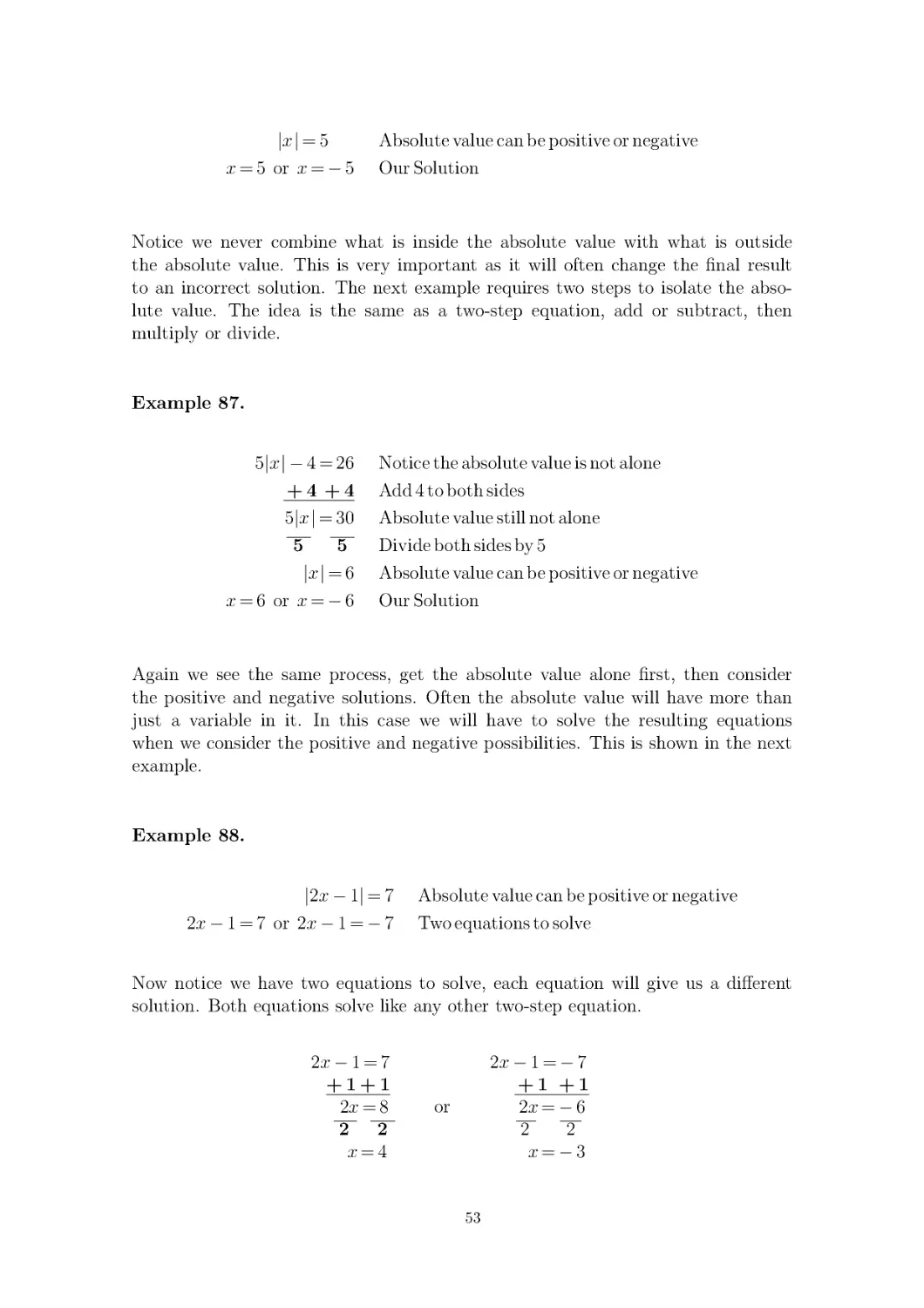
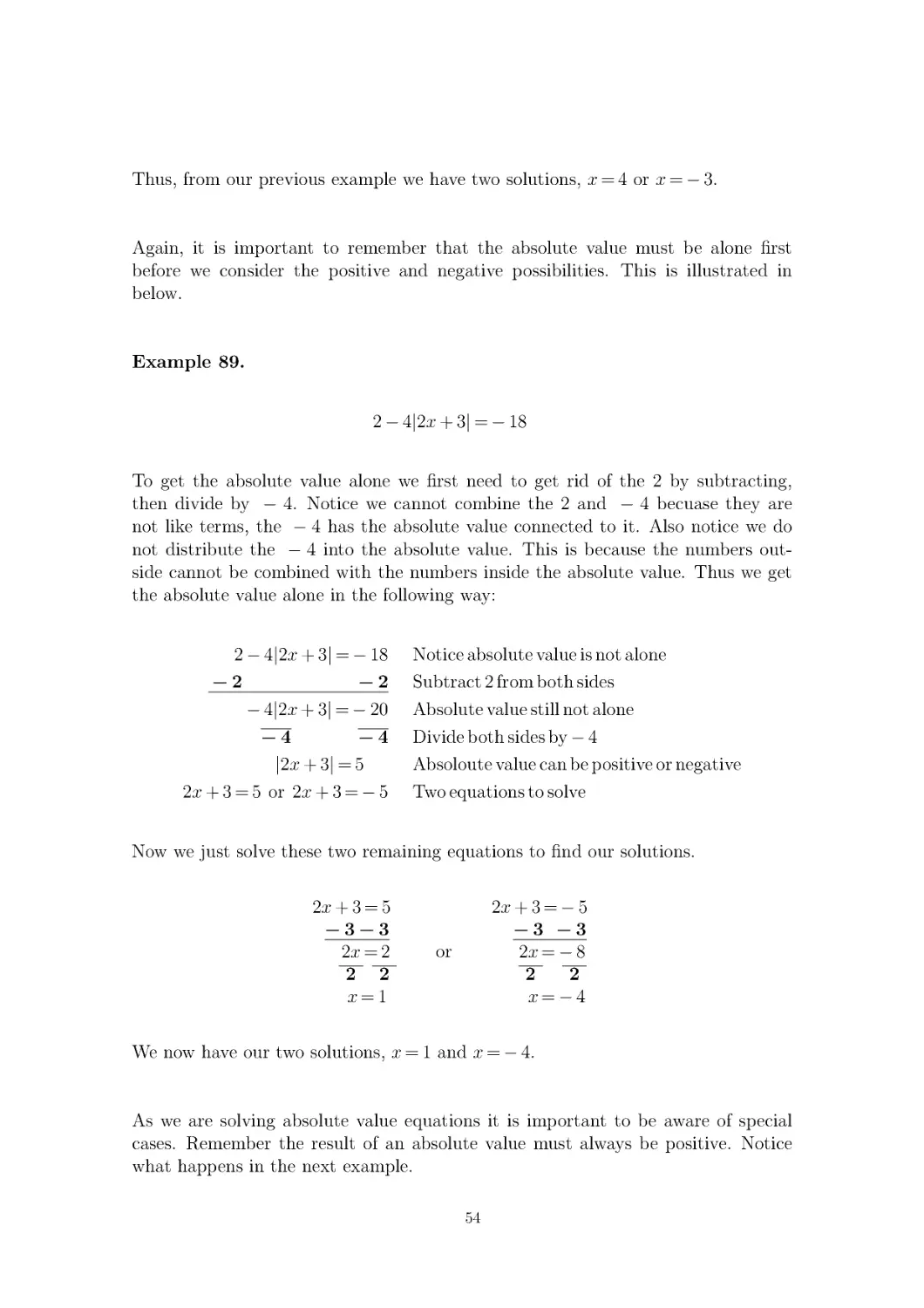
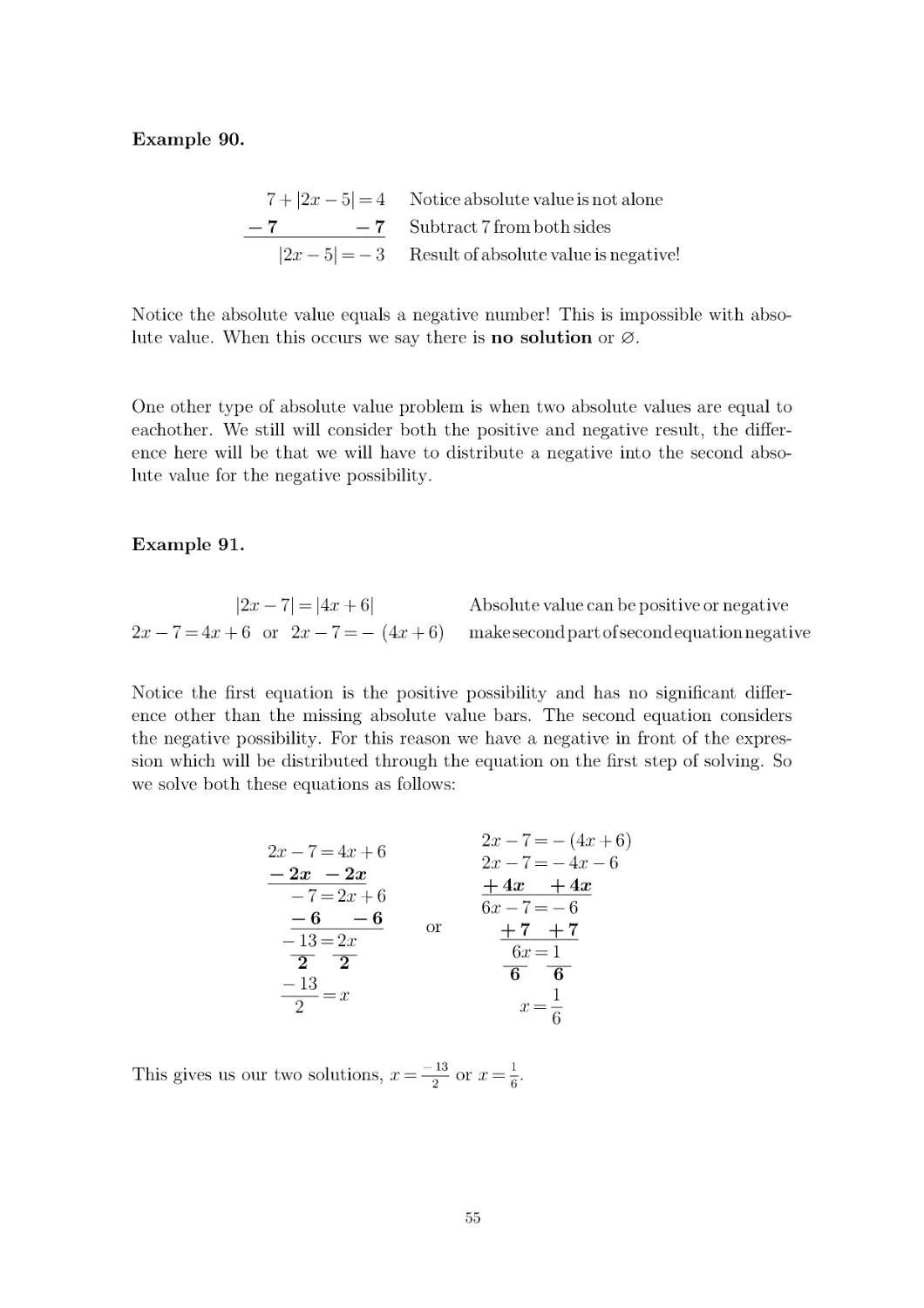
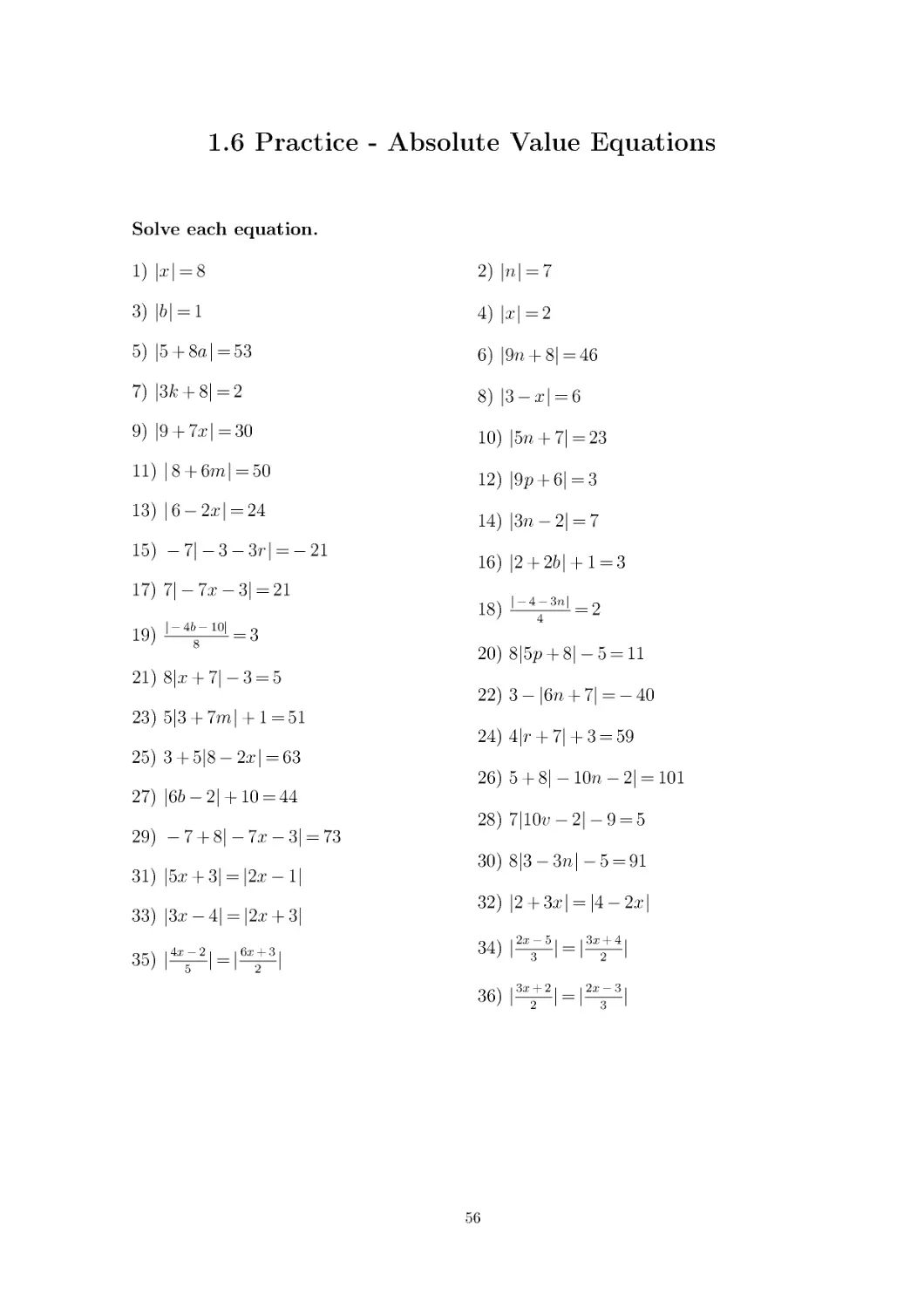
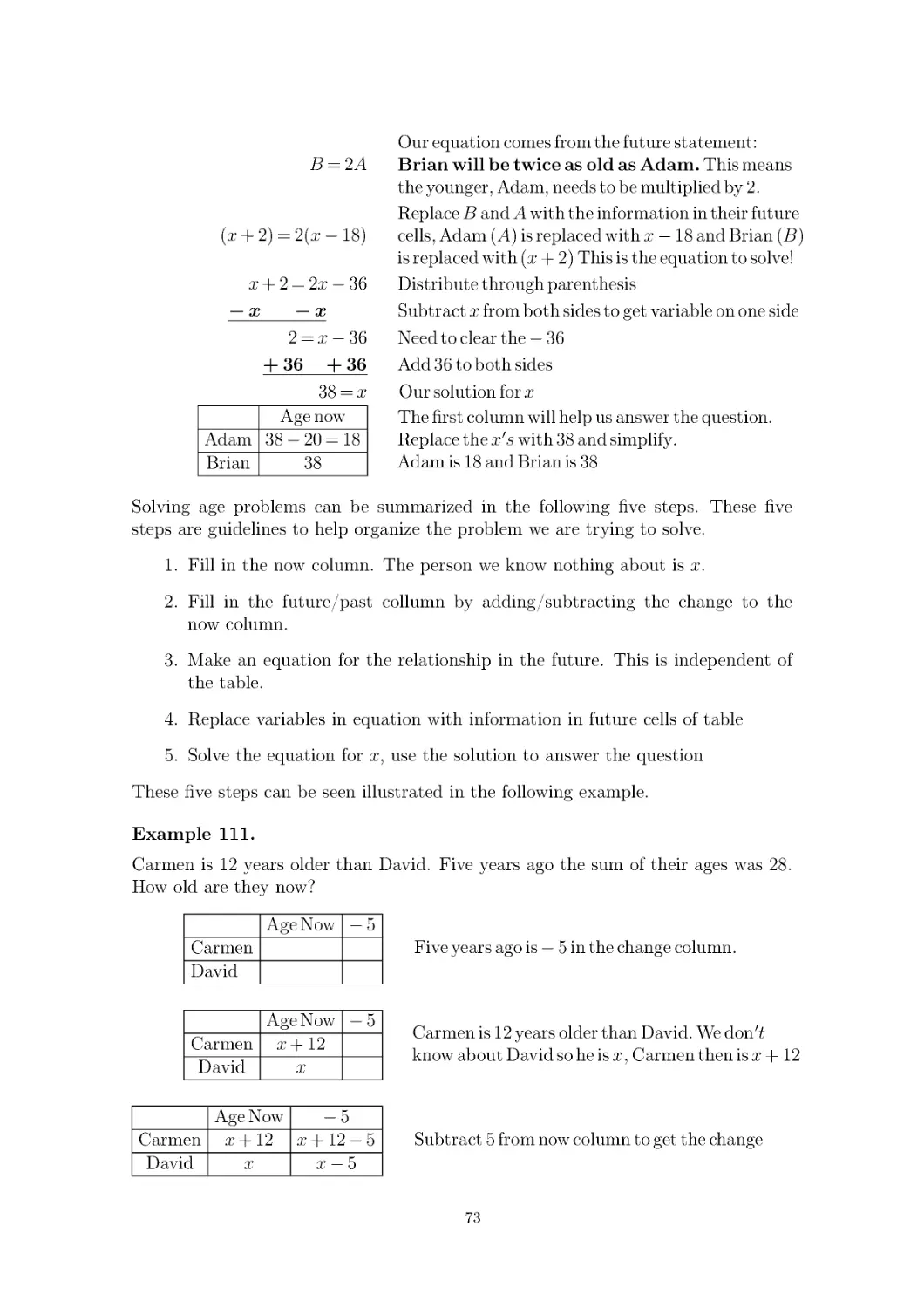
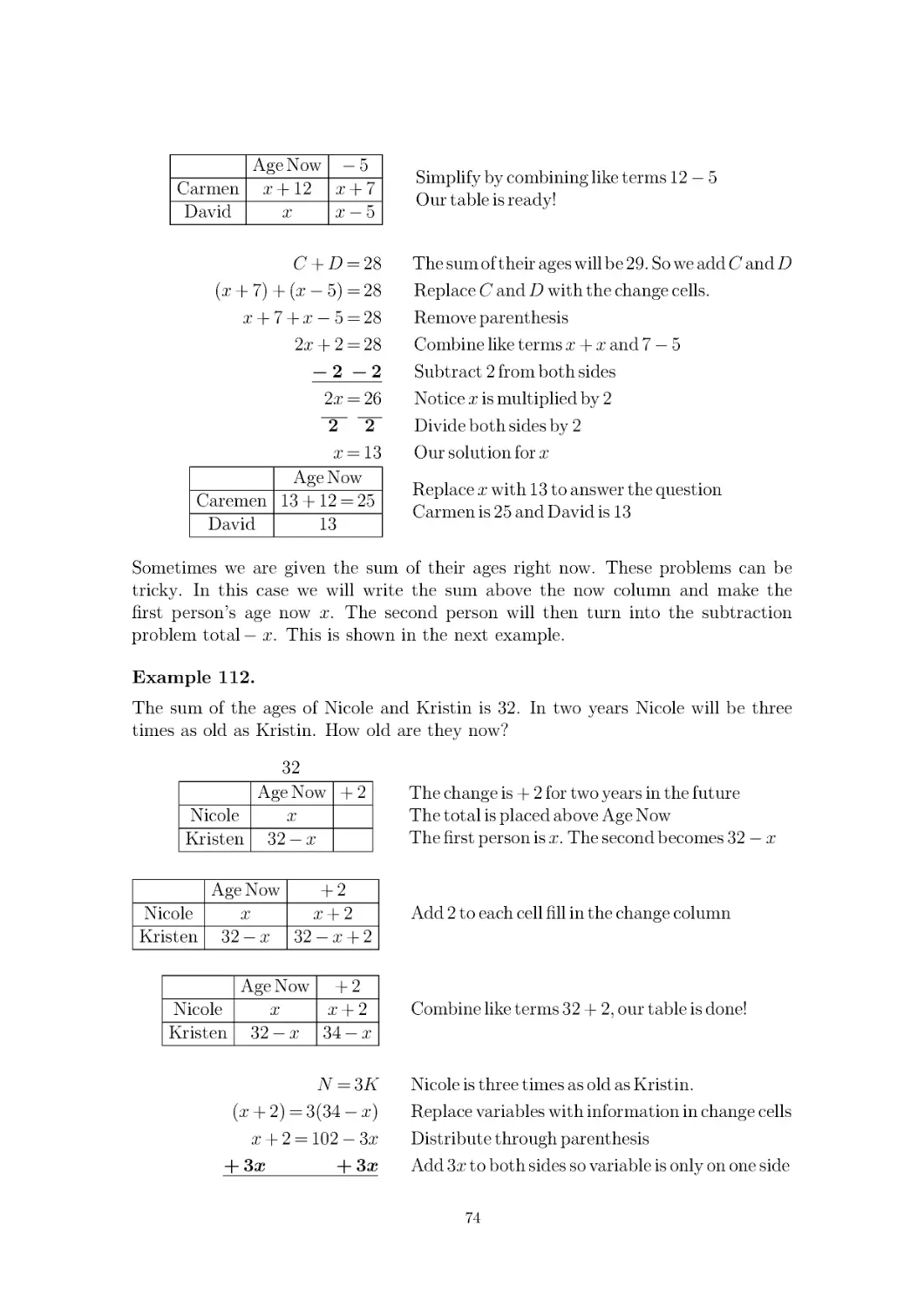
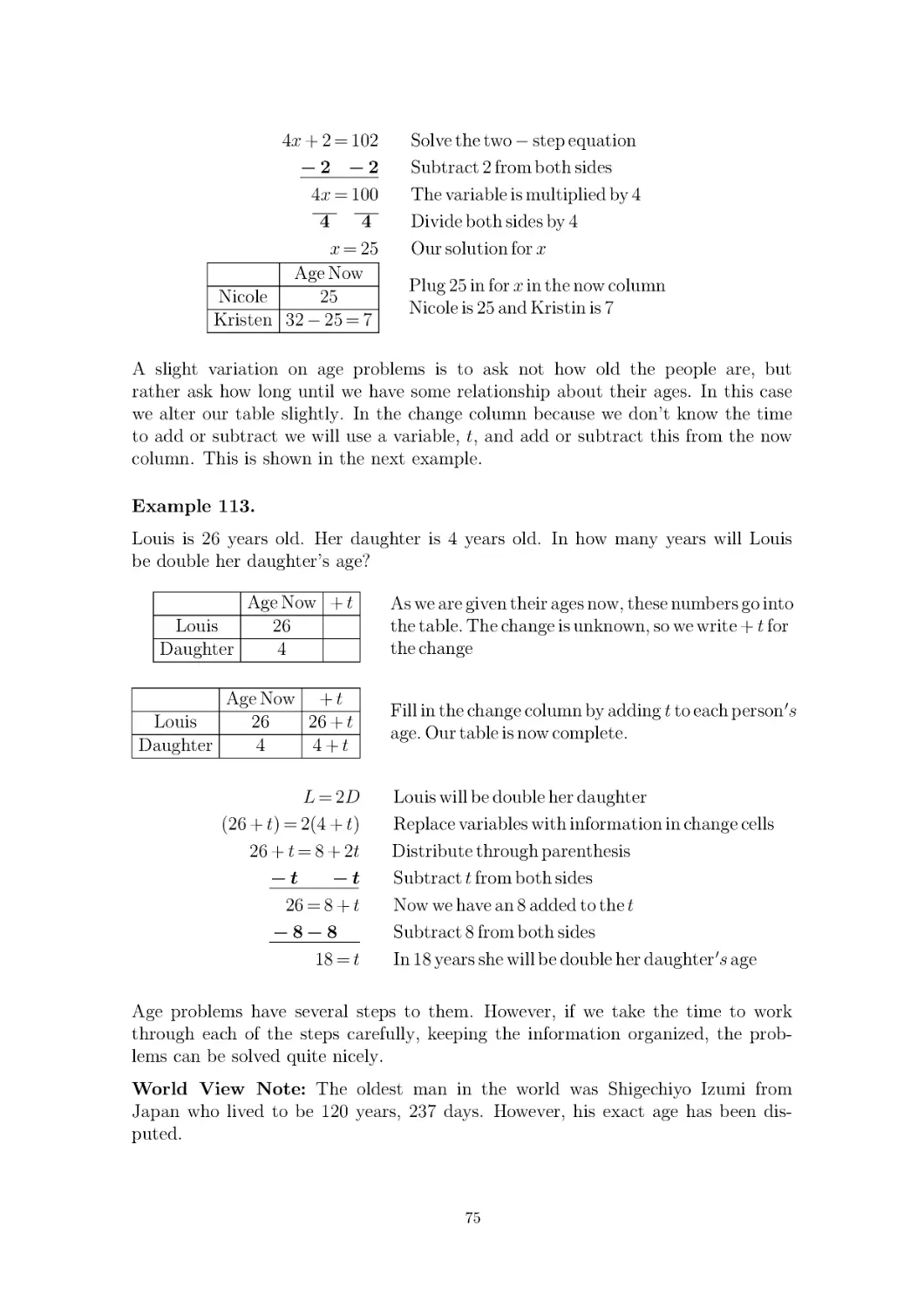
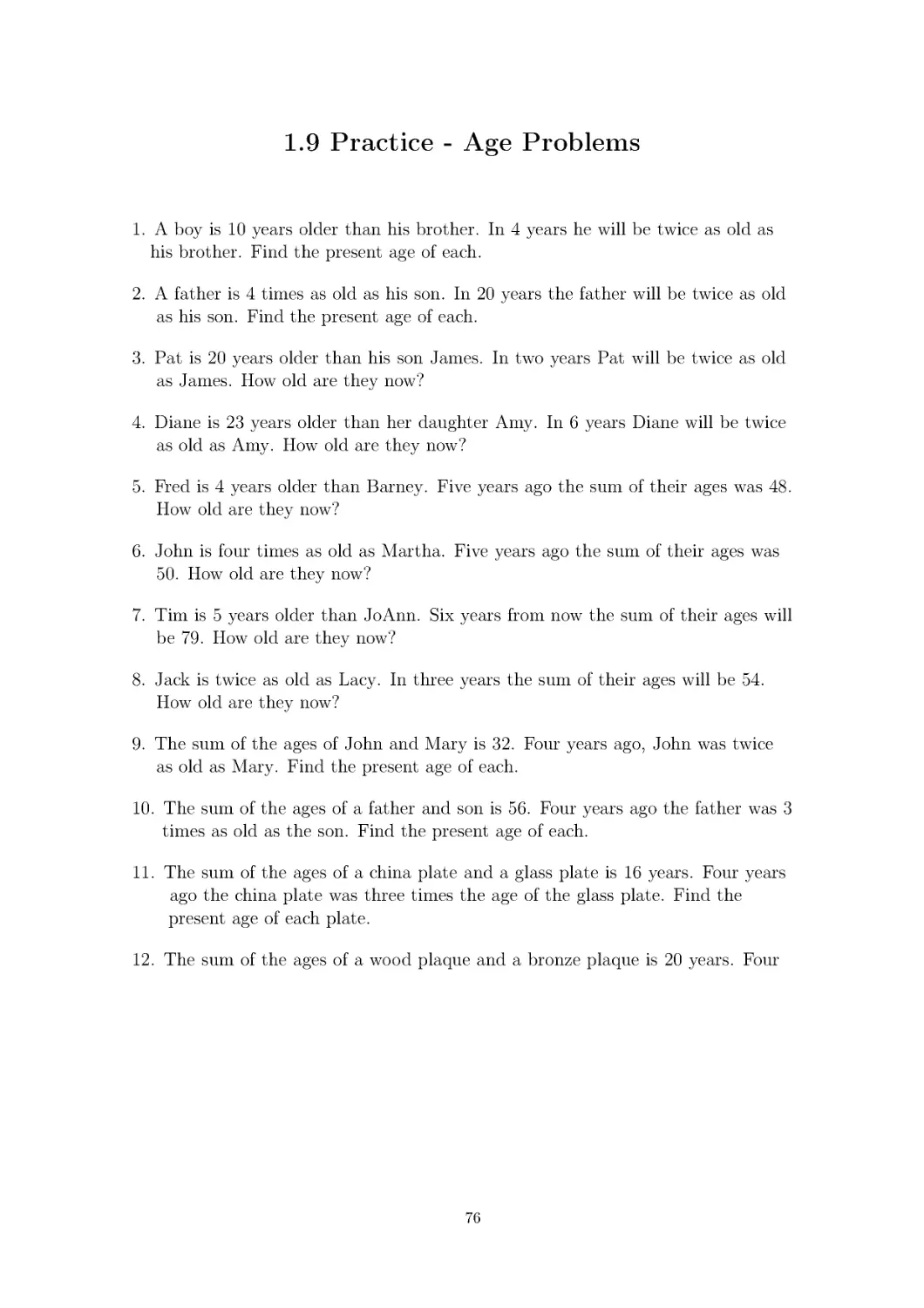
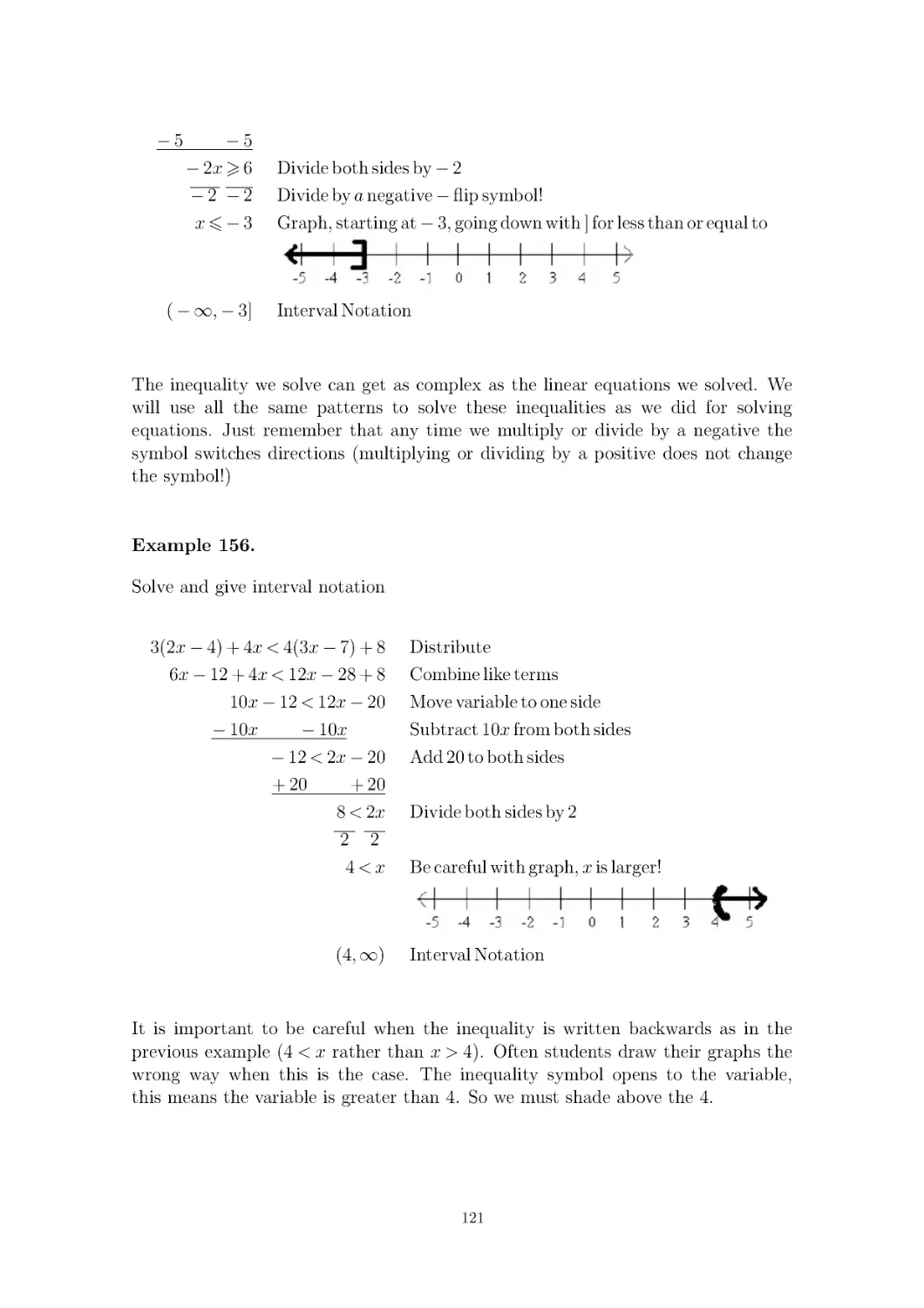
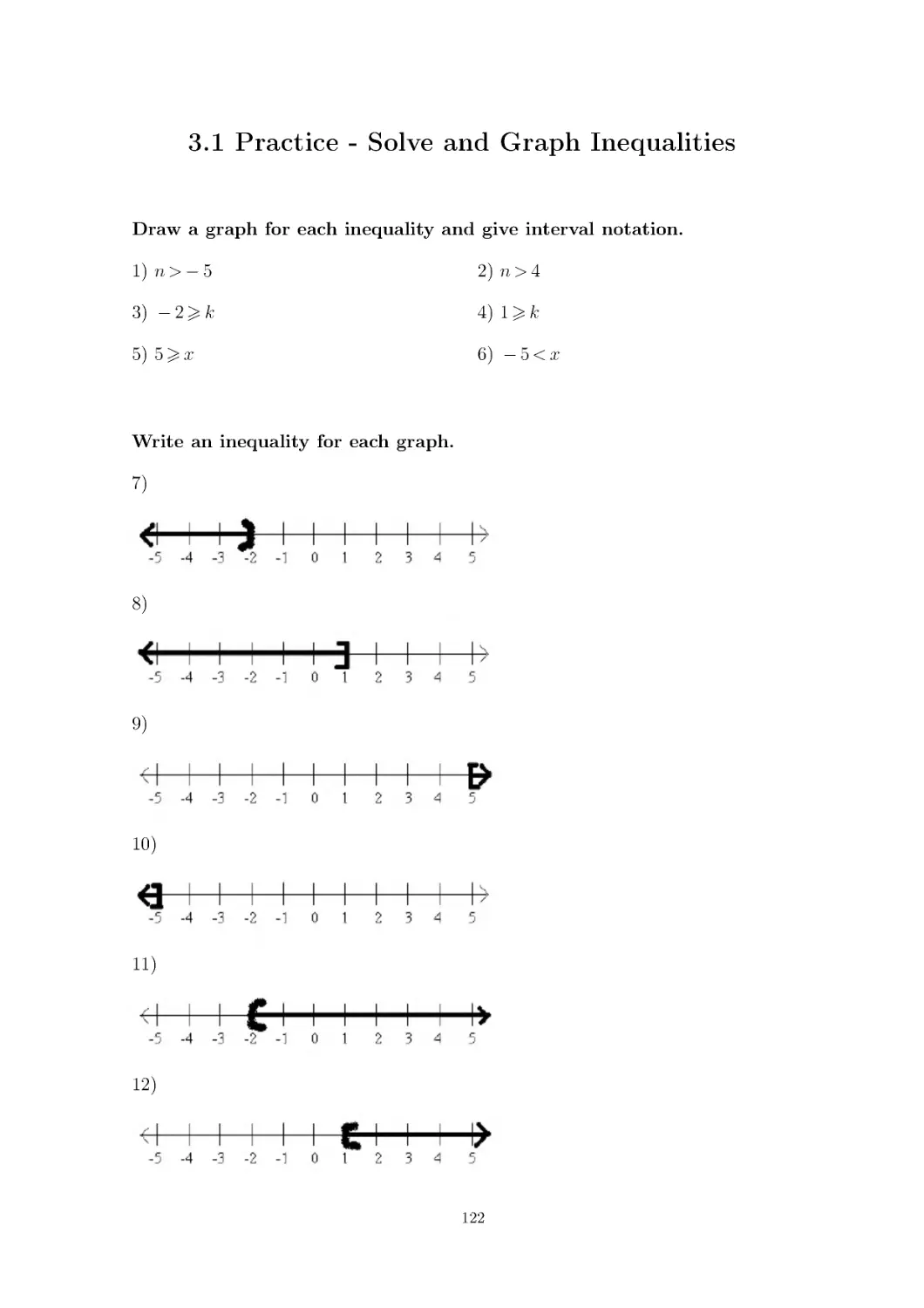
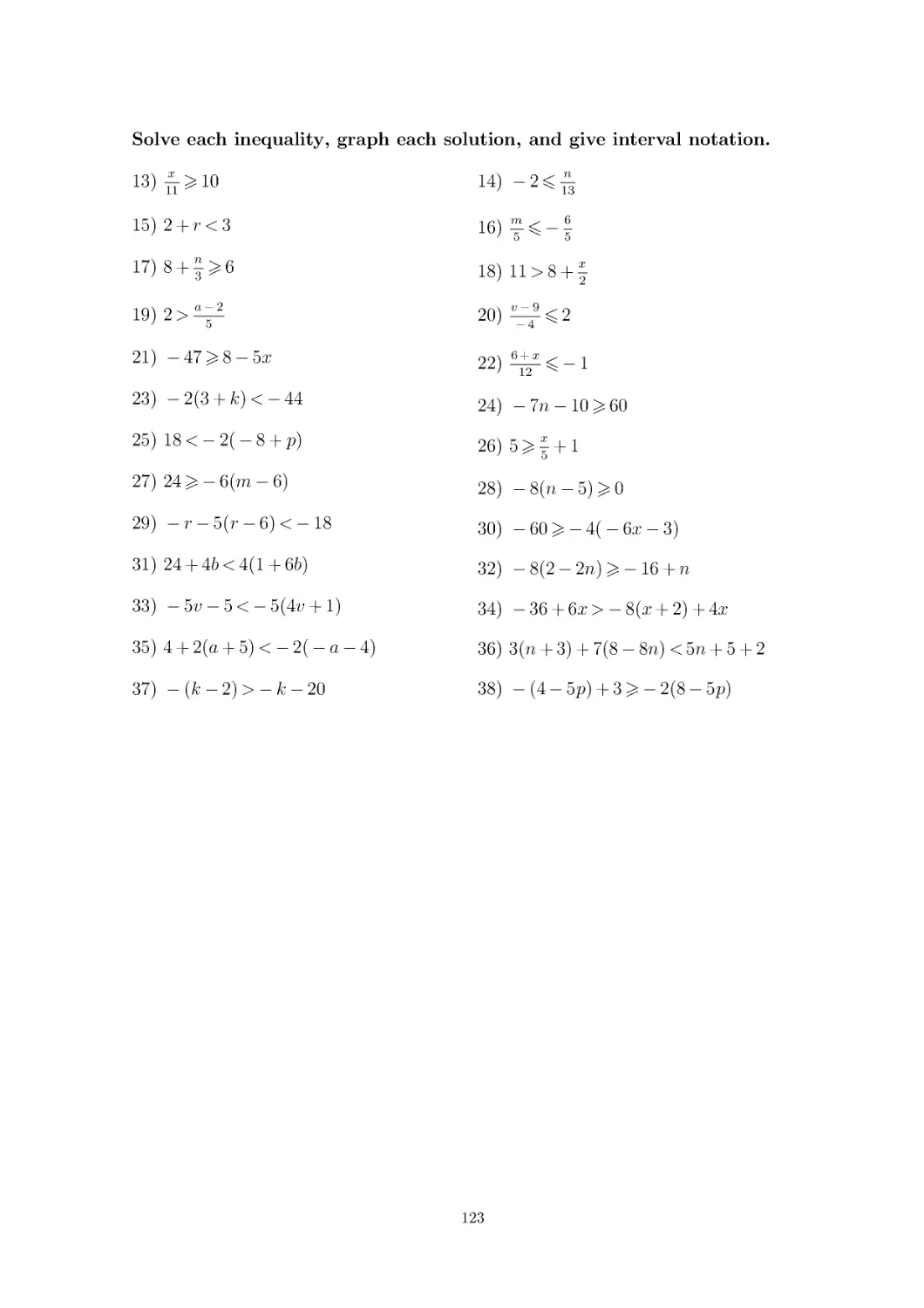
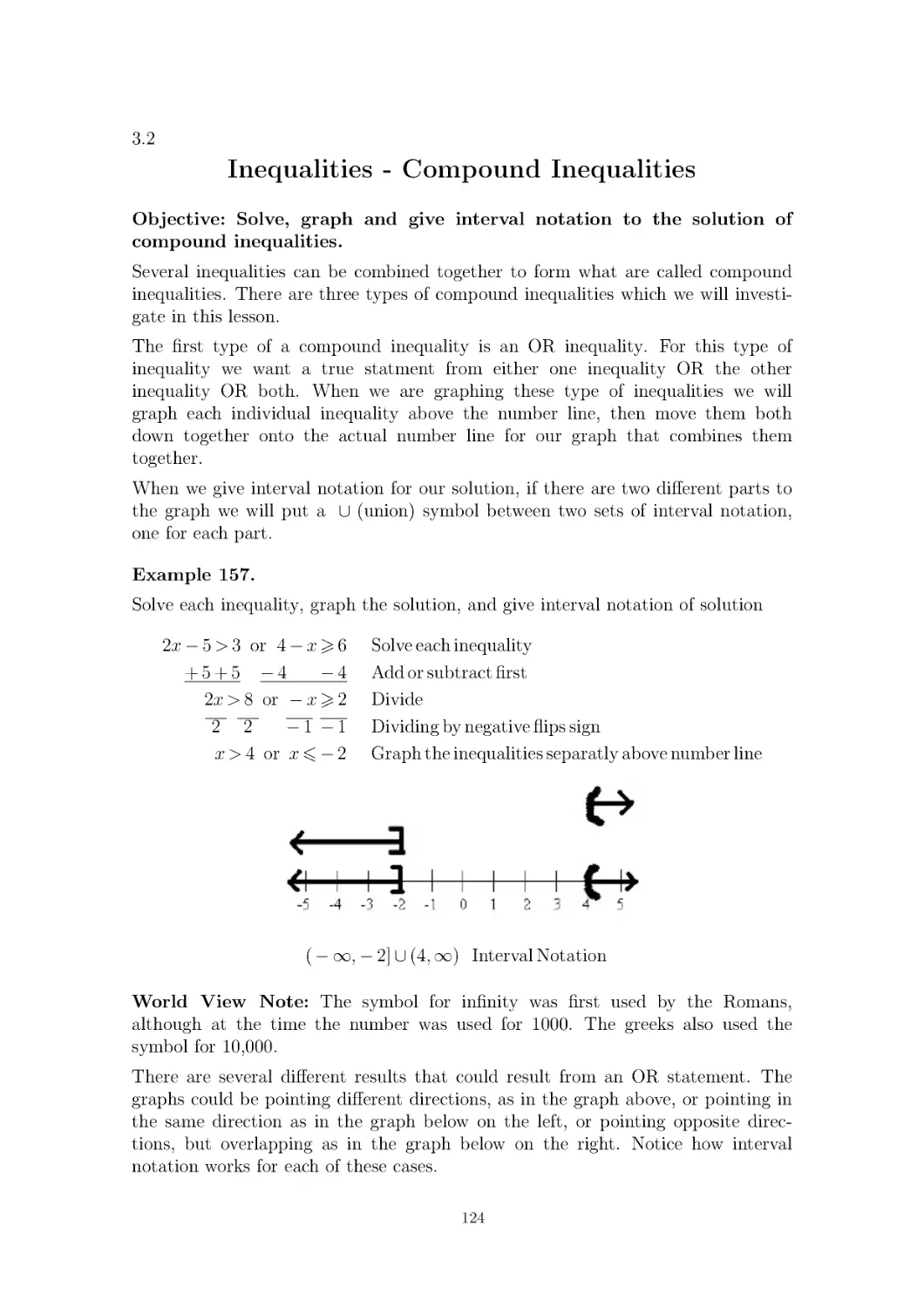
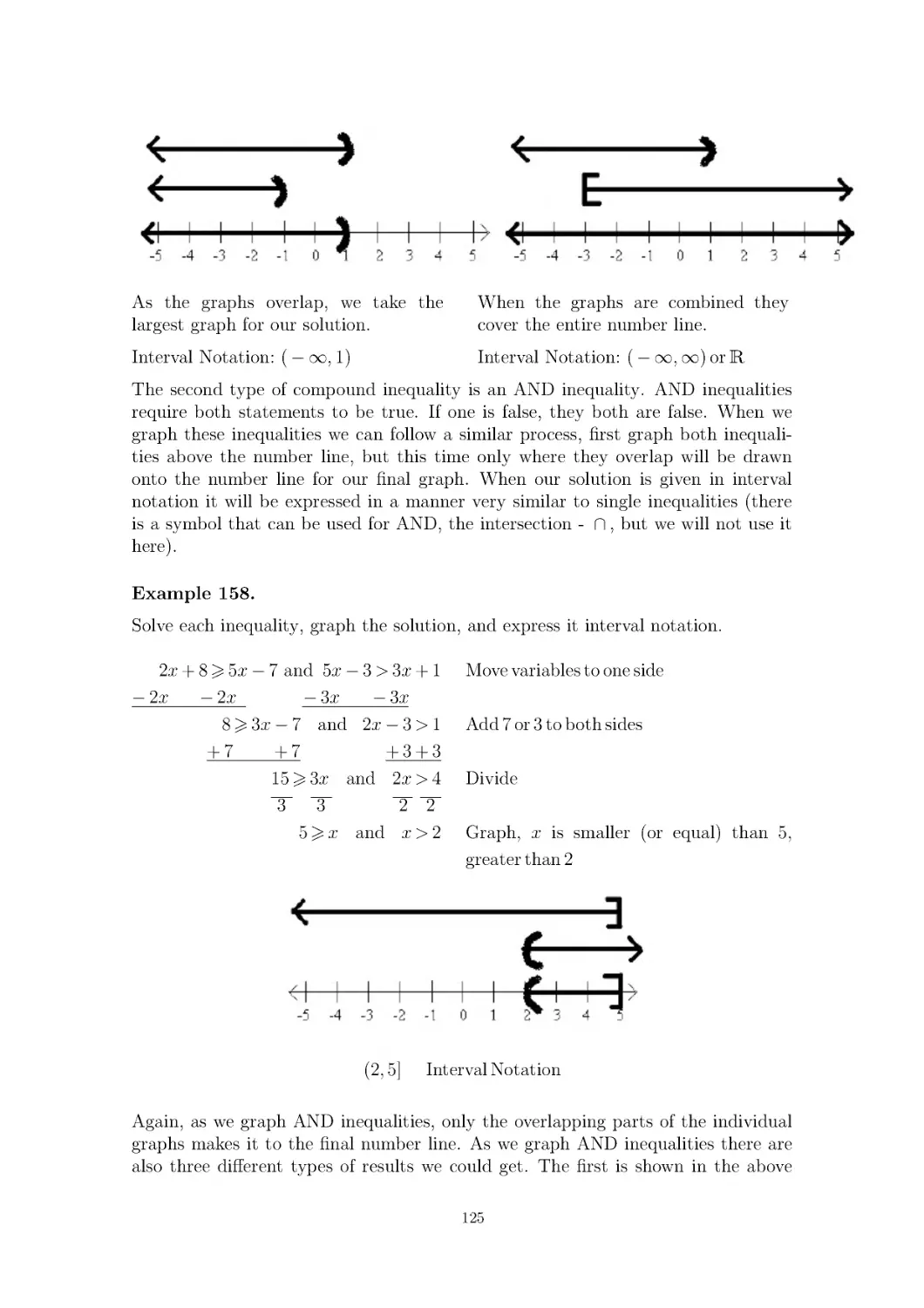
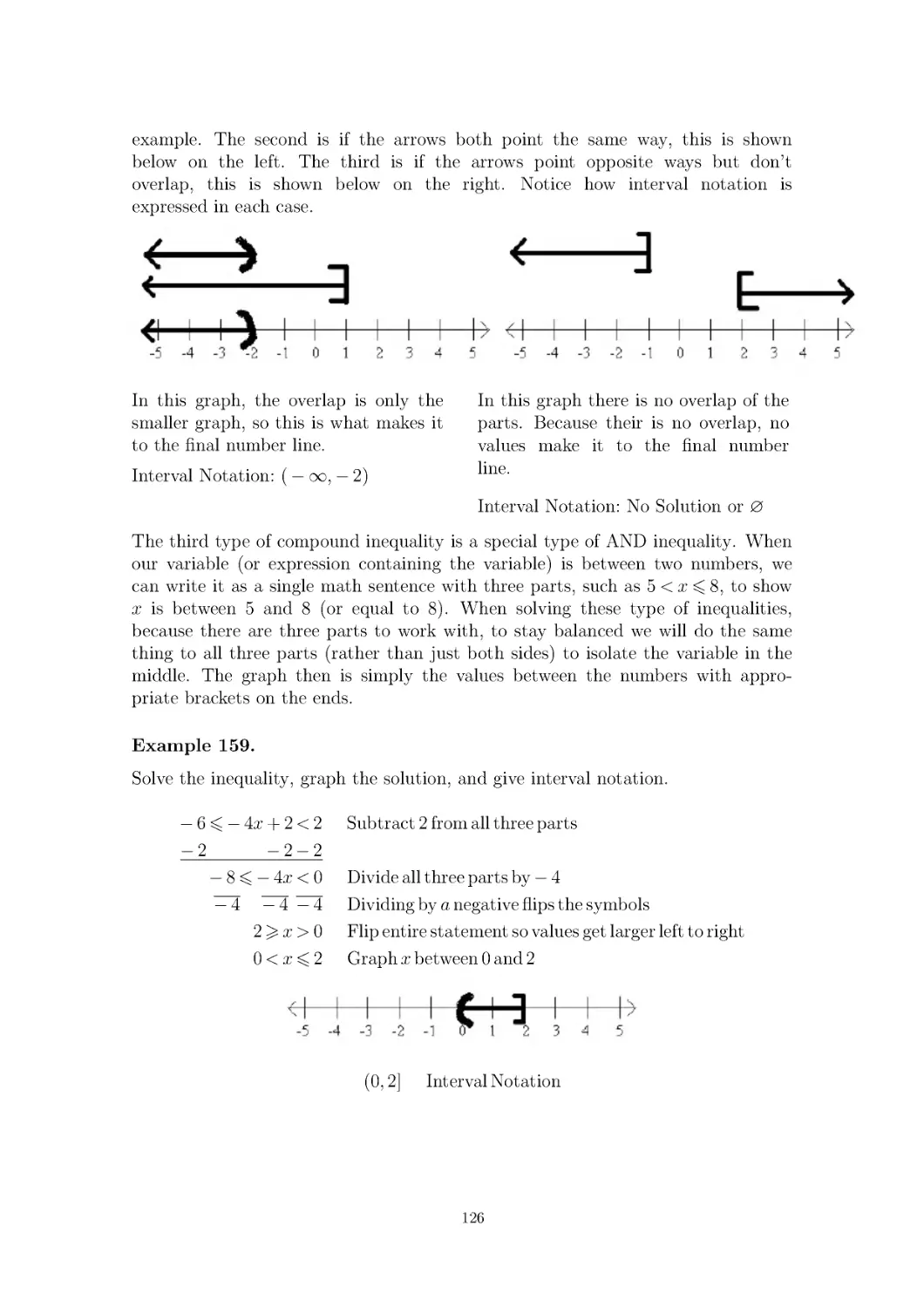
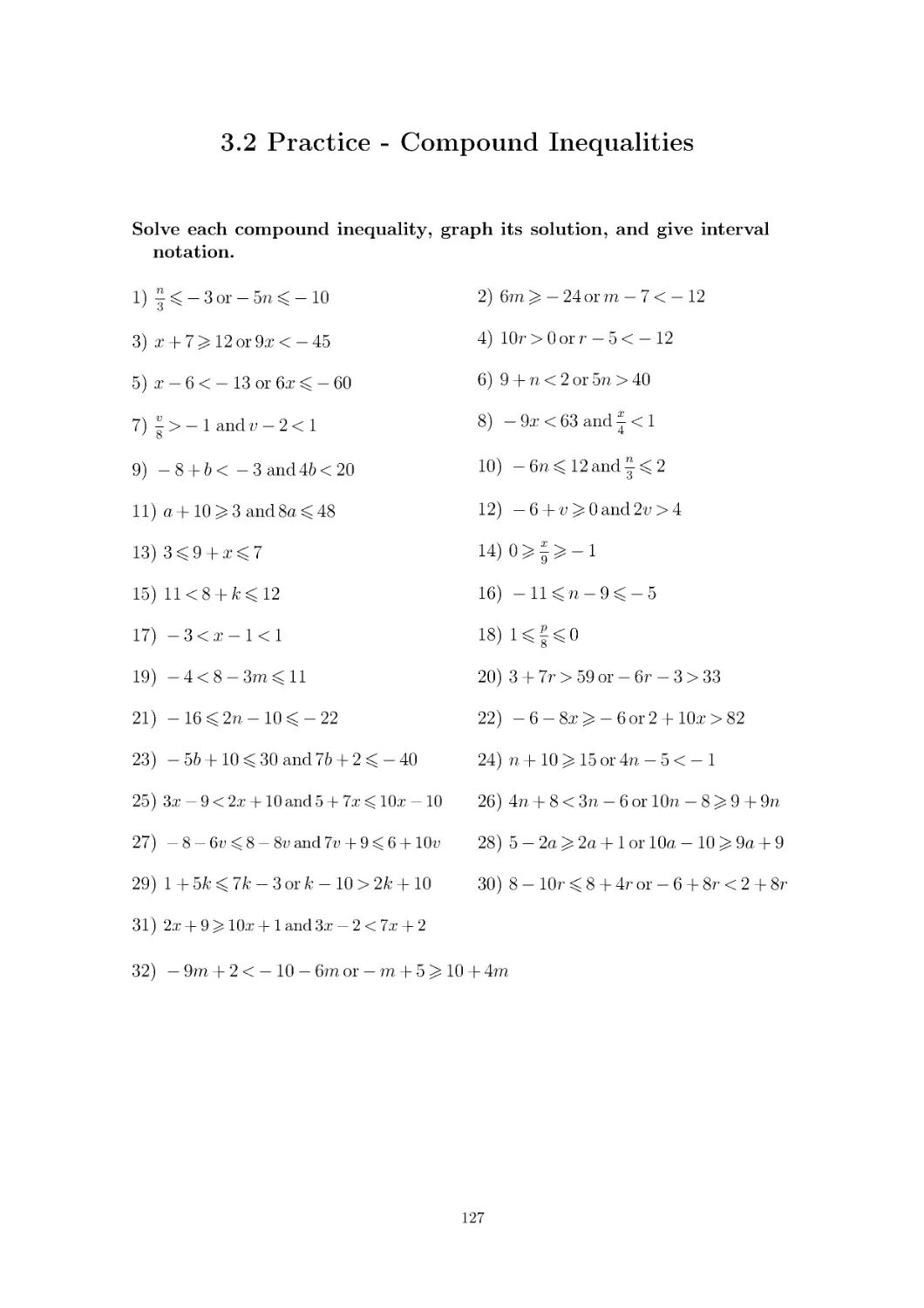
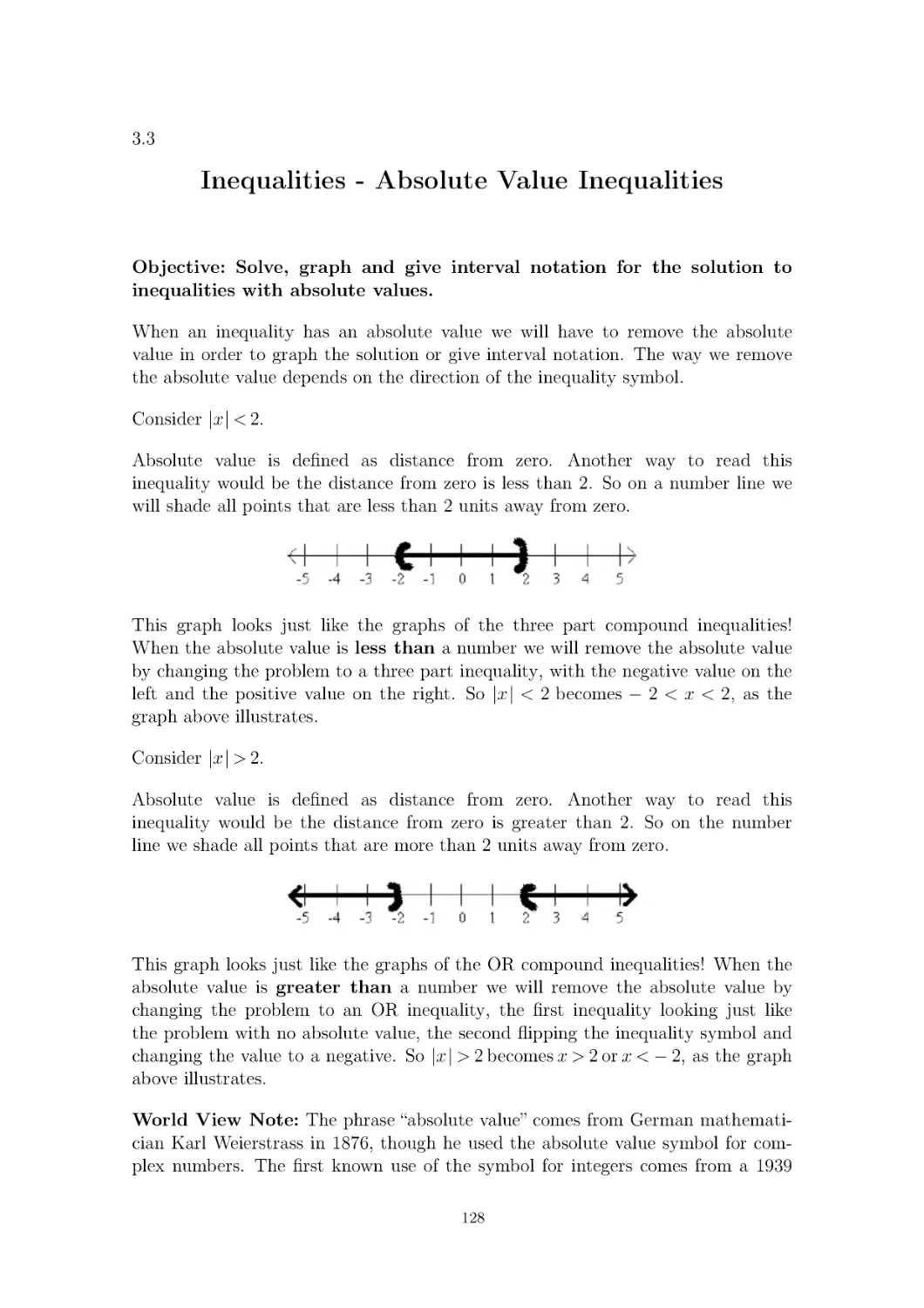
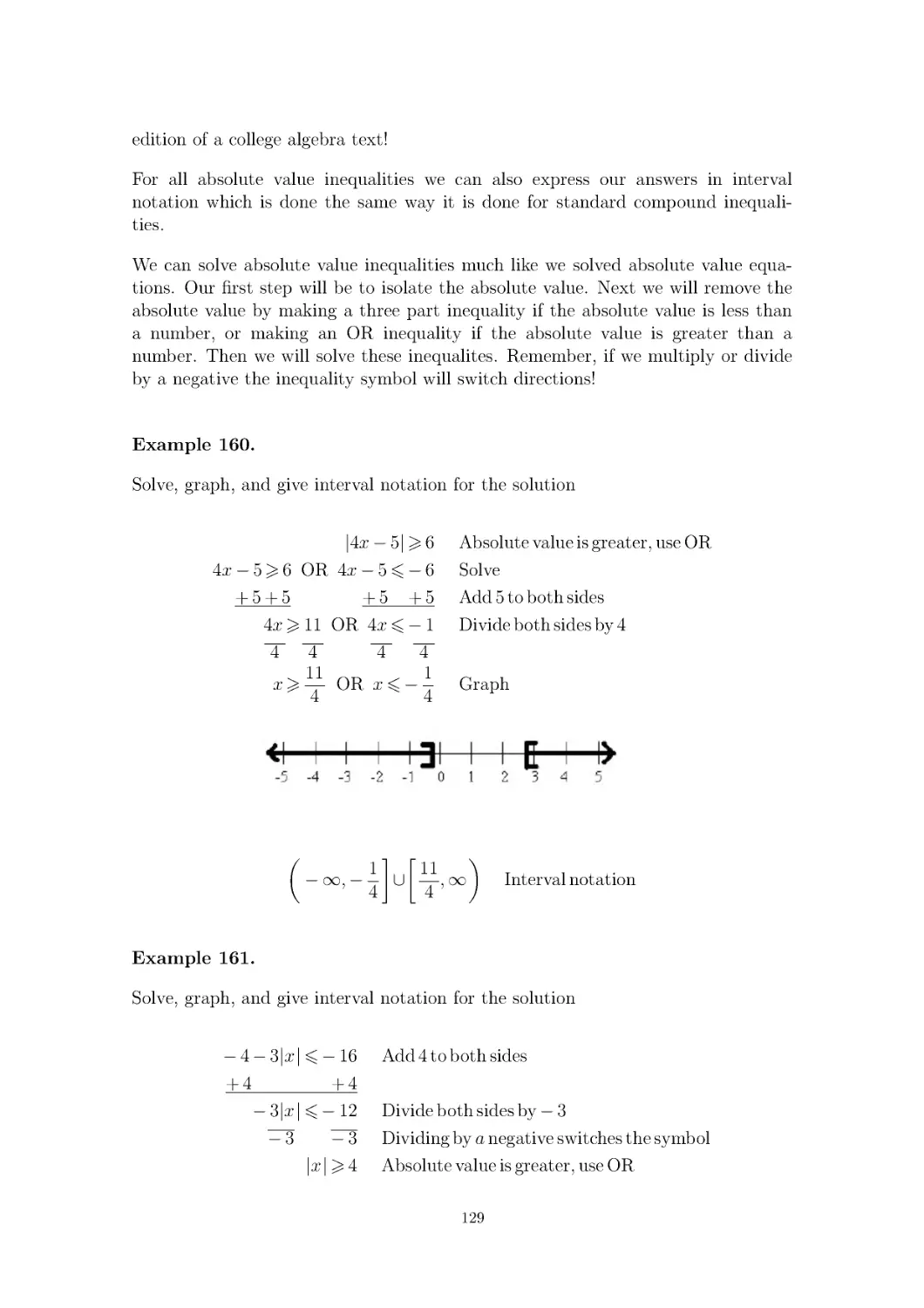
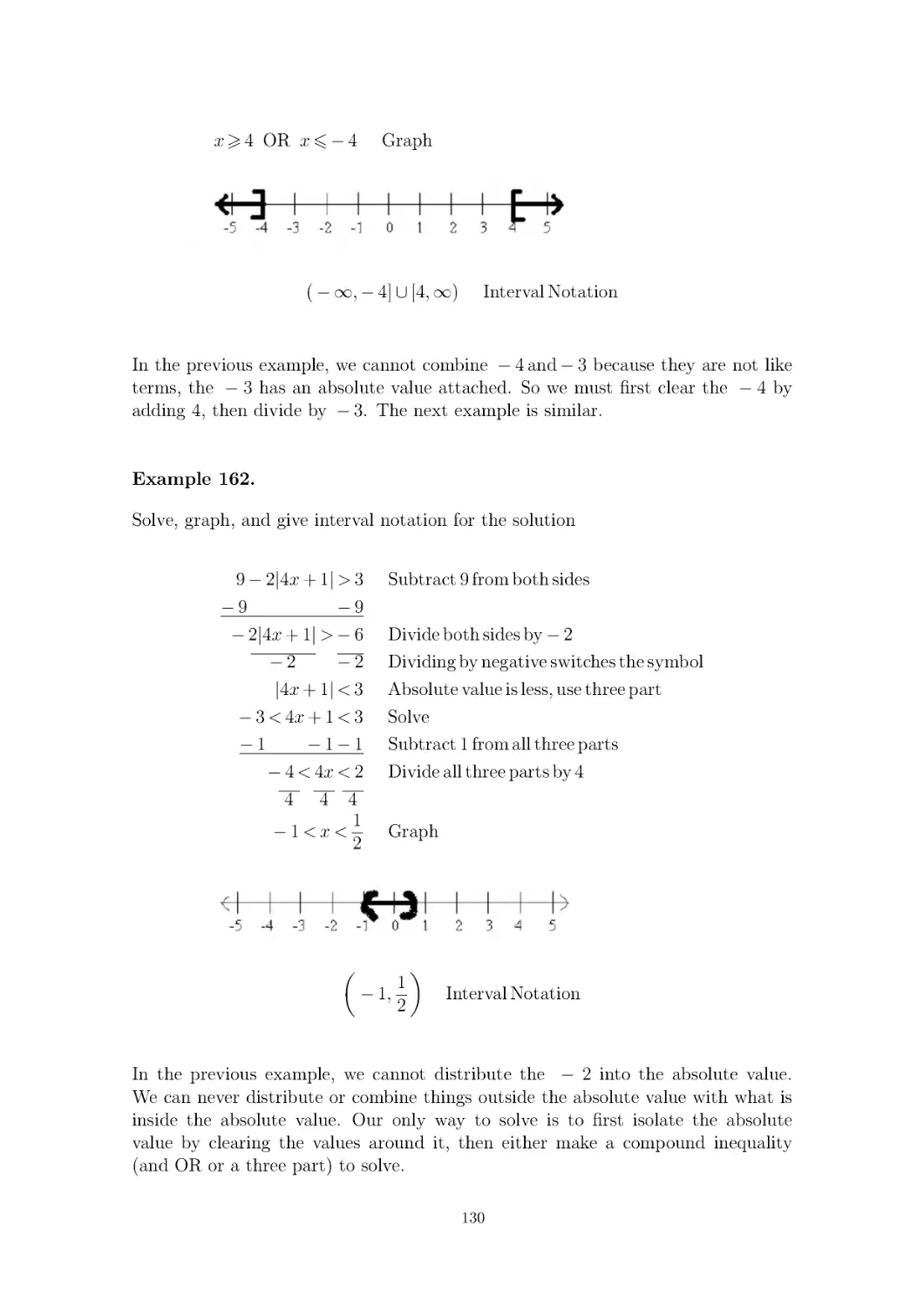
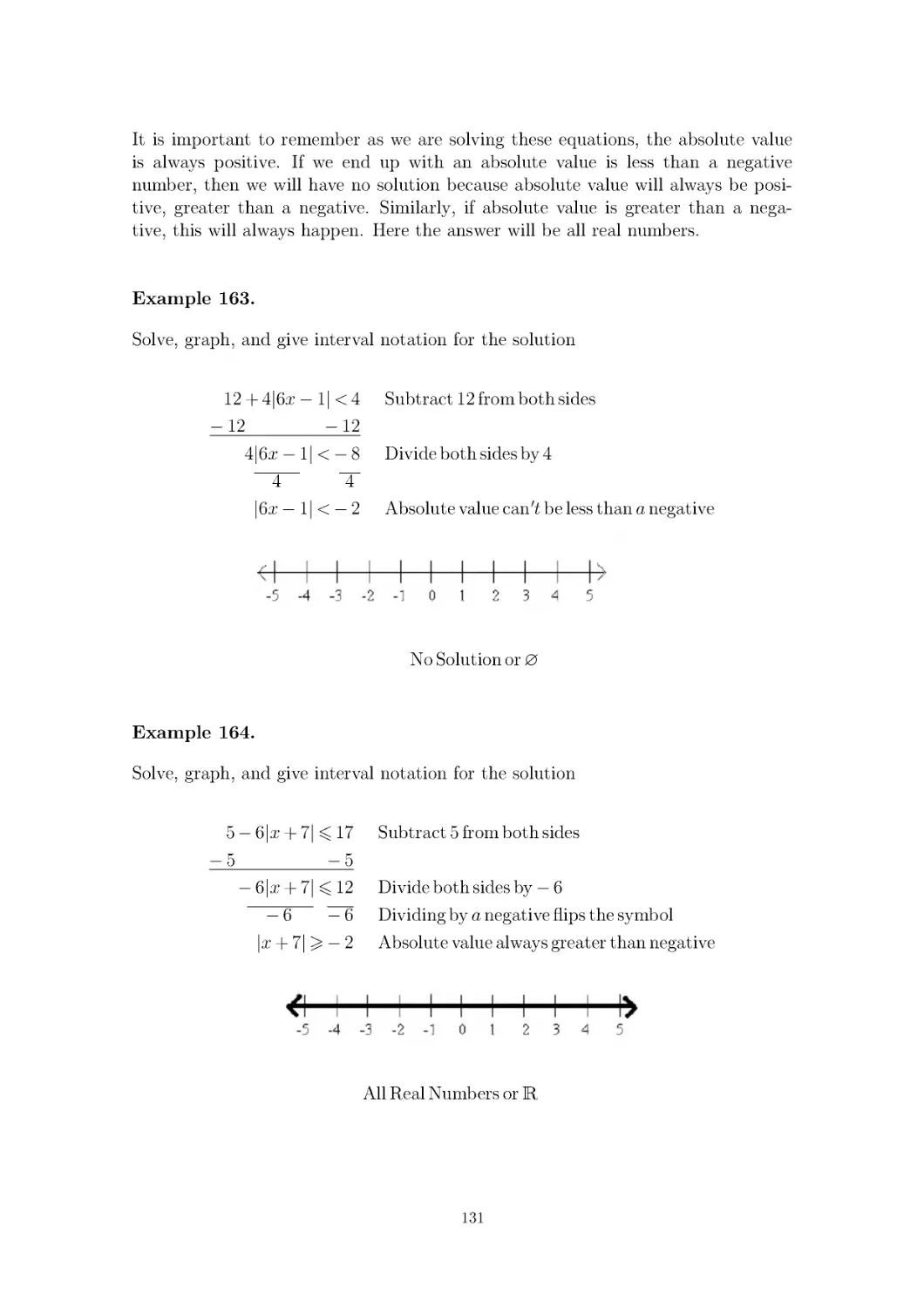
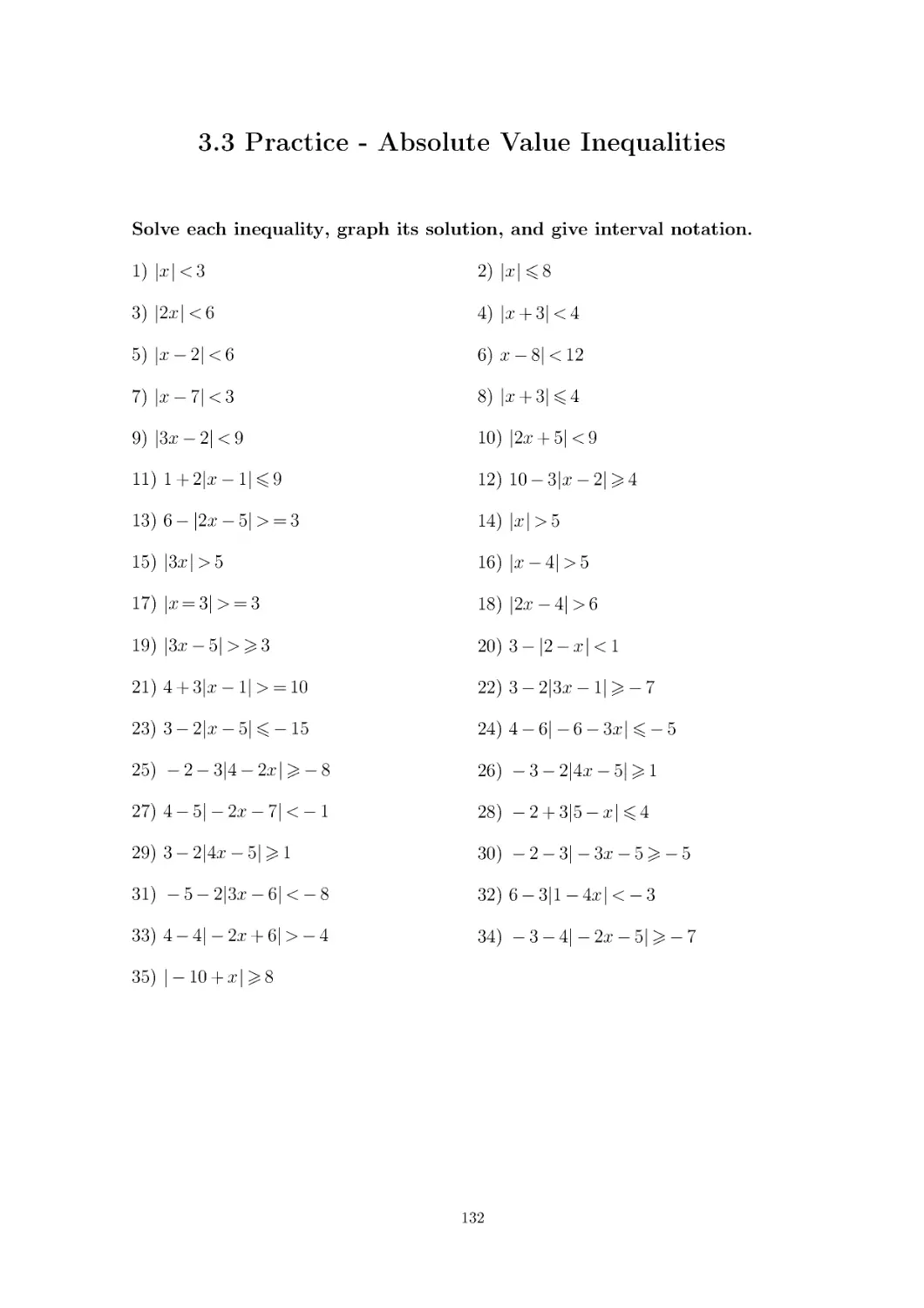
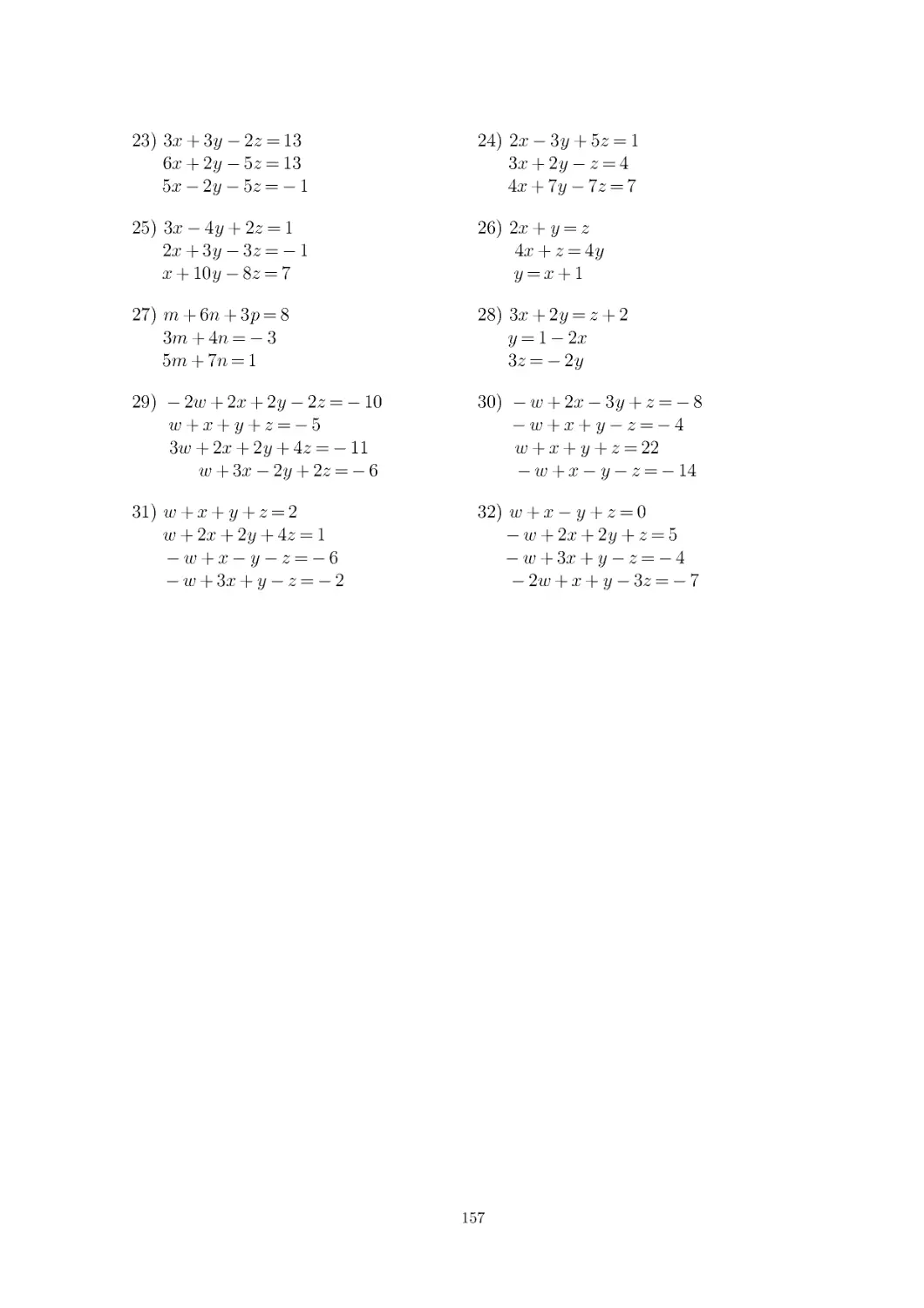
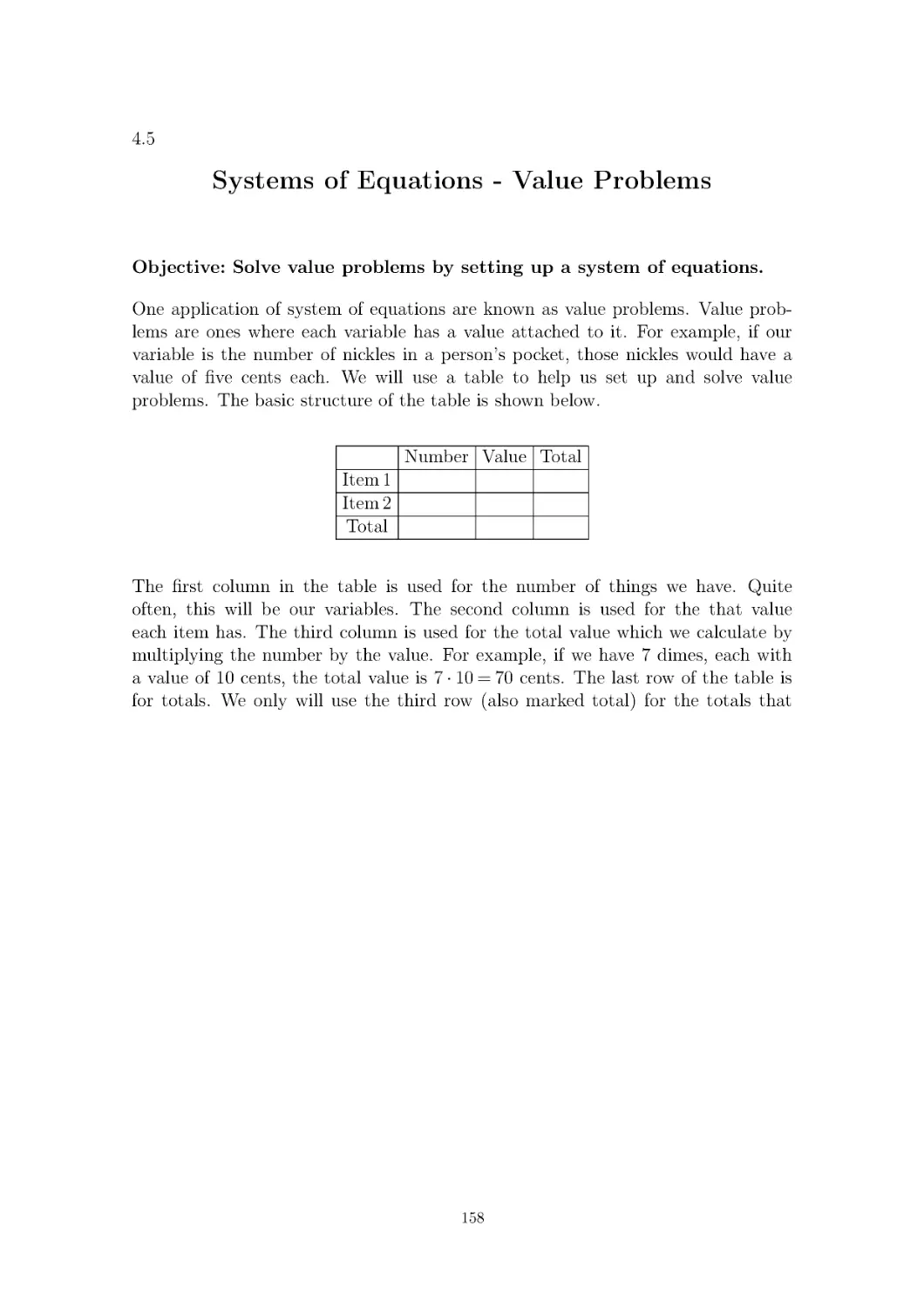
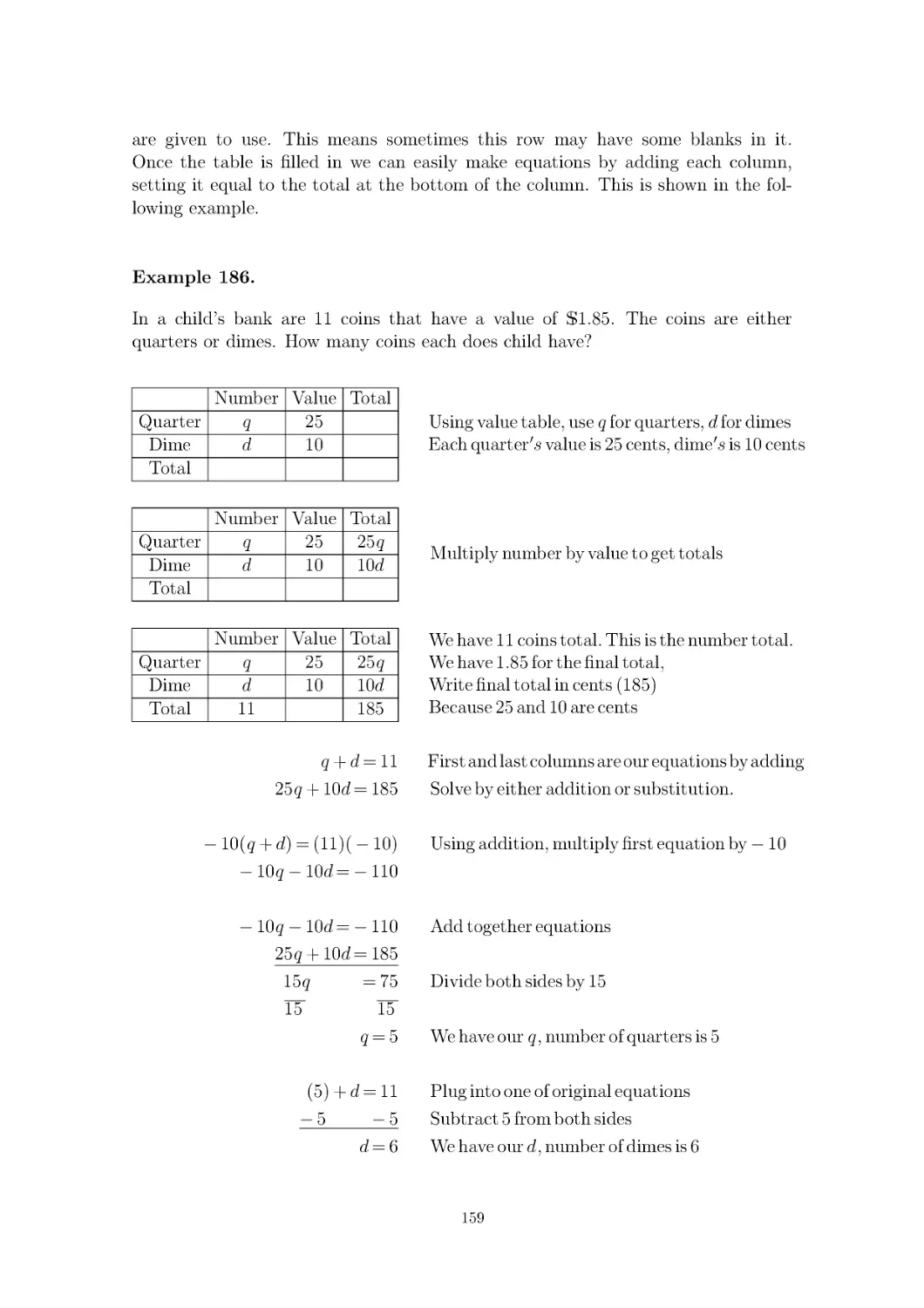
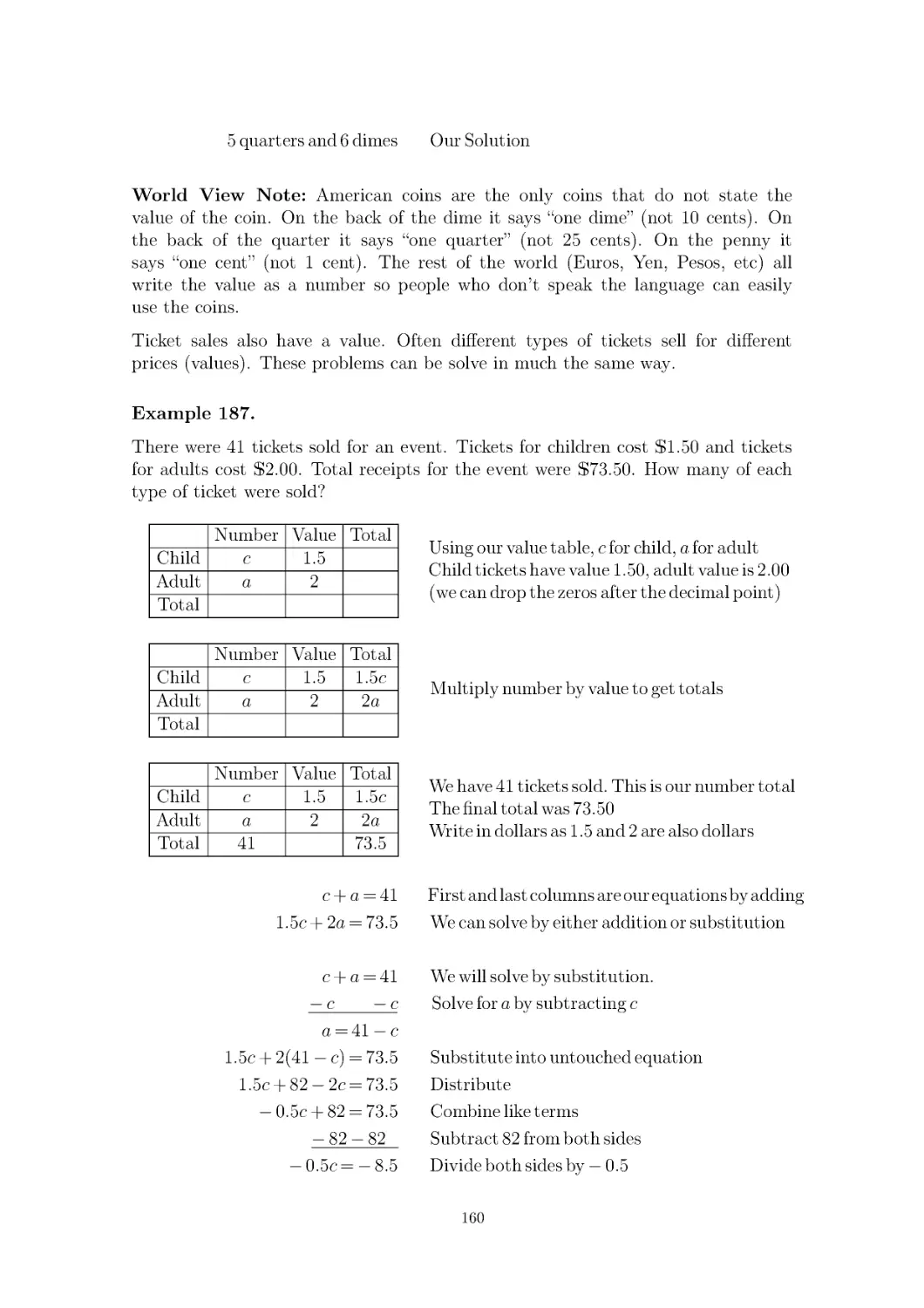


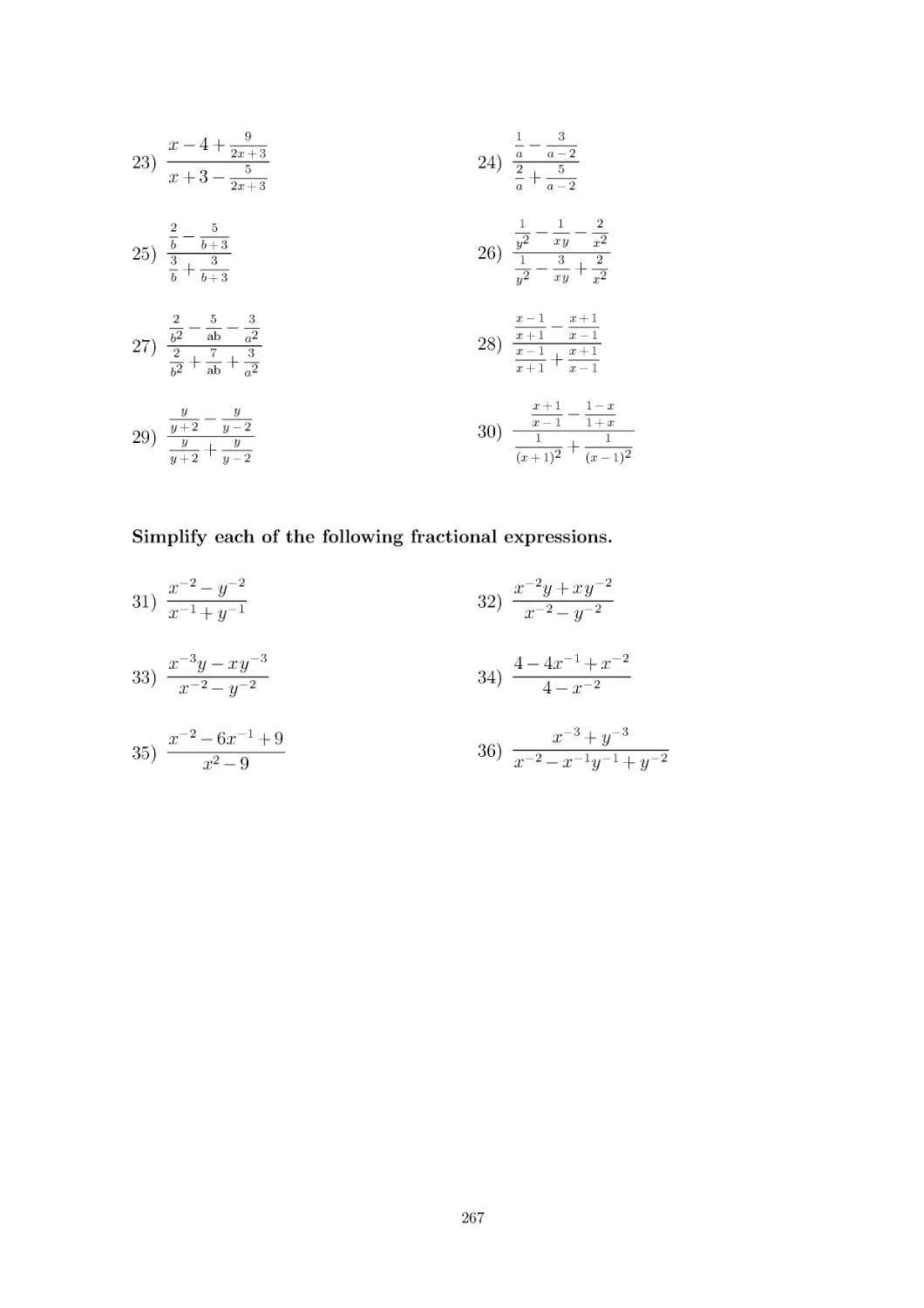
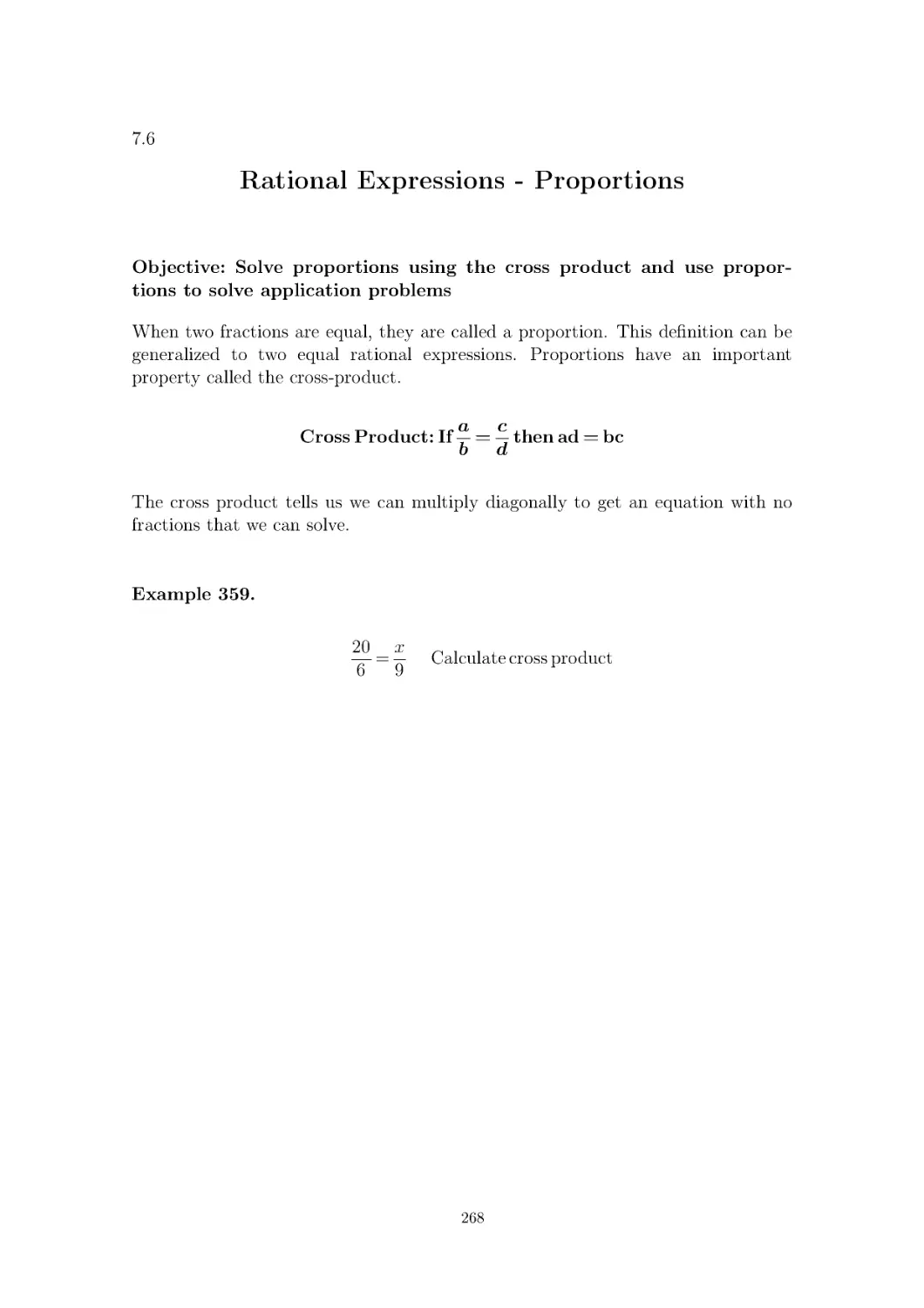
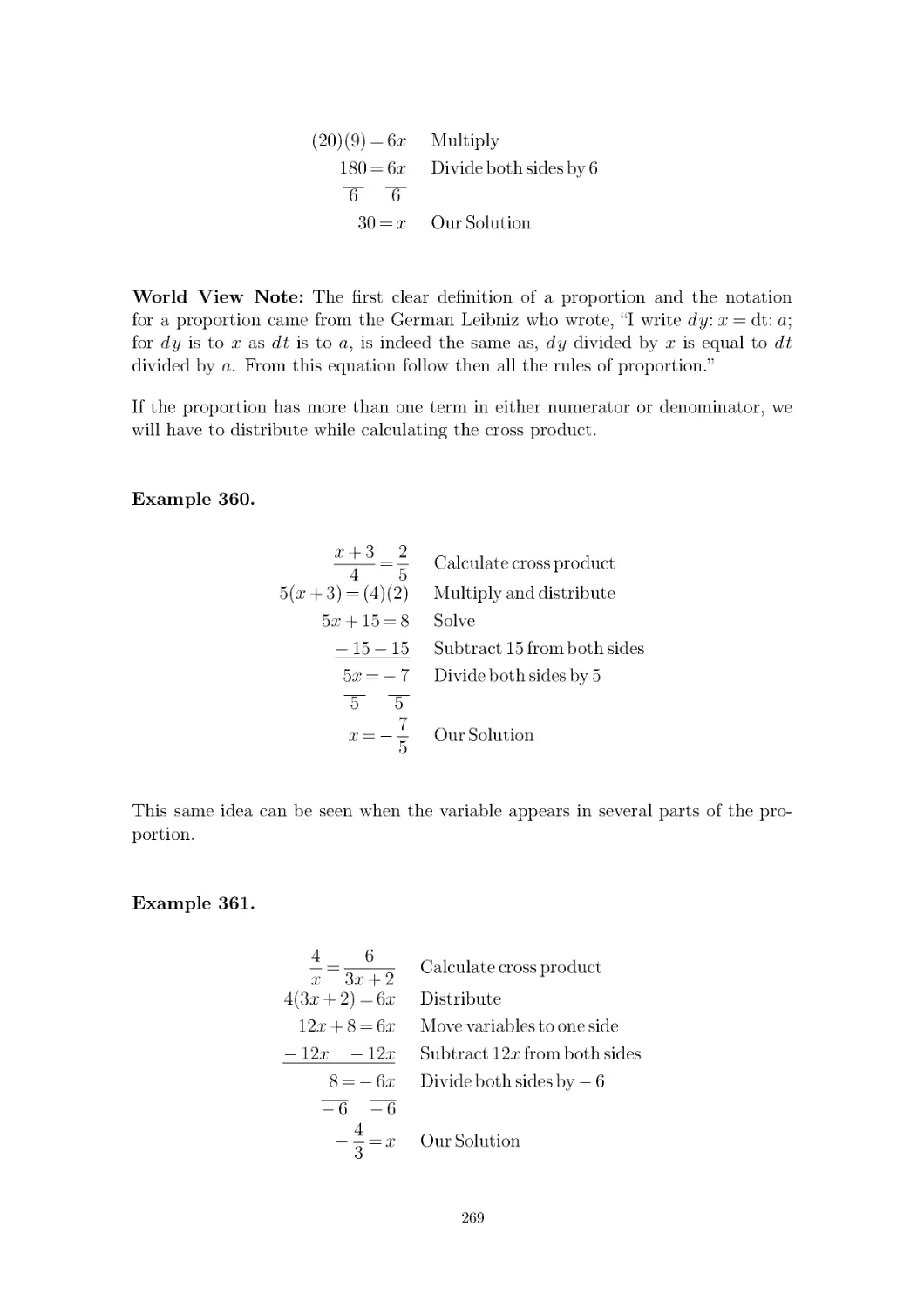
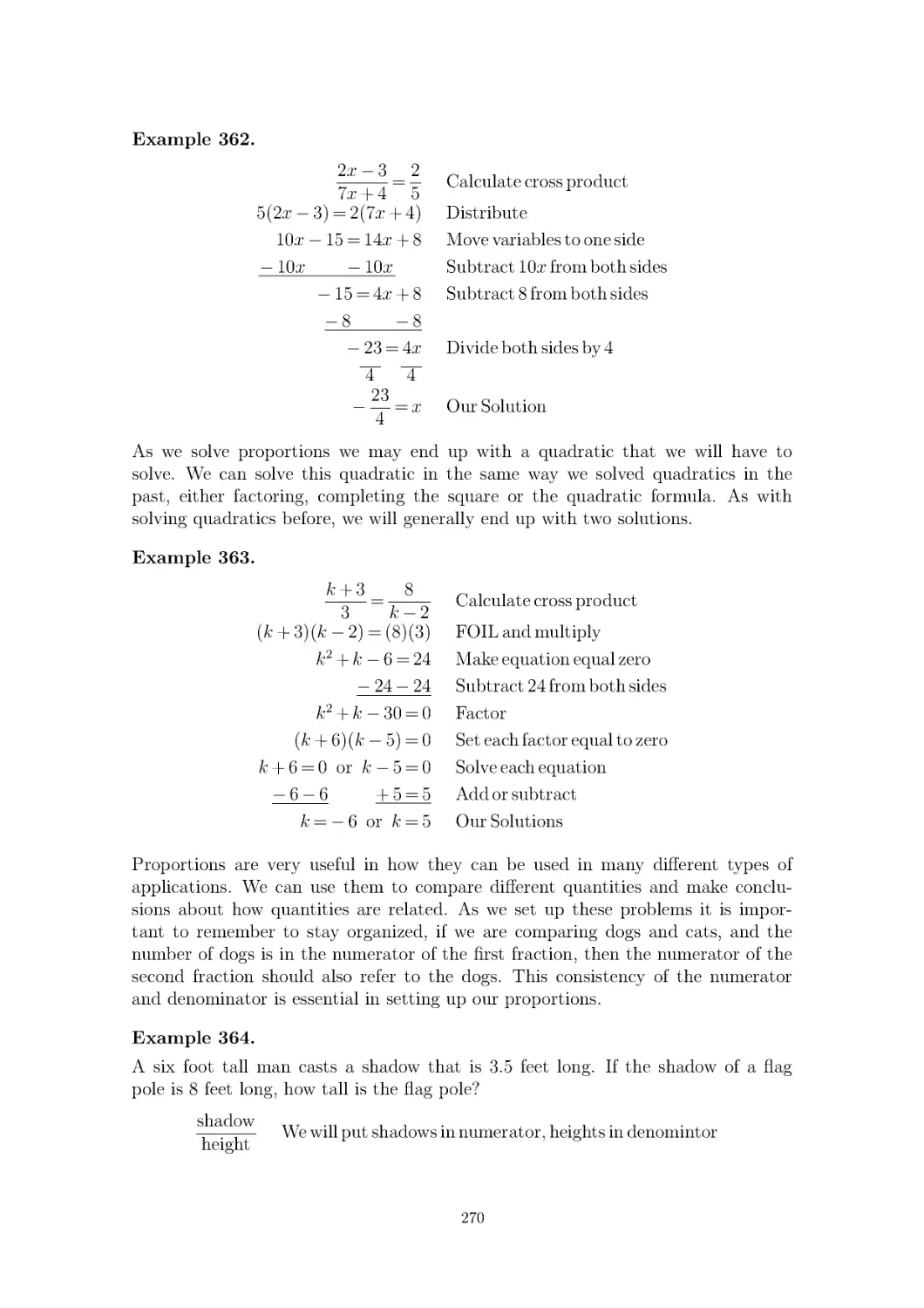




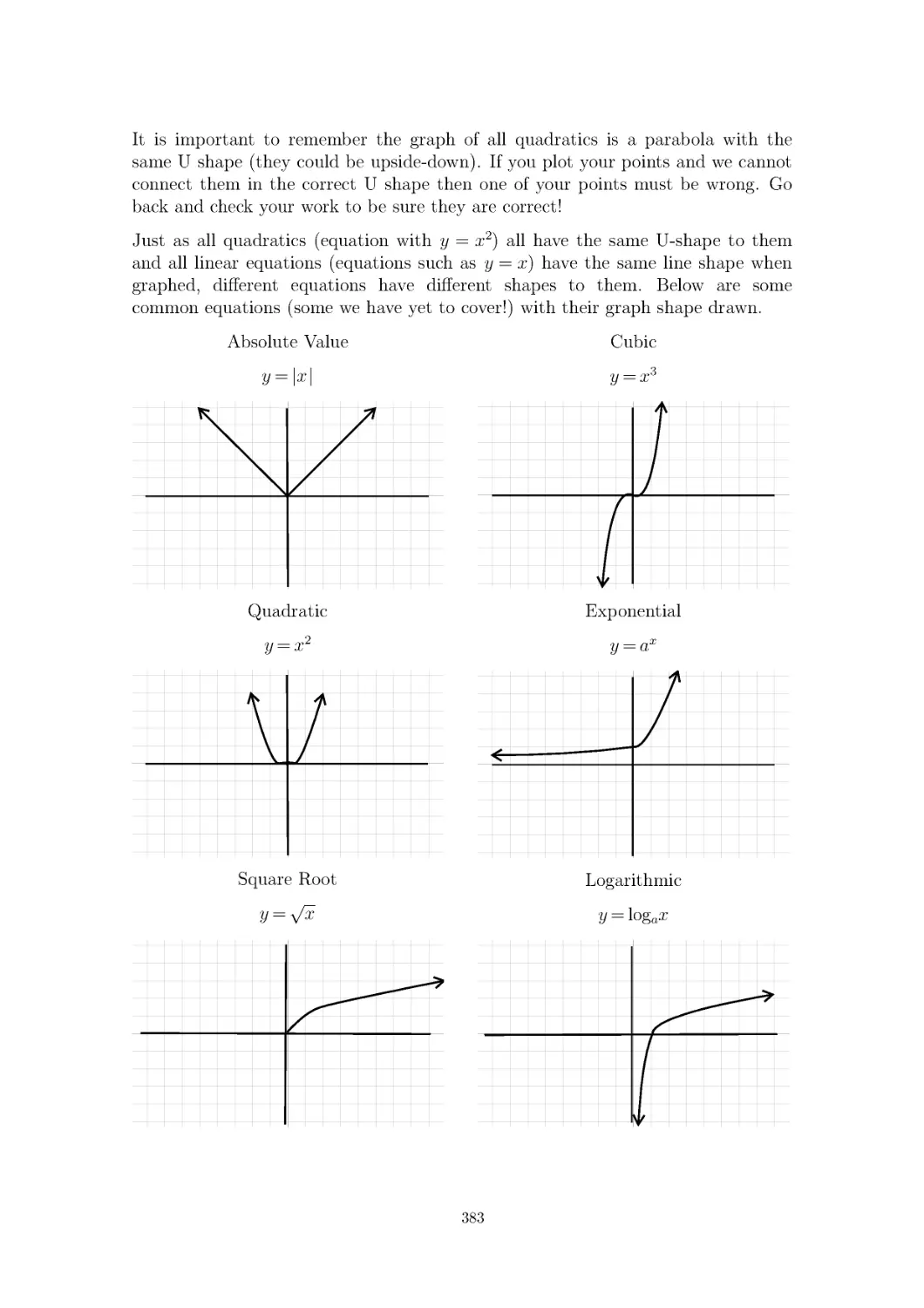







Text
Beginning and Intermediate Algebra
An open source (CC-BY) textbook
Available for free download at: http://wallace.ccfaculty.org/book/book.html
by Tyler Wallace
1
ISBN #978-1 -4583-7768-5
Copyright 2010, Some Rights Reserved CC-BY.
Beginning and Intermediate Algebra by Tyler Wallace is licensed under a Creative Commons
Attribution 3.0 Unported License. (http://creativecommons.org/licenses/by/3.0/)
Based on a work at http://wallace.ccfaculty.org/book/book.html.
You are free:
• to Share: to copy, distribute and transmit the work
• to Remix: to adapt the work
Under the following conditions:
• Attribution: You must attribute the work in the manner specified by the author or
licensor (but not in any way that suggests that they endorse you or your use of the
work).
With the understanding that:
• Waiver: Any of the above conditions can be waived if you get permission from the copy-
right holder.
• Public Domain: Where the work or any of its elements is in the public domain under
applicable law, that status is in no way affected by the license.
• Other Rights: In no way are any of the following rights affected by the license:
−
Your fair dealing or fair use rights, or other applicable copyright exceptions and
limitations;
−
The author’s moral rights;
−
Rights other persons may have either in the work itself or in how the work is used
such as publicity or privacy rights
• Notice: For any reuse or distribution, you must make clear to others the license term of
this work. The best way to do this is with a link to the following web page:
http://creativecommons.org/licenses/by/3.0/
This is a human readable summary of the full legal code which can be read at the following
URL: http://creativecommons.org/licenses/by/3.0/legalcode
2
Special thanks to: My beautiful wife, Nicole Wallace
who spent countless hours typing problems and
my two wonderful kids for their patience and
support during this pro ject
Another thanks goes to the faculty reviewers who reviewed this text: Donna Brown, Michelle
Sherwood, Ron Wallace, and Barbara Whitney
One last thanks to the student reviewers of the text: Eloisa Butler, Norma Cabanas, Irene
Chavez, Anna Dahlke, Kelly Diguilio, Camden Eckhart, Brad Evers, Lisa Garza, Nickie Hamp-
shire, Melissa Hanson, Adriana Hernandez, Tiffany Isaacson, Maria Martinez, Brandon Platt,
Tim Ries, Lorissa Smith, Nadine Svopa, Cayleen Trautman, and Erin White
3
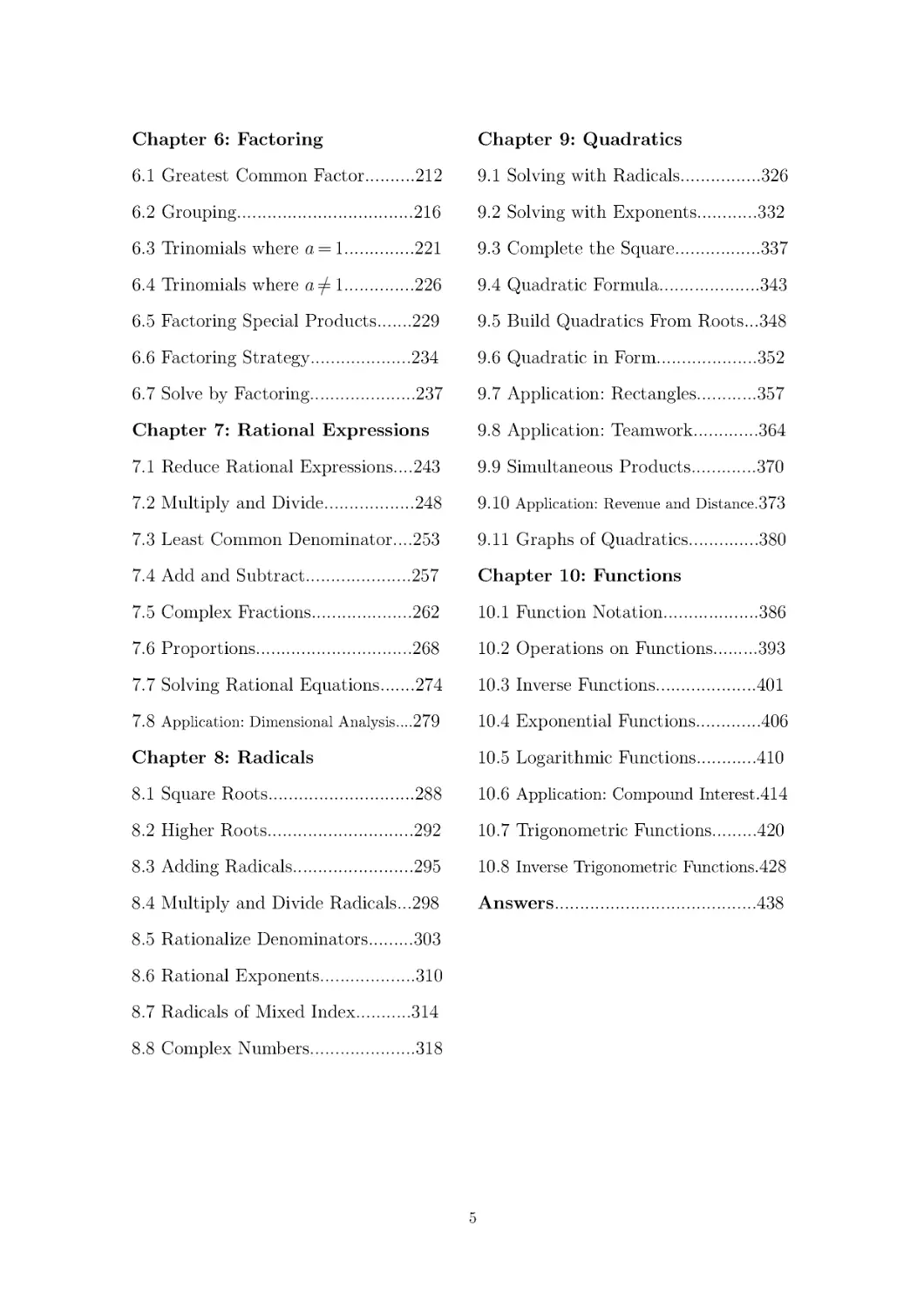
Table of Contents
Chapter 0: Pre-Algebra
0.1 Integers.........................................7
0.2 Fractions.....................................12
0.3 Order of Operations....................18
0.4 Properties of Algebra..................22
Chapter 1: Solving Linear Equations
1.1 One-Step Equations....................28
1.2 Two-Step Equations....................33
1.3 General Linear Equations...........37
1.4 Solving with Fractions................43
1.5 Formulas.....................................47
1.6 Absolute Value Equations...........52
1.7 Variation.....................................57
1.8 Application: Number/Geometry.64
1.9 Application: Age.........................72
1.10 Application: Distance................79
Chapter 2: Graphing
2.1 Points and Lines.........................89
2.2 Slope...........................................95
2.3 Slope-Intercept Form................102
2.4 Point-Slope Form......................107
2.5 Parallel & Perpendicular Lines.112
Chapter 3: Inequalities
3.1 Solve and Graph Inequalities....118
3.2 Compound Inequalitites............124
3.3 Absolute Value Inequalities.......128
Chapter 4: Systems of Equations
4.1 Graphing...................................134
4.2 Substitution..............................139
4.3 Addition/Elimination................146
4.4 Three Variables.........................151
4.5 Application: Value Problems.....158
4.6 Application: Mixture Problems.167
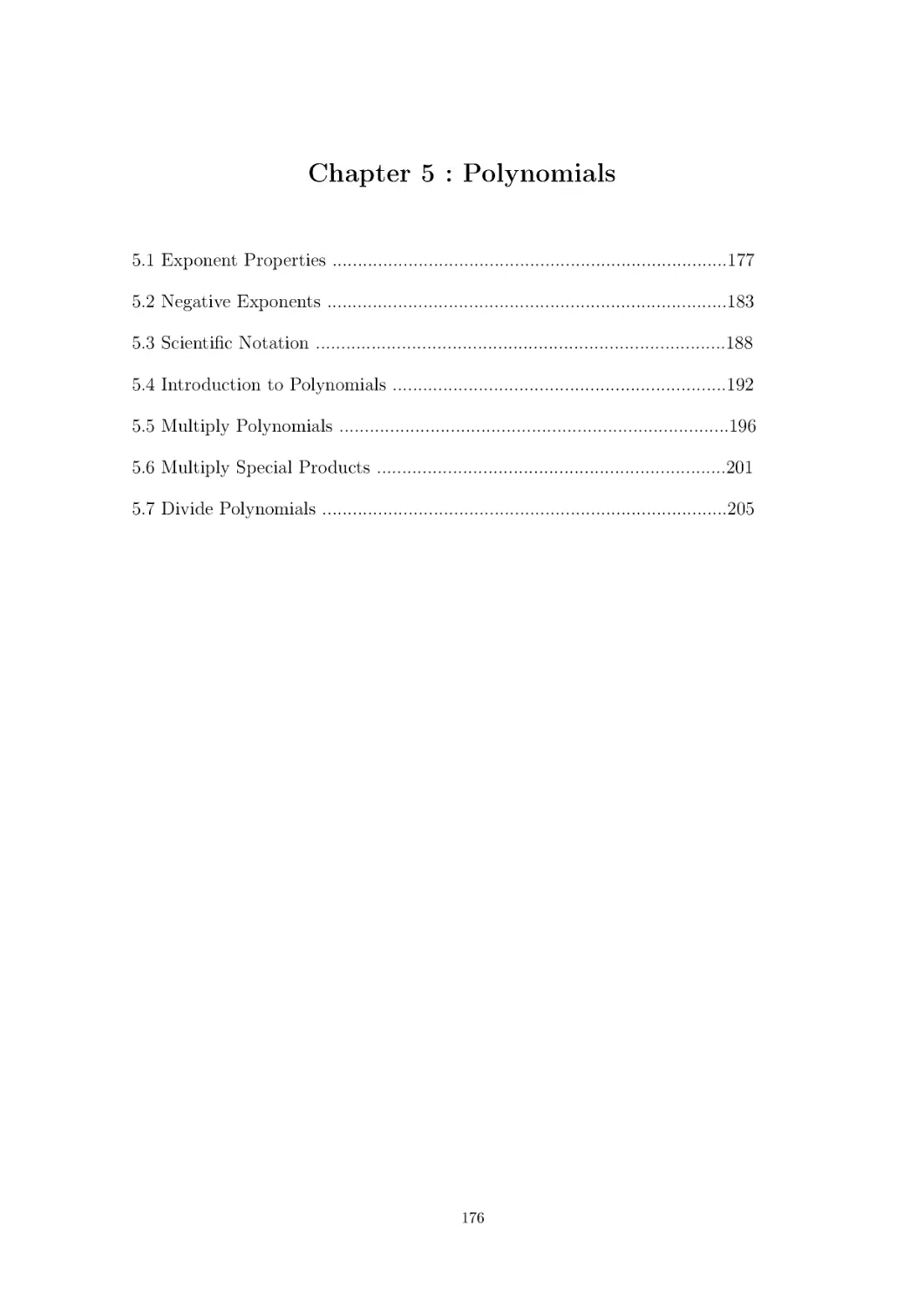
Chapter 5: Polynomials
5.1 Exponent Properties.................177
5.2 Negative Exponents..................183
5.3 Scientific Notation.....................188
5.4 Introduction to Polynomials.....192
5.5 Multiply Polynomials................196
5.6 Multiply Special Products.........201
5.7 Divide Polynomials...................205
4
Chapter 6: Factoring
6.1 Greatest Common Factor..........212
6.2 Grouping...................................216
6.3 Trinomials where a = 1..............221
6.4 Trinomials where a 1..............226
6.5 Factoring Special Products.......229
6.6 Factoring Strategy....................234
6.7 Solve by Factoring.....................237
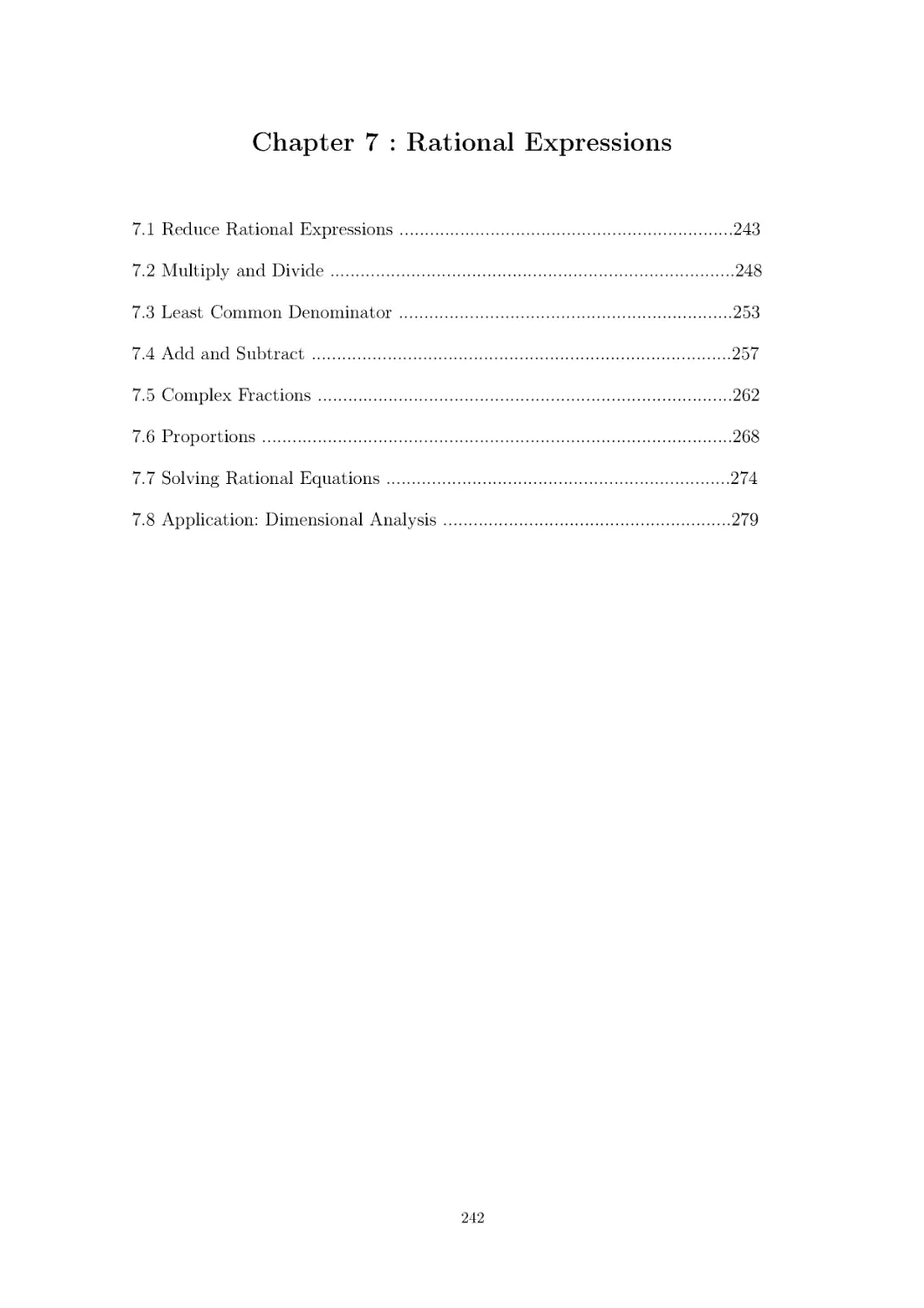
Chapter 7: Rational Expressions
7.1 Reduce Rational Expressions....243
7.2 Multiply and Divide..................248
7.3 Least Common Denominator....253
7.4 Add and Subtract.....................257
7.5 Complex Fractions....................262
7.6 Proportions...............................268
7.7 Solving Rational Equations.......274
7.8 Application: Dimensional Analysis....279
Chapter 8: Radicals
8.1 Square Roots.............................288
8.2 Higher Roots.............................292
8.3 Adding Radicals........................295
8.4 Multiply and Divide Radicals...298
8.5 Rationalize Denominators.........303
8.6 Rational Exponents...................310
8.7 Radicals of Mixed Index...........314
8.8 Complex Numbers.....................318
Chapter 9: Quadratics
9.1 Solving with Radicals................326
9.2 Solving with Exponents............332
9.3 Complete the Square.................337
9.4 Quadratic Formula....................343
9.5 Build Quadratics From Roots...348
9.6 Quadratic in Form....................352
9.7 Application: Rectangles............357
9.8 Application: Teamwork.............364
9.9 Simultaneous Products.............370
9.10 Application: Revenue and Distance.373
9.11 Graphs of Quadratics..............380
Chapter 10: Functions
10.1 Function Notation...................386
10.2 Operations on Functions.........393
10.3 Inverse Functions....................401
10.4 Exponential Functions.............406
10.5 Logarithmic Functions............410
10.6 Application: Compound Interest.414
10.7 Trigonometric Functions.........420
10.8 Inverse Trigonometric Functions.428
Answers........................................438
5
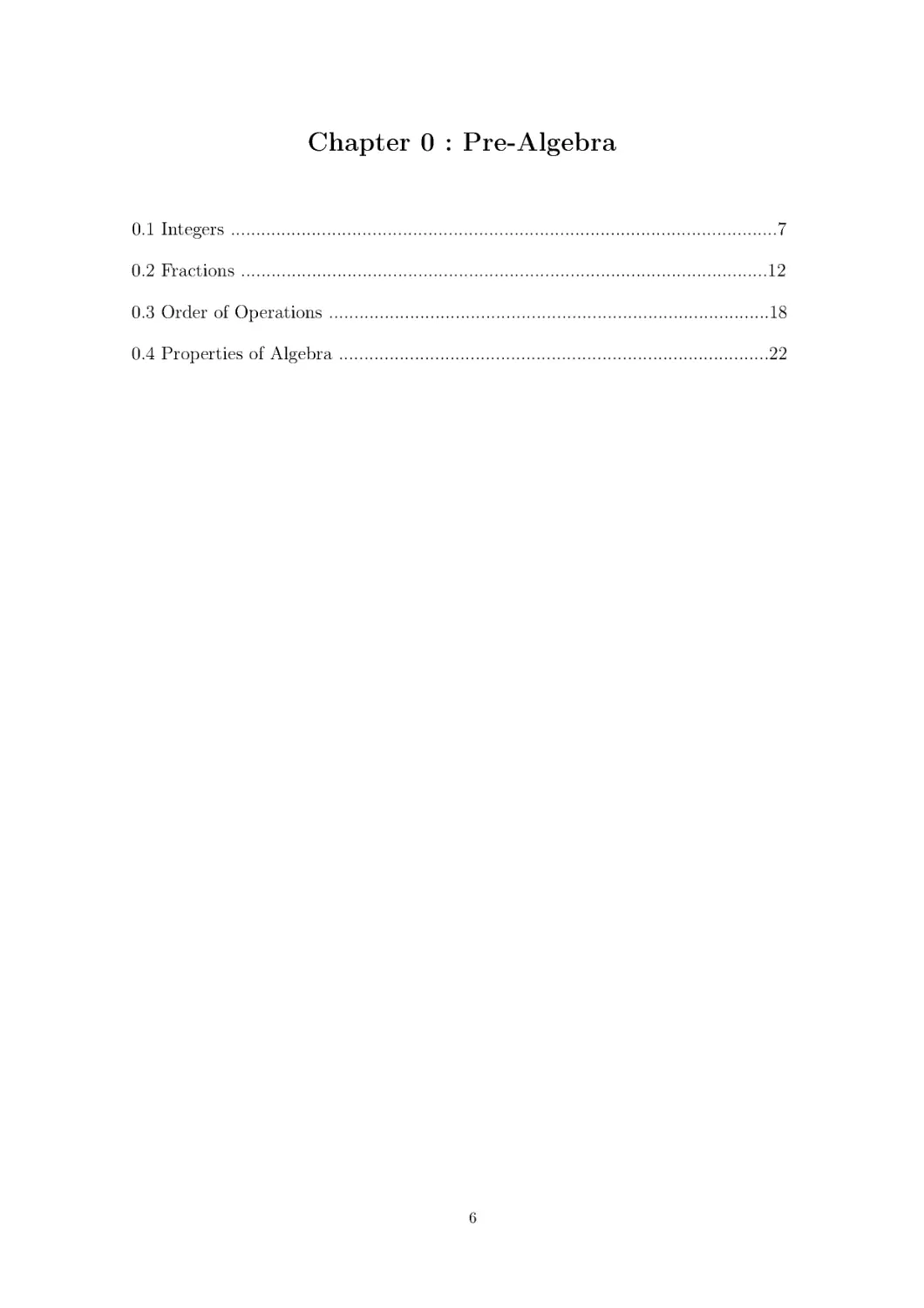
Chapter 0 : Pre-Algebra
0.1 Integers ............................................................................................................7
0.2 Fractions ........................................................................................................12
0.3 Order of Operations .......................................................................................18
0.4 Properties of Algebra .....................................................................................22
6
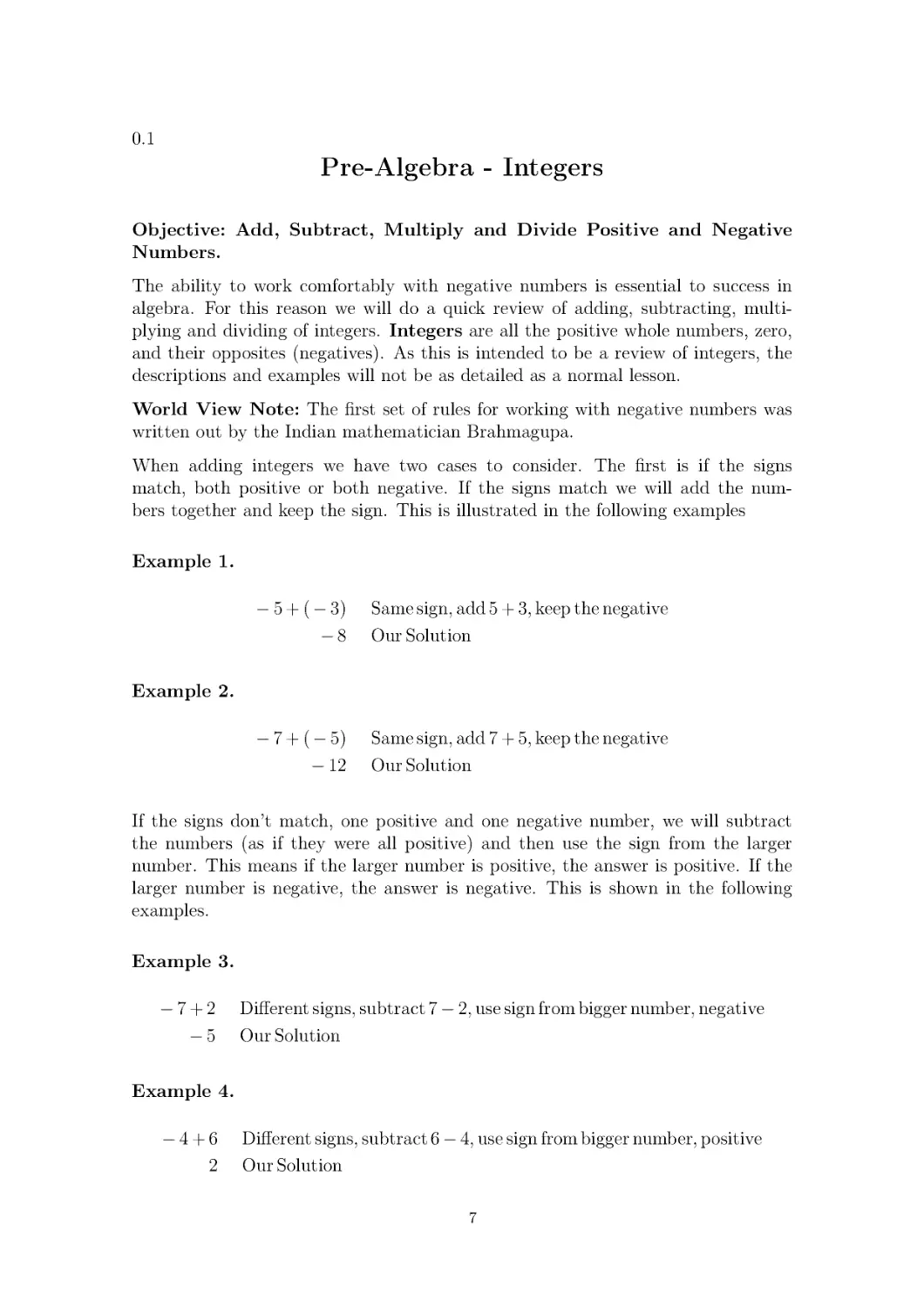
0.1
Pre-Algebra - Integers
Objective: Add, Subtract, Multiply and Divide Positive and Negative
Numbers.
The ability to work comfortably with negative numbers is essential to success in
algebra. For this reason we will do a quick review of adding, subtracting, multi-
plying and dividing of integers. Integers are all the positive whole numbers, zero,
and their opposites (negatives). As this is intended to be a review of integers, the
descriptions and examples will not be as detailed as a normal lesson.
World View Note: The first set of rules for working with negative numbers was
written out by the Indian mathematician Brahmagupa.
When adding integers we have two cases to consider. The first is if the signs
match, both positive or both negative. If the signs match we will add the num-
bers together and keep the sign. This is illustrated in the following examples
Example 1.
−
5+(−3) Samesign,add5+3,keepthenegative
− 8 Our Solution
Example 2.
−
7+(−5) Samesign,add7+5,keepthenegative
−
12 Our Solution
If the signs don’t match, one positive and one negative number, we will subtract
the numbers (as if they were all positive) and then use the sign from the larger
number. This means if the larger number is positive, the answer is positive. If the
larger number is negative, the answer is negative. This is shown in the following
examples.
Example 3.
−
7 + 2 Different signs, subtract 7 − 2, use sign from bigger number, negative
−
5 Our Solution
Example 4.
−
4 + 6 Different signs, subtract 6 − 4, use sign from bigger number, positive
2 Our Solution
7
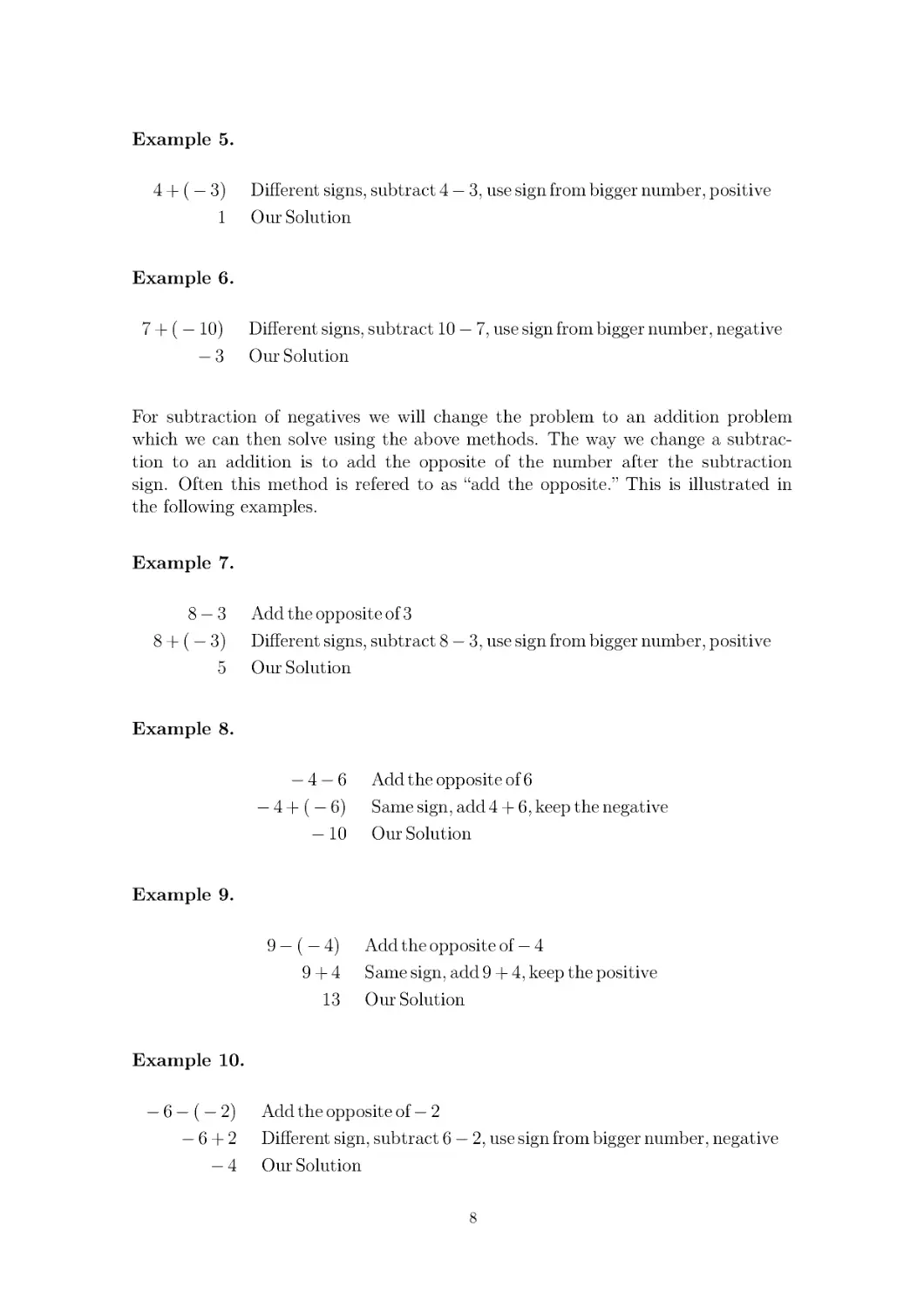
Example 5.
4 + ( − 3) Different signs, subtract 4 − 3, use sign from bigger number, positive
1 Our Solution
Example 6.
7 + ( − 10) Different signs, subtract 10 − 7, use sign from bigger number, negative
−
3 Our Solution
For subtraction of negatives we will change the problem to an addition problem
which we can then solve using the above methods. The way we change a subtrac-
tion to an addition is to add the opposite of the number after the subtraction
sign. Often this method is refered to as “add the opposite.” This is illustrated in
the following examples.
Example 7.
8−3 Addtheoppositeof3
8 + ( − 3) Different signs, subtract 8 − 3, use sign from bigger number, positive
5 Our Solution
Example 8.
−
4−6 Addtheoppositeof6
−
4+(−6) Samesign,add4+6,keepthenegative
−
10 Our Solution
Example 9.
9−(
−
4) Add the opposite of − 4
9 + 4 Same sign, add 9 + 4, keep the positive
13 Our Solution
Example 10.
−
6−(
−
2) Add the opposite of − 2
−
6 + 2 Different sign, subtract 6 − 2, use sign from bigger number, negative
−
4 Our Solution
8
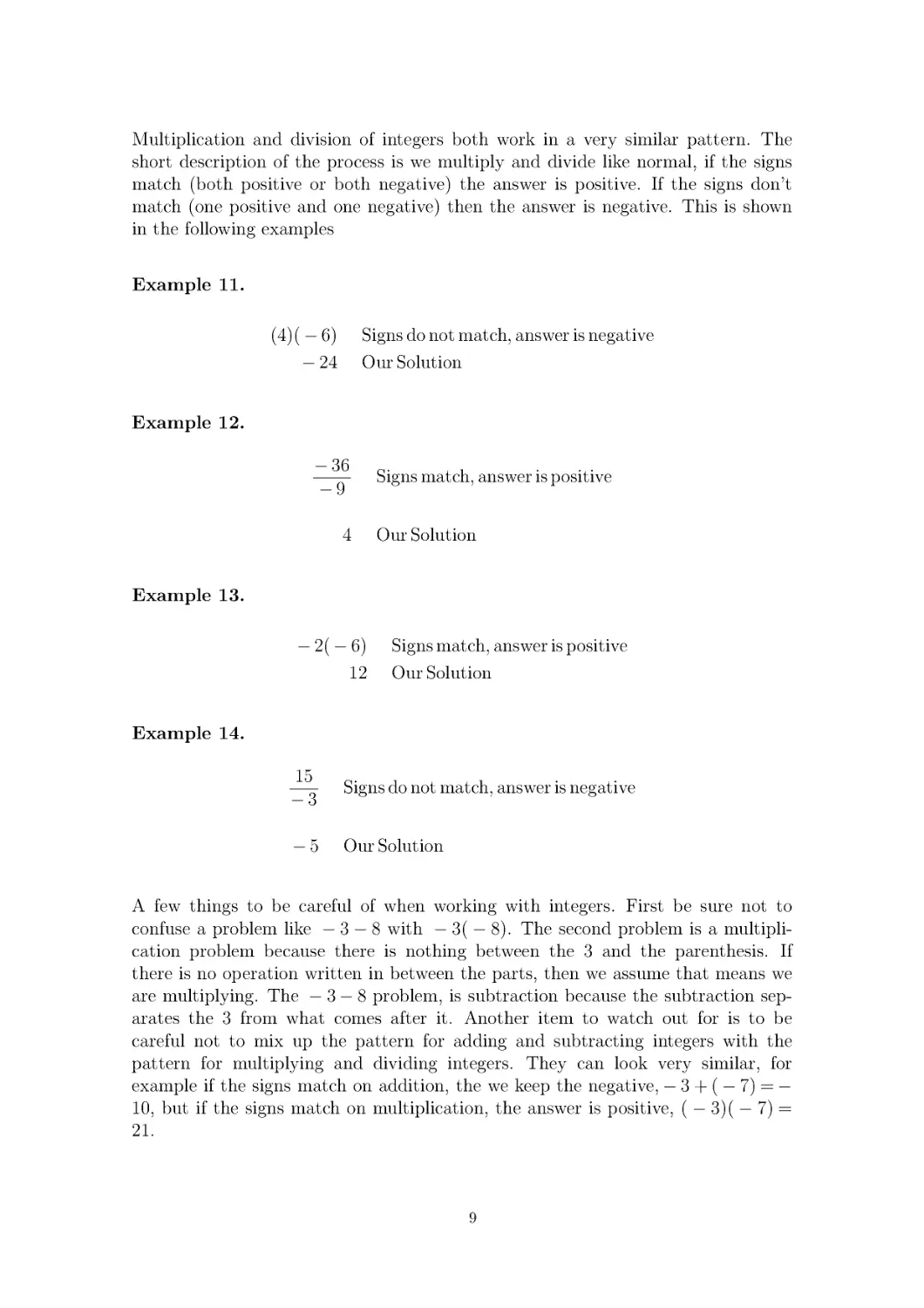
Multiplication and division of integers both work in a very similar pattern. The
short description of the process is we multiply and divide like normal, if the signs
match (both positive or both negative) the answer is positive. If the signs don’t
match (one positive and one negative) then the answer is negative. This is shown
in the following examples
Example 11.
(4)( − 6) Signs do not match, answer is negative
−
24 Our Solution
Example 12.
−
36
−
9
Signs match, answer is positive
4 Our Solution
Example 13.
−
2( − 6) Signs match, answer is positive
12 Our Solution
Example 14.
15
−
3
Signs do not match, answer is negative
−
5 Our Solution
A few things to be careful of when working with integers. First be sure not to
confuse a problem like − 3
−
8 with − 3( − 8). The second problem is a multipli-
cation problem because there is nothing between the 3 and the parenthesis. If
there is no operation written in between the parts, then we assume that means we
are multiplying. The − 3
−
8 problem, is subtraction because the subtraction sep-
arates the 3 from what comes after it. Another item to watch out for is to be
careful not to mix up the pattern for adding and subtracting integers with the
pattern for multiplying and dividing integers. They can look very similar, for
example if the signs match on addition, the we keep the negative, − 3 + ( − 7) = −
10, but if the signs match on multiplication, the answer is positive, ( − 3)( − 7) =
21.
9
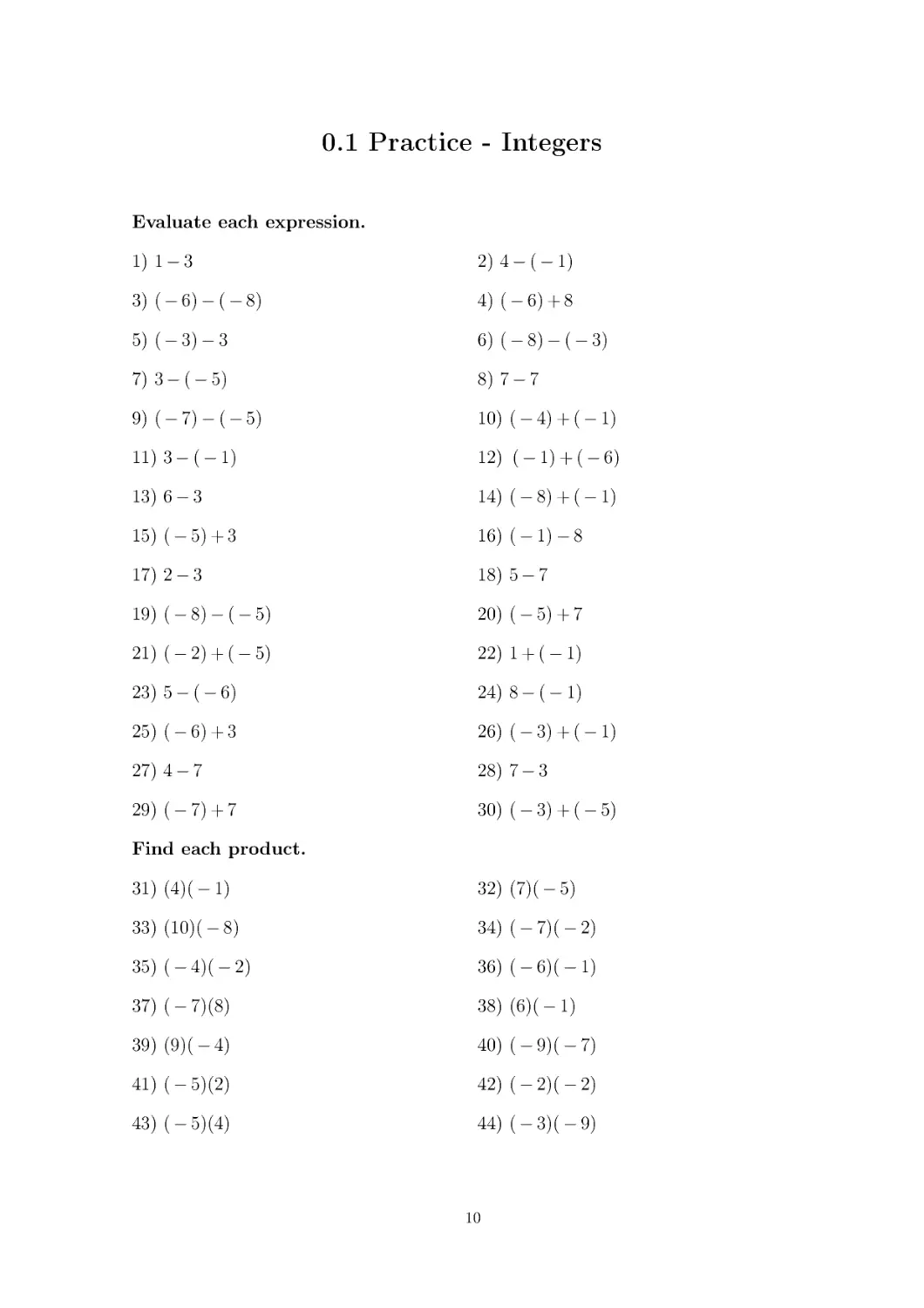
0.1 Practice - Integers
Evaluate each expression.
1)1−3
3)(−6)−(
−8)
5)(−3)−3
7)3−(
−
5)
9) (−7)−(
−5)
11)3−(
−
1)
13)6−3
15)(−5)+3
17)2−3
19)(−8)−(
−
5)
21)(−2)+(−5)
23)5−(
−
6)
25)(−6)+3
27)4−7
29)(−7)+7
2)4−(
−
1)
4)(−6)+8
6)(−8)−(
−
3)
8)7−7
10)(−4)+(−1)
12) (−1)+(−6)
14)(−8)+(−1)
16)(−1)−8
18)5−7
20) (−5)+7
22)1+(−1)
24) 8−(
−
1)
26)(−3)+(−1)
28)7−3
30)(−3)+(−5)
Find each product.
31) (4)( − 1)
33) (10)( − 8)
35)(−4)(−2)
37) ( − 7)(8)
39) (9)( − 4)
41) ( − 5)(2)
43) ( − 5)(4)
32) (7)( − 5)
34)(−7)(−2)
36)(−6)(−1)
38) (6)( − 1)
40) (−9)(−7)
42)(−2)(−2)
44) (−3)(−9)
10
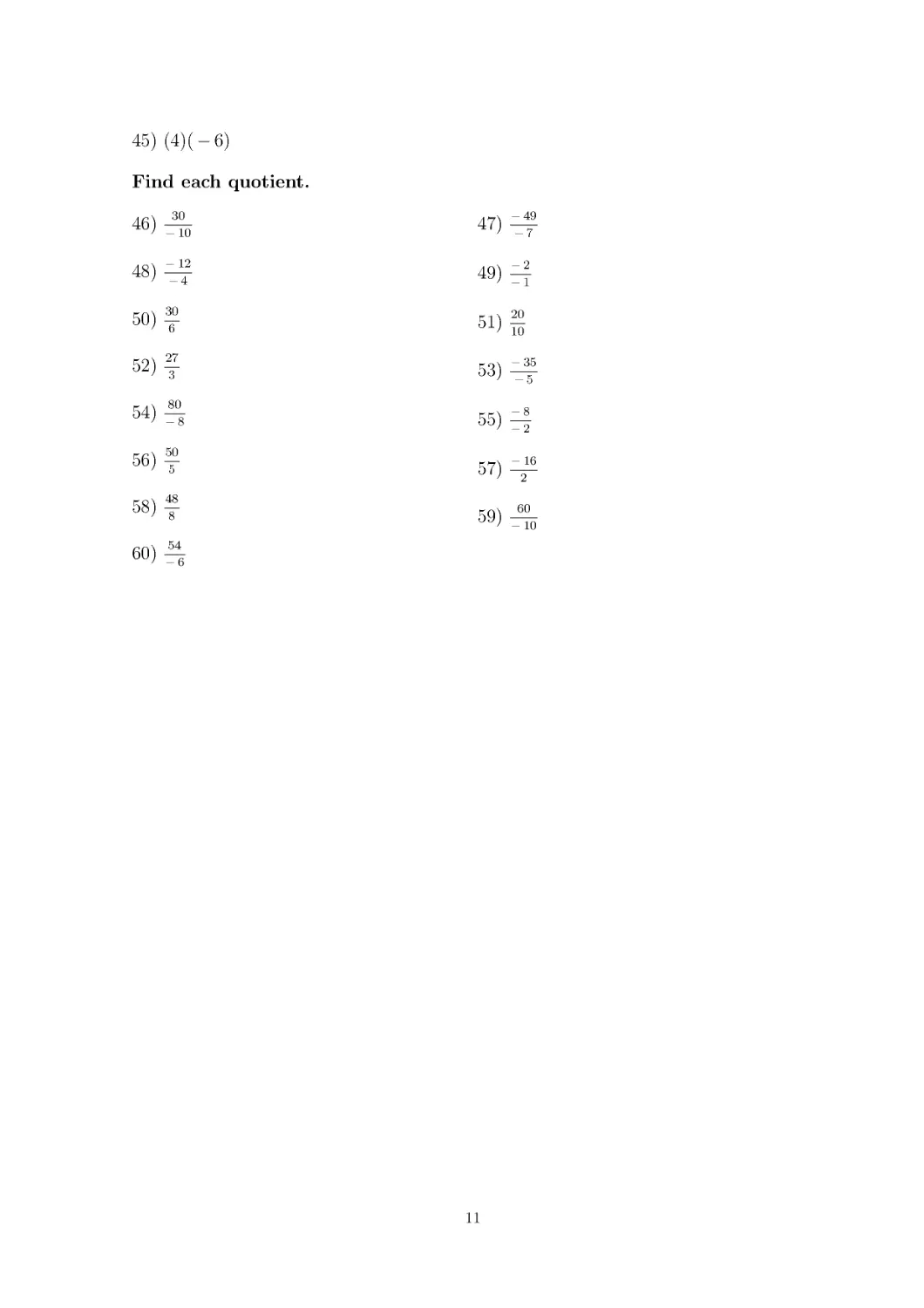
45) (4)( − 6)
Find each quotient.
46) 30
−
10
48)−12
−
4
50) 30
6
52) 27
3
54) 80
−
8
56) 50
5
58) 48
8
60) 54
−
6
47) −49
−
7
49) −2
−
1
51) 20
10
53) −35
−
5
55) −8
−
2
57) −16
2
59) 60
−
10
11
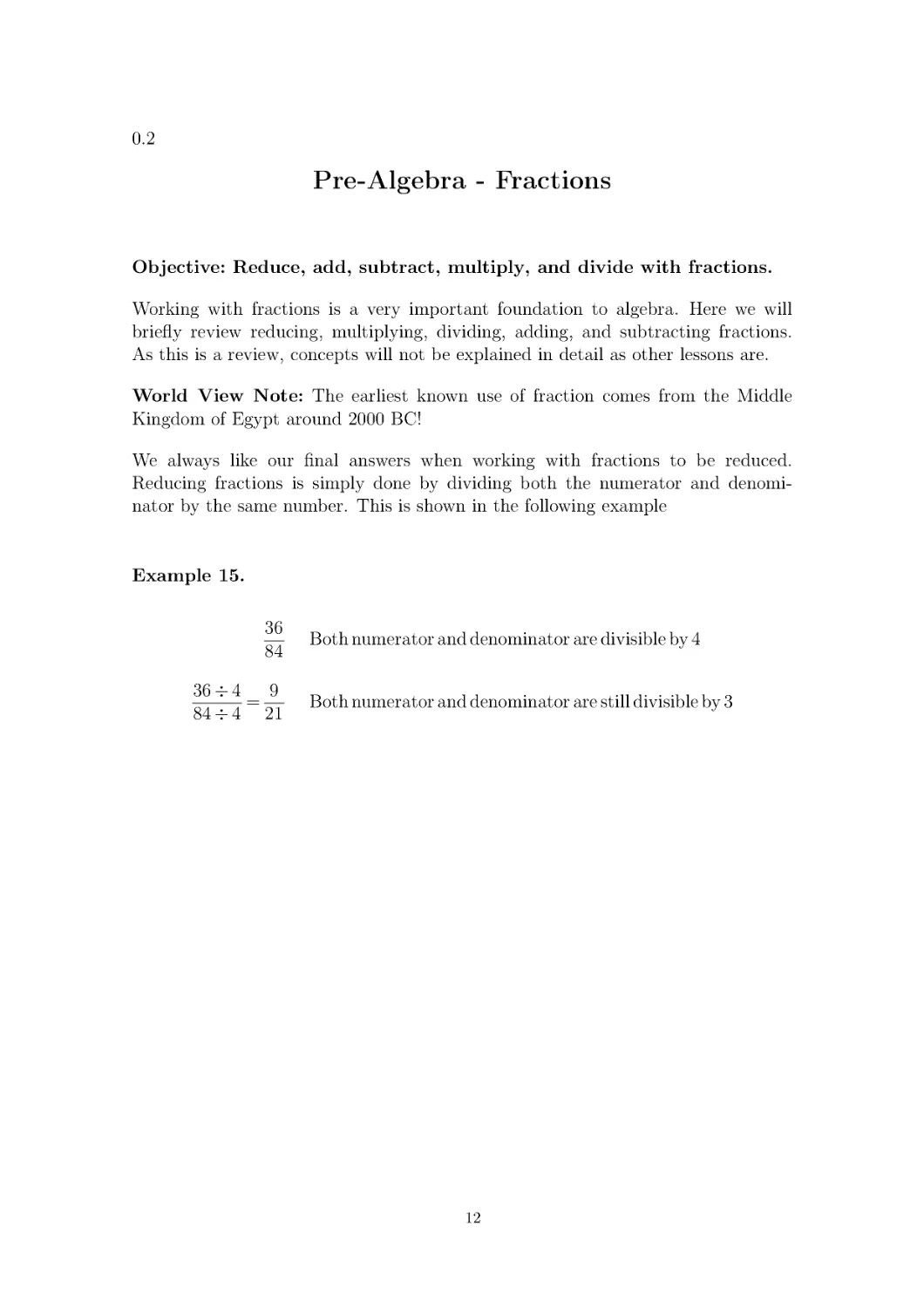
0.2
Pre-Algebra - Fractions
Objective: Reduce, add, subtract, multiply, and divide with fractions.
Working with fractions is a very important foundation to algebra. Here we will
briefly review reducing, multiplying, dividing, adding, and subtracting fractions.
As this is a review, concepts will not be explained in detail as other lessons are.
World View Note: The earliest known use of fraction comes from the Middle
Kingdom of Egypt around 2000 BC!
We always like our final answers when working with fractions to be reduced.
Reducing fractions is simply done by dividing both the numerator and denomi-
nator by the same number. This is shown in the following example
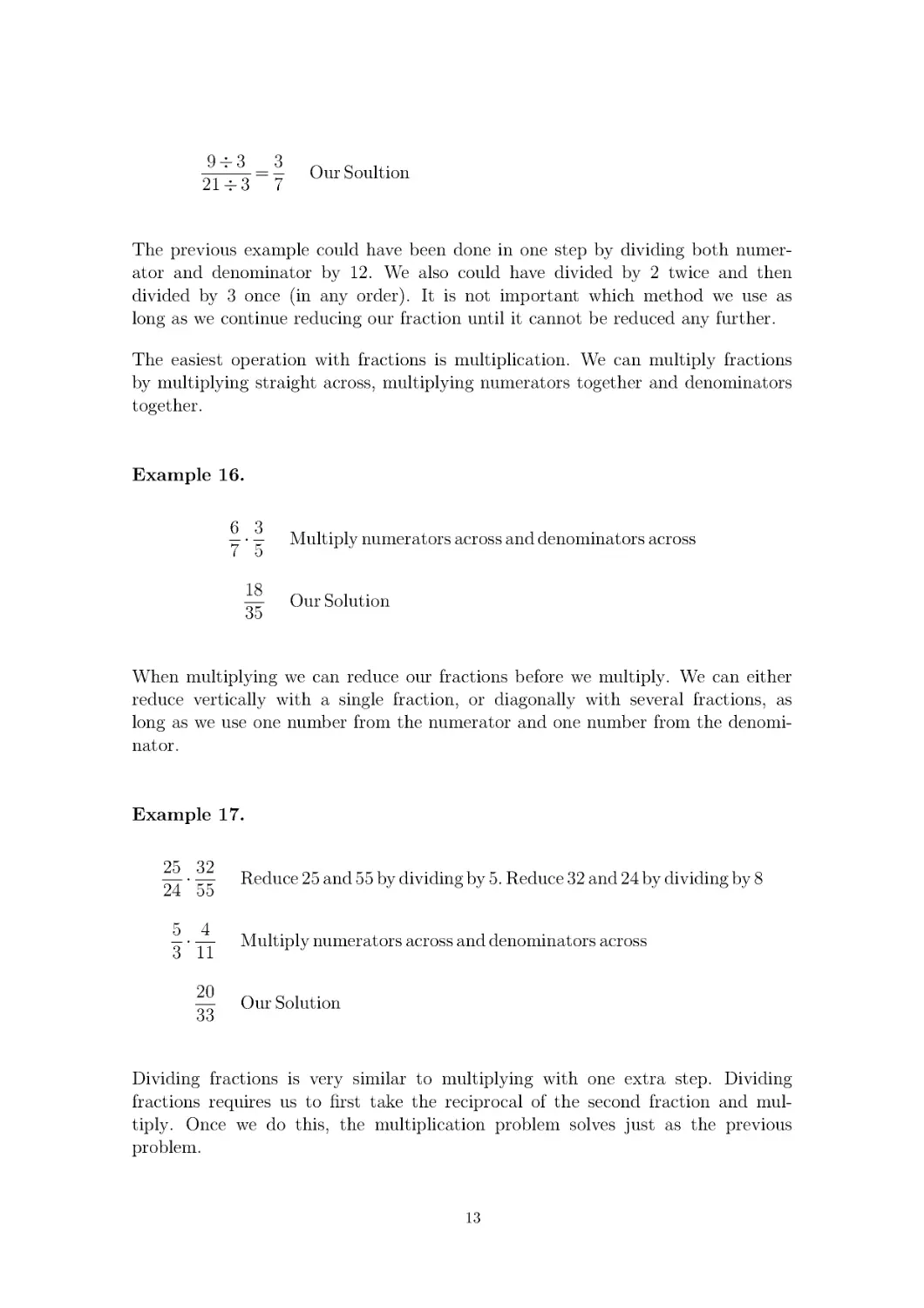
Example 15.
36
84
Both numerator and denominator are divisible by 4
36÷4
84÷4
=
9
21
Both numerator and denominator are still divisible by 3
12
9÷3
21÷3
=
3
7
Our Soultion
The previous example could have been done in one step by dividing both numer-
ator and denominator by 12. We also could have divided by 2 twice and then
divided by 3 once (in any order). It is not important which method we use as
long as we continue reducing our fraction until it cannot be reduced any further.
The easiest operation with fractions is multiplication. We can multiply fractions
by multiplying straight across, multiplying numerators together and denominators
together.
Example 16.
6
7
·
3
5
Multiply numerators across and denominators across
18
35
Our Solution
When multiplying we can reduce our fractions before we multiply. We can either
reduce vertically with a single fraction, or diagonally with several fractions, as
long as we use one number from the numerator and one number from the denomi-
nator.
Example 17.
25
24
·
32
55
Reduce 25 and 55 by dividing by 5. Reduce 32 and 24 by dividing by 8
5
3
·
4
11
Multiply numerators across and denominators across
20
33
Our Solution
Dividing fractions is very similar to multiplying with one extra step. Dividing
fractions requires us to first take the reciprocal of the second fraction and mul-
tiply. Once we do this, the multiplication problem solves just as the previous
problem.
13
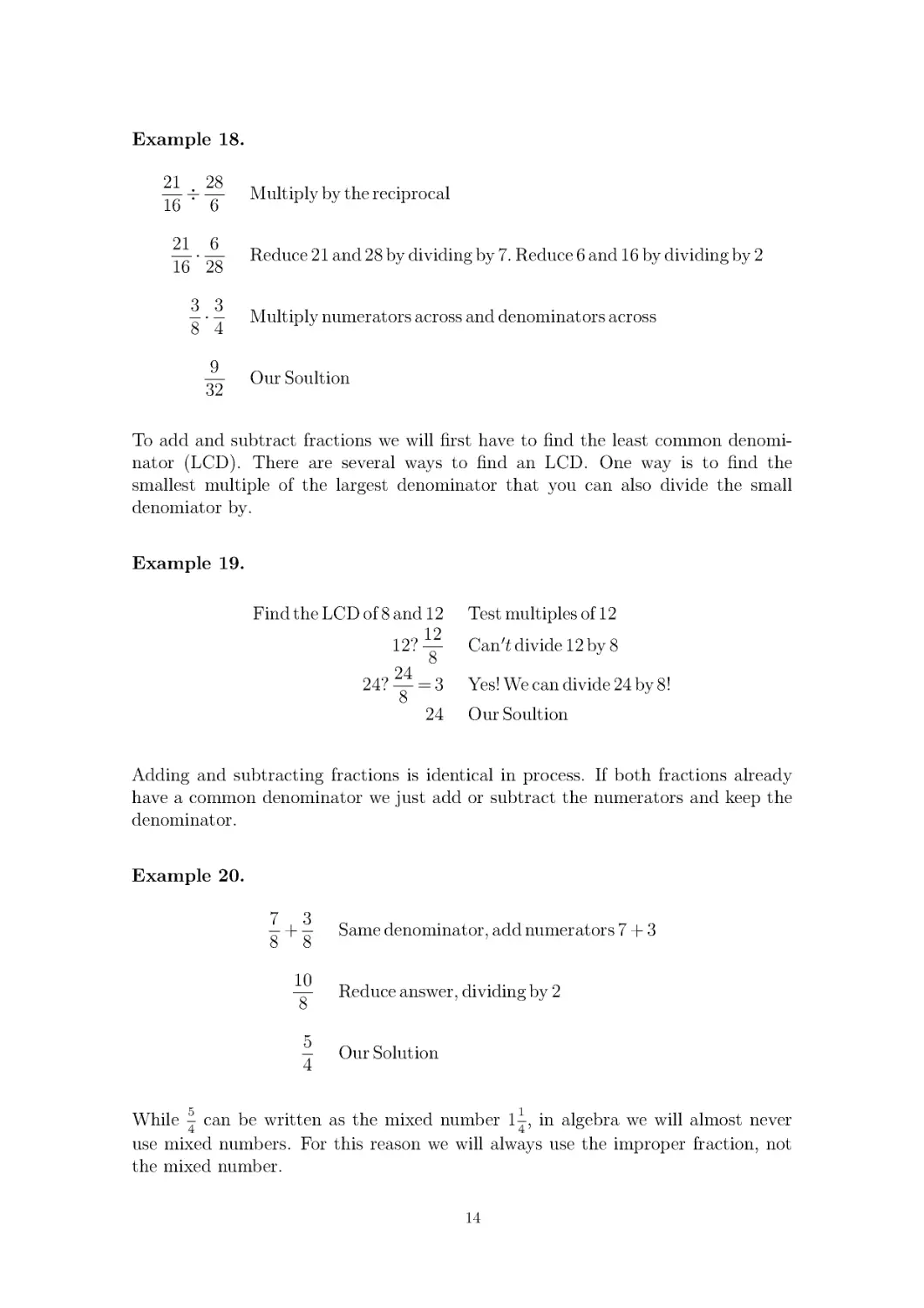
Example 18.
21
16
÷
28
6
Multiply by the reciprocal
21
16
·
6
28
Reduce 21 and 28 by dividing by 7. Reduce 6 and 16 by dividing by 2
3
8
·
3
4
Multiply numerators across and denominators across
9
32
Our Soultion
To add and subtract fractions we will first have to find the least common denomi-
nator (LCD). There are several ways to find an LCD. One way is to find the
smallest multiple of the largest denominator that you can also divide the small
denomiator by.
Example 19.
Find the LCD of 8 and 12 Test multiples of 12
12?
12
8
Can ′t divide 12 by 8
24?
24
8
=3
Yes! We can divide 24 by 8!
24 Our Soultion
Adding and subtracting fractions is identical in process. If both fractions already
have a common denominator we just add or subtract the numerators and keep the
denominator.
Example 20.
7
8
+
3
8
Same denominator, add numerators 7 + 3
10
8
Reduce answer, dividing by 2
5
4
Our Solution
While
5
4
can be written as the mixed number 1
1
4
, in algebra we will almost never
use mixed numbers. For this reason we will always use the improper fraction, not
the mixed number.
14
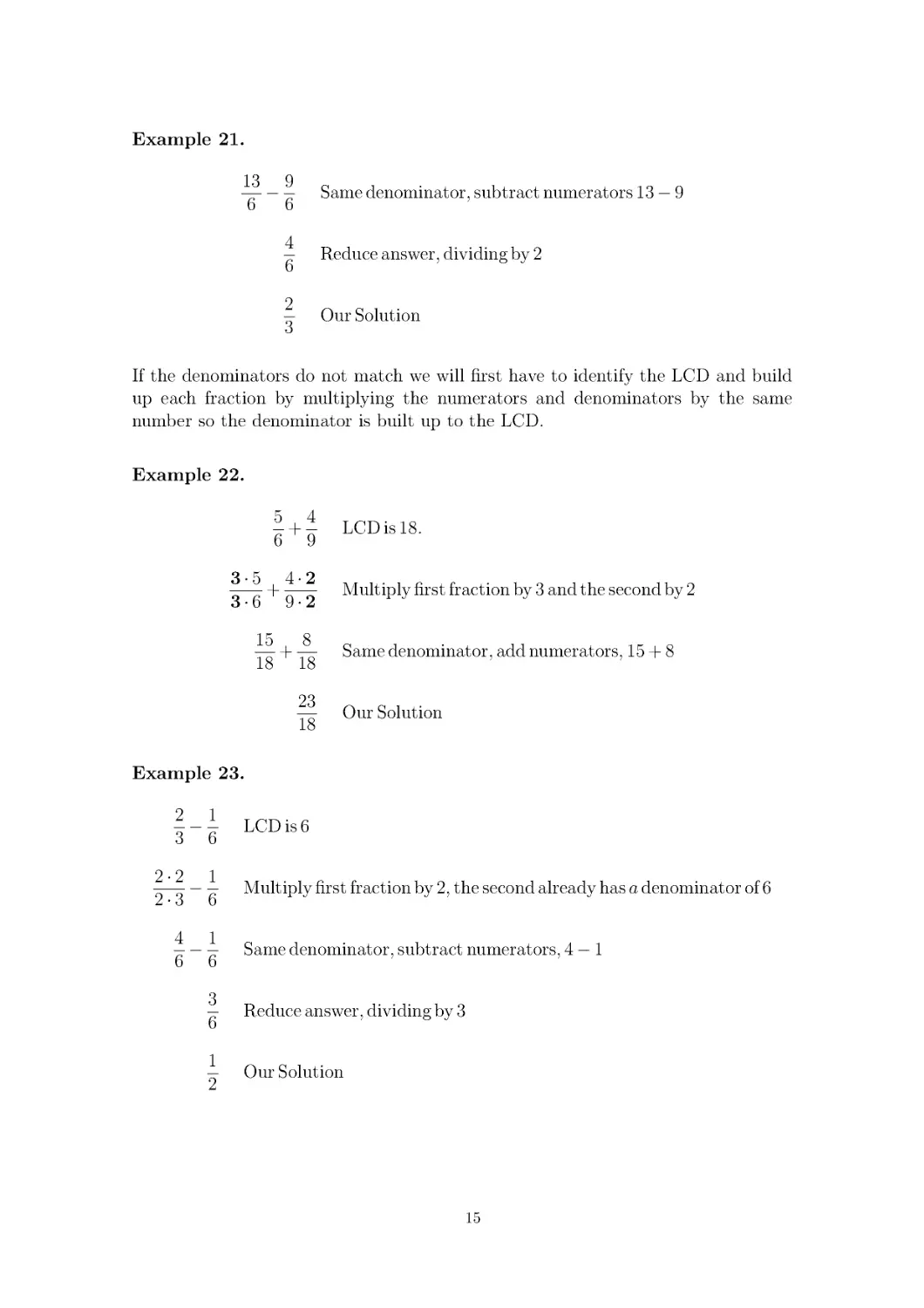
Example 21.
13
6
−
9
6
Same denominator, subtract numerators 13 − 9
4
6
Reduce answer, dividing by 2
2
3
Our Solution
If the denominators do not match we will first have to identify the LCD and build
up each fraction by multiplying the numerators and denominators by the same
number so the denominator is built up to the LCD.
Example 22.
5
6
+
4
9
LCD is 18.
3·5
3·6
+
4·2
9·2
Multiply first fraction by 3 and the second by 2
15
18
+
8
18
Same denominator, add numerators, 15 + 8
23
18
Our Solution
Example 23.
2
3
−
1
6
LCDis6
2·2
2·3
−
1
6
Multiply first fraction by 2, the second already has a denominator of 6
4
6
−
1
6
Same denominator, subtract numerators, 4 − 1
3
6
Reduce answer, dividing by 3
1
2
Our Solution
15
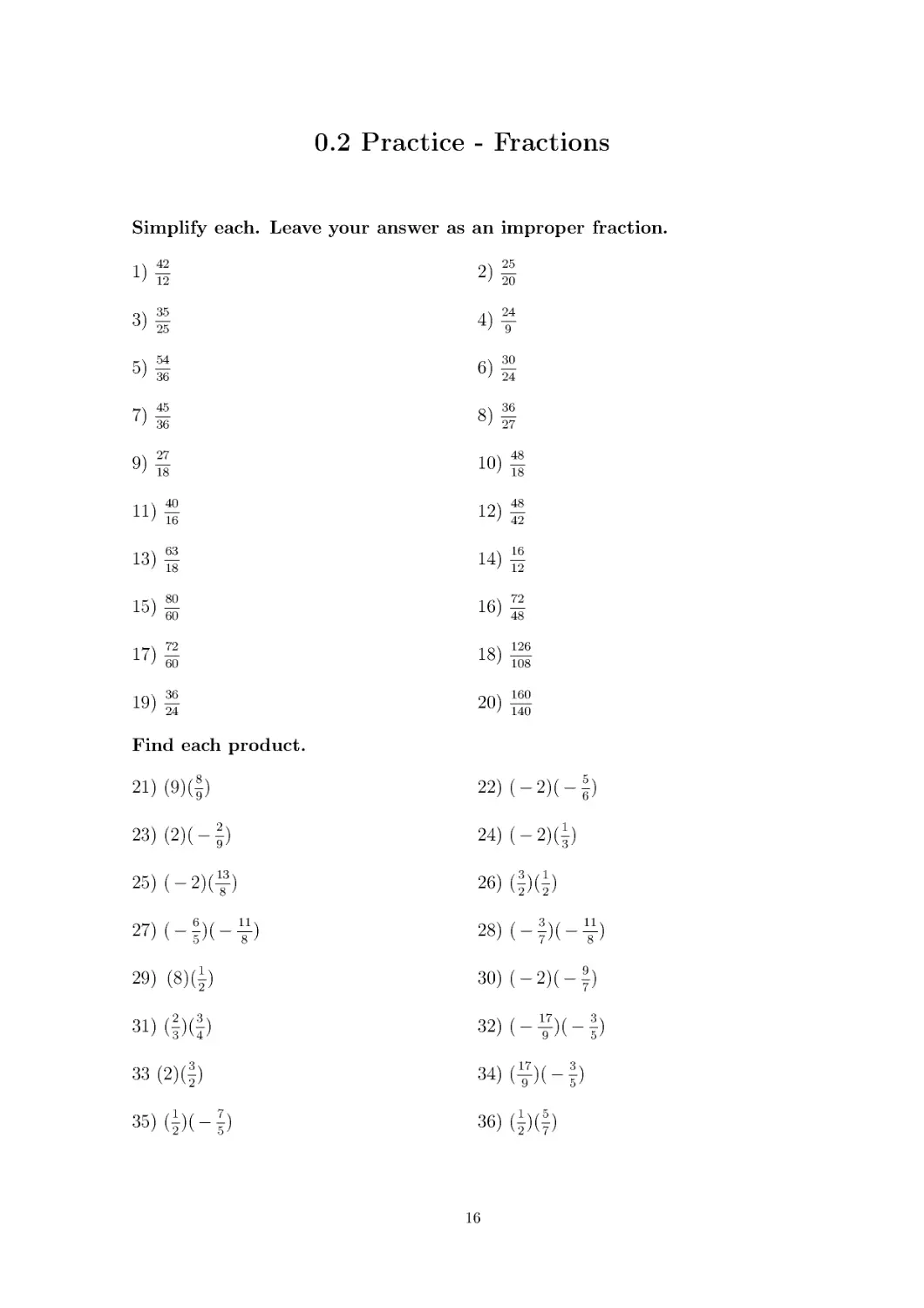
0.2 Practice - Fractions
Simplify each. Leave your answer as an improper fraction.
1) 42
12
3) 35
25
5) 54
36
7) 45
36
9) 27
18
11) 40
16
13) 63
18
15) 80
60
17) 72
60
19) 36
24
2) 25
20
4) 24
9
6) 30
24
8) 36
27
10) 48
18
12) 48
42
14) 16
12
16) 72
48
18) 126
108
20) 160
140
Find each product.
21) (9)( 8
9)
23) (2)( −
2
9
)
25) (−2)(13
8
)
27)(−
6
5
)(−
11
8
)
29) (8)( 1
2
)
31) (2
3
)(3
4
)
33 (2)( 3
2
)
35) (1
2
)(−
7
5
)
22)(−2)(−
5
6)
24)(−2)(1
3
)
26) (3
2
)(1
2
)
28)(−
3
7
)(−
11
8
)
30)(−2)(−
9
7
)
32)(−
17
9
)(−
3
5
)
34) (17
9
)(−
3
5
)
36) (1
2
)(5
7
)
16
Find each quotient.
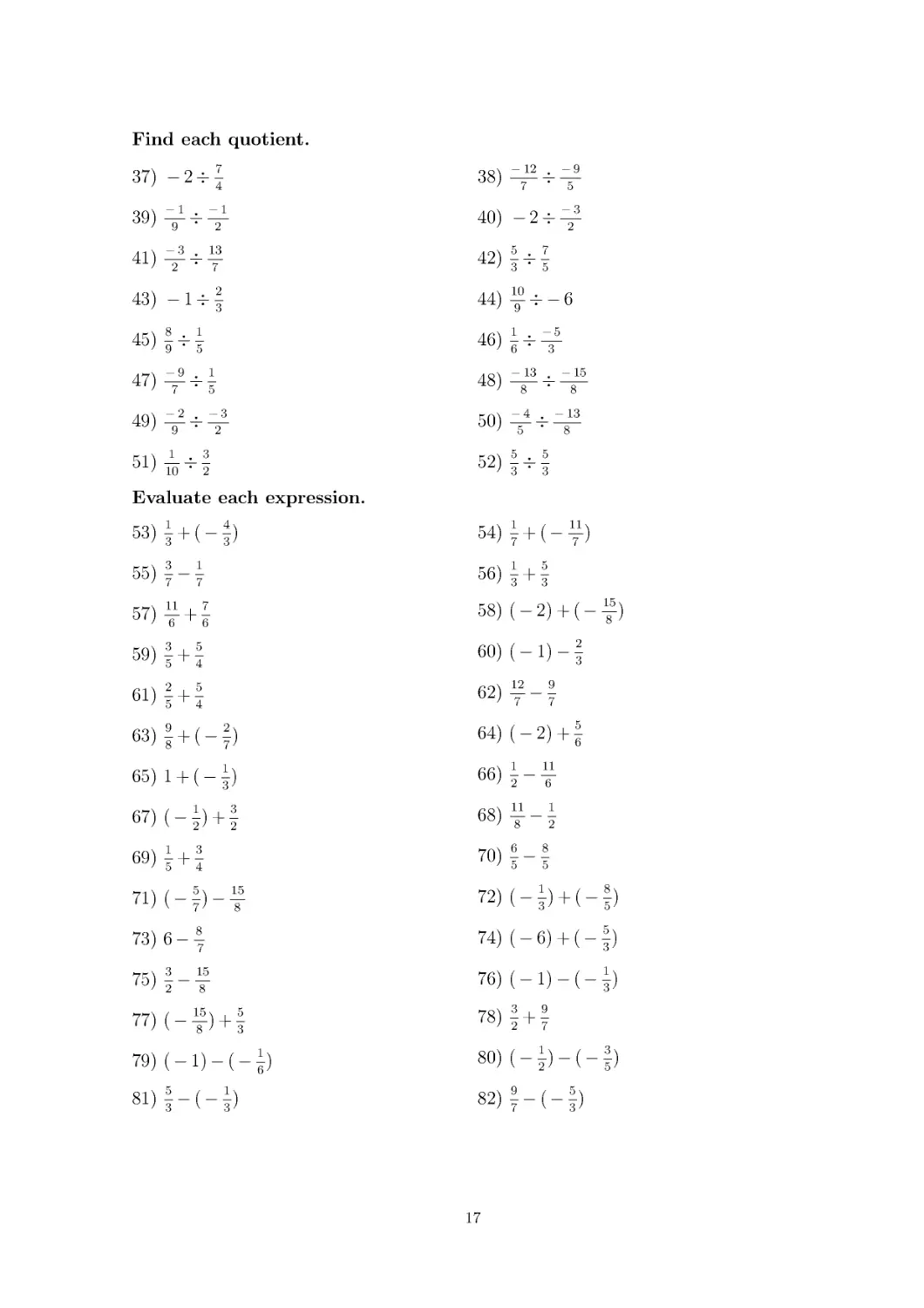
37) −2÷
7
4
39) −1
9
÷
−
1
2
41) −3
2
÷
13
7
43) −1÷
2
3
45) 8
9
÷
1
5
47) −9
7
÷
1
5
49) −2
9
÷
−
3
2
51) 1
10
÷
3
2
38)−12
7
÷
−
9
5
40) −2÷
−
3
2
42) 5
3
÷
7
5
44) 10
9 ÷−6
46) 1
6
÷
−5
3
48)−13
8
÷
−
15
8
50) −4
5
÷
−
13
8
52) 5
3
÷
5
3
Evaluate each expression.
53) 1
3
+(−
4
3
)
55) 3
7
−
1
7
57) 11
6
+7
6
59) 3
5
+5
4
61) 2
5
+5
4
63) 9
8
+(−
2
7
)
65)1+(−
1
3
)
67)(−
1
2
)+3
2
69) 1
5
+3
4
71)(−
5
7
)−
15
8
73) 6−
8
7
75) 3
2
−
15
8
77)(−
15
8
)+5
3
79)(−1)−(
−
1
6
)
81) 5
3
−
(−
1
3
)
54) 1
7
+(−
11
7
)
56) 1
3+
5
3
58)(−2)+(−
15
8
)
60)(−1)−
2
3
62) 12
7
−
9
7
64)(−2)+5
6
66) 1
2
−
11
6
68) 11
8
−
1
2
70) 6
5
−
8
5
72)(−
1
3
)+(−
8
5
)
74)(−6)+(−
5
3
)
76)(−1)−( −
1
3)
78) 3
2
+9
7
80)(−
1
2
)−(
−
3
5
)
82) 9
7
−
(−
5
3
)
17
0.3
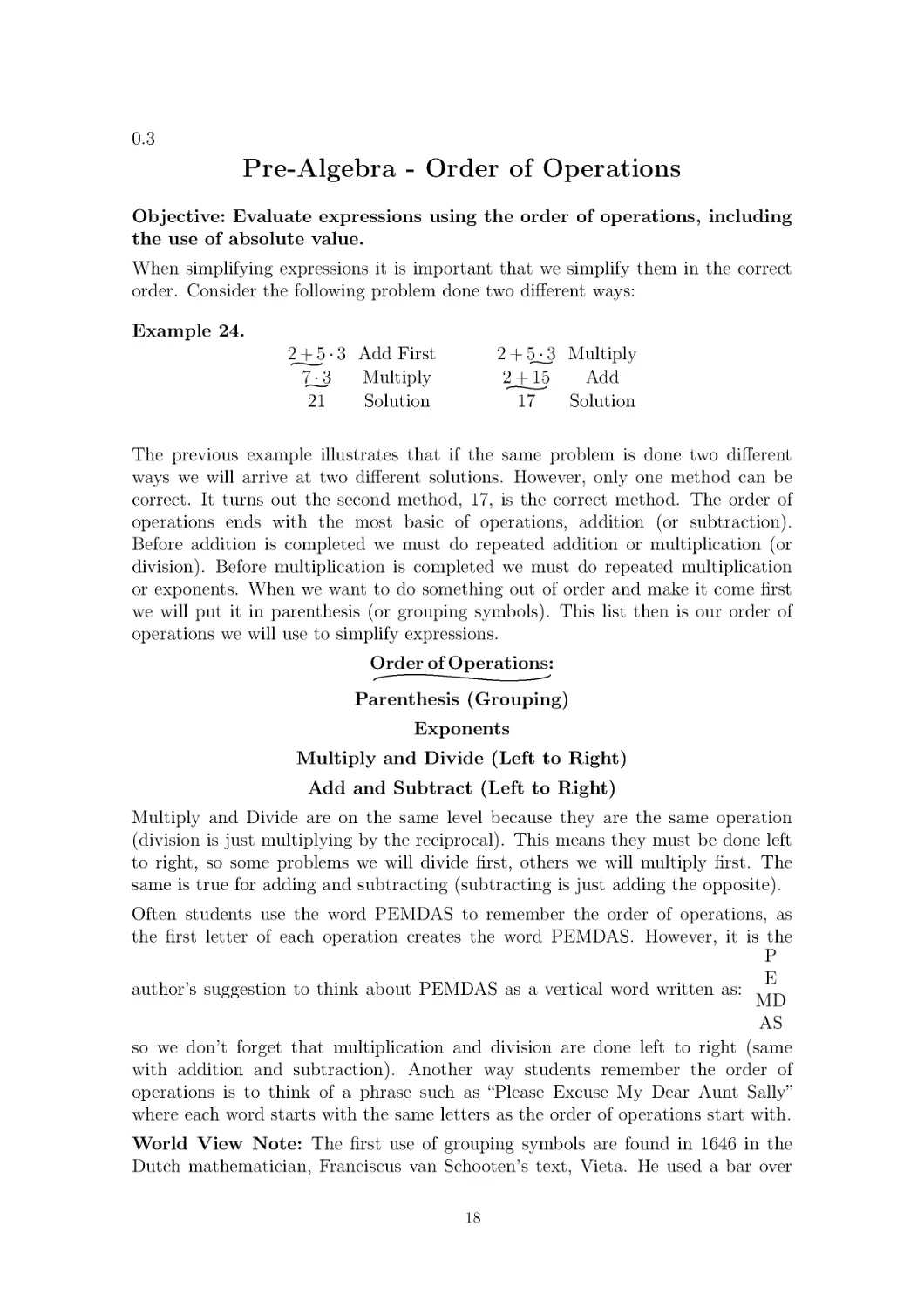
Pre-Algebra - Order of Operations
Objective: Evaluate expressions using the order of operations, including
the use of absolute value.
When simplifying expressions it is important that we simplify them in the correct
order. Consider the following problem done two different ways:
Example 24.
2+5·3 AddFirst
2+5·3 Multiply
7 · 3 Multiply
2+15 Add
21
Solution
17 Solution
The previous example illustrates that if the same problem is done two different
ways we will arrive at two different solutions. However, only one method can be
correct. It turns out the second method, 17, is the correct method. The order of
operations ends with the most basic of operations, addition (or subtraction).
Before addition is completed we must do repeated addition or multiplication (or
division). Before multiplication is completed we must do repeated multiplication
or exponents. When we want to do something out of order and make it come first
we will put it in parenthesis (or grouping symbols). This list then is our order of
operations we will use to simplify expressions.
Order of Operations:
Parenthesis (Grouping)
Exponents
Multiply and Divide (Left to Right)
Add and Subtract (Left to Right)
Multiply and Divide are on the same level because they are the same operation
(division is just multiplying by the reciprocal). This means they must be done left
to right, so some problems we will divide first, others we will multiply first. The
same is true for adding and subtracting (subtracting is just adding the opposite).
Often students use the word PEMDAS to remember the order of operations, as
the first letter of each operation creates the word PEMDAS. However, it is the
author’s suggestion to think about PEMDAS as a vertical word written as:
P
E
MD
AS
so we don’t forget that multiplication and division are done left to right (same
with addition and subtraction). Another way students remember the order of
operations is to think of a phrase such as “Please Excuse My Dear Aunt Sally”
where each word starts with the same letters as the order of operations start with.
World View Note: The first use of grouping symbols are found in 1646 in the
Dutch mathematician, Franciscus van Schooten’s text, Vieta. He used a bar over
18
the expression that is to be evaluated first. So problems like 2(3 + 5) were written
as 2·3+5.
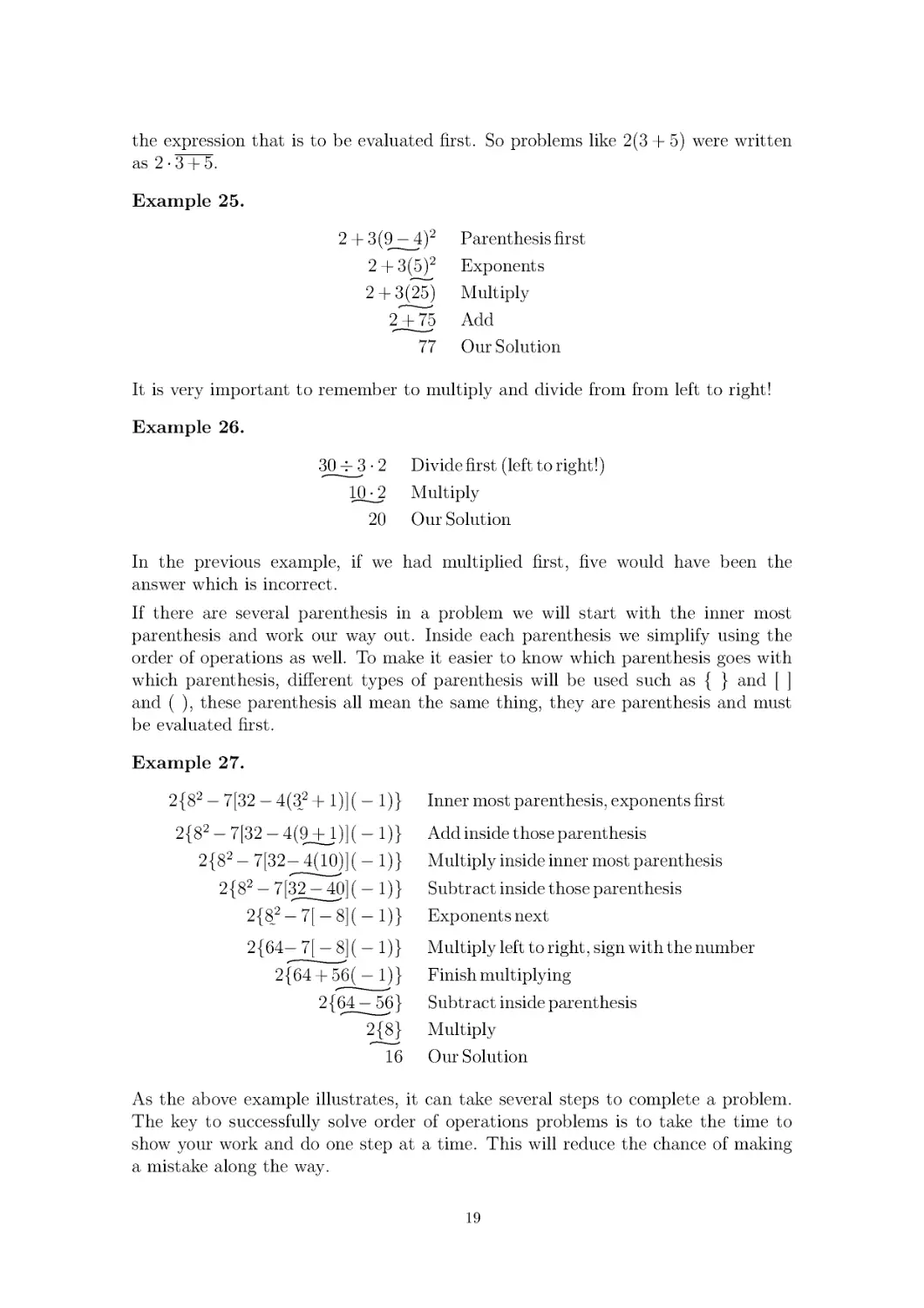
Example 25.
2 + 3(9 − 4)2 Parenthesis first
2 + 3(5)2 Exponents
2 + 3(25) Multiply
2+75 Add
77 Our Solution
It is very important to remember to multiply and divide from from left to right!
Example 26.
30 ÷ 3 · 2 Divide first (left to right!)
10 · 2 Multiply
20 Our Solution
In the previous example, if we had multiplied first, five would have been the
answer which is incorrect.
If there are several parenthesis in a problem we will start with the inner most
parenthesis and work our way out. Inside each parenthesis we simplify using the
order of operations as well. To make it easier to know which parenthesis goes with
which parenthesis, different types of parenthesis will be used such as { } and [ ]
and ( ), these parenthesis all mean the same thing, they are parenthesis and must
be evaluated first.
Example 27.
2{82 − 7[32 − 4(32
̃
+ 1)]( − 1)} Inner most parenthesis, exponents first
2{82 − 7[32 − 4(9 + 1)]( − 1)} Add inside those parenthesis
2{82 − 7[32− 4(10)]( − 1)} Multiply inside inner most parenthesis
2{82 − 7[32 − 40]( − 1)} Subtract inside those parenthesis
2{82
̃
−
7[ − 8]( − 1)} Exponents next
2{64− 7[ − 8]( − 1)} Multiply left to right, sign with the number
2{64 + 56( − 1)} Finish multiplying
2{64 − 56} Subtract inside parenthesis
2{8} Multiply
16 Our Solution
As the above example illustrates, it can take several steps to complete a problem.
The key to successfully solve order of operations problems is to take the time to
show your work and do one step at a time. This will reduce the chance of making
a mistake along the way.
19
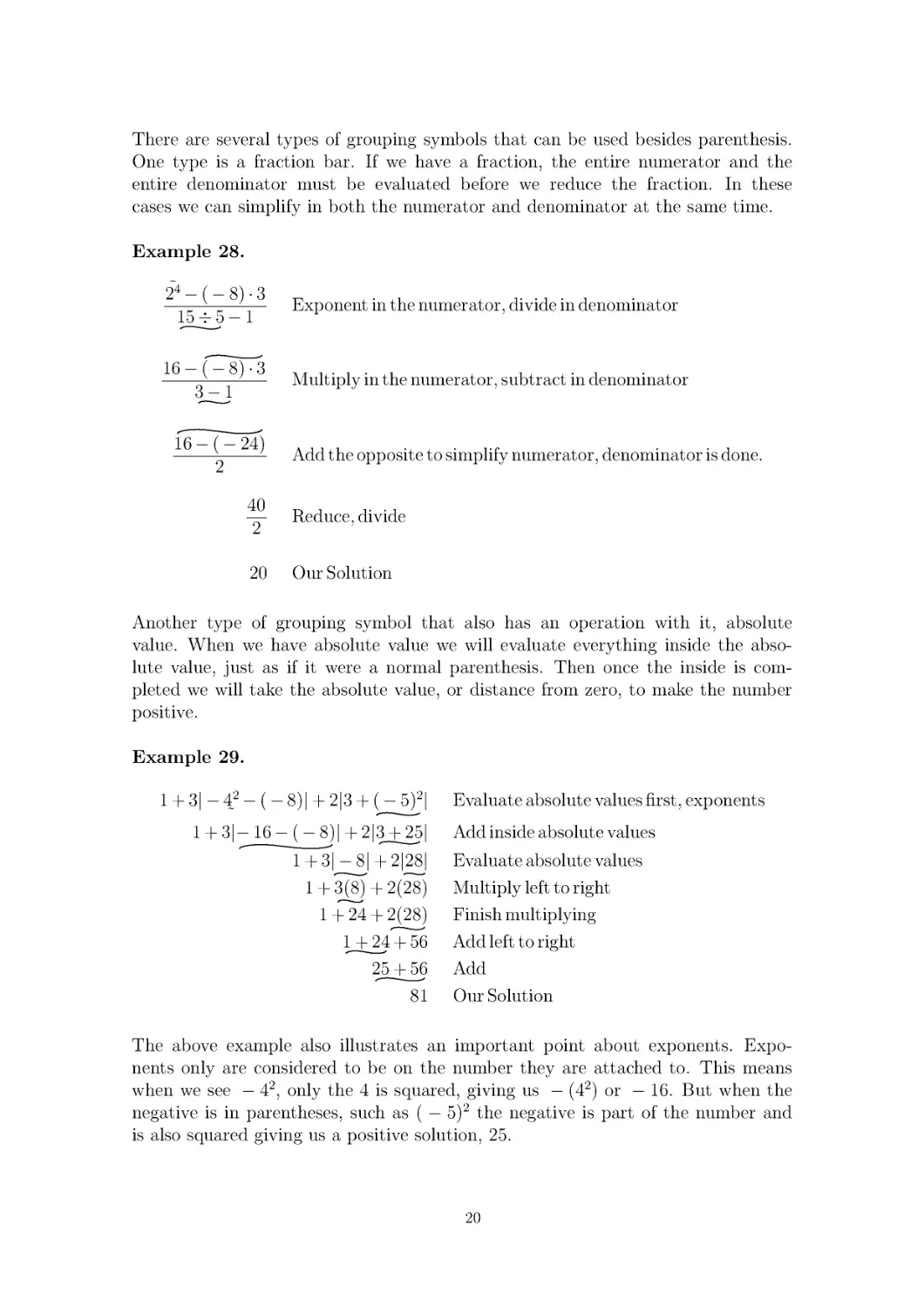
There are several types of grouping symbols that can be used besides parenthesis.
One type is a fraction bar. If we have a fraction, the entire numerator and the
entire denominator must be evaluated before we reduce the fraction. In these
cases we can simplify in both the numerator and denominator at the same time.
Example 28.
24̃
−
(−8)·3
15÷5−1
Exponent in the numerator, divide in denominator
16−(
−
8)·3
3−1
Multiply in the numerator, subtract in denominator
16−(
−
24)
2
Add the opposite to simplify numerator, denominator is done.
40
2
Reduce, divide
20 Our Solution
Another type of grouping symbol that also has an operation with it, absolute
value. When we have absolute value we will evaluate everything inside the abso-
lute value, just as if it were a normal parenthesis. Then once the inside is com-
pleted we will take the absolute value, or distance from zero, to make the number
positive.
Example 29.
1+3|−42
̃
−
( − 8)| + 2|3 + ( − 5)2| Evaluate absolute values first, exponents
1+3|−16−(
−
8)| + 2|3 + 25| Add inside absolute values
1 + 3| − 8| + 2|28| Evaluate absolute values
1 + 3(8) + 2(28) Multiply left to right
1 + 24 + 2(28) Finish multiplying
1+24+56 Addlefttoright
25+56 Add
81 Our Solution
The above example also illustrates an important point about exponents. Expo-
nents only are considered to be on the number they are attached to. This means
when we see − 42, only the 4 is squared, giving us − (42) or − 16. But when the
negative is in parentheses, such as ( − 5)2 the negative is part of the number and
is also squared giving us a positive solution, 25.
20
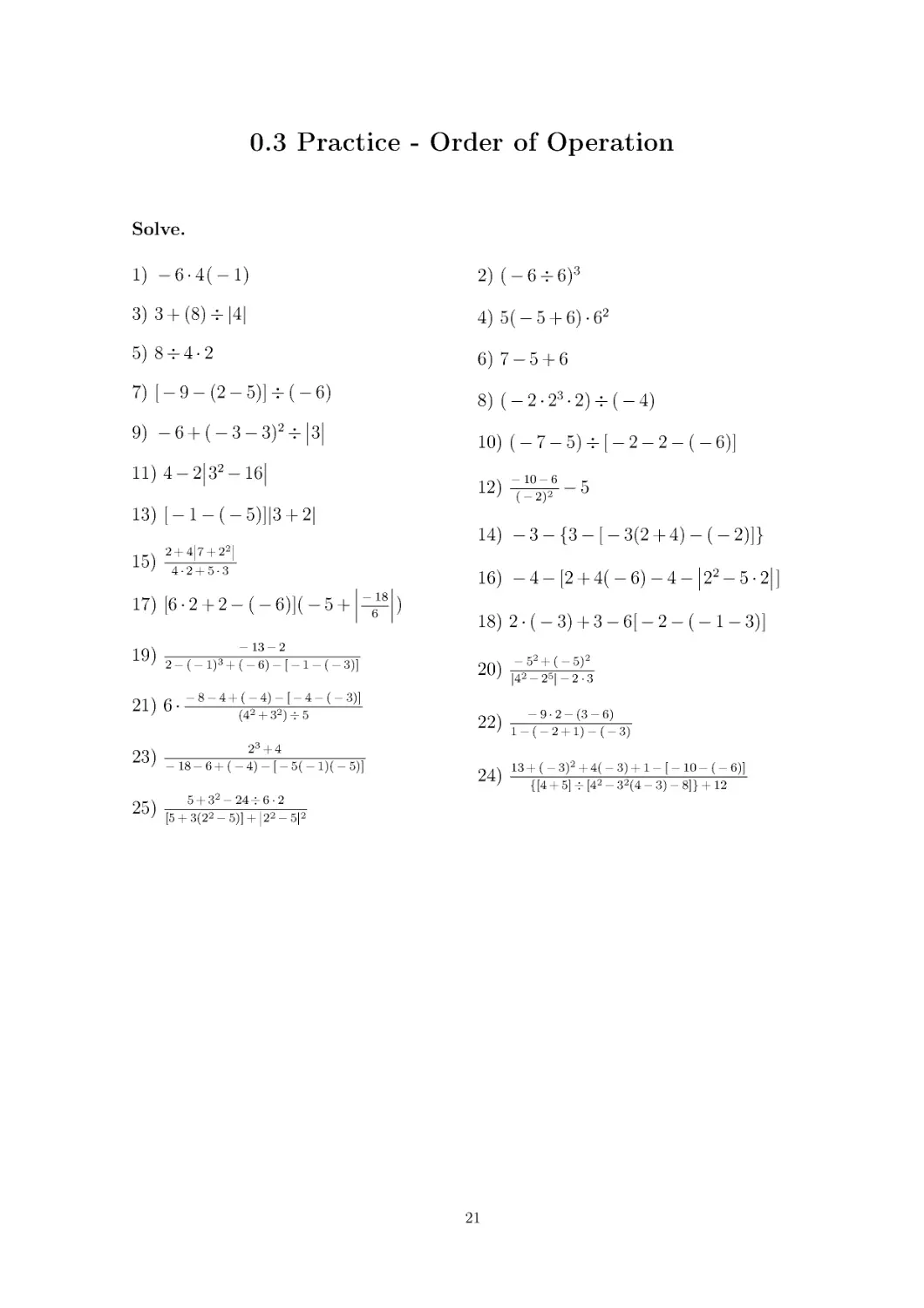
0.3 Practice - Order of Operation
Solve.
1) −6 ·4(−1)
3) 3+(8)÷|4|
5)8÷4·2
7)[−9
−
(2−5)]÷(−6)
9) −6+(−3
−
3)2 ÷
3
11)4−2
32−16
13)[−1
−
(−5)]|3+2|
15)
2+4
7+22
4·2+5·3
17)[6·2+2 −(
−
6)](−5+
−
18
6
)
19)
−
13−2
2−(
−
1)3+(−6)−[
−
1−(
−
3)]
21) 6·
−
8−4+(−4)−[
−
4−(
−
3)]
(42+32)÷5
23)
23+4
−
18−6+(−4)−[
−
5(−1)(−5)]
25) 5+32−24÷6·2
[5+3(22−5)]+
22 − 5|2
2)(−6÷6)3
4)5(−5+6)·62
6)7−5+6
8)(−2 ·23·2)÷(−4)
10)(−7
−
5)÷[−2 −2
−
(−6)]
12) −10−6
(−2)2 −5
14) −3
−
{3−[
−
3(2+4)−(
−
2)]}
16) −4 −[2+4(−6)−4
−
22−5 ·2
]
18)2·( −3)+3−6[−2
−
(−1
−
3)]
20) −52+(−5)2
|42−25|−2 ·3
22) −9 ·2 −(3−6)
1−(
−
2+1)−(
−
3)
24) 13+(−3)2+4(−3)+1−[
−
10−(
−
6)]
{[4+5]÷[42−32(4−3)−8]}+12
21
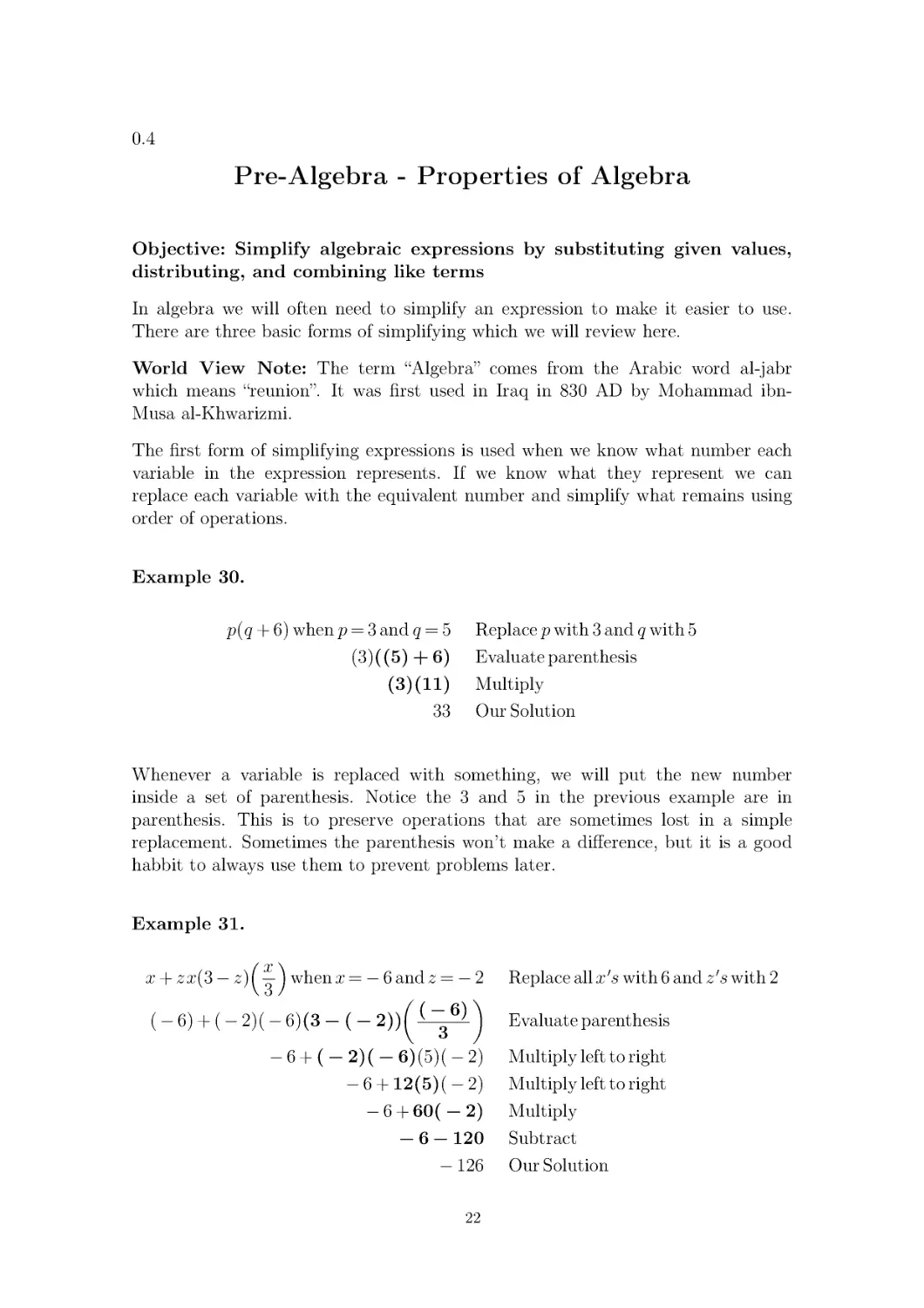
0.4
Pre-Algebra - Prop erties of Algebra
Objective: Simplify algebraic expressions by substituting given values,
distributing, and combining like terms
In algebra we will often need to simplify an expression to make it easier to use.
There are three basic forms of simplifying which we will review here.
World View Note: The term “Algebra” comes from the Arabic word al-jabr
which means “reunion”. It was first used in Iraq in 830 AD by Mohammad ibn-
Musa al-Khwarizmi.
The first form of simplifying expressions is used when we know what number each
variable in the expression represents. If we know what they represent we can
replace each variable with the equivalent number and simplify what remains using
order of operations.
Example 30.
p(q+6)whenp=3andq=5 Replacepwith3andqwith5
(3)((5) + 6) Evaluate parenthesis
(3)(11) Multiply
33 Our Solution
Whenever a variable is replaced with something, we will put the new number
inside a set of parenthesis. Notice the 3 and 5 in the previous example are in
parenthesis. This is to preserve operations that are sometimes lost in a simple
replacement. Sometimes the parenthesis won’t make a difference, but it is a good
habbit to always use them to prevent problems later.
Example 31.
x+zx(3−z)
x
3
whenx= − 6andz= − 2 Replaceallx′swith6andz′swith2
(−6)+(−2)(−6)(3−( −2))
(−6)
3
Evaluate parenthesis
−
6+(−2)(−6)(5)(−2) Multiplylefttoright
−
6 + 12(5)( − 2) Multiply left to right
−
6 + 60( − 2) Multiply
− 6 − 120 Subtract
−
126 Our Solution
22
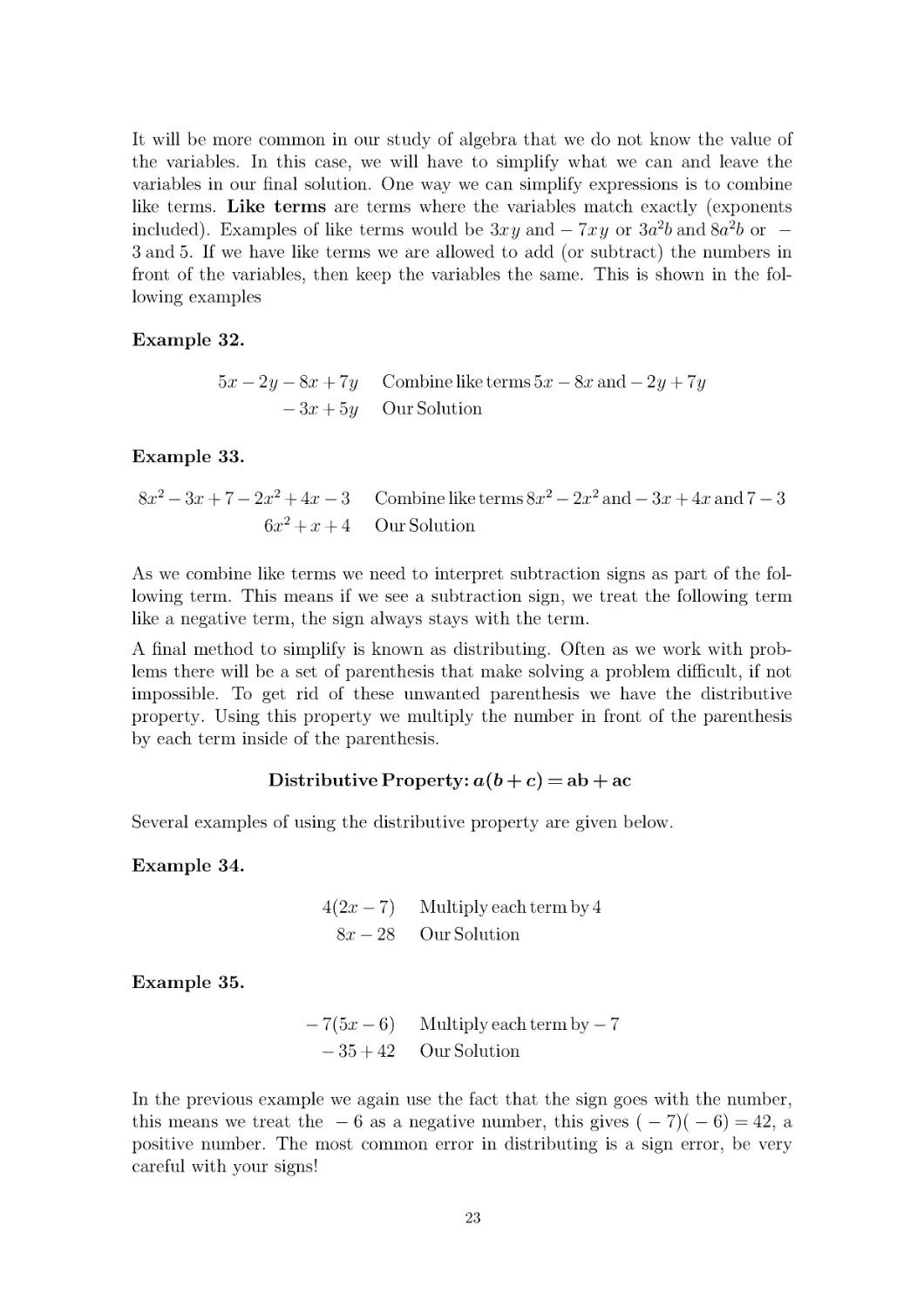
It will be more common in our study of algebra that we do not know the value of
the variables. In this case, we will have to simplify what we can and leave the
variables in our final solution. One way we can simplify expressions is to combine
like terms. Like terms are terms where the variables match exactly (exponents
included). Examples of like terms would be 3x y and − 7x y or 3a2b and 8a2b or −
3 and 5. If we have like terms we are allowed to add (or subtract) the numbers in
front of the variables, then keep the variables the same. This is shown in the fol-
lowing examples
Example 32.
5x−2y−8x+7y Combineliketerms5x−8xand−2y+7y
−
3x + 5y Our Solution
Example 33.
8x2−3x+7−2x2+4x−3 Combineliketerms8x2−2x2and−3x+4xand7−3
6x2+x+4 OurSolution
As we combine like terms we need to interpret subtraction signs as part of the fol-
lowing term. This means if we see a subtraction sign, we treat the following term
like a negative term, the sign always stays with the term.
A final method to simplify is known as distributing. Often as we work with prob-
lems there will be a set of parenthesis that make solving a problem difficult, if not
impossible. To get rid of these unwanted parenthesis we have the distributive
property. Using this property we multiply the number in front of the parenthesis
by each term inside of the parenthesis.
Distributive Property: a(b + c) = ab + ac
Several examples of using the distributive property are given below.
Example 34.
4(2x − 7) Multiply each term by 4
8x − 28 Our Solution
Example 35.
−
7(5x − 6) Multiply each term by − 7
−
35 + 42 Our Solution
In the previous example we again use the fact that the sign goes with the number,
this means we treat the − 6 as a negative number, this gives ( − 7)( − 6) = 42, a
positive number. The most common error in distributing is a sign error, be very
careful with your signs!
23
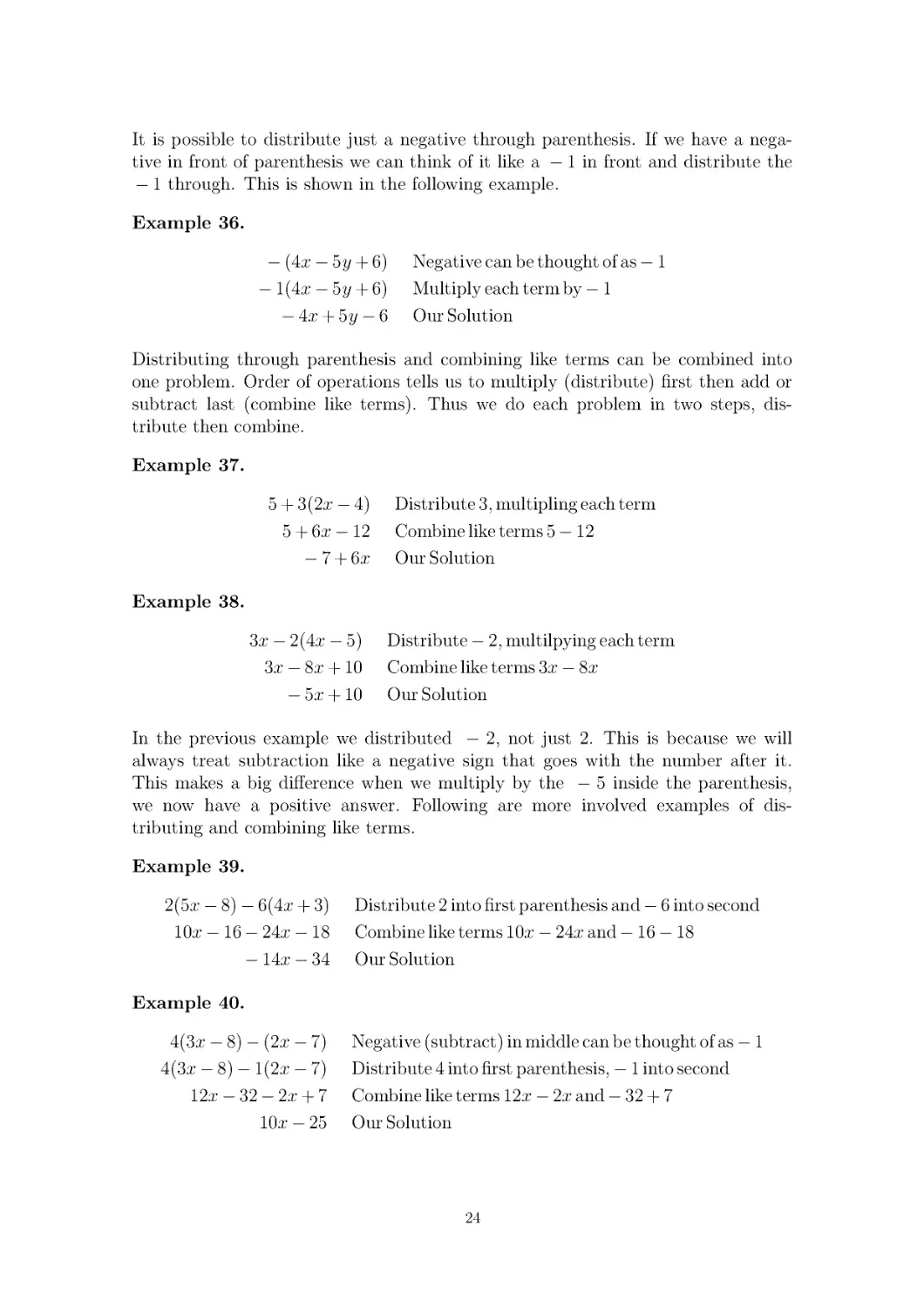
It is possible to distribute just a negative through parenthesis. If we have a nega-
tive in front of parenthesis we can think of it like a − 1 in front and distribute the
−
1 through. This is shown in the following example.
Example 36.
−
(4x−5y+6) Negativecanbethoughtofas−1
−
1(4x−5y+6) Multiplyeachtermby−1
−
4x+5y−6 OurSolution
Distributing through parenthesis and combining like terms can be combined into
one problem. Order of operations tells us to multiply (distribute) first then add or
subtract last (combine like terms). Thus we do each problem in two steps, dis-
tribute then combine.
Example 37.
5 + 3(2x − 4) Distribute 3, multipling each term
5+6x−12 Combineliketerms5−12
−
7 + 6x Our Solution
Example 38.
3x − 2(4x − 5) Distribute − 2, multilpying each term
3x−8x+10 Combineliketerms3x−8x
−
5x + 10 Our Solution
In the previous example we distributed − 2, not just 2. This is because we will
always treat subtraction like a negative sign that goes with the number after it.
This makes a big difference when we multiply by the − 5 inside the parenthesis,
we now have a positive answer. Following are more involved examples of dis-
tributing and combining like terms.
Example 39.
2(5x − 8) − 6(4x + 3) Distribute 2 into first parenthesis and − 6 into second
10x−16−24x−18 Combineliketerms10x−24xand−16−18
−
14x − 34 Our Solution
Example 40.
4(3x − 8) − (2x − 7) Negative (subtract) in middle can be thought of as − 1
4(3x − 8) − 1(2x − 7) Distribute 4 into first parenthesis, − 1 into second
12x−32−2x+7 Combineliketerms12x−2xand−32+7
10x − 25 Our Solution
24
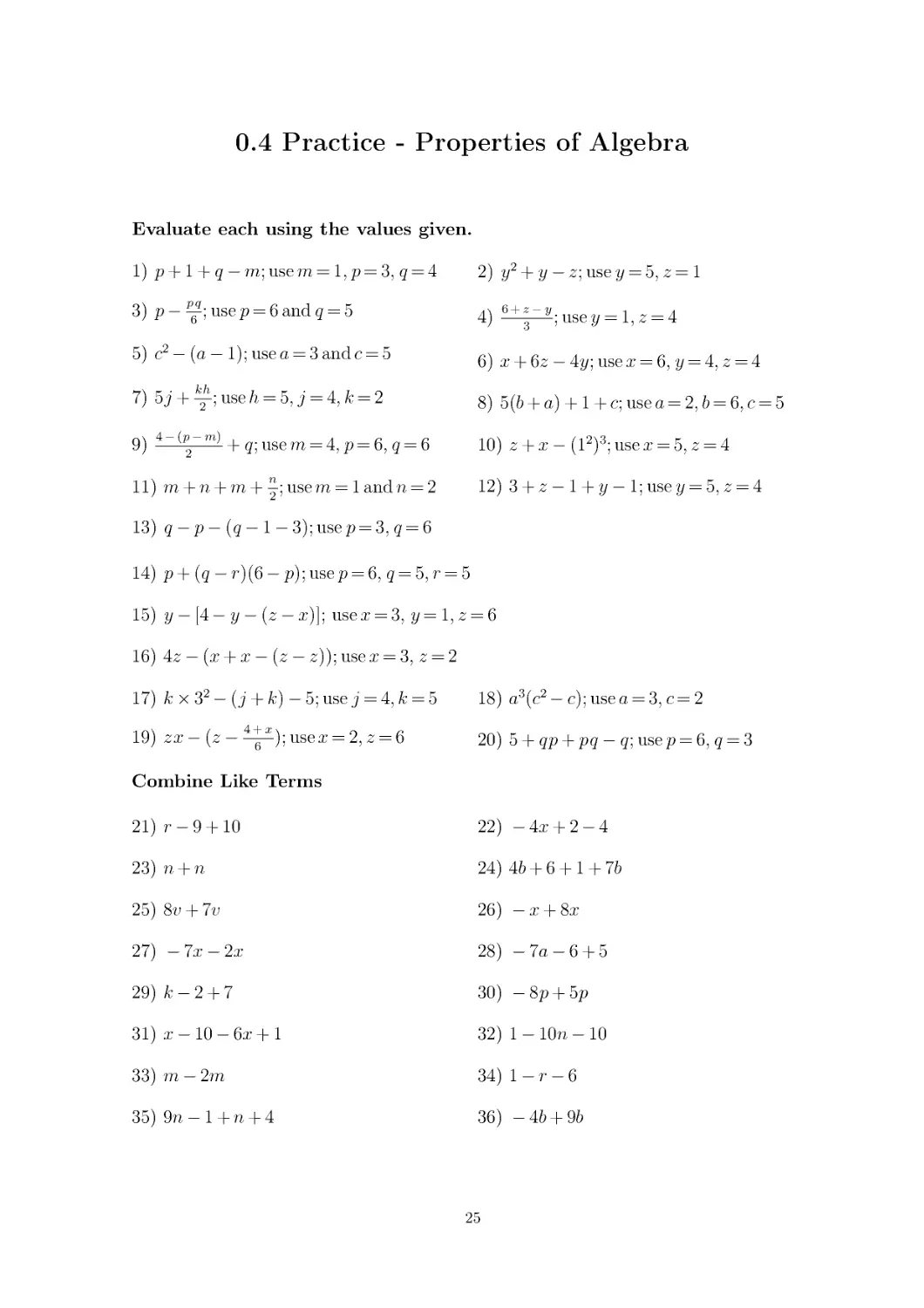
0.4 Practice - Properties of Algebra
Evaluate each using the values given.
1)p+1+q−m;usem=1,p=3,q=4
3) p−
pq
6
;usep=6andq=5
5)c2−(a−1);usea=3andc=5
7)5j+kh
2
;useh=5,j =4,k=2
9)4−(p−m)
2
+q;usem=4,p=6,q=6
11)m+n+m+
n
2
;usem=1andn=2
13)q−p
−
(q−1
−
3);usep=3,q =6
2)y2+y−z;usey=5,z=1
4)6+z−y
3
;usey=1,z=4
6)x+6z−4y;usex=6,y=4,z=4
8)5(b+a)+1+c;usea=2,b=6,c=5
10)z+x−(12)3;usex=5,z=4
12)3+z−1+y−1;usey=5,z=4
14)p+(q−r)(6−p);usep=6,q=5,r=5
15)y−[4−y
−
(z−x)];usex=3,y=1,z=6
16)4z−(x+x−(z−z));usex=3,z=2
17)k×32−(j+k)−5;usej=4,k =5
19)zx−(z−
4+x
6
);usex=2,z=6
18)a3(c2−c);usea=3,c=2
20)5+qp+pq−q;usep=6,q =3
Combine Like Terms
21)r−9+10
23)n+n
25)8v+7v
27)−7x−2x
29)k−2+7
31)x−10−6x+1
33)m−2m
35)9n−1+n+4
22) −4x+2−4
24)4b+6+1+7b
26)−x+8x
28) −7a−6+5
30) −8p+5p
32)1−10n−10
34)1−r
−
6
36) −4b+9b
25
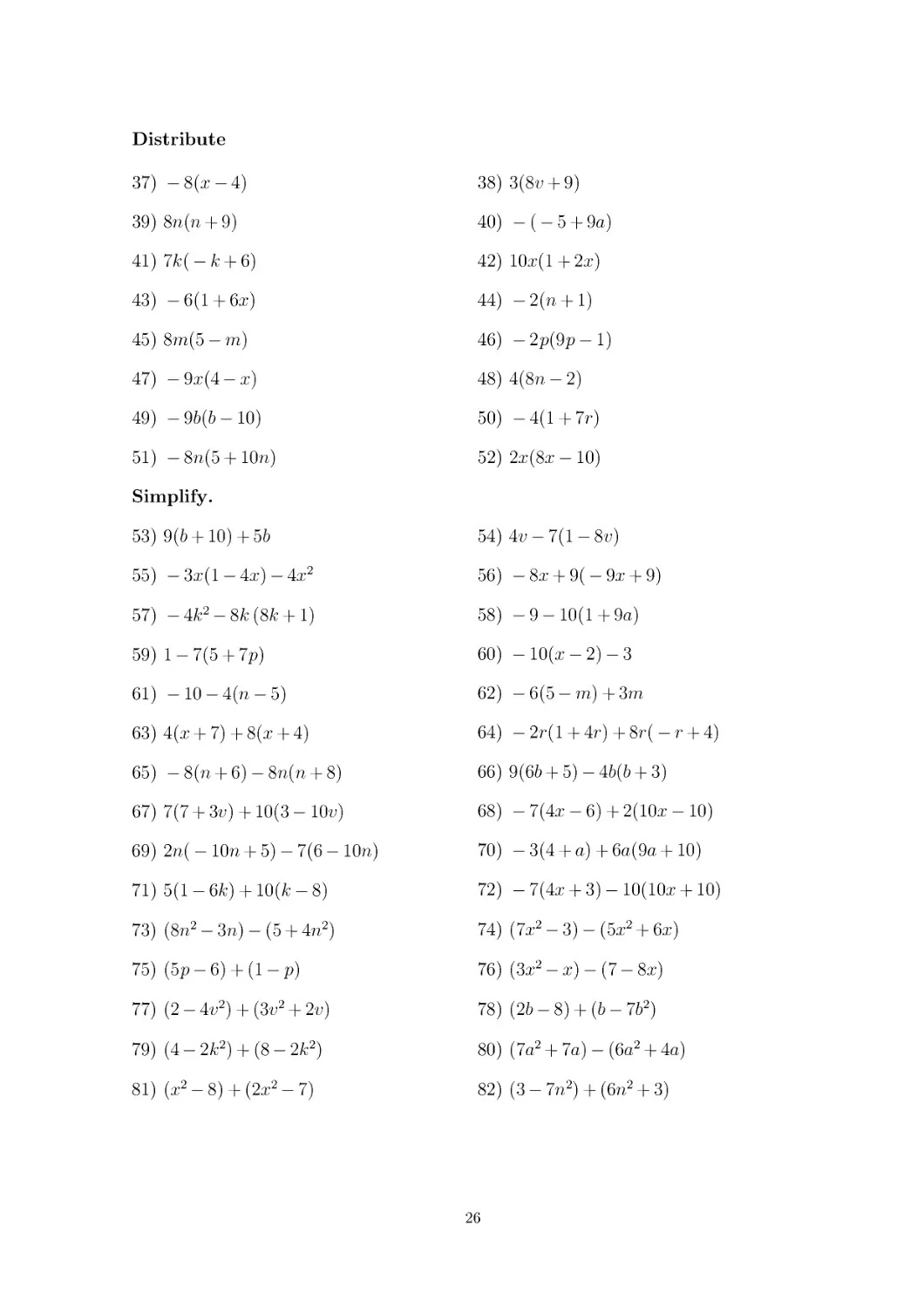
Distribute
37) −8(x−4)
39) 8n(n + 9)
41)7k(−k+6)
43) −6(1+6x)
45) 8m(5 − m)
47) −9x(4−x)
49) −9b(b−10)
51) − 8n(5 + 10n)
38) 3(8v + 9)
40) −(
−
5+9a)
42) 10x(1 + 2x)
44) −2(n+1)
46) −2p(9p−1)
48) 4(8n − 2)
50) −4(1+7r)
52) 2x(8x − 10)
Simplify.
53)9(b+10)+5b
55) −3x(1−4x)−4x2
57) −4k2−8k(8k+1)
59)1−7(5+7p)
61) −10−4(n−5)
63)4(x+7)+8(x+4)
65) −8(n+6)−8n(n+8)
67) 7(7+3v)+10(3−10v)
69) 2n(−10n+5)−7(6−10n)
71)5(1−6k)+10(k−8)
73) (8n2 − 3n) −(5+4n2)
75)(5p−6)+(1−p)
77) (2−4v2)+(3v2+2v)
79) (4−2k2)+(8−2k2)
81)(x2−8)+(2x2−7)
54) 4v −7(1−8v)
56) −8x+9(−9x+9)
58) −9
−
10(1 + 9a)
60) −10(x−2)−3
62) −6(5−m)+3m
64) −2r(1+4r)+8r(−r+4)
66)9(6b+5)−4b(b+3)
68) −7(4x−6)+2(10x−10)
70) −3(4+a)+6a(9a+10)
72) −7(4x+3)−10(10x+10)
74) (7x2 − 3)−(5x2+6x)
76) (3x2−x)−(7−8x)
78)(2b−8)+(b−7b2)
80) (7a2+7a) −(6a2+4a)
82) (3−7n2)+(6n2+3)
26
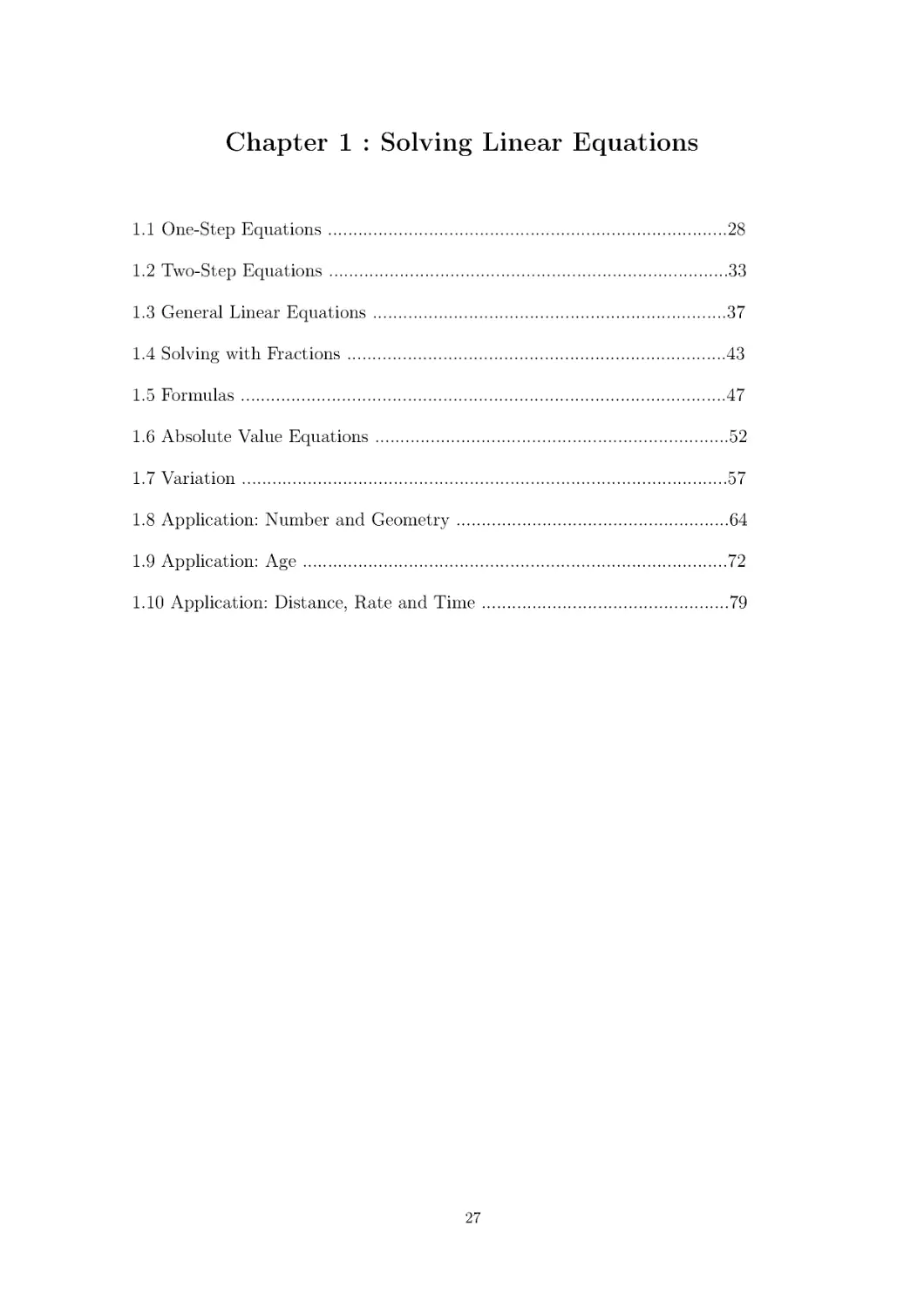
Chapter 1 : Solving Linear Equations
1.1 One-Step Equations ...............................................................................28
1.2 Two-Step Equations ...............................................................................33
1.3 General Linear Equations ......................................................................37
1.4 Solving with Fractions ...........................................................................43
1.5 Formulas ................................................................................................47
1.6 Absolute Value Equations ......................................................................52
1.7 Variation ................................................................................................57
1.8 Application: Number and Geometry ......................................................64
1.9 Application: Age ....................................................................................72
1.10 Application: Distance, Rate and Time .................................................79
27
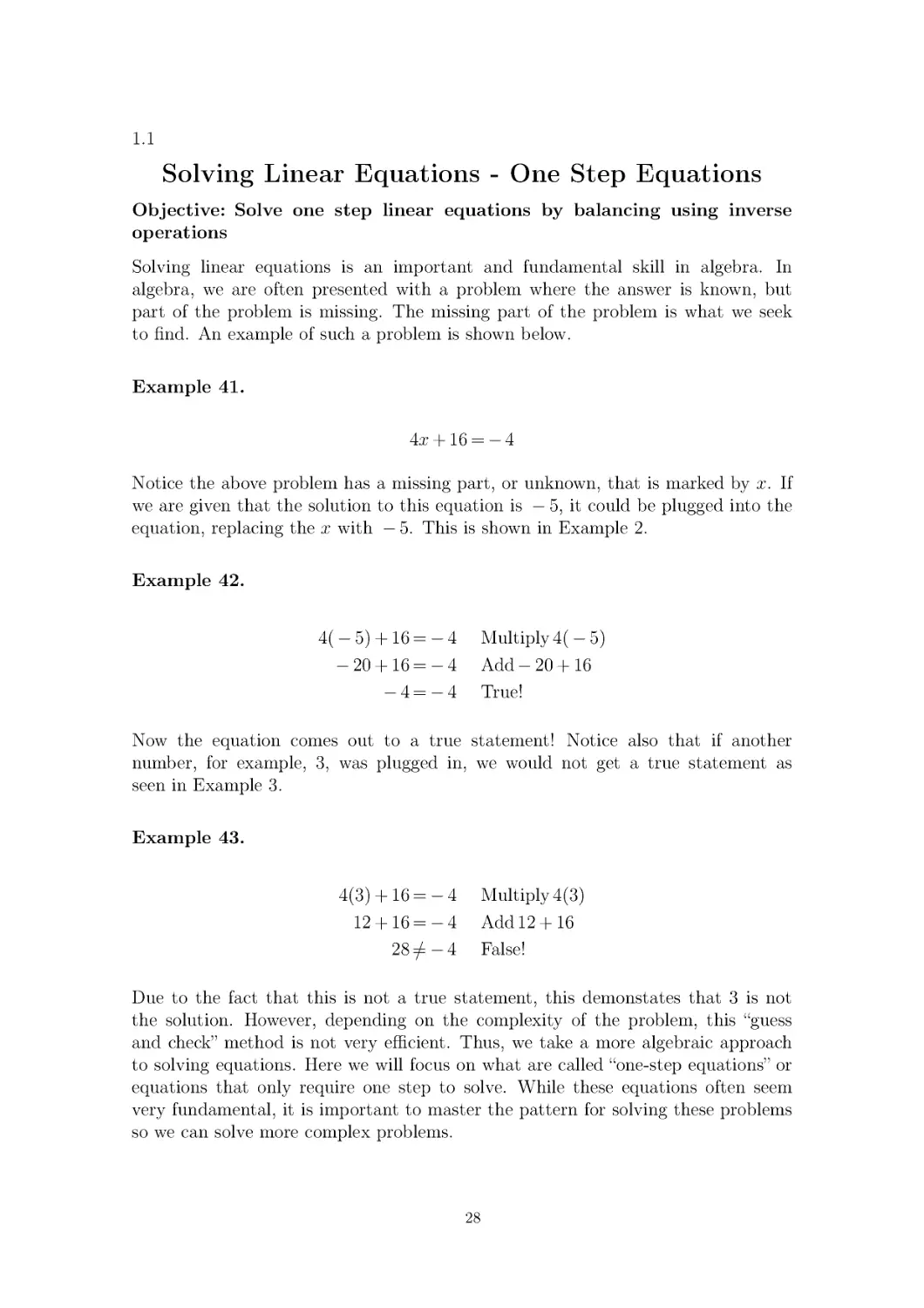
1.1
Solving Linear Equations - One Step Equations
Objective: Solve one step linear equations by balancing using inverse
operations
Solving linear equations is an important and fundamental skill in algebra. In
algebra, we are often presented with a problem where the answer is known, but
part of the problem is missing. The missing part of the problem is what we seek
to find. An example of such a problem is shown below.
Example 41.
4x+16= − 4
Notice the above problem has a missing part, or unknown, that is marked by x. If
we are given that the solution to this equation is − 5, it could be plugged into the
equation, replacing the x with − 5. This is shown in Example 2.
Example 42.
4(−5)+16= − 4
Multiply 4( − 5)
−
20+16= − 4 Add−20+16
−
4=−4
True!
Now the equation comes out to a true statement! Notice also that if another
number, for example, 3, was plugged in, we would not get a true statement as
seen in Example 3.
Example 43.
4(3)+16= − 4
Multiply 4(3)
12+16= − 4 Add12+16
28
−4
False!
Due to the fact that this is not a true statement, this demonstates that 3 is not
the solution. However, depending on the complexity of the problem, this “guess
and check” method is not very efficient. Thus, we take a more algebraic approach
to solving equations. Here we will focus on what are called “one-step equations” or
equations that only require one step to solve. While these equations often seem
very fundamental, it is important to master the pattern for solving these problems
so we can solve more complex problems.
28
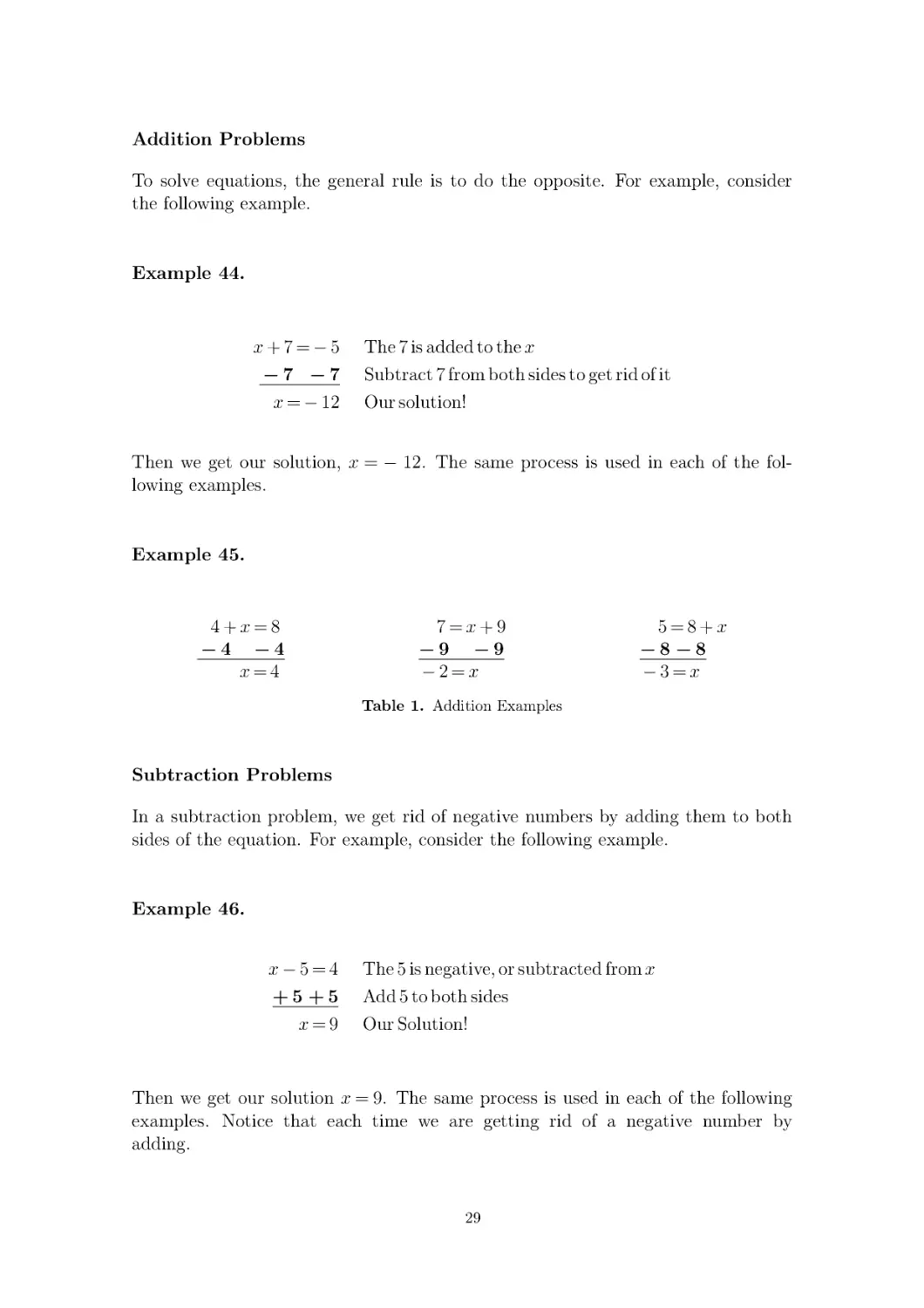
Addition Problems
To solve equations, the general rule is to do the opposite. For example, consider
the following example.
Example 44.
x+7=−5
The7isaddedtothex
−7
− 7 Subtract 7 from both sides to get rid of it
x = − 12 Our solution!
Then we get our solution, x = − 12 . The same process is used in each of the fol-
lowing examples.
Example 45.
4+x=8
−4
−4
x=4
7=x+9
−9
−9
−
2=x
5=8+x
−8
−8
−
3=x
Table 1. Addition Examples
Subtraction Problems
In a subtraction problem, we get rid of negative numbers by adding them to both
sides of the equation. For example, consider the following example.
Example 46.
x − 5 = 4 The 5 is negative, or subtracted from x
+5+5 Add5tobothsides
x = 9 Our Solution!
Then we get our solution x = 9. The same process is used in each of the following
examples. Notice that each time we are getting rid of a negative number by
adding.
29
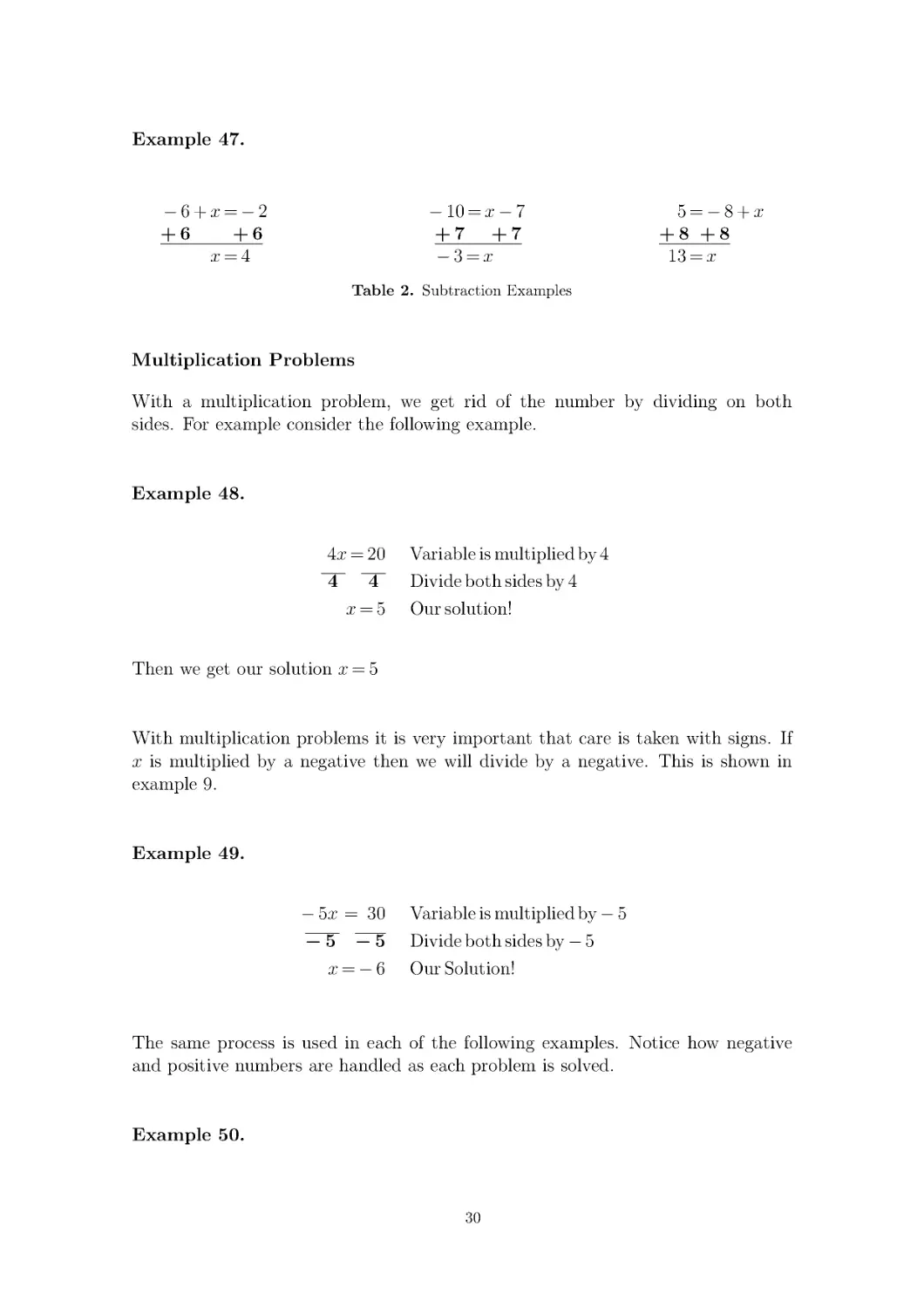
Example 47.
−
6+x=−2
+6 +6
x=4
−
10=x −7
+7 +7
−
3=x
5=−8+x
+8 +8
13=x
Table 2. Subtraction Examples
Multiplication Problems
With a multiplication problem, we get rid of the number by dividing on both
sides. For example consider the following example.
Example 48.
4x = 20 Variable is multiplied by 4
4 4 Divide both sides by 4
x = 5 Our solution!
Then we get our solution x = 5
With multiplication problems it is very important that care is taken with signs. If
x is multiplied by a negative then we will divide by a negative. This is shown in
example 9.
Example 49.
−
5x = 30 Variable is multiplied by − 5
−5
−5
Divide both sides by − 5
x = − 6 Our Solution!
The same process is used in each of the following examples. Notice how negative
and positive numbers are handled as each problem is solved.
Example 50.
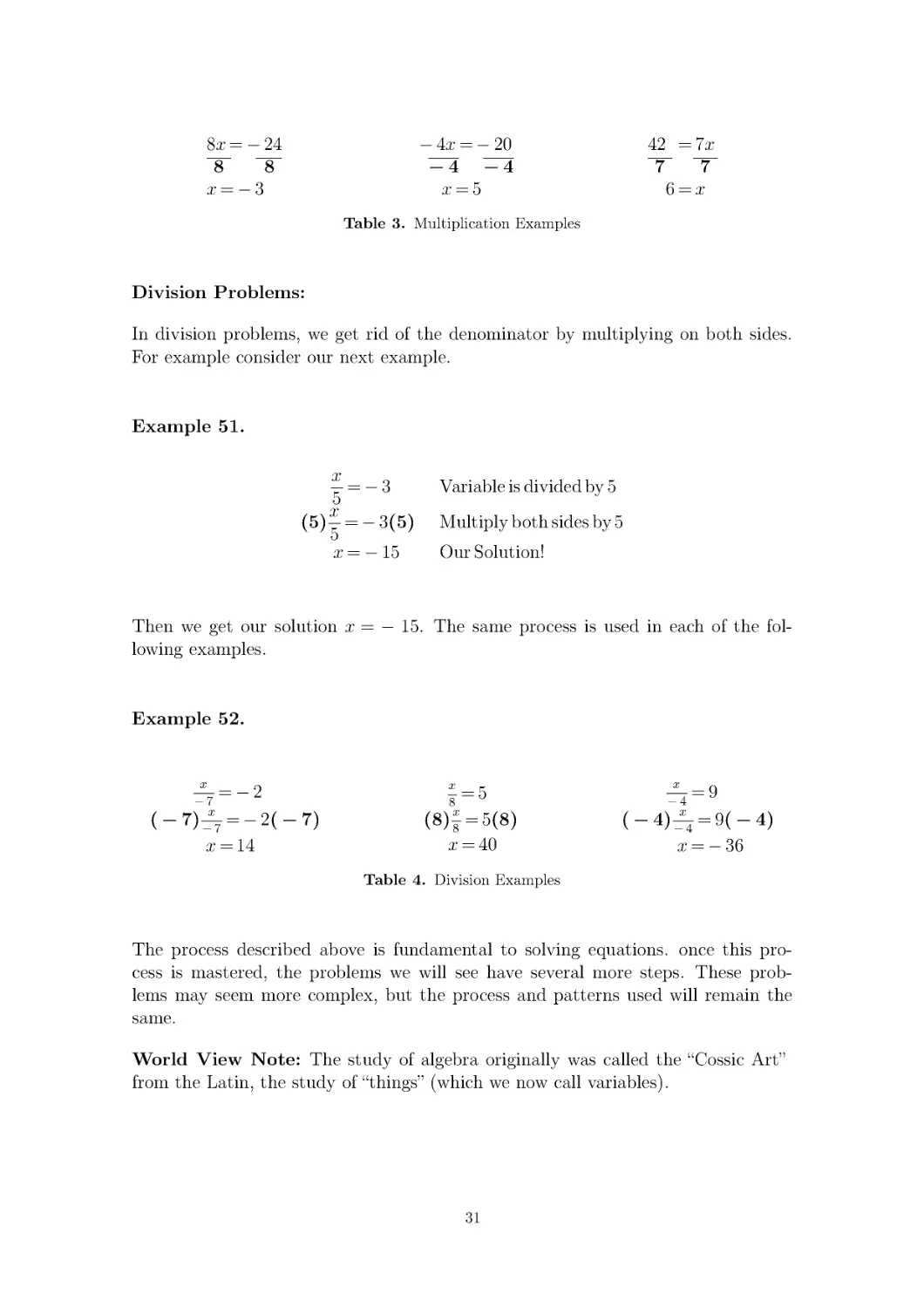
30
8x=−24
8
8
x=−3
−
4x=−20
−4
−4
x=5
42 =7x
77
6=x
Table 3. Multiplication Examples
Division Problems:
In division problems, we get rid of the denominator by multiplying on both sides.
For example consider our next example.
Example 51.
x
5
=−3
Variable is divided by 5
(5)
x
5
= − 3(5) Multiply both sides by 5
x = − 15 Our Solution!
Then we get our solution x = − 15. The same process is used in each of the fol-
lowing examples.
Example 52.
x
−
7
=−2
(−7) x
−
7=−2(−7)
x=14
x
8
=5
(8) x
8=5(8)
x=40
x
−
4
=9
(−4) x
−
4
= 9(−4)
x=−36
Table 4. Division Examples
The process described above is fundamental to solving equations. once this pro-
cess is mastered, the problems we will see have several more steps. These prob-
lems may seem more complex, but the process and patterns used will remain the
same.
World View Note: The study of algebra originally was called the “Cossic Art”
from the Latin, the study of “things” (which we now call variables).
31
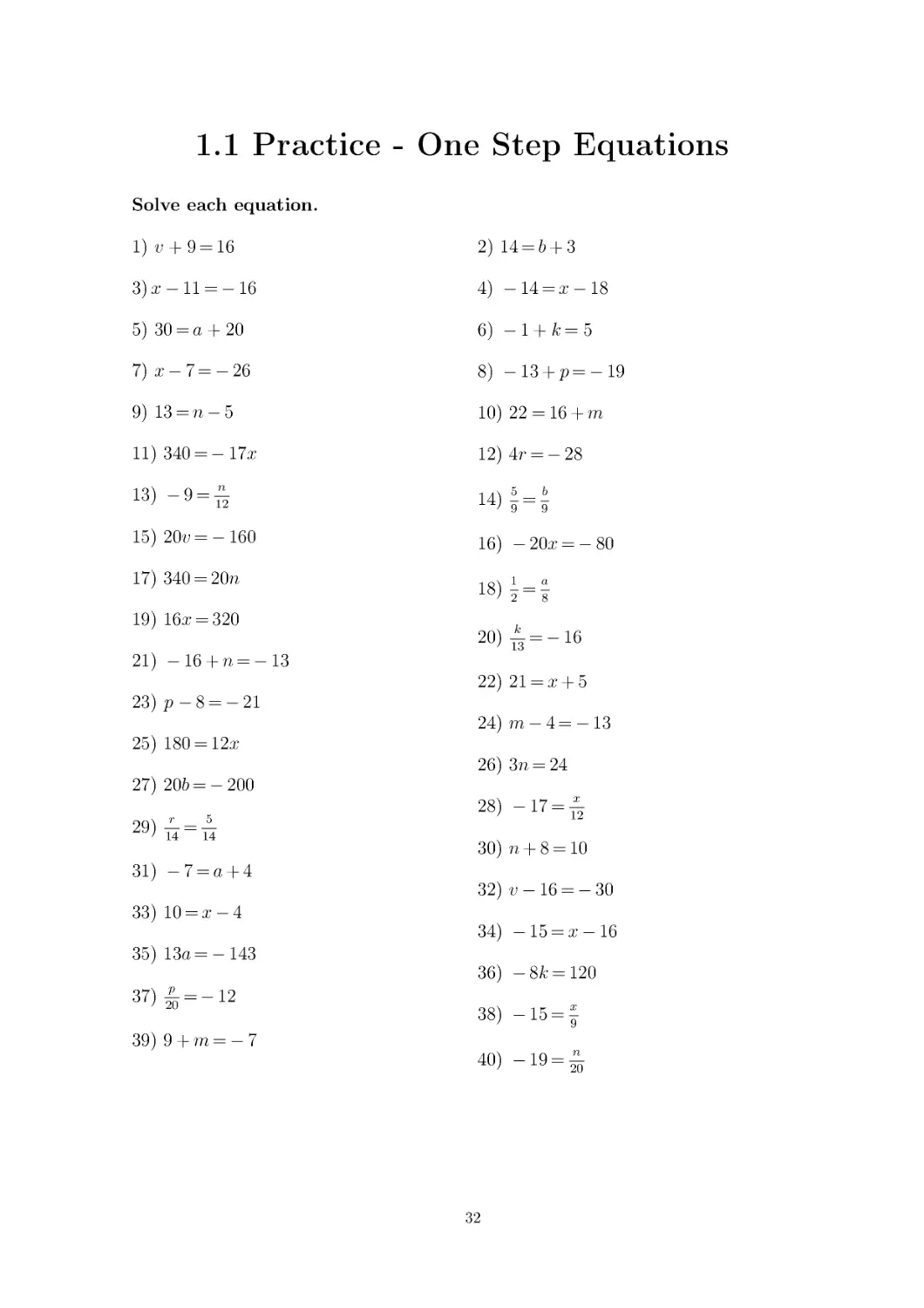
1.1 Practice - One Step Equations
Solve each equation.
1)v+9=16
3)x−11=−16
5)30=a+20
7)x−7=−26
9)13=n−5
11)340= − 17x
13)−9=
n
12
15)20v=−160
17) 340 = 20n
19) 16x = 320
21) −16+n= − 13
23)p−8=−21
25) 180 = 12x
27)20b= − 200
29) r
14
=
5
14
31)−7=a+4
33)10=x −4
35)13a= − 143
37) p
20
=−12
39)9+m=−7
2)14=b+3
4)−14=x −18
6)−1+k=5
8)−13+p= − 19
10)22=16+m
12)4r=−28
14) 5
9
=
b
9
16)−20x=− 80
18) 1
2
=
a
8
20) k
13
=−16
22)21=x+5
24)m−4=−13
26)3n=24
28) −17=
x
12
30)n+8=10
32)v−16=−30
34)−15=x −16
36) −8k=120
38) −15=
x
9
40) −19=
n
20
32
1.2
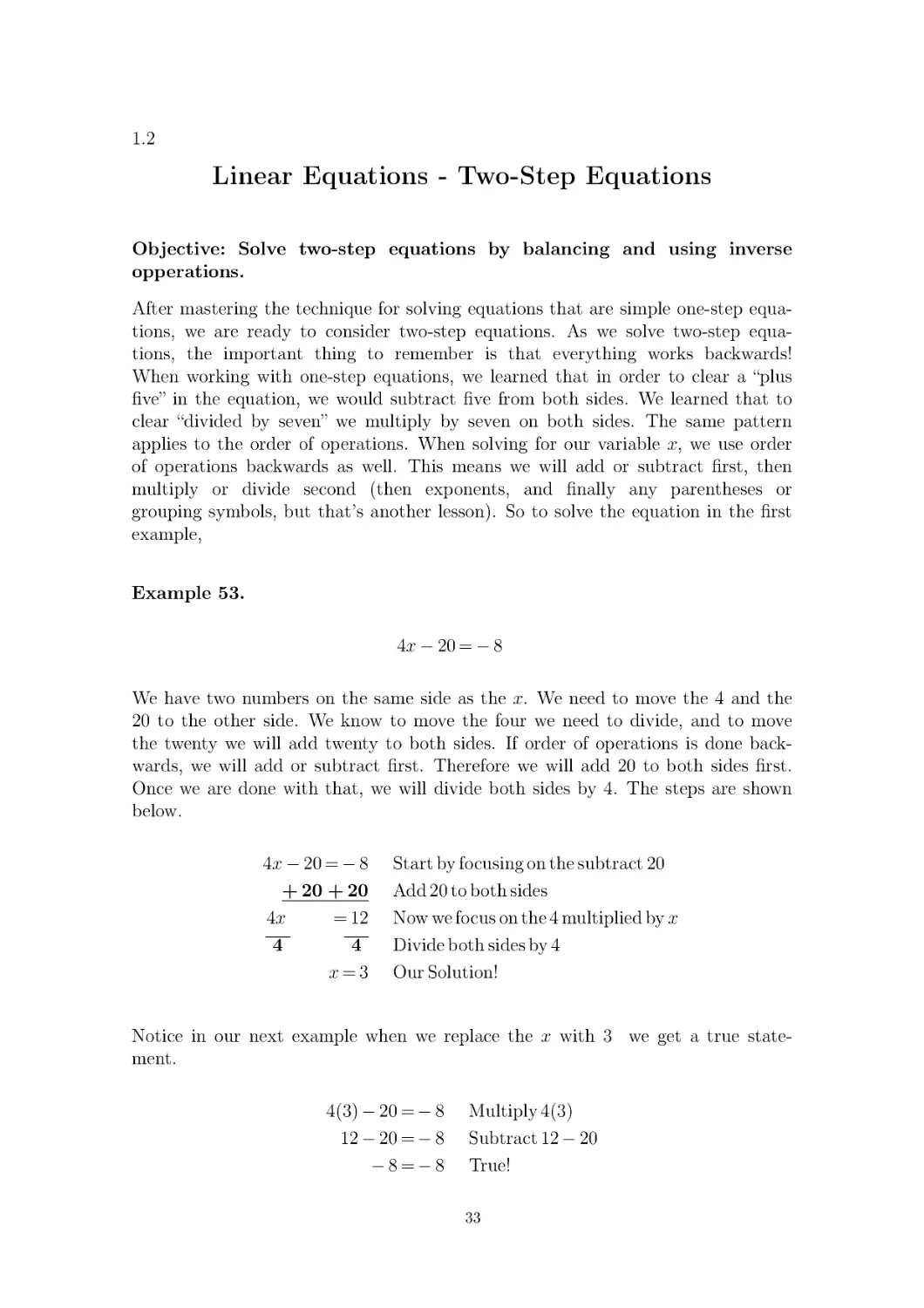
Linear Equations - Two-Step Equations
Objective: Solve two-step equations by balancing and using inverse
opperations.
After mastering the technique for solving equations that are simple one-step equa-
tions, we are ready to consider two-step equations. As we solve two-step equa-
tions, the important thing to remember is that everything works backwards!
When working with one-step equations, we learned that in order to clear a “plus
five” in the equation, we would subtract five from both sides. We learned that to
clear “divided by seven” we multiply by seven on both sides. The same pattern
applies to the order of operations. When solving for our variable x, we use order
of operations backwards as well. This means we will add or subtract first, then
multiply or divide second (then exponents, and finally any parentheses or
grouping symbols, but that’s another lesson). So to solve the equation in the first
example,
Example 53.
4x−20=−8
We have two numbers on the same side as the x. We need to move the 4 and the
20 to the other side. We know to move the four we need to divide, and to move
the twenty we will add twenty to both sides. If order of operations is done back-
wards, we will add or subtract first. Therefore we will add 20 to b oth sides first.
Once we are done with that, we will divide both sides by 4. The steps are shown
below.
4x − 20 = − 8 Start by focusing on the subtract 20
+20+20 Add20tobothsides
4x
= 12 Now we focus on the 4 multiplied by x
4
4 Divide both sides by 4
x = 3 Our Solution!
Notice in our next example when we replace the x with 3 we get a true state-
ment.
4(3)−20= − 8
Multiply 4(3)
12−20= − 8 Subtract12−20
−
8=−8
True!
33
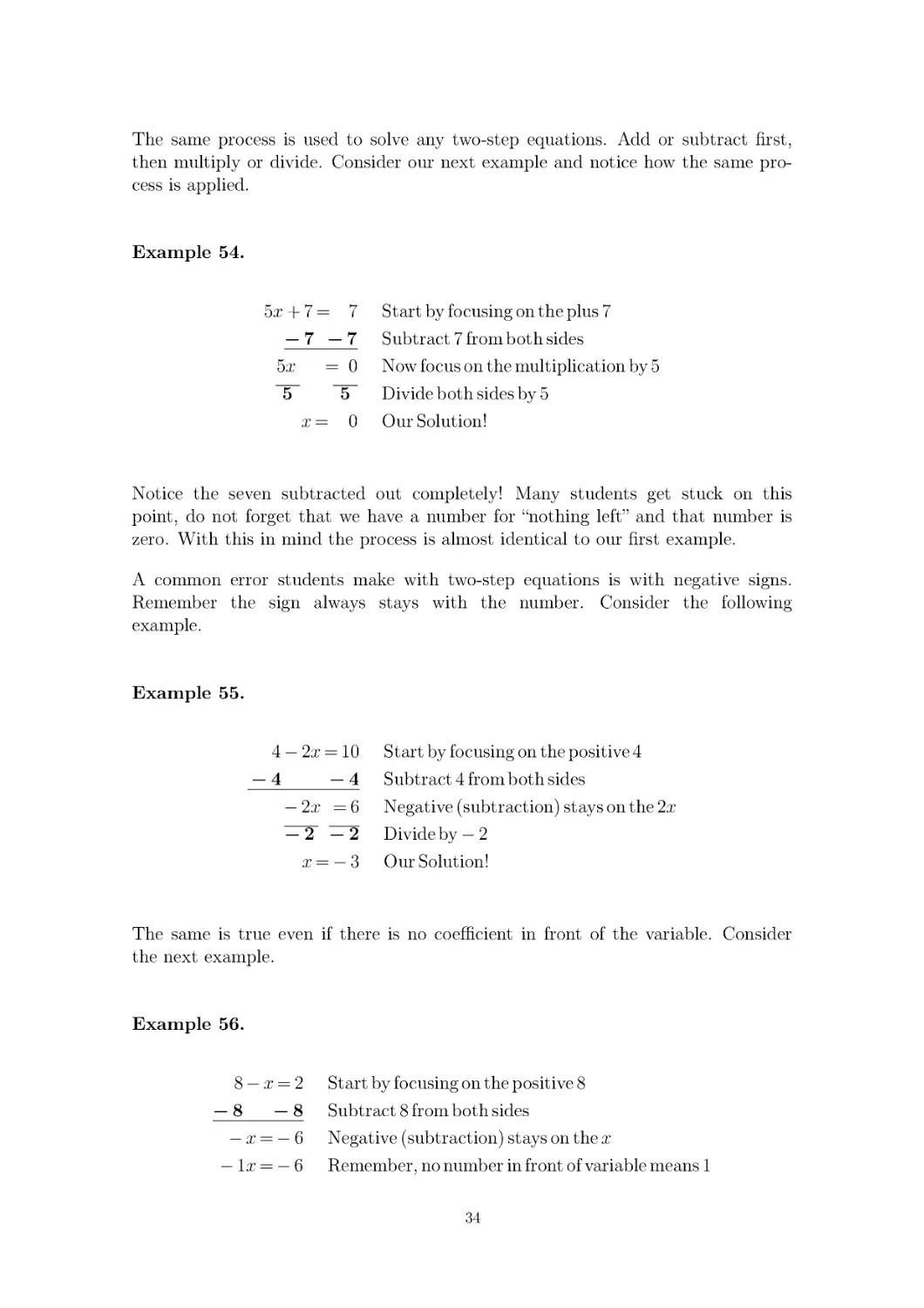
The same process is used to solve any two-step equations. Add or subtract first,
then multiply or divide. Consider our next example and notice how the same pro-
cess is applied.
Example 54.
5x+7= 7 Startbyfocusingontheplus7
−7
− 7 Subtract 7 from both sides
5x
=0
Now focus on the multiplication by 5
5
5 Divide both sides by 5
x = 0 Our Solution!
Notice the seven subtracted out completely! Many students get stuck on this
point, do not forget that we have a number for “nothing left” and that number is
zero. With this in mind the process is almost identical to our first example.
A common error students make with two-step equations is with negative signs.
Remember the sign always stays with the number. Consider the following
example.
Example 55.
4 − 2x = 10 Start by focusing on the positive 4
−4
− 4 Subtract 4 from both sides
−
2x = 6 Negative (subtraction) stays on the 2x
−2
− 2 Divideby−2
x = − 3 Our Solution!
The same is true even if there is no coefficient in front of the variable. Consider
the next example.
Example 56.
8 − x = 2 Start by focusing on the positive 8
−8
− 8 Subtract 8 from both sides
−
x=−6
Negative (subtraction) stays on the x
− 1x = − 6 Remember, no number in front of variable means 1
34
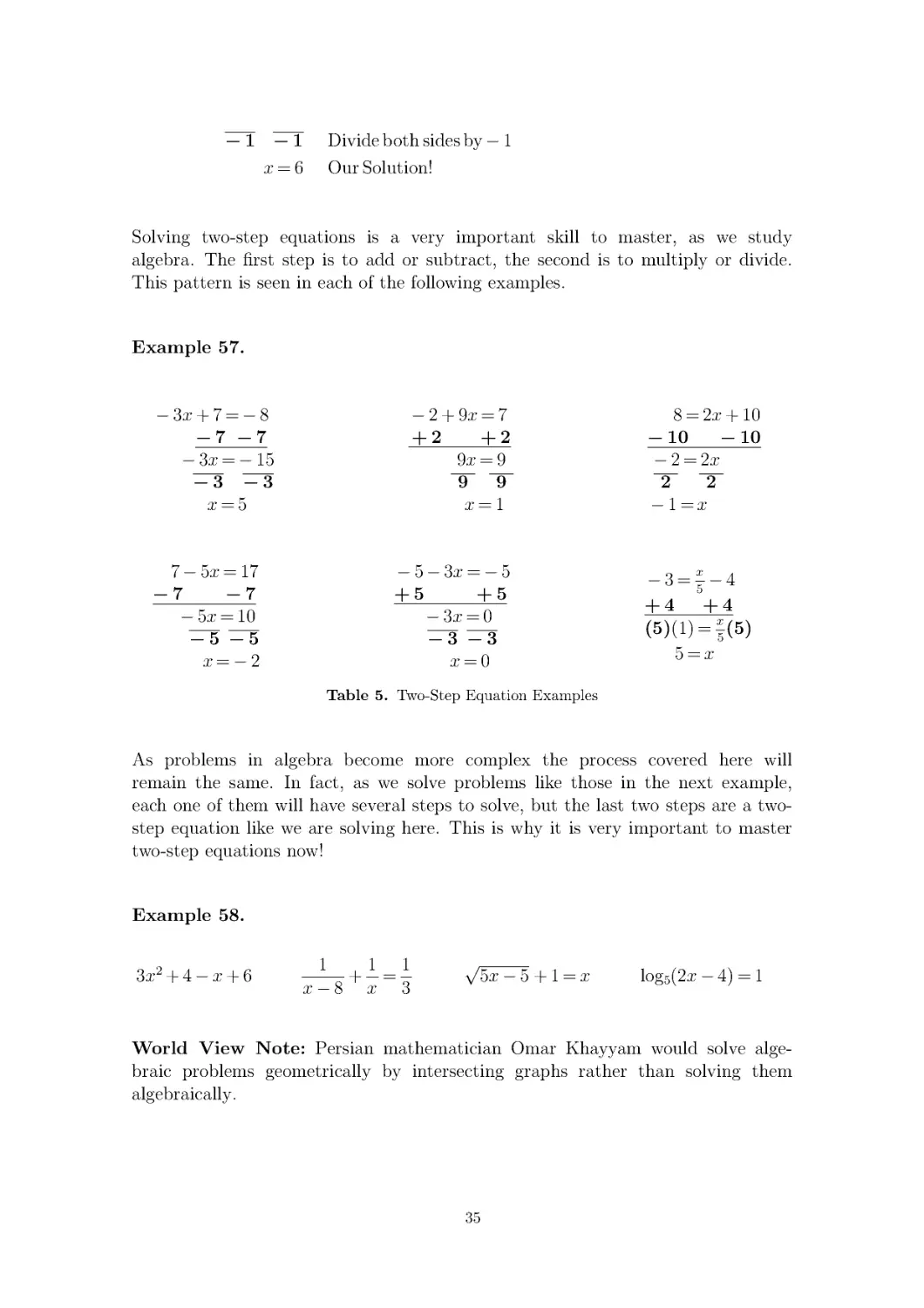
−1
− 1 Dividebothsidesby−1
x = 6 Our Solution!
Solving two-step equations is a very important skill to master, as we study
algebra. The first step is to add or subtract, the second is to multiply or divide.
This pattern is seen in each of the following examples.
Example 57.
−
3x+7= − 8
−7
−7
−
3x=−15
−3
−3
x=5
−
2+9x=7
+2 +2
9x=9
99
x=1
8=2x+10
−10−10
−
2=2x
22
−
1=x
7−5x=17
−7
−7
−
5x=10
−5
−5
x=−2
−
5−3x=−5
+5
+5
−
3x=0
−3
−3
x=0
−
3=
x
5
−
4
+4 +4
(5)(1) =
x
5
(5)
5=x
Table 5. Two-Step Equation Examples
As problems in algebra become more complex the process covered here will
remain the same. In fact, as we solve problems like those in the next example,
each one of them will have several steps to solve, but the last two steps are a two-
step equation like we are solving here. This is why it is very important to master
two-step equations now!
Example 58.
3x2+4−x+6
1
x−8
+
1
x
=
1
3
5x−5
√ +1=x
log5(2x−4)=1
World View Note: Persian mathematician Omar Khayyam would solve alge-
braic problems geometrically by intersecting graphs rather than solving them
algebraically.
35
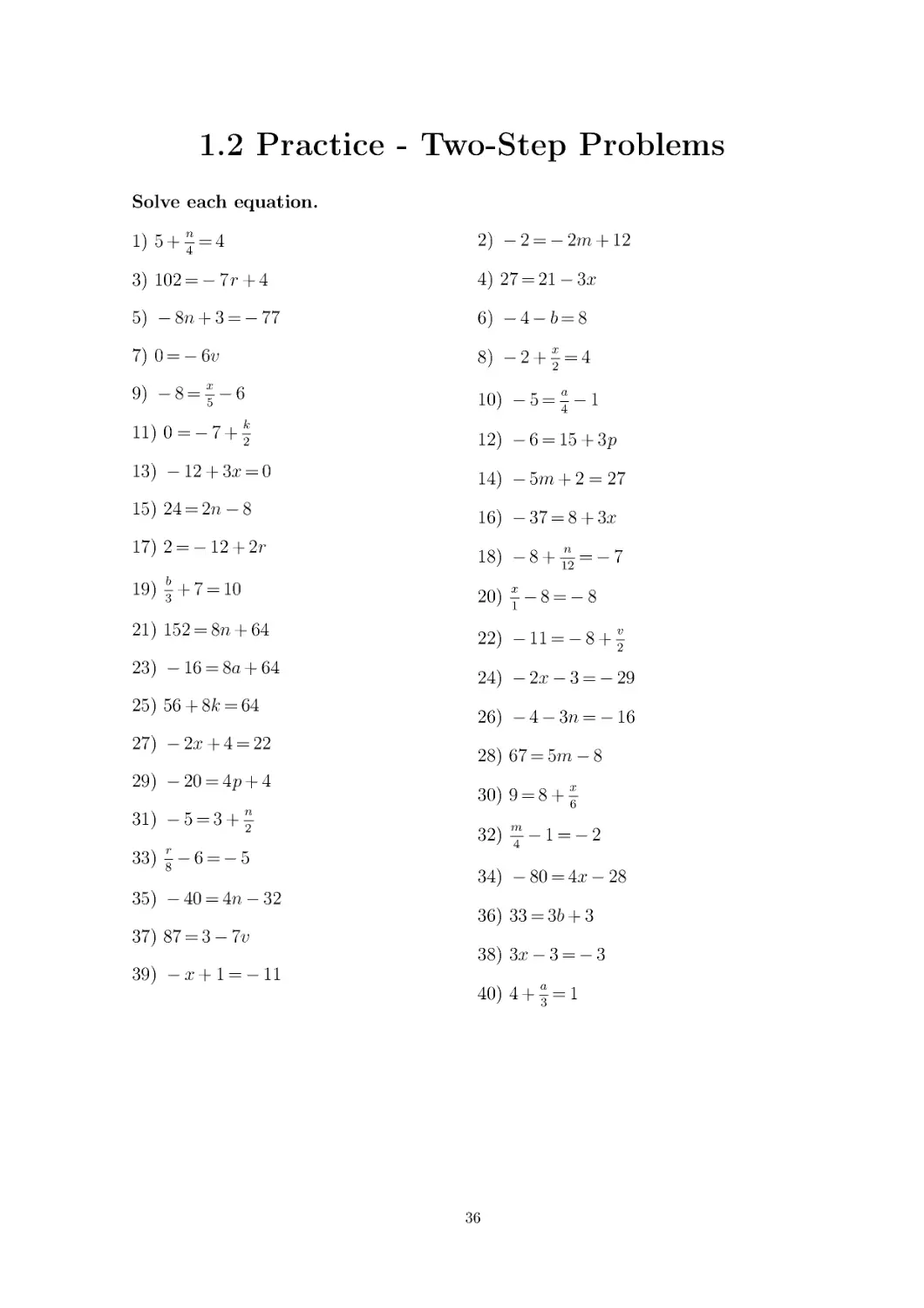
1.2 Practice - Two-Step Problems
Solve each equation.
1)5+n
4
=4
3)102= − 7r+4
5) −8n+3= − 77
7)0=−6v
9)−8=
x
5
−
6
11)0=−7+k
2
13) −12+3x=0
15)24=2n−8
17)2=−12+2r
19) b
3
+7=10
21) 152=8n+64
23) −16=8a+64
25)56+8k=64
27) −2x+4=22
29) −20=4p+4
31)−5=3+n
2
33) r
8
−
6=−5
35)−40=4n−32
37)87=3 −7v
39)−x+1=−11
2)−2=−2m+12
4)27=21 −3x
6)−4 −b=8
8) −2+
x
2
=4
10)−5=
a
4
−
1
12) −6 =15+3p
14) −5m+2=27
16) −37 =8+3x
18) −8+ n
12
=−7
20) x
1
− 8=−8
22)−11=−8+v
2
24)−2x−3=−29
26) −4
−
3n=−16
28)67=5m−8
30)9=8+x
6
32) m
4
−
1=−2
34) −80=4x−28
36)33=3b+3
38)3x−3=−3
40)4+a
3=1
36
1.3
Solving Linear Equations - General Equations
Objective: Solve general linear equations with variables on both sides.
Often as we are solving linear equations we will need to do some work to set them
up into a form we are familiar with solving. This section will focus on manipu-
lating an equation we are asked to solve in such a way that we can use our pat-
tern for solving two-step equations to ultimately arrive at the solution.
One such issue that needs to be addressed is parenthesis. Often the parenthesis
can get in the way of solving an otherwise easy problem. As you might expect we
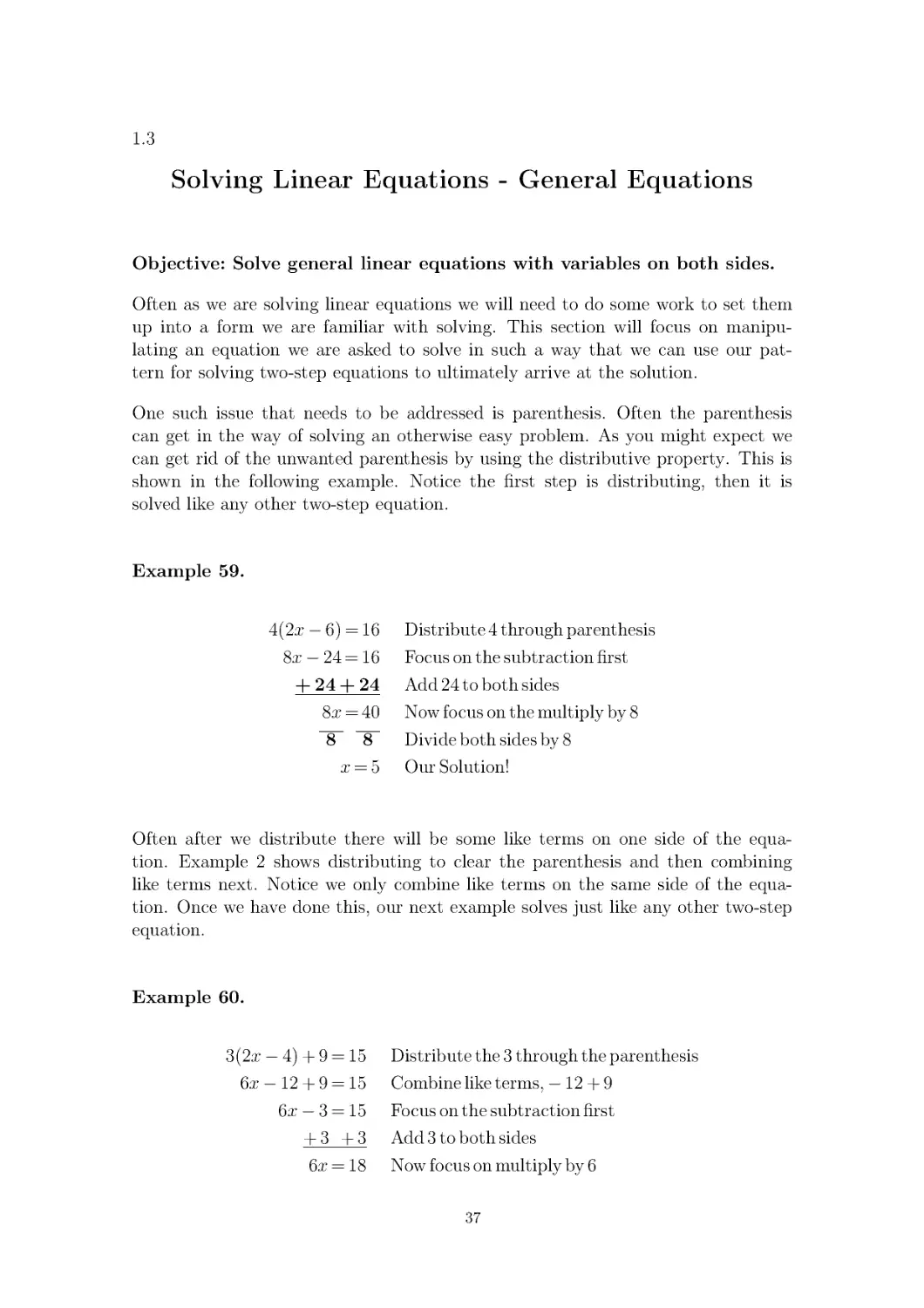
can get rid of the unwanted parenthesis by using the distributive property. This is
shown in the following example. Notice the first step is distributing, then it is
solved like any other two-step equation.
Example 59.
4(2x − 6) = 16 Distribute 4 through parenthesis
8x − 24 = 16 Focus on the subtraction first
+24+24 Add24tobothsides
8x = 40 Now focus on the multiply by 8
8 8 Divide both sides by 8
x = 5 Our Solution!
Often after we distribute there will be some like terms on one side of the equa-
tion. Example 2 shows distributing to clear the parenthesis and then combining
like terms next. Notice we only combine like terms on the same side of the equa-
tion. Once we have done this, our next example solves just like any other two-step
equation.
Example 60.
3(2x − 4) + 9 = 15 Distribute the 3 through the parenthesis
6x−12+9=15 Combineliketerms, −12 +9
6x − 3 = 15 Focus on the subtraction first
+3 +3 Add3tobothsides
6x = 18 Now focus on multiply by 6
37
6 6 Divide both sides by 6
x = 3 Our Solution
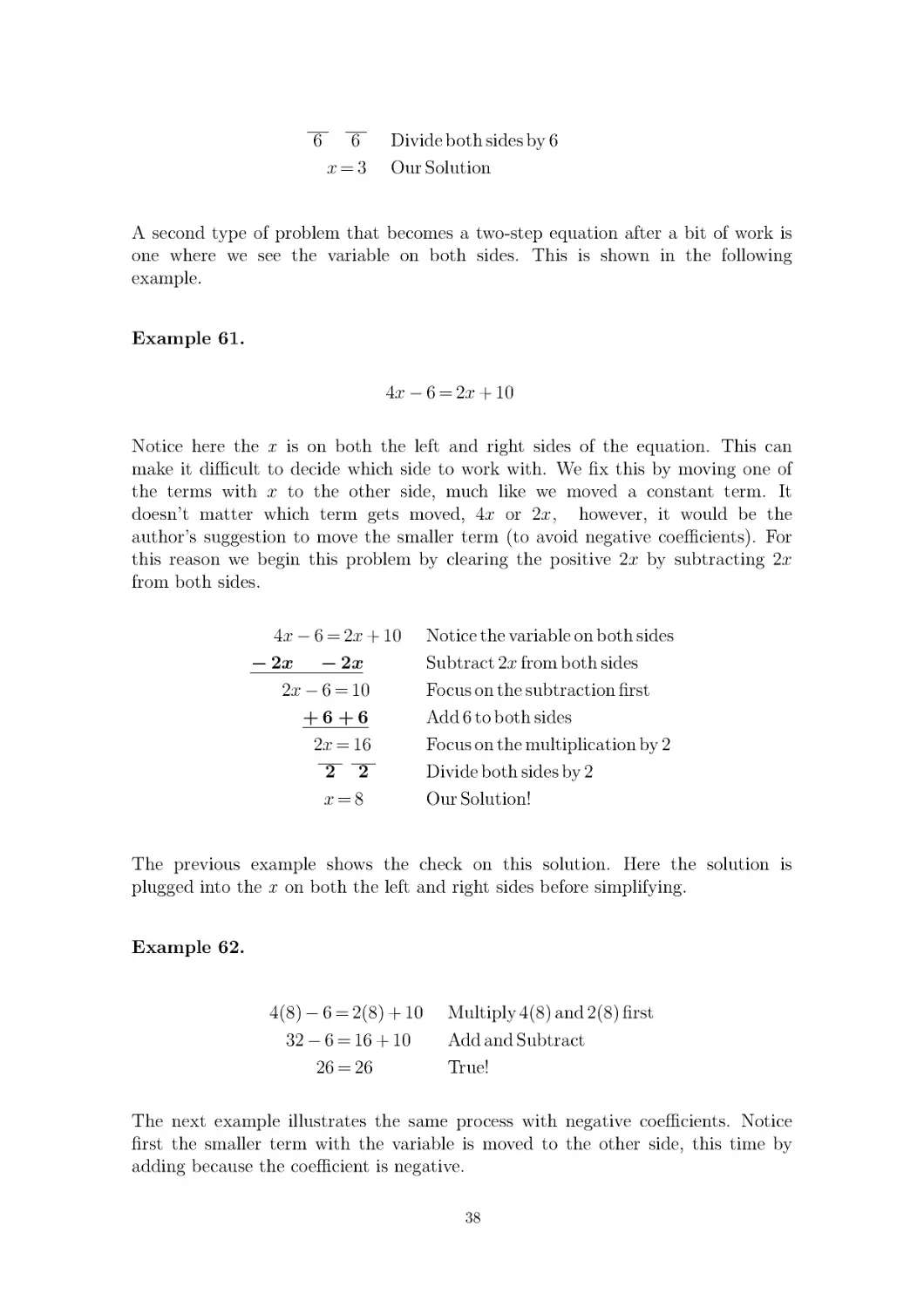
A second type of problem that becomes a two-step equation after a bit of work is
one where we see the variable on both sides. This is shown in the following
example.
Example 61.
4x−6 =2x+10
Notice here the x is on both the left and right sides of the equation. This can
make it difficult to decide which side to work with. We fix this by moving one of
the terms with x to the other side, much like we moved a constant term. It
doesn’t matter which term gets moved, 4x or 2x , however, it would be the
author’s suggestion to move the smaller term (to avoid negative coefficients). For
this reason we begin this problem by clearing the positive 2x by subtracting 2x
from both sides.
4x − 6 = 2x + 10 Notice the variable on both sides
−2x
−2x
Subtract 2x from both sides
2x−6=10
Focus on the subtraction first
+6+6
Add 6 to both sides
2x=16
Focus on the multiplication by 2
22
Divide both sides by 2
x=8
Our Solution!
The previous example shows the check on this solution. Here the solution is
plugged into the x on both the left and right sides before simplifying.
Example 62.
4(8) − 6 = 2(8) + 10 Multiply 4(8) and 2(8) first
32−6 =16+10 AddandSubtract
26=26
True!
The next example illustrates the same process with negative coefficients. Notice
first the smaller term with the variable is moved to the other side, this time by
adding because the coefficient is negative.
38
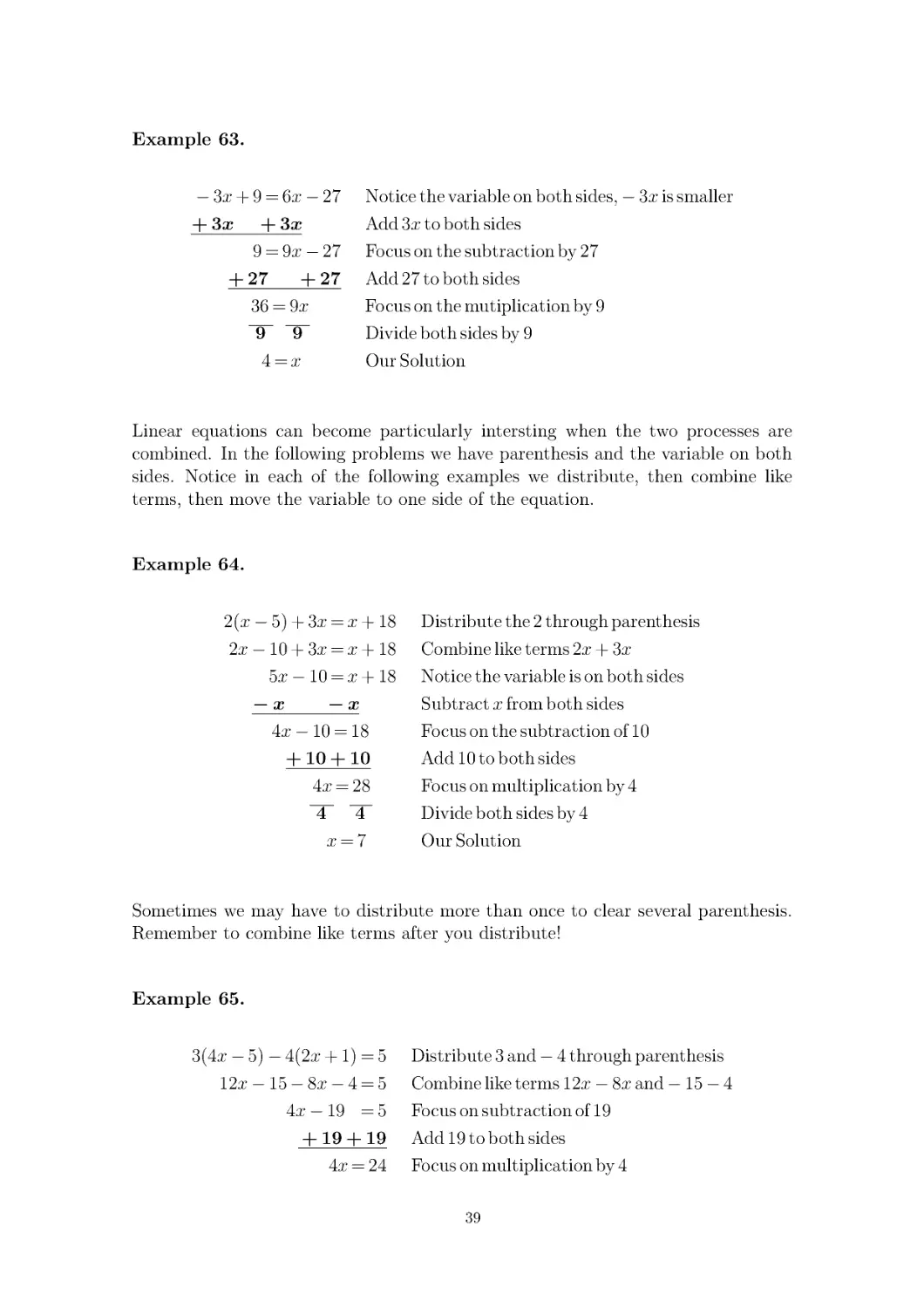
Example 63.
−
3x + 9 = 6x − 27 Notice the variable on both sides, − 3x is smaller
+3x +3x
Add 3x to both sides
9 = 9x − 27 Focus on the subtraction by 27
+27 +27 Add27tobothsides
36=9x
Focus on the mutiplication by 9
99
Divide both sides by 9
4=x
Our Solution
Linear equations can become particularly intersting when the two processes are
combined. In the following problems we have parenthesis and the variable on both
sides. Notice in each of the following examples we distribute, then combine like
terms, then move the variable to one side of the equation.
Example 64.
2(x − 5) + 3x = x + 18 Distribute the 2 through parenthesis
2x−10+3x=x+18 Combineliketerms2x+3x
5x − 10 = x + 18 Notice the variable is on both sides
−x
−x
Subtract x from both sides
4x−10=18
Focus on the subtraction of 10
+10+10
Add 10 to both sides
4x=28
Focus on multiplication by 4
44
Divide both sides by 4
x=7
Our Solution
Sometimes we may have to distribute more than once to clear several parenthesis.
Remember to combine like terms after you distribute!
Example 65.
3(4x − 5) − 4(2x + 1) = 5 Distribute 3 and − 4 through parenthesis
12x−15−8x−4 =5 Combineliketerms12x−8xand−15−4
4x − 19 = 5 Focus on subtraction of 19
+19+19 Add19tobothsides
4x = 24 Focus on multiplication by 4
39
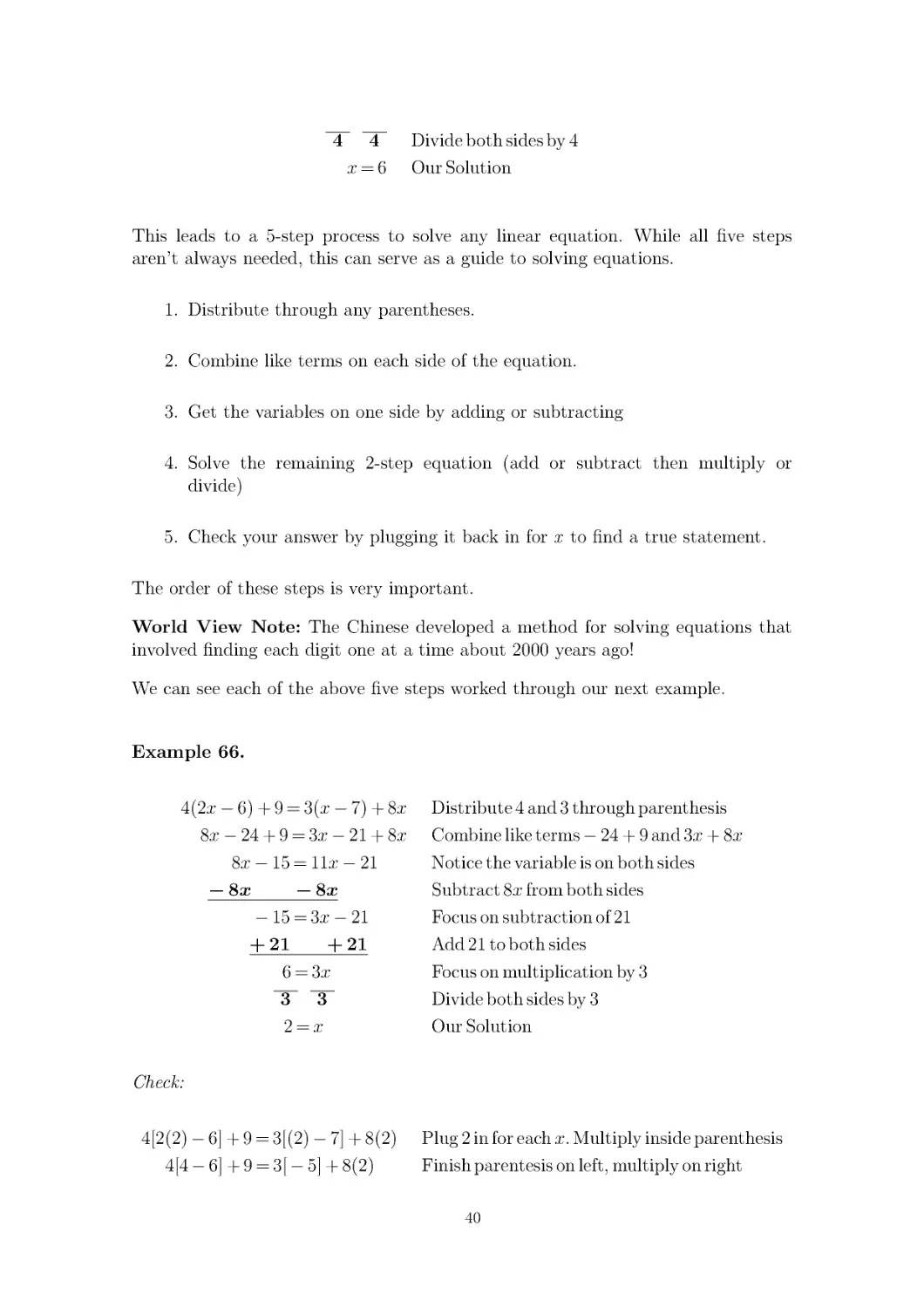
4 4 Divide both sides by 4
x = 6 Our Solution
This leads to a 5-step process to solve any linear equation. While all five steps
aren’t always needed, this can serve as a guide to solving equations.
1. Distribute through any parentheses.
2. Combine like terms on each side of the equation.
3. Get the variables on one side by adding or subtracting
4. Solve the remaining 2-step equation (add or subtract then multiply or
divide)
5. Check your answer by plugging it back in for x to find a true statement.
The order of these steps is very important.
World View Note: The Chinese developed a method for solving equations that
involved finding each digit one at a time about 2000 years ago!
We can see each of the above five steps worked through our next example.
Example 66.
4(2x − 6) + 9 = 3(x − 7) + 8x Distribute 4 and 3 through parenthesis
8x−24+9=3x−21+8x Combineliketerms−24+9and3x+8x
8x−15=11x−21
Notice the variable is on both sides
−8x
−8x
Subtract 8x from both sides
−
15=3x−21
Focus on subtraction of 21
+21 +21
Add 21 to both sides
6=3x
Focus on multiplication by 3
33
Divide both sides by 3
2=x
Our Solution
Check:
4[2(2) − 6] + 9 = 3[(2) − 7] + 8(2) Plug 2 in for each x. Multiply inside parenthesis
4[4−6]+9=3[−5]+8(2)
Finish parentesis on left, multiply on right
40
4[−2]+9= − 15+8(2)
Finish multiplication on both sides
−
8+9= − 15+16
Add
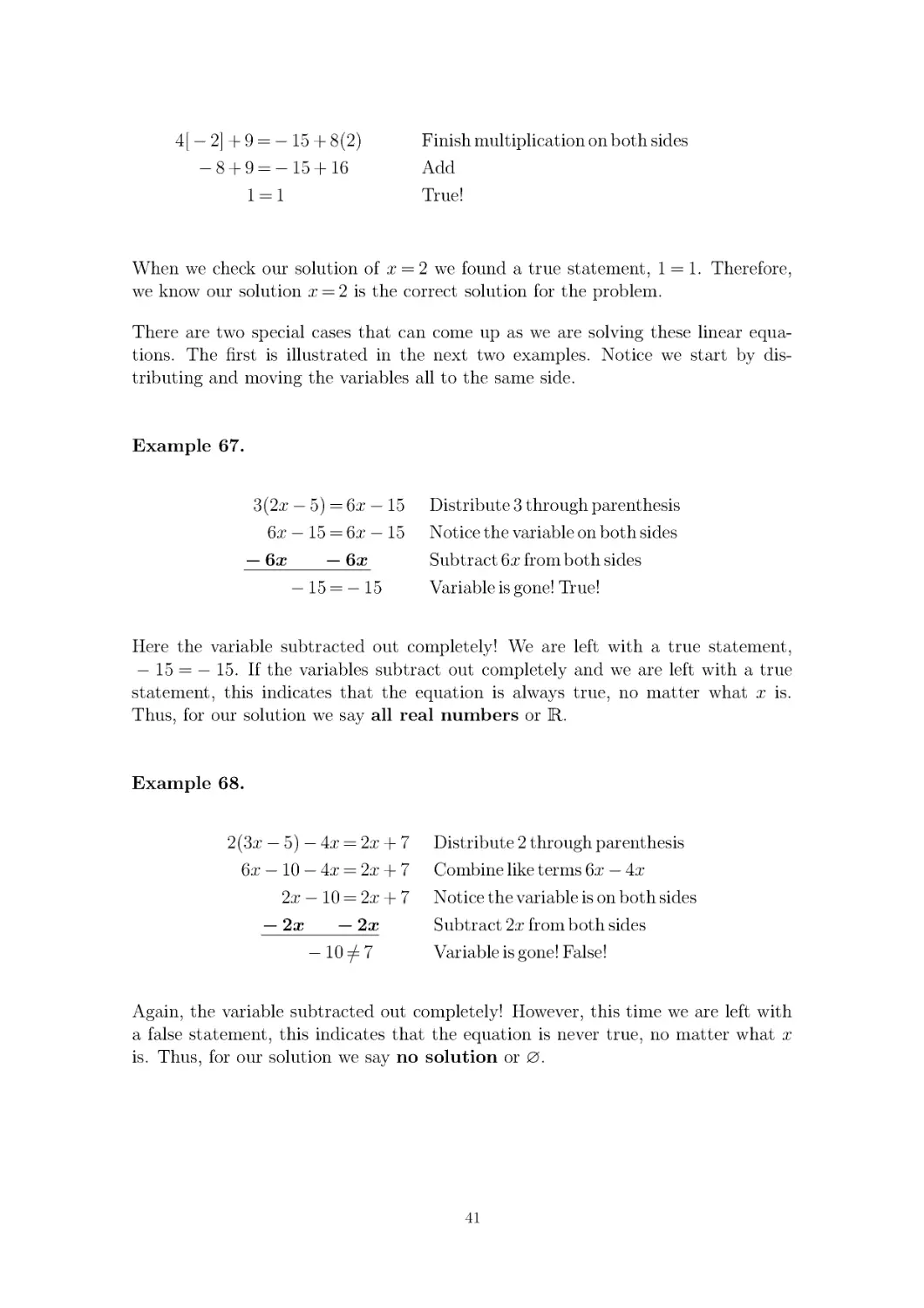
1=1
True!
When we check our solution of x = 2 we found a true statement, 1 = 1. Therefore,
we know our solution x = 2 is the correct solution for the problem.
There are two special cases that can come up as we are solving these linear equa-
tions. The first is illustrated in the next two examples. Notice we start by dis-
tributing and moving the variables all to the same side.
Example 67.
3(2x − 5) = 6x − 15 Distribute 3 through parenthesis
6x − 15 = 6x − 15 Notice the variable on both sides
−6x
−6x
Subtract 6x from both sides
−
15=−15
Variable is gone! True!
Here the variable subtracted out completely! We are left with a true statement,
−
15 = − 15. If the variables subtract out completely and we are left with a true
statement, this indicates that the equation is always true, no matter what x is.
Thus, for our solution we say all real numbers or R.
Example 68.
2(3x − 5) − 4x = 2x + 7 Distribute 2 through parenthesis
6x−10−4x=2x+7 Combineliketerms6x−4x
2x − 10 = 2x + 7 Notice the variable is on both sides
−2x
−2x
Subtract 2x from both sides
−
107
Variable is gone! False!
Again, the variable subtracted out completely! However, this time we are left with
a false statement, this indicates that the equation is never true, no matter what x
is. Thus, for our solution we say no solution or ∅.
41
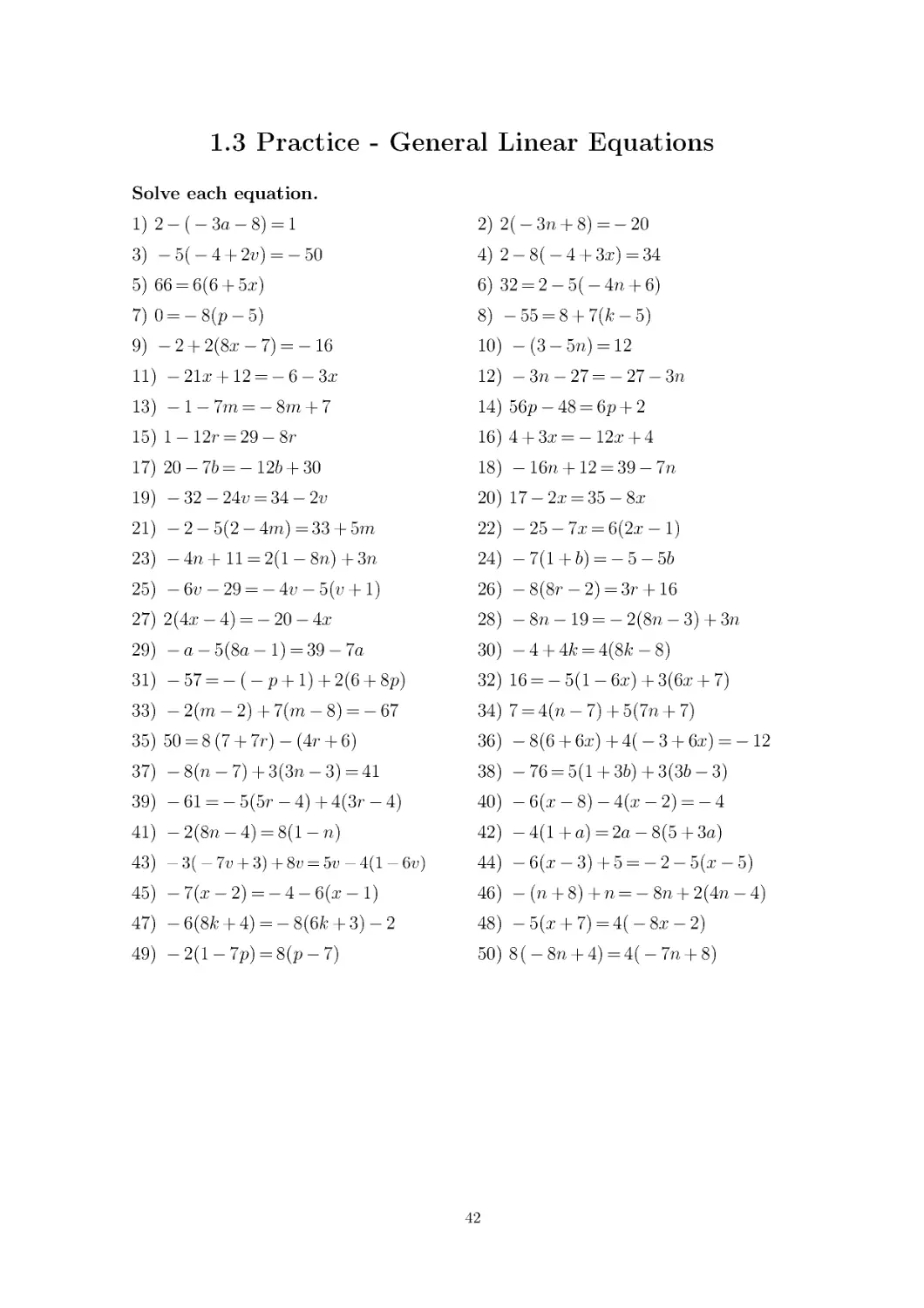
1.3 Practice - General Linear Equations
Solve each equation.
1)2−(
−
3a−8)=1
3) −5(−4+2v)= − 50
5) 66=6(6+5x)
7)0= − 8(p−5)
9) −2+2(8x−7)= − 16
11) −21x+12= − 6
−
3x
13)−1 −7m=−8m+7
15)1−12r=29−8r
17)20−7b = − 12b+30
19) −32−24v=34−2v
21) −2 −5(2−4m)=33+5m
23) −4n+11=2(1−8n)+3n
25)−6v−29=−4v−5(v+1)
27)2(4x−4)= − 20−4x
29)−a
−
5(8a−1)=39−7a
31)−57=−(
−
p+1)+2(6+8p)
33)−2(m−2)+7(m−8)=−67
35)50=8(7+7r)−(4r+6)
37) −8(n−7)+3(3n−3)=41
39) −61= − 5(5r−4)+4(3r−4)
41) −2(8n−4)=8(1−n)
43) −3(−7v+3)+8v=5v −4(1−6v)
45)−7(x−2)=−4
−
6(x−1)
47) −6(8k+4)= − 8(6k+3)−2
49) −2(1−7p)=8(p−7)
2)2(−3n+8)= − 20
4) 2−8(−4+3x)=34
6)32=2 −5(−4n+6)
8) −55 =8+7(k−5)
10) −(3−5n)=12
12) −3n−27= − 27−3n
14)56p−48=6p+2
16)4+3x= − 12x+4
18) −16n+12=39−7n
20)17−2x=35 −8x
22) −25−7x=6(2x−1)
24) −7(1+b)= − 5
−
5b
26) −8(8r−2)=3r+16
28)−8n−19= −2(8n−3)+3n
30) −4+4k=4(8k−8)
32)16= − 5(1−6x)+3(6x+7)
34)7=4(n−7)+5(7n+7)
36) −8(6+6x)+4(−3+6x)= − 12
38) −76=5(1+3b)+3(3b−3)
40)−6(x−8)−4(x−2)=−4
42) −4(1+a)=2a−8(5+3a)
44)−6(x−3)+5=−2 −5(x−5)
46) −(n+8)+n= − 8n+2(4n−4)
48) −5(x+7)=4(−8x−2)
50)8(−8n+4)=4(−7n+8)
42
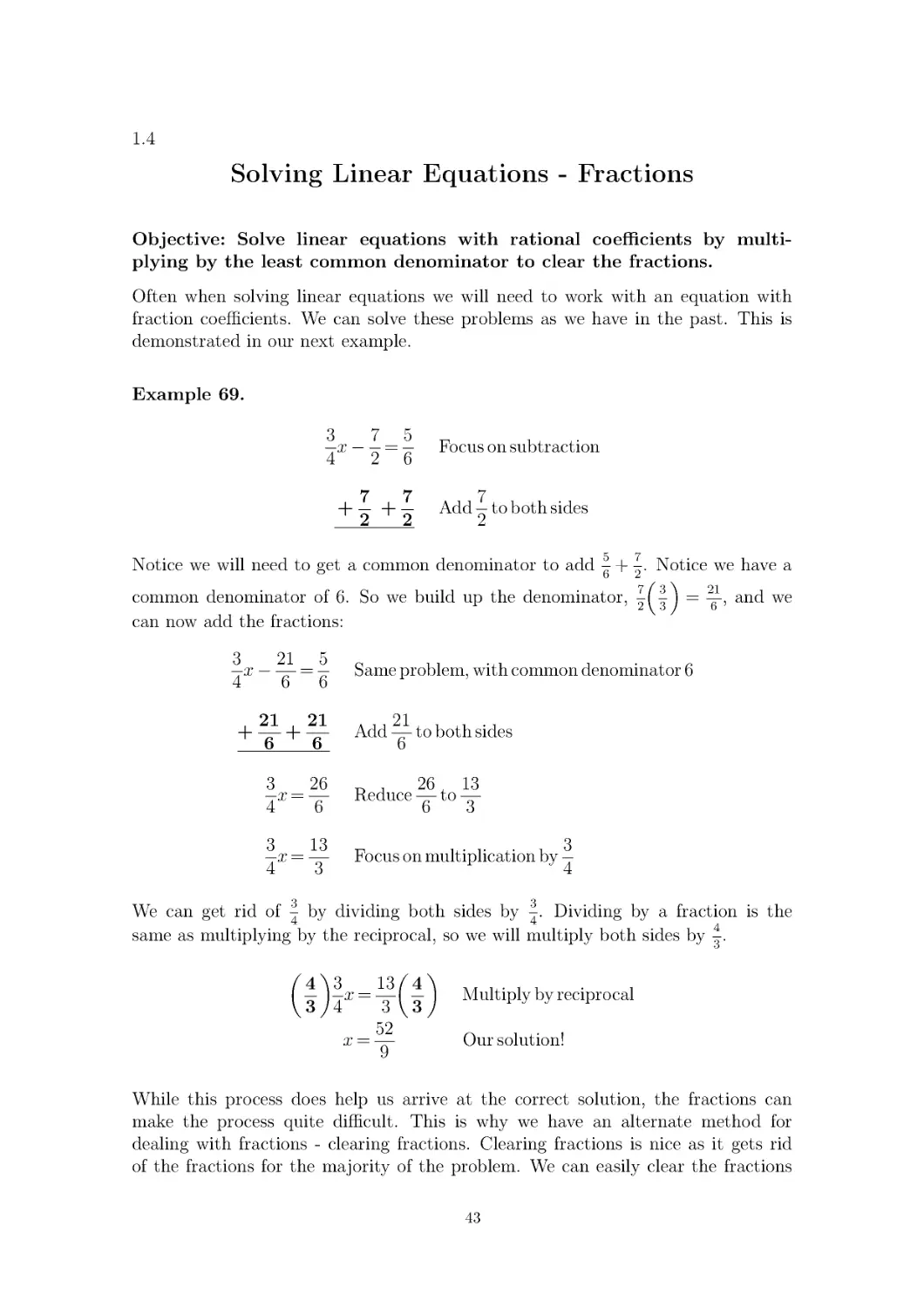
1.4
Solving Linear Equations - Fractions
Objective: Solve linear equations with rational co efficients by multi-
plying by the least common denominator to clear the fractions.
Often when solving linear equations we will need to work with an equation with
fraction coefficients. We can solve these problems as we have in the past. This is
demonstrated in our next example.
Example 69.
3
4
x−
7
2
=
5
6
Focus on subtraction
+7
2
+7
2
Add
7
2
to both sides
Notice we will need to get a common denominator to add
5
6
+7
2
.
Notice we have a
common denominator of 6. So we build up the denominator,
7
2
33
=
21
6
,andwe
can now add the fractions:
3
4
x−
21
6
=
5
6
Same problem, with common denominator 6
+21
6
+21
6
Add
21
6
to both sides
3
4
x=
26
6
Reduce
26
6
to
13
3
3
4
x=
13
3
Focus on multiplication by
3
4
We can get rid of
3
4
by dividing both sides by
3
4
.
Dividing by a fraction is the
same as multiplying by the reciprocal, so we will multiply both sides by 4
3
.
4
3
34
x=
13
3
4
3
Multiply by reciprocal
x=
52
9
Our solution!
While this process does help us arrive at the correct solution, the fractions can
make the process quite difficult. This is why we have an alternate method for
dealing with fractions - clearing fractions. Clearing fractions is nice as it gets rid
of the fractions for the ma jority of the problem. We can easily clear the fractions
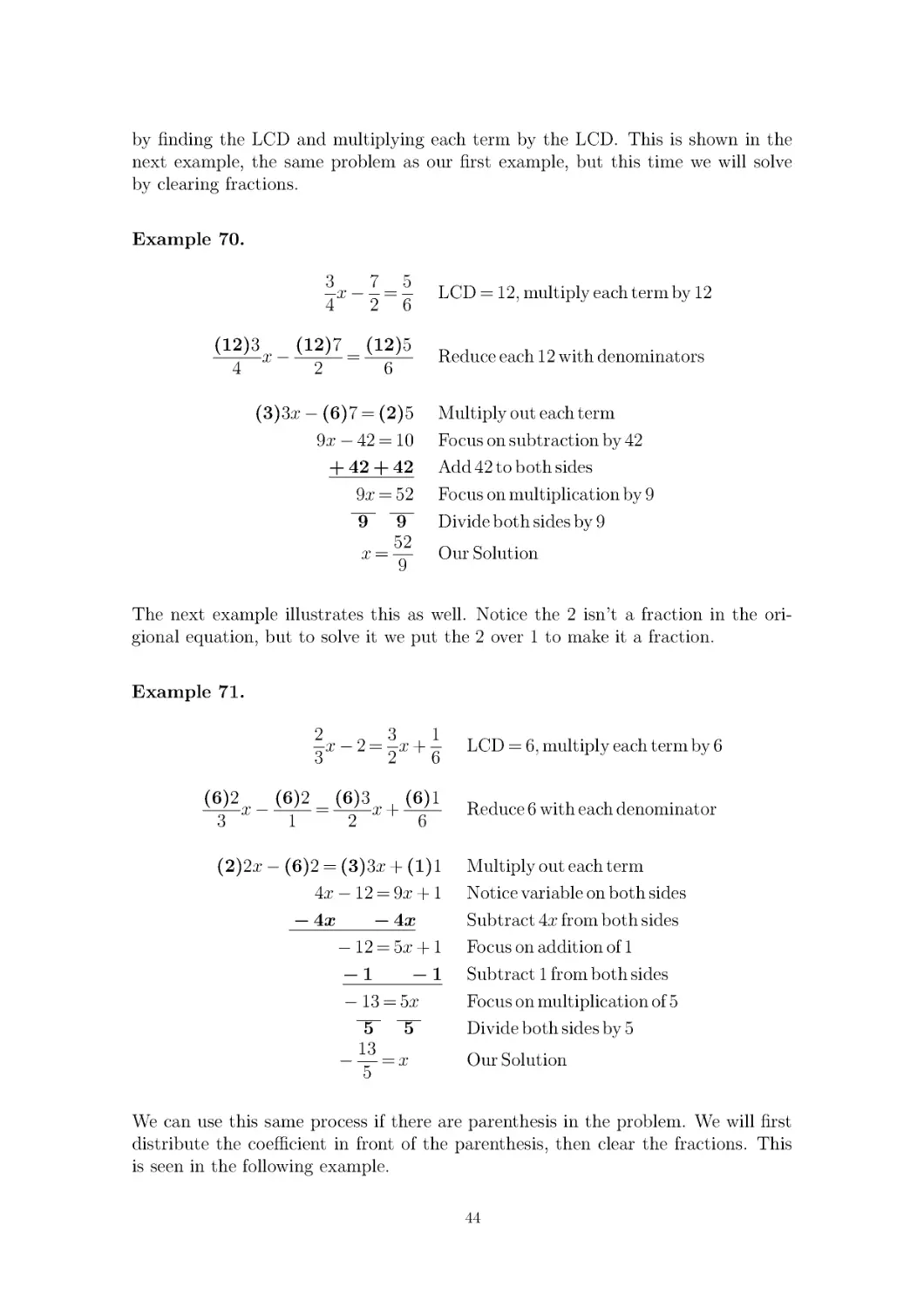
43
by finding the LCD and multiplying each term by the LCD. This is shown in the
next example, the same problem as our first example, but this time we will solve
by clearing fractions.
Example 70.
3
4
x−
7
2
=
5
6
LCD = 12, multiply each term by 12
(12)3
4
x−
(12)7
2
=
(12)5
6
Reduce each 12 with denominators
(3)3x − (6)7 = (2)5 Multiply out each term
9x − 42 = 10 Focus on subtraction by 42
+42+42 Add42tobothsides
9x = 52 Focus on multiplication by 9
9 9 Divide both sides by 9
x=
52
9
Our Solution
The next example illustrates this as well. Notice the 2 isn’t a fraction in the ori-
gional equation, but to solve it we put the 2 over 1 to make it a fraction.
Example 71.
2
3
x−2=
3
2
x+
1
6
LCD = 6, multiply each term by 6
(6)2
3
x−
(6)2
1
=
(6)3
2
x+
(6)1
6
Reduce 6 with each denominator
(2)2x − (6)2 = (3)3x + (1)1 Multiply out each term
4x − 12 = 9x + 1 Notice variable on both sides
−4x
−4x
Subtract 4x from both sides
−
12=5x+1 Focusonadditionof1
−1
− 1 Subtract 1 from both sides
−
13=5x
Focus on multiplication of 5
55
Divide both sides by 5
−
13
5
=x
Our Solution
We can use this same process if there are parenthesis in the problem. We will first
distribute the coefficient in front of the parenthesis, then clear the fractions. This
is seen in the following example.
44
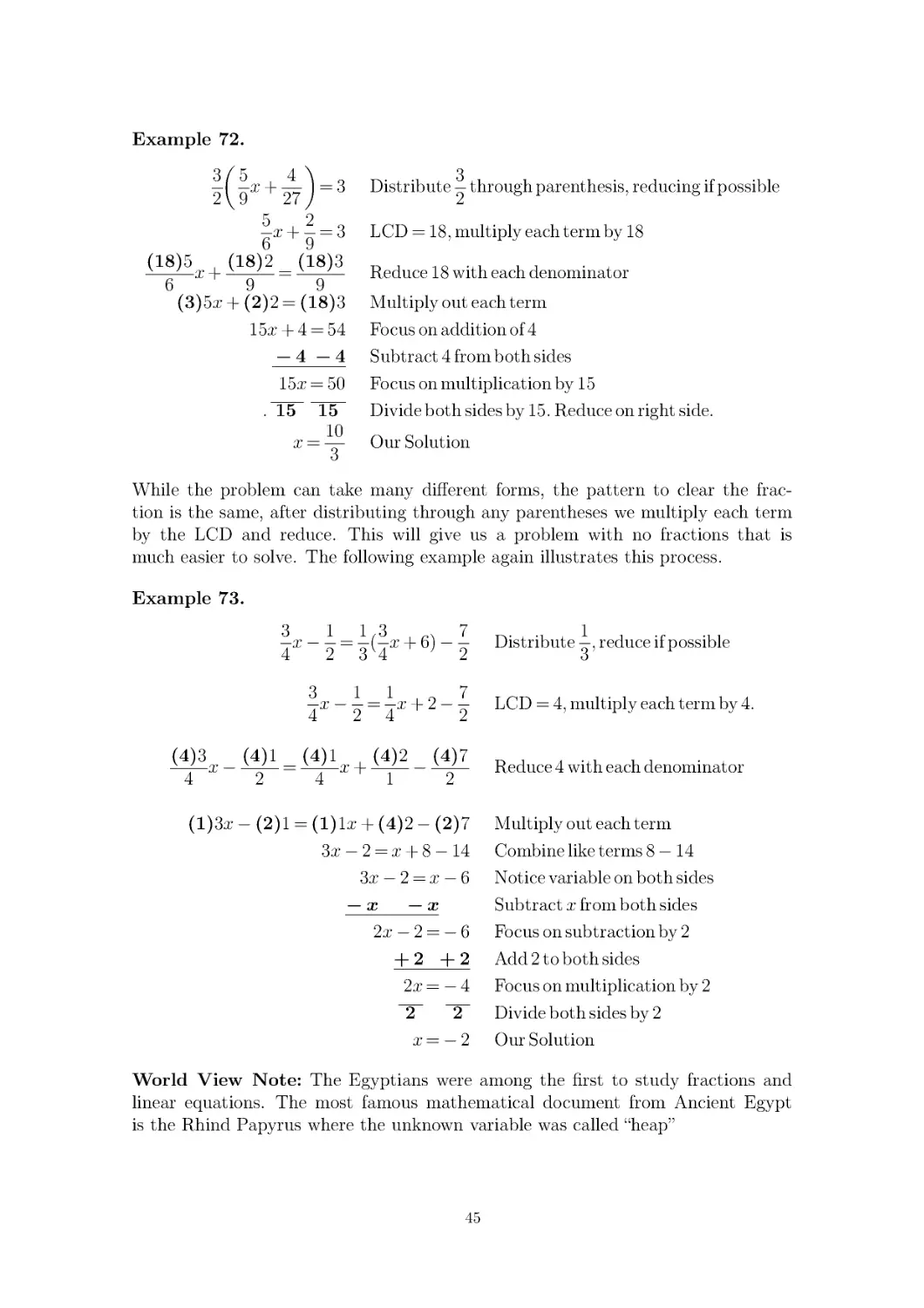
Example 72.
3
2
59
x+
4
27
= 3 Distribute
3
2
through parenthesis, reducing if possible
5
6
x+
2
9
=3
LCD = 18, multiply each term by 18
(18)5
6
x+
(18)2
9
=
(18)3
9
Reduce 18 with each denominator
(3)5x + (2)2 = (18)3 Multiply out each term
15x+4=54 Focusonadditionof4
−4
− 4 Subtract 4 from both sides
15x = 50 Focus on multiplication by 15
.
15 15 Divide both sides by 15. Reduce on right side.
x=
10
3
Our Solution
While the problem can take many different forms, the pattern to clear the frac-
tion is the same, after distributing through any parentheses we multiply each term
by the LCD and reduce. This will give us a problem with no fractions that is
much easier to solve. The following example again illustrates this process.
Example 73.
3
4
x−
1
2
=
1
3
(3
4
x+6)−
7
2
Distribute
1
3
, reduce if possible
3
4
x−
1
2
=
1
4
x+2−
7
2
LCD = 4, multiply each term by 4.
(4)3
4
x−
(4)1
2
=
(4)1
4
x+
(4)2
1
−
(4)7
2
Reduce 4 with each denominator
(1)3x − (2)1 = (1)1x + (4)2 − (2)7 Multiply out each term
3x−2 =x+8−14 Combineliketerms8−14
3x−2 =x −6 Noticevariableonbothsides
−x
−x
Subtract x from both sides
2x−2=−6
Focus on subtraction by 2
+2 +2 Add2tobothsides
2x=−4
Focus on multiplication by 2
2 2 Divide both sides by 2
x= − 2 OurSolution
World View Note: The Egyptians were among the first to study fractions and
linear equations. The most famous mathematical document from Ancient Egypt
is the Rhind Papyrus where the unknown variable was called “heap”
45
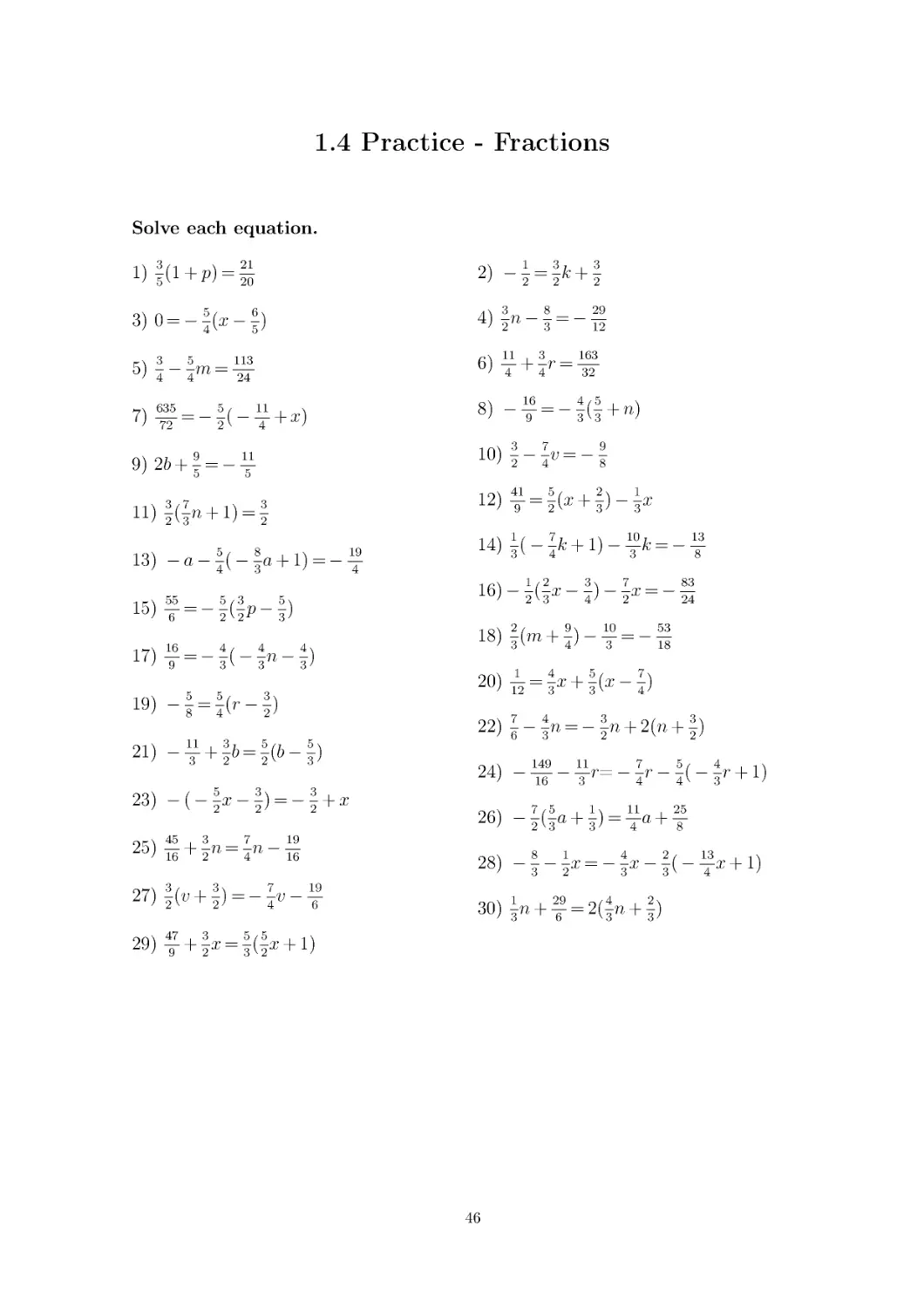
1.4 Practice - Fractions
Solve each equation.
1)3
5
(1+p)=
21
20
3)0=−
5
4
(x−
6
5
)
5)3
4
−
5
4
m=
113
24
7) 635
72
=−
5
2
(−
11
4
+x)
9)2b+9
5
=−
11
5
11) 3
2
(7
3n+1)=
3
2
13)−a
−
5
4
(−
8
3
a+1)=−
19
4
15) 55
6
=−
5
2
(3
2
p−
5
3
)
17) 16
9
=−
4
3
(−
4
3
n−
4
3
)
19) −
5
8
=
5
4
(r−
3
2
)
21) −
11
3
+3
2
b=
5
2
(b−
5
3
)
23) −(
−
5
2
x−
3
2
)=−
3
2
+x
25) 45
16
+3
2
n=
7
4
n−
19
16
27) 3
2
(v+
3
2
)=−
7
4
v−
19
6
29) 47
9+
3
2
x=
5
3(
5
2
x+1)
2)−
1
2
=
3
2
k+3
2
4)3
2
n−
8
3
=−
29
12
6) 11
4
+3
4
r=
163
32
8)−
16
9
=−
4
3
(5
3
+n)
10) 3
2
−
7
4
v=−
9
8
12) 41
9=
5
2
(x+
2
3)−
1
3x
14) 1
3
(−
7
4
k+1)−
10
3
k=−
13
8
16) −
1
2
(2
3
x−
3
4
)−
7
2
x=−
83
24
18) 2
3
(m+
9
4
)−
10
3
=−
53
18
20) 1
12
=
4
3
x+
5
3
(x−
7
4
)
22) 7
6
−
4
3
n=−
3
2
n+2(n+
3
2
)
24) −
149
16
−
11
3
r=−
7
4
r−
5
4
(−
4
3
r+1)
26) −
7
2
(5
3
a+
1
3
)=
11
4
a+
25
8
28) −
8
3
−
1
2
x=−
4
3
x−
2
3
(−
13
4
x+1)
30) 1
3n+
29
6 =2(4
3n+
2
3)
46
1.5
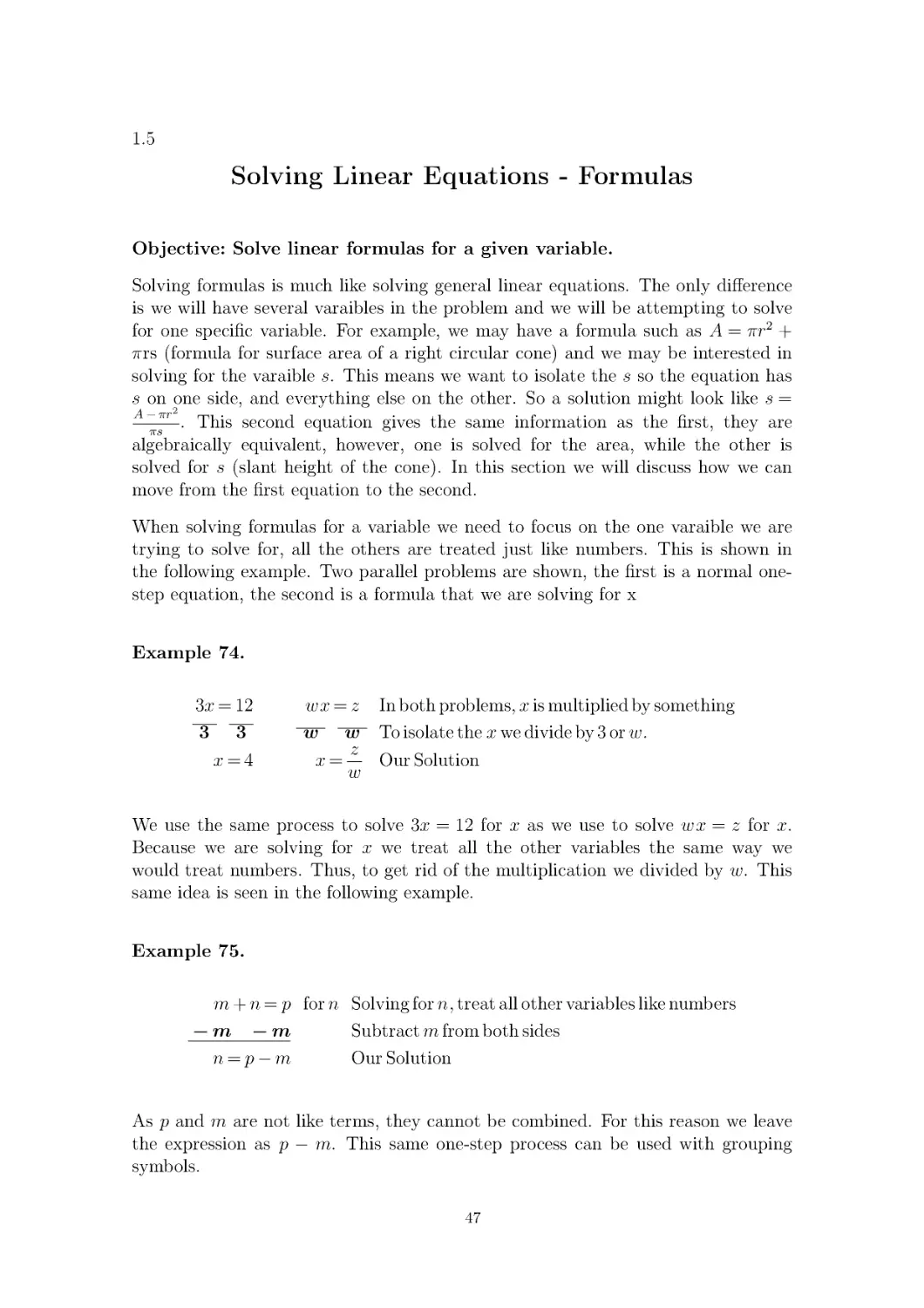
Solving Linear Equations - Formulas
Objective: Solve linear formulas for a given variable.
Solving formulas is much like solving general linear equations. The only difference
is we will have several varaibles in the problem and we will be attempting to solve
for one specific variable. For example, we may have a formula such as A = πr
2+
π rs (formula for surface area of a right circular cone) and we may be interested in
solving for the varaible s. This means we want to isolate the s so the equation has
s on one side, and everything else on the other. So a solution might look like s =
A−πr2
πs
.
This second equation gives the same information as the first, they are
algebraically equivalent, however, one is solved for the area, while the other is
solved for s (slant height of the cone). In this section we will discuss how we can
move from the first equation to the second.
When solving formulas for a variable we need to focus on the one varaible we are
trying to solve for, all the others are treated just like numbers. This is shown in
the following example. Two parallel problems are shown, the first is a normal one-
step equation, the second is a formula that we are solving for x
Example 74.
3x=12
w x = z In both problems, x is multiplied by something
33
w w Toisolatethe xwedivideby3orw.
x=4
x=
z
w
Our Solution
Weusethesameprocesstosolve3x=12forxasweusetosolvewx=zforx.
Because we are solving for x we treat all the other variables the same way we
would treat numbers. Thus, to get rid of the multiplication we divided by w. This
same idea is seen in the following example.
Example 75.
m + n = p for n Solving for n, treat all other variables like numbers
−m
−m
Subtract m from both sides
n=p−m
Our Solution
As p and m are not like terms, they cannot be combined. For this reason we leave
the expression as p − m. This same one-step process can be used with grouping
symbols.
47
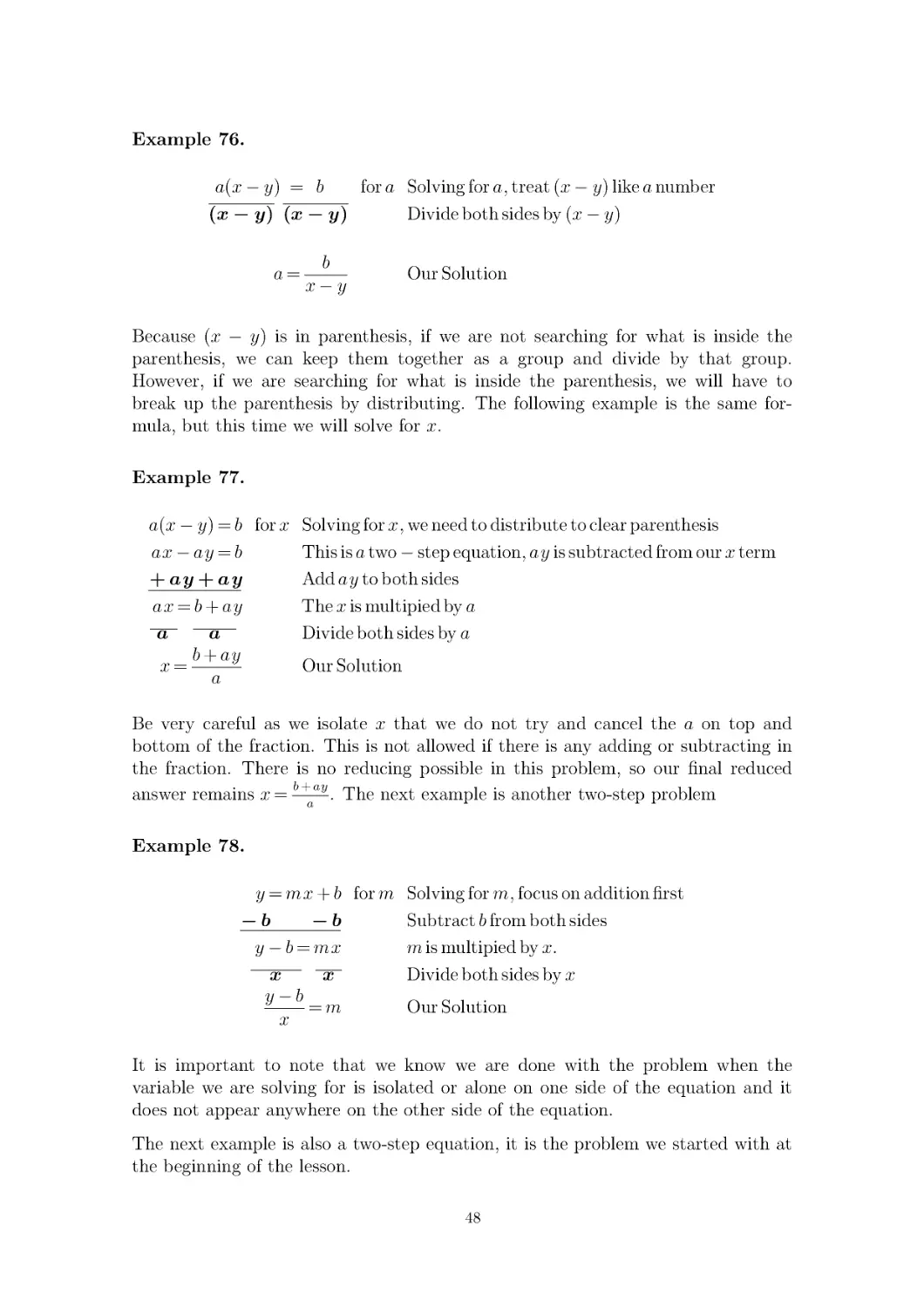
Example 76.
a(x−y) = b fora Solvingfora,treat(x−y)likeanumber
(x−y)(x−y)
Divide both sides by (x − y)
a=
b
x−y
Our Solution
Because (x − y) is in parenthesis, if we are not searching for what is inside the
parenthesis, we can keep them together as a group and divide by that group.
However, if we are searching for what is inside the parenthesis, we will have to
break up the parenthesis by distributing. The following example is the same for-
mula, but this time we will solve for x.
Example 77.
a(x − y) = b for x Solving for x , we need to distribute to clear parenthesis
ax−ay=b
This is a two − step equation, a y is subtracted from our x term
+ay+ay
Add ay to both sides
ax=b+ay
The x is multipied by a
a
a
Divide both sides by a
x=
b+ay
a
Our Solution
Be very careful as we isolate x that we do not try and cancel the a on top and
bottom of the fraction. This is not allowed if there is any adding or subtracting in
the fraction. There is no reducing possible in this problem, so our final reduced
answer remains x =
b+ay
a
.
The next example is another two-step problem
Example 78.
y=mx+b form Solvingform,focusonadditionfirst
−b
−b
Subtract b from both sides
y−b=mx
m is multipied by x.
x
x
Divide both sides by x
y−b
x
=m
Our Solution
It is important to note that we know we are done with the problem when the
variable we are solving for is isolated or alone on one side of the equation and it
does not appear anywhere on the other side of the equation.
The next example is also a two-step equation, it is the problem we started with at
the beginning of the lesson.
48
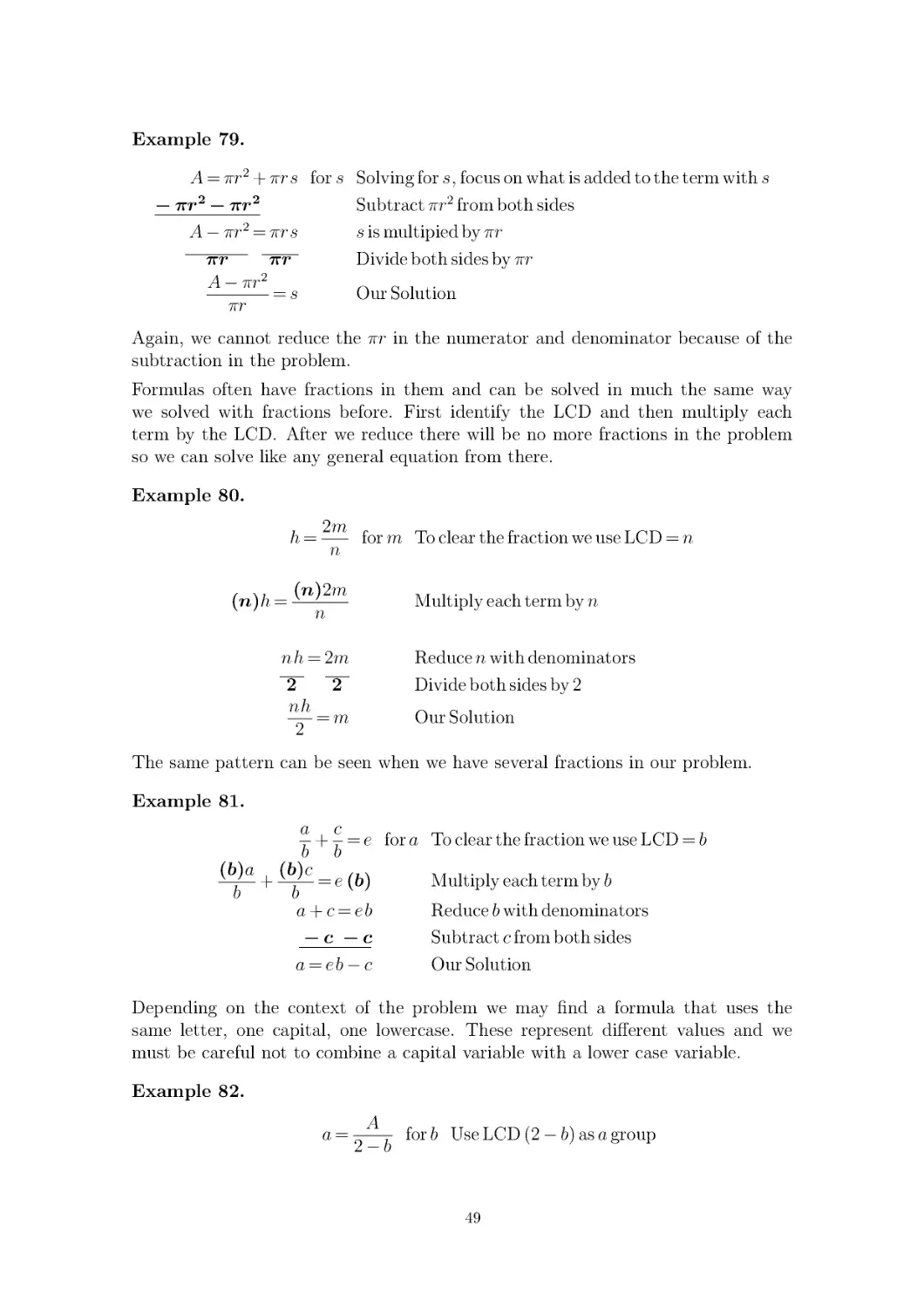
Example 79.
A=πr
2+πrs fors Solvingfors, focusonwhatisaddedtothetermwiths
−πr
2
−πr
2
Subtract πr2 from both sides
A−πr
2=πrs
s is multipied by πr
πr
πr
Divide both sides by πr
A−πr
2
πr
=s
Our Solution
Again, we cannot reduce the πr in the numerator and denominator because of the
subtraction in the problem.
Formulas often have fractions in them and can be solved in much the same way
we solved with fractions before. First identify the LCD and then multiply each
term by the LCD. After we reduce there will be no more fractions in the problem
so we can solve like any general equation from there.
Example 80.
h=
2m
n
for m To clear the fraction we use LCD = n
(n)h =
(n)2m
n
Multiply each term by n
nh=2m
Reduce n with denominators
22
Divide both sides by 2
nh
2
=m
Our Solution
The same pattern can be seen when we have several fractions in our problem.
Example 81.
a
b
+
c
b
= e fora ToclearthefractionweuseLCD=b
(b)a
b
+
(b)c
b
=e(b)
Multiply each term by b
a+c=eb
Reduce b with denominators
−c
−c
Subtract c from both sides
a=eb−c
Our Solution
Dep ending on the context of the problem we may find a formula that uses the
same letter, one capital, one lowercase. These represent different values and we
must be careful not to combine a capital variable with a lower case variable.
Example 82.
a=
A
2−b
forb UseLCD(2−b)asagroup
49
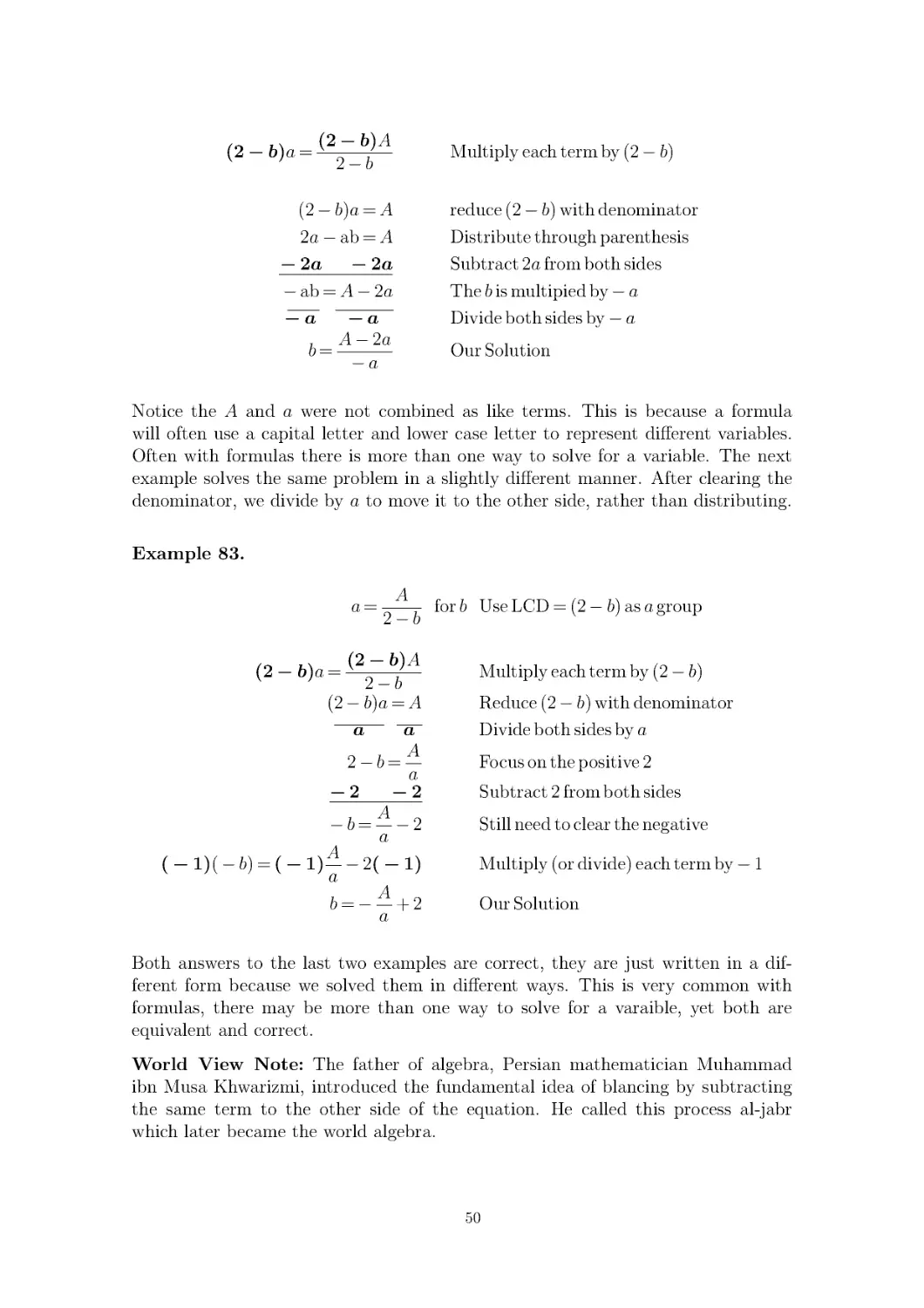
(2−b)a=
(2−b)A
2−b
Multiply each term by (2 − b)
(2−b)a=A
reduce (2 − b) with denominator
2a−ab=A
Distribute through parenthesis
−2a
−2a
Subtract 2a from both sides
− ab=A −2a
The b is multipied by − a
−a
−a
Divide both sides by − a
b=
A−2a
−
a
Our Solution
Notice the A and a were not combined as like terms. This is because a formula
will often use a capital letter and lower case letter to represent different variables.
Often with formulas there is more than one way to solve for a variable. The next
example solves the same problem in a slightly different manner. After clearing the
denominator, we divide by a to move it to the other side, rather than distributing.
Example 83.
a=
A
2−b
forb UseLCD=(2−b)asagroup
(2−b)a=
(2−b)A
2−b
Multiply each term by (2 − b)
(2−b)a=A
Reduce (2 − b) with denominator
a
a
Divide both sides by a
2−b =
A
a
Focus on the positive 2
−2
−2
Subtract 2 from both sides
−
b=
A
a
−
2
Still need to clear the negative
(−1)(−b)=( −1)
A
a
−
2(−1)
Multiply (or divide) each term by − 1
b=−
A
a
+2
Our Solution
Both answers to the last two examples are correct, they are just written in a dif-
ferent form because we solved them in different ways. This is very common with
formulas, there may be more than one way to solve for a varaible, yet both are
equivalent and correct.
World View Note: The father of algebra, Persian mathematician Muhammad
ibn Musa Khwarizmi, introduced the fundamental idea of blancing by subtracting
the same term to the other side of the equation. He called this process al-jabr
which later became the world algebra.
50
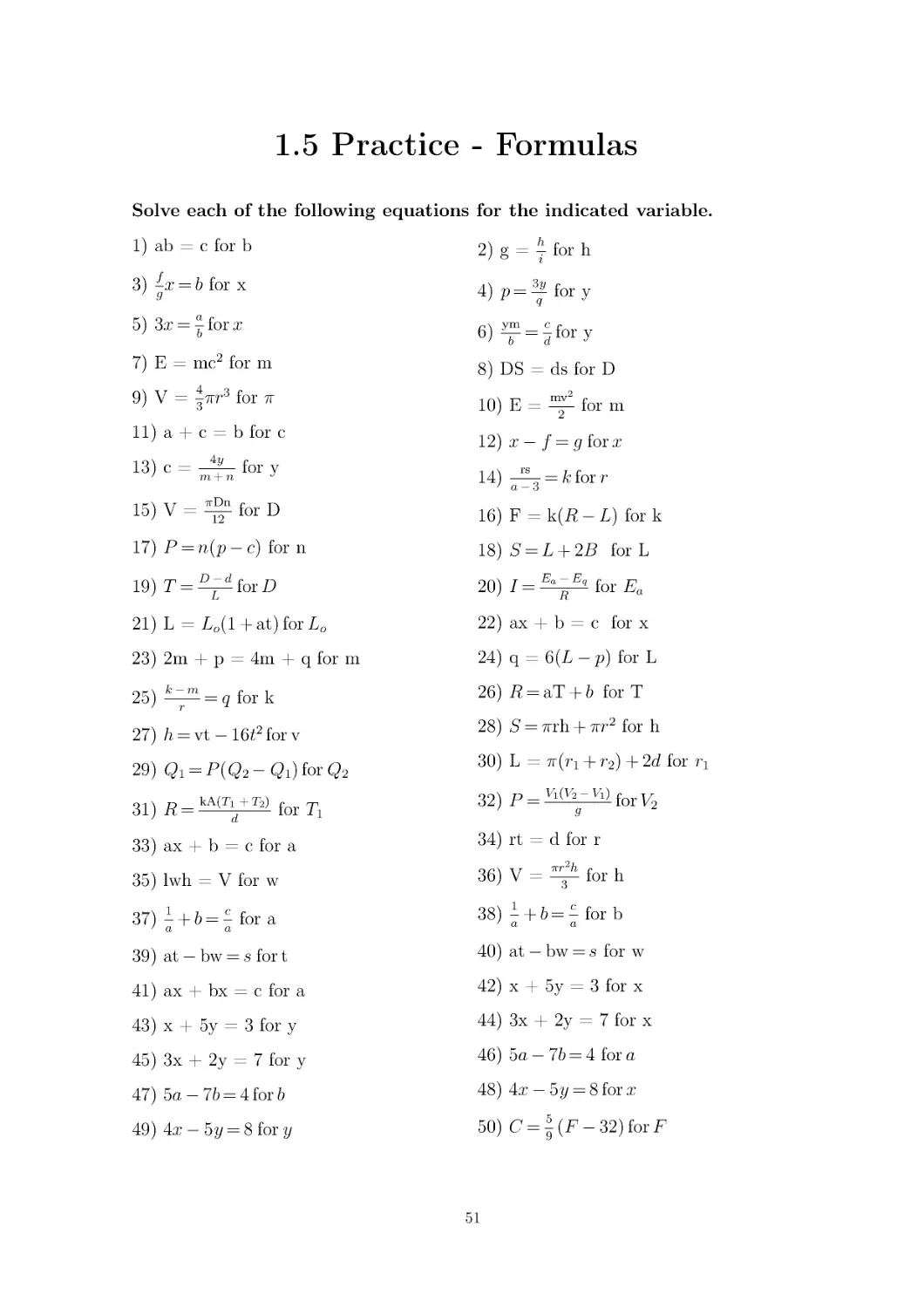
1.5 Practice - Formulas
Solve each of the following equations for the indicated variable.
1)ab=cforb
3)f
g
x=bforx
5)3x=
a
b
for x
7)E=mc2form
9)V=
4
3πr3 for π
11)a+c=bforc
13)c=
4y
m+n
for y
15)V=
πDn
12
for D
17)P=n(p−c)forn
19)T=
D−d
L
for D
21)L=Lo(1+at)forLo
23)2m+p=4m+qform
25)k−m
r
=qfork
27)h=vt−16t2forv
29)Q1=P(Q2− Q1)forQ2
31)R=
kA(T1 + T2)
d
for T1
33)ax+b=cfora
35)lwh=Vforw
37) 1
a
+b=
c
a
for a
39)at−bw=sfort
41)ax+bx=cfora
43)x+5y=3fory
45)3x+2y=7fory
47)5a−7b=4forb
49)4x−5y=8fory
2)g=
h
i
for h
4) p=
3y
q
for y
6) ym
b
=
c
d
for y
8)DS=dsforD
10)E=
mv2
2
for m
12)x−f =gforx
14) rs
a−3
=kforr
16)F=k(R−L)fork
18)S=L+2B for L
20)I=
Ea−Eq
R
for Ea
22)ax+b=c forx
24)q=6(L−p)forL
26)R=aT+b for T
28)S=πrh+πr2 for h
30)L= π(r1+r2)+2dfor r1
32)P=
V1(V2 − V1)
g
for V2
34)rt=dforr
36)V=
πr 2h
3
for h
38) 1
a
+b=
c
a
for b
40)at−bw=s for w
42)x+5y=3forx
44)3x+2y=7forx
46)5a−7b=4fora
48)4x−5y=8forx
50)C=
5
9
(F−32)forF
51
1.6
Solving Linear Equations - Absolute Value
Objective: Solve linear absolute value equations.
When solving equations with absolute value we can end up with more than one
possible answer. This is because what is in the absolute value can be either nega-
tive or positive and we must account for both possibilities when solving equations.
This is illustrated in the following example.
Example 84.
|x| = 7 Absolute value can be positive or negative
x=7 or x=−7 OurSolution
Notice that we have considered two possibilities, both the positive and negative.
Either way, the absolute value of our number will be positive 7.
World View Note: The first set of rules for working with negatives came from
7th century India. However, in 1758, almost a thousand years later, British math-
ematician Francis Maseres claimed that negatives “Darken the very whole doc-
trines of the equations and make dark of the things which are in their nature
excessively obvious and simple.”
When we have absolute values in our problem it is important to first isolate the
absolute value, then remove the absolute value by considering both the positive
and negative solutions. Notice in the next two examples, all the numbers outside
of the absolute value are moved to the other side first before we remove the abso-
lute value bars and consider both positive and negative solutions.
Example 85.
5 + |x| = 8 Notice absolute value is not alone
−5
− 5 Subtract 5 from both sides
|x| = 3 Absolute value can be positive or negative
x=3 or x=−3 OurSolution
Example 86.
−
4|x| = − 20 Notice absolute value is not alone
−4
− 4 Dividebothsidesby−4
52
|x|=5
Absolute value can be positive or negative
x=5 or x=−5 OurSolution
Notice we never combine what is inside the absolute value with what is outside
the absolute value. This is very important as it will often change the final result
to an incorrect solution. The next example requires two steps to isolate the abso-
lute value. The idea is the same as a two-step equation, add or subtract, then
multiply or divide.
Example 87.
5|x| − 4 = 26 Notice the absolute value is not alone
+4 +4 Add4tobothsides
5|x| = 30 Absolute value still not alone
5 5 Divide both sides by 5
|x| = 6 Absolute value can be positive or negative
x=6 or x=−6 OurSolution
Again we see the same process, get the absolute value alone first, then consider
the positive and negative solutions. Often the absolute value will have more than
just a variable in it. In this case we will have to solve the resulting equations
when we consider the positive and negative possibilities. This is shown in the next
example.
Example 88.
|2x − 1| = 7 Absolute value can be positive or negative
2x−1 =7 or 2x−1= − 7 Twoequationstosolve
Now notice we have two equations to solve, each equation will give us a different
solution. Both equations solve like any other two-step equation.
2x−1=7
+1+1
2x=8
22
x=4
or
2x−1=−7
+1 +1
2x=−6
22
x=−3
53
Thus, from our previous example we have two solutions, x = 4 or x = − 3.
Again, it is important to remember that the absolute value must be alone first
before we consider the positive and negative possibilities. This is illustrated in
below.
Example 89.
2−4|2x+3|= − 18
To get the absolute value alone we first need to get rid of the 2 by subtracting,
then divide by − 4. Notice we cannot combine the 2 and − 4 becuase they are
not like terms, the − 4 has the absolute value connected to it. Also notice we do
not distribute the − 4 into the absolute value. This is because the numbers out-
side cannot be combined with the numbers inside the absolute value. Thus we get
the absolute value alone in the following way:
2 − 4|2x + 3| = − 18 Notice absolute value is not alone
−2
− 2 Subtract 2 from both sides
−
4|2x + 3| = − 20 Absolute value still not alone
−4
− 4 Dividebothsidesby−4
|2x+3|=5
Absoloute value can be positive or negative
2x+3=5 or 2x+3= − 5
Two equations to solve
Now we just solve these two remaining equations to find our solutions.
2x+3=5
−3−3
2x=2
22
x=1
or
2x+3= − 5
−3
−3
2x=−8
22
x=−4
Wenowhaveourtwosolutions,x=1andx=−4.
As we are solving absolute value equations it is important to be aware of special
cases. Remember the result of an absolute value must always be positive. Notice
what happens in the next example.
54
Example 90.
7 + |2x − 5| = 4 Notice absolute value is not alone
−7
− 7 Subtract 7 from both sides
|2x − 5| = − 3 Result of absolute value is negative!
Notice the absolute value equals a negative number! This is impossible with abso-
lute value. When this occurs we say there is no solution or ∅.
One other type of absolute value problem is when two absolute values are equal to
eachother. We still will consider both the positive and negative result, the differ-
ence here will be that we will have to distribute a negative into the second abso-
lute value for the negative possibility.
Example 91.
|2x−7|=|4x+6|
Absolute value can be positive or negative
2x −7 =4x+6 or 2x −7 = − (4x+6) makesecondpartofsecondequationnegative
Notice the first equation is the positive possibility and has no significant differ-
ence other than the missing absolute value bars. The second equation considers
the negative possibility. For this reason we have a negative in front of the expres-
sion which will be distributed through the equation on the first step of solving. So
we solve both these equations as follows:
2x−7=4x+6
−2x−2x
−
7=2x+6
−6
−6
−
13=2x
22
−
13
2
=x
or
2x−7=−(4x+6)
2x−7=−4x−6
+4x +4x
6x−7=−6
+7 +7
6x=1
66
x=
1
6
This gives us our two solutions, x =
−
13
2
orx=
1
6
.
55
1.6 Practice - Absolute Value Equations
Solve each equation.
1)|x|=8
3)|b|=1
5)|5+8a|=53
7)|3k+8|=2
9) |9+7x|=30
11)|8+6m|=50
13)|6−2x|=24
15) −7|−3
−
3r|=−21
17)7|−7x−3|=21
19) |−4b−10|
8
=3
21)8|x+7|−3 =5
23)5|3+7m|+1=51
25)3+5|8−2x|=63
27)|6b−2|+10=44
29) −7+8|−7x−3|=73
31)|5x+3|=|2x−1|
33)|3x−4|=|2x+3|
35)|4x−2
5
|=|
6x+3
2
|
2)|n|=7
4)|x|=2
6)|9n+8|=46
8)|3−x|=6
10)|5n+7|=23
12)|9p+6|=3
14)|3n−2|=7
16)|2+2b|+1=3
18) |−4
−
3n|
4
=2
20)8|5p+8|−5 =11
22)3−|6n+7|= − 40
24)4|r+7|+3=59
26)5+8|−10n−2|=101
28)7|10v−2|−9 =5
30)8|3−3n|−5 =91
32)|2+3x|=|4−2x|
34)|2x−5
3
|=|
3x+4
2
|
36)|3x+2
2
|=|
2x−3
3
|
56
1.7
Solving Linear Equations - Variation
Objective: Solve variation problems by creating variation equations and
finding the variation constant.
One application of solving linear equations is variation. Often different events are
related by what is called the constant of variation. For example, the time it takes
to travel a certain distance is related to how fast you are traveling. The faster you
travel, the less time it take to get there. This is one type of variation problem, we
will look at three types of variation here. Variation problems have two or three
variables and a constant in them. The constant, usually noted with a k, describes
the relationship and does not change as the other variables in the problem change.
There are two ways to set up a variation problem, the first solves for one of the
variables, a second method is to solve for the constant. Here we will use the
second method.
The greek letter pi (π) is used to represent the ratio of the circumference of a
circle to its diameter.
World View Note: In the 5th centure, Chinese mathematician Zu Chongzhi cal-
culated the value of π to seven decimal places (3.1415926). This was the most
accurate value of π for the next 1000 years!
If you take any circle and divide the circumference of the circle by the diameter
you will always get the same value, about 3.14159... If you have a bigger circum-
ference you will also have a bigger diameter. This relationship is called direct
variation or directly proportional. If we see this phrase in the problem we
know to divide to find the constant of variation.
Example 92.
m is varies directly as n ′′Directly ′′ tells us to divide
m
n
= k Our formula for the relationship
In kickboxing, one will find that the longer the board, the easier it is to break. If
you multiply the force required to break a board by the length of the board you
will also get a constant. Here, we are multiplying the variables, which means as
one variable increases, the other variable decreases. This relationship is called
indirect variation or inversly proportional. If we see this phrase in the
problem we know to multiply to find the constant of variation.
Example 93.
y is inversely proportional to z ′′Inversely ′′ tells us to multiply
y z = k Our formula for the relationship
57
The formula for the area of a triangle has three variables in it. If we divide the
area by the base times the height we will also get a constant,
1
2
.
This relationship
is called joint variation or jointly proportional. If we see this phrase in the
problem we know to divide the first variable by the product of the other two to
find the constant of variation.
Example 94.
A varies jointly as x and y ′′Jointly ′′ tells us to divide by the product
A
xy
= k Our formula for the relationship
Once we have our formula for the relationship in a variation problem, we use
given or known information to calculate the constant of variation. This is shown
for each type of variation in the next three examples.
Example 95.
w is directly proportional to y and w = 50 when y = 5
w
y
=k
′′
directly ′′ tells us to divide
(50)
(5)
= k Substitute known values
10 = k Evaluate to find our constant
Example 96.
cvariesindirectlyasdandc=4.5whend=6
cd=k
′′
indirectly′′ tells us to multiply
(4.5)(6) = k Substitute known values
27 = k Evaluate to find our constant
Example 97.
xisjointlyproportionaltoyandzandx=48wheny=2andz=4
x
yz
=k
′′
Jointly ′′ tells us to divide by the product
(48)
(2)(4)
= k Substitute known values
6 = k Evaluate to find our constant
58
Once we have found the constant of variation we can use it to find other combina-
tions in the same relationship. Each of these problems we solve will have three
important steps, none of which should be skipped.
1. Find the formula for the relationship using the type of variation
2. Find the constant of variation using known values
3. Answer the question using the constant of variation
The next three examples show how this process is worked out for each type of
variation.
Example 98.
The price of an item varies directly with the sales tax. If a S25 item has a sales tax of S2,
what will the tax be on a S40 item?
p
t
=k
′′
Directly ′′ tells us to divide price ( p) and tax (t)
(25)
(2)
= k Substitute known values for price and tax
12.5 = k Evaluate to find our constant
40
t
= 12.5 Using our constant, substitute 40 for price to find the tax
(t)40
t
= 12.5(t) Multiply by LCD = t to clear fraction
40 = 12.5t Reduce the t with the denominator
12.5 12.5 Divide by 12.5
3.2 = t Our solution: Tax is S3.20
Example 99.
The speed (or rate) Josiah travels to work is inversely proportional to time it
takes to get there. If he travels 35 miles per hour it will take him 2.5 hours to get
to work. How long will it take him if he travels 55 miles per hour?
rt=k
′′
Inversely ′′ tells us to multiply the rate and time
(35)(2.5) = k Substitute known values for rate and time
87.5 = k Evaluate to find our constant
55t = 87.5 Using our constant, substitute 55 for rate to find the time
55 55 Divide both sides by 55
t ≈ 1.59 Our solution: It takes him 1.59 hours to get to work
Example 100.
59
The amount of simple interest earned on an investment varies jointly as the prin-
ciple (amount invested) and the time it is invested. In an account, S150 invested
for 2 years earned S12 in interest. How much interest would be earned on a S220
investment for 3 years?
I
Pt
=k
′′
Jointly ′′ divide Interest (I) by product of Principle (P )& time (t)
(12)
(150)(2)
= k Substitute known values for Interest, Principle and time
0.04 = k Evaluate to find our constant
I
(220)(3)
= 0.04 Using constant, substitute 220 for principle and 3 for time
I
660
= 0.04 Evaluate denominator
(660)I
660
= 0.04(660) Multiply by 660 to isolate the variable
I = 26.4 Our Solution: The investment earned S26.40 in interest
Sometimes a variation problem will ask us to do something to a variable as we set
up the formula for the relationship. For example, π can be thought of as the ratio
of the area and the radius squared. This is still direct variation, we say the area
varies directly as the radius square and thus our variable is squared in our for-
mula. This is shown in the next example.
Example 101.
The area of a circle is directly proportional to the square of the radius. A circle
with a radius of 10 has an area of 314. What will the area be on a circle of radius
4?
A
r2=k
′′
Direct ′′ tells us to divide, be sure we use r 2 for the denominator
(314)
(10)2 = k Substitute known values into our formula
(314)
100
= k Exponents first
3.14 = k Divide to find our constant
A
(4)2 = 3.14 Using the constant, use 4 for r , don′t forget the squared!
A
16
= 3.14 Evaluate the exponent
(16)A
16
= 3.14(16) Multiply both sides by 16
A = 50.24 Our Solution: Area is 50.24
When solving variation problems it is important to take the time to clearly state
the variation formula, find the constant, and solve the final equation.
60
1.7 Practice - Variation
Write the formula that expresses the relationship described
1. c varies directly as a
2. x is jointly proportional to y and z
3. w varies inversely as x
4. r varies directly as the square of s
5. f varies jointly as x and y
6. j is inversely proportional to the cube of m
7. h is directly proportional to b
8. x is jointly proportional with the square of a and the square root of b
9. a is inversely proportional to b
Find the constant of variation and write the formula to express the
relationship using that constant
10.avariesdirectlyasbanda=15whenb=5
11.pisjointlyproportionaltoqandrandp=12whenq=8andr=3
12.cvariesinverselyasdandc=7whend=4
13.tvariesdirectlyasthesquareofuandt=6whenu=3
14.evariesjointlyasfandgande=24whenf=3andg=2
15. w is inversely proportional to the cube of x and w is 54 when x = 3
16. h is directly proportional to j and h = 12 when j = 8
17. a is jointly proportional with the square of x and the square root of y and
a=25whenx=5andy=9
18. m is inversely proportional to n and m = 1.8 when n = 2.1
Solve each of the following variation problems by setting up a formula
to express the relationship, finding the constant, and then answering
61
the question.
19. The electrical current, in amperes, in a circuit varies directly as the voltage.
When 15 volts are applied, the current is 5 amperes. What is the current when
18 volts are applied?
20. The current in an electrical conductor varies inversely as the resistance of the
conductor. If the current is 12 ampere when the resistance is 240 ohms, what
is the current when the resistance is 540 ohms?
21. Hooke’s law states that the distance that a spring is stretched by hanging
object varies directly as the mass of the object. If the distance is 20 cm when
the mass is 3 kg, what is the distance when the mass is 5 kg?
22. The volume of a gas varies inversely as the pressure upon it. The volume of a
gas is 200 cm3 under a pressure of 32 kg/cm2. What will be its volume under
a pressure of 40 kg/cm2?
23. The number of aluminum cans used each year varies directly as the number of
people using the cans. If 250 people use 60,000 cans in one year, how many
cans are used each year in Dallas, which has a population of 1,008,000?
24. The time required to do a job varies inversely as the number of peopel
working. It takes 5hr for 7 bricklayers to build a park well. How long will it
take 10 bricklayers to complete the job?
25. According to Fidelity Investment Vision Magazine, the average weekly
allowance of children varies directly as their grade level. In a recent year, the
average allowance of a 9th-grade student was 9.66 dollars per week. What was
the average weekly allowance of a 4th-grade student?
26. The wavelength of a radio wave varies inversely as its frequency. A wave with
a frequency of 1200 kilohertz has a length of 300 meters. What is the length
of a wave with a frequency of 800 kilohertz?
27. The number of kilograms of water in a human body varies directly as the
mass of the body. A 96-kg person contains 64 kg of water. How many kilo
grams of water are in a 60-kg person?
28. The time required to drive a fixed distance varies inversely as the speed. It
takes 5 hr at a speed of 80 km/h to drive a fixed distance. How long will it
take to drive the same distance at a speed of 70 km/h?
29. The weight of an object on Mars varies directly as its weight on Earth. A
person weighs 95lb on Earth weighs 38 lb on Mars. How much would a 100-lb
person weigh on Mars?
30. At a constant temperature, the volume of a gas varies inversely as the pres-
62
sure. If the pressure of a certain gas is 40 newtons per square meter when the
volume is 600 cubic meters what will the pressure be when the volume is
reduced by 240 cubic meters?
31. The time required to empty a tank varies inversely as the rate of pumping. If
a pump can empty a tank in 45 min at the rate of 600 kL/min, how long will
it take the pump to empty the same tank at the rate of 1000 kL/min?
32. The weight of an object varies inversely as the square of the distance from the
center of the earth. At sea level (6400 km from the center of the earth), an
astronaut weighs 100 lb. How far above the earth must the astronaut be in
order to weigh 64 lb?
33. The stopping distance of a car after the brakes have been applied varies
directly as the square of the speed r. If a car, traveling 60 mph can stop in 200
ft, how fast can a car go and still stop in 72 ft?
34. The drag force on a boat varies jointly as the wetted surface area and the
square of the velocity of a boat. If a boat going 6.5 mph experiences a drag
force of 86 N when the wetted surface area is 41.2 ft2, how fast must a boat
with 28.5 ft2 of wetted surface area go in order to experience a drag force of
94N?
35. The intensity of a light from a light bulb varies inversely as the square of the
distance from the bulb. Suppose intensity is 90 W/m2 (watts per square
meter) when the distance is 5 m. How much further would it be to a point
where the intesity is 40 W/m2?
36. The volume of a cone varies jointly as its height, and the square of its radius.
If a cone with a height of 8 centimeters and a radius of 2 centimeters has a
volume of 33.5 cm3, what is the volume of a cone with a height of 6 centime-
ters and a radius of 4 centimeters?
37. The intensity of a television signal varies inversely as the square of the dis-
tance from the transmitter. If the intensity is 25 W/m2 at a distance of 2 km,
how far from the trasmitter are you when the intensity is 2.56 W/m2?
38. The intensity of illumination falling on a surface from a given source of light
is inversely proportional to the square of the distance from the source of light.
The unit for measuring the intesity of illumination is usually the footcandle. If
a given source of light gives an illumination of 1 foot-candle at a distance of
10 feet, what would the illumination be from the same source at a distance
of 20 feet?
63
1.8
Linear Equations - Number and Geometry
Objective: Solve number and geometry problems by creating and
solving a linear equation.
Word problems can be tricky. Often it takes a bit of practice to convert the
English sentence into a mathematical sentence. This is what we will focus on here
with some basic number problems, geometry problems, and parts problems.
A few important phrases are described below that can give us clues for how to set
up a problem.
• A number (or unknown, a value, etc) often becomes our variable
• Is (or other forms of is: was, will be, are, etc) often represents equals (=)
xis5becomesx=5
• More than often represents addition and is usually built backwards,
writing the second part plus the first
Three more than a number becomes x + 3
• Less than often represents subtraction and is usually built backwards as
well, writing the second part minus the first
Four less than a number becomes x − 4
Using these key phrases we can take a number problem and set up and equation
and solve.
Example 102.
If 28 less than five times a certain number is 232. What is the number?
5x − 28 Subtraction is built backwards, multiply the unknown by 5
5x − 28 = 232 Is translates to equals
+28+28 Add28tobothsides
5x = 260 The variable is multiplied by 5
5 5 Divide both sides by 5
x=52 Thenumberis52.
This same idea can be extended to a more involved problem as shown in the next
example.
Example 103.
64
Fifteen more than three times a number is the same as ten less than six times the
number. What is the number
3x + 15 First, addition is built backwards
6x − 10 Then, subtraction is also built backwards
3x + 15 = 6x − 10 Is between the parts tells us they must be equal
−3x
−3x
Subtract 3x so variable is all on one side
15=3x−10 Nowwehaveatwo−stepequation
+10 +10 Add10tobothsides
25 = 3x The variable is multiplied by 3
3 3 Divide both sides by 3
25
3
= x Our number is
25
3
Another type of number problem involves consecutive numbers. Consecutive
numbers are numbers that come one after the other, such as 3, 4, 5. If we are
looking for several consecutive numbers it is important to first identify what they
look like with variables before we set up the equation. This is shown in the fol-
lowing example.
Example 104.
The sum of three consecutive integers is 93. What are the integers?
First x Make the first number x
Secondx+1 Togetthenextnumberwegouponeor+1
Third x + 2 Add another 1 (2 total) to get the third
F +S +T =93 First(F)plusSecond(S)plusThird(T)equals93
(x)+(x+1)+(x+2)=93 ReplaceF withx,S withx+1,andTwithx+2
x+x+1+x+2=93 Heretheparenthesisaren′tneeded.
3x+3=93 Combineliketermsx+x+xand2+1
−3
− 3 Add3tobothsides
3x = 90 The variable is multiplied by 3
3 3 Divide both sides by 3
x = 30 Our solution for x
First 30 Replace x in our origional list with 30
Second (30) + 1 = 31 The numbers are 30, 31, and 32
Third(30)+2=32
Sometimes we will work consective even or odd integers, rather than just consecu-
tive integers. When we had consecutive integers, we only had to add 1 to get to
the next number so we had x, x + 1, and x + 2 for our first, second, and third
number respectively. With even or odd numbers they are spaced apart by two. So
if we want three consecutive even numbers, if the first is x, the next number
would be x + 2, then finally add two more to get the third, x + 4. The same is
65
true for consecutive odd numbers, if the first is x, the next will be x + 2, and the
third would be x + 4. It is important to note that we are still adding 2 and 4 even
when the numbers are odd. This is because the phrase “odd” is refering to our x,
not to what is added to the numbers. Consider the next two examples.
Example 105.
The sum of three consecutive even integers is 246. What are the numbers?
First x Make the first x
Second x + 2 Even numbers, so we add 2 to get the next
Third x + 4 Add 2 more (4 total) to get the third
F +S +T =246 SummeansaddFirst(F)plusSecond(S)plusThird(T)
(x)+(x+2)+(x+4)=246 ReplaceeachF,S,andTwithwhatwelabeledthem
x+x+2+x+4=246 Heretheparenthesisarenotneeded
3x+6=246 Combineliketermsx+x+xand2+4
−6
− 6 Subtract 6 from both sides
3x = 240 The variable is multiplied by 3
3 3 Divide both sides by 3
x = 80 Our solution for x
First 80 Replace x in the origional list with 80.
Second (80) + 2 = 82 The numbers are 80, 82, and 84.
Third(80)+4=84
Example 106.
Find three consecutive odd integers so that the sum of twice the first, the second
and three times the third is 152.
First x Make the first x
Second x + 2 Odd numbers so we add 2(same as even!)
Third x + 4 Add 2 more (4 total) to get the third
2F + S + 3T = 152 Twice the first gives 2F and three times the third gives 3T
2(x)+(x+2)+3(x+4)=152 ReplaceF,S,andTwithwhatwelabledthem
2x + x + 2 + 3x + 12 = 152 Distribute through parenthesis
6x+14=152 Combineliketerms2x+x+3xand2+14
−14
− 1 4 Subtract 14 from both sides
6x = 138 Variable is multiplied by 6
6 6 Divide both sides by 6
x = 23 Our solution for x
First 23 Replace x with 23 in the original list
Second (23) + 2 = 25 The numbers are 23, 25, and 27
Third(23)+4=27
66
When we started with our first, second, and third numbers for both even and odd
we had x, x + 2, and x + 4. The numbers added do not change with odd or even,
it is our answer for x that will be odd or even.
Another example of translating English sentences to mathematical sentences
comes from geometry. A well known property of triangles is that all three angles
will always add to 180. For example, the first angle may be 50 degrees, the second
30 degrees, and the third 100 degrees. If you add these together, 50 + 30 + 100 =
180. We can use this property to find angles of triangles.
World View Note: German mathematician Bernhart Thibaut in 1809 tried to
prove that the angles of a triangle add to 180 without using Euclid’s parallel pos-
tulate (a point of much debate in math history). He created a proof, but it was
later shown to have an error in the proof.
Example 107.
The second angle of a triangle is double the first. The third angle is 40 less than
the first. Find the three angles.
First x With nothing given about the first we make that x
Second 2x The second is double the first,
Third x − 40 The third is 40 less than the first
F+S+T=180 Allthreeanglesaddto180
(x)+(2x)+(x − 40)=180 ReplaceF ,S ,andT withthelabeledvalues.
x + 2x + x − 40 = 180 Here the parenthesis are not needed.
4x−40 =180 Combineliketerms,x+2x+x
+40+40 Add40tobothsides
4x = 220 The variable is multiplied by 4
4 4 Divide both sides by 4
x = 55 Our solution for x
First 55 Replace x with 55 in the original list of angles
Second 2(55) = 110 Our angles are 55, 110, and 15
Third(55)−40 =15
Another geometry problem involves perimeter or the distance around an object.
For example, consider a rectangle has a length of 8 and a width of 3. There are
two lengths and two widths in a rectangle (opposite sides) so we add 8 + 8 + 3 +
3 = 22. As there are two lengths and two widths in a rectangle an alternative to
find the perimeter of a rectangle is to use the formula P = 2L + 2W . So for the
rectangle of length 8 and width 3 the formula would give, P = 2(8) + 2(3) = 16 +
6 = 22. With problems that we will consider here the formula P = 2L + 2W will be
used.
Example 108.
67
The perimeter of a rectangle is 44. The length is 5 less than double the width.
Find the dimensions.
Length x We will make the length x
Width 2x − 5 Width is five less than two times the length
P = 2L + 2W The formula for perimeter of a rectangle
(44) = 2(x) + 2(2x − 5) Replace P , L , and W with labeled values
44 = 2x + 4x − 10 Distribute through parenthesis
44=6x−10 Combineliketerms2x+4x
+10 +10 Add10tobothsides
54 = 6x The variable is multiplied by 6
6 6 Divide both sides by 6
9=x Oursolutionforx
Length 9 Replace x with 9 in the origional list of sides
Width 2(9) − 5 = 13 The dimensions of the rectangle are 9 by 13.
We have seen that it is imortant to start by clearly labeling the variables in a
short list before we begin to solve the problem. This is important in all word
problems involving variables, not just consective numbers or geometry problems.
This is shown in the following example.
Example 109.
A sofa and a love seat together costs S444. The sofa costs double the love seat.
How much do they each cost?
Love Seat x With no information about the love seat, this is our x
Sofa 2x Sofa is double the love seat, so we multiply by 2
S + L = 444 Together they cost 444, so we add.
(x) + (2x) = 444 Replace S and L with labeled values
3x = 444 Parenthesis are not needed, combine like terms x + 2x
3 3 Divide both sides by 3
x = 148 Our solution for x
Love Seat 148 Replace x with 148 in the origional list
Sofa 2(148) = 296 The love seat costs S148 and the sofa costs S296.
Be careful on problems such as these. Many students see the phrase “double” and
believe that means we only have to divide the 444 by 2 and get S222 for one or
both of the prices. As you can see this will not work. By clearly labeling the vari-
ables in the original list we know exactly how to set up and solve these problems.
68
1.8 Practice - Number and Geometry Problems
Solve.
1. When five is added to three more than a certain number, the result is 19.
What is the number?
2. If five is subtracted from three times a certain number, the result is 10. What
is the number?
3. When 18 is subtracted from six times a certain number, the result is − 42.
What is the number?
4. A certain number added twice to itself equals 96. What is the number?
5. A number plus itself, plus twice itself, plus 4 times itself, is equal to − 104.
What is the number?
6. Sixty more than nine times a number is the same as two less than ten times
the number. What is the number?
7. Eleven less than seven times a number is five more than six times the number.
Find the number.
8. Fourteen less than eight times a number is three more than four times the
number. What is the number?
9. The sum of three consecutive integers is 108. What are the integers?
10. The sum of three consecutive integers is − 126. What are the integers?
11. Find three consecutive integers such that the sum of the first, twice the
second, and three times the third is − 76.
12. The sum of two consecutive even integers is 106. What are the integers?
13. The sum of three consecutive odd integers is 189. What are the integers?
69
14. The sum of three consecutive odd integers is 255. What are the integers?
15. Find three consecutive odd integers such that the sum of the first, two times
the second, and three times the third is 70.
16. The second angle of a triangle is the same size as the first angle. The third
angle is 12 degrees larger than the first angle. How large are the angles?
17. Two angles of a triangle are the same size. The third angle is 12 degrees
smaller than the first angle. Find the measure the angles.
18. Two angles of a triangle are the same size. The third angle is 3 times as large
as the first. How large are the angles?
19. The third angle of a triangle is the same size as the first. The second angle is
4 times the third. Find the measure of the angles.
20. The second angle of a triangle is 3 times as large as the first angle. The third
angle is 30 degrees more than the first angle. Find the measure of the angles.
21. The second angle of a triangle is twice as large as the first. The measure of
the third angle is 20 degrees greater than the first. How large are the angles?
22. The second angle of a triangle is three times as large as the first. The measure
of the third angle is 40 degrees greater than that of the first angle. How large
are the three angles?
23. The second angle of a triangle is five times as large as the first. The measure
of the third angle is 12 degrees greater than that of the first angle. How large
are the angles?
24. The second angle of a triangle is three times the first, and the third is 12
degrees less than twice the first. Find the measures of the angles.
25. The second angle of a triangle is four times the first and the third is 5 degrees
more than twice the first. Find the measures of the angles.
26. The perimeter of a rectangle is 150 cm. The length is 15 cm greater than the
width. Find the dimensions.
27. The perimeter of a rectangle is 304 cm. The length is 40 cm longer than the
width. Find the length and width.
28. The perimeter of a rectangle is 152 meters. The width is 22 meters less than
the length. Find the length and width.
29. The perimeter of a rectangle is 280 meters. The width is 26 meters less than
the length. Find the length and width.
70
30. The perimeter of a college basketball court is 96 meters and the length is 14
meters more than the width. What are the dimensions?
31. A mountain cabin on 1 acre of land costs S30,000. If the land cost 4 times as
much as the cabin, what was the cost of each?
32. A horse and a saddle cost S5000. If the horse cost 4 times as much as the
saddle, what was the cost of each?
33. A bicycle and a bicycle helmet cost S240. How much did each cost, if the
bicycle cost 5 times as much as the helmet?
34. Of 240 stamps that Harry and his sister collected, Harry collected 3 times as
many as his sisters. How many did each collect?
35. If Mr. Brown and his son together had S220, and Mr. Brown had 10 times as
much as his son, how much money had each?
36. In a room containing 45 students there were twice as many girls as boys. How
many of each were there?
37. Aaron had 7 times as many sheep as Beth, and both together had 608. How
many sheep had each?
38. A man bought a cow and a calf for S990, paying 8 times as much for the cow
as for the calf. What was the cost of each?
39. Jamal and Moshe began a business with a capital of S7500. If Jamal
furnished half as much capital as Moshe, how much did each furnish?
40. A lab technician cuts a 12 inch piece of tubing into two pieces in such a way
that one piece is 2 times longer than the other.
41. A 6 ft board is cut into two pieces, one twice as long as the other. How long
are the pieces?
42. An eight ft board is cut into two pieces. One piece is 2 ft longer than the
other. How long are the pieces?
43. An electrician cuts a 30 ft piece of wire into two pieces. One piece is 2 ft
longer than the other. How long are the pieces?
44. The total cost for tuition plus room and board at State University is S2,584.
Tuition costs S704 more than room and board. What is the tuition fee?
45. The cost of a private pilot course is S1,275. The flight portion costs S625
more than the groung school portion. What is the cost of each?
71
1.9
Solving Linear Equations - Age Problems
Objective: Solve age problems by creating and solving a linear equa-
tion.
An application of linear equations is what are called age problems. When we are
solving age problems we generally will be comparing the age of two people both
now and in the future (or past). Using the clues given in the problem we will be
working to find their current age. There can be a lot of information in these prob-
lems and we can easily get lost in all the information. To help us organize and
solve our problem we will fill out a three by three table for each problem. An
example of the basic structure of the table is below
Age Now Change
Person 1
Person 2
Table 6. Structure of Age Table
Normally where we see “Person 1” and “Person 2” we will use the name of the
person we are talking about. We will use this table to set up the following
example.
Example 110.
Adam is 20 years younger than Brian. In two years Brian will be twice as old as
Adam. How old are they now?
AgeNow +2
Adam
Brian
We use Adam and Brian for our persons
We use + 2 for change because the second phrase
is two years in the future
AgeNow +2
Adam x−20
Brain
x
Consider the ′′Now
′′
part, Adam is 20 years
youger than Brian. We are given information about
Adam, not Brian. So Brian is x now. To show Adam
is 20 years younger we subtract 20, Adam is x − 20.
Age Now
+2
Adam x−20 x−20+2
Brian
x
x+2
Now the + 2 column is filled in. This is done by adding
2 to b oth Adam ′s and Brian′s now column as shown
in the table.
AgeNow +2
Adam x−20 x−18
Brian
x
x+2
Combine like terms in Adam ′s future age: − 20 + 2
This table is now filled out and we are ready to try
and solve.
72
B=2A
Our equation comes from the future statement:
Brian will be twice as old as Adam. This means
the younger, Adam, needs to be multiplied by 2.
(x+2)=2(x−18)
Replace B and A with the information in their future
cells, Adam (A) is replaced with x − 18 and Brian (B)
is replaced with (x + 2) This is the equation to solve!
x + 2 = 2x − 36 Distribute through parenthesis
−x
−x
Subtract x from both sides to get variable on one side
2=x −36 Needtoclearthe−36
+36 +36 Add36tobothsides
38=x
Our solution for x
Age now
Adam 38−20=18
Brian
38
The first column will help us answer the question.
Replace the x ′s with 38 and simplify.
Adam is 18 and Brian is 38
Solving age problems can be summarized in the following five steps. These five
steps are guidelines to help organize the problem we are trying to solve.
1. Fill in the now column. The person we know nothing about is x.
2. Fill in the future/past collumn by adding/subtracting the change to the
now column.
3. Make an equation for the relationship in the future. This is independent of
the table.
4. Replace variables in equation with information in future cells of table
5. Solve the equation for x, use the solution to answer the question
These five steps can be seen illustrated in the following example.
Example 111.
Carmen is 12 years older than David. Five years ago the sum of their ages was 28.
How old are they now?
AgeNow −5
Carmen
David
Five years ago is − 5 in the change column.
AgeNow −5
Carmen x + 12
David
x
Carmen is 12 years older than David. We don ′t
know about Davidsoheis x, Carmen then is x + 12
Age Now
−
5
Carmen x+12 x+12−5
David
x
x−5
Subtract 5 from now column to get the change
73
AgeNow −5
Carmen x+12 x+7
David
x
x−5
Simplify by combining like terms 12 − 5
Our table is ready!
C+D=28 Thesumoftheirageswillbe29.SoweaddC andD
(x+7)+(x−5)=28 ReplaceC andDwiththechangecells.
x+7+x−5 =28 Removeparenthesis
2x+2=28 Combineliketermsx+xand7−5
−2
− 2 Subtract 2 from both sides
2x = 26 Notice x is multiplied by 2
22
Divide both sides by 2
x = 13 Our solution for x
Age Now
Caremen 13+12=25
David
13
Replace x with 13 to answer the question
Carmen is 25 and David is 13
Sometimes we are given the sum of their ages right now. These problems can be
tricky. In this case we will write the sum above the now column and make the
first person’s age now x. The second person will then turn into the subtraction
problem total − x. This is shown in the next example.
Example 112.
The sum of the ages of Nicole and Kristin is 32. In two years Nicole will be three
times as old as Kristin. How old are they now?
32
AgeNow +2
Nicole
x
Kristen 32 − x
The change is + 2 for two years in the future
The total is placed above Age Now
The first person is x. The second becomes 32 − x
Age Now
+2
Nicole
x
x+2
Kristen 32−x 32−x+2
Add 2 to each cell fill in the change column
AgeNow +2
Nicole
x
x+2
Kristen 32−x 34−x
Combine like terms 32 + 2, our table is done!
N = 3K Nicole is three times as old as Kristin.
(x + 2) = 3(34 − x) Replace variables with information in change cells
x + 2 = 102 − 3x Distribute through parenthesis
+3x
+ 3x Add 3x to both sides so variable is only on one side
74
4x + 2 = 102 Solve the two − step equation
−2
− 2 Subtract 2 from both sides
4x = 100 The variable is multiplied by 4
44
Divide both sides by 4
x = 25 Our solution for x
Age Now
Nicole
25
Kristen 32−25=7
Plug 25 in for x in the now column
Nicole is 25 and Kristin is 7
A slight variation on age problems is to ask not how old the people are, but
rather ask how long until we have some relationship about their ages. In this case
we alter our table slightly. In the change column because we don’t know the time
to add or subtract we will use a variable, t, and add or subtract this from the now
column. This is shown in the next example.
Example 113.
Louis is 26 years old. Her daughter is 4 years old. In how many years will Louis
be double her daughter’s age?
AgeNow +t
Louis
26
Daughter
4
As we are given their ages now, these numbers go into
the table. The change is unknown, so we write + t for
the change
AgeNow +t
Louis
26
26+t
Daughter
4
4+t
Fill in the change column by adding t to each person ′s
age. Our table is now complete.
L = 2D Louis will be double her daughter
(26 + t) = 2(4 + t) Replace variables with information in change cells
26 + t = 8 + 2t Distribute through parenthesis
−t
− t Subtract t from both sides
26=8+t Nowwehavean8addedtothet
−8−8
Subtract 8 from both sides
18 = t In 18 years she will be double her daughter ′s age
Age problems have several steps to them. However, if we take the time to work
through each of the steps carefully, keeping the information organized, the prob-
lems can be solved quite nicely.
World View Note: The oldest man in the world was Shigechiyo Izumi from
Japan who lived to be 120 years, 237 days. However, his exact age has been dis-
puted.
75
1.9 Practice - Age Problems
1. A boy is 10 years older than his brother. In 4 years he will be twice as old as
his brother. Find the present age of each.
2. A father is 4 times as old as his son. In 20 years the father will be twice as old
as his son. Find the present age of each.
3. Pat is 20 years older than his son James. In two years Pat will be twice as old
as James. How old are they now?
4. Diane is 23 years older than her daughter Amy. In 6 years Diane will be twice
as old as Amy. How old are they now?
5. Fred is 4 years older than Barney. Five years ago the sum of their ages was 48.
How old are they now?
6. John is four times as old as Martha. Five years ago the sum of their ages was
50. How old are they now?
7. Tim is 5 years older than JoAnn. Six years from now the sum of their ages will
be 79. How old are they now?
8. Jack is twice as old as Lacy. In three years the sum of their ages will be 54.
How old are they now?
9. The sum of the ages of John and Mary is 32. Four years ago, John was twice
as old as Mary. Find the present age of each.
10. The sum of the ages of a father and son is 56. Four years ago the father was 3
times as old as the son. Find the present age of each.
11. The sum of the ages of a china plate and a glass plate is 16 years. Four years
ago the china plate was three times the age of the glass plate. Find the
present age of each plate.
12. The sum of the ages of a wood plaque and a bronze plaque is 20 years. Four
76
years ago, the bronze plaque was one-half the age of the wood plaque. Find
the present age of each plaque.
13.Aisnow34yearsold,andBis4yearsold.InhowmanyyearswillAbe
twice as old as B?
14. A man’s age is 36 and that of his daughter is 3 years. In how many years will
the man be 4 times as old as his daughter?
15. An Oriental rug is 52 years old and a Persian rug is 16 years old. How many
years ago was the Oriental rug four times as old as the Persian Rug?
16. A log cabin quilt is 24 years old and a friendship quilt is 6 years old. In how
may years will the log cabin quilt be three times as old as the friendship
quilt?
17. The age of the older of two boys is twice that of the younger; 5 years ago it
was three times that of the younger. Find the age of each.
18. A pitcher is 30 years old, and a vase is 22 years old. How many years ago was
the pitcher twice as old as the vase?
19. Marge is twice as old as Consuelo. The sum of their ages seven years ago was
13. How old are they now?
20. The sum of Jason and Mandy’s age is 35. Ten years ago Jason was double
Mandy’s age. How old are they now?
21. A silver coin is 28 years older than a bronze coin. In 6 years, the silver coin
will be twice as old as the bronze coin. Find the present age of each coin.
22. A sofa is 12 years old and a table is 36 years old. In how many years will the
table be twice as old as the sofa?
23. A limestone statue is 56 years older than a marble statue. In 12 years, the
limestone will be three times as old as the marble statue. Find the present age
of the statues.
24. A pewter bowl is 8 years old, and a silver bowl is 22 years old. In how many
years will the silver bowl be twice the age of the pewter bowl?
25. Brandon is 9 years older than Ronda. In four years the sum of their ages will
be 91. How old are they now?
26. A kerosene lamp is 95 years old, and an electric lamp is 55 years old. How
many years ago was the kerosene lamp twice the age of the electric lamp?
27. A father is three times as old as his son, and his daughter is 3 years younger
77
than the son. If the sum of their ages 3 years ago was 63 years, find the
present age of the father.
28. The sum of Clyde and Wendy’s age is 64. In four years, Wendy will be three
times as old as Clyde. How old are they now?
29. The sum of the ages of two ships is 12 years. Two years ago, the age of the
older ship was three times the age of the newer ship. Find the present age of
each ship.
30. Chelsea’s age is double Daniel’s age. Eight years ago the sum of their ages
was 32. How old are they now?
31. Ann is eighteen years older than her son. One year ago, she was three times
as old as her son. How old are they now?
32. The sum of the ages of Kristen and Ben is 32. Four years ago Kristen was
twice as old as Ben. How old are they both now?
33. A mosaic is 74 years older than the engraving. Thirty years ago, the mosaic
was three times as old as the engraving. Find the present age of each.
34. The sum of the ages of Elli and Dan is 56. Four years ago Elli was 3 times as
old as Dan. How old are they now?
35. A wool tapestry is 32 years older than a linen tapestry. Twenty years ago, the
wool tapestry was twice as old as the linen tapestry. Find the present age of
each.
36. Carolyn’s age is triple her daughter’s age. In eight years the sum of their ages
will be 72. How old are they now?
37. Nicole is 26 years old. Emma is 2 years old. In how many years will Nicole be
triple Emma’s age?
38. The sum of the ages of two children is 16 years. Four years ago, the age of the
older child was three times the age of the younger child. Find the present age
of each child.
39. Mike is 4 years older than Ron. In two years, the sum of their ages will be 84.
How old are they now?
40. A marble bust is 25 years old, and a terra-cotta bust is 85 years old. In how
many years will the terra-cotta bust be three times as old as the marble bust?
78
1.10
Solving Linear Equations - Distance, Rate and Time
Objective: Solve distance problems by creating and solving a linear
equation.
An application of linear equations can be found in distance problems. When
solving distance problems we will use the relationship r t = d or rate (speed) times
time equals distance. For example, if a person were to travel 30 mph for 4 hours.
To find the total distance we would multiply rate times time or (30)(4) = 120.
This person travel a distance of 120 miles. The problems we will be solving here
will be a few more steps than described above. So to keep the information in the
problem organized we will use a table. An example of the basic structure of the
table is blow:
Rate Time Distance
Person 1
Person 2
Table 7. Structure of Distance Problem
The third column, distance, will always be filled in by multiplying the rate and
time columns together. If we are given a total distance of both persons or trips we
will put this information below the distance column. We will now use this table to
set up and solve the following example
79
Example 114.
Two joggers start from opposite ends of an 8 mile course running towards each
other. One jogger is running at a rate of 4 mph, and the other is running at a
rate of 6 mph. After how long will the joggers meet?
Rate Time Distance
Jogger 1
Jogger 2
The basic table for the joggers, one and two
Rate Time Distance
Jogger 1 4
Jogger 2 6
We are given the rates for each jogger.
These are added to the table
Rate Time Distance
Jogger 1 4
t
Jogger 2 6
t
We only know they both start and end at the
same time. We use the variable t for both times
Rate Time Distance
Jogger 1 4
t
4t
Jogger 2 6
t
6t
The distance column is filled in by multiplying
rate by time
8
We have total distance, 8 miles, under distance
4t + 6t = 8 The distance column gives equation by adding
10t = 8 Combine like terms, 4t + 6t
10 10 Divide both sides by 10
t=
4
5
Our solution for t ,
4
5
hour (48 minutes)
As the example illustrates, once the table is filled in, the equation to solve is very
easy to find. This same process can be seen in the following example
Example 115.
Bob and Fred start from the same point and walk in opposite directions. Bob
walks 2 miles per hour faster than Fred. After 3 hours they are 30 miles apart.
How fast did each walk?
Rate Time Distance
Bob
3
Fred
3
The basic table with given times filled in
Both traveled 3 hours
80
Rate Time Distance
Bob r+2 3
Fred
r
3
Bob walks 2 mph faster than Fred
We know nothing about Fred, so use r for his rate
Bob is r + 2, showing 2 mph faster
Rate Time Distance
Bob r+2 3 3r+6
Fred
r
3
3r
Distance column is filled in by multiplying rate by
Time. Be sure to distribute the 3(r + 2) for Bob.
30
Total distance is put under distance
3r + 6 + 3r = 30 The distance columns is our equation, by adding
6r+6=30 Combineliketerms3r+3r
−6
− 6 Subtract 6 from both sides
6r = 24 The variable is multiplied by 6
6 6 Divide both sides by 6
r=4 Oursolutionforr
Rate
Bob 4+2=6
Fred
4
To answer the question completely we plug 4 in for
r in the table. Bob traveled 6 miles per hour and
Fred traveled 4 mph
Some problems will require us to do a bit of work before we can just fill in the
cells. One example of this is if we are given a total time, rather than the indi-
vidual times like we had in the previous example. If we are given total time we
will write this above the time column, use t for the first person’s time, and make
a subtraction problem, Total − t, for the second person’s time. This is shown in
the next example
Example 116.
Two campers left their campsite by canoe and paddled downstream at an average
speed of 12 mph. They turned around and paddled back upstream at an average
rate of 4 mph. The total trip took 1 hour. After how much time did the campers
turn around downstream?
Rate Time Distance
Down 12
Up4
Basic table for down and upstream
Given rates are filled in
1
Total time is put above time column
Rate Time Distance
Down 12
t
Up41−t
As we have the total time, in the first time we have
t , the second time becomes the subtraction,
total − t
81
Rate Time Distance
Down 12
t
12t
Up 4 1−t 4−4t
=
Distance column is found by multiplying rate
by time. Be sure to distribute 4(1 − t) for
upstream. As they cover the same distance,
= is put after the down distance
12t = 4 − 4t With equal sign, distance colum is equation
+ 4t + 4t Add4t to both sides so variable is only on one side
16t = 4 Variable is multiplied by 16
16 16 Divide both sides by 16
t=
1
4
Our solution, turn around after
1
4
hr(15min)
Another type of a distance problem where we do some work is when one person
catches up with another. Here a slower person has a head start and the faster
person is trying to catch up with him or her and we want to know how long it
will take the fast person to do this. Our startegy for this problem will be to use t
for the faster person’s time, and add amount of time the head start was to get the
slower person’s time. This is shown in the next example.
Example 117.
Mike leaves his house traveling 2 miles per hour. Joy leaves 6 hours later to catch
up with him traveling 8 miles per hour. How long will it take her to catch up
with him?
Rate Time Distance
Mike 2
Joy 8
Basic table for Mike and Joy
The given rates are filled in
Rate Time Distance
Mike 2 t+6
Joy 8
t
Joy, the faster person, we use t for time
Mike ′s time is t + 6 showing his 6 hour head start
Rate Time Distance
Mike 2 t+6 2t+12
Joy 8
t
8t
=
Distance column is found by multiplying the rate
by time. Be sure to distribute the 2(t + 6) for Mike
As they cover the same distance, = is put after
Mike ′s distance
2t + 12 = 8t Now the distance column is the equation
− 2t − 2t Subtract 2t from both sides
12 = 6t The variable is multiplied by 6
6 6 Divide both sides by 6
82
2 = t Our solution for t , she catches him after 2 hours
World View Note: The 10,000 race is the longest standard track event. 10,000
meters is approximately 6.2 miles. The current (at the time of printing) world
record for this race is held by Ethiopian Kenenisa Bekele with a time of 26 min-
utes, 17.53 second. That is a rate of 12.7 miles per hour!
As these example have shown, using the table can help keep all the given informa-
tion organized, help fill in the cells, and help find the equation we will solve. The
final example clearly illustrates this.
Example 118.
On a 130 mile trip a car travled at an average speed of 55 mph and then reduced
its speed to 40 mph for the remainder of the trip. The trip took 2.5 hours. For
how long did the car travel 40 mph?
Rate Time Distance
Fast 55
Slow 40
Basic table for fast and slow speeds
The given rates are filled in
2.5
Total time is put above the time column
Rate Time Distance
Fast 55
t
Slow 40 2.5 −t
As we have total time, the first time we have t
The second time is the subtraction problem
2.5 −t
2.5
Rate Time Distance
Fast 55
t
55t
Slow 40 2.5 −t 100−40t
Distance column is found by multiplying rate
by time. Be sure to distribute 40(2.5 − t) for slow
130
Total distance is put under distance
55t + 100 − 40t = 130 The distance column gives our equation by adding
15t + 100 = 130 Combine like terms 55t − 40t
− 100 − 100 Subtract 100 from both sides
15t = 30 The variable is multiplied by 30
15 15 Divide both sides by 15
t = 2 Our solution for t.
Time
Fast
2
Slow 2.5 −2 =0.5
To answer the question we plug 2 in for t
The car traveled 40 mph for 0.5 hours (30 minutes)
83
1.10 Practice - Distance, Rate, and Time Problems
1. A is 60 miles from B. An automobile at A starts for B at the rate of 20 miles
an hour at the same time that an automobile at B starts for A at the rate of
25 miles an hour. How long will it be before the automobiles meet?
2. Two automobiles are 276 miles apart and start at the same time to travel
toward each other. They travel at rates differing by 5 miles per hour. If they
meet after 6 hours, find the rate of each.
3. Two trains travel toward each other from points which are 195 miles apart.
They travel at rate of 25 and 40 miles an hour respectively. If they start at the
same time, how soon will they meet?
4. A and B start toward each other at the same time from points 150 miles apart.
If A went at the rate of 20 miles an hour, at what rate must B travel if they
meet in 5 hours?
5. A passenger and a freight train start toward each other at the same time from
two points 300 miles apart. If the rate of the passenger train exceeds the rate
of the freight train by 15 miles per hour, and they meet after 4 hours, what
must the rate of each be?
6. Two automobiles started at the same time from a point, but traveled in
opposite directions. Their rates were 25 and 35 miles per hour respectively.
After how many hours were they 180 miles apart?
7. A man having ten hours at his disposal made an excursion, riding out at the
rate of 10 miles an hour and returning on foot, at the rate of 3 miles an hour.
84
Find the distance he rode.
8. A man walks at the rate of 4 miles per hour. How far can he walk into the
country and ride back on a trolley that travels at the rate of 20 miles per hour,
if he must be back home 3 hours from the time he started?
9. A boy rides away from home in an automobile at the rate of 28 miles an hour
and walks back at the rate of 4 miles an hour. The round trip requires 2 hours.
How far does he ride?
10. A motorboat leaves a harbor and travels at an average speed of 15 mph
toward an island. The average speed on the return trip was 10 mph. How far
was the island from the harbor if the total trip took 5 hours?
11. A family drove to a resort at an average speed of 30 mph and later returned
over the same road at an average speed of 50 mph. Find the distance to the
resort if the total driving time was 8 hours.
12. As part of his flight trainging, a student pilot was required to fly to an airport
and then return. The average speed to the airport was 90 mph, and the
average speed returning was 120 mph. Find the distance between the two
airports if the total flying time was 7 hours.
13. A, who travels 4 miles an hour starts from a certain place 2 hours in advance
of B, who travels 5 miles an hour in the same direction. How many hours
must B travel to overtake A?
14. A man travels 5 miles an hour. After traveling for 6 hours another man starts
at the same place, following at the rate of 8 miles an hour. When will the
second man overtake the first?
15. A motorboat leaves a harbor and travels at an average speed of 8 mph toward
a small island. Two hours later a cabin cruiser leaves the same harbor and
travels at an average speed of 16 mph toward the same island. In how many
hours after the cabin cruiser leaves will the cabin cuiser be alongside the
motorboat?
16. A long distance runner started on a course running at an average speed of 6
mph. One hour later, a second runner began the same course at an average
speed of 8 mph. How long after the second runner started will the second
runner overtake the first runner?
17. A car traveling at 48 mph overtakes a cyclist who, riding at 12 mph, has had
a 3 hour head start. How far from the starting point does the car overtake
the cyclist?
18. A jet plane traveling at 600 mph overtakes a propeller-driven plane which has
85
had a 2 hour head start. The propeller-driven plane is traveling at 200 mph.
How far from the starting point does the jet overtake the propeller-driven
plane?
19. Two men are traveling in opposite directions at the rate of 20 and 30 miles an
hour at the same time and from the same place. In how many hours will they
be 300 miles apart?
20. Running at an average rate of 8 m/s, a sprinter ran to the end of a track and
then jogged back to the starting point at an average rate of 3 m/s. The
sprinter took 55 s to run to the end of the track and jog back. Find the
length of the track.
21. A motorboat leaves a harbor and travels at an average speed of 18 mph to an
island. The average speed on the return trip was 12 mph. How far was the
island from the harbor if the total trip took 5 h?
22. A motorboat leaves a harbor and travels at an average speed of 9 mph toward
a small island. Two hours later a cabin cruiser leaves the same harbor and
travels at an average speed of 18 mph toward the same island. In how many
hours after the cabin cruiser leaves will the cabin cruiser be alongside the
motorboat?
23. A jet plane traveling at 570 mph overtakes a propeller-driven plane that has
had a 2 h head start. The propeller-driven plane is traveling at 190 mph.
How far from the starting point does the jet overtake the propeller-driven
plane?
24. Two trains start at the same time from the same place and travel in opposite
directions. If the rate of one is 6 miles per hour more than the rate of the
other and they are 168 miles apart at the end of 4 hours, what is the rate of
each?
25. As part of flight traning, a student pilot was required to fly to an airport and
then return. The average speed on the way to the airport was 100 mph, and
the average speed returning was 150 mph. Find the distance between the two
airports if the total flight time was 5 h.
26. Two cyclists start from the same point and ride in opposite directions. One
cyclist rides twice as fast as the other. In three hours they are 72 miles apart.
Find the rate of each cyclist.
27. A car traveling at 56 mph overtakes a cyclist who, riding at 14 mph, has had
a 3 h head start. How far from the starting point does the car overtake the
cyclist?
28. Two small planes start from the same point and fly in opposite directions.
86
The first plan is flying 25 mph slower than the second plane. In two hours
the planes are 430 miles apart. Find the rate of each plane.
29. A bus traveling at a rate of 60 mph overtakes a car traveling at a rate of 45
mph. If the car had a 1 h head start, how far from the starting point does
the bus overtake the car?
30. Two small planes start from the same point and fly in opposite directions.
The first plane is flying 25 mph slower than the second plane. In 2 h, the
planes are 470 mi apart. Find the rate of each plane.
31. A truck leaves a depot at 11 A.M. and travels at a speed of 45 mph. At noon,
a van leaves the same place and travels the same route at a speed of 65 mph.
At what time does the van overtake the truck?
32. A family drove to a resort at an average speed of 25 mph and later returned
over the same road at an average speed of 40 mph. Find the distance to the
resort if the total driving time was 13 h.
33. Three campers left their campsite by canoe and paddled downstream at an
average rate of 10 mph. They then turned around and paddled back
upstream at an average rate of 5 mph to return to their campsite. How long
did it take the campers to canoe downstream if the total trip took 1 hr?
34. A motorcycle breaks down and the rider has to walk the rest of the way to
work. The motorcycle was being driven at 45 mph, and the rider walks at a
speed of 6 mph. The distance from home to work is 25 miles, and the total
time for the trip was 2 hours. How far did the motorcycle go before if broke
down?
35. A student walks and jogs to college each day. The student averages 5 km/hr
walking and 9 km/hr jogging. The distance from home to college is 8 km,
and the student makes the trip in one hour. How far does the student jog?
36. On a 130 mi trip, a car traveled at an average speed of 55 mph and then
reduced its speed to 40 mph for the remainder of the trip. The trip took a
total of 2.5 h. For how long did the car travel at 40 mph?
37. On a 220 mi trip, a car traveled at an average speed of 50 mph and then
reduced its average speed to 35 mph for the remainder of the trip. The trip
took a total of 5 h. How long did the car travel at each speed?
38. An executive drove from home at an average speed of 40 mph to an airport
where a helicopter was waiting. The executive boarded the helicopter and
flew to the corporate offices at and average speed of 60 mph. The entire
distance was 150 mi. The entire trip took 3 h. Find the distance from the
airport to the corporate offices.
87
Chapter 2 : Graphing
2.1 Points and Lines ......................................................................................89
2.2 Slope ........................................................................................................95
2.3 Slope-Intercept Form .............................................................................102
2.4 Point-Slope Form ...................................................................................107
2.5 Parallel and Perpendicular Lines ...........................................................112
88
2.1
Graphing - Points and Lines
Objective: Graph points and lines using x y co ordinates.
Often, to get an idea of the behavior of an equation we will make a picture that
represents the solutions to the equations. A graph is simply a picture of the solu-
tions to an equation. Before we spend much time on making a visual representa-
tion of an equation, we first have to understand the basis of graphing. Following
is an example of what is called the coordinate plane.
-4
-3
-2
-1
123
-2
-1
1
2
The plane is divided into four sections
by a horizontal number line (x-axis)
and a vertical number line (y-axis).
Where the two lines meet in the center
is called the origin. This center origin
iswherex=0andy=0.Aswemove
to the right the numbers count up
from zero, representing x = 1, 2, 3 .
To the left the numbers count down from zero, representing x = − 1, − 2, − 3 .
Similarly, as we move up the number count up from zero, y = 1, 2, 3 ., and as we
movedowncountdownfromzero,y= − 1,−2,−3.Wecanputdotsonthe
graph which we will call points. Each point has an “address” that defines its loca-
tion. The first number will be the value on the x − axis or horizontal number line.
This is the distance the point moves left/right from the origin. The second
number will represent the value on the y − axis or vertical number line. This is
the distance the point moves up/down from the origin. The points are given as an
ordered pair (x , y).
World View Note: Locations on the globe are given in the same manner, each
number is a distance from a central point, the origin which is where the prime
meridian and the equator. This “origin is just off the western coast of Africa.
The following example finds the address or coordinate pair for each of several
points on the coordinate plane.
Example 119.
Give the coordinates of each point.
A
B
C
89
Tracing from the origin, point A is
right 1, up 4. This becomes A(1, 4).
Point B is left 5, up 3. Left is back-
wards or negative so we have B( − 5,
3). C is straight down 2 units. There
is no left or right. This means we go
right zero so the point is C(0, − 2).
A(1, 4), B( − 5, 3), C(0, − 2) Our Solution
Just as we can give the coordinates for a set of points, we can take a set of points
and plot them on the plane.
Example 120.
GraphthepointsA(3,2),B(−2,1),C(3, − 4),D(−2, − 3),E(−3,0),F(0,2),
G(0,0)
Right 3
Up2
A
Left 2
Up1
B
The first point, A is at (3, 2) this
means x=3(right3)andy=2(up2).
Following these instructions, starting
from the origin, we get our point.
The second point, B(− 2,1), is left 2
(negative moves backwards), up 1.
This is also illustrated on the graph.
A
B
D
C
Right 3
Left 2
Down 3
Down 4
The third point, C (3, − 4) is right 3,
down 4 (negative moves backwards).
Thefourthpoint,D(−2, − 3)isleft
2, down 3 (both negative, both move
backwards)
The last three points have zeros in them. We still treat these points just like the
other points. If there is a zero there is just no movement.
Up2
Left 3
D
A
C
B
F
G
E
Next is E(−3,0). This is left 3 (nega-
tive is backwards), and up zero, right
onthex−axis.
Then is F (0, 2). This is right zero,
and up two, right on the y − axis.
Finally is G (0, 0). This point has no
movement. Thus the point is right on
the origin.
90
A
C
F
G
B
E
D
Our Solution
The main purpose of graphs is not to plot random points, but rather to give a
picture of the solutions to an equation. We may have an equation such as y =
2x − 3. We may be interested in what type of solution are possible in this equa-
tion. We can visualize the solution by making a graph of possible x and y combi-
nations that make this equation a true statement. We will have to start by
finding possible x and y combinations. We will do this using a table of values.
Example 121.
Graphy=2x−3 Wemakeatableofvalues
xy
−
1
0
1
We will test three values for x. Any three can be used
x
y
−
1−5
0−3
1−1
Evaluate each by replacing x with the given value
x= −1;y=2(−1)−3=−2
− 3=−5
x=0;y=2(0)−3 =0 −3= − 3
x=1;y=2(1)−3=2−3= −1
( − 1, − 5), (0, − 3), (1, − 1) These then become the points to graph on our equation
91
Plot each point.
Once the point are on the graph, con-
nect the dots to make a line.
The graph is our solution
What this line tells us is that any point on the line will work in the equation y =
2x − 3. For example, notice the graph also goes through the point (2, 1). If we use
x=2, we shouldgety=1. Sure enough,y =2(2)−3 =4 −3 =1,just as thegraph
suggests. Thus we have the line is a picture of all the solutions for y = 2x − 3. We
can use this table of values method to draw a graph of any linear equation.
Example 122.
Graph2x−3y=6 Wewilluseatableofvalues
xy
−
3
0
3
We will test three values for x. Any three can be used.
2(−3)−3y=6 Substituteeachvalueinforxandsolvefory
−
6−3y=6 Startwithx= − 3,multiplyfirst
+6
+6 Add6tobothsides
−
3y=12 Dividebothsidesby−3
−
3−3
y= − 4 Solutionforywhenx= − 3,addthistotable
2(0)−3y=6 Nextx=0
−
3y = 6 Multiplying clears the constant term
−
3−3 Divideeachsideby−3
y= − 2 Solutionforywhenx=0,addthistotable
2(3)−3y=6 Nextx=3
6−3y=6 Multiply
−
6
−
6 Subtract 9 from both sides
−
3y=0 Divideeachsideby−3
−
3−3
y=0 Solutionforywhenx= − 3,addthistotable
92
x
y
−
3−4
0−2
30
Our completed table.
( − 3, − 4), (0, 2), (3, 0) Table becomes points to graph
Graph points and connect dots
Our Solution
93
2.1 Practice - Points and Lines
State the co ordinates of each point.
1)
G
C
J
D
K
E
I
H
F
B
Plot each point.
2) L(−5,5) K(1,0) J(−3,4)
I(−3,0) H(−4,2)G(4, -2)
F(−2,−2) E(3,−2)D(0,3)
C(0,4)
Sketch the graph of each line.
3)y=−
1
4
x−3
5)y=−
5
4
x−4
7)y=−4x+2
9)y=
3
2
x−5
11)y=−
4
5x−3
13)x+5y= − 15
15)4x+y=5
17)2x−y=2
19)x+y=−1
21)x−y=−3
4)y=x−1
6)y=−
3
5x+1
8)y=
5
3
x+4
10)y=−x
−
2
12)y=
1
2
x
14)8x−y=5
16)3x+4y=16
18)7x+3y= − 12
20)3x+4y=8
22)9x−y=−4
94
2.2
Graphing - Slope
Objective: Find the slope of a line given a graph or two points.
As we graph lines, we will want to be able to identify different properties of the
lines we graph. One of the most important properties of a line is its slope. Slope
is a measure of steepness. A line with a large slope, such as 25, is very steep. A
line with a small slope, such as
1
10
is very flat. We will also use slope to describe
the direction of the line. A line that goes up from left to right will have a positive
slope and a line that goes down from left to right will have a negative slope.
As we measure steepness we are interested in how fast the line rises compared to
how far the line runs. For this reason we will describe slope as the fraction
rise
run
.
Rise would be a vertical change, or a change in the y-values. Run would be a hor-
izontal change, or a change in the x-values. So another way to describe slope
would be the fraction
change in y
change in x
.
It turns out that if we have a graph we can draw
vertical and horiztonal lines from one point to another to make what is called a
slope triangle. The sides of the slope triangle give us our slope. The following
examples show graphs that we find the slope of using this idea.
Example 123.
Run 6
Rise −4
To find the slope of this line we will
consider the rise, or verticle change
and the run or horizontal change.
Drawing these lines in makes a slope
triangle that we can use to count from
one point to the next the graph goes
down 4, right 6. This is rise − 4, run
6. As a fraction it would be,
−
4
6
.
Reduce the fraction to get −
2
3
.
−
2
3
Our Solution
World View Note: When French mathematicians Rene Descartes and Pierre de
Fermat first developed the coordinate plane and the idea of graphing lines (and
other functions) the y-axis was not a verticle line!
Example 124.
95
Rise 6
Run 3
To find the slope of this line, the rise
is up 6, the run is right 3. Our slope is
then written as a fraction,
rise
run
or
6
3
.
This fraction reduces to 2. This will
be our slope.
2 Our Solution
There are two special lines that have unique slopes that we need to be aware of.
They are illustrated in the following example.
Example 125.
In this graph there is no rise, but the
run is 3 units. This slope becomes
0
3
=
0.
This
line,
and all horizontal lines have a zero slope.
This line has a rise of 5, but no run.
The
slope becomes
5
0
=
undefined.
This
line,
and all vertical lines, have no slope.
As you can see there is a big difference between having a zero slope and having no
slope or undefined slope. Remember, slope is a measure of steepness. The first
slope is not steep at all, in fact it is flat. Therefore it has a zero slope. The
second slope can’t get any steeper. It is so steep that there is no number large
enough to express how steep it is. This is an undefined slope.
We can find the slope of a line through two points without seeing the points on a
graph. We can do this using a slope formula. If the rise is the change in y values,
we can calculate this by subtracting the y values of a point. Similarly, if run is a
change in the x values, we can calculate this by subtracting the x values of a
point. In this way we get the following equation for slope.
The slope of a line through (x1, y1) and (x2, y2) is
y2−y1
x2−x1
96
When mathematicians began working with slope, it was called the modular slope.
For this reason we often represent the slope with the variable m. Now we have
the following for slope.
Slope=m=
rise
run
=
change in y
change in x
=
y2−y1
x2−x1
As we subtract the y values and the x values when calculating slope it is impor-
tant we subtract them in the same order. This process is shown in the following
examples.
Example 126.
Find the slope between ( − 4, 3) and (2, − 9) Identify x1, y1, x2, y2
(x1, y1) and (x2, y2) Use slope formula, m =
y2−y1
x2−x1
m=
−
9−3
2−(
−
4)
Simplify
m=
−12
6
Reduce
m= − 2 OurSolution
Example 127.
Find the slope between (4, 6) and (2, − 1) Identify x1, y1, x2, y2
(x1, y1) and (x2, y2) Use slope formula, m =
y2−y1
x2−x1
m=
−1
−
6
2−4
Simplify
m=
−
7
−
2
Reduce, dividing by − 1
m=
7
2
Our Solution
We may come up against a problem that has a zero slope (horiztonal line) or no
slope (vertical line) just as with using the graphs.
Example 128.
Findtheslopebetween(−4, − 1)and(−4, − 5) Identifyx1, y1,x2, y2
97
(x1 , y1) and (x2, y2) Use slope formula, m =
y2−y1
x2−x1
m=
−
5−(
−
1)
−
4−(
−
4)
Simplify
m=
−
4
0
Can′t divide by zero, undefined
m = no slope Our Solution
Example 129.
Find the slope between (3, 1) and ( − 2, 1) Identify x1, y1, x2, y2
(x1, y1) and (x2, y2) Use slope formula, m =
y2−y1
x2−x1
m=
1−1
−
2−3
Simplify
m=
0
−
5
Reduce
m = 0 Our Solution
Again, there is a big difference between no slope and a zero slope. Zero is an
integer and it has a value, the slope of a flat horizontal line. No slope has no
value, it is undefined, the slope of a vertical line.
Using the slope formula we can also find missing points if we know what the slope
is. This is shown in the following two examples.
Example 130.
Find the value of y between the points (2, y) and (5, − 1) with slope − 3
m=
y2−y1
x2−x1
We will plug values into slope formula
−
3=
−
1−y
5−2
Simplify
−
3=
−
1−y
3
Multiply both sides by 3
−
3(3) =
−
1−y
3
(3) Simplify
−
9= − 1 −y Add1tobothsides
+1 +1
−
8= − y Dividebothsidesby−1
−
1−1
8 = y Our Solution
98
Example 131.
Find the value of x between the points ( − 3, 2) and (x, 6) with slope
2
5
m=
y2−y1
x2−x1
We will plug values into slope formula
2
5
=
6−2
x−(
−3)
Simplify
2
5
=
4
x+3
Multiply both sides by (x + 3)
2
5
(x + 3) = 4 Multiply by 5 to clear fraction
(5)
2
5
(x + 3) = 4(5) Simplify
2(x + 3) = 20 Distribute
2x+6=20 Solve.
−
6 − 6 Subtract 6 from both sides
2x = 14 Divide each side by 2
22
x = 7 Our Solution
99
2.2 Practice - Slope
Find the slope of each line.
1)
3)
5)
7)
2)
4)
6)
8)
100
9)
10)
Find the slope of the line through each pair of points.
11)(−2,10),( −2, − 15)
13) (−15,10),(16, − 7)
15) (10,18),( −11, − 10)
17)(−16, − 14),(11, − 14)
19)(−4,14),( −16,8)
21) (12, − 19), (6, 14)
23)(−5, − 10),( −5,20)
25) (−17,19),(10, − 7)
27)(7,−14),(−8,−9)
29)(−5,7),( −18,14)
12) (1,2),( −6, − 14)
14) (13, − 2), (7, 7)
16)(−3,6),( −20,13)
18) (13, 15), (2, 10)
20)(9,−6),(−7,−7)
22) (−16,2),(15, − 10)
24) (8,11),( −3, − 13)
26) (11, − 2), (1, 17)
28)(−18, − 5),(14, − 3)
30) (19, 15), (5, 11)
Find the value of x or y so that the line through the points has the
given slope.
31) (2, 6) and (x, 2); slope:
4
7
33)(−3, −2)and(x,6);slope:−
8
5
35) (−8,y)and(−1,1);slope:
6
7
37)(x, − 7)and(−9, − 9);slope:
2
5
39) (x, 5)and(8,0);slope: −
5
6
32) (8,y)and(−2,4);slope:−
1
5
34) (−2,y)and(2,4);slope:
1
4
36) (x, − 1)and(−4,6);slope:−
7
10
38) (2, − 5) and (3, y); slope: 6
40) (6,2)and(x, 6);slope: −
4
5
101
2.3
Graphing - Slope-Intercept Form
Objective: Give the equation of a line with a known slope and y-inter-
cept.
When graphing a line we found one method we could use is to make a table of
values. However, if we can identify some properties of the line, we may be able to
make a graph much quicker and easier. One such method is finding the slope and
the y-intercept of the equation. The slope can be represented by m and the y-
intercept, where it crosses the axis and x = 0, can be represented by (0, b) where b
is the value where the graph crosses the vertical y-axis. Any other point on the
line can be represented by (x , y). Using this information we will look at the slope
formula and solve the formula for y .
Example 132.
m, (0, b), (x, y) Using the slope formula gives:
y−b
x−0
= m Simplify
y−b
x
= m Multiply both sides by x
y−b =mx Addbtobothsides
+b +b
y=mx+b OurSolution
This equation, y = m x + b can be thought of as the equation of any line that as a
slope of m and a y-intercept of b. This formula is known as the slope-intercept
equation.
Slope − Intercept Equation: y = m x + b
If we know the slope and the y-intercept we can easily find the equation that rep-
resents the line.
Example 133.
Slope =
3
4
, y − intercept = − 3 Use the slope − intercept equation
y=mx+b mistheslope,bisthey−intercept
y=
3
4
x − 3 Our Solution
We can also find the equation by looking at a graph and finding the slope and y-
intercept.
Example 134.
102
Identify the point where the graph
crosses the y-axis (0,3). This means
the y-intercept is 3.
Idenfity one other point and draw a
slope triangle to find the slope. The
slope is −
2
3
y = m x + b Slope-intercept equation
y=−
2
3
x + 3 Our Solution
We can also move the opposite direction, using the equation identify the slope
and y-intercept and graph the equation from this information. However, it will be
important for the equation to first be in slope intercept form. If it is not, we will
have to solve it for y so we can identify the slope and the y-intercept.
Example 135.
Write in slope − intercept form: 2x − 4y = 6 Solve for y
−
2x
−
2x Subtract 2x from both sides
−
4y= − 2x+6 Putxtermfirst
−
4−4
−
4 Divide each term by − 4
y=
1
2
x−
3
2
Our Solution
Once we have an equation in slope-intercept form we can graph it by first plotting
the y-intercept, then using the slope, find a second point and connecting the dots.
Example 136.
Graph y =
1
2
x − 4 Recall the slope − intercept formula
y=mx+b Idenfitytheslope,m,andthey −intercept,b
m=
1
2
,b=−4
Make the graph
Starting with a point at the y-inter-
cept of −4,
Then use the slope
rise
run
, so we will rise
1 unit and run 2 units to find the next
point.
Once we have both points, connect the
dots to get our graph.
World View Note: Before our current system of graphing, French Mathemati-
cian Nicole Oresme, in 1323 sugggested graphing lines that would look more like a
103
bar graph with a constant slope!
Example 137.
Graph 3x + 4y = 12 Not in slope intercept form
−
3x
−
3x Subtract 3x from both sides
4y= − 3x+12 Putthextermfirst
4
4 4 Divide each term by 4
y=−
3
4
x + 3 Recall slope − intercept equation
y=mx+b Idenfitymandb
m=−
3
4
,b =3 Makethegraph
Starting with a point at the y-inter-
cept of 3,
Then use the slope
rise
run
, but its nega-
tive so it will go downhill, so we will
drop 3 units and run 4 units to find
the next point.
Once we have both points, connect the
dots to get our graph.
We want to be very careful not to confuse using slope to find the next point with
use a coordinate such as (4, − 2) to find an individule point. Coordinates such as
(4, − 2) start from the origin and move horizontally first, and vertically second.
Slope starts from a point on the line that could be anywhere on the graph. The
numerator is the vertical change and the denominator is the horizontal change.
Lines with zero slope or no slope can make a problem seem very different. Zero
slope, or horiztonal line, will simply have a slope of zero which when multiplied
by x gives zero. So the equation simply becomes y = b or y is equal to the y-coor-
dinate of the graph. If we have no slope, or a vertical line, the equation can’t be
written in slope intercept at all because the slope is undefined. There is no y in
these equations. We will simply make x equal to the x-coordinate of the graph.
Example 138.
Give the equation of the line in the
graph.
Because we have a vertical line and no
slope there is no slope-intercept equa-
tion we can use. Rather we make x
equal to the x-coordinate of − 4
x=−4 OurSolution
104
2.3 Practice - Slope-Intercept
Write the slope-intercept form of the equation of each line given the
slope and the y-intercept.
1) Slope = 2, y-intercept = 5
3) Slope = 1, y-intercept = − 4
5)Slope= −
3
4
, y-intercept = − 1
7) Slope =
1
3
, y-intercept = 1
2) Slope = − 6, y-intercept = 4
4) Slope = − 1, y-intercept = − 2
6)Slope= −
1
4
, y-intercept = 3
8) Slope =
2
5
, y-intercept = 5
Write the slope-intercept form of the equation of each line.
9)
11)
13)
10)
12)
14)
105
15)x+10y= − 37
17)2x+y= − 1
19)7x−3y=24
21)x=−8
23)y−4 = − (x+5)
25)y−4 =4(x−1)
27)y+5=− 4(x−2)
29)y+1= −
1
2
(x−4)
16)x−10y=3
18)6x−11y=−70
20)4x+7y=28
22)x−7y=−42
24)y−5 =
5
2
(x−2)
26)y−3=−
2
3
(x+3)
28)0=x−4
30)y+2=
6
5
(x+5)
Sketch the graph of each line.
31)y=
1
3
x+4
33)y=
6
5x−5
35)y=
3
2
x
37)x−y+3=0
39)−y
−
4+3x=0
41) −3y= − 5x+9
32)y=−
1
5
x−4
34)y=−
3
2
x−1
36)y=−
3
4
x+1
38)4x+5=5y
40)−8=6x−2y
42) −3y=3−
3
2
x
106
2.4
Graphing - Point-Slope Form
Objective: Give the equation of a line with a known slope and point.
The slope-intercept form has the advantage of being simple to remember and use,
however, it has one ma jor disadvantage: we must know the y-intercept in order to
use it! Generally we do not know the y-intercept, we only know one or more
points (that are not the y-intercept). In these cases we can’t use the slope inter-
cept equation, so we will use a different more flexible formula. If we let the slope
of an equation be m, and a specific point on the line be (x1, y1), and any other
point on the line be (x , y). We can use the slope formula to make a second equa-
tion.
Example 139.
m , (x1, y1), (x , y) Recall slope formula
y2−y1
x2−x1
= m Plug in values
y−y1
x−x1
= m Multiply both sides by (x − x1)
y−y1=m(x−x1) OurSolution
If we know the slope, m of an equation and any point on the line (x1, y1) we can
easily plug these values into the equation above which will be called the point-
slope formula.
Point − Slope Formula: y − y1 = m(x − x1)
Example 140.
Write the equation of the line through the point (3, − 4) with a slope of
3
5
.
y − y1 = m(x − x1) Plug values into point − slope formula
y−(
−
4)=
3
5
(x − 3) Simplify signs
y+4=
3
5
(x − 3) Our Solution
Often, we will prefer final answers be written in slope intercept form. If the direc-
107
tions ask for the answer in slope-intercept form we will simply distribute the
slope, then solve for y .
Example 141.
Write the equation of the line through the point ( − 6, 2) with a slope of −
2
3in
slope-intercept form.
y − y1 = m(x − x1) Plug values into point − slope formula
y−2=−
2
3
(x−(
−
6)) Simplify signs
y−2=−
2
3
(x + 6) Distribute slope
y−2=−
2
3
x−4 Solvefory
+2
+2
y=−
2
3
x − 2 Our Solution
An important thing to observe about the point slope formula is that the operation
between the x’s and y’s is subtraction. This means when you simplify the signs
you will have the opposite of the numbers in the point. We need to be very
careful with signs as we use the point-slope formula.
In order to find the equation of a line we will always need to know the slope. If
we don’t know the slope to begin with we will have to do some work to find it
first before we can get an equation.
Example 142.
Find the equation of the line through the points ( − 2, 5) and (4, − 3).
m=
y2−y1
x2−x1
First we must find the slope
m=
−
3−5
4−(
−
2)
=
−
8
6
=−
4
3
Plug values in slope formula and evaluate
y − y1 = m(x − x1) With slope and either point, use point − slope formula
y−5=−
4
3
(x−(
−
2)) Simplify signs
y−5=−
4
3
(x + 2) Our Solution
Example 143.
108
Find the equation of the line through the points ( − 3, 4) and ( − 1, − 2) in slope-
intercept form.
m=
y2−y1
x2−x1
First we must find the slope
m=
−2
−4
−
1−(
−
3)
=
−
6
2
=−3
Plug values in slope formula and evaluate
y − y1 = m(x − x1) With slope and either point, point − slope formula
y−4=−3(x−(
−
3)) Simplify signs
y−4 = − 3(x+3) Distributeslope
y−4=−3x−9 Solvefory
+4
+4 Add4tobothsides
y= − 3x−5 OurSolution
Example 144.
Find the equation of the line through the points (6, − 2) and ( − 4, 1) in slope-
intercept form.
m=
y2−y1
x2−x1
First we must find the slope
m=
1−(
−
2)
−
4−6
=
3
−
10
=−
3
10
Plug values into slope formula and evaluate
y − y1 = m(x − x1) Use slope and either point, use point − slope formula
y−(
−
2)= −
3
10
(x − 6) Simplify signs
y+2= −
3
10
(x − 6) Distribute slope
y+2= −
3
10
x+
9
5
Solve for y . Subtract 2 from both sides
−
2
−
10
5
Using
10
5
on right so we have a common denominator
y=−
3
10
x−
1
5
Our Solution
World View Note: The city of Konigsberg (now Kaliningrad, Russia) had a
river that flowed through the city breaking it into several parts. There were 7
bridges that connected the parts of the city. In 1735 Leonhard Euler considered
the question of whether it was possible to cross each bridge exactly once and only
once. It turned out that this problem was impossible, but the work laid the foun-
dation of what would become graph theory.
109
2.4 Practice - Point-Slope Form
Write the point-slope form of the equation of the line through the
given point with the given slope.
1) through (2, 3), slope = undefined
3) through (2, 2), slope =
1
2
5)through(−1,− 5),slope=9
7) through ( − 4, 1), slope =
3
4
9) through(0, − 2),slope= − 3
11) through (0, − 5), slope = −
1
4
13) through(−5, − 3),slope=
1
5
15) through(−1,4),slope= −
5
4
2) through (1, 2), slope = undefined
4) through (2, 1), slope = −
1
2
6) through(2, − 2),slope= − 2
8) through(4, − 3),slope= − 2
10) through(−1,1),slope=4
12) through (0, 2), slope = −
5
4
14) through(−1, − 4),slope= −
2
3
16) through (1, − 4), slope = −
3
2
Write the slope-intercept form of the equation of the line through the
given point with the given slope.
17) through: (−1, − 5),slope=2
19) through: (5, − 1), slope = −
3
5
21) through: ( − 4, 1), slope =
1
2
23) through: (4, − 2), slope = −
3
2
25) through: (−5, − 3),slope= −
2
5
27) through: (2, − 2), slope = 1
29) through:( − 3, 4), slope=undefined
31) through: ( − 4, 2), slope = −
1
2
18) through: (2, − 2), slope = − 2
20)through:(−2, − 2),slope= −
2
3
22) through: (4, − 3), slope = −
7
4
24) through: ( − 2, 0), slope = −
5
2
26) through: (3, 3), slope =
7
3
28)through:(−4, − 3),slope=0
30)through:(−2, − 5),slope=2
32) through: (5, 3), slope =
6
5
110
Write the point-slope form of the equation of the line through the
given points.
33) through: (−4,3)and(−3,1)
35) through: (5, 1) and ( − 3, 0)
37) through: (−4, − 2)and(0,4)
39) through: (3, 5) and ( − 5, 3)
41) through: (3, − 3)and(−4,5)
34) through: (1, 3) and ( − 3, 3)
36) through: ( − 4, 5) and (4, 4)
38) through: ( − 4, 1) and (4, 4)
40) through:(−1, − 4)and(−5,0)
42)through:(−1, − 5)and(−5,− 4)
Write the slope-intercept form of the equation of the line through the
given points.
43) through:(−5,1)and(−1, − 2)
45) through: (−5,5)and(2, − 3)
47) through: (4, 1) and (1, 4)
49) through: (0, 2) and (5, − 3)
51) through: (0,3)and(−1, − 1)
44)through:(−5, − 1)and(5, − 2)
46)through:(1, − 1)and(−5, − 4)
48) through: (0, 1) and ( − 3, 0)
50) through: (0, 2) and (2, 4)
52) through: ( − 2, 0) and (5, 3)
111
2.5
Graphing - Parallel and Perpendicular Lines
Objective: Identify the equation of a line given a parallel or perpendic-
ular line.
There is an interesting connection between the slope of lines that are parallel and
the slope of lines that are perpendicular (meet at a right angle). This is shown in
the following example.
Example 145.
The above graph has two parallel
lines. The slope of the top line is
down2,run3,or−
2
3
.
The slope of
the bottom line is down 2, run 3 as
well, or −
2
3
.
The above graph has two perpendic-
ular lines. The slope of the flatter line
is
up
2,
run
3
or
2
3
. The slope of the steeper line is down 3,
run2or −
3
2
.
World View Note: Greek Mathematician Euclid lived around 300 BC and pub-
lished a book titled, The Elements . In it is the famous parallel postulate which
mathematicians have tried for years to drop from the list of postulates. The
attempts have failed, yet all the work done has developed new types of geome-
tries!
As the above graphs illustrate, parallel lines have the same slope and perpendic-
ular lines have opposite (one positive, one negative) reciprocal (flipped fraction)
slopes. We can use these properties to make conclusions about parallel and per-
pendicular lines.
Example 146.
Find the slope of a line parallel to 5y − 2x = 7.
5y − 2x = 7 To find the slope we will put equation in slope − intercept form
+2x+2x Add2xtobothsides
5y=2x+7 Putxtermfirst
5 5 5 Divideeachtermby5
y=
2
5
x+
7
5
The slope is the coefficient of x
112
m=
2
5
Slope of first line. Parallel lines have the same slope
m=
2
5
Our Solution
Example 147.
Find the slope of a line perpendicular to 3x − 4y = 2
3x − 4y = 2 To find slope we will put equation in slope − intercept form
−
3x
−
3x Subtract 3x from both sides
−
4y= − 3x+2 Putxtermfirst
−
4−4
−
4 Divide each term by − 4
y=
3
4
x−
1
2
The slope is the coefficient of x
m=
3
4
Slope of first lines. Perpendicular lines have opposite reciprocal slopes
m=−
4
3
Our Solution
Once we have a slope, it is possible to find the complete equation of the second
line if we know one point on the second line.
Example 148.
Find the equation of a line through (4, − 5) and parallel to 2x − 3y = 6.
2x − 3y = 6 We first need slope of parallel line
−
2x
−
2x Subtract 2x from each side
−
3y= − 2x+6 Putxtermfirst
−
3−3
−
3 Divide each term by − 3
y=
2
3
x − 2 Identify the slope, the coefficient of x
m=
2
3
Parallel lines have the same slope
m=
2
3
We will use this slope and our point (4, − 5)
y − y1 = m(x − x1) Plug this information into point slope formula
y−(
−
5)=
2
3
(x − 4) Simplify signs
y+5=
2
3
(x − 4) Our Solution
113
Example 149.
Find the equation of the line through (6, − 9) perpendicular to y = −
3
5
x+4in
slope-intercept form.
y=−
3
5
x + 4 Identify the slope, coefficient of x
m=−
3
5
Perpendicular lines have opposite reciprocal slopes
m=
5
3
We will use this slope and our point (6, − 9)
y − y1 = m(x − x1) Plug this information into point − slope formula
y−(
−
9)=
5
3
(x − 6) Simplify signs
y+9=
5
3
(x − 6) Distribute slope
y+9=
5
3
x−10 Solvefory
−
9
−
9 Subtract 9 from both sides
y=
5
3
x − 19 Our Solution
Zero slopes and no slopes may seem like opposites (one is a horizontal line, one is
a vertical line). Because a horizontal line is perpendicular to a vertical line we can
say that no slope and zero slope are actually perpendicular slopes!
Example 150.
Find the equation of the line through (3, 4) perpendicular to x = − 2
x = − 2 This equation has no slope, a vertical line
no slope Perpendicular line then would have a zero slope
m=0 Usethisandourpoint(3,4)
y − y1 = m(x − x1) Plug this information into point − slope formula
y − 4 = 0(x − 3) Distribute slope
y−4 =0 Solvefory
+4+4 Add4toeachside
y = 4 Our Solution
Being aware that to be perpendicular to a vertical line means we have a hori-
zontal line through a y value of 4, thus we could have jumped from this point
right to the solution, y = 4.
114
2.5 Practice - Parallel and Perp endicular Lines
Find the slope of a line parallel to each given line.
1)y=2x+4
3)y=4x−5
5)x−y=4
7)7x+y=−2
2)y=−
2
3
x+5
4)y=−
10
3
x−5
6)6x−5y=20
8)3x+4y=− 8
Find the slope of a line perpendicular to each given line.
9)x=3
11)y=−
1
3
x
13)x−3y=−6
15)x+2y=8
10)y=−
1
2
x−1
12)y=
4
5x
14)3x−y=−3
16)8x−3y=−9
Write the point-slope form of the equation of the line described.
17) through: (2, 5), parallel to x = 0
18) through: (5, 2), parallel to y =
7
5
x+4
19) through: (3, 4), parallel to y =
9
2
x−5
20) through: (1, − 1), parallel to y = −
3
4
x+3
21) through: (2, 3), parallel to y =
7
5
x+4
22)through:(−1,3),paralleltoy= − 3x−1
23) through: (4, 2), parallel to x = 0
24) through: (1, 4), parallel to y =
7
5
x+2
25) through: (1, − 5), perpendicular to − x + y = 1
26) through: (1, − 2), perpendicular to − x + 2y = 2
115
27) through: (5, 2), perpendicular to 5x + y = − 3
28) through: (1, 3), perpendicular to − x + y = 1
29) through: (4, 2), perpendicular to − 4x + y = 0
30) through: ( − 3, − 5), perpendicular to 3x + 7y = 0
31) through: (2, − 2) perpendicular to 3y − x = 0
32) through: ( − 2, 5). perpendicular to y − 2x = 0
Write the slope-intercept form of the equation of the line described.
33) through: (4, − 3), parallel to y = − 2x
34) through: ( − 5, 2), parallel to y =
3
5
x
35) through: ( − 3, 1), parallel to y = −
4
3
x−1
36) through: ( − 4, 0), parallel to y = −
5
4
x+4
37)through:(−4,− 1),paralleltoy= −
1
2
x+1
38) through: (2, 3), parallel to y =
5
2
x−1
39) through:(−2,− 1),paralleltoy= −
1
2
x−2
40) through: ( − 5, − 4), parallel to y =
3
5
x−2
41) through: (4, 3), perpendicular to x + y = − 1
42) through:(−3,− 5),perpendiculartox+2y= − 4
43) through: (5, 2), perpendicular to x = 0
44) through: (5, − 1), perpendicular to − 5x + 2y = 10
45) through:(−2,5),perpendicularto −x+y= − 2
46) through: (2, − 3), perpendicular to − 2x + 5y = − 10
47) through: (4, − 3), perpendicular to − x + 2y = − 6
48) through: ( − 4, 1), perpendicular to 4x + 3y = − 9
116
Chapter 3 : Inequalities
3.1 Solve and Graph Inequalities .................................................................118
3.2 Compound Inequalities ..........................................................................124
3.3 Absolute Value Inequalities ....................................................................128
117
3.1
Inequalities - Solve and Graph Inequalities
Objective: Solve, graph, and give interval notation for the solution to
linear inequalities.
When we have an equation such as x = 4 we have a specific value for our variable.
With inequalities we will give a range of values for our variable. To do this we
will not use equals, but one of the following symbols:
> Greater than
> Greater than or equal to
< Less than
6 Less than or equal to
World View Note: English mathematician Thomas Harriot first used the above
symbols in 1631. However, they were not immediately accepted as symbols such
as ⊏ and ⊐ were already coined by another English mathematician, William
Oughtred.
If we have an expression such as x < 4, this means our variable can be any number
smaller than 4 such as − 2, 0, 3, 3.9 or even 3.999999999 as long as it is smaller
118
than 4. If we have an expression such as x > − 2, this means our variable can be
any number greater than or equal to − 2, such as 5, 0, − 1, − 1.9999, or even − 2.
Because we don’t have one set value for our variable, it is often useful to draw a
picture of the solutions to the inequality on a number line. We will start from the
value in the problem and bold the lower part of the number line if the variable is
smaller than the number, and bold the upper part of the number line if the vari-
able is larger. The value itself we will mark with brackets, either ) or ( for less
than or greater than respectively, and ] or [ for less than or equal to or greater
than or equal to respectively.
Once the graph is drawn we can quickly convert the graph into what is called
interval notation. Interval notation gives two numbers, the first is the smallest
value, the second is the largest value. If there is no largest value, we can use ∞
(infinity). If there is no smallest value, we can use − ∞ negative infinity. If we
use either positive or negative infinity we will always use a curved bracket for that
value.
Example 151.
Graph the inequality and give the interval notation
x<2 Startat2andshadebelow
Use ) for less than
Our Graph
( − ∞, 2) Interval Notation
Example 152.
Graph the inequality and give the interval notation
y>−1 Startat−1andshadeabove
Use [ for greater than or equal
Our Graph
[ − 1, ∞) Interval Notation
We can also take a graph and find the inequality for it.
119
Example 153.
Give the inequality for the graph:
Graph starts at 3 and goes up or greater. Curved bracket means just greater than
x > 3 Our Solution
Example 154.
Give the inequality for the graph:
Graph starts at − 4 and goes down or less. Square bracket means less than or
equal to
x6−4 OurSolution
Generally when we are graphing and giving interval notation for an inequality we
will have to first solve the inequality for our variable. Solving inequalities is very
similar to solving equations with one exception. Consider the following inequality
and what happens when various operations are done to it. Notice what happens
to the inequality sign as we add, subtract, multiply and divide by both positive
and negative numbers to keep the statment a true statement.
5>1 Add3tobothsides
8 > 4 Subtract 2 from both sides
6 > 2 Multiply both sides by 3
12 > 6 Divide both sides by 2
6>3 Add−1tobothsides
5 > 2 Subtract − 4 from both sides
9>6 Multiplybothsidesby−2
−
18<−12 Dividebothsidesby−6
3 > 2 Symbol flipped when we multiply or divide by a negative!
As the above problem illustrates, we can add, subtract, multiply, or divide on
both sides of the inequality. But if we multiply or divide by a negative number,
the symbol will need to flip directions. We will keep that in mind as we solve
inequalities.
Example 155.
Solve and give interval notation
5 − 2x > 11 Subtract 5 from both sides
120
−
5
−
5
−
2x>6 Dividebothsidesby−2
−
2 − 2 Divide by a negative − flip symbol!
x 6 − 3 Graph, starting at − 3, going down with ] for less than or equal to
( − ∞, − 3] Interval Notation
The inequality we solve can get as complex as the linear equations we solved. We
will use all the same patterns to solve these inequalities as we did for solving
equations. Just remember that any time we multiply or divide by a negative the
symbol switches directions (multiplying or dividing by a positive does not change
the symbol!)
Example 156.
Solve and give interval notation
3(2x−4)+4x<4(3x−7)+8 Distribute
6x−12+4x<12x−28+8 Combineliketerms
10x − 12 < 12x − 20 Move variable to one side
−
10x
−
10x
Subtract 10x from both sides
−
12<2x−20 Add20tobothsides
+20
+20
8 < 2x Divide both sides by 2
22
4 < x Be careful with graph, x is larger!
(4, ∞) Interval Notation
It is important to be careful when the inequality is written backwards as in the
previous example (4 < x rather than x > 4). Often students draw their graphs the
wrong way when this is the case. The inequality symbol opens to the variable,
this means the variable is greater than 4. So we must shade above the 4.
121
3.1 Practice - Solve and Graph Inequalities
Draw a graph for each inequality and give interval notation.
1)n>−5
3) −2>k
5)5>x
2)n>4
4)1>k
6) −5<x
Write an inequality for each graph.
7)
8)
9)
10)
11)
12)
122
Solve each inequality, graph each solution, and give interval notation.
13) x
11
>10
15)2+r<3
17)8+n
3
>6
19) 2>
a−2
5
21) −47>8−5x
23) −2(3+k)<−44
25)18<−2(−8+p)
27)24>−6(m−6)
29)−r
−
5(r−6)<−18
31)24+4b<4(1+6b)
33) −5v−5<−5(4v+1)
35)4+2(a+5)<−2(−a
−
4)
37) −(k−2)>−k
−
20
14) −26 n
13
16) m
5
6−
6
5
18)11>8+x
2
20)v−9
−
4
62
22) 6+x
12
6−1
24) −7n−10>60
26)5>x
5
+1
28) −8(n−5)>0
30) −60>−4(−6x−3)
32) −8(2−2n)>−16+n
34) −36+6x>−8(x+2)+4x
36)3(n+3)+7(8−8n)<5n+5+2
38) −(4−5p)+3>−2(8−5p)
123
3.2
Inequalities - Compound Inequalities
Objective: Solve, graph and give interval notation to the solution of
compound inequalities.
Several inequalities can be combined together to form what are called compound
inequalities. There are three types of compound inequalities which we will investi-
gate in this lesson.
The first type of a compound inequality is an OR inequality. For this type of
inequality we want a true statment from either one inequality OR the other
inequality OR both. When we are graphing these type of inequalities we will
graph each individual inequality above the number line, then move them both
down together onto the actual number line for our graph that combines them
together.
When we give interval notation for our solution, if there are two different parts to
the graph we will put a ∪ (union) symbol between two sets of interval notation,
one for each part.
Example 157.
Solve each inequality, graph the solution, and give interval notation of solution
2x−5>3 or 4−x>6 Solveeachinequality
+5+5 −4
−
4 Add or subtract first
2x>8 or −x>2 Divide
22−1
− 1 Dividing by negative flips sign
x > 4 or x 6 − 2 Graph the inequalities separatly above number line
( − ∞, − 2] ∪ (4, ∞) Interval Notation
World View Note: The symbol for infinity was first used by the Romans,
although at the time the number was used for 1000. The greeks also used the
symbol for 10,000.
There are several different results that could result from an OR statement. The
graphs could be pointing different directions, as in the graph above, or pointing in
the same direction as in the graph below on the left, or pointing opposite direc-
tions, but overlapping as in the graph below on the right. Notice how interval
notation works for each of these cases.
124
As the graphs overlap, we take the
largest graph for our solution.
Interval Notation: ( − ∞, 1)
When the graphs are combined they
cover the entire number line.
Interval Notation: ( − ∞, ∞) or R
The second type of compound inequality is an AND inequality. AND inequalities
require both statements to be true. If one is false, they both are false. When we
graph these inequalities we can follow a similar process, first graph both inequali-
ties above the number line, but this time only where they overlap will be drawn
onto the number line for our final graph. When our solution is given in interval
notation it will be expressed in a manner very similar to single inequalities (there
is a symbol that can be used for AND, the intersection - ∩ , but we will not use it
here).
Example 158.
Solve each inequality, graph the solution, and express it interval notation.
2x+8>5x−7 and 5x−3>3x+1 Movevariablestooneside
−
2x
−
2x
−
3x
−
3x
8>3x−7 and 2x−3>1 Add7or3tobothsides
+7
+7
+3+3
15>3x and 2x>4 Divide
33
22
5>x and x>2 Graph, x is smaller (or equal) than 5,
greater than 2
(2, 5] Interval Notation
Again, as we graph AND inequalities, only the overlapping parts of the individual
graphs makes it to the final number line. As we graph AND inequalities there are
also three different types of results we could get. The first is shown in the above
125
example. The second is if the arrows both point the same way, this is shown
below on the left. The third is if the arrows point opposite ways but don’t
overlap, this is shown below on the right. Notice how interval notation is
expressed in each case.
In this graph, the overlap is only the
smaller graph, so this is what makes it
to the final number line.
Interval Notation: ( − ∞, − 2)
In this graph there is no overlap of the
parts. Because their is no overlap, no
values make it to the final number
line.
Interval Notation: No Solution or ∅
The third type of compound inequality is a special type of AND inequality. When
our variable (or expression containing the variable) is between two numbers, we
can write it as a single math sentence with three parts, such as 5 < x 6 8, to show
x is between 5 and 8 (or equal to 8). When solving these type of inequalities,
because there are three parts to work with, to stay balanced we will do the same
thing to all three parts (rather than just both sides) to isolate the variable in the
middle. The graph then is simply the values between the numbers with appro-
priate brackets on the ends.
Example 159.
Solve the inequality, graph the solution, and give interval notation.
−
66−4x+2<2 Subtract2fromallthreeparts
−
2
−
2−2
−
86−4x<0 Divideallthreepartsby−4
−
4−4
−
4 Dividing by a negative flips the symbols
2 > x > 0 Flip entire statement so values get larger left to right
0<x62 Graphxbetween0and2
(0, 2] Interval Notation
126
3.2 Practice - Compound Inequalities
Solve each compound inequality, graph its solution, and give interval
notation.
1)n
3
6−3or−5n6−10
3)x+7>12or9x<−45
5)x−6<−13or6x6−60
7)v
8
>−1andv−2<1
9) −8+b< −3and4b<20
11)a+10>3and8a648
13)369+x67
15)11<8+k612
17)−3<x−1<1
19) −4<8−3m611
21) −1662n−106−22
23) −5b+10630and7b+26−40
25)3x−9<2x+10and5+7x610x−10
27) −8
−
6v68−8vand7v+966+10v
29)1+5k67k−3ork−10>2k+10
31)2x+9>10x+1and3x−2<7x+2
2)6m>−24orm−7<−12
4)10r>0orr−5<−12
6)9+n<2or5n>40
8) −9x<63and
x
4
<1
10) −6n612and
n
3
62
12) −6+v>0and2v>4
14)0>x
9
>−1
16) −116n−96−5
18)16p
8
60
20)3+7r>59or−6r−3>33
22) −6
−
8x>−6or2+10x>82
24)n+10>15or4n−5<−1
26)4n+8<3n−6or10n−8>9+9n
28)5−2a>2a+1or10a−10>9a+9
30)8−10r68+4ror−6+8r<2+8r
32) −9m+2<−10−6mor−m+5>10+4m
127
3.3
Inequalities - Absolute Value Inequalities
Objective: Solve, graph and give interval notation for the solution to
inequalities with absolute values.
When an inequality has an absolute value we will have to remove the absolute
value in order to graph the solution or give interval notation. The way we remove
the absolute value depends on the direction of the inequality symbol.
Consider |x| < 2.
Absolute value is defined as distance from zero. Another way to read this
inequality would be the distance from zero is less than 2. So on a number line we
will shade all points that are less than 2 units away from zero.
This graph looks just like the graphs of the three part compound inequalities!
When the absolute value is less than a number we will remove the absolute value
by changing the problem to a three part inequality, with the negative value on the
leftandthepositive valueontheright.So|x|<2becomes−2<x<2,asthe
graph above illustrates.
Consider |x| > 2.
Absolute value is defined as distance from zero. Another way to read this
inequality would be the distance from zero is greater than 2. So on the number
line we shade all points that are more than 2 units away from zero.
This graph looks just like the graphs of the OR compound inequalities! When the
absolute value is greater than a number we will remove the absolute value by
changing the problem to an OR inequality, the first inequality looking just like
the problem with no absolute value, the second flipping the inequality symbol and
changingthe value to a negative. So|x|>2becomesx>2orx<−2, as thegraph
above illustrates.
World View Note: The phrase “absolute value” comes from German mathemati-
cian Karl Weierstrass in 1876, though he used the absolute value symbol for com-
plex numbers. The first known use of the symbol for integers comes from a 1939
128
edition of a college algebra text!
For all absolute value inequalities we can also express our answers in interval
notation which is done the same way it is done for standard compound inequali-
ties.
We can solve absolute value inequalities much like we solved absolute value equa-
tions. Our first step will be to isolate the absolute value. Next we will remove the
absolute value by making a three part inequality if the absolute value is less than
a number, or making an OR inequality if the absolute value is greater than a
number. Then we will solve these inequalites. Remember, if we multiply or divide
by a negative the inequality symbol will switch directions!
Example 160.
Solve, graph, and give interval notation for the solution
|4x − 5| > 6 Absolute value is greater, use OR
4x−5>6OR4x−56−6 Solve
+5+5
+5 +5 Add5tobothsides
4x>11 OR 4x6−1 Dividebothsidesby4
44
44
x>
11
4
ORx6−
1
4
Graph
−∞,−
1
4
∪
11
4
,∞
Interval notation
Example 161.
Solve, graph, and give interval notation for the solution
−
4−3|x|6−16 Add4tobothsides
+4
+4
−
3|x|6−12 Dividebothsidesby−3
−
3 − 3 Dividing by a negative switches the symbol
|x| > 4 Absolute value is greater, use OR
129
x>4OR x6−4 Graph
( − ∞, − 4] ∪[4, ∞) Interval Notation
In the previous example, we cannot combine − 4 and − 3 because they are not like
terms, the − 3 has an absolute value attached. So we must first clear the − 4 by
adding 4, then divide by − 3. The next example is similar.
Example 162.
Solve, graph, and give interval notation for the solution
9−2|4x+1|>3 Subtract9frombothsides
−
9
−
9
−
2|4x+1|>−6 Dividebothsidesby−2
−
2
−
2 Dividing by negative switches the symbol
|4x + 1| < 3 Absolute value is less, use three part
−
3<4x+1<3 Solve
−
1
−
1 − 1 Subtract 1 from all three parts
−
4<4x<2 Divideallthreepartsby4
444
−
1<x<
1
2
Graph
− 1,
1
2
Interval Notation
In the previous example, we cannot distribute the − 2 into the absolute value.
We can never distribute or combine things outside the absolute value with what is
inside the absolute value. Our only way to solve is to first isolate the absolute
value by clearing the values around it, then either make a compound inequality
(and OR or a three part) to solve.
130
It is important to remember as we are solving these equations, the absolute value
is always positive. If we end up with an absolute value is less than a negative
number, then we will have no solution because absolute value will always be posi-
tive, greater than a negative. Similarly, if absolute value is greater than a nega-
tive, this will always happen. Here the answer will be all real numbers.
Example 163.
Solve, graph, and give interval notation for the solution
12 + 4|6x − 1| < 4 Subtract 12 from both sides
−
12
−
12
4|6x−1|<−8 Dividebothsidesby4
4
4
|6x − 1| < − 2 Absolute value can ′t be less than a negative
No Solution or ∅
Example 164.
Solve, graph, and give interval notation for the solution
5−6|x+7|617 Subtract5frombothsides
−
5
−
5
−
6|x+7|612 Dividebothsidesby−6
−
6 − 6 Dividing by a negative flips the symbol
|x + 7| > − 2 Absolute value always greater than negative
All Real Numbers or R
131
3.3 Practice - Absolute Value Inequalities
Solve each inequality, graph its solution, and give interval notation.
1) |x|<3
3)|2x|<6
5)|x−2|<6
7)|x−7|<3
9)|3x−2|<9
11)1+2|x−1|69
13)6−|2x−5|>=3
15)|3x|>5
17)|x=3|>=3
19)|3x−5|>>3
21)4+3|x−1|>=10
23)3−2|x−5|6−15
25) −2 −3|4−2x|>−8
27)4−5|−2x−7|<−1
29) 3−2|4x−5|>1
31) −5 −2|3x−6|<−8
33)4−4|−2x+6|>−4
35)|−10+x|>8
2) |x|68
4)|x+3|<4
6)x−8|<12
8)|x+3|64
10)|2x+5|<9
12) 10−3|x−2|>4
14)|x|>5
16)|x−4|>5
18)|2x−4|>6
20)3−|2−x|<1
22)3−2|3x−1|>−7
24)4−6|−6
−
3x|6−5
26) −3
−
2|4x−5|>1
28) −2+3|5−x|64
30) −2
−
3|−3x−5>−5
32)6−3|1−4x|<−3
34) −3
−
4|−2x−5|>−7
132
Chapter 4 : Systems of Equations
4.1 Graphing ................................................................................................134
4.2 Substitution ............................................................................................139
4.3 Addition/Elimination .............................................................................146
4.4 Three Variables ......................................................................................151
4.5 Application: Value Problems .................................................................158
4.6 Application: Mixture Problems .............................................................167
133
4.1
Systems of Equations - Graphing
Objective: Solve systems of equations by graphing and identifying the
point of intersection.
We have solved problems like 3x − 4 = 11 by adding 4 to both sides and then
dividing by 3 (solution is x = 5). We also have methods to solve equations with
more than one variable in them. It turns out that to solve for more than one vari-
able we will need the same number of equations as variables. For example, to
solve for two variables such as x and y we will need two equations. When we have
several equations we are using to solve, we call the equations a system of equa-
tions. When solving a system of equations we are looking for a solution that
works in both equations. This solution is usually given as an ordered pair (x , y).
The following example illustrates a solution working in b oth equations
Example 165.
Show (2,1) is the solution to the system
3x−y=5
x+y=3
(2, 1) Identify x and y from the orderd pair
x = 2, y = 1 Plug these values into each equation
3(2) − (1) = 5 First equation
6−1 =5 Evaluate
5=5 True
(2) + (1) = 3 Second equation, evaluate
3=3 True
As we found a true statement for both equations we know (2,1) is the solution to
the system. It is in fact the only combination of numbers that works in both
equations. In this lesson we will be working to find this point given the equations.
It seems to follow that if we use points to describe the solution, we can use graphs
to find the solutions.
If the graph of a line is a picture of all the solutions, we can graph two lines on
the same coordinate plane to see the solutions of both equations. We are inter-
134
ested in the point that is a solution for both lines, this would be where the lines
intersect! If we can find the intersection of the lines we have found the solution
that works in both equations.
Example 166.
y=−
1
2
x+3
y=
3
4
x−2
To graph we identify slopes and y − intercepts
First:m= −
1
2
,b=3
Second: m =
3
4
,b=−2
Now we can graph both lines on the same plane.
(4,1)
To graph each equation, we start at
the y-intercept and use the slope
rise
run
to get the next point and connect the
dots.
Remember a negative slope is down-
hill!
Find the intersection point, (4,1)
(4,1) Our Solution
Often our equations won’t be in slope-intercept form and we will have to solve
both equations for y first so we can idenfity the slope and y-intercept.
Example 167.
6x−3y=−9
2x+2y= − 6
Solve each equation for y
6x−3y=−9 2x+2y=−6
−
6x
−
6x −2x
−
2x Subtract x terms
−
3y= − 6x−9 2y= − 2x−6 Putxtermsfirst
−
3−3
−
32
2 2 Divide by coefficient of y
y=2x+3
y=−x
−3
Identify slope and y − intercepts
135
First: m =
2
1
,b=3
Second: m = −
1
1
,b=−3
Now we can graph both lines on the same plane
(-2,-1)
To graph each equation, we start at
the y-intercept and use the slope
rise
run
to get the next point and connect the
dots.
Remember a negative slope is down-
hill!
Find the intersection point, ( − 2, − 1)
(−2, − 1) Our Solution
As we are graphing our lines, it is possible to have one of two unexpected results.
These are shown and discussed in the next two example.
Example 168.
y=
3
2
x−4
y=
3
2
x+1
Identify slope and y − intercept of each equation
First: m =
3
2
,b=−4
Second: m =
3
2
,b=1
Now we can graph both equations on the same plane
To graph each equation, we start at
the y-intercept and use the slope
rise
run
to get the next point and connect the
dots.
The two lines do not intersect! They
are parallel! If the lines do not inter-
sect we know that there is no point
that works in both equations, there is
no solution
∅ No Solution
We also could have noticed that both lines had the same slope. Remembering
136
that parallel lines have the same slope we would have known there was no solu-
tion even without having to graph the lines.
Example 169.
2x−6y=12
3x−9y=18
Solve each equation for y
2x−6y=12 3x−9y=18
−
2x
−
2x −3x
−
3x Subtract x terms
−
6y= − 2x+12
−
9y= − 3x+18 Putxtermsfirst
−
6−6
−6
−
9−9
−
9 Divide by coefficient of y
y=
1
3
x−2
y=
1
3
x − 2 Identify the slopes and y − intercepts
First: m =
1
3
,b=−2
Second: m =
1
3
,b=−2
Now we can graph both equations together
To graph each equation, we start at
the y-intercept and use the slope
rise
run
to get the next point and connect the
dots.
Both equations are the same line! As
one line is directly on top of the other
line, we can say that the lines “inter-
sect” at all the points! Here we say we
have infinite solutions
Once we had both equations in slope-intercept form we could have noticed that
the equations were the same. At this point we could have stated that there are
infinite solutions without having to go through the work of graphing the equa-
tions.
World View Note: The Babylonians were the first to work with systems of
equations with two variables. However, their work with systems was quickly
passed by the Greeks who would solve systems of equations with three or four
variables and around 300 AD, developed methods for solving systems with any
number of unknowns!
137
4.1 Practice - Graphing
Solve each equation by graphing.
1)y=−x+1
y=−5x−3
3)y=−3
y=−x
−
4
5)y=−
3
4
x+1
y=−
3
4
x+2
7)y=
1
3x+2
y=−
5
3
x−4
9)y=
5
3
x+4
y=−
2
3
x−3
11)x+3y= − 9
5x+3y=3
13)x−y=4
2x+y= − 1
15)2x+3y= − 6
2x+y=2
17)2x+y=2
x−y=4
19)2x+y= − 2
x+3y=9
21)0=−6x−9y+36
12=6x−3y
23)2x−y=−1
0=−2x−y
−
3
25)3+y=−x
−
4−6x=− y
27)−y+7x=4
−
y−3+7x=0
29)−12+x=4y
12−5x=4y
2)y=−
5
4
x−2
y=−
1
4
x+2
4)y=−x
−
2
y=
2
3
x+3
6)y=2x+2
y=−x
−
4
8)y=2x−4
y=
1
2
x+2
10)y=
1
2
x+4
y=
1
2
x+1
12)x+4y= − 12
2x+y=4
14)6x+y= − 3
x+y=2
16)3x+2y=2
3x+2y= − 6
18)x+2y=6
5x−4y=16
20)x−y=3
5x+2y=8
22) −2y+x=4
2=−x+
1
2
y
24)−2y=−4
−
x
−
2y= − 5x+4
26)16=−x
−
4y
−
2x=−4
−
4y
28) −4+y=x
x+2=−y
30)−5x+1= − y
−
y+x=−3
138
4.2
Systems of Equations - Substitution
Objective: Solve systems of equations using substitution.
When solving a system by graphing has several limitations. First, it requires the
graph to be perfectly drawn, if the lines are not straight we may arrive at the
wrong answer. Second, graphing is not a great method to use if the answer is
really large, over 100 for example, or if the answer is a decimal the that graph will
not help us find, 3.2134 for example. For these reasons we will rarely use graphing
to solve our systems. Instead, an algebraic approach will be used.
The first algebraic approach is called substitution. We will build the concepts of
substitution through several example, then end with a five-step process to solve
problems using this method.
Example 170.
x=5
y=2x−3
We already know x = 5, substitute this into the other equation
y = 2(5) − 3 Evaluate, multiply first
y=10−3 Subtract
y=7 Wenowalsohavey
(5, 7) Our Solution
When we know what one variable equals we can plug that value (or expression) in
for the variable in the other equation. It is very important that when we substi-
tute, the substituted value goes in parenthesis. The reason for this is shown in the
next example.
Example 171.
2x−3y=7
y=3x−7
We know y = 3x − 7, substitute this into the other equation
2x − 3(3x − 7) = 7 Solve this equation, distributing − 3 first
139
2x−9x+21=7 Combineliketerms2x−9x
−
7x+21=7 Subtract21
−21−21
−
7x= − 14 Divideby−7
−7
−7
x=2 Wenowhaveourx,plugintothey=equationtofindy
y = 3(2) − 7 Evaluate, multiply first
y=6 −7 Subtract
y= − 1 Wenowalsohavey
(2, − 1) Our Solution
By using the entire expression 3x − 7 to replace y in the other equation we were
able to reduce the system to a single linear equation which we can easily solve for
our first variable. However, the lone variable (a variable without a coefficient) is
not always alone on one side of the equation. If this happens we can isolate it by
solving for the lone variable.
Example 172.
3x+2y=1
x−5y=6
Lone variable is x , isolate by adding 5y to b oth sides.
+5y+5y
x = 6 + 5y Substitute this into the untouched equation
3(6 + 5y) + 2y = 1 Solve this equation, distributing 3 first
18+15y+2y=1 Combineliketerms15y+2y
18 + 17y = 1 Subtract 18 from both sides
−18−18
17y = − 17 Divide both sides by 17
17 17
y= − 1 Wehaveoury,plugthisintothex=equationtofindx
x = 6 + 5( − 1) Evaluate, multiply first
x=6 −5 Subtract
x=1 Wenowalsohavex
(1, − 1) Our Solution
The process in the previous example is how we will solve problems using substitu-
140
tion. This process is described and illustrated in the following table which lists
the five steps to solving by substitution.
Problem
4x−2y=2
2x+y= − 5
1. Find the lone variable
Second Equation, y
2x+y=−5
2. Solve for the lone variable
−
2x
−
2x
y=−5 −2x
3. Substitute into the untouched equation
4x−2(−5 −2x)=2
4. Solve
4x+10+4x=2
8x+10=2
−
10−10
8x=−8
88
x=−1
5. Plug into lone variable equation and evaluate
y=−5
− 2(−1)
y=−5+2
y=−3
Solution
(−1, − 3)
Sometimes we have several lone variables in a problem. In this case we will have
the choice on which lone variable we wish to solve for, either will give the same
final result.
Example 173.
x+y=5
x−y=−1
Find the lone variable: x or y in first, or x in second.
We will chose x in the first
x + y = 5 Solve for the lone variable, subtract y from both sides
−
y−y
x = 5 − y Plug into the untouched equation, the second equation
(5 − y) − y = − 1 Solve, parenthesis are not needed here, combine like terms
5−2y= − 1 Subtract5frombothsides
−
5
−
5
− 2y=−6
Divide both sides by − 2
−
2−2
y=3 Wehaveoury!
x = 5 − (3) Plug into lone variable equation, evaluate
x=2 Nowwehaveourx
141
(2, 3) Our Solution
Just as with graphing it is possible to have no solution ∅ (parallel lines) or
infinite solutions (same line) with the substitution method. While we won’t have
a parallel line or the same line to look at and conclude if it is one or the other,
the process takes an interesting turn as shown in the following example.
Example 174.
y+4=3x
2y−6x= −8
Find the lone variable, y in the first equation
y + 4 = 3x Solve for the lone variable, subtract 4 from both sides
−
4−4
y = 3x − 4 Plug into untouched equation
2(3x − 4) − 6x = − 8 Solve, distribute through parenthesis
6x−8
−
6x= − 8 Combineliketerms6x−6x
−
8 = − 8 Variables are gone! A true statement.
Infinite solutions Our Solution
Because we had a true statement, and no variables, we know that anything that
works in the first equation, will also work in the second equation. However, we do
not always end up with a true statement.
Example 175.
6x−3y=−9
−
2x+y=5
Find the lone variable, y in the second equation
−
2x + y = 5 Solve for the lone variable, add 2x to both sides
+2x +2x
y = 5 + 2x Plug into untouched equation
6x − 3(5 + 2x) = − 9 Solve, distribute through parenthesis
6x−15−6x= − 9 Combineliketerms6x−6x
−
15
−
9 Variables are gone! A false statement.
No Solution ∅ Our Solution
Because we had a false statement, and no variables, we know that nothing will
work in both equations.
142
World View Note: French mathematician Rene Descartes wrote a book which
included an appendix on geometry. It was in this book that he suggested using
letters from the end of the alphabet for unknown values. This is why often we are
solving for the variables x, y , and z .
One more question needs to be considered, what if there is no lone variable? If
there is no lone variable substitution can still work to solve, we will just have to
select one variable to solve for and use fractions as we solve.
Example 176.
5x−6y=−14
−
2x+4y=12
No lone variable,
we will solve for x in the first equation
5x − 6y = − 14 Solve for our variable, add 6y to both sides
+6y +6y
5x= − 14+6y Divideeachtermby5
555
x=
−
14
5
+
6y
5
Plug into untouched equation
−
2
− 14
5
+
6y
5
+ 4y = 12 Solve, distribute through parenthesis
28
5
−
12y
5
+ 4y = 12 Clear fractions by multiplying by 5
28(5)
5
−
12y(5)
5
+ 4y(5) = 12(5) Reduce fractions and multiply
28−12y+20y=60 Combineliketerms −12y+20y
28 + 8y = 60 Subtract 28 from both sides
−28−28
8y = 32 Divide both sides by 8
88
y=4 Wehaveoury
x=
−
14
5
+
6(4)
5
Plug into lone variable equation, multiply
x=
−
14
5
+
24
5
Add fractions
x=
10
5
Reduce fraction
x=2 Nowwehaveourx
(2, 4) Our Solution
Using the fractions does make the problem a bit more tricky. This is why we have
another method for solving systems of equations that will be discussed in another
lesson.
143
4.2 Practice - Substitution
Solve each system by substitution.
1)y=−3x
y=6x−9
3)y=−2x−9
y=2x−1
5)y=6x+4
y=−3x−5
7)y=3x+2
y= − 3x+8
9)y=2x−3
y= − 2x+9
11)y=6x−6
−
3x−3y=−24
13)y=−6
3x−6y=30
15)y=−5
3x+4y= − 17
17) −2x+2y=18
y=7x+15
19)y= − 8x+19
−
x+6y=16
21)7x−2y=−7
y=7
23)x−5y=7
2x+7y= − 20
25)−2x−y=−5
x−8y=−23
27) −6x+y=20
−
3x−3y=−18
29)3x+y=9
2x+8y= − 16
2)y=x+5
y=−2x−4
4)y=−6x+3
y=6x+3
6)y=3x+13
y=−2x−22
8)y=−2x−9
y=−5x−21
10)y=7x−24
y= − 3x+16
12) −x+3y=12
y=6x+21
14)6x−4y=−8
y= − 6x+2
16)7x+2y= − 7
y=5x+5
18)y=x+4
3x−4y=−19
20)y= − 2x+8
−
7x−6y=−8
22)x−2y=−13
4x+2y=18
24)3x−4y=15
7x+y=4
26)6x+4y=16
−
2x+y= − 3
28)7x+5y= − 13
x−4y=−16
30)−5x−5y=−20
−
2x+y=7
144
31)2x+y=2
3x+7y=14
33)x+5y=15
−
3x+2y=6
35) −2x+4y= − 16
y=−2
37) −6x+6y= − 12
8x−3y=16
39)2x+3y=16
−
7x−y=20
32)2x+y= − 7
5x+3y= − 21
34)2x+3y= − 10
7x+y=3
36) −2x+2y= − 22
−
5x−7y=−19
38) −8x+2y= − 6
−
2x+3y=11
40)−x
−
4y=−14
−
6x+8y=12
145
4.3
Systems of Equations - Addition/Elimination
Objective: Solve systems of equations using the addition/elimination
method.
When solving systems we have found that graphing is very limited when solving
equations. We then considered a second method known as substituion. This is
probably the most used idea in solving systems in various areas of algebra. How-
ever, substitution can get ugly if we don’t have a lone variable. This leads us to
our second method for solving systems of equations. This method is known as
either Elimination or Addition. We will set up the process in the following exam-
ples, then define the five step process we can use to solve by elimination.
Example 177.
3x−4y=8
5x+4y= − 24
Notice opposites in front of y ′s. Add columns.
8x
= − 16 Solveforx,divideby8
8
8
x= −2 Wehaveourx!
5( − 2) + 4y = − 24 Plug into either original equation, simplify
−
10+4y= − 24 Add10tobothsides
+10
+10
4y= − 14 Divideby4
4
4
y=
−
7
2
Now we have our y!
− 2,
−
7
2
Our Solution
In the previous example one variable had opposites in front of it, − 4y and 4y.
Adding these together eliminated the y completely. This allowed us to solve for
the x. This is the idea behind the addition method. However, generally we won’t
have opposites in front of one of the variables. In this case we will manipulate the
equations to get the opposites we want by multiplying one or both equations (on
both sides!). This is shown in the next example.
Example 178.
−
6x+5y=22
2x+3y=2
We can get opposites in front of x, by multiplying the
second equation by 3, to get − 6x and + 6x
3(2x + 3y) = (2)3 Distribute to get new second equation.
146
6x + 9y = 6 New second equation
−
6x + 5y = 22 First equation still the same, add
14y = 28 Divide both sides by 14
14 14
y=2 Wehaveoury!
2x + 3(2) = 2 Plug into one of the original equations, simplify
2x + 6 = 2 Subtract 6 from both sides
−
6−6
2x=−4
Divide both sides by 2
22
x= − 2 Wealsohaveourx!
( − 2, 2) Our Solution
When we looked at the x terms, − 6x and 2x we decided to multiply the 2x by 3
to get the opposites we were looking for. What we are looking for with our oppo-
sites is the least common multiple (LCM) of the coefficients. We also could have
solved the above problem by looking at the terms with y, 5y and 3y. The LCM of
3 and 5 is 15. So we would want to multiply both equations, the 5y by 3, and the
3y by − 5 to get opposites, 15y and − 15y. This illustrates an important point,
some problems we will have to multiply both equations by a constant (on both
sides) to get the opposites we want.
Example 179.
3x+6y= − 9
2x+9y= − 26
We can get opposites infront of x, findLCMof6and9,
The LCM is 18. We will multiply to get 18y and − 18y
3(3x + 6y) = ( − 9)3 Multiply the first equation by 3, both sides!
9x+18y= − 27
−
2(2x + 9y) = ( − 26)( − 2) Multiply the second equation by − 2, both sides!
−
4x−18y=52
9x + 18y = − 27 Add two new equations together
−
4x−18y=52
5x
= 25 Divide both sides by 5
5
5
x=5 Wehaveoursolutionforx
3(5)+6y= − 9
Plug into either original equation, simplify
15 + 6y = − 9 Subtract 15 from both sides
−
15
−
15
147
6y= − 24 Dividebothsidesby6
6
6
y=−4
Now we have our solution for y
(5, − 4) Our Solution
It is imp ortant for each problem as we get started that all variables and constants
are lined up before we start multiplying and adding equations. This is illustrated
in the next example which includes the five steps we will go through to solve a
problem using elimination.
Problem
2x−5y=−13
−
3y+4= − 5x
1. Line up the variables and constants
Second Equation:
−
3y+4= − 5x
+5x−4 +5x−4
5x−3y=−4
2. Multiply to get opposites (use LCD)
2x−5y=−13
5x−3y=−4
First Equation: multiply by − 5
−
5(2x−5y)=( −13)(−5)
−
10x+25y=65
Second Equation: multiply by 2
2(5x−3y)=( −4)2
10x−6y=−8
−
10x+25y=65
10x−6y=−8
3. Add
19y=57
4. Solve
19y=57
19 19
y=3
5. Plug into either original and solve
2x−5(3)=−13
2x−15=−13
+15 +15
2x
=2
2
2
x=1
Solution
(1, 3)
World View Note: The famous mathematical text, The Nine Chapters on the
Mathematical Art , which was printed around 179 AD in China describes a for-
mula very similar to Gaussian elimination which is very similar to the addition
method.
148
Just as with graphing and substution, it is possible to have no solution or infinite
solutions with elimination. Just as with substitution, if the variables all disappear
from our problem, a true statment will indicate infinite solutions and a false stat-
ment will indicate no solution.
Example 180.
2x−5y=3
−
6x+15y= − 9
To get opposites in front of x , multiply first equation by 3
3(2x − 5y) = (3)3 Distribute
6x−15y=9
6x − 15y = 9 Add equations together
− 6x+15y= − 9
0 = 0 True statement
Infinite solutions Our Solution
Example 181.
4x−6y=8
6x−9y=15
LCMfor x′s is12.
3(4x − 6y) = (8)3 Multiply first equation by 3
12x−18y=24
−
2(6x − 9y) = (15)( − 2) Multiply second equation by − 2
− 12x+18y= − 30
12x − 18y = 24 Add both new equations together
− 12x+18y= − 30
0=−6
False statement
No Solution Our Solution
We have covered three different methods that can be used to solve a system of
two equations with two variables. While all three can be used to solve any
system, graphing works great for small integer solutions. Substitution works great
when we have a lone variable, and addition works great when the other two
methods fail. As each method has its own strengths, it is important you are
familiar with all three methods.
149
4.3 Practice - Addition/Elimination
Solve each system by elimination.
1)4x+2y=0
−
4x−9y=−28
3) −9x+5y= −22
9x−5y=13
5) −6x+9y=3
6x−9y= −9
7)4x−6y=−10
4x−6y=−14
9)−x
−
5y=28
−
x+4y=− 17
11)2x−y=5
5x+2y= − 28
13)10x+6y=24
−
6x+y=4
15)2x+4y=24
4x−12y=8
17) −7x+4y= − 4
10x−8y=−8
19)5x+10y=20
−
6x−5y=−3
21) −7x−3y=12
−
6x−5y=20
23)9x−2y=−18
5x−7y=−10
25)9x+6y= − 21
−
10x−9y=28
27)−7x+5y= − 8
−
3x−3y=12
29)−8x−8y=−8
10x+9y=1
31)9y=7−x
−
18y+4x= − 26
33)0=9x+5y
y=
2
7
x
2) −7x+y= − 10
−
9x−y=−22
4)−x
− 2y=−7
x+2y=7
6)5x−5y=−15
5x−5y=−15
8)−3x+3y= − 12
−
3x+9y= − 24
10) −10x−5y=0
−
10x−10y=−30
12) −5x+6y= − 17
x−2y=5
14)x+3y= − 1
10x+6y= − 10
16) −6x+4y=12
12x+6y=18
18) −6x+4y=4
−
3x−y =26
20)−9x−5y=−19
3x−7y=−11
22) −5x+4y=4
−
7x−10y=−10
24)3x+7y= − 8
4x+6y= − 4
26) −4x−5y=12
−
10x+6y=30
28)8x+7y= − 24
6x+3y= − 18
30) −7x+10y=13
4x+9y=22
32)0=−9x−21+12y
1+4
3
y+7
3
x=0
34) −6
−
42y= − 12x
x−
1
2
−
7
2
y=0
150
4.4
Systems of Equations - Three Variables
Objective: Solve systems of equations with three variables using addi-
tion/elimination.
Solving systems of equations with 3 variables is very similar to how we solve sys-
tems with two variables. When we had two variables we reduced the system down
to one with only one variable (by substitution or addition). With three variables
we will reduce the system down to one with two variables (usually by addition),
which we can then solve by either addition or substitution.
To reduce from three variables down to two it is very important to keep the work
organized. We will use addition with two equations to eliminate one variable.
This new equation we will call (A). Then we will use a different pair of equations
and use addition to eliminate the same variable. This second new equation we
will call (B). Once we have done this we will have two equations (A) and (B)
with the same two variables that we can solve using either method. This is shown
in the following examples.
Example 182.
3x+2y−z =−1
−
2x − 2y + 3z = 5 We will eliminate y using two different pairs of equations
5x+2y−z =3
151
3x+2y−z = − 1 Usingthefirsttwoequations,
−
2x−2y+3z =5 Addthefirsttwoequations
(A) x
+ 2z = 4 This is equation (A), our first equation
−
2x − 2y + 3z = 5 Using the second two equations
5x+2y−z =3 Addthesecondtwoequations
(B) 3x + 2z = 8 This is equation (B), our second equation
(A) x + 2z = 4 Using (A) and (B) we will solve this system.
(B) 3x + 2z = 8 We will solve by addition
−
1(x+2z)=(4)(−1) Multiply(A)by−1
−
x−2z=−4
−
x − 2z = − 4 Add to the second equation, unchanged
3x+2z=8
2x = 4 Solve, divide by 2
22
x = 2 We now have x! Plug this into either (A) or (B)
(2) + 2z = 4 We plug it into (A), solve this equation, subtract 2
−
2
−
2
2z=2 Divideby2
22
z = 1 We now have z ! Plug this and x into any original equation
3(2)+2y−(1)= − 1 Weusethefirst,multiply3(2)=6andcombinewith−1
2y+5= − 1 Solve,subtract5
−
5−5
2y=−6
Divide by 2
22
y= − 3 Wenowhavey!
(2, − 3, 1) Our Solution
As we are solving for x, y , and z we will have an ordered triplet (x, y , z) instead of
152
just the ordered pair (x , y). In this above problem, y was easily eliminated using
the addition method. However, sometimes we may have to do a bit of work to get
a variable to eliminate. Just as with addition of two equations, we may have to
multiply equations by something on both sides to get the opposites we want so a
variable eliminates. As we do this remmeber it is improtant to eliminate the
same variable both times using two different pairs of equations.
Example 183.
4x − 3y + 2z = − 29 No variable will easily eliminate.
6x+2y−z = − 16 Wecouldchooseanyvariable,sowechosex
−
8x− y+3z =23 Wewilleliminatextwice.
4x −3y+2z = − 29 Startwithfirsttwoequations.LCMof4and6is12.
6x+2y−z = − 16 Makethefirstequationhave12x,thesecond−12x
3(4x − 3y + 2z) = ( − 29)3 Multiply the first equation by 3
12x−9y+6z=−87
−
2(6x+2y− z) =( −16)(−2) Multiplythesecondequationby−2
−
12x−4y+2z=32
12x − 9y + 6z = − 87 Add these two equations together
−
12x−4y+2z=32
(A) −13y+8z = − 55 Thisisour(A)equation
6x + 2y − z = − 16 Now use the second two equations (a different pair)
−
8x− y+3z=23 TheLCMof6and−8is24.
4(6x+2y − z) =( −16)4 Multiply thefirst equation by4
24x+8y−4 = − 64
3( − 8x − y + 3z) = (23)3 Multiply the second equation by 3
−
24x−3y+9z=69
24x + 8y − 4 = − 64 Add these two equations together
−
24x−3y+9z=69
(B)
5y+5z =5 Thisisour(B)equation
153
(A) −13y+8z= − 55
Using (A) and (B) we will solve this system
(B) 5y+5z=5
The second equation is solved for z to use substitution
5y+5z =5 Solvingforz,subtract5y
−
5y −5y
5z=5 −5y Divideeachtermby5
555
z = 1 − y Plug into untouched equation
−
13y+8(1−y)= − 55 Distribute
−
13y+8−8y= − 55 Combineliketerms−13y−8y
−
21y+8= − 55 Subtract8
−
8−8
− 21y= − 63 Divideby−21
−
21 −21
y = 3 We have our y! Plug this into z = equations
z=1 −(3) Evaluate
z = − 2 We have z , now find x from original equation.
4x − 3(3) + 2( − 2) = − 29 Multiply and combine like terms
4x−13=−29 Add13
+13 +13
4x= − 16 Divideby4
4
4
x= − 4 Wehaveourx!
(−4,3, − 2) Our Solution!
World View Note: Around 250, The Nine Chapters on the Mathematical Art
were published in China. This book had 246 problems, and chapter 8 was about
solving systems of equations. One problem had four equations with five variables!
Just as with two variables and two equations, we can have special cases come up
with three variables and three equations. The way we interpret the result is iden-
tical.
Example 184.
5x−4y+3z=−4
−
10x + 8y − 6z = 8 We will eliminate x , start with first two equations
154
15x−12y+9z=−12
5x−4y+3z=−4
LCMof5and−10is10.
−
10x+8y−6z=8
2(5x − 4y + 3z) = − 4(2) Multiply the first equation by 2
10x−8y+6z=−8
10x − 8y + 6z = − 8 Add this to the second equation, unchanged
−
10x+8y−6 =8
0 = 0 A true statment
Infinite Solutions Our Solution
Example 185.
3x−4y+z=2
−
9x + 12y − 3z = − 5 We will eliminate z , starting with the first two equations
4x−2y−z =3
3x−4y+z=2 TheLCMof1and−3is3
−
9x+12y−3z= − 5
3(3x − 4y + z) = (2)3 Multiply the first equation by 3
9x−12y+3z=6
9x − 12y + 3z = 6 Add this to the second equation, unchanged
−
9x+12y−3z= − 5
0 = 1 A false statement
No Solution ∅ Our Solution
Equations with three (or more) variables are not any more difficult than two vari-
ables if we are careful to keep our information organized and eliminate the same
variable twice using two different pairs of equations. It is possible to solve each
system several different ways. We can use different pairs of equations or eliminate
variables in different orders, but as long as our information is organized and our
algebra is correct, we will arrive at the same final solution.
155
4.4 Practice - Three Variables
Solve each of the following systems of equation.
1)a−2b+c=5
2a+b−c=−1
3a+3b−2c= − 4
3)3x+y−z =11
x+3y=z+13
x+y−3z=11
5)x+6y+3z=4
2x+y+2z=3
3x−2y+z=0
7)x+y+z=6
2x−y
−
z=−3
x−2y+3z=6
9)x+y−z =0
x−y
−
z=0
x+y+2z=0
11) −2x+y−3z=1
x−4y+z=6
4x+16y+4z=24
13)2x+y−3z=0
x−4y+z=0
4x+16y+4z=0
15)3x+2y+2z=3
x+2y−z =5
2x−4y+z=0
17)x−2y+3z=4
2x−y+z=−1
4x+y+z=1
19)x−y+2z=0
x−2y+3z=−1
2x−2y+z=−3
21)4x−3y+2z=40
5x+9y−7z=47
9x+8y−3z=97
2)2x+3y=z −1
3x=8z−1
5y+7z=−1
4)x+y+z=2
6x−4y+5z=31
5x+2y+2z=13
6)x−y+2z=−3
x+2y+3z=4
2x+y+z=−3
8)x+y−z =0
x+2y−4z=0
2x+y+z=0
10)x+2y−z =4
4x−3y+z=8
5x−y=12
12)4x+12y+16z=4
3x+4y+5z=3
x+8y+11z=1
14)4x+12y+16z=0
3x+4y+5z=0
x+8y+11z=0
16)p+q+r=1
p+2q+3r=4
4p+5q+6r=7
18)x+2y−3z=9
2x−y+2z=−8
3x−y
−
4z=3
20)4x−7y+3z=1
3x+y−2z=4
4x−7y+3z=6
22)3x+y−z =10
8x−y
−
6z=−3
5x−2y−5z=1
156
23)3x+3y−2z=13
6x+2y−5z=13
5x−2y−5z=−1
25)3x−4y+2z=1
2x+3y−3z= − 1
x+10y−8z=7
27)m+6n+3p=8
3m+4n= − 3
5m+7n=1
29) −2w+2x+2y−2z= − 10
w+x+y+z=−5
3w+2x+2y+4z= − 11
w+3x−2y+2z=−6
31)w+x+y+z=2
w+2x+2y+4z=1
−
w+x−y
−
z=−6
−
w+3x+y−z =−2
24)2x−3y+5z=1
3x+2y−z =4
4x+7y−7z=7
26)2x+y=z
4x+z=4y
y=x+1
28)3x+2y=z+2
y=1−2x
3z=−2y
30)−w+2x−3y+z=−8
−
w+x+y−z =−4
w+x+y+z=22
−
w+x−y
−
z=−14
32)w+x−y+z=0
−
w+2x+2y+z=5
−
w+3x+y−z=−4
−
2w+x+y−3z= −7
157
4.5
Systems of Equations - Value Problems
Objective: Solve value problems by setting up a system of equations.
One application of system of equations are known as value problems. Value prob-
lems are ones where each variable has a value attached to it. For example, if our
variable is the number of nickles in a person’s pocket, those nickles would have a
value of five cents each. We will use a table to help us set up and solve value
problems. The basic structure of the table is shown below.
Number Value Total
Item 1
Item 2
Total
The first column in the table is used for the number of things we have. Quite
often, this will be our variables. The second column is used for the that value
each item has. The third column is used for the total value which we calculate by
multiplying the number by the value. For example, if we have 7 dimes, each with
a value of 10 cents, the total value is 7 · 10 = 70 cents. The last row of the table is
for totals. We only will use the third row (also marked total) for the totals that
158
are given to use. This means sometimes this row may have some blanks in it.
Once the table is filled in we can easily make equations by adding each column,
setting it equal to the total at the bottom of the column. This is shown in the fol-
lowing example.
Example 186.
In a child’s bank are 11 coins that have a value of S1.85. The coins are either
quarters or dimes. How many coins each does child have?
Number Value Total
Quarter
q
25
Dime
d
10
Total
Using value table, use q for quarters, d for dimes
Each quarter ′s value is 25 cents, dime ′s is 10 cents
Number Value Total
Quarter
q
25 25q
Dime
d
10 10d
Total
Multiply number by value to get totals
Number Value Total
Quarter
q
25 25q
Dime
d
10 10d
Total
11
185
We have 11 coins total. This is the number total.
We have 1.85 for the final total,
Write final total in cents (185)
Because 25 and 10 are cents
q + d = 11 First and last columns are our equations by adding
25q + 10d = 185 Solve by either addition or substitution.
−
10(q + d) = (11)( − 10) Using addition, multiply first equation by − 10
−
10q−10d= − 110
−
10q − 10d = − 110 Add together equations
25q+10d=185
15q
= 75 Divide both sides by 15
15
15
q=5 Wehaveourq,numberofquartersis5
(5) + d = 11 Plug into one of original equations
−
5
−
5 Subtract 5 from both sides
d=6 Wehaveourd,numberofdimesis6
159
5 quarters and 6 dimes
Our Solution
World View Note: American coins are the only coins that do not state the
value of the coin. On the back of the dime it says “one dime” (not 10 cents). On
the back of the quarter it says “one quarter” (not 25 cents). On the penny it
says “one cent” (not 1 cent). The rest of the world (Euros, Yen, Pesos, etc) all
write the value as a number so people who don’t speak the language can easily
use the coins.
Ticket sales also have a value. Often different types of tickets sell for different
prices (values). These problems can be solve in much the same way.
Example 187.
There were 41 tickets sold for an event. Tickets for children cost S1.50 and tickets
for adults cost S2.00. Total receipts for the event were S73.50. How many of each
type of ticket were sold?
Number Value Total
Child
c
1.5
Adult
a
2
Total
Using our value table, c for child, a for adult
Child tickets have value 1.50, adult value is 2.00
(we can drop the zeros after the decimal point)
Number Value Total
Child
c
1.5 1.5c
Adult
a
2
2a
Total
Multiply number by value to get totals
Number Value Total
Child
c
1.5 1.5c
Adult
a
2
2a
Total 41
73.5
We have 41 tickets sold. This is our number total
The final total was 73.50
Write in dollars as 1.5 and 2 are also dollars
c + a = 41 First and last columns are our equations by adding
1.5c + 2a = 73.5 We can solve by either addition or substitution
c + a = 41 We will solve by substitution.
−
c
−
c
Solve for a by subtracting c
a=41−c
1.5c + 2(41 − c) = 73.5 Substitute into untouched equation
1.5c + 82 − 2c = 73.5 Distribute
−
0.5c + 82 = 73.5 Combine like terms
−
82−82
Subtract 82 from both sides
− 0.5c = − 8.5 Dividebothsides by−0.5
160
−
0.5
− 0.5
c= 17 Wehavec,number of childticketsis17
a=41−(17) Plugintoa=equationtofinda
a = 24 Wehave our a, number of adult tickets is24
17 child tickets and 24 adult tickets Our Solution
Some problems will not give us the total number of items we have. Instead they
will give a relationship between the items. Here we will have statements such
as “There are twice as many dimes as nickles”. While it is clear that we need to
multiply one variable by 2, it may not be clear which variable gets multiplied by
2. Generally the equations are backwards from the English sentence. If there are
twice as many dimes, than we multiply the other variable (nickels) by two. So the
equation would be d = 2n. This type of problem is in the next example.
Example 188.
A man has a collection of stamps made up of 5 cent stamps and 8 cent stamps.
There are three times as many 8 cent stamps as 5 cent stamps. The total value of
all the stamps is S3.48. How many of each stamp does he have?
Number Value Total
Five
f
5
5f
Eight 3f
8 24f
Total
348
Use value table, f for five cent stamp, and e for eight
Also list value of each stamp under value column
Number Value Total
Five
f
5
5f
Eight
e
8
8e
Total
Multiply number by value to get total
Number Value Total
Five
f
5
5f
Eight
e
8
8e
Total
348
The final total was 338 (written in cents)
We do not know the total number, this is left blank.
e = 3f 3 times as many 8 cent stamples as 5 cent stamps
5f + 8e = 348 Total column gives second equation
5f + 8(3f ) = 348 Substitution, substitute first equation in second
5f + 24f = 348 Multiply first
29f = 348 Combine like terms
29 29 Divide both sides by 39
f=12 Wehavef.Thereare12fivecentstamps
e = 3(12) Plug into first equation
161
e = 36 We have e , There are 36 eight cent stamps
12 five cent, 36 eight cent stamps Our Solution
The same process for solving value problems can be applied to solving interest
problems. Our table titles will be adjusted slightly as we do so.
Invest Rate Interest
Account 1
Account 2
Total
Our first column is for the amount invested in each account. The second column
is the interest rate earned (written as a decimal - move decimal point twice left),
and the last column is for the amount of interset earned. Just as before, we mul-
tiply the investment amount by the rate to find the final column, the interest
earned. This is shown in the following example.
Example 189.
A woman invests S4000 in two accounts, one at 6% interest, the other at 9%
interest for one year. At the end of the year she had earned S270 in interest. How
much did she have invested in each account?
Invest Rate Interest
Account 1 x 0.06
Account 2 y 0.09
Total
Use our investment table, x and y for accounts
Fill in interest rates as decimals
Invest Rate Interest
Account 1 x 0.06 0 .06x
Account 2 y 0.09 0.09y
Total
Multiply across to find interest earned.
Invest Rate Interest
Account 1 x 0.06 0 .06x
Account 2 y 0.09 0.09y
Total 4000
270
Total investment is 4000,
Total interest was 276
x + y = 4000 First and last column give our two equations
0.06x + 0.09y = 270 Solve by either substitution or addition
−
0.06(x + y) = (4000)( − 0.06) Use Addition, multiply first equation by − 0 .06
−
0.06x − 0.06y = − 240
162
−
0.06x − 0.06y = − 240 Add equations together
0.06x + 0.09y = 270
0.03y = 30 Divide both sides by 0.03
0.03 0.03
y = 1000 We have y , S1000 invested at 9%
x + 1000 = 4000 Plug into original equation
−
1000 − 1000 Subtract 1000 from both sides
x = 3000 We have x, S3000 invested at 6%
S1000 at 9% and S3000 at 6% Our Solution
The same process can be used to find an unknown interest rate.
Example 190.
John invests S5000 in one account and S8000 in an account paying 4% more in
interest. He earned S1230 in interest after one year. At what rates did he invest?
Invest Rate Interest
Account 1 5000
x
Account 2 8000 x + 0.04
Total
Our investment table. Use x for first rate
The second rate is 4% higher, or x + 0.04
Be sure to write this rate as a decimal!
Invest Rate
Interest
Account 1 5000
x
5000x
Account 2 8000 x + 0.04 8000x + 320
Total
Multiply to fill in interest column.
Be sure to distribute 8000(x + 0.04)
Invest Rate
Interest
Account 2 5000
x
5000x
Account 2 8000 x + 0.04 8000x + 320
Total
1230
Total interest was 1230.
5000x + 8000x + 320 = 1230 Last column gives our equation
13000x + 320 = 1230 Combine like terms
−
320 − 320 Subtract 320 from both sides
13000x = 910 Divide both sides by 13000
13000 13000
x = 0.07 Wehave our x, 7%interest
(0.07) + 0.04 Second account is 4% higher
0.11 The account with S8000 is at 11%
S5000 at 7% and S8000 at 11% Our Solution
163
4.5 Practice - Value Problems
Solve.
1) A collection of dimes and quaters is worth S15.25. There are 103 coins in all.
How many of each is there?
2) A collection of half dollars and nickels is worth S13.40 . There are 34 coins in
all. How many are there?
3) The attendance at a school concert was 578. Admission was S2.00 for adults
and S1.50 for children. The total receipts were S985.00. How many adults and
how many children attended?
4) A purse contains S3.90 made up of dimes and quarters. If there are 21 coins in
all, how many dimes and how many quarters were there?
5) A boy has S2.25 in nickels and dimes. If there are twice as many dimes as
nickels, how many of each kind has he?
6) S3.75 is made up of quarters and half dollars. If the number of quarters
exceeds the number of half dollars by 3, how many coins of each denomination
are there?
7) A collection of 27 coins consisting of nickels and dimes amounts to S2.25. How
many coins of each kind are there?
8) S3.25 in dimes and nickels, were distributed among 45 boys. If each received
one coin, how many received dimes and how many received nickels?
9) There were 429 people at a play. Admission was S1 each for adults and 75
cents each for children. The receipts were S372.50. How many children and
how many adults attended?
10) There were 200 tickets sold for a women’s basketball game. Tickets for
students were 50 cents each and for adults 75 cents each. The total amount of
money collected was S132.50. How many of each type of ticket was sold?
11) There were 203 tickets sold for a volleyball game. For activity-card holders,
the price was S1.25 each and for noncard holders the price was S2 each. The
total amount of money collected was S310. How many of each type of ticket
was sold?
12) At a local ball game the hotdogs sold for S2.50 each and the hamburgers sold
for S2.75 each. There were 131 total sandwiches sold for a total value of S342.
How many of each sandwich was sold?
13) At a recent Vikings game S445 in admission tickets was taken in. The cost of
a student ticket was S1.50 and the cost of a non-student ticket was S2.50. A
total of 232 tickets were sold. How many students and how many non-
students attented the game?
164
14) A bank contains 27 coins in dimes and quarters. The coins have a total value
of S4.95. Find the number of dimes and quarters in the bank.
15) A coin purse contains 18 coins in nickels and dimes. The coins have a total
value of S1.15. Find the number of nickels and dimes in the coin purse.
16) A business executive bought 40 stamps for S9.60. The purchase included 25c
stamps and 20c stamps. How many of each type of stamp were bought?
17) A postal clerk sold some 15c stamps and some 25c stamps. Altogether, 15
stamps were sold for a total cost of S3.15. How many of each type of stamps
were sold?
18) A drawer contains 15c stamps and 18c stamps. The number of 15c stamps is
four less than three times the number of 18c stamps. The total value of all
the stamps is S1.29. How many 15c stamps are in the drawer?
19) The total value of dimes and quarters in a bank is S6.05. There are six more
quarters than dimes. Find the number of each type of coin in the bank.
20) A child’s piggy bank contains 44 coins in quarters and dimes. The coins have
a total value of S8.60. Find the number of quaters in the bank.
21) A coin bank contains nickels and dimes. The number of dimes is 10 less than
twice the number of nickels. The total value of all the coins is S2.75. Find the
number of each type of coin in the bank.
22) A total of 26 bills are in a cash box. Some of the bills are one dollar bills, and
the rest are five dollar bills. The total amount of cash in the box is S50. Find
the number of each type of bill in the cash box.
23) A bank teller cashed a check for S200 using twenty dollar bills and ten dollar
bills. In all, twelve bills were handed to the customer. Find the number of
twenty dollar bills and the number of ten dollar bills.
24) A collection of stamps consists of 22c stamps and 40c stamps. The number of
22c stamps is three more than four times the number of 40c stamps. The
total value of the stamps is S8.34. Find the number of 22c stamps in the
collection.
25) A total of S27000 is invested, part of it at 12% and the rest at 13%. The
total interest after one year is S3385. How much was invested at each rate?
26) A total of S50000 is invested, part of it at 5% and the rest at 7.5%. The total
interest after one year is S3250. How much was invested at each rate?
27) A total of S9000 is invested, part of it at 10% and the rest at 12%. The total
interest after one year is S1030. How much was invested at each rate?
28) A total of S18000 is invested, part of it at 6% and the rest at 9%. The total
interest after one year is S1248. How much was invested at each rate?
29) An inheritance of S10000 is invested in 2 ways, part at 9.5% and the
remainder at 11%. The combined annual interest was S1038.50. How much
was invested at each rate?
165
30) Kerry earned a total of S900 last year on his investments. If S7000 was
invested at a certain rate of return and S9000 was invested in a fund with a
rate that was 2% higher, find the two rates of interest.
31) Jason earned S256 interest last year on his investments. If S1600 was invested
at a certain rate of return and S2400 was invested in a fund with a rate that
was double the rate of the first fund, find the two rates of interest.
32) Millicent earned S435 last year in interest. If S3000 was invested at a certain
rate of return and S4500 was invested in a fund with a rate that was 2%
lower, find the two rates of interest.
33) A total of S8500 is invested, part of it at 6% and the rest at 3.5%. The total
interest after one year is S385. How much was invested at each rate?
34) A total of S12000 was invested, part of it at 9% and the rest at 7.5%. The
total interest after one year is S1005. How much was invested at each rate?
35) A total of S15000 is invested, part of it at 8% and the rest at 11%. The total
interest after one year is S1455. How much was invested at each rate?
36) A total of S17500 is invested, part of it at 7.25% and the rest at 6.5%. The
total interest after one year is S1227.50. How much was invested at each rate?
37) A total of S6000 is invested, part of it at 4.25% and the rest at 5.75%. The
total interest after one year is S300. How much was invested at each rate?
38) A total of S14000 is invested, part of it at 5.5% and the rest at 9%. The total
interest after one year is S910. How much was invested at each rate?
39) A total of S11000 is invested, part of it at 6.8% and the rest at 8.2%. The
total interest after one year is S797. How much was invested at each rate?
40) An investment portfolio earned S2010 in interest last year. If S3000 was
invested at a certain rate of return and S24000 was invested in a fund with a
rate that was 4% lower, find the two rates of interest.
41) Samantha earned S1480 in interest last year on her investments. If S5000 was
invested at a certain rate of return and S11000 was invested in a fund with a
rate that was two-thirds the rate of the first fund, find the two rates of
interest.
42) A man has S5.10 in nickels, dimes, and quarters. There are twice as many
nickels as dimes and 3 more dimes than quarters. How many coins of each
kind were there?
43) 30 coins having a value of S3.30 consists of nickels, dimes and quarters. If
there are twice as many quarters as dimes, how many coins of each kind were
there?
44) A bag contains nickels, dimes and quarters having a value of S3.75. If there
are 40 coins in all and 3 times as many dimes as quarters, how many coins of
each kind were there?
166
4.6
Systems of Equations - Mixture Problems
Objective: Solve mixture problems by setting up a system of equations.
One application of systems of equations are mixture problems. Mixture problems
are ones where two different solutions are mixed together resulting in a new final
solution. We will use the following table to help us solve mixture problems:
Amount Part Total
Item 1
Item 2
Final
The first column is for the amount of each item we have. The second column is
labeled “part”. If we mix percentages we will put the rate (written as a decimal)
in this column. If we mix prices we will put prices in this column. Then we can
multiply the amount by the part to find the total. Then we can get an equation
by adding the amount and/or total columns that will help us solve the problem
and answer the questions.
These problems can have either one or two variables. We will start with one vari-
able problems.
Example 191.
A chemist has 70 mL of a 50% methane solution. How much of a 80% solution
must she add so the final solution is 60% methane?
Amount Part Total
Start
70
0.5
Add
x
0.8
Final
Set up the mixture table. We start with 70, but
don′t know how much we add, that is x. The part
is the percentages, 0.5 for start, 0.8 for add.
167
Amount Part Total
Start
70
0.5
Add
x
0.8
Final 70+x 0.6
Add amount column to get final amount. The
part for this amount is 0.6 because we want the
final solution to be 60% methane.
Amount Part Total
Start
70
0.5
35
Add
x
0.8 0.8x
Final 70+x 0.6 42+0.6x
Multiply amount by part to get total.
be sure to distribute on the last row: (70 + x)0.6
35 + 0.8x = 42 + 0.6x The last column is our equation by adding
−
0.6x
−
0.6x Move variables to one side, subtract 0.6x
35 + 0.2x = 42 Subtract 35 from both sides
−
35
−
35
0.2x = 7 Divide both sides by 0.2
0.2 0.2
x=35
We have our x!
35 mL must be added Our Solution
The same process can be used if the starting and final amount have a price
attached to them, rather than a percentage.
Example 192.
A coffee mix is to be made that sells for S2.50 by mixing two types of coffee. The
cafe has 40 mL of coffee that costs S3.00 . How much of another coffee that costs
S1.50 should the cafe mix with the first?
Amount Part Total
Start
40
3
Add
x
1.5
Final
Set up mixture table. We know the starting
amount and its cost, S3. The added amount
we do not know but we do know its cost is S1.50.
Amount Part Total
Start
40
3
Add
x
1.5
Final 40+x 2.5
Add the amounts to get the final amount.
We want this final amount to sell for S2.50.
168
Amount Part Total
Start
40
3
120
Add
x
1.5
1.5x
Final 40+x 2.5 100+2.5x
Multiply amount by part to get the total.
Be sure to distribute on the last row (40 + x)2.5
120 + 1.5x = 100 + 2.5x Adding down the total column gives our equation
−
1.5x
−
1.5x Move variables to one side by subtracting 1.5x
120 = 100 + x Subtract 100 from both sides
−
100 − 100
20=x
We have our x.
20mL must be added. Our Solution
World View Note: Brazil is the world’s largest coffee producer, producing 2.59
million metric tons of coffee a year! That is over three times as much coffee as
second place Vietnam!
The above problems illustrate how we can put the mixture table together and get
an equation to solve. However, here we are interested in systems of equations,
with two unknown values. The following example is one such problem.
Example 193.
A farmer has two types of milk, one that is 24% butterfat and another which is
18% butterfat. How much of each should he use to end up with 42 gallons of 20%
butterfat?
Amount Part Total
Milk 1
x
0.24
Milk 2
y
0.18
Final
42
0.2
We don ′t know either start value, but we do know
final is 42. Also fill in part column with percentage
of each type of milk including the final solution
Amount Part Total
Milk 1
x
0.24 0.24x
Milk 2
y
0.18 0.18y
Final
42
0.2 8.4
Multiply amount by part to get totals.
x + y = 42 The amount column gives one equation
0.24x + 0.18y = 8.4 The total column gives a second equation.
169
−
0.18(x + y) = (42)( − 0 .18) Use addition. Multiply first equation by − 0.18
−
0.18x − 0.18y= − 7.56
−
0.18x − 0.18y = − 7 .56 Add the equations together
0.24x + 0.18y = 8.4
0.06x
= 0.84 Divide both sides by 0.06
0.06
0.06
x = 14 Wehave our x, 14gal of24%butterfat
(14) + y = 42 Plug into original equation to find y
−
14
−
14 Subtract 14 from both sides
y=28 Wehaveour y,28galof18%butterfat
14 gal of 24% and 28 gal of 18% Our Solution
The same process can be used to solve mixtures of prices with two unknowns.
Example 194.
In a candy shop, chocolate which sells for S4 a pound is mixed with nuts which
are sold for S2.50 a pound are mixed to form a chocolate-nut candy which sells
for S3.50 a pound. How much of each are used to make 30 pounds of the mix-
ture?
Amount Part Total
Chocolate
c
4
Nut
n
2.5
Final
30
3.5
Using our mixture table, use c and n for variables
We do know the final amount (30) and price,
include this in the table
Amount Part Total
Chocolate
c
44c
Nut
n
2.5 2.5n
Final
30
3.5 105
Multiply amount by part to get totals
c + n = 30 First equation comes from the first column
4c + 2.5n = 105 Second equation comes from the total column
c + n = 30 We will solve this problem with substitution
−
n−n
Solve for c by subtracting n from the first equation
c=30−n
170
4(30 − n) + 2.5n = 105 Substitute into untouched equation
120 − 4n + 2.5n = 105 Distribute
120 − 1.5n = 105 Combine like terms
−
120
−
120 Subtract 120 from both sides
−
1.5n = − 15 Dividebothsidesby−1.5
−
1.5
−
1.5
n=10 Wehaveourn,10lbsofnuts
c=30−(10) Plugintoc=equationtofindc
c = 20 Wehave our c, 20lbsof chocolate
10 lbs of nuts and 20 lbs of chocolate Our Solution
With mixture problems we often are mixing with a pure solution or using water
which contains none of our chemical we are interested in. For pure solutions, the
percentage is 100% (or 1 in the table). For water, the percentage is 0%. This is
shown in the following example.
Example 195.
A solution of pure antifreeze is mixed with water to make a 65% antifreeze solu-
tion. How much of each should be used to make 70 L?
Amount Part Final
Antifreeze
a
1
Water
w
0
Final
70 0.65
We use a and w for our variables. Antifreeze
is pure, 100% or 1 in our table, written as a
decimal. Water has no antifreeze, its
percentage is 0. We also fill in the final percent
Amount Part Final
Antifreeze
a
1
a
Water
w
0
0
Final
70 0.65 45.5
Multiply to find final amounts
a + w = 70 First equation comes from first column
a = 45.5 Second equation comes from second column
(45.5) + w = 70 We have a , plug into to other equation
−
45.5
−
45.5 Subtract 45.5 from both sides
w=24.5 Wehaveourw
45.5 L of antifreeze and 24.5 L of water
Our Solution
171
4.6 Practice - Mixture Problems
Solve.
1) A tank contains 8000 liters of a solution that is 40% acid. How much water
should be added to make a solution that is 30% acid?
2) How much antifreeze should be added to 5 quarts of a 30% mixture of
antifreeze to make a solution that is 50% antifreeze?
3) Of 12 pounds of salt water 10% is salt; of another mixture 3% is salt. How
many pounds of the second should be added to the first in order to get a
mixture of 5% salt?
4) How much alcohol must be added to 24 gallons of a 14% solution of alcohol in
order to produce a 20% solution?
5) How many pounds of a 4% solution of borax must be added to 24 pounds of a
12% solution of borax to obtain a 10% solution of borax?
6) How many grams of pure acid must be added to 40 grams of a 20% acid
solution to make a solution which is 36% acid?
7) A 100 LB bag of animal feed is 40% oats. How many pounds of oats must be
added to this feed to produce a mixture which is 50% oats?
8) A 20 oz alloy of platinum that costs S220 per ounce is mixed with an alloy
that costs S400 per ounce. How many ounces of the S400 alloy should be used
to make an alloy that costs S300 per ounce?
9) How many pounds of tea that cost S4.20 per pound must be mixed with 12 lb
of tea that cost S2.25 per pound to make a mixture that costs S3.40 per
pound?
10) How many liters of a solvent that costs S80 per liter must be mixed with 6 L
of a solvent that costs S25 per liter to make a solvent that costs S36 per liter?
11) How many kilograms of hard candy that cost S7.50 per kilogram must be
mixed with 24 kg of jelly beans that cost S3.25 per kilogram to make a
mixture that sells for S4.50 per kilogram?
12) How many kilograms of soil supplement that costs S7.00 per kilogram must
be mixed with 20 kg of aluminum nitrate that costs S3.50 per kilogram to
make a fertilizer that costs S4.50 per kilogram?
13) How many pounds of lima beans that cost 90c per pound must be mixed with
16 lb of corn that cost 50c per pound to make a mixture of vegetables that
costs 65c per pound?
14) How many liters of a blue dye that costs S1.60 per liter must be mixed with
18 L of anil that costs S2.50 per liter to make a mixture that costs S1.90 per
liter?
15) Solution A is 50% acid and solution B is 80% acid. How much of each should
be used to make 100cc. of a solution that is 68% acid?
172
16) A certain grade of milk contains 10% butter fat and a certain grade of cream
60% butter fat. How many quarts of each must be taken so as to obtain a
mixture of 100 quarts that will be 45% butter fat?
17) A farmer has some cream which is 21% butterfat and some which is 15%
butter fat. How many gallons of each must be mixed to produce 60 gallons of
cream which is 19% butterfat?
18) A syrup manufacturer has some pure maple syrup and some which is 85%
maple syrup. How many liters of each should be mixed to make 150L which
is 96% maple syrup?
19) A chemist wants to make 50ml of a 16% acid solution by mixing a 13% acid
solution and an 18% acid solution. How many milliliters of each solution
should the chemist use?
20) A hair dye is made by blending 7% hydrogen peroxide solution and a 4%
hydrogen peroxide solution. How many mililiters of each are used to make a
300 ml solution that is 5% hydrogen peroxide?
21) A paint that contains 21% green dye is mixed with a paint that contains 15%
green dye. How many gallons of each must be used to make 60 gal of paint
that is 19% green dye?
22) A candy mix sells for S2.20 per kilogram. It contains chocolates worth S1.80
per kilogram and other candy worth S3.00 per kilogram. How much of each
are in 15 kilograms of the mixture?
23) To make a weed and feed mixture, the Green Thumb Garden Shop mixes
fertilizer worth S4.00/lb. with a weed killer worth S8.00/lb. The mixture
will cost S6.00/lb. How much of each should be used to prepare 500 lb. of
the mixture?
24) A grocer is mixing 40 cent per lb. coffee with 60 cent per lb. coffee to make a
mixture worth 54c per lb. How much of each kind of coffee should be used to
make 70 lb. of the mixture?
25) A grocer wishes to mix sugar at 9 cents per pound with sugar at 6 cents per
pound to make 60 pounds at 7 cents per pound. What quantity of each must
he take?
26) A high-protein diet supplement that costs S6.75 per pound is mixed with a
vitamin supplement that costs S3.25 per pound. How many pounds of each
should be used to make 5 lb of a mixture that costs S4.65 per pound?
27) A goldsmith combined an alloy that costs S4.30 per ounce with an alloy that
costs S1.80 per ounce. How many ounces of each were used to make a mixture
of 200 oz costing S2.50 per ounce?
28) A grocery store offers a cheese and fruit sampler that combines cheddar cheese
that costs S8 per kilogram with kiwis that cost S3 per kilogram. How many
kilograms of each were used to make a 5 kg mixture that costs S4.50 per
kilogram?
173
29) The manager of a garden shop mixes grass seed that is 60% rye grass with 70
lb of grass seed that is 80% rye grass to make a mixture that is 74% rye
grass. How much of the 60% mixture is used?
30) How many ounces of water evaporated from 50 oz of a 12% salt solution to
produce a 15% salt solution?
31) A caterer made an ice cream punch by combining fruit juice that cost S2.25
per gallon with ice cream that costs S3.25 per gallon. How many gallons of
each were used to make 100 gal of punch costing S2.50 per pound?
32) A clothing manufacturer has some pure silk thread and some thread that is
85% silk. How many kilograms of each must be woven together to make 75
kg of cloth that is 96% silk?
33) A carpet manufacturer blends two fibers, one 20% wool and the second 50%
wool. How many pounds of each fiber should be woven together to produce
600 lb of a fabric that is 28% wool?
34) How many pounds of coffee that is 40% java beans must be mixed with 80 lb
of coffee that is 30% java beans to make a coffee blend that is 32% java
beans?
35) The manager of a specialty food store combined almonds that cost S4.50 per
pound with walnuts that cost S2.50 per pound. How many pounds of each
were used to make a 100 lb mixture that cost S3.24 per pound?
36) A tea that is 20% jasmine is blended with a tea that is 15% jasmine. How
many pounds of each tea are used to make 5 lb of tea that is 18% jasmine?
37) How many ounces of dried apricots must be added to 18 oz of a snack mix
that contains 20% dried apricots to make a mixture that is 25% dried
apricots?
38) How many mililiters of pure chocolate must be added to 150 ml of chocolate
topping that is 50% chocolate to make a topping that is 75% chocolate?
39) How many ounces of pure bran flakes must be added to 50 oz of cereal that
is 40% bran flakes to produce a mixture that is 50% bran flakes?
40) A ground meat mixture is formed by combining meat that costs S2.20 per
pound with meat that costs S4.20 per pound. How many pounds of each
were used to make a 50 lb mixture tha costs S3.00 per pound?
41) How many grams of pure water must be added to 50 g of pure acid to make a
solution that is 40% acid?
42) A lumber company combined oak wood chips that cost S3.10 per pound with
pine wood chips that cost S2.50 per pound. How many pounds of each were
used to make an 80 lb mixture costing S2.65 per pound?
43) How many ounces of pure water must be added to 50 oz of a 15% saline
solution to make a saline solution that is 10% salt?
174
175
Chapter 5 : Polynomials
5.1 Exponent Properties ..............................................................................177
5.2 Negative Exponents ...............................................................................183
5.3 Scientific Notation .................................................................................188
5.4 Introduction to Polynomials ..................................................................192
5.5 Multiply Polynomials .............................................................................196
5.6 Multiply Special Products .....................................................................201
5.7 Divide Polynomials ................................................................................205
176
5.1
Polynomials - Exponent Prop erties
Objective: Simplify expressions using the properties of exponents.
Problems with expoenents can often be simplified using a few basic exponent
properties. Exponents represent repeated multiplication. We will use this fact to
discover the important properties.
World View Note: The word exponent comes from the Latin “expo” meaning
out of and “ponere” meaning place. While there is some debate, it seems that the
Babylonians living in Iraq were the first to do work with exponents (dating back
to the 23rd century BC or earlier!)
Example 196.
a3a2 Expand exponents to multiplication problem
(aaa)(a a) Now we have 5 a ′s being multiplied together
a5 Our Solution
A quicker method to arrive at our answer would have been to just add the expo-
nents: a3a2 = a3+2 = a5 This is known as the product rule of exponents
Product Rule of Exponents: ama
n
=a
m+n
The product rule of exponents can be used to simplify many problems. We will
add the exponent on like variables. This is shown in the following examples
Example 197.
32·36·3 Samebase,addtheexponents2+6+1
39 Our Solution
Example 198.
2x3y5z · 5xy2z3 Multiply 2 · 5, add exponents on x, y and z
10x4y 7z 4 Our Solution
Rather than multiplying, we will now try to divide with exponents
Example 199.
a5
a2
Expand exponents
aaaaa
aa
Divide out two of the a ′s
aaa
Convert to exponents
a3 Our Solution
177
A quicker method to arrive at the solution would have been to just subtract the
exponents,
a5
a2 = a5−2
= a3. This is known as the quotient rule of exponents.
Quotient Rule of Exponents:
am
an
=a
m−n
The quotient rule of exponents can similarly be used to simplify exponent prob-
lems by subtracting exponents on like variables. This is shown in the following
examples.
Example 200.
713
75 Same base, subtract the exponents
78 Our Solution
Example 201.
5a3b5c2
2ab3c
Subtract exponents on a, b and c
5
2
a2b2c Our Solution
A third property we will look at will have an exponent problem raised to a second
exponent. This is investigated in the following example.
Example 202.
a2
3
This means we have a2 three times
a2·a2
·a
2 Add exponents
a6 Our solution
A quicker method to arrive at the solution would have been to just multiply the
exponents, (a2)3 = a2 ·3
= a6. This is known as the power of a power rule of expo-
nents.
Power of a Power Rule of Exponents: (am)
n
=a
mn
This property is often combined with two other properties which we will investi-
gate now.
Example 203.
(a b)3 This means we have (a b) three times
(a b)(a b)(a b) Three a ′s and three b ′s can be written with exponents
a3b3 Our Solution
178
A quicker method to arrive at the solution would have been to take the exponent
of three and put it on each factor in parenthesis, (a b)3 = a3b3. This is known as
the power of a product rule or exponents.
Power of a Product Rule of Exponents: (ab)m
=a
m
bm
It is important to be careful to only use the power of a product rule with multipli-
cation inside parenthesis. This property does NOT work if there is addition or
subtraction.
Warning 204.
(a+b)m
am + bm These are NOT equal, beware of this error!
Another property that is very similar to the power of a product rule is considered
next.
Example 205.
a
b
3
This means we have the fraction three timse
a
b
a
b
a
b
Multiply fractions across the top and bottom, using exponents
a3
b3 Our Solution
A quicker method to arrive at the solution would have been to put the exponent
on every factor in both the numerator and denominator,
a
b
3
=
a3
b3 . This is known
as the power of a quotient rule of exponents.
Power of a Quotient Rule of Exponents:
a
b
m
=
am
bm
The power of a power, product and quotient rules are often used together to sim-
plify expressions. This is shown in the following examples.
Example 206.
(x3 y z 2)4 Put the exponent of 4 on each factor, multiplying p owers
x12y 4z 8 Our solution
179
Example 207.
a3b
c8d5
2
Put the exponent of 2 on each factor, multiplying powers
a6b2
c8d10 Our Solution
As we multiply exponents its important to remember these properties apply to
exponents, not bases. An expressions such as 53 does not mean we multipy 5 by 3,
rather we multiply 5 three times, 5 × 5 × 5 = 125. This is shown in the next
example.
Example 208.
(4x2y 5)3 Put the exponent of 3 on each factor, multiplying powers
43x6 y 15 Evaluate 43
64x6 y 15 Our Solution
In the previous example we did not put the 3 on the 4 and multipy to get 12, this
would have been incorrect. Never multipy a base by the exponent. These proper-
ties pertain to exponents only, not bases.
In this lesson we have discussed 5 different exponent properties. These rules are
summarized in the following table.
Rules of Exponents
Product Rule of Exponents
ama
n
=a
m+n
Quotient Rule of Exponents
am
an
=a
m−n
Power of a Power Rule of Exponents (am)
n
=a
mn
Power of a Product Rule of Exponents (a b)m
=a
m
bm
Power of a Quotient Rule of Exponents
a
b
m
=
am
bm
These five properties are often mixed up in the same problem. Often there is a bit
of flexibility as to which property is used first. However, order of operations still
applies to a problem. For this reason it is the suggestion of the auther to simplify
inside any parenthesis first, then simplify any exponents (using power rules), and
finally simplify any multiplication or division (using product and quotient rules).
This is illustrated in the next few examples.
Example 209.
(4x3 y · 5x4y 2)3 In parenthesis simplify using product rule, adding exponents
(20x7 y 3)3 With power rules, put three on each factor, multiplying exponents
203x21y9 Evaluate 203
8000x21y9 Our Solution
180
Example 210.
7a3(2a4)3 Parenthesis are already simplified, next use power rules
7a3(8a12) Using product rule, add exponents and multiply numbers
56a15 Our Solution
Example 211.
3a3b · 10a4b3
2a4b2
Simplify numerator with product rule, adding exponents
30a7b4
2a4b2 Now use the quotient rule to subtract exponents
15a3b2 Our Solution
Example 212.
3m8n12
(m2n3)3 Use power rule in denominator
3m8n12
m6n9
Use quotient rule
3m2n3 Our solution
Example 213.
3ab2(2a4b2)3
6a5b7
2
Simplify inside parenthesis first, using power rule in numerator
3ab2(8a12b6)
6a5b7
2
Simplify numerator using product rule
24a13b8
6a5b7
2
Simplify using the quotient rule
4a8b)2 Now that the parenthesis are simplified, use the power rules
16a16b2 Our Solution
Clearly these problems can quickly become quite involved. Remember to follow
order of operations as a guide, simplify inside parenthesis first, then power rules,
then product and quotient rules.
181
5.1 Practice - Exponent Properties
Simplify.
1)4·44·44
3)4·22
5)3m·4mn
7) 2m4n2 · 4nm2
9) (33)4
11) (44)2
13) (2u3v2)2
15) (2a4)4
17) 45
43
19) 32
3
21) 3n m2
3n
23) 4x3y4
3xy3
25) (x3y4 · 2x2y3)2
27) 2x(x4y4)4
29) 2x 7y5
3x3y · 4x2y3
31)
(2x)3
x3
2
33)
2y17
(2x2y 4)4
3
35)
2m n4 · 2m4n4
mn4
3
37) 2xy5 ·2x2y3
2xy4· y3
39) q3r2 · (2p2q2r3)2
2p3
41)
zy3 · z3 x4y4
x3y3z3
4
43) 2x2y2z6 · 2zx2y2
(x2z 3)2
2)4·44·42
4)3·33·32
6)3x·4x2
8)x2y4·xy2
10) (43)4
12) (32)3
14) (xy)3
16) (2x y)4
18) 37
33
20) 34
3
22) x2y4
4xy
24) xy3
4xy
26) (u2v2 · 2u4)3
28) 3vu5 · 2v3
uv2·2u3v
30) 2ba7 · 2b4
ba2 · 3a3b4
32) 2a2b2a7
(b a4)2
34) yx2 ·(y4)2
2y4
36) n3(n4)2
2mn
38) (2y 3x2)2
2x2y4 · x2
40) 2x4y5 · 2z10 x2y7
(xy 2z 2)4
42)
2q3 p3r4 · 2p3
(q r p3)2
4
182
5.2
Polynomials - Negative Exponents
Objective: Simplify expressions with negative exponents using the
properties of exponents.
There are a few special exponent properties that deal with exponents that are not
positive. The first is considered in the following example, which is worded out 2
different ways:
Example 214.
a3
a3 Use the quotient rule to subtract exponents
a0 Our Solution, but now we consider the problem a the second way:
a3
a3
Rewrite exponents as repeated multiplication
aaa
aaa
Reduce out all the a ′s
1
1
= 1 Our Solution, when we combine the two solutions we get:
a0 = 1 Our final result.
This final result is an imporant property known as the zero power rule of expo-
nents
Zero Power Rule of Exponents: a
0
=1
Any number or expression raised to the zero power will always be 1. This is illus-
trated in the following example.
Example 215.
(3x2)0 Zero power rule
1 Our Solution
Another property we will consider here deals with negative exponents. Again we
will solve the following example two ways.
183
Example 216.
a3
a5 Using the quotient rule, subtract exponents
a− 2 Our Solution, but we will also solve this problem another way.
a3
a5 Rewrite exponents as repeated multiplication
aaa
aaaaa
Reduce three a ′s out of top and bottom
1
aa
Simplify to exponents
1
a2
Our Solution, putting these solutions together gives:
a−2
=
1
a2
Our Final Solution
This example illustrates an important property of exponents. Negative exponents
yield the reciprocal of the base. Once we take the reciprical the exponent is now
positive. Also, it is important to note a negative exponent does not mean the
expression is negative, only that we need the reciprocal of the base. Following are
the rules of negative exponents
Rules of Negative Exponets:
a−m
=
1
m
1
a−m
=a
m
a
b
−m
=
bm
am
Negative exponents can be combined in several different ways. As a general rule if
we think of our expression as a fraction, negative exponents in the numerator
must be moved to the denominator, likewise, negative exponents in the denomi-
nator need to be moved to the numerator. When the base with exponent moves,
the exponent is now positive. This is illustrated in the following example.
Example 217.
a3b−2c
2d−1 e
− 4f2 Negative exponents on b,d, and e need toflip
a3cde4
2b2f 2 Our Solution
184
As we simplified our fraction we took special care to move the bases that had a
negative exponent, but the expression itself did not become negative because of
those exponents. Also, it is important to remember that exponents only effect
what they are attached to. The 2 in the denominator of the above example does
not have an exponent on it, so it does not move with the d.
We now have the following nine properties of exponents. It is important that we
are very familiar with all of them.
Properties of Exponents
ama
n
=a
m+n
(a b)m
=a
m
bm
a−m
=
1
am
am
an
=a
m−n
a
b
m
=
am
bm
1
a−m
=a
m
(am)
n
=a
mn
a0
=1
a
b
−m
=
bm
am
World View Note: Nicolas Chuquet, the French mathematician of the 15th cen-
tury wrote 121m̄
to indicate 12x−1
.
This was the first known use of the negative
exponent.
Simplifying with negative exponents is much the same as simplifying with positive
exponents. It is the advice of the author to keep the negative exponents until the
end of the problem and then move them around to their correct location (numer-
ator or denominator). As we do this it is important to be very careful of rules for
adding, subtracting, and multiplying with negatives. This is illustrated in the fol-
lowing examples
Example 218.
4x−5y−3
· 3x3y−2
6x−5y3
Simplify numerator with product rule, adding exponents
12x−2y−5
6x−5 y 3 Quotient rule to subtract exponets, be careful with negatives!
(−2)−(
−
5)=( −2)+5=3
(−5)−3 =( −5)+(−3)= − 8
2x3 y −8 Negative exponent needs to move down to denominator
2x3
y8 Our Solution
185
Example 219.
(3ab3)−2ab−3
2a−4b0
In numerator, use power rule with − 2, multiplying exponents
In denominator, b0 = 1
3−2a
− 2b−6ab−3
2a−4
In numerator, use product rule to add exponents
3−2a
− 1b−9
2a−4
Use quotient rule to subtract exponents, be careful with negatives
(−1)−(
−
4)=( −1)+4=3
3−2a3b−9
2
Move 3 and b to denominator because of negative exponents
a3
322b9 Evaluate 322
a3
18b9 Our Solution
In the previous example it is important to point out that when we simplified 3−2
we moved the three to the denominator and the exponent became positive. We
did not make the number negative! Negative exponents never make the bases neg-
ative, they simply mean we have to take the reciprocal of the base. One final
example with negative exponents is given here.
Example 220.
3x−2y5z3 · 6x−6y−2z
−3
9(x2y −2)−3
−3
In numerator, use product rule, adding exponents
In denominator, use power rule, multiplying exponets
18x−8y3z0
9x−6y6
−3
Use quotient rule to subtract exponents,
be careful with negatives:
(−8)−(
−
6)=( −8)+6= − 2
3−6 =3+(−6)= − 3
(2x−2 y−3z0)−3 Parenthesis are done, use power rule with − 3
2−3x6y9z0 Move 2 with negative exponent down and z0 = 1
x6y9
23 Evaluate 23
x6y9
8
Our Solution
186
5.2 Practice - Negative Exponents
Simplify. Your answer should contain only positive expontents.
1) 2x4y−2
· (2xy3)4
3) (a4b−3)3 · 2a3b−2
5) (2x2y2)4x−4
7) (x3y4)3 · x
− 4y4
9) 2x−3y2
3x−3y3 · 3x0
11) 4xy−3
·x
− 4y0
4y−1
13) u2v−1
2u0v4 · 2uv
15) u2
4u0v3 · 3v2
17) 2y
(x0y2)4
19) ( 2a2b3
a−1 )4
21) 2n m4
(2m2n2) 4
23) (2mn)4
m0n−2
25) y3·x
− 3y2
(x4 y 2)3
27) 2u−2v3 · (2uv4)−1
2u−4v0
29) (2x0· y4
y4 )3
31) y(2x4 y 2)2
2x4y0
33)
2yzx2
2x4y4z−2
· (zy2)4
35) 2kh0 · 2h−3k0
(2k j3)2
37) (cb3)2 · 2a−3b2
(a3b− 2c3)3
39) (yx−4z2)−1
z3 · x2y3z−1
2) 2a−2b−3
· (2a0b4)4
4) 2x3y2 · (2x3)0
6) (m0n3 · 2m−3n−3)0
8) 2m−1n
−3
· (2m−1n
− 3)4
10) 3y3
3yx3 · 2x4y−3
12) 3x3y2
4y−2
· 3x−2y−4
14) 2xy2 · 4x3y−4
4x−4y−4
·4x
16) 2x−2y2
4y x2
18) (a4)4
2b
20) (2y−4
x2)
−2
22) 2y2
(x4 y0)− 4
24) 2x−3
(x4y−3)−1
26) 2x−2y0 · 2xy4
(xy0)−1
28)2yx2·x
−2
(2x0y4)− 1
30) u−3v−4
2v(2u− 3v4)0
32)
b−1
(2a4b0)0 · 2a − 3b2
34) 2b4c− 2
· (2b3c2) − 4
a−2b4
36) ((2x−3y0z−1)3· x
− 3y2
2x3
)−2
38) 2q4 · m2p2q4
(2m− 4p2)3
40) 2mpn−3
(m0n−4p2)3 · 2n2p0
187
5.3
Polynomials - Scientific Notation
Objective: Multiply and divide expressions using scientific notation and
exponent properties.
One application of exponent properties comes from scientific notation. Scientific
notation is used to represent really large or really small numbers. An example of
really large numbers would be the distance that light travels in a year in miles.
An example of really small numbers would be the mass of a single hydrogen atom
in grams. Doing basic operations such as multiplication and division with these
numbers would normally be very combersome. However, our exponent properties
make this process much simpler.
First we will take a look at what scientific notation is. Scientific notation has two
parts, a number between one and ten (it can be equal to one, but not ten), and
that number multiplied by ten to some exponent.
Scientific Notation: a × 10b where 1 6 a < 10
The exponent, b, is very important to how we convert between scientific notation
and normal numbers, or standard notation. The exponent tells us how many
times we will multiply by 10. Multiplying by 10 in affect moves the decimal point
one place. So the exponent will tell us how many times the exponent moves
between scientific notation and standard notation. To decide which direction to
move the decimal (left or right) we simply need to remember that positive expo-
nents mean in standard notation we have a big number (bigger than ten) and neg-
ative exponents mean in standard notation we have a small number (less than
one).
Keeping this in mind, we can easily make conversions between standard notation
and scientific notation.
Example 221.
Convert 14, 200 to scientific notation Put decimal after first nonzero number
1.42 Exponent is how many times decimal moved, 4
× 104 Positive exponent, standard notation is big
1.42 × 10⁴ Our Solution
Example 222.
Convert 0.0042 to scientific notation Put decimal after first nonzero number
4.2 Exponent is how many times decimal moved, 3
× 10−3 Negative exponent, standard notation is small
4.2 × 10⁻³ Our Solution
188
Example 223.
Convert 3.21 × 10⁵ to standard notation Positive exponent means standard notation
big number. Move decimal right 5 places
321, 000 Our Solution
Example 224.
Conver 7.4 × 10⁻³ to standard notation Negative exponent means standard notation
is a small number. Move decimal left 3 places
0.0074 Our Solution
Converting between standard notation and scientific notation is important to
understand how scientific notation works and what it does. Here our main
interest is to be able to multiply and divide numbers in scientific notation using
exponent properties. The way we do this is first do the operation with the front
number (multiply or divide) then use exponent properties to simplify the 10’s.
Scientific notation is the only time where it will be allowed to have negative expo-
nents in our final solution. The negative exponent simply informs us that we are
dealing with small numbers. Consider the following examples.
Example 225.
(2.1 × 10⁻⁷)(3.7 × 10⁵) Deal with numbers and 10′s separately
(2.1)(3.7) = 7.77 Multiply numbers
10−7105 = 10−2 Use product rule on 10′s and add exponents
7.77 × 10⁻² Our Solution
Example 226.
4.96 × 10⁴
3.1 × 10⁻³ Deal with numbers and 10′s separately
4.96
3.1
= 1.6 Divide Numbers
104
10−3
= 107 Use quotient rule to subtract exponents, be careful with negatives!
Be careful with negatives, 4 − (
−
3)=4+3=7
1.6 × 10⁷ Our Solution
189
Example 227.
(1.8 × 10⁻⁴)3 Use power rule to deal with numbers and 10′s separately
1.83 = 5.832 Evaluate 1.83
(10−4)3 = 10−12 Multiply exponents
5.832 × 10⁻¹² Our Solution
Often when we multiply or divide in scientific notation the end result is not in sci-
entific notation. We will then have to convert the front number into scientific
notation and then combine the 10’s using the product property of exponents and
adding the exponents. This is shown in the following examples.
Example 228.
(4.7 × 10⁻³)(6.1 × 10⁹) Deal with numbers and 10′s separately
(4.7)(6.1) = 28.67 Multiply numbers
2.867 × 101 Convert this number into scientific notation
10110−3109 = 107 Use product rule, add exponents, using 101 from conversion
2.867 × 10⁷ Our Solution
World View Note: Archimedes (287 BC - 212 BC), the Greek mathematician,
developed a system for representing large numbers using a system very similar to
scientific notation. He used his system to calculate the number of grains of sand it
would take to fill the universe. His conclusion was 1063 grains of sand because he
figured the universe to have a diameter of 1014 stadia or about 2 light years.
Example 229.
2.014 × 10⁻³
3.8 × 10⁻⁷
Deal with numbers and 10′s separately
2.014
3.8
= 0.53 Divide numbers
0.53 = 5.3 × 10⁻¹ Change this number into scientific notation
10−1
10−3
10−7
= 103 Use product and quotient rule, using 10−1 from the conversion
Be careful with signs:
(−1)+(−3)−(
−
7)=( −1)+(−3)+7=3
5.3 × 10³ Our Solution
190
5.3 Practice - Scientific Notation
Write each number in scientific notiation
1) 885
3) 0.081
5) 0.039
2) 0.000744
4) 1.09
6) 15000
Write each number in standard notation
7)8.7x10⁵
9)9x10⁻⁴
11)2x100
8) 2.56 x 10²
10)5x10⁴
12)6x10⁻⁵
Simplify. Write each answer in scientific notation.
13) (7 x 10⁻¹)(2 x 10⁻³)
15) (5.26 x 10⁻⁵)(3.16 x 10⁻²)
17) (2.6 x 10⁻²)(6 x 10⁻²)
19) 4.9 × 101
2.7 ×10⁻³
21) 5.33 × 10⁻⁶
9.62 × 10⁻²
23) (5.5 × 10⁻⁵)2
25) (7.8 × 10⁻²
)5
27) (8.03 × 10⁴)−4
29) 6.1 × 10⁻⁶
5.1 × 10⁻⁴
31) (3.6 × 100)(6.1 × 10⁻³)
33) (1.8 × 10⁻⁵)−3
35) 9×10⁴
7.83 × 10⁻²
37) 3.22 × 10⁻³
7×10⁻⁶
39) 2.4 × 10⁻⁶
6.5 × 100
41) 6×10³
5.8 × 10⁻³
14) (2 × 10⁻⁶)(8.8 × 10⁻⁵)
16) (5.1 × 10⁶)(9.84 × 10⁻¹)
18) 7.4 × 10⁴
1.7 × 10⁻⁴
20) 7.2 × 10⁻¹
7.32 × 10⁻¹
22) 3.2 × 10⁻³
5.02 × 100
24) (9.6 × 10³)−4
26) (5.4 × 10⁶)−3
28) (6.88 × 10⁻⁴)(4.23 × 101)
30) 8.4 × 10⁵
7×10⁻²
32) (3.15 × 10³)(8 × 10⁻¹)
34) 9.58 × 10⁻²
1.14 × 10⁻³
36) (8.3 × 101)5
38) 5×10⁶
6.69 × 10²
40) (9 × 10⁻²)−3
42) (2 × 10⁴)(6 × 101)
191
5.4
Polynomials - Introduction to Polynomials
Objective: Evaluate, add, and subtract polynomials.
Many applications in mathematics have to do with what are called polynomials.
Polynomials are made up of terms. Terms are a product of numbers and/or vari-
ables. For example, 5x, 2y2, − 5, ab3c, and x are all terms. Terms are connected
to each other by addition or subtraction. Expressions are often named based on
the number of terms in them. A monomial has one term, such as 3x2. A bino-
mial has two terms, such as a2 − b2. A Trinomial has three terms, such as ax2 +
bx + c. The term polynomial means many terms. Monomials, binomials, trino-
mials, and expressions with more terms all fall under the umbrella of “polyno-
mials”.
If we know what the variable in a polynomial represents we can replace the vari-
able with the number and evaluate the polynomial as shown in the following
example.
Example 230.
2x2−4x+6whenx= − 4 Replacevariablexwith−4
2(−4)2−4(−4)+6 Exponentsfirst
2(16) − 4( − 4) + 6 Multiplication (we can do all terms at once)
32+16+6 Add
54 Our Solution
It is important to be careful with negative variables and exponents. Remember
the exponent only effects the number it is physically attached to. This means −
32 = − 9 because the exponent is only attached to the 3. Also, ( − 3)2 = 9 because
the exponent is attached to the parenthesis and effects everything inside. When
we replace a variable with parenthesis like in the previous example, the substi-
tuted value is in parenthesis. So the ( − 4)2 = 16 in the example. However, con-
sider the next example.
Example 231.
−
x2+2x+6whenx=3 Replacevariablexwith3
−
(3)2 + 2(3) + 6 Exponent only on the 3, not negative
−
9 + 2(3) + 6 Multiply
−
9+6+6 Add
3 Our Solution
192
World View Note: Ada Lovelace in 1842 described a Difference Engine that
would be used to caluclate values of polynomials. Her work became the founda-
tion for what would become the modern computer (the programming language
Ada was named in her honor), more than 100 years after her death from cancer.
Generally when working with polynomials we do not know the value of the vari-
able, so we will try and simplify instead. The simplest operation with polynomials
is addition. When adding polynomials we are mearly combining like terms. Con-
sider the following example
Example 232.
(4x3−2x+8)+(3x3−9x2−11) Combineliketerms4x3+3x3and8−11
7x3−9x2−2x−3 OurSolution
Generally final answers for polynomials are written so the exponent on the vari-
able counts down. Example 3 demonstrates this with the exponent counting down
3, 2, 1, 0 (recall x0 = 1). Subtracting polynomials is almost as fast. One extra step
comes from the minus in front of the parenthesis. When we have a negative in
front of parenthesis we distribute it through, changing the signs of everything
inside. The same is done for the subtraction sign.
Example 233.
(5x2 − 2x + 7) − (3x2 + 6x − 4) Distribute negative through second part
5x2−2x+7−3x2−6x+4 Combineliketerms5x2−3x3, − 2x−6x,and7+4
2x2 − 8x + 11 Our Solution
Addition and subtraction can also be combined into the same problem as shown
in this final example.
Example 234.
(2x2 − 4x+3)+(5x2 − 6x+1)−(x2 − 9x+8) Distributenegativethrough
2x2−4x+3+5x2−6x+1−x2+9x−8 Combineliketerms
6x2−x
−
4 Our Solution
193
5.4 Practice - Introduction to Polynomials
Simplify each expression.
1)−a3−a2+6a−21whena=−4
2)n2+3n−11whenn=−6
3)n3−7n2+15n−20whenn=2
4)n3−9n2+23n−21whenn=5
5)−5n4−11n3−9n2−n
−
5whenn=−1
6)x4−5x3−x+13whenx=5
7)x2+9x+23whenx= − 3
8) −6x3+41x2−32x+11whenx=6
9)x4−6x3+x2−24whenx=6
10) m4+8m3+14m2+13m+5whenm= − 6
11) (5p−5p4) −(8p−8p4)
12) (7m2 + 5m3) − (6m3 − 5m2)
13) (3n2+ n3) −(2n3 − 7n2)
14) (x2+5x3)+(7x2+3x3)
15) (8n+ n4) −(3n − 4n4)
16) (3v4+1)+(5−v4)
17)(1+5p3)−(1−8p3)
18) (6x3 +5x) −(8x+6x3)
19) (5n4+6n3)+(8−3n3−5n4)
20) (8x2+1)−(6−x2
−
x4)
194
21)(3+b4)+(7+2b+b4)
22)(1+6r2)+(6r2−2 −3r4)
23)(8x3+1)−(5x4−6x3+2)
24) (4n4+6)−(4n−1
−
n4)
25)(2a+2a4)−(3a2−5a4+4a)
26) (6v+8v3)+(3+4v3−3v)
27)(4p2−3
−
2p)−(3p2−6p+3)
28)(7+4m+8m4)−(5m4+1+6m)
29) (4b3+7b2−3)+(8+5b2+b3)
30)(7n+1−8n4)−(3n+7n4+7)
31)(3+2n2+4n4)+(n3−7n2−4n4)
32)(7x2+2x4+7x3)+(6x3−8x4−7x2)
33)(n−5n4+7)+(n2−7n4−n)
34) (8x2 + 2x
4
+7x3)+(7x4 − 7x3 + 2x2)
35)(8r4−5r3+5r2)+(2r2+2r3−7r4+1)
36)(4x3+x−7x2)+(x2−8+2x+6x3)
37)(2n2+7n4−2)+(2+2n3+4n2+2n4)
38)(7b3−4b+4b4)−(8b3−4b2+2b4−8b)
39)(8−b+7b3)−(3b4+7b−8+7b2)+(3−3b+6b3)
40)(1−3n4−8n3)+(7n4+2−6n2+3n3)+(4n3+8n4+7)
41)(8x4+2x3+2x)+(2x+2−2x3−x
4
)−(x3+5x4+8x)
42)(6x−5x4−4x
2
)−(2x−7x2−4x4−8)−(8−6x2−4x4)
195
5.5
Polynomials - Multiplying Polynomials
Objective: Multiply polynomials.
Multiplying polynomials can take several different forms based on what we are
multiplying. We will first look at multiplying monomials, then monomials by
polynomials and finish with polynomials by polynomials.
Multiplying monomials is done by multiplying the numbers or coefficients and
then adding the exponents on like factors. This is shown in the next example.
Example 235.
(4x3y4z)(2x2y6z3) Multiply numbers and add exponents for x, y , and z
8x5 y10z 4 Our Solution
In the previous example it is important to remember that the z has an exponent
of 1 when no exponent is written. Thus for our answer the z has an exponent of
1 + 3 = 4. Be very careful with exponents in polynomials. If we are adding or sub-
tracting the exponnets will stay the same, but when we multiply (or divide) the
exponents will be changing.
Next we consider multiplying a monomial by a polynomial. We have seen this
operation before with distributing through parenthesis. Here we will see the exact
same process.
Example 236.
4x3(5x2 − 2x + 5) Distribute the 4x3, multiplying numbers, adding exponents
20x5 − 8x4 + 20x3 Our Solution
Following is another example with more variables. When distributing the expo-
nents on a are added and the exponents on b are added.
Example 237.
2a3b(3ab2 − 4a) Distribute, multiplying numbers and adding exponents
6a4b3 − 8a4b Our Solution
There are several different methods for multiplying polynomials. All of which
work, often students prefer the method they are first taught. Here three methods
will be discussed. All three methods will be used to solve the same two multipli-
cation problems.
Multiply by Distributing
196
Just as we distribute a monomial through parenthesis we can distribute an entire
polynomial. As we do this we take each term of the second polynomial and put it
in front of the first polynomial.
Example 238.
(4x + 7y)(3x − 2y) Distribute (4x + 7y) through parenthesis
3x(4x + 7y) − 2y(4x + 7y) Distribute the 3x and − 2y
12x2+21xy −8xy −14y2 Combine liketerms 21xy −8xy
12x2 + 13xy − 14y2 Our Solution
This example illustrates an important point, the negative/subtraction sign stays
with the 2y. Which means on the second step the negative is also distributed
through the last set of parenthesis.
Multiplying by distributing can easily be extended to problems with more terms.
First distribute the front parenthesis onto each term, then distribute again!
Example 239.
(2x − 5)(4x2 − 7x + 3) Distribute (2x − 5) through parenthesis
4x2(2x − 5) − 7x(2x − 5) + 3(2x − 5) Distribute again through each parenthesis
8x3−20x2−14x2+35x+6x−15 Combineliketerms
8x3 − 34x2 + 41x − 15 Our Solution
This process of multiplying by distributing can easily be reversed to do an impor-
tant procedure known as factoring. Factoring will be addressed in a future lesson.
Multiply by FOIL
Another form of multiplying is known as FOIL. Using the FOIL method we mul-
tiply each term in the first binomial by each term in the second binomial. The
letters of FOIL help us remember every combination. F stands for First, we mul-
tiply the first term of each binomial. O stand for Outside, we multiply the outside
two terms. I stands for Inside, we multiply the inside two terms. L stands for
Last, we multiply the last term of each binomial. This is shown in the next
example:
Example 240.
(4x + 7y)(3x − 2y) Use FOIL to multiply
(4x)(3x) = 12x2 F − First terms (4x)(3x)
(4x)( −2y)= − 8xy O −Outsideterms (4x)( −2y)
(7y)(3x) = 21x y I − Inside terms (7y)(3x)
(7y)(−2y)= − 14y2 L−Lastterms(7y)(−2y)
12x2 − 8xy +21xy −14y2 Combine liketerms − 8xy +21xy
12x2 + 13xy − 14y2 Our Solution
197
Some students like to think of the FOIL method as distributing the first term 4x
through the (3x − 2y) and distributing the second term 7y through the (3x − 2y).
Thinking about FOIL in this way makes it possible to extend this method to
problems with more terms.
Example 241.
(2x−5)(4x2−7x+3) Distribute2x and−5
(2x)(4x2) + (2x)( − 7x) + (2x)(3) − 5(4x2) − 5( − 7x) − 5(3) Multiply out each term
8x3−14x2+6x−20x2+35x−15 Combineliketerms
8x3 − 34x2 + 41x − 15 Our Solution
The second step of the FOIL method is often not written, for example, consider
the previous example, a student will often go from the problem (4x + 7y)(3x − 2y)
and do the multiplication mentally to come up with 12x2 − 8x y + 21x y − 14y2 and
then combine like terms to come up with the final solution.
Multiplying in rows
A third method for multiplying polynomials looks very similar to multiplying
numbers. Consider the problem:
35
×27
245 Multiply 7 by 5 then 3
700 Use 0 for placeholder, multiply 2 by 5 then 3
945 Add to get Our Solution
World View Note: The first known system that used place values comes from
Chinese mathematics, dating back to 190 AD or earlier.
The same process can be done with polynomials. Multiply each term on the
bottom with each term on the top.
Example 242.
(4x + 7y)(3x − 2y) Rewrite as vertical problem
4x+7y
×3x−2y
−
8xy −14y2 Multiply−2y by7ythen4x
12x2+21xy
Multiply 3x by 7y then 4x. Line up like terms
12x2 + 13x y − 14y2 Add like terms to get Our Solution
This same process is easily expanded to a problem with more terms.
198
Example 243.
(2x − 5)(4x2 − 7x + 3) Rewrite as vertical problem
4x3 − 7x + 3 Put polynomial with most terms on top
×2x−5
−
20x2 + 35x − 15 Multiply − 5 by each term
8x3−14x2+6x
Multiply 2x by each term. Line up like terms
8x3 − 34x2 + 41x − 15 Add like terms to get our solution
This method of multiplying in rows also works with multiplying a monomial by a
polynomial!
Any of the three described methods work to multiply polynomials. It is suggested
that you are very comfortable with at least one of these methods as you work
through the practice problems. All three methods are shown side by side in the
example.
Example 244.
(2x − y)(4x − 5y)
Distribute
FOIL
Rows
4x(2x−y)−5y(2x− y) 2x(4x)+2x(−5y)−y(4x)−y(−5y)
2x−y
8x2−4xy−10xy −5y2
8x2−10xy−4xy+5y2
×4x−5y
8x2−14xy−5y2
8x2−14xy+5y2
−
10xy + 5y2
8x2 − 4xy
8x2−14xy+5y2
When we are multiplying a monomial by a polynomial by a polynomial we can
solve by first multiplying the polynomials then distributing the coefficient last.
This is shown in the last example.
Example 245.
3(2x − 4)(x + 5) Multiply the binomials, we will use FOIL
3(2x2 + 10x − 4x − 20) Combine like terms
3(2x2 + 6x − 20) Distribute the 3
6x2 + 18x − 60 Our Solution
A common error students do is distribute the three at the start into both paren-
thesis. While we can distribute the 3 into the (2x − 4) factor, distributing into
both would be wrong. Be careful of this error. This is why it is suggested to mul-
tiply the binomials first, then distribute the coeffienct last.
199
5.5 Practice - Multiply Polynomials
Find each product.
1)6(p−7)
3)2(6x+3)
5) 5m4(4m + 4)
7) (4n+6)(8n+8)
9) (8b+3)(7b−5)
11)(4x+5)(2x+3)
13)(3v−4)(5v−2)
15)(6x−7)(4x+1)
17) (5x + y)(6x − 4y)
19) (x + 3y)(3x + 4y)
21) (7x + 5y)(8x + 3y)
23)(r−7)(6r2−r+5)
25)(6n−4)(2n2−2n+5)
27) (6x+3y)(6x2 − 7xy+4y2)
29)(8n2+4n+6)(6n2−5n+6)
31)(5k2+3k+3)(3k2+3k+6)
33) 3(3x − 4)(2x + 1)
35) 3(2x + 1)(4x − 5)
37)7(x−5)(x−2)
39) 6(4x − 1)(4x + 1)
2) 4k(8k + 4)
4) 3n2(6n + 7)
6)3(4r−7)
8)(2x+1)(x−4)
10)(r+8)(4r+8)
12) (7n−6)(n+7)
14) (6a+4)(a−8)
16)(5x−6)(4x−1)
18) (2u + 3v)(8u − 7v)
20) (8u + 6v)(5u − 8v)
22) (5a + 8b)(a − 3b)
24)(4x+8)(4x2+3x+5)
26) (2b−3)(4b2+4b+4)
28) (3m − 2n)(7m2+6mn+4n2)
30)(2a2+6a+3)(7a2−6a+1)
32) (7u2+ 8uv − 6v2)(6u2+4uv + 3v2)
34)5(x−4)(2x−3)
36) 2(4x + 1)(2x − 6)
38) 5(2x − 1)(4x + 1)
40) 3(2x + 3)(6x + 9)
200
5.6
Polynomials - Multiply Special Products
Objective: Recognize and use special product rules of a sum and differ-
ence and perfect squares to multiply polynomials.
There are a few shortcuts that we can take when multiplying polynomials. If we
can recognize them the shortcuts can help us arrive at the solution much quicker.
These shortcuts will also be useful to us as our study of algebra continues.
The first shortcut is often called a sum and a difference. A sum and a differ-
ence is easily recognized as the numbers and variables are exactly the same, but
the sign in the middle is different (one sum, one difference). To illustrate the
shortcut consider the following example, multiplied by the distributing method.
Example 246.
(a + b)(a − b) Distribute (a + b)
a(a+b)−b(a+b) Distributeaand−b
a2+ab−ab−b2 Combineliketermsab−ab
a2 − b2 Our Solution
The important part of this example is the middle terms subtracted to zero.
Rather than going through all this work, when we have a sum and a difference we
will jump right to our solution by squaring the first term and squaring the last
term, putting a subtraction between them. This is illustrated in the following
example
Example 247.
(x − 5)(x + 5) Recognize sum and difference
x2 − 25 Square both, put subtraction between. Our Solution
This is much quicker than going through the work of multiplying and combining
like terms. Often students ask if they can just multiply out using another method
and not learn the shortcut. These shortcuts are going to be very useful when we
get to factoring polynomials, or reversing the multiplication process. For this
reason it is very important to be able to recognize these shortcuts. More examples
are shown here.
201
Example 248.
(3x + 7)(3x − 7) Recognize sum and difference
9x2 − 49 Square both, put subtraction between. Our Solution
Example 249.
(2x − 6y)(2x + 6y) Recognize sum and difference
4x2 − 36y2 Square both, put subtraction between. Our Solution
It is interesting to note that while we can multiply and get an answer like a2 − b2
(with subtraction), it is impossible to multiply real numbers and end up with a
product such as a2 + b2 (with addition).
Another shortcut used to multiply is known as a perfect square. These are easy
to recognize as we will have a binomial with a 2 in the exponent. The following
example illustrates multiplying a perfect square
Example 250.
(a + b)2 Squared is same as multiplying by itself
(a + b)(a + b) Distribute (a + b)
a(a + b) + b(a + b) Distribute again through final parenthesis
a2+ab+ab+b2 Combineliketermsab+ab
a2 + 2ab + b2 Our Solution
This problem also helps us find our shortcut for multiplying. The first term in the
answer is the square of the first term in the problem. The middle term is 2 times
the first term times the second term. The last term is the square of the last term.
This can be shortened to square the first, twice the product, square the last. If we
can remember this shortcut we can square any binomial. This is illustrated in the
following example
Example 251.
(x − 5)2 Recognize perfect square
x2 Square the first
2(x)( − 5) = − 10x Twice the product
(−5)2 = 25 Squarethelast
x2 − 10x + 25 Our Solution
202
Be very careful when we are squaring a binomial to NOT distribute the square
through the parenthesis. A common error is to do the following: (x − 5)2 = x2
−
25
(or x2 + 25). Notice both of these are missing the middle term, − 10x. This is
why it is important to use the shortcut to help us find the correct solution.
Another important observation is that the middle term in the solution always has
the same sign as the middle term in the problem. This is illustrated in the next
examples.
Example 252.
(2x + 5)2 Recognize perfect square
(2x)2 = 4x2 Square the first
2(2x)(5) = 20x Twice the product
52 = 25 Square the last
4x2 + 20x + 25 Our Solution
Example 253.
(3x − 7y)2 Recognize perfect square
9x2 − 42xy + 49y2 Square the first, twice the product, square the last. Our Solution
Example 254.
(5a + 9b)2 Recognize perfect square
25a2 + 90ab + 81b2 Square the first, twice the product, square the last. Our Solution
These two formulas will be important to commit to memory. The more familiar
we are with them, the easier factoring, or multiplying in reverse, will be. The final
example covers both types of problems (two perfect squares, one positive, one
negative), be sure to notice the difference between the examples and how each for-
mula is used
Example 255.
(4x−7)(4x+7)
(4x + 7)2
(4x − 7)2
16x2 − 49
16x2+56x+49
16x2−56x+49
World View Note: There are also formulas for higher powers of binomials as
well, such as (a + b)3 = a3 + 3a2b + 3a b2 + b3. While French mathematician Blaise
Pascal often gets credit for working with these expansions of binomials in the 17th
century, Chinese mathematicians had been working with them almost 400 years
earlier!
203
5.6 Practice - Multiply Special Products
Find each product.
1)(x+8)(x−8)
3) (1+3p)(1−3p)
5)(1−7n)(1+7n)
7)(5n−8)(5n+8)
9)(4x+8)(4x−8)
11)(4y−x)(4y+x)
13) (4m − 8n)(4m + 8n)
15) (6x − 2y)(6x + 2y)
17)(a+5)2
19)(x−8)2
21)(p+7)2
23) (7 − 5n)2
25) (5m − 8)2
27) (5x + 7y)2
29) (2x + 2y)2
31) (5 + 2r)2
33) (2 + 5x)2
35)(4v−7)(4v+7)
37) (n−5)(n+5)
39) (4k + 2)2
2)(a−4)(a+4)
4)(x−3)(x+3)
6)(8m+5)(8m−5)
8)(2r+3)(2r−3)
10)(b−7)(b+7)
12) (7a + 7b)(7a − 7b)
14) (3y − 3x)(3y + 3x)
16) (1 + 5n)2
18)(v+4)2
20) (1 − 6n)2
22) (7k − 7)2
24) (4x − 5)2
26) (3a + 3b)2
28) (4m − n)2
30) (8x + 5y)2
32)(m−7)2
34) (8n+7)(8n−7)
36)(b+4)(b−4)
38) (7x + 7)2
40) (3a−8)(3a+8)
204
5.7
Polynomials - Divide Polynomials
Objective: Divide polynomials using long division.
Dividing polynomials is a process very similar to long division of whole numbers.
But before we look at that, we will first want to be able to master dividing a
polynomial by a monomial. The way we do this is very similar to distributing,
but the operation we distribute is the division, dividing each term by the mono-
mial and reducing the resulting expression. This is shown in the following exam-
ples
Example 256.
9x5+6x4−18x3−24x2
3x2
Divide each term in the numerator by 3x2
9x5
3x2 +
6x4
3x2 −
18x3
3x2 −
24x2
3x2 Reduce each fraction, subtracting exponents
3x3+2x2−6x−8 OurSolution
Example 257.
8x3+4x2−2x+6
4x2
Divide each term in the numerator by 4x2
8x3
4x2 +
4x2
4x2 −
2x
4x2 +
6
4x2 Reduce each fraction, subtracting exponents
Remember negative exponents are moved to denominator
2x+1−
1
2x
+
3
2x2 Our Solution
The previous example illustrates that sometimes we will have fractions in our
solution, as long as they are reduced this will be correct for our solution. Also
interesting in this problem is the second term
4x2
4x2 divided out completely.
Remember that this means the reduced answer is 1 not 0.
Long division is required when we divide by more than just a monomial. Long
division with polynomials works very similar to long division with whole numbers.
205
An example is given to review the (general) steps that are used with whole num-
bers that we will also use with polynomials
Example 258.
4|631 Divide front numbers:
6
4
=1
1
4|631 Multiply this number by divisor: 1 · 4 = 4
−4
Change the sign of this number (make it subtract) and combine
23 Bring down next number
15 Repeat, divide front numbers:
23
4
=5
4|631
−
4
23 Multiply this number by divisor: 5 · 4 = 20
− 20 Change the sign of this number (make it subtract) and combine
31 Bring down next number
157 Repeat, divide front numbers:
31
4
=7
4|631
−
4
23
−
20
31 Multiply this number by divisor: 7 · 4 = 28
− 28 Change the sign of this number (make it subtract) and combine
3 We will write our remainder as a fraction, over the divisor, added to the end
157
3
4
Our Solution
This same process will be used to multiply polynomials. The only difference is we
will replace the word “number” with the word “term”
Dividing Polynomials
1. Divide front terms
2. Multiply this term by the divisor
206
3. Change the sign of the terms and combine
4. Bring down the next term
5. Repeat
Step number 3 tends to be the one that students skip, not changing the signs of
the terms would be equivalent to adding instead of subtracting on long division
with whole numbers. Be sure not to miss this step! This process is illustrated in
the following two examples.
Example 259.
3x3−5x2−32x+7
x−4
Rewrite problem as long division
x − 4|3x3 − 5x2 − 32x + 7 Divide front terms:
3x3
x
= 3x2
3x2
x−4|3x3−5x2−32x+7 Multiplythistermbydivisor:3x2(x−4)=3x3−12x2
− 3x3+12x2
Change the signs and combine
7x2 − 32x
Bring down the next term
3x2+7x
Repeat, divide front terms:
7x2
x
=7x
x−4|3x3−5x2−32x+7
−
3x3 + 12x2
7x2 − 32x
Multiply this term by divisor: 7x(x − 4) = 7x2 − 28x
− 7x2+28x
Change the signs and combine
− 4x + 7 Bring down the next term
3x2+7x−4
Repeat, divide front terms:
−
4x
x
=−4
x−4|3x3−5x2−32x+7
−
3x3 + 12x2
7x2 − 32x
− 7x2+28x
−
4x+7 Multiplythistermbydivisor:−4(x−4)= − 4x+16
+ 4x − 16 Change the signs and combine
− 9 Remainder put over divisor and subtracted (due to negative)
207
3x2+7x−4 −
9
x−4
Our Solution
Example 260.
6x3−8x2+10x+103
2x+4
Rewrite problem as long division
2x + 4|6x3 − 8x2 + 10x + 103 Divide front terms:
6x3
2x
= 3x2
3x2
2x + 4|6x3 − 8x2 + 10x + 103 Multiply term by divisor: 3x2(2x + 4) = 6x3 + 12x2
− 6x3
− 12x2
Change the signs and combine
− 20x2+10x
Bring down the next term
3x2 − 10x
2x + 4|6x3 − 8x2 + 10x + 103 Repeat, divide front terms:
−
20x2
2x
=−10x
−
6x3 − 12x2
Multiply this term by divisor:
−
20x2 + 10x
−
10x(2x+4)= − 20x2−40x
+20x2+40x
Change the signs and combine
50x + 103 Bring down the next term
3x2−10x+25
2x + 4|6x3 − 8x2 + 10x + 103 Repeat, divide front terms:
50x
2x
=25
−
6x3 − 12x2
−
20x2 + 10x
+20x2+40x
50x + 103 Multiply this term by divisor: 25(2x + 4) = 50x + 100
− 5 0x − 100 Change the signs and combine
3 Remainder is put over divsor and added (due to positive)
3x2−10x+25+
3
2x+4
Our Solution
In both of the previous example the dividends had the exponents on our variable
counting down, no exponent skipped, third power, second power, first power, zero
power (remember x0 = 1 so there is no variable on zero power). This is very
important in long division, the variables must count down and no exponent can
be skipped. If they don’t count down we must put them in order. If an exponent
is skipped we will have to add a term to the problem, with zero for its coefficient.
This is demonstrated in the following example.
208
Example 261.
2x3+42−4x
x+3
Reorder dividend, need x2 term, add 0x2 for this
x + 3|2x3 + 0x2 − 4x + 42 Divide front terms:
2x3
x
= 2x2
2x2
x+3|2x3+0x2−4x+42 Multiplythistermbydivisor:2x2(x+3)=2x3+6x2
− 2x3
− 6x2
Change the signs and combine
− 6x2
−4x
Bring down the next term
2x2−6x
x + 3|2x3 + 0x2 − 4x + 42 Repeat, divide front terms:
−
6x2
x
=−6x
−
2x3 − 6x2
−
6x2−4x
Multiply this term by divisor: − 6x(x + 3) = − 6x2 − 18x
+6x2+18x
Change the signs and combine
14x + 42 Bring down the next term
2x2−6x+14
x + 3|2x3 + 0x2 − 4x + 42 Repeat, divide front terms:
14x
x
=14
−
2x3 − 6x2
−
6x2−4x
+6x2+18x
14x + 42 Multiply this term by divisor: 14(x + 3) = 14x + 42
− 1 4x − 42 Change the signs and combine
0 No remainder
2x2 − 6x + 14 Our Solution
It is important to take a moment to check each problem to verify that the expo-
nents count down and no exponent is skipped. If so we will have to adjust the
problem. Also, this final example illustrates, just as in regular long division,
sometimes we have no remainder in a problem.
World View Note: Paolo Ruffini was an Italian Mathematician of the early
19th century. In 1809 he was the first to describe a process called synthetic divi-
sion which could also be used to divide polynomials.
209
5.7 Practice - Divide Polynomials
Divide.
1) 20x4+x3+2x2
4x3
3) 20n4+n3+40n2
10n
5) 12x4+24x3+3x2
6x
7) 10n4+50n3+2n2
10n2
9)x2−2x−71
x+8
11) n2+13n+32
n+5
13)v2−2v−89
v−10
15)a2−4a−38
a−8
17) 45p2+56p+19
9p+4
19) 10x2−32x+9
10x−2
21)4r2−r
−
1
4r+3
23)n2−4
n−2
25) 27b2+87b+35
3b+8
27) 4x2−33x+28
4x−5
29) a3+15a2+49a−55
a+7
31)x3−26x−41
x+4
33)3n3+9n2−64n−68
n+6
35) x3−46x+22
x+7
37) 9p3+45p2+27p−5
9p+9
39)r3−r2−16r+8
r−4
41) 12n3+12n2−15n−4
2n+3
43) 4v3−21v2+6v+19
4v+3
2) 5x4+45x3+4x2
9x
4) 3k3+4k2+2k
8k
6) 5p4+16p3+16p2
4p
8) 3m4+18m3+27m2
9m2
10)r2−3r−53
r−9
12) b2−10b+16
b−7
14)x2+4x−26
x+7
16) x2−10x+22
x−4
18)48k2−70k+16
6k−2
20) n2+7n+15
n+4
22)3m2+9m−9
3m−3
24)2x2−5x−8
2x+3
26)3v2−32
3v−9
28)4n2−23n−38
4n+5
30) 8k3−66k2+12k+37
k−8
32)x3−16x2+71x−56
x−8
34)k3−4k2−6k+4
k−1
36) 2n3+21n2+25n
2n+3
38) 8m3−57m2+42
8m+7
40) 2x3+12x2+4x−37
2x+6
42) 24b3−38b2+29b−60
4b−7
210
Chapter 6 : Factoring
6.1 Greatest Common Factor .......................................................................212
6.2 Grouping ................................................................................................216
6.3 Trinomials where a =1 ...........................................................................221
6.4 Trinomials where a 1 .........................................................................226
6.5 Factoring Special Products ....................................................................229
6.6 Factoring Strategy .................................................................................234
6.7 Solve by Factoring .................................................................................237
211
6.1
Factoring - Greatest Common Factor
Objective: Find the greatest common factor of a polynomial and factor
it out of the expression.
The opposite of multiplying polynomials together is factoring polynomials. There
are many benifits of a polynomial being factored. We use factored polynomials to
help us solve equations, learn behaviors of graphs, work with fractions and more.
Because so many concepts in algebra depend on us being able to factor polyno-
mials it is very important to have very strong factoring skills.
In this lesson we will focus on factoring using the greatest common factor or GCF
of a polynomial. When we multiplied polynomials, we multiplied monomials by
polynomials by distributing, solving problems such as 4x2(2x2 − 3x + 8) = 8x4 −
12x3 + 32x. In this lesson we will work the same problem backwards. We will
start with 8x2 − 12x3 + 32x and try and work backwards to the 4x2(2x − 3x + 8).
To do this we have to be able to first identify what is the GCF of a polynomial.
We will first introduce this by looking at finding the GCF of several numbers. To
find a GCF of sevearal numbers we are looking for the largest number that can be
divided by each of the numbers. This can often be done with quick mental math
and it is shown in the following example
Example 262.
Find the GCF of 15, 24, and 27
15
3
=5,
24
3
=6,
27
3
=9
Each of the numbers can be divided by 3
GCF = 3 Our Solution
When there are variables in our problem we can first find the GCF of the num-
212
bers using mental math, then we take any variables that are in common with each
term, using the lowest exponent. This is shown in the next example
Example 263.
GCF of 24x4y2z , 18x2y4, and12x3yz5
24
6
=4,
18
6
=3,
12
6
= 2 Each number can be divided by 6
x2 y x and y are in all 3, using lowest exponets
GCF = 6x2y Our Solution
To factor out a GCF from a polynomial we first need to identify the GCF of all
the terms, this is the part that goes in front of the parenthesis, then we divide
each term by the GCF, the answer is what is left inside the parenthesis. This is
shown in the following examples
Example 264.
4x2−20x+16 GCFis4,divideeachtermby4
4x2
4
=x
2,
−
20x
4
=−5x,
16
4
=4
This is what is left inside the parenthesis
4(x2 − 5x + 4) Our Solution
With factoring we can always check our solutions by multiplying (distributing in
this case) out the answer and the solution should be the original equation.
Example 265.
25x4 − 15x3 + 20x2 GCF is 5x2, divide each term by this
25x4
5x2 = 5x2,
−
15x3
5x2 =−3x,
20x2
5x2 = 4 This is what is left inside the parenthesis
5x2(5x2 − 3x + 4) Our Solution
Example 266.
3x3y2z +5x4y3z5 − 4xy4 GCFis xy2, divideeachterm by this
213
3x3 y2z
xy2 =3x2z,
5x4y3z5
xy2 = 5x3yz5,
−
4xy4
x y2 = − 4y2 This is what is left in parenthesis
x y2(3x2z + 5x3y z5 − 4y2) Our Solution
World View Note: The first recorded algorithm for finding the greatest
common factor comes from Greek mathematician Euclid around the year 300 BC!
Example 267.
21x3 + 14x2 + 7x GCF is 7x , divide each term by this
21x3
7x
= 3x2,
14x2
7x
= 2x,
7x
7x
= 1 This is what is left inside the parenthesis
7x(3x2 + 2x + 1) Our Solution
It is important to note in the previous example, that when the GCF was 7x and
7x was one of the terms, dividing gave an answer of 1. Students often try to
factor out the 7x and get zero which is incorrect, factoring will never make terms
dissapear. Anything divided by itself is 1, be sure to not forget to put the 1 into
the solution.
Often the second line is not shown in the work of factoring the GCF. We can
simply identify the GCF and put it in front of the parenthesis as shown in the fol-
lowing two examples.
Example 268.
12x5y2 − 6x4y4 + 8x3y5 GCF is 2x3y2, put this in front of parenthesis and divide
2x3y2(6x2 − 3xy2 + 4y3) Our Solution
Example 269.
18a4 b3 − 27a3b3 + 9a2b3 GCF is 9a2b3, divide each term by this
9a2b3(2a2 − 3a + 1) Our Solution
Again, in the previous problem, when dividing 9a2b3 by itself, the answer is 1, not
zero. Be very careful that each term is accounted for in your final solution.
214
6.1 Practice - Greatest Common Factor
Factor the common factor out of each expression.
1) 9+8b2
3)45x2−25
5) 56−35p
7) 7ab − 35a2b
9) − 3a2b + 6a3b2
11) −5x2−5x3−15x4
13) 20x4−30x+30
15)28m4+40m3+8
17) 30b9 +5ab −15a2
19) − 48a2b2 − 56a3b − 56a5b
21) 20x8y2z2 + 15x5y2z + 35x3y3z
23) 50x2y + 10y2+ 70xz2
25)30qpr−5qp+5q
27) −18n5+3n3−21n+3
29) − 40x11 − 20x12 + 50x13 − 50x14
31) −32mn8 +4m6n+ 12mn4+16mn
2)x−5
4) 1+2n2
6)50x−80y
8) 27x2y5 − 72x3y2
10) 8x3y2+4x3
12) −32n9+32n6+40n5
14)21p6+30p2+27
16) −10x4+20x2+12x
18) 27y7 + 12y2x + 9y2
20) 30m6 + 15mn2 − 25
22) 3p + 12q − 15q2r2
24) 30y4z3x5 + 50y4z5 − 10y4z3x
26)28b+14b2+35b3+7b5
28)30a8+6a5+27a3+21a2
30) −24x6−4x4+12x3+4x2
32) −10y7+6y10−4y10x−8y8x
215
6.2
Factoring - Grouping
Objective: Factor polynomials with four terms using grouping.
The first thing we will always do when factoring is try to factor out a GCF. This
GCF is often a monomial like in the problem 5x y + 10x z the GCF is the mono-
mial 5x, so we would have 5x(y + 2z). However, a GCF does not have to be a
monomial, it could be a binomial. To see this, consider the following two example.
Example 270.
3ax − 7bx Bothhave x in common, factor itout
x(3a − 7b) Our Solution
Now the same problem, but instead of x we have (2a + 5b).
Example 271.
3a(2a + 5b) − 7b(2a + 5b) Both have (2a + 5b) in common, factor it out
(2a + 5b)(3a − 7b) Our Solution
In the same way we factored out a GCF of x we can factor out a GCF which is a
binomial, (2a + 5b). This process can be extended to factor problems where there
is no GCF to factor out, or after the GCF is factored out, there is more factoring
that can be done. Here we will have to use another strategy to factor. We will use
a process known as grouping. Grouping is how we will factor if there are four
terms in the problem. Remember, factoring is like multiplying in reverse, so first
we will look at a multiplication problem and then try to reverse the process.
Example 272.
(2a + 3)(5b + 2) Distribute (2a + 3) into second parenthesis
5b(2a + 3) + 2(2a + 3) Distribute each monomial
10ab+15b+4a+6 OurSolution
The solution has four terms in it. We arrived at the solution by looking at the
two parts, 5b(2a + 3) and 2(2a + 3). When we are factoring by grouping we will
always divide the problem into two parts, the first two terms and the last two
terms. Then we can factor the GCF out of both the left and right sides. When we
do this our hope is what is left in the parenthesis will match on both the left and
right. If they match we can pull this matching GCF out front, putting the rest in
parenthesis and we will be factored. The next example is the same problem
worked backwards, factoring instead of multiplying.
216
Example 273.
10ab + 15b + 4a + 6 Split problem into two groups
10ab+15b +4a+6 GCFonleftis5b,ontherightis2
5b(2a+3) +2(2a+3) (2a+3)isthesame!FactoroutthisGCF
(2a + 3)(5b + 2) Our Solution
The key for grouping to work is after the GCF is factored out of the left and
right, the two binomials must match exactly. If there is any difference between
the two we either have to do some adjusting or it can’t be factored using the
grouping method. Consider the following example.
Example 274.
6x2 + 9xy − 14x − 21y Split problem into two groups
6x2+9xy −14x−21y GCFonleftis3x,onrightis7
3x(2x + 3y) + 7( − 2x − 3y) The signs in the parenthesis don′t match!
when the signs don’t match on both terms we can easily make them match by fac-
toring the opposite of the GCF on the right side. Instead of 7 we will use − 7 .
This will change the signs inside the second parenthesis.
3x(2x + 3y) − 7(2x + 3y) (2x + 3y) is the same! Factor out this GCF
(2x + 3y)(3x − 7) Our Solution
Often we can recognize early that we need to use the opposite of the GCF when
factoring. If the first term of the first binomial is positive in the problem, we will
also want the first term of the second binomial to be positive. If it is negative
then we will use the opposite of the GCF to be sure they match.
Example 275.
5x y − 8x − 10y + 16 Split the problem into two groups
5xy−8x −10y+16 GCFonleftisx,onrightweneedanegative,
soweuse−2
x(5y−8) −2(5y−8) (5y−8)isthesame!FactoroutthisGCF
(5y − 8)(x − 2) Our Solution
217
Sometimes when factoring the GCF out of the left or right side there is no GCF
to factor out. In this case we will use either the GCF of 1 or − 1. Often this is all
we need to be sure the two binomials match.
Example 276.
12a b − 14a − 6b + 7 Split the problem into two groups
12ab−14a −6b+7 GCFonleftis2a,onright,noGCF,use−1
2a(6b−7) −1(6b−7) (6b−7)isthesame!FactoroutthisGCF
(6b − 7)(2a − 1) Our Solution
Example 277.
6x3 − 15x2 + 2x − 5 Split problem into two groups
6x3−15x2 +2x−5 GCFonleftis3x2,onright,noGCF,use1
3x2(2x − 5) + 1(2x − 5) (2x − 5) is the same! Factor out this GCF
(2x − 5)(3x2 + 1) Our Solution
Another problem that may come up with grouping is after factoring out the GCF
on the left and right, the binomials don’t match, more than just the signs are dif-
ferent. In this case we may have to adjust the problem slightly. One way to do
this is to change the order of the terms and try again. To do this we will move
the second term to the end of the problem and see if that helps us use grouping.
Example 278.
4a2 − 21b3 + 6a b − 14a b2 Split the problem into two groups
4a2−21b3 +6ab−14ab2 GCFonleftis1,onrightis2ab
1(4a2 − 21b3) + 2a b(3 − 7b) Binomials don′t match! Move second term to end
4a2 + 6a b − 14a b2 − 21b3 Start over, split the problem into two groups
4a2+6ab −14ab2−21b3 GCFonleftis2a,onrightis−7b2
2a(2a + 3b) − 7b2(2a + 3b) (2a + 3b) is the same! Factor out this GCF
(2a + 3b)(2a − 7b2) Our Solution
When rearranging terms the problem can still be out of order. Sometimes after
factoring out the GCF the terms are backwards. There are two ways that this can
happen, one with addition, one with subtraction. If it happens with addition, for
218
example the binomials are (a + b) and (b + a), we don’t have to do any extra
work. This is because addition is the same in either order (5 + 3 = 3 + 5 = 8).
Example 279.
7+ y −3xy −21x Splittheproblem intotwogroups
7+y −3xy−21x GCFonleftis1,ontherightis−3x
1(7+y) −3x(y+7) y+7and7+yarethesame,useeitherone
(y + 7)(1 − 3x) Our Solution
However, if the binomial has subtraction, then we need to be a bit more careful.
For example, if the binomials are (a − b) and (b − a), we will factor out the oppo-
site of the GCF on one part, usually the second. Notice what happens when we
factor out −1.
Example 280.
(b−a) Factorout−1
−
1( − b + a) Addition can be in either order, switch order
−
1(a − b) The order of the subtraction has been switched!
Generally we won’t show all the above steps, we will simply factor out the oppo-
site of the GCF and switch the order of the subtraction to make it match the
other binomial.
Example 281.
8x y − 12y + 15 − 10x Split the problem into two groups
8xy−12y 15−10x GCFonleftis4y,onright,5
4y(2x − 3) + 5(3 − 2x) Need to switch subtraction order, use − 5 in middle
4y(2y−3) −5(2x−3) Now2x −3matchonboth!FactoroutthisGCF
(2x − 3)(4y − 5) Our Solution
World View Note: Sofia Kovalevskaya of Russia was the first woman on the
editorial staff of a mathematical journal in the late 19th century. She also did
research on how the rings of Saturn rotated.
219
6.2 Practice - Grouping
Factor each completely.
1)40r3−8r2−25r+5
3)3n3−2n2−9n+6
5)15b3+21b2−35b
−
49
7)3x3+15x2+2x+10
9)35x3−28x2−20x+16
11)7xy−49x+5y−35
13)32xy+40x2+12y+15x
15)16xy −56x+2y−7
17)2xy−8x2+7y3−28y2x
19)40xy+35x−8y2−7y
21)32uv−20u+24v−15
23)10xy+30+25x+12y
25)3uv+14u−6u2−7v
27)16xy−3x−6x2+8y
2)35x3−10x2−56x+16
4)14v3+10v2−7v−5
6)6x3−48x2+5x−40
8)28p3+21p2+20p+15
10)7n3+21n2−5n−15
12)42r3−49r2+18r−21
14)15ab−6a+5b3−2b2
16)3mn−8m+15n−40
18)5mn+2m−25n−10
20)8xy+56x−y
−
7
22)4uv+14u2+12v+42u
24)24xy+25y2−20x−30y3
26)56ab+14−49a−16b
220
6.3
Factoring - Trinomials where a = 1
Objective: Factor trinomials where the co efficient of x2 is one.
Factoring with three terms, or trinomials, is the most important type of factoring
to be able to master. As factoring is multiplication backwards we will start with a
multipication problem and look at how we can reverse the process.
Example 282.
(x + 6)(x − 4) Distribute (x + 6) through second parenthesis
x(x + 6) − 4(x + 6) Distribute each monomial through parenthesis
x2+6x−4x−24 Combineliketerms
x2 + 2x − 24 Our Solution
You may notice that if you reverse the last three steps the process looks like
grouping. This is because it is grouping! The GCF of the left two terms is x and
the GCF of the second two terms is − 4. The way we will factor trinomials is to
make them into a polynomial with four terms and then factor by grouping. This
is shown in the following example, the same problem worked backwards
Example 283.
x2+2x−24 Splitmiddleterminto+6x−4x
x2+6x−4x−24 Grouping:GCFonleftisx,onrightis−4
x(x+6)−4(x+6) (x+6)isthesame,factoroutthisGCF
(x + 6)(x − 4) Our Solution
The trick to make these problems work is how we split the middle term. Why did
wepick+6x−4xand not +5x−3x?Thereasonisbecause6x−4xistheonly
combination that works! So how do we know what is the one combination that
works? To find the correct way to split the middle term we will use what is called
the ac method. In the next lesson we will discuss why it is called the ac method.
The way the ac method works is we find a pair of numers that multiply to a cer-
tain number and add to another number. Here we will try to multiply to get the
last term and add to get the coefficient of the middle term. In the previous
221
example that would mean we wanted to multiply to − 24 and add to + 2. The
onlynumbersthatcandothisare6and −4(6· − 4 = − 24and6+(−4)=2).
This process is shown in the next few examples
Example 284.
x2+9x+18 Wanttomultiplyto18,addto9
x2+6x+3x+18 6and3,splitthemiddleterm
x(x + 6) + 3(x + 6) Factor by grouping
(x + 6)(x + 3) Our Solution
Example 285.
x2−4x+3 Wanttomultiplyto3,addto−4
x2−3x−x+3 −3and−1,splitthemiddleterm
x(x − 3) − 1(x − 3) Factor by grouping
(x − 3)(x − 1) Our Solution
Example 286.
x2−8x−20 Wanttomultiplyto−20,addto−8
x2−10x+2x−20 −10and2,splitthemiddleterm
x(x − 10) + 2(x − 10) Factor by grouping
(x − 10)(x + 2) Our Solution
Often when factoring we have two variables. These problems solve just like prob-
lems with one variable, using the coefficients to decide how to split the middle
term
Example 287.
a2−9ab+14b2 Wanttomultiplyto14,addto−9
a2−7ab−2ab+14b2 −7and−2,splitthemiddleterm
a(a − 7b) − 2b(a − 7b) Factor by grouping
(a − 7b)(a − 2b) Our Solution
222
As the past few examples illustrate, it is very important to be aware of negatives
as we find the pair of numbers we will use to split the middle term. Consier the
following example, done incorrectly, ignoring negative signs
Warning 288.
x2+5x−6 Wanttomultiplyto6,add5
x2+2x+3x−6 2and3,splitthemiddleterm
x(x + 2) + 3(x − 2) Factor by grouping
??? Binomials do not match!
Because we did not use the negative sign with the six to find our pair of numbers,
the binomials did not match and grouping was not able to work at the end. Now
the problem will be done correctly.
Example 289.
x2+5x−6 Wanttomultiplyto−6,addto5
x2+6x−x
−
6 6 and − 1, split the middle term
x(x + 6) − 1(x + 6) Factor by grouping
(x + 6)(x − 1) Our Solution
You may have noticed a shortcut for factoring these problems. Once we identify
the two numbers that are used to split the middle term, these are the two num-
bers in our factors! In the previous example, the numbers used to split the middle
term were 6 and − 1, our factors turned out to be (x + 6)(x − 1). This pattern
does not always work, so be careful getting in the habit of using it. We can use it
however, when we have no number (technically we have a 1) in front of x2. In all
the problems we have factored in this lesson there is no number in front of x2. If
this is the case then we can use this shortcut. This is shown in the next few
examples.
Example 290.
x2−7x−18 Wanttomultiplyto−18,addto−7
−
9 and 2, write the factors
(x − 9)(x + 2) Our Solution
223
Example 291.
m2−mn
−
30n2 Want to multiply to − 30, add to − 1
5 and − 6, write the factors, don ′t forget second variable
(m + 5n)(m − 6n) Our Solution
It is possible to have a problem that does not factor. If there is no combination of
numbers that multiplies and adds to the correct numbers, then we say we cannot
factor the polynomial, or we say the polynomial is prime. This is shown in the fol-
lowing example.
Example 292.
x2+2x+6 Wanttomultiplyto6,addto2
1 · 6 and 2 · 3 Only possibilities to multiply to six, none add to 2
Prime, can ′t factor Our Solution
When factoring it is important not to forget about the GCF. If all the terms in a
problem have a common factor we will want to first factor out the GCF before we
factor using any other method.
Example 293.
3x2 − 24x + 45 GCF of all terms is 3, factor this out
3(x2−8x+15) Wanttomultiplyto15,addto−8
− 5 and − 3, write the factors
3(x − 5)(x − 3) Our Solution
Again it is important to comment on the shortcut of jumping right to the factors,
this only works if there is no coefficient on x2. In the next lesson we will look at
how this process changes slightly when we have a number in front of x2. Be
careful not to use this shortcut on all factoring problems!
World View Note: The first person to use letters for unknown values was Fran-
cois Vieta in 1591 in France. He used vowels to represent variables we are solving
for, just as codes used letters to represent an unknown message.
224
6.3 Practice - Trinomials where a = 1
Factor each completely.
1) p2+17p+72
3)n2−9n+8
5)x2−9x−10
7)b2+12b+32
9)x2+3x−70
11)n2−8n+15
13) p2+15p+54
15)n2−15n+56
17)u2−8uv+15v2
19)m2+2mn−8n2
21)x2−11xy+18y2
23)x2+xy −12y2
25)x2+4xy−12y2
27)5a2+60a+100
29)6a2+24a−192
31) 6x2+18xy +12y2
33) 6x2+96xy +378y2
2)x2+x−72
4)x2+x−30
6)x2+13x+40
8)b2−17b+70
10)x2+3x−18
12)a2−6a−27
14) p2+7p−30
16)m2−15mn+50n2
18)m2−3mn−40n2
20)x2+10xy+16y2
22)u2−9uv+14v2
24)x2+14xy+45y2
26)4x2+52x+168
28)5n2−45n+40
30) 5v2+20v −25
32) 5m2 + 30mn − 90n2
34) 6m2 − 36mn − 162n2
225
6.4
Factoring - Trinomials where a 1
Objective: Factor trinomials using the ac method when the co efficient
of x2 is not one.
When factoring trinomials we used the ac method to split the middle term and
then factor by grouping. The ac method gets it’s name from the general trinomial
equation, ax2 + bx + c, where a, b, and c are the numbers in front of x2,
x and the constant at the end respectively.
World View Note: It was French philosopher Rene Descartes who first used let-
ters from the beginning of the alphabet to represent values we know (a , b , c) and
letters from the end to represent letters we don’t know and are solving for (x , y ,
z).
The ac method is named ac because we multiply a · c to find out what we want to
multiply to. In the previous lesson we always multiplied to just c because there
was no number in front of x2. This meant the number was 1 and we were multi-
plying to 1c or just c. Now we will have a number in front of x2 so we will be
looking for numbers that multiply to ac and add to b. Other than this, the pro-
cess will be the same.
Example 294.
3x2+11x+6 Multiplytoacor(3)(6)=18,addto11
3x2+9x+2x+6 Thenumbersare9and2,splitthemiddleterm
3x(x + 3) + 2(x + 3) Factor by grouping
(x + 3)(3x + 2) Our Solution
When a = 1, or no coefficient in front of x2, we were able to use a shortcut, using
the numbers that split the middle term in the factors. The previous example illus-
trates an important point, the shortcut does not work when a 1. We must go
through all the steps of grouping in order to factor the problem.
Example 295.
8x2−2x−15 Multiplytoacor(8)(−15)= − 120,addto−2
8x2 − 12x + 10x − 15 The numbers are − 12 and 10, split the middle term
4x(2x − 3) + 5(2x − 3) Factor by grouping
(2x − 3)(4x + 5) Our Solution
226
Example 296.
10x2−27x+5 Multiplytoacor(10)(5)=50,addto−27
10x2−25x−2x+5 Thenumbersare−25and−2,splitthemiddleterm
5x(2x − 5) − 1(2x − 5) Factor by grouping
(2x − 5)(5x − 1) Our Solution
The same process works with two variables in the problem
Example 297.
4x2−xy−5y2 Multiplytoacor(4)(−5)= − 20,addto−1
4x2+4xy −5xy −5y2 The numbers are 4 and −5, splitthe middleterm
4x(x + y) − 5y(x + y) Factor by grouping
(x + y)(4x − 5y) Our Solution
As always, when factoring we will first look for a GCF before using any other
method, including the ac method. Factoring out the GCF first also has the added
bonus of making the numbers smaller so the ac method becomes easier.
Example 298.
18x3 + 33x2 − 30x GCF = 3x, factor this out first
3x[6x2+11x−10] Multiplytoacor(6)(−10)= − 60,addto11
3x[6x2 + 15x − 4x − 10] The numbers are 15 and − 4, split the middle term
3x[3x(2x + 5) − 2(2x + 5)] Factor by grouping
3x(2x + 5)(3x − 2) Our Solution
As was the case with trinomials when a = 1, not all trinomials can be factored. If
there is no combinations that multiply and add correctly then we can say the tri-
nomial is prime and cannot be factored.
Example 299.
3x2+2x−7 Multiplytoacor(3)(−7)= − 21,addto2
−
3(7) and − 7(3) Only two ways to multiply to − 21, it doesn ′t add to 2
Prime, cannot be factored Our Solution
227
6.4 Practice - Trinomials where a 1
Factor each completely.
1)7x2−48x+36
3)7b2+15b+2
5)5a2−13a−28
7)2x2−5x+2
9)2x2+19x+35
11)2b2−b
−
3
13)5k2+13k+6
15)3x2−17x+20
17) 3x2+17xy +10y2
19) 5x2+28xy −49y2
21)6x2−39x−21
23)21k2−87k−90
25) 14x2−60x+16
27)6x2+29x+20
29)4k2−17k+4
31)4x2+9xy+2y2
33)4m2−9mn−9n2
35)4x2+13xy+3y2
37) 12x2+62xy +70y2
39) 24x2 − 52xy +8y2
2)7n2−44n+12
4)7v2−24v−16
6)5n2−4n−20
8)3r2−4r−4
10)7x2+29x−30
12)5k2−26k+24
14)3r2+16r+21
16) 3u2 + 13uv − 10v2
18)7x2−2xy−5y2
20) 5u2 + 31uv − 28v2
22)10a2−54a−36
24) 21n2+45n−54
26)4r2+r−3
28)6p2+11p−7
30)4r2+3r−7
32)4m2+6mn+6n2
34)4x2−6xy+30y2
36) 18u2−3uv −36v2
38) 16x2+60xy +36y2
40) 12x2+50xy +28y2
228
6.5
Factoring - Factoring Special Products
Objective: Identify and factor special products including a difference of
squares, perfect squares, and sum and difference of cubes.
When factoring there are a few special products that, if we can recognize them,
can help us factor polynomials. The first is one we have seen before. When multi-
plying special products we found that a sum and a difference could multiply to a
difference of squares. Here we will use this special product to help us factor
Difference of Squares: a
2
−b
2
= (a+b)(a−b)
If we are subtracting two perfect squares then it will always factor to the sum and
difference of the square roots.
Example 300.
x2 − 16 Subtracting two perfect squares, the square roots are x and 4
(x + 4)(x − 4) Our Solution
Example 301.
9a2 − 25b2 Subtracting two perfect squares, the square roots are 3a and 5b
(3a + 5b)(3a − 5b) Our Solution
It is important to note, that a sum of squares will never factor. It is always
prime. This can be seen if we try to use the ac method to factor x2 + 36.
Example 302.
x2+36 Nobxterm, weuse0x.
x2+0x+36 Multiplyto36,addto0
1·36,2 ·18,3 ·12,4·9,6·6 Nocombinationsthatmultiplyto36addto0
Prime, cannot factor Our Solution
229
It turns out that a sum of squares is always prime.
Sum of Squares: a2 + b2 = Prime
A great example where we see a sum of squares comes from factoring a difference
of 4th powers. Because the square root of a fourth power is a square ( a4
√
=a
2),
we can factor a difference of fourth powers just like we factor a difference of
squares, to a sum and difference of the square roots. This will give us two factors,
one which will be a prime sum of squares, and a second which will be a difference
of squares which we can factor again. This is shown in the following examples.
Example 303.
a4 − b4 Difference of squares with roots a2 and b2
(a2 + b2)(a2 − b2) The first factor is prime, the second is a difference of squares!
(a2 + b2)(a + b)(a − b) Our Solution
Example 304.
x4 − 16 Difference of squares with roots x2 and 4
(x2 + 4)(x2 − 4) The first factor is prime, the second is a difference of squares!
(x2 + 4)(x + 2)(x − 2) Our Solution
Another factoring shortcut is the perfect square. We had a shortcut for multi-
plying a perfect square which can be reversed to help us factor a perfect square
PerfectSquare:a2+2ab+b2=(a+b)2
A perfect square can be difficult to recognize at first glance, but if we use the ac
method and get two of the same numbers we know we have a perfect square.
Then we can just factor using the square roots of the first and last terms and the
sign from the middle. This is shown in the following examples.
Example 305.
x2−6x+9 Multiplyto9,addto−6
The numbers are − 3 and − 3, the same! Perfect square
(x − 3)2 Use square roots from first and last terms and sign from the middle
230
Example 306.
4x2 + 20xy + 25y2 Multiply to 100, add to 20
The numbers are 10 and 10, the same! Perfect square
(2x + 5y)2 Use square roots from first and last terms and sign from the middle
World View Note: The first known record of work with polynomials comes
from the Chinese around 200 BC. Problems would be written as “three sheafs of a
good crop, two sheafs of a mediocre crop, and one sheaf of a bad crop sold for 29
dou. This would be the polynomial (trinomial) 3x + 2y + z = 29.
Another factoring shortcut has cubes. With cubes we can either do a sum or a
difference of cubes. Both sum and difference of cubes have very similar factoring
formulas
SumofCubes:a3+b3=(a+b)(a2−ab+b2)
DifferenceofCubes:a3−b3=(a−b)(a2+ab+b2)
Comparing the formulas you may notice that the only difference is the signs in
between the terms. One way to keep these two formulas straight is to think of
SOAP. S stands for Same sign as the problem. If we have a sum of cubes, we add
first, a difference of cubes we subtract first. O stands for Opposite sign. If we
have a sum, then subtraction is the second sign, a difference would have addition
for the second sign. Finally, AP stands for Always Positive. Both formulas end
with addition. The following examples show factoring with cubes.
Example 307.
m3−27 Wehavecuberootsmand3
(m 3)(m2 3m 9) Use formula, use SOAP to fill in signs
(m − 3)(m2 + 3m + 9) Our Solution
Example 308.
125p3 + 8r3 We have cube roots 5p and 2r
(5p 2r)(25p2 10r 4r2) Use formula, use SOAP to fill in signs
(5p + 2r)(25p2 − 10r + 4r2) Our Solution
The previous example illustrates an important point. When we fill in the trino-
mial’s first and last terms we square the cube roots 5p and 2r. Often students
forget to square the number in addition to the variable. Notice that when done
correctly, both get cubed.
231
Often after factoring a sum or difference of cubes, students want to factor the
second factor, the trinomial further. As a general rule, this factor will always be
prime (unless there is a GCF which should have been factored out before using
cubes rule).
The following table sumarizes all of the shortcuts that we can use to factor special
products
Factoring Special Products
Difference of Squares a2 − b2 = (a + b)(a − b)
Sum of Squares a2 + b2 = Prime
PerfectSquare a2+2ab+b2=(a+b)2
SumofCubes a3+b3=(a+b)(a2−ab+b2)
DifferenceofCubes a3−b3=(a−b)(a2+ab+b2)
As always, when factoring special products it is important to check for a GCF
first. Only after checking for a GCF should we be using the special products.
This is shown in the following examples
Example 309.
72x2−2 GCFis2
2(36x2 − 1) Difference of Squares, square roots are 6x and 1
2(6x + 1)(6x − 1) Our Solution
Example 310.
48x2y −24xy+3y GCFis3y
3y(16x2 − 8x + 1) Multiply to 16 add to 8
The numbers are 4 and 4, the same! Perfect Square
3y(4x − 1)2 Our Solution
Example 311.
128a4b2 + 54a b5 GCF is 2a b2
2a b2(64a3 + 27b3) Sum of cubes! Cube roots are 4a and 3b
2ab2(4a + 3b)(16a2 − 12a b + 9b2) Our Solution
232
6.5 Practice - Factoring Special Products
Factor each completely.
1)r2−16
3)v2−25
5)p2−4
7)9k2−4
9)3x2−27
11) 16x2 − 36
13) 18a2 − 50b2
15)a2−2a+1
17)x2+6x+9
19)x2−6x+9
21)25p2−10p+1
23) 25a2 +30ab+9b2
25) 4a2 − 20ab + 25b2
27) 8x2 − 24xy+18y2
29) 8−m3
31)x3−64
33) 216−u3
35) 125a3 − 64
37) 64x3 + 27y3
39) 54x3 + 250y3
41)a4−81
43)16−z4
45)x4−y4
47) m4 − 81b4
2)x2−9
4)x2−1
6)4v2−1
8)9a2−1
10)5n2−20
12) 125x2 + 45y2
14) 4m2 + 64n2
16)k2+4k+4
18)n2−8n+16
20)k2−4k+4
22)x2+2x+1
24)x2+8xy+16y2
26) 18m2 − 24mn+8n2
28) 20x2+20xy +5y2
30)x3+64
32)x3+8
34) 125x3 − 216
36) 64x3 − 27
38) 32m3 − 108n3
40) 375m3 + 648n3
42)x4−256
44)n4−1
46) 16a4 − b4
48) 81c4 − 16d4
233
6.6
Factoring - Factoring Strategy
Objective: Idenfity and use the correct method to factor various poly-
nomials.
With so many different tools used to factor, it is easy to get lost as to which tool
to use when. Here we will attempt to organize all the different factoring types we
have seen. A large part of deciding how to solve a problem is based on how many
terms are in the problem. For all problem types we will always try to factor out
the GCF first.
Factoring Strategy (GCF First!!!!!)
• 2 terms: sum or difference of squares or cubes:
a2−b2=(a+b)(a−b)
a2+b2=Prime
a3+b3=(a+b)(a2−ab+b2)
a3−b3=(a−b)(a2+ab+b2)
• 3 terms: ac method, watch for perfect square!
a2+2ab+b2=(a+b)2
Multiplyto ac andaddtob
• 4 terms: grouping
We will use the above strategy to factor each of the following examples. Here the
emphasis will be on which strategy to use rather than the steps used in that
method.
Example 312.
4x2+56xy +196y2 GCFfirst,4
4(x2 + 14x y + 49y2) Three terms, try ac method, multiply to 49, add to 14
7 and 7, perfect square!
234
4(x + 7y)2 Our Solution
Example 313.
5x2y+15xy −35x2−105x GCFfirst,5x
5x(x y + 3y − 7x − 21) Four terms, try grouping
5x[y(x+3)−7(x+3)] (x+3)match!
5x(x + 3)(y − 7) Our Solution
Example 314.
100x2 − 400 GCF first, 100
100(x2 − 4) Two terms, difference of squares
100(x + 4)(x − 4) Our Solution
Example 315.
108x3y2 − 39x2y2 + 3xy2 GCF first, 3xy2
3x y 2(36x2 − 13x + 1) Thee terms, ac method, multiply to 36, add to − 13
3xy2(36x2−9x−4x+1) −9and−4,splitmiddleterm
3x y 2[9x(4x − 1) − 1(4x − 1)] Factor by grouping
3x y 2(4x − 1)(9x − 1) Our Solution
World View Note: Variables originated in ancient Greece where Aristotle would
use a single capital letter to represent a number.
Example 316.
5 + 625y3 GCF first, 5
5(1 + 125y3) Two terms, sum of cubes
5(1 + 5y)(1 − 5y + 25y2) Our Solution
It is important to be comfortable and confident not just with using all the fac-
toring methods, but decided on which method to use. This is why practice is very
important!
235
6.6 Practice - Factoring Strategy
Factor each completely.
1) 24az −18ah+60yz −45yh
3)5u2−9uv+4v2
5) −2x3+128y3
7)5n3+7n2−6n
9)54u3−16
11)n2−n
13)x2−4xy+3y2
15) 9x2 − 25y2
17)m2−4n2
19) 36b2c − 16xd − 24b2d + 24xc
21) 128 + 54x3
23) 2x3 + 6x2y − 20y2x
25)n3+7n2+10n
27) 27x3 − 64
29)5x2+2x
31) 3k3−27k2+60k
33)mn−12x+3m−4xn
35)16x2−8xy+y2
37) 27m2 − 48n2
39) 9x3 + 21x2y − 60y2x
41)2m2+6mn−20n2
2)2x2−11x+15
4) 16x2+48xy +36y2
6)20uv−60u3−5xv+15xu2
8)2x3+5x2y+3y2x
10) 54 − 128x3
12)5x2−22x−15
14) 45u2 − 150uv + 125v2
16) x3 − 27y3
18)12ab−18a+6nb−9n
20) 3m3 − 6m2n − 24n2m
22) 64m3 + 27n3
24) 3ac +15ad2+ x2c+ 5x2d2
26) 64m3 − n3
28) 16a2 − 9b2
30)2x2−10x+12
32) 32x2 − 18y2
34)2k2+k−10
36) v2+v
38)x3+4x2
40) 9n3 − 3n2
42) 2u2v2 − 11uv3 + 15v4
236
6.7
Factoring - Solve by Factoring
Objective: Solve quadratic equation by factoring and using the zero
product rule.
When solving linear equations such as 2x − 5 = 21 we can solve for the variable
directly by adding 5 and dividing by 2 to get 13. However, when we have x2 (or a
higher power of x) we cannot just isolate the variable as we did with the linear
equations. One method that we can use to solve for the varaible is known as the
zero product rule
ZeroProductRule:Ifab=0theneithera=0orb=0
The zero product rule tells us that if two factors are multiplied together and the
answer is zero, then one of the factors must be zero. We can use this to help us
solve factored polynomials as in the following example.
Example 317.
(2x−3)(5x+1)=0 Onefactormustbezero
2x−3 =0 or 5x+1=0 Seteachfactorequaltozero
+3+3
−
1 − 1 Solve each equation
2x=3or5x=−1
22
55
x=
3
2
or
−
1
5
Our Solution
For the zero product rule to work we must have factors to set equal to zero. This
means if the problem is not already factored we will factor it first.
Example 318.
4x2+x−3 =0 Factorusingtheacmethod,multiplyto−12,addto1
4x2−3x+4x−3 =0 Thenumbersare−3and4,splitthemiddleterm
x(4x−3)+1(4x−3)=0 Factorbygrouping
(4x−3)(x+1)=0 Onefactormustbezero
4x−3 =0 or x+1=0 Seteachfactorequaltozero
237
+3+3
−
1 − 1 Solve each equation
4x=3orx=−1
44
x=
3
4
or − 1 Our Solution
Another important part of the zero product rule is that before we factor, the
equation must equal zero. If it does not, we must move terms around so it does
equal zero. Generally we like the x2 term to be positive.
Example 319.
x2 = 8x − 15 Set equal to zero by moving terms to the left
−
8x+15 −8x+15
x2−8x+15=0 Factorusingtheacmethod,multiplyto15,addto−8
(x−5)(x−3)=0 Thenumbersare−5and−3
x−5 =0 or x−3 =0 Seteachfactorequaltozero
+5+5
+ 3 + 3 Solve each equation
x=5 or x=3 OurSolution
Example 320.
(x−7)(x+3)= − 9
Not equal to zero, multiply first, use FOIL
x2−7x+3x−21 = − 9 Combineliketerms
x2−4x−21=−9
Move − 9 to other side so equation equals zero
+9 +9
x2−4x−12 =0 Factorusingtheacmethod,mutiplyto−12,addto−4
(x−6)(x+2)=0 Thenumbersare6and−2
x−6 =0 or x+2=0 Seteachfactorequaltozero
+6+6
−
2 − 2 Solve each equation
x=6 or −2 OurSolution
Example 321.
3x2+4x−5 =7x2+4x−14 Setequaltozerobymovingtermstotheright
−
3x2−4x+5 −3x2−4x+5
0 = 4x2 − 9 Factor using difference of squares
238
0=(2x+3)(2x−3) Onefactormustbezero
2x+3=0 or 2x−3 =0 Seteachfactorequaltozero
−
3−3
+ 3 + 3 Solve each equation
2x=−3or2x=3
2
2
22
x=
−
3
2
or
3
2
Our Solution
Most problems with x2 will have two unique solutions. However, it is possible to
have only one solution as the next example illustrates.
Example 322.
4x2 = 12x − 9 Set equal to zero by moving terms to left
−
12x+9 −12x+9
4x2−12x+9=0
Factor using the ac method, multiply to 36, add to − 12
(2x−3)2=0
−
6 and − 6, a perfect square!
2x−3 =0 Setthisfactorequaltozero
+ 3 + 3 Solve the equation
2x=3
22
x=
3
2
Our Solution
As always it will be important to factor out the GCF first if we have one. This
GCF is also a factor and must also be set equal to zero using the zero product
rule. This may give us more than just two solution. The next few examples illus-
trate this.
Example 323.
4x2 = 8x Set equal to zero by moving the terms to left
−
8x − 8x Be careful, on the right side, they are not like terms!
4x2−8x=0 FactorouttheGCFof4x
4x(x − 2) = 0 One factor must be zero
4x=0 or x−2 =0 Seteachfactorequaltozero
44
+ 2 + 2 Solve each equation
x=0 or 2 OurSolution
239
Example 324.
2x3−14x2+24x=0 FactorouttheGCFof2x
2x(x2 − 7x + 12) = 0 Factor with ac method, multiply to 12, add to − 7
2x(x−3)(x−4)=0 Thenumbersare−3and−4
2x=0 or x−3=0 or x−4=0 Seteachfactorequaltozero
22
+3+3
+ 4 + 4 Solve each equation
x=0or3or4
Our Solutions
Example 325.
6x2+21x−27=0 FactorouttheGCFof3
3(2x2 + 7x − 9) = 0 Factor with ac method, multiply to − 18, add to 7
3(2x2+9x−2x−9)=0 Thenumbersare9and−2
3[x(2x + 9) − 1(2x + 9)] = 0 Factor by grouping
3(2x+9)(x−1)=0 Onefactormustbezero
3=0 or 2x+9=0 or x−1 =0 Seteachfactorequaltozero
30
−
9−9
+ 1 + 1 Solve each equation
2x=−9orx=1
22
x=−
9
2
or 1 Our Solution
In the previous example, the GCF did not have a variable in it. When we set this
factor equal to zero we got a false statement. No solutions come from this factor.
Often a student will skip setting the GCF factor equal to zero if there is no vari-
ables in the GCF.
Just as not all polynomials cannot factor, all equations cannot be solved by fac-
toring. If an equation does not factor we will have to solve it using another
method. These other methods are saved for another section.
World View Note: While factoring works great to solve problems with x2,
Tartaglia, in 16th century Italy, developed a method to solve problems with x3.
He kept his method a secret until another mathematician, Cardan, talked him out
of his secret and published the results. To this day the formula is known as
Cardan’s Formula.
A question often asked is if it is possible to get rid of the square on the variable
by taking the square root of both sides. While it is possible, there are a few prop-
erties of square roots that we have not covered yet and thus it is common to
break a rule of roots that we are not aware of at this point. The short reason we
want to avoid this for now is because taking a square root will only give us one of
the two answers. When we talk about roots we will come back to problems like
these and see how we can solve using square roots in a method called completing
the square. For now, never take the square root of both sides!
240
6.7 Practice - Solve by Factoring
Solve each equation by factoring.
1) (k−7)(k+2)=0
3)(x−1)(x+4)=0
5)6x2−150=0
7)2n2+10n−28=0
9)7x2+26x+15=0
11)5n2−9n−2=0
13)x2−4x−8=−8
15)x2−5x−1=−5
17)49p2+371p−163=5
19) 7x
2
+17x−20=−8
21)7r2+84= − 49r
23)x2−6x=16
25)3v2+7v=40
27)35x2+120x= − 45
29)4k2+18k−23=6k−7
31)9x2−46+7x=7x+8x2+3
33)2m2+19m+40= − 2m
35) 40p2+183p−168=p+5p2
2)(a+4)(a−3)=0
4)(2x+5)(x−7)=0
6) p2+4p−32=0
8)m2−m
−
30=0
10)40r2−285r−280=0
12)2b2−3b−2 =0
14)v2−8v−3=−3
16)a2−6a+6=−2
18)7k2+57k+13=5
20)4n2−13n+8=5
22)7m2−224=28m
24)7n2−28n=0
26)6b2=5+7b
28)9n2+39n= − 36
30)a2+7a−9=−3+6a
32)x2+10x+30=6
34)5n2+41n+40= − 2
36)24x2+11x−80=3x
241
Chapter 7 : Rational Expressions
7.1 Reduce Rational Expressions ..................................................................243
7.2 Multiply and Divide ................................................................................248
7.3 Least Common Denominator ..................................................................253
7.4 Add and Subtract ...................................................................................257
7.5 Complex Fractions ..................................................................................262
7.6 Proportions .............................................................................................268
7.7 Solving Rational Equations ....................................................................274
7.8 Application: Dimensional Analysis .........................................................279
242
7.1
Rational Expressions - Reduce Rational Expressions
Objective: Reduce rational expressions by dividing out common fac-
tors.
Rational expressions are expressions written as a quotient of polynomials.
Examples of rational expressions include:
x2−x
−
12
x2−9x+20
and
3
x−2
and
a−b
b−a
and
3
2
As rational expressions are a special type of fraction, it is important to remember
with fractions we cannot have zero in the denominator of a fraction. For this
reason, rational expressions may have one more excluded values, or values that
the variable cannot be or the expression would be undefined.
Example 326.
State the excluded value(s):
x2−1
3x2+5x
Denominator cannot be zero
3x2+5x 0 Factor
x(3x + 5) 0 Set each factor not equal to zero
x 0 or 3x+50 Subtract5fromsecondequation
−
5−5
3x
−
5 Divide by 3
33
x
−
5
3
Second equation is solved
x0or
−
5
3
Our Solution
This means we can use any value for x in the equation except for 0 and
−
5
3
.
We
243
can however, evaluate any other value in the expression.
World View Note: The number zero was not widely accepted in mathematical
thought around the world for many years. It was the Mayans of Central America
who first used zero to aid in the use of their base 20 system as a place holder!
Rational expressions are easily evaluated by simply substituting the value for the
variable and using order of operations.
Example 327.
x2−4
x2+6x+8
when x = − 6 Substitute − 5 in for each variable
(−6)2−4
(−6)2+6(−6)+8
Exponents first
36−4
36+6(−6)+8
Multiply
36−4
36−36+8
Add and subtract
32
8
Reduce
4 Our Solution
Just as we reduced the previous example, often a rational expression can be
reduced, even without knowing the value of the variable. When we reduce we
divide out common factors. We have already seen this with monomials when we
discussed properties of exponents. If the problem only has monomials we can
reduce the coefficients, and subtract exponents on the variables.
Example 328.
15x4y2
25x2y 6 Reduce , subtract exponents. Negative exponents move to denominator
3x2
5y4 Our Solution
244
However, if there is more than just one term in either the numerator or denomi-
nator, we can’t divide out common factors unless we first factor the numerator
and denominator.
Example 329.
28
8x2−16
Denominator has a common factor of 8
28
8(x2 − 2)
Reduce by dividing 24 and 8 by 4
7
2(x2 − 2)
Our Solution
Example 330.
9x−3
18x−6
Numerator has a common factor of 3, denominator of 6
3(3x − 1)
6(3x − 1)
Divide out common factor (3x − 1) and divide 3 and 6 by 3
1
2
Our Solution
Example 331.
x2−25
x2+8x+15
Numerator is difference of squares, denominator is factored using ac
(x+5)(x−5)
(x+3)(x+5)
Divide out common factor (x + 5)
x−5
x+3
Our Solution
It is important to remember we cannot reduce terms, only factors. This means if
there are any + or − between the parts we want to reduce we cannot. In the pre-
vious example we had the solution
x−5
x+3
, we cannot divide out the x’s because
they are terms (separated by + or − ) not factors (separated by multiplication).
245
7.1 Practice - Reduce Rational Expressions
Evaluate
1) 4v+2
6
whenv=4
3) x−3
x2−4x+3
whenx=−4
5) b+2
b2+4b+4
when b=0
2) b−3
3b−9
whenb=−2
4) a+2
a2 +3a+2
whena=−1
6)n2−n
−
6
n−3
whenn=4
State the excluded values for each.
7) 3k2+30k
k+10
9) 15n2
10n+25
11) 10m2 + 8m
10m
13)r2+3r+2
5r+10
15) b2+12b+32
b2+4b−32
8) 27p
18p2 − 36p
10) x+10
8x2 + 80x
12) 10x+16
6x+20
14) 6n2 − 21n
6n2+3n
16) 10v2 + 30v
35v2 − 5v
Simplify each expression.
17) 21x2
18x
19) 24a
40a2
21) 32x3
8x4
23)18m−24
60
25) 20
4p+2
27) x+1
x2+8x+7
29) 32x2
28x2 + 28x
31) n2+4n−12
n2−7n+10
33) 9v+54
v2−4v−60
35) 12x2 − 42x
30x2 − 42x
37)6a−10
10a+4
39) 2n2+19n−10
9n+90
18) 12n
4n2
20) 21k
24k2
22) 90x2
20x
24) 10
81n3 + 36n2
26) n−9
9n−81
28) 28m+12
36
30) 49r+56
56r
32) b2+14b+48
b2+15b+56
34)30x−90
50x+40
36)k2−12k+32
k2−64
38) 9p+18
p2+4p+4
40) 3x2−29x+40
5x2−30x−80
246
41) 8m+16
20m−12
43)2x2−10x+8
3x2−7x+4
45) 7n2−32n+16
4n−16
47) n2−2n+1
6n+6
49)7a2−26a−45
6a2−34a+20
42) 56x−48
24x2+56x+32
44) 50b−80
50b+20
46) 35v+35
21v+7
48) 56x−48
24x2+56x+32
50) 4k3−2k2−2k
9k3−18k2+9k
247
7.2
Rational Expressions - Multiply & Divide
Objective: Multiply and divide rational expressions.
Multiplying and dividing rational expressions is very similar to the process we use
to multiply and divide fractions.
Example 332.
15
49
·
14
45
First reduce common factors from numerator and denominator (15 and 7)
1
7
·
2
3
Multiply numerators across and denominators across
2
21
Our Solution
The process is identical for division with the extra first step of multiplying by the
reciprocal. When multiplying with rational expressions we follow the same pro-
cess, first divide out common factors, then multiply straight across.
248
Example 333.
25x2
9y8 ·
24y 4
55x7
Reduce coefficients by dividing out common factors (3 and 5)
Reduce, subtracting exponents, negative exponents in denominator
5
3y4 ·
8
11x5
Multiply across
40
33x5 y 4 Our Solution
Division is identical in process with the extra first step of multiplying by the
reciprocal.
Example 334.
a4b2
a
÷
b4
4
Multiply by the reciprocal
a4b2
a
·
4
b4 Subtract exponents on variables, negative exponents in denominator
a3
1
·
4
b2 Multiply across
4a3
b2 Our Solution
Just as with reducing rational expressions, before we reduce a multiplication
problem, it must be factored first.
Example 335.
x2−9
x2+x−20
·
x2−8x+16
3x+9
Factor each numerator and denominator
(x+3)(x−3)
(x−4)(x+5)
·
(x−4)(x−4)
3(x+3)
Divide out common factors (x + 3) and (x − 4)
x−3
x+5
·
x−4
3
Multiply across
249
(x−3)(x−4)
3(x+5)
Our Solution
Again we follow the same pattern with division with the extra first step of multi-
plying by the reciprocal.
Example 336.
x2−x
−
12
x2−2x−8
÷
5x2 + 15x
x2+x−2
Multiply by the reciprocal
x2−x
−
12
x2−2x−8
·
x2+x−2
5x2 + 15x
Factor each numerator and denominator
(x−4)(x+3)
(x+2)(x−4)
·
(x+2)(x−1)
5x(x + 3)
Divide out common factors:
(x−4)and(x+3)and(x+2)
1
1
·
x−1
5x
Multiply across
x−1
5x
Our Solution
We can combine multiplying and dividing of fractions into one problem as shown
below. To solve we still need to factor, and we use the reciprocal of the divided
fraction.
Example 337.
a2+7a+10
a2+6a+5
·
a+1
a2+4a+4
÷
a−1
a+2
Factor each expression
(a+5)(a+2)
(a+5)(a+1)
·
(a+1)
(a+2)(a+2)
÷
(a−1)
(a+2)
Reciprocal of last fraction
(a+5)(a+2)
(a+5)(a+1)
·
(a+1)
(a+2)(a+2)
·
(a+2)
(a−1)
Divide out common factors
(a+2),(a+2),(a+1),(a+5)
1
a−1
Our Solution
World View Note: Indian mathematician Aryabhata, in the 6th century, pub-
lished a work which included the rational expression
n(n+1)(n+2)
6
for the sum of
thefirst n squares (11+22+32+ . +n2)
250
7.2 Practice - Multiply and Divide
Simplify each expression.
1) 8x2
9
·
9
2
3) 9n
2n
·
7
5n
5) 5x2
4
·
6
5
7)7(m−6)
m−6
·
5m(7m − 5)
7(7m − 5)
9) 7r
7r(r+10)÷
r−6
(r−6)2
11) 25n+25
5·
4
30n+30
13) x−10
35x+21 ÷
7
35x+21
15)x2−6x−7
x+5
·
x+5
x−7
17) 8k
24k2 − 40k
÷
1
15k−25
19)(n−8)·
6
10n−80
21) 4m+36
m+9
·
m−5
5m2
23) 3x−6
12x−24
(x+3)
25) b+2
40b2 − 24b
(5b−3)
27) n−7
6n−12
·
12−6n
n2−13n+42
29) 27a+36
9a+63
÷
6a+8
2
31) x2−12x+32
x2−6x−16
·
7x2 + 14x
7x2 + 21x
33) (10m2 + 100m) ·
18m3 − 36m2
20m2 − 40m
35) 7p2+25p+12
6p+48
·
3p−8
21p2−44p−32
37) 10b2
30b+20
·
30b+20
2b2 + 10b
39)7r2−53r−24
7r+2
÷
49r+21
49r+14
2) 8x
3x÷
4
7
4) 9m
5m2 ·
7
2
6) 10p
5÷
8
10
8)7
10(n+3) ÷
n−2
(n+3)(n−2)
10) 6x(x + 4)
x−3
·
(x−3)(x−6)
6x(x − 6)
12) 9
b2−b
−
12
÷
b−5
b2−b
−
12
14)v−1
4
·
4
v2−11v+10
16) 1
a−6
·
8a+80
8
18) p−8
p2−12p+32
÷
1
p−10
20)x2−7x+10
x−2
·
x+10
x2−x
−
20
22) 2r
r+6
÷
2r
7r+42
24)2n2−12n−54
n+7
÷(2n+6)
26) 21v2+16v−16
3v+4
÷
35v−20
v−9
28)x2+11x+24
6x3+18x2 ·
6x3 + 6x2
x2+5x−24
30) k−7
k2−k
−
12
·
7k2 − 28k
8k2 − 56k
32) 9x3 + 54x2
x2+5x−14
·
x2+5x−14
10x2
34) n−7
n2−2n−35
÷
9n+54
10n+50
36) 7x2−66x+80
49x2+7x−72
÷
7x2+39x−70
49x
2
+7x−72
38)35n2−12n−32
49n2−91n+40
·
7n2+16n−15
5n+4
40) 12x+24
10x2+34x+28
·
15x+21
5
251
41) x2−1
2x−4
·
x2−4
x2−x
−
2
÷
x2+x−2
3x−6
43)x2+3x+9
x2+x−12
·
x2+2x−8
x3−27
÷
x2−4
x2−6x+9
42) a3+b3
a2+3ab+2b2 ·
3a−6b
3a2−3ab+3b2 ÷
a2−4b2
a+2b
44)x2+3x−10
x2+6x+5
·
2x2−x
−
3
2x2+x−6
÷
8x+20
6x+15
252
7.3
Rational Expressions - Least Common Denominators
Objective: Idenfity the least common denominator and build up
denominators to match this common denominator.
As with fractions, the least common denominator or LCD is very important to
working with rational expressions. The process we use to find the LCD is based
on the process used to find the LCD of intergers.
Example 338.
Find the LCD of 8 and 6 Consider multiples of the larger number
8,16,24 .
24 is the first multiple of 8 that is also divisible by 6
24 Our Solution
When finding the LCD of several monomials we first find the LCD of the coeffi-
cients, then use all variables and attach the highest exponent on each variable.
Example 339.
Find the LCD of 4x2y5 and6x4y3z6
First find the LCD of coefficients 4 and 6
12 12istheLCDof4and6
x4 y5z 6 Use all variables with highest exponents on each variable
12x4y5z 6 Our Solution
The same pattern can be used on polynomials that have more than one term.
However, we must first factor each polynomial so we can identify all the factors to
be used (attaching highest exponent if necessary).
Example 340.
FindtheLCDof x2+2x−3andx2−x
−
12 Factor each polynomial
(x − 1)(x + 3) and (x − 4)(x + 3) LCD uses all unique factors
(x − 1)(x + 3)(x − 4) Our Solution
Notice we only used (x + 3) once in our LCD. This is because it only appears as a
factor once in either polynomial. The only time we need to repeat a factor or use
an exponent on a factor is if there are exponents when one of the polynomials is
factored
253
Example 341.
FindtheLCDofx2−10x+25andx2−14x+45
Factor each polynomial
(x − 5)2 and (x − 5)(x − 9) LCD uses all unique factors with highest exponent
(x − 5)2(x − 9) Our Solution
The previous example could have also been done with factoring the first polyno-
mialto(x−5)(x−5).Thenwewouldhaveused(x−5)twiceintheLCD
because it showed up twice in one of the polynomials. However, it is the author’s
suggestion to use the exponents in factored form so as to use the same pattern
(highest exponent) as used with monomials.
Once we know the LCD, our goal will be to build up fractions so they have
matching denominators. In this lesson we will not be adding and subtracting frac-
tions, just building them up to a common denominator. We can build up a frac-
tion’s denominator by multipliplying the numerator and denoinator by any factors
that are not already in the denominator.
Example 342.
5a
3a2b
=
?
6a5b3 Idenfity what factors we need to match denominators
2a3b2 3·2 =6andweneedthreemorea′sandtwomoreb′s
5a
3a2b
2a3b2
2a3b2
Multiply numerator and denominator by this
10a4b2
6a5b3 Our Solution
Example 343.
x−2
x+4
=
?
x2+7x+12
Factor to idenfity factors we need to match denominators
(x+4)(x+3)
(x + 3) The missing factor
x−2
x+4
x+3
x+3
Multiply numerator and denominator by missing factor,
FOIL numerator
x2+x−6
(x+4)(x+3)
Our Solution
254
As the above example illustrates, we will multiply out our numerators, but keep
our denominators factored. The reason for this is to add and subtract fractions
we will want to be able to combine like terms in the numerator, then when we
reduce at the end we will want our denominators factored.
Once we know how to find the LCD and how to build up fractions to a desired
denominator we can combine them together by finding a common denominator
and building up those fractions.
Example 344.
Build up each fraction so they have a common denominator
5a
4b3c
and
3c
6a2b
First identify LCD
12a2b3c Determine what factors each fraction is missing
First: 3a2 Second: 2b2c Multiply each fraction by missing factors
5a
4b3c
3a2
3a2
and
3c
6a2b
2b2c
2b2c
15a3
12a2b3c
and
6b2c2
12a2b3c
Our Solution
Example 345.
Build up each fraction so they have a common denominator
5x
x2−5x−6
and
x−2
x2+4x+3
Factor to find LCD
(x−6)(x+1) (x+1)(x+3) UsefactorstofindLCD
LCD: (x − 6)(x + 1)(x + 3) Identify which factors are missing
First: (x + 3) Second: (x − 6) Multiply fractions by missing factors
5x
(x−6)(x+1)
x+3
x+3
and
x−2
(x+1)(x+3)
x−6
x−6
Multiply numerators
5x2 + 15x
(x−6)(x+1)(x+3)
and
x2−8x+12
(x − 6)(x + 1)(x + 3) Our Solution
World View Note: When the Egyptians began working with fractions, they
expressed all fractions as a sum of unit fraction. Rather than
4
5
, they would write
the fraction as the sum,
1
2
+1
4
+1
20
.
An interesting problem with this system is
this is not a unique solution,
4
5
is also equal to the sum
1
3
+1
5
+1
6
+1
10
.
255
7.3 Practice - Least Common Denominator
Build up denominators.
1)3
8
=
?
48
3)a
x
=
?
xy
5)2
3a3b2c
=
?
9a5b2c4
7)2
x+4
=
?
x2−16
9)x−4
x+2
=
?
x2+5x+6
2)a
5
=
?
5a
4)5
2x2 =
?
8x3y
6)4
3a5b2c4 =
?
9a5b2c4
8) x+1
x−3
=
?
x2−6x+9
10)x−6
x+3
=
?
x2−2x−15
Find Least Common Denominators
11) 2a3, 6a4b2, 4a3b5
13)x2−3x,x−3,x
15)x+2,x−4
17)x2−25,x+5
19)x2+3x+2,x2+5x+6
12) 5x2y , 25x3y5z
14)4x−8,x−2,4
16)x,x−7,x+1
18)x2−9,x2
−
6x+9
20)x2−7x+10,x2−2x−15,x2+x−6
Find LCD and build up each fraction
21) 3a
5b2 ,
2
10a3b
23) x+2
x−3
,
x−3
x+2
25) x
x2−16
,
3x
x2−8x+16
27) x+1
x2−36
,
2x+3
x2+12x+36
29) 4x
x2−x
−
6
,
x+2
x−3
22) 3x
x−4
,
2
x+2
24) 5
x2−6x
,
2
x
,
−
3
x−6
26) 5x+1
x2−3x−10
,
4
x−5
28) 3x+1
x2−x
−
12
,
2x
x2+4x+3
30) 3x
x2−6x+8
,
x−2
x2+x−20
,
5
x2+3x−10
256
7.4
Rational Expressions - Add & Subtract
Objective: Add and subtract rational expressions with and without
common denominators.
Adding and subtracting rational expressions is identical to adding and subtracting
with integers. Recall that when adding with a common denominator we add the
numerators and keep the denominator. This is the same process used with
rational expressions. Remember to reduce, if possible, your final answer.
Example 346.
x−4
x2−2x−8
+
x+8
x2−2x−8
Same denominator, add numerators, combine like terms
2x+4
x2−2x−8
Factor numerator and denominator
2(x+2)
(x+2)(x−4)
Divide out (x + 2)
2
x−4
Our Solution
257
Subtraction with common denominator follows the same pattern, though the sub-
traction can cause problems if we are not careful with it. To avoid sign errors we
will first distribute the subtraction through the numerator. Then we can treat it
like an addition problem. This process is the same as “add the opposite” we saw
when subtracting with negatives.
Example 347.
6x−12
3x−6
−
15x−6
3x−6
Add the opposite of the second fraction (distribute negative)
6x−12
3x−6
+
−
15x+6
3x−6
Add numerators, combine like terms
−
9x−6
3x−6
Factor numerator and denominator
−
3(3x + 2)
3(x−2)
Divide out common factor of 3
−
(3x+2)
x−2
Our Solution
World View Note: The Rhind papyrus of Egypt from 1650 BC gives some of
the earliest known symbols for addition and subtraction, a pair of legs walking in
the direction one reads for addition, and a pair of legs walking in the opposite
direction for subtraction..
When we don’t have a common denominator we will have to find the least
common denominator (LCD) and build up each fraction so the denominators
match. The following example shows this process with integers.
Example 348.
5
6
+
1
4
TheLCDis12.Buildup,multiply6by2and4by3
22
56
+
1
4
33
Multiply
10
12
+
3
12
Add numerators
258
13
12
Our Solution
The same process is used with variables.
Example 349.
7a
3a2b
+
4b
6a b4 The LCD is 6a2b4. We will then build up each fraction
2b3
2b3
7a
3a2b
+
4b
6a b4
aa
Multiply first fraction by 2b3 and second by a
14a b3
6a2b4 +
4ab
6a2b4 Add numerators, no like terms to combine
14ab3+ 4ab
6a2b4
Factor numerator
2a b(7b3 + 2)
6a2b4
Reduce, dividing out factors 2, a , and b
7b3+2
3a b3 Our Solution
The same process can be used for subtraction, we will simply add the first step of
adding the opposite.
Example 350.
4
5a
−
7b
4a2 Add the opposite
4
5a
+
−
7b
4a2 LCD is 20a2. Build up denominators
4a
4a
45a
+
−
7b
4a2
55
Multiply first fraction by 4a , second by 5
16a − 35b
20a2
Our Solution
If our denominators have more than one term in them we will need to factor first
to find the LCD. Then we build up each denominator using the factors that are
259
missing on each fraction.
Example 351.
6
8a+4
+
3a
8
Factor denominators to find LCD
4(2a + 1) 8 LCD is 8(2a + 1), build up each fraction
22
64(2a+1)
+
3a
8
2a+1
2a+1
Multiply first fraction by 2, second by 2a + 1
12
8(2a + 1)
+
6a2+3a
8(2a + 1)
Add numerators
6a2+3a+12
8(2a + 1)
Our Solution
With subtraction remember to add the opposite.
Example 352.
x+1
x−4
−
x+1
x2−7x+12
Add the opposite (distribute negative)
x+1
x−4
+
−
x−1
x2−7x+12
Factor denominators to find LCD
x−4 (x−4)(x−3) LCDis(x−4)(x−3),buildupeachfraction
x−3
x−3
x+1
x−4
+
−
x−1
x2−7x+12
Only first fraction needs to be multiplied by x − 3
x2−2x−3
(x−3)(x−4)
+
−
x−1
(x−3)(x−4)
Add numerators, combine like terms
x2−3x−4
(x−3)(x−4)
Factor numerator
(x−4)(x+1)
(x−3)(x−4)
Divide out x − 4 factor
x+1
x−3
Our Solution
260
7.4 Practice - Add and Subtract
Add or subtract the rational expressions. Simplify your answers
whenever possible.
1)2
a+3
+4
a+3
3) t2+4t
t−1
+2t−7
t−1
5) 2x2+3
x2−6x+5
−
x2−5x+9
x2−6x+5
7)5
6r
−
5
8r
9)8
9t3 +
5
6t2
11) a+2
2
−
a−4
4
13)x−1
4x
−
2x+3
x
15) 5x+3y
2x2 y
−
3x+4y
xy2
17) 2z
z−1
−
3z
z+1
19) 8
x2−4
−
3
x+2
21) t
t−3
−
5
4t−12
23) 2
5x2+5x
−
4
3x+3
25) t
y−t
−
y
y+t
27) x
x2+5x+6
−
2
x2+3x+2
29)
x
x2+15x+56
−
7
x2+13x+42
31) 5x
x2−x
−
6
−
18
x2−9
33) 2x
x2−1
−
4
x2+2x−3
35) x+1
x2−2x−35
+ x+6
x2+7x+10
37) 4−a2
a2−9
−
a−2
3−a
39) 2z
1−2z
+3z
2z+1
−
3
4z2−1
41) 2x−3
x2+3x+2
+ 3x−1
x2+5x+6
43) 2x+7
x2−2x−3
−
3x−2
x2+6x+5
2) x2
x−2
−
6x−8
x−2
4) a2+3a
a2+5a−6
−
4
a2+5a−6
6)3
x
+4
x2
8)7
xy2 +
3
x2y
10) x+5
8
+x−3
12
12)2a−1
3a2 +
5a+1
9a
14)2c−d
c2d
−
c+d
cd2
16) 2
x−1
+2
x+1
18) 2
x−5+
3
4x
20) 4x
x2−25
+x
x+5
22) 2
x+3
+4
(x+3)2
24) 3a
4a−20
+9a
6a−30
26) x
x−5
+x−5
x
28) 2x
x2−1
−
3
x2+5x+4
30) 2x
x2−9
+5
x2+x−6
32) 4x
x2−2x−3
−
3
x2−5x+6
34) x−1
x2+3x+2
+ x+5
x2+4x+3
36) 3x+2
3x+6
+x
4−x2
38) 4y
y2−1
−
2
y
−
2
y+1
40) 2r
r2−s2+
1
r+s
−
1
r−s
42) x+2
x2−4x+3
+ 4x+5
x2+4x−5
44) 3x−8
x2+6x+8
+ 2x−3
x2+3x+2
261
7.5
Rational Expressions - Complex Fractions
Objective: Simplify complex fractions by multiplying each term by the
least common denominator.
Complex fractions have fractions in either the numerator, or denominator, or usu-
ally both. These fractions can be simplified in one of two ways. This will be illus-
trated first with integers, then we will consider how the process can be expanded
to include expressions with variables.
The first method uses order of operations to simplify the numerator and denomi-
nator first, then divide the two resulting fractions by multiplying by the recip-
rocal.
Example 353.
2
3
−
1
4
5
6
+1
2
Get common denominator in top and bottom fractions
8
12
−
3
12
5
6
+3
6
Add and subtract fractions, reducing solutions
5
12
4
3
To divide fractions we multiply by the reciprocal
5
12
34
Reduce
54
1
4
Multiply
5
16
Our Solution
The process above works just fine to simplify, but between getting common
denominators, taking reciprocals, and reducing, it can be a very involved process.
Generally we prefer a different method, to multiply the numerator and denomi-
nator of the large fraction (in effect each term in the complex fraction) by the
least common denominator (LCD). This will allow us to reduce and clear the
small fractions. We will simplify the same problem using this second method.
Example 354.
2
3
−
1
4
5
6
+1
2
LCD is 12, multiply each term
262
2(12)
3
−
1(12)
4
5(12)
6+
1(12)
2
Reduce each fraction
2(4) − 1(3)
5(2) + 1(6)
Multiply
8−3
10+6
Add and subtract
5
16
Our Solution
Clearly the second method is a much cleaner and faster method to arrive at our
solution. It is the method we will use when simplifying with variables as well. We
will first find the LCD of the small fractions, and multiply each term by this LCD
so we can clear the small fractions and simplify.
Example 355.
1−
1
x2
1−
1
x
Identify LCD (use highest exponent)
LCD = x2 Multiply each term by LCD
1(x2) −
1(x2)
x2
1(x2) −
1(x2)
x
Reduce fractions (subtract exponents)
1(x2) − 1
1(x2) − x
Multiply
x2−1
x2−x
Factor
(x+1)(x−1)
x(x−1)
Divide out (x − 1) factor
x+1
x
Our Solution
The process is the same if the LCD is a binomial, we will need to distribute
3
x+4
−
2
5+2
x+4
Multiply each term by LCD, (x + 4)
263
3(x+4)
x+4
−
2(x+4)
5(x+4)+2(x+4)
x+4
Reduce fractions
3−2(x+4)
5(x+4)+2
Distribute
3−2x−8
5x+20+2
Combine like terms
− 2x−5
5x+22
Our Solution
The more fractions we have in our problem, the more we repeat the same process.
Example 356.
2
ab2 −
3
ab3 +
1
ab
4
a2b
+ab−
1
ab
Idenfity LCD (highest exponents)
LCD = a2b3 Multiply each term by LCD
2(a2b3)
ab2 −
3(a2b3)
ab3 +
1(a2b3)
ab
4(a2b3)
a2b
+ a b(a2b3) −
1(a 2b3)
ab
Reduce each fraction (subtract exponents)
2ab−3a+ab2
4b2 + a3b4 − a b2 Our Solution
World View Note: Sophie Germain is one of the most famous women in mathe-
matics, many primes, which are important to finding an LCD, carry her name.
Germain primes are prime numbers where one more than double the prime
numberisalsoprime,forexample3isprimeandsois2·3+1=7prime. The
largest known Germain prime (at the time of printing) is 183027 · 2265440 − 1 which
has 79911 digits!
Some problems may require us to FOIL as we simplify. To avoid sign errors, if
there is a binomial in the numerator, we will first distribute the negative through
the numerator.
Example 357.
x−3
x+3
−
x+3
x−3
x−3
x+3
+x+3
x−3
Distribute the subtraction to numerator
x−3
x+3
+−x
−
3
x−3
x−3
x+3
+x+3
x−3
Identify LCD
264
LCD = (x + 3)(x − 3) Multiply each term by LCD
(x−3)(x+3)(x−3)
x+3
+(−x
−
3)(x+3)(x−3)
x−3
(x−3)(x+3)(x−3)
x+3
+(x+3)(x+3)(x−3)
x−3
Reduce fractions
(x−3)(x−3)+(−x
−
3)(x + 3)
(x−3)(x−3)+(x+3)(x+3)
FOIL
x2−6x+9−x2
−
6x−9
x2−6x+9+x2+6x−9
Combine like terms
−
12x
2x2+18
Factor out 2 in denominator
−
12x
2(x2 + 9)
Divide out common factor 2
−
6x
x2−9
Our Solution
If there are negative exponents in an expression we will have to first convert these
negative exponents into fractions. Remember, the exponent is only on the factor
it is attached to, not the whole term.
Example 358.
m−2 + 2m−1
m+4m−2
Make each negative exponent into a fraction
1
m2+
2
m
m+
4
m2
Multiply each term by LCD, m2
1(m2)
m2+
2(m2)
m
m(m2) + 4(m2)
m2
Reduce the fractions
1+2m
m3+4
Our Solution
Once we convert each negative exponent into a fraction, the problem solves
exactly like the other complex fraction problems.
265
7.5 Practice - Complex Fractions
Solve.
1)
1+1
x
1−
1
x2
3)
a−2
4
a
−
a
5)
1
a2
−
1
a
1
a2+
1
a
7)
2−
4
x+2
5−
10
x+2
9)
3
2a−3
+2
−
6
2a−3
−
4
11)
x
x+1
−
1
x
x
x+1
+1
x
13)
3
x
9
x2
15)
a2−b2
4a2b
a+b
16ab2
17)
1−
3
x
−
10
x2
1+11
x
+18
x2
19)
1−
2x
3x−4
x−
32
3x−4
21)
x−1+
2
x−4
x+3+ 6
x−4
2)
1
y2−1
1+1
y
4)
25
a
−
a
5+a
6)
1
b
+1
2
4
b2−1
8)
4+ 12
2x−3
5+ 15
2x−3
10)
−
5
b−5
−
3
10
b−5
+6
12)
2a
a−1
−
3
a
−
6
a−1
−
4
14)
x
3x−2
x
9x2−4
16)
1−
1
x
−
6
x2
1−
4
x
+3
x2
18)
15
x2
−
2
x
−
1
4
x2
−
5
x
+4
20)
1−
12
3x+10
x−
8
3x+10
22)
x−5 −
18
x+2
x+7+ 6
x+2
266
23)
x−4+ 9
2x+3
x+3−
5
2x+3
25)
2
b
−
5
b+3
3
b
+3
b+3
27)
2
b2−
5
ab
−
3
a2
2
b2+
7
ab
+3
a2
29)
y
y+2
−
y
y−2
y
y+2
+y
y−2
24)
1
a
−
3
a−2
2
a
+5
a−2
26)
1
y2−
1
xy
−
2
x2
1
y2−
3
xy
+2
x2
28)
x−1
x+1
−
x+1
x−1
x−1
x+1
+x+1
x−1
30)
x+1
x−1
−
1−x
1+x
1
(x+1)2+
1
(x−1)2
Simplify each of the following fractional expressions.
31)
x−2
−
y−2
x−1 + y−1
33)
x−3y −xy−3
x−2
−
y−2
35)
x−2
−
6x−1+9
x2−9
32)
x−2y+xy−2
x−2
−
y−2
34)
4−4x−1+x−2
4−x
−2
36)
x−3 + y−3
x−2
−
x−1y−1 + y−2
267
7.6
Rational Expressions - Prop ortions
Objective: Solve proportions using the cross product and use propor-
tions to solve application problems
When two fractions are equal, they are called a proportion. This definition can be
generalized to two equal rational expressions. Proportions have an important
property called the cross-product.
Cross Product: If
a
b
=
c
d
thenad=bc
The cross product tells us we can multiply diagonally to get an equation with no
fractions that we can solve.
Example 359.
20
6
=
x
9
Calculate cross product
268
(20)(9) = 6x Multiply
180 = 6x Divide both sides by 6
66
30 = x Our Solution
World View Note: The first clear definition of a proportion and the notation
for a proportion came from the German Leibniz who wrote, “I write d y: x = dt: a;
fordyistoxasdtistoa,isindeedthesameas,dydividedbyxisequaltodt
divided by a. From this equation follow then all the rules of proportion.”
If the proportion has more than one term in either numerator or denominator, we
will have to distribute while calculating the cross product.
Example 360.
x+3
4
=
2
5
Calculate cross product
5(x + 3) = (4)(2) Multiply and distribute
5x+15=8 Solve
−
15 − 15 Subtract 15 from both sides
5x= − 7 Dividebothsidesby5
55
x=−
7
5
Our Solution
This same idea can be seen when the variable appears in several parts of the pro-
portion.
Example 361.
4
x
=
6
3x+2
Calculate cross product
4(3x + 2) = 6x Distribute
12x + 8 = 6x Move variables to one side
−
12x − 12x Subtract 12x from both sides
8= − 6x Dividebothsidesby−6
−
6−6
−
4
3
= x Our Solution
269
Example 362.
2x−3
7x+4
=
2
5
Calculate cross product
5(2x − 3) = 2(7x + 4) Distribute
10x − 15 = 14x + 8 Move variables to one side
−
10x
−
10x
Subtract 10x from both sides
−
15 = 4x + 8 Subtract 8 from both sides
−
8
−
8
−
23 = 4x Divide both sides by 4
44
−
23
4
= x Our Solution
As we solve proportions we may end up with a quadratic that we will have to
solve. We can solve this quadratic in the same way we solved quadratics in the
past, either factoring, completing the square or the quadratic formula. As with
solving quadratics before, we will generally end up with two solutions.
Example 363.
k+3
3
=
8
k−2
Calculate cross product
(k + 3)(k − 2) = (8)(3) FOIL and multiply
k2+k−6 =24 Makeequationequalzero
−
24 − 24 Subtract 24 from both sides
k2+k−30=0 Factor
(k+6)(k−5)=0 Seteachfactorequaltozero
k+6=0 or k −5 =0 Solveeachequation
−
6−6
+5=5 Addorsubtract
k= −6 or k=5 OurSolutions
Proportions are very useful in how they can be used in many different types of
applications. We can use them to compare different quantities and make conclu-
sions about how quantities are related. As we set up these problems it is impor-
tant to remember to stay organized, if we are comparing dogs and cats, and the
number of dogs is in the numerator of the first fraction, then the numerator of the
second fraction should also refer to the dogs. This consistency of the numerator
and denominator is essential in setting up our proportions.
Example 364.
A six foot tall man casts a shadow that is 3.5 feet long. If the shadow of a flag
pole is 8 feet long, how tall is the flag pole?
shadow
height
We will put shadows in numerator, heights in denomintor
270
3.5
6
The man has a shadow of 3.5 feet and a height of 6 feet
8
x
The flagpole has a shadow of 8 feet, but we don′t know the height
3.5
6
=
8
x
This gives us our proportion, calculate cross product
3.5x = (8)(6) Multiply
3.5x = 48 Divide both sides by 3.5
3.5 3.5
x = 13.7 ft Our Solution
Example 365.
In a basketball game, the home team was down by 9 points at the end of the
game. They only scored 6 points for every 7 points the visiting team scored.
What was the final score of the game?
home
visiter
We will put home in numerator, visitor in denominator
x−9
x
Don′t know visitor score, but home is 9 points less
6
7
Home team scored 6 for every 7 the visitor scored
x−9
x
=
6
7
This gives our proportion, calculate the cross product
7(x − 9) = 6x Distribute
7x − 63 = 6x Move variables to one side
−
7x
−
7x Subtract 7x from both sides
−
63= − x Dividebothsidesby−1
−
1−1
63 = x We used x for the visitor score.
63−9 =54 Subtract9togetthehomescore
63 to 54 Our Solution
271
7.6 Practice - Proportions
Solve each proportion.
1) 10
a
=
6
8
3)7
6
=
2
k
5)6
x
=
8
2
7)m−1
5=
8
2
9)2
9
=
10
p−4
11) b−10
7=
b
4
13) x
5
=
x+2
9
15) 3
10
=
a
a+2
17)v−5
v+6
=
4
9
19) 7
x−1
=
4
x−6
21) x+5
5
=
6
x−2
23) m+3
4
=
11
m−4
25) 2
p+4
=
p+5
3
27) n+4
3
=
−
3
n−2
29) 3
x+4
=
x+2
5
2)7
9
=
n
6
4)8
x
=
4
8
6)n−10
8
=
9
3
8)8
5
=
3
x−8
10) 9
n+2
=
3
9
12) 9
4
=
r
r−4
14) n
8
=
n−4
3
16) x+1
9
=
x+2
2
18) n+8
10
=
n−9
4
20) k+5
k−6
=
8
5
22) 4
x−3
=
x+5
5
24)x−5
8
=
4
x−1
26) 5
n+1
=
n−4
10
28) 1
n+3
=
n+2
2
30)x−5
4
=
−
3
x+3
Answer each question. Round your answer to the nearest tenth. Round
dollar amounts to the nearest cent.
31) The currency in Western Samoa is the Tala. The exchange rate is
approximately S0.70 to 1 Tala. At this rate, how many dollars would you
get if you exchanged 13.3 Tala?
32) If you can buy one plantain for S0.49 then how many can you buy with
S7.84?
272
33) Kali reduced the size of a painting to a height of 1.3 in. What is the new
width if it was originally 5.2 in. tall and 10 in. wide?
34) A model train has a scale of 1.2 in : 2.9 ft. If the model train is 5 in tall then
how tall is the real train?
35) A bird bath that is 5.3 ft tall casts a shadow that is 25.4 ft long. Find the
length of the shadow that a 8.2 ft adult elephant casts.
36) Victoria and Georgetown are 36.2 mi from each other. How far apart would
thecitiesbeonamapthathasascaleof0.9in:10.5mi?
37) The Vikings led the Timberwolves by 19 points at the half. If the Vikings
scored 3 points for every 2 points the Timberwolves scored, what was the
half time score?
38) Sarah worked 10 more hours than Josh. If Sarah worked 7 hr for every 2 hr
Josh worked, how long did they each work?
39) Computer Services Inc. charges S8 more for a repair than Low Cost
Computer Repair. If the ratio of the costs is 3 : 6, what will it cost for the
repair at Low Cost Computer Repair?
40) Kelsey’s commute is 15 minutes longer than Christina’s. If Christina drives 12
minutes for every 17 minutes Kelsey drives, how long is each commute?
273
7.7
Rational Expressions - Solving Rational Equations
Objective: Solve rational equations by identifying and multiplying by
the least common denominator.
When solving equations that are made up of rational expressions we will solve
them using the same strategy we used to solve linear equations with fractions.
When we solved problems like the next example, we cleared the fraction by multi-
plying by the least common denominator (LCD)
Example 366.
2
3
x−
5
6
=
3
4
Multiply each term by LCD, 12
2(12)
3
x−
5(12)
6
=
3(12)
4
Reduce fractions
2(4)x − 5(2) = 3(3) Multiply
8x−10=9 Solve
+10+10 Add10tobothsides
8x = 19 Divide both sides by 8
88
x=
19
8
Our Solution
We will use the same process to solve rational equations, the only difference is our
274
LCD will be more involved. We will also have to be aware of domain issues. If our
LCD equals zero, the solution is undefined. We will always check our solutions in
the LCD as we may have to remove a solution from our solution set.
Example 367.
5x+5
x+2
+3x=
x2
x+2
Multiply each term by LCD, (x + 2)
(5x+5)(x+2)
x+2
+3x(x+2)=
x2(x + 2)
x+2
Reduce fractions
5x+5+3x(x+2)=x2 Distribute
5x+5+3x2+6x=x2 Combineliketerms
3x2 + 11x + 5 = x2 Make equation equal zero
−
x2
−
x2 Subtract x2 from both sides
2x2+11x+5=0 Factor
(2x + 1)(x + 5) = 0 Set each factor equal to zero
2x+1=0 or x+5=0 Solveeachequation
−
1−1
−
5−5
2x=−1orx=−5
22
x=−
1
2
or − 5 Check solutions, LCD can′t be zero
−
1
2
+2=
3
2
−
5+2=−3
Neither make LCD zero, both are solutions
x=−
1
2
or − 5 Our Solution
The LCD can be several factors in these problems. As the LCD gets more com-
plex, it is important to remember the process we are using to solve is still the
same.
Example 368.
x
x+2
+
1
x+1
=
5
(x+1)(x+2)
Multiply terms by LCD, (x + 1)(x + 2)
x(x+1)(x+2)
x+2
+
1(x+1)(x+2)
x+1
=
5(x+1)(x+2)
(x + 1)(x + 2) Reduce fractions
275
x(x+1)+1(x+2)=5 Distribute
x2+x+x+2=5 Combineliketerms
x2+2x+2=5 Makeequatinoequalzero
−
5 − 5 Subtract 6 from both sides
x2+2x−3=0 Factor
(x+3)(x−1)=0 Seteachfactorequaltozero
x+3=0 or x−1 =0 Solveeachequation
−
3−3
+1+1
x= − 3 or x=1 Checksolutions,LCDcan′tbezero
(−3+1)(−3+2)=( −2)(−1)=2 Check−3in(x+1)(x+2),itworks
(1+1)(1+2)=(2)(3)=6 Check1in(x+1)(x+2),itworks
x=−3 or 1 OurSolution
In the previous example the denominators were factored for us. More often we
will need to factor before finding the LCD
Example 369.
x
x−1
−
1
x−2
=
11
x2−3x+2
Factor denominator
(x−1)(x−2)
LCD = (x − 1)(x − 2) Identify LCD
x(x−1)(x−2)
x−1
−
1(x−1)(x−2)
x−2
=
11(x−1)(x−2)
(x − 1)(x − 2) Multiply each term by LCD, reduce
x(x−2)−1(x−1)=11 Distribute
x2−2x−x+1=11 Combineliketerms
x2 − 3x + 1 = 11 Make equation equal zero
−
11 − 11 Subtract 11 from both sides
x2−3x−10=0 Factor
(x−5)(x+2)=0 Seteachfactorequaltozero
x−5 =0 or x+2=0 Solveeachequation
+5+5
−
2−2
x=5 or x= − 2 Checkanswers,LCDcan′tbe0
(5−1)(5−2)=(4)(3)=12 Check5in(x−1)(x−2),itworks
(−2
−
1)(−2 −2)=( −3)(−4)=12 Check−2in(x−1)(x−2),itworks
276
x=5 or −2 OurSolution
World View Note: Maria Agnesi was the first women to publish a math text-
book in 1748, it took her over 10 years to write! This textbook covered everything
from arithmetic thorugh differential equations and was over 1,000 pages!
If we are subtracting a fraction in the problem, it may be easier to avoid a future
sign error by first distributing the negative through the numerator.
Example 370.
x−2
x−3
−
x+2
x+2
=
5
8
Distribute negative through numerator
x−2
x−3
+
−
x−2
x+2
=
5
8
Identify LCD, 8(x − 3)(x + 2), multiply each term
(x−2)8(x−3)(x+2)
x−3
+
(−x
− 2)8(x−3)(x+2)
x+2
=
5·8(x−3)(x+2)
8
Reduce
8(x−2)(x+2)+8(−x
−
2)(x−3)=5(x−3)(x+2) FOIL
8(x2−4)+8(−x2+x+6)=5(x2−x
−
6) Distribute
8x2−32−8x2+8x+48=5x2−5x−30 Combineliketerms
8x+16=5x2−5x−30 Makeequationequalzero
−
8x−16
−
8x − 16 Subtract 8x and 16
0=5x2−13x−46 Factor
0 = (5x − 23)(x + 2) Set each factor equal to zero
5x−23=0 or x+2=0 Solveeachequation
+23+23
−
2−2
5x=23orx=−2
55
x=
23
5
or − 2 Check solutions, LCD can′t be 0
8
23
5
−
3
23
5
+2
=8
85
33
5
=
2112
25
Check
23
5
in8(x−3)(x+2),itworks
8(−2
−
3)(−2+2)=8(−5)(0)=0 Check−2in8(x−3)(x+2),can′tbe0!
x=
23
5
Our Solution
In the previous example, one of the solutions we found made the LCD zero.
When this happens we ignore this result and only use the results that make the
rational expressions defined.
277
7.7 Practice - Solving Rational Equations
Solve the following equations for the given variable:
1)3x−
1
2
−
1
x
=0
3)x+
20
x−4
=
5x
x−4
−
2
5) x+
6
x−3
=
2x
x−3
7) 2x
3x−4
=
4x+5
6x−1
−
3
3x−4
9) 3m
2m−5
−
7
3m+1
=
3
2
11)4−x
1−x
=
12
3−x
13) 7
y−3
−
1
2
=
y−2
y−4
15) 1
x+2
−
1
2−x
=
3x+8
x2−4
17) x+1
x−1
−
x−1
x+1
=
5
6
19) 3
2x+1
+2x+1
1−2x
=1−
8x2
4x2−1
21)x−2
x+3
−
1
x−2
=
1
x2+x−6
23) 3
x+2
+x−1
x+5
=
5x+20
6x+24
25) x
x−1
−
2
x+1
=
4x2
x2−1
27) 2x
x+1
−
3
x+5
=
−
8x2
x2+6x+5
29)x−5
x−9
+x+3
x−3
=
−
4x2
x2−12x+27
31)x−3
x−6+
x+5
x+3
=
−
2x2
x2−3x−18
33) 4x+1
x+3
+5x−3
x−1
=
8x2
x2+2x−3
2)x+1=
4
x+1
4)x2+6
x−1
+x−2
x−1
=2x
6)x−4
x−1
=
12
3−x
+1
8) 6x+5
2x2−2x
−
2
1−x2 =
3x
x2−1
10) 4x
2x−6
−
4
5x−15
=
1
2
12) 7
3−x
+1
2
=
3
4−x
14) 2
3−x
−
6
8−x
=1
16) x+2
3x−1
−
1
x
=
3x−3
3x2−x
18)x−1
x−3
+x+2
x+3
=
3
4
20)3x−5
5x−5
+5x−1
7x−7
−
x−4
1−x
=2
22)x−1
x−2
+ x+4
2x+1
=
1
2x2−3x−2
24) x
x+3
−
4
x−2
=
−
5x2
x2+x−6
26) 2x
x+2
+2
x−4
=
3x
x2−2x−8
28) x
x+1
−
3
x+3
=
−
2x2
x2+4x+3
30)x−3
x+6
+x−2
x−3
=
x2
x2+3x−18
32) x+3
x−2
+x−2
x+1
=
9x2
x2−x
−
2
34)3x−1
x+6
−
2x−3
x−3
=
−
3x2
x2+3x−18
278
7.8
Rational Expressions - Dimensional Analysis
Objective: Use dimensional analysis to preform single unit, dual unit,
square unit, and cubed unit conversions.
One application of rational expressions deals with converting units. When we con-
vert units of measure we can do so by multiplying several fractions together in a
process known as dimensional analysis. The trick will be to decide what fractions
to multiply. When multiplying, if we multiply by 1, the value of the expression
does not change. One written as a fraction can look like many different things as
long as the numerator and denominator are identical in value. Notice the numer-
ator and denominator are not identical in appearance, but rather identical in
value. Below are several fractions, each equal to one where numerator and denom-
inator are identical in value.
1
1
=
4
4
=
1
2
2
4
=
100 cm
1m
=
1lb
16 oz
=
1hr
60 min
=
60 min
1hr
The last few fractions that include units are called conversion factors. We can
make a conversion factor out of any two measurements that represent the same
distance. For example, 1 mile = 5280 feet. We could then make a conversion
factor
1mi
5280 ft
because both values are the same, the fraction is still equal to one.
Similarly we could make a conversion factor
5280 ft
1mi
.
The trick for conversions will
279
be to use the correct fractions.
The idea behind dimensional analysis is we will multiply by a fraction in such a
way that the units we don’t want will divide out of the problem. We found out
when multiplying rational expressions that if a variable appears in the numerator
and denominator we can divide it out of the expression. It is the same with units.
Consider the following conversion.
Example 371.
17.37 miles to feet Write 17.37 miles as a fraction, put it over 1
17.37 mi
1
To divide out the miles we need miles in the denominator
17.37 mi
1
??ft
?? mi
We are converting to feet, so this will go in the numerator
17.37 mi
1
5280 ft
1mi
Fill in the relationship described above, 1 mile = 5280 feet
17.37
1
5280 ft
1
Divide out the miles and multiply across
91, 713.6 ft Our Solution
In the previous example, we had to use the conversion factor
5280ft
1mi
so the miles
would divide out. If we had used
1mi
5280 ft
we would not have been able to divide out
the miles. This is why when doing dimensional analysis it is very important to
use units in the set-up of the problem, so we know how to correctly set up the
conversion factor.
Example 372.
If 1 pound = 16 ounces, how many pounds 435 ounces?
435oz
1
Write 435 as a fraction, put it over 1
435oz
1
??lbs
?? oz
To divide out oz,
put it in the denominator and lbs in numerator
435oz
1
1lbs
16 oz
Fill in the given relationship, 1 pound = 16 ounces
280
435
1
1 lbs
16
=
435 lbs
16
Divide out oz, multiply across. Divide result
27.1875 lbs Our Solution
The same process can be used to convert problems with several units in them.
Consider the following example.
Example 373.
A student averaged 45 miles per hour on a trip. What was the student’s speed in
feet per second?
45mi
hr
′′per ′′ is the fraction bar, put hr in denominator
45mi
hr
5280 ft
1mi
To clear mi they must go in denominator and become ft
45mi
hr
5280 ft
1mi
1hr
3600 sec
To clear hr they must go in numerator and become sec
45
1
5280 ft
1
1
3600 sec
Divide out mi and hr. Multiply across
237600 ft
3600 sec
Divide numbers
66 ft per sec Our Solution
If the units are two-dimensional (such as square inches - in2) or three-dimensional
(such as cubic feet - ft3) we will need to put the same exponent on the conversion
factor. So if we are converting square inches (in2) to square ft (ft2), the conversion
factor would be squared,
1ft
12 in
2
.
Similarly if the units are cubed, we will cube
the convesion factor.
Example 374.
Convert 8 cubic feet to yd3 Write 8ft3 as fraction, put it over 1
8ft3
1
To clear ft, put them in denominator, yard in numerator
281
8ft3
1
??yd
?? ft
3
Because the units are cubed,
we cube the conversion factor
8ft3
1
1yd
3ft
3
Evaluate exponent, cubing all numbers and units
8ft3
1
1yd3
27 ft3
Divide out ft3
8
1
1yd3
27
=
8 yd3
27
Multiply across and divide
0.296296 yd3 Our Solution
When calculating area or volume, be sure to use the units and multiply them as
well.
Example 375.
A room is 10 ft by 12 ft. How many square yards are in the room?
A = l w = (10ft)(12 ft) = 120 ft2 Multiply length by width, also multiply units
120 ft2
1
Write area as a fraction, put it over 1
120 ft2
1
??yd
?? ft
2
Put ft in denominator to clear,
square conversion factor
120 ft2
1
1yd
3ft
2
Evaluate exponent, squaring all numbers and units
120 ft2
1
1yd2
9 ft2
Divide out ft2
120
1
1yd2
9
=
120 yd2
9
Multiply across and divide
13.33 yd2 Our solution
282
To focus on the process of conversions, a conversion sheet has been included at
the end of this lesson which includes several conversion factors for length, volume,
mass and time in both English and Metric units.
The process of dimensional analysis can be used to convert other types of units as
well. If we can identify relationships that represent the same value we can make
them into a conversion factor.
Example 376.
A child is perscribed a dosage of 12 mg of a certain drug and is allowed to refill
his prescription twice. If a there are 60 tablets in a prescription, and each tablet
has 4 mg, how many doses are in the 3 prescriptions (original + 2 refills)?
Convert 3 Rx to doses Identify what the problem is asking
1 Rx = 60 tab, 1 tab = 4 mg, 1 dose = 12 mg Identify given conversion factors
3Rx
1
Write 3Rx as fraction, put over 1
3Rx
1
60 tab
1Rx
Convert Rx to tab, put Rx in denominator
3Rx
1
60 tab
1Rx
4mg
1 tab
Convert tab to mg, put tab in denominator
3Rx
1
60 tab
1Rx
4mg
1 tab
1 dose
12 mg
Convert mg to dose, put mg in denominator
3
1
60
1
4
1
1 dose
12
Divide out Rx, tab, and mg, multiply across
720 dose
12
Divide
60 doses Our Solution
World View Note: Only three countries in the world still use the English
system commercially: Liberia (Western Africa), Myanmar (between India and
Vietnam), and the USA.
283
Conversion Factors
Length
English
Metric
12in=1ft 1000mm=1m
1yd=3ft 10mm=1cm
1yd=36in 100cm=1m
1mi=5280ft 10dm=1m
1dam=10m
1hm=100m
1km=1000m
English/Metric
2.54cm=1in
1m=3.28ft
1.61km=1mi
Volume
English
Metric
1c=8oz 1mL=1cc=1cm3
1pt=2c
1L=1000mL
1qt=2pt
1L=100cL
1gal=4qt
1L=10dL
1000L=1kL
English/Metric
16.39mL=1in3
1.06qt=1L
3.79 L = 1gal
Area
English
Metric
1ft2=144in2 1a=100m2
1yd2=9ft2
1ha=100a
1 acre = 43,560 ft2
640 acres = 1 mi2
English/Metric
1 ha = 2.47 acres
Weight (Mass)
English
Metric
1lb=16oz
1g=1000mg
1T=2000lb
1g=100cg
1000g=1kg
1000kg=1t
English/Metric
28.3g=1oz
2.2lb=1kg
Time
60sec=1min
60min=1hr
3600sec=1hr
24hr=1day
284
7.8 Practice - Dimensional Analysis
Use dimensional analysis to convert the following:
1) 7 mi. to yards
2) 234 oz. to tons
3) 11.2 mg to grams
4) 1.35 km to centimeters
5) 9,800,000 mm (milimeters) to miles
6) 4.5 ft2 to square yards
7) 435,000 m2 to sqaure kilometers
8) 8 km2 to square feet
9) 0.0065 km3 to cubic meters
10) 14.62 in3 to cubic centimeters
11) 5,500 cm3 to cubic yards
12) 3.5 mph (miles per hour) to feet per second
13) 185 yd. per min. to miles per hour
14) 153 ft/s (feet per second) to miles per hour
15) 248 mph to meters per second
16) 186,000 mph to kilometers per year
17) 7.50 T/yd2 (tons per square yard) to pounds per square inch
18) 16 ft/s2 to kilometers per hour squared
285
Use dimensional analysis to solve the following:
19) On a recent trip, Jan traveled 260 miles using 8 gallons of gas. How many
miles per 1-gallon did she travel? How many yards per 1-ounce?
20) A chair lift at the Divide ski resort in Cold Springs, WY is 4806 feet long and
takes 9 minutes. What is the average speed in miles per hour? How many feet
per second does the lift travel?
21) A certain laser printer can print 12 pages per minute. Determine this printer’s
output in pages per day, and reams per month. (1 ream = 5000 pages)
22) An average human heart beats 60 times per minute. If an average person lives
to the age of 75, how many times does the average heart beat in a lifetime?
23) Blood sugar levels are measured in miligrams of gluclose per deciliter of blood
volume. If a person’s blood sugar level measured 128 mg/dL, how much is
this in grams per liter?
24) You are buying carpet to cover a room that measures 38 ft by 40 ft. The
carpet cost S18 per square yard. How much will the carpet cost?
25) A car travels 14 miles in 15 minutes. How fast is it going in miles per hour?
in meters per second?
26) A cargo container is 50 ft long, 10 ft wide, and 8 ft tall. Find its volume in
cubic yards and cubic meters.
27) A local zoning ordinance says that a house’s “footprint” (area of its ground
floor) cannot occupy more than
1
4
of the lot it is built on. Suppose you own a
1
3
acre lot, what is the maximum allowed footprint for your house in square
feet? in square inches? (1 acre = 43560 ft2)
28) Computer memory is measured in units of bytes, where one byte is enough
memory to store one character (a letter in the alphabet or a number). How
many typical pages of text can be stored on a 700-megabyte compact disc?
Assume that one typical page of text contains 2000 characters. (1 megabyte =
1,000,000 bytes)
29) In April 1996, the Department of the Interior released a “spike flood” from the
Glen Canyon Dam on the Colorado River. Its purpose was to restore the river
and the habitants along its bank. The release from the dam lasted a week at a
rate of 25,800 cubic feet of water per second. About how much water was
released during the 1-week flood?
30) The largest single rough diamond ever found, the Cullinan diamond, weighed
3106 carats; how much does the diamond weigh in miligrams? in pounds?
(1 carat - 0 .2 grams)
286
Chapter 8 : Radicals
8.1 Square Roots ..........................................................................................288
8.2 Higher Roots ..........................................................................................292
8.3 Adding Radicals .....................................................................................295
8.4 Multiply and Divide Radicals ................................................................298
8.5 Rationalize Denominators ......................................................................303
8.6 Rational Exp onents ................................................................................310
8.7 Radicals of Mixed Index .........................................................................314
8.8 Complex Numbers ..................................................................................318
287
8.1
Radicals - Square Roots
Objective: Simplify expressions with square roots.
Square roots are the most common type of radical used. A square root “un-
squares” a number. For example, because 52 = 25 we say the square root of 25 is 5.
The square root of 25 is written as 25
√
.
World View Note: The radical sign, when first used was an R with a line
through the tail, similar to our perscription symbol today. The R came from the
latin, “radix”, which can be translated as “source” or “foundation”. It wasn’t until
the 1500s that our current symbol was first used in Germany (but even then it
was just a check mark with no bar over the numbers!
The following example gives several square roots:
Example 377.
1
√
=1
121
√
=11
4
√
=2
625
√
=25
9
√
=3
−
81
√ = Undefined
The final example,
−
81
√ is currently undefined as negatives have no square root.
This is because if we square a positive or a negative, the answer will be positive.
Thus we can only take square roots of positive numbers. In another lesson we will
define a method we can use to work with and evaluate negative square roots, but
for now we will simply say they are undefined.
Not all numbers have a nice even square root. For example, if we found 8
√
on
our calculator, the answer would be 2.828427124746190097603377448419... and
even this number is a rounded approximation of the square root. To be as accu-
rate as possible, we will never use the calculator to find decimal approximations of
square roots. Instead we will express roots in simplest radical form. We will do
this using a property known as the product rule of radicals
Product Rule of Square Ro ots: a · b
√
=
a
√·b
√
We can use the product rule to simplify an expression such as 36 · 5
√
by spliting
it into two roots, 36
√
·
5
√
, and simplifying the first root, 6 5
√
.
The trick in this
288
process is being able to translate a problem like 180
√
into 36·5
√
.
There are sev-
eral ways this can be done. The most common and, with a bit of practice, the
fastest method, is to find perfect squares that divide evenly into the radicand, or
number under the radical. This is shown in the next example.
Example 378.
75
√
75 is divisible by 25, a perfect square
25·3
√
Split into factors
25
√
·
3
√
Product rule, take the square root of 25
53
√
Our Solution
If there is a coefficient in front of the radical to begin with, the problem merely
becomes a big multiplication problem.
Example 379.
563
√
63 is divisible by 9, a perfect square
5 9·7
√
Split into factors
59
√
·
7
√
Product rule, take the square root of 9
5·3 7
√
Multiply coefficients
157
√
Our Solution
As we simplify radicals using this method it is important to be sure our final
answer can be simplified no more.
Example 380.
72
√
72 is divisible by 9, a perfect square
9·8
√
Split into factors
9
√
·
8
√
Product rule, take the square root of 9
38
√
But 8 is also divisible by a perfect square, 4
3 4·2
√
Split into factors
34
√
·
2
√
Product rule, take the square root of 4
3·2 2
√
Multiply
289
62
√
Our Solution.
The previous example could have been done in fewer steps if we had noticed that
72 = 36 · 2, but often the time it takes to discover the larger perfect square is more
than it would take to simplify in several steps.
Variables often are part of the radicand as well. When taking the square roots of
variables, we can divide the exponent by 2. For example, x8
√
=x
4, because we
divide the exponent of 8 by 2. This follows from the power of a power rule of
expoennts, (x4)2 = x8. When squaring, we multiply the exponent by two, so when
taking a square root we divide the exponent by 2. This is shown in the following
example.
Example 381.
−
5 18x4y6z10
p
18 is divisible by 9, a perfect square
−
5 9 ·2x4y6z10
p
Split into factors
−
59
√
·
2
√
·
x4
√
·
y6
p· z10
√
Product rule, simplify roots, divide exponents by 2
−
5· 3x2y3z5 2
√
Multiply coefficients
−
15x2y3z5 2
√
Our Solution
We can’t always evenly divide the exponent on a variable by 2. Sometimes we
have a remainder. If there is a remainder, this means the remainder is left inside
the radical, and the whole number part is how many are outside the radical. This
is shown in the following example.
Example 382.
20x5y9z6
p
20 is divisible by 4, a perfect square
4 · 5x5y9z6
p
Split into factors
4
√
·
5
√
·
x5
√
·
y9
p· z6
√
Simplify, divide exponents by 2, remainder is left inside
2x2y4z3 5xy
√ Our Solution
290
8.1 Practice - Square Roots
Simplify.
1) 245
√
3) 36
√
5) 12
√
7)3 12
√
9)6 128
√
11) −8 392
√
13) 192n
√
15) 196v2
√
17) 252x2
√
19) − 100k4
√
21) −7 64x4
√
23) −5 36m
√
25) 45x2y2
p
27) 16x3y3
p
29) 320x4y 4
p
31) 6 80xy2
p
33) 5 245x2y3
p
35) − 2 180u3v
√
37) −8 180x4y2z4
p
39) 2 80hj4k
p
41) − 4 54mnp2
p
2) 125
√
4) 196
√
6) 72
√
8)5 32
√
10) 7 128
√
12) −7 63
√
14) 343b
√
16) 100n3
√
18) 200a3
√
20) − 4 175p4
p
22) −2 128n
√
24) 8 112p2
p
26) 72a3b4
√
28) 512a4b2
√
30) 512m4n3
√
32) 8 98mn
√
34) 2 72x2y2
p
36) −5 72x3y4
p
38) 6 50a4b c2
√
40) − 32xy2z3
p
42) − 8 32m2p4q
p
291
8.2
Radicals - Higher Roots
Objective: Simplify radicals with an index greater than two.
While square roots are the most common type of radical we work with, we can
take higher roots of numbers as well: cube roots, fourth roots, fifth roots, etc. Fol-
lowing is a definition of radicals.
a
m
√ =bifb
m
=a
The small letter m inside the radical is called the index. It tells us which root we
are taking, or which power we are “un-doing”. For square roots the index is 2. As
this is the most common root, the two is not usually written.
World View Note: The word for root comes from the French mathematician
Franciscus Vieta in the late 16th century.
The following example includes several higher roots.
Example 383.
125
3√
=5
−
64
3√
=−4
81
4√
=3
−
128
7√
=−2
32
5√
=2
−
16
4√
= undefined
We must be careful of a few things as we work with higher roots. First its impor-
tant not to forget to check the index on the root. 81
√
= 9but 81
4√
= 3.Thisis
because 92 = 81 and 34 = 81. Another thing to watch out for is negatives under
roots. We can take an odd root of a negative number, because a negative number
raised to an odd power is still negative. However, we cannot take an even root of
a negative number, this we will say is undefined. In a later section we will discuss
how to work with roots of negative, but for now we will simply say they are unde-
fined.
We can simplify higher roots in much the same way we simplified square roots,
using the product property of radicals.
Product Property of Radicals: a b
m
√
=
a
m
√·b
m
√
Often we are not as familiar with higher powers as we are with squares. It is
important to remember what index we are working with as we try and work our
way to the solution.
292
Example 384.
54
3√
We are working with a cubed root, want third powers
23=8 Test2,23=8,54isnotdivisibleby8.
33=27 Test3,33=27,54isdivisibleby27!
27·2
3√
Write as factors
27
3√
·
2
3√
Product rule, take cubed root of 27
32
3√
Our Solution
Just as with square roots, if we have a coefficient, we multiply the new coefficients
together.
Example 385.
348
4√
We are working with a fourth root, want fourth powers
24=16 Test2,24=16,48isdivisibleby16!
3 16·3
4√
Write as factors
316
4√
·
3
4√
Product rule, take fourth root of 16
3·2 3
4√
Multiply coefficients
63
4√
Our Solution
We can also take higher roots of variables. As we do, we will divide the exponent
on the variable by the index. Any whole answer is how many of that varible will
come out of the square root. Any remainder is how many are left behind inside
the square root. This is shown in the following examples.
Example 386.
x25y17z3
5
p
Divide each exponent by 5, whole number outside, remainder inside
x5y3 y2z3
5
p Our Solution
In the previous example, for the x, we divided
25
5
= 5R0, so x5 came out, no x’s
remain inside. For the y, we divided
17
5
= 3R2, so y3 came out, and y2 remains
inside. For the z , when we divided
3
5 = 0R3, all three or z3 remained inside. The
following example includes integers in our problem.
Example 387.
2 40a4b8
3√
Looking for cubes that divide into 40. The number 8 works!
2 8·5a4b8
3√
Take cube root of 8, dividing exponents on variables by 3
2·2ab2 5ab2
3√
Remainders are left in radical. Multiply coefficients
4ab2 5ab2
3√
Our Solution
293
8.2 Practice - Higher Roots
Simplify.
1) 625
3√
3) 750
3√
5) 875
3√
7)−496
4√
9)6 112
4√
11) − 112
4√
13) 648a2
4√
15) 224n3
5√
17) 224p5
5
p
19) −3 896r
7√
21) −2
−
48v7
3√
23) − 7 320n6
3√
25) − 135x5y3
3
p
27) − 32x4y4
3
p
29) 256x4y 6
3
p
31) 7 −81x3y7
3
p
33) 2 375u2v 8
3√
35) −3 192ab2
3√
37) 6 − 54m8n3 p7
3
p
39) 6 648x5y7z2
4
p
41) 7 128h6j8k8
4
p
2) 375
3√
4) 250
3√
6) 24
3√
8)−848
4√
10)3 48
4√
12) 5 243
4√
14) 64n3
4√
16) − 96x3
5√
18) 256x6
6√
20) − 8 384b8
7√
22) 4 250a6
3√
24) − 512n6
3√
26) 64u5v 3
3√
28) 1000a4b5
3√
30) 189x3 y 6
3
p
32) − 4 56x2y8
3
p
34) 8 −750xy
3√
36) 3 135xy3
3
p
38) − 6 80m4p7q4
4
p
40) − 6 405a5b8c
4√
42) −6 324x7yz7
4
p
294
8.3
Radicals - Adding Radicals
Objective: Add like radicals by first simplifying each radical.
Adding and subtracting radicals is very similar to adding and subtracting with
variables. Consider the following example.
Example 388.
5x + 3x − 2x Combine like terms
6x Our Solution
511
√
+3 11
√
−
211
√
Combine like terms
611
√
Our Solution
Notice that when we combined the terms with 11
√
it was just like combining
terms with x. When adding and subtracting with radicals we can combine like
radicals just as like terms. We add and subtract the coefficients in front of the
295
radical, and the radical stays the same. This is shown in the following example.
Example 389.
76
5√
+43
5√
−
93
5√
+6
5√
Combine like radicals 7 6
5√
+6
5√
and4 3
5√
−
83
5√
86
5√
−
53
5√
Our Solution
We cannot simplify this expression any more as the radicals do not match. Often
problems we solve have no like radicals, however, if we simplify the radicals first
we may find we do in fact have like radicals.
Example 390.
545
√
+6 18
√
−
298
√
+20
√
Simplify radicals, find perfect square factors
5 9·5
√
+6 9·2
√
−
2 49·2
√
+ 4·5
√
Take roots where possible
5·3 5
√
+6·3 2
√
−
2·7 2
√
+25
√
Multiply coefficients
155
√
+18 2
√
−
142
√
+25
√
Combine like terms
175
√
+42
√
Our Solution
World View Note: The Arab writers of the 16th century used the symbol sim-
ilar to the greater than symbol with a dot underneath for radicals.
This exact process can be used to add and subtract radicals with higher indices
Example 391.
454
3√
−916
3√
+59
3√
Simplify each radical, finding perfect cube factors
4 27·2
3√
−
9 8·2
3√
+59
3√
Take roots where possible
4·3 2
3√
−
9·2 2
3√
+59
3√
Multiply coefficients
122
3√
−182
3√
+59
3√
Combine like terms 12 2
3√
−
182
3√
−
62
3√
+59
3√
Our Solution
296
8.3 Practice - Adding Radicals
Simiplify
1)2 5
√
+25
√
+25
√
3)−32
√
+35
√
+35
√
5)−26
√
−
26
√
−
6
√
7)3 6
√
+35
√
+25
√
9)2 2
√
−
318
√
−
2
√
11)−36
√
−
12
√
+33
√
13)3 2
√
+28
√
−
318
√
15)3 18
√
−
2
√
−
32
√
17)−36
√
−
36
√
−
3
√
+36
√
19) −2 18
√
−
38
√
−
20
√
+2 20
√
21) −2 24
√
−
26
√
+26
√
+2 20
√
23)3 24
√
− 327
√
+26
√
+28
√
25) −2 16
3√
+2 16
3√
+22
3√
27) 2 243
4√
−
2 243
4√
−
3
4√
29)3 2
4√
−
22
4√
−
243
4√
31) − 324
4√
+3 324
4√
−
34
4√
33)2 2
4√
+23
4√
+3 64
4√
−
3
4√
35)−36
5√
−
64
5√
+2 192
5√
−
264
5√
37) 2 160
5√
−
2 192
5√
−
160
5√
−
−
160
5√
39) − 256
6√
−
24
6√
−
3 320
6√
−
2 128
6√
2)−36
√
−
33
√
−
23
√
4)−26
√
−
3
√
−
36
√
6)−33
√
+23
√
−
23
√
8)− 5
√
+23
√
−
23
√
10)−54
√
−
36
√
+3 27
√
12)−5
√
−
5
√
−
254
√
14)2 20
√
+2 20
√
−
3
√
16) −3 27
√
+23
√
−
12
√
18)−22
√
−
2
√
+38
√
+36
√
20) −3 18
√
−
8
√
+28
√
+28
√
22)−38
√
−
5
√
−
36
√
+2 18
√
24)2 6
√
−
54
√
−
327
√
−
3
√
26) 3 135
3√
−
81
3√
−
135
3√
28)−34
4√
+3 324
4√
+2 64
4√
30)2 6
4√
+24
4√
+36
4√
32) −2 243
4√
−
96
4√
+2 96
4√
34)2 48
4√
−
3 405
4√
−3
48
4√
−
162
4√
36)−33
7√
−
3 768
7√
+2 384
7√
+35
7√
38) −2 256
7√
−
2 256
7√
−
32
7√
−
640
7√
297
8.4
Radicals - Multiply and Divide Radicals
Objective: Multiply and divide radicals using the product and quotient
rules of radicals.
Multiplying radicals is very simple if the index on all the radicals match. The
prodcut rule of radicals which we have already been using can be generalized as
follows:
Product Rule of Radicals: a b
m
√
·cd
m
√
=ac bd
m
√
Another way of stating this rule is we are allowed to multiply the factors outside
the radical and we are allowed to multiply the factors inside the radicals, as long
as the index matches. This is shown in the following example.
Example 392.
−
514
√
·4
6
√
Multiply outside and inside the radical
−
20 84
√
Simplify the radical, divisible by 4
−
20 4·21
√
Take the square root where possible
−
20·2 21
√
Multiply coefficients
−
40 21
√
Our Solution
The same process works with higher roots
Example 393.
218
3√
·615
3√
Multiply outside and inside the radical
12 270
3√
Simplify the radical, divisible by 27
12 27·10
3√
Take cube root where possible
12·3 10
3√
Multiply coefficients
36 10
3√
Our Solution
When multiplying with radicals we can still use the distributive property or FOIL
just as we could with variables.
Example 394.
76
√
(3 10
√
−
515
√
) Distribute, following rules for multiplying radicals
21 60
√
−
35 90
√
Simplify each radical, finding perfect square factors
21 4·15
√
−
35 9·10
√
Take square root where possible
21·2 15
√
−
35·3 10
√
Multiply coefficients
42 15
√
−
105 10
√
Our Solution
Example 395.
(5
√
−
23
√
)(4 10
√
+66
√
) FOIL, following rules for multiplying radicals
298
450
√
+6 30
√
−
830
√
−
12 18
√
Simplify radicals, find perfect square factors
4 25·2
√
+6 30
√
−
830
√
−
12 9·2
√
Take square root where possible
4·5 2
√
+6 30
√
−
830
√
−
12·3 2
√
Multiply coefficients
202
√
+6 30
√
−
830
√
−
362
√
Combine like terms
−
162
√
−
230
√
Our Solution
World View Note: Clay tablets have been discovered revealing much about
Babylonian mathematics dating back from 1800 to 1600 BC. In one of the tables
there is an approximation of 2
√
accurate to five decimal places (1.41421)
Example 396.
(25
√
−
36
√
)(7 2
√
−
87
√
) FOIL, following rules for multiplying radicals
14 10
√
−
16 35
√
−
21 12
√
−
24 42
√
Simplify radicals, find perfect square factors
14 10
√
−
16 35
√
−
21 4·3
√
−
24 42
√
Take square root where possible
14 10
√
−
16 35
√
−
21·2 3
√
−
24 42
√
Multiply coefficient
14 10
√
−
16 35
√
−
423
√
−
24 42
√
Our Solution
As we are multiplying we always look at our final solution to check if all the radi-
cals are simplified and all like radicals or like terms have been combined.
Division with radicals is very similar to multiplication, if we think about division
as reducing fractions, we can reduce the coefficients outside the radicals and
reduce the values inside the radicals to get our final solution.
Quotient Rule of Radicals:
ab
m
√
cd
m
√=
a
c
b
d
m
r
Example 397.
15 108
3√
202
3√
Reduce
15
20
and
108
3√
2
√ by dividing by 5 and 2 respectively
354
3√
4
Simplify radical, 54 is divisible by 27
3 27·2
3√
4
Take the cube root of 27
3·3 2
3√
4
Multiply coefficients
92
3√
4
Our Solution
There is one catch to dividing with radicals, it is considered bad practice to have
a radical in the denominator of our final answer. If there is a radical in the
denominator we will rationalize it, or clear out any radicals in the denominator.
299
We do this by multiplying the numerator and denominator by the same thing.
The problems we will consider here will all have a monomial in the denominator.
The way we clear a monomial radical in the denominator is to focus on the index.
The index tells us how many of each factor we will need to clear the radical. For
example, if the index is 4, we will need 4 of each factor to clear the radical. This
is shown in the following examples.
Example 398.
6
√
5
√ Index is 2, we need two fives in denominator, need 1 more
6
√
5
√5
√
5
√
! Multiply numerator and denominator by 5
√
30
√
5
Our Solution
Example 399.
311
4√
2
4√
Index is 4, we need four twos in denominator, need 3 more
311
4√
2
4√
23
4√
23
4√
! Multiply numerator and denominator by 23
4√
388
4√
2
Our Solution
Example 400.
42
3√
725
3√
The 25 can be written as 52. This will help us keep the numbers small
42
3√
752
3√
Index is 3, we need three fives in denominator, need 1 more
42
3√
752
3√
5
3√
5
3√
! Multiply numerator and denominator by 5
3√
410
3√
7·5
Multiply out denominator
410
3√
35
Our Solution
300
The previous example could have been solved by multiplying numerator and
denominator by 252
3√
.
However, this would have made the numbers very large
and we would have needed to reduce our soultion at the end. This is why re-
writing the radical as 52
3√
and multiplying by just 5
3√
was the better way to sim-
plify.
We will also always want to reduce our fractions (inside and out of the radical)
before we rationalize.
Example 401.
614
√
12 22
√ Reduce coefficients and inside radical
7
√
211
√ Index is 2, need two elevens, need 1 more
7
√
211
√11
√
11
√
! Multiply numerator and denominator by 11
√
77
√
2·11
Multiply denominator
77
√
22
Our Solution
The same process can be used to rationalize fractions with variables.
Example 402.
18 6x3y4z
4
p
8 10xy6z3
4
p
Reduce coefficients and inside radical
9 3x2
4√
4 5y2z3
4
p
Index is 4. We need four of everything to rationalize,
three more fives, two more y ′s and one more z .
9 3x2
4√
4 5y2z3
4
p
53y2z
4
p
53y2z
4
p
! Multiply numerator and denominator by 53 y2z
4
p
9 375x2y2z
4
p
4·5yz
Multiply denominator
9 375x2y2z
4
p
20yz
Our Solution
301
8.4 Practice - Multiply and Divide Radicals
Multiply or Divide and Simplify.
1)3 5
√
·−416
√
3) 12m
√
·
15m
√
5) 4x3
3√
·
2x4
3√
7)6
√
(2
√
+2)
9)−515
√
(33
√
+2)
11)5 10
√
(5n+ 2
√
)
13)(2+2 2
√
)(−3+ 2
√
)
15)( 5
√
−
5)(2 5
√
−
1)
17)( 2a
√
+2 3a
√
)(3 2a
√
+5a
√
)
19)(−5 −4 3
√
)(−3
−
43
√
)
21) 12
√
5 100
√
23) 5
√
4 125
√
25) 10
√
6
√
27)24√
33
√
29) 5x2
4 3x3y3
p
31) 2p2
p
3p
√
33)3 10
3√
527
3√
35) 5
3√
44
3√
37) 5 5r4
4√
8r2
4√
2)−510
√
·
15
√
4) 5r3
√
·−510r2
√
6)3 4a4
3√
·
10a3
3√
8) 10
√
(5
√
+2
√
)
10)5 15
√
(33
√
+2)
12) 15
√
(5
√
−
33v
√
)
14)(−2+ 3
√
)(−5+2 3
√
)
16)(2 3
√
+5
√
)(5 3
√
+24
√
)
18)(−2 2p
√+55
√
)( 5p
√+5p
√)
20)(5 2
√
−
1)(− 2m
√
+5)
22) 15
√
24
√
24) 12
√
3
√
26) 2√
35
√
28)4 3
√
15
√
30) 4
5 3xy4
p
32) 8n2
√
10n
√
34) 15
3√
64
3√
36) 2
4√
264
4√
38) 4
64m4n2
4√
302
8.5
Radicals - Rationalize Denominators
Objective: Rationalize the denominators of radical expressions.
It is considered bad practice to have a radical in the denominator of a fraction.
When this happens we multiply the numerator and denominator by the same
thing in order to clear the radical. In the lesson on dividing radicals we talked
about how this was done with monomials. Here we will look at how this is done
with binomials.
If the binomial is in the numerator the process to rationalize the denominator is
essentially the same as with monomials. The only difference is we will have to dis-
tribute in the numerator.
Example 403.
3
√
−
9
26
√ Want to clear 6
√
in denominator, multiply by 6
√
(3
√
−
9)
26
√
6
√
6
√
! We will distribute the 6
√
through the numerator
303
18
√
−
96
√
2·6
Simplify radicals in numerator, multiply out denominator
9·2
√
−
96
√
12
Take square root where possible
32
√
−
96
√
12
Reduce by dividing each term by 3
2
√
−
36
√
4
Our Solution
It is important to remember that when reducing the fraction we cannot reduce
with just the 3 and 12 or just the 9 and 12. When we have addition or subtrac-
tion in the numerator or denominator we must divide all terms by the same
number.
The problem can often be made easier if we first simplify any radicals in the
problem.
2 20x5
√
−
12x2
√
18x
√
Simplify radicals by finding perfect squares
2 4·5x3
√
−
4·3x2
√
9·2x
√
Simplify roots, divide exponents by 2.
2·2x2 5x
√
−
2x3
√
32x
√
Multiply coefficients
4x2 5x
√
−
2x3
√
32x
√
Multiplying numerator and denominator by 2x
√
(4x2 5x
√
−
2x3
√
)
32x
√
2x
√
2x
√
! Distribute through numerator
4x2 10x2
√
− 2x6x
√
3·2x
Simplify roots in numerator,
multiply coefficients in denominator
4x3 10
√
− 2x6x
√
6x
Reduce, dividing each term by 2x
304
2x2 10
√
−
6x
√
3x
Our Solution
As we are rationalizing it will always be important to constantly check our
problem to see if it can be simplified more. We ask ourselves, can the fraction be
reduced? Can the radicals be simplified? These steps may happen several times
on our way to the solution.
If the binomial occurs in the denominator we will have to use a different strategy
to clear the radical. Consider
2
3
√
−
5
, if we were to multiply the denominator by
3
√
we would have to distribute it and we would end up with 3 − 5 3
√
.
We have
not cleared the radical, only moved it to another part of the denominator. So our
current method will not work. Instead we will use what is called a conjugate. A
conjugate is made up of the same terms, with the opposite sign in the middle.
So for our example with 3
√
−
5 in the denominator, the conjugate would be 3
√
+
5. The advantage of a conjugate is when we multiply them together we have
(3
√
−
5)( 3
√
+ 5), which is a sum and a difference. We know when we multiply
these we get a difference of squares. Squaring 3
√
and 5, with subtraction in the
middle gives the product 3 − 25 = − 22. Our answer when multiplying conjugates
will no longer have a square root. This is exactly what we want.
Example 404.
2
3
√
−
5
Multiply numerator and denominator by conjugate
2
3
√
−
5
3
√
+5
3
√
+5
! Distribute numerator, difference of squares in denominator
23
√
+10
3−25
Simplify denoinator
23
√
+10
−
22
Reduce by dividing all terms by − 2
−
3
√
−
5
11
Our Solution
In the previous example, we could have reduced by dividng by 2, giving the solu-
tion
3
√+5
−
11
, both answers are correct.
Example 405.
15
√
5
√
+3
√ Multiply by conjugate, 5
√
−
3
√
305
15
√
5
√
+3
√5
√
−
3
√
5
√
−
3
√
! Distribute numerator, denominator is difference of squares
75
√
−
45
√
5−3
Simplify radicals in numerator, subtract in denominator
25·3
√
−
9·5
√
2
Take square roots where possible
53
√
−
35
√
2
Our Solution
Example 406.
23x
√
4− 5x3
√ Multiply by conjugate, 4 + 5x3
√
23x
√
4− 5x3
√4+5x3
√
4+ 5x3
√
! Distribute numerator, denominator is difference of squares
83x
√
+2 15x4
√
16−5x3
Simplify radicals where possible
83x
√
+2x2 15
√
16−5x3
Our Solution
The same process can be used when there is a binomial in the numerator and
denominator. We just need to remember to FOIL out the numerator.
Example 407.
3−5
√
2−3
√ Multiply by conjugate, 2 + 3
√
3−5
√
2−3
√2+3
√
2+3
√
! FOIL in numerator, denominator is difference of squares
6+3 3
√
−
25
√
−
15
√
4−3
Simplify denominator
6+3 3
√
−
25
√
−
15
√
1
Divide each term by 1
6+3 3
√
−
25
√
−
15
√
Our Solution
306
Example 408.
25
√
−
37
√
56
√
+42
√ Multiply by the conjugate, 5 6
√
−
42
√
25
√
−
37
√
56
√
+42
√56
√
−42
√
56
√
−42
√
! FOIL numerator,
denominator is difference of squares
10 30
√
−
810
√
−
15 42
√
+12 14
√
25·6 −16·2
Multiply in denominator
10 30
√
−
810
√
−
15 42
√
+12 14
√
150−32
Subtract in denominator
10 30
√
−
810
√
−
15 42
√
+12 14
√
118
Our Solution
The same process is used when we have variables
Example 409.
3x 2x
√
+ 4x3
√
5x− 3x
√
Multiply by the conjugate, 5x + 3x
√
3x 2x
√
+ 4x3
√
5x− 3x
√
5x+ 3x
√
5x+ 3x
√
! FOIL in numerator,
denominator is difference of squares
15x2 2x
√
+3x 6x2
√
+5x 4x3
√
+ 12x4
√
25x2 − 3x
Simplify radicals
15x2 2x
√
+3x2 6
√
+10x2 x
√+2x23
√
25x2 − 3x
Divide each term by x
15x 2x
√
+3x 6
√
+10x x
√+2x3
√
25x−3
Our Solution
World View Note: During the 5th century BC in India, Aryabhata published a
treatise on astronomy. His work included a method for finding the square root of
numbers that have many digits.
307
8.5 Practice - Rationalize Denominators
Simplify.
1)4+23
√
9
√
3)4+23
√
54
√
5)2−5 5
√
413
√
7) 2√
−
33
√
3
√
9)5
35
√
+2
√
11) 2
5+2
√
13) 3
4−3 3
√
15) 4
3+5
√
17) −
4
4−4 2
√
19) 1
1+2
√
21) 14
√
−
2
7
√−2
√
23) ab
√
−
a
b
√
−
a
√
25) a+ ab
√
a
√+b
√
27)2+ 6
√
2+3
√
29)a− b
√
a+b
√
31) 6
32
√
−
23
√
33) a−b
ab
√
−
ba
√
35)2−5
√
−
3+5
√
2)−4+ 3
√
49
√
4)2 3
√−2
216
√
6)5
√
+4
417
√
8)5
√
−
2
√
36
√
10) 5
3
√
+45
√
12) 5
23
√
−
2
√
14) 4
2
√−2
16) 2
25
√
+23
√
18) 4
43
√
−
5
√
20) 3+ 3√
3
√
−
1
22) 2+ 10
√
2
√+5√
24) 14
√−7
√
14
√
+7
√
26) a+ ab
√
a
√+b
√
28)2 5
√
+3
√
1−3
√
30) a−b
a
√+b
√
32) ab
ab
√
−
ba
√
34)42√
+3
32
√
+3
√
36) −1+ 5
√
25
√+52
√
308
37)5 2
√
+3
√
5+5 2
√
38) 3
√
+2
√
23
√
−
2
√
309
8.6
Radicals - Rational Exp onents
Objective: Convert between radical notation and exponential notation
and simplify expressions with rational exponents using the properties
of exponents.
When we simplify radicals with exponents, we divide the exponent by the index.
Another way to write division is with a fraction bar. This idea is how we will
define rational exponents.
Definition of Rational Exponents: a
n
m
=(a
m
√)n
The denominator of a rational exponent becomes the index on our radical, like-
wise the index on the radical becomes the denominator of the exponent. We can
use this property to change any radical expression into an exponential expression.
Example 410.
(x
5√
)3=x
3
5
(3x
6√
)5 = (3x)
5
6
1
(a
7√ )3
=a
−
3
7
1
(xy
3√ )2 = (xy)−
2
3
Index is denominator
Negative exponents from reciprocals
We can also change any rational exponent into a radical expression by using the
denominator as the index.
Example 411.
a
5
3=( a
3√ )5 (2mn)
2
7=(2mn
7√
)2
x
−
4
5=
1
(x
5√ )4 (xy)
−
2
9=
1
(xy
9√ )2
Index is denominator
Negative exponent means reciprocals
World View Note: Nicole Oresme, a Mathematician born in Normandy was the
first to use rational exponents. He used the notation
1
3
•9
p
to represent 9
1
3. How-
ever his notation went largely unnoticed.
The ability to change between exponential expressions and radical expressions
allows us to evaluate problems we had no means of evaluating before by changing
to a radical.
Example 412.
27−
4
3
Change to radical, denominator is index, negative means reciprocal
1
(27
3√
)4
Evaluate radical
310
1
(3)4 Evaluate exponent
1
81
Our solution
The largest advantage of being able to change a radical expression into an expo-
nential expression is we are now allowed to use all our exponent properties to sim-
plify. The following table reviews all of our exponent properties.
Properties of Exponents
ama
n
=a
m+n
(a b)m
=a
m
bm
a−m
=
1
am
am
an
=a
m−n
a
b
m
=
am
bm
1
a−m
=a
m
(am)
n
=a
mn
a0=1
a
b
−m
=
bm
am
When adding and subtracting with fractions we need to be sure to have a
common denominator. When multiplying we only need to multiply the numera-
tors together and denominators together. The following examples show several
different problems, using different properties to simplify the rational exponents.
Example 413.
a
2
3b
1
2a
1
6b
1
5
Need common denominator on a ′s (6) and b′s (10)
a
4
6b
5
10a
1
6b
2
10
Add exponents on a ′s and b ′s
a
5
6b
7
10
Our Solution
Example 414.
x
1
3y
2
5
3
4
Multiply
3
4
by each exponent
x
1
4y
3
10
Our Solution
Example 415.
x2y
2
3·2x
1
2y
5
6
x
7
2y0
In numerator, need common denominator to add exponents
311
x
4
2y
4
6·2x
1
2y
5
6
x
7
2y0
Add exponents in numerator, in denominator, y0 = 1
2x
5
2y
9
6
x
7
2
Subtract exponents on x , reduce exponent on y
2x−1y
3
2
Negative exponent moves down to denominator
2y
3
2
x
Our Solution
Example 416.
25x
1
3y
2
5
9x
4
5y
−
3
2
−
1
2
Using order of operations, simplify inside parenthesis first
Need common denominators before we can subtract exponents
25x
5
15y
4
10
9x
12
15y
−
15
10
−
1
2
Subtract exponents, be careful of the negative:
4
10
−
−
15
10
=
4
10
+
15
10
=
19
10
25x
−
7
15y
19
10
9
!−
1
2
The negative exponent will flip the fraction
9
25x
−
7
15y
19
10
!12
The exponent
1
2
goes on each factor
9
1
2
25
1
2x
−
7
30y
19
20
Evaluate 9
1
2 and25
1
2 and move negative exponent
3x
7
30
5y
19
20
Our Solution
It is important to remember that as we simplify with rational exponents we are
using the exact same properties we used when simplifying integer exponents. The
only difference is we need to follow our rules for fractions as well. It may be worth
reviewing your notes on exponent properties to be sure your comfortable with
using the properties.
312
8.6 Practice - Rational Exponents
Write each expression in radical form.
1)m
3
5
3) (7x)
3
2
2) (10r)
−
3
4
4) (6b) −
4
3
Write each expression in exponential form.
5)1
(6x
√)3
7)1
(n
4√ )7
6) v√
8) 5a
√
Evaluate.
9)8
2
3
11) 4
3
2
10) 16
1
4
12) 100−
3
2
Simplify. Your answer should contain only positive exponents.
13) yx
1
3·xy
3
2
15) (a
1
2b
1
2)
−1
17) a2b0
3a4
19)uv·u ·(v
3
2)3
21) (x0 y
1
3)
3
2
x0
23) a
3
4b−1
·b
7
4
3b− 1
25) 3y
−
5
4
y−1
·2y
−
1
3
27) m
3
2n−2
(mn
4
3)−1
!7
4
29) (m2n
1
2)0
n
3
4
31) (x
−
4
3y
−
1
3·y)−1
x
1
3y−2
33) (uv2)
1
2
v
−
1
4v2
14) 4v
2
3·v
−1
16) (x
5
3y
− 2)0
18) 2x
1
2y
1
3
2x
4
3y
−
7
4
20) (x·xy2)0
22) u
−
5
4v
2·(u
3
2)
−
3
2
24) 2x−2y
5
3
x
−
5
4y
−
5
3·xy
1
2
26) ab
1
3·2b
−
5
4
4a
−
1
2b
−
2
3
28) (y
−
1
2)
3
2
x
3
2y
1
2
30) y0
(x
3
4y−1)
1
3
32) (x
1
2 y0)
−
4
3
y4·x
−2y
−
2
3
34) y
1
3y−2
(x
5
3 y3)
−
3
2
!3
2
313
8.7
Radicals - Radicals of Mixed Index
Objective: Reduce the index on a radical and multiply or divide radi-
cals of different index.
Knowing that a radical has the same properties as exponents (written as a ratio)
allows us to manipulate radicals in new ways. One thing we are allowed to do is
reduce, not just the radicand, but the index as well. This is shown in the fol-
lowing example.
Example 417.
x6y2
8
p Rewrite as rational exponent
(x6y2)
1
5
Multiply exponents
x
6
8y
2
8
Reduce each fraction
x
3
4y
1
4
All exponents have denominator of 4, this is our new index
x3y
4
p Our Solution
What we have done is reduced our index by dividing the index and all the expo-
nents by the same number (2 in the previous example). If we notice a common
factor in the index and all the exponnets on every factor we can reduce by
dividing by that common factor. This is shown in the next example
Example 418.
a6b9c15
24√
Index and all exponents are divisible by 3
a2b3c5
8√
Our Solution
We can use the same process when there are coefficients in the problem. We will
first write the coefficient as an exponential expression so we can divide the
exponet by the common factor as well.
Example 419.
8m6n3
9√
Write 8 as 23
23m6n3
9√
Index and all exponents are divisible by 3
2m2n
3√
Our Solution
We can use a very similar idea to also multiply radicals where the index does not
match. First we will consider an example using rational exponents, then identify
the pattern we can use.
314
Example 420.
ab2
3√
a2b
4√
Rewrite as rational exponents
(a b2)
1
3 (a2b)
1
4
Multiply exponents
a
1
3b
2
3a
2
4b
1
4
To have one radical need a common denominator, 12
a
4
12b
8
12a
6
12b
3
12
Write under a single radical with common index, 12
a4b8a6b3
12√
Add exponents
a10b11
12√
Our Solution
To combine the radicals we need a common index (just like the common denomi-
nator). We will get a common index by multiplying each index and exponent by
an integer that will allow us to build up to that desired index. This process is
shown in the next example.
Example 421.
a2b3
4√
a2b
6√
Common index is 12.
Multiply first index and exponents by 3, second by 2
a6b9a4b2
12√
Add exponents
a10b11
12√
Our Solution
Often after combining radicals of mixed index we will need to simplify the
resulting radical.
Example 422.
x3y4
5
p x2y
3
p Common index: 15.
Multiply first index and exponents by 3, second by 5
x9y12x10y5
15
p
Add exponents
x19y17
15
p
Simplify by dividing exponents by index, remainder is left inside
xy x4y2
15
p Our Solution
Just as with reducing the index, we will rewrite coefficients as exponential expres-
sions. This will also allow us to use exponent properties to simplify.
Example 423.
4x2y
3
p 8xy3
4
p Rewrite4as22and8as23
22x2y
3
p
23xy3
4
p
Common index: 12.
Multiply first index and exponents by 4, second by 3
28x8y429x3y9
12
p
Add exponents (even on the 2)
217x11y13
12
p
Simplify by dividing exponents by index, remainder is left inside
2y 25x11y
12
p
Simplify 25
2y 32x11y
12
p
Our Solution
315
If there is a binomial in the radical then we need to keep that binomial together
through the entire problem.
Example 424.
3x(y + z)
p
9x(y + z)2
3
p
Rewrite 9 as 32
3x(y + z)
p
32x(y + z)2
3
p
Common index: 6. Multiply first group by 3, second by 2
33x3(y + z)334x2(y + z)4
6
p
Add exponents, keep ( y + z) as binomial
37x5(y + z)7
6
p
Simplify, dividing exponent by index, remainder inside
3(y+z) 3x5(y+z)
6
p
Our Solution
World View Note: Originally the radical was just a check mark with the rest of
the radical expression in parenthesis. In 1637 Rene Descartes was the first to put
a line over the entire radical expression.
The same process is used for dividing mixed index as with multiplying mixed
index. The only difference is our final answer cannot have a radical over the
denominator.
Example 425.
x4y3z2
6
p
x7y2z
8
p
Common index is 24. Multiply first group by 4, second by 3
x16y12z8
x21y6z3
24
r Subtract exponents
x−5y6z5
24
p
Negative exponent moves to denominator
y6z5
x5
24
r Cannot have denominator in radical, need 12 x ′s , or 7 more
y6z5
x5
24
r x19
x19
24
r ! Multiply numerator and denominator by x7
12√
x19y6z5
24
p
x
Our Solution
316
8.7 Practice - Radicals of Mixed Index
Reduce the following radicals.
1) 16x4y6
8
p
3) 64x4y6z8
12
p
5) 16x2
9y4
6
q
7) x6y9
12
p
9) x6y4z2
8
p
11) 8x3y6
9
p
2) 9x2y6
4
p
4) 25x3
16x5
4
q
6) x9y12z6
15
p
8) 64x8y4
10
p
10) 25y2
4
p
12) 81x8 y 12
16
p
Combine the following radicals.
13) 5
3√
6
√
15) x√
7y
3√
17) x√
x−2
3√
19) x2y
5
pxy
√
21) xy2
4
p x2y
3
p
23) a2b c2
4√
a2b3c
5√
25) a√
a3
4√
27) b2
5√
b3
√
29) xy3
p x2y
3
p
31) 9a b3
4√
3a4b
√
33) 3xy2z
3
p
9x3yz2
4
p
35) 27a5(b + 1)
p
81a(b + 1)4
3
p
37) a2
3√
a
4√
39) x2y3
4
p
xy
3√
41) a b3c
√
a2b3c− 1
5√
43) (3x − 1)3
4
p
(3x − 1)3
5p
45) (2x + 1)2
3p
(2x + 1)2
5p
14) 7
3√
5
4√
16) y
3√
3z
5√
18) 3x
4√
y+4
√
20) ab
√
2a2b2
5√
22) a2b3
5√
a2b
4√
24) x2yz3
6
p
x2yz2
5
p
26) x2
3√
x5
6√
28) a3
4√
a2
3√
30) a3b
5√
ab
√
32) 2x3y3
p
4xy2
3
p
34) a4b3c4
√
a b2c
3√
36) 8x(y+z)5
p
4x2(y + z)2
3
p
38) x2
3√
x
5√
40) a4b2
5√
ab2
3√
42) x3y4z9
5p
xy−2z
p
44)
(2 + 5x)2
3p
(2+5x)
4
p
46)
(5 − 3x)3
4
p
(5 − 3x)2
3p
317
8.8
Radicals - Complex Numbers
Objective: Add, subtract, multiply, rationalize, and simplify expres-
sions using complex numbers.
World View Note: When mathematics was first used, the primary purpose was
for counting. Thus they did not originally use negatives, zero, fractions or irra-
tional numbers. However, the ancient Egyptians quickly developed the need for “a
part” and so they made up a new type of number, the ratio or fraction. The
Ancient Greeks did not believe in irrational numbers (people were killed for
believing otherwise). The Mayans of Central America later made up the number
zero when they found use for it as a placeholder. Ancient Chinese Mathematicians
made up negative numbers when they found use for them.
In mathematics, when the current number system does not provide the tools to
solve the problems the culture is working with, we tend to make up new ways for
dealing with the problem that can solve the problem. Throughout history this has
been the case with the need for a number that is nothing (0), smaller than zero
(negatives), between integers (fractions), and between fractions (irrational num-
bers). This is also the case for the square roots of negative numbers. To work
with the square root of negative numbers mathematicians have defined what are
called imaginary and complex numbers.
Definition of Imaginary Numbers: i2 = − 1 (thus i =
−1
√)
Examples of imaginary numbers include 3i, − 6i,
3
5
iand3i5
√
.
A complex
number is one that contains both a real and imaginary part, such as 2 + 5i.
With this definition, the square root of a negative number is no longer undefined.
We now are allowed to do basic operations with the square root of negatives.
First we will consider exponents on imaginary numbers. We will do this by
manipulating our definition of i2 = − 1 . If we multiply both sides of the definition
by i, the equation becomes i3 = − i. Then if we multiply both sides of the equa-
tion again by i, the equation becomes i4 = − i2 = − (
−
1)=1,orsimplyi4=1.
Multiplying again by i gives i5 = i. One more time gives i6 = i2 = − 1. And if this
pattern continues we see a cycle forming, the exponents on i change we cycle
through simplified answers of i, − 1, − i , 1. As there are 4 different possible
answers in this cycle, if we divide the exponent by 4 and consider the remainder,
we can simplify any exponent on i by learning just the following four values:
Cyclic Property of Powers of i
i0=1
i=i
i2=−1
i3=−i
318
Example 426.
i35 Divide exponent by 4
8 R 3 Use remainder as exponent on i
i3 Simplify
−
i Our Solution
Example 427.
i124 Divide exponent by 4
31 R 0 Use remainder as exponent on i
i0 Simplify
1 Our Solution
When performing operations (add, subtract, multilpy, divide) we can handle i just
like we handle any other variable. This means when adding and subtracting com-
plex numb ers we simply add or combine like terms.
Example 428.
(2+5i)+(4−7i) Combineliketerms2+4and5i−7i
6 − 2i Our Solution
It is important to notice what operation we are doing. Students often see the
parenthesis and think that means FOIL. We only use FOIL to multiply. This
problem is an addition problem so we simply add the terms, or combine like
terms.
For subtraction problems the idea is the same, we need to remember to first dis-
tribute the negative onto all the terms in the parentheses.
Example 429.
(4 − 8i) − (3 − 5i) Distribute the negative
4−8i−3+5i Combineliketerms4−3and−8i+5i
1 − 3i Our Solution
Addition and subtraction can be combined into one problem.
Example 430.
(5i) − (3 + 8i) + ( − 4 + 7i) Distribute the negative
5i−3
−
8i−4+7i Combineliketerms5i−8i+7iand−3
−
4
−
7 + 4i Our Solution
Multiplying with complex numbers is the same as multiplying with variables with
one exception, we will want to simplify our final answer so there are no exponents
on i.
319
Example 431.
(3i)(7i) Multilpy coefficients and i ′s
21i2 Simplify i2 = − 1
21( − 1) Multiply
−
21 Our Solution
Example 432.
5i(3i − 7) Distribute
15i2−35i Simplifyi2= − 1
15( − 1) − 35i Multiply
−
15 − 35i Our Solution
Example 433.
(2 − 4i)(3 + 5i) FOIL
6+10i−12i
−
20i2 Simplify i2 = − 1
6+10i−12i
−
20( − 1) Multiply
6+10i−12i+20 Combineliketerms6+20and10i−12i
26 − 2i Our Solution
Example 434.
(3i)(6i)(2 − 3i) Multiply first two monomials
18i2(2 − 3i) Distribute
36i2−54i3 Simplifyi2= − 1andi3= − i
36(−1)−54(−i) Multiply
−
36 + 54i Our Solution
Remember when squaring a binomial we either have to FOIL or use our shortcut
to square the first, twice the product and square the last. The next example uses
the shortcut
Example 435.
(4 − 5i)2 Use perfect square shortcut
42 = 16 Square the first
2(4)( − 5i) = − 40i Twice the product
(5i)2=25i2=25(−1)= − 25 Squarethelast,simplifyi2= − 1
16 − 40i − 25 Combine like terms
−
9 − 40i Our Solution
320
Dividing with complex numbers also has one thing we need to be careful of. If i is
−
1
√ , and it is in the denominator of a fraction, then we have a radical in the
denominator! This means we will want to rationalize our denominator so there
are no i’s. This is done the same way we rationalized denominators with square
roots.
Example 436.
7+3i
−
5i
Just a monomial in denominator, multiply by i
7+3i
−
5i
ii
Distribute i in numerator
7i+3i2
−
5i2 Simplify i2 = − 1
7i+3(−1)
−
5(−1)
Multiply
7i−3
5
Our Solution
The solution for these problems can be written several different ways, for example
−
3+7i
5
or
−
3
5
+7
5
i, The author has elected to use the solution as written, but it is
important to express your answer in the form your instructor prefers.
Example 437.
2−6i
4+8i
Binomial in denominator, multiply by conjugate, 4 − 8i
2−6i
4+8i
4−8i
4−8i
FOIL in numerator, denominator is a difference of squares
8−16i−24i+48i2
16 − 64i2
Simplify i2 = − 1
8−16i−24i+48(−1)
16−64(−1)
Multiply
8−16i−24i−48
16+64
Combineliketerms8−48and−16i−24iand16+64
−
40−40i
80
Reduce, divide each term by 40
−
1−i
2
Our Solution
321
Using i we can simplify radicals with negatives under the root. We will use the
product rule and simplify the negative as a factor of negative one. This is shown
in the following examples.
Example 438.
−
16
√
Consider the negative as a factor of − 1
−
1·16
√
Take each root, square root of − 1 is i
4i Our Solution
Example 439.
−
24
√
Find perfect square factors, including − 1
−
1·4 ·6
√
Squarerootof−1isi,squarerootof4is2
2i6
√
Our Solution
When simplifying complex radicals it is important that we take the − 1 out of the
radical (as an i) before we combine radicals.
Example 440.
−
6
√−3
√ Simplify the negatives, bringing i out of radicals
(i6
√
)(i 3
√
) Multiply i by i is i2 = − 1, also multiply radicals
−
18
√
Simplify the radical
−
9·2
√
Take square root of 9
−
32
√
Our Solution
If there are fractions, we need to make sure to reduce each term by the same
number. This is shown in the following example.
Example 441.
−
15− −200
√
20
Simplify the radical first
−
200
√
Find perfect square factors, including − 1
−
1·100·2
√
Take square root of − 1 and 100
10i 2
√
Put this back into the expression
−
15−10i 2
√
20
All the factors are divisible by 5
−3
−2i
2
√
4
Our Solution
Byusingi=
−
1
√ we will be able to simplify and solve problems that we could
not simplify and solve before. This will be explored in more detail in a later sec-
tion.
322
8.8 Practice - Complex Numb ers
Simplify.
1) 3−(
−
8+4i)
3) (7i)−(3−2i)
5)(−6i)−(3+7i)
7)(3−3i)+(−7
−
8i)
9) (i)−(2+3i)−6
11) (6i)( − 8i)
13) ( − 5i)(8i)
15) (−7i)2
17) (6 + 5i)2
19)(−7
−
4i)(−8+6i)
21)(−4+5i)(2−7i)
23)(−8
−
6i)(−4+2i)
25)(1+5i)(2+i)
27) −9+5i
i
29) −10−9i
6i
31) −3
−
6i
4i
33) 10−i
−
i
35) 4i
−
10+i
37) 8
7−6i
39) 7
10−7i
41) 5i
−
6−i
2) (3i) − (7i)
4)5+(−6 −6i)
6) (−8i)−(7i)−(5−3i)
8)(−4
−
i)+(1−5i)
10) (5−4i)+(8−4i)
12) (3i)( − 8i)
14) (8i)( − 4i)
16) ( − i)(7i)(4 − 3i)
18)(8i)(−2i)(−2
−
8i)
20) (3i)( − 3i)(4 − 4i)
22) −8(4−8i)−2(−2 −6i)
24) ( − 6i)(3 − 2i) − (7i)(4i)
26)(−2+i)(3−5i)
28) −3+2i
−
3i
30) −4+2i
3i
32) −5+9i
9i
34) 10
5i
36) 9i
1−5i
38) 4
4+6i
40) 9
−
8−6i
42) 8i
6−7i
323
43) −81
√
45) −10
√−2
√
47 3+ −27
√
6
49) 8− −16
√
4
51) i73
53) i48
55) i62
57) i154
44) −45
√
46) −12
√−2
√
48)−4
−
−
8
√
−
4
50) 6+ −32
√
4
52) i251
54) i68
56) i181
58) i51
324
Chapter 9 : Quadratics
9.1 Solving with Radicals .............................................................................326
9.2 Solving with Exponents ..........................................................................332
9.3 Complete the Square ..............................................................................337
9.4 Quadratic Formula .................................................................................343
9.5 Build Quadratics From Roots ................................................................348
9.6 Quadratic in Form .................................................................................352
9.7 Application: Rectangles .........................................................................357
9.8 Application: Teamwork ..........................................................................364
9.9 Simultaneous Products ...........................................................................370
9.10 Application: Revenue and Distance ......................................................373
9.11 Graphs of Quadratics ............................................................................380
325
9.1
Quadratics - Solving with Radicals
Objective: Solve equations with radicals and check for extraneous solu-
tions.
Here we look at equations that have roots in the problem. As you might expect,
to clear a root we can raise both sides to an exponent. So to clear a square root
we can rise both sides to the second power. To clear a cubed root we can raise
both sides to a third power. There is one catch to solving a problem with roots in
it, sometimes we end up with solutions that do not actually work in the equation.
This will only happen if the index on the root is even, and it will not happen all
the time. So for these problems it will be required that we check our answer in
the original problem. If a value does not work it is called an extraneous solution
and not included in the final solution.
When solving a radical problem with an even index: check answers!
Example 442.
7x+2
√ = 4 Even index! We will have to check answers
( 7x+2
√ )2 = 42 Square both sides, simplify exponents
7x+2=16 Solve
−
2 − 2 Subtract 2 from both sides
7x = 14 Divide both sides by 7
77
x = 2 Need to check answer in original problem
7(2)+2
p = 4 Multiply
14+2
√=4Add
16
√
= 4 Square root
4 = 4 True! It works!
x = 2 Our Solution
Example 443.
x−1
3√
= − 4 Odd index, we don ′t need to check answer
(x−1
3√ )3 = ( − 4)3 Cube both sides, simplify exponents
x−1=−64 Solve
326
+1 +1 Add1tobothsides
x = − 63 Our Solution
Example 444.
3x+6
4√
=−3
Even index! We will have to check answers
( 3x+6
4√ ) = ( − 3)4 Rise both sides to fourth power
3x+6=81 Solve
−
6 − 6 Subtract 6 from both sides
3x = 75 Divide both sides by 3
33
x = 25 Need to check answer in original problem
3(25) + 6
4
p
=−3
Multiply
75+6
4√
=−3 Add
81
4√
=−3
Take root
3=−3
False, extraneous solution
No Solution Our Solution
If the radical is not alone on one side of the equation we will have to solve for the
radical before we raise it to an exponent
Example 445.
x+ 4x+1
√ = 5 Even index! We will have to check solutions
−
x
−
x Isolate radical by subtracting x from both sides
4x+1
√ =5 −x Squarebothsides
( 4x+1
√ )2 = (5 − x)2 Evaluate exponents, recal (a − b)2 = a2
−
2ab+b2
4x+1=25−10x+x2 Re−orderterms
4x+1=x2
−
10x + 25 Make equation equal zero
− 4x−1
−
4x − 1 Subtract 4x and 1 from both sides
0=x2
−
14x + 24 Factor
0 = (x − 12)(x − 2) Set each factor equal to zero
x−12 =0 or x−2=0 Solveeachequation
+12+12
+2+2
x = 12 or x = 2 Need to check answers in original problem
(12)+ 4(12)+1
p
= 5 Checkx=5first
327
12+ 48+1
√=5Add
12+ 49
√
=5
Take root
12+7=5 Add
19 = 5 False, extraneous root
(2)+ 4(2)+1
p =5 Checkx=2
2+ 8+1
√=5Add
2+9
√
=5
Take root
2+3=5 Add
5=5 True!Itworks
x = 2 Our Solution
The above example illustrates that as we solve we could end up with an x2 term
or a quadratic. In this case we remember to set the equation to zero and solve by
factoring. We will have to check both solutions if the index in the problem was
even. Sometimes both values work, sometimes only one, and sometimes neither
works.
World View Note: The babylonians were the first known culture to solve
quadratics in radicals - as early as 2000 BC!
If there is more than one square root in a problem we will clear the roots one at a
time. This means we must first isolate one of them before we square both sides.
Example 446.
3x−8
√−x
√ = 0 Even index! We will have to check answers
+x
√+x
√ Isolate first root by adding x
√ to both sides
3x−8
√=x
√ Square both sides
(3x−8
√ )2 = ( x√ )2 Evaluate exponents
3x−8=x Solve
−
3x − 3x Subtract 3x from both sides
−
8= − 2x Dividebothsidesby−2
−
2−2
4 = x Need to check answer in original
3(4)−8
p−4
√
=0
Multiply
12−8
√−4
√
= 0 Subtract
4
√
−
4
√
=0
Take roots
328
2−2 =0 Subtract
0=0 True!Itworks
x = 4 Our Solution
When there is more than one square root in the problem, after isolating one root
and squaring both sides we may still have a root remaining in the problem. In
this case we will again isolate the term with the second root and square both
sides. When isolating, we will isolate the term with the square root. This means
the square root can be multiplied by a number after isolating.
Example 447.
2x+1
√−x
√ = 1 Even index! We will have to check answers
+x
√+x
√ Isolate first root by adding x
√ to both sides
2x+1
√=x
√ + 1 Square both sides
( 2x+1
√ )2=( x√
+ 1)2 Evaluate exponents, recall (a + b)2 = a2 + 2ab + b2
2x+1=x+2 x
√ + 1 Isolate the term with the root
−
x−1
−
x
−
1 Subtract x and 1 from both sides
x=2 x
√ Square both sides
(x)2=(2 x
√ )2 Evaluate exponents
x2 = 4x Make equation equal zero
−
4x − 4x Subtract x from both sides
x2−4x=0 Factor
x(x − 4) = 0 Set each factor equal to zero
x=0 or x−4=0 Solve
+ 4 + 4 Add 4 to both sides of second equation
x=0 or x=4 Needtocheckanswersinoriginal
2(0)+1
p −(0)
p =1 Checkx=0first
1
√
−
0
√
= 1 Take roots
1−0 =1 Subtract
1=1 True!Itworks
2(4)+1
p −(4)
p =1 Checkx=4
8+1
√−4
√
=1 Add
9
√
−
4
√
= 1 Take roots
3−2 =1 Subtract
1=1 True!Itworks
329
x=0 or 4 OurSolution
Example 448.
3x+9
√−x+4
√ = − 1 Even index! We will have to check answers
+ x+4
√+x+4
√
Isolate the first root by adding x + 4
√
3x+9
√=x+4
√ − 1 Square both sides
( 3x+9
√ )2=( x+4
√ − 1)2 Evaluate exponents
3x+9=x+4−2 x+4
√ + 1 Combine like terms
3x+9=x+5−2 x+4
√
Isolate the term with radical
−
x−5
−
x−5
Subtract x and 5 from both sides
2x+4= − 2 x+4
√
Square both sides
(2x+4)2=( −2 x+4
√ )2 Evaluate exponents
4x2+16x+16=4(x+4) Distribute
4x2 + 16x + 16 = 4x + 16 Make equation equal zero
−
4x−16−4x−16 Subtract4xand16frombothsides
4x2+12x=0 Factor
4x(x + 3) = 0 Set each factor equal to zero
4x=0 or x+3=0 Solve
44
−3
−3
x=0 or x= −3 Checksolutionsinoriginal
3(0)+9
p − (0)+4
p = −1 Checkx=0first
9
√
−
4
√
= − 1 Takeroots
3−2 = − 1 Subtract
1 = − 1 False, extraneous solution
3(−3)+9
p
−
(−3)+4
p
=−1 Checkx=−3
−
9+9
√
−
(−3)+4
p
=−1 Add
0
√
−
1
√
= − 1 Takeroots
0−1 = − 1 Subtract
−
1= − 1 True!Itworks
x= − 3 OurSolution
330
9.1 Practice - Solving with Radicals
Solve.
1) 2x+3
√ −3=0
3) 6x−5
√ −x=0
5)3+x= 6x+13
√
7) 3−3x
√ −1=2x
9) 4x+5
√−x+4
√=2
11) 2x+4
√−x+3
√=1
13) 2x+6
√−x+4
√=1
15) 6−2x
√−2x+3
√=3
2) 5x+1
√ −4=0
4) x+2
√−x
√=2
6)x−1= 7−x
√
8) 2x+2
√ =3+ 2x−1
√
10) 3x+4
√−x+2
√=2
12) 7x+2
√−3x+6
√=6
14) 4x−3
√−3x+1
√=1
16) 2−3x
√−3x+7
√=3
331
9.2
Quadratics - Solving with Exponents
Objective: Solve equations with exponents using the o dd ro ot property
and the even ro ot property.
Another type of equation we can solve is one with exponents. As you might
expect we can clear exponents by using roots. This is done with very few unex-
pected results when the exponent is odd. We solve these problems very straight
forward using the odd root property
Odd Root Property: if an
=b,thena= b
n
√
when n is odd
Example 449.
x5 = 32 Use odd root property
x5
5√
=
32
5√
Simplify roots
x = 2 Our Solution
However, when the exponent is even we will have two results from taking an even
root of both sides. One will be positive and one will be negative. This is because
both32=9 and(−3)2=9. so when solving x2=9 we willhave two solutions, one
positive and one negative: x = 3 and − 3
Even Root Property: if an
=b,thena=± b
n
√
when n is even
Example 450.
x4 = 16 Use even rootproperty(±)
332
x4
4√
=±
16
4√
Simplify roots
x=±2 OurSolution
World View Note: In 1545, French Mathematicain Gerolamo Cardano pub-
lished his book The Great Art, or the Rules of Algebra which included the solu-
tion of an equation with a fourth power, but it was considered absurd by many to
take a quantity to the fourth power because there are only three dimensions!
Example 451.
(2x+4)2= 36 Useevenrootproperty(±)
(2x + 4)2
p
=±36
√
Simplify roots
2x + 4 = ± 6 To avoid sign errors we need two equations
2x+4=6 or 2x+4= − 6 Oneequationfor+,oneequationfor−
−
4−4
−
4 − 4 Subtract 4 from both sides
2x=2 or 2x= − 10 Dividebothsidesby2
22
2
2
x=1 or x=−5 OurSolutions
In the previous example we needed two equations to simplify because when we
took the root, our solutions were two rational numbers, 6 and − 6 . If the roots did
not simplify to rational numbers we can keep the ± in the equation.
Example 452.
(6x − 9)2 = 45 Useevenrootproperty(±)
(6x − 9)2
p
=±45
√
Simplify roots
6x−9=±3 5
√
Use one equation because root did not simplify to rational
+9+9
Add 9 to both sides
6x=9±3 5
√
Divide both sides by 6
6
6
x=
9±3 5
√
6
Simplify, divide each term by 3
x=
3±5
√
2
Our Solution
333
When solving with exponents, it is important to first isolate the part with the
exponent before taking any roots.
Example 453.
(x + 4)3 − 6 = 119 Isolate part with exponent
+6 +6
(x + 4)3 = 125 Use odd root property
(x+4)3
3
p=125
√
Simplify roots
x+4=5 Solve
−
4 − 4 Subtract 4 from both sides
x = 1 Our Solution
Example 454.
(6x + 1)2 + 6 = 10 Isolate part with exponent
−
6 − 6 Subtract 6 from both sides
(6x+1)2 = 4 Useevenrootproperty(±)
(6x + 1)2
p
=±4
√
Simplify roots
6x + 1 = ± 2 To avoid sign errors, we need two equations
6x+1=2 or 6x+1= − 2 Solveeachequation
−
1−1
−
1 − 1 Subtract 1 from both sides
6x=1or6x=−3
Divide both sides by 6
66
66
x=
1
6
orx=−
1
2
Our Solution
When our exponents are a fraction we will need to first convert the fractional
exponent into a radical expression to solve. Recall that a
m
n
=(a
n
√)m
.
Once we
have done this we can clear the exponent using either the even ( ± ) or odd root
property. Then we can clear the radical by raising both sides to an exponent
(remember to check answers if the index is even).
Example 455.
(4x+1)
2
5 = 9 Rewrite as a radical expression
( 4x+1
5√ )2 = 9 Clear exponent first with even root property ( ± )
( 4x+1
5√
)2
q=±9
√
Simplify roots
334
4x+1
5√
= ± 3 Clear radical by raising both sides to 5th power
( 4x+1
5√
)5 = ( ± 3)5 Simplify exponents
4x + 1 = ± 243 Solve, need 2 equations!
4x+1=243or 4x+1= − 243
−
1−1
−1
−
1 Subtract 1 from both sides
4x=242 or 4x= − 244 Dividebothsidesby4
44
4
4
x=
121
2
, − 61 Our Solution
Example 456.
(3x−2)
3
4 = 64 Rewrite as radical expression
(3x−2
4√ )3 = 64 Clear exponent first with odd root property
(3x−2
4√ )3
3
q=64
3√
Simplify roots
3x−2
4√
=4
Even Index! Check answers.
(3x−2
4√ )4 = 44 Raise both sides to 4th power
3x−2 =256 Solve
+2 +2 Add2tobothsides
3x = 258 Divide both sides by 3
33
x = 86 Need to check answer in radical form of problem
( 3(86)−2
4
p
)3 = 64 Multiply
( 258−2
4√
)3 = 64 Subtract
( 256
4√
)3 = 64 Evaluate root
43 = 64 Evaluate exponent
64 = 64 True! It works
x = 86 Our Solution
With rational exponents it is very helpful to convert to radical form to be able to
see if we need a ± because we used the even root property, or to see if we need
to check our answer because there was an even root in the problem. When
checking we will usually want to check in the radical form as it will be easier to
evaluate.
335
9.2 Practice - Solving with Exp onents
Solve.
1)x2=75
3)x2+5=13
5)3x2+1=73
7)(x+2)5= − 243
9)(2x+5)3−6 =21
11)(x−1)
2
3=16
13)(2−x)
3
2=27
15)(2x−3)
2
3=4
17)(x+
1
2
)−
2
3=4
19)(x−1)−
5
2=32
21)(3x−2)
4
5=16
23) (4x+2)
3
5=−8
2)x3=−8
4)4x3−2 =106
6)(x−4)2=49
8)(5x+1)4=16
10)(2x+1)2+3=21
12)(x−1)
3
2=8
14)(2x+3)
4
3=16
16) (x+3)−
1
3=4
18)(x−1)−
5
3=32
20)(x+3)
3
2=−8
22)(2x+3)
3
2=27
24) (3−2x)
4
3=−81
336
9.3
Quadratics - Complete the Square
Objective: Solve quadratic equations by completing the square.
When solving quadratic equations in the past we have used factoring to solve for
our variable. This is exactly what is done in the next example.
Example 457.
x2+5x+6=0 Factor
(x+3)(x+2)=0 Seteachfactorequaltozero
x+3=0 or x+2=0 Solveeachequation
−
3−3
−
2−2
x=−3
or
x = − 2 Our Solutions
However, the problem with factoring is all equations cannot be factored. Consider
the following equation: x2 − 2x − 7 = 0. The equation cannot be factored, however
there are two solutions to this equation, 1 + 2 2
√
and1−2 2
√
.
To find these two
solutions we will use a method known as completing the square. When completing
the square we will change the quadratic into a perfect square which can easily be
solved with the square root property. The next example reviews the square root
property.
Example 458.
(x + 5)2 = 18 Square root of both sides
(x+5)2
p=±18
√
Simplify each radical
x+5=±3 2
√
Subtract 5 from both sides
−
5−5
x=−5±32
√
Our Solution
337
To complete the square, or make our problem into the form of the previous
example, we will be searching for the third term in a trinomial. If a quadratic is
of the form x2 + b x + c, and a perfect square, the third term, c, can be easily
found by the formula
12
·b
2
.
This is shown in the following examples, where we
find the number that completes the square and then factor the perfect square.
Example 459.
x2+8x+c c=
12
·b
2
andourb=8
12
·8
2
= 42 = 16 The third term to complete the square is 16
x2 + 8x + 16 Our equation as a perfect square, factor
(x + 4)2 Our Solution
Example 460.
x2−7x+c c=
12
·b
2
andourb=7
12
·7
2
=
7
2
2
=
49
4
The third term to complete the square is
49
4
x2−11x+
49
4
Our equation as a perfect square, factor
x−
7
2
2
Our Solution
Example 461.
x2+
5
3
x+c c=
12
·b
2
andourb=8
12
·
5
3
2
=
56
2
=
25
36
The third term to complete the square is
25
36
338
x2+
5
3
x+
25
36
Our equation as a perfect square, factor
x+
5
6
2
Our Solution
The process in the previous examples, combined with the even root property, is
used to solve quadratic equations by completing the square. The following five
steps describe the process used to complete the square, along with an example to
demonstrate each step.
Problem
3x2+18x−6 =0
1. Separate constant term from variables
+6+6
3x2 + 18x
=6
2. Divide each term by a
3
3
x2+
18
3
x
=
6
3
x2+6x
=2
3. Find value to complete the square:
12
·b
2
1
2
·6
2
=32=9
4. Add to both sides of equation
x2+6x
=2
+9+9
x2+6x+9=11
5. Factor
(x+3)2=11
Solve by even root property
(x+3)2
p=±11
√
x+3=± 11
√
−
3−3
x=−3±11
√
World View Note: The Chinese in 200 BC were the first known culture group
to use a method similar to completing the square, but their method was only used
to calculate positive roots.
The advantage of this method is it can be used to solve any quadratic equation.
The following examples show how completing the square can give us rational solu-
tions, irrational solutions, and even complex solutions.
Example 462.
2x2 + 20x + 48 = 0 Separate constant term from varaibles
339
−
48 − 48 Subtract 24
2x2 + 20x
= − 48 Dividebyaor2
2
2
2
x2+10x
= − 24 Find number to complete the square:
12
·b
2
12
·10
2
= 52 = 25 Add 25 to both sides of the equation
x2+10x
=−24
+25 +25
x2+10x+25=1 Factor
(x + 5)2 = 1 Solve with even root property
(x+5)2
p=±1
√
Simplify roots
x+5=±1 Subtract5frombothsides
−
5−5
x= − 5±1 Evaluate
x=− 4 or −6 OurSolution
Example 463.
x2 − 3x − 2 = 0 Separate constant from variables
+2+2 Add2tobothsides
x2−3x
= 2 No a , find number to complete the square
12
·b
2
12
·3
2
=
3
2
2
=
9
4
Add
9
4
to both sides,
2
1
44
+
9
4
=
8
4
+
9
4
=
17
4
Need common denominator (4) on right
x2−3x+
9
4
=
8
4
+
9
4
=
17
4
Factor
x−
3
2
2
=
17
4
Solve using the even root property
x−
3
2
2
s=±
17
4
r Simplify roots
x−
3
2
=
±17
√
2
Add
3
2
to both sides,
340
+
3
2
+
3
2
we already have a common denominator
x=
3± 17
√
2
Our Solution
Example 464.
3x2 = 2x − 7 Separate the constant from the variables
−
2x−2x
Subtract 2x from both sides
3x2−2x= − 7 Divideeachtermbyaor3
333
x2−
2
3
x
=−
7
3
Find the number to complete the square
12
·b
2
12
·
2
3
2
=
1
3
2
=
1
9
Add to both sides,
−
7
3
33
+1
9
=
−
21
3
+
1
9
=
−20
9
get common denominator on right
x2−
2
3
x+
1
3
=−
20
9
Factor
x−
1
3
2
=−
20
9
Solve using the even root property
x−
1
3
2
s=±
−
20
9
r Simplify roots
x−
1
3
=
±2i 5
√
3
Add
1
3
to both sides,
+
1
3
+
1
3
Already have common denominator
x=
1±2i 5
√
3
Our Solution
As several of the examples have shown, when solving by completing the square we
will often need to use fractions and be comfortable finding common denominators
and adding fractions together. Once we get comfortable solving by completing the
square and using the five steps, any quadratic equation can be easily solved.
341
9.3 Practice - Complete the Square
Find the value that completes the square and then rewrite as a perfect
square.
1)x2−30x+__
3)m2−36m+__
5)x2−15x+ __
7)y2−y+__
2)a2−24a+__
4)x2−34x+__
6)r2−
1
9r+__
8)p2−17p+__
Solve each equation by completing the square.
9)x2−16x+55=0
11)v2−8v+45=0
13)6x2+12x+63=0
15)5k2−10k+48=0
17)x2+10x−57 =4
19)n2−16n+67=4
21)2x2+4x+38= − 6
23)8b2+16b−37 =5
25)x2=−10x−29
27)n2=−21+10n
29)3k2+9=6k
31)2x2+63=8x
33)p2−8p=−55
35)7n2−n+7=7n+6n2
37)13b2+15b+44= − 5+7b2+3b
39)5x2+5x= − 31−5x
41)v2+5v+28=0
43)7x2−6x+40=0
45)k2−7k+50=3
47)5x2+8x−40 =8
49)m2=−15+9m
51)8r2+10r= − 55
53)5n2−8n+60= − 3n+6+4n2
55)−2x2+3x−5=−4x2
10)n2−8n−12=0
12)b2+2b+43=0
14)3x2−6x+47=0
16)8a2+16a−1 =0
18)p2−16p−52=0
20)m2−8m−3=6
22)6r2+12r−24= − 6
24)6n2−12n−14=4
26)v2=14v+36
28)a2−56= −10a
30)5x2= − 26+10x
32)5n2= − 10n+15
34)x2+8x+15=8
36)n2+4n=12
38) −3r2+12r+49= − 6r2
40)8n2+16n=64
42)b2+7b−33 =0
44)4x2+4x+25=0
46)a2−5a+25=3
48)2p2−p+56= −8
50)n2−n=−41
52)3x2−11x=−18
54) 4b2−15b+56=3b2
56)10v2−15v=27+4v2−6v
342
9.4
Quadratics - Quadratic Formula
Objective: Solve quadratic equations by using the quadratic formula.
The general from of a quadratic is ax2 + bx + c = 0. We will now solve this for-
mula for x by completing the square
Example 465.
a x2 + b c + c = 0 Separate constant from variables
−
c − c Subtract c from both sides
ax2+bx
= − c Divideeachtermbya
a
a
a
x2+
b
a
x
=
−
c
a
Find the number that completes the square
12
·
b
a
2
=
b
2a
2
=
b2
4a2 Add to both sides,
b2
4a2 −
c
a
4a
4a
=
b2
4a2 −
4ac
4a2 =
b2−4ac
4a2
Get common denominator on right
x2+
b
a
x+
b2
4a2 =
b2
4a2 −
4ac
4a2 =
b2−4ac
4a2
Factor
x+
b
2a
2
=
b2−4ac
4a2
Solve using the even root property
x+
b
2a
2
s=±
b2−4ac
4a2
r Simplify roots
x+
b
2a
=
± b2−4ac
√
2a
Subtract
b
2a
from both sides
x=
−
b± b2−4ac
√
2a
Our Solution
This solution is a very important one to us. As we solved a general equation by
completing the square, we can use this formula to solve any quadratic equation.
Once we identify what a , b , and c are in the quadratic, we can substitute those
343
values into x =
−
b± b2−4ac
p
2a
and we will get our two solutions. This formula is
known as the quadratic fromula
QuadraticFormula:if ax2+bx+c=0thenx=
−b±b2
− 4ac
p
2a
World View Note: Indian mathematician Brahmagupta gave the first explicit
formula for solving quadratics in 628. However, at that time mathematics was not
done with variables and symbols, so the formula he gave was, “To the absolute
number multiplied by four times the square, add the square of the middle term;
the square root of the same, less the middle term, being divided by twice the
square
is
the
value.”
This
would
translate
to
4ac+b2
p
−
b
2a
as the solution to the equation ax2 + bx = c.
We can use the quadratic formula to solve any quadratic, this is shown in the fol-
lowing examples.
Example 466.
x2+3x+2=0 a=1,b=3,c =2,usequadraticformula
x=
−
3± 32−4(1)(2)
p
2(1)
Evaluate exponent and multiplication
x=
−
3± 9−8
√
2
Evaluate subtraction under root
x=
−
3±1
√
2
Evaluate root
x=
−
3±1
2
Evaluate ± to get two answers
x=
−
2
2
or
−
4
2
Simplify fractions
x=− 1 or −2 OurSolution
As we are solving using the quadratic formula, it is important to remember the
equation must fist be equal to zero.
Example 467.
25x2 = 30x + 11 First set equal to zero
−
30x−11
−
30x − 11 Subtract 30x and 11 from both sides
25x2−30x−11 =0 a=25,b= −30,c= − 11,usequadraticformula
x=
30± (−30)2−4(25)(−11)
p
2(25)
Evaluate exponent and multiplication
344
x=
30± 900+1100
√
50
Evaluate addition inside root
x=
30 ± 2000
√
50
Simplify root
x=
30±20 5
√
50
Reduce fraction by dividing each term by 10
x=
3±2 5
√
5
Our Solution
Example 468.
3x2+4x+8=2x2+6x−5 Firstsetequationequaltozero
−
2x2−6x+5 −2x2−6x+5 Subtract2x2and6xandadd5
x2−2x+13=0
a=1,b= − 2,c=13,usequadraticformula
x=
2± (−2)2−4(1)(13)
p
2(1)
Evaluate exponent and multiplication
x=
2± 4−52
√
2
Evaluate subtraction inside root
x=
2± −48
√
2
Simplify root
x=
2±4i 3
√
2
Reduce fraction by dividing each term by 2
x=1±2i 3
√
Our Solution
When we use the quadratic formula we don’t necessarily get two unique answers.
We can end up with only one solution if the square root simplifies to zero.
Example 469.
4x2−12x+9=0 a=4,b= − 12,c=9,usequadraticformula
x=
12± (−12)2−4(4)(9)
p
2(4)
Evaluate exponents and multiplication
x=
12± 144−144
√
8
Evaluate subtraction inside root
x=
12± 0
√
8
Evaluate root
x=
12±0
8
Evaluate ±
x=
12
8
Reduce fraction
x=
3
2
Our Solution
345
If a term is missing from the quadratic, we can still solve with the quadratic for-
mula, we simply use zero for that term. The order is important, so if the term
with x is missing, we have b = 0, if the constant term is missing, we have c = 0.
Example 470.
3x2+7=0 a=3,b =0(missingterm),c =7
x=
−
0± 02−4(3)(7)
p
2(3)
Evaluate exponnets and multiplication, zeros not needed
x=
± −84
√
6
Simplify root
x=
±2i 21
√
6
Reduce, dividing by 2
x=
±i 21
√
3
Our Solution
We have covered three different methods to use to solve a quadratic: factoring,
complete the square, and the quadratic formula. It is important to be familiar
with all three as each has its advantage to solving quadratics. The following table
walks through a suggested process to decide which method would be best to use
for solving a problem.
1. If it can easily factor, solve by factoring
x2−5x+6=0
(x−2)(x−3)=0
x=2 or x=3
2. If a = 1 and b is even, complete the square
x2+2x=4
12
·2
2
= 12=1
x2+2x+1=5
(x+1)2=5
x+1=± 5
√
x=−1±5
√
3. Otherwise, solve by the quadratic formula
x2−3x+4=0
x=
3± (−3)2−4(1)(4)
p
2(1)
x=
3±i 7
√
2
The above table is mearly a suggestion for deciding how to solve a quadtratic.
Remember completing the square and quadratic formula will always work to solve
any quadratic. Factoring only woks if the equation can be factored.
346
9.4 Practice - Quadratic Formula
Solve each equation with the quadratic formula.
1)4a2+6=0
3)2x2−8x−2=0
5)2m2−3=0
7)3r2−2r−1=0
9)4n2−36=0
11)v2−4v−5=−8
13)2a2+3a+14=6
15)3k2+3k−4 =7
17)7x2+3x−16=−2
19)2p2+6p−16=4
21)3n2+3n=−3
23)2x2= − 7x+49
25)5x2=7x+7
27)8n2=−3n−8
29)2x2+5x=−3
31)4a2−64=0
33)4p2+5p−36=3p2
35) −5n2−3n−52=2 −7n2
37)7r2−12=−3r
39)2n2−9=4
2)3k2+2=0
4)6n2−1=0
6)5p2+2p+6=0
8)2x2−2x−15=0
10)3b2+6=0
12)2x2+4x+12=8
14)6n2−3n+3=−4
16)4x2−14=−2
18)4n2+5n=7
20)m2+4m−48=−3
22)3b2−3=8b
24)3r2+4= − 6r
26)6a2= − 5a+13
28)6v2=4+6v
30)x2=8
32)2k2+6k−16=2k
34)12x2+x+7=5x2+5x
36)7m2−6m+6=−m
38)3x2−3=x2
40)6b2=b2+7−b
347
9.5
Quadratics - Build Quadratics From Roots
Objective: Find a quadratic equation that has given ro ots using reverse
factoring and reverse completing the square.
Up to this point we have found the solutions to quadratics by a method such as
factoring or completing the square. Here we will take our solutions and work
backwards to find what quadratic goes with the solutions.
We will start with rational solutions. If we have rational solutions we can use fac-
toring in reverse, we will set each solution equal to x and then make the equation
equal to zero by adding or subtracting. Once we have done this our expressions
will become the factors of the quadratic.
Example 471.
The solutions are 4 and − 2 Set each solution equal to x
x=4 or x= − 2 Makeeachequationequalzero
−
4−4 +2 +2 Subtract4fromfirst,add2tosecond
x−4 =0 or x+2=0 Theseexpressionsarethefactors
(x−4)(x+2)=0 FOIL
x2+2x−4x−8 Combineliketerms
x2−2x−8 =0 OurSolution
If one or both of the solutions are fractions we will clear the fractions by multi-
plying by the denominators.
Example 472.
The solution are
2
3
and
3
4
Set each solution equal to x
x=
2
3
or x=
3
4
Clear fractions by multiplying by denominators
3x = 2 or 4x = 3 Make each equation equal zero
−
2−2
−
3 − 3 Subtract 2 from the first, subtract 3 from the second
3x−2 =0 or 4x−3 =0 Theseexpressionsarethefactors
(3x−2)(4x−3)=0 FOIL
12x2−9x−8x+6=0 Combineliketerms
348
12x2−17x+6=0 OurSolution
If the solutions have radicals (or complex numbers) then we cannot use reverse
factoring. In these cases we will use reverse completing the square. When there
are radicals the solutions will always come in pairs, one with a plus, one with a
minus, that can be combined into “one” solution using ± . We will then set this
solution equal to x and square both sides. This will clear the radical from our
problem.
Example 473.
The solutions are 3
√
and− 3
√
Write as ′′one ′′ expression equal to x
x=± 3
√
Square both sides
x2 = 3 Make equal to zero
−
3 − 3 Subtract 3 from both sides
x2−3 =0 OurSolution
We may have to isolate the term with the square root (with plus or minus) by
adding or subtracting. With these problems, remember to square a binomial we
use theformula(a+b)2=a2+2ab+b2
Example 474.
The solutions are 2 − 5 2
√
and2+5 2
√
Write as ′′one ′′ expression equal to x
x=2±5 2
√
Isolate the square root term
−
2−2
Subtract 2 from both sides
x−2=±5 2
√
Square both sides
x2−4x+4=25·2
x2−4x+4=50 Makeequaltozero
−
50 − 50 Subtract 50
x2−4x−46=0 OurSolution
World View Note: Before the quadratic formula, before completing the square,
before factoring, quadratics were solved geometrically by the Greeks as early as
300 BC! In 1079 Omar Khayyam, a Persian mathematician solved cubic equations
geometrically!
If the solution is a fraction we will clear it just as before by multiplying by the
denominator.
349
Example 475.
The solutions are
2+3
√
4
and
2−3
√
4
Write as ′′one ′′ expresion equal to x
x=
2±3
√
4
Clear fraction by multiplying by 4
4x=2± 3
√
Isolate the square root term
−
2−2
Subtract 2 from both sides
4x−2=± 3
√
Square both sides
16x2−16x+4=3 Makeequaltozero
−
3−3 Subtract3
16x2−16x+1=0 OurSolution
The process used for complex solutions is identical to the process used for radi-
cals.
Example 476.
The solutions are 4 − 5i and 4 + 5i Write as ′′one ′′ expression equal to x
x=4±5i Isolatetheiterm
−
4−4
Subtract 4 from both sides
x−4 =±5i Square bothsides
x2−8x+16=25i2 i2= −1
x2−8x+16= − 25 Makeequaltozero
+25 +25 Add25tobothsides
x2−8x+41=0 OurSolution
Example 477.
The solutions are
3−5i
2
and
3+5i
2
Write as ′′one ′′ expression equal to x
x=
3±5i
2
Clear fraction by multiplying by denominator
2x=3±5i Isolatetheiterm
−
3−3
Subtract 3 from both sides
2x−3 =±5i Squarebothsides
4x2−12x+9=5i2 i2= − 1
4x2−12x+9= − 25 Makeequaltozero
+25 +25 Add25tobothsides
4x2−12x+34=0 OurSolution
350
9.5 Practice - Build Quadratics from Roots
From each problem, find a quadratic equation with those numbers as
its solutions.
1)2,5
3)20,2
5)4,4
7)0,0
9) −4,11
11) 3
4
,
1
4
13) 1
2
,
1
3
15) 3
7,4
17) −
1
3
,
5
6
19) −6,
1
9
21) ±5
23)±1
5
25)± 11
√
27)±3√
4
29) ±i 13
√
31)2± 6
√
33) 1±3i
35)6±i 3
√
37) −1± 6
√
2
39) 6±i 2
√
8
2)3,6
4)13,1
6)0,9
8)−2,−5
10)3, −1
12) 5
8
,
5
7
14) 1
2
,
2
3
16) 2,
2
9
18) 5
3
,−
1
2
20) −
2
5
,0
22) ±1
24)±7
√
26)±23
√
28) ± 11i
30) ±5i 2
√
32) −3± 2
√
34) −2±4i
36) −9±i 5
√
38) 2±5i
3
40) −2±i 15
√
2
351
9.6
Quadratics - Quadratic in Form
Objective: Solve equations that are quadratic in form by substitution
to create a quadratic equation.
We have seen three different ways to solve quadratics: factoring, completing the
square, and the quadratic formula. A quadratic is any equation of the form 0 =
a x2 + b x + c, however, we can use the skills learned to solve quadratics to solve
problems with higher (or sometimes lower) powers if the equation is in what is
called quadratic form.
Quadratic Form: 0 = a x
m
+bxn+cwherem=2n
An equation is in quadratic form if one of the exponents on a variable is double
the exponent on the same variable somewhere else in the equation. If this is the
case we can create a new variable, set it equal to the variable with smallest expo-
nent. When we substitute this into the equation we will have a quadratic equa-
tion we can solve.
World View Note: Arab mathematicians around the year 1000 were the first to
use this method!
Example 478.
x4 − 13x2 + 36 = 0 Quadratic form, one exponent, 4, double the other, 2
y = x2 New variable equal to the variable with smaller exponent
y2 = x4 Square both sides
y2−13y+36=0 Substituteyforx2andy2forx4
(y − 9)(y − 4) = 0 Solve. We can solve this equation by factoring
y−9 =0 or y−4 =0 Seteachfactorequaltozero
+9+9
+ 4 + 4 Solve each equation
y=9 or y=4 Solutionsfory,needx.Wewillusey=x2equation
9=x2 or 4=x2 Substitutevaluesfory
±9
√
=
x2
√
or±4
√
=
x2
√
Solve using the even root property, simplify roots
x=±3,±2 OurSolutions
When we have higher powers of our variable, we could end up with many more
solutions. The previous equation had four unique solutions.
352
Example 479.
a−2
−
a−1
−
6 = 0 Quadratic form, one exponent, − 2, is double the other, − 1
b=a
− 1 Make a new variable equal to the variable with lowest exponent
b2=a
− 2 Square both sides
b2−b
−
6 = 0 Substitute b2 for a−2 and b for a−1
(b − 3)(b + 2) = 0 Solve. We will solve by factoring
b−3 =0 or b+2=0 Seteachfactorequaltozero
+3+3
−
2 − 2 Solve each equation
b=3 or b= − 2 Solutionsforb,stillneeda,substituteintob=a
−1
3=a
−1or−2=a
− 1 Raise both sides to − 1 power
3−1
=a or (−2)−1
= a Simplify negative exponents
a=
1
3
,−
1
2
Our Solution
Just as with regular quadratics, these problems will not always have rational solu-
tions. We also can have irrational or complex solutions to our equations.
Example 480.
2x4 + x2 = 6 Make equation equal to zero
−
6 − 6 Subtract 6 from both sides
2x4 + x2 − 6 = 0 Quadratic form, one exponent, 4, double the other, 2
y = x2 New variable equal variable with smallest exponent
y2 = x4 Square both sides
2y2 + y − 6 = 0 Solve. We will factor this equation
(2y − 3)(y + 2) = 0 Set each factor equal to zero
2y−3 =0 or y+2=0 Solveeachequation
+3+3
−
2−2
2y=3ory=−2
22
y=
3
2
or y = − 2 Wehavey,stillneedx.Substituteintoy=x2
3
2
=x
2 or −2 =x2 Squarerootofeachside
±
3
2
r= x2
√
or±−2
√=x2
√
Simplify each root, rationalize denominator
x=
±6
√
2
,±i 2
√
Our Solution
353
When we create a new variable for our substitution, it won’t always be equal to
just another variable. We can make our substitution variable equal to an expres-
sion as shown in the next example.
Example 481.
3(x−7)2−2(x−7)+5=0 Quadraticform
y=x −7 Definenewvariable
y2 = (x − 7)2 Square both sides
3y2 − 2y + 5 = 0 Substitute values into original
(3y−5)(y+1)=0 Factor
3y−5 =0 or y+1=0 Seteachfactorequaltozero
+5+5
−
1 − 1 Solve each equation
3y=5ory=−1
33
y=
5
3
or y= − 1 Wehavey,westillneedx.
5
3
=x−7 or −1 =x −7 Substituteintoy=x −7
+
21
3
+ 7 + 7 + 7 Add 7. Use common denominator as needed
x=
26
3
,6
Our Solution
Example 482.
(x2 − 6x)2 = 7(x2 − 6x) − 12 Make equation equal zero
−
7(x2−6x)+12−7(x2−6x)+12 Movealltermstoleft
(x2−6x)2−7(x2−6x)+12=0 Quadraticform
y=x2
−
6x Make new variable
y2 = (x2 − 6x)2 Square both sides
y2 − 7y + 12 = 0 Substitute into original equation
(y − 3)(y − 4) = 0 Solve by factoring
y−3 =0 or y−4 =0 Seteachfactorequaltozero
+3+3
+ 4 + 4 Solve each equation
y=3 or y=4
We have y , still need x.
3=x2
−
6x or 4 = x3 − 6x Solve each equation, complete the square
12
·6
2
= 32 = 9 Add 9 to both sides of each equation
12=x2
−
6x+9 or 13=x2
−
6x + 9 Factor
354
12=(x−3)2 or 13=(x−3)2 Useevenrootproperty
±12
√
=
(x−3)2
p
or±13
√
=
(x−3)2
p
Simplify roots
±23
√
=x−3or± 13
√
= x −3 Add3tobothsides
+3 +3
+3 +3
x=3±2 3
√
,3± 13
√
Our Solution
The higher the exponent, the more solution we could have. This is illustrated in
the following example, one with six solutions.
Example 483.
x6 − 9x3 + 8 = 0 Quadratic form, one exponent, 6, double the other, 3
y = x3 New variable equal to variable with lowest exponent
y2 = x6 Square both sides
y2−9y+8=0 Substitutey2forx6andyforx3
(y − 1)(y − 8) = 0 Solve. We will solve by factoring.
y−1 =0 or y−8 =0 Seteachfactorequaltozero
+1+1
+ 8 + 8 Solve each equation
y=1 or y=8 Solutionsfory,weneedx.Substituteintoy=x3
x3=1 or x3=8 Seteachequationequaltozero
−
1−1
−
8−8
x3 − 1 = 0 or x3 − 8 = 0 Factor each equation, difference of cubes
(x−1)(x2+x+1)=0
First equation factored. Set each factor equal to zero
x−1 =0 or x2+x+1=0 Firstequationiseasytosolve
+1+1
x=1
First solution
−
1± 12−4(1)(1)
p
2(1)
=
1±i 3
√
2
Quadratic formula on second factor
(x − 2)(x2 + 2x + 4) = 0 Factor the second difference of cubes
x−2 =0 or x2+2x+4=0 Seteachfactorequaltozero.
+2+2
First equation is easy to solve
x=2
Our fourth solution
−
2± 22−4(1)(4)
p
2(1)
=−1±i3
√
Quadratic formula on second factor
x=1,2,
1±i 3
√
2
,−1±i 3
√
Our final six solutions
355
9.6 Practice - Quadratic in Form
Solve each of the following equations. Some equations will have
complex ro ots.
1)x4−5x2+4=0
3)m4−7m2−8=0
5)a4−50a2+49=0
7)x4−25x2+144=0
9)m4−20m2+64=0
11)z6−216=19z3
13)6z4−z2
=12
15) x
2
3−35=2x
1
3
17) y−6 + 7y−3
=8
19)x4−2x2−3=0
21)2x4−5x2+2=0
23)x4−9x2+8=0
25)8x6−9x3+1=0
27)x8−17x4+16=0
29)(y+b)2−4(y+b)=21
31)(y+2)2−6(y+2)=16
33)(x−3)2−2(x−3)=35
35)(r−1)2−8(r−1)=20
37)3(y+1)2−14(y+1)=5
39)(3x2−2x)2+5=6(3x2−2x)
41) 2(3x + 1)
2
3 −5(3x+1)
1
3=88
43)(x2+2x)2−2(x2+2x)=3
45)(2x2−x)2−4(2x2−x)+3=0
2) y4−9y2+20=0
4)y4−29y2+100=0
6)b4−10b2+9=0
8)y4−40y2+144=0
10)x6−35x3+216=0
12)y4−2y2=24
14) x−2
−
x−1
−
12=0
16) 5y−2
− 20=21y−1
18)x4−7x2+12=0
20)x4+7x2+10=0
22)2x4−x2
−
3=0
24)x6−10x3+16=0
26)8x6+7x3−1 =0
28)(x−1)2−4(x−1)=5
30)(x+1)2+6(x+1)+9=0
32)(m−1)2−5(m−1)=14
34)(a+1)2+2(a−1)=15
36)2(x−1)2−(x−1)=3
38)(x2−3)2−2(x2−3)=3
40)(x2+x+3)2+15=8(x2+x+3)
42)(x2+x)2−8(x2+x)+12=0
44)(2x2+3x)2=8(2x2+3x)+9
46)(3x2−4x)2=3(3x2−4x)+4
356
9.7
Quadratics - Rectangles
Objective: Solve applications of quadratic equations using rectangles.
An application of solving quadratic equations comes from the formula for the area
of a rectangle. The area of a rectangle can be calculated by multiplying the width
by the length. To solve problems with rectangles we will first draw a picture to
represent the problem and use the picture to set up our equation.
Example 484.
The length of a rectangle is 3 more than the width. If the area is 40 square
inches, what are the dimensions?
40 x We do not know the width, x.
x+3
Lengthis4more,orx+4,andareais40.
357
x(x + 3) = 40 Multiply length by width to get area
x2 + 3x = 40 Distribute
−
40 − 40 Make equation equal zero
x2+3x−40 =0 Factor
(x−5)(x+8)=0 Seteachfactorequaltozero
x−5 =0 or x+8=0 Solveeachequation
+5+5
−
8−8
x=5 or x= −8 Ourxisawidth,cannotbenegative.
(5)+3=8 Lengthisx+3,substitute5forxtofindlength
5 in by 8 in Our Solution
The above rectangle problem is very simple as there is only one rectangle
involved. When we compare two rectangles, we may have to get a bit more cre-
ative.
Example 485.
If each side of a square is increased by 6, the area is multiplied by 16. Find the
side of the original square.
x2 x Square has all sides the same length
x
Area is found by multiplying length by width
16x2 x + 6 Each side is increased by 6,
x+6
Area is 16 times original area
(x + 6)(x + 6) = 16x2 Multiply length by width to get area
x2+12x+36=16x2 FOIL
−
16x2
−
16x2 Make equation equal zero
−
15x2 + 12x + 36 = 0 Divide each term by − 1, changes the signs
15x2 − 12x − 36 = 0 Solve using the quadratic formula
x=
12± (−12)2−4(15)(−36)
p
2(15)
Evaluate
x=
16 ± 2304
√
30
x=
16±48
30
Can ′t have a negative solution, we will only add
x=
60
30
= 2 Our x is the original square
358
2 Our Solution
Example 486.
The length of a rectangle is 4 ft greater than the width. If each dimension is
increased by 3, the new area will be 33 square feet larger. Find the dimensions of
the original rectangle.
x(x+4) x Wedon′tknowwidth,x,lengthis4more,x+4
x+4
Area is found by multiplying length by width
x(x+4)+33 x+3
Increase each side by 3.
widthbecomesx+3,lengthx+4+3=x+7
x+7
Area is 33 more than original, x(x + 4) + 33
(x + 3)(x + 7) = x(x + 4) + 33 Set up equation, length times width is area
x2+10x+21=x2+4x+33 Subtractx2frombothsides
−
x2
−
x2
10x + 21 = 4x + 33 Move variables to one side
−
4x
−
4x
Subtract 4x from each side
6x + 21 = 33 Subtract 21 from both sides
−
21−21
6x = 12 Divide both sides by 6
66
x=2 xisthewidthoftheoriginal
(2)+4=6 x+4isthelength.Substitute2tofind
2 ft by 6 ft Our Solution
From one rectangle we can find two equations. Perimeter is found by adding all
the sides of a polygon together. A rectangle has two widths and two lengths, both
the same size. So we can use the equation P = 2l + 2w (twice the length plus
twice the width).
Example 487.
The area of a rectangle is 168 cm2. The perimeter of the same rectangle is 52 cm.
What are the dimensions of the rectangle?
x We don ′t know anything about length or width
y
Use two variables, x and y
x y = 168 Length times width gives the area.
2x + 2y = 52 Also use perimeter formula.
−
2x
−
2x Solve by substitution, isolate y
2y= − 2x+52 Divideeachtermby2
359
2
22
y = − x + 26 Substitute into area equation
x( − x + 26) = 168 Distribute
−
x2 + 26x = 168 Divide each term by − 1, changing all the signs
x2 − 26x = − 168 Solve by completing the square.
12
·26
2
= 132 = 169 Find number to complete the square:
12
·b
2
x2−26x+324=1 Add169tobothsides
(x−13)2=1 Factor
x−13=±1 Squarerootbothsides
+13 +13
x=13±1 Evaluate
x = 14 or 12 Two options for first side.
y= − (14)+26=12 Substitute14intoy= − x+26
y= − (12)+26=14 Substitute12intoy= − x+26
Both are the same rectangle, variables switched!
12 cm by 14 cm Our Solution
World View Note: Indian mathematical records from the 9th century demon-
strate that their civilization had worked extensivly in geometry creating religious
alters of various shapes including rectangles.
Another type of rectangle problem is what we will call a “frame problem”. The
idea behind a frame problem is that a rectangle, such as a photograph, is centered
inside another rectangle, such as a frame. In these cases it will be important to
rememember that the frame extends on all sides of the rectangle. This is shown in
the following example.
Example 488.
An 8 in by 12 in picture has a frame of uniform width around it. The area of the
frame is equal to the area of the picture. What is the width of the frame?
8
12 12+2x
Draw picture, picture if 8 by 10
If frame has width x , on both sides, we add 2x
8+2x
8 · 12 = 96 Area of the picture, length times width
2 · 96 = 192 Frame is the same as the picture. Total area is double this.
(12 + 2x)(8 + 2x) = 192 Area of everything, length times width
96+24x+16x+4x2=192 FOIL
4x2 + 40x + 96 = 192 Combine like terms
−
192 − 192 Make equation equal to zero by subtracting 192
4x2+40x−96 =0 FactoroutGCFof4
360
4(x2 + 10x − 24) = 0 Factor trinomial
4(x − 2)(x + 12) = 0 Set each factor equal to zero
x−2 =0 or x+12=0 Solveeachequation
+2+2
−
12−12
x = 2 or − 12 Can ′t have negative frame width.
2 inches Our Solution
Example 489.
A farmer has a field that is 400 rods by 200 rods. He is mowing the field in a
spiral pattern, starting from the outside and working in towards the center. After
an hour of work, 72% of the field is left uncut. What is the size of the ring cut
around the outside?
400−2x
200−2x 200
Draw picture, outside is 200 by 400
If frame has width x on both sides,
subtract 2x from each side to get center
400
400 · 200 = 80000 Area of entire field, length times width
80000 · (0.72) = 57600 Area of center, multiply by 28% as decimal
(400 − 2x)(200 − 2x) = 57600 Area of center, length times width
80000 − 800x − 400x + 4x2 = 57600 FOIL
4x2 − 1200x + 80000 = 57600 Combine like terms
−
57600 − 57600 Make equation equal zero
4x2−1200x+22400=0 FactoroutGCFof4
4(x2 − 300x + 5600) = 0 Factor trinomial
4(x − 280)(x − 20) = 0 Set each factor equal to zero
x−280=0 or x−20=0 Solveeachequation
+280+280
+20+20
x = 280 or 20 The field is only 200 rods wide,
Can ′t cut 280 off two sides!
20 rods Our Solution
For each of the frame problems above we could have also completed the square or
use the quadratic formula to solve the trinomials. Remember that completing the
square or the quadratic formula always will work when solving, however, factoring
only works if we can factor the trinomial.
361
9.7 Practice - Rectangles
1) In a landscape plan, a rectangular flowerbed is designed to be 4 meters longer
than it is wide. If 60 square meters are needed for the plants in the bed, what
should the dimensions of the rectangular bed be?
2) If the side of a square is increased by 5 the area is multiplied by 4. Find the
side of the original square.
3) A rectangular lot is 20 yards longer than it is wide and its area is 2400 square
yards. Find the dimensions of the lot.
4) The length of a room is 8 ft greater than it is width. If each dimension is
increased by 2 ft, the area will be increased by 60 sq. ft. Find the dimensions
of the rooms.
5) The length of a rectangular lot is 4 rods greater than its width, and its area is
60 square rods. Find the dimensions of the lot.
6) The length of a rectangle is 15 ft greater than its width. If each dimension is
decreased by 2 ft, the area will be decreased by 106 ft2. Find the dimensions.
7) A rectangular piece of paper is twice as long as a square piece and 3 inches
wider. The area of the rectangular piece is 108 in2. Find the dimensions of the
square piece.
8) A room is one yard longer than it is wide. At 75c per sq. yd. a covering for
the floor costs S31.50. Find the dimensions of the floor.
9) The area of a rectangle is 48 ft2 and its perimeter is 32 ft. Find its length and
width.
10) The dimensions of a picture inside a frame of uniform width are 12 by 16
inches. If the whole area (picture and frame) is 288 in2, what is the width of
the frame?
11) A mirror 14 inches by 15 inches has a frame of uniform width. If the area of
the frame equals that of the mirror, what is the width of the frame.
12) A lawn is 60 ft by 80 ft. How wide a strip must be cut around it when
mowing the grass to have cut half of it.
13) A grass plot 9 yards long and 6 yards wide has a path of uniform width
around it. If the area of the path is equal to the area of the plot, determine
the width of the path.
14) A landscape architect is designing a rectangular flowerbed to be border with
28 plants that are placed 1 meter apart. He needs an inner rectangular space
in the center for plants that must be 1 meter from the border of the bed and
362
that require 24 square meters for planting. What should the overall
dimensions of the flowerbed be?
15) A page is to have a margin of 1 inch, and is to contain 35 in2 of painting.
How large must the page be if the length is to exceed the width by 2 inches?
16) A picture 10 inches long by 8 inches wide has a frame whose area is one half
the area of the picture. What are the outside dimensions of the frame?
17) A rectangular wheat field is 80 rods long by 60 rods wide. A strip of uniform
width is cut around the field, so that half the grain is left standing in the form
of a rectangular plot. How wide is the strip that is cut?
18) A picture 8 inches by 12 inches is placed in a frame of uniform width. If the
area of the frame equals the area of the picture find the width of the frame.
19) A rectangular field 225 ft by 120 ft has a ring of uniform width cut around
the outside edge. The ring leaves 65% of the field uncut in the center. What
is the width of the ring?
20) One Saturday morning George goes out to cut his lot that is 100 ft by 120 ft.
He starts cutting around the outside boundary spiraling around towards the
center. By noon he has cut 60% of the lawn. What is the width of the ring
that he has cut?
21) A frame is 15 in by 25 in and is of uniform width. The inside of the frame
leaves 75% of the total area available for the picture. What is the width of the
frame?
22) A farmer has a field 180 ft by 240 ft. He wants to increase the area of the
field by 50% by cultivating a band of uniform width around the outside. How
wide a band should he cultivate?
23) The farmer in the previous problem has a neighber who has a field 325 ft by
420 ft. His neighbor wants to increase the size of his field by 20% by
cultivating a band of uniform width around the outside of his lot. How wide a
band should his neighbor cultivate?
24) A third farmer has a field that is 500 ft by 550 ft. He wants to increase his
field by 20%. How wide a ring should he cultivate around the outside of his
field?
25) Donna has a garden that is 30 ft by 36 ft. She wants to increase the size of
the garden by 40%. How wide a ring around the outside should she cultivate?
26) A picture is 12 in by 25 in and is surrounded by a frame of uniform width.
The area of the frame is 30% of the area of the picture. How wide is the
frame?
363
9.8
Quadratics - Teamwork
Objective: Solve teamwork problems by creating a rational equation to
model the problem.
If it takes one person 4 hours to paint a room and another person 12 hours to
paint the same room, working together they could paint the room even quicker, it
turns out they would paint the room in 3 hours together. This can be reasoned by
the following logic, if the first person paints the room in 4 hours, she paints
1
4
of
the room each hour. If the second person takes 12 hours to paint the room, he
paints
1
12
of the room each hour. So together, each hour they paint
1
4
+1
12
of the
room. Using a common denominator of 12 gives:
3
12
+1
12
=
4
12
=
1
3
.
This means
each hour, working together they complete
1
3
of the room. If 1
3
is completed each
hour, it follows that it will take 3 hours to complete the entire room.
This pattern is used to solve teamwork problems. If the first person does a job in
A, a second person does a job in B, and together they can do a job in T (total).
We can use the team work equation.
Teamwork Equation:
1
A
+1
B
=
1
T
Often these problems will involve fractions. Rather than thinking of the first frac-
tion as
1
A
, it may be better to think of it as the reciprocal of A’s time.
World View Note: When the Egyptians, who were the first to work with frac-
tions, wrote fractions, they were all unit fractions (numerator of one). They only
used these type of fractions for about 2000 years! Some believe that this cumber-
some style of using fractions was used for so long out of tradition, others believe
the Egyptians had a way of thinking about and working with fractions that has
been completely lost in history.
Example 490.
Adam can clean a room in 3 hours. If his sister Maria helps, they can clean it in
22
5
hours. How long will it take Maria to do the job alone?
2
2
5
=
12
5
Together time, 2
2
5
, needs to be converted to fraction
Adan: 3, Maria: x , Total:
5
12
Clearly state times for each and total, using x for Maria
364
1
3
+
1
x
=
5
12
Using reciprocals, add the individual times gives total
1(12x)
3
+
1(12x)
x
=
5(12x)
12
Multiply each term by LCD of 12x
4x + 12 = 5x Reduce each fraction
−
4x
− 4x Move variables to one side, subtracting 4x
12 = x Our solution for x
It takes Maria 12 hours Our Solution
Somtimes we only know how two people’s times are related to eachother as in the
next example.
Example 491.
Mike takes twice as long as Rachel to complete a pro ject. Together they can com-
plete the pro ject in 10 hours. How long will it take each of them to complete the
pro ject alone?
Mike: 2x , Rachel: x, Total: 10 Clearly define variables. If Rachel is x , Mike is 2x
1
2x
+
1
x
=
1
10
Using reciprocals, add individal times equaling total
1(10x)
2x
+
1(10x)
x
=
1(10x)
10
Multiply each term by LCD, 10x
5 + 10 = x Combine like terms
15= x Wehave our x, we saidx was Rachel′s time
2(15) = 30 Mike is double Rachel, this gives Mike ′s time.
Mike: 30 hr, Rachel: 15 hr Our Solution
With problems such as these we will often end up with a quadratic to solve.
Example 492.
Brittney can build a large shed in 10 days less than Cosmo can. If they built it
together it would take them 12 days. How long would it take each of them
working alone?
Britney: x − 10,Cosmo: x, Total:12 IfCosmo is x, Britney is x − 10
1
x−10
+
1
x
=
1
12
Using reciprocals, make equation
365
1(12x(x − 10))
x−10
+
1(12x(x − 10))
x
=
1(12x(x − 10))
12
Multiply by LCD: 12x(x − 10)
12x + 12(x − 10) = x(x − 10) Reduce fraction
12x+12x−120=x2
−
10x Distribute
24x−120=x2
−
10x Combine like terms
−
24x+120 −24x+120 Movealltermstooneside
0=x2
−
34x + 120 Factor
0 = (x − 30)(x − 4) Set each factor equal to zero
x−30=0 or x−4 =0 Solveeachequation
+30+30
+4+4
x=30or x=4 This,x,wasdefinedasCosmo.
30−10=20 or 4−10= − 6
Find Britney, can′t have negative time
Britney: 20 days, Cosmo: 30 days Our Solution
In the previous example, when solving, one of the possible times ended up nega-
tive. We can’t have a negative amount of time to build a shed, so this possibility
is ignored for this problem. Also, as we were solving, we had to factor x2 − 34x +
120. This may have been difficult to factor. We could have also chosen to com-
plete the square or use the quadratic formula to find our solutions.
It is important that units match as we solve problems. This means we may have
to convert minutes into hours to match the other units given in the problem.
Example 493.
An electrician can complete a job in one hour less than his apprentice. Together
they do the job in 1 hour and 12 minutes. How long would it take each of them
working alone?
1hr12min=1
12
60
hr Change 1 hour 12 minutes to mixed number
1
12
60
=1
1
5
=
6
5
Reduce and convert to fraction
Electrician: x − 1, Apprentice: x, Total:
6
5
Clearly define variables
1
x−1
+
1
x
=
5
6
Using reciprocals, make equation
1(6x(x − 1))
x−1
+
1(6x(x − 1))
x
=
5(6x(x − 1)
6
Multiply each term by LCD 6x(x − 1)
366
6x + 6(x − 1) = 5x(x − 1) Reduce each fraction
6x+6x−6 =5x2−5x Distribute
12x − 6 = 5x2 − 5x Combine like terms
−
12x+6 −12x+6 Movealltermstoonesideofequation
0=5x2−17x+6 Factor
0 = (5x − 2)(x − 3) Set each factor equal to zero
5x−2 =0 or x−3 =0 Solveeachequation
+2+2
+3+3
5x=2 or x=3
55
x=
2
5
or x = 3 Subtract 1 from each to find electrician
2
5
−
1=
−
3
5
or 3 − 1 = 2 Ignore negative.
Electrician: 2 hr, Apprentice: 3 hours Our Solution
Very similar to a teamwork problem is when the two involved parts are working
against each other. A common example of this is a sink that is filled by a pipe
and emptied by a drain. If they are working against eachother we need to make
one of the values negative to show they oppose eachother. This is shown in the
next example..
Example 494.
A sink can be filled by a pipe in 5 minutes but it takes 7 minutes to drain a full
sink. If both the pipe and the drain are open, how long will it take to fill the
sink?
Sink: 5, Drain: 7, Total: x Define variables, drain is negative
1
5
−
1
7
=
1
x
Using reciprocals to make equation,
Subtract because they are opposite
1(35x)
5
−
1(35x)
7
=
1(35x)
x
Multiply each term by LCD: 35x
7x − 5x = 35 Reduce fractions
2x = 35 Combine like terms
2 2 Divide each term by 2
x = 17.5 Our answer for x
17.5 min or 17 min 30 sec Our Solution
367
9.8 Practice - Teamwork
1) Bills father can paint a room in two hours less than Bill can paint it. Working
together they can complete the job in two hours and 24 minutes. How much
time would each require working alone?
2) Of two inlet pipes, the smaller pipe takes four hours longer than the larger pipe
to fill a pool. When both pipes are open, the pool is filled in three hours and
forty-five minutes. If only the larger pipe is open, how many hours are required
to fill the pool?
3) Jack can wash and wax the family car in one hour less than Bob can. The two
working together can complete the job in 1
1
5 hours. How much time would
each require if they worked alone?
4)IfAcandoapieceofworkalonein6daysandBcandoitalonein4days,
how long will it take the two working together to complete the job?
5) Working alone it takes John 8 hours longer than Carlos to do a job. Working
together they can do the job in 3 hours. How long will it take each to do the
job working alone?
6)Acandoapieceofworkin3days,Bin4days,andCin5dayseachworking
alone. How long will it take them to do it working together?
7)Acandoapieceofworkin4daysandBcandoitinhalfthetime.Howlong
will it take them to do the work together?
8) A cistern can be filled by one pipe in 20 minutes and by another in 30 minutes.
How long will it take both pipes together to fill the tank?
9)IfAcandoapieceofworkin24daysandAandBtogethercandoitin6
days, how long would it take B to do the work alone?
10) A carpenter and his assistant can do a piece of work in 3
3
4
days. If the
carpenter himself could do the work alone in 5 days, how long would the
assistant take to do the work alone?
11) If Sam can do a certain job in 3 days, while it takes Fred 6 days to do the
same job, how long will it take them, working together, to complete the job?
12) Tim can finish a certain job in 10 hours. It take his wife JoAnn only 8 hours
to do the same job. If they work together, how long will it take them to
complete the job?
13) Two people working together can complete a job in 6 hours. If one of them
works twice as fast as the other, how long would it take the faster person,
working alone, to do the job?
14) If two people working together can do a job in 3 hours, how long will it take
the slower person to do the same job if one of them is 3 times as fast as the
other?
15) A water tank can be filled by an inlet pipe in 8 hours. It takes twice that long
for the outlet pipe to empty the tank. How long will it take to fill the tank if
both pipes are open?
368
16) A sink can be filled from the faucet in 5 minutes. It takes only 3 minutes to
empty the sink when the drain is open. If the sink is full and both the faucet
and the drain are open, how long will it take to empty the sink?
17) It takes 10 hours to fill a pool with the inlet pipe. It can be emptied in 15 hrs
with the outlet pipe. If the pool is half full to begin with, how long will it
take to fill it from there if both pipes are open?
18) A sink is
1
4
full when both the faucet and the drain are opened. The faucet
alone can fill the sink in 6 minutes, while it takes 8 minutes to empty it with
the drain. How long will it take to fill the remaining
3
4
of the sink?
19) A sink has two faucets, one for hot water and one for cold water. The sink
can be filled by a cold-water faucet in 3.5 minutes. If both faucets are open,
the sink is filled in 2.1 minutes. How long does it take to fill the sink with just
the hot-water faucet open?
20) A water tank is being filled by two inlet pipes. Pipe A can fill the tank in 4
1
2
hrs, while both pipes together can fill the tank in 2 hours. How long does it
take to fill the tank using only pipe B?
21) A tank can be emptied by any one of three caps. The first can empty the
tank in 20 minutes while the second takes 32 minutes. If all three working
together could empty the tank in 8
8
59
minutes, how long would the third take
to empty the tank?
22) One pipe can fill a cistern in 1
1
2
hours while a second pipe can fill it in 2
1
3
hrs.
Three pipes working together fill the cistern in 42 minutes. How long would it
take the third pipe alone to fill the tank?
23) Sam takes 6 hours longer than Susan to wax a floor. Working together they
can wax the floor in 4 hours. How long will it take each of them working
alone to wax the floor?
24) It takes Robert 9 hours longer than Paul to rapair a transmission. If it takes
them 2
2
5
hours to do the job if they work together, how long will it take each
of them working alone?
25) It takes Sally 10 1
2
minutes longer than Patricia to clean up their dorm room.
If they work together they can clean it in 5 minutes. How long will it take
each of them if they work alone?
26) A takes 7
1
2
minutes longer than B to do a job. Working together they can do
the job in 9 minutes. How long does it take each working alone?
27) Secretary A takes 6 minutes longer than Secretary B to type 10 pages of
manuscript. If they divide the job and work together it will take them 8
3
4
minutes to type 10 pages. How long will it take each working alone to type
the 10 pages?
28) It takes John 24 minutes longer than Sally to mow the lawn. If they work
together they can mow the lawn in 9 minutes. How long will it take each to
mow the lawn if they work alone?
369
9.9
Quadratics - Simultaneous Products
Objective: Solve simultaneous product equations using substitution to
create a rational equation.
When solving a system of equations where the variables are multiplied together
we can use the same idea of substitution that we used with linear equations.
When we do so we may end up with a quadratic equation to solve. When we used
substitution we solved for a variable and substitute this expression into the other
equation. If we have two products we will choose a variable to solve for first and
divide both sides of the equations by that variable or the factor containing the
variable. This will create a situation where substitution can easily be done.
Example 495.
xy=48
(x+3)(y−2)=54
To solve for x , divide first
equation by x, second by x + 3
y=
48
x
and y−2=
54
x+3
Substitute
48
x
for y in the second equation
48
x
−
2=
54
x+3
Multiply each term by LCD: x(x + 3)
48x(x + 3)
x
−
2x(x+3)=
54x(x + 3)
x+3
Reduce each fraction
48(x + 3) − 2x(x + 3) = 54x Distribute
48x + 144 − 2x2 − 6x = 54x Combine like terms
−
2x2 + 42x + 144 = 54x Make equation equal zero
−
54x
−
54x Subtract 54x from both sides
−
2x2−12x+144=0 DivideeachtermbyGCFof−2
x2+6x−72=0 Factor
(x − 6)(x + 12) = 0 Set each factor equal to zero
x−6=0 or x+12=0 Solveeachequation
+6+6
−
12−12
x=6 or x= − 12 Substituteeachsolutionintoxy=48
6y = 48 or − 12y = 48 Solve each equation
66
−
12 −12
y=8 or y= − 4 Oursolutionsfory,
(6, 8) or ( − 12, − 4) Our Solutions as ordered pairs
370
These simultaneous product equations will also solve by the exact same pattern.
We pick a variable to solve for, divide each side by that variable, or factor con-
taining the variable. This will allow us to use substitution to create a rational
expression we can use to solve. Quite often these problems will have two solu-
tions.
Example 496.
xy=−35
(x+6)(y−2)=5
To solve for x , divide the first
equation by x, second by x +6
y=
−
35
x
and y−2 =
5
x+6
Substitute
−
35
x
for y in the second equation
−
35
x
−2=
5
x+6
Multiply each term by LCD: x(x + 6)
− 35x(x+6)
x
−
2x(x+6)=
5x(x + 6)
x+6
Reduce fractions
−
35(x + 6) − 2x(x + 6) = 5x Distribute
−
35x − 210 − 2x2 − 12x = 5x Combine like terms
−
2x2 − 47x − 210 = 5x Make equation equal zero
−
5x
−
5x
− 2x2−52x−210=0 Divideeachtermby−2
x2+26x+105=0 Factor
(x + 5)(x + 21) = 0 Set each factor equal to zero
x+5=0 or x+21=0 Solveeachequation
−
5−5
−
21−21
x= −5 or x= − 21 Substituteeachsolutionintoxy= − 35
−
5y= − 35 or −21y= − 35 Solveeachequation
−
5−5
−
21 −21
y=7 or y=
5
3
Our solutions for y
(−5,7) or
− 21,
5
3
Our Solutions as ordered pairs
The processes used here will be used as we solve applications of quadratics
including distance problems and revenue problems. These will be covered in
another section.
World View Note: William Horner, a British mathematician from the late 18th
century/early 19th century is credited with a method for solving simultaneous
equations, however, Chinese mathematician Chu Shih-chieh in 1303 solved these
equations with exponents as high as 14!
371
9.9 Practice - Simultaneous Product
Solve.
1) xy=72
(x+2)(y−4)=128
3) xy=150
(x−6)(y+1)=64
5) xy=45
(x+2)(y+1)=70
7) xy=90
(x−5)(y+1)=120
9) xy=12
(x+1)(y−4)=16
11)
xy=45
(x−5)(y+3)=160
2)
xy=180
(x−1)(y−
1
2
)=205
4)
xy=120
(x + 2)(y − 3)=120
6)
xy=65
(x−8)(y+2)=35
8)
xy=48
(x−6)(y+3)=60
10) xy=60
(x+5)(y+3)=150
12) xy=80
(x−5)(y+5)=45
372
9.10
Quadratics - Revenue and Distance
Objective: Solve revenue and distance applications of quadratic equa-
tions.
A common application of quadratics comes from revenue and distance problems.
Both are set up almost identical to each other so they are both included together.
Once they are set up, we will solve them in exactly the same way we solved the
simultaneous product equations.
Revenue problems are problems where a person buys a certain number of items
for a certain price per item. If we multiply the number of items by the price per
item we will get the total paid. To help us organize our information we will use
the following table for revenue problems
Number Price Total
First
Second
The price column will be used for the individual prices, the total column is used
for the total paid, which is calculated by multiplying the number by the price.
Once we have the table filled out we will have our equations which we can solve.
This is shown in the following examples.
Example 497.
A man buys several fish for S56. After three fish die, he decides to sell the rest at
a profit of S5 per fish. His total profit was S4. How many fish did he buy to
begin with?
Number Price Total
Buy
n
p
56
Sell
Using our table, we don ′t know the number
he bought, or at what price, so we use varibles
n and p. Total price was S56.
Number Price Total
Buy
n
p
56
Sell n−3 p+5 60
Whenhesold,hesold3less(n−3),forS5
more ( p + 5). Total profit was S4, combined
with S56 spent is S60
n p = 56 Find equatinos by multiplying number by price
(n − 3)( p + 5) = 60 These are a simultaneous product
p=
56
n
and p+5=
60
n−3
Solving for number, divide by n or (n − 3)
373
56
n
+5=
60
n−3
Substitute
56
n
for p in second equation
56n(n − 3)
n
+5n(n−3)=
60n(n − 3)
n−3
Multiply each term by LCD: n(n − 3)
56(n − 3) + 5n(n − 3) = 60n Reduce fractions
56n − 168 + 5n2 − 15n = 60n Combine like terms
5n2+41n−168=60n Movealltermstooneside
−
60n
−
60n
5n2 − 19n − 168 = 0 Solve with quadratic formula
n=
19± (−19)2−4(5)(−168)
p
2(5)
Simplify
n=
19 ± 3721
√
10
=
19±61
10
We don ′t want negative solutions, only do +
n=
80
10
=8
This is our n
8 fish Our Solution
Example 498.
A group of students together bought a couch for their dorm that cost S96. How-
ever, 2 students failed to pay their share, so each student had to pay S4 more.
How many students were in the original group?
Number Price Total
Deal
n
p
96
Paid
S96 was paid, but we don′t know the number
or the price agreed upon by each student.
Number Price Total
Deal
n
p
96
Paid n−2 p+4 96
There were 2 less that actually paid (n − 2)
andtheyhadtopayS4more(p+4).The
total here is still S96.
n p = 96 Equations are product of number and price
(n − 2)(p + 4) = 96 This is a simultaneous product
p=
96
n
and p+4=
96
n−2
Solving for number, divide by n and n − 2
96
n
+4=
96
n−2
Substitute
96
n
for p in the second equation
374
96n(n − 2)
n
+4n(n−2)=
96n(n − 2)
n−2
Multiply each term by LCD: n(n − 2)
96(n − 2) + 4n(n − 2) = 96n Reduce fractions
96n − 192 + 4n2 − 8n = 96n Distribute
4n2 + 88n − 192 = 96n Combine like terms
−
96n
−
96n Set equation equal to zero
4n2 − 8n − 192 = 0 Solve by completing the square,
+ 192 + 192 Separate variables and constant
4n2−8n=192 Divideeachtermbyaor4
444
n2 − 2n = 48 Complete the square:
b·
1
2
2
2·
1
2
2
= 12 = 1 Add to both sides of equation
n2−2n+1=49 Factor
(n − 1)2 = 49 Square root of both sides
n−1 =±7 Add1tobothsides
n = 1 ± 7 We don′t want a negative solution
n=1+7=8
8 students Our Solution
The above examples were solved by the quadratic formula and completing the
square. For either of these we could have used either method or even factoring.
Remember we have several options for solving quadratics. Use the one that seems
easiest for the problem.
Distance problems work with the same ideas that the revenue problems work.
The only difference is the variables are r and t (for rate and time), instead of
n and p (for number and price). We already know that distance is calculated by
multiplying rate by time. So for our distance problems our table becomes the fol-
lowing:
rate time distance
First
Second
Using this table and the exact same patterns as the revenue problems is shown in
the following example.
Example 499.
375
Greg went to a conference in a city 120 miles away. On the way back, due to road
construction he had to drive 10 mph slower which resulted in the return trip
taking 2 hours longer. How fast did he drive on the way to the conference?
rate time distance
There r
t
120
Back
We do not know rate, r , or time, t he traveled
on the way to the conference. But we do know
the distance was 120 miles.
rate time distance
There
r
t
120
Back r−10 t+2 120
Coming back he drove 10 mph slower (r − 10)
and took 2 hours longer (t + 2). The distance
was still 120 miles.
r t = 120 Equations are product of rate and time
(r − 10)(t + 2) = 120 We have simultaneous product equations
t=
120
r
and t+2=
120
r−10
Solving for rate, divide by r and r − 10
120
r
+2=
120
r−10
Substitute
120
r
for t in the second equation
120r(r − 10)
r
+2r(r −10)=
120r(r − 10)
r−10
Multiply each term by LCD: r(r − 10)
120(r − 10) + 2r2 − 20r = 120r Reduce each fraction
120r − 1200 + 2r2 − 20r = 120r Distribute
2r2 + 100r − 1200 = 120r Combine like terms
−
120r
−
120r Make equation equal to zero
2r2−20r −1200=0 Divideeachtermby2
r2−10r−600=0 Factor
(r − 30)(r + 20) = 0 Set each factor equal to zero
r−30=0 and r+20=0 Solveeachequation
+30+30
−
20−20
r=30 and r= − 20 Can′thaveanegativerate
30 mph Our Solution
World View Note: The world’s fastest man (at the time of printing) is
Jamaican Usain Bolt who set the record of running 100 m in 9.58 seconds on
August 16, 2009 in Berlin. That is a speed of over 23 miles per hour!
Another type of simultaneous product distance problem is where a boat is trav-
eling in a river with the current or against the current (or an airplane flying with
the wind or against the wind). If a boat is traveling downstream, the current will
push it or increase the rate by the speed of the current. If a boat is traveling
376
upstream, the current will pull against it or decrease the rate by the speed of the
current. This is demonstrated in the following example.
Example 500.
A man rows down stream for 30 miles then turns around and returns to his orig-
inal location, the total trip took 8 hours. If the current flows at 2 miles per hour,
how fast would the man row in still water?
8
Write total time above time column
rate time distance
down
t
30
up
8−t
30
We know the distance up and down is 30.
Put t for time downstream. Subtracting
8 − t becomes time upstream
rate time distance
down r+2 t
30
up r−2 8−t
30
Downstream the current of 2 mph pushes
the boat (r + 2) and upstream the current
pulls the boat (r − 2)
(r + 2)t = 30 Multiply rate by time to get equations
(r − 2)(8 − t) = 30 We have a simultaneous product
t=
30
r+2
and 8−t =
30
r−2
Solvingforrate,dividebyr+2orr −2
8−
30
r+2
=
30
r−2
Substitute
30
r+2
for t in second equation
8(r+2)(r−2)−
30(r+2)(r −2)
r+2
=
30(r+2)(r −2)
r−2
Multiply each term by LCD: (r + 2)(r − 2)
8(r+2)(r −2)−30(r −2)=30(r+2) Reducefractions
8r2 − 32 − 30r + 60 = 30r + 60 Multiply and distribute
8r2 − 30r + 28 = 30r + 60 Make equation equal zero
−
30r−60 −30r−60
8r2−60r −32=0 Divideeachtermby4
2r2−15r−8 =0 Factor
(2r + 1)(r − 8) = 0 Set each factor equal to zero
2r+1=0 or r−8 =0 Solveeachequation
−
1−1
+8+8
2r=−1orr=8
22
r=−
1
2
or r = 8 Can′t have a negative rate
8 mph Our Solution
377
9.10 Practice - Revenue and Distance
1) A merchant bought some pieces of silk for S900. Had he bought 3 pieces more
for the same money, he would have paid S15 less for each piece. Find the
number of pieces purchased.
2) A number of men subscribed a certain amount to make up a deficit of S100
but 5 men failed to pay and thus increased the share of the others by S1 each.
Find the amount that each man paid.
3) A merchant bought a number of barrels of apples for S120. He kept two barrels
and sold the remainder at a profit of S2 per barrel making a total profit of S34.
How many barrels did he originally buy?
4) A dealer bought a number of sheep for S440. After 5 had died he sold the
remainder at a profit of S2 each making a profit of S60 for the sheep. How
many sheep did he originally purchase?
5) A man bought a number of articles at equal cost for S500. He sold all but two
for S540 at a profit of S5 for each item. How many articles did he buy?
6) A clothier bought a lot of suits for S750. He sold all but 3 of them for S864
making a profit of S7 on each suit sold. How many suits did he buy?
7) A group of boys bought a boat for S450. Five boys failed to pay their share,
hence each remaining boys were compelled to pay S4.50 more. How many boys
were in the original group and how much had each agreed to pay?
8) The total expenses of a camping party were S72. If there had been 3 fewer
persons in the party, it would have cost each person S2 more than it did. How
many people were in the party and how much did it cost each one?
9) A factory tests the road performance of new model cars by driving them at two
different rates of speed for at least 100 kilometers at each rate. The speed rates
range from 50 to 70 km/hr in the lower range and from 70 to 90 km/hr in the
higher range. A driver plans to test a car on an available speedway by driving
it for 120 kilometers at a speed in the lower range and then driving 120
kilometers at a rate that is 20 km/hr faster. At what rates should he drive if he
plans to complete the test in 3
1
2
hours?
10) A train traveled 240 kilometers at a certain speed. When the engine was
replaced by an improved model, the speed was increased by 20 km/hr and the
travel time for the trip was decreased by 1 hour. What was the rate of each
engine?
11) The rate of the current in a stream is 3 km/hr. A man rowed upstream for 3
kilometers and then returned. The round trip required 1 hour and 20 minutes.
How fast was he rowing?
378
12) A pilot flying at a constant rate against a headwind of 50 km/hr flew for 750
kilometers, then reversed direction and returned to his starting point. He
completed the round trip in 8 hours. What was the speed of the plane?
13) Two drivers are testing the same model car at speeds that differ by 20 km/hr.
The one driving at the slower rate drives 70 kilometers down a speedway and
returns by the same route. The one driving at the faster rate drives 76
kilometers down the speedway and returns by the same route. Both drivers
leave at the same time, and the faster car returns
1
2
hour earlier than the
slower car. At what rates were the cars driven?
14) An athlete plans to row upstream a distance of 2 kilometers and then return
to his starting point in a total time of 2 hours and 20 minutes. If the rate of
the current is 2 km/hr, how fast should he row?
15) An automobile goes to a place 72 miles away and then returns, the round
trip occupying 9 hours. His speed in returning is 12 miles per hour faster than
his speed in going. Find the rate of speed in both going and returning.
16) An automobile made a trip of 120 miles and then returned, the round trip
occupying 7 hours. Returning, the rate was increased 10 miles an hour. Find
the rate of each.
17) The rate of a stream is 3 miles an hour. If a crew rows downstream for a
distance of 8 miles and then back again, the round trip occupying 5 hours,
what is the rate of the crew in still water?
18) The railroad distance between two towns is 240 miles. If the speed of a train
were increased 4 miles an hour, the trip would take 40 minutes less. What is
the usual rate of the train?
19) By going 15 miles per hour faster, a train would have required 1 hour less to
travel 180 miles. How fast did it travel?
20) Mr. Jones visits his grandmother who lives 100 miles away on a regular basis.
Recently a new freeway has opend up and, although the freeway route is 120
miles, he can drive 20 mph faster on average and takes 30 minutes less time to
make the trip. What is Mr. Jones rate on both the old route and on the
freeway?
21) If a train had traveled 5 miles an hour faster, it would have needed 1 1
2
hours
less time to travel 150 miles. Find the rate of the train.
22) A traveler having 18 miles to go, calculates that his usual rate would make
him one-half hour late for an appointment; he finds that in order to arrive on
time he must travel at a rate one-half mile an hour faster. What is his usual
rate?
379
9.11
Quadratics - Graphs of Quadratics
Objective: Graph quadratic equations using the vertex, x-intercepts,
and y-intercept.
Just as we drew pictures of the solutions for lines or linear equations, we can draw
a picture of solution to quadratics as well. One way we can do that is to make a
table of values.
Example 501.
y=x2
−
4x + 3 Make a table of values
xy
0
1
2
3
4
We will test 5 values to get an idea of shape
y=(0)2+4(0)+3=0 −0+3=3 Plug0inforxandevaluate
y=(1)2−4(1)+3=1 −4+3=0 Plug1inforxandevaluate
y=(2)2−4(2)+3=4 −8+3= − 1 Plug2inforxandevaluate
y=(3)2−4(3)+3=9 −12+3=0 Plug3inforxandevaluate
y=(4)2−4(4)+3=16−16+3=3 Plug4inforxandevaluate
xy
03
10
2−1
30
43
Our completed table. Plot points on graph
Plot the points (0, 3), (1, 0), (2, − 1),
(3, 0), and (4, 3).
Connect the dots with a smooth
curve.
Our Solution
When we have x2 in our equations, the graph will no longer be a straight line.
Quadratics have a graph that looks like a U shape that is called a parabola.
World View Note: The first ma jor female mathematician was Hypatia of Egypt
who was born around 370 AD. She studied conic sections. The parabola is one
type of conic section.
380
The above method to graph a parabola works for any equation, however, it can be
very tedious to find all the correct points to get the correct bend and shape. For
this reason we identify several key points on a graph and in the equation to help
us graph parabolas more efficiently. These key points are described below.
A
B
C
D
Point A: y-intercept: Where the graph
crosses the vertical y-axis.
Points B and C: x-intercepts: Where
the graph crosses the horizontal x-axis
Point D: Vertex: The point where the
graph curves and changes directions.
We will use the following method to find each of the points on our parabola.
To graph the equation y = ax2 + bx + c, find the following points
1. y -intercept: Found by making x = 0, this simplifies down to y = c
2. x-intercepts: Found by making y = 0, this means solving 0= ax2 + bx+ c
3. Vertex: Let x =
−
b
2a
to find x. Then plug this value into the equation to find
y.
After finding these points we can connect the dots with a smooth curve to find
our graph!
Example 502.
y=x2+4x+3 Findthekeypoints
y=3 y=cisthey−intercept
0=x2+4x+3 Tofindx −interceptwesolvetheequation
0=(x+3)(x+1) Factor
x+3=0 and x+1=0 Seteachfactorequaltozero
−
3−3
−
1 − 1 Solve each equation
x=−3 and x= −1 Ourx−intercepts
x=
−
4
2(1)
=
−4
2
= − 2 Tofindthevertex,firstusex=
−
b
2a
y=( −2)2+4(−2)+3 Plugthisanswerintoequationtofindy−coordinate
y=4 −8+3 Evaluate
y= − 1 They−coordinate
(−2, − 1) Vertexasapoint
381
Graph the y-intercept at 3, the x-
intercepts at − 3 and − 1, and the
vertex at ( − 2, − 1). Connect the dots
with a smooth curve in a U shape to
get our parabola.
Our Solution
Ifthe a iny=ax2+bx+cis a negative value, theparabola willend upbeing an
upside-down U. The process to graph it is identical, we just need to be very
careful of how our signs operate. Remember, if a is negative, then a x2 will also be
negative because we only square the x, not the a.
Example 503.
y= − 3x2+12x−9 Findkeypoints
y= − 9 y−interceptisy=c
0= − 3x2+12x−9 Tofindx−interceptsolvethisequation
0 = − 3(x2 − 4x + 3) Factor out GCF first, then factor rest
0 = − 3(x − 3)(x − 1) Set each factor with a varaible equal to zero
x−3 =0 and x−1 =0 Solveeachequation
+3+3
+1+1
x=3 and x=1 Ourx−intercepts
x=
−
12
2(−3)
=
−
12
−
6
= 2 Tofindthevertex,firstusex=
−
b
2a
y = − 3(2)2 + 12(2) − 9 Plug this value into equation to find y − coordinate
y= − 3(4)+24−9 Evaluate
y=−12+24−9
y=3 y−valueofvertex
(2, 3) Vertex as a point
Graph the y-intercept at − 9, the x-
intercepts at 3 and 1, and the vertex at
(2, 3). Connect the dots with smooth
curve in an upside-down U shape to
get our parabola.
Our Solution
382
It is important to remember the graph of all quadratics is a parabola with the
same U shape (they could be upside-down). If you plot your points and we cannot
connect them in the correct U shape then one of your points must be wrong. Go
back and check your work to be sure they are correct!
Just as all quadratics (equation with y = x2) all have the same U-shape to them
and all linear equations (equations such as y = x) have the same line shape when
graphed, different equations have different shapes to them. Below are some
common equations (some we have yet to cover!) with their graph shape drawn.
Absolute Value
y=|x|
Quadratic
y=x2
Square Root
y=x
√
Cubic
y=x3
Exponential
y=a
x
Logarithmic
y = logax
383
9.11 Practice - Graphs of Quadratics
Find the vertex and intercepts of the following quadratics. Use this
information to graph the quadratic.
1)y=x2
−
2x−8
3) y=2x2−12x+10
5)y=−2x2+12x−18
7)y=−3x2+24x−45
9)y=−x
2+4x+5
11)y=−x
2+6x−5
13)y= − 2x2+16x−24
15)y=3x2+12x+9
17)y=5x2−40x+75
19)y=−5x2−60x−175
2)y=x2
−
2x−3
4)y=2x2−12x+16
6)y=−2x2+12x−10
8)y=−3x2+12x−9
10)y=−x
2+4x−3
12)y= − 2x2+16x−30
14)y=2x2+4x−6
16) y=5x2+30x+45
18) y=5x2+20x+15
20)y= − 5x2+20x−15
384
Chapter 10 : Functions
10.1 Function Notation ..................................................................................386
10.2 Operations on Functions ........................................................................393
10.3 Inverse Functions ...................................................................................401
10.4 Exponential Functions ...........................................................................406
10.5 Logarithmic Functions ...........................................................................410
10.6 Application: Compound Interest ............................................................414
10.7 Trigonometric Functions ........................................................................420
10.8 Inverse Trigonometric Functions ............................................................428
385
10.1
Functions - Function Notation
Objective: Idenfity functions and use correct notation to evaluate func-
tions at numerical and variable values.
There are many different types of equations that we can work with in algebra. An
equation gives the relationship between variables and numbers. Examples of sev-
eral relationships are below:
(x−3)2
9
−
(y+2)2
4
=1 andy=x2
−
2x+7 and y+x
√ −7=xy
There is a speical classification of relationships known as functions. Functions
have at most one output for any input. Generally x is the variable that we plug
into an equation and evaluate to find y. For this reason x is considered an input
variable and y is considered an output variable. This means the definition of a
function, in terms of equations in x and y could be said, for any x value there is at
most one y value that corresponds with it.
A great way to visualize this definition is to look at the graphs of a few relation-
ships. Because x values are vertical lines we will draw a vertical line through the
graph. If the vertical line crosses the graph more than once, that means we have
too many possible y values. If the graph crosses the graph only once, then we say
the relationship is a function.
386
Example 504.
Which of the following graphs are graphs of functions?
Drawing a vertical line
through this graph will
only cross the graph
once, it is a function.
Drawing a vertical line
through this graph will
cross the graph twice,
once at top and once at
bottom. This is not a
function.
Drawing a vertical line
through this graph will
cross the graph only
once, it is a function.
We can look at the above idea in an algebraic method by taking a relationship
and solving it for y . If we have only one solution then it is a function.
Example 505.
Is 3x2 − y = 5 a function? Solve the relation for y
−
3x2 − 3x2
Subtract 3x2 from both sides
−
y= − 3x2+5
Divide each term by − 1
−
1−1
−1
y=3x2−5
Only one solution for y .
Yes! It is a function
Example 506.
Is y2 − x = 5 a function? Solve the relation for y
+x+x
Add x to both sides
y2=x+5
Square root of both sdies
y2
p=± x+5
√
Simplify
y=± x+5
√
Twosolutionsfor y(one+,one−)
No! Not a function
Once we know we have a function, often we will change the notation used to
emphasis the fact that it is a function. Instead of writing y = , we will use func-
tion notation which can be written f(x) = . We read this notation “f of x”. So for
387
the above example that was a function, instead of writing y = 3x2 − 5, we could
have written f(x) = 3x2 − 5. It is important to point out that f(x) does not mean
f times x, it is mearly a notation that names the function with the first letter
(function f ) and then in parenthesis we are given information about what vari-
ables are in the function (variable x). The first letter can be anything we want it
to be, often you will see g(x) (read g of x).
World View Note: The concept of a function was first introduced by Arab
mathematician Sharaf al-Din al-Tusi in the late 12th century
Once we know a relationship is a function, we may be interested in what values
can be put into the equations. The values that are put into an equation (generally
the x values) are called the domain. When finding the domain, often it is easier
to consider what cannot happen in a given function, then exclude those values.
Example 507.
Find the domain: f (x) =
3x−1
x2+x−6
With fractions, zero can′t be in denominator
x2+x−6
0 Solve by factoring
(x+3)(x−2)0 Seteachfactornotequaltozero
x+30 and x−2
0 Solve each equation
−
3−3
+2+2
x
−
3,2
Our Solution
The notation in the previous example tells us that x can be any value except for
−
3 and 2. If x were one of those two values, the function would be undefined.
Example 508.
Find the domain: f (x) = 3x2 − x With this equation there are no bad values
All Real Numbers or R Our Solution
In the above example there are no real numbers that make the function unde-
fined. This means any numb er can be used for x.
Example 509.
Findthe domain: f(x) = 2x − 3
√
Square roots can ′t be negative
388
2x−3>0 Setupaninequality
+3+3 Solve
2x>3
22
x>
3
2
Our Solution
The notation in the above example states that our variable can be
3
2
or any
number larger than
3
2
.
But any number smaller would make the function unde-
fined (without using imaginary numbers).
Another use of function notation is to easily plug values into functions. If we want
to substitute a variable for a value (or an expression) we simply replace the vari-
able with what we want to plug in. This is shown in the following examples.
Example 510.
f(x) =3x2 − 4x;findf(−2) Substitute− 2inforxinthefunction
f(−2)= 3(−2)2 − 4(−2) Evaluate, exponents first
f(−2)=3(4)−4(−2) Multiply
f(−2)=12+8 Add
f(−2)=20 Our Solution
Example 511.
h(x) = 32x − 6; find h(4) Substitute 4 in for x in the function
h(4)=3
2(4) −6 Simplify exponent, mutiplying first
h(4) = 38−6 Subtract in exponent
h(4) = 32 Evaluate exponent
h(4) = 9 Our Solution
Example 512.
k(a)=2|a+4|;findk(−7) Substitute−7inforainthefunction
k(−7)=2|−7+4| Addinsideabsolutevalues
k( − 7) = 2| − 3| Evaluate absolute value
k( − 7) = 2(3) Multiply
389
k(−7)=6 OurSolution
As the above examples show, the function can take many different forms, but the
pattern to evaluate the function is always the same, replace the variable with
what is in parenthesis and simplify. We can also substitute expressions into func-
tions using the same process. Often the expressions use the same variable, it is
important to remember each variable is replaced by whatever is in parenthesis.
Example 513.
g (x) = x4 + 1; find g(3x) Replace x in the function with (3x)
g(3x) = (3x)4 + 1 Simplify exponet
g(3x) = 81x4 + 1 Our Solution
Example 514.
p(t)=t2−t;findp(t+1) Replaceeachtinp(t)with(t+1)
p(t+1)=(t+1)2−(t+1) Squarebinomial
p(t+1)=t2+2t+1−(t+1) Distributenegative
p(t+1)=t2+2t+1−t
−
1 Combine like terms
p(t+1)=t2+t OurSolution
It is important to become comfortable with function notation and how to use it as
we transition into more advanced algebra topics.
390
10.1 Practice - Function Notation
Solve.
1) Which of the following is a function?
a)
c)
e)y=3x−7
g) y√
+x=2
b)
d)
f)y2−x2
=1
h)x2+y2=1
Specify the domain of each of the following funcitons.
2)f(x)=−5x+1
4) s(t) =
1
t2
6) s(t) =
1
t2+1
8) f(x) =
−
2
x2−3x−4
10 y(x) =
x
x2−25
3)f(x)= 5−4x
√
5)f(x)=x2
−
3x−4
7)f(x)= x −16
√
9) h(x) =
3x−12
√
x2−25
391
Evaluate each function.
11) g(x)=4x−4;Findg(0)
13) f(x) =|3x+1|+1;Findf(0)
15)f(n)=−2
−n
−
2
+1;Findf(−6)
17)f(t)=3
t
−
2; Find f(−2)
19) f(t) =|t+ 3|;Find f(10)
21) w(n)=4n+3;Findw(2)
23)w(n)=2
n+2; Find w( − 2)
25) p(n) = − 3|n|; Find p(7)
27) p(t)= − t3+t;Findp(4)
29) k(n) = |n − 1|; Find k(3)
31) h(x)=x3+2;Findh(−4x)
33)h(x)=3x+2;Findh(−1+x)
35)h(t)=2
−3t−1
+ 2; Find h(n2)
37) g(x)=x+1;Findg(3x)
39) g(x)=5
x
;Findg(−3 −x)
12)g(n)=−3 ·5
−n
; Find g(2)
14)f(x)=x2+4;Findf(−9)
16)f(n)=n −3;Findf(10)
18)f(a)−3
a−1
−
3; Find f (2)
20)w(x)=x2+4x;Findw(−5)
22)w(x)= − 4x+3;Findw(6)
24) p(x)= − |x|+1;Findp(5)
26)k(a)=a+3;Findk(−1)
28) k(x)= − 2 ·42x−2;Findk(2)
30) p(t)= − 2 ·42t+1+1;Findp(−2)
32) h(n)=4n+2;Findh(n+2)
34)h(a)=−3 ·2
a+3; Find h(a
4
)
36)h(x)=x2+1;Findh(x
4
)
38) h(t) = t2 + t; Find h(t2)
40)h(n)=5
n−1+1;Findh(n
2
)
392
10.2
Functions - Operations on Functions
Objective: Combine functions using sum, difference, product, quotient
and composition of functions.
Several functions can work together in one larger function. There are 5 common
operations that can be performed on functions. The four basic operations on func-
tions are adding, subtracting, multiplying, and dividing. The notation for these
functions is as follows.
Addition (f + g)(x) = f(x) + g(x)
Subtraction (f − g)(x) = f (x) − g(x)
Multiplication (f · g)(x) = f (x)g(x)
Division
f
g
(x) = f(x)
g(x)
When we do one of these four basic operations we can simply evaluate the two
functions at the value and then do the operation with both solutions
Example 515.
f(x) = x2
−
x−2
g(x)=x+1
find(f+g)(−3)
Evaluatefandgat−3
f(−3)=( −3)2−(
−
3)−2 Evaluatefat−3
f(−3)=9+3−2
f(−3)=10
g(−3)=( −3)+1 Evaluategat−3
g(−3)= − 2
f( − 3) + g( − 3) Add the two functions together
(10)+(−2) Add
8 Our Solution
The process is the same regardless of the operation being performed.
Example 516.
h(x)=2x−4
k(x)= − 3x+1
Find (h · k)(5)
Evaluate h and k at 5
h(5)=2(5)−4 Evaluatehat5
393
h(5)=10−4
h(5)=6
k(5)= − 3(5)+1 Evaluatekat5
k(5)= − 15+1
k(5)= − 14
h(5)k(5) Multiply the two results together
(6)( − 14) Multiply
−
84 Our Solution
Often as we add, subtract, multiply, or divide functions, we do so in a way that
keeps the variable. If there is no number to plug into the equations we will simply
use each equation, in parenthesis, and simplify the expression.
Example 517.
f(x)=2x−4
g(x) = x2
− x + 5 Write subtraction problem of functions
Find (f − g)(x)
f(x) − g(x) Replace f(x) with (2x − 3) and g(x) with (x2 − x + 5)
(2x − 4) − (x2 − x + 5) Distribute the negative
2x−4
−
x2 + x − 5 Combine like terms
−
x2+3x−9 OurSolution
The parenthesis are very important when we are replacing f(x) and g(x) with a
variable. In the previous example we needed the parenthesis to know to distribute
the negative.
Example 518.
f(x) = x2
−
4x−5
g(x)=x −5
Find
f
g
(x)
Write division problem of functions
f(x)
g(x)
Replace f(x) with (x2 − 4x − 5) and g(x) with (x − 5)
(x2−4x−5)
(x−5)
To simplify the fraction we must first factor
394
(x−5)(x+1)
(x−5)
Divide out common factor of x − 5
x + 1 Our Solution
Just as we could substitute an expression into evaluating functions, we can substi-
tute an expression into the operations on functions.
Example 519.
f(x)=2x−1
g(x)=x+4 Writeasasumoffunctions
Find (f + g)(x2)
f (x2) + g(x2) Replace x in f (x) and g(x) with x2
[2(x2) − 1] + [(x2) + 4] Distribute the + does not change the problem
2x2−1+x2+4 Combineliketerms
3x2 + 3 Our Solution
Example 520.
f(x)=2x−1
g(x) = x + 4 Write as a product of functions
Find (f · g)(3x)
f(3x)g(3x) Replace x in f(x) and g(x) with 3x
[2(3x) − 1][(3x) + 4] Multiply our 2(3x)
(6x − 1)(3x + 4) FOIL
18x2 + 24x − 3x − 4 Combine like terms
18x2 + 21x − 4 Our Solution
The fifth operation of functions is called composition of functions. A composition
of functions is a function inside of a function. The notation used for composition
of functions is:
(f ◦ g)(x) = f(g(x))
To calculate a composition of function we will evaluate the inner function and
substitute the answer into the outer function. This is shown in the following
example.
395
Example 521.
a(x) = x2
−
2x+1
b(x) = x − 5 Rewrite as a function in function
Find (a ◦ b)(3)
a(b(3)) Evaluate the inner function first, b(3)
b(3)=(3)−5 = − 2 Thissolutionisputintoa,a(−2)
a(−2)=( −2)2−2(−2)+1 Evaluate
a(−2)=4+4+1 Add
a(−2)=9 OurSolution
396
We can also evaluate a composition of functions at a variable. In these problems
we will take the inside function and substitute into the outside function.
Example 522.
f(x) = x2
−
x
g(x)=x+3
Find (f ◦ g)(x)
Rewrite as a function in function
f (g(x)) Replace g(x) with x + 3
f(x + 3) Replace the variables in f with (x + 3)
(x + 3)2 − (x + 3) Evaluate exponent
(x2 + 6x + 9) − (x + 3) Distribute negative
x2+6x+9−x
−
3 Combine like terms
x2+5x+6 OurSolution
It is important to note that very rarely is (f ◦ g)(x) the same as (g ◦ f)(x) as the
following example will show, using the same equations, but compositing them in
the opposite direction.
Example 523.
f(x) = x2
−
x
g(x)=x+3
Find(g ◦ f)(x)
Rewrite as a function in function
g(f(x)) Replace f (x) with x2 − x
g(x2 − x) Replace the variable in g with (x2 − x)
(x2 − x) + 3 Here the parenthesis don ′t change the expression
x2−x+3 OurSolution
World View Note: The term “function” came from Gottfried Wihelm Leibniz, a
German mathematician from the late 17th century.
397
10.2 Practice - Operations on Functions
Perform the indicated operations.
1)g(a)=a3+5a2
f(a)=2a+4
Find g(3) + f(3)
3)g(a)=3a+3
f(a)=2a−2
Find (g + f)(9)
5)g(x)=x+3
f(x)=−x+4
Find (g − f)(3)
7)g(x)=x2+2
f(x)=2x+5
Find (g − f)(0)
9) g(t)=t −3
h(t)= − 3t3+6t
Find g(1) + h(1)
11)h(t)=t+5
g(t)=3t−5
Find (h · g)(5)
13)h(n)=2n−1
g(n)=3n−5
Find h(0) ÷ g(0)
15)f(a)=−2a−4
g(a)=a2+3
Find (f
g
)(7)
17)g(x)=−x3−2
h(x) = 4x
Find (g − h)(x)
19)f(x)= − 3x+2
g(x)=x2+5x
Find (f − g)(x)
21) g(x)=4x+5
h(x)=x2+5x
Find g(x) · h(x)
2)f(x)= − 3x2+3x
g(x)=2x+5
Find f(−4)÷g(−4)
4) g(x)=4x+3
h(x)=x3−2x2
Find(g−h)(−1)
6)g(x)=−4x+1
h(x)=−2x−1
Find g(5) + h(5)
8)g(x)=3x+1
f(x)=x3+3x2
Find g(2) · f (2)
10)f(n)=n−5
g(n)=4n+2
Find(f+g)(−8)
12)g(a)=3a−2
h(a)=4a−2
Find(g+h)(−10)
14) g(x) = x2
−
2
h(x)=2x+5
Find g(−6)+h(−6)
16) g(n) = n2
−
3
h(n)=2n−3
Find (g − h)(n)
18)g(x)=2x−3
h(x)=x3−2x2+2x
Find (g − h)(x)
20)g(t)=t −4
h(t) = 2t
Find (g · h)(t)
22)g(t)= −2t2−5t
h(t)=t+5
Find g(t) · h(t)
398
23) f(x) = x2
−
5x
g(x)=x+5
Find (f + g)(x)
25)g(n)=n2+5
f(n)=3n+5
Find g(n) ÷ f (n)
27) g(a)= − 2a+5
f(a)=3a+5
Find (g
f )(a)
29)h(n)=n3+4n
g(n)=4n+5
Find h(n) + g(n)
31) g(n) = n2
−
4n
h(n)=n −5
Find g(n2) · h(n2)
33) f(x) = 2x
g(x)= −3x−1
Find(f+g)(−4
−
x)
35)f(t)=t2+4t
g(t)=4t+2
Find f (t2) + g(t2)
37)g(a)=a3+2a
h(a)=3a+4
Find (g
h
)(− x)
39)f(n)= − 3n2+1
g(n)=2n+1
Find (f − g)(n
3
)
41)f(x)= − 4x+1
g(x)=4x+3
Find (f ◦ g)(9)
43)h(a)=3a+3
g(a)=a+1
Find (h ◦ g)(5)
45)g(x)=x+4
h(x) = x2
−
1
Find (g ◦ h)(10)
24)f(x)=4x−4
g(x)=3x2−5
Find (f + g)(x)
26)f(x)=2x+4
g(x)=4x−5
Find f(x) − g(x)
28)g(t)=t3+3t2
h(t)=3t−5
Find g(t) − h(t)
30)f(x)=4x+2
g(x)=x2+2x
Find f (x) ÷ g(x)
32)g(n)=n+5
h(n)=2n−5
Find (g·h)(−3n)
34)g(a)=−2a
h(a) = 3a
Find g(4n) ÷ h(4n)
36)h(n)=3n−2
g(n)=− 3n2−4n
Find h( n
3
)÷g(n
3
)
38)g(x)= − 4x+2
h(x) = x2
−
5
Find g(x2) + h(x2)
40)f(n)=3n+4
g(n)=n3−5n
Find f(n
2
)−g(n
2
)
42)g(x)=x−1
Find (g ◦ g)(7)
44)g(t)=t+3
h(t)=2t−5
Find (g ◦ h)(3)
46)f(a)=2a−4
g(a)=a2+2a
Find(f◦g)(−4)
399
47)f(n)= − 4n+2
g(n)=n+4
Find (f ◦ g)(9)
49)g(x)=2x−4
h(x)=2x3+4x2
Find (g ◦ h)(3)
51) g(x) = x2
−
5x
h(x)=4x+4
Find (g ◦ h)(x)
53)f(a)= − 2a+2
g(a) = 4a
Find (f ◦ g)(a)
55)g(x)=4x+4
f(x)=x3−1
Find (g ◦ f)(x)
57)g(x)=−x+5
f(x)=2x−3
Find (g ◦ f)(x)
59)f(t)=4t+3
g(t)= − 4t−2
Find (f ◦ g)(t)
48)g(x)=3x+4
h(x)=x3+3x
Find (g ◦ h)(3)
50)g(a)=a2+3
Find(g◦g)(−3)
52)g(a)=2a+4
h(a)= − 4a+5
Find (g ◦ h)(a)
54)g(t)= − t
−
4
Find (g ◦ g)(t)
56)f(n)=−2n2−4n
g(n)=n+2
Find (f ◦ g)(n)
58)g(t)=t3−t
f(t)=3t−4
Find (g ◦ f)(t)
60)f(x)=3x−4
g(x)=x
3+2x2
Find (f ◦ g)(x)
400
10.3
Functions - Inverse Functions
Objective: Identify and find inverse functions.
When a value goes into a function it is called the input. The result that we get
when we evaluate the function is called the output. When working with functions
sometimes we will know the output and be interested in what input gave us the
output. To find this we use an inverse function. As the name suggests an inverse
function undoes whatever the function did. If a function is named f (x), the
inverse function will be named f −1(x) (read “f inverse of x”). The negative one is
not an exponent, but mearly a symbol to let us know that this function is the
inverse of f.
World View Note: The notation used for functions was first introduced by the
great Swiss mathematician, Leonhard Euler in the 18th century.
For example, if f (x) = x + 5, we could deduce that the inverse function would be
f−1(x)=x −5. Ifwe had an input of 3, we couldcalculate f(3)=(3)+5=8. Our
output is 8. If we plug this output into the inverse function we get f −1(8) = (8) −
5 = 3, which is the original input.
Often the functions are much more involved than those described above. It may
be difficult to determine just by looking at the functions if they are inverses. In
order to test if two functions, f (x) and g(x) are inverses we will calculate the
composition of the two functions at x. If f changes the variable x in some way,
then g undoes whatever f did, then we will be back at x again for our final solu-
tion. In otherwords, if we simplify (f ◦ g)(x) the solution will be x. If it is any-
thing but x the functions are not inverses.
401
Example 524.
Aref(x)= 3x+4
3√
and g(x) =
x3−4
3
inverses? Caculate composition
f (g(x)) Replace g(x) with
x3−4
3
f
x3−4
3
Substitute
x3−4
3
for variable in f
3
x3−4
3
+4
3
s Divide out the 3′s
x3−4+4
3√
Combine like terms
x3
3√
Take cubed root
x Simplified to x!
Yes, they are inverses! Our Solution
Example 525.
Areh(x)=2x+5andg(x)=
x
2
−
5 inverses? Calculate composition
h(g(x)) Replace g(x) with
x
2
−
5
h
x
2
−
5
Substitute
x
2
−
5
for variable in h
2
x
2
−
5
+ 5 Distrubte 2
x − 10 + 5 Combine like terms
x−5 Didnotsimplifytox
No, they are not inverses Our Solution
Example 526.
Are f(x) =
3x−2
4x+1
and g(x) =
x+2
3−4x
inverses? Calculate composition
f(g(x)) Replace g(x) with
x+2
3−4x
f
x+2
3−4x
Substitute
x+2
3−4x
for variable in f
3
x+2
3−4x
−2
4
x+2
3−4x
+1
Distribute 3 and 4 into numerators
402
3x+6
3−4x
−
2
4x+8
3−4x
+1
Multiply each term by LCD: 3 − 4x
(3x+6)(3−4x)
3−4x
−
2(3 − 4x)
(4x+8)(3−4x)
3−4x
+1(3−4x)
Reduce fractions
3x+6−2(3−4x)
4x+8+1(3−4x)
Distribute
3x+6−6+8x
4x+8+3−4x
Combine like terms
11x
11
Divide out 11
x Simplified to x!
Yes, they are inverses Our Solution
While the composition is useful to show two functions are inverses, a more
common problem is to find the inverse of a function. If we think of x as our input
and y as our output from a function, then the inverse will take y as an input and
give x as the output. This means if we switch x and y in our function we will find
the inverse! This process is called the switch and solve strategy.
Switch and solve strategy to find an inverse:
1. Replace f(x) with y
2. Switch x and y’s
3. Solve for y
4. Replace y with f −1(x)
Example 527.
Find the inverse of f(x) =(x + 4)3 − 2 Replace f(x) with y
y=(x+4)3−2 Switchxandy
x=(y+4)3−2 Solvefory
+2
+2 Add2tobothsides
403
x+2=(y+4)3 Cuberootbothsides
x+2
3√
= y + 4 Subtract 4 from both sides
−
4−4
x+2
3√
−
4= y Replace y withf−1(x)
f−1(x)= x+2
3√
−
4 Our Solution
Example 528.
Find the inverse of g(x) =
2x−3
4x+2
Replace g(x) with y
y=
2x−3
4x+2
Switch x and y
x=
2y−3
4y+2
Multiply by (4y + 2)
x(4y + 2) = 2y − 3 Distribute
4xy+2x=2y−3 Moveally′stooneside,resttootherside
−
4xy+3−4xy+3 Subtract4xyandadd3tobothsides
2x+3=2y−4xy Factorouty
2x+3=y(2−4x) Divideby2−4x
2−4x 2−4x
2x+3
2−4x
= y Replace y with g− 1(x)
g−1(x) =
2x+3
2−4x
Our Solution
In this lesson we looked at two different things, first showing functions are
inverses by calculating the composition, and second finding an inverse when we
only have one function. Be careful not to get them backwards. When we already
have two functions and are asked to show they are inverses, we do not want to use
the switch and solve strategy, what we want to do is calculate the inverse. There
may be several ways to represent the same function so the switch and solve
strategy may not look the way we expect and can lead us to conclude two func-
tions are not inverses when they are in fact inverses.
404
10.3 Practice - Inverse Functions
State if the given functions are inverses.
1)g(x)= − x5−3
f(x) =
−
x−3
5√
3) f(x) =
−
x−1
x−2
g(x) =
−
2x+1
−
x−1
5)g(x)= − 10x+5
f(x) =
x−5
10
7)f(x)=−
2
x+3
g(x) =
3x+2
x+2
9) g(x) =
x−1
2
5
q
f(x)=2x5+1
2) g(x) =
4−x
x
f(x) =
4
x
4) h(x) =
−
2−2x
x
f(x) =
−
2
x+2
6) f(x) =
x−5
10
h(x)=10x+5
8) f(x) =
x+1
2
5
q
g(x)=2x5−1
10) g(x) =
8+9x
2
f(x) =
5x−9
2
Find the inverse of each functions.
11)f(x)=(x−2)5+3
13) g(x) =
4
x+2
15) f(x) =
−
2x−2
x+2
17) f(x) =
10−x
5
19)g(x)=−(x−1)3
21) f(x) =(x − 3)3
23) g(x) =
x
x−1
25) f(x) =
x−1
x+1
27) g(x) =
8−5x
4
29)g(x)= − 5x+1
31)g(x)=−1+x3
33) h(x) =
4− 4x
3√
2
35) f(x) =
x+1
x+2
37) f(x) =
7−3x
x−2
39)g(x)=−x
12)g(x)= x+1
3√
+2
14) f(x) =
−
3
x−3
16) g(x) =
9+x
3
18) f(x) =
5x−15
2
20) f(x) =
12−3x
4
22) g(x) =
−
x+2
2
5
q
24) f(x) =
−
3−2x
x+3
26) h(x) =
x
x+2
28) g(x) =
−
x+2
3
30) f(x) =
5x−5
4
32)f(x)=3 −2x5
34) g(x)=(x−1)3+2
36) f(x) =
−
1
x+1
38)f(x)=−
3x
4
40) g(x) =
−
2x+1
3
405
10.4
Functions - Exponential Functions
Objective: Solve exponential equations by finding a common base.
As our study of algebra gets more advanced we begin to study more involved
functions. One pair of inverse functions we will look at are exponential functions
and logarithmic functions. Here we will look at exponential functions and then we
will consider logarithmic functions in another lesson. Exponential functions are
functions where the variable is in the exponent such as f (x) = a
x
.
(It is important
not to confuse exponential functions with polynomial functions where the variable
is in the base such as f(x) = x2).
World View Note One common application of exponential functions is popula-
tion growth. According to the 2009 CIA World Factbook, the country with the
highest population growth rate is a tie between the United Arab Emirates (north
of Saudi Arabia) and Burundi (central Africa) at 3.69%. There are 32 countries
with negative growth rates, the lowest being the Northern Mariana Islands (north
of Australia) at − 7.08%.
Solving exponetial equations cannot be done using the skill set we have seen in
the past. For example, if 3x
= 9,wecannottakethex−rootof9becausewedo
not know what the index is and this doesn’t get us any closer to finding x. How-
ever, we may notice that 9 is 32. We can then conclude that if 3x
=32thenx=2.
This is the process we will use to solve exponential functions. If we can re-write a
problem so the bases match, then the exponents must also match.
Example 529.
52x+1 = 125 Rewrite 125 as 53
52x+1 = 53 Same base, set exponents equal
2x+1=3 Solve
−
1 − 1 Subtract 1 from both sides
2x = 2 Divide both sides by 2
22
x = 1 Our Solution
Sometimes we may have to do work on both sides of the equation to get a
common base. As we do so, we will use various exponent properties to help. First
we will use the exponent property that states (ax)y = a
xy
.
406
Example 530.
83x
= 32 Rewrite8as23and32as25
(23)3x
= 25 Multiply exponents 3 and 3x
29x
= 25 Same base, set exponents equal
9x=5 Solve
9 9 Divide both sides by 9
x=
5
9
Our Solution
As we multiply exponents we may need to distribute if there are several terms
involved.
Example 531.
273x+5
= 814x+1 Rewrite 27 as 33 and 81 as 34 (92 would not be same base)
(33)3x +5
= (34)4x +1 Multiply exponents 3(3x + 5) and 4(4x + 1)
39x+15 = 316x +4 Same base, set exponents equal
9x+15=16x+4 Movevariablestooneside
−
9x
−
9x
Subtract 9x from both sides
15 = 7x + 4 Subtract 4 from both sides
−
4
−
4
11 = 7x Divide both sides by 7
77
11
7
= x Our Solution
Another useful exponent property is that negative exponents will give us a recip-
rocal,
1
an=a
−n
Example 532.
1
9
2x
= 37x −1 Rewrite
1
9
as 3−2 (negative exponet to flip)
(3−2)2x
= 37x − 1 Multiply exponents − 2 and 2x
3−4x
= 37x − 1 Same base, set exponets equal
−
4x = 7x − 1 Subtract 7x from both sides
−
7x−7x
−
11x= − 1 Divideby−11
−
11 −11
x=
1
11
Our Solution
If we have several factors with the same base on one side of the equation we can
add the exponents using the property that states axa y
=a
x+y.
407
Example 533.
54x
· 52x−1
= 53x+11 Add exponents on left, combing like terms
56x−1
= 53x +11 Same base, set exponents equal
6x−1 =3x+11 Movevariablestoonesides
−
3x
−
3x
Subtract 3x from both sides
3x−1 =11 Add1tobothsides
+1 +1
3x = 12 Divide both sides by 3
33
x = 4 Our Solution
It may take a bit of practice to get use to knowing which base to use, but as we
practice we will get much quicker at knowing which base to use. As we do so, we
will use our exponent properties to help us simplify. Again, below are the proper-
ties we used to simplify.
(ax)y = a
xy and
1
an
=a
−n
and axay=a
x+y
We could see all three properties used in the same problem as we get a common
base. This is shown in the next example.
Example 534.
162x −5
·
1
4
3x+1
= 32·
12
x+3
Write with a common base of 2
(24)2x − 5
· (2−2)3x+1 = 25 · (2−1
x+3
Multiply exponents, distributing as needed
28x−20· 2
− 6x−2
= 25·2
− x − 3 Add exponents, combining like terms
22x −22
=2
− x +2 Same base, set exponents equal
2x−22= − x+2 Movevariablestooneside
+x
+x
Add x to both sides
3x−22 =2 Add22tobothsides
+22+22
3x = 24 Divide both sides by 3
33
x = 8 Our Solution
All the problems we have solved here we were able to write with a common base.
However, not all problems can be written with a common base, for example, 2 =
10x, we cannot write this problem with a common base. To solve problems like
this we will need to use the inverse of an exponential function. The inverse is
called a logarithmic function, which we will discuss in another secion.
408
10.4 Practice - Exponential Functions
Solve each equation.
1) 31−2n
= 31−3n
3) 42a
=1
5)(1
25
)−k
= 125−2k−2
7) 62m+1 =
1
36
9) 6−3x
=36
11)64b=25
13) (1
4
)x
=16
15) 43a
=43
17) 363x
= 2162x+1
19) 92n+3
= 243
21) 33x−2
= 33x+1
23) 3−2x
=33
25)5m+2=5
−m
27)(1
36
)b−1
= 216
29) 62−2x
=62
31)4·2
− 3n−1
=
1
4
33) 43k −3
· 42−2k = 16−k
35) 9−2x
·(
1
243 )3x
= 243−x
37) 64n−2
· 16n+2=(
1
4
)3n−1
39) 5−3n−3
· 52n
=1
2) 42x
=
1
16
4) 16−3p
=64
−3p
6) 625−n −2
=
1
125
8) 62r −3
=6
r−3
10) 52n
=5
−n
12) 216− 3v
= 363v
14) 27−2n− 1
=9
16) 4−3v
=64
18) 64x+2 = 16
20) 162k =
1
64
22) 243p
= 27−3p
24) 42n
= 42−3n
26) 6252x
=25
28) 2162n
=36
30) (1
4
)3v −2
= 641−v
32) 216
6−2a
= 63a
34) 322p−2
·8
p
=(
1
2
)2p
36) 32m
· 33m
=1
38) 32−x
· 33m
=1
40) 43r
·4
−3r
=
1
64
409
10.5
Functions - Logarithmic Functions
Objective: Convert between logarithms and exponents and use that
relationship to solve basic logarithmic equations.
The inverse of an exponential function is a new function known as a logarithm.
Lograithms are studied in detail in advanced algebra, here we will take an intro-
ductory look at how logarithms works. When working with radicals we found that
there were two ways to write radicals. The expression an
m
√
could be written as
a
n
m
.
Each form has its advantages, thus we need to be comfortable using both the
radical form and the rational exponent form. Similarly an exponent can be
written in two forms, each with its own advantages. The first form we are very
familiar with, b
x
= a, where b is the base, a can be thought of as our answer, and
x is the exponent. The second way to write this is with a logarithm, logba = x.
The word “log” tells us that we are in this new form. The variables all still mean
the same thing. b is still the base, a can still be thought of as our answer.
Using this idea the problem 52 = 25 could also be written as log525 = 2. Both
mean the same thing, both are still the same exponent problem, but just as roots
can be written in radical form or rational exponent form, both our forms have
their own advantages. The most important thing to be comfortable doing with
logarithms and exponents is to be able to switch back and forth between the two
forms. This is what is shown in the next few examples.
Example 535.
Write each exponential equation in logarithmic form
m3 = 5 Identify base, m , answer, 5, and exponent 3
logm5 = 3 Our Solution
72 = b Identify base, 7, answer, b , and exponent, 2
log7b = 2 Our Solution
2
3
4
=
16
81
Identify base,
2
3
, answer,
16
81
, and exponent 4
log 2
3
16
81
= 4 Our Solution
Example 536.
Write each logarithmic equation in exponential form
log416 = 2 Identify base, 4, answer, 16, and exponent, 2
42 = 16 Our Solution
410
log3x = 7 Identify base, 3, answer, x , and exponent, 7
37 = x Our Solution
log93 =
1
2
Identify base, 9, answer, 3, and exponent,
1
2
9
1
2 = 3 Our Solution
Once we are comfortable switching between logarithmic and exponential form we
are able to evaluate and solve logarithmic expressions and equations. We will first
evaluate logarithmic expressions. An easy way to evaluate a logarithm is to set
the logarithm equal to x and change it into an exponential equation.
Example 537.
Evaluate log264 Set logarithm equal to x
log264 = x Change to exponent form
2x
= 64 Write as common base, 64 = 26
2x
= 26 Same base, set exponents equal
x = 6 Our Solution
Example 538.
Evaluate log1255 Set logarithm equal to x
log1255 = x Change to exponent form
125x
= 5 Write as common base, 125 = 53
(53)x
=5
Multiply exponents
53x
= 5 Same base, set exponents equal (5 = 51)
3x=1 Solve
3 3 Divide both sides by 3
x=
1
3
Our Solution
Example 539.
Evaluate log3
1
27
Set logarithm equal to x
log3
1
27
= x Change to exponent form
3x
=
1
27
Write as common base,
1
27
=3
−3
3x
=3
− 3 Same base, set exponents equal
x= − 3 OurSolution
World View Note: Dutch mathematician Adriaan Vlacq published a text in
1628 which listed logarithms calculated out from 1 to 100,000!
411
Solve equations with logarithms is done in a very similar way, we simply will
change the equation into exponential form and try to solve the resulting equation.
Example 540.
log5x = 2 Change to exponential form
52 = x Evaluate exponent
25 = x Our Solution
Example 541.
log2(3x + 5) = 4 Change to exponential form
24 = 3x + 5 Evaluate exponent
16=3x+5 Solve
−
5
−
5 Subtract 5 from both sides
11 = 3x Divide both sides by 3
33
11
3
= x Our Solution
Example 542.
logx8 = 3 Change to exponential form
x3 = 8 Cube root of both sides
x = 2 Our Solution
There is one base on a logarithm that gets used more often than any other base,
base 10. Similar to square roots not writting the common index of 2 in the rad-
ical, we don’t write the common base of 10 in the logarithm. So if we are working
on a problem with no base written we will always assume that base is base 10.
Example 543.
log x = − 2 Rewrite as exponent, 10 is base
10−2
= x Evaluate, remember negative exponent is fraction
1
100
= x Our Solution
This lesson has introduced the idea of logarithms, changing between logs and
exponents, evaluating logarithms, and solving basic logarithmic equations. In an
advanced algebra course logarithms will be studied in much greater detail.
412
10.5 Practice - Logarithmic Functions
Rewrite each equation in exponential form.
1) log981=2
3) log7
1
49
=−2
5) log13 169=2
2)logba=−16
4) log16 256=2
6)log111=0
Rewrite each equations in logarithmic form.
7)80=1
9)152=225
11) 64
1
6=2
8) 17−2
=
1
289
10) 144
1
2=12
12) 192 = 361
Evaluate each expression.
13) log125 5
15) log343
1
7
17) log4 16
19) log6 36
21) log2 64
14) log5 125
16) log7 1
18) log4
1
64
20) log36 6
22) log3 243
Solve each equation.
23)log5x=1
25)log2x=−2
27)log11k=2
29)log9(n+9)=4
31)log5(−3m)=3
33)log11(x+5)= − 1
35)log4(6b+4)=0
37)log5(−10x+4)=4
39) log2(10−5a)=3
24)log8k=3
26)logn=3
28)log4p=4
30)log11(x−4)= − 1
32)log2−8r=1
34)log7−3n=4
36)log11(10v+1)= − 1
38)log9(7−6x)= − 2
40)log8(3k−1)=1
413
10.6
Functions - Comp ound Interest
Objective: Calculate final account balances using the formulas for com-
pound and continuous interest.
An application of exponential functions is compound interest. When money is
invested in an account (or given out on loan) a certain amount is added to the
balance. This money added to the balance is called interest. Once that interest is
added to the balance, it will earn more interest during the next compounding
period. This idea of earning interest on interest is called compound interest. For
example, if you invest S100 at 10% interest compounded annually, after one year
you will earn S10 in interest, giving you a new balance of S110. The next year
you will earn another 10% or S11, giving you a new balance of S121. The third
year you will earn another 10% or S12.10, giving you a new balance of S133.10.
This pattern will continue each year until you close the account.
There are several ways interest can be paid. The first way, as described above, is
compounded annually. In this model the interest is paid once per year. But
interest can be compounded more often. Some common compounds include com-
pounded semi-annually (twice per year), quarterly (four times per year, such as
quarterly taxes), monthly (12 times per year, such as a savings account), weekly
(52 times per year), or even daily (365 times per year, such as some student
loans). When interest is compounded in any of these ways we can calculate the
balance after any amount of time using the following formula:
Compound Interest Formula: A = P
1+
r
n
nt
A = Final Amount
P = Principle (starting balance)
r = Interest rate (as a decimal)
n = number of compounds per year
t = time (in years)
Example 544.
If you take a car loan for S25000 with an interest rate of 6.5% compounded quar-
terly, no payments required for the first five years, what will your balance be at
the end of those five years?
P = 25000, r = 0.065, n = 4, t = 5 Identify each variable
A = 25000
1+
0.065
4
4·5
Plug each value into formula, evaluate parenthesis
A = 25000(1.01625)4· 5 Multiply exponents
414
A = 25000(1.01625)20 Evaluate exponent
A = 25000(1.38041977 ) Multiply
A = 34510.49
S34, 510.49 Our Solution
We can also find a missing part of the equation by using our techniques for
solving equations.
Example 545.
What principle will amount to S3000 if invested at 6.5% compounded weekly for
4 years?
A = 3000, r = 0.065, n = 52, t = 4 Identify each variable
3000=P
1+
0.065
52
52·4
Evaluate parentheses
3000 = P (1.00125)52·4 Multiply exponent
3000 = P (1.00125)208 Evaluate exponent
3000 = P (1.296719528 ) Divide each side by 1.296719528
1.296719528 1.296719528
2313.53 = P Solution for P
S2313.53 Our Solution
It is interesting to compare equal investments that are made at several different
types of compounds. The next few examples do just that.
Example 546.
If S4000 is invested in an account paying 3% interest compounded monthly, what
is the balance after 7 years?
P=4000,r =0.03,n=12,t=7 Identifyeachvariable
A=4000
1+
0.03
12
12·7
Plug each value into formula, evaluate parentheses
A = 4000(1.0025)12·7 Multiply exponents
A = 4000(1.0025)84 Evaluate exponent
A = 4000(1.2333548) Multiply
A = 4933.42
S4933.42 Our Solution
415
To investigate what happens to the balance if the compounds happen more often,
we will consider the same problem, this time with interest compounded daily.
Example 547.
If S4000 is invested in an account paying 3% interest compounded daily, what is
the balance after 7 years?
P = 4000, r = 0.03, n = 365, t = 7 Identify each variable
A=4000
1+
0.03
365
365· 7
Plug each value into formula, evaluate parenthesis
A = 4000(1.00008219 )365· 7 Multiply exponent
A = 4000(1.00008219 )2555 Evaluate exponent
A = 4000(1.23366741 .) Multiply
A = 4934.67
S4934.67 Our Solution
While this difference is not very large, it is a bit higher. The table below shows
the result for the same problem with different compounds.
Compound Balance
Annually S4919.50
Semi-Annually S4927.02
Quarterly S4930.85
Monthly S4933.42
Weekly
S4934.41
Daily
S4934.67
As the table illustrates, the more often interest is compounded, the higher the
final balance will be. The reason is, because we are calculating compound interest
or interest on interest. So once interest is paid into the account it will start
earning interest for the next compound and thus giving a higher final balance.
The next question one might consider is what is the maximum number of com-
pounds possible? We actually have a way to calculate interest compounded an
infinite number of times a year. This is when the interest is compounded continu-
ously. When we see the word “continuously” we will know that we cannot use the
first formula. Instead we will use the following formula:
Interest Compounded Continuously: A = P er t
A = Final Amount
P = Principle (starting balance)
e = a constant approximately 2.71828183 .
r = Interest rate (written as a decimal)
t = time (years)
416
The variable e is a constant similar in idea to pi (π) in that it goes on forever
without repeat or pattern, but just as pi (π) naturally occurs in several geometry
applications, so does e appear in many exponential applications, continuous
interest being one of them. If you have a scientific calculator you probably have
an e button (often using the 2nd or shift key, then hit ln) that will be useful in
calculating interest compounded continuously.
World View Note: e first appeared in 1618 in Scottish mathematician’s
Napier’s work on logarithms. However it was Euler in Switzerland who used the
letter e first to represent this value. Some say he used e because his name begins
with E. Others, say it is because exponent starts with e. Others say it is because
Euler’s work already had the letter a in use, so e would be the next value. What-
ever the reason, ever since he used it in 1731, e became the natural base.
Example 548.
If S4000 is invested in an account paying 3% interest compounded continuously,
what is the balance after 7 years?
P = 4000, r = 0.03, t = 7 Identify each of the variables
A = 4000e0.03 ·7 Multiply exponent
A = 4000e0.21 Evaluate e0.21
A = 4000(1.23367806 ) Multiply
A = 4934.71
S4934.71 Our Solution
Albert Einstein once said that the most powerful force in the universe is com-
pound interest. Consider the following example, illustrating how powerful com-
pound interest can be.
Example 549.
If you invest S6.16 in an account paying 12% interest compounded continuously
for 100 years, and that is all you have to leave your children as an inheritance,
what will the final balance be that they will receive?
P = 6.16, r = 0.12, t = 100 Identify each of the variables
A = 6.16e0.12 ·100 Multiply exponent
A = 6.16e12 Evaluate
A = 6.16(162, 544.79) Multiply
A = 1, 002, 569.52
S1, 002, 569.52 Our Solution
In 100 years that one time investment of S6.16 investment grew to over one mil-
lion dollars! That’s the power of compound interest!
417
10.6 Practice - Compound Interest
Solve
1) Find each of the following:
a. S500 invested at 4% compounded annually for 10 years.
b. S600 invested at 6% compounded annually for 6 years.
c. S750 invested at 3% compounded annually for 8 years.
d. S1500 invested at 4% compounded semiannually for 7 years.
e. S900 invested at 6% compounded semiannually for 5 years.
f. S950 invested at 4% compounded semiannually for 12 years.
g. S2000 invested at 5% compounded quarterly for 6 years.
h. S2250 invested at 4% compounded quarterly for 9 years.
i. S3500 invested at 6% compounded quarterly for 12 years.
418
j. All of the above compounded continuously.
2) What principal will amount to S2000 if invested at 4% interest compounded
semiannually for 5 years?
3) What principal will amount to S3500 if invested at 4% interest compounded
quarterly for 5 years?
4) What principal will amount to S3000 if invested at 3% interest compounded
semiannually for 10 years?
5) What principal will amount to S2500 if invested at 5% interest compounded
semiannually for 7.5 years?
6) What principal will amount to S1750 if invested at 3% interest compounded
quarterly for 5 years?
7) A thousand dollars is left in a bank savings account drawing 7% interest,
compounded quarterly for 10 years. What is the balance at the end of that
time?
8) A thousand dollars is left in a credit union drawing 7% compounded monthly.
What is the balance at the end of 10 years?
9) S1750 is invested in an account earning 13.5% interest compounded monthly
for a 2 year period. What is the balance at the end of 9 years?
10) You lend out S5500 at 10% compounded monthly. If the debt is repaid in 18
months, what is the total owed at the time of repayment?
11) A S10, 000 Treasury Bill earned 16% compounded monthly. If the bill
matured in 2 years, what was it worth at maturity?
12) You borrow S25000 at 12.25% interest compounded monthly. If you are
unable to make any payments the first year, how much do you owe, excluding
penalties?
13) A savings institution advertises 7% annual interest, compounded daily, How
much more interest would you earn over the bank savings account or credit
union in problems 7 and 8?
14) An 8.5% account earns continuous interest. If S2500 is deposited for 5 years,
what is the total accumulated?
15) You lend S100 at 10% continuous interest. If you are repaid 2 months later,
what is owed?
419
10.7
Functions - Trigonometric Functions
Objective: Solve for a missing side of a right triangle using trigono-
metric ratios.
There are six special functions that describe the relationship between the sides of
a right triangle and the angles of the triangle. We will discuss three of the func-
tions here. The three functions are called the sine, cosine, and tangent (the three
others are cosecant, secant, and cotangent, but we will not need to use them
here).
To the right is a picture of a right tri-
angle. Based on which angle we are
interested in on a given problem we
will name the three sides in relation-
ship to that angle. In the picture,
angle A is the angle we will use to
name the other sides. The longest side,
the side opposite the right angle is
always called the hypotenouse. The
side across from the angle A is called
the opposite side.
A
Hypotenuse
Adjacent
Opposite
The third side, the side between our angle and the right angle is called the adja-
cent side. It is important to remember that the opposite and adjacent sides are
named in relationship to the angle A or the angle we are using in a problem. If
the angle had been the top angle, the opposite and adjacent sides would have
been switched.
The three trigonometric funtions are functions taken of angles. When an angle
goes into the function, the output is a ratio of two of the triangle sides. The
ratios are as describe below:
sinθ =
opposite
hypotenuse
cosθ =
adjacent
hypotenuse
tanθ =
opposite
adjacent
The “weird” variable θ is a greek letter, pronounced “theta” and is close in idea to
our letter “t”. Often working with triangles, the angles are repesented with Greek
letters, in honor of the Ancient Greeks who developed much of Geometry. Some
students remember the three ratios by remembering the word “SOH CAH TOA”
where each letter is the first word of: “Sine: Opposite over Hypotenuse; Cosine:
Adjacent over Hypotenuse; and Tangent: Opposite over Adjacent.” Knowing how
to use each of these relationships is fundamental to solving problems using
trigonometry.
World View Note: The word “sine” comes from a mistranslation of the Arab
word jayb
Example 550.
420
Using the diagram at right, find each
of the following: sinθ , cosθ , tanθ , sinα ,
cosα , and tanα.
First we will find the three ratios of θ.
The hypotenuse is 10, from θ, the
opposite side is 6 and the adjacent
side is 8. So we fill in the following:
sinθ =
opposite
hypotenuse
=
6
10
=
3
5
cosθ =
adjacent
hypotenuse
=
8
10
=
4
5
tanθ =
opposite
adjacent
=
6
8
=
3
4
Now we will find the three ratios of α.
The hypotenuse is 10, from α, the
opposite side is 8 and the adjacent
side is 6. So we fill in the following:
6
8
10
α
θ
10
8
α
θ
Opposite of θ
Adjacent of α
6
Hypotenuse
Adjacent of θ
Opposite of α
sinα =
opposite
hypotenuse
=
8
10
=
4
5
cosα =
adjacent
hypotenuse
=
6
10
=
3
5
tanα =
opposite
adjacent
=
8
6
=
4
3
We can either use a trigonometry table or a calculator to find decimal values for
sine, cosine, or tangent of any angle. We only put angle values into the trigono-
metric functions, never values for sides. Using either a table or a calculator, we
can solve the next example.
Example 551.
sin 42◦ Use calculator or table
0.669 Our Solution
tan 12◦ Use calculator or table
0.213 Our Solution
cos 18◦ Use calculator or table
0.951 Our Solution
By combining the ratios together with the decimal approximations the calculator
or table gives us, we can solve for missing sides of a triangle. The trick will be to
determine which angle we are working with, naming the sides we are working
with, and deciding which trig function can be used with the sides we have.
421
Example 552.
Find the measure of the missing side.
x
4
25◦
We will be using the angle marked
25◦
, from this angle, the side marked 4
is the opposite side and the side
marked x is the adjacent side.
The trig ratio that uses the opposite
and adjacent sides is tangent. So we
will take the tangent of our angle.
tan25◦
=
4
x
Tangent is opposite over adjacent
0.466
1
=
4
x
Evaluate tan25◦
, put over 1 so we have proportion
0.466x = 4
Find cross product
0.466 0.466 Divide both sides by 0.466
x = 8.58 Our Solution
Example 553.
Find the measure of the missing side.
x
9
70◦
We will be using the angle marked
70◦
.
From this angle, the x is the
adjacent side and the 9 is the
hypotenuse.
The trig ratio that uses adjacent and
hypotenuse is the cosine. So we will
take the cosine of our angle.
cos70◦
=
x
9
Cosine is adjacent over hypotenuse
0.342
1
=
x
9
Evaluate cos70◦
, put over 1 so we have a proportion
3.08 = 1x Find the cross product.
3.08 = x Our Solution.
422
10.7 Practice - Trigonometric Functions
Find the value of each. Round your answers to the nearest
ten-thousandth.
1) cos 71◦
3) sin 75◦
2) cos 23◦
4) sin 50◦
Find the value of the trig function indicated.
5)sinθ
24θ25
7
8)sinθ
5
4
3
θ
6)tanθ
15
8
17
θ
9)sinθ
82
√
8
8
θ
7)sinθ
7
323
√
16
θ
10) cos θ
25
20
15
θ
Find the measure of each side indicated. Round to the nearest tenth.
11)
C
A
B
51◦
13
x
12)
B
A
C
x
5
56◦
423
13)
B
A
C
x
13
24◦
15)
A
x
B
C
9
71◦
17)
C
x
B
A
6
68◦
19)
B
C
6
x
A
71.4
◦
14)
B
A
C
5
x
52.3
◦
16)
A
x
B
7.6
C
63◦
18)
C
6
B
A
x
52.2
◦
20)
B
11
A
C
x
69◦
424
21)
A
B
C
5 38◦
x
23)
B
C
A4
x
67◦
25)
B
A
C
x
4
67.2
◦
27)
B
C
A
x
4
32◦
22)
C
B
A
x
12
28◦
24)
B
A
C
12
x
48◦
26)
A
B
C
7
x
16◦
28)
A
C
B
x
13.1
64◦
425
29)
A
C
B
x
2.4
22◦
31)
B
A
C
x
3
61◦
33)
B
A
C
11
x
30◦
35)
C
A
B
x
11
75◦
30)
A
B
C
x
3.9
29◦
32)
B
C
A
12
x
53◦
34)
C
A
B
x
3
47◦
36)
B
C
A
3
x
43◦
426
37)
C
B
A
11
x
37.1
◦
39)
C
B
A
13.1
x
40◦
38)
C
B
A
1.4
x
65◦
40)
C
B
A
x
18.1
35.5
◦
427
10.8
Functions - Inverse Trigonometric Functions
Objective: Solve for missing angles of a right triangle using inverse
trigonometry.
We used a special function, one of the trig functions, to take an angle of a triangle
and find the side length. Here we will do the opposite, take the side lengths and
find the angle. Because this is the opposite operation, we will use the inverse
function of each of the trig ratios we saw before. The notation we will use for the
inverse trig functions will be similar to the inverse notation we used with func-
tions.
sin
−1
opposite
hypotenuse
= θ cos−1
adjacent
hypotenuse
=θ tan
−1
opposite
adjacent
=θ
Just as with inverse functions, the − 1 is not an exponent, it is a notation to tell
us that these are inverse functions. While the regular trig functions take angles as
inputs, these inverse functions will always take a ratio of sides as inputs. We can
calculate inverse trig values using a table or a calculator (usually pressing shift or
2nd first).
Example 554.
sinA = 0.5 We don ′t know the angle so we use an inverse trig function
sin−1(0.5) = A Evaluate using table or calculator
30◦
=A
Our Solution
cosB = 0.667 We don ′t know the angle so we use an inverse trig function
cos−1(0.667) = B Evaluate using table or calculator
48◦
= B Our Solution
tanC = 1.54 We don ′t know the angle so we use an inverse trig function
tan−1(1.54) = C Evaluate using table or calculator
57◦
=C
Our Solution
If we have two sides of a triangle, we can easily calculate their ratio as a decimal
and then use one of the inverse trig functions to find a missing angle.
Example 555.
Find the indicated angle.
428
12
17
θ
From angle θ the given sides are the
opposite (12) and the hypotenuse (17).
The trig function that uses opposite
and hypotenuse is the sine
Because we are looking for an angle
we use the inverse sine
sin−1
1217
Sine is opposite over hyptenuse, use inverse to find angle
sin−1(0.706) Evaluate fraction, take sine inverse using table or calculator
45◦ Our Solution
Example 556.
Find the indicated angle
3
5
α
From the angle α, the given sides are
the opposite (5) and the adjacent (3)
The trig function that uses opposite
and adjacent is the tangent
As we are looking for an angle we will
use the inverse tangent.
tan−1
53
Tangent is opposite over adjacent. Use inverse to find angle
tan− 1(1.667) Evaluate fraction, take tangent inverse on table or calculator
59◦ Our Solution
Using a combination of trig functions and inverse trig functions, if we are given
two parts of a right triangle (two sides or a side and an angle), we can find all the
other sides and angles of the triangle. This is called solving a triangle.
When we are solving a triangle, we can use trig ratios to solve for all the missing
parts of it, but there are some properties from geometry that may be helpful
along the way.
The angles of a triangle always add up to 180◦
, because we have a right triangle,
90◦ are used up in the right angle, that means there are another 90◦ left in the
two acute angles. In other words, the smaller two angles will always add to 90, if
we know one angle, we can quickly find the other by subtracting from 90.
Another trick is on the sides of the angles. If we know two sides of the right tri-
angle, we can use the Pythagorean Theorem to find the third side. The
Pythagorean Theorem states that if c is the hypotenuse of the triangle, and a and
429
b are the other two sides (legs), then we can use the following formula, a2 + b2 = c2
to find a missing side.
Often when solving triangles we use trigonometry to find one part, then use the
angle sum and/or the Pythagorean Theorem to find the other two parts.
Example 557.
Solve the triangle
5
35◦
We have one angle and one side. We
can use these to find either other side.
We will find the other leg, the adja-
cent side to the 35◦ angle.
The 5 is the opposite side, so we will
use the tangent to find the leg.
tan35◦
=
5
x
Tangent is opposite over adjacent
0.700
1
=
5
x
Evaluate tangent, put it over one so we have a proportion
0.700x = 5
Find cross product
0.700 0.700 Divide both sides by 0.700
x = 7.1 The missing leg.
a2 + b2 = c2 We can now use pythagorean thorem to find hypotenuse, c
52 + 7.12 = c2 Evaluate exponents
25+50.41=c2 Add
75.41 = c2 Square root both sides
8.7 = c The hypotenuse
90◦
−
35◦ To find the missing angle we subtract from 90◦
55◦ The missing angle
35◦
55◦
5
7.1
8.7
Our Solution
In the previous example, once we found the leg to be 7.1 we could have used the
sine function on the 35◦ angle to get the hypotenuse and then any inverse trig
430
function to find the missing angle and we would have found the same answers.
The angle sum and pythagorean theorem are just nice shortcuts to solve the
problem quicker.
Example 558.
Solve the triangle
3
9
In this triangle we have two sides. We
will first find the angle on the right
side, adjacent to 3 and opposite from
the 9.
Tangent uses opposite and adjacent
To find an angle we use the inverse
tangent.
tan−1
93
Evaluate fraction
tan−1(3) Evaluate tangent
71.6
◦
The angle on the right side
90◦
−
71.6
◦
Subtract angle from 90◦ to get other angle
18.4
◦
The angle on the left side
a2 + b2 = c2 Pythagorean theorem to find hypotenuse
92 + 32 = c2 Evaluate exponents
81+9=c2 Add
90 = c2 Square root both sides
310
√
or9.5 =c
The hypotenuse
3
9
9.5
71.6
◦
18.4
◦
Our Solution
World View Note: Ancient Babylonian astronomers kept detailed records of the
starts, planets, and eclipses using trigonometric ratios as early as 1900 BC!
431
10.8 Practice - Inverse Trigonometric Functions
Find each angle measure to the nearest degree.
1) sin Z = 0.4848
3) sin Y = 0.6561
2) sin Y = 0.6293
4) cos Y = 0.6157
Find the measure of the indicated angle to the nearest degree.
5)
35
32
?
7)
30
31
?
9)
3
6
?
6)
39
46
?
8)
24
8
?
10)
23
16
?
432
Find the measure of each angle indicated. Round to the nearest tenth.
11)
B
A
C
8
11
θ
13)
A
B
C
8
11
θ
15)
B
C
A
7
4
θ
17)
A
B
C
10
16
θ
12)
B
A
C
7
13
θ
14)
C
A
B
7
9.7
θ
16)
B
C
A
12
13
θ
18)
B
A
C
5.6
15.3
θ
433
19)
C
B
A
9.3
13.2
θ
21)
B
A
C
5
4
θ
23)
C
A
B
10
12
θ
25)
C
A
B
9
15.7
θ
20)
A
B
C
2
7
θ
22)
B
A
C
15
15
θ
24)
A
B
C
9
6
θ
26)
B
A
C
4
6.8
θ
434
27)
A
B
C
15
14
θ
29)
C
B
A
7
14
θ
28)
C
A
B
15
4
θ
30)
B
A
C
7
6
θ
Solve each triangle. Round answers to the nearest tenth.
31)
C
B
A
28.4
62◦
33)
C
B
A
2.9
7
32)
A
C
B
15
6.3
34)
C
B
A
9.3
51◦
435
35)
B
A
C
7
3
37)
B
C
A
16
52◦
39)
A
C
B
8
45◦
36)
A
C
B
7
21◦
38)
A
B
C
10.4
48◦
40)
B
A
C
14
6.8
436
437
Answers - Chapter 0
0.1
Answers - Integers
1) −2
2)5
3)2
4)2
5) −6
6) −5
7)8
8)0
9) −2
10) −5
11) 4
12) −7
13) 3
14) −9
15) −2
16) −9
17) −1
18) −2
19) −3
20) 2
21) −7
22) 0
23) 11
24) 9
25) −3
26) −4
27) −3
28) 4
29) 0
30) −8
31) −4
32) −35
33) −80
34) 14
35) 8
36) 6
37) −56
38) −6
39) −36
40) 63
41) −10
42) 4
43) −20
44) 27
45) −24
46) −3
47) 7
48) 3
49) 2
50) 5
51) 2
52) 9
53) 7
54) −10
55) 4
56) 10
57) −8
58) 6
59) −6
60) −9
0.2
Answers - Fractions
1)7
2
2)5
4
3)7
5
4)8
3
5)3
2
6)5
4
438
7)5
4
8)4
3
9)3
2
10) 8
3
11) 5
2
12) 8
7
13) 7
2
14) 4
3
15) 4
3
16) 3
2
17) 6
5
18) 7
6
19) 3
2
20) 8
7
21) 8
22) 5
3
23) −
4
9
24) −
2
3
25) −
13
4
26) 3
4
27) 33
20
28) 33
56
29) 4
30) 18
7
31) 1
2
32) −
19
20
33) 3
34) −
17
15
35) −
7
10
36) 5
14
37) −
8
7
38) 20
21
39) 2
9
40) 4
3
41) −
21
26
42) 25
21
43) −
3
2
44) −
5
27
45) 40
9
46) −
1
10
47) −
45
7
48) 13
15
49) 4
27
50) 32
65
51) 1
15
52) 1
53) −1
54) −
10
7
55) 2
7
56) 2
57) 3
58) −
31
8
59) 37
20
60) −
5
3
61) 33
20
62) 3
7
63) 47
56
64) −
7
6
65) 2
3
66) −
4
3
67) 1
68) 7
8
69) 19
20
70) −
2
5
71) −
145
56
72) −
29
15
73) 34
7
74) −
23
3
75) −
3
8
76) −
2
3
77) −
5
24
78) 39
14
79) −
5
6
80) 1
10
81) 2
82) 62
21
439
0.3
Answers - Order of Operation
1) 24
2) −1
3)5
4) 180
5)4
6)8
7)1
8)8
9)6
10) −6
11) −10
12) −9
13) 20
14) −22
15) 2
16) 28
17) −40
18) −15
19) 3
20) 0
21) −18
22) −3
23) −4
24) 3
25) 2
0.4
Answers - Properties of Algebra
1)7
2) 29
3)1
4)3
5) 23
6) 14
7) 25
8) 46
9)7
10) 8
11) 5
12) 10
13) 1
14) 6
15) 1
16) 2
17) 36
18) 54
19) 7
20) 38
21)r+1
22)−4x−2
23) 2n
24)11b+7
25) 15v
26) 7x
27) −9x
28)−7a−1
29)k+5
30) −3p
31)−5x−9
32) −9 −10n
33)−m
34)−5 −r
35)10n+3
36) 5b
37) −8x+32
38)24v+27
39) 8n2 + 72n
40) 5−9a
41) −7k2+42k
42) 10x + 20x2
43) −6
−
36x
44)−2n−2
45) 40m − 8m2
46) −18p2+2p
47) −36x+9x2
48)32n−8
49) −9b2+90b
50) −4
−
28r
51) −40n−80n2
52) 16x2 − 20x
53)14b+90
440
54)60v−7
55) −3x+8x2
56) −89x+81
57) −68k2−8k
58) −19−90a
59) −34−49p
60) −10x+17
61) 10−4n
62) −30+9m
63)12x+60
64) 30r − 16r2
65) −72n−48−8n2
66) −42b−45−4b2
67)79−79v
68) −8x+22
69) −20n2+80n−42
70) −12+57a+54a2
71) −75
−
20k
72) −128x−121
73)4n2−3n−5
74)2x2−6x−3
75)4p−5
76)3x2+7x−7
77)−v2+2v+2
78) −7b2+3b−8
79) −4k2+12
80)a2+3a
81)3x2−15
82)−n2+6
Answers - Chapter 1
1.1
Answers to One-Step Equations
1)7
2) 11
3) −5
4)4
5) 10
6)6
7) −19
8) −6
9) 18
10) 6
11) −20
12) −7
13) − 108
14) 5
15) −8
16) 4
17) 17
18) 4
19) 20
20) − 208
21) 3
22) 16
23) −13
24) −9
25) 15
26) 8
27) −10
28) − 204
29) 5
30) 2
31) −11
32) −14
33) 14
34) 1
35) −11
36) −15
37) − 240
38) − 135
39) −16
40) − 380
1.2
Answers to Two-Step Equations
1) −4
2)7
441
3) −14
4) −2
5) 10
6) −12
7)0
8) 12
9) −10
10) −16
11) 14
12) −7
13) 4
14) −5
15) 16
16) −15
17) 7
18) 12
19) 9
20) 0
21) 11
22) −6
23) −10
24) 13
25) 1
26) 4
27) −9
28) 15
29) −6
30) 6
31) −16
32) −4
33) 8
34) −13
35) −2
36) 10
37) −12
38) 0
39) 12
40) −9
1.3
Answers to General Linear Equations
1) −3
2)6
3)7
4)0
5)1
6)3
7)5
8) −4
9)0
10) 3
11) 1
12) All real numbers
13) 8
14) 1
15) −7
16) 0
17) 2
18) −3
19) −3
20) 3
21) 3
22) −1
23) −1
24) −1
25) 8
26) 0
27) −1
28) 5
29) −1
30) 1
31) −4
32) 0
33) −3
34) 0
35) 0
36) −2
37) −6
38) −3
39) 5
40) 6
41) 0
42) −2
43) No Solution
44) 0
442
45) 12
46) All real numbers
47) No Solution
48) 1
49) −9
50) 0
1.4
Answers to Solving with Fractions
1)3
4
2)−
4
3
3)6
5
4)1
6
5)−
19
6
6) 25
8
7)−
7
9
8)−
1
3
9) −2
10) 3
2
11) 0
12) 4
3
13) −
3
2
14) 1
2
15) −
4
3
16) 1
17) 0
18) −
5
3
19) 1
20) 1
21) 1
2
22) −1
23) −2
24) −
9
4
25) 16
26) −
1
2
27) −
5
3
28) −
3
2
29) 4
3
30) 3
2
1.5
Answers - Formulas
1.b=
c
a
2.h=gi
3.x=
gb
f
4.y=
pq
3
5.x=
a
3b
6.y=
cb
dm
7.m=
E
c2
8.D=
ds
S
9.π=
3V
4r3
10.m=
2E
v2
11.c=b−a
12.x=g+f
13.y=
cm+cn
4
14.r=
k(a−3)
5
15.D=
12V
πn
16.k=
F
R−L
17.n=
P
p−c
18.L=S−2B
19. D =TL+d
20. Ea = IR+Eg
21.Lo=
L
1+at
22.x=
c−b
a
23.m=
p−q
2
24.L=
q+6p
6
25.k =qr+m
26.T=
R−b
a
27.v=
16t2+h
t
28.h=
s−πr2
πr
29.Q2=
Q1+PQ1
P
443
30.r1=
L−2d−πr2
π
31.T1=
Rd − kAT2
kA
32.v2=
Pg+V1
2
V1
33.a=
c−b
x
34.r=
d
t
35.w=
V
lh
36.h=
3v
πr2
37.a=
c−1
b
38.b=
c−1
a
39.t=
5+bw
a
40.w=
at−s
b
41.x=
c−bx
x
42.x=3−5y
43.y=
3−x
5
44.x=
7−2y
3
45.y=
7−3x
2
46.a=
7b+4
5
47.b=
5a−4
7
48.x=
8+5y
4
49.y=
4x−8
5
50.f=
9c+160
5
1.6
Answers to Absolute Value Equations
1)8, −8
2)7,−7
3)1,−1
4)2, −2
5)6, −
29
4
6) 38
9,−6
7)−2,−
10
3
8) −3,9
9)3, −
39
7
10) 16
5,−6
11)7, −
29
3
12) −
1
3
,−1
13) −9,15
14)3,−
5
3
15) −2,0
16)0, −2
17) −
6
7
,0
18) −4,
4
3
19) −
17
2
,
7
2
20) −
6
5
,−2
21)−6,−8
22)6,−
25
3
23)1, −
13
7
24)7,−21
25) −2,10
26) −
7
5
,1
27)6, −
16
3
28) 2
5
,0
29) −
13
7,1
30) −3,5
31) −
4
3
,−
2
7
32) −6,
2
5
33) 7,
1
5
34) −
22
5
,−
2
13
35) −
19
22
,−
11
38
36)0,−
12
5
1.7
Answers - Variation
1)c
a
=k
2)x
yz
=k
3)wx=k
4)r
s2=k
5)f
xy
=k
6)jm3=k
7)h
b=k
8)x
ab
2√ =k
9)ab=k
10) a
b
=3
11) P
rq
= 0.5
12)cd=28
13) t
u2 = 0.67
14) e
fg
=4
444
15) wx3
= 1458
16) h
j =1.5
17) a
xy
2√ = 0.33
18) mn = 3.78
19)6k
20) 5.3 k
21) 33.3 cm
22) 160 kg/cm3
23) 241,920,000 cans
24) 3.5 hours
25) 4.29 dollars
26) 450 m
27) 40 kg
28) 5.7 hr
29) 40 lb
30) 100 N
31) 27 min
32) 1600 km
33)r=36
34) 8.2 mph
35) 2.5 m
36) V = 100.5 cm3
37) 6.25 km
38)I=0.25
1.8
Answer Set - Number and Geometry
1) 11
2)5
3) −4
4) 32
5) −13
6) 62
7) 16
8) 17
4
9) 35, 36, 37
10)−43,−42,−41
11)−14,−13,−12
12) 52, 54
13) 61, 63, 65
14) 83, 85, 87
15) 9, 11, 13
16) 56, 56, 68
17) 64, 64, 52
18) 36, 36, 108
19) 30, 120, 30
20) 30, 90, 60
21) 40, 80, 60
22) 28, 84, 68
23) 24, 120, 36
24) 32, 96, 52
25) 25, 100, 55
26) 45, 30
27) 96, 56
28) 27, 49
29) 57, 83
30) 17, 31
31) 6000, 24000
32) 1000, 4000
33) 40, 200
34) 60, 180
35) 20, 200
36) 30, 15
37) 76, 532
38) 110, 880
39) 2500, 5000
40)4,8
41)2,4
42)3,5
43) 14, 16
44) 1644
45) 325, 950
1.9
Answers - Age Problems
1)6,16
2) 10, 40
3) 18, 38
4) 17, 40
5) 27, 31
6) 12, 48
445
7) 31, 36
8) 16, 32
9) 12, 20
10) 40, 16
11) 10, 6
12) 12, 8
13) 26
14) 8
15) 4
16) 3
17) 10, 20
18) 14
19) 9, 18
20) 15, 20
21) 50, 22
22) 12
23) 72, 16
24) 6
25) 37, 46
26) 15
27) 45
28) 14, 54
29)8,4
30) 16, 32
31) 10, 28
32) 12,20
33) 141, 67
34) 16, 40
35) 84, 52
36) 14, 42
37) 10
38) 10, 6
39) 38, 42
40) 5
1.10
Answers - Distance, Rate, and Time Problems
1)11
3
2)251
2
,201
2
3)3
4) 10
5) 30, 45
6)3
7) 300
13
8) 10
9)7
10) 30
11) 150
12) 360
13) 8
14) 10
15) 2
16) 3
17) 48
18) 600
19) 6
20) 120
21) 36
22) 2
23) 570
24) 24, 18
25) 300
26) 8, 16
27) 56
28) 95, 120
29) 180
30) 105, 130
31) 2:15 PM
32) 200
33) 1
3
34) 15
35) 27
4
36) 1
2
37)3,2
38) 90
Answers - Chapter 2
2.1
446
Answers - Points and Lines
1)B(4, − 3) C(1,2) D(−1,4)
E(−5,0) F(2, − 3) G(1,3)
H(−1, −4)I(−2,− 1)J(0,2)
K(−4,3)
2)
H
J
I
F
EG
K
D
C
L
3)
6)
9)
12)
4)
7)
10)
13)
5)
8)
11)
14)
447
15)
18)
21)
16)
19)
22)
17)
20)
2.2
Answers - Slope
1)3
2
2)5
3) Undefined
4)−
1
2
5)5
6
6)−
2
3
7) −1
8)5
4
9) −1
10) 0
11) Undefined
12) 16
7
13) −
17
31
14) −
3
2
15) 4
3
16) −
7
17
17) 0
18) 5
11
19) 1
2
20) 1
16
21) −
11
2
22) −
12
31
23) Undefined
24) 24
11
25) −
26
27
26) −
19
10
27) −
1
3
28) 1
16
29) −
7
13
30) 2
7
31) −5
32) 2
33) −8
34) 3
35) −5
36) 6
37) −4
38) 1
39) 2
40) 1
2.3
448
Answers - Slope-Intercept
1)y=2x+5
2)y=−6x+4
3)y=x−4
4)y=−x
−
2
5)y=−
3
4
x−1
6)y=−
1
4
x+3
7)y=
1
3
x+1
8)y=
2
5
x+5
9)y=−x+5
10)y=−
7
2
x−5
11)y=x−1
12)y=−
5
3
x−3
13)y=−4x
14)y=−
3
4
x+2
15)y=−
1
10
x−
37
10
16)y=
1
10
x−
3
10
17)y=−2x−1
18)y=
6
11
x+
70
11
19)y=
7
3
x−8
20)y=−
4
7
x+4
21)x=−8
22)y=
1
7
x+6
23)y=−x
−
1
24)y=
5
2
x
25)y=4x
26)y=−
2
3
x+1
27)y= − 4x+3
28)x=4
29)y=−
1
2
x+1
30)y=
6
5
x+4
31)
32)
33)
34)
35)
36)
37)
38)
39)
40)
41)
42)
2.4
449
Answers - Point-Slope Form
1)x=2
2)x=1
3)y−2=
1
2
(x−2)
4)y−1=−
1
2
(x−2)
5)y+5=9(x+1)
6)y+2=−2(x−2)
7)y−1=
3
4
(x+4)
8)y+3=−2(x−4)
9)y+2=−3x
10)y−1 =4(x+1)
11)y+5= −
1
4
x
12)y−2=−
5
4
x
13)y+3=
1
5
(x+5)
14)y+4= −
2
3
(x+1)
15)y−4=−
5
4
(x+1)
16)y+4= −
3
2
x(x−1)
17)y=2x−3
18)y= − 2x+2
19)y=−
3
5
x+2
20)y=−
2
3
x−
10
3
21)y=
1
2
x+3
22)y=−
7
4
x+4
23)y=−
3
2
x+4
24)y=−
5
2
x−5
25)y=−
2
5
x−5
26)y=
7
3
x−4
27)y=x−4
28)y=−3
29)x=−3
30)y=2x−1
31)y=−
1
2
x
32)y=
6
5
x−3
33)y−3 = − 2(x+4)
34)y=3
35)y−1 =
1
8
(x−5)
36)y−5=−
1
8(x+4)
37) y+2=
3
2
(x+4)
38)y−1 =
3
8
(x+4)
39)y−5 =
1
4
(x−3)
40) y+4= − (x+1)
41)y+3= −
8
7
(x−3)
42)y+5= −
1
4
(x+1)
43)y=−
3
4
x−
11
4
44)y=−
1
10
x−
3
2
45)y=−
8
7
x−
5
7
46)y=
1
2
x−
3
2
47)y=−x+5
48)y=
1
3
x+1
49)y=−x+2
50)y=x+2
51)y=4x+3
52)y=
3
7x+
6
7
2.5
Answers - Parallel and Perpendicular Lines
1)2
2)−
2
3
3)4
4)−
10
3
5)1
6)6
5
7) −7
8)−
3
4
9)0
10) 2
11) 3
12) −
5
4
13) −3
14) −
1
3
15) 2
16) −
3
8
17)x=2
18)y−2 =
7
5
(x−5)
19)y−4 =
9
2
(x−3)
20)y+1= −
3
4
(x−1)
21)y−3 =
7
5(x−2)
22)y−3 = − 3(x+1)
450
23)x=4
24)y−4 =
7
5
(x−1)
25)y+5=−(x−1)
26)y+2=− 2(x−1)
27)y−2 =
1
5
(x−5)
28)y−3=−(x−1)
29)y−2=−
1
4
(x−4)
30)y+5=
7
3
(x+3)
31)y+2=− 3(x−2)
32)y−5=−
1
2
(x+2)
33)y= − 2x+5
34)y=
3
5
x+5
35)y=−
4
3
x−3
36)y=−
5
4
x−5
37)y=−
1
2
x−3
38)y=
5
2
x−2
39)y=−
1
2
x−2
40)y=
3
5
x−1
41)y=x −1
42)y=2x+1
43)y=2
44)y=−
2
5
x+1
45)y=−x+3
46)y=−
5
2
x+2
47)y= − 2x+5
48)y=
3
4
x+4
Answers - Chapter 3
3.1
Answers - Solve and Graph Inequalities
1)(−5,∞)
2)(−4,∞)
3)(−∞,−2]
4)(−∞,1]
5) (−∞,5]
6) (−5,∞)
7)m<−2
8)m61
9)x>5
10)a6−5
11)b>−2
12)x>1
13) x>110:[110, ∞)
14)n>−26:[−26,∞)
15)r<1:(−∞,1)
16)m6−6:(−∞,−6]
17)n>−6:[−6,∞)
18)x<6:(−∞,6)
19)a<12:(−∞,12)
20)v>1:[1,∞)
21) x>11:[11,∞)
22)x6−18:(−∞,−18]
23)k>19:(19,∞)
24)n6−10:(−∞,−10]
25)p<−1:(−∞,−1)
26)x620:(−∞,20]
27)m>2:[2,∞)
28)n65:(−∞,5]
29)r>8:(8,∞)
30)x6−3:(−∞,−3]
31)b>1:(1,∞)
32) n>0:[0,∞)
33)v<0:(−∞,0)
34)x>2:(2,∞)
451
35) No solution: ⊘
36)n>1:(1,∞)
37) {All real numbers.} : R
38) p63:(−∞,3]
3.2
Answers - Compound Inequalities
1)n6−9orn>2:(−∞,−9]S[2,∞)
2)m>−4orm<−5:(−∞,−5)S[−4,∞)
3)x>5orx<−5:(−∞,−5)S[5,∞)
4)r>0orr<−7:(−∞
−
7),S (0, ∞)
5)x<−7:(−∞,−7)
6)n<−7orn>8:(−∞
− 7),S (8, ∞)
7) −8<v<3:(−8,3)
8) −7<x<4:(−7,4)
9)b<5:(−∞,5)
10) −26n66:[−2,6]
11) −76a66:[−7,6]
12) v>6:[6,∞)
13) −66x6−2:[−6,−2]
14) −96x60:[−9,0]
15)3<k64:(3,4]
16) −26n64:[−2,4]
17) −2<x<2:(−2,2)
18) No solution : ⊘
19) −16m<4:[−1,4)
20)r>8orr<−6::(−∞,−6)S(8,∞)
21) No solution : ⊘
22)x60orx>8:(−∞,0]S(8,∞)
23) No solution : ⊘
24)n>5orn<1:(−∞,1)S[5,∞)
452
25)56x<19:[5,19)
26)n<−14orn>17:(−∞,−14)S[17,∞)
27)16v68:[1,8]
28)a61ora>19:(−∞,1]S[19,∞)
29)k>2ork<−20:(−∞,−20)S[2,∞)
30) {All real numbers.} : R
31) −1<x61:(−1,1]
32)m>4orm6−1:(−∞,−1]S(4,∞)
3.3
Answers - Absolute Value Inequalities
1) −3,3
2) −8,8
3) −3,3
4) −7,1
5) −4,8
6) −4,20
7) −2,4
8) −7,1
9)−
7
3
,
11
3
10) −7,2
11) −3,5
12) 0,4
13) 1,4
14) (−∞,5)S(5,∞)
15)(−∞,−
5
3]Sh5
3,∞)
16)(−∞,−1]S[9,∞)
17)(−∞,−6)S(0,∞)
18)(−∞,−1)S(5,∞)
19)(−∞,
2
3)S(8
3,∞)
20)(−∞,0)S(4,∞)
21)(−∞,−1]S[3,∞)
22)[−
4
3,2]
23)(−∞,−4]S[14,∞)
24)(−∞,−
5
2
]S [−
3
2
,∞)
25) [1, 3]
26) [1
2
,1]
27)(−∞,−4)S(−3,∞)
28) [3, 7]
29) [1,
3
2
]
30)[−2,−
4
3
]
31)(−∞,
3
2
)S(5
2
,∞)
32)(−∞,−
1
2
)S(1,∞)
33) [2, 4]
34)[−3, − 2]
453
Answers - Chapter 4
4.1
Answers - Graphing
1)(−1,2)
2) (−4,3)
3)(−1,−3)
4) (−3,1)
5) No Solution
6)(−2,−2)
7)(−3,1)
8) (4, 4)
9)(−3,−1)
10) No Solution
11)(3,−4)
12)(4,−4)
13)(1,−3)
14)(−1,3)
15)(3,−4)
16) No Solution
17)(2,−2)
18) (4, 1)
19)(−3,4)
20)(2,−1)
21) (3, 2)
22)(−4,−4)
23)(−1, − 1)
24) (2, 3)
25)(−1, − 2)
26) (−4, − 3)
27) No Solution
28)(−3,1)
29)(4,−2)
30) (1, 4)
4.2
Answers - Substitution
1)(1,−3)
2) (−3,2)
3)(−2,−5)
4) (0, 3)
5)(−1,−2)
6)(−7,−8)
7) (1, 5)
8)(−4,−1)
9) (3, 3)
10) (4, 4)
11) (2, 6)
12)(−3,3)
13)(−2, −6)
14) (0, 2)
15)(1,−5)
16) (−1,0)
17)(−1,8)
18) (3, 7)
19) (2, 3)
20)(8,−8)
21) (1, 7)
22) (1, 7)
23)(−3,− 2)
24)(1,−3)
25) (1, 3)
26) (2, 1)
27)(−2,8)
28) (−4,3)
29)(4,−3)
30)(−1,5)
31) (0, 2)
32)(0,−7)
33) (0, 3)
34)(1,−4)
35)(4,−2)
36)(8,−3)
37) (2, 0)
38) (2, 5)
39)(−4,8)
40) (2, 3)
4.3
454
Answers - Addition/Elimination
1)(−2,4)
2) (2, 4)
3) No solution
4) Infinite number of
solutions
5) No solution
6) Infinite number of
solutions
7) No solution
8)(2,−2)
9)(−3,−5)
10)(−3,6)
11)(−2, −9)
12)(1,−2)
13) (0, 4)
14)(−1,0)
15) (8, 2)
16) (0, 3)
17) (4, 6)
18)(−6, − 8)
19)(−2,3)
20) (1, 2)
21)(0,−4)
22) (0, 1)
23)(−2,0)
24)(2,−2)
25)(−1, − 2)
26) (−3,0)
27)(−1, − 3)
28)(−3,0)
29) (−8,9)
30) (1, 2)
31)(−2,1)
32)(−1,1)
33) (0, 0)
34) Infinite number of
solutions
4.4
Answers - Three Variables
1)(1, −1,2)
2)(5, −3,2)
3)(2,3, − 2)
4)(3, −2,1)
5)(−2, − 1,4)
6) (−3,2,1)
7)(1,2,3)
8) ∝ solutions
9) (0,0,0)
10) ∝ solutions
11) (19, 0, − 13)
12) ∝ solutions
13) (0, 0, 0)
14) ∝ solutions
15) (2,
1
2
,−2)
16) ∝ solutions
17)(−1,2,3)
18)(−1,2, − 2)
19) (0, 2, 1)
20) no solution
21) (10, 2, 3)
22) no solution
23) (2, 3, 1)
24) ∝ solutions
25) no solutions
26) (1, 2, 4)
27)(−25,18,− 25)
28) (2
7
,
3
7
,−
2
7
)
29)(1,−3,−2,−1)
30) (7,4,5,6)
31)(1,−2,4,−1)
32)(−3, − 1,0,4)
4.5
Answers - Value Problems
1) 33Q, 70D
455
2)26h,8n
3) 236 adult, 342 child
4) 9d, 12q
5)9,18
6) 7q, 4h
7)9,18
8) 25, 20
9) 203 adults, 226 child
10) 130 adults, 70
students
11) 128 card, 75 no card
12) 73 hotdogs,
58 hamburgers
13) 135 students,
97 non-students
14) 12d, 15q
15) 13n, 5d
16) 8 20c, 32 25c
17)615c,925c
18) 5
19)13d,19q
20)28q
21)15n,20d
22)20S1,6S5
23)8S20,4S10
24) 27
25) S12500 @ 12%
S14500 @ 13%
26) S20000 @ 5%
S30000 @ 7.5%
27) S2500 @ 10%
S6500 @ 12%
28) S12400 @ 6%
S5600 @ 9%
29) S4100 @ 9.5%
S5900 @ 11%
30) S7000 @ 4.5%
S9000 @ 6.5%
31) S1600 @ 4%;
S2400 @ 8%
32) S3000 @ 4.6%
S4500 @ 6.6%
33) S3500 @ 6%;
S5000 @ 3.5%
34) S7000 @ 9%
S5000 @ 7.5%
35) S6500 @ 8%;
S8500 @ 11%
36) S12000 @ 7.25%
S5500 @ 6.5%
37) S3000 @ 4.25%;
S3000 @ 5.75%
38) S10000 @ 5.5%
S4000 @ 9%
39) S7500 @ 6.8%;
S3500 @ 8.2%
40) S3000 @ 11%;
S24000 @ 7%
41) S5000 @ 12%
S11000 @ 8%
42) 26n, 13d, 10q
43)18,4,8
44) 20n, 15d, 10q
4.6
Answers - Mixture Problems
1) 2666.7
2)2
3) 30
4)1,8
5)8
6) 10
7) 20
8) 16
9) 17.25
10) 1.5
11) 10
12) 8
13) 9.6
14) 36
15) 40, 60
16) 30, 70
17) 40, 20
18) 40, 110
19) 20, 30
20) 100, 200
21) 40, 20
22) 10, 5
23) 250, 250
24) 21, 49
25) 20, 40
26)2,3
456
27) 56, 144
28) 1.5, 3.5
29) 30
30) 10
31) 75, 25
32) 55, 20
33) 440, 160
34) 20
35) 35, 63
36)3,2
37) 1.2
38) 150
39) 10
40) 30, 20
41) 75
42) 20, 60
43) 25
Answers - Chapter 5
5.1
Answers to Exponent Properties
1) 49
2) 47
3) 24
4) 36
5) 12m2n
6) 12x3
7) 8m6n3
8) x3y6
9) 312
10) 412
11) 48
12) 36
13) 4u6v 4
14) x3y3
15) 16a16
16) 16x4y4
17) 42
18) 34
19) 3
20) 33
21) m2
22) xy3
4
23) 4x2y
3
24) y2
4
25) 4x10 y14
26) 8u18v 6
27) 2x17 y16
28) 3uv
29) x2y
6
30) 4a2
3
31) 64
32) 2a
33) y3
512x24
34) y5x2
2
35) 64m12n12
36) n10
2m
37) 2x2y
38) 2y2
39) 2q7r8p
40) 4x2y4z2
41) x4y16z4
42) 256q4r8
43) 4y4z
5.2
Answers to Negative Exponents
1) 32x8y10
2) 32b13
a2
3) 2a15
b11
4) 2x3y2
457
5) 16x4y8
6)1
7) y16 x5
8) 32
m5n15
9)2
9y
10) y5
2x7
11) 1
y2x3
12) y8x5
4
13) u
4v6
14) x7y2
2
15) u2
12v5
16) y
2x4
17) 2
y7
18) a16
2b
19) 16a12b12
20) y8x4
4
21) 1
8m4n7
22) 2x16y2
23) 16n6m4
24) 2x
y3
25) 1
x15y
26) 4y4
27) u
2v
28) 4y5
29) 8
30) 1
2u3v5
31) 2y5x4
32) a3
2b3
33) 1
x2y11z
34) a2
8c1 0b12
35) 1
h3k j6
36) x30z6
16y4
37) 2b14
a12c7
38) m14q8
4p4
39) x2
y4z 4
40) mn7
p5
5.3
Answers to Scientific Notation
1) 8.85 × 10²
2) 7.44 × 10⁻⁴
3) 8.1 × 10⁻²
4) 1.09 × 100
5) 3.9 × 10⁻²
6)1.5×10⁴
7) 870000
8) 256
9) 0.0009
10) 50000
11) 2
12) 0.00006
13) 1.4 × 10⁻³
14) 1.76 × 10⁻¹⁰
15) 1.662 × 10⁻⁶
16) 5.018 × 10⁶
17) 1.56 × 10⁻³
18) 4.353 × 10⁸
19) 1.815 × 10⁴
20) 9.836 × 10⁻¹
21) 5.541 × 10⁻⁵
22) 6.375 × 10⁻⁴
23) 3.025 × 10⁻⁹
24) 1.177 × 10⁻¹⁶
25) 2.887 × 10⁻⁶
26) 6.351 × 10⁻²¹
27) 2.405 × 10⁻²⁰
28) 2.91 × 10⁻²
29) 1.196 × 10⁻²
30) 1.2 × 10⁷
31) 2.196 × 10⁻²
32) 2.52 × 10³
33) 1.715 × 10¹⁴
34) 8.404 × 101
35) 1.149 × 10⁶
36) 3.939 × 10⁹
37) 4.6 × 10²
38) 7.474 × 10³
39) 3.692 × 10⁻⁷
40) 1.372 × 10³
41) 1.034 × 10⁶
458
42) 1.2 × 10⁶
5.4
Answers to Introduction to Polynomials
1)3
2)7
3) −10
4) −6
5) −7
6)8
7)5
8) −1
9) 12
10) −1
11)3p4−3p
12) −m3+12m2
13) −n3+10n2
14) 8x3 + 8x2
15)5n4+5n
16)2v4+6
17) 13p3
18) −3x
19) 3n
3
+8
20)x4+9x2−5
21)2b4+2b+10
22) −3r4+12r2−1
23) −5x4+14x3−1
24)5n4−4n+7
25)7a4 −3a2−2a
26)12v3+3v+3
27)p2+4p−6
28)3m4−2m+6
29)5b3+12b2+5
30) −15n4+4n−6
31)n3−5n2+3
32) −6x4+13x3
33) −12n4+n2+7
34) 9x2 + 10x2
35)r4−3r3+7r2+1
36)10x3−6x2+3x−8
37)9n4+2n3+6n2
38)2b4−b3+4b2+4b
39)−3b4+13b3−7b2−
11b+19
40)12n4−n3−6n2+10
41)2x4−x3−4x+2
42)3x4+9x2+4x
5.5
Answers to Multiply Polynomials
1)6p−42
2) 32k2 + 16k
3)12x+6
4) 18n3 + 21n2
5) 20m5 + 20m4
6)12r−21
7) 32n2+80n+48
8)2x2−7x−4
9)56b2−19b−15
10) 4r2 + 40r+64
11)8x2+22x+15
12)7n2+43n−42
13)15v2−26v+8
14)6a2−44a−32
15)24x2−22x−7
16)20x2−29x+6
17) 30x2 − 14xy −4y2
18) 16u2+10uv − 21v2
19) 3x2+13xy +12y2
20) 40u2 − 34uv − 48v2
21) 56x2+61xy +15y2
22)5a2−7ab−24b2
23)6r3−43r2+12r−35
459
24) 16x3+44x2+44x+40
25)12n3−20n2+38n−20
26)8b3−4b2−4b−12
27) 36x3 − 24x2y +3xy2+12y3
28) 21m3 + 4m2n − 8n3
29)48n4−16n3+64n2−6n+36
30)14a4+30a3−13a2−12a+3
31)15k4+24k3+48k2+27k+18
32) 42u4 + 76u3v + 17u2v2 − 18v4
33)18x2−15x−12
34)10x2−55x+60
35)24x2−18x−15
36)16x2−44x−12
37)7x2−49x+70
38)40x2−10x−5
39)96x2−6
40)36x2+108x+81
5.6
Answers to Multiply Special Products
1)x2−64
2)a2−16
3)1−9p2
4)x2−9
5)1−49n2
6)64m2−25
7)25n2−64
8)4r2−9
9)16x2−64
10)b2−49
11) 16y2 − x2
12) 49a2 − 49b2
13) 16m2 − 64n2
14) 9y2 − 9x2
15) 36x2 − 4y2
16)1+10n+25n2
17)a2+10a+25
18)v2+8v+16
19)x2−16x+64
20)1−12n+36n2
21) p2+14p+49
22)49k2−98k+49
23)49−70n+25n2
24)16x2−40x+25
25)25m2−80m+64
26)9a2+18ab+9b2
27) 25x2 +70xy+49y2
28)16m2−8mn+n2
29)4x2+8xy+4y2
30) 64x2 +80xy+25y2
31)25+20r+4r2
32)m2 −14m+49
33)4+20x+25x2
34) 64n2 − 49
35) 16v2 − 49
36)b2−16
37)n2−25
38)49x2+98x+49
39)16k2+16k+4
40)9a2−64
5.7
Answers to Divide Polynomials
1)5x+
1
4
+1
2x
2) 5x3
9
+5x2+
4x
9
3)2n3+
n2
10
+4n
4) 3k2
8
+k
2
+1
4
460
5)2x3+4x2+
x
2
6) 5p3
4
+4p2+4p
7)n2+5n+
1
5
8) m2
3
+2m+3
9)x−10+ 9
x+8
10)r+6+ 1
r−9
11) n+8−
8
n+5
12)b−3
−
5
b−7
13)v+8−
9
v−10
14)x−3
−
5
x+7
15)a+4−
6
a−8
16)x−6
−
2
x−4
17)5p+4+ 3
9p+4
18) 8k−9
−
1
3k−1
19)x−3+ 3
10x−2
20)n+3+ 3
n+4
21)r−1+
2
4x+3
22)m+4+ 1
m−1
23)n+2
24)x−4+ 4
2x+3
25)9b+5−
5
3b+8
26)v+3−
5
3v−9
27)x−7
−
7
4x−5
28)n−7
−
3
4n+5
29)a2+8a−7 −
6
a+7
30)8k2−2k−4+ 5
k−8
31)x2−4x−10−
1
x+4
32)x2−8x+7
33)3n2−9n−10−
8
n+6
34)k2−3k−9 −
5
k−1
35)x2−7x+3+ 1
x+7
36)n2+9n−1+
3
2n+3
37) p2+4p−1+
4
9p+9
38)m2−8m+7−
7
8m+7
39)r2+3r−4
−
8
r−4
40)x2+3x−7+ 5
2x+6
41)6n2−3n−3+ 5
2n+3
42)6b2+b+9+ 3
4b−7
43)v2−6v+6+ 1
4v+3
Answers - Chapter 6
6.1
Answers - Greatest Common Factor
1) 9+8b2
2)x−5
3) 5(9x2 − 5)
4)1+2n2
5) 7(8−5p)
6) 10(5x − 8y)
7) 7ab(1 − 5a)
8) 9x2y2(3y3 − 8x)
9)3a2b(−1+2ab)
10) 4x3(2y2 + 1)
11) −5x2(1+x+3x2)
12)8n5(−4n4+4n+5)
13)10(2x4−3x+3)
14) 3(7p6 + 10p2 + 9)
15) 4(7m4 + 10m3 + 2)
461
16)2x(−5x3+10x+6)
17) 5(6b9+ ab −3a2)
18) 3y2(9y5 + 4x + 3)
19) −8a2b(6b+7a+7a3)
20) 5(6m6 +3mn2 − 5)
21) 5x3y2z(4x5z + 3x2 + 7y)
22) 3(p + 4q − 5q2r2)
23) 10(5x2y + y2 + 7xz2)
24) 10y4z3 (3x5 + 5z2 − x)
25)5q(6pr−p+1)
26)7b(4+2b+5b2+b4)
27)3(−6n5+n3−7n+1)
28)3a2(10a6+2a3+9a+7)
29)10x11(−4 −2x+5x2−5x3)
30)4x2(−6x4−x2+3x+1)
31)4mn(−8n7+m5+3n3+4)
32)2y7(−5+3y3−2xy3−4xy)
6.2
Answers - Grouping
1)(8r2−5)(5r−1)
2)(5x2−8)(7x−2)
3)(n2−3)(3n−2)
4)(2v2−1)(7v+5)
5) (3b2
−
7)(5b + 7)
6)(6x2+5)(x−8)
7)(3x2+2)(x+5)
8)(7p2+5)(4p+3)
9)(7x2−4)(5x−4)
10)(7n2 − 5)(n + 3)
11)(7x+5)(y−7)
12) (7r2 + 3)(6r − 7)
13) (8x + 3)(4y + 5x)
14) (3a + b2)(5b − 2)
15)(8x+1)(2y−7)
16)(m+5)(3n−8)
17) (2x + 7y2)(y − 4x)
18)(m−5)(5n+2)
19)(5x−y)(8y+7)
20)(8x−1)(y+7)
21)(4u+3)(8v−5)
22) 2(u + 3)(2v + 7u)
23)(5x+6)(2y+5)
24) (4x − 5y2)(6y − 5)
25)(3u−7)(v−2u)
26)(7a−2)(8b−7)
27) (2x + 1)(8y − 3x)
6.3
Answers - Trinomials where a = 1
1) (p+9)(p+8)
2)(x−8)(x+9)
3)(n−8)(n−1)
4)(x−5)(x+6)
5) (x+1)(x−10)
6)(x+5)(x+8)
462
7)(b+8)(b+4)
8)(b−10)(b−7)
9)(x−7)(x+10)
10)(x−3)(x+6)
11)(n−5)(n−3)
12)(a+3)(a−9)
13) (p+6)(p+9)
14) (p+10)(p−3)
15)(n−8)(n−7)
16) (m − 5n)(m − 10n)
17)(u−5v)(u−3v)
18)(m+5n)(m−8n)
19)(m+4n)(m−2n)
20)(x+8y)(x+2y)
21)(x−9y)(x−2y)
22)(u−7v)(u−2v)
23)(x−3y)(x+4y)
24)(x+5y)(x+9y)
25)(x+6y)(x−2y)
26)4(x+7)(x+6)
27)5(a+10)(a+2)
28)5(n−8)(n−1)
29)6(a−4)(a+8)
30)5(v−1)(v+5)
31)6(x+2y)(x+y)
32) 5(m2 + 6mn − 18n2)
33) 6(x + 9y)(x + 7y)
34) 6(m − 9n)(m + 3n)
6.4
Answers - Trinomials where a 1
1)(7x−6)(x−6)
2)(7n−2)(n−6)
3)(7b+1)(b+2)
4)(7v+4)(v−4)
5)(5a+7)(a−4)
6) Prime
7)(2x−1)(x−2)
8)(3r+2)(r−2)
9)(2x+5)(x+7)
10)(7x−6)(x+5)
11) (2b−3)(b+1)
12) (5k−6)(k−4)
13)(5k+3)(k+2)
14)(3r+7)(r+3)
15)(3x−5)(x−4)
16) (3u − 2v)(u + 5v)
17) (3x + 2y)(x + 5y)
18)(7x+5y)(x−y)
19) (5x − 7y)(x + 7y)
20) (5u − 4v)(u + 7v)
21)3(2x+1)(x−7)
22)2(5a+3)(a−6)
23)3(7k+6)(k−5)
24) 3(7n−6)(n+3)
25)2(7x−2)(x−4)
26)(r+1)(4r−3)
27) (x+4)(6x+5)
28)(3p+7)(2p−1)
29) (k−4)(4k−1)
30)(r−1)(4r+7)
31)(x+2y)(4x+y)
32) 2(2m2+ 3mn+ 3n2)
33) (m − 3n)(4m + 3n)
34) 2(2x2 − 3xy + 15y2)
35)(x+3y)(4x+y)
36) 3(3u + 4v)(2u − 3v)
37) 2(2x + 7y)(3x + 5y)
38) 4(x + 3y)(4x + 3y)
39) 4(x − 2y)(6x − y)
40) 2(3x + 2y)(2x + 7y)
6.5
Answers - Factoring Special Products
1)(r+4)(r−4)
2)(x+3)(x−3)
3)(v+5)(v−5)
4)(x+1)(x−1)
463
5)(p+2)(p−2)
6)(2v+1)(2v−1)
7)(3k+2)(3k−2)
8)(3a+1)(3a−1)
9)3(x+3)(x−3)
10)5(n+2)(n−2)
11) 4(2x + 3)(2x − 3)
12) 5(25x2 + 9y2)
13) 2(3a + 5b)(3a − 5b)
14) 4(m2 + 16n2)
15)(a−1)2
16)(k+2)2
17)(x+3)2
18)(n−4)2
19)(x−3)2
20)(k−2)2
21) (5p − 1)2
22)(x+1)2
23) (5a + 3b)2
24) (x + 4y)2
25) (2a − 5b)2
26) 2(3m − 2n)2
27) 2(2x − 3y)2
28) 5(2x + y)2
29)(2−m)(4+2m+m2)
30)(x+4)(x2−4x+16)
31)(x−4)(x2+4x+16)
32)(x+2)(x2−2x+4)
33)(6−u)(36+6u+u2)
34) (5x − 6)(25x2 + 30x + 36)
35) (5a − 4)(25a2 + 20a + 16)
36)(4x−3)(16x2+12x+9)
37) (4x + 3y)(16x2 − 12xy + 9y2)
38) 4(2m − 3n)(4m2+ 6mn+ 9n2)
39) 2(3x + 5y)(9x2 − 15xy + 25y2)
40) 3(5m + 6n)(25m2 − 30m n + 36n2)
41) (a2+9)(a+3)(a−3)
42)(x2+16)(x+4)(x−4)
43) (4+z2)(2+z)(2−z)
44) (n2+1)(n+1)(n−1)
45)(x2+y2)(x+y)(x−y)
46) (4a2 + b2)(2a + b)(2a − b)
47) (m2 + 9b2)(m + 3b)(m − 3b)
48) (9c2 + 4d2)(3c + 2d)(3c − 2d)
6.6
Answers - Factoring Strategy
1) 3(2a + 5y)(4z − 3h)
2)(2x−5)(x−3)
3)(5u−4v)(u−v)
4) 4(2x + 3y)2
5)2(−x+4y)(x2+4xy+16y2)
6) 5(4u − x)(v − 3u2)
7)n(5n−3)(n+2)
8)x(2x+3y)(x+y)
9)2(3u−2)(9u2+6u+4)
10) 2(3 − 4x)(9 + 12x + 16x2)
464
11)n(n−1)
12)(5x+3)(x−5)
13)(x−3y)(x−y)
14) 5(3u − 5v)2
15) (3x + 5y)(3x − 5y)
16)(x−3y)(x2+3xy+9y2)
17)(m+2n)(m−2n)
18) 3(2a + n)(2b − 3)
19) 4(3b2 + 2x)(3c − 2d)
20) 3m(m + 2n)(m − 4n)
21) 2(4 + 3x)(16 − 12x + 9x2)
22) (4m + 3n)(16m2 − 12m n + 9n2)
23) 2x(x + 5y)(x − 2y)
24) (3a + x2)(c + 5d2)
25) n(n+2)(n+5)
26) (4m − n)(16m2+ 4mn+ n2)
27) (3x−4)(9x2+12x+16)
28) (4a + 3b)(4a − 3b)
29) x(5x + 2)
30)2(x−2)(x−3)
31)3k(k−5)(k−4)
32) 2(4x + 3y)(4x − 3y)
33) (m−4x)(n+3)
34)(2k+5)(k−2)
35) (4x − y)2
36)v(v+1)
37) 3(3m + 4n)(3m − 4n)
38) x2(x + 4)
39) 3x(3x − 5y)(x + 4y)
40) 3n2(3n − 1)
41) 2(m − 2n)(m + 5n)
42) v2(2u − 5v)(u − 3v)
6.7
Answers - Solve by Factoring
1)7,−2
2) −4,3
3)1,−4
4)−
5
2
,7
5) −5,5
6)4,−8
7)2,−7
8) −5,6
9)−
5
7
,−3
10) −
7
8
,8
11) −
1
5
,2
12) −
1
2
,2
13)4,0
14)8,0
15)1,4
16)4,2
17) 3
7
,−8
18) −
1
7
,−8
19) 4
7
,−3
20) 1
4
,3
21)−4,−3
22)8,−4
23)8,−2
24)4,0
25) 8
3
,−5
26) −
1
2
,
5
3
27) −
3
7
,−3
28) −
4
3
,−3
29) −4,1
30)2,−3
31) −7,7
32)−4,−6
33) −
5
2
,−8
34) −
6
5
,−7
465
35) 4
5
,−6
36) 5
3
,−2
Answers - Chapter 7
7.1
Answers - Reduce Rational Expressions
1)3
2)1
3
3)−
1
5
4) undefined
5)1
2
6)6
7) −10
8)0,2
9)−
5
2
10)0,−10
11) 0
12) −
10
3
13) −2
14)0,−
1
2
15) −8,4
16) 0,
1
7
17) 7x
6
18) 3
n
19) 3
5a
20) 7
8k
21) 4
x
22) 9x
2
23)3m−4
10
24) 10
9n2(9n + 4)
25) 10
2p+1
26) 1
9
27) 1
x+7
28) 7m+3
9
29) 8x
7(x+1)
30) 7r+8
8r
31) n+6
n−5
32) b+6
b+7
33) 9
v−10
34)3(x−3)
5x+4
35)2x−7
5x−7
36)k−8
k+4
37)3a−5
5a+2
38) 9
p+2
39)2n−1
9
40) 3x−5
5(x+2)
41) 2(m+2)
5m−3
42) 9r
5(r+1)
43)2(x−4)
3x−4
44) 5b−8
5b+2
45)7n−4
4
46) 5(v+1)
3v+1
47)(n−1)2
6(n+1)
48) 7x−6
(3x+4)(x+1)
49) 7a+9
2(3a − 2)
50) 2(2k + 1)
9(k−1)
7.2
Answers - Multipy and Divide
1) 4x2
2) 14
3
3) 63
10n
4) 63
10m
466
5) 3x2
2
6) 5p
2
7) 5m
8)7
10
9)r−6
r+10
10)x+4
11) 2
3
12) 9
b−5
13)x−10
7
14) 1
v−10
15)x+1
16) a+10
a−6
17) 5
18)p−10
p−4
19) 3
5
20) x+10
x+4
21)4(m−5)
5m2
22) 7
23) x+3
4
24)n−9
n+7
25) b+2
8b
26)v−9
5
27) −
1
n−6
28) x+1
x−3
29) 1
a+7
30) 7
8(k+3)
31)x−4
x+3
32) 9(x+6)
10
33) 9m2(m + 10)
34) 10
9(n+6)
35) p+3
6(p+8)
36)x−8
x+7
37) 5b
b+5
38)n+3
39)r−8
40) 18
5
41) 3
2
42) 1
a+2b
43) 1
x+2
44)3(x−2)
4(x+2)
7.3
Answers - Least Common Denominators
1) 18
2) a2
3) ay
4) 20xy
5) 6a2c3
6) 12
7)2x−8
8)x2−2x−3
9)x2−x
−
12
10)x2−11x+30
467
11) 12a4b5
12) 25x3 y5z
13)x(x−3)
14)4(x−2)
15)(x+2)(x−4)
16) x(x −7)(x+1)
17)(x+5)(x−5)
18)(x−3)2(x+3)
19)(x+1)(x+2)(x+3)
20)(x−2)(x−5)(x+3)
21) 6a4
10a3b2 ,
2b
10a3b2
22) 3x2+6x
(x−4)(x+2)
,
2x−8
(x−4)(x+2)
23) x2+4x+4
(x−3)(x+2)
,
x2−6x+9
(x−3)(x+2)
24) 5
x(x−6)
,
2x−12
x(x−6)
,
−
3x
x(x−6)
25) x2−4x
(x−4)2(x+4)
,
3x2 + 12x
(x−4)2(x+4)
26) 5x+1
(x−5)(x+2)
,
4x+8
(x−5)(x+2)
27) x2+7x+6
(x−6)(x+6)2,
2x2−9x−18
(x−6)(x+6)2
28) 3x2+4x+1
(x−4)(x+3)(x+1)
,
2x2−8x
(x−4)(x+3)(x+1)
29)
4x
(x−3)(x+2)
,
x2+4x+4
(x−3)(x+2)
30)
3x2 + 15x
(x−4)(x−2)(x+5)
,
x2−4x+4
(x−4)(x−2)(x+5)
,
5x−20
(x−4)(x−2)(x+5)
7.4
Answers - Add and Subtract
1)6
a+3
2)x−4
3)t+7
4) a+4
a+6
5) x+6
x−5
6) 3x+4
x2
468
7)5
24r
8) 7x+3y
x2y2
9) 15t+16
18t3
10) 5x+9
24
11) a+8
4
12)5a2+7a−3
9a2
13)−7x−13
4x
14)−c2+cd−d2
c2d2
15) 3y2−3xy −6x2
2x2y 2
16) 4x
x2−1
17)−z2+5z
z2−1
18) 11x+15
4x(x + 5)
19) 14−3x
x2−4
20) x2−x
x2−25
21) 4t−5
4(t−3)
22) 2x+10
(x+3)2
23) 6−20x
15x(x + 1)
24) 9a
4(a−5)
25) t2+2ty−y2
y2−t2
26) 2x2−10x+25
x(x−5)
27) x−3
(x+3)(x+1)
28) 2x+3
(x−1)(x+4)
29) x−8
(x+8)(x+6)
30) 2x−5
(x−3)(x−2)
31) 5x+12
x2+5x+6
32) 4x+1
(x+1)(x−2)
33) 2x+4
x2+4x+3
34) 2x+7
x2+5x+6
35) 2x−8
x2−5x−14
36) −3x2+7x+4
3(x+2)(2−x)
37)a−2
a2−9
38) 2
y2−y
39)z−3
2z−1
40) 2
r+s
41) 5(x−1)
(x+1)(x+3)
42) 5x+5
x2+2x−15
43) −(x − 29)
(x−3)(x+5)
44) 5x−10
x2+5x+4
7.5
Answers - Complex Fractions
1)x
x−1
2)1−y
y
3) −a
a+2
4)5−a
a
5)−
a−1
a+1
6) b3+2b−b
−
2
8b
7)2
5
8)4
5
9)−
1
2
10) −
1
2
11)x2−x
−
1
x2+x+1
12) 2a2−3a+3
−
4a2−2a
13) x
3
14)3x+2
15) 4b(a − b)
a
16) x+2
x−1
17)x−5
x+9
18) −(x−3)(x+5)
4x2−5x+4
19) 1
3x+8
20) 1
x+4
21)x−2
x+2
22)x−7
x+5
23)x−3
x+4
24)−2a−2
3a−4
25) −
b−2
2b+3
26)x+y
x−y
27)a−3b
a+3b
28) −
2x
x2+1
29) −
2
y
30)x2−1
31)y−x
xy
32)x2−xy+y2
y−x
469
33)x2+y2
xy
34)2x−1
2x+1
35) (1 − 3x)2
x2(x+3)(x−3)
36)x+y
xy
7.6
Answers - Proportions
1) 40
3
=a
2)n=
14
3
3)k=
12
7
4)x=16
5)x=
3
2
6)n=34
7)m=21
8)x=
79
8
9) p=49
10)n=25
11)b=−
40
3
12)r=
36
5
13)x=
5
2
14)n=
32
5
15)a=
6
7
16)v=−
16
7
17)v=
69
5
18)n=
61
3
19)x=
38
3
20)k=
73
3
21)x=−8,5
22)x=−7,5
23)m=−7,8
24)x=−3,9
25)p=−7,−2
26)n=−6,9
27)n=−1
28)n=−4,−1
29)x=−7,1
30)x=−1,3
31) S9.31
32) 16
33) 2.5 in
34) 12.1 ft
35) 39.4 ft
36) 3.1 in
37)T:38,V:57
38)J:4hr,S:14hr
39) S8
40) C: 36 min,
K: 51 min
7.7
Answers - Solving Rational Equations
1)−
1
2
,
2
3
2) −3,1
3)3
4) −1,4
5)2
6)1
3
7) −1
8)−
1
3
9) −5
10) −
7
15
11) −5,0
12) 5, 10
13) 16
3
,5
14) 2, 13
15) −8
16) 2
17) −
1
5
,5
18) −
9
5
,1
19) 3
2
20) 10
470
21)0,5
22) −2,
5
3
23)4,7
24) −1
25) 2
3
26) 1
2
27) 3
10
28) 1
29) −
2
3
30) −1
31) 13
4
32) 1
33) −10
34) 7
4
7.8
Answers - Dimensional Analysis
1) 12320 yd
2) 0.0073125 T
3) 0.0112 g
4) 135,000 cm
5) 6.1 mi
6) 0.5 yd2
7) 0.435 km2
8) 86,067,200 ft2
9) 6,500,000 m3
10) 239.58 cm3
11) 0.0072 yd3
12) 5.13 ft/sec
13) 6.31 mph
14) 104.32 mi/hr
15) 111 m/s
16) 2,623,269,600 km/yr
17) 11.6 lb/in2
18) 63,219.51 km/hr2
19) 32.5 mph; 447 yd/oz
20) 6.608 mi/hr
21)17280 pages/day; 103.4 reams/month
22) 2,365,200,000 beats/lifetime
23) 1.28 g/L
24) S3040
25) 56 mph; 25 m/s
26) 148.15 yd3; 113 m3
27) 3630 ft2, 522,720 in2
28) 350,000 pages
29) 15,603,840,000 ft3/week
30) 621,200 mg; 1.42 lb
Answers - Chapter 8
8.1
Answers - Square Roots
1)7 5
√
2)5 5
√
3)6
4) 14
471
5)2 3
√
6)6 2
√
7)6 3
√
8)20 2
√
9)48 2
√
10)56 2
√
11) −112 2
√
12) −21 7
√
13)8 3n
√
14)7 7b
√
15) 14v
16) 10n n
√
17)6x 7
√
18) 10a 2a
√
19) − 10k2
20) −20p2 7
√
21) − 56x2
22) −16 2n
√
23) −30 m
√
24) 32p 7
√
25) 3xy 5
√
26) 6b2a 2a
√
27) 4xy xy
√
28) 16a2b 2
√
29) 8x2y2 5
√
30) 16m2n 2n
√
31) 24y 5x
√
32) 56 2mn
√
33) 35xy 5y
√
34) 12x y
35) −12u 5uv
√
36) − 30y2x 2x
√
37) − 48x2z2y 5
√
38) 30a2c 2b
√
39) 8j2 5hk
√
40) −4yz 2xz
√
41) − 12p 6mn
√
42) − 32p2m 2q
√
8.2
Answers - Higher Roots
1)5 5
3√
2)5 3
3√
3)5 6
3√
4)5 2
3√
5)5 7
3√
6)2 3
3√
7)−86
4√
8)−163
4√
9)12 7
4√
10)6 3
4√
11)−27
4√
12)15 3
4√
13) 3 8a2
4√
14) 2 4n3
4√
15) 2 7n3
5√
16) −2 3x3
5√
17)2p 7
5√
18)2x 4
6√
19) −6 7r
7√
20) −16b 3b
7√
21) 4v2 6v
3√
22) 20a2 2
3√
23) −28n2 5
3√
24) − 8n2
25) −3xy 5x2
3√
26) 4uv u2
3√
27) −2xy 4xy
3√
28) 10ab ab2
3√
29) 4xy2 4x
3√
30) 3xy2 7
3√
31) −21xy2 3y
3√
32) −8y2 7x2y2
3
p
33) 10v2 3u2v2
3√
34) −40 6xy
3√
35) −12 3ab2
3√
36) 9y 5x
3√
37) − 18m2np2 2m2p
3
p
38) −12mpq 5p3
4
p
39) 18xy 8xy3z2
4
p
40) −18ab2 5ac
4√
41) 14hj2k2 8h2
4√
472
42) −18xz 4x3yz3
4
p
8.3
Answers - Adding Radicals
1)6 5
√
2)−36
√
−
53
√
3)−32
√
+65
√
4)−56
√
−
3
√
5)−56
√
6)−33
√
7)3 6
√
+55
√
8)− 5
√
+3
√
9)−82
√
10)−66
√
+93
√
11)−36
√
+3
√
12)−25
√
−
66
√
13)−22
√
14)8 5
√
−
3
√
15)5 2
√
16)−93
√
17)−36
√
−
3
√
18)3 2
√
+36
√
19) −12 2
√
+25
√
20)−32
√
21)−46
√
+45
√
22)−5
√
−
36
√
23)8 6
√
−
93
√
+42
√
24)−6
√
−
103
√
25)2 2
3√
26)6 5
3√
−
33
3√
27)−3
4√
28)10 4
4
√
29) 2
4√
−
33
4√
30)5 6
4√
+24
4√
31)6 3
4√
−
34
4√
32)−63
4√
+26
4√
33)2 2
4√
+3
4√
+64
4√
34)−23
4√
−
95
4√
−
32
4√
35) 6
5√
−
62
5√
36) 3
7√
−
66
7√
+35
7√
37)4 5
5√
−
46
5√
38) −11 2
7√
−
25
7√
39)−44
6√
−
65
6√
−
42
6√
8.4
Answers - Multiply and Divide Radicals
1)−485
√
2)−256
√
3)6m 5
√
4) −25r2 2r
√
5)2x2 x
3√
6) 6a2 5a
3√
7)2 3
√
+26
√
8)5 2
√
+25
√
473
9)−455
√
−
10 15
√
10)45 5
√
+10 15
√
11) 25n 10
√
+10 5
√
12)5 3
√
−
95v
√
13)−2 −42
√
14)16−9 3
√
15)15−11 5
√
16)30+8 3
√
+5 15
√
+45
√
17)6a+a 10
√
+6a 6
√
+2a 15
√
18) −4p 10
√
+50 p
√
19)63+32 3
√
20) −10 m
√+252
√
+2m
√
−
5
21) 3√
25
22) 15
√
4
23) 1
20
24) 2
25) 15
√
3
26) 10
√
15
27)4 3
√
9
28)4 5
√
5
29) 5 3xy
√
12y2
30)43x
√
16xy2
31) 6p
√
3
32)25n
√
5
33) 10
3√
5
34) 15
3√
4
35) 10
3√
8
36) 8
4√
8
37) 5 10r2
4√
2
38) 4n2
4√
mn
8.5
Answers - Rationalize Denominators
1)4+23
√
3
2)−4+ 3
√
12
3)2+ 3
√
5
4) 3√
−
1
4
5)213
√
−
565
√
52
6) 85
√+417
√
68
7) 6√
−
9
3
8) 30
√
−
23
√
18
9)155
√−52
√
43
10)−5 3
√
+20 5
√
77
11) 10−2 2
√
23
12)23
√+2
√
2
13) −12
−
93
√
11
14)−22
√
−
4
15)3− 5
√
16) 5√
−
3
√
2
17)1+ 2
√
474
18)16 3
√
+45
√
43
19) 2
√
−
1
20)3+2 3
√
21) 2
√
22) 2
√
23) a√
24)3−2 2
√
25) a√
26) 1
3
27)4−2 3
√
+26
√
−
32
√
28)2 5
√
−
215
√
+3
√
+3
−
2
29)a2−2a b
√
+b
a2−b
30) a√
−
b
√
31)3 2
√
+23
√
32)ab
√
+ba
√
a−b
33)a b
√
+ba
√
ab
34)
24−4 6
√
+92
√
−
33
√
15
35) −1+ 5
√
4
36)2 5
√−52
√ −10+5 10
√
30
37)−5 2
√
+10− 3
√
+6
√
5
38) 8+3 6√
10
8.6
Answers - Rational Exponents
1)( m
5√ )3
2)1
( 10r
4√
)3
3)( 7x
√
)3
4)1
(6b
3√
)4
5) (6x)
−
3
2
6)v
1
2
7)n
−
7
4
8) (5a)
1
2
9)4
10) 2
11) 8
12) 1
1000
13) x
4
3y
5
2
14) 4
v
1
3
15) 1
a
1
2b
1
2
16) 1
17) 1
3a2
18) y
25
12
x
5
6
19) u2v
11
2
20) 1
21) y
1
2
22) v2
u
7
2
23) b
7
4a
3
4
3
24) 2y
17
6
x
7
4
25) 3y
1
12
2
26) a
3
2
2b
1
4
27) m
35
8
n
7
6
28) 1
y
5
4x
3
2
29) 1
n
3
4
30) y
1
3
x
1
4
31) xy
4
3
32) x
4
3
y
10
3
33) u
1
2
v
3
4
475
34) x
15
4y
17
4
8.7
Answers - Radicals of Mixed Index
1) 4x2y3
4
p
2) 3xy3
p
3) 8x2y3z4
6
p
4)5
√
2x
5) 36xy
3√
3y
6) x3y4z2
5
p
7) x2y3
4
p
8) 8x4y2
5
p
9) x3y2z
4
p
10) 5y
√
11) 2xy2
3
p
12) 3x2y3
4
p
13) 5400
6√
14) 300125
12√
15) 49x3y2
6
p
16) 27y5z5
15
p
17) x3(x − 2)2
6
p
18) 3x(y + 4)2
4
p
19) x9y7
10
p
20) 4a9b9
10√
21) x11y 10
12
p
22) a18b17
20√
23) a18b17c14
20√
24) x22y 11z 27
30
p
25)a a
4√
26)x x√
27)b b9
10√
28)a a5
12√
29) xy xy5
6
p
30) a ab7
10√
31) 3a2b ab
4√
32) 2xy2 2x5y
6
p
33) x 59049x y11z 10
12
p
34) a2b2c2 a2b c2
6√
35) 9a2(b + 1) 243a5(b + 1)5
6
p
36)4x(y+z)3 2x(y+z)
6
p
37) a5
12√
38) x7
15√
39) x2y5
12
p
40) a7b11
15√
b
41) a b9c7
10√
42) yz xy8z3
10
p
43) (3x − 1)3
20
p
44) (2 + 5x)5
12
p
45) (2x + 1)4
15
p
46) (5−3x)
12
p
476
8.8
Answers - Complex Numbers
1) 11−4i
2) −4i
3) −3+9i
4) −1 −6i
5) −3 −13i
6) 5−12i
7) −4 −11i
8) −3 −6i
9) −8 −2i
10) 13−8i
11) 48
12) 24
13) 40
14) 32
15) −49
16) 28−21i
17) 11+60i
18) −32−128i
19) 80−10i
20) 36−36i
21) 27+38i
22) −28+76i
23)44+8i
24)16−18i
25) −3+11i
26) −1+13i
27)9i+5
28) −3i−2
3
29) 10i−9
6
30) 4i+2
3
31) 3i−6
4
32) 5i+9
9
33)10i+1
34) −2i
35) −40i+4
101
36) 9i−45
26
37) 56+48i
85
38)4−6i
13
39) 70+ 49i
149
40) −36+27i
50
41) −30i−5
37
42) 48i−56
85
43) 9i
44)3i 5
√
45)−25
√
46)−26
√
47) 1+i 3
√
2
48) 2+i 2
√
2
49)2−i
50) 3+2i 2
√
2
51) i
52) −i
53) 1
54) 1
55) −1
56) i
57) −1
58) −i
Answers - Chapter 9
9.1
Answers - Solving with Radicals
1)3
2)3
3)1,5
4) no solution
5) ±2
6)3
7)1
4
8) no solution
9)5
10) 7
11) 6
12) 46
13) 5
14) 21
477
15) −
3
2
16) −
7
3
9.2
Answers - Solving with Exponents
1)±53
√
2) −2
3)±22
√
4)3
5)±26
√
6) −3,11
7) −5
8)1
5
,−
3
5
9) −1
10) −1±3 2
√
2
11)65, −63
12) 5
13) −7
14) −
11
2
,
5
2
15) 11
2
,−
5
2
16) −
191
64
17) −
3
8,−
5
8
18) 9
8
19) 5
4
20) No Solution
21) −
34
3
,−10
22) 3
23) −
17
2
24) No Solutoin
9.3
Answers - Complete the Square
1) 225; (x − 15)2
2) 144; (a − 12)2
3) 324; (m − 18)2
4) 289; (x − 17)2
5) 225
4
;(x−
15
2
)2
6)1
324
;(r−
1
18
)2
7)1
4
;(y−
1
2
)2
8) 289
4
;(p−
17
2
)2
9)11,5
10)4+2 7
√
,4−2 7
√
11)4+i 29
√
,4−i 29
√
12) −1+i 42
√
,−1
−
i42
√
13) −2+i 38
√
2
,
−
2−i 38
√
2
14) 3+2i 33
√
3
,
3−2i 33
√
3
15) 5+i 215
√
5
,
5−i 215
√
5
16) −4+3 2
√
4
,
−
4−3 2
√
4
17) −5+ 86
√
,−5−86
√
18)8+2 29
√
,8−2 29
√
19) 9,7
20)9,−1
21) −1+i 21
√
,−1
−
i21
√
22)1,−3
23) 3
2
,−
7
2
24)3,−1
25) −5+2i,−5 −2i
26)7+ 85
√
,7− 85
√
27) 7,3
28)4,−14
29)1+i 2
√
,1−i 2
√
30) 5+i 105
√
5
,
5−i 105
√
5
31) 4+i 110
√
2
,
4−i 110
√
2
32)1,−3
478
33)4+i 39
√
,4−i 39
√
34)−1. − 7
35) 7,1
36)2,−6
37) −6+i 258
√
6
,
−
6−i 258
√
6
38) −6+i 111
√
3
,
−
6−i 111
√
3
39) 5+i 130
√
5
,
5−i 130
√
5
40)2,−4
41) −5+i 87
√
2
,
−
5−i 87
√
2
42) −7+ 181
√
2
,
−
7− 181
√
2
43) 3+i 271
√
7
,
3−i 271
√
7
44) −1+2i 6
√
2
,
−
1−2i 6
√
2
45) 7+i 139
√
2
,
7−i 139
√
2
46) 5+3i 7
√
2
,
5−3i 7
√
2
47) 12
5
,−4
48) 1+i 511
√
4
,
1−i 511
√
4
49) 9+ 21
√
2
,
9− 21
√
2
50) 1+i 163
√
2
,
1−i163
2
51) −5+i 415
√
8
,
−
5−i 415
√
8
52) 11+i 95
√
6
,
11−i 95
√
6
53) 5+i 191
√
2
,
5−i 191
√
2
54) 8,7
55)1,−
5
2
56)3,−
3
2
9.4
Answers - Quadratic Formula
1)i6
√
2
,−
i6
√
2
2)i6
√
3
,−
i6
√
3
3)2+ 5
√
,2− 5
√
4) 6√
6
,−
6
√
6
5)6
√
2
,−
6
√
2
6) −1+i 29
√
5
,
−
1−i 29
√
5
7)1,−
1
3
8)1+ 31
√
2
,
1− 31
√
2
9)3,−3
10)i 2
√
,−i 2
√
11)3,1
12) −1+i, − 1
−
i
13) −3+i 55
√
4
,
−
3−i 55
√
4
14) −3+i 159
√
12
,
−
3−i 159
√
12
15) −3+ 141
√
6
,
−
3− 141
√
6
16) 3
√
,−
3
√
17) −3+ 401
√
14
,
−
3− 401
√
14
18) −5+ 137
√
8
,
−
5− 137
√
8
19)2,−5
20)5,−9
21) −1+i 3
√
2
,
−
1−i 3
√
2
22)3,−
1
3
23) 7
2
,−7
24) −3+i 3
√
3
,
−
3−i 3
√
3
25) 7+3 21
√
10
,
7−3 21
√
10
26) −5+ 337
√
12
,
−
5− 337
√
12
27) −3+i 247
√
16
,
−
3−i 247
√
16
479
28) 3+ 33
√
6
,
3− 33
√
6
29) −1, −
3
2
30)2 2
√
,−2 2
√
31)4,−4
32)2,−4
33)4,−9
34) 2+3i 5
√
7
,
2−3i 5
√
7
35)6,−
9
2
36) 5+i 143
√
14
,
5−i 143
√
14
37) −3+ 345
√
14
,
−
3− 345
√
14
38) 6
√
2
,−
6
√
2
39) 26
√
2
,−
26
√
2
40) −1+ 141
√
10
,
−
1− 141
√
10
9.5
Answers - Build Quadratics from Roots
NOTE: There are multiple answers for each problem. Try checking your answers
because your answer may also be correct.
1)x2−7x+10=0
2)x2−9x+18=0
3)x2−22x+40=0
4)x2−14x+13=0
5)x2−8x+16=0
6)x2−9x=0
7)x2=0
8)x2+7x+10=0
9)x2−7x−44=0
10)x2−2x−3=0
11)16x2−16x+3=0
12)56x2−75x+25=0
13)6x2−5x+1=0
14)6x2−7x+2=0
15)7x2−31x+12=0
16)9x2−20x+4=0
17)18x2−9x−5=0
18)6x2−7x−5=0
19)9x2+53x−6 =0
20)5x2+2x=0
21)x2−25=0
22)x2−1=0
23)25x2−1=0
24)x2−7=0
25)x2−11=0
26)x2−12=0
27)16x2−3=0
28)x2+121=0
29) x2+13=0
30) x2+50=0
31)x2−4x−2=0
32)x2+6x+7=0
33)x2−2x+10=0
34)x2+4x+20=0
35)x2−12x+39=0
36) x2+18x+86=0
37)4x2+4x−5 =0
38)9x2−12x+29=0
39) 64x2−96x+38=0
40)4x2+8x+19=0
9.6
Answers - Quadratic in Form
1) ±1,±2
2) ±2,± 5
√
3) ±i,±2 2
√
4) ±5,±2
5) ±1,±7
6) ±3,±1
7) ±3,±4
8) ±6,±2
480
9) ±2,±4
10)2,3,−1±i 3
√
,
−
3±3i 3
√
2
11) −2,3,1±i 3
√
,
−
3±i 3
√
2
12)±6
√
,±2i
13) ±2i 3
√
3
,
±6
√
2
14) 1
4
,−
1
3
15) − 125, 343
16) −
5
4
,
1
5
17)1,−
1
2
,
1±i 3
√
4
,
−
1±i 3
√
2
18) ±2,± 3
√
19) ±i,± 3
√
20)±i5
√
,±i 2
√
21)± 2
√
,±
2
√
2
22) ±i,
±6
2
23) ±1,±2 2
√
24)2, 2
3√
,−1±i 3
√
,
−
2
3√
±i 108
6√
2
25) 1,
1
2
,
−
1±i 3
√
4
,
−
1±i 3
√
2
26) 1
2
,−1,
−
1±i 3
√
4
,
1±i 3
√
2
27) ±1,±i,±2,±2i
28)6,0
29) −(b+3),7−b
30) −4
31) −4,6
32)8,−1
33) −2,10
34)2, −6
35) −1,11
36) 5
2
,0
37)4, −
4
3
38)± 6
√
,±
2
√
39) ±1, −
1
3
,
5
3
40)0,±1,−2
41) 511
3,−
1339
24
42) −3,±2,1
43)±1,−3
44)−3,−1,
3
2
,−
1
2
45) ±1, −
1
2
,
3
2
46) 1, 2,
1
3
,−
2
3
9.7
Answers - Rectangles
1)6mx10m
2)5
3)40ydx60yd
4)10ftx18ft
5)6x10
6)20ftx35ft
7)6”x6”
8)6ydx7yd
9)4ftx12ft
10) 1.54 in
11)3in
12) 10 ft
13) 1.5 yd
14)6mx8m
15)7x9
16)1in
17) 10 rods
18)2in
19) 15 ft
20) 20 ft
21) 1.25 in
22) 23.16 ft
23) 17.5 ft
24) 25 ft
25)3ft
26) 1.145 in
481
9.8
Answers - Teamwork
1)4and6
2) 6 hours
3)2and3
4) 2.4
5)C=4,J =12
6) 1.28 days
7) 11
3
days
8) 12 min
9) 8 days
10) 15 days
11) 2 days
12) 44
9
days
13) 9 hours
14) 12 hours
15) 16 hours
16) 71
2
min
17) 15 hours
18) 18 min
19) 51
4
min
20) 3.6 hours
21) 24 min
22)180minor3hrs
23)Su=6,Sa=12
24)3hrsand12hrs
25)P=7,S =171
2
26) 15 and 22.5 min
27)A=21,B =15
28) 12 and 36 min
9.9
Answers - Simultaneous Product
1) (2,36),( −18, − 4)
2) (−9, − 20),( −40,−
9
2
)
3) (10,15),( −90, −
5
3
)
4) (8,15),( −10, − 12)
5) (5, 9), (18, 2.5)
6)(13,5),( −20, −
13
4
)
7) (45,2),( −10, − 9)
8) (16,3),( −6, − 8)
9)(1,12),( −3, − 4)
10) (20, 3), (5, 12)
11) (45,1),( −
5
3
,−27)
12) (8,10),( −10, − 8)
9.10
Answers - Revenue and Distance
1) 12
2) S4
3) 24
4) 55
5) 20
6) 30
7)25@S18
8)12@S6
9) 60 mph, 80 mph
10) 60, 80
11) 6 km/hr
12) 200 km/hr
13) 56, 76
14) 3.033 km/hr
15) 12 mph, 24 mph
16) 30 mph, 40 mph
17)r=5
18) 36 mph
19) 45 mph
20) 40 mph, 60 mph
21) 20 mph
22) 4 mph
9.11
482
Answers - Graphs of Quadratics
1)
(-2,0)
(4,0)
(0,-8)
(1,-9)
2)
(-1,0)
(0, -3) (1, -4)
(3, 0)
3)
(0,10)
(1,0)
(5,0)
(3,-8)
4)
(0,16)
(2,0)
(3, -2)
(4,0)
5)
(3,0)
(0,-18)
6)
(-10,0)
(1,0)
(3,8)
(5,0)
7)
(0,-45)
(3,0)
(4,3)
(5,0)
8)
(-9,0)
(1,0)
(2,3)
(3,0)
9)
(2,9)
(0,5)
(-1,0)
(5,0)
10)
(0,-3)
(1,0) (2,1)
(3,0)
11)
(3,4)
(5,0)
(1,0)
(0,-5)
12)
(0,-30)
(3,0)
(4,2)
(5,0)
13)
(4,8)
(6,0)
(2,0)
(0,-24)
14)
(-3,0)
(-1,-8)
(0,-6)
(1,0)
15)
(-3,0)
(-2,-3)
(0,9)
(-1,0)
16)
(-3,0)
(0,45)
17)
(0,75)
(3,0)
(4,-5)
(5,0)
18)
(-3,0)
(-2,-5)
(-1,0)
(0,15)
483
19)
(-7,0)
(-6,5)
(-5,0)
(0,-175)
20)
(1,0)
(-15,0)
(2,5)
(3,0)
Answers - Chapter 10
10.1
Answers - Function Notation
1)a.yesb.yesc.no
d.no e.yesf.no
g.yesh.no
2) all real numbers
3) x6
5
4
4)t0
5) all real numbers
6) all real numbers
7)x>16
8)x
−
1,4
9)x>4,x5
10)x±5
11) −4
12) −
3
25
13) 2
14) 85
15) −7
16) 7
17) −
17
9
18) −6
19) 13
20) 5
21) 11
22) −21
23) 1
24) −4
25) −21
26) 2
27) −60
28) −32
29) 2
30) 31
32
31) −64x3+2
32)4n+10
33) −1+3x
34) −3 ·2
12+a
4
35) 2
−3n2−1
+2
36)1+1
16
x2
37)3x+1
38)t4+t2
39) 5−3 −x
40) 5
− 2+n
2+1
10.2
Answers - Operations on Functions
1) 82
2) 20
3) 46
4)2
5)5
6) −30
7) −3
8) 140
9)1
10) −43
484
11) 100
12) −74
13) 1
5
14) 27
15) −
9
26
16)n2−2n
17)−x3−4x−2
18)−x3+2x2−3
19)−x2
−
8x+2
20)2t2−8t
21)4x3+25x2+25x
22) −2t3−15t2−25t
23)x2−4x+5
24)3x2+4x−9
25)n2+5
3n+5
26) −2x+9
27) −2a+5
3a+5
28)t3+3t2−3t+5
29)n3+8n+5
30) 4x+2
x2+2x
31)n6−9n4+20n2
32)18n2−15n−25
33)x+3
34) −
2
3
35)t4+8t2+2
36) 3n−6
−
n2−4n
37)−x3−2x
−
3x+4
38)x4−4x2−3
39)−n2−2n
3
40) 32+23n−n3
8
41) − 155
42) 5
43) 21
44) 4
45) 103
46) 12
47) −50
48) 112
49) 176
50) 147
51)16x2+12x−4
52) −8a+14
53) −8a+2
54) t
55) 4x3
56)−2n2−12n−16
57) −2x+8
58)27t3−108t2+141t−60
59) −16t−5
60)3x3+6x2−4
10.3
Answers - Inverse Functions
1) Yes
2) No
485
3) Yes
4) Yes
5) No
6) Yes
7) No
8) Yes
9) Yes
10) No
11)f−1(x)= x −3
5√
+2
12)g−1(x)=(x−2)3−1
13) g−1(x) =
4−2x
x
14) f−1(x) =
−
3+3x
x
15) f−1(x) =
−
2x−2
x+2
16)g−1(x)=3x−9
17)f−1(x)= − 5x+10
18) f−1(x) =
15+2x
5
19) g−1(x) = −
x
3√
+1
20) f−1(x) =
−
4x+12
3
21) f−1(x) = x
3√
+3
22)g−1(x)=− 2x5+2
23) g− 1(x) =
x
x−1
24) f−1(x) =
−
3x−3
x+2
25) f−1(x) =
−
x−1
x−1
26) h− 1(x) =
−
2x
x−1
27) g−1(x) =
−
4x+8
5
28)g−1(x)= − 3x+2
29) g−1(x) =
−
x+1
5
30) f−1(x) =
5+4x
5
31)g−1(x)= x+1
3√
32) f−1(x) =
−
x+3
2
5
q
33)h−1(x)=( −2x+4)3
4
34)g−1(x)= x −2
3√
+1
35) f−1(x) =
−
2x+1
x−1
36) f−1(x) =
−
1−x
x
37) f−1(x) =
2x+7
x+3
38) f−1(x) = −
4x
3
39)g−1(x)= −x
40) g−1(x) =
−
3x+1
2
10.4
Answers - Exponential Functions
1)0
2) −1
3)0
4)0
5)−
3
4
6)−
5
4
7)−
3
2
8)0
9)−
2
3
10) 0
11) 5
6
12) 0
13) −2
14) −
5
6
15) 1
16) −1
17) No solution
18) −
4
3
19) −
1
4
20) −
3
4
21) No solution
22) 0
23) −
3
2
24) 2
5
25) −1
26) 1
4
27) −
1
2
28) 1
3
29) 0
30) No solution
31) 1
32) 3
33) 1
3
34) 2
3
35) 0
36) 0
37) 3
8
38) −1
39) −3
40) No solution
486
10.5
Answers - Logarithmic Functions
1)92=81
2)b−16=a
3) 7−2
=
1
49
4)162=256
5)132=169
6)110=1
7)log81=0
8) log17
1
289
=−2
9) log15 225=2
10) log144 12 =
1
2
11) log64 2 =
1
6
12) log19 361 = 2
13) 1
3
14) 3
15) −
1
3
16) 0
17) 2
18) −3
19) 2
20) 1
2
21) 6
22) 5
23) 5
24) 512
25) 1
4
26) 1000
27) 121
28) 256
29) 6552
30) 45
11
31) −
125
3
32) −
1
4
33) −
54
11
34) −
2401
3
35) −
1
2
36) −
1
11
37) −
621
10
38) 283
243
39) 2
5
40) 3
10.6
Answers - Interest Rate Problems
1)
a. 740.12; 745.91
b. 851.11; 859.99
c. 950.08; 953.44
d. 1979.22; 1984.69
e. 1209.52; 1214.87
f. 1528.02; 1535.27
g. 2694.70; 2699.72
h. 3219.23; 3224.99
i. 7152.17; 7190.52
2) 1640.70
3) 2868.41
4) 2227.41
5) 1726.16
6) 1507.08
7) 2001.60
8) 2009.66
9) 2288.98
10) 6386.12
11) 13742.19
12) 28240.43
13) 12.02; 3.96
14) 3823.98
15) 101.68
487
10.7
Answers - Trigonometric Functions
1) 0.3256
2) 0.9205
3) 0.9659
4) 0.7660
5)7
25
6)8
15
7)7
16
8)3
5
9) 2√
2
10) 4
5
11) 16.1
12) 2.8
13) 32
14) 8.2
15) 26.1
16) 16.8
17) 2.2
18) 9.8
19) 17.8
20) 10.3
21) 3.9
22) 10.6
23) 10.2
24) 8.9
25) 9.5
26) 24.4
27) 4.7
28) 14.6
29) 1
30) 8
31) 1.5
32) 7.2
33) 5.5
34)2
35) 41.1
36) 3.2
37) 18.2
38) 3.3
39) 17.1
40) 22.2
10.8
Answers - Inverse Trigonometric Functions
1) 29◦
2) 39◦
3) 41◦
4) 52◦
5) 24◦
6) 32◦
7) 15◦
8) 18◦
9) 27◦
10) 35◦
11) 36◦
12) 61.7
◦
13) 54◦
14) 46.2
◦
15) 55.2
◦
16) 42.7
◦
17) 58◦
18) 20.1
◦
19) 45.2
◦
20) 73.4
◦
488
21) 51.3
◦
22) 45◦
23) 56.4
◦
24) 48.2
◦
25) 55◦
26) 30.5
◦
27) 47◦
28) 15.5
◦
29) 30◦
30) 59◦
31) m∠B = 28◦
,b=15.1,c=32.2
32) m∠B = 22.8
◦
, m∠A=67.2
◦
,
c=16.3
33) m∠B = 22.5
◦
, m∠A=67.5
◦
,c=7.6
34) m∠A = 39◦
,b=7.2,a=5.9
35) m∠B = 64.6
◦
, m∠A=25.4
◦
,b=6.3
36)m∠A=69
◦
,b=2.5,a=6.5
37) m∠B = 38◦
,b=9.9,a=12.6
38) m∠B = 42◦
,b=9.4,c=14
39) m∠A = 45◦
,b=8,c=11.3
40) m∠B = 29.1
◦
, m∠A=60.9
◦
,
a=12.2
489