/








































































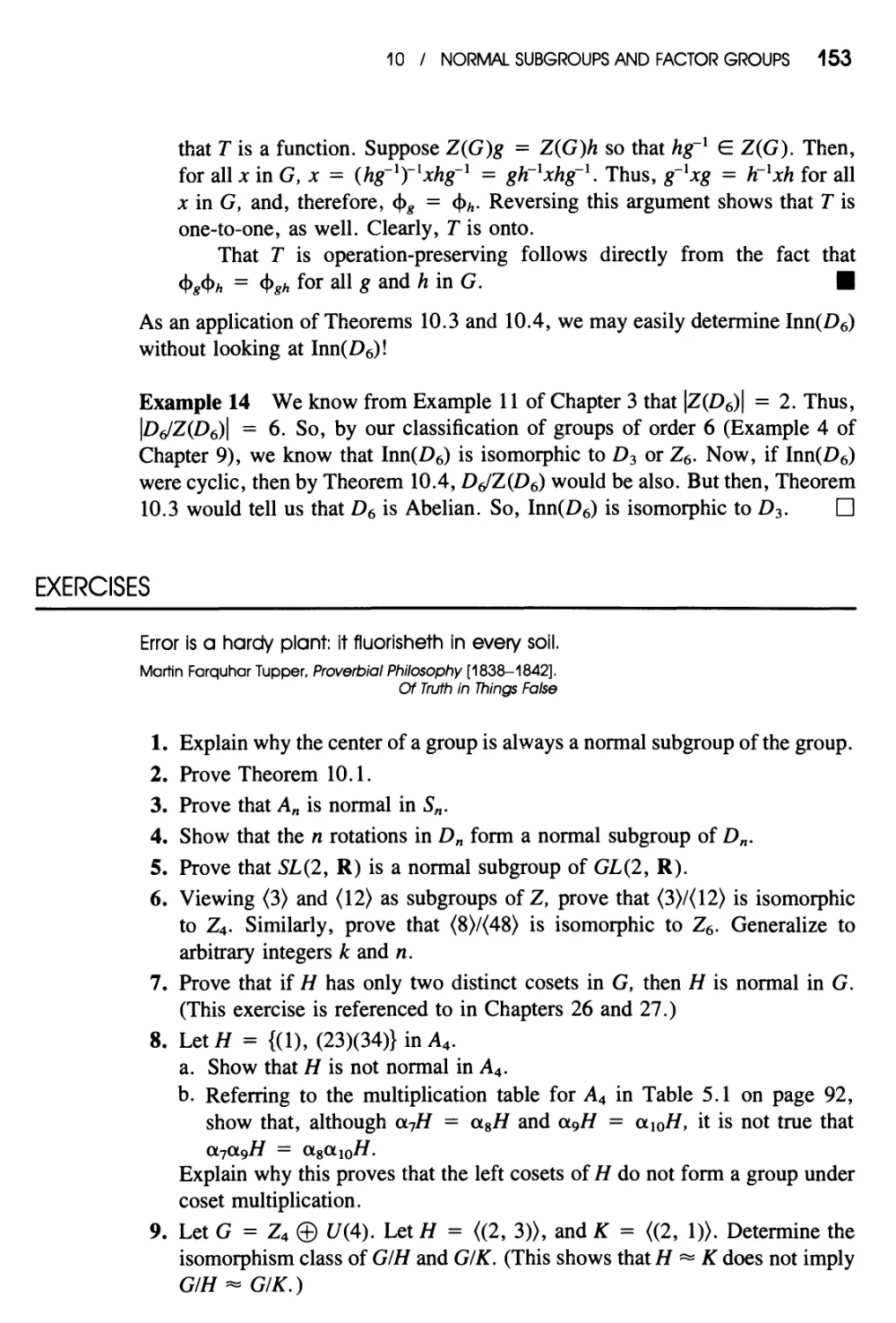


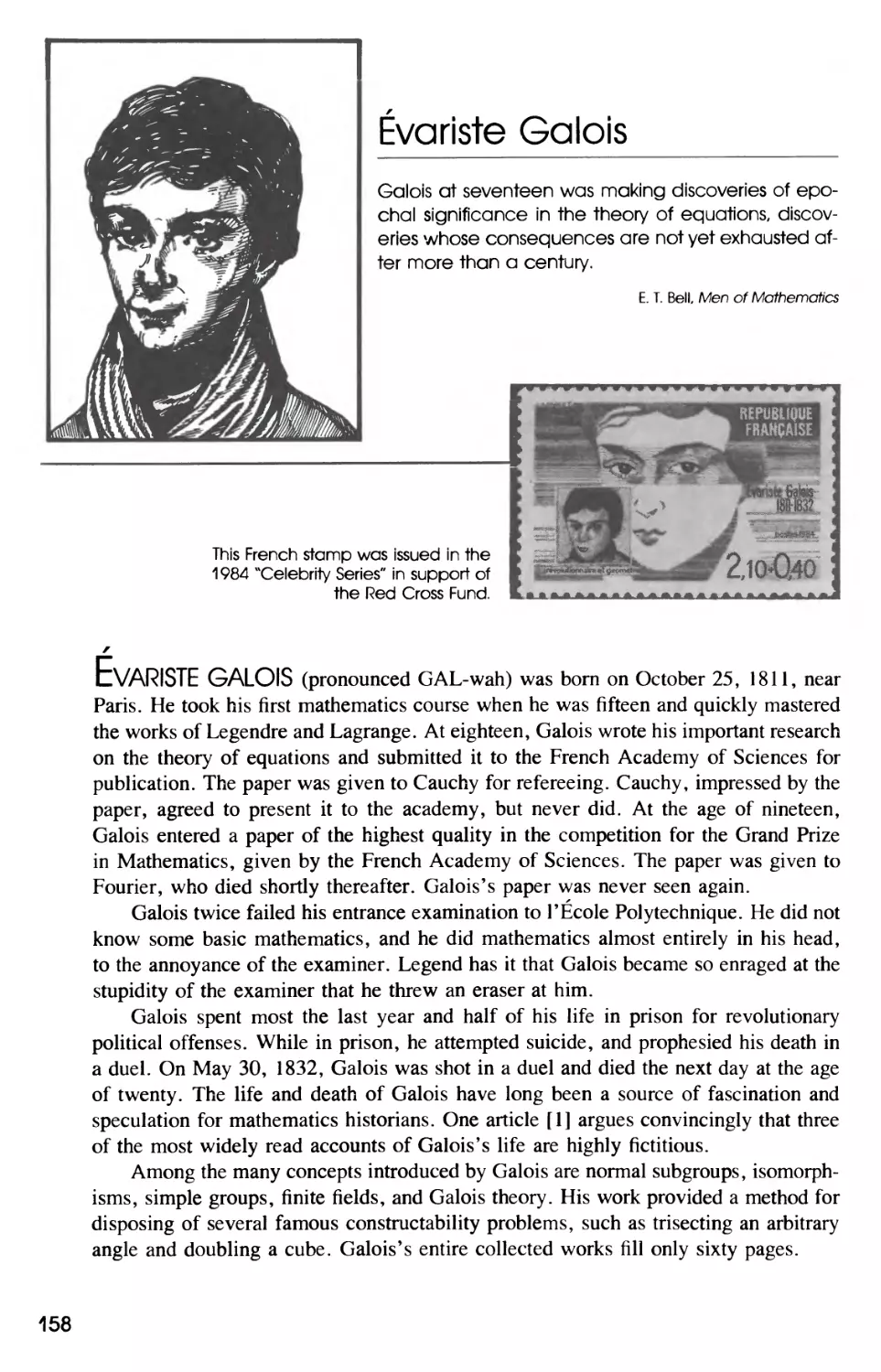

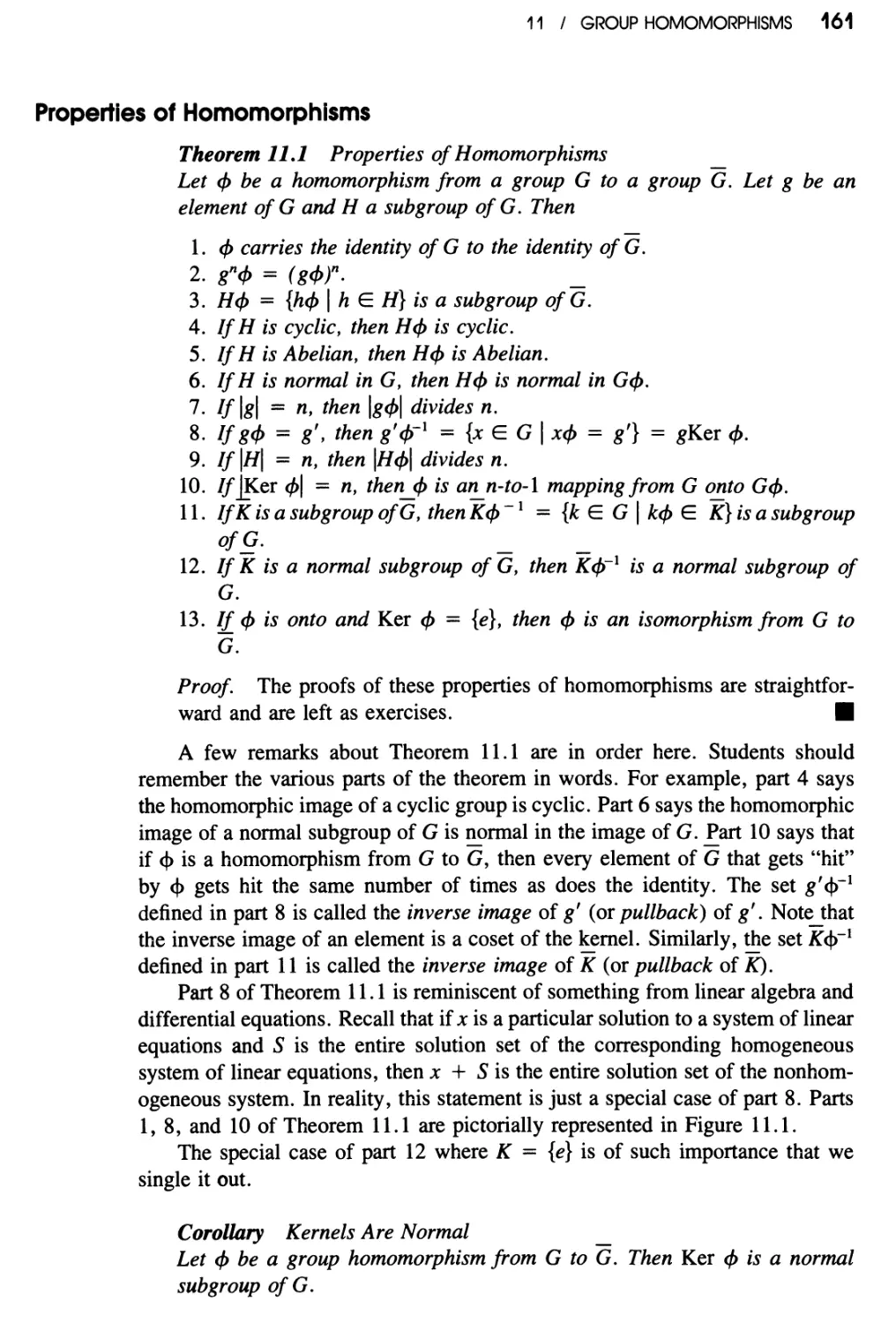


































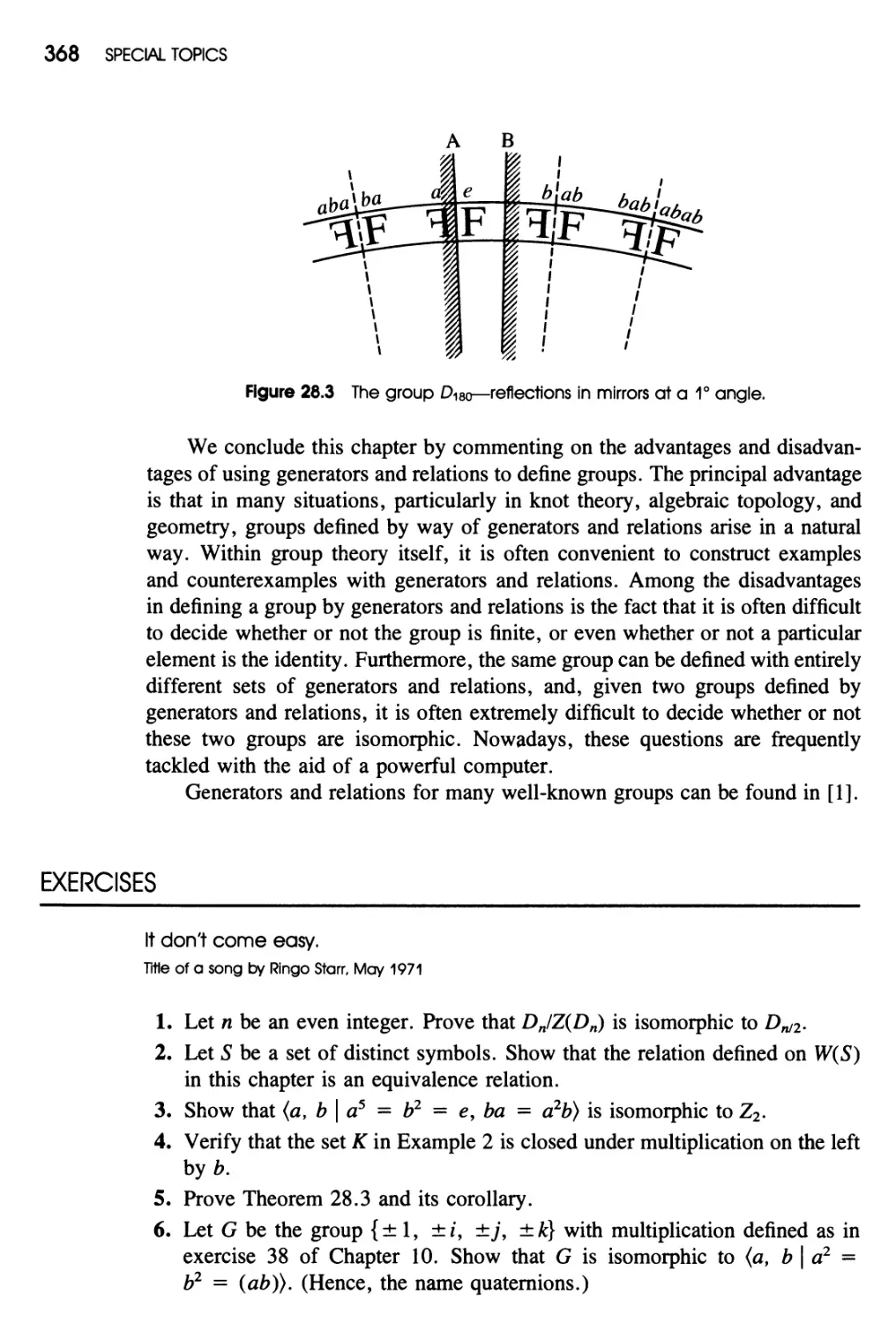
![Unique Factorization in $Z[x]$](https://djvu.online/jpg1/y/X/y/yXyC6mR8JU2Xt/275.webp)
































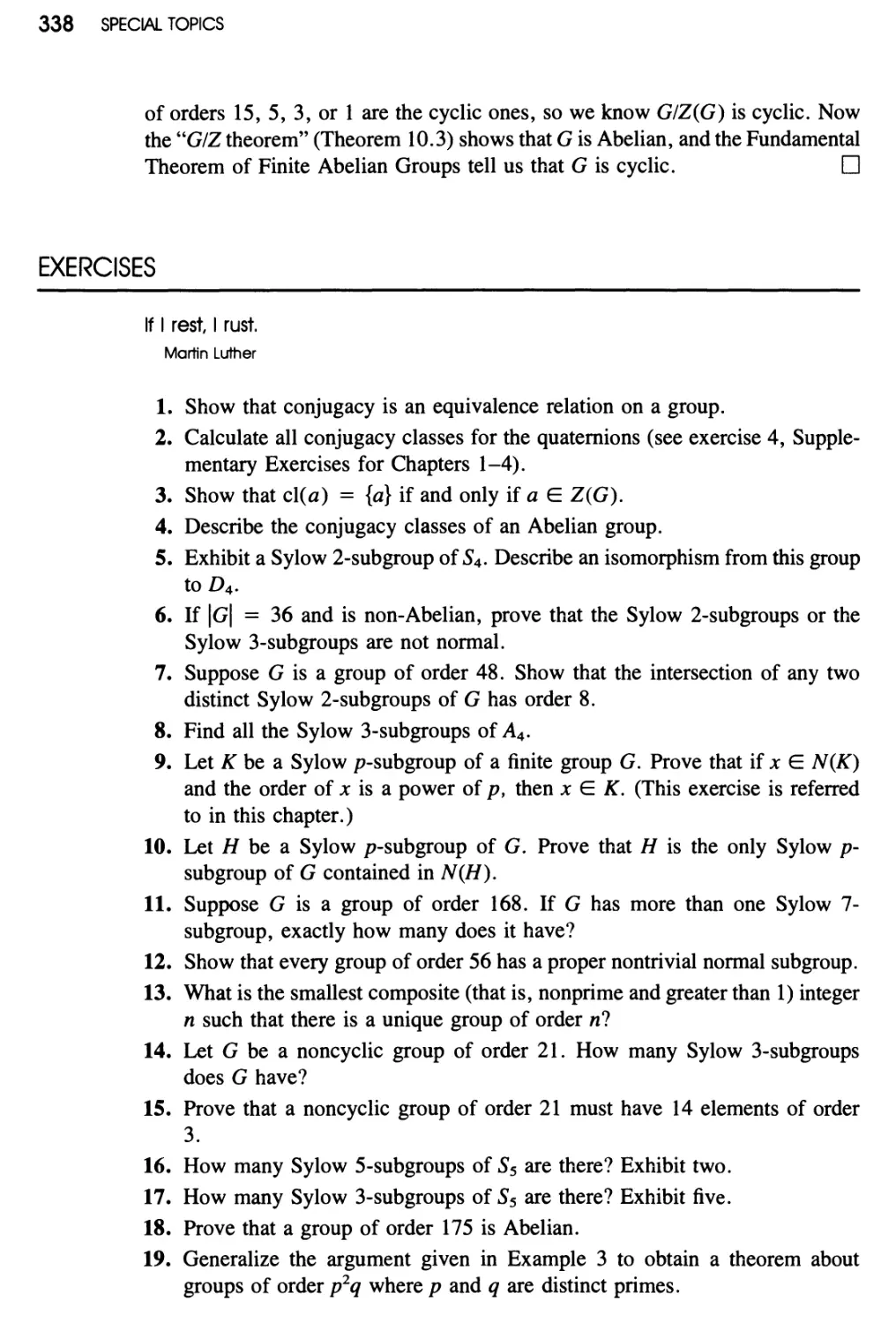


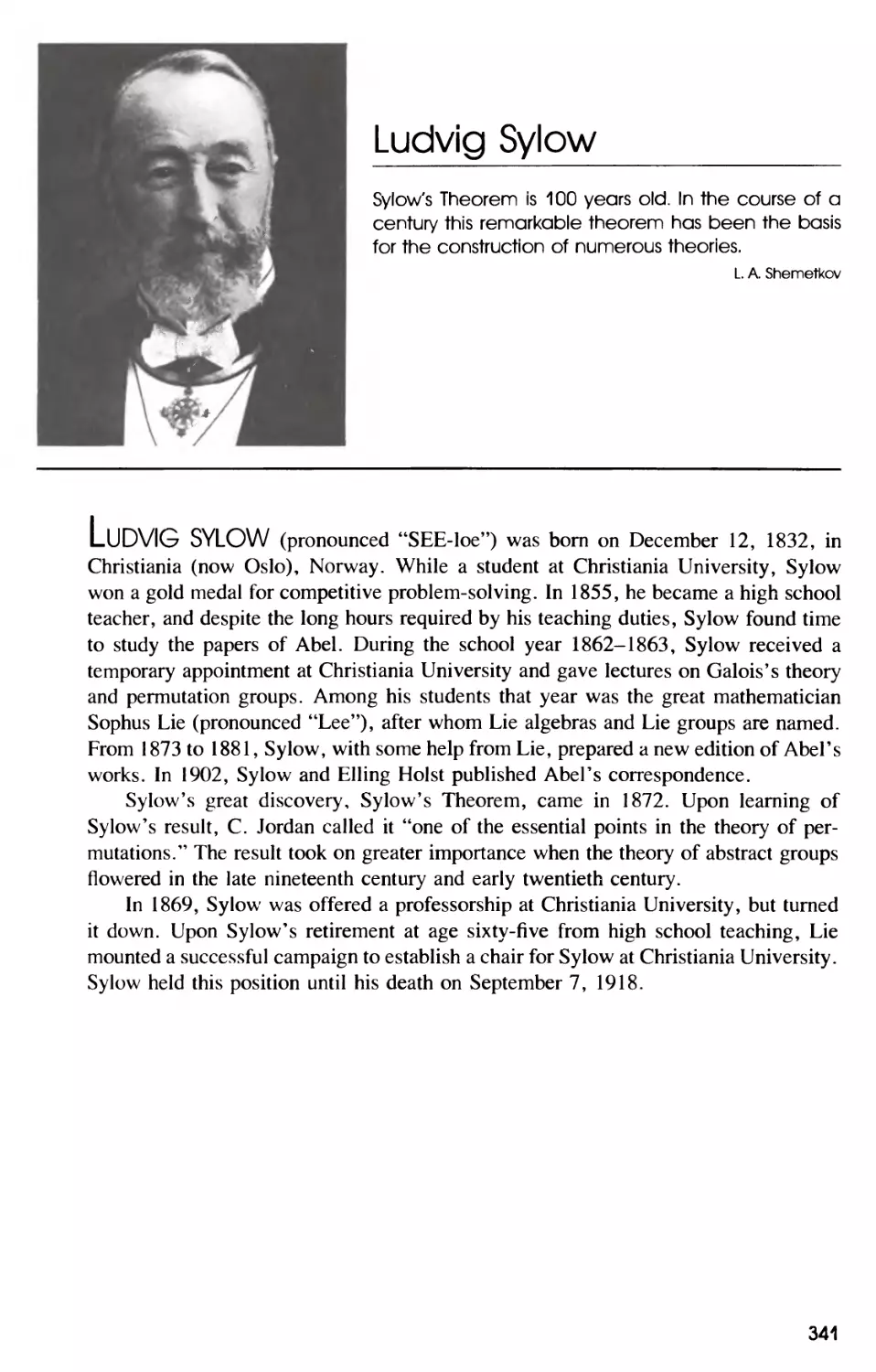


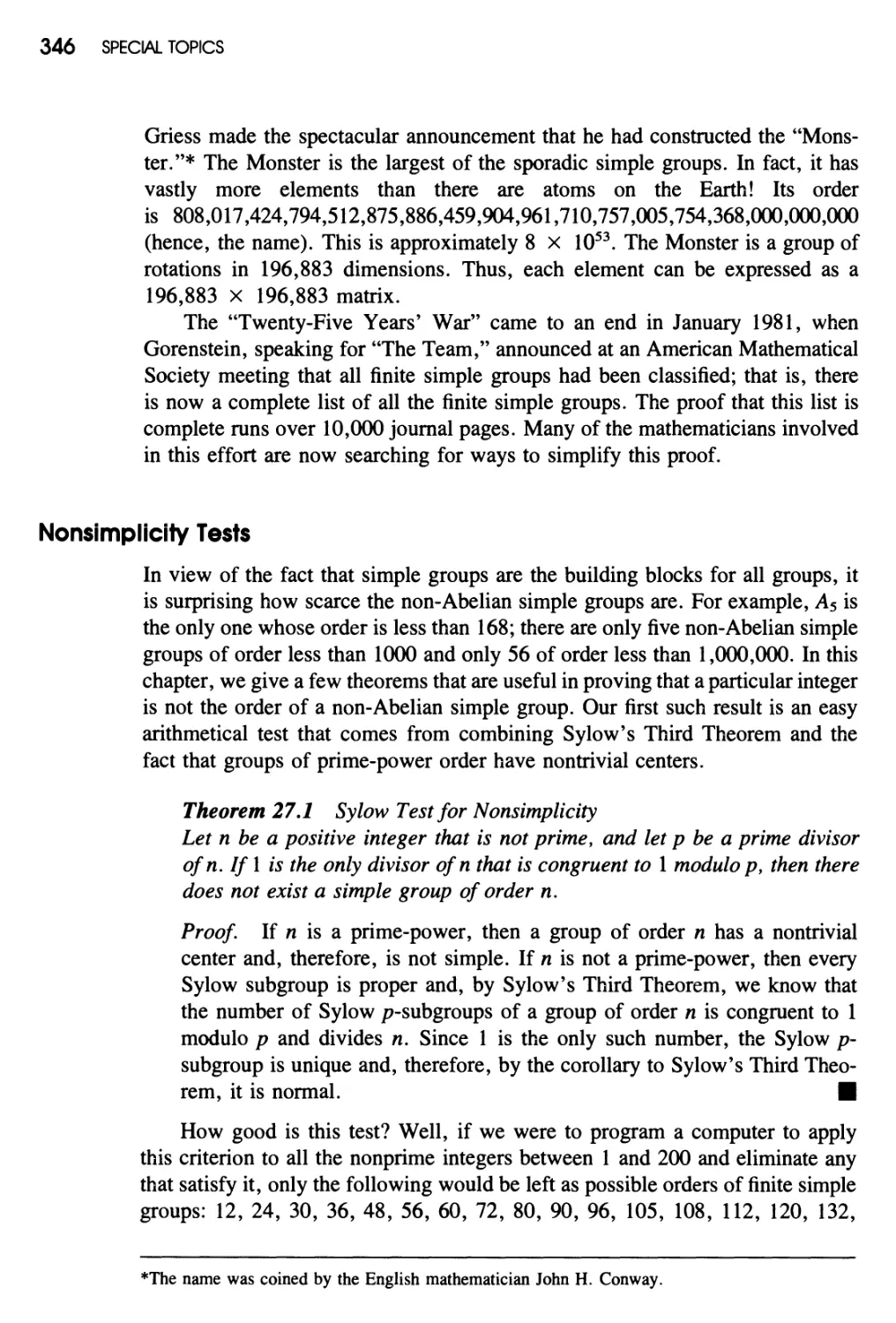

































































Text
JOSEPH A. GALLIAN
Contemporary
Abstract
Algebra SECOND EDITION
CONTEMPORARY
ABSTRACT ALGEBRA
SECOND EDITION
Joseph A. Gallian
Universl1y of Minnesota, Duluth
([$)
Lexington, Massachusetts Toronto
D. C. HEATH AND COMPANY
In memory 0 my ather, Joseph Gallian (1912 1975)
Cover: Photograph by Scott A. Bums. Design by Dustin Graphics.
Copyright @ 1990 by D. C. Heath and Company.
Previous edition copyright @ 1986 by D. C. Heath and Company.
All rights reserved. No part of this publication may be reproduced or transmitted in
any form or by any means, electronic or mechanical, including photocopy,
recording, or any information storage or retrieval system, without permission in
writing from the publisher.
Published simultaneously in Canada.
Printed in the United States of America.
International Standard Book Number: 0-669-19496-4
Library of Congress Catalog Number: 89-80258
10 9 8 7 6 5 4 3 2 1
Page xi. Line from "Paperback Writer" by John Lennon and Paul McCartney,
@ 1965 Northern Songs Limited. All rights for the United States, Canada, and
Mexico controlled and administered by SBK Blackwood Music, Inc. Under
license from ATV Music (MacLen). All rights reserved. International copyright
secured. Used by permission.
Page 12. "Brain BoggIer" by Maxwell Carver, @ 1988 by Discover Publications,
Inc.
Page 29. Photograph from Snow Crystals by W. A. Bentley and W. J. Hum-
phreys, 1962, Dover Publications, N. Y.
Page 31. Cross section of AIDS virus @ 1987 by Scientific American, Inc. All
rights reserved.
Page 64. Poem from The Compleat Computer by Dennie L. Van Tassel and
Cynthia Van Tassel. Copyright @ 1983, 1976, Science Research Associates,
Inc. Reprinted by permission of the publisher.
Page 94. Poem "T.T.T." from Grooks, 1966 by Piet Hein. Used with permission
of Piet Hein.
Page 215. Poem "Problems" from Grooks, 1966 by Piet Hein. Used with per-
mission of Piet Hein.
Page 264. Newspaper article in collage copyright @ 1988 by the New York
Times Company. Reprinted by permission.
Page 285. Photograph courtesy of Michael Artin.
Pages 317, 355, 356. Photographs courtesy of the American Mathematical So-
ciety.
Page 357. Photograph by the author.
Page 372. Photograph reproduced by permission of the Masters and Fellows of
Pembroke College, Cambridge, England.
Pages 375, 383, 394, 399, 400. Symmetry patterns from Symmetry in Science
and Art by A. V. Shubnikov and V. A. Kopstik, 1974. Reprinted by permission
of Plenum Publishing Corporation.
v
.
VI ACKNOWlEDGMENTS
Page 378. Figure as reprinted in Excursions into Mathematics by A. Beck, M.
Blecher, and D. Crowe, Worth Publications, 1969. Reprinted by permission of
the publisher.
Pages 389, 391, 397. Symmetry drawings of M. C. Escher from the Collection
Haags Gemeentemuseum- The Hague.
Pages 390, 397. Escher-like drawings from Creating Escher-Type Drawings,
@ 1977. Creative Publications, Palo Alto, California.
Pages 392, 393, 395. Designs reprinted from the American Mathematical Monthly,
Vol. 85 (June 1978) with permission of the publisher.
Page 417, 419. Computer duplications of Escher patterns reproduced here by
permission of Douglas Dunham.
Page 426. Photograph by Seymour Schuster.
Page 442. Line from "The Ballad of John and Yoko" by John Lennon and Paul
McCartney, @ 1969 Northern Songs Limited. All rights for the United States,
Canada, and Mexico controlled and administered by SBK Blackwood Music,
Inc. Under license from ATV Music (MacLen). All rights reserved. International
copyright secured. Used by permission.
Page 471..Poem "The Road to Wisdom" from Grooks, 1966 by Piet Hein. Used
with permission of Piet Hein.
Page A3. Line from "All You Need Is Love" by John Lennon and Paul Mc-
Cartney, @ 1967 Northern Songs Limited. All rights for the United States,
Canada, and Mexico controlled and administered by SBK Blackwood Music,
Inc. Under license from ATV Music (MacLen). All rights reserved. International
copyright secured. Used by permission.
Page A5. Line from "Let It Be" by John Lennon and Paul McCartney, @ 1970
Northern Songs Limited. All rights for the United States, Canada, and Mexico
controlled and administered by SBK Blackwood Music, Inc. Under license from
ATV Music (MacLen). All rights reserved. International copyright secured. Used
by permission.
Page A9. Line from "While My Guitar Weeps" by George Harrison. Copyright
1968, Harrisongs Limited. Used by permission. All rights reserved.
Page A14. Line from "Day Tripper" by John Lennon and Paul McCartney, @
1965 Northern Songs Limited. All rights for the United States, Canada, and
Mexico controlled and administered by SBK Blackwood Music, Inc. Under
license from ATV Music (MacLen). All rights reserved. International copyright
secured. Used by permission.
Page A22. Line from "With a Little Help from M} _ t1ends" by John Lennon
and Paul McCartney, @ 1967 Northern Songs Limited. All rights for the United
States, Canada, and Mexico controlled and administered by SBK Blackwood
Music, Inc. Under license from ATV Music (MacLen). All rights reserved.
International copyright secured. Used by permission.
ACKNOWLEDGMENTS
..
VII
Page A24. Line from "Glass Onion" by John Lennon and Paul McCartney, @
1968 Northern Songs Limited. All rights for the United States, Canada, and
Mexico controlled and administered by SBK Blackwood Musics, Inc. Under
license from ATV Music (MacLen). All rights reserved. International copyright
secured. Used by permission.
Page A25. Line from "Helter Skelter" by John Lennon and Paul McCartney, @
1968 Northern Songs Limited. All rights for the United States, Canada, and
Mexico controlled and administered by SBK Blackwood Music, Inc. Under
license from A TV Music (MacLen). All rights reserved. International copyright
secured. Used by permission.
Page A30. Line from "Wasted on the Way" by Graham Nash, single, 1982. @
Putzy-Putzy Music. Used by permission. All rights reserved.
Page A32. Line from "Help" by John Lennon and Paul McCartney, @ 1965
Northern Songs Limited. All rights for the United States, Canada, and Mexico
controlled and administered by SBK Blackwood Music, Inc. Under license from
ATV Music (MacLen). All rights reserved. International copyright secured. Used
by permission.
Page A34. Line from "When I'm Sixty-Four" by John Lennon and Paul McCartney,
@ 1967 Northern Songs Limited. All rights for the United States, Canada, and
Mexico controlled and administered by SBK Blackwood Music, Inc. Under
license from ATV Music (MacLen). All rights reserved. International copyright
secured. Used by permission.
I .
I began collecting material for the second edition of this book the day after I
sent the final version of the first edition to the publisher. This second edition
includes hundreds of new exercises, scores of new illustrations, and dozens of
new examples. It contains additional applications, computer exercises, historical
notes, and biographies, as well as updated references and suggested readings.
Several proofs that were omitted in the first edition are presented in this one.
With few exceptions, the organization and content of the first edition remain
intact. In response to the feedback I received, nearly all changes for the second
edition are additions to the text. These include proofs of the fundamental theorem
of finite Abelian groups, the uniqueness of splitting fields, the primitive element
theorem for field extensions, and the Sylow theorems. The sections on preli-
minaries, symmetry groups, divisibility in integral domains, geometric construc-
tions, and electric circuits have been expanded. The chapter in the first edition
on designing a ZIP Code reader has been deleted. Tomorrow I begin collecting
material for the third edition.
Answers or key steps for virtually all of the odd-numbered exercises are
given at the end of the text. Answers or solutions for all of the even-numbered
exercises are available in the Answer Key.
I am grateful to the following people for serving as reviewers for this edition:
Ronald Bercov, University of Alberta; William C. Fox, State University of New
York at Stony Brook; L C. Grove, University of Arizona; Marshall Hall,
Jr., Emory University; Robin Hartshorne, University of California, Berkeley;
Loren C. Larson, St. Olaf College; Thomas Q. Sibley, Saint John's University
(Minnesota); and Mark L. Teply, University of Wisconsin at Milwaukee.
I'm indebted to the following people who have kindly contributed to this
edition in one way or another: Duane Anderson, University of Minnesota, Duluth;
Louis Friedler, University of Bridgeport; Anthony Gaglione, United States Naval
Academy; Steve Galovich, Carleton College; Ladnor Geissinger, University of
North Carolina at Chapel Hill; Branko Griinbaum, University of Washington:
Henry Heatherly, University of Southwestern Louisiana; Victor Katz, University
of the District of Columbia; James Loats, Metropolitan State College; Monty
Strauss, Texas Tech University; and Robin J. Wilson, The Open University.
.
IX
X PREFACE TO THE SECOND EDITION
Finally, I wish to express my appreciation to the typist Daniel Ellison and
to Cathy Cantin, Ann Marie Jones, and Karen Wise of D. C. Heath for their
assistance in the preparation of this edition.
Joseph A. Gallian
.
I .
Dear Sir or Madam will you read my book, it took me years to write, will you take
a look.
John Lennon and Paul McCartney, Paperback Writer, single
The academic goals of students in the undergraduate abstract algebra course have
changed dramatically in the past decade. Far fewer students plan for advanced
degrees in mathematics or intend to enter the teaching profession. Many students
now seek degrees in computer science, and most students enter business or
industry upon graduation. Despite this trend, abstract algebra is important in the
education of a mathematically trained person. The terminology and methodology
of algebra are used ever more widely in computer science, physics, chemistry,
and data communications, and of course, algebra still has a central role in
advanced mathematics itself. What I have attempted to do here is to capture the
traditional spirit of abstract algebra while giving it a concrete computational
foundation and including applications. I believe that students will best appreciate
the abstract theory when they have a firm grasp of just what it is that is being
abstracted.
Nearly every student who enrolls in an abstract algebra course brings to it
good intuition for numbers and space. I have tried to capitalize on this by
including many examples and exercises with a number theoretic or geometric
basis.
I agree with George Polya that guessing and conjecturing are important in
mathematics and should be taught and encouraged whenever possible. Here the
computer is the ideal tool, for it can provide the students with long lists of data
from which patterns can be gleaned and conjectures made. I have included
computer exercises that ask the students to produce such lists for this purpose.
Most of these can be done on an inexpensive progr able calculator.
In my opinion, every undergraduate mathematics course should have a liberal
arts character. I have tried to achieve this with comments, historical notes,
quotations, biographies and photographs, and in general, by my approach to the
entire subject. The lines from popular songs, humorous quotations, and to some
.
XI
xii PREFACE TO THE FIRST EDITION
extent, the selection of topics and biographies are intended to make the book
enjoyable for students to read.
In addition to topics such as symmetry, crystallographic groups, algebraic
coding, and Boolean algebras, which are available in a few of the popular texts
on abstract algebra, I have included features not found in other texts. Among
these are chapters on finite simple groups and digraphs of groups, Escher and
Escher-like graphics, annotated lists of films, and an application of the dihedral
group of order 8 to the design of a letter-facing machine. An application of
cyclotomic polynomials to the labeling of dice to yield the standard probability
distribution for the sum of the faces and an application of conjugacy classes to
determine the probability that two elements from a group commute add insight
to these topics.
Several theorems are presented without proof. In each instance I feel that
it is the understanding of the statement of the theorem, not its proof, that is the
important issue.
Because of the importance of matrix groups in both theory and applications,
I introduce 2 x 2 matrix addition and multiplication and the determinant function
early in the text and use these examples throughout. The field theory and algebraic
coding theory portions of the book are preceded by a chapter on the rudiments
of vector space theory: basis, linear independence, and dimension. Knowledge
of the material covered in a basic linear algebra course would be an advantage
but is not prerequisite.
For the most part, the special topics are independent of each other. However,
the chapter on Sylow theorems is a prerequisite for the chapter on finite simple
groups, and the chapters on symmetry and Cayley digraphs require an intuitive
understanding of group generators and relations. Chapter 28 gives a formal
treatment of these ideas. I, myself, avoid this formalism and present generators
and relations by way of examples.
This book has hundreds of examples, 116 figures, 32 tables, 24 photographs,
and over 1200 exercises, including 46 computer exercises. Many of the exercises
are computational and concrete. Some extend the topics discussed in the text
proper; others lay the groundwork and provide motivation for the ideas presented
in subsequent chapters. Answers or hints are provided for nearly all of the odd-
numbered exercises. Answers for the even-numbered exercises are available in
a supplement.
I would like to acknowledge the thoughtful comments received from the
reviewers: Hubert S. Butts, Louisiana State University; Herbert E. Kasube,
Bradley University; Hiram Paley, University of Illinois at Urbana-Champaign;
Philip Quartararo, Jr., Southern University. Sabra Anderson and Louis Friedler
used the manuscript in their classes at the University of Minnesota and the College
of Saint Scholastica and made helpful suggestions.
I owe an enormous debt to my friend, David Witte, who meticulously read
the entire manuscript. His insightful comments and incisive criticisms have
immeasurably improved both the style and content of the text.
PREFACE TO THE FIRST EDITION
...
XIII
I wish to express my appreciation to Jane Lounsberry, Sonja Rasmussen,
and Carol Stockman who cheerfully typed and retyped the manuscript.
Finally, I'm grateful to Mary LeQuesne, Margaret Roll, Antoinette Tingley
Schleyer, and Mary Lu Walsh of D. C. Heath for their kind cooperation and
assistance in the preparation of this text. It has been a pleasure to work with
them.
Joseph A. Gallian
Contents
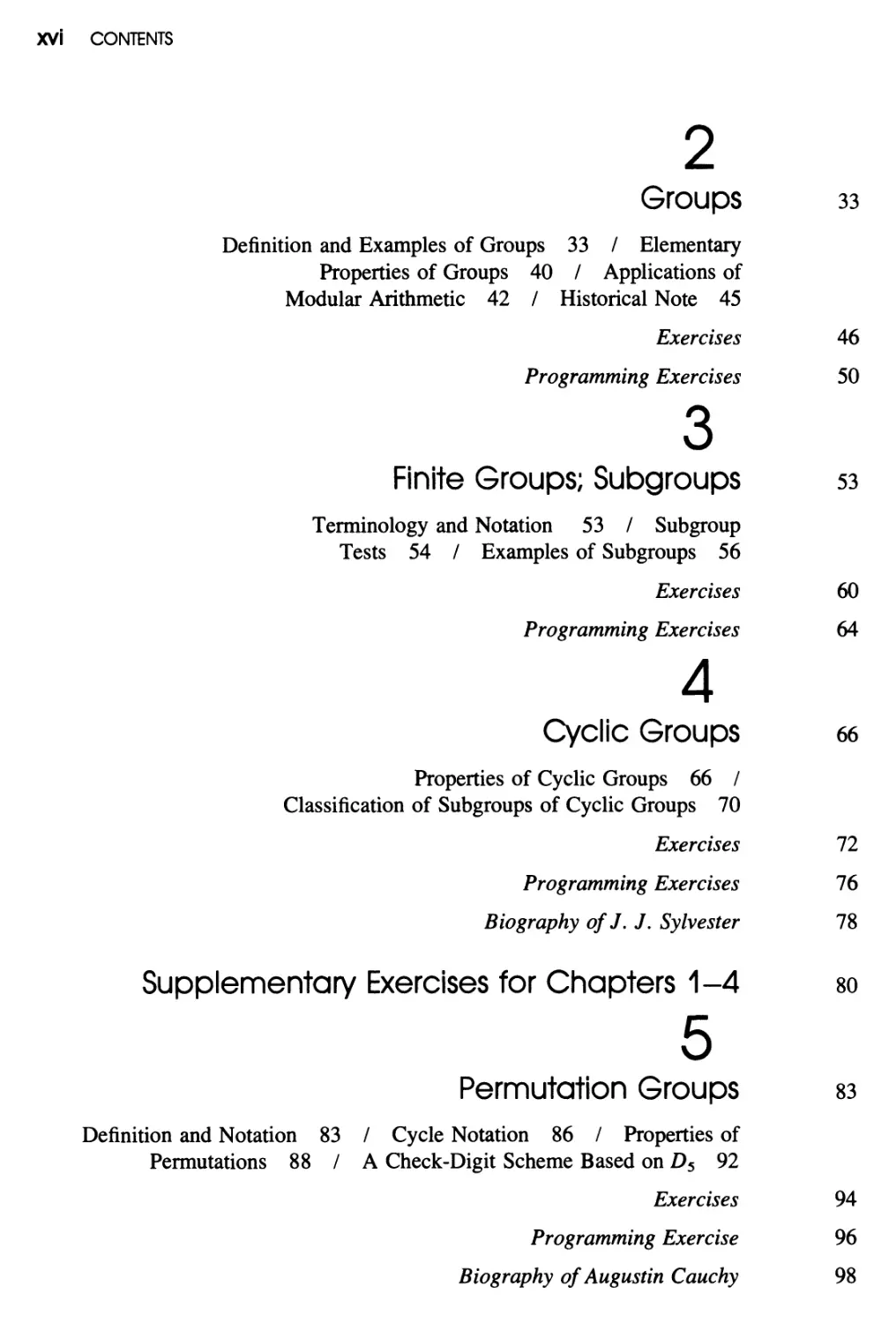
Integers and Equivalence Relations 1
0
Preliminaries 3
Properties of Integers 3 / Modular Arithmetic 7 /
Mathematical Induction 10 / Equivalence
Relations 13 / Functions (Mappings) 15
Exercises 17
Groups 21
1
Introduction to Groups 23
Symmetries of a Square 23 / The Dihedral Groups 26
Exercises 28
Biography of Niels Abel 32
xv
XVi CONTENTS
2
Groups 33
Definition and Examples of Groups 33 / Elementary
Properties of Groups 40 / Applications of
Modular Arithmetic 42 / Historical Note 45
Exercises 46
Programming Exercises 50
3
Finite Groups; Subgroups 53
Terminology and Notation 53 / Subgroup
Tests 54 / Examples of Subgroups 56
Exercises 60
Programming Exercises 64
4
Cyclic Groups 66
Properties of Cyclic Groups 66 /
Classification of Subgroups of Cyclic Groups 70
Exercises 72
Programming Exercises 76
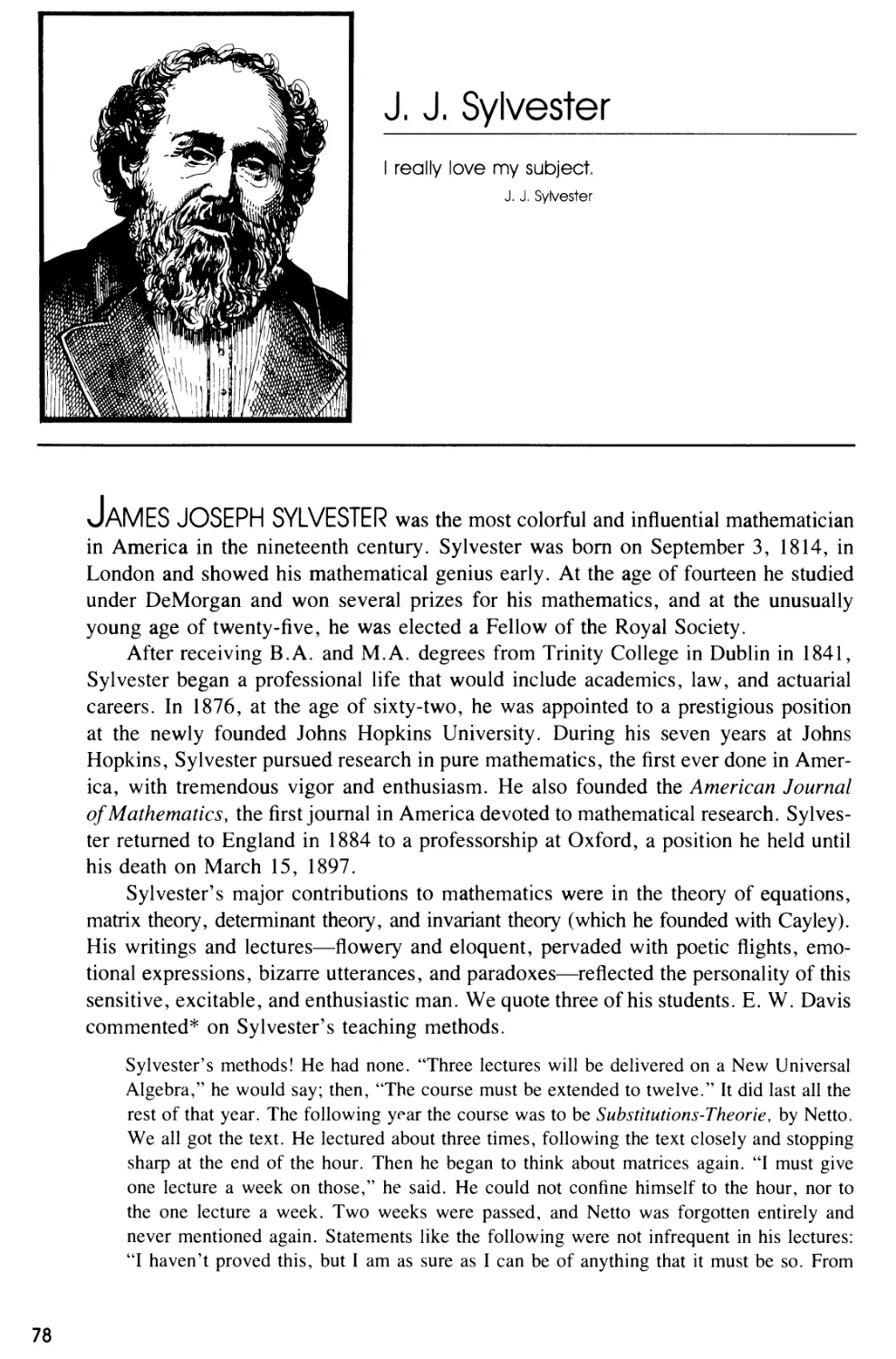
Biography of J. J. Sylvester 78
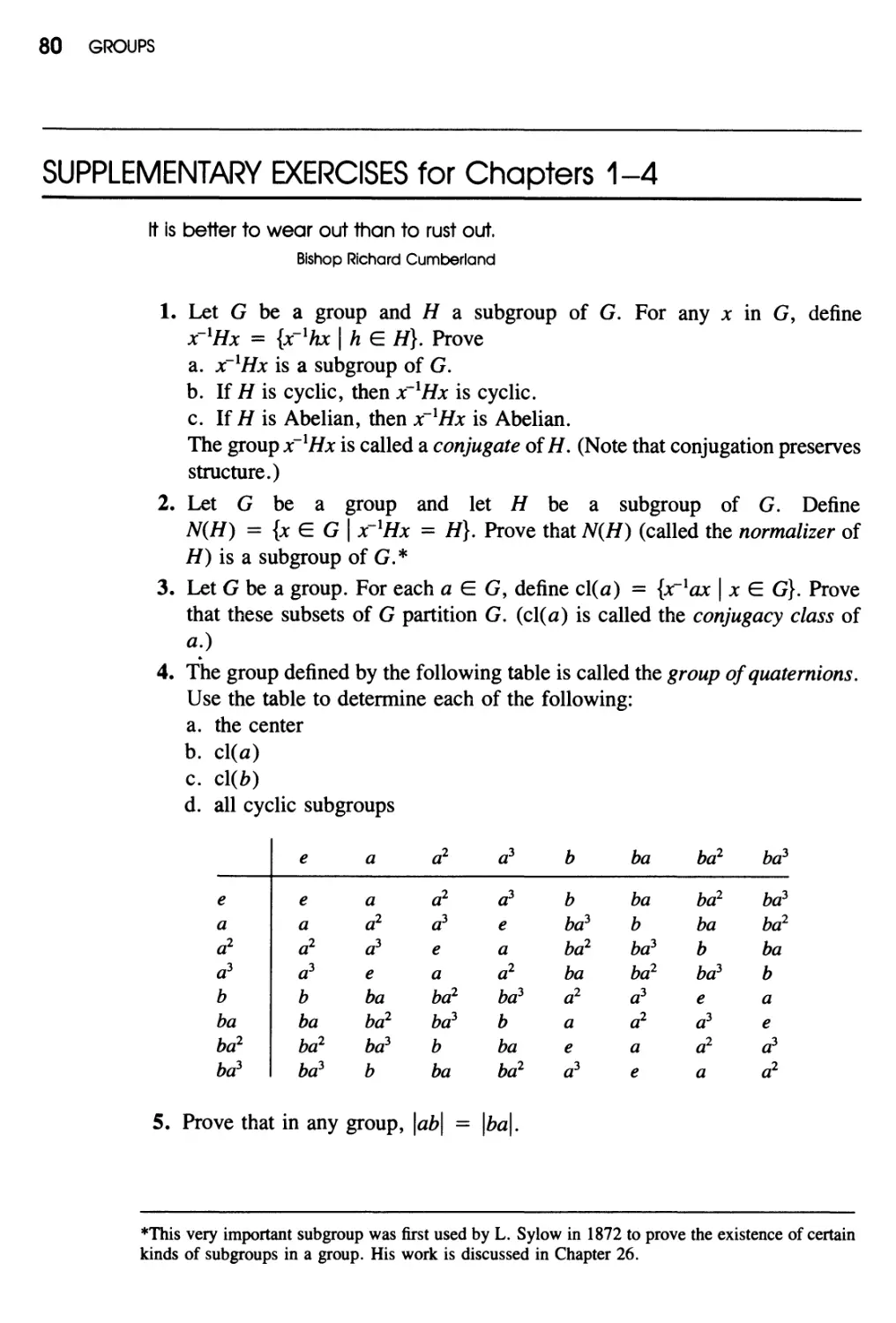
Supplementary Exercises for Chapters 1-4 80
5
Permutation Groups 83
Definition and Notation 83 / Cycle Notation 86 / Properties of
Permutations 88 / A Check-Digit Scheme Based on D5 92
Exercises 94
Programming Exercise 96
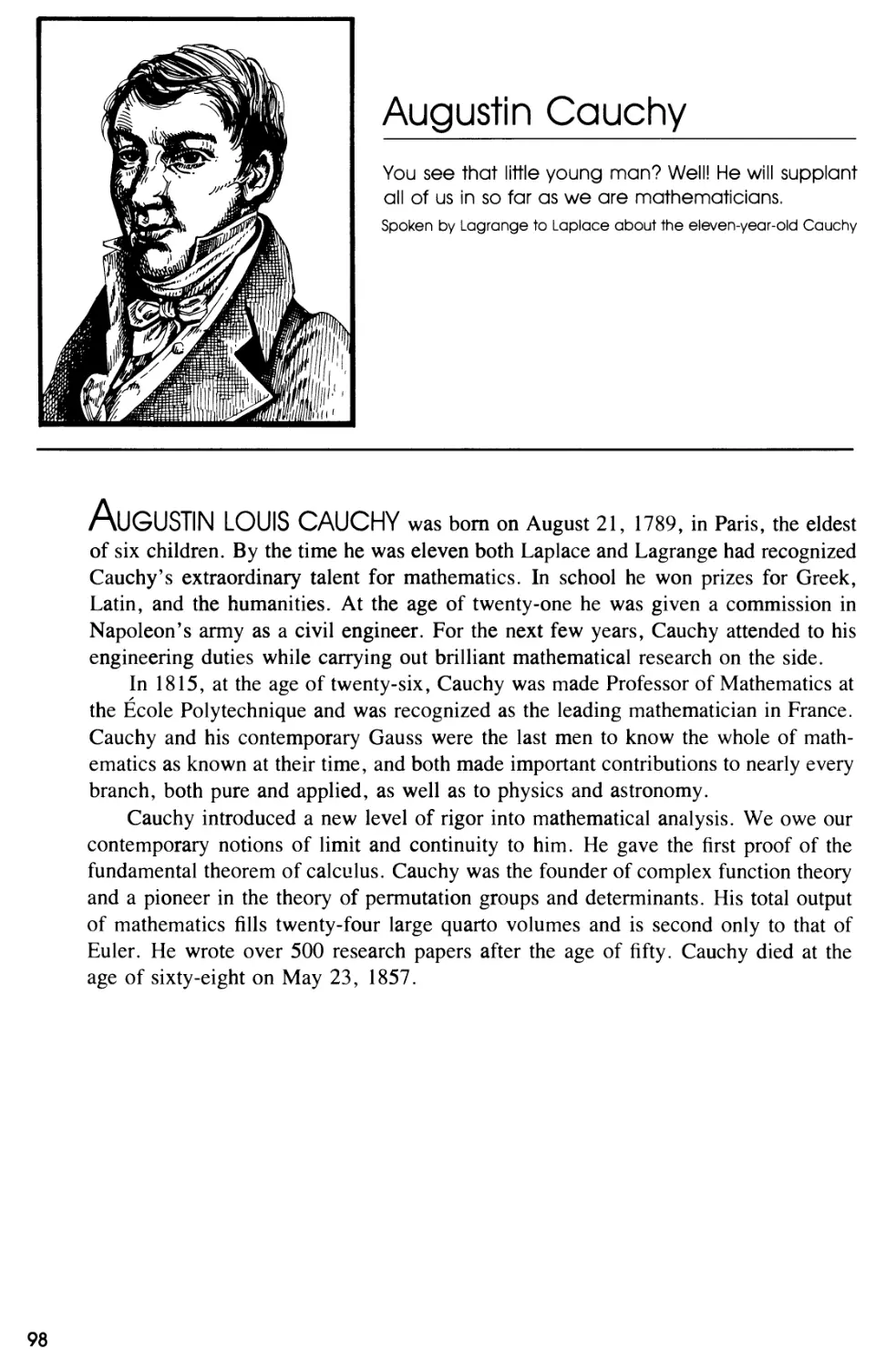
Biography of Augustin Cauchy 98
CONTENTS XVM
6
Isomorphisms 99
Motivation 99 / Definition and Examples 100 /
Cayley's Theorem 103 / Properties of
Isomorphisms 104 / Automorphisms 105
Exercises 108
Biography of Arthur Cay ley 112
7
External Direct Products 113
Definition and Examples 113 /
Properties of External Direct Products 114
Exercises 116
Programming Exercises 118
8
Internal Direct Products 119
Definition and Examples 119 / The Group of Units
Modulo n As an Internal and External Direct Product 122
Exercises 124
Programming Exercises 126
Supplementary Exercises for Chapters 5-8 128
9
Cosets and Lagrange's Theorem 130
Properties of Cosets 130 / Lagrange's Theorem and
Consequences 132 / An Application of Cosets to Permutation
Groups 135 / The Rotation Group of a Cube and a Soccer Ball 136
Exercises 139
Biography of Joseph Lagrange 144
xviii CONTENTS
10
Normal Subgroups and Factor Groups 145
Normal Subgroups 145 / Factor Groups 146 /
Applications of Factor Groups 151
Exercises 153
Biography of Evariste Galois 158
11
Group Homomorphisms 159
Definition and Examples 159 / Properties of
Homomorphisms 161 / The First Isomorphism Theorem 162
Exercises 167
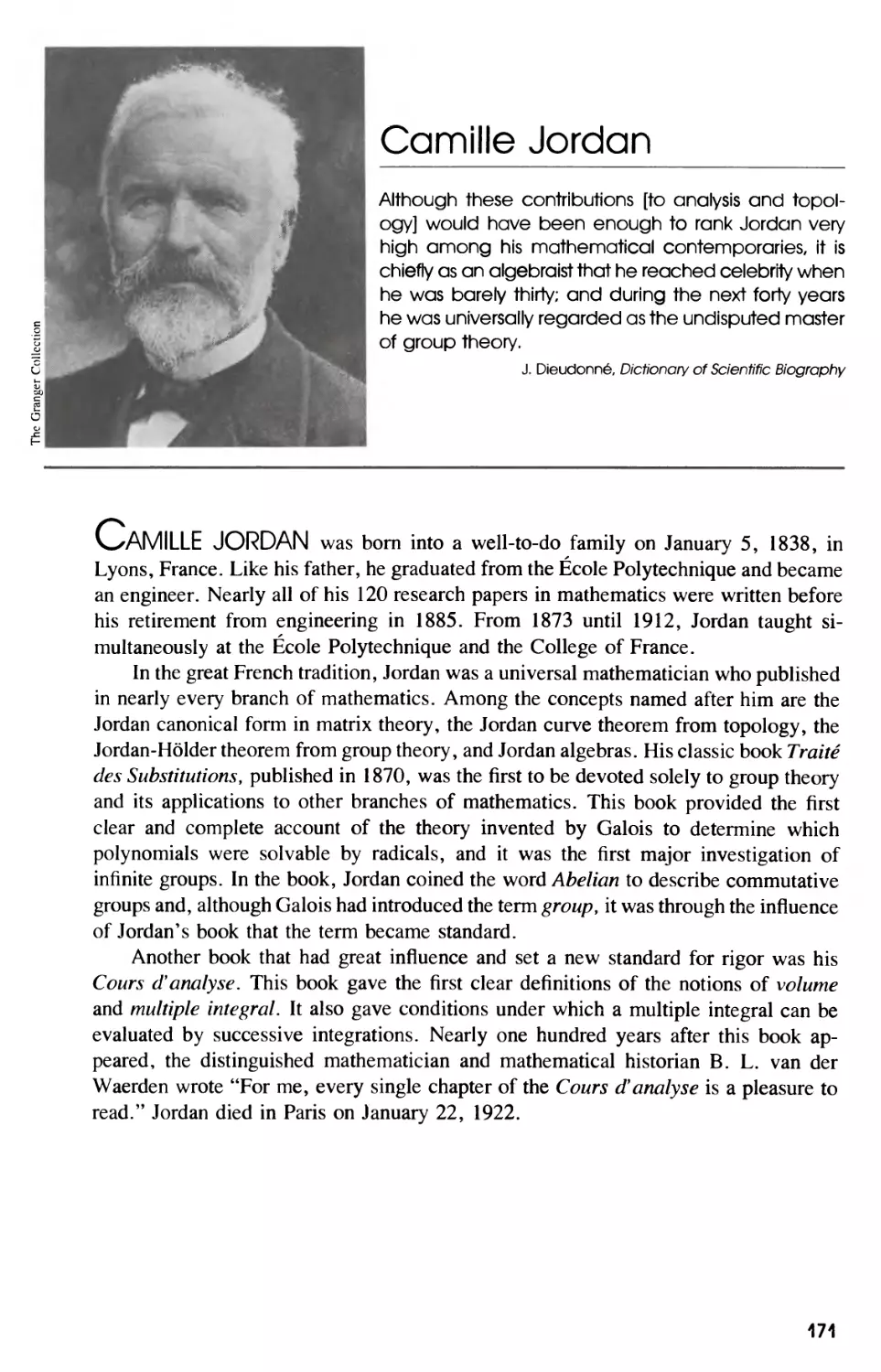
Biography of Camille Jordan 171
12
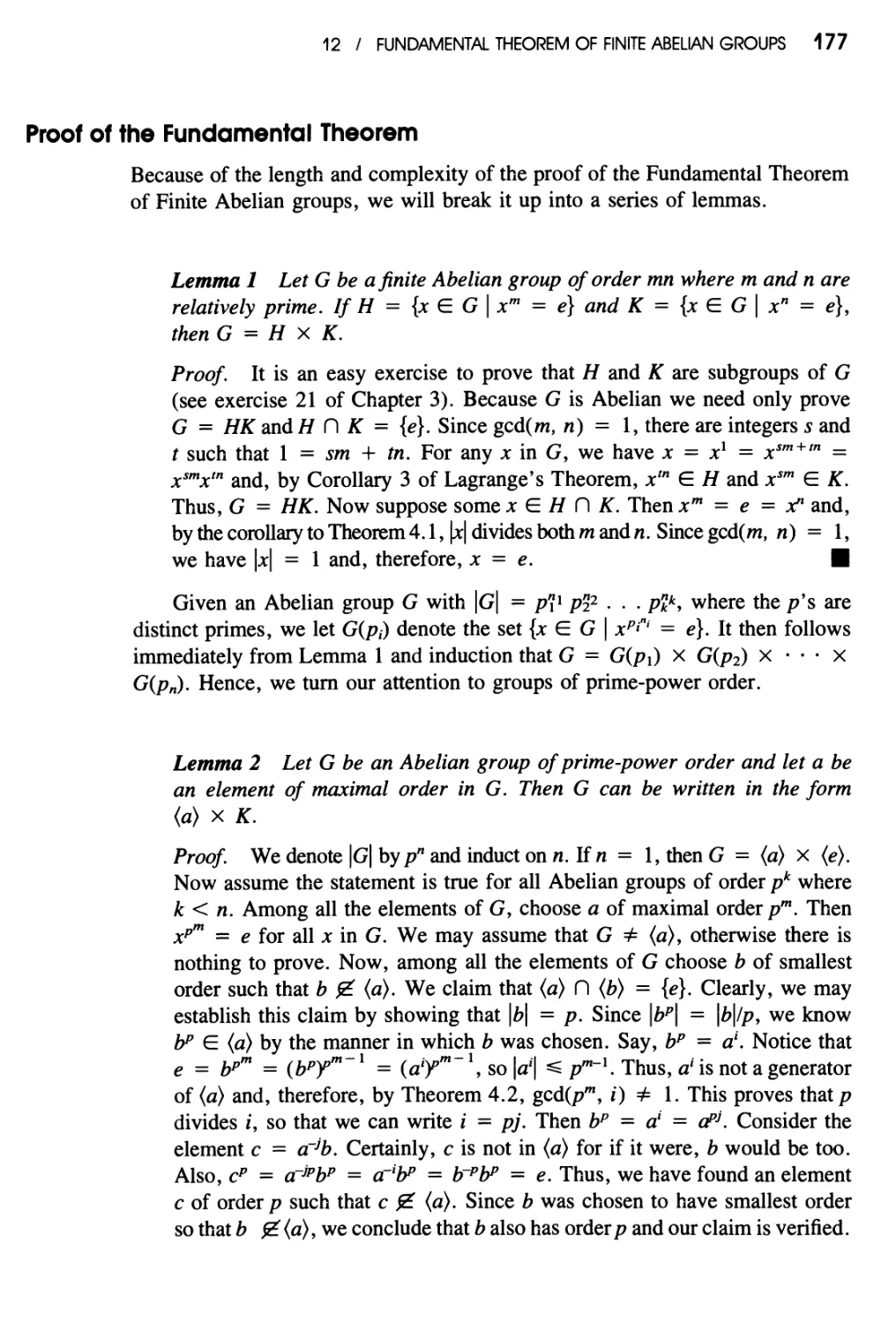
Fundamental Theorem of Finite Abelian Groups 172
The Fundamental Theorem 172 / The Isomorphism Classes of
Abelian Groups 173 / Proof of the Fundamental Theorem 177
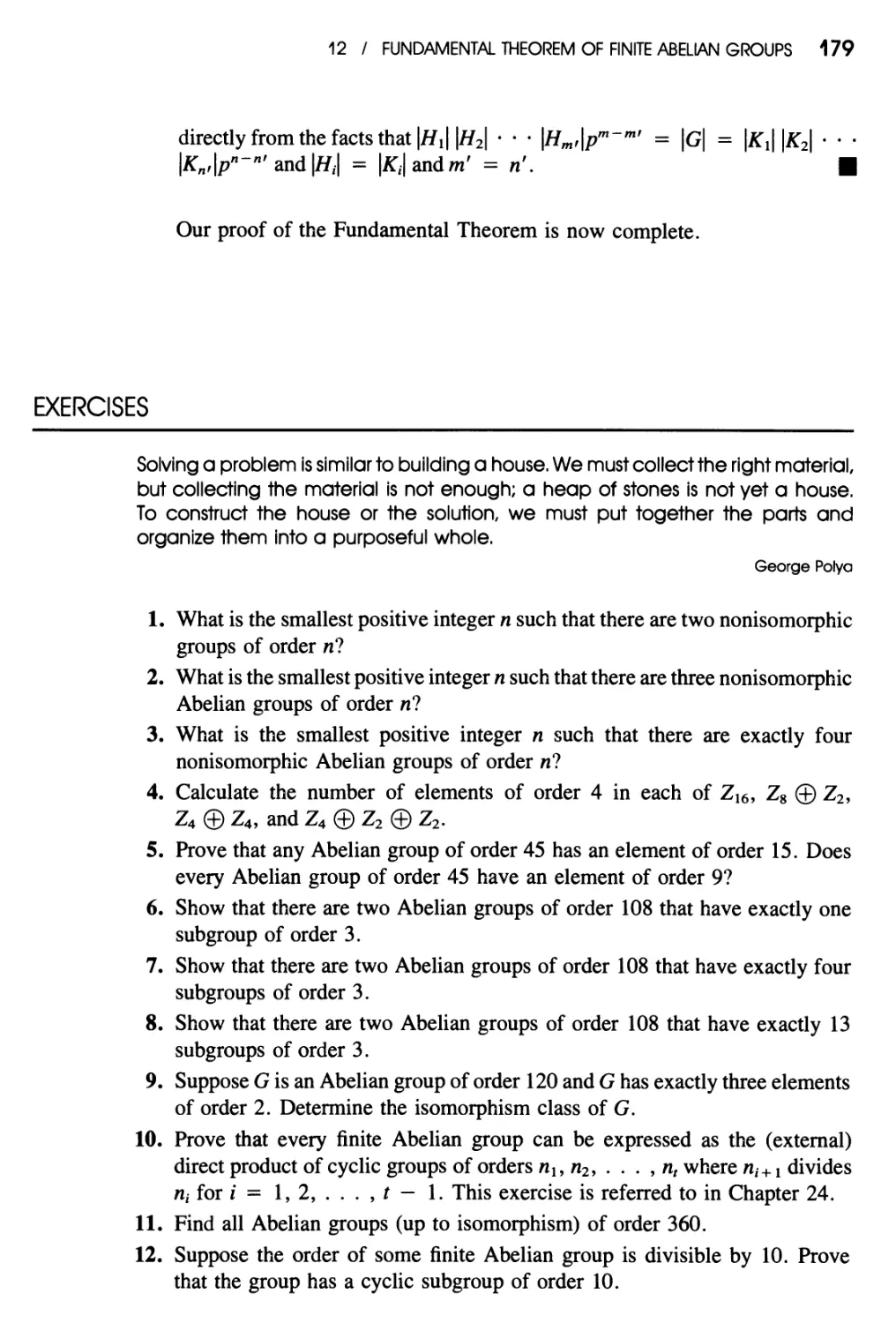
Exercises 179
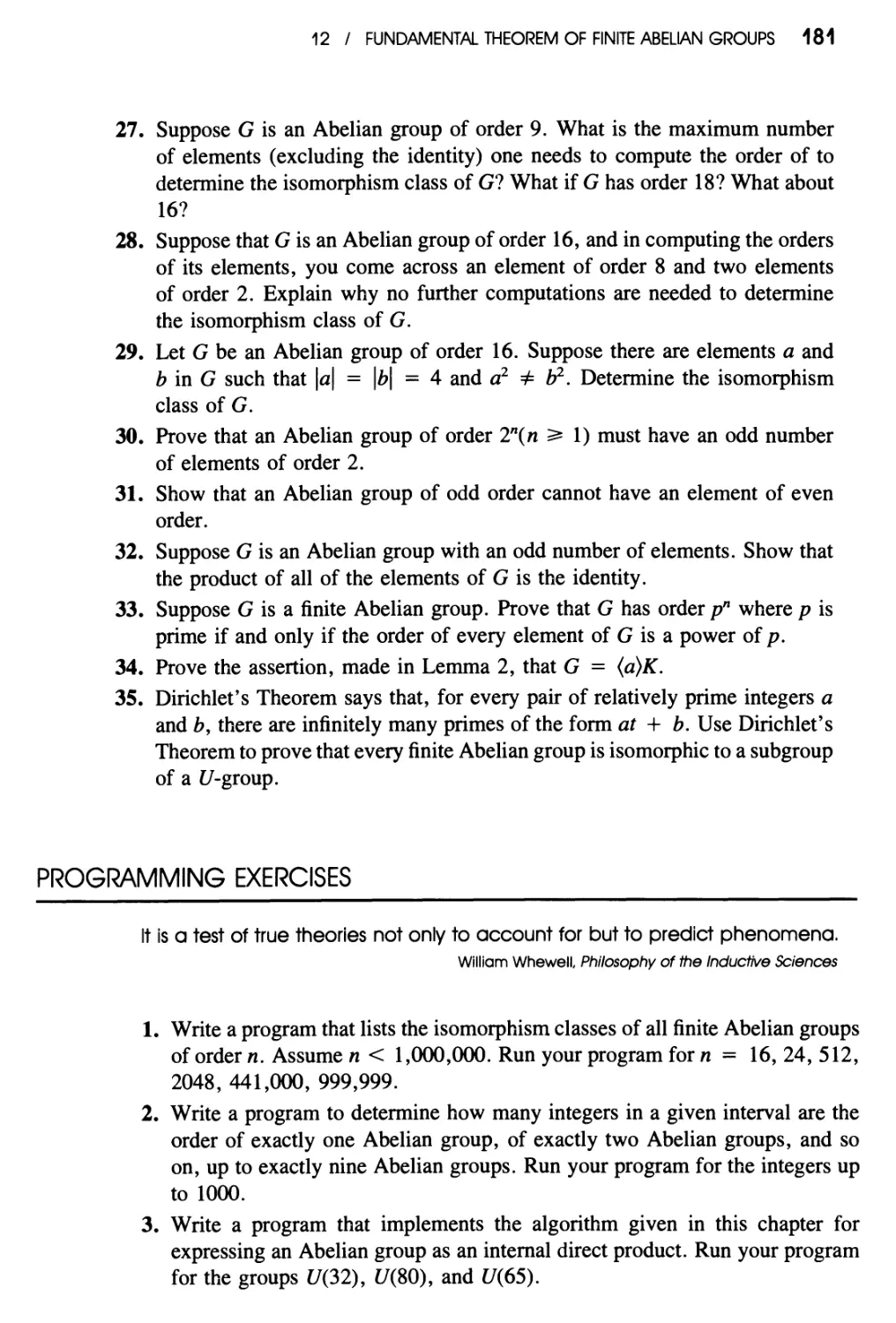
Programming Exercises 181
Supplementary Exercises for Chapters 9-12 183
Rings 185
13
Introduction to Rings 187
Motivation and Definition 187 / Examples of Rings 188
Exercises 189
Programming Exercise 191
CONTENTS XiX
14
Properties of Rings 192
Properties of Rings 192 / Subrings 193
Exercises 195
Programming Exercise 197
Biography of I. N. Her stein 198
15
Integral Domains 199
Definition and Examples 199 / Fields 201 /
Characteristic of a Ring 202
Exercises 204
Programming Exercises 208
Biography of Nathan Jacobson 209
16
Ideals and Factor Rings 210
Ideals 210 / Factor Rings 211 /
Prime Ideals and Maximal Ideals 213
Exercises 215
Biography of Richard Dedekind 218
Biography of Emmy Noether 219
Supplementary Exercises for Chapters 13-16 220
17
Ring Homomorphisms 222
Definition and Examples 222 / Properties of Ring
Homomorphisms 224 / The Field of Quotients 227
Exercises 228
XX CONTENTS
18
Polynomial Rings 233
Notation and Terminology 233 / The
Division Algorithm and Consequences 236
Exercises 239
19
Factorization of Polynomials 242
Reducibility Tests 242 / Irreducibility Tests 244 /
Unique Factorization in Z [jc] 249 / Weird Dice:
An Application of Unique Factorization 250
Exercises 252
Programming Exercises 255
Biography of Carl Friedrich Gauss 257
20
Divisibility in Integral Domains 259
Irreducibles, Primes 259 / Historical Discussion
of Fermat's Last Theorem 261 / Unique Factorization
Domains 264 / Euclidean Domains 267
Exercises 270
Biography of Ernst Eduard Kummer 273
Biography of Sophie Germain 274
Supplementary Exercises for Chapters 17-20 275
CONTENTS XXi
Fields 277
21
Vector Spaces 279
Definition and Examples 279 / Subspaces 280 /
Linear Independence 281
Exercises 283
Biography of Emil Artin 285
22
Extension Fields 286
The Fundamental Theorem of Field Theory 286 / Splitting
Fields 288 / Zeros of an Irreducible Polynomial 293
Exercises 295
Biography of Leopold Kronecker 297
23
Algebraic Extensions 298
Characterization of Extensions 298 / Finite
Extensions 300 / Properties of Algebraic Extensions 304
Exercises 305
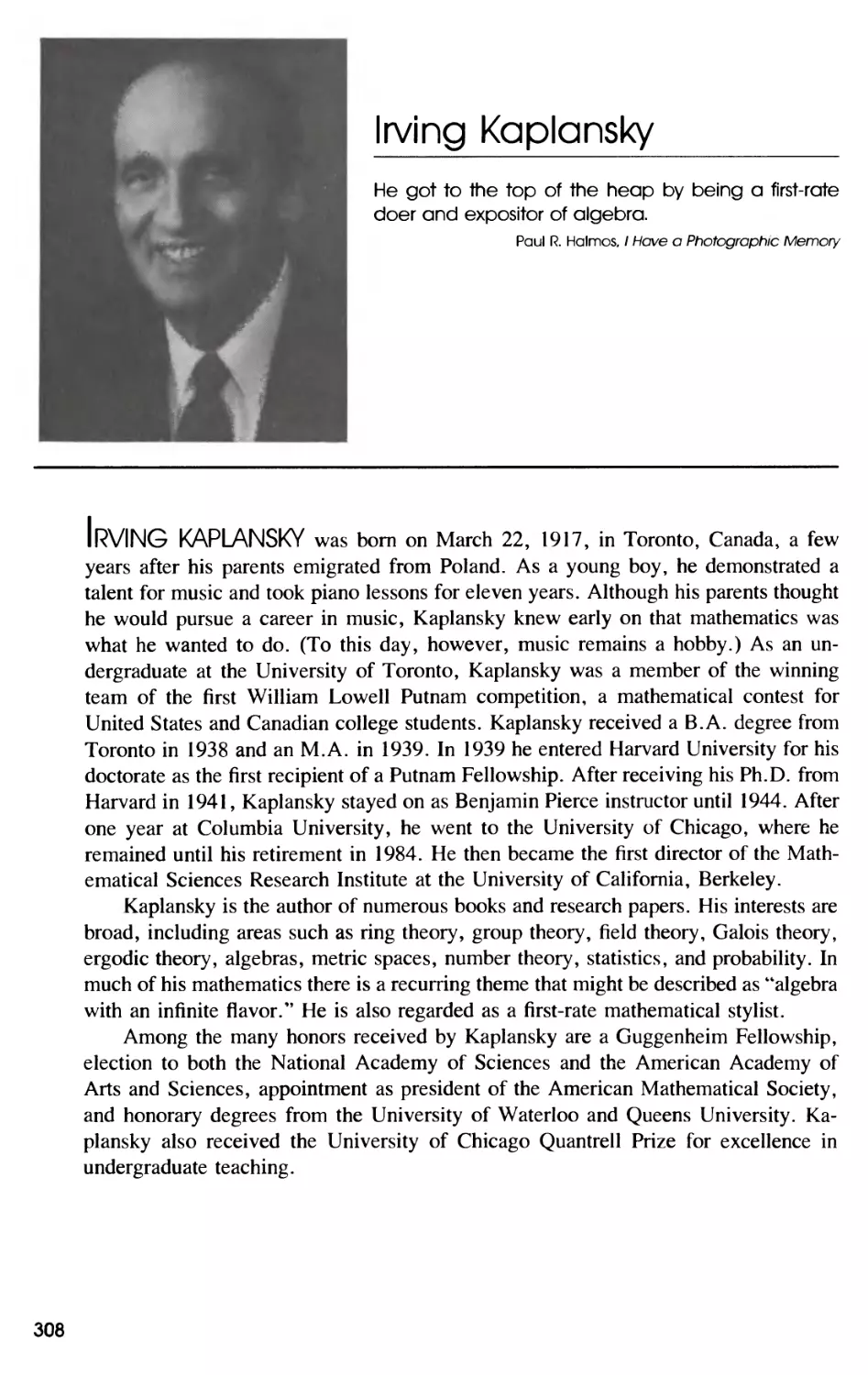
Biography of Irving Kaplansky 308
24
Finite Fields 309
Classification of Finite Fields 309 / Structure of Finite
Fields 310 / Subfields of a Finite Field 313
Exercises 315
Programming Exercises 316
Biography ofL. E. Dickson 317
XXH CONTENTS
25
Geometric Constructions 318
Historical Discussion of Geometric Constructions 318 / Constructible
Numbers 319 / Angle-Trisectors and Circle-Squarers 321
Exercises 321
Supplementary Exercises for Chapters 21-25 324
Special Topics 325
26
Sylow Theorems 327
Conjugacy Classes 327 / The Class Equation 328 / The
Probability That Two Elements Commute 329 / The Sylow
Theorems 330 / Application of Sylow's Theorems 333
Exercises 338
Biography ofLudvig Sylow 341
27
Finite Simple Groups 342
Historical Background 342 / Nonsimplicity
Tests 346 / The Simplicity of As 350 /
The Fields Medal 350 / The Cole Prize 351
Exercises 351
Programming Exercises 353
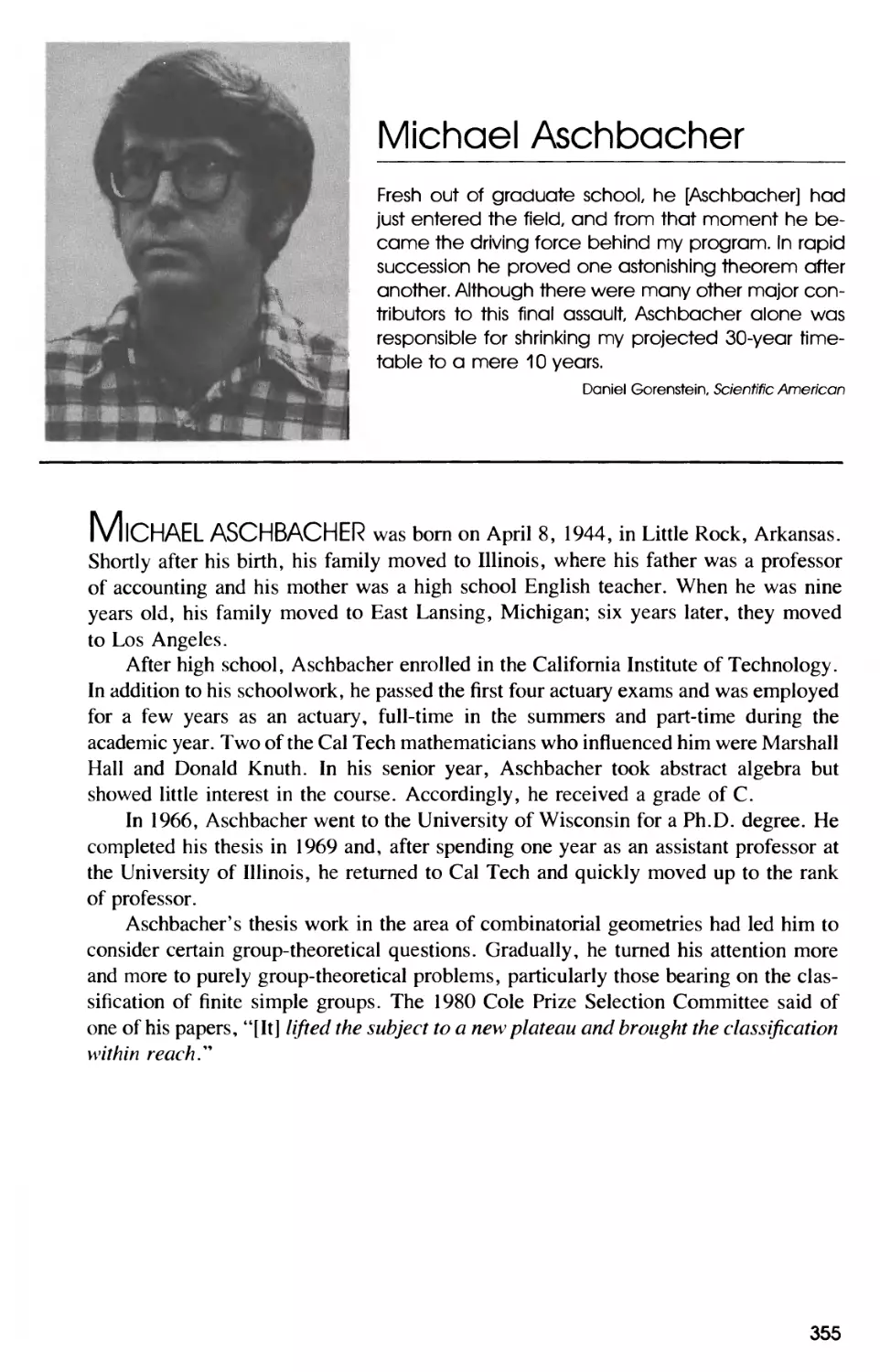
Biography of Michael Aschbacher 355
Biography of Daniel Gorenstein 356
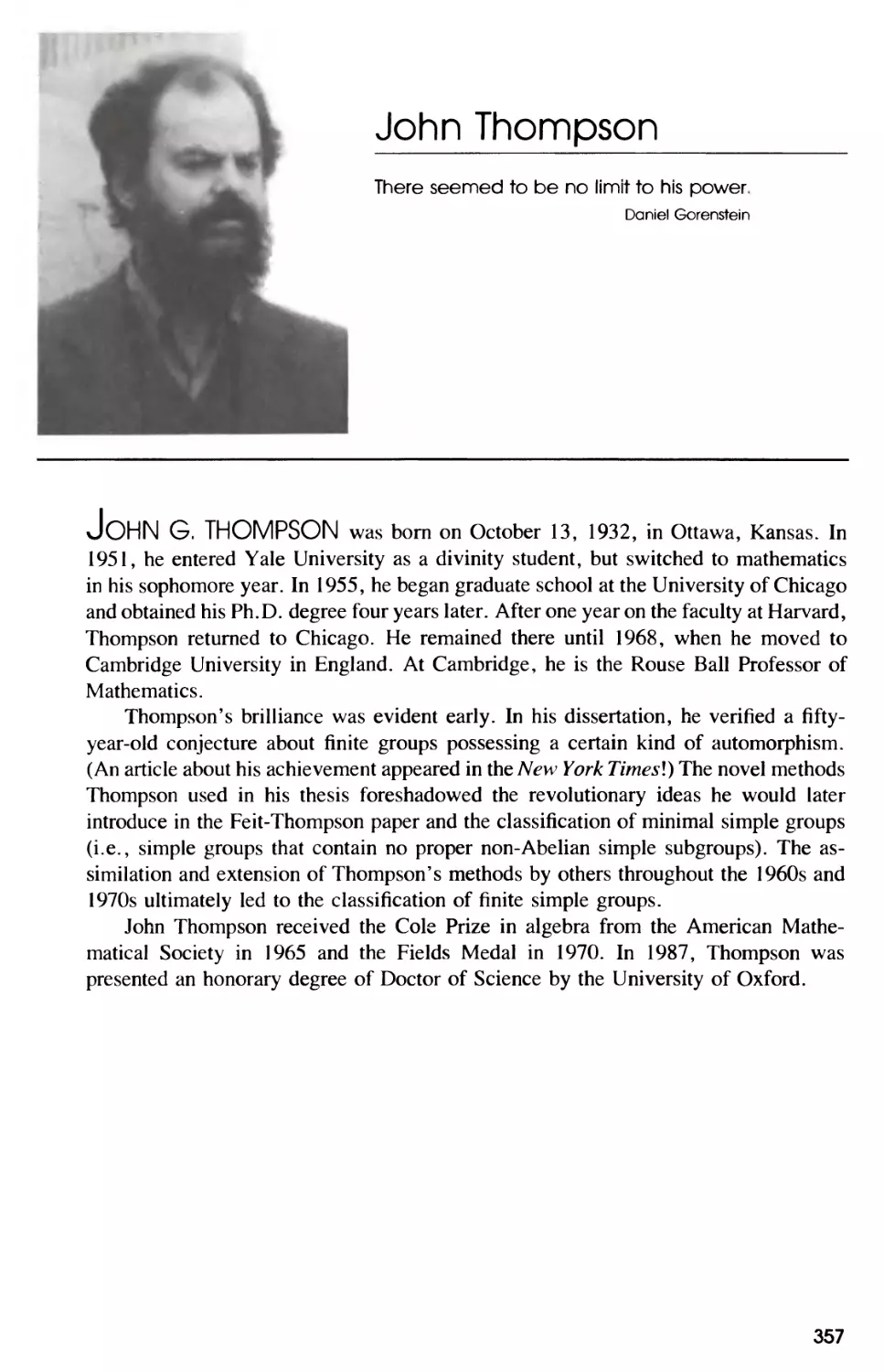
Biography of John Thompson 357
contents xxiii
28
Generators and Relations 358
Motivation 358 / Definitions and Notation 359 / Free
Group 360 / Generators and Relations 361 / Classification of
Groups of Order up to 15 364 / Characterization of Dihedral
Groups 365 / Realizing the Dihedral Groups with Mirrors 366
Exercises 368
Biography of William Burnside 372
29
Symmetry Groups 373
Isometries 373 / Classification of Finite Plane Symmetry
Groups 375 / Classification of Finite Groups of Rotations in R3 376
Exercises 379
30
Frieze Groups and Crystallographic Groups 382
The Frieze Groups 382 / The Crystallographic
Groups 387 / Identification of Plane Periodic Patterns 389
Exercises 398
Biography ofM. C. Escher 403
31
Cayley Digraphs of Groups 404
Motivation 404 / The Cayley Digraph of a Group 405 /
Hamiltonian Circuits and Paths 408 / Some Applications 415
Exercises 420
Biography of William Rowan Hamilton 424
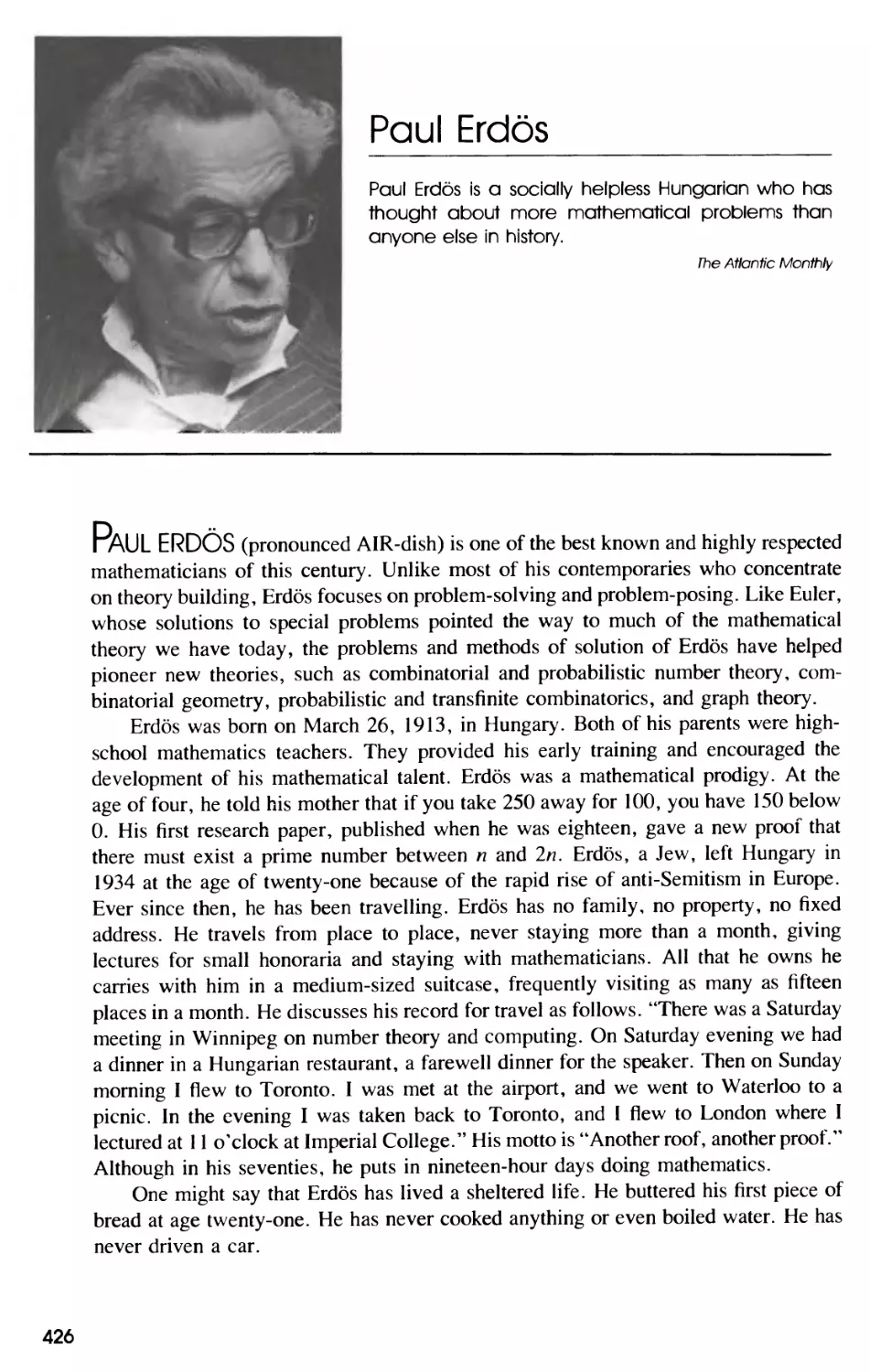
Biography of Paul Erdos 426
XXiV CONTENTS
32
Introduction to Algebraic Coding Theory 428
Motivation 428 / Linear Codes 433 / Parity-Check
Matrix Decoding 437 / Coset Decoding 439
Exercises 442
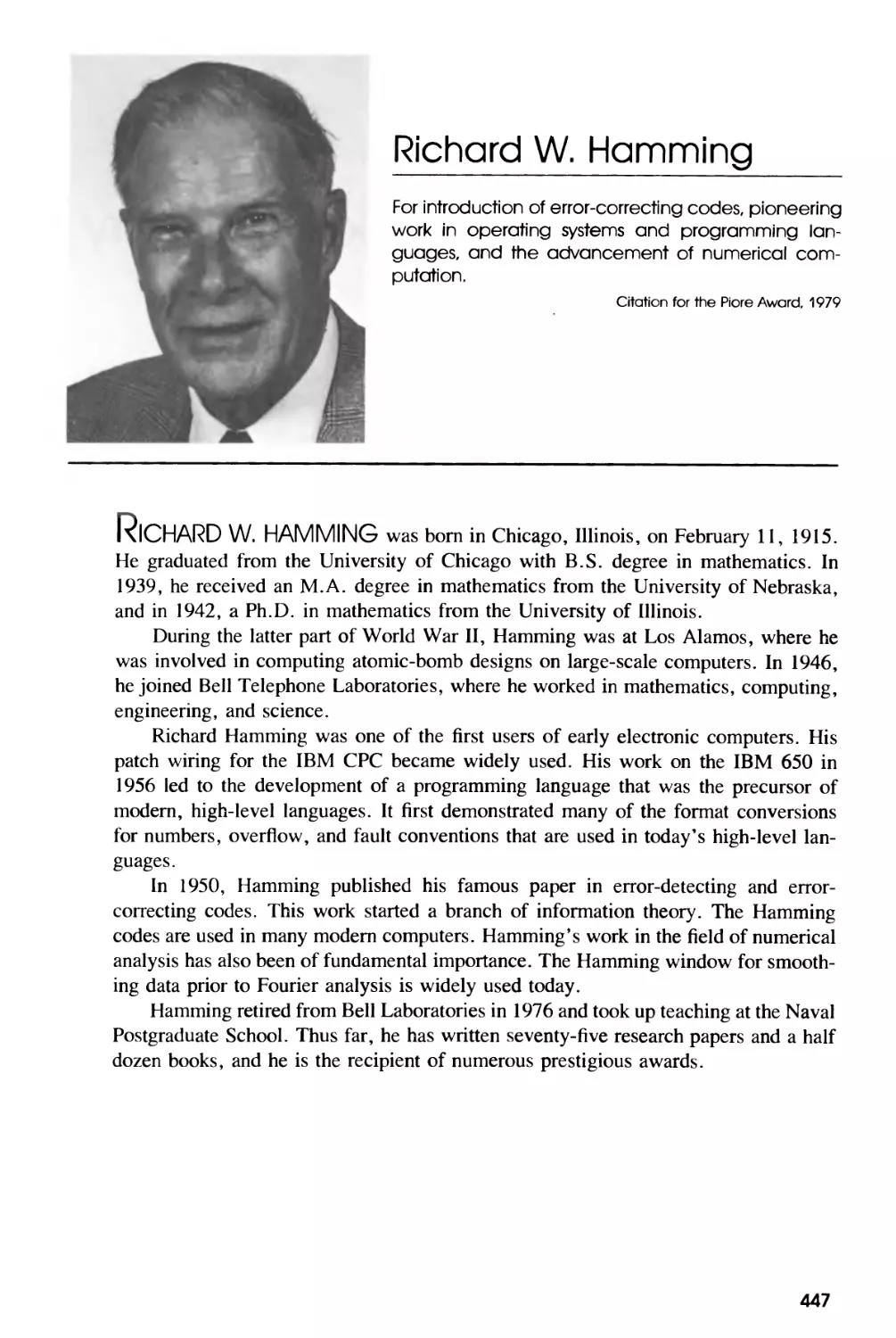
Biography of Richard W. Hamming 447
33
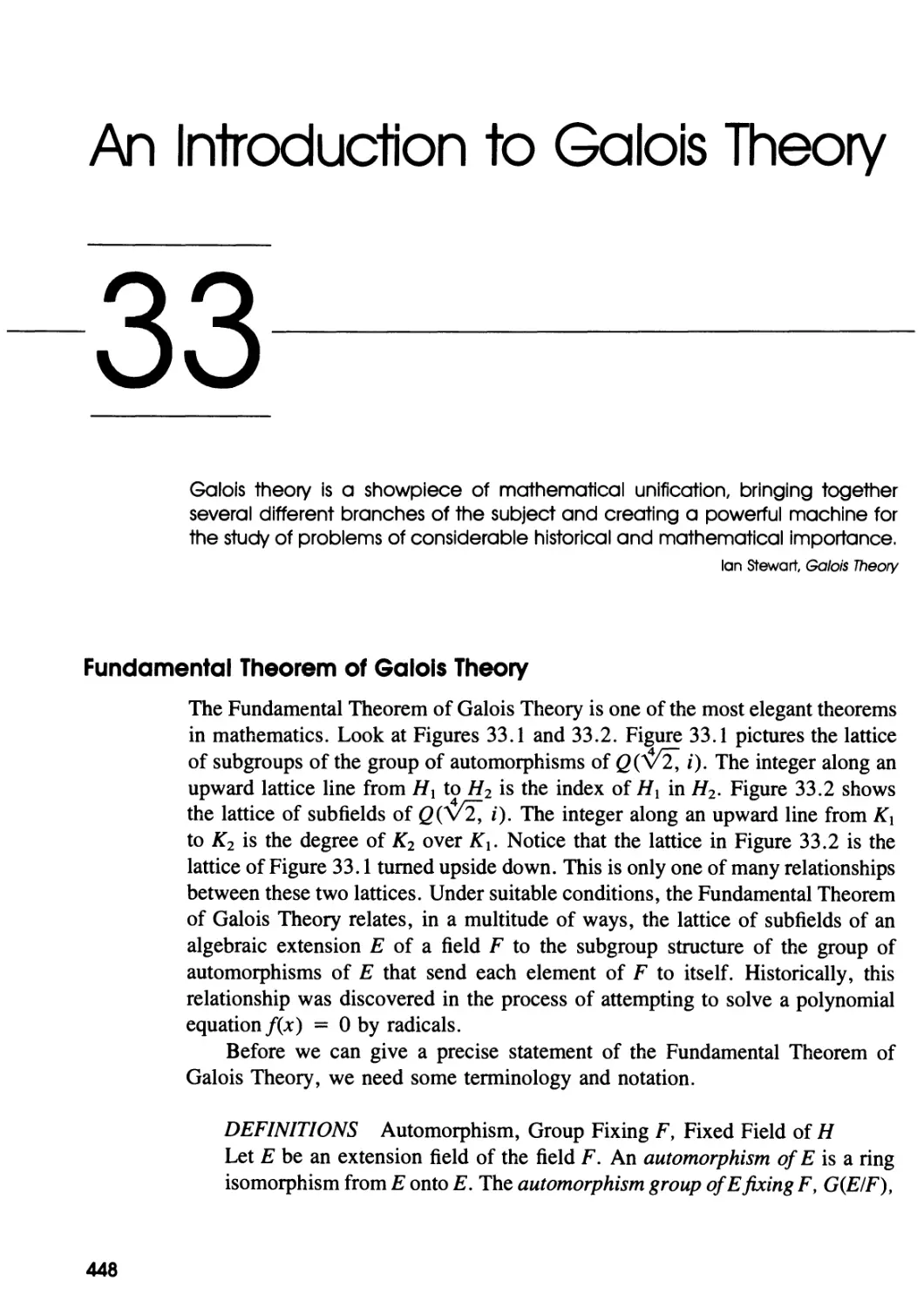
An Introduction to Galois Theory 448
Fundamental Theorem of Galois Theory 448 / Solvability of
Polynomials by Radicals 454 / Insolvability of a Quintic 457
Exercises 458
Biography of Philip Hall 461
34
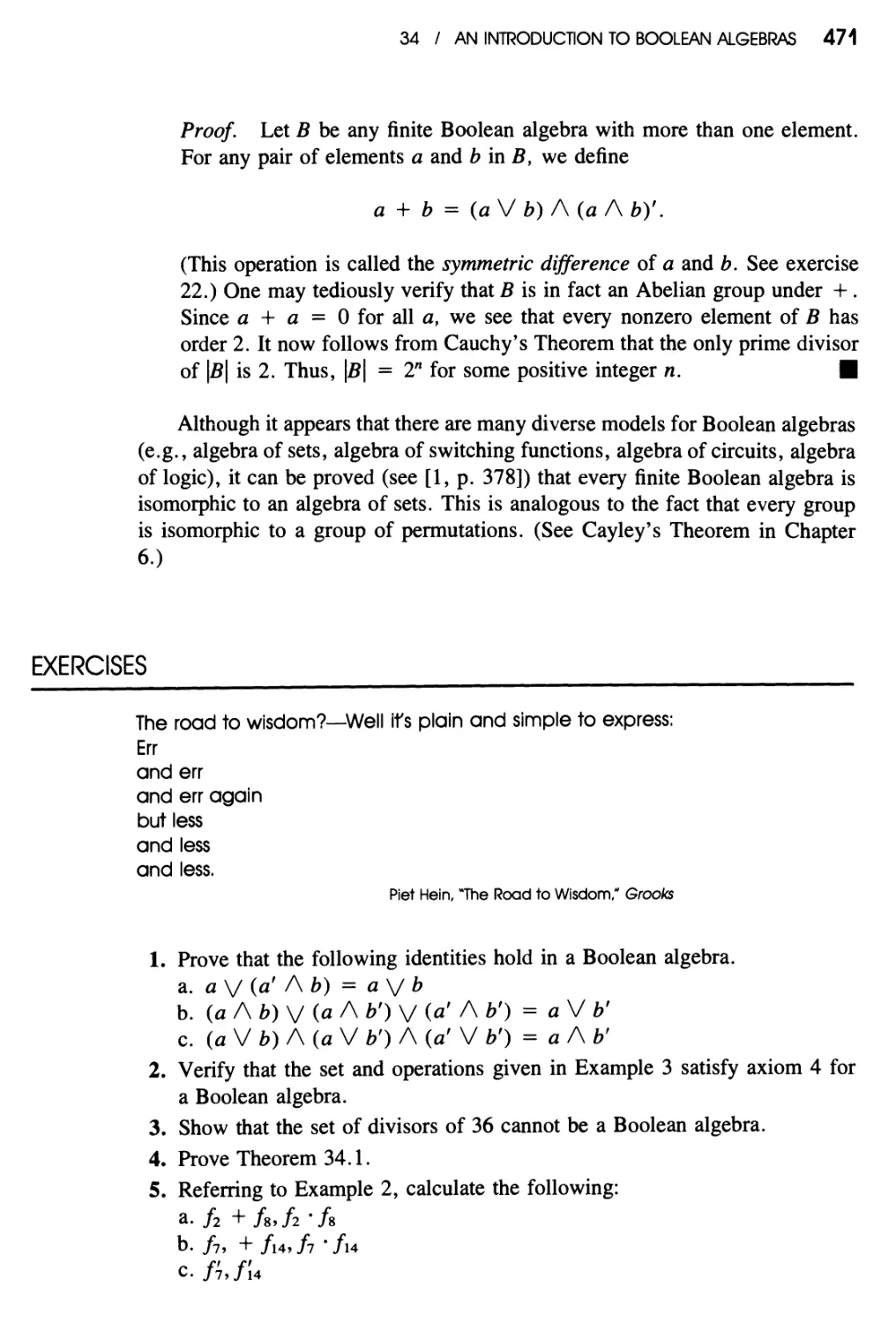
An Introduction to Boolean Algebras 462
Motivation 462 / Definition and Properties 464 /
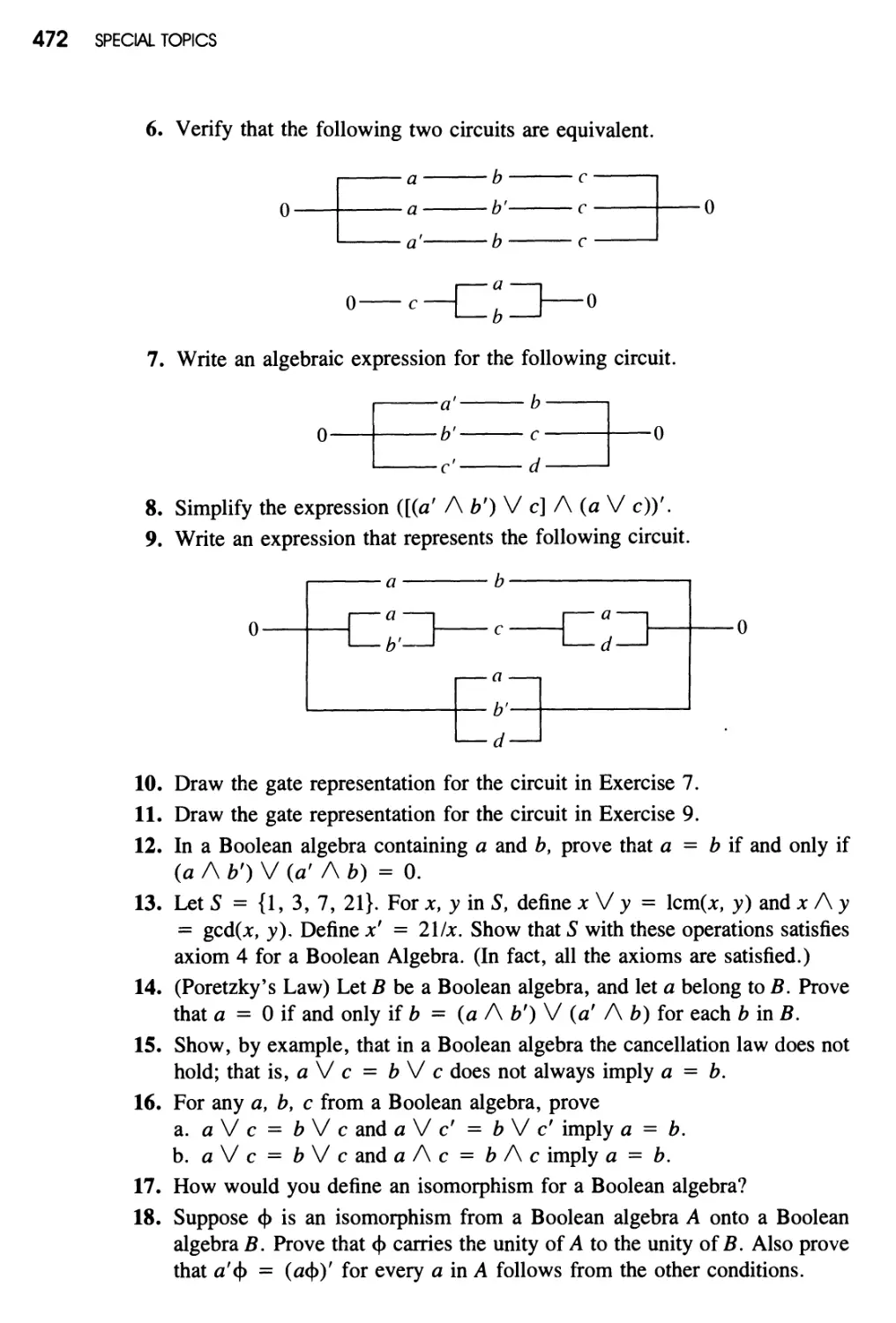
The Algebra of Electric Circuits 466 / The Algebra
of Logic 469 / Finite Boolean Algebras 470
Exercises 471
Biography of Claude E. Shannon 474
Supplementary Exercises for Chapters 26-34 475
Selected Answers 477
Notations 511
Index of Mathematicians 515
Index of Terms 517
I
I
.
The whole of science is nothing more than a refinement of everyday thinking.
Albert Einstein, Physics and Reality
Properties of Integers
Much of abstract algebra involves properties of integers and sets. In this chapter
we collect the ones we need for future reference.
An important property of the integers, which we will often use, is the so-
called Well Ordering Principle. Since this property cannot be proved from the
usual properties of arithmetic, we will take it as an axiom.
Well Ordering Principle
Every nonempty set of positive integers contains a smallest member.
The concept of divisibility plays a fundamental role in the theory of numbers.
We say a nonzero integer t is a divisor of an integer s if there is an integer u
such that s tu. In this case, we write t s (read "t divides s"). When t is not
a divisor of s, we write t s. A prime is a positive integer greater than 1 whose
only positive divisors are 1 and itself.
As our first application of the Well Ordering Principle, we establish a
fundamental property of integers that we will use often.
Division Algorithm
Let a and b be integers with b > O. Then there exist unique integers q and
r with the property that a bq + r where 0 r < b.
3
4 INTEGERS AND EQUIVALENCE RELATIONS
Proof. We begin with the existence portion of the theorem. Consider the
set S {a bk k is an integer and a bk ?>- O}. If 0 E S, then b divides
a and we may obtain the desired result with q a/b and r O. Now
assume 0 S. Since S is nonempty (if a > 0, a b · 0 E S; if a < 0,
a b(2a) a(1 2b) E S), we may apply the Well Ordering Principle
to conclude that S has a smallest member, say r a bq. Then a bq + r
and r ?>- 0, so all that remains to be proved is that r < b.
On the contrary, if r > b, then a b(q + 1) a bq b
r b > 0 so that a b(q + 1) E S. But a b(q + 1) < a bq,
and a bq is the smallest member of S. Thus r b. If r b, then 0 E
S and this case is already taken care of. So, r < b.
To establish the uniqueness of q and r, let us suppose that there are
integers of q, q', rand r' such that
a
bq + r, o r < b
and
a
bq' + r', o r' < b.
For convenience, we may also suppose that r' ?>- r. Then bq + r bq' + r'
and b(q q') r' r. So, b divides r' rand 0 r' r r' < b.
It follows that r' r 0 and therefore r' rand q q' . II
The integer q in the division algorithm is called the quotient upon dividing
a by b; the integer r is called the remainder upon dividing a by b.
Example 1 For a
for a 23 and b
17 and b 5, the division algorithm gives 17
6, the division algorithm gives 23
5 · 3 + 2;
4 · 6 + 1.
o
Several states use linear functions to encode the month and date of birth
into a three digit number that is incorporated into driver's license numbers. If
the encoding function is known, the division algorithm can be used to recapture
the month and date of birth from the three digit number. For instance, the last
three digits of a Florida male driver's license number are those given by the
formula 40(m 1) + b where m is the number of the month of birth and b is
the day of birth. Thus, since 177 40 · 4 + 17, a person with these last three
digits was born on May 17. In Missouri, the final three digits of a male's driver's
license number are 63m + 2b, where m denotes the number of the month of
birth and b is the day of birth. So, a license with the last three digits of
701 63 · 11 + 2 · 4 indicates that the holder is a male born on November
4. Incidently, Wisconsin uses the same method as Florida to encode birth in-
formation, but the numbers immediately precede the last pair of digits.
DEFINITIONS Greatest Common Divisor, Relatively Prime Integers
The greatest common divisor of two nonzero integers a and b is the largest
of all common divisors of a and b. We denote this integer by gcd(a, b).
When gcd( a, b) 1, we say a and b are relatively prime.
o / PRELIMINARIES 5
We leave it as an exercise (exercise 10) to prove that every common divisor
of a and b divides gcd( a, b).
The following property of the greatest common divisor of two integers plays
a critical role tn abstract algebra. The proof provides an application of the division
algorithm and our second application of the Well Ordering Principle. This result
is Proposition 1 in Book Seven of Euclid's Elements, written about 300 B.C.
GCD Is a Linear Combi .on
For any nonzero integers a and b, there exists integers sand t such that
gcd(a, b) as + bt.
Proof. Consider the set S {am + bn m, n are integers and am +
bn > O}. Since S is obviously nonempty (if some choice of m and n makes
am + bn < 0, then replace m and n by m and n ), the Well Ordering
Principle asserts that S has a smallest member, say, d as + bt . We claim
that d gcd(a, b). To verify this claim, use the division algorithm to write
a dq + r where 0 r < d. If r > 0, then r a dq a
(as + bt)q a asq btq a( 1 sq) + b( tq) E S, contradicting
the fact that d is the smallest member of S. So, r 0 and d divides a.
Analogously (or better yet, by symmetry), d divides b as well. This proves
that d is a common divisor of a and b. Now suppose d' is another common
divisor of a and b and write a d' hand b d' k. Then
d as + bt (d'h)s + (d'k)t d'(hs + kt) so that d' is a divisor of
d. Thus, among all common divisors of a and b, d is the greatest. II
Example 2 gcd(4, 15) 1; gcd(4, 10) 2; gcd(2 2 · 3 2 · 5, 2 · 3 3 · 7 2 )
2 · 3 2 . Note that 4 and 15 are relatively prime while 4 and 10 are not. Also,
4 · 4 + 15( 1) 1 and ( 2)4 + 1 · 10 2. D
Although the above result is a powerful theoretical tool, it does not provide
a practical method for calculating the gcd(a, b) or specific values for sand t.
The next example shows how this can be done.
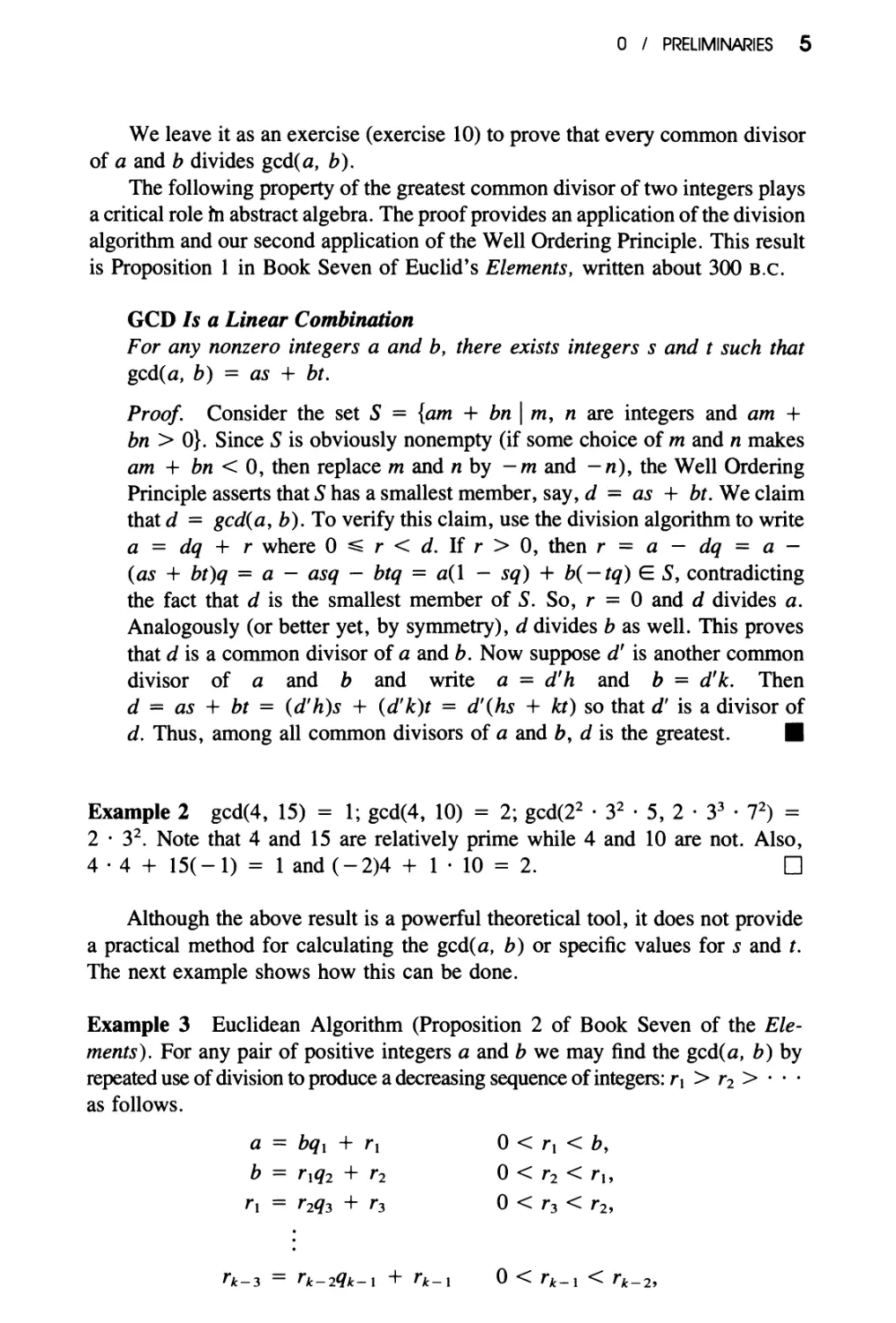
Example 3 Euclidean Algorithm (Proposition 2 of Book Seven of the Ele-
ments). For any pair of positive integers a and b we may find the gcd( a, b) by
repeated use of division to produce a decreasing sequence of integers: rl > r2 > · · ·
as follows.
a bql + rl
b rlq2 + r2
rl r2q3 + r3
o < rl < b,
o < r2 < r},
o < r3 < r2,
.
.
.
rk-3 rk-2qk-l + rk-l
o < rk-l < rk-2,
6 INTEGERS AND EQUIVAlENCE RELATIONS
rk-2 rk-lqk + rk
rk-l rkqk+ 1 + O.
o < rk < rk - },
(It is a consequence of the Well Ordering Principle that this process must
eventually result in a remainder of 0.) Then rk, the last nonzero remainder, is
the gcd (a, b).
To see that rk gcd(a, b), observe that since rk rk-l, the next to the last
equation implies that rk rk-2. This, in turn, implies rk rk-3. Continuing to
work backwards in this fashion we see that rk band rk a. This proves that rk
is a common divisor of a and b. Now, if r is another common divisor of a and
b, the first equation above shows that r rl. The second equation then shows
that r r2. Continuing, we see that r rk and indeed rk is the greatest of all
common divisors of a and b.
Let's apply this process to compute the gcd(2520, 154).
2520 154 · 16 + 56,
154 56 · 2 + 42,
56 42 · 1 + 14,
42 14 · 3.
Since 14 is the last nonzero remainder, gcd(2502, 154) 14.
The preceding equations also provide a method to express the gcd( a, b) as
a linear combination of a and b. For instance, we may use the equations to write
the remainders in terms of 2520 and 154. Namely,
56 2520 + 154( 16),
42 154 + 56( 2),
14 56 + 42( 1)
56 + [154 + 56( 2)]( 1)
56 · 3 + 154( 1 )
[2520 + 154( 16)]3 + 154( 1)
2520 · 3 + 154( 49).
D
The next lemma is frequently used.
Euclid's Lemma* p ab implies p a or p b
If P is a prime that divides ab, then p divides a or p divides b.
Proof. Suppose p is a prime that divides ab but does not divide a. We
must show p divides b. Since p does not divide a, there are integers sand
t such that 1 as + pt. Then b abs + ptb, and since p divides the
right-hand side of this equation, p also divides b. II
*This result is Proposition 14 in Book Nine of Euclid's Elements.
o / PRELIMINARIES 7
Note that Euclid's Lemma may fail when p is not a prime, since 6 4. 3
but 6 4 and 6 3.
Our next property shows that the primes are the building blocks for all
integers. We will often use this property without explicitly saying so.
Theorem 0.1 Fu mental Theorem of Arithmetic
Every integer greater than 1 is a prime or a product of primes. This product
is unique, except for the order in which the factors appear. Thus, if
n PIP2 . . . Pr and n qlq2 . . . qs where the p's and q's are primes,
then r s and after renumbering the q's, we have Pi qi for all i.
We will prove the existence portion of Theorem O. 1 later in the chapter.
The uniqueness portion is a consequence of Euclid's Lemma.
Another concept that frequently arises is that of the least common multiple
of two integers.
DEFINITION Least Common Multiple
The least common multiple of two nonzero integers a and b is the smallest
positive integer that is a multiple of both a and b. We will denote this integer
by lcm(a, b).
We leave it as an exercise (exercise 10) to prove that every common multiple
of a and b is a multiple of lcm( a, b).
Example 4 Icm(4, 6) 12; Icm(4, 8) 8; Icm(10, 12) 60; Icm(6, 5) 30;
Icm(2 2 · 3 2 · 5, 2 · 3 3 · 7 2 ) 2 2 · 3 3 · 5 · 7 2 .
Modular Arithmetic
Another application of the division algorithm that will be important to us is
modular arithmetic.
DEFINITION Arithmetic Modulo n
Let n be a fixed positive integer. For any integers a and b, (a + b) mod
n (read "a plus b modulo n") is the remainder upon dividing a + b by n;
(a · b) mod n (read "a times b modulo n") is the remainder upon dividing
a · b by n.
Example 5
(7 + 4) mod 3
(10 + 5) mod 6
(6 + 5) mod 7
2.
,
3.
,
4-
,
(7 · 4) mod 3
(10 · 5) mod 6
(6 · 5) mod 7
1.
,
2-
,
2.
D
8 INTEGERS AND EQUIVAlENCE RELATIONS
oughout this text, we will make frequent use of modular equations.
DEFINITION Modular uations
If a and b are integers and n is a positive integer, we write a b mod n
when n divides a b.
Example 6
13 3 mod 5
22
10 mod 6
1 0 4 mod 7.
D
Example 7 Consider the equations
1 mod 5.
3 mod 5.
5 mod 6.
b mod n.
1. x
2. x
3. 2x
4. ax
Note that x is a solution of equation 1 if and only if x 1 5k for some
integer k. That is, x 1 0, + 5, + 10, . . . or x belongs to {. . ., 9, 4,
1, 6, 11, . . .}. Similarly, x is a solution of equation 2 if and only if x belongs
to {. . ., 7, 2, 3, 8, 13, . . .}. Equation 3 has no solution, since the left
side of the equation 2x 5 6k is always odd, while the right side is always
even. In view of equation 3, we see that equation 4 need not have a solution,
but one important case in which it does is whenever a and n are relatively prime.
For then there are integers sand t such that as + nt 1. So, asb + ntb b.
Thus, asb b ntb is divisible by nand sb is a solution to the equation
ax b mod n. D
Modular arithmetic is an indispensable tool in computer science. One ap-
plication concerns the generation of "random" numbers: a sequence of integers
that is easily produced and passes a number of statistical tests for randomness.
A common method for generating such numbers is to use a recursion fonnula
of the form
X n +l (ax n + c) mod m.
To use such a formula one chooses the modulus m, the multiplier a, and the
increment c, as well as an initial value for Xo (often called the seed). Over the
years guidelines have evolved for selecting a, c, and m. Typically, m is a large
power of 2 (e.g., 232) and a 5. Of course, numbers generated in this way
are completely determined by the choice of these parameters and the initial value,
and so are not random at all. Nevertheless, these numbers do possess many
properties that we expect of random numbers and so are useful for simulation.
Modular arithmetic is often used in assigning an extra digit to identification
numbers for the purpose of detecting forgery or errors . We present two such
applications.
!
I
.,
., [,'-,]
11"
......
a
9
/
PRELIMINARIES
U f " . 11 .. II "" ' . ''' I '' ! ..... 1 ,. -" 11 r J I' "" I.. . . '.. r H--II...., 'I" -.J. .11 " .... .... __.. ..(:..... Ja. J...... !t..... ILl...... ........ ...... .... . .... .... ..... ....... .".ot . .... . ",. .... . ... ...... ... of. "" I to. ..... II n.. u. ... h
....,. J nf'.... La" 'r ."'''1'111 '.11' 'r-, I ., ..J .... 1I.l.t-'..,. 1-- __ - "" I, ..., ..
,.... . I.
',m
. .....
f " .. .. II ....
-h.. __ . .... ... ".._.
....
II
....R.
....J:!......
i
,
,
. >.:
.;
,
F
f..
. O<L
r '."
IJ!
".
I -Jj
. III
: wI!,
-
. Iii
f II
f II
'Ft
, I
j';"
:11
"- - - .
:
:.-
t'!rffl
IF
:
I JI'I
r !f
-J,
':z.
..'
-
, .....
'.f ';- .
.:EII:i:L.- .. ..
.. ., '" ..
.. . -;., *
.
..,.,..-. ;;:;tZt'!t: . -= .",- -
Iii" £. -';ro' .zit.:;:.m:' 1'- -.-
...-: -:::-.. - .. ...' - ..t:i'::"" .
'::0:: ' " ¥;,;:.
..
:::I!' ..... ..
]i;;. ',... ..."...
-p::.- :'I
:LT : ' .
,, :£
.. z:E..... :af;..
'd
:' ...,
.. -. _......:..... . .. .-
- -
.. i.: 1. ...:. =--":"":....- :. __ :
... . :
_ . "].1!i
:J:, .
'!f
f'
-
-,
- ".-
_ . i!:: -- ::...
:; -'"
If
..
f II I
. '.
.. :1::
, : 'I ;
. ,
.,
' :- : ,
: :
::
.L
-:-"' .
N' '£I! , .
.. "., _.
r: ....:_ =It.
.-
, ::s.
,
, ,
-- __..Ii"
!l;...... ....
' ,
:9
, ..
._ A...
".
,
!i;'
::1%
.
III'"
h'
"!,
Ii !
I
-.:!
"--
!b
N
: - 'iff:'
':gr ':F- :Ci: , i!
, ,
:W *, $1' .:t1 '.:i!
.
:-. i---
.'. ..-
-.....-
-......-
-:---
-
- ,
.':.
-::--........
r' "
. '.' , !i- , :
I I
I I
_..::- _.
::
-.... .r . . -=:. i. ..
.,..: .... .. .. ..
, : .I ." ,. . ':', PO" 'o,i:"J1: - ,.
: ,: ': '.,
; :l :_:" I '\' Jli ,-;i ?_ ';!:11 . "f!
1.- I" , :- t 1: . '.. "'.:.:\
.. : 4 I -.:_
II! ,,' ',1= - .:
.. -.I: ..,. Ji,.....
: ...:.. -.. Ii ..
.&.
I .t,
ii..
: -o::
f
: r . ,I J
'"'- ...'
... - .: -'_. -
:' i)';$..::P9i. II$: ft :.!C.HT$ ':--'
.. ,
i
.A"
t
. If:
, .
In: -O'!
, ,
I, .
.... .....
,
, !.. ; ' "
h ,r 1 I'll
.. 1 J _ j
, ,
:.. --. --"'1.-
. ..
- .
,
-'
. ,
, ,
- ..
': -
- .. Ii
..
,I
---.--.
t J
!
- -
i:
r
1-
ff
r .
" .
, ,}
I I " ,
"
" ! '
,
T'
:tp
........_ I
. ,
- -
-r--
i -:
....
,
Ji. E: :!
=--
'.
: -:
.- - ..
-
-.,
, ,
..-
. :
. .
.... .O'.
. :'.4)(.: ...
.
i "91!! iiiiiiI ..
.. ., ..
....
I ur;
WII 1.. 1:/11'.
"'lii"
. ..lJ:l
.. .Jrr
1;1111 ,
II....
, & J
,.
: I: :
. ,
II
r
-
!::
"
Ai ..
.
"
,. .'
H'i'
" j
II
.101 ..
I I
,
:;-1
. ,
..: ..
...O' --=:-_--
, /'1
,
!
" .' I'
'i
'''I
..
. ' "
. i
I
..
=-,j;.
-
-..
....
.,.,
.. : -
I i
.
"
...:':1 I
,4'
,..
'-
.
. -
.... .-
.-.O'
.I
,S"JAT,Ei'
..' .-..
. : ---.
-I
I
, ".
,
..o ....
,
,
.. ;
'., crtV
o.
- '
. -,
: .1 :
, - 1J4.. ..,
, ::, . ",. S T -I!! ' '-
..::... ___ 1....._ . ..1;; :;
- - ....
- :.
:
.. ,
.. - I
. _.: : .:
"
'I
,oj: J .1
"":!
. .......... ". ':' .. . ..
. . --
; ..:.....
:. -
,.
..
;
-!
. ..-.
. .
-t.. C .
'"
r". .."::.-w
-I .:...:.:...
, ,
:
r,
1_... I.
.. ,
, '-:,'i
i
..
I'
I
, ,
I
,
, ,
, -,
. ,
., . - E
I. '":
.:
,..
,
.' 'I
,I , J
.1 I r
'.,
,
:
, -
'.
.._ :
..
,
: ... .
: ':'
, ..
, - ,
..
., .
..;
,
,
... .
.
, '
, ,
-.
, ,
"
..-
.
--,
!
'ii.
,
I ;-j'
"" j
in-
..,
1'-.
..::
.: . ...-
.
...: : :::
..
. ... : ::. - . ;-. . .:
: = ...
.. ... - -..:..
.. .,
!
...-.
'.I
, ,
. ,
..
!. ..:; .:
"--
I ' 1 I' ., " "'11
'J: U , I
, I
'I I....
,. ..
-;..
r-;-"'....
h
.
.'" .
;
-
h -:-"
: "':
.. .. . :
-.
...
. . I..
, '.
!J"U HI ,.
- .
'-
.. --
..!. :
. " ,
: '
.. ..
.: -.. :
. I
I '
-. .:
..: .
. .
......J
I \I'
.
....'HfI
"h
II.
: -:r..,
'0ft, .
,j
;
,.,f .r
,f! I. 1'11, ",
,
I
'.
,
'.
...
, ,
,
:.- ..- I
: I
'",
I"
.
...: ..-
LL
. .!
'j
r"'n
urnl 1 I'
' :'O:di )o:C) a(LrO ' .t I,
II I · f.,11 . 1-" i!'
r II. r ht!
t
I:
--'1::
,.,
.. ,
-. ..,;;. L'."-n..
-3 q; s:3.(qa,A; .:&.It .,t'J';
.. : I. ...:.... .. . T . .::- "
. . H: . -;:..... _:..-:=
I . - ':' _=--_
t
F:. ...
ro.:
I"
I'::
'Ii
-
,. .,-
I
.1 -h
.
...... i..
h,.
t' 1=.:":':. .:
.- ; l ::. i: :. i ="i.=: "'. .. .
.. - . .. . . .
.
II, J t
;,' l "
-I I ..
n
I : ,
. , , ...:" -
I :::l if , :
: I ; , u - ,
, , .._ .-F
. ..I
. . ..o .. ...... -..... hI... =
. " . - . .... ..-.. .. - .... . .. ..
o , I ' . . . :..:..;.: . . ....:J. - _ ' , :..
"..: ;...:... I ; f : , :' . t: . ojii .. . . ... .: ..:. :. .
I i........ ...... .r .... , .. .... -...- . ... I
.
. .-:.,
-_. .
.. -.. .
. ..: :.= - :
. .. .
i ,L
I f I
t I I
"'= ; I : I r -' "II Ii"
". I I i.
.,
Un
..
- .
.......: .:
po. .-
::: ;: ..
.i. -.:; - i:
.
- ,
.. ..
.. :
.,
- ..
: ..
, ,
, :
.
- -:.. - .....-:. -
- ...... ... .
"L::: r..-", =] f, i: t'. ,
- .
.1
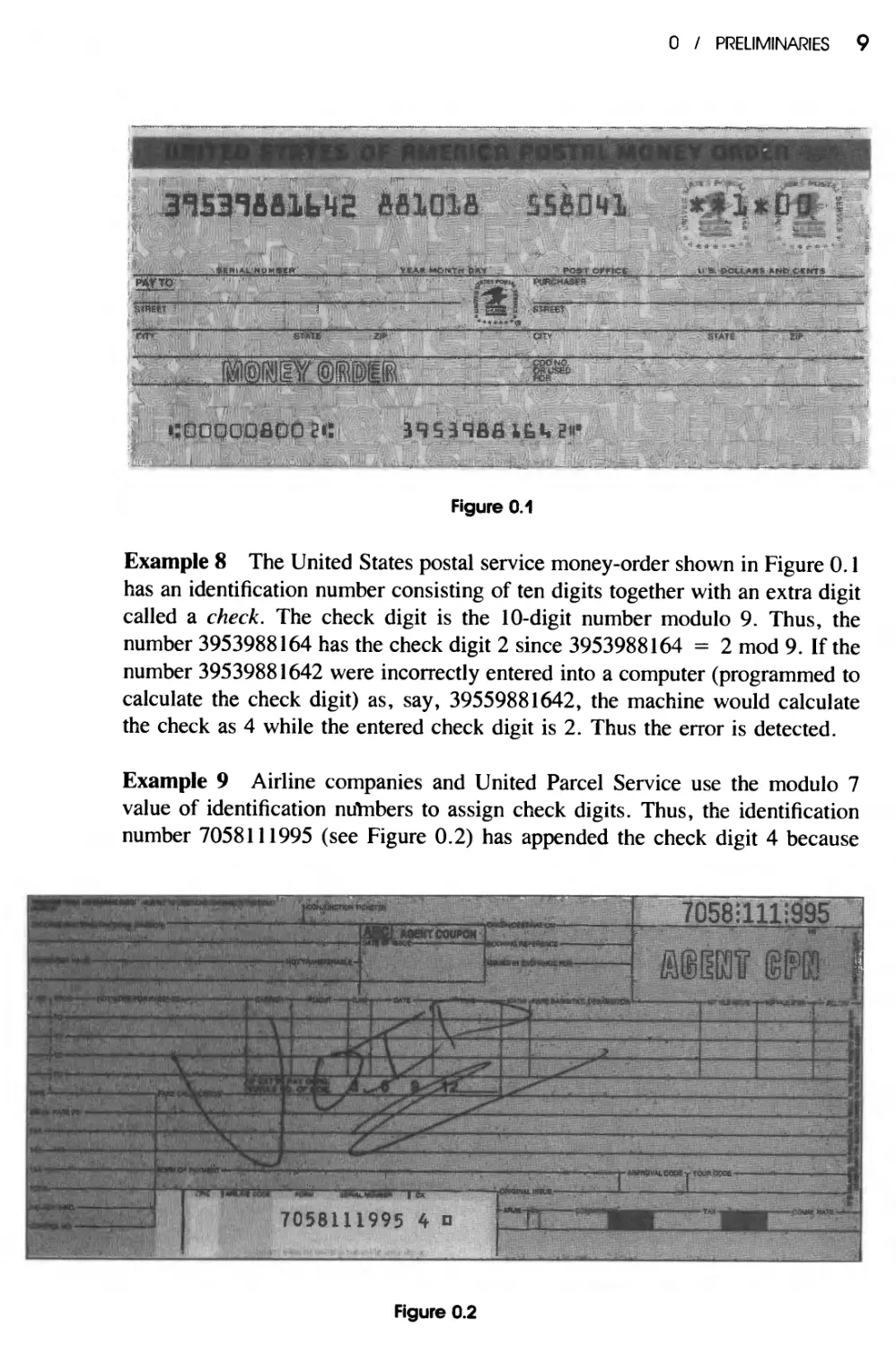
Figure 0.1
Example 8 The United States postal service money-order shown in Figure 0.1
has an identification number consisting of ten digits together with an extra digit
called a check. The check digit is the 10-digit number modulo 9. Thus, the
number 3953988164 has the check digit 2 since 3953988164 2 mod 9. If the
number 39539881642 were incorrectly entered into a computer (programmed to
calculate the check digit) as, say, 39559881642, the machine would calculate
the check as 4 while the entered check digit is 2. Thus the error is detected.
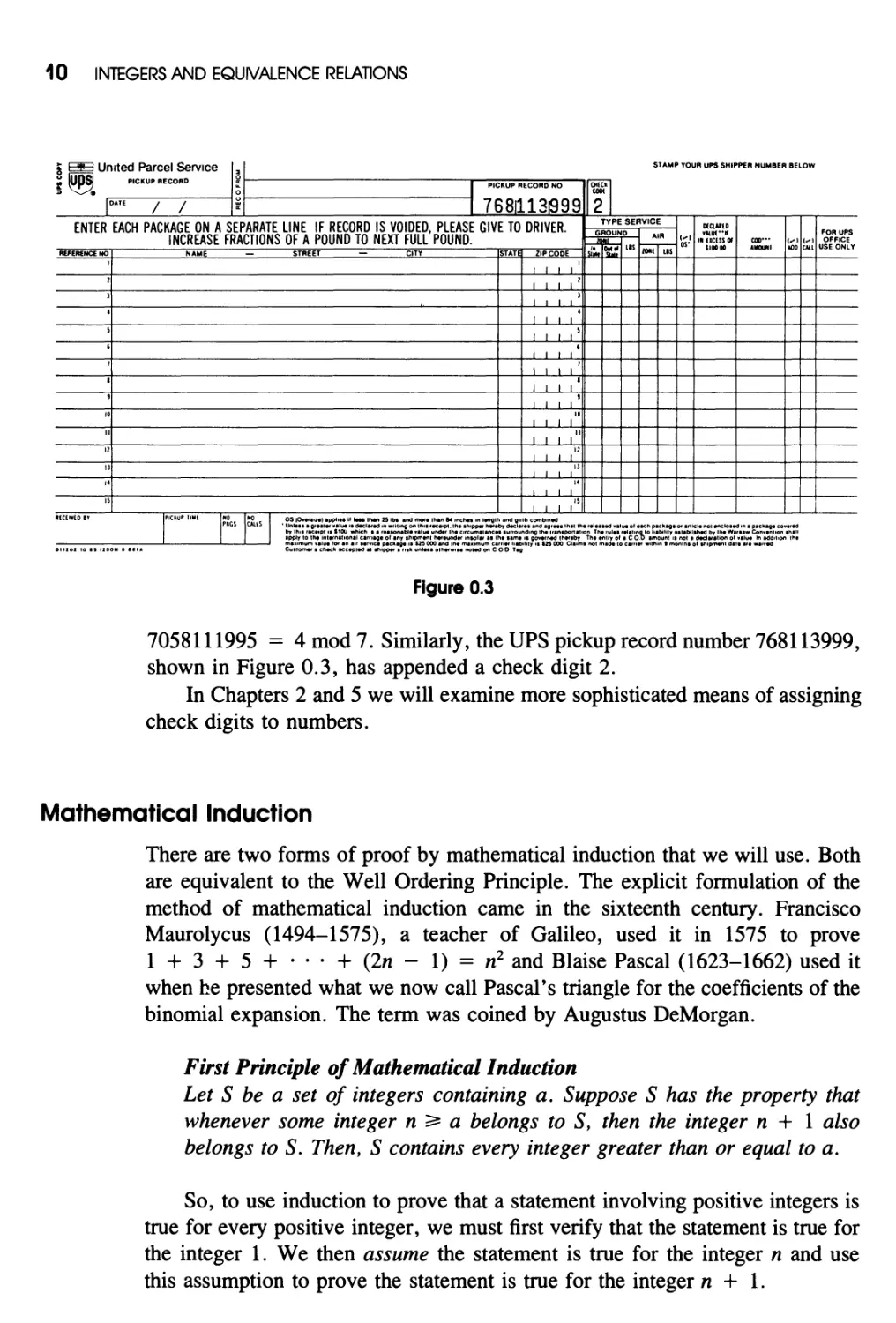
Example 9 Airline companies and United Parcel Service use the modulo 7
value of identification numbers to assign check digits. Thus, the identification
number 7058111995 (see Figure 0.2) has appended the check digit 4 because
__.';1:
I I I ',I,
,1__ ) 1"1"
,,', I'
,
1 o s . ': 1 ' :,. 9 ! e 95
8 11 . ,
. 1_..
:: . ::-::. :[
,
.. f . ,
..
!
..
'I
: 1[.
a!:
: . ...
... ..
, ,
,N,
':
: .. ::::..
- . : ::
.,
....
. ..
..
..
I,
.:I.I UI
ir.
,.
I',
III
,
: : ::
;.
';
'
,' ",11' .
,I I. I
,',. 1 1 '1
,,: "
' - ' eT ' _ COUPal ' , . . '. U
. , . . .. I ;- .
'.., .. " , ,.' -' - .:
. '- "
. .. ,
. : .
.. ...
,,'
II I.'
..
I
,
..
, .
,.
.
!.t III r I I..
"
II
.'
:
I r r IL
, "
. ,
I
,
,
, , r 1','" '" .,
.....'u.. , I .....'rJ '11'1 ! . . *'". " : ' III,I , ':lllr rl +,,, .'",1[.1 '1IPlllrrlr,'ll 1 '" " " II, ' ,I!!, : ,I .'
, ' I I ' " II' p I . r
r t I r .
[
I''';,.
"
...
"'iftI. 'III"
I: I I
"
I
I
-;
"J' "
I ' ,
, " '
. .' 'I h'I.,ln
It, "
"
.-I
, II.'
I ",',
I I
I
,
,
.. , .. ,.
fII!R"1III:I :r: !:r
. .
. .
, -
.,.
.. '
. .. - .
..,.' ;
.'
II:
.
,
,I.
.t ,1 :I I .
'I
"
,
"
: ,
: ,
,
,
..
,
, , , .. , ,
.:
,-'
.,
,
,
.1
-'
, , ,
U
,
"I
,
II
'I
. :
:-
-'
"I
,
-'
,
-I '''J!'" III In If' "''''''!'r- Jfo. II I [' ,..".,Jf.ii!JI1II III'"
JIo, . ... j...ll '"r' I . I'll . 'J' 11
i'" -" I I " ,'I
I.
,...,
.:.
II
..
,
:: .
.
r:
-.
..
..
-"
I,
I
II
I '
'p
,
,] : 'J'
U I .1
, I
, ,
:-:
,
,. ,
J I IJ: r1 1 L
I '
,
, r'
.
1 I r.I'LII
'I ,
I I,
, I
.
, ,
,
,I u
u] 'I"
I
" J .
1 ,I'
,
'I
- .
-
..;
. .11 I
r I I 1.
r
I 4 U
,
I'
,
:..
I'
..
,.
,
pi
'i
,I'
,
u:, r
'] '[ ,
1:1
::
"
I.
J " 1'1
, ..
1,
I, I"
I,) I.. '
, ,
,
"
,
,
,
.
I"
II ,
.:
"
.
"
:..
1
h '
"
., I'
, '
..
.'
"
,
, '
I'
..
I -
,
, -
.. ,.
I :
, ,
II'
.
, n
:..
I',
IJ,
,. i
, ,
.,1
I.. LI
,
..' -
,
I
. -- ...
:'
I"
, ,
I "
"
CQDi ', -
.,
hiiliii. ".
';0... ,1 N .'RIW-
,
I I"
I , &I I
I'
,'II,'
, It' II I
,{ I' " I
. ... i ....
' _J:
,imIii AoIi:I ..
.
;; I: :
, -
,. I
':-'
"
At!
,
IL
CK
I
r to
,I
I
J .
t
,
,
,
1.
......
-
-i: _
.1.: !
"
1058111995
;F,
4
,a
.
- -:...
,i 'I
I
I,
.
I
,I
:-
,.
, I
...
-
,
..
.
,
. . I
:-' ..: -iih.: ..;
, ,
-. ..... .
.. ......... - ....
I... .
... .. .....-
..... .. ......
.
. ,
'- .
-, ,
, , ,
Figure 0.2
10 INTEGERS AND EQUIVAlENCE RELATIONS
5 United Parcel Service STAMP YOUR uPS SHIPPER NUMBER BELOW
r PICKUP RECORD 0
a: PICKUP RECORD NO CHIC"
"-
. 0 coot
DATE / 0 768113 99 2
/ ...
C[
ENTER EACH PACKAGE ON A SEPARATE LINE IF RECORD IS VOIDED, PLEASE GIVE TO DRIVER. TYPE SERVICE I)(CLUED
UND AlA VAlUf - -If FOR UPS
INCREASE FRACTIONS OF A POUND TO NEXT FULL POUND. (...- ) till [IC( 55 Of COO... ..... . (..... ) OFFICE
'It Ole If lIS OS. SIlO 00 AMOUtIt AGO CAlL USE ONLY
lOll ( lIS
REFERENCE NO NAME - STREET - CITY STATE ZIP CODE a.
I I
I I I I
2 I I I I 1
) )
, I I I I
.. ..
I I I I
I s
I I I
, ,
I I I I
1 1
, 1 I I
. .
J 1 I I
9 ,
I I I I
10 10
1 1 I I
II II
I I I I
12 I
I I I 1
13 13
I I I I
14 (.
I I I I
IS IS
I I I I
IfCEIVED 8y PICttUP liME NO NO as (o,.",z.) ape>t... If .... "*' 25 Ibi and mot. Itlian .. Inches In I th Ind girth combl"ed
p"CS CAllS · Un".. a gr...., .,alue.. declared In .rltlng on 'h'l rec'lpt. the shipper h..by declar..anClIO'", that 'h. re.eaNd yalue 0' .ach packag. 01 art " not -"CIoNd In I Pltk. cow.reel
by 11'1.. recttpt 1.11OCJ which il I ,..IOft8I ' .llue vnclef the CffCumlt-"C.t lurroundlft9 the Iranaportilion The rul.. '''I''ntto liabtlity ..'ab4'1hed by the Warl.. Con..nttOn thlU
apply to ,he internatlona' carrlag. or any I"npm"'t hereunder InSO'1f I. the lam. II g O'...r ned I""'by Th. entry 01 . CO. amount II not . ltecler.tion o' "'a'ue In addition 11'1.
mlxlmum yalue tor an .., ..rYIC' ck .1 m 000 and I m Ie,," m carr II II I Clalml I m. ,. within t 1'1 r i m n t d I ar .. IV
.1UOI 10 I' 1100.. I "11.
PI . he . u tel abt ty . 125 000 no de '0 car " monl . ° .... Pf .. I. . I ed
Cust omer I chack acCe9led al 'hippef . ,..111. unl... Ot"""I" noted on COO Tag
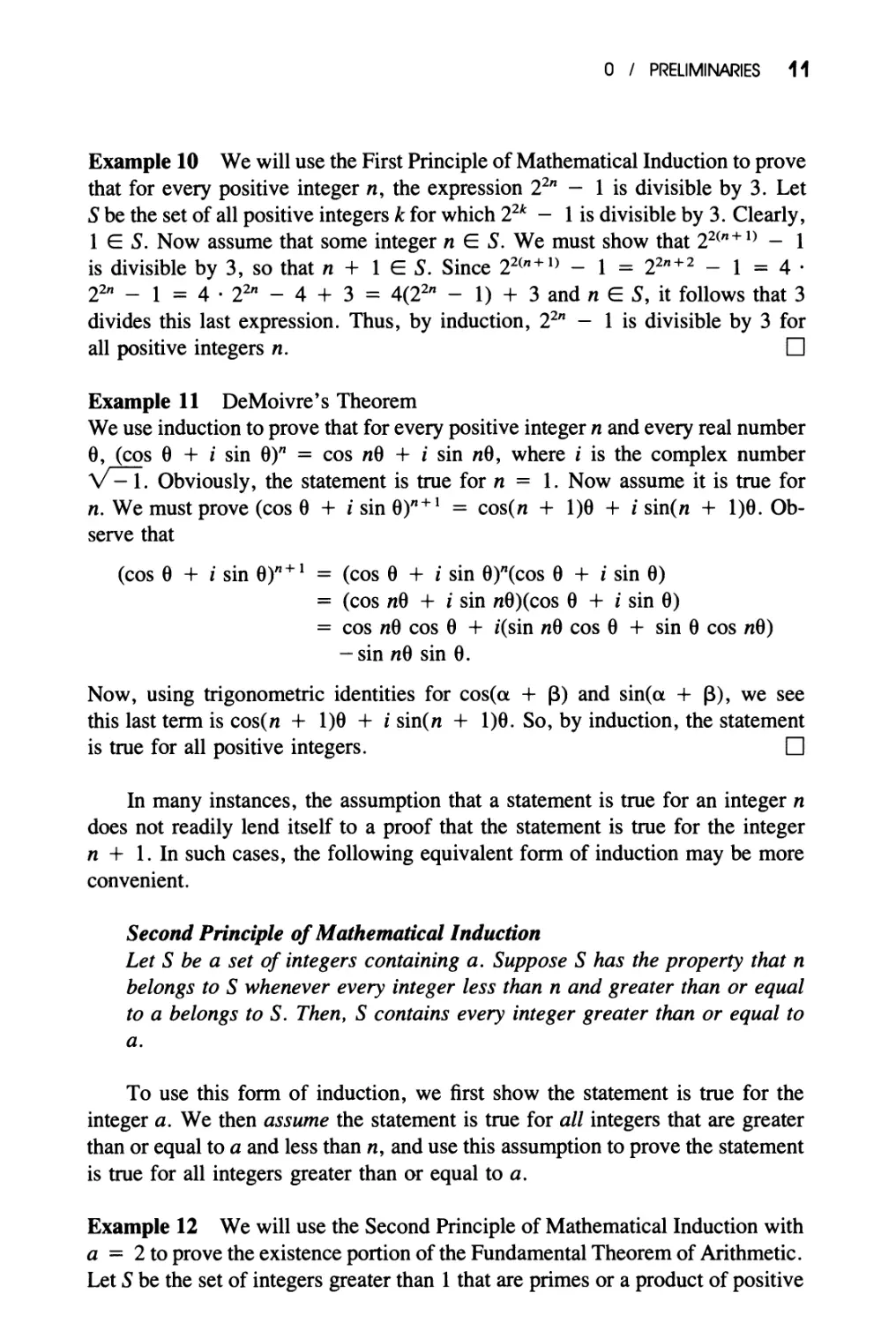
Figure 0.3
7058111995 4 mod 7 . Similarly, the UPS pickup record number 768113999,
shown in Figure 0.3, has appended a check digit 2.
In Chapters 2 and 5 we will examine more sophisticated means of assigning
check digits to numbers.
Mathematical Induction
There are two forms of proof by mathematical induction that we will use. Both
are equivalent to the Well Ordering Principle. The explicit formulation of the
method of mathematical induction came in the sixteenth century. Francisco
Maurolycus (1494 1575), a teacher of Galileo, used it in 1575 to prove
1 + 3 + 5 + · · · + (2n 1) n 2 and Blaise Pascal (1623 1662) used it
when he presented what we now call Pascal's triangle for the coefficients of the
binomial expansion. The term was coined by Augustus DeMorgan.
First Principle of Mathematical Induction
Let S be a set of integers containing a. Suppose S has the property that
whenever some integer n a belongs to S, then the integer n + 1 also
belongs to S. Then, S contains every integer greater than or equal to a.
So, to use induction to prove that a statement involving positive integers is
true for every positive integer, we must first verify that the statement is true for
the integer 1. We then assume the statement is true for the integer n and use
this assumption to prove the statement is true for the integer n + 1.
o / PRELIMINARIES 11
Example 10 We will use the First Principle of Mathematical Induction to prove
that for every positive integer n, the expression 2 2n 1 is divisible by 3. Let
S be the set of all positive integers k for which 2 2k 1 is divisible by 3. Clearly,
1 E S. Now assume that some integer n E S. We must show that 2 2 (n+ 1) 1
is divisible by 3, so that n + 1 E S. Since 2 2 (n+ I) 1 22n+2 1 4 ·
2 2n 1 4 · 2 2n 4 + 3 4(2 2n 1) + 3 and n E S, it follows that 3
divides this last expression. Thus, by induction, 2 2n 1 is divisible by 3 for
all positive integers n. D
Example 11 DeMoivre' s Theorem
We use induction to prove that for every positive integer n and every real number
6, (cos 6 + i sin 6)n cos n6 + i sin n6, where i is the complex number
1. Obviously, the statement is true for n - 1. Now assume it is true for
n. We must prove (cos 6 + i sin 6)n+1 cos(n + 1)6 + i sin(n + 1)6. Ob-
serve that
(cos 6 + i sin 6)n+ 1
(cos 6 + i sin 6)n(cos 6 + i sin 6)
(cos n6 + i sin n6)(cos 6 + i sin 6)
cos n6 cos 6 + i(sin n6 cos 6 + sin 6 cos n6)
sin n6 sin 6.
Now, using trigonometric identities for cos(a + (3) and sin(a + (3), we see
this last term is cos(n + 1)6 + i sin(n + 1)6. So, by induction, the statement
is true for all positive integers. D
In many instances, the assumption that a statement is true for an integer n
does not readily lend itself to a proof that the statement is true for the integer
n + 1. In such cases, the following equivalent form of induction may be more
convenient.
Second Principle of Mathematical Induction
Let S be a set of integers containing a. Suppose S has the property that n
belongs to S whenever every integer less than n and greater than or equal
to a belongs to S. Then, S contains every integer greater than or equal to
a.
To use this form of induction, we first show the statement is true for the
integer a. We then assume the statement is true for all integers that are greater
than or equal to a and less than n, and use this assumption to prove the statement
is true for all integers greater than or equal to a.
Example 12 We will use the Second Principle of Mathematical Induction with
a 2 to prove the existence portion of the Fundamental Theorem of Arithmetic.
Let S be the set of integers greater than 1 that are primes or a product of positive
12 INTEGERS AND EQUIVALENCE RELATIONS
primes. Clearly, 2 E S. Now we assume that for some integer n, S contains all
integers k with 2 k < n. We must show that n E S. If n is a prime, then
n E S by definition. If n is not a prime, then n can be written in the form ab
where 1 < a < nand 1 < b < n. Since we are assuming that both a and b
belong to S, we know that each of them is prime or a product of positive primes.
Thus, n is also a product of positive primes. This completes the proof. D
Notice that it is more natural to prove the Fundamental Theorem of Arith-
metic with the Second Principle of Mathematical Induction than the First Prin-
ciple. Knowing that a particular integer factors as a product of primes does not
tell you something about factoring the next larger integer. (Does knowing 5280
is a product of primes help you to factor 5281 as a product of primes?)
The following problem appeared in the "Brain BoggIer" section of the
January 1988 issue of the science magazine Discover.
Example 13 The Quakertown Poker Club plays with blue chips worth $5.00
and red chips worth $8.00. What is the largest bet that cannot be made?
To gain insight into this problem we try various combinations of blue and
red chips to obtain: 5, 8, 10, 13, 15, 16, 18, 20, 21, 23, 24, 26, 28, 29, 30,
31, 32, 33, 34, 35, 36, 37, 38, 39, 40. It appears that the answer is 27. But
how can we be sure? Well, we need only prove that every integer greater than
27 can be written in the form a · 5 + b · 8, where a and b are nonnegative
integers. This will solve the problem since a represents the number of blue chips
and b the number of red chips needed to make a bet of a · 5 + b · 8. For the
purpose of contrast, we will give two proofs one using the First Principle of
Mathematical Induction and one using the Second Principle.
Let S be the set of all integers of the form a · 5 + b · 8, where a and b
are nonnegative. Obviously, 28 E S. Now assume that some integer n E S, say,
n a · 5 + b · 8. We must show that n + 1 E S. First, note that since n ?>- 28,
we cannot have both a and b less than 3. If a ?>- 3, then
(a · 5 + b · 8) + ( 3. 5 + 2 · 8)
(a 3) · 5 + (b + 2) · 8.
n + 1
(Regarding chips, this last equation says we may increase a bet from n to n + 1
by removing 3 blue chips from the pot and adding 2 red chips.) If b 3, then
n + 1
(a · 5 + b · 8) + (5 · 5
3 · 8)
(a + 5) · 5 + (b 3) · 8.
(The bet can be increased by 1 by removing 3 red chips and adding 5 blue chips.)
This completes the proof.
To prove the same statement by the Second Principle, we note that each of
28, 29, 30, 31, and 32 are in S. Now assume that for some integer n > 32, S
contains all integers k with 28 k < n. We must show n E S. Since n 5 E S,
there are nonnegative integers a and b such that n 5 a · 5 + b · 8. But
then n (a + 1) · 5 + b · 8. Thus n is in S. D
o / PRELIMINARIES 13
In the remainder of the text we shall be less formal about induction and
dispense with the phrase "Let S be the set of integers. . . ."
Equivalence Relations
In mathematics, things that are considered different in one context may be viewed
as equivalent in another context. We have already seen one such example. Indeed,
the sums 2 + 1 and 4 + 4 are certainly different in ordinary arithmetic, but
are the same under modulo 5 arithmetic. Congruent triangles that are situated
differently in the plane are not the same, but they are considered as the same in
plane geometry. In physics, vectors of the same magnitude and direction can
produce different effects a 10-pound weight placed 2 feet from a fulcrum
produces a different effect than a 10-pound weight placed 1 foot from a fulcrum.
But in linear algebra, vectors of the same magnitude and direction are considered
as the same. What is needed to make these distinctions precise is an appropriate
generalization of the notion of equality; that is, we need a formal mechanism
for specifying whether or not two quantities are the same in a given setting.
This mechanism is an equivalence relation.
DEFINITION Equivalence Relation
An equivalence relation on a set S is a set R of ordered pairs of elements
of S such that
1. (a, a) E R for all a E S (reflexive property).
2. (a, b) E R implies (b, a) E R (symmetric property).
3. (a, b) E Rand (b, c) E R imply (a, c) E R (transitive property).
When R is an equivalence relation on a set S, it is customary to write aRb
instead of (a,b) E R. Also, since an equivale nc e relation is just a generalization
of equality, a suggestive symbol such as :: : , , or r, is usually used to denote
the relation. If · J is an equivalence relation on a set S and a E S, then the set
[aJ {x E S x . oJ a} is called the equivalence class of S containing a.
Example 14 Let S be the set of all triangles in a plane. If a, b E S, define
a .- J b if a and b are similar, that is, if a and b have corresponding angles the
same. Then, · J is an equivalence relation on S. D
Example 15 Let S be the set of all polynomials with real coefficients. If f,
g E S, define I .- · g if I' g', where I' is the derivative of I. Then, · J is an
equivalence relation on S. Since two functions with equal derivatives differ by
a constant, we see that for any I in S, [f] {I + c c is real}. D
Example 16 Let S be the set of integers and n a positive integer. If a, b E S,
define a - b, if a b modulo n (that is, if a b is divisible by n). Then,
14 INTEGERS AND EQUIVALENCE RELATIONS
is an equivalence relation on S and [a] {a + kn k E S}. Since this particular
relation is important in abstract algebra, we will take the trouble to verify that
it is indeed an equivalence relation. Certainly, a a is divisible by n so that
a a for a in S. Next, assume that a b, say, a b r n. Then, b a
( r)n and therefore b a. Finally, assume a band b c, say, a b
rn and b c sn. Then, we have a c (a b) +
( b c ) rn + sn (r + s )n, so that a c . D
7. Then we have 16
6, 1, 8, 15, . . .}
2.
,
and
D
be as in Example 16 and let n
Also, [ 1 ] {... 20, 13,
10, 3,4,11,18,.. .}.
Example 17
9 5; 24
l4J {...
Let
3.
17,
Example 18 Let S {(a, b) a, b are integers, b =1= OJ. If(a, b), (c, d) E S,
define (a, b) ; (c, d) if ad cb. Then ; is an equivalence relation on S. (The
motivation for this example comes from fractions. In fact, the pairs (a, b) and
( c, b) are equivalent if the fractions a/band c/ d are equal.) D
DEFINITION Partition
A partition of a set S is a collection of nonempty disjoint subsets of S whose
union is S. Figure 0.4 illustrates a partition of a set into four subsets.
Example 19 The sets {OJ, {I, 2, 3, . . .}, and {. . ., 3, 2,
a partition of the set of integers.
I} constitute
D
Example 20 The set of nonnegative integers and the set of nonpositive integers
do not partition the integers since both contain O. D
The next theorem reveals that equivalence relations and partitions are inti-
mately intertwined.
Theorem 0.2 Equivalence Classes Partition
The equivalence classes of an equivalence relation on a set S constitute a
partition of S. Conversely, for any partition P of S, there is an equivalence
relation on S whose equivalence classes are the elements of P.
s
. . . . . . . 0.' 00. . . .
. . . . . . . . 0..... .-'.'-0:' ....0... '. ._
. . . . . . . . . . 0;:
. . . . . . . . . .
. . . . . . . . . . .:: .
. . . . . . . . . . . .
. . . . . . . . . . . . . o
. . . . . . . . . . . . ;:::;.
. . . . . . . . . . . .
. . . . . . . . . . . .
. . . . . . . . . . .
. . . . . . . . .. ---
. . . . . . . . . . -.;-;.
. . . . . . . . . ; .
. . . . . . . . .
. . . . . . .
. . . . . .
.:y....
. . . . . . . .
. . . . . . . . .
. . . . . . . .
-.-.... -.-
. ....:..._._...-.. _........ ..-..... ....
Figure 0.4 Partition of S into 4 subsets.
a / PRELIMINARIES 15
Proof. Let ..-. be an equivalence relation on a set S. For any a E S, the
reflexive property shows a E [a]. So, [a] is nonempty. Also, the union of
all equivalence classes is S. Now, suppose that [a] and [b] are distinct
equivalence classes. We must show [a] n [b] Jr. On the contrary, as-
sume c E [a] n [b]. We will show [a] C [b]. To this end, let x E [a]. We
then have c -.., a, c -.., b, and x -.., a. By the symmetric property, we also
have a ..-. c. Thus, by transitivity, x '-J c, and by transitivity again, x ' J b.
This proves [a] C [b]. Analogously, [b] C [a]. Thus, [a] [b], in con-
tradiction to our assumption that [a] and [b] were distinct equivalence classes.
We leave the proof of the converse portion of the theorem as an
exercise. II
Functions Mappings
Although the concept of a function plays a central role in nearly every branch
of mathematics, the terminology and notation associated with functions vary
quite a bit. In this section, we fix ours.
DEFINITION Function (Mapping)
A function 4> (or mapping) from a set A to a set B is a rule that assigns to
each element a of A exactly one element b of B. The set A is called the
domain of cP and B is called the codomain of cP. If 4> assigns b to a, then
b is called the image of a under cpo The subset of B comprised of all the
images of elements of A is called the image of A under cPo
We use the shorthand 4>: A ) B to mean that 4> is a mapping from A to B.
We will usually write a4> b to indicate that 4> carries a to b. However, when
dealing with polynomials and number-theoretic functions, we use the more fa-
miliar notation f( a) for the functional value of a under f and f( x) for formulas.
Readers who have not previously seen functions written to the right of the domain
values are no doubt puzzled by our choice. Our motivation comes from the next
definition.
DEFINITION Composition of Functions
Let 4>: A ) Band \fI: B ) C. The composition 4>\fI is the mapping from A
to C defined by a( 4>\fI ) ( a4»\fI for all a in A. The composition function
4>\fI can be visualized as in Figure 0.5.
In calculus courses the composition of f with g is written (f 0 g)( x) and is
defined as f (g(x)); that is, in calculus, composition is done from right to left.
When we compose functions we omit the "circle" and we work from left to
right, the way one ordinarily reads and does arithmetic.
16 INTEGERS AND EQUIVALENCE RELATIONS
e
a
t/J
e (at/J)'V
'V
e
at/J
t/J'V
Figure 0.5 Composition of functions <t> and ",.
There are several kinds of functions that occur often enough to be given
names.
DEFINITION One-to-One Function
A function <f> from a set A to a set B is called one-to-one if a<f>
a b.
b<f> implies
The term one-to-one is suggestive since the definition ensures that one
element of B can be the image of only one element of A. Alternately, <f> is one-
to-one if at =-1= a2 implies al<f> =-1= a2<f>. That is, different elements of A map to
different elements of B. See Figure 0.6.
t/J
'V
,,-
ai-
- a l t/J
--
ai-
- a I 'V = a 2 'V
a 2 -
- a 2 t/J
a 2 -
e
t/J is 1-1
'V is not 1-1
Figure 0.6
DEFINITION Function from A onto B
A function <f> from a set A to a set B is said to be onto B if each element
of B is the image of at least one element of A. In symbols, <f>: A ) B is
onto if for each b in B there is at least one a in A such that a<f> b. See
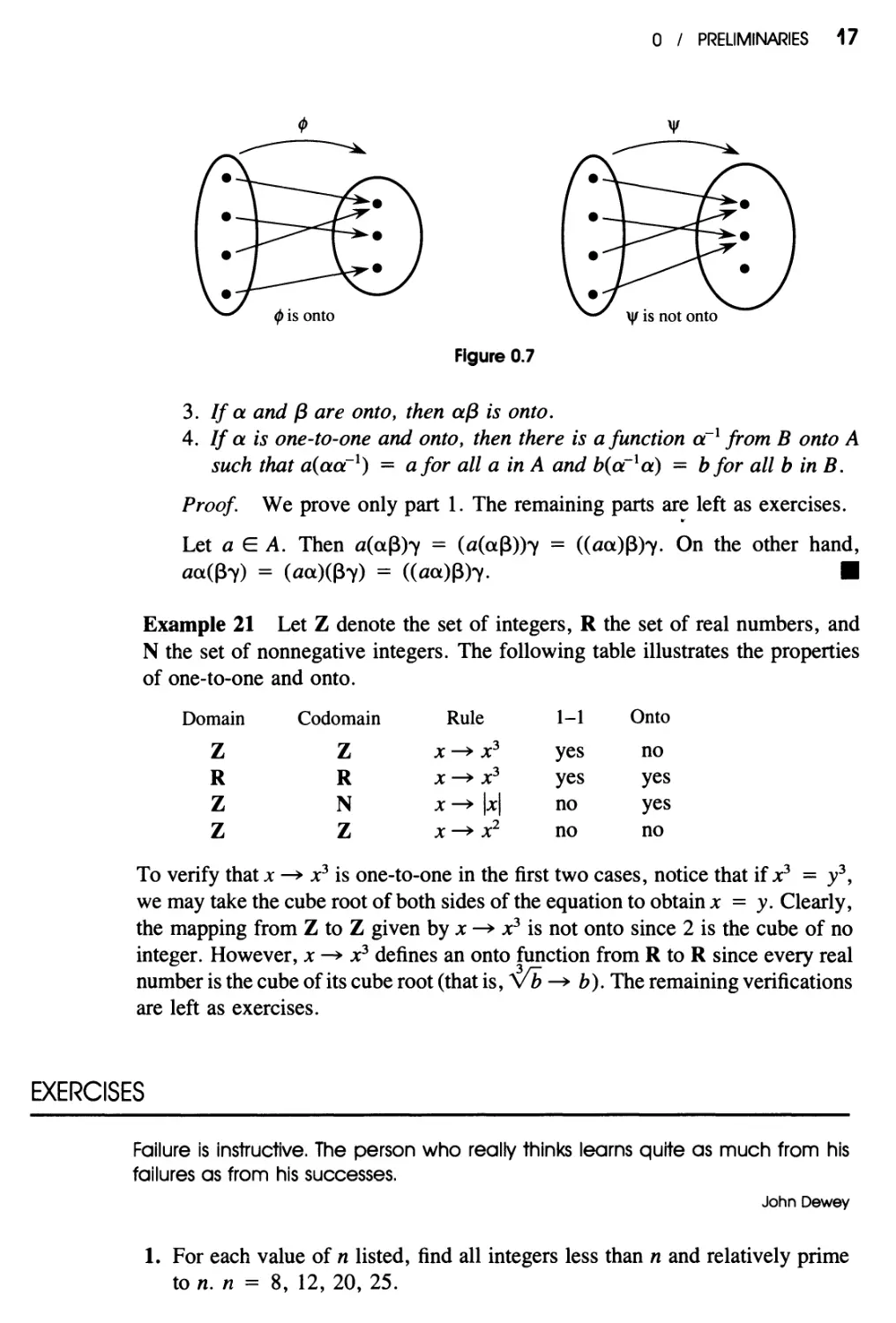
Figure 0.7.
The next theorem summarizes the facts about functions we will need.
Theorem 0.3 Properties of Functions
Given functions a: A B, {3: B C and 'Y: C > D. Then
1. (a{3)'Y a({3'Y) (associativity)
2. If a and {3 are one-to-one, then a{3 is one-to-one.
o I PRELIMINARIES 17
tP
'II
--
e
....
e
e
e
e
e
e
e
e
e
e
e
e
e
tP is onto
'II is not onto
Figure 0.7
3. If a and (3 are onto, then a{3 is onto.
4. If a is one-to-one and onto, then there is a function a-I from B onto A
such that a(aa- I ) a for all a in A and b(a-1a) b for all b in B.
Proof. We prove only part 1. The remaining parts are left as exercises.
....
Let a E A. Then a(a )"Y (a(a ))"Y
aa( "Y) (aa)( "Y) «aa) )"Y.
«aa) )'Y. On the other hand,
II
Example 21 Let Z denote the set of integers, R the set of real numbers, and
N the set of nonnegative integers. The following table illustrates the properties
of one-to-one and onto.
Domain
Codomain
Rule
1-1
Onto
Z Z x ) x 3 yes no
R R x ) x 3 yes yes
Z N x ) x no yes
Z Z x ) x 2 no no
To verify that x ) x 3 is one-to-one in the first two cases, notice that if x 3 y3,
we may take the cube root of both sides of the equation to obtain x y. Clearly,
the mapping from Z to Z given by x ) x 3 is not onto since 2 is the cube of no
integer. However, x x 3 defines an onto fun ct ion from R to R since every real
are left as exercises.
ERCISES
Failure is instructive. The person who really thinks learns quite as much from his
failures as from his successes.
John Dewey
1. For each value of n listed, find all integers less than n and relatively prime
to n. n 8, 12, 20, 25.
18 INTEGERS AND EQUIVALENCE RELATIONS
2. Determine gcd(2 4 . 3 2 · 5 · 7 2 , 2. 3 3 · 7 · 11) and Icm(2 3 . 3 2 · 5,
2 · 3 3 · 7 · 11).
3. Calculate (7 · 3) mod 5, (7 + 3) mod 5, (15 · 4) mod 7, (15 + 4) mod
7.
4. Find integers s and t so that 1 7 · s + 11 · t. Show that sand t are not
.
unIque.
5. In Florida, the last three digits of the driver's license number of a female
with birth month m and birth date b are represented by m 1) + b + 500.
For both males and females, the fourth and fifth digits from the end give
the year of birth. Determine the dates of birth of people with the numbers
whose last five digits are 42218 and 53953.
6. In Missouri, the last three digits of the driver's license number of a female
with birth month m and birth date b are represented by 63m + 2b + 1.
Determine the birth months, birth dates, and sex corresponding to the num-
bers 248 and 60 1.
7. Show that if a and b are positive integers, then ab lcm(a, b) · gcd(a, b).
(This exercise is referred to in Chapter 7.)
8. Suppose a and b are integers that divide the integer c. If a and b are relatively
prime, show ab divides c. Show, by example, that if a and b are not relatively
prime, then ab need not divide c.
9. Show that 5n + 3 and 7n + 4 are relatively prime for all n.
10. Let a and b be positive integers and let d gcd( a, b) and m lcm( a,
b). If t divides both a and b, prove that t divides d. If s is a multiple of
both a and b, prove that s is a multiple of m.
11. Let n and a be positive integers and let d gcd(a, n). Show that the
equation ax 1 mod n has a solution if and only if d 1. (This exercise
is referred to in Chapter 2.)
12. Let n be a fixed positive integer greater than 1. For any integers i and j,
prove that i mod n + j mod n (i + j) mod n. This exercise is referred
to in Chapter 6.
13. Does the set of positive rational numbers satisfy the Well Ordering Principle?
14. Show that gcd( a, bc) 1 if and only if gcd( a, b) 1 and gcd( a, c) 1.
15. If there are integers a, b, s, and t with the property that at + bs 1, show
that gcd(a, b) 1.
16. Let d gcd(a, b). If a da' and b db', show that gcd(a', h') 1.
17. Use the Euclidean algorithm to find the gcd(34, 126) and write it as a linear
combination of 34 and 126.
18. Let Ph P2, · . · , Pn be distinct positive primes. Show that PIP2 · · . Pn + 1
is divisible by none of these primes.
19. Prove that there are infinitely many primes. (Hint: Use the previous exercise.)
20. For every positive integer n, prove 1 + 2 + · · · + n n(n + 1)/2.
o / PRELIMINARIES 19
21. For every positive integer n, prove that a set with exactly n elements has
exactly 2 n subsets (counting the empty set and the entire set).
22. (Generalized Euclid's Lemma) If p is a prime and p divides al a 2 · · · an,
prove p divides a; for some i.
23. Use the Generalized Euclid's Lemma (see exercise 22) to establish the
uniqueness portion of the Fundamental Theorem of Arithmetic.
24. What is the largest bet that cannot be made with chips worth $7.00 and
$9.oo? Verify that your answer is correct with both forms of induction.
25. The Fibonacci numbers are: 1, 1,2, 3,5, 8, 13,21, 34, . . . . In general,
the Fibonacci numbers are defined by fl 1 , f2 1, and fn + 2 fn + 1 +
fn for n 1 , 2, 3, . . . . Prove the nth Fibonacci number fn satisfies fn < 2 n .
26. Prove that the First Principle of Mathematical Induction is a consequence
of the Well Ordering Principle.
27. In the cut "As" from Songs in the Key of Life, Stevie Wonder mentions the
equation 8 x 8 x 8 x 8 4. Find all integers n for which this statement
is true, modulo n.
28. Determine the check digit for a money order with identification number
7234541780.
29. Suppose that in one of the noncheck positions of a money order number,
the digit 0 is substituted for the digit 9 or vice versa. Prove that this error
will not be detected by the check digit. Prove that all other errors involving
a single position are detected.
30. Suppose a money order with the identification number and check digit
21720421168 is erroneously copied as 27750421168. Will the check digit
detect the error?
31. A transposition error involving distinct adjacent digits is one of the form
. . . ab . .. ). ... ba . . . with a =1= b. Prove that the money order check
digit scheme will not detect such errors unless the check digit itself is
transposed.
32. Determine the check digit for the United Parcel Service (U.P.S.) identifi-
cation number 873345672.
33. Show that a substitution of a digit at for the digit a; (at =1= ai) in a noncheck
position of aU. P . S. number is detected if and only if a; at =1= 7.
34. Determine which transposition errors involving adjacent digits are detected
by the U.P.S. check digit.
35. Prove that for every integer n, n 3 n mod 6.
36. If it were 2:00 A.M. now, what time would it be 3736 hours from now?
37. If n is an odd integer, prove n 2 1 mod 8.
38. If the odometer of an automobile read 97, now, what would it read
12, miles later?
39. Let S {(x, y) x, y are real}. If (a, b) and (c, d) belong to S, define
20 INTEGERS AND EQUIVAlENCE RELATIONS
(a, b )R( c, d) if a 2 + b 2 c 2 + d 2 . Prove that R is an equivalence relation
on S. Give a geometrical description of the equivalence classes of S.
40. Let S be the set of real numbers. If a, b E S, define a · J b if a b is an
integer. Show -.., is an equivalence relation on S. Describe the equivalence
classes of S.
41. Let S be the set of integers. If a, b E S, define aRb if ab O. Is R an
equivalence relation on S?
42. Let S be the set of integers. If a, b E S, define aRb if a + b is even. Prove
that R is an equivalence relation and determine the equivalence classes of
S.
43. A relation on a set S is a set of ordered pairs of elements of S. Find an
example of a relation that is reflexive and symmetric, but not transitive.
44. Find an example of a relation that is reflexive and transitive, but not sym-
metric.
45. Find an example of a relation that is symmetric and transitive, but not
reflexive.
SUGGESTED R
Mary Joan Collison, "The Unique Factorization Theorem: From Euclid to Gauss," Math-
ematics Magazine 53 (1980): 96-100.
This article examines the history of the Fundamental Theorem of Arithmetic.
Linda Dineen, "Secret Encryption with Public Keys," The UMAP Journal 8(1987): 9-
29.
This well-written article describes several ways in which modular arithmetic can be
used to code secret messages. They range from a simple scheme used by Julius
Caesar, to a highly sophisticated scheme invented in 1978 and based on modular n
arithmetic, where n has more than 200 digits.
Ian Richards, "The Invisible Prime Factor," American Scientist 70(1982): 176-179.
The author explains how elementary number theory such as Euclid's Lemma and
modular arithmetic can be used to test whether an integer is prime. He then discusses
how prime numbers can be used to create secret codes that are extremely difficult
to break.
I
Symmetry is a vast subject, significant in art and nature. Mathematics lies at its
root, and it would be hard to find a better one on which to demonstrate the
working of the mathematical intellect.
Hermann Weyl, Symmetry
mmetries of a
uare
Suppose we remove a square from a plane, move it in some way, then put the
square back into the space it originally occupied. Our goal in this chapter is to
describe in some reasonable fashion all possible ways this can be done. More
specifically, we want to describe the possible relationships between the starting
position of the square and its final position in terms of motions. However, we
are interested in the net effect of a motion, rather than the motion itself. Thus,
for example, we consider a 90 0 rotation and a 450 0 rotation as equal, since the
relationship between the starting position and the final position of the square is
the same for each of these motions. With this simplifying convention, it is an
easy matter to achieve our goal.
To begin, we can think of the square as being transparent (glass, say), with
the comers marked on one side with the colors blue, white, pink, and green.
This makes it easy to distinguish between motions that have different effects.
With this marking scheme, we are now in a position to describe, in simple
fashion, all possible ways a square object can be repositioned. See Figure 1.1.
We now claim that any motion no matter how complicated is equivalent to
one of these eight. To verify this claim, observe that the final position of the
square is completely determined by the location and orientation (that is, face up
or face down) of any particular comer. But, clearly, there are only four locations
and two orientations for a given corner, so there are exactly eight distinct final
positions for the corner.
23
24 GROUPS
Ro
Rotation of 0° (no change in position)
P W
G B
Ro
....
P W
G B
R90
Rotation of 90° (counterclockwise)
P W
G B
W B
R90
P
G
RI80
Rotation of 180 0
P W
G B
RI80
B G
W P
R270
Rotation of 270 0
P W
G B
R270
...
G P
B W
G B
G B
P W
P W
H
Rotation of 180 0 about a horizontal axis
...... -. -
H
W P
B G
v
Rotation of 180 0 about a vertical axis
P IW
I
I
G B
v
...
P G
W B
D
Rotation of 180 0 about the main diagonal
P, W
,
,
,
G B
D
...
B W
G P
D'
Rotation of 180° about the other diagonal
P W
/
/
/
G B
D'
Figure 1.1
Let's investigate some consequences of the fact that every motion is equal
to one of the eight listed in Figure 1.1. Suppose a square is repositioned by a
rotation of 90 0 followed by a rotation of 180 0 about the horizontal axis of
symmetry. In pictures,
P W
G B
W B
P G
R90
P
-- ..............
H
G
W B
Thus, we see that this pair of motions taken together is equal to the single
motion D. This observation motivates us to define an algebraic operation "fol-
lowed by" on the set of motions.
1 I INTRODUCTION TO GROUPS 25
DEFINITION A Followed by B
We say a motion A followed by a motion B (written AB) is equal to the
motion C if, upon performing the motion A and then the motion B, the net
effect is the same as that produced by performing C alone.
With this definition, we may now write R90 H D. The eight motions Ro,
R 90 , R 180, R 270 , H, V, D, and D', together with the operation "followed by,"
fonn a mathematical system called the dihedral group of order 8 (the order of
a group is the number of elements it contains). It is denoted by D 4. Rather than
introduce the formal definition of a group here, let's look at some properties of
groups by way of the example D4'
To facilitate future computations, we construct an operation table or Cayley
table (so named in honor of the prolific English mathematician Arthur Cayley,
who first introduced them in 1854) for D 4 below. The circled entry represents
the fact that D R90H.
Ro
R90
R 180
R 270
H
v
D
D'
Ro Ro R90 R 180 R 270 H V D D'
R90 R90 R 180 R 270 Ro D D' V H
R I80 R 180 R 270 Ro R90 V H D' D
R 270 R 270 Ro R90 R 180 D' D H V
H H D' V D Ro R 180 R 270 R90
V V D H D' R 180 Ro R90 R 270
D D H D' V R90 R 270 Ro R 180
lJ' D' V D H R 270 R90 R 180 Ro
Notice how beautiful this table looks! This is no accident! Perhaps the most
important feature of this table is that it is completely filled in without introducing
any new motions. Of course, this is because, as we have already pointed out,
any sequence of motions turns out to be the same as one of these eight. Alge-
braically, this says that if A and B are in D 4 , then so is AB. This property is
called closure and it is one of the requirements for a mathematical system to be
a group. Next, notice that if A is any element of D 4 , then ARo RoA A.
Thus, combining any element A on either side with Ro yields A back again. An
element Ro with this property is called an identity, and every group must have
one. Another striking feature of the table is that every element of D4 appears
exactly once in each row and column. This feature is something that all groups
must have, and, indeed, it is quite useful to keep this fact in mind when con-
structing the table in the first place. As a consequence of this condition, we see
that for each element A in D 4 , there is exactly one element B in D4 so that
AB BA Ro. In this case, B is said to be the inverse of A and vice versa.
For example, R90 and R 270 are inverses of each other, and H is its own inverse.
The term inverse is a descriptive one, for if A and B are inverses of each other,
the B "undoes" whatever A "does," in the sense that A and B taken together in
either order produce Ro representing no change.
26 GROUPS
Another property of D4 deserves special comment. Observe that
HD =1= DH but R 90 R 180 R180R90. Thus, in a group, AB mayor may not be
the same as BA. If it happens that AB BA for all choices of group elements
A and B, we say the group is commutative or better yet Abelian (in honor of
the great Norwegian mathematician Niels Abel). Otherwise, we say the group
is non-Abelian.
Thus far, we have illustrated, by way of D 4 , three of the four conditions
that define a group; namely, closure, existence of an identity, and existence of
inverses. The remaining condition required for a group is associativity; that is,
(ab)c a(bc) for all a, b, c in the set. To be sure that D4 is indeed a group,
we should check this equation for each of the 8 3 512 possible choices of a,
b, and c in D4. In practice, however, this is rarely done! Here, for example, we
simply observe instead that each of the eight motions defines a function from
the plane to itself, and the operation "followed by" is nothing other than function
composition. Then, since function composition is associative, so is "followed
by . "
The Dihedral Groups
The analysis carried out above for a square can similarly be done for an equilateral
triangle or regular pentagon or, indeed, any regular n-gon (n ?>- 3). The corre-
sponding group is denoted by D n and is called the dihedral group of order 2 n.
The dihedral groups arise frequently in art and nature. Many of the decorative
designs used on floor coverings, pottery, and buildings have one of the dihedral
groups as a group of symmetry. Corporation logos are rich sources for dihedral
symmetry [1]. C sler's logo has Ds as a symmetry group, and Mercedes-Benz
has D3. The ubiquitous five-pointed star has symmetry group Ds. This symbol
appears on the flags of 37 nations, as well as the highest military medals of both
the United States and the Soviet Union. The family of sea animals that includes
the starfish, sea cucumbers, feather stars, and sand dollars exhibit patterns with
Ds symmetry group.
Perhaps the most spectacular manifestation of the dihedral groups are the
huge circular stained glass rose windows in the Gothic cathedrals of Europe. In
the beautiful book Rose Windows [2], one can find magnificent representations
of D 12 and D 16 , D 24 , D 30 , and many others. These windows exhibit an intricate
blend of religion, art, geometry, architecture, and science. The groups D 12 and
D 24 are the most common ones associated with rose windows. *
*The number 12 had special significance to medieval Christians. It was considered the number of
perfection, of the universe, of the Logos of Time, the Apostles, the zodiac, the tribes of Israel, and
the precious stones in the foundation of New Jerusalem. There are 24 elders of the Apocalypse.
1 / INTRODUCTION TO GROUPS 27
eq
L
e q'
Figure 1.2
The dihedral group of order 2n is often called the group of symmetries of
a regular n-gon. A plane symmetry of a figure F in a plane is a function from
the plane to itself that carries F onto F and preserves distances; that is, for any
points p and q in the plane, the distance from the image of p to the image of q
is the same as the distance from p to q. (The term symmetry is from the Greek
word symmetron meaning "well-ordered. ") The symmetry group of a plane figure
is the set of all symmetries of the figure. Symmetries in three dimensions are
defined analogously. Obviously, a rotation of a plane about a point in the plane
is a symmetry of the plane and a rotation about a line in three dimensions is a
symmetry in three-dimensional space. Similarly, any translation of a plane or
of three-dimensional space is a symmetry. A reflection across a line L is that
function that leaves every point of L fixed and takes any point q, not on L, to
the point q' so that L is the perpendicular bisector of the line segment joining
q and q' (see Figure 1.2). A reflection across a plane in three dimensions is
defined analogously. Notice that the restriction of a 180 0 rotation about a line L
in three dimensions to a plane containing L is a reflection across L in the plane.
Thus, in the dihedral groups, the motions that we described as 180 0 rotations
about axes of symmetry in three dimensions (for example, H, V, D, D') are
reflections across lines in two dimensions. Just as a reflection across a line is a
plane symmetry that cannot be achieved by a physical motion of the plane in
.
----
---
-
-
Figure 1.3 Logos with Cyclic Rotation Symmetry Groups.
28 GROUPS
two dimensions, a reflection across a plane is a three-dimensional symmetry that
cannot be achieved by a physical motion of three-dimensional space. A cup, for
instance, has reflective symmetry across the plane bisecting the cup, but this
symmetry cannot be duplicated with a physical motion in three dimensions.
Many objects and figures have rotational symmetry but not reflective sym-
metry. A symmetry group consisting of the rotational symmetries of 0°, 360 0 In,
2(360 0 )ln, . . . , (n 1 )360° In and no other symmetries is called a cyclic rota-
tion group of order n and is denoted by (R 360/n ). Cyclic rotation groups along with
dihedral groups are favorites of artists, designers, and nature. Figure 1.3 (page 27)
illustrates with corporate logos the cyclic rotation groups of orders 2, 3, 4, 5, 6, 8,
16, and 20.
Further examples of the occurrence of dihedral groups and cyclic groups in
art and nature can be found in the references. A study of symmetry in greater
depth is done in Chapters 29 and 30.
ERCISES
If you think you can or can't, you are right.
Henry Ford
1. With pictures and words, describe each symmetry in D3 (the set of sym-
metries of an equilateral triangle).
2. Write out a complete multiplication table for D3.
3. Is D3 Abelian?
4. Describe in pictures or words the elements of Ds (symmetries of a regular
pentagon).
5. For n ?>- 3, describe the elements of Dn. (Hint: You will need to consider
two cases n even and n odd.) How many elements does Dn have?
6. In Dn, explain geometrically why a reflection followed by a reflection must
be a rotation.
7. In Dn, explain geometrically why a rotation followed by a rotation must be
a rotation.
8. In Dn, explain geometrically why a rotation and a reflection taken together
in either order must be a reflection.
9. Associate the number + 1 with a rotation and the number 1 with a re-
flection. Describe an analogy between multiplying these two numbers and
multiplying elements of Dn.
10. If r 1, r 2, and r 3 represent rotations from D nand fl , /2, f3 represent reflections
from D n, determine whether r 1 r 2 /1 r 3 /2 /3 r 3 is a rotation or reflection.
1 / INTRODUCTION TO GROUPS 29
11. Find elements A, B, and C in D4 such that AB BC but A =1= C. (Thus,
"cross" cancellation is not valid.)
12. Explain what the following diagram proves about the group Dn.
1 1
n
R360/n
......
F
n
2
2
n
1
n 1
1
2
2
....
F
R 360/n
n
2
.
1
3
3
1
13. Describe the symmetries of a nonsquare rectangle. Construct the corre-
sponding Cayley table.
14. Describe the symmetries of a parallelogram that is neither a rectangle nor
a rhombus. Describe the symmetries of a rhombus that is not a rectangle.
15. Describe the symmetries of a noncircular ellipse. Do the same for a hyper-
bola.
16. Consider an infinitely long strip of equally spaced H's:
...HHHH...
Describe the symmetries of this strip. Is the group of symmetries of the strip
Abelian?
17. For each of the snowflakes in Figure 1.4, find the symmetry group and
locate the axes of reflective symmetry.
Figure 1.4 Photographs of Snowflakes from the Bentley and Humphrey
atlas.
18. Find the symmetry group of a Bic pen. (Disregard the cap.)
19. Describe the symmetries of a cigarette. Describe the symmetries of a cigar.
30 GROUPS
20. Bottle caps that are pried off typically have 22 ridges around the rim. Find
the symmetry group of such a cap.
21. Find the symmetry group for the Canadian hendecagonal one dollar coin in
Figure 1.5. Disregard the printing and scene on the coin.
..... 'IIJ' 'AiI'. ....
,.-.-- -......
*... ':IF ....."'""-
... -.
. .
'*' "' :;. 1111'
Ijt '. "' /""':' ... 'ft\
. .... ;e . ...
. '" .' lip,
. . .\ ' r .
- .
...w __
. .
. .
... .
" . .
. ' ..:I "... . - .!If
ti'". . ..".. -- . III!-
.
.
.. . .... ..-
. ." 'tr
; ........:::....;;.,.Ja! . _ , '8ir . ,.w" ,,'" ..
...... JJ" ". -; '.,- "''' -. - ..
. :..- . . <'.:>- . ,.\
.". . r.
..,.. -¥":- .' .otI; . '-'u"" ,
. ._:","". , '-'-''''"'' .. ""'' \,a_ iJJ". _ oW
- ." " *....... .,.,...- . ....... " .
h\ i ... ;' ist . Plv'. , . '-i\ "" ":!-:: ":'" ,. ·
, . :'..' *"' . ' :E::::':' ; ' . . .. . ' . . ' .",*, . .. , i>. u.JJ.I.WJ\ :1 :
- --_. ,__ _ . . 'tLI l1iI .J1 'Bft\b<,""" . ti':
..... ._ . A"" - ...... -" - -"'1 i__ ... ". \-
.... - I "-" .. .\1.... M ..--- WJf '-
. ___. : -...-.-". .....,. ..... -5" G..\."1 . .. . .. 1l.;-..:t' .....
-"'I"<' . "::. . .... . ....
. , ... .!O ,.- 'to 'f4.J.1I\\ 'cd'
....... .,, .....
*' - .! »0.1 '.. ''-'"u.., ..
...,. ....: . ;[fP . .............. ·
......... ---..-
. .
.. .
... .
.. --.
.... - . .iw.. O:...C,., ;{ . ',.:
. '.' 'w".. 'J ., '. . ,'..-...';'" . -1 ' v. .
"Ijp. . . ... '"'P!''' .....
_ ' .JNt!d." . . . 'JIll
"". /,:,:" ..!tt
:-.: ...... '. v '. . .:' . ... ........ .'
-. ._. I .......,- . .
':... . '.,;. -- .
---r-... ....... -
-. '\11 _ ". 'R" -- .
",.,. .-. .......
""'..10I0oI. "" ..
':"".._ ........-. .
.'-- ,
"'fIr .._ ':..-.-...... _I.
Figure 1.5
22. For each design below, determine the symmetry group.
v
--
/ieK
v-
f\
......
.....
. ....
. . ,
. " ,','.',
. t", ,
""., .. '. "'.
. " ." '.
, . '
" . ,
" .
........"., .1 I, ............_
..... .. ....
.. ..... " . --.-
. .. - , .. --.
.. .. ...---... """.-
..- -.,.
... ..... ... .--.- .
... ,..
- - .,-
. . - -.-
.. - .........
- - -
. .. -
-. t# ... .-
- .-
- .., " ..
. . ' . ..
. ... . " ..
. ",. '. " ..
, , ,", '". ..
. , , '" "...... ..
, . .. ."
" ' .. ., .
, '" ,..
, ",' I' ''I ""'"
, .' " "
,.".' "",,,-
1 / INTRODUCTION TO GROUPS 31
23. Determine the symoletry group of the outer shell of the cross-section of the
AIDS \JFirus shown below.
. . -:.: :::'" ,:,," :.:. :.::;'" .:' \ :::.;.:: . .
. .,.....'. . J t: . ' .: ..:..::,:.. ':.: .
.. .':..:1:'\'.'" .'. r"', 1 .... . .
. . . _._."" .. .a. ..... ." 'P'I'ft ..
..'- . '*'t. :""-':,.:\ . "\:.':: '.':ii. ....,' '.":". '-"'"
.;: ,:. . -,,'.:" ..Jlib.. .- ;,"-; ';' ':: ' . . ,,:. ',. .:f ..::,:., . :' ./.. "'L .' '-.:{'" . , '.
':':" .i/t..er-:.......-:. '-. ,', . '. . ::,...:_:' "".,-
.':': : N':,;,' :'.- .... , . .-'\. .:." .' . ... _. .....: .IL ::.:..,
..:.' :: :. . . .' ',' , ' . '. '. '. -'....-..,... .: :" .
_:._, ............... a.. ._.. ._.._ .... . ..._:....... ._._..:.
"':: , ' ;" ": "'. '. .-:. I. '. 'j.- i: " ",'-:. :,: :..:.. ,. ... . '..:, . '.' ..\': "'. .
'. ,,'%.' . '. .... f; . ,..:: '. . ".;"':':. . '.,:. " "A. ".
..'- \. - ",.- .. .....- ....- .. -. .. .:.-. :: .....:.. . ..-:.......
"':' ., ,.' " ...t "'tI; . . ' ". . '" ' :'"::M "'."".
...,.... -. ..:..., .:...:'-:,.:,:'-:. ".:.:.:..:'.:.r':., , : ":::'.'.:' . "k '-:': :::
.... ... . .-.. ° 0 , .- \ . .. ." . ..- ._ '#P
-. .. .. 1 .... . .. .. ... "'"' ... ...- .. .. .....;Jt
. :.:. t;:-..:..:. '.' -'." ...... ... :\ .:..:.::". ..' '. ..-.. -:':..\ :....
::" '::. -w.2 ': '. -"":. '.:. .:a..:': .. :. ':'.: '-: ":"" ":':: :',,:,
. .-. . ....6:y". ",. .:.'.
..' j{ . . . '. < I?f:;' ' .'., <- '. i.:;'l '.'
-:'.' :'::::':'. ', . . 5 ' . ;: .... "" '..' .::=. :., ::: .3 ;:-:':'.
': . . ':::. "':"':'6 "'. ';114 ' 't.-,:.."
'z',:' S;:. .::: 5 . . I . ." . ... .:.. :. " --,.\ :'.:<
t/I".. ':. .... ':J/1JIA-' . . . . . ,.,(:..:-:': -:-
tt '. ,: . . .' :". \. '''':::'.. ...
. -. r .. . ° 0 ,... .-0
'. . ", Go " . . , , ':'. . - ".-.Ip .,'.
._...0 .- I' ,-", 'I, :' _:", . 1 1 :;.-,-',
':',' :' ..t..':...;. ".: ",.,. ;.,,*,. ....<::...:.. . "'-:.;' '.-:'.'
._ . . '" .. '. \ . "0 :. . ..-.... ", "" --_..* .,,_-;
. "..'. '. :':. . i'!!* ,,:,:, '. ..... .:.:.. .:-:":t ,:'
, " '" ::J.ti1. ._.::. , :<j!t: /;:
.:: . ::': '.:. ' ,... .:i. ....... .. ;... .v1. ' :'-':"
'" " .\. . -. ' ....,. '...
't '" ...... ..'.. .:. , """' :'::' ..' .' '.
. ...... -r.,' . .........'\.... ",1
. .J'..... "'" . . .:-.2" ....
: -.....- .... . . ..., ' '.:
:. -- .' .--........ 1° . ..:....:- " 0 :': .
. ..' of . .." I". ,..a"l... "0 ,I'
.', .....: t. ':::j .' . " \:.-::.:.... :,iftit ' ...:."
"::':'::.',:. " " f' ': ' :':_ ' J "" :':';"' f " '.:' -:. \ .,.:,:"..,:,,;: .\"::$- : .;::.:.
'.' . . ......i" \ . . :. . "'. ., .,:. "'i:;.A' .
. ,", . .- _..:;:.. .. :.,; i' : . ,.rJJ ....
, . :-- ' .t '..+: '.' ".:
"0 "0 :., . :.:.::. .1":
.: ':.-.:. :. 'I'. ,'I" . I' ....: .-.;. ...-.o.
o . :':.......-:.; :: : . . .:_..-... ..... '. i'. :. .. ..
. .
.d. '",::' -.
.'i '( . :
.- "'..
REFERENCES
1. B. B. Cap it man, American Trademark Designs, New York: Dover, 1976.
2. P. Cowen, Rose Windows, San Francisco: Chronicle Books, 1979.
3. I. Hargittai and M. Hargittai, Symmetry Through the Eyes of a Chemist, New York:
VCH, 1986.
4. Caroline MacGillavry, Fantasy and Symmetry: The Periodic Drawings of M. C.
Escher. New York: Harry N. Abrams, 1976.
5. A. V. Shubnikov and V. A. Koptsik, Symmetry in Science and Art, New York:
Plenum Press, ] 974.
6. P. S. Stevens, Handbook of Regular Patterns, Cambridge, Mass: MIT Press, 1980.
7. H. Weyl, Symmetry, Princeton: Princeton University Press, 1952.
I
-
/-- -.-- -....
, , ,
I
1fY- - -
_// /' --.; -
1/,./// .'
( II I ''''''-' -
I I I ---, :-_........
( . ,"" I __/
,jl.\ '" ' ,
\\1 , . , ' - _ ! I
· .....--- "t I .
II .' - :. \
-.-. " '" . j
. 1 ," II
, t . ...!m!.' _ '""'.
- ':i ,#_, -',: j
\ . /:
f" / i ' . '. J!) ,1
\-. - .. '-f .
.= ... "" . ,
. .: "e:'jf. .,;';; .-,,;.
I ./ / ' .. , ,./j£
'.', {- .' ',-,'l,"
/J/.... } . .Af ..' -
. ". . ,....- /; /;:" . :_:. - -./. ' , : _ . . . . . : . .: . . . _ . : : : : . , . . ., : . :: : .: .. ' : . : : . . :... . .
'. . :" ::.:. ,,," ,i1}j;jif:
Niels Abel
He [Abel] has left mathematicians something to keep
them busy for five hundred years.
Charles Hermite
Norway has issued five stamps to honor
Abel. This one was issued in 1929 to
commemorate the 100th anniversary
of his death.
f: .
. . \
'J .,....
I0I.l, ".
. \' , .. .
.' "...N O":R G E
--.;,F .'
KU1I kj,.
.
1., I I.
li n :,
t . L" >
NIELS HENRIK ABEL, one of the foremost mathematicians of the nineteenth century,
was born in Norway on August 5, 1802. At the age of sixteen, he began reading the
classic mathematical works of Newton, Euler, Lagrange, and Gauss. When Abel was
eighteen years old, his father died and the burden of supporting the family fell upon
him. He took in private pupils and did odd jobs, while continuing to do mathematical
research. At the age of nineteen, Abel solved a problem that had vexed leading
mathematicians for hundreds of years. He proved that, unlike the situation for equations
of degree 4 or less, there is no finite (closed) formula for the solution of the general
fifth degree equation.
Although Abel died long before the advent of the subjects that now comprise
abstract algebra, his solution to the quintic problem laid groundwork for many of these
subjects. In addition to his work in the theory of equations, Abel made outstanding
contributions to the theory of elliptic functions, elliptic integrals, Abelian integrals,
and infinite series. Just when his work was beginning to receive the attention it
deserved, Abel contracted tuberculosis. He died on April 6, 1829, at the age of twenty-
six. In 1870, Camille Jordan introduced the term Abelian group to honor Abel. A
statue of Abel now stands in the Royal Park in Oslo.
32
A good stock of examples, as large as possible, is indispensable for a thorough
understanding of any concept, and when I want to learn something new, I make
it my first job to build one.
Paul R. Halmos
Facts about groups of symmetries have been known for hundreds of years. In
the thirteenth century, the Moors demonstrated a sophisticated understanding of
symmetry with their decorative wall patterns at the Alhambra, a fortress-palace
in Southern Spain. The Alhambra is the crowning glory of Moorish architecture
(see [2, pp. 169 176]). In his study of buildings, Leonardo da Vinci (1452
1519) determined all possible symmetry groups of planar objects.
Definition and Examples of Groups
The term group was coined by Galois about 150 years ago to describe sets of
one-to-one functions on finite sets that could be grouped together to form a closed
set. As is the case with most fundamental concepts in mathematics, the modem
definition of a group that follows is the result of a long evolutionary process.
Although this definition was given by both Heinrich Weber and Walther von
Dyck in 1882, it did not gain universal acceptance until this century.
DEFINITION Binary Operation
Let G be a set. A binary operation on G is a function that assigns each
ordered pair of elements of G an element of G.
A binary operation on a set G, then, is simply a method (or formula) by
which an ordered pair from G combine to yield a new member of G. The most
33
34 GROUPS
familiar binary operations are ordinary addition, subtraction, and multiplication
of integers. Division of integers is not a binary operation on the integers (because
an integer divided by an integer need not be an integer).
The binary operations addition modulo n and multiplication modulo n on
the set {O, 1, 2, . . . ,n I}, which we denote by Zn, play an extremely
important role in abstract algebra. In certain situations we will want to combine
the elements of Zn by addition modulo n only; in other situations we will want
to use both addition modulo n and multiplication modulo n to combine the
elements. It will be clear from the context whether we are using addition only
or addition and multiplication. For example, when multiplying matrices with
entries from Zn, we will need both addition modulo n and multiplication modulo
n.
DEFINITION Group
Let G be a nonempty set together with a binary operation (usually called
multiplication) that assigns to each ordered pair (a, b) of elements of G an
element in G denoted by ab. We say G is a group under this operation if
the following three properties are satisfied.
1. Associativity. The operation is associative; that is, (ab)c a(bc) for
all a, b, c in G.
2. Identity. There is an element e (called the identity) in G , such that
ae ea a for all a in G.
3. Inverses. For each element a in G, there is an element b in G (called an
inverse of a) such that ab ba e .
In words, then, a group is a set together with an associative operation such
that every element has an inverse and any pair of elements can be combined
without going outside the set. This latter condition is called closure. Be sure to
verify closure when testing for a group. (See Example 5.)
If a group has the property that ab ba for every pair of elements a and
b, we say the group is Abelian. A group is non-Abelian if there is some pair of
elements a and b for which ab =1= ba. When encountering a particular group for
the first time, one should determine whether or not it is Abelian.
Now that we have the formal definition of a group, our first job is to build
a good stock of examples. These examples will be used throughout the text to
illustrate the theorems. (The best way to grasp the meat of a theorem is to see
what it says in specific cases.) As we progress, the reader is bound to have
hunches and conjectures that can be tested against the stock of examples. To
develop a complete understanding of these examples, the reader should supply
the missing details.
Example 1 The set of integers Z (so denoted because the German word for
integers is Zahlen), the set of rational numbers Q (for quotient), and the set of
2 / GROUPS 35
real numbers R are all groups under ordinary addition. In each case the identity
is 0 and the inverse of a is a. D
Example 2 The set of integers under ordinary multiplication is not a group.
Property (3) fails. For example, there is no integer b such that 5b 1. D
Example 3 The subset {I, 1, i, i} of the complex numbers is a group
under complex multiplication. Note that 1 is its own inverse, while the inverse
of i is i . D
Example 4 The set Q+ of positive rationals is a group under ordinary multi-
plication. The inverse of any a is l/a a-I. D
Example 5 The set S of positive irrational numbers together with 1 under
multiplication satisfies the three properties given in the definition of a group
but is not a group. Indeed, 2. 2 2, so S is not closed under multi-
plication. D
The set of all 2 X 2 matrices with real entries is a group under componentwise
addition. That is,
at
Cl
b}
d}
+
a2
C2
b 2
d 2
a} + a2
C} + C2
b} + b 2
d} + d 2
o
o
a
C
b .
d IS
a
C
b
Example 7 The set Zn {O, 1, . . . ,n I} for n 1
addition modulo n. For any j in Zn, the inverse of j is n
usually referred to as the group of integers modulo n.
is a group under
j. This group is
D
As we have seen, the real numbers, the 2 x 2 matrices with real entries,
and the integers modulo n are all groups under the appropriate addition. But
what about multiplication? In each case the existence of some elements that do
not have inverses prevents the set from being a group under the usual multipli-
cation. However, we can form a group in each case by simply throwing out the
rascals.
Example 8 The set R# of nonzero real numbers is a group under ordinary
multiplication. The identity is 1. The inverse of a is l/a. D
36 GROUPS
Example 9* The determinant of 2 X 2 matrix
ad
bc. If A is a 2 x
The set
c d
2 matrix, det A denotes the determinant of A.
GL(2, R)
a
c
b
d
a, b, c, d E R, ad
bc =1= 0
of 2 X 2 matrices with real entries and nonzero determinant is a non-Abelian
group under the operation
at
Ct
b 1
d 1
a2
C2
b 2
d 2
al a 2 + b 1 C 2
Cl a 2 + d 1 C 2
al b 2 + b 1 d 2
Cl b 2 + d 1 d 2 ·
.
The first step in verifying that this set is a group is to show that the product
of two matrices with nonzero determinant also has nonzero determinant. This
follows from the fact that for any pair of 2 x 2 matrices A and B, det (AB)
(det A)(det B). (See exercise 5.)
Associativity can be verified by direct (but cumbersome) calculations. The
; t e Inverse 0
c
d
ad bc
c
b
ad bc
a
ad
bc
ad
bc
(explaining the requirement that ad bc =1= 0). This very important group is
called the general linear group of 2 X 2 matrices over R. D
Example 10 The set of 2 x 2 matrices with real number entries is not a group
under the operation defined in Example 9. Inverses do not exist when the de-
terminant is zero. D
Now that we have shown how to make subsets of the real numbers and
subsets of the set of 2 x 2 matrices into multiplicative groups, we next consider
the integers under multiplication modulo n.
Example 11 (L. Euler, 1761)
By exercise 11 of Chapter 0 an integer a has a multiplicative inverse modulo n
if and only if a and n are relatively prime. So, for each n > 1, we define U(n)
to be the set of all positive integers less than n and relatively prime to n. Then
*For simplicity we have restricted our matrix examples to the 2 x 2 case. However, readers who
have had linear algebra can readily generalize to n X n matrices.
2 / GROUPS 37
U(n) is a group under multiplication modulo n. (We leave it as an exercise that
this set is closed under this operation.)
For n 10, we have U(10) {I, 3,7, 9}. The Cayley table for U(10) is
mod 10 1 3 7 9
1 1 3 7 9
3 3 9 1 7
7 7 1 9 3
9 9 7 3 1
(Recall that ab mod 1 0 is defined as the unique integer r with the property
a · b nq + r, where 0 r < n and a · b is ordinary multiplication.) D
Example 12 The set {O, 1, 2, 3} is not a group under multiplication modulo
4. Although 1 and 3 have inverses, the elements 0 and 2 do not. D
Example 13 The set of integers under subtraction is not a group, since the
operation is not associative. D
With the examples given this far as a guide, it is wise for the reader to pause
here and think of his or her own examples. Study actively! Don't just read along
and be spoon-fed by the book.
Example 14 For all integers n 1, the set of complex roots of unity
cos + I SIn 0, 1, 2, . . . , n 1
n
n
(i.e., complex zeros of x n 1) is a group under multiplication. (See De Moivre's
Theorem Example 11 of Chapter 0.) Compare this group with the one of
Example 3. D
The complex number a + bi can be represented geometrically as the point
(a, b) in a plane coordinatized by a horizontal real axis and a vertical i (or
imaginary) axis. The distance from the point a + bi to the origin is
a 2 + b 2 and is often denoted by a + bi. For any angle 9, the line segment
joining the complex number cos 9 + i sin 9 and the origin forms an angle of
9 with the positive real axis. Thus, the six complex zeros of X> 1 are located
at points around the circle of radius 1, 60 0 apart, as shown in Figure 2.1.
Example 15 The set Rn {(at, a2, . . . , an) alt a2, . . . , an E R} is a
group under componentwise addition [Le., (alt a2, . . . , an) + (b l , b 2 . . . ,
b n ) (at + b t , a2 + b 2 , · · · , an + b n )]. D
38 GROUPS
Imaginary
_ 1 + ...[3
2 2
{3
2
1 + {3 ·
2 2 I
60 0
-}
1
Real
1 {3.
- 2 - 2 I
1
2
1 {3.
2 - 2 I
Figure 2.1
Example 16 For a fixed point (a, b) in R 2 , define Ta,b: R 2 ) R 2 by (x, y) )
(x + a, y + b). Then T(R 2 ) {Ta,b a, b E R} is a group under function
composition. Straightforward calculations show that Ta,bTc,d Ta+c,b+d. From
this formula we may observe that T(R 2 ) is closed, To,o is the identity, the inverse
of Ta,b is T -a, -b, and T(R 2 ) is Abelian. Function composition is always asso-
ciative. The elements of T(R 2 ) are called translations. D
Example 17 The set of all 2 x 2 matrices with nonzero determinant and entries
from Zp (p a prime), Q (rational numbers), or C (complex numbers) is a group
under matrix multiplication. The addition and multiplication of the entries are
to be done with Zp, Q, or C, respectively. If you consider, for instance, the
entries of the matrices below as belonging to Z5 and combine them under addition
and multiplication modulo 5, we have
3
2
2
4
3
1
1
1
1
o
o
1 ·
Thus, the two matrices on the left are inverses of each other.
D
Example 18 The set of all 2 x 2 matrices with determinant 1 with entries
form Q, R, C, or Zp (p a prime) is a non-Abelian group under matrix multi-
plication. This group is called the special linear group of 2 x 2 matrices over
Q, R, C, or Zp, respectively. If the entries are from F, where F is any of the
above, we denote this group by SL (2 ,F). D
Example 19 The set {I, . . . , n
n if and only if n is prime.
I} is a group under multiplication modulo
D
2 / GROUPS 39
Example 20 The set of all symmetries of the infinite ornamental pattern in
which the arrowheads are spaced uniformly a unit apart along a line is an Abelian
. . .
).
..
..
).
. . .
group under composition (i.e., "followed by"). Let T denote a translation to the
right by one unit, T- 1 a translation to the left by one unit, and H a reflection
across the horizontal line of the figure. Then, every member of the group is of
the form XIX2 · · · X n , where each Xi E {T, T- 1 , H}. In this case, we say T, T- 1 ,
and H generate the group. D
Table 2.1 summarizes many of the specific groups that we have presented
thus far.
Table 2.1 Summary of Group Examples
Group
Operation
Identity
Form of
element
Inverse
Abelian
Z addition 0 k k yes
Q+ multiplication 1 m/n n/m yes
m, n > 0
Zn addition mod n 0 k n k yes
R# multiplication 1 x l/x yes
GL(2, R) . 1 0 b d b
matnx a no
multiplication 0 1 c d ad be ad be
ad be =1= 0 e a
ad be ad be
U(n) multiplication 1 k solution to yes
mod n gcd(k, n) 1 kx 1 mod n
Rn componentwise (0, 0, . . . , 0) ( a h a2, · · · , an) ( a} , a2 , · · · , an) yes
addition
SL(2, R) . 1 0 b d b
matnx a no
multiplication 0 1 e d e a
ad be 1
Dn composition Ro Ra, F R 360 - a , F no
As the above examples demonstrate, the notion of a group is a very broad
one indeed. The goal of the axiomatic approach is to find a set of properties
general enough to permit many diverse examples that possess these properties
and are specific enough to allow one to deduce many interesting consequences
of these properties.
The goal of abstract algebra is to discover truths about algebraic systems
(that is, sets with one or more binary operations) that are independent of the
specific nature of the operations. All one knows or needs to know is that these
40 GROUPS
operations, whatever they may be, have certain properties. We then seek to
deduce consequences of these properties. This is why this branch of mathemat cs
is called abstract algebra. It must be remembered, however, that when a specific
group is being discussed, a specific operation must be given (at least implicitly).
Elementary Properties of Groups
Now that we have seen many diverse examples of groups, we wish to deduce
some properties they share. The definition itself raises some fundamental ques-
tions. Every group has an identity. Could a group have more than one? Every
group element has an inverse. Could an element have more than one? The
examples suggest not.
Theorem 2.1 Uniqueness of the Identity
In a group G, there is only one identity element.
Suppose both e and e' are identities of G. Then,
a for all a in G, and
a for all a in G.
Proof.
1. ae
2. e' a
The choice of a e' in (1) and a e in (2) yields e' e e' and
e' e e. Thus, e and e' are both equal to e' e and so are equal to each
other. II
Because of this theorem, we may unambiguously speak of "the identity" of
a group and denote it by "e" (because the German word for identity is Einheit).
Theorem 2.2 Cancellation
In a group G, the right and left cancellation laws hold; that is, ba ca
implies be, and ab ac implies b c .
Proof. Suppose ba ca. Let a' be an inverse of a. Then, multiplying
on the right by a' gives (ba)a' (ca)a' . Associativity yields b(aa') c(aa').
Then, be ce and, therefore, b c as desired. Similarly, one can prove
ab ac implies b c by multiplying by a' on the left. II
A consequence of the cancellation property is the fact that in a Cayley table
for a group, each group element occurs exactly once in each row and column.
(See exercise 28.) Another consequence of the cancellation property is the unique-
ness of inverses.
Theorem 2.3 Uniqueness of Inverses
F or each element a in a group G, there is a unique element b in G such
that ab ba e.
2 / GROUPS 41
Proof. Suppose band c are both inverses of a. Then ab
so that ab ac. Now cancel a.
e and ac e,
II
As was the case with the identity element, it is reasonable, in view of
Theorem 2.3, to speak of "the inverse" of an element g of a group; and, in fact,
we may unambiguously denote it by g-l. This notation is suggested by that used
for ordinary real numbers under multiplication. Similarly, when n is a positive
integer, g" is used to denote the product gg · · · g; we define gO e; when n is
\.. J
n f ac tors
negative, we define g" (g-l)-n. With this notation, the familiar laws of ex-
ponents hold for groups; that is, for all integers m and n and any group element
g, we have g"'gn gm+n and (g"')n gmn. Although the way one manipulates
the group expressions g"'gn and (gm)n coincides with the l ws of exponents for
real numbers, the law of exponents fail to hold for expressions involving two
group elements. Thus, for groups in general, (ab)n =1= anb n (see exercise 19).
Also, one must be careful with this notation when the group operation is
addition and is denoted by +. In this case, the inverse of g is written as g.
Likewise, for example, g3 means g + g + g and is usually written as 3g, while
g-3 means ( g) + ( g) + ( g) and is written as 3 g. When this notation
is used, do not interpret "ng" as the group operation; n may not even be an
element of the group! Unlike the case for real numbers, in an abstract group,
we do not permit nonintegers exponents such as g1l2. Table 2.2 shows the
common notation and corresponding terminology for groups under multiplication
and groups under addition. As is the case for real numbers, we use a b as
an abbreviation for a + ( b ).
Because of the associative property, we may unambiguously write the
expression abc, for this can be reasonably interpreted as only (ab)c or a(bc),
which are equal. In fact, by using induction and repeated application of the
associative property, one can prove a general associative property that essentially
means parentheses can be inserted or deleted at will without affecting the value
of a product involving any number of group elements. Thus,
a 2 ( bcdb 2 )
a 2 b(cd)b 2
(a 2 b)(cd)b 2
a( abcdb )b,
and so on.
Table 2.2
Multiplicative Group
Additive Group
a · b or ab
e or 1
a-I
tI'
ab- I
Multiplication
Identity or one
Multiplicative inverse of a
Power of a
Quotient
a + b
o
a
Addition
Zero
Additive inverse of a
Multiple of a
Difference
na
a b
42 GROUPS
plications of Modular Arithmetic
With the terminology and notation introduced thus far, we can describe some
interesting applications of modular arithmetic. In Chapter 0 we discussed the
methods used by the postal service and United Parcel Service to append check
digits to identification numbers. We observed that neither method was able to
detect all possible single digit errors. Detection of all single digit errors as well
as nearly all errors involving the transposition of two adjacent digits is easily
achieved, however. In this section we present several such methods that are in
use.
Most products sold in supermarkets have an identification number coded
with bars that are read by optical scanners. See Figure 2.2. This code is called
the Universal Product Code (UPC). Each coded item is assigned a 12-digit
number. The first six digits identify the manufacturer, the next five the product,
the last is a check. (For many items, the twelfth digit is not printed but it is
always bar coded.) In Figure 2.2, the check digit is 8.
To explain how the check digit is calculated it is convenient to introduce
the dot product notation for two k-tuples:
(at, a2, · · · , ak) · (Wh W2, · · · , Wk)
al w l + a2 w 2 + · · · + akwk.
An item with the UPC identification number al a2 . . .a12 satisfies the condition
( aI, a 2 , · · · , a 12) · (3, 1, 3, 1, . . . , 3, 1)
In particular, the check digit is
(at, a2, · · · , all) · (3, 1, 3, 1, . . . , 3) mod 10.
o mod 10.
To verify that the number in Figure 2.2 satisfies the above condition we calculate
0.3 + 2-1 + 1.3 + 0.1 + 0-3 + 0.1 + 6.3
+ 5 · 1 + 8 · 3 + 9 · 1 + 7 · 3 + 8 · 1 90
o mod 10.
Figure 2.2
2 / GROUPS 43
The fixed k-tuple used in the calculation of check digits is called the weighting
vector.
Now, suppose a single error is made in entering the number in Figure 2.2
into a computer. Say, for instance, that 021 958978 is entered (notice that
the seventh digit is incorrect). Then the computer calculates
0-3+2-1 + 1-3+0.1 +0-3+0-1 +9-3
+ 5 · 1 + 8 · 3 + 9 · 1 + 7 · 3 + 8 · 1 99 .
Since 99 =1= 0 mod 10, the entered number cannot be correct. In general, as we
will see in Theorem 2.4, when the numbers used in the weighting vector are
relatively prime to n, any error involving a single digit will be detected by a
check digit computed modulo n.
But why should a weighting vector be used at all? One could detect all
single digit errors in a string ala2 . . . ak by simply choosing a check digit
ak+ 1 so that al + a2 + · · · + ak + ak+ 1 0 mod 10. For surely any error
in exactly one position will result in a sum that is not 0 modulo 10. (In fact,
this method is used on U.S. mail with bar coded zip codes see [3]). The
advantage of the UPC scheme is that it will detect nearly all errors involving
the transposition of two adjacent digits as well as errors involving one digit. *
For doubters, let us say that the identification number given in Figure 2.2 is
entered as 021000658798. Notice that the last two digits preceding the check
digit have been transposed. But by calculating the dot product, we obtain
94 =1= 0 mod 10 so we have detected an error. In fact, the only undetected
transposition errors of adjacent digits a and b are those where a b 5. To
verify this we observe that a transposition error of the form
ala2. · · aiai+l · · · a12 ) ala2. · · ai+lai. · · a12
is undetected if and only if
(ab a2, · · · , ai + l, ai, · . · , a12) · (3, 1, 3, 1, . . . , 3, 1)
o mod 10.
That is, if and only if
(ab a2, . · · , ai + l, ai, · · · , a12) · (3, 1, 3, 1, . . . , 3, 1)
(al, a2, · · · , a;, a; + l, . . . , al2) · (3, 1, 3, 1, . . . , 3, 1)
This equality simplifies to either
3a; + a;+l or
a; + 3a; + 1
3a; + 1 + a;
a; + 1 + 3a;
* A highly publicized error of this type recently occurred when Lt. Co!. Oliver North gave United
States Assistant Secretary of State Elliott Abrams an incorrect Swiss bank account number for
depositing $10 million for the contras. The correct account number began with "386"; the number
North gave Abrams began with "368."
44 GROUPS
depending upon whether i is even or odd. Both cases reduce to 2(a;+ t ai)
o mod 10.
Identification numbers printed on b checks consist of an eight digit
number at a2 . . . as and a check digit ll<) so that
(at, a2, . . . , a9) · (7, 3, 9, 7, 3, 9, 7, 3, 9)
o mod 10.
As was the case for the UPC scheme, this method detects all single digit errors
and all errors involving the transposition of adjacent digits a and b except when
a b 5. But it also detects most errors of the form . . . abc . .. ) ...
cba . . . , while the UPC method detects no errors of this form.
The next theorem reveals the relationship between the weighting vector and
its ability to detect errors. In particular, it shows why it is not possible to detect
all single digit errors and all transposition errors with a dot product modulo 10
scheme.
Theorem 2.4 Error-Detecting Capability
Suppose an identification number at a 2 . . . ak satisfies
(at, a2, · · · , ak) · (WI, W2, · · · , Wk)
o mod n
where 0 a; < nfor each i. Then all single digit errors in the ith position
are detected if and only if W; is relatively prime to n and all errors of the
form
· · · a,a; + 1 · · · ajaj + t · .. ) ... a ja; + I · · · a;aj + t · · .
(that is, the digits in the ith and jth position are interchanged) are detected
if and only if W; Wj is relatively prime to n.
Proof. Consider a single error in the ith position, say, a is substituted for
a;. Then the dot product of the correct number and the incorrect number
differ by (a; a )w;. Thus, the error is undetected if and only if
(a; a )w; 0 mod n. If Wi is relatively prime to n, then Wi belongs to
U(n) and therefore, W;-I mod n exists. So (a; a )W;Wi- 1 0 mod nand
a a;. If W; is not relatively prime to n, then an error a with a; a
divisible by n/gcd(w;, n) will not be detected.
Now consider an error of the form
· · · a;ja; + I · · · a j aj + 1 · .. ) ... a j a; + 1 · · · a;a; + I · . .
Then the dot products of the correct number and the incorrect number differ
by
(a;w; + ajwj)
(ajW; + a;wj)
(a;
aj)(w;
Wj)
Thus, the error is undetected if and only if
(a;
aj)(wi
Wj)
o mod n
The conclusion now follows as before.
II
2 / GROUPS 45
In light of Theorem 2.4 we see that to detect all single digit errors and all
transposition errors, the modulus n must be a prime. However, since the standard
number system is base 10, a penalty must be paid for using a prime modulus.
For instance, if we select n 7, we must restrict our identification numbers to
at most five digits, excluding the check digit itself, and each digit must be
between 0 and 6. This gives at most 7 5 16,807 identification numbers. Another
possibility is to choose n 11. In this case all the digits from 0 to 9 are available
and we can have up to nine digits in length, excluding the check digit. Thus
there are 10 9 1 , , , possible identification numbers. The drawback
here is that the check digit may turn out to be 10, which is actually two digits.
In practice, this is handled by ad hoc methods. For example, the ten digit
International Standard Book Number (ISBN) used throughout the world has the
property (at, a2, . . . , alO) · (10,9,8,7,6,5,4,3,2,1) 0 moq 11. The
first nine digits identifies the language of the publishing company's country, the
publishers, and the title, while the tenth digit is the check. en alO is required
to be 10 to make the dot product 0, the character X is used as the check digit.
In Chapter 5 we will present a check digit scheme, based on the dihedral
group of order 10, that detects all single digit errors and all transposition errors
without introducing any new characters or restricting the number of digits in-
volved.
Historical Note
We conclude this chapter with a bit of history concerning the noncommutativity
of matrix multiplication. In 1925, quantum theory was replete with annoying
and puzzling ambiguities. It was Werner Heisenberg who recognized the cause.
He observed that the product of the quantum-theoretical analogs of the classical
Fourier series did not necessarily commute. For all his boldness, this shook
Heisenberg. As he later recalled [4, p. 94]:
In my paper the fact that XY was not equal to YX was very disagreeable to me. I
felt this was the only point of difficulty in the whole scheme, otherwise I would be
perfectly happy. But this difficulty had wonied me and I was not able to solve it.
Heisenberg asked his teacher, Max Born, if his ideas were worth publishing.
Born was fascinated and deeply impressed by Heisenberg's new approach. Born
wrote [1, p. 217]:
After having sent off Heisenberg's paper to the Zeitschriftfur Physik for publication,
I began to ponder over his symbolic multiplication, and was soon so involved in it
that I thought about it for the whole day and could hardly sleep at night. For I felt
there was something fundamental behind it, the consummation of our endeavors of
many years. And one morning, about the 10 July 1925, I suddenly saw light:
Heisenberg's symbolic multiplication was nothing but the matrix calculus, well-
known to me since my student days from Rosanes' lectures is Breslau.
46 GROUPS
Born and his student, Pascual Jordan, reformulated Heisenberg's ideas in
terms of matrices, but it was Heisenberg who was credited with the formulation.
In his autobiography, Born laments [1, p. 219]:
Nowadays the textbooks speak without exception of Heisenberg's matrices, Hei-
senberg's commutation law, and Dirac's field quantization.
In fact, Heisenberg knew at that time very little of matrices and had to study
them.
Upon learning in 1933 that he was to receive the Nobel Prize with Dirac
and Schrodinger for this work, Heisenberg wrote to Born [1, p. 220]:
If I have not written to you for such a long time, and have not thanked you for your
congratulations, it was partly because of my rather bad conscience with respect to
you. The fact that I am to receive the Nobel Prize alone, for work done in Gottingen
in collaboratio n you, Jordan, and I this fact depresses me and I hardly know what
to write to you. I am, of course, glad that our common efforts are now appreciated,
and I enjoy the recollection of the beautiful time of collaboration. I also believe that
all good physicists know how great was your and Jordan's contribution to the structure
of quantum mechanics and this remains unchanged by a wrong decision from
outside. Yet I myself can do nothing but thank you again for all the fine collaboration,
and feel a little ashamed.
The story has a happy ending, however, because Born received the Nobel
Prize in 1954 for his fundamental work in quantum mechanics.
ERCISES
I went this far with him: "Sir, allow me to ask you one question. If the Church
should say to you, "two and three make ten,' what would you do?" "Sir," said he,
..
"I should believe it, and I should count like this: one, 1wo, three, four, ten." I was
now fully satisfied.
Boswell/s Journal for 31st May, 1764
1. Give two reasons why the set of odd integers under addition is not a group.
2. Referring to Example 13, verify the assertion that subtraction is not asso-
ciative.
2 2
4. Show that the group GL(2, R) of Example 9 is non-Abelian, by exhibiting
a pair of matrices A and B in GL(2, R) such that AB =1= BA.
5. If A and B are 2 x 2 matrices with real entries, prove that det (AB)
(det A) (det B).
6. Give an example of group elements a and b with the property that
a-1ba =1= b.
does not have a multiplicative inverse in GL(2, R).
2 / GROUPS 47
7. Translate each of the following multiplicative expressions to its additive
counterpart .
a. a 2 b 3
b. a- 2 ( b- I c)2
c. (ab 2 )-3c 2 e.
8. For any elements a and b from a group and any integer n, prove that
(a-1ba)n a-Ibna.
9. Write out a complete operation table for Z4 (see Example 7).
10. Is the binary operation defined by the following table associative? Is it
commutative?
a
b
a
b
b
b
c
d
a
c
a
a
d
d
c
d
d
c
d
a
b
c
b
c
11. Show {I, 2, 3} under multiplication modulo 4 is not a group but {I, 2, 3,
4} under multiplication modulo 5 is a group.
12. Referring to Example 20, describe in words the symmetry corresponding to
T-4H.
13. Referring to Example 18, show that in the group SL(2, Z3), the element
2 1.. 1 2
14. In the notation of Example 16, verify that Ta,bTc,d Ta+c,b+d.
15. Prove that the set of all 2 x 2 matrices with entries from R and determinant
+ 1 is a group under matrix multiplication.
16. For any integer n > 2, show that there are at least two elements in U(n)
that satisfy x 2 1.
17. An abstract algebra teacher intended to give a typist a list of nine integers
that form a group under multiplication modulo 91. Instead, one of the nine
integers was inadvertently left out so that the list appeared as 1, 9, 16, 22,
53,74, 79, 81. Which integer was left out? (This really happened!)
18. Suppose G is a group with the property that whenever a, band c belong to
G and ab ca then b c. Prove that G is Abelian.
19. (Law of Exponents for Abelian groups) Let a and b be elements of an
Abelian group and let n be any integer. Show (ab)n anb n . Is this also
true for non-Abelian groups?
20. (Socks-Shoes Property) In a group, prove that (ab)-I b-Ia- I . Find an
example that shows it is possible to have (ab )-2 =1= b- 2 a- 2 . Find a non-
Abelian example that shows it is possible to have (ab )-1 a-I b- 1 for some
48 GROUPS
distinct non identity elements a and b. Draw an analogy between the state-
ment (ab )-1 b- 1 a-I and the act of putting on and taking off your socks
and shoes.
21. Prove that a group G is Abelian if and only if (ab)-1 a- 1 b- 1 for all a and
b in G.
22. In a group, prove (a- 1 )-1 a for all a.
23. Show that the set {5, 15, 25, 35} is a group under multiplication modulo
40. at is the identity element of this group? Can you see any relationship
between this group and U(8)?
24. at is the inverse of al a 2 . . . an?
25. The integers 5 and 15 are among a collection of twelve integers that form
a group under multiplication modulo 56. List all twelve.
26. Give an example of a group with 105 elements. Give two examples of
groups with 42 elements.
27. Construct a Cayley table for U(12).
28. Prove that every group table is a Latin square*; that is, each element of the
group appears exactly once in each row and each column. (This exercise is
referred to in this chapter.)
29. Suppose the table below is a group table. Fill in the blank entries.
e
a
b
c
d
e e
a
b
b
e
c
d
d
e
a
c
d
b
30. Prove that if (ab)2 a 2 b 2 in a group G, then ab bat
31. Let a, b, and c be elements of a group. Solve the equation axb c for x.
Solve a- 1 xa c for x.
32. Prove that the set of all rational numbers of the form 3 m 6 n , where m and n
are integers, is a group under multiplication.
33. Let G be a finite group. Show that there is an odd number of elements x of
G such that r e. Show that there is an even number of elements x of G
such that r =1= e.
34. Let G be a group and let g E G. Define a function c/Jg from G to G by
xc/Jg g- l xg for all x in G. Show that c/Jg is one-to-one and onto. (That is,
*Latin squares are useful in designing statistical experiments. There is also a close connection
between Latin squares and finite geometries.
2 / GROUPS 49
xc/Jg yc/Jg implies x y and, for each y in G, there is an x in G such that
xc/Jg y.)
35. Let G be a group and g, h E G. Define c/Jg, c/Jh, c/Jgh as in the previous
problem (that is, Xc/Jh h- 1 xh and Xc/Jgh (gh)-l x (gh)). Show c/Jg 0 c/Jh c/Jgh'
36. Explain why division is not a binary operation on the set of real numbers.
37. Consider the set G {O, 1, 2, 3, 4, 5, 6, 7}. Suppose there is a group
operation . on G that satisfies the following two conditions:
a. a . b a + b for all a, b in G,
b. a . a 0 for all a in G.
Construct the multiplication table for G. (This group is sometimes called
the Nim group.)
38. Prove that if G is a group with the property that the square of every element
is the identity, then G is Abelian. (This exercise is referred to in Chapters
9, 24, and 28.)
39. Let F denote a reflection in Dlo. If Ra denotes a rotation of a degrees,
express the element (R 36 F)-l as a product without using negative exponents.
40. Prove that the set of all 3 x 3 matrices with real entries of the form
1
o
o
a
1
o
b
c
1
is a group. (Multiplication is defined by
1 a b
o 1 c
001
1 a' b'
o 1 c'
o 0 1
1 a + a'
o 1
o 0
b' + ac' + b
c' + c
1
.
This group, sometimes called the Heisenberg group after the Nobel Prize
winning physicist Werner Heisenberg, is intimately related to the Heisenberg
Uncertainty Principle of Quantum Physics.)
41. Prove the assertion made in Example 19 that the set {I, 2, . . . , n I}
is a group under multiplication modulo n if and only if n is prime.
42. In a finite group, show that the number of nonidentity elements that satisfy
the equation x 5 e is a multiple of 4.
43. Use the scheme to detennine the check digit for the number 07312 508.
44. Use the bank scheme to determine the check digit for the number 09190204.
45. Verify the check digit for the ISBN assigned to this book.
46. The invalid ISBN 0 669-03925-4 is the result of a transposition of two
adjacent digits not involving the check digit. Determine the correct ISBN.
47. The State of Utah appends a ninth digit a9 to their eight-digit driver's license
number ala2 · · · as so that (ai' a2, . . . , as, a9) · (9, 8, 7, 6, 5, 4, 3, 2,
1) 0 mod 10.
50 GROUPS
a. If the first eight digits of a Utah license number are 14910573, what is
the ninth digit?
b. Suppose a legitimate Utah license number 149105767 is miscopied as
149105267. How would you know a mistake was made? Is there any
way you could determine the correct number? Suppose you know the
error was in the seventh position, could you correct the mistake?
c. If a legitimate Utah number 149105767 were miscopied as 199105767,
would you be able to tell a mistake was made? Explain.
d. Explain why any transposition error involving adjacent digits of a Utah
number would be detected.
48. The Canadian province of ebec uses the weighting vector (12,11, 10, . . . ,
2, 1) and modulo 10 arithmetic to append a check digit to the driver's license
numbers. Criticize this method. Describe all single digit errors that are
undetected by this scheme. How does the transposition of two adjacent digits
of a number affect the check digit of a number?
49. (IBM check digit method) Major credit cards, banks in West Germany,
many libraries in the United States, and South Dakota driver's license num-
bers employ the following check digit method. To a number ala2 . . . ak,
where k is odd, append
« at, a2, · · · , ak) · (2, 1, 2, 1, . . .) + r) mod 10
where r is the number of summands in the dot product 10. [If k is even,
the weighting vector (1, 2, 1, 2, . . .) is used instead.] Calculate the check
digit for the number 3125600196431. Prove that this method detects all
single digit errors. y does this not contradict Theorem 2.4? Determine
which transposition errors involving adjacent digits go undetected by this
method.
.
PROG MMING EXERCISES
Almost immediately after the war, Johnny [Von Neumann] and I also began to
discuss the possibilities of using computers heuristically to try to obtain insights
into questions of pure mathematics. By producing examples and by observing
the properties of special mathematical objects, one could hope to obtain clues
as to the behavior of general statements which have been tested on examples.
s. M. Ulam, Adventures of a Mathematician
1. Write a program to print out the following information about U(n) (see
Example 11). Assume n < 100.
a. The elements of U(n).
b. The inverse of each member of U(n).
Run your program for n 12, 15, 30, 36, 63.
2 I GROUPS 51
2. Determine the size of U(k) for k 9, 27, 81, 243, 25, 125, 49, 121. On
the basis of this information, try to guess a formula for the size of U (pn)
as a function of the prime p and the integer n.
3. Determine the size of U(k) for k 18, 54, 162, 486, 50, 250, 98, 242.
Make a conjecture about the relationship between the size of U (2 p n) and
the size of U(pn) where p is a prime other than 2.
4. Write a program that calculates the UPC check digit. Check your program
with the numbers 011300101373 and 038 1277.
S. Write a program that calculates the bank number check digit.
6. Write a program that calculates the ISBN check digit.
7. Write a program that calculates the IBM check digit.
REFERENCES
1. Max Born, My Life: Recollections of a Nobel Laureate, New York: Charles Scribner's
Sons, 1978.
2. J. Bronowski, The Ascent of Man, Boston: Little, Brown and Company, 1973.
3. J. A. Gallian, "The Zip Code Bar Code," UMAP Journal, 7 (1986): 191-195.
4. J. Mehra and H. Rechenberg, The Historical Development of Quantum Theory, Vol.
3, New York: Springer-Verlag, 1982.
SUGGESTED R DINGS
P. J. Denning, "Computer Viruses," American Scientist, 76(1988): 236-238.
The author discusses computer viruses (programs that attack other programs) and
possible immunization schemes. One of these employs check digits.
J. A. Gallian and S. Winters, "Modular Arithmetic in the Marketplace," The American
Mathematical Monthly, 95(1988): 548-551.
This article provides a more detailed analysis of the check digit schemes presented
in this chapter and in Chapter O. In particular, the error detection rates for the various
schemes are given.
J. E. White, "Introduction to Group Theory for Chemists," Journal of Chemical Education
44(1967): 128-135.
Students interested in the physical sciences may find this article worthwhile. It begins
with easy examples of groups and builds up to applications of group theory concepts
and terminology to chemistry.
SUGGESTED FILM
Dihedral Kaleidoscopes with H. S. M. Coxeter, International Film Bureau, 131 minutes,
in color.
A dihedral kaleidoscope is formed by two plane mirrors intersecting at an angle Trln.
When an object is placed before the mirrors of such a kaleidoscope, 2n objects are
52 GROUPS
seen: the original and 2n 1 reflections. This illustrates the fact that a dihedral
kaleidoscope generates, by two reflections, the dihedral group of order 2n. The film
discusses the special cases for n 1, 2, 3, 4, makes some observations in the
general case, and proceeds to the limiting case in which the two mirrors are parallel.
The dihedral kaleidoscopes are then used to show some interesting regular figures,
their stellations and tessellations of the plane. This film was awarded first prize for
mathematics at the International Festival of Scientific and Technical Films.
.
I I
I
In our own time, in the period 1960 1980, we have seen particle physics emerge
as the playground of group theory.
Freeman Dyson
Termlnol y and Notation
As we will soon discover, finite groups that is, groups with finitely many
elements have interesting arithmetical properties. To facilitate the study of finite
groups, it is convenient to introduce some terminology and notation.
DEFINITION Order of a Group
The number of elements of a group (finite or infinite) is called its order.
We will use G to denote the order of G.
Thus, the group Z of integers under addition has infinite order, while the
group U(10) {I, 3, 7, 9} under multiplication modulo 10 has order 4.
DEFINITION Order of an Element
The order of an element g in a group G is the smallest positive integer n
such that g" e. (In additive notation this would be ng 0.) If no such
integer exists, we say g has infinite order. The order of an element g is
denoted by g.
So, to find the order of a group element g you need only compute the
sequence of products g, g2, g3, . . . , until you reach the identity for the first
time. The exponent of this product (or coefficient if the operation is addition)
53
54 GROUPS
is the order of g. If the identity never appears in the sequence, then g has infinite
order.
Example 1 Consider U ( 15) {I, 2, 4, 7, 8, 11, 13, 14} under multiplication
modulo 15 . To find the order of 7, say, we compute the sequence 7 1 7 ,
7 2 4, 7 3 13, 7 4 1, so 7 4. To find the order of 11, we compute
111 11, 11 2 1, so 11 2. Similar computations show 1 1, 2 4,
4 2, 8 4, 13 4, 14 2. (Here is a trick that makes these calcu-
lations easier. Rather than compute the sequence 13 1 , 13 2 , 13 3 , 13 4 , we may
observe that 13 2 modulo 15 [since 13 + 2 0 mod 15] so that
13 2 (2)2 4, 13 3 2 · 4 8, 13 4 (2)( 8) 1.) D
Example 2 Consider Z10. Since 1 · 2 2, 2 · 2 4, 3 · 2
5 · 2 0 we know 2 5. Similar computations show 0
5 2 and 6 5 .
6, 4 · 2 8,
1 , 7 10,
D
Example 3 Consider Z. Here every nonzero element has infinite order since
the sequence a, 2a, 3a, . . . never includes 0 when a =1= O. D
The perceptive reader may have noticed among our examples of groups in
Chapter 2 that some are subsets of others with the same binary operation. The
group in Example 18 with real entries, for instance, is a subset of the group in
Example 9. Similarly, the group of complex numbers {I, 1, i, i} is a subset
of the group described in Example 14 for n equal to any multiple of 4. This
situation arises so often that we introduce a special term to describe it.
DEFINITION Subgroup
If a subset H of a group G is itself a group under the operation of G, we
say H is a subgroup of G.
We use the notation H G to mean H is a subgroup of G. If we want to
indicate that H is a subgroup of G, but not equal to G itself, we write H < G.
Such a subgroup is called a proper subgroup. The subgroup {e} is called the
trivial subgroup of G; a subgroup that is not {e} is called a nontrivial subgroup
of G.
Notice that Zn under addition modulo n is not a subgroup of Z under addition,
since addition modulo n is not the operation of Z.
Subgroup Tests
When determining whether or not a subset H of a group G is a subgroup of G,
one need not directly verify the group axioms. The next three results provide
simple tests that suffice to show a subset of a group is a subgroup.
3 / FINITE GROUPS; SUBGROUPS 55
Theorem 3.1 One-Step Subgroup Test
Let G be a group and H a nonempty subset of G. Then, H is a subgroup
of G if H is closed under division; that is, if ab- 1 is in H whenever a and
b are in H.
Proof. Since the operation of H is the same as that of G, it is clear that
this operation is associative. Next, we show that e is in H. Since H is
nonempty, we may pick some x in H. Then, letting a x and b x in
the hypothesis, we have e XX-I ab -1 is in H. To verify that X-I is
in H whenever x is in H, all we need to do is choose a e and b x in
the statement of the theorem. Finally, the proof will be complete when we
show that H is closed; that is, if x, y belong to H, we must show xy is in
H also. Well, we have already shown that y-l is in H whenever y is; so
letting a x and b y-l, we have xy X(y-l)-1 ab -1 is in H. II
Although we have dubbed Theorem 3.1 the "One-Step Test," there are
actually four steps involved in applying the theorem. (After you gain some
experience, the first three steps are routine.) Notice the similarity between the
last three steps listed below and the three steps involved in the Principle of
Mathematical Induction.
1. Identify the property P that distinguishes the elements of H; that is, identify
a defining condition.
2. Prove the identity has property P. (This verifies that H is nonempty.)
3 . Assume two elements a and b have property P.
4. Use the assumption about a and b to show ab - 1 has property P.
Of course, when the operation of G is addition, step 4 becomes a
procedure is illustrated in Examples 4 and 5.
b. The
Example 4 Let G be an Abelian group with identity e. Then H {x E
G r e} is a subgroup of G. Here, the defining property of H is the condition
r e. So, we first note that e 2 e so that H is nonempty. Now we assume
that a and b belong to H. This means a 2 e and b 2 e. Finally, we must
show that (ab- 1 )2 e. Since G is Abelian, (ab -1)2 ab -1 ab -1 a 2 (b -1)2
a 2 (b 2 )-1 ee- 1 e. Therefore, ab- 1 belongs to H and, by the One-Step
Subgroup Test, H is a subgroup of G. D
In many instances, a subgroup will consist of all elements that have a
particular form. Here, the property P is the particular form.
Example 5 Let G be an Abelian group under multiplication with identity e.
Then H {x 2 x E G} is a subgroup of G. (In words, H is the set of all
"squares.") Since e 2 e, the identity has the correct form. Next we write two
elements of H in the correct form, say, a 2 and b 2 . We must show a 2 (b 2 )-1 also
56 GROUPS
has the correct form. Since G is Abelian, we may write a 2 (b 2 )-1 as (ab- I )2,
which is the correct form. Thus, H is a subgroup of G. D
How do you prove a subset of a group is not a subgroup? Here are three
possible ways:
1. Show that the identity is not in the set.
2. Exhibit an element of the set whose inverse is not in the set.
3. Exhibit two elements of the set whose product is not in the set.
Example 6 Let G be the group of nonzero real numbers under multiplication,
H {x E G x 1 or x is irrational} and K {x E G x I}. Then H is
not a subgroup of G since 2 E H but 2. 2 2 Ii! H. Also, K is not a
subgroup since 2 E K but 2 -1 K. D
Beginning students often prefer to use the next theorem instead of Theorem
3.1.
Theorem 3.2 Two-Step Subgroup Test
Let G be a group and H a nonempty subset of G. Then, H is a subgroup
of G if ab E H whenever a, b E H (closed under multiplication), and
a - I E H whenever a E H (closed under inverse).
Proof. By Theorem 3.1, it suffices to show that a, b E H implies
ab -I E H. So, we suppose that a, b E H. Since H is closed under inverse,
we also have b -I E H. Thus, ab -I E H by closure under multi-
plication. II
When dealing with finite groups, it is easier to use the following subgroup
test.
Theorem 3.3 Finite Subgroup Test
Let H be a nonempty finite subset of a group G. Then, H is a subgroup of
G if H is closed under the operation of G .
Proof. In view of Theorem 3 .2, we need only prove that a-I E H whenever
a E H. If a e, then a-I a and we are done. If a =1= e, consider the
sequence a, a 2 , a 3 , . . . . Since H is finite and closure implies that all positive
powers of a are in H, not all of these elements are distinct. Say, a i ai
and i > j. Then a i - j e; and since a =1= e, i j > 1. Thus, a i - j
a · a i - j - I e and, therefore, a i - j - 1 a-I. But, i j 1 1 implies
a i - j - 1 E H and we are done. II
Examples of Subgroups
The proofs of the next few theorems show how the above tests work.
3 / FINITE GROUPS; SUBGROUPS 57
Theorem 3.4 (a) Is a Subgroup
Let G be a group, and let a be any element of G. Then
(a) {an n E Z}
is a subgroup ofG. (aD is defined to be the identity.)
Proof. Let an, am E (a). Then, an · (a m )-1 a n - m E (a); so, by Theo-
rem 3. 1, (a) is a subgroup of G. II
The subgroup (a) defined in Theorem 3.4 is called the cyclic subgroup of
G generated by a. Notice that, although the list. . . , a- 2 , a-I, aO, a 1 , a 2 , . . . has
infinitely many entries, the set {an n E Z} may have only finitely many ele-
ments. Also note that, since a i · a j a i + j a j + i a j · ai, every cyclic group
is Abelian.
Example 7 In U(lO), (3) {3, 9, 7, I} U(10), for 3 1
3 4 1, 3 5 3 4 · 3 1. 3, 3 6 3 4 · 3 2 9,....
3 3 2
,
9,3 3
7,
D
Example 8 In Z10, (2)
operation is addition.
{2, 4, 6, 8, O}. Remember, an means na when the
D
Example 9 In Z, ( 1) Z. Here each entry in the list. . ., 2( 1),
O( 1 ), 1 ( 1 ), 2( 1 ) , . . . represents a distinct group element.
1( 1),
D
Example 10 In Dn' the dihedral group of order 2n, let R denote a rotation of
360/n degrees. Then,
Rn R 360 0
e,
R n + 1 R
,
Rn+2
R 2 , . . . .
Similarly,R- 1 Rn-l,R- 2 Rn-2,... sothat(R) {e,R,... ,Rn-l}. We
see, then, that the powers of R "cycle back" periodically with period n. Dia-
grammatically, raising R to successive positive powers is the same as moving
clockwise around the following circle one node at a time, while raising R to
successive negative powers is the same as moving around the circle counter-
clockwise one node at a time. D
R n e
R" - I R
R n - 2
. . .
R 2
D
58 GROUPS
In Chapter 4 we will show that (a) a ; that is, the order of the subgroup
generated by a is the order of a itself. (Actually, the definition of a was chosen
to ensure the validity of this equation.)
We next consider one of the most important subgroups.
DEFINITION Center of a Group
The center Z(G) of a group G is the subset of elements in G that commute
with every element of G. In symbols,
Z(G) {a E G ax xa for all x in G}.
(The notation Z ( G) comes from the fact that the German word for center is
Zentrum. The term was coined by J. A. de Seguier in 1904.)
Theorem 3.5 Center Is a Subgroup
The center of a group G is a subgroup G.
Proof. For variety, we shall use Theorem 3.2 to prove this result. Clearly,
e E Z(G), so Z(G) is nonempty. Now, suppose a, b E Z(G). Then
(ab)x a(bx) a(xb) (ax)b (xa)b x(ab) for all x in G; and,
therefore, ab E Z(G).
Next, assume that a E Z(G). Then, we have ax xa for all x in G.
What we want is a-I x xa- I for all x in G. Informally, all we need do to
obtain the second equation from the first one is to simultaneously bring the
a' s across the equal sign:
,
ax xa
becomes xa- I a-Ix. (Be careful here; groups need not be commutative.
The a on the left comes across as a-Ion the left and the a on the right
comes across as an a-Ion the right.) Formally, the desired equation can be
obtained from the original one by multiplying it on the left and right by a-I
like so:
a-I(ax)a- I
(a-Ia)xa- I
exa- I
xa- I
a-I(xa)a- I ,
a-Ix(aa- I ),
a-I xe
,
a-Ix.
This shows that a-I E Z(G) whenever a is.
For practice, let's determine the centers of the dihedral groups.
II
Example 11 For n 3,
Z(D n )
{R o , R ISO}
{Ro}
when n is even,
when n is odd.
3 / FINITE GROUPS; SUBGROUPS 59
We begin by showing that Z(D n ) cannot contain a reflection. If F is a
reflection, there are two possible cases for the reflection axis for F. Either this
axis passes through a vertex of the n-gon, or it joins the midpoints of two opposite
sides of the n-gon. Let's assume first that the axis passes through a vertex. Label
the n-gon as shown below.
1
I
I
n I 2
I
: Reflection axis for F
Now, FR 360 / n gives
I I
F
n
R 360/"
n
2
2
n
I
n I
while R 360/"F' gives
1
2
2
F
R 36()/ll
n
2
I
3
3
1
Thus, FR 360/n sends vertex 1 to vertex n, while R 360/ "F' sends vertex 1 to vertex
2. Since n 3, we have FR 360ln =1= R 360/ "F' so that F is not in the center of Dn.
A similar argument on the following diagram rules out reflections that join
midpoints of opposite sides (this case arises when n is even).
I .
I
I .2
I
I
I
I
I
I
I
: Reflection axis
-3
n-
We have proved, then, that no reflection is in the center of Dn.
Next, consider a rotation R Rko360ln (1 k < n) in Dn. Let's assume that
o < k · 360/n < 180°. Label the n-gon as shown in the following figure, and
let F denote a reflection across the axis passing through vertex 1.
60 GROUPS
1
I
I
I
I
I
I
2
n
Now, RF sends vertex 1 to a vertex on the right side of the reflection axis,
while FR sends vertex 1 to a vertex on the left side of the reflection axis.
Thus, FR =1= RF. A similar argument shows that FR =1= RF when 180° < k ·
360 0 /n < 360°. This proves that Ro and R 180 are the only possible elements in
the center of Dn. en n is odd, Dn has no 180° rotation; and we leave it to
the reader to show that when n is even, R 180 does, indeed, commute with every
member of Dn. D
Although an element from a non-Abelian group need not necessarily com-
mute with every element of the group, there are always some elements with
which it will commute. This observation prompts the next definition and theorem.
DEFINITION Centralizer of a in G
Let a be a fixed element of a group G. The centralizer of a in G, C(a), is
the set of all elements in G that commute with a. In symbols, C(a) {g E
G ga ag}.
Example 12 In D4, we have the following centralizers.
D4 C(R 180 ),
{Ro, R9<h R 180 , R 270 } C(R 270 ),
{Ro, H, R 180 , V} C(V),
{Ro, D, R 180 , D'} C(D').
D
C(R o )
C( R 90 )
C(H)
C(D)
Notice that each of the centralizers in Example 12 is actually a subgroup of
D4. The next theorem shows that this was not a coincidence.
Theorem 3.6 C(a) Is a Subgroup
For each a in a group G, the centralizer of a is a subgroup ofG.
Proof. A proof similar to that of Theorem 3.5 is left to the reader to
supply. II
ERCISES
If I were to prescribe one process In the training of men which is fundamental
to success In any direction, It would be thoroughgoing training In the habit of
3 / FINITE GROUPS; SUBGROUPS 61
accurate observation. It Is a habit which every one of us should be seeking ever
more to perfect.
Eugene G. Grace
1. For each group in the following list, find the order of the group and the
order of each element in the group. In each case, how are the orders of the
elements of a group related to the order of the group?
Z12,
U(10),
U(12),
U(20),
D4
2. Let Q be the group of rational numbers under addition and Q* be the group
of nonzero rational numbers under multiplication. In Q, list the elements in
(1). In Q*, list the elements in (1).
3. Let Q and Q* be as in exercise 2. Find the order of each element in Q and
Q*.
4. Prove that in any group an element and its inverse have the same order.
5. Without actually computing the orders, explain why the two elements in
each of the following pairs of elements from Z30 must have the same order:
{2, 28}, {8, 22}. Do the same for the pairs of elements from U(15): {2, 8},
{7, 13}.
6. Let x belong to a group. If r =1= e while x 6 e, prove that x 4 =1= e and
r =1= e. What can we say about the order of x?
7. Show that U(14) (3) (5). (Hence U(14) is cyclic.) Is U(14) (II)?
8. Show that Z10 (3) (7) (9). Is Z10 (2)?
9. Show that U(20) =1= (k) for any k in U(20). (Hence U(20) is not cyclic.)
10. Prove that an Abelian group with two elements of order 2 must have a
subgroup of order 4.
11. Find a group that contains elements a and b such that a b 2 while
a. ab 3
b. ab 4
c. ab 5
Can you see any relationship between a, b and ab?
12. For each divisor k of n, let Uk(n) {x E U(n) x 1 mod k}. List the
elements of U 4 (20), U s (20), U s (30) , and U 10 (30). Prove that Uk(n) is a
subgroup of U(n). (This exercise is referred to in Chapter 8.)
13. Suppose m is a divisor of k and k is a divisor of n. Show Uk(n) is a subgroup
of Um(n). (This notation is explained in exercise 12.)
14. If Hand K are subgroups of G, show that H n K is a subgroup of G. (Can
you see that the same proof shows that the intersection of any number of
subgroups of G, finite or infinite, is again a subgroup of G?)
15. Let G be a group. Show that Z(G) n aEG C(a). (This means the inter-
section of all subgroups of the form C(a).)
62 GROUPS
16. Let G be a group, and let a E G. Prove C(a) C(a- 1 ).
17. Suppose G is the group defined by the following Cayley table.
1
2
3
4
5
6
7
8
1 1 2 3 4 5 6 7 8
2 2 1 8 7 6 5 4 3
3 3 4 5 6 7 8 1 2
4 4 3 2 1 8 7 6 5
5 5 6 7 8 1 2 3 4
6 6 5 4 3 2 1 8 7
7 7 8 1 2 3 4 5 6
8 8 7 6 5 4 3 2 1
a. Find the centralizer of each member of G.
b. Find Z(G).
c. Find the order of each element of G. How are these orders arithmetically
related to the order of the group?
18. Let G be a group, and let a E Z(G). In a Cayley table for G, how does
the row headed by a compare with the column headed by a?
19. Prove Theorem 3.6.
20. If H is a subgroup of G, then by the centralizer C(H) of H we mean
the set {x E G xh hx for all h E H}. Prove that C(H) is a subgroup
of G.
21. Let G be an Abelian group with identity e and let n be some integer. Prove
that the set of all elements of G that satisfy the equation x" e is a subgroup
of G. Give an example of a group G in which the set of all elements of G
that satisfy the equation xl e does not form a subgroup of G.
22. Suppose a belongs to a group and a 5. Prove C(a) C(a 3 ). Find an
element a from some group such that a 6 and C(a) =1= C(a 3 ).
23. Show that a group of order 6 cannot have a subgroup of order 4. (Hint:
Suppose there is a group G of order 6 that has a subgroup H of order 4.
Let x belong to G but not H. Now show xH {xh h E H} and H have
no elements in common.) Is the proof you used also valid for a subgroup
H of order 5? Generalize to the case where G has order n.
24. Suppose n is an even positive integer and H is a subgroup of Zn. Prove that
either every member of H is even or exactly half of the members of H are
even.
25. Suppose a group contains elements a and b such that a
a 3 b bat Find ab.
4, b
2, and
SL(2, R). Find ,B , and
o 1 0 1
. Does your answer surprise you?
from
26. Consider the elements A
3 / FINITE GROUPS; SUBGROUPS 63
27. Consider the element A
1 1
o 1
in SL(2, R). What is the order of
A? If we view A
1
o
of A?
28. For any positive integer n and any angle (J show that in the group SL(2, R)
cos (J sin (J n cos n(J sin n(J
sin (J cos (J sin n(J cos n(J ·
Use this formula to find the order of
and
cos 2 0
sin 2 0
cos 60 0
sin 60 0
sin 60 0
cos 60 0
sin 2 0
cos 2 0 '
(Geometrically,
cos (J
sin (J
sin (J .
cos
grees. )
29. Let G be the symmetry group of a circle. Show G has elements of every
finite order as well as elements of infinite order.
30. Let x 6. Find xl , x3 , x 4 , r . Let y 9. Find yi for i 2, 3, . . . ,
8. Do these examples suggest any relationship between the order of the
power of an element and the order of the element?
31. D4 has 7 cyclic subgroups. List them. Find a subgroup of D4 of order 4
that is not cyclic.
32. U(15) has 6 cyclic subgroups. List them.
33. If a nand k divides n, prove a n / k k.
34. Suppose G is a group that has exactly 8 elements of order 3. How many
subgroups of order 3 does G have?
35. Let H {x E U(20) x 1 mod 3}. Is H a subgroup of U(20)?
36. Compute the orders of the following groups:
.
a. U(3), U(4), U(12)
b. U(5), U(7), U(35)
c. U(4), U(5), U(20)
d. U(3), U(5), U(15)
37. On the basis of your answers for exercise 36, make a conjecture about the
relationship between U(r) , U(s), and U(rs).
38. Compute U(4), U(10), and U(40). Do these groups provide a counter-
example to your answer to exercise 37? If so, revise your conjecture.
39. Find a cyclic subgroup of order 4 in U(40).
40. Find a noncyclic subgroup of order 4 in U(40).
a b
c d
41. Let G
a, b, c, d, E Z under addition.
64 GROUPS
LetH
a
c
b
d
a + b + c + dO. Prove thatH is a subgroup
of G. What if 0 is replaced by I?
42. Let G GL(2, R). Let H {A E G det A is a power of 2}. Show H is
a subgroup of G.
43. Let H be a subgroup R under addition. Let K {2 a a E H}. Prove that
K is a subgroup of R# under multiplication.
44. Let G be a group of functions from R to R# under multiplication. Let
H {f E G f(l) I}. Prove that H is a subgroup of G.
a 0
o b
45. Let G
GL(2, R) and H
a and b nonzero integers .
Prove or disprove that H is a subgroup of G.
46. Let H {a + bi a, b E R, ab O}. Prove or disprove that H is a subgroup
of C under addition.
47. Let H {a + bi a, b E R, a 2 + b 2 I}. Prove or disprove that H is
a subgroup of C# under multiplication. Describe the elements of H geo-
metrically.
48. Find the smallest subgroup of Z containing.
a. 8 and 14 (the notation for this is (8, 14»)
b. 8 and 13
c. 6 and 15
d. m and n
In each part find an integer k so that the subgroup is (k).
PROG MMING ERCISES
A Programmer's Lament
I really hate this damned machine;
I wish that they would sell it
It never does quite what I want
But only what I tell it.
Dennie L, Van T asset,
The Compleat Computer
1. Write a program to print out the cyclic subgroups of U(n) generated by each
k in U(n). Assume n < 100. Run the program for n 12, 15,30. Compare
the order of the subgroups with the order of the group itself. What arithmetical
relationship do these integers have?
2. Repeat exercise 1 for Zn. Have the program list the elements of Zn that generate
all of Zn, that is, those elements k, 0 k n 1, for which Zn (k).
3 / FINITE GROUPS; SUBGROUPS 65
How does this set compare with U(n)? (See programming exercise la of
Chapter 2.) Make a conjecture.
3. Write a program that does the following. For each pair of elements a and b
from U(n) print out a, b, and ab on the same line. Assume n < 100. Run
your program for n 15, 30, 42. What is the arithmetical relationship
between ab and a and b? Make a conjecture.
4. Repeat exercise 3 for Zn using a + b in place of ab.
5. Write a program that prints out the elements of Uk(n). Assume n < 100.
(See exercise 12 for notation.) Run your program for the following choices
of nand k: (75, 3), (50, 5), (40, 5), (40, 8), (44, 4), (60, 4), and (40, 4).
SUGGESTED R DING
Gina Kolata, "Perfect Shuffles and Their Relation to Math," Science 216 (1982): 505-
506.
This is a delightful nontechnical article that discusses how group theory and com-
puters were used to solve a difficult problem about shuffling a deck of cards. Serious
work on the problem was begun by an undergraduate student as part of a programming
course.
SUGGESTED SO RE
L. D. Geissinger, Exploring Small Groups in Abstract Algebra, Chicago: Harcourt Brace
Jovanovich, 1988.
This award-winning program helps students visualize and understand many of the
basic properties of groups that'are covered in this text. Among these are subgroups,
order of an element, centralizer, conjugacy classes, cosets, and factor groups. The
system requirements are IBM PC, XT, or AT with 256K RAM, one double-sided
disk drive, color graphics adaptor, and color monitor. The software requires DOS
version 2.0 or higher.
.
To carry out his role of abstractor, the mathematician must continually pose such
questions as "What is the common aspect of diverse situations?" or 'What Is the
heart of the matter?" He must always ask himself, "What makes such and such
a thing tick?" Once he has discovered the answer to these questions and has
extracted the crucial simple parts, he can examine these parts in isolation. He
blinds himself, temporarily, to the whole picture, which may be confusing.
Philip Davis and William Chinn
Properties of
cllc Groups
DEFINITION Cyclic Group
A group G is called cyclic if there is an element a in G such that
G {an n E Z}. Such an element a is called a generator of G.
In view of the notation introduced in the previous section, we may indicate
that G is a cyclic group generated by a by writing G (a).
In this chapter, we examine cyclic groups in detail and determine their
important characteristics. We begin with a few examples.
Example 1 The set of integers Z under ordinary addition is cyclic. Both 1 and
1 are generators. (Recall that, when the operation is addition, 1 n is interpreted
as ,--1 + 1 + · · · + 1) when n is positive and ( 1) + ( 1) + · · · + ( 1)
-y
n terms Inl terms
when n is negative.) D
Example 2 The setZ n {O, 1, . . ., n
addition modulo n. Again, 1 and 1
I} for n 1 is a cyclic group under
n 1 are generators. D
66
4 I CYCLIC GROUPS 67
Unlike Z, which has only two generators, Zn may have many generators
(depending on which n we are given).
Example 3 Z8 (I) (3) (5) (7). To ve' ,for instance, that Z8 (3),
we note that (3) {3, (3 + 3) mod 8, (3 + 3 + 3) mod 8, . . .} is the set
{3, 6, 1, 4, 7, 2, 5, O} Z8. Thus, 3 is a generator of Z8. On the other hand,
2 is not a generator since (2) {O, 2, 4, 6} =1= Z8. D
Example 4 (See Example 11 of Chapter 2.)
U(IO) {I, 3,7, 9} {3°, 3 1 , 3 3 , 3 2 } (3). Also, {I, 3,7, 9}
7 1 , 7 2 } (7). So both 3 and 7 are generators for U(10).
{70, 7 3 ,
D
Quite often in mathematics, a "nonexample" is as helpful in understanding
a concept as an example. With regard to cyclic groups, U(8) serves this purpose;
that is, U(8) is not a cyclic group. How can we verify this? Well, note that
U(8) {I, 3, 5, 7}. But,
(1) {I}
(3) - {3, I}
(5) {5, I}
(7) {7, I}
so that U(8) =1= (a) for any a in U(8).
With these examples under our belts, we should now be ready to tackle
cyclic groups in an abstract way and state their key properties.
Theorem 4.1 Criterion for a i a j
Let G be a group, and let a belong to G. If a has infinite order, then all
distinct powers of a are distinct group elements. If a has finite order, say,
n, then (a) {e, a, a 2 , . . . , an-I} and a i a j if and only if n divides
. .
I J.
Proof. If a has infinite order, there is no nonzero n such that an is the
identity. Since a i a j implies a i - j e, we must have i j 0 and the
first statement of the theorem is proved.
Now assume a n. We will prove (a) {e, a, . . . , an-I}. Cer-
tainly, the elements e, a, . . . , a n - l are distinct. For if a i a j with
o j < i n 1, then a i - j e. But this contradicts the fact that n is
the least positive integer such that d' is the identity.
Now, suppose that cI is an arbitrary member of (a). By the division
algorithm, there exists integers q and r such that
k qn + r with 0 r < n.
Then d' a qn + r {/In · a r
a, . . . , an-I}. This proves (a)
(d')q · a r e · a r a r so that d' E {e,
{ n -I }
e, a, . . . , a .
68 GROUPS
Next, we assume that a i a j and prove that n divides i j. We begin
by observing that a i a j implies a i - j e. Again, by the division algo-
rithm, there are integers q and r such that
i j qn + r with 0 r < n
.
a '
Then a i - j a qn + r and, therefore, e ear are Since n is the least pos-
itive integer such that an is the identity, we must have r 0 so that n
divides i j.
Conversely, if n divides i j, then a i - j
.
a l .
a nq
e q
e so that
II
One special case of Theorem 4. 1 occurs so often it deserves singling out.
Corollary a k e Implies a Divides k
Let G be a group and a an element of G of order n. If a k
divides k.
e, then n
Proof. Since a k
k o.
e
aO, we have, by Theorem 4.1, that n divides
II
Theorem 4.1 and its corollary for the case a
4.1.
6 are illustrated in Figure
at is important about Theorem 4.1 in the finite case is that it says that
multiplication in (a) is essentially done by addition modulo n. That is, if (i + j)
mod n k, then a i · a j a k . Thus, no matter what group G is,' or how the
element a is chosen, multiplication in (a) works the same as addition in Zn
whenever an. Similarly, if a has infinite order, then multiplication in (a)
works the same as addition in Z, since a i · a j a i + j and no modular arithmetic
is done.
For these reasons, the cyclic groups Zn and Z serve as prototypes for all
cyclic groups, and algebraists say that there is essentially only one cyclic group
of each order. at is meant by this is that, although there may be many different
sets of the form {an n E Z}, there is essentially only one way to operate on
these sets, depending on the order of a. Algebraists do not really care what the
. .. a- 6 = a O = a 6 . . .
. .. a-I = a 5 = a II . . .
... a- 5 = a = a 7 . ..
. .. a- 4 = a 2 = a 8 ...
... a- 2 = a 4 = a lo ...
... a- 3 =a 3 =a 9 ...
Figure 4.1
4 / CYCLIC GROUPS 69
elements of a set are; they care only about the algebraic properties of the set
that is, the ways the elements of a set can be combined. We will return to this
theme in the chapter on isomorphisms.
In Example 3 we saw that 3 was a generator for Z8 while 2 was not. Similarly,
3 and 7 are generators for U(10) while 9 is not. It would be nice to be able to
"eyeball" the generators for Zn and for cyclic groups in general. Theorem 4.2
and its corollary give us a simple arithmetic method for identifying generators.
Theorem 4.2 Generators of Cyclic Groups
Let G I (a) be a cyclic group of order n. Then G (d') if and only if the
gcd(k, n) 1.
Proof. If the gcd(k, n) 1 we may write 1 ku + nv for some integers
u and v. Then a a ku + nv d'u · d'v d'". Thus, a belongs to (d') and
therefore all powers of a belong to (if). So, G (d') and d' is a generator
of G.
Now suppose that the gcd(k, n)
Then (d')S (dd)s (trdy (d'Y
if is not a generator of G.
d > 1. Write k td and n sd.
e so that a k s < n. This shows
II
Taking G Zn and a - 1 in Theorem 4.2, we have the following useful
result. (In particular, note that the generators of Zn are precisely the elements
of U(n).)
Corollary Generators of Zn
An integer k is a generator of Zn if and only if gcd( k, n) 1.
The value of Theorem 4.2 is that once one generator of a cyclic group has
been found, all generators of the cyclic group can easily be determined. For
example, consider the subgroup of all rotations in D6. Clearly one generator is
R60' And, since R60 6, we see by Theorem 4.2 that the only other generator
is (R 60 )5 R300. Of course, we could have readily deduced this information
without the aid of Theorem 4.2 by direct calculations. So, to illustrate the real
power of Theorem 4.2, let us use it to find all generators of the cyclic group
U(50). First, note that direct computations show U(50) 20 and 3 is one of
its generators. Thus, in view of Theorem 4.2, the complete list of generators
for U(50) is
3 mod 50 3 ,
3 3 mod 50 27,
3 7 mod 50 37,
3 9 mod 50 33,
3 11 mod 50 47,
3 13 mod 50 23,
3 17 mod 50 13,
3 19 mod 50 17.
Admittedly, we had to do some arithmetic here, but it certainly entailed much
less work than finding all the generators by simply determining the order of each
element of U(50) one by one.
70 GROUPS
Classification of Subgroups of
cUc Groups
The last theorem in this chapter tells us how many subgroups a finite cyclic
group has and how to find them.
Theorem 4.3 Fundamental Theorem of Cyclic Groups
Every subgroup of a cyclic group is cyclic. If (a) n, then the order of
any subgroup of (a) is a divisor of n; and, for each divisor k of n, the group
(a) has exactly one subgroup of order k, namely, (a n / k ).
Before we prove this theorem, let's see what it means. Understanding what
a theorem means is a prerequisite to understanding its proof. Suppose G (a)
and G has order 30, say. The first part of the theorem says that if H is any
subgroup of G, then H has the form (a k ) for some k. The second part of the
theorem says that G has one subgroup of each of the orders 1, 2, 3, 5, 6, 10,
15, or 3 0 and no others. The proof will also show how to find these subgroups.
Proof. Let G (a) and suppose H is a subgroup of G . We must show H is
cyclic. If it consists of the identity alone, then clearly H is cyclic. So we may
assume H =1= {e} . We now claim that H contains an element of the form at,
where t is positive. Since G (a), every element of H has the form at; and
when at belongs to H with t < 0, then a- t belongs to H also and t is posi-
tive. Thus, our claim is verified. Now let m be the least positive integer such that
a'" E H. By closure, (a"') H. We next claim thatH (a"'). To prove this
claim, it suffices to let b be an arbi member of H and show that b is in (tf").
Since bEG (a), we have b d' for some k. Now, apply the division al-
gorithm to k and m to obtain integers q and r such that k mq + r where
o r < m. Then a k a mq + r a mq . a r so that a r a-mqa k . But,
d' b E H and a-mq (tf")-q is in H also so that a E H. But, m is the least
positive integer such that am E H, and 0 r < m, so r must be O. Thus,
a-mqd' e, and therefore b a k a mq (a"')q E (am). This proves the as-
sertion of the theorem that every subgroup of a cyclic group is cyclic.
To prove the next portion of the theorem, suppose (a) nand H is
any subgroup of (a). We have already shown that H (am) for some m.
And, since (am)n ( an)m em e, we know from the corollary to Theo-
rem 4.1 that am is a divisor of n. Thus, H am is a divisor of n.
Finally, let k be any divisor of n, and let t n/k. Clearly,
(at)k (an/k)k e and (at)S e for no positive s < t so (at) has order k.
We next show that (at) is the only subgroup of order k. To this end, let H
be any subgroup of order k. We have previously shown that H (am),
where m is the least positive integer such that am is in H. Now, writing
n mq + r, where 0 r < m, we then have e an amq+r a mq ·
a r so that a r a- mq (am)-q E H. Thus, r 0 and n mq. Also, k
H (am) n/m q and, therefore, m n/q n/k t. This proves
H (am) (at). II
4 / CYCLIC GROUPS 71
Returning for a moment to our discussion of the cyclic group (a) where a
has order 30, we may conclude from Theorem 4.3 that the subgroups of (a) are
precisely those of the form (am) where m is a divisor of 30. Moreover, the
subgroup of order k is (a n1k ). So the list of subgroups of (a) is:
(a)
(a 2 )
(a 3 )
(a 5 ) -
(a 6 )
(a 10 )
(a 15)
( a 30 )
{ 2 29 }
e, a, a , . . . , a
{ 2 4 28 }
e, a , a , . . . , a
{ 3 6 27 }
e, a , a , . . . , a
{ e a5 a 10 a 15 a 20 a 25 }
, , , , ,
{ e a6 a 12 a 18 a24 }
, , , ,
{e, a 10 , a 20 }
{e, a 15 }
{e}
order 30,
order 15,
order 10,
order 6,
order 5,
order 3,
order 2,
order 1.
In general, if (a) has order nand k divides n, then (a n1k ) is the unique
subgroup of order k.
Taking the group in Theorem 4.3 to be Zn and a to be 1, we obtain the
following important special case.
Corollary Subgroups of Zn
For each divisor k of n the set (n/k) is the unique subgroup of Zn of order
k; moreover, these are the only subgroups of Zn.
Example 5 The list of subgroups of Z30 is
(1) {O, 1, 2, . . . , 29} order 30,
(2) {O, 2, 4, . . . , 28} order 15,
(3) {O, 3, 6, . . . , 27} order 10,
(5) {O, 5, 10, 15, 20, 25} order 6,
(6) {O, 6, 12, 18, 24} order 5,
(10) {O, 10, 20} order 3,
(15) {O, 15} order 2,
(30) {OJ order 1. D
By combining Theorems 4.2 and 4.3, we can easily count the number of
elements of each order in a finite cyclic group. For convenience, we introduce
an important number-theoretic function called the Euler phi function. Let cP( 1) 1 ,
and for any integer n > 1, let c!>( n) denote the number of positive integers less
than n and relatively prime to n. (We write this function on the left because that
is the way it is always done in number theory and because we will never compose
it with another function.) Notice that U(n) cP(n).
Theorem 4.4 Number of Elements of Each Order in a Cyclic Group
If d is a divisor of n, the number of elements of order d in a cyclic group
of order n is c!>( d).
72 GROUPS
<1>
<2>
<5>
<3>
<10>
<6>
<15>
<0>
Figure 4.2
The relationship between the various subgroups of a group can be illustrated
with a subgroup lattice of the group. This is a diagram that includes all the
subgroups of the group and connects a subgroup H at one level to a subgroup
K at a higher level with a sequence of line segments if and only if H is a proper
subgroup of K. Although there are many ways to draw such a diagram, the
connections between the subgroups must be the same. Typically one attempts
to present the diagram in an eye-pleasing fashion. The lattice diagram for Z30
is shown in Figure 4.2.
The precision of Theorem 4.3 can be appreciated by comparing the ease
with which we are able to identify the subgroups of Z30 with that of, say, doing
the same for U(30) or D30. And these groups have relatively simple structures
among noncyclic groups.
We will prove in Chapter 9 that a certain portion of Theorem 4.3 extends
to arbitrary finite groups; namely, the order of a subgroup divides the order of
the group itself. We will also see, however, that a finite group need not have
exactly one subgroup corresponding to each divisor of the order of the group.
For some divisors, there may be none at all, while for other divisors, there may
be many.
One final remark about the importance of cyclic groups is appropriate.
Although cyclic groups constitute a very narrow class of finite groups, we will
see in Chapter 12 that they play the role of building blocks for all finite Abelian
groups in much the same way that primes are the building blocks for the integers
and the chemical elements are the building blocks for the chemical compounds.
ERCISES
A mathematician, like a painter or a poet, is a maker of patterns. If his patterns
are more permanent than theirs, it is because they are made with ideas. . . . The
4 / CYCLIC GROUPS 73
mathematician's pafterns, like the painter's or poers must be beautiful; the ideas,
like the colors or the words, must fit together in a harmonious way. Beauty is the
first test; there is no permanent place in the world for ugly mathematics.
G. HI Hardy
1. Find all generators of Z6, Zs, and Z20.
2. Suppose (a), (b), and (c) are cyclic groups of orders 6, 8, and 20, respec-
tively. Find all generators of (a), (b), and (c), respectively.
3. List the elements of the subgroups (20) and (10) in Z30.
4. List the elements of the subgroups (3) and (15) in ZIS.
5. List the elements of the subgroups (3) and (7) in U(20).
6. What do exercises 3, 4, and 5 have in common? Try to make a generalization
that includes these three cases.
7. Find an example of a noncyclic group, all of whose proper subgroups are
cyclic.
8. Let a be an element of a group and a 15. Compute the orders of the
following elements of G.
a. a 3 , a 6 , a 9 , a 12
b. a 5 , a 1 0
c. a 2 , a 4 , as, a l4
9. How many subgroups does Z20 have? List a generator for each of these
subgroups. Suppose G (a) and a 20. How many subgroups does G
have? List a generator for each of these subgroups.
10. Let G (a) and a 24. List all generators for the subgroup of order 8.
11. Let G be a group and let a E G. Prove (a-I) (a).
12. Suppose a has infinite order. Find all generators of the subgroup (a 3 ).
13. Suppose a 24. Find a generator for (a 21 ) n (a IO ). In general, what is
a generator for the subgroup (am) n (an)?
14. Suppose a cyclic group G has exactly three subgroups: G itself, {e}, and a
subgroup of order 7. What is G?
15. Let G be an Abelian group and let H {g EGg divides 12}. Prove
that H is a subgroup of G. Is there anything special about 12 here? Would
your proof be valid if 12 is replaced by some other positive integer? State
the general result.
16. If a cyclic group has an element of infinite order, how many elements of
finite order does it have?
17. List the cyclic subgroups of U(30).
18. Let G be a group and a an element of G of order n. For each integer k
between 1 and n, show that a k an - k .
19. Let G be a group and a an element of G.
a. If a l2 e, what can we say about the order of a?
74 GROUPS
b. If a"' e, what can we say about the order of a?
c. Suppose G 24 and G is cyclic. If as =1= e and a 12 =1= e, show (a)
G.
20. Prove a group of order 3 must be cyclic.
21. Let Z denote the group of integers under addition. Is every subgroup of Z
cyclic? Why? Describe all the subgroups of Z.
22. For any element a in any group G, prove (a) is a subgroup of C(a) (the
centralizer of a).
23. If a n, show that at n/gcd(n, t).
24. Find all generators of Z.
25. Let a be an element of a group and suppose a has infinite order. How many
generators does (a) have?
26. For each value of n listed below, determine whether or not U( n) is a cyclic
group. en it is cyclic, list all of the generators of U ( n ), n 5, 9, 10,
14, 15, 18, 20, 22, 25. Make a conjecture about the prime power decom-
position of integers n for which U(n) is cyclic. Are n 8 and n 16
counterexamples to your conjecture (try them)? If so, modify your conjec-
ture.
27. List all the elements of order 8 in Zs . How do you know your list is
complete?
28. Let i denote the complex number 1. Why might it make sense in certain
physical situations to interpret i geometrically as a 90° rotation?
29. Let G be a finite group. Show that there exists a fixed positive integer n
such that an e for all a in G. (Note that n is independent of a.)
30. Determine the subgroup lattice for Z12'
31. Determine the subgroup lattice for Z p 2 q where p and q are distinct primes.
32. Determine the subgroup lattice for Zs.
33. Determine the subgroup lattice for Zpn where p is a prime and n is sollie
positive integer.
34. Determine the subgroup lattice for U(12).
35. Show that the group of positive rational numbers under multiplication is not
cyclic.
36. Consider the set {4, 8, 12, 16}. Show that this set is a group under multi-
plication modulo 20 by constructing its Cayley table. What is the identity
element? Is the group cyclic? If so, find all of its generators.
37. Consider the set {7, 35, 49, 77}. Show that this set is a group under mul-
tiplication modulo 84 by constructing its Cayley table. What is the identity
element? Is the group cyclic?
38. Let m and n be elements of the group Z. Find a generator for the group
(m) n (n).
4 / CYCLIC GROUPS 75
39. Suppose a and b are group elements that commute and have orders m and
n. If (a) n (b) {e}, prove that the group contains an element whose order
is the least common multiple of m and n. Show that this need not be true
if a and b do not commute.
40. Prove that an infinite group must have an infinite number of subgroups.
41. Let p be a prime. If a group has more than p 1 elements of order p, why
can't the group be cyclic?
42. Suppose G is a cyclic group and 6 divides G. How many elements of order
6 does G have? If 8 divides G, how many elements of order 8 does G
have? If a is one element of order 8, list the other elements of order 8.
43. List all the elements of Z40 that have order 10.
44. Let x 40. List all the elements of (x) that have order 10.
45. Determine the orders of the elements of D33 and how many there are of
each.
46. How many elements of order 4 does D 12 have? How many elements of order
4 does D 4n have?
47. If G is an Abelian group and contains cyclic subgroups of order 4 and 5,
what other size cyclic subgroups must G contain?
48. If G is an Abelian group and contains cyclic subgroups of orders 4 and 6,
what other size cyclic subgroups must G contain?
.
49. If G is an Abelian group and contains a pair of cyclic subgroups of order
2, show that G must contain a subgroup of order 4. Must this subgroup be
cyclic?
50. Given the fact that U(49) is cyclic and has 42 elements, deduce the number
of generators U(49) has without actually finding any of the generators.
51. Let a and b be elements of a group. If a 10 and b 21, show
(a) n (b) {e}.
52. Let a and b be elements of a group. If a m, b n, and m and n are
relatively prime, show (a) n (b) {e}.
53. Suppose G is a group of order 16 and, by direct computation, you know
that G has at least nine elements x such that x 8 e. Can you conclude that
G is not cyclic? What if G has at least five elements x such that x 4 e?
Generalize.
54. Prove that Zn has an even number of generators if n > 2.
55. Bertrand's Postulate from number theory says that for any integer N > 1,
there is always a prime between N and 2N. Use this fact to prove that Zn
has more than two generators whenever n > 6.
56. Suppose x n. Find a necessary and sufficient condition on rand s so
that (x r ) C (X S ).
57. Let x n. Show (x r ) (X S ) if and only if gcd(n, r) gcd(n, s).
76 GROUPS
5S. Prove that H
1
o
n
1
n E Z is a cyclic subgroup of GL(2, R).
59. Let G be a group, H a subgroup and a an element of G. Suppose a n
and for each proper divisor k of n, a k fZ H. Show that (a) n H {e}.
60. Suppose that G is a finite group with the property that every nonidentity
element has prime order (for example, D3 and Ds). If Z( G) is not trivial,
prove that every nonidentity element of G has the same order.
PROG ERCISES
It seems to me the impact and role of the electronic computer will significantly
affect pure mathematics also, just as it has already done so In the mathematical
sciences, principally physics, astronomy and chemi I
S. M. Ulam, Adventures of a Mathematician
1. For alII < n < 100, have the computer determine whether U(n) is cyclic.
When U (n) is cyclic, list all of the generators and all of the subgroups. Run
your program for n 8, 9, 18, 20, 25, 30, 49, 50, and 60.
2. For any pair of positive integers m and n, letZ m (f) Zn {(a, b) a E Zm,
b E Zn}. For any pair of elements (a, b) and (c, d) in Zm (t) Zn, define
(a, b) + (c, d) «a + c) mod m, (b + d) mod n). (For example, in
Z3 (t) Z4, we have (1, 2) + (2, 3) (0, 1). Write a program to check
whether or not Zm (t) Zn is cyclic. Run your program for the following
choices for m and n: (2, 2), (2, 3), (2, 4), (2, 5), (3, 4), (3, 5), (3, 6),
(3, 7), (3, 8), (3, 9), and (4, 6). On the basis of this output, guess how m
and n must be related for Zm (t) Zn to be cyclic.
3. In this exercise we assume a, b E U(n). Define (a, b) {aib j 0 i <
a , 0 j < b}. Write a program to compute the orders of (a, b), (a), (b),
and (a) n (b). Run your program for the following choices for a, b, and
n: (21,101,550), (21,49,550), (7,11,100), (21,31,100), (63,77,100).
On the basis of your output, make a conjecture about the arithmetical re-
lationship between (a, b), (a), (b), and (a) n (b) .
SUGGESTED R
S. R. Cavior, "The Subgroups of the Dihedral Group," Mathematics Magazine 48 (1975):
107.
For each positive integer n, let d(n) denote the number of positive divisors of n,
and a(n) the sum of the positive divisors of n. This paper gives a short proof that
the number of subgroups of the dihedral group Dn(n ? 3) is d(n) + O'(n).
4 I CYCLIC GROUPS 77
Deborah L. Massari, "The Probability of Generating a Cyclic Group," Pi Mu Epsilon
Journal 6 (1979): 3-6.
In this easy-to-read paper, it is shown that the probability of a randomly chosen
element from a cyclic group being a generator of the group depends only on the set
of prime divisors of the order of the group, rather than the order itself. The article,
written by an undergraduate student, received First Prize in a National Pi Mu Epsilon
Paper Contest.
.
.
v s
r
I really love my subject,
J. Ji Sylvester
AMES JOSEPH SYLVESTER was the most colorful and influential mathematician
in America in the nineteenth century. Sylvester was born on September 3, 1814, in
London and showed his mathematical genius early. At the age of fourteen he studied
under DeMorgan and won several prizes for his mathematics, and at the unusually
young age of twenty-five, he was elected a Fellow of the Royal Society.
After receiving B.A. and M.A. degrees from Trinity College in Dublin in 1841,
Sylvester began a professional life that would include academics, law, and actuarial
careers. In 1876, at the age of sixty-two, he was appointed to a prestigious position
at the newly founded Johns Hopkins University. During his seven years at Johns
Hopkins, Sylvester pursued research in pure mathematics, the first ever done in Amer-
ica, with tremendous vigor and enthusiasm. He also founded the American Journal
of Mathematics, the first journal in America devoted to mathematical research. Sylves-
ter returned to England in 1884 to a professorship at Oxford, a position he held until
his death on March 15, 1897.
Sylvester's major contributions to mathematics were in the theory of equations,
matrix theory, detenninant theory, and invariant theory (which he founded with Cayley).
His writings and lectures flowery and eloquent, pervaded with poetic flights, emo-
tional expressions, bizarre utterances, and paradoxes reflected the personality of this
sensiti ve, excitable, and enthusiastic man . We quote three of his students. E. W. Davis
commented* on Sylvester's teaching methods.
Sylvester's methods! He had none. "Three lectures will be delivered on a New Universal
Algebra," he would say; then, "The course must be extended to twelve." It did last all the
rest of that year. The following y ar the course was to be Substitutions-Theorie, by Netto.
We all got the text. He lectured about three times, following the text closely and stopping
sharp at the end of the hour. Then he began to think about matrices again. "I must give
one lecture a week on those," he said. He could not confine himself to the hour, nor to
the one lecture a week. Two weeks were passed, and Netto was forgotten entirely and
never mentioned again. Statements like the following were not infrequent in his lectures:
"I haven't proved this, but I am as sure as I can be of anything that it must be so. From
78
4 / CYCLIC GROUPS 79
this it will follow, etc." At the next lecture it turned out that what he was so sure of was
false. Never mind, he kept on forever guessing and trying, and presently a wonderful
discovery followed, then another and another. Afterward he would go back and work it
all over again, and surprise us with all sorts of side lights. He then made another leap in
the dark, more treasures were discovered, and so on forever.
Sylvester's enthusiasm for teaching and his influence on his students is captured
in the following passage written by Sylvester's first student at Johns Hopkins, G. B.
Halsted. *
A short, broad man of tremendous vitality, . . . Sylvester's capacious head was ever lost
in the highest cloud-lands of pure mathematics. Often in the dead of night he would get
his favorite pupil, that he might communicate the very last product of his creative thought.
Everything he saw suggested to him something new in the higher algebra. This transmutation
of everything into new mathematics was a revelation to those who knew him intimately.
They began to do it themselves.
Another characteristic of Sylvester, which is very unusual among mathematicians,
was his apparent inability to remember mathematics! W. P. Durfee had the following
to say*:
Sylvester had one remarkable peculiarity. He seldom remembered theorems, propositions,
etc., but had always to deduce them when he wished to use them. In this he was the very
antithesis of Cayley, who was thoroughly conversant with everything that had been done
in every branch of mathematics.
I remember once submitting to Sylvester some investigations that I had been engaged
on, and he immediately denied my first statement, saying that such a proposition had never
been heard of, let alone proved. To his astonishment, I showed him a paper of his own
in which he had proved the proposition; in fact, I believe the object of his paper had been
the very proof which was so strange to him.
*(F. Cajon, Teaching and History of Mathematics in the U.S., Washington, 1890, 265-266.)
80 GROUPS
or
a ers
It is better to wear out than to rust out.
Bishop Richard Cumberland
1. Let G be a group and H a subgroup of G. For any x in G, define
x-1Hx {x- 1 m h E H}. Prove
a. x-1Hx is a subgroup of G.
b. If H is cyclic, then x-1Hx is cyclic.
c. If H is Abelian, then x- l Hx is Abelian.
The group X-I Hx is called a conjugate of H. (Note that conjugation preserves
structure. )
2. Let G be a group and let H be a subgroup of G . Define
N(H) {x E G x- l Hx H}. Prove that N(H) (called the normalizer of
H) is a subgroup of G. *
3. Let G be a group. For each a E G, define cl( a ) {x- l ax x E G}. Prove
that these subsets of G partition G. (cl( a) is called the conjugacy class of
a.)
..
4. The group defined by the following table is called the group of quaternions.
Use the table to determine each of the following:
a. the center
b. cl(a)
c. cl(b)
d. all cyclic subgroups
e
a
a 2
a 3
b
ba
ba 2
ba 3
e e a a 2 £i3 b ba ba 2 ba 3
a a a 2 a 3 e ba 3 b ba ba 2
a 2 a 2 a 3 e a ba 2 ba 3 b ba
a 3 a 3 e a a 2 ba ba 2 ba 3 b
b b ba ba 2 ba 3 a 2 a 3 e a
ba ba ba 2 ba 3 b a a 2 a 3 e
ba 2 ba 2 ba 3 b ba e a a 2 a 3
ba 3 ba 3 b ba ba 2 a 3 e a a 2
5. Prove that in any group, ab ba .
*This very important subgroup was first used by L. Sylow in 1872 to prove the existence of certain
kinds of subgroups in a group. His work is discussed in Chapter 26.
SUPPLEMENTARY EXERCISES FOR CHAPTERS 1-4 81
6. (Conjugation preserves order.) Prove that in any group x-lax a . (This
exercise is referred to in Chapter 26.)
7. Prove that if a is the only element of order 2 in a group, then a lies in the
center of the group.
8. Let G be the plane symmetry group of the infinite strip of equally spaced
H's shown below.
I I
H H I H I H H
. . . I I . . .
I I
Axis 1 Axis 2
I I
I I
I I
Let x be the reflection about Axis 1 and let y be the reflection about Axis
2. Calculate x, y, and xy. Must the product of elements of finite order
have finite order?
9. What are the orders of the elements of D 15 ? How many elements have each
of these orders?
10. Prove that a group of order 4 is Abelian.
11. Prove that a group of order 5 must be cyclic.
12. Prove that an Abelian group of order 6 must be cyclic.
13. Let G be an Abelian group and n a fixed positive integer. Let Gn
{gn g E G}. Prove that Gn is a subgroup of G. Give an example showing
that Gn need not be a subgroup of G when G is non-Abelian.
14. Let G {a + b 2}, where a and b are rational numbers not both zero.
Prove that G is a group under ordinary multiplication.
15. (1969 Putnam Competition) Prove that no group is the union of two proper
subgroups. Does the statement remain true if "two" is replaced by "three"?
16. Prove that the subset of elements of finite order in an Abelian group forms
a subgroup. (This subgroup is called the torsion subgroup.) Is the same
thing true for non-Abelian groups?
17. Let p be a prime and G an Abelian group. Show that the set of all elements
whose orders are powers of p is a subgroup of G.
18. Let x and y belong to a group G. Assume x =1= e, y 2 and yxy-l x?-.
Find x.
19. Suppose a group is generated by two elements a and b (that is, every element
of the group can be expressed as some product of a's and b's). Given that
a 3 b 2 e and ba 2 ab, construct the Cayley table for the group. We
have already seen an example of a group that satisfies these conditions.
Name it.
20. Suppose a group is generated by two elements a and b. Given that a 4 I? e
and ba a 3 b, construct the Cayley table for the group. Give an example
of a group that satisfies these conditions.
82 GROUPS
21. Let x, y belong to a group G. If xy E Z( G), prove xy yx.
22. Suppose Hand K are nontrivial subgroups of Q under addition. Show H n K
is a nontrivial subgroup of Q. Is this true if Q is replaced by R?
23. Let H be a subgroup of G and g an element of G. Prove N(g-lHg) g-lN(H)g.
24. Let H be a subgroup of a group G and g n. If gm belongs to Hand m
and n are relatively prime, prove g belongs to H.
.
Wigner's discovery about the electron permutation group was just the beginning.
He and others found many similar applications and nowadays group theoretical
method specially those involving characters and representation s pervade
all branches of quantum mechanics.
George Mackey, Proceedings of the American Philosophical Socie1y
Definition and Notation
In this chapter, we study certain groups of functions, called permutation groups,
from a set A to itself. In the early and mid nineteenth century, groups of per-
mutations were the only groups investigated by mathematicians. It was not until
around 1850 that the notion of an abstract group was introduced by Cayley, and
it took another quarter century before the idea firmly took hold.
DEFINITIONS Permutation of A Permutation Group of A
A permutation of a set A is a function from A to A that is both one-to-one
and onto. A permutation group of a set A is a set of permutations of A that
forms a group under function composition.
Although groups of permutations of any nonempty set A of objects exist,
one is usually only interested in the case where A is finite. Furthermore, it is
customary, as well as convenient, to take A to be a set of the form {I, 2, 3, . . . ,
n} for some positive integer n. Unlike in calculus, where most functions are
defined on infinite sets and are given by formulas, in algebra, permutations of
finite sets are usually given by an explicit listing of each element of the domain
and its corresponding functional value. In practice, the sets that are permuted
83
84 GROUPS
are fairly small, so listing the elements and the values they are assigned is
reasonable. For example, we define a permutation ex of the set {I, 2, 3, 4} by
specifying
lex
2,
2ex
3,
3 ex.
1 ,
4 ex. 4.
A more convenient way to express this correspondence is to write ex in array
form as
ex.
1
2
2
3
3
1
4
4 ·
Here jex is placed directly below j for each j. Similarly, the permutation of
the set {I, 2, 3, 4, 5, 6} is given by
5,
2
3,
3
1,
4
6,
5
2,
6 4
1
is expressed in array form as
1
5
2
3
3
1
4
6
5
2
6
4 ·
Composition of permutations expressed in array notation is carried out from
left to right by going from top to bottom, then top to bottom. For example, let
(J
1
2
2
4
3
3
4
5
5
I
and
"{
I
5
2
4
3
I
4
2
5
.
3 '
then ,----------
I
I 2 3 4 5 I 1 2 3 4 5
I
I
+ I
(J"{ I
I
2 4 3 5 I 5 4 1 2 3
I
I
I I
I I
I I 1 2 3 4 5
... - - -- - -- - - --- - - - - - - - - - - - - -- - - -- --.
4 2 1 3 5 .
On the right we have 4 under 1, since 1 ( (J"{ ) ( 1 (J)"{ 2"{ 4, so (J"{ sends
1 to 4. The remainder of the bottom row of (J"{ is obtained in a similar fashion.
We are now ready to give some examples of permutation groups.
Example 1 Symmetric Group S3
Let S3 denote the set of all one-to-one functions from {I, 2, 3} to itself. Then
S3' under function composition, is a group with six elements. The six elements
are
5 / PERMUTATION GROUPS 85
a
123
2 3 1 '
123
2 1 3 '
a 2
a2
123
3 1 2 '
123
3 2 1 ·
E
123
1 2 3 '
123
1 32'
a
Note that a
1
3
2
2
3
1
=1= a, so that S3 is non-Abelian.
o
Example 1 can be generalized as follows.
Example 2 Symmetric Group Sn
Let A {1,2, . . . , n}. The set of all permutations of A is called the symmetric
group of degree n and is denoted by Sn. Elements of Sn have the form
ex
1
la
2
2a
. . .
. . .
n
na
.
It is easy to compute the order of Sn. There are n choices of la. Once la has
been determined, there are n 1 possibilities for 2a (since a is one-to-one,
we must have la. =1= 2a). After choosing 2a, there are exactly n 2 possibilities
for 3a. Continuing along in this fashion, we see that Sn must have
n(n 1) · · · 3 · 2 · 1 n! elements. We leave it to the reader to prove Sn
is non-Abelian when n ?>- 3. D
Example 3 Symmetries of a Square
As a third example, we associate each motion in D4 with the permutation of the
locations of each of the four corners of a square. For example, if we label the
four corner positions as in the figure below and keep these labels fixed for
reference, we may describe a 90 0 rotation by the permutation
3 2
p
4 1
123
234
4
1 '
While a reflection across a horizontal axis yields
1
2
2
1
3
4
4
3 ·
<t>
As we have seen in Chapter 1, these two elements generate the entire group.
In fact, the group table is
86 GROUPS
E P p2 p3 <f> p<f> p2<f> p3 <f>
E E P p2 p3 <f> p<f> p2<f> p3 <f>
p P p2 p3 E p<f> p2<f> p3<f> <f>
p2 p2 p3 E P p2<f> p3 <f> <f> p<f>
p3 p3 E P p2 p3 <f> <f> p<f> p2<f>
<f> <f> p3 <f> p2<f> p<f> E p3 p2 P
p<f> p<f> <f> p3 <f> p2<f> P E p3 p2
p2<f> p2<f> p<f> <f> p3<f> p2 P E p3
p3<f> p3 <f> p2<f> p<f> <f> p3 p2 P E
Even though we have used a different notation for the elements of the group
than we did in earlier chapters, algebraically, we still have the same group. Our
previous group table for D 4 could be obtained from this one by merely replacing
p by R90' <f> by H, p<f> by R90 H D, and so on. D
cle Notation
There is another notation commonly used to specify permutations. It is called
cycle notation and was first introduced by the great French mathematician Cauchy
in 1815. Cycle notation has theoretical advantages in that certain important
properties of the permutation can be readily determined when cyclic notation is
used.
As an illustration of cycle
1 2 345
2 146 5
presented schematically as follows:
notation, let us consider the permutation
a
1
a
3
a
5
a
a
6
4
2
a
a
Although mathematically satisfactory, such diagrams are cumbersome. Instead,
we leave out the arrows and simply write a (1, 2)(3, 4, 6)(5). As a second
1 2 3 4 5 6 .
example consider
can be written (2, 3, 1, 5)(6, 4) or (4, 6)(3, 1, 5, 2), since both of these
unambiguously specify the function . An expression of the form (a 1, a2, . . . ,
am) is called a cycle of length m or an m-cycle.
A multiplication of cycles can be introduced by thinking of a cycle
5 / PERMUTATION GROUPS 87
as a permutation that fixes any symbol not appearing in the cycle. Thus,
the cycle (4, 6) can be thought of as representing the permutation
123456. .
thinking of them as permutations given in array form. Consider the following
example from Ss. Let a (13)(27)(4568) and (1572)(34)(6)(8). (When
the domain consists of single digit integers, it is common practice to omit the
commas between the digits.) What is the cycle form of a ? Of course, one
could say that aJ3 (13)(27)(4568)(1572)(34)(6)(8), but it is usually more de-
sirable to express a permutation in disjoint cycle form (that is, the various cycles
have no member in common). To this end, observe that the cycle (13) sends 1
to 3. Now, the cycle (27) does not have a "3" in it, so this cycle leaves "3"
alone. Similarly, the next two cycles in the product leave "3" fixed. Finally,
(34) means 3 is sent to 4. So the net effect of a is to send 1 to 4. So we begin
aJ3 (14 · · .) . . . . Now, repeating the entire process beginning with 4, we
have, cycle by cycle, 4 4, 4 4, 4 ) 5, 5 ) 7, 7 ) 7, 7 ) 7, 7 ) 7,
so that aJ3 (147 · · .). . . . Ultimately, we have a (147)(2)(3568). The
important thing to bear in mind when multiplying cycles is to "keep moving"
from one cycle to the next.
To be sure you understand how to switch from one notation to the other
and how to multiply permutations, we will do one more example of each.
If the array notation for a permutation J3 is
1
2
2
1
3
3
4
8
5
6
6
4
7
5
8
7 '
then in cycle notation, J3 is (12)(3)(48756).
One can convert this back to array form without converting each cycle into
array form by simply observing that (12) means 1 goes to 2 and 2 goes to 1;
(3) means 3 goes to 3; (48756) means 4 8, 8 7, 7 ) 5, 5 6, 6 ) 4.
One final remark about the cycle notation: Most mathematicians prefer not
to write cycles that have only one entry. In that case, it is understood that any
missing element is mapped to itself. With this convention, the permutation J3
above can be written as (12)(48756). Similarly,
a
1
3
2
2
3
4
4
1
5
5
can be written a (134). Of course, the identity permutation consists only of
cycles with one entry, so we cannot omit all of these! In this case, one usually
writes just one cycle. For example,
E
1
1
2
2
3
3
4
4
5
5
could be written as E (5) or E
are mapped to themselves.
(1). Just remember that missing elements
88 GROUPS
Properties of Permutations
We are now ready to state a number of theorems about permutations and cycles.
The proof of the first theorem is implicit in our discussion of writing permuta-
tions in cycle form.
Theorem 5.1 Products of Disjoint Cycles
Every permutation can be written as a cycle or as a product of disjoint
cycles.
Proof. Let a be a permutation on A {I, 2, . . . , n}. To write a in
cycle form, we start by choosing any member of A, say, a}, and let
a2
ala,
a3
ala 2
and so on, until we arrive at al ala m for some m. We know such an m
exists because the sequence aI, ala, ala 2 , . . . must be finite; so there must
eventually be a repeat, say, alai ala j for some i and j with i < j. Then
al ala m where m j i. We express this relationship between a},
a2, · · · , am as
a ( a I, a2, · · · , am) · · · ·
The three dots at the end indicate the possibility that we may not have
exhausted the set A in this process. In that case, we merely choose any
element b l of A not appearing in the first cycle and proceed to create a new
cycle as before. That is, we let b 2 bla, b 3 b l a 2 , and so on, until we
reach b l b i a k for some k. This new cycle will have no elements in
common with the previously constructed cycle. For, if so, then alai bla j
for some i and j. But then b l - ala i - j and therefore b l at for some t.
This contradicts the way b l was chosen. Continuing this process until we
run out of elements of A, our permutation will appear as
a ( a I, a2 , · · . , am) ( b I, b 2 , · · · , b k) · · · (c It C 2 , · · · , c t) ·
In this way, we see that every permutation can be written as a product of
disjoint cycles. II
Theorem 5.2 Disjoint Cycles Commute
If the pair of cycles a (a}, a2' · · · , am) and J3
have no entries in common, then aJ3 J3a.
Proof. For definiteness, let us say that a and J3 are permutations of the
set
(bb b 2 , · · · , b n )
S {a I , a2, . · · , am, bIt b 2 , · · · , b n , CIt C2, · · · , Ck}
where the c's are the members of S left fixed by both a and J3. To prove
aJ3 J3a we must show that x(aJ3) x{J3a) for all x in S. If x is one of
the a elements, say, ai, then
5 / PERMUTATION GROUPS 89
ai(a )
( aia)
ai+ l
ai+ 1
since fixes all a elements . (We interpret a; + I as a 1 if i
same reason,
m.) For the
a;( a)
( ai )a
a;a
ai + 1 ·
Hence, the functions a and a agree on a elements. A similar argument
shows a and a agree on the b elements, as well. Finally, suppose x is
a c element, say, C;. Then, since both a and fix c elements, we have
ci(a )
ci( a)
This completes the proof.
(cia) Ci
(c; )a Cia
c;
and
c;.
II
Corollary (Ruffini 1799) Order of a Permutation
The order of a permutation written in disjoint cycle form is the least common
multiple of the lengths of the cycles.
Proof. First, observe that a cycle of length n has order n. (Verify this
yourself.) Next, suppose a and are disjoint cycles of lengths m and n,
and let k be the least common multiple of m and n. It follows from Theorem
4.1 that both a k and k are the identity permutation E and, since a and
commute, (a )k ak k is also the identity. Thus, we know by the corollary
to Theorem 4.1 (if e implies a divides k) that the order of a let us
call it t must divide k. But ther (a Y at t E so that at -t. How-
ever, it is clear that if a and are disjoint, then the same must be true of
at and t, since raising a cycle to some power simply rearranges the symbols
of the cycle. But, if at and -t are disjoint and equal, there must be no
symbols at all in either one! That is, at -t E (remelnber, fixed points
are omitted). It follows, then, that both m and n must divide t. This means
that k, the least common multiple of m and n, divides t also. This shows
that k t.
Thus far, we have proved the corollary is true in the cases where the
permutation is a single cycle or a product of two disjoint cycles. The general
case involving more than two cycles can be handled in an analogous
way. _
As we will soon see, a particularly important kind of permutation is a cycle
of length 2, that is, a permutation of the form (ab). Many authors call these
permutations transpositions, since the effect of ( ab ) is to interchange or transpose
a and b.
Theorem 5.3 Product of 2-Cycles
Every permutation in Sn, n > 1, is a product of 2-cycles.
90 GROUPS
Proof. First, note that the identity can be expressed as (12)(12), so it is a
product of 2-cycles. By Theorem 5.1, we know that every permutation can
be written in the form
(ala2 · · · ak)(b l b 2 · · · b t ) · · · (CIC2 · · · c s )'
A direct computation shows that this is the same as
(ala2)(ala3) · · · (alak)(b l b 2 )(b l b 3 ) · · .(blb t ) · · · (CIC2)(CIC3) · · · (CIC s ).
This completes the proof.
II
The example below demonstrates this technique. It also shows that the
decomposition of a permutation into a product of 2-cycles is not unique.
Example 4
(12345) (12)(13)(14)(15)
(15)(25)(35)( 45)
(23)(24 )(25)(21)
(13)(23)(25)(21 )(52)(54)
D
Example 4 even shows that the number of 2-cycles may vary from one
decomposition to the next. Theorem 5.4 (due to Cauchy) says, however, that
there is one aspect of a decomposition that never varies.
We isolate a special case of Theorem 5.4 as a lemma.
Lemma. If E
J31 J32 · · · r where the 's are 2-cycles, then r is even.
Proof. Clearly r =1= 1, since a 2-cycle is not the identity. If r 2, we are
done. So, we suppose r > 2 and we proceed by induction. Since (ij) (ji)
the product I 2 can be expressed in one of the following forms on the left
(ab )(ab)
( ab )( ac )
(ab)( cd)
(ab )(bc)
E
(bc )(ab)
(cd)(ab)
( bc ) ( ac ) .
If the first case occurs, we may delete 1J32 from the original product to
obtain E 3 · · · J3r and therefore, by the Second Principle of Mathe-
matical Induction, r 2 is even. In the other three cases, we replace the
form of J31 J32 on the left by its counterpart on the right to obtain a new
product of r 2-cycles that is still the identity, but where the first occurrence
of the integer a is in the second 2-cycle of the product instead of the first.
We now repeat the procedure just described with 2 3 and, as before, we
obtain a product of r 2 2-cycles equal to the identity or a new product
5 / PERMUTATION GROUPS 91
of r 2-cycles, where the first occurrence of a is in the third 2-cycle. Con-
tinuing this process we must obtain a product of r 2 2-cycles equal to
the identity. For otherwise, we have a product equal to the identity in which
first occurrence of the integer a is in the last 2-cycle, and such a product
does not fix a while the identity does. Hence, by induction, r 2 is even
and r is even as well. II
Theorem 5.4 Always Even or Always Odd
If a permutation a can be expressed as a product of an even number of
2-cycles, then every decomposition of a into a product of2-cycles must have
an even number of 2-cycles. In symbols, if
a
J31J32 · · · J3r
and
a
1 2 · · · s
where the J3' s and the 's are 2-cycles, then r and s are both even or both
odd.
Proof. Observe that J3.J 2 · · · J3r 1'Y2 · · · s implies
E 1 2 · · · sJ3r-l · · · J32 l ll .
Since a 2-cycle is its own inverse, the Lemma guarantees that s + r is
even. Thus, rand s are both even or both odd. II
DEFINITION Even and Odd Permutations
A permutation that can be expressed as a product of an even number of 2-
cycles is called an even permutation. A permutation that can be expressed
as a product of an odd number of 2-cycles is called an odd permutation.
Theorems 5.3 and 5.4 together show that every permutation can be un-
ambiguously classified as either even or odd, but not both. At this point, it is
natural to ask what significance this observation has. The answer is given in
Theorem 5.5.
Theorem 5.5 Even Permutations Form a Group
The set of even permutations in Snforms a subgroup of Sn.
Proof. This proof is left to the reader.
II
The group of even permutations of n symbols is denoted by An and is called
the alternating group of degree n. The alternating groups are among the most
important examples of groups. The groups A4 and As will arise on several
occasions in later chapters. In particular, As has great historical significance.
One of the problems in the exercises asks the reader to prove that An has order
nU2 (when n > 1). Thus, we see that exactly half of the members of Sn are
even permutations. A geometrical interpretation of A4 is given in Example 5,
and a multiplication table for A4 is given in Table 5 .1.
92 GROUPS
Table 5.1 The Alternating Group A4 of Even Permutations of {I, 2, 3, 4}
(In this table, the permutations of A4 are designated as ai, a2, . . . , a12 and an entry k inside the table
represents al. For example, a3 as = a7.)
al
a2
a3
a4
as
a6
a7
as
a9
alO
all
al2
(1) al 1 2 3 4 5 6 7 8 9 10 11 12
(12)(34) a2 2 1 4 3 8 7 6 5 11 12 9 10
(13)(24) a3 3 4 1 2 6 5 8 7 12 11 10 9
(14)(23) a4 4 3 2 1 7 8 5 6 10 9 12 11
(123) as 5 6 7 8 9 10 11 12 1 2 3 4
(243) a6 6 5 8 7 12 11 10 9 3 4 1 2
(142) a7 7 8 5 6 10 9 12 11 4 3 2 1
( 134) as 8 7 6 5 11 12 9 10 2 1 4 3
(132) a9 9 10 11 12 1 2 3 4 5 6 7 8
(143) alO 10 9 12 11 4 3 2 1 7 8 5 6
(234) all 11 12 9 10 2 1 4 3 8 7 6 5
( 124) al2 12 11 10 9 3 4 1 2 6 5 8 7
Example 5 Rotations of a Tetrahedron
The twelve rotations of a regular tetrahedron can be conveniently described with
the elements of A4. The top row of Figure 5.1 illustrates the identity and three
"edge" rotations about axes joining midpoints of two edges. The other two rows
depict the product of the edge rotations and two "face" rotations. 0
A Check-Digit Scheme Based on Ds
In Chapters 0 and 4 we presented several schemes for appending a check digit
to an identification number. Among these schemes, only the International Stan-
dard Book Number method was capable of detecting all single digit errors and
all transposition errors involving adjacent digits. However, recall that this success
was achieved by introducing the alphabetical character X to handle the case
where 10 was required to make the dot product 0 modulo 11. In the late 1960s,
a scheme was devised that detects all single digit errors and all transposition
errors involving adjacent digits without the introduction of a new character (see
[1] and [2]).
To describe this method we need the permutation a (0)(14)(23)(58697)
and the dihedral group of order 10 as represented in Table 5.2. (Here we use 0
through 4 for the rotations and 5 through 9 for the reflections.) To append a
check digit to any string of digits, we weight the digits of the string with
successive powers of 0', starting with the right digit and, using the operation .
defined in Table 5.2, multiply the result and take the inverse of the product. To
illustrate, consider 793. Beginning with the digit 3, we apply successive powers
of 0' to transform each digit of 793. That is, 30' 2; 902 (90')0' 70' 5;
70'3 «70')0')0' (50')0' 80' 6. Then we compute (6 . 5 . 2)-1 using
5 / PERMUTATION GROUPS 93
1
1
1
1
(12)(34)
_:- .';.:.
/' -- .. ...
-:'-. .' : .}" ::-.
_."" - a . .-
-. D -... --.-:
-. ' : ::.. ..-;......
.. . . .. .. ...
... .. .. ...
.. ...... .- .. ...- ......
- .
.. ... .
=_ l.
..
. .--".: . ). ;»
-.1 II
"
(13)(24)
r,/
\
. "
A . . .
.... ..
. .
. --
. . -
.. ... ..
. .-
.. . ..- ......
.. I.: .
...:
.. .
(14)(23) ---h-
I .. .
x:-:-
.. - . .. .- - -«"
_ - lJ t--? "
....- .
,....,.:... ..
.. .. .. ......
.. .
'.. .:
".-"" ......
) =; . . -" \
. .
.. ,,_I':
" ...
-
'._'
-'. -' .:' - ;' & :..... 4
.- .-..- - _ J\(o'.-. .
0 _. .. ."'. .. I.:'
2 "-' :.: :. )__:.:f ....-..... .:'- _ .. :: ;.. ; .;)0:'.
.. :.. ....: ."' .. .
(1)
.. .. '"
.. :'\r,
-'
"
:.:.:.:. ..: .' .;.. I" .:.
.. -..-- ........... ...-
I.. '1 ...:-", .. ,.
..'- ..
.-.-.. -... :....
.. .. ..".
.. .1.
.-..... .
...... .
.
. ..
.
. - .}.
-y
. --
. -.
- ..
. D ..
. '
. .
.. .. .... ..
.... .. ..
- -
. . .
.. .. . I'
I . .. ....
. .
.... :.:..... :
.. ..c" .
.. .1 .." .-. : ....
- .. 4 .-' .....-....... . - . .. :.::: 4
.- .-1"-.-'-'-' .... ..:)r. ..
-' .. -' -....
._:...n . ..' :_:.;:: ... ;.'
2 ....: ..: -.': :. :-' -;.., - . :. .;':;;"'
.'.::: . -: : . : . ::::: -:}':
. -'.' - - ::::; A ..&:- ..=:..'-.
-..- .. .. .: rfl -.. ':'
-::- . .-.' -.' . ;'
. -:. '- ..: . -'.-;':';--'.} ..
'-'.. .. .. . =:.:....
.- :. ::.....!
.... ....
...
c...:.
-- (-I 4
.. -
2 -' B - ., . - .-' ..' -:- . ......::.
--..-' ...
........-:":: -. . :. '-' :- . --
.-
.
::
3
3
3
3
'.
C . -: .' - ' '.
. .
.. :-.. . .. II .=--
.. .... .-
- ..
"' :jM. --. .
2 : - - A ,.N.-. ..... -' -....:... .-.
.. .... .. "'II
.. .. .. -
....... -
"1"- II
. .
B -. .:.. :.::-
- .
'.
2
"
- -'. :::::--. 4
.. :.. . . :. '. - :-=: :-: ' . - . ; .':
4 2 - ' ii \ W itifI!t!.: : ':' : . -:!.-:- -:::: :: : - ; : \ .. ... .. .::
. . . - - . -... ...."
.. .." ".0" "..""..... ."Y
- _. . _ _" 00-
... ..
(
1
(243)< }
.
. .
1
(134) .'.
:: :f(.
-. .-.;
.: .:.... :.
.... :.:..;.:.:: .l"-
. .'-?
._ -.' ..1\ : :::/ : -- ';'
. - L/:. ....,.
'..-. . - ,::",., .... .
.." .:. .:.:. x
"
.. ....
.
.. .... ..
.. .. .. -
B ', .'.
. -
.. ........
.. ." ..
...... ..
. .o. .. ..
.. .. ... .. ....
." .. ".. :......
. .
1
( 123) . - _
. .
.
:;
-
. s
.. eo."
- -
. .4 '-' .---
.. ...o.
.. .. . ......
.. ...... ..
.. ...... ." .. ".
. -
- .
. .
. .
.. .
.. .... ....
. .
--.-. - :::. .. _:; 4
.""', .... ".-. ,,"
. D . - .-. ..:-' .:.
2 .: :.-.. :: ....... -: ... :.:..... ..:.c. .
.. .... .... .. .. "'..-."
. - - : ': ':::: ' -:
.. .. .. .... .
.. .... .. .-. ....
----- --
-.' - .'. :(;;.. ':.' :: .
.y.: .....
. .
(142)
rt
.
_ C '" .....-..
. .
. ..
.. ....
. -
- .
.... ..
.... .o.
. - .
.. .. ....
-. .
- ..
.
-. _'.' _ ._::'" '. 4
.. .. '1'
. .
. -.
, .
.... ..
.. .
3
3
3
3
. -
.. ...
.o... .... -
.. - - ....
.... -.... .. ..
.... .. 4
:: It :. -. - -.. -... ;.-, .-.-. . ::. : : ; .;4:}: ... ; .
2 ..-.:'. . .-- :' . .-'" -- » .-:..... :-:.-.
.. .- ..., .... -.....
_. ' . J'
.. .eo. -. .-.. "'<..
.-.. .... .... ."' - .. ..
".: : . ».
e. .. .. .. .. ..
....:. .. =-;-" .. ....
-. .... .:..... "'.-...... ("'
.. . :-:.- .$
-'-- C . .... .;: ..>
..... ..- ..: . ........
.. ........
.... ..:.....
.. -. -.. '".. :: = =-
. ..
.-o. ..
.. "."
(124)
--;
.
. : :-:..
. . -
.. .
.. .... .
.. .... ..
.. .. ..
.. .o." ....
. . -
1
(143) ,u-:,:: _
..
-: .. :.:..
.: :' ::-:
.
- ,
.' C --.... -.'.
. ..
- - .
.. .. . .... ...
.. ...... ..
.. ...... ....
. .'
. ..
- . .
- . .
.. -. -o. :: : :.
"\
1
(132) -'.,
.' -;
.
'- » 4
- . . - - -. . :- - (. .. ....
D . '.. - ttitiPfo' ' ..' .' '..
2 . . " .. -- - . -." . .,:..
. . :. : .;
'. - ..... '--. .- - -' -. . . .:-
.. -- x. X<"
'- . ....:,. >'
. .
1
(234) .: .
.' B .. : . .-: --:.:.
-':: ..
.. - - "
.- --- .
I) .. ....-.. '.' .,'
. --
- ."
- - .. ...
. . - ..
-- - .
....- '.' . .
- - - - . ,.
- -- - . .
- -- .
- - ". .....
-- - - -- - - -.!!. .
. .
L . - - -- -
2 . C .-....... : IJ ":':"" ./:
...... . - -.': -.'
.. -", _:.- -
. .
- .
.. .: ---
.
. .
A .:t ;::'
'-
- - .
..
.. .... -:-
- ......
... .
.::.
-..::
- . - --
. ..
--- .:--:.:
-- :-'-:-:.
--- -....:.: _..-
-..-. --.-.
..
..
. p'
..
-.:::: . :.::= \)
. ..
. . .
. -
.._...:-:-
-. - ..- "»"
--- . .
- - ...
- .' :. ..' .... .. ... .-
- .' ....*...-.
-- .. - .. -- ... . . .
- - - -- ........ ...
.. . . ''-'- --;'.. .
- .. - - -.....-.-. ...- . .oO. - _-
.- .......- - --. .. .. -.. .. 4
. . ..... . . -.-.- .......-- .
- - ...
. -' -.... ....::
. .
2 . . -'.: :- .--': :: - :. ---- - "
S -. p '
'.. . ,:";.'-.
. . -.' . . - -: .. .
-: - - ;::: -:-::- .:..
. -
..... -. .' :.:,
- -&-
.. .
......
. ..
..,;:
.
-- --
. ..
- - -. - --
- ..... -.
- ... - ...-
.oO . - _.. -.-. - -.
:::::::::::\:: . -::=-.
B ...
- _::- - . - - :: . ...
- _: -- -- : - - - . .
- - ..-
- . - - .....
.... ....,:.
-.. .....-
. . .
- . .
. .
3
3
3
3
Figure 5.1 Rotations of a regular tetrahedron.
Table 5.2 The Multiplication Table of D5
.
o
I
2
3
4
5
6
7
8
9
0 0 1 2 3 4 5 6 7 8 9
1 1 2 3 4 0 6 7 8 9 5
2 2 3 4 0 1 7 8 9 5 6
3 3 4 0 1 2 8 9 5 6 7
4 4 0 1 2 3 9 5 6 7 8
5 5 9 8 7 6 0 4 3 2 1
6 6 5 9 8 7 1 0 4 3 2
7 7 6 5 9 8 2 1 0 4 3
8 8 7 6 5 9 3 2 1 0 4
9 9 8 7 6 5 4 3 2 1 0
94 GROUPS
Table 5.2 to obtain 3- 1 2, the check digit. For the number 17326, we determine
(10"5 . 70"4 . 30"3 . 20"2 . 60")-1 (4 . 9 . 2 . 2 . 9)-1 0- 1 O.
To see that this scheme detects all single digit errors, we observe that an
error-free number arlln-l · · · al a O (where ao is the check digit) has the property
that anO"" · a n _ 1 0""-1 · · · · · alO" · llo 0 and, therefore, any particular factor
in this product is uniquely determined by all of the others. Thus, a single digit
error does not result in a product of O. The fact that all transposition errors of
adjacent digits are detected can be verified by showing that for all distinct a and
b , acr . b -4= bIT . a. Then, for all i, acr i + 1 . bcr i -4= bcr i + 1 . aO"i, and conse-
quently a transposition of distinct adjacent digits, will not result in a product of
O.
In addition to being foolproof in detecting single digit errors and transpo-
sitions of adjacent digits, this method will detect approximately 90% of all other
types of errors.
ERCISES
When you feel how depressingly
slowly you climb,
ifs well to remember that
Things Take Time.
Piet Hein, "T. T. T.,. Grooks (1966)*
1. Find the order of each of the following permutations.
a. (14) b. (147) c. (14762)
2. What is the order of a k-cycle (al a2 . . . ak)?
3. What is the order of each of the following permutations?
a. (124)(357) b. (124)(356)
c. (124)(35) d. (124)(3578)
4. What is the order of each of the following permutations?
1 234 5 6 1 2 345 6 7
a.
5. What is the order of the product of a pair of disjoint cycles of lengths 4
and 6?
6. What are the possible orders for the elements of S6 and A6? What about S7
and A7? (This exercise is referred to in Chapter 27.)
7. Show As contains an element of order 15.
8. What is the maximum order of any element in A 10 ?
*Hein is a Danish engineer, poet, and inventor of the game Hex.
5 I PERMUTATION GROUPS 95
9. Determine whether the following permutations are even or odd.
a. (135) b. (1356) c. (13567)
d. (12)(134)(152) e. (1243)(3521)
10. Show that a function from a finite set S to itself is one-to-one if and only
if it is onto. Is this true when S is infinite?
11. Let n be a positive integer. If n is odd, is an n-cycle an odd or an even
permutation? If n is even, is an n-cycle an odd or an even permutation?
12. If a is even, prove a-I is even. If a is odd, prove a-I is odd.
13. Prove that An is a subgroup of Sn.
14. Prove that the product of an even permutation and an odd permutation is
odd.
15. Is the product of two odd permutations an even or an odd permutation?
16. Associate an even permutation with the number + 1 and an odd permutation
with the number 1. Draw an analogy between the result of multiplying
two permutations and the result of multiplying their corresponding numbers
+ 1 or 1.
17. Let
ex
1 234 5 6
2 1 3 546
and
1 2 3 456
612435.
Compute each of the following.
a. a-I b. af3 c. r3a
18. Let
1 2 345 678
ex
1 234 5 678
13876524.
Write a and f3 as
a. products of disjoint cycles
b. products of 2-cycles
19. Show that if H is a subgroup of Sn, then either every member of H is an
even permutation or exactly half of them are even. (This exercise is referred
to in Chapters 27 and 32.)
20. Compute the order of each member of A4. What arithmetical relation do
these orders have with the order of A4?
21. Do the odd permutations in Sn form a group? Why?
22. Let a and f3 belong to Sn. Prove that a-I -Ia is an even permutation.
23. Use Table 5.1 to compute the following.
a. The centralizer of a3 (13)(24).
b. The centralizer of a 12 ( 124 ) .
24. Determine the subgroup lattice for S3. (Hint: exercise 23 of Chapter 3 is
relevant here.)
96 GROUPS
25. Show (123)-1 (321) and (1478)-1
26. What cycle is (al a 2 · · · a n )-I?
27. Let G be a group of permutations on a set X. Let a E X and define
stab( a ) {a E G aa a} . We call stab( a) the stabilizer of a in G (since
it consists of all members of G that leave a fixed). Prove that stab(a) is a
subgroup of G. (This subgroup was introduced by Galois in 1832.) Exercise
27 is referred to in Chapter 9.
28. In S3, find elements a and J3 so that a
29. Find group elements a and J3 so that a
30. Prove that Sn is non-Abelian for all n 3.
31. Represent the symmetry group of an equilateral triangle as a group of per-
mutations of its vertices (see Example 3).
32. Let a and J3 belong to Sn. Prove that J3- 1 aJ3 and a are both even or both
odd.
33. Let G be the set of all permutations of the positive integers. Let H be the
subset of elements of G that can be expressed as a product of a finite number
of cycles. Prove that H is a subgroup of G.
34. Show that A5 has 24 elements of order 5, 20 elements of order 3, and 15
elements of order 2.
35. Show that every element in An for n 3 can be expressed as a 3-cycle or
a product of three cycles.
36. Show that for n 3, Z(Sn) {e}.
37. Use the check digit scheme based on D5 to append a check digit to 45723.
38. Verify the statement made in the discussion of the check digit scheme based
on D5 that aa * b =1= ba * a for a distinct a and b. Use this to prove that
a(J'i + 1 * bey' =1= b(J'i + 1 * aa i for all i. Prove that this implies that all trans-
position errors involving adjacent digits are detected.
39. Let (J' (124875)(36). For any string ala2 · · · ak (k odd), assign the check
digit (ala + a2 + a3(J' + a4 + a5 a + · · · + aka) mod 10. Calcu-
late the check digit for the number 3125600 196431. Prove that this method
detects all single digit errors. Determine which transposition errors involving
adjacent digits go undetected by this method. How does this method compare
with the method given in exercise 49 of Chapter 2?
(8741).
2, J3
3, J3
2, and aJ3
3, and aJ3
3.
5.
PROG MMING ERCISE
ASCII and ye shall receive.
Jeffrey Armstrong
1. Write a program to implement the check digit scheme discussed in this chapter.
5 / PERMUTATION GROUPS 97
REFERENCES
1. H. P. Gumm, "A New Class of Check-Digit Methods for Arbitrary Number Systems,"
IEEE Transactions on Information Theory 31 (1985): 102-105.
2. J. V erhoeff, Error Detecting Decimal Codes, Amsterdam: Mathematisch Centrum,
1969 .
SUGGESTED R DINGS
J. Alperin, "Groups and Symmetry," Mathematics Today, New York: Springer-Verlag,
1978.
This beautifully written article is intended to convey to the intelligent nonmathe-
matician something of the nature and development of group theory. It succeeds
admirably. In a manner that is accessible to all, Alperin discusses symmetry groups,
Galois theory, Lie groups, and simple groups.
H. P. Gumm, "Encoding of Numbers to Detect Typing Errors," International Journal
of Applied Engineering Education 2( 1986): 61-65.
Gumm discusses some of the standard methods for assigning check digits. He includes
a program for implementing the scheme presented in this chapter.
I. N. Herstein and I. Kaplansky, Matters Mathematical, New York: Chelsea, 1978.
Chapter 3 of this book discusses several interesting applications of permutations to
games.
Douglas Hofstadter, "The Magic Cube's Cubies Are Twiddled by Cubists and Solved by
Cubemeisters," Scientific American 244 (1981): 20-39.
This article written by a Pulitzer Prize recipient, discusses the group theory involved
in the solution of the Magic (Rubik's) Cube. In particular, permutation groups,
subgroups, conjugates (elements of the form x-1yx), commutators (elements of the
formx-1y-lxy), and the "always-even-always-odd" theorem (Theorem 5.4) are prom-
inently mentioned. At one point, Hofstadter says, "It is this kind of marvelously
concrete illustration of an abstract notion of group theory that makes the Magic Cube
one of the most amazing things ever invented for teaching mathematical ideas."
.
U us In
Que
You see that little young man? Well! He will supplant
all of us in so far as we are mathematicians.
Spoken by Lagrange to Laplace about the eleven-year-old Cauchy
UGUSTIN LOUIS CAUCHY was born on August 21, 1789, in Paris, the eldest
of six children. By the time he was eleven both Laplace and Lagrange had recognized
Cauchy's extraordinary talent for mathematics. In school he won prizes for Greek,
Latin, and the humanities. At the age of twenty-one he was given a commission in
Napoleon's army as a civil engineer. For the next few years, Cauchy attended to his
engineering duties while carrying out brilliant mathematical research on the side.
In 1815, at the age of twenty-six, Cauchy was made Professor of Mathematics at
'"
the Ecole Poly technique and was recognized as the leading mathematician in France.
Cauchy and his contemporary Gauss were the last men to know the whole of math-
ematics as known at their time, and both made important contributions to nearly every
branch, both pure and applied, as well as to physics and astronomy.
Cauchy introduced a new level of rigor into mathematical analysis. We owe our
contemporary notions of limit and continuity to him. He gave the first proof of the
fundamental theorem of calculus. Cauchy was the founder of complex function theory
and a pioneer in the theory of permutation groups and determinants. His total output
of mathematics fills twenty-four large quarto volumes and is second only to that of
Euler. He wrote over 500 research papers after the age of fifty. Cauchy died at the
age of sixty-eight on May 23, 1857.
98
.
Mathematicians do not study objects, but relations among objects; they are
indifferent to the replacement of objects by others as long as relations do not
change. Matter is not important, only form interests them.
Henri Poincare
Motivation
Suppose two students, one American and another German, are asked to count
a handful of objects. The erican student says, "one, two, three, four, five. . ."
while the German student says: "ein, zwei, drei, vier, fiinf. . . ." Are the two
students doing different things? No. They are both counting the objects but they
are using different terminology to do it. Similarly, when one person says: "two
plus three is five" and another says: "zwei und drei ist fiinf," the two are in
agreement on the concept they are describing, but they are using different ter-
minology to describe the concept. An analogous situation often occurs with
groups; the same group is described with different terminology. We have seen
two examples of this so far. In Chapter 1 we described the symmetries of a
square in geometrical terms (e.g., H, V, R 90 o) while in Chapter 5 we described
the same group by way of permutations of the corners. In both cases the un-
derlying group was the symmetries of a square. In Chapter 4, we observed that
when we have a cyclic group of order n generated by a the operation turns out
to be essentially that of addition modulo n, since a r · as d' where k (r + s)
mod n.
99
100 GROUPS
Definition and Examples
In this chapter we give a formal method for determining whether two groups
defined in different terms are really the same. When this is the case, we say
there is an isomorphism between the two groups. This notion was first introduced
by Galois about a century and a half ago. The term isomorphism is derived from
the Greek words isos, "same" or "equal," and morphe, "form." R. Allenby has
colorfully defined an algebraist as "a person who can't tell the difference between
isomorphic systems."
DEFINITION Group Isomorphism
An isomorphism 4> from a g roup G to a group G is a one-to-one mapping
(or function) from G onto G that preserves the group operation. That is,
(ab)4>
( a4> )( b4> )
for all a, b in G.
If there is an iso m orphism from G onto G, we say that G and G are isomorphic
and write G G.
The definition can be visualized as shown in Figure 6. 1. The pairs of dashed
arrows represent the group operations.
It is implicit in the definition of isomorphism that the operation of the left
sid e of the equal sign is that of G while the operation on the right side is that
of G. The four cases involving · and + are shown in Table 6.1.
T he re are four separate steps in proving that a group G is isomorphic to a
group G.
STEP 1 "Mapping." D efine a candidate for the isomorphism; that is, define a
function 4> from G to G.
STEP 2 "1 1." Prove that 4> is one-to-one; that is, assume a<f>
a b.
STEP 3 "Onto." Prove that 4> i s onto; that is, for any element g in G, find an
element g in G such that g4> g .
b4> and prove
G
b
e
i/J
G
i/J
bi/J
e
I
I
I
I
I
I
alfJ
e
\
\
\
e
ai/Jb i/J
a
e
\
\
\
e
ab
I
I
I
I
I
i/J
Figure 6.1
6 / ISOMORPHISMS 101
Table 6.1
G Operation
G ration
ration preservation
.
.
(a · b)4>
(a · b)4>
(a + b)<f>
(a + b)4>
a4> · b4>
a4> + b4>
a4> · b4>
a4> + b4>
.
+
+
+
.
+
STEP 4 "O.P." Prove that <f> is operation-preseIVing; that is, show (OO)<f> a<f>b<f>
for all a and b in G.
None of these steps is unfamiliar to you. The only one that may appear novel
is the fourth one. It requires that one be able to obtain the same result by
multiplying two elements and then mapping, or by mapping two elements and
then multiplying. Roughly speaking, this says that the two processes {) perating
and mapping can be done in either order without affecting the result. This
same concept arises in calculus when we say
lim (f(x) · g(x)) lim fix) lim g(x)
x--+a x--+a x--+a
or
b
(f + g)dx
b b
f dx + g dx.
a a
a
Before going any further, let's consider some examples.
Example 1 Let G be the real numbers u nd er addition and G the positive real
numbers under multiplication. Then G and G are i somorphic under the mapping
x<f> 2 X . Certainly, <f> is a function from G to G. To prove it is 1 1, suppose
2 x 2 Y . Then log2 2 x log2 2 Y and therefore x y. For "onto," we must find
for any positive real number y some real number x so that x<f> y; that is,
T y. Well, solving for x gives log2Y. Finally,
(x + y)<f>
T+Y
2 X · 2 Y
(x<f> )(y<f»
for all x and y in G so that <f> is operation-preserving as well.
D
Example 2 Any finite cyclic group of order n is isomorphic to Zn. Any infinite
cyclic group is isomorphic to Z. Indeed, in either case, if a is a generator of the
cyclic group, the mapping d' > k is an isomorphism. That this correspondence
is a function and is one-to-one is the essence of Theorem 4.1. Obviously, the
mapping is onto. That the mapping is operation-preserving follows from exercise
12 of Chapter 0 in the finite case and from the definitions in the infinite case.
D
102 GROUPS
Example 3 The mapping from R under addition to itself given by x<f> x 3 is
not an isomorphism. Although <f> is one-to-one and onto, it is not operation-
preserving since (x + y)3 =1= x 3 + y3. D
Example 4 U(10) :":; 24 ; U(5). To verify this, one need only observe that
both U(10) and U(5) are cyclic of order 4. Then appeal to Example 2. D
Example 5 U(10) *' U(12). This is a bit more tricky to prove. First, note that
x 2 1 for all x in U(12). Now, suppose <1> were an isomorphism from U(10)
onto U(12). Then,
9<1>
(3 · 3)<1>
(3<1> )(3<1> )
1
and
1<1>
(1 · 1)<1>
(1<1»(1<1»
1 .
Thus, 9<1>
of <1>.
1 <1>, but 9 =1= 1, a contradiction to the supposed one-to-one character
D
Example 6 There is no isomorphism from Q, the group of rational numbers
under addition, to Q#, the group of nonzero rational numbers under multipli-
cation. If <1> were such a mapping, there would be a rational number a such that
a <1> 1. But then
1
a <1>
<1>
1
a <1>
2
2
1 1
1 1
a <1> a <1>
2 2
.
However, no rational number squared is 1.
D
Example 7 Let G SL(2, R), the group of 2 x 2 real matrices with deter-
minant 1. Let M be any 2 x 2 real matrix with nonzero determinant. Then we
can define a mapping from G to G itself by, A<1>M M- 1 ,for all A in G.
To verify that <1>M is an isomorphism, we carry out the four steps.
STEP 1 <1>M is a function from G to G. Here, we must show that A<1>M is indeed
an element of G whenever A is. This follows from properties of determinants:
det(Ar l )
(det M)-l(det A)(det M) det A
1.
Thus, M- 1
is in G.
STEP 2 <1>M is one-to-one. Suppose A<1>M B<1>M. Then M- 1
by left and right cancellation, A B .
STEP 3 <1>M is onto. Let B belong to G. We must find a matrix A in G such
that A<1>M B. How shall we do this? If such a matrix A is to exist, it must
have the property that Ar l B. But this tells us exactly what A must be!
For we may solve for A to obtain A MBM- l .
M-lBM and,
6 / ISOMORPHISMS 103
STEP 4 4>M is operation-preserving. Let A and B belong to G. Then,
(AB)4>M M-1(AB)M M-1A(MM-1)BM
(M- 1 )(M-1BM) (A4>M)(B4>M).
The mapping 4>M is called conjugation by M.
D
Cayley's Theorem
Our next example is a classic theorem of Cayley. An important generalization
of it will be given in Chapter 27.
Example 8 Cayley's Theorem (1854)
Every group is isomorphic to a group of permutations.
To prove this, let G be any group. We must find a group G of permutations
that we believe is isomorphic t o G. Since G is all we have to work with, we
will have to use it to construct G. For any g in G, define a function Tg from G
to G by
xTg xg
for all x in G.
(In words, Tg is just multiplication by g on the right.) We leave it as an ex erc ise
to prove that Tg is a p ermutation on the set of elements of G. Now, let G
{Tg g E G}. Then, G is a group under the operation of function composition.
To verify this, we first observe that for any g and h in G we have xTgTh
(xTg)T h (xg)T h (xg)h x(gh) xT gh , so that TgTh Tgh. From this
it follows that Te is the identity and (Tg)-l Tg-l (see exercise 8). Sinc e function
composition is associative, we have verified all the conditions for G to be a
group.
The isomorphism 4> between G and G is now ready-made. For every g in
G, define g 4> Tg. Clearly, g h implies Tg Th so that 4> is a function
from G to G. On the other h an d, if Tg Th' then eT g eTh or eg eh. Thus,
<f> is one-to-one. By the way G was constructed, we see that 4> is onto. The only
condition that remains to be checked is that 4> is operation-preserving. To this
end, let x and y belong to G. Then
(xy )<f>
Txy
TxTy
(x4> )(y4».
D
The group G constructed above is called the right regular represe ntatio n of
G. For concreteness, let us calculate the right regular representation U(12) for
U(I2) {I, 5, 7, II}. Writing the permutations of U(12) in array form, we
have (remember, Tx is just multiplication by x)
Tl
1
1
5
5
7
7
11
11 '
Ts
1
5
5
1
7
11
11
7 '
104 GROUPS
T7
1
7
5
11
7
1
11
5 '
T II
1
11
5
7
7
5
11
1 ·
It is instructiv e to c ompare the Cayley table for U(12) and its right regular
representation U ( 12) .
U(12)
Tt
Ts
T7
TII
U(12) 1
1 1
5 5
7 7
11 11
5
5
1
11
7
7
11
7
11
1
5
11
7
5
1
Tt
Ts
T7
TII
Tt
Ts
T7
Ttt
Ts
Tt
TII
T7
T7
TII
Tt
Ts
TII
T7
Ts
Tt
It should be abundantly clear from these tables that U(12) and U(12) are only
notationally different.
Perhaps the most important aspect of Cayley's Theorem is that it shows the
present-day set of axioms we have adopted for a group in the correct abstraction
of its much earlier predecessor a group of permutations. Indeed, Cayley's
Theorem tells us that abstract groups are not different from permutation groups.
Rather, it is the viewpoint that is different. It is this difference of viewpoint that
has stimulated the tremendous progress in group theory and many other branches
of mathematics in the twentieth century.
It is sometimes very difficult to prove or disprove, whichever the case may
be, that two particular groups are isomorphic. For example, it requires somewhat
sophisticated techniques to prove the surprising fact that the group of real numbers
under addition is isomorphic to the group of complex numbers under addition.
Likewise, it is not easy to prove that the group of nonzero complex numbers
under multiplication is isomorphic to the group of complex numbers with absolute
value of 1 under multiplication [1]. In geometric terms, this says that, as groups,
the punctured plane is isomorphic to the unit circle.
Properties of Isomorphisms
Our first theorem in this chapter gives a catalog of properties of isomorphisms
and isomorphic groups.
Theorem 6.1 Properties of Isomorphisms
Suppose cp is an isomorphism from a group G o n to a group G. Then
1. cp carries the identity of G to the identity of G .
2. For every integer n and for every group element a in G, ancJ> (acJ»n.
3. F or any elements a and b in G, a and b commute if and only if acp and
bcJ> commute.
4. G is Abelian if and only if G is Abelian.
5. a acp for all a in G (isomorphisms preserve orders).
6 / ISOMORPHISMS 105
6. G is cyclic if and only if G is cyclic.
7. F or a ed integer k and a ed group element b in G, the equation
Xk b has th e same number of solutions in G as does the equation
Xk be/> in G.
8. e/>-l is an isomorphism from G onto G.
9. If K is a subgroup of G, then Ke/> {ke/> k E K} is a subgroup of G.
Proof. We will restrict ourselves to proving only (1) and (5). Note, how-
ever, that (4) follows directly from (3), and (6) directly from (5). For
convenience, let us denote the identity in G by eG, and the identity in G by
e(;. Then eG eGeG so that
eG<J>
(eGeG)<J>
(eG<J»( eG<J».
But, eG<J> E G so that eG<J> e G (eG<J», as well. Thus, by cancellation,
we have ec; eG<? This proves 1.
To prove (5), we note that d' e if and only if a"<J> e<J>. So, by
parts (1) and (2), d' e if and only if (a<J»n . e. Thus, a has infinite
order if and only if a<J> has infinite order, and a has finite order n if and
only if a<J> has order n. II
Property (7) is quite useful for showing that two groups are not isomorphic.
Often b is picked to be the identity. For example, consider C* and R*. Because
the equation X4 1 has four solutions in C* but only two in R*, no matter
how one attempts to define an isomorphism from C* to R*, property (7) cannot
hold.
Theorem 6.1 shows that isomorphic groups have many properties in com-
mon. Actually, the definition is precisely formulated so that isomorphic groups
have all group theoretic properties in common. By this we mean that if two
groups are isomorphic, then any property that can be expressed in the language
of group theory is true for one if and only if it is true for the other. This is why
algebraists speak of isomorphic groups as "equal" or the "same." Admittedly,
calling such groups equivalent, rather than the same, might be more appropriate,
but we bow to long-standing tradition.
Automorphisms
Certain kinds of isomorphisms are referred to so often that they have been given
special names.
DEFINITION Automorphism
An isomorphism from a group G onto itself is called an automorphism of
G.
The isomorphism of Example 7 is an automorphism of SL(2, R). Two more
examples follow.
106 GROUPS
Example 9 The function 4> from C to C given by (a + bi)4> a bi is an
automorphism of the group of complex numbers under addition. The restriction
of 4> to C* is also an automorphism of the group of the nonzero complex numbers
under multiplication. 0
Example 10 Let R 2 {(a, b) a, b E R}. Then (a, b)4> (b, a) is an
automorphism of the group R 2 under componentwise addition. Geometrically,
4> reflects each point in the plane across the line y x. More generally, any
reflection across a line passing through the origin or any rotation of the plane
about the origin is an automorphism of R 2 . 0
The automorphism defined in Example 7 is a particular instance of an auto-
morphism that arises often enough to warrant a name and notation of its own.
DEFINITION Inner Automorphism induced by a
Let G be a group, and let a E G. The function 4>a defined by x4>a a- 1 xa
for all x in G is called the inner automorphism of G induced by a.
We leave it as an exercise to show that 4>a is actually an automorphism of
G. (Use Example 7 as a model.)
Example 11 The action of the inner automorphism of D4 induced by R90 is
given below.
x
<t>R90
R - 1
> 90
X R90
Ro R- 1 RoR90 Ro
> 90
R90 R- 1 R90 R90 R90
> 90
R 180 R- 1 R 180 R90 R 180
> 90
R 270 R- 1 R 270 R90 R 270
) 90
H R- 1 H R90 V
> 90
V R- 1 V R90 H
> 90
D R- 1 DR90 D'
> 90
D' R- 1 D' R90 D D
> 90
en G is a group, we use Aut(G) to denote the set of all automorphisms
of G; and Inn(G), the set of all inner automorphisms of G. The reason these
sets are noteworthy is demonstrated by the next theorem.
Theorem 6.2 Aut(G) and Inn(G) Are Groups*
The set of automorphisms of a group and the set of inner automorphisms
of a group are both groups.
*The group Aut(G) was first studied by O. Holder in 1893 and, independently, by E. H. Moore in
1894.
6 / ISOMORPHISMS 107
Proof. Exercise. II
The determination of Inn(G) is routine. If G {e, a, b, c, . . .}, then
Inn( G) {<Pe, <Pa, <Ph, <Pc, · · .}. This latter list may have duplications, however,
since <Pa may be equal to <Ph even though a =1= b (see exercise 32). Thus, the
only work involved in determining Inn( G) is in deciding which distinct elements
give the distinct automorphisms. On the other hand, the determination of Aut( G)
is, in general, quite involved.
Example 12 Inn(D 4 )
To determine Inn(D 4 ), we first observe that the complete list of inner auto-
morphisms is <PRO' <PR90' <PR I 80' <PR270' <PH, <PV' <PD' <PD'. Our job is to determine
the repetitions in this list. Since R 180 E Z(D 4 ), we have X<PR180 R ls AxR 180 x
so that <PR180 <PRO. Also, X<PR270 Ri7AxR 270 R :/RlsAxRI80R90
R9i/ xR 90 X<PR90. Similarly, since H R 180 V and D' R180D, we have
<PH <pvand <PD <PD'. This proves that the previous list can be pared down
to <PRO' <PR90' <PD' <PD'. We leave it to the reader to show that these are
distinct. D
Example 13 Aut(Zlo)
To compute Aut(Zlo) we assume a is an element of Aut(Zlo) and try to discover
enough information about a to determine how a must be defined. Because Z10
is so simple, this is not difficult to do. To begin with, observe that once we
know la we know ka for any k. For
ka
+ · · · + 1 )a 1 a + 1 a + · · · + 1 a k( 1 a) .
)
y--
k terms
k terms
So, we need only determine the choices for la that make ex an automorphism
of Z10. Since part 5 of Theorem 6.1 tells us that la 10, there are four
candidates for lex.
In
1.
,
la
3.
,
la
7.
,
In
9.
D
To distinguish among the four possibilities we refine our notation by denoting
the mapping that sends 1 to 1 by aI, 1 to 3 by a3, 1 to 7 by a7, and 1 to 9 by
a9. So the only possibilities for Aut(ZI0) are ab a3, a7, a9. But are all these
automorphisms? Clearly, al is the identity. Let us check a3. Since la3 3 is
a generator of Z10, it follows that a3 is onto (and, by exercise 10 of Chapter 5,
it is also one-to-one). Finally, since (a + b)a3 3(a + b) 3a + 3b
aa3 + ba3, we see that a3 is operation-preserving as well. Thus, a3 E Aut(ZI0).
The same argument shows that a7 and a9 are also automorphisms.
This gives us the elements of Aut(Zlo) but not the structure. For instance,
what is a3 ex3? Well, l(a3 a3) 3a3 3. 3 9 la9 so ex3 a3 ex9. A
similar calculation shows aj aI, so that a3 4. Thus Aut(ZI0) is cyclic.
Actually, the following Cayley tables reveal that Aut(Zlo) is isomorphic to U(lO).
108 GROUPS
U( 10)
1
3
7
9
Aut(ZIO)
at
a3
a7
a9
1 1 3 7 9 at at a3 a7 ag
3 3 9 1 7 a3 a3 ag at a7
7 7 1 9 3 a7 a7 at ag a3
9 9 7 3 1 ag a9 a7 (13 at
"
With Example 13 as a guide, we are now ready to tackle the group Aut(Zn).
The result is particularly nice since it relates the two kinds of groups we have
most frequently encountered thus far the cyclic groups Zn and the U-groups
U(n).
Theorem 6.3 Aut(Zn) : -! U(n)
For every positive integer n, Aut(Zn) is isomorphic to U(n).
Proof. As in Example 13, any automorphism a is determined by the value
of la and la E U(n). Now consider the correspondence from Aut(Zn) to
U(n) given by T: a la. The fact that ka k(la) (see Example 13)
implies that T is a one-to-one mapping. For if a and r3 belong to Aut(Zn)
and 1 a 1 r3, then ka kr3 for all k in Zn and therefore a r3.
To prove that T is onto, let r E U(n) and consider the mapping a from
Zn to Zn defined by sa sr(mod n) for all s in Zn. We leave it as an exercise
to verify that a is an automorphism of Zn. Then, since aT la r, T is
onto U(n).
Finally, we establish the fact that T is operation-preserving. Let a, E
Aut(Zn). Then we have (ar3)T l(a ) (la) (1 + 1 + · · · + 1)r3
'- J
-y-
la
(la)(Ir3) aTr3T. This completes the proof.
II
1 + 1
+ . . .
y--
ERCISES
No pain, no gain.
Arnold Schwarzennegger
1. Find an isomorphism from the group of integers under addition to the group
of even integers under addition.
2. Find Aut( Z).
3. Let R + be the group of positive real numbers under multiplication. Show
the mapping x4> x is an automorphism of R + .
6 / ISOMORPHISMS 1 09
4. Show U(8) is not isomorphic to U(lO).
5. Show U(8) is isomorphic to U(12).
6. Prove that the relation isomorphism is an equivalence relation. (See Chapter
o for definition of equivalence relation.)
7. Prove that S4 is not isomorphic to D 12.
8. In the notation of Example 8, prove that (Tg)-1 Tg-l'
9. Explain why the three parts of exercise 1 of the Supplementary Exercises,
Chapters 1 4, follow immediately from Theorem 6.1.
10. Let G be a group. Prove that the mapping get g-1 for all g in G is an
automorphism if and only if G is Abelian.
11. Find two groups G and H such that G * H, but Aut(G) ;.:- Aut(H).
12. Let G be the group given in exercise 4 of the Supplementary Exercises for
Chapters 1 4. Find Inn( G).
13. Let G be a group and let a belong to G. Prove the mapping of <f>a defined
by x<f>a a- 1 xa is an automorphism of G.
14. Find Aut(Z6)'
15. If G is a group, prove Aut( G) and Inn( G) are groups.
16. Let r E U(n). Prove that the mapping et: Zn ) Zn defined by Set sr mod n
for all s in Zn is an automorphism of Zn.
17. Prove that the mapping from U(16) to itself given by x x 3 is an auto-
morphism. What about x ) x 5 and x ) x 7 ? Generalize.
18. Suppose <f> is an automorphism of D4 that takes R90 to itself and H to V.
Prove that <f> is the inner automorphism induced by R90'
19. Show that S7 (the symmetric group on the integers {I, 2, 3, 4, 5, 6, 7}) is
isomorphic to the subgroup of all those elements of Ss that send 8 to 8.
20. Prove that the quatemion group (see exercise 4, Supplementary Exercises
for Chapters 1 4) is not isomorphic to the dihedral group D 4.
21. Find Inn( G), where G is the group of quaternions (see exercise 4, Supple-
mentary Exercises for Chapters 1 4).
22. Referring to Example 8, prove that Tg is indeed a permutation on the set
G.
23. Show that the mapping (a + bi)<f> a bi is an automorphism of the
group of complex numbers under addition. Show that <f> preserves complex
multiplication as well that is, (xy)<f> (x<f> )(y<f» for all x and y in C.
24. Let
G {a + b 2 a, b rational}
and
H
a
b
2b
a
a, b rational .
11 0 GROUPS
Show that G and H are isomorphic under addition. Prove that G and H are
closed under multiplication. Does your isomorphism preserve multiplication
as well as addition? (G and H are examples of rings a topic we will take
up later.)
25. Prove that Z under addition is not isomorphic to Q under addition.
26. Look up the words isobar, isomer, and isotope in a dictionary. Relate their
meanings to the meaning of isomorphism.
27. Let C be the complex numbers and
M
a
b
b
a, b E R .
a
Prove C and M are isomorphic under addition and C# and M# are isomorphic
under multiplication.
28. Let Rn {(a., a2, . . . ,an) a; E R}. Show the mapping (a., a2, . . . ,
an)<f> (a 1 , a2,..., an) is an automorphism of the group Rn under
componentwise addition. This automorphism is called inversion. Describe
the action of <f> geometrically.
29. Consider the following statement: The order of a subgroup divides the order
of the group. Suppose you could prove this for finite permutation groups.
Would the statement then be true for all finite groups? Explain.
30. Prove that for any integer n, there are only a finite number of nonisomorphic
groups of order n.
31. Show that the mapping a loglo£l is an isomorphism from R + under
multiplication to R under addition. Explain how this isomorphism is im-
plicitly employed when one uses a slide rule to multiply or divide real
numbers.
32. Let G be a group and let g E G. If z E Z(G), show that the inner auto-
morphism induced by g is the same as the inner automorphism induced by
zg (that is, the mappings <f>g and <f>zg are equal).
33. Suppose g and h induce the same inner automorphism of a group G. Prove
that gh- 1 E Z(G).
34. Combine the results of exercises 32 and 33 into a single "if and only if"
theorem.
35. Explain why Sn (n ?>- 3) contains a subgroup isomorphic to Dn.
36. LetG {O, + 2, + 4, + 6, . . .}andH {O, + 3, + 6, + 9, . . .}. Show
· that G and H are isomorphic groups under addition.
REFERENCE
1. J. R. Clay, "The Punctured Plane Is Isomorphic to the Unit Circle," Journal of Number
Theory 1 (1964): 500-501.
6 / ISOMORPHISMS 111
SUGGESTED FILM
Nim and Other Oriented Graph Games with Andrew Gleason, International Film Bureau,
Inc., 63 minutes.
This filmed lecture describes Nim and related games and constructs an algebraic
theory that gives information about games more complicated than Nim. The film
gives a good example of a nontrivial, nonobvious application of group theory.
'N' "'''.1'...,... :
I. -- .. ....n ........ - _.-IL L
................. . --- 7"- ...... ../ ..A.
... . "I.: -- _ - ... ... .# "
,
-
gt
-¥ .
.:: .j! -..
.. . ..-
.
ur
a
.... -
.. .. ...
- .-
-; .." . ,
-.n.
- -,.,-J.
. '
oo
,
. .
. .,
" '
.. y :- , -
,,_ .. -,,_..-: i;'..._...
_ .._;,. .. J' .' . _.
. -.. ... . ..-
,.: . .0. .. .. . . .
oo , ; - ;:.-" _. i' , -, ,:os" --
oo __ - ....q/-. : - -)1 ".' . -', '::.
-..... . - . -
, :. .. .
. ;;". . ,-
',-
..:-
...
. ,..
o ._.
-
l': {
,--- - ....
> '...-
" ,
, ;.
,. -/ , .
{' . ,-:' _ 2 ,"
:_ " ,--h . ... - '/
:-:: .:..
Cayley is forging the weapons for future generations
of physicists.
. .
:: _}. . :--. --- - 7h
. .
- :
(: - ':' -..
. .. .
- -
/
"
Peter Tait
/:
.-
,,/;.
. .
.:.. . -
.. . .-...-.-'. :. - ...-.., ../
, . '. .- .. -. :.. '.... . ... - . ..
-'
, ,
"" '/
.
,
.... '
c
o .,-
. ...... ". .
u
(l)
-
-
o
U
""""
<U
bO
C
ro
1-0
o
(l)
..c:
E--
,
, ,
. ::.
i/;.-:- . _.'
,4 - .-
/
..y _. - .-'"
.-_-__ . __...:: ,-.:J:-:
. -. ..,It... .
. . ...
--oo - coo- _-_
"- - .::_.;; .:-:-
. r. :- .
;,.
. :. .
.... .
..-" : . ,
" '"---
, . - . q,- .',
, ' :_ - -//:'
,,-s.- -,
.. ..
. . ... .
.'. -:. ...
,.,
. -
. 1.-.-.. ,r'
..r;'. . -- .
"'.... .
/ -
- .1'..--
.-. .. ..
. .
,
... : ..." "-:: .
"
: "j.::
. .. .
-::-,.-).- -
"
-. . -... . ,
.... :..:. ....
RTHUR CAYLEY was born on August 16, 1821, in England. His genius showed
itself at an early age. At Trinity College, Cambridge, he was senior wrangler in the
mathematical tripos and placed first in the competition for the Smith Prize. He published
his first research paper while an undergraduate of twenty and the next year he published
eight papers. While still in his earl y twenties, he originated the concept of n-dimensional
geometry .
After graduating, Cayley stayed on at Trinity College for three years as a tutor.
At the age of twenty-five he began a fourteen-year career as a lawyer. During this
period he published approximately 200 mathematical papers, many of which are now
classics.
In 1863 Cayley accepted the newly established Sadlerian professorship of math-
ematics at Cambridge University. He spent the rest of his life in that position. One
of his notable nonmathematical accomplishments was his role in the successful effort
to have women admitted to Cambridge.
Among Cayley's many innovations in mathematics were the notions of an abstract
group and a group algebra, the matrix concept, and the theory of determinants. He
made major contributions to geometry and linear algebra. Cayley and his life-long
friend and collaborator J. J. Sylvester were the founders of the theory of invariants,
which was later to play an important role in the theory of relativity.
Cayley's collected works comprise thirteen volumes, each about 600 pages in
length. He died on January 26, 1895. One of his students wrote of him:
But he was more than a mathematician with a singleness of aim, which Wordsworth would
have chosen for his "Happy Warrioc" he persevered to the last in his nobly lived ideal.
His life had a significant influence on those who knew him; they admired his character as
much as they respected his genius; and they felt that, at his death a great man had passed
from the world.
112
.
By an irony of fate group theory later grew into one of the central themes of
physics, and it now dominates the thinking of all of us who are struggling to
understand the fundamental particles of nature.
Freeman Dyson, Scientific American
Definition and Examples
In this chapter, we show how one may piece together groups to make larger
groups. In the next chapter, we will show that one can often start with one large
group and decompose it into a product of smaller groups in much the same way
a composite positive integer can be broken down into a product of primes. These
methods will later be used to give us a simple way to construct all finite Abelian
groups.
DEFINITION External Direct Product
Let G b G 2 , . . . , G n be a collection of groups. The external direct product
of G 1 , G 2 , · · · , G n , written as G 1 G 2 · · · G n , is the set of all
n-tuples for which the ith component is an element of G i , and the operation
is componentwise. In symbols,
G 1 G 2 · · · G n {(gl, g2, · · · , gn) gi E G;},
where (gb g2, · · · , gn)(gL g , · · · , g ) is defined to be (glg , g2 g , . . . ,
gng ). It is understood that each product gig: is performed with the operation
of G;. We leave it to the reader to show that the external direct product of groups
is itself a group. *
*This group was introduced by O. Holder.
113
114 GROUPS
This construction is not new to students who have had linear algebra or
physics. Indeed, R 2 R (f) Rand R 3 R (f) R (f) R the operation being
componentwise addition. Of course, there is also scalar multiplication, but we
ignore this for the time being, since we are interested only in the group structure
at this point.
Example 1
U(8) (f) U(10) " {(I, 1), (1, 3), (1, 7), (1, 9), (3, 1), (3, 3), (3,7),
(3, 9), (5, 1), (5, 3), (5, 7), (5, 9), (7, 1), (7, 3),
(7, 7), (7, 9)}.
The product (3, 7)(7, 9) (5, 3), since the first two components are combined
by multiplication modulo 8, while the second two components are combined by
multiplication modulo 10. 0
Example 2
Z2 (f) Z3 {(O, 0), (0, 1), (0,2), (1,0), (1, 1), (1, 2)}.
Clearly, this is an Abelian group of order 6. Is this group related to another
Abelian group of order 6 that we know, namely, Z6? Consider the subgroup of
Z2 (f) Z3 generated by (1, 1). Since the operation in each component is addition,
we have (1, 1) (1, 1),2(1, 1) (0,2),3(1, 1) (1,0),4(1, 1) (0, 1),
5(1, 1) (1, 2), and 6(1, 1) (0, 0). Hence Z2 (f) Z3 is cyclic. It follows
then that Z2 (f) Z3 is isomorphic to Z6. D
On the basis of Example 2, one might be tempted to conjecture that
Zm (f) Zn :-; Zmn for all positive integers m and n. This is easily seen to be false
by looking at Z2 (f) Z2. Theorem 7.2 shows, however, that these groups are
isomorphic in certain cases.
Properties of ernal Direct Products
Our first theorem gives a simple method for computing the order of an element
in a direct product in terms of the orders of the component pieces.
Theorem 7.1 Order of an Element in a Direct Product
The order of an element of a direct product of finite groups is the least
common multiple of the orders of the components of the element. In symbols,
( g it g 2 , · · · , g n)
lcm{ g 1, g 2, · · · , g n }.
Proof. To simplify matters, we first consider the special case for which
the direct product has only two factors. Let (gl' g2) be an arbitrary element
of G 1 (f) G 2 . Let s lcm{ gl, g2} and t (gb g2) . Clearly then,
(gb g2)S (g , g ) (e, e),
7 / EXTERNAl DIRECT PRODUCTS 115
so, by the corollary to Theorem 4.1, t must divide s. In particular, t s.
But, (gi, g ) (gb g2Y (e, e), and it follows, for the same reason, that
both gl and g2 must divide t. Thus, t is a common multiple of gl and
g2 ; and, therefore, s t, since s is the least common multiple of gl and
g2 · Putting this information about sand t together, we find st.
We leave it to the reader to verify that the argument extends to the
general case. II
The next two examples are applications of Theorem 7 .1.
Example 3 We determine the number of elements of order 5 in Z25 Z5. By
Theorem 7.1, we may count the number of elements (a, b) in Z25 Z5 with
the property that 5 (a, b) lcm{ a, b}. Clearly this requires that either
a 5 and b 1 or 5, or b 5 and a 1 or 5. We consider three
mutually exclusive cases.
CASE 1 a 5 and b 5 .
Here there are four choices for a and four choices for b. This gives sixteen
elements of order 5.
CASE 2 a 5 and b 1.
In this case there are four choices for a and only one for b. This gives four
more elements of order 5.
CASE 3 a 1 and b 5 .
This time there is one choice for a and four choices for b, so we obtain
four more elements of order 5.
Thus, Z25 (£) Z5 has 24 elements of order 5. D
Example 4 We determine the number of cyclic subgroups of order lOin
Zl()() (£) Z25. We begin by counting the number of elements (a, b) of order 10.
CASE 1 a 10 and b 1 or 5
Since Zl()() has a unique cyclic subgroup of order 10 and any cyclic group
of order 10 has 4 generators (Theorem 4.4), there are 4 choices for a. Similarly,
there are 5 choices for b. This gives 20 possibilities for (a, b).
CASE 2 a 2 and b 5 .
Since any finite cyclic group has a unique subgroup of order 2, there is only
one choice for a. Obviously, there are 4 choices for b. So, this case yields 4
more possibilities for (a, b).
Thus, ZI00 (£) Z25 has 24 elements of order 10. Because each cyclic subgroup
of order 10 has 4 elements of order 1 0 and no two of them can have an element
of order 10 in common, there must be 24/4 6 cyclic subgroups of order 10.
(This method is analogous to determining the number of sheep in a flock by
counting legs and dividing by 4.) 0
116 GROUPS
The next theorem and its corollary characterize those direct products of
cyclic groups that are themselves cyclic.
Theorem 7.2 Criterion for G (f) H to Be Cyclic
Let G and H be finite cyclic groups. Then G H is cyclic if and only if
G and H are relatively prime.
Proof. Let G m and H n so that G H mn. To prove the
first half of the theorem, we assume G H is cyclic and show that m and
n are relatively prime. Since G (f) H is cyclic, there is an element (g, h)
in G (f) H of order mn. From Theorem 7 .1, we obtain mn (g, h) lcm( g ,
h). On the other hand, since g divides m and h divides n (see Theorem
4.3), we know lcm( g, h) divides lcm(m, n). Since it is always true that
lcm(m, n) mn, we conclude lcm(m, n) mn and, therefore, gcd(m,
n) 1 (see exercise 7 of Chapter 0).
To prove the other half of the theorem, let G (g) and H
suppose gcd(m, n) 1. Then, (g, h) lcm(m, n) mn
so that (g, h) is a generator of G H.
(h) and
G H
II
As a consequence of Theorem 7.2 and an induction argument, we obtain
the following extension of Theorem 7.2.
Corollary 1 Criterion for G 1 G 2 · · · G n to Be Cyclic
An external direct product G 1 G 2 · · · G n of finite cyclic groups
is cyclic if and only if G; and G j are relatively prime when i =1= j.
Corollary 2 Criterion for Znln2 · · · nk ;==; Znl Zn2 (f) · · · Znk
Let m nl n 2 · · · nk. Then Zm is isomorphic to Znl Zn2 · · · Znk
if and only if n; and n j are relatively prime when i =1= j.
By using the above results in an iterative fashion, one can express the same
group (up to isomorphism) in many different forms. For example, we have
Z2 (f) Z2 (f) Z3 (f) Z5 ;:;; Z2 (f) Z6 Z5 -! Z2 Z30.
Similarly,
Z2 Z2 (f) Z3 (f) Z5 ; Z2 (f) Z6 (f) Z5 r Z2 Z3 Z2 Z5 ; : Z6 ZIO.
Thus, Z2 Z30 ; j Z6 Z10. Note, however, that Z2 (f) Z30 "* Z6O.
EXERCISES
It is true that Fourier has the opinion that the principal object of mathematics is
the public utili1y and the explanation of natural phenomena; but a scientist like
7 / EXTERNAl DIRECT PRODUCTS 117
him ought to know that the unique object of science is the honor of the human
spirit and on this basis a question of the theory of numbers is worth as much as
a question about the planetary system.
C. J. Jacobi
1. Find the order of each element in 2 2 (f) 24'
2. Show that G (f) H is Abelian if and only if G and H are Abelian.
3. Show that 2 2 (f) 2 2 (f) 2 2 has seven subgroups of order 2.
4. Determine the subgroup lattice of 2 2 (f) 2 2 .
5. Prove or disprove that 2 (f) 2 is a cyclic group.
6. Prove, by comparing orders of elements, that Z8 (f) 2 2 is not isomorphic to
24 (f) 24.
7. Prove that G 1 (f) G 2 is isomorphic to G 2 (f) G 1 .
8. Is 23 (f) 29 isomorphic to Z27? Why?
9. Is 23 (f) 25 isomorphic to 2 15 ? Why?
10. How many elements of order 9 does 23 (f) 29 have? (Do not do this exercise
by brute force.)
11. Explain why 28 (f) 24 and 28 (f) 24 must have the same numbers
of elements of order 4.
12. The dihedral group Dn of order 2n has a subgroup of n rotations and a
subgroup of order 2. Explain why Dn cannot be isomorphic to the external
direct product of two such groups.
13. Prove that the group of complex numbers under addition is isomorphic to
R (f) R.
14. Suppose G 1 ; G 2 and HI :::; H 2 . Prove that G 1 (f) HI ;- G 2 (f) H 2 .
15. Construct a Cayley table for 2 2 (f) 23.
16. How many elements of order 4 does 24 (f) Z4 have? (Do not do this exercise
by checking each member of 24 (f) 24.)
17. What is the order of any non identity element of 23 (f) Z3 (f) Z3?
18. How many subgroups of order 4 does Z4 (f) Z2 have?
19. Let M be the group of all real 2 x 2 matrices under addition. Let
N R (f) R (f) R (f) R under componentwise addition. Prove that M and
N are isomorphic. What is the corresponding theorem for the group of n x n
matrices under addition?
20. The group S3 (f) 2 2 is isomorphic to which of the following groups: Z12,
26 (f) 2 2 , A 4 , D6?
21. Let G be a group. Let H {(g, g) g E G}. Show that H is a subgroup
of G (f) G. (This subgroup is called the diagonal of G (f) G.) When G is
the set of real numbers under addition, describe G (f) G and H geometrically.
22. Construct a Cayley table for U(6) (f) 23.
118 GROUPS
23. Find all subgroups of order 3 in Z9 Cf) Z3.
24. Find all subgroups of order 4 in Z4 Cf) Z4'
25. Show that G is isomorphic to a subgroup of G (f) H.
26. Let
H
1
o
o
a
1
o
b
o
1
a, b E Z3 .
(See exercise 40 of Chapter 2 for the definition of multiplication.) Show
that H is an Abelian group of order 9. Is H isomorphic to Z9 or 23 (f) Z3?
27. Let G {3 m 6 n m, n E Z} under multiplication. Prove that G is isomorphic
to 2 (f) Z.
28. Let (a., a2, · · · , an) E G 1 (f) G 2 (f) · · · (f) G n . Give a necessary and
sufficient condition for ( ai, a2, · · · , an) .
-
29. Prove D3 (f) D4 '* D 24 .
30. Determine the number of cyclic subgroups of order 15 in Z90 (f) Z36.
31. For any Abelian group G and any positive integer n, let Gn {gn g E G}
(see exercise 13, Supplementary Exercises for Chapters 1 4). If Hand K
are Abelian, show that (H (f) K)n H n (f) Kn.
32. Suppose G is a group of order 4 and x 2 e for all x in G. Prove that G
is isomorphic to Z2 Cf) Z2. (This exercise is referred to in Chapter 9.)
33. If a finite Abelian group has exactly 24 elements of order 6, how many
subgroups of order 6 does it have?
PROG MMING ERCISES
In a few minutes, a computer can make a mistake so great that it would take
many men many months to equal it.
Merle L. Meacham
1. Write a program that will print out the Cayley table for 2m (f) Zn' Assume
m 8, n 8. Run your pro for m 5, n. 6; m 3, n 5; m 4,
n 8.
2. Write a program to compute the order of any element of Zm Cf) Zn. Run your
program for (2, 3), (4, 6), and (3, 2) from Z12 (f) Z15.
.
The universe is an enormous direct product of representations of symmetry groups.
Steven Weinberg*
Definition and Examples
As we have seen, the external direct product provides a way to put groups
together into a larger group. It would be quite useful to be able to reverse this
process, that is, to be able to start with a large group and break it down into a
product of smaller groups. It is occasionally possible to do this. To this end,
suppose Hand K are subgroups of some group G . W e define the set
HK {hk h E H, k E K}.
{ 1, 5, 7, 11, 13 , 17, 19, 23}, let H {I, 17} and
{I, 13, 17, 5}; since 5 17 · 13 mod 24. D
Example 1 In U (24)
K {I, 13}. Then, HK
.Example 2 In S3, let H {(I), (12)} and K {(I), (13)}. Then, HK {(I),
(13), (12), (12)( 13) } {(I), (13), (12), (123)}. D
The student should be careful not to assume that the set HK is a subgroup
of G; in Example 1 it is, but in Example 2 it is not.
DEFINITION Internal Direct Product of Hand K
Let Hand K be subgroups of a group G. We say G is the internal direct
product of Hand K and write G H x K if
*Weinberg received the 1979 Nobel Price in physics with Sheldon Glashow and Abdus Salam for
their construction of a single theory incorporating weak and electtomagnetic interactions.
119
120 GROUPS
1. G HK
2. hk kh for all h E H, k E K
3. H n K {e}.
The reason for the phrase "internal direct product" is easy to justify . We
want to call G the internal direct product of Hand K if Hand K are subgroups
of G, and G is naturally isomorphic to the external direct product of H and K.
One forms the internal direct product by starting with a group G and then
proceeding to produce two subgroups Hand K within G, such that G is isomorphic
to the external direct product of Hand K. (The three conditions ensure that this
is the case see Theorem 8.1.) On the other hand, one forms an external direct
product by starting with any two groups Hand K, related or not, and proceeding
to produce the larger group H (f) K. The difference between the two products
is that the internal direct product can be formed within G itself, using subgroups
of G and the operation of G, while the external direct product can be formed
with totally unrelated groups by creating a new set and a new operation. (See
Figures 8.1 and 8.2.)
G
H
K
Figure 8.1 For the internal direct product Hand K must be subgroups
of the same group.
Perhaps the following analogy with integers is useful in clarifying the dis-
tinction between the two products of groups discussed in the preceding paragraph.
Just as one may take any (finite) collection of integers and form their product,
one may also take any collection of groups and form their external direct product.
Conversely, just as one may start with a particular integer and express it as a
product of certain of its divisors, one may be able to start with a particular group
and factor it as an internal direct product of certain of its subgroups.
Example 3 In D 6 , the dihedral group of order 12, let F denote some reflection
H
K
Figure 8.2 For the external direct product Hand K can be any groups.
8 I INTERNAL DIRECT PRODUCTS 121
and let Rk denote a rotation of k degrees. Then,
D6
{Ro, R120' R 240 , F, R120F, R 240 F} x {Ro, R I80 }.
D
Students should be cautioned about the necessity of having all three con-
ditions of the definition of internal direct product satisfied to ensure that
HK ; H (T) K. For example, if we take
G
S3'
H
«123)
and
K «12),
then G HK, and H n K {e}. But, G is not isomorphic to H (T) K, since,
by Theorem 7.2, H (T) K is cyclic, while S3 is not. Note that Hand K do not
satisfy the second condition of the definition.
A group G can also be the internal direct product of a collection of subgroups,
as well.
DEFINITION Internal Direct Product of HI x H 2 x.. · x Hn
Let Hit H2' . . . , Hn be subgroups of G. We say G is the internal direct
product of H It H 2, . . . , H n and write G H I X H 2 x.. · x H n, if
1. G H IH2 · · · Hn {h l h 2 · · · h n hi E Hi}
2. hih j hjh i for all hi E Hi and h j E Hj with i =1= j
3. (H 1 H 2 .. .H i ) nH i + 1 {e}fori 1,2,..., n 1
This definition is somewhat more complicated than the one given for two
subgroups. The student may wonder about the motivation for it; that is, why
should we want elements from different components to commute, and why is it
desirable for each subgroup to be disjoint from the product of all the others?
The reason is quite simple. We want the internal direct product to be isomorphic
to the external direct product. As the next theorem shows, the three conditions
in the definition of internal direct product were chosen to ensure that this same
property holds.
Theorem 8.1 HI x H 2 x.. · x Hn ; ::-; HI (T) H 2 (T) · · · (T) Hn
If a group G is the internal direct product of subgroups, HI, H2' . . . , Hn'
then G is isomorphic to the external direct product of Hb H2' . . . , Hn.
Proof. It follows from the definition of internal direct product that each
member of G can be expressed in the form h 1 h 2 · · · h n , where hi E Hi.
We claim that each member of G has a unique such representation. To prove
this, suppose g h l h 2 · · · h n and g h h2 · · · h , where hi and h be-
long to Hi for iI, . . . ,n. Then, using the fact that the h's from different
H;'s commute, we can solve the equation
(*)
h h.. · h
1 2 n
h' h ' · · · h '
1 2 n
for h h; I to obtain
h ' h- I
n n
(h )-lhl(h2)-lh2 · · · (h -I)-Ihn-I'
122 GROUPS
But then,
h h;1 E H 1 H 2 · · · Hn-l n Hn {e}
so that h h; 1 e and, therefore, h h n . At this point, we can cancel h n
and h from opposite sides of the equal sign in (*) and repeat the preceding
argument to obtain hn-l h - 1. Continuing in this fashion, we eventually
have hi h for ii, . . . , n. With our claim established, we may now
define a function <f>fromGtoH I H 2 <f) · · · Hn b y(h t h 2 · · · hn)<f>
(h t , h 2 , . . . , h n ). It is an easy exercise to verify that <f> is an iso-
morphism. II
The topic of direct products, like that of mappings, is one where notation
and terminology vary widely. Many authors use H x K to denote the internal
direct product and the external direct product of Hand K, making no notational
distinction between the two products. A few authors define only the external
direct product. Many people reserve the notation H <f) K for the situation where
H and K are Abelian groups under addition and call it the direct sum of Hand
K. In fact, we will adopt this terminology in the section on ring theory, since
rings are always Abelian groups under addition.
The Group of Units Modulo n As an Intemal and
ernal Direct Pr uct
The U -groups provide a convenient way to illustrate the preceding ideas and to
clarify the distinction between internal and external direct products . We first
introduce some notation. If k is a divisor of n, let
Uk(n) {x E U(n) x 1 mod k}.
For example, U 7 (105) {I, 8,22,29,43,64,71, 92}. It can be readily shown
that Uk(n) is indeed a subgroup of U(n). (See exercise 12 of Chapter 3.)
Theorem 8.2 U(n) as an Internal and External Direct Product
Suppose s and t are relatively prime. Then U(st) is the internal direct product
of Us(st) and U,(st), and U(st) is isomorphic to the external direct product
of U(s) and U(t). Moreover, Us(st) is isomorphic to U(t) , and Ut(st) is
isomorphic to U(s). In short,
U(st) Us(st) X Ut(st) ; - U(t) U(s).
The interested student can find a proof of this theorem in [1].
As a consequence of Theorem 8.2, we have the following result.
Corollary Let m nln2 · · · nk where gcd(n;,nj)
1 for i =1= j. Then,
U(m) Um1nt(m) X U m1n2 (m) x.. · X Um1nk(m)
; U(nl) <f) U(n2) <f) · · · <f) U(nk)'
8 / INTERNAL DIRECT PRODUCTS 123
To see how these results work, let's apply them to U(105). We obtain
U(105) U(15 · 7) U 1s (105) x U 7 (105)
{I, 16, 31,46, 61, 76} x {I, 8, 22, 29,43, 64, 71, 92}
: U(7) (f) U(15),
U(105) U(5 · 21) U s (105) x U 21 (105)
{I,ll, 16,26,31,41,46,61,71,76,86, 101} x {I, 22,43, 64}
: -': U(21) (f) U(5),
U(105) U(3 · 5 · 7) U 3s (105) x U 21 (105) x U 1s (105)
{ 1, 71} x { 1, 22, 43, 64} x { 1, 16, 31, 46, 61, 76}
-: U(3) (f) U(5) (f) U(7).
Let's use this last example to illustrate Theorem 8.1. Notice that 38 belongs
to U(105). Thus, Theorem 8.1 tells us that there must be exactly one element
from each of the three subgroups on the right such that their product is 38.
Indeed, exhaustion reveals that the only such product is 71 · 43 · 31.
Among all groups, surely the cyclic groups Zn have the simplest structure
and, at the same time, are the easiest to compute with. Direct products of groups
of the form Zn are only slightly more complicated in structure and computability.
Because of this, algebraists endeavor to describe a finite Abelian group as such
a direct product. Indeed, we shall soon see that every finite Abelian group can
be so represented. With this goal in mind, let us reexamine the U-groups. Using
the corollary to Theorem 8.2 and the fact (see [2, p. 93]), first proved by Carl
Gauss in 180 1, that
U(2) : {I},
U(4) : :; Z2,
U (2 n ) : -': Z2 (f) Z2 n - 2
for
n 3
- ,
and
U(pn) : -:: Zpn_pn-l
for p an odd prime,
we now can write U-groups as an external direct product of cyclic groups. For
example,
U(105) U(3 · 5 · 7) ; U(3) (f) U(5) (f) U(7)
r Z2 (f) Z4 (f) Z6
and
U(720) U(16 · 9 · 5) : U(16) (f) U(9)
: -: Z2 (f) Z4 (f) Z6 (f) Z4.
at is the advantage of expressing a group in this form? Well, for one thing,
we immediately see that the orders of the elements U(720) can only be 1,2,3,
4, 6, or 12. For another thing, we can readily determine how many elements of
order 12, say, that U(720) has. Because U(720) is isomorphic to Z2 (f) Z4 (f)
26 (f) Z4' it suffices to calculate the number of elements of order 12 in Z2 (f)
Z4 (f) Z6 (f) Z4' and this is easy. By Theorem 7.1 an element (a, b, C, d) has order
12 if and only if C 3 or 6, and b 4 or C 3 or 6, and d 4. So, in
the first case we may take C to be 1, 2, 4, or 5 and b to be 1 or 3. Thus, there
124 GROUPS
are eight choices in all for band c. Once these are made, we may choose a and
d arbitrarily. This is eight more choices. Thus, there are 64 elements of the form
(a, b, c, d) where C 3 or 6 and b 4.
In addition to these 64, we must include elements of the form (a, b, c, d)
where C 3 or 6, d 4, b 1 or 2, and a is arbitrary. Here there are
4 · 2 · 2 · 2 32 choices. So, altogether, U(720) has 96 elements of order 12.
These calculations tell us more. Since Aut(Z720) is isomorphic to U(720), we
also know that there are 96 automorphisms of Z720 of order 12. Imagine trying
to deduce this information directly from U(720) or, worse yet, from AUt(Z720)!
These results beautifully illustrate the advantage of being able to represent a
finite Abelian group as a direct product of cyclic groups. They also illustrate the
value of our theorems about Aut(Zn) and U(n). After all, theorems are just labor-
saving devices. If you want to convince yourself of this, try to prove directly
from the definitions that Aut(Z720) has exactly 96 elements of order 12.
We conclude this chapter with an application of the preceeding results to
number theory.
Example 4 We determine the last two digits of 49 111 . First, observe that the
value we seek is simply 49 111 mod 100 and that 49 belongs to U(IOO). Since
U(I00) : : U(4) (f) U(25) : -: Z2 (f) Z20, we see that x2 0 1 for all x in U(I00).
Thus, modulo 100, 49 111 (49 20 )549 11 49 11 (7 2 )11 7 22 7 20 · 7 2
49. 0
ERCISES
The pursuit of an idea is as exciting as the pursuit of a whale.
Henry Norris Russell
1. Let R# denote the group of all nonzero real numbers under multiplication.
Let R + denote the group of positive real numbers under multiplication.
Prove that R# is the internal direct product of R + and the subgroup
{I, I}.
2. Recall that if H and K are subgroups of a group G, then HK {hk h E H,
k E K}. In U(24), determine the set U 4 (24)U 6 (24). Is it the same as U(24)?
Is the product direct? Why?
3. Find the set U g (40) U 5 (40) by multiplying everything out. Is it the same as
U (40)? Should it be? Why?
4. Suppose s and t are relatively prime. at mapping would you use to prove
that U s( st) is isomorphic to U (t)?
5. Is U(20) the internal direct product of U 4 (20) and U 10 (20)? Does this con-
tradict Theorem 8. 2?
6. Express U(165) as an internal direct product of proper subgroups in three
different ways.
8 / INTERNAl DIRECT PRODUCTS 125
7 . Express V (165) as an external direct product of U -groups in three different
ways.
8. Express U(165) as an external direct product of cyclic additive groups of
the form Zn.
9. Prove that D 4 cannot be expressed as an internal direct product of two proper
subgroups.
10. According to Theorem 8.2, U(105) is the direct product of V 1s (105) and
U 7 (105). Find elements a in U 1s (105) and b in U 7 (105) so that 38 ab.
Without trying all possibilities, explain why a and b are uniquely determined
by 38.
11. Without doing any calculating in V(27), decide how many subgroups V(27)
has.
12. Without doing any calculations in Aut(Z2o), determine how many elements
of Aut(Z2o) have order 4. How many have order 2?
13. Without doing any calculations in Aut(Z720), determine how many elements
of Aut(Z72o) have order 6.
14. Without doing any calculations in Aut(Zso), prove that Aut(Zso) is cyclic.
15. Let H and K be subgroups of a group G. If G HK and g hk where
h E H and k E K, is there any relationship between g and hand k?
What if G H x K?
16. Verify that the mapping <t>, defined in the proof of Theorem 8.1, is an
isomorphism.
17. at is the largest order of any element in U(900)?
18. Let p and q be odd primes and m and n be positive integers. Explain why
U(pm) V(tf) is not cyclic.
19. Use the results presented in the last section of this chapter to prove that
U(55) is isomorphic to U(75).
20. Use the results presented in the last section of this chapter to prove that
U (144) is isomorphic to V (140).
21. For every n > 2, prove that U(n)2 {x2 x E U(n)} is a proper subgroup
of U(n).
22. Show that V(55)3 {x3 x E V(55)} is U(55).
23. Let G {3 a 6 b lOC a, b, c, E Z} under multiplication and H {3 a 6 b 12 c a,
b, c, E Z} under multiplication. Prove that G (3) x (6) x (10), while
H =1= (3) x (6) x (12).
24. Show that no V-group has order 14.
25. Show that there is a U-group containing a subgroup isomorphic to Z14.
26. Show that no V-group is isomorphic to Z4 (f) Z4'
27. Show that there is a V-group containing a subgroup isomorphic to Z4 (f) Z4.
28. Show that there is a U-group containing a subgroup isomorphic to Z3 Z3.
126 GROUPS
29. In Z, let H (4) and K (10). Express HK in the form (g). Generalize
to the case where H ' (a) and K (b).
30. In Z, let H (5) and K (7). Prove that Z HK. Is Z H x K?
31. Express Aut(Z2 Z3 Zs) as an external direct product of groups of the
form Zn.
32. Determine the last two digits of 97 84 .
33. Let G
1 a b
o 1 c
001
a, b, C E Z3 ,H
1 a 0
010
001
a E Z3 ,
K
lOb
010
001
b E Z3 ,L
100
o 1 C
001
C E Z3 . Prove that
G HKL. Is G H x K xL?
PROG MMING ERCISES
The useful and beautiful are never separated.
Periander
1. Write a program that will print out U(n) as an internal direct product, as
indicated in Theorem 8.2. Assume the relatively prime factors of n are given
by the user. Test your program for 105 15 · 7, 105 3 · 5 · 7,
105 35 · 3, 72 9 · 8, 360 9 · 40, 360 45. 8.
2. Let U(n)k {xl x E U(n}. Write a program that computes U(n)k. Make
reasonable assumptions about n and k. Run your program for (n, k) (45,
3), (65, 3), (144, 3), (200, 2), and (200, 5). Do you see a relationship
between U(n) and k? Use the theory developed in this chapter to analyze
these groups as external direct products of cyclic groups of the form Zn'
3. Write a program that will print the elements of U(st)k and U(S)k U(t)k,
where s and t are relatively prime positive integers greater than 1. (From
Theorem 8.2 and exercise 31 of Chapter 7, these groups are isomorphic).
Run your program for (s, t, k) (9, 8, 2), (9, 8, 3), (9, 8, 4), (5, 11, 2),
(5, 11, 3), (5, 11, 4), (5, 11, 5), (20, 7, 2), (20, 7, 4), and (20, 7, 5).
4. Implement the algorithm given on page 123 to express U(n) as an external
direct product of groups of the form Zk. Assume n is given in prime-power
factorization form. Run your program for 3 · 5 · 7, 16 · 9 · 5, 8 · 3 · 25,
9 · 5 · 11, 2 · 27 · 125.
8 / INTERNAl DIRECT PRODUCTS 127
REFERENCES
1. J. A. Gallian and D. Rusin, "Factoring Groups of Integers Modulo n," Mathematics
Magazine 53 (1980): 33-36.
2. D. Shanks, Solved and Unsolved Problems in Number Theory, 2d ed., New York:
Chelsea, 1978.
SUGGESTED R DINGS
Richard W. Ball, "On the Order of an Element in a Group," American Mathematical
Monthly 71 (1964): 784-785.
A number of results about the orders of elements of a group are given.
A. J. Pettofrezzo and D. R. Byrkit, Elements of Number Theory, Englewood Cliffs, N.J.:
Prentice-Hall, 1970.
Section 2.14 (pages 81-82) of this book gives an algorithm for solving the equation
IU(x)1 m.
128 GROUPS
or
a
My mind rebels at stagnation. Give me problems, give me work, give me the
most obstruse cryptogram, or the most intricate analysis, and I am in my own
proper osphere.
Sherlock Holmes, The Sign of the Four
1. A subgroup N of a group G is called a characteristic subgroup if N<t> N
for all automorphisms <t> of G. (The term characteristic was coined by G.
Probenius in 1895.) Prove that every subgroup of a cyclic group is char-
acteristic.
2. Prove that the center of a group is characteristic.
3. The commutator subgroup of G' of a group G is the subgroup generated by
the set {X- 1 y-lxy x, y E G}. (That is, every element of G' has the form
a' l "la[2 · · · a ik where each a. has the form x- 1 y -l xy each i. + 1 and k
r k ) ' } ,
is any positive integer.) Prove that G' is a characteristic subgroup of G.
This subgroup was first introduced by G. A. Miller in 1898.
4. Prove that the characteristic property is transitive. That is, if N is a char-
acteristic subgroup of K and K is a characteristic subgroup of G, then N is
a characteristic subgroup of G.
5. Let G Z3 Z3 Z3 and H be the subgroup of SL(2, Z3), consisting of
1
o
o
a
1
o
b
c
1
a, b, c E Z3 .
(See exercise 40 of Chapter 2 for the definition of multiplication.) Determine
the number of elements of each order in G and H. Are G and H isomorphic?
6. Let Hand K be subgroups of G. Prove that HK is a group if and only if
HK .
7. Let H and K be subgroups of a finite group G. Prove that
H K
HnK
HK
.
(This exercise is referred to in Chapter 26.)
8. The exponent of a group is the smallest positive integer n such that x n e
for all x in the group. Prove that every finite Abelian group has an exponent
that divides the order of the group.
9. Determine all V-groups of exponent 2.
10. Can a group have more subgroups than it has elements?
11. Let R + denote the multiplicative group of positive reals and T {z E C z
SUPPLEMENTARY EXERCISES FOR CHAPTERS 5-8 129
I} be the multiplicative group of complex numbers of norm 1. (Recall
a + bi a 2 + b 2 .) Prove C* R + x T. T is called the circle group.
12. Prove that Q* under multiplication is not isomorphic to R* under multi-
plication.
13. Prove that Q under addition is not isomorphic to R under addition.
14. Prove that R under addition is not isomorphic to R* under multiplication.
15. Show that Q+ (the set of positive rational numbers) under multiplication is
not isomorphic to Q under addition.
16. Suppose G {e, x, x 2 , y, yx, yx 2 } is a non-Abelian group with x 3
and y 2. Show xy yx 2 .
17. If G H x K and Hand K are Abelian, prove that G is Abelian.
18. Let G be an Abelian group under addition. Let n be a fixed positive integer
and let H (g, ng) g E G}. Show H is a subgroup of G E9 G. When
G is the set of real numbers under addition, describe H geometrically.
19. Prove that D 2m , where m is an odd integer, can be expressed as in internal
direct product of two proper subgroups.
20. Suppose G 7= I G i. Prove Z(G) i= l Z (G i ).
21. Give an example of a group G with a proper subgroup H such that G and
H are isomorphic.
22. at is the order of the largest cyclic subgroup in Aut(Z720)? (Hint: It is
not necessary to consider automorphisms of Z720.)
23. Let G be a nontrivial finite group. Show that G has an element of prime
order.
24. Let G be a group and g E G. Show Z ( G )(g) is a subgroup of G.
25. Show that D 11 E9 Z3 * D3 E9 ZII' (This exercise is referred to in Chapter
26.)
26. Show that D33 * D 11 Z3. (This exercise is referred to in Chapter 26.)
27. Show that D33 * D3 E9 ZII. (This exercise is referred to in Chapter 26.)
28. Exhibit four nonisomorphic groups of order 66. (This exercise is referred
to in Chapter 26.)
29. Prove that Inn( G) 1 if and only if G is Abelian.
I
The next theorem, affributed to J. L. Lagrange, is of fundamental Importance for
it introduces arithmetic relationships into group theory.
Richard A. Dean, Elements of Abstract Algebra
Properties of Cosets
130
I
In this chapter we will prove the single most important theorem in finite group
theory Lagrange's theorem. But first, we introduce a new and powerful tool
for analyzing a grou p the notion of a coset. This notion was invented by Galois
in 1830, although the term was coined by G. A. Miller in 1910.
DEFINITION Coset of H in G
Let G be a group and H be a subgroup of G. For any a E G, the set
aH {ah h E H} is called the left coset of H in G containing a. Anal-
ogously, Ha {ha h E H} is called the right coset of H in G containing
a.
Example 1 Let G S3 and H {(I), (13)}. Then,
(I)H
(12)H
(13)H
(23)H
H,
{(12), (12)(13)} {(12), (123)}
{(13), (I)} H,
{(23), (23)(13)} {(23), (132)}
(123)H,
(132)H.
D
Example 2 Let 'j{, {R o , R I80 } in D4' the dihedral group of order 8. Then,
9 / COSETS AND lAGRANGE'S THEOREM 131
Ro'Jl
R 90 'Jl
R 180'Jl
'Jl,
{R9(h R 270 } R 270 'Jl,
{R I80 , Ro} 'Jl,
{V, VR 180 } {V, H} H'Jl,
{D, D'} D''Jl.
D
D'Jl
Example 3 Let H {O, 3, 6} in Z9 under addition. In the case that the group
operation is addition, we use the notation a + H instead of aH. Then the cosets
of H in Z9 are
O+H
1 + H
2+H
{O, 3, 6}
{ 1, 4, 7}
{2, 5, 8}
3+H
4+H
5+H
6 + H,
7 + H,
8 + H.
D
These three examples illustrate a few facts about cosets that are worthy of
our attention. First, cosets are usually not subgroups. Second, aH may be the
same as bH, even though a is not the same as b. Third, since (12)H {(12),
(123)} while H(12) {(12), (132)}, aH need not be the same as Ha.
These examples and observations raise many questions. en does all bH?
Do aH and bH have any elements in common? When does aH Ha? Which
cosets are subgroups? y are cosets important? The next lemma and theorem
answer these questions.
It
Lemma Properties of Cosets
Let H be a subgroup of G, and let a and b belong to G. Then,
1. a E aH,
2. aH H if and only if a E H,
3. aH bH or aH n bH j{ ,
4. aH bH if and only if a-Ib E H,
5. aH bH ,
6. aH Ha if and only if H a-IHa,
7. aH is a subgroup of G if and only if a E H.
Proof.
1. a ae E aH.
2. Part 2 is left as an exercise.
3. To prove part 3, we suppose that aH n bH =1= j{ and prove aH bH.
Let x E aH n bH. Then there exist hi, h 2 , in H such that x ah l and
x bh 2 . Thus, a bh 2 h 1 1 and aH bh 2 h 1 1 H bH, by part 2.
4. Observe that aH bH if and only if H a-IbH. The result now follows
from part 2.
5 . We leave it as an exercise for the student to prove the correspondence
ah bh for all h in H is a one-to-one, onto function from aH to bH.
132 GROUPS
6. Note that aH Ha if and only if a-l(aH) a-I (Ha), that is, if and
only if H a-IHa.
7. If aH is a subgroup, then it contains the identity e. Thus, aH n
eH =1= ; and, by part 3, we have aH eH H. Thus, from part 2,
we have a E H. Conversely, if a E H, then again by part 2,
aH H. II
Although most mathematical theorems are written in symbolic form, one
should also know in words, what they say. In the preceding lemma, part 1 says
simply that the left coset of H containing a does contain a. Part 2 says that the
H "absorbs" an element if and only if the element belongs to H. Part 3 says
and this is very important that two left cosets are either identical or disjoint.
Thus, a left coset is uniquely determined by anyone of its elements. Part 4
shows how we may transfer a question about equality of left cosets of H to a
question about H itself and vice versa. Part 5 says that all cosets have the same
size. Part 6 is analogous to part 4 in that it shows how a question about the
equality of the left and right cosets of H containing a is equivalent to a question
about the equality of two subgroups of H. The last part of the lemma says that
H itself is the only coset of H that is a subgroup of G. We also remark that the
properties in the lemma hold just as well for right cosets.
Note that parts 1, 3, and 5 of the lemma guarantee that the left cosets of a
subgroup H of G partition G into equal size blocks. In practice, the subgroup
H is often chosen so that the cosets partition the group in some highly desirable
fashion. For example, if G is R 3 (Le., R E9 R E9 R) and H is a plane through
the origin, then the coset (a, b, c) + H is the plane passing through the point
(a, b, c) and parallel to H. Thus, the cosets of H constitute a partition of 3-
space into planes parallel to H. If G GL(2, R) and H SL(2, R), then for
any matrix A in G, the coset AH is the set of al{ 2 x 2 matrices with the same
determinant as A. Thus,
2
o
1
is the set of all 2 x 2 matrices of determinant 2
and
1
2
1
is the set of all 2 x 2 matrices of determinant 3 .
Lagrange's Theorem and Consequences
We are now ready to prove a theorem that has been around for over 200 years
longer than group theory itself! (This theorem was not originally stated in group
theoretic terms.) At this stage, it should come as no surprise.
9 / COSETS AND lAGRANGE'S THEOREM 133
Theorem 9.1 Lagrange's Theorem* H Divides G
IfG is afinite group andH is a subgroup ofG, then H divides G . Moreover,
the number of distinct left (right) cosets of H in G is G / H .
Proof. Let alH, a2 H , . . . , arH denote the distinct left cosets of H in G.
Then, for each a in G, we have aH aiH for some i. Also, by part 1 of
the lemma, a E aH. Thus, each member of G belongs to one of the cosets
aiH. In symbols,
G alH U a2H U · · · U arH.
Now, part 3 of the lemma shows that this union is disjoint so that
G alH + a2 H + · · · + arH.
Finally, since aiH
H for each i, we have G
rH.
II
We pause to emphasize that Lagrange's theorem is a candidate criterion;
that is, it provides a list of candidates for the orders of the subgroups of a group.
Thus, a group of order 12 may have subgroups of orders 12, 6, 4, 3, 2, 1 but
no others. Warning! The converse of Lagrange's theorem is false. For example,
a group of order 12 need not have a subgroup of order 6. We prove this in the
next chapter.
A special name and notation have been adopted for the number of left (or
right) cosets of a subgroup in a group. The index of a subgroup H in G is the
number of left cosets of H in G. This number is denoted by G:H. en G is
finite, Lagrange's Theorem tells us that G:H G / H .
Corollary 1 a Divides G
In a finite group, the order of each element of the group divides the order
of the group.
Proof. Recall that the order of an element is the order of the subgroup
generated by that element. II
Corollary 2 Groups of Prime Order Are Cyclic
A group of prime order is cyclic.
Proof. Suppose G has prime order. Let a E G and a =1= e. Then, (a)
divides G and (a) =1= 1. Thus, (a) G and the corollary follows. II
Corollary 3 alGI e
Let G be a finite group, and let a E G. Then, alGI e .
Proof. By Corollary 1, G a k. Thus, alGI a la1k e" e. II
*Lagrange stated his version of this theorem in 1770 t but the first complete proof is due to Pietro
Abbati some 30 years later.
134 GROUPS
Corollary 4 Fermat's Little Theorem
For every integer a and every prime p, a P modulo p . a modulo p.
Proof. By the division algorithm, a pm + r where 0 r < p. Thus,
a r modulo p, and it suffices to prove r P r modulo p. If r 0, the
result is trivial, so we may assume r E U (p). (Recall, U (p) {I, 2, . . . ,
P I} under multiplication modulo p.) Then, by the previous corollary,
rP-l 1 and, therefore, r P r. II
Fermat's Little Theorem has been used in conjunction with computers to
test for primality of ce · numbers. One case concerned the number p 2 257 1.
If P is a prime, then we know from Fermat's Little Theorem that lOP 10 mod
p and, therefore, 10 P + 1 100 mod p. Using multiple precision and a sim-
ple loop, a computer was able to calculate 10 P + 1 10 2257 mod p in a few
seconds. The result was not 100, and so p is not prime.
As an immediate consequence of the above corollaries, we may classify all
groups of order at most 7.
Example 4 Classification of Groups of Order at Most 7
The only groups (up to isomorphism) of order at most 7 are 2., 2 2 , 2 3 , 2 4 ,
Z2 Z2, 2 5 , Z6, D 3 , and 27. Clearly, any group order 1 is isomorphic to ZI'
Now, Corollary 2 shows that we need discuss only groups of order 4 and 6. If
G is a noncyclic group of order 4, then, by Corollary 1, for any x in G, we
have xl e. Thus, by exercise 38 of Chapter 2, G is Abelian. Proving that G
is isomorphic to Z2 Z2 is an easy exercise (exercise 32 of Chapter 7).
Now let G be a group of order 6. We claim that G has an element of order
3. By Corollary 1 of Lagrange's Theorem, any nonidentity element of G has
order 2, 3, or 6. If there is an element a of order 6, then a 2 3. Thus, to
verify our claim, we may assume that every nonidentity element of G has order
2. In this case, exercise 38 of Chapter 2 says that G is Abelian. Let a, b belong
to G. Then {e, a, b, ab} is a subgroup of order 4 of a group of order 6. Since
this is impossible, G must have an element of order 3; call it x. Now, let y E G,
but y (x); then, y 2, for if y 3, then (x), y(x), and y2(X) are distinct
cosets containing nine elements. It follows that G {e, x, x 2 , y, yx, yx 2 }. If
G is Abelian, then xy 6 and G is isomorphic to 26. If G is non-Abelian, we
will show that there is only one possible way to define multiplication for G.
This will prove that there is only one non-Abelian group of order 6 (up to
isomorphism) .
To this end, consider the product xy. ich of the six elements of G is it?
Well, since y (x), we see that xy cannot be equal to e, x, or x 2 ; cancellation
shows that xy =1= y; and the fact that G is non-Abelian shows that xy =1= yx.
Thus, xy yx 2 . But, this relation completely determines the multiplication table
for G. For example, consider the row headed by x. We know x · e x, x · X x 2 ,
X · x 2 e, xy yx 2 , x(yx) (xy)x (yx 2 )x y, and x(yx 2 ) (xy)x 2
9 / COSETS AND lAGRANGE'S THEOREM 135
(yr)r yx. The rest of the multiplication table can be completed in a similar
fashion (see exercise 44). 0
plication of Cosets to Permutation Groups
Lagrange's Theorem and its corollaries dramatically demonstrate the fruitfulness
of the coset concept. We next consider an application of cosets to permutation
groups.
DEFINITION Stabilizer of a Point
Let G be a group of permutations on the set {I, 2, . . . , n}. For any i from
1 to n, let stabG(i) {4> E G i4> i}. We call stabG(i) the stabilizer of
i in G. The student should verify that stab G ( i) is a subgroup of G. (See
exercise 27 of Chapter 5.)
DEFINITION Orbit of a Point
Let G be a group of permutations of a set S . For each s in S, let
orbG(s) {s4> 4> E G}. The set orbG(s) is a subset of S called the orbit
of sunder G.
Example 5 should clarify these two definitions.
Example 5 Let
G {(I), (132)(465)(78), (132)(465), (123)(456), (123)(456)(78), (78)}
Then,
orb G ( 1 )
orb G (2)
orb G ( 4)
orb G (7)
{I, 3, 2},
{2, 1, 3},
{4, 6, 5},
{7, 8},
{(I), (78)},
{(I), (78)},
{(I), (78)},
{(I), (132)(465), (123)(456)}. D
stab G ( 1 )
stab G (2)
stab G ( 4 )
stab G (7)
Example 6 We may view D4 as a group of permutations of the points making
up a square. Figure 9.1 a illustrates the orbit of the point p, and Figure 9.1 b
illustrates the orbit of the point q under D4. Observe that stab D4 (p) {Ro, D},
while stab D4 (q) {Ro}. D
The preceding two examples illustrate the following theorem also.
Theorem 9.2 Orbit-Stabilizer Theorem
Let G be a finite group of permutations on the set {I, 2, . . . , n}. Then,
for any i from 1 to n, G orbG(i) stabG(i).
Proof. By Lagrange's Theorem, G / stabG(i) is the number of distinct
right cosets of stabG(i) in G. (We use right cosets here because our per-
136 GROUPS
e e
e e
e e
eq e
(a) (b)
Figure 9.1
mutations are written on the right.) Thus, it suffices to establish a one-to-
one correspondence between the right cosets of stab o ( i) and the integers i n
i<f>. To show T is a well-defined function, we must show stabo(i)a stab o (i)f3
implies ia i(3. But, stab o ( i)a stab o ( i)(3 implies af3-1 E stab o ( i) so
that ia(3-1 i and, therefore, ia i(3. Reading this argument backwards
shows that T is also one-to-one. We complete the proof by showing that T
is onto orb o ( i). Let j E orb o ( i). Then j ia for some a E G and clearly
(stabo(i)a)T ia j so that T is onto. II
We leave as an exercise the important fact that the orbits of the elements
of a set S under a group partition S (exercise 31).
The Rotation Group of a Cube and a Soccer II
.
It cannot be overemphasized that Theorem 9.2 and Lagrange's Theorem are
counting theorems. * They enable one to determine the number of elements in
various sets. To see how Theorem 9.2 works, we will detennine the order of
the rotation group of a cube and a soccer ball. That is, we wish to find the
number of essentially different ways that we can take a cube or a soccer ball in
a certain location in space, physically rotate it, and then return it to its original
position in space.
Example 7 Let G be the rotation group of a cube. Label the six faces of the
cube 1 through 6. Since any rotation of the cube must c each face of the
cube to exactly one other face of the cube and different rotations induce different
permutations of the faces, G can be viewed as a group of permutations on the
set {I, 2, 3, 4, 5, 6}. Clearly, there is some rotation that carries face number 1
to any other face so that orb o (l) 6. Next, we consider stab o (I). Here, we
*People who don't count, won't count (Anatol France).
9 / COSETS AND LAGRANGE'S THEOREM 137
I
I
I
I
I
I
( I
I
I
Figure 9.2 Axis of rotation of a cube.
are asking for all rotations of a cube that leave face number 1 where it is. Surely,
there are only four such motions rotations of 0°, 90°, 180°, 270° about the
line perpendicular to the face and passing through its center (see Figure 9.2).
Thus, by Theorem 9.2, G orb G (I) stab G (I) 6 · 4 24. D
Now that we know how many rotations a cube has, it is simple to determine
the actual structure of the rotation group of a cube. Recall, S4 is the symmetric
group of degree 4.
Theorem 9.3 The Rotation of a Cube
The group of rotations of a cube is isomorphic to S4.
Proof. Since the group of rotations of a cube has the same order as S4,
we need only prove that the group of rotations is isomorphic to a subgroup
of S40 To this end, observe that a cube has four diagonals and any rotation
of the cube must c a diagonal to a diagonal. Thus, the rotation group
induces a group of permutations on the four diagonals. But we must be
careful not to assume that different rotations correspond to different per-
mutations. To see that this is so, all we need do is show that all 24 per-
mutations of the diagonals arise from rotations. Labeling the consecutive
diagonals 1, 2, 3, and 4, it is obvious that there is a 90° rotation that gives
the permutation a (1234); another 90° rotation perpendicular to our first
one gives the permutation J3 (1423). See Figure 9.3. So, the group of
permutations induced by the rotations contains the eight element subgroup
{E, a, a 2 , a 3 , 2, 2a, 2a2, 2a3} and aJ3, which has order 3. Clearly,
then, the rotations yield all 24 permutations. II
Taking a bit of geometry for granted, we can also use Theorem 9.2 to
determine the number of rotations of a four-dimensional cube (sometimes called
a hypercube). A four-dimensional cube has eight three-dimensional cubes as its
faces. * Let G denote the rotation group of a four-dimensional cube, and label
one of the eight three-dimensional bounding cubes with the number 1. Analogous
to the three-dimensional case, there is a rotation that takes the three-dimensional
138 GROUPS
I
2
,
,
I
/
/
1
2
,
"
I
/
I
3 ,'- ", 4 3 " ", 4
/ I
" "
/ ", ", / ", ",
" "
" /", "' /", - - -
",A - - - ",A
)
", I ", I
", , ", ,
", / , , "" / , ,
4 / , , 3 4 / , , 3
/
/
/ , / ,
I , ,
I I
1 2 I 2
I
J
I
0,=(1234)
=(I423)
Figure 9.3
cube number 1 to any of the eight three-dimensional cubes. So we have
orb G ( 1 ) 8. But stab G ( 1) is the subgroup of G that does not change the location
of the three-dimensional cube number I, and our previous argument shows that
there are 24 such rotations. Thus, G orb G ( 1) stab G ( 1) 8 · 24 192.
For completeness, we will include the following information about the n-
dimensional cube.
dimension
number of
.
vertIces
number of
(n 1 )-dimensional
faces
n
2 n
2-n
order of
rotation
group
n ! 2n-1
Example 8 A soccer ball has 20 faces that are regular hexagons and 12 faces
that are regular pentagons. (The technical term for this solid is truncated ico-
sahedron.) To determine the number of rotational symmetries of a soccer ball,
we simply observe that any pentagon can be carried to any other pentagon by a
.
NO:: . "'v .
. :=: - ....
:-:: :.:;
. .
.
.
.
. .
... .
.. a
. .
. -..
. .
. ..
. .
. .
=-:
*y ou might persuade yourself of this by observing that a two-dimensional "cube" that is, a square
has 2 · 2 line segments as its faces; a three-dimensional cube has 2 · 3 squares as its faces; and, in
general, an n-dimensional cube has 2 · n cubes of dimension n - I as its faces. Better yet, read
the delightful book Flatland [1].
9 / COSETS AND lAGRANGE'S THEOREM 139
rotation, and there are five rotations that fix (stabilize) the location of any par-
ticular pentagon. Thus, by the orbit-stabilizer theorem, there are 12 · 5 60
rotational symmetries. (In case you are interested, the rotation group of a soccer
ball is isomorphic to As.) D
In nature, the helix is the structure that occurs most often. Running a close
second are polyhedrons made from pentagons and hexagons, the dodecahedron
and truncated icosahedron being two instances. Although it is impossible to
enclose space with hexagons alone, adding 12 pentagons will be sufficient to
enclose the space. Many viruses have this kind of structure (see [2]).
ERCISES
If but the will be firmly bent, no stuff resists the mind's intent.
Oliver St. John Gogarty, The Image-Maker
1. Let H {(I), (12)(34), (13)(24), (14)(23)}. Find the left cosets of H in A4
(see Table 5.1 on page 92).
2. Let H be as in exercise 1. How many left cosets of H in 84 are there? (Do
this without listing them.)
3. Let H {O, + 3, + 6, + 9, . . .}. Find all the left cosets of H in Z.
4. Rewrite the condition a-1b E H given in part 4 of the lemma in additive
notation. Assume the group is Abelian.
5. Let H be as in exercise 3. Use the previous exercise to decide whether or
not the following cosets of H are the same.
a. 11 + H and 17 + H
b. 1 + H and 5 + H
c. 7 + Hand 23 + H
6. Let n be an integer greater than 1. Let H {O, + n, + 2n, + 3n, . . .}. Find
all left cosets of H in Z. How many are there?
7. Find all of the left cosets of {I, II} in U(30).
8. Suppose a has order 15. Find all of the left cosets of (as) in (a).
9. Let a 30. How many left cosets of (a 4 ) in (a) are there? List them.
10. Let G be a group and H be a subgroup of G. Let a E G. Prove that aH H
if and only if a E H.
11. Let G be a group and H a subgroup of G. Let a, bEG. Prove that the
number of elements in aH is the same as the number of elements in bH.
12. In R R undercomponentwise addition, letH {(x,3x) x E R}. (Note
that H is the subgroup of all points on the line y 3x.) Show that
(2, 5) + H is a straight line passing through the point (2, 5) and parallel
to the line y 3x.
140 GROUPS
13. In R (f) R, suppose H is the subgroup of all points lying on a line through
the origin. Show that any left coset of H is just a line parallel to H.
14. In R (f) R (f) R, let H be a subgroup of points lying in a plane through the
origin. Show that every left coset of H is a plane parallel to H.
15. The set of all solutions of the linear system
3x + 2y 3z 1
5x + y + 4z 3
is a coset of some subgroup of R (f) R (f) R. Describe this subgroup.
16. Let G be the group of nonzero complex numbers under multiplication, and
let H {x E G xl}. (Recall a + bi a 2 + b 2 .) Give a geometrical
description of the cosets of H.
17. Let G be a group of order 60. What are the possible orders for the subgroups
ofG1
18. Suppose K is a proper subgroup of H, and H is a proper subgroup of G. If
42 and G 420, what are the possible orders of H1
19. Suppose G pq where p and q are prime. Prove that every proper subgroup
of G is cyclic.
20. Recall that, for any integer greater than 1, (n) denotes the number of
integers less than n and relatively prime to n. Prove that if a is any integer
relatively prime to n, then a4>(n) 1 modulo n.
21. Compute 5 15 modulo 7 and 7 13 modulo 11.
22. Use Corollary 1 of Lagrange's Theorem to prove that the order of U(n) is
even when n > 2.
23. Prove that a non-Abelian group of order 10 must have 5 elements of order
2. Generalize this to the case of a non-Abelian group of order 2p where p
is prime and p =1= 2. How many elements of order 2 does an Abelian group
of order 2p have when p is prime and p =1= 21
24. Without checking the group axioms, explain why the following table cannot
be a group table.
a b c d f
a a b c d f
b b a d f c
c c f a b d
d d c f a b
f f d b c a
25. Find all the left cosets of {(O, 1), (1, 2), (2, 4), (3, 3)} in 24 (f) U(5).
26. Suppose G is a group with more than one element and G has no proper,
nontrivial subgroups. Prove that G is prime. (Do not assume at the outset
that G is finite.)
9 / COSETS AND lAGRANGE'S THEOREM 141
27. Let G 15. If G has only one subgroup of order 3 and only one of order
5, prove that G is cyclic. Generalize to G pq, where p and q are prime.
28. Let G be a group of order 25. Prove that G is cyclic or gS e for all g in
G.
29. Let G 33. What are the possible orders for the elements of G? Show
that G must have an element of order 3.
30. Let G 8. Show that G must have an element of order 2. Show by
example that G need not have an element of order 4.
31. Let G be a group of permutations of a set S. Prove that the orbits of the
members of S constitute a partition of S. (This exercise is referred to in
Chapter 26.)
32. Explain why S3 is not listed in Example 4 as one of the groups of order at
most 7.
33. Let G {(I), (12)(34), (1234)(56), (13)(24), (1432)(56), (56)(13), (14)(23),
(24)(56)}.
a. Find the stabilizer of 1 and orbit of 1.
b. Find the stabilizer of 3 and the orbit of 3.
c. Find the stabilizer of 5 and the orbit of 5.
34. Suppose G is a finite group of order nand G has exactly 211-1 subgroups.
Show that n 1 or 2.
35. Determine the complete subgroup lattice for Ds, the dihedral group of order
10.
36. Prove that a group of order 10 must have an element of order 2.
37. Suppose a group contains elements of orders 1 through 10. at is the
minimum possible order of the group?
38. Let G be a finite Abelian group and n a positive integer that is relatively
prime to G. Show that the mapping a ) an is an automorphism of G.
39. Suppose G H x K, where neither H nor K is trivial. If G is non-Abelian,
show that G 12.
40. Let G be the group of plane rotations about a point P in the plane. Thinking
of G as a group of permutations of the plane, describe the orbit of a point
Q in the plane. (This is the motivation for the name orbit.)
41. Let G be the rotation group of a cube. Label the faces of the cube 1 through
6, and let H be the subgroup of elements of G that c face 1 to itself. If
(J' is a rotation that carries face 2 to face 1, give a physical description of
the coset (]' H .
42. The group D4 acts as a group of permutations of the points making up the
squares shown on page 142. (The axes of symmetry are drawn for reference
purposes.) For each square, locate the points in the orbit of the indicated
point under D 4. In each case, determine the stabilizer of the indicated
po int.
142 GROUPS
e
e
43. Let G GL(2, R), the group of 2 x 2 matrices over R with nonzero
determinant. Let H be the subgroup of matrices of determinant + 1. If a,
bEG and aH bH, what can be said about det(a) and det(b)? Is the
converse true? (Detenninants have the property that det(xy) det(x) det(y).)
44. Complete the multiplication table for the group of order 6 in Example 4.
45. If G is a finite group with fewer than 100 elements and G has subgroups
of orders 10 and 25, what is the order of G?
46. Calculate the orders of the following (refer to Figure 29.4(a) for illustrations):
a. The group of rotations of a regular tetrahedron (a solid with 4 congruent
triangles as faces)
b. The group of rotations of a regular octahedron (a solid with 8 congruent
triangles as faces)
c. The group of rotations of a regular dodecahedron (a solid with 12 con-
gruent pentagons as faces)
d. The group of rotations of a regular icosahedron (a solid with 20 congruent
triangles as faces) *
47. A soccer ball has 20 faces that are regular hexagons and 12 faces that are
regular pentagons. Use Theorem 9.2 to explain why a soccer ball cannot
have a 60° rotational symmetry about a line through the centers of two
opposite hexagonal faces.
48. Determine the number of rotation symmetries each of the following solids
have. (The figure below each solid is an "unfolded" version of the solid.)
*The icosahedron is the logo of the Mathematical Association of America.
9 1 COSETS AND lAGRANGE'S THEOREM 143
., ,
, \
, \ \
" \
, , \
....- --- ----t
.' _ _. - I ..,
... .
...- .
#' I
, . .
. .
, .
, ,
, .
,
. ...
.
.
.
.
.
J.
I '..
....
,
,
, '
, '
.. ._ ..4
,. - .
.
,
I
, .
__. _....t"
I
.
--
. ..--
.-
.-
, -.
, "
# "
"
'\0
"
---------
,
,
, ,
\ II
, I
,"- '" ...,'
, ,
, ,
, ,
, ,
, ,
. ,
-..-...
..
.....
,
I
.
.
,
.
(Small) Rhombicuboctahedron
REFERENCES
Great Rhombicuboctahedron or
Truncated Cuboctahedron
1. E. A. Abbott, Flatland, 6th ed., New York: Dover, 1952.
2. John Galloway, "Nature's Second-Favourite Structure," New Scientist 114 (April
1987): 36-39.
SUGGESTED FILMS
The Hypercube: Projections and Slicing, BanchofflStrauss Productions, 12 min., color.
In this award-winning computer-generated film, the four-dimensional cube appears
first as a square that rotates about axes to appear as a 3-cube, then about different
planes in 4-space to show the full structure of the 4-cube. The same sequence then
appears in perspective. Finally the computer calculates and displays the slices of a
square by parallel lines, the slices of a 3-cube by three sets of parallel planes, and
the slices of a 4-cube by four different sets of parallel hyperplanes.
Symmetries of the Cube with H. S. M. Coxeter and W. O. J. Moser, International Film
Bureau, 13! min., color.
The aim of this film is to exhibit the interesting symmetry properties of the square,
cube, and octahedron. The viewer is shown how the cube can be generated by means
of three reflections, and that the group of symmetries of a cube has order 48. This
is done by showing that an orthoscheme (which is 1/48 of the cube) placed inside
of a kaleidoscope made of three mirrors produces the entire cube. The film also
demonstrates that the cube and the octahedron have the same symmetry group.
- '...... "' ( .. \'\. ", .'\ \ '.....1 -
,till> , "'.. '... LfI.!'.'" I:::; (
. ,.' ."Z , ' , , ; i .. '. "\' \ rri,:.. \
' r r ." -, · u. ·
. - 1'1 ", · 1.' 1 - . · -
. ". \ , " - " ', \
t.... .. '" -..a . .; .. .. . 'III t f " ,
r, .. ' " ( . ·
.... ( 1. . .' 0' . ,
"'I '" .. "f ,
,,1, \ \. II \
. " \. .. :::-- " . )
. , \ ' - ... '
. ,- I
... '- ' . )
..... ... .. .. , \
. .. . '
...
... /4t\,, ..., .
"
.', "" = ,'1' , " J I 1
,' , .
...... ' \ ' .
" .. .. ,I,'
......... _ ... t , ..
-, .,: J ,I II I.,:. . . '.
.-, " II,. __.'
,..... .. ' 1' 11"0
..... . '-' f , '. _ '. ..
_ , . ]': r: ' \
....... .,
... .. ...:......
. ::::ji:;' .:: .
.... f.-. '. .
, ".... . .' ...,.. -
.. ,"/ /
.11';-
. .. .. II.
. .
" .".. .
. . . . .
. - .
.
. ... .. ... .
- . . .
. ... .
.- . . ..-.. ...
. .... "" ( ..
..,.. ..... " ... . " ..
..." III. - ,
. "",,,, ."" . . .... .' .
" ... ",,'" ,. .. IIIIIi .. . I a ..
FJ""" ,.." . .... · - . -
.. ...... ....... . .
,J : :.' :'".. ' . : ... : · " .... '
J /.. .... . - · ".
.-.a' ...... . .
..... ...- .-
. " ,."'." ... ..
. .. ....' .. .,.... . ...... ..'" .
. -, .." .. ",,,,, - .. .. " .
" .......,,.... .' .,- ,.-
. ." . ....-....", " -""....., Oc ." , "
". .". .... .......' ", . .. -,'. ,".
j ,,"., ,of ......" ..o. .. .... """ .." ,, "
.......... . .. ........ .... .." \ " ",
fit'.. " . . .: :::: ::.=;... , :: . ' ;' \': \\. \' "': , '
I . .' .....,.. ..... .,. . ' " ,, \'. ,.... "\
I ,, , := ...::.. ::.." .... .... . 'Io."'10.\. ' .., '
.. \, 't' ... . "... . .. . . . - ,
- ",''''. .'." . ' \ . "..... . , ..\\.... \ ,, .
I ,.' . " " ..... '.. .. -.' ..,.. "" .. .. ..." _, \, ..
.. . .. -. .., . . , ., ,;00
. ... .. ".. .. . . . ...... ,\ ... , .." IlL... .
. ,, ... . .... '. . .... .... ...";jII'
. .. ....,. ,:a . .. . · _ \'. 'to .., "".. ,,'\ '\ ..... "".,;
" ..... .0... . " " . ' ..... , "" .
....... ...... to"" ".'4' " .. ... ... .....,\" ,
. .. .- . ., , "...." .. "
.: .." - - <to . '" . " _ .... :. . .. ..., .......... ' .
a ran
,
.
'r
Lagrange is the Lofty Pyramid of the Mathematical
Sciences.
." .
..
- "a
" 'f
/
Napoleon Bonaparte
This stamp was issued by France in
Lagrange's honor in 1958.
. .
' .' t Ii, . I ,[ ,
,
( ..
".;'" ".,.
,
"'" .
\
'"
,
.
.
I
, '-.oi
..
. .,.
,
,
., ,
.,,1
,
....
tj
/
,.
'p N
,
0
S
.T
.
,
I
....
..
, ,
I ,
.
,
,
i..
,
I>
'. ..
.
.
s..
. .1813
.
..
'.
,/'.. . .
. .
OSEPH LOUIS G NGE was born in Italy of French ancestry on January
25, 1736. He became captivated by mathematics at an early age when he read an essay
by Halley on Newton's calculus. At the age of nineteen he became a professor of
mathematics at the Royal Artillery School in Turin. Lagrange made significant con-
tributions to many branches of mathematics and physics among these the theory of
numbers, the theory of equations, ordinary and partial differential equations, the cal-
culus of variations, analytic geometry, fluid dynamics, and celestial mechanics. His
methods for solving third- and fourth-degree polynomial equations by radicals laid the
groundwork for the group-theoretic approach to solving polynomials taken by Galois.
Lagrange was a very careful writer with a clear and elegant style.
At the age of forty Lagrange was appointed Head of the Berlin Academy, suc-
ceeding Euler. In offering this appointment, Frederick The Great proclaimed that the
"greatest king in Europe" ought to have the "greatest mathematician in Europe" at his
court. In 1787, Lagrange was invited to Paris by Louis XVI and became a good friend
of the king and his wife, Marie Antoinette. In 1793, Lagrange headed a commission,
which included Laplace and Lavoisier, to devise a new system of weights and measures.
Out of this came the metric system. Late in his life he was made a count by Napoleon.
Lagrange died on April 10, 1813.
144
It Is tribute to the genius of Galois that he recognized that those subgroups for
which the left and right cosets coincide are distinguished ones. Very often in
mathematics the crucial problem is to recognize and to discover what are the
relevant concep1s; once this is accomplished the job may be more than half
done.
I. N. Herstein, Topics in Algebra
Normal Subgroups
As we have seen in Chapter 9, if G is a group and H is a subgroup of G, it is
not always true that aH Ha for all a in G. There are certain situations where
this does hold, however, and these cases turn out to be of critical importance in
the theory of groups. It was Galois, about 150 years ago, who first recognized
that such subgroups were worthy of special attention.
DEFINITION Normal Subgroup
A subgroup H of a group G is called a normal subgroup of G if aH H a
for all a in G. We denote this by H <J G.
There are several equivalent formulations of the definition of normality. W e
have chosen the one that is the easiest to use in applications. However, to verify
that a subgroup is normal, it is usually better to use the next theorem. It allows
us to substitute a condition about two subgroups of G for a condition about two
cosets of G. The proof is left as an exercise.
Theorem 10.1 Normal Subgroup Test
A subgroup H of G is normal in G if and only if x- 1 Hx C H for all x in
G.
145
146 GROUPS
Many students make the mistake of thinking that H is normal in G means
ah ha for a E G and h E H. This is not what normality of H means; rather,
it means that if a E G and h E H, then there exists some h' E H such that
ah - h' a.
Example 1 The center Z(G) of a group is always normal.
D
Example 2 The alternating group An of even permutations is a normal subgroup
of Sn. D
Example 3 The subgroup of rotations in Dn is normal in Dn.
D
Example 4 The group SL(2, R) of 2 X 2 matrices with determinant 1 is a
normal subgroup of GL(2, R), the group 2 x 2 matrices with nonzero
determinant. D
Example 5 Referring to the group table for A4 given in Table 5.1 on page 92
we may observe that H {aI, a2, a3, a4} is a normal subgroup of A4 while
K {a., as, a9} is not a normal subgroup of A4. To see that H is normal
simply note that for any in A 4 , -lH is a subgroup of order 4 and H is the
only subgroup of A4 of order 4. Thus, -IH H. In contrast, ai 1a sa2
a7 so that ai lKa 2 g K. D
Examples 2 and 3 are special cases of our next example.
Example 6 If H has only two left co sets in G, then H is normal in G. D
Factor Groups
We have yet to explain why normal subgroups are of special significance. The
reason is simple. When the subgroup H of G is normal, then the set of left (or
right) cosets of H in G is itself a grou aIled the factor group of G by H (or
the quotient group of G by H). Quite often, one can obtain information about
a group by studying one of its factor groups. This method will be illustrated in
the examples.
Theorem 10.2 (0. Holder, 1889) Factor Groups
Let G be a group and H a normal subgroup of G. The set GIH {aH
a E G} is a group under the operation (aH)( bH) abH. *
*The notation GIR was first used by C. Jordan.
10 / NORMAl SUBGROUPS AND FACTOR GROUPS 147
Proof. Our first task is to show that the operation is well defined; that is,
we must show the correspondence defined above from GIH x GIH into
GIH is actually a function. ro do this, assume aH a'H and bH b'H.
Then a' ah l and b' bh 2 for some hIt h 2 in H, and therefore, a'b'H
ah 1 bh 2 H ah1bH ah1Hb aHb abH. Here we have used part
2 of the lemma from Chapter 9 and the fact that H <] G. The rest is easy:
eH H is the identity; a-IH is the inverse of aH; and (aHbH)cH
(ab)HcH (ab)cH a (bc)H aH(bc)H aH(bHcH). This proves
that GIH is a group. II
Although it is merely a curiosity, we point out that the converse of Theorem
10.2 is also true; that is, if the correspondence aHbH abH defines a group
operation on the set of left cosets of H in G, then H is normal in G.
The next few examples illustrate the factor group concept.
Example 7 Let 42 {O, + 4, + 8, . . .}. To construct 2/42, we first must
determine the left cosets of 42 in 2. Consider the following four cosets:
0+42
1 + 42
2 + 42
3 + 42
42 {O, + 4, + 8, . . .} ,
{1,5,9,...; 3, 7,
{2, 6, 10, . . .; 2, 6,
{3, 7, 11, . . .; 1 , 5,
11, . . .},
10, . . .},
9, . . .}.
We claim that there are no others. For if k E 2, then k 4q + r where 0
r < 4; and, therefore, k + 42 r + 4q + 42 r + 42. Now that we know
the elements of the factor group, our next job is to determine the structure of
2/42. Its Cayley table is
o + 4Z
1 + 4Z
2 + 4Z
3 + 4Z
o + 4Z
o + 4Z
1 + 4Z
2 + 4Z
3 + 4Z
1 + 4Z
2 + 4Z
2 + 4Z
3 + 4Z
o + 4Z
1 + 4Z
3 + 4Z
3 + 4Z
o + 4Z
1 + 4Z
2 + 4Z
1 + 4Z
2 + 4Z
3 + 4Z
o + 4Z
Clearly, then, 2/42 ; 24. More generally, if for any n > 0 we let n2 {O,
+ n, + 2n, + 3n, . . .}, then 2/n2 is isomorphic to 2n. D
Example 8 Let G 2 18 and H (6) {O, 6, 12}. Then GIH {O + H,
1 + H, 2 + H, 3 + H, 4 + H, 5 + H}. To illustrate how the group elements
are combined, consider (5 + H) + (4 + H). This should be one of the six
elements listed in the set GIH. Well, (5 + H) + (4 + H) 5 + 4 + H
9 + H 3 + 6 + H 3 + H since H absorbs all multiples of 6. D
148 GROUPS
A few words of caution about notation are warranted here. When H is a
no subgroup of G, the expression aH has two possible interpretations. One
could be thinking of aH as a set of elements and aH as the size of the set; or
as is more often the case, one could be thinking of aH as a group element of
the factor group GIH and aH as the order of the element aH in GIH. In Exam-
ple 8, for instance, the set 3 + H has order 3 since 3 + H 3, 9, 15 . But
the group element 3 + H has order 2 since (3 + H) + (3 + H) 6 + H
o + H. As is usually the case when one notation has more than one meaning,
the appropriate interpretation will be clear from the context.
Example 9 Let X
group D4 by X,
Ro, R 180 }, and consider the factor group of the dihedral
D
X, R90 X, HX, DX .
The multiplication table for D is given in Table 10.1. (Notice that even
though R90X D'X, we have used DX in Table 10.1 because D'X DX,
and we use the same symbols in the table as in the heading for the table.)
Table 10.1
:Jl
:Jl
R 90 :Jl
H:Jl
D'X
:Jl
R
ml
DX
R 90 :Jl
RcxJX
'X
DX
H:Jl
H'X
H'X
D'X
:Jl
R
D:Jl
D:Jl
H:Jl
RcxJX
'X
D provides a good opportunity to demonstrate how a factor group of G
is related to G itself. Suppose we arrange the heading of the Cayley table for
D4 in such a way that elements from the same coset of<Jl are in adjacent columns.
Then, the multiplication table for D4 can be blocked off into boxes that are
cosets of X, and the substitution that replaces a box containing the element x
with the coset xX yields the Cayley table for D (Table 10.2).
Table 10.2
Ro
R 180 R90
R 270 H
v
D
D'
Ro
R 180
Ro R 180 R90 R 270 H V D D'
R 180 Ro R 270 R90 V H D' D
R90 R 270 R 180 Ro D D' V H
R 270 R90 Ro R I80 D' D H V
H V D' D Ro R 180 R 270 R90
V H D D' R 180 Ro R90 R 270
D D' H V R90 R 270 Ro R 180
D' D V H R R R R
270
90
180
o
R90
R 270
H
V
D
D'
1 0 / NORMAl SUBGROUPS AND FACTOR GROUPS 149
Thus, when we pass from D4 to D , the box
H V
V H
in Table 10.2 becomes the element in Table 10.1. Similarly, the box
D D'
D' D
becomes the element Dc;}{, and so on. D
In this way, one can see that the formation of a factor group GIH causes a
systematic collapsing of the elements of G. In particular, all the elements in the
coset of H containing a collapse to the single group element aH in GIH.
Example 10 Consider the group A4 as represented by Table 5.1 on page 92.
(Here i denotes the permutation (Xi). Let H {I, 2, 3, 4}. Then the three cosets
of H are H, 5H {5, 6, 7, 8}, and 9H {9, 10, 11, 12}. (In this case,
rearrangement of the headings is unnecessary.) Blocking off the table for A4 into
boxes that are cosets of H and replacing the boxes with 1, 5, and 9 with the
cosets IH, 5H and 9H (see Table 10.3), we obtain the Cayley table for GIH
given in Table 10.4.
Table 10.3
1 2 3 4 5 6 7 8 9 10 11 12
2 1 4 3 8 7 6 5 11 12 9 10
3 4 1 2 6 5 8 7 12 11 10 9
4 3 2 1 7 8 5 6 10 9 12 11
5 6 7 8 9 10 11 12 1 2 3 4
6 5 8 7 12 11 10 9 3 4 1 2
7 8 5 6 10 9 12 11 4 3 2 1
8 7 6 5 11 12 9 10 2 1 4 3
9 10 11 12 1 2 3 4 5 6 7 8
10 9 12 11 4 3 2 1 7 8 5 6
11 12 9 10 2 1 4 3 8 7 6 5
12 11 10 9 3 4 1 2 6 5 8 7
Table 10.4
18
58
98
18
18
58
98
58
58
98
18
98
98
IH
58
150 GROUPS
This procedure can be illustrated more vividly with colors. Let's say we
had printed the elements of H in green, the elements of 5H in red, and the
elements of 9H in blue. Then in Table 10.3, each box would consist of elements
of a uniform color . We could then think of the factor group as consisting of the
three colors that define a group table isomorphic to GIH.
Green
Red
Blue
Green
Red
Blue
Green
Red
Blue
Red
Blue
Green
Blue
Green
Red
It is instructive to see what happens if we attempt the same procedure with
a group G and a subgroup H that is not normal in G that is, arrange the heading
of the Cayley table so that the elements from the same coset of H are in adjacent
columns and attempt to block off the table into boxes that are also cosets of H
to produce a Cayley table for the set of cosets. Say, for instance, we take G to
be A4 and H {I, 5, 9}. The cosets of H are H, 2H {2, 8, II}, 3H {3,
6, 12}, 4H {4, 7, 10}. Then the first three rows of the rearranged Cayley
table for A4 are
1
1 1
5 5
9 9
5
5
9
1
9
2
8
8
12
4
11
3
6
6
10
2
12
4
7
7
11
3
10
10
2
6
9 2
1 6
5 10
11 3
3 7
7 11
12 4
4 8
8 12
But already we are in trouble, for blocking these off into 3 X 3 boxes yields
boxes that contain elements of different cosets. Hence, it is impossible to rep-
resent an entire box by a single element of the box the way we could for boxes
made from the cosets of a normal subgroup. Had we printed the rearranged table
in four colors with members of the same coset having the same color, we would
see multicolored boxes rather than the uniformly colored boxes produced by a
normal subgroup. []
In Chapter 12 we will prove that every finite Abelian group is isomorphic
to a direct product of cyclic groups. In particular, an Abelian group of order 8
is isomorphic to one of Z8, Z4 ffi Z2' or Z2 ffi Z2 ffi Z2. In the next two examples,
we examine Abelian factor groups of order 8 and determine the isomorphism
type of each.
Example 11 Let
G U (32 ) {I, 3, 5, 7, 9, 11, 13, 15, 17, 19, 21, 23, 25, 27, 29, 31}
and H U 16 (32) {I, 17}. Then GIH is an Abelian group of order 16/2
10 / NORMAl SUBGROUPS AND FACTOR GROUPS 151
8. Which of the three Abelian groups of order 8 is it, Zs, Z4 (T) Z2, or Z2 (T)
Z2 (T) Z2? To answer this question, we need only determine the elements of
GIH and their orders. Observe that the eight cosets
IH {I, 17}, 3H {3, 19}, 5H {5, 21}, 7H {7, 23},
9H {9, 25}, I1H {II, 27}, 13H {13, 29}, 15H {15, 31}
are all distinct so they form the factor group GIH. Clearly, (3H)2 9H =1= H
so 3H has order at least 4. Thus, GIH is not Z2 Z2 Z2. On the other hand,
direct computations show that both 7H and 9H have order 2 so that GIH cannot
be Zs either. This proves that U(32)IU I6 (32) Z4 Z2, which (not so inci-
dentally!) is isomorphic to U(16). D
Example 12 Let G U(32) and K {I, 15}. Then GIK 8, and we ask
which of the three Abelian groups of order 8 is G/K? Since (3K)4 81K
17K =1= K, 3K 8. Thus, GIK Zs. D
It is crucial to understand that when one factors out by a normal subgroup
H, what one is really doing is defining every element in H to be the identity.
Thus, in Example 9, we are making R 1S0 ex ex the identity. Likewise R 270
c;J{ R90 R ISO ex R90 ex. Similarly, in Example 7, we are declaring any
multiple of 4 to be 0 in the factor group Z/4Z. This is why 5 + 4Z 1 +
4 + 4Z 1 + 4Z, and so on. In Example 11, we have 3H 19H, since
19 3. 17 in U (32) and going to the factor group makes 17 the identity.
Algebraists often refer to the process of creating the factor group GIH as "killing"
H.
plications of Factor Groups
Why are factor groups important? Well, when G is finite and H =1= {e}, GIH is
smaller than G, and its structure is usually less complicated than that of G. At
the same time, GIH simulates G in many ways. In fact, we may think of a factor
group of G as a less complicated approximation of G (similar to using the rational
number 3.14 for the irrational number 'IT). What makes factor groups important
is that one can often deduce properties of G by examining the less complicated
group GIH instead. An excellent illustration of this is given in the next example.
Example 13 Converse of LaGrange's Theorem Is False
The group A4 of even permutations on the set {I, 2, 3, 4} has no subgroup H
of order 6. (Thus, A4 is a counterexample to the converse of La ge's Theorem. *)
*The first counterexample to the converse of Lagrange's theorem was given by Paolo Ruffini in
1799 .
152 GROUPS
To see this, suppose that A4 does have a subgroup H of order 6. By Example
6, we know H <J A4. Thus, the factor group AJH exists and has order 2. Since
the order of an element divides the order of the group, we have (aH)2
a 2 H H for all a E A4. Thus, a 2 E H for all a in A4. Referring to the main
diagonal of the group table for A4 given in Table 5.1 on page 92, however,
we observe that A4 has nine different elements of the form a 2 , all of which
must belong to H, a subgroup of order 6. This is clearly impossible, so a
subgroup of order 6 cannot exist in A4. * D
We conclude this chapter with two additional examples to illustrate how
knowledge of a factor group of G reveals information about G itself.
Theorem 10.3 The GIZ Theorem
Let G be a group and Z(G) the center of G. If GIZ(G) is cyclic, then G is
Abelian.
Proof. Let gZ(G) be a generator of the factor group GIZ(G), and let a,
bEG. Then there exist integers i and j such that
aZ(G)
(gZ(G))i giZ(G)
and
(gZ(G)Y gjZ(G).
bZ(G)
Thus, a gix for some x in Z (G) and b
follows then that
gjy for some y in Z(G). It
ab
. .
(g'x )(gJy)
gi( xgj)y
(gigj)(xy )
gi(gjX)Y
. .
(gJg')(yx)
(gjy)(gi X )
ba.
II
A few remarks about Theorem 10.3 are in order. First, our proof shows
that a better result is possible: if GIH is cyclic where H is a subgroup of Z(G),
then G is Abelian. Second, in practice, it is the contrapositive of the theorem
that is most often used: that is, if G is non-Abelian, then GIZ(G) is not cyclic.
For example, it follows immediately from this statement and Lagrange's Theorem
that a non-Abelian group of order pq where p and q are primes must have a
trivial center.
Theorem 10.4 GIZ(G) :;: Inn(G)
For any group G, G/Z(G) is isomorphic to Inn(G).
Proof. Consider the correspondence from G/Z(G) to Inn( G) given by T:
Z(G)g ) 4>8 (where, recall, x4>8 g-lxg for all x in G). First, we show
* How often have I said to you that when you have eliminated the impossible, whatever remains,
however improbable, must be the truth. Sir Arthur Conan Doyle.
1 0 / NORMAl SUBGROUPS AND FACTOR GROUPS 153
that T is a function. Suppose Z(G)g Z(G)h so that hg- l E Z(G). Then,
for all x in G, x (hg-l)-lxhg-l gh-Ixhg- l . Thus, g-lxg h-Ixh for all
x in G, and, therefore, <pg <Ph. Reversing this argument shows that T is
one-to-one, as well. Clearly, T is onto.
That T is operation-preserving follows directly from the fact that
<Pg<Ph <Pgh for all g and h in G. II
As an application of Theorems 10.3 and 10.4, we may easily determine Inn(D 6 )
without looking at Inn(D 6 )!
Example 14 We know from Example 11 of Chapter 3 that Z(D 6 ) 2. Thus,
DJZ(D 6 ) 6. So, by our classification of groups of order 6 (Example 4 of
Chapter 9), we know that Inn(D 6 ) is isomorphic to D3 or Z6. Now, if Inn(D 6 )
were cyclic, then by Theorem 10.4, DJZ(D6) would be also. But then, Theorem
10.3 would tell us that D6 is Abelian. So, Inn(D 6 ) is isomorphic to D3. D
EXERCISES
Error is a hardy plant: it fluorisheth in every soil.
Martin Farquhar Tupper, Proverbial Philosophy [1838-1842].
Of Truth in Things False
1. Explain why the center of a group is always a normal subgroup of the group.
2. Prove Theorem 10.1.
3. Prove that An is normal in Sn.
4. Show that the n rotations in Dn form a normal subgroup of Dn.
5. Prove that SL(2, R) is a normal subgroup of GL(2, R).
6. Viewing (3) and (12) as subgroups of Z, prove that (3)/(12) is isomorphic
to Z4. Similarly, prove that (8)/(48) is isomorphic to Z6. Generalize to
arbitrary integers k and n.
7. Prove that if H has only two distinct cosets in G, then H is normal in G.
(This exercise is referenced to in Chapters 26 and 27.)
8. Let H {(I), (23)(34)} in A4'
a. Show that H is not normal in A4.
b. Refemng to the multiplication table for A4 in Table 5.1 on page 92,
show that, although a7 H a8 H and a9 H aloH, it is not true that
a7 a 9 H a8 a 10 H .
Explain why this proves that the left cosets of H do not form a group under
coset multiplication.
9. Let G Z4 (f) U(4). Let H «2, 3), and K «2, 1). Determine the
isomorphism class of GIH and GIK. (This shows that H ; K does not imply
GIH GIK.)
154 GROUPS
10. Prove that a factor group of a cyclic group is cyclic.
11. at is the order of element 5 + (6) in the factor group 2 Ig /(6)?
12. at is the order of the element 14 + (8) in the factor group 22J(8)?
13. at is the order of the element 4U s (105) in the factor group U(I05)IU s (105)?
14. Recall that 2(D 6 ) {Ro, R Igo }. What is the order of the element R6Q 2(D 6 )
in the factor group D 6 /2 (D 6)?
15. Let G 2/(20) and H (4)/(20). List the elements of H and GIH.
16. What is the order of the factor group Z6</(15)?
17. What is the order of the factor group 2 10 (f) U(IO)/«2, 9)?
18. Construct the Cayley table for U(20)IU s (20).
19. Is U(30)IU s (30) isomorphic to Z2 (f) Z2 or 24?
20. Determine the order of 2 (f) 2/«2, 2). Is the group cyclic?
21. Determine the order of 2 (f) 2/«4, 2). Is the group cyclic?
22. The group 24 (f) 2 12 /«2, 2) is isomorphic to one of 2 g , Z4' (f) Z2, or
22 (f) 22 (f) 22. Which one?
23. Let G U(32) and H {I, 31}. The group GIH is isomorphic to one of
2 g , 24 (f) 22' or 22 (f) 22 (f) 22. Which one?
24. Let G be the group given by the table in exercise 4 of the Supplementary
Exercises for Chapters 1 4 on page 80, and H the subgroup {e, a 2 }. Is GIH
isomorphic to Z4 or Z2 (f) 22?
25. Let G U(16), H {I, 15}, and K {I, 9}. Are Hand K isomorphic?
Are GIH and GIK isomorphic?
26. Let G 24 (f) 2 4 , H {(O, 0), (2, 0), (0, 2), (2, 2)}, and K «1, 2).
Is GIH isomorphic to Z4 or Z2 (f) Z2? Is GIK isomorphic to Z4 or Z2 (f) Z2?
27. Let G GL(2, R) and H {A E G det A 3 k , k E Z}. Prove that H
is a normal subgroup of G.
27. Determine all subgroups of R# (nonzero reals under multiplication) of index
2.
29. Show, by example, that in a factor group GIH it can happen that aH bH
but a :1= b.
30. Let H be a normal subgroup of G and let a belong to G. If the element aH
has order 3 in the group GIH and H 10, what are the possibilities for
the order of a?
31. Prove that a factor group of an Abelian group is Abelian.
32. An element is called a square if it can be expressed in the form b 2 for some
b. Suppose G is an Abelian group and H is a subgroup of G. If every element
of H is a square and every element of GIH is a square, prove that every
element of G is a square.
33. Observe from the table for A4 given in Table 5.1 on page 92 that the subgroup
given in Example 5 is the only subgroup of A4 of order 4. y does this
1 0 / NORMAL SUBGROUPS AND FACTOR GROUPS 155
imply that this subgroup must be normal in A4? Generalize this to arbitrary
finite groups.
34. Let G be a finite group and H a normal subgroup of G. Prove that the order
of the element gH in GIH must divide the order of g in G.
35. Suppose G is a non-Abelian group of order p3 (where p is a prime) and
Z(G) 4= {e}. Prove Z(G) p.
36. If G pq, where p and q are not necessarily distinct primes, prove
Z(G) 1 or pq.
37. Let N be a normal subgroup of G and H a subgroup of G. If N is a subgroup
of H, prove HIN is a normal subgroup of GIN if and only if H is a normal
subgroup of G.
38. LetG { + 1, + i, + j, + k}, where i 2
1 2 (1)2 1, ij ji k, jk
a. Construct the Cayley table for G.
b. Show that H {I, I} <J G.
c. Construct the Cayley table for GIH.
(The rules involving i, j, and k can be remembered by using the circle
-2
J
kj
k 2
i, ki
1,
ik
.
I
(
.
J.
1 )i,
.
I
k
.
J
Going clockwise, the product of two consecutive elements is the third one.
The same is true for going counterclockwise, except that we obtain the
negative of the third element.) This group is called the quaternions and was
invented by William Hamilton in 1843. The quaternions are used to describe
rotations in three-dimensional space, and they are used in physics. The
quatemions can be used to extend the complex numbers in a natural way.
39. In D 4 , let K {Ro, D} and let L {Ro, D, D', R 180 }. Show that K <]
L <J D 4 , but K is not normal in D4. (Normality is not transitive.)
40. If N is a normal subgroup of G and H is any subgroup of G, prove that NH
is a subgroup of G. (This exercise is referred to in Chapter 26.)
41. Show that the intersection of two normal subgroups of G is a nonnal subgroup
of G.
42. If Nand M are normal subgroups of G, prove that NM is also a normal
subgroup of G.
43. If Nand M are normal subgroups of G and N n M {e}, prove that
nm mn for all n E N, m E M. (This exercise is referred to in Chapter
26.)
156 GROUPS
44. Let N be a normal subgroup of a finite group G. If N is cyclic, prove that
every subgroup of N is also nonnal in G. (This exercise is referred to in
Chapter 26.)
45. Let H be a normal subgroup of a finite group G. If gcd( x, GIH) 1 ,
show that x E H. (This exercise is referred to in Chapter 27.)
46. Let G be a group and let G' be the subgroup of G generated by the set
8 {X- 1 y-lxy x, Y E G}. (See exercise 3, Supplemen Exercises for
Chapters 5 8, for a more complete description of G'.)
a. Prove that G' is normal in G.
b. Prove that GIG' is Abelian.
c. If GIN is Abelian, prove that N G'.
d. Prove that if H is a subgroup of G and H G', then H is normal in G.
47. If N is a normal subgroup of G and GI m, show that x m E N for all
x in G.
48. Suppose G has a subgroup of order n. Prove that the intersection of all
subgroups of G of order n is a normal subgroup of G.
49. Prove that if G HK where H <] G, K <] G, and H n K {e}, then G
is the internal direct product of Hand K.
SO. If G H x K, prove that H <] G and K <] G.
51. If G is non-Abelian, show that Aut( G) is not cyclic.
52. Let G pn m , where p is prime and gcd(p, m) 1. Suppose H is a normal
subgroup of G of order pn. If K is a subgroup of G of order pk, show that
K C H.
53. Suppose H is a normal subgroup of a finite group G. If GIH has an element
of order n, show that G has an element of order n. Show, by example, that
the assumption that G is finite is necessary.
54. Recall that a subgroup N of a group G is called characteristic if Nq, N
for all automorphisms q, of G. (See exercises 1 4, Supplementary Exercises
for Chapters 5 8.) If N is a characteristic subgroup of G, show that N is a
normal subgroup of G.
55. In D4' let X {Ro, H}. Form an operation table for the cosets X, DX,
, D'?K. Is the result a group table? Does your answer contradict Theorem
10.2?
56. Show that 8 4 has a unique subgroup of order 12.
57. Let G be the group of movements of the Rubik' s cube. Let H be the subgroup
of movements that leave one face in the clean state (that is, the face shows
a single color). Is H a normal subgroup of G?
58. If H is a normal subgroup of G and H 2, prove that H is contained in
the center of G.
59. Prove that As cannot have a normal subgroup of order 2.
60. Let G be a finite group and H an odd order subgroup of G of index 2. Show
1 0 / NORMAl SUBGROUPS AND FACTOR GROUPS 157
that the product of all the elements of G (taken in any order) cannot belong
to H.
61. Without looking at inner automorphisms of Dn, determine the number of
inner automorphisms of Dn.
REFERENCE
,
1. Tony Rothman, "Genius and Biographers: The Fictionalization of Evariste Galois,"
The American Mathematical Monthly 89 (1982): 84-106.
SUGGESTED R DING
K. R. McLean, "When Isomorphic Groups Are Not the Same," Mathematical Gazette
57 (1973): 207-208.
This article gives a simple example to show that two groups may be isomorphic,
but behave differently, when they are subgroups of a larger group.
-
-- "
/ (}f ' --
'....
,
-
.
'\
,
,
,
/ -- - .....
, ..,
'-
.
v rls
a
.
IS
--
\
, / /' ' ' __ -41' - ;:.. .. ,\'
/ / - - .... .. '\,'
, // ,- - " - "-
. -- a ",
-' . .....- -
,- '- - -" , . ,
-- , ..
. .,
- - ." 0.
f ·
.. I
Galois at seventeen was making discoveries of epo-
chal significance in the theory of equations, discov-
eries ',Nhose consequences are not yet exhausted af-
ter more than a century.
,
.
" .,.
. . , . ..
' " " I
I ... 'I'
<- \ :
... ) 11 I. rtI!' , : :' !. '
'I I - -' . ;- :;, I .
- =--- .
= ;;it'" I
- ..-
.... ..... . ."..".
. " . ... ..
-
.
.
.
... ..
-
..
$ t
J I
..
./ ,. .
__ " I
- '-- I I
a , I
. _.# " I
- .
.9'
E. Ta Bell, Men of Mathematics
,
\ II /
.--
I
. .
) .
/'
..
.--
';'. : .. :f '.'. .... . .
.. .."..
.,.
"..... . .... .
.. : .
.
REPUBLIQUE
fRANCAISE .
'"
--
-:;;
'j(:
.;<
.. '... ..' . "" . ......
.. "",.. """ _ 01'
.. .
- .......,. - -....................
...........";" -.,
. .
""
, .
.01' . .
. - , .......... ..
.,.- .. - -. ¥- .. .-..
01" _ .......... -) . _. .. _" .. '.
. .. . . .
.J' . '. .......""': .... .. .....:: '.
....t._ . . ...or-.. . . . .' ..
.. - ... -". .. ..
....
.........;0.. .....-;.a... . . - -...... ..3:
JC.. .",............. -....
.. ....< ",.-..;.I' -...-;-:. .".-..,... ,. ".. t' -. -. - -Y'""""'''
....:t'-' -"1::, . '.
, _ t: '. ..
f: .
. /: '). . 1-611 '
. / " ,"" j . :_ -.. i :_
: ' -.. ..".;. " JCC
....,:. r!"
..... .......-..-,.",.
..." ........ - --.....
.6.f ' m ,......
, ....." '
. . .., .- ""-.....,.;:'
. .,. .< . . ..--......,;.,---.... ....;y-.--.,.
.
<:
..
.....
-.
.-
.
,.
. '..-- i
'.
. .. -=---......... .
. :'
",
,
'.
This French stamp was issued in the
1984 "Celebrity Series" in support of
the Red Cross Fund.
.
,
. . .......
.... . ...........:. . . . ,
{ .."'.3 , #' .
.. ...... . " .
.... :...;...;; . "' :- ......,:. '. ""1(';; ,
.t.o('''''\.Ia.- .'- ""... ". " .--. ."",,".
. . .( -' ,
.; . ;. . . . .:.: " ; .'
,.. . :_.-..; -J .-.
. ..,..".; .. ,. . ( I: ,,..,. '.." ,.
i"" ::: " '. \ ) ..
'_'. ";"'." "7' ( ' ;;r ".- ""''''''
.
,. . .....
11 0:..' . 40
.
.... .
"
.-... .....
,
VARISTE GALOIS (pronounced GAL-wah) was born on October 25, ]811, near
Paris. He took his first mathematics course when he was fifteen and quickly mastered
the works of Legendre and Lagrange. At eighteen, Galois wrote his important research
on the theory of equations and submitted it to the French Academy of Sciences for
publication. The paper was given to Cauchy for refereeing. Cauchy, impressed by the
paper, agreed to present it to the academy, but never did. At the age of nineteen,
Galois entered a paper of the highest quality in the competition for the Grand Prize
in Mathematics, given by the French Academy of Sciences. The paper was given to
Fourier, who died shortly thereafter. Galois's paper was never seen again.
'"
Galois twice failed his entrance examination to I'Ecole Poly technique. He did not
know some basic mathematics, and he did mathematics almost entirely in his head,
to the annoyance of the examiner. Legend has it that Galois became so enraged at the
stupidity of the examiner that he threw an eraser at him.
Galois spent most the last year and half of his life in prison for revolutionary
political offenses. While in prison, he attempted suicide, and prophesied his death in
a duel. On May 30, 1832, Galois was shot in a duel and died the next day at the age
of twenty. The life and death of Galois have long been a source of fascination and
speculation for mathematics historians. One article [1] argues convincingly that three
of the most widely read accounts of Galois's life are highly fictitious.
Among the many concepts introduced by Galois are nonnal subgroups, isomorph-
isms, simple groups, finite fields, and Galois theory. His work provided a method for
disposing of several famous constructability problems, such as trisecting an arbitrary
angle and doubling a cube. Galois's entire collected works fill only sixty pages.
158
.
To see what is general in what is particular and what is permanent in what is
transitory is the aim of scientific thought.
Alfred North Whitehead
Definition and Examples
In this chapter, we consider one of the most fundamental ideas of algebra
homomorphisms. The term homomorphism comes from the Greek words homo,
"like," and morphe, "form." We will see that a homomorphism is a natural
generalization of an isomorphism and that there is an intimate connection between
factor groups of a group and homomorphisms of a group. The concept was
introduced by Camille Jordan in 1870, in his influential book Traite des Sub-
stitutions.
DEFINITION Group Homomorphism
A ho m omorphism <f> from a group G to a group G is a mapping from G
into G that preserves the group operation; that is, (ab)<f> ( a<f> )( b<f» for
all a, b in G.
Before giving examples and stating numerous properties of homomorphisms,
it is convenient to introduce an important subgroup that is intimately related to
the image of a homomorphism.
DEFINITION Kernel of a Homomorphism
The kernel of a homomorphism <f> from a group G to a group with identity
e is the set {x E G x<f> e}. The kernel of <t> is denoted by Ker <f>.
159
160 GROUPS
Example 1 Any isomorphism is a homomorphism that is also onto and one-
to-one. The kernel of an isomorphism is the identity. D
Example 2 Let G GL(2, R), and let R# be the group of nonzero real
numbers under multiplication. Then the determinant mapping A ) det A is a
homomorphism from G to R#. The kernel of the determinant mapping is
SL(2, R). 0
Example 3 The mapping from R# to R# that sends x to the absolute value of
x is a homomorphism. The kernel of the absolute value mapping is {+ 1,
I}. 0
Example 4 Let R[x] denote the group of all polynomials with real coefficients
under addition. For any f in R[x], let f' denote the derivative of f. Then the
mapping f ) f' is a homomorphism from R[x] to itself. The kernel of the
derivative mapping is the set of all constant functions. D
Example 5 The mapping of 4> from Z to Zn, defined by m4> r where r is
the remainder of m when divided by n, is a homomorphism. The kernel of this
mapping is (n). 0
The natural homomorphism from Z to Zn given in Example 5 has many
applications in number theory. In 1770, Lagrange proved that every positive
integer can be written as the sum of four squares (that is, in the form
a 2 + b 2 + 2- + d 2 ). Our next example shows that there are infinitely many
integers that are not the sum of three squares.
Example 6 No integer equal to 7 modulo 8 can be written in the form
a 2 + b 2 + c 2 . If this were so, then 7 a 2 mod 8 + b 2 mod 8 + c 2 mod 8.
Now observe that the square of any even integer is 0 or 4 mod 8, while the
square of any odd integer is 1 mod 8 (see exercise 37 of Chapter 0). But no
three numbers chosen from 0, 1, and 4 add up to 7 mod 8. 0
Example 7 The mapping from the group of real numbers under addition to
itself given by x ) [x], the greatest integer less than or equal to x, is not a
homomorphism. D
When defining a homomorphism from a group in which there are several
ways to represent the elements, caution must be exercised to ensure that the
correspondence is a function. (The term well defined is often used in this context.)
For example, since 3(x + y) 3x + 3y in Z6, one might believe the corre-
spondence x 3x from Z3 to Z6 is a homomorphism. But it is not a function
since 0 3 in Z3' but 3 · 0 =1= 3 · 3 in Z6.
11 / GROUP HOMOMORPHISMS 161
Properties of Homomorphisms
Theorem 11.1 Properties of Homomorphisms
Let e/> be a homomorphism from a group G to a group G. Let g be an
element of G and H a subgroup of G. Then
1. e/> carries the identity of G to the identity of G .
2. gne/> ( ge/»n.
3. He/> {he/> h E H} is a subgroup of G.
4. If H is cyclic, then He/> is cyclic.
5. If H is Abelian, then He/> is Abelian.
6. If H is normal in G, then He/> is normal in Ge/>.
7. If g n, then ge/> divides n.
8. If ge/> g', then g' e/>-l {x E G xe/> g'} gKer e/>.
9. If H n, then He/> divides n.
10. If Ker e/> n, the n e/> is a n n-to-l mapping from G on to Ge/>.
11. IfKisasubgroupofG, thenKe/>-l {k E G kcJ> E K}isasubgroup
of G .
12. If K is a normal subgroup of G, then Ke/>-l is a normal subgroup of
G.
13. If cp is onto and Ker cJ> {e}, then e/> is an isomorphism from G to
G.
Proof. The proofs of these properties of homomorphisms are straightfor-
ward and are left as exercises. II
A few remarks about Theorem 11.1 are in order here. Students should
remember the various parts of the theorem in words. For example, part 4 says
the homomorphic image of a cyclic group is cyclic. Part 6 says the homomorphic
image of a normal subgroup of G is no rmal in the image of G. P art 10 says that
if 4> is a homomorphism from G to G, then every element of G that gets "hit"
by 4> gets hit the same number of times as does the identity. The set g'4>-l
defined in part 8 is called the inverse image of g' (or pullback) of g'. No te t hat
the inverse image of an element is a coset of the ke rnel. Similarly, th e set K4>-l
defined in part 11 is called the inverse image of K (or pullback of K).
Part 8 of Theorem 11.1 is reminiscent of something from linear algebra and
differential equations. Recall that if x is a particular solution to a system of linear
equations and S is the entire solution set of the corresponding homogeneous
system of linear equations, then x + S is the entire solution set of the nonhom-
ogeneous system. In reality, this statement is just a special case of part 8. Parts
1, 8, and 1 0 of Theorem 11. 1 are pictorially represented in Figure 11. 1.
The special case of part 12 where K {e} is of such importance that we
single it out.
Corollary Kernels Are Normal
Let e/> be a group homomorphism from G to G. Then Ker e/> is a normal
subgroup of G .
162 GROUPS
G
Kert/J = et/J-l
gKert/J = g't/J-l
e=gl,g2,...,gn
g, gg2' ..., ggn
t/J
t/J
G
Gt/J
e
e
e
gt/J = g'
Figure 11.1
The next example illustrates how one can easily determine all homomorph-
isms from a cyclic group to a cyclic grOUp.
Example 8 We determine all homomorphisms from Z12 to Z30. By part 2 of
Theorem 11.1, a homomorphism is completely specified by the image of 1. That
is, if 1 maps to a then x maps to xa. Lagrange's Theorem and part 7 of Theorem
11.1 require that a divide both 12 and 30. So, ai, 2, 3, 6. Thus, a 0,
15, 10, 20, 5, or 25. This gives us a list of candidates for the homomorphisms.
That each of these six possibilities yields an operation preserving function can
now be verified by direct calculations. (Note that gcd(12, 30) 6. This is not
a coincidence!) 0
Example 9 The mapping from S n to Z2 that takes an even permutation to 0
and an odd permutation to 1 is a homomorphism. Figure 11.2 illustrates the
telescoping nature of the mapping. 0
The First Isomorphism Theorem
In Chapter 10 we showed that for a group G and a normal subgroup H, we could
arrange the Cayley table of G into boxes that represented the cosets of H in G,
and these boxes then were a Cayley table for G/H. The next theorem shows that
for any homomorphism 4> of G and the normal subgroup Ker 4>, the same process
produces a Cayley table isomorphic to the homomorphic image of G. Thus,
homomorphisms, like factor groups, cause a systematic collapsing of a group to
be simpler but closely related group. This can be likened to viewing a group
through the reverse end of a telescope the general feature of the groups are
present, but the apparent size is diminished. The important relationship between
11 / GROUP HOMOMORPHISMS 163
Figure 11.2 Homomorphism from 53 to Z2.
homomorphisms and factor groups given below is often called the Fundamental
Theorem of Group Homomorphisms.
Theorem 11.2 (Jordan, 1870) First Isomorp hi sm Theorem
Let cp be a group homomorphism from G to G. Then the mapping from
G/Ker cp to Gcp, given by gKer cp gcp is an isomorphism. In symbols,
G/Ker cp Gcp.
Proof. Let us use to denote the mapping gKer <f> g<f>. First, we show
\fJ is well defined (that is, the mapping is independent of the particular coset
representative chosen). Suppose xKer <f> yKer <f>. Then y-Ix E Ker <f> and
164 GROUPS
e (y- 1 x)<f> (y<f»-lx<f>. Thus, x<f> y<f> and \fI is indeed a function. To
show that \fI is operation-preserving, observe that
(xyKer <f»\fI (xy)<f> x<f>y<f>
(xKer <f> )\fI(y Ker <f> )\fI.
Finally, we note that gKer <f> E Ker \fI only if g<f> e; that is, g E Ker <f>.
This shows that Ker \fI is the identity in G/Ker <f> and by part 10 of Theorem
11 . 1, \fI is one-to-one. II
(xKer <f> y Ker <f»\fI
Example 10 To illustrate Theorem 11.2 and its proof, consider the homo-
morphism <f> from D4 to itself given by
Ro R 180
,/
Ro
R90 R 270
,/
R90
H V
,/
H
D D'
,/
D
Then Ker <f> {Ro, R 180} and the mapping \fI in Theorem 11.2 is RoKer <f> ) Ro,
R90 Ker <f> R 90 , er <f> H, DKer <f> D. Since we multiply cosets by
multiplying their representatives, G/Ker <f> is obviously isomorphic to G<f>. D
Mathematicians often given a pictorial representation of Theorem 11.2 as
follows:
G
4>
y
. Glj>
'"
where :G ) G/Ker <f> is defined as g gKer <f>. The mapping is called
the natural mapping from G to G/Ker <f>. Our proof of Theorem 11.2 shows that
\fI <f>. In this case, one says that the above diagram is commutative.
As a consequence of Theorem 11.2, we see that all homomorphic images
of G can be determined without leaving G. For we may simply consider the
various factor groups of G. For example, we know the homomorphic image of
an Abelian group is Abelian because the factor group of an Abelian group is
Abelian. We know the number of homomorphic images of a cyclic group G of
order n is the number of divisors of n, since there is exactly one subgroup of G
(and therefore one factor group of G) for each divisor of n. (Be careful, the
number of homomorphisms of a cyclic group of order n need not be the same
as the number of divisors of n since different homomorphisms can have the same
image. )
An appreciation for Theorem 11.2 can be gained by looking at a few ex-
amples.
11 / GROUP HOMOMORPHISMS 165
Example 11 Z/(n) ; Zn
Consider the mapping from Z to Zn defined in Example 5. Clearly, its kernel is
(n). So, by Theorem 11.2, Z/(n) : Zn. D
Example 12 The Wrapping Function
Recall the wrapping function W from trigonometry. The real line is wrapped
direction with the number 0 at the point (1, 0) as in Figure 11.3. The function
W assigns to each real number a, the point a radians from (1, 0) on the circle.
This mapping is a homomorphism from R onto the circle group (the group of
complex numbers of magnitude 1 under multiplication see exercise 11, Sup-
plementary Exercises for Chapters 5 8). Indeed, it follows from elemen facts
of trigonometry that xW cos x + i sin x and (x + y)W xWyW. Since W
is periodic of period 211', Ker W (211'). So, from the First Isomorphism Theo-
rem, we see that R/(211') is isomorphic to the circle group. D
Our next example is a theorem that is used repeatedly in Chapters 26 and
27.
Example 13 The N/C Theorem
Let H be a subgroup of a group G. Recall, the normalizer of H in G is
N(H) {x E G x- 1 Hx H} and the centralizer of H in G is C(H)
{x E G x- 1 hx h for all h in H}. Consider the mapping from N(H) to Aut(H)
given by g <f>g where <f>g is the inner automorphism of H induced by g (that
is, h<f>g g-lhg for all h in H.) This mapping is a homomorphism with kernel
C(H). So, by Theorem 11.2, N(H)/C(H) is isomorphic to a subgroup of
Aut(H). D
The corollary of Theorem 11.1 says that the kernel of every homomorphism
of a group is a normal subgroup of the group . We conclude this chapter by
verifying that the converse of this statement is also true.
3W
2W
IW
( 1, 0)
o
Figure 11.3
166 GROUPS
Theorem 11.3 Normal Subgroups Are Kernels
Every normal subgroup of a group G is the kernel of a homomorphism of
G. In particular, a normal subgroup N is the kernel of the mapping g ) gN
from G to GIN.
Proof. Define 4>:G ) GIN by g4> gN. (This mapping is called the nat-
ural homomorphism from G to GIN.) Then, (xy)4> (xy)N xNyN
x4>y4>. II
Examples 11, 12, and 13 illustrate the utility of the First Isomorphism
Theorem. But what about homomorphisms in general? Why would one care to
study a homomorphism of a group? The answer is that, ju as was the case with
factor groups of a group, homomorphic images of a group tell us some of the
properties of the original group. One measure of the likeness of a group and its
homomorphic image is the size of the kernel. If the kernel of the homomorphism
of group G is the identity, then the image of G tells us everything (group
theoretically) about G (the two being isomorphic). On the other hand, if the
kernel of the homomorphism is G itself, then the image tells us nothing about
G. Between these two extremes, some information about G is preserved and
some is lost. The utility of a particular homomorphism lies in its ability to
preserve the properties of the group we want, while losing some inessential ones.
In this way, we have replaced G by a group less complicated (and therefore
easier to study) than G; but in the process, we have saved enough information
to answer questions that we have about G itself. For example, if G is a group
of order 60 and G has a homomorphic image of order 12 that is Abelian, then
we know from properties 10, 11, and 12 of Theorem 11.1 that G has normal
subgroups of orders 5, 10, 15, 20, 30, and 60.
Perhaps the following analogy between homomorphisms and photography
is instructive. * A photograph of a person cannot tell us exactly the person's
height, weight, or age. Nevertheless, it may be possible to decide from a pho-
tograph whether the person is tall or short, heavy or thin, old or young. In the
same way, a homomorphic image of a group gives us some information about
the group.
In certain branches of group theory, and especially in physics and chemistry ,
one often wants to know all homomorphic images of a group that are matrix
groups over the complex numbers (these are called group representations). Here,
we may c our analogy with photography one step further by saying that this
is like wanting photographs of a person from many different angles (front view,
profile, head-to-toe view, close-up, etc.), as well as x-rays! Just as this composite
information from the photographs reveals much about the person, a number of
homomorphic images of a group reveals much about the group.
,
*All perception of truth is the detection of an analogy. Henry David Thoreau, Journal.
11 / GROUP HOMOMORPHISMS 167
ERCISES
The greater the difficul1y, the more glory in surmounting it. Skillful pilots gain their
reputation from storms and tempes1s.
Epicurus
1. Let R* be the group of nonzero real numbers under multiplication, and let
r be a positive integer. Show that the mapping that takes x to x T is a
homomorphism from R* to R*.
2. Let G be the group of all polynomials with real coefficients under addition.
Let G be the group of all func tio ns form R to R under addition. Show that
the mapping! fffrom G to G is a homomorphism. (Assume the constant
of integration is 0.) What is the kernel of this mapping? Is this mapping a
homomorphism if we assume the constant of integration is I?
3. Prove that the mapping given in Example 2 is a homomorphism.
4. Prove that the mapping given in Example 3 is a homomorphism.
5. Prove that the mapping given in Example 4 is a homomorphism.
6. Let G be a group of permutations. For each (J" in G, define
sgn( (J' )
+1
1
if 0' is an even permutation,
if 0' is an odd permutation.
Prove that sgn is a homomorphism from G to { + 1 ,I}. What is the kernel?
7. Prove that the mapping from G ffi H into G given by (g, h) ) g is a
homomorphism. at is the kernel? This mapping is called the projection
of G ffi H onto G.
8. Let G be a subgroup of some dihedral group. For each x in G, define
x<f>
+1
1
if x is a rotation,
if x is a reflection.
Prove that <f> is a homomorphism from G to {+ 1, 1 }. What is the kernel
of <f>?
9. Verify that the mapping given in Example 7 is not a homomorphism.
10. Suppose k is a divisor of n. Prove that 2n / (k) ; : 2k.
11. Prove that A BIA {e} : B.
12. Explain why the correspondence x ) 3x from 2 12 to 2 10 is not a homo-
morphism.
13. Suppose <f> is a homomorphism from 230 to 230 and Ker <f> {O, 10, 20}.
If 23 <f> 6, determine all elements that map to 6.
14. Prove that there is no homomorphism from 28 ffi 2 2 onto 24 ffi 24'
15. Prove that there is no homomorphism from 2 16 2 2 onto 24 ffi 24.
168 GROUPS
16. Can there be a homomorphism from Z4 Z4 onto Z8? Can there be a
homomorphism from Z16 onto Z2 Z2? Explain your answers.
17. Suppose that there is a homomorphism 4> from Z17 to some group and 4> is
not one-to-one. Determine 4>.
18. How many homomorphisms are there from Z20 onto 28? How many are
there to Z8?
19. How many homomorphisms are there from Z20 onto Z10? How many are
there to Z10?
20. Determine all homomorphisms from Z4 into Z2 2 2 ,
21. Determine all homomorphisms from Zn to itself.
22. Suppose 4> is a homomorphism from S4 onto Z2- Determine Ker 4>. Determine
all homomorphisms from S4 to Z2.
23. Suppose there is a homomorphism from G onto 2 10 . Prove that G has normal
subgroups of index 2 and 5.
24. Suppose 4> is a homomorphism from a group G onto Z12 and the kernel of
4> has order 5. Explain why G must have normal subgroups of orders 5,
10, 15, 20, 30, and 60.
25. Suppose 4> is a homomorphism from U (30) to U (30) and Ker 4> {I,ll}.
If 74> 7, find all elements of U(30) that map to 7.
26. Find a homomorphism 4> from U(30) to U(30) with kernel {I, II} and
74> 7.
27. Suppose 4> is a homomorphism from U(40) to U(40) and Ker 4> {1,9,
17, 33}. If 114> 11, find all elements of U(40) that map to 11.
28. Find a homomorphism 4> from U(40) to U(40) with kernel {I, 9, 17, 33}
and 114> 11.
29. Prove that the mapping 4>: Z Z > Z given by (a, b) a b is a
homomorphism. What is the kernel of 4>? Describe the set 34>-1 (that is, all
elements of that map to 3).
30. Suppose that there is a homomorphism 4> from Z Z into a group G such
that (3, 2)4> a and (2, 1)4> b. Determine (4, 4) 4> in terms of a and
b. Assume the operation of G is addition.
31. Prove that the mapping x > x 4 from C* to C# is a homomorphism. What
is the kernel?
32. For each pair of positive integers m and n, we can define a homomorphism
from Z to Zm Zn by x ) (x mod m, x mod n). What is the kernel when
(m, n) (3, 4)? What is the kernel when (m, n) (6, 4)? Generalize.
33. (Second Isomorphism Theorem.) If K is a subgroup of G and N is a normal
subgroup of G, prove that K/K n N is isomorphic to KN/N.
34. (Third Isomorphism Theorem.) If M and N are normal subgroups of G and
N M, prove that (G/N)/(M/N) ; =: G/M.
11 / GROUP HOMOMORPHISMS 169
35. Let <f>(d) denote the Euler phi function of d (see page 71). Show that the
number of homomorphisms from Zn to Zk is I<f>( d) where the sum runs over
all common divisors d of nand k. (It follows from number theory that this
sum is actually gcd( n, k).)
36. Let k be a divisor of n. Consider the homomorphism from U(n) to U(k)
given by x ) x mod k. at is the relationship between this homomorphism
and the subgroup Uk(n) of U(n)?
37. Determine all homomorphic images of D 4 (up to isomorphism).
38. Let N be a normal subgroup of a finite group G. Use the theorems of this
chapter to prove that the order of the group element gN in GIN divides the
order of g.
39. Suppose G is a finite group and 2 10 is a homomorphic image of G. What
can we say about G?
40. Suppose Z10 and Z15 are both homomorphic images of a finite group G.
What can be said about G?
41. Suppose that for each prime p, Zp is the homomorphic image of a group G.
What can we say about G?
42. (For students who have had linear algebra.) Suppose x is a particular solution
to a system of linear equations and S is the entire solution set of the cor-
responding homogeneous system of linear equations. Explain why part 8 of
Theorem 11.1 guarantees that x + S is the entire solution set of the non-
homogeneous system. In particular, describe the relevant groups and the
homomorphism between them.
43. Let N be a normal subgroup of a group G. Use part 12 of Theorem 11.1 to
prove that every subgroup of GIN has the form HIN, where H is a subgroup
of G. (This exercise is referred to in Chapter 26.)
44. Show that a homomorphism defined on a cyclic group is completely deter-
mined by its action on a generator of the group.
45. Use the F ir st Isomorphism Theorem to prove Theorem 10.4.
46. Suppose G is the homomorphic image of a finite group G. If G has an
element of order n, show that G has an element of order n.
47. Let Z[x] be the group of polynomials in x with integer coefficients under
addition. Prove that the mapping from Z[x] into Z given by /(x) ) /(3) is
a homomorphism. Give a geometrical description of the kernel of this hom-
omorphism.
48. If Hand K are normal subgroups of G and H n K {e}, prove that G is
isomorphic to a subgroup of GIH GIK.
49. Suppose Hand K are distinct subgroups of G of index 2. Prove that H n K
is a normal subgroup of G of index 4 and GIH n K is not cyclic.
50. Suppose that the number of homomorphisms from G to H is n. How many
170 GROUPS
homomorphisms are there from G (f) G (f) · · · (f) G (s terms) to H? How
many homomorphisms are there from G to H (f) H (f) · · · (f) H (s terms)?
SUGGESTED R DINGS
Loren Larson, "A Theorem About Primes Proved on a Chessboard," Mathematics Mag-
azine 50 (1977): 69-74.
This paper gives a chessboard interpretation of a number of algebraic concepts, such
as cosets and group homomorphisms. These ideas are used to solve the "n-queens"
problem and to prove Fermat's Two Square Theorem: every prime p 1 mod 4 is
the sum of two unique squares.
,
r.. . .
.0 ..... ..'. .,
,., -AM.4(,r : ....... . . . ' ,
. '. .I /_ ....."S'" .-.. "_... . ....: . ',.....
,0 ,,' '.. I, . .'.r _ .11" , ..:
. . .
' ' . : ....:.: . "n.' .
-.; . -q. ", I'
--. .
- ..
. .
. ,",'
',Ii'...
. .
:'1.
.
':'. :..;...
"q
.0 II.
. .. .
.. .
" .
. iI ...- .': :-
.... ,.
.-,:- .
'. ' ::.
, ..
...
..
,
",,:.
a
.
I
r
an
'.
'.
..- .:.
. .'.
. ,,",:.
. , .
.I' . - .
.. "0'
.:. . -
". '0. .
Although these contributions [to analysis and topol-
ogy] would have been enough to rank Jordan very
high among his mathematical contemporaries, it is
chiefly as an algebraist that he reached celebri1y when
he was barely thirty; and during the next forty years
he was universally regarded as the undisputed master
of group theory.
... .
, .. ..
" _. .,
;.;.:
.
. , .
. :'
.. .
. .
. .
, --. ':.
. .
... .
... "
: :. .
'"
J' :..
.' .
...
. ". .
," "'.
,
"." .
,' .
. .:
.. .
'0 . I. .
,
"
v;.,v': :
,0 .
.. .
...
,.
:;0.1_'
.
..1. ,,'
"-
s::
,.... "
-....;
.-
'. /.
....
-
I
'-"
u
C)
- .
-.
"...., ...
" ..
u
"""" .
v
c
""""
o
...
.....
'J
it .
/
... ."j".
. :Y:'
10.
I,io
.. «.
"
.
, .
;: .... .
,. .. ..0
:r '" -0, .
.' ..... 00
'.
'-,-. .
." .
'... . '0. .
-j ..
/.
JI Dieudonne, Dictionary of Scientific Biography
"
"
Co.)
-'=
E-
,
AMILLE JORDAN was born into a well-to-do family on January 5, 1838, in
,
Lyons, France. Like his father, he graduated from the Ecole Poly technique and became
an engineer. Nearly all of his 120 research papers in mathematics were written before
his retirement from engineering in 1885. From 1873 until 1912, Jordan taught si-
"
multaneously at the Ecole Poly technique and the College of France.
In the great French tradition, Jordan was a universal mathematician who published
in nearly every branch of mathematics. Among the concepts named after him are the
Jordan canonical form in matrix theory, the Jordan curve theorem from topology, the
Jordan-Holder theorem from group theory, and Jordan algebras. His classic book Traite
des Substitutions, published in 1870, was the first to be devoted solely to group theory
and its applications to other branches of mathematics. This book provided the first
clear and complete account of the theory invented by Galois to detennine which
polynomials were solvable by radicals, and it was the first major investigation of
infinite groups. In the book, Jordan coined the word Abelian to describe commutative
groups and, although Galois had introduced the tenn group, it was through the influence
of Jordan's book that the term became standard.
Another book that had great influence and set a new standard for rigor was his
Cours d' analyse. This book gave the first clear definitions of the notions of volume
and multiple integral. It also gave conditions under which a multiple integral can be
evaluated by successive integrations. Nearly one hundred years after this book ap-
peared, the distinguished mathematician and mathematical historian B. L. van der
Waerden wrote "For me, every single chapter of the Cours d' analyse is a pleasure to
read." Jordan died in Paris on January 22, 1922.
171
.
.
I
By a small sample we may judge of the whole piece
Miguel de Cervantes, Don Quixote
The Fundamental Theorem
In this chapter, we present a theorem that describes to an algebraist's eyes (that
is, up to isomorphism) all finite Abelian groups in a standardized way. Before
giving the proof, which is long and difficult, we discuss some consequences of
the theorem and its proof. The first proof of the theorem was given by Leopold
Kronecker in 1858.
Theorem 12.1 Fundamental Theorem of Finite Abelian Groups
Every finite Abelian group is a direct product of cyclic groups of prime-
power order . Moreover, the factorization is unique except for rearrangement
of the factors ·
Since a cyclic group of order n is isomorphic to Zn, Theorem 12.1 shows
that every finite Abelian group G is isomorphic to a group of the form
ZPlnl E9 ZP2 n2 E9 · · · E9 ZPk nk
where the Pi are not necessarily distinct primes and the prime-powers Pll,
P'2 2 , . . ., p'kk are uniquely determined by G. Writing a group in this form is
called determining the isomorphism class of G ·
172
12 / FUNDAMENTAl THEOREM OF FINITE ABELIAN GROUPS 173
The Isomorphism Classes of
elian Groups
The Fundamental Theorem is extremely powerful. As an application, we can
use it as an algorithm for constructing all Abelian groups of any order. Let's
look at groups whose orders have the form pk where p is prime and k 4.
Possible direct products for G
Zp
Zp2
Zp (f) Zp
Z p 3
Zp2 (f) Zp
Zp (f) Zp (f) Zp
Z p 4
Z p 3 (f) Zp
Zp2 <f) Zp2
Zp2 (t) Zp (t) Zp
Zp (t) Zp (t) Zp (t) Zp
In general, there is one group of order pk for each set of positive integers
whose sum is k (such a set is called a partition of k); that is, if k can be written
as
Order of G
P
p2
p3
p4
k n} + n2 + · · · + nt
.
where each n; is a positive integer, then
Zpn} (f) Zpn2 (f) · · · (f) Zpnt
is an Abelian group of order pk. Furthermore, the uniqueness portion of the
Fundamental Theorem guarantees that distinct partitions of k yield distinct iso-
motphism classes. Thus, for example, Z9 (f) Z3 is not isomotphic to Z3 (t) Z3 (t) Z3.
A reliable mnemonic for comparing external direct products is the cancellation
property: If A is finite, then
A(t)B ;=- A(t)C
if and only if
B .. C
.... --
(see [1] ) .
Thus Z4 (t) Z4 is not isomorphic to Z4 (f) Z2 (f) Z2 because Z4 is not isomorphic
to Z2 (f) Z2.
To fully appreciate the potency of the Fundamental Theorem, contrast the
ease with which the Abelian groups of order pk, k 4, were determined with
the corresponding problem for non-Abelian groups. Even a description of the
two non-Abelian groups of order 8 is a challenge (see Chapter 28), and a
description of the nine non-Abelian groups of order 16 is well beyond the level
of this text.
Now that we know how to construct all the Abelian groups of prime-power
17 4 GROUPS
order, we move to the problem of constructing all Abelian groups of a certain
order n where n has two or more distinct prime divisors. We begin by writing
n in prime-power decomposition form n p'i t p'2 2 · · · p'kk. Next, individually
form all Abelian groups of order P'it, then p'2 2 , and so on, as described earlier.
Finally, form all possible external direct products of these. For example, let
n 1176 2 3 · 3 · 7 2 . Then, the complete list of the distinct isomorphism
classes of Abelian groups of order 1176 is
28 (f) 23 (f) 2 49 ,
24 (f) 2 2 (f) 23 (f) 2 49 ,
2 2 (f) 2 2 (f) 2 2 (f) 23 (f) 2 49 ,
28 (f) 23 (f) 27 (f) 2 7 ,
24 (f) 2 2 (f) 23 (f) 27 (f) 2 7 ,
2 2 (f) 2 2 (f) 2 2 (f) 23 (f) 27 (f) 27.
If we are given any particular Abelian group G of order 1176, the question
we want to answer about G is which of the preceding six isomorphism classes
represents the structure of G? Again, we can answer this question by comparing
the orders of the elements of G with the orders of the elements in the six direct
products, since it can be shown that two Abelian groups are isomorphic if and
only if they have the same number of elements of each order. For instance, we
could determine whether G has any elements of order 8. If so, then G must be
isomorphic to the first or fourth group above, since these are the only ones with
elements of order 8. To narrow G down to a single choice, we now need only
check whether or not G has an element of order 49, since the first product above
has such an element, while the fourth one does not.
at if we have some specific Abelian group G of order p'i t P'2 2 · · · p'kk
where the p;'s are distinct primes? How can G be expressed as an internal direct
product of cyclic groups of prime-power order? For simplicity, let us say the
group has 2 n elements. First, we must compute the orders of the elements. After
this is done, pick an element of maximum order 2 r , call it at. Then (at) is one
of the factors in the desired internal direct product. If G =1= (at) choose an element
a2 of maximum order 2 S such that s n r and none of a2, a , ai, . . . ,
a s-t is in (at). Then (a2) is a second direct factor. If n =1= r + s, select an
element a3 of maximum order 2 t such that t n r s and none of a3, a ,
aj, . . . , a t-t is in (at) x (a2) {a a 0 i < r, 0 j < s}. Then (a3)
is another direct factor . We continue in this fashion until our direct product has
the same order as G.
A formal presentation of this algorithm for any Abelian group G of prime-
power order pn is as follows:
Greedy Algorithm for an Abelian Group of Order p"
1. Compute the orders of the elements of the group G.
2. Select an element at of maximum order and define G t (at). Set i 1.
12 / FUNDAMENTAl THEOREM OF FINITE ABELIAN GROUPS 175
3. If G G;, stop. Otherwise, replace i by i + 1.
4. Select an element a; of maximum order pk such that pk G / G;-1 and
..f p p2 pk-l · · G nd d J-h G G
none OJ a;, a;, a; , . . . ,a; IS In ;-1, a eJ ne; ;-1 X
(a;) .
5. Return to step 3.
In the general case where G pi 1 p'2 2 · · · p'kk one simply uses the al-
gorithm to build up a direct product of order pi 1 , then another of order p'2 2 , and
so on. The direct product of all of these pieces is the desired factorization of G.
The following example is small enough that we can compute the appropriate
internal and external direct products by hand.
Example 1 Let G {I, 8, 12, 14, 18, 21, 27, 31, 34, 38,44,47, 51, 53,
57, 64} under multiplication modulo 65. Since G has order 16, we know it is
isomorphic to one of
Z16,
Z8 Z2,
Z4 Z4,
Z4 Z2 Z2'
Z2 Z2 Z2 Z2.
To decide which one, we dirty our hands to calculate the orders of the elements
of G.
Element 1 8 12 14 18 21 27 31 34 38 44 47 51 53 57 64
Order 1 4 4 2 4 4 4 4 4 4 4 4 2 4 4 2
From the table of orders we can instantly rule out all but Z4 Z4 and Z4 Z2 Z2
as possibilities. Finally, we observe that this latter group has only 8 elements
of order 4 (exercise 4) so that G ; Z4 Z4'
Expressing G as an internal direct product is even easier. Pick an element
of maximum order, say, the element 8. Then (8) is a factor in the product. Next,
choose a second element, say, a, so that a has order 4 and a and a 2 are not in
(8) {I, 8, 64, 57}. Since 12 has this property, we have G (8) x (12).0
Example 1 illustrates how quick and easy it is to write an Abelian group as
a direct product given the orders of the elements of the group. But calculating
all those orders is certainly not an appealing prospect! The good news is that,
in practice, a combination of theory and calculating the orders of a few elements
will usually suffice.
Example 2 Let G {I, 8, 17, 19, 26, 28, 37,44,46, 53, 62, 64, 71, 73,
82, 89, 91, 98, 107, 109, 116, 118, 127, 134} under multiplication modulo 135.
176 GROUPS
Since G has order 24, it is isomorphic to one of
28 23 : 2 24
24 2 2 23 : 2 12 2 2
2 2 Z2 Z2 Z3 ; ! Z6 2 2 2 2
Consider the element 8. Direct calculations show that 8 6 109 and 8 12 1.
(Be sure to mod as you go. For example, 8 3 512 107 mod 135, so compute
8 4 as 8 · 107 rather than 8 · 512.) But now we know G. Why? Clearly, 8 12
rules out the third group on the list. At the same time, 109 2 134
(remember, 134 1 mod 135) implies that G is not 2 24 (see Theorem 4.4).
Thus, G - Z12 2 2 , and G (8) x (134). 0
Rather than express an Abelian group as a direct product of cyclic groups
of prime-power orders, it is often more convenient to combine the cyclic factors
of relatively prime order, as we did in Example 2, to obtain a direct product of
the form 2 n1 Zn2 · · · Znk where ni divides ni-l. For example, 24
24 Z2 Z9 Z3 Z5 would be written as Z180 Z12 Z2 (see exercise
10). The algorithm above is easily adapted to accomplish this by replacing step
4 by 4': Select an element ai of maximum order m such that m G / G i - 1 and
none of ai, ar, . . . ,ai- 1 is in G i - 1 , and define G i G i - 1 X (ai).
As a consequence of the Fundamental Theorem of Finite Abelian Groups,
we have the following corollary.
Corollary Existence of Subgroups of Abelian Groups
If m divides the order of a finite Abelian group G, then G has a subgroup
of order m.
It is instructive to verify this corollary for a specific case. Let us say G is
an Abelian group of order 72 and we wish to produce a subgroup of order 12.
According to the Fundamental Theorem, G is isomorphic to one of the following
.
SIX groups:
Z8 Z9, Z8 Z3 Z3,
Z4 2 2 Z9, 24 Z2 Z3 Z3,
Z2 Z2 Z2 Z9, 2 2 Z2 Z2 Z3 23.
Obviously, Z8 Z9 : =- Z72 and Z4 Z2 Z3 Z3 : ! Z12 Z6 have a
subgroup of order 12. To construct a subgroup of order 12 in Z4 Z2 Z9,
we simply piece together all of 24 and the subgroup of order 3 in Z9; that is,
{(a, 0, b) a E Z4, b E {O, 3, 6}}. A subgroup of order 12 in Z8 Z3 23
is given by {(a, b, 0) a E {O, 2, 4, 6}, b E Z3}' An analogous procedure
applies to the remaining cases and indeed to any finite Abelian group.
12 / FUNDAMENTAL THEOREM OF FINITE ABELIAN GROUPS 177
Proof of the Fundamental Theorem
Because of the length and complexity of the proof of the Fundamental Theorem
of Finite Abelian groups, we will break it up into a series of lemmas.
Lemma 1 Let G be a finite Abelian group of order mn where m and n are
relatively prime. If H {x E G x m e} and K . {x E G x n e},
then G H X K.
Proof. It is an easy exercise to prove that Hand K are subgroups of G
(see exercise 21 of Chapter 3). Because G is Abelian we need only prove
G HK andH n K {e}. Since gcd(m, n) 1, there are integers sand
t such that 1 sm + tn. For any x in G, we have x Xl x sm + tn
xsmx tn and, by Corollary 3 of Lagrange's Theorem, x tn E Hand x sm E K.
Thus, G HK. Now suppose some x E H n K. Then x m e X' and,
by the corollary to Theorem 4.1 , divides both m and n. Since gcd( m, n) 1,
we have x 1 and, therefore, x e. II
Given an Abelian group G with G pi I p'2 2 . . . p'kk, where the p's are
distinct primes, we let G(Pi) denote the set {x E G x pfi e}. It then follows
immediately from Lemma 1 and induction that G G(PI) x G(P2) x.. · x
G(Pn). Hence, we turn our attention to groups of prime-power order.
Lemma 2 Let G be an Abelian group of prime-power order and let a be
an element of maximal order in G. Then G can be written in the form
(a) X K.
Proof We denote G by pn and induct on n. If n . 1, then G (a) X (e).
Now assume the statement is true for all Abelian groups of order pk where
k < n. Among all the elements of G, choose a of maximal order pm. Then
x pm e for all x in G. We may assume that G =1= (a), otherwise there is
nothing to prove. Now, among all the elements of G choose b of smallest
order such that b (a). We claim that (a) n (b) {e}. Clearly, we may
establish this claim by showing that b p. Since b P b /p, we know
IJP E (a) by the manner in which b was chosen. Say, b P a i . Notice that
e b pm ( bPY'm - I ( aiym - I , so a i pm-I. Thus, a i is not a generator
of (a) and, therefore, by Theorem 4.2, gcd(pm, i) =1= 1. This proves that p
divides i, so that we can write i pj. Then b P a i (#j. Consider the
element c a-jb. Certainly, c is not in (a) for if it were, b would be too.
Also, c P a-jPb P - a-ibJ' b-PbJ' e. Thus, we have found an element
c of order p such that c (a). Since b was chosen to have smallest order
so that b (a), we conclude that b also has order p and our claim is verified.
178 GROUPS
Now consider the factor grou p G G/(b). To simplify t h e notation,
we let x denote the coset x(b) in G. If a < a pm, then if m - I e.
This means that (a(b»)pm - 1 d'"' - I (b) (b), SO t h at ifm - I E (a) n
(b) {e} , contradicting the fact that a pm. T hus, a a pm, and
th erefore a is an element of m a xima l order in G. By induc ti on, w e know
G can be written in t he form (a) x K for some subgroups K of G . Let K
be the pullback of K un der the natural homomorphism from G to G (that
is, K {x E G x E K}). We claim that (a) n K {e}. For if x E (a) n K,
then x E (a) n K {e} (b) and x E (a) n (b) {e}. It now follows
from an order argument (see exercise 34) that G (a)K, and therefore
G (a) x K. II
Lemma 2 and induction now give the following.
Lemma 3 A finite Abelian group of prime-power order is a direct product
of cyclic groups.
Let us pause to determine where we are in our effort to prove the Fundamental
Theorem of Finite Abelian Groups. The remark following Lemma 1 shows that
G G(PI) x G(P2) x.. · x G(Pn) where each G(Pi) is a group of prime-
power order, and Lemma 3 shows that each of these factors is a direct product
of cyclic groups. Thus, we have proved G is a direct product of cyclic groups
of prime-power order. All that remains to prove is the uniqueness of the factors.
Certainly the groups G(Pi) are uniquely determined by G since they comprise
the elements of G of order a power of Pi. So we must prove there is only one
way (up to isomorphism and rearrangement of factors) to write each G(Pi) as a
direct product of cyclic groups.
Lemma 4 Suppose G is a finite Abelian group of prime-power order. If
G HI X H 2 x.. · X Hm and G KI X K 2 x.. · x Kn, where the
H' sand K' s are nontrivial cyclic subgroups with H I H 2 ?>- · · ·
Hm and Kl ?>- K 2 ?>- · · · Kn' then m n and Hi K i for all i.
Proof. We proceed by induction on G. Clearly, the case where G p
is true. Now suppose the statement is true for all Abelian groups of order
less than G. For any Abelian group L, the set LP . {x P x E L} is a
subgroup of L (see exercise 13 of Supplementary Exercises for Chapters
1 4). It follows that GP HI{ x H x.. · x Hfn', and GP
KI{ x K x.. · x K ', where m' is the largest integer i such that i > p,
and n' is the largest integer j such that Kj > p. (This ensures that our two
direct products for GP do not have trivial factors.) Since GP < G, we
have by induction that m' n' and flIl K f for iI, . . . ,m'. Since
Hi p flIl , this proves Hi K i for all ii, . . . ,m'. All that remains
to prove is that the number of Hi of order p equals the number of K i of order
p; that is, we must prove m m' n n' (since n' m'). This follows
12 / FUNDAMENTAL THEOREM OF FINITE ABELIAN GROUPS 179
directly from the facts that HI H 2 · · · Hm' pm-m,
Kn' pn-n' and Hi K i and m' n'.
G
KI K 2 · · ·
II
Our proof of the Fundamental Theorem is now complete.
ERCISES
Solving a problem Is similar to building a house. We must collect the right material,
but collecting the material Is not enough; a heap of stones Is not yet a house.
To construct the house or the solution, we must put together the parts and
organize them Into a purposeful whole.
George Polya
1. What is the smallest positive integer n such that there are two nonisomorphic
groups of order n?
2. What is the smallest positive integer n such that there are three nonisomorphic
Abelian groups of order n?
3. What is the smallest positive integer n such that there are exactly four
nonisomorphic Abelian groups of order n?
4. Calculate the number of elements of order 4 in each of Z16, Z8 EB Z2,
Z4 EB Z4' and Z4 EB Z2 EB Z2.
S. Prove that any Abelian group of order 45 has an element of order 15. Does
every Abelian group of order 45 have an element of order 9?
6. Show that there are two Abelian groups of order 108 that have exactly one
subgroup of order 3.
7. Show that there are two Abelian groups of order 108 that have exactly four
subgroups of order 3.
8. Show that there are two Abelian groups of order 108 that have exactly 13
subgroups of order 3.
9. Suppose G is an Abelian group of order 120 and G has exactly three elements
of order 2. Determine the isomorphism class of G.
10. Prove that every finite Abelian group can be expressed as the (external)
direct product of cyclic groups of orders nl, n2, · · . , nt where n; + 1 divides
n; for ii, 2, . . . , t 1. This exercise is referred to in Chapter 24.
11. Find all Abelian groups (up to isomorphism) of order 360.
12. Suppose the order of some finite Abelian group is divisible by 10. Prove
that the group has a cyclic subgroup of order 10.
180 GROUPS
13. Show, by example, that if the order of a finite Abelian group is divisible
by 4, the group need not have a cyclic subgroup of order 4.
14. On the basis of exercises 12 and 13, draw a general conclusion about the
existence of cyclic subgroups of a finite Abelian group.
15. How many Abelian groups (up to isomorphism) are there
a. of order 6?
b. of order 15?
c. of order 42?
d. of order pq where p and q are distinct primes?
e. of order pqr where p, q, and r are distinct primes?
f. Generalize parts a, b, c, d, e.
16. How does the number (up to isomorphism) of Abelian groups of order n
compare with the number (up to isomorphism) of Abelian groups of order
m where
a. n 3 2 and m 52?
b. n 2 4 and m 54?
c. n pr and m qr where p and q are prime?
d. n pr and m pr q where p and q are distinct primes?
e. n pr and m pr q2 where p and q are distinct primes?
17. The symmetry group of a nonsquare rectangle is an Abelian group of order
4. Is it isomorphic to Z4 or Z2 Z2?
18. Verify the corollary to the Fundamental Theorem of Finite Abelian Groups
in the case that the group has order 1080 and the divisor is 180.
19. The set {I, 9, 16, 22, 29, 53, 74, 79, 81} is a group under multiplication
modulo 91. Determine the isomorphism class of this group.
20. Determine the isomorphism class of the Nim group given in exercise 37 of
Chapter 2.
21. Characterize those integers n such that the only Abelian groups of order n
are cyclic.
22. Characterize those integers n such that any Abelian group of order n belongs
to one of exactly four isomorphism classes.
23. Refer to Example 1 of this chapter and explain why it is unnecessary to
compute the orders of the last five elements listed to determine the iso-
morphism class of G.
24. Let G {I, 7, 17, 23, 49, 55, 65, 71} under multiplication modulo 96.
Express G as an external and internal direct product of cyclic groups.
25. Let G {I, 7, 43, 49, 51, 57, 93, 99, 101, 107, 143, 149, 151, 157, 193,
199} under multiplication modulo 200. Express G as an external and internal
direct product of cyclic groups.
26. The set G {1,4, 11, 14,16,19,26,29,31,34,41, 44} is a group under
multiplication modulo 45. Write G as an external and internal direct product
of- cyclic groups of prime-power order.
12 / FUNDAMENTAL THEOREM OF FINITE ABELIAN GROUPS 181
27. Suppose G is an Abelian group of order 9. What is the maximum number
of elements (excluding the identity) one needs to compute the order of to
determine the isomorphism class of G? What if G has order 18? at about
16?
28. Suppose that G is an Abelian group of order 16, and in computing the orders
of its elements, you come across an element of order 8 and two elements
of order 2. Explain why no further computations are needed to determine
the isomorphism class of G.
29. Let G be an Abelian group of order 16. Suppose there are elements a and
b in G such that a b 4 and a 2 =1= 1J2. Determine the isomorphism
class of G.
30. Prove that an Abelian group of order 2 n (n ?>- 1) must have an odd number
of elements of order 2.
31. Show that an Abelian group of odd order cannot have an element of even
order.
32. Suppose G is an Abelian group with an odd number of elements. Show that
the product of all of the elements of G is the identity.
33. Suppose G is a finite Abelian group. Prove that G has order pn where p is
prime if and only if the order of every element of G is a power of p.
34. Prove the assertion, made in Lemma 2, that G (a)K.
35. Dirichlet's Theorem says that, for every pair of relatively prime integers a
and b, there are infinitely many primes of the form at + b. Use Dirichlet's
Theorem to prove that every finite Abelian group is isomorphic to a subgroup
of aU-group.
PROG MMING EXERCISES
It is a test of true theories not only to account for but to predict phenomena.
William Whewell, Philosophy of the Inductive Sciences
1. Write a program that lists the isomorphism classes of all finite Abelian groups
of order n. Assume n < 1, , . Run your program for n 16, 24, 512,
2048, 441, , 999,999.
2. Write a program to determine how many integers in a given interval are the
order of exactly one Abelian group, of exactly two Abelian groups, and so
on, up to exactly nine Abelian groups. Run your program for the integers up
to 1000.
3. Write a program that implements the algorithm given in this chapter for
expressing an Abelian group as an internal direct product. Run your program
for the groups U(32), U(80), and U(65).
182 GROUPS
REFERENCE
1. R. Hirshon, "On Cancellations in Groups," American Mathematical Monthly 76 (1969):
1037-1039.
SUGGESTED R DINGS
J. A. Gallian, "Computers in Group Theory," Mathematics Magazine 49 (1976): 69-73.
This paper discusses a number of computer-related projects in group theory done
by undergraduate students.
J. Kane, "Distribution of Orders of Abelian Groups," Mathematics Magazine 49 (1976):
132-135.
In this note the author determines the percentages of integers k between 1 and n,
for sufficiently large n, that have exactly one isomorphism class of Abelian groups
of order k, exactly two isomorphism classes of Abelian groups of order k, and so
on, up to 13 isomorphism classes.
SUPPLEMENTARY EXERCISES FOR CHAPTERS 9-12 183
or
a ers
Every prospector drills many a dry hole, pulis out his rig, and moves on.
John L. Hess
1. Suppose H is a subgroup of G and each left coset of H in G is some right
coset of H in G. Prove that H is normal in G.
2. Use a factor group-induction argument to prove that a finite Abelian group
of order n has a subgroup of order m for every divisor m of n.
3. Suppose N is a subgroup of G of index 2. If x, y E G and x N, y N,
prove that xy EN.
4. Show that a group of order p2, where p is prime, can be generated by two
elements a and b such that every element can be expressed in the form aibi.
5. Suppose Hand K are subgroups of a group G and some left coset of H
equals some left coset of K. Show that H K. Show, by example, that H
need not equal K if some left coset of H equals some right coset of K.
6. Show that a group of order 9 is Abelian.
7. Let H be a subgroup of G and let a, bEG. Show that aH bH if and
only if Ha- 1 Hb- 1 .
8. Let H <] G. Show that ab E H implies ba E H. Is this true when H is not
normal?
9. Recall, diag(G) {(g, g) g E G}. Prove that diag(G) <] G (f) G if and
only if G is Abelian. When G is the set of real numbers, describe diag( G)
geometrically. When G is finite, what is the index of diag(G) in G?
10. Let H be any group of rotations in Dn. Prove that H is normal in Dn.
11. Prove that Inn(G) <] Aut(G).
12. Let G be a group, and let a E G. Show that (a)Z(G) is Abelian.
13. The factor group GL(2, R)/SL(2, R) is isomorphic to some very familiar
group. What is this group?
14. Let k be a divisor of n. The factor group (Z/(n»)/«k)/(n») is isomorphic to
some very familiar group. What is this group?
15. Let
H
1
o
o
a
1
o
b
c
1
a, b, C E Q .
Prove that
a. 2(H) is isomorphic to Q under addition.
b. H/2(H) is isomorphic to Q (f) Q.
184 GROUPS
c. Are your proofs for (a) and (b) valid when Q is replaced by R? Are they
valid when Q is replaced by Z(p)?
16. Prove that DJZ(D 4 ) is isomorphic to Z2 Z2.
17. Prove that Q/Z under addition is an infinite group in which every element
has finite order.
18. Show that the intersection of any collection of normal subgroups of a group
is a normal subgroup.
19. Let n be a fixed positive integer and G a group. If H {x E G x n}
is a subgroup of G, prove that it is normal in G. Give an example of a
group G and an integer n where H is not a subgroup of G.
20. Suppose Hand K are subgroups of a group and Hand K are relatively
prime. Show H n K {e}.
21. How many subgroups of order 2 does Z2 Z2 have? How many of order
3 in Z3 Z3? How many subgroups of order p (p a prime) does Zp Zp
have? Prove that your answer is correct.
22. Without defining an isomorphism, explain why DJZ(D 6 ) is isomorphic to
D3.
23. If Hand K are normal Abelian subgroups of a group and if H n K {e},
prove that HK is Abelian.
24. Let G be a group of permutations on the set {I, 2, . . ., n}. Recall,
stab G (I) {a E G la I}. If sends 1 to k, prove that stabG(I)
{(3 E G 1(3 k}.
25. Let G be an Abelian group and n be a positive integer. Let G n {g gn e}
and Gn {g" g E G}. Prove that G/G n is isomorphic to Gn.
26. Prove that the mapping x ) x2 from a finite group to itself is one-to-one if
the group has odd order.
27 . Suppose G is a group of permutations on some set. If G 60 and
orb G (5) {I, 5}, prove that stab G (5) is normal in G.
28. Find a subgroup H and elements a and b of some group such that aH bH
but Ha =1= Hb.
29. Let n 2m where m is odd. How many elements of order 2 does Dn/Z(D n )
have? How many elements are in the subgroup (R360/n)/Z(Dn)? How do these
compare with the number of elements of order 2 in Dm?
30. Suppose that G is isomorphic to Z2 Z2 · · · Z2 and G > 2. Show
that the product of all the elements of G is the identity.
31. Let G be a finite Abelian group of order 2 n m where m is odd. If the subgroup
of order 2 n is not cyclic, show that the product of all the elements of G is
the identity. What is this product if the subgroup of order 2 n is cyclic?
32. Suppose G H x K and N is a normal subgroup of H. Prove that N is
normal in G.
.
Example is the school of mankind, and they will learn at no other.
Edmund Burke, On Q Regicide Peace
Motivation and Definition
Many sets are naturally endowed with two binary operations: addition and mul-
tiplication. Examples that quickly come to mind are the integers, the integers
modulo n, the real numbers, matrices, and polynomials. When considering these
sets as groups, we simply used addition and ignored multiplication. In many
instances, however, one wishes to take into account both addition and multi-
plication. One abstract concept that does this is a ring. * This notion was orig-
inated in the mid nineteenth century by Richard Dedekind.
DEFINITION Ring
A ring R is a set with two binary operations, addition (a + b) and multi-
plication (ab) such that for all a, b, c in R
1. a + b b + a.
2. (a + b) + c a + (b + c).
3 . There is an element 0 in R such that a + 0 a.
4. There is an element a in R such that a + (a) O.
5 . a ( bc ) ( ab )c .
6. a(b + c) ab + ac and (b + c)a ba + ca.
*The term ring was coined by the German mathematician David Hilbert (1862-1943).
187
188 RINGS
So, a ring is an Abelian group under addition, also having an associative
multiplication that is left and right distributive over addition. Note that multi-
plication need not be commutative. When it is, we say the ring is commutative.
Also, a ring need not have an identity under multiplication. When a ring other
than {O} has an identity under multiplication, we say the ring has a unity (or
identity). A nonzero element of a commutative ring with unity need not have a
multiplicative inverse. When it does, we say it is a unit of the ring. Thus, a is
a unit if a-I exists.
The following terminology and notation is convenient. If a and b belong to
a commutative ring R and a is nonzero, we say a divides b (or a is a factor of
b) and write a b, if there exists an element c in R such that b ac. If a does
not divide b, we write a b.
For an abstraction to be worthy of study, it must have many diverse concrete
realizations. The following list of examples shows that the ring concept is per-
.
vaSlve.
Examples of Rings
Example 1 The set Z of integers under ordinary addition and multiplication is
a commutative ring with unity 1. The units of Z are 1 and 1. D
Example 2 The set Zn {O, 1, . . . , n I} under addition and multipli-
cation modulo n is a commutative ring with unity 1. The set of units is U (n ).
o
Example 3 The set Z[x] of all polynomials in the variable x with integer
coefficients under ordinary addition and multiplication is a commutative ring
with unity I(x) 1. D
Example 4 The set M 2 (Z) of 2
x 2 matrices with integer entries is a non-
o
1 ·
D
Example 5 The set 2Z of even integers under ordinary addition and multipli-
cation is a commutative ring without unity. 0
Example 6 The set of all continuous real-valued functions of a real variable
whose graphs pass through the point (1, 0) is a commutative ring without unity
under the operations of pointwise addition and multiplication (that is, the op-
erations (f + g)(a) f(a) + g(a) and (I. g)(a) I(a). g(a)). D
Example 7 Let Rt, R 2 , · . . , Rn be rings. We can use these to construct a
new ring as follows. Let
R I R 2 · · · R n { ( aI, a2, · . . , a n) a; E R;}
13 / INTRODUCTION TO RINGS 189
and perform addition and multiplication componentwise; that is, define
(at, a2, · · · , an) + (b t , b 2 , · · · , b n )
(at + b), a2 + b 2 , · · . , an + b n )
and
(a., a2, · · · , an)(b), b 2 , · · · , b n )
(a1b), a2 b 2, . · · , anb n ).
This ring is called the direct sum of R t, R 2 , · · · , Rn.
D
All of the preceding examples are quite familiar to you, and the fact that
they are rings is obvious. Our last example is included to show that rings, even
those with only a handful of elements, can be unusual. It is one of the 11 different
rings of order 4 (recall, there are only two groups of order 4).
Example 8 Let R
Cayley tables:
{O, a, b, c}. Define addition and multiplication by the
+ 0 a
b c
· 0 a
b c
o 0 a
a a 0
b b c
c c b
b c
c b
o a
a 0
o 0 0
a 0 a
bOa
cOO
o 0
b c
b c
o 0
Then R is a noncommutative ring without unity.
D
In the next several chapters, we will see that many of the fundamental
concepts of group theory can be naturally extended to rings. In particular, we
will introduce rings homomorphisms and factor rings.
ERCISES
There is no substitute for hard work.
Thomas Atva Edison, Life
1. The ring in Example 8 is finite and noncommutative. Give another example
of a finite noncommutative ring. Give an example of an infinite noncom-
mutative ring that does not have a unity.
2. The set {Q, 2, 4} under addition and multiplication modulo 6 has a unity.
Find it.
3. Let Z[ 2] {a + b 2 a, b E Z}. Prove that Z[ 2] is a ring under
the ordinary addition and multiplication of real numbers.
190 RINGS
4. Show that for fixed elements a and b in a ring, the equation ax b can
have more than one solution. How does this compare with groups?
5. Prove that a ring can have at most one unity.
6. Find an integer n that shows the rings Zn need not have the following
properties that the ring of integers has.
a. a 2 a implies a 0 or a 1.
b. ab 0 implies a 0 or b O.
c. ab ac and a =1= 0 implies b c.
Is the n you found prime?
7. Show that the three properties listed in exercise 6 are valid for Zp where p
. .
IS pnme.
8. Show that the ring given in Example 8 has two left identities (Le., an
element r such that rx x for all x in the ring) but no right identity.
9. Show that a ring that is cyclic under addition is commutative.
10. Describe the elements of Mz(Z) (see Example 4) that have multiplicative
.
Inverses.
11. Suppose thatRIt R2' . . . , Rn are rings that contain nonzero elements. Show
that R 1 R 2 · · · Rn has a unity if and only if each R i has a unity.
12. Let R be a commutative ring with unity, and let U(R) denote the set of
units of R. Prove that U (R) is a group under the multiplication of R. (This
group is called the group of units of R. )
13. Describe the elements of U(Zn).
14. If R It R 2 , . . . , Rn are commutative rings with unity show that
U(R 1 (f) R 2 · · · Rn)
15. Determine U(Z[x]).
16. Determine U(R[x]).
17. Show that a unit of a ring divides every element of the ring.
18. In Z6, show that 4 2; in Z8, show that 3 7; in Z15, show that 9 12.
19. Suppose a and b belong to a commutative ring R. If a is a unit of Rand
b 2 0, show that a + b is a unit of R.
20. Suppose there is an integer n > 1 such that an
some ring. If m is a positive integer and am
a o.
U(R 1 ) (f) U(R 2 ) (f) · · · (f) U(R n ).
a for all elements a of
o for some a, show that
21. Give an example of ring elements a and b with the properties that ab 0
but ba =1= o.
22. In a ring in which x for all x, show that ab 0 implies ba O.
23. For p 3, 7, and 11, find all solutions of a 2 + b 2 0 in Zp. Show that
for p 5, 13, and 17, there are nontrivial solutions (that is, a =1= 0,
b =1= 0) of a Z + b 2 O. Make a conjecture about the existence of nontriv-
ial solutions of this equation in Zp (p a prime) and the form of p.
13 / INTRODUCTION TO RINGS 191
PROG MMING EXERCISE
To make a start out of particulars and make them general.. . .
William Carlos Williams
1. Write a program to find all solutions of the equation a 2 + b 2 0 in Zp.
Run your program for all odd primes up to 37. Make a conjecture about the
existence of nontrivial solutions in Zp (p a prime) and the form of p.
.
.
In the beginning everything is self-evident, and it is hard to see whether one self-
evident proposition follows from another or not. Obviousness is always the enemy
of correctness.
Bertrand Russell
Properties of Rings
In this chapter we present some of the elementary properties of rings and introduce
a few basic definitions needed in later chapters. Our first theorem shows how
the operations of addition and multiplication intertwine.
Theorem 14.1 Rules of Multiplication
Let a, b, and c belong to a ring R. Then
1. aO Oa
2 . a( b) (
3 . ( a )( b )
4. a(b c)
O.
a)b (ab).
ab.*
ab ac and (b
c)a
ba
ca.
Furthermore, if R has a unity element 1 then
5. (1) a a.
6. ( 1)( 1) 1.
*Minus times minus is plus,
The reason for this we need not discuss.
W. H. Audeo
192
14 / PROPERTIES OF RINGS 193
Proof. We will prove (1) and (2) and leave the rest as easy exercises. To
prove statements like those in Theorem 14.1, we need only "playoff" the
distributive property against the fact that R is a group under addition with
additive identity o. Consider (1). Clearly,
o + aO aO a (0 + 0) aO + aO.
So by cancellation, 0 aO. Similarly, Oa O.
To prove (2) we observe that
(ab) + (ab)
o
and
a ( b) + ab
a( b + b)
aO
O.
So (ab) + ab a ( b) + ab, and it follows from cancellation that
(ab) a( b). The remainder of (2) is done analogously. II
Recall that in the case of groups, the identity and inverses are unique. What
about rings? The same is true for rings, provided they exist. The proofs are
identical to the ones given for groups and therefore are omitted.
Theorem 14.2 Uniqueness of the Unity and Inverses
If a ring has a unity, it is unique. If a ring element has an inverse, it is
.
unique.
Many students have the mistaken tendency to treat a ring as if it were a
group under multiplication. It is not. The two most common errors are to assume
ring elements have multiplicative inverses they need not, and that a ring has
a multiplicative identity it need not. For example, if a, b, and c belong to a
ring, a =1= 0 and ab ac , we cannot conclude that be. S imilarl y, if a 2
a, we cannot conclude that a 0 or 1 (as is the case with real numbers). In
the first place, the ring need not have multiplicative cancellation, and in the
second place, the ring need not have a multiplicative identity. There is an
important class of rings where a multiplicative identity exists and multiplicative
cancellation holds. This class is taken up in the next chapter.
Subrings
In our study of groups, subgroups played a crucial role. Subrings, the analogous
idea in ring theory, play a much less important role than their counterparts in
group theory. Nevertheless, subrings are important.
DEFINITION Subring
A subset S of a ring R is a subring of R if S is itself a ring with the operations
of R.
Just as was the case for subgroups, there is a simple test for subrings.
194 RINGS
Theorem 14.3 Subring Test
A nonempty subset S of a ring R is a subring if S is closed under subtraction
and multiplication; that is, if a band ab are in S whenever a and bare
in S.
Proof. Since addition in R is communicative and S is closed under sub-
traction, we know by the One-Step Subgroup Test (Theorem 3.1) that S is
an Abelian group under addition. Also, since multiplication in R is asso-
ciative as well as distributive over addition, the same is true for multiplication
in S. Thus, the only condition remaining to check is that multiplication is
a binary operation on S. But this is exactly what closure means. II
We leave it to the student to check that each of the following examples is
a subring.
Example 1 {O} and Rare subrings of any ring R. {O} is called the trivial subring
of R. 0
Example 2 {O, 2, 4} is a subring of the ring Z6, the integers modulo 6. 0
Example 3 For each positive integer n, the set
nZ {O, + n, + 2n, + 3 n, . . .}
is a subring of the integers Z.
o
Example 4 The set of Gaussian integers
Z[i] {a + bi a, b E Z}
is a subring of the complex numbers C.
o
Example 5 Let R be the ring of all real-valued functions of a single real variable
under pointwise addition and multiplication. The subset S of R of functions
whose graphs pass through the origin form a subring of R. D
Example 6 The set
a
o
o
b
a, b E Z
of diagonal matrices is a subring of the ring of all 2 x 2 matrices over Z. 0
We can picture the relationship between a ring and its various subrings by
way of a subring lattice diagram. In such a diagram, any ring is a subring of all
the rings that it is connected to by one or more upward lines. Figure 14.1 shows
the relationship among some of the rings we have already discussed.
14 / PROPERTIES OF RINGS 195
c
2] {a + b 2 a, b E Q}
Z[i] {a + bi a, b E Z}
5Z 2Z 3Z 7Z
IOZ 4Z 6Z 9Z
8Z
12Z
18Z
Figure 14.1 Partial subring loffice diagram of C.
ERCISES
Success and failure have much in common that is good. Both mean you're trying.
Frank Tyger
1. What is wrong with the following "proof" that ( a )( b )
that ( a)( b) (l)a( l)b ( 1)( l)ab 1( ab)
2. Verify that the six examples in this chapter are as stated.
3. Prove parts 3 through 6 of Theorem 14.1.
4. Give an example of a noncommutative ring that has exactly 16 elements.
5. Describe all the subrings of the ring of integers.
6. Show that if m and n are integers and a and b are elements from a ring,
then (ma)( nb ) (mn )(ab ). (This exercise is referred to in Chapter 17.)
7. Show that if n is an integer and a is an element from a ring, then
n( a) (na).
8. Let a and b belong to a ring R and let m be an integer. Prove that
m(ab) (ma)b a(mb).
9. Prove that the intersection of any collection of subrings of a ring R is a
subring of R.
10. Let a belong to a ring R. Let S
subring of R.
11. Let R be a ring. The center of R is the set {x E R ax xa for all a in
R}. Prove that the center of a ring is a subring.
ab. Observe
ab.
{x E R ax
O}. Show that S is a
196 RINGS
12.
Let m and n be positive integers and let k be the least common multiple of
m and n. Show that mZ n nZ kZ.
Explain why every subgroup of Zn under addition is also a subring of Zn.
Is Z6 a subring of Z12?
Suppose that R is a ring with unity 1 and a is an element of R such that
a 2 1. Let S {ara r E R}. Prove that S is a subring of R. Does S
contain I?
Let M 2 (Z) be the ring of all 2 X 2 matrices over the integers and R
a a + b
a + b b
13.
14.
15.
16.
a, b E Z . Prove or disprove that R is a subring
of M 2 (Z).
17. Let M 2 (Z) be as in exercise 16 and R
a
a b
a b
b
a, b E
Z . Prove or disprove that R is a subring of M 2( Z).
18. Let R
a
b
a
b
a, b E Z . Prove or disprove that R is a subring
of M 2 (Z).
19. Let R Z (f) Z (f) Z and S {(a, b, c) ERa + b c}. Prove or
disprove that S is a subring of R.
20. Does the unity of a subring have to be the same as the unity of the whole
ring? If yes, prove it; if no, give an example. What is the analogous situation
for groups?
21. Show that 2Z U 3Z is not a subring of Z.
22. Let R be a ring with unity e. Show that S {ne n E Z} is a subring of
R.
23. Determine the smallest subring of Q that contains 1/2.
24. Determine the smallest subring of Q that contains 2/3.
25. Let R be a ring. Prove that £i b 2 (a + b )(a b), for all a, b in R
if and only if R is commutative.
26. Suppose R is a ring and a 2 a for all a in R. Show that R is commutative.
(A ring in which a 2 a for all a is called a Boolean ring, in honor of the
English mathematician George Boole [18"15 1864].
27. Suppose that there is a positive even integer n such that d' a for all
elements a of some ring. Show that a a for all a in the ring.
28. Give an example of a subset of a ring that is a subgroup under addition but
not a subring.
14 / PROPERTIES OF RINGS 197
PROG MMING EXERCISE
Theory is the general; experiments are the soldiers.
Leonardo da Vinci
1. Let Zn[i] {a + bi a, b E Zn, i 2 I} (the Gaussian integers modulo
n ) . Write a program to find the group of units of this ring and the order of
each element of the group. Run your program for n 3, 7, 11, and 23.
Is the group of units cyclic for these cases? Try to guess a formula for the
order of the group of units of Zn[i] as a function of n when n is a prime
and n 3 modulo 4. Run your program for n 9. Is this group cyclic?
Does your formula predict the correct order for the group in this case? Run
your program for n 5, 13, and 17. Is the group cyclic for these cases?
Try to guess a formula for the order of the group of units of Zn[ i] as a
function of n when n is a prime and n 1 modulo 4. Run your program
for n 25. Is this group cyclic? Does your formula predict the correct
order of the group in this case?
SUGGESTED R DINGS
D. B. Erickson, "Orders for Finite Noncommutative Rings," American Mathematical
Monthly 73 (1966): 376-377.
In this elementary paper, it is shown that there exists a noncommutative ring of
order m > 1 if and only if m is divisible by the square of a prime.
Colin R. Fletcher, "Rings of Small Order," The Mathematical Gazette 64 (1980): 9-22.
This article gives a complete list of the 24 rings of order less than 8. The only hard
case is the 11 rings of order 4.
.
.
. .
.
.
'U
'J
. .
, .
.. .
.
.-
-
o
-
,-
E
-
p ,"""
c:
-
.
.
rs
.
In
c: . "-,',
,.... . ,
...."
.-
.
. . ..v . '. .:. .:., .-:: .. . '..
. .. .
.. .- .-.
",f
", .. . .
Jj
I-
'J
.,iI'
--
:.
", ....
... .
. .
0- ..
o .....
. ... .... . . . "
o",:!>'
'.
.
:::. .y ., . :., :. ::.': .:. .-
A whole generation of textbooks and an entire gen-
eration of mathematicians, myself included, have been
profoundly influenced by that text [Her stein's Topics in
Algebra.] .
-J
"-
..-
J::J
::s
0...
;\
-
.-
,
.- ....
_-:-:.:.:: .0
c: .'.: '.o
. _._ - _A
..... \ '.
..-I '"1
. . I.
. .
II . .
Georgia Benkart
.r:.
,
.....:. =' -.
',' '......-.
. . -.-.. .. .
" " .
. ...... 'I ._.
c:
..c
-.
-i
.
. =-....::
. :.-:-.
.. .-, -.- .......
. -
-
-
,. _ ,";i
......" " ....-.
c: 0
-- '.
:'j
V)
'.
. .. .
. ,
.
......
,...
'0.-1
.
;.
:r
o:.J
t::
:3
,-
--
8
-
,...
-
. .
. ..0
..
.
, .
,
. ,
, .
o ,
.... ..
:::.... .
'0 .
.
..c
c... ..
1
. . ..
.. . "0
..... . . I,
. . HER STEIN was born on March 28, 1923 in Poland. His family moved to
Canada when he was seven. Herstein received a B.S. degree from the University of
Manitoba, an M.A. from the University of Toronto and, in 1948, a Ph.D. degree from
Indiana University under the supervision of Max Zorn. Before permanently settling at
the University of Chicago in 1962, he held positions at the University of Kansas, Ohio
State University, the University of Pennsylvania, and Cornell University.
Herstein wrote more than one hundred research papers and a dozen books. Al-
though his principaJ interest was noncommutative ring theory, he also wrote papers
on finite groups, linear algebra, and mathematical economics. His textbook Toplcs
in Algebra, first published in 1964, dominated the field for twenty years and has
become a classic. Herstein had great influence through his teaching and his collabo-
ration with colleagues. He had thirty Ph.D. students, and traveled and lectured widely.
He died on February 9, 1988, after a long battle with cancer.
198
.
The interplay between generali1y and' individuali1y, deduction and construction,
logic and imaginatio n this is the profound essence of live mathematics. Any
one or another of these aspects of mathematics can be at the center of a given
achievement. In a far reaching development all of them will be involved. Gen-
erally speaking, such a development will start from the "concrete" ground, then
discard ballast by abstraction and rise to the lofty layers of thin air where navi-
gation and observation are easy; after this flight comes the crucial test of landing
and reaching specific goals in the newly surveyed low plains of individual "reali1y."
In brief, the flight into abstract generali1y must start from and return again to the
concrete and specific.
Richard Courant
Definition and Examples
To a certain degree, the notion of a ring was invented in an attempt to put the
algebraic properties of the integers into an abstract setting. A ring is not the
appropriate abstraction of the integers, however, for too much is lost in the
process. Besides the two obvious properties of commutativity and existence of
a unity, there is one further essential feature of the integers that rings in general
do not enjoy. In this chapter, we introduce integral domains a particular class
of rings that have all three of these properties. Integral domains playa prominent
role in number theory and algebraic geometry.
DEFINITION Zero-Divisors
A nonzero element a in a commutative ring R is called a zero-divisor if
there is a nonzero element b in R such that ab O.
199
200 RINGS
DEFINITION Integral Domain
A commutative ring with a unity is said to be an integral domain if it has
no zero-divisors.
Thus, in an integral domain, a product is zero only when one of the factors
is zero; that is, ab 0 only when a 0 or b o. The following examples
show that we have many friends that are integral domains and many friends that
are not. For each example, the student should verify the assertion made.
Example 1 The ring of integers is an integral domain.
o
{a + bi a, b E Z} is an
o
Example 2 The ring of Gaussian integers Z[ i]
integral domain.
Example 3 The ring Z[x] of polynomials with integer coefficients is an integral
domain. 0
{a + b 2 a, b E Z} is an integral
o
Example 4 The ring Z[ 2]
domain.
Example 5 The ring Zp of integers modulo a prime p is an integral domain.
o
Example 6 The ring Zn of integers modulo n is not an integral domain when
n is not prime. 0
Example 7 The ring M 2 (Z) of 2 X 2 matrices over the integers is not an
integral domain. 0
at makes integral domains particularly appealing is that they have an
important multiplicative group-theoretic property, in spite of the fact that the
nonzero elements need not form a group under multiplication. This property is
cancellation.
Theorem 15.1 Cancellation
Let a, b, and c belong to an integral domain. If a =1= 0 and ab ac, then
b c.
Proof.
have b
From ab
c O.
ac we have a(b
c)
o. Since a =1= 0, we must
II
Many authors prefer to define integral domains by the cancellation property ,
that is, as a commutative ring with unity in which the cancellation property
holds. That definition is equivalent to ours.
1S / INTEGRAL. DOMAINS 201
Fields
In many applications, a particular kind of integral domain called afield is nec-
essary.
DEFINITION Field
A commutative ring with a unity is called a field if every nonzero element
is a unit.
It is often helpful to think of ab- 1 as a divided by b. With this in mind, a
field can be thought of as simply an algebraic system that is closed under addition,
subtraction, multiplication, and division (except by 0). We have had numerous
examples of fields: the complex numbers, the real numbers, the rational numbers.
The abstract theory of fields was initiated by Heinrich Weber in 1893. Groups,
rings, and fields are the three main branches of abstract algebra. Theorem 15.2
says that, in the finite case, fields and integral domains are the same.
Theorem 15.2 Finite Integral Domains Are Fields
A finite integral domain is a field.
Proof. Let D be a finite integral domain with unity 1. Let a be any nonzero
element of D. We must show that a is a unit. If a 1, a is its own inverse,
so we may assume, a =1= 1. Now consider the following sequence of elements
of D: a, a 2 , a 3 , . . . . Since D is finite, there must be two positive integers
i and j such that i > j and a i ai. Then, by cancellation, a i - j 1. Since
a =1= 1, we know i j > 1, and we have shown ai-j-l is the inverse of
a. _
Corollary Zp Is a Field
For every prime p, Zp the ring of integers modulo p, is a field.
Proof. According to Theorem 15.2 we need only prove that Zp has no
zero-divisors. So, suppose a, b E Zp and ab O. Then ab pk for some
integer k. But, then, by Euclid's lemma (see Chapter 0), p divides a or p
divides b. Thus, in Zp, a 0 or b O. _
Putting the above corollary together with Example 6, we see that Zn is a
field if and only if n is prime. In a later chapter, we will describe how all finite
fields can be constructed. For now, we give one example of a finite field not of
the form Zp.
Example 8 Field with Nine Elements
Let
Z3[i] {a + bi a, b E Z3}
{O, 1, 2, i, 1 + i, 2 + i, 2i, 1 + 2i, 2 + 2i}
202 RINGS
Table 15.1 Multiplication Table for Z3[i]
1
2
.
I
1 + ;
2 + i
2i
1 + 2i 2 + 2i
1 1 2 . 1 + i 2 +i 2i 1 + 2i 2 + 2i
I
2 2 1 2i 2 + 2i 1 + 2i . 2 + i 1 + i
I
. . 2i 2 2 + i 2 + 2i 1 1 + i 1 + 2i
I I
1 + ; 1 + ; 2 + 2i 2 + i 2i 1 1 + 2i 2 .
I
2 + i 2 + i 1 + 2i 2 + 2i 1 . 1 + i 2; 2
I
2i 2i . 1 1 + 2i 1 + i 2 2 + 2i 2 + i
I
1 + 2i 1 + 2i 2 + i 1 + i 2 2i 2 + 2i . 1
I
2 + 2i 2 + 2i 1 + i 1 + 2i . 2 2 + i 1 2i
I
where i 2 1. This is the ring of Gaussian integers modulo 3. Elements are
added and multiplied as in the complex numbers, except that the coefficients are
reduced modulo 3. In particular, 1 2. Table 15.1 is the multiplication table
for the nonzero elements of Z3( i). 0
Exam Ie 9 Let Q[ 2] {a + b 2 a, b E Q}. It is easy to see that
Q [ 2] is a ring. To show that it is a field, we must exhibit an inverse for every
nonzero element. To do this, we simply observe that (a + b 2)(a/(a 2 2IT)
b 2/(a 2 2b 2 )) 1. (Since 2 is irrational, a 2 2b 2 0 only when
both a and b are 0.) 0
Characteristic of a Ring
Note that for any element x in Z3[i], we have 3x x + x + x 0, since
addition is done modulo 3. Similarly, in the subring {O, 3,6, 9} of 2 12 we have
4x x + x + x + x 0 for all x. This observation motivates the following
definition.
DEFINITION Characteristic of a Ring
The characteristic of a ring R is the least positive integer n such that nx
o for all x in R. If no such integer exists, we say R has characteristic O.
Thus, the ring of integers has characteristic 0 and Zn has characteristic n.
An infinite ring can have nonzero characteristic. Indeed, the ring Z2[X] of all
polynomials with coefficients in Z2 has characteristic 2. (Addition and multi-
plication are done as with polynomials with ordinary integer coefficients except
that the coefficients are reduced modulo 2.) When a ring has a unity, the task
of determining the characteristic is simplified by Theorem 15.3.
Theorem 15.3 Characteristic of a Ring with Unity
Let R be a ring with unity 1. If 1 has infinite order under addition, then the
15 / INTEGRAL. DOMAINS 203
characteristic of R is O. If 1 has order n under addition, then the charac-
teristic of R is n.
Proof. If 1 has infinite order, then there is no positive integer n such that
n · 1 0, so R has characteristic O. Now suppose that 1 has additive order
n. Then n · 1 0 and n is the least positive integer with this property. So
for any x in R we have
nx
n ( Ix )
(n · l)x
Ox O.
Thus, R has characteristic n.
II
In the case of an integral domain, the possibilities for the characteristic are
severely limited.
Theorem 15.4 Characteristic of an Integral Domain
The characteristic of an integral domain is 0 or prime.
Proof. By Theorem 15.3, it suffices to show that if the additive order of
1 is finite, it must be prime. Suppose 1 has order nand n st where 1 <
s, t < n. Then
o
n.t
( st) · 1
(s · 1)(t · 1).
So, s · 1 0 or t · 1 O. But this contradicts the fact that 1 has order
n. Hence, n cannot be factored as a product of two smaller integers. II
We conclude this chapter with a brief discussion of polynomials with coef-
ficients from a ring a topic we will consider in detail in later chapters. The
existence of zero-divisors in a ring causes unusual results when finding roots of
polynomials with coefficients in the ring. Consider, for example, the equation
r 4x + 3 O. In the integers, we could find all solutions by factoring
r
4x + 3
(x
3)(x
1)
o
and setting each factor to O. But notice, when we say we can find all solutions
in this manner, we are using the fact that the only way for a product to equal
zero is for one of the factors to be zero; that is, we are using the fact that Z is
an integral domain. In Z12, there are many pairs of nonzero elements whose
product is zero: 2 · 6 0, 3 · 4 0, 4 · 6 0, 6 · 8 0, and so on. So,
how do we find all solutions of r 4x + 3 0 in Z12? The easiest way is
to simply try every element! Upon doing so, we find four solutions: xl,
x 3, x 7, and x 9. Observe that we can find all four solutions of r
4x + 3 0 over ZII or Z13, say, by setting the two factors x 3 and x 1
to O. Of course, the reason why this works for these rings is that they are integral
domains. Perhaps this will convince you that integral domains are particularly
nice rings. Table 15.2 gives a summary of some of the rings we have introduced
and their properties.
204 RINGS
Table 15.2 Summary of Rings and Their Properties
Ring
Form of
Element
Unity
Commutative
Integral
Domain Field
Characteristic
Z k 1 yes yes no 0
Zn, n composite k 1 yes no no n
Zp, p prime k 1 yes yes yes p
Z[x] anx n + . . . + f(x) 1 yes yes no 0
at X + ao
nZ, n > 1 nk none yes no no 0
M 2(Z) a b 1 0 no no no 0
c d 0 1
M 2(2Z) 2a 2b none no no no 0
2c 2d
Z[i] a + bi 1 yes yes no 0
Z3[ i] a + bi; a, 1 yes yes yes 3
b E Z3
Z2[ i] a + bi; a, 1 yes no no 2
bE Z2
Z[ 2] a + b 2; a, 1 yes yes no 0
bEZ
Q[ 2] a + b 2; a, 1 yes yes yes 0
bE Q
Z(f)Z (a, b) (1, 1) yes no no 0
ERCISES
It looked absolutely impossible. But it so happens that you go on worrying away
at a problem in science and it seems to get tired, and lies down and lets you
catch it.
William Lawrence Bragg*
1. Verify that Examples 1 through 7 are as claimed.
..
2. Which of Examples 1 through 5 are fields?
3. Show that a commutative ring with the cancellation property (under mul-
tiplication) has no zero-divisors.
4. List all zero-divisors in Z20. Can you see a relationship between the zero-
divisors of Z20 and the units of Z20?
5. Show that every nonzero element of Zn is a unit of a zero-divisor.
6. Find a nonzero element in a ring that is neither a zero-divisor nor a unit.
*Bragg, at age twenty-four, won the Nobel Prize for the invention of x-ray crystallography. He
remains the youngest person ever to receive the Nobel Prize.
15 / INTEGRAL DOMAINS 205
7. Let R be a finite commutative ring with unity. Prove that every nonzero
element of R is either a zero divisor or a unit. at happens if we drop the
"finite" condition on R?
8. Describe all zero-divisors and units of Z (f) Q (f) Z.
9. Let d be an integer that is not divisible by the square of any prime. Prove
that Z[ d] {a + b d a, b E Z} is an integral domain. (This exercise
is referred to in Chapter 20.)
10. Show that a field is an integral domain.
11. Give an example of a commutative ring without zero-divisors that is not an
integral domain.
12. Find two elements a and b in a ring such that both a and b are zero-divisors,
but a + b is not.
13. Let a belong to a ring R with unity and if 0 for some positive integer
n. (Such an element is called nilpotent.) Prove that 1 a has a multiplicative
inverse in R. (Hint: Consider (1 a)(1 + a + a 2 + · · · + an-I).)
14. Show that the nilpotent elements of a commutative ring form a subring".
15. Show that 0 is the only nilpotent element in an integral domain.
16. A ring element a is called an idempotent if a 2 a. Prove that the only
idempotents in an integral domain are 0 and 1.
17. Prove that the set of idempotents of a commutative ring is closed under
multiplication.
18. Find a zero-divisor and a nonzero idempotent in Z5[i] {a + bi a, b,
E Z5, i 2 I}.
19. Determine the isomorphism class of the group of units of Z5[i].
20. Find all units, zero-divisors, idempotents, and nilpotent elements in Z3 (f)
Z6.
21. Determine all elements of a ring that are both units and idempotents.
22. Let R be the set of all real-valued functions of a single real variable under
function addition and multiplication.
a. Determine all zero-divisors of R.
b. Determine all nilpotent elements of R.
c. Show that every element is a zero-divisor or a unit.
23. (Subfield Test) Let F be a field and K a subset of F with at least two
elements. Prove that K is a subfield of F if, for any a, b (b =1= 0) in K,
a band ab- I belong to K.
24. Let d be a positive integer that is not a square. Prove that Q[ d] {a +
-b d a, b E Q} is a field.
25. Let R be a ring with unity 1. If the product of any pair of nonzero elements
of R is nonzero, prove that ab 1 implies ba 1.
26. Let R {O, 2, 4, 6, 8} under addition and multiplication modulo 10. Prove
that R is a field.
206 RINGS
27. Formulate the appropriate definition of a subdomain (that is, a "sub" integral
domain). Let D be an integral domain with unity 1. Show that P {nI
n E Z} (that is, all integral multiples of 1) is a subdomain of D. Show that
P is contained in every subdomain of D. What can we say about the order
of P?
28. Prove that there is no integral domain with exactly six elements. Can your
argument be adapted to show that there is no integral domain with exactly
four elements? at about fifteen elements? Use these observations to guess
a general result about the number of elements in a finite integral domain.
29. Is Z Z an integral domain? Explain.
30. Determine all elements of an integral domain that are their own inverses
under multiplication.
31. Suppose a and b belong to an integral domain.
a. If ti b 5 and a 3 b 3 , prove that a b.
b. If am b m and an b n , where m and n are positive integers that are
relatively prime, prove that a b.
32. Find an example of an integral domain and distinct positive integers m and
n such that am b"' and an b n , but a =1= b .
33. Verity Table 15.1. Look for short cuts. (For example, the sixth row can be
obtained from the third one by doubling.)
34. Construct a multiplication table for Z2[ i], the ring of Gaussian integers
modulo 2. Is this ring a field? Is it an integral domain?
35. The nonzero elements of Z3[i] form an Abelian group of order 8 under
multiplication. Is it isomorphic to Z8, Z4 Z2, or Z2 Z2 Z2?
36. Define Zn[i] {a + bi a, b E Zn}, where i 2 1 in Zn[i]. For some
primes p, Zp[i] is a field, and for others it is not. In particular, when p
2, 5, or 13, Zp[i] is not a field; but when p 3, 7, or 11, Zp[i] is a field.
From these examples, try to guess a condition that determines whether or
not Zp[i] is a field. (Hint: It has to do with the equation r + 1 0.)
37 . Show that a finite commutative ring with no zero-divisors has a unity.
38. Suppose a and b belong to a commutative ring and ab is a zero-divisor.
Show that either a is a zero-divisor or b is a zero-divisor.
39. Suppose R is a commutative ring without zero-divisors. Show that all the
nonzero elements of R have the same additive order.
40. Suppose R is a commutative ring without zero-divisors. Show that the char-
acteristic of R is 0 or prime.
41. Show that any finite field has order pn where p is a prime. (Hint: Use facts
about finite Abelian groups.)
42. Let x and y belong to an integral domain of prime characteristic p.
a. Show that (x + y)p x p + yp
b. Show that for all positive integers n, (x + y)pn x pn + yfJ'1.
15 I INTEGRAL. DOMAINS 207
c. Find elements x and y in a ring of characteristic 4 such that (x + y)4
=1= x 4 + y4.
43. Exhibit a finite field that contains two nonzero elements a and b such that
a 2 + b 2 o.
44. Give an example of an infinite integral domain that has characteristic 3.
45. Let R be a ring and M 2( R) the ring of 2 X 2 matrices with entries from R.
Explain why these two rings have the same characteristic.
46. Let R be a ring with m elements. Show that the characteristic of R divides
m.
47. Explain why a finite ring must have a nonzero characteristic.
48. Find all solutions of r x + 2 0 over Z3[i]. (See Example 8.)
49. Consider the equation r 5x + 6 o.
a. How many solutions does this equation have in Z7.?
b. Find all solutions of this equation in Zg.
c. Find all solutions of this equation in Z12.
d. Find all solutions of this equation in Z14.
50. Find the characteristic of Z4 4Z.
51. Suppose R is an integral domain in which 20 · 1 0 and 12 · 1
(Recall n · 1 means the sum 1 + 1 + · · · + 1 with n terms.)
the characteristic of R?
52. In a commutative ring of characteristic 2, prove that the idempotents form
a subring.
53. Describe the smallest subfield of the field of real numbers that contains
2.
54. Let F be a finite field with n elements. Prove that xa- 1
x in F.
55. Let F be a field of prime characteristic p. Prove that K {x E F x P
x} is a subfield of F.
56. Suppose a and b belong to a field of order 8 and a 2 + ab + b 2 O. Prove
that a 0 and b O. Do the same when the field has order 2 n with n
odd.
57. Let F be a field of characteristic 2 with more than two elements. Show that
(x + y)3 =1= r + y3 for some x and y in F.
58. Suppose F is a field with characteristic not 2, and the nonzero elements of
F form a cyclic group under multiplication. Prove that F is finite.
59. Suppose D is an integral domain and 4> is a nonconstant function from D
to the nonnegative integers such that 4>(xy) 4>(x)4>(y). If x is a unit in
D, show that 4>(x) 1.
60. Let F be a field of order 32. Show that the only subfields of F are F itself
and {O, I}.
O.
at is
1 for all nonzero
208 RINGS
PROG MMING EXERCISES
"Data! data! data!" he cried impatiently, "I can't make bricks without clay."
Sherlock Holmes
1. Write a program to list all the idempotents (see exercise 16 for definition)
in Zn. Run your program for 1 n 200. Use this output to make
conjectures about the number of idempotents in Zn as a function of n. For
example, how many idempotents are there when n is a prime-power? What
about when n is divisible by two distinct primes?
2. Write a program to list all the nilpotent elements (see exercise 13 for def-
inition) in Zn. Run your program for 1 n 200. Use this output to make
conjectures about nilpotent elements in Zn'
3. Write a program to determine all the roots of the equation .r 2r + x
2 (x 2)(x 2 + 1) over Zn. Run your program for n 5, 9, 25, 50,
and 100. How many roots does this polynomial have over Z?
SUGGESTED R DINGS
R. A. Beaumont, "Equivalent Properties of a Ring," American Mathematical Monthly
57 (1950): 183.
In this brief note, it is proved that in any ring R, the following properties are
equivalent.
1. R is commutative and contains no zero-divisors.
2. Every polynomial of degree n with coefficients in R has at most n zeros in R.
3. Every linear polynomial with coefficients in R has at most one zero in R.
4. If a, b, and c are in R, b =1= 0, then ba cb implies a c.
N. A. Khan, "The Characteristic of a Ring," American Mathematical Monthly 70 (1963):
736.
Here it is shown that a ring has nonzero characteristic n if and only if n is the
maximum of the orders of the elements of R.
K. Robin McLean, "Groups in Modular Arithmetic," The Mathematical Gazette 62 (1978):
94-104.
This article explores the interplay between various groups of integers under multi-
plication modulo n and the ring Zn' It shows how to construct groups of integers in
which the identity is not obvious, for example, 1977 is the identity of the group
{1977, 5931} under multiplication modulo 7908.
.
. ..
.
".
a
an ac
s n
. '
.f
.. ,
'.
'.
(. .::
'ro::
Here, as in so many other parts of algebra, Jake's
influence has been very noticeable.
-. ".:: . .
.' ..
"
".
" .
.. "
: ...-..
.
c
'"
. : :-
Paul M Cohn
.
(0 . .'
..
."
'.
.
:.
: .-
-.-
. .. ",
. .
.
=>. ,
. -' -
'.
.
ATHAN JACOBSON was born on September 8, 1910, in Warsaw Poland.
Arriving in the United States in 1917, Jacobson grew up in Alabama, Mississippi,
and Georgia, where his father owned small clothing stores. He received a B.A. degree
from the University of Alabama in 1930 and a Ph.D. from Princeton in 1934. After
brief periods as a professor at Bryn Mawr, the University of Chicago, the University
of North Carolina, and Johns Hopkins, Jacobson accepted a position at Yale, where
he remained until his retirement in 1981.
Jacobson's principal contributions to algebra lie in the fields of associative rings,
Lie algebras, and Jordan algebras. In particular, he developed structure theories for
these systems. He is the author of nine books and numerous articles.
Jacobson has held visiting positions in France, India, Italy, Israel, China, Aus-
tralia, and Switzerland. Among his many honors are president of the American Math-
ematical Society., memberships in the National Academy of Sciences and the American
Academy of Arts and Sciences, a Guggenheim Fellowship, and an honorary degree
from !he University of Chicago.
209
The secret of science is to ask the right questions, and it is the choice of problem
more than anything else that marks the man of genius in the scientific world.
Sir Henry Tizard in C. P. Snow, A Postscript to Science and Government
Ideals
Normal subgroups playa special role in group theory they permit us to construct
factor groups. In this chapter, we introduce the analogous concepts for rings
ideals and factor rings.
DEFINITION Ideal
A subring A of a ring R is called a (two-sided) ideal of R if for every r E R
and every a E A both ra and ar are in A.
So, a subring A of a ring R is an ideal of R if A "absorbs" elements from
R; that is, if rA C A and Ar C A for all r E R.
An ideal A of R is called a proper ideal of A if A is a proper subset of R.
In practice, one identifies ideals with the following test, which is an immediate
consequence of the definition of ideal, and the subring test given in Chapter 14.
Theorem 16.1 Ideal Test
A nonempty subset A of a ring R is an ideal of R if
1. a b E A whenever a, b EA.
2. ra and ar are in A whenever a E A and r E R.
Example 1 For any ring R, {OJ and R are ideals of R. The ideal {OJ is called
the trivial ideal. D
210
16 / IDEAlS AND FACTOR RINGS 211
Example 2 For any positive integer n, the set nZ
an ideal of Z.
{O, + n, + 2n, . . .} is
D
Example 3 Let R be a commutative ring with unity and let a E R. The set
(a) {ra r E R} is an ideal of R called the principal ideal generated by a.
(Notice that (a) is also the notation we used for the cyclic subgroup generated
by a. However, the intended meaning will always be clear from the context.)
The assumption that R is commutative is necessary in this example (see exercise
29 of the Supplementary Exercises for Chapters 13 16). D
Example 4 Let R[x] denote the set of all polynomials with real coefficients
and A the subset of all polynomials with constant term zero. Then A is an ideal
of R[x]. D
Example 5 Let R be the ring of all real-valued functions of a real variable.
The subset S of all differentiable functions is a subring of R but not an ideal of
R. []
Factor Rings
Let R be a ring and A an ideal of R. Since R is a group under addition and A is
a normal subgroup of R, we may form the factor group RIA {r + ArE R}.
The natural question at this point is how may we form a ring of this group of
cosets? The addition is already taken care of and, by analogy with groups of
cosets, we define the product of two cosets a + A and b + A as ab + A. The
next theorem shows that this definition works as long as A is an ideal and not
just a subring of R.
Theorem 16.2 Existence of Factor Rings
Let R be a ring and A a subring of R. The set of cosets {r + ArE R} is
a ring under the operations (s + A) + (t + A) s + t + A and
(s + A)(t + A) st + A if and only if A is an ideal of R.
Proof. We do know that the set of cosets forms a group under addition,
and it is trivial to check that the multiplication is associative and that mul-
tiplication is distributive over addition once we know that multiplication is
indeed a binary operation on the set of cosets. Hence, the proof boils down
to showing that multiplication is well defined if and only if A is an ideal of
R. To do this, let us suppose A is an ideal and let s + A s' + A and
t + A t' + A. Then we must show that st + A s't' + A. Well, by
definition, s s' + a and t t' + b, where a and b belong to A. Then,
st (s' + a)(t' + b)
s't' + at' + s'b + ab
,
and, so,
st + A
s't' + at' + s' b + ab + A
s't' + A
,
212 RINGS
since A absorbs the last three summands of the middle expression. Thus,
multiplication is well defined when A is an ideal.
On the other hand, suppose A is not an ideal of R. Then there exist
elements a E A and r E R such that ar fZ A or ra A. For convenience,
say, ar fZ A. Consider the elements a + A 0 + A and r + A. Clearly,
(a + A)(r + A) ar + A but (0 + A)(r + A) A. Since
ar + A =1= A, the multiplication is not well defined and the set of cosets is
not a ring. II
Let's look at a few factor rings.
Example 6 Z/4Z " {O + 4Z, 1 + 4Z,2 + 4Z,3 + 4Z}. To see how to add
and multiply, consider 2 + 4Z and 3 + 4Z.
(2 + 4Z) + (3 + 4Z)
(2 + 4Z)(3 + 4Z)
5 + 4Z
6 + 4Z
1 + 4 + 4Z
2 + 4 + 4Z
1 + 4Z,
2 + 4Z.
One can readily see that the two operations are essentially modulo 4 arithmetic.
In the next chapter, we will see that Z/4Z is isomorphic to Z4. D
Example 7 12/62 {O + 6Z, 2 + 6Z, 4 + 6Z}. Here the operations are
essentially modulo 6 arithmetic and the ring is isomorphic to Z3. D
Here is a noncommutative example of an ideal and factor ring.
at a2
a3 a4
consisting of matrices with even entries. It is easy to show that I is indeed an
ideal of R (exercise 16). Consider the factor ring R/ I. The interesting question
about this ring is its size. Just what is it? We claim it is 16; in fact, R/I
rt r2
r3 '4
Example 8 Let R
a; E Z and let I be the subset of R
+ I r; E {O, I} . An example illustrates the typical situation.
8
3
7
8
3
+
1 0 6 8 1 0
I + + I, since an ideal absorbs
its own elements. The general case is left to the reader. D
Example 9 Let R[x] denote the ring of polynomials with real coefficients and
(r + 1) the principal ideal generated by x 2 + 1; that is,
(xl + 1) {j{x)(xl + 1) j{x) E R[x]}.
Then
R[x]/(r + 1) {g(x) + (r + I)} {ax + b + (r + 1) a, b E R}.
16 / IDEAlS AND FACTOR RINGS 213
To see this last equality, note that if g(x) is any member of R[x] , then we may
write g(x) in the form q(x)(x 2 + 1) + r(x), where q(x) is the quotient and r(x)
is the remainder upon dividing g(x) by x 2 + 1. In particular, r(x) 0 or degree
r(x) < 2 so that r(x) ax + b for some a and b in R. Thus,
g(x) + (xl + 1) q(x)(xl + 1) + r(x) + (xl + 1) r(x) + (xl + 1)
since the ideal (xl + 1) absorbs the term q(x)(xl + 1).
How is multiplication done? Since
xl + 1 + (xl + 1) 0 + (xl + 1)
one should think of r + 1 as zero, or equivalently, as r
example,
1. So, for
(x + 3 + (xl + 1») · (2x + 5 + (x 2 + 1»)
2X2 + l1x + 15 + (xl + 1 )
l1x + 13 + (xl + 1).
In view of the fact that the elements of this ring have the fonn ax + b + (x 2 + 1)
where x 2 + (x 2 + 1) 1 + (x 2 + 1), it is perhaps not surprising that this
ring turns out to be isomorphic to the ring of complex numbers. This observation
was first made by Cauchy in 1847. D
Example 9 illustrates one of the most important applications of factor rings
the construction of rings with highly desirable properties. In particular, we shall
show how one may use factor rings to construct integral domains and fields.
Prime Ideals and Maximal Ideals
DEFINITION Prime Ideal, Maximal Ideal
A proper ideal A of a commutative ring R is said to be a prime ideal of R
if a, b E R and ab E A implies a E A or b EA. A proper ideal A of R is
said to be a maximal ideal of R if, whenever B is an ideal of RandA C B C R,
then B A or B R.
So, the only ideal that properly contains a maximal ideal is the entire ring.
The motivation for the definition of a prime ideal comes from the integers.
Example 10 Let n be a positive integer. Then, in the ring of integers, the ideal
nZ is prime if and only if n is prime. D
Example 11 The lattice of ideals of Z36 (Figure 16.1) shows that only (2) and
(3) are maximal ideals. D
Example 12 The ideal (x 2 + 1) is maximal in R[x]. To see this, assume that
A is an ideal of R[x] that properly contains (x 2 + 1). We will prove that A R[x]
214 RINGS
Z36
<2>
<3>
<4>
<6>
<9>
<12>
<18>
<0>
Figure 16.1
by showing that A contains some nonzero real number c. (This is the constant
polynomial h( x ) c for all x.) Then 1 (11 c)c E A and therefore, by exercise
14, A R[x]. To this end, let j{x) E A, but j{x) !Z (r + 1). Then
j{x) q(x)(r + 1) + r(x)
where r(x) =1= 0 and degree r(x) < 2. It follows that r(x) ax + b where not
both a and b are zero and
ax + b r(x) f(x) q(x)(r + 1) E A.
Thus,
a 2 r b 2 (ax + b)(ax b) E A
also. So,
and
a 2 (r + 1) E A,
a 2 + b 2 (a 2 r + a 2 ) (a 2 r b 2 ) E A.
o
Example 13 The ideal (r + 1) is not prime in Z2[X] since it contains
(x + 1)2 r + 2x + 1 r + 1 but does not contain x + 1. 0
Theorem 16.3 RIA Is an Integral Domain if and Only if A Is Prime
Let R be a commutative ring with unity and let A be an ideal of R. Then
RIA is an integral domain if and only if A is prime.
Proof. Suppose RIA is an integral domain and ab E A. Then
(a + A)(b + A) ab + A A, the zero element of the ring RIA. So,
either a + A A or b + A A; that is, either a E A or b E A. Hence,
A is prime.
Now suppose that A is prime and (a + A)(b + A) 0 + A A.
Then ab E A and therefore, a E A or b E A. Thus, one of a + A or b + A
is zero. II
16 / IDEALS AND FACTOR RINGS 215
For maximal ideals, we can do even better.
Theorem 16.4 RIA Is a Field if and Only if A Is Maximal
Let R be a commutative ring with unity and A an ideal of R. Then RIA is a
field if and only if A is maximal.
Proof. Suppose RIA is a field and B is an ideal of R that properly contains
A. Let b E B but b !Z A. Then b + A is a nonzero element of RIA and,
therefore, there exists an element c + A such that (b + A)( c + A) 1 + A,
the multiplicative identity of RIA. Since b E B, we have bc E B. Because
1 + A (b + A)( c + A) bc + A,
we have 1 bc E A C B. So, 1 (1 bc) + bc E B. By exercise 14,
B R. This proves that A is maximal.
Now suppose that A is maximal and let b E R but b !Z A. It suffices
to show that b + A has a multiplicative inverse. (All other properties for
a field follow trivially.) Consider B {br + arE R, a E A}. This is
an ideal of R that properly contains A (exercise 19). Since A is maximal we
must have B R. Thus, 1 E B, say, 1 bc + a' where a' E A. Then
1 + A bc + a' + A bc + A (b + A)(c + A). II
ERCISES
Problems worthy
of attack
prove their worth
by hitting back.
Piet Hein, "Problems,H Grooks (1966)
1. Show that the set of rational numbers is a subring of the reals but is not an
ideal.
2. Find a subring of Z Z that is not an ideal of Z Z.
3. Let S {a + bi a, b E Z, b is even}. Show that S is a subring of Z[i],
but not an ideal of Z[ i] .
4. Find all maximal ideals in
a. 2 8 , b. Z10, c. Z12, d. Zn.
5. Let a belong to a commutative ring R. Show that aR {ar r E R} is an
ideal of R. If R is the ring of even integers, list the elements of 4R.
6. If n is a positive integer, show that (n) nZ is a prime ideal of Z if and
only if n is prime.
7. Prove that the intersection of any set of ideals of a ring is an ideal.
216 RINGS
8. If A and B are ideals of a ring, show that the sum of A and B,
A + B {a + b a E A, b E B} is an ideal.
9. In the ring of integers, find a positive integer a such that
a. (a) (2) + (3)
b. (a) (3) + (6)
c. (a) (m) + (n)
10. If A and B are ideals of a ring, show that the product of A and B,
AB {a1b 1 + a2b2 + · · · + anb n a; E A, b; E B, n a positive integer}
is an ideal.
11. Find a positive integer a such that
a. (a) (3)(4)
b. (a) (6)(8)
c. (a) (m)(n)
12. Let A and B be ideals of a ring. Prove that AB C An B.
13. If A and B are ideals of a commutative ring R with unity and A + B R,
show that A n B AB.
14. If A is an ideal of a ring Rand 1 belongs to A, prove that A R. (This
exercise is referred to in this chapter.)
15. If an ideal I of a ring R contains a unit, show that I R.
16. Let R and I be as described in Example 8. Prove that I is an ideal of R.
17 . Verify the claim made in Example 8 about the size of RI I.
18. Prove that the ideal (xl + 1) is prime in Z[x] but not maximal in Z[x].
19. Show that the set B in the latter half of the proof of Theorem 16.4 is an
ideal of R. (This exercise is referred to in this chapter.)
20. Construct a multiplication table for the ring 3Z/9Z.
21. If R is a commutative ring with unity and A is an ideal of R, show that
RIA is a commutative ring with unity.
22. Show that R[x]/(xl + 1) is a field.
23. Let R be a commutative ring with unity. Show that every maximal ideal of
R is prime.
24. Show that A {(3x, y) x, Y E Z} is a maximal ideal of Z (f) Z.
25. Let R be the ring of continuous functions from R to R. Show that
A {f E R j{O) O} is a maximal ideal of R.
26. Let R Z8 (f) Z30. Find all maximal ideals of R, and for each maximal
ideal I, identify the size of the field R/ I .
27. How many elements are in Z[i]/(3 + i)? Give reasons for your answer.
28. In Z[x], the ring of polynomials with integer coefficients, let
I {f E Z[x] f(0) OJ. Prove that I is not a maximal ideal.
29. In Z (f) Z, let I {(a, 0) a E Z}. Show that I is a prime ideal but not a
maximal ideal.
16 / IDEAlS AND FACTOR RINGS 217
30. Let R be a ring and I an ideal in R. Prove that the factor ring R/I is
commutative if and only if rs sr E I for all rand s in R.
31. In Z[x] , let I {f E Z[x] .f(O) is an even integer}. Prove that I is a prime
ideal of Z[x]. Is it maximal?
32. Prove that I (2 + 2i) is not a prime ideal of Z[i]. How many elements
are in Z[ i]/ I? What is the characteristic of Z[ i]/ I?
33. In Z5[X], let I (x 2 + x + 2). Find the multiplicative inverse of 2x + 3 + I
in Z5[x]/I.
34. An integral domain D is called a principal ideal domain if every ideal of
D has the form (a) for some a in D. Show that Z is a principal ideal domain.
35. Let R be a ring and p be a fixed prime. Show that Ip {r E R additive
order of r is a power of p} is an ideal of R.
36. Let a and b belong to a commutative ring R. Prove that {x E R ax E bR}
is an ideal.
37. Let R be a commutative ring and let A be any subset of R. Show that the
annihilator of A, Ann(A) {r E R ra 0 for all a in A}, is an ideal.
38. Let R be a commutative ring and let A be an ideal of R. Show that the nil
radical of A, A {r E R r n E A for some positive integer n (n depends
on r)}, is an ideal. ( (0) is called the nil radical of R.)
39. Let R Z27. Find a. (0), b. (3), c. (9).
40. Let R Z36. Find a. (0), b. (4), c. (6).
41. Let R be a commutative ring. Show that R/ (0) has no nonzero nilpotent
elements (that is, R/ (0) (0»).
42. Let A be an ideal in a commutative ring. Prove that A A.
43. Let Z2[X] be the ring of all polynomials with coefficients in Z2 (that is,
coefficients are 0 or 1, and addition and multiplication of coefficients are
done modulo 2). Show that Z2[x]/(r + x + 1) is a field.
44. List the elements of the field given in exercise 43, and make an addition
and multiplication table for the field.
45., Show that Z3[x]/(r + x + 1) is not a field.
46. Let R be a commutative ring without unity, and let a E R. Describe the
smallest ideal of R that contains a.
47. Let R be the ring of continuous functions from R to R. Let A {f E R /(0)
is an even integer}. Show that A is a subring of R, but not an ideal of R.
48. Show that Z[i]/(1 i) is a field. How many elements does this field have?
49. If R is a principal ideal domain and I is an ideal of R, prove that every ideal
of R/ I is principal (see exercise 34).
.'
:-:
-;.
=
;
=
...
'..
'
'..
'..
...
.'
'.
. ;..:........
. ....-
."' .- .. :..:-....:: .:: .: =:. -. ..
.- '...............
:.' .: ';""''':'-
.. ..' .... . . .. . ......y ....
,,:;;. :;. ".,:,' .. .....':- ...
.. :... >:. <..:. : "':: ;'.". :.<..
.".!\.. eO'. . .............
... .":.-.:-0-. ..... . .':: ...
.;,..i. .-.-:==.. ..... . .
., ",:' '. .:: .::,.,
. . :.....
.' . ..... '.'
.:t .;.':.' :.... "':"".
,..-j" " ..::'. . ' f'.: . .. { '. ",:,
'-, :- .;.,\ f :.:'.;'-::,..:::.:::...< .' :":'-::,:.:.
" ..' "':::.:.....
.-." ...- .." ,", ...... I'.
. n 'n n:-, .: =.: =,: .:. ..\:, .:: . :.; '. '.
... : ..
. ....
...... .,
......
. .
.........
..' ....
::: :J
-:..
.. .
I, "'_,
. : :
. OJ..
.
I
or
.
In
\
. .: ::: i: r . : :, . .
.. . .. ..
..',.O' .O'.
o. ';; _:=:: .::. .
.:.....:
.. -..:
.. .".;....
.:.', ::::..:.:..:. .: :.'.. : . -, ........:.
.........
.. .. ...... ... .'.0
.:.jo. .. ..... ... .....
.. -O'" "'O'.
...._ . ....
.:.:. ..
.....
......::
.._
..:E:
-...
t
, ..
.;
:,
.,
: =
.. .
........
; ::
.::: .:
.. .....'
;".:.:.:
.: -:-.
...
.O' :."...
"'....:..0.- ..
...... ...
.. . .. .. .'.
.. :.: : .
. ...
.' ".,..
.. ... . .'\,.,
'.. '.' ......:':.:.'
..\,...
..
Richard Dedekind was not only a mathematician, but
one of the wholly great in the history of mathematics,
now and in the past, the last hero of a great epoch,
the last pupil of Gauss, for four decades himself a
classic, from whose works not only we, but our teachers
and the teachers of our teachers, have drawn.
Edmund Landau, Commemorative Address to
the Royal Society of Gottingen
:":. .. .., :
;:: .. ..;::....,
..,;....
.,.....
.. ....:...",. ....
.. .. ,-...'
'. . :::::
. ....-.
;0\.":..
...
. ..
. . . :
..
..........
. ..
..
"
.
.. .
.. .-. . ..:::."\:.
. ..... ':. n : -:' ..,
.. ....
.-... .:: &
.:"..... :
)0.
.::.:
::.
: :-.
\
"
".
:: '.
".'"
.., .
..,......
: "
:' ...
'\'. -.
;...,:..
::..;.
......
. ..
'..-.-. I .'
....:.=".. :. .....
..,:::::.:: ".:.. .."..
':,:;:,:,r,.;..,.;:,;: ..
" . .,,:: ".. .. .
. "::-. } : ?:, :
.. .-,
. .
.;.....:
". ".
.' :: .:
. ..
.......
..' .-:,........ '"
. . .:". ..".: ".::
:.' :: . :"
.. .:.,. ... :..-. . .,.._.:: : ..,: :- . : . :. ' , ..:..
<,::.:<::,.:.. .
..... ..
". :::? (\:: ::, .::., '. ',:. r
.. .....
! ;;; :.f :;
.
'"
..." .
;"" ' . ..
t:..:;:.
. _...:::... ':
&.. .
.... ,
... ...:
.
. .
"::.
. .
.
;... ...;;;.; :
:".:=<. ":"
... .
. .
.. .
..."
.
......... :-.::
.. : '"
. A 'o,y ",,' -0'; ;.
'.:.". ......-AI . I *""'V". ..: .
.. .
.... .. .--..
"." . . ... .
'.' '
. .. ..
, ........ '
,
. ..
"-...,... "'.";,-... -.,:,:.'
This stamp was issued by East Germany
in 1981 to commemorate the 150th
anniversary of Dedekind's birth. Notice
that it features the representation of
an ideal as the product of powers of
prime ideals.
... ... "
. .. . . .. .. .
. ..". .. ...
.' ." .
. .... "
. . . .. .';-'=.....:.. -J'_._
.,.:.
.... ...j. ...
. .,.. ;
.It, ,:: .
. . . ..:
..... J:,.
.. ,
. .
-s:
.
. I. ..,. ,
1 ...
=.. -....-:;::t
.., I : -
, . .:_ : .
.. .-". " ,,_.
. . .,.1 .,.,' .... ' :'-.. .:"
fI' . . - '" ....... :.
.,.. .. '. ""'III.
I .
"....
. *..... :" ?
. .. / ':r. '.- "
r II.. , .r -r
'''Ib,. . ': r.... : " .'
,, J- , "'. .
. _/- '. ...."' . I. . :"' .. -: I M .J:.:.
., -, ,
. ... -.' :.: ;:;: n': L . ;-: .
. .. r ' .""' : :,, , :-
,. ".."". r( . .. "". .
.,r':- ... .r . ).... .. ",. .....;
;t',...... .:--: \,". . '. "
. 1 . .
........ '\, .'1 .. .... -4.)1
, ., . ..::'.(...::-:....c...;". ..: ",)P.
') ,.. - ,....
.. .7.!= .. ') .. .
.: , . .;;,. K C.
. , . ."j;, .'C,"
. . v", .. .
, .I.... . 11'.: ' _ " .+,-
. .. I A :
"", , .
. ..-..: , . .
. ,.
.. .
. ..... ...
I J . "I.k
. .... _.. .. ..c.
, . " ".
. . :
. ; : (to ..
. . . . . I . " " " ' I .. -._
. . , ... J,
:"198)' .
ICHARD DE DE KIND was born on October 6, ] 831, in Brunswick, Germany,
the birthplace of Gauss. Oedekind was the youngest of four children of a law professor.
His early interests were in chemistry and physics., but he obtained a doctor's degree
in mathematics at the age of twenty-one under Gauss at the University of Gottingen.
Dedekind continued his studies at Gottingen for a few years and in 1854 he began to
lecture there. When Gauss died the following year, Dedekind was selected to be one
of the pallbearers. In 1857, Dedekind gave what is believed to be the first formal
lectures on Galois theory. While at Gottingen, Dedekind developed a close relationship
with two eminent mathematicians Riemann and Dirichlet, Gauss's successor.
Dedekind spent the years 1858 ] 862 as a professor in Zurich. Then he accepted
a position at an institute in Brunswick where he was once a student. Although this
school was less than university level, Dedekind remained there for the next 50 years.
He died in Brunswick in 1916.
During his career" Dedekind made numerous fundamental contributions to math-
ematics. His treatment of irrational numbers, "Dedekind cuts.," put analysis on a firm,
logical foundation. His work on unique factorization led to the modern theory of
algebraic numbers. He was a pioneer in the theory of rings and fields. The notion of
ideal as \vell as the term itself is due to Dedekind. Mathematics historian Morris Kline
has called him "the effective founder of abstract algebra."
218
W""
. . .
. .
.-0.0 _/..'
.. . ) '0. :/.
. . . .
o.
. ..
,
'," .I;..
. . .-; ..- " .;-
. 0::. :' .. , ". '/ '.
".. .-.'
.. . .. '
.. __ II ,/
I .'. ..
0.. ".
.-
o.
)
"0-
: . ?",:
... .0,'
"
.,
r
,
"
.
.
"
.' ";,-
o
,. : ". I.
. " -
Y. .: .. ..'
-,'
'0 ...- .
- 0- . . ,.0
'. . . ':.::- ...
, :.
o
. . 0
. -
::.
-
I-
8
CJ
.c
r-
..
.:,.
. .. -. - . .-
. - ..
/,; - - - -
, .
I In the judgment of the most competent living math-
ematicians, Fraulein Noether was the most significant
· creative mathematical genius thus far produced since
the higher education of women began. In the realm
of algebra, in which the most gifted mathematicians
have been busy for centuries, she discovered methods
- which have proved of enormous importance in the
development of the present-day younger generation
_ of mathematicians.
.j. . .-
.. ".:..- .,,', .I"
..... ..
...... I,
. .. :
o
,I - . . .. ..
, ..
.. ... . .
"
./ "
....
/ : . :_40-
-
"
o.
.. .0
, ,
"
,0
..
J'i .- .: -
,-' .
.... I.
..
.. -
J;'
0. 0 o. : (0" '..
o. 0
.. ... .
., .
;. :?
.. .
,-. :. . ",I ",
IlrI',', .. ...
.. ,
o
;,. :. ... I'
c:
-
....,
.-
. 7 ' :.
.: ..
: I' . o . ,
.'7 '.. . -
. .
. ,
0/;: o. _::
.-)', ,.... ".'
,
-
J
-
-
,-
"'"
,
'-'
o' "
. .
" ,
-
- ,
.- .
'...
. ,
l-
ii :,.:.:
:J
.
c:
.-
,0 .. : !
,
Albert Einstein, The New York Times
i
"
-
..
'.
-,
,
"-
MMY NO ETHER was born on March 23, 1882, in Germany. When she entered
the University of Erlangen, she was one of only two women among the 1000 students.
Noether completed her doctorate in 1907.
In 1916. Noether went to Gottingen and.. under the influence of David Hilbert
and Felix Klein, became interested in general relativity. While there, she made a major
contribution to physics with her theorem that, whenever there is a symmetry in nature..
there is also a conservation law, and vice versa. Hilbert tried unsuccessfully to obtain
a faculty appointment at Gottingen for Noether.. saying "I do not see that the sex of
the candidate is an argument against her admission as Privatdozent. After all, we are
a university and not a bathing establishment."
It was not until she was thirty-eight that Noether's true genius revealed itself.
Over the next 13 years, she used an axiomatic method to develop a general theory of
ideals and noncommutative algebras. With this abstract theory, Noether was able to
weld together many important concepts. Her approach was even more important than
the individual results. Hernlann Weyl said of Noether, "She originated above all a
new and epoch-making style of thinking in algebra.....
Noether was not good at lecturing, but she was an inspiring teacher. Her students
were known as Iothe Noether boys," and many turned out to be important mathema-
ticians. Weyl once said, HIn my Gottingen years, 1930 1933.. she was without doubt
the strongest center of mathematical activity there., considering both the fertility of
her scientific research program and her influence upon a large circle of pupils."
With the rise of Hitler in 1933, Noether, a Jew, fled to the United States and took
a position at Bryn Mawr College. She died suddenly on April 14.. 1935, following an
.
operatIon.
219
220 RINGS
or
a
If at first you do succeed-try to hide your astonishment.
Harry Ft Banks
1. Find all idempotent elements in ZIO, Z20, Z30. (Recall, a is idempotent if
a 2 a . )
2. If m and n are relatively prime integers greater than 1, prove that Zmn has
at least two idempotents besides 0 and 1.
3. Suppose R is a ring in which a 2 0 implies a O. Show that R has no
nonzero nilpotent elements.
4. Let R be a commutative ring with more than one element. Prove that if for
every nonzero element a of R, we have aR R, then R is a field.
5. Let A, B, C be ideals of a ring R. If AB C C and C is a prime ideal of R,
show that A C C or B C C.
6. Show, by example, that the intersection of two prime ideals need not be a
prime ideal.
7. Show that the only ideals of a field F are {O} and F.
8. Determine all factor rings of Z.
9. Let p be a prime. Show that A {(px, y) x, Y E Z} is a maximal ideal
of Z (f) Z.
10. LetR be a commutative ring with unity. Suppose a is a unit and b is nilpotent.
Show that a + b is a unit. (Hint: See exercise 19 of Chapter 13.)
11. Let A, B, and C be subrings of a ring R. If A C B U C, show that A C B
or A C C.
12. For any element a in a ring R, define (a) to be the smallest ideal of R that
contains a. If R is a commutative ring with unity, show that (a)
aR {ar r E R}. Show, by example, that if R is commutative but does
not have a unity, then (a) and aR may be different.
13. Let R be a ring with unity. Show that (a) {slat l + S2at2 + · .. +
snatn S;, t; E Rand n is a positive integer}.
14. Let p be a prime. Show that Zp[x] has characteristic p.
15. Let A and B be ideals of a ring R. If A n B {O}, show that ab 0 when
a E A and b E B.
16. Show that the direct sum of two integral domains is not an integral domain.
17. Consider the ring R {O, 2,4, 6, 8, 10} under addition and multiplication
modulo 12. What is the characteristic of R?
18. What is the characteristic of Zm (f) Zn?
19. Let R be a commutative ring with unity. Suppose the only ideals of R are
{O} and R. Show that R is a field.
SUPPLEMENTARY EXERCISES FOR CHAPTERS 13-16 221
20. Suppose I is an ideal of J and J is an ideal of R. Prove that if I has a unity,
then I is an ideal of R. (Be careful not to assume that the unity of I is the
unity of R. It need not be see exercise 2 of Chapter 13.)
21. Recall an idempotent element b in a ring is one with the property that
b 2 b. Find a nontrivial idempotent (that is, not 0 and not 1) in Q[x]1
(x 4 + xl).
22. In a principal ideal domain, show that every nontrivial prime ideal is a
maximal ideal.
23. Find an example of a commutative ring R with unity such that a, b E R,
a =1= b, and an b n and am b"' where n and m are positive integers that
are relatively prime. (Compare with exercise 31, part b, of Chapter 15.)
3
Describe the elements of Q( 2).
25. Let R be an integral domain with nonzero characteristic. If A is a proper
ideal of R, show that RIA has the same characteristic as R.
26. Let F be a field of order pn. Determine the group isomorphism class of F
under the operation addition.
27. If R is a finite commutative ring with unity, prove that every prime ideal
of R is a maximal ideal of R.
28. Let R be a noncommutative ring and C(R) the center of R (see exercise 11
of Chapter 14). Prove that the additive group of RIC(R) is not cyclic.
29. Let
R
a
c
b
d
a, b, c, d E Z2
with ordinary matrix addition and multiplication modulo 2. Show that
1
o
o
o r
rER
is not an ideal of R. (Hence, in exercise 5 of Chapter 16, the commutativity
assumption is necessary.)
30. If R is an integral domain and A is a proper ideal of R, must RIA be an
integral domain?
31. Let A {a + bi a, b E Z, a b mod 2}. Show that A is a maximal
ideal of Z[i]. How many elements does Z[i]IA have?
.
If there is one central idea which is common to all aspects of modern algebra
it is the notion of homomorphism.
I. N. Herstein, Topics in Algebra
Definition and Examples
In our work with groups, we saw that one way to discover information about a
group was to examine its interaction with other groups by way of homomorph-
isms. It should not be surprising to learn that this concept extends to rings with
equally profitable results.
Just as a group homomorphism preserves the group operation, a ring hom-
omorphism preserves the ring operations.
DEFINITIONS Ring Homomorphisms, Ring Isomophism
A ring homomorphism <f> from a ring R to a ring S is a mapping from R to
S that preserves the two ring operations; that is,
a<f> + b<f> and ( ab )<f>
for all a, b in R.
A one-to-one (ring) homomorphism that is also onto is called a (ring) iso-
morphism.
( a + b)<f>
( a<f> )( b<f> )
As was the case for groups, in the preceding definition the operations on the left
of the equal signs are those of R, while the operations on the ght of the equal
signs are those of S.
As with group theory also, the roles of isomorphism and homomorphism
222
17 I RING HOMOMORPHISMS 223
R
ifJ
ifJ
s
b
e
, ,
a '
.. , ,
-----, ,
, .... .... 4 '
, , ................
' --
" -- -- ... """-- ",.
, ' e
'
r'j: a.b
e
a+b
bifJ
e
I ,
I ,
aA\ I'
." I'
e I'
--- I '
' -...
...
, I - -
\ " ... ... ..... aifJ. b ifJ
, I
ifJ
ifJ
e
aifJ + b ifJ
Figure 17.1
are entirely distinct. An isomorphism is used to show two rings are algebraically
identical; a homomorphism is used to simplify a ring while retaining certain of
its features.
A schematic representation of a ring homomorphism is given in Figure 17. 1.
The dashed arrows indicate the results of performing the ring operations.
The following examples illustrate homomorphisms. The reader should sup-
ply the missing details.
Example 1 For any positive integer n, the mapping k k mod n is a ring
homomorphism from Z onto Zn. This mapping is called the natural homomorph-
ism from Z to Zn. 0
Example 2 The mapping a + hi ) a
plex numbers onto the complex numbers.
hi is a ring isomorphism from com-
O
Example 3 Let R[x] denote the ring of all polynomials with real coefficients.
The mappingf(x) f(l) is a ring homomorphism from R[x] onto R. 0
Example 4 The mapping 4>:x 5x from Z4 to Z10 is a ring homomorphism.
To check this, we first show that 4> is well defined. To do this, suppose x y
in Z4. Then, x y 4k for some integer k and 5x 5y 5(x y)
20k 0 in Z10. So, 5x 5y in Z10 and 4> is well defined. Clearly,
(x + y)4> 5(x + y) 5x + 5y x4> + y4>.
Finally, using the fact that in Z10 we have 5 5. 5, we see that (xy)4>
5xy 5. 5xy x4>y4> and 4> preserves multiplication as well. 0
Example 5 We determine all ring homomorphisms fromZ12 toZ 30 . By example
8 of Chapter 11, the only group homomorphisms from Z12 to Z30 are x ax
where a 0, 15, 10, 20, 5, or 25. But, since 1 · 1 1 in Z12 we must have
a · a a in Z30. This requirement rules out 20 and 5 as possibilities for a.
Finally, simple calculations show that each of the remaining four choices do
yield ring homomorphisms. 0
224 RINGS
Example 6 Let R be a commutative ring of characteristic 2. Then the mapping
a ) a 2 is a ring homomorphism from R to R. 0
Example 7 Although 2Z, the group of even integers under addition, is group-
isomorphic to the group Z under addition, the ring 2Z is not ring-isomorphic to
the ring Z. (Quick! What does Z have that 2Z doesn't?) 0
Our next three examples are applications of the natural homomorphism given
in Example 1 to number theory.
Example 8 Test for Divisibility by 9
An integer n with decimal representation akak-l . . . ao is divisible by 9 if and
only if ak + ak-l + · · · + ao is divisible by 9. To verify this, observe that
n . aklO" + ak_llO"-1 + · · · + ao. Then, letting a denote the natural homo-
morphism from Z to Z9, we note that n is divisible by 9 if and only if
Oa na aJcClI0a + ak-l al0a + · · · + aoa
ak + ak-l + · · · + ao.
D
Example 9 Consider the sequence 3, 7, 11, 15, . . . . Is it possible that one
of these integers is the sum of two squares? If so, the equation 3 + 4k a 2 + Ji2
is satisfied for some integers k, a, and b. Then, applying the natural homo-
morphism from Z to Z4 to both sides of this equation, we see that the equation
3 x2 + y2 has a solution in Z4. But, by direct substitution, one may verify
that this equation has no solution. Thus, no integer in the sequence is the sum
of two squares. D
Example 10 We determine the positive integer solutions to the equation
r + 15xy 2192. Let a be the natural homomorphism from Z to Z3 and
be the natural homomorphism from Z to Zs. If x and y are integer solutions to
the equation, then (i3 + 15xy)a 2192a and (r + 15xy) 2192J3. It fol-
lows then that (xa)3 2 and (xJ3)3 2. Solving these two equations in Z3 and
Z5' respectively, we see that xa 2 and xJ3 3. Thus, x E {2, 5, 8, . . .} n {3,
8, 13, . . .}. This mean that x has the form 8 + 15k. If k 1, then r > 2192,
so we conclude that x 8. Substituting this into the original equation now gives
y 14. 0
Properties of Ring Homomorphisms
Theorem 17.1 Properties of Ring Homomorphisms
Let c/J be a homomorphism from a ring R to a ring S. Let A be a subring
of R and B an ideal of s.
17 / RING HOMOMORPHISMS 225
1. F or any r E R and any positive integer n, (nr)c/J n (rc/J) and r n 4> (r4> )n .
2. Ac/J {ac/J a E A} is a subring of S.
3. If A is an ideal and c/J is onto S, then Ac/J is an ideal.
4. B4>-1 {r E R rc/J E B} is an ideal of R.
5. If R is commutative, then R<J> is commutative.
6. If R has a unity 1, S =1= {O}, and c/J is onto, then lc/J is the unity of S.
7. c/J is an isomorphism if and only if c/J is onto and Ker c/J {r E R rc/J
. O} {O}.
8. If c/J is an isomorphism from R onto S, then c/J-I is an isomorphism from
S onto R.
Proof. The proofs of these properties are straightforward and are left as
exercises. II
As with groups, the student should learn in words the various parts of
Theorem 17.1 in addition to the symbols. Part (2) says that the homomorphic
image of a subring is a subring. Part (4) says that the pullback of an ideal is an
ideal, and so on.
The next three theorems parallel results we had for groups. The proofs are
nearly identical to the group theory counterparts and are left as exercises.
Theorem 17.2 Kernels Are Ideals
Let c/J be a homomorphism from a ring R to a ring S. Then Ker c/J
{r E R rc/J O} is an ideal of R.
Theorem 17.3 First Isomorphism Theorem for Rings
Let c/J be a ring homomorphism from R to S. Then the mapping from
.
RIKer c/J to Rc/J, given by r + Ker c/J > rc/J is an isomorphism. In symbols,
RIKer c/J =- R c/J.
Theorem 17.4 Ideals Are Kernels
Every ideal of a ring R is the kernel of a ring homomorphism of R. In
particular, an ideal A is the kernel of the mapping r > r + A from R to
RIA.
The homomorphism from R to RIA given in Theorem 17.4 is called the
natural homomorphism from R to RIA. Theorem 17. 3 is often referred to as the
Fundamental Theorem of Ring Homomorphisms.
As a corollary to the next theorem, we see that a ring with unity contains
a copy of Z or Zn'
Theorem 17.5 Homomorphism from Z to a Ring with Unity
Let R be a ring with unity e. The mapping c/J:Z ) R given by n
ring homomorphism.
.
) ne IS a
226 RINGS
Proof. Let m, n E Z. To show that addition is preserved, we consider
three cases. First suppose that both m and n are nonnegative. Then
(m + n)4>
(m + n)e
e+e+ ... +e
" )
-v
(m + n) summands
(e + e + · · · + e) + (e + e + · · · + e)
m summands
n summands
me + ne m4> + n4>.
Next, suppose that both m and n are negative. Then,
(m + n)4>
(m + n)e (m n)( e)
( m )( e) + ( n )( e ) me + ne m4> + n4>.
Third, suppose that one of m and n is nonnegative and the other is
negative, say, m 0, -n < O.
Then
(m + n)4>
( m + n)e
(e + e + · · · + e)
(e + e + · · · + e)
)
n summands
m summands
me + ( n)( e) me+ ne m4> + n<f>.
So, 4> preserves addition.
The multiplication can be handled in a single case with the aid of exercise
6 of Chapter 14, which says (ma)( nb ) (mn )( ab) for all integers m and
n. Thus, (mn)4> (mn)e (mn)(ee) (me)(ne) (m4»(n4». So, 4>
preserves multiplication as well. II
Corollary 1 A Ring with Unity Contains Zn or Z
If R is a ring with unity and the characteristic of R is n > 0, then R contains
a subring isomorphic to Zn. If the characteristic of R is 0, then R contains
a subring isomorphic to Z.
Proof. Let e by the unity element of R, and recall by exercise 22 of Chapter
14 that S {ke n E Z} is a subring of R. Now Theorem 17.5 shows that
the mapping 4> from Z onto S given by k4> ke is a homomorphism, and
by the First Isomorphism Theorem for rings, we have Z/Ker 4> ;- S. But,
clearly, Ker 4> (n) where n is the additive order of e and, by Theorem
15.3, n is the characteristic of R. So, S ; Z/(n) Zn' When R has char-
acteristic 0, S ; Z/(O) ; z. II
Corollary 2 Zm Is a Homomorphic Image of Z
For any positive integer m, the mapping cP:Z > Zm given by x > x mod m
is a ring homomorphism.
17 / RING HOMOMORPHISMS 227
Proof. This follows directly from the statement of Theorem 17.5, since
in the ring Zm, the integer x mod m is x 1. (For example, in 2 3 , if x 5 ,
we have 5(1) 1 + 1 + 1 + 1 + 1 2.) II
Corollary 3 A Field Contains Zp or Q (Steinitz 1910)
If F is a field of characteristic p, then F contains a subfield isomorphic to
Zp. If F is a field of characteristic 0, then F contains a subfield isomorphic
to the rational numbers.
Proof. By Corollary 1, F contains a subring isomorphic to Zp if F has
characteristic p, and F has a subring S isomorphic to Z if F has characteristic
o . In the latter case, let
T {ab- 1 a, b E S, b =1= O}.
Then T is isomorphic to the rationals (exercise 4 7).
II
Since the intersection of all subfields of a field is itself a subfield, every
field has a smallest subfield (that is, a subfield that is contained in every subfield).
This subfield is called the prime subfield of the field. It follows from Corollary
3 that the prime subfield of a field of characteristic p is isomorphic to Zp, while
the prime subfield of a field of characteristic 0 is isomorphic to Q. (See exercise
51. )
The Field of Quotients
Although the integral domain Z is not a field, it is at least contained in a field
the field of rational numbers. And notice that the field of rational numbers is
nothing more than quotients of integers. Can we mimic the construction of the
rationals from the integers for other integral domains? Yes.
Theorem 17.6 Field of Quotients
Let D be an integral domain. Then there exists a field F ( called the field of
quotients of D) that contains a sub ring isomorphic to D.
Proof. (Throughout this proof, you should keep in mind that we are using
the construction of the rationals from the integers as a model for our con-
struction of the field of quotients of D.)
Let S be the set of all formal symbols of the form a/b, where a, bED
and b =1= O. Define an equivalence relation on S by alb c/d if ad be
(just as we have 1/2 3/6 for ration als ). Now, let F be the set of equiv-
alence classes of S under the relation . We define addition and multipli-
cation on F by
[a/b] + [c/d]
[(ad + bc)/bd]
and
[a/b] · [cld]
[aclbd] .
(Notice that here we need the fact that D is an integral domain to ensure
228 RINGS
that multiplication is closed; that is, bd =1= 0 whenever b =1= 0 and d =1=
0.)
Since there are many representations of any particular element of F
(just as in the rationals, we have! it), we must show that these two
operations are well defined. To do this, suppose [a/b] [a' /b'] and
[c/d] [c' /d'] so that ab' a' b and cd' c'd. It then follows that
adb'd' + bcb'd' (ab')dd' + (cd')bb'
(a'b)dd' + (c'd)bb' a'd'bd + b'c'bd
(ad + bc)b' d'
Thus, by definition, we have
[(ad + bc)/bd]
[(a'd' + b'c')/b'd'],
and, therefore, addition is well defined. We leave the verification that mul-
tiplication is well defined as an exercise. That F is a field is straightforward.
Let 1 denote the unity of D. Then [0/1] is the additive identity of F. The
additive inverse of [a/b] is [ a/b]; the multiplicative inverse of a nonzero
element [a/b] is [b/a]. The remaining field properties can be checked easily.
Finally, the mapping <f>:D F given by x ) [x/I] is a ring isomor-
phism from D to D<f>. II
In practice, it is customary to identify the equivalence class [a/b] with the
symbol a/b. This notation is less cumbersome and should not cause confusion.
Again, the rational numbers provide a model, since we traditionally use! in
place of [I], and so on. Just remember that a/b and c/d represent the same
equivalence class if and only if ad cb.
Example 11 LetD Z[x]. Then the field of quotients of D is {f(x)/g(x) f(x),
g(x) E D, where g(x) is not the zero polynomial}. This set is usually called the
set of rational functions · D
en F is a field, the field of quotients of F[x] is traditionally denoted by
F(x). Thus, Q(x) {f(x)/g(x) f(x), g(x) E Q[x], where g(x) is not the zero
polynomial} .
ERCISES
We can work it out.
Title of song by John Lennon and Paul McCartney, single, December 1965.
1. Show that the correspondence x ) 5x from Z5 to ZlO preserves both oper-
ations but is not well defined (that is, the correspondence is not a function).
17 / RING HOMOMORPHISMS 229
2. Show that the correspondence x 3x from Z4 to Z12 is well defined and
preserves addition but does not preserve multiplication.
3. a. Is the ring 2Z isomorphic to the ring 3Z?
b. Is the ring 2Z isomorphic to the ring 4Z?
4. Let Z3[i] {a + bi a, b E Z3} (see Example 8 of Chapter 15). Show
that Z3[i] is isomorphic to Z3[x]/(r + 1) as fields.
5. Let
a
b
b
a, b E R .
s
a
Show that <f>:C ) S given by
a
b
b
(a + bi)<f>
a
is a ring isomorphism.
6. Let Z[ 2] {a + b
2 a, b E Z}. Let
a 2b
b
a, b E Z .
H
a
Show that Z[ 2] and H are isomorphic as rings.
7. Consider the mapping from M 2 (Z) into Z given by
a
c
b
d
) a.
8. Let R
Prove or disprove that this is a ring homomorphism.
a b
o c
a, b, c E Z . Prove or disprove that the mapping
a b
) a is a ring homomorphism.
o c
9. Is the mapping from Z5 to Z30 given by x 6x a ring homomorphism?
Note that the image of the unity is the unity of the image but not the unity
of Z30.
10. Is the mapping from Z10 to Z10 given by x 2x a ring homomorphism?
11. Describe the kernel of the homomorphism given in Example 3.
12. Let <f> be a ring homomorphism from Zm to Zn. Prove that 1 is an idempotent
of Zn. (Recall, an idempotent is an element a with the property that a 2 a.)
13. In 2, let A (2) and B (8). Show that the group A/B is isomorphic to
24 but the ring A/B is not isomorphic to Z4.
14. Determine all ring homomorphisms from 26 to 26. Determine all ring ho-
momorphisms from 2 20 to 230.
15. Determine all ring homomorphisms from 2 to Z.
16. Determine all ring homomorphisms from Q to Q.
17. Prove that the sequence 2, 10, 18, 26, . . . contains no cube.
230 RINGS
18. Prove that the sum of the squares of three consecutive integers cannot be a
square.
19. Let m be a positive integer and let n be an integer obtained from m by
rearranging the digits of m in some way. (For example, 72345 is a rear-
rangement of 35274.) Show that m n is divisible by 9.
20. (Test for divisibility by 11.) Let n be an integer with decimal representation
ak a k-l · · · al a O. Prove that n is divisible by 11 if and only if ao
al + a2 ... ( 1) kak is divisible by 11.
21. Show that the number 7,176,825,942,116,027,211 is divisible by 9 but not
divisible by 11.
22. Show that the number 9,897,654,527,609,877 is divisible by 99.
23. (Test for divisibility by 3). Let n be an integer with decimal representation
ak a k-l · · · al a O. Prove that n is divisible by 3 if and only if ak +
ak-l + · · · + al + ao is divisible by 3.
24. (Test for divisibility by 4.) Let n be an integer with decimal representation
ak a k-l · · · al a O. Prove that n is divisible by 4 if and only if alaO is divisible
by 4.
25. In your head, determine (2 · 10 75 + 2)100 mod 3 and (10 100 + 1)99 mod 3.
26. Suppose <f> is a ring homomorphism from Z <f) Z into Z <f) Z. What are the
possibilities for (1, O)<f>?
27. Let Rand S be commutative rings with unity. If <f> is a homomorphism from
R onto S and the characteristic of R is nonzero, prove that the characteristic
of S divides the characteristic of R.
28. Let R be a commutative ring of prime characteristic p. Show that the Fro-
benius map x x P is a ring homomorphism from R to R.
29. Is there a ring homomorphism from the reals to some ring whose kernel is
the integers?
30. Show that a homomorphism from a field onto a ring with more than one
element must be an isomorphism.
31. Let <f> be a ring homomorphism from R onto S and A be an ideal of S.
a. If A is prime in S, show that A<f>-1 {x E R x<f> E A} is prime in R.
b. If A is maximal in S, show that A<f>-1 is maximal in R.
32. Show that the homomorphic image of a principal ideal ring is a principal
ideal ring.
33. Let Rand S be rings.
a. Show that the mapping from R (t) S onto R given by (a,b) a is a ring
homomorphism.
b. Show that the mapping from R into R <f) S given by a ) (a, 0) is a one-
to-one ring homomorphism.
c. Show that R <f) S is isomorphic to S <f) R.
17 / RING HOMOMORPHISMS 231
34. Show that if m and n are distinct positive integers, then mZ is not ring
isomorphic to nZ.
35. Prove or disprove that the field of real numbers is isomorphic to the field
of complex numbers.
36. Show that the only automorphism of the real numbers is the identity mapping.
37. Determine all ring homomorphisms from R into R.
38. Show that the operation of multiplication defined in the proof of Theorem
17 . 6 is well defined.
39. Suppose n divides m and a is an idempotent of Zn (that is, a 2 a). Show
that the mapping x ) ax is a ring homomorphism from Zm to Zn. Show that
the same correspondence need not yield a well-defined function if n does
not divide m.
40. Let Q[ 2] {a + b 2 a, b E Q} and Q[ 5] {a + b 5 a,
b E Q}. Show that these two rings are not isomorphic.
41. Let Z[i] {a + bi a, b E Z}. Show that the field of quotients of Z[i] is
isomorphic to Q[i] {r + si r, s E Q}.
42. Let F be a field. Show that the field of quotients of F is isomorphic to F.
43. Let D be an integral domain and F the field of quotients of D. Show that
if E is any field that contains D, then E contains a subfield isomorphic to
F. (Thus, the field of quotients of an integral domain D is the smallest field
containing D.)
44. Explain why a commutative ring with unity that is not an integral domain
cannot be contained in a field.
45. Give an example of a rin g without unity that is contained in a field.
46. Show that the relation defined in the proof of Theorem 17.6 is an equiv-
alence relation.
47. Prove that the set T in the proof of Corollary 3 of Theorem 17.5 is ring-
isomorphic to the field of rational numbers.
48. Let f(x) E R[x]. If a + bi is a complex zero of f(x) (here i 1),
show that a bi is a zero of f(x ). (This exercise is referred to in Chapter
33.)
49. Suppose 4>:R ) S is a ring homomorphism and the image of 4> is not {O}.
If R has a unity and S is an integral domain, show that 4> carries the unity
of R to the unity of S. Give an example to show that the previous statement
need not be true if S is not an integral domain.
50. Show that the mapping 4>:D ) F in the proof of Theorem 17.6 is a ring
homomorphism.
51. Show that the prime subfield of a field of characteristic p is isomorphic to
Zp and the prime subfield of a field of characteristic 0 is isomorphic to Q.
232 RINGS
SU GG ESTED R
J. A. Gallian and D. S. Jungreis, "Homomorphisms from Zm[i] into Zn[i] and Zm[P] into
Zn[P] where i 2 + 1 0 and p'l + P + 1 0," The American Mathematical Monthly
95 (1988): 247-249.
This article gives formulas for counting the homomorphisms mentioned in the title.
J. A. Gallian and J. Van Buskirk, "The Number of Homomorphisms from Zm into Zn,"
American Mathematical Monthly 91 (1983): 196-197.
In this note, formulas are given for the number of group homomorphisms from Zm
into Zn and the number of ring homomorphisms from Zm into Zn'
W. C. Waterhouse, "Rings with Cyclic Additive Group," American Mathematical Monthly
71 (1964): 449-450.
In this brief note, it is proved that, up to isomorphism, the number of rings whose
additive group is cyclic of order m is the number of divisors of m.
I
Very early In our mathematical educatio n In fact In junior high school or early
in high school itself we are introduced to polynomials. For a seemingly endless
amount of time we are drilled, to the point of utter boredom, in factoring them,
multiplying them, dividing them, simplifying them. Facili1y In factoring a quadratic
becomes confused with genuine mathematical talent.
I. N. Herstein, Topics in Algebra
Notation and Termlnol
...
One of the mathematical concepts that students are most familiar with and most
comfortable with is that of a polynomial. In high school, students study poly-
nomials with integer coefficients, rational coefficients, or real coefficients, and,
perhaps, even complex coefficients. In earlier chapters of this book, we intro-
duced something that was probably new polynomials with coefficients from
Zn. Notice that all of these sets of polynomials are rings and, in each case, the
set of coefficients is also a ring. In this chapter, we abstract all of these examples
into one.
DEFINITION Ring of Polynomials over R
Let R be a commutative ring. The set of formal symbols
R[x] {anx n + a lx l + · · · +alx + ao ai E R,
n is a nonnegative integer}
is called the ring ofpolynomials over R in the indeterminate x. Two elements
anx n + an-lx l + · · · + alx + ao
233
234 RINGS
and
bmx m + bm-lXm-l + · · · + b1x + b o
of R[x] are considered equal if and only if ai b i for all nonnegative integers
i. (Define a; 0 when i > nand b; 0 when i > m.)
In this definition, the symbols x, x 2 , . . . ,x n do not represent "u own"
elements or variables from the ring R. Rather, their purpose is to serve as
convenient placeholders that separate the ring elements an, an-}, . . . , ao. We
could have avoided the x's by defining a polynomial as an infinite sequence llo,
ai, a2, . . . , an, 0, 0, 0, . . . , but our method takes advantage of the student's
experience in manipulating polynomials where x does represent a variable. The
disadvantage of our method is that one must be careful not to confuse a poly-
nomial with the function determined by a polynomial. For example, in Z3[X],
the polynomialsf(x) r + 2x and g(x) r + 2x determine the same func-
tion from Z3 to Z3 since f(a) g(a) for all a in Z3. * But j{x) and g(x) are
different elements of Z3[X]. Also, in the ring Zn[x], be careful to reduce only
the coefficients and not the exponents modulo n. For example, inZ3[x], 5x lx,
but r =1= :Xl.
To make R[x] into a ring, we define addition and multiplication in the usual
way.
DEFINITION Addition and Multiplication in R[x]
Let R be a commutative ring and let
j{x) anx n + an--lxn--l + · · · + alx + ao
and
g(x) bmx m + bm-lXm-l + · · · + b1x + b o
belong to R[x]. Then
(as + bs)x S + (as-l + bs_1)x S - 1
+ · · · + ( a 1 + b l)X + llo + b o
j{x) + g(x)
where a;
o for i > n and b i
o for i > m. Also,
flx)g(x)
Cm+nx m + n + Cm+n_lXm+n-l + · · · + CIX + Co
where
Ck a,po + ak-lbl + · · · + a1b k - 1 + aobk
for k 0,..., m + n.
*In general, given fix) in R[x] and a in R, f(a) means substitute a for x in the formula for fix).
This substitution is a homomorphism from R[x] to R.
18 / POLYNOMIAl.. RINGS 235
Although the definition of multiplication might appear complicated, it is just
a formalization of the familiar process of using the distributive property and
collecting like terms. So, just multiply polynomials over a commutative ring R
in the same way that polynomials are always multiplied. Here is an example.
Considerf(x) + r + 2x + 2andg(x) + 2x + 1 inZ3[x].
Then in our preceding notation, as 0, a4 0, a3 2, a2 1, al 2,
llo 2 and b s 0, b 4 0, b 3 0, b 2 2, b o 1. Now using the defi-
nitions and remembering that addition and multiplication of the coefficients is
done modulo 3, we have
f(x) + g(x)
(2 + O)r + (1 + 2)r + (2 + 2)x + (2 + 1)
2x 3 + Ox 2 + Ix + 0
and
f(x) · g(x) (0 · 1 + 0 · 2 + 2 · 2 + 1 · 0 + 2 · 0 + 2 · O)r
+ (0 · 1 + 2 · 2 + 1 · 2 + 2 · 0 + 2 · 0)x 4
+ (2 · 1 + 1 · 2 + 2 · 2 + 2 · O)r
+ ( 1 · 1 + 2 · 2 + 2 · 2)r + (2 · 1 + 2 · 2)x + 2 · 1
r + Ox 4 + + Or + Ox + 2.
Our definitions for addition and multiplication of polynomials were for-
mulated so that R[x] is commutative and associative, and so that multiplication
is distributive over addition. After all, R[x] is called the "ring of polynomials
over R." We leave the verification that R[x] is a ring as an exercise.
It is time to introduce some terminology for polynomials. If
f(x) anx n + an--lxn--l + · · · + alX + llo
where an =1= 0, we say f(x) has degree n; the term an is called the leading
coefficient of f(x); and, if the leading coefficient is the multiplicative identity
element of R, we say f(x) is a monic polynomial. The polynomial f(x) 0 has
no degree. Polynomials of the form f(x) ao are caned constant. We often
write deg f(x) n to indicate that f(x) has degree n. In keeping with our
experience with polynomials with real coefficients, we adopt the following no-
tational conventions: we may insert or delete terms of the form Ox k ; lxk will be
denoted by Xk; + ( ak)x k will be denoted by ak xk .
Very often properties of R c over to R[x]. Our first theorem is a case
in point.
Theorem 18.1 D an Integral Domain Implies D[x] Is
If D is an integral domain, then D[x] is an integral domain.
Proof. Since we already know that D[x] is a ring, all we need to show is
that D[x] is commutative with a unity and has no zero-divisors. Clearly,
D[x] is commutative whenever D is. If 1 is the unity element of D, it is
236 RINGS
easy to check thatftx) 1 is the unity element of D[x]. Finally, suppose
ftx) anx n + a lx l + · · · + llo
and
g(x) bmx m + bm-lXm-l + · · · + b o
where an =1= 0 and b m =1= O. Then, by definition, ftx)g(x) has leading coef-
ficient anb m and since D is a integral domain, anb m =1= O. II
The Division Algorithm and Con
uences
One of the properties of integers that we have used repeatedly is the division
algorithm: If a and b are integers and b =1= 0, then there exist unique integers q
and r such that a bq + r where 0 r < b. The next theorem is the anal-
ogous statement for polynomials over a field.
Theorem 18.2 Division Algorithm for F[x]
Let F be afield and letftx) and g(x) E F[x] with g(x) =1= o. Then there exist
unique polynomials q(x) and r(x) in F[x] such that ftx) g(x)q(x) + r(x)
and either r(x) 0 or deg r(x) < deg g(x).
Proof. We begin by showing the existence of q(x) and r(x). If f(x) 0
or deg ftx) < deg g(x) we simply put q(x) 0 and r(x) ftx). So, we
may assume n degf(x) degg(x) mandletj{x) anx n + · · · + llo
and g(x) bmx m + · · · + boo The idea behind this proof is to begin just
as if you were going to "long divide" g(x) into ftx), then use the Second
Principle of Induction on deg ftx) to finish up. Thus, resorting to long
division we let fl(X) f(x) a"b lx mg(x). * Then fl(X) 0 or deg
*For example,
3/2r
2r+213x 4 +x+l
3x 4 + 3r
-3r + x + I
- 3r + x + 1 - 3x4 + x + 1 - 3/2x'-(2x'- + 2)
In general,
J..-J ,,-Ift
anUm X
b",x'" + · · · la,.x" + · · ·
anx" + · · ·
II (x)
/1 (x) - ( a,.x" + · · .) - a,.b; 1 X,. - "'( b",x'" + · · .)
18 I POLYNOMIAl RINGS 237
fl(X) < deg f(x); so, by our induction hypothesis, there exist ql(X) and
rl(x) in F[x] such that fl(X) g(X)ql(X) + rl(x) where rl(x) 0 or
deg rl(x) < deg g(x). (Technically, we should get the induction started by
proving the case degf(x) 0, but this is trivial.) Thus,
ftx) anb;;lx mg(x) + fl(X)
anb;;lx mg(x) + ql(X)g(X) + rl(x)
[anb;;lx m + ql(X)]g(x) + rl(x).
So, the polynomials q(x) anb;;lx m + ql(X) and r(x) rl(x) have the
desired properties.
To prove uniqueness, suppose f(x) g(x)q(x) + r(x) and f(x)
g(x)q*(x) + r*(x) where r(x) 0 or deg r(x) < deg g(x) and r*(x) ·
o or deg r*(x) < deg g(x). Then, subtracting these two equations, we obtain
o g(x)[q(x) q*(x)] + [r(x) r*(x)]
or
r*(x) r(x) g(x)[q(x) q*(x)].
Thus r*(x) r(x) is zero or the degree of [r*(x) r(x)] is at least that
of g(x). Since the latter is clearly impossible, we have r*(x) r(x) and
q(x) q*(x) as well. II
The polynomials q(x) and r(x) in the Division Algorithm are called the
quotient and remainder in the division of f(x) by g(x). When the ring of coef-
ficients of a polynomial ring is a field, we can use the long division process to
determine the quotient and remainder.
Example 1 To find the quotient and remainder upon dividing f(x) 3x 4 +
r + + 1 by g(x) r + 4x + 2 where f(x) and g(x) belong to Zs[x],
we may proceed by long division, provided we keep in mind that addition and
multiplication are done modulo 5. Thus,
3r + 4x
x 2 + 4x + 2 3x 4 + x 3 +
+ 1
3x 4 +
+ r
4r + x 2 + 1
4x 3 + r + 3x
2x + 1
So, 3r + 4x is the quotient and 2x + 1 is the remainder. Also,
3x 4 + x 3 + 2x 2 + 1 (x 2 + 4x + 2)(3x 2 + 4x) + 2x + 1. D
238 RINGS
Let D be an integral domain. Iff(x) and g(x) E D[x], we say g(x) divides
fix) in D[x] (and write g(x) fix)) if there exists an h(x) E D[x] such that
fix) g(x)h(x). In this case, we also call g(x) afactor of fix). An element a
is a zero (or root) of a polynomial f(x) if f(a) O. When F is a field, a E F
and fix) E F[x], we say a is a zero of multiplicity k if (x a)k is a factor of
f( x ), but (x a )k + 1 is not a factor of f( x ). With these definitions, we may now
give several important corollaries of the Division Algorithm. No doubt you have
seen these for the special case where F is the field of real numbers.
Corollary 1 The Remainder Theorem
Let F be afield, a E F, andf(x) E F[x]. Thenf(a) is the remainder in the
division of f( x) by x a.
Proof. Exercise.
II
Corollary 2 The F actor Theorem
Let F be a field, a E F, and f(x) E F[x]. Then a is a zero of f(x) if and
only if x a is a factor of f(x).
Proof. Exercise.
II
Corollary 3 Polynomials of Degree n Have at Most n Zeros
A polynomial of degree n over a field has at most n zeros counting multi-
plicity .
Proof. We proceed by induction on n. Clearly, a polynomial of degree 1
over a field has exactly one zero. Now suppose that f(x) is a polynomial
of degree n over a field and a is a zero of f(x) of multiplicity k. Then,
f(x) (x a)kq(x); and, since n deg f(x) deg(x a)kq(x) k +
deg q(x), we have k n (see exercise 16). Iff(x) has no zeros other than
a, we are done. On the other hand, if b =1= a and b is a zero of f(x), then
o f(b) (b a)kq(b) so that b is also a zero of q(x). By the Second
Principle of Mathematical Induction, we know that q(x) has at most
deg q(x) n k zeros, counting multiplicity. Thus, f(x) has at most
k + n k n zeros, counting multiplicity. II
We remark that Corollary 3 is not true for arbitrary polynomial rings. For
example, the polynomial xl + 3x + 2 has four zeros in Z6. Lagrange was the
first to prove Corollary 3 for polynomials in Zp[x].
Example 2 The Complex Zeros of x n 1
We find all complex zeros of X' 1. Let 00 cos(360/n) + i sin(360/n). It
follows from DeMoivre's theorem (see Example 11 of Chapter 0) that oo n 1
and oo k =1= 1 for 1 k < n. Thus, each of 1, 00, 00 2 , . . . , oo n - 1 is a zero of
x n 1 and, by Corollary 3, there are no others. D
18 / POLYNOMIAl RINGS 239
The complex number w in Example 2 is called a primitive nth root of unity .
We conclude this chapter with an important theoretical application of the
Division Algorithm, but first an important definition.
DEFINITION Principal Ideal Domain (PID)
A principal ideal domain is an integral domain R in which every ideal has
the form (a) {ra r E R} for some a in R.
Theorem 18.3 F[x] Is a Principal Ideal Domain
Let F be a field. Then F[x] is a principal ideal domain.
Proof. By Theorem 18.1, we know F[x] is an integral domain. Now, let
I be an ideal in F[x]. If I {O}, then I (0). If I =1= {O}, then among all
the elements of I, let g( x) be one of minimum degree . We will show that
I (g(x). To do this, letf(x) E I. Then, by the Division Algorithm, we
may write f(x) g(x)q(x) + r(x) where r(x) 0 or deg r(x) < deg g(x).
Since r(x) f(x) g(x)q(x) E I, the minimality of deg g(x) implies the
latter condition cannot hold. So, r(x) 0 and, therefore, f(x) E (g(x).
II
The proof of Theorem 18.3 also establishes the following.
Theorem 18.4 Criterion for I (g(x)
Let F be a field, I an ideal in F[x], and g(x) an element of F[x]. Then,
I (g(x) if and only if g(x) is a nonzero polynomial of minimum degree
in I.
As an application of the First Isomorphism Theorem for Rings (Theorem
17 .3) and Theorem 18.4, we verify the remark we made in Example 9 of Chapter
16 that the ring R[x]/(r + 1) is isomorphic to the ring of complex numbers.
Example 3 Consider the homomorphism <f> from R[x] onto C given by f(x)
) f(i) (that is, evaluate every polynomial in R[x] at i). Then r + 1 E Ker <f>
and is clearly a polynomial of minimum degree in Ker <f>. Thus, Ker <f>
(il + 1) and R[x]/(r + 1) is isomorphic to C. 0
ERCISES
The difference be1ween a text without problems and a text with problems is like
the difference be1ween learning to read a language and learning to speak it.
Freeman Dyson, Disturbing the Universe
1. Let f( x ) 4x3 + + x + 3 and g( x ) 3x 4 + 3x3 + 3r + x + 4
where f(x), g(x) E Z5[X]. Compute fix) + g(x) and fix) · g(x).
240 RINGS
2. Show that r + 3x + 2 has 4 zeros in 26. (This exercise is referred to in
this chapter.)
3. In Z3[X], show that x 4 + x and r + x determine the same function from
Z3 to Z3.
4. Prove Corollary 1 of Theorem 18.2.
5. Prove Corollary 2 of Theorem 18.2.
6. List all the polynomials of degree 2 in Z2[X].
7. If R is a commutative ring, show that the characteristic of R[x] is the same
as the characteristic of R.
8. If 4>:R » S is a ring homomorphism, define 4>:R[x] S [x] by (anx n +
· · · + 1lo)4> a n 4>x n + · · · + ao4>. Show that 4> is a ring
homomorphism.
9. If the rings R and S are isomorphic, show that R[x] and S[x] are isomorphic.
10. Let R be a commutative ring. Show that R[x] has a subring isomorphic to
R.
11. Letfix) r + 2x + 4 and g(x) 3x + 2 in Zs[x]. Determine the quo-
tient and remainder upon dividing .f(x) by g(x).
12. Letfix) 5x 4 + 3r + 1 andg(x) 3r + 2x + 1 inZ7[X]. Determine
the quotient and remainder upon dividing .f(x) by g(x).
13. Show that the polynomial 2x + 1 in Z4[X] has a multiplicative inverse in
Z4[X] .
14. Are there any nonconstant polynomials in Z[x] that have multiplicative
inverses? Explain your answer.
15. Let p be a prime. Are there any nonconstant polynomials in Zp[x] that have
multiplicative inverses? Explain your answer.
16. (Degree Rule) Let D be an integral domain and f(x), g(x) E D[x]. Prove
deg(f(x) · g(x)) deg .f(x) + deg g(x).
17. Prove that the ideal (x) in Z[x] is prime but not maximal.
18. Prove that the ideal (x) in Q[x] is maximal.
.
19. Let F be an infinite field and fix) E F[x]. If .f(a) 0 for infinitely many
elements a of F, show that f(x) O.
20. Let F be an infinite field andf(x), g(x) E F[x]. Iff(a) g(a) for infinitely
many elements a of F, show that f(x) g(x).
21. Let F be a field and let p(x) E F[x]. If f(x), g(x) E F[x] and deg f(x) <
deg p(x) and deg g(x) < deg p(x), show that f(x) + (x) g(x) +
(x) implies f(x) g(x). (This exercise is referred to in Chapter 22.)
22. Prove that Z[x] is not a principal ideal domain. (Compare this with Theorem
18.3.)
23. Find a polynomial with integer coefficients that has 1/2 and 1/3 as zeros.
24. Let f(x) E R[x]. Suppose f(a) 0 but f'(a) =1= 0 where f'(x) is the de-
rivative of fix). Show that a is a zero of .f(x) of multiplicity 1.
18 I POLYNOMIAL RINGS 241
25. Show that Corollary 2 of Theorem 18.2 is false for Zm when m is not prime
and m > 1.
26. Show that Corollary 3 of Theorem 18.2 is true for polynomials over integral
domains.
27. Let F be a field and let
I {anx n + an-Ixn-I + · · · + llo an, an-I, . . . , ao E F and
an + an-I +. · · · + ao o} .
Show that I is an ideal of F[x] and find a generator for I .
28. Let m be a fixed positive integer. For any integer a, let a denote a mod m.
Show that the mapping of <f>:Z[x] ) Zm[x] given by
(anx n + an-Ixn-I + · · · + llo)<f>
a x n + a Xn-I + · · · + a
n l 0
is a ring homomorphism. (This exercise is referred to in Chapter 19.)
29. Let F be a field and fix) anx n + an-Ixn-I + · · · + llo E F[x]. Prove
that x 1 is a factor of fix) if and only if an + an-I + · · · + llo o.
JO. Find infinitely many polynomials fix) in Z3[X] such that f(a) 0 for all a
in Z3.
31. For every prime p, show that
Xp-I 1 (x 1)(x 2) · · · [x (p 1)]
in Zp[x].
32. (Wilson's Theorem) For every integer n > 1, prove that (n 1) ! n 1
mod n if and only if n is prime.
33. For every prime p, show that (p 2)! 1 mod p.
34. Find the remainder upon dividing 98! by 101.
35. Prove that (50!)2 1 mod 101.
36. If I is an ideal of a ring R, prove that I[x] is an ideal of R[x].
...
37. Give an example of a commutative ring R with unity and a maximal ideal
I of R such that I[x] is not a maximal ideal of R[x].
38. Let R be a commutative ring with unity. If I is a prime ideal of R, prove
that I[x] is a prime ideal of R[x].
39. Prove that Q[x]/(x2 2) is isomorphic to Q[ 2] {a + b 2 a, b E
Q}.
40. Let F be a field, and let fix) and g(x) belong to F[x]. If there is no polynomial
of positive degree in F[x] that divides both fix) and g(x) (in this case, fix)
and g(x) are said to be relatively prime), prove that there exist polynomials
h(x) and k(x) in F[x] with the property that f(x)h(x) + g(x)k(x) 1.
(This exercise is referred to in Chapter 23.)
41. Letf(x) E R[x]. Iffia) 0 andf'(a) 0 (j'(a) is the derivative off(x)
at a), show that (x a)2 divides f(x).
.
.
The value of a principle is the number of things it will explain.
Ralph Waldo Emerson
R uCibility Jests
In high school, students spend much time factoring polynomials and finding
their roots. In this chapter, we consider the same problems in a more abstract
setting.
To discuss factorization of polynomials, we must first introduce the poly-
nomial analog of a prime integer.
DEFINITION Irreducible Polynomial, Reducible Polynomial
Let D be an integral domain. A polynomial f(x) from D[x] that is neither
the zero polynomial nor a unit in D[x] is said to be irreducible over D if,
wheneverf(x) is expressed as a productf(x) g(x)h(x) with g(x) and h(x)
from D[x], then g(x) or h(x) is a unit in D[x]. A nonzero, nonunit element
of D[x] that is not irreducible over D is called reducible over D.
Notice that in the case that D is a field, a nonconstant f(x) E D[x] is
irreducible over D if and only if f(x) cannot be expressed as a product of two
polynomials in D[x] of lower degree (exercise).
Example 1 The polynomialf(x)
over z.
+ 4 is irreducible over Q but reducible
D
Example 2 The polynomialf(x)
over C.
+ 4 is irreducible over R but reducible
D
242
19 / FACTORIZATION OF POLYNOMIALS 243
Example 3 The polynomial xl
R
2 is irreducible over Q but reducible over
D
Example 4 The polynomial r + 1 is irreducible over Z3 but reducible over
25. D
In general, it is a difficult problem to decide whether or not a particular
polynomial is reducible over an integral domain but there are special cases when
it is easy. Our first theorem is a case in point. It applies to the three preceding
examples.
Theorem 19.1 Reducibility Test for Degrees 2 and 3
Let F be afield.lff(x) E F[x] and degf(x) 2 or 3, thenf(x) is reducible
over F if and only if f(x) has a zero in F.
Proof. Supposef(x) g(x)h(x) where both g(x) and h(x) belong to F[x]
and have degree less than that of f(x). Since deg f(x) deg g(x) +
deg h (x) and deg f(x) 2 or 3, at least one of g (x) or h (x) has degree 1.
Say, g(x) ax + b. Then, clearly, a-1b is a zero of g(x) and therefore
a zero of f(x) as well.
Conversely, suppose f(a) 0 where a E F. Then, by the Factor Theo-
rem, we know x a is a factor of f(x) and, therefore, f(x) is reducible
over F. II
Theorem 19.1 is particularly easy to use when the field is Zp for, in this
case, we can check for reducibility of f(x) by simply testing to see if f(x) 0
for x 0, 1, . . . ,p 1.
Note that polynomials of degree larger than 3 may be reducible over a field,
even though they do not have zeros in the field. For example, in Q[x] , the
polynomial x 4 + + 1 (r + 1)2, but has no zeros in Q.
Our next three tests deal with polynomials with integer coefficients. To
simplify the proof of the first of these, we introduce some terminology and isolate
a portion of the argument in the form of a lemma.
DEFINITION Content of Polynomial, Primitive Polynomial
The content of a polynomial anx n + an-lxn-l + · · · + ao where the a's
are integers is the greatest common divisor of the integers an, an-b . . . ,
ao. A primitive polynomial is an element of Z[x] with content 1.
Gauss's Lemma The product of two primitive polynomials is primitive.
Proof. [2] Letf(x) and g(x) be primitive polynomials, and supposef(x )g(x)
is not p rimitive. Let p b e a prime divisor of the content off(x)g(x), and let
f(x), g(x) and f(x)g(x) be the polynomials obtained fr om f(x ) , g(x), and
f(x)g(x) by reducing the coefficients modulo p. Then, f(x) and g(x) belong
244 RINGS
to the integral domain Zp[x] and f (x)g(x) = f(x)g(x) = 0, the zero element
of Zp[x] (see exercise 28 of Chapter 18). Thus, f(x) = 0 or g(x) = O. This
means that either p divides every coefficient of f(x) or p divides every
coefficient of g(x). Hence, eitherf(x) is not primitive or g(x) is not primitive.
This contradiction completes the proof. II
Remember that the question of reducibility depends on which ring of coef-
ficients one permits. Thus, x2 - 2 is irreducible over Z but reducible over
Q[V2]. In a later chapter, we will prove every polynomial of degree greater
than 1 with coefficients from an integral domain is reducible over some field.
Theorem 19.2 shows that in the case of the integers, this field must be larger
than the field of rational numbers.
Theorem 19.2 Over Q Implies over Z
Let f(x) E Z[x]. If f(x) is reducible over Q, then it is reducible over Z.
Proof. Suppose f(x) = g(x)h(x) where g(x) and h(x) E Q[x]. Clearly,
we may assume thatf(x) is primitive because we can divide bothf(x) and
g (x)h (x) by the content of f(x). Let a be the least common multiple of the
denominators of the coefficients of g(x), and b the least common multiple
of the denominators of the coefficients of h(x). Then abf(x) = ag(x) · bh(x)
where ag(x) and bh(x) E Z[x]. Let Ct be the content of ag(x) and C2 be the
content of bh(x). Then ag(x) = Ctgt(x) and bh(x) = C2ht(X) where both
gt(x) and ht(x) are primitive and abf(x) = Ctc t(x)ht(x). Since f(x) is
primitive, the content of abf(x) is ab. Also, since the product of two primitive
polynomials is primitive, it follows that the content of Ctc t(x)ht(x) is CtC2.
Thus, ab = CtC2 andf(x) = gt(x)ht(x) where gt(x) and ht(x) E Z [x].
II
Irreducibility Tests
Theorem 19.1 reduces the question of irreducibility of a polynomial of degree
2 or 3 to one of finding a zero. The next theorem often allows us to simplify
the problem even further.
Theorem 19.3 Mod p Irreducibility Test
Let p be a prime and suppose f(x) E Z[x] with deg f(x) 1. Let f(x) be
the polynomial in Zp[x] obtained from f(x) by reducing all the coefficients
of f(x) modulo p. If f (x) is irreducible over Zp and deg f (x) = deg f(x),
then f(x) is irreducible over Q.
Proof. It follows from the proof of Theorem 19.2 that if f(x) is irreducible
over Q thenf(x) = g(x)h(x) with g(x), h(x) E Z[x] and both g(x) and h(x)
have degree less than that off(x). Let f (x), g (x), and h(x) be the polynomials
19 / FACTORIZATION OF POLYNOMIALS 245
obtained fromf(x), g(x), and h(x) by reducing all the coefficients modulo
p. Since degftx) = deg f (x), we have deg g (x) de g(x) < deg f( x)
and deg h(x) deg h(x) < deg f (x). But, f( x) = g(x)h(x), and this con-
tradicts our assumption that f(x) is irreducible over Zp. II
Example 5 Let f(x) = 21r' - 3r + 2x + 9. Then, over Z2[X], we have
f (x) = r' + r + 1 and, since f( O) = 1 and f( l) = 1, we see that f (x) is
irreducible over Z2. Thus,f(x) is irreducible over Q. Notice that over Z3, f( x) =
2x is irreducible but we may not apply Theorem 19.3 to conclude f(x) is irre-
ducible over Q. D
Be cautious not to use the converse of Theorem 19.3. If f(x) E Z[x] and
f (x) is reducible over Zp for some p, f(x) may still be irreducible over Q. For
example, considerf(x) = 21r' - 3r + 2x + 8. Then over Z2, f( x) = r' +
r = r(x + 1). But over Zs, f (x) has no roots and, therefore is irreducible
over Zs. So, f(x) is irreducible over Q. Note that this example shows that the
Mod p Irreducibility Test may fail from some p and work for others. To conclude
that a particular f(x) in Z[x] is irreducible over Q, all we need to do is find a
single p for which the corresponding polynomial f(x) in Zp is irreducible. How-
ever, this is not always possible since f(x) = x 4 + 1 is irreducible over Q but
reducible over Zp for every prime p. (See exercise 29.)
The Mod p Irreducibility Test can also be helpful in checking for irredu-
cibility of polynomials of degree greater than 3 and polynomials with rational
coefficients.
Example 6 Let f(x) = (3/7)x 4 - (2/7)r + (9/35)x + 3/5. We will show
thatf(x)isiIreducibleoverQ.First,leth(x) = 35f(x) = 15x 4 - lOr + 9x + 21.
Thenf(x) is irreducible over Q if and only if h(x) is irreducible over Z. Next,
applying-.!he Mod 2 Irreducibility Test to h(x),-we get h (x) = x 4 + x + 1.
Clearly, h(x) has no roots in Z2. Furthermore, h(x) has no quadratic factor in
Z2[X] either. (For if so, the factor would have to be either r + x + 1 or r + 1.
Long division shows that r + x + 1 is not a factor, an d r + 1 cannot be a
factor because it has a root while h(x) does not.) Thus h(x) is irreducible over
Z2[X]. This guarantees that h(x) is irreducible over Q. D
Example 7 Let f(x) = r + 2x + 4. Obviously, neither Theorem 19.1 nor the
Mod 2 Irreducibility Test helps here. Let's try mod 3. Substitution of 0, 1, and 2 into
f(x) = f(x) does not yield 0, so there are no linear factors. Butf(x) may have a
quadratic factor. If so, we may assume it has the form x 2 + ax + b (see exercise
5). This gives 9 possibilities to check. We can immediately rule out each of the nine
that have a zero over Z3, since f (x) does not have one. This leaves only r + 1,
r + x + 2 and r + 2x + 2 to check. These are eliminated by long division. So,
since f( x) is irreducible over Z3, f(x) is irreducible over Q. (Why is it unnecessary
to check for cubic or fourth degree factors?) D
246 RINGS
Another important irreducibility test is the following one, credited to Fer-
dinand Eisenstein (1823 1852), a student of Gauss.
Theorem 19.4 Eisenstein Criterion (1850)
Let
f(x) anx n + an_lx n - 1 + · · · + ao E Z[x].
If there is a prime p such that pan, P an-I,..., p ao and p2 ao,
then fix) is irreducible over Q.
Proof. If f(x) is reducible over Q, we know by Theorem 19.2 that there
exist elements g(x) and h(x) in Z[x] such that f(x) g(x)h(x) and 1
deg g(x), deg h(x) < n. Say, g(x) brx r + · · · + b o and h(x) csx s
+ · · · -f co. Then, since p ao boeo and p2 ao, it follows that p
divides one of b o and Co but not the other. Let us say p b o and p co.
Also, since p an brc s , we know that p br. So, there is a least integer
t such that p b t . Now, consider at btco + b t - 1 Cl + · · · + boet. By
assumption, p divides at and, by choice of t, every summand on the right
after the first one is divisible by p. Clearly, this forces p to divide btco as
well. This is impossible, however, since p is prime and p divides neither
b t 'nor co. II
Corollary Irreducibility of pth Cyclotomic Polynomial
For any prime p, the pth cyclotomic polynomial
x P 1
x 1
<l>p(x)
x p -1 + x p - 2 + · · · + x + I
is irreducible over Q.
Proof. Let
fix)
<l>p(x + 1)
(x + 1 )P I
(x + 1) I
x P - 1 + px P - 2 + · · · + p.
Then, by Eisenstein's criterion, f(x) is irreducible over Q. SO, if <l>p(x)
g(x)h(x) were a nontrivial factorization of <l>p(x) over Q, then f(x)
<l>p(x + 1) g(x + l)h(x + 1) would be a nontrivial factorization off(x)
ovcr Q. Since this is impossible, we conclude that <I>;(x) is irreducible over
Q. II
Example 8 The polynomial 3r + 15x4 20r + lOx + 20 is irreducible
over Q because 5 3 and 25 20 but 5 does divide 15, 20, 10, and 20.
D
19 / FACTORIZATION OF POLYNOMIALS 247
The principle reason for our interest in irreducible polynomials stems from
the fact that there is an intimate connection between them, maximal ideals, and
fields. This connection is revealed in the next theorem and its first corollary.
Theorem 19.5 p(x) Irreducible Implies (p(x) Is Maximal
Let F be afield and let p(x) E F[x]. Then (p(x» is a maximal ideal in F[x]
if and only if p(x) is irreducible over F.
Proof Suppose first that (P(x) is a maximal ideal in F[x]. If p(x) g(x)h(x)
is a factorization of p(x) over F, then (p(x» C (g(x) C F[x]. Thus,
(p(x» (g(x) or F[x] (g(x). In the first case, we must have
degp(x) deg g(x). In the second case, it follows that deg g(x) 0 and,
consequently, deg h(x) deg p(x). Thus, p(x) cannot be written as a
product of two polynomials in F[x] of lower degree.
Now, suppose that p(x) is irreducible over F. Let I be any ideal of F[x]
such that (p(x) C I C F [x]. Because F[x] is a principal ideal domain, we
know that J (g(x» for some g(x) in F[x]. So, p(x) E (g(x» and, there-
fore, p(x) g(x)h(x) where h(x) E F[x]. Since p(x) is irreducible over
F, it follows that either g(x) is a constant or h(x) is a constant. In the first
case, we have J F[x]; in the second case, we have (p(x) (g(x) J.
So, (p(x» is maximal in F[x]. II
Corollary 1 F[x]/(p(x» Is a Field
Let F be afield and p(x) an irreducible polynomial over F. Then F[x]/(p(x)
is a field.
Proof. This follows directly from Theorems 19.5 and 16.4
II
The next corollary is a polynomial analog of Euclid's Lemma for primes
(see Chapter 0).
Corollary 2 p(x) a(x)b(x) Implies p(x) a(x) or p(x) b(x)
Let F be a field and let p(x), a(x), b(x) E F[x]. If p(x) is irreducible over
F and p(x) a(x)b(x), then p(x) a(x) or p(x) b(x).
Proof. Since"p(x) is irreducib l e, F[x]/(p(x» is a field and, therefore, an
integral domain. Let a(x) and b(x) be the images of a(x) and b(x) under
the natur al ho m omorp h ism from F[x] to F[x]/(p(x). Since p(x) a (x)b(x ),
we have a( x )b(x) 0, the zero element of F[x]/(p(x». Thus, a(x) 0
or b(x) 0, and it follows that p(x) a(x) or p(x) b(x). II
The next two examples put the theory to work.
Example 9 We construct a field with 8 elements. By Theorem 19.1 and Cor-
ollary 1 of Theorem 19.5, it suffices to find a cubic polynomial over 2 2 that has
248 RINGS
no zero in Z2- By inspection,.x3 + x + 1 fills the bill. Thus, Z2[X]/(.x3 + x + 1)
{ + bx + c + (x3 + x + 1) a, b, c E Z2} is a field with 8 elements. For
practice, let us do a few calculations in this field. Since the sum of two poly-
nomials of the form + bx + c is another one of the same form, addition
is easy. Thus,
(r- + x + 1 + (x3 + x + 1 ) ) + (r- + 1 + (x3 + x + 1) )
x + (r + x + 1).
On the other hand multiplication of two .coset representatives need not yield one
of the original 8 coset representatives:
(r- + x + 1 + (x3 + x + 1» - (r- + 1 + (r + x + 1»
x 4 + x 3 + x + 1 + (r + x + 1)
x 4 + (x3 + x + 1)
(since the ideal absorbs the last three terms). How do we express this in the
fonn + bx + c + (r + x + I)? One way is to long divide by.x3 + x + 1
to obtain the remainder of r + x (just as one reduces 12 + (5) to 2 + (5) by
dividing by 5 to obtain the remainder). Another way is to observe that r +
x + 1 + (x3 + x + 1) 0 + (r + x + 1) implies r + (r + x + 1)
x + 1 + (r + x + 1). Thus, we may multiply both sides by x to obtain
x4 + (r + x + 1) r- + x + (r + x + 1).
A partial multiplication table for this field is given in Table 19.1. To simplify
the notation, we indicate a coset by its representative only. (Complete the table
yourself. Keep in mind that r can be replaced by x + 1 and x 4 by r + x.)
D
Example 10 Since r + 1 has no root in Z3, it is · ucible. Thus, Z3[x]/(r + 1)
is a field. Analogous to Example 9 of Chapter 16, Z3[x]/(r + 1) {ax +
b + (r- + 1) a, b E Z3}. Thus, this field has 9 elements. A multiplication
table for this field can be obtained from Table 15.1 by replacing i by x. (Why
does this work?) 0
Table 19.1 A Partial Multiplication Table for Example 9.
1
x
x + 1
r
r + 1
r+x r+x+l
1
x x r r + x x + 1 1 x2+x+l r + 1
x + 1
r r x + 1 r+x+l r + x x x 2 + 1 1
r + 1 r + 1 1 r x r+x+l x + 1 r + x
19 / FACTORIZATION OF POLYNOMIAlS 249
Unique Factorization In Z x
As a further application of the ideas presented in this chapter, we next prove
Z[x] has an important factorization property. In Chapter 20, we will show that
every principal ideal domain has the same factorization property. The case Z[x]
is handled separately because it is not a principal ideal domain. The first proof
of Theorem 19.6 was given by Gauss. In the following theorem and its proof,
keep in mind that the units in Z[x] are precisely f(x) 1 andf(x) 1 (see
exercise 15 of Chapter 13), and every polynomial from Z[x] that is irreducible
over Z is primitive (see exercise 2).
Theorem 19.6 Unique Factorization in Z[x]
Every polynomial in Z[x] that is not the zero polynomial or a unit in Z[x]
can be written in the form b 1 b 2 . . . b s Pl(X)P2(X) . . . Pm(x) where the b' s
are prime (that is, irreducible polynomials of degree 0), and the Pi(X)'S are
irreducible polynomials of positive degree. Furthermore, if
b 1 b 2 · · · b s Pl(X)P2(X) · · · Pm(x)
CIC2 · · · C t ql(X)q2(X) · · · qn(x)
where the b' sand c' s are irreducible polynomials of degree 0, and the
p(x)' sand q(x)' s are irreducible polynomials ofpositive degree, then s t,
m n, and, after renumbering the c's and q(x)' s, we have b i + Ci for
i 1,... , s; and Pi(X) + qi(X) for i 1,... , m.
Proof. Letf(x) be a nonzero, nonunit polynomial from Z[x]. If degf(x)
0, thenf(x) is constant and the result follows from the Fundamental Theorem
of Arithmetic. If deg f(x) > 0, let b denote the content of f(x), and let
b 1 b 2 . . . b s be the factorization of b as a product of primes. Then,
f(x) b 1 b 2 · · · bsfl(X), where fl(X) belongs to Z[x], is primitive and has
positive degree. Thus, to prove the existence portion of the theorem, it
suffices to show that a primitive polynomial f(x) of positive degree can be
written as a product of irreducible polynomials of positive degree. We
proceed by induction of deg f(x). If deg f(x) 1, then f(x) is already
irreducible and we are done. Now suppose that every primitive polynomial
of degree less than deg f(x) can be written as a product of irreducibles of
positive degree. If f(x) is irreducible, there is nothing to prove. Otherwise,
f(x) g(x)h(x) where both g(x) and h(x) are primitive and have degree
less than that off(x). Thus, by induction, both g(x) and h(x) can be written
as a product of irreducibles of positive degree. Clearly, then, f(x) is also
such a product.
To prove the uniqueness portion of the theorem, supposef(x) b 1 b 2 . . .
b s Pl(X)P2(X) · · · Pm(x) CIC2 · · · C t ql(X)q2(X) · · · qn(x) where the b's
and c's are irreducible polynomials of degree 0, and the p(x)'s and q(x)'s
are irreducible polynomials of positive degree. Let b b 1 b 2 . . . b s and
c CIC2 . . . Ct. Since the p(x)'s and q(x)'s are primitive, it follows from
250 RINGS
Gauss's Lemma that Pl(X)P2(X) . . . Pm(x) and ql(X)q2(X) . . . qn(x) are
primitive. Hence, both b and c must equal plus-or-minus the content off(x)
and, therefore, are equal in absolute value. It then follows from the Fun-
ental Theorem of Ari etic that stand, r renumbering, hi + Ci
for iI, 2, . . . , s. Thus, by cancelling the constant terms in the two
factorizations for f(x), we have Pl(X)P2(X)... Pm(x) + ql(X)
q2(X) · · · qn(x). Now, viewing the p(x)'s and q(x)'s as elements of Q[x]
and noting that Pl(X) divides ql(X) · · · qn(x), it follows from Corollary 2
of Theorem 19.5 and induction (see exercise 28) that Pl(X) qi(X) for some
i. By renumbering, we may assume i 1. Then, since ql(X) is irreducible,
we have ql(X) (r/s) Pl(X), where r, s E Z. However, because both ql(X)
and Pl(X) are primitive, we must have r/s + 1. So, ql(X) + Pl(X),
Also, rcancelling, wehavep2(x). · · Pm(x) + q2(X). · · qn(x). Now,
we may repeat the above argument with P2(X) in place of Pl(X). If m < n,
after m such steps we would have 1 on the left and a nonconstant polynomial
on the right. Clearly, this is impossible. On the other hand, if m > n, after
n steps we would have + 1 on the right and a nonconstant polynomial on
the left another impossibility. So, m nand Pi(X) + qi(X) after suit-
able renumbering of the q (x ) , s. II
Weird Dice:
plication of Unique Factorization
Example 11 Consider an ordinary pair of dice whose faces are labelled 1
through 6. The probability of rolling a sum of 7 is 6/36, the probability of rolling
a sum of 6 is 5/36, and so on. In a 1978 issue of Scientific American [1], Martin
Gardner remarked that if one were to label the six faces of one cube with integers
1, 2, 2, 3, 3, 4 and the six faces of another cube with the integers 1, 3, 4, 5,
6, 8, then the probability of obtaining any particular sum with these dice (called
Sicherman dice) is the same as the probability of rolling that sum with ordinary
dice (that is, 6/36 for a 7, 5/36 for a 6, and so on). See Figure 19.1. In this
example, we show how the Sicherman labels can be derived, and that they are
the only possible such labels besides 1 through 6. To do so, we utilize that fact
that Z[x] has the unique factorization property.
To begin with let us ask ourselves how we may obtain a sum of 6, say,
with an ordinary pair of dice. Well, there are five possibilities for the two faces:
(5, 1), (4, 2), (3, 3), (2, 4), and (1, 5). Next we consider the product of the
two polynomials created by using the ordinary dice labels as exponents:
(X' + r + X4 + r + r + x )(X' + r + X4 + r + r + x).
Observe that we pick up the term x6 in this product in precisely the following
ways: r · Xl, X4 · r, r · r, r · X4, Xl · r. Notice the correspondence between
pairs of labels whose sum is 6 and pairs of terms whose product is X'. This
correspondence is one-to-one, and it is valid for all sums and all dice including
.
.
.
.
.
.
. .
. .
. .
.
. .
. .
. .
. .
19 / FACTORIZATION OF POLYNOMIALS 251
. . ......
. . .. .
. .......
. . . . ..
. ..
. . . ...
2 3 3 4 4 5
4 5 5 6 6 7
5 6 6 7 7 8
6 7 7 8 8 9
7 8 8 9 9 10
9 10 10 11 11 12
the Sicherman dice and any other dice that yield the desired probabilities. So,
let {at, a2, a3, a4, as, a6} and {b l , b 2 , b 3 , b 4 , b s , b 6 } be any two sets of positive
integer labels for a pair of cubes with the property that the probability of rolling
any particular sum with these dice (let us call them weird dice) is the same as
the probability of rolling that sum with ordinary dice labeled 1 through 6. Using
our observation about products of polynomials, this means that
(*) (x 6 + r + x 4 + r + r + x)(x 6 + r + x 4 + x 3 + x 2 + x)
(x QI + x Q2 + x Q3 + xQ4 + x QS + x"6).
(X bl + xln + X b3 + X b4 + x bs + X b6 ).
2 3 4 5 6 7
3 4 5 6 7 8
4 5 6 7 8 9
5 6 7 8 9 10
6 7 8 9 10 11
7 8 9 10 11 12
.
.
.
.
. .
. .
. .
.
. .
. .
. .
. .
...
. .
...
Now all we have to do is solve this equation for the a's and b's. Here is where
unique factorization in Z[x] comes in. The polynomial X' + r + x 4 +
r + r + x factors uniquely into irreducibles as
x(x + 1)(r + x + 1)(r x + 1)
so that the left-hand side of equation (*) has the irreducible factorization
r(x + 1)2(r + x + 1)2(r x + 1)2.
So, by Theorem 19.6, this means that these factors are the only possible irre-
ducible factors of P (x ) x QI + x Q2 + x Q3 + xQ4 + x QS + x Q6 . Thus, P (x )
has the form
Figure 19.1
xq(x + l)r(r + x + 1)1(r x + I)U
where 0 q, r, t, U 2.
To further restrict the possibilities for these four parameters, we evaluate
P(I) in two ways. P(I) l QI + l Q2 + · · · + 1"6 6 and P(I) l q 2 r 3 t l u .
Clearly, this means that r 1 and t 1. at about q? Evaluating P(O) in
two ways shows q =1= O. On the other hand, if q 2, the smallest possible sum
one could roll with the corresponding set of dice would be 3. Since this violates
252 RINGS
our assumption, we have now reduced our list of possibilities for q, r, t, and u
to q 1, r 1, t I, and u 0, 1, 2. Let's consider each of these pos-
..
sibilities in turn.
When u 0, P (x) x 4 + r + r + r + r + x so the die labels are
{4, 3, 3, 2, 2, I} a Sicherman die.
When u 1, P(x) ;x6 + r + x 4 + r + r- + x so the die labels are
{6, 5, 4, 3, 2, I} an ordinary die.
When u 2, P(x) xB + ;x6 + r + x4 + r + x so the die labels are
{8, 6, 5, 4, 3, I} t he other Sicherman die.
This proves that the Sicherman dice do give the same probabilities as ordinary
dice and that they are the only other pair of dice that have this property. D
ERCISES
It Is a great nuisance that knowledge can only be acquired by hard work.
w. Somerset Maugham
1. Suppose D is an integral domain and F is a field containing D. Iff(x) E D[x]
and f(x) is irreducible over F but reducible over D, what can you say about
the factorization of f(x) over D?
2. Show that a polynomial from Z[x] that is irreducible over Z is primitive.
3. Let p be a prime. Show that x n p is irreducible over the rationals.
4. Suppose f(x) x n + an_lx n - t + · · · + ao E Z[x]. If r is rational and
x r divides f(x), show that r is an integer.
5. Let F be a field and let a be a nonzero element of F.
a. If af(x) is irreducible over F, prove thatf(x) is irreducible over F.
b. If f(ax) is irreducible over F, prove thatf(x) is irreducible over F.
c. If f(x + a) is irreducible over F, prove thatf(x) is irreducible over F.
6. Show that x 4 + 1 is irreducible over Q but reducible over R.
7. Construct a field of order 25.
8. Construct a field order of 27.
9. Show that r + r- + x + 1 is reducible over Q. Does this fact contradict
the corollary to Theorem 19.4?
10. Determine which of the polynomials below are irreducible over Q.
a. r + 9x 4 + 1 + 6
b. x 4 + x + 1
c. x 4 + 3r- + 3
d. r + 5r + 1
e. 51 + 912x 4 + 15r + 3/7r- + 6x + 3/14.
11. Show that r- + x + 4 is irreducible over Z11.
19 I FACTORIZATION OF POLYNOMIAlS 253
12. Supposef(x) E Zp[x] and is irreducible over Zp. If degf(x) n, prove that
Zp[x]/(f(x) is a field with pt elements.
13. Let f(x) r + 6 E Z7[X]. Write f(x) as a product of irreducible poly-
nomials over Z7.
14. Letf(x) r + r + x + 1 E Z2[X]. Writef(x) as a product of irreducible
polynomials over Z2.
15. Let p be a prime.
a. Show that the number of reducible polynomials over Zp of the form
r + ax + b is p (p + 1 )/2.
b. Determine the number of reducible quadratic polynomials over Zp.
16. Let P be a prime.
a. Determine the number of irreducible polynomials over Zp of the form
r + ax + b.
b. Determine the number of irreducible quadratic polynomials over Zp.
17. Show that for every prime p there exists a field of order p2.
18. Show that the field given in Example 10 of this chapter is isomorphic to
the field given in Example 8 of Chapter 15.
19. Prove that, for every positive integer n, there are infinitely many polynomials
of degree n in Z[x] that are irreducible over Q. ,
20. Letf(x) E Zp[x]. Prove that iff(x) has no factor of the form r + ax + b,
then it has no quadratic factor over Zp.
21. Find all monic irreducible polynomials of degree 2 over Z3.
22. Given that 11' is not the zero of a polynomial with rational coefficients, prove
11'2 cannot be written in the form a11' + b where a and b are rational.
23. Find all the zeros and their multiplicity of r + 4x 4 + 4x3 r 4x + 1
over Z5.
24. Find all zeros of f(x) + 2x + lover Z5 by substitution. Find all
zeros of f(x) by using the quadratic formula ( b + b 2 4ac )(2a )-1 .
Do your answers agree? Should they? Find all zeros of g(x) + x + 3
over Z5 by substitution. Try the quadratic formula on g(x). Why doesn't it
work? State necessary and sufficient conditions for the quadratic formula to
yield the zeros of a quadratic from Zp[x] where p is prime.
25. Rational Root Theorem. Let
f(x) a"xn + a n _l ra - 1 + · · · + llo E Z[x]
and an * O. Prove that ifr and s are relatively prime integers andf(r/s) 0,
then r llo and s an.
26. Let F be a field and f(x) E F[x]. Show that, as far as deciding upon the
irreducibility off(x) over F is concerned, we may assume thatf(x) is monic.
(This assumption is useful when one uses a computer to check for irreduc-
ibility. )
254 RINGS
27. Explain how the Mod p Irreducibility Test (Theorem 19.3) can be used to
test members of Q[x] for irreducibility.
28. Let F be a field and let p(x), al(x), a2(x), . . . , ak(x) E F[x] where p(x)
is irreducible over F. If p(x) al(x)a2(x)... ak(x), show that p(x) divides
some ai( x ). (This exercise is referred to in the proof of Theorem 19.6.)
29. Show that x 4 + 1 is reducible over Zp for every prime p.
30. Let F be a field and let p (x ) be irreducible over F. Show that
{a + (p(x) a E F} is a subfield of F[x]/(P(x) isomorphic to F. (This
exercise is referred to in Chapter 22.)
31. Let F be a field and let p (x) be irreducible over F. If E is a field that contains
F and there is an element a in E such that p (a ) 0, show that the mapping
<f>:F[x] ) E given by f(x)<f> f(a) is a ring homomorphism with kernel
(p (x ). (This exercise is referred to in Chapter 22.)
32. Prove that the irreducible factorization of x6 + r + x 4 + r + r- + x
over Z is x(x + 1)(r- + x + 1)(r- x + 1).
33. If p is a prime, prove that x p - 1 x p - 2 + x p - 3 ... x + 1 is ir-
reducible over Q.
34. C out the analysis given in Example 11 for a pair of tetrahedrons instead
of a pair of cubes. (Define ordinary tetrahedron dice as the ones labeled 1
through 4.)
35. Suppose in Example 11 that we begin with n (n > 2) ordinary dice each
labeled 1 through 6 instead of just two. Show that the only possible labels
that produce the same probabilities as n ordinary dice are the labels 1 through
6 and the two sets of Sicherman labels.
36. Show that one two-sided die labeled with 1 and 4 and another eighteen-
sided die labeled with 1,2,2,3,3,3,4,4,4,5,5,5,6,6,6,7,7,8
yield the same probabilities as an ordinary pair of cubes labeled 1 through
6. C out an analysis similar to that given in Example 11 to derive these
sets of labels.
37. In the game of Monopoly, would the probabilities of landing on various
properties be different if played with Sicherman dice instead of ordinary
dice? Why?
38. (Algorithm for Factoring X' 1.) Assume the following:
1. <l>l(X) X 1.
2. For any prime p, define <l>p(x) x p - 1 + x p - 2 + · · · + x + 1.
k-l
3. For k > 1, p a prime and m positive, <l>mpk(X) <l>mp(x P ).
4. For n ?>- 3 odd, <l>2n(X) <l>n( x).
5. For p a prime and p m, <l>mp(x)
<I> m( xP)/<I> m( x ). (For example,
<l>s(x 3 )/<I>s(x)
x 4 + x 3 x + 1.)
<l>lS(X)
<l>3(r)/<I>3(x)
x 8 x 7 + r
19 I FACTORIZATION OF POLYNOMIAlS 255
6. x" 1 "dln <I> J...x) is the irreducible factorization of x"
(For example,
X 15 1 <l>l(X) <l>3(X) <l>5(X) <l>15(X)(X 1)(r + x + 1) ·
(x 4 + r + xl + x + 1)(x 8 x 7 + r x 4 + r x + 1).)
lover Z.
Use this algorithm to find the irredu ible factorization of each of the fol-
lowing:
a. x 4 + r + r + x
x( x 4 1 )
x 1
x( x 8 1 )
x 1
x(r O 1)
x 1
.
b. xB + x 7 + · · · + x
c. r O + X 19 + · · · + x
PROG
ERCISES
Intelligence is not to make no mistakes but quickly to see how to make them
g .
Bertolt Brecht, The Measures Taken
1. Write a program to test any polynomial in Zp[x] for zeros. Make reasonable
assumptions about the size of p and the degree of the polynomial.
2. Write a program that will implement the "Mod p Irreducibility Test." Assume
the degree of the polynomial is at most 5 and p is at most 11. Test your
program with the examples given in this chapter and the polynomials given
in exercise 10.
3. Write a program that will implement the Rational Root Theorem (see exercise
25) for polynomials with integer coefficients. Make reasonable assumptions
about the size of the coefficients and the degree of the polynomial.
4. Program the algorithm given in exercise 38 to find the irreducible factorization
over Z of all polynomials of the form x n 1 where n is between 2 and 100.
On the basis of this information, make a conjecture about the coefficients of
the irreducible factors of x n 1 for all n. Test your conjecture for n 105.
5. Write a program that will implement Eisenstein's Criterion. Randomly gen-
erate polynomials of degree at most 5 with integer coefficients between 100
and 1 00. Keep track of how often Eisenstein's Criterion applies to these
polynomials. If one of the generated polynomials f(x) does not satisfy Ei-
senstein's Criterion, apply it to the polynomials f(x + k) for k 10,
9, . . ., 1, 1, . . . , 10. (From exercise 5c of this chapter, if f(x + k )
256 RINGS
is irreducible, so is f(x).) Keep track of how often Eisenstein's Criterion
applies to f(x) or f(x + k). Does this give significantly better results than
Eisenstein's Criterion alone?
REFERENCES
1. Martin Gardner, "Mathematical Games," Scientific American 238/2 (1978): 19-32.
2. Richard Singer, "Some Applications of a Morphism," American Mathematical Monthly
7 6 (1969): 1131-1132.
SUGGESTED R DINGS
Duane Broline, "Renumbering the Faces of Dice," Mathematics Magazine 52 (1979):
312-315.
In this article, the author extends the analysis we carried out in Example 11 to dice
in the shape of Platonic solids.
J. A. Gallian and D. J. Rusin, "Cyclotonic Polynomials and Nonstandard Dice," Discrete
Mathematics 27 (1979): 245-259.
Here Example 11 is generalized to the case of n dice each with m labels for all n
and m greater than 1.
M. A. Lee, "Some Irreducible Polynomials Which Are Reducible mod p for All p,"
American Mathematical Monthly 76 (1969): 1125.
This brief note gives a class of polynomials that are reducible mod p for all primes
p, but are irreducible over the integers.
or
.
rl
.
rl
uss
He [Gauss] lives everywhere in mathematics.
E. T. Bell, Men of Mathematics
This stamp was issued by East Germany
in 1977. It commemorates Gauss's
construction of a regular 17 -sided
polygon with a straightedge and
compass.
...- ..-:-
..
.... .... :::0. :-:::-::.. :-:=:";> .. > ..:: :;:_. :;: ;;, : : -. -:": :::: -- :. . _ :__ 0 -' .... -.::::-::
:6'Iii .... ....
'.: J;I!l1 ....o .;" -: -.o .- . o. -0.. :0. .
.. .- ..- '" ",.",. :. .. .r....<. .. n. ..
.. ) .... , (.... .. ";A" ..
.-:: -. -... -... .... .,;.0... ..
.. .. .. .. .... - "'.. -."'---=
.. :., :r ".
:-. :o / . ;yf fJ - " : f!: =": .;.-="'. -.;:: ..:
.. .."if"-.- .. .
:.- .. ... oJ' :.
.. -.,0;: .. . 'V .I._.
:.;:'" :s,.-" ""-.. ...-
__ . :""' ""110 ..
.." -:ir:,
....
:-:.... ..
;.. .. .. .. .... .. =:...--. .. :: :--: ..-.-.. .. ....: ..:
. .
-.
.
.. ......
0".
. ......
:-
-
.. .- ..
o. :" :.0. _ :;
.. ..;:-.."
:b
:.. . .
. ..
.... ""'
. t).
.
:-
°a.:
.;:. .
-;-; .. .. ..
. '" ..... .-=. ..
o . ,.
..... -.
..:'j:
-';: ......
01'" ... .. .. : ..... ..
.. .... .. -.
...... ..........
. . -.::-:
. .. ..
- .::::0.. _ .' ;0:"'.:.
"..:- ....
.. .-:....;.:...:, -. .. X::.. .... ..:-
..:: .. .. .. -:.:...: ...o...
... : 0: ..._ ,. /:..=:
)o"-"'" .-=
-.- .-.:- ¥II -:"':
)
t.l
, -.
,
".
. 4
< ' 0
-. "".... "."'
_..-- .... <t: .. '. ..
__ .. c :...;,1 .. 0- I
.. " = .. .......,.. .. .
.. -y ,. ,-... _...... ".- '" .. ..
.. ..... "... " ...:>... .-"'
.. A .::v -:(' '. .:
: ." .. ".. J. . ...... ....... :..-
., .. , ,"".. . -- - .:......_.::;: .... .....
.. ,. .. .....;.,.:; ....,I: .... ... ....
. . . . ."'-- Ji. .
........ ... ...... ...... ...
"'0 .. :r-... "" .. ...... .... /; ' .
...... ----.. ..
, .. .,,-
.. .. .... ."..
.....> rI; ... .. ..,C' .- a:.
.. ..' ..
I: -J' ,...
I . .-
::...-:. .. . ' ;-.:..
. .....' ": ..",:
'" .. ..;.. ..
h :.. .""..-t. ....
.. .: -..:.. :.:>....... .... ."'0
.... .. C.. "'.."" "'.
...... ...
.-. ...__ ,)I. -.-
. ., _r or..;.-,. ..
....... ..... ,.-
-
, :-.
,
). a.", ....... ._
.
. -
... .....
.. .. .
- '. ..
..::. :".... .. .... -:..
",," .... ..
... .!(
.
.- ,,"'..
-
: .
.: .
';- .
.
. . ::,,:
, .
. .-
.
.
u
.
.... :.... .. ..... :-:
..
.-
..
..:
.. -
..
. -
,," ...... -:: ::.::
.. ,... ... .. :
.. ,.-:.:." "'"
. . .
.. "-..
..
-.... ..
".
..
, '
.. :.:...:.......: -" ..: .. .... -. .. . .. .... :...:.....
.. :........ ._.. .. '" :.:.. ".' - -
:-"." - - -. - - _. : >...-
- .. .
- - -.
.- . -
- ..
. - - -... --: .- ..-: --. --: .. -. -. . .
.
- -. -
.
- -- - -- .
ARL FRIEDRICH GAUSS, considered by many to be the greatest mathematician
who has ever lived, was born in Brunswick, Germany, on April 30, 1777. By the age
of three, he was able to perform long computations in his head; at ten, he studied
algebra and analysis. While still a teenager, he made many fundamental discoveries.
Among these were the method of "least squares" for handling statistical data, a proof
that a 17 -sided regular polygon can be constructed with a straightedge and compass
(this result was the first of its kind since discoveries by the Greeks 2000 years earlier),
and his quadratic reciprocity theorem. Gauss obtained his Ph.D. in 1799 from the
University of Helmstedt, under the supervision of Pfaff. In his dissertation, he proved
the Fundamental Theorem of Algebra.
In 180 I , Gauss published his monumental book on number theory, Disquisitiones
Arithmeticae, summarizing previous work in a systematic way and introducing many
fundamental ideas of his own, including the notion of modular arithmetic. This book
won Gauss great fame among mathematicians.
In 1801, Ceres (an asteroid) was observed by astronomers on three occasions
before they lost track of it. In what seemed to be an almost superhuman feat, Gauss
used these three observations to calculate the orbit of Ceres. In carrying out this work,
he showed that the variation inherent in experimentally derived data follows a bell-
shaped curve, now called the Gaussian distribution. Gauss also used the method of
least squares in this problem. This achievement established Gauss's reputation as a
scientific genius before he was twenty-five years old.
In 1807, Gauss became professor of astronomy and director of the new observatory
at the University of Gottingen. During the decades to come, Gauss continued to make
important contributions not only in nearly all branches of mathematics, but also in
257
258 RINGS
astronomy, mechanics, optics, geodesy, and magnetism. Gauss also invented, with
the physicist Wilhelm Weber, the first practical electric telegraph.
The acceptance of complex numbers among mathematicians was brought about
by Gauss's use of them. Gauss coined the term complex number and introduced the
notation i for 1. He proved that the ring Z[ i] is a unique factorization domain and
a Euclidean domain.
Throughout his life, Gauss largely ignored the work of his contemporaries and,
in fact, made enemies of many of them. Young mathematicians who sought encour-
agement from him were usually rebuffed. Despite this fact, Gauss had many outstanding
students, including Eisenstein, Riemann, Kummer, Dirichlet, and Dedekind.
Gauss died in Gottingen at the age of seventy-eight on February 23, 1855. At
Brunswick, there is a statue of him. Appropriately, the base is in the shape of a
17 -point star.
.
.
. . .
. .
Fundamental definitions do not arise at the start but at the end of the exploration,
ause in order to define a thing you must know what it is and what it is good
for.
Hans Freudenthal, Developments in Mathematical Education
uclbles, Primes
In the previous two chapters, we focused on factoring polynomials over the
integers or a field. Several of those results, unique factorization in Z[x] and the
division algorithm for F[x], for instance, are natural counterparts to theorems
about the integers. In this chapter and the next, we examine factoring in a more
abstract setting.
DEFINITION Associates, Irreducibles, Primes
Elements a and b of an integral domain D are called associates if a ub
where u is a unit of D. A nonzero element a of an integral domain D is
called irreducible if a is not a unit and, whenever b, c E D with abc,
then b or c is a unit. A nonzero element a of an integral domain D is called
prime if a is not a unit and a bc implies a b or a c.
Roughly speaking, an irreducible is an element that can be factored only in
a trivial way. Notice that an element a is prime if and only if (a) is a prime
ideal.
Relating the above definitions to the integers may seem a bit confusing since
in Chapter 0 we defined an integer to be prime if it satisfies our definition of an
irreducible, and we proved a prime integer satisfies the definition of a prime in
an integral domain (Euclid's Lemma). The source of the confusion is that, in
259
260 RINGS
the case of the integers, the concepts of irreducible and prime are equivalent
but, as we will soon see, in general, they are not.
The distinction between primes and irreducibles is best illustrated by integral
domains of the form Z[ d] {a + b d a, b E Z} where d is not 1 and is
not divisible by the square of a prime. (These rings are of fundamental importance
in number theory.) To analyze these rings, we need a convenient method of
determining their units, irreducibles, and primes. To do this, we define a function
N, called the norm, from Z[ d] into the nonnegative integers by
N(a + b d) a 2 db 2 . We leave it to the reader to verify the following
four properties: N(x) 0 if and only if x 0; N(xy) N(x)N(y) for all x
and y; x is a unit if and only if N(x) 1; and, if N(x) is prime, then x is
irreducible in Z[ d] .
Example 1 We exhibit an irreducible in Z[ 3] that is not prime. Here
N(a + b 3) a 2 + 3b 2 . Consider 1 + 3. Suppose we can factor
this as xy where neither x nor y is a unit. Then N(xy) N(x)N(y) N(1 +
3) 4, and it follows that N(x) 2. But there are no integers a and b
satisfying a 2 + 3b 2 2. Thus, x or y is a unit and 1 + 3 is an irreducible.
To verify that it is not prime, we observe that (1 + 3)(1 3)
4 2 · 2 so that 1 + 3 divides 2 · 2. On the other hand, for integers a
and b to exist so that 2 ( 1 + 3) (a + b 3) (a 3b) + ( a +
b) 3, we must have a 3b 2 and a + b 0, which is impossible.D
Example 1 raises the question of whether or not there is an integral domain
containing a prime that is not an irreducible. The answer: no.
Theorem 20.1 Prime Implies Irreducible
In an integral domain, every prime is irreducible.
Proof. Suppose a is a prime in an integral domain and a bc. We must
show that b or c is a unit. By definition of prime, we know a b or a c.
Say, at b. Then b · 1 b at (bc)t b(ct) and, by cancellation,
1 ct. Thus, c is a unit. II
Recall that a principal ideal domain is an integral domain in which every
ideal has the form (a). The next theorem reveals a circumstance in which primes
and irreducibles are equivalent.
Theorem 20.2 PID Implies Irreducible Equals Prime
In a principal ideal domain, an element is irreducible if and only if it is
.
prime.
Proof. Theorem 20.1 shows primes are irreducible. To prove the converse,
let a be an irreducible element of a principal ideal domain D and suppose
a bc. We must show a b or a c. Consider the ideall {ax + by x,
20 / DlVlSIBILIlY IN INTEGRAl DOMAINS 261
Y E D} and let (tl) I. Since a E I, we can write a dr, and because a
is irreducible, d is a unit or r is a unit. If d is a unit, then I D and we
may write 1 ax + by. Then c acx + bcy, and since a divides both
terms on the right, a also divides c.
On the other hand, if r is a unit, then (a) (tl) I, and because
b E /, there is an element t in D such that at b. Thus, a divides b. II
It is an easy consequence of the respective division algorithms for Z and
F[x], where F is a field, that Z and F[x] are principal ideal domains (see exercise
34 of Chapter 16 and Theorem 18.3). Our next example shows, however, that
one of the most familiar rings is not a principal ideal domain.
Example 2 We show Z[x] is not a principal ideal domain. Consider the ideal
J {ax + 2b a, b E Z}. We claim I is not of the form (h(x). If this were
so, there would bef(x) and g(x) in Z[x] such that 2 h(x)f(x) and x h(x)g(x),
since both 2 and x belong to I. By the degree rule (exercise 16 of Chapter 18),
o deg 2 deg h(x) + deg f(x) so that h(x) is a constant polynomial. To
determine which constant, we observe 2 h(l)f(I). Thus, h(l) + 1 or + 2.
Since 1 is not in /, we must have h(x) + 2. But then x + 2g(x), which
is nonsense. D
We have previously proved that the integral domains Z and Z[x] have im-
portant factorization properties: Every integer greater than 1 can be uniquely
factored as a product of irreducibles (that is, primes), and every nonzero, nonunit
polynomial can be uniquely factored as a product of irreducible polynomials. It
is natural to ask whether all integral domains have this property. The question
of unique factorization in integral domains first arose with the efforts to solve a
famous problem in number theory that goes by the misnomer Fermat's Last
Theorem.
Historical Discussion of Fennat1s Last Theorem
There are infinitely many nonzero integers x, y, z that satisfy the equation
r + y2 Z2. But what about the equation r + y3 Z3 or, more generally,
X' + l' 1." where n is an integer greater than 2 and x, y, z are nonzero integers?
Well, no one has ever found a single solution of this equation and no one probably
ever will. The tremendous effort put forth by the likes of Euler, Legendre, Abel,
Gauss, Dirichlet, Cauchy, Kummer, Kronecker, and Hilbert to prove that there
are no solutions has greatly influenced the development of ring theory.
About a thousand years ago, Arab mathematicians gave an incorrect proof
that there were no solutions when n 3. The problem lay dormant until 1637,
when the French mathematician Pierre de Fermat (1601 1665) wrote in the
margin of a k, ". . . it is impossible to separate a cube into two cubes, a
fourth power into two fourth powers, or, generally, any power above the second
262 RINGS
into two powers of the same degree: I have discovered a truly marvelous dem-
onstration [of this general theorem] which this margin is too narrow to contain."
Because Fermat gave no proof, many mathematicians have tried to prove
the result. The case where n 3 was done by Euler in 1770, although his proof
was incomplete. The case for n 4 is elementary and was done by Fermat
himself (see [1]). The case n 5 was done in 1825 by Dirichlet, who had just
turned 20, and by Legendre, who was past 70. Since the validity of the case for
a particular integer implies the validity of all multiples of that integer, the next
case of interest was n 7. This case resisted the efforts of the best mathe-
maticians until it was done by Gabriel Lame in 1839. In 1847, Lame stirred
excitement by announcing that he had completely solved the problem. His ap-
proach was to factor the expression x P + yP where p is prime into
(x + y)(x + ay) · · · (x + aP-Iy)
where a is the complex number cos(27r/p) + i sin(27r/p). Thus, his factorization
took place in the ring Z[a] {llo + ala + · · · + ap_IaP"-1 a; E Z}. But e
made the mistake of assuming that in such a ring, factorization into the product
of irreducibles is unique. In fact, three years earlier, Ernst Eduard Kummer had
proved that this is not always the case. Undaunted by the failure of unique
factorization, Kummer began developing a theory to "save" factorization by
creating a new type of number. Within a few weeks of Lame's announcement,
Kummer had shown that Fermat's Theorem is true for all primes of a special
type (see [1]). This proved that the theorem was true for all exponents less than
100, prime or not, except for 37, 59, 67, and 74. Kummer's work has led to
the theory of ideals as we know it today.
Over the centuries many proofs have been proposed, but none has held up
under scrutiny. The famous number theorist Edmund Laudau received so many
of these that he had a form printed with "On page , lines to
you will find there is a mistake." Martin Gardner, "Mathematical Games"
columnist of Scientific American, had postcards printed to decline requests from
readers asking him to examine their proof.
Aided by computers, contemporary mathematicians have made enormous
advances. It is now known that Fermat's Theorem is true for all exponents up
to 150, and all x up to 101,800.000. The decimal representation for x" in any
counterexample would fill at least ten million printed pages! Recent discoveries
have tied Fermat's Theorem closely to modem mathematical theories, giving
hope that these theories might eventually lead to a proof. In March 1988, news-
papers and scientific publications worldwide carried news of a proof by Y oichi
Miyaoka (see Figure 20.1). Within weeks, however, cautious optimism about
its validity had turned to pessimism (see Figure 20.2). The demise of Miyaoka's
proof was charmingly lamented by a Time magazine essayist (see [2]). But the
history book of Fermat's Theorem is replete with important developments arising
from failed attempts. Miyaoka's work may prove to be another chapter.
20 / DIVISIBILllY IN INTEGRAL DOMAINS
263
So
--
J\bou t J 8
leUr $() }'ea #(ft
Ferr... lbe... ago ...
-_..... r ..,atlC. · a F
probJe ratcb Ian nalh renCh a
lJ1a 'L :rn 11) eel a « 61 eel p' lJ)a..
h tllerna t ' the Ih c/e 'ilis hl 'erre d e
a"e · ICal .,'ar.... }' 1 .
Pr. diScO te-tt ]",,-oln of a rlCky
Oaf f "ereel lIen h GJj
mariti ? the a tTlJI e ac/d eelc
he n IS t theoTt Y rem eel. "I
T h reallJ' h 00 Sl1'Ja/J e1.h J. Wh' arlcabl e
. e at a\le th Co c Ich t h '
tlons tetrJpl s e ans.. Ontain'. IS
of · 0 9Yer? 0"
St th mac/e F. 0 611c/
[ c/o of eorem th e r ma t '
J ow. It math e EI 00 s
tant t JO ng 1 ProbJ, -
AIIet Pro' liSt. c111 ems
rOPol r at as.sis_
.teeDJs to Itan lJ · 1' o kJ'o
cOde ba"e b nl"ers'
Bo IJIJ ' Last rOken ItJ'
s At p, trJ o nth the
" 141)ek a t
.- \ IIJSti_
. ".. p
\e4I"
-.4.
... '.....
Fermafs last theorem: A fromisinS approach
The end of a centuriel-Iona search for a
proof 01 Fermat'slut theorem. one of the
most famous unlOhed problems in math-
matlCS. IMY at last be in sight A Jap-
anese mAthematician. Yotchl Miyaou of
the Tokyo Metropolitan Universaty. has
proposed a proof for a key link In a chain
of reasoning that establishes the the-
orem s truth If M.yaoka's proof survlv s
the mathematical community s Intense
scrutln then rmafs conJKture (as It
oulht to be called until a proof IS firmly
stablished) can truly be called a
theorem
MIYaoka', method bu.lds on work done
by several Ruuian mathematicians and
hnks important Ideas In three malhe..
matlcal fields number theory. altebra
and .eometr ThOUlh hllhly technical.
his arcument fills fewer than a dozen
manuscript pal" - short for such a
siinificant mathematical proof Mlyaob
rK ntly preaenled a sketch 01 his ideas at
a seminar al the Mu Planck Institute lor
Mathematics In Bonn. Wesl German
-It looks Yery n.c " malhe ticlan
Dc,n 8 Zaliler 0' the M PL1nck Initltut
tuld SciENCE NEWS 'Th r ar many nice
ideas. but ii's very subtle. and there could
easily be a mislUe It'll cer inly take
days. if not weeks. until the proors
completely checked ·
Fermars conjecture is related to a
statement by the ient Creek mathe-
matician Diophantus. who obRrved that
there are positive integers. x. yand thai
utisfy the equation r · yl · :l For
x.ample I' x · 3 and y · 4. Ih n ;: · 5
In fact this equation has an Infinite
number of such solutions
In the lith centur French amateur
matheruliclan pjerr de Fermat, while
reaclina a book by Diophantus. scribb
a note in a IN"ln proposinl that there
are no poIIllve-lntqer solutionS to th
equation X" · 1" · r". when n I' Ir ater
than 2 In other words. when n · 3. no set
oC poSitive inteten Sltlsfies the equation
r · l' · z1. and so on Then. in a
tantalizlna sentence that was 10 haunt
mathematicians for centurl s to come,
Fermat MIded thai althoulh he had
wonderful proof for the theorem. he
didn't have noullh room to wrlt It out
tAter mathematlclans'ound proots for
.a number of special C3JeS and a com-
Figure 20.1
tUte, }';.
OUt h' o'Chi M,'
fe/low IS ans IYaolca
. trJath er On a · 38. s
'-_ S'OCf: "'- etr)alie; blacJ(I .. etchec/
vcen Ie uefo ans rd Ii
1\ 1-.,.. 81 OOWn l: €UClid" or
11IJrh be C'1 . f al i n S tllJ}e
"., rs I A lh II h
nU1.hber · theo C' anc/ 11 e equal' as
th lIat/ on ' UJated e. 52 -+- Whol
an 2 /Stalcen that if 1 2 2::::::/ 31 e
sUCh to a the
as A Pohl San-.
C' ,., J-J 8 er h . .'Ie
caIJ -,-. J Igh e
i IJIJ11} be ne\.'er ...:"C'J. t h r
:. Pet r M,. en
! . rent/y l" IJ'aolc a whOl
. USing IOunc/ a has e
Of all eso OUt wh ap.
arith/f)a1h em t rie b y by
eo[' 1.h e tie atl es ralleh
· th ISts are geomelr Callec/
6l'$t d oow )' Sci.
tSc h r'pt If r ft of h l .aWait/no
e J;j It s Tn a
in.. relJeb check anu.
--& 01.---._ 1lJa1]' . s OIJ
SoI\'Cd e wiJJ s IlJfUrj t,
· IiJJ al-
.,- all}' ""-
showed tlh...
true for all exponeh,-
But despite the efforts 0' Illa._
mathematicians. a proof for the sener..
case remained elusive (SN 6/20/87.
p.397)
In 1983. Cerci Faltings. now at Princeton
(N J ) Univena opened up a new direc..
lion in the learch lor a proof As one
consequence of his proof 01 the Montell
contecture (SN 7 f23183 p.58). he showed
tiYt if there are any solutions to Fermat's
equatIOnS. then there are only a finite
number of them for each value of n
However. that was stIli far from the asser-
tion that there are no such solutions
Some of the key Ideas for Fallinls proof
came from the work of Russian math -
malici.- S. Arakelov who was looking for
connections be n pnme numbers
curves and trlc31 surfaces Both
Arakeiovand Failings found that analogs
of certain classical theorems al ready well
stablished for leometrical surfaces
could apply to curves and provide Infor-
mation about statements. such as F r
mat's last theorem. that 'nvo'v only
.
Integers
About i year ago. A N Parshln 01 the
Steklov Institute In Moscow. followln
In view of the fact that so many eminent mathematicians have been unable
to prove Fermat's Theorem, despite the availability of vastly powerful theories
that have been developed, it seems highly improbable that Fermat had a correct
proof. Most likely, he made the error that his successors made by assuming that
the properties of integers, such as unique factorization, c over to integral
domains in general.
264
RINGS
21
E
THE N8W YORIe T'ItII!S. SUNDA APRIL ". ,.
-
A 350- Year-Old Mathematical Bnigma
Fermat's Last Theorem Still Has 0
lutions
.. JA". «.1 fie It
.,It Illy .. In .. ,.., ,_ .,..,... "'" dr.s ..-.cf ,.
'M .... fftunh ,...., ,.. ."'. ,hfoft 'nt' -- -,- 1HIhr.
p.. -,[ " A. .... (' mini ..... ptftuh tuId raW CIUI ...,
, 01....,. .. few r:: 111 ...,. I............ I -
..... ..... .. U". IW, MId ""'""y Y. ." . Ih a' JUIf
And ..,. ..,.."... tal., ","'.... r Mtf'r...,... .. "rIa
"""....... ..... ." ,......... . '.rr"".. ...W".,.,..,
f..... ............ FuIH Iftr......... .. ,.. 1M
t,....,y ,... ". . .,. . .04 · , ..... Nt 'W.. r..'" ......
........,.-.'-' In 0It.r' .l..,. ... t" fIP'tect.....
I.... u..( r ... .. tn ,.,........ IIPrf""t ffturt" _ J1 r F.
.....11.......... ..:..lrl t _1"""'. kdf'd..... "III ju.
.. RIM.., . "arv.'" ",1' _tII." ,,"n, ...'" ..:a...,
P.l.fd " .,.. OIIP . .... ............. 'fIUIWt h¥ It.r
F,.,.... '"**... ....... c.,.,a.... .. . .... Ntftt
puler.. .. "'.. . 217"'" . 414..... 472 ..'
............. ....... "'!III .,.,. ,.,..,.z.
.... eMf ... .... I r f . ....... ........... ... _ '" I "..aft
.. "' ... ... (.4.., .. kiwi ("AIIPr. ...........
ftrIIM .. .." .141. ..... an, ... ",....". "'lap -
and ..... Iw .' tr..... . 'ft .... nt ,.., , ""... J,. .-
.ch . sywIItII - fA , .................. .... e...... ....
ply ('811.1_ r '-......... ... ...... .....,....,
c.t...... WIIh ... .. of
a., .""" 'A ......, ..... ,.,mat lttMl............ _
pKt ,.., " lffR. 1 'II ' M I '" = _ .. ........
400nw Iff ,... ... W#",t r III . .... .... ..
.w r "' '' IPu NMtv All A............. .......... ,........ ......
.....h .... .....r....1'd .... .., .,.. F Ir..... . .........
-...Id fnNMr ' r..th ...... f.r"'" ",",""'" ......
..... .. ftNIf ...... .... - '. ......rd ('.......... I'"
.. in ,. I.1d in....n .l _ -- .,. 'nil, Ie"
r .. .hr ,Mt..... *" .....H ....... SrtPnh
.
..., 11M'......' if . ....,. rf fit, ft.1 J M. r
I.. . II....... ...... of ,.., ,......1
1Nf 1tl.... .... ..........hM .M....
......,... ct. ....., r okamll Hl' rrf CJ;r..
tif.,. A lllfrk ... ..... ,.....an.. ".......
to........,....... I ref¥!. ,...,....
.. ,.,... 10"...... ......, ..,...,
A ........ .......
..... 1 M. e ... - nUl.. .
C'Gft Jetfllf'f' - ........ 10 W -I'J of
... ...... t.r. FHIftM ..lJ..n M
,fie( no ...,.... ..... tor ttw ....
'1C'Ift t1" · .. - r- few " lruter I"" 1
Trtv..'...,.... i'dRf ....... 1. ,,4f.
1:"0,. · ( L..' )
'" ..... 2 ,,..,..,..,.
4 /-.:.. ,.,. ........ pM,. of PH
# . "It) A_ - 1. ..... ...", ,.... .
'I A.. -r,.. ."'eft A-_ ,,,. ...... .1
''' S;"/S ""..... Frr_I I
"',.." , .. ' :"-";1' II.
...., " I.e . . ,
1 1f."/J. ..." . I, ".,,.... .;:,., .. I' 0,.
r ..Ift ....f - has. 1pK..,........" has t ' f ( 8 "'" A . """ ... ,.. __.c.
.....y Ilk. - oelwr ..... III 'II . r J 1-" .r.-- ( -!'ttI 10'''' '. £,.!""', ."'*----"
IIDr ,",... c. .. ....... . .... .... ... 't-",,,.' .."'Irrrt "",-": ,,,,,/Ia,;. I, UL .,., 'II...::"" ..::.::.; <)
hu..." ..- - -1(f' ........... ., . ...._ .JI ..."." f If'< --.. , . .. ..
" ". ;;;'........ at.... '.r we.;:" Iz..:: ' ';':-''0;, "" '>,'$:. I, ,,,, " if r.",.' 4 "" I; of.. ' ..rn::. . ..:. : : :";:n
(',"'urn ..... ..... GnIIfI... t. f'l);." .l S ". )- ,...."", if) , ,,;:-. "i' '- , .......u. ('... . f'C t r..m
noW .rrit., A TaT... LeIw "'rt ) -,....1- /1It 1It.t, I '" ... , . 'I, t " Io...... tIi t: 1I"d''''" .....Uld
lIud ,__ .. ....,..at..... I :' ' IJo/,,,, ",..'PI ""'?". "'4 · II I¥' II;.....';:'}!ti6..... "" .
TIM- '-1_-_, of ._ IM..., ' . '4, ""." '-,,.. "..,."'" '1"". "bi,i. , ....."''W 'I, ' 'IIrt( _... ."111'.....
.....ru,. hII............... "" I' 'If. I 111" I .tit ... ".., Wli''''-''. It,... ' '¥'i,.. ''';'1
'.1. Ikool a ,.... hIIw ... I..../tlc:-It . 1h 'tc.'J,. c "'... ,..... ""t.,..1 :'" <t ,_ "
('11 I . , , ..,.,;..,., ...,c. J, ¥T"- ".. - """""
l ... , I. ,.,.. Ou.-" ......at.. - ..Aft -t. '" A" ' f4J 'A...t 'h. 'If'
"b IJr". ""... '6 ,.",. . \,. _-t$ \P""""" \0'''' . 'If' .... ''''rt "-.:'l... .".., - "It ,
,.. ' A'" (fIIl'9P-- <:J. \ & 1fIIY"- '!'1 , .. ;4C\. i1 ,'';;,,", It:", ,..
tI,"'...: IIZctl ,. (p ,_ \\'" ,,1 1 ,. "' " . . ".,
c ,-","...' '). t ... ..o '.
.JO. 'I - tG:: '\ 'f.. :\f\.1,:' i. ."
N · - _\.dt ,...... . r.tJ . (Of ,.,.", "\.., /I>. ,.. , \ -,
c:....- \)- ..... '\. r- ..-" \,, 10"\ .. \.\.'1..-
ir a' fC' -- .-I J. .,c - ..w \0 - 1,: .. ,. ¥-:, '.\. '\ .q,.
\)\)O ; .\\ ' 6'" r ell ' ,. '; '-" { 1> '" Of.
..1:::IJ _... " .-JifIr "'C ftJt' _.A ... , __ C ot'" ,..,'.,'tt "\. '\"'\ \:'" \t'\
.. ..... .,..... * - ..... - , ., \ -''-'.-' '-
.......-..". "'"".J';.p \ ,, ,,'\ , \\ ::. :t,.\
fII- ........- . CC & .. \ ...... ..,. ,... . '
";''Ia 'i .... ... \ '\ \ _ ..
...,., ... f - -.. ... ·
· WIt$1II ........ ...., II .. " .. .,...........
"':.....C' .'-'" ctpnN........ .. CMIr. .........,...
; ..1 --...". _eafwtd T'tIIII... JIIJ........., ... W....h. ..............
fP .-:;. c;.,.... h1 OMIt......... aBOltG! JOtfNJON
.... r- -
,.."
f1
.
'--\
-
Ideas & Trends Continued
'riC
OT fIIIIny .If ,..,. ukl '" ....m _ r" ""1 8ftd "'....
.,.. ." ""'."'....' I" to, m.t " I . T'It. . '" .
... ....."".... h..., "nd ('I""fIUIH ""
.wtI nf ... "':t. twm .'1t I tI. '" ,.... _, r
... .... "'_-I h w,lh .hI' rM'. thlll "Ii!' _,.., ,
fIftII.... of I tw\'w V...... '....11' hIIw surC\lllthed
J. w. JIKf .....A ... 'alY .a.rm (......... nf I
J "'.I\IM ... tw... ,.,..... v..... M.,... spu..d ...
- A. ..... . ......_ ",.,.". bp ....,
.... ..... e..,.. ... . "..........ry
.......,.,.. ...., ..." found .....
..., ....,.... PI" or
.... IfIaIkft .. rut .........., ....bn
,...... ,. JL - .. It.. . I"" mp...
Dr ...,....,.. ........ ...,,'" -
...... 1M ........... of ....,
.... ....... .Mefftlrt *'fNlfIId
..... .,......
.. . .." ''''few ,..... ..... ,",
Wk ...... ..... "lOIN
.... II ......... ....dwfM'... ',...4
... -_.. ......, ..,..... ,....
fer..., ..., Dr "","
Qt MIhrc .ut .... ......, I"
r.r . lIP III dw ......
........ ... It
U. 11I1IerftR If
III ...... .. ..
...... fII a ,
"
... ...... ..
....... GeN Fah
u..n
I .... ,.. .
)'OM ........ ........
'0" --..... .
Sfllt .... .." .. ..... ,
.. ..........ry pcaf r
M ..... ." k'- ....."
... rn 11 ... .... 0{ J JU I . If'
... "" .... ..........., Nt.
,.., III 1M ..... of
.......... ..... .. h. ....,
... e.. I . ...".. .. U'I
Figure 20.2
Unique Factorization Domains
We now have the necessary terminology to formalize the idea of unique factor-
ization.
DEFINITION Unique Factorization Domain (UFD)
An integral domain D is a unique factorization domain if
I. every nonzero element of D that is not a unit can be written as a product
of irreducibles of D, and
2. the factorization into irreducibles is unique up to associates and the order
in which the factors appear.
Another way to formulate part 2 of this definition is the following. If
p7tp 2 . . . p;r and qTlq':;2 . . . q'J's are two factorizations of some element as a
product of irreducibles, where none of the p;'s are associates and none of the
qj'S are associates, then r s, and each pfi is an associate of one and only one
m.
qj :J .
20 I DIVISIBILITY IN INTEGRAl DOMAINS 265
Of course, the Fundamental Theorem of Arithmetic tells us that the ring of
integers is a unique factorization domain and Theorem 19.6 says that Z[x] is a
unique factorization domain. In fact, as we shall soon see, most of the integral
domains we have encountered are unique factorization domains.
Before proving our next theorem, we need the ascending chain condition
for ideals.
Lemma Ascending Chain Condition for a PID
In a principal ideal domain, any strictly increasing chain of ideals II C
1 2 C.. · must be finite in length.
Proof. Let 11 C 1 2 C.. · be a chain of strictly increasing ideals in an
integral domain D, and let I be the union of all the ideals in this chain . We
leave it as an exercise to verify that I is an ideal of D.
Then, since D is a principal ideal domain, there is an element a in D
such that I (a). Because a E I and I U k l k, a belongs to some member
of the chain, say, a E In. Clearly, then, for any member Ii of the chain,
we have Ii C I (a) C In so that In must be the last member of the
chain. II
Theorem 20.3 PID Implies UFD
Every principal ideal domain is a unique factorization domain.
Proof. Let D be a principal ideal domain. We first show that any nonzero
element of D that is not a unit is a product of irreducibles (the product could
consist of only one factor). To do this, let ao be a nonzero, nonunit that is
not irreducible. Then we may write ao btal where neither b l nor at is a
unit. Now, if both b l and al can be written as a product of irreducibles,
then so can ao. Thus, we may assume one of b l or al cannot be written as
a product of irreducibles, say al. Then, as before, we may write al b2a2
where neither b 2 nor a2 is a unit. Continuing in this fashion, we obtain an
infinite sequence b I, b 2 , . . . of elements that are not units in D and an
infinite sequence ao, aI, a2, . . . of nonzero elements of D, with an b n + tan+ t
for each n. Since b n + 1 is not a unit, we have (an) C (an+l) for each n (see
exercise 3). Hence, (ao) C (at) C.. · is an infinite strictly increasing chain
of ideals. This contradicts the preceding lemma, so we conclude ao is,
indeed, a product of irreducibles.
It remains to show that the factorization is unique up to associates and
the order in which the factors appear. To do this, suppose some element a
of D can be written
a P IP2 · · · P r q 1 q 2 · · · q s ,
where the p's and q's are irreducible and repetition is permitted. We induct
on r. If r 1, then a is irreducible and, clearly, s 1 and PI qt. So
266 RINGS
we may assume that any element that can be expressed as a product of fewer
than r irreducible factors can be done so in only one way (up to order and
associates). Since PI divides qlq2 . . . qn it must divide some qi (see exercise
24), say, PI ql. Then, ql UPI, where u is a unit of D. Thus,
ua . UPIP2 · · · Pr ql(Uq2) · · · qs
and, by cancellation,
P2 · · · Pr (Uq2) · · · qs.
The induction hypothesis now tells us that these two factorizations are
identical up to associates and the order in which the factors appear. Hence,
the same is true about the two factorizations of a. II
In the existence portion of the proof of Theorem 20.3, the only way we
used the fact that the integral domain D is a principal ideal domain was to say
that D has the property that there is no infinite, strictly increasing chain of ideas
in D. An integral domain with this property is called a Noetherian domain, in
honor of Emmy Noether, who inaugurated the use of chain conditions in algebra.
Noetherian domains are of the utmost importance in algebraic geometry. One
reason for this is that, for many important rings R, the polynomial ring R[x] is
a Noetherian domain, but not a principal ideal domain. One such example is
Z[x]. In particular, Z[x] shows that a UFD need not be a PID.
As an immediate corollary of Theorem 20.3, we have the following fact.
Corollary F[x] Is a UFD
Let F be a field. Then F[x] is a unique factorization domain.
Proof. By Theorem 18.3, F[x] is a principal ideal domain. So, F[x] is a
unique factorization domain, as well. II
As an application of the preceding corollary, we give an elegant proof, due
to Richard Singer, of Eisenstein's criterion (Theorem 19.4).
Example 3 Let
f(x) anx n + an_IXZ- 1 + · · · + ao E Z[x],
and suppose P is prime such that
P
an, P an-I,..., P ao,
and p2 ao. We will prove that f(x) is irreducible over Q. If f(x) is reducible
over Q, we know there exist elements g (x ) and h (x ) in Z[x] su ch that f(x) g (x )h(x )
and 1 deg g(x), deg h(x) < n. Let f(x), g(x), and h(x) be the polynomials
in Zp[x] obtained fromf(x), g(x), and h(x) by reducing all coefficients m odulo
p. Then, since P divides all the coefficients off(x) except an, we have anx n
20 / DlVlSIBILIlY IN INTEGRAL DOMAINS 267
f(x) g (x )h(x). Sin ce Zp is a fi eld, ZR[ X] is a unique factorization domain.
Thus, x g(x) and x h(x). So, g(O) h(O) 0 and, therefore, p g(O) and
p h(O). But, then, p2 g(O)h(O) f(0) ao, a contradiction. D
Euclidean Domains
Another important kind of integral domain is a Euclidean domain.
DEFINITION Euclidean Domain
An integral domain D is called a Euclidean domain if there is a function d
from the nonzero elements of D to the nonnegative integers such that
1. d(a) d (ab) for all nonzero a, b in D; and
2. if Q, bED, b * 0, then there exist elements q and r in D such that
a bq + r where r 0 or d(r) < d(b).
Example 4 The ring Z is a Euclidean domain with d(a)
value of a).
a (the absolute
D
Example 5 Let F be a field. Then F[x] is a Euclidean domain with d(f(x))
degf(x) (see Theorem 18.2). D
The perceptive reader may have noticed the remarkable similarity between
the ring of integers and the ring of polynomials over a field. These similarities
are summarized in Table 20.1 on page 268.
Example 6 The ring of Gaussian integers
Z[i] {a + bi a, b E Z}
is a Euclidean domain with d(a + bi) a 2 + b 2 . Unlike the previous two
examples, the function d does not obviously satisfy the necessary conditions.
That d(x) d(xy) for x, y E Z[i] follows directly from the fact that d(xy)
d(x)d(y) (exercise 5). If x, y E Z[i] and y * 0 then xy-l E Q[i], the field of
quotients of Z[ i] (exercise 41 of Chapter 17). Say, xy-l s + ti where s, t E Q.
Now let m be the integer nearest s, and let n be the integer nearest t. (These
integers may not be uniquely determined but that does not matter.) Thus,
m s ! and n t !. Then
xy-t s + ti (m m + s) + (n n + t)i
(m + ni) + [(s m) + (t n)i].
So,
x (m + ni)y + [(s m) + (t n)i]y.
268 RINGS
Table 20.1 Similarities Between Z and F[x]
z
F[x]
PID:
Every ideal 1 (a) where lal is minimum
Form of elements:
anx n + an-l Xn - 1 + · · · + alX + ao
Euclidean domain:
d(f(x» degf(x)
Units:
f(x) is a unit if and only if degf(x) . 0
Division algorithm:
For f(x), g(x) E F[x], g(x) =1= 0, there exists
q(x), r(x) E F[x] such thatf(x)
g(x)q(x) + r(x), 0 deg r(x) < deg g(x)
or r(x) 0
PID:
Every ideal 1 (f(x» where degf(x) is
minimum (I =1= {O})
Irreducible:
No nontrivial factors
Form of elements:
anIon + a n _ 1 lon- 1 + · · · + a 1 l0 + ao
Euclidean domain:
d(a) lal
Units:
a is a unit if and only if lal 1
Division algorithm:
For a, b E Z, b =1= 0, there exists q, r E Z
such that a bq + r, 0 r < Ibl
Prime:
No nontrivial factors
UFD:
Every element is a "unique" product of primes
Every element is a "unique" product of
irreducibles
We claim that the division condition of the definition of a Euclidean domain is
satisfied with q m + ni and
r [(s m) + (t n)i]y.
Clearly, q belongs to Z[i], and since r x qy, so does r. Finally,
d(r) d([(s m) + (t n)i])d(y)
[(s m)2 + (t n)2]d(y)
1 1
-
D
Theorem 20.4 ED (Euclidean Domain) Implies PID
Every Euclidean domain is a principal ideal domain.
Proof. Let D be a Euclidean domain and I a nonzero ideal of D. Among
all the elements of I, let a be such that d(a) is minimum. Then I (a).
For, if bEl, there are elements q and r such that b aq + r where r 0
or d(r) < d(a). But r b aq E /, so d(r) cannot be less than d(a).
Thus, r 0 and b E (a). II
For the curious, we remark that there are principal ideal domains that are
not Euclidean domains. The first such example was given by T. Motzkin in
1949. A more accessible account of Motzkin's result can be found in [4].
20 I DlVlSIBILIlY IN INTEGRAl DOMAINS 269
As an immediate consequence of Theorems 20.3 and 20.4, we have the
following important result.
Corollary ED Implies UFD
Every Euclidean domain is a unique factorization domain.
We may summarize our theorems and remarks as follows:
ED => PID => UFD
UFO PIO EO
(Y ou can remember these implications by listing the types alphabetically.)
In Chapter 19, we proved that Z[x] is a unique factorization domain. Since
Z is a unique factorization domain, the next theorem is a broad generalization
of this fact. The proof is similar to that of the special case and we therefore
omit it.
Theorem 20.5 D a UFD Implies D[x] a UFD
If D is a unique factorization domain, then D[x] is a unique factorization.
We conclude this chapter with an example of an integral domain that is not
a unique factorization domain.
Example 7 The ring Z[ 5] {a +.b 5 a, b E Z} is an integral
domain but not a unique factorization domain. It is straightforward that
Z[ 5] is an integral domain (see exercise 9 of Chapter 15). To verify that
unique factorization does not hold, we mimic the method used in Example 1
with N(a + b 5) a 2 + 5b 2 . Since N(xy) N(x)N(y) and N(x) 1
if and only if x is a unit (see exercise 14), it follows that the only units of
Z[ 5] are + 1.
Now consider the following factorizations:
46
46
2 · 23
,
(1 + 3
5)(1
3 V 5).
We claim that each of these four factors is irreducible over Z[ 5]. Suppose,
say, 2 xy where x, y E Z[ 5] and neither is a unit. Then 4 N(2)
N(x)N(y) and, therefore, N(x) N(y) 2, which is impossible. Likewise, if
23 xy were a nontrivial factorization, then N(x) 23. Thus, there would be
integers a and b such that a 2 + 5b 2 23. Clearly, no such integers exist. The
same argument applies to 1 + 3 5 . D
.
In light of Examples 6 and 7, one can't help but wonder for which d < 0
is Z[ d] a unique factorization domain. The answer is only when d 1 or
2 (see [3, p. 297]). The case where d 1 was first proved, naturally
enough, by Gauss.
270 RINGS
ERCISES
To err is human, but when the eraser wears out ahead of the pencil, you're
overdoing it.
Josh Jenkins
1. In an integral domain, show that the product of an irreducible and a unit is
an irreducible.
2. Show that the union of a chain I I C 1 2 C.. · of ideals of a ring R is an
ideal of R.
3. Suppose a and b belong to an integral domain, b =1= 0, and a is not a unit.
Show that (ab) is a proper subset of (b). (This exercise is referred to in the
proof of Theorem 20.3.)
4. Let D be an integral domain. Define a · --' b if a and b are associates. Show
that this defines an equivalence relation on D.
S. In the notation of Example 6, show that d(xy) d(x)d(y).
6. Let D be a Euclidean domain and d the associated function. Prove that u is
a unit in D if and only if d(u) d(I).
7. Let D be a Euclidean domain and d the associated function. Show that if a
and b are associates in D then d(a) d(b).
8. Let D be a principal ideal domain. Show that every proper ideal of D is
contained in a maximal ideal of D.
9. In Z[ 5], show that 21 does not factor uniquely as a product of irre-
ducibles.
10. Show that 1 i is an irreducible in Z[i].
11. Show that Z[ 6] is not a unique factorization domain. (Hint: Factor 10
in two ways.) Why does this show that Z[ 6] is not a principal ideal
domain?
12. Give an example of a unique factorization domain with a subdomain that
does not have unique factorization.
13. In Z[ i], show that 3 is irreducible but 2 and 5 are not.
14. For the ring Z[ d] {a + b d a, b E Z} where d =1= 1 and d is not
divisible by the square of a prime, prove that the norm N(a + b d)
a 2 db 2 satisfies the four assertions made preceding Example 1.
15. In an integral domain, show that a and b are associates if and only if
(a) (b).
16. Prove that 7 is irreducible in Z[ 6], even though N(7) is not prime. (Thus,
the converse of the fourth part of exercise 14 is not true.)
17. Prove that if p is a prime in Z that can be written in the form a 2 + b 2 , then
a + bi is irreducible in Z[ i]. Find three primes that have this property and
the corresponding irreducibles.
20 / DlVlSIBILIlY IN INTEGRAL DOMAINS 271
18. Prove that Z[ 3] is not a principal ideal domain.
19. In Z[ 5], prove that 1 + 3 5 is irreducible but not prime.
20. In Z[ 5], prove that both 2 and 1 + 5 are irreducible but not prime.
21. Let d be an integer less than 1 that is not divisible by the square of a
prime. Prove that the only units of Z[ d] are + 1 and 1.
22. If a and b belong to Z[ d] where d is not divisible by the square of a prime
and ab is a unit, prove that a and b are units.
23. Prove or disprove that if D is a principal ideal domain, then D[x] is a
principal ideal domain.
24. Let p be a prime in an integral domain. If p a I a2 . . . an prove that p
divides some aj. This exercise is referred to in this chapter.
25. Determine the units in Z[i].
26. Show that 3.r + 4x + 3 E Zs[x] factors as (3x + 2)(x + 4) and
(4x + 1)(2x + 3). Explain why this does not contradict the corollary of
Theorem 20. 3 .
27. Prove that Z[ 5] is not a unique factorization domain.
28. Let D be a principal ideal domain and let p ED. Prove that (p) is a maximal
ideal in D if and only if p is irreducible.
29. Let D be a principal ideal domain and p an irreducible element of D. Prove
that D/(p) is a field.
30. Show that an integral domain with the property that every strictly decreasing
chain of ideals II ::) 1 2 ::) · · · must be finite in length is a field.
31. An ideal A of a commutative ring R with unity is said to be finitely generated
if there exist elements ai, a2, . . . , an of A such that every element of A
can be written in the form rial + r2a2 + · · · + r nan where rl, r2, . . . ,
r n are in R. An integral domain R is said to satisfy the ascending chain
condition if any strictly increasing chain of ideals 11 C 1 2 C.. · must be
finite in length. Show that an integral domain R satisfies the ascending chain
condition if and only if every ideal of R is finitely generated.
32. Prove or disprove that a subdomain of a Euclidean domain is a Euclidean
domain.
33. Show that for any nontrivial ideal I of Z[i], Z[i]/I is finite.
REFERENCES
1. H. M. Edwards, Fermat's Last Theorem: A Genetic Introduction to Algebraic Number
Theory, New York: Springer-Verlag, 1977.
2. C. Krauthhammer, "The Joy of Math, or Fermat's Revenge," TIME, April 18, 1988: 92.
3. H. M. Stark, An Introduction to Number Theory, Chicago, Ill.: Markham, 1970.
4. J. C. Wilson, "A Principal Ideal Ring That Is Not a Euclidean Ring," Mathematics
Magazine 46 (1973): 74-78.
272 RINGS
SUGGESTED R
INGS
H. M. Edwards, "Fennat's Last Theorem," Scientific American 239/4 (1978): 104-122.
This well-written article traces the history of the efforts to prove Fermat's Last
Theorem.
Steven Galovich, "Unique Factorization Rings with Zero Divisors," Mathematics Mag-
azine 51 (1978): 277-283.
Here the concept of unique factorization is fonnulated for any commutative ring
with unity. Rather complete structure theorems for unique factorization rings with
zero divisors are given.
Sahib Singh, "Non-Euclidean Domains: An Example," Mathematics Magazine 49 (1976):
243.
This note gives a short proof that z rV n] {a + b Y n I a, b E Z} is an
integral domain that is not Euclidean when n > 2 and n 2 or 3 modulo 4.
Stan Wagon, "Fermat's Last Theorem," The Mathematical Intelligence 8 (1986): 59-61.
This article gives an overview of the work done on Fermat's Last Theorem.
<: :f( - .. -_ -.r_ - -- - ---
-- .. ..
-- .
.
- - - .
..' .
..
"'1::
...
...:
....
....
of".
.. .'
. -: - -
. "
::. .-
.--. 'vt
.
'.
:-.
'...;.
-..
,
.-
..
".
.
, '
-....
rns
uar
u
r
,
,
..
.
"
.'
..
.
,.
..
.,
.-
. .
. ....
. . .. .
.
" ,
.
h .
. :-: .-=
.
,
"
:v;
. .
. .
. . . r, ...
...
-. . . _.- .
. .
. ..;. .
0- .. _
..
-. '"-':.:
.
. "
..
...
.'
I
Modern arithmetic after Gauss began with Kum-
mer.
, ,
.
::.
. :.
,
w..'. -..
.'
, .
. ,
. '..
.
.'
..
-:
.
. "
I'.
.'
...
,
.
;;S .
-
.
E. T. Bell, Men of MathematIcs
.....
....
.
..
.
. .
,
'.
. .
" ,
..... . -
"Ii"
-'
. '
" .
" ::."
.
...:, :.
.. ..-
,.
_.a _ .. ...:
. .
..
-:'. -:-. ..-- --.-: '- ..
:.-. .. .... .,(
'.
..- .......
. ...: ... .
. . ..
,:
. :c ....
..... . -.-
..
.,
. .
. .
. .
,
,
....
."
.
. ..
, " .
. ..
..
...'
..
"
RNST EDUARD KUMMER was born on January 29, 1810, in Sorau, Germany.
He entered the University of Halle at the age of eighteen to study theology, but within
three years, he had obtained a Ph.D. degree in mathematics. The next ten years of
his life were spent doing research and teaching at the high-school level. One student
greatly influenced by Kummer was Leopold Kronecker, who also became one of the
nineteenth century's leading mathematicians (see Chapter 22 for a biography of Kro-
necker). Kummer received a professorship at the University of Breslau in 1842 and,
13 years later, moved on to the University of Berlin as Dirichlet's successor. In 1857,
the French Academy of Sciences issued the following statement:
Report on the competition for the grand prize in mathematical sciences. Already set in the
competition for 1853 and prorogued to 1856. The committee, having found no work which
seemed to it worthy of the prize among those submitted to it in competition, proposed to
the Academy to award it to M. Kummer, for his beautiful researches on complex numbers
composed of roots of unity and integers. The Academy adopted this proposal.
Throughout his career Kummer was a popular teacher because of the clarity of
his lectures and his charm and sense of humor. At Berlin, he directed the dissertation
of 39 students, several of whom became well-known mathematicians.
Although Kummer did his best work on unique factorization domains and Fermat's
Last Theorem, he also made outstanding contributions to analysis, geometry, and
physics. He died on May 14, 1893, at the age of eighty-three.
273
.
I
r
.
In
One of the very few women to overcome the preju-
dice and discrimination which have tended to ex-
clude women from the pursuit of higher mathematics
up to the present time was Sophie Germain.
Harold M. Edwards, Fermofs Last Theorem
.
OPHIE GERMAIN was born in Paris on April 1, 1776. Although unable to attend
a university because of discrimination against her sex, Germain educated herself by
reading the works of Newton and Euler in Latin and the lecture notes of Lagrange.
In 1804, Germain wrote to Gauss about her work in number theory but used the
pseudonym Monsieur LeBlanc because she feared Gauss would not take seriously the
efforts of a woman. Gauss gave Germain's results high praise and a few years later,
upon learning her true identity, wrote to her [1, p. 61]:
But how to describe to you my admiration and astonishment at seeing my esteemed
correspondent Mr. LeBlanc metamorphose himself into this illustrious personage who gives
such a brilliant example of what I would find it difficult to believe. A taste for the abstract
sciences in general and above all the mysteries of numbers if excessively rare: it is not a
subject which strikes everyone; the enchanting charms of this sublime science reveal
themselves only to those who have the courage to go deeply into it. But when a person of
the sex which, according to our customs and prejudices, must encounter infinitely more
difficulties than men to familiarize herself with these thorny researches, succeeds never-
theless in surmounting these obstacles and penetrating the most obscure parts of them, then
without doubt she must have the noblest courage, quite extraordinary talents, and a superior
.
geol us.
Germain is best known for her result on Fermat's Last Theorem. She proved that
x n + y" 1." has no positive integer solutions if x, y, and z are relatively prime to
each other and to n where n < 100.
Sophie Germain died on June 27, 1831, in Paris. A school and a street in Paris
are named in her honor.
274
SUPPLEMENTARY EXERCISES FOR CHAPTERS 17-20 275
or
a
The Intelligence is proved not by ease of learning, but by understanding what
we learn.
Joseph Whitney
1. Suppose F is a field and there is a ring homomorphism from Z onto F.
Show that F is isomorphic to Zp for some prime p.
2. Let Q[ 2] {r + s 2 r, s E Q}. Determine all ring automorphisms
of Q[ 2].
3. (Second Isomorphism Theorem for Rings) Let A be a subring of R and B
an ideal of R. Show that A n B is an ideal of A, and AI(A n B) is isomorphic
to (A + B)IB.
4. (Third Isomorphism Theorem for Rings) Let A and B be ideals of a ring R
with B C A. Show thatAIB is an ideal of RIB and (RIB)/(AIB) is isomorphic
to RIA.
5. Letf(x) and g(x) be irreducible polynomials over a field F. Iff(x) and g(x)
are not associates, prove that F[x]/(f(x)g(x) is isomorphic to F[x]/(f(x» <f)
F[x]/(g(x) .
6. (Chinese Remainder Theorem for Rings) If R is a commutative ring and f
and J are two proper ideals with f + J R, prove that RI(f n 1) is iso-
morphic to Rlf RIJ. Explain why exercise 5 is a special case of this
theorem.
7. Prove that the set of all polynomials with even coefficients is a prime ideal
in Z[x].
8. Let R Z rV 5] and let f {a + b 5 a, b E Z, a b is even}.
Show that f is a maximal ideal of R.
9. Let R be a ring with unity and let a be a unit in R. Show that the mapping
from R into i tsel f given by x » a- 1 x a is a ring automorphism.
10. Let a + b V 5 belong to Z[ V 5] with b =1= O. Show that 2 does not
belong to (a + b 5).
11. Show that Z[i]/(2 + i) is a field. How many elements does it have?
12. Is the homomorphic image of a principal ideal domain a principal ideal
domain?
13. In Z[ 2] {a + b 2 a, b E Z}. Show that every element of the form
(3 + 2 2)n is a unit.
14. Let P be a prime. Show that there is exactly one ring homomorphism from
Zm to Zpk if pc does not divide m, and exactly two ring homomorphisms
from Zm to Zpk if pk does di vide m.
15. Recall that a is an idempotent if a 2 a. Show that if 1 + k is an idempotent
in Zn, then n k is an idempotent in Zn'
276 RINGS
16. Show that Zn (where n > 1) always has an even number of idempotents.
(The number is 2 d , where d is the number of distinct prime divisors of n. )
17. Show that if p is prime, the only idempotents in Z pk are 0 and 1.
18. Prove that if both k and k + 1 are idempotents in Zn and k =1= 0, then
k n/2.
19. Prove that x 4 + 15r + 7 is irreducible over Q.
20. For any integers m and n, prove that the polynomial r + (5m + l)x +
5n + I is irreducible over Z.
21. Prove that ( 2) is a maximal ideal in Z[ 2].
22. Prove that Z[ 2] and Z[ 2] are unique factorization domains. (Hint:
Mimic Example 6 of Chapter 20.)
23. Is (3) a maximal ideal in Z[i]?
24. Express both 13 and 5 + i as a product of irreducibles from Z[i].
25. Let R {a/b a, b E Z, 3 b}. Prove that R is an integral domain. Find
its field of quotients.
26. Give an example of a ring that contains a subring isomorphic to Z and a
subring isomorphic to Z3.
27. Show that Z[i]/(3) is not ring-isomorphic to Z3 <f) Z3'
a 0
o b
28. For any n > 1, prove that R
a, b E Zn
. . .
IS nng-lso-
morphic to Zn EB Zn.
It Is important to appreciate at the outset that the idea of a vector space is the
algebraic abstraction and generalization of the cartesian coordinate system
introduced into the euclidean plan e that Is, a generalization of analytic ge-
ometry.
Richard A. Dean, Elements of Abstract Algebra
Definition and Examples
Abstract algebra has three basic components: groups, rings, and fields. Thus far
we have covered groups and rings in some detail and we have touched on the
notion of a field. To explore fields more deeply, we need the rudiments of vector
space theory that are covered in a linear algebra course. In this chapter, we
provide a concise review of this material.
DEFINITION Vector Space
A set V is said to be a vector space over a field F if V is an Abelian group
under addition (denoted by +) and, if for each a E F and v E V, there is
an element av in V such that the following conditions hold for all a, b in F
and all u, v in V.
l.a(v+u) av+au.
2. (a + b)v av + bv.
3. a(bv) (ab)v.
4. 1 v v.
The members of a vector space are called vectors. The members of the field
are called scalars. The operation that combines a scalar a and a vector v to form
279
280 FIELDS
the vector av is called scalar multiplication. In general, we will denote vectors
by letters from the end of the alphabet, such as u, v, w, and scalars by letters
from the beginning of the alphabet, such as a, b, c.
Example 1 Classic Vector Space Rn {( at , a2, . . . , an) a; E R} is a vector
space over R. Here the operations are the obvious ones.
(at, a2, · · · , an) + (b., b 2 , · · · , b n )
(at + b., a2 + b 2 , · . · , an + b n )
and
b( a 1, a2, · · · , an)
(ba., ba2, . . . , ban).
D
Example 2 The set M 2( Q) of 2 x 2 matrices with entries from Q is a vector
space over Q. The operations are
a}
a3
a2
a4
+
b l
b 3
b 2
b 4
at + b l
a3 + b 3
a2+ b 2
a4 + b 4
and
b al
a3
a2
a4
bat
ba2
ba3
ba4 ·
D
Example 3 The set Zp[x] of polynomials with coefficients from Zp is a vector
space over Zp, where p is a prime. D
Example 4 The complex numbers C {a + bi a, b E R, i 2 I} is a
vector space over R. The operations are the usual addition and multiplication
of complex numbers. D
The next example is a generalization of Example 4. Although it appears
rather trivial, it is of the utmost importance in the theory of fields.
Example 5 Let E be a field and F a subfield of E. Then E is a vector space
over F. The operations are the operations of E. 0
Subspaces
Of course, there is a natural analog of subgroup and subring.
DEFINITION Subspace
Let V be a vector space over a field F and let U be a subset of V. We say
U is a subspace of V if U is also a vector space over F under the operations
of V.
21 I VECTOR SPACES 281
Example 6 The set {a2r + alX + ao ao, ab a2 E R} is a subspace of the
set of all polynomials with real coefficients. D
Example 7 Let V be a vector space over F and let VI, V2, . . . , V n be (not
necessarily distinct) elements of V. Then the subset
( V b V 2 , · · · , V n)
{aiVI + a2 V 2 + · · · + anv n ab a2, · · · , an E F}
is called the subspace of V spanned by VI, V2, . . . , V n . Any summand of the
form aivi + a2V2 + · · · + anv n is called a linear combination of Vb V2, · · · ,
V n . If (Vb V2, . . . , V n ) V, we say that Vb V2, . · · , V n span V. D
Linear Independence
The next definition is the heart of the theory.
DEFINITION Linearly Dependent, Linearly Independent
A set of vectors {Vb V2, . . . , v n } is said to be linearly dependent over the
field F if there are elements aI, a2, . . . , an from F, not all zero, such that
atVI + a2 V 2 + · · · + anv n O. A set of vectors that is not linearly de-
pendent over F is called linearly independent over F.
Example 8 In R 3 the vectors (1, 0, 0), (1, 0, 1), and (I, 1, 1) are linearly
independent over R. To verify this, assume there are real numbers a, b, and c
such that a(l, 0, 0) + b(l, 0, I) + c(l, 1, 1) (0, 0, 0). Then (a + b + c,
c, b + c) (0, 0, 0). From this we see that a b c O. 0
r
Certain kinds of linearly independent sets play a crucial role in the theory
of vector spaces.
DEFINITION Basis
Let V be a vector space over F. A subset B of V is called a basis for V if
B is linearly independent over F and B spans V.
The motivation for this definition is twofold. First, if B is a basis for a vector
space V, then every member of V is a unique linear combination of the elements
of B (see exercise 24). Second, with every vector space spanned by finitely many
vectors, we can use the notion of basis to associate a unique integer that tells
us much about the vector space. (In fact, this integer and the field completely
determine the vector space up to isomorphism-see exercise 31.)
Example 9 The set V
a
a + b
a + b
b
a, b E R is a vector space
282 FIELDS
over R (see exercise 17) . We claim that B
1
1
1 0
o ' 1
1
1
.
IS a
basis for V over R. To prove the set B is linearly independent, suppose that
there are real numbers a and b such that
1
a 1
1
o 1
1
1
o
o
o
o ·
.. a a+b 0 0
other hand, since every member of V has the form
so that a
b
o. On the
a
a + b
a + b
b
1
a 1
1
o 1
1
1 '
we see that B spans V.
D
We now come to the main result of this chapter.
Theorem 21.1 In variance of Basis Size
If {UI' U2, · · · , u m } and {WI, W2, · · · , W n } are both bases of a vector space
V, then m n.
Proof. Suppose m =1= n. To be specific, let us say m < n. Consider the
set {WI, U., U2, . . . , u m }. Since the u's span V, we know that WI is a linear
combination of the u's, say, WI aIUI + a2 U 2 + · · · + amu m . Clearly,
not all the a's are zero. For convenience, say, al =1= O. Then {W., U2, . . . ,
u m } spans V (see exercise 22). Next consider the set {WI, W2, U2, . . . , U m }.
This time, W2 is a linear combination of WI, U2, . . . , U m , say, W2 bIwI +
b 2 U 2 + · · · + bmu m . Then at least one of b 2 , . . . , b m is nonzero, for
otherwise the w's are not linearly independent. Let us say b 2 =1= O. Then
w., W2, U3, . . . , U m span V. Continuing in this fashion, we see that {W.,
W2, · · · , w m } spans V. But then Wm+I is a linear combination of WI, W2, . . . ,
W m and, therefore, the set {WI, . . . , w n } is not linearly independent. This
contradiction finishes the proof. _
Theorem 21.1 shows that any two finite bases for a vector space have the
same size. Of course, not all vector spaces have finite bases. However, there is
no vector space that has a finite basis and an infinite basis (see exercise 26).
DEFINITION Dimension
A vector space that has a basis consisting of n elements is said to have
dimension n. For completeness, the trivial vector space {O} is said to be
spanned by the empty set and to have dimension O.
Although it requires a bit of set theory that is beyond the scope of this text,
it can be shown that every vector space has a basis. A vector space that has a
finite basis is calledfinite dimensional; otherwise it is called infinite dimensional.
21 / VECTOR SPACES 283
ERCISES
The 9 Lord made us with 1wo ends-one to sit on and one to think with. How
well you succeed in life depends on which one you use.
Isaac D\vore1sky
1. Verify that each of the sets in Examples 1 4 satisfies the axioms for a vector
space. Find a basis for each of the vector spaces in Examples 1 4.
2. (Subspace Test) Prove that a subset U of a vector space V over a field F is
a subspace of V if for every u and u' in U and every a in F, u u' E U
and au E U.
3. Verify that the set in Example 6 is a subspace. Find a basis for this subspace.
Is{r + x + l,x + 5, 3}abasis?
4. Verify that the set (Vb V2, . . . , v n ) defined in Example 7 is a subspace.
S. Determine whether or not the set {(2, 1, 0), (1, 2, 5), (7, 1, 5)} is
linearly independent over R.
6. Determine whether or not the set
2
1
1
o '
o
1
1
2 '
1
1
1
1
is linearly independent over Zs.
7. If {u, v, w} is a linearly independent subset of a vector space, show that
{u, u + v, u + v + w} is also linearly independent.
8. If {VI, V2, . . . , v n } is a linearly dependent set of vectors, prove that one
of these vectors is a linear combination of the others.
9. (Every spanning collection contains a basis.) If VI, V2, . . . , V n span a vector
space V, prove that some subset of the V's is a basis for V.
10. (Every independent set is contained in a basis.) Let Vbe a finite dimensional
vector space and let {VI, V2, . . . , v n } be a linearly independent subset of
V. Show that there are vectors WI, W2, . . . , W m such that {Vb V2, . . . ,
V n , WI, . . ., W m } is a basis for V.
11. If V is a vector space over F of dimension 5 and U and W are subspaces
of V of dimension 3, prove that U n W * {O}. Generalize.
12. Show that the solution set to the system of equations of the form
allXl + · · · + alnX n 0
a21 X 1 + · · · + a2n X n 0
. .
. .
. .
amlxl + · · · + amnx n 0
where the a's are real is a subspace of Rn.
13. Let V be the set of all polynomials over Q of degree 2 together with the
zero polynomial. Is V a vector space over Q?
284 FIELDS
14. Let V R (f) R (f) R and W {(a, b, c) E V a 2 + b 2
subspace of V? If so, what is its dimension?
15. Let V R (f) R (f) Rand W {(a, b, c) E V a + b
subspace of V? If so, what is its dimension?
a b
c 2 }. Is W a
c}. Is W a
b
c
a, b, c E Q . Prove that V is a vector space over
16. Let V
Q and find a basis for V over Q.
17. Verify that the set V in Example 9 is a vector space over R.
18. LetP {(a,b,c) a,b,cER,a 2b + 3c}.ProvethatPisasubspace
of R 3 . Find a basis for P. Give a geometric description of P.
19. Let U and W be subspaces of a vector space V. Show that U n W is a
subspace of V and that U + W {u + w u E U, w E W} is a subspace
of V.
20. If U is a proper subspace of a finite dimensional vector space V, show that
the dimension of U is less than the dimension of V.
21. If V is a vector space of dimension n over the field Zp, how many elements
are in V?
22. Referring to the proof of Theorem 21.1, prove that {WI, U2, . . . , Un} spans
V.
23. Let S {(a, b, c, d) a, b, c, d E R, a c, d a + b}. What is the
dimension of S?
24. Let B be a subset of a vector space V. Show that B is a basis for V if and
only if every member of V is a unique linear combination of the elements
of B. This exercise is referred to in this chapter and Chapter 22.
25. Let U (2, 3, 1), v (1, 3, 0), w (2, 3, 3). Since!u Iv
!w (0, 0, 0), can we conclude that u, v, and w are linearly dependent
over Z7?
26. If a vector space has one basis that contains infinitely many elements, prove
that every basis contains infinitely many elements.
27. Define the vector space analog of a group and ring homomorphism. Such
a mapping is called a linear transformation.
28. Define the vector space analog of a group and ring isomorphism.
29. Let T be a linear transformation of a vector space V. Prove that the kernel
of T {v E V vT O} is a subspace of V.
30. Let T be a linear transformation of V onto W. If {VI, V2, . . . , v n } spans V,
show that {vIT, V2T, . . . , vnT} spans W.
31. If V is a vector space over F of dimension n, prove that V is isomorphic as
a vector space to Fn {(a., a2, . . . , an) a; E F}. (This exercise is re-
ferred to in Chapter 23.)
"
.
--
"
.-
...
'-
..
0/:-
.-(- ,.
- .-
.-...
. . .
. n
',' I I
-.
.
::.
. .
.
-
.". ....
:
:::
:-
"
i-.
. .
. ..
..
:::
.-,
.;:
.....
-,
For Artin, to be a mathematician meant to participate
in a great common effort, to continue work begun
thousands of years ago, to shed new light on old dis-
coveries, to seek new ways to prepare the develop-
ments of the future. Whatever standards we use, he
was a great mathematician.
Richard Brauer, Bulletin of the American Mathematical Society
-.
-
(
--
- "
-- -
- - ti.:
.
"
0)0- .
.-
"
. ---..
. .
,
":::.
-
:-
..
-:
.-
-
"
.-
.'
MIL ARTIN was one of the leading mathematicians of the twentieth century and a
major contributor to linear algebra and abstract algebra. Artin was born on March 3,
1898, in Vienna" Austria, and grew up in what is now known as Czechoslovakia.
After serving in the Austrian army during World War I, Artin enrolled at the University
of Leipzig where he received a Ph.D. in 1921. From 1923 until he emigrated to
America in 1937, he was a professor at the University of Hamburg. After one year
at Notre Dame, Artin went to Indiana University. In 1946, he moved to Princeton
where he stayed until 1958. The last four years of his career were spent where it
began, at Hamburg.
Artin's mathematics is both deep and broad. He made contributions to number
theory, group theory, ring theory (in fact, there is a class of rings named after him),
field theory, Galois theory, geometric algebra, algebraic topology, and the theory of
braids, a field he invented. Artin received the American Mathematical Society's Cole
Prize in number theory, and he solved one of the twenty-three famous problems posed
by the eminent mathematician David Hilbert in 1900. Besides mathematics, Artin had
a deep interest in chemistry, astronomy, biology, and old music. He played the flute,
the harpsicord, and the clavichord.
Artin was an outstanding teacher of mathematics at all levels, from freshman
calculus to seminars for colleagues. Many of his Ph.D. students have become leading
mathenlaticians. Through his research, teaching, and books, Artin exerted great in-
fluence among his contemporaries. He died of a heart attack, at the age of sixty-four,
in 1962.
285
.
In many res 15 this [Kronecker's Theorem] is the fundamental theorem of al-
gebra.
Richard A. Dean, Elements of Abstract Algebra
The Fundamental Theorem of Field Theory
In our work on rings, we came across a number of fields both finite and infinite.
Indeed, we saw that Z3[X]/(X 2 + 1) is a field of order 9 while R[x]/(r + 1) is
a field isomorphic to the complex numbers. In the next three chapters, we take
up, in a systematic way, the subject of fields.
DEFINITION Extension Field
A field E is an extension field of a field F if F C E and the operations of
F are those of E restricted to F.
Cauchy's observation in 1847 that R[x]/(x 2 + 1) is a field that contains a
zero of x 2 + 1 prepared the way for the following sweeping generalization of
that fact. /
Theorem 22.1 Fundamental Theorem of Field Theory (Kronecker's
Theorem 1887)
Let F be a field and f(x) a nonconstant polynomial in F[x]. Then there is
an extension field E of F in which f(x) has a zero.
Proof. Since F[x] is a unique factorization domain, fix) has an irreducible
factor, say, p(x). Clearly, it suffices to construct an extension field E of F
286
22 / EXTENSION FIELDS 28 7
in which p(x) has a zero. Our candidate for E is F[x]/(p(x). We already
know that this is a field from Corollary 1 of Theorem 19.5. Also, since the
mapping of <f>:F » E given by a<f> a + (p(x) is one-to-one and pre-
serves both operations, E has a subfield isomorphic to F . We may think of
E as containing F if we simply identify the coset a + (p(x) with its unique
coset representative a (that is, think of a + (p(x» as just a and vice versa;
see exercise 30 of Chapter 19).
Finally, to show thatp(x) has a zero in E, write
p(x) anx n + an_lx n - 1 + · · · + ao.
Then, in E, x + (p(x) is a zero of p(x). For
p(x + (p(x») an(x + (p(x))n + an-l(x + (p(x»)n-l + · · · + ao
an(x n + (p(x)) + an_l(x n - 1 + (p(x)) + · · · + ao
anx n + an_lx n - 1 + · · · + ao + (p(x)
p(x) + (p(x» 0 + (P(x». II
Example 1 Let ftx) x 2 + 1 E Q[x]. Then, in E Q[x]/(x 2 + 1), we have
ftx + (x 2 + 1») (x + (r + 1»)2 + 1
r + (r + 1) + 1
r + 1 + (r + 1)
o + (x2 + 1) .
Of course, the polynomial x 2 + 1 has the complex number 1 as a zero,
but the point we wish to emphasize here is that we have constructed a field that
contains the rational numbers and a zero for the polynomial x 2 + 1 by using
only the rational numbers. No knowledge of complex numbers is necessary. Our
method utilizes only the field we are given. 0
Example 2 Let f(x) x 5 + 2r + 2x + 2 E Z3[X]. Then, the irreducible
factorization of f(x) over Z3 is (x 2 + 1)(x 3 + 2x + 2). So, we may take E
Z3[X]/(X 2 + 1), a field with 9 elements, or E Z3[x]/(r + 2x + 2), a field
with 27 elements. 0
Since every integral domain is contained in its field of quotients (Theorem
17.6), we see that every nonconstant polynomial with coefficients from an in-
tegral domain always has a zero in some field containing the ring of coefficients.
The next example shows that this is not true for commutative rings in general.
Example 3 Let f(x) 2x + 1 E Z4[X]. Then f(x) has no zero in any ring
containing Z4. For if a were a zero, then 20. + 1 0 and 2(20. + 1) ..
2 0 since in any ring containing Z4, 40. O. 0
288 FIELDS
Splitting Fields
To motivate the next definition and theorem, let's return to Example 1 for a
moment. For notational convenience, in Q[x]/(xl + 1), let a x + (x 2 + 1).
Then, since a and a are both zeros of x 2 + 1, it should be the case that
x 2 + I (x a)(x + a). Let's check this out. First note that
(x a)( x + a) xl a 2 xl (xl + (x 2 + 1) ).
At the same time,
r + (r + 1)
1 + (r + 1)
and we have agreed to identify 1 and 1 + (x 2 + 1) so
(x a)(x + a) xl (1) r + 1.
This shows that x 2 + 1 can be written as a product of linear factors in some
extension of Q. That was easy and you might argue coincidental. The polynomial
given in Example 2 presents a greater challenge. Is there an extension of Z3 in
which that polynomial factors as a product of linear factors? Yes, there is. But
first a definition.
DEFINITION Splitting Field
Let E be an extension field of F and let fix) E F[x]. We say fix) splits in
E if fix) can be factored as a product of linear factors in E[x]. We call E
a splitting field for f(x) over F if f(x) splits in E but in no proper subfield
of E.
Note that a splitting field of a polynomial over a field depends not only on
the polynomial but the field as well. Indeed, a splitting field of fix) over F is
just a smallest extension field of F in which fix) splits. The next example
illustrates how a splitting field of a polynomial fix) over field F depends on F.
Example 4 Consider the polynomial fix) x 2 + 1 E Q[x]. Sincex 2 + 1
(x + 1 )( xl), we see that fi x) splits in C, but a splitting field over
Q is Q(i) {r + si r, s E Q}. A splitting field for xl + lover R is C.
Likewise, x 2 2 E Q[x] splits in R, but a splitting field over Q is
Q( 2) {r + s 2 r, s E Q}. D
There is a useful analogy between the definition of splitting field and the
definition of an irreducible polynomial. Just as it makes no sense to say "fix)
is irreducible" it makes no sense to say "E is a splitting field for fix)." In each
case, the underlying field must be specified; that is, one must say "fix) is
irreducible over F' and "E is a splitting field for fix) over F."
The following notation is convenient. Let F be a field and let at, a2, . . . ,
an be elements of some extension E of F. We use F(at, a2, . . . , an) to denote
22 I EXTENSION FIELDS 289
the smallest subfield of E that contains F and the set {a I , a2, . . . , an}. It is an
easy exercise to show that F( a I, a2, . . . , an) is the intersection of all subfields
of E that contain F and the set {aI, a2, · · · , an}'
Notice that if fix) E F[x] and fix) factors as
b(x al)(x a2) · · · (x an)
over some extension E of F, then F( ai, . . . , an) is the splitting field for fix)
over F.
This notation appears to be inconsistent with the notation used in earlier
chapters. For example, we denoted the set {a + b 2 a, b E Z} by Z[ 2]
and the set {a + b 2 a, b E Q} by Q[ 2]. The difference is Z[ 2] is merely
a ring while Q[ 2] is a field. In general, parentheses are used when one wishes
to indicate that the set is a field, although no harm would be done by using,
say, Q[ 2] to denote {a + b 2 a, b E Q} if we were concerned with its
ring properties only. After all, notation is just a convenient way to convey
information. Using parentheses rather than brackets simply conveys a bit more
information about the set.
Theorem 22.2 Existence of Splitting Fields
Let F be a field and let fix) be a nonconstant element of F[x]. Then there
exists a splitting field E for fix) over F.
Proof. W e proceed by induction on deg f( x ). If deg f( x ) 1, then f( x )
is already linear and E F. Now suppose the statement is true for all fields
and all polynomials of degree less than that of fix). By Theorem 22.1, there
is an extension E of F in whichf(x) has a zero, say, al. Then we may write
fix) (x at)g(x) where g(x) E E[x]. Since deg g(x) < deg fix), by
induction, there is a field K that contains E and all the zeros of g( x ), say,
a2, . . . , an. Clearly, then, the splitting field for f(x) over F is F( a},
a2 , · · · , an). II
Example 5 Consider
fix) x 4 x 2 2 (r 2)(r + 1)
over Q. Obviously, the zeros of f( x) are + 2 and + i. So a splitting field for
j{x) over Q is
Q( 2, i) Q( 2)(i) {a + i a, E Q( 2)}
{(a + b 2) + (c + 2)i a, b, c, d E Q}O
Example6 Consider fix) x 2 + x + 20verZ3. ThenZ3(i) {a + bi a,
b E Z3} (see Example 8 of Chapter 15) is a splitting field for f( x) over Z3 because
fix)
[x (1 + i)][x (1
i)] .
290 FIELDS
At the same time, we know by the proof of Kronecker's Theorem that the element
x + (r + x + 2) of
F Z3[X]/(r + x + 2)
is a zero of f(x). Since f(x) has degree 2, it follows from the Factor Theorem
(Corollary 2 of Theorem 18.2) that the other zero of fix) must also be in F.
Thus, fix) splits in F; and because F has only nine elements, it is obvious that
F is also a splitting field of fix) over Z3. But how do we factor fix) in F?
Factoring f(x) in F is confusing because we are using the symbol x in two distinct
ways. It is used as a placeholder to write the polynomial fix), and it is used to
create the coset representatives of the elements of F. This confusion can be
avoided by simply identifying the coset 1 + (x 2 + x + 2) with the element 1
in Z3 and denoting the coset x + (x 2 + x + 2) by . To obtain the factorization
of f( x) in F, we observe that
2 2)x + 2( 2 + )
fix).
r + (
r+x+2
(x
)[x
(2 + 2)]
Here we have used the facts that F has characteristic 3 and 2 + 1. Thus,
we have found two splitting fields for x 2 + x + 2 over Z3, one of the form
F(a) and one of the form F[x]/(p(x) (where F Z3 and p(x)
r + x + 2). D
The next theorem shows how the fields F(a) and F[x]/(p(x) are related in
the case that p(x) is irreducible over F and a is a zero of p(x) in some extension
of F.
Theorem 22.3 F(a) ; F[x]/(p(x)
Let F be a field and let p(x) E F[x] be irreducible over F. If a is a zero of
p(x) in some extension E of F then F(a) is isomorphic to F[x]/(p(x). Fur-
thermore, if deg p(x) n, then every member of F(a) can be uniquely
expressed in the form
Cn_t an - I + C n _2 an - 2 + · · · + cIa + Co
where co, CI, . . . , Cn-I E F.
Proof. Consider the function <f> from F[x] to F(a) given by f(x)<f> f(a).
Clearly, <f> is a ring homomorphism. We claim Ker <f> (p(x). (This is
exercise 31 of Chapter 19.) Since p(a) 0, we have (p(x) C Ker 4>.
Now, suppose j{x) E Ker <f> and fix) (p(x». Then as in the proof of
Theorem 16.4 (see also exercise 40 of Chapter 18), there are elements h(x)
and g(x) in F[x] such that 1 h(x)f(x) + g(x)p(x). But this is impossible,
since j{ a ) 0 p( a ) . Thus, Ker <f> (p( x ». At this point, it follows
from the First Isomorphism Theorem for Rings and Corollary 1 of Theorem
19.5 that F[x]<f> is a subfield of F(a). Noting that F[x]<f> contains both F
22 I EXTENSION FIELDS 291
and a and recalling that F( a) is the smallest such field, we have
F[x]/(p(x) : _: F[x]<1> F(a).
The final assertion of the theorem follows from the fact that every
element of F[x]/(P(x) can be expressed uniquely in the form
Cn_lX n - 1 + · · · + Co + (p(x)
where Co, . . . , Cn-l E F (see exercise 21 of Chapter 18) and the natural
isomorphism fr m F[x]/(p(x) to F(a) carries CkXk + (p(x) to Ckak. II
Recall that a basis for an n-dimensional vector space over a field F is a set
of n vectors VI, V2, . . · , V n with the property that every member of the vector
space can be expressed uniquely in the form alVI + a2 v 2 + · · · + anv n , where
the a's belong to F (exercise 24 of Chapter 21). So, in the language of vector
spaces, the latter portion of Theorem 22.3 says that if a is a zero of an irreducible
polynomial over F of degree n, then the set {I, a, . . . , an-I} is a basis for F(a)
over F.
Theorem 22.3 often gives a convenient way to describe the elements of a
field.
Example 7 Consider the irreducible polynomial f(x) X> 2 over Q. Since
{ao + a 1 21/6 + a2 22 / 6 + a323/6 + a424/6 + a s 2 S / 6
This field is isomorphic to Q[x]/(x6
2).
ai E Q}.
D
Notice that Theorem 22.3 does not apply to Q(lI') since 11' is not the zero
of a polynomial in Q[x]. (This important fact was first proved by Ferdinand
Lindemann (1852 1939) in 1882.)
In Example 6, we produced two splitting fields for the polynomial r + x + 2
over Z3. Likewise, it is an easy exercise to show that both Q[x]/(x 2 + 1) and
Q(i) {r + si r, s E Q} are splitting fields of the polynomial r + lover
Q. But are these different-looking splitting fields algebraically different? Not
really . We conclude our discussion of splitting fields by proving splitting fields
are unique up to isomorphism. For technical reasons, it is easier to prove a more
general result.
We begin by observing first that any field isomorphism <1> from F to F' has
a natural extension from F[x] to F'[x] given by cnx n + Cn-IXn-1 + · · · +
Ct X + Co ) (c n <1»x n + (Cn-I<1»X n - 1 + · · · + (CI<1»X + co<1>. Since this map-
ping agrees with <1> on F, it is convenient and natural to use <1> to denote this
mapping as well.
Lemma Let F be a field, let p(x) E F[x] be irreducible over F, and let a
be a zero of p(x) in some extension of F. If cJ> is a field isomorphism from
292 FIELDS
F to F' and b is a zero of p(x)cP in some extension of F', then there is an
isomorphism from F(a) to F'(b) that agrees with cP on F and carries a to
b.
Proof. First observe that since p( x) is irreducible over F, p( x)4> is irre-
ducible over F'[x]. It is straightforward to check that the mapping from
F[x]/(p(x» to F'[x]/(p(x)4» given by
fix) + (p(x» » fix)4> + (p(x)4»
is a field isomorphism. By a slight abuse of notation, we denote this mapping
by 4> also. (If you object, put a bar over the 4>.) From the proof of Theorem
22.3, we know there is an isomorphism a from F(a) to F[x]/(p(x) that is
the identity on F and carries a to x + (p(x). Similarly, there is an iso-
morphism from F'[x]/(p(x)4» to F'(b) that is the identity on F' and carries
x + (p(x )4» to b. Thus, a4>J3 is the desired mapping. See Figure 22.1.11
Theorem 22.4 Let cP be an isomorphism from a field F to a field F' and
let f(x) E F[x]. If E is a splitting field for fix) over F and E' is a splitting
fieldfor fix)cf> over F', then there is an isomorphism from E to E' that agrees
with cf> on F.
Proof. We induct on degf(x). If degftx) 1, then E F and E' F'
so that 4> itself is the desired mapping. If deg f( x) > 1, let p( x) be an
irreducible factor of f(x), let a be a zero of p(x) in E, and let b be a zero
of p(x)4> in E'. By the preceding lemma, there is an isomorphism a from
F( a) to F' (b) that agrees with 4> on F and carries a to b. Now write
f(x) (x a)g(x) where g(x) E F(a)[x]. Then E is a splitting field for
g(x) over F(a) and E' is a splitting field for g(x)a over F'(b). Since
deg g(x) < degfix), there is an isomorphism from E to E' that agrees with
a on F(a) and therefore with <f> on F. II
F[x]/(p(x»
>
F'[x]/(p(x)t/J)
>
>
F'(b)
>
F(a)
a
tfJ
F
t/J
F'
Figure 22.1
22 / EXTENSION FIELDS 293
Corollary Splitting Fields Are Unique
Let F be a field and let ft..x) E F[x]. Then any two splitting fields of ft..x)
over F are isomorphic.
Proof. Suppose E and E' are splitting fields of fix) over F. The result
follows immediately from Theorem 22.4 by letting 4> be the identity from
F to F. II
In light of the above corollary, we may refer to "the" splitting field of a
polynomial without a m biguity.
splitting field is easy to obtain, however.
Example 8 The Splitting Field of x n a over Q
Let a be a positive rational number and let w be a primitive nth root of unity
(see Example 2 of Chapter 18). Then each of
al/ n , wal/ n , w 2 a lln , . . . , wn-la lln
is a zero of x n a in Q( n a, w).
o
Zeros of an Irreducible Polynomial
Now that we know that every nonconstant polynomial over a field splits in some
extension, we ask whether irreducible polynomials must split in some special
way. Yes, they do. To discover how, we borrow something whose origins are
in calculus.
DEFINITION Let fix) anx n + an-lxn-l + · · · + alX + ao belong to
F[x]. The derivative of ft..x), denoted f'(x), is the polynomial nanx n - 1 +
(n I)an-l x n-2 + · · · + al in F[x].
....
Notice that our definition does not involve the notion of a limit. The standard
rules for handling sums and products of functions in calculus c over to
arbitrary fields as well.
Lemma Let fix) and g(x) E F[x] and let a E F. Then
1. (f( x ) + g( x ) ) , f' (x ) + g' (x )
2. (af(x)' af'(x)
3. (J(x)g(x»)' f(x)g'(x) + g(x)f'(x).
Proof. Parts 1 and 2 follow from straightforward applications of the def-
inition. Using part 1 and induction on degft..x), part 3 reduces to the special
case that j{x) anx n . This also follows directly from the definition. II
294 FIELDS
Before addressing the question of the nature of the zeros of an irreducible
polynomial, we establish a general result concerning zeros of multiplicity greater
than 1. Such zeros are called multiple zeros.
Theorem 22.5 Criterion for Multiple Zeros
A polynomial fix) over a field F has a multiple zero if and only if fix) and
f'(x) have a common factor of positive degree in F[x].
Proof. If a is a multiple zero of fix), then there is a g(x) in some extension
E of F such that fix) (x a)2 g (x). Since f'(x) (x a)2 g '(x) +
2(x a)g(x), we see that f'(a) O. Thus x a is a factor of both f(x)
and f'(x) in the extension E of F. Now if f(x) and f'(x) have no common
divisor of positive degree in F[x], there are polynomials h(x) and k(x) in
F[x] such that f(x)h(x) + f'(x)k(x) 1 (see exercise 40 of Chapter 18).
Viewingfix)h(x) + f'(x)k(x) as an element of E[x], we see also that x a
is a factor of 1. Since this is nonsense, fix) and f' (x) must have a common
divisor of positive degree in F[x].
Conversely, suppose fix) and f' (x) have a common factor of positive
degree, butf(x) has no multiple zeros. We will obtain a contradiction. Let
a be a zero of the common factor. Then a is a zero of f(x) and f'(x). Since
a is a zero of fix) of multiplicity 1, there is a polynomial q(x) such that
fix) (x a)q(x) where q(a) =1= O. Thenf'(x) (x a)q'(x) + q(x)
and 0 f' ( a ) q( a ), a contradiction. II
Theorem 22.6 Zeros of an Irreducible
Let fix) be an irreducible polynomial over a field F. If F has characteristic
0, then fix) has no multiple zeros. If F has characteristic p =1= 0, thenf(x)
has a multiple zero only if it is of the form fix) g (x P ) for some g(x) in
F[x] .
Proof. If fix) has a multiple zero, then, by Theorem 22.5, fix) andf'(x)
have a common divisor of positive degree in F[x]. Since the only divisor
of positive degree of f(x) in F[x] is f(x) itself (up to associates) we see that
fix) divides f'(x). Because a polynomial over a field cannot divide a poly-
nomial of smaller degree, we must have f'(x) O.
Now what does it mean to say that f'(x) 01 If we write f(x)
anx n + an_1xz- 1 +... + alX + ao, then f'(x) nanx n - 1 +
(n l)a n _lxn-2 + · · · + al. Thus, f'(x) 0 only when ka k 0 for
k 1,..., n.
So, when char F 0, we have fix) ao and when char F p =1= 0,
we have ak 0 when p does not divide k. Thus, the only powers of x that
appear in the sum anx n + · · · + atX + ao are those of the fonn x Pi (XP)i.
It follows that fix) g(x P ) for some g(x) E F[x]. (For example, if
fix) x 4p + 3x 2p + x P , then g(x) x 4 + 3r + x.) II
22 / EXTENSION FIELDS 295
ERCISES
I have yet to see any problem, however complicated, which, when you looked
at it in the right way, did not become still more complicated.
Paul Anderson, New Scientist
2. Show Q( 2, 3) Q( 2 + 3).
3. Find the splitting field of r lover Q. Express your answer in the form
Q( a ).
4. Find the splitting field of x 4 + lover Q.
5. Find the splitting field of
x 4 + r + 1 (r + x + 1)( x 2 x + 1)
over Q.
6. Let a, b E R with b * O. Show that R(a + bi)
7. Find a polynomial p(x) in Q[x] so that Q( 1
to Q[x]/(P(x).
8. Let F 2 2 and let fix) r + x + 1 E F[x]. Suppose a is a zero of
fix) in some extension of F. How many elements does F(a) have? Express
each member of F(a) in terms of a. Write out a complete multiplication
table for F( a ) .
9. Let F(a) be the field described in exercise 8. Express each of as, a- 2 and
a loo in the. form C2 a2 + cia + Co.
10. Let F( a) be the field described in exercise 8. Show that a + 1, a 2 + 1
and a 2 + a + 1 are all zeros of r + r + 1.
11. Describe the elements in Q( 11' ) .
12. Let F Q( 11'3). Find a basis for F( 11') over F.
13. Show that Q( 2) is not isomorphic to Q( 3).
15. Let F be a field of characteristic p and let f(x) x P a E F[x]. Show
that f(x) is irreducible over F or fix) splits in F.
16. Let F be a field and let f(x) E F[x] be irreducible over F. Suppose a and
b are zeros of f(x) in some extension of F. Show that there is an isomorphism
from F(a) onto F(b) that acts as the identity on F and carries a to b.
17. Find a, b, C in Q so that
c.
+ 5) is isomorphic
3 3
a + b 2 + c 4.
296 FIELDS
Note that such a, b, c exist since
333
(1 + 4)/(2 {a + b 2 + c 4 a, b, c E Q}.
18. Express (3 + 4 2)-1 in the form a + b 2 where a, b E Q.
19. Show that Q(4 i) Q(l + i) where i 1.
20. Let F be a field, and let a and b belong to F with a =/.= O. If c belongs to
some extension of F, prove that F(c) F(ac + b). (F "absorbs" its own
elements. )
21. Letj(x) E F[x] and let a E F. Show thatf(x) andf(x + a) have the same
splitting field over F.
22. Recall, two polynomials fix) and g(x) from F[x] are said to be relatively
prime if there is no polynomial of positive degree in F[x] that divides both
fix) and g(x). Show that if fix) and g(x) are relatively prime in F[x], they
are relatively prime in K[x] where K is any extension of F.
23. Determine all of the subfields of Q( 2).
N',,__" .1'.
III. ... - ..
.
d
"
...
I If".:
I.
.-
-.
, ' .._'.'
. ...,;,. ... -.
< .-
.. .;-.';:' .... -:-.. ...
.
-
:' ,,-
" :
. .
:-.. "":'.. .:.'
:. . ... . f.
. -.;:;;'
. .".
....:- ..
--. -.-"1(
ran c
r
"
.
. -
, .
;!'. .
: . - :-'- : '::,. ::"i..
. .
. .
.
, ,
,
_:.
. . . ..:.-.
-. .;;..
.:::.. .:-: .... 11 ".. :. .
...... .......
-. .. ..
. . .... \
....... -"1111 ..
.... "
-. .'\
...
-
..
But the worst of it is that Kronecker uses his authority
to proclaim that all those who up to now have labored
to establish the theory of functions are sinners before
the Lord I I . such a verdict from a man whose eminent
talent and distinguished performance in mathemat-
ical research I admire as sincerely and with as much
pleasure as all his colleagues [is humiliating],
Karl Weierstrass in a letter to Sonja Kowalewski
.. .. -. .... .. .. -... .... ..
.; .. "'._ . .... .. .. "'_= 10
.-. .. ....
x
. )
I, , r -.:.... . . < :.:
J' _." .. .. - . '\,
(.. ..' ..
.A'..
:'
.
..
..
I. .
.
;- '0
.
.. .
, ..
"< .
.
.. .. .
.....
. ,
...
. ..
.
..-
...
.1'...
.
- .A.'" .
..,
v,
. .-
-'\;..-
.,;..
.
... .'
..... .
'.
....;
'.
,.
EOPOLD KRONECKER, the son of a businessman, was born on December 7,
1823 in Liegnitz 9 Prussia. As a young schoolboy 9 he excelled in all subjects and
received special instruction from the great algebraist Kummer. Kronecker entered the
University of Berlin in 1841 and completed his Ph.D. dissertation in 1845 on the units
. ..
In a certaIn rIng.
Kronecker devoted the years from 1845 to 1853 to business affairs 9 relegating
mathematics to a hobby. Thereafter 'I being well-off financially 'I he spent most of his
time doing research in algebra and number theory. Kronecker was one of the early
advocates of the abstract approach to algebra. He innovatively applied rings and fields
in his investigations of algebraic numbers and was the first mathematician to master
Galois. s theory of fields.
Kronecker advocated constructive methods for all proofs and definitions. He be-
lieved all mathematics should be based on relationships among integers. He went so
far as to say to Lindemann, who proved that 'IT is transcendental, that irrational num-
bers do not exist. His most famous remark on the matter is "God made the integers 9
all the rest is the work of man.". And Kronecker believed all other numbers, being
the work of man, were to be avoided. Although Kronecker's mathematical philo-
sophy gained no supporters among his contemporaries, his beliefs about constructive
proofs and definitions were advocated many years later by the so-called intuitionists.
Kronecker died on December 29, 1891, at the age of sixty-eight.
297
.
.
Banach once told me, "Good mathematicians see analogies between theorems
or theories, the very best ones see analogies between analogies."
S. M. Ulam, Adventures of a Mathematician
Characterization of
In Chapter 22, we saw that every element in the field Q( 2) has the particularly
simple form a + b 2 where a and b are rational. On the other hand, the
elements of Q( 1T) have the more complicated form
(a n 1T n + an--l l + · · · + al1T + ao)/(b m 1T m + bm- l 1T m-l + · · · + b(rr + b o )
where the a's and b's are rational. The fields of the first type have a great deal
of structure. This structure is the subject of this chapter.
DEFINITION Types of Extensions
Let E be an extension field of a field F and let a E E. We call a algebraic
over F if a is the zero of some polynomial in F[x]. If a is not algebraic
over F, it is called transcendental over F. An extension E of F is called an
algebraic extension of F if every element of E is algebraic over F. If E is
not an algebraic extension of F, it is called a transcendental extension of
F. An extension of F of the fonn F( a) is called a simple extension of F.
Leonhard Euler used the term transcendental for numbers that are not al-
gebraic because "they transcended the power of algebraic methods." Although
298
23 I AlGEBRAIC EXTENSIONS 299
Euler made this distinction in 1744, it wasn't until 1844 that the existence of
transcendental numbers over Q was proved by Joseph Liouville. Charles Hermite
proved e is transcendental over Q in 1873, and Lindemann showed that 11' is
transcendental over Q in 1882. To this day, it is not known whether 11' + e is
transcendental over Q. With a precise definition of "almost all" it can be shown
that almost all real numbers are transcendental over Q.
Theorem 23.1 shows why we make the distinction between elements that
are algebraic over a field and elements that are transcendental over a field. Recall,
F( x) is the field of quotients of F[ x ]; that is,
F(x) {ftx)/g(x) j{x), g(x) E F[x], g(x) =1= O}.
Theorem 23.1 Characterization of Extensions
Let E be an extension field of the field F and let a E E. If a is transcendental
over F, then F(a) ;--; F(x). If a is algebraic over F, then F(a) :- F[x]/(p(x»
where p(x) is a polynomial in F[x] of minimum degree such that p(a) O.
Moreover, p(x) is irreducible over F.
Proof. Consider the homomorphism <f>:F[x] ) F(a) given by f(x)<f> f(a).
If a is transcendent al over F, then Ker <f> {O}, and so w e may extend <f>
to an isomorphism <f>:F(x) ). F(a) by defining [ftx)/g(x)]<f> fta)/g(a).
If a is algebraic over F, then Ker <f> ;:/= {O}; and by the corollary to
Theorem 18.3, there is a polynomial p(x) in F[x] such that Ker <f> (p(x)
and p(x) has minimum degree among all nonzero elements of Ker <f>. Thus,
p(a) 0 and, since p(x) is a polynomial of minimum degree with this
property, it is irreducible over F. _
The proof of Theorem 23.1 can readily be adapted to yield the next two
results also. The details are left to the reader (see exercise 1).
Theorem 23.2 Uniqueness Property
If a is algebraic over a field F, then there is a unique monic irreducible
polynomial p(x) in F[x] such that p(a) O.
The polynomial with the property specified in Theorem 23.2 is called the
minimal polynomial for a over F.
Theorem 23.3 Divisibility Property
Let a be algebraic over F, and let p(x) be the minimal polynomial for a
over F. If j{x) E F[x] and j{a) 0, then p(x) divides j{x) in F[x].
If E is an extension field of F we may view E as a vector space over F (that
is, the elements of E are the vectors and the elements of F are the scalars) . We
are then able to use such notions as dimension and basis in our discussion.
300 FIELDS
Finite enslons
DEFINITION Degree of an Extension
Let E be a field extension of a field F. We say E has degree n over F and
write [E:F] n, if E has dimension n as a vector space over F. If [E:F]
is finite, E is called afinite extension of F; otherwise, we say E is an infinite
extension of F.
Figure 23.1 illustrates a convenient method of depicting the degree of a
field extension over a field.
Example 1 The field of complex numbers has degree 2 over the reals since
{1,i} is a basis. The field of complex numbers is an infinite extension of the
rationals. 0
Example 2 If a is algebraic over F and its minimal polynomial over F has
degree n, then, by Theorem 22.3, we know {I, a, . . . , an-I is a basis for F(a)
over F; and, therefore, [F(a):F] n. In this case, we say a has degree n over
F. 0
Theorem 23.4 Finite Implies Algebraic
If E is a finite extension of F, then E is an algebraic extension of F.
Proof. Suppose [E:F] n and a E E. Then the set 1, a, . . . , an is
linearly dependent over F; that is, there are elements co, C}t . . . , C n in F,
not all zero, such that
cna n + Cn-Ian-I + · · · + cia + Co o.
Clearly, then, a is a zero of the nonzero polynomial
Ax)
CnX' + cn-Ir 1 + · · · + CIX + co.
-
The converse of Theorem 23.4 is not true. For otherwise, the degrees of
the elements of every algebraic extension of E over F would be bounded. But
Q( 2)
Q( 3 2)
Q( 6 2)
E
2
3
6
n
Q
[Q( 2): Q] 2
Q
[Q( 3 2) : Q] 3
Q
[Q( 6 2) : Q] 6
F
[E : F] n
Figure 23.1
23 / AlGEBRAIC EXTENSIONS 301
3 4
Q( 2, 2, 2,...) is an algebraic extension of Q that contains elements of
every degree over Q.
The next theorem is the field theory counterpart of Lagrange's Theorem for
finite groups. Like all counting theorems, it has far-reaching consequences.
Theorem 23.5 [K:F] [K:E] [E:F]
Let K be a finite extension field of the field E and let E be a finite extension
field of the field F. Then K is a finite extension field of F and [K:F]
[K :E] [E :F] .
Proof. Let X {Xb X2, . · · , xn} be a basis for Kover E, and Y {Yb
Y2, · · · , Ym} a basis for E over F. It suffices to prove that
YX {YjXi 1 <:. j m, 1 <:. i <:. n}
is a basis for Kover F. To do this, let a E K. Then there are elements b.,
b 2 , . · . , b n E E such that
a b1Xl + b 2 X 2 + · · · + bnxn.
And, for each i 1, . . . , n, there are elements Cib Ci2, . . . , Cim E F
such that
b i CitY 1 + Ci2Y2 + · · · + CimYm.
Thus,
n n m
a b.x. CijYj Xi Cij(YjXi) ·
I I
i= 1 i= 1 j=l . .
It}
This proves that YX spans Kover F.
Now suppose there are elements Cij in F such that
o
c. . (y .x. )
I} } I
( CijYj)Xi'
. .
I,)
.
I
.
}
Then, since each CijYj E E and X is a basis for Kover E, we have
cijYj 0
.
}
for each i. But each Cij E F and Y is a basis for E over F so each Cij O.
This proves that the set YX is linearly independent over F. II
Using the fact that for any field extension L of a field J, [L:J] n if and
only if L is isomorphic to .r as vector spaces (see exercise 28), we may give a
concise conceptual proof of Theorem 23.5 as follows. Let [K:E] m and
[E:F] n. Then K : E'" and E :-- F n so that K : E'" : (Fn)m :. pm. Thus,
[K:F] nm.
The content of Theorem 23.5 can be pictured as in Figure 23.2. Examples
3, 4, and 5 show how Theorem 23.5 is often utilized.
302 FIELDS
K
n
nm E
m
F
[K : F] [K : E][E : F]
Figure 23.2
6. For, clearly,
3 6
Q( 2, 2) C Q( 2) so that
3 6
[Q( 2, 2):Q] [Q( 2):Q] 6.
On the other hand, since
3
Q( 2) C Q( 2, 2) and
we have 2 . [Q( 2):Q] divides [Q( 2,
3
[Q( 2, 2):Q]. It now follows that Q(
23 . 3 . )
3
2, 2),
2, 3 2) Q( 6 2). (See Figure
o
Example 4 Since {I, 3} is a basis for Q( 3, 5) over Q( 5) and {I,
5} is a basis for Q( 5) over Q, the proof of Theorem 23.5 shows that {I,
3, 5, 15} is a basis for Q( 3, 5) over Q. (See Figure 23.4.) 0
Example 5 Consider Q( 3, 5) . We claim Q( 3, 5) Q( 3 + 5).
The inclusion Q( 3 + 5) C Q( 3, 5) is clear. Now note that since
( 3 + 5)3 18 3 + 14 5 and 14 3 14 5, both belong to
Q( 2,
Q( 2)
Q( 3 2)
Q
Figure 23.3
23 I ALGEBRAIC EXTENSIONS 303
Q( 3 , 5)
Q( 3)
Q( 5)
2
Q
Figure 23.4
sum 4
3 +
5).
Q( 3 +
Q( 3 +
Thus, Q(
5) , so does their
5). Of course, 5
3 , 5) C Q( 3 +
3 . Therefore,
5 3 E
1/4(4 3) 3 E
3 + 5) as well.
D
The preceding example shows that an extension obtained by adjoining two
elements to a field can sometimes be obtained by adjoining a single element to
the field. Our next theorem shows that under certain conditions, that can always
be done.
Theorem 23.6 Primitive Element Theorem (Stein itz , 1910)
If F is a field of characteristic 0, and a and b are algebraic over F, then
there is an element c in F(a, b) such that F(a, b) F(c).
Proof. Let p(x) and q(x) be the minimum polynomials over F for a and
b, respectively. In some extension K of F, let a at, a2, . . . , am and
b ht, b 2 , . . . , b n be the distinct zeros of p(x) and q(x), respectively.
Among the infinitely many elements of F, choose an element d not equal
to (a a;)/(b b j ) for all i and all j > 1. In particular, a; * a +
d( b b j) for j > 1.
We shall show that c a + db has the property that F( a, b) F( c ) .
Certainly, F(c) C F(a, b). To verify that F(a, b) C F(c), it suffices to
prove that b E F(c) for then b, c, and d belong to F(c) and a c bd.
Consider the polynomials q(x) and r(x) p(c dx) over F(c). Since both
q(b) 0 and r(b) p(c db) p(a) 0, both q(x) and r(x) are div-
isible by the minimum polynomial s(x) for b over F(c) (see Theorem 23.3).
Because s(x) E F(c)[x], we may complete the proof by proving s(x) x b.
Since s(x) is a common divisor of q(x) and r(x), the only possible zeros of
s(x) in K are the zeros of q(x) that are also zeros of r(x). But
r(b j ) p(c db j ) p(a + db db j ) p(a + d(b bj)) and d was
chosen so that a + d(b b j ) =1= a; for j > 1. It follows that b is the only
zero of s(x) in K[x] and, therefore, s(x) (x b)u. Since s(x) is irre-
ducible and F has characteristic 0, Theorem 22.6 guarantees that u 1.
II
304 FIELDS
In the terminology introduced earlier, Theorem 23.6 says that any finite
extension of a field of characteristic 0 is a simple extension. An element a with
the property that E F(a) is called a primitive element of E.
Properties of Algebraic
Theorem 23.7 Algebraic over Algebraic Is Algebraic
If K is an algebraic extension of E and E is an algebraic extension of F,
then K is an algebraic extension of F.
Proof. Let a E K. It suffices to show that a belongs to some finite exten-
sion of F. Since a is algebraic over E, we know a is the zero of some
irreducible polynomial in E[x], say, p(x) bnx n + · · · + boo Now we
construct a tower of field extensions of F as follows:
Fo F(b o ),
FI Fo(b l ),..., Fn Fn-I(b n ).
In particular,
Fn F(b o , b l , . · . , b n )
so thatp(x) E Fn[x]. Thus, [Fn(a):Fn] n; and because each b; is algebraic
over F, we know each [F;+I:F;] is finite. So,
[Fn(a):F]
[Fn(a):F n ] [Fn:F n-d · · · [FI:Fo][Fo:F]
is finite. (See Figure 23.5.)
II
Corollary Subfield of Algebraic Elements
Let E be an extension field of the field F. Then the set of all elements of E
that are algebraic over F is a subfield of E.
Proof. Suppose a, bEE are algebraic over F and b =1= O. To show that
a + b, a b, ab, and a/b are algebraic over F, it suffices to show that
[F( a, b) :F] is finite, since each of these four elements belongs to F( a, b).
But note that
[F( a, b ):F]
[F(a, b ):F( b )][F( b):F].
Also, since a is algebraic over F, it is certainly algebraic over F( b ). Thus,
both [F(a, b ):F(b)] and [F(b ):F] are finite. II
For any extension E of a field F, the subfield of E of the elements that are
algebraic over F is called the algebraic closure of F over E.
One might wonder if there is such a thing as a maximal algebraic extension
of a field F; that is, whether there is an algebraic extension E of F that has no
proper algebraic extensions. For such an E to exist, it is necessary that every
23 I ALGEBRAIC EXTENSIONS 305
K
F n(a)
E
F"
F,,-J
.
.
.
FI
Fo
Figure 23.5
polynomial in E[x] split in E. Otherwise, it follows from Kronecker's Theorem
that E would have a proper algebraic extension. This condition is also sufficient.
If every member of E[x] splits in E, and K were an algebraic extension of E,
then every member of K is a zero of some element of E[x]. But the zeros of
elements of E[x] are in E. A field that has no proper algebraic extension is called
algebraically closed. In 1910, Ernst Steinitz proved that every field has a unique
(up to isomorphism) algebraic extension that is algebraically closed. A proof of
this result requires a sophisticated set theory background. The reader can find a
proof in [I, p. 344 345].
In 1799, Gauss, at the age of 22, proved that C is algebraically closed. That
fact was considered so important at the time that it was called "The Fundamental
Theorem of Algebra." Over a fifty-year period, Gauss found three additional
proofs of the Fundamental Theorem. Today more than 100 proofs exist. In view
of the ascendancy of abstract algebra in this century, a more appropriate phrase
for Gauss's result would be "The Fundamental Theorem of Classical Algebra."
The more we do, the more we can do.
William Hazlitt
1. Prove Theorem 23.2 and Theorem 23.3.
finite extension of Q.
3. Let E be the algebraic closure of F. Show that every polynomial in F[x]
splits in E.
306 FIELDS
4. Let E be an algebraic extension of F. If every polynomial in F[x] splits in
E, show that E is algebraically closed.
5. Suppose F is a field and every irreducible polynomial in F[x] is linear. Show
that F is algebraically closed.
6. Suppose fi.x) and g(x) are irreducible over F and degfi.x) and deg g(x) are
relatively prime. If a is a zero of fix) in some extension of F, show that
g( x) is irreducible over F( a ) .
7. Let a and b belong to Q with b * O. Show that Q( a) Q( b) if and
only if there exists some c E Q such that a b2 .
8. Find the degree and a basis for Q( 3 + 5) over Q( 15). Find the
9. Suppose E is an extension of F of prime degree. Show that for every a in
E, F(a) F or F(a) E.
10. Suppose a is algebraic over Q. Show that a is algebraic over Q.
11. Suppose E is an extension of F and a, bEE. If a is algebraic over F of
degree m and b is algebraic over F of degree n where m and n are relatively
prime, show that [F( a, b ):F] mn.
12. Show, by example, that if a is algebraic over F of degree m and b is algebraic
over F of degree n, then [F( a, b ):F] need not be mn.
13. Let K be a field extension of F and let a E K. Show that [F(a):F(a 3 )] 1
or 3.
14. Find the minimal polynomial for 3 + 2 over Q.
15. Let K be an extension of F. Suppose E 1 and E 2 are contained in K and are
extensions of F. If [E 1 :F] and [E 2 :F] are both prime, show that E 1 E 2
or E 1 n E 2 F.
16.
17. Let E be a finite extension of R. Prove that E C or E R.
18. SupPQse [E:Q] 2. Show that there is an integer d such that E
Q( d) and d is not divisible by the square of any prime.
19. Suppose p(x) E F[x] and E is a finite extension of F. If p(x) is irreducible
over F and deg p(x) and [E:F] are relatively prime, show that p(x) is
irreducible over E.
20. Let E be a field extension of F. Show that [E:F] is finite if and only if
E F( a., a2, . . . , an) where aI, a2, . . . , an are algebraic over F.
21. If a and are transcendental over Q, show that either a or a + is also
transcendental over Q.
22. Letf(x) E F[x]. If a belongs to some extension of F andf(a) is algebraic
over F, prove that a is algebraic over F.
23. Letf(x) + bx + c E Q[x]. Find a primitive element for the splitting
field for f(x) over Q.
23 / AlGEBRAIC EXTENSIONS 307
24. Find the splitting field for x 4 r 2 over Z3'
25. Letflx) E F[x]. If degftx) 2 and a is a zero of f(x) in some extension
of F, prove that F(a) is the splitting field for f(x) over F.
26. Find the splitting field for + x + lover Z2. Express + x + 1 as a
product of linear factors over the splitting field.
27. If F is a field and the multiplicative group of nonzero elements of F is
cyclic, prove that F is finite.
28. Prove that if K is a field extension of F, then [K:F] n if and only if K
is isomorphic to Fn as vector spaces. (See exercise 21 of Chapter 21 for the
appropriate definition.)
REFERENCE
1. E. A. Walker, Introduction to Abstract Algebra, New York: Random House, 1987.
SUGGESTED R DINGS
Charles J. Parry and David Perin, "Equivalence of Extension Fields," Mathematics Mag-
azine 50 (1977): 36-42.
Let K be a field, a and b nonzero elements of K, and n a positive integer relatively
prime to the characteristic of K. This paper gives necessary and sufficient conditions
for K(a lln ) K(b lln ).
R. L. Roth, "On Extensions of Q by Square Roots," American Mathematical Monthly
78 (1971): 392-393.
In this paper, it is proved that if PI, P2, . · . , Pn are distinct primes, then [Q( PI,
P2, · . ., Pn):Q] 2 n .
Paul B. Yale, "Automorphisms of the Complex Numbers," Mathematics Magazine 39
(1966): 135-141.
This award-winning expository paper is devoted to various results on automorphisms
of the complex numbers.
....
.. ...
....:.:
. .....
" ......
.....
.0 .r.
:..:\ ',:
.:::'
. . '
......
.
In
a
ans
.
-..y.:::......
. 00. . .
...... .. ...
o. .. o.
..... .. '. :' .". .-.,
:"::.:. ..
........
0, ',.-.
He got to the top of the heap by being a first-rate
doer and expositor of algebra.
Paul R. Halmos, I Have a Photographic Memory
.
. ::;
.
:....
:::: .:;:.:.. "': "'" '0'. .:
. .
.' ..:..r"
:. '..:::;
. 0
.. ...
o. ....
. ".:
o
.. ....
. 00.
... o.
. ..
. ,/'"
....:'..
"./t"
. o'
. .'
.... ..
. ..
, .
. ..
. .
.. .. . .
. . .
-- .
.
.
. .
, ,
. . .
':: : ,:;:: .
.:.-. ..:'
........ .........
"
:::.:/.'
,
: :: - x..::; ..
:--
- ,
, ,
.
. ..
.. ....::;.
.
.. .. .'
.. "pO
r.:f
.:: .::::....
.;.....
. --
:::
..
.'-'-
. ..
,,"0:':"
, .
.;
.
t.
.:.0'
oW. .:
'-' "':" -' --. .
RVING P NS was born on March 22, 1917, in Toronto, Canada, a few
years after his parents emigrated from Poland. As a young boy, he demonstrated a
talent for music and took piano lessons for eleven years. Although his parents thought
he would pursue a career in music, Kaplansky knew early on that mathematics was
what he wanted to do. (To this day, however, music remains a hobby.) As an un-
dergraduate at the University of Toronto, Kaplansky was a member of the winning
team of the first William Lowell Putnam competition, a mathematical contest for
United States and Canadian college students. Kaplansky received a B.A. degree from
Toronto in 1938 and an M.A. in 1939. In 1939 he entered Harvard University for his
doctorate as the first recipient of a Putnam Fellowship. After receiving his Ph.D. from
Harvard in 1941, Kaplansky stayed on as Benjamin Pierce instructor until 1944. After
one year at Columbia University, he went to the University of Chicago, where he
remained until his retirement in 1984. He then became the first director of the Math-
ematical Sciences Research Institute at the University of California, Berkeley.
Kaplansky is the author of numerous books and research papers. His interests are
broad, including areas such as ring theory, group theory, field theory, Galois theory,
ergodic theory, algebras, metric spaces, number theory, statistics, and probability. In
much of his mathematics there is a recurring theme that might be described as "algebra
with an infinite flavor. ' He is also regarded as a first-rate mathematical stylist.
Among the many honors received by Kaplansky are a Guggenheim Fellowship,
election to both the National Academy of Sciences and the American Academy of
Arts and Sciences, appointment as president of the American Mathematical Society,
and honorary degrees from the University of Waterloo and Queens University. Ka-
plansky also received the University of Chicago Quantrell Prize for excellence in
undergraduate teaching.
308
.. .
This theory [of finite fields] is of considerable interest in its own right and it provides
a particularly beautiful example of how the general theory of the preceding
chapters fits together to provide a rather detailed description of all finite fields.
Richard A. Dean, Elements of Abstract Algebra
Classification of Finite Fields
In this, our final chapter on field theory, we take up one of the most beautiful
and important areas of abstract algebra finite fields. Finite fields were first
introduced by Galois in 1830 in his proof of the unsolvability of the general
quintic equation. When Cayley invented matrices a few decades later, it was
natural to investigate groups of matrices over finite fields. To this day, matrix
groups over finite fields are among the most important classes of groups. In the
past thirty years, there have been important applications of finite fields to the
design of computers and to the problem of reliably transmitting information. But
besides the many uses of finite fields in pure and applied mathematics, there is
yet another good reason for studying them. They are just plain fun!
The most striking fact about finite fields is the restricted nature of their order
and structure. We have already seen that every finite field has prime-power order
(exercise 41 of Chapter 15). A converse of sorts is also true.
Theorem 24.1. Classification of Finite Fields
For each prime p and each positive integer n there is, up to isomorphism,
a unique finite field of order pn.
Proof. Consider the splitting field E of f(x) xP" x over Zp. We will
show that E pn. Since f(x) splits in E, we know that f(x) has exactl y
309
310 FIELDS
pn zeros in E, counting multiplicity. Note thatf(x) x(x pn - 1 1) so that
o is zero of f(x) of multiplicity 1. Now, if a were some zero of f(x) of
multiplicity greater than 1, then f(x) could be written in the fonn x(x a )g (x),
where g(x) E E[x] and g(a) O. But long division shows that
g(x)
n n 2 n n
x P -2 + ax P -3 + a xP -4 + · · · + a P -2
so that
o g(a)
(pn
n
1) a P -2
pn_ 2
a
since E has characteristic p. This implies that a 0 and gives us a con-
tradiction. Thus, f(x) has pn distinct zeros in E. On the other hand, the set
of zeros of f(x) in E is closed under addition, subtraction, multiplication,
and division by nonzero elements (see exercise 27) so that the set of zeros
f(x) is itself a field extension of Zp in which f(x) splits. Thus, the set of
zeros of f(x) is E and, therefore, E pn.
To show that there is a unique field for each prime-power, suppose K
is any field of order pn. Then K has a subfield isomorphic to Zp and, because
the nonzero elements of K form a multiplicative group of order pn 1 ,
every element of K is a zero of f(x) x pn x (see exercise 18). So, K
must be a splitting field for f(x) over Zp. By the corollary to Theorem 22.4,
there is only one such field up to isomorphism. _
The existence portion of Theorem 24.1 appeared in the works of Galois and
Gauss in the first third of the nineteenth century. Rigorous proofs were giv n
by Dedekind in 1857, and by Jordan in 1870 in his classic book on group theory.
The uniqueness half of the theorem was proved by E. H. Moore in an 1893
paper concerning finite simple groups. The mathematics historian E. T. Bell
once said that this paper by Moore marked the beginning of abstract algebra in
America.
Because there is only one field for each prime-power pn, we may unambig-
uously denote it by GF(pn), in honor of Galois, and call it the Galois field of
order pn.
structure of Finite Fields
The next theorem tells us the additive and multiplicative structure of a field of
order pn.
Theorem 24.2 Structure of Finite Fields
As a group under addition, GF(pn) is isomorphic to
Zp (f) Zp (f) · · · (f) Zp;
'- .)
v-
n factors
24 / FINITE FIELDS 311
as a group under multiplication, the set of nonzero elements of GF(pn) is
isomorphic to Zpn - I (and is, therefore, cyclic).
Proof. Since GF(pn) has characteristic p, we know px 0 for all x in
GF(pn). Thus, every nonzero element of GF(pn) has additive order p. Clearly
then, under addition, GF(pn) is isomorphic to a direct product of n copies
of Zp.
To see that the multiplicative group GF(pn)* of nonzero elements of
GF(pn) is cyclic, we first note, by exercise 1 0 of Chapter 12 that it is iso-
morphic to a direct product of the form Znl EB Zn2 · · · EB Znk where
each n;+1 divides n;. So, for any element a (aI, a2, . . . , ak) in this
product, we have
anI
(nlal, nla2, . · · , nlak)
(0, 0, . . . , 0).
(Remember, the operation is componentwise addition.) Thus, the polynomial
xr 1 1 has pn 1 zeros in GF(pn). Since the number of zeros of a polyno-
mial over a field cannot exceed the degree of the polynomial (Corollary 3
of Theorem 18.2), we know pn 1 nl. On the other hand, since GF(pn)*
has a subgroup isomorphic to Znl' we also have nl pn 1. It
follows then that GF(pn)* is isomorphic to Zpn - I . II
Corollary 1 GF(pn) Contains an Element of Degree n
Let a be a generator of the group of nonzero elements of GF(pn) under
multiplication. Then a is algebraic over GF(p) of degree n.
Proof. Let.f{x) x pn x and let F GF(p). Sincef(x) can be written
as a product of irreducibles over F and, by the proof of Theorem 24.1,
f(a) 0, we know a is a zero of some irreducible over F, say, g(x). Then,
F(a) F[x]/(g(x), and since F(a) GF(pn) has degree n over F, g(x)
has degree n. II
Corollary 1, together with Example 2 of Chapter 23, gives us the following
useful and aesthetically appealing formula.
Corollary 2 [GF(pn): GF(p)] n
Example 1 Let's examine the field GF(16) in detail. Since x 4 + x + 1 is
irreducible over Z2 we know
GF(16) : -; {
+ br + cx + d + (x 4 + x + 1) a, b, c, d E Z2}.
Thus, we may think of GF(16) as the set
F { + br + cx + d a, b, c, d E Z2}
where addition is done as in [x], but multiplication is done modulo x 4 + x + 1.
312 FIELDS
For example,
(r + r + x + 1 )(r + x) r + r
since the remainder upon dividing
(r + r + x + 1)(r + x) x 6 + r + r + x
by x 4 + x + I in Z2 is r + r. An easier way to perform the same calculation
is to observe that in this context x 4 + x + I is 0 so
x 4
r
.
x 1
r + x,
x + 1,
and
x6 r + r.
Thus,
x6 + r + r + x (r + r) + (r + x) + r + x x 3 + r.
Another way to simplify the multiplication process is to make use of the
fact that the nonzero elements of GF(16) form a cyclic group of order 15. To
take advantage of this, we must first find a generator of this group. Since any
element F# must have multiplicative order that divides 15, all we need do is
find an element a in F# so that a 3 =1= I and as =1= I. Obviously, x has these
properties. So, we may think of GF(16) as the set {O, 1, x, r, . . . , X 14 } where
XIS 1. This makes multiplication in F trivial, but, unfortunately, it makes
addition more difficult. For example, x 10 · x 7 X l7 r, but what is x lO + x 7 ?
So, we face a dilemma. If we write the elements of F# in the additive form
+ br + cx + d, then addition is easy and multiplication is hard. On the
other hand, if we write the elements of F# in the multiplicative form , then
multiplication is easy and addition is hard. Can we have the best of both? Yes,
we can. All we need do is use the relation x 4 x + I to make a two-way
conversion table, as in Table 24.1.
So, we see from Table 24.1 that
x 10 + x 7 (r + x + I) + (x 3 + x + I)
r+r x6
and
(x3 + r + 1)(r + r + x + I) X l3 · Xl2
r S x 10 r + x + 1. D
Don't be misled by the preceding example into believing that the element
x is always a generator for the cyclic multiplicative group of nonzero elements.
It is not. (See exercise 10.) Although any two irreducible polynomials of the
same degree over Zp[x] yield isomorphic fields, some are better than others for
computation purposes.
24 / FINITE FIELDS 313
Table 24.1 Conversion Table for Addition and Multiplication in GP( 16)
Multiplicative form to
additive form
Additive form to
multiplicative form
1
1
1
1
X
x 2
x 3
x 4
x5
x 6
x 7
x 8
x 9
x lO
XlI
Xl2
X l3
X l4
X
x 2
r
x + 1
r + x
+r
+x+l
r + 1
.x3 + x
r+x+l
r+x2+x
.x3+r+x+l
.x3+r+l
.x3 + 1
x
x + 1
XL
XL + x
x 2 + 1
r+x+l
.x3
.x3+XL
.x3 + x
.x3 + 1
r+x2+x
.x3+XL+l
+x+l
.x3+r+x+l
\
x
xA
XL
x5
x 8
x lO
.x3
x 6
x 9
X l4
XlI
X l3
x 7
X 12
Sub fields of a Finite Field
Theorem 24.1 gave us a complete description of all finite fields. The following
theorem gives us a complete description of all the subfields of a finite field.
Notice the close analogy between this theorem and Theorem 4.3, which describes
the subgroups of a finite cyclic group.
Theorem 24.3 Subfields of a Finite Field
For each divisor m of n, GF(pn) has a unique subfield of order pm . Moreover,
these are the only subfields of GF(pn).
Proof. To show the existence portion of the theorem, suppose m divides
n. Then, since
pn 1 (pm I)(pn-m + pn-2m + · . . + pm + I),
we see that pm 1 divides pn 1. This implies that x pm - 1 1 divides
x pn - 1 1 in Zp[x]. Thus, every zero of x(x pm - 1 1) is also a zero of
x(x pn - 1 I). But the proof of Theorem 24.1 shows that the set of zeros
of X (x pm - I 1) is GF(pm) and the set of zeros of X (x pn -1 1) in GP(pt)
is GF(pn). Hence, GF(pm) is a subfield of GF(pn) whenever m divides n.
The uniqueness portion of the theorem follows from the observation that if
GF(pn) had two distinct subfields of order pm, then the polynomial xP"' x
would have more than pm zeros in GP(pn). This contradicts Corollary 3 of
Theorem 18.2.
314 FIELDS
Finally suppose F is a subfield of GF(pn). Then F is isomorphic to
GF(pm) for some m and, by Theorem 23.3,
n [GP(pn): GF(p)]
[GF(pn): GF(pm)][GF(pm): GF(p)]
[GF(pn): GF(pm)]m.
Thus, m divides n. _
Theorems 24.2 and 24.3, together with Theorem 4.3, make the task of
finding the subfields of a field a simple exercise in arithmetic.
Example 2 Let F be the field of order 16 given in Example 1. Then there are
exactly three subfields of F and their orders are 2, 4, and 16. Obviously, the
subfield of order 2 is {O, I} and the subfield of order 16 if F itself. To find the
subfield of order 4, we merely observe that the three nonzero elements of this
subfield must be the cyclic subgroup of F# (x) of order 3. So the subfield of
order 4 is
{O,I,r,x 10 } {O, l,r + x,r + x + I}.
D
Example 3 If F is a field of order 3 6 729 and a is a generator of F#, then
the subfields of F are
{O} U (a 364 )
{O} U (a 91 ).
{O} U (a 28 ).
{O} U (a).
{O, 1, 2}.
1. GF(3)
2. GF(9)
3. GF(27)
4. GF(729)
D
The subfield lattice of GF(2 24 ) is illustrated in Figure 24.1.
GF(2 24 )
GF(2 12 )
GF(2 8 )
G F(2 6 )
G F(2 4 )
GF(2 3 )
G F(2 2 )
GF(2)
Figure 24.1 Subfield loffice of GF(2 24 ).
24 I FINITE FIELDS 315
ERCISES
We are an Intelligent species and the use of our Intelligence quite properly gives
us pleasure. In this respect the brain is like a muscle. When it is used we feel very
good. Understanding is joyous.
Carl Sagan, Broca's Brain
1. Find [GF(729):GF(9)] and [GF(64):GF(8)].
2. If n divides m, show that [GF(pm):GF(pn)] min.
3. Let K be a finite extension field of a finite field F. Show that there is an
element a in K such that K F(a).
4. Let F be as in Example 1. Use the generator z r + 1 for F* and construct
a table that converts polynomials in F* to powers of z, and vice versa.
S. Let f(x) be a cubic irreducible over Z2. Prove that the splittmg field of f(x)
over Z2 has order 8 or 64.
6. Prove that the rings Z3[x]/(r + x + 2) and Z3[x]/(r + 2x + 2) are iso-
morphic.
7. Prove that the maximum degree of any irreducible factor of ;x8 x over Z2
is 3.
8. Prove that the maximum degree of any irreducible factor of x pn x over
Zp is n.
9. Show that x is a generator of the cyclic group (Z3[x]/(r + 2x + 1»)*.
10. Show that x is not a generator of the cyclic group (Z3[x]/(r + 2x + 2»)*.
Find one.
11. Without actually calculating x explain why x is a generator of the cyclic
group (Z2[X ]/(r + r + 1»)*.
12. Suppose a and belong to GF(81)* with a 5 and 16. Show that
a is a generator of GF(81)* .
13. Construct a field of order 27 and c out the analysis done in Example 1,
including the conversion table.
14. Show that any finite subgroup of the multiplicative group of a field is cyclic.
15. Suppose m and n are positive integers and m divides n. If F is any field,
show that X" 1 divides x" 1 in F[x].
16. If g(x) is irreducible over GF(p) and g(x) divides x pn x, prove that
deg g(x) divides n.
17. Draw the subfield lattice of GF(3 18 ) and GF(2 30 ).
18. Use a purely group-theoretical argument to show that if F is a field of order
pn, then every element of F* is a zero of x pn x. (This exercise is referred
to in the proof of Theorem 24.1.)
19. How does the subfield lattice of GF(2 30 ) compare with the subfield lattice
of GF(3 30 )?
316 FIELDS
20. If p(x) is an irreducible polynomial in Zp[x] with no multiple zeros, show
that p(x) divides xF' x for some n.
21. Suppose p is a prime and p =1= 2. Let a be a nonsquare in GF(p) (that is,
a does not have the form b 2 for any b in GF(p)). Show that a is a nonsquare
in GF(pn) if n is odd and a is a square in GF(pn) if n is even.
22. Show that the Frobenius mapping <f>: GF(pn) ) GF(pn), given by a » tJ1
is an automorphism of order n (that is, <f>n is the identity mapping).
23. Show that every element of GF(pn) can be written in the form tJ1 for some
unique a in GF(pn).
24. Suppose F is a field of order 1024 and F# (a). List the elements of each
subfield of F.
25. Suppose F is a field of order 125 and F# (a). Show that a 62 1.
26. Show that no finite field is algebraically closed.
27. Let E be the splitting field of f(x) . x pn X over Zp. Show that the set
of zeros of f(x) in E is closed under addition, subtraction, multiplication,
and division (by nonzero elements). (This exercise is referred to in the proof
..
of Theorem 24. 1.)
28. Suppose Land K are subfields of GF(pn). If L has [T elements and K has
pt elements, how many elements does L n K have?
PROG
ERCISES
He who labors diligently need never despair; for all thtngs are accomplished by
diligence and labor.
Menonder of Athens
1. The number of monic irreducible polynomials of degree d over GF(p) is
denoted by /p(d). Use the equation p" dlp(d), where the summation is
over all'divisors d of n, to compute /p(d). (For example, 3 1 /3(1);
3 2 /3(1) + 2/ 3 (2); 3 3 /3(1) + 3/ 3 (3). Thus, /3(1) 3, /3(2) 3, and
/3(3) 8.) Make reasonable assumptions on p and d. Run your program for
p 2, 3, 5, 7 and d 1, 2, 3, 4, 5.
SUGGESTED R DINGS
Shalom Feigelstock, "Mersenne Primes and Group Theory," Mathematics Magazine 49
(1976): 198-199.
A group G is called a hereditary field group if G and each of its subgroups is the
multiplicative group of nonzero elements of a finite field. This paper gives a theorem
that describes all heredi field groups.
Judy L. Smith and J. A. Gallian, "Factoring Finite Factor Rings," Mathematics Magazine
58 (1985): 93-95.
This paper gives an algorithm for finding the group of units of the ring F[x]/(g(x)nI}.
,..
.
.
.
I
n
,
r
...,
One of the books [written by L. E. Dickson] is his major,
three-volume History of the Theory of Numbers which
would be a life's work by itself for a more ordinary
man.
1
L-
A. A. Albert, Bulletin of the American Mathematical Society
?
I
I
. .
EO NARD EUGENE DICKSON was born in Independence, Iowa, on January
22, 1874. Dickson was the valedictorian of the 1893 class at the University of Texas.
In 1894, he went to the University of Chicago and studied under E. H. Moore. Two
years later he received a Ph.D., the first to be awarded in mathematics at Chicago.
After spending a few years at the University of California and University of Texas,
he was appointed to the faculty at Chicago and remained there until his retirement in
1939.
Dickson was one of the most prolific mathematicians of this century, writing 267
research papers and 18 books. His three-volume History of the Theory of Numbers
took nine years to write. His principal interests were matrix groups, finite fields,
algebra, and number theory. He published the first extensive exposition of the theory
of finite fields.
Although Dickson supervised the Ph.D. theses of 64 students, he was not a good
teacher in the conventional sense. Rather, he inspired his students to emulate him as
a research mathematician.
Dickson had a disdainful attitude toward applicable mathematics; he would often
say, "Thank God that number theory is unsullied by any applications." He also had
a sense of humor. Dickson would often mention his honeymoon: "It was a great
success," he said, "except that I only got two research papers written."
Dickson received many honors in his career. He was the first to be awarded the
prize from the American Association for the Advancement of Science for the most
notable contribution to the advancement of science, and the first to receive the Cole
Prize in algebra from the American Mathematical Society; he was president of the
American Mathematical Society, and was given honorary degrees by Harvard and
Princeton. The University of Chicago has research instructorships named after him.
Dickson died on January 17, 1954.
317
.
Failure properly to understand the theoretical character of the question of geo-
metrical construction and stubbornness in refusing to take cognizance of well-
established scientific facts are responsible for the persistence of an unending
line of angle-trisectors and clrcle-squarers. Those among them who are able to
understand elementary mathematics might profit by studying this chapter.
Richard Courant and Herbert Robbins, What Is Mathematics?
Historical Discussion of Geometric Constructions
The ancient Greeks were fond of geometric constructions. They were especially
interested in constructions that could be achieved using only a straightedge
without markings and a compass. They knew, for example, that any angle can
be bisected and they knew how to construct an equilateral triangle, a square, a
regular pentagon, and a regular hexagon. But they did not know how to trisect
every angle or how to construct a regular seven-sided polygon (heptagon). An-
other problem that they attempted was the duplication of the cube that is, given
any cube, they tried to construct a new cube having twice the volume of the
given one by means of a straightedge and compass. Legend has it that the ancient
Athenians were told by the oracle at Delos that a plague would end if they
constructed a new altar to Apollo in the shape of a cube with double the volume
of the old altar, which was also a cube. Besides "doubling the cube," the Greeks
also attempted to "square the circle" to construct a square with area equal to
that of a given circle. They knew how to solve all these problems using other
means, such as a compass and a straightedge with two marks, or a straightedge
and a spiral, but they could not achieve any of the constructions with a compass
318
25 I GEOMETRIC CONSTRUCTIONS 319
and straightedge alone. These problems vexed mathematicians for over 2
years.
The resolution of the perplexities was made possible when they were trans-
ferred from questions of geometry to questions of algebra in the nineteenth
century. With the introduction of coordinate geometry, it was obvious that the
existence of straightedge constructions corresponds to solving linear equations,
while the use of a compass corresponds to solving quadratic equations. Thus, a
straightedge and compass construction is possible if and only if linear and quad-
ratic equations can be solved by a series of additions, subtractions, multiplica-
tions, divisions, and extractions of square roots.
The first of the famous problems of antiquity to be solved was that of the
construction of regular polygons. It was known since Euclid that regular polygons
with a number of sides of the form 2 k , 2 k · 3, 2 k · 5 and 2 k · 3 · 5 could be
constructed, and it was believed that no others were possible. In 1796, while
still a teenager, Gauss conceived a proof that the seventeen-sided regular polygon
is constructible. In 1801 Gauss asserted that a regular polygon of n sides is
constructible if and only if n has the form 2 k pIP2 . . . Pt where the p's are distinct
primes of the form 2 2S + 1 and k o.
Thus, regular polygons with 3, 4, 5, 6, 8, 10, 12, 15, 16, 17, and 20 sides
are possible to construct, while those with 7, 9, 11, 13, 14, 18, and 19 are not.
How these constructions can be effected is another matter. One person spent ten
years trying to determine a way to construct the 65,537-sided polygon.
Gauss's result on the constructibility of regular n-gons eliminated another
of the famous unsolved problems the ability to trisect a 60° angle enables one
to construct a regular 9-gon. Thus, there is no method for trisecting a 60° angle
with a straightedge and compass. In 1837 Wantzel proved that it was not possible
to double the cube. The last of the four problems, the squaring of the circle,
resisted attempts until 1882, when Ferdinand Lindemann proved that 'iT is tran-
scendental since, as we will show, all constructible numbers are algebraic.
Constructible Numbers
With the field theory we now have, it is an easy matter to solve the following
problem: Given an unmarked straightedge, compass, and a unit length, what
other lengths can be constructed? To begin, we call a real number a constructible
if by means of a straightedge, a compass, and a line segment of length 1, we
can construct a line segment of length a in a finite number of steps. It follows
from plane geometry that if a and J3 (r3 * 0) are constructible numbers, then
so are a + r3, a r3, a · r3, and a/r3. (See the exercises for hints.) Thus, the
set of constructible numbers contains Q and is a subfield of the real numbers.
What we desire is an algebraic characterization of this field. To do this, let F
be any subfield of the reals. Call the subset F x F of the real plane the plane
of F, any line joining two points in the plane of F a line in F, and any circle
320 FIELDS
whose center and radius are in the plane of F a circle in F. Then a line in F
has an equation of the form ax + by + c 0 where a, b, c, E F, and a circle
in F has an equation of the form
r+y2+ ax +by+c
o
where
a, b, c E F.
In particular, note that to find the point of intersection of a pair of lines in F or
the points of intersection of a line in F and a circle in F, one need only solve
a linear or quadratic equation in F. We now come to the crucial question. Starting
with points in the plane of some field F, which points in the real plane can be
obtained with a straightedge and compass? Well, there are only three ways to
construct points, starting with points in the plane of F.
1. Intersect two lines in F.
2. Intersect a circle in F and a line in F.
3 . Intersect two circles in F.
In case 1, we do not obtain any new points because two lines in F intersect in
a point in the plane of F. In case 2, the point of intersection is either the solution
to a linear equation in F or a quadratic equation in F. So, the point lies in the
plane of F or the plane of F( a), where a E F and a is positive. Case 3 can
be reduced to case 2 by choosing one of the circles and the line joining the two
points of intersection of the circles . (We leave it as an exercise to prove that
this line is in F or in F( a), where a E F.)
It follows then that the only points in the real plane, which can be constructed
from the plane of a field F, are those whose coordinates lie in fields of the form
F( a), where a E F and a is positive. Of course, we can start over with
Fl F( a) and construct points whose coordinates lie in fields of the form
F 2 F 1 ( ), where E Fl and is positive. Continuing in this fashion, we
see that a real number c is constructible if and only if there is a series of fields
Q Fl C F 2 C .. · C Fn C R such thatF;+l F;( a;), where a; E F; and
c E Fn. Since [F;+l:F;] 1 or 2, we see by Theorem 23.5 that if c is construc-
tible, then [Q(c ):Q] 2 k for some nonnegative integer k.
We now dispatch the problems that plagued the Greeks. Consider doubling
3
the cube of volume 1. The enlarged cube would have an edge of length 2.
3
But [Q( 2):Q] 3, so such a cube cannot be constructed.
Next consider the possibility of trisecting a 60° angle. If it were possible to
trisect an angle of 60°, then cos 20° would be constructible. (See -Figure 25.1.)
(cos 20°, sin 20°)
I
I
I
(0, 0)
(1,0)
Figure 25.1
25 I GEOMETRIC CONSTRUCTIONS 321
In particular, [Q(cos 20 0 ):Q] 2 k for some k. Now, using the trigonometric
identity cos 36 4 cos 3 6 3 cos 6 with 6 20°, we see that 1/2
4 cos 3 20° 3 cos 20° so that cos 20° is a root of 8.r - 6x 1. But, since
8r 6x 1 is irreducible over Q, we must also have [Q(cos 20 0 ):Q] 3.
This contradiction shows that trisecting a 60° angle is impossible.
The remaining problems are relegated to the exercises.
gle- Trisectors and Clrcle- uarers
Down through the centuries, hundreds of people have claimed to have achieved
one or more of the impossible constructions. In 1775, the Paris Academy, so
overwhelmed with these, passed a resolution no longer to examine them or
machines purported to exhibit perpetual motion. Although it has been more than
100 years since the last of the constructions has been shown to be impossible,
there continues to be a steady parade of people who claim to have done one or
more of them. Most of these people have heard that this is impossible but refused
to believe it. One person insisted he could trisect any angle with a straightedge
alone [2, p. 158]. Another found his trisection in 1973 after 12, hours of
work [2, p. 80]. One got his from God [2, p. 73]. In 1971 a person with a
Ph.D. in mathematics asserted that he had a valid trisection method [2, p. 127].
Many people have claimed the hat trick: trisecting the angle, doubling the cube,
and squaring the circle. Two men who did this in 1961 succeeded in having
notice of their accomplishment in the Congressional Record [2, p. 110]. Oc-
casionally, newspapers and magazines have run stories about "doing the im-
possible," often giving the impression that the construction may be valid. Many
angle-trisectors and circle-squarers have had their work published at their own
expense and distributed to college and universities. One had his printed in four
languages! There are two delightful books written by mathematicians about their
encounters with these people. The books are full of wit charm, and humor ([ 1]
and [2]).
ERCISES
Only prove to me that it is impossible, and I will set about it this very evening.
Spoken by a member of the audience after DeMorgan
gave a lecture on the impossibiltty of squaring the circle.
1. If a and b are constructible numbers, give a geometrical proof that a + b
and a b are constructible.
2. If a and b are constructible, give a geometrical proof that ab is constructible.
(Hint: Consider the following figure. Notice that all segments in the figure
can be made with a straightedge and compass.)
322 FIELDS
a
\.. V
1
\.. Y
b
3. If a and b (b * 0) are constructible numbers, give a geometrical proof that
a/b is constructible. (Hint: Consider the following figure.)
o
b
1
a
4. Prove that if c is a constructible number, then so is c . (Hint: Consider
the following semicircle with diameter 1 + c.)
d
1 c
5. Prove that sin 0 is constructible if and only if cos 0 is constructible.
6. Prove that an angle 0 is constructible if and only if sin 0 is constructible.
7. Prove that cos 20 is constructible if and only if cos 0 is constructible.
8. Prove that 30 0 is a constructible angle.
9. Prove that a 45 0 angle can be trisected with a straightedge and compass.
10. Prove that a 40 0 angle is not constructible.
11. Show that the point of intersection of two lines in the plane of a field F lie
in the plane of F.
12. Show that the points of intersection of a circle in the plane of a field F and
a line in the plane of F are points in the plane of F or the plane of F( a)
where a E F and a is positive. Give an example of a circle and a line in
the plane of Q whose points of intersection are not in the plane of Q.
13. Prove that 8r 2x 1 is irreducible over Q.
14. Many of the proposed methods of trisection are equivalent to the assertion
that sin(0/3) sinO/(2 + cosO) is an identity. Show that it is not.
25 / GEOMETRIC CONSTRUCTIONS 323
15. Many of the proposed trisections are equivalent to the assertion that
tan (6/3) 2sin(6/2)/(2 + cos(6/2)) is an identity. Show that it is not.
16. Use the fact that 8cos 3 (211'/7) + 4cos 2 (211'/7) 4cos(211'/7) 1 0 to
prove that a regular seven-sided polygon is not constructible with a straight-
edge and a compass.
17 . Show that a regular 9-gon cannot be constructed with a straightedge and a
compass.
18. (Squaring the Circle.) Show that it is impossible to construct with a straight-
edge and a compass, a square whose area equals that of a circle of radius
1. You may use the fact that 11' is transcendental over Q.
19. Can the cube be "tripled"?
20. Can the cube be "quadrupled"?
21. Can the circle be "cubed"?
REFERENCES
1. Augustus DeMorgan, A Budget of Paradoxes, 2nd ed., Salem, N.H.: Ayer, 1915.
2. Underwood Dudley, A Budget of Trisections, New York: Springer-Verlag, 1987.
SUGGESTED R DING
Underwood Dudley, A Budget of Trisections, New York: Springer-Verlag, 1987.
This highly entertaining book includes detailed information about the personalities
of trisectors and their constructions. There is also a chapter on methods for trisecting
an angle with tools other than a straightedge and a compass. Some of these will
give you a chuckle: one uses a tomahawk, another a watch. According to Dudley,
"no one has yet shown how to accomplish the trisection with a digital watch." No
doubt there are people working on this right now.
324 FIELDS
or
a ers
Difficulties strengthen the mind, as labor does the body.
Seneca
1. Show that rO 1 has no multiple zeros in any extension of Z3'
2. Suppose p(x) is a quadratic polynomial with rational coefficients and is
irreducible over Q. Show that p(x) has two zeros in Q[x]/(p(x) (counting
multiplicity) .
3. Let F be a finite field of order q and let a E F. If n divides q 1, prove
that the equation x n a has either no solutions or n distinct solutions.
4. Without using the Primitive Element Theorem, prove that if [K:F] is prime,
then K has a primitive element.
5. Let a be a complex zero of r + x + 1. Express (5a 2 + 2)/a in the form
c + ba, where c and b are rational.
6. Describe the elements of the extension Q( 4 2.) over the field Q( 2).
7. If [F(a):F] 5, fine [F(a 3 ):F].
8. If p(x) E F[x] and deg p(x) n, show that the splitting field for p(x) over
F has degree at most n!.
9. Let a be a nonzero algebraic element over F of degree n. Show that a-I is
also algebraic over F of degree n.
10. Prove that 11"2 1 is algebraic over Q( 11'3).
11. If ab is algebraic over F, prove that a is algebraic over F (b ).
12. Let E be an algebraic extension of a field F. If R is a ring and E :J R :) F,
show that R must be a field.
13. If a is transcendental over F, show that every element of F(a) that is not
in F is transcendental over F.
Generally these three results are implied by the expression "Sylow's Theorem,"
All of them are of fundamental importance, In fact, if the theorems of group
theory were arranged in order of their importance Sylow's Theorem might rea-
sonably occupy the second plac omlng next to Lagrange's Theorem in such
an arrangement.
G. A. Miller, Theory and Application of Finite Groups
Conjugacy Classes
In this chapter, we derive a number of important arithmetical relationships be-
tween a group and certain of its subgroups. Recall from Chapter 9 that Lagrange's
Theorem was proved by showing that the cosets of a subgroup partition the
group. Another fruitful method of partitioning the elements of a group is by way
of conjugacy classes.
DEFINITION Conjugacy Class of a
Let a and b be elements of a group G . We say a and b are conjugate in G
(and call b a conjugate of a) if X-I ax b for some x in G. The conjugacy
class of a is the set cl(a) {X-lax X E G}.
We leave it to the reader (exercise 1) to prove that conjugacy is an equiv-
alence relation on G, and that the conjugacy class of a is the equivalence class
of a under conjugacy. Thus, we may partition any group into disjoint conjugacy
classes. Let's look at one example. In D4 we have
cl(H)
{RC; 1HRo, R9i/HR9Q, R ts bHR I80 , Ri.7bHR 270 ,
H -1HH V-IHV D-IHD D'-IHD' }
, , ,
{H, V}.
327
328 SPECIAl TOPICS
Similarly, one may verify that
cl( Ro)
cl( R 90 )
cl(R 180)
cl( V)
cl(D)
{Ro} ,
{R 90 , R 270 }
{R 180},
{V, H}
{D, D'}
cl(R 270 ),
cl(H),
cl(D').
Theorem 26.1 gives an arithmetical relationship between the size of the
conjugacy class of a and the size of the centralizer of a.
Theorem 26.1 The Number of Conjugates of a
Let G be a group and a be an element of G. Then, cl( a)
G:C(a) .
Proof. Consider the function T that sends the coset C (a)x to the conjugate
x-lax of a. A routine calculation shows that T is well defined, one-to-one,
and maps the set of right cosets onto the conjugacy class of a(exercise).
Thus, the number of conjugates of a is the index of the centralizer of a.
II
The Class Equation
Since the conjugacy classes partition a group, the following important counting
principle is a corollary to Theorem 26.1.
Corollary The Class Equation
F or any finite group G,
G
G:C (a)
where the sum runs over one element a from each conjugacy class of G .
In finite group theory, counting principles such as this corollary are powerful
tools. * Theorem 26.2, which is the single most important fact about finite p-
groups, is a vivid illustration of this.
Theorem 26.2 p-Groups Have Nontrivial Centers
Let G be a finite group whose order is a power of a prime p. Then Z(G)
has more than one element.
Proof. First observe that cl(a) {a} if and only if a E Z(G). Thus, by
culling out these elements, we may write the class equation in the form
G
Z (G) +
G:C(a)
*"Never underestimate a theorem that counts something." John Fraleigh, A First Course in Abstract
Algebra.
26 / SYLOW THEOREMS 329
where the sum runs over representatives of all conjugacy classes with more
than one element (this set may be empty). But G:C(a) G I C(a) so
each term in I G:C(a) has the form pk with k 1. Hence,
G
G:C(a)
Z(G)
where each term on the left is divisible by p. It follows then that p also
divides Z(G) and, hence, Z(G) =1= 1. II
Corollary Groups of Order p2 Are Abelian
If G p2 where p is prime, then G is Abelian.
Proof. By Theorem 26.2 and Lagrange's Theorem, Z(G) p or p2. If
Z(G) p2, then G Z(G) and G is Abelian. If Z(G) p, then
GIZ(G) p so that GIZ(G) is cyclic. But, then, by Theorem 10.3 G is
Abelian. II
The Probabili That Two Elements Commute
Before proceeding to the main goal of this chapter, we pause for an interesting
application of Theorem 26.1 and the class equation. (Our discussion is based
on [1] and [2].) Suppose we select two elements at random (with replacement)
from a finite group. What is the probability that these two elements commute?
Well, suppose G is a finite group of order n. Then the probability, Pr( G), that
two elements selected at random from G commute is K In 2 where K
{(x, y) E G (1) G xy yx}. Now notice that for each x E G, we have (x,
y) E K if and only if y E C(x). Thus,
K
C(X) .
xEG
Also, exercise 44 states that if x and y are in the same conjugacy class, then
C(x) C(y) . If, for example, cl(a) {aI, a2, · · · , at}, then
C(aI) + C(a2) + · · · + C(a t ) t C(a) G:C(a) C(a) G n.
So, by choosing one representative from each conjugacy class, say, Xl, X2, . . . ,
X m , we have
m
K
C(x)
iEG i = 1
G:C(X;) C(X;)
m · n.
Thus, the answer to our question is mln where m is the number of conjugacy
classes in G and n is the number of elements of G.
Obviously, when G is non-Abelian, Pr( G) is less than 1. But how much
less than I? Clearly, the more conjugacy classes there are, the larger Pr( G) is.
Consequently, Pr( G) is large when the sizes of the conjugacy classes are small.
Noting that cl( a ) 1 if and only if a E Z (G), we obtain the maximum number
330 SPECIAl TOPICS
of conjugacy classes when Z( G) is as large as possible and all other conjugacy
classes have exactly two elements in each. Since G is non-Abelian, it follows
from Theorem 10.3 that G/Z(G) ? 4 and, therefore, Z(G) G /4. Thus, in
the extreme case, we would have Z(G) G /4, and the remaining i G ele-
ments would be distributed in conjugacy classes with two elements each. So, in
a non-Abelian group, the number of conjugacy classes is no more then G /4 +
! · ! G , and Pr( G) is less than or equal to i. The dihedral group D 4 is an example
of a group that has probability equal to i.
The low Theorems
Now back to Sylow's Theorems. Recall that the converse of Lagrange's Theorem
is false; that is, if G is a group of order m and n divides m, G need not have a
subgroup of order n. Our next theorem is a partial converse to Lagrange's
Theorem. It, as well as Theorem 26.2, was first proved by the Norwegian
mathematician Ludwig Sylow (1832 1918). Sylow's Theorem and Lagrange's
Theorem are the two most important results in finite group theory. The first gives
a sufficient condition for the existence of subgroups, while the second gives a
necessary condition.
Theorem 26.3 Existence of Subgroups of Prime-Power Order
(Sylow's First Theorem, 1872) _
Let G be a finite group and p a prime. If pk divides G, then G has at least
one subgroup of order pk.
Proof. We proceed by induction on G. If G 1, Theorem 26.3 is
trivially true. Now assume the statement is true for all groups of order less
than G. If G has a proper subgroup H such that pk divides H , then, by
our inductive assumption, H has a subgroup of order pk and we are done.
Thus, we may henceforth assume that pk does not divide the order of any
proper subgroup of G. Next, consider the class equation for G in the form
G
Z(G) +
G:C(a)
where we sum over a representative of each conjugacy class cl(a) where
a Z(G). Since pk divides G G:C(a) C(a) and pk does not divide
C(a) , we know p must divide G:C(a) for all a Z(G). It then follows
from the class equation that p divides Z(G). The Fundamental Theorem
of Finite Abelian Groups then guarantees that Z(G) contains an element of
order p, say, x. Since x is in the center of G, (x) is a normal subgroup of
G, and we may form the factor group G/(x). Now observe that pk-l divides
G/(x) . Thus, by the induction hypothesis, G/(x) has a subgroup of order
pk-l and, by exercise 43 of Chapter 11, this subgroup has the form H/(x)
where H is a subgroup of G. Finally, note that H/(x) pk-l and (x) p
imply that H pk, and this completes the proof. II
26 / OW THEOREMS 331
Let's be sure we understand exactly what Sylow's Theorem means. Say we
have a group G of order 2 3 · 3 2 · 54 · 7. Then Sylow's Theorem says G must
have at least one subgroup of each of the following orders: 2, 4, 8, 3, 9, 5, 25,
125, 625, and 7. On the other hand, Sylow's Theorem tells us nothing about
the possible existence of subgroups of orders 6, 10, 15, 30, or any other divisor
of G that has two or more distinct prime factors. Because certain subgroups
guaranteed by Sylow's Theorem playa central role in the theory of finite groups,
they are given a special name.
DEFINITION Sylow p-Subgroup
Let G be a finite group and let p be a prime divisor of G . If pk divides G
and pk+ 1 does not divide G, then any subgroup of G or order pk is called
a Sylow p-subgroup of G.
So, returning to our group G of order 2 3 · 3 2 · 54 · 7, we call any subgroup
of order 8 a Sylow 2-subgroup of G, any subgroup of order 625 a Sylow 5-
subgroup of G, and so on. Notice that a Sylow p-subgroup of G is a subgroup
whose order is the largest power of p consistent with Lagrange's Theorem.
Since any subgroup of order p is cyclic, we have the following corollary,
first proved by Cauchy in 1844.
Corollary Cauchy's Theorem
Let G be a finite group and p a prime that divides the order of G. Then G
has an element of order p.
Sylow's Theorem is so fundamental to finite group theory that many different
proofs of it have been published over the years (our proof is essentially the one
given by Georg Frobenius [1849 1917] in 1887). Likewise, there are scores of
generalizations of Sylow's Theorem.
Observe that the corollary to the Fundamental Theorem of Finite Abelian
Groups and Sylow's Theorem shows that the converse of Lagrange's Theorem
is true for all finite Abelian groups and all finite Abelian groups of prime-power
order.
There are two more Sylow theorems that are extremely valuable tools in
finite group theory. But first we introduce a new term.
DEFINITION Conjugate Subgroups
Let Hand K be subgroups of a group G . We say Hand K are conjugate in
G if there is an element g in G such that H g -1 Kg .
Recall from Chapter 9 that if G is a group of permutations on a set Sand
i E S, then orbo(i) {i4> 4> E G} and orbo(i) divides G.
Theorem 26.4 Sylow's Second Theorem
If H is a subgroup of a finite group G and H is a power of a prime p, then
H is contained in some Sylow p-subgroup of G .
332 SPECIAl TOPICS
Proof. LetKbe a Sylow p-subgroup ofG and let C {K K 1 , K 2 , . . . ,
Kn} be the set of all conjugates of K in G. Since conjugation is an auto-
morphism, each element of C is a Sylow p-subgroup of G. Let Se denote
the group of all permutations of C. For each g E G, define 4>g:C ) C by
K;4>g g-lK;g. It is an easy exercise to show that each 4>g ESe.
Now define a mapping T:G ) Se by gT 4>g. Since K;4>gh (gh)-l
K;(gh) h- 1 (g- l K;g)h h-I(K;4>g)h (K;4>g)<J>h K;<J>g4>h' we have
4>gh <J>g<J>h and, therefore, T is a homomorphism from G to Se.
Next consider HT, the image of H under T. Since H is a power of p,
so is HT (see part 9 of Theorem 11.1). Thus, by the Orbit-Stabilizer
Theorem (Theorem 9.2), for each i, orbHT(K;) divides HT so that orbHT(K;)
is a power of p. Now we ask: Under what conditions does orbm{K;) I?
Well, orbHT(K;) 1 means that K,.<J>g g-IK;g K; for all g E H; that
is, orb K;) 1 if and only if H N(K;). But the only elements of
order a power of p that belong to N(K;) are those of K; (see exercise 9).
Thus, orbHT(K;) 1 if and only if H K;.
So, to complete the proof, all we need do is show that for some i,
orbHT(K;) 1. Analogous to Theorem 26.1, we have C G:N(K) (see
exercise 38). And since G:K G:N(K) N(K):K is not divisible by p,
neither is C . Because the orbits partition C, C is the sum of powers of p.
If no orbit has size 1, then p divides each summand and, therefore, p divides
C . Thus, there is an orbit of size 1 and the proof is complete. II
Theorem 26.5 Sylow's Third Theorem
The number np oj Sylow p-subgroups of G is equal to 1 modulo p and divides
G . Furthermore, any two Sylow p-subgroups of G are conjugate.
Proof Let K be any Sylow p-subgroup of G and let C {K K 1, K 2 , . . . ,
Kn} be the set of all conjugates of K in G . We first prove that n 1 mod p.
Let Se and T be as in the proof of Theorem 26.4. This time we consider
KT, the image of K under T. As before, we have orbKT(K;) is a power of
p for each i and orbKT(K;) 1 if and only if K K;. Thus, orbKT(K 1 ) 1
and orbKT(K;) is a power of p greater than 1 for all i =1= 1. Since the orbits
partition C, it follows that n C 1 mod p.
Next we show that every Sylow p-subgroup of G belongs to C. To do
this, suppose that H is a Sylow p-subgroup of G that is not in C. Let Se
and T be as in the proof of Theorem 26.4 and this time consider HT. As in
the previous paragraph, C is the sum of the orbits sizes under the action
of HT. However, no orbit has size 1 since H is not in C. Thus, C is a sum
of terms each divisible by p so that n C 0 mod p. This contradiction
proves that H belongs to C and n is the number of Sylow p-subgroups of
G.
Finally, that n divides G follows directly from the fact that n
(see exercise 38).
G:N(K)
II
26 I OW THEOREMS 333
Observe that the first portion of Sylow's Third Theorem is a counting prin-
ciple. * As an important consequence of Sylow's Third Theorem, we have the
following corollary.
Corollary A Unique Sylow p-Subgroup Is Normal
A Sylow p-subgroup of a finite group G is a normal subgroup of G if and
only if it is the only Sylow p-subgroup of G .
We illustrate Sylow's Third Theorem with two examples.
Example 1 Consider the Sylow 2-subgroups of S3. They are {(I), (12)}, {(I),
(23)}, and {(I), (13)}. According to Sylow's Third Theorem, we should be able
to obtain the latter two of these from the first by conjugation. Indeed,
(13)-1{ (1), (12)}( 13)
(23)-1{(1), (12)}(13)
{( 1), (23)}
{(I), (13)}.
D
Example 2 Consider the Sylow 3-subgroups of A4. They are {aI, 0.5, a9}, {aI,
0.6, all}, {a., 0.7, aI2}, and {a., ag, alO}. (See the table on page 92.) Then,
ail{al, 0.5, a9} 0.2
a3 1 {al' 0.5, a9} 0.3
a4"l{al' 0.5, a9} 0.4
{aI, 0.7, 0.12
{aI, ag, alO}
{aI, 0.6, all}
Thus, the number of Sylow 3-subgroups is 1 modulo 3 and the four Sylow 3-
subgroups are conjugate. D
Figure 26.1 shows the subgroup lattice for S3 and A4. We have connected
the Sylow p-groups with a dashed circle to indicate that they belong to one orbit
under conjugation. Notice that the three subgroups of order 2 in A4 are contained
in a Sylow 2-group as required by Sylow's Second Theorem. As it happens,
these three subgroups also belong to one orbit under conjugation, but this is not
a consequence of Sylow's Third Theorem.
In contrast to the two preceding examples, observe that the dihedral group
of order 12 has 7 subgroups of order 2, but conjugating {Ro, R lgo } does not yield
any of the other six. (Why?)
plicatlons of low's Theorems
A few numerical examples will make the Sylow theorems come to life. Say, G
is a group of order 40. What do the Sylow theorems tell us about G? A great
deal! Since 1 is the only divisor of 40 that is congruent to 1 modulo 5, we know
*"Whenever you can, count." Sir Francis Galton (1822-1911), The World of Mathematics.
334 SPECIAL TOPICS
S3
-- - - .....
..".. ......
;"
,
A3 = «123» «12»{
"
« 1 »
\«13»
/
.........
"
......
--
....-
- ---
«23 »
{a I' a 2 , a 3 , a 4 } <ag>
..... - ......
......
", "
/ ,
<as> ( I <a 7>
, /
- --
--- ...... '" ",
",
" ...... .."..
/ -- --
,
<a 6 >
<a 2 > ( I <a 4>
, /
'" ",
...... .."..
- ....
<a 3 >
A4
<a l >
Figure 26.1 Lattice of subgroups for 53 and .
G has exactly one subgroup of order 5 and it is normal. Similarly, G has either
one or five subgroups of order 8. If there is only one subgroup of order 8, it is
normal. If there are five subgroups of order 8, none are normal and all five can
be obtained by starting with any particular one, say, H, by computing x-1Hx
for various x's. Finally, if we let K denote the normal subgroup of order 5 and
H any subgroup of order 8, then G HK. (See exercise 40 of Chapter 10 and
exercise 7, Supplementary Exercises for Chapters 5 8.) If H happens to be
normal, we can say even more: G H x K.
What about a group G of order 301 It must have either one or six subgroups
of order 5 and one or ten subgroups of order 3. However, G cannot have both
six subgroups of order 5 and ten subgroups of order 3 (then G would have more
than 30 elements). Thus, G has a normal subgroup of order 3 or 5. It follows
then that the product of these two subgroups is a group of order 15 that is both
cyclic (exercise 24) and normal (exercise 7 of Chapter 10) in G. (This, in turn,
implies that both the subgroup of order 3 and the subgroup of order 5 are normal
in G (exercise 44 of Chapter 10).) So, if we let y be a generator of the cyclic
subgroup of order 15 and x by an element of order 2 (the existence of which is
26 I fMOW THEOREMS 335
guaranteed by Cauchy's Theorem), we see that
G {Xi yj 0 i 1, 0 <;. j <;. 14}
Note that in these two examples we were able to deduce all of this information
from knowing only the order of the group. So many conclusions from one
assumption! This is the beauty of finite group theory.
In Chapter 9, we classified all groups of order 6. As a further illustration
of the power of the Sylow theorems, we now determine all groups of order 2p
where p is prime.
Theorem 26.6 Classification of Groups of Order 2p
Let G 2p where p is an odd prime. Then G is isomorphic to Z2p or Dp.
Proof. By Sylow's Theorem, G has subgroups of order 2 and p. So, G
has an element a of order 2 and an element b of order p. Note that G is
generated by a and b. Since (b) has index 2, it is normal and therefore
a-1ba b k for some positive integer k less than p. Thus, b k2
(bk)k (a-1ba)k a-1b"a a-1(a-1ba)a a- 2 ba 2 . Because a 2,
1
(k 1)(k + 1). Since 1 k < p, this implies k 1 0 or k + 1 p.
In the first case, we have k 1 and ab ba. Thus, ab 2p and G is
isomorphic to Z2p. In the second case, the 2p elements of G can be written
in the form aib j where 0 i 1 and 0 j P 1. Furthermore,
aibjlabj2
a i + 1 b j 2- j l
and we leave it as an exercise to show that this guarantees that G is iso-
morphic to D P' II
The argument used to prove Theorem 26.6 can be extended to show that
there are at most two groups of order pq for any primes p and q. (This was first
proved by E. Netto in 1882 a proof is given in [3, p. 204].) One special case
of this result of particular interest is the following.
Theorem 26.7 Cyclic Groups of Order pq
If G is a group of order pq where p and q are primes, p < q and p does
not divide q 1, then G is cyclic. In particular, G is isomorphic to Zpq.
Proof. Let H be a Sylow p-subgroup of G and K a Sylow q-subgroup of
G. Sylow's Third Theorem states that the number of Sylow p-subgroups of
G (which we called n p ) is of the form 1 + kp and divides pq. So 1 + kp 1 ,
p, q, or pq. From this and the fact that p q 1, it follows that k 0
and, therefore, H is the only Sylow p-subgroup of G.
Similarly, there is only one Sylow q-subgroup of G. Thus, by the
corollary to Theorem 26.5, H and K are normal subgroups of G. LetH (x)
336 SPECIAl TOPICS
and K (y). To show that G is cyclic, it suffices to show that x and y
commute, then xy x y pq. But observe, since H and K are normal,
we have
x- 1 y-lxy
(X- 1 y-I X )y E Ky K
and
x- 1 y-lxy X- 1 (y-lxy) E x-IH H
Thus, x- 1 y-lxy E K n H
43 of Chapter 10.)
{e} and, hence, xy yx. (See also exercise
-
Theorems 26.6 and 26.7 demonstrate the power of the Sylow theorems in
classifying the finite groups that have a small number of prime factors. Similar
results exist for groups of order p2q, p2q2, p3, p4 where p and q are prime.
For your amusement, Figure 26.2 gives a list of the number of non isomorphic
groups with orders at most 100. Note, in particular, the large number of groups
of order 64. Also, observe that, generally speaking, it is not the size of the group
that gives rise to a large number of groups of that size but the number of prime
factors involved. In all, there are 1047 nonisomorphic groups with 100 or less
elements. Contrast this with the fact reported in 1978 that there are 2358 group
of order 128 alone [4].
As a final application of the Sylow theorems, you might enjoy seeing a
determination of the groups of orders 99, 66, and 255. In fact, our arguments
serve as a good review of much of our work in group theory.
Order 1 2 3 4 5 6 7 8 9 10 11 12 13 14 15 16 17 18 19 20
Number 1 1 1 2 1 2 1 5 2 2 1 5 1 2 1 14 1 5 1 5
Order 21 22 23 24 25 26 27 28 29 30 31 32 33 34 35 36 37 38 39 40
N urn ber 2 2 1 15 2 2 5 4 1 4 1 51 1 2 1 14 1 2 2 14
Order 41 42 43 44 45 46 47 48 49 50 51 52 53 54 55 56 57 58 59 60
Number 1 6 1 4 2 2 1 52 2 5 1 5 1 15 2 13 2 2 1 13
Order 61 62 63 64 65 66 67 68 69 70 71 72 73 74 75 76 77 78 79 80
Number 1 2 4 267 1 4 1 5 1 4 1 50 1 2 3 4 1 6 1 52
Order 81 82 83 84 85 86 87 88 89 90 91 92 93 94 95 96 97 98 99 100
N urn ber 15 2 1 15 1 2 1 12 1 10 1 4 2 2 1 230 1 5 2 16
Figure 26.2 The number of groups of a given order 1 DO.
26 / SYLOW THEOREMS 337
Example 3 Determination of the Groups of Order 99
Suppose G is a group of order 99. Let H be a Sylow 3-subgroup of G and K a
Sylow II-subgroup of G. Since 1 is the only positive divisor of 99 that is equal
to 1 mod 11, we know from Sylow's Third Theorem and its corollary that K is
normal in G. Similarly, H is normal in G. It follows that elements from Hand
K commute (see exercise 43 of Chapter 10) and, therefore, G H x K. Since
both Hand K are Abelian, G is also Abelian. Thus, G is isomorphic to Z99 or
Z3 Z33. D
.
Example 4 Determination of the Groups of Order 66
Suppose G is a group of order 66. Let H be a Sylow 3-subgroup of G and K a
Sylow II-subgroup of G. Since 1 is the only positive divisor of 66 that is equal
to 1 mod 11, we know K is normal in G. Thus, HK is a subgroup of G of order
33 (exercise 40 of Chapter 10 and exercise 7, Supplementary Exercises for
Chapters 5 8). Since any group of order 33 is cyclic (Theorem 26.7), we may
write HK (x). Next, let y E G and y 2. Since (x) has index 2 in G, we
know it is normal. So y-lxy r for some i from 1 to 32. Then, xy yr and,
since every member of G is of the form xSyt, the structure of G is completely
determined by the value of i. We claim that there are only four possibilities for
i. To prove this, observe that x (exercise 6, Supplementary Exercises
for Chapters 1 4). Thus, i and 33 are relatively prime. But also, since y has
order 2,
X y(y-lxy)y-l yxiy-l y-l y
(y-lxy)i ( )i Xi2.
So 2-1 e and, therefore, 33 divides i 2 1. From this it follows that 11
divides i + 1 and, therefore, i 0 + 1, i 11 + 1, i 22 + 1, or
i 33 + 1. Putting this together with the other information we have about i,
we see that iI, 10, 23, or 32. This proves that there are at most four groups
of order 66.
To prove that there are exactly four, we simply observe that Z66, D 33 ,
D 11 EB Z3, and D3 ZII each has order 66 and no two are isomorphic. For
example, D 11 EB Z3 has 11 elements of order 2, while D3 EB Zl1 has only 3
elements of order 2. D
Example 5 The Only Group of Order 255 Is Z255
Let G be a subgroup of order 255 3 · 5 · 17, and let H be a Sylow 17-
subgroup of G. By Sylow's Third Theorem, H is the only Sylow 17-subgroup
of G, so N(H) G. By Example 13 of Chapter 11, N(H)/C(H) divides
Aut(H) Aut(ZI7). By Theorem 6.3, Aut(ZI7) U(17) 16. Since
(H)/C(H) must divide 255 and 16, we have (H)/C(H) 1. Thus, C(H) G.
This means that every element of G commutes with every element of Hand,
therefore, H C Z(G). Thus, 17 divides Z(G), which in turn divides 255. So
Z(G) 17, 51, 85, or 255 and G/Z( G) 15, 5, 3, or 1. But the only groups
338 SPECIAl TOPICS
of orders 15, 5, 3, or 1 are the cyclic ones, so we know G/Z(G) is cyclic. Now
the "G/Z theorem" (Theorem 10.3) shows that G is Abelian, and the Fundamental
Theorem of Finite Abelian Groups tell us that G is cyclic. D
ERCISES
If I rest, I rust.
Martin Luther
1. Show that conjugacy is an equivalence relation on a group.
2. Calculate all conjugacy classes for the quaternions (see exercise 4, Supple-
mentary Exercises for Chapters 1 4).
3. Show that cl(a) {a} if and only if a E Z(G).
4. Describe the conjugacy classes of an Abelian group.
5. Exhibit a Sylow 2-subgroup of S4. Describe an isomorphism from this group
to D4.
6. If G 36 and is non-Abelian, prove that the Sylow 2-subgroups or the
Sylow 3-subgroups are not normal.
7 . Suppose G is a group of order 48. Show that the intersection of any two
distinct Sylow 2-subgroups of G has order 8.
8. Find all the Sylow 3-subgroups of A4.
9. Let K be a Sylow p-subgroup of a finite group G. Prove that if x E N(K)
and the order of x is a power of p, then x E K. (This exercise is referred
to in this chapter.)
10. Let H be a Sylow p-subgroup of G. Prove that H is the only Sylow p-
subgroup of G contained in N(H).
11. Suppose G is a group of order 168. If G has more than one Sylow 7-
subgroup, exactly how many does it have?
12. Show that every group of order 56 has a proper nontrivial normal subgroup.
13. at is the smallest composite (that is, nonprime and greater than 1) integer
n such that there is a unique group of order n?
14. Let G be a noncyclic group of order 21. How many Sylow 3-subgroups
does G have?
15. Prove that a noncyclic group of order 21 must have 14 elements of order
3.
16. How many Sylow 5-subgroups of Ss are there? Exhibit two.
17. How many Sylow 3-subgroups of Ss are there? Exhibit five.
18. Prove that a group of order 175 is Abelian.
19. Generalize the argument given in Example 3 to obtain a theorem about
groups of order p2q where p and q are distinct primes.
26 / SYLOW THEOREMS 339
20. Let G be a group of order p2q2 where p and q are distinct primes and
q p2 1 and p q2 1. Prove that G is Abelian. List three pairs of
primes that satisfy these conditions.
21. What is the smallest possible odd-order non-Abelian group?
22. Prove that a group of order 375 has a subgroup of order 15.
23. Prove that a group of order 105 contains a subgroup of order 35.
24. Without using Theorem 26.8, prove that a group of order 15 is cyclic. (This
exercise is referred to in the discussion about groups of order 30.)
25. Prove that a group of order 595 has a normal Sylow 17-subgroup.
26. Let G be a group of order 60. Show that G has exactly four elements of
order 5 or exactly 24 elements of order 5. ich of these cases hold for
As?
27. Show that the center of a group of order 60 cannot have order 4.
28. Suppose G is a group of order 60 and G has a normal subgroup N of order
2. Show that
a. G has normal subgroups of order 6, 10, and 30
b. G has subgroups of order 12 and 20
c. G has a cyclic subgroup of order 30
29. Let G be a group of order 60. If the Sylow 3-subgroup is normal, show
that the Sylow 5-subgroup is normal.
30. Show that if G is a group of order 168 that has a normal subgroup of order
4, then G has a normal subgroup of order 28.
31. Suppose p is prime and G pn. Show that G has normal subgroups of
order pk for all k between 1 and n.
32. Suppose p is a prime and G pn. If H is a subgroup of G, prove that
N(H) > H. (This exercise is referred to in Chapter 27.)
33. Suppose p is a prime and G pn. If H is a subgroup of G of index p,
prove that H is normal in G.
34. Suppose G is a finite group and all its Sylow subgroups are normal. Show
that G is a direct product of its Sylow subgroups.
35. Let G be a finite group and H a normal Sylow p-subgroup of G. Show that
H a H for all automorphisms a of G.
36. If H is a normal subgroup of a finite group G and H pk for some prime
p, show that it is contained in every Sylow p-subgroup of G.
37. Let Hand K denote a Sylow 3-subgroup and Sylow 5-subgroup of a group,
respectively. Suppose H 3 and K 5. If 3 divides N(K) , show that
5 divides N (H) .
38. Let H be a subgroup of a group G. Prove that the number of conjugates of
H in G is G:N(H). (Hint: Mimic the proof of Theorem 26.1.)
39. Let H be a normal subgroup of a group G. Show that H is the union of the
conjugacy classes of the elements of H. Is that true when H is not normal
in G?
340 SPECIAL TOPICS
40. Let p be a prime. If each element of a finite group G has order a power of
p, prove that G has order a power of p. (Such a group is called a p-group.)
41. Prove that all Sylow p-subgroups of a finite group are isomorphic.
42. What is the probability that a randomly selected element from D4 commutes
with V?
43. Let G be a finite group and let a E G. Express the probability that a randomly
selected element from G commutes with a in terms of orders of subgroups
of G.
44. Prove that if x and y are in the same conjugacy class of a group, then
C (x ) C (y) . (This exercise is referred to in the discussion on the prob-
ability that two elements from a group commute.)
45. Find Pr(D 4 ), Pr(S3), and Pr(A 4 ).
46. Prove that Pr( G (f) H) Pr( G) · Pr(H).
47. Let R be a finite noncommutative ring. Show that the probability that two
randomly chosen elements from R commute is at most i. (Hint: Mimic the
group case and use the fact that the additive group R/C(R) is not cyclic.)
REFERENCES
1. W. H. Gustafson, "What Is the Probability that Two Group Elements Commute?"
American Mathematical Monthly 80 (1973): I 031-1034.
2. Desmond MacHale, "How Commutative Can a Non-Commutative Group Be?" The
Mathematical Gazette 58 (1974): 199-202.
3. H. Paley and P. Weichsel, A First Course in Abstract Algebra, New York: Holt,
Rinehart & Winston, 1966.
4. Eugene Rodemich, "The Groups of Order 128, " Notices of the American Mathematical
Society 25 (1978): A-71.
SUGGESTED R DINGS
W. H. Gustafson, "What Is the Probability that Two Group Elements Commute?" Amer-
ican Mathematical Monthly 80 (1973): 1031-1034.
This paper is concerned with the problem posed in the title. It is shown that for all
finite non-Abelian groups and certain infinite non-Abelian groups, the probability
that two elements from a group commute is at most i. The paper concludes with a
number of exercises.
Desmond MacHale, "Commutativity in Finite Rings," American Mathematical Monthly
83 (1976): 30-32.
In this easy-to-read paper, it is shown that the probability that two elements from a
finite noncommutative ring commute is at most i. A number of properties of Pr( G)
when G is a finite group are stated. For example, if H G, then Pr(G) Pr(H).
Also, there is no group G such that 7/16 < Pr(G) < 1/2.
..:
..
,.,
'" i' .." "
"0 . '" "
j
o .
00.
. .
.
""-0
: ,
<c .
.
U VI
.
.- .. - '".. ._ .. _:. e.:
..
o 0
,.
.
. ..
o
.
..-;;." .
,"
.'
Sylow's Theorem is 1 00 years old. In the course of a
century this remarkable theorem has been the basis
for the construction of numerous theories.
L. A. Shemetkov
." o.
'0 t. '.:" '.
.. ... ..- ..
'. ,
O: " ..... ".0 t I x
. 0 ')
. ",."..., ..-
.. .....
o <
. >,.
,
,. .
"0 ", .--..
.
0
o 0
.
o "
. ",
.
; '". :
:-
..
. . .
. .1 .
-.
. . .
. --: ...... .
'00 .
. .rr . .O
. "I .::,.."
. "A." .... .w....'\,
. ....... I.. ...._...
", t . . . :":.:
.. .... ""9....::<-:
.. ., ....
"". . ° .:0" .
...
-
.' «<
0.. .
:...
. ::
,
0' #
o
,
.« .0
...
UDVIG SYLOW (pronounced "SEE-Ioe") was born on December 12, 1832, in
Christiania (now Oslo)" Norway. While a student at Christiania University, Sylow
won a gold medal for competitive problem-solving. In 1855, he became a high school
teacher, and despite the long hours required by his teaching duties, Sylow found time
to study the papers of Abel. During the school year 1862 1863, Sylow received a
temporary appointment at Christiania University and gave lectures on Galois's theory
and permutation groups. Among his students that year was the great mathematician
Sophus Lie (pronounced "Lee"), after whom Lie algebras and Lie groups are named.
From 1873 to 1881, Sylow, with some help from Lie, prepared a new edition of Abel "s
works. In 1902, Sylow and Elling Holst published Abel"s correspondence.
Sylow's great discovery, Sylow's Theorem, came in 1872. Upon learning of
Sylow"s result, C. Jordan called it "one of the essential points in the theory of per-
mutations." The result took on greater importance when the theory of abstract groups
flowered in the late nineteenth century and early twentieth century.
In 1869, Sylow was offered a professorship at Christiania University, but turned
it down. Upon Sylow"s retirement at age sixty-five from high school teaching, Lie
mounted a successful campaign to establish a chair for Sylow at Christiania University.
Sylow held this position until his death on September 7, 1918.
341
.
. .
It is a widely held opinion that the problem of classifying finite simple groups is
close to a complete solution. This will certainly be one of the great achievements
of mathematics of this century.
Nathan Jacobson
Historical Background
We now come to the EI Dorado of finite group theory the simple groups.
Simple group theory is a vast and difficult subject; we call it the EI Dorado of
group theory because of the enormous effort put forth by hundreds of mathe-
maticians during recent years to discover and classify all finite simple groups.
Let's begin our discussion with the definition of a simple group and some
historical background.
DEFINITION Simple Group
A group is simple if its only normal subgroups are the identity subgroup
and the group itself.
The notion of a simple group was introduced by Galois about 150 years
ago. The simplicity of As, the group of even permutations on five symbols,
played a crucial role in his proof that there is not a solution by radicals of the
general fifth degree polynomial (that is, there is no "quintic formula"). But what
makes simple groups important in the theory of groups? They are important
because they play a role in group theory somewhat analogous to that of primes
in number theory or the elements in chemistry; that is, they serve as the building
342
27 / FINITE SIMPLE GROUPS 343
blocks for all groups. These building blocks may be determined in the following
way. Given a finite group G, choose a normal subgroup G 1 of G Go of largest
order. Then the factor group GO/G 1 is simple, and we next choose a normal
subgroup G 2 of G 1 of largest order. Then G 1 /G 2 is also simple, and we continue
in this fashion until we arrive at G n {e}. The simple groups GoIG 1 ,
G 1 /G 2 , . . . , Gn-l/Gn are called the composition factors of G. More than 100
years ago Jordan and Holder proved that these factors are independent of the
choices of the normal subgroups made in the process described. In a certain
sense, a group can be reconstructed from its composition factors and many of
the properties of a group are determined by the nature of its composition factors.
This and the fact that many questions about finite groups can be reduced (by
induction) to questions about simple groups make clear the importance of de-
termining all finite simple groups.
Just which groups are the simple ones? The Abelian simple groups are
precisely Zn where n 1 or n is prime. This follows directly from the corollary
in Chapter 12. Unfortunately, it is not at all easy to describe the known non-
Abelian simple groups. The best we can do here is to give a few examples and
mention a few words about their discovery. It was Galois who first observed
that An is simple for all n 5. The next discoveries were made by Jordan in
1870 when he found four infinite families of simple matrix groups over the field
Zp, where p is prime. Between the years 1892 and 1905, the American math-
ematician Dickson (see Chapter 24 for a biography) generalized Jordan's results
to arbitrary finite fields and discovered several new infinite families of simple
groups.
The next important discoveries came in the 1950s. In that decade, many
new infinite families of simple groups were found and the initial steps down the
long and winding road that led to the complete classification of all finite simple
groups were taken. The first step was Brauer's observation that the centralizer
of an element of order 2 was an important tool for studying simple groups. A
few years later, Thompson, in his Ph.D. thesis, introduced the crucial idea of
studying the normalizers of various subgroups of prime-power order.
In the early 1960s came the momentous Feit- Thompson Theorem, which
says that a non-Abelian simple group must have even order. This property was
first conjectured around 1900 by one of the pioneers of modem group-theoretical
methods, the Englishman Burnside (see Chapter 28 for a biography). The proof
of the Feit- Thompson Theorem filled an entire issue of a journal, 255 pages in
all (see Figure 27.1, [2]). This result provided the impetus to classify the finite
simple groups, that is, a program to discover all finite simple groups and prove
that there are no more to be found. Throughout the 1960s, the methods introduced
in the Feit - Thompson proof were generalized and improved with great success
by a number of mathematicians. At the same time, a small number of simple
groups c alled sporadic simple groups were constructed by ad hoc methods
that did not yield infinitely many possibilities. Despite many spectacular achieve-
344 SPECIAl TOPICS
SOL V ABILITY
OF
GROUPS OF ODD ORDER
by
WALTER FElT (Cornell UniYersJty)
and
JOHN G THOMPSON (UniVet'S1ty of Chicago)
Oh, what are the orders of all simple groups?
I speak of the honest ones, not of the loops.
It seems that old Burnside their orders has
guessed
Except for the cyclic ones, even the rest.
Suzuki and Ree then maintained it's the case
That these methods had not reached the end of
the chase.
They wrote down some matrices, just four by
four.
That made up a simple group. Why not make
more?
CHORUS: Finding all groups that are simple
is no simple task.
Groups made up with permutes will produce
some more:
For An is simple, if n exceeds 4.
Then, there was Sir Matthew who came into
.
VIew
Exhibiting groups of an order quite new.
And then came the opus of Thompson and
Feit
Which shed on the problem remarkable light.
A group, when the order won't factor by two
Is cyclic or solvable. That's what is true.
Still others have come on to study this thing.
Of Artin and Chevalley now we shall sing.
With matrices finite they made quite a list
The question is: Could there be others they've
missed?
Suzuki and Ree had caused eyebrows to raise,
But the theoreticians they just couldn't faze.
Their groups were not new: if you added a
twist,
You could get them from old ones with a flick
of the wrist.
Figure 27.1
27 / FINITE SIMPLE GROUPS 345
Still, some hardy souls felt a thorn in their
side.
For the five groups of Mathieu all reason
defied;
Not Am not twisted, and not Chevalley,
They called them sporadic and filed them
away.
The floodgates were opened! New groups
were the rage!
(And twelve or more sprouted, to greet the
new age.)
By Janko and Conway and Fischer and Held
McLaughlin, Suzuki, and Higman, and Sims.
Are Mathieu groups creatures of heaven or
hell?
Z vonimir Janko determined to tell.
He found out that nobody wanted to know:
The masters had missed 1 7 5 5 6 o.
No doubt you noted the last lines don't
rhyme.
Well, that is, quite simply, a sign of the time.
There's chaos, not order, among simple
groups;
And maybe we'd better go back to the loops.
Figure 27.1 (continued)
ments, research in simple group theory in the 1960s was haphazard and the
decade ended with many people believing that the classification would never be
completed. (The anonymously written "song" in Figure 27.1 captures the spirit
of the times.) Others, more optimistic, were predicting it would be accomplished
in the 1990s.
The 1970s began with Thompson receiving the Fields Medal for his fun-
damental contributions to simple group theory. This honor is the highest rec-
ognition a mathematician can receive (more information about the Fields Medal
is given at the end of this chapter). Within a few years three major events took
place that ultimately led to the classification. First, Thompson published what
is regarded as the single most important paper in simple group theory the N-
group paper. Here, Thompson introduced many fundamental techniques and
supplied a model for the classification of a broad family of simple groups. Second
was Gorenstein's elaborate outline for the classification delivered in a series of
lectures at the University of Chicago in 1972. Here a broad plan for the overall
proof was laid out. The army of researchers now had a battle plan and a com-
mander-in-chief. But this army still needed more and better weapons. Thus,
came the third critical development: the involvement of Michael Aschbacher.
In a dazzling series of papers, Aschbacher combined his own insight with the
methods of Thompson, which had been generalized throughout the 1960s, and
a geometric approach pioneered by Bernd Fischer to achieve one brilliant result
after another in rapid succession. In fact, so much progress was made by Asch-
bacher and others that by 1976, it was clear to nearly everyone involved that
enough techniques had been developed to complete the classification. Only details
remained.
The 1980s were ushered in with Aschbacher following in the footsteps of
Feit and Thompson by winning the American Mathematical Society's Cole Prize
in algebra (see the note at the end of this chapter). A week later, Robert L.
346 SPECIAl TOPICS
Griess made the spectacular announcement that he had constructed the "Mons-
ter."* The Monster is the largest of the sporadic simple groups. In fact, it has
vastly more elements than there are atoms on the Earth! Its order
is 808,017,424,794,512,875,886,459, ,961,710,757,005,754,368, , ,
(hence, the name). This is approximately 8 x 10s 3 . The Monster is a group of
rotations in 196,883 dimensions. Thus, each element can be expressed as a
196,883 x 196,883 matrix.
The "Twenty-Five Years' War" came to an end in January 1981, when
Gorenstein, speaking for "The Team," announced at an American Mathematical
Society meeting that all finite simple groups had been classified; that is, there
is now a complete list of all the finite simple groups. The proof that this list is
complete runs over 10, journal pages. Many of the mathematicians involved
in this effort are now searching for ways to simplify this proof.
Nonsimplici Tests
In view of the fact that simple groups are the building blocks for all groups, it
is surprising how scarce the non-Abelian simple groups are. For example, As is
the only one whose order is less than 168; there are only five non-Abelian simple
groups of order less than 1 and only 56 of order less than 1, , . In this
chapter, we give a few theorems that are useful in proving that a particular integer
is not the order of a non-Abelian simple group. Our first such result is an easy
arithmetical test that comes from combining Sylow's Third Theorem and the
fact that groups of prime-power order have nontrivial centers.
Theorem 27.1 Sylow Test for Nonsimplicity
Let n be a positive integer that is not prime, and let p be a prime divisor
of n. If 1 is the only divisor of n that is congruent to 1 modulo p, then there
does not exist a simple group of order n.
Proof. If n is a prime-power, then a group of order n has a nontrivial
center and, therefore, is not simple. If n is not a prime-power, then every
Sylow subgroup is proper and, by Sylow's Third Theorem, we know that
the number of Sylow p-subgroups of a group of order n is congruent to 1
modulo p and divides n. Since 1 is the only such number, the Sylow p-
subgroup is unique and, therefore, by the corollary to Sylow's Third Theo-
rem, it is normal. II
How good is this test? Well, if we were to program a computer to apply
this criterion to all the nonprime integers between 1 and 200 and eliminate any
that satisfy it, only the following would be left as possible orders of finite simple
groups: 12, 24, 30, 36, 48, 56, 60, 72, 80, 90, 96, 105, 108, 112, 120, 132,
*The name was coined by the English mathematician John H. Conway.
27 / FINITE SIMPLE GROUPS 347
144, 150, 160, 168, 180, and 192. (In fact, computer experiments have revealed
that for large intervals, say, 500 or more, this test eliminates over 90% of the
nonprime integers as possible orders of simple groups. See [3] for more on this.)
Our next test rules out 30, 90, and 150.
Theorem 27.2 2. Odd Test
An integer of the form 2 · n where n is an odd number greater than 1, is
not the order of a simple group.
Proof. Let G be a group of order 2n where n is odd and greater than 1.
Recall from the proof of Cayley's Theorem (Example 8 of Chapter 6) that
the mapping g » Tg is an isomorphism from G to a permutation group on
the elements ofG (wherexT g xg for all x in G). Since G 2n, Cauchy's
Theorem guarantees that there is an element g in G of order 2. Then, when
the permutation Tg is written in disjoint cycle form, each cycle must have
length 1 or 2, otherwise, g =1= 2. But Tg can contain no I-cycles, because
the I-cycle (x) would mean x xTg xg, so g e. Thus, in cycle form,
Tg consists of exactly n transpositions, where n is odd. Therefore, Tg is an
odd permutation. This means that the set of even permutations in G is a
normal subgroup of index 2. (See exercise 19 of Chapter 5 and exercise 7
of Chapter 10.) Hence, G is not simple. _
The next theorem is a broad generalization of Cayley's Theorem. We will
make heavy use of its two corollaries.
Theorem 27.3 Generalized Cayley Theorem
Let G be a group and H a subgroup of G. Let S be the group of all
permutations of the right cosets of H in G. Then there is a homomorphism
from G into S whose kernel lies in H and contains every normal subgroup
of G that is contained in H.
Proof. For each g E G, define a permutation Tg of the right cosets of H
by (Hx)T g Hxg. As in the proof of Cayley's Theorem, it is easy to verify
that the mapping of ex:g » Tg is a homomorphism from G into S.
Now if g E Ker ex, then Tg is the identity map, so H HTg Hg,
and, therefore, g belongs to H. Thus, Ker ex C H. On the other hand, if K
is normal in G and K C H, then for any k E K and any x in G, there is an
element k' in K so that xk k' x. Thus,
HxTk Hxk Hk' x Hx
and, therefore, Tk is the identity permutation. This means k E Ker ex. We
have proved then that every normal subgroup of G contained in H is also
contained in Ker ex. _
As a consequence of Theorem 27.3, we obtain the following very powerful
arithmetical test for nonsimplicity.
348 SPECIAl TOPICS
Corollary 1 Index Theorem
If G is a finite group and H is a proper subgroup of G such that G does
not divide G:H!, then H contains a nontrivial normal subgroup of G. In
particular, G is not simple.
Proof. Let a be the homomorphism given in Theorem 27 . 3. Then G/Ker a
is isomorphic to a subgroup of Sand Ker a C H. Thus, G/Ker a divides
S G:H !. Since G does not divide G:H!, the order of Ker a must be
greater than 1. II
Corollary 2 Embedding Theorem
If a finite non-Abelian simple group G has a subgroup of index n, then G
is isomorphic to a subgroup of An.
Proof. Let H be the subgroup of index nand Sn the group of all permu-
tations of the n right cosets of H in G. By the Generalized Cayley Theorem,
there is a nontrivial homomorphism from G into Sn. Since G is simple and
the kernel of a homomorphism is a normal subgroup of G, we see that the
mapping from G into Sn is one-to-one so that G is isomorphic to some
subgroup of Sn. Recall from exercise 19 of Chapter 5 that any subgroup of
Sn consists of even permutations only or half even and half odd. If G were
isomorphic to a subgroup of the latter type, the even permutations would
be a normal subgroup of index 2 (see exercise 7 of Chapter 10), which
would contradict that fact that G is simple. Thus, G is isomorphic to a
subgroup of An. II
Using the Index Theorem with the largest Sylow subgroup for H reduces
our list of possible orders of non-Abelian simple groups still further. For example,
let G be any group of order 80 16 · 5. We may choose H to be a subgroup
of order 16. Since 80 is not a divisor of 5!, there is no simple group of order
80. The same argument applies to 12, 24, 36, 48, 72, 96, 108, 160, and 192,
thereby leaving only 56, 60, 105, 112, 120, 132, 144, 168, and 180 as possible
orders of non-Abelian simple groups up to 200. Let's consider these. Quite often
we may use a counting argument to eliminate an integer. Consider 56. By Sylow's
Theorem, we know that a simple group of order 56 8 · 7 would contain eight
Sylow 7-subgroups and seven Sylow 2-subgroups. Now any two Sylow p-subgroups
that have order p must intersect in only the identity. So the union of the eight
Sylow 7-subgroups yields 48 elements of order 7, while the union of any two
Sylow 2-subgroups gives at least 8 + 8 4 12 new elements. But there
are only 56 elements in all. This contradiction shows that there is not a simple
group of order 56. An analogous argument also eliminates the integers 105 and
132.
So, our list of possible orders of non-Abelian simple groups up to 200 is
down to 60, 112, 120, 144, 168, and 180. Of these, 60 and 168 do correspond
to simple groups. The others can be eliminated with a bit of razzle dazzle.
27 / FINITE SIMPLE GROUPS 349
The easiest case to handle is 112 2 4 · 7. Suppose there were a simple
group G of order 112. A Sylow 2-subgroup of G must have index 7. So, by the
Embedding Theorem, G is isomorphic to a subgroup of A7. But 112 does not
divide 7 , a contradiction.
Next consider the possibility of a simple group G of order 144 9 · 16.
By the Sylow theorems, we know that n3 4 or 16 and n2 ?>- 3. (Recall np
denotes the number of Sylow p-subgroups of G.) The Index Theorem rules out
the case where n3 4, so we know there are 16 Sylow 3-subgroups. Now, if
every pair of Sylow 3-subgroups had only the identity in common, a straight-
forward counting argument would produce more than 144 elements. So, let H
and H' be a pair of Sylow 3-subgroups whose intersection has order 3. Then
H n H' is a subgroup of both Hand H' and by exercise 32 of Chapter 26, we
see that N(H n H') must contain both Hand H' and, therefore, the set HH'.
(HH' need not be a subgroup.) Thus,
N(H n H') ?>- HH'
H H'
H n H'
9-9
3
27.
At this stage, we have three arithmetical conditions on k N(H n H') . We
know 9 divides k; k divides 144; and, k 27. Clearly then k 36 and so
G:N(H n H') 4. The Index Theorem now gives us the desired contradiction.
Finally, suppose G is a non-Abelian simple group of order 180 2 2 · 3 2 · 5.
Then ns 6 or 36 and n3 10. First, assume that ns 36. Then G has
36 · 4 144 elements of order 5. Now if each pair of the Sylow 3-subgroups
intersects in only the identity, then there are 80 more elements in the group, a
contradiction. So, we may assume there are two Sylow 3-subgroups L3 and L
whose intersection has order 3. Then, as was the case for the integer 144, we
have
N(L 3 n L ) L3L
9.9
3
27.
Thus,
N(L 3 n L 3 ) 9 · k
where k ?>- 3 and k divides 20. Clearly then,
N(L 3 n L 3 ) 36
and
G:N(L 3 n L 3 ) 5.
The Index Theorem now gives us another contradiction. Hence, we may assume
that ns 6. In this case, we let H be the normalizer of a Sylow 5-subgroup of
G. By Sylow's Third Theorem, we have 6 G:H, so that H 30. In Chapter
26, we proved that every group of order 30 has an element of order 15. On the
other hand, since ns 6, G has a subgroup of index 6 and the Embedding
350 SPECIAL TOPICS
Theorem tells us that G is isomorphic to a subgroup of A6. But A6 has no element
of order 15. (See exercise 6 of Chapter 5.)
Unfortunately, the argument for 120 is fairly long and complicated. How-
ever, no new techniques are required to do it. We leave this as an exercise.
Some hints are given in the answer section.
The Simplici of
Once 120 is disposed of, we will have shown that the only integers between 1
and 200 that can be the orders of simple groups are 60 and 168. For completeness,
we will now prove that As, which has order 60, is a simple group. A similar
argument can be used to show that the factor group SL(2, 7)/Z(SL(2, 7» is a
simple group of order 168. (This group is denoted by PSL(2, 7).)
If As had a nontrivial proper normal subgroup H, then H 2, 3, 4, 5, 6,
10, 12, 15, 20, or 30. By exercise 34 of Chapter 5, As has 24 elements of order
5, 20 elements of order 3, and no elements of order 15. Now, if H 3, 6,
12, or 15, then As/H is relatively prime to 3, and by exercise 45 of Chapter
10, H would have to contain all 20 elements of order 3. If H 5, 10, or 20,
then As/H is relatively prime to 5 and, therefore, H would have to contain the
24 elements of order 5. If H 30, then As/H is relatively prime to both 3
and 5, and so H would have to contain all the elements of order 3 and 5. Finally,
if H 2 or 4, then As/H 30 or 15. But we know from our results in
Chapter 26 that any group of order 30 or 15 has an element of order 15. However,
since As contains no such element, neither does As/H. This proves that As is
simple.
The simplicity of As was known to Galois in 1830, although the first formal
proof was done by Jordan in 1870. A few years later, Felix Klein showed that
the group of rotations of a regular icosahedron is simple and, therefore, iso-
morphic to As (see exercise 28). Since then it has frequently been called the
icosahedral group. Klein was the first to prove that there is a simple group of
order 168.
The problem of determining which integers in a certain interval are possible
orders for finite simple groups goes back to 1892, when Holder went up to 200.
His arguments for the integers 144 and 180 alone used up ten pages. By 1975,
this problem had been pushed to well beyond 1, ,000. See [4] for a detailed
account of this endeavor. Of course, now that all finite simple groups have been
classified, this problem is merely a historical curiosity.
The Fields Medal
The highest award for mathematical achievement is the Fields Medal. Two to
four such awards are bestowed at the opening session of the International Con-
gress of Mathematicians, held once every four years. Although the Fields Medal
27 I FINITE SIMPLE GROUPS 351
is considered by most mathematicians as the equivalent of the Nobel Prize, there
are great differences between these awards. Besides the huge disparity in publicity
and monetary value associated with the two honors, the Fields Medal is restricted
to those under forty years of age. * This tradition stems from John Charles Fields's
stipulation, in his will establishing the medal, that the awards should be "an
encouragement for further achievement."
More details about the Fields Medal and a list of the recipients can be found
in [1] and [5]. The latter article also includes photographs of the medal.
The Cole Prize
Approximately every five years since 1928, the American Mathematical Society
awards one or two Cole Prizes for research in algebra and one or two Cole Prizes
for research in algebraic number theory. The prize was founded in honor of
Prank Nelson Cole on the occasion of his retirement as secretary of the Amer-
ican Mathematical Society. In view of the fact that Cole was one of the first
people interested in simple groups, it is interesting to note that no fewer
than six recipients of the prize Dickson, Chevalley, Brauer, Feit, Thompson,
and Aschbacher have made fundamental contributions to simple groups
at some time in their careers. In 1980, Aschbacher received an award of
$1500.
EXERCISES
If you don't learn from your mistakes, there's no sense making them.
Herbert V. Prochnow
1. Prove that there is no simple group of order 21 0
2. Prove that there is no simple group of order 280
3. Prove that there is no simple group of order 216
4. Prove that there is no simple group of order 300
5. Prove that there is no simple group of order 525
6. Prove that there is no simple group of order 540
7. Prove that there is no simple group of order 528
2 · 3 · 5 · 7.
2 3 · 5 · 7.
2 3 · 3 3 .
2 2 · 3 · 52.
3 · 52 · 7.
2 2 · 3 3 · 5.
2 4 · 3 · 11.
*"Take the sum of human achievement in action, in science, in art, in literature subtract the work
of the men above forty, and while we should miss great treasures, even priceless treasures, w(
would practically be where we are to-day. . . . The effective, moving, vitalizing work of the world
is done between the ages of twenty-five and forty." Sir William Osler (1849-1919), Life of Sir
William Osler, vol. I, chap. 24 (The Fixed Period).
352 SPECIAL TOPICS
8. Prove that there is no simple group of order 315
9. Prove that there is no simple group of order 396
10. Prove that there is no simple group of order
235.
11. Without using the Generalized Cayley Theorem or its corollaries, prove that
there is no simple group of order 112.
12. Without using the "2 · odd" test, prove that there is no simple group of
order 210.
13. You may have noticed that all the "hard" integers are even. Choose three
odd integers between 200 and 1 . Show that none of these is the order
of a simple group unless it is prime.
14. Show that there is no simple group of order pqr where p, q, and r are primes
(p, q, and r need not be distinct).
15. Show that As cannot contain a subgroup of order 30, 20, or 15.
16. Show that 8s cannot contain a subgroup of order 40 or 30. (This exercise
is referred to in Chapter 33.)
17. Prove that a simple group order 60 has a subgroup of order 6 and a subgroup
of order 10.
18. Prove that if G is a finite group and H a proper normal subgroup of largest
order, then GIH is simple.
19. Suppose H is a subgroup of a finite group G and H and (G:H I)! are
relatively prime. Prove that H is normal in G. What does this tell you about
a subgroup of index 2 in a finite group?
20. Suppose p is the smallest prime that divides G. Show that any subgroup
of index p in G is normal in G.
21. Prove that there is no simple group of order 120 2 3 · 3 · 5.
22. Show that the group of rotations of a regular dodecahedron is simple.
23. Show that the group of rotations of a regular icosahedron is simple.
24. Prove that the only nontrivial proper normal subgroup of 8s is As. (This
exercise is referred to in Chapter 33.)
25. Show that PSL(2, 7) SL(2, 7)/Z(SL(2, 7) is simple. (This e?,ercise is
referred to in this chapter.)
26. Show that the permutations (12) and (12345) generate Ss.
27. Suppose a subgroup H of Ss contains a 5-cycle and a 2-cycle. Show that
H Ss. (This exercise is referred to in Chapter 33.)
28. Show that (up to isomorphism) As is the only simple group of order
60.
29. Suppose G is a finite simple group and G contains subgroups H and K such
that G :H and G :K are prime. Show that H K .
3 2 · 5 · 7.
2 2 · 3 2 · 11.
n where 20 I n
27 I FINITE SIMPLE GROUPS 353
PROG MMING EXERCISES
One machine can do the work of fifty ordinary men. No machine can do the
work of one extraordinary man.
Elbert Hubbard, Roycroft Dictionary and Book of Epigrams
1. Program Theorem 27 .1. Use a counter M to keep track of how many integers
the theorem eliminates in any given interval. Run your program for the
following intervals: 1 100; 501 600; 5001 5100; 10,001 10,100. How does
M seem to behave as the size of the integers grow?
2. Program the Index Theorem. Use a counter M to keep track of how many
integers it eliminates in any given interval. Run your program for the same
intervals as in exercise 1. How does M seem to behave as the size of the
integers grow?
REFERENCES
1. H. Edwards, "A Short History of the Fields Medal," The Mathematicallntelligencer
1 (1978): 127-129.
2. W. Feit and J. G. Thompson, "Solvability of Groups of Odd Order," Pacific Journal
of Mathematics 13 (1963): 775-1029.
3. J. A. Gallian, "Computers in Group Theory," Mathematics Magazine 49 (1976): 69-
73.
4. J. A. Gallian, "The Search for Finite Simple Groups," Mathematics Magazine 49
(1976): 163-179.
5. H. S. Tropp, "The Origins and History of the Fields Medal," Historia Mathematica
3 (1976): 167-181.
SUGGESTED R DINGS
G. Cornell, N. Pele, and M. Wage, "Simple Groups of Orders Less Than 1000," Journal
of Undergraduate Research 5 (1973): 77-86.
In this charming article, three undergraduate students use slightly more theory than
was given in this chapter to show that the only integers less than 1000 that could
be orders of simple groups are 60, 168, 320, 504, 660, and 720. All but the last
one are orders of simple groups. The proof that there is no simple group of order
720 is omitted because it is significantly beyond most undergraduates.
Karl David, "Using Commutators to Prove As Is Simple," The American Mathematical
Monthly 94 (1987): 775-776.
This note gives an elementary proof that As is simple using commutators.
J. A. Gallian, "The Search for Finite Simple Groups," Mathematics Magazine 49 (1976):
163-179.
A historical account of the search for finite simple groups is given.
354 SPECIAl TOPICS
Anthony Gardiner, "Groups of Monsters," New Scientist April 5 (1979): 34.
In this article, the author briefly discusses the construction of the sporadic simple
groups. He mentions that Charles Sims constructed the "Baby Monster" (order
4,154,781,481,226,426,191,177,580,544,000,(00) using $8,000 of computer time,
and that Sims has a technique to construct the "Monster" at a cost of $3,000,000
and occupy the entire Rutgers University Computer Complex for a year! (Incidentally,
Griess's construction was entirely by hand.)
Martin Gardner, "The Capture of the Monster: A Mathematical Group with a Ridiculous
Number of Elements," Scientific American 242 (6) (1980): 20-32.
This article gives an elemen introduction to groups and a discussion of simple
groups, including the "Monster."
Daniel Gorenstein, "The Enormous Theorem," Scientific American 253(6) 1985: 104-
115.
You won't find an article on a complex subject better written for the layperson than
this one. Gorenstein, the driving force behind the classification, uses concrete ex-
amples, analogies, and nontechnical terms to make the difficult subject matter of
simple groups accessible.
A. L. Hammond, "Sporadic Groups: Exceptions, or Part of a Pattern?" Science 181
(1973): 146-148.
This article gives a brief discussion of sporadic simple groups and their connection
with error-correcting codes such as those used to transmit data from spacecrafts to
earth.
Richard Silvestri, "Simple Groups of Finite Order," Archive for the History of Exact
Sciences 20 (1979): 313-356.
This article contains a plethora of historical information about the work on simple
groups in the nineteenth century.
. J 'f\,.\ I. ... G
- '.,
,." '"'1
,
\ .. ." - ..
.'
\
\
\
'"
,
I ,
,
:I.
.
. >
r. ..J.1
O. \.
. .' "m
;"'
.
,.1.>
.,
,
J
"
.-ro'
'....
.
I,
'j.
:
'.
,
\
.
I
a
s
a
r
.,
C
.
\
I
.,
-I
,
I'
\
...
':,,-
. \.
....\}
.... 1
I
Fresh out of graduate school, he [Aschbacher] had
just entered the field, and from that moment he be-
came the driving force behind my program. In rapid
succession he proved one astonishing theorem atter
another. Although there were many other major con-
tributors to this final assault, Aschbacher alone was
responsible for shrinking my projected 30-year time-
table to a mere 1 0 years.
Daniel Gorenstein, Scientific American
I
,
I
...
.e." \-
, ."
C\
\ I,
,
oi'
I
,
,
.. .
..,
,
I
.....
,
.'.
. ..I.. , .>. ...e:.'\.:. .
, ..
;,
'"r
. .\,
... .
. ,- ,.J ;.'-
'" ,I. _ &
e... ." . . . .
t ' .. .. ". ; '{' ,. '.:
. .. . ;>J,, } ......
.... - - ,. 'IJ.J.- - 'L '!:
-\ .;, . '
. .
. - '-"
, "
,
, - . \.
. .
. .
- .-.
. .
I .
._ ' I
...-.\.
....
'"
.". ,4J?-'
, .
. t'
.I'*'
( .
":' .
- ¥
- .,," .'"
"-: - \,0 .., '-""l'
." ''''"Cf' ,
. I
.
.:t J
I '
} "
.
..".L, ....
, .
.
. n:.
. "" -\.J....
""to . I
...
.,
, .
.I.,
-;.
r..__ i ,..... 6
..
r
,
.. . .
. .
- .1
;
..- . '\. - CL
-d'I._ '!\- 'L1.
t.
1:. 1.:r _ i',
'" '* I\ 1. . ,t" . .
r'. " 'W..w'"
.. I
....1:... ,.
.
... o\C\'
.. -...tj).. ,
' ... j . . f\o
.( . r. .
. " J , I
,\) """ , .
-..,
ICHAEL ASCHBACHER was born on April 8, 1944, in Little Rock, Arkansas.
Shortly after his birth, his family moved to Illinois, where his father was a professor
of accounting and his mother was a high school English teacher. When he was nine
years old, his family moved to East Lansing, Michigan; six years later, they moved
to Los Angeles.
After high school, Aschbacher enrolled in the California Institute of Technology.
In addition to his schoolwork, he passed the first four actuary exams and was employed
for a few years as an actuary, full-time in the summers and part-time during the
academic year. Two of the CaI Tech mathematicians who influenced him were Marshall
Hall and Donald Knuth. In his senior year, Aschbacher took abstract algebra but
showed little interest in the course. Accordingly, he received a grade of C.
In 1966, Aschbacher went to the University of Wisconsin for a Ph.D. degree. He
completed his thesis in 1969 and, after spending one year as an assistant professor at
the University of Illinois, he returned to Cal Tech and quickly moved up to the rank
of professor.
Aschbacher's thesis work in the area of combinatorial geometries had led him to
consider certain group-theoretical questions. Gradually, he turned his attention more
and more to purely group-theoretical problems, particularly those bearing on the clas-
sification of finite simple groups. The 1980 Cole Prize Selection Committee said of
one of his papers, "[It] lifted the subject to a new plateau and brought the classification
»'ithin reach. 't
355
.--."
. .:%;-:.1:
"
- "1....-.....,:-
.. -"--.
'"
...: h_..,.
-....
-
- .
....
;IIc; .. ....
--
.
."I..
.... ......
-.-...:....
. .. -:-
......:=:- . .
-!":_ A-.
....... .. ..-
.. : -.
. --:...
. .oV
... .=: :: :::. ::.::-=..-;-:
. .. I' .
.:.:. JI-.' ."
..;.
_._. _ .:8
.. . ...."..
.-'.
"'C
;f:i-'
.
ani
r ns
.
In
.
.- -.....
.... :'S-;-'.' .
-.: .--.- ....
. :..-: ... 'JI
'j: "V _,_-_-'u, ' - >C' _ - -: :; '> 1f ,-_
.... .. .. .: . . : .......-.;.:?'. . .. .... - .;;.::---- ...:.
. -- .. .-- ... . , . .... - -- ,
. .._ . .....: .'. .. ...; . -..-:Il.. ......).. .. ...-.... '.. .. ..::-.. ..
--- }t .::-, :.:,' '. :Y..: :... ...... -. -:. -. :: '.; .:.-. : :-:. - -..":::: - :' ':'. . .-.:: -==-
. .-. . (--.- . ", - .. ..... ....... -. ...
. ...... -.... " . '. - .-. . .-: .,. ..- -. .
. - .' '-).b'. . . . . ".".. "" ;.:.. ,b..-..,.- :'.
.- - . :;,.'".- . -.. ..,.... -.- -,J'.- -- ...
..J::::: : - / .' - . '" :::. <" - .t::= .'.::. .' ,..:: : . . .::--. -:'.-:. -- -'.. -.---'-\z:.. :.:.\ -:::- .
.. ,L.-.. ..:- . . .-. - l' ....' . '.. '5(:., .:..-. .'--.
v_ -.' :: -.:::'. :'. ..:-::-.. :--t '.- -.: ..::: . : . _):::: :{. :: ::'_ .. ;
.... ,..'.. .. -. . . - N..-. .
: .... - . - . : . - ;-: =:- .-::..... . . .. .. -.. .. ..- .::.. .::. .:.
. . .;, -" ..,.. - -. . ... -..... ...
:. ::: .- ::= .: ..:- .: . .:: ..... ..:. :..: ... :.: : .:. - :.--: .
- ..... - . :: --' . .
. - .-..-:.:. ....
. ....::.::. ... . .' ',:.: ._-: -,. .:' ::::: . -.:'- .:}=:.::: .. .\ :.\ . (.:: ..
. -'!: ...-.. .. ... ..y." .. - . . .
. ; .-. . . : .1'.1-1' :-:-.......y
- ... ......
. . - . ;- ...... -.
-<: . .. . - . :..:...:- .' .. ::.:
.. .:.
" .-
. '.:: .
. ''.h
-:.,:. .«;
.. ...
.. .
--;=..
:: :.
:.-:
. r.
:..--.-
-w::.
-':' 13 -:- :.
. ..
. ..._ r
-. .:-:'.
I
.'-"
The techniques of these three papers [by Daniel Gor-
enstein and John Walter, classifying finite simple groups
with dihedral Sylow 2-subgroups] cover the spectrum
of finite group theory more thoroughly than any single
paper known to the reviewer
John G. Thompson, Mathematical Reviews
. .
....-..
.: -.-..- .
. ... n .::-. . .:
.. ... .
. .
-- .
.. .
. :.: .:
.....
. .
. .
. . .-.
. .
-- .
.
. .
.. :: .' :-. . -. .::;
:.:_ :I'.i$t
.
.-. .
-:.....-.
-......... ..
-_.
...." «"".."
_ .v:.-:
,A"'i.-
,.u,
._.":-NiI" r
..ri x£D.
-
:. . ......;
. .
- =
._':"
-- -:..-.
..:-. :::-
3'",'_
:. ..:
- 3
':c;I
....
..:.-..
.
.-:
".""
. .
:.." .
... :
.._. .(..
:..
'\-:...-
..:.-:
-:: =:.. .
..;._..:.
. .
....
''i1:
-
.i-
I
.
::;
.
.
:
-:..
...
. .,..
"-"
"
:
...;
...:
..
. .
.: :._.:: .\:.:
i-
i.
v
c
"
-.::.:.:
'9;....
.
-
.. . "...
.
. -
.. . .
.:... .. . .... .. :.. ....." . . . .... .....-
..... ..-. ".r.: .. ..... . ,,-:.' -"\;... ... .. :v
.....- I' -..., ..... ..- - -..... .... "" -....
ANIEL GOREN STEIN was born in Boston on January 1, 1923. He became
interested in mathematics at the age of twelve, when he taught himself calculus. After
graduating from the Boston Latin School, he entered Harvard University. His senior
thesis was done, under the direction of Saunders Mac Lane, on finite groups. Upon
graduating in 1943, Gorenstein was offered an instructorship at Harvard to teach
mathematics to army personnel. After the war ended, he began graduate work at
Harvard. He received his Ph.D. degree in 1951 working in algebraic geometry under
Oscar Zariski. It was in his thesis that he introduced the class of rings that is now
named after him. In 1951, Gorenstein was offered a position at Clark University in
Worcester, Massachusetts, where he stayed until moving to Northeastern University
in 1964. He accepted his present position at Rutgers in 1969.
A milestone in Gorenstein' s development as a group theorist came in 1960 1961
when he was invited to participate in a "Group Theory Year" at the University of
Chicago. It was there that Gorenstein, assimilating the revolutionary techniques then
being developed by John Thompson, began his fundamental work that contributed to
the classification of finite simple groups.
Through his pioneering research papers, dynamic lectures, numerous persona]
contacts, and his influential book on finite groups, Gorenstein became the leader in
the twenty-five-year effort, by hundreds of mathematicians, that led to the classification
of the finite simple groups.
356
... .. ..:,. ."" _....."'IX.: :,.-. .".
- -..... --'.'"
,
-:,"
..
..-..:,
--.-
.. ,
... .
.
. '
. ,
, .
"
, '"
..,,:
..:-
. .
. .
. ....
. ,
: :-
.
, '.
, .
n
s n
: ....
. ".{
.:;.
.- .-..... : . . ..
-: ... u.. y _. -n.._._ ...... :....- .-;0, :.. : {-
. .." .. II "'I."
. 1--
. ,
.
.
.
..
:
.,
. ..
.. .. ......
,
. -
.." ".: :
, "
. -
.
.
'-
,
. -
-: :
. -:
.
. ::-
There seemed to be no limit to his power
Daniel Gorenstein
"
.
I' ....
'.
'..-
",
.
.
,
.-......... -.
-:..:.
". .........
. .
. '
........
'.
.
, . .
, -
., -
......
...: ........... .-
I... ."
.. .......
r ........
. ..... ..
o ",-. ".. .. -.
OHN G. THOMPSON was born on October 13, 1932, in Ottawa, Kansas. In
1951, he entered Yale University as a divinity student, but switched to mathematics
in his sophomore year. In 1955, he began graduate school at the University of Chicago
and obtained his Ph. D. degree four years later. After one year on the faculty at Harvard,
Thompson returned to Chicago. He remained there until 1968, when he moved to
Cambridge University in England. At Cambridge, he is the Rouse Ball Professor of
Mathematics.
Thompson's brilliance was evident early. In his dissertation, he verified a fifty-
year-old conjecture about finite groups possessing a certain kind of automorphism.
(An article about his achievement appeared in the New York Times!) The novel methods
Thompson used in his thesis foreshadowed the revolutionary ideas he would later
introduce in the Feit- Thompson paper and the classification of minimal simple groups
(i.e., simple groups that contain no proper non-Abelian simple subgroups). The as-
similation and extension of Thompson's methods by others throughout the 1960s and
1970s ultimately led to the classification of finite simple groups.
John Thompson received the Cole Prize in algebra from the American Mathe-
matical Society in ] 965 and the Fields Medal in 1970. In 1987, Thompson was
presented an honorary degree of Doctor of Science by the University of Oxford.
357
.
One cannot escape the feeling that these mathematical formulae have an
independent existence and an intelligence of their own, that they are wiser than
we are, wiser even than their discoverers, that we get more out of them than
we originally put into them.
Heinrich Hertz
Motivation
358
In this chapter, we give a convenient way to define a group with certain prescribed
properties. Simply put, we begin with a set of elements that we want to generate
the group, and a set of equations (called relations) that specify conditions these
generators are to satisfy. Among all such possible groups, we will select one as
large as possible. This will uniquely determine the group up to isomorphism.
To motivate the theory involved, we begin with a concrete example. Consider
D 4 , the group of symmetries of a square. Recall that R R90 and H, a reflection
across a horizontal axis, generate the group. Observe that Rand H are related
in the following ways:
(1) R 4 H 2 (RH)2 Ro (the identity).
Other relations between R and H such as HR R 3 H and RHR H also exist,
but they can be derived from those given in (1). For example, (RH)2 Ro
yields HR R- I H- l and R 4 H 2 Ro give ]{1 R 3 and B- 1 H. So,
HR R 3 H. In fact, every relation between Rand H can be derived from those
given in (1).
Thus, D4 is a group that is generated by a pair of elements a and b subject
to the relations a 4 b 2 ( ab )2 e and such that all other relations between
28 I GENERATORS AND RELATIONS 359
a and b can be derived from these. This last stipulation is necessary because the
subgroup {Ro, R I80 , H, V} of D4 is generated by two elements satisfying the
relations in (1) with a R I80 and b H. However, the "extra" relation a 2 e
satisfied by this subgroup cannot be derived from the original ones (since
R =1= Ro). It is natural to ask whether this description of D 4 applies to some
other group as well. The answer is no. Any other group generated by two elements
a and satisfying only the relations a 4 2 (a )2 e, and those that can
be derived from these, is isomorphic to D4.
Similarly, one can show that the group 24 (f) 2 2 is generated by two elements
a and b such that a 4 b 2 e and ab ba, and any other relation between
a and b can be derived from these. The purpose of this chapter is to show that
this procedure can be reversed; that is, we can begin with any set of generators
and relations among the generators and construct a group that is uniquely de-
scribed by these generators and relations, subject to the stipulation that all other
relations among the generators can be derived from the original ones.
Definitions and Notation
We begin with some definitions and nota t ion. For any set S {a, b, c, . . .
of distinct symbols, we create a new set S {a-I, b- I , c- I , . . .} by replacing
each x in S by X-I. Define the set W(S) to be the coll ec tion of all formal finite
strings of the form XI X 2 · · · Xk, where each Xi E S U S. The elements of W(S)
are called words om S. We also permit the string with no elements to be in
W(S). This word is called the empty word and is denoted bye.
We may define a binary operation on the set W(S) by juxtaposition; that is,
if XI X 2 · · · Xk and YtY2 · · · Yt belong to W(S), then so does XIX2 · · · XkYtY2 · · · y,.
Observe that this operation is associative and the empty word is the identity.
Also, notice that a word such as 00- 1 is not the identity because we are treating
the elements of W(S) as formal symbols with no implied meaning.
At this stage we have everything we need to make a group out of W(S)
except inverses. Here a difficulty arises since it seems reasonable that the inverse
of the word ab, say, should be b- 1 a- 1 . But abb- 1 a- 1 is not the empty word! You
may recall that we faced a similar obstacle long ago when we carried out the
construction of the field of quotients of an integral domain. There we had formal
symbols of the form alb and we wanted the inverse of alb to be bla. But their
product, ablba, was a formal symbol not the same as the formal symbol 111,
the identity. So, we proceed here as we did there by way of equivalence classes.
DEFINITION Equivalence Classes of Words
For any pair of elements u and v of W(S), we say u is related to v if v can
be obtained from u by a finite sequence of insertions or deletions of words
of the form xx-lor X-IX where xES.
360 SPECIAl TOPICS
We leave it as an exercise to show that this relation is an equivalence relation
on W(S).
Example 1 Let S {a, b, c}. Then acc- 1 b is equivalent to ab; aab-1bbaccc- 1
is equivalent to aabac; the word a- 1 aabb- 1 a- 1 is equivalent to the empty word;
the word ca- 1 b is equivalent to cc-lcaa-la-lbbca-lac-lb-l. Note however that
cac- 1 b is not equivalent to ab. D
Free Group
Theorem 28.1 Equivalence Classes Form a Group
Let S be a set of distinct symbols. F or any word u in W(S) let u denote the
set of all words in W(S) equivalent to u (that is, u is the equivalence class
containing u). Then the set of a l l equiva le nce classes of elements of W(S)
is a group under the operation u · v uv .
Proof. This proof is left as an exercise.
II
The group defined in Theorem 28.1 is called a free group on S. Theorem
28.2 shows why free groups are important.
Theorem 28.2 The Universal Mapping Property
Every group is a homomorphic image of a free group.
Proof. Let G be a group and let S be a set of generators for G. (Such a
set exists because we may take S to be G itself.) Now let F be the free
group on S. Unfortunately, since any word in W(S) is also an element of
G, we have created a notational problem for ourselves. So, to distinguish
between these two cases we will denote the word XIX2 · · · X n in W(S) by
(XI X 2 · · · Xn)F and the product XI X 2 · · · X n in G by (XI X 2 · · · xn)G. As
before XIX2 · · · X n denotes the equivalence class in F containing the word
XI X 2 · · · X n in W(S). Notice that (XI X 2 · · · Xn)F and (XIX2 · · · xn)G may be
entirely different elements since the operations on W(S) and G are different.
Now consider the mapping from F into G given by
(X I X 2 · · · Xn)F<f>
(XI X 2 · · · xn)G.
Clearly, <f> is well defined, for inserting or deleting expressions of the
form xx-lor X-IX in elements of W(S) corresponds to inserting or deleting
the identity in G. To check that <f> is operation-preserving, observe that
(X I X 2 · · · X n YIY2 · · · Ym)F<f>
(XI X 2 · · · X n YIY2 · · · Ym)G
(XI X 2 · · · X n )G(YIY2 · · · Ym)G.
(All we are doing is taking a product in F and viewing it as a product in
G. For example, if G is the cyclic group of order 4 generated by a, then
(X I X 2 · · · Xn)F (YIY2 · · · Ym)F<f>
28 / GENERATORS AND RELATIONS 361
(aaaaa ) F<f>
(aaaaa )0 a.)
Finally, <f> is onto G because S generates G.
II
The following corollary is an immediate consequence of Theorem 28.2 and
the First Isomorphism Theorem for Groups.
Corollary Universal Factor Group Property
Every group is isomorphic to a factor group of a free group.
Generators and Relations
We have now laid the foundation for defining a group by way of generators and
relations. Before doing so, we will illustrate the basic idea with an example.
Example 2 Let F be the free group on the set {a, b} and let N be the smallest
normal subgroup of F containing the set {a 4 , b 2 , ( ab )2} . We will show that
FIN is isomorphic to D4. We begin by observing that the mapping <f> from F
onto D 4 , which takes a to R90 and b to H (horizontal reflection), is a homo-
morphism whose kernel contains N. Thus, FIKer <f> is isomorphic to D4. On the
other hand, we claim that the set
K {N, aN, a 2 N, a 3 N, bN, abN, a 2 bN, a 3 bN}
of left cosets of FIN is FIN itself. To see this, it suffices to show that K is closed
under multiplication on the left by a and b. Clearly, every member of FIN can
be generated by starting with N and successively multiplying on the left by
various combinations of a's and b' s. So, once we have generated K, the closure
property implies that no further elements of FIN can be generated. It is trivial
that K is closed under left multiplication by a. For b, we will do only one of
the eight cases. The others can be done in a similar fashion. Consider b( aN).
From (ab)2N Nand a 4 N N, we deduce babN a-IN a 3 N. Prom the
normality of N, we obtain babN baNb. So, baNb a 3 N and, therefore,
baNb 2 a 3 Nb. Finally, since b 2 N - Nand N is normal, this last relation
yields b(aN) a 3 bN. Upon completion of the other cases, we know FIN has
at most eight elements. At the same time, we know FIKer <f> has exactly eight
elements. Since FIKer <f> is a factor group of FIN (indeed, FIKer <f> ;-::: (FIN)I
(Ker <f>IN», it follows that FIN also has eight elements and FIN FIKer <f> ;
D4. D
DEFINITION Generators and Relations
Let G be a group generated by some set A {aI, a2, . . . , an} and let F
be the free group on A. Let W {WI, W2, . . . , Wt} be a subset of F and
letN be the smallest normal subgroup of F containing W. We say G is given
by the generators aI, a2, . · · , an and the relations WI W2 ...
W t e if there is an isomorphism from FIN onto G that carries a;N to a;.
362 SPECIAl TOPICS
The notation for this situation is
G
(at, a2, · · · , an Wt
W2
. . .
W t e).
As a matter of convenience, we have restricted the number of generators
and relations in our definition to be finite. This restriction is not necessary,
however. Also, it is often more convenient to write a relation in implicit form.
For example, the relation a- t b- 3 ab e is often written as ab b 3 a. In practice,
one does not bother writing down the normal subgroup N that contains the
relations. Instead, one just thinks of anything in N as the identity, as our notation
suggests. Rather than say G is given by
(ab a2, · · · ,an Wt
W2
. . .
W t
e),
many authors prefer to say that G has the presentation
(ab a2, · · · , an Wt
W2
. . .
W t e).
Notice that a free group is "free" of relations; that is, the equivalence class
containing the empty word is the only relation. We mention in passing the fact
that a subgroup of a free group is also a free group. (See [3, p. 242] for a proof.)
Free groups are of fundamental importance in a branch of algebra known as
combinatorial group theory.
Example 3 The discussion in Example 2 can now be summed up by writing
D4 (a, b a 4 b 2 (ab)2 e). D
Example 4 The group of integers is the free group on one letter; that is, Z --: (a).
(This is the only nontrivial Abelian group that is free.) D
The next theorem formalizes the argument used in Example 2 to prove that
the group defined there had eight elements.
Theorem 28.3 (Dyck, 1882)
Let
G
(a b a2, · · · ,an W t
W2
. . .
W t
e)
and let
G
(at, a2' · · · ,an Wt
W2
. . .
W t
W t +l
. . .
Wt+k
e).
Then G is a homomorphic image of G .
Proof. Exercise.
-
Corollary Largest Group Satisfying Defining Relations
If K is a group satisfying the defining relations of a finite group G and
K G, then K is isomorphic to G.
28 / GENERATORS AND RELATIONS 363
Proof. Exercise.
II
Example 5 Quatemions
Consider the group G (a, b a 2 b 2 (ab )2). What does G look like?
Formally, G is of course isomorphic to FIN where F is free on {a, b} and N is
the smallest normal subgroup of F containing b- 2 a 2 and (ab )-2a 2 . But as we
have already said, we need not use tbe N. We just think of the elements of G
as words in a and b where a 2 b 2 (ab)2. Now let H (b) and S {H,
aH . Then, just as in Example 2, it follows that S is closed under multiplication
by a and b from the left. So, as in Example 2, we have G H U aH. Thus,
we can determine the elements of G once we know exactly how many elements
there are in H. (Here again, the three relations come in.) To do this, first observe
that b 2 ( ab )2 abab implies b aba. Then a 2 b 2 ( aba )( aba )
aba 2 ba ab 4 a and, therefore, b 4 e. Hence, H has at most four elements and
therefore G has at most eight; namely, e, b, b 2 , b 3 , a, ab, ab 2 , and ab 3 . It is
conceivable, however, that not all of these eight are distinct. For example,
2 2 2 2 satisfies the defining relations and has only four elements. Perhaps it
is the largest group satisfying the relations. How can we s h ow that the eight
elements listed above are distinct? Well, consider the group G generated by the
matrices
o
1
1
o
and
B
o
.
I
.
l
o
A
where i 1. Direct calculatio n s show that in G the elements e, B, B 2 , B 3 ,
A, AB, AB 2 , AB 3 are distinct and G satisfies the relations A 2 B 2 (AB )2 .
So, it follows from the corollary to Dyck's Theorem, that G has order 8. D
The next example illustrates why in Examples 2 and 5, it is necessary to
show that the eight elements listed for the group are distinct.
Example 6 Let
G (a, b a 3 b 9 e, a-1ba b- 1 ).
Once again, we let H (b) and observe that G H U aH U a 2 H. Thus,
G {aib j 0 i 2, 0 j 8}
and, therefore, G has at most 27 elements. But this time we will not be able to
find some concrete group of order 27 satisfying the same relations that G does,
for notice that 0- 1 - a-1ba implies
b (a-1ba )-1
a- 1 b- 1 a.
Hence,
b ebe a- 3 ba 3 a- 2 (a- 1 ba)a 2 a- 2 b- 1 a 2
a-1(a-1b-1a)a a- 1 ba b- 1 .
364 SPECIAL TOPICS
So, the original three relations imply the additional relation b 2 e. But
b 2 e b 9 further implies be. It follows then that G has only three distinct
elements, namely, e, a, and a 2 . D
We hope Example 6 convinces you of the fact that once a list of the elements
of the group given by a set of generators and relations is obtained, one must
further verify that this list has, no duplications. Typically, this is accomplished
by exhibiting a specific group that satisfies the given set of generators and
relations that has the same size as the list. Obviously, experience plays a role
here.
Classification of Groups of Order up to 15
The next theorem illustrates the utility of the ideas presented in this chapter.
Theorem 28.4 (Cayley, 1859) Classification of Groups of Order 8
Up to isomorphism, there are only five groups of order 8: 2 8 , 24 (f) Z2,
2 2 (f) Z2 (f) Z2, D 4, and the quaternions.
Proof. The Fundamental Theorem of Finite Abelian Groups takes care of
the Abelian cases. Now, let G be a non-Abelian group of order 8. Also, let
G 1 (a, b a 4 b 2 (ab)2 e) and let G 2 (a, b a 2 /J1 (ab )2).
We know from the preceding examples that G 1 is isomorphic to D4 and G 2
is isomorphic to the quaternions. Thus, it suffices to show that G must satisfy
the defining relations for G 1 or G 2 . It follows from exercise 38 of Chapter
2 and Lagrange's Theorem that G has an element of order 4; call it a. Then
if b is any element of G not in (a), we know
G
(a) U (a)b
{e, a, a 2 , a 3 , b, ab, a 2 b, a 3 b}.
Consider the element b 2 of G. Which of the eight elements of G can it
be? Not b, ab, a 2 b, or a 3 b, by cancellation. Not a, for b 2 commutes with
b and a does not. Not a 3 , for the same reason. Thus, b 2 e or b 2 a 2 .
Suppose b 2 e. Since (a) is a normal subgroup of G, we know b-1ab E (a).
From this and the fact that b-1ab a , we then conclude that b-1ab a
or b-1ab a-I. The first relation would mean that G is Abelian, so we
know b-1ab a-I. But then, since b 2 e, we have (ab)2 e and, there-
fore, G satisfies the defining relations for G 1 .
Finally, if b 2 a 2 holds instead of b 2 e, we can show by an ar-
gument like that already given that (ab)2 a 2 , and, therefore, G satisfies
the defining relations for G 2 . II
The classification of the groups of order 8, together with our results on
. groups of order p2, 2p, and pq from Chapter 28, allow us to classify the groups
of order up to 15 with the exception of those of order 12. We already know four
28 I GENERATORS AND RELATIONS 365
Table 28.1 Classification of Groups of Order Up to 15
Order
Abelian Groups
Non-Abelian Groups
1
2
3
4
5
6
7
8
9
10
11
12
13
14
15
ZI
Z2
Z3
Z4, Z2 (f) Z2
Z5
Z6
Z7
Z8, Z4 (f) Z2, Z2 (f) Z2 (f) Z2
, Z3 (f) Z3
ZIO
Z11
Z12, Z6 (f) Z2
Z13
Z14
Z15
D3
D 4 , Q4
D5
D 6 , A 4 , Q6
D7
groups of order 12, namely, Z12, Z6 Ef) Z2, D 6 , and A4. An argument along the
lines of Theorem 28.4 can be given to show there is only one more group of
order 12. This group, called the dicyclic group of order 12 and denoted by Q3,
has presentation (a, b a 6 e, a 3 b 2 , b-1ab a-I). Table 28.1 lists the
groups of order at most 15 . We use Q4 to denote the quatemions (see Example
5 of this chapter).
Characterization of Dihedral Groups
As another nice application of generators and relations, we may now characterize
the dihedral groups. For n 3, we have used Dn to denote the group of sym
metries of a regular n-gon. Imitating Example 2, one can show that Dn ! (a,
b an b 2 (ab)2 e) (see exercise 8). By analogy, these generators and
relations serve to define Dl and D 2 also. (These are also called dihedral groups.)
Finally, we define the infinite dihedral group Doo as (a, b a 2 b 2 e). The
elements of Doo can be listed as e, a, b, ab, ba, (ab )a, (ba)b, (ab)2, (ba)2,
(ab)2 a , (ba)2b, (ab)3, (ba)3, . . . .
Theorem 28.5 Characterization of Dihedral Groups
Any group generated by a pair of elements of order 2 is dihedral.
Proof. Let G be a group generated by a pair of elements of order 2, say,
a and b . We consider the order of ab. If ab 00, then G is infinite and
satisfies the relations of Doo. We will show that G is isomorphic to Doo. By
Dyck's Theorem, G is isomorphic to some factor group of Doo, say, DadH.
366 SPECIAl TOPICS
Now suppose x E H and x =1= e. Since every element of Dx has one of the
fonns (OO)i, (ba)i, (ab)i a , or (ba)ib, by symmetry, we may assume x (00);
or x (ab )ia. If x (ab)i, then
H ( ab )iH ( abH)i
so that (abH)-1 (abH)i-l. But
(abH)-IH (abH)-1 b- 1 a- 1 H baH
and it follows that
aHabHaH baH
(abH)-I.
Thus,
DooIH (aH, bH)
(aH, abH)
(see exercise 7) and DooIH satisfies the defining relations for D i (use exercise
8 with x aH and y abH). In particular, G is finite an impossibility.
If x (ab )ia, then
H (ab)iaH
(ab)iHaH
and, therefore,
( abH)i
It follows that
( ab )iH
(aH)-1
a -I H H
a .
(aH, bH)
(aH, abH) C (abH).
However,
(abH)2i
(aH)2 a 2 H H
so that DooIH is again finite. This contradiction forces H
isomorphic to Dx.
Finally, suppose ab n. Since G (a, b)
that G is isomorphic to D n by proving that b( ab )b
same as ba (ab )-1 (see exercise 8). But (ab )-1
and b have order 2.
{e} and G to be
(a, ab), we can show
( ab )-1, which is the
b- 1 a- 1 ba, since a
II
The preceding characterization of the dihedral groups has been known for
over 100 years.
Realizing the Dihedral Groups with Mirrors
A geometric realization of Doo can be obtained by placing two mirrors in a parallel
position, as shown in Figure 28.1. * If we let a and b denote reflections in mirrors
*Perhaps the most spectacular illustration of this is the photograph in Time magazine of Ann-Margaret
in a dancing costume between a pair of parallel mirrors. The result is infinitely many images of
Ann-Margaret! Time, Sept. 18 (1978):96.
28 / GENERATORS AND RELATIONS 367
A B
I ,. /.,: I I
/- %:
I / % I I
-f"
%
(lba I ba " blab bablabab
a . e
I
%
I f5
. .
I I I
I ;;; I I
:I %
I - I I
./
I / ;;: I I
.
I % I I
I I I
.,.1' % I
I I
.
I
I ;, I
I
F,
Figure 28.1 The group Ox reftections in parallel mirrors.
A and B, respectively, then ab (that is, a followed by b) represents a translation
through twice the distance between the two mirrors to the right, and ba is the
translation through the same distance to the left.
The finite dihedral groups can also be realized with a pair of mirrors. For
example, if we place a pair of mirrors at a 45° angle, we obtain the group D4.
Notice that in Figure 28.2, the effect of reflecting an object in mirror A, then
mirror B, is a rotation of twice the angle between the two mirrors (that is, 90°).
In Figure 28.3, we see a portion of the pattern produced by reflections in
a pair of mirrors set at a 1 ° angle. The corresponding group is D 180 . In general,
reflections in a pair of mirrors set at the angle 180 o /n correspond to the group
Dn. As n becomes larger and larger, the mirrors approach a parallel position. In
the limiting case, we have the group Dx.
The ideas discussed in this section are relevant to the design of kaleido-
scopes. * These are mechanical devices that utilize mirrors to produce pleasing
images. The reader may find information about building various kaleidoscopes
in [2] and [4, pp. 68 69, 171 172, 200 201].
hllh
llh
h
e
A
hll hll il hil h
il
II hil hll
Figure 28.2 The group 0 4 reftections in mirrors at a 45° angle.
*The word kaleidoscope is derived from three Greek words meaning "beautiful," "form," and "to
see." The term was coined by Sir David Brewster, who wrote a treatise on its theory and history.
368 SPECIAl TOPICS
B
,
\ , ,
\ b'ah
e I
aba'ba
, I
,
,
,
\ , I
\ ,
I
\ ,
I
\ ,
I
\ ,
I
\ ,
I
\ ,
I
\
.
Figure 28.3 The group D 1 aa-reflections in mirrors at a 1 0 angle.
We conclude this chapter by commenting on the advantages and disadvan-
tages of using generators and relations to define groups. The principal advantage
is that in many situations, particularly in knot theory, algebraic topology, and
geometry, groups defined by way of generators and relations arise in a natural
way. Within group theory itself, it is often convenient to construct examples
and counterexamples with generators and relations. Among the disadvantages
in defining a group by generators and relations is the fact that it is often difficult
to decide whether or not the group is finite, or even whether or not a particular
element is the identity. Furthermore, the same group can be defined with entirely
different sets of generators and relations, and, given two groups defined by
generators and relations, it is often extremely difficult to decide whether or not
these two groups are isomorphic. Nowadays, these questions are frequently
tackled with the aid of a powerful computer.
Generators and relations for many well-known groups can be found in [1].
ERCISES
It don't come easy.
Title of a song by Ringo Starr, May 1971
1. Let n be an even integer. Prove that Dn/Z(D n ) is isomorphic to Dn/2.
2. Let S be a set of distinct symbols. Show that the relation defined on W(S)
in this chapter is an equivalence relation.
3. Show that (a, b as b 2 e, ba a 2 b) is isomorphic to Z2'
4. Verify that the set K in Example 2 is closed under multiplication on the left
by b.
5. Prove Theorem 28.3 and its corollary.
6. Let G be the group { + 1, + i, + j, + k} with multiplication defined as in
exercise 38 of Chapter 10. Show that G is isomorphic to (a, b a 2
b 2 (ab). (Hence, the name quaternions.)
28 / GENERATORS AND RELATIONS 369
7. In any group, show that (a, b) (a, ab). (This exercise is referred to in
the proof of Theorem 28.5.)
8. Prove that G (x, y x 2 yn e, xyx y-l) is isomorphic to Dn. (This
exercise is referred to in the proof of Theorem 28.5.)
9. Let
o
2
1
2
o
2
1
2
o
and
N
1
3
1
2
o
2
o
2
o
2 .
1
M
1
Show that the group generated by M and N is isomorphic to D4.
10. What is the minimum number of generators needed for Z2 (f) Z2 (f) Z2? Find
a set of generators and relations for this group.
11. Suppose x 2 y2 e and yz zxy. Show that xy yx.
12. Let G (a, b a 2 b 4 e, ab b 3 a).
a. Express a 3 b 2 abab 3 in the form bia j .
b. Express b 3 abab 3 a in the form bia j .
13. Let G (a, b a 2 b 2 (ab )2).
a. Express a 3 b 2 abab 3 in the form bia j .
b. Express b 3 abab 3 a in the form bia j .
14. Let G be the group defined by the following table. Show that G is isomorphic
to Dn.
1
2
3
4
5
6
. . .
2n
1 I 2 3 4 5 6 . . . 2n
2 2 I 2n 2n I 2n 2 2n 3 . . . 3
3 3 4 5 6 7 8 . . . 2
4 4 3 2 1 2n 2n 1 . . . 5
5 5 6 7 8 9 10 . . . 4
6 6 5 4 3 2 1 . . . 7
.
.
.
.
.
.
.
.
.
.
.
.
.
.
.
.
.
.
.
.
.
.
.
.
.
.
.
2n
2n
2n 1
2n 2
2n 3
2n 4
2n 5
. . .
1
15. Let G (x, Y x 8 y2 e, yxyx 3 e). Show that G 16. Find the
center of G. Assuming G does have 16 elements, find the order of xy.
16. Classify all groups of order 11.
17. Let G be defined by some set of generators and relations. Show that every
factor group of G satisfies the generators and relations defining G.
18. Let G (s, t sts tst). Show that the permutations (23) and (13) satisfy
the defining relations of G. Explain why this proves that G is non-Abelian.
370 SPECIAl TOPICS
19. Let G be generated by a and b and suppose (b) is normal in G. Show that
every element of G can be written in the form aib j .
20. LetG (x,y x2 n e,X' y2,y-1xy x- 1 ). ShowthatZ(G) {e,x n }.
Assuming that G 4n, show that G/Z(G) is isomorphic to Dn. (The
group G is called the dicyclic group of order 4n.)
21. Let G (a, b a 6 b 3 e, b-1ab a 3 ). How many elements does G
have? at familiar group is G isomorphic to?
22. Let G (x, Y x 4 y4 e, xyxy-1 e). Show that G 16. Find the
center of G. Assuming G 16, show that G(y2) is isomorphic to D4.
23. The set Hn {O, I, 2, . . . , 2n I} with the binary operation x . y
[x + ( IYy] mod 2n is a group. Show thatHn is isomorphic to the dihedral
group of order 2n.
24. The group G, defined by the following table, is isomorphic to one of the
groups listed in Table 28.1. Which one?
I 2 3 4 5 6 7 8 9 10 11 12
2 3 4 5 6 I 8 9 10 11 12 7
3 4 5 6 1 2 9 10 11 12 7 8
4 5 6 1 2 3 10 11 12 7 8 9
5 6 1 2 3 4 11 12 7 8 9 10
.
6 I 2 3 4 5 12 7 8 9 10 11
7 12 I I 10 9 8 4 3 2 1 6 5
8 7 12 11 10 9 5 4 3 2 I 6
9 8 7 12 11 10 6 5 4 3 2 I
10 9 8 7 12 11 1 6 5 4 3 2
II 10 9 8 7 12 2 1 6 5 4 3
12 II 10 9 8 7 3 2 I 6 5 4
REFERENCES
1. H. S. M. Coxeter and W. O. J. Moser, Generators and Relationsfor Discrete Groups,
4th ed., Berlin: Springer-Verlag, 1980.
2. J. Kennedy and D. Thomas, Kaleidoscope Math, Palo Alto: Creative Publications,
1978.
3. Joseph J. Rotman, The Theory of Groups: An Introduction, Boston: Allyn and Bacon,
1965.
4. A. V. Shubnikov and V. A. Koptsik, Symmetry in Science, New York: Plenum Press,
1974.
SUGGESTED R DINGS
Alexander H. Fran, Jr. and David Singmaster, Handbook of Cubik Math, Hillside, New
Jersey: Enslow, 1982.
CH.28 / GENERATORS AND RELATIONS 371
This book is replete with the group-theoretical aspects of the Magic Cube. It uses
permutation group theory and generators and relations to discuss the solutions to the
cube and related results. The book has numerous challenging exercises stated in
group-theoretical terms.
I. Kleiner, "The Evolution of Group Theory: A Brief Survey," Mathematics Magazine
59 (1986): 195-215.
This award-winning paper outlines the origins of the main concepts in group theory.
Lee Neuwirth, "The Theory of Knots," Scientific American 240 (1979): 110-124.
This article shows how a unique group can be associated with a knotted string.
Mathematically, a knot is just a one-dimensional curve situated in three-dimensional
space. The theory of knots a branch of topology seeks to classify and analyze
the different ways of tracing such a curve. Around the turn of this century, Henri
The cloverleaf knot.
Poincare observed that important geometrical characteristics of knots could be de-
scribed in terms of group generators and relations the so-called knot group. Among
others, Neuwirth describes the construction of the knot group for the cloverleaf knot
pictured. One set of generators and relations for this group is (x, y, z I xy yz,
zx. yz).
B. L. van der Waerden, "Hamilton's Discovery of Quaternions," Mathematics Magazine
49 (1976): 227-234.
This award-winning paper uses Hamilton's papers and letters to describe how he
came to discover the quatemions. (van der Waerden is the author of a classic text
on modern algebra published in 1930. It is one of the most influential mathematics
books written in this century.)
.. .
a ......
.
.-." ......
.....
_:
...
_"'''L"'
-
.
.
.... .
.... .,.
.
-
... .-
....... "S-..
,'. .......
...... : .."
- -
::::'.::; :: .< } .: :. .
.. .y
-". ;..-:-
--- ..
.." . . .:
.. .... .. ..
.. ..
; .-: :.'
.......
- . .
..- .. .. .
... '. ..
. .
1 10
.
u rnsl e
. .
.-
- . .
"0 .. _.'\ ::<-
._: _ 'tI:.._ --'. _
.... ... .. ..
.-'\.: -.-: -. "'. ... ...... ...._...11
,0 .'.:. .. ...-. " '0 X. .. .:' ..
."IiI ..... . ..
- .
- ....... -
.. .. ..' : .. ..
..
..
.
.
.. .. :...... ... :........ ..
...... ..... .V"
.. .. .0. 0 .. ..
<-'. .
...... . ....
.. ... ... ...-
. .
.. "0 . .
....,' .......
... .....
..:.; :c.... ..
..-.' ". ....
:" _.L- ..
---- '
.... ...
.. ....
.... ..
.. .. '..
..
..... -.
".
.
.... ......
.. .
..
Burnside, during a life of steadfast devotion to his sci-
ence, has contributed to many an issue. In one of the
most abstract domains of thought, he has systema-
tized and amplified its range so that, there, his work
stands as a landmark in the widening expanse of
knowledge. Whatever be the estimate of Burnside
made by posterity, contemporaries salute him as a
Master among the mathematicians of his own gen-
eration I
-:
.. ...... ....
-.-;:- -y= ".:-
W":
: -
...... "'.""'..
-.-. - .:."., - .
..... -: .. ._..-
. .. : )
..... ".."'..
- .
.
:."
..... .:.
- --
..... ...
"'.. :.:. ...........
. ... :;:-
. .
- -
:- .."'.. :. .=.
....... .... '0
::..... ...
. . . .
... ..
.... . ....
). .
......
..... ..
...
....:. ...:.
. .
- .
-'
.
J
.-
A. R. Forsyth, Journal of the London Mathematical Society
I LLIAM BU RNSI DE was born on July 2, 1852, in London. In 1871, he entered
Cambridge University and was considered the best of his college class. After graduation
in 1875, Burnside was appointed lecturer at Cambridge, where he stayed until 1885.
He then accepted a position at the Royal Naval College at Greenwich and spent the
rest of his career in this post.
Burnside wrote more than 150 research papers in many fields. Most of his early
papers were devoted to applied mathematics, principally hydrodynamics. He also
published papers on differential geometry. elliptic functions. and probability theory.
He is best remembered, however, for his pioneering work in group theory, which
appeared in some fifty papers, and his classic book entitled Theory of Groups. Because
of his emphasis on the abstract approach, many consider Burnside as the first pure
group theorist.
One mark of greatness in a mathematician is the ability to pose important and
challenging problems problems that open up new areas of research for future gen-
erations. Here, Burnside excelled. It was he who first conjectured that a group of odd
order is solvable (i.e. 'I the group G has a series of normal subgroups, G Go
G) 3 G 2 · · · G ll {e}, such that G;lG i + 1 is prime). This extremely important
conjecture was finally proved over fifty years later by Feit and Thompson in a 255-
page prize-winning paper (see Chapter 27 for more on this).
Burnside was elected a Fellow of the Royal Society and awarded two Royal medals.
He served as president of the Council of the London Mathematical Society and received
their De Morgan medal. Burnside died on August 21, 1927.
372
It [group theory] provides a sensitive instrument for investigating symmetry, one
of the most pervasive and elemental phenomena of the real world.
M. I. Kargapolov and Ju. I. Marzljakov , Fundamentals of the Theory of Groups
Isometries
In the early chapters of this book, we briefly discussed symmetry groups. In this
chapter and the next, we examine his fundamentally important concept in some
detail. It is convenient to begin such a discussion with the definition of an isometry
(from the Greek isometros, meaning "equal measure") in Rn.
DEFINITION Isometry
An isometry of n-dimensional space Rn is a one-to-one function from Rn
into Rn that preserves distance.
In other words, a one-to-one function T from Rn onto Rn is an isometry if,
for every pair of points p and q in. Rn, the distance from pT to qT is the same
as the distance from p to q. With this definition, we may now make precise the
definition of the symmetry group of an n-dimensional figure.
DEFINITION Symmetry Group of a Figure in Rn
Let F be a set of points in Rn. The symmetry group of F in Rn is the set of
all isometries of Rn that c F onto itself.
It is important to realize that the symmetry group of an object depends not
only upon the object, but also on the space in which we view it. For example,
the symmetry group of a line segment in R 1 has order 2; the symmetry group
373
374 SPECIAL TOPICS
Q. /
/
/
/// aQ'
/
/
L //
"
,/
/
I
I
I
I
I
I
I
I
I
I
I
Axis of' reflection
I
I
I
I
I
1( : .)0-
I
I
I
I
I
Axis ()f reftecti()n
Figure 29.1 Reflected images.
.
of a line segment considered as a set of points in R 2 has order 4; the symmetry
group of a line segment viewed as a set of points in R 3 has infinite order (see
exercise 9).
Although we have formulated our definitions for all finite dimensions, our
chief interest will be the 2-dimensional case. It can be shown [1, p. 46] that
every isometry of R 2 is one of four types: rotation, reflection, translation, and
glide-reflection. Rotation about a point in a plane needs no explanation. A
reflection across a line L is that transformation that leaves every point of L fixed
and takes every point Q, not on L, to the point Q' so that L is the perpendicular
bisector of the line segment from Q to Q' (see Figure 29.1). The line L is called
the axis of reflection. In an x, y coordinate plane, the transformation (x, y) )
(x, y) is a reflection across the x-axis, while (x, y) (y, x) is a reflection
across the line y x. Some authors call an axis of reflective symmetry L a
mirror because L acts like a two-sided mirror; that is, the image of a point Q
in a mirror placed on the line L is, in fact, the image of Q under the reflection
across the line L. Reflections are called opposite isometries because they reverse
orientation. For example, the reflected image of a clockwise spiral is a coun-
terclockwise spiral. Similarly, the reflected image of a right hand is a left hand.
(See Figure 29.1.)
A translation is simply a function that carries all points the same distance
in the same direction. For example, if p and q are points in a plane and T is a
translation, then the two vectors joining p to pT and q to qT have the same
length and direction. A glide-reflection is the product of a translation and a
reflection across the line containing the translation vector. In Figure 29.2, the
vector gives the direction and length of the translation, and is contained in the
axis of reflection. A glide-reflection is also an opposite isometry. Successive
footprints in wet sand are related by a glide-reflection.
p.. " "'1P
. "
....
-
s
.
",
.pT
Figure 29.2 Glide-reflection.
29 / SYMMETRY GROUPS 375
Classification of Finite Plane Symmetry Groups
OUf first goal in this chapter is to classify all finite plane symmetry groups. As
we have already seen in earlier chapters, the dihedral group D 11 is the plane
symmetry group of a regular n-gon. (For convenience, call D 2 the plane symmetry
group of a nonsquare rectangle and D I the plane symmetry group of the letter
"V ." In particular, D 2 ;- : Z2 (f) Z2 and D I : Z2.) The cyclic groups Zn are easily
seen to be plane symmetry groups also. Figure 29.3 gives an illustration of an
organism whose plane symmetry group consists of four rotations and is iso-
morphic to Z4. The surprising fact is that the cyclic groups and dihedral groups
are the only finite plane symmetry groups. The famous mathematician Hermann
Weyl attributes this theorem to Leonardo da Vinci (1452 1519).
Theorem 29.1 Finite Symmetry Groups in the Plane
The only finite plane symmetry groups are Zn and D".
Proof. Let G be a finite plane symmetry group of some figure. We first
observe that G cannot contain a translation or a glide-reflection, otherwise
G would be infinite. Next, we show that there is some point in the plane
that is left fixed by every member of G. To do this, let us suppose the plane
is coordinatized, and let S {(XI' Yd, (X2, Y2), · · · , (x m , Ym)} be the orbit
of (0,0) under G (that is, S (0, O)G {CO, O)<f> <f> E G}). Then,
1 111 1 1'1'1
(x, v) Xi, \' .
, I
..- ..-
m ; == ] m i = I
- \ I. I} t i J I' I I
I' t 1"\ I. , ..: E r = J ; r ;;
..."'""-' F I .I I I
, ;. to _- - -!j & . _ - i."'"" .r ,r
, . '1 f. ":J- J .....,. J
:-.. - - ;-Jj 11ju-
"!: " '". - :t. ./
- L"
1. -. .# _ /
I..... \ :: J " ' if"":- _ ,,: .; ; .. ;t
., ":: ftr .- ':.! : . ,- J!!;"f . /.1
. - " - .. . - .r.....0: ./
!. _ as ;: -;; - ,e .-"j
.. '11: I I' :'
-.. . : ..f - i' r' "r
I _I ... , . ii, . - - _. .,
, .t____ _ :fill.,;; :-..: -;. r ""_
.. - 1-;tIr- . I
...... -, ,. ... 4-1.r
- hI.. i'" '!.. !II: -... ....
-..'\ \. J - , /' --t:{ , - c. t.. '" r-R" -:;:
"' __ of . - "E. ,:=
1 J - _ - ..-:. ........
!L · f' r- - ....
c "W --:IIIf;'JL n' .' r · r -, _r:....... ..r
.. ..: _;: . !.I. I IJ of - 1ft-,.......
- .
: I _- ;-"tr:: -;a '::1 -- WJ "h. f.:Jt. - if...:...,
- ..." ,1- , "t:J!I!I ...... to - t' i ,, .
"* _ I r "'C -- ,... F' - :n. - -- ... _ ........,....
/ " t. .. - I:'" I 1 - - t. -.-
Z I ....J' 't.. ' .
J - t "- ..I'..c: ._ .,"\. ',I.J: "I ""\. . , _r' .
a.n ,_. :l "....I - _: ......._
.1" 1 -i" . . - . L -"'"'
rr-. t i . :.. - __
,.A - - - . - '--....
f:.. ' . . L. -10....:..-
I r ':; j _- f -.!Ii r b, ) " .., _
\ - "/.,., '" ' c '\ '\ . ' '_ -.. -:. _' -';,
t.... if" E .
f.-rr ' . '"';:., -G ," T
.. - ". - "'L ..,
. -"J.. , .....
;,/jI '. 1: :; ':"" . _ _: :i. , . .:;.. ,l. .$$,
,.. -.. - - - I":\. "'"
II I if"" - ( If - - . " ., "'-' .,.. "-r. -- \ 1.
,r / / ' " .. r . -: '\ \,
.r .r '" , J ..-" h-
F" r.' -... :!i- _ jF -! 1: :-!it '. -
/ /:'I ". _ 1 '" - - 0:...;;.- - L - . I ' '1.1_"'=-..,: or. .
t -- .. . ..
.r _ \I - .: i- .. =1_ - _ - :\
J; ./ --- _ - ,_,t '- i I f.w.1:_ -' '- \ I-
... f / - '- T - f -J: 1.:\ \
"/j x. . I -.r- \
· "llI1li;'ffllf=jh)i If'" J ;tpm\\\ {\\\'\ '
-,1-
I I n.
...
r -. _
Figure 29.3 Aurelio ins ulin do. An organism whose plane symmetry
group is Z41
376 SPECIAL TOPICS
is the centroid of the system of points in S. Since every member of G
preserves distances, it follows that for any <f> in G, the point (x, y)<f> is the
centroid of S<f>. But, because S<f> «0, O)G)<f> (0, O)G<f> (0, O)G
S, we must have (x, y)<f> (x, y). So, (x, y) is left fixed by every element
of G. In particular, for any reflection in G, the axis of reflection must contain
(x, y), and, for any rotation in G, the center of rotation is (x, y).
For convenience, let us denote a rotation about (x, y) of (J' degrees by
Ra. Now, among all rotations in G, let be the smallest positive angle of
rotation. (Such an angle exists, since G is finite and R360 belong to G.) We
claim that every rotation in G is some power of R . To see this, suppose
Ra is in G. We may assume 0° < (J' 360°. Then, (J' and there is
some integer t such that t (J' < (t + 1) . But, then, Ra- Ra 0 (R )-t
is in G and 0 (J' t < . Since represents the smallest positive angle
of rotation among the elements of G, we must have (J' t 0, and
therefore, Ra (R Y. This verifies the claim.
For convenience, let us say that R n. Now if G has no reflections,
we have proved G (R ) ; Zn. If G has at least one reflection, say, a,
,
then
a, aR , a(R )2, . . . , a(R )n-l
are also reflections. Furthennore, this is the entire set of reflections of G.
For if is any reflection in G, then a is a rotation, and so a (R )k
for some k. Thus, a-l(R )k a(R )k. So
G Ro, R , (R )2, . . . , (R )n-l, a, aR r3 , a(R )2, . . . , a(R )n-l},
and G is generated by the pair of reflections a and aR . So, by our char-
acterization of the dihedral groups (Theorem 28.5), G is the dihedral group
Dn. -
Classification of Finite Groups of Rotations in R3
One might think that the set of all possible finite symmetry groups in three
dimensions is much more diverse. Surprisingly, this is not the case. For example,
moving to three dimensions only introduces three new groups of rotations. This
observation was first made by the physicist and mineralogist Auguste Bravais
in 1849, in his study of possible structures of crystals.
Theorem 29.2 Finite Groups of Rotations in R 3 .
Up to isomorphism, the finite groups of rotations in R 3 are Zn, Dn, A4' S4'
and As.
Theorem 29.2, together with the Orbit-Stabilizer Theorem (Theorem 9.2),
make easy work of determining the group of rotations of an object in R 3 .
29 I SYMMETRY GROUPS 377
, ,
' ,
,
,
.
#
/
,
,.
,
r
I'
, "
I ,
, ,
I ,
I '
,
1 ,
, ,
,
,
,
,
,
,
,
,
,
,
,
,
,
/
/
,
- .--.
....-
"
"
'.....
Figure 29.4
Example 1 We determine the group G of rotations of the solid in Figure 29.4.
We begin by singling out one of the squares. Obviously, there are four rotations
that fix this square, and the designated square can be rotated to the location of
any of the other five. So, by the Orbit-Stabilizer Theorem, the rotation group
has order 4 · 6 24. By Theorem 29.2, G is one of Z24, D 12 , or S4. But each
of the first two groups have exactly two elements of order 4, while G has more
than two. So, G is isomorphic to S4. D
The group of rotations of a tetrahedron (the tetrahedral group) is isomorphic
to A 4 ; the group of rotations of a cube or an octahedron (the octahedral group)
is isomorphic to S4; the group of rotations of a dodecahedron or an icosahedron
(the icosahedral group) is isomorphic to As. (Coxeter [1, pp. 271 273] specifies
which portions of the polyhedra are being permuted in each case.) These five
solids are illustrated in Figure 29.5.
That these five solids are the only possible regular solids (that is, all faces
are congruent and all solid angles at the vertices are equal) was one of the great
discoveries of the ancient Greeks. Euclid discussed them at length in his book
Elements. Plato theorized that all matter was made up of minute particles of
earth, air, fire, and water. He believed that earth particles were cubes, air particles
were octahedra, fire particles were tetrahedra, and water particles were icosa-
hedra. Pythagoras and his followers mystically associated the dodecahedron with
the cosmos. They believed that understanding of the dodecahedron was too
dangerous for ordinary people and tried to restrict this knowledge to their own
cult. Over 2,000 years later, the astronomer Johannes Kepler tried, in vain, to
model the planetary system after the way in which the five regular solids can
be inscribed in one another. It was his conjecture that the orbits of the planets
were circumscribed by these solids. (See Figure 29.6.)
A complete list of the finite symmetry groups in R 3 (not just the groups of
rotations) is given in [1, p. 413]. We mention in passing that, with the exception
of the tetrahedron, the symmetry groups of the Platonic solids are just direct
products of the rotation subgroup and the normal subgroup consisting of the
378 SPECIAL TOPICS
--
--
-
-
--
-
-
---
-
--
--
.
--
-
- -
--
--
- -.
---
--
. .
---
--
CUBE
E lll..t II
TETRAHEDRON
Fire
OCTAHEDRON
Ail
.
..
.
..
-..
.
.
.
..
.
*
..
..
. *
If..
: ..
..,..
.. -(:.:
.; .,
. .. ??'
tII
DODECAHEDRON
tIle U IIi \'er' 4)e
ICOSAHEDRON
Will£-' ' 4
Figure 29.5 The five regular solids as depicted by Johannes Kepler
in Harmonices Mundi, Book /I (1619).
- - - - -- - - -- -- - -- - -
-- -- -- -- --- ----
- --- --..-- -
"
"
'"
.'
.
. .
... .
... ,
.-- - -- ----:
,
.. .-
;,.< - .
---.., '" .
- ,, -
,
..
'"
/
.
. ,,'
, . .
.
/
.
..
. .
_ .J
-
",'
,
....
IJ
-.. III --' _ \ :; t ...
".. ., /' -t ,-, .:. ...
'" r It... ....;: . :-.;
1 "-, ' -
" ..:..
I:" I _ . - < --
,. t - If
'.. .. :--:- . ." I -;-
- . ,..
...;- ;' I .... ----- '\..
. . '\."/ I
. . . //&
. _ .".. ..-......... _ .:o"'
- -... - -./.' ., - .. ' \
- -::-- i .. -
. - --- - --=.;:..--:.. , -=-.:.... "\
-- - " , -
""-
"
"
,
,
--.
,
.
,
.
,
.
.
I
.
I
\
,
.
,
......---
I
.
.
-..
...
.
II!
t I
1IIIUIIII1UlU 1 ..
;; :a.iI:,UilUl11l1I1I1I1lUU;1I1W1UJ1
,
-
--
----- .......
--.:: -
I
.7
-
. ""
"'. /'
....:
;:;;-
';,../""
-
-
-- ......... -
- -
-
--- -
--- ..
-........ ..-- -
... -...... - - -=: ":
-- -
.....
.
"
.
-
.., '
I
..
. I - , "___
I I:.' I __:.
I' ,
-
-.....
"'.
. II, ",..
.
..
,
.
-- -- -
I .
I I:. ,I T II h II" . I' ..,
, ,
I ) 1"1 '!' jI i q' 01' ,".: Ijl\!.wi'bfU !i u: ,:! f r; lji'tiilimmltl :il:lilftIHi!111111
Figure 29.6 Kepler's cosmic mystery pictures the spheres of the six
planets nested in the five perfect solids of Pythagoras
and Plato. The outermost solid is the cube.
29 I SYMMETRY GROUPS 379
identity and inversion in the center of the solid. (An inversion in a point Q is
the isometry that fixes Q and carries every other point P to the point P' such
that Q bisects the line segment from P to P'. For example, in R3, the transfor-
mation (x, y, z) ) ( x, y, z) is an inversion in the origin.)
ERCISES
Perhaps the most valuable results of all education is the abili1y to make yourself
do the thing you have to do, when it ought to be done, whether you like it or
not.
Thomas Henry Huxley, Technical Education
1. Show that a function from Rn to Rn that preserves distance (see page 373)
is a one-to-one function.
2. Show that the translations in Rn form a group.
3. Exhibit a plane figure whose plane symmetry group is Zs.
4. Show that the group of rotations in R 3 of a 3-prism (that is, a prism with
equilateral ends as in the following figure) is isomorphic to D3.
/
/
/
/
/
__-L_
..-.- .....-. ....... .........
-- --
--
--- --- ..--
---
5. What is the order of the (entire) symmetry group in R 3 of a 3-prism?
6. What is the order of the symmetry group in R 3 of a 4-prism (a box with
square ends that is not a cube)?
7. What is the order of the symmetry group in R 3 of an n-prism?
8. Show that the symmetry group in R 3 of a box of dimensions 2" X 3" X
4" is isomorphic to Z2 (f) Z2 (f) Z2.
9. Describe the symmetry group of a line segment viewed as
a. a subset of R 1
b. a subset of R 2
c. a subset of R 3
(This exercise is referred to in this chapter.)
10. Determine the group of rotations for each of the solids shown in exercise
48 of Chapter 9.
11. Exactly how many elements of order 4 does the group of Example 1 have?
12. Why is inversion not listed as one of the four kinds of isometries in R 2 ?
13. In R 2 , inversion through a point is the same as a rotation. Explain why
inversion through a point in R 3 cannot be duplicated by a rotation in R 3 .
380 SPECIAl TOPICS
14. Reflection in a line L in R 3 is the isometry that takes each point Q to the
point Q' with the property that L is a perpendicular bisector of the line
segment joining Q and Q'. Describe a rotation that has this same effect.
15. In R 2 , a rotation fixes a point; in R 3 , a rotation fixes a line. In R 4 , what
does a rotation fix? Generalize these observations to Rn.
16. Show that an isometry of a plane preserves angles.
17. Show that an isometry of a plane is completely determined by the image of
three noncolinear points.
18. Suppose that an isometry of a plane leaves three noncolinear points fixed.
Which isometry is it?
19. Suppose that an isometry of a plane fixes exactly one point. What type of
isometry must it be?
20. Suppose A andB are rotations of 180 0 about the points a and b, respectively.
What is A followed by B? How is the composite motion related to the points
a and b?
REFERENCE
1. H. S. M. Coxeter, Introduction to Geometry, 2nd ed., New York: Wiley, 1969.
SUGGESTED R DINGS*
J. Rosen, Symmetry Discovered, Cambridge: Cambridge University Press, 1975.
This excellent book is written for first- or second-year college students. It includes
sections on group theory, spatial symmetry, temporal symmetry, color symmetry,
and chapters on symmetry in nature and the uses of symmetry in science.
Doris Schattschneider, "The Taxicab Group," The American Mathematical Monthly,
91 (1984): 423-428.
The taxicab metric is the function d" defined on R 2 by d t ( a, b) lal bll +
la2 b 2 1 for any pair of points a ( a I, a2) and b ( b l , b 2 ). A taxicab isometry
is a mapping from R2 to R2 that preserves the taxicab metric (that is, dt(a, b)
d t ( a<f>, b<f») . In this note it is shown that the group of taxicab isometries is the
semidirect product of the dihedral group of order 8 and the group of all translations
of the plane. (G is the semidirect product of A and B if G AB, B is normal in
G, and A n B {e}.)
SUGGESTED FILMS
Dihedral Kaleidoscopes with H. S. M. Coxeter, International Film Bureau 13i minutes,
color.
See Chapter 2 for a description of this film.
*See also the suggested readings from Chapter 1.
29 / 5YMMETIN GROUPS 381
Symmetries of the Cube, H. S. M. Coxeter and W. O. J. Moser, International Film
Bureau, 13! minutes, color.
In this beautiful film, the symmetry properties of the cube and the octahedron are
explored. At one point in the film, a cube is cut along its nine planes of symmetry
to yield forty-eight congruent tetrahedra. One of the tetrahedra is then placed in an
octahedral kaleidoscope made from three mirrors. The image produced is the entire
cube, thereby proving the symmetry group of a cube has order 48 and is generated
by three reflections. The film also shows how the cube and the octahedron are related
.
and why they have the same symmetry group. The use of stop-action photography
and ultraviolet light to illuminate the models yields particularly dramatic effects.
.
.
Symmetry, considered as a law of regular composition of structural objects, is
similar to harmony. More precisely, symmetry is one of its components, while the
other component is dissymmetry. In our opinion the whole esthetics of scientific
and artistic creativi1y lies in the abili1y to feel this where others fail to perceive it.
A. V. Shubnikov and V. A. Koptsik, Symmetry in Science and Art
The Frieze Groups
In this chapter, we discuss an interesting collection of infinite symmetry groups
that arises from periodic designs in a plane. There are two types of such groups.
The discrete frieze groups are the plane symmetry groups of patterns whose
subgroup of translations is isomorphic to Z. These kinds of designs are the ones
used as decorative strips [4] and for patterns on jewelry, as illustrated in Figure
30.1. In mathematics, familiar examples include the graphs of y sin x, y
tan x, y sin x , and y sin x.
In previous chapters, it was our custom to view two isomorphic groups as
the same group since we could not distinguish between them algebraically. In
the case of the frieze groups, we will soon see that, although some of them are
isomorphic as groups (Le., algebraically the same), geometrically they are quite
different. To emphasize this difference, we will treat them separately. In each
of the following cases, the given pattern extends infinitely far in both directions.
Pattern I (Figure 30.2) consists of translations only. Letting x denote a
translation to the right of one unit (that is, the distance between two consecutive
R's), we may write the symmetry group of pattern I as
F 1 {x n n E Z}.
382
30
/
FRIEZE GROUPS AND CRYSTALLOGRAPHIC GROUPS
383
.... .: -
u.» w.."«.
.... 'WVI/IlIo
,-
.. JOQt_ ...r':IIIIiIL- ... !)I_ ..'"oI'VW'"JtI('"
.o c. t'!:1I:1QaC1
:z
.-
-.
-
.
",.,
"
.'
,
,
,......>"-- . :t-
'.
...
.
",r. ........ ... .....
" '
. ..
01'. "
. ..":
.:,.
... ...
M _.............."--- _..._-......--.I'-. ..-:-YL.........-...L-. :-:-xq....... ,. . a_a --....... ""'"'..................-...-..
..... =:? -0I': .:0I' -:
-_...x.-_- ...........»=*.... v. . .
:.:¥......:;. .v-. ;............-.A
"-"'i.: ....._...-.:........ .... .A:-:-_.:-."'"
..n _ . .___ .
.h-o... -Jo ....W......... =--A"; :
.. ..v......... .P.. _. u... ..
x.:
._ .... :. :...;:::' y.. '__..;. '-;;"'.A."
. . . . . . . '.J'y . v:::r - _ ': . . --- : . : . : - _
. . :.. 0" . . '"
.
,
: '-:" "
........".....:.:_:--:.:.. '._":'...:':: j..:.,........ ..yo::. .:.:. ..... .:' .;'..- ." ...... ...
..... . - I.... .. '.._ ..,"*"
.. ."",--
. .
. . : '..:
.... ...V.-.r.
. ..::.:. ...-:.:
-.. - ,
..- ., _ ..-
.. ,- -....:jX. .'
.-
-.
. -J'7. _.. . .. ......: ",'
. .
:._ =-= .-:..__.n. . n"' "11"""''''"
.. ....
.;--..'. .-
'n
...:."1...:.... .........
. .. ::-.:.::-;:-
:101. _-_'
--.....-...
.... .
-. .
..;,.. -
..
..,'
.
..
'-
..
.
""'*"""
:. :.
......
-.
...../"//
.--: /' :
.'
(
/"
.-
.
.. .
'.
I
""."
.-. - -.
/
/ . . '.
.,/' ..
.
..
I
If)
'-
.:.. :- ............._-.-.- --.._-:. --....
..-.- -.-.-.-. - . . .-.-.. -
-. .-. ... .- -
I
f
-.-....
_._._._ r .
.....
. -
-... , '
, . '
: ;:r :-- ':: l
,
,N
. ...,.".." ,. . .....
.
.
-.
:_#1
--
.
. _.':r- -
.- '_: :.'- ...
..
-.
.,.
......:. ._-n :_"n;» . ... ..
If/"
o
.... , "
".
".,.
,
a.Luff"'. I 'A l' ....-..---.........,.
CIC" -. "x..«II' ___-,
..- . -
- . - . . . ...
._.0 .. ._.._.
.. ..... .. - .
.. .....
. .-.-.
_. . h .._ -
-.- - -
.. .. ..
-. ,
- -. .
.-.. - ...- ..... .
.. .. .. ... . .-. ..'" ...." ---
..
.. :.. .:.. ".: .....-:. ":,,.. ..-".... ..-".,:: ..: .- ..
... . -,,-- -
-..:
'-
I
; ;; ,.*- .
..
.
-. jo'- .. , . -. . ,.. ,.-;........... ...... "....:«
.......,......""h::... '"....I . ..... .. '-. ..... .I......I ,;"r" .....':-" .:. ..........
.. - .. I ......" .. A ..,. .....".... o. , .0. . '..
:
.
.
.-.,
.
..
.
. . - . . . - . . . . . ...'. ,. .. .. . . .
.. .... .. ... ...)0. ... 4.. .. ... .... _.. Jo. _.. a.() - ... _ .. ... ..."
· .-;A . . . A,.:A -,A._-A. A-. A. A.. .A --A II:A .. . AI
,. ", . < >
. ....
.. . , ...
.
, .
.
, .
.
I
- -
-".... 1''' -. :;.
1
tt :p:
.. . .iI
...;j I" .. ".'
.. ::
:11;
I
'-.
r
. . . . . . .
...... ... ... · .- ",. ..A. ..- ...
. v'.& . . .
I , _ : J 0(. .
.... ".
. . . .. . .-.. .
.. fI". .............- ..................... ...1i......_.........
., .. .. .... A.-.............. A · ..: · ....
.
a _ 1'_
o(
'-c
6-:.
-.
l'
.
" . \' {/l' " \.a tJ l" tJ . "J \..9 ./ \_ .., \.._ .J l. t.l.l- Il." II \.. fJ ". .J t!f V . l" . . . ". "1.
. . . . . . . . . .,.. .. .. ..'
.
,-
.'
.-
.....
. "...
""'- -oC-...,.,.........y:."" ff. .......,........--:-».
". ;
-.. j..-=$
..
..
-.. .:-
..
....
. -r.
)i:.-
.' .
!!' .,.'
'" .". .
. " --,,-...
... :-.... -
. . - -. -- "." .. ."
: .
""'-w..;.. >".;W;,y -.._ 0/10'0 _ :(' :rB.., :..-.N.- :M...,i...."' '"...,.:.-.- .<:: . .mtc o,se:I -.... 'N. -,.:......
_: . _ M'\(:.="'- -"":;ot- ............ .:. :.. K:": » .:. .
". .. . _ . _. _. _ .. .. .. .. ...... .:'::- ":.:::. _ &-".:,,:::-:: .. ,,:--..- "- .":::v. , ._ "
.............,. - . .-........".".. .......".."
-""II"'IIV ._<o_......_........... ...............__ w
- .
_: ....- .
. ..... ".
: .........
--
.
-. .. ...... - -.,,-;r_ ,!«';""':'.I)o@
" 'Yo .... . ..."T'.- .. .... -IIJ""'_"
,...-. _.-.
- ,;- .... --..
... J' ". . _: ._ _ -: ...
.." ... . .....
... ..
;"'8 . "..
-. " ."
'.
..
... ..
. ,
.... :::-". :... "..... "-
. -
- ::.
..
..
.
...
.:- ": "
-
..... -.-,
,
....-"...
.... .A "
-.
.-
,,- .....
..:-.0::.-..
......... ,,"..
:.....
01'-
"- .
,-
.,,"....-.... ...
". -
.' ,
,.
--
....-
,
t
"".
. -
.'
;5 ..
,
,
Jt: .
."-
-: .
- :..:
.... .
."'. .;.",
-.
-"
. .
. - .
._........... .
'
....
.,.
;;.,..
..:
'.
*:
,
'.
.-
... -........
.... ---- "'..
:.f':oo .
,
.....
. -
- -- ..-;
'.'-'- ---,
.. ..".. ..:
. '.
...
. .
.
.-.:.
- '.;
. "-.-...0:
. ...
. .
.
'-
,:
:" ...
01' -
.' :c
..
-....
..
-
. -x-:
_....
.-".,,"':::
....--=
....
'.
'II
.. .' :
..".",,: .:.......
.... .- ".. .".
.. .:
.
:: .-" .&..
.. .
- .-
"..,," -:.
:>. .
\h} t .;. :;-"-
.-". -.
..... .
. ,
*',';.
. .
.
.
,
: -
':-':.'-
"". .
.. . -....
.. "."
...... .;..-
.. ..-.... ","..
.... .........
".. :...
. "....:. .
.. .....
" ..:. J'
.;:'. ;-.:
- .
......
,
.. ::"
}.'
-- ::-:-.
......-... -.
-"
.
'-
.-
- .
.--:._"
..-- .'
.
. '\,.
..-IIItt
-:- . - .-. .
-:.
.
, .
.- .
-. ".
." ,
""",.,, -.(
-
.
-
- ...
- -
'\,_ .v
.. .;;.;;...
.. - ,... '--..
. "-' .
.. ...... .
...... .'
:"...... 41"
.
.. .".
.-: -
. ......
..
- .."1....-
, -.
..
0(,:
-"-:
.
(,
.... "."
....
'.
"\'
-
. )
..... W,\ ."
,
..
..
. .-.. .-" .." -". ..... "-"'". - .... _. .... ..:.. ...:..'"..,:....:.....," ... .....
....... . - ". ...... ..-.... .-.. ..:-. ....-' ..-.. .......t.. :-.."b Y9:..... .:.-:,
. . .....-:-.... -- -....... "_. ::;..?Vr.:-':'{:;. _ '01'_¥ --: -:.v: ' _ _ . _. '.: .-,,_'_ r,' C. -. .
_..."...........:-:.. ...: .---. .". . --'''.-.. .....,.:.y ..,.. ,,:.... . ....".:.:::.::.. .:: "..- :=:-. ".':.*-. . .::.:.:::.. : "::::::.:: ". .: : ::::. .. .. .-"
.:w--=-...-.;,.............. ........y -..
,.A... ,....;;.;.::"':: :«-::?'"*: J':..:.-........... .:.. , . .. ...-
. . .._-_- _ _ _ ._. :_,,_"'.. ...oI'-?VO-.:-;- . :;.:.:,.;..:-»:-. . ."
" . -. .. -::. . " . .. .:. -. :..: -:--.. ..;..,......... - . . ..,. .."
-
--
.
.. .
,
.(....
". ..".-.":,/Q'
- .. .......... ..
-:.;.-....,..,. ..."'.:-.:.......-..
....-. ,. . -'. ....... :
... .-
. ."-;»-'" .:$
r' .'
-.
."-. ..-
.-
.. .-
..
Figure 30.1
Frieze patterns.
R
R
R
R
Figure 30.2
Pattern It
384 SPECIAl TOPICS
The group for pattern II (Figure 30.3), like that of pattern I, is infinitely
cyclic. Letting x denote a glide-reflection, we may write the symmetry group of
pattern II as
F 2 {X n n E Z}.
Notice that the translation subgroup is just (x 2) .
The symmetry group of pattern ill (Figure 30.4) is generated by a translation
x and a reflection y across the dotted vertical line. (There are infinitely many
axes of reflective symmetry, including those midway between consecutive pairs
of opposite facing R's. Anyone will do.) The entire group is
F 3 {xnym nEZ, mOor I}.
Note that the pair of elements .xy and y have order 2, they generate F 3 , and
their product (xy)y x has infinite order. Thus, by Theorem 28.5, F3 is the
infinite dihedral group. A geometrical fact about pattern III worth mentioning
is that the distance between consecutive paris of vertical reflection axes is half
the len of the smallest translation vector.
In pattern IV (Figure 30.5), the symmetry group is generated by a translation
x and a rotation y of 180 0 about a point p midway between consecutive R's (such
a rotation is often called a haJJ-turn). This group, like F 3 , is also infinitely
dihedral. (Another rotation point lies between a top and bottom R. As in pattern
ill, the distance between consecutive points of rotational symmetry is half the
length of the smallest translation vector.)
F4 {xnyn nEZ, mOor I}.
The group for pattern V (Figure 30.6) is yet another infinite dihedral group
generated by a glide-reflection x and a rotation y of 180 0 about the point p.
Notice that pattern V has vertical reflection symmetry, but it is just xy. The
rotation points are midway between the vertical reflection axes.
Fs {xnyn nEZ, mOor I}.
The symmetry group of pattern VI (Figure 30.7) is generated by a translation
x and a horizontal reflection y. The elements are
F6 {xnyn nEZ, mOor I}.
Note that since x and y commute, F6 is not infinite dihedral. In fact, F6 is
isomorphic to Z (f) Z2. Pattern VI is left invariant under a glide-reflection also,
but in this case the glide-reflection is considered trivial since it is the product
of x and y. (Conversely, a glide-reflection is nontrivial if its translation component
and reflection component are not elements of the symmetry group.)
The symmetry group of pattern VII (Figure 30.8) is generated by a translation
x, a horizontal reflection y, and a vertical reflection z. It is isomorphic to the
30 / FRIEZE GROUPS AND CRYSTAlLOGRAPHIC GROUPS 385
R
R
R
R
K
K
K
Figure 30.3 Pattern II.
R
I
R 5IIR R
I
Figure 30.4 Pattern III.
5IR
-
R
R
}I
R
.
p
R
Figure 30.5 Pattern IV.
»R
R
.
}IK p
5IR
}lK
K
Figure 30.6 Pattern V,
R
K
R
K
R
K
R
K
Figure 30.1 Pattern VI.
51R
'MK
51R
}lK
5IR
»K
51R
K
Figure 30.8 Pattern VII.
direct product of the infinite dihedral group and Z2. The product of y and z is a
180 0 rotation.
F 7 {Xnynzk nEZ, mOor 1, k 0 or I}.
386 SPECIAL TOPICS
Group
isomorphism
Pattern Generators class
-I e X 2
x x
I R R R R x translation Z
-2 e x 2
x
II R R R x glide-reflection Z
K K
-) x
x
III
-I
xy x
51R
-)
ye x yx
51\R 51 R
.
x translation
y vertical reflection
Dx
-I e x
x
IV R R R x translation Dx
.
y rotation of 180 0
-I x- 2 y
y X Y
V
xy e
5IR
-) 2
X Y x
5IR
x glide-reflection
y . rotation of 180 0
Dx
.
ff
y x
VI
X-I
R
K
x-1y
e
R
K
y
x
R
K
xy
x translation
y horizontal reflection
z EB Z2
-) -I
XZ X Z e x Z x
VII 5IR iR R x translation Dx EB Z2
.
K :K ff y horizontal reflection
I
xyz x-Iy yz Y x-1yz xy z vertical reflection
Figure 30.9 The seven frieze patterns and their groups of symmetries.
30 I FRIEZE GROUPS AND CRYSTAlLOGRAPHIC GROUPS 387
Table 30.1 Recognition Chart for Frieze Pattems a
Type
R 180 Rotation
Horizontal
Reflection
Vertical
Reflection
Nontrivial
G lide- Reflection
I no no no no
II no no no yes
III no no yes no
IV yes no no no
V yes no yes yes
VI no yes no no
VII yes yes yes no
BThe distance between consecutive pairs of reflection axes and consecutive rotation points is half the length of the
smallest translation vector. In patterns V and VII, the rotation points are on the vertical axes of reflection or
midway between adjacent vertical axes of reflection. In pattern V, each vertical reflection is the product of a
rotation and a glide-reflection. In pattern VII, each rotation is the product of horizontal and vertical reflections.
The preceding discussion is summarized in Figure 30.9. Table 30.1 provides
an identification algorithm for the frieze patterns.
In describing the seven frieze groups, we have not explicitly said how
multiplication is done algebraically. However, each group element corresponds
to some isometry, so multiplication is the same as function composition. Thus,
we can always use the geometry to determine the product of any particular string
of elements.
For example, we know that every element of F7 can be written in the form
Xny"'zk. So, just for fun, let's determine the appropriate values for n, m, and k
for the element g (x- 1 yz)(xz). We may do this simply by looking at the effect
that g has on pattern VII. For convenience, we will pick out a particular R in
the pattern and trace the action of g one step at a time. To distinguish this R,
we enclose it in a shaded box. Also, we draw the axis of the vertical reflection
z as a dotted line segment. See Figure 30.10.
Now comparing the starting position of the shaded R with its final position,
we see that x-1yzxz x- 2 y. Exercise 7 suggests how one may arrive at the same
result through purely algebraic manipulation.
The Crystallographic Groups
The seven frieze groups catalog all symmetry groups that leave a design invariant
under all multiples of just one translation. However, there are seventeen addi-
tional kinds of discrete plane symmetry groups that arise from infinitely repeating
designs in a plane. These groups are the symmetry groups of plane patterns
whose subgroup of translations is isomorphic to Z (f) Z. Consequently, the
patterns are invariant under linear combinations of two linearly independent
translations. These seventeen groups were first studied by nineteenth-century
388 SPECIAL TOPICS
51R
K
5111 '" ,
, ..
. ..
. . .
. +0. .
l{
I
J
I
I
I -I
X
51R
l{
51R
K
5111 ....
. .
. .
. ...
o eo .
K
51R
K
I
t
I
I
I \'
..
51R
K
R
K
51R 51R I 51R 51R
}II l{ 1- K
.. .
. ..
. .
.. .
I
I
I z
+
51R 51R , R 51R
I
-
K K I B 1Il{
. .
I
I
I X
,
51R I 51R 51R 51R
I
R K K }lK
.
I ..
. ... .
... ..
. .
I
I
+
,
51R 51R 51R l 51R
II K M I K
.. ...
.. ...
. +...
. . .
. .
. . ..
o ... .
. "0 .
Figure 30.10
crystallographers and are often called the plane crystallographic groups. Another
term occasionally used for these groups is wallpaper groups. A group-theoretic
proof that there are exactly seventeen types of wallpaper patterns is given in [8].
Our approach to the crystallographic groups will be geometric. It is adapted
from the excellent article by Schattschneider [7]. Our goal is to enable the reader
to determine which of the seventeen plane symmetry groups corresponds to a
given periodic pattern. We begin with some examples.
The simplest of the seventeen crystallographic groups contains translations
only. In Figure 30.11, we give an illustration of a representative pattern for this
group (imagine the pattern repeated to fill the entire plane). The crystallographic
notation for it is p 1. (This notation is explained in [7].)
The symmetry group of the pattern in Figure 30.12 contains translations and
glide-reflections. This group has no rotational or reflective symmetry. The crys-
tallographic notation for it is pg.
3D/FRIEZE GROUPS AND CRYSTALLOGRAPHIC GROUPS 389
, . ,
..o... .._
.. I' .
_.... - '.0
. V'"
,oj.:
.
::S "
,
, ',"
.. :.-
. "_:- I"
.: . I' ._.'
ii'
: ).
,
.. ..
, , ,
. .' .' .:.:: :-..:......:. ....
: ..:
.." ":.- ....'...
..... ",
'0 "0" "I .
. . ,.
IV .'
":;'
.
-'
, ,
"
"
..-;
. .
,
,
.... .
:-'
.. .
.
.":
'.
. ....
._. . ." "I .-
:.... :=
.
..-:::- I" . Y
.,-", .. . . .......... . <. .
"I ..... "I
'"
"
. -". -.: . . ,,- .
.0 . ..
. .....
"
, a
,,0
"
"
,
0:-
"I .;
': to:
. -.. 1. 1
..
,
. ...
,-, ,
,
.. -J!..::
-:.
,
.:. .-it: . .. ..
,
'. ..
./'
..
'
....
.. .. ..
, '
.. ......
.._ J"
".
, »'J'
o '
:. :
.
. ,
.. .. ". .
, -
-.. .. .. -:
......:.._ I.
.
"...' 0
. ,
I.
........ -. .....-.
"'.' :
"
..
,
"
,
'. ....'.:
, , ,
:.' .: ". -.
.'
""':.:." ..
'.. =.
, "
.. ....."'
"
.. :.-
s....
, .
., '. :.
.'
.-
.." ..........
. .
-. .'- ..
,
='!
.. .. "'..
'.
-
. 1.
,
:. .
(.
....,... ..
....-......
, .
.I ..-..
.. .1..
'.. ,
.-
-:- - , .
.. .. . ..
. ,
, ,
.. ...... ..
, .
. .
""
,
)
.....:
,
. . .
";' .:
I. ....... :.
'.
'.. .
..
.... ....... ....::: I.:
..:(, .. .. I.:.. .;I' "'.
..
"
, .
. »:.
.....
. II ".a .6'
. . ,
,
.. .
'.
"
..' ,
-.-:
)
-.".
"
'0 '0.. ....'"
..
.
"
v
,
f :-
'v
. .....
.. , :.
'III[ .....
.. ....- . .':
,
. .'
,
, .
"
..:
'....
.
...
,
. ,
.....
.
,
, ,
, '
..
'-
--
o
,
"
( . ...
::- ;'
,.:,':' 0
u
y.
..
. .-.-
.'
,
"
':')..is., ,
"
'.
,
,-
: /"S"
:«;1'--
. -: .
. ,.
.-:-
, .---
, . . -- . ','
-.- -. -
-. ......'!-..
:.,
:=j'
,
o
.. -.
.. .
a. .
"
<::'
.
'.
"", -,
...
.... ---- .
.. . .
. .
,
'<wi
, .
"
. .=::n.
"'-'
:1
Figure 30.11 Study of Regular Division of the Plane with Fish and Birds,
1938. Escher graphic with symmetry group p1. The
arrows are translation vectors.
Figure 30.13 has translational symmetry and threefold rotational symmetry
(that is, the figure can be rotated 120 0 about certain points and be brought into
coincidence with itself). The notation for this group is p3.
Representative patterns for all seventeen plane crystallographic groups, to-
gether with their notation, are given in Figures 30.14 and 30.15. Figure 30.16
illustrates the seventeen classes of symmetry patterns generated by a triangle
motif.
Identification of Plane Periodic Patterns
To decide which of the seventeen classes any particular plane periodic pattern
belongs to, we may use the algorithm given in Table 30.2 (reproduced from [7,
p. 443]). This is done by detennining the highest order of rotational symmetry,
and whether or not the pattern has reflection symmetry or nontrivial glide-
390 SPECIAL TOPICS
u_
, o ._
o.
-..- - .:.."
-.
I tt-
00
.
..
. ..
-.'- . ( , .
.. . .
.. "
t..
n-
..
y
.-
..
,
.-
.-
,
.
. .. .,. .,
.
.. .
..
. . .
,
-r.
.
. .
.-.- .
. -
..- .-
. .
. .-
.
- .---:
I
\.
.... ..
....
. .
I
...
.- -..-.
..
..
.0
(=- . )
,6 .., "
" ..
. . 'I
-.""'.
.. .
"'" .
I .
II
. J. __ . .
. .. , .
... ». I
".
..
.
Figure 30.12 Escher-like tessellation by J. L. Teeters with symmetry
group pg (disregard shading). The solid arrow is a trans-
lation vector. The dashed arrows are glide-reflection
vectors,
reflection symmetry. These three pieces of information will narrow the list of
candidates to at most two. The final test, if necessary, is to look for the distin-
guishing property listed in Table 30.2.
For example, consider the two patterns in Figure 30.17 generated by a hockey
stick motif. Both patterns have a highest order of rotational symmetry of 3; both
have reflectional and nontrivial glide-reflectional symmetry. Now, according to
Table 30.2, these patterns must be of type p3ml or p3lm. But notice that the
pattern on the left has all its threefold centers of rotation on the reflection axis,
while the pattern on the right does not. Thus, the left pattern is p3m I, and the
right pattern is p 31m.
Table 30. 2 also contains two other features that are often useful. A lattice
of points of a pattern is a set of images of any particular point acted on by the
translation group of the pattern. The possible lattices for periodic patterns in a
plane, together with lattice units, are shown in Figure 30.18. A generating region
(or fundamental region) of a periodic pattern is the smallest portion of the lattice
unit whose images under the full symmetry group of the pattern cover the plane.
Examples of generating regions for the patterns represented in Figures 30.11
30.12, and 30.13 are given in Figure 30.19. In Figure 30.19 the portion of the
lattice unit with vertical bars is the generating region. The only symmetry pattern
30
/
FRIEZE GROUPS AND CRYSTALLOGRAPHIC GROUPS
391
.:
. " . , .
.. .. ........ .
':.: . ..1
. .
, .
f...
. :>,<.
. .
"
-. .-.-. ...
"
.'
.
..:
:..
,
...... _..-----. ....-...... ". .".--...... ",,-"
..... . :-:.- :', ".:. : :::-: ":".
..... I' ......... -,.. ..
.::
....... .."..-... "..".".-
: :"::.. I,..
.............-...........
.=-.. ..
.-.
'.
'" ..
",;.,
. . '1
,
, :
::\.
.... ..
. ... ......
..... .
. ,:.,; :x: T . ,:,:.:-:.::::.:,. ..--... .:'
. .',':.. , . .'.... ..,*= .... :::.:
.:.... ..: ....:-: .:.:.:.:v:-.- ._..::" -.:...... .:.-:- -:.:.
.... ............ .......:::-= .... ..... *..... .....
(f. } =t.::. }=;::.. :--f;<: . (::J
.. :-.............. .....-:-:........... .....
... -=:: ":- :-=-.:-:. ......;..;. ::..:.»:. -..::=:. .-. ........ .-:::..-
.. "=:::::J --. . ....-;,.. ..' '. :::::, ': ::':.-...:':., .::: .,::.
. .: .".",r '",., :' . .. . . #; . ...., .: :.::;;::: : :'..,.
....... .. .. .....-
. : . . ' . ,,:{::,,-:- "., ..:,::::/:::: :::,..",
J;.' .. ..',....
.,.,....1
....
.
. .
.'
>.'
..
.. .. ....... ..
.... ': ':. : :; :::: ::::;. :::".. : :;::::. .
"
:-
;.-
.=;
0(
'.
'.
--:.. w .......:
.;..
.'
: ;.
......
....,jo "
.. .. . ..::..;;t ; ';rL,:
. .. . ... ...:
:::
" --:.:;:: '.
. :-;.
..;.'
; ill:
?d .'
..... '.
.'
)
'.
.'
.'
"
"
'.
. ;.
:::
?t-
.: .
'x.:-
,}
f:-.
'.
.. , .
,.':;.' :
::' ., :::
.':";. :.
:;.
. ..
'.
.....
.,
..
...:-.
.-...:,.
...."!.
"
........
"
.:-;,
...
:;
"
.:
'.
'.
'1'-.
,
.
'.
...
..'
'.
""" ',....
'Iojy"
"
'"
...
'.
:);'"
......
"
"
.I'
"
.:..
....-:.
....
...
...
.... =-.
..- .. ..:-: .....
............. ..::A .:::::::-:.. .:
::' "?-.?-':';':
... ,':.'.......'........ : , '
': :'.',':. .. :' =:z. .,. ,. ::::
......:.;:::
.. .;::
"
'.
'.
"
.."
....
"
.'
... ...
...."
..
..::.
.
.'
.'
'.
.'
..... ..
t
.. :..
. ...
. ..
'.
" .
..
.... .
.
, "
. , , ,
.
.'
" .
.
.' '.
. '.
.
'.
.'
, .
"
'.
.'
.:..:.=-
.x:..
....
'p
.......,t.....:-:-J' ....... ...
Ji..: .=:. ...=.:.;.:.:....::: :... .. .
__ ill". ,... oN""(I', .......
:"01'. " ...
.
.'.x..
......
'/
"
,
.. .. ... ..
. ,.
...
.. .
. . : i- . ..
'.
'.
:::: ..
: . .. ..
....:;.. -
........... « ...
.: o:: .:,?' ' :: ::\:i .
... ..J'...:- :-...:...,=:. ....
....:..:-;.=-..... ...:.....:.=:: ::=x:::.: , . : . ...
.... ...:...===:-::-.: ..:
,:.:.;. . ;.-...,:..,.....
. ...:........ .-=.. -
....
... ..
........ ..
.... . :-'-" ',"':-:
...... ...:-:--'''....
. ........::
......
.-:..
.:,
=::..
::-5:..
.:-: :-:........ ;: . .
f &:;t:...". .. :: . II :: /f f :
.... ......... ....... . .... :-. ...
". tr' :::::: .; : . ,:(,:.: ;: ::.. .' f ::..... . .. 1
. ......... . .:;,........ . .....
';"::::::' "J { :r .' :' . . ":. .
. :j1 ::.-:.. ....:.. .:
: . . .:. :'. .. . ..':':
:':" :':"'" ....
r ..
'.
... ;.
... .
..
'.
..
.' "
..' ..
-:::":....
"
: ..
V: '.
w...
....
..... .--=:-
.. ...«.:
.. ..
'.
.'
I
"
'.
t. .
:::.
....
..-:.:-
"
, "';...: ..
:...... ... .'
.-:;:........ .....
. ; . u :.:...: :....:=,
.. .. -=":.:::»..:...:.... . .
.......: .....:-:-;-:-:.... .:._' . . . ::.
'.
-:...
::...
. .
...
..:,..;:
'.' ".::.'. .'.
W
"
'. '
.'
'1
,.:.1,
.'
'.
'.
'.:.:
......:
.'
"
:::=.:.................. :
.............:--.:..;."
;,.....-.......... ......
..
.'
"
'.
"
. .. ..-.
.. . ....
.:. ......-. . .....:: .
. ....... "'.",,: ':: ::\' :':-""H: ' . ' '.
"
"
.
. .... ..... ....
. ...
...«<
.'
"
.'
.'
t(J .1It]
:: . . . . .. .:::: . ... ...
.,;" /
......
.'
.'. Sicic'»:: ;:'i
........ ... r.... .
.:'.,
, , .
;,.:
:..-:
.:.:-.
.'
..
::.:
.. .
. .
'.
.....:..
. ....
.
:-:
(. ::;.:;
do' . ::=:.
............
...........
..........
'.
...
.. .,...:::/...
...........
.. ........
"
'.
.-
.
:.
"
, '.
..
..
..::=:;:
.*........:..
"
'.
'.
.'
"
. '
.....
'.
'.
"
"
... . .
. .
.. '..:..
...,.
;:j..".
.......
:.:.
.........
:.:
:.
.;.
::
.......-
:« 't'
:X:.'.
,.-....
.........
:.... .
......
."/.'
.... .
,....
-::::
W ...
t
".
'.
.;
'.
.......
'.
'';'
"
.'
-11:'
,
,.
'
..
:-
..
:::
"
.'
'.
"
'.
...
:
: :
.
....
.'
'.
:,}.ji
., ....-:
"
'.
":::
.. ..
..:-:...: ..
...,,"::..
.
..:
.
. . .:
:::: .
;.. .
:::::.
:-:-.
.. ...
.<...
.'
"
.,,?;.:
..
....;.
.;t;..:
':;
, r:
...., .,.'
.'
. '...
.:::.-...-..
.....
'=::x.
.......
.......
.......
.
;:
::-
.,.-:.-...
.........:-:-...::. ...... . . .. .......
...... ... .... .....
.. ..:;..: ...... W.
'.:-
.'
"
'.
.'
'.
.... .
'.
::.1
..-x.:"':-:.:..
.
J
::;
.'
" .. ,
....:,:,:.'
.'
.x.:
.- J'
.:
'.
.'
. .....
.::...:-
.
..: .. ..::..:: . .. ..
('. .;:...: :=:. ::..:".
#'.......
.:;:; .'
:'
:{
::=:;.-
. ..
.'
.-....
.'
.. :.
.'
....
...
:.
'.
'.
.'
..
"'.....
.....
-:.:..:.....
'.
c=t: ..
'.
.'
.:.,
:-:::
::} .;
. ...... .
.'
.'
'.
.'
. '.
.. ..
.:.;.
<.=.:.=. .:r::.
. ....;..
'.
'.
, . ,
.
.' '. .'
"
'. ..
.' ..
, .
..
'. . ..
.......
;,. . :
..........
.. . = ::
'.
-;-.;.=::..
...:::: ..
ti
;.;
'.
....
.'
-==='::?
..
"
....
, .'
'.
. . '.'
.::.:. .:... "r'. .
3-;.........:-;.-; i:.:::: ...
";:" :?ic
.. ......
:.. =::::
:: ; '.
..
. .....
:.:.:.::'
....;,.:-:-....:.:..
. ... .......
... .........
.. .
.'
'';
-:.-.-:=:.
,
.'
: ::N'f
....}::..:--
....:.:..-:-.. .':
,','... .-;
:{'('"
:. 'j."
"
'.' ,
..-;
:', .......
....:::::.... . ."
....t:f :' ,::.;, ::::::f: '.:i: i: . :. , : , : .
...:.. .-.:.:.:,,,:
....... :.:. .... .. :.:.:..
. ..... . ..
«...: .:::: ::: .:.. .- . :.::::=: ;:.. ..:=. :.. .:::.=-
.. .... .-..... ..... x?
'W;yW... . :::...:. ...:.. ;..:.:. .jI'.
::: ..,:::;:.;. :::.: =':: :::I/: ;!
:' ,/.. ..,.... .,
: : : . ::: ::;;::::
r:.-Jt, ::':,-:
:.::( : t':n :.
.,.,t .
.. .:..
.. .. ...
...
"'
:. :
"=-x,
....
,
...
'.
"
.:..: ::- .... .
"
.'
......:
.......,
.
.... .
'.
.'
:-;..;...
.'
.'
.'
"
.'
..:.:-:
........ ....-
.......:....:- .:.:..
::::::::. :=:
,;:::.:...;..:
..:..::.....01;9:-:::
'.
..:-:
.'
"
:-:.
"
...
.'
.'
.... .. .
.....
..:..:.. -:-:..:..
.. .....
. -::""."
-:............: ....
:.. ... --.;.:;:..
... ::... '... . "::: " "
..:...:-
:"-'-=:::;....
,A,.....
............
.... .
.. .
t "; "
.. ..
'.' .'
.'
,1
'.
'...:-...
....:. -:
.'
. ..'
.. .
....
..........
"
"
.'
.-. .
. .
:?
....
.... ......: ..:." ......
'"
'.:.:.:::: :. .,;.....:':. ....::'
c... ..... . :. n
."... ..:.:-
.. " :'.:'=:-,,::
p.o. .....
"")H
''';
===
. ..'
.'
....
'.
.'
"
...,
...:.. -:.:
'.
.'
..
.......... .
: ::.:...:-:-: 5 : :;: : ::::.:: . ...-:.;.
..:,..
:)!
:,...
'. .
"
..
. ..
., '.
\
.
"
'.
.'
'.
.;.
,< .
"
,.'
. x';.:
',' :""9:
.. ..
.:
.. .
,
'.
"
.. .
'.
..
_.:.......:: . ....
... ...
.... ';::':::'
,"
:-:
.,
.....:
..-..... .
.X :....:
"h.
......
.'
.-: ..
'.
"
'.
........
.....
::::
... .. .
:;:::":io;:
:':.....
",':-
'.,
.'
..........
......
-""..'1.
.........
. ......
....
..
,,-:-..
" .
.;:
...:.="::::
..,.:.-.....;.... ..
..:.('.......'
,'........-.
......
.......
'f.:.::.::......
...:.::-r:."'.
...:-:
r
"
. .
.
'.
.'
....
.A
.'
.- ..
.... .
. ..
. ..
..
. ..
. ....
:.:-:.:.:...
"
. .";A"'"...,
.. ..
: :. ' 31t t}:: ; .a(
...,.:.:. .. ..... .. .:.... , .::-
, " ' =-- '. ' ; : :, ' :: : : ' : . .....-..,:.,;
.:::..... :"'::':":'- ../::':f
...... ........... ...
....'=;;.:.:::'::-: ' ..':'::
. """'..-'.} , >.','
.. ..... .. ...." ".
.' ': .:..' .J&:.... .; (::;{::: ::: )
.. F.;.....::........
.. :::::::.:::..:::.;.;::.
......................
'"4!
..
.....
..==: :=:
. .-:
.........
........::.
.':-.
'.
"
'.
.,
.:.=:.
.....
...
... .... ......
.;::::., .';.-.,:;:;;::.,
..:.;..:-
';ff..
..... .
....:r
:-:.
:r
:.:-:
..=.:-..
::..
.:.:.
,':......,
" .
:..
....
'>.:=::
.....
. .>
":-....
.. .
. .
-:- .:'..:.
...:-: :.:. r::.....:v
..... .
:;:- ..'
:. -:-
'.
... -:.
:.
,
t
'.
.
::..
.'
...
':-
.'
.,
:
-:
.,
::--.
.....
'.
r. ....
'.
--'
". ...
.
.
;.
.
,..
-:e...
..:.:::... ."'11
, .....--
'8'fc .
. '.
'.
.'
.'
'.
.'
.. ..
"
'.
" .
.;."
':"-,,,
::..:
.;«
,'>
"'-:::
"').
:-'...:, ,..'
.-'-'--"...."'" .
, "
N.. .
.'
.'
"
'..,;.
.- ..
. ..-
.......
.........
..:.
"
. .".
.::
,
{:.
.'
:-.,.;
'. ::C.. .
.../
.' ........
'.
"
'.
....
........ .
[. .. :::::.:::-:-o... ..
""' : :,:::.,
,: :-
:::,":-
... .'
.=:::::::...:. .. .:- :
%; ;. :;;. ) ' ,}} tJ ': I '-):" :;I
..; .:::;;.:.-.' .x.: =:::' ';:: .::
.::..::"...:::.: ".."" ....; ... ..".. ..::.::: '.'
.... . .-=.. . . :.;.. -x.....
...... ... .:":-.' :---,. .:. ......
(: :; :;.-.. ..
...... 4= ,., ,.::":::
..::"-'=:.......
..:.. ..
.:/:;'
.'
"
'.
"
:-:....
.. ..
'.
...... ....
........
'.
'.
"
'.-.
.....
"
'.
'.
.= .:.::. ..
.. .
...
. ..
. .
:.=:.
......
.......
.... .
.,....:..
..:. -.
..... .
.:.. . ::::::
.;..........
'. ...-.;,"
.'
.'
.'
.'
'.
.'
.:.=..:.
'&
'.
.'
" .
.'
.'
.. "
.h
.. .
.....
..
: .
.,: :
.
"
..
%.
."
...
;,..:.:::
.'-'
:.;.
"
...
::;::
..........,
"
.,.f
-,="
"
'.
..... :: . ,. .
. .......... :. ::: .."::;'.:.:i%,,::' :::.:: ...... :;k.... . :.
'.
,....
..;
'. '
"
. .
". I.
...
....
".::,--
.'
.. .:..
.. ..:-:-'" .-,;v
, " '.' . .' ..4':
£%: .; .:: . -; =. .. .
... .:-;'..
.....
....::::=-.::{::...:::
. ....
::-:.
,:.
.::-
..
'. .
.....
..
........... ..
.'
. .....
.
..
........
....'
......
...
"
'.
.'
..'
' (-liiWjfi
'. ':.: } ::---',
..
... .
. ...
............ ...... .....
.:.
. "
. .....
.: .
I.... .
. " ::-:.
..
.'
'.
....: ..... ""..
' ":',
......:-.
............
.:-:-.
. ... .
.'
.. : .. .
,
"
'.
.":.'
. .
,
'.
.
'.
,
'.
.
.'.
.. ..
x
}...
.'
:;.-
....
.'
'.
.'
....:
, .
.'
'.
, .'
,
.
. .
. .
.'
. .
.' '.
"
.'
"
.' .
. .
.f"'::'-":::::::,
.:: : &;.:..
"". ..
..;:. =-.,.:...
... ";':'.
..... -:.:.. '\...:... ...
, ./::' { , ':
.. ..... ".'
. .,.....
-';':-:-. .(
-:.:.
.':'::"
-»..:
"
"
.. .
.....,
:;'
.: .
£:-. ..
p;.-
..
.'
....
,.
..............
............
..<=....
...:-..
".::-:
';'. .:'=.--:
.V...
.:.=-:
:..
.:-...
.........
:.-::-:..
.........
; .
....... .....
.... =.:.....
"
'.
..
':-
--::::
.:..
:..
..
"
,
'::J.
....
:..:-
... '.
:
.....'
.
;" .
"
...-: :..
'.
..
'.
",'
"
'.'
.
-:
..:
"
... .
.:-:.::.:;.. :
"
:=:-
:i:
.... ..
.. ....
=. ::..
. .......>.
. "j;,.....=-
--..
i-".'
.: :
(-;" .: ...
:.-).. ..
..:-....
,--... .
.. .' .
-.;.: .'
;..
"
"
....... . .. :...,...
........ .
. ...=:-:..;.-
..... .
.:.:.
.'
.'
'.
.
.
'.
'.
'.
'.
.'
':;'
::;::..
.:.:-.
....:-;.
::--::
:;.:,:
.:.(. .
" \.., ,.
...:-.
..::).. .....
:::.: . ..:{=::::...
;:...f
.'
.'
:-::0:-
:..-;
.-=-
:::.
.
:::..
:::;
....... :..
.
IGG...,. ..... "-
-''V.I. : .........::.
........:=::-::..::.
. '.
.'
.. .
" .
' .
t
'J
'.;
4::..
.... .. ....
...
...
i '
. . .
". ...
.
'.
'.
.'
'.
. .
.,.....
.. .
.'
"
'.
"
'.
.:
:.
.'
. .
N';>:
...::-.
.,.
:
,
'. .
....
..... ...
..... .
'.
'.
.'
.'
"
'.
. ',::
"
'.
"
"
.'
'.
'.
"
;.;::
... ..
..::.;..*.."....
:.;,.. :=-- ...
....
......
,....... ........ .
W . :_ :.=;;:::::;:.:.. ....
». "'::?-.:.: ,'i-" .. '::..;
.. :- . . . ::.:.:.;::;: : : ::: :U.._
....::: ;::::=:.:...-=; ::.... ..
:".;.
. .
"
"
:......
.'
. . . :....
.'
..y.
. : ::=
.,..,,?-:
...
.,.
"
'(
'.
.'
.:.
'.
....... ..
'.
"
"
'.
'.
p ','
. :===.
:J
: it:.r:.::.;.:..
1':;';":'%:
.'
..
.....:-.-:
.. ..........
..
,:-
"' "
v.
. .:: ....... .':
.. ...::i:.:=::... ., :=:.
. . .::: :::::r . .
....... .. ..'
.."..::::::::1=" ,: :....:
....... .'.
.
'.
... .
'..
. ......
.. . ...............
.=:::;: :::
"Q. .:,.-.;.
'9\t :....
:..... :::. ::.
. ...-.......
... ..... .....
.. .. ..«.
.' ... .'.
. ...:::...: :::........:-:- :.:..-;
=(': :/,.: i :';:;::: :.=-.:;
..... .1{.....
..:::..::: :- ...=...-:.:....
...... . :-:... ..
..:.-.:-. .:....:.i:.. i:.: t ..
......
.........:-
-=.:.: . ..
...:::...
. ...
..... ...
.'
.'
.'
....... .... .
, ..
.....,.
'.
.
.. ..
"
.,:....
:-:
..
:::::::;'" :»
..-............ ...
.. .:
.::::: "
-:-... ..
..;."
....:-;;,.. ...
'«
::: ::\,;: : <!:
'.
. .
. "
"
"
.'
"
'.
.' $''' '
. . . ........
J........ ....
.'
..
..
.. .
'.:.-..:.:
......
. ....-.....
'.... ...:.:.-::-:.. ..
. ............:..;g..-;.
....... -';'.:.:. .....,.
. .. 0.:....;.....
...........
.... ....;:: .::::?
.. ......
:";'.
"
:
P.'
"
'.
'.
'.
'.
.'
.... ...
...
. .' .-
.. l
.'
"
'.
..'
"
"
"
. ...... .
'.
.........
:..:. .
."1..... .....
=:.:;: ::r :....::
::»..:.:.'.:.' .'
.. .....:.:........
.........: .:..... .
.-: .........
.... :.:.:.: .. .:::::.... .
'. A . . . . .. . ..:. .:. . :....": .. .... ... ....
.'
'.
:::
.-
.. ..
.'
'.
'.
"
J "
. .. . ,
, .
,
.
.......
'.
..
'",
. ..: . ...::-
:::::::.::. :. .....;::;
.. ..,.:.:
.)
........
w,
......
:..:."
.
'.
.. ... . . .... .. . .. .:
.. .. .:...:.:..... : .
......:..
:.:.:.:.:...
.:.;.;......
.... ..
, .
":";::':. {
,
.'
.
...................
... .
.... ...... .. :...........
.......
,....
. ... ..
..1-:;'
: . ..
.....
"
. ..
....:.
,
.'
.'
-to
'.
.. .?
:;"
... ...
..
':;':
...
" '';'
.
.
.
..,
::..::
. ... -:...
.. ....l1li;
'. ...
;....::.::::::.:===:::=:.....
.. .
. .>: Ar :
-:,"
.......
... ....:
..
,?-.
.;. :-::
. '"
"'/r '
.,,-.
:.:-..:..
"
.'
.'
"
. '.
....-.
...
.: .
.,:.:
;:=
f
.....
..
t
..
, -=--
....... "" ..-'lJUI
;':-::':::".' .......
...... ....
:: r ':::'k:::/
:-: .-::--...... .:.;,.=.:- ....:.... .. .:.:. -:
. :.-:-:..... 0(.:.":-... :::.:..
.-:.:.....:. :.":-. .... . .. .=-f.....5= ....:.:..
==-. ....,.......-.,:;..:..-:... ........ ............ ........-:-:
,.i...*::>' .:'" . :... ,.,:,: :::: , ?,jt: " ::;:t J :,,,
..:'{-.:-..... ..' .' ' .. .. ::.0(>
:.:':.:::..-.. . . .' j;.........'..:......... .4/.... .
.. .' .....'.. ,,': '., .:: :i'*-: ...,... =:::-:
.:.... ..... ... ... '.. ." ."=.,, -
... .... ... .. . .... .... ...
. ;:: ,,-, '. '.:'.' .. .:.......;:.;...;.:.;.,.
.' . . 7:,.. ............-.-
.. . . ...:. ..........
. ,.
.... . .
.:
:;:;:':.
f::'
.. ':
:::: '..
:: : ...
. ..... . .
: :: :.
r .'
.
'. ...
. ....
.. ,
:-...
'.
"
'.
'.
.
...-::.
.....
.'
.........
'....' ............. .
... x- .
:...... :.." no,.
.....: .::.:
t< :,::: ;::::\"
....' '............:;.-...:": ::'
l' ;;,":.:::f : :.<.[,\, :.: ; ;:, '.
....) ....=-: ... ...":.-:-'
. . ...
..
... ... ...... ::...:.::
.."... .... ... ..
.... ...
m.. '
... ...
..
"
"
'.
'.
.:
.
===
..,
;:::..
........
:';". '.
.......
..
.' ':{i::::;;:::""
l
.
.......
....
. =
'.
.'
.
::
. .:
. , .:..:'
.'
"
.'
.'
'.
'.....,:::;,
!!" "',
.'
.'
f
4
..:-
,
,'..
.:<;
"
..
'.
.'
"
"
.
... .-:.
.." --:.
........:-
.":.::=.:....
.....
..
:::
"
..
..
.;-:-:
if: .
-::..
"
r,I
'.
"
,
.
.'
"':'.;
..
:::. .. .::.:.:....
:,:. .....,.:....... .
' --- .:;,::::..,:?-.. ..........'
.......t.... =.:.;:=:::-::::.
.. »
.'
.. ..
'.
.'
....: ::
.:.::::..:
. ...y...... .
"-'
. ..-=-:t:--...;.:".:
... : ;. ".
.
*i-. ..
.,.
.'
;-: 'Z; , .:;:?: ::,: :: :::::'
.'
'.
.'
.'
"
,
.-
......:.
. .....
.=:
..,..
.. .
.:- :.
: :
.
: :
........:..:. . ... ...
-:.!.. . ->';', . . n'..
q" ..:-. ............. ..
:.....;... ....................
. :::., ...... .. . .
"
'.
... .... .
..?-..:=:
...:.:.:
. . =« . : .
.. ..J'.
.::::.;-::.. ........:..:.: ..;:
.'
.
.' ..
.' .
.
.
'.
,
.
"
..
.. .
-::.:.:.:....
. ...
'.
'::; '
"'.:::.:.:::.. ........
:i.... .--: ::i.. v ._.::-"
. ::}.t:;::: :::.. /
-:-........ -:';.
" ....
}: .
.::......
.......,
. =;=::..
........
.......
::" '.
.'
.
. . .... ...
, ': /: (i i;:!; :" .::' :...::::
.'
.'
: :: . .
: ::-'.
....
. ..
.r .
.- ........
....
.
'. .
..-:
. . :; . ...
.'.
.'
.'
.'
.
Co:
'.
...,:.
.Y
..
:;
. .
. --..
.......
.. ..::
'.
.. ....
.. ...
...:..
.........
::
....
"
.........
. . . .:;:::=: :.::
.::.;. :::::: :: ::..
. '.
:.;.."':-=
......
......
.' .
.:
.,.,
.'
."',... "'.9
..«
". -.... .-.."'"
. ..
...:.::j'.. ..-. .:....
:,. ..:' . . ' : ..,:." .'
.;.' ... . .., s-: '.'
:....... .:. .:.:::-:;......... r. ..
. ....:::: ;. .... .... .....:.:.:... .: .
. :4.... ...'.....:. '1J)..'
.... ......... .:-:-
'.'''u '. .:,'...... '.
,...,: .... . .'
:.. ...:..... .. .. :..
'.
:.:...:. ::::
......
.....
....
:-...
'''';''''''''''-:-;'- J '
. ...:..-='!-: . ..:::...
. y=-'
'.
:-$0. .
t"=... .
...
.. :.
::-: .
"
,,-
.'
"
.'
.
,
-'..
.
:.:;:;
.
. ,
::!
,.:.:.... _ ..h",:-;'
. .......... ...........
..:...: ... .-: ..;-;=.:: :
'. .j
.«
"
"
..:.:.',
...... ......... .."
'.
.'
. . .
..
"
.. . ..
.
"
".
,.,
'.
'.
.oj.;"
.'
....................
.......- ..
AV,(' :.:.....
..=:...:... .:
. .
.......:.. ..
Figure 30.13
Study of Regular Division of the Plane with Human Figures,
1938. Escher graphic with symmetry p3 (disregard shad-
in g). The inserted arrows are translation vectors.
.
which
the
lattice
unit
and
the
.
generatIng
unit
coincide
.
the p I
pattern
In
IS
illustrated
.
Figure 30. II
.
Table 30.2 tells which proportion of the lattice unit
In
constitutes the generating region of each plane-periodic plane pattern.
392 SPECiAl TOPICS
00 1
CJ
pI
p2
pm
0 1 j [ I I I !
D
D
-- D
D
D
D
I I D
D
D
D I ] I ]
-
pmg
pgg
cmm
p3
p3ml
Figure 30.14 The plane symmetry groups.*
p31m
*In Figures 30.14 and 30.15, all designs except pm, p3, and pg are found in [2]. The designs for
p3 and pg are based on elements of Chinese lattice designs found in [2]; the design for pm is based
on a weaving pattern from the Sandwich Islands, found in [4].
3D/FRIEZE GROUPS AND CRYSTAlLOGRAPHIC GROUPS 393
o
D
D
o
o
o
o
D
D
o
o
o
pg
em
pmm
r I
I
.#1
. -
I 7 I I I
A- -
]
- - - -
t
[G
t2J
[5 --Dn1
- I , I _ II
- .- 'I .- -
I ;t I
...., - -11- - - -
II
II
-
I I II I
I i _ L I II _ _
@ n II - -UE4F5U
l Ff I - II ,- - - - QS
I -
- -
5lJ - I' n- I -ue
[5 I Ir -- r!5 I -
J_I = II
CAFilDn , I L n , ,Fil
Q
p4
p4g
N 'e TT l I TTl:!VJ
,'\ ' ( ."-, ? S;"
fJ. < J)} " ..... <.n)
). '7
t'. J. I n- 'A.J
'i " ""' -.- ... J
E) (: n ) :(:: I ....
\ It.. T'[ "Ir lh I TT
). _T " I
1 \\ \r IT .J.. J.
:L&. ,,-- , .. ...1l" .... "
f;. ., "'" ... y -.. ..
:< - -) ( D > (-= E)
....:n: 7 ...'Y "'" I
1 VI II 'Ji
(. 0 > r;4C.J "' l.o' ): < Q ; <:<
t' .A )
fL . , TT 1/ L
.. '.rJ .J'L '-' 0
T ,, "",. '" II. 7" ., ,c
- E), < ::IJ ) .JI - .....
;:.... ,....'; I. :-.. 1'-
) : I' '" .: II'" " ,-, If.lJ
;.') ( ([ J 0 ... E 1; / (] >
I '(jTT rJ./f
ru \. I 'U U: .:
p6m
Figure 30.15 The plane symmetry groups.
394 SPECIAl TOPICS
, , , " " " 46 '..
'': '..
" "
, , ..
'':
46
" " " '': '..
, , ,
, 46
" "
, ,
p
" " "
, , ,
"" , ,,,
"""""
"""""
""" ,,,
""" ,,,
, , , , ,
, , , , ,
, , , , ,
, , , , ,
, , , , ,
, , ,
, , ,
, , ,
...... ......
p
... ...
p p
,
, ,
, ,
,
, ,
,
, ,
,
, ,
,
, ,
,
r-
"
"V "
V ,,
,, "
V "V
V
, ,
......
'....
, ,
, ,
, ,
, ,
, ,
, ,
A
8
....,
,
Figure 30.16 The seventeen plane periodic patterns formed with a
triangle motif.
30 I FRIEZE GROUPS AND CRYSTALLOGRAPHIC GROUPS 395
Table 30.2 Identification Chart for Plane Periodic Pattems a
Type
Lattice
Highest
Order of
Rotation
Reflections
Nontrivial
Glide-
Reflections
Generating
Region
Helpful
Distinguishing
Properties
pI parallelogram 1 no no 1 unit
p2 parallelogram 2 no no 1/2 unit
pm rectangular 1 yes no 1/2 unit
pg rectangular 1 no yes 112 unit
em rhombic 1 yes yes 1/2 unit
pmm rectangular 2 yes no 1/4 unit
pmg rectangular 2 yes yes 1/4 unit parallel reflection axes
pgg rectangular 2 no yes 1/4 unit
cmm rhombic 2 yes yes 1/4 unit perpendicular reflection
axes
p4 square 4 no no 1/4 unit
p4m square 4 yes yes 1/8 unit fourfold centers on
reflection axes
p4g square 4 yes yes 1/8 unit fourfold centers not on
reflection axes
p3 hexagonal 3 no no 1/3 unit
p3ml hexagonal 3 yes yes 116 unit all threefold centers on
reflection axes
p31m hexagonal 3 yes yes 1/6 unit not all threefold
centers on reflections
axes
p6 hexagonal 6 no no 1/6 unit
p6m hexagonal 6 yes yes 1/12 unit
aA rotation through an angle of 360 o /n is said to have order n. A glide-reflection is nontrivial if its component translation and reflection
are not symmetries of the pattern.
p3ml
p31m
Figure 30.17 Patterns generated by a hockey stick motif.
396 SPECIAL TOPICS
.
.
.
.
.
.
.
.
.
.
.
. .
.
.
.
.
.
.
.
.
.
.
.
.
.
.
.
.
.
.
.
.
.
.
.
. .
.
.
.
.
Parallelogram
Reotangular
Rhombic
.
.
.
.
.
.
.
.
.
.
.
.
.
.
.
.
.
.
.
.
.
.
.
.
.
.
.
.
.
.
.
.
.
.
.
. .
.
.
.
Square
Hexagonal
( Equilateral triangles)
Figure 30.18 Possible lattices for periodic plane patterns.
Notice that Table 30.2 reveals that the only possible n-fold rotational sym-
metries are when n 1, 2, 3, 4, and 6. This fact is commonly called the
crystallographic restriction. The first proof of this was given by the Englishman
W. Barlow. The information in Table 30.2 can also be used in reverse to create
patterns with a specific symmetry group. The patterns in Figure 30.17 were made
this way. Generators and relations for the crystallographic groups are given in
[2, p. 136].
In sharp contrast to the situation for finite symmetry groups, the transition
from two-dimensional crystallog aphic groups to three-dimensional crystallo-
graphic groups introduces a great many more possibilities. Indeed, there are 230
three-dimensional crystallographic groups (often called space groups). These
were independently determined by Fedorov, Schonflies, and Barlow in the 1890s.
For information on these groups refer to [9] or [10]. David Hilbert, one of the
leading mathematicians of this century, focused attention on the crystallographic
groups in his famous lecture in 1900 at the International Congress of Mathe-
maticians at Paris. One of twenty-three problems he posed was whether or not
the number of crystallographic groups in n-dimensions is always finite. This was
answered affirmatively by L. Biebebach in 1910. We mention in passing that in
four dimensions, there are 4,783 symmetry groups for infinitely repeating pat-
terns.
30
/
FRIEZE GROUPS AND CRYSTALLOGRAPHIC GROUPS
397
.':
l=:::::
..'" -,;;;-...--:. y .. .:.".
... "". ...-.
- f _:..
. .. . ..
::: . 'Z;. ....::::..x.
-- ts ". .:::.: : .:#: :;: ::::'-: . - .:.-.: .;;. ..': -\: .
.. .. ".... .. ,," ......... .... ... ..
:_:. . :_: : t:: . : : ; : :-.::\:: -.: :. . -. .-... ::;-\ : :-:..:- .:.;
-, ...
..,
."';0;;':;- - _..
.." .. ..
- :
:»:t..:.. ..
-.
::
.'
I, ,," ...
:-::- ..
.'
'.
.. .. _.,r_:..
..,......... .....:
=. --;-....... ....... ..
. :. -:.: .... , :.. ....
.. .;.. N .:....... ..
......1'\0(1
.-. ..::
.......
-=::
.
..
" I':'
.-.
'.
x....
.
: ..;-.-:
.. "...... ......
..
. ..
. .
..
.
.,
.... .
". -.
."
";'.
.'
-:..\ ..
:.
..
,..
. ,
.. "" .,.....'.:.:.:
-: ....
---".m
;.
..
... . .-.. -:
- . -
.. .
- ..
. ..
. .
.. .. ..
..a ..
. .
.. .. ... ..
........
.. .. ....
.. .
.... .. ..
.. .. .
-4tlf.
':-..
.
:X:
.-
.-
..
I. :"" ..
.-
..
.. :
'.
J
... ....
.. ..... ..
'.
."
:"0... .... ,,"
:::. .;...:._j t --= .\: ;. :::::. '. .:::{ '.,:. _:. .. :-: .:. :.; _::.;t_ _ ,," .. x=:
.'
,c .
. \} . -.... .,
';i;lII 1 J" .h.".'--.:'
'.
'I' ::.
.....:.-:...
.. -."
. .....
'h"
--
'.
.'
,... . --
.r'rl' ' ..
.. . s.
.. "Iool ..
.. ... ...
.. .... ..
.. .... ..
.. .
I.
'.
-',
.-
'. _All...
.;:..
:'- - . ..-.
,..:..
.. .....
.. ......
"<
t..
.............. .. r.
:.:: .:.. .
A".
':"1_, .
. " 'I '
. ..-. .
...\
..
.-
':-:': . .... . .
"
...;.
..
. .. ..
.-
-'
. ....::..:.
.-
.-
'f):--'.-
:: '. -iiIII.-:
. .;:-. ....... .. :.: ..:.... :.:.
.'
.:..: :;.:::4.-:.....,
I'"
,
'-
"
.: : :' .:-.
..
.-.:-
.-
..
. ....-::::.:-.
' .''':'
:.
. .
'"«
...-»
....
.... ..
:.
.......
.......... '.
..0: .... .:..
.. .... ....
..
'.
.', .
.
.
.-
...
.. ..
r ..::. ...
. . : .: -:.: :: :... .
. ':'_ /.:".i. : ..
-'.' . AI '- ..
. .
. .
. .
. u
. .
. ...
'.
.-
.. ...
. ....
.
. ..
.",J
--
--
.
:.;
..
.-
.-
.'
..
'.
,
'.
. ..
.
-.::.. .--
.. . . - ..
.
--
-
«
..
.-
.'
,
....
-
:::- .
-:«1-
..
.-
-.
..
'. ..»'
.. .
,,'
.... -C
:.'
.' :.'
..,'
,"
:. -.:
. ..
'-
'.
'.
...
. .
. .
(Y.. "_
) )
V'
..:- ..
....- .
.. - .
-.
:::.:
.. ...
J
...
",
.-
....s. ... .....
:-.
'.
....
.':'01:'.
.......:".. ...........
,.
R.
.' .'
:: ' . . -
-'
-'
.-
. -
....: :
-:.. ::'.
....:.=:....
-.
v
...
...... ..
.
'.
-.
..
.'
. 1.1 .- . 11_
. ::..:
'. - --..
.'
.i. . .<=,
. '. .,
..
.'
X/It-.
..
- , ,
"
.".,. ' ,..
. rr.. ... ..-
. <:. . .-
.:W .
'- ,.
,
'.
..... .... ..
/ );i/ "
.\' -...
.. _. 'Y...... . ..
:. :.
,...
-
......
..
.-
- "
.. .... :: :.: ..
'.
.... .
..... ...
... .---.
,. ...
.. ...
. ......
'.
.. -. .
.. .. .-. .
. ....:...
.-
......
. .. . .
:;._. .::-..:. I¥". -
. . .... -"" .6:. ._ . .1;'_
. .:::- &
. . ""'t
!;:;. '1IfI.t.. ..... ..-:="-:::':::--:::::;'
,..
L.......... .
;S ., "".-d..5jf
"-
.-
..
'.
.-
. t -
: ..
.:: .
f
'. ... .:.... ...:..
.-
'.
-
".:.',
-
-. .'--
.... .:.. ... :
.. ..
..
'.
.-
s.-
-- ..
. aD. '_
.'-
ilia.
- -.'.
-:-
....
- "'-. ...-- . ..,.....-.
:::' .-::: :::.::: :.:.-:.:"'::
:-:..
..
.. "
.. ...
" .
. .
.
. .
.:::
..
. '.
... .
.-
. .-.
--
"
, .
.. :.. .
'" .
'"' u
I.: '.
.-
-.
. .
. ..
. .
.-
'.' .:.:::':: :>: ::;
.-
&....
'. ..... liliiii"'-'
:
r-" .;.
M
-:.....
....:.
-.
..
u _ .- ;.
. '.
,. .
... ..
. .
..
..
-.
.'
.. .
.-
,
..-
It.._;
:.::.... . .
:
:: .....
...-
.-
.:.:..-..
-.
."
.
: .,
. .:..
.,
'-
.-
..
. .
'".. . .
.:.-: .
.::.:.:.:::.-..:
.'- -:::. :;:
::;
'-
...:....: ...
.:.......
..
'. .
.'
IG'IXro
.. '.
.:. ..
..
.'
.
.
.
-.
'.
. ...
. .
. ':-: .
.. .
..
,
..
.. .
.. ...-i-
.. -,:.
: -.......-...
...:!::.
... ..: ::.::.:...:-::.:. ::-:-..'
"
i
.... "> . ..-:- .'. ..-
.. ..
. .....:
:. . -..- -" -::.- .
. -:.- -W . . ......
::=:._:.;.= --- - :_.: '.
... ... .. .....
- ..
:::.:::. ::: :::::.
... - ..
. . ..
. -. ... ...
. .. - ....
. .. . ..
.......-. ....:...;.-
,.
. . ... s..-
....-..
..
7 .. .'.- :'.t/< '.-,.:-.
- .. .".. :...
. .. .--. ..... ....
. :" :.: jffi ::. . ;.:...:.....
. . .. .
.. .. ...: .
.-.- ... :. .
. .
. . ...
:.:- . -
:::.. ... :
'.
': .,;r.
-.-- -ex
:- - ......
-
-'
. . .-
.
.
): .
::,:-.
.-'.:
:.:-:._ . :'
..:..
.- .. ; . .....
o. . ..
A . .....
,-.::-... .
. .
/...
-
- .
'- '
-:......
. -
. .
. :...
v..
.. ..
.
-..
h)...
_...........- '=':e:
'--
""* .
.- . .,..
--
t -. -
. .
.-
.
. .
-.
:...
. -
X:
.'" -
--
.. .
. .
.0...
..
_......
. .-.......
. . ..
. . .-:;... :.
_ 1"110"'.
?-: ..
........
..
'.
'.
-:.. .
...,
, ...,....
.-
"':.....
. .:-:.:
.. ..
-
..
.. :
1..-
. .
'.
..
..
:.... ...
_ . . _ X_
.. --.
........
. ,....,,;\1., .,
.. .
..::
.-- 1 ..
. :..
.... .
- "=.«
. .
-:
...._...-..
. ..: ,-....:.:n :$ .. ... ..
...; ''';:':'. .
'-
--
'.
- ,
-..... . .
--
..
..
.- .
-'
......:
-'
.'
'.
....-
::. .:. 'i-.'...
.
.
.. . .
:-: ::.. :.::.:... ..
- ...
.... .
,.
l'
'. ."
-'
.' -.:
..
..-.. ...
..... .-....
- ...
.. .-:.:.)
. ..
. ...::.. :;:,:- -.. ....
:..%-...,
... .
..
.'
.
'.
..
'.'
'.
t - .-
. .
..
....... (
J
"
..
'.
-..--
.... .
.... -
....
-....
..
".
.
.... .
.....::::::. ..
t-: .
.:"
.
. .'
.. .:: -:. ..:
. .
.. .
:.-.......
--
> ::;: .:. ....: .: ...
."= :............
- ... ....
. :::: . .;: .:.-..
.. ..
.' .;: <-:-:'
.':.
-.
..
..
'. .
-'
.. .'
..
.-\;.
.... =' .. -,' :: ..-' '\
. ...: . .
.... .
. .,
.. .' ....
;.
,;-
.
....
..
...
.....
1
- rK . . .': :'.: ::'.. ..::. ::\::--:
. n ,:y..< _..
... .-. .-.. .Y.:..
.-
..:.. .
... -
.. .
.'N... . ,_.. ..A'':'.
..... ......... . ..:......v."'II
. .
.:
'..'\
:...
-':'. ' .>.J :" .
:.: . .
'.
-'.
.-
, .
..
.
.'.
.,
-.
.......
-n ::J _:
'.'
.:..:.-,
-.
.-...-
- :'n g,i.
_....: -' .J :'>,.
. . '. '-_': . r 1I 7"" . _ :::_'. ,:' .
. .... -...
--
.-.- .
.."II
.
.-
..:..
_' ;.:,a.
. ......
-:. ....
. .,;;,.-
...-.
.....:.
'.
,
.. =- . - . :: . :.-::: c.-- . : ..- - :. .
. .-... . . .
.. :::. :. :::-. --. :--. .. . ;
: ..... .... ... '.:
. . ..
I
......
.:-:.
." .
I'. -:-'
:...::.
:
i ...:. -_. :::
. . ... r ...._..
.. ':-::- '- -::\:
i < '.' ::}-'
. .. .. .
. -
.-.... ... .:. ::
- ..' .
. -.;:.. -. -. -: :
::=-... .:
.
,
==: .:.
}t
.:
..
.-
. .x.:":: .:
.A.....v -:-:
"
- ....
:",--.
.'
...- . ;-'
". ....:....-:
.. .:..
:.. .. :..
::::::. ..:.:.
-.:.r ;: .
.'
'. ...
...
..... ' ""'I
- .
.,..-.
..
..... . ".' ...-..:......-.....:.:..:.:...: .
.'
.::: .... . -..:
.;,,:-:. .-..- :.' ..
..... -.
'$... . .
.'
-'
.....:::::.. .
,.
. .
...
- --
--
.. oX'
"...
.. .'.
.... ..
-.
..-..:
..
'-
..
..
-'
'.
... .: . .:::
.. -.;.;.
. --::'
.. c'"
-..-:
.-
f
.. .....
..: =-
...
..
'- -
.' .'0:':".-:
"
....
- .. ...'..
-.rIJI..... .....
..
..
:-:..
.:. '."''''
. ......
..::-....:-
.... .
. .': ..'
. ...
: .. .
'. .
-
.. . .
'. ... ...
./ _:.: ._:.. .-.::::::f:.:
..,A -. .. ...... :.:.. _.. .
. ... ..... ..
.. .. .
'$.. ...
. ..
..
. .
;.="
,
.
--
_'- J
..
(/
/-.: .:. 4. { ;». ..
... .:..- ..... ". :. :-.. ...:
: .. :: A.r .
-=;: r
....:...
-.:::.;..:.
:.. .......
.:. .:!-.-...-.:.: ...
.
.
....:.:..
... ..
;...., '.' .. '-.-'
::.: ::....
. ......-
:. "..".'
::
:..:.
......
:. :: :::. -
... .
- . ........,:: . ....::..
. .. .
.-",
. <
'-:
-- -t
"""
. --,.
..&. . .'.
:.
- .
. .
'= .. ..
.......:
.: u-.. .: - <# ..
. ... ' ... ._. .:. ....,.' '.
U -- __ ..
.. .. . . .
:::..-- - -- .. .
. - .. ..
. . ... ...
,.
, .
-
:-:0 .:.i
.
:;.
.. ..
.:- -
.... :.
.:.. ..-..:
....."'. .. ...
.::- :
".-",
.. ...,.
-- .
...:.....,,:...
... .
..,
.-. ..:..,.
. .. ..,
.: . «.
,..-.
- ::;:;-'- -.,5'
.......
".' :\:. .....: '.;'.- -. -
............ . ....
:... ....:::--
.. ..
. '..
.. ...
::::::: : ... ':. ... ..
'-"';'O';:.......oo}»:.:
. .::
of. -..
.)::=
'.
.'
..
.. ...
. .. .
......
. .
-.
..
. .
..
.. .
....-..:
. .-
- .;-.
..t:
.-.-:':'.::{J-:-. .
.. .. =?
.? . .
:.. .»..
.. .. .
..:::.:. .
."--.- :-:
(-.
. .
::.:
. ..
..:.:
.." . .. ..
. . . ..........
. ... .. '.
':. .':::
..
::
..
--
. .
.-....:.:..:-:.:
.-
-:-
--
-.. :.: ...:-:::
:-.' ..:....-. }
..... ...
-..0 . :.:
.. .-
r.-.
== .:.: :-::.: ...- :. ..::-.... ..:..
.. --. -.... ... o!:.. . ".- .
::::.:.:: -- ... n: .. -:: . :... . :. .:
.'
:' . .:.
.. ....
;- / .: :. -:: ":--
-' .
:::. -::: ::-: . =s
.. ... !t
. .-. - . :. :-" C'
.: :- :.. .
.. .:::. :. c
.
.
.4
.
_.J'. '.
::
.
.
.'!-:.
-""'.
.....
. \
:::.... \.,.
$.:"
\:::..--
:. ..'. .. .
.
=-..:: .
i:S
"';":.:.: ':. ..... .:'.
. ......:.. J..... . :...
... .
.......... ..
: ...;
A lattice unit and generating region for the pattern in
Figures 30.11, 30.12, and 30.13. Generating regions are
shaded with vertical bars.
Figure 30.19
Perhaps it is fitting to conclude this chapter by recounting an episode in the
history of science where an understanding of the symmetry group of an object
was crucial to a great discovery. In the early 1950s, a handful of scientists were
attempting to learn the structure of the DNA molecule the basic genetic ma-
terial. One of these was a graduate student named Francis Crick; another was
an x-ray crystallographer Rosalind Franklin. On one occasion, Crick was shown
one of Franklin's research reports and an x-ray diffraction photograph of DNA.
398 SPECIAL TOPICS
At this point, we let Horace Judson [5, pp. 165 166], our source, continue the
story .
Crick saw in Franklin's words and numbers something just as important, indeed
eventually just as visualizable. There was drama, too: Crick's insight began with an
extraordinary coincidence. Crystallographers distinguish 230 different space groups,
of which the face-centered monoclinic cell with its curious properties of symmetry
is only one though in biological substances a fairly common one. The principal
experimental subject of Crick's dissertation, however, was the X-ray diffraction of
the crystals of a protein that was of exactly the same space group as DNA. So Crick
saw at once the symmetry that neither Franklin nor Wilkins had comprehended, that
Perutz, for that matter, hadn't noticed, that had escaped the theoretical crystallog-
rapher in Wilkins' lab, Alexander Stokes namely, that the molecule of DNA,
rotated a half turn, came back to congruence with itself. The structure was dyadic,
one half matching the other half in reverse.
This was a crucial fact. Shortly thereafter , Watson and Crick built an accurate
model of DNA. In 1962, Watson, Crick, and Wilkins received the Nobel Prize
in medicine and physiology for their discovery. The opinion has been expressed
that, had Franklin correctly recognized the symmetry of the DNA molecule, she
might have been the one to unravel the mystery and receive the the Nobel prize
[5, p. 172].
ERCISES
You can see a lot just by looking.
Yogi Berra
1. Show that the frieze group, F 6 , is isomorphic to Z (f) Z2.
2. How m(fny nonisomorphic frieze groups are there?
3. In the frieze group F 7 , write x 2 yzxz in the form xnymz'c.
4. In the frieze group F 7 , write x- 3 zxyz in the form xnymz'c.
5. In the frieze group F 7 , show that yz zy and xy yx.
6. In the frieze group F 7 , show that zxz X-I.
7. Use the results of exercises 5 and 6 to do exercises 3 and 4 through symbol
manipulation only (Le., without referring to the pattern). (This exercise is
referred to in this chapter.)
8. Prove that in F 7 , the cyclic subgroup generated by x is a normal subgroup.
9. Quote a previous result that tells why the subgroups (x, y) and (x, z) must
be normal in F7.
3D/FRIEZE GROUPS AND CRYSTALLOGRAPHIC GROUPS 399
10. Look up the word frieze in an ordinary dictionary. Explain why the frieze
groups are appropriately named.
11. Determine which of the seven frieze groups is the symmetry group of each
of the following patterns.
d.
.,. ".
...." -,
,.
.9
.,,-
4I- 9
" 9
b.
,
. i' ,,'" r', 'h
I: .r'
I i't"' - -', -' ...., "T
, '- ,.}:..' ",\10' ;.
- ... - - -- .
t!' --L ..
'h,i!i - .... ':.
l ,,'
, . :.'
-
- "
...
f Ii,';- 0
-. .
I. . .:'. '. . .
_d)- if ""i: I . " .
_'fr I :0, .
;
::
o .
I 0
-;,a
I
,.
. ,
, ", 1 ......,.
: I . . L
-I
J.at-
- -
"J-
,
I..
Ifil' ". -(
t
.,1
,
c.
d.
_U ... . --..-
:1::.
.
c. a mt:I: :%lI:lt frltttw 1 : t T
. .
- , . .. . ::" -l
k
,'I,&, 4I"U#*W .....,. 1t: W" .__ .iI P .._dYt'*Jfli:Wt'utt. 'Mtlir t,l. . } tj I:;Wj' J t
....... .." .
t .... j;.Q .. . . _-.:1'--"" . r..... I
- -- -- : r..J ... _- .... -. ..... : .. - -.......,. -.... ..". ...... - "7"'..-----'
f.
,
.
/
12. Determine the frieze group corresponding to each of the following patterns:
.
a.);' sIn x
....
b . )"
-'
c. V
,
-
.
sIn x
.
sin x
tan x
d. \'
-
e . \' C SC .,t
-"
13. Determine the symmetry group of the tessellation of the plane exemplified
by the brickwork shown.
14. Determine the plane symmetry group for each of the patterns in Figure
30. 16.
15. Determine which of the seventeen crystallographic groups is the symmetry
group of each of the following patterns.
400 SPECIAL TO P ICS
a. . t j .. f... .l b.
. - . . IM . I
oofI' " .. f .... ."F ..::: ,& I'. "....""
. I "t - " .-..... r ..- .n
... '. ,. "fi.' . , ..
... t ... ....
.A.. ' \ A' - .
''',,'' ' '-. t . .? .:... ..r C '4i .... -....
....:"'... 'II ill!;' .
. . .: . _ -:::,_, r '-__
Y4 .'''''' - ' f
-.. ' j; tii
.' '1M I" . .
.<-, . ':no . '-, :-;': C .. : II! : .. ...... -... ;""''' :-
_.... . - """, n. ' I _
.. ..u. . .. T"': ) " -""1 . ' n . .....'-". "
..- 1 ! . ... .r. "t
t \ t'-; I ) \ t . .l \
c.
d.
16. Look up Escher's "Flying Fish" print Depth, 1955 [6, p. 21]. Describe the
isomorphism class of the three-dimensional symmetry group of the pattern
depicted in the print.
17. Look up Escher's print Cubic Space Division, 1952 [6, p. 117]. Is the
symmetry group of the pattern depicted the same as that of the "Flying Fish"
print? Notice that the symmetry group of the structure depicted in this print
contains subgroups isomorphic to Z EB Z EB Z and S4' Explain why the
entire group is not the direct product of these two subgroups.
18. Determine the plane symmetry group of the Escher print Study of Regular
Division of the Plane »Jith Birds, 1955 [6, p. 125 J.
19. Determine the plane symmetry group of the Escher print Study of Regular
Division of the Plane ».'ith Angels and Devils, 1941 [6, p. 141).
20. Determine the plane symmetry group of the Escher print [6, p. 77, no. 84].
21. Determine which of the frieze groups is the symmetry group of each of the
following patterns.
a. ... D D D D.. ·
b. ... V A V A.. ·
c. ... L L L L · · ·
d. ... V V V V.. ·
e. ... N N N N · · ·
f. ... H H H H.. ·
g. ... L ILl · · ·
22. In the following figure is a point labeled 1. Let a be the translation of the
plane that carries the point labeled I to the point labeled a and let r3 be the
translation of the plane that carries the point labeled I to the point labeled
r3. The image of I under the composition of a and r3 is labeled ar3. In the
30 I FRIEZE GROUPS AND CRYSTALLOGRAPHIC GROUPS 401
corresponding fashion, label the remaining points in the figure in the form
aX r3 Y .
.
.
.
.
.
.
.
.
.13
.aJ3
.
.
.
. 1
.ex
.
.
.
.
.
.
.
REFERENCES
1. H. S. M. Coxeter and W. O. J. Moser, Generators and Relations for Discrete
Groups, 4th ed., Berlin: Springer-Verlag, 1980.
2. Daniel S. Dye, A Grammar of Chinese Lattice, Harvard- Y enching Institute Mono-
graph Series, vol. VI, Cambridge, Mass.: Harvard University Press, 1937. (Reprinted
as Chinese Lattice Designs, New York: Dover, 1974.)
3. Bruno Ernst, The Magic Mirror of M. C. Escher, New York: Random House, 1976.
(Paperback edition, New York: Ballantine Books, 1977.)
4. Owen Jones, The Grammar of Ornament, New York: Van Nostrand Reinhold, 1972.
(Reproduction of the same title, first published in 1856 and reprinted in 1910 and
1928 . )
5. Horace Freeland Judson, The Eighth Day of Creation, New York: Simon and Schus-
ter, 1979.
6. J. L. Locher, editor, The World of M. C. Escher. (Paperback edition, New York:
Harry N. Abrams, 1971.)
7. D. Schattschneider, "The Plane Symmetry Groups: Their Recognition and Notation,"
American Mathematical Monthly 85 (1978): 439-450.
8. R. L. E. Schwarzenberger, "The 17 Plane Symmetry Groups" Mathematical Gazette
58 (1974): 123-131.
9. A. V. Shubnikov and V. A. Koptski, Symmetry in Science and Art, New York:
Plenum Press, 1974.
10. H. Weyl, Symmetry, Princeton: Princeton University Press, 1952.
SUGGESTED R DINGS
M. Gardner, "The Eerie Mathematical Art of Maurits C. Escher," Scientific American,
April (1966): 110-121.
The author analyzes many of Escher's most famous works.
R. Hughes, "n-Dimensional Reality," Time, April 17 (1972): 64.
A brief review of Escher's work is given, just one month after his death.
C. MacGillavry, Fantasy and Symmetry The Periodic Drawings of M. C. Escher, New
York: Harry N. Abrams, 1976.
This is a collection of Escher's periodic drawings together with a mathematical
discussion of each one.
402 SPECIAL TOPICS
B. Rose, and R. Stafford, "An Elementary Course in Mathematical Symmetry," American
Mathematical Monthly 88 (1981): 59-64.
This article contains identification algorithms for the frieze groups and the wallpaper
groups.
D. Schattschneider and W . Walker, M. C. Escher KaIe idocycles , New York: Ballantine
Books, 1977.
This delightful book contains precut and creased material for seventeen three-
dimensional models adorned with Escher's graphics. The book also has a discussion
of the geometric solids used for the models.
SUGGESTED FILMS
Adventures in Perception, Film Productie, 22 min., color. Available on free loan from
Royal Netherlands Embassy, 4200 Linnean Avenue, N.W., Washington, D.C. 20008.
This excellent film features some fifty of Escher's works with Escher himself dis-
cussing some of them.
Maurits Escher: Painter of Fantasies, A Coronet Film, 261 min., color, 1970.
This award-winning film features Escher talking informally about his work. On
several occasions, he mentions mathematics and at one point he constructs a Mobius
strip. The film has pleasant background music and presents a close-up view of
numerous prints that can serve as starting points for mathematical discussions.
....=. "".*
'."""NoN""''''''' ....... J _ ...: : --' .... ;: ;o;'\i ....
:r . -.;.--
-..:"
.,
.
..
:-:.
.
::.
'.
".
-"
, "
c:::
Q
'-
-..
U
-
-
-
U
.....
OJ)
c:::
:-a
.....
0
U
... ..........
"
..
.'
.
'1'
:
"', . :"
, .....
'"
- ....,,"" .
--', : :.'
.
s
r
.
.
.
..... .
. ...:..
:- ... 0( I . _..;
-.. -.-Oo ,
I. . . .... .. ' .. "
y .....-.... .. -::(.
". <-
. ...,
I
I never got a pass mark in math. The funny thing is I
seem to latch on to mathematical theories without
realizing what is happening. No indeed, I was a pretty
poor pupil at school. And just imagin e mathemati-
cians now use my prints to illustrate their books. Fancy
me consorting with all these learned folk, as though
I were their long-lost brother. I guess they are quite
unaware of the fact that I'm ignorant about the whole
thing.
"-: .. ....
. .
,;.
:r'
.
A .
. .
. .
:r....
." .
. .
. ..
.'. .: ':\
, '{
.
, '
"'..
.'
. .
. .'
/' :
..
,
.. .. .
'. .
" . .
::: :
, - .
. Oo.. .
:.: .
.
.:...
.
. .
'.
.,
,
. '.= I
"'::-
:oc J
' .
.
. :::
.
,
,,; "
..-: -..I' .
"': :r
.t ,
,
,"
:: "::
"
,
,
: "'.
'"
"
. .
,
y
.
.
"
" "..
t
M. C. Escher
,...
-
. . ..of Ie/!
. . ESCHER was born on June 17, 1898, in the Netherlands. His artistic
work prior to 1937 was dominated by the representation of visible reality, such as
landscapes and buildings. Gradually, he became less and less interested in the visible
world and became increasingly absorbed in an inventive approach to space. He studied
the abstract space-filing patterns used in the Moorish mosaic in the Alhambra in Spain.
He also studied the mathematician George Polya's paper on the seventeen plane crys-
tallographic groups. Instead of the geometrical motifs used by the Moors and Polya,
Escher preferred to use animals, plants, or people in his space-filling prints.
Escher was fond of incorporating various mathematical ideas into his works.
Among these are infinity, Mobius bands, stellations, deformations, reflections, Platonic
solids, spirals, and the hyperbolic plane. This latter idea was suggested to Escher by
a figure in a paper by the geometer H. S. M. Coxeter.
Although Escher originals are now quite expensive, it was not until 1951 that he
derived a significant portion of his income from his prints. Today, Escher is widely
known and appreciated as a graphic artist. His graphics have appeared on postage
stamps, bank notes, a candy box (in the shape of an icosahedron!), note cards,
T-shirts, jigsaw puzzles, record album covers, and covers of dozens of scientific
publications. His prints have been used to illustrate ideas in hundreds of scientific
works. Despite this popularity among scientists, Escher has never been held in high
esteem in traditional art circles. Escher died on March 27, 1973, in Holland.
403
.
The important thing in Science is not so much to obtain new facts as to discover
new ways of thinking about them.
Sir William Lawrence Bragg, Beyond Reductionism
Motivation
In this chapter, we introduce a graphical representation of a group given by a
set of generators and relations. The idea was originated by Cayley in 1878.
Although this topic is not usually covered in an abstract algebra book, we include
it for four reasons: it provides a method to visualize a group (in fact, the word
graph is Latin for "picture"); it connects two important branches of modern
mathematics groups and graphs; it gives a review of some of our old friends
cyclic groups, dihedral groups, direct products, generators and relations; and
most importantl y, it is fun!
Intuitively, a directed graph (or digraph) is a finite set of points, called
vertices, and a set of arrows, called arcs, connecting some of the vertices.
Although there is a rich and important general theory of directed graphs with
many applications (see [2]), we are interested only in those that arise from groups.
404
31 I CAYLEY DIGRAPHS OF GROUPS 405
The Cayley Digraph of a Group
DEFINITION Cayley Digraph of a Group
Let G be a finite group and S a set of generators for G. We define a digraph
Cay(S:G), called the Cayley digraph oiG with generating set S as follows.
1. Each element of G is a vertex of Cay(S:G).
2. For x and y in G, there is an arc from x to y if and only if xs y for
some s E S.
To tell from the digraph which particular generator connects two vertices,
Cayley proposed that each generator be assigned a color, and that the arrow
joining x to xs be colored with the color assigned to s. He called the resulting
figure the color graph of the group. This terminology is still widely used. Rather
than use colors to distinguish the different generators, we will use solid arrows,
broken arrows, and dotted arrows. In general, if there is an arc from x to y,
there need not be an arc from y to x. An arrow emanating from x and pointing
to y indicates that there is an arc from x to y.
Following are numerous examples of Cayley digraphs. Note that there are
several ways to draw the digraph of a group given by a particular generating
set. However, it is not the appearance of the graph that is relevant but the manner
in which the vertices are connected. These connections are uniquely determined
by the generating set. Thus, distances between vertices and angles formed by
the arcs have no significance. (In the digraphs below, a headless arrow joining
two vertices x and y indicates that there is an arc from x to y and an arc from
y to x. For example, this occurs when a generator has order 2.)
Example 1 Z6 (1).
1
5
.
o
). .
· 0
. 2
4. . 1
. 3
. 4
. .. .
3 2 . 5
· 1
Cay({t} : Z6)
Cay({t} : Z6)
D
406 SPECIAL TOPICS
Example 2 Z3 EB Z2
«1,0), (0, I».
,-. .--. ---- - ........ .......
)..
(0, I)
( I, 0)
. ...( .
,; '"
.,.'/ ( 2, I) ( I, I) '- '-,-
/ '
. .
(2,0) (1,0)
Cay({(I,O),(O, 1)}:Z3 Z2) D
(0, 0)
.
I
I
I
(0,1 I)
.
(0,0) .------- . (0, I)
(1,0) .-------. (I, I)
(2,0) .------- . (2, I)
Cay({(I,O),(O, 1)}:Z3 Z2)
Example 3 D4 (R 90 , H).
--------
R9()
H
R()
-
,
,
" H
'.
R9()
).. .
/
/
/
R 90H / /
.
H .-------. R()
R90H .------. R90
RI8 0 H .------- · RI80
R 270 H .------. R270
.
/
// R 270H
/
/
.
R270
.
,
RI8 0 H "
,
,
.
RI80
Cay({R 90 , H} : D4)
Cay({R90, H} : D 4 )
o
31 / CAYLEY DIGRAPHS OF GROUPS 407
Example 4 S3 «12), (123).
-----.-.....-.-......-.-.-.
( 12)
( 123 )
/. ....(
///(12)
/'
/'
.
( I )
( 132)
.
I
I
,
I
(13)
(12) .-------. (I)
(23) · ------- · (123)
(13) .------ · (132)
.
........
(23) ",
.......
"-
.
( 123)
Cay({( 12), (123)} : 53)
Cay({( 12), (123)} : 53)
D
Example 5 S3 «12), (13).
- ...-. ...-. - --
( 12) (13 )
(I) (12) ( 123 )
.-------- - e .
I
I
J
I
I
I
I
I
. -------- . .
(13 ) ( 132) (23) D
Example 6 A4 «12)(34), (123).
(12)(34 )
( 124 )
(123 )
( 13)(24)
-- ------
I
/
I
I
/
/
/
/
I
/
I
I
/
I (243 )
J
I
I ( 123 )
\
\
\
\
\
\
\
\
\
\
\
\
\
(234 )
(I)
( 132)
- --
(14)(23)
,/ "
./ ,
./ ,
(12)(34) (143)
(134 )
( 142)
D
408 SPECIAL TOPICS
Example 7 Q4
(a, b a 4
e, a 2
b 2 , b-Iab
a 3 ).
a
-------
b
b
. ------. e
\ l'
\\ I
, I
, I
\ I
\ /
, /
\ I
. +--1t----. a
\ / \
\ I ' I
\ I 'I
\ I ' /
'J
I \ / \
/ ' / '
I \ / \
I' 2
. --¥--- · a
/ \
/ ,
/ '
/ '
/ "
I ,
I ,
I
. ------ . a 3
ab
a 2 b
a 3 b
Cay({a, b} : Q4)
D
Example 8 Dx
.
(a, b a 2
b 2
e).
- - - ..-. - - .......
a
b
bab
ba
h
e
a
ab
aba
abab
. . . .
. ------- .
. ------- .
. ------- .
. . . .
D
The Cayley digraph provides a quick and easy way to determine the value
of any product of the generators and their inverses. Consider, for example, the
product ab 3 ab- I a- I b- 3 from the group given in Example 7. To reduce this to one
of the eight elements used to label the vertices, we need only begin at the vertex
e and follow the arcs from each vertex to the next as specified in the given
product. Of course, a-I means traverse the a arc in reverse. (Observations such
as b -3 b also help.) Tracing the product through, we obtain ab. Similarly,
one can verify or discover relations among the generators.
Hamiltonian Circuits and Paths
Now that we have these directed graphs, what is it that we care to know about
them? One question about directed graphs that has been the object of much
research was initiated by the Irish mathematician Sir William Hamilton in 1859,
31 I CAYLEY DIGRAPHS OF GROUPS 409
20
19
16
10
6
14
5
12
1 1
13
18
17
Figure 31.1 Around the world.
when he invented a puzzle called "Around the World." His idea was to label
the twenty vertices of a regular dodecahedron with the names of famous cities.
One solves this puzzle by starting at any particular city (vertex) and travelling
"around the world," moving along the arcs in such a way that each other city
is visited exactly once before returning to the original starting point. One solution
to this puzzle is given in Figure 31.1, where the vertices are visited in the order
indicated.
Obviously, this idea can be applied to any digraph; that is, one starts at
some vertex and attempts to traverse the digraph by moving along arcs in such
a way that each vertex is visited exactly once before returning to the starting
vertex. (To go from x to y, there must be an arc from x to y.) Such a sequence
of arcs is called a Hamiltonian circuit in the digraph. A sequence of arcs that
(O 0) . -- ---- . (O I)
(1 0) . ------ · (1, 1)
(2, 0) . ---- -- · (2, 1)
Figure 31.2 Hamiltonian path in Cay({(1, D), (0, 1)}: Z3 Ef) Z2) from (0,0)
to (2, 1 ) .
41 0 SPECiAl TOPICS
b.. e
\
\ I
\ /
\ /
\ /
\ /
\ I
\ I
ab . -*---. a
/ \
/ \
/ \
/ \
I \
I \
/ \
/
a 2 b . . a 2
3 b 3
a . +-------. a
Figure 31.3 Hamiltonian circuit in Cay ({a, b}: Q4)'
passes through each vertex exactly once without returning to the starting point
is called a Hamiltonian path. In the remainder of this chapter, we concern
ourselves with the existence of Hamiltonian circuits and paths in Cayley digraphs.
Figures 31.2 and 31.3 show a Hamiltonian path for the digraph given in
Example 2 and a Hamiltonian circuit for the digraph given in Example 7, re-
specti vel y .
Is there a Hamiltonian circuit in
Cay({(1, 0), (0, 1)}: 23 (f) 2 2 )1
, " "
I '
, \ ' \ I
, \ I \
, , ' \
, , ,
, ,
, , ,
I , I
I I I
, e , >- e . >- e >- . . . . >- e
I : (0, 0) I : (0, I) I : (0, 2) I :(O,n-I)
I I I t
I I , I I I I I
I I I I I I I I
I I I I I I I I
I I I I I I I I
I I I I I I I I
I I I I
I V I V I
I V I I I V
I I I
I e , >- e , >- e >- . . . I >- e
I : (1,0) I : (I, I) I : (I, 2) I :(I,n-I)
I I I I
I I I I I I I I
I I I I I I I I
I I I I I I I I
I ¥ I ¥ I ¥ I ¥
I I I I (0, I)
I I I I
I . I . I . I .
I , I I --------
I . I . I . I .
(1,0)
I I I I
I . I . I . I .
I I I I I
I I I I I I I
I
I I I I I I I
I I I I I I I I
I
I I I I I I I
I
I I I I I I I
I I I I
I I
I I I I
I f I f I f I f
I t I
I e , >- e , >- e >- . . . I >- e
, " (m - I, 0) " " (m - I, I) " , (m - I, 2) , ". (m - 1, n - 1)
, I \
, I \ I \ , \
'.. , '.. , '.. , '." ,
Figure 31.4 Cay({(t 0), (0, 1)}: Zm EB Zn).
31 I CAYLEY DIGRAPHS OF GROUPS 411
(a, b)
e
(a - 1, b + 1)
e
I
I
I
I
I
V
>- e
>-
Figure 31.5
More generally, let us investigate the existence of Hamiltonian circuits in
Cay({(I, 0), (0, I)}: Zm <f) Zn)
where m and n are relatively prime and both greater than 1. Visualize the Cayley
digraph as a rectangular grid coordinatized with Zm <f) Zn as in Figure 31.4.
Suppose there is a Hamiltonian circuit in the digraph and (a, b) is some vertex
where the circuit exits horizontally. (Clearly, such a vertex exists). Then the
circuit must exit (a 1, b + 1) horizontally also, for otherwise the circuit
passes through (a, b + 1) twice see Figure 31.5. Repeating this argument
again and again, we see that the circuit exits horizontally from each of the
vertices (a, b), (a 1, b + 1), (a 2, b + 2), . . . , which is just the coset
(a, b) + « 1, 1). But when m and n are relatively prime, « 1, 1) is the
entire group. Obviously there cannot be a Hamiltonian circuit consisting entirely
of horizontal moves. Let us record what we have just proved.
Theorem 31.1 Cay(Zm (f) Zn) is not Hamiltonian when gcd(m, n) 1.
Cay({(I, 0), (0, I)}: Zm <f) Zn) does not have a Hamiltonian circuit when
m and n are relatively prime and greater than 1.
What about when m and n are not relatively prime? In general the answer
is somewhat complicated (see [7]) but the following special case is easy to prove.
Theorem 31.2 Cay(Zm <f) Zn) is Hamiltonian when n m.
Cay({(I, 0), (0, I)}: Zm (f) Zn) has a Hamiltonian circuit when n divides m.
Proof. Say, m kn. Then we may think of Zm <f) Zn as k blocks of size
n x n. (See Figure 31.6 for an example.) Start at (0, 0) and cover the
vertices of the top block as follows. Use the generator (0, 1) to move
horizontally across the first row to the end. Then use the generator (1, 0)
to move vertically to the point below, and cover the remaining points in the
second row by moving horizontally. Keep this process up until arriving at
the point (n 1, 0 the lower left-hand corner of the first block. Next,
move vertically to the second block and repeat the process used in the first
block. Keep this up until the bottom block is covered. Complete the circuit
by moving vertically back to (0, 0). _
(0, 2)
.
I
I
I
I
I
I
I
t
- ( I, 2)
- (2, 2)
-
-(3,2)
I
I
I
I
I
I
I
'¥
- (4, 2)
-(5,2)
412 SPECIAL TOPICS
....- (0, 0)
/ .
I
I
I
I
I
I
I
I
First 3 x 3 block-:
I
I
I
I
I
I
I
I
I
I
I
I
I
I
I
I
I
I
I
I
I
I
J (4, 0)
I
I
I
I
I
I
I
I
I
I
I
I
I
I
I
I
I
I
I
I
I
I
I
I
I
I
I
I
I
I
I
I
I
kt h 3 x 3 bloc k :
I
I
I
I
I
I
\ -
'........./
(0, I)
)-- .
(1,0)
( I, I)
.
I
r
I
I
I
I
it (2, I)
.
.
(2, 0)
..
I
I
I
I
I
I
I
t (3, 0)
.
(3, 1)
.
.
(4, I)
.
I
I
I
I
I
(5, I)
.
(5, 0)
.
I
I
,
I
I
I
t
.
.
.
I
I
I
I
I
'¥
.
.
.
I
I
I
I
I
I
I
'¥
.
.
.
I
I
I
I
I
I
't
.
.
-
(0, I)
- - - - - - .-
( 1, 0)
Repeat path used
in first block
Repeat path used
in first block
(3k 1,0) (3k 1,1) (3k 1,2)
Figure 31.6 Cay({(1, 0), (0, 1)}: Z3kEf) Z3).
31 / CAYLEY DIGRAPHS OF GROUPS 413
Notice that the circuit given in the proof of Theorem 31.2 is easy to visualize
but somewhat cumbersome to describe in words. A much more convenient way
to describe a Hamiltonian path or circuit is to specify the starting vertex and the
sequence of generators in the order that they are to be applied. In Example 5,
for instance, we may start at (1) and alternate the generators (12) and (13) until
we return to (1). In Example 3, we may start at Ro and successively apply R,
R, R, H, R, R, R, H. When k is a positive integer and a, b, . . . , c is a sequence
of group elements, we use k · (a, b, . . . , c) to denote the concatenation of k
copies of the sequence (a, b, . . . , c). Thus, 2 · (R, R, R, H) and 2 . (3 . R,
H) both mean R, R, R, H, R, R, R, H. With this notation, we may conveniently
denote the Hamiltonian circuit given in Theorem 31.2 as
m . «n
1) . (0, 1), (1,0).
We leave it as an exercise to show that if Xl, X2, . . . , X n is a sequence of
generators determining a Hamiltonian circuit starting at some vertex, then the
same sequence determines a Hamiltonian circuit for any starting vertex.
From Theorem 31.1, we know there are some Cayley digraphs of Abelian
groups that do not have any Hamiltonian circuit. But Theorem 31.3 (first proved
by Holsztynski and Nathanson [5]) shows that each of these Cayley digraphs
does have a Hamiltonian path. There are some Cayley digraphs for non-Abelian
groups that do not even have a Hamiltonian path, but we will not discuss them
here. (See [5] for more information.)
Theorem 31.3 Abelian Groups Have Hamiltonian Paths
Let G be a finite Abelian group, and let S be any (nonempty*) generating
set for G. Then Cay(S:G) has a Hamiltonian path.
Proof. We induct on S . If S 1, say, S {a}, then the digraph is just
a circle labeled with e, a, a 2 , . . . , an-I where a m. Obviously, there
is a Hamiltonian path for this case. Now assume S > 1. Choose some
s E S. Let T S {s}, Le., T is S with s removed, and put H (T).
(Notice that H may be equal to G.)
Because T < Sand H is a finite Abelian group, the induction hy-
pothesis guarantees that there is a Hamiltonian path (at, a2, . . . , ak) in
Cay(T:H). We will show that
(at, a2, . . . , ak, s, at, a2, · · · , ak, s, . . . , at,
a2, · · · , ak, s, at, a2, · · · , ak)
where at, a2, . . . , ak occurs G / H times and s occurs G / H
is a Hamiltonian path in Cay(S:G).
1 times,
*If S is the empty set, it is customary to define (S) to be the identity group. We prefer to ignore
this trivial case.
414 SPECIAl TOPICS
Because S T U {s} and T generates H, the coset Hs generates the
factor group GIH. (Since G is Abelian, this group exists.) Hence, the cosets
of H are H, Hs, HS2, . . . , HSZ, where n G I H 1. Starting from the
identity element of G, the path given by (aI, a2, . . . , ak) visits each element
..
of H exactly once (because (aI, a2, . . . , ak) is a Hamiltonian path in
Cay( T:H) ). The generator s then moves us to some element of the coset
Hs. Starting from here, the path (at, a2, . . . , ak) visits each element of
Hs exactly once. Then, s moves us to the coset Hs 2 , and we visit each
element of this coset exactly once. Continuing this process, we successively
move to H S3, H S4, . . . , H SZ, visiting each vertex in each of these cosets
exactly once. Because each vertex of Cay(S:G) is in exactly one coset HSi,
this implies that we visit each vertex of Cay(S:G) exactly once, Thus, we
have a Hamiltonian path. _
We next look at three generated Cayley digraphs.
Example 9 Let
D3 (r,1 r 1 2 e, if fr2).
Then a Hamiltonian circuit in
Cay({(r, 0), (f, 0), (e, I)}: D3 (f) 2 6 )
is given in Figure 31.7.
(f,O) (e,O) (f, I) (e, I) (f,2) (e,2) (f,3) (e,3) (f,4) (e,4) (f,5) (e,5)
e
e
e )-- e
e )-- e
e )-- e
e )-- e
e .. e
. . (r, 5)
(rf, 0) .
e
e _
e e
_ e
e e
')
( r':'f, 0) . ...c:
. ...c: . (r 2 , 5)
e
e ...c: e
e ...c: e
e e
e ...c: e
Figure 31.7
D
Although it is not easy to prove, it is true that
Cay({(r, 0), (f, 0), (e, I)}: Dn (f) 2m)
has a Hamiltonian circuit for all nand m. (See [9].) Example 10 shows the
circuit for this digraph when m is even.
Example 10 Let
Dn (r, j r n j2
e, if Ir- 1 ) ·
Some
31 I CAYLEY DIGRAPHS OF GROUPS 415
(f, 0) . -
-A. . (f, 1)
. (e, 1)
(e, 0) .
(rf, 0) .
(r, 1)
(r, 0) .
e
e
.
. . .Iterate
(r 2 f, 0) ·
(r 2 , 0) .
(r 2 , 1)
e
e
.
.
.
.
.
.
(r"-If, 0) . <II(
. (r ll - I, 0) . (r ll - If, 1) . ( r ll - I, 1)
Figure 31.8
Then a Hamiltonian circuit in
Cay({(r, 0), (f, 0), (e, I)}: Dn (f) 2m)
with m even is traced in Figure 31.8. The sequence of generators that traces the
circuits is .
m * [(n
1) * (r, 0), (f, 0), (n
D
I) * (r, 0), (e, 1)].
plications
Hamiltonian paths and circuits in Cayley digraphs have arisen in a variety of
group theory contexts. A Hamiltonian path in a Cayley digraph of a group is
simply an ordered listing of the group elements without repetition. The vertices
of the digraph are the group elements and the arcs of the path are generators of
the group. In 1948, R. A. Rankin used these ideas (although not the terminology)
to prove that certain bell-ringing exercises could not be done by the traditional
methods employed by bell ringers. (See [3, Chap. 24] for the group-theoretical
aspects of bell ringing). In 1981, Hamiltonian paths in Cayley digraphs were
used in an algorithm for creating computer graphics of Escher-type repeating
patterns in the hyperbolic plane [4]. The program can produce repeating hyper-
bolic patterns in color from among five infinite classes of symmetry groups. The
program has now been improved so that the user may choose from many kinds
of color symmetry. Two Escher drawings and their computer counterparts are
given in Figures 31.9 31.12.
416
SPECIAL TOPICS
i'
..
. .- .
.:-.... ".
.'.
", I'
I": '..:, .: .. ,'.: .:. :::. "0
. '" .. . ( I'... . .:,
II .,'" "0..
,':-to
,''\':'-.'. .
:. "w'
. .'
'.
,.,:-- ..... .
I, . .....
....- .- " -' ':Y
.
.."
... . .
. 0.1'.
.' .
..:.
.,'
,
. :-
J
"...-. I- /',.
:-.;- ....:::.:;.:.... . :.: :t'
...::..-.....::.. . ::. .
-;.., "f ."S. '.
... .. .. 1-"'-
-" :.:. . I" ,"
.:. .--:.
.:: :;: :.
. :-
,
,
.'
0""'-;
".0;
1-
'.
. ):,'.
. ,
. ,
...,.
I ':" '
. ..::
.. . .
. .
,
.'
,
rY-f ,
../
(1) .,
9'
....
."
,
;:.
......
........
.:> ". : ::>. :. .
....:<. <i' , t'
. .,
::-' . .'
." . :.C"'.
.. I_" ..
. .
.'
:., I -t t
.' ....... . .' !1J :;. :' ':, ,; ;,.
. .
. .'
.. .. .. ...
.. :
-- , ..,
_...
. .." .... ...".:.
.. .....
. .'
.. .
..--, ..:.
,.
.. :
;.
-;-
'.
f"
. ,
,.
, . vu
,
..
'.
..
i .
-
.' .
.. .,
'.
.' '.
,
....:.:....
P'
...
t.
.......::.... "
...;,.:- -". .; «
.'
..,. .
'.
J ..
-, ,/.
.. .... ..t.: :::.:; :.;... . : :..
. ....a '. "::':J '
.. . .:: ...:' ..:.".' :':. .::' ..::.:.
. ..:.\; ...:::..,\' .: :...... .r: .: ..:' ' . .... .::.. :.;
: .-. -.-::.. ":-. .." ... . ..-: .-:.: . -:.- .-
........- ...-.. . .-.-
... :..- : .... . ....:......::::..... :.... ..
:,>:.::.... . .' "
... ..... . . :' . ' " - ... ... .. : . ; . ::. ; . : : . . . :.. .. .. :: . : . . .. . ....
. * . .:. - :. . . .... ; : : . ': . :: . ".: . : .:.: . ' . - . ' . : . . .....'" . .. "." - ..
"0 .... ." -:. ..._ ....." ".
:' .....
;...:'
:-'. .. '..::. . : . :.: . . . ' / -," .:.. . . . :::...
... . ...:Ij, ......
\:.".:.. ;:o':::4 :i ;ff :::'
'::........:. ..0 "-:-- ' " -......:...::.
. .... .....-
........ ...... "',
..,,:-:.-..- :.-:-.- '.
.. .... ... ... .. .
.... .. .. :.:-. ':..,'::.: "..
.::: : ;<.: (,:..;::':'" .'
....... .... .. ..
:=«
..'
. ..
.
I .
'. ..
'.
'f "
.'
...
, .,
co.
-:--:.
" '
... ..
'. ..... .:%.
, .... .
..' '. .:,
.. .. .$
. . .
. " ,..(
:"Jo
.
:!;
.'
'.
..;
.
,
..t9 '
'.
.'
.'
.......
,
-:..- __ ..1."
. .
.
'. .'"
..
, ., .,
..N
-'..
.'
.
. .
......
'-
.'
0'
""'0'
......
-:--.-::..:." ."
:.::.
-:::.l::- O ":', :: . ';' 0 :" ..:':-.
.. ..-.. .. ..
-.:.:. .. -::::: .". ...-
: ..... -. ....
....
.'
.
.'}4 "
. .
."
..
'/.
'.
. . ..
. .
0
0
..
.
.'
-:.
'.
-. ....
".:,. ..
::::- ......
.... .....:
." .....
.....:.:.
.'
'.
....
'.
(
..
. .
'-
'.
..;..
0 .
'.
.'
0
\"
'.
'.
.. ..:-.......
..:.
'.
....... ..
'.
'.
.-:-:.
'.
'.
.'
.
0;.
. ..
\ If'
\.
.....
'.
.
.
'.
'.
J
'.
.:.-';
,," :=-
.'
,
..
:-.... .
.'..-
.... ....
.'
..
......:....
.-...
.. -..:..
'.'
"
...
.,
..:....
'...:- ... .
.....
:::
. .
"." ....
: :.;.
:.. :....
.. .
-:. ..'
, .
.
.' .
. oo .
....
.
O-""Y'
l'l :
.\
.. .-:
,
.....
,
'to .
,\:"
.
....
-
__A'
......
I ..'
.
'.
'.
.'
..:. -.
'.
"
..
.
..t.:
'.
..-:.:........
.'
'-
..h
. ,
.I.
"
..
... .
"'i . :
. .
....::..
.....
.'
...
. ........
......
..-:..
..::li:::....:
..;
.: :.
....
'.
... .
..: -.:::...
.'
..
.. ..
. ,tl}. 'e "..
: ,. *,u ".
:/7 '.
.. .:
.- .'
:-: r. ..
,
.'
'.
.
.:::.:y. .'
. :::'. .:
.:.':-..
i
.:....
::-....
0 :' . ....: .. 0 " "-
. . .. .
. ...
. .
. ..
.:.'. ... .:... . . .:. .:
. ...... .....
.'
.'
. ..
r,;,;;;'
.:-xu'" .
_.:.'
" '"
.' 'Jx':"::..:" ....
'.
'.
,.
. .
. .
""
'.
'.
. ....
.:
.
:.
-:..
.....
... ..
..
.' . . '
. . ... ..
r .;:):.;:.
'.
..: ..:....
'.
r " ..
. .....
. .
e. ;.. """"
, I
.'
-.
O. '. -.
»
:. "
.. .
.
. ... . ...... . .
.,:
...
.'
,
'.
.:-.
. .: ...
.'
.'
'.
.
'.
.....
...}:-
. ..... .....
......
'.
.' <-
'0:;:
.'
:.1:
:..
-:..
. . .. . ..:. ..
. .... . ..... . .':-.:. :
. <5 .. . ..... . u'")'"
......::. :.. -:.....,
........:: :.. ,
,'$:;,.,
. . ..... ::..: :
.'
.... .
.-:.
.'
'.
'.
'.
.... .
::-:.:.:-...
.... .
. ..: ..
''':
'.
.. .:.
.'
.....
5.
.,
'. ,
-to
'.
.'
..;.
...,
.......
.....
.. . .:.... ::..:.. .:y.. ... .
... .. ............
<;: : ... .. K..
'5!..
:-..
.....
....
.::..-
.'
. '. .. \.
.'
. .
'.
.'
-. .' ..
.- .
...
. .
'.
'.
.
. .
.
'. -' .'
'-
'. .
.'
'.
,.
.'
,....,:.
'.
'.
.1.:
.,.-
. .
).
It .
.'
.'
;.
. .
'.
...
_.-
.
.....\..::...
..- .
.... .
0')' .
- -.. ..-.
. ...
.":
..:;.::: . .
;. . .:. :::. . ....
... .... .
:. .:..
\ .:.(.:?\.;> :: :: ."
. :.
. .:.::.-:
":'
. '.'-':" .
._ .-}..r.._. --.:.c:..
..... :::-:8 .... ::\... : : .
' 't<,<:y,<:,; "i rt; :".::f
. . . _. ..x.:-:... ..
. .:...
"
'410'
..
,
:::. .:./:.'i-.
..
. .
.--:-
......
-.".
-:...:-.--:.
-:
..::: .
...
,.
-...;-
":'
. .:-
".
......
.
. .:. ......
_..
:: .' """'ov'.
.
'.
.....:.
.....
... .:::.... -..
:':;::.i: ' :.
. .....
.,
...-. .
.":-:
......:....-.
'.
:.T'
-/:.:.
.-......"-.:
"
..:...... .-:.
.
".
. .'
'::: :'-::'
'.
-:
...
-=-..-. _.- -.
.::.:.........
.....
'.
'..
-..-.'
. .
.....
.-:. .
..::::: . :-:..
...... ... . .
. ...-. -: .... -. .-.:.:: -
......
.'
.'
.'
' :II
.... " .' ..
':..- r'
' '/' .'....
.. .
.....
.:;po;
.,. :
.,. , ..
. . ..
'.
'.
.e '
:t :' ..
0'11' . .. '
.\. .\ . . <.
'. >-,.;");( . ":
,.; ....
. . ...: . ..: '.
:"... ,:.
_.... "oi
.\-"
l'
...
Jt;
.'
.'
,
. . .
..
. .
......-.
=-
.....
....
...:.'
.......
....... ..
. . .. .: . . .
. ..:-
'.
. .
.....
...::. .....:..
.
...
...
-:.:.
....
'.
.: - .:5 ::
M.....:..
..
....-.....-::...
. .- ..
.'
....
'.
....
.'
. ....
.'
- . ..
.'
.'
.-:,..
),:'.
.....
:.-...
..-:-:
::
'-
-' .
:..:-:.:.. ..
'.
.'
'10
""'"
.
: . .
._:;.
". ......
.. .'".;."N.... .
. ..
-..-.
..
-.....
.....
. ...::
- .:::.::......:
,.
. . :;:: . . -: . . :r:.... .
.... ... :........
..-.....
'-.:-..:..:'".1;..- ..... ...... :... . :-:.
..':. ...... ..-... .... ....
E..... .. '\::" {: :' ::
""X..-: ...
. . .. .-.. ......
.'
.'
'.
,,-.
.
.....::..:-:
-.::..
.'
...
'.
'.
.\....
/.
.'
'.
...
.'
........:..:..
-: ...-...
......... -.
.-:.: .:
-......
.x.
':.::-.
.....
.'
.:-:
'.
...
...
....:..
'.
'.
'.,
'.
::::.....-.. :....
... ._.-:.
-.:..:..
'.
.'
.........
'.
'-
.... .-
.- .....
.'
.'
.
..
.... , ..
..
. .
. \
.-.. .
.. .
....
..::
.........
'.N .
. ..:....:...
.:-. ..... :.:
;:.: .
.
.:-. .
..'
'''':'X:::
_::.: . .
... ..
..
.'
.'
.'
... ..
.'
'.
'.
. .:
. '"
......
...
.:-:.:..
.
.::-
.:-=-...-..:.::.:....-
.....-:... . ..
. ':. ::. ". .. ..
.: ":-: -
.'
.'
tl'
.:'.
..
.... .
......: :
.. .....
..:.. .).
. .
".': ..
.... .
.....
......... .
-:.
'. '. .
.....
.'
. . .
. .'
. .
'.
-'
.....
>0
"0'
'.
.-
(0'
...4"'1.........
.. .
....
.. .....
..
r
........
.. x" .
.. ... ...
.... .
...... ..
"--=:.:.:--
< ..-
.......
......
:.::; :.-
..:-:.:
..
.
.. .
.. .
... ..
. .
.....
.-:......
....-:::
.
:...:.:.....
, .
. .... .':-.
...-:.:..
-:.. .
. .. ....
.:::. :-J'. .....
. -=: .
......... -...
.. ...... :--.:-:
. -:..
..
.'
.
....
'.
.
.... .....
.......
'$"»-. ....:..
.....0:..:-.......
:'<: .::1' 00 .-:
.:-: ...
. .1..
0:-:
.'
...-:.. :
":::
'.
.......
:--..... ..
. --=: ..
-.'-:.<>-..
:-.
.
:...
_.- ..
...:..-:.
....
::
.:: . .
'-
..
'-
.. .
: ::.:.
. 1'.;.:. . :.:
;..-.. ..-..::.
.-:.:.:
........
.. ..' : .... . ./.
... . ..... ...
..... ..-:-::..... ..-
. .:: .:-..-:....:..- :......
.... ;.a. ... . r1 .'
;., :' -;-..:...., ' ':""
": :. :. :: .. ::: . :.. :......:..-
..' ::-;-
..'".1;. - :: ...: :.;.
'.
.....
.... ::.
. ,
.-... .:.:
.. .....
'.
'-
... -: :.:.......
........
.'
'.
'.
. .'
..
. .
.
.'
: .-
'/..
....
..
'.
,
,
..:;:...
. _. :.. .'.
..:"...
.:.:.....
".
. .
._.._.
.-...
r.
..::.:
"":.:-:
. ..
.-.......
.--
.. ..
.......-.....:-....-.-.
...
.:
..{w'
.0'
: '.
-: . .'
.0[- 1k..
.. ..-
.' .-.
.'
.'
.:-
.... .
: ...- .._ ...
....:
....
'.
J
-'
-':".
,
:-:.::.:-:..
. ..
.,,::..
f'
.'
::.
'.
.'
. .
-:....
;":"':'_''iiIT-':"
-:.:-:.. _..:..
. ..-... :..-
'.
'.
'-.:
.'
'.,
.
Jo:
.'
.... '.
. -:. .:'.
.:.: .....
.-. .
:::.:- ._. .
.k." .
.'
....
':
..:: .
.......
",
'.
.'
..
.. - . ::. .-.:.
,.
."j"
-t:
.,
, .
.' .
..:
.'
.
.'
.....
.:: ...:...:.
.
. .
. .:;. ::
.....
:::. : :...
.-:.. .
.:.
..-...-:
.....
. ... e";:-.:::.... -:::-
....:-"..... ...
. - tJ - . '
...... :-. . ...
... "::: : .. r ..\ '.. \l'
. .... ...
-:.. .. ........ .-.....
.: " ' Y..'f 'r :;' ::
;....-: ......-....::-:.. :-_:::.: ..
..... ....... . . . ... -:::::
...:.::'.:. : .... :........ ..'X'
... .;! ::..-.::::::. :.. :.. ... -:.: ..
.. .<::: ::... ::: ..... .::: :.::::.:.
._ ....._ r
.... .
.'
'. .
...
. .:. :..
.......
v
. -
'.
...-..
.'
: o :
:.... .'
,
.'
'.
.. .
.-:-:-..:.
"'= .'
...-.
"
.._:......r:-: ..
.:-'.' .....5 : '.: :::"
:.... -:.
...:..:-..
:..: .::-:
..:.. ..
. '.
.........
. :
.'
.,
.
)
S
'1- '
-. -.
...:-.-
... ..
....
..-..:-:
. ".....
'.
.'
..
. ..:... .. ..-
:-:. .. -:-.....
..... ..-..-:::... ...
..} _.....
:.......
....:.-.. -...:.:..-
"
../l
_..:-..
-.
.'
.'
:
'. '.
.... ..
...
..f.?;....
.(>:......
-.::::-
..
»>.':
'.
.,..
.'
U .,
. .'
,'-
J
,
:.
'..
..:
.. ......
. ....
)'. ...... .......
_:x.: .-..
.. "-.:...::.:...
......
.... ..
.. .)..:.
:..:.:
.......-:.:
. .:'-..
.'
.-
"
.(: :
'.
. ,
.: .' .
.-. ' .
..... .
.::,......
.... I
. ::.
.'
.'
...
'.' 1
. .
. ,
:./.
/.
.:.t
A:
& ."
..... .
:-..
.'
.j
'-
...
:::- .
.-
.
'.
: .
.
....
: .: . :::
-:.. ..........
.:.. ..:.
:-::. :
.
'.
.. .
...... .
. .)::-:;.::
..:-..
.. ..-....
. .
'.
"-.
.;.:.
... i
..
. ..
.'
).:\ .
..' '\...:
..
"
,
--=:.y.
f'
.. ...
'J
...
:<"
"\.': ....
..-...
..:
'.
.'
..
'.
.'
't
-,.
, ...
. .
. .
.,'
.'
.1
$
..
;:
'"
.
..j
y
.....
....
;
:::
..;:
,:'2:
...
..:::
:
....:
.......... .
:.:..:: :
.. .:..
... . :.:. :.. .. . .
::--.:
..' ..
._.::- .:.. ;..
..:-:._:. . :.'
.... .. ... ..
:'\: ":': :::l;{ ::. ":'.
_..-.....
-....-...-.
..
".j..
.'
.-.
.....-.:.:....
....
-:-:
:'.
,..,. ......
. M i.::.: )'"
. ...
. .. :: : :.. ...1 .:.:...:.:...:,;,
..-:.: ..... . :N.
.. ..
.. .
. '.
.....
. ...
....
. r:
"" QjQ.. ..... :-: '.: .
'.. . , ...- .'
. . ti='!i. i.
....... . ., .
.. .:...
. .
... .-
:....J..:-.
:,
'.
.
..-::-:-.
.. ...
. .
.-::-:.:
. .:.;
'.
"J
A
.'
..
o(..-.
.
.
.;:.
'.
. .:.:
...
.... -:
. .:1-
":S_
.
i-
T ... .
.: .' '
.: : - "-
. .. -....
1#
I"
,
'1
".
;:"1
:-.-
..
,
."
'.
::: .r.'.:)o
>J.
.... .-
. .
)0"-' ,
, .'
..
'- ..
.... ....
:::..... .: ....
::..... '.
.
.. .-
.'
......
-... ..'.
'.
...
'.
. ...
-::....... ..... '.
-. .'...... .........
.. -... .....
.. ..... .
, .
.'
'.
'.
..... .
. ,
... . ..:.... '.
:.. .. .S.....
.- .-.-.....
..... . : : .. . ;<: .. . . .: ... . _: . '
.' : .."=-.:. ..)C'
....: :.::... .. .... .. ::. . .....
..
,.
0':,-..
. ,
, '.
, ..
-". ...
..
.....
'.
'-
.... .....
; :::..:........""".-:-:. ':"":- '\o:' '_"'''-':'':''*"'-''' '''''-':W' '.'<:.'-"I:' -- .'" -., ...-:-... "='.-:-:0-..- -,y.'--.., _. -. '.'='X' '- .
.:.....::: ::.: :.;-..::.-::...::::-;..: ;-;,.::: :Y'--::.. :X-: ..: ::. ....... .:.: ::-:-:..:;r-:::......::;X ::io::.::::-':....0::--::::. - .. .:.:* '"
.I. :-.: !'.. :.......,.
'" .... '\iY:-:-O:::... 'rr..">.
::-::.:..---
.. -:v :,
!?' -.
...-
,
'-'
...
Figure 31.9
M. C. Escher's Circle Limit I [6]
31 / CAYLEY DIGRAPHS OF GROUPS 417
Figure 31.10 A computer duplication of the pattern of M. C. Escher's
Circle Limit I [6]. The program used a Hamiltonian path
in a Cayley digraph of the underlying symmetry group.
418
SPECIAL TOPICS
.. . .,'
.
-.-
.
-,
'. .
.
.
"
" ..
,
,
.'
..
.
"
'.
,
" .
.
,
'.
"
",
,
, .'
"
'.
-.
"
'.
, .
. ,
"
.
"
'.
.
.
'.
.'
. '.
.'
-.
.'
. ,
"
.
, .
,
.
'.
.
....:.
'.
'.
,
.
.l".. 'Y' , .. ..oDIr
'-
.:.::.\::<.:,.:.':.
.. ."'$-":-: 0.' .-". ,.ro._
. ;: .,'. ..'
:...-- .... ._.. ,,;.......:: )0
...... .... -..:-..:: "'.. .-.;-... .
.' ':':" ! ::'; ':'::::-:':':'..
:.-: ., -. ..""
" .....--
" ..........*.."'.
", = . . ,, :.. . . ._ .... .. ..
.i ."';:.::.... . .... ". . 0" _..__.. .::-".
. ., . .. :.:..;: " ;....,., ":, ...,.:.'
.Y';;' :.: .. .. '.... "".:'-;:::':",
:::.-\..... ......." :: .. .-. .. . :.: ..... ....; ::-!-:" . . :.
. . ... -:-... .... ' - " o. ZOo.
0: "" _.-.: .. _.." . :..... ......)( .... .' ; _::;. ...._. $'",,:, ,:' :..
....-.:;. .. ...... ..... ...... . ..y ..'
. . ..,... . . ...., .. . 0 .:.... . .... ,..,. ... ".: '. . , "
" ," .:- .... ..-:. ': . .: --. .. A" l'"
'. '.",,,; ',.'. ..,)0: ,: ''';-..' ..:-: .,:.' . "1 :(;. oe: . . .. . :. . : . :.:.
.. .. .:...».... ......... ' . . .
.... .... .... --..';-:'{-..- .. .- ..
'. . ':;;:":, ': ' / f:\ '1 .:: :\ \ : :-'\\:" :; ;:,:.,:' ' 'f:::;" ',,::
:. . .... . .. ;:.:- .-:-:' .;, ;;:-:::..:,: . ",'..:
, ...... . .. . .' - ,"'" -"-":'-:-':, ,'.. . ..:,:::...' -. .,
"0 _. . ..'. . :..:: . ....::-:: ..: '0 ..... .:..::.4:. v;... .. ..... .. :....- ..:.-... .' ":v.:
.... .....' . .' '.:"' ...:- :::). : ':',..., . .,.' >...' ?":" "1-.',.' ....:._:.. . ...:.. ::' . ..:.. . :: .., . : . : . :
.:. . ': . ': . :::- , ' .. :." . ... . .. .: .' ....... .:.::-:::: . - :": . ...:..:: :..-:..
.. ",0 .. :-.. ,': ... '"" .. . . : . : . ' . '0,.... .. :. . :. " . :::.._: :.... .. .....
.. .. " . : ......- , ... -:. . ..... . . , ' . ....."... ....." .. . ... '
-- ":. .:......; . ," . ... .. .:'. .
:..... ......... ..... '0.. :. . ...... .. .....
.' .' , . ::;'"":'::-" .... .. . ::: " . .
...: :::.-.: .- .. :\ , =:-: . ': , : . Z :. . ,," .-:.....» ..:-:. .: . .. .. =.: 2 .'
.... .. .. .... ".".. .:-.:::... . . ::. .. , :: :- ':" . A . , : :' .' >: zct
..::.... . .. ....-- .......:.:-. : r:.: "
'0 -:-" !'-.. ...:......'«- .0" -;:,..: - ..::. , . .
"0 " '. .:..... .. . . . ..
....... . .' ........
..... .0 '0":: . , . .- .-
'0 .0 ....... ...- "" ,0 .' "0 .. .. . .-:: ..
. . . ... . . ' . : , . . : . :.:. :.:- . ' . ' . ,. : ,. :: .: :' . ::':
..:... . ' , . , . . : . . . : , - . . . .):. . . . : , . . : : : , ::.,(: \.::. '. ',..... ,,' .: & .... ..0:
: :.::::... . --...A.". ... :-=- . ...... ......-:v
. -:.-' .. ::: . , ',:' ..;.:.... ":':,::'" .'....,...: ,::,; :.::: ::,::-..::::-: . :
.. ..: ." .0 ':-::.,::: .-:.:;.. .. '0 "
:..:-j' . . ..-:-:
. ':f" 'Y":, ..... '. .' .-:-:' .."
,':fr. " ;. . : ': . : .. . ' . ' . :::": .... . . .': "1''::.:::'.':' ".,
. , ' Jk: .0 "0 '0 . .... . ".: .::: .:-.. : ':1::.. :- . :'. ......
.. .. oI;::""S.. .. ." .-..:_ :::._.. ..:0:.... .-:-. .:..;: ...:......
":" r1 ":':":' /::::.. . . , .:. , .:.:... ...... . .:..;........
..... :,.', . ..... ... .::=..:.:..: .-. .. .. :_.. . ..... ..
.. ... :=:.(: ". ......: ::::::::: .. .x ---J'-".-:: ..: . .. , :: . :.. . :: . .' .
." ' .: . .. ._:._._ _.:. .. '0 ". ::. -. ..... _ :, .:::..:. ..
-->: "'. .' ','." .. ::<:.":0:," , . :',::;., :" .'
.' .. :'.'::' . -. .. .. ", . ", ..:....: 'X . . :- ,:. . . : '!? ; . . . .: : : , : . : . , : . . . . : . . . :.: : \ . . . .::=.. ; . , _: . . ' "0 ".. ..
.' :.;-;; .. . :.;-_ . .. . '.:}:; ::O:-h , . ' . :_: , ... . ,:.
. .,". ... ,...:.........,., '.
, . . .' . . , . -',. . ..: , . .. :' , . .. .
; . .:
'. .,'" . . . ' . ... . .. _ " '. . .., ..' .,.'. ". ,.c; . :-.:
<"'l' N :..'..-.,' -'. :<: ., :; , ::..W ,." '.....
.:. . ... % it '" . . . '. :::_: "':":. '. .... '.:..-: '. f }';'
"'. .'" '. " '. . . -. ;-:::.-:.: &:.: . .'.:;:s
. . . . '0 .. I.- .- -.:--:..t:..... ......f .. :. .:<..::; .
'. . . . . '. '.: ".: ,'-";':"-: :09'
.:. :.. ......... '. .....: '. .: . .......:::..t . : . : . : ,. .: . :.... it
.. ''';':'"r '0,. .. .. ". .. .. ".
.'.'Y..'" '. ..' ..". ";'
..:...y . ._ :::-"" .°"0 '."}t:-
, . ;( .... ::. :: .:. :.. :..: ". . .......;,: '. ". ";' .:' '- .... '.:f ::j":#i:":" ,,;::"::, . "'::':. '. '.
:" ." .: .:.. .:/:." "':. .:: :.)--',?. : :. . }::"'::.:'.: , :<:\ , :..':. . .:..
" . ." '. " :-:: . .. ,. . .. ... ....
'k..L...... . :.. '., :' . .'.. ,,:'..,:! ' \,': .'" %:.: ( c;.i::- ::\.':" ":""
....\ -: ...... ." .:....::..:.:..:. ......:::-=:::: ':..:..>:,. '::::'K::"'-;:?' .....,: -:':'::;,:""'.,
. : . .' : .: \..'. . ',,, .. . " .... . ..... ..... ": . '. =t . ' , ,{ "
.. . j..' . .:.. .... .: : . . .\ . .:.:::=.:::: . . .. .
'..... . .' .... .... .... '.. ...::...: . . .. .. . .:;; : : :-'- : , : . ,. . ' :, . : , . ,, : .___ . .:...X .. .. . .. .. .-:..:
' <.:. . . :: ..... . .::....:. .:. ": . ..;..... ' ,'.' . :...'.
.. . ...'t(. .'. .... .. ..' .. . . ... .: ..:. .
,- '. =:"<= h\ :' . .... ....:. :-:::: .:, ' -. ':'-':' . - , ' .' ....
,0 .... :.: ..-:. .. '. . .:.:. ... ,
.' :-., . .....:.'..... ..... '.' ,
'. ;, t' \..: .. ..:.::.-..' ". ... .-::-". . .; ..::.?;.... . ....:, ::.:.: .
, :. ... :.,. ..... . .' :. ::.. :': :::., . .
.. ...:<..: .. .. . .... . .-
. . . .....::. : .:-. ... .::::..: .:': .. . " .. .
;' ,.' :.;.....;-i:i: : '.:::"-='::" :.: :" :::-:.;. ;,':'-,: .:.
::. .t.: : .' >,-, ., .,: ,.....:'.:.:': .::.., ". "
.:: :]. : .. .:.:. : .:. .- , .'.. ... ..:... .. .. . . . ..
. .. . . ":.:: .}
:.:. \ :: . .,:... ...... ......- : '.. . -:....:.: ::. . ' :::. ..
.. . .. . . .: :. . :... ., . , : .. : : . . . , . .. : . . : . : ::. , : . . . . .. .-'-... .:. . .. :.:: . :' . . ..
, , : , i. . :' . . .. ' ;;:. '" . ' .:: . .'& :.::... . .. . . '. .::.... . , ' .. - . . :.:...... '. .... .....
'W,/ ...... ::::\.:'.'
, ..,,: . . " ... :-::. .' :..' ','" '''', .,.... 00' ':-: ' . .: . { . ::" .:.-: '. .:.::> .'
.... ,.' '. . . .... . ..' . ....:, .-' , . '. :»>:.-
. .. .......;... .. ..: . . .... . : . :: "" .... .. . . .. . -:... ': ..: . ' , . .... ..,"«
.:rv . . .... . . . : . :: . . '. , : . ... .... . . .
} t <.,.;.><'. .' .. + . ,.. .,."..< : f> ....
".:.( ... . :... . ,...: . It ..:..:>.....,. . (:: :.: .:\ ' :{:" \ ' " ': .. . ... .' ,:, ,.:::", .' .:"':':," '. . ::..:,'":r: ..::' ". .::-.
' .: ::. . ,. . .,' . _" .'. .. .::..:: ?: , , , S: :' : ' , .:" , ::::: ' :" ' .: ' .. . . .. . . -. : .. . ' .. '. : : . :t::
'.' ':'.' . ..':. .......,.: . .:-:-'. ..n .
. .. . . .:-- J: . 7( ' ... . . .. . . . . . . ." . . , ..-.. . .". . . . . . . '., .. . ...... ..
. . ' .. .: . ' . ......:....... .:... :.... '..:.
.. ..:t. . .'.U'" ',' ,.... :.... ,..... .... ...... . . .
. . . &.. ... -::.:. . ::. .:. : :::;:.::..::-:.-;.: . '. .:::::.:.:.
/: : . ,; . .: I ':: .: . .::.' : <. :.::: :\ ::: ". .' .." ..'IU.' . ' . .': .' .:t'
. .. YO. . '.. ...... . '. . . .. ... ... . .' '. . ..:..-
.. .:..:*. .. .::. .. .. :.:::.. . : .:..::.: . :. . .. ....... ..' "".N" ...:..- :.. .."" :-::; .... ..(J:. .::{.....
..... y.. . ... .... ... '. , X' . . . , . .: :'. . ' . . ., : :. .. ' ... . .. .. ....._' . .-.-=-. ... . , '
. .1 .;.; .. . . .: : , .:. . :: : . : . ' . : : : . ' ,: : : : . . ': . : :: : '." " . " . : .' .. . ...-.-. . ....:
. : . .. ., ::.... ._.<. :.: .... :.::: .'":-..: ,:.:... . _. . . ...... .A'" & :. u '. . .
. ) . :.... .: ... .::.::.:: .: ". . ..- ':.. .:.:- ::.: ..:-=: " . ;' : ..; : , ' : ' : : " : ,,, :,: : ,.. ' :: ' ,: ' .:- .........:..
.,.'" !<.<"'." . :.'".:" .,' .... .,.... ..... .. ... :,; . :i"t,.;.i:i'" .' i4 ::'...: .
';?l,1t'i: {, >.' ..\ /. t . t . i . I ::>-::;::.,% , .:'.'. .. ;;;" :''''''. :.,.' ..
:::. f1 '" F.< :.:{. '<:: . : :,:. ; ::\.:: .: . .. ". . . ; :. :-o::::':' :': ""' :':' .:. .' "'. ' .
.:. . ' : " '''. . ;. . . .'.::. .:.:. . :' . : ... :: . :. .. :. . :: . . . .. : : : :. . : ' . :- . :: . ... : .:. .: .... ::.;,.:, :. .. .. .. . :' . ::'-. ..: , ::::: .. ' , : . . '.. .:.:: . ...... . ..:. -{ . :...: "='" , ' . : .:. .::.: ...... ... . , :;L .
. ...;-> . . ...... .. .- . '.:,:.. )i\: ,.... '., ._0 ....
.. '. ..: .,. '.... ::..' :':::':::. '..... ..... . .:..D :.',,,' ..ri ; .:t{)\.:..' : {.::';..::;::, :-.'
. - . :; \. . :.:.: .:.: '::::':.? '. .. '.' :: ";:';,:: )t:::;/ . ........: ,:', .:. '. .... ..' ..: ::,,: :' :.:;"::";; :h::::.. .
.... ...;21 ... . ..... .' .' ... ..... ......... . . . . ... ., . . . . , .' . , .' . . ...... ... :.-: . . , .'.'. ':v . .... ... ..
. .' . . . u '"".. . . - "".'. . i. .. 1. .::.. .-:;:-:.:.:-
::{ L';' . ;:./ I :/. '. ; 7 l t:: i t<.; . ..:,: : .:.::. . :\:-: '<':: :,:." ,.... ...:::..:1.: .':..=::::_.:: .,:. ..:. . "" '. .:....:.
"": ?::.:.-::' . ':' .:/\:..: \.:y...':: -:..;:?::... . .: . ..::-:.. ::: :: . :.:. :. :: :.: ...... ..:: :: , ::. -':i , :' . Y'.:" .... . ':,:,
. . ... ...;-,. '. .... .. . .... .. ........ ........ -... . ... .. .. ...... -... :..
.::: : : : \ i.' ::.:::. ::; :.:: I ::::". .... iJ.:1::.! ;:.::>:.... .: : .. :.::. :.:=: .:..:_1i.:.:.. ::t .: :.... '. .. ..: .:.:... .:.1 -: .' ?=:"::
... ........ .. ... ... .... ....- ... ..... .. - ."'l:..:....: ..-:;..:.:. ..
. .::::.:. . ::. .. .::'. :.:.. ::.:.... .:.:: :':'.. . .:::. :--- , .. . . . . . : . : .::: .. . .:: ::.. -:-: .:: . , u i:=-::-. .: .:. .. . . .. . . -;.-. . :" t' . ::...
.. ... . . , . .' ...:;,.... .. ........ ""...-... .. .'. .-......: ..... . . . . :-....... ..
..:-.... I. . '.. .. ........ ... :.. ..... ."'.. ...-.. ... -. ...... ......... ..' :-.' . :. ... . . . . :. . :-:....
::.:. .";;1.'10: ,:;' .....:.. :-. .:..:......:. .::. :.:.::::-:.:-.. ..::.: .. :-...:.. .. .... :...;..:,,:-...:. ..;::..... . .,.. . .,... ....
....' .:::/-: : ..;4:j;,?... .' . :......:.:'.{\}}:\ .:.:.:: ) \;: :. ...: :: "''':' ....,./t.. '< ': r-..:.,::,:/ " .::::::: :.: :::::{:: . : . : ... - ..:>.. .:.. .:..I....... .-:: ...
.... ..... .-...:.: .... ..................... .... .. '.. . .... .......... .:.:. ..... ... ... -... .
.. ...... . .... ..... .. ....... .. ..u .::.: .::.... :.u . :: ::: .: . .
::.:.. .):::":: . . ... t# (.: ' . ;\):.:.;Z ..::::i::l: :.. . .. , .... , .... _ . , .:: \:... ". '.'::. ;j ::{'. :' .-:; .: -)o '.:'.. :: ';. . .. :,':' ':<. ......-:::-: ;, ,.-:-:...:'..... , . : :,..
.. . r...... . . .... . .. ....... .... .. -:-:-. . ... . ..... . ......-. .. ... . . ,, ' . : , ' .. : . ;:'.:. . . . : . . .. : ... .. . . . _. . -. . .... .. . .
.. ... . ----- -. .-- . .: : : , ... . ' :. . . , , ' :-. . ....... , , .,.".-..
. .... ........1. '. . . ..--.... -. . ...... ..... . ,..... . . ...
"'::: '" ':"?: 'J\,,' ;:'\ '-{::: ':: . ':"" :.\....:..:. ; ; ..:-<..: . . :. :::'" .;:. .' . ,. ':. . '::';":' '" : .: :,:. '. "'. .,: ,..:,
...........,'/,:, "J..; ::.- ..., .;.. . W; .,:. ...':,. .:','::'" '. . ...:': ...,.', :. .:". . ....
._... . -- . .-r .. .. . . ... .. ... .... .
, '." ii ' ,-' , . .:, .:-:- .. .'
u . :: ::" ':"..' :rx.:... ...... .. '..:: .": . .. --: .' . . .: .. .... .
.r;_ ..:-.. . ... ...
.
-'
..... " . -'" . ' .....:: . . . oOoO!I .. ...,. '.,
.. .' .;:-.:. . :,. . :. .'--= .. . . ... . . ...
...--..:.-:.:-----=:'.....:-.r... ".. .....-..:'."'..'''' '':t..;.r...: ",' :. . .. '.' .... :" :.... ':. :'" ..' . .... .,:'.:..;;' ...... ,.
-':.W-;-:.. : {-: :.....-..;... : * ...., ._.: ......., J. . .....
_.- ",..
....- ...
-.
','
.-
... '
.p.:.....
. .
. ..
-.
...
...
"
....
...
---
... .
-.
'.
-.
'.
'.
'.
'.
"
'.
:....-.
.... .:..-::.
..
,
'.
.'
,
..... .
. ....
.-
. ..
-. .
.' "
. '.
" "
'.
, .
'.
.'
"
"
"
'-.
'.
'-,
.- -.
-'
'.
. :...:.....:...
"
.I.. .
.'.
.. .:,.:
... ."'10...
,.' .......,
.....: . .
,.
..-. ..
-.-:.:.
'..,
...
:"t
.}
....... .
.. ..
.'
.'
:..'
.-
'.
.
....:..
'.
. '.
.'
.'
...:
..:.........
.. .... .
.. ..-.
..:.._:..
'.
'.
..
. ....
.:'t. . '.
'.
.
>
.)0:'.::: :'
. ...: :.- _.
...-
'"'
"
.'
......
..... '.
..
..; .
.'
.. ".
'.
-....
'.
.:-: ..
......
'.
..-
'.
..:-
..
'..
......
, .,..: :: :J ?F :::,
. ,:
.. ..
::..:.. .....
....
.'
" .
-- ..
"
-....
;;
.. ..
..:..:?::{:..:
.'
'.
'.
"
.'
. '.
.-:;--.
....
-/'
'.:
.'
....
"
...
'," '0)
I. ..
-::
..
...
.:. ....:
'.
;. -. .
.. ...
.:::::3: :;::'..
.. ....
.. .......
,,"'.-,,;.,.'
.:....: .. :.
....
. . ..
&: ::::::..:
. .
.:-.:::...
'.
:. .._...
. .
,
.'
....
""'."
,
.'
.'
-:' 'v..
: ) ,':-
'{
"
f.
.,
":r.
.: '. -
10-..
.: ,
. . .
..:
.'
-'
'.
'.
'.
'-
....,,:-
.-.1 ::..:
"
-.
'.
.
. ,
. .. ..
«
"
,
':I&.i
.
'-.
..,
.....
..-.
',:
...
'.
1:1-. '
,
....
'.
.
. '(,0'
,..
. '.
'.4;'.
...oJ
\\
-.:
...
. . .
... .
'.
.'
-.
;-".;
,
( :to
-f<
-.I...
.-
'.
'..
-':: ..
or
-;..;
....
'.
.'
.N
..; .
'.
. .
......
.'
(-
';;
:;.
.'
,>
.
.
...0
,: .'
.j. .
,. ..
'.'
,"
'.
...., ..
. .
.-/;/ ..
:....:
.)
) .. ..
, ;,. ..:',
"
'-
-- "":..
.'
....
A;'..
'.
"'.
.'
.::. :::. '.
"
...
;#' .
'.' :,.;#-. .
r-.: ..
, . t?';.-": .
......
.'
'.
,..;
,
..
. .
. .'
.'
..: ::
.'
:..:-.;..
.'
"
'.
..
-- . .
:.::.:..
'.
.'
...
...
.'
::
.--:.:
t.
....-
'.
..,.
'..
.
.... '
._",:.
.j',c,.. ..
,;.
.,..':, i '.
........
... .
.
.:::-
: .
'w
.::.. . *
., . '
. ..... ..
...... .
.... .. -. .
.-.,: 0<:.
.....
..: . : .
'.
-
- -
'.
..
;':'.,' ',"..
v_- . ....
.. . . _....
"
i,
-...... ..
..: .
-:.: .
'.
. ....; :::.
......
': ":
.-:...... ::-.::..
.' .. ...
.. ... .
'.
.'
..; .' ,
, . .'
. .
.
. .'
. . . .
.-
.:: , ::;:
, "
: ... , ,:; ,
.... .. ,...
,
.. ..
: :. :: :....
....
-...
.:.
.'
:').' '
.
'.
','q..'.' .
;,.'<
".
..-....
, ':
---..
011-
(,- :
'.
.'
.'
"
-=..:.-
..;
.' ..
-: :
'.
...._..-....
-'
, :
v' .
:-....:.
....
.'
"
"
......tf:o..
'..,
,
.....
.'
y
"
'.'
"
..
-. ..
...
-.
.I
.-..:
....
..
.. .:. :.
w;..'
. ' ':"
. "
li'::.-.
.':j.
':c:
\o.._.
.... '.
. .
.......
!"
:,,:1>::'$,.
:t: r':',' .'.:.:....
... . ,-, ,.... .:
'9 .. .....
....... ..
::;."':>.....
... ......-;s
..- . «.
;fk,?f.-" . :.;:.
...'.._.
S\.:....... . .. . :.-..r.t
"" ':"" '. '.'. ',»
....... ..:.-.1
''S.'...;'': ': . '
... .
... .
..-.
....r.
. ... .'
.' .
.'{:::t ::::... .. .: .: :.:.:..
' .,»,«; "V"
:'.....,:
....
" .
'"
......
......L"
¥-
, ,
h-..
.....
"
';r..
. '-
f
.'
'.
I:.-
,
",. .'
.::-' .
"
.'
.'
..: ...
.....
" ,
:
"
:JI.:--
'..
'.
,.......
... ..::_ :...
.-
...
.b
,
..::
-:
'.
'. .
...
.... .
-....
.
:::.
.'
'.
". i..
- .
'. '
'.
-
" .
r..
'.
----
..-
....
.'
. /. :, ..;:,&:..., .
. .go'..' <.:- ..'
.: . .: -::.: .:::. .:;,.- ....:
).-. ........ ...
-x:;.... " ' o' ,_,' .'
.' "',..
.' :...-.
. """ .,,.,
.. - ..x:
..: : ..
. .. .
.:.-::.. ::.
....,...
."
.,
,.
/
.'
.... . ....
,." :.:t::.'
.." ... ',':' .:.' "::'::: ':-.;..
::....,
"
..
'::
. .
'.'
..:
-,,
. . 1-.
"',:
.-;:..
"
...-.
.. ....-_...''"
't
....
."'.1-.1...
, ...
.-. "'".
.:-:.
So:
''J:-w
'.
"
.,
,...
...' .
.'
-:-: . '. '.
-:-..:.. .
...:. .
::..: .
::':!::. '.
....... '. . . '
C"" ,
..
..::r-;
: :.:.: ,".
.-.
. .'
-:..
-1". ... .
. ,,-. . .
. r
..""'. ..-
.'.
.'
.:-.:. ... .::.
.'
""
.'
,,'
....
.'.
.iSi
....
. "'
"
J'.-. ..
.I .
.:...:
. -
o
.'
.
...).
-:,',,'
..
'.
.'
. .
"'-.
..
"
.......
-:.
....
. ' .
'.
."...: .:
, '. .,;:'
. -......
. ...
"
... '
.....:.
'-
.'
'''=:-
... ::
....
.... . _.
"
'-
.'
.:.:.:..-.,..-;.
.- ....-..:..,.....
,-:$"':: '.
h.. . ::-:.
. . .
. .:-.: ...:-h .u .. .... .. :..:::--:...
't ..' ';'.....':..iJ:::.:.:.:.,. ... ":- ::.:. :.: ;r;... .
.. .. ::--:: :. ..:..
...... . ' , ' .. . , :f" .. : . .. . . .
'. --. .:-..:..--
, .
....:.....
.:.:.:.
......
-:..
. .
.: .:
.
:.
'),:, ... '
'.
.'
.'
.
. .
. .
.:. .
....: .-
: .
. :3.:: .
.:-
'.
,.
f.::
..-.,,(....
'.
..
"=".. ..
i-'-'.:
"
'.
..
....,;;..
. ...
.'
'ti
....
.'
'.
'. ': :-:
. , " .0;
"".
.-"
.;iI.
.'
'.
'. . .
. .:: ::. . ::.:.
.:..::: .:..
'.
.,.
" .
'.
.. '..;
.-:... c-
. . . : .. . .... .
::-...
...'5- . ...
. ..'
..'
. .......
......Jj....
...: :-.
:-:"::".1:.
... m
,,:.)
.,ff.
. ,,'il(
'.):
,
}. . \
, .
'-
'.
'.
"\. "
....
".""
:
.'
'.
:.....
..
-: :...
. .
'.
"
'.
'.
'.
.'
- -:.
_J... ...
oJ.:
.
"
. .
..:.:-'..
.'
"
... .-.
...-:..-.:.
-....
.....
"
'.
.'
.....
..,
'.
"
"'
.'
'.
j(,.
.....;:
::"
.:-.:/
...... ....
. .
. ...
'.
.....-.
'.
..;;:..
..
......,.
"
. ..
..-:....
.-:::.
:.:.- ..
.-=-
.:::.
'. '
.... ..
(:
»"
"
:':.:.:
'.
,.
: -: '
.'
:-..
.'
.:"':
. .
-:-..
.. .
......
'. '.
'.
.. ....
.< % :
.....
. .
.::
-:t
','
.. ..
.'
.. .
'.
"
'.
...,
.. ..
... :.!::.. ..-
...'
.::
.....:-:.:..
.:. .'
..
.'
.. ..
.
.....
:::...:
..
-'
:.. .
:-
.-.-
".
.;:.:
'.
....... ..
...:
'.
-:.:
.:.::-
..:-:::'.
'. .
:..-
'.
:-
.
"
.'
.'
... ..
'.
. "
.'
.
"
"
. " "" i<: ' .'''; '. ..
. " ",.' .....
..... ".'
:",..... .....
.'«. :I':'{':.oI>' :
. 9:".. -;}>. .
-::.".(\:'
.....
..;,
...
'.
.'
. :
....
>
'.
.'
"
.'
.'
.. '
. .
. ..:........
'.,,:'::-r...
..,.
...
.'
.,.....,
.. . ::..:
.-:": ....
i:"
, "
.
"
.: :
.-. .:.:
-. ,,-t.. .......
:-. :.::. . .:.
. :...,.,
...."
. -,.:.r:,
.:.: -
.f
.'
"
..
"
.'
(:. '.
"
'. . : ',,'j
..4'.
'.' , '.: to:
So.
....
..- .
...
-. ..
.....,.
..
: :
..
t
:
. .
",'
.....
.....
...-.-.
"
. .
.....
. .:"':
""",. .
""".,
. '
'J'
. -:.:.
". ':. ::{ :,..:, . .
"
,
'.
..:: .:
, ' ..:. 0 ':<
.......
-:....-.
.,::: :.-::::., .
'
"C"
.....:'"
:...:. .
:.... ..
.'
..
.: :. :... . .:: .:.-
.. :.
'.
",:..
'.
'.
.'
..... t"
...')0"::; .....-
t:."
'.
,,"
... ......:
...,...
'.
.'
.'
.'
'. ..x«
.'
. ..
.'
"
,oj
.
'.;:--- . ..
..-,#'.
'.
"
,.
,
.'
;,
...
"
.'
....-
..
..
...-.
..:;;;:
.,:.'
,<
..
_01':-::
..
../:.......
"
...;
.....
...
-..:'
'.
..-:.
..'
::.....
. -.
,';.
.' .
... .
.-.... ..
. :
",:.;,:
, ..
'.
""
.-:.
.-:.
-.).'
. .
"..
-.
)0'
.. .: :..-
.....
..
.',.,.:'
-".t- .:....
"
-:
',
.'
'.
...
01...
... .,:,....: ...;
... "":. "-
.:..... ..;
. ... .1'... . ".
... . JC
l'
ho(. ',:
"
.....
. .
'.
"
....
'oS; .....;
..,. .
t"
"
'.
..--.
'::i
-.
':1<.
"
.
..
-: :::
'... .
..
......-: :;,.. .
.,t,.{: :'..' .
" .
....
..
::t,:
,.;I
....
..
.'
'.
. ::
..
.'
..
.-:1: ;:.. ..
. :.
....
..
.'
... ..
.'
.'
....,.
'.
'-
" . '. .
.'
,
. .
".,-,' "I:
.,
" ..
..'
...
::
....
...-.
.'
'.
.. ..::::":
...
.. I' .
...-:-:
"
.
'.
"
','
.....-....
..
. .-. ...
..... .
.'
s
..-..
','
.(
'-
..;.
"
:i:.::
1
"...... ""-',"',' .,"".... ........,....',. ."".,'.,.-,.....:......x. . .,...........x. .,....,..,. ..... . ........ . $
.........,....""',..c"'-'.........'.,., '-"'.. ..,.. .''''..,., .......,.............'" ",",,' "",,,,.:-:.-,.. ;,o,'o""
._......... ..,.._. .......... ...... . .:,.:._. ._ "',ji:... ............._-._.... ......._.-.::...-.:;......-._"...-.,._.. ... '...._._ ..... ,.. r."II,.
.'
. : :...'
....
,.'
-:-. .'
,
,...
. .
Figure 31.11
M. C. Escher's Circle Limit IV [6]
31 / CAYLEY DIGRAPHS OF GROUPS 419
Figure 31.12 A computer duplication of the pattern of M. C. Escher's
Circle Limit IV [6]. The program used a Hamiltonian path
in a Cayley digraph of the underlying symmetry group.
420 SPECIAl TOPICS
In this chapter, we have shown how one may construct a directed graph
from a group. It is also possible to associate a grou aIled the automorphism
grou with every directed graph. (See [8, pp. 16 20] or [1, pp. 104 107] for
details.) In fact, several of the twenty-six sporadic simple groups were first
constructed in this way.
ERCISES
It is the function of creative men to perceive the relations between thoughts, or
things, or forms of expression that may seen utterly different, and to be able to
combine them into some new forms the power to connect the seemingly
unconnected.
William Plomer
1. Find a Hamiltonian circuit in the digraph given in Example 7 different form
the one in Figure 31.3.
2. Find a Hamiltonian circuit in
Cay({(a, 0), (b, 0), (e, I)}: Q4 (f) 2 2 ).
3. Find a Hamiltonian circuit in
Cay({(a, 0), (b, 0), (e, I)}: Q4 (f) 2m).
where m is even.
4. Write the sequence of generators for each of the circuits found in exercises
1, 2, and 3.
5. Use the Cayley digraph in Example 7 to evaluate the product a 3 ba- 1 ba 3 b- 1 .
6. Let x and y be two vertices of a Cayley digraph. Explain why two paths
from x to y in the digraph yield a group relation.
7. Use the Cayley digraph in Example 7 to verify the relation aba-1b-1a-1b- 1
a 2 ba 3 .
8. Identify the following Cayley digraph of a familiar group.
e
,
,
,
,
,
e
> e
,
,
,
,
> e'
e .....c
,
,
,
,
,
e .....c
e
,
,
,
,
,
e
31 I CAYLEY DIGRAPHS OF GROUPS 421
9. Let D4 (r,1 r 4 e 1 2 , if fr-I). Verify that
6 . [3 . (r, 0), (f, 0), 3 . (r, 0), (e, 1)]
is a Hamiltonian circuit in
Cay({(r, 0), (f, 0), (e, I)}: D4 (f) Z6).
10. Draw a picture of Cay({2, 5}: Zs).
11. If Sl, S2, . . . , Sn is a sequence of generators that determines a Hamiltonian
circuit beginning at some vertex, explain why the same sequence determines
a Hamiltonian circuit beginning at any point.
12. Show that the Cayley digraph given in Example 7 has a Hamiltonian path
from e to a.
13. Show that there is no Hamiltonian path in
Cay({(I, 0), (0, I)}: Z3 (f) Z2)
from (0, 0) to (2, 0).
14. Draw Cay({2, 3}: Z6). Is there a Hamiltonian circuit in this digraph?
15. a. Let G be a group of order n generated by a set S. Show that a sequence
s., S2, . . . , Sn--l from S is a Hamiltonian path in Cay(S:G) if and only
if for all i and j with 1 i j < n, we have S;S; + I · · · Sj * e.
b. Show that the sequence in part a is a Hamiltonian circuit if and only
if SIS2. · · Sn e, and that whenever 1 i j < n, we have
S is i + 1 · · · Sj =1= e. ·
16. Let D4 (a, b a 2 b 2 (ab)4 e). Draw Cay({a, b}: D 4 ). y is it
reasonable to say that this digraph is undirected?
17. Let Dn be as in Example 10. Show that 2 · [(n 1) · r, I] is a Hamiltonian
circuit in Cay({r, f}: Dn}.
18. Let Qs (a, b as e, a 4 b 2 , b-Iab a-I). Find a Hamiltonian cir-
cuit in Cay({a, b}: Qs). ·
19. Let Qs be as in exercise 18. Find a Hamiltonian circuit in
Cay({(a, 0), (b, 0), (e, I)}: Qs (f) Zs).
20. Prove that the Cayley digraph given in Example 6 does not have a Ham-
iltonian circuit. Does it have a Hamiltonian path?
21. Find a Hamiltonian circuit in
Cay({(R 90 , 0), (H, 0), (Ro, I)}: D4 (f) Z3).
Does this circuit generalize to the case D n + I (f) Zn for all n 3?
22. Let Qs be as in exercise 18. Find a Hamiltonian circuit in
Cay({(a, 0), (b, 0), (e, I)}: Qs (f) Zm) for all even m.
422 SPECIAl TOPICS
23. Find a Hamiltonian circuit in
Cay({(a, 0), (b, 0), (e, I)}: Q4 (f) Z3).
24. Find a Hamiltonian circuit in
Cay({(a, 0), (b, 0), (e, I)}: Q4 (f) Zm) for all odd m 3.
25. Write the sequence of generators that describes the Hamiltonian circuit in
Example 9.
26. Let Dn be as in Example 10. Find a Hamiltonian circuit in
Cay({(r, 0), (f, 0), (e, I)}: D4 (f) Z5).
Does your circuit generalize to the case D n (f) Zn + 1 for all n 4?
27. Prove that Cay( {(O, 1), (I, I)}: Zm (f) Zn) has a Hamiltonian circuit for all
m and n greater than I.
28. Suppose a Hamiltonian circuit exists for Cay({(l, 0), (0, I)}: Zm (f) Zn) and
the circuit exits from vertex (a, b) vertically. Show that the circuit exits
from every member of the coset (a, b) + « 1 , 1) vertically.
29. Let D 2 (r, / r /2 e, if fr-t). Find a Hamiltonian circuit in
Cay({(a, 0), (b, 0), (e, I)}: D 2 (f) Z3).
30. Let Q8 be as in exercise 18. Find a Hamiltonian circuit in Cay({(a, 0),
(b, 0), (e, I)}: Q8 (f) Z3).
31. A finite group is called Hamiltonian if all of its subgroups are normal. (One
non-Abelian example is Q4.) Show that Theorem 31.3 can be generalized
to include all Hamiltonian groups.
32. (Factor Group Lemma) Let S be a generating set for a group G, N a cyclic
normal subgroup of G, and
S {sN s E S}.
If (atN, . . . , a r N) is a Hamiltonian circuit in Cay (S:G/N) and the product
al . . . a r generates N, prove that
N · (at, . . · , ar)
is a Hamiltonian circuit in Cay(S:G).
REFERENCES
1. Sabra S. Anderson, Graph Theory and Finite Comb inatorics , Chicago: Markham,
1970.
2. Claude Berge, Graphs and Hypergraphs, Amsterdam: North-Holland, 1973.
3. F. J. Budden, The Fascination of Groups, Cambridge: Cambridge University Press,
1972.
31 I CAYLEY DIGRAPHS OF GROUPS 423
4. Douglas Dunham, John Lindgren, and David Witte, "Creating Repeating Hyperbolic
Patterns," Computer Graphics 15 (1981): 215-223.
5. W. Holsztynski and R. F. E. Strube, "Paths and Circuits in Finite Groups," Discrete
Mathematics 22 (1978): 263-272.
6. J. L. Locher, ed., The World of M. C. Escher, New York: Harry N. Abrams, 1971.
7. W. T. Trotter, Jr., and P. Erdos, "When the Cartesian Product of Directed Cycles Is
Hamiltonian," Journal of Graph Theory 2 (1978): 137-142.
8. Arthur T. White, Graphs, Groups and Surfaces, New York: Elsevier Science, 1984.
9. David Witte, Gail Letzter, and Joseph A. Gallian, "On Hamiltonian Circuits in Carte-
sian Products of Cayley Digraphs," Discrete Mathematics 43 (1983): 297-307.
SUGGESTED R DINGS
Frank Budden, "Cayley Graphs for Some Well-Known Groups," The Mathematical Ga-
zette 69 (1985): 271-278.
This article contains the Cayley graphs of A 4 , Q4, and S4 using a variety of generators
and relations.
E. L. Burrows and M. J. Clark, "Pictures of Point Groups," Journal of Chemical Edu-
cation 51 (1974): 87-90.
Chemistry students may be interested in reading this article. It gives a comprehensive
collection of the Cay ley digraphs of the important point groups.
Douglas Dunham, John Lindgren, and David Witte, "Creating Repeating Hyperbolic
Patterns," Computer Graphics 15 (1981): 215-223.
In this beautifully illustrated paper, a process for creating repeating patterns of the
hyperbolic plane is described. The paper is a blend of group theory, geometry, and
art.
Joseph A. Gallian and David Witte, "Hamiltonian Checkerboards," Mathematics Mag-
azine 57 (1984): 291-294.
This paper gives some additional examples of Hamiltonian circuits in Cayley di-
graphs.
Paul Hoffman, "The Man Who Loves Only Numbers," The Atlantic Monthly 260 (1987):
60-74.
A charming portrait of Paul Erdos, the most prolific and most eccentric mathematician
in the world.
A. T. White, "Ringing the Cosets," The American Mathematical Monthly 94 (1987):
721-746.
This article analyzes the practice of bell ringing by way of Cayley digraphs.
David Witte and Joseph A. Gallian, "A Survey: Hamiltonian Cycles in Cayley Graphs,"
Discrete Mathematics 51 (1984): 293-304.
This paper surveys the results, techniques, applications, and open problems in the
field.
. .
1 10
on
o
.
1
After Isaac Newton, the greatest mathematician of the
English-speaking peoples is William Rowan Hamilton.
Sir Edmund Whittaker Scientific American
This stamp featuring the quaternions
was issued in 1983.
ILLIAM ROWAN HAMILTON was born on August 3, 1805, in Dublin, Ireland.
Although Hamilton did not attend attend school before entering college, he was widely
recognized as a child prodigy. At three, he was skilled at reading and arithmetic. At
five, he read and translated Latin, Greek and Hebrew; at fourteen, he had mastered
fourteen languages, including Arabic, Sanskrit, Hindustani, Malay, and Bengali.
Hamilton's undergraduate career at Trinity College in Dublin was brilliant. At the
age of twenty-one, he wrote a paper entitled A Theory of Systems of Rays, introducing
techniques that have become indispensable in physics and have created the field of
mathematical optics. This work was so extraordinary that a year later, when the chair
of professor of astronomy at Trinity the holder of which is given the title of Royal
Astronomer of Ireland became vacant, Hamilton was unanimously elected to the
position, over many distinguished candidates, in spite of the fact that he was still an
undergraduate and had not applied for the appointment!
In 1833 Hamilton provided the first modern treatment of complex numbers. In
1843, he made what he considered his greatest discovery the algebra of quaternions.
The quatemions represent a natural generalization of the complex numbers with three
numbers i, j, and k whose squares are I. With these, rotations in three and four
dimensions can be algebraically treated. Of greater significance, however, is the fact
that the quatemions are noncommutative under multiplication. This was the first ring
to be discovered in which the commutative property does not hold. After ten years of
fruitless thought, the essential idea for the quaternions suddenly came to him. Many
years later, in a letter to his son, Hamilton described the circumstances of his discovery:
But on the 16th day of the same month [October 1843] which happened to be a Monday
and a Council day of the Royal Irish Academy I was walking to attend and preside. and
2
31 / CAYLEY DIGRAPHS OF GROUPS 425
your mother was walking with me, along the Royal Canal, to which she had perhaps been
driven; and although she talked with me now and then, yet an under-current of thought
was going on in my mind, which gave at last a result, whereof it is not too much to say
that I felt at once the importance. An electric circuit seemed to close; and a spark flashed
forth, the herald (as I foresaw immediately) of many long years to come of definitely
directed thought and work, by myself if spared, and at all events on the part of others, if
I should ever be allowed to live long enough distinctly to communicate the discovery. I
pulled out on the spot a pocket-book, which still exists, and made an entry there and then.
Nor could I resist the impulse unphilosophical as it may have been to cut with a knife
on a stone of Brougham Bridge, as we passed it, the fundamental formula with the symbols
i, j, k;
;2 j2 k 2 ijk 1 ,
which contains the solution of the Problem, but of course as an inscription, has long since
mouldered away.
Today Hamilton's name is attached to a number of concepts, such as the Ham-
iltonian function, which represents the total energy in a physical system; the Hamilton-
Jacobi differential equations; and the Cayley-Hamilton Theorem from linear algebra.
He also coined the terms vector, scalar, and tensor.
In his later years, Hamilton was plagued by alcoholism. He died on September
2, 1865, at the age of sixty-one.
..
.. . .. ..:
,
. ,
-. ","-:
.. .-.-=- .
.. '".J>.-"
.
. .
..... :
au
r
s
.-"".-
1'""
..
..
.-,..
.
,
Paul Erdos is a socially helpless Hungarian who has
thought about more mathematical problems than
anyone else in history.
-.'"._.:.-..-:
............
......
.
. ".
.
. ..
.: <
"
.
\
,
. .:.. ....
'.. ..... -...
.., ..
. .
: .. \.
_: I,
.
-.': .. -. -.'".. :-;;-
.. .-:--=.
The Atlantic Monthly
-....
..
.. ..:
-. ...... .... .::;_.. ......: .,.:.
......- ." '0"
I. .. ..
::;.' . "':< :.:.: "::.;.: ":::.
:....:::... :: : .--.::: :::.:. .
.. .. ,. .
.' . . .( . , .
".
.
, .
:: ..
:...
.. -, ..
:.- .. ......
:. --::. .:.: .: .:::.;. ..:":,
,-. .-
0:-- ...
.: .:--.
-:'-:",::.
. "..0:'-:
. .. ... ..
,
,
.J"
V. ....-
.. ..01':-..
... .:.-: :..-.
.'
.
'.,:. ::.' . ' '. ° 0 .. '. .:.. I'
" .. . ...
, '
.... ...
. ...
:-:.::
.
..
..-:.
.
.
.
..
"
.: -' . :'" . :: ". '. : .... ..: . ......' .
- _........ . II Y ....
'\. .-._..... '. .1-". ..'" I . ._- . '". ," ,,. . '.". . .
. .
AUL ERDOS (pronounced AIR-dish) is one of the best known and highly respected
mathematicians of this century. Unlike most of his contemporaries who concentrate
on theory building, Erdos focuses on problem-solving and problem-posing. Like Euler,
whose solutions to special problems pointed the way to much of the mathematical
theory we have today, the problems and methods of solution of Erdos have helped
pioneer new theories, such as combinatorial and probabilistic number theory, com-
binatorial geometry, probabilistic and transfinite combinatorics, and graph theory.
Erdos was born on March 26, 1913, in Hungary. Both of his parents were high-
school mathematics teachers. They provided his early training and encouraged the
development of his mathematical talent. Erdos was a mathematical prodigy. At the
age of four, he told his mother that if you take 250 away for 100, you have 150 below
O. His first research paper, published when he was eighteen, gave a new proof that
there must exist a prime number between nand 2n. Erdos, a Jew, left Hungary in
1934 at the age of twenty-one because of the rapid rise of anti-Semitism in Europe.
Ever since then, he has been travelling. Erdos has no family, no property, no fixed
address. He travels from place to place, never staying more than a month, giving
lectures for small honoraria and staying with mathematicians. All that he owns he
carries with him in a medium-sized suitcase, frequently visiting as many as fifteen
places in a month. He discusses his record for travel as follows. "There was a Saturday
meeting in Winnipeg on number theory and computing. On Saturday evening we had
a dinner in a Hungarian restaurant, a farewell dinner for the speaker. Then on Sunday
morning I flew to Toronto. I was met at the airport, and we went to Waterloo to a
picnic. In the evening I was taken back to Toronto, and I flew to London where I
lectured at 11 0 'clock at Imperial College." His motto is '''Another roof, another proof."
Although in his seventies, he puts in nineteen-hour days doing mathematics.
One might say that Erdos has lived a sheltered life. He buttered his first piece of
bread at age twenty-one. He has never cooked anything or even boiled water. He has
never driven a car.
426
31 / CAYLEY DIGRAPHS OF GROUPS 427
One of Erdos's customs is to offer cash prizes for the solutions to unsolved
problems. These awards range from $5 to $10,000, depending on how difficult he
judges them to be.
Erdos usually dispenses with common greetings and small talk. Typically, he will
greet someone with, "Consider the following problem." He sends off over a 1 ,000
letters a year, all to fellow mathematicians and exclusively about mathematics.
Erdos has written over 1,000 research papers. It is believed that the previous
record was held by Cayley, at 927. He has coauthored papers with over 250 people.
These p ople are said to have Erdos number 1. People who do not have Erdos number
1, but who have written a paper with someone who does, are said to have Erdos
number 2, and so on inductively. Of course, these numbers keep changing. The highest
known Erdos number in 1987 was 7.
Erdos's papers cover a broad range of topics, but the majority are in number
theory, combinatorics, and graph theory. In 1951, he received the American Mathe-
matical Society's Cole Prize for number theory. In 1984, he received the prestigious
$50,000 Wolf Prize. He kept $750, established a scholarship fund, and gave the rest
away.
Among his friends, Erdos is admired for his great generosity, his extraordinary
concern for human rights, and his keen interest in helping promising young mathe-
. .
matI Clans.
.
.
.
Damn it, if the machine can detect an error, why can't it locate the position of
the error and correct it?
Richard W. Hamming
Motivation
One of the most interesting and important applications of finite fields has been
the development of algebraic coding theory. This theory originated in the late
1940s, and was created in response to practical communication problems. (Al-
gebraic coding has nothing to do with secret codes.)
To motivate this theory, imagine that we wish to transmit one of two possible
signals to a spacecraft approaching Mars. If video pictures reveal the conditions
of the proposed landing site and they look unfavorable, we will command the
craft to orbit the planet; otherwise, we will command the craft to land. The
signal for orbiting will be a 0, and the signal for landing will be 1. But it is
possible that some sort of interference (called noise) could cause an incorrect
message to be received. To decrease the chance of this happening, redundancy
is built into the transmission process. For example, if we wish the craft to orbit
Mars, we could send five O's. The craft's onboard computer is programmed to
take any five-digit message received and decode the result by majority rule. So,
if 00000 is sent and 10001 is received, the computer decides that 0 was the
intended message. Notice that, for the computer to make the wrong decision,
at least three errors must occur during transmission. If we assume that errors
occur independently, it is less likely that three errors occur than two or fewer
428
32 / INTRODUCTION TO AlGEBRAIC CODING THEORY 429
Original
message
o
Encoded
message
00000
Received
message
Noise 1000 I
earth encoder
transmitter spacecraft
decoder
Decoded
message
o
Figure 32.1 Encoding and decoding by fivefold repetition.
errors. For this reason, this decision process is frequently called the maximum-
likelihood decoding procedure. Our particular situation is illustrated in Figure
32.1. The general coding procedure is illustrated in Figure 32.2.
In practice, the means of transmission are telephone, telegraph, radiowave,
microwave, or even a magnetic tape or disc. The noise might be human error,
cross talk, lightning, thermal noise, impulse noise, or deterioration of a tape or
disc. Throughout this chapter, we assume that errors in transmission occur in-
dependently. Different methods are needed when this is not the case.
Now, let's consider a more complicated situation. This time, assume we
wish to send a sequence of 0' sand l' s of length 500. Further, suppose that the
probability that an error is made in the transmission of any particular digit is
.01. If we send this message directly without any redundancy, the probability
that it will be received error-free is (.99)500, or approximately .0066.
On the other hand, if we adopt a threefold repetition scheme by sending
each digit three times and decoding each block of three digits received by majority
rule, we can do much better. For example, the sequence 1011 is encoded as
111 111111. If the received message is 011000001110, the decoded message
is 1001. Now, what is the probability that our 500-digit message is error-free?
Well, if ai, say, is sent, it is decoded as a 0 only if the block received is 001,
o 10, 100, or 000. The probability that this occurs is
(.01)(.01)(.99) + (.01)(.99)(.01) + (.99)(.01)(.01) + (.01)(.01)(.01)
(.01)2[3(.99) + .01]
.000298 < .0003.
Thus, the probability that any particular digit in the sequence is decoded correctly
is greater than . 9997, and it follows that the probability of decoding the entire
500-digit message correctly is greater than (. 9997)500, or approximately .86, a
dramatic improvement over .0066.
Encoded
message
Noisy
channel
Received
message
Origi nal
message
encoder
transmitter
.
receIver
decoder
Decoded
message
Figure 32.2 General encoding-decoding.
430 SPECIAl TOPICS
This example illustrates the three basic features of a code. One has a set of
messages, a method of encoding these messages, and a method of decoding the
received messages. The encoding procedure builds some redundancy into the
original messages; the decoding procedure corrects or detects certain prescribed
errors. Repetition codes have the advantage of simplicity of encoding and de-
coding, but they are too inefficient. In a fivefold repetition code, 80% of all
transmitted information is redundant. The goal of coding theory is to devise
message encoding and decoding methods that are reliable, efficient, and rea-
sonably easy to implement.
Before plunging into the formal theory, it is instructive to look at a sophisti-
cated example.
Example 1 The Hamming (7, 4) Code
This time, our message set consists of all possible 4-tuples of O's and l's (Le.,
we wish to send a sequence of O's and l's of length 4). Encoding will be done
by viewing these messages as 1 x 4 matrices with entries from Z2 and multi-
plying each of the 16 messages on the right by the matrix
G
1
o
o
o
o
1
o
o
o
o
1
o
o
o
o
1
1
1
1
o
1
o
1
1
o
1
1 ·
1
(All arithmetic is done modulo 2.) The resulting 7-tuples are called code words.
(See Table 32.1.)
Table 32.1
Message
Encoder G
Code Word
)
0001 ) 0001011
0010 ) 0010111
0100 ) 0100101
1000 ) 1000110
1100 ) 1100011
1010 ) 1010001
1001 ) 1001101
0110 ) 0110010
0101 ) 0101110
0011 ) 0011100
1110 ) 1110100
1101 ) 1101100
1011 ) 1011010
0111 ) 0111001
1111 ) 1111111
32 / INTRODUCTION TO AlGEBRAIC CODING THEORY 431
Notice that the first four digits of each code word constitute just the original
message corresponding to the code word. The last three digits of the code word
constitute the redundancy features. For this code, we use the nearest-neighbor
decoding method (which, in the case that the errors occur independently, is the
same as the maximum-likelihood decoding). For any received word v, we assume
the word sent is the code word v', which differs from v in the fewest number
of positions. If the choice of v' is not unique, we can decide not to decode or
arbitrarily choose one of the code words closest to v. (The first option is usually
selected when retransmission is practical.) Once we have decoded the received
word, we can obtain the intended message by deleting the last three digits of
v'. For instance, suppose 1000 were the intended message. It would be encoded
and transmitted as u 100011 O. If the received word is v 1100 11 0 (an error
in the second position), it would still be decoded as u, since v and u differ in
only one position, while v and any other code word would differ in at least three
positions. Similarly, the intended message 1111 would be encoded as 1111111.
If, instead of this, the word 0111111 is received, our decoding procedure still
gives us the intended message 1111. D
The code in Example 1 is one of an infinite class of important codes dis-
covered by Richard Hamming in 1948. The Hamming codes are the most widely
used codes.
The Hamming (7,4) encoding scheme can be conveniently illustrated with
the use of a Venn diagram (with three overlapping circles). The four message
digits are placed in the four overlapping regions (starting at the top region and
then going from left to right) while the remaining regions are assigned 0 or 1,
so that the total number of l's in each circle is even. See Figure 32.3.
A
B
A
B
1
1
1
o
o
1
o
o
1
1
c
c
Figure 32.3 Venn diagram of the message 1001 and the encoded
message 1001101
432 SPECIAL TOPICS
Consider the Venn diagram of the received word 0001101:
A
B
o
I
o
o
o
I
I
c
How may we detect and correct an error? Well, observe that both circles A and
B have an odd number of 1 's. This tells us something is wrong. At the same
time, we note that circle C has an even number of 1 's. Thus, the portion of the
diagram in both A and B but not C is the source of the error. See Figure 32.4.
Quite often, codes are utilized to detect errors rather than correct them. This
is especially appropriate when it is easy to retransmit a message. If a received
word is not a code word, we have detected an error. For example, computers
are designed to use a parity check for numbers. Inside the computer, each number
is represented as a string of 0' sand l' s. If there is an even number of l' s in
this representation, a 0 is attached to the string; if there is an odd number of l's
in the representation, a 1 is attached to the string. Thus, each number stored in
the computer memory has an even number of 1 's. Now, when the computer
reads a number from memory, it performs a parity check. If the read number
A
B
-
- --
1:
-
..
....-, .....-.
-. -=
. ........ -..
...... ....
o.
.. r . =;_..
.. .....
.. . ":.
.{:-- -- O ----:- :o :: -: ;-
I... -..- .'
. -
. ..
:J ::-. - 0
- .;. 0_ - . '_ _
- _":. _-_n -_n_,-_f . - .-'y:-'...
.. .:.:.........:..'r/'.".... ...... .....
.. ... ........
o . .
..: ::
o
o 1
1
c
Figure 32.4 Circles A and B but not C have wrong pari1y.
32 / INTRODUCTION TO AlGEBRAIC CODING THEORY 433
has an odd number of l' s, the computer will know an error has been made, and
it will reread the number. Note that an even number of errors will not be detected
by a parity check.
The methods of error detection introduced in Chapters 0 and 2 are based
on the same principle. An extra character is appended to a string of numbers so
that a particular condition is satisfied. If we find that such a string does not
satisfy that condition, we know an error has occurred.
Linear Codes
We now formalize some of the ideas introduced in the preceding discussion.
DEFINITION Linear Code
An (n, k) linear code over a finite field F is a k-dimensional subspace V of
the vector space
Fn F F ... F
.
n copIes
over F. The members of V are called the code words. The ratio kin is called
the information rate of the code. When F is Z2, the code is called binary.
One should think of an (n, k) linear code over F as a set of n-tuples from
F, where each n-tuple is comprised of two parts: the message part, consisting
of k digits; and the redundancy part, consisting of the remaining n k digits.
Note that an (n, k) linear code over a finite field F of order q has code words,
since every member of the code is uniquely expressible as a linear combination
of the k basis vectors with coefficients from F. The set of code words is
closed under addition and scalar multiplication by members of F. Also, since
errors in transmission may occur in any of the n positions, there are qn possible
vectors that can be received. Where there is no possibility of confusion, it is
customary to denote an n-tuple (al, a2, . · · , an) more simply as ala2 · · · an,
as we did in Example 1.
Example 2 The set
{ooooOOO, 0010111, 0101011, 1001101,
1100110, 1011010, 0111100, l11oo01}
is a (7, 3) binary code. This code has information rate 3/7. 0
Example 3 The set {0000, 0101, 1010, 1111} is a (4, 2) binary code. 0
Although binary codes are by far the most important ones, other codes are
occasionally used.
434 SPECIAl TOPICS
Example 4 The set
{ , 0121, 0212, 1022, 1110, 1201, 2011, 2102, 2220}
is a (4, 2) linear code over Z3. A linear code over Z3 is called a ternary code.
D
To facilitate our discussion of the error-correcting and error-detecting ca-
pability of a code, we introduce the following terminology.
DEFINITION Hamming Distance, Hamming Weight
The Hamming distance between two vectors of a vector space is the number
of components in which they differ. The Hamming weight of a vector is the
number of nonzero components of the vector.
We will use d(u, v) to denote the Hamming distance between the vectors
u and v, and wt(u) for the Hamming weight of the vector u.
Example 5 Let s 00 10111, t 01 0 1011, u 100 11 0 1, and v 1101101.
Then, d(s, t) 4, d(s, u) 4, d(s, v) 5, d(u, v) 1; wt(s) 4, wt(t) 4,
wt(u) 4, and wt(v) 5. D
For linear codes, the Hamming distance and Hamming weight have the
following important properties.
Theorem 32.1 Properties of Hamming Distance and Hamming Weight
For any vectors u, v, and w of a linear code, d(u, v) d(u, w) + d(w, v)
and d(u, v) wt(u v).
Proof. Exercise.
II
With the preceding definitions and Theorem 32.1, we can now explain why
the codes given in Examples 1, 2, and 4 will correct any single error, but why
the code in Example 3 will not.
Theorem 32.2 Correcting Capability of a Linear Code
If the Hamming weight of every nonzero code word in a linear code is at
least 2t + 1, then the code can correct any t or fewer errors. Furthermore,
the same code can detect any 2t or fewer errors.
Proof. We will use nearest-neighbor decoding; that is, for any received
vector v, we will assume that the corresponding code word sent is a code
word v' such that the Hamming distance d(v, v') is a minimum. (If there
is more than one such v', we decide arbitrarily.) Now, suppose a transmitted
code word u is received as the vector v and at most t errors were made in
transmission. Then, by definition, d(v, u) t. If w is any code word other
32 I INTRODUCTION TO ALGEBRAIC CODING THEORY 435
than u, then w
2t + 1 wt( w
u is a nonzero code word. Thus, by assumption,
u)
d(w, u) d(w, v) + d(v, u) d(w, v) + t,
and it follows that t + 1 d ( w, v ) . So, the code word closest to the
received vector v is u and, therefore, v is correctly decoded as u.
To show that the code can detect 2t errors, we suppose a transmitted
code word u is received as the vector v and at least one error, but no more
than 2t errors, was made in transmission. Because only code words are
transmitted, an error will be detected whenever a received word is not a
code word. But u cannot be a code word, since d(v, u) 2t, while we
know that the minimum distance between distinct code words is at least
2t + 1. II
Example 6 The Hamming (7, 4) code given in Example 1 will correct any
single error and detect any pair of errors. For, by inspection, the minimum
Hamming weight of any nonzero code word is 3 2 · 1 + 1. D
It is natural to wonder how the matrix G used to produce the Hamming code
in Example 1 was chosen. Better yet, in general, how can one find a function
G that carries a subspace V of F* to a subspace of Fn in such a way that for any
k-tuple v in V, the image vector vG will agree with v in the first k components
and build in some redundancy in the last n k components? Such a function
is a k x n matrix of the form
. . .
o
o
all
. . .
aln-k
1
o
o
1
. . .
.
.
.
.
.
.
.
.
.
.
.
.
.
.
.
.
.
o
o
. . .
1
akl
. . .
akn - k
where the a ij , s belong to F. A matrix of this form is called the standard generator
matrix (or standard encoding matrix) for the resulting code.
Any k X n matrix whose rows are linearly independent will transform the
subspace of pc to a k-dimensional subspace of Pz that could be used to build
redundancy, but using the standard generating matrix has the advantage that the
original message constitutes the first k components of the transformed vectors.
An (n, k) linear code in which the k information digits occur at the beginning
of each code word is called a systematic code. Schematically, we have
Encoder
message
message redundant digits
k digits-+-!
r
k
r
n k
Notice that, by definition, a standard generating matrix produces a systematic
code.
436 SPECIAL TOPICS
Example 7 From the set of message
{ ,001,010,100,110,101,011, III},
we may construct a (6, 3) linear code over Z2 with the standard generating matrix
G
1
o
o
o
1
o
o
o
1
1
1
1
1
o
1
o
1 .
1
The resulting code words are given in Table 32.2.
Table 32.2
Message
Encoder G
Code Word
000 )
001 ) 001111
010 ) 010101
100 ) 100110
110 ) 110011
101 ) 101001
011 ) 011010
111 ) 111100
Since the minimum weight of any nonzero code word is 3, this code will
correct any single error and detect any double error. 0
Example 8 Here we take a set of messages as
{oo, 01, 02, 10, 11, 12, 20, 21, 22},
and we construct a (4, 2) linear code over 23 with the standard generator matrix
G
1
o
o
1
2
2
1
2 ·
The resulting code words are given in Table 32.3.
Table 32.3
Message
Encoder G
Code Word
00 )
01 0122
02 ) 0211
10 ) 1021
11 ) 1110
12 ) 1202
20 ) 2012
21 ) 2101
22 ) 2220
32 / INTRODUCTION TO AlGEBRAIC CODING THEORY 437
This code will correct any single error and detect any double error. D
Parity-Check Matrix Decoding
Now that we have a convenient method for encoding messages, we need a
convenient method for decoding the received messages. Unfortunately, this is
not as easy to do; however, in the case where at most one error per code word
occurred, there is a fairly simple method for decoding.
To describe this method, suppose that V is a systematic linear code over
the field F given by the standard generating matrix G [Ik A], where Ik
represents the k x k identity matrix and A is the k x ( n k) matrix obtained
from G by deleting the first k columns of G. Then, the n x (n k) matrix
A
H
In-k '
where A is the negative of A and In-k is the (n k) x (n k) identity
matrix, is called the parity-check matrix for V. (In the literature, the transpose
of H is called the parity-check matrix, but H is much more convenient for our
purposes.) The decoding procedure is:
1. For any received word w, compute wH.
2. If wH is the zero vector, assume no error was made.
3 . If for some nonzero element s E F, we have wH is s times the ith row of
H, assume the word was w 0 · · · s · · · 0, where s occurs in the ith
component.
3'. When the code is binary, (3) reduces to: If wH is the ith row of H, assume
an error was made in the ith component of w.
4. If wH does not fit into either of categories (2) or (3), at least two errors
occurred in transmission and we do not decode.
Example 9 Consider the Hamming (7, 4) code given in Example 1. The
generating matrix is
G
1
o
o
o
o
1
o
o
o
o
1
o
o
o
o
1
1
1
1
o
1
o
1
1
o
1
1
1
and the corresponding parity-check matrix is
H
1
1
1
o
1
o
o
1
o
1
1
o
1
o
o
1
1
1
o
o
1
.
438 SPECIAl TOPICS
Now, if the received vector is v 0000110, we find vH 110. Since this is
the first row of H, we assume an error was made in the first position of v. Thus,
the transmitted code word is assumed to be 1 110, and the corresponding
message was 1000. Similarly, if w 0111111 is the received word, then
wH 110 and we assume an error was made in the first position. So, we assume
1111111 was sent and 1111 was the intended message. If the encoded message
1001100 were received as z 1001010, we find zH 111. Since this matches
the third row of H, we would decode z as 1011010 and incorrectly assume that
the message 1011 was intended. This illustrates the major disadvantage of parity-
check matrix decoding. It cannot detect all double errors. On the other hand,
since the minimum weight of any nonzero code word is 3, we know that nearest-
neighbor decoding will detect every double error. D
Notice that when only one error was made in transmission, the parity-check
decoding procedure gave us the originally intended message. We will soon see
under what conditions this is true, but first we need an important fact relating a
code given by a generator matrix and its parity-check matrix.
Lemma Orthogonality Relation
Let C be an (n, k) linear code over F with generator matrix G and parity-
check matrix H. Then, for any vector v in Fn, we have vH 0 (the zero
vector) if and only if v belongs to c.
Proof. First note that since H has rank n k, we may think of H as a linear
transformation from Fn onto Fn-k. Therefore, it follows from the dimension
theorem for linear transformations that n n k + dim Ker H so that
Ker H has dimension k. (Alternatively, one can use a group theory argument to
show that Ker H F k . ) Then, since the dimension of C is also k, it suffices
to show that C C Ker H. To do this, let G [/ k A] so thatH [A/ln-k].
Then,
A
A+A
[0]
(the zero matrix).
[I k A]
In-k
Now, by definition, any vector v in C has the form mG, where m is a
message vector. Thus, vH (mG)H m [0] 0 (the zero vector). II
GH
By definition, the parity-check matrix method correctly decodes any received
word in which no error has been made. But it will do more.
Theorem 32.3 Parity-Check Matrix Decoding
Parity-check matrix decoding will correct any single error if and only if the
rows of the parity-check matrix are nonzero and no one row is a scalar
multiple of any other.
Proof. For simplicity's sake, we prove only the binary case. In this special
situation, the condition on the rows is that they are nonzero and distinct.
32 / INTRODUCTION TO ALGEBRAIC CODING THEORY 439
So, let H be the parity-check matrix, and let's assume that this condition
holds for the rows. Suppose the transmitted code word w was received with
only one error, and this error occurred in the ith position. Denoting the
vector that has a 1 in the ith position and O's elsewhere by ei, we may write
the received word as w + e;. Now, using the Orthogonality Lemma, we
obtain
(w + ei)H
wH + eiH
o + e iH
e;H.
But this last vector is precisely the ith row of H. Thus, if there is exactly
one error in transmission, we can use the rows of the parity-check matrix
to identify the location of the error, provided that these rows are distinct.
(If two rows, say, the ith and jth, are the same, we would know that the
error occurred in either the ith position or the jth position, but we would
not know in which.)
Conversely, suppose the parity-check matrix method correctly decodes
all received words in which at most one error has been made in transmission.
If the ith row of the parity-check matrix H were the zero vector and if the
code word u 0 · · · 0 were received as ei, we would find eiH 0 · · · 0
and we would erroneously assume that the vector ei was sent. Thus, no row
of H is the zero vector. Now, suppose that the ith row of H and the jth row
of H are equal. Then, if some code word w is transmitted and the received
word is w + ei (that is, a single error in the ith position), we find
(w + ei)H
wH + eiH
ith row of H jth row of H.
Thus, our decoding procedure incorrectly tells us to assume errors were
made in both the ith and jth positions. II
Coset Decoding
There is another convenient method for decoding that utilizes the fact that an
(n, k) linear code C over a finite field F is a subgroup of the additive group of
V P. The method was devised by David Slepian in 1956 and is called coset
decoding (or standard decoding). To use this method, we proceed by constructing
a table, called a standard array. The first row of the table is the set C of code
words beginning in column one with the identity 0 · · · O. To form additional
rows of the table, choose an element v of V not listed in the table thus far.
Among all the elements of the coset v + C, choose one of minimum weight,
say, v'. Complete the next row of the table by placing under the column headed
by the code word c the vector v' + c. Continue this process until all the vectors
in V are listed in the table. (Note that an (n, k) linear code over Zp will have
V:C pr-k rows.) The words in the first column are called the coset leaders.
The decoding procedure is simply to decode any received word w as the code
word at the head of the column containing w.
440 SPECIAl TOPICS
Table 32.4 A Standard Array for a (6,3) Linear Code
Coset
Leaders
Words
100110 010101 001011 110011 101101 011110 111000
1 000110 110101 101011 010011 001101 111110 011000
01 110110 000101 011011 100011 111101 001110 101000
00 1 000 101110 011101 11 111011 100101 010110 11
000 100 100010 010001 001111 110111 101001 011010 111100
10 100100 010111 001001 110001 101111 011100 111010
1 100111 010100 001010 110010 101100 011111 111001
1 1 000111 110100 101010 010010 001100 111111 011001
Example 10 Consider the (6, 3) binary linear code
C {
00, 100110, 010101, 001011, 110011, 101101, 011110, 111000}.
The first row of the standard array is just the elements of C. Obviously, 1
is not in C and has minimum weight among the elements of 100000 + C, so
it can be used to lead the second row. Table 32.4 is the completed table.
If the word 101001 is received, it is decoded as 101101, since 101001 lies
in the column headed by 10110 1. Similarly, the received word 011001 is decoded
as 111000. D
Recall that the first method of decoding that we introduced was the nearest-
neighbor method; that is, any received word w is decoded as the code word c
such that d(w, c) is a minimum (ties are decided arbitrarily). The next result
shows that coset decoding is the same as nearest-neighbor decoding.
Theorem 32.4 Coset Decoding Is Nearest-Neighbor Decoding
I n coset decoding, a received word w is decoded as the code word c such
that d( w, c) is a minimum.
Proof. Let C be a linear code and let w be any received word. Suppose v
is the coset leader for the coset w + C. Then, w + C v + C , so
w v + c for some c in C. Thus, using coset decoding, w is decoded as
c. Now, if c' is any code word, then w c' E w + C v + C so that
wt(w c') ?>- wt(v), since the coset leader v was chosen as a vector of
minimum weight among the members of v + C. Therefore,
d(w, c')
wt( w c') ?>- wt( v ) wt( w c ) d( w, c).
So, using nearest-neighbor decoding, w is also decoded as c. _
en we know a parity-check matrix for a linear code, coset decoding can
be considerably simplified.
32 / INTRODUCTION TO AlGEBRAIC CODING THEORY 441
DEFINITION Syndrome
If an (n, k) linear code over F has parity-check matrix H, then for any
vector u in P', the vector uH is called the syndrome* of u.
The importance of syndromes stems from the following property.
Theorem 32.5 Same Coset Same Syndrome
Let C be an (n, k) linear code over F with a parity-check matrix H. Then,
two vectors of Fn are in the same coset of C if and only if they have the
same syndrome.
Proof. Two vectors u and v are in the same coset of C if and only if u v
is in C. So, by the Orthogonality Lemma, u and v are in the same coset if
and only if 0 (u v)H uH vH. II
We may now use syndromes for decoding any received word w:
1. Calculate wH, the syndrome of w.
2. Find the coset leader v so that wH vH.
3 . Assume the vector sent is w v .
With this method, we can decode any received word with a table that has
only two rows one row of coset leaders and another with the corresponding
syndromes.
Example 11 Consider the code given in Example 10. The parity-check matrix
,
for this code is
H
1
1
o
1
o
o
1
o
1
o
1
o
o
1
1
o ·
o
1
The list of coset leaders and corresponding syndromes is
Coset leaders
1
01
001000 000100
10
1 1
1
Syndromes 000
110
101
011
100
010
001
111
So, to decode the received word v 101001, we compute vH 100. Since
the coset leader 000100 has 100 as its syndrome, we assume v 000100
101101 was sent. If the received word is w 011001, we compute wH 111,
*This term was coined by D. Hagelbarger in 1959.
442 SPECIAl TOPICS
and assume w 1 1 111 was sent. Notice that these answers are in
agreement with those obtained by using the standard-array method of Example
10. D
The term syndrome is a descriptive one. In medicine, it is used to designate
a collection of symptoms that typify a disorder. In coset decoding, the syndrome
typifies an error pattern.
In this chapter, we have presented algebraic coding theory in its simplest
form. A more sophisticated treatment would make substantially more use of
group theory, ring theory, and especially finite-field theory. For example, Gor-
enstein (see Chapter 27 for a biography) and Zierler, in 1961, made use of the
fact that the multiplicative subgroup of a finite field is cyclic. They associated
each digit of certain codes with a field element in such a way that an algebraic
equation could be derived with its zeros determining the locations of the errors.
In some instances, two error-correcting codes are employed. The European
Space Agency space probe Giotto, which encountered Halley's Comet, had two
error-correcting codes built into its electronics. One code checked for indepen-
dently occurring errors and another checked for bursts of errors. Giotto achieved
an error detection rate of . 999999 .
Although algebraic coding theory has been in existence only since 1950,
there is already extensive literature on the subject. Indeed, the k by MacWilliams
and Sloane [1] lists 1,478 entries in the bibliography!
ERCISES
You know it ain't easy, you know how hard it can be.
John Lennon and Paul McCartney, The Ballad of John and Yoko
1. Find the Hamming weight of each code word in Example 1.
2. Find the Hamming distance between the following pairs of vectors: {1101,
o Ill}, {0220, 1122}, {Ill 0 1, 00 Ill} .
3. Referring to Example 1, use the nearest-neighbor method to decode the
received words 0 110 and 1110100.
4. For any vector space V and any u, v, w in V, prove that the Hamming
distance has the following properties:
a. d(u, v) wt(u v)
b. d(u, v) d(v, u) (symmetry)
c. d(u, v) 0 if and only if u v
d. d(u, w) d(u, v) + d(v, w) (triangle inequality)
e. d(u, v) d(u + w, v + w) (translation invariance)
32 I INTRODUCTION TO AlGEBRAIC CODING THEORY 443
5. Determine the (6, 3) binary linear code with generator matrix
G
1
o
o
o
1
o
o
o
1
o
1
1
1
o
1
1
1 .
o
6. Show that for binary vectors, wt( u + v) ?>- wt( u ) wt( v) and equality
occurs if and only if the ith component of u is 1 whenever the ith component
of v is 1.
7. Let C be a binary linear code. Show that every member of C has even
weight or exactly half of the members of C have even weight. (Compare
with exercise 19 of Chapter 5.)
8. Let C be an (n, k) linear code. For each i with 1 i n, let C; {v E
C the ith component of v is O}. Show that C; is a subcode of C. (A subcode
of a code is a subset of the code that is itself a code.)
9. Let C be a binary linear code. Show that the code words of even weight
form a subcode of C.
10. Let
C {0000000, 1110100, 0111010, 0011101,
1001110, 0100111, 1010011, 1101001}
What is the error-correcting capability of C? What is the error-detecting
capability of C?
11. Suppose the parity-check matrix of a binary linear code is
H
1
o
1
1
o
o
1
1 .
o
1
Can the code correct any single error?
12. Use the generator matrix
G
1
o
o
1
1
2
1
1
to construct a (4, 2) ternary linear code. at is the parity-check matrix
for this code? What is the error-correcting capability of this code? at is
the error-detecting capability of this code? Use parity-check decoding to
decode the received word 1201.
SPECIAL TOPICS
13. Find all code words of the (7, 4) binary linear code whose generator matrix
.
IS
G
1
o
o
o
o
1
o
o
o
o
1
o
o
o
o
1
1
1
1
o
1
o
1
1
1
1
o ·
1
Find the parity-check matrix of this code. Will this code correct any single
error?
14. Show that in a binary linear code, either all the code words begin with 0,
or exactly half begin with O. at about the other components?
15. Suppose a code word v is received as the received as the vector u. Show
that coset decoding will decode u as the code word v if and only if u - v
is a coset leader.
16. Consider the binary linear code
C {
, 10011, 01010, 11001, 00101, 10110, 01111, l1100}.
Construct the standard array for C. Use nearest-neighbor decoding to decode
11101. If the received word 11101 has exactly one error, can we determine
the intended code word?
17. Construct a (6, 3) binary linear code with generator matrix
G
1
o
o
o
1
o
o
o
1
1
o
1
1
1
o
o
1 .
1
Decode each of the received words,
001001, 011 , 000110, 100001,
by the following methods:
a. nearest-neighbor method
b. parity-check matrix method
c. coset decoding using the standard array
d. coset decoding using the syndrome method
18. Suppose the minimum weight of any nonzero code word in a linear code is
6. How many errors can the code correct? How many errors can the code
detect?
19. Using the code and the parity-check matrix given in Example 9, show that
parity-check matrix decoding cannot detect any multiple errors (Le., two
or more errors).
20. Suppose the last row of the standard array for a binary linear code is
1
11 11010 01001 10101 00110 11111 01100.
Complete the array.
32 / INTRODUCTION TO AlGEBRAIC CODING THEORY 445
21. How many code words are there in a (6,4) linear ternary code? How many
possible received words are there for this code?
22. If the parity-check matrix for a binary linear code is
H
1
o
1
1
o
o
1
1
o
o
1
o
o
1
1
o '
o
1
will the code correct any single error? y?
23. Suppose that the parity-check matrix for a ternary code is
2 1
2 2
1 2
1 0
o 1
Can the code correct all single errors? Give a reason for your answer.
24. Prove that for nearest-neighbor decoding the converse of Theorem 32.2 is
true.
25. Can a (6, 3) binary linear code be double-error-correcting using the nearest-
neighbor method?
26. Prove that there is no 2 X 5 standard generating matrix G that will produce
a (5, 2) linear code over Z3 capable of detecting all possible triple errors.
27. Why can't the nearest-neighbor method with a (4, 2) binary linear code
correct all single errors?
28. Suppose that one row of a standard array for a binary code is
100
11
011110
111101
Determine the row that contains 1
29. Use the field F Z2[x]/(x 2 + x +
will correct any single error.
30. Find the standard generator matrix for a (4, 2) linear code over Z3 that
encodes 20 as 20 12 and 11 as 1100. Determine the entire code and the
parity-check matrix for the code.
31. Assume C is an (n, k) binary linear code and, for each position i 1,
2, . . . , n, the code C has at least one vector with a 1 in the ith position.
Show that the average weight of a code word is n12.
32. Let C be an (n, k) linear code over F such that the minimum weight of any
nonzero code word is 2t + 1. Show that not every vector of weight t + 1
in F n can occur as a coset leader.
101010 001001 100111 010011.
1.
1) to construct a (5, 2) linear code that
446 SPECIAl TOPICS
33. Let C be an (n, k) binary linear code over F. If v E F n but v fZ C, show
that C U (v + C) is a linear code.
REFERENCE
1. F. J. MacWilliams and N. J. A. Sloane, The Theory of Error-Correcting Codes, Parts
I, II, Amsterdam: North-Holland, 1977.
SUGGESTED R DINGS
Norman Levinson, "Coding Theory: A Counterexample to G. H. Hardy's Conception of
Applied Mathematics," American Mathematical Monthly 77 (1970): 249-258.
The eminent mathematician G. H. Hardy insisted that "real" mathematics was almost
wholly useless. In this article, the author argues that coding theory refutes Hardy's
notion. Levinson uses the finite field of order 16 to construct a linear code that can
correct any three errors.
R. J. McEliece, "The Reliability of Computer Memories," Scientific American 252(1)
( 1985): 88-95.
This well-written article discusses why and how error-correcting codes are employed
in computer memories.
W. W. Peterson, "Error-Correcting Codes," Scientific American 206 (2) (1962): 96-108.
This article gives a lucid discussion of the Hamming (15, 11) binary code.
T. M. Thompson, From Error-Correcting Codes Through Sphere Packing to Simple
Groups, Washington, D. C.: The Mathematical Association of America, 1983.
Chapter 1 of this book gives a fascinating historical account of the origins of error-
correcting codes.
,
- .I'
"
""
.
"
."
"
"
" '-
. . .
" " or 0 In
". ". I
.
. .
"
"
"
" "
" "
" ,
.....:." -..-:..
" "
.' "
., f
For introduction of error-correcting codes, pioneering
work in operating systems and programming lan-
guages, and the advancement of numerical com-
putation.
t
". ..
"
...:.
,"
" ,
Citation for the Piore Award, 1979
a
""
...
-t . ....
"' "
f'.ot ' .. :...' " :::
... . .. .
": . "' " ;:
:.
.
f -c--",'
;,. ... ... ..>
, '
ICHARD W. HAMMING was born in Chicago, Illinois, on February 11, 1915.
He graduated from the University of Chicago with B.S. degree in mathematics. In
] 939, he received an M.A. degree in mathematics from the University of Nebraska,
and in 1942, a Ph.D. in mathematics from the University of Illinois.
During the latter part of World War II, Hamming was at Los Alamos, where he
was involved in computing atomic-bomb designs on large-scale computers. In 1946,
he joined Bell Telephone Laboratories, where he worked in mathematics, computing,
engineering, and science.
Richard Hamming was one of the first users of early electronic computers. His
patch wiring for the IBM epe became widely used. His work on the IBM 650 in
1956 led to the development of a programming language that was the precursor of
modem, high-level languages. It first demonstrated many of the format conversions
for numbers, overflow, and fault conventions that are used in today's high-level lan-
guages.
In 1950, Hamming published his famous paper in error-detecting and error-
correcting codes. This work started a branch of information theory. The Hamming
codes are used in many modem computers. Hamming's work in the field of numerical
analysis has also been of fundamental importance. The Hamming window for smooth-
ing data prior to Fourier analysis is widely used today.
Hamming retired from Bell Laboratories in 1976 and took up teaching at the Naval
Postgraduate School. Thus far, he has written seventy-five research papers and a half
dozen books, and he is the recipient of numerous prestigious awards.
447
.
.
Galois theory Is a showpiece of mathematical unification, bringing together
several different branches of the subject and creating a powerful machine for
the study of problems of considerable historical and mathematical importance.
Ian Stewart, Galois Theory
Fundamental Theorem of Galois Theory
448
The Fundamental Theorem of Galois Theory is one of the most elegant theorems
in mathematics. Look at Figures 33.1 and 33.2. Figure 33.1 pictures the lattice
upward lattice line from HI to H 2 is the index of HI in H 2 . Figure 33.2 shows
to K 2 is the degree of K 2 over Kl. Notice that the lattice in Figure 33.2 is the
lattice of Figure 33.1 turned upside down. This is only one of many relationships
between these two lattices. Under suitable conditions, the Fundamental Theorem
of Galois Theory relates, in a multitude of ways, the lattice of subfields of an
algebraic extension E of a field F to the subgroup structure of the group of
automorphisms of E that send each element of F to itself. Historically, this
relationship was discovered in the process of attempting to solve a polynomial
equation f(x) 0 by radicals.
Before we can give a precise statement of the Fundamental Theorem of
Galois Theory, we need some terminology and notation.
DEFINITIONS Automorphism, Group Fixing F, Fixed Field of H
Let E be an extension field of the field F. An automorphism of E is a ring
isomorphism from E onto E. The automorphism group of E ing F, G(E/ F),
33 I AN INTRODUCTION TO GAlOIS THEORY 449
{e <X a:! a 3 f3 af3, a2f3 a 3 f3}
2
2
2
{e a:! f3 a:!f3}
{e :! 3 }
, a., a. ,a.
{e, a:!, af3, a 3 f3}
2
2
2
2
2
2
2
{e f3} {e, a 1 f3}
{ e, a 2}
{e, af3} {e, a 3 f3}
2
2
2
2
2
{e}
Figure 33.1
Lattice of subgroups of the group of field automorphisms
of Q( 4 2, i), where ex:; ) ; and 4 2 ) - i 4 2, :; ) -;
4 4
and 2 2.
J
...
Q( 4 2 i)
)
...
2
2
2
Q( 2 i)
Q« I + i) 4 2) Q( ( I
Q( 4 2) Q( i 4 2)
2
2
1
...
2
2
2
Q(
Q(i)
Q
Figure 33.2 Lattice of subfields of Q( 4 2, i).
Q( i 2)
2
2
2
is the set of all automorphisms of E that take every element of F to itself.
If H is a subgroup of G(E/F), the set
E H {x E E x<f> x for all <f> E H}
is called the ed field of H.
As was the case for groups, it is easy to show that the set of automorphisms
of E forms a group under composition. We leave as exercises the verifications
that the automorphism group of E fixing F is a subgroup of the automorphism
group of E and, for any subgroup H of G(E/F), the fixed field E H of H is a
subfield of E. The group G(E/F) is sometimes called the Galois group of E over
450 SPECIAl TOPICS
F. Be careful not to misinterpret G (E/ F) as something having to do with factor
rings or factor groups. It does not.
The following examples will help you assimilate these definitions. In each
example, we simply indicate how the automorphisms are defined. We leave as
exercises the verifications that the mappings are indeed automorphisms.
Example 1 Consider the extension Q( 2) of Q. Since
Q( 2) {a + b 2 a, b E Q}
and any automorphism of a field containing Q must act as the identity on Q
(exercise 1), an automorphism 4> of Q( 2) is completely determined by 24>.
Thus,
2 24> (2 2 )4> (24) )2
and, therefore, 24> + 2. This proves that the group G(Q( 2)/Q) has
two elements, the identity mapping and the mapping that sends a + b 2 to
a b 2. D
in Example 1, we see that 3 24> must be a cube root of 2. Since Q( 3 2) is a
subset o f the real numbers and 3 2 is the only real cube root of 2, we must have
one element. Obviously, the fixed field of G(Q( 3 2)/Q) is Q( 3 2). D
Example 3 Consider the extension Q( 4 2, i) over Q(i). Any automorphism
4> of Q( 4 2, i) fixing Q(i) is completely determined by 4 24>. Since
2 24> ( 4 2)44> ( 4 24»4,
we see that 4 24> must be a fourth root of 2. Thus, there are at most four possible
automorphisms of Q( 4 2, i) fixing Q(i). If we define 4> so that i4> i and
{E, 0:, 0: 2 , 0:3}
Q( 4 2, i)
2
2
{E,o:}
Q( 2, i)
2
2
{E}
QU)
Figure 33.3 LaHice of subgroups of G( Q( 4 2, i)/Q(i)) and lattice of
subfields of Q( 4 2, i) containing Q(i).
CH, 33 / AN INTRODUCTION TO GAlOIS THEORY 451
4 2<f> i 4 2, then <f> E G(Q( 4 2, i)/Q(i) and <f> has order 4. Thus,
G(Q( 4 2, i)/Q(i)) is a cyclic group of order 4. The fixed field of {E, <f>2} (where
E is the identity automorphism) is Q( 2, i). The lattice of subgroups of
G(Q( 4 2, i)/Q(i) and the lattice of subfields between Q( 4 2, i) and Q(i) are
given in Figure 33.3. As in Figures 33.1 and 33.2, the integers along the lines
in the group lattice represent the index of a subgroup in the group above it, and
the integers along the lines of the field lattice represent the degree of the extension
of a field over the field below it. D
Example 4 Consider the extension Q ( 3 , 5) of Q. Since
Q( 3, 5) {a + b 3 + c 5 + d 3 5 a, b, c, d E Q},
any automorphism <f> of Q 3, 5) is completely determined by the two values
3<f> and 5<f>. This time there are four automorphisms:
E
a
a
3 ) 3
5 ) 5
3 )
5 )
3 ) 3
5 ) 5
3 ) 3
5 ) 5
3
5
Obviously, G(Q( 3, 5)/Q) is isomorphic to Z2 (f) Z2. The fixed field of {E,
a} is Q( 5), the fixed field of {E, } is Q( 3), the fixed field of {E, a } is
Q( 3 5). The lattice of subgroups of G(Q( 3, 5)/Q) and the lattice of
subfields of Q( 3, 5) are given in Figure 33.4. D
Example 5 is a bit more complicated than our previous examples. In par-
ticular, the automorphism group is non-Abelian.
Example 5 Direct calculations show that 00 l + i 3/2 satisfies the equa-
tions 00 3 1 and 00 2 + 00 + 1 O. Now, consider the extension Q(oo, 3 2)
{E, ex, , ex }
Q( 3 , 5)
Q( 5)
2
2
2
2
2
2
{E, ex}
{E, }
{E, ex }
Q( 3)
Q( 3 5)
2
2
2
2
2
2
{E}
Q
Figure 33.4 Laffice of subgroups of G(Q( 3, VS)/Q) and lattice of
subfields of Q(V3, VS).
452 SPECIAl TOPICS
of Q. We may describe the automorphisms of Q(w,
they act on wand 3 2. There are six in all:
E
a
J3
J32
aJ3
aJ32
w ) 00
3 3
2 ) 2
w ) w 2
3 3
2 ) 2
w ) 00
3 3
2 ) w 2
w ) W
3 3
2 ) 00 2 2
w ) w 2
3 3
2 ) 00 2
00 ) 00 2
3 3
2 ) 00 2 2
4 of Chapter 9.) The lattices of subgroups and subfields are given in Figure
33.5.
The lattices in Figure 33.5 have been arranged so that the field occupying
the same position as some group is the fixed field of that group. For instance,
The preceding examples show that, in certain cases, there is an intimate
connection between the lattice of subfields between E and F and the lattice of
subgroups of G(E/F). In general, if E is an extension of F, and we let C!j be the
lattice of subfields of E containing F and let be the lattice of subgroups of
G(E/F), then for each K in C!J¥, the group G(E/K) is in and, for each H in <S,
the field E H is in C!J¥. Thus, we may define a mapping g:C!J¥ ) <fj by Kg G(E/K)
{ E, a, f3, 2 , a f3, a f3 2}
2
333
{E, a} {E, af3} {E, a 2}
{E, , 2}
2 2 2
3
{E}
Q(w, 3 2)
3
2
Q(w)
Q( 3 2) Q( 3 2 w 2)
Q( 3 2 w)
3
Q
Figure 33.5 Lattice of subgroups of G(Q(w, )/Q) and lattice of
subfields of Q(w, 3 2), where w = -! + iv'3/2.
33 I AN INTRODUCTION TO GALOIS THEORY 453
and a mappingf: » by Hf E H . It is easy to show that if K and L belong
to and K C L, then Kg :J Lg. Similarly, if G and H belong to and G C H,
then Gf ::> Hf. Thus, f and g are inclusion-reversing mappings between and
. We leave it as an exercise to show that for any K in , we have Kgf :J K
and, for any G in , we have Gfg :J G. When E is an arbitrary extension of F,
these inclusions may be strict. (See Example 2.) However, when E is a suitably
chosen extension of F, the Fundamental Theorem of Galois Theory, Theorem
33.1, says that f and g are inverses of each other so that the inclusions are
equalities. In particular, f and g are inclusion-reversing isomorphisms between
the lattices and . A stronger result than that given in Theorem 33.1 is true,
but our theorem illustrates the fundamental principles involved. The student is
referred to [1, p. 455] for additional details and proofs.
Theorem 33.1 Fundamental Theorem of Galois Theory
Let F be a field of characteristic 0 or a finite field. If E is the splitting field
over F for some polynomial in F[x], then the mapping from the set of
subfields of E containing F to the set of subgroups of G(EIF) given by
K ) G( ElK) is a one-to-one correspondence. Furthermore, for any subfield
K of E containing F,
1. [E:K] G(EIK) and [K:F] G(EIF) 1 G(EIK) . (The index ofG(EIK)
in G(EIF) equals the degree of K over F.)
2. If K is the splitting field of some polynomial in F[x], then G(EIK) is a
normal subgroup ofG(EIF) and G(KIF) is isomorphic to G(EIF)/G(EIK).
3. K EO(EIK). (The ed field of G(EIK) is K.)
4. If H is a subgroup of G(EIF), then H G(EIE H ). (The automorphism
group of E ing E H is H.)
Generally speaking, it is much easier to determine a lattice of subgroups
than a lattice of subfields. For example, it is usually quite difficult to determine,
directly, how many subfields a given field has, and it is often difficult to decide
whether or not two field extensions are the same. The corresponding questions
about groups are much more tractable. Hence, the Fundamental Theorem of
Galois Theory can be a great labor-saving device. Here is an illustration.
Example 6 Let 00 cos (360°/7) + i sin (360°/7), so that 00 7 1, and con-
sider the field Q(oo). How many subfields does it have and what are they? First,
observe that Q(oo) is the splitting field of x 7 lover Q, so that we may apply
the Fundamental Theorem of Galois Theory. A simple calculation shows that
the automorphism <t> that sends 00 to 00 3 has order 6. Thus,
[Q(oo):G]
G(Q(oo)IQ) 6.
Also, since
x 7
1
(x
1)( x 6 + x 5 + x 4 + x 3 + x 2 + x + 1)
454 SPECIAL TOPICS
3
2
(<f> )
(<1>3)
{E}
3
2
Figure 33.6 Lattice of subgroups of G(Q(w)/Q), where w =
cos (360°/7) + i sin (360°/7).
and 00 is a zero of x 7
1, we see that
G(Q(oo)/Q)
[Q(oo):Q] 6.
Thus, G(Q(oo)/Q) is a cyclic group of order 6. So, the lattice of subgroups of
G(Q(oo)/Q) is trivial to compute. See Figure 33.6.
This means that Q (00) contains exactly two proper extensions of Q, one of
degree 3 and one of degree 2. Noting that 00 + 00 6 is fixed by 4>3, it follows
that Q Q(oo + 006) C Q(oo)(<f>3). Since [Q(oo)(<f>3):Q] 3 and [Q(oo + oo 6 ):Q]
divides [Q(oo)(<f>3):Q], we see that Q(oo + 006) Q(oo)(<f>3). A similar argument
shows that Q(00 3 + 00 5 + 006) is the fixed field of <1>2. Thus, we have found all
sub fields of Q ( 00 ) . D
Solvability of Polynomials by Radicals
For Galois, the elegant correspondence between groups and fields given by
Theorem 33.1 was only a means to an end. The goal Galois sought was the
solution to a problem that had stymied mathematicians for centuries. Methods
for solving linear and quadratic equations were known thousands of years ago
(the quadratic formula). In the sixteenth century, Italian mathematicians devel-
oped formulas for solving any third- or fourth-degree equation. Their formulas
involved only the operations of addition, subtraction, multiplication, division,
and extraction of roots (radicals). For example, the equation
x 3 + bx + c 0
has the three solutions
A + B,
(A + B)/2 + (A B)
(A + B)/2 (A B)
3/2,
3/2,
where
A
c
b 3 c 2
and
B
c
b 2
c 2
2
+
27
.
2
+
4
33 I AN INTRODUCTION TO GAlOIS THEORY 455
The formulas for the general cubic r + ax 2 + bx + c 0 and the general
quartic (fourth-degree polynomial) are even more complicated, but nevertheless
can be given in terms of radicals of rational expressions of the coefficients. (See
[2, 392 394].)
Both Abel and Galois proved that there is no general solution of a fifth-
degree equation by radicals. In particular, there is no "quintic formula." Before
discussing Galois's method, which provided a group-theoretic criterion for the
solution of an equation by radicals and led to the modern-day Galois Theory,
we need a few definitions.
DEFINITION Solvable by Radicals
Let F be a field, and letf(x) E F[x]. We say f(x) is solvable by radicals
over F if f(x) splits in some extension F(a1, a2, . . . , an) of F and there
exist positive integers k 1 , . · . , k n such that af1 E F and a ; E F( aI, . . . ,
ai-I) for i 2,..., n.
So, a 'polynomial in F[x] is solvable by radicals if we can obtain all of its
zeros by adjoining nth roots (for various n) to F. In other words, each zero of
the polynomial can be written as an expression (usually a messy one) involving
elements of F combined by the operations of addition, subtraction, multiplication,
di vision, and extraction of roots.
Thus, the problem of solving a polynomial equation for its zeros can be
transferred to a problem about field extensions. At the same time, we can use
the Fundamental Theorem of Galois Theory to transfer a problem about field
extensions to a problem about groups. This is exactly how Galois showed that
there are fifth-degree polynomials that cannot be solved by radicals, and this is
exactly how we will do it. Before giving an example of such a polynomial, we
need some additional group theory.
DEFINITION Solvable Group
We say a group G is solvable if G has a series of subgroups
{e} Ho C HI C H 2 C.. · C Hk G,
where, for each 0 i < k, Hi is normal in H; + 1 and H; + 11H; is Abelian.
Obviously, Abelian groups are solvable. So are the dihedral groups and any
group whose order has the form pn, where p is a prime. In a certain sense,
solvable groups are almost Abelian. On the other hand, it follows directly from
the definitions that any non-Abelian simple group is not solvable. In particular,
As is not solvable. It follows from exercise 24 of Chapter 27 that Ss is not
solvable.
Theorem 33.2 F actor Group of a Solvable Group I s Solvable.
A factor group of a solvable group is solvable.
SPECIAL TOPICS
Proof. Suppose G has a series of subgroups
{e} Ho C HI C H 2 C.. · C Hk G,
where, for each 0 i < k, Hi is normal in H;+ 1 and H;+ IIH; is Abelian.
If N is any normal subgroup of G, then
{e} HoNIN C H 1 NIN C H 2 NIN C.. · C HkNIN GIN
is the requisite series of subgroups that guarantees GIN is solvable. (See
exercise 26.) II
We now are able to make the critical connection between solvability of
polynomials by radicals and solvable groups.
Theorem 33.3 Solvable by Radicals Implies a Solvable Group
Let F be afield of characteristic 0 and letf(x) E F[x]. Let E be the splitting
field for fix) over F. If f(x) is solvable by radicals over F, then the Galois
group G(EIF) is solvable.
Proof. The idea behind this proof is to construct a sequence of field ex-
tensions
F Lo eLl C L 2 C.. · C L, L
such that L contains E and the group G(LIF) is solvable. We then obtain
the desired conclusion from Theorem 33.2 by observing that G(EIF) is a
factor group of G(LIF).
To do this, suppose f(x) splits in F(al, a2, . . . , ar), where a7 1 E F
and a'll E F(a}, . . . , a;-I) for i 2,..., r. The first thing we want to
do is to construct an extension of F that contains all of the roots of unity
that we will need. To do this, let n be the largest n; for iI, . . . , r. For
eachj 3, 4, . . . , n, let aj be a primitivejth root of unity. (See Example
2 of Chapter 18. ) We construct a sequence of field extensions of F as follows.
Fo F, F 1 F O (a3), F 2 F 1 (a4),..., F n-2 F n-3(a n ).
Then F;+ 1 is a splitting field of .i+ 3 lover F;, and G(F i + IIF;) is
Abelian. (See exercise 15.) Let Ko denote F n - 2 , and observe that Ko contains
all jth roots of unity for j n. We next construct another sequence of field
extensions as follows. Let
Kl
K O (al),
K 2 K 1 (a2)
. . . ,
Kr Kr-1(a r ).
For each ii, . . . , r, let b i a'li. Then, since K i contains all of the
nith roots of unity, it follows that K i is the splitting field of ; b; over
K i - 1 . We further claim that G(K/K i - 1 ) is Abelian. To see this, observe that
any automorphism in G(K;fKi-l) is completely determined by its action on
a;. Also, since ai is a zero of x n ; b;, we know that any element of
33 I AN INTRODUCTION TO GAlOIS THEORY 457
G(K;lK i _ l ) sends ai to another zero of x ni bi. Since the zeros of x ni b i
are ai, an.ai, a .ai' and a -Iai' any element of G(K;lK i _ l ) sends ai to ain.ai
I I I I
for some j. Let <f> and 0' be two elements of G(K;lK i _ I ). Then
a i<f>
-
a . a;
I
and
a iO'
k
an- ai
I
for some j and k.
Thus,
a,-<t>O'
-
( a .ai)O'
I
· k
a .an.ai
I I
j+k
an- ai,
I
while
( rv k a ) rvk rvj a a k+j a .
\.A.n- i '+' \.A.n.\.A.n- i n. I
I I I I
so that <f>0' and O'<f> agree on a; and K i - I . This shows that <f>0'
therefore, G(K/K i - I ) is Abelian.
At this point, we have now constructed a sequence of field extensions
F Lo C LI C.. · C L 1 L such that L contains E and G(L i + IIL i ) is
Abelian. Since the Fundamental Theorem of Galois Theory tells us that
G(L i + IIL i ) is isomorphic to G(LILi)/G(LIL i + I), the series of subgroups of
G(LIF),
a,O' <f>
O'<f> , and,
{e} G(LILt) C G(LIL t _ l ) C.. · C G(LILo)
G(LIF)
demonstrates that G(LIF) is solvable. Finally, because G(EIF) is isomorphic
to G(LIF)/G(LIE), Theorem 33.2 guarantees that G(EIF) is solvable. II
It is worth remarking that the converse of Theorem 33.3 is true also; that
is, if E is the splitting field of a polynomial f(x) over a field F of characteristic
o and G(EIF) is solvable, then f(x) is solvable by radicals over F.
One of the major unsolved problems in algebra, first posed by Emmy Noether,
is determining which finite groups can occur as Galois groups over Q. Many
people suspect that the answer is "all of them." It is known that every solvable
group is a Galois group. John Thompson has recently proved that certain kinds
of simple groups, including the Monster, are Galois groups. The suggested
reading by Ian Stewart provides more information on this topic.
Insolvabillty of a Quintic
We will finish our introduction to Galois theory by explicitly exhibiting a poly-
nomial that has integer coefficients and that is not solvable by radicals over Q.
Consider g(x) 3x 5 I5x + 5. By Eisenstein's Criterion, g(x) is irre-
ducible over Q. Since g (x) is continuous and g (2) 61 and g ( 1) 17 ,
we know that g (x) has a real zero between 2 and 1. A similar analysis
shows that g(x) also has real zeros between 0 and 1, and 1 and 2.
Each of these real zeros has multiplicity 1. (See Theorem 22.6.) Furthermore,
458 SPECIAl TOPICS
g (x) has no more than three real zeros, because Rolle's Theorem from calculus
guarantees that between each pair of real zeros of g (x ), there must be a zero of
g'(x) 15x 4 15. So, for g(x) to have four real zeros, g'(x) would have to
have three real zeros and it does not. Thus, the other two zeros of g(x) are
nonreal complex numbers, say, a + hi and a hi. (See exercise 48 of Chapter
17.)
Now, let's denote the five zeros of g(x) by at, a2, a3, a4, as. Since any
automorphism of K Q(at, a2, a3, a4, as) is completely determined by its
action on the a's and must permute the a's, we know that G(K/Q) is isomorphic
to a subgroup of Ss, the symmetric group on five symbols. Since at is a zero of
an irreducible polynomial of degree 5 over Q, we know that [Q(at):Q] 5,
and, therefore, 5 divides [K:Q]. Thus, the Fundamental Theorem of Galois
Theory tells us that 5 also divides G(K/Q). SO, by Cauchy's Theorem, we may
conclude that G(K/Q) has an element of order 5. Since the only elements in Ss
of order 5 are the 5-cycles, we know that G(K/Q) contains a 5-cycle. The mapping
from C to C, sending a + hi to a hi, is also an element of G(K/Q). Since
this mapping fixes the three real zeros and interchanges the two complex zeros
of g(x), we know that G(K/Q) contains a 2-cycle. But, the only subgroup of Ss
that contains both a 5-cycle and a 2-cycle is Ss. (See exercise 27 of Chapter
27.) SO, G(K/Q) is isomorphic to S5. Finally, since S5 is not solvable (see
exercise 21), we have succeeded in exhibiting a fifth-degree polynomial that is
not solvable by radicals.
EXERCISES
Seeing much, suffering much, and studying much are the three pillars of learning.
Benjamin Disraeli
1. Let E be an extension field of Q. Show that any automorphism of E acts
as the identity on Q. (This exercise is referred to in this chapter.)
2. Let E be a field extension of a field F. Show that the automorphism group
of E fixing F is indeed a group. (This exercise is referred to in this chapter.)
3. Let E be a field extension of a field F and let H be a subgroup of G(E/F).
Show that the fixed field of H is indeed a field. (This exercise is referred
to in this chapter.)
4. Referring to Example 6, show that the automorphism <f> has order 6. Show
that 00 + 00 6 is fixed by <f>3 and 00 3 + oo s + 00 6 is fixed by <f>2.
5. Letf(x) E F[x] and let the zeros off(x) be at, a2, . . . , an. If K F(at,
a2, · · · , an), show that G(K/F) is isomorphic to a group of permutations
of the ai's. (When K is the splitting field off(x) over F, the group G(K/F)
is called the Galois group of f(x ). )
6. Show that the Galois group of a polynomial of degree n has order dividing
n! .
33 / AN INTRODUCTION TO GALOIS THEORY 459
7. Let E be the splitting field of x 4 + lover Q. Find G (E/ Q ). Find all subfields
of E. Find the automorphisms of E that have fixed fields Q( 2),
Q( 2), and Q(i). Is there an automorphism of E whose fixed field
is Q?
8. Determine the group of field automorphisms of GF( 4 ) .
9. Let E Q( 2, 5). What is the order of the group G(E/Q)? What is the
order of G(Q( 10)/Q)?
10. Given that the automorphism group of Q( 2, 5, 7) is isomorphic to
2 2 (1) Z2 <f) 2 2 , determine the number of subfields of Q ( 2, 5 , 7) that
have degree 4 over Q.
11. Suppose F is a field of characteristic 0 and E is the splitting field for some
polynomial over F. If G(E/F) is isomorphic to A 4 , show that there is no
sub field K of E such that [K:F] 2.
12. Show that the Galois group of r 3 over Q is isomorphic to S 3.
13. Suppose K is the splitting field of some polynomial over a field F of char-
acteristic O. If [K:F] p2q, where p and q are distinct primes, show that
K has subfields L., L 2 , and L3 such that [L 1 :F] pq, [L 2 :F] p2, and
[L 3 :F] q.
14. Suppose E is the splitting field of some polynomial over a field F of char-
acteristic O. If G(E/F) is isomorphic to D 6 , draw the subfield lattice for the
fields between E and F.
15. Let F be a field of characteristic O. If K is the splitting field of x n lover
F, prove that G(K/F) is Abelian. (This exercise is referred to in the proof
of Theorem 33.3.)
16. Suppose E is the splitting field of some polynomial over a field F of char-
acteristic O. If [E:F] is finite, show that there is only a finite number of
fields between E and F.
17. Suppose E is the splitting field of some polynomial over a field F of char-
acteristic o. If G(E/F) is an Abelian group of order 10, draw the subfield
lattice for the fields between E and F.
18. Let 00 be a nonreal complex number such that 00 5 1. If 4> is the auto-
morphism of Q(oo) that carries 00 to 00 4 , find the fixed field of (4)).
19. Determine the isomorphism class of the group G(GF(64)/GF(2).
20. Determine the isomorphism class of the group G(GF(729)/GF(9)).
21. Show that Ss is not solvable.
22. Show that the dihedral groups are solvable.
23. Show that a group of order pn, where p is prime, is solvable.
24. Show that Sn is solvable when n 4.
25. Show that a subgroup of a solvable group is solvable.
26. Complete the proof of Theorem 33.2 by showing that the series of groups
given satisfies the definition for solvability.
460 SPECIAL TOPICS
REFERENCES
1. J. B. Fraleigh, A First Course in Abstract Algebra, 4th ed., Reading, Mass.: Addison-
Wesley, 1989.
2. Samuel M. Selby, Standard Mathematical Tables, Cleveland: The Chemical Rubber
Company, 1965.
SUGGESTED R
Lisl Gaal, Classical Galois Theory with Examples, Chicago: Markham, 1971.
This book has a large number of examples pertaining to Galois theory worked out
in great detail.
D. G. Mead, "The Missing Fields," The American Mathematical Monthly 94 (1987):
12-13 .
This article uses Galois theory to show that, for any positive integer n, there is an
extension K of Q with [K:Q] n, and yet there is no field properly between K and
Q.
,
Tony Rothman, "The Short Life of Evariste Galois," Scientific American, April (1982):
136-149.
This article gives an elementary discussion of Galois's proof that the general fifth-
degree equation cannot be solved by radicals. The article also goes into detail about
Galois's controversial life and death. In this regard, Rothman refutes several accounts
given by other Galois biographers.
Ian Stewart, "The Duelist and the Monster," Nature 317 (1985): 12-13.
This nontechnical article discusses recent work of John Thompson pertaining to the
question "which groups can occur as Galois groups."
Philip Hall
0...
.r::.
c..
He was pre-eminent as a group theorist and made
many fundamental discoveries; the conspicuous growth
of interest in group theory in this century owes much
to him.
::.J
3
::.J
-5
""5
J.
:J
3
2
!-
-5
J. E. Roseblade
-
u
t::
.i:
c..
PHILIP HALL was born on April II, 1904, in London. Abandoned by his father
shortly after birth. Hall was raised by his mother, a dressmaker. He demonstrated
academic prowess early by winning a scholarship to Christ's Hospital, where he had
several outstanding mathematics teachers. At Christ's Hospital, Hall won a medal for
the best English essay, the gold medal in mathematics, and a scholarship to King's
College. Cambridge.
Although abstract algebra was a field neglected at King's College. Hall studied
Burnside's book Theory o.f Groups and some of Burnside's later papers. After grad-
uating in 1925, he stayed on at King's College for further study and was elected to a
Fellowship in 1927. That same year Hall discovered a major "Sylow-like" theorem
about solvable groups: If a solvable group has order mn where m and n are relatively
prime. then every subgroup whose order divides m is contained in a group of order
m and all subgroups of order m are conjugate. Over the next three decades, Hall
developed a general theory of finite solvable groups that had a profound influence on
John Thompson's spectacular achievements of the 1960s. In the 1930s, Hall also
developed a general theory of groups of prime-power order that has become a foun-
dation of modern finite group theory. In addition to his fundamental contributions to
finite groups, Hall wrote many seminal papers on infinite groups.
Among the concepts that have Hall's name attached to them are Hall subgroup,
Hall algebra. Hall-Littlewood polynomials, Hall divisors, the marriage theorem from
graph theory. and the Hall commutator collecting process. Beyond his own discoveries,
Hall had an enormous influence on algebra through his research students. No fewer
than one dozen have become eminent mathematicians in their own right.
Hall had a deep love of poetry, flowers, and country walks. He enjoyed music
and art. He died on December 30, 1982.
461
An Introduction to
Boolean Algebras
In recent years much interest has arisen in what are known as "Boolean algebras."
The principal reason for this great interest is that many applications of this dis-
cipline have been found In connection with various systems of automation.
John T. Moore, Elements of Abstract Algebra
Motivation
To be worthy of study, an abstract mathematical system should have several
concrete realizations. Groups, for instance, arise in connection with symmetries,
matrices with nonzero determinants, and permutations. Rings encompass the
integers, polynomials, and matrices. Fields generalize familiar systems such as
the real numbers, the integers modulo a prime, and polynomial rings modulo a
maximal ideal. In this chapter, we introduce another system, called a Boolean
algebra, that has three major concrete models-the algebra of sets, the algebra
of electrical circuits, and the algebra of logic. We will briefly discuss these three
models.
Informally, a Boolean algebra is a set of objects with two binary operations
and one unary operation that satisfy certain conditions. Examples 1-3 motivate
the formal definition of Boolean algebra.
Example 1 Algebra of Sets
Let X be a finite nonempty set and let P (X) denote the set of all subsets X. For
any pair A, B in P(X) we let
A n B = {x I x E A and x E B} (intersection)
A U B = {x I x E A or x E B} (union)
A' = {x E X I x fZ A} (complement)
462
34 / AN INTRODUCTION TO BOOLEAN ALGEBRPS 463
The student should check that the operations nand U are commutative,
associative, and each is distributive over the other; that is,
A U B = B U A and A n B = B n A;
A U (B U C) = (A U B) U C and A n (B n C) = (A n B) n C;
A U (B n C) = (A U B) n (A U C) and
A n (B U C) = (A n B) U (A n C).
Also note that for any A in P(X) we have
A U Jr = A,
A n X = A,
and
A U A' = X,
AnA' = Jr.
D
Example 2 Algebra of Switching Functions
For any positive integer n, a function from the Cartesian product of n copies of
{O, I} to {O, I} is called a switching function on n variables. (Later in this chapter,
we will see how an electrical circuit with n switches defines such a function.)
Iff and g are switching functions on n variables, then so are the functions defined
by
(f + g)(x) = max{f(x), g(x)}
and
(f' g )(x) = min{f(x), g(x)}.
Furthermore, for any switching function f, we may define a new switching
function f' by
f'(x) = { o if f(x) = 1,
1 if f( x ) = o.
Again, we may observe that switching function addition and multiplication
are commutative, associative, and distributive. Moreover, the constant functions
z = 0 and u = 1 have the properties that
z+f=J,
u.f=f,
and
f + f' = u,
f · f' = z.
Table 34.1 shows all switching functions on two variables.
Table 34.1 All Switching Functions on Two Variables
10 11 12 13 14 15 16 17 Is 19 110 111 112 113 114 115
(0,0) 0 1 0 1 0 1 0 1 0 1 0 1 0 1 0 1
(1,0) 0 0 1 1 0 0 1 1 0 0 1 1 0 0 1 1
(0,1) 0 0 0 0 1 1 1 1 0 0 0 0 1 1 1 1
(1,1) 0 0 0 0 0 0 0 0 1 1 1 1 1 1 1 1
464 SPECIAL TOPICS
We may compute the sum of any pair of these functions by adding their
corresponding columns. The resulting column is the column of the sum. For
instance,I3 + Is = 17 (keep in mind that 1 + 1 = 1).
Similarly, 13 . Is = II and I = 112. D
Example 3 Divisors of 105
Consider the set S of all positive divisors of 105. Specifically,
S = {I, 3, 5, 7, 15, 21, 35, 1 05} .
For any pair a, b in S, define a V b = lcm(a,b) and a 1\ b = gcd(a, b).
Finally, for any a in S, let a' = 105/a. Then the operations V and 1\ are
commutative, associative, and distributive. Furthermore for any a in S
aVl = a, a 1\ 105 = a,
and
a V a' = 105 al\a' = 1. 0
,
Examples 1-3 are illustrations of Boolean algebras.
Definition and Properties
DEFINITION Boolean Algebra
A Boolean algebra is a set B with two binary operations V (read "or") and
1\ (read "and") and a unary operation' (read "complement") that satisfy the
following axioms (for all a, b, c in B).
1. Commutativity
a V b = b V a,
a 1\ b = b 1\ a.
2. Associativity
a V (b V c) = (a V b) V c,
3. Distributivity
a 1\ (b 1\ c) = (a 1\ b) 1\ c.
a 1\ (b V c) = (a 1\ b) V (a 1\ c),
a V (b 1\ c) = (a V b) 1\ (a V c).
4. Existence of zero and unity. There are elements 0 and 1 in B such that
for all a in B,
aVO=a
and
a 1\ 1 = a.
5. Complementation
a V a' - 1,
a 1\ a' = O.
34 / AN INTRODUCTION TO BOOLEAN ALGEBRPS 465
It is worth mentioning that a Boolean algebra is almost a commutative ring
with unity. The only ring property that a Boolean algebra lacks is the existence
of inverses for one of the operations. On the other hand, a commutative ring
with unity is usually not a Boolean algebra because addition does not distribute
over multiplication; that is,
a + be =1= ( a + b)( a + e).
Before stating some basic properties of Boolean algebras, we look at one
nonexample.
Example 4 Let X = {I, 2, 4, 7, 14, 28}-the divisors of 28. For any a, b in
X, define
a V b = lcm( a, b)
and
a /\ b = gcd(a, b).
The operations /\ and V satisfy axioms 1-4 of the definition of Boolean algebra
with 1 as the zero and 28 as the unity. However, axiom 5 cannot be satisfied,
no matter how we define a'. For consider the possibilities for 14'. The only x's
that yield 14 V x = Icm(14, x) = 28 are 4 and 28. So, 14' = 4 or 14' = 28.
But 14/\ 4 = gcd(14, 4) = 2 and 14/\ 28 = gcd(14, 28) = 14. Since neither
2 nor 14 is the zero element, there is no complement for 14. D
Theorem 34.1 collects many elementary properties of a Boolean algebra. The
proofs are left as exercises.
Theorem 34.1 Properties of Boolean Algebras
Let B be Boolean algebra and let a, b belong to B. Then
1. a /\ 0 = O.
2. a V 1 = 1.
3. (Absorption laws)
a/\(aVb) = a,
aV(a/\b) = a.
4. (Idempotent laws)
a /\ a = a,
a V a = a.
5. If a V b = 1 and a /\ b = 0, then b = a'.
6. (DeMorgan's Laws)
(a /\ b)' = a' V b',
(a V b)' = a' /\b'.
7. (Involution)
(a')' = a.
8. The zero and unity elements are unique.
466 SPECIAL TOPICS
The perceptive student may have noticed that there is a symmetry in prop-
erties 1-4 and 6 of Theorem 34.1. In particular, in each case, one may obtain
the right-hand equation from the left-hand equation by interchanging A for V
and 0 for 1. Indeed, the axioms for a Boolean algebra share this property.
Consequently, the duality principle holds for Boolean algebras; that is, for any
proposition that is true, there is a corresponding proposition obtained by making
these interchanges that is also true.
Example 5 The dual of a A b = 0 is a V b = 1; the dual of a A
(b V c) = (a A b) V c is a V (b A c) = (a Vb) A c. D
The Algebra of Electric Circuits
We next give a brief indication of how Boolean algebra is used in electrical
engineering. On-off electrical switches, diodes, magnetic dipoles, and transistors
are examples of two-state devices called switches. In electrical networks, these
two states may be "current flows" (on) or "current does not flow" (off), mag-
netized or not magnetized, high potential or low potential, closed (current flows)
or open (current does not flow). Abstractly, we represent the "on" state by 1
and the "off" state by O. We use letters a, b, c, . . . to denote the states of
switches that could be on or off so that these variables can take on the values
o and 1. (See Figure 34.1.)
Two switches, a and b, connecting two terminals are said to be connected
in series if current will flow between the two terminals only when both a and
b are on. This situation is diagrammed in Figure 34.2, and it is denoted by a ·
b (or just ab).
Switches a and b connecting two terminals are said to be connected in
parallel if current will flow between the two terminals when either a or b is on.
This is depicted in Figure 34.3 and is denoted by a + b.
Following our convention of using 0 for off and 1 for on, the diagrams in
Figures 34.2 and 34.3 and the notation defined previously suggest that we may
define two binary operations + and · on {O, I}, as in Table 34.2.
-
Switch closed-current
flows
a
Switch a-could be
open or closed
Switch open-current
does not flow
Figure 34.1 Switch diagrams.
o
a
b
o
a.b
Figure 34.2 Switches a and b connected in series.
34 / AN INTRODUCTION TO BOOLEAN ALGEBRPS 467
0 ----1
a
r-- o
b
a + b
Figure 34.3 Switches a and b connected in parallel.
0 -1 a
b Y-
o
C a=r b
c
Figure 34.4 The diagram for ab + (a + c)b.
0 -E :
a'
b
:: o
c,=r-
O-{:,}-c'-O
b'
b'
Figure 34.5 abc' + ab'c' + a'b'c' = (a + b')c'.
With these operations, we can now combine switches in series and parallel
to make more complicated devices called series-parallel switching circuits. One
such example is given in Figure 34.4.
It is also convenient to define a unary operation on circuits. For any circuit
C made up of switches a, b, c, . . . , the circuit C' is made up of the same
switches, but for any choice of states for a, b, c, . . . , C' has the opposite state
as C. So, for example, if a + b is on, (a + b)' is off. We say two circuits,
C 1 and C 2 , made up of switches a, b, c, . . . , are equivalent (and write C 1 =
C 2 ) if, for any states for a, b, c, . . . , current flows through C 1 if and only if
current flows through C 2 . Figure 34.5 shows two equivalent circuits.
It should not come as a surprise that the set of all equivalence classes of
circuits (made up of a finite number of switches) with the binary operations +
and. and the unary operation' is a Boolean algebra. Of course, we may determine
whether or not current will flow through a circuit composed of switches a, b,
c, . . . , by simply replacing each variable representing an off switch with 0
and each variable representing an on switch with 1 and using the operations
o + 0 = 0, 1 + 0 = 1, 1 + 1 - 1,
o · 0 = 0, 1 · 0 = 0, 1 · 1 = 1.
Table 34.3 gives an example.
Table 34.2 Operation Table for + and .
a b a + b ab
o (off) o (off) o (off) o (off)
1 (on) o (off) 1 (on) o (off)
o (off) 1 (on) 1 (on) o (off)
1 (on) 1 (on) 1 (on) 1 (on)
468 SPECIAL TOPICS
Table 34.3 Values for the Circuit ab + (a + c)b'
a b c ab a + c b' (a + c)b' ab + (a + c )b'
0 0 0 0 0 1 0 0
1 0 0 0 1 1 1 1
0 1 0 0 0 0 0 0
0 0 1 0 1 1 1 1
1 1 0 1 1 0 0 1
1 0 1 0 1 1 1 1
0 1 1 0 1 0 0 0
1 1 1 1 1 0 0 1
In computer design, switches are symbolically represented by so-called
gates, as shown in Figure 34.6. The gate representations for the circuits in Figures
34.4 and 34.5 are shown in Figures 34.7 and 34.8.
a
[>
> a' NOT-gate (or inverter)
at
a 2
at a 2 ... an AND-gate
an
at
a 2
at + a 2 + ... + an OR-gate
a
n
Figure 34.6
b
a
a
c
b
Figure 34.7 Gate diagram for ob + (0 + c)b.
34 / AN INTRODUCTION TO BOOLEAN ALGEBRPS 469
a
b
c
a
a b
b -
c
c
b
a
c
Figure 34.8 Gate diagram for abc' + ab'e' + a'b'e' = (a + b')e'
The Algebra of Logic
Just as the set of all equivalence classes of circuits forms a Boolean algebra, so
too does the set of all equivalence classes of propositions. For our purposes, a
proposition is a declarative statement that we can decide (in theory, at least) is
either true or false. For example, the proposition "John F. Kennedy was assas-
sinated" is true, while the proposition "Franklin D. Roosevelt was assassinated"
is false. Propositions can be combined to form new propositions by using the
logical connectives "and" and "or." In general, if A and B are propositions,
mathematicians often use A A B to denote the proposition "A and B," and A V
B to denote the proposition "A or B." For instance, if we use A to denote the
proposition "John F. Kennedy was assassinated" and B to denote the proposition
"Franklin D. Roosevelt was assassinated," then A 1\ B represents the proposition
"John F. Kennedy was assassinated and Franklin D. Roosevelt was assassinated,"
which is false. On the other hand, the symbolism A V B represents the proposition
"John F. Kennedy was assassinated or Franklin D. Roosevelt was assassinated,"
which is true.
We define A A B to be true if and only if both A and B are true, and A V
B to be true if and only if either A or B (or both) is true. The latter operation is
sometimes called the inclusive or. (Another term for it is and/or). The exclusive
or connecting two propositions means that one of the propositions is true and
one is false. For any proposition A, there is another proposition (often denoted
by A' and called the negation of A) that asserts that proposition A is false. For
example, if A denotes the proposition "John F. Kennedy was assassinated," then
A' is the proposition "It is false that John F. Kennedy was assassinated," or
more naturally, "John F. Kennedy was not assassinated." In general, proposition
A' is true only when proposition A is false and vice versa.
470 SPECIAL TOPICS
If A and B are propositions formed by combining propositions PI' P 2 ,
P3, . . . , and P , P , P , . . . , with the connectives 1\ and V, we say A is
equivalent to B (and write A = B) if, for every assignment of truth or falsity
to the propositions P b P 2 , P 3 , . . . , A is true if and only if B is true. With this
definition of equivalence, the set of all equivalence classes of propositions is a
Boolean algebra. The zero element is the equivalence class containing P 1\ P',
where P is any statement. (Any element in this equivalence class is called a
contradiction.) The unity element is the equivalence class containing P V P',
where P is any statement. (Any statement in this equivalence class is called a
tautology. )
As a consequence of this, we can decide mechanically whether or not a
complicated proposition made by combining other propositions is true or false,
if we know the truth or falsity of the propositions involved. This can be done
easily by assigning the letter T to each proposition that is true and the letter F
to each proposition that is false . We then use the operations
F 1\ F = F,
F V T = T,
F V F = F,
T 1\ T = T,
F 1\ T = F,
TV T = T,
and the axioms for a Boolean algebra on the set {T, F} to reduce the resulting
expression to a single T or a single F. If it reduces to T, the proposition under
consideration is true; otherwise, it is false. Table 34.4 gives several examples.
Such a table is often called a truth table.
Table 34.4 Truth Table for Variolls Propositions
P Q R PVQ PI\Q (P I\Q)V[ (PVR)I\Q] (PVQ')I\R'
F F F F F F T
F F T F F F F
F T F T F F F
F T T T F T F
T F F T F F T
T F T T F F F
T T F T T T T
T T T T T T F
Finite Boolean Algebras
Our last theorem provides an important arithmetical criterion that every finite
Boolean algebra must satisfy. Notice that, with this result, we may instantly
reject the set in Example 4 as a Boolean algebra, no matter how V and 1\ are
defined.
Theorem 34.2 IB/ = 2 n .
A finite Boolean algebra has 2 n elements for some integer n.
34 / AN INTRODUCTION TO BOOLEAN ALGEBRPS 471
Proof. Let B be any finite Boolean algebra with more than one element.
For any pair of elements a and b in B, we define
a + b = (a V b) 1\ (a 1\ b)'.
(This operation is called the symmetric difference of a and b. See exercise
22.) One may tediously verify that B is in fact an Abelian group under +.
Since a + a = 0 for all a, we see that every nonzero element of B has
order 2. It now follows from Cauchy's Theorem that the only prime divisor
of IBI is 2. Thus, IBI = 2 n for some positive integer n. II
Although it appears that there are many diverse models for Boolean algebras
(e.g., algebra of sets, algebra of switching functions, algebra of circuits, algebra
of logic), it can be proved (see [1, p. 378]) that every finite Boolean algebra is
isomorphic to an algebra of sets. This is analogous to the fact that every group
is isomorphic to a group of permutations. (See Cayley's Theorem in Chapter
6.)
EXERCISES
The road to wisdom?-Well ifs plain and simple to express:
Err
and err
and err again
but less
and less
and less.
Piet Hein, "The Road to Wisdom,N Grooks
1. Prove that the following identities hold in a Boolean algebra.
a. a V (a' 1\ b) = a V b
b. (a 1\ b) V (a 1\ b') V (a' 1\ b') = a V b'
c. (a V b) 1\ (a Vb') 1\ (a' Vb') = a 1\ b'
2. Verify that the set and operations given in Example 3 satisfy axiom 4 for
a Boolean algebra.
3. Show that the set of divisors of 36 cannot be a Boolean algebra.
4. Prove Theorem 34. 1.
S. Referring to Example 2, calculate the following:
a. f2 + f8, f2 · f8
b. f7, + f14, f7 · f14
c. f7, f 4
472 SPECIAL TOPICS
6. Verify that the following two circuits are equivalent.
0 -E :
a'
b
=t-0
c
b'
b
o-c-C:=:J--o
7. Write an algebraic expression for the following circuit.
a'
0 -E b '
c'
;=t- 0
8. Simplify the expression ([(a' 1\ b') V c] 1\ (a V c))'.
9. Write an expression that represents the following circuit.
a b
o
:,J-c-C:
o
a
d
10. Draw the gate representation for the circuit in Exercise 7.
11. Draw the gate representation for the circuit in Exercise 9.
12. In a Boolean algebra containing a and b, prove that a = b if and only if
(a 1\ b') V (a' 1\ b) = o.
13. Let S = {I, 3, 7, 21}. For x, y in S, define x V y = lcm(x, y) and x 1\ y
= gcd(x, y). Define x' = 21/x. Show that S with these operations satisfies
axiom 4 for a Boolean Algebra. (In fact, all the axioms are satisfied.)
14. (Poretzky's Law) Let B be a Boolean algebra, and let a belong to B. Prove
that a = 0 if and only if b = (a 1\ b') V (a' 1\ b) for each b in B.
15. Show, by example, that in a Boolean algebra the cancellation law does not
hold; that is, a V c = b V c does not always imply a = b.
16. For any a, b, c from a Boolean algebra, prove
a. a V c = b V c and a V c' = b V c' imply a = b.
b. a V c = b V c and a 1\ c = b 1\ c imply a = b.
17. How would you define an isomorphism for a Boolean algebra?
18. Suppose <f> is an isomorphism from a Boolean algebra A onto a Boolean
algebra B. Prove that <f> carries the unity of A to the unity of B. Also prove
that a' <f> = (a<f»' for every a in A follows from the other conditions.
34 / AN INTRODUCTION TO BOOLEAN ALGEBRPS 473
19. Draw a circuit diagram that will be closed if and only if exactly one of a,
b, and c is closed.
20. Draw a circuit diagram that will be closed if and only if at most one of a,
b, and c is closed.
21. Draw a circuit and a gate diagram that represent the expression (a +
b)c + ab'.
22. Draw a Venn diagram for the symmetric difference of sets A and B. (See
the proof of Theorem 34.2 for the definition.)
23. Verify Table 34.4.
REFERENCE
1. Harold S. Stone, Discrete Mathematical Structures and Their Applications, Chicago:
Science Research Associates, 1973.
SUGGESTED READINGS
F. Hohn, "Some Mathematical Aspects of Switching," The American Mathematical Monthly
62 (1955): 75-90.
In this article, the author discusses the Boolean algebra of switching circuits in
greater detail than we have done.
F. Hohn, Applied Boolean Algebra: An Elementary Introduction, New York: MacMillan,
1960.
This brief monograph covers circuits, propositional logic, and the algebra of sets.
t
Claude E. Shannon
Probably no single work in this century has more pro-
foundly altered man's understanding of communi-
cation than C. E. Shannon's "A mathematical theory
of communication" first published in 1948. There re-
sulted theorems of great power, elegance, generality
and beauty. They have shed much understanding on
the elusive true nature of the communication process
and have delineated its interest limitations.
David Slepian, Key Papers in the Development
of Information Theory
CLAUDE E. SHANNON was born on April 30, 1916, in Petoskey, Michigan,
and grew up in nearby Gaylord. He received a B.S. degree in electrical engineering
from the University of Michigan in 1936. In 1940, he received an M.S. degree in
electrical engineering and a Ph.D. degree in mathematics, simultaneously, from the
Massachusetts Institute of Technology. In his master's thesis, he showed that Boolean
algebra provides an excellent tool for analyzing electrical switching circuits. After
spending 1941 at the Institute for Advanced Study at Princeton, Shannon went to Bell
Laboratories as a research mathematician. There he made major contributions to coding
theory, cryptography, computing circuit design, and infonnation theory, a field he
founded. In 1957, Shannon became a faculty member at MIT and served as a consultant
to Bell Laboratories until 1972.
Shannon's theory defined infonnation. It explained crucial relationships among
the elements of a communications system-signal power, bandwidth (the frequency
range of an information channel), and noise (static). The computer term bit was coined
by Shannon.
Among the numerous prestigious awards Shannon has received are the National
Medal of Science and honorary degrees from Princeton and Yale. He is a member of
the National Academy of Sciences, and has written more than fifty technical articles
and co-authored two books. His hobbies include chess, playing clarinet, and listening
to music. He also builds electronic gadgets.
474
SUPPLEMENTARY EXERCISES FOR CHAPTERS 26-34 475
SUPPLEMENTARY EXERCISES FOR CHAPTERS 26-34
Nothing worthwhile comes easily. . . . Work, continuous work and hard work, is the
only way to accomplish results that last.
Hamitton Hott
1. Let G = (x, y I x = (xy)3, Y = (xy )4). What familiar group is G isomorphic
to?
2. Let G = (z I Z6 = 1) and H = (x, y I r = y3 = 1, xy = yx). Show that
G and H are isomorphic.
3. Show that a group of order 315 = 3 3 · 5 · 7 has a subgroup of order 45.
4. Let G be a group of order p2q, where p and q are primes, q < p, and q
does not divide p2 - 1. Show that G is Abelian.
5. Let H denote a Sylow 7-subgroup of a group G and K a Sylow 5-subgroup
of G. Assume IHI = 49, IKI = 5, and K is a subgroup of N(H). Show that
H is a subgroup of N(K).
6. Determine all groups of order 30.
7. Suppose K is a normal Sylow p-subgroup of Hand H is a normal subgroup
of G. Prove that K is a normal subgroup of G. (Compare this with exercise
39 of Chapter 10.)
8. Prove that As, the group of even permutations on five objects, cannot have
a subgroup of order 15.
9. Let Hand K be subgroups of G. Prove that HK is a subgroup of G if H
N(K).
10. Suppose H is a subgroup of a finite group G and H contains N(P), where
P is some Sylow p-subgroup of G. Prove that N(H) = H.
11. Prove that a simple group G of order 168 cannot contain an element of
order 21.
12. Prove that the only group of order 561 is ZS61.
13. Prove that the center of a non-Abelian group of order 105 has order 5.
14. Let n be an odd integer at least 3. Prove that every Sylow subgroup of Dn
is cyclic.
15. Let G be the digraph obtained from Cay( {( 1, 0), (0, I)}: Z3 (f) Zs) by deleting
the vertex (0, 0). (Also, delete each arc to or from (0, 0).) Prove that G
has a Hamiltonian circuit.
16. Prove that the digraph obtained from Cay({(I, 0), (0, I)}: Z4 (f) Z7) by
deleting the vertex (0, 0) has a Hamiltonian circuit.
17. Let G be a finite group generated by a and b. Let s}, S2, . . ., Sn be the arcs
of a Hamiltonian circuit in the digraph Cay({a, b}: G). We say the vertex
476 SPECIAl TOPICS
SlS2 · · · s; travels by a if s;+ 1 = a. Show that if a vertex x travels by a,
then every vertex in x (ab- 1 ) travels by a.
18. Recall, the dot product u · v of two vectors u = (Ub U2, . . . , un) and v
- (Vb V2, . . . , v n ) from Fn is
U1 V 1 + U2 V 2 + · · · + UnV n
(where the addition and multiplication is that of F). Let C be an (n, k)
linear code. Show that
C.1. = {v E F" I v · U = D for all u E C}
is an (n, n - k) linear code. This code called the dual of C.
19. Find the dual of each of the following binary codes:
a. {OO, II}
b. {OOO, 011, 101, lID}
c. {OOOO, 111 I}
d. {OOOO, 1100, 0011, 111 I}
20. Let C be a binary linear code such that C C C.1.. Show that wt( v) is even
for all v in C.
21. Let C be an (n, k) binary linear code over F. If v E F", but v CJ., show
that v · u = 0 for exactly half of the elements U in C.
22. Suppose C is an (n, k) binary linear code and the vector 11 · · · 1 E CJ..
Show that wt(v) is even for every v in C.
23. Suppose C is an (n, k) binary linear code and C = CJ.. (Such a code is
called self-dual.) Prove that n is even. Prove that 11 · · · 1 is a code word.
24. If G is a finite solvable group, show that there exist subgroups
{e} = Ho <J HI <J H 2 <J · · · <J Hn = G
such that H;+ 11H; has prime order.
25. If a group G has a normal subgroup N such that both N and GIN are solvable,
show that G is solvable.
26. Show that the polynomial x 5 - 6x + 3 over Q is not solvable by radicals.
27. Let a, b, c belong to a Boolean algebra. If a V b V c = a 1\ b 1\ c, prove
that a = b = c.
The End.
Tifle of song by John Lennon and Paul McCartney, Abbey Road, side 2, October 1969
Selected Answers
When I make a mistake it's a beaut I Fiorello LaGuardia
Many of the proofs given below are merely sketches. In these cases, the student should supply the
complete proof.
CHAPTER 0
To make headway, improve your head. B. C. Forbes
1. {I, 3, 5, 7}; {I, 5, 7, II}; {I, 3, 7, 9, 11, 13, 17, 19}; {I, 2, 3, 4, 6, 7, 8, 9, 11, 12, 13, 14,
16, 17, 18, 19, 21, 22, 23, 24}
3. 1; 0; 4; 5
5. 1942, June 18; 1953, December 13.
7. By using 0 as an exponent if necessary, we may write a = pTI . . · pTk and b = pi l . . . p'kk
where the p's are distinct primes and the m's and n's are nonnegative. Then lcm(a, b) =
pi l . . · pIk where s; = max(m;, n;) and gcd(a, b) = pi l . . · pJlc where t; = min (m;, n;). Then
lcm(a, b) . gcd(a, b) = pTI +nl . . · p':k+nk = ab.
9. 7(5n + 3) - 5(7n + 4) = 1.
11. Use the "OCD is a linear combination" theorem.
13. No. There is no smallest positive rational number.
15. Any common divisor of a and b would also divide at + bs = 1.
17. gcd(34, 126) = 2; 2 = 26 . 34 - 7 . 126
19. Use proof by contradiction.
21. Let S be a set with n + 1 elements and pick some a in S. By induction, S has 2 n subsets that
do not contain a. But there is a one-to-one correspondence between the subsets of S that do not
contain a and those that do. So there are 2 · 2 n = 2 n + I subsets in all.
23. Say PIP2 . . . Pr = qlq2 . . . qs where the p's and q's are positive primes. By the Generalized
Euclid's Lemma, PI divides some q;, say ql (we may relabel the q's if necessary). Then PI = ql
and P2 . . . Pr q2 . . . qs. Repeating this argument at each step we obtain P2 = q2, . . . ,
Pr = qr and r = s.
25. By the Second Principle of Mathematical Induction, In = In-I + In-2 < 2n-1 + 2n-2 =
2n-2(2 + 1) < 2 n .
27. The statement is true for any divisor of 8 4 - 4 = 4092.
Ai
A2 SELECTED ANSWERS
29. Observe that the number with the decimal representation aglls . . . alao is a9 . 10 9 + as .
10 s + ... + al . 10 + ao. Then use exercise 12 and the fact that a;10; mod 9 = a; to deduce
that the check digit is (a9 + as + . . . + a; + ao) mod 9.
31. For the case that the check digit is not involved see the answer to exercise 29. If a transposition
involving the check digit c = al + a2 + . . . + alO goes undetected then alO = al +
a2 + . . . + a9 + c. Substitution yields 2( al + . . . + a9) = 0 mod 9. Therefore,
10(al + . . . + a9) = al + . . . + a9 = 0 mod 9. It follows that c = alOe In this case the
transposition does not yield an error.
33. Say the number is aSa7 . . . alaO = as . 10 s + a7 . 10 7 + . . . + al . 10 + ao. Then the error
is undetected if and only if a;10; - a 10; = 0 mod 7. Multiplying both sides by 5; and noting
that 50 = 1 mod 7 we obtain a; - a = 0 mod 7.
35. One need only verify the equation for n = 0, 1,2,3,4,5. Alternatively, observe that n 3 - n =
n (n - 1)(n + 1).
37. Observe that 1 2 = 3 2 = 52 = 7 2 = 1 mod 8. Alternatively, note that (2k + 1)2 - 1 = 4k 2 +
4k = 4k(k + 1).
39. a 2 + b 2 = a 2 + b 2 gives (a, b)R(a, b); since a 2 + b 2 = c 2 + d 2 implies c 2 + d 2 = a 2 +
b 2 , R is symmetric; if a 2 + b 2 = c 2 + d 2 and c 2 + d 2 = e 2 + f2 then a 2 + b 2 = c 2 + f2
and R is transitive. The equivalence classes are circles in the plane centered at (0, 0).
41. No. (1,0) E Rand (0, -1) E R, but (1, -1) fZ R.
43. Consider the set of integers with aRb if la - bl 1.
45. Let S = {I, 2, 3} and R = {(I, 1), (2, 2), (1, 2), (2, I)}.
CHAPTER 1
It requires a very unusual mind to make an analysis of the obvious. Alfred North Whitehead
1. Three rotations: 0°, 120°, 240°, and three reflections across lines from vertices to midpoints of
opposite sides
3. No
5. Dn has n rotations of the form k(3600/n) where k = 0, . . . , n - 1. Dn has n reflections. When
n is odd the axes of reflection are the lines from the vertices to the midpoints of the opposite
sides. When n is even, half of the axes of reflection are obtained by joining opposite vertices;
the other half, by joining midpoints of opposite sides.
7. A rotation followed by a rotation either fixes every point (and so is the identity) or fixes only
the center of rotation. However, a reflection fixes a line.
9. Observe that 1 . 1 = 1; 1( - 1) = -1; (- 1)1 = -1; (-1)( -1) = 1. These relationships
also hold when 1 is replaced by "rotation" and - 1 is replaced by "reflection".
11. HD = DV.
13. Ro, R 1SO , H, V.
15. See answer for exercise 13.
17. In each case the group is D6.
19. Let L denote the ine segment joining the centers of the two ends of a cigarette and L' any
perpendicular bisector of L. A cigarette has rotational symmetry about L of every degree and
180° rotational symmetry about L'. A cigarette has reflective symmetry about all planes containing
L and the plane containing L' that is perpendicular to L. A cigar has the rotational and reflective
symmetries involving L but not those involving L'.
21. Du.
23. D 2S .
CHAPTER 2
SELECTED ANSWERS A3
It's easy! John Lennon and Paul McCartney, All You Need Is Love, single
1. Does not contain the identity; closure fails.
3. Suppose [ ] is the inverse. Then, [i n [ ] - [
2a + 2c = 1 and a + c = O.
5. Apply the definition.
7. (i) 2a + 3b; (ii) - 2a + 2( - b + c); (iii) - 3( a + 2b) + 2c = O.
9.
o
o 0
1 1
2 2
3 3
1
1
2
3
o
] so that
2
2
3
o
1
3
3
o
1
2
11. Under modulo 4, 2 does not have an inverse. Under modulo 5, each element has an inverse.
15. Use exercise 5 to verify closure. It also follows from exercise 5 that (det A-I) = (det A)-I. Thus
det A-I = + 1 whenever det A = + 1.
17. 29.
19. (ab)n need not equal anb n in a non-Abelian group.
21. Use exercise 20.
23. The identity is 25.
25. {I, 3,5,9, 13, 15, 19,23,25,27,39, 45}
27.
1
1 1
5 5
7 7
11 11
5
5
1
11
7
7
7
11
1
5
11
11
7
5
1
29. Use exercise 28.
31. aca- I
33. If x 3 = e and x * e, then (X- I )3 = e and x -=1= X-I. SO, nonidentity solutions come in pairs. If
x 2 * e, then X-I * x and (X- I )2 * e. So solutions to x 2 * e come in pairs.
35. X<f>g<f>h = (g-Ixg )<f>h = h-I(g-Ixg)h = (gh )-Ixgh = X<f>gh
37. Use associativity. For example, 4 . 5 = 4 . (4 . 1) = (4 . 4) . 1 = 0 . 1 = 1.
39. (R 36 F)-I = p-I R]f; = FR 324
41. If n is not prime, the set is not closed under multiplication modulo n. If n is prime the set is
closed and for every r in the set there are integers sand t such that 1 = rs + nt = rs mod n.
43. 4
47. a. 3; b. dot product is not 0; the correct number cannot be determined; yes. c. no; the dot product
is O. d. Use Theorem 2.4.
49. 2; Say at is substituted for a; (at * a;). If i is even, argue as in the proof of Theorem 2.4.
Otherwise consider cases: 0 a;, at < 5; 5 a;, at < 9; 0 a; < 5 and 5 a; < 9;
o at < 5 and 5 a; < 9. In every case at and a; contribute different amounts to the dot
product. Theorem 2.4 does not apply because of the r term. All transposition errors except
09 90 are detected.
A4 SELECTED ANSWERS
CHAPTER 3
The brain is as strong as its weakest think. Eleanor Doan
1. IZ121 = 12; IU(10)1 = 4; IU(12)1 = 4; IU(20)1 = 8; ID41 = 8
In Z12, 101 = 1; 111 = 151 = 171 = 1111 = 12; 121 = 1101 = 6; 131 = 191 = 4; 141 = 181 = 3;
161 = 2.
In U(10), 111 = 1; 13 I = 171 = 4; 191 = 2.
In U(20), 111 = 1; 131 = 171 = 1131 = 1171 = 4; 191 = 1111 = 1191 = 2.
In D 4 , IRol = 1; I R 901 = IR 270 1 = 4; IR 180 1 = IHI = IV! = IDI = ID'I = 2.
In each case notice that the order of the element divides the order of the group.
3. In Q, 101 = 1 and all other elements have infinite order. In Q*, 111 = 1, 1- 11 = 2, and all
other elements have infinite order.
5. Each is the inverse of the other.
7. U(14) = {I, 3, 5, 9,11, 13}
(3) = {3, 3 2 , 3 3 , 34, 3 5 , 3 6 } = {3, 9, 13, 11, 5, I} = U ( 14);
U(I4) * (11)
9. By brute force show that It = 1 for all k.
11. For any integer n 3, Dn contains elements a and b of order 2 while labl = n. In general,
there is no relationship between lal, Ibl, and labl.
13. Write k = sm. If x = 1 mod k, then x-I = tk = tsm so x = 1 mod m.
15. If x E Z(G), then x E C(a) for all a, so x E n C(a). If x E n C(a), then xa = ax for all
a in G so x E Z(G). aEG aEG
17. a. C(5) = G; C(7) = {I, 3, 5, 7}
b. Z(G) = {I, 5}
c. 121 = 2; 131 = 4. They divide the order of the group.
19. Mimic the proof of Theorem 3.5.
21. Suppose x" = e and yn = e. Then (xy-l)n = x"(y-l)n = x"(yn)-l = ee- 1 = e. For the second
part, use D 4.
25. 2
[ 1 1 ] n [ In ]
27. Note that 0 1 = 0 1.
29. For any positive integer n, a rotation of 360 o /n has order n. A rotation of vr has infinite order
31. (R o ), (R 90 ), (R 180 ), (D), (D'), (H), (V). (R 270 ) is not on the list since (R 90 ) = (R 270 ). {Ro, R 180 ,
D, D'} and {Ro, R 180 , H, V} are not cyclic.
33. Certainly, (a"'k)k = an = e. If (an/ky = e for some positive t < k, then a nt / k = e and nt/k < n,
a contradiction.
35. No.7 E H but 7 . 7 ji! H.
39. 1(3)/ = 4
[ a b ] [ a' b' ]
41. Let e d and e' d' belong to H. It suffices to show that a - a' + b - b' +
e - e' + d - d' = O. This follows from a + b + e + d = 0 = a' + b' + e' + d'.
If 0 is replaced by 1, H is not a subgroup.
43. If 2 a and 2 b E K, then 2 a (2 b )-1 = 2 a -b E K since a - b E H.
45. [ r I = [ /2 12] is not in H.
47. If a + bi and e + di E H, then (a + bi)(e + di)-l = (ae + bd) + (be - ad)i and
(ae + bd)2 + (be - ad)2 = 1 so that H is a subgroup. H is the unit circle in the complex
plane.
SELECTED ANSWERS AS
CHAPTER 4
There will be an answer, let it be. John Lennon and Paul McCartney, Let It Be, single
1. For Z6, generators are 1 and 5; for Z8, generators are 1, 3, 5, and 7; for Z20, generators are 1,
3, 7, 9, 11, 13, 17, and 19.
3. (20) = {20, 10, O}
(10) = {10, 20, O}
5. (3) = {3, 9, 7, I}
(7) = {7, 9, 3, I}
7. U(8) or D3
9. Six subgroups; generators are the divisors of 20.
Six subgroups; generators are d' where k is a divisor of 20.
11. Certainly, a-I E (a). So (a-I) C (a). So, by symmetry, (a) C (a-I) as well.
13. Let k = lcm(m, n) mod 24. Then (an) n (an) = (tf).
15. Igi divides 12 is equivalent to gl2 = e. So, if a l2 = e and b l2 = e, then (ab- I )12 = a l2
(b I2 )-1 = ee- I = e. The general result is given in exercise 21 of Chapter 3.
17. (1), (7), (11), (17), (19), (29).
19. a. lal divides 12. b. lal divides m. c. By Theorem 4.3, lal = 1,2, 3,4, 6, 8, 12, or 24. If
lal = 2, then a 8 = (a 2 )4 = e 4 = e. A similar argument eliminates all other possibilities except
24.
21. Yes, by Theorem 4.3. The subgroups of Z are of the form {O, + n, + 2n, + 3n, . . .} where n
is any integer.
23. Suppose latl = s. Clearly, (at)nlgcd(n,t) = e so that s divides n/gcd(n, t). Also, since aU = e we
know n divides ts, say nk = ts. Then [n/gcd(n, t)]k = [t/gcd(n, t)]s. Since n/gcd(n, t) and
t/gcd(n, t) are relatively prime, it follows from Euclid's Lemma (Chapter 0) that n/gcd(n, t)
divides s. Thus s = n/gcd(n, t).
25. Two: 2a and a-I
27. {I 00000o, 300000o, 500000o, 7000000}
By Theorem 4.3, (100000o) is the unique subgroup of order 8 and only those on the list are
generators.
29. Let G = {a., a2, . . . , ak}. Now let la;1 = n;. Consider n = nln2 . . . nk.
31. Mimic exercise 30.
33. Mimic exercise 32.
35. Suppose a and b are relatively prime positive integers and (a/b) = Q+. Then there is some
positive integer n such that (a/b)n = 2. Clearly n =1= 0, 1, or - 1. If n > 1, an = 211" so that
2 divides a. But then 2 divides b as well. A similar contradiction occurs if n < -1.
37. 7 35 49 77
7 49 77 7 35
35 77 49 35 7
49 7 35 49 77
77 35 7 77 49
The identity is 49. The group is not cyclic.
39. Under the given conditions, ab has order lcm(m, n). For the second part look at D3.
41. An infinite cyclic group does not have an element of prime order. A finite cyclic group can have
only one subgroup for each divisor of its order. A subgroup of order p has exactly p - 1 elements
of order p. Another element of order p would give another subgroup of order p.
A6
43.
45.
47.
49.
SELECTED ANSWERS
51.
53.
55.
4 3 .4 7.4 9 .4
, , ,
1 of order 1; 33 of order 2; 2 of order 3; 10 of order 11; 20 of order 33
1, 2, 10, 20
If lal = 2 and Ibl = 2 and a and b commute, then {e, a, b, ab} is a subgroup. The subgroup
is not cyclic.
Use exercise 14 of Chapter 3 and Theorem 4.3.
In a cyclic group there are at most n solutions to the equation X' = e.
First observe that 1 and n - 1 are generators . We must find another. If n = p or 2p, where p
is prime, then 3 is a generator. Otherwise, apply Bertrand's Postulate to the largest prime divisor
of n.
Use exercise 23.
Observe that (a) n H C (a) so that (a) n H has the form (a k ) where k divides n. Since a k E H,
k = n.
57.
59.
SUPPLEMENTARY EXERCISES FOR CHAPTERS 1-4
I have leamed throughout my life as a composer chiefly through my mistakes and pursuits of false
assumptions, not by my exposure to founts of wisdom and knowledge.
Igor Stravinsky, -Contingencies,. Themes and Episodes
1. a. Let x-lhlx and x- l h 2 x belong to x-lHx. Then (x- l h l x)(x- l h 2 x)-1 = X-I hI hi IX E x-lHx also.
b. Let (h) = H. Then (x-lhx) = x-lHx.
c. (x- l h l x)(x- l h 2 x) = x- l h l h 2 x = x- l h 2 h l x = (x- l h 2 x)(x- l h l x)
3. Suppose cl(a) n cl(b) -=1= p. Say x-lax = y-lby. Then (xy-l)-la(xy-l) = b. Thus, for any u-lbu
in cl(b), we have u-lbu = (xy-lu)-la(xy-lu) E cl(a). This shows that cl(b) C cl(a). By sym-
metry, cl(a) C cl(b). a = e-lae E cl(a) so the union of the conjugacy classes is G.
5. If both ab and ba have infinite order, we are done. Suppose labl = k. Then
ab)(ab) . . . (abb = e.
v
k factors
Thus, b[(ab )(ab) . . . (ab )]a = bea = ba.
-...: :/
V
k factors
So (ba)k+l = ba, and (ba)k = e. This proves Ibal labl. By symmetry, labl Ibal.
7. By exercise 6, for every x in G, Ix-laxl = lal so that x-lax = a or ax = xa.
9. 1 of order 1, 15 of order 2, 8 of order 15, 4 of order 5, 2 of order 3.
11. Let IGI = 5. Let a * e belong to G. If lal = 5 we are done. If lal = 3, then {e, a, a 2 } is a
subgroup of G. Let b be either of the remaining two elements of G. Then the set {e, a, a 2 , b,
ab, a 2 b} consists of six different elements, a contradiction. Thus, lal * 3. Similarly, lal * 4.
We may now assume that every non identity element of G has order 2. Pick a * e and b * e
in G with a -=1= b. Then {e, a, b, ab} is a subgroup of G. Let c be the remaining element of G.
Then {e, a, b, ab, c, ac, bc, abc} is a set of eight distinct elements of G, a contradiction. It
now follows that if a E G, and a * e, then lal = 5.
13. afJ(b")-1 = (ab-l)n, so Gn is a subgroup. For the non-Abelian group try D3.
15. Suppose G = H U K. Pick h E H with h ji! K. Pick k E K, but k ji! H. Then, hk E G, but
hk ji! Hand hk ji! K. U(8) is the union of the three subgroups.
17. If lal = pk and Ibl = pr with k r, say, then lab-II divides pro
19. Note that ba 2 = ab and a 3 = b 2 = e imply ba = a 2 b. Thus, every member of the group can
SELECTED ANSWERS A7
be written in the form aib j . Therefore, the group is {e, a, a 2 , b, ab, a 2 b}. D3 satisfies these
conditions.
21. xy = yx if and only if XYX-Iy-l = e. But, (xy )X-Iy-l = x-l(xy )y-l = ee = e.
23. Let x E N(g-IHg). Then X-I(g-IHg)x = g-IHg. Thus (gxg-I)-IHgxg- 1 = H. This means that
gxg- l E N(H). So x E g-IN(H)g. Reverse the argument to show g-IN(H)g C N(g-IHg).
CHAPTER 5
You cannot have the success without the failures. H. G. Hasler, The Observer
1. a. 2 b. 3 c. 5
3. a. 3 b. 3 c. 6 d. 12
5. 12
7. 1(123)(45678)1 = 15
9. a. even b. odd c. even d. odd e. even
11. even; odd
13. An even number of two cycles followed by an even number of two cycles gives an even number
of two cycles in all. So the finite subgroup test is verified.
15. even
17.
a-I [ 2 3 4 5 :]
-
1 3 5 4
a [ 2 3 4 5 ]
-
6 2 3 4
a [ 2 3 4 5 ]
-
2 1 5 3
19. Suppose H contains at least one odd permutation, say, CJ'. Let A be the set of even permutations
in H, and B be the set of odd permutations in H. Then CJ'A C Band ICJ'AI = 1A1, so IAI IBI.
Also, CJ'B C A and ICJ'BI = IBI, so IBI 1A1.
21. No. The identity is even.
23. C(a3) = {a}, a2, a3, a4}, C(aI2) = {aI, a7, a12}
25. (123)(321) = (1), (1478)(8741) = (1)
27. Let a, E stab(a). Then a(a ) = (aa) = a = a. Also, aa = a implies a = aa-l.
29. Let a = (123) and = (145).
33. Saya = ala2. . . anand = b l . . . bmwherethea'sandb'sarecycles.Thena -1 = ala2. . .
anb;, I . . . b I I is a finite number of cycles.
35. Hint: (12)(13) = (123) and (12)(34) and (132)(324)
37. 4
39. 2; Adapt proof of Theorem 2.4; 09 90 is undetected; the methods are essentially the same.
CHAPTER 6
Think and you won't sink. B. C. Forbes, Epigrams
1. Try n 2n.
3. (xy)<f> = = vY = x<f>y<f>
5. Try 1 1, 3 5, 5 7, 7 11.
A8 SELECTED ANSWERS
7. D I2 has elements of order 12 and S4 does not.
9. The mapping h x- I hx is an isomorphism.
11. Let G = Z6 and H = Z3.
13. a-Ixa = a-Iya implies x = y, so <f>a is one-to-one. If bEG, then aba-I<f>a = b, so <f>a is onto;
xy<f>a = a-Ixya = a-Ixaa-Iya = x<f>cJ'<f>a so <f>a is operation-preserving.
15. Let a E Aut(G). We show a-I is operation-preserving: (xy)a- I = (xa-I)(ya- I ) if and only if
(xy)a-Ia = [(xa-I)(ya-I)]a, that is, if and only if xy = (xa-I)a(ya-I)a = xy. So a-I is oper-
ation-preserving. That Inn( G) is a group follows from the equation <f>g<f>h = <f>gh.
17. Use the fact that x 4 = 1 for all x in U(16). In general, x x" is an automorphism of U(16)
when n is odd.
19. If a E Ss, write
a = [I 2
la 2a
Then map a to
[ :a 2
2a
7
7a
:]
a ]
21. {<f>e, <f>a, <f>b, <f>ba}
23. We show <f> preserves addition and multiplication.
[(a + bi) + (e + di)]<f> = [(a + e) + (b + d)i]<f> = (a + e) - (b + d)i
Also,
(a + bi)<f> + (e + di)<f> = (a - bi) + (e - di) = (a + e) - (b + d)i
Now multiplication:
[(a + bi)(e + di)]<f> = [(ae - bd) + (be + ad)i]<f> = (ac - bd) - (be + ad)i
while
(a + bi)<f>(e + di)<f> = (a - bi)(e - di) = (ae - bd) - (be + ad)i
25. Show that Q is not cyclic.
27. Try a + hi - [ - : J.
29. Yes, by Cayley's Theorem.
31. 10glO(XY) = 10glOx + 10glOY. The marks on a slide rule represent logarithmic lengths. Manip-
ulating the slide rule corresponds to adding (or subtracting) these lengths. The given equation
shows this corresponds to multiplying (or dividing) the marks.
33. <f>g = <f>h implies g-Ixg = h-Ixh for all x. This implies (gh-Itlxgh- I = x and therefore gh- I E Z(G).
35. The elements of Dn are permutations on the vertices of a regular n-gon.
CHAPTER 7
There is always a right and a wrong way, and the wrong way always seems the more reasonable.
George Moore, The Bending of the Bough
1. 1(0, 0)1 = 1
1(0, 2)1 = /(1, 2)1 - 1(1, 0)1 = 2
1(0, 1)1 = 1(0, 3)1 - 1(1, 1)1 = /(1, 3)/ = 4
SELECTED ANSWERS A9
3. Every nonidentity element in the group has order 2. Each of these generates a subgroup of order
2.
5. Suppose «a, b» = Z EB Z. Then there exist integers nand m such that (00, mb) = (1, 1).
This implies that a = + 1 and b = + 1. Thus (2, 3) «a, b».
7. Try (gl, g2) (g2, gl).
9. Yes, by Theorem 7.2.
11. Each of Z8, Z4, Z8000000, and Z4000000 has a unique subgroup of order 4. If I(a, b)1 = 4, then a
and b both belong to the unique subgroup of order 4. So the number of choices for a and b
(actually 12 in all) is the same in either group.
13. Try (a, b) a + bi.
17. 3
19. Map [ :] to (a, b. c, d). Let Rk denote EB R EBv' · · EB R:; Then the group of n x n
k factors
matrices under addition is isomorphic to Rn 2 .
21. (g, g)(h, h)-1 = (gh- 1 , gh- 1 )
When G = R, G (f) G is the plane and H is the line y = x.
23. «3,0», «3, 1», «3, 2», «0, 1»
25. Try g (g, e).
27. Try 3 m 6 m (m, n).
29. D 24 has elements of order 24 while D3 (f) D4 does not.
31. Use the observation that (h, k)n = (h n , k n ).
33. 12.
CHAPTER 8
With every mistake we must surely be leaming. George Hamson, The Beatles, (The White Album)
1. Certainly, every nonzero real number is of the form + r where r is a positive real. Real numbers
commute and R + n {I, - I} = {I}.
3. See Theorem 8.2.
5. Yes, it is the direct product. No, it does not.
7. U(165) = U(II) (f) U(15) = U(5) (f) U(33) = U(3) (f) U(55)
9. First observe that every proper subgroup of D4 is Abelian. Now use Theorem 8.1 and exercise
2 of Chapter 7.
11. Hint: U(27) = Z18
13. Mimic the analysis for elements of order 12 in U (720) at the end of this chapter.
15. If G = HK, no. If G = H x K, then Ihkl = Icm(lhl, Ikl).
17. 60
19. They are both isomorphic to Z 10 (f) Z4.
21. That U(n)2 is a subgroup follows from exercise 13 of supplementary exercises for Chapters 1-
4. 1 2 = (n - 1)2 shows that it is a proper subgroup.
23. For the first question note that (3) n (6) = {I} and (10) n (3)(6) = {I}. For the second question
observe that 12 = 3- 1 6 2 .
25. Consider U(49).
27. Consider U (65).
29. HK = (2); HK = (gcd(a, b».
31. Z2 (f) Z4.
A 10 SELECTED ANSWERS
33. Observe that [ ] = [ ] [ - ac ] [ 1] '
001 001 001 00
No, elements of H do not commute with elements of L.
SUPPLEMENTARY EXERCISES FOR CHAFfERS 5-8
For those who keep trying failure is temporary. Frank Tyger
1. Consider the finite and infinite cases separately. In the finite case, note that IHI = IH<f>I. Now
use Theorem 4.3. For the infinite case, use exercise 2 of Chapter 6.
3. Observe (X-1y-lxy)<f> = (x<f> )-l(y<f> )-lx<f>y<f> so <f> carries commutators to commutators.
5. All nonidentity elements of G and H have order 3. G * H.
7. Certainly the set HK has IHIIKI symbols. However, not all symbols need represent distinct group
elements. That is, we may have hk = h' k' although h =1= h' and k =1= k'. We must determine
the extent to which this happens. For every t in H n K, hk = (ht)(t-1k) so each group element
in HK is represented by at least IH n KI products in HK. But hk = h'k' implies t = h-1h' =
k(k')-l E H n K so that h' = ht and k' = t-1k. Thus each element in HK is represented by
exactly IH n KI products. SO, IHKI = IHIIKI/IH n KI.
9. U(n) where n = 4, 8, 3, 6, 12, 24
11 . Hint:
3 + 2i = Vi3 ( + i )
Vi3 Vi3
13. Suppose <f>:Q R is an isomorphism. Let 1<f> = Xo. Show that (a/b)<f> = (alb)xo for all integers
a, b (b =/:; 0). If Xo is rational, the image of <f> contains only rationals. If Xo is irrational, the
image of <f> contains only irrationals and O. In either case, the image of <f> is not R.
15. In Q, equation 2x = a has a solution for all a. The corresponding equation x 2 = b in Q+ does
not have a solution for all b.
17. We must show that (h 1 k 1 )(h 2 k 2 ) = (h 2 k 2 )(h 1 k 1 ). But since Hand K are Abelian, h's commute
with h's and k's commute with k's. Also, since G is an internal direct product, h's and k's
commute.
19. Look at Example 3 of Chapter 8.
21. See exercise 1 of Chapter 6.
23. If Ixl = pm where p is prime, then Ixnl = p.
25. Count elements of order 2.
27. Count elements of order 2.
29. If IInn(G)1 = 1, the only inner automorphism of G is the identity. Thus for any x and a in G,
x = x<f>a = a-1xa so that ax = xa. Conversely, if G is Abelian <f>a is the identity.
CHAFfER 9
Failure is the path of least persistence. Author unknown.
1. H = {a., a2, a3, a4}, asH = {as, a6, a?, as}, a9 H = {a9, alO, all, a12}
3. H, 1 + H, 2 + H
5. a. yes b. yes c. no
7. 8/2 = 4 so there are four cosets. Let H = {I, II}. The co sets are H, 7H, 13H, 19H.
SELECTED ANSWERS A 11
9. Since la 4 1 = 15 there are two cosets: (£I) and a(£I).
11. The correspondence ah bh is one-to-one and onto.
13. Say the points in H lie on the line y = mx. Then (a, b) + H = {(a + x, b + mx) I x E R}.
This set is the line y - b = m(x - a).
15. The subgroup is the solution set of the system
3x + 2y - 3z = 0
5x + y + 4z = O.
17. 1,2,3,4,5,6,10,12,15,20,30,60.
19. Use Lagrange's Theorem and one of its corollaries.
21. By exercise 20 we have 56 = 1 mod 7. SO 5 1S = 5 · 56 · 52 . 5 = 1 . 1 . 4 · 5 = 6 mod 7.
23. By Corollary 1 of Theorem 9.1 we know that any nonidentity element of a non-Abelian group
G of order 10 has order 2 or 5. By exercise 38 of Chapter 2, there must be an element of order
5. Call it a. Then for any b (a) we have G = (a) U b(a). Cancellation shows that b 2
b(a). Now show b 2 = e. A non-Abelian group of order 2p has p elements of order 2. An Abelian
group of order 2p has one element of order 2.
25. Use the coset representatives (0, 1), (1, 1,), (2, 1), (3, 1).
27. Let H be the subgroup of order p and K be the subgroup of order q. Then H U K has p + q - 1 < pq
elements. Let a be any element in G that is not in H U K. By Lagrange's Theorem, lal = p,
q, or pq. But lal * p for if so, then (a) = H. Similarly, lal * q.
29. 1, 3, 11, 33. If Ixl = 33, then /xlll = 3. Elements of order 11 occur in multiples of 10.
31. Certainly, a E orbG(a). Now suppose c E orbG(a) n orbG(b). Then c = aa and c = b for
some a and and therefore aa -1 = b. So, if x E orb G ( b ), then x = Iry = aa -I'Y for some
'Y. This proves orb G ( b) C orb G ( a). By symmetry, orb G ( a) C orb G ( b ).
33. a. stabG(l) = {(I), (24)(56)}; orb G (I) = {1,2,3,4}
b. stab G (3) = {(I), (24)(56); orb G (3) = {3,4,1 ,2}
c. stab G (5) = {(I), (12)(34), (13)(24), (14)(23)}; orb G (5) = {5,6}
35. Let F., F 2 , F 3 , F 4 , Fs be the five reflections in Ds. The subgroup lattice of Ds is
(Fs)
37. 2520.
39. If both Hand K were Abelian, then G would also be. So, one of H or K must be non-Abelian.
Since the classification of groups of order 7 shows that the smallest non-Abelian group has
order 6, G must have order at least 12.
41. It is the set of all permutations that carry face 2 to face 1.
43. aH = bH if and only if det(a) = + det(b).
45. 50
47. The order of the symmetry group would have to be 6 . 20 = 120.
CHAPTER 10
There's a mighty big difference between good, sound reasons and reasons that sound good.
Burton Hillis
1. If z E Z(G), xz = zx so xZ(G) = Z(G)x.
A 12 SELECTED ANSWERS
3. a-lAna is even for all a in Sn.
5. Recall that if A and B are matrices, then det(A- I BA) = (det A)-ldet B det A.
7. Let x E G. If x E H, then xH = H = Hx. If x ji! H, then xH is the set of elements in G, not
in H. But Hx is also the elements in G, not in H.
9. GIH = Z4
GIK = Z2 (f) Z2
11. 6
13. 2
15. H = {O + (20), 4 + (20), 8 + (20), 12 + (20), 16 + (20)}. GIH = {O + (20) + H,
1 + (20) + H, 2 + (20) + H, 3 + (20) + H}.
17 . 40/10 = 4
19. Z4
21. 00; no, (6, 3) + «4, 2» has order 2
23. Z8
25. yes; no
27. Since det(AB-- l ) = det A (det B)-I, H is a subgroup. Since det( C- I AC) = (det C)-ldet A det C =
det A, H is normal.
29. Take G = Z6, H = {O, 3}, a = 1, b = 4.
31. aHbH = abH = baH = bHaH
33. Because X-I Hx and H are both subgroups of the same order.
35. Use the "GIZ Theorem."
37. If H <J G, then (xN)-lhNxN = x- l hxN E HIN so HIN <J GIN. Now assume HIN <J GIN. Then
(xN)-lhNxN = x- l hxN E HIN. Thus x- l hxN = h'N for some h' E H. So, x- l hx = h'n E H.
39. Use exercise 7 and observe VK =1= KV.
41. x- l (H n N) x = x- l Hx n x- l Nx = H n N
43. Observe that n- l m- l nm = (n- l m- l n)m E M and n- l m- l nm = n- l (m- l nm) E N.
45. gcd(lxl, IGIHI) = 1 implies gcd(lxHI, IGIHI) = 1. But IxHI divides IGIHI. Thus IxHI = 1 and
therefore xH = H.
47. Note that GIH is a group and use Corollary 3 of Theorem 9.1.
49. Use exercise 43.
51. Use Theorems 10.4 and 10.3.
53. Say IgHI = n. Then Igl = nt (by exercise 34) and Igtl = n. For the second part consider Z/(k).
55. It is not a group table. No, because X is not nonnal in D4.
57. no
59. By exercise 58, As would have an element of the form (ab)( cd) that commutes with every
element of As. Try (abc).
61. Use Theorem 10.4.
CHAFfER 11
Sixty minutes of thi'nking of any kind is bound to lead to confusion and unhappiness. James Thurber
1. Observe that (xyY = xy.
3. Observe that det(AB) = (det A)(det B).
5. Observe that (f + g)' = f' + g'.
7. [(g, h)(g', h')]<f> = (gg', hh')<f> = gg' = (g, h)<f>(g', h')<f>
9. [2/3 + 213] =1= [2/3] + [2/3]
11. (a, b) b is a homomorphism from A (f) B onto B with kernel A (f) {e}.
SELECTED ANSWERS A 13
13 . 3 , 13, 23.
15. Use the First Isomorphism Theorem.
17. Use the First Isomorphism Theorem.
19. 4 onto; 10 to.
21. For each k with 0 k n - 1 the mapping 1 k determines a homomorphism.
23 . Use properties 10 and 12 of Theorem 11 .1.
25. 7<f>-1 = 7 Ker <f> = {7, 17}
27 . 11 Ker <f>
29. «a, b) + (c, d))<f> = (a + c, b + d)<f> = (a + c) - (b + d) = a - b + c - d =
(a, b)<f> + (c, d)<f>. Ker <f> = {(a, a) I a E Z}. 3<f>-1 = {(a + 3, a) I a E Z}.
31. (xy)<f> = (xy)4 = xAy4 = x<f>y<f>. Ker <f> = { + 1, + i}.
33. Show the mapping from K to KNIN given by k kN is an onto homomorphism with kernel
K n N.
35. For each divisor d of k there is a unique subgroup of Zk of order d and this subgroup is generated
by <f>( d) elements. A homomorphism from Zn to a subgroup of Zk must carry 1 to a generator
of the subgroup. Furtbennore, the order of the image of 1 must divide n so we need only consider
those divisors d of k that also divide n.
37. D 4 , {e}, Z2, Z2 (i) Z2
39. It is divisible by 10.
41 . It is infinite.
43. Let <f> be the natural homomorphism from G onto GIN. Let H be a subgroup of GIN and let
H = H<f> -I. Then H is a subgroup of G and HIN = H<f> = ( H<f> -I)<f> = H.
45. The mapping g <f>g is a homomorphism with kernel Z(G).
47. (j + g )(3) = 1(3) + g(3). The kernel is the set of elements in Z[x] whose graph passes through
the point (3, 0).
49. Use exercise 41 of Chapter 10 and exercise 33 to prove the first assertion. To verify GIH n K
is not cyclic, observe that it has two subgroups of order 2.
CHAPTER 12
Think before you thinkl Stanislaw J. Lee, Unkempt Thoughts
1. n = 4
2 4 , 2 2 (i) Z2
3. n = 36
Z9 (f) Z4, Z3 (f) Z3 (f) Z4, Z9 (i) Z2 (f) Z2, Z3 (f) Z3 (f) Z2 (f) Z2
5. The only Abelian groups of order 45 are Z45 and Z3 (f) Z3 (f) Z5. In the first group 131 = 15, in
the second one I( 1, 1, 1)1 = 15. Z3 (i) 23 (f) Z5 does not have an element of order 9.
7. Z9 (f) Z3 (i) Z4; Z9 (f) Z3 (f) Z2 (f) Z2
9. Z4 (f) Z2 (f) Z3 (i) Z5
11 . 360 = 8 . 9 . 5
Z8 (f) Z9 (i) 25
Z4 (f) Z2 (i) Z9 (f) Z5
Z2 (f) Z2 (f) Z2 (f) Z9 (f) Z5
Z8 (i) Z3 (i) Z3 (f) Z5
Z4 (i) Z2 (f) 23 (f) Z3 (i) Z5
Z2 (i) Z2 (f) Z2 (f) Z3 (i) Z3 (i) Z5
13. Z2 (f) Z2
A 14 SELECTED ANSWERS
15. a. 1 b. 1 c. 1 d. 1 e. 1 f. There is a unique Abelian group of order n if and only if n
is not divisible by the square of any prime.
17. Z2 (f) Z2
19. Z3 (f) Z3
21. n is square-free (no prime factor of n occurs more than once).
23. Among the first 11 elements in the table there are 9 elements of order 4. None of the other
isomorphism classes has this many.
25. Z4 (f) Z2 (f) Z2; One internal direct product is (7) x (101) x (199).
27. 3; 6; 12.
29. Z4 (i) Z4.
31. Use the Fundamental Theorem, Theorem 7. 1, and Theorem 4.3.
33. If lei = p n , use the Fundamental Theorem and Theorem 8.1. If every element has order a power
of p use the corollary to the Fundamental Theorem.
35. By the Fundamental Theorem of Finite Abelian Groups it suffices to show that every group of
the form Z nl (f) Z n2 . . . (f) Z nk is a subgroup of a U-group. Consider first a group of the
PI P2 Pk
form Z nl (f) Z n2 (PI and P2 need not be distinct). By Dirichlet's Theorem, for some sand t
PI P2
there are distinct primes q and r such that q = tplnl + 1 and r = SP2 n2 + 1. Then U(qr) =
U(q) (f) U(r) = Z nl (f) Z n2 and this latter group contains a subgroup isomorphic to Z nl (f)
'PI SP2 PI
Z n2. The general case follows in the same way.
P2
SUPPLEMENTARY EXERCISES FOR CHAPTERS 9-12
It took me so long to find out. John Lennon and Paul McCartney, Day Tripper, single
1. SayaH = Hb. Then a = hb for some h in H. Then Ha = Hhb = Hb = aH.
3. Observe that x-IN = yN so that N = xyN.
5. SayaH = bK. Then H = a-IbK and K = b-IaH. Thus a-Ib E Hand (a- I b)-I = b- I a E H.
So, K = b-1aH = H. For the example try A4.
7. aH = bH implies a-Ib E H. So (a- I b)-I = b-1a E H. Thus, Hb-1a = H or Hb- l = Ha- l .
These steps are reversible.
9. Suppose diag(G) is normal. Then (e, a)-l(b, b)(e, a) = (b, a-1ba) E diag (G). Thus b = a-1ba.
If G is Abelian, (g, h)-I(b, b)(g, h) = (g-Ibg, h-1bh) = (b, b). When G = R, diag(G) is the
line y = x. The index of diag(G) is IGI.
11. Let 0: E Aut( G) and <f>a E Inn( G). Then xo:-l<f>aO: = [a-1(xa-I)a]0: = a-1axao: =
(ao: )-1 x (ao:) = x<f>aa
13. R# (See Example 2 of Chapter 11.)
15. a.
Z(H) = {[ ! U b E Q }
The mapping
[ ! U -+ b
is an isomorphism.
b. The mapping
[ 1 a b ]
Ole (a, e)
001
is a homomorphism with Z(H) as the kernel.
c. The proofs are valid with Rand Zp.
17. b(a/b + Z) = a + Z = Z
19. Use exercise 6 of the supplemental exercises for Chapters 1-4. For the example, try G = D4'
21 . Z2 (f) Z2 has 3 subgroups of order 2.
Z3 (f) Z3 has 4 subgroups of order 3.
Zp (f) Zp has p + 1 subgroups of order p.
It suffices to count elements of order p and divide by p - 1. Thus there are (p2 - 1)/(p - 1)
= p + 1 subgroups of order p.
23. Use exercise 43 of Chapter 10.
25. The mapping g gn is a homomorphism from G onto Gn with kernel G n .
27. Use Theorem 9.2 and exercise 7 of Chapter 10.
29. The number is m in all cases.
31. For each x with Ixi > 2, both x and X-I are factors in the product and therefore cancel out. This
reduces the problem to groups of the form Z2 (f) Z2 (f) . . . (f) Z2 of order at least 4. Now appeal
to exercise 30. If the subgroup of order 2 n is cyclic, the product is the unique element of order
2.
CHAPTER 13
Though the proportion of those who think be extremely small, yet every individual flatters himself
that he is one of the number. c. c. Cotton, Laeon
1. For any n > 1, the ring M 2 (Zn) of 2 x 2 matrices with entries from Zn is a finite noncommutative
ring. The set M 2 C1Z) of 2 x 2 matrices with even integer entries is an infinite noncommutative
ring that does not have a unity.
3. The only property that is not immediate is closure under multiplication:
(a + b V2) (e + d V2) = (ae + 2bd) + (ad + be) V2
5. The proof given for a group applies to a ring as well.
7. In Zp nonzero elements have multiplicative inverses. Use them.
9. Note that (na)(ma) = (nm)a 2 = (mn)a 2 = (ma)(na).
11. (XI,..., x n )( a., . . . , an) = (X., . . . , x n ) for all Xi in R i if and only if Xiai = Xi for all Xi in
Riandi = 1,... ,n.
13. U(Zn) = U(n), the set of integers less than or equal to n and relatively prime to n.
15. f(x) = 1 and g(x) = - 1.
17. If a is a unit, then b = a(a-Ib).
19. Consider a-I - a- 2 b.
21. Try the ring M 2 (Z).
23. The equation has nontrivial solutions if and only if p = 1 mod 4.
A16 SELECTED ANSWERS
CHAPTER 14
Think for yourself. TItle of a song by George Harrison, Rubber Soul
1. The ring need not process a unity.
3. Part 3: 0 = O( -b) = (a + (-a»( -b) = a( -b) + (-a)( -b) = -(ab) + (-a)( -b).
So, ab = (-a)( -b).
Part 4: a (b - c) = a (b + (- c» = ab + a ( - c) = ab + (- ( ac» = ab - ac.
Part 5: Use Part 2.
Part 6: Use Part 3.
5. Hint: Z is a cyclic group under addition, and every subgroup of a cyclic group is cyclic.
9. If a and b belong to the intersection, then they belong to each member of the intersection. Thus
a - band ab belong to each member of the intersection. So, a - band ab belong to the
intersection.
11. Let a, b belong to the center. Then (a - b)x = ax - bx = xa - xb = x( a - b). Also,
(ab)x = a(bx) = a(xb) = (ax)b = (xa)b = x(ab).
13. Every subgroup of Zn is closed under multiplication.
15. ara - asa = a(r - s)a. (ara)(asa) = ara 2 sa = arsa. ala = a 2 = 1 so 1 E S.
17. The subring test is satisfied.
19. Look at (1, 0, 1) and (0, 1, 1).
21. 2Z U 3Z contains 2 and 3, but not 2 + 3.
23. {m/2 n I m E Z, n E Z+}
25. (a + b)(a - b) = a 2 + ba - ab - b 2 = a 2 - b 2 if and only if ba - ab = O.
27. Say n = 2m. Then -a = (-a)n = (-a)2m = [( -a 2 ]m = (a 2 )m = an = a.
CHAPTER 15
Work now or wince later. B. C. Forbes, Epigrams
3. Let ab = 0 and a :f=. O. Then ab = a . 0 so b = O.
5. Let k E Zn' If gcd(k, n) = 1, then k is a unit. If gcd(k, n) = d > 1, write k = sd. Then
k(n/d) = sd(n/d) = sn = 0 mod n.
7. Let s E R, s :f=. O. Consider the set S = {sr IrE R}. If S = R, then sr = 1 (the unity) for
some r. If S:f=. R, then there are distinct rl and r2 such that srI = sr2. In this case, s(rl - r2) = O.
To see what happens when the "finite" condition is dropped consider Z.
9. (al + b l Vd) - (a2 + b 2 Vd) = (al + a2) - (b l + b 2 rYd; (at + b l Vd)(a2 + b 2 Vd) =
(ala2 + b l b 2 d) + (a l b 2 + a2blrYd. Thus the set is a ring. Since Z[Vd] is a subring of the
ring of real numbers, it has no zero-divisors.
11. The even integers.
15. Suppose a :f=. 0 while a" = 0 (where we take n to be as small as possible). Then 0 =
a . 0 = an = a' a"-I, so by cancellation, a"-I = O.
17. If a 2 = a and 1J2 = b, then (ab)2 = a 2 1J2 = ab.
19. Z4 (t) Z4'
21. a 2 = a implies a(a - 1) = O. So if a is a unit, a-I = 0 and a = 1.
23. See Theorems 3.1 and 14.3.
25. Note that ab = 1 implies aba = a. Thus 0 = aba - a = a(ba - 1). So, ba - 1 = O.
27. A subdomain of an integral domain D is a subset of D that is an integral domain under the
operations of D. To show that P is a subdomain show that it is a subring and contains 1. Every
SELECTED ANSWERS A 17
subdomain contains 1 and is closed under addition and subtraction so every subdomain contains
P. Ipi = char D.
29. No, (1,0) · (0, 1) = (0,0).
31. b. Use the fact that there exist integers s and t such that 1 = sn + tm, but remember that you
cannot use negative exponents in a ring.
35. Zs
37. Let S = {a I , a2, . . . , an} be the nonzero elements of the ring. First show that S = {alaI,
ala2, . . . , alan}' Thus, al = ala; for some i. Then a; is the unity, for if ak is any element of
S, we have alak = ala,ak so that al(ak - a,ak) = O.
Say Ixl = nand Iyl = m with n < m. Consider n(xy) = (nx)y = x(ny).
Use exercise 39.
39.
41.
43.
45.
47.
49.
51.
53.
55.
57.
59.
:1;2. :] = [
Use exercise 46.
a. 2 b. 2, 3 c. 2, 3, 6, 11 d. 2, 3, 9, 10
2
See Example 9.
Use exercise 23 and part a of exercise 42.
Choose a :1= 0 and a =1= 1 and consider the image of 1 + a.
<f>(x) = <f>(x. 1) = <f>(x) . <f>( 1) so <f>( 1) = 1. Also, 1 = <f>( 1) = <f>(xx- l ) = <f>(x )<f>(x- 1 ).
] for all members of M 2 (R) if and only if na = 0 for all a in R.
CHAPTER 16
Not one student in a thousand breaks down from overwork. William Allan Neilson
1. V2. 1 is not rational.
3. Let a + bi, e + di E S. Then (a + bi) - (e + dO = a - e + (b - d)i and b - d is
even. Also (a + bi)(c + di) = ae - bd + (ad + cb)i and ad + eb is even. Finally,
(1 + 2i)(1 + i) = - 1 + 3i S.
5. arl - ar2 = a(rl - r2); (arl)r = a(rlr)
4R = (8)
7. Mimic exercise 9 of Chapter 14.
9. a. a = 1 b. a = 3 c. a = gcd(m, n)
11. a. a = 12
b. a = 48. To see this, note that every element of (6)(8) has the form 6t l 8k l +
6t28k2 + · . . + 6t n 8k n = 48s E (48). So, (6)(8) C (48). Also, since 48 E (6)(8), we have
(48) C (6)(8).
13. By exercise 12, we have AB C An B. So, let x E A n B. To show that x E AB, start by
writing 1 = a + b where a E A, b E B.
15. Let u E I be a unit and let r E R. Then r = r(u- 1 u) = (ru- 1 )u E I.
17. Use the observation that every member of R can be written in the fonn
[ 2q1 + rl 2q2 + r2 ]
2q3 + r3 2q4 + r4 .
19. (brl + al) - (br2 + a2) = b(rl - r2) + (al - a2) E B; r'(br + a) + b(r'r) + r' a E B
21. (b + A)( e + A) = be + A = cb + A = (e + A)( b + A). If 1 is the unity of R, then 1 + A
is the unity of R/ A.
A 18 SELECTED ANSWERS
23. Use Theorems 16.4 and 16.3.
25. Suppose f(x) + A =1= A. Thenf(x) + A = f(0) + A andf(O) =1= O. Thus
1
(j(x) + A)-l = - + A
f(0)
27. Since (3 + i)(3 - i) = 10, 10 + (3 + i) = 0 + (3 + i). Also, i + (3 + i) = - 3 +
(3 + i) = 7 + (3 + i). So, Z[i]/(3 + i) = {k + (3 + i)lk = 0, 1, . . . , 9}.
29. Use Theorems 16.3 and 16.4.
31. Let f, g E [ and h E Z[x]. Then (f - g )(0) = f(O) - g(O) and (j. h )(0) = f(O)h(O) so that
[ is an ideal. Also, if h(O)k(O) is even then one of h(O) or k(O) is even. Yes, it is maximal.
33. 3x + 1 + [
35. Let a, b E [p. Say lal = pn and Ibl = pm. Then pn+m(a - b) = 0 so la - bl divides pn+m.
Also, pn(ra) = r(pn a ) = 0 so Iral divides pn.
37. Say b, c E Ann(A). Then (b - c)a = ba - ca = 0 - 0 = O. Also, (rb)a = (ba)r -
o · r = o.
39. a. (3) b. (3) c. (3)
41. Suppose (x + V(O»n = 0 + V(O) . We must show that x E V(O) . We know that
x" + V(O) = 0 + V(O) so that x" E V(O). Then, for some m, (x")m = 0 and x E V(O).
43. The set Z2[x]/(r + x + 1) has only four elements and each of the nonzero ones has a multi-
plicative inverse. For example,
(x + (r + x + 1»( x + 1 + (x 2 + x + 1» = 1 + (x 2 + x + 1)
45. x + 2 + (r + x + 1) is not zero but its square is.
47. If 1 and g E A, then (I - g )(0) = 1(0) - g(O) is even and (j . g )(0) = f(O). g(O) is even.
f(x) = \12 E Rand g(x) = 2 E A but/(x)g(x) A.
49. Hint: Any ideal of RI [ has the form AI [ where A is an ideal of R.
SUPPLEMENTARY EXERCISES FOR CHAFfERS 13-16
If at first you don't succeed, try, try, again. Then quit. There's no use being a damn fool about it.
w. C. Fields
1. In Z 1 0 they are 0, 1, 5, 6.
3. We must show that an = 0 implies a = O. First show for the case when n is a power of 2. If
n is not a power of 2, say 13 for example, note that a 13 = 0 implies a 16 = o.
5. Suppose A g C and B g C. Pick a E A and b E B so that a, b C. But ab E C and C is
prime.
7. Suppose [ is an ideal and a E [ with a =1= o. Then 1 = a-1a E [ so [ = F.
9. Observe that Z + ZIA = {(b, 0) I b = 0, 1, . . . , p - I} = Zp, a field.
11. Suppose aI, a2 E A but al B and a2 C. Use al + a2 to derive a contradiction.
13. Clearly (a) contains the right-hand side. Now show that the right-hand side contains a and is an
ideal.
15. Since A is an ideal, ab E A. Since B is an ideal, ab E B. So ab E A n B = {O}.
17. 6
19. Use exercise 4.
21. Consider x 2 + 1 + (xA + x 2 ).
23. Consider Zs.
SELECTED ANSWERS A19
25. Say char R = p (remember p must be prime). Then char RIA = the additive order of 1 + A.
But 11 + AI divides 111 = p.
27. Use Theorems 15.2, 16.3, and 16.4.
29. [ ] [: :] = [ ] which is not in the set.
31. Z[i]/A has two elements. (From this it follows that A is maximal. See Theorem 16.4.)
CHAPTER 17
A sign in a Pentagon office reads: If at first you don't succeed, forget it.
1. In Zs, 1 = 6. But in ZIO, 5 * 30.
3. a. No. Suppose 2 a. Now consider 2 + 2 and 2 · 2.
b. no
7. Multiplication is not preserved.
9. yes
11. The set of all polynomials passing through the point (1, 0).
13. The group AI B is cyclic of order 4. The ring AI B has no unity.
15. The zero map and the identity map.
17. If 2 + 8k = x3 for some k, then 2 = x3 mod 8 has a solution. But direct substitution of 0, 1,
2, 3, 4, 5, 6, 7 shows that there is no solution.
19. Say m = a/(llk-l . . . alllo and n = b,pk-l . . . b1b o . Then m - n = (ak - b k )l()k + (ak-l
b k _ 1 )1()k-l + . . · + (al - b 1 )10 + (llo - b o ). Now use the test for divisibility by 9.
21. Use the appropriate divisibility tests.
23. Mimic Example 8.
25. Observe that 2 . 10 75 + 2 = 1 mod 3 and 10 100 + 1 = 2 = -1 mod 3.
27. This follows directly from Theorem 15.3 and Theorem 11.1, part 7.
29. No. The kernel must be an ideal.
31. a. Suppose ab E <f>-l(A). Then a<f>b<f> E A so that a E <f>-l(A) or b E <f>-l(A).
b. Consider the natural homomorphism from R to SIA. Then use Theorems 17.3 and 16.4.
33. c. Use (r, s) (s, r).
35. Observe x4 = 1 has two solutions in R but four in c.
37. Use exercises 30 and 36.
39. To check that multiplication is operation preserving, observe that xy a(xy) = a 2 xy = axay.
41. First note that any field containing Z and i must contain Q[i]. Then prove (a + bi)/( c + di)
E Q[ i] .
43. The subfield of E is {ab- 1 I a, bED, b * O}.
45. The set of even integers is a subring of the rationals.
47. Try ab- 1 alb.
49. Say l R is the unity of R and Is is the unity of S. Pick a E R such that a<f> =f:. O. Then
Is(a<f» = (1R£l)<f> = (I R <f»(a<f». Now cancel. For the example, consider the mapping from Z
to 2Z that sends n to 2n.
51. Certainly, the unity 1 is contained in every subfield. So, if a field has characteristic p, the subfield
{O, 1, . . . , p - I} is contained in every subfield. If a field has characteristic 0, then {(nl)(ml)-l I n,
m E Z, m =f:. O} is a subfield contained in every subfield. This subfield is isomorphic to Q (map
(nl)(ml)-l to nlm).
A20 SELECTED ANSWERS
CHAFfER 18
You know my methods I apply them! Sherlock Holmes, The Hound of the Baskervl/les
1. f + g = 3x 4 + 2x 3 + 2x + 2
f. g = 2x 7 + 3x 6 + r + 2x 4 + 3x 2 + 2x + 2
3. Letf(x) = x4 + X and g(x) = x 2 + x. Thenf(O) = 0 = g(O);f(l) = 2 = g(I);
f(2) = 0 = g(2).
5. Use Corollary 1 of Theorem 18.2.
7. Since R is isomorphic to the subring of constant polynomials, char R char R[x]. On the other
hand, char R = c implies
c(a"x" + . . . + ao) = (can)x" + . . . + (cao) = 0
so that char R[x] char R.
9. Use exercise 8 and observe that an<f>x" + . . . + ao<f> = bn<f>x" + . . . + bo<f> if and only if
a , -4> = bi<f> for all i.
11 . quotient 2x 2 + 2x + 1; remainder 2
13. It is its own inverse.
15. no (See exercise 16.)
17. Observe that Z[x]/(x) is isomorphic to Z. Now use Theorems 16.3 and 16.4.
19. Use Corollary 3 of Theorem 18.2.
21. If f(x) -=1= g(x), then deg [J(x) - g(x)] < deg p(x). But the minimum degree of any member
of (p(x» is deg p(x).
23. Start with (x - 1/2)(x + 1/3) and clear fractions.
25. See exercise 2.
27. By the Corollary to Theorem 18.3, I = (x - 1).
29. Use the Factor Theorem.
31. For any a in U(P), a>-t = 1 so every member of U(P) is a zero of xp-t - 1. Now use the
Factor Theorem and a degree argument.
33. Use exercise 31.
35. Observe that, modulo 101, (50!)2 - (50!)( - 1)( - 2) . . . (- 50) - (50!)(100)(99)...
(51) = l00! and use exercise 32.
37. Take R = Z and I = (2).
39. Mimic Example 3.
41. Write f(x) = (x - a)g(x). Use the product rule to compute f'(x).
CHAFfER 19
Experience enables you to recognize a mistake when you make it again. Franklin P. Jones
1. f(x) factors over D as ah (x) where a is not a unit in D.
3. Apply Einstein's Criterion.
5. a. Iff(x) = g(x) h(x), then af(x) = ag(x) h(x).
b. If f(x) = g(x) h(x), thenf(ax) = g(ax) h(ax).
c. If f(x) = g(x) h(x), thenf(x + a) = g(x + a)h(x + a).
7. Find an irreducible polynomial p(x) of degree 2 over Zs. Then Zs[x]/(P(x» is a field of order
25.
9. Note that - 1 is a root. No, since 4 is not a prime.
11. Use direct calculations to show that it has no zeros.
SELECTED ANSWERS A21
13. (x + 3)(x + 5) (x + 6)
15. a. Consider the number of distinct expressions of the form (x - e)(x - d).
b. Reduce the problem to (a).
17. Use exercise 16.
19. X' + P where p is prime is irreducible over Q.
21. r + 1, r + x + 2, r + 2x + 2.
23. 1 has multiplicity 1, 3 has multiplicity 2.
25. We know an(r/s)n + an-l(rls)n-l + . . . + ao = O. So anr n + an_lsr n - 1 + . . . + S'ao = O.
This shows that s I anr n and r I ao. Now use Euclid's Lemma and the fact that r and s are
relatively prime.
27. Use exercise 3a and clear fractions.
29. If there is an a in Zp such that a 2 = - 1, then + 1 = (x 2 + a) (x 2 - a).
If there is an a in Zp such that a 2 = 2, then x 4 + 1 = (r + ax + 1) (x 2 - ax + 1).
If there is an a in Zp such that a 2 = - 2, then x 4 + 1 = (x 2 + ax - 1) (x 2 - ax - 1). Now
show that one of these three cases must occur.
31. Since (I + g)(a) = f(a) + g(a) and (I' g)(a) = .f{a)g(a) the mapping is a homomorphism.
Clearly, p(x) belongs to the kernel. By Theorem 19.5, (P(x) is a maximal idea so (p(x) = kernel
33. Use the Corollary to Theorem 19.4 and exercise 5b with a = - 1.
35. The analysis is identical except 0 q, r, t, u n. Now just as when n = 2, we have q = r
= t = 1. But this time 0 u n. However, when u > 2, P(x) = x(x + 1)(x 2 + x + 1) .
(x 2 - x + I)U has ( - u + 2)X 2u + 3 as one of its terms. Since the coefficient of X 2u + 3 represents
the number of dice with the label 2u + 3, the coefficient cannot be negative. Thus, u 2, as
before.
37. Although the probabilities of rolling any particular sum is the same with either pair of dice, the
probability of rolling doubles is different (1/6 with ordinary dice, 1/9 with Sicherman dice).
Thus the probability of going to jail is different. Other probabilities are also affected. For example,
if in jail one cannot land on Virginia by rolling a pair of 2's with Sicherman dice but one is
twice as likely to land on St. James with a pair of 3's with the Sicherman dice as with ordinary
dice.
CHAPTER 20
He thinks things through very carefully before going off half-cocked.
General Cart Spaatz, In Presidents Who Have Known Me, George E. Allen
1. Say r is irreducible and u is a unit. If ru = ab where a and b are not units, then r = a(bu- 1 )
where a and bu- 1 are not units.
3. Clearly, (ab) C (b). If (ab) = (b), then b = rab so that 1 = ra and a is a unit.
5. Say x = a + bi and y = e + di. Then
xy = (ae - bd) + (be + ad)i
So
d(xy) = (ae - bd)2 + (be + ad)2 = (aef + (bd)2 + (be)2 + (ad)2
On the other hand,
d(x)d(y) = (a 2 + b 2 )(c'2 + d 2 ) = a 2 e 2 + b 2 d 2 + b 2 c'2 + a 2 d 2
A22 SELECTED ANSWERS
7. Suppose a = bu where u is a unit. Then d(b) d(bu) = d(a). Also, d(a) d(au- I ) = d(b).
9. 3, 7 and (1 + 2 v=5) (1 - 2 v=5) . Mimic Example 7 to show that these are irreducible.
11. Mimic Example 7 and observe 10 = 2 . 5 and 10 = (2 - '\1'=6 )(2 + '\1'=6 ). A PID is a
UFD.
13. Suppose 3 = a where a, E Z[i] and neither is a unit. Then 9 = d(3) = d(a)d( ) so that
d(a) = 3. But there are no integers such that a 2 + b 2 = 3. Observe that 2 = - i(1 + i)2 and
5 = (1 + 2i)(1 - 2i).
15. Say a = bu where u is a unit. Then ra = rbu = (ru)b E (b) so that (a) C (b). By symmetry,
(b) C (a). If (a) = (b), then a = bu and b = avo Thus a = avu and vu = 1.
17. Use exercise 14 with d = -1. 5 and 1 + 2i; 13 and 3 + 2i; 17 and 4 + i.
19. Mimic Example 1.
21. Use the fact that x is a unit if and only if N(x) = 1.
23. See Example 2.
25. + 1, + i
27. (-1 + v5)(1 + v5) = 4 = 2 . 2. Now use exercise 20.
29. Use exercise 28 and Theorem 16.4.
31. Suppose R satisfies the ascending chain condition and there is an ideal I of R that is not finitely
generated. Then pick al E I. Since I is not finitely generated, (al) is a proper subset of I so we
may choose a2 E I but a2 fi! (al)' As before (aI, a2) is proper so we may choose a3 E I but
a3 fi! (a., a2). Continuing in this fashion, we obtain a chain of infinite length (al) C (a., a2) C (a.,
a2, a3) C . . . . Now suppose every ideal of R is finitely generated and there is a chain
II C / 2 C / 3 C... . Let I = Uli.Then/= (al,a2,... ,an)' Since I = Ulieachaibelongs
to some member of the union, say Ii" Letting k = max {i' I i = 1, . . . , n}, we see that all
a, Elk. Thus I C Ik and the chain has length at most k.
33. Say I = (a + bi). Then a 2 + Jil + I = (a + bi)(a - bi) + I = I and a 2 + b 2 E I. For
any c, d E Z, let c = ql(a 2 +. Jil) + rl and d = q2(a 2 + b 2 ) + r2 where 0 r., r2 < a 2 + 1J2.
Then c + di + I = rl + r2i + I.
SUPPLEMENTARY EXERCISES FOR CHAFfERS 17-20
Yes I get by with a little help from my friends.
John Lennon and Paul McCartney, With Q IIfffe help from my friends, Sgt. Pepper's Lonely Hearts Club Band
1. Use Theorem 17.3, supplementary exercise 8 for Chapters 13-16, Theorem 16.4 and Example
10 of Chapter 16.
3. To show the isomorphism, use the First Isomorphism Theorem.
5. Use the First Isomorphism Theorem.
7. Consider the obvious homomorphism from Z[x] onto Z2[X]. Then use the First Isomorphism
Theorem and Theorem 16.3.
9. As in exercise 13 of Chapter 6 the mapping is onto, 1-1, and preserves multiplication. Also
a- 1 (x + y) a = a-Ixa + a-Iya so that it preserves addition as well.
11. Z[i]/(2 + i) = {O + (2 + i), 1 + (2 + i), 2 + (2 + i), 3 + (2 + i), 4 + (2 + i)}
Note that
5 + (2 + i) = (2 + i)(2 - i) + (2 + i) = 0 + (2 + i)
13. Observe that (3 + 2 V2)(3 - 2 V2) = 1.
15. Wearegiven(k + 1)2 = k + 1 moon. 50,/(2 + 2k + 1 = k + 1 modnor/(2 = -k = n - k
mod n. Also, (n - k)2= n 2 - 2nk + /(2 = /(2 mod n so (n - k)2 = n - k mod n.
SELECTED ANSWERS A23
17. Suppose 0 a < pk and a 2 = a mod pk. Then pk I a (a - 1) and since a and a-I are relatively
prime pk I a or pk I a-I. Thus, a = 0 or a-I = O.
19. Use the Mod 2 Irreducibility Test.
21. Use Theorem 16.4.
23. Use Theorem 16.4.
25. Sayalb, eld E R. Then (ad - be)lbd and aelbd E R by Euclid's Lemma. The field of quotients
is Q.
27. Z[i]/(3) is a field and Z3 <f) Z3 is not.
CHAPTER 21
When I was young I observed that nine out of every ten things I did were failures, so I did ten times
more work. George Bemard Shaw
1. Rn has basis (1, 0, . . . , 0), (0, 1, 0, . . . , 0), . . . , (0, 0, . . . , 1).
M2(Q)hasbaSiS[ gJ,[g J,[ gJ,[g ]
Zp[x] has basis 1, X, x 2 , . . .
C has basis 1, i
3. (a + alx + ao) - (a2r + a x + ab) = (a2 - a2)r + (al - al)x + (ao - ab) and
a(a + al x + ao) = aa2X 2 + aalx + 000. A basis is {I, x, r}. Yes.
5. linearly dependence since - 3(2, - 1,0) - (1, 2, 5) + (7, - 1, 5) = (0, 0, 0)
7. Suppose au + b(u + v) + c(u + v + w) = O. Then (a + b + c)u + (b + c)v +
cw = O. Since {u, v, w} are linearly independent we obtain c = 0, b + e = 0, and
a + b + e = O. So, a = b = c = O.
9. If the set is linearly independent, it is a basis. If not, then delete one of the vectors that is a
linear combination of the others (see exercise 8). This new set still spans V. Repeat this process
until we obtain a linearly independent subset. This subset will still span V since we only deleted
vectors that are linear combinations of the remaining ones.
11. Let u., U2, U3 be a basis for U and WI, W2, W3 be a basis for W. Use the fact that u., U2, U3, WI,
W2, W3 are linearly dependent over F. In general, if dim U + dim W > dim V, then U n W
;t! {O}.
13. no
15. yes; 2
[ a a + b ] [ a' a' + b' ] [ a - a' a + b - a' - b' ]
17. a + b b - a' + b' b' = a + b - a' - b' b - b'
and c [ a a + b ] = [ ae ae + be ]
a+b b ae+be be
19. If v and v' E U nw and a is a scalar, then v + v' E U, v + v' E W, av E U, and av E W.
soun Wisasubspace.(Seeexercisel1.)Iful + wlandu2 + W2E U + W,then(ul + WI)-
(U2 + W2) = (UI - U2) + (WI - W2) E U + Wand a(ul + WI) = au I + aWl E U +
W.
21. pn
23. 2
25. Yes, because Z7 is a field and, therefore, 1/2, - 2/3, and -1/6 exist inZ7. Specifically, 1/2 = 4,
- 2/3 = 4, - 1/6 = 1.
A24 SELECTED ANSWERS
27. If V and W are vector spaces over F, then the mapping must preserve addition and scalar
multiplication. That is, T:V
W must satisfy (u + v)T = uT + v'F for all vectors u and v in
V, and a (uT) = (au)T for all vectors u in V and scalars a in F.
29. Suppose v and u belong to the kernel and a is a scalar. Then (v + u)T = vT + uT = 0 + 0 = 0
and (av)T = a(vT) = a . 0 = O.
31. Let {V., V2, . . . , v n } be a basis for V. Map alVl + a2v2 + . . · + anV n to (a., a2, . . . , an).
CHAFfER 22
Well here's another clue for you all. John Lennon and Paul McCartney, Gloss Onion
1. Compare with exercise 24 of the supplementary exercises for Chapters 13-16.
3. Q Cv=3 )
5. Q cv=3)
7. Note that x = V I + v'5 implies x 4 - 2x 2 - 4 - O.
9. as = a 2 + a + 1; a- 2 = a 2 + a + 1; a 100 = a 2
11 . The set of all expressions of the form
(a n 7r n + an-l 7rn-l + · . . + ao)/(b m 7r m + bm-1 7rm - 1 + . . . + b o )
where b m =1= O.
13. Hint: Note that any isomorphism must act as the identity on the rationals.
15. Hint: Use exercise 42 of Chapter 15.
17. a = 4/3, b = 2/3, c = 5/6
19. Use the fact that 1 + i = - (4 - i) + 5 and 4 - i = 5 - (1 + i).
21. If the zeros ofj(x) are a., a2, . . . , an then the zeros ofj(x + a) are al - a, a2 - a, . . . ,
an - a. Now use exercise 20.
23. Q and Q(V2)
CHAFfER 23
Work is the greatest thing in the world, so we should always save some of it for tomorrow.
Don Herald
1. It follows from Theorem 23.1 that if p (x) and q (x) are both monic irreducible polynomials in
F[x] with p(a) = q(a) = 0, then deg p(x) = deg q(x). If p(x) =1= q(x), then (p - q)(a) =
p(a) - q(a) = 0 and deg(p(x) - q(x» < deg p(x), contradicting Theorem 23.1. To prove
Theorem 23.3, use the Division Algorithm (Theorem 18.2).
3. If j(x E F[x] does not split in E, then it has a nonlinear factor q(x) which is irreducible over
E. But then E[x]/(q(x) is a proper algebraic extension of E.
5. Use exercise 4.
7. Suppose Q(
) = Q(Vb). If Vb E Q, then
E Q and we may take c =
/Vb.
If Vb
Q, then
Q. Write
= r + sVb. It follows that r = 0 and a = bs 2 . The
other half follows from exercise 20 of Chapter 22.
9. Observe that [F(a):F] must divide [E:F].
11. Note that [F(a, b):F] is divisible by both m = [F(a):F] and n = [F(b):F].
13. Let g(x) E F(a 3 )[x] be the minimal polynomial for a over F(a 3 ). Since a is a zero of r - a 3 =
(x - a)(x 2 + ax + a 2 ), g(x) = x - a or g(x) = x 3 - a 3 .
SELECTED ANSWERS A25
15. Suppose EI n E 2 * F. Then [EI:E I n E 2 ] [E I n E 2 :F] = [ EI:F] implies [EI:E I n E 2 ] = 1
so thatEI = EI n E 2 . Similarly, E 2 = EI n E 2 .
17. E must be an algebraic extension of R so that E C C. But then [C:E][E:R] = [C:R] = 2.
19. Let a be a zero of p(x) in some extension of F. First note [E(a):E] [F(a):F] = deg p(x).
Then observe that [E(a):F(a)] [F(a):F] = [E(a):E][E:F]. This implies degp(x) divides [E(a):E]
so that deg p(x) = [E(a):E].
21. H int: if a + and a are algebraic, then so is Y (a + )2 - 4a .
23. Y b 2 - 4ac
25. Use the Factor Theorem.
27. Say a is a generator of F#. Then F = Zp( a) and it suffices to show a is algebraic over Zp. If
a E Zp, we are done. Otherwise, 1 + a = d' for some k * O. If k > 0, we are done. If k < 0,
then a-k + al-k = 1 and we are done.
CHAPTER 24
Tell me tell me tell me come on tell me the answer. John Lennon and Paul McCartney, Helfer Skelter
1. [GF(729):GF(9)] = 3
[GF(64):GF(8)] = 2
3. Use Theorem 24.2
5. Let a be a zero off(x) in some extension and writef(x) = (x - a) g(x). Then IZ2(a):Z21 = 3.
If f(x) splits in Z2(a), we are done. If not, let b be a zero of g(x) is some extension of Z2(a).
Then IZ2(a,b):Z21 = 2. Thus IZ2(a, b):Z21 = 6 and Z2(a, b) is the splitting field off(x). (See
exercise 25 of Chapter 23.)
7. Use the fact that IGF(8):GF(2)1 = 3 and GF(8) is the splitting field of x 8 - x.
9. Direct calculations show that given x3 + 2x + 1 = 0, we have x 2 * 1 and X l3 * 1.
11. Note that the group has prime order.
13. Find a cubic irreducible polynomial p(x) over Z3, then Z3[X]/(P(x» is a field of order 27.
15. Use long division.
17. Theorem 24.3 reduces the problem to constructing the subgroup lattices for ZI8 and Z30.
19. identical
21. Consider g(x) = x 2 - a. Note that IGF(p)[x]/(g(x»1 = p2 so that g(x) has a zero in GF(p2).
Now use Theorem 24.3.
23. Use exercise 22.
25. Since F# is a cyclic group of order 124, it has a unique subgroup of order 2.
27. Use exercise 42 of Chapter 15
CHAPTER 2S
Why, sometimes I've believed as many as six impossible things before breakfast. Lewis Carroll
1.
a+b
b
A
A
a-b
,
v
'
b
v
a
a
5.
7.
9.
11.
13.
15.
17.
19.
21.
A26
SELECTED ANSWERS
Usesin 2 9 + cos 2 9 = 1.
Use cos 29 = 2 cos 2 9 - 1.
Observe that sin 15° E Q(V2, V3).
Solving two linear equations with coefficients from F involves only the operations of F.
Use Theorem 19.1 and exercise 25 of Chapter 19.
Try 9 = 90°.
If so, then an ..8le of 40° is constructible. Now use exercise 10.
No, since [Q('V'3):Q] = 3.
No, since [Q(, ):Q] is infinite.
SUPPLEMENTARY EXERCISES FOR CHAPTERS 21-25
The things taught in colleges and schools are not an education, but the means of education.
Ralph Waldo Emerson, Journals
1. Use Theorem 22.5.
3. Suppose b is one solution of X' = a. Since F# is a cyclic group of order q - 1, it has a cyclic
subgroup of order n, say (c). Then each member of (c) is a solution to the equation X' = 1. It
follows that b(c) is the solution set of X' = a.
5. (5a 2 + 2)/a = 5a + 2a- I . Now observe that since a 2 + a + 1 = 0 we know a( -a - 1) = 1
so that a-I = -a - 1. Thus (5a 2 + 2)/a = -2 + 3a.
7. 5
9. Since F(a) = F(a- l ), we have degree of a = [F(a):F] = [F(a-I):F] = degree of a-I.
11. If ab is a zero of cnX' + . . . + CIX + Co E F[x], then a is a zero of cnbnX' + . · · + clbx +
Co E F(b)[x].
13. Every element of F(a) can be written in the formf(a)/g(a) wheref(x), g(x) E F[x]. Iff(a)/g(a)
is algebraic and not in F, then there is some h(x) E F[x] such that h (j(a)/g (a» = O. By clearing
fractions and collecting like powers of a, we obtain a polynomial in a with coefficients from F
equal to o. But then a would be algebraic over F.
CHAPTER 26
All wish to possess knowledge, but few, comparatively speaking, are willing to pay the price.
Juvenal
1. a = e-Iae; c-Iac = b implies a = cbc- l ; a = x-1bx and b = y-Icy imply a = x-Iy-l
cyx = (YX)-lcyX.
3. cl(a) = {a} if and only if for all x in G, x-lax = a. This is equivalent to a E Z(G).
5. See Example 3 of Chapter 5.
7. Use exercise 7 of Supplementary Exercises for Chapters 5-8.
9. Use exercise 40 of Chapter 10 and exercise 7 of the Supplementary Exercises for Chapter 5-8.
11. 8
13. 15
15. By exercise 14, G has seven subgroups of order 3.
17. 10; «123», «234», «134», «345», «245».
19. If p % q - 1 and q % p2 - 1, then a group of order p2q is Abelian.
21. 21
SELECTED ANSWERS A27
23. By Sylow, n7 = 1 or 15 and ns = 1 or 21. Counting elements reveals that at least one of these
must be 1. Then the product of the Sylow 7 -subgroup and the Sylow 5-subgroup is a subgroup
of order 35.
25. By Sylow, n17 = 1 or 35. Assume n17 = 35. Then the union of the Sylow 17 -subgroups has
561 elements. By Sylow, ns = 1. Thus we may form a cyclic subgroup of order 85 (exercise
40 of Chapter 10 and Theorem 26.7). But then there are 64 elements of order 85. This gives
too many elements.
27. Use the "G/Z Theorem" (10.3).
29. Let H be the Sylow 3-subgroup and suppose the Sylow 5-subgroups are not normal. By Sylow,
there must be six Sylow 5-subgroups, call them K l , . . . , K6. These subgroups have 24 elements
of order 5. Also, the cyclic subgroups HK., . . . , HK6 each have eight generators. Thus there
are 48 elements of order 15.
31. Mimic the proof of Sylow's First Theorem.
33. Use exercise 32.
35. Automorphisms preserve order.
37. Use the fact that HK is a cyclic group of order 15.
39. Normality of H implies cl(h) C H for h in H. Now observe that h E cl(h). This is true only
when H is normal.
41. The mapping from H to x- 1 Hx given by h x- l hx is an isomorphism.
43. IC(a)I/IGI.
45. Pr(D 4 ) = 5/8, Pr(S3) = 1/2, Pr(A 4 ) = 1/3
CHAPTER 27
Leam to reason forward and backward on both sides of a question. Thomas Blandl
1. Use the 2-odd Test.
3. Use the Index Theorem.
5. Suppose G is a simple group of order 525. Let L7 be a Sylow 7-subgroup of G. It follows from
Sylow's theorems that IN (L 7 ) I = 35. Let L be a subgroup of N(L 7 ) of order 5. Since N(L 7 ) is
cyclic (Theorem 26.7), N(L) N(L 7 ) so that 35 divides IN(L)I. But L is contained in a Sylow
5-subgroup (Theorem 26.4) which is Abelian (see the corollary of Theorem 26.2). Thus 25
divides IN(L)I as well. It follows that 175 divides IN(L)I. The Index Theorem now yields a
contradiction.
7. nll = 12. Use the N/C Theorem (Example 13 of Chapter 11) to show that there is an element
of order 22, but A 12 has no element of order 22.
9. A 12 has no element of order 33.
11. If we can find a pair of distinct Sylow 2-subgroups A and B so that IA n BI = 8, then N (A n B)
AB so that N(A n B) = G. Now let H and K be any distinct pair of Sylow 2-subgroups. Then
16 . 16/IH n KI = IHKI 112 (supplementary exercise 7 for Chapters 5-8) so that IH n KI is
at least 4. If IH n K1 = 4, then N(H n K) picks up at least eight elements from H and at least
eight from K (see exercise 32 of Chapter 26). Thus IN(H n K)I 16 and is divisible by 8. SO
IN(H n K) = 16, 56, or 112. The last two cases give us a normal subgroup. If IN(H n K)I = 16,
then N(H n K) and H have at least eight elements in common and so do N(H n K) and K.
This guarantees the A and B.
15. Use the Index Theorem.
17. The Sylow Test for Nonsimplicity forces ns = 6 and n3 = 4 or 10. The Index Theorem rules
out n3 = 4. Now appeal to Sylow's Third Theorem (26.5).
A28 SELECTED ANSWERS
19. Let a be as in the proof of the Generalized Cayley Theorem. Then Ker a H and IG/Ker al
divides IG:HI! Now show IKer al = IHI.
21. ns = 6 and n3 = 10 or 40. If there are two Sylow 2-subgroups L 2 and L 2 ' whose intersection
has order 4, show that N( n L 2 ') has index at most 5. Now use the Embedding Theorem. If
n3 = 40, the union of all the Sylow subgroups has more than 120 elements. If n3 = 10, use
the NIC Theorem to show that there is an element of order 6. But A6 has no element of order
6.
23. Mimic the proof that As is simple.
25. By direct computation, show that PSL(2, 7) has more than four Sylow 3-subgroups, more than
one Sylow 7-subgroup, and more than one Sylow 2-subgroup. Hint: Observe that [; J
has order 3. Now use conjugation to find four other subgroups of order 3; observe that
[ 5 1 4 5 J
= 7 and use conjugation to find another subgroup of order 7; observe
[3 5 5 1 J
= 8 and use conjugation to find another subgroup of order 8. Now, argue as we
did to show that As is simple. In the cases that the supposed normal subgroup N has order 2 or
4, show that in GIN, the Sylow 7-subgroup is nonnal. But then, G has a normal subgroup of
order 14 or 28, which were already ruled out.
27. Mimic exercise 26.
29. Let p = [G:H] and q = [G:K]. It suffices to show that p = q. But if p < q, say, then q % p!
so 101 A" p! Tttis contradicts the Index Theorem.
CHAFfER 28
The dictionary is the only place where success comes before work. Arthur Brisbane
1. Let a be any reflection in Dn and let b = aR360/n. Then aZ(Dn) and bZ(D n ) have order 2 and
generate D"IZ(D n ). Now use Theorem 28.5 and the fact that ID"IZ(D n ) I = n = IDn/21.
3. Since b = b- 1 , we have bab = a 2 . Then a = a 6 = (bab)3 = ba 3 b so that ba = a 3 b. Thus
a 3 b = a 2 banda = e.
5. Let F be the free group on {a., a2, . . . , an}. Let N be the smallest normal group containing
{WI, W2, . . . ,w t } and M be the sm alle st normal subgroup containing {WI, W2, . . . ,Wit W t + 1, . . . ,
Wt+k}. Then FIN = G and FIM :: G. The mapping from FIN to FIM given by aN aM induces
a homomorphism from G onto G.
To prove the corollary observe that the theorem shows that K is a homomorphic image of G
so that IKI 101.
7. Clearly, a and ab belong to (a, b), so (a, ab) C (a, b). Now show that a and b belong to (a,
ab).
9. Use Theorem 28.5.
11. Sincex 2 = y2 = e,wehave(xy)-1 = y- 1 x- 1 = yx.Alsoxy = z-lyzsothat(xy)-l = (Z-I YZ )-l -
z-ly-lz = z-lyz = xy.
13. a. b 6 a 3 = a b. b 7 a
15. Center is (x 2 ). Ixyl = 8.
17. Use the fact that the mapping from G onto GIN by x xN is a homomorphism.
19. This is equivalent to showing that every left coset of (b) has the form ai(b). But (b) absorbs all
powers of b and commutes with all powers of a. So, if W is a word in a and b, then w(b) = ai(b)
where i is the sum of all the exponents of a.
SELECTED ANSWERS A29
21. 6; The given relations imply that a 2 = e. G is isomorphic to Z6.
23. 1 and n have order 2 and are generators.
CHAPTER 29
If at first you don't succeed-that makes you about average. Bradenton, Florida Herald
1. If T is a distance-preserving function and the distance between points a and b is positive, then
the distance between aT and bT is positive.
3.
5. 12
7. 4n
9. a. Z2
b. Z2 (i) Z2
c. G (f) Z2 where G is isomorphic to the plane symmetry group of a circle.
11. 6
13. An inversion in R3 leaves only a single point fixed while a rotation leaves a line fixed.
15. In R4, a plane is fixed. In Rn, a subspace of dimension n - 2 is fixed.
17. Let T be an isometry, p, q, and r the three noncolinear points, and s any other point in the plane.
Then the quadrilateral detennined by pT, qT, rT, and sT is congruent to the one formed by p,
q, r, and s. Thus sT is uniquely determined by pT, qT, and rT.
19. a rotation
CHAPTER 30
The thing that counts is not what we know but the ability to use what we know. Leo l. Spears
1. Try X'y'" (n, m).
3. xy
5. Use Figure 30.9.
7. x2yzxz = x 2 yx- 1 = x2x- 1 y = xy
.r 3 zxzy = x- 3 x- 1 y = x-4y
9. A subgroup of index 2 is normal.
11. a. Vb. Ie. II d. VI e. vn f. ITI
13. cmm
15. a. p4m b. p3 c. p31m d. p6m
17. No. This print has S4 as a subgroup but "Flying Fish" does not. The elements of Z (i) Z (i) Z
do not commute with the elements of S4'
19. p4g (ignoring shading)
21. a. VI b. V c. I d. ill e. IV f. vn g. IV
A30 SELECTED ANSWERS
CHAPTER 31
Oh when you were young, did you question all the answers. Graham Nash, Wasted on the Way, single
1. 4. (b, a)
3. (m/2). {3 . [(a, 0), (b, 0)], (a, 0), (e, 1), 3 . (a, 0), (b, 0), 3 . (a, 0), (e, I)}
5. a 3 b
7. Both yield paths from e to a 3 b.
11. Say we start at x. Then we know the vertices x, XSl, XSlS2, . . . , XSlS2 . . . Sn-l are distinct and
x = XSlS2 . . . Sn. So if we apply the same sequence beginning at y, then cancellation shows
that y, ys., YSlS2, . . . , YSlS2 . . . Sn-l are distinct and y = Y S lS2 . . . Sn.
13. If there were a Hamiltonian path from (0, 0) to (2, 0), there would be a Hamiltonian circuit in
the digraph since (2, 0) + (1, 0) = (0, 0).
15. a. If s., S2, . . . , Sn-l traces a Hamiltonian path and SiSi+ 1 . . . Sj = e, then the vertex SlS2 . . . Si-l
appears twice. Conversely, if SiSi+ 1 . . . Sj '* e, then the sequence e, s., SlS2, . . . ,SlS2 . . . Sn-l
yields the n vertices (otherwise, cancellation gives a contradiction).
b. This is immediate from (1).
17. The sequence traces the digraph in a clockwise fashion.
19. Abbreviate (a, 0), (b, 0), and (e, 1) by a, band 1 respectively. A circuit is 4 . (4 . 1, a),
3 . a, b, 7 . a, 1, b, 3 . a, b, 6 . a, 1, a, b, 3 . a, b, 5 . a, 1, a, a, b, 3 · a, b, 4 . a, 1,
3 . a, b, 3 . a, b, 3 . a, b.
21. Abbreviate (R9(h 0), (H, 0), and (R o , 1) by R, H, and 1 respectively. A circuit is 3 · (R, 1, 1),
H, 2 . (1, R, R), R, 1, R, R, 1, H, 1, 1.
23. Abbreviate (a, 0), (b, 0), and (e, 1) by a, b, and 1 respectively. A circuit is 2 · (1, 1, a), a,
b, 3 . a, 1, b, b, a, b, b, 1, 3, · a, b, a, a.
25. Abbreviate (r, 0), (j, 0) and (e, I) by r, f, and 1 respectively. Then the sequence is r, r, f, r,
r, 1, f, r, r, f, r, I, r, f, r, r, f, 1, r, r, f, r, r, 1, f, r, r, f, r, 1, r, f, r, r, f, 1.
27. m. «n - 1) . (0, 1), (1, 1»
29. Abbreviate (r, 0), (f, 0) and (e, 1) by r, fand 1 respectively. A circuit is 1, r, I, l,f, r, 1, r,
1, r, f, 1.
31. In the proof of Theorem 31.3, we used the hypothesis that G is Abelian in two places: We
needed H to satisfy the induction hypothesis, and we needed to form the factor group G/H. Now,
if we assume only that G is Hamiltonian, then H also is Hamiltonian and G/H exists.
CHAPTER 32
We must view with profound respect the infinite capacity of the human mind to resist the
introduction of useful knowledge. Thomas R. Lounsbury
1. wt(OOOI011) = 3; wt(0010111) = 4; wt(0100101) = 3.
3. 1000110; 1110100.
5. 00000o, 100011, 010101, 001110, 110110, 101101, 011011, 111000
7. Let v be any vector. If u is a vector of weight 1, then wt( v) and wt( v + u) have opposite parity.
Since any vector u of odd weight is the sum of an odd number of vectors of weight 1, it fol-
lows that wt( v) and wt( v + u) have opposite parity. Now, mimic the proof of exercise 19 of
Chapter 5.
9. Observe that a vector has even weight if and only if it can be written as a sum of an even number
of vectors of weight 1.
11. No, by Theorem 32.3.
SELECTED ANSWERS A31
13. 00000oo, 1000111, 0100101,0010110,0001011, 1100010, 1010001, 1001100, 0110011,0101110,
0011101, 1110100, 1101001, 1011010, 0111000, 1111111
111
101
1 1 0
H= 01 1
100
010
001
yes
15. Suppose u is decoded as v and x is the coset leader of the row containing u. Coset decoding
means v is at the head of the column containing u. So, x + v = u and x = u - v. Now suppose
u - v is a coset leader and u is decoded as y. Then y is at the head of the column containing
u. Since v is a code word, u = u - v + v is in the row containing u - v. Thus u - v + Y = u
and y = v.
17. 00000o, 100110, 010011, 001101, 110101, 101011, 011110, 111000
1 1 0
o 1 1
101
100
010
001
H=
00 1 00 1 is decoded as 00 11 0 1 by all four methods.
011000 is decoded as 111 ()()() by all four methods.
()()() 110 is decoded as 100 11 0 by all four methods.
There are three code words whose distance from 100001 is 2, so there is no way to correct the
errors; parity-check matrix decoding does not decide 1 ()()() 1; standard-array and syndrome methods
decode 100001 as 00000o, 110101, or 101011, depending upon which vectors are used as coset
leaders .
19. For any received word w, there are only eight possibilities for wH But each of these eight
possibilities satisfies condition 2 or condition 3' on page 437 so decoding assumes no error was
made or one error was made.
21. There are 3 4 code words and 3 6 possible received words.
23. No; row 3 is twice row 1.
25. No. For if so, nonzero code words would be all words with weight at least 5. But this set is not
closed under addition.
27. Use exercise 24 together with the fact that the set of codewords is closed under addition.
29. Abbreviating the coset a + (x2 + x + 1) with a, the following generating matrix will produce
the desired code:
[ 1 0 1 1 X ]
01 x x+l x+l
31. Use exercise 14.
33. Let c, c' E C. Then, c + (v + c') = v + c + c' E v + C and (v + c) + (v + c') =
c + c' E C, so the set C U (v + C) is closed under addition.
A32 SELECTED ANSWERS
CHAPTER 33
Wisdom rises upon the ruins of folly. Thomas Fuller, GnornoIoQla
1. Note that 1<f> = 1. Thus n<f> = n. Also, 1 = 1<f> = (nn- 1 )<f> = (ncf» (n- 1 cf» = n(n- 1 cf» so that
I/n = n- 1 <f>.
3. If a and b are fixed by elements of H, so are a + b, a - b, a · b, and a/b.
5. It suffices to show that each member of G(K/F) defines a permutation on the a/so Let aE G(K/F)
and write
I(x) = c"x" + c n _l r1 + . · · + Co = cn(x - al)(x - a2) · · · (x - an)
Then/(x) = I(x)a = cn(x - ala)(x - a2a) . · · (x - ana).
Thus I(a;) = 0 implies a; = aja for some j so that a permutes the a/so
7. By exercise 6 of Chapter 19, the splitting field is Q(v2, i). Since [Q(v2, i):Q] = 4,
IG(E/Q)/ = 4. It follows that G(E/Q) = {E, a, J3, aJ3} where v2 a = - v2 and ia = i,
v2 J3 = v2, and iJ3 = - i and the proper sub fields of E are Q, Q(v2), Q( v=2 ), and Q(i).
J3 has fixed field Q(v2), a has fixed field Q(i), and aJ3 has fixed field Q( v=2 ). No auto-
morphism of E has fixed field Q..
9. IG(E/Q)I = IE:QI = 4
IG (Q(ViO)/Q)1 = [Q(ViO):Q] = 2
11. Recall A4 has no subgroup of order 6. (See Example 13 of Chapter 10.)
13. Use Sylow's Theorem.
15. Let w = cos(360o/n) + i sin(360o/n). Then Q(w) is the splitting field. Every a in G(K/F) has
the form wa = Wi. Since such elements commute the group is Abelian.
17. Use the lattice of ZIO.
19. Z6 (Be sure you know why the group is cyclic.)
21. See exercise 24 of Chapter 27.
23 . Use exercise 31 of Chapter 26.
25. Let {e} =Ho C HI C . . · C Hn = G be the series that shows that G is solvable. Then
Ho n H C HI n He. · · C Hn n H shows that H is solvable.
CHAFfER 34
Won't you please help me John Lennon and Paul McCartney, Help
1. a. a V (a' /\ b) = (a Va') /\ (a V b) = 1/\ (a V b) = a V b
b. (a /\ b) V (a /\ b') V (a' /\ b') = [a /\ (b V b')] V (a' /\ b')
= (a /\ 1) V (a' /\ b')
= a V (a' /\ b')
= (a Va') /\ (a Vb')
= 1/\ (a Vb') = a V b'
c. This is the dual to (b).
3. Use Theorem 34.2.
5. 12 + Is = 110; 12 · Is = 10
17 + /14 = JiS;/7 · /14 = 16
/7 = Is, /14 = 11
7. a' b + b' C + c'd
9. ab + (a + b')c(a+ d) + a + b' +d
SELECTED ANSWERS A33
II.
b
a
b
a
c
a
d
a
b
d
13. This follows directly from the fact that x and 21/x are relatively prime.
15. Let a = {I}, b = {2}, c = {I, 2}, and V be set union, then a V c = b V c but a =1= b.
17. Suppose (B., +, ., ') and (B 2 , V, /\, -) are Boolean algebras. An isomorphism <f> from B. to
B 2 is a one-t o-on e, onto mapping from B. to B 2 such that (a + b)<f> = a<f> V b<f>; (a · b)<f> = a<f> /\
b<f>; a' <f> = a<f>.
19.
0 -E :'=:'=:: o
a'-b'-c=--
21.
r-e::J- c
O a b,J-O
a
b
c
a
b
A34 SELECTED ANSWERS
SUPPLEMENTARY EXERCISES FOR CHAPTERS 26-34
Give me your answer. John Lennon and Paul McCartney, When I'm sixty-four, Sgt. Pepper's Lonely Hearts Club Band
1. Z6
3. Let IGI = 315 and let H be a Sylow 3-subgroup and K a Sylow 5-subgroup. If H <] G, then
HK = 45. If H is not normal, then by Sylow's Third Theorem, IG/N(H)I = 7, so that IN (H) I = 45.
5. Observe that K C N(H) implies HK is a group of order 245. Now, use the previous exercise.
7. Note that g-IKg C g-IHg = H. Now, use the corollary to Sylow's Third Theorem.
9. Use the same proof as for exercise 40 of Chapter 10.
11. Since n7 = 8, we know by the Embedding Theorem (Chapter 27) that G As. But As does not
have an element of order 21.
13. Let G be a non-Abelian group of order 105. By Theorem 10.3, G/Z(G) is not cyclic. SO
IZ(G)I * 3, 7, 15, 21, or 35. This leaves only 1 or 5 for IZ(G)I. Let H, K, and L be Sylow
3-, Sylow 5- and Sylow 7-subgroups of G, respectively. Now, counting shows that K <] G or
L <] G. Thus, IKLI = 35 and KL is a cyclic subgroup of G. But, KL has 24 elements of order
35 (since IU(Z3S)1 = 24). Thus, a counting argument shows that K <] G and L <] G. Now,
IHKI = 15 and HK is a cyclic subgroup of G. Thus, HK C C(K) and KL C C(K). This means
that 105 divides IC(K)I. SO K C Z(G).
15.
.
!
!)
. ----. .
. .
.
17. It suffices to show that x travels by a implies xab- I travels by a (for we may successively replace
x by xab- I ). If xab- I traveled by b then the vertex xa would appear twice in the circuit.
19. a. {OO, II}
b. {OOO, Ill}
c. {OOOO, 1100, 1010, 1001, 0101, 0110, 0011, 1111}
d. {OOOO, 1100, 0011, 1111}
21. The mapping Tv:Fn {O, I} given by uTv = u . v is an onto homomorphism. Therefore,
IFnl/Ker Tvl = 2.
23. It follows from exercise 18 that if C is an (n, k) linear code, then Cl. is an (n, n - k) linear
code. Thus, in this problem, k = n - k. To prove the second claim, use exercise 21, the
definition of Cl., and the hypothesis is that Cl. = C.
25. Let the two normal series with Abelian factors be
{e} = No <] N I <]... <] Nt = N
and
NIN = Holn <] HI/N <] . . . <] Hs/N = GIN
Then
{e} = No <] N I , <] . · . <] Nt <] HI <] . . · <] Hs = G
27. a V bV c = a 1\ b 1\ c implies that a' 1\ [a V (b V c)] = a' 1\ a 1\ b 1\ c = O. Thus,
( a' 1\ a) V [a' 1\ (b V c)] = 0 so that a' 1\ (b V c) = O. Then a V [a' 1\ (b V c)] =
a V 0 = a. This implies that (a Va') 1\ (a V b V c) = a. It follows that a V b V c = a.
By symmetry, a V b V c = b and a V b V c = c.
SET THEORY
SPECIAL SETS
Notations
ntG/ Si intersection of sets Sh i E /
U/G/ St union of sets S„ i E /
[a] {x E S | x ~ a} , equivalence class of S containing a
Z integers , additive group of integers , ring of integers
Q rational numbers , field of rational numbers
Q+ multiplicative group of positive rational numbers
F* set of nonzero elements of F
R real numbers , field of real numbers
R+ multiplicative group of positive real numbers
C complex numbers
FUNCTIONS AND ARITHMETIC
r
g °f , <*p
11 s
t/s
gcd(m , n)
lcm(s , t)
the inverse of the function /
composite function
image of a under <(>
mapping of A to B
t divides s
t does not divide s
greatest common divisor of integers m and n
least common multiple of the integers s and t
ALGEBRAIC SYSTEMS
(The number after each item indicates where the notation is defined . )
D4 group of symmetries of a square , dihedral group of
order eight , 25
A35
A36 NOTATIONS
Dn dihedral group of order 2w , 26
e identity element , 34
Z„ cyclic group {0 , 1 , . . . , n - 1} under addition
modulo n , 35
det A the determinant of A , 36
GL(2 , F) 2x2 matrices of nonzero determinant with
coefficients from the field F (the general linear
group) , 36
U(n) group of units modulo n (that is , the set of integers
less than n and relatively prime to n under
multiplication modulo w) , 36
R" {(al9 a2 , . . . , an) \ au a2 , . . . , an G R} , 37
SL(2 , F) group of 2 x 2 matrices overF with determinant 1 , 38
a~\ - a multiplicative inverse of a , additive inverse of a , 41
\G\ order of the group G , 54
\g\ order of the element g , 54
H ^ G subgroup inclusion , 53
H < G subgroup H * G , 53
(a) {a" | « 6 Z} , cyclic group generated by a , 57
Z(G) {* G G | xy = y* for all y E G} , the center of G ,
58
C(a) {g E G | ga = ag} , the centralizer of a in G , 60
C(#) {x e G | x/i = /u for all h G #} , the centralizer of
H , 62
<|>(w) Euler phi function of n , 71
JV(ff) {jc G G | jc - ^jc = H) = {x E G | Hx = jc^} , the
normalizer of // in G , 80
G" fc - | g e G} , 81
Sn group of one - to - one functions from {1 , 2 , . . . , n}
to itself , 85
An alternating group of degree n , 91
G ^ H G and H are isomorphic , 100
<J>a mapping given by x$a = a~lxa for all jc , 106
Aut(G) group of automorphisms of the group G , 106
Inn(G) group of inner automorphisms of G , 106
G\ © G2 © * * * © G„ external direct product of groups Gu G2 , . . . , G„ ,
113
HK {hk\hEH , kEK} , 119
H x K internal direct product of H and K , 119
Hi x H2 x - • x Hn internal direct product of Hl9 . . . , Hn , 121
£4(w) {jc G £/(w) | jc = 1 mod A ; } , 122
G' commutator subgroup , 128
er - iGi G , ea2e - • - ®g„ , 129
xH {xh\hE H} , 130
|G : ^| the index of H in G , 133
stabG(a) {a G G | aa = a} , the stabilizer of a under the
permutation group G , 135
NOTATIONS A37
orbG(0 {j'a | a G G} , the orbit of i under the permutation
group G , 135
H <\G H is a normal subgroup of G , 145
G/N ; RIA factor group ; factor ring , 146 , 211
Ker <|> kernel of the homomorphism <() , 159
g$~l inverse image of g under <|> , 161
Ac))"1 inverse image of K under <|> , 161
Z[x] ring of polynomials with integer coefficients , 188
M2(Z) ring of all 2 x 2 matrices with integer entries , 188
Ri ® Ri ® • • • © Rn direct sum of rings , 189
U(R) group of units of the ring R , 190
riZ ring of multiples of n , 194
Z[i] ring of Gaussian integers , 194
Zn[i] ring of Gaussian integers modulo n , 197
(a) principal ideal generated by a , 211
A + B sum of ideals A and B , 216
AB product of ideals A and 5 , 216
Ann(A) annihilator of A , 217
VX nil radical of A , 217
F(x) field of quotients of F[x] , 228
R[x] ring of polynomials over R , 233
deg/(x) degree of the polynomial/(*) , 235
*(*)!/(*) *« divides/(*) , 238
&p(x) pth cyclotomic polynomial , 246
M2(Q) ring of 2 x 2 matrices over Q , 280
(vi , v2 , . . . , v„) subspace spanned by vi , v2 , . . . , vn , 281
F(fl! , a2 , . . . , a„) extension of F by au a2 , . . . , tf„ , 289
/'(jc) the derivative of/(jc) , 293
[E : F] index of E over F , 300
GF{jf) Galois field of order p" , 310
GF(p")# nonzero elements of GF(p") , 311
cl(a) {jc_1ax | jc E G} , the conjugacy class of a , 327
Fr(G) probability that two elements from G commute , 329
np the number of Sylow p - subgroups of a group , 332
PSL(n , q) SL(n , q)/Z(SL(n , q))f the projective special linear
group , 350
W(S) set of all words from 5 , 359
(jc , v , . . . , z I h>i = H>2 = • • • = w , ) group with generators x , y , . . . , z and relations
h>i = w2 = • • • = vv„ 362
Doo infinite dihedral group , 365
Cay(5 : G) Cayley digraph of the group G with generating set 5 ,
404
k * (a , b , . . . y c) concatenation of k copies of (a , b , . . . , c) , 413
(n , k) linear code , fc dimensional subspace of F" , 433
F* F x F x • • • x F , direct product of n copies of
the field F , 433
J(m , v) Hamming distance between vectors u and v , 434
A38 NOTATIONS
wt(w) the number of nonzero components of the vector u
(the Hamming weight of u) , 434
G{EIF) the automorphism group of E fixing F , 448
EH fixed field of H , 449
a A b a and b , 464
a\/ b a or b , 464
a' complement of a , 465
a - b switches a and b connected in series , 466
a + b switches a and b connected in parallel , 466
A A B A and B (where A and B are propositions) , 469
A\/ B A or B (where A and B are propositions) , 469
A' negation of A (where A is a proposition) , 470
C1 dual code of a code C , 476
Index of Mathematicians
(Biographies appear on pages in boldface) .
Abbati , Pietro , 133
Abel , Niels , 26 , 32 , 341 , 455
Artin , Emil , 285
Aschbacher , Michael , 345 , 351 , 355
Bell , E . T . , 310
Bieberbach , L . , 397
Boole , George , 196
Brauer , Richard , 343 , 351
Burnside , William , 343 , 372 , 461
Cauchy , Augustin - Louis , 86 , 90 , 98 ,
158 , 261 , 286 , 331
Cayley , Arthur , 25 , 78 , 79 , 112 , 309 ,
364 , 404
Chevalley , Claude , 351
Cole , Frank , 351
Coxeter , H . S . M . , 403
daVinci , Leonardo , 33 , 375
Dedekind , Richard , 187 , 218 , 310
DeMorgan , Augustus , 78
de Seguier , J . A . , 58
Dickson , L . E . , 317 , 343
Dirichlet , Peter , 218 , 258 , 262 , 273
Dyck , Walther von , 33 , 362
Eisenstein , Ferdinard , 246
Erdos , Paul , 426 , 427
Escher , M . C . , 400 , 403 , 415 - 419
Euclid , 5 , 6 , 377
Euler , Leonhard , 32 , 36 , 98 , 144 , 261 ,
262 , 274 , 299 , 426
Feit , Walter , 343 , 351 , 357 , 372
Fermat , Pierre , 261 - 264
Fields , John , 351
Fischer , Bernd , 345
Fourier , Joseph , 158
Frobenius , Georg , 128 , 331
Galois , Evariste , 33 , 96 , 130 , 144 ,
145 , 158 , 171 , 309 , 310 , 341 ,
343 , 350 , 454 , 455
Gauss , Carl , 32 , 98 , 218 , 246 , 257 ,
258 , 274 , 305 , 310 , 319
Germain , Sophie , 274
Gorenstein , Daniel , 345 , 346 , 356 , 442
Griess , Robert , 346
Hall , Marshall , 355
Hall , Philip , 461
Hamilton , William Rowen , 155 , 408 ,
424 , 425
Hamming , Richard , 431 , 447
Hermite , Charles , 299
Herstein , I . N . , 198
Hilbert , David , 187 , 219 , 261 , 285 ,
396
Holder , Otto , 106 , 113 , 146 , 343 , 350
Hoist , Elling , 341
Holsztynski , W . , 413
Jacobson , Nathan , 209
Jordan , Camille , 32 , 146 , 159 , 162 ,
171 , 310 , 341 , 343 , 350
Kaplansky , Irving , 308
Klein , Felix , 219 , 350
A39
A40 INDEX OF MATHEMATICIANS
Kline , Morris , 218
Knuth , Donald , 355
Kronecker , Leopold , 172 , 261 , 273 ,
286 , 297
Kummer , Ernst , 258 , 261 , 262 , 273 ,
297
Lagrange , Joseph - Louis , 32 , 98 , 133 ,
144 , 158 , 160 , 274
Lame\ Gabriel , 262
Laplace , Pierre - Simon , 98 , 144
Laudau , Edmund , 262
Legendre , Adrien - Marie , 158 , 261 , 262
Lie , Sophus , 341
Lindemann , Ferdinand , 291 , 297 , 319
Liouville , Joseph , 299
MacLane , Saunders , 356
Miller , G . A . , 128 , 130
Miyaoka , Yoichi , 262
Moore , E . H . , 106 , 310 , 317
Motzkin , T . , 268
Nathanson , M . B . , 413
Netto , Eugen , 78 , 79 , 335
Newton , Sir Isaac , 32 , 274
Noether , Emmy , 219 , 266 , 457
Pfaff , Johann , 257
Polya , George , 403
Pythagoras , 377
Rankin , R . A . , 415
Riemann , Bernhard , 218 , 258
Ruffini , Paolo , 89 , 151
Shannon , Claude , 474
Singer , Richard , 266
Slepian , David , 439
Steinitz , Ernst , 303 , 305
Sylow , Ludvig , 80 , 330 , 341
Sylvester , J . J . , 78 , 79 , 112
Thompson , John G . , 343 , 344 , 351
356 , 357 , 372 , 457 , 461
van der Waerden , B . L . , 171
Wantzel , Pierre , 319
Weber , Heinrich , 33 , 201
Weyl , Hermann , 219 , 375
Zariski , Oscar , 356
Zierler , N . , 442
Zorn , Max , 198
Index of Terms
Abelian group , 26 , 34
Absorption laws , 465
Additive group of integers modulo n ,
35
Addition modulo n , 7
Algebra
of electric circuits , 466
of logic , 469
of sets , 462
of switching functions , 463
Algebraic
closure , 304
element , 298
extension , 298
Algebraically closed field , 305
Alternating group , 91
Annihilator , 217
Ascending chain condition , 265 , 271
Associates , 259
Associativity , 26 , 34
Automorphism(s)
of a field , 448
Frobenius , 316
group of E fixing F , 448
of a group , 105
inner , 106
Axioms
for a Boolean algebra , 464
for a field , 201
for a group , 34
for a ring , 187
for a vector space , 279
Bertrand's Postulate , 75
Binary operation , 33
Boolean algebra , 464
Boolean ring , 196
Cancellation
law for groups , 40
property for integral domains , 200
Cauchy's Theorem , 331
Cayley digraph of a group , 405
Cayley table , 25
Cayley's Theorem , 103
generalized , 347
Center
of a group , 58
of a ring , 195
Centralizer
of an element , 60
of a subgroup , 62
Characteristic of a ring , 202
Characteristic subgroup , 128
Check - digit scheme , 42 , 92
Chinese Remainder Theorem for Rings ,
275
Circle group , 129
Class equation , 328
Closure under an operation , 25 , 34
Code
binary , 433
dual of , 476
Hamming , 431
Basis for a vector space , 281
A41
A42 INDEX OF TERMS
Code (Continued)
information rate of , 433
(n , k) linear , 433
self - dual , 476
systematic , 435
ternary , 434
word , 430 , 433
Cole Prize , 285 , 317 , 345 , 351 , 355 ,
357 , 427
Commutative operation , 26
Commutator subgroup , 128
Conjugacy class , 80 , 327
Conjugate
elements , 327
subgroups , 80 , 331
Constant polynomial , 235
Constructible number , 319
Content of a polynomial , 243
Contradiction , 470
Coset
decoding , 439
leader , 439
left , 130
right , 130
Crystallographic groups , 388
Crystallographic restriction , 396
Cube , rotation group of , 137
Cycle
m - , 86
disjoint , 87
notation , 86
Cyclic
groups , 66
rotation group , 28
subgroup , 57
Decoding
coset , 439
maximum - likelihood , 429
nearest neighbor , 431
parity - check matrix , 437
Degree
of a over F , 300
of an extension , 300
of a polynomial , 235
DeMoivre's Theorem , 11
DeMorgan's Laws , 465
Derivative , 293
Determinant , 36
Diagonal of G 0 G , 117
Dihedral groups , 26 , 365
Dimension of a vector space ,
282
Direct product of groups
external , 113
internal , 119 , 121
Direct sum
of groups , 122
of rings , 189
Dirichlet's Theorem , 181
Distance between vectors , 434
Distributive law for a Boolean algebra
464
Division algorithm
forFM , 236
for Z , 3
Divisor , 3 , 188
Divisor of zero , 199
Domain
Euclidean , 267
integral , 200
Noetherian , 266
unique factorization , 264
Doubling the cube , 318
Duality principle , 466
Eisenstein's criterion , 246 ,
255
Element(s)
algebraic , 298
conjugate , 327
degree of , 300
identity , 25 , 34
inverse , 25 , 34
nilpotent , 205
order of , 53
primitive , 304
transcendental , 298
Embedding Theorem , 348
Empty word , 359
Encoding , 430
Equivalence class , 13
Equivalence relation , 13
Euclidean
algorithm , 5
domain , 267
INDEX OF TERMS A43
Euclid's Lemma , 6
generalization of , 19
Euler phi - function , 71
Even permutation , 91
Exclusive or , 470
Exponent of a group , 128
Extension
algebraic , 298
degree of , 300
field , 286
finite , 300
infinite , 300
simple , 298
transcendental , 298
External direct product , 113
Factor , 188 , 238
Factor group , 146
Factor ring , 211
Factor Theorem , 238
Feit - Thompson Theorem , 343
Fermat's Last Theorem , 261
Fermat's Little Theorem , 134
Field
algebraic closure of , 304
algebraically closed , 305
definition of , 201
extension , 286
fixed , 449
Galois , 310
of quotients , 227
of rational functions , 228
splitting , 288
Fields Medal , 345 , 350 , 357
Finite - dimensional vector space , 282
Finite extension , 300
First Isomorphism Theorem
for groups , 162
for rings , 225
Fixed field , 449
Followed by , 25
Free group , 360
Frobenius map , 230 , 316
Function
codomain , 15
composition , 15
definition of , 15
domain , 15
Function (Continued)
image under , 15
one - to - one , 16
onto , 16
rational , 228
Fundamental Theorem
of Algebra , 305
of Arithmetic , 7
of Cyclic Groups , 70
of Field Theory , 286
of Finite Abelian Groups , 172
of Galois Theory , 448 , 453
of Group Homomorphisms , 162
of Ring Homomorphisms , 225
GIZ Theorem , 152
Galois
field , 310
group , 449 , 458
Gauss's Lemma , 243
Gaussian integers , 200
Generating region of a pattern , 390
Generator(s)
of a cyclic group , 66
in a presentation , 361
Geometric constructions , 318
Glide - reflection , 374
nontrivial , 384
Greatest common divisor , 4
Group
Abelian 26 , 34
alternating , 91
automorphism of , 105
center of , 58
circle , 129
commutative , 26
composition factors of , 343
crystallographic , 388
cyclic , 66
definition of , 34
dicyclic , 365 , 370
dihedral , 25 , 26 , 365
factor , 146
finite , 53
free , 360
frieze , 382
Galois , 449 , 458
general linear , 36
A44 INDEX OF TERMS
Group (Continued)
generator(s) of , 39 , 57 , 66 , 361
Hamiltonian , 422
Heisenberg , 49
homomorphism of , 159
icosahedral , 350 , 377
infinite dihedral , 365
integers mod n , 35
isomorphic , 100
isomorphism , 100
Nim , 49
non - Abelian , 26 , 34
octahedral , 377
order of , 53
p - , 340
permutation , 83
presentation of , 362
quarternions , 80 , 155 , 363
simple , 342
solvable , 455
special linear , 38
symmetric , 85
symmetry , 27 , 373
tetrahedral , 377
of units , 190
Hamiltonian
circuit , 409
path , 410
Hamming
code , 430
distance , 434
weight of a vector , 434
Homomorphism(s)
Fundamental Theorem of , 162 , 225
of a group , 159
kernel of , 159
natural , 163 , 223 , 225
of a ring , 222
IBM check digit method , 50
Ideal
definition of , 210
finitely generated , 272
maximal , 213
prime , 213
principal , 211
proper , 210
radical of , 217
Ideal (Continued)
test , 210
trivial , 210
Idempotent , 205
Idempotent laws , 465
Identity element , 25 , 34 , 188
Inclusive or , 469
Index of a subgroup , 133
Index Theorem , 348
Induction
first principle of , 10
second principle of , 11
Inner automorphism , 106
Integral domain , 200
Internal direct product , 119 , 121
International standard book number , 45
Inverse element , 25 , 34
Inverse image , 161
Inversion , 110 , 379
Irreducible in a domain , 259
Irreducible polynomial , 242
Isometry , 373
Isomorphism(s)
First Theorem for groups , 162
First Theorem for rings , 225
of Boolean algebras , 509
of groups , 100
of rings , 222
Second Theorem for groups , 168
Second Theorem for rings , 275
Third Theorem for groups , 168
Third Theorem for rings , 275
Kaleidoscope , 367
Kernel of a homomorphism , 159
Kronecker's Theorem , 286
Lagrange's Theorem , 133
Latin square , 48
Lattice diagram , 72
Lattice of points , 390
Least common multiple , 7
Linear
code , 433
combination , 281
transformation , 284
Linearly dependent vectors , 281
Linearly independent vectors , 281
INDEX OF TERMS A45
Mapping , 15
Matrix
addition , 35
determinant of , 36
multiplication , 36
standard generator , 435
Maximal ideal , 213
Maximum - likelihood decoding , 429
Minimal polynomial , 299
Mod p Irreducibility Test , 244
Modular arithmetic , 7
Monic polynomial , 235
Monster , 346 , 457
Multiple zeros , 294
Multiplication modulo n , 7
Multiplicity of a zero , 238
NIC Theorem , 165
Natural mapping , 163
Nearest - neighbor decoding , 430
Negation , 469
Nil radical , 217
Nilpotent element , 205
Noetherian domain , 266
Normal subgroup , 145
Normalizer , 80
Odd permutation , 91
Operation
associative , 34
binary , 33
preserving mapping , 101
table for , 25
Orbit of a point , 135
Orbit - Stabilizer Theorem , 135
Order
of an element , 53
of a group , 53
Orthogonality Relation , 438
p - group , 340
Parity - check matrix , 437
Partition of a set , 14
Permutation(s) , 83
even , 91
odd , 91
Phi - function , Euler , 71
Polynomial(s)
constant , 235
content of , 243
cyclotomic , 246
degree of , 235
derivative of , 293
Galois group of , 458
irreducible , 242
leading coefficient of , 235
minimal , 299
monic , 235
primitive , 243
reducible , 242
relatively prime , 241
zero of , 238
Poretzky's Law , 472
Presentation , 362
Prime
element of a domain , 259
ideal , 213
integer , 3
relatively , 4 , 241
subfield , 227
Primitive
element , 304
Element Theorem , 303
nth root of unity , 239
polynomial , 243
Principal ideal domain , 217 , 239
Projection , 167
Proper ideal , 210
Proper subgroup , 54
Proposition , 469
Pullback , 161
Quaternions , 80 , 155 , 363 , 424
Quotient , 4 , 237
Quotient group , 146
Quotients , field of , 227
Rational functions , 228
Rational Root Theorem , 253
Reflection , 27 , 374
Relation , 20
equivalence , 13
in a presentation , 361
Relatively prime , 4 , 241
Reminder , 4 , 237
A46 INDEX OF TERMS
Remainder Theorem , 238
Right regular representation , 103
Ring(s)
Boolean , 196
characteristic of , 202
commutative , 188
definition of , 187
direct sum of , 189
factor , 211
homomorphism of , 222
isomorphism of , 222
of polynomials , 233
with unity , 188
Scalar , 279
Scalar multiplication , 280
Sicherman dice , 250
Simple extension , 298
Simple group , 342
Socks - Shoes Property , 47
Solvability by radicals , 455
Solvable group , 455
Splitting field , 288
Squaring the circle , 318
Stabilizer of a point , 135
Standard array , 439
Standard generator matrix ,
435
Subcode , 443
Subfield Test , 205
Subgroup(s)
characteristic , 128
commutator , 128
conjugate , 331
cyclic , 57
definition of , 54
diagonal , 117
Finite Test , 56
index of , 133
lattice , 72
nontrivial , 54
normal , 145
One - step Test , 55
proper , 54
Sylow/? - , 331
torsion , 81
trivial , 54
Two - step Test , 56
Subring
definition of , 193
Test , 194
trivial , 194
Subspace , 280
Subspace spanned by vectors , 281
Subspace Test , 283
Switches
connected in series , 466
connected in parallel , 466
Switching function , 463
Sylow p - subgroup , 331
Sylow test for nonsimplicity , 346
Sylow Theorems , 330
Symmetric difference , 471
Symmetric group , 85
Symmetries of a square , 23
Symmetry group , 373
Syndrome of a vector , 441
Tautology , 470
Torsion subgroup , 81
Transcendental element , 298
Transcendental extension , 298
Translation , 38 , 374
Transposition , 89
Trisecting an angle , 318
Truth table , 470
Unique factorization domain , 264
Unique factorization theorem
forD[jc] , 269
in a Euclidean domain , 268
forFM , 266
for a PID , 265
for Z , 7
forZM , 249
Unit , 188
Unity , 188
Universal Product Code , 42
Vector space
basis of , 281
definition of , 279
dimension of , 282
finite - dimensional , 282
spanned by a set , 281
trivial , 282
INDEX OF TERMS A47
Weight of a vector ,
434
Weighting vector , 43
Weird dice , 250
Well - defined function , 160
Well - ordering principle , 3
Word
code , 430 , 433
Word (Continued)
empty , 359
in a group , 359
Zero
multiplicity of , 238
of a polynomial , 238
Zero divisor , 199
Contemporary
Abstract
Algebra SECOND EDITION